/
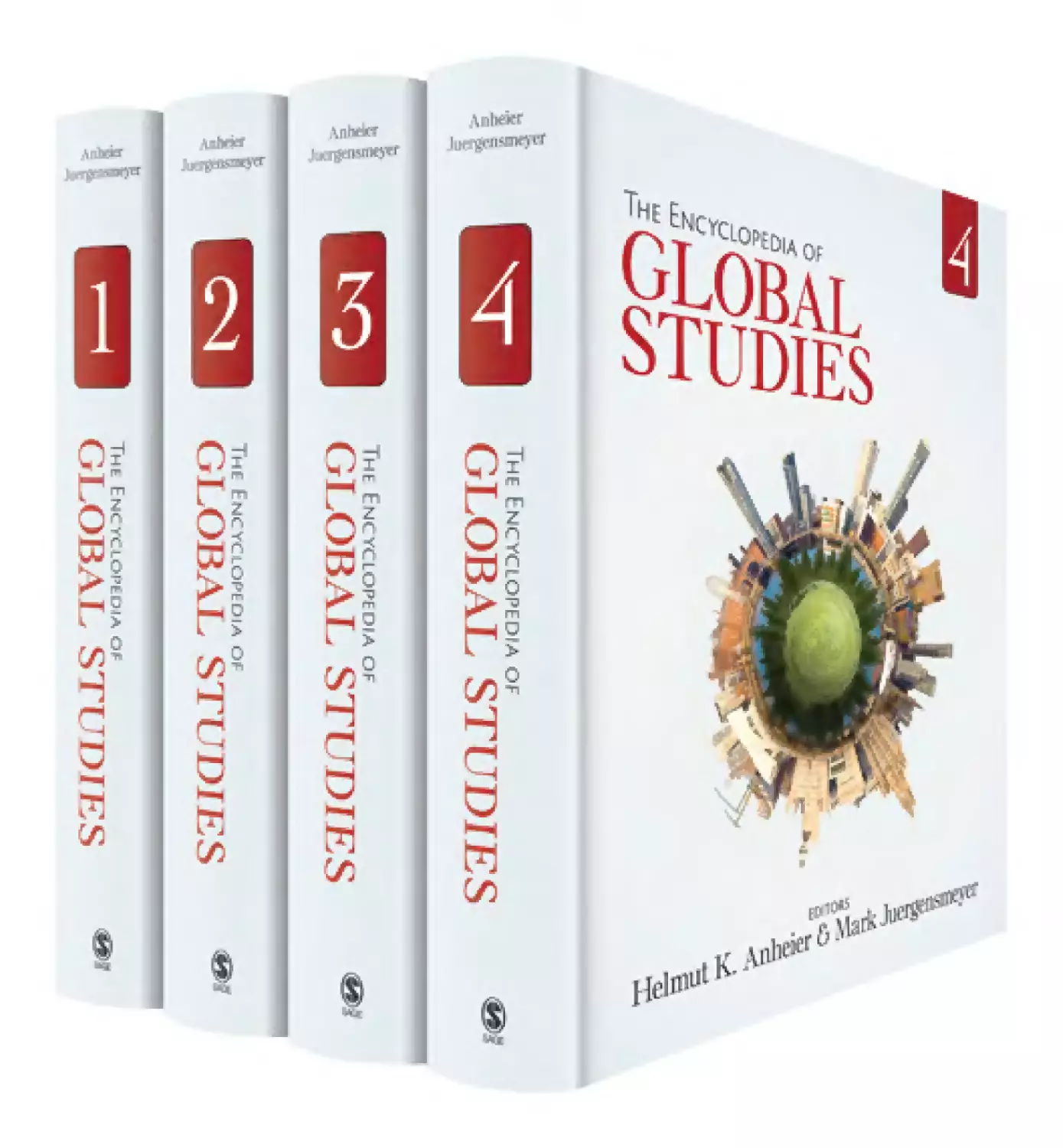


ISBN: 978-1-4129-6429-6



Text
Editorial Board
Editors
Helmut K. Anheier
Hertie School of Governance and University of Heidelberg
Mark Juergensmeyer
University of California, Santa Barbara
Managing Editor
Victor Faessel
University of California, Santa Barbara
Editorial Board
Richard Appelbaum
University of California, Santa Barbara
Mary Kaldor
London School of Economics
Miguel Centeno
Princeton University
Juergen Kocka
Wissenschaftszentrum Berlin
Nayan Chanda
Yale Center for the Study of Globalization
Jacob Olupona
Harvard University
David Held
Durham University
Yasuaki Onuma
University of Tokyo
Saad Eddin Ibrahim
Ibn Khaldun Center for Development Studies, Cairo
Dominic Sachsenmaier
Jacobs University, Bremen
Michael D. Intriligator
University of California, Los Angeles
Saskia Sassen
Columbia University
Yudhishthir Raj Isar
The American University of Paris
Wei-Ming Tu
Peking University and Harvard University
Advisory Board
Rajeev Bhargava
Centre for the Study of Developing Societies, Delhi
Dennis Jett
Pennsylvania State University
Danielle Celermajer
University of Sydney
Brian Job
University of British Columbia
Sara R. Curran
University of Washington, Seattle
Michael Kluth
University of Roskilde
Evelyn Davidheiser
University of Minnesota
Edward A. Kolodziej
University of Illinois, Urbana-Champaign
Yale H. Ferguson
Rutgers University, Newark
B. Venkat Mani
University of Wisconsin, Madison
Jin Guangyao
Fudan University
Matthias Middell
University of Leipzig
Giles Gunn
University of California, Santa Barbara
Niklaus Steiner
University of North Carolina at Chapel Hill
David Jacobson
University of South Florida
David Wank
Sophia University, Tokyo
FOR INFORMATION:
Copyright © 2012 by SAGE Publications, Inc.
SAGE Publications, Inc.
All rights reserved. No part of this book may be reproduced or utilized
in any form or by any means, electronic or mechanical, including
photocopying, recording, or by any information storage and retrieval
system, without permission in writing from the publisher.
2455 Teller Road
Thousand Oaks, California 91320
E-mail: order@sagepub.com
SAGE Publications Ltd.
1 Oliver’s Yard
55 City Road
London EC1Y 1SP
United Kingdom
SAGE Publications India Pvt. Ltd.
B 1/I 1 Mohan Cooperative Industrial Area
Printed in the United States of America.
Mathura Road, New Delhi 110 044
Library of Congress Cataloging-in-Publication Data
India
SAGE Publications Asia-Pacific Pte. Ltd.
3 Church Street
#10-04 Samsung Hub
Encyclopedia of global studies / editors, Helmut K. Anheier, Mark
Juergensmeyer.
v. cm.
Includes bibliographical references and index.
Singapore 049483
ISBN 978-1-4129-6429-6 (cloth)
Publisher: Rolf A. Janke
Acquisitions Editor: Jim Brace-Thompson
Editorial Assistant: Michele Thompson
Developmental Editor:
Carole Maurer
Reference Systems Manager:
Leticia Gutierrez
Reference Systems Coordinator: Laura Notton
Production Editor:
1. Globalization—Encyclopedias. 2. Globalization—Social
aspects—Encyclopedias. I. Anheier, Helmut K., 1954–
II. Juergensmeyer, Mark.
JZ1318.E62 2012
303.48′203—dc23 2011045608
Jane Haenel
Copy Editors: Colleen Brennan,
Sheree Van Vreede
Typesetter:
C&M Digitals (P) Ltd.
Proofreaders: Caryne Brown, Pam Suwinsky,
Tracy Villano
Indexer: Virgil Diodato
Cover Designer:
Gail Buschman
Marketing Manager:
Kristi Ward
12 13 14 15 16 10 9 8 7 6 5 4 3 2 1
Contents
Volume 1
List of Entries vii
Reader’s Guide xv
About the Editors xxiii
Contributors xxv
Introduction xxxvii
Entries
A
B
C
D
1
105
149
353
Volume 2
List of Entries vii
Reader’s Guide xv
Entries
E
F
G
H
I
439
543
611
775
847
Volume 3
List of Entries vii
Reader’s Guide xv
Entries
J
K
L
M
N
O
P
975
1001
1013
1095
1205
1257
1287
Volume 4
List of Entries vii
Reader’s Guide xv
Entries
R
S
T
U
V
W
X
Z
1425
1501
1619
1689
1731
1751
1831
1835
Index 1843
List of Entries
Abortion
Academy Awards
Accountability
Accounting Systems
Acculturation
Acid Rain
Activism, Transnational
Aesthetics
African Diaspora Religions
African Religions
Aging Societies
Agriculture Sector
Air Travel
Airlines
Al Jazeera
Alternative Energy Sources
American Revolution
Americanization
Amnesty International
Animal Rights
Anti-Apartheid Movement
Antiglobalization Movements and Critics
Antislavery Movements
Apartheid
Arab League
Arbitration
Architecture
Art
Artists
Asian Tiger Phenomenon
Assimilation
Association of Southeast Asian Nations (ASEAN)
Associations
Asylum
Authoritarianism. See Global Religions, Beliefs,
and Ideologies
Awqaf. See Waqfs
Banking, Offshore
Banks
Battle of Badr
Beirut
Biofuels
Biohazards
Biological Diversity
Biosphere
Birth Control
Blogs
Borders
Bretton Woods Agreements/System
British Broadcasting Corporation (BBC)
Buddhism
Burial and Crematory Practices
Cable News Network (CNN)
Caliphate
Capitalism
Cartoons, Comix, Manga
Charismatic Leaders
Charities, Charity
Child Trafficking. See Illegal Trade, Children
Christianity
Christianity-Related Movements
Cinema
Cities
Citizenship
Civil Aviation
Civil Rights
Civil Society, Global
Civility
Civilization
Class
Climate Change
Coal. See Extractive Industries Sector
Cold War
Colonialism
Communications and Technology, Global.
See Global Communications and Technology
Baby Boomers
Baha’i
vii
viii
List of Entries
Communicative Power
Communism, as International Movement
Communist International
Communitarianism
Communities, Transnational
Community
Computing
Computing, Personal
Conflict and Conflict Resolution
Conflict and Security, Global. See Global
Conflict and Security
Confucianism
Connectedness, Global
Conquests
Constitutionalism
Consumer Protest
Consumerism
Containerization
Contraception
Cooperation
Corporate Identity
Corporations, Transnational
Cosmopolitan Identity
Cosmopolitanism
Creativity and Innovation
Credit Cards. See Finance, Financial Systems
Creolization
Crime, Transnational
Crusades
Cuisine
Culinary Styles. See Food
Cultural Commons
Cultural Destruction
Cultural Diversity, Convention on
Cultural Hybridity
Cultural Industries
Cultural Observatories
Culture, Media, Global. See Global Culture,
Media
Culture, Notions of
Currencies
Cyberconflict
Cybernetics
Darwinism and Social Darwinism
Data Systems and Reporting, Global
Deforestation
Democracy
Demographic Change
Demographic Transition
Demos. See Publics and Polis, Global
Dependency
Dependency Theory
Depression, Great
Depression, Recession, and Stagnation
Desertification
Deskilling
Deterrence
Deterritorialization and Reterritorialization
Dharma
Diasporas
Diseases
Distribution of Wealth, Equitability of
Dollar
Drugs and Pharmaceuticals
Dubai
Dynasties
Earth Summit
Economic Crises
Economic Development
Economic Ethics
Economic Issues, Global. See Global Economic
Issues
Economics, Keynesian
Economy, Informal
Educational Systems
Electricity
Elites
Email
Empires
Empires, Modern
Energy Efficiency
Enlightenment, The
Entrepreneurship
Environmental and Energy Issues, Global. See
Global Environmental and Energy Issues
Environmental Carrying Capacity
Environmental Change
Environmental Movement
Environmental Rights
Environmental Security
Environmental Treaties, Conventions, and Protocols
Ethics, Global
Ethnic Identity
Ethnocentrism
Euro
European Central Bank
European Union
Events, Global
List of Entries
Extractive Industries Sector
Extractive Industries Transparency Initiative
Failed States
Family
Family Policies
Family Systems, Kinship
Fascism
Feminism
Fertility
Film. See Cinema
Film Festivals
Finance, Financial Systems
Fisheries
Floods, Tsunamis
Food
Food and Agriculture Organization of the
United Nations
Fordism
Forests
Foundations
Foundations, Asian: International Activities
Foundations, European: International Activities
Foundations, Middle East: International
Activities. See Waqfs
Foundations, U.S.: International Activities
Franchise Systems
Free Speech
Freemasons
French Revolution
G-7. See Global Economic Issues
G-20. See Global Economic Issues
Games
Gay and Lesbian Movement
Gay Rights
Gender Identity
Geneva Conventions
Genius, Notion of
Genocides
Geographic Informational Systems (GIS)
Global Commons
Global Communications and Technology
Global Conflict and Security
Global Culture, Media
Global Economic Issues
Global Environmental and Energy Issues
Global Governance and World Order
Global Health and Nutrition
Global Historical Antecedents
ix
Global History, Studies in
Global Intellectuals
Global Justice and Legal Issues
Global Order
Global Positioning System (GPS)
Global Religions, Beliefs, and Ideologies
Global Reporting Initiatives
Global South
Global Studies
Global Studies, Current Academic Approaches to
Global Studies, Early Academic Approaches to
Global Terminology
Global Village
Global Warming
Globalization, Approaches to
Globalization, Managed (China)
Globalization, Measurement of
Globalization, Phenomenon of
Globalization and Transnationality Indexes
Gold Standard
Google
Governance and World Order, Global. See
Global Governance and World Order
Governance Networks, Transnational
Greenhouse Gases
Hajj
Handheld Devices
Hare Krishna (International Society for Krishna
Consciousness)
Health and Nutrition, Global. See Global Health
and Nutrition
Health Care Access
Health Care Systems
Hedge Funds
Hegemonic Power
Heritage
Hinduism
Hindu-Related Movements
Hiroshima
HIV/AIDS
Hollow State
Hollywood
Holocaust
Homogenization
Homophobia
Hong Kong
Human Rights, International
Humanism
Humanitarian Intervention
x
List of Entries
Humanitarianism
Humanity, Concepts of
Hygiene
Hyperglobalism
Idealism
Identities, Traditional
Identities in Global Societies
Ideologies, Global
Illegal Trade, Arms
Illegal Trade, Children
Illegal Trade, Drugs
Illegal Trade, Precious Metals
Immigration
Immigration and Transnationalism
Imperialism
Independence Movements
Indigenous Peoples’ Rights
Indigenous Religions, Globalization of
Individualism
Industrialization
Inequality, Global
Inequality, Global Economic
Infant Mortality
Information Age
Intellectual Property Rights
Intellectuals, Global. See Global Intellectuals
Intelligence Agencies
Intergenerational Relations
International Air Transportation Association
International Court of Justice
International Criminal Tribunals
International Labour Organization (ILO)
International Maritime Organization
International Monetary Fund (IMF)
International Nongovernmental Organizations (INGOs)
International Nongovernmental Organizations,
Quasi-Forms
International Relations
Internet
Internet Corporation for Assigned Names and
Numbers
Internet 2.0. See Web 2.0
Interpol
Inventions and Discoveries
Investments
Islam
Islam-Related Movements
Jainism
Johannesburg
Journalism
Judaism
Justice, Transitional
Justice and Legal Issues, Global. See Global
Justice and Legal Issues
Justice Movements, Transnational
Knowledge Management Systems
Knowledge Production Systems
Kyoto Protocol
Labor
Labor Rights
Land Use
Landless Persons
Law, International
Law, Regional
Law, Transnational
Law, World
Law of Arctic Regions
Law of the Sea
Leadership
League of Nations
Legal Systems
Legitimacy
Leisure
Lex Mercatoria
Liberalism, Neoliberalism
Lifestyles
Linguistic Identities
Literature
Local Exchange and Trading Systems (LETS)
London
Longue Durée, Long Wave Theories of
Development
Los Angeles
Malnutrition
Malthusian Idea
Manufacturing Sector
Maps and Map-Making
Maquiladoras
Marginality
Marketing
Markets
Marshall Plan
List of Entries
Marxism and Neo-Marxism
McDonaldization, McWorld
Media, Global
Medical Systems
Memory
Memory Wars
Mercantilism
Methodological Nationalism
Microsoft
Migrant Shopping Patterns
Migration
Migration, Illegal
Migration Policies, Types of
Military
Modern Identities
Modernization
Monetary Policy
Mormonism
Morse Code
Mortality
Multiculturalism
Multiracial Identities
Mumbai
Music
Myths
Nanotechnology
National Identities
Nationalism, Neo-Nationalism
Nation-State
Natural Gas
Natural Law
Nature, Concepts of
Navigation Systems
Neocolonialism
Neoconservatism
New York City
News
Nobel Prize
Non-Aligned Movement
North Atlantic Treaty Organization (NATO)
Nuclear Power
Nuclear/Atomic Age. See Global Conflict and
Security; Nuclear Power
Nuremberg Precedent
Oceans
Oil
xi
Olympic Movement
Open Society Institute
Opinion, World
Organisation for Economic Co-operation and
Development (OECD)
Organization of American States (OAS)
Organization of Petroleum Exporting
Countries (OPEC)
Organized Crime. See Illegal Trade, Arms; Illegal
Trade, Children; Illegal Trade, Drugs; Illegal
Trade, Precious Metals
Otherness
Outsourcing
Overpopulation
Pan African Union
Pariahs, Global
Paris
Parks, Reserves, and Refuges
Peace
Peace Activism
Peacekeeping Forces
Peasant Economies
Penal Systems
Petroleum Economy
Petroleum Geopolitics
Pharmaceutical Sector
Philanthropy
Polar Regions
Policing Systems
Political Parties, Transnational
Population and Demographic Change
Population Control Policies
Population Growth and Population Explosion
Populism
Postal System, World
Postmodernism
Postmodernity
Poverty and Poverty Alleviation
Power, Global Contexts of
Prisoners’ Rights
Private Security Firms
Private-Public Partnerships
Privatization
Prizes and Awards, International
Production and Innovation Networks, Global
Professions
Protectionism
xii
List of Entries
Protestant Reformation
Proto-Globalization
Public Goods, Global
Public Health
Publics and Polis, Global
Racial Identity
Racial Supremacy
Radio
Railroads
Red Cross
Refugees
Regional Governance
Regional Identities
Regionalism
Religions, Beliefs, and Ideologies, Global.
See Global Religions, Beliefs, and Ideologies
Religious Conversion
Religious Identities
Religious Movements, New and Syncretic
Religious Politics
Remediation
Remittances
Republics
Retirement Systems
Revolutions
Rio de Janeiro
Road Signage Systems
Roads and Routeways
Rurality
Scripts and Writing Systems
Secret Societies
Secularism
Security
September 11, 2001 (9/11)
Service Sector
Sex Trafficking
Sexually Transmitted Diseases
Shanghai
Shari‘a (Islamic Law)
Shelter and Housing
Shinto
Shrinking World Concepts
Sikhism
Silk Road, New
Singapore
Sites, Global
68 Generation
Slavery
Soccer
Social Capital
Social Democracy
Social Entrepreneurship
Social Movements
Social Networking
Socialism
Socialist International
Soft Power Diplomacy
Solidarity Movements
Sovereignty
Space, Outer
Sports, Recreation
Standards and Standard Setting, Global
State–Civil Society Relations
Stock Markets. See Markets
Subsidiarity
Summits, Summitry
Sustainability
Tax Havens
Taxation
Technology Sector
Telegraph, Telegram
Telephone
Telephony
Television
Terrorism
Theater
Think Tanks
Third Way Movements
Tobin Tax
Tokyo
Totalitarianism. See Ideologies, Global
Tourism Sector
Trade
Trade Agreements
Transparency
Transportation Systems
Treaties
Treaty of Rome
Tribal Identities
Truth Commission
Tuberculosis
Uncivil Society
UN–Civil Society Relations
Undocumented Persons
UNICEF. See United Nations
United Nations
List of Entries
United Nations Educational, Scientific and
Cultural Organization (UNESCO)
United Nations Environment Programme (UNEP)
United Nations Security Council. See Global
Conflict and Security; Global Governance and
World Order; Global Order; United Nations
Universal Jurisdiction
Universal Postal Union
Universalism
Universities and Higher Learning
Urban Diseconomies
Urbanization
Utopia, Dystopia
Value/Commodity Chains, Global
Values
Vatican
Virtual Worlds
Viruses, Killer
Viruses and Diseases, Emerging
Walmart
Waqfs
War
War, Civil
War, Urban
Wars, New
Wars, World
Washington Consensus. See Liberalism,
Neoliberalism
Waste Management
Water
Weapons
Web 2.0
Welfare State
Westphalia, Treaty of, and the
Post-Westphalian World
Wikipedia
Women’s Movement
Women’s Rights
Work
World Bank
World Cultures
World Economic Forum
World Federalist Movement
World Food Program
World Government
World Health Organization
World Order. See Global Governance
and World Order
World Order, Visions of
World Religions, Concept of
World Social Forum
World Society Theory
World Trade Organization (WTO)
World’s Fairs
World-Systems Perspective
Xenophobia
Zionism
Zoroastrianism
xiii
Reader’s Guide
The Reader’s Guide is provided to assist readers in locating articles on related topics. It classifies articles
into 14 general topical categories: Global Civil Society; Global Communications, Transportation,
Technology; Global Conflict and Security; Global Culture, Media; Global Demographic Change; Global
Economic Issues; Global Environmental and Energy Issues; Global Governance and World Order;
Global Health and Nutrition; Global Historical Antecedents; Global Justice and Legal Issues; Global
Religions, Beliefs, Ideologies; Global Studies; Identities in Global Society. Entries may be listed under
more than one topic.
Global Civil Society
Red Cross
Social Capital
Social Entrepreneurship
Social Movements
Social Networking
Solidarity Movements
State–Civil Society Relations
Uncivil Society
UN–Civil Society Relations
Waqfs
Women’s Movement
World Economic Forum
World Social Forum
Activism, Transnational
Amnesty International
Anti-Apartheid Movement
Antiglobalization Movements and Critics
Antislavery Movements
Associations
Charities, Charity
Civil Society, Global
Civility
Connectedness, Global
Elites
Foundations
Foundations, Asian: International Activities
Foundations, European: International Activities
Foundations, U.S.: International Activities
Gay and Lesbian Movement
Humanitarian Intervention
Humanitarianism
Humanity, Concepts of
Indigenous Peoples’ Rights
International Nongovernment Organizations
(INGOs)
International Nongovernment Organizations,
Quasi-Forms
Open Society Institute
Opinion, World
Philanthropy
Publics and Polis, Global
Global Communications, Transportation,
Technology
Air Travel
Airlines
Civil Aviation
Communicative Power
Computing
Computing, Personal
Containerization
Cybernetics
Email
Global Communications and Technology
Handheld Devices
Information Age
International Air Transportation Association
xv
xvi
Reader’s Guide
Internet
Internet Corporation for Assigned
Names and Numbers
Inventions and Discoveries
Media, Global
Morse Code
Nanotechnology
Navigation Systems
Postal System, World
Radio
Railroads
Road Signage Systems
Roads and Routeways
Silk Road, New
Space, Outer
Telegraph, Telegram
Telephone
Telephony
Television
Transportation Systems
Universal Postal Union
Web 2.0
Global Conflict and Security
American Revolution
Apartheid
Cold War
Conflict and Conflict Resolution
Conquests
Cooperation
Cyberconflict
Deterrence
Failed States
French Revolution
Geneva Conventions
Genocides
Global Conflict and Security
Hiroshima
Holocaust
Intelligence Agencies
Military
Pariahs, Global
Peace
Peace Activism
Peacekeeping Forces
Private Security Firms
Refugees
Religious Politics
Revolutions
Security
September 11, 2001 (9/11)
Soft Power Diplomacy
Terrorism
Treaties
War
War, Civil
War, Urban
Wars, New
Wars, World
Weapons
Global Culture, Media
Academy Awards
Aesthetics
Al Jazeera
Americanization
Architecture
Art
Artists
Blogs
British Broadcasting Corporation (BBC)
Cable News Network (CNN)
Cartoons, Comix, Manga
Cinema
Creativity and Innovation
Creolization
Cuisine
Cultural Commons
Cultural Destruction
Cultural Diversity, Convention on
Cultural Hybridity
Cultural Industries
Cultural Observatories
Culture, Notions of
Educational Systems
Events, Global
Film Festivals
Games
Genius, Notion of
Geographic Informational Systems (GIS)
Global Culture, Media
Global Intellectuals
Global Positioning System (GPS)
Google
Hajj
Heritage
Hollywood
Homogenization
Reader’s Guide
Journalism
Knowledge Management Systems
Knowledge Production Systems
Leisure
Lifestyles
Literature
McDonaldization, McWorld
Maps and Map-Making
Memory
Memory Wars
Music
Myths
News
Nobel Prize
Olympic Movement
Postmodernity
Prizes and Awards, International
Scripts and Writing Systems
Sites, Global
Soccer
Sports, Recreation
Standards and Standard Setting, Global
Theater
Think Tanks
United Nations Educational, Scientific and
Cultural Organization (UNESCO)
Universities and Higher Learning
Virtual Worlds
Wikipedia
Work
World Cultures
World’s Fairs
Global Demographic Change
Acculturation
Aging Societies
Assimilation
Baby Boomers
Beirut
Cities
Communities, Transnational
Contraception
Demographic Change
Demographic Transition
Deterritorialization and Reterritorialization
Diasporas
Dubai
Family Policies
Family Systems, Kinship
Fertility
Hong Kong
Immigration
Immigration and Transnationalism
Intergenerational Relations
Johannesburg
Landless Persons
London
Los Angeles
Malthusian Idea
Migrant Shopping Patterns
Migration
Migration, Illegal
Migration Policies, Types of
Mortality
Mumbai
New York City
Overpopulation
Paris
Population and Demographic Change
Population Control Policies
Population Growth and Population Explosion
Retirement Systems
Rio de Janeiro
Rurality
Shanghai
Shelter and Housing
Singapore
68 Generation
Tokyo
Undocumented Persons
Urban Diseconomies
Urbanization
Global Economic Issues
Accounting Systems
Agriculture Sector
Asian Tiger Phenomenon
Banking, Offshore
Banks
Capitalism
Consumer Protest
Consumerism
Corporations, Transnational
Currencies
Data Systems and Reporting, Global
Dependency
Dependency Theory
Depression, Great
xvii
xviii
Reader’s Guide
Depression, Recession, and Stagnation
Deskilling
Distribution of Wealth, Equitability of
Dollar
Economic Crises
Economic Development
Economic Ethics
Economics, Keynesian
Economy, Informal
Entrepreneurship
Euro
European Central Bank
Extractive Industries Sector
Finance, Financial Systems
Fordism
Franchise Systems
Global Economic Issues
Globalization, Managed (China)
Gold Standard
Google
Hedge Funds
Illegal Trade, Arms
Illegal Trade, Children
Illegal Trade, Drugs
Illegal Trade, Precious Metals
Industrialization
Inequality, Global
Inequality, Global Economic
International Labour Organization (ILO)
International Monetary Fund (IMF)
Investments
Labor
Local Exchange and Trading Systems (LETS)
Longue Durrée, Long Wave Theories of Development
Manufacturing Sector
Maquiladoras
Marketing
Markets
Marshall Plan
McDonaldization, McWorld
Mercantilism
Microsoft
Monetary Policy
Organisation for Economic Co-operation and
Development (OECD)
Outsourcing
Peasant Economies
Petroleum Geopolitics
Petroleum Economy
Pharmaceutical Sector
Poverty and Poverty Alleviation
Private-Public Partnerships
Privatization
Production and Innovation Networks, Global
Professions
Protectionism
Public Goods, Global
Remittances
Service Sector
Sex Trafficking
Slavery
Tax Havens
Taxation
Technology Sector
Tobin Tax
Tourism Sector
Trade
Trade Agreements
Value/Commodity Chains, Global
Walmart
World Bank
World Trade Organization (WTO)
Global Environmental and Energy Issues
Acid Rain
Alternative Energy Sources
Biofuels
Biohazards
Biological Diversity
Biosphere
Climate Change
Deforestation
Desertification
Earth Summit
Electricity
Energy Efficiency
Environmental Carrying Capacity
Environmental Change
Environmental Movement
Environmental Rights
Environmental Security
Environmental Treaties, Conventions, and Protocols
Extractive Industries Transparency Initiative
Fisheries
Floods, Tsunamis
Forests
Global Commons
Global Environmental and Energy Issues
Global Warming
Reader’s Guide
Greenhouse Gases
International Maritime Organization
Kyoto Protocol
Land Use
Natural Gas
Nature, Concepts of
Nuclear Power
Oceans
Oil
Organization of Petroleum Exporting
Countries (OPEC)
Parks, Reserves, and Refuges
Petroleum Geopolitics
Polar Regions
Remediation
Sustainability
United Nations Environment Programme (UNEP)
Waste Management
Water
Global Governance and World Order
Accountability
Arab League
Association of Southeast Asian Nations (ASEAN)
Borders
Bretton Woods Agreements/System
Caliphate
Charismatic Leaders
Civilization
Colonialism
Democracy
Dynasties
Empires
Empires, Modern
European Union
Failed States
Global Governance and World Order
Global Order
Global South
Governance Networks, Transnational
Hegemonic Power
Hollow State
Independence Movements
International Relations
Leadership
League of Nations
Legitimacy
Methodological Nationalism
Nation-State
Neocolonialism
Non-Aligned Movement
North Atlantic Treaty Organization (NATO)
Organization of American States (OAS)
Pan African Union
Petroleum Geopolitics
Political Parties, Transnational
Power, Global Contexts of
Regional Governance
Regionalism
Republics
Social Democracy
Sovereignty
Subsidiarity
Summits, Summitry
Transparency
Treaty of Rome
United Nations
Utopia, Dystopia
Vatican
Welfare State
Westphalia, Treaty of, and the
Post-Westphalian World
World Federalist Movement
World Government
World Order, Visions of
Global Health and Nutrition
Abortion
Birth Control
Burial and Crematory Practices
Diseases
Drugs and Pharmaceuticals
Food
Food and Agriculture Organization
of the United Nations
Global Health and Nutrition
Health Care Access
Health Care Systems
HIV/AIDS
Hygiene
Infant Mortality
Malnutrition
Medical Systems
Public Health
Sexually Transmitted Diseases
Tuberculosis
Viruses, Killer
Viruses and Diseases, Emerging
xix
xx
Reader’s Guide
World Food Program
World Health Organization
Global Historical Antecedents
Global Historical Antecedents
Global History, Studies in
Global Justice and Legal Issues
Animal Rights
Arbitration
Asylum
Citizenship
Civil Rights
Constitutionalism
Crime, Transnational
Dharma
Free Speech
Gay Rights
Global Justice and Legal Issues
Human Rights, International
Indigenous Peoples’ Rights
Intellectual Property Rights
International Court of Justice
International Criminal Tribunals
Interpol
Justice, Transitional
Justice Movements, Transnational
Labor Rights
Law, International
Law, Regional
Law, Transnational
Law, World
Law of Arctic Regions
Law of the Sea
Legal Systems
Lex Mercatoria
Natural Law
Nuremburg Precedent
Penal Systems
Policing Systems
Prisoners’ Rights
Shari’a (Islamic Law)
Truth Commission
Universal Jurisdiction
Women’s Rights
Global Religions, Beliefs, Ideologies
African Diaspora Religions
African Religions
Baha’i
Battle of Badr
Buddhism
Capitalism
Christianity
Christianity-Related Movements
Communism, as International Movement
Communist International
Communitarianism
Confucianism
Cosmopolitanism
Crusades
Darwinism and Social Darwinism
Enlightenment, The
Ethics, Global
Fascism
Feminism
Freemasons
Global Religions, Beliefs, Ideologies
Hare Krishna (International
Society for Krishna Consciousness)
Hinduism
Hindu-Related Movements
Humanism
Idealism
Ideologies, Global
Imperialism
Indigenous Religions,Globalization of
Individualism
Islam
Islam-Related Movements
Jainism
Judaism
Liberalism, Neoliberalism
Marxism and Neo-Marxism
Modernization
Mormonism
Myths
Nationalism, Neo-Nationalism
Neoconservatism
Populism
Postmodernism
Protestant Reformation
Reader’s Guide
Religious Conversion
Religious Movements, New and Syncretic
Secularism
Shinto
Sikhism
Socialism
Socialist International
Third Way Movements
World Religions, Concept of
Zionism
Zoroastrianism
Global Studies
Civil Society, Global
Demographic Change
Global Communications and Technology
Global Conflict and Security
Global Culture, Media
Global Economic Issues
Global Environmental and Energy Issues
Global Governance and World Order
Global Health and Nutrition
Global Historical Antecedents
Global History, Studies in
Global Justice and Legal Issues
Global Order
Global Religions, Beliefs, and Ideologies
Global Reporting Initiatives
Global Studies
Global Studies, Current Academic
Approaches to
Global Studies, Early Academic Approaches to
Global Terminology
Globalization, Approaches to
Globalization, Measurement of
Globalization, Phenomenon of
Globalization and Transnationality Indexes
Hyperglobalism
Identities in Global Society
Inequality, Global
Proto-Globalization
Shrinking World Concepts
World Order, Visions of
World Society Theory
World-Systems Perspective
Identities in Global Society
Class
Community
Corporate Identity
Cosmopolitan Identity
Ethnic Identity
Ethnocentrism
Family
Family Systems, Kinship
Gender Identity
Global Village
Homophobia
Identities, Traditional
Identities in Global Society
Linguistic Identities
Marginality
Modern Identities
Multiculturalism
Multiracial Identities
National Identities
Otherness
Racial Identity
Racial Supremacy
Regional Identities
Religious Identities
Secret Societies
Tribal Identities
Universalism
Values
Xenophobia
xxi
To the memory of S. N. Eisenstadt
About the Editors
Editors
Helmut K. Anheier (PhD, Yale University, 1986) is
dean of the Hertie School of Governance in Berlin,
Germany, and professor of sociology, Heidelberg
University, where he also serves as academic director of the Center for Social Investment. He is a
leading figure in the global study of civil society
and a pioneer in developing the field of global
studies. From 2001 to 2011, Dr. Anheier was professor of public policy and social welfare at the
University of California, Los Angeles (UCLA),
and, from 2001 to 2009, centennial professor at
the London School of Economics and Political Science. He founded and directed the Centre for Civil
Society at the London School of Economics (1998–
2002), the UCLA Center for Civil Society (2001–
2010), and the UCLA Center for Globalization and
Policy Research (2004–2009). Prior to this, he was
a senior research associate and project codirector at
the Johns Hopkins University Institute for Policy
Studies and associate professor of sociology at Rutgers University. Before embarking on an academic
career, Dr. Anheier served as social affairs officer
to the United Nations.
Dr. Anheier’s work has focused on civil society,
policy analysis, philanthropy, organizational studies, and comparative methodology. He is the
author of over 350 publications, including over 30
authored and edited books. He is founding editor
of two academic journals, VOLUNTAS and the
Journal of Civil Society. He issued the International Encyclopedia of Civil Society (2010) and
edited several monograph series. His articles have
appeared in journals such as the American Journal
of Sociology, Social Forces, Annual Review of
Sociology, Contemporary Sociology, Sociological
Forum, British Journal of Sociology, International
Sociology, and World Development. Dr. Anheier
has won several national and international awards,
including the 2006 PNP Best Book Award of the
American Academy of Management, as well as
research prizes. He is currently researching the role
of philanthropy internationally, issues of cultural
policy, and methodological questions at the intersection of globalization, civil society, and culture.
Dr. Anheier serves on the board of several scholarly and philanthropic organizations.
Mark Juergensmeyer is professor of sociology and
global studies, affiliate professor of religious studies, and director of the Orfalea Center for Global
and International Studies at the University of
California, Santa Barbara. He is regarded as a
pioneer in the study of global religion and one of
the founders of the academic field of global studies. Since the 9/11 attacks, he has been a frequent
commentator in the news media on topics of religion and politics in global affairs, including BBC,
CNN, PBS, the New York Times, the San Francisco Chronicle, and the Huffington Post. Prior to
his positions at Santa Barbara, he served as coordinator of the religious studies program at the
University of California, Berkeley; director of the
Office of Programs in Comparative Religion at the
Graduate Theological Union; and founding dean
of the School of Hawaiian, Asian, and Pacific
Studies at the University of Hawai‘i. He has been
a visiting professor at Punjab University and Guru
Nanak Dev University in India and is past president of the American Academy of Religion. He is
the recipient of honorary doctorates from Lehigh
University in Pennsylvania and Roskilde University in Denmark. He received the Grawemeyer
Award for his book Terror in the Mind of God:
The Global Rise of Religious Violence, which is
based on interviews with activists around the
world—including individuals convicted of the
1993 World Trade Center bombing, leaders of
xxiii
xxiv
About the Editors
Hamas, and abortion clinic bombers in the United
States. It was listed by the Washington Post and
Los Angeles Times as one of the best nonfiction
books of the year. A previous book, The New
Cold War: Religious Nationalism Confronts the
Secular State, was listed by the New York Times
as a notable book of the year. He is author or editor of 20 other volumes, including Global Rebellion: Religious Challenges to the Secular State,
Sikh Studies: Comparative Perspectives on a
Changing Tradition, Gandhi’s Way: A Handbook
of Conflict Resolution, The Oxford Handbook of
Global Religion, Global Religion: An Introduction, Rethinking Secularism, and Religion in
Global Civil Society. He has also coedited the
Encyclopedia of Global Religion, also published
by SAGE.
Managing Editor
Victor Faessel is program director of the Orfalea
Center for Global and International Studies at the
University of California, Santa Barbara. He has
worked as a senior editor for several online and
print publications, as an assistant editor of English-language publications for the Center for I
nterdisciplinary Study of Monotheistic Religions
(CISMOR) at Doshisha University (Kyoto, Japan),
and as a managing editor of the online global
studies journal global-e. Dr. Faessel studied at universities in Chicago and Vienna, Austria, before
completing a PhD in mythological studies at Pacifica Graduate Institute, and he continues to pursue his interest in the contemporary global setting
of myth at the (and as the) intersection of imagination, ideology, and cultural memory.
Contributors
David Anderson
International Tribunal for the Law of the Sea,
Germany
Jan-Frederik Abbeloos
Ghent University
Donald E. Abelson
University of Western Ontario
David M. Andrews
Scripps College
David Abernathy
Warren Wilson College
Helmut K. Anheier
Hertie School of Governance and University of
Heidelberg
Francis Adams
Old Dominion University
Robert J. Antonio
University of Kansas
Randall Adams
Alice Lloyd College
Richard Appelbaum
University of California, Santa Barbara
Afe Adogame
University of Edinburgh
Daniel Araya
University of Illinois at
Urbana-Champaign
John Agnew
University of California, Los Angeles
Dieter Ahlert
Westfaelische Wilhelms-University
Clive Archer
Manchester Metropolitan University
Habib Ahmed
Durham University
Matthew Arentz
University of Washington
Tjitske Akkerman
Universiteit van Amsterdam
Deborah Avant
University of California, Irvine
Martin Albrow
London School of Economics and Political
Science
Salvatore J. Babones
University of Sydney
Holger Backhaus-Maul
Martin-Luther-University
Halle-Wittenberg
Matthew Allen
Curtin University of Technology
Ricky Lee Allen
University of New Mexico
Vida Bajc
Queen’s University
Ahmed H. al-Rahim
University of Virginia
John M. T. Balmer
Brunel University London
Paul Amar
University of California, Santa Barbara
Steven Barrie-Anthony
University of California, Santa Barbara
xxv
xxvi
Contributors
Gad Barzilai
University of Washington
Volodymyr Bilotkach
University of California, Irvine
Paul Arthur Battersby
Royal Melbourne Institute of Technology
(RMIT) University
Cyrus Bina
University of Minnesota, Morris Campus
Bernhard H. Bayerlein
University of Mannheim
Bart Beaty
University of Calgary
Martin Beck
Konrad Adenauer Stiftung
Betsi Beem
University of Sydney
Ebru Bekaslan
University of Massachusetts
Roland Benedikter
University of California, Santa Barbara, and
Stanford University
John P. Blair
Wright State University
Robin Bloch
University of Wolverhampton
David E. Bloom
Harvard School of Public Health
Ingrid Boas
Institute for Environmental Studies
Tom Boellstorff
University of California, Irvine
Alessandro Bonanno
Sam Houston State University
József Böröcz
Rutgers, State University of New Jersey
Lehn M. Benjamin
George Mason University
Saturnino M. Borras Jr.
International Institute of Social Studies (ISS)
Neil G. Bennett
City University of New York
Elizabeth R. Boskey
State University of New York
Janet Benshoof
Global Justice Center
Daniella E. Bove-LaMonica
Truman National Security Project
Yael Berda
Princeton University
Hans Günter Brauch
Free University of Berlin
Peter Berglez
Örebro University
John Breen
International Research Center for Japanese
Studies (Nichibunken)
Nitza Berkovitch
Ben Gurion University
Ivan Bernier
Laval University, Quebéc City
John W. Berry
Queen’s University
Rajeev Bhargava
Centre for the Study of Developing
Societies, Delhi
Jonathan R. Brestoff
University of Pennsylvania
Susan Brownell
University of Missouri, St. Louis
M. Lane Bruner
Georgia State University
William I. Brustein
University of Illinois at Urbana-Champaign
Amita Bhide
Tata Institute of Social Sciences
Alison Brysk
University of California, Santa Barbara
Katarzyna Bieszke
University of Gdansk
Nicola Bullard
Focus on the Global South
Contributors
xxvii
Colin D. Butler
Australian National University
Timothy J. Cooley
University of California, Santa Barbara
Thomas J. Butler
Cary Institute of Ecosystem Studies
Scarlett Cornelissen
University of Stellenbosch
Luis Cabrera
University of Birmingham
Sarah E. Cornell
University of Bristol
Craig Calhoun
London School of Economics
Marie Cornwall
Brigham Young University
Gralf-Peter Calliess
University of Bremen
Thomas Olaf Corry
University of Cambridge
Robert M. Campbell
Mount Allison University
Robert Costanza
Portland State University
Marita Carballo
Kantar Group
Michael Cottrell
University of Saskatchewan
Curtis L. Carter
Marquette University
Sheleyah A. Courtney
University of Sydney
Thorkil Casse
Roskilde University
Anne Cova
Institute of Social Sciences, University of Lisbon
Danielle Celermajer
University of Sydney
Beverly Crawford
University of California, Berkeley
Miguel Centeno
Princeton University
Paul R. Croll
Augustana College
Kin-man Chan
Chinese University of Hong Kong
Stuart Cunningham
Queensland University of Technology
Nayan Chanda
Yale Center for the Study of Globalization
Sara R. Curran
University of Washington, Seattle
Christopher Chase-Dunn
University of California, Riverside
Michael Curtin
University of California, Santa Barbara
Jamsheed K. Choksy
Indiana University
Catherine Dauvergne
University of British Columbia Faculty of Law
Jonathan Chow
University of California, Berkeley
Gareth Davey
Hong Kong Shue Yan University
Karen K. Clark
Western Oregon University
James Dawes
Macalester College
Elaine Coburn
American University of Paris and Ecole des
Hautes Etudes en Sciences Sociales, Paris
Martin Dawidowicz
United Nations
William Coleman
Balsillie School of International Affairs
Bastiaan de Gaay Fortman
Utrecht University
Philip Cooke
Cardiff University
Jason Dedrick
University of California, Irvine
xxviii
Contributors
Mathieu Deflem
University of South Carolina
Leobardo F. Estrada
University of California, Los Angeles
Donatella della Porta
European University Institute
Amitai Etzioni
Institute for Communitarian Policy Studies
Katrina Demulling
Boston University
Victor Faessel
University of California, Santa Barbara
Jane C. Desmond
University of Illinois at Urbana-Champaign
Richard Falk
University of California, Santa Barbara
Alan Detheridge
Thunderbird School of Global Management
Martin F. Farrell
Ripon College
Pradeep Ajit Dhillon
University of Illinois at Urbana-Champaign
James Farrera
Sophia University
Mario Diani
University of Trento
Mark Featherstone
Keele University
Ibrahim Dincer
University of Ontario
Richard Feinberg
University of California, San Diego
Laurent Dubois
Duke University
Patricia Fernández-Kelly
Princeton University
Hai Van Duong Dinh
Westfälische Wilhelms-University Münster
Steve Ferzacca
University of Lethbridge
Torben Bech Dyrberg
Roskilde University
Lorenzo Fioramonti
Centre for Social Investment
Adam C. Earnheardt
Youngstown State University
Johan Fischer
Roskilde University
S. N. Eisenstadt
Van Leer Jerusalem Institute
Mark Fliegauf
University of Cambridge
Caleb Elfenbein
New York University Gallatin School
Peter Flügel
School of Oriental and African Studies,
University of London
Rose Elfman
University of California, Santa Barbara
Hilal Elver
University of California, Santa Barbara
Henrik Enderlein
Hertie School of Governance
Thomas R. Engel
University of Bayreuth
Ulf Engel
University of Leipzig and Stellenbosch
University
Dieter Ernst
East-West Center, Honolulu
John Foran
University of California, Santa Barbara
Jennifer C. Franco
Transnational Institute
Bruno S. Frey
University of Zurich
Brian Frizzelle
University of North Carolina, Chapel Hill
Marc D. Froese
Canadian University College
Haruhiro Fukui
University of California, Santa Barbara
Contributors
xxix
Elaine Fulton
University of Birmingham
Matthew Green
College of DuPage
Alan Gamlen
University of Oxford
Liah Greenfeld
Institute for the Advancement of Social Sciences
Adèle Garnier
Universität Leipzig/Macquarie
University
Anni Greve
Roskilde University
Catherine Gautier
University of California, Santa Barbara
Olya Gayazova
DePauw University
Katherina Gehrmann
Westfaelische Wilhelms-University
Gilbert Geis
University of California, Irvine
Alexander C. T. Geppert
Freie Universität Berlin
Karin Geuijen
Utrecht University
Shannon Gibson
University of Miami
Fiona Gill
University of Sydney
Angus Kress Gillespie
Rutgers University
Bent Greve
Roskilde University
Thomas Greven
Freie Universität Berlin
Mohinder S. Grewal
Institute of Electrical and Electronics Engineers
Giles Gunn
University of California, Santa Barbara
Dina Hadad
University of Birmingham
Aviva Halamish
Open University of Israel
David Halle
University of California, Los Angeles
David C. Hammack
Case Western Reserve University
Michael Hammer
One World Trust
James Giordano
University of Oxford
István Hargittai
Budapest University of Technology and
Economics
Dru C. Gladney
Pomona College
Faye V. Harrison
University of Florida
Marlies Glasius
University of Amsterdam
Jonas Peter Hartelius
EastWest Institute
Georg Glasze
University of Erlangen-Nuremberg
Tsuyoshi Hasegawa
University of California, Santa Barbara
Andrew R. Goetz
University of Denver
Akiko Hashimoto
University of Pittsburgh
James Goldgeier
George Washington University
Robert Hassan
University of Melbourne
Bernard K. Gordon
University of New Hampshire
John Haworth
Manchester Metropolitan University
John L. Graham
University of California, Irvine
Jeffrey Haynes
London Metropolitan University
xxx
Contributors
Tracey Heatherington
University of Wisconsin, Milwaukee
Yudhishthir Raj Isar
American University of Paris
Alexandre Babak Hedjazi
University of Geneva
William A. Jackson
University of York
Ludger Helms
University of Innsbruck
Estelle James
State University of New York,
Stony Brook
Mark Herkenrath
University of Zurich
John Hickman
Berry College
Herkko Hietanen
Helsinki Institute for Information
Technology
Matthew Hilton
University of Birmingham
Dilip Hiro
Independent Scholar
Michael Hoelscher
University of Heidelberg
Kirsten L. Hokeness
Bryant University
Steven A. Hokeness
WellOne Medical Center
Siobhan Holohan
Keele University
Martin Hölz
Heidelberg University
Natasha Howard
University of New Mexico
Yu-ling Huang
State University of New York, Binghamton
Andrew Hurrell
Oxford University
Johan Hvenmark
Ersta Sköndal University College
Joy Hylton
Chapman/Brandman University
Paul James
Royal Melbourne Institute of Technology
(RMIT) University
Marie-Louise Janssen
University of Amsterdam
Mark M. Jarzombek
Massachusetts Institute of Technology
Bruno Jetin
Université Paris Nord
David T. Johnson
University of Hawaii at Manoa
David Martin Jones
University of Queensland
Erik Jones
Johns Hopkins University
Mark Juergensmeyer
University of California, Santa Barbara
Tobias Jung
UK Research Centre on Charitable
Giving and Philanthropy
Howard Kainz
Marquette University
Mary Kaldor
London School of Economics
Sebnem Kalemli-Ozcan
University of Houston
Stephanie C. Kane
Indiana University, Bloomington
Athina Karatzogianni
University of Hull
Ramona Cristina Ilea
Pacific University
Lamia Karim
University of Oregon
Michael D. Intriligator
University of California, Los Angeles
Inge Kaul
Hertie School of Governance
Contributors
Hiroko Kawanami
Lancaster University
Diana Leat
CASS Business School London
Roger Keil
York University
Kelley Lee
London School of Hygiene and Tropical
Medicine
Christopher C. Kissling
Lincoln University
Peter J. Kivisto
Augustana College
Hans Köchler
University of Innsbruck
Edward A. Kolodziej
University of Illinois at Urbana-Champaign
Markus Kotzur
University of Leipzig
Kenneth L. Kraemer
University of California, Irvine
Sebastian Kubitschko
Goldsmiths, University of London
Robert Thomas Kudrle
University of Minnesota
Jenny Kuhlmann
University of Leipzig
Ashwani Kumar
Tata Institute of Social Sciences
Martin Kunze
Martin-Luther-University Halle-Wittenberg
Ferhan Kuyucak
Anadolu University
Edmund Siu-Tong Kwok
BNU-HKBU United International College
Anael Labigne
Berlin Graduate School for Transnational Studies
Jackie Larm
University of Edinburgh
Henry Laurence
Bowdoin College
Pasi Lautala
Michigan Technological University
Nikki J. Y. Lee
Yonsei University
Bronwyn Leebaw
University of California, Riverside
Peter T. Leeson
George Mason University
Walter Leimgruber
University of Fribourg
Athena S. Leoussi
University of Reading
Philipp Lepenies
KfW Development Bank
Robert Lepenies
Hertie School of Governance,
Berlin Graduate School for
Transnational Studies
Daniel Levy
Stony Brook University
Emanuel Levy
Independent Film Critic
Jonathan Lewis
Hitotsubashi University
Gene E. Likens
Cary Institute of Ecosystem Studies
Jie-Hyun Lim
Hanyang University
Benjamin Linkow
Miami University
Björn-Ola Linnér
Linköping University
Regina A. List
Hertie School of Governance
William Lazonick
University of Massachusetts
Robert Lloyd
One World Trust
Pierrick Le Goff
Allstom
Antony Loewenstein
Freelance Journalist
xxxi
xxxii
Contributors
Maria Lorca-Susino
University of Miami
Doris McIlwain
Macquarie University
Thomas E. Lovejoy
The Heinz Center
Dan L. McNally
Bryant University
Eriberto Lozada
Davidson College
Anne McNevin
Royal Melbourne Institute of Technology
(RMIT) University
Cecelia Lynch
University of California, Irvine
Malcolm MacLachlan
Trinity College Dublin
André Magnan
University of Regina
John Mandalios
Griffith University
Peter Mandaville
George Mason University
Hasheem Mannan
Centre for Global Health
Henrik Secher Marcussen
Roskilde University
Katherine Marshall
Georgetown University
Joseph Masciulli
St. Thomas University
Gordon Mathews
Chinese University of Hong Kong
Michel Mathien
University of Strasbourg
Frédéric Mérand
University of Montreal
Erica Mesker
University of California, Santa Barbara
Matthias Middell
University of Leipzig
Eric Mielants
Fairfield University
Walter Mignolo
Duke University
John Mikler
University of Sydney
Toby Miller
University of California, Riverside
Melinda Mills
University of Groningen
H. Brinton Milward
University of Arizona
Manoranjan Mohanty
Council for Social Development, New Delhi
Robert J. McCalla
Saint Mary’s University
Mikhail A. Molchanov
St. Thomas University
John A. McCarthy
Vanderbilt University
Bjørn Møller
Danish Institute for International Studies
Linda McCarthy
University of Wisconsin, Milwaukee
Leila Monaghan
University of Wyoming
Marie C. McCormick
Harvard School of Public Health
Christine Monnier
College of DuPage
Mary E. McCoy
University of Wisconsin, Madison
Patrick M. Morgan
University of California, Irvine
Pamela McElwee
Arizona State University
Klaus Müller-Hohenstein
University of Bayreuth
Myles McGregor-Lowndes
Queensland University of Technology
D. E. Mungello
Baylor University
Contributors
Stephen Murphy-Shigematsu
Stanford University
Michael A. Peters
University of Illinois
Vasudha Narayanan
University of Florida
Lynne Phillips
University of Windsor
Joseph Natoli
Michigan State University
Peter Phipps
Royal Melbourne Institute of Technology
(RMIT) University
Susanne Neckermann
University of Zurich
Jan Nederveen Pieterse
University of California, Santa Barbara
Helen E. S. Nesadurai
Monash University, Malaysia
Alex Nicholls
University of Oxford
Mark Nuttall
University of Alberta
Thomas Oatley
University of North Carolina, Chapel Hill
Holly Oberle
Freie Universität Berlin
Julia O’Connell Davidson
University of Nottingham
Thomas Olesen
Aarhus University
Andreas Önnerfors
Leiden University
Stephen P. Osborne
University of Edinburgh
J. S. Oxford
Barts and the London School of Medicine and Dentistry
Anssi Paasi
University of Oulu
Brent L. Pickett
University of Wyoming
Geoffrey Allen Pigman
Bennington College
Detlef Pollack
Westfälische Wilhelms-Universität Münster
Susanne Popp
Augsburg University
Jason Potts
ARC Centre of Excellence for
Creative Industries and Innovation
José A. Prades
Université du Québecà Montréal
Vikramāditya Prakāsh
University of Washington
Christopher Priestman
Staffordshire University
Luca Prono
Independent Scholar
Stephen D. Reese
University of Texas
Wolfgang Reinhard
University of Erfurt
Ruth Reitan
University of Miami
John S. W. Park
University of California, Santa Barbara
Emiliano Reyes
Independent Scholar
Joseph Sung-Yul Park
National University of Singapore
James F. Reynolds
Duke University
Saadia M. Pekkanen
University of Washington, Seattle
Lisa Ann Richey
Roskilde University
Samuel Peleg
Netanya College and Inter-Disciplinary Center
(IDC) Herzliya
Sasho Ripiloski
Royal Melbourne Institute of Technology
(RMIT) University
xxxiii
xxxiv
Contributors
Isaias R. Rivera
Tecnologico de Monterrey (ITESM)
Amandeep Sandhu
Temple University
Roland Robertson
University of Aberdeen
Bhaskar Sarkar
University of California, Santa Barbara
Laura Robinson
Santa Clara University
Mahua Sarkar
State University of New York, Binghamton
Tom Rockmore
Duquesne University
Saskia Sassen
Columbia University
Andrea Römmele
Hertie School of Governance
Joachim J. Savelsberg
University of Minnesota
Marc A. Rosen
University of Ontario
Stephen W. Sawyer
American University of Paris
Jörg Rössel
University of Zurich
Stephanie Schacht
Princeton University
Dietmar Rothermund
Heidelberg University
Jens Schröder-Hinrichs
World Maritime University
Bo Rothstein
University of Gothenburg
Andreas Schröer
Portland State University
Victor Roudometof
University of Cyprus
Hagen Schulz-Forberg
Aarhus University
Ravi K. Roy
California State University, Northridge
James Schwoch
Northwestern University
Beth A. Rubin
University of North Carolina, Charlotte
Hakan Seckinelgin
London School of Economics
Galya Benarieh Ruffer
Northwestern University
Philip Seib
University of Southern California
Leila J. Rupp
University of California, Santa Barbara
Rebecca Sheff
Macalester College
Melissa A. Rury
U.S. Environmental Protection Agency
Mona Kanwal Sheikh
University of Copenhagen
Michael Ruse
Florida State University
Susumu Shimazono
University of Tokyo
Jörn Rüsen
Kulturwissenschaftliches Institut
Megan Shore
King’s University College
Alexander Ruser
University of Heidelberg
Meenal Shrivastava
Athabasca University
Dominic Sachsenmaier
Jacobs University, Bremen
Merril Silverstein
University of Southern California
Abdullah Saeed
University of Melbourne
Lívia Mathias Simão
University of São Paulo
Contributors
Ian Simmons
University of Durham
Teivo Teivainen
University of Helsinki
Pashaura Singh
University of California, Riverside
Nuno S. Themudo
University of Pittsburgh
Joseph M. Siracusa
Royal Melbourne Institute of Technology
(RMIT) University
Steve Thomas
Trinity College Dublin
David H. Slater
Sophia University, Tokyo
Peter Smith
Mahidol University
Tomasz Snarski
University of Gdansk
Rodrigo R. Soares
Pontifical Catholic University of Rio de Janeiro
S. Wojciech Sokolowski
Johns Hopkins University
Hugh Somerville
University of Surrey
Norman Spengler
University of Heidelberg
Graham Spinardi
University of Edinburgh
Amy E. Stambach
University of Wisconsin, Madison
Peter N. Stearns
George Mason University
Manfred B. Steger
Royal Melbourne Institute of Technology
(RMIT) University
xxxv
Håkan Thörn
Gothenburg University
Bassam Tibi
University of Goettingen
John Tiffin
Victoria University of Wellington
Madina Tlostanova
Peoples’ Friendship University of Russia
Stefan Toepler
George Mason University
Marcella Bush Trevino
Barry University
Alli Mari Tripp
University of Wisconsin, Madison
Michael Louis Troilo
University of Tulsa
Belgi Turan
University of Houston
Annette Van den Bosch
Monash Asia Institute
Jan Van den Broeck
University of Bergen
Martha C. E. Van Der Bly
London School of Economics and Political Science
Matthew Stephen
Social Science Research Center, Berlin
Bijan Vasigh
Embry-Riddle
Michael Strange
Malmö University
Manuel A. Vásquez
University of Florida
Christoph Stückelberger
University of Basel
Jean-Baptiste Velut
Sorbonne Nouvelle University of Paris
Erin B. Taylor
University of Sydney
Anthony J. Venables
University of Oxford
Ruti Teitel
New York Law School
Dacia Viejo Rose
University of Cambridge
xxxvi
Contributors
Vincent Virga
Independent Scholar
Hendrik Vollmer
University of Bielefeld
Ernst Ulrich von Weizsäcker
International Panel for Sustainable
Resource Management
Erin K. Wilson
Royal Melbourne Institute of Technology
(RMIT) University
Bronwyn Winter
University of Sydney
Scott Wisor
Australian National University
James Raymond Vreeland
Georgetown University
Ron Witt
United Nations Environment Programme (UNEP)
Robert H. Wade
London School of Economics
Wendy H. Wong
University of Toronto
Ole Wæver
University of Copenhagen
Michael Woods
Aberystwyth University
Roger Waldinger
University of California, Los Angeles
Sirpa Wrede
University of Helsinki
Judd Walson
University of Washington
Xiaoqing Eleanor Xu
Seton Hall University
Veda E. Ward
California State University,
Northridge
Yunxiang Yan
University of California, Los Angeles
Patrick Webb
Tufts University
Na Yin
City University of New York Institute for
Demographic Research
Tony Weis
University of Western Ontario
Alexandra Young
University of Sydney
Tracy A. Weitz
University of California, San Francisco
Yelena Nikolayevna Zabortseva
University of Sydney
Christopher Joseph Westgate
Texas A&M
Malgorzata Zachara
Jagiellonian University
Richard Widick
University of California, Santa Barbara
Eleanor Zelliot
Carleton College
Antje Wiener
University of Hamburg
Jürgen Zimmerer
University of Sheffield
Filip Wijkström
Stockholm School of Economics
Michael Zürn
Wissenschaftszentrum Berlin
Colin C. Williams
University of Sheffield
Gentian Zyberi
Utrecht University
Introduction
The Encyclopedia of Global Studies has been
created to be the standard reference work for the
emerging field of global studies. It covers the entire
range of transnational topics and the diverse
intellectual approaches that have been marshaled by
scholars in order to analyze all aspects of the global
and globalizing world—including the globalization
of economies, societies, cultures and polities; the
diasporas of ethnicities and religious groups and the
dispersions and migrations of peoples; the trans
national aspects of social and political change; the
global impact of environmental, technological, and
health changes; and the organizations and issues
related to global civil society.
This publication is the first encyclopedia of and
for global studies and, indeed, the first attempt to
map this emerging field in its entirety. Its objective
is to take stock of the concepts, approaches, theories, and methodologies that make up global studies. It also tries to cover the entire scope of events,
activities, ideas, processes, and flows that are
transnational or that could affect most regions of
the Earth. Although scholars have analyzed these
phenomena for many decades, as an academic
field, global studies blossomed largely after the
turn of the 21st century. It has expanded rapidly
since the first programs in global studies were
founded in Asian, European, and American universities in the 1990s. Since then, new undergraduate and graduate degree programs and new centers
of research have been created every year.
What, then, is this field called “global studies”?
Some scholars argue that it is unique, that the phenomena are new, and that therefore new scholarly
approaches must be created that are distinctly
appropriate to studying transnational subject matter. But most scholars accept the notion that,
although the current age is more global than ever
before, transnational and global phenomena have
always been a feature of the world’s physical,
social, and cultural life. For this reason, they analyze transnational phenomena utilizing established
approaches in the social sciences and humanities.
In that sense, the field of global studies is interdisciplinary. It includes the work of disparate scholars
over the decades who have attempted to understand the interconnected relationships among societies, polities, economies, and cultural systems on
a global scale. The results of their inquiries are
found in this encyclopedia. Most of the entries
herein are by topic—global religion, economic
development, pandemics, or the Internet, for
instance. Some focus on analytic approaches to
global studies, and a few spotlight significant ideas
such as Marxism, capitalism, and world-systems
theory. Others address events such as September
11, 2001, or the Nuremberg trials, places like London or Tokyo, or organizations like the United
Nations or the North Atlantic Treaty Organization. All these entry titles are grouped under broad
headings, a dozen or so areas that define the field
of global studies. This listing of entry titles by topic
area can be found in the Reader’s Guide, located
immediately after the alphabetic listing of entries
in the front matter.
How were these major headings determined? In
the initial planning stages for this project, a series of
workshops with scholars was held in London,
Tokyo, and Santa Barbara, California, to help frame
the central themes that are shaping the field of
global studies. The editors established an editorial
board of some of the world’s most significant scholars in the field and formed an advisory committee
representing most of the leading academic centers of
global studies in the world. Members of the editorial board and advisory committee helped suggest
both topics and appropriate authors and played an
important role in crafting the encyclopedia.
These workshops and advisory committees
established the following major areas covered by
xxxvii
xxxviii Introduction
the entries in this Encyclopedia of Global Studies.
These areas are diverse—from the more obvious
aspects of globalization, such as economic and
demographic transformations, to the more subtle
cultural and ideological aspects—but they are also
interrelated. Thus, entries under one heading could
also be listed under others. The major areas we
identified cover problematic aspects of global
change, such as environmental and health issues
and transnational inequalities, but they also include
the movements and organizations that have been
mobilized to confront and mitigate these problems
on a global scale.
Global Studies. One important set of topics the
encyclopedia considers are the very terms and
concepts scholars use to conceptualize and study
global themes. Entries under this heading include
global concepts, globalization, hyperglobalism,
proto-globalization, as well as entries on the
academic field of global studies. Also included are
entries about the history of the field, its organizational
development, and some of the leading intellectual
issues and ideas current within it.
Global Economic Issues. Perhaps the most
apparent aspect of contemporary globalization is
economic and financial, including the transnational
ownership, production, and distribution of goods
and services, and especially financial flows. The
entries related to this area also include global
recessions, consumerism, labor issues, the illegal
economy of sex and drugs, and global economic
actors from Google and Walmart to the World
Trade Organization.
Global Demographic Change. The dynamics of
a global era are shaped by demography. Some
regions of the world have rapidly growing
populations, whereas others are aging and even
shrinking. In some regions like Europe, almost
everyone can live anywhere, and it seems that
increasingly they do. Many countries in the world
today have become multicultural and have to deal
with immigrant communities from around the
world. In other regions, migration is either restricted
or involuntary, with millions of displaced persons
in refugee camps. The entries in this category cover
diaspora communities, refugees, overpopulation,
migration, the effect of Baby Boomers, and the
emergence of global cities such as Los Angeles and
Dubai.
Global Communications, Transportation,
Technology. The emergence of global communities
and, indeed, the massive globalization phase in
recent decades have been made possible by new and
more efficient forms of transportation and by new
communication technologies. The entries related to
this area cover automotive and air transport, global
positioning systems, computers, email, and the
Internet. They include an entry on handheld devices
including iphones and androids and an entry on new
developments in communications such as Twitter
and Facebook.
Global Culture, Media. New Internet social
networking, as well as television, video, and more
traditional forms of communication and interaction,
have given rise to a global culture—common
artistic forms of literature and the visual arts and
shared values and sensitivities. Entries in this area
include the Academy Awards, blogs, and trans
national television networks such as the Cable
News Network (CNN), the British Broadcasting
Corporation (BBC), and Al Jazeera. It also includes
entries on global cuisine, soccer and other
transnational sports, and the concept of global art
and architecture.
Global Religions, Beliefs, Ideologies. Religious
traditions and ideologies have always been global in
that they move beyond state boundaries, but as
cultural groups and individuals are dispersed around
the world, so are the ideas and beliefs of their
communities. The entries related to this area include
the global aspects of major religious traditions like
Islam, Christianity, and Buddhism; smaller traditions
such as Sikhism and Baha’i; new sects such as Hare
Krishna; an entry on religious movements that
includes organizations such as Scientology, Falun
Gong, and others; and secular ideologies, including
Marxism and nationalism. It also includes the
emergence of new global ideas such as cosmo
politanism and the concept of global ethics.
Identities in Global Society. As the global
community becomes more tightly knit, old social
identities such as nationality and religious affiliation
are being modified, however slowly, and recombined.
Introduction
Importantly, new ones emerge; these are based
less on nationality and ethnicity and are more
related to regional, racial, sexual, and multicultural
associations. Entries in this section include ethnic
identities such as Hispanic and Asian American
and multicultural, cosmopolitan, and gender
identities.
Global Civil Society. Since the mid-1970s, a
plethora of new movements, groups, and
organizations have emerged that cross traditional
national boundaries. Human rights movements
and nongovernmental organizations of many kinds
have created a global civil society. Entries in this
area include movements for women’s rights,
indigenous peoples’ rights, and gay and lesbian
rights, as well as antiglobalization movements and
transnational activism such as the democratic
movements of the Arab Spring.
Global Environmental and Energy Issues. The
future of life on the planet depends on developing
adequate energy needs and controlling a host of
new global environmental problems, from global
warming to the pollution of the air, water, and
seas. Often issues of energy and environment are
linked, that is, in the efforts to develop
environmentally sound forms of energy production.
Entries in this area include climate change and
global warming, acid rain, biofuels, tsunamis,
sustainability, oil and natural gas production, and
the Kyoto Protocol.
Global Health and Nutrition. Associated with
environmental issues are matters of global health
and nutrition. The availability of healthy food is
the most basic global health issue; on the more
extreme side are the problems of malnutrition and
pandemics. The entries in this area include HIV/
AIDS, abortion, birth control, food, and drugs.
Global Conflict and Security. Since the end of
the Cold War, a host of new conflicts have emerged,
both within national borders and, more frequently,
transnationally. The rise of transnational terrorism
organizations creates a set of new security concerns
for individual nations and for collaborative
intelligence and security networks on a global
scale. This area deals with issues of global security
and new forms of global conflict and includes
xxxix
entries such as terrorism, 9/11, civil war, genocide,
failed states, conflict resolution, military alliances,
and peace activism.
Global Governance and World Order. The
future of world order is tied to forms of transnational
cooperation and global governance. Although a
single world government is unlikely to emerge in
the foreseeable future, there are a variety of
institutions and movements that help adjudicate
differences, resolve tensions, and enable the
continuation of the global community. The entries
in this area include the United Nations, the
European Union, the Arab League, and the global
South. It also includes concepts of democracy and
legitimacy and the ideals of world government.
Global Justice and Legal Issues. One of the
central features of the emerging world order is the
protection of human rights and the provision of
legal and regulatory infrastructures for transnational
cooperation. The entries under this heading explore
a variety of movements for rights, from animal
rights to labor rights, and from gay rights to free
speech. It also includes Interpol, international
tribunals, systems of law relating to the seas and
transnational crimes, and concepts of law from
dharma to shari’a, as well as legal systems designed
to be applicable as world law.
Global Historical Antecedents. Finally, the
encyclopedia includes entries that recognize that
globalization and the transnational forces shaping
the present age have historical precedents. Entries
related to historical periods of globalization and
incidents with a global impact are scattered
throughout the major areas covered in the
encyclopedia, from colonialism, the slave trade,
and Malthusian ideas to the great empires and
caliphates of history. There are also entries
specifically on the historical antecedents to
globalization and on the growth of the field of
global history as opposed to regional history and
world history.
In sum, the Encyclopedia of Global Studies
covers new ground in two ways: No other
encyclopedia covers all of these topics in a
systematic and comprehensive fashion, and no
other covers them from the specifically global
xl
Introduction
perspective reflected in the way each of the entries
is written and presented. Thus, this encyclopedia is
different from other reference sources available
online or in print. Also, unlike publically accessible
online resources, this work is authoritative—the
entries were written or supervised by the most
learned and competent scholars in the field. The
major entries were written by these scholars; other
entries were written by younger scholars under the
guidance of senior colleagues to gain the
participation of the future generation of scholars
in global studies. When invited to write the entries
for this encyclopedia, the authors were instructed
to be specific—that is, the essays are written
specifically for the field of global studies. Each
essay has undergone a rigorous editorial process,
and some were re-written several times to make
sure they accurately covered the essential features
of the global studies field. Every article illuminates
some aspect of global studies or a subject related
to it, such as globalization, transnational activity
and themes, and elements of global society.
The creation of an encyclopedia of this magnitude is an enormous undertaking involving hundreds of colleagues over several years and across
all continents. The editors and managing editor
worked together as a team, meeting in person in
Berlin, London, Los Angeles, and Santa Barbara,
and in audio and video conference calls frequently
in between meetings. The staff of graduate assistants who worked diligently over the years—and
frantically in the final several months—were based
in Santa Barbara, Heidelberg, and Berlin, and at
times worked from locations as remote as Buenos
Aires, Rio de Janeiro, London, and Cambridge,
England. The process of the encyclopedia’s creation, therefore, was as global as its subject matter.
The Orfalea Center for Global and International
Studies at the University of California, Santa Barbara, served as the project’s home base, and the
Orfalea Center’s program director, Victor Faessel,
served as the managing editor.
We wish to acknowledge the enormous contributions of those who supported and labored on this
publishing venture, beginning with our colleagues at
the University of California, Santa Barbara, the
University of Heidelberg, and the Hertie School of
Governance in Berlin. Our diligent editorial support staff at Santa Barbara included graduate students Barbara Morra, Erica Mesker, John Soboslai,
and Cecilie Fenger and, at an early stage in the
development of the project, undergraduate student
Meredith Bailey. Our colleagues at Santa Barbara
went out of their way to assist with the project; we
appreciate especially the support of Giles Gunn,
Richard Appelbaum, Richard Falk, Oran Young,
Dean Ernst von Weizsäcker, and Dean Melvin Oliver. At Heidelberg, we wish to thank Michael Hoelscher and Martin Hölz in the Sociology Department, as well as the Centre for Social Investment
staff, in particular Georg Mildenberger and Norman Spengler. At the Hertie School of Governance,
thanks go to Regina A. List, Markus Fliegauf,
Zora Chan, and Saskia Kyas. The editors and staff
of SAGE Publications were consistently supportive
and encouraging. We thank especially Rolf Janke,
James Brace-Thompson, Jane Haenel, and Carole
Maurer and, at a critical moment late in the project’s development, Geoff Golson. Perhaps most of
all we thank the many colleagues who contributed
entries to this project, knowing that their primary
reward would be the satisfaction of having helped
create an enduring fountain of information about
an emerging field of studies to which they and we
are deeply committed.
Finally, we want to honor the memory of
S. N. Eisenstadt, one of the world’s great sociologists, who has pioneered the study of multiple
modernities and whose intellectual vision has
always had a global dimension. His essay on modern identities written for this encyclopedia is likely
one of his last publications. In tribute to his formidable intellectual legacy and in recognition of the
high standard of scholarship and insight that he
has set for us all, we gratefully dedicate this project
to his memory.
Helmut Anheier, Mark Juergensmeyer,
and Victor Faessel
xxx000
A
continue to need access to later abortion services
even where earlier services are readily available.
There are many reasons women decide to have
abortions. The most common reasons include
inability to afford a(nother) child, relationship
instability, and work/school obligations. Newer
research in this field exposes how women understand these reasons within the larger context of
wanting to be a good mother to current and/or
future children. Unwanted pregnancies also result
from acts of sexual coercion and violence, especially where women have less social power or in
conflict areas. Women with wanted pregnancies
may also have abortions when their own health or
the health of the fetus is compromised. Work
within the larger field of reproductive health has
measured the significant unmet need for family
planning across the globe as it contributes to high
rates of abortion, even in countries where abortion
is highly restricted. Low access to contraception
and social disapproval of premarital sex also contribute to the higher abortion rate in the United
States as compared to its western European
counterparts.
The legal status of abortion differs across the
world. The most liberal abortion laws can be found
in South Africa, which recognizes abortion as a
human right, and Canada, which has no abortion
law and thus leaves the entire matter to the health
care system. Some countries, such as the United
States and most of western Europe, limit abortion
based on the gestational age of the pregnancy. In the
United States, this limit is the point of potential
Abortion
Although it is an intimately personal medical procedure, abortion is also a complex and contentious
social issue on both national and global levels. As
a health procedure, abortion is the voluntary disruption of a pregnancy. The larger social meaning
of abortion is best understood within the larger
social, political, and economic context where
geography, nation, social position, and law intersect in ways that matter to women’s lives.
Abortion can be performed with the use of
instruments or by taking drugs. Worldwide there
are an estimated 42 million pregnancies (about 1
in 5) that end in abortion each year. The most
common technique for abortion is uterine aspiration (with either manual or electric suction), but
medication abortion with mifepristone (aka the
abortion pill) and misoprostol is growing in popularity. Use of misoprostol alone to induce abortion
occurs in places where abortion is highly restricted,
but the medication is available in the clandestine
marketplace. Regardless of the legal status of abortion, women terminate their pregnancies under
both safe and unsafe and legal and illegal conditions. Worldwide, an estimated 68,000 women die
annually as a result of unsafe abortion, although
the risk of dying from abortion where it is legal
and safe is very low.
Women of all ages, races, nations, and religious
backgrounds have abortions. Most abortions take
place before the 12th week of pregnancy, but women
1
2
Abortion
viability when it is believed that the fetus has a reasonable chance of survival outside the womb. Both
Mexico City and Cambodia allow abortion for any
reason through the 12th week of pregnancy. In contrast, many other developing countries limit access
to abortion based on the circumstances of the pregnancy itself, for example, when the pregnancy
threatens the life or health of the pregnant woman
or when it is the result of rape or incest. Some countries, like Ethiopia and Israel, interpret these exceptions broadly, allowing many women to access
abortion. Other countries limit legal abortion to
only a small number of cases, as does Colombia. A
few countries, including Nicaragua and Iraq, prohibit abortion in all circumstances.
Social debates over abortion take many forms.
One debate surrounds the moral status of the fetus
in which the woman’s right to bodily autonomy is
positioned against the fetus’s right to life. The
argument for fetal rights is usually predicated on a
belief that life begins at conception and is often
grounded in conservative religious beliefs. Pro-life
feminism rejects the patriarchal position against
abortion and sees abortion as reflecting the failure
of society to provide the structural supports for
motherhood. In contrast, the reproductive justice
approach locates a woman’s right to abortion
within a larger framework of human rights, including the right to have a child, to not have a child,
and to parent the children one has. Where women
have a legal right to abortion, abortion rights supporters understand this right as contributing to
women’s equal participation in society. However,
that capacity is limited by racial/ethnic and economic social inequalities.
A new argument against abortion has emerged
in the American debate that draws on empirical
research rather than morality claims. It contends
that abortion hurts the woman as well as the fetus.
To prove this point, abortion rights opponents
have conducted a series of studies that found a
significant association between having an abortion
and higher rates of poor mental health, including
depression, suicide, and substance use. Their conclusions have been challenged by the American
Psychological Association, whose Task Force on
Abortion, after reviewing these studies, found no
evidence of harm from abortion and numerous
methodological flaws in studies making those
conclusions.
Research on abortion social movements has
explored the uniquely contentious American experience as well as provided some cross-cultural
comparisons. The U.S. story of abortion dates to
the early days of the republic when abortion was
a common and unproblematic experience for
women. The first opponents to abortion were physicians who sought to distinguish themselves from
midwives who routinely provided this service.
Scholars argue that the early physician anti-abortion movement was part of a larger professionalizing project within organized medicine, which
succeeded in making abortion illegal at the end of
the 19th century. Abortion did not reappear on the
larger public agenda until the 1960s, when both
the medical community and women’s rights supporters began to advocate for abortion law reform,
resulting in the 1973 U.S. Supreme Court Roe v.
Wade decision legalizing abortion.
The Roe decision served as a catalyst for two
new umbrella social movements, most commonly
referred to as the “pro-life movement” and the
“pro-choice movement.” In addition to studying
the political histories of the movements, sociologists have studied the people who comprise the
movements. Scholars have found that differing
views of motherhood or women’s position in society explained women’s engagement in abortion
social movements. Research on pro-life activists
has found that many view their efforts as fulfilling a personal obligation to God, serving as a
form of religious practice or as a way to repent
for their own abortion experience. Social movement theorists have also examined the ways in
which the persistence of the abortion debate in
the United States has led to the professionalization of the pro-choice movement, substituting
permanent advocates for grassroots activists.
These scholars also pay significant attention to
the highly violent nature of the U.S. abortion
debate, in which abortion providers have been
murdered and property destroyed through arson
and acid attacks. International scholars discuss
the direct link between abortion rights advocacy
and the transnational feminist movement as well
as the international exportation of tactics of the
U.S. pro-life movement.
The intersection of law and society is a point
of investigation for scholars of abortion in the
United States. Researchers have found that abortion
Abortion
regulations, including mandatory waiting periods,
funding restrictions, and facilities requirements,
have led to a significant decline in overall access to
care. Additionally, the requirement that adolescents involve their parents in the abortion decision
creates significant impediments for young people’s
access to care and serves as a form of social shaming for unapproved sexuality. Perhaps the highest
profile debate over the regulation of abortion care
in the United States involved the fight over restricting a procedure abortion rights opponents call
“partial birth abortion.” Despite the lack of medical accuracy in the naming of the technique, the
law’s vagueness about what was actually restricted,
and medical evidence that the technique is safest
for women with certain medical presentations, the
U.S. Supreme Court found in favor of a federal
ban on the technique.
Comparing the U.S. experience with abortion
to that of Germany, scholars locate the differences
in disagreements over abortion within the larger
question of the role of the welfare state and the
differing role of the media in each society. Researchers argue that the ongoing requirement that a
woman’s abortion decision be approved by two
physicians rather than be solely at the discretion of
the pregnant woman may diffuse some of the tension over abortion in the United Kingdom. In contrast, abortion in Japan is seen through the lens of
a cultural practice called mizuko, which provides a
ceremonial ritual for the spirit of the aborted fetus.
Other work explores the role of organized religion
in the outlier status of countries where abortion is
illegal despite the neighboring countries allowing
abortion, for example, the Republic of Ireland
and Thailand. Also, in the international context,
scholarship addresses the unique role of sex selection abortion in countries where son preference
intersects with small family size, as in China and
India. Finally, new research is exploring abortion
migration and the Internet market for abortion
technologies.
Within the scholarly literature, there is new
attention to the role of stigma in the abortion context. Stigma is experienced at all levels of society
(micro, meso, and macro), and research has found
it to have negative impacts on the emotional health
of women undergoing abortion. Scholars also contend that stigma contributes to the unwillingness
of health care professionals to engage in abortion
3
work. Culturally, stigma silences broader social
conversations about the abortion issue.
Because abortion is a medical service, the role of
the health care provider features heavily in writings about abortion. In the United States, scholars
have been interested in the ways in which abortion
remains marginalized from mainstream medicine
and how feminism and medical authority are balanced in abortion provision. Health care workers
who provide abortion care often tell their own
stories to both humanize the abortion providers
and explain their rationale for engaging in this
work.
The right of health care institutions and providers to refuse involvement in abortion care—what
are often called “conscience refusals”—plays an
increasing role in reduced access to abortion across
the globe. For example, in Poland, conscience
refusals led to both legal restrictions on abortion
and reduced access to care in the clandestine market. In the United States, these health care refusals
have been shown to have a significant negative
effect on the standard of care for women’s health.
Research also exposes the constraints on physicians who are willing but unable to provide abortion care because of institutional prohibitions.
Finally, in places where abortion was recently liberalized, such as Colombia, exercise of personal
conscience has limited the development of abortion services to meet women’s demand for care.
Women have abortions for many reasons and
under legal/illegal and safe/unsafe conditions.
Abortion remains a highly contested social issue
with active social movement organizations and
actors. The legal status of abortion differs across
the globe, as does the provision of that care.
Tracy A. Weitz
See also Birth Control; Feminism; Fertility; Religious
Politics; Social Movements; Women’s Movement;
Women’s Rights
Further Readings
Cahn, N. R., & Carbone, J. (2010). Red families v. blue
families: Legal polarization and the creation of
culture. Oxford, UK: Oxford University Press.
Ferree, M. M., Gamson, W. A., Gerhards, J., &
Rucht, D. (2002). Shaping abortion discourse:
4
Academy Awards
Democracy and the public sphere in Germany and the
United States. Cambridge, UK: Cambridge University
Press.
Freedman, L. (2010). Willing and unable: Doctors’
constraints in abortion care. Nashville, TN: Vanderbilt
University Press.
Joffe, C. (2009). Dispatches from the abortion wars: The
costs of fanaticism to doctors, patients, and the rest of
us. Boston: Beacon Press.
Luker, K. (1984). Abortion and the politics of
motherhood. Berkeley: University of California Press.
Mohr, J. C. (1978). Abortion in America: The origins and
evolution of national policy, 1800–1900. New York:
Oxford University Press.
Petchesky, R. P., Judd, K., & International Reproductive
Rights Research Action Group. (1998). Negotiating
reproductive rights: Women’s perspectives across
countries and cultures. London: Zed Books.
Tooley, M. (2009). Abortion: Three perspectives. New
York: Oxford University Press.
Academy Awards
The Academy Awards, nicknamed the Oscars,
given for film achievements by the Academy of
Motion Picture Arts and Sciences (AMPAS), is an
American event but has been universally embraced
as the ultimate symbol of success and accomplishment in the world of global cinematic entertainment. Indeed, the importance of the Oscar Awards
goes way beyond the film world and the American
locale.
For awards to bear motivational significance,
they have to fulfill at least three functions: They
have to be visible and known to every artist, they
have to carry a high degree of prestige, and
they have to be within reach of success by any
aspiring artist or production company. The Oscars
meet all of these conditions: They are visible, they
are prestigious, and they are within reach.
There are several reasons for the institutionalization and extraordinary preeminence of the
Oscars. First and foremost is the longevity of the
award. Conferred for the first time in May 1929
(for achievements in 1927–1928), the Oscar is the
oldest film prize in history. A tradition of 82 years
(and still going strong) has made the Oscar a
respectable symbol with a solid heritage.
The other entertainment awards are like the children and grandchildren of the Oscars. The Antoinette Perry Awards (Tonys), by the League of New
York Theaters and Producers and the American
Theater Wing, were first presented in 1947. The
Emmys, awarded by the National Academy of Television Arts and Sciences, were presented for the first
time in 1949. The Grammys, the youngest showbiz
awards, were first bestowed by the National Academy of Recording Arts and Sciences in 1959.
Scope and Prestige
The Tony is essentially a local award, given for
achievements in the Broadway theater and largely
limited to the New York City arena. Movies, by
contrast, speak a universal language and have
the potential of reaching everyone. Even people
who don’t live in the United States and don’t
speak English are aware of the Oscars and their
significance.
The Oscar’s prestige stems from the status of the
Academy within the film industry. The Academy
has always been elitist, with membership that constitutes a very small percentage of the film industry. Yet, despite elitism, the Academy’s procedures
are quite democratic: The Academy, with its various branches, gives equal representation to all artists, regardless of specialty (writers, directors,
players). The nomination process is based on peer
evaluation: The Acting branch selects nominees in
acting, the Directors branch for directing, and so
on. However, each Academy member proposes
nominees for the Best Picture, and the entire membership votes for the winners in all the categories.
Film artists, like other professionals, attribute
the utmost importance to recognition from their
peers because they consider them the only experts
with the necessary knowledge to make competent
evaluation of their work. For most filmmakers, the
significant reference group, which sets standards
to be emulated and also serves as a frame for judging merits, consists of fellow workers.
Scarcity of Awards
The scarce number of awards also contributes to
the Oscar’s prestige. In the entire Academy history,
about 700 players have been nominated for an
Oscar and only 220 have actually won. Every year,
Academy Awards
only 20 actors are nominated in four categories—
Actor in a Leading Role, Actress in a Leading
Role, Actor in a Supporting Role, and Actress in
a Supporting Role—and only four win, one winner for each category. These 20 performances are
selected out of thousands of eligible performances.
Similarly, the 5 films (enlarged in 2009 to 10)
competing for Best Picture are chosen from a large
pool of over 300 eligible films. Hollywood film
production has declined, though: In the 1940s,
over 500 films were released on an average year.
Even so, the Oscar is more competitive than most
awards, due to the large number of films, performances, and achievements every year.
The Academy has refused to divide the categories by genre (e.g., drama and comedy). The
Tonys and the Golden Globes share separate sets
of categories for dramatic plays and musicals/
comedies. Those in favor of one prize claim that
increasing the number of awards decreases their
prestige; too many categories belittle the award.
The Grammys are awarded in over 70 categories,
and singers can be nominated in multiple categories for the same song.
The Oscar is awarded to artists of all nationalities: One fourth of the nominees have been foreign,
non-American artists. This international dimension extends the visibility of the Oscar and contributes to its prestige. And the Oscar’s prestige, in
turn, makes for intense international competition.
The scarcity of awards and the intense international competition have made the Oscar all the
more desirable.
The Oscar as Politically
Correct Entertainment
Most Academy members tend to judge a film by
the importance of its subject and relevance of
its issue; this was clear in 1982, when the film
Gandhi swept most of the Oscars. Cinematically,
according to many critics, it was a rather conventional, solemn biography of the noble political
figure, lacking epic scope and visual imagination.
Gandhi may have been a better movie had it been
directed by a more subtle and inventive filmmaker.
However, Gandhi’s figure was so inspirational and
his preaching for nonviolence so timely a message
in the context of the 1980s that Academy voters
favored the movie over Steven Spielberg’s E.T.,
5
Sidney Lumet’s The Verdict, and Sydney Pollack’s
comedy, Tootsie.
Pollack’s Tootsie, for example, was accomplished on every level, but it lacked the noble
intent and “important” theme that Gandhi possessed. It was praised by the New York Times critic
Vincent Canby, who described the film as having
the quality of an important news event. Although
he also faulted it for its earnestness, Canby thought
that the film succeeded in reminding the audience
about the existence of exceptional people, people
who were able to rise above the profit motive that
paradoxically motivated many of the moviemakers
themselves.
It is worth noting that the Academy’s taste
didn’t differ much from that of the critics. Gandhi opened to almost unanimously favorable
review; the only dissenting voices among the
major critics were Andrew Sarris and Pauline
Kael. And it won the New York Film Critics, the
National Board of Review, and the Golden Globe
awards. However, there was no consensus among
critics that year: the Los Angeles Film Critics
cited E.T. as Best Picture, and National Society
of Film Critics cited Tootsie.
With its more conservative membership, which
is about a generation older than many of Hollywood’s most active innovators and two generations older than most American moviegoers, the
Academy has traditionally favored earnest, noble,
and inspirational fare that propagated political
correctness even before the concept existed.
The Academy’s tendency to choose earnest
movies that deal with “important” or “noble”
issues over audacious movies that are more artistically innovative or politically charged is easily
documented. The Academy’s preference is for
safe, mainstream, noncontroversial film fare that
is imbued with a widely acceptable message:
Noble Theme Over Artistic Quality
In 1937, The Life of Emile Zola over The Awful
Truth and Lost Horizon
In 1941, How Green Was My Valley over Citizen
Kane
In 1942, Mrs. Miniver over The Magnificent
Ambersons
In 1944, Going My Way over Double Indemnity
6
Academy Awards
In 1951, An American in Paris over A Place in the Sun
In 1952, The Greatest Show on Earth over High
Noon
In 1956, Around the World in 80 Days over Giant
In 1964, My Fair Lady over Dr. Strangelove
In 1966, A Man for All Seasons over Alfie and
Who’s Afraid of Virginia Woolf?
In 1967, In the Heat of the Night over Bonnie and Clyde
In 1971, The French Connection over A
Clockwork Orange
In 1976, Rocky over Network and All the
President’s Men
In 1980, Ordinary People over Raging Bull
In 1981, Chariots of Fire over Reds
In 1982, Gandhi over Tootsie and E.T.
In 1983, Terms of Endearment over The Right Stuff
In 1989, Driving Miss Daisy over My Left Foot
In 1990, Dances With Wolves over GoodFellas
In 1994, Forrest Gump over Pulp Fiction
In 1997, Titanic over L.A. Confidential
In 1998, Shakespeare in Love over Saving Private Ryan
In 1999, American Beauty over The Insider
In 2000, Gladiator over Traffic
In 2001, A Beautiful Mind over The Lord of the
Ring: The Fellowship of the Ring
In 2009, Slumdog Millionaire over Benjamin
Button and Milk
In 2011, The King’s Speech over Inception and The
Social Network
Huge Impact
The immense effect, both symbolic and pragmatic,
of winning the Oscar is another unique feature.
Unlike the prestigious Nobel Prize, there is no
financial honorarium, although the Oscar’s economic worth is extraordinary: The winners’ salaries often skyrocket overnight. Winning an Oscar
means hard cash at the box office; the Best Picture
award can add $20 to $30 million in theater ticket
(or DVD) sales.
The Oscars are influential in both domestic
and global markets. In the 21st century, foreign
box office receipts amount to more than half of
movies’ overall gross sales. Along with prestige
and money, the Oscar-winning actors gain negotiating power for better roles with better directors, and they also enjoy increased popularity
outside the Hollywood film industry. Winners in
other categories enjoy increased reputation within
the motion picture industry, even if they do not
become better known among the general public.
No other entertainment award has such comparable effects. The Oscar’s preeminence in the
entertainment world is enhanced through extensive coverage in all media: print and radio in the
first two decades and TV over the past 50 years.
This media blitz is not confined to the United
States: The Oscar show is a popular TV program,
watched live or on tape by over 1 billion people
in over 170 countries.
Every profession is stratified, although some
more sharply than others. In acting, the inequality
in rewards (money, prestige, popularity, power)
between the elite and the rank and file is particularly sharp. There are three relevant audiences and
three corresponding evaluations in the film world:
evaluation by peers, evaluation by critics, and
evaluation by the public. The first evaluation is
internal to the film world, whereas the other two
are external or outside the industry. However, all
three evaluations are important because they operate at the same time, and each exerts some impact
on the film world.
What makes the Oscar such an influential
award is its combination of all three evaluations.
Through the Oscar, the Academy voters function
as peers, as critics, and as tastemakers. No other
award combines so well the usually disparate
critical and popular judgment. The Oscar is the
only award to exert such a direct and pervasive
influence on every element of the industry: the
movies, the filmmakers, and the audiences.
Emanuel Levy
See also Cinema; Cultural Industries; Film Festivals;
Global Culture, Media; Hollywood; Prizes and
Awards, International
Accountability
Further Readings
Biskind, P. (1998). Easy riders, raging bulls. New York:
Simon & Schuster.
Biskind, P. (2005). Down and dirty pictures. New York:
Simon & Schuster.
Hillier, J. (Ed.). (2001). American independent cinema.
London: British Film Institute.
Levy, E. (1987). John Wayne: Prophet of the American
way of life. Lanham, MD: Scarecrow Press.
Levy, E. (1990). Small-town America in film. New York:
Continuum.
Levy, E. (2000). Cinema of outsiders: The rise of American
independent film. New York: New York University Press.
Levy, E. (2003). All about Oscar: The history and politics
of the Academy Awards. New York: Continuum.
Lewis, J. (Ed.). (1998). The new American cinema.
Durham, NC: Duke University Press.
Neale, S., & Smith, M. (Eds.). (1998). Contemporary
Hollywood cinema. New York: Routledge.
Waxman, S. (2005). Rebels on the backlot: Six maverick
directors and how they conquered the Hollywood
studio system. New York: HarperCollins.
Accountability
The processes of globalization create a demand for
accountability by generating a growing complexity
in everyday life, as well as in professional life, with
fundamental changes related to both the targets
and recipients of accountability efforts and to the
methods and procedures within the organizations that are expected to render an account. The
complex issue of accountability attracts interest in
the global age, as there is a growing sense of entitlement to “good governance” and a demand for
improved performance across all sectors of society
and at the local, national, international, and transnational levels. The topic figures to be one of the
major future challenges to global governance, as it
affects and involves actions and actors across all
sorts of organizations. Especially within the nonprofit sector, there has been a growing accountability movement; nevertheless, there are also contested
perspectives on these processes of evaluation.
Definitions
Depending on the chosen approach and perspective, there are several possible definitions of
7
accountability as well as a variety of dimensions
and characteristics one can take into account.
Helmut Anheier and Amber Hawkes refer to
accountability from the actor’s perspective simply as answering for one’s behavior. Similarly,
One World Trust, a leading U.K.-based think
tank, which publishes the Global Accountability
Report, considers it to be a process through
which an organization makes a commitment to
respond to and balance the needs of stakeholders
in its decision-making processes and activities and
delivers against this commitment. In other words,
accountability is seen as a responsibility taken on
proactively by the actor or organization.
By contrast, in one of the more commonly used
definitions, Jonathan A. Fox and L. David Brown
see it more as a process—coming from outside—of
holding actors responsible for their actions. Similarly, Anne Marie Goetz and Rob Jenkins think of
accountability as the capacity held by the actor
affected by an action to demand that someone
provide reasons to justify his or her behavior or to
impose a penalty for poor performance. Along
these lines, Valerie Sperling considers the accountability relationship to be a power relationship that
consists of two core components: answerability
and enforcement. Building on the concept of a
power relationship, Richard Mulgan identifies a
set of key features, including the existence of an
external authority to which the “account” is given,
social interaction between those seeking answers
and those providing the answers, and the assertion
of a right of authority or superiority of those
demanding the account over those who are being
held accountable.
Researchers have identified various dimensions
of accountability. Some, including O. P. Dwivedi
and Joseph G. Jabbra, have distinguished administrative, legal, political, professional, and moral
dimensions. Another perspective separates internal
from external accountability. Internal accountability refers to responsibility for one’s own actions,
whereas external accountability refers to answering to others and encompasses the various dimensions listed earlier. Finally, some identify dimensions
that enable an organization to be accountable.
One World Trust lists four such dimensions—
transparency, participation, evaluation, and complaint and response mechanisms—all of which
must be integrated to ensure accountability.
8
Accountability
Alnoor Ebrahim and Edward Weisband note
that most discussions about the concept pose
two further questions: Accountability to whom
and accountability for what? The “to whom”
question refers ideally to the multiple actors
affected by the decisions or actions of the person
or organization to be held accountable, that is,
stakeholders. For governments, they could
include taxpayers, voters, service recipients, and
other nations; for private corporations, the
shareholders, customers, members of the community in which they operate, and even employees; for nonprofit organizations, funders,
members, service recipients, and government
regulators; and for international organizations,
member nations, funders, and so forth. The
answer to the “for what” question ranges from
finance (i.e., responsible use of resources), to
governance (i.e., decision-making processes), to
performance (i.e., the effectiveness and quality
of the service or product provided), all the
way—especially for nonprofit organizations—to
mission (i.e., the extent to which the actions lead
to mission fulfillment). The most comprehensive
approach to accountability has been provided by
Jonathan Koppell (2005), which separates several dimensions that may involve different actors
and levels, making it especially useful for analyzing global issues:
•• Transparency: “Did the organization reveal the
facts of its performance?” Transparency is an
extremely important tool for assessing
organizational performance. A transparent
organization gives access to the press, the public,
and other interested parties.
•• Liability: “Did the organization face
consequences for its performance?” This
dimension attaches consequences to an
organization’s performance. Liability can come
in the form of setbacks (such as diminished
budget authority, increased monitoring, etc.) or
positive reinforcement (such as cash bonuses to
employees and other rewards).
•• Controllability: “Did the organization do what
the principal desired?” Many analyses of
accountability focus on how much the
stakeholder has control over the organization or
principal. For example, government
bureaucracies should reach consensus on public
policy issues and “carry out the will of the
public.”
•• Responsibility: “Did the organization follow the
rules?” This means being lawful, adhering to
professional or industry standards and
behavioral norms, and being morally sound.
•• Responsiveness: “Did the organization fulfill the
substantive expectation?” Responsiveness works
more horizontally, and refers to the levels of
attention organizations give to their clients and
stakeholders’ needs and demands. It implies
accountability outward rather than upward.
The multiple approaches and definitions testify
to the complexity of this important issue. As alluded
to earlier, the actual forms of accountability differ
depending on which kind of organization is being
held accountable. Civil society organizations are
called on to increase their accountability efforts in
terms of financial disclosure, transparency in governance, and measurement of performance. In the
corporate sector, especially following the collapse of
Enron in 2001, accountability has become a fundamental element of corporate governance, including
transparency, internal and external checks and balance, and performance reports. Furthermore, public
service accountability is a core element of democratic societies because it is a fundamental condition for preventing the abuse of delegated power
and for ensuring that power is directed toward the
achievement of broadly accepted national goals
with the greatest possible degree of efficiency, effectiveness, and prudence. Finally, at the international
level, especially, the question of accountability “to
whom” has come to the forefront.
Theories and Research Results
One of the basic theories applied to the complex
issue of accountability is the economic principalagent theory. Here it is suggested that actors or
organizations and their stakeholders have different goals and interests, so that, for example, in the
case of nonprofit organizations, the organizations
might well misrepresent their abilities to funders
in order to obtain a grant or contract. As a result,
and to promote greater levels of trust, both parties
must ensure transparency and invest in disclosing
their activities, mainly via monitoring and oversight systems.
Accountability
The stewardship theory takes as its point of
departure the collective—rather than competing—
goals of the two engaging parties. According to
this theory, information on performance provided
through accountability mechanisms helps improve
overall performance and efficiency and helps to
create trust and ensure goal alignment. Institutional theory is another way of explaining why
there are performance-based accountability systems. Isomorphic developments across the sectors
are taking place, as it became more and more
important to unveil the activities of organizations
to improve procedures. For nonprofit organizations, for example, this can be an incentive “to be
perceived as successful and legitimate by outside
organizations” (Carman, 2010, p. 258).
Not only the manner according to which organizations fulfill accountability requirements but
also the surroundings in which it takes place is
part of theoretical and empirical research. From a
global perspective, changes such as privatization
or deterritorialization have a huge impact on the
mechanism of accountability, as transnational
institutions (companies, civil society organizations,
as well as legal or UN organizations) have the
power now to hold states accountable and can
claim that these processes apply to citizens in particular countries (see Sperling, 2009).
Scope and Growth
There seems to be an increasing trend toward
demanding and publicizing accountability efforts
for all sectors and at many different levels. At
the global level, in particular, several initiatives
have been launched to encourage and evaluate
accountability. For example, since 2006, the U.K.based One World Trust has published the Global
Accountability Report (GAR), which offers selected
data and trends on the accountability undertakings of international governmental organizations
(IGOs), international nongovernmental organizations (INGOs), and transnational corporations
(TNCs). The report, which is updated generally
on an annual basis, creates indexes based on the
degrees of transparency, participation, evaluation,
and complaints and response handling. According
to the 2008 GAR, even the highest performers
among the three groups of entities have only basic
accountability policies and systems in place.
9
Since 1995, the nonprofit partnership AccountAbility has worked, especially with the corporate
sector, to promote social and ethical accountability
and to develop a set of standards for reporting.
Hundreds of corporations and other organizations
in some 30 countries have implemented the
AA1000 series of standards. In addition, AccountAbility teamed up with csrnetwork, a consultancy now known as Two Tomorrows, to produce
an annual Accountability Rating, based on the
AA1000 standard and other frameworks, which
was prominently published in Forbes magazine. By
2009, the partners agreed that because the practices they promoted and assessed either already
had been sufficiently adopted by companies or
were being measured by other ratings, such as the
Dow Jones Sustainability Index and the FTSE4Good Index, their mission had been accomplished and the Accountability Rating was no
longer necessary.
Among civil society organizations, 11 of the
largest INGOs joined to launch in 2006 the INGO
Accountability Charter, which lays out a number
of basic principles and commits signees to annual
reporting using the Global Reporting Initiative’s
guidelines. By the latter part of 2010, the number
of INGOs adopting the Charter had increased to
17. At about the same time, the European Foundation Centre, the members of which are among the
leading philanthropies in Europe, and the U.S.based Council on Foundations formed a joint
working group, which ultimately agreed on Seven
Principles of Accountability for International Philanthropy, which are integrity, understanding,
respect, responsiveness, fairness, cooperation and
collaboration, and effectiveness, and developed a
set of good-practice options for implementing the
principles. Similar initiatives have emerged among
internationally oriented civil society organizations
in a variety of fields, including humanitarian
assistance.
Current Issues and Development
It is clear that globalization is altering all forms of
accountability relationships—within and between
states, at the level of international institutions,
transnational corporations, and nongovernmental organizations, and between those institutions
and the people they affect. The challenge for
10
Accounting Systems
researchers and practitioners then will be to identify these changes and to develop new forms and
mechanisms of accountability. An additional task
will be the further development and expanded
application of international accountability principles and standards, like those promoted by
AccountAbility and the INGO Accountability
Charter for the corporate and civil society sectors,
as well as assessment of their impact on accountability relationships and, ultimately, performance.
Helmut K. Anheier and Martin Hölz
See also Corporations, Transnational; Foundations,
European: International Activities; Foundations, U.S.:
International Activities; Transparency
Further Readings
Anheier, H. K., & Hawkes, A. (2008). Accountability in
a globalising world: International non-governmental
organizations and foundations. In M. Albrow, H. K.
Anheier, M. Glasius, M. E. Price, & M. Kaldor (Eds.),
Global civil society 2007/8. Communicative power
and democracy (pp. 124–143). Thousand Oaks, CA:
Sage.
Carman, J. G. (2010). The accountability movement:
What’s wrong with this theory of change? Nonprofit
and Voluntary Sector Quarterly, 39(2), 256–274.
Dwivedi, O. P., & Jabbra, J. G. (1988). Public service
responsibility and accountability. In O. P. Dwivedi &
J. G. Jabbra (Eds.), Public service accountability. A
comparative perspective (pp. 1–16). West Hartford,
CT: Kumarian Press.
Ebrahim, A., & Weisband, E. (Eds.). (2007). Global
accountabilities: Participation, pluralism, and public
ethics. Cambridge, UK: Cambridge University Press.
Fox, J. A., & Brown, L. D. (Eds.). (1998). The struggle
for accountability: The World Bank, NGOs, and
grassroots movements. Cambridge: MIT Press.
Goetz, A. M., & Jenkins, R. (2002). Voice, accountability
and human development: The emergence of a new
agenda (Background paper for the Human
Development Report 2002). New York: United
Nations Development Programme.
Koppell, J. (2005). Pathologies of accountability: ICANN
and the challenge of multiple accountabilities disorder.
Public Administration Review, 65(1), 94–108.
Lloyd, R. (2008). Promoting global accountability: The
experiences of the Global Accountability Project.
Global Governance, 14, 273–281.
Mulgan, R. (2000). “Accountability”: An ever-expanding
concept? Public Administration, 78(3), 555–573.
Solomon, J., & Solomon, A. (2004). Corporate
governance and accountability. Chichester, UK: Wiley.
Sperling, V. (2009). Altered states. The globalization of
accountability. Cambridge, UK: Cambridge University
Press.
Accounting Systems
Globalization has made the role of accounting
systems for extending economic and, more generally, organizational activities across space and time
more salient to both organizational agents and
their stakeholders. Accounting systems are arrays
of artifacts and practices organized for generating,
circulating, and accumulating numerical records.
Accounting systems exist in a variety of organizational settings, and they are subject to different degrees of standardization within and across
organizations. Numerical records of various kinds
referring to diverse sets of events and entities are
produced and circulated within accounting systems, although usually financial information is preeminent. Establishing and perpetuating accounting
within a regular system of records is always an
achievement of particular forms of social organization regulating how accounting information is
produced and circulated. Across organizations, the
emergence of regional, national, and international
organizational fields has resulted in a gradual standardization of accounting systems.
Since the 1970s, academic discourse within the
social sciences has reflected this salience. The interdisciplinary journal Accounting, Organizations and
Society is representative of the expanding academic
engagement with accounting. In discussions of the
historical origins and development of accounting
systems, the gradual emergence of isomorphic and
standardized forms, and the way in which accounting systems extend organization across space and
time, central interdisciplinary issues relating to
accounting systems are subsequently addressed.
Historical Origins and Development
Rudimentary accounting systems were among the
earliest forms of writing in human civilization. Use
Accounting Systems
of clay tokens in accounting for cattle and agricultural production, for example, is documented for
the Sumerian civilization from the 9th millennium
BCE onward. Archaic forms of accounting did
not necessarily utilize numerical representations
of volume or value, as clay tokens representing
specific goods could simply be stowed away to be
later retrieved.
Some authors have claimed that even the practice of double-entry bookkeeping, the hallmark of
contemporary accounting systems, can be traced
back to very early historical precedents. The significance of the double-entry innovation is that it
allows one to trace both the sources (original ownership, transfer of rights) and utilizations (investments, transactions) of goods over time. Although
one may imagine instances of double-entry accounting systems that do not employ numerical representations (e.g., a cattle trader keeping separate debit
and credit boxes for cow tokens), more complex
exercises in reckoning with debits and credits (of
producing balances and ratios, of timing and differentiating accounts, and so on) only became possible once numerical abstractions of goods were
used. Because the use of double-entry methodologies is suggestive of systematic reflections on the
acquisition, refinement, and sale of goods in terms
of volume and value, the double-entry system tends
to be considered as a prerequisite for capitalist
forms of economic organization to emerge.
Regardless of earlier historical precedents to
both the capitalist mode of production and the
double-entry accounting system associated with it,
there is little doubt that the diffusion of doubleentry bookkeeping after the advent of the printing
press (accounting textbooks constituted a large
share of the early books that were printed and
distributed in mass circulation) supported the subsequent unfolding of economic organization within
capitalist modes of production and trade.
The double-entry system has remained the
unchallenged paradigm of accounting in business
organizations throughout the industrial and informational stages of capitalism. Yet, the relationship
within accounting systems in business firms
between the keeping of records for purposes of
organizing and managing production and trade on
the one hand, and the preparation of reports for
stakeholders in organizational capital on the other,
has frequently been a matter of dispute among
11
practitioners and accounting scholars. Respective
structural tensions within accounting systems have
been reflected in the differentiation between management accounting for internal and financial
accounting for external purposes. Fears that critical functions of management accounting—which
may be as concerned with money and cash flow as
with the control of time and the evaluation of
quality—are being displaced by interests in financial bottom lines have repeatedly been articulated
by both scholars and practitioners.
Alongside educational and scholarly discourse
about proper forms of bookkeeping, the development of accounting systems in business organizations has coevolved with production and
information technologies and efforts to rationalize
production and managerial control, and it simultaneously has responded to the demands of financial
reporting articulated by tax and regulatory agencies, by private stakeholders, and by financial markets. The influence of various professions—for
example, of the legal profession on financial
reporting or of engineering professions on management accounting—has also been notable
throughout the diffusion of accounting discourses
and technologies. Genuine accounting professions
specializing exclusively in jurisdiction over accounting practices and systems (rather than diverse
kinds of accounting expertise being incorporated
into various professions) have become institutionalized in some countries (as, early on, in the United
Kingdom, then, more gradually, in the United
States), although not in others (e.g., in most continental European and Asian countries). Auditing,
as the inspection of accounts for internal or external stakeholders, has in most countries been incorporated into accountants’ professional jurisdictions,
although sometimes with a focus on legal rather
than financial expertise.
Double-entry bookkeeping was generally not a
paradigmatic accounting system in public sector
and nonprofit organizations in most countries until
the last few decades of the 20th century. In most
state bureaucracies around the globe, forms of
cameralistic bookkeeping focused on the successful
implementation of budgets rather than on the
tracking of capital investments. State bureaucracies
have been keeping various other numerical records
of nonfinancial character as well, and censuses, for
example, may also be considered accounting
12
Accounting Systems
systems put in place for purposes of measuring and
governing territories and populations. The notion
of “statistics” emerged from such forms of bureaucratic accounting systems within nation-states.
With the wave of public sector reforms focused on
privatization and “new public management” starting regionally in the late 1970s and diffusing globally through the course of the 1990s, private sector
accounting, double-entry bookkeeping, and various forms of management and financial accounting
have increasingly been institutionalized within
public and nonprofit sector bureaucracies around
the globe. Management consultants trained in
accounting and globally operating accounting
firms providing consultancy to national governments, international governmental organizations,
and nongovernmental organizations have been
driving and influencing this process of diffusion.
Diffusion has been reinforced through restrictions
within the international provision of credit and the
funding of development projects.
The extending scope of accounting systems
both within organizations (spanning across
advanced management information and resource
planning systems) and for purposes of financial
reporting (toward reporting on so-called intangible assets) has drawn criticisms that, with the diffusion of accounting systems, organizational
activities across sectors have increasingly been
“financialized.” Traditional forms of financial
accounting and managerial control are nowadays
coupled with more recent techniques, like benchmarking or the balanced score card, which include
nonfinancial indicators and qualitative elements,
but whether this qualifies or amplifies managerial
orientations to financial bottom lines rather than
other outcomes is a matter of contention. Although
accounting systems have historically emerged from
practices of writing that were not necessarily
numerical and then unfolded into numerical systems that are not exclusively financially oriented,
the diffusion and growth of accounting systems
definitely correlate with attempts to economize in
organizations and organizational fields in terms of
return on monetary investments.
Isomorphism and Standardization
The diffusion of accounting systems illustrates
that organizations rarely, if ever, set up accounting
systems that are completely of their own making.
In setting up accounting systems, organizations
draw on various resources from their environments, like information technologies and personnel trained in accounting by other organizations.
Organizations imitate other organizations and hire
consultants, and, in doing so, they respond to expectations and norms among their members, stakeholders, and regulators about proper forms of keeping
and circulating numerical records.
Expectations about what kind of accounting
system is appropriate for any given organization
tend to converge within distinct organizational
fields, as is evidenced by the historical divergence
of accounting systems between private and public
sectors. Drivers of convergence and the resulting
isomorphism of accounting systems across organizations are educational organizations, accounting
professions, financial markets, regulatory agencies,
and nation-states. Sometimes the term accounting
system, rather than referring to concrete accounting practices in specific organizations, is used to
refer to typical forms of accounting practices prevailing within specific organizational fields and to
sets of standards regulating these practices.
The process of globalization has brought about
a gradual convergence and standardization of
accounting practices and systems across diverse
organizational fields, most notably in the domain
of financial accounting. In financial reporting,
International Accounting Standards and U.S. Generally Accepted Accounting Principles have been
challenging and gradually displacing national traditions of financial accounting, auditing, and
reporting. The will to attract capital in global
financial markets has fueled this trend across all
types of business organizations, and interests of
firms, investors, and market regulators have been
steadily increasing the demand for standardized
forms of financial reporting since the 1970s. The
emerging global accounting profession, largely
oriented toward the British blueprint for defining
a combined accounting and auditing jurisdiction,
has mediated this demand, and big international
accounting firms acting as consultants to firms,
banks, nation-states, and private and public regulators have been the dominant actors in this process. Questions of regulatory effectiveness—usually
starting from observations that regulatory roles
have been conflated with consultancy services and
Accounting Systems
the fact that the overall process of private selfregulation is hardly transparent to outsiders or to
democratically elected governments—have been
posed in the wake of spectacular corporate collapses (Enron, WorldCom, Parmalat, etc.). Corporate collapses have also contributed to a reduction
in the number of big accounting firms from the
“Big 8” to the “Big 4” during the last quarter of
the 20th century.
Nevertheless, particularly with further globalization of capital investing, the demand for standardized forms of financial reporting is not expected to
wane in the near future, and similar dynamics of
expanding and standardizing financial reporting
may ultimately start to play out in public sector
organizations—driven by the interests of international governmental organizations like the United
Nations, the Organisation for Economic Co-operation and Development, the International Monetary
Fund, and the World Bank, and by attempts of
national governments to comply with expectations
of “good governance” informed by popularized
forms of accounting discourse. Standardization
with respect to management accounting has, in
comparison, been quite limited.
Convergence of management accounting systems has been the result of institutionalizing regular forms of accounting education in management
and business schools, and in colleges and universities from which organizations have recruited their
personnel. The prominence of accounting skills in
MBA (master’s of business administration) curricula, and their respective inclusion in the training
of managers around the globe, has provided a
backdrop for the diffusion of innovations in management accounting, which, to a considerable
extent, have been subject to the fashions and fads
in management discourse. In a longer historical
perspective, the current packaging of accounting
expertise completes the marginalization of nonfinancial experts (particularly those trained in engineering) in the design and operation of management
accounting systems and the yielding of managerial
control over all aspects of production processes to
finance specialists.
Another increasingly important aspect of convergence across management accounting systems is
the use of information technology, management
information systems, and SAP R/3–type software
by organizations across organizational fields and
13
sectors. Although installing these systems in organizations requires a good deal of customization, it
also renders organizational operations of different
kinds, across different organizations and diverse
organizational fields, gradually comparable. Isomorphism in the use of information technology
has clearly been reinforcing the diffusion of
accounting-related expertise and of respective
innovations across different organizations, organizational fields, sectors, and political segments of
world society.
Accounting Systems as Extending
Organizations Across Time and Space
The diffusion and extension of accounting systems
affects balances of power within and across organizations, favoring those with access to numerical
records, those competent in interpreting them,
and those able to systematically employ numbers
in acting on organizational contexts about which
numerical information is produced and circulated.
Being embedded in the circulation of numbers,
these organizational contexts become accessible to
action at a distance (a concept from actor-network
theory, which has become very prominent in interdisciplinary accounting discourse).
Management accounting systems produce
numbers on operations, products, and individual
outputs that are inspected by production managers who, in turn, adapt controls and a reward
system, to see the numbers change subsequently,
to further calibrate the reward system, and so on;
companies’ annual reports are analyzed by investors, and inserted into investment portfolio calculations, and capital is shifted as a result; tax
authorities inspect income statements and a variety of cash-flow documentations to calculate
taxes due; governmental agencies use all kinds of
statistics in calibrating regulatory schemes. In any
one of these examples, certain settings of organizational action turn into centers of calculation
that accumulate numbers and employ them in
acting at a distance on other settings, like factory
floors, households and families, corporations,
and, not least, other accounting systems. With
respect to centers of calculation, these latter settings may appear to define peripheries, but participants facing action at a distance by others may
adapt to being inspected and manipulated by the
14
Accounting Systems
numbers, particularly once they are competent in
utilizing numbers themselves and have an appropriate idea of how numbers will be interpreted
and utilized in centers of calculation. The emergence and continuous adaptation of various forms
of creative accounting demonstrate such accommodations, which, alongside problems of surveillance and control associated with them, historically
have been accompanying the diffusion and extension of accounting systems from the start.
Problems of standardizing, regulating, and
policing the production and circulation of numerical records are inevitable for organizations attempting to extend their ability to organize across space
and time through the use of accounting systems.
Accounting records make present what is past and
distant, and those basing their decisions and
actions on numerical information often have no
other means of checking on what is otherwise
away and gone. With the globalization of organizing activities, the distance-spanning abilities of
accounting systems have been embedding organizational units spread around the globe in overarching flows of information.
The historical mushrooming of accounting systems from local representations of the past to
informational architectures in which organizing is
made subject to potentially endless evaluations
and projections through space and time has two
programmatic aspects—one technological, the
other discursive. On the one hand, it has been
driven by discourses of government and management defining spheres of interest and potential
intervention. On the other hand, such discourse
has been supported by numerical records defining
certain spheres of intervention to start with (e.g.,
census figures defining demographic problems,
sales figures defining market shares). In the extension of accounting systems, discourses and technologies combine in escalating the need for
numerical information.
As evidenced by the diversity of creative accounting, there are also social aspects of the growth of
accounting systems that cannot altogether be programmed very well by either discursive or technological means. There is a tendency of accounting
systems to establish playing fields in which different organizational interests compete by drawing
on numbers to support positions and status. Once
decisions of superordinate organizational levels
are based on forms of intraorganizational competition, the outcome of which is expressed numerically (e.g., in return on investment ratios),
competitors are drawn into procuring requisite
numbers regardless of the regulatory intentions
with which the accounting system might originally
have been invested. Participants at the level of
intervention may seek to use accounting systems to
extend their influence upward through forms of
numerical impression management. In this way,
accounting systems extend organizations across
time and space not only on a formal and programmatic level, but also in disseminating social conflict and informal rivalries across networks of
circulating numbers.
Social scientists interested in accounting have
pointed out that once decision makers shift attention almost exclusively to numerical representations, and once regulatory struggles devolve into
reiterated trials of strength between increasingly
complex informational architectures while forms
of creative accounting try to resist these systems
through their own devices, organizational activities at regulatory and executive levels are likely to
drift away from other involvements in organizational domains. Especially in those areas of global
business activity in which the objects of financial
accounting, financial-market regulations, and
reporting standards have become entangled in
complex webs of financial products, options, and
derivatives, there has been speculation of an emergent hyperreality supported by accounting systems
running exclusively under their own steam of
financial information. Similar observations may
suggest themselves with respect to the circulation
of indicators (of trade balances, social welfare,
climate changes, etc.) among governmental organizations in transnational political arenas, although
the respective accounting systems largely remain to
be explored.
Hendrik Vollmer
See also Banks; Capitalism; Finance, Financial Systems;
Homogenization; Information Age; International
Monetary Fund (IMF); International Nongovernmental
Organizations (INGOs); Liberalism, Neoliberalism;
Organisation for Economic Co-operation and
Development (OECD); Population and Demographic
Change; Professions; Standards and Standard-Setting,
Global; World Bank
Acculturation
Further Readings
Armstrong, P. (1987). The rise of accounting controls in
British capitalist enterprises. Accounting,
Organizations and Society, 12, 415–436.
Fligstein, N. (1987). The intraorganizational power
struggle: Rise of finance personnel to top leadership in
large corporations, 1919–1979. American Sociological
Review, 52, 44–58.
Johnson, H. T., & Kaplan, R. S. (1987). Relevance lost:
The rise and fall of management accounting. Boston:
Harvard Business School Press.
Macintosh, N. B., Shearer, T., Thornton, D. B., & Welker,
M. (2000). Accounting as simulacrum and
hyperreality: Perspectives on income and capital.
Accounting, Organizations and Society, 25, 13–50.
McBarnet, D., Weston, S., & Whelan, C. J. (1993).
Adversary accounting: Strategic uses of financial
information by capital and labour. Accounting,
Organizations and Society, 18, 81–100.
Miller, P. (1990). On the interrelations between
accounting and the state. Accounting, Organizations
and Society, 15, 315–338.
Napier, C. J. (2006). Accounts of change: 30 years of
accounting history. Accounting, Organizations and
Society, 31, 445–507.
Quattrone, P., & Hopper, T. (2005). A “time-space
odyssey”: Management control systems in two
multinational organisations. Accounting,
Organizations and Society, 30, 735–764.
Robson, K. (1992). Accounting numbers as “inscription”:
Action at a distance and the development of
accounting. Accounting, Organizations and Society,
17, 685–708.
Thompson, G. F. (1991). Is accounting rhetorical?
Methodology, Luca Pacioli and printing. Accounting,
Organizations and Society, 16, 572–599.
Vollmer, H. (2007). How to do more with numbers:
Elementary stakes, framing, keying, and the threedimensional character of numerical signs. Accounting,
Organizations and Society, 32, 577–600.
Acculturation
Acculturation is a common feature of the global
era. It is the process of cultural and psychological change that takes place as a result of contact
between cultural groups and their individual members. Such contact and change occur for many
reasons (such as colonization and migration); it
15
continues after initial contact in culturally plural
societies, where ethnocultural communities maintain features of their heritage cultures over generations, and it takes place in both groups in contact.
Adaptation to acculturation takes place over time;
occasionally it is stressful, but often it results in
some form of mutual accommodation.
The initial interest in acculturation examined
the effects of European domination of colonial and
indigenous peoples. Later, it focused on how immigrants (both voluntary and involuntary) changed
following their entry and settlement into receiving
societies. More recently, much of the work has
been involved with how ethnocultural groups and
individuals relate to each other, and how they
change, as a result of their attempts to live together
in culturally plural societies. Nowadays, all three
foci are important areas of research, as globalization results in ever-larger trading and political
relations.
The concept of psychological acculturation was
introduced by Theodore D. Graves in 1967; it
refers to changes in an individual who is a participant in a culture contact situation, being influenced both directly by the external (usually
dominant) culture and by the changing culture
(usually nondominant) of which the individual is a
member. There are two reasons for keeping the
cultural and psychological levels distinct. The first
is that in cross-cultural psychology, individual
human behavior is viewed as interacting with the
cultural context within which it occurs; hence,
separate conceptions and measurements are
required at the two levels. The second reason is
that not every group or individual enters into, participates in, or changes in the same way; there are
vast group and individual differences in psychological acculturation, even among people who live
in the same acculturative arena.
At the cultural level, there is a need to understand key features of the two original cultural
groups prior to their major contact. It is also
important to understand the nature of their contact relationships and the resulting cultural changes
in both the original groups and in the ethnocultural groups that emerge following contact during
the process of acculturation. These changes can be
minor or substantial and range from being easily
accomplished to being a source of major cultural
disruption.
16
Acculturation
At the individual level, there is a need to consider the psychological changes that individuals in
all groups undergo and to examine their eventual
adaptation to their new situations. These changes
can be a set of rather easily accomplished behavioral shifts (e.g., in ways of speaking, dressing, and
eating), or they can be more problematic, producing acculturative stress as manifested by uncertainty, anxiety, and depression. Adaptations can be
primarily internal or psychological (e.g., sense of
well-being or self-esteem) or sociocultural (e.g., as
manifested in competence in the activities of daily
intercultural living).
As noted earlier, not every group or individual
engages the acculturation process in the same way.
The concept of acculturation strategies refers to
the various ways that groups and individuals seek
to acculturate. These variations have challenged
the assumption that everyone would assimilate
and become absorbed into the dominant group. At
the cultural level, the two groups in contact
(whether dominant or nondominant) usually have
some notion about what they are attempting to do
(e.g., colonial policies). At the individual level,
persons will vary within their cultural group (e.g.,
on the basis of their educational or occupational
background).
Four acculturation strategies have been derived
from two basic issues facing all acculturating peoples. These issues are based on the distinction
between orientations toward one’s own group and
those toward other groups in the larger society.
This distinction is rendered as a relative preference
for maintaining one’s heritage culture and identity
and a relative preference for having contact with,
and participating in, the larger society along with
other ethnocultural groups. It has now been well
demonstrated that these two dimensions are independent of each other. These two issues can be
responded to on attitudinal dimensions, varying
along bipolar dimensions ranging from positive to
negative preferences. Orientations to these issues
intersect to define four acculturation strategies.
When individuals do not wish to maintain their
cultural identity and seek daily interaction with
other cultures, the assimilation strategy is defined.
In contrast, when individuals place a value on
holding on to their original culture, and at the
same time wish to avoid interaction with others,
then the separation alternative is defined. When
there is an interest in maintaining one’s original
culture while in daily interactions with other
groups, integration is the option. In this case, there
is some degree of cultural integrity maintained,
while at the same time the person seeks, as a
member of an ethnocultural group, to participate
as an integral part of the larger social network.
Finally, when there is little possibility or interest in
cultural maintenance (often for reasons of enforced
cultural loss), and little interest in having relations
with others (often for reasons of exclusion or discrimination), then marginalization is defined.
The original definition clearly established that
both groups in contact would change and become
acculturated. The four terms defined in the previous paragraph describe the acculturation strategies
of nondominant peoples. Different terms are
needed to describe the strategies of the dominant,
larger society. Assimilation when sought by the
dominant group is termed the melting pot. When
separation is forced by the dominant group, it is
segregation. Marginalization, when imposed by
the dominant group, is exclusion. Finally, for integration, when diversity is a widely accepted feature
of the society as a whole, it is called multiculturalism. With the use of these concepts and measures,
comparisons can be made between individuals and
their groups, and between nondominant peoples
and the larger society within which they are acculturating. The acculturation ideologies and policies
of the dominant group constitute an important
element of intercultural research, while the preferences of nondominant peoples are a core feature in
acculturation research. Inconsistencies and conflicts between these various acculturation preferences are common sources of difficulty for those
experiencing acculturation. This can occur when
individuals do not accept the main ideology of
their society (e.g., when individuals oppose immigrant cultural maintenance in a society where multiculturalism is official policy or when immigrant
children challenge the way of acculturating set out
by their parents). Generally, when acculturation
experiences cause problems for acculturating individuals, we observe the phenomenon of acculturative stress, with variations in levels of adaptation.
Much research has shown that those seeking to
integrate (i.e., a double cultural involvement)
achieve the best psychological and sociocultural
adaptations, while those who are marginalized
Acid Rain
have the poorest outcomes. Assimilation and separation strategies are typically associated with intermediate levels of adaptation.
John W. Berry
See also Assimilation; Colonialism; Cosmopolitan
Identity; Cultural Hybridity; Diasporas; Ethnic
Identity; Identities in Global Society; Immigration;
Migration; Multiculturalism; National Identities
Further Readings
Berry, J. W. (2005). Acculturation: Living successfully in
two cultures. International Journal of Intercultural
Relations, 29, 697–712.
Berry, J. W. (2008). Globalization and acculturation.
International Journal of Intercultural Relations, 32,
328–336.
Berry, J. W., Phinney, J. S., Sam, D. L., & Vedder, P.
(Eds.). (2006). Immigrant youth in cultural transition:
Acculturation, identity, and adaptation across national
contexts. Mahwah, NJ: Erlbaum.
Liebkind, K. (2001). Acculturation. In R. Brown &
S. Gaertner (Eds.), Blackwell handbook of social
psychology (Vol. 4, pp. 386–406). Oxford, UK:
Blackwell.
Redfield, R., Linton, R., & Herskovits, M. J. (1936).
Memorandum on the study of acculturation.
American Anthropologist, 38, 149–152.
Sam, D. L., & Berry, J. W. (Eds.). (2006). The Cambridge
handbook of acculturation psychology. Cambridge,
UK: Cambridge University Press.
Ward, C. (2001). The A, B, Cs of acculturation. In D.
Matsumoto (Ed.), The handbook of culture and
psychology (pp. 411–445). Oxford, UK: Oxford
University Press.
Acid Rain
The critical issue of acid rain is a good example
of a transnational environmental problem. An
increase in acidic gases and particles in the atmosphere produced in one country can impact other
countries further downwind of these acidifying
emissions.
The acidic nature of rain was first observed near
industrial cities in England and Scotland by an
English chemist, Robert Angus Smith, in 1832.
17
However, it was not until the late 1960s and early
1970s that acid rain was recognized as a widespread environmental problem in Europe and
eastern North America. According to Gene Likens,
F. Herbert Bormann, and Noye Johnson (1972),
acid rain is a general or popular term, now known
to include not only wet deposition from rain,
snow, sleet, hail, cloud, and fog water but also dry
deposition from acidifying particles and gases.
Acid deposition is the more scientific term for this
phenomenon.
The sources of most acid deposition are anthropogenic, mainly the burning of fossil fuels for
power generation, industrial activity and transportation, and the smelting of metal ores. These activities produce SO2 and/or NOx (NO + NO2) gases,
which are oxidized and converted to sulfuric and
nitric acid, respectively. In their simplest forms, the
reactions are:
SO2 + H2O → H2SO4 ↔ H+ + HSO4– ↔ 2H+ + SO4 =
NO2 + H2O → HNO3 ↔ H+ + NO3–
pH is a measure of hydrogen ion (H+) concentration, and the scale is logarithmic (pH = –log H+
concentration), so precipitation with a pH of 4.0
has 10 times more H+ ions (100 μeq/l) than precipitation with a pH of 5.0 (10 μeq/l). The pH of
rain in industrialized regions is mainly the result of
sulfuric and nitric acid. Precipitation is naturally
somewhat acidic because of the carbonic acid from
CO2 and organic acids from biological activity.
Volcanic activity can increase atmospheric acidity
by producing hydrochloric acid (HCl), as well as
sulfuric acid. Lightning and forest fires can convert
molecular nitrogen (N2), the main component of
the atmosphere, to nitrogen oxides, which then
can form nitric acid. These natural sources of acidity are generally small and reduce the pH of precipitation from 5.6 or higher to about 5.2.
However, in many industrialized areas of the
world, the average pH of precipitation is 4.0 to
4.5, with individual events often much lower.
Organic acids can contribute to acidity (Likens,
Keene, Miller, & Galloway, 1987), but their contribution is usually less than 20% of the total acidity in industrial areas.
The largest amounts of acid deposition occur in
eastern North America, central and northwestern
Europe, and more recently in Southeast Asia (see
18
Acid Rain
Figure 1
Areas sensitive to acid deposition (shaded) and areas receiving acid deposition (hatched areas show pH
of rain < 4.5).
Source: Based on Kuylenstierna, Rhode, Cinderby, & Hicks (2001); Rhode, Dentener, & Schulz (2002).
Figure 1). These are all areas downwind of large
emissions of SO2 and NOx resulting mainly from
fossil fuel–based power production and industrial
activities. China is the leading producer of SO2,
having produced 33.2 million metric tons in 2006
(Lu et al., 2010), and the United States produces the
most NOx, 16.6 million metric tons in 2005 (U.S.
Environmental Protection Agency, 2010).
Acid rain can occur hundreds to thousands of
kilometers downwind from the original emission
sources, often crossing international boundaries
and complicating relations with neighboring countries. Acidity of precipitation has decreased in the
past few decades in Europe and eastern North
America, mainly due to SO2 emission controls and
also switching to low-sulfur coal. There has been
less of a reduction in NOx emissions in Europe and
North America, and global nitrogen emissions are
expected to increase in the future.
Southeast Asia, and China in particular, has
seen an increase in acid deposition because of large
increases in fossil fuel combustion and a lack of
significant pollution controls on SO2 and NOx
emissions. India has also had a large increase in
fossil fuel combustion. However, the influence of
acid-neutralizing alkaline dust in the atmosphere
has limited acid deposition in these areas, according to Zhifang Xu and Guilan Han (2009).
Effects of Acid Deposition
The impacts of acid deposition were documented
in aquatic ecosystems of Europe and North
America in the 1970s and continue today. Tens
of thousands of lakes and streams are more acidic
than they were in the 1950s. These waters are
chemically altered, usually to the detriment of fish,
invertebrate, and phytoplankton abundance and
diversity. High acidity can mobilize monomeric
aluminum, which is toxic to most forms of life.
High aluminum concentrations from increased
acidity damages fish gills, impairs respiration, and
results in increased mortality. Higher acidity, especially from sulfur deposition, also enhances methyl
mercury accumulation in fish. Mercury is a neurological toxin to organisms that eat fish, including
humans. Acid depositions in areas with significant
winter snowfall have “episodic acidification.” The
first thaws leach acidity from the entire snowpack,
resulting in very acidic runoff. Often this runoff
Acid Rain
does not have sufficient time to be neutralized by
base cations in soil, and therefore a pulse of acidity
enters streams and lakes, resulting in fish mortality
and damage to other aquatic organisms.
Acid deposition alters the chemistry of soils
with low buffering or acid-neutralizing capacity
and, in turn, impacts forest ecosystems. Acid deposition leaches important plant nutrients such as
Ca++ and Mg++ and other base cations from soils.
When this depletion occurs faster than the production of base cations through weathering or through
atmospheric deposition of base cations, then
increased soil acidification occurs. In addition,
lower soil pH mobilizes soil aluminum, which
negatively impacts terrestrial vegetation as well as
aquatic organisms. At a pH of 4.6, aluminum can
be 1,000 times more soluble than at a pH of 5.6
(Weathers, Likens, & Butler, 2007).
Soil acidification from atmospheric inputs can
also occur from deposition of reduced nitrogen
compounds such as ammonia (NH3) and ammonium (NH4+). Ammonium is biologically active
and, if not taken up by vegetation, is nitrified in
the soil by bacteria; in the process, H+ ions are
released, increasing soil water acidity and mobilizing soil aluminum.
Forest damage has been well documented in
many regions of central Europe, eastern North
America, and southern China. It is difficult to
attribute this damage entirely to acid deposition
because other stresses may also be impacting many
of these sites (high summertime ozone, stress from
disease and pests, climate effects, etc.) in interacting ways. However, forest decline often occurs
where there are high levels of acid deposition and
acid-sensitive soils with low buffering capacity (see
Figure 1). The intersection of these two conditions
leads to both forest decline and acidification of
streams and lakes.
Recovery
It was expected that due to legislation in Europe
and North America, which has reduced emissions
of SO2 and to a lesser extent NOx, aquatic ecosystems would recover and the acid rain problem
would be “solved.” However recovery, even with
a reduction in acid inputs, has been slow and more
complex than expected in acid-sensitive regions.
In eastern North America, it was found that after
19
decades of acid deposition, sensitive soils lost
much of their acid-neutralizing capacity (i.e., loss
of base cations). Indeed, acid deposition is still
occurring, and soils with low buffering capacity
are now even more sensitive because of loss of
these base cations. An environmental problem that
has been decades in the making will most likely
take decades for recovery.
Gene E. Likens, Thomas J. Butler,
and Melissa A. Rury
See also Climate Change; Deforestation; Environmental
Change; Extractive Industries Sector; Forests; Global
Environmental and Energy Issues; Petroleum Economy
Further Readings
Kuylenstierna, J. C. I., Rhode, H., Cinderby, S., & Hicks,
K. (2001). Acidification in developing countries:
Ecosystem sensitivity and the critical load approach
on a global scale. Ambio, 30, 20–28.
Likens, G. E., Bormann, F. H., & Johnson, N. M. (1972).
Acid rain. Environment, 14, 33–40.
Likens, G. E., Driscoll, C. T., & Buso, D. C. (1996).
Long-term effects of acid rain: Response and recovery
of a forest ecosystem. Science, 272, 244–246.
Likens, G. E., Keene, W. C., Miller, J. M., & Galloway,
J. N. (1987). Chemistry of precipitation at a remote,
terrestrial site in Australia. Journal of Geophysical
Research, 92, 13299–13314.
Lu, Z., Streets, D. G., Zhang, Q., Wang, S., Carmichael,
G. R., Cheng, Y. F., et al. (2010). Sulfur dioxide
emissions in China and sulfur trends in East Asia since
2000. Atmospheric Chemistry and Physics, 10,
6311–6331.
Rhode, H., Dentener, F., & Schulz, M. (2002). The global
distribution of acidifying wet deposition.
Environmental Science & Technology, 36, 4382–4388.
U.S. Environmental Protection Agency. (2010). Our
nation’s air: Status and trends through 2008 (Report
No. EPA-454/R-09-002). Research Triangle Park, NC:
Office of Air Quality Planning and Standards.
Retrieved August 31, 2011, from http://www.epa.gov/
airtrends/2010/index.html
Weathers, K. C., Likens, G. E., & Butler, T. J. (2007).
Acid rain. In W. N. Rom (Ed.), Environmental and
occupational medicine (4th ed., pp. 1507–1520).
Philadelphia: Lippincott, Williams & Wilkins.
Xu, Z., & Han, G. (2009). Chemical and strontium
isotope characterization of rainwater in Beijing,
China. Atmospheric Environment, 43, 1954–1961.
20
Activism, Transnational
Activism, Transnational
Transnational activism can be defined as the
mobilization of collective claims by actors located
in more than one country and/or addressing
more than one national government and/or international governmental organization or another
international actor. An example is the Occupy
Wall Street movement that began in the United
States in 2011 in protest against global corporate
capitalism and then became a feature of anticorporate protest in London, Rome, Berlin, and
other cities around the world. While forms of
transnational activism have been present since a
distant past, economic and political globalization
has apparently increased their frequency, as well
as attention to them.
Social movement studies, like other areas of the
social sciences, have been late to acknowledge
phenomena of transnationalization and are still in
search of adequate theories, concepts, and methods to address them. In fact, most research in the
social sciences has time and again confirmed the
important role that national political opportunities play in influencing social movement mobilizations, their scope, duration, and forms. The
modern repertoire of contention has emerged with
the creation of the nation-state, and social movements have played an important role in the establishment of (national) citizenship rights. Thus, it
was at the national level that movements fought
for access to the public sphere and to decision
makers, forged alliances, and suffered from state
repression. Case studies as well as cross-national
comparisons have addressed these issues in depth,
remaining (like most political sociology and political science) anchored in the nation-state. In this
regard, social movement studies were not exceptional: Research on political parties or interest
groups showed the same pattern. On the other
hand, for a long time, international relations have
considered states as the main, or even only, actor.
This situation started to change in the first decade
of the 21st century when research in the social sciences addressed transnational activism via different concepts. In what follows, these concepts are
reviewed by distinguishing the actors, forms, and
identities in transnational activism.
The Actors of Transnational Activism
Transnational activism requires transnational
actors. Global civic society, international governmental organizations, transnational social movement organizations, and global justice movements
are concepts developed for naming these actors.
In social theory, global civic society is a much
used and much debated term to indicate a civil
society that represents itself as a global actor, networking across national borders and challenging
international institutions. Stimulated by the “velvet,” peaceful revolutions in Central and Eastern
Europe and prior oppositional movements there,
the concept of civil society stressed the potential
role of a third, autonomous sphere between the
state and the market. The organization of a global
civil society has been linked to globalization processes in economy, culture, and politics.
Similarly, empirical research in international
relations has addressed the birth of international
nongovernmental organizations (INGOs), pointing at the recent increase in their numbers, membership, and availability of material resources, as
well as their influence on policy choices. The
related concept of transnational social movement
organizations (TSMOs) was coined to define the
INGOs active within networks of social movements. While nongovernmental organizations and
social movements developed as national politics
grew, the formation of INGOs and TSMOs has
been seen as a response to the growing institutionalization of international politics.
Focusing on the interactions between these
actors and international governmental organizations, or IGOs (initially especially the United
Nations, later on the European Union), the first
studies emphasized their capacity to adapt to the
IGOs’ rules of the game, preferring a diplomatic
search for agreement over democratic accountability, discretion over transparency, and persuasion
over mobilization in the street. Some of these actors
have been highlighted as having not only increased
in number but also strengthened their influence in
various stages of international policy making. Their
assets include an increasing credibility in public
opinion and consequent availability of private
funding, a specific knowledge base, rootedness at
the local level, and independence from governments. Finally, they are said to enhance pluralism
Activism, Transnational
within international institutions by representing
groups that would otherwise be excluded and by
turning attention to transnational processes, making the governance process more transparent. Some
of these claims have been challenged, however.
Research indicated that, in contrast to business
organizations and other economic actors, the actors
of the global civil society are usually loosely organized and poorly staffed, consisting mainly of
transnational alliances of various national groups.
Their inclusion in international politics has also
been selective: Only those organizations that adapt
to the rules of the game obtain some access,
although usually of an informal nature, to some
IGOs. Finally, rootedness at the local level and
independence from governments are variable.
The global justice movement has emerged at the
turn of the millennium, involving some of the mentioned transnational types of organization, but
also national and local ones. In the research carried out by Donatella della Porta, it has been
defined as formed by the loose network of organizations and individuals, engaged in collective
action of various kinds, on the basis of the shared
goal of advancing the cause of justice (economic,
social, political, and environmental) among and
between peoples across the globe. At local,
national, and transnational levels, organizations
from different social movements have converged in
a series of roundtables, networks, and coalitions
that are very often not limited to one national
state. Netzwerke, reti, redes, coordinadoras, tavoli,
nets, and forums are frequent terms in the names
of new organizations that allow not only for overlapping memberships in different organizations by
individual activists but also for the convergence of
organized actors.
The Forms of Transnational Activism
Studies on INGOs and TSMOs highlighted that
many of them had become increasingly institutionalized, both in terms of acquired professionalism
and in the forms of action they employ, devoting
more time to lobbying or informing the public
than to marching in the street. Nevertheless, in
more recent times, specific forms of transnational
protests (e.g., counter-summits, global days of
action, and social forums) have been invented and
have spread.
21
Protest event analysis has repeatedly concluded
that concerns about transnational decisions have
been mainly expressed at the national level, where
elected political institutions are considered more
accountable to the citizen-electors. Using data on
protest collected mainly from newspaper sources,
researchers stress the paucity of protests directly
targeting IGOs. Relying on Reuters World News
Service and the Reuters Textline, Doug Imig and
Sidney Tarrow found a very limited number of
protests addressing European Union (EU) institutions. Protest events addressing international institutions emerged as constantly marginal (or even of
declining relevance) in research projects on single
countries (e.g., in Germany), as well as specific
issues such as migrant rights or environmental
protection.
If previous research had stressed, as mentioned,
the taming of social movements with a shift from
the street to the lobbies, recent studies, addressing
especially the global justice movement, pointed
instead at a growth of disruptive transnational
forms of protest. Especially since the protest against
the third World Trade Organization (WTO) conference in Seattle in November 1999, countersummits, global days of action, and transnational
social forums have contributed to building awareness of, and interest in, transnational activism.
These protests developed from a number of campaigns that networked various organizations against
the North American Free Trade Agreement (NAFTA);
against the Multilateral Agreement on Investment;
for the cancellation of poor countries’ foreign debt
(among others, in the Jubilee 2000 campaign); or for
a more socially responsible Europe (e.g., in the European Marches Against Unemployment, Insecurity
and Exclusion). Within these campaigns, new frames
of action developed, symbolically constructing a
global self but also producing structural effects in
the form of new movement networks.
One main new form of transnational protest is
the counter-summit, defined as the gathering of
transnational activists in parallel to official summits of international institutions. In the 1990s, the
end of the Cold War opened opportunities for
movement in the form of UN-sponsored conferences but also autonomous networking, especially
against the war in Iraq and former Yugoslavia, and
in solidarity with the Zapatista movement. In the
early 2000s, confrontational counter-summits
22
Activism, Transnational
developed with the contestation of IGOs such as
the World Bank, the International Monetary Fund
(IMF), the World Trade Organization (WTO), the
G-8, and even the European Union. Prominent
counter-summits included marches as well as
direct action against the IMF and World Bank
meetings in Washington, D.C., and Prague in 2000
and 2001; against the EU summits in Amsterdam
in 1997, Nice in 2000, and Gothenburg in 2001;
against the World Economic Forum in yearly demonstrations in Davos; and against the G-8 summit
in Genoa in 2001. After the Seattle protests in
1999, there was an escalation of conflicts between
protestors and police during the contestation of
international summits.
Together with counter-summits, global days of
action brought activists to march, on the same
day, in many countries. In what was defined as
the hugest mass protest ever in the world history,
millions of people joined the international day of
protest against the Iraq war on February 15,
2003, marching in thousands of cities around the
world.
Since 2001, transnational networking intensified in the world social forums, as well as its
many macro-regional and national versions. In
general, social forums have been an innovative
experiment promoted by the global justice movement. Distinct from a counter-summit, which is
mainly oriented toward protest, the social forum
is a public space of debate among activists. In
yearly editions, world social forums as well as
European social forums provided arenas for
encounters and debates to thousands of organizations and tens of thousands of activists from different countries. The 2011 global protests against
transnational corporate capitalism began with
Occupy Wall Street sit-ins in New York City and
spread around the world.
Not only have supranational events increased
in frequency, they have also constituted founding
events for a new cycle of protest that has developed at the national and subnational levels on the
issue of global justice. Even though they remained
a rare occurrence, transnational protests (in the
forms of global days of action, counter-summits,
or social forums) emerged as particularly “eventful” in their capacity to produce relational, cognitive, and affective effects on social movement
activists and social movement organizations.
Global Claims
Researchers looking at the cross-national diffusion of movement frames, as well as of strategies of public order control, have pointed out
how frames spread from one country to another.
Geographical proximity, but also the process
of identification, facilitates reciprocal crossfertilization. Intensifying exchanges among social
movement organizations, cultural globalization
increased communication across countries and
across movements. Additionally, with the development of transnational campaigns, calls for international norms on issues such as human rights and
environmental protection have been put forward.
In particular, the global justice movement has
contributed to the definition of certain global
issues, such as global justice or global democracy.
If the symbolic reference to the globe is considered
by some scholars as nothing really new—referencing the traditional internationalism of the workers’
movement or the transnational campaigns against
slavery—others have instead stressed the centrality
of the global dimension today.
Transnational communication helped solidify
not only a definition of problems as global but also
the cognitive linkages between different themes in
broad transnational campaigns. If in the 1980s
social movements had undergone a process of
specialization on single issues, with “new social
movements” developing specific knowledge and
competences on particular subissues, the global
justice movement has bridged together a multiplicity of themes related to class, gender, generation,
race, and religion as different movements met in a
lengthy, although not very visible, process of mobilization. In fact, the global justice movement developed from protest campaigns around “broker
issues” that tied together concerns of different
movements and organizations. In all these campaigns, to different degrees, elements of diverse
cultures—secular and religious, radical and reformist, younger and older generations—have been
linked to a broader discourse with social (and
global) injustice as the cohering theme, while still
leaving broad margins for separate developments.
At the transnational level, local and global concerns were linked around values such as equality,
justice, human rights, and environmental protection. In this sense, the global justice movement has
Activism, Transnational
been said to contribute to, and reflect, the spread
of composite and tolerant identities. While the
discourse of the movement emphasized pluralism
and diversity, a common master frame developed
around a definition of the self that opened toward
a global dimension.
In parallel, the enemy is singled out in neoliberal globalization, which activists perceive as characterizing not only the policies of the international
financial organizations (the World Bank, IMF, and
WTO), but also the free-market and deregulation
policies by national governments. These policies
are considered to be responsible for growing social
injustice, with especially negative effects on the
environment, the global South, and on women and
other groups. Alongside social justice, the search
for a global democracy has emerged as a central
concern. If the development of a global form of
governance with the increasing influence of (private) global economic actors challenges the traditional legitimation of democracy through electoral
accountability, the most widespread request has
been for the development of democratic global
institutions.
Although still deeply rooted in the national
political systems and corresponding movement
families, cosmopolitan activists tended to bridge
the local with the global and vice versa. In doing
so, they are contributing to the development of a
transnational political system as well as transnational collective identities.
Multilevel Opportunity Structures
Regarding transnational activism as in other areas,
phenomena of transnationalization were, not by
chance, first addressed in the context of studies
of international relations and international sociology. Research on human rights or conflict resolution also stressed the emergence of international
norms that challenged the vision of international
politics as an anarchic or exclusively poweroriented system of states. Bringing “transnational
relations back in,” Thomas Risse, Stephen Ropp,
Kathryn Sikkink, and others have stressed the role
of environmental transnational and human rights
campaigns in developing normatively grounded
international policy regimes. Global civil society
actors, INGOs, and TSMOs emerge as important
agents in these processes and are, in fact, more and
23
more recognized by global institutions, such as the
United Nations.
In addition, research on European integration
and Europeanization has increasingly addressed
the role of civil society. Some changes in European
institutions have been said to facilitate access by
movement organizations. First, if the building of
the European institutions in a manner oriented to
the creation of a common market explains the
dominance of producers’ interests, with the progression of market-making legislation (from the
European Commission, the European Council, but
also the European Court of Justice) there was also
an increase in demand for market-correcting policies (with mobilizations of consumers, environmentalists, and so on). Moreover, in recent times,
the debate about good governance and the democratic deficit induced the European Commission to
reflect on the involvement of civil society and,
especially after Maastricht, to look for broader
social acceptance of EU policies (e.g., the White
Paper on Governance) as well as for allies in the
power play with the European Council. In fact,
some social movement organizations have recently
been granted increased participation in return
for expertise and legitimacy. The European Commission has meetings with nongovernmental organizations involved in the social platform and
environmental groups. The support of the European Union for the European Trade Union Confederation also has been significant. The European
Parliament has worked as a main channel of access
to various organizations, especially in areas where
parliamentary committees are more active (e.g.,
environmental issues) and movement organizations’ relations with the European Commission
more difficult. Feminists, environmentalists, and
union members have also been able to obtain
favorable decisions from the Court of Justice, especially with the increasing competence of the European Union with respect to environmental and
social policies. Although access remained unequal,
some formal and informal opportunities for influencing the EU institutions have been opening up
and tested by social movement organizations.
Beyond their varying degrees of success, initiatives
at the EU level have facilitated networking among
social movement organizations of different countries, focusing their attention on the European
dimension of multilevel governance.
24
Activism, Transnational
There is increasing reflection on multilevel
opportunity structures for multilevel social movements. In one of the first volumes on transnational
activism from a social movement perspective,
Donatella della Porta, Hanspeter Kriesi, and Dieter
Rucht pointed at the specificities of IGOs as offering political opportunities (and constraints) for
social movements addressing domestic as well as
global problems. In this sense, two main paths of
transnationalization were identified: (1) social
movements with domestic political concerns (especially in authoritarian regimes) searching for external, international allies to put pressure on their
domestic political elites; and (2) social movements
directly addressing their own governments, in
order to influence political decisions at the international level.
The development of campaigns targeting diverse
IGOs stimulated further reflections on the range of
opportunities that various international institutions offered to social movements. Such elements
as a consensual culture and a reciprocal search for
recognition were available for the United Nations
but not for the much more closed and hostile international finance and trade institutions (WTO,
IMF, and World Bank, G-7/G-8) that became the
target of lively protest during campaigns such as
“50 Years Is Enough” and “Our World Is Not for
Sale.” Social movements that target international
institutions looked for the specific leverage offered,
for example, by the unanimity rules of the WTO,
which make alliances with some states particularly
relevant, and by access to the international experts
and formal channels of consultation granted by the
International Labour Organization. Additionally,
in recent research, IGOs emerged as complex and
fragmented institutions, composed of different
bodies that provide external actors with differentiated opportunities. The European Council, the
European Commission, the European Parliament,
and the European Court of Justice are all targeted
by social movements, but protest strategies vary
according to the characteristics of these specific
bodies. Even when considering only the European
Commission, it appears that different movements
find it more or less difficult to get access to or to
oppose a specific (sympathetic) General Directorate in the European Commission.
In sum, if economic, neoliberal globalization
offered the target for much transnational activism,
INGOs acted, to use Sidney Tarrow’s metaphor, as
a coral reef for the formation of transnational protest actors.
Donatella della Porta
See also Antiglobalization Movements and Critics; Civil
Society, Global; Globalization, Phenomenon of; Justice
Movements, Transnational; Social Movements; World
Social Forum
Further Readings
Boli, J., & Thomas, G. M. (1999). Constructing the
world culture: International nongovernmental
organizations since 1875. Stanford, CA: Stanford
University Press.
Della Porta, D. (Ed.). (2007). The global justice
movement: Cross-national and transnational
perspectives. Boulder, CO: Paradigm.
Della Porta, D., Andretta, M., Mosca, L., & Reiter, H.
(2006). Globalization from below. Minneapolis:
University of Minnesota Press.
Della Porta, D., & Caiani, M. (2009). Social movements
and Europe. Oxford, UK: Oxford University Press.
Della Porta, D., Kriesi, H., & Rucht, D. (Eds.). (1999).
Social movements in a globalizing world. New York:
Macmillan.
Della Porta, D., Peterson, A., & Reiter, H. (Eds.). (2006).
The policing of transnational protest. Aldershot, UK:
Ashgate.
Della Porta, D., & Tarrow, S. (Eds.). (2005).
Transnational protest and global activism. New York:
Rowman & Littlefield.
Imig, D., & Tarrow, S. (Eds.). (2001). Contentious
Europeans: Protest and politics in an emerging polity.
Lanham, MD: Rowman & Littlefield.
Keck, M., & Sikkink, K. (1998). Activists beyond
borders. Ithaca, NY: Cornell University Press.
Risse, T., Ropp, S., & Sikkink, K. (Eds.). (1999). The
power of human rights international norms and
domestic change. New York: Cambridge University
Press.
Smith, J. (2008). Social movements for global democracy.
Baltimore: Johns Hopkins University Press.
Tarrow, S. (2005). The new transnational activism. New
York: Cambridge University Press.
Aesthetics
Aesthetics
Global aesthetics refers to the theories and practices of visual arts in the context of a transnational
art world, integrated through the multinational art
market. It also includes the relationships between
artists, curators, dealers, and art writers across
the world. The concept of global aesthetics that
emerged through the transnational movements of
people and artworks challenges the hegemony of
traditional aesthetic theories but is still linked with
global financial centers and corporate power. The
professional artist and other key art world players
are educated in fine art faculties that emulate the
best international models and that produce shared
practices, themes, and ways of making sense of art.
They may have different traditions and histories,
but they share a sense of modernity and contemporaneity that creates an intercultural and crosscultural art world.
Art Market
Global aesthetics developed as part of the institutionalization of art and the globalization of the
art market. The global city required branding that
was provided by a destination museum built, or
renovated and extended, by a globally recognized
architect. The network of relationships between a
global art market center and the museum facilitated the establishment of aesthetic values and
financial values, or price, through the art world
relationships in the city. The links between the art
market and other financial markets, and the process for price formation that developed as a result
of the use of art as an investment commodity, also
changed the activities and relationships that determine changes in aesthetic value.
Since changes were made in the U.S. Revenue
Code in 1954—allowing art donations to public
galleries, nonprofit foundations, and educational
institutions to be tax deductible for up to 30% of
the donor’s tax liability—tax legislation and
museum donation in developed economies has
been inextricably linked to the art market. The
most direct effects of record-breaking auction sales
in the second half of the 20th century were on the
prices for particular artists and the social status
that collectors acquired, but record prices also
25
affected public art collections and the aesthetic
values that audiences experienced. In the market
that developed in the late 20th century, the exhibition value of the work of art became more important to collectors and museums than ever before
and often determined its price.
Most works of art take a physical form as an
object or the documentation of a concept, performance, or event. However, the status of the work
of art is not determined by its physicality, or even
the art that it represents, but rather by its exhibition and exchange value. The art worlds of the
postwar period analyzed by Diana Crane, Howard
S. Becker, and Raymonde Moulin were not the
same as the art worlds of the 1980s and 1990s.
There was a change in the relationships between
national art worlds and the global market. All art
worlds and markets became part of the same system for artists’ reputation and price formation.
The multinational auction houses Christie’s and
Sotheby’s integrated national markets with global
centers in New York and London through their
competitive practices and the public prices they
established for art. After the Scull collection of Pop
Art was sold in New York in 1977, contemporary
art was offered at auction, creating increasingly
speculative markets. The sale of contemporary art
at auction, rather than through dealers who had
created the 20th-century market for contemporary
art, changed the situation for living artists as well
as for their estates.
New Global Aesthetics
Beginning in the 1980s, corporate art collections
were established and expanded on both sides of
the Atlantic. Using their economic power, global
corporations with their own curators emulated
the public art museum and gallery by organizing
and touring their own collections at home and
abroad. Corporate sponsorship, donations, and
exhibitions successfully used the public museum
and gallery as public relations venues for corporate business. Business influence was successfully
integrated into every phase of contemporary art,
through commissions for production, in exhibition,
sales and distribution, and finally through its reception by audiences. The imposition of corporate
taste was made possible by the economic power
of the global corporation. New connections made
26
Aesthetics
between creativity and capital through concepts
such as the creative class and creative industries
and a new nexus between information technology,
the Internet, and global financial services displaced
older aesthetic concepts of fine arts and crafts.
These new connections also undercut the social
critique immanent in art historical discourse and
contemporary art criticism.
Contemporary art forms, video, film, photography, installations, and conceptual and performance
art are based on the technologies that are transforming communication and all interactions across
the world. At the end of the first decade of the 21st
century, more than 50 international biennales had
been held that aimed to attract international tourism to a city. The biennale assembles a large number of artists from different geographical regions
and cultures in order to exhibit work that, in turn,
is taken up by curators and dealers to show in an
expanding multinational gallery system and the
global museum. Curators who travel widely and
are commissioned to produce new exhibitions are
in the forefront of creating new global aesthetic
tendencies. They have become star curators whose
decisions to select or exclude make or break artists’ reputations and careers.
The biennale is not just a distribution network;
it has its own language of forms. The dominant
forms are video, film, and photography; installations that are often multimedia; and conceptual
and performance art recorded digitally. William
Kentridge is a draftsman but is best known for his
drawings for film projection installations, such as
Johannesburg, 2nd Greatest City After Paris. Film,
video, and photography collapse time and space in
that they can be shown simultaneously in different
biennales. These media are also economical to produce and to transport. Even site-specific installations or conceptual art activities can be reproduced
in photography or language. These forms also
express the phenomenology of communication
density and the focus on global cities as sites of
meaning construction.
If the media is the message, shared themes come
from urban contexts in which most professional
artists work. The inheritance of Duchamp and
Dada took the form of institutional critique, and
the current use of tactical media as a tool kit is
borrowed from the antiglobalization movement.
Artists and viewers share an understanding of formal devices such as pastiche, radical juxtaposition,
defamiliarization, and the decontextualization of
objects and images from their known environments. In the discursive framework that is established, the local and regional are made intelligible
through commonly shared strategies for making
meaning that go beyond traditional aesthetics
and cultural histories. The postmodern idea that
the individual completes the work in the act of
defining the spaces of viewing, reading, and consumption for his or her own use underlies the success of the global museum and the international
biennale.
Impact of Globalization
Globalization affects the ways in which cultural
narratives are created and used by audiences.
Communication by means of new and complex systems and the global spread of mass-mediated imagery changes the expectations of people in all areas
of culture, including the museum. Globalization
accelerated the mass movement of people as
refugees, as migrants, and as cultural tourists.
The relationships between culture, tourism, and
development resulted from the rapid growth in
museums and tourism in the 1990s and the competition for funding and audiences. The art museum
that emerged in the modern nation-building era
is experiencing dramatic discontinuities in the
global era.
The process of becoming global results in
notions of citizenship and national identity being
renegotiated, in response to contemporary patterns of global migration and cultural globalization. In many cases, the trajectory of such
negotiations is far from clear. The shared understanding that may have been assumed between
artists, curators, and audiences in the past can no
longer be assumed. The art museum stands between
two contradictory perspectives: One is the dominant art-historical narrative, and the other is the
new sense of cultural diversity. The quality of the
permanent collection is no longer sufficient to
attract the masses to museums. Like a shopping
mall, museums are seeking to attract a broad range
of visitors who will stay as long as possible and
who are less interested in originality, or in art
Aesthetics
itself, than the additional opportunities for consumption and interaction.
The professional museum world and its critics in
academe have conceptualized this debate as one
between the “universal” museum and the “glocalized” museum. The challenges of globalization
identified by top museum directors were the imperative to preserve before presenting collections, the
ethics of lending works of art for fees, and the
neglect of permanent collections by the emphasis
on temporary exhibitions. For example, a study of
100 international museums built in the first decade
of the 21st century showed that more space (15%–
20%) was reserved for temporary exhibits than at
any previous time. Permanent collections accounted
for 20% to 25%, with the remaining space taken
up with offices, storage, and education areas. The
directors of the Guggenheim, the Hermitage, and
the Tate museums support the branch museum system made possible through their strong museum
brand, which they argue offers the global public
accessibility to support their status as global players and universal museums.
Other writers on museums argue that museums
that retain their awareness of local identity and
needs can still adapt to the global market and may
preserve their local or regional character, resisting
homogenization and unequal competition. Museums in former Eastern Bloc countries in Asia,
Africa, and the Pacific have shown that this is possible. Te Papa in New Zealand is one example. In
these areas, museum development is a consequence
of global forces but also a protection against outside cultural forces and illicit smuggling of art and
artifacts across national borders. The opposing
argument to the universal museum is that aesthetics and the museum can offer access to alternative
ideas, values, objects, skills, and other aspects of
culture.
Perpetual reinvention is one of the markers of
globalization, creating ever new products, styles,
and markets while basic relations of power remain
unchanged. A cultural globalization that loses
locality, identity, and cultural context in a world
culture that lays claim to the universal does not
constitute a complete break with the past. The
means of transmitting the model and the reach
of the model are global, yet the model has a local
First World, Euro-American identity. Other national,
27
regional, and cultural identities do not vanish; they
become subordinated. The question of discrepant
temporalities and differently paced modernities in
Asia, in particular, provide a key to new understandings of the long-term processes of globalization, which supplant rather than merely adjust the
paradigms of Western modernization.
The opening of the Musée du Quai Branly in
Paris in 2007, for example, was promoted as a
response to the challenge to create cultural dialogue in a globalizing world. However, the permanent collection, with its largely colonial origins,
and the exhibition of contemporary cross-cultural
and intercultural artists’ work did not convince
audiences or prevent criticisms that indigenous
peoples to whom the collection materials belong
should be reconnected to their heritage. All artists
create art within the structures that seek to exploit
the exchange value of art as commodity. Third
World and indigenous artists face the challenge of
making works that allow them to be themselves as
artists while resisting the imposed signification of
tradition, typicality, and authenticity. They have
the task of making work that can communicate, or
in some way be habitable across the world, while
refusing the global assimilation of otherness, or
neoliberal inclusiveness. The shared visual language of global aesthetics enables artists to exploit
cultural difference and to critique the institution
while retaining aesthetic appeal.
Annette Van den Bosch
See also Architecture; Art; Artists; Cultural Hybridity;
Cultural Industries; Global Culture, Media; Identities
in Global Society; Postmodernism
Further Readings
Carroll, N. (2007). Art and globalisation: Then and now.
Journal of Aesthetics and Art Criticism, 65(1),
131–143.
Gunther, C., Pioch, A., & Sahnwald, V. (2005). The
challenge of globalization. Curator, 4(4), 364–368.
Müller, K. (2005). The concept of universal museums.
Curator, 48(1), 10–12.
Van den Bosch, A. (2005). The Australian art world:
Aesthetics in a global market. Sydney: Allen & Unwin.
Wu, C.-T. (2002). Privatising culture: Corporate art
intervention since the 1980s. London: Verso.
28
African Diaspora Religions
African Diaspora Religions
As many as 10 million Africans were transported
from West and Central Africa to the Americas and
the islands of the Caribbean between the 16th and
19th centuries, creating one of the largest and most
jarring events of forced population change in global
history. This Atlantic slave trade involved their
removal from familiar customs and practices, and
separation from families and communities. As a
result of this diaspora, Africans were scattered and
dispersed around the world. Yet they often managed to retain both traditions and identities in their
new environments. As a result, important elements
of African cultures—including religions, languages,
and folklore—survived the traumatic dislocation,
serving as crucial links to their past lives.
In this entry, the term African diaspora religions
(ADRs) refers to various African-based religions
relocated to the Americas as a consequence of Africans’ enslavement. ADRs highlight religious traditions originally from Africa which not only were
able to survive cultural and ideological assault but
also proved to be robust enough to provide spiritual resources for people whose identities were
rooted in African cosmologies. ADRs are both
urban and rural phenomena, emerging and developing as a direct result of the existential impacts of
slavery and the associated belittling of African
spirituality in the Americas.
ADRs can be grouped into various types. First,
there are the neo-African religions—including Candomblé in Brazil; Santería in Cuba, the Dominican
Republic, and Puerto Rico; and Vodun (Voodoo) in
Haiti. Despite differences, they draw on similar
ideas and concepts, often borrowing practices from
Catholicism that reminded adherents of religious
themes already encountered in Africa. The second
type is ADRs influenced by Protestant missionary
activity. Examples include Cumina and the Convince cult in Jamaica, the Big Drum Dance of Carriacou (Grenada), and St. Lucia’s Kele. Third, there
are ADRs influenced by Pentecostal groups from
the United States, especially found in Jamaica. A
fourth type of ADR includes religions that emphasize divination, healing, and spirit mediumship.
Examples include Umbanda in Brazil, the Maria
Lionza cult in Venezuela, and Puerto Rico’s Espiritismo. The final type of ADR examined here is
Rastafarianism, found primarily in Jamaica, a religion with a pronounced sociopolitical agenda.
Neo-African Religions
Three representative examples are briefly discussed here: Candomblé (Brazil), Santería (Cuba),
and Vodun (Voodoo; Haiti, Dominican Republic).
Candomblé is practiced mainly in Brazil.
Transported from Africa by indigenous priests and
adherents, it developed in Brazil, during the era
of slavery (1549–1888). The religion was originally confined to the slave population and, as a
result, persecuted both by the dominant Catholic
Church and the state. After slavery was ended,
Candomblé grew to become a major, established
religion. Now, about 2 million Brazilians (1.5% of
the total population) are followers of Candomblé.
Adherents come from all social classes. There are
tens of thousands of temples in Brazil.
Candomblé is a religion of the body, focusing on
emotions and expressions. Undertaken with blood
sacrifice, trance, music, and dance, it does not have
a clear code of ascetic conduct. These characteristics differentiate Candomblé from another fastgrowing religion in Brazil: Pentecostalism. In short,
Candomblé is a festive religion, where notions
central to Western theology—including, sin, guilt,
and expiation—play little or no role.
Santería, also called Regla de Ocha or Regla
Lucumi, is practiced widely in Cuba. It is also
found among people of Cuban extraction in the
United States. Emanating from the Yoruba tradition of West Africa, Santería is, like Candomblé, a
complex of divination, spirit possession, and sacrifice. To become a member of the Santería religion,
one must undertake initiation, where the principal
ceremony is the asiento (placing of the divinity
in the initiate). The focal point of Santería is the
god Babalawo, regarded by adherents as the
diviner of the future. He also seeks causes of sicknesses, in both the past and the present, and is the
officiating priest at initiations.
Vodun (or Voodoo) is traceable to an African
word for “spirit.” The term can be traced back to
the West African Yoruba people, who lived in
what is now Benin (historically, Dahomey). Slaves
brought their religion with them when they were
forcibly shipped to Haiti and other islands in the
Caribbean.
African Diaspora Religions
Religions Influenced by
Protestant Missionary Activity
All such ADRs derive from West Africa. Cumina,
for example, has its traditions in those of the
Ashanti-Fanti people of the Gold Coast (now,
Ghana), transported in millions to the Americas
during the slave trade. It was in the Ashanti-Fanti
religious cult of ancestral reverence that many slaves
in Jamaica discovered a medium through which to
express their religious and political sentiments.
Cumina is a purely African religious cult, and
elements of it remain in the rural communities of
Jamaica. In times of rebellion, and there were many
such times in Jamaica during colonial rule, Cumina
was thought to protect followers from colonialists’
bullets. An adherent possessed by the spirit of the
ancestors would be swept up in dynamic dancing
and would not recover from an altered state of
consciousness until awakened later from the trance.
The individual would be entirely ignorant of anything that had transpired. This possession trance is
still found in all the ADRs of the Caribbean.
Groups Influenced by Pentecostal
Groups From the United States
Jamaica has many Pentecostal churches, including
the Jamaica Pentecostal Church of God Trinity
and the United Pentecostal Church. Such churches
reflect both an intersection and a lack of fit
between Western and West African religiously
grounded “moral orders,” which surfaced during
recent Jamaican acceptance and transformation of
North American Pentecostalism. Today, Jamaica’s
many Pentecostal churches highlight the current
social/political significance of religious morality
into the context of local/global transnational interconnections. Such Jamaican churches are bolstered
by organizational and economic links to the transnational—mainly North American—Pentecostal
movement, which not only informs and helps
amend beliefs and practices of many ordinary
Jamaicans followers but also helps insulate them
from pressures toward secularization.
Jamaica’s Pentecostal churches were built
on syncretistic ingredients of Jamaica’s “moral
inheritance.” This was informed by various factors, including British missionary revivalism and
Calvinist moralizing, introduced to enslaved
29
peoples in Jamaica, who primarily emanated from
West Africa’s Gold Coast. The European moral
order centered on acceptance of a single, transcendent God, with personal sin to be overcome by
rigorous self-discipline. Death would lead to salvation. Such beliefs dovetailed with a suspicion of
expressive ritual practice, bolstered by the missionary practice of stressing the desirability of ordered
domesticity, hard work, and sexual morality as
indicative of social worth. This could be contrasted
with the perceived moral order of the slaves, which
rested on a belief in an immanent world populated
by multiple spirits, where both good and evil
reside. So-called tricksters (exemplified by Anansi,
the clever spider, hero of West African folktales)
could make evil become good, and good turn into
evil, through mediation of moral practices centering on rites of spirit possession linked to healing.
In Jamaica, acceptance of North American Pentecostalism converged with elements of the Africanderived moral order. Central among these were
glossolalia (speaking in tongues) and the doctrine
of perfectionism leading toward individuals becoming saints. These ritually embodied signs of transformation by the holy ghost were interpreted by
Jamaican converts as “tricks.” The Pentecostal
advent was seen as a swift, unsuspected (rather like
an unpredictable turn of events in an Anansi story)
transformation. It was not understood as the product of systematic and “ethical rationalism,” which
characterized pre-Pentecostal missionization.
Religions That Emphasize Divination,
Healing, and Spirit Mediumship
Examples include the Afro-Brazilian religion
Umbanda. It is characterized not only by African
religious elements but also by its affinities with
Catholicism and Kardecist Spiritualism. Although
it has its own identity, Umbanda is similar in
some respects to other Afro-Brazilian religions,
including Candomblé, Macumba, Batuque, and
Quimbanda. Umbanda emerged in Rio de Janeiro
in the 1920s, a time of significant industrialization,
before spreading to São Paulo and southern Brazil.
It is also found in Argentina and Uruguay. Its emergence and development is linked with the name
of Zélio Fernandino de Moraes, a psychic, who
worked among the poor. Leaders of the religion
are known as pai-de-santo and mãe-de-santo. For
30
African Diaspora Religions
many adherents, one of the purposes of belonging
to the religion is to seek upward mobility.
While followers of Umbanda are linked by certain beliefs, it is also the case that there are various
branches of the religion, each with their own
beliefs and practices. Adherents have the following
in common: belief in a One Supreme Creator God
(known as the Orixá Olorum) and in lesser deities
called Orixás. The latter are believed to act as the
Orixá Olorum’s helpers. They are the spirits of the
deceased believed to counsel and guide the living
through their lives on earth. They are also believed
to be psychics who can channel messages from the
spirit world having to do with reincarnation and
spiritual evolution through successive lives. Adherents of Umbanda are under a religious obligation
to practice charity, to aid the less fortunate.
Rastafarianism
In Jamaica, where economic downturn and political polarization are well-established phenomena,
a syncretistic religious cult emerged, known as
Rastafarianism. For decades, Rastafarianism has
epitomized the desire of many Jamaicans for
redemption from, initially, colonial rule and now a
poor postcolonial socioeconomic situation.
Jamaica’s 2.8 million people, mostly descendants of West African slaves, are predominantly
Christian, although about 100,000 describe themselves as Rastafarians. The emergence of Rastafarianism in the 1930s was fueled by the unacceptability
for many Jamaicans of the image of a whiteskinned God promulgated by the British Christian
colonists. Rastafarians regard the last Ethiopian
emperor, Haile Selassie (“Ras Tafari”), who ruled
from 1932 until his overthrow and death in 1974,
as God. Rastafarians recognize the Black American Marcus Garvey (1887–1940) as the religion’s
greatest prophet. Garvey’s militant message of liberation, which he preached until his death, was
highly influential in helping to spread Rastafarianism as the route to spiritual and political emancipation from British rule.
Following Jamaica’s independence in 1962, serious riots occurred in 1965 and again in 1968,
reflecting the polarization of society between a
small, rich elite and the mass of poor people.
At this time, the Rastafarians’ idea of a new type
of society based on equality and communitarian
ideals offered a radical alternative to the status
quo. Rastafarianism enjoyed a period of growing
popularity, underpinned by the popularity of the
great reggae artist Bob Marley, a member of the
Rastafarian faith. Following the death of Marley
in 1980, however, the influence of the Rastafarian
movement declined precipitously. It lost much of
its direct political influence and is currently of only
marginal significance in Jamaica.
Conclusion
ADRs are variable and various. What they have in
common is that they emerged and developed during the long period during which Africans were
taken against their will from Africa to Europe
and the Americas, between the 16th and 19th
centuries. ADRs were persecuted in the African
diaspora, regarded with suspicion by authorities as having the potential to serve as vehicles of
political challenge. Conventional expressions of
Christianity condemned ADR practices as both
heathen and demonic. During colonial times, ADR
followers faced legal challenges in many countries,
including Jamaica. Laws were passed restricting
Africans’ right to preach and teach their religions.
In Haiti, Catholic priests taught that Vodun was
not a religion from God. Instead, it was said to
come from the Devil.
Today, many ADRs still face problems as a consequence of their practice of sacrifice. In a recent
case in the United States, however, the U.S.
Supreme Court made the judgment that preventing
them from undertaking sacrifices in the context of
religious ceremonies violated their religious freedoms. Undeterred by both historical and contemporary setbacks, ADRs collectively continue to
exhibit growth. One of their main attractions is
that they evoke a world where the gods’ power
and strength helps to forge human destiny. Moreover, they typically celebrate family, community,
and life’s blessings, and offer adherents ways to
understand the world and to deal with its trials
and tribulations.
Jeffrey Haynes
See also Global Religions, Beliefs, and Ideologies;
Religious Conversion; Religious Identities; Religious
Movements, New and Syncretic; Religious Politics
African Religions
Further Readings
Fernández Olmos, M., & Paravisini-Gebert, E. (2003).
Creole religion of the Caribbean: An introduction
from Vodou and Santería to Obeah and Espiritismo.
New York: New York University Press.
Hopkins, D. N. (2005). Being human: Race, culture, and
religion. Minneapolis, MN: Fortress Press.
McCarthy Brown, K. (2001). Mama Lola: A vodou
priestess in Brooklyn. Berkeley: University of
California Press.
African Religions
African religions have been global in their impact
around the world on diaspora African communities, and in the effect of global religions on the
characteristics of the religious traditions of Africa.
Africa is home to more than 6,000 different ethnic
and cultural groups. Many traditionally have their
own religious beliefs and customs. Despite this
variety, many indigenous religious traditions share
a belief in a Supreme Being, a close interconnection between the sacred and the non-sacred, and
rich oral traditions that pass both religious and
ethical teachings down from generation to generation. For long periods of time, it looked as though
many African indigenous religions would eventually become extinct. This was mainly due to the
development of importance of two of the world
religions: Christianity and Islam, which together
threatened to overwhelm many if not all African
traditional religions. In the 21st century, however,
there is a vibrant resurgence of African religions
throughout much of the continent. Leaders of
African religions can often organize and render
spiritual and healing services without hindrance
from the state or rival religions. Yet, most Africans
today are followers of either Christianity or Islam,
while a minority belongs to various expressions
of African religion. Although many such religions
share a belief in a Supreme Being, they are also in
many cases syncretistic systems of belief, sometimes practiced alongside Christianity or Islam.
The term African religion refers to two particular attributes. First, it is a label conventionally
applied to religious groups in Africa that may
have roots in, inter alia, Islam or Christianity, yet
31
additionally adopt characteristics derived from specific African cultures and belief systems. Many of
today’s African religions are syncretistic, although
this is not necessarily their defining characteristic.
In fact, it might be argued that the very use of the
term syncretistic merely reflects an ethnocentric
certainty that one interpretation of a faith—whether
Christianity or Islam—is merely that of the dominant orthodoxy, which derives from, for example,
Rome, Canterbury, Saudi Arabia, or Iran.
Second, many African religions have emerged
and developed relatively recently, a result in part of
the destabilizing effects of colonially induced modernization, including the socioeconomic consequences of state centralization and rural-to-urban
migrations so characteristic of recent African
development. In other words, the recent advance
of many African religions is reflective of the efforts
of ordinary people to come to terms with changing
socioeconomic environments, which changed massively within one or two generations in the 20th
century. It is also consequential to the effects of the
centralization of power, typical of the overwhelming majority of African states, which led to many
people feeling both marginal and impotent in relation to state domination.
Development
The development of African religions should be
seen in both global and local historical contexts.
Their emergence and development in many different African geographical, cultural, and religious
contexts follows the significant impact of modernization, which enveloped all parts of Africa, especially from the late 19th century, consequential
to the swift colonial subjugation of 90% of the
continent from the third quarter of the 19th century. One important form of African religion that
emerged at this time was the various expressions
of “African Christianity,” especially during and
following the colonial period, which practically
ended in Africa by the 1970s. Such expressions of
African Christianity were an indigenous response
to a number of developments associated with the
impact of colonialism and postcolonial African
independent governments. Such African religions
were often linked to expressions of nationalist
aspiration, becoming sometimes significant vehicles of community aspiration, which sought to deal
32
African Religions
with threats to the community by increasing the
solidarity groups felt by invoking traditional religious symbolisms and concerns and molding them
for use in the modern era. Sometimes, in addition,
the development of African religions has been
linked to Islam, which also served as an exemplar
of group solidarity, highlighting followers’ material interests in the context of Muslim marginality
in many African societies, especially away from
North Africa.
Between World War I (1914–1918) and World
War II (1939–1945), various manifestations of
mission Christianity tended to appeal, more or less
exclusively, to certain distinct African status constituencies: Pentecostalism to the lower classes and
mainstream mission Christianity to the emerging
middle classes. Social status differences were also
shown among African religions that emerged from
Christian foundations, including African Independent churches and syncretistic Christianized bodies, such as the Zionist churches of South Africa
and the syncretist Aladura churches of West
Africa. Each recruited members largely from
among those of low social standing. Others, such
as the Harris(t) church of West Africa, were selfconsciously modernist in their thrust; they focused
explicitly on the ending of worshipping of traditional deities and the adoption of a single God. In
effect, the Harris(t) movement was a response to
the ineffectuality of the plethora of separate religious cults extant at the time. The adoption of
the Harris(t) faith was a more or less conscious
move toward modernization by Africans who
joined the church, in the same way that conversion
to the controversial Ahmadiyya Muslim sect was
for the Africans who joined that religious entity.
In Africa, religious beliefs began to change in
response to developments in society, often catalyzed by Western penetration and colonization.
The result was that, for followers of, for example,
Harris(t) and Ahmadiyya, religion became an
autonomous or discrete part of life rather than
something that was indistinguishable from other
social aspects. Such religious developments not
only were a response to colonialism in a spiritual
sense but also often represented opportunities for
wealth accumulation for their leaders. Like their
mainstream counterparts, these African religions
often generated power and status for those who
led them.
The emergence of African religions in the late
19th and 20th centuries reflects a continued
popular adherence to traditional religious ideas,
symbols, and rituals, often juxtaposed with modernist accretions from outside the region. The
resulting religions were recognizably “African”
yet at the same time (in most cases) hybrid faiths
that may or may not have become routinized into
formal organizational structures. The development of such hybrid religions in Africa is indicative of how, over the course of the 20th century
in the region, religious beliefs continually formed
and reformed, melding religious and cultural
resources in response to changing sociopolitical
and economic conditions. Of particular importance in the appeal of any religion in Africa is its
dual attraction as both a materialist and a spiritual-healing force. As a result, the most tenacious
elements of “traditional” religion, the most likely
to survive migration to towns, were those that
touched common bedrock of African traditional
religions: the individual’s concern for divinatory
and magico-medical assistance.
Despite the clear connection of the development
of religious vehicles with both spiritual and material concerns, the emergence of African religions in
the pre-independence period—especially during
the 1940s and 1950s—has often been explained in
terms of the unique pressures and transformations
associated with colonialism. Once often regarded
as forerunnners of nationalist political parties, the
continued existence of such African religions and
their continued development after colonialism had
ended was then explained as a result of the cultural
and psychological tensions that supposedly deepened with the state-led attempts to modernize in
postcolonial Africa.
Classification and Categorization
The very diversity of Africa’s thousands of indigenous religions makes attempts at classification both difficult and ultimately unrewarding.
Attempts to categorize them in relation to their
origins—such as local and externally derived traditions and psychological roots—tend to be of little
general analytical use because such classifications
provide only restricted or partial enlightenment as
to the nature of their organizational structures and
sources of support.
African Religions
It is impossible to pinpoint a convenient handful of factors that African religions share. An
imprecise, but common, way to categorize them is
to relate their religious beliefs to those of the world
religions. Five types of African religion are typically noted: (1) traditionalist, involving a return to
spirit-mediumship, for example, among the Zezeru
of Zimbabwe; (2) neo-primal/revitalization, which
is close to traditionalist but which adopts some
characteristics of imported faiths, for example,
Godianism of eastern Nigeria, Bori cults among
Hausa women in Nigeria, and spirit-possession
movement among Lebu females in Senegal; (3)
syncretist/synthetist, including spiritual and
prophet-healing churches, for example, Aladura
and Musama Disco Christo churches (the Aladura
churches are syncretic churches that combine elements of traditional African belief with conventional Christian dogma); (4) messianist, for
example, L’Église de Notre Seigneur Jesus-Christ
sur terre of Simao Toko in Angola and the Kimbanguist church in Democratic Republic of Congo;
and (5) millenarian, for example, the Maitatsine
movement in northern Nigeria, which evolved
from mainstream Islam.
The chief problem with such a typology is that
it seeks to pigeonhole disparate religious entities
into a self-consciously neat framework that relates
their originality to Christianity and/or Islam but
fails to delve sufficiently into relevant political,
economic, and social factors that affected their
emergence and development. Looked at from a
more general social perspective, eight factors are of
importance in their founding, although not all will
be relevant to the emergence and development of
every African religion: (1) racial, political, or class
discrimination (leading to the establishment of
Ethiopian churches and the Maitatsine maverickMuslim group); (2) social and cultural upheaval;
(3) historical background (e.g., land grabbing by
European colonists in southern and eastern Africa;
(4) denominational rivalries between mainstream
sects; (5) religious concerns (e.g., traditional religious desire for followers to have a religion with
which they “feel comfortable”); (6) ethnic exclusiveness (African religions may be vehicles for
ethnicity, e.g., conflict between Xhosa and Fingo in
South Africa, or between Digo and Kikuyu against
Kalenjin in Kenya, was reflective, in part, of different religious beliefs held collectively by each
33
distinct ethnic group); (7) ecclesiastical shortages
(few religious professionals on the ground); and
(8) for leaders, economic imperatives, as some
people establish religious entities partly in order to
collect money, which they use mainly for themselves and their families.
Conclusion
African religions usually evolve in response to
some kind of social crisis and are often founded by
someone who claims to have had a mystical experience and is henceforward regarded as an authentic prophet. Reflecting this, African religions often
have millenarian hopes, where the divinity is
thought to help adherents. As with the development of Christianity and Islam in Africa, African
religions typically go through stages of development over time, often reflective of changes in
wider political, economic, and social contexts. For
example, in various African Independent churches
in southwestern Nigeria, the status position of
women followers increased relative to females
adhering to other religions in the local society.
There are a number of other examples among both
Islam-oriented and Christian-related African religions showing a similar enhancement of women’s
status. For example, recent female prophets, such
as Gaudencia Aoko (Legio Maria in Kenya), Alice
Lenshina (Lumpa Church of Zambia), and Alice
Lakwena (Holy Spirit Movement in Uganda), all
used the vehicle of religion to enhance their own
personal—and by extension, their gender’s—social
position in one of the only ways available in
traditionally male-dominated societies. However,
the use of religion as a means of social enhancement for women is not a recent development in
Africa: Dona Beatrice, allegedly the incarnation
of Saint Antony, was burned to death as a heretic
at Mbanza Congo (present-day Angola) at the
beginning of the 18th century by Portuguese colonialists. Her crime was to preach an Africanized
Christianity, which later led to her proclaimed
status as national heroine during the anticolonial
war against the Portuguese, which lasted from
1961 to 1974.
There is no doubt that social change plays a
significant role in the formation of African religions. With the declining ability of the postcolonial African state to adequately provide social
34
Aging Societies
services, current African religions typically offer
both spiritual and material benefits (perhaps
including health care delivery systems and employment opportunities). It would be wrong, however,
to assume that it is only poor, disoriented people
who join African religions. In fact, in many cases,
these religions attract followers from all walks
of society, including the middle classes and the
politico-economic elite, although the latter may be
secret members, not wishing to appear to be
“traditional.”
Jeffrey Haynes
See also Identities, Traditional; Religious Conversion;
Religious Identities; Religious Movements, New and
Syncretic; Religious Politics
Further Readings
Lugira, A. M. (2009). African traditional religion
(3rd ed.). New York: Chelsea House.
Mbiti, J. S. (1991). Introduction to African religion
(2nd ed.). London: Heinemann.
Shaw, R. (Ed.). (2009). Readings in new African religions.
Oxford, UK: James Currey.
Aging Societies
The global diversity of patterns related to population aging is a significant feature of the changing character of global society. Population aging
refers to a process in which the proportion above
an identified threshold age in a population is
increasing. Although many developing countries
are experiencing this sort of demographic change,
this process is more common, and has begun earlier, among more developed nations. Currently, a
diverse array of populations are aging, and the
degree of aging and the speed with which it is
occurring vary considerably across countries and
regions.
Population aging will continue to be an important feature of a great number of nations for
decades to come. The shift of age structure toward
older ages has socioeconomic consequences, some
of which are discussed in this entry, such as those
for economic growth and pension systems, among
others. First, however, this entry addresses the
ways in which population aging is measured and
the trends and differentials in aging seen around
the world.
Dynamics of Population Aging
Indicators of aging—such as the proportion of a
population that is age 60 or over, or age 80 or over,
and a population’s median age—are commonly
used to evaluate the population aging process.
By 2010, the population age 60 or over
accounted for 11% of the world population,
3 percentage points higher than in the middle of
the 20th century. This proportion is projected to
double by 2050, a level that has already been
achieved in the more developed regions (as classified by the United Nations). Such a high figure
stands in stark contrast to the 5% level found
among the least developed countries and 9% in the
other less developed countries. As much as 33% of
the population will be at least 60 years old in the
more developed regions by 2050. The proportion
age 60 or older in the less developed regions had
not grown much since 1950 until entering the 21st
century, and it is projected to more than double in
next 40 years (United Nations, 2008).
As the more developed regions continue to
age, the pace of aging has quickened. A single percentage point increase in the proportion of the
population age 80 or over, otherwise known as
the “oldest old,” from 1% to 2%, took 30 years to
accomplish, between 1950 and 1980. Subsequently, it took only 15 years to surpass 3% in
1995 and another 15 years to reach 4.3% in 2010.
It is now projected to take only 10 years to increase
an additional percentage point for each decade
until 2030, after which the time required to
increase 1 percentage point will decline to only
5 years (Figure 1).
The eight most populous countries have distinct
aging patterns. Japan saw its population age dramatically in the 20th century and will continue to
see an aging trend, albeit at a reduced speed. The
U.S. population rapidly grew older in the latter
half of the 20th century, but that speed was tempered as it approached the 21st century. The pace
of aging has increased in recent years but will
likely decrease once again as we approach midcentury. Some countries, such as China, Brazil,
Aging Societies
Age 80 or Over
35
30
30
25
25
Percentage
Percentage
Age 60 or Over
35
20
15
20
15
10
10
5
5
0
1950
2000
2050
World
Less developed regions
Figure 1
35
0
1950
2000
2050
More developed regions
Least developed countries
Percentage of older population, world and development regions, 1950–2050.
Source: Data from United Nations, Department of Economic and Social Affairs, Population Division (2009).
Indonesia, and India, were quite “young” in the
20th century but have now begun to age much
faster. Pakistan’s population had been getting considerably younger in the 20th century, but the
proportion age 60 or older has been rising and will
eventually attain and then surpass the level witnessed in 1950. Nigeria is also expected to experience population aging in the next couple of
decades.
Growth patterns of the “oldest old” population
in the eight most populous countries differ greatly.
Currently, the age of 1 out of every 26 Americans
is 80 years or older, but by 2050 that proportion
will likely double. Today in Japan, 1 out of 16
people is age 80 or over and, strikingly, in 40 years
that figure will rise to 1 in every 6. One out of 70
people in China or Brazil is now age 80 or over,
and in 40 years that proportion will closely
approach that in the United States. In India, Indonesia, Pakistan, and Nigeria today, not even 1 in
100 people are classified among the oldest old, and
by 2050 that group will still not exceed 1 in 25 of
their respective populations (Figure 2).
The median age of the world’s population is
currently 29 years, an increase of 5 years since
1950. By 2050, half of the world’s population will
be more than 38 years old. In the more developed
regions, the median will exceed 46 years of age,
compared with 39 in the less developed regions
and 29 among the least developed countries. The
future increase in median age is expected to be
slower in the more developed regions than in the
less developed regions.
Rather than rely solely on chronological age to
measure aging, Warren Sanderson and Sergei
Scherbov offer alternatives that adjust age for life
expectancy and disability. The alternative measures suggest slower population aging than traditional ones.
Demographic Components of
Population Aging
The demographic transition, which refers to longterm reductions in fertility and mortality, results
in a population age structure shifting substantially
toward older ages.
Lower Fertility
When fertility is high—that is, well above
“replacement level,” which is the number of children a woman must have, on average, to replace
herself with a daughter who will in turn bear children (that number is somewhat greater than two,
depending on the level of mortality)—the population age structure will be broad-based. This is due
to the fact that recent birth cohorts, in this
Aging Societies
36
45
40
35
Percentage
30
25
20
15
10
Figure 2
Nigeria
Japan
2050
Pakistan
2050
1950
Brazil
2050
1950
Indonesia
2050
1950
United
States
2050
1950
India
2050
1950
China
2050
1950
1950
0
2050
1950
5
Percentage of population age 60+ versus age 80+, most populous countries, 1950–2050.
Source: Data from United Nations, Department of Economic and Social Affairs, Population Division (2009).
scenario, would be much larger than cohorts now
in old age, who were born long ago. As fertility
declines, that broad base narrows, eventually—in
the context of exceptionally low fertility, experienced by several countries today—to the extent
that the base of the age structure (i.e., those in the
younger years) is smaller than the upper part of the
age distribution.
World total fertility stands at 2.6 children per
woman in 2005–2010, compared with 4.9 in
1950–1955. It is projected to drop further to 2.0
children per woman in 2045–2050. Replacementlevel fertility is about 2.1 children for a more
developed country and somewhat greater for a
country whose population is subject to higher
mortality. Less developed regions have experienced
a dramatic decline of total fertility since 1950 (6.0
children per woman in 1950–1955 to 2.7 in 2005–
2010) and will likely keep declining. Total fertility
in the more developed regions has dropped from
2.8 to 1.6 children per woman over that same
55-year time span. Although this level is projected
to rise very slightly in the following decades, at 1.7
or 1.8 children per woman, fertility will remain
well below the level needed to replace older generations (Figure 3a). Among the eight most populous nations, all but Pakistan and Nigeria are
projected to achieve below replacement fertility by
2045–2050.
Babies were born in unprecedented numbers in
many countries during the two decades or so after
World War II. The high fertility rates were remarkable but transitory; however, their effect was lasting. Sometimes referred to as a “pig in a python,”
these large birth cohorts initially resulted in a disproportionately young population. At this time,
however, these “Baby Boomers” are attaining
older ages and accelerating the population aging
process, especially in the more developed world.
Lower Mortality
As time passes, mortality improvements tend to
be concentrated in the older ages, evidenced in the
Aging Societies
a)
b)
8.0
90
7.0
75
6.0
60
5.0
Years
Total Fertility
(Children Per Woman)
37
4.0
3.0
45
30
2.0
15
1.0
0.0
1950–1955
2000–2005
2045–2050
World
Less developed regions
Figure 3
0
1950–1955
2000–2005
2045–2050
More developed regions
Least developed regions
(a) Total fertility rate, world and development regions, 1950–2050; (b) Life expectancy at birth, world and
development regions, 1950–2050.
Source: Data from United Nations, Department of Economic and Social Affairs, Population Division (2009).
additional years of life one may expect to live,
given one has already survived to, say, age 60.
Such improvements will raise the proportion of the
population found in the upper reaches of the age
distribution.
Global life expectancy is currently 67.6 years,
21 years higher than that in 1950–1955, and is
projected to rise another 8 years by 2045–2050.
From 1950–1955 to 2005–2010, the gain in life
expectancy for people born in the more developed
regions was 11.1 years, compared to 24.6 years for
those born in the less developed regions and 19.5
years in the least developed countries (Figure 3b).
Socioeconomic Consequences
of Population Aging
The consequences of fertility reduction and mortality improvement extend well beyond the purely
demographic. Changes in population age structure
may have profound socioeconomic ramifications.
Dependency Ratio
The dependency ratio is used to measure the
burden of support for children and the aged to
which the working-age population is subject. The
total dependency ratio can be decomposed into the
youth dependency ratio and the old-age dependency ratio. The former is defined as the number
of children (ages 0–14) per 100 working-age individuals (ages 15–64). The old-age dependency
ratio substitutes in the numerator the number of
individuals age 65 or over for the number of children. The dependency ratio is based on a notion
that older people and children are supported in
large part by the working-age population, either
directly, for example, through family transfers, or
indirectly, for example, through government
transfers.
In the more developed regions today, the oldage dependency ratio is double the 12% level of
1950 and quite similar to the youth dependency
ratio. Over the next 40 years, as Baby Boomers
climb toward the top of the age distribution, the
old-age dependency ratio is projected to grow even
more rapidly, to 45% in 2050, far exceeding the
expected youth dependency ratio of 26% that year.
Among the least developed countries, the vast
majority of the “dependent” population today is
accounted for by their youth, 71% versus only 6%
by those age 65 or over. The old-age dependency
ratio is projected to nearly double its current level
to about 11% in 2050, but the youth dependency
ratio will remain much higher, at 41%.
Although no notable trend in the world total
dependency ratio is expected over the next four
decades or so, its composition will likely change:
As a consequence of lower fertility and greater
longevity, the youth dependency ratio is projected
38
Aging Societies
to keep declining, while the old-age dependency
ratio will likely continue its growth, indeed at a
faster pace. By 2050, the old-age dependency
ratio (25%) will likely be close to the youth
dependency ratio (31%), whereas today the former is only slightly over one quarter of the latter
(Figure 4).
The Demographic Dividend
Important implications for economic growth
arise as a nation undergoes its demographic transition. At first, fertility declines decrease youth
dependency, and the working-age population
grows faster than its “dependents.” Rapid growth
in the working-age population that is not accompanied by similar growth of the more youthful
population could potentially have positive effects
on economic growth, such as increases in income
per capita and tax revenues. This process may be
termed the demographic dividend, as put forward
by David E. Bloom and his colleagues. Whereas
the more developed regions and parts of East Asia
may have reaped this benefit, the process in most
developing countries started later and has been less
dramatic. Its fruits, if they are to be realized, will
appear in the coming decades.
A second process is at work here as well.
Working-age people save more than dependents,
including elderly dependents. Obviously, workingage people have the ability to save more than
others. But in an environment of increasing life
expectancy and longer periods of retirement, they
also have incentives to save more than did earlier
generations. When the share of working-age people is high, savings will tend to be high. Savings are
channeled into investments, which, if they are chosen carefully and projects executed successfully,
translate into more rapid economic growth and
higher income per capita. With the long-term prospect of continued long life expectancy in sight, the
benefit of higher savings rates may allow the
demographic dividend to continue indefinitely.
Although older people often need social supports and are defined as “dependents” by virtue
of their age, it is worth noting that the human
capital accumulated by the older population is of
considerable value as populations age. Older people can and do often still work and earn money,
provide important guidance to younger workers
and family members, and serve as an important
source of daily logistical support in families.
Public Pensions
By comparing the earliest pensionable age and
life expectancy in a given country and by approximating the number of beneficiaries and the pension cost for an average beneficiary, we could
roughly estimate the financial burden on the system. An individual who claims pension benefits at
the earliest eligible age and who dies at the age
indicated by his or her country’s life expectancy at
birth will enjoy such benefits for 23.0 years in
China, 22.7 years in Japan, 19.0 years in Brazil,
17.2 years in the United States, 15.7 years in Indonesia, 13.5 years in India, and 11.3 years in Pakistan. A Nigerian with his or her country’s life
expectancy will not have a chance to collect pension benefits in his or her life because life expectancy at birth is currently lower than the earliest
pensionable age in Nigeria. By 2050, if the age at
pension eligibility is not modified, then due to universal improvements in life expectancy we would
expect the duration that an individual with his or
her country’s life expectancy spends on the pension
roll will be substantially longer than is the case
today (Figure 5).
In countries such as the United States, where the
pension system is of the pay-as-you-go variety,
population aging can present significant problems.
According to the U.S. Social Security Administration, between 2015 and 2035, the number of beneficiaries is expected to rise rapidly as Baby
Boomers claim Social Security benefits. The Baby
Boom generation had fertility rates that were low
relative to those of their parents. That, in conjunction with the fact that old-age mortality continues
to improve, implies that the ratio of beneficiaries
to workers who contribute to the system will rise
quickly.
A shifting demographic landscape may also
require individuals to rethink social and financial
decisions, such as labor force participation, saving
and investment, marriage, education, childbearing,
and living arrangements, in the context of smaller
families and longer lifetimes. The socioeconomic
consequences caused by changing age structure
have drawn much attention from policymakers
in recent years. Challenges for future policy will
0.2
80
1.4
90
1.0
60
50
0.8
40
0.6
30
0.4
20
0.2
10
age 65+
old-age dependency ratio
Figure 4
2050
2000
0.0
1950
0
0.2
10
100
1.2
70
0.4
20
1.6
Percentage of Population
90
0.6
30
0
Dependency Ratio
C. Less Developed Regions
100
40
0.0
2050
2000
10
0.8
0.0
2050
0.4
20
50
D. Least Developed Countries
1.6
1.4
80
1.2
70
1.0
60
50
0.8
40
0.6
30
0.4
20
0.2
10
0
0.0
age 0–14
youth dependency ratio
Dependency ratio, world and development regions, 1950–2050.
Source: Data from United Nations, Department of Economic and Social Affairs, Population Division (2009).
age 15–64
total dependency ratio
2050
0.6
30
1.0
60
2000
40
1.2
70
2000
0.8
80
1950
50
1.4
1950
1.0
60
1.6
Dependency Ratio
90
B. More Developed Regions
Dependency Ratio
1.4
1.2
70
0
Percentage of Population
100
Percentage of Population
80
1950
Percentage of Population
90
1.6
Dependency Ratio
A. World
100
Brazil
India
62.5
50.0
47.8
50.0
Pakistan
63.5
66.3
Indonesia
Life expectancy at birth 2005–2010
73.3
76.0
78.6
70.7
55.0
China
55.0
United States
Early pension age
Figure 5
79.9
53.0
50.0
Japan
72.0
79.3
73.0
83.3
79.2
62.0
60.0
82.7
87.2
Aging Societies
40
Nigeria
Life expectancy at birth 2045–2050
Early pension age versus life expectancy.
Source: Data from the U.S. Social Security Administration (2008–2009) and United Nations, Department of Economic and
Social Affairs, Population Division (2009).
Note: Earliest pensionable age is 50 for men and 45 for women in China, 53 for men and 48 for women in Brazil, and 55 for
men and 50 for women in Pakistan.
surely include maximizing social and economic
well-being in the face of profound demographic
transformation.
Na Yin and Neil G. Bennett
See also Baby Boomers; Demographic Change;
Demographic Transition; Family; Family Policies;
Fertility; Population and Demographic Change;
Retirement Systems
Further Readings
Bennett, N. G., & Olshansky, S. J. (1996). Forecasting
US age structure and the future of Social Security:
The impact of adjustments to official mortality
schedules. Population and Development Review,
22(4), 703–727.
Bloom, D. E., & Canning, D. (2008). Global
demographic change: Dimensions and economic
significance. Population and Development Review,
34(Suppl.), 17–51.
Bloom, D. E., & Williamson, J. G. (1998). Demographic
transitions and economic miracles in emerging Asia.
World Bank Economic Review, 12(3), 419–455.
Bongaarts, J. (2006). How long will we live? Population
and Development Review, 32(4), 605–628.
Gruber, J., & Wise, D. (1998). Social Security and
retirement: An international comparison. American
Economic Review, 88(2), 158–163.
Kinsella, K., & He, W. (2009). An aging world: 2008. U.S.
Census Bureau, International Population Reports, P95/
09-1. Washington, DC: U.S. Government Printing Office.
Lee, R. D. (2003, Fall). The demographic transition:
Three centuries of fundamental change. Journal of
Economic Perspectives, 17(4), 167–190.
Lee, R. D., & Tuljapurkar, S. (1997). Death and taxes:
Longer life, consumption, and Social Security.
Demography, 34(1), 67–81.
Martin, L. G., & Preston, S. (Eds.). (1994). Demography
of aging. Washington, DC: National Academy Press.
National Institute on Aging and National Institutes of
Health. (2007, March). Why population aging
matters: A global perspective (DHHS Publication No.
07–6134). Bethesda, MD: Author.
Agriculture Sector
Panel on a Research Agenda and New Data for an Aging
World, Committee on Population, Committee on
National Statistics, and National Research Council.
(2001). Preparing for an aging world: The case for
cross-national research. Washington, DC: National
Academy Press.
Sanderson, W., & Scherbov, S. (2010). Remeasuring
aging. Science, 329(10), 1287–1288.
United Nations, Department of Economic and Social
Affairs, Population Division. (2009). World
population prospects: The 2008 revision (Working
Paper No. ESA/P/WP.210). Retrieved August 31,
2011, from www.un.org/esa/population/publications/
wpp2008/wpp2008_highlights.pdf
U.S. Social Security Administration. (2008–2009). Social
Security programs throughout the world, 2008–2009.
Washington, DC: Author.
Agriculture Sector
Despite being tied to the land and drawing on centuries, if not millennia, of tradition and cumulative
experience, agriculture has not been spared the
effects of globalization. As an economic activity, it
is losing its exceptionality and becoming one sector
among others contributing to economic growth.
Globalizing processes have accelerated changes in
the countryside in most countries, changes already
in motion due to mechanization and chemical
farming. More food is being produced on less land
by fewer farmers than a half-century ago. Old
patterns of relationships between farmers, the suppliers of their inputs. and the buyers of their crops
are shifting as a result of corporate restructuring.
Politically, the long-standing protective mantle
of the nation-state is yielding to new forces, new
rules, and new constraints defined at regional and
global levels. Culturally, farming practices and the
consumption of foods have been shifting significantly in many parts of the world.
Globalization
Globalization is a disputed concept, one used
in both academic analysis and popular debates
outside the academy. Despite these disputes,
some consensus has emerged about the processes
involved. The word global is a reference to scale
41
and points to phenomena that are somehow
“transplanetary,” to use Jan Aart Scholte’s phrase.
The spread of such transplanetary phenomena is
not confined to the economic (as is often assumed
in popular discourse), but includes political, cultural, military, legal, and nonhuman aspects as
well. Most scholars acknowledge that the growth
of transplanetary relationships has been uneven,
with their density and speed of growth being more
pronounced in wealthier countries than in poorer
ones and differentially articulated spatially within
all countries. There is nothing inevitable about
globalizing processes; global historians have noted
the growth and retraction of transplanetary phenomena over several centuries. If anything, doubts
about claims to inevitability or unidirectionality in
transplanetary integration have been renewed by
the financial and economic crisis that intensified in
2008 and 2009.
Most scholars recognize that these transnational connections have accelerated in number,
intensity, and extensity since the late 1970s. There
are varying explanations for this apparent acceleration. At the heart of most explanations is dynamism in the transformation of capitalism propelled
in substantial measure by the rapid growth of
international financial markets and financial integration. The explosion of international finance
and the financialization of capitalism have shaped
the global order in ways not seen before. Capitalism is “global,” Manuel Castells writes, in that for
the first time in history, it shapes social relationships across the whole planet.
The particularly global form of contemporary
capitalism is linked in complex ways with innovations in information and communication technol
ogies that have permitted some transplanetary
connections to become “supraterritorial.” These
connections are less strictly bound by physical
location or nation-state boundaries than at any
time since the collapse of an earlier highly integrated international economic order in 1914.
Indeed, technology has likely made connections
less restricted by the traditional territorial powers
of states than ever before. These technologies have
permitted more connections to become planet
wide, and these global connections have intruded
into the daily lives of more people than ever before
(taking into account the caveats about inequalities
in distribution noted earlier).
42
Agriculture Sector
Based on this thinking, globalization might be
described as the growth of transplanetary connections among people. In the contemporary era,
many of these connections take a supraterritorial
form. In participating and acting in these connections, individuals and communities see the world
increasingly as one place and imagine new activities and roles for themselves in this world.
Economic Globalization
The production of agricultural commodities has
gradually become enmeshed in linkages that are
more globally extensive today than they were a
half-century ago, whether through suppliers of
inputs to agricultural production or through the
processing, distribution, and sale of agri-food
products. Trade in agricultural commodities and
in processed food products has risen over the same
period. These more intense regional and economic
relationships have developed through the greater
presence of multinational firms in the sector and
through important changes in technology used in
the transportation and distribution of commodities and processed food products. Consequently,
global economic relations are a more important
factor in the lives of farmers and of food consumers than they were a half-century ago.
Since the end of World War II, agriculture has
continued the movement from subsistence, peasant
polyculture toward commercial farming and
expanded international trade. Accordingly, processing companies buying from farmers have
demanded more evenness in quality and standardization in size, and the markets for these more
specialized and standardized products are extending, gradually, further away from the locality in
which crops or animals are grown. Inputs to farmers’ activity have added to the global linkages
enmeshing agricultural production. Companies
developing seeds for field crops have taken on a
multinational structure. The boundaries between
seed companies and the biotechnology sector have
lowered as such prominent firms as Monsanto and
Bayer Life Science have used biotechnology to
instill various properties in plants. Where genetically manipulated seeds are sold to farmers, these
corporations also tend to set out particular con
ditions for the planting of crops and the use of
herbicides and pesticides. Similar patterns of
multinational corporate firms and increased industrial concentration can be found in the animal
feed, agricultural equipment, agricultural chemicals, and fertilizer industries. The exploitation of
regional and global economies of scale by companies in these sectors integrates agricultural producers into relationships that transcend not only the
specific locality in which crops are grown and
animals raised but also the territorial borders of
the nation-state in which they live and work.
Advances in transportation technologies, management strategies using information technology,
and storage and handling facilities have facilitated
growth in regional and global trade of food products. Whether we are speaking of oranges, bananas,
green beans, or table grapes, these are now available virtually all year in the supermarkets of the
Organisation for Economic Co-operation and
Development (OECD) countries and increasingly
in many “emerging” countries as well. This availability is the result of counter-seasonal production
in the Northern and Southern hemispheres, the
growth of greenhouse production, advances in
refrigeration that permit the chilling of commodities within hours of harvest, the maintenance of
cool temperatures from the place of harvest
through the final delivery to supermarket shelves,
the use of huge container ships that permit the
transportation of commodities across oceans onto
trains and then back onto ships, and the availability of information technology that ensures coordination of shipping from original point of harvest
through rail, trucking, and shipping firms. Such
“cool chains” are important not only for fresh
produce but for beef, lamb, pork, and poultry
products as well.
Political Globalization
Agriculture has long been involved in trade and
exchange, with trading in spices, grains, sugar, and
cotton forging many of the economic circuits that
provided the basis for contemporary globalization.
Often taking place under the auspices of empires,
these arrangements involved political globalization
only to the extent to which empires themselves
extended global political connections. With the
end of these European empires in the early part
of the 20th century, political arrangements for
agriculture became much more the responsibility
Agriculture Sector
of nation-states. Although the immediate postwar
period saw the creation of a rules-based, multilateral system to liberalize trade, this system included
agriculture in only a limited way.
This situation changed significantly with the
founding of the World Trade Organization (WTO)
in 1995 at the conclusion of the Uruguay Round of
trade negotiations. With the Agreement on Agriculture and a companion Agreement on Sanitary
and Phytosanitary Measures, political globalization increased significantly. These agreements
introduced a policy framework for liberalizing
trade, took some small liberalizing steps in implementing that framework, and, most importantly,
set up a process for continuing to implement the
framework. These steps were institutionalized further at the WTO with the creation of the Committee on Agriculture and the Committee on Sanitary
and Phytosanitary measures. Since their founding
in 1995, both of these committees have evolved
into important policy discussion forums and have
provided the institutional capacity for managing
continuing attempts to liberalize trade further.
The introduction of genetic engineering into
agriculture and the subsequent growing and production of genetically modified commodities and
processed foods with genetically modified ingredients added to the sites of authority where agriculture is subject to decision making at the global
level. These sites deal with food security and food
safety (the Food and Agriculture Organization of
the United Nations, the Codex Alimentarius, the
International Plant Protection Convention, the
World Health Organization), biological diversity
(the Convention on Biological Diversity, the Cartagena Protocol on Biosafety), and intellectual property (the Trade-Related Aspects of Intellectual
Property Rights Agreement of the WTO, and the
World Intellectual Property Organization). Along
with the WTO and its two committees dealing
with agricultural issues, these various sites might
be seen, according to William Coleman, as constituting a transnational policy space in agriculture.
The form of governance has shifted from being
state-centric to what Scholte calls “polycentric.”
These globalizing processes in agriculture have
given rise to significant political resistance. Groups
such as Via Campesina, which represents peasants
and small farmers across the world, and the Slow
Food movement, oppose the disappearance of
43
traditional country landscapes and local village life
and the establishment of larger, heavily mechanized farms occupying increasingly depopulated
rural areas. Globalization is seen as sweeping aside
these very particular and prized components of
local culture in favor of an industrial “countryscape” that is the same the world over. These
“global civil society” movements articulate alternatives when it comes to the safety and quality of
food, the protection of the environment, or the
preservation of centuries of tradition in the growing, preservation, and preparation of food. For
such groups, there often can be no compromise
with the new production-centered, liberalized
order in farming.
Cultural Globalization
The buying and selling of agricultural commodities and food products are also cultural decisions.
The choices of what foods to eat and how they
are prepared are actions integral to the cultures
of communities everywhere. More generally, how
countrysides are sculpted for the growing of food
affects the images that national and more local
communities construct of themselves. Cultural
globalization also includes the circulation of ideas,
including ideas about how agriculture should fit
into a market economy and the place of agriculture
in the nation-state.
The choice of foods that individuals and communities make, the combinations of foods that
they prepare for meals, and the ways in which
these foods are prepared are integral parts of culture. In thinking about increased globalization of
culture, including foods and food preparation,
theorists speculate whether this development is
likely to lead to fewer differences between cultures
around the world and thus a decline in cultural
diversity. Others make reference to the capacity of
communities to indigenize cultural products (i.e.,
incorporate selected parts into their own cultures)
or to hybridize them (i.e., to combine them with
their established cultural products and practices to
produce a new cultural combination).
These issues arise in the cultural realm in part
because of changes in the composition of population movements over the postwar period. For
example, in looking at migration to North America or to western Europe, one can see that
44
Agriculture Sector
immigrants had tended to be drawn from the
region or from contiguous regions in the early
postwar period. In Canada and the United States,
immigrants were still more likely to be European
in the 1950s and 1960s, and in western Europe,
migration tended to come from southern Europe
or northern Africa to the north in the same period.
Gradually, however, these patterns have changed,
and migrants come from farther afield. Emigration
from East and South Asia has become the dominant source in North America while increasing
numbers come to Europe from sub-Saharan Africa
and the Middle East. Moreover, within other
regions, such as Southeast Asia and the Middle
East, there have been first intraregional, followed
by later interregional, population flows.
As cultural differences become higher between
migrant communities and domestic populations in
many areas of the globe, the migrant communities
feel a stronger need to protect and retain their own
traditional cultures. Fulfilling this need becomes
easier as globalization has intensified. As discussed
earlier, advances in transportation and communications technologies have facilitated the shipment
of foods from one part of the world to another.
Transnational communities thus have more access
to their familiar foods than did similar communities in earlier periods. Increasingly extensive population migration brings with it more trade and
movement of various objects important to diasporas’ cultures, including foods, than in the past.
As these diaspora communities become established in new nation-states and develop the networks they need to import and to consume
traditional foods, their food cultures, in turn, have
an impact on the broader population of their new
political homes. Beginning first with the setting up
of restaurants and then the introduction of the new
foods into supermarkets, exposure and consumption of a more diverse range of foods becomes
common in many nation-states. This exposure and
incorporation of foods from transnational communities into the mainstream cultures of the new
host nation-states add to economic demand and
fuel further the economic globalization of the agrifood sector.
Entertainment migrants or tourists have also
increased significantly in numbers over the postwar period. When figures on tourism first began
to be kept in 1950, there were 25.3 million
international tourists. In 2009, the World Tourism
Organization estimates that there were 880 million
international tourists spending US$850 billion.
Over the same period, international tourism also
became less an opportunity restricted to the
wealthy in the developed countries and more
accessible to large numbers of their respective
populations. As a tourist “industry” builds up in
popular destinations, some in the developed countries and others in developing countries, efforts are
made to provide tourists with familiar foods.
Many do not wish to consume exclusively the
standard foods of their host destinations; they prefer to stay in hotels built in ways similar to those
in their home countries and to consume foods
from home that they like. These demands prompt
both a process of reverse trade, where agricultural
and food products from the developed countries
are imported into developing countries for tourists, or changes in local agriculture as the growing
of these familiar commodities is contracted out to
local farmers.
Global food corporations intensify these processes further by promoting broader consumption
of foods familiar in the developed countries.
Whether we speak of McDonald’s or Coca-Cola,
increased consumption of beef, the substitution of
wheat-based breads for other grains, or the distribution of baby formula, these developments add to
the diversity of products available in many countries. They may also threaten the longer-time viability of some traditional foods and cultural
practices, thereby raising the question of a decline
in cultural diversity.
The Globalization of Policy Ideas
Global flows of culture also include the movement of ideas. Within the policy realm, when
particular sets of ideas coalesce around a number
of principles, theoretical bases of research, and
some clear views on causes and effects, they are
often termed policy paradigms. In the immediate
postwar period, a policy paradigm of this kind was
common across the OECD countries. It emphasized the fragility of agricultural markets, the
need for state financial support to sustain farmers’
incomes, the value of protecting many commodity
markets from foreign competition, and the importance for any nation-state to be self-sufficient in
Agriculture Sector
food. This set of ideas can be referred to as the
dependent paradigm.
The principles and policy ideas in this paradigm
were, of course, largely incompatible with the neoliberal thinking that lay behind the economic globalization promoted by the United States and
European countries in the 1970s and 1980s.
Gradually, some of the core ideas of neoliberalism
were adapted to the specifics and particularities of
agricultural markets. These provided the basis for
a new competitive policy paradigm that became an
anchor for a political challenge to the dependent
paradigm. The competitive paradigm became globalized, with its thinking coming to influence the
core points of the policy framework found in the
WTO’s Agreement on Agriculture. Some farmers
and governments in several EU countries regretted
the global triumph of the competitive paradigm
and articulated a new challenge around a set of
ideas that emphasized the potential contributions
of agriculture to environmental stewardship, rural
development, and employment, as well as to food
production. These policy ideas, in turn, have
coalesced into a new multifunctional policy paradigm enjoying increasing influence in the European Union and subsequently promoted on a
global scale as an alternative to the competitive
paradigm.
Finally, with the increased levels of economic
globalization in the input, processing, and distribution components of the agri-food sector, a still
different set of ideas about agriculture, markets,
and the role of governments has come to influence policy making. These ideas form the core of
a globalized production paradigm. Rather than
keeping the production of food at the center of
policy, as is common to the competitive and
dependent paradigms, or at the near-center, as
occurs with the multifunctional paradigm, these
ideas emphasize the notion of food production as
part of a supply chain. Given the transnational
character of many of the corporations dominating the key links of the supply chain, the paradigm stresses the potential economic gains to be
realized from reducing the obstacles to extending
the global reach of these supply chains. Its objectives extend to policy areas, including intellectual
property protection, food safety, meeting the
needs of the food consumer, and liberalizing trade
in services as well as goods.
45
In summary, through the mechanism of policy
paradigms and in conjunction with economic and
political globalization, a series of competing ideas
about the place of agriculture in society and the
role of governments have become themselves globalized over the past three decades. Debates about
the role of agriculture in both wealthy and poorer
countries have taken place increasingly in transnational policy spaces than in states alone.
William Coleman
See also Corporations, Transnational; Cuisine; Culture,
Notions of; Food; Food and Agriculture Organization
of the United Nations; Global Health and Nutrition;
Globalization, Phenomenon of; Peasant Economies;
Protectionism; Rurality; Trade Agreements; World
Trade Organization (WTO)
Further Readings
Barton, J. H., Goldstein, J. L., Josling, T. E., & Steinberg,
R. (2006). The evolution of the trade regime: Politics,
law, and economics of the GATT and the WTO.
Princeton, NJ: Princeton University Press.
Castells, M. (1999). The rise of the network society (2nd
ed.). Oxford, UK: Blackwell.
Clapp, J., & Fuchs, D. (Eds.). (2009). Corporate power
in global agrifood governance. Cambridge: MIT Press.
Coleman, W. D. (2005). Globality and transnational
policy-making in agriculture: Complexity,
contradiction, and conflict. In E. Grande & L. Pauly
(Eds.), Complex sovereignty: Reconstituting political
authority in the twenty-first century (pp. 93–119).
Toronto, ON: University of Toronto Press.
Coleman, W. D. (2008). Agricultural trade and the WTO.
In L. Pauly & W. D. Coleman (Eds.), Global ordering:
Institutions and autonomy in a changing world (pp.
64–84). Vancouver: University of British Columbia
Press.
Coleman, W. D., Grant, W. G., & Josling, T. E. (2004).
Agriculture in the new global economy. Cheltenham,
UK: Edward Elgar.
O’Brien, S. (2010). Anti-fascist gluttons of the world
unite! The cultural politics of slow food. In
P. Rethmann, I. Szeman, & W. D. Coleman (Eds.),
Cultural autonomy: Frictions and connections
(pp. 219–239). Vancouver: University of British
Columbia Press.
Scholte, J. A. (2005). Globalization: A critical
introduction (2nd ed.). London: Palgrave Macmillan.
46
Air Travel
Air Travel
The history of aviation is at the heart of the everexpanding global communications network. The
technology developed from kite flying and the use of
hot air military balloons in China in the third century CE, through the designs of Leonardo da Vinci,
to balloons used in the 19th century in the American
Civil War, to the current scale of global activity.
At the time of the first powered flights of airships
toward the end of the 19th century, it was not clear
whether the major route of development would be
through powered airships or by heavier-than-air
machines. It was probably the dramatic impact of
the disasters that befell hydrogen airships that determined the virtual elimination of airships from longterm development, although there are some who still
see an important role for them in the future.
It is doubtful whether early pioneers foresaw
the huge social and economic impact that would
result from bringing global horizons within reach
through air transport. From the earliest stages,
there was enormous determination to push back
the geographical boundaries, prompted by the legendary efforts of the Wright brothers and others
around the early 1900s, with international flight
pioneered by Louis Blériot in 1909 across the English Channel. The New Year’s Day flight by Tony
Jannus on January, 1, 1914, was the first scheduled airline flight with a passenger, using a Benoist
seaplane in the flight from St. Petersburg to Tampa
in Florida, reportedly at a height of 15 feet.
Deutsche Luftschiffahrts-Aktiengesellschaft was
the world’s first airline, founded in November
1909, with government assistance, operating airships manufactured by the Zeppelin company.
Commercial Services Develop
World War I stimulated rapid development of flying technology. The postwar period saw a golden
age of flying, with air shows touring cities and
towns across the United States and other countries
and air races driving forward airframe design and
engine performance. The first air mail flights in
the United States, between New York and
Washington, D.C., with a stopover in Philadelphia,
took place in 1918. The requirements for such
services contributed directly toward developing
larger aircraft with longer ranges.
The flights of John Alcock and Arthur Whitten
Brown in 1919, Charles Lindbergh in 1927, and
the trans-Pacific crossing by Kingsford Smith in
1928 signaled the potential for commercial passenger and freight traffic. Early commercial flights
between Florida and Cuba were offered in 1920
using flying boats. This was also the great age of
dreamers, and many enterprises failed, but, after
Lindbergh’s flight, commercial aviation became a
serious business with large-scale investment. It was
a period of rapid growth: For example, in the
United States, there were fewer than 10,000 commercial travelers in 1926, but by the end of the
decade, there were approximately 170,000 per
year. At this time most of the traffic was business,
with leisure being confined to the wealthy.
Development in the United States was paralleled
elsewhere. By August 1919, a daily service operated between Paris and London for as many as 14
passengers. This proved not to be financially viable
because of high operating costs, high fares, and low
passenger turnout. One of the early international
collaborations was Franco-Roumaine in 1920, a
joint project between Romania and France. Worldwide, individual nations rushed to establish their
own flag carriers. In the Netherlands, KLM was
formed on October 7, 1919. The Russian company
Aeroflot was founded as Droboflovlot in 1928. Air
France was formed in 1933 through the merger of
several smaller companies with extensive routes
across Europe, French colonies in northern Africa,
and elsewhere. In Britain, European and intercontinental flights remained largely separate until 1974.
During the early 1920s, development was sporadic: Most airlines at the time were focused on
mail. The all-metal 12-passenger Ford Trimotor
became the first successful American airliner.
Around that time, Pan American World Airways
(“Pan Am”) began to create a network with flying
boats that linked Los Angeles to Shanghai and Boston to London. Pan Am and Northwest Airways
were the leading U.S. airlines to go international
before the 1940s. Around the early 1930s, aircraft
such as the Ford Trimotor and the Boeing Model
80 still could not avoid turbulence, and air travel
was almost inevitably accompanied by air sickness.
Pan Am introduced male stewards, and Boeing Air
Transport was the first to introduce stewardesses.
The Douglas air company entered the fray, notably
with the DC3 (see Figure 1), of which over 17,000
were built, with some still flying, carrying around
Air Travel
47
75% of internal U.S. traffic by the beginning of
World War II, eliminating much of the discomfort
by flying at around 20,000 feet.
Countries rushed to protect their airline’s rights,
an aspect that has continued to plague attempts to
rationalize the global aviation industry in recent
years. In November 1944, at an international conference in Chicago, 32 nations signed the Chicago
Convention, which led to the establishment of the
International Civil Aviation Organization (ICAO)
in 1947. The conference laid the foundation for a
set of regulations that has made safety a paramount consideration and paved the way for the
application of a common air navigation system
throughout the world.
Figure 1
Aviation After World War II
Traditional piston-engine, propeller-driven aircraft
technology reached its height during World War II.
More revolutionary was the turbojet engine, which
opened the way to much higher speeds through
jet engines, coinvented by Hans von Ohain in
Germany and Frank Whittle in Britain. After the
war, tension between the United States and the
Soviet Union led to a drive for supremacy in aerospace technology, including the first faster-thansound flight by the Bell X-1 in 1947.
The real impact of the airplane came in commercial transportation. By 1950, the airliner was
well on the way to replacing the railroad and the
ocean liner as the primary means of long-distance
travel. The entry of the first turbojet airliners into
scheduled service in 1952 accelerated the pace of
this revolution. These three decades after World
War II were good years for the American airframe
and engine industry, with the jet-engined products
of Boeing, McDonnell-Douglas, Lockheed, and
other U.S. firms dominating the international air
routes. Most of these new aircraft were based on
American bombers, which had spearheaded new
technologies such as pressurization. In Europe, the
1950s saw the De Havilland Comet emerge as the
forerunner of the jet age, with other leaders including the Sud Aviation Caravelle and the Soviet
Tupolev Tu-104 and -124. Concorde first flew in
1969 and operated until 2003 (see Figure 2). The
Boeing 727 and, subsequently 737, were leaders in
the narrow bodied jet category with over 6,000 of
the various models of the 737 having been produced to date.
The DC-3, one of the most influential
aircraft in the history of commercial
aviation, revolutionized the aviation
industry.
Source: http://en.wikipedia.org/wiki/File:TWA_1940.jpg
Figure 2
Concorde.
The postwar air transport boom was nothing
short of a social revolution. With regional and
local airlines and air freight operations linking to
international air carriers, aviation became the circulation system for globalization of economies,
communication, migration, and tourism. The economic, social, and political consequences included
the creation of global markets and opportunities
for global travel undreamed of a generation before,
thus opening up a global tourism industry and
48
Air Travel
such as Southwest was to be repeated in Europe,
initially through airlines such as Laker Airways
and subsequently through others such as easyJet
and Ryanair.
The Modern Industry
Figure 3
Pan Am Boeing 747 in 1985. The deregulation
of the American airline industry increased the
financial troubles of the iconic airline, which
ultimately filed for bankruptcy in 1991.
Source: http://en.wikipedia.org/wiki/File:Pan_Am_Boeing_747_
at_Zurich_Airport_in_May_1985.jpg. Reprinted with permission
of Eduard Marmet.
increasing cultural interchange. While in-depth
analysis of the benefits and costs of globalization
does not belong here, it is pointed out that aviation-based tourism is one of the few sources of
wealth for many developing countries.
The widebody age began in 1970 with the entry
into service of the four-engined, double-deck Boeing 747 (see Figure 3). Three-engined aircraft followed, including the McDonnell Douglas DC-10
and the Lockheed Tristar. The first widebody twin
jet, the Airbus 300, entered service in 1974. Several successors have arrived since then, including
the Airbus A330-A340 series and the Boeing 767
and 777, with the “Superjumbo” Airbus A380
starting commercial services in 2007.
For U.S. carriers, however, the era of growth
and optimism stuttered in the 1970s, as the industry became plagued by a stream of problems,
including labor unrest, congestion, increased fuel
costs, and public concern over issues ranging
from safety and service to air and noise pollution.
The Airline Deregulation Act of 1978 initially
attracted new competitors to the field and led to
lower ticket prices. But deregulation brought
with it difficulties, such as opaque fare structures
and longer working hours for flight crews. It also
brought opportunities for new business models
for airlines, led by Southwest Airlines. The challenge to established airlines by low-cost carriers
There are four key components of the industry:
manufacturing, airports, airlines, and air navigation service providers (ANSPs). The public generally
sees airlines as the face of the industry as they are
the consumer-facing element. Competition between
airlines is a mixture of fierce commercial pricing
and subsidies from governments, often simultaneous and leading to calls for a “level playing field.”
It is not difficult to start an airline but just as easy
to go bust. Warren Buffet is often quoted as saying
that if a farsighted capitalist had been present at
Kitty Hawk, he would have done his successors a
huge favor by shooting Orville down.
Manufacturers have consolidated globally to
a handful of airframe and engine companies
that face considerable challenges in bringing new
products to the market—not least being that the
working life of a commercial aircraft is generally
about 30 years. As environmental pressures
increase, manufacturers, airlines, and aviation
regulators are faced with addressing the interdependencies, often conflicting, between noise and
gaseous emissions. One dilemma currently facing
the industry is the replacement for the narrowbodied Boeing 737 and similar types; will it be a
similar looking aircraft or a more radical “open
rotor” type?
Airlines interface with the consumer and have
to provide a safe and reliable service that meets
the expectation of the customer in terms of
schedule, comfort, and price. And one should not
forget air freight, some carried by dedicated aircraft and some in the holds of passenger airliners
(e.g., British Airways cargo accounted for some
25% of total revenue ton kilometers in 2008).
With a typical working life of 30 years, it is not
surprising that the airline fleet replacement rate
varies, depending on the business model and the
regulatory environment. Some observers have
suggested that scrappage schemes, such as those
used recently in Europe and the United States for
cars, could be used to provide incentives for the
introduction of more modern aircraft.
Air Travel
Figure 4
Aircraft of the future? Subscale model of
the NASA Blended Wing Body (BWB)
technology.
Source: Photo by Tony Landis, NASA Dryden Flight Research
Center photo collection.
Airports, often locally owned and managed,
have to serve the interests of the communities they
serve. They are in the front line over environmental issues such as noise and ground traffic congestion. Capacity is limited in some areas, leading to
high landing charges and contributing to use of
airports that are further “out of town” and less
expensive by some low-cost airlines such as
Ryanair. Examples of major current capacity issues
include the rejection of an application to build a
third runway at London’s Heathrow Airport. The
ANSPs have the challenge of routing the aircraft
safely and efficiently sometimes through skies that
carry a huge amount of air traffic, particularly in
Europe, the eastern seaboard of the United States,
and over the North Atlantic. Globally there are
moves to improve routing and to fly direct routes;
however, routes are still typically 3% to 10% longer than the “great circle” direct line. One example
is the wider application of continuous descent
approaches, which bring both noise and fuel-burn
benefits.
Aviation and the Climate Challenge
The greatest problem facing the aviation industry
today is the growing contribution to humans’
49
impact on climate. Globally, aviation accounts
for some 2.4% of the total man-made emissions
of carbon dioxide (CO2), with some countries
contributing disproportionately; for example,
internal flights in the United States account for
some 25% of the total man-made emissions of
CO2, and all flights departing from U.K. airports
account for about 6% of the total. Aircraft are
known to have other impacts on the climate associated with the formation of cirrus cloud and condensation trails and through emissions of nitrogen
oxides (NOx). These are not as well understood,
and, for the time being, the attention of the industry is focused on reducing CO2.
Local and global regulators face a challenge to
give clear guidance on whether to optimize gains in
fuel efficiency and CO2 emissions, on noise, which
continues to be a major nuisance to communities
living under airport flight paths, or on emissions of
NOx, with its impacts on both climate and local air
quality.
Advances in engine and airframe technology
alone are unlikely to be sufficient to allow aviation
to achieve broad targets such as the EU objective to
reduce CO2 emissions by 80% to 95% by 2050,
compared to 1990. A key area for the future
growth of flying could be access to sustainably produced biofuels and the extent to which these can be
produced. Long-term CO2 targets will probably be
achieved only by use of market mechanisms such as
emissions trading, where aviation buys reductions
from sectors where the cost of reducing CO2 is
lower than for aviation. If humans are to reduce
emissions of greenhouse gases to levels deemed
acceptable by organizations such as the International Panel on Climate Change, then aviation
faces a particularly tough challenge; failure to reach
targets through technology, trading, and other
methods could result in demand control with
access to flying rationed in some as yet undetermined way. And, of course, one consequence is that
the real cost of flying is likely to increase.
The Global Future of Air Travel
The subsectors of the aviation industry in the
United Kingdom have suggested that the U.K.
industry is capable of reducing its CO2 emissions
to 2005 levels by 2050. This has been challenged
by the U.K. Committee on Climate Change but is
50
Air Travel
supported by the position of the International Air
Transport Association, which has indicated that
global aircraft emissions of CO2, including trading, can be halved by 2050 compared to 2005.
Although the pattern of change in the aviation
industry varies from country to country, aviation
continues to grow. In 2004, the total scheduled
traffic carried by the airlines of the 188 contracting states of the International Civil Aviation Organization amounted to almost 1,890 million
passengers and some 38 million tons of freight.
The overall passenger/freight/mail ton kilometers
performed showed an increase of some 13% over
2003. Meanwhile, the aerospace industry has
been driving technological advances in a wide
variety of fields. The great breakthroughs in materials science and technology, electronics, and computer sciences are inextricably reflected in the
possibilities of air travel. No one can accurately
predict the future, but it seems that air travel will
be around for a long time, even if the cost goes up
and the aircraft looks different.
The development of commercial aviation has
made the world a smaller place. After World
War II, the development of international networks
brought access within the grasp of a wider range
of people. But it was deregulation and the rapid
development of low-cost carriers in the last
decades of the 20th century, coupled with growing
prosperity, that really made a difference in access,
such that today it is estimated that some 50% of
people in the United Kingdom fly at least once per
year and a growing proportion are leisure travelers. One reputable estimate for March 2009 was a
global total of 2.38 million flights for the month,
offering 289.8 million seats. This, of course, still
means that a significant proportion of people
in developed countries, and the vast majority in
less developed economies, do not have access to
aviation.
Aviation has promoted international trade
through bringing producers and purchasers
together across the globe. Videoconferencing
and better telecommunications may substitute for
a lot of air travel, but there is a strong conviction
that, if you wish to “cut a deal” politically or in
business, then eyeball-to-eyeball contact is necessary. Indeed, it may be that there is a rebound
effect from communication technology that
sparks the need for direct contact. It can be argued
that better face-to-face communication between
government representatives has brought benefits in
political understanding. One undoubted benefit to
people has been the opening up of the world of
tourism and the possibility to visit friends and relatives, many of these visits resulting from migration
of individuals and families to take up new opportunities, a process that will continue creating ongoing demand for air transport.
Hugh Somerville
See also Airlines; Biofuels; Civil Aviation; Climate
Change; Energy Efficiency; Global Communications
and Technology; Global Environmental and Energy
Issues; Global Warming; Sustainability; Tourism Sector
Further Readings
Calder, S. (2002). No frills: The truth behind the low-cost
revolution in the skies. London: Virgin Books.
Committee on Climate Change. (2009). Meeting the UK
aviation target—options for reducing emissions to
2050. London: Author.
Gittell, J. H. (2003). The Southwest Airlines way. New
York: McGraw-Hill.
Heppenheimer, T. A. (1995). Turbulent skies: The history
of commercial aviation. New York: Wiley.
Intergovernmental Panel on Climate Change. (1999).
Aviation and the global atmosphere. Cambridge, UK:
Cambridge University Press.
Millbrooke, A. (1999). Aviation history. Englewood, CO:
Jeppesen Sanders.
Muse, L. (2002). Southwest passage: The inside story of
Southwest Airlines’ formative years. Austin, TX:
Eakin Press.
Sutter, J., & Spenser, J. (2006). Creating the world’s first
jumbo jet and other adventures from a life in aviation.
Washington, DC: Smithsonian Books.
Websites
International Air Transport Association: http://www.iata
.org/index.htm
International Civil Aviation Organization: http://www
.icao.int/icao/en/adb/wla/libinfo.htm
Smithsonian National Air and Space Museum: http://
www.nasm.si.edu
Sustainable Aviation: www.sustainableaviation.co.uk
U.S. Centennial of Flight Commission. History of Flight:
http://www.centennialofflight.gov/essay_cat/8.htm
Airlines
Airlines
Airlines provide crucial services in the globalizing
world, as they facilitate international business,
trade, and tourism. In many countries, governments have traditionally protected their national
airlines from competition in international markets.
Regulatory barriers in the global aviation industry remain substantial, despite progress toward
liberalization.
Airlines are businesses engaged in air transportation of passengers and/or cargo for profit. The
airline business is very competitive. The first
known airline was formed in Germany in 1909. Its
name was DELAG, and it used Zeppelin airships
to transport passengers between German cities. In
June 2010, Delta Air Lines became the world’s biggest airline. The oldest airline of those currently
operating is KLM Royal Dutch Airlines, which
celebrated its 90th anniversary in 2009.
Airlines differ in size, from carriers owning or
leasing a single aircraft to the airline companies
owning hundreds of airplanes and offering scheduled transportation to a multitude of destinations
in dozens of countries. Some airlines operate
solely on the domestic market (e.g., Southwest
Airlines in the United States); others (e.g., KLM)
perform only international services. Many airlines operate the so-called hub-and-spoke networks, whereby passengers are channeled via one
or several airports in the carrier’s network, called
hubs. Some of the so-called low-cost airlines
focus on point-to-point services, selling tickets for
nonstop flights only (Ryanair is a vivid example).
A number of airlines (e.g., FedEx, Kalita Air)
carry only cargo.
The airline business is considered very competitive, with thin profit margins, and airlines often
lose considerable amounts of money. Airlines derive
revenue by charging their customers fees (known as
airfare in case of passenger transportation and
cargo charges in case of freight transport). Recently,
some airlines have been working to diversify their
revenue sources, introducing checked luggage fees,
emphasizing on-board sales, and selling advertising. The most important technique used by the
airlines to enhance the revenue potential is called
yield management, which amounts to using available information about passengers’ or freight
51
carriers’ demand to practice price discrimination
and ensure high load factors to achieve lower average costs.
Airlines’ main capital costs relate to purchase
or lease of the aircraft. The operating costs
include aircraft maintenance, fuel, labor, aircraft
and luggage handling, airport charges (takeoff,
landing, parking, etc.), navigation charges, and
catering. Exact breakdown and relative importance of these costs depend a lot on the airline’s
business model; however, aircraft maintenance,
fuel, and labor costs are typically the most important items.
Oftentimes, the airlines are viewed as countries’ symbols and are considered to play an
important role in ensuring national security. For
example, the U.S. Department of Defense has the
authority to request any U.S.-based airlines to
provide aircraft for the department’s operations.
Noncompliance results in the airline losing its
operating certificate. Consequently, governments
have historically been heavily involved with the
airline industry; regulatory barriers in international airline business remain generally high,
even though some progress toward liberalization
has recently been made.
International airline business still largely operates around a network of bilateral and (a recent
phenomenon) multilateral air service agreements.
These agreements place varying restrictions on the
airlines’ operations. The most restrictive ones
include very specific constraints, from the number
of airlines that can be designated by each party to
fly between the countries, to the number of end
points to be served, to frequency of service and
aircraft capacity, to airfares the airlines are allowed
to charge. Until recently, the majority of international airfares have been determined by the airlines
at the International Air Transport Association
(IATA) semi-annual conferences. Many bilateral
air service agreements include provisions requiring
the airlines to use IATA-approved airfares.
The most important developments in liberalization of the international airline business
include gradual creation of the common market
within the European Union (completed by 1995)
and the recently signed Open Aviation Area
agreement between the United States, Canada,
and the European Union. The former has removed
all barriers to competition within the European
52
Al Jazeera
Union, creating a union-wide airline market and
triggering rapid development of the so-called
low-cost no frills carriers, such as Ryanair and
easyJet. The Open Aviation Area agreement’s
main advance is removal of the nationality clause
on the transatlantic airline market, or allowing
EU airlines to operate services to the United
States and Canada from EU countries other than
their home base.
Liberalization of the international airline markets has been shown to bring substantial benefits
to customers in terms of lower airfares, more flight
options, and generally lower barriers to conducting business between the respective countries.
Despite recent developments, many important
international airline markets (such as the transpacific market and markets within Asia) remain
heavily regulated.
Volodymyr Bilotkach
See also Air Travel; Civil Aviation; Frequent Flier Miles;
International Air Transport Association; Markets;
Transportation Systems
Further Readings
Creaton, S. (2005). Ryanair: How a small Irish airline
conquered Europe. London: Aurum Press.
Doganis, R. (2005). The airline business. Oxford, UK:
Routledge.
Jones, L. (2005). easyJet: The story of Britain’s biggest
low-cost airline. London: Aurum Press.
Lauer, C. (2010). Southwest Airlines. Santa Barbara, CA:
Greenwood.
Merian, D. (2007). Flying high: A memoir about Howard
Hughes, TWA, and crew. Bloomington, IN:
Authorhouse.
Williams, G. (2002). Airline competition: Deregulation’s
mixed legacy. Burlington, VT: Ashgate.
Al Jazeera
Al Jazeera, a Qatar-based satellite television news
network, exemplifies the global expansion of information flow and illustrates the political impact
that global media possess. Since its creation in
1996, Al Jazeera’s Arabic channel has shown news
consumers in the Arab world that they need not
rely exclusively on Western media organizations,
such as the BBC and CNN, particularly for news
about themselves.
Although some critics challenge the channel’s
commitment to Western-style journalistic objectivity, others believe that misses the point about Al
Jazeera’s popularity. Its greatest asset among its
viewers is its credibility; it lets the Arab public see
events that affect them through their own eyes,
and it provides the rest of the world with a different perspective on news. Its English-language
channel, begun in 2006, gives Al Jazeera even
greater global influence, delivering reports from
places that many Western television news organizations overlook.
By offering a mix of innovative programming,
high production values, and persistent marketing,
Al Jazeera has established itself as the go-to information resource in much of the Middle East. In
many of the cafes from Morocco to Kuwait, the
televisions in the corner are tuned to Al Jazeera.
A 2004–2005 survey of television viewers in
Cairo found that 46% of households watched
satellite television, and, of these, 88% watched Al
Jazeera.
The channel’s iconoclastic approach to news
includes criticism of government corruption, discussions about women’s rights, and other topics
that staid state-run news organizations tend to
ignore. Al Jazeera’s coverage of the 2005 Egyptian elections, for example, included reports
about charges of vote rigging and police interference, matters that many of Egypt’s own news
organizations did not dare to cover. Al Jazeera’s
coverage of the January 2011 protests in Tahrir
Square was so inflammatory that the Egyptian
government attempted—unsuccessfully—to shut
down the network’s Egyptian coverage in the
midst of the protests. On a daily basis, Al
Jazeera’s talk shows often feature fiery debates
about political and social issues. The substance
and tone of Al Jazeera’s programming have
altered the public sphere in the Arab world and
beyond, establishing new boundaries for discourse and changing the public’s expectations of
media and government.
Despite having an Arab audience estimated at
35 million, affection for the channel is by no
means universal, even within the Middle East.
Al Jazeera
There are those who dislike the fractiousness of its
talk shows, some who see a religious slant in its
news coverage, and others who simply don’t care
for its rock-the-boat journalism.
Nevertheless, Al Jazeera is a political force
within the Middle East and globally. It is a descendant of Voice of the Arabs, an Egyptian radio station launched in 1953 that was designed to foster
pan-Arab unity. Al Jazeera made its mark as a
pan-Arab force with its coverage of the Palestinian
intifada in 2000 and further established itself with
its reporting from Afghanistan, Iraq, and other
scenes of conflict. This kind of coverage has periodically led to harsh criticism of the channel from
the U.S. government, which has alleged that Al
Jazeera encourages anti-American sentiment. Some
American public diplomacy efforts in the Middle
East have been designed to counter Al Jazeera’s
influence.
The channel is known for providing graphic
images of civilian casualties: During the 2008–
2009 conflict in Gaza, its coverage of Palestinians
under fire implicitly encouraged street demonstrations and anger not only toward Israel but
also toward Arab regimes perceived as being
inadequately supportive of the Palestinians. At
the same time, Al Jazeera English was the only
English-language channel with correspondents on
the ground in Gaza, and its coverage—which
brought reports about the conflict to a worldwide
audience—underscored Al Jazeera’s significance
as a global player.
Al Jazeera also has considerable credibility
among non-Arab Muslim audiences and various
diasporic populations. Pakistanis in London, Arab
Americans in Detroit, and others elsewhere in the
world have turned to Al Jazeera as a news provider
that is, like themselves, representative of “the
other” in the eyes of many. As Al Jazeera’s reach
continues to grow, it may bring a new degree of
cohesion to such scattered populations, including
the ummah, the global Islamic community.
In terms of globalized communication as a connecting mechanism, an “Al Jazeera effect” has
taken hold, extending beyond traditional media
and into online sources. This phenomenon expands
the possibility of underrepresented publics having
news sources that they trust. It may encourage
them to become participants in, not merely consumers of, the news process. During the Arab
53
Spring in 2011, for instance, participants in protest
relied on Al Jazeera to keep them informed and,
subsequently, involved. New media allow people
to make their own voices heard on interactive websites, text and video blogs, and other such platforms. This participatory process has expanded
rapidly as the “digital divide” has narrowed and
people throughout the world have accessed information by using cell phones and other easily
acquired communications technology.
Al Jazeera complements this process. With its
Arabic and English satellite channels and its own
web-based content, it fosters unprecedented global
interconnectivity, encourages democratization, and
increases the dynamism of global communication
and politics. Despite these developments in the
politics-media linkage, political institutions remain
the key to substantive change. Even an Al Jazeera
can do only so much.
Al Jazeera is a model for the evolving global
news community. Venezuela’s Telesur television
channel patterned itself somewhat on Al Jazeera,
and other regional news organizations are likely to
appear. This may enhance regional and other kinds
of political identities and increase parity in the
international political structure. Given this trend,
Al Jazeera may be regarded as a pioneer in ensuring a more diverse news universe and a more
populist information society.
Philip Seib
See also Global Communications and Technology; Global
Culture, Media; Media, Global; News; Television
Further Readings
Eickelman, D. F., & Anderson, J. W. (Eds.). (2003). New
media in the Muslim world (2nd ed.). Bloomington:
Indiana University.
El-Nawawy, M., & Iskander, A. (2002). Al Jazeera.
Boulder, CO: Westview Press.
Lynch, M. (2006). Voices of the new Arab public. New
York: Columbia.
Rugh, W. A. (2004). Arab mass media. Westport, CT:
Praeger.
Seib, P. (2008). The Al Jazeera effect. Washington, DC:
Potomac.
Zayani, M. (Ed.). (2005). The Al Jazeera phenomenon.
Boulder, CO: Paradigm.
54
Alternative Energy Sources
Alternative Energy Sources
The utilization of alternative energy sources is
an important step toward abating many of the
world’s global environmental problems. Energy
resources are important for all countries: They are
required for achieving good standards of living
and wealth, and they foster social, cultural, technical, and economic development. Conventional
energy sources, especially fossil fuels, have been
the dominant energy resources used by societies.
But conventional energy sources have recently led
to numerous challenges, including environmental
harm, uncertain future supplies, economic disparities among regions that have and do not have such
resources, and global instability. In recent decades,
alternative energy sources have begun to be used,
particularly those that are renewable. Renewable
energy sources can contribute beneficially to the
economic and social development of the country,
while protecting the environment and enhancing
global stability and sustainability. As alternative resources become more affordable and other
pressures like environmental damage increase, it
is expected that alternative energy resources will
play an increasing role in the energy systems of
countries.
Population growth is expected to make alternative energy sources even more necessary, as the
global population by 2050 is predicted by some to
reach between 7 and 12 billion people. Simultaneously, global demand for energy services is expected
to increase by as much as an order of magnitude
by 2050, while primary-energy demands are
expected to increase by 1.5 times. The supply and
utilization of alternative energy sources will likely
be critical components of industrial and technological development around the world.
In this entry, alternative energy sources are
described, and the ramifications of their use in
areas such as environmental stewardship, sustainability, and global stability are discussed. Environmental impacts of energy use, such as climate
change, stratospheric ozone depletion, and acid
precipitation, are examined. Predictions for future
energy use are considered. Also, potential benefits
of alternative energy sources to current problems
are identified, and the solutions that they offer are
explored. This entry is intended to provide an
explanation of alternative energy sources and their
role in development, environmental protection,
sustainability, security, and global stability.
Energy
Energy can exist in many forms and can be converted from one form to another with energyconversion technologies. Energy technologies also
allow energy to be utilized to provide energy services. Energy carriers are produced from energy
sources and are used in all aspects of life.
Energy is characterized by the laws of thermodynamics. The first law embodies the principle of
conservation of energy, while the second law
relates to the quality of energy and often includes
the concepts of entropy and exergy.
It is important to distinguish between energy
forms, sources, and carriers. Energy comes in a
variety of forms, including fossil fuels and related
fuels (e.g., gasoline, diesel fuel), uranium, electricity, work, thermal energy (e.g., steam), and solar
energy. Energy resources (sometimes called primary energy forms) are found in the environment.
Some are available in finite quantities (e.g., fossil
fuels, oil sands, peat, uranium), whereas others are
relatively renewable, including solar energy, falling
water, wind, tides, geothermal heat, and biomass
fuels. Energy resources are often processed from
their raw forms prior to use. Energy carriers
(sometimes called energy currencies) are the energy
forms that we transport and utilize; these include
some energy resources (e.g., fossil fuels) and processed energy forms (e.g., gasoline, electricity,
work, and heat). Most processed energy forms are
not found in the environment. The range of energy
carriers is diverse, including work, electricity, and
heat, as well as secondary chemical fuels like oil
and coal products, synthetic gaseous fuels, hydrogen, methanol, and ammonia.
The distinction between energy sources and
carriers can be confusing. Energy sources are the
original resource from which an energy carrier is
produced. Some energy carriers are also energy
sources, but many energy carriers are not energy
sources. For instance, electricity is only an energy
carrier, as it is not a resource found in nature.
Similarly, hydrogen is an energy carrier but is
not an energy source. Rather, hydrogen can be
produced from various energy sources using
energy-conversion processes (e.g., natural gas
reforming, coal gasification, water electrolysis,
Alternative Energy Sources
Table 1
55
Energy Sources
Nonrenewable
Renewable
Fossil fuels
Coal
Oil
Natural gas
Alternative fossil fuels (oil sands, peat)
Solar radiation
Others
Biomass (if use rate > replenishment rate)
Uranium
Fusion material (e.g., deuterium)
Wastes (usable as energy forms or convertible
to more useful energy forms)
thermochemical water decomposition). Nevertheless, discussions of a “hydrogen economy,” in
which hydrogen becomes a primary chemical
energy carrier and replaces fossil fuels, often erroneously refer to hydrogen as an energy source.
Energy Sources
Many types of energy sources exist (see Table 1).
Fossil fuels are dominant in society today, but
numerous non-fossil-fuel energy sources exist.
Nonrenewable energy sources include energy
resources that are available in finite quantities.
These include conventional and alternative fossil
fuels, as well as nonrenewable energy resources such
as uranium and fusion material (e.g., deuterium).
Nuclear energy is not a renewable resource, but
research is ongoing to determine the degree to which
nuclear fuel lifetimes can be lengthened via breeder
reactors and other advanced nuclear technologies.
Renewable energy is often characterized as
“green energy” and includes the following:
•• Solar radiation. This is the main type of renewable
energy; it reaches the earth at a rate of 1.75 ×
1017 W, which is about 20,000 times greater than
the global energy-use rate. Solar energy can be can
be converted directly to electricity in photovoltaic
devices; collected as heat for thermal processes,
such as space and water heating; or concentrated
for high-temperature heating and thermal
electricity generation.
Solar-related energy sources
Hydraulic energy
Wind energy
Wave energy
Biomass (if use rate < replenishment rate)
Ocean thermal energy (from temperature
difference between surface and deep waters)
Non-solar-related energy sources
Geothermal energy (internal heat of earth and
ground-source energy)
Tidal energy (from gravitational forces of sun
and moon and rotation of earth)
•• Solar-radiation-related energy forms. Several
other renewable energy types stem from solar
radiation. These include hydraulic energy, which
is derived from falling and running water in
rivers, waterfalls, and so forth; wind energy,
which is increasingly used for electricity
generation; wave energy, which utilizes the
motion of waves; ocean thermal energy, which
exists because of the temperature difference
between surface and deep waters of the ocean;
and biomass energy. Biomass energy, which
includes wood, plants, and other forms of
organic matter, can be used directly as a fuel or
converted into more desirable fuels. Several fastgrowing trees have been identified as good
candidates for biomass energy production. But
biomass is a renewable energy resource only
when the rate at which it is used does not exceed
the rate at which it is replenished.
•• Nonsolar-radiation-related energy forms. Some
renewable energy types stem from other
phenomena. These include tidal energy, which
exploits the motion of tides and which is caused
by gravitational forces of the sun and moon
and the rotation of the earth; and geothermal
energy. The latter term applies to both (1) the
natural temperatures of the ground, which can
be used in conjunction with heat pumps; and
(2) thermal energy derived as a consequence of
the internal heat of the earth in such forms as
hot wells and geysers, which can be used
directly for heating.
56
Alternative Energy Sources
Several important points related to the energy
sources listed in Table 1 are worth noting:
•• Renewable energy resources do not normally
lead to greenhouse gas emissions. However,
biomass can lead to such emissions if not
managed carefully.
•• Although not a renewable energy source, nuclear
energy does not contribute to climate change as
it emits no greenhouse gases.
•• Waste materials and waste energy that would
otherwise be discarded are sometimes considered
renewable energy. Wastes can be used directly as
energy; for example, heat from hot materials like
stack gases and cooling-water discharges can be
recovered to provide heating. Wastes can also be
converted to more useful forms; for example,
material wastes can be fed to waste-to-energy
incineration to provide useful heat and/or
generate electricity.
Alternative Energy Sources
Conventional energy sources are commonly considered at present to include conventional fossil fuels,
large-scale hydraulic energy, and nuclear energy.
Alternative energy sources are usually taken to
include the renewable energy sources listed in
Table 1. In addition, alternative energy sources are
considered to include alternative fossil fuels (e.g.,
oil sands, oil shales, tar sands, peat), fusion energy
sources, micro-hydro, and wastes. The oil crises of
the early 1970s fostered research and development
into alternative energy sources and related technologies worldwide, although environmental and
economic concerns have also prompted much
research in recent years. Several alternative energy
sources are shown in Figure 1.
Energy systems based on renewable energy have
increased in attractiveness as a result of projected
high costs of oil and other fossil fuels combined
with expected advances and cost reductions in
renewable energy technologies. Converting natural
phenomena into useful energy forms, renewable
energy technologies have become increasingly
important. These technologies use sunlight and its
indirect impacts on the earth (wind, falling water,
heating, plant growth), gravitational forces, and the
heat of the earth’s core as resources. These energy
resources represent a large potential, much greater
Alternative Energy Sources
Solar Energy
Wind Energy
Geothermal Energy
Wave Energy
Tidal Energy
Biomass Energy
Micro-hydro Energy
Figure 1
Several alternative energy sources.
than equivalent fossil resources. But renewable
energy sources are generally diffuse and not fully
accessible; some are intermittent, and all have distinct regional variations. Such characteristics yield
technical, institutional, and economic challenges
regarding utilization. Significant progress has been
reported in recent years on improving efficiencies,
reducing initial and operating costs, and enhancing
the reliability and applicability of renewable energy
technologies. The attributes of renewable energy
technologies, which include modularity, flexibility,
and low operating costs, are different from those
for traditional, fossil-based technologies, whose
attributes include large capital investments, long
implementation lead times, and future fuel cost
uncertainties. The overall benefits of renewable
energy technologies are often not well understood;
consequently, they are often evaluated to be not as
cost-effective as traditional technologies.
The following efforts have been expended to
help improve the commercial potential of alternative energy sources:
•• Education and awareness: Understanding of
alternative energy sources needs to be enhanced
via education and increased public awareness of
options.
•• Research and development (R&D): R&D is
needed and has been carried out, often in
cooperation with industry, to develop and
commercialize renewable energy technologies.
Alternative Energy Sources
57
18,000
16,502 M
16,000
13,807 M
World Energy Consumption (M)
14,000
12,000
10,000
8,000
6,000
4,000
+
++
0
1960
++
+++
+
++ + +
++
+
++
++
++
+
++
++
++
+
++
+
++
+
projection
2,694 M
actual
+
+
+
+
+
+
+
+
+
+
+
+
+
+
+
+
+
+
+
+
+
+
+
+
+
+
+
+
+
+
+
+
+
+
+
+
+
+
+
+
+
+
+
+
+
+
+
+
+
+
+
+
+
+
+
+
+
+
+
+
+
+
+
+
+
+
+
+
+
+
+
+
+
+
+
+
+
+
+
+
+
+
+
+
+
+
2,000
+
+
+
+
++
+
+ ++ + +
++
+
++ ++ +
++
+
++
+ +++ +
+ +
++
++
+
++
+
++
++
++
++
++
1980
2000
2020
2040
2060
Year
Primary energy (Correlation coeff: 0.999)
+
+
Figure 2
Fossil fuels (Correlation coeff: 0.998)
Green energy (Correlation coeff: 0.999)
Actual and predicted global consumption of primary energy, fossil fuels, and renewable energy sources.
M denotes million tons of oil equivalent (MTOE).
Source: Ermis, K., Midilli, A., Dincer, I., & Rosen, M. A. (2007). Artificial neural network analysis of world green energy
consumption, Energy Policy, 35(3), 1731–1743. Copyright © 2007, Elsevier. Reprinted with permission.
R&D partners can also include other
stakeholders in the energy industry, such as
universities and research organizations, energy
utilities, and governments.
•• Technology assessment and transfer: To assist
commercialization efforts, alternative energy
sources and related technologies need to be
assessed thoroughly in terms of factors such as
performance, efficiency, cost, reliability,
environmental impact, and safety, through
demonstrations and field trials. Further, R&D
results need to be transferred to potential users,
in urban and remote areas of all countries, to
support the development of markets.
•• Standards development: The development of
standards, through combined efforts of national
and international standards organizations and
regulatory bodies, is necessary to promote
adoption of alternative energy sources and
related technologies in the marketplace.
Energy Utilization
World primary energy consumption of fossil fuels
and renewable energy from 1965 and 2005 and
predicted to 2050 is shown in Figure 2, which was
developed using data provided by such institutions
as the Organisation for Economic Co-operation
58
Alternative Energy Sources
and Development, the International Energy
Agency, and BP. World primary energy consumption is seen to be expected to reach 16,502 million
tons of oil equivalent (MTOE) by 2050. It has
been suggested that reserves are less than 40 years
for petroleum, 60 years for natural gas, and 250
years for coal, although these time frames change
with new developments.
Alternative energy sources are often advantageous in developing countries. For instance, the
market demand for renewable energy technologies
in developing nations will likely grow as developing countries seek a better standard of living.
Environment, Efficiency, and Sustainability
A critical energy-related concern is climate change,
mainly due to emissions of CO2 and other greenhouse gases from fossil fuel combustion. Climate
change has a significant impact on food chains,
weather events, flooding, and other geosystemic
phenomena. Other energy-related environmental
concerns include air pollution emissions (e.g.,
CO2, CO, NOx, SOx, non-methane hydrocarbons,
particulates), acid precipitation, ozone depletion,
forest and arable land destruction, and radioactive
emissions. Fossil fuels have also caused some major
problems regarding human health and welfare and
global unrest.
In numerous jurisdictions, the idea that consumers share responsibility for environmental
impact and its costs has been increasingly accepted,
and energy prices have been increased, in part to
account for environmental costs.
Several definitions of sustainable development
have been put forth, including the following common one: “development that meets the needs of the
present without compromising the ability of future
generations to meet their own needs” (World Commission on Environment and Development, 1987).
Although a secure supply of energy is not sufficient
for development within a society, a sustainable supply of energy resources is generally agreed to be
necessary for achieving sustainable development.
Alternative energy sources can contribute to energy
sustainability by helping meet society’s need for
a sustainable supply of energy sources, especially when used in conjunction with effective and
efficient technologies. Clearly, energy resources
such as fossil fuels are finite and thus lack the
Growth in population
and energy demand
Increased use of fossil fuels
Increasing
energy
costs and
unaffordability
Increasing scarcity
of fossil fuels
Global
climate
change
Poverty and
lack of health
Ozone layer
damage and
acid rain
Energy
conflicts
and social
problems
Destruction
of land,
flooding,
and erosion
Figure 3
Global challenges associated with
conventional energy, particularly related
to increasing population and growth in
energy use.
characteristics needed for sustainability, while
many alternative energy sources are sustainable
over the relatively long term.
Environmental concerns are significantly linked
to sustainable development. Activities that continually degrade the environment are not sustainable
and lead to health, ecological, and other problems.
Improved efficiency leads to reduced energy losses
and to environmental benefits by reducing outputs
of pollutants, usually over the entire life cycle.
Techniques like exergy analysis, which provides
more meaningful measures of efficiency and loss
than the more conventional energy analysis, allow
efficiency to be better understood and improved.
Some of the global problems affecting world
stability that impact significantly the achievement
of sustainability are presented in Figure 3, wherein
the main problems are observed to be linked to
fossil fuel utilization on local, regional, and
global bases.
In both developing and industrialized countries,
alternative energy sources—particularly those that
are renewable—are a key component of sustainable
development because they generally cannot be
depleted; cause less environmental impact than other
energy sources; provide a flexible array of options
American Revolution
for their use; favor system decentralization and are
somewhat independent of national networks,
enhancing the system flexibility and providing economic benefits to isolated populations; and are of a
small scale, which reduces the time from design to
commissioning and improves adaptability to unpredictable growth and/or changes in energy demand.
Alternative energy sources, especially those that
are renewable, are needed to reduce the environmental impact of energy use, improve standards of
living and health, provide economic and cultural
development, produce global stability, and lead to
sustainable development.
Ibrahim Dincer and Marc A. Rosen
See also Climate Change; Electricity; Environmental
Movement; Environmental Security; Extractive Industries
Sector; Global Environmental and Energy Issues; Global
Warming; Petroleum Economy; Sustainability
Further Readings
BP. (2009, June). BP statistical review of world energy.
Retrieved August 31, 2011, from http://www.bp.com/
liveassets/bp_internet/globalbp/globalbp_uk_english/
reports_and_publications/statistical_energy_review_
2008/STAGING/local_assets/2009_downloads/statistical_
review_of_world_energy_full_report_2009.pdf
Dincer, I., & Rosen, M. A. (2004). Exergy as a driver for
achieving sustainability. International Journal of
Green Energy, 1(1), 1–19.
Dincer, I., & Rosen, M. A. (2005). Thermodynamic
aspects of renewables and sustainable development.
Renewable and Sustainable Energy Reviews, 9,
169–189.
Dincer, I., & Rosen, M. A. (2007). Exergy: Energy,
environment and sustainable development. Oxford,
UK: Elsevier.
Ermis, K., Midilli, A., Dincer, I., & Rosen, M. A. (2007).
Artificial neural network analysis of world green
energy consumption. Energy Policy 35(3), 1731–1743.
Goldemberg, J., Johansson, T. B., Reddy, A. K. N., &
Williams, R. H. (1988). Energy for a sustainable
world. New York: Wiley.
Haberl, H. (2006). The global socioeconomic energetic
metabolism as a sustainability problem. Energy, 31,
87–99.
Lior, N. (2008). Energy resources and use: The present
situation and possible paths to the future. Energy, 33,
842–857.
59
Organisation for Economic Co-operation and
Development and International Energy Agency,
International Energy Agency. (2008). World energy
outlook 2008. Retrieved August 6, 2011, from http://
www.iea.org/textbase/nppdf/free/2008/weo2008.pdf
Rosen, M. A. (2009). Combating global warming via
non-fossil fuel energy options. International Journal of
Global Warming, 1(1–3), 2–28.
Rosen, M. A., Dincer, I., & Kanoglu, M. (2008). Role of
exergy in increasing efficiency and sustainability and
reducing environmental impact. Energy Policy, 36(1),
128–137.
World Commission on Environment and Development.
(1987). Our common future. Oxford, UK: Oxford
University Press.
American Revolution
Even at its time, the American Revolution was
a global event, and its impact on world history
has been significant. With the conclusion of the
Seven Years’ War in 1763, Great Britain commanded the greatest empire since the fall of Rome.
Victory, however, brought with it the necessity of
reorganizing the vast North American territories
wrested from France and Spain. In an effort to
prevent further warfare with the Indian peoples,
the Proclamation of 1763 closed the vast transAppalachian area to White settlement. With a view
to defending and policing these new territories, the
British government maintained an unprecedented
standing army in mainland America. To meet the
costs of this commitment, as well as to relieve the
massive financial burden left by the war, London
sought to impose new taxes and enforce imperial
trade laws that had long been ignored by the colonists. The end of the French and Indian War—as
the Seven Years’ War was known in America—thus
marked the end of the period of “salutary neglect.”
British measures were designed not only to bring
peace and stability to North America but also to
require the colonies to share the cost of imperial
defense and administration. The colonies, however,
had come to think of themselves as self-governing
entities, as having “dominion status,” to use a term
of later origin, and they refused to have their duties
prescribed for them by Parliament and King. Parliament and King were unwilling to accept such a
60
American Revolution
novel theory of empire. Great Britain, consequently,
became involved in a war not only with the New
World colonies but eventually with most of Europe.
The war, although not wholly disastrous to the
British army, deprived Great Britain of the most
valuable of its colonial possessions and removed it
from the pinnacle of power that the country had
attained by the Peace of Paris of 1763.
The initial aim of armed revolt was not independence but rather a restoration and recognition
of what the colonials held to be their rights as British subjects. They professed to have been content
with their status under British policy prior to
1763. That the colonies turned to independence in
the second year of the struggle was partly the consequence of the British government’s rejection of
compromise and its adoption, instead, of severe
repressive measures. It was also the consequence of
a dawning realization of the advantages that might
accrue from independence. No one set forth the
arguments for independence so persuasively as
an immigrant from England named Thomas
Paine. Paine had arrived in America in late 1774,
leaving behind a number of failed careers. Less
than 2 years later, in January 1776, he published
the pamphlet Common Sense. This pamphlet sold
some 120,000 copies in the first three months and
was the single most effective articulation of the
case for independence. Among Paine’s arguments,
two were significant for the future foreign policy
of the United States. Independence, argued Paine,
would free the former colonies from being entangled in European wars in which they had no concern, and a declaration of independence would
improve their chances of securing foreign aid.
Greatly inferior to the mother country in numbers, wealth, industry, and military and naval
power, the colonies could hardly hope for decisive
military success unless aided by one of the major
European powers. Months before deciding on independence, Congress had set up a secret committee
to make contact with friends abroad. This committee had sent to Paris a secret agent in the guise of a
merchant to seek supplies and credit. The agent,
Silas Deane of Connecticut, arriving in Paris in July
1776, soon found that the French government was
disposed to giving secret assistance to England’s
rebelling colonies. French ministers, in fact, had
been on the lookout since 1763 for an opportunity
to weaken and humiliate France’s victorious rival,
Great Britain. The celebrated French playwright
and amateur diplomat Caron de Beaumarchais,
who had already been in contact with another colonial agent, Arthur Lee, in London, believed that
such an opportunity had now arrived. So, too,
believed the Comte de Vergennes (French foreign
minister), and Vergennes and Beaumarchais were
able to persuade King Louis XVI that aid to the
colonies was in the French interest.
As yet, however, France was not willing to
openly avow friendship for the colonies and
offered material aid only in secret. This was managed through the creation by Beaumarchais of a
fictitious commercial firm, Rodrigue Hortalez et
Compagnie, through which gunpowder and other
essential supplies from the French arsenals were
channeled to the armies of George Washington.
Spain, too, was persuaded by France to give aid
through this and other means. All in all, measured
in contemporary U.S. dollars, France contributed
to the American cause nearly $2,000,000 in subsidies and over $6,350,000 in loans; Spain supplied
approximately $400,000 and $250,000 in subsidies and loans, respectively.
These arrangements for secret “lend-lease” had
been instituted before Deane’s arrival in Paris.
After the Declaration of Independence had been
drafted, Congress sent to France the most widely
known, most admired, and most persuasive American of his day, Benjamin Franklin. The principal
purpose of Franklin’s mission was to secure, from
the French government, official recognition of the
United States as an independent nation. Recognition could be accomplished by the signing of a
treaty between France and the United States.
Franklin brought with him to Paris a draft of a
proposed treaty of amity and commerce, which
had been prepared by a committee of Congress
and which embodied the liberal commercial principles that Congress hoped to see adopted not only
by France but by the entire trading world as well.
The Plan of Treaties of 1776 was the first major
state paper dealing with American foreign policy
and would guide the makers of such policy far
beyond the exigencies of the revolution. John
Adams, the principal author of the model treaty,
repeatedly asserted that any Franco-American
treaty should take the form of a commercial connection with no military or political ties. Adams
said of France: “We ought not to enter into any
American Revolution
Alliance with her, which should entangle Us in any
future Wars in Europe. . . . We ought to lay it
down as a first principle and a Maxim never to be
forgotten, to maintain an entire Neutrality in all
future European Wars” (Butterfield, 1961, pp.
337–338).
Though friendly to the United States, Vergennes
was unwilling to grant formal recognition, thus
risking war with England, until the Americans
could offer some evidence of their ability to do their
share in winning the war. He did not wish to involve
France in a war for a losing cause. Such evidence
was not forthcoming until December 1777, when
news arrived that General Burgoyne’s British army,
thrusting down from Montreal into New York, had
been forced to surrender to General Gates at Saratoga. This was what Vergennes had been waiting
for; he tried to enlist Spain in the cause, and when
Spain procrastinated, he resolved that France should
proceed without Spain. On December 17, the
American commissioners were informed that France
would grant recognition and make a treaty with the
United States. On February 6, 1778, a Treaty of
Amity and Commerce and a Treaty of Alliance were
signed in Paris, the latter to take effect if Great Britain went to war with France because of the former.
The Treaty of Amity and Commerce clearly reflected
the principles set down by Adams in the Plan of
Treaties of 1776. The Treaty of Alliance, however,
ran contrary to his calls to avoid an alliance with
France, “which might embarrass Us in after times
and involve Us in future European Wars” (Butterfield, 1961, pp. 337–338).
The Treaty of Amity and Commerce placed each
nation on a most-favored-nation basis with reference to the other and embodied, practically unaltered, the liberal principles of the “Plan of
1776”—principles that would protect the interest
of either signatory that might chance to be neutral
when the other was at war. The Treaty of Alliance
was to go into effect if France should become
embroiled in the existing war against Great Britain.
Its object was “to maintain effectually the liberty,
sovereignty, and independence absolute and unlimited” of the United States. France renounced forever any designs on Bermuda or on any parts of the
continent of North America that, before the Treaty
of Paris of 1763 or by virtue of that treaty, had
belonged to Great Britain or to the former British
colonies. France reserved the right to possess any of
61
the British West Indian colonies. The United States,
on the other hand, was free to conquer and hold
Bermuda or any of Great Britain’s mainland possessions. Neither party was to make a separate
peace with Great Britain or lay down its arms until
American independence had been won. Both parties mutually guaranteed “from the present time
and forever against all other powers” the American
possessions that they then held and with which
they might emerge from the war. France, in addition, undertook to guarantee the liberty, sovereignty, and independence of the United States.
The treaty just described constituted the only
“entangling alliance” in which the United States
participated until the mid-20th century. It was to
cause serious embarrassment before it was set
aside in 1800, but in the winning of independence,
it was indispensable. A French army under General
Rochambeau was sent to America, and French
fleets under Admiral d’Estaing and Admiral de
Grasse operated off the American coast. The
importance of French aid is illustrated by the fact
that in the final scene of the revolution, at Yorktown, Cornwallis’s British army was caught
between a French fleet and an allied army, of
which two thirds were French.
To win independence, the United States had
found it necessary to involve itself in the international rivalries and politics of Europe. Those same
rivalries and politics, however, threatened to terminate the war with American independence still
unwon. Spain, having entered the war reluctantly,
soon grew tired of it. In 1780, the Spanish government received a British mission to come to discuss
peace terms. For America, the Spanish ministers
proposed a long truce between Great Britain and
its “colonies,” without specific recognition of
independence and with a division of territory on
the basis of uti possidetis, or retention by each
party of the areas then occupied. This would have
left the British in control of Maine, the northern
frontier, New York City, Long Island, and the principal seaports south of Virginia.
The surrender of Cornwallis to Washington and
Rochambeau at Yorktown, October 19, 1781, was
the climax of Great Britain’s misfortunes. Great
Britain was now at war, or on the verge of war,
with most of the Western world. The Netherlands
was added to the list of Britain’s open enemies,
forcing the Dutch into war rather than permitting
62
Americanization
continuance of their neutral trade with France.
The Baltic countries, Russia, Denmark, and Sweden had in 1780 organized themselves into a
League of Armed Neutrality for the purpose of
protecting their commerce against what they considered the illegitimate exactions of the British
Navy; and they had been joined by Prussia, the
Emperor (of the Holy Roman Empire), the Kingdom of the Two Sicilies, and even Portugal, Great
Britain’s traditional ally. There was little that the
British could hope to gain by prolonging the war.
In February 1782, following receipt of the news
of the disaster at Yorktown, the British House of
Commons resolved that the war ought to be terminated. In March, the ministry of Lord North, whose
policies had precipitated the American conflict,
resigned, and a new ministry headed by the Marquis
of Rockingham took office. The Earl of Shelburne,
as secretary of state for the Southern Department,
initiated peace talks by sending Richard Oswald, a
Scot, to confer with the American representatives in
Paris. After Rockingham’s death in July 1782, Shelburne became prime minister but continued to guide
negotiations with the United States. This was fortunate, for Shelburne was an advocate of a generous
peace, which might result in recapturing for Great
Britain the bulk of American trade and at some
future date, perhaps, tempt the United States back
into some sort of imperial federation.
Great Britain eventually acknowledged the independence and sovereignty of the 13 states individually; promised to withdraw all its armies, garrisons,
and fleets from their soil and waters “with all convenient speed”; and conceded to American fishermen the “liberty” to ply their trade much as before
in the territorial waters of British North America.
The United States, on its part, made certain promises in the interest of Loyalists and British creditors.
The parties agreed that creditors on either side
should “meet with no lawful impediment” in the
recovery of the full value of bona fide debts previously contracted. The United States agreed that
there should be no further prosecutions or confiscations of property against any persons for the
parts they had taken in the war, and promised that
it would “earnestly recommend” to the legislatures
of the states that, with certain exceptions, rights
and properties of Loyalists be restored.
This preliminary treaty, minus the secret article,
became the definitive treaty, signed September 3,
1783, at the same time that Great Britain made
peace with other enemies. Great Britain ceded the
Floridas, with limits undefined, to Spain, which
was not a party to the treaty between Great Britain
and the United States, and hence did not consider
itself bound by its provisions with respect to the
navigation of the Mississippi River and the southern boundary of the United States. With both Spain
and Great Britain, the United States still had many
difficulties to overcome before the paper stipulations of the treaty could be converted into reality.
Joseph M. Siracusa
See also Colonialism; Empires, Modern; Hegemonic
Power; Independence Movements; Revolutions; War
Further Readings
Bemis, S. (1935). The diplomacy of the American
Revolution. Bloomington: Indiana University Press.
Butterfield, L. H. (Ed.). (1961). Diary and autobiography
of John Adams (4 vols.). Cambridge, MA: Belknap
Press.
Dull, J. (1985). A diplomatic history of the American
Revolution. New Haven, CT: Yale University Press.
Graebner, N., Burns, R., & Siracusa, J. (2011). Foreign
affairs and the Founding Fathers: From Confederation to
Constitution, 1776–1787. Santa Barbara, CA: Praeger.
Mackesy, P. (1964). The War for America, 1775–1783.
Cambridge, MA: Harvard University Press.
Schlesinger, A. (1918). The colonial merchants and the
American Revolution. New York: Longmans.
Stinchcombe, W. (1969). The American Revolution and
the French Alliance. Syracuse, NY: Syracuse University
Press.
Americanization
Americanization is often conflated with globalization, although it is a multifaceted term applied
to both domestic and international contexts,
and encompasses political, linguistic, cultural,
and economic dimensions. Historically, it has had
both positive and negative connotations, depending on the time, place, context, and positionality
of the speaker. Americanization refers to both a
process and a result, the merits of which have
been passionately supported, advocated, rejected,
Americanization
and resisted by governmental, nongovernmental,
community, industry, and individual actors in the
United States and abroad for more than the past
two centuries.
In a domestic context, Americanization has
referred to the process of becoming American or the
making into an American of an individual or group
of people. (In this context, the term American refers
to “of the United States” and not the Americas
more generally.) The blending of ideas of citizenship
and cultural identity that accrue to this concept take
on meaning because of national ideologies asserting
that the United States is, above all, a nation of
immigrants. Such a commitment to pluralism brings
with it tensions of how to create a national identity
out of such diverse cultural, linguistic, religious, and
ethnic origins of those immigrants.
A specifically problematic aspect of this national
ideology is that it implicitly dismisses the presence
of indigenous Native American peoples, masks the
histories of enslaved African peoples who migrated
against their will, and ignores the history of residents of Mexico who were forced to become part
of the U.S. territories in 1848 with the signing of
the Treaty of Guadalupe Hidalgo.
Americanization has its limits, though, and
those have shifted during specific historical periods
as beliefs about who was considered “assimilable”
changed. For example, there was a “Nativist”
backlash against increasing numbers of southern
and eastern European and Asian immigrants who
arrived in the mid to late 19th and early 20th centuries. Northern European Protestant settlers from
earlier eras were now joined by Irish Catholics,
central European and Russian Jews, Germans, Italians, Hungarians, and Polish immigrants, among
others. From mid-1800s to 1920, approximately
25 million new immigrants entered the country.
Philosophies of social Darwinism, eugenics, and
scientific racism provided apparent intellectual justification for discriminatory treatment of many of
these groups. At the same time, violence against
African Americans and Asian immigrants rose, culminating for the latter in the 1882 Chinese Exclusion Act. Native Americans were taken from their
homes and sent to government boarding schools
where speaking their own language was forbidden
as part of the effort to “Americanize” them.
Among those immigrants deemed assimilable, special schools and public pageants helped
63
promote the transition from foreigner to American.
This symbolic Americanization, often involving a
literal marching in and out of a giant cauldron, or
“melting pot,” on stage, applied only to those who
could conceivably be understood as “White,” linking the ideas of racialization, eugenics, and normativity with Americanization.
At the same time, the United States was expanding its reach beyond the territories of the continental
United States. During the 1898 imperial expansion
of the Spanish-American War, debates about who
could become “American” were extended to overseas territories like Cuba, Puerto Rico, and the Philippines. Publications linked current racialist thinking
to populations outside the United States, assessing
their potential for Americanization.
In the late 20th century, another metaphor for
cultural pluralism, “the salad bowl,” came to signify a form of Americanization different from
assimilation, one that held cultural difference as a
positive value. Multiculturalism emerged as a concept in public discourse, but it often merely
mapped former “racial” categories onto “cultural”
ones, not guaranteeing true equality. In the 21st
century, debates about Americanization continued
and often took the form of arguments about
whether or not there should be a national language
policy in the face of large numbers of Spanishspeaking immigrants.
The other use of the term Americanization
refers to the influence of the United States abroad.
The term usually indexes a process of change in
patterns of social organization, political structures,
or consumption seen as a result of contact with
ideas, goods, or practices originating in, or strongly
associated with, the United States.
Almost anything can be termed Americanized: a
change in India from British-accented English to
American-accented English, a growing appetite for
hip-hop music in Japan, or the expansion of
McDonald’s restaurants in China. Two things are
important here: that the practice or product may or
may not actually come from the United States but
is perceived to do so and that such changes are usually more accurately described as adoptions and
adaptations. McDonald’s restaurants in China, for
example, serve a different menu and are used differently by patrons than in the United States. Yet,
the presence of McDonald’s is sometimes pointed
to as evidence of Americanization. Perceptions of
64
Amnesty International
Americanization are often accompanied by feelings
of anti-Americanism, that is, a rejection of things,
ideas, and practices associated with the United
States.
A final issue is the conflation of Americanization with globalization. If globalization refers to a
perceived increase in the flow of people, goods,
finance, and ideas across national borders, then
the substitution of Americanization for that concept supposes that a majority of those goods and
ideas are coming from the United States. Such an
assumption, while emphasizing the power of the
United States, can also ignore multiple sites of economic and political power in the world as well as
the active process of selection and adaptation that
accompanies cultural change.
Jane C. Desmond
See also Assimilation; Colonialism; Darwinism and Social
Darwinism; Empires, Modern; Global Economic
Issues; Globalization, Phenomenon of; Hegemonic
Power; McDonaldization, McWorld; Migration;
Modernization; Myths; Power, Global Contexts of
Further Readings
U.S. Department of Homeland Security, Task on New
Americans. (2008, December 18). Fact Sheet: Building
an Americanization movement for the 21st century: A
report to the President of the United States from the
Task Force on New Americans. Retrieved August 4,
2011, from http://www.uscis.gov/files/article/
taskforcerecomm_18dec2008.pdf
Van Elteren, M. (2006, September). Rethinking
Americanization abroad: Toward a critical alternative
to prevailing paradigms. Journal of American Culture,
29(3), 345–367.
Watson, J. L. (Ed.). (1997). Golden Arches East:
McDonald’s in East Asia (2nd ed.). Palo Alto, CA:
Stanford University Press.
Amnesty International
Amnesty International (AI) is an international
nongovernmental organization (NGO) committed
to protecting human rights worldwide. It is widely
recognized for its accomplishments, such as winning the Nobel Peace Prize in 1977. Among human
rights NGOs, it is notably a membership organization, claiming 2.2 million members in 2010. This
distinguishes it from its competitors and is an
important factor in determining the organizational
structure of the NGO, how it operates, and the
types of human rights it advocates. Throughout
most of its history, its primary focus has been on
civil and political rights, but since 2001, it has
integrated social, economic, and cultural rights
into its agenda. AI’s International Secretariat (IS)
is located in London, United Kingdom, and it has
national sections in 80 countries. Some of its most
important campaigns have been against torture,
the death penalty, and nondiscrimination based on
sexual orientation.
On Sunday, May 28, 1961, an opinion piece
titled “The Forgotten Prisoners” appeared in the
London Observer. Written by barrister Peter
Benenson, it detailed the stories of individuals who
were jailed for their “conscience”: nonviolent
political and religious dissent from their respective
governments. The response to Benenson’s article
was larger than expected; it not only created support for a yearlong campaign to help so-called
prisoners of conscience (POCs), but it opened the
way for an international movement and a new
human rights concept. POCs served as a rallying
point for mobilizing volunteers to form groups in
order to “adopt” these victims of human rights
abuse. Prisoner adoption meant persistently penning letters on their behalf to local and higher level
officials until a definitive outcome, whether positive or negative, was achieved.
AI, from the beginning, espoused a number of
principles. First, the organization was to take no
funding from governments but instead rely on private, and preferably individual, donations from
members. This helped reinforce the notion of
political impartiality. Second, membership was
truly meaningful in the sense that, organized as
groups under national sections, individual members not only contributed to the coffers of AI but
also actively contributed to the advocacy work of
freeing POCs. Policymaking also comes from the
membership at International Council meetings,
currently biennial. Third, the need to generate support from the membership in support of its advocacy agenda meant that, for 40 years, AI’s scope of
human rights advocacy was extremely limited
under its mandate. This self-imposed mandate
Amnesty International
constricted the IS from expanding the scope of the
NGO’s activities. This was both the strength of the
organization, focusing international attention to a
subset of civil and political rights, and a source of
criticism. Eventually the NGO moved to support a
broader range of rights in its advocacy.
Many have tried to explain why AI has been successful. Its involvement in high-level international
discussions about torture and extrajudicial executions resulted in UN-led initiatives such as the Convention Against Torture. The accuracy of its
reporting has always helped AI in gaining legitimacy vis-à-vis states. This attribute of AI’s research
has been recognized by scholars and policymakers
alike. The desire to maintain high-quality reporting
pushed AI to centralize research tasks at its administrative core, the IS. Although others contributed
to the information on the treatment of individuals,
it was the IS that compiled the research and disseminated casework among the adoption groups,
in addition to producing publicly distributed
reports on human rights violations. In recent years,
research functions have been delegated to some of
the larger national sections, such as AIUSA, after a
period of negotiation between the IS and more
powerful national sections in the 1980s and 1990s.
Finally, it is often noted that AI’s unique organizational structure contributed to its success. By centralizing research functions but distributing such
information widely to a broad network of activists,
AI is able to extend its influence over human rights
in a way that has, to date, been unprecedented.
In spite of AI’s successes, it is hard to measure
its impact, or the impact of any human rights
NGO for that matter. Scholars have assessed, for
example, the impact of AI on media coverage of
human rights abuses, or whether press releases and
country reports improve human rights conditions
in abusive states. The evidence, at best, is mixed.
Scholars find that although AI affects state behavior, it is not always in a positive way. Moreover,
NGOs like AI do not always report on the most
pressing issues, as their efforts are also dependent
on a host of other factors, such as state power and
how salient that state is in the media’s eye.
Since the 1980s, AI has also changed internally.
Until the 1970s, the organization was dominated
by European national sections—the Germans,
Dutch, and British were particularly active. But in
the 1980s, and more acutely since the end of the
65
Cold War, AI has become much more international, branching out into developing and nonWestern countries as part of a conscious effort to
be more globally representative. The rise of AIUSA
in the mid-1980s as the economic powerhouse of
NGOs also shifted the balance from Europe to
North America. Since the 1990s, the three secretaries-general have been from developing countries: Pierre Sané, who served in the 1990s, is from
Senegal, and Irene Khan, who served in the 2000s,
is from Bangladesh. The new secretary-general,
Salil Shetty, whose term began in 2010, is from
India. With the changes in composition of the
members and the distribution of influence among
national sections also comes a change in focus. AI
has worked, since the early 2000s, on issues of
global justice, moving away from its traditional
strength in prisoners’ rights, death penalty, and
torture. Thus, AI has evolved from a prisoners’
rights NGO to one that has moved to encompass
a much wider human rights agenda, one that
pushes beyond civil and political rights into much
bigger questions on development, as well as economic, social, and cultural rights.
Wendy H. Wong
See also Civil Rights; Civil Society, Global; Human
Rights, International; Humanity, Concepts of;
International Nongovernmental Organizations
(INGOs); Prisoners’ Rights
Further Readings
Baehr, P. R. (1994). AI and its self-imposed limited
mandate. Netherlands Quarterly of Human Rights, 1,
5–21.
Cingranelli, D. L., & Richards, D. L. (2001). Measuring
the impact of human rights organizations. In C. Welch
(Ed.), NGOs and human rights: Promise and
performance (pp. 225–237). Philadelphia: University
of Pennsylvania Press.
Clark, A. M. (2001). Diplomacy of conscience: Amnesty
International and changing human rights norms.
Princeton, NJ: Princeton University Press.
Hafner-Burton, E. M. (2008). Sticks and stones: Naming
and shaming the human rights enforcement problem.
International Organization, 62, 689–716.
Hopgood, S. (2006). Keepers of the flame: Understanding
Amnesty International. Ithaca, NY: Cornell University
Press.
66
Animal Rights
Kaufman, E. (1991). Prisoners of conscience: The shaping
of a new human rights concept. Human Rights
Quarterly, 13, 339–367.
Lake, D. A., & Wong, W. H. (2009). The politics of
networks: Interests, power, and human rights norms.
In M. Kahler (Ed.), Networked politics: Agency,
power, and governance (pp. 127–150). Ithaca, NY:
Cornell University Press.
Larsen, E. (1979). A flame in barbed wire: The story of
Amnesty International. New York: Norton.
Ramos, H., Ron, J., & Thoms, O. N. T. (2007). Shaping
the northern media’s human rights coverage, 1986–
2000. Journal of Peace Research, 44, 385–406.
Ron, J., Ramos, H., & Rodgers, K. (2005). Transnational
information politics: NGO human rights reporting,
1986–2000. International Studies Quarterly, 49,
557–588.
Winston, M. E. (2001). Assessing the effectiveness of
international human rights NGOs. In C. Welch (Ed.),
NGOs and human rights: Promise and performance (pp.
25–54). Philadelphia: University of Pennsylvania Press.
Animal Rights
The animal rights movement operates on a global
scale and frequently confronts the effects of economic globalization. Animal rights can be understood narrowly to mean that animals are entitled
to moral or legal rights, but the term is more
commonly used to refer to a variety of views that
require that the interests of nonhuman animals
deserve substantial recognition and protection.
Although the number of people committed to
animal rights has increased over time, the idea
that animals’ welfare should be protected has
been voiced for the past 3,000 years. Arguments
put forth throughout history have informed the
work of contemporary activists and led to the
modern animal rights movement. This movement
grew considerably in the last decades of the 20th
century, leading to the formation of grassroots
and national animal rights organizations in many
countries across the world as well as a number of
international animal rights groups. Although they
often focus on particular campaigns and practices,
animal rights groups generally advocate vegetarian
and vegan diets and denounce practices and industries that harm nonhuman animals for the benefit
of human beings.
Historical Perspectives
Despite many people’s assumptions that it is a
modern idea, the concern for the rights and interests of animals goes back to ancient times. Greek
philosophers, such as Pythagoras, argued more
than 2,500 years ago that we should not harm animals because they could be the souls of dead relatives who have reincarnated as animals. Pythagoras
and his followers counseled against eating animal
flesh on these grounds as well. Pythagoreans thus
became some of the earliest known vegetarians,
and the term Pythagorean continued to refer to
vegetarians until the 19th century.
Although Pythogoras’s belief in reincarnation
fell out of favor in the West, the view that animals’
interests deserved protection persisted. Many influential thinkers—Percy Shelley, Voltaire, Jeremy
Bentham, Gandhi, and Tolstoy, to name just a
few—advocated that animals are entitled to much
better treatment; some of these thinkers proposed
that animals had rights, including the right not to
be eaten by humans.
Western thinkers were not alone in articulating
the view that humans have obligations toward
nonhuman animals. In 1000 BCE, the Hindu Upanishads also claimed that people can be reincarnated as animals, a view that led some Hindus to
oppose meat eating. Likewise, some Buddhist traditions have counseled against killing animals for
meat, advocating instead compassion toward animals. Also in India, since ancient times, Jains have
thought that animals possess souls, and because all
souls are divine, one should not harm animals in
any way. Due to their nonhierarchical, antiviolence
beliefs, Jains have refrained from harming even the
smallest of creatures. Jains continue to work
toward minimizing all harm to animals, operating
many animal shelters in India and abstaining from
the consumption of meat and eggs.
Historical Opposition to Animal Protection
Among the most influential thinkers who argued
that humans do not have any obligations to
animals were Aristotle and René Descartes.
Aristotle believed that a natural hierarchy of living
beings exists: Animals were naturally inferior to
humans, and their function was to serve humans’
needs. Whereas Aristotle based his arguments in
nature, the Enlightenment thinker René Descartes
Animal Rights
compared animals to automatons or machines,
without sensate experiences such as pain and
without consciousness. Variations of the arguments made by Aristotle and Descartes continue
to be seen in current attitudes toward animals and
inform many opponents of animal rights.
Immanuel Kant advocated the more middle
ground position that we have duties toward animals, but only indirect ones. This view, which is
still very popular today, holds that people should
not be cruel to an animal because of the harm it
indirectly causes people rather than the direct
harm done to the animal. Most animals are owned
by either individuals or the state, and harming
such animals, without the permission of the owner,
would violate our duties to the owner. Furthermore, Kant believed that acting cruelly toward
animals would change the way we treat other
human beings; recent research supports this belief
by demonstrating that many serial killers started
out by torturing and killing animals.
Some Christians oppose animal rights, as they
believe that animals do not have souls, that they
were not created in God’s image, or that God gave
people dominion over animals; thus we should be
able to do anything we want to animals. These
views date back to at least medieval times, when
they were articulated by Thomas Aquinas and other
Christian philosophers, and they continue to have
many adherents. However, some modern Christians
claim that these are misinterpretations, arguing that
dominion requires respect for God’s creation. Modern factory farms and hunting for sport, for example, violate our duty to treat animals with the
respect that God does in his dominion over us.
Debates over the moral status of animals are not
confined to Christianity; adherents of all the major
religions are also struggling to understand how their
religion requires humans to treat nonhumans.
The Philosophical Beginnings of the
Modern Animal Rights Movement
Academic philosophers have played a pivotal
role in creating and sustaining the contemporary
animal rights movement. Foremost among them
are Peter Singer and Tom Regan, who are widely
regarded as setting up the intellectual foundations
for the modern movement. Peter Singer’s book
Animal Liberation, published in 1975, provided
67
the impetus for the creation of many modern animal rights groups, including People for the Ethical
Treatment of Animals (PETA). Animal Liberation
has been translated into numerous languages and
has had an enormous influence among contemporary thinkers and activists. In Animal Liberation,
Singer picks up on Jeremy Bentham’s conviction
that the criterion for moral considerability is not
intelligence or the ability to speak; rather, it is
the ability to suffer. Singer presents an extensive
argument to support the idea that the interests
of all sentient animals—including humans, dogs,
cats, pigs, cows, chickens, and rats—deserve equal
moral consideration. After laying out his theoretical argument, he exposes the harsh reality of factory farms and laboratories, showing that animals
are not given equal moral consideration; on the
contrary, they are treated with little regard for
their basic interests. Singer thus argues that our
treatment of animals is morally unjustified and we
need to abstain from purchasing animal products
produced in such deplorable conditions. Aware
that this idea is very controversial, Singer dedicates
a considerable amount of the book to considering
common objections and responding to them.
Philosophers distinguish between the idea of
equal moral consideration and moral rights.
Although others, in the 19th century, had put forth
the idea that animals have moral rights, Tom
Regan’s book The Case for Animal Rights was the
first to present this idea in a detailed and philosophically rigorous fashion. In short, Regan argues
that animals are entitled to negative rights: the
right not to be killed and the right not to have
one’s bodily integrity violated. Both Regan and
Singer oppose speciesism, which refers to an attitude of prejudice and bias in favor of one’s own
species and against other species.
Since Singer’s and Regan’s seminal works
appeared, academic scholarship on animals has
exploded, engendering extremely informative
empirical studies on animal minds, behavior, and
emotional lives. Likewise, scholars of cultural
studies, history, law, religion, philosophy, sociology, and many other fields have proposed new
ways of thinking about our relationships with
nonhuman animals. Armed with both theoretical
arguments and empirical data about the existence
of love, fear, empathy, and memory among
animals, activists around the world have been
68
Animal Rights
successful in making the case for animal rights and
drawing people into the animal rights movement.
Animal Rights Groups
Animal rights groups have appeared in countries
across the globe, and membership in these groups
has increased dramatically over the past three
decades. Animal rights groups generally object to
the use of animals for entertainment (e.g., circuses,
zoos, rodeos, movies, cockfighting, dogfighting),
sport (e.g., fishing, hunting, rodeos), clothing (e.g.,
fur, leather, wool), and animal testing. Even though
the goals of some groups are quite expansive,
many groups focus more narrowly on one issue or
a set of issues. The methods and tactics of animal
rights groups differ too. Some groups, such as the
Animal Liberation Front, condone property damage, whereas most groups adhere to strict principles
of nonviolent action. The latter often focus on
educational events, community building, awareness
raising, legislative campaigns, negotiation with businesses, or cooperation with the media. While PETA
is perhaps the best known organization, with offices
in many countries, there are many other local and
international groups, ranging in membership from
a handful of people to millions of members. The
Humane Society of United States, for example, has
over 10 million members and is the largest animal
protection organization in the world.
While animal protection groups historically
focused on anti-vivisection and anti-fur campaigns, since the mid-1990s, they have increasingly
focused on the use of animals for food. This happened in part because of the very large number of
animals raised and killed for food (56 billion land
animals per year, according to the Food and Agriculture Organization of the United Nations) and
because of the extreme suffering they endure for
their entire lives. Factory farms—also called concentrated animal feeding operations or intensive
livestock farms—employ particularly cruel practices, including severe confinement, castration
without anesthesia, debeaking, and separation of
mother and young. Some groups, such as Vegan
Outreach, focus exclusively on animals used for
food, whereas others, such as PETA and the
Humane Society, address other issues as well.
Some collaboration exists between those advocating for animal rights and those working on other
social justice issues such as feminism and environmentalism. Academics have worked extensively to highlight the intersections between these movements. For
example, in recent years, there has been increasing
awareness among scientists, environmentalists, activists, and the popular media of the negative environmental effects of livestock, drawing more attention to
the implications of raising animals for food and
increasing the appeal of vegetarian and vegan diets.
Legal Changes
Although animal rights is not a concept that is
widely accepted worldwide, animal advocates
have brought about significant legal changes.
Many countries have adopted legislation protecting animals from unnecessary harm or suffering.
Some countries, such as Austria, have passed
legislation outlawing the use of wild animals in
circuses and the cropping of ears and tails of pigs.
In 2008, Spain outlawed the ownership of apes
for use in circuses and filming. Germany amended
its constitution to protect the rights and dignity of
animals. The European Union is currently phasing
out veal crates for calves, battery cages for laying hens, and the prolonged use of sow stalls and
tethers for breeding pigs. Following the European
Union’s lead, a number of states in the United
States recently voted to ban gestation crates for
pigs, battery cages for chickens, and/or veal crates,
and all states have outlawed cockfighting.
Ramona Cristina Ilea
See also Activism, Transnational; Fisheries; Food and
Agriculture Organization of the United Nations;
Jainism; Solidarity Movements
Further Readings
Armstrong, S., & Botzler, R. (Eds.). (2008). The animal
ethics reader (2nd ed.). New York: Routledge.
Linzey, A., & Regan, T. (Eds.). (2007). Animals and
Christianity: A book of readings. Eugene, OR: Wipf
& Stock.
Regan, T. (1983). The case for animal rights.
Philadelphia: Temple University Press.
Singer, P. (1975). Animal liberation. New York:
HarperCollins.
Singer, P. (Ed.). (2005). In defense of animals: The second
wave. Malden, MA: Wiley-Blackwell.
Anti-Apartheid Movement
Sunstein, C., & Nussbaum, M. (Eds.). (2004). Animal
rights: Current debates and new directions. New York:
Oxford University Press.
Walters, K., & Portmess, L. (1999). Ethical
vegetarianism: From Pythagoras to Peter Singer. New
York: State University of New York Press.
Anti-Apartheid Movement
From a global perspective, the anti-apartheid
movement was one of the most significant social
movements during the postwar era. In addition
to the South African liberation movements, the
transnational anti-apartheid network connected
thousands of groups and organizations, including
solidarity organizations; unions; women’s, youth,
and student organizations; and radical churches
on all continents. This “movement of movements”
lasted for more than three decades, from the late
1950s to 1994, when the first democratic elections
in South Africa were held. In this sense, the antiapartheid movement took part in the construction
of a global civil society during the Cold War.
The broader global civil society campaign
against apartheid was initiated in December 1958
at the All-African People’s Conference in Accra,
when the South African Congress Alliance made a
call for an international boycott of South African
goods. The International Confederation of Trade
Unions responded to the call in 1959, encouraging
all its member organizations to appeal to its members to boycott South African goods, as did the
anticolonial Committee of African Organizations
in London. At a meeting in Holborn Hall in London in 1959, organized by the Committee of African Organizations and addressed by, among others,
Julius Nyerere, then president of the Tanganyika
Africa National Union, a boycott committee was
formed, and soon it evolved into the independent
Boycott Movement, which in 1960 changed its
name to the Anti-Apartheid Movement (AAM). In
March 1960, the campaign was fueled by the shots
in Sharpeville (where South African police killed
69 people at a peaceful demonstration), which was
reported globally by the media and caused a moral
outrage all over the world. In various countries,
anti-apartheid protests occurred, demanding that
governments and the United Nations put pressure
69
on the South African government to end apartheid.
As a “postcolonial capital,” London became a crucial node in the emerging transnational network of
South African exile activists, organizations, and
activities. Further, two of the most important organizations in the transnational solidarity network
had their base in London: the International Defence
and Aid Fund and the AAM, the latter becoming a
key organization in the context of British new
social movements. This early history of the antiapartheid movement points to the significant role
of anticolonial movements in the global South in
the construction of transnational and global political cultures emerging with the new social movements from the 1960s onward.
In retrospect, transnational support for the
struggle against apartheid in South Africa might
appear to have been something uncontroversial in
most parts of the world, but it was not an easy
affair to sustain such support through the decades.
The movement’s key issue, to support the liberation movement’s call for sanctions, was especially
controversial.
In the process of its transnational campaigns,
the anti-apartheid movement targeted supranational organizations, like the United Nations,
the Commonwealth, and the European Union. In
the United Nations and the Commonwealth, apartheid presented a dilemma to the leading nations of
the Western bloc: On the one hand apartheid, in a
profound way, contradicted the values that were
the cornerstones of the liberal hegemony of the
Western world after World War II. On the other
hand, South Africa was regarded as an ally in the
Cold War struggle. This led the United States, Britain, and France to publicly condemn apartheid
while at the same time blocking sanctions against
South Africa in the UN Security Council. As the
movement operated simultaneously in the context
of different national civil societies and in the context of global civil society, it also made democratic
claims that were related both to national and to
global publics. The most important strategy in this
respect was the consumer boycott. For example,
the leading solidarity organization, the British
AAM, defined the boycott act as “voting for sanctions” and referred to opinion polls showing an
overwhelming popular support for boycotts. In
this process, the movement claimed that there was
also global popular support for its cause, referring
70
Antiglobalization Movements and Critics
to successful transnational boycott campaigns and
petitions. For example, at the Commonwealth
meeting in Bahamas in 1985, Abdul Minty of
AAM presented a declaration urging for sanctions
that was signed by organizations that represented
18 million people.
The anti-apartheid movement was also involved
in conflicts within global civil society. As consumer
boycotts extended to corporations with subsidiaries in South Africa, the anti-apartheid movement
was challenged by a coalition of actors (including
business corporations, churches, and leading Western labor unions) presenting a counterstrategy to
sanctions—constructive engagement, part and parcel of the emerging “code of conduct” approach.
In 1977, Leon Sullivan, Baptist reverend, successfully launched principles for U.S. firms with affiliates in South Africa; these were called the Sullivan
Principles. It was argued that the presence of corporations that subscribed to these principles would
support democratization in South Africa. Key antiapartheid organizations regarded this strategy as a
cover for doing “business as usual” in South
Africa. In the mid-1980s, constructive engagement
was abandoned even by many of its influential
Republican supporters in the United States
because of lack of any visible results, according to
Robert K. Massie, while the sanctions campaign
won ground and in the end also made a difference.
It was, for example, considered as a hard blow to
South Africa when Chase Manhattan Bank, which
had been targeted by a divestment campaign, in
1985 announced that it would not grant South
Africa any further loans. In the same year, the
European Union finally decided to go for (limited)
sanctions.
The influence of the transnational movement,
which existed for more than four decades, was not
limited to the South African context, as it created
transnational networks, organizations, and collective action forms that made—and still make—an
impact on national as well as global political
culture.
Håkan Thörn
See also Civil Rights; Civil Society, Global; Colonialism;
Global Justice and Legal Issues; Human Rights,
International; Justice Movements, Transnational;
Social Movements; Solidarity Movements
Further Readings
Crawford, N. C., & Klotz, A. (Eds.). (1999). How
sanctions work. Lessons from South Africa. London:
Macmillan.
Fieldhouse, R. (2005). Anti-apartheid: A history of the
movement in Britain. A study in pressure group
politics. London: Merlin Press.
Massie, R. K. (1997). Loosing the bonds: The United
States and South Africa in the apartheid years. New
York: Doubleday.
Seekings, J. (2000). The UDF: A history of the United
Democratic Front in South Africa 1983–1991. Cape
Town, South Africa: David Philip.
Thörn, H. (2006). Anti-apartheid and the emergence of a
global civil society. Basingstoke, UK: Palgrave
Macmillan.
Antiglobalization
Movements and Critics
Antiglobalization movements are transnational
social movements that challenge what they perceive as a monolithic global laissez-faire economic
regime. From the 1990s, these movements have
accused global political and economic networks
of delivering too much power to dominant elites
at the expense of disenfranchised poor populations and countries. The term antiglobalization
is rejected by some supporters who, although
espousing grassroots resistance to global liberalization and greater local control over resources
and decision making, point out that they are
themselves global: They draw attention to global
inequity, organize transnationally, and maintain
a critical stance toward significant aspects of
the state system. For this reason, many supporters favor other terms such as alterglobalization
movement, global justice movement, or simply the
movement of movements.
Critics accuse the movements of ideological
incoherence, self-interested protectionism, and
illiberal and undemocratic political methods, and
point to Western liberal elite dominance within the
movements. The debate has raised many central
questions in global studies: how social movements
may (or may not) herald a new era of global politics or global civil society, the possible transformation of democracy, normative issues of global
Antiglobalization Movements and Critics
justice, policy debates concerning development
and trade, the environment, and the design of
international institutions. The following charts the
origins of the movements, discusses the critics of
antiglobalization, and assesses the impact of the
debate on global studies as an academic field.
The Origins of
Antiglobalization Movements
Popular opposition to free trade has a long pedigree going back to mercantilist opposition to its
invention and heated political struggles over tariffs
and trade not least in the 19th and 20th centuries.
However, antiglobalization refers specifically to
opposition to neoliberalism and can be traced back
to the 1980s in South America, where the so-called
Washington Consensus program of economic
reform developed. The revolutions of Eastern
Europe in 1989 and the Zapatista uprising pressing
for land reform and autonomy in Chiapas, Mexico,
which began January 1, 1994, the day the North
Atlantic Trade Association came into force, are also
considered significant sources of inspiration for
antiglobalization movements. However, only during
the late 1990s did the antiglobalization movement
form as a transnational network of organizations
staging high-profile events. Major landmarks for
antiglobalization movements include the attempt
to disrupt the 50th anniversary of the World Bank
in Madrid in 1994 (“50 Years Is Enough”); the socalled Global Street Party that encircled the site of
the 1998 G-8 summit held in Birmingham, United
Kingdom, with the motto “Our Resistance Is as
Transnational as Capital”; the Global Action Day
on July 18, 1999, planned by a diverse collection
of civil society groups to take place simultaneously
in 43 countries; and the so-called Battle of Seattle
in 1999, demonstrations surrounding the World
Trade Organization Ministerial Conference. The
World Social Forum was held annually under the
motto “Another World Is Possible.”
Eventually this series of events matured in
the discourse of supporters as well as opponents
into a self-consciously global movement around
the turn of the millennium. The network that
organized many of the biggest events during this
period, Peoples’ Global Action, defined itself later
as “one of the principal instigators of the new
global, radical, anticapitalist movement, which
71
today is challenging the legitimacy of the global
governance institutions.” The global protests in
2011 following the Occupy Wall Street demonstrations in New York City are examples of the continuing expansion of antiglobalization movements
in the 21st century. These massive protests in cities
around the world were aimed at the economic
control of transnational corporate capitalism.
Critics of Antiglobalization
Antiglobalization as a term originates from its critics—mostly neoliberal defenders of free trade, the
liberal state order, and the Bretton Woods architecture of global economic governance and its main
policies of free trade, liberalization, and monetarist
economics. New York Times columnist Thomas L.
Friedman used the then little-known term in 1997
to label such dissidents as Dick Gephardt and
Pat Buchanan, who were concerned for domestic U.S. industries. Gephardt was labeled “the
leader of the anti-globalization movement.” Later
Friedman portrayed antiglobals as “flat-Earthers”
who denied the reality of globalization and worked
against the interests of the underdeveloped Third
World poor. Other major critics were associated
with economically neoliberal think tanks such as
the Cato Institute or neoliberal media such as the
British Financial Times (especially its chief economics commentator, Martin Wolf) or The Economist.
Another cluster had backgrounds in development
economics, such as Jagdish Bhagwati, or were
high-ranking officials in Bretton Woods institutions, such as former director of the World Trade
Organization, Mike Moore. Their common argument is that globalization is on balance generating
wealth, development, and even democracy for the
world’s poor and oppressed. For them, antiglobalization is a dangerous mix of single-issue idealism
and old-style economic special interests. They
refuse to distinguish sharply between protectionist, nationalist, and even racist opposition to free
trade and globalization, on the one hand, and leftwing pluralist parts of the movement, on the other
hand. Extraparliamentary political action is seen
as undemocratic, and self-appointed civil society
organizations are contrasted with what they see
as legitimate multilateral institutions set up and
run in large part by democracies. Criticism of the
World Trade Organization and neoliberal policies
72
Antiglobalization Movements and Critics
of the Washington Consensus is interpreted as an
unsophisticated denial of the virtues of markets
rooted in nostalgia or unrealistic hopes in socialist
regulation. Moreover, globalization is not a topdown political project of an elite but a bottom-up
technology and market-driven evolutionary process
that has such deep roots that it cannot be rolled
back indefinitely, barring catastrophe (some worry
that antiglobalization risks bringing on the latter).
Implications for Global Studies
For global studies, antiglobalization movements
provide an important case for exploration of the
globalization of political and social relations as a
distinct field as well as for central policy fields such
as the politics of trade.
For social movement scholars, antiglobalization
protests provide an opportunity to study a social
and political movement outside the confines of the
state, involving the construction of global identity,
nonconventional action repertoires, and transnational organizational networks. Some prefer to
focus on the organizational ties between groups
organizing events to show how networks are built
and effectively deployed. This particularly drew
attention to the implications for politics and protest of new media and the Internet connecting
people on the ground and across vast distances.
Others maintain that unity is largely a fiction, as
there were incompatible groupings within the
movement (something implicitly accepted by
some activists who refer to a “movement of movements”). One faction of statists was eager to
defend national welfare systems and regulation,
while “alternatives” (or anarchists) campaigned in
favor of participatory democracy and localism and
“reformists” looked to modify global governance.
The category of “social movement” also came
under scrutiny. Constructivist scholars such as
Catherine Eschle have focused on how, given the
diversity, the idea of such a movement could be
socially constructed through discursive practices. It
is worth noting that the idea of there being a
global movement arrived relatively late. Early
“manifestos” of the movements—such as journalist Naomi Klein’s book on global corporations, No
Logo, and campaigner George Monbiot’s Captive
State —identify “pockets of anti-corporate resistance” (Klein) and “a ragged band of protesters”
(Monbiot) rather than a global antiglobalization
movement.
In terms of social theory, the antiglobalization
debate has questioned whether the radical distinction between ordered politics and society inside
and warlike relations between states is breaking
down. According to R. B. J. Walker, social movements are becoming more visible as they move first
out of the shadow of being social to becoming also
political and transgressing the borders of domestic
politics pointing toward new but as yet largely
invisible social forms beyond the simplified idea of
sovereignty. For others, antiglobalization movements are an expression of an emerging global civil
society challenging, but also informing and cooperating with, the largely state-run international
system: civilizing globalization. Like-minded
groups and individuals linked through means,
ends, and identity are now operating transnationally and focusing on global objects of governance
such as global health, trade, development, environment, and even security in a grand dialogue with
global governance institutions and states in an
evolving global political architecture.
Realist skeptics, on the other hand, view antiglobalization movements as incidental to the continued power over states that still command hard
power and remain superior even in terms of legitimacy and soft power, whereas theoretical schools
that focus more on norms, institutions, and nonstate actors cast doubt on the transformatory
power of such movements, pointing to the low
level of institutionalization and loose network
structure of the movements and the inherent weaknesses of such things. Antiglobalization movements will be short-lived or have their causes
co-opted by establishment nongovernmental organizations or international organizations, although
continued functional integration may also, according to this view, provide grounds for more social
movement advocacy in the future.
Approaches inspired by historical materialism
have devoted more attention to antiglobalization,
tending to view it as an expression of deeper running contradictions in the global economic system
that are likely to become more acute as global
economic and political integration continues
through continued globalization. Those inspired
by the writing of Italian Marxist Antonio
Gramsci, for instance, have advanced the idea of
Antislavery Movements
antiglobalization as a counter-hegemonic force in a
different way. For them, it heralds the emergence
of an alliance of social forces opposed to the elite
project of globalization—“globalization from
below” to counteract hegemonic “globalization
from above.” In this light, antiglobalization represents an ideological struggle to forge alliances
across social groups and national boundaries presenting a globalized version of counter-hegemonic
bid for power known from domestic politics. Mass
demonstrations are here seen to perform a mythology of resistance similar to the idea of the general
strike earlier. André Drainville regards antiglobalization as evidence of an emerging global social
space, previously populated only by soldiers, diplomats, and tradesmen—a globalization of globalization, so to speak, which challenges not just
policy but fundamental categories of the old system such as territory and hierarchy.
In terms of global public policy, the antiglobalization movement became the occasion for a
heated debate concerning development strategies
and particularly the role of trade. The liberalization of trade and capital was defended vehemently
by development economists and neoliberals who
pointed to evidence of market-led poverty alleviation. Critics countered that more focus should be
given to individual cases, the wider societal costs
of restructuring and the social construction of
markets—that is, the ways in which markets were
institutionalized. The conditions under which
trade would lead to human development also
received much attention, notably from writers
such as Harvard professor of economics Dani
Rodrik. Reviews and adjustments to the wider
Washington Consensus were also made in the
wake of the debate, including new measures to
include civil society in decision making, leading
some to identify a post–Washington Consensus
focused more on local ownership of policies,
notions of human development, and a move away
from one-size-fits-all policy models.
Thomas Olaf Corry
See also Civil Society, Global; Global Economic Issues;
Global Governance and World Order; Global South;
Globalization, Approaches to; Justice Movements,
Transnational; Liberalism, Neoliberalism; Power,
Global Contexts of; Social Movements; Solidarity
Movements; World Social Forum
73
Further Readings
Cavanaugh, J., & Mander, J. (Eds.). (2002). Alternatives
to economic globalization. A better world is possible.
San Francisco: Berrett-Koehler.
Della Porta, D. (2006). Globalization from below:
Transnational activists and protest networks.
Minneapolis: University of Minnesota Press.
Eschle, C. (2004). Constructing “the anti-globalisation
movement.” International Journal of Peace Studies,
9(1), 61–84.
Kaldor, M. (2000). Civilising globalisation? The
implications of the “Battle in Seattle.” Millennium:
Journal of International Relations, 29, 105–114.
Kingsnorth, P. (2003). One no, many yesses: A journey to
the heart of the global resistance movement. London:
Free Press.
Micklethwait, J., & Wooldridge, A. (2000). A future
perfect: The challenge and hidden promise of
globalization. London: Heinemann.
Peoples’ Global Action. (2001). Manifesto. Retrieved
January 30, 2009, from http://www.nadir.org/nadir/
initiativ/agp/en/pgainfos/manifest.htm
Walker, R. B. J. (1994). Social movements/world politics.
Millennium: Journal of International Studies, 23(3),
669–700.
Wolf, M. (2004). Why globalization works. The case for
the global market economy. London: Yale University
Press.
Antislavery Movements
Although enslaved conditions persist even in the
global era, the terms slavery and antislavery movements usually refer to the historical slave trade
of earlier centuries. Antislavery movements, also
known as abolitionist movements, aimed to abolish trade in African slaves and slavery in western
Europe and the Western Hemisphere.
Abolitionists were driven by the rationalist ideology rooted in the Enlightenment with its belief in
the inherent rights of a human being, or liberal
humanism, or by the doctrine of the Society of
Friends (Quakers) that, because there is something
of God in everybody, all persons must be valued
equally. Quakers became the pioneering abolitionists in Protestant-majority countries such as
Britain, British America, and the United States.
Their campaign was complemented by some liberal individuals in England who took the cases of
74
Antislavery Movements
recaptured Black slaves to the courts. Slaves’
repeated rebellions also advanced abolitionism.
The German and Dutch Quakers in Germantown, Pennsylvania, were the first to protest
against the enslavement of Africans in 1688. Eight
years later, Pennsylvanian Quakers officially
declared their opposition to the importing of African slaves into North America. As the 18th century unrolled, sentiment against the slave trade
grew steadily in North America and western
Europe. So, too, did the number of slave rebellions, organized or spontaneous. During the 17th
and 18th centuries, there were over 250 slave
uprisings or attempted uprisings in North America. In the British West Indies, slaves revolted 73
times in the 18th century.
The slave rebellion in France’s Caribbean colony of Santo Domingo (later renamed Haiti) in
1791—2 years after the French Revolution—led to
the abolition of slavery by Paris in order to retain
the local population’s loyalty to revolutionary
France. The popularly elected Assembly of the
First Republic (1792–1794) abolished slavery in
France and its colonies in 1794. Although Napoleon I reestablished slavery and slave trade in
1802, the founding of the Black Republic of Haiti
gave impetus to the abolitionist movements in the
Caribbean and South America.
Whether they worked as plantation laborers or
house servants, slaves were treated as property in
law. In 1720 and 1749, English courts ruled that a
runaway slave in England could be recovered. In
1772, Lord Chief Justice Mansfield considered the
case of James Somersett, an escaped slave who had
been recaptured and put aboard a Jamaica-bound
ship. He concluded his verdict thus: “The state of
slavery is . . . so odious that nothing can support it
but positive law. . . . I cannot say that this case is
allowed or approved by the law of England and
therefore the black must be discharged” (Hiro,
1991, p. 3). This judgment is wrongly construed to
mean that, thereafter, slavery in England became
illegal. Nothing of the sort happened. Mansfield’s
verdict merely said that, until Parliament enacted
specific legislation covering slavery, the power in
dispute—to transport a slave from England to the
colonies—could not be exercised legally.
Because of the tireless campaigning by Quakers
and other citizens through speeches, sermons, and
pamphlets—combined with the founding of the
Society for the Relief of Free Negroes Unlawfully
Held in Bondage in Philadelphia in 1775—Pennsylvania became the first American state to pass a
law for the Gradual Abolition of Slavery in 1780.
In contrast, slavery and slave trade were entrenched
in the 11 southern colonies of British America and
the West Indies colonies of the British Empire,
where they were inextricably linked with the plantation economy based on slave labor.
In 1783, nearly 300 British Quakers submitted
to Parliament a petition against the slave trade, the
first ever. They helped establish the Committee of
the Abolition of the Slave Trade in 1787. Of the 12
founders, 9 were Quakers, and the rest were evangelical Christians—Thomas Clarkson, Granville
Sharp, and William Wilberforce, who was a member of Parliament. Quakers were barred from Parliament until the early 19th century.
Although Wilberforce received much of the
kudos for the antislavery movement in Britain,
Clarkson did much of the groundwork. By gathering evidence to support the case for banning the
slave trade, Clarkson earned the wrath of rich,
influential slave traders. During his research visit
to Liverpool, he was injured so severely by a paid
gang of sailors that he nearly died. His pamphlet
“A Summary View of the Slave Trade and of the
Probable Consequences of Its Abolition” was a
powerful document.
Wilberforce’s strength lay in his friendship with
Prime Minister William Pitt the Younger, who
encouraged Wilberforce to focus on the issue. The
British Parliament passed the Slave Trade Act in
1807, banning this trade throughout the British
Empire. Thereafter, British abolitionists lobbied
other countries to follow suit. As a result, the
Netherlands outlawed the slave trade in 1814.
At America’s Constitutional Convention of
1787, delegates agreed to authorize the federal
government to abolish the importing of slaves
into the United States gradually over the next 20
years. Thus, December 31, 1807, became the last
day slaves could be imported into the United
States, but the slave trade within the country
continued.
The abolitionists’ next target was the institution
of slavery. They achieved their objective with the
adoption of the Slavery Abolition Act of 1833 by
Britain’s Parliament, and this act applied to all of
its empire. Wilberforce lived to see this happen.
Apartheid
Three years earlier, William Lloyd Garrison—
along with Ted Weld, an evangelical minister, and
Robert Purvis, a free Black American—had established the American Anti-Slavery Society in the
United States. The AAS demanded the immediate
abolition of slavery. Garrison argued that slavery
was antithetical to freedom and equality, the founding principles of America. His newspaper, The Liberator, played a crucial role in mobilizing public
opinion against slavery chiefly in the American
North. Along with the AAS, the Church AntiSlavery Society, the American and Foreign AntiSlavery Society, and the American Missionary Association lobbied for an end to the practice of slavery.
They faced stiff opposition in the agrarian
American South because slavery was an integral
part of the economic system there. The prospect of
slavery extending to the western United States
became a crucial factor in the slavery debate during the 1850s. The victory of Abraham Lincoln in
the 1860 presidential election boosted the abolitionist movement. The Southern states seceded
from the Union and formed a confederation. A
civil war ensued the following year. Lincoln issued
the Emancipation Proclamation in 1863, freeing
the slaves held in the Confederate States. (It was in
that year that the Netherlands abolished slave
labor, becoming the last European country to do
so.) In 1865, the Thirteenth Amendment to the
U.S. Constitution, which prohibited slavery
throughout the Union, was adopted.
In most of Spanish-speaking Latin America,
slavery was abolished during the Wars of Independence, from 1810 to 1822. But slavery persisted in
Portuguese-speaking Brazil until 1888 and also in
Spain’s Caribbean colonies of Cuba and Puerto
Rico because of the fierce resistance by the plantation owners.
Dilip Hiro
See also Enlightenment, The; Human Rights,
International; Humanism; Humanity, Concepts of;
Independence Movements; Slavery
Further Readings
Blackburn, R. (1998). The making of New World slavery:
From the baroque to the modern, 1492–1800.
London: Verso Books.
75
Blackburn, R. (1998). The overthrow of colonial slavery,
1776–1848. London: Verso Books.
Buxton, T. F. (2011). The African slave trade. Cambridge,
UK: Cambridge University Press.
Hiro, D. (1991). Black British, White British: A history
of race relations in Britain. London: HarperCollins.
Morgan, K. (2001). Slavery, Atlantic trade and the British
economy, 1660–1800. Cambridge, UK: Cambridge
University Press.
Ransom, R. L. (1989). Conflict and compromise: The
political economy of slavery, emancipation, and the
American Civil War. Cambridge, UK: Cambridge
University Press.
Reddie, R. (2007). Abolition! The struggle to abolish
slavery in the British Empire. Oxford, UK: Lion
Hudson.
Russell-Wood, A. J. R. (2002). Slavery and freedom in
colonial Brazil. London: Oneworld.
Thomas, H. (2006). The slave trade: History of the
Atlantic slave trade, 1440–1870. London: Phoenix.
Walvin, J. (2007). Short history of slavery. London:
Penguin.
Williams, E. E. (1994). Capitalism & slavery. Chapel
Hill: University of North Carolina Press.
Apartheid
The term apartheid comes from a period of racial
separation in South Africa which, at the time,
received global attention and which continues to
be used as an epithet for similar situations in other
parts of the world. Apartheid in Afrikaans means
“separateness” and refers to a specific political
project implemented in South Africa during the
20th century. Over time, it has come to describe
any policy of separation and exclusion, from the
segregation of Black communities in the United
States to the isolation of the Palestinian people
caused by the security barrier, or “wall,” built
by the Israeli government between Israel and the
West Bank.
Although several policies aimed at separating
South Africa’s race groups had been adopted in the
early 1900s, the official commencement of the apartheid “project” was marked by the 1948 electoral victory of the Afrikaans-dominated National Party.
Influenced by theories of White supremacy and
closely linked to Germany’s Nazi movements, the
National Party’s leadership set out to institutionalize
76
Apartheid
the most systematic system of racial segregation in
history. Initially, policies were concentrated on the
so-called “grand apartheid,” that is, a general
restructuring of the country’s social landscape,
which compelled people to live in separate places
defined by race, stripped non-Whites of political
rights, formalized racial classification by introducing an identity card reporting each citizen’s racial
group, and turned the “reserves” created by the
British colonizers into fully fledged “homelands”
for the Black majority, to which it allotted only
13% of the national territory.
Since the mid-1950s, under the charismatic
influence of Hendrik Verwoerd, the White-led government also embarked on a series of social
reforms known as “petty apartheid.” Separate
beaches, buses, hospitals, schools, and universities
were created. Signboards that bore the message
“Whites only” mushroomed in public areas, labeling park benches, shops, parking areas, and restaurants. Specific laws were introduced to prohibit
marriage between people of different races, and
having sexual relations with a person of another
race became a criminal offense (the so-called
Immorality Act). All non-White South Africans
(i.e., those classified as Black, coloured, or Indian)
became second-class citizens, most of their settlements were demolished, and entire townships were
forcibly removed to give way to White-only
neighborhoods.
Internally, apartheid was opposed by a number
of political and civic movements. The African
National Congress, a political party led by Nelson
Mandela and Oliver Tambo, led the struggle
against racial segregation along with the Pan Africanist Congress and the South African Communist
Party. Thousands of local organizations, civic
groups, and nongovernmental organizations also
joined in the resistance movement, thereby constituting one of the most widespread nonviolent civic
struggles of the century. At first, international
solidarity was lukewarm. While civil society organizations, trade unions, and left-leaning social
movements in most Western countries opposed
apartheid from its early days, their governments
and international institutions shied away from an
outright condemnation of the South African system of racial segregation. It was only after the
Sharpeville Massacre in 1960, when the South
African police killed 69 Black protesters at a
political rally, that the United Nations officially
condemned apartheid. In the coming decades, the
international community slowly woke up to the
atrocities committed in South Africa and agreed on
a comprehensive set of sanctions against the apartheid regime. Most countries, also in Europe,
started adopting targeted sanctions only in response
to the state of emergency declared by the South
African government in 1985.
Formally, apartheid ended on February 2, 1990,
when the then president F. W. de Klerk gave a historic speech in Parliament announcing the release
of Nelson Mandela and calling on public institutions to abrogate racial segregation. Yet, the transition to democratic rule dragged on for over 4
years, amid contestation, White-led terrorist
attacks, and infighting among the main Black
political movements, thereby revealing the deepseated divisive effects that apartheid had exerted
on the South African society.
Since the 1994 democratic elections, the apartheid architecture and its rule have been dismantled. The rights to vote, own property, and move
freely across the country (and abroad) were
extended to all citizens. The main political forces
and official parties (whether right-wing or leftleaning) have accepted the democratic dispensation enshrined in the new Constitution, which is
heralded as one of the most progressive in the
world. Nevertheless, although all South Africans
are formally equal before the law, differences and
injustices remain, especially at the social and economic levels. Land ownership is still concentrated in White hands, and the bulk of the
economy is controlled by traditional companies,
especially in the mining sector, which thrived
during apartheid.
More recently, the term global apartheid has
gained currency in the political debate surrounding
the reform of global institutions. Coined by former
South African president Thabo Mbeki, the expression describes a world system divided between
powerful (mostly Western) countries, which control intergovernmental bodies (e.g., the United
Nations, World Bank, International Monetary
Fund) and pull the strings of the global economy,
and the majority of poor and developing nations,
which are relegated to the periphery and factually
disenfranchised from global governance. Nowadays, the term apartheid is commonly used in the
Arab League
international debate (particularly by human rights
groups) to denounce any form of institutional
separation aimed at dividing people on the basis of
race, ethnicity, gender, religion, or wealth. The
former U.S. president Jimmy Carter created a
lively public discussion when he suggested that the
Israeli occupation of Palestine amounted to a kind
of apartheid.
Lorenzo Fioramonti
See also Anti-Apartheid Movement; Civil Rights; Civil
Society, Global; Colonialism; Global Justice and Legal
Issues; Human Rights, International; Justice
Movements, Transnational; Pan African Union; Social
Movements; Solidarity Movements
Further Readings
Bond, P. (2003). Against global apartheid. Cape Town,
South Africa: University of Cape Town Press.
Bond, P. (2005). Elite transition: From apartheid to
neoliberalism in South Africa (2nd ed.). London: Pluto
Press.
Coombes, A. E. (2003). History after apartheid. London:
Duke University Press.
Kozol, J. (2005). The shame of the nation: The
restoration of apartheid schooling in America. New
York: Crown.
Massey, D. S., & Denton, N. A. (1993). American
apartheid: Segregation and the making of the
underclass. Cambridge, MA: Harvard University
Press.
Terreblanche, S. (2002). A history of inequality in South
Africa, 1652–2002. Pietermaritzburg, South Africa:
University of Natal Press.
Arab League
The Arab League represents one of the most
significant regional organizations in the time of
globalization. The League of Arab States, as it is
formally called, reflects the historical, cultural,
economic, and political reality of the Arab world
in which the Arabic language forms a unifying feature separating the Arab states from other regions
and wider Islamic contexts. The league presents a
region of complexities where long-standing conflicts and challenges hinder a regional operation
77
within a global system. This essay provides a
brief account of the history, aims, development,
and reality of the Arab League and highlights the
league’s stand with regard to the main political
events and changes within the Arab world.
The Arab League (al-Ja-mi‘at al-‘Arabiyya) is a
regional organization of Arab states formed on
March 22, 1945, in Cairo. The founding memberstates were Egypt, Iraq, Lebanon, Saudi Arabia,
Syria, Transjordan (Jordan, as of 1950), and
Yemen. Countries that later joined are Algeria
(1962), Bahrain (1971), Comoros (1993), Djibouti
(1977), Kuwait (1961), Libya (1953), Mauritania
(1973), Morocco (1958), Oman (1971), Qatar
(1971), Somalia (1974), Southern Yemen (1967),
Sudan (1956), Tunisia (1958), and the United
Arab Emirates (1971). The Palestine Liberation
Organization was admitted in 1976 to regard Palestine as an independent member. The league is
organized into council, special committees, and a
permanent secretariat; the secretariat has its headquarters in Cairo.
The idea of the Arab League had been advocated since 1942 by the British, who wanted to
rally Arab countries against the Axis powers.
While the idea of Arab unity was one of the main
aims and patriotic dreams in the Arab region,
Egypt and other Arab countries wanted cooperation without the loss of independent state sovereignty. Thus, with an Egyptian initiative in 1943,
the league was established in March 1945, just
before the end of World War II. The pact of the
league promoted a regional organization of sovereign states that was neither a union nor a federation (Articles 1 and 3).
The purpose of the league, as defined by Article 2
of its pact, is to “to draw closer the relations
between member-states and coordinate their
political activities with the aim of realizing a close
collaboration between them, to safeguard their
independence and sovereignty, and to consider in
a general way the affairs and interests of the Arab
countries.” The pact also identified a number of
categories in which the cooperation is deemed
essential and required organized committees and
individual representations (Article 4). These categories are economic and financial matters; communications, including railways, posts, and telegraphs;
cultural matters; matters concerned with nationality
and passports; social welfare; and health matters.
78
Arab League
The pact also forbids the use of force to settle
disputes among members (Article 5) and requires
mediation to resolve disputes among members or
between them and third parties. The signing on
April 13, 1950, of an agreement on joint defense
cooperation also committed the members to coordination on military defense measures.
Since its early days, the league has encouraged
liberation movements and the independence of
Arab states, regarding them as essential steps to
achieving the ultimate goal of Arab unity. In 1945,
the league supported Syria and Lebanon in gaining
their independence from the French mandate and
also called for an independent Libya; also, in 1961,
the league supported Tunisia in its conflict with
France. The league early announced opposition to
the formation of a Jewish state in Palestine and
demanded that Palestine as a whole be made independent, with the majority of its population Arab.
Following the establishment of the state of Israel in
1948, the league continued to maintain a boycott
of Israel and of companies trading with Israel.
The league did not succeed in fulfilling its aim
of promoting an Arab unity; this was due to a
number of reasons, including the long-standing
conflicts between its members (such as Syria and
Iraq) and also the Arab-Israeli conflict.
After Egypt and Israel signed a peace treaty
(Camp David Accords) in 1979, other members of
the Arab League voted to suspend Egypt’s membership and to transfer the league’s headquarters
from Cairo to Tunis. Nonetheless, Egypt was reinstated as a member of the Arab League in 1989,
and the league’s headquarters returned to Cairo in
1990. In 1988, the league endorsed the Palestine
Liberation Organization’s plan for a negotiated
settlement with Israel, and in 2002 the league for
the first time offered Israel normal relations with
Arab countries if it met certain conditions; however, many of those conditions were not acceptable
to Israel.
The league has been more effective in activities
fostering economic, social, and cultural cooperation among Arab states. In its early years, the
league concentrated on these activities. As a result
of the league’s efforts to cooperate on these issues,
a number of important initiatives and programs
were launched, for example, the Arab Telecommunications Union (1953), the Arab Postal Union
(1954), and the Arab Development Bank (1959,
later known as the Arab Financial Organization).
The Arab Common Market was established in
1965 and is open to all Arab League members. The
common market agreement provides for the eventual abolition of customs duties on natural
resources and agricultural products, free movement of capital and labor among member countries, and coordination of economic development.
Thus, the league has been instrumental in creating
an Arab postal union and a union for wireless
communication and telecommunication.
The Arab League has played an important role in
shaping school curricula, preserving Arabic manuscripts, advancing the role of women in the Arab
societies, promoting child welfare, encouraging youth
and sports programs, preserving Arab cultural heritage, and fostering cultural exchanges between the
member-states. The league has promoted translations
into Arabic and reproduction of foreign works. Literacy campaigns have been launched, intellectual
works have been reproduced, and modern technical
terminology has been translated for use within
member-states. The league encourages measures
against crime and drug abuse and deals with labor issues,
particularly among the emigrant Arab workforce.
Members of the Arab League share common
positions on such issues as supporting Palestinians
under occupation, liberating the occupied territories, supporting democracy, and meeting international standards of human rights. The interpretation
of this agreement in real measure has been hampered by a number of practicalities, however,
including the fact that decisions made by the
league are binding only on the members who voted
for them.
Dina Hadad
See also Colonialism; Ethnic Identity; Heritage; Human
Rights, International; Neocolonialism; Petroleum
Geopolitics; Regional Governance; Regional Identities;
Regionalism; Sovereignty
Further Readings
al-Ja-mi‘a al-‘Arabiyya (Pact of the League of Arab States),
March 22, 1945. Retrieved October 18, 2011, from
http://avalon.law.yale.edu/20th_century/arableag.asp
Camp David Accords (1978–1979). Retrieved October
18, 2011, from http://www.jimmycarterlibrary.gov/
documents/campdavid/index.phtml
Arbitration
Hitti, P. (1970). History of the Arabs. New York:
Palgrave Macmillan.
Hourani, A. (1983). Arabic thought in the liberal age.
Cambridge, UK: Cambridge University Press.
Hourani, A. (1992). The history of Arab peoples. New
York: Warner Books.
Website
League of Arab States: http://www.arableagueonline.org/
wps/portal/las_en
Arbitration
Arbitration is a key feature of doing business in
a globalizing economy and is a main contributor
to the development of transnational law. To fully
understand why arbitration has reached this status, it is important to explain the main differences
between arbitration and court proceedings and to
underline the ways in which arbitration is an integral part of the process of globalization.
Arbitration can generally be defined as a mechanism for resolving disputes through one or more
arbitrators empowered by the parties to decide on
the matter in dispute by rendering an arbitral
award. Over the years, arbitration has developed
substantially in domestic and international commercial relations and is traditionally considered
the preferred procedural way to settle disputes in
cross-border transactions.
Unlike judges who are appointed by the state,
arbitrators are appointed through contractual
agreement between the parties in dispute. Arbitration thus allows the parties to have a say in the
profile, nationality, and qualifications of the selected
arbitrators. In cross-border transactions, this flexibility in the constitution of the arbitral tribunal
gives the opportunity to establish a truly international and multi-jurisdictional arbitral panel
detached from the respective national affiliations of
the parties. Another feature of arbitration is the
final and binding nature of the arbitral award,
which is exposed to judicial challenge only on limited procedural grounds such as violation of public
policy. In particular, arbitral awards are not meant
to be subject to review of their merits and contents
by national courts, thereby fostering security and
79
speed in the dispute resolution mechanism. Finally,
although court decisions are often accessible to the
public at large via official reporting of court cases,
arbitral awards are protected by confidentiality
restrictions. This gives to the parties in dispute the
assurance that their conflict situation will not be
advertised to a wide audience.
In recent years, arbitration has been the subject
of a certain level of criticism, mainly on the ground
that it would be a costly method of resolving disputes or the time frame to obtain an enforceable
arbitral award would be too long. As a result,
substitutes to arbitration proceedings such as
mediation, conciliation, adjudication, and other
similar alternative dispute resolution mechanisms
have been on the rise. Nevertheless, arbitration
remains, to date, the preferred option for resolving
international commercial disputes within a formal
procedural framework.
Although the advantages of arbitration may
explain why it has flourished as the natural dispute
settlement method in international commercial
relations, this would not have been possible without substantial support of the international legal
community. A cornerstone of the global development of arbitration is the New York Convention of
1958 on the Recognition and Enforcement of Foreign Arbitral Awards. With the removal of many
national obstacles to the recognition and enforcement of arbitral awards, the New York Convention has provided the necessary guarantees enabling
arbitration to gain the confidence of global economic players. Further major international support has been granted by the United Nations
Commission on International Trade Law and,
more specifically, the release in 1985 of the Model
Law on International Commercial Arbitration.
Finally, under the auspices of the World Bank, the
creation in 1985 of the International Centre for
Settlement of Investment Disputes through the
Convention on the Settlement of Investment Disputes Between States and Nationals of Other
States has demonstrated that arbitration is also a
suitable forum for resolving cross-border disputes
involving governmental organizations.
Beyond the formal international legal framework, the recourse to arbitration is, to a large
extent, positively publicized by distinguished international organizations. For instance, the International Chamber of Commerce uses arbitration
80
Architecture
clauses in its various model forms. Another major
reference is provided by the International Federation of Consulting Engineers, which includes arbitration clauses in its model Conditions of Contract
used in international construction and infrastructure projects. Also worth noting is the work of the
International Bar Association and its Arbitration
Committee, which helps shape best practices and
common standards in the field of transnational
disputes.
Arbitration enjoys a global recognition
through the crucial role played by international
arbitration centers in organizing and facilitating
access to arbitration. Aside from traditional arbitration institutions like the International Chamber of Commerce’s International Court of
Arbitration, the London Court of International
Arbitration, the Stockholm Chamber of Commerce, the American Arbitration Association, the
Swiss Arbitration Association, and the Vienna
International Arbitration Center, the past decades
have seen the assertion of major regional centers
in developing economies; these centers include
the Singapore International Arbitration Center,
the Hong Kong International Arbitration Centre,
and the China International Economic and Trade
Arbitration Commission. The existence of reputable international arbitration centers is one of
the reasons that the vast majority of arbitration
proceedings are organized through these centers
as opposed to ad hoc arbitration where the parties themselves arrange the arbitration rules and
proceedings.
In view of the widespread use of arbitration to
settle international disputes, arbitration contributes to the creation and evolution of transnational law. A salient example of this contribution
is the fact that international arbitrators regularly
refer to transnational legal principles, namely,
the lex mercatoria (law of merchants), when rendering their awards. In so doing, arbitrators take
part in the formulation and knowledge sharing
of the lex mercatoria, which is itself a key component in the body of norms evolving in a globalizing economy.
In essence, arbitration is a product of globalization and, at the same time, arbitration is shaping
the process of globalization.
Pierrick Le Goff
See also Conflict and Conflict Resolution; Global
Economic Issues; Global Governance and World
Order; Globalization, Phenomenon of; Law,
International; Lex Mercatoria
Further Readings
Bortolotti, F. (2008). Drafting and negotiating
international commercial contracts—a practical guide.
Paris: ICC.
Friedland, P. (2007). Arbitration clauses for international
contracts (2nd ed.). Huntington, NY: Juris.
Gaillard, E., & Savage. J. (Ed.). (1999). Fouchard
Gaillard Goldman on international commercial
arbitration. London: Kluwer Law International.
Poudret, J.-F., & Besson, S. (2002). Droit comparé de
l’arbitrage international [Comparative law of
international arbitration]. Brussels, Belgium: Bruylant.
Rowley W. J. (Ed.). (2006). Arbitration world—
jurisdictional comparisons (2nd ed.). London:
European Lawyer.
Architecture
Generally, in architectural practice the word global
is associated with the internationalization of finance
capital that has resulted in a large number of
Western architecture and urban design firms practicing across the world. But in academic circles, global
architecture as a category of epistemic investigation
has been gaining ground. In part, this stems from
the recent curricular emphasis in including “nonWestern” architecture as part of the core accreditation requirements of the professional architecture
degree, but it is also a response to the increasingly
globalized nature of architectural practice.
Types of Global Architecture Practice
Currently, two major types of architectural practices are usually described as being global. The
better known of these are the high-profile practices of famous Western architects, particularly
those located in Europe. These architects are often
and increasingly invited to build iconic structures
around the world, particularly in the rapidly
emerging markets of East Asia, the Gulf, South
Asia, and Southeast Asia. Often referred to as
Architecture
Figure 1
81
The Walt Disney Concert Hall in Los Angeles, California. This iconic concert hall, designed by the famous
global architect Frank Gehry, is known as one of the most acoustically superior concert halls in the world.
Source: Photo by Evan Janke.
“star-chitects,” the practitioners include architects
such as Rem Koolhaas (of OMA, the Netherlands),
Jean Nouvel (France), Jacques Herzog and Pierre
de Meuron (Switzerland), Renzo Piano (France
and Italy), Norman Foster (United Kingdom), and
Frank Gehry (United States). The iconicity of the
architecture associated with star-chitects is a key
element of their global demand. Civic agencies
and public sector agencies are the usual patrons of
star-chitecture.
Star-chitecture is also sometimes described as the
Bilbao effect, a reference to the tremendous global
attention focused on Bilbao, a small town in Spain,
simply as a consequence of the Guggenheim
Museum, which was built there by the U.S.-based
architect Frank Gehry in 1997. This building,
because of the iconicity of its architecture, made
Bilbao a tourist and mercantile destination that
transformed the economy of the town. This building’s success opened the floodgates for iconic architecture worldwide as part of the accepted business
practice of an urban economy trying to establish its
place in globalization. As a consequence, the Guggenheim Bilbao was the building most frequently
named in the 2010 World Architecture Survey of
architecture experts as one of the most important
buildings completed since 1980.
The second type of global architectural practice
can be identified as that being done in the large,
corporate architectural firms, an increasing portion
of whose work is based outside the Western world.
Firms such as Callison, NBBJ, SOM, KPF, Ellerbe
Becket—all of which are primarily based outside the
United States—maintain corporate offices in the
major financial centers of the world, such as London, Shanghai, Hong Kong, Singapore, and Mumbai (besides their offices in the United States and
Europe). Most of these firms specialize in several
building types, such as hospitality, health, infrastructure, sports, and retail, and rely on efficiency and the
signature branding of their work as their key marketing strategy. Their expertise is sought by clients
who have projects that are financed by privatized
capital infrastructures, including public-private partnerships, with specific investment expectations.
Increasingly, architecture and design firms around
the world are modeling themselves on major Western global corporate practices.
Most of the work done by both star-chitecture
firms and large corporate offices relies on local
professional partners for execution of projects. At
a minimum, local partners function as the legal
signatories in permitting processes, but more often
than not, the local partners are also responsible for
82
Architecture
drafting the construction documents. Often, this is
simply a function of financial efficiency: The Western global firm prepares the concept design at the
international pay scales, while the local firm does
the detailed construction documents utilizing local
architects and draftspersons. However, it is also
true that, in spite of the globalized nature of the
design industry, the construction techniques utilized to make buildings in different parts of the
world are significantly localized, usually designed
to work with available construction techniques
and management processes. Often, such localization involves significant innovation directed
toward developing construction management techniques that can achieve the desired standard of the
outcomes using significantly cheaper methods of
construction that those prescribed by the architects
originally.
Academia and Global Architecture
In the more academic register, the concept of
“global” is usually connected to the broadening of
the Western canon by including the non-West. The
U.S. National Architectural Accrediting Board,
the board responsible for accrediting professional
architectural degrees, has recently introduced
substantial changes to make architectural pedagogy more diverse and inclusive. These changes
included the upgrading of the non-Western architecture requirement from “awareness” to “understanding,” which requires that students develop
competency in non-Western architectural history. The heading that the National Architectural
Accrediting Board uses is “Historical Traditions
and Global Culture,” by which it means the study
of “indigenous, vernacular, local, regional, national
settings from the Eastern, Western, Northern,
and Southern hemispheres in terms of their climatic, ecological, technological, socioeconomic,
public health, and cultural factors” (NAAB 2009
Conditions for Accreditation, p. 22). In this sense,
the study of the non-West in the academy derives
largely from discussion of vernaculars.
The IASTE (International Association for the
Study of Traditional Environments) conferences
have been held every alternate year for more than
20 years. However, it is worth noting that, although
devoted to “traditional” environments, IASTE
conferences have routinely engaged topics on
global themes designed to critically review the concept of the traditional as also that of the non-West
in various registers. Recent conference titles have
included “Interrogating Tradition,” “Post Traditional Environments in a Post Global World,”
“(Un)Bounding Tradition,” “The End of Tradition,” and “Development Versus Tradition.” The
Traditional Dwellings and Settlement Review, a
journal associated with the IASTE conferences,
also publishes papers based on similar topics.
It is perhaps because of the lingering taste of
19th-century ethnography in some of the assumptions about global culture that the strongest critiques have come from cultural and postcolonial
studies. From 1993 to 1999, a loose affiliation
called “Other Connections” held a series of conferences explicitly devoted to developing “other,”
non-Eurocentric perspectives in architecture. The
first of these was held in Singapore, the second in
Chandigarh, the third in Melbourne, and the last
in Beirut. Other Connections conferences were
strongly influenced by studies in British cultural
theory and postcolonial studies. Two books, Postcolonial Space(s) edited by Gülsüm Baydar
Nalbantoğlu and Wong Chong Thai (Princeton
Architectural Press, New York, 1997) and Drifting: Architecture and Migrancy edited by Steven
Cairns (Routledge, 2004), were developed out of
papers delivered at these conferences.
Although postcolonial studies have opened new
venues for discussion, the emphasis has been
largely on modernity and contemporary issues
rather than on history. It has been only relatively
recently that global has begun to be associated
with the word history in the field of architectural
history. Some of the first experiments were, however, hardly global but what one can call Euro+. A
History of Architecture: Settings and Rituals, by
Spiro Kostof, was recently reissued with a greater
degree of non-Western content. But the first section of the book, titled “Part One: A Place on
Earth,” which has 10 chapters, has nine devoted to
Western architectural history and only one to the
rest, called “The World at Large: Roman Concurrences,” within which Persian, Chinese, Indian,
and American civilization is covered in broad
strokes. The Euro+ model is even more explicit in
the 2004 McGraw-Hill textbook, Buildings Across
Time: An Introduction to World Architecture, by
Marian Moffett, Michael Fazio, and Lawrence
Architecture
Wodehouse. The difference between the older and
newer editions of this book was the addition of
chapters on India and China. Another example is
the textbook The Visual Arts: A History, by Hugh
Honour and John Fleming. In this book, too,
“Buddhism, Hinduism and Far Eastern Art” is a
chapter unto itself and precedes a chapter called
“Early Christian and Byzantine Art.”
In 2006, Wiley issued a textbook titled A
Global History of Architecture by Francis D. K.
Ching, Mark M. Jarzombek, and Vikrama-ditya
Praka-sh. The book was designed to offer an architectural history that was truly global in scope. The
book chapters are designated as time cuts. Thus,
for instance, the chapter on 800 CE documents
architecture around the world at this time. The
time cuts are roughly about 200 years apart except
in more modern times, where they are 100 years
apart. Within each cut, the material is organized in
short case studies, each one a mini-essay in itself.
Each chapter begins at a different place, the argument being that because the earth is spinning, it
does not really matter when the narrative begins
because history is continually in flux. The chapters
do not begin arbitrarily, however, but conform to
certain arguments the authors make about the status of architecture at a particular time. Given the
increased interest in global studies, other books are
sure to come.
Since the beginning of the 21st century, one of
the most important fronts in global studies has
been driven by preservation with its own disciplinary approach to the topic of history. The United
Nations Educational, Scientific and Cultural Organization (UNESCO) now has over 900 sites that
range from buildings and landscapes to even “cultures.” The research that goes into this is formidable and based on what UNESCO calls a site’s
“outstanding universal value.” Because so many of
the sites are tied in with the premises of global
tourism, there will be increasingly strong debate
about the merit of what is now called “the heritage
industry.” This industry drives art and architectural historical research away from global studies
and toward histories with national perspectives.
Just because preservation is now a global industry
does not mean that it functions to open up new
territories about global studies.
A genuine engagement with knowledge platforms that can truly be said to be non-Eurocentric
83
or nonnationalist in nature, however, still is limited
to the occasional conference paper. But it is also a
reflection of the waning Eurocentrism in the discipline, at least in its historiographical parts, while
the interests of design studios and architectural
practices still tend to be largely Western centric in
their aesthetic and intellectual interests.
Vikrama-ditya Praka-sh and
Mark M. Jarzombek
See also Aesthetics; Cities; Eurocentrism; Globalization,
Phenomenon of; Postmodernism; Tourism Sector;
United Nations Educational, Scientific and Cultural
Organization (UNESCO)
Further Readings
Cairns, S. (2004). Drifting: Architecture and migrancy.
London: Routledge.
Ching, F. D. K., Jarzombek, M., & Praka-sh, V. (2007). A
global history of architecture. Hoboken, NJ: Wiley.
Hewison, R. (1987). The heritage industry: Britain in a
climate of decline. London: Methuen.
International Association for the Study of Traditional
Environments. (2008). 2008 Working Paper Series.
Available from http://iaste.berkeley.edu/2008wps.htm
Kostof, S., & Castillo, G. (1995). A history of
architecture: Settings and rituals. Oxford, UK: Oxford
University Press.
Moffett, M., Fazio, M. W., & Wodehouse, L. (2004).
Buildings across time: An introduction to world
architecture. Boston: McGraw-Hill.
Nalbantoğlu, G. B., & Wong, C. T. (1997). Postcolonial
space(s). New York: Princeton Architectural Press.
National Architectural Accrediting Board. (2009, July 10).
2009 Conditions for accreditation. Retrieved August
31, 2011, from http://www.naab.org/documents/
streamfile.aspx?name=2009+Conditions+FINAL+EDIT
ION.pdf&path=Public+Documents%5cAccreditation
%5c2009+Conditions+for+Accreditation%5c
Praka-sh, V. (Ed.). (1997). Theatres of decolonization:
Architecture, urbanism, and agency. Seattle: University
of Washington.
Sharpley, R. (1994). Tourism, tourists and society.
Suffolk, UK: St. Edmundsbury Press.
Tignor, R., Adelman, J., Aron, S., Kotkin, S., Marchand,
S., Prakash, G., et al. (2002). Worlds together, worlds
apart: A history of the modern world from the
Mongol Empire to the present. New York: Norton.
Urry, J. (1990). The tourist gaze: Leisure and travel in
contemporary societies. London: Sage.
84
Art
Art
Global art embraces any type of art, including
paintings, sculptures, photography, cinema, video
art, digital Internet art, as well as conceptual,
installation, and performance arts, that participates in the international art world through cultural exchange or commerce. The exchange is not
limited to one-directional transfers from dominant
art cultures to indigenous sources. Rather, there
exists a pluralism of active sources contributing
to the reciprocal flow and mutually enhancing
stream of art and its support systems, including
art institutions, art publications, art criticism, and
educational support. Contemporary art, as well
as the traditional art forms of national and local
cultures, have been influenced by globalism. The
discussion here provides an examination of the
changes brought about by global art as it relates
to the art market and to cultural institutions such
as museums and art biennales. Although the history of global art began with trade among the
major civilizations in Asia, Europe, India, and the
Ottoman Empire, this history is not repeated here.
Unlike the situation in the colonial era and during the period of 20th-century modern art, the
global exchange of cultural influences today is no
longer hegemonic. This means that the main currents of influence no longer flow from a dominant
art-rich center such as Paris or New York to supplant or suppress the art in other regions. On the
contrary, global art centers across the world, such
as Beijing and New Delhi, compete successfully
with European and American art centers as wellsprings of artistic innovation. However, instead of
thinking and acting as cultural imperialists, the
artists in the global era seem more content to share
their art-producing strategies and their ideas with
artists working in other cultures.
Cross-cultural exchange of art practices is not an
entirely new development, as Western modern art
has attracted the attention of Asian artists throughout the 20th century and before. For example,
throughout the 20th century, artists, whose training might have begun with the study of Chinese
traditional art forms, found in Western modern
and contemporary art, such as Impressionism,
Abstract Expressionism, and Pop Art, ways of
developing their own art in new directions. At the
same time, there exists a well-established tradition
of Western artists, including avant-garde artists
John Cage and Robert Rauschenberg and others in
the United States, who look to Eastern art and philosophy for inspiration. The Guggenheim Museum’s 2009 exhibition, The Third Mind: American
Artists Contemplate Asia, 1860–1989, which
showed the works of 110 artists, offers ample evidence of this development.
Globalization, Transnational,
and World Art
Taken in the broadest sense, the term global means
worldwide, universal, all-inclusive, complete, or
exhaustive. Global art requires a narrower frame
than this broad sense of global. Its network is
worldwide, and it implies the possibility of some
sense of universal art understanding, as it transcends particular national, regional, or local cultures. Still, global art is neither all-inclusive nor
complete, because there are forms of art (e.g.,
amateur art, commercial art, local crafts, and art
used solely in particular religious practices) that do
not participate in transnational cultural networks.
Other terms might qualify as candidates for
describing the processes that are referred to as
global art, for example, transnational art instead of
global art, as has been proposed by the philosopher
Nöel Carroll. Transnational means going beyond
national boundaries or solely national interests.
Some scholars, however, prefer the term global art
over transnational art for at least two important
reasons: It is the language often used to discuss the
dynamics of worldwide issues in other important
cultural domains such as economics and politics.
Furthermore, global is more suited to the nature of
art practices taking place in contemporary geopolitical divisions where national boundaries are fluid
and where pluralistic nation-states such as China,
India, and the United States embrace diverse cultural and artistic practices. Given these considerations, transnational seems less useful than global
for identifying the movement of art forces, which
are currently taking place both within and across
geopolitical boundaries. The term world art, previously used to characterize art museum and ethnographic museum collections of art gathered from
around the world, also fails to capture the changes
that art has undergone since the 1980s.
Art
Agencies of Global Art
The contemporary agencies of global art include
artists working in exile, art fairs, galleries, auction
houses, and biennales, and also museums. The
focus here is on artists intending to produce work
aimed at making a contribution to culture through
aesthetic or conceptual understanding and deemed
to have artistic merit. It does not include the work of
amateur artists made solely for personal expression
or art produced solely for commercial purposes.
In some cultures, there are many layers of artistic
production: government-supported artists, artists
who participate in regional and national art associations, members of art academies and university
art departments, and free professional artists. It is
the last group that figures most prominently in the
contemporary global art world because the work of
those artists is most likely to attract the interest of
the museums and other cultural institutions and is
also most attractive to the art market. These global
individual artists often work in multiple geographic
locations such as New York and Beijing.
International fine art fairs organized for the
display and sale of art represent an important
means of globalizing art. Art Basel, the Maastricht
Art Fair in the Netherlands, Art Basel Miami
Beach, Art Chicago, Art Dubai, London’s Frieze
Art Fair, Arco Madrid, Asia Pacific Contemporary
Art Fair in Shanghai, and the Korea International
Art Fair in Seoul are among the main vehicles for
global art market transfers. Art dealers, collectors,
and museum representatives frequent these gatherings to select artworks for their respective art
enterprises and for the exchange of ideas.
Private art galleries and art auction houses
located in virtually every metropolitan center across
the world also contribute to the globalization of art.
For example, one finds available in the Art Zone
798 section of Beijing artists from the United States,
Europe, and other parts of the world, as well as
offerings of Chinese artists. New York’s Chelsea art
district, as well as similar sites in Paris, Berlin, and
London, regularly offers art from China, India,
Japan, and elsewhere across the world.
Also important to the market distribution system for global art are the international auction
houses such as Christie’s and Sotheby’s. With
headquarters located in London and New York,
these major action houses also have offices in cities
85
throughout the world. For example, Christie’s
hosts offices in 30 countries and regularly holds art
auctions in a wide range of places, including Beijing, Dubai, Moscow, Mumbai, New York, London, and other European and Asian cities. Sotheby’s
also offers auction services in the Americas, including major sites in Buenos Aires, Caracas, and Rio
de Janeiro, as well as through its offices in Asia
and Europe. Reportedly, worldwide auction sales
grew more than eightfold between 2003 and 2007
(though there was a slight decline during the global
economic downturn from 2008 to 2010).
A highly visible aspect of the contemporary
global art world is the art biennale; by 2010, there
were some 60 offered throughout the world. A
biennale is a major international showing of works
by up-and-coming contemporary artists held in an
important city every 2 years. A biennale is normally
international and noncommercial. The artists are
invited by the organizing institution and are able to
show, but not to sell, their works. A biennale typically has a theme and may spotlight artists of the
host nation. The Venice Biennale, established in
1895 in Venice, Italy, is one of the oldest and most
important. Other well-established biennales include
the Whitney Biennale in New York and those in
São Paulo, Brazil, and Sydney, Australia. (Documenta, held in Kassel, Germany, every 5 years,
functions in ways similar to the biennales.)
The biennale circuit has contributed a nomadlike character to global art. Biennale artists tend to
move from city to city presenting their works
under the guidance of an international curator
designated by the organizing city. Curators, who
may have initially worked on museum collections
and exhibitions or as art critics, also follow the
path of nomadicity created by the constantly shifting geographic locations of the biennale circuit.
Similarly, the transient character of the biennale
circuit has impacted the shift from painting and
sculpture as the preferred art media to photography, video art, and digital art. From a practical
perspective, these media arts are more portable
than paintings and sculptures and less susceptible
to damage in transport.
Museums have also contributed to the development of global art, as they offer exhibitions drawing on artistic works from across the world.
Lately, museums have offered exhibitions intended
to reflect on the meaning of global art. Global
86
Art
Conceptualism: Points of Origin (April 28, 1999,
to November 6, 2000) opened at the Brooklyn
Museum and traveled to the Walker Art Center in
Minneapolis and the Miami Art Museum. This
exhibition identified four key themes common to
the global conceptual artists selected from Asia,
Europe and the Soviet Union, Africa, Australia and
New Zealand, North America, and Latin America.
The themes were (a) the emergence of conceptual
art from local circumstances instead of from a single international source, (b) prioritization of language over visuality, (c) critique of the institutions
of art, and (d) dematerialization of art to focus on
conceptual ideas. The curatorial staff of this global
art project, under the leadership of its directors
Louis Camnitzer, Jane Ferver, and Rachel Weiss,
was equally global as it included, among others,
Okwui Enwezor from Africa, Gao Minglu from
China, and Carmen Ramírez from Latin America.
In 2003 (February 9–May 4), the Walker Art Center in Minneapolis mounted an exhibition, How
Latitudes Become Forms: Art in a Global Age, to
explore how contemporary art is practiced in a
global context. Among the questions considered
were how global change impacts art, how there
occurs a blurring of lines between disciplines, and
how a global sensibility takes physical shape. The
yearlong project at the Walker Art Center included
programming in the visual arts, new media, film/
video, and performing arts and was the culmination of 4 years of research and planning by a team
of scholars and curators from across the world.
Global Feminism, at the Brooklyn Museum (March
23–July 1, 2007), curated by Myra Reilly and
Linda Nochlin, offered the works of 88 women artists from around the world. This exhibition included
art in all media—painting, sculpture, photography,
film, video, installation, and performance art. The
exhibition presented feminism in a global perspective with a look at life cycle issues, identity, and
emotions. The themes in these three exhibitions
showed a progression from a focus on general characteristics of global art to its application to a particular theme showcasing women artists.
Impact of Global Art: Issues and Problems
The focus on globalization in art follows
heightened attention to global economic and
political discourse. This development raises issues
important to the future understanding of art and
its role in human experience. By focusing on the
whole of artistic production worldwide, including the changes in local art, globalization draws
attention to the diversity that exists in the arts
as they function in different cultures and to the
changes that are taking place. Recognition of
diversity and change reinforces the need for an
understanding of art that is broad and inclusive.
This means that any definition or theory of art
useful for a philosophical understanding of art
must be in the form of an open concept instead of
a closed definition. Any fruitful attempt to define
art thus will look for correspondences among the
various art practices without seeking conformity
when examining the varieties of art that may
come to be from time to time. Change and diversity offer important reasons for opting for an
open concept of art. An open concept of art does
not preclude the discovery of common or universal elements among the various practices because
all art must serve some human need or interest.
Among the changes that have attracted attention today is the emergence of increasingly nomadic
artists from across the world who participate in
the seemingly endless stream of art biennales and
art fairs showing new art. This development has
prompted Carroll (2007) to propose that we are
witnessing the emergence of a unified international
art world, “something like a single, integrated,
cosmopolitan institution of art, organized transnationally in such a way that the participants . . .
share converging or overlapping traditions and
practices at the same time that they exhibit and
distribute their art in international coordinated
venues” (pp. 136–141). Carroll finds in this development common themes such as “post-colonialism, feminism, gay liberation, globalization and
global inequality, the suppression of free expression and other human rights, identity politics.”
Accompanying these common themes are sensemaking strategies that are shared by artists, presenters, and their audiences. According to Carroll,
these strategies might include “a battery of formal
devices for advancing those themes, including radical juxtaposition, de-familiarization, and the decontextualization of objects and images from their
customary milieus” (p. 141).
This development represents one aspect of the
overall globalization of art. But the themes and the
Art
strategies of the category of artists cited by Carroll
offer a very narrow slice of art as it is being practiced in the current global world. The interests of
these artists seem to be limited to a particular segment of the art world, and perhaps to an even narrower segment of art interests of the world
population at large. Hence, the impact of global
art cannot be gauged from this sampling alone.
A related set of issues is addressed in a series
of conferences and publications on global art
conducted by Hans Belting and others. Among
the important questions raised by Belting’s studies are these: To what extent is the new globalization of art prompting a critical reevaluation of
the notion of mainstream art? How will the outcome of these developments affect the future role
of the art museum as a barometer of cultural
identity?
Of particular importance is the impact of globalization for the future of the art museum. Local
and national museums across the world presently
provide a measure of cultural identity for the local
and national communities in which they are
located, as well as a measure of cultural achievements and a banner of civic pride. Museums, in the
Western tradition at least, are looked on as a main
source of public access to art. In the West especially, but not exclusively, museums have had an
important role in bringing art from across the
world to their local constituencies.
Global art takes the discussion of contemporary
art and art institutions one more step beyond postcolonial discourses on art. As Belting (2007) has
noted, globalization of art brings forth a tension
between the forces of “an aggressive localism that
makes use of culture as a mark of otherness and as
defense, and a transnational art, indifferent to
claims of geography, history and identity.”
With the latter claiming universality and the
former holding on to local traditions, or seeking
to embrace global art that is grounded in local or
national traditions, the future of art worldwide
remains in a state of transition. Thus, it is not
possible to predict the future shape of global art
at this time.
Accordingly, the push for global art raises complex cultural and psychological issues. Whether
people who share the same visual environments
and ownership of particular art practices will
adapt to radical changes in art resulting in the
87
abandonment of local cultures remains to be seen.
There is some evidence from research in current
neuroscience that sustained exposure to certain
forms of visual conditioning may result in shifts in
cognitive patterns, which supports the possibility
of changes in local art practices with respect to
both production and appreciation of art. Yet,
other factors, including the pressures from economic and political interests, may also affect
receptivity to changes in artistic practices. In any
event, ongoing tensions from conflicting local and
global interests in art will be important in shaping
the future of global art.
Conclusion
The history of the globalization of art suggests that
its results have not always been positive. There is
the risk of local art being trampled or destroyed in
the process of globalization. A second issue arises
when art is considered a national treasure, which
should be retained within its culture of origin.
Auction houses, as well as museums, find themselves in the midst of international controversies
over global transfers of works of art involving the
disputed ownership of art believed to be looted
or stolen, or otherwise improperly removed from
its culture of origin. Such disputes often arise
out of circumstances of long-standing duration.
The transfer of the Elgin Marbles from Athens
to the British Museum in the late 19th century
is still disputed by the Greeks. A recent incident
resulted in the Chinese government’s condemning
of Christie’s auction house for the allegedly illegal
sale of two bronze artifacts taken from a Chinese
palace 150 years ago. The bronzes in question are
of particular interest for a discussion of global art,
because the artist of the two bronzes was a Jesuit
who created the bronzes for the Qianlong Emperor
of China in the mid-18th century. Interestingly, the
bronzes were removed from the Chinese Palace by
Anglo-French forces led by the Eighth Lord Elgin,
whose father acquired the Elgin Marbles from the
Parthenon.
Such examples abound. The Getty Museum,
one of the most prestigious art institutions
worldwide, has been in litigation with the Italian
government over allegedly stolen items that
found their way into the Getty collections. This
long-standing dispute ended when in 2007 the
88
Artists
Getty Museum, under pressure from the Italian
government, agreed to return some 40 disputed
antiquities to Italy. A 6-year trial of ex-Getty
curator Marion True, who had been charged
with complicity in trafficking of stolen art, ended
in October 2010 when the Italian judge determined that the statute of limitations for criminal
prosecution had expired.
It is not yet clear what sorts of problems will
ensue from the globalism of contemporary art.
One area to watch will be the effects of the new
developments on the museums and other cultural
institutions charged with stewardship and preservation of culture for future generations. Another
area of concern that is unresolved is the effects of
the new globalization on the development of local
art. Whether recent efforts toward the advancement of global art will help to resolve long-standing issues remains to be seen.
What is clear, however, is that contemporary
global art has given new life to the international
art market and has expanded the opportunities for
innovative collaboration among the artists and
cultural institutions of the world. On the positive
side, global art increases the flow of ideas and art
across cultural boundaries and advances the efforts
toward mutual understanding among the peoples
of different cultures. It endows individual artists
with greater resources to create, using ideas, visual
forms, and materials, irrespective of their particular cultural or geographic origins. This means that
the artists have available an evolving universal
vocabulary of artistic resources. Artists may
then draw on the cumulative traditions of their
own culture, as well as seize on innovations from
other cultures in their creative undertakings. Similarly, audiences benefit increasingly from the rich
variety of art that globalism continues to make
available. The prospects for an increased interest
in global art will continue to improve as the arts
and culture take on a greater role in the global
economy and are a greater concern for foreign
policy.
Curtis L. Carter
See also Aesthetics; Artists; Cultural Hybridity; Culture,
Notions of; Globalization, Phenomenon of; Heritage;
United Nations Educational, Scientific and Cultural
Organization (UNESCO)
Further Readings
Belting, H. (2007, January 25–27). Introduction to
conference program. In The interplay of art and
globalization: Consequences for museums. Vienna,
Austria: Research Center for Cultural Studies.
Retrieved September 13, 2011, from http://
globalartmuseum.de/site/event/8
Belting, H., & Buddensieg, A. (Eds.). (2009). The global
art world: Audiences, markets, museums. Ostfildern,
Germany: Hatje-Canz.
Camnitzer, L., Farver, J., Weiss, R. (1999). Global
conceptualism: Points of origin, 1950s–1980s. New
York: Queens Museum of Art.
Carter, C. L. (Ed.). (2009). Art and social change.
International Yearbook of Aesthetics, 13.
Carroll, N. (2007). Art and globalization: Then and now.
In S. L. Feagin (Ed.), Global theories of the arts and
aesthetics (pp. 131–143). Oxford, UK: Blackwell.
Eakin, H. (2009, May 14). The affair of the Chinese
bronze heads. The New York Review of Books, 56(8).
Elkins, J. (2007). Is art history global? New York:
Routledge.
Erjavec, A. (Ed.). (2004). Aesthetics of globalization.
International Yearbook of Aesthetics, 8.
Munroe, A. (2009). The third mind: American artists
contemplate Asia, 1860–1989. New York: Solomon R.
Guggenheim Foundation.
Ratnam, N. (2004). Art and globalization. In G. Perry &
P. Wood (Eds.), Themes in contemporary art (pp.
277–310). New Haven, CT: Yale University Press.
Reilly, M., & Nochlin, L. (Eds.). (2007). Global
feminism: New directions in contemporary art. New
York: Merrell.
Artists
The globalization of artists and their work refers
to the transfer of artistic practices and the works
of art in various art media, such as the visual arts,
performing arts, and media arts, from one culture to another. Through their migration, artists
directly influence art beyond national or regional
boundaries. Artists have an increasingly important
role to play in the emerging field of global studies.
Whether art is seen as a response on the part of
artists to nature and the evolving manifestations
of civilizations or is mainly a product of the artist’s imagination, it holds an important place in
the global world past and present. Together with
Artists
language, works of art offer important symbolic
means for human expression and communication
of diversity and harmony both within and between
cultures.
The movement of artistic practices from one
culture to another often accompanies religious,
commercial, or political interventions. Such efforts
are not new to the 21st century. Western art first
traveled to China by way of the Jesuit missionaries
in the 16th century. In this instance, art was a part
of the Jesuits’ strategy for introducing Christianity
to the Chinese. These efforts met with limited success, as Chinese viewers interpreted the symbols of
Christian iconography, such as the Virgin Mary or
Christ, as referring to Chinese Buddhist figures.
On the other hand, Jesuit artist Giuseppe Castiglione, who came to China in 1715 and was
appointed as court painter at the Imperial Palace in
Peking under three successive emperors, successfully adapted his art to Chinese taste.
Western ventures into the Ottoman, Persian,
and Arabic cultures involving the arts were more
likely to follow the paths of commercial or diplomatic channels. For example, paintings of European artists depicting scenes with orientalist
costumes and interiors were one manifestation of
the globalizing connections between Europe and
the Ottoman Empire during the Enlightenment in
Europe. From the 1850s on, following the British
occupation of India, art in India was officially
guided by British-founded art schools in Calcutta,
Madras, and Bombay. Hegemonic efforts of the
British to dominate art in India by founding Britishrun schools and by presenting exhibitions of British art were offset in part by revival efforts of the
Bengal renaissance in the early part of the 20th
century reviving traditional Indian art. Today’s
Indian artists such as Surendran Nadir and Vivan
Sundaram have established their places in the
international art world.
Globalization was also evident in the movement
of modernist art from Paris to New York at the
beginning of the 20th century. The result was that
Paris artists such as Marcel Duchamp, Pablo
Picasso, and Henri Matisse dominated American
art until the post–World War II era when American
artists established Abstract Expressionism as the
first original art movement in the United States.
This movement featured American artists such as
Jackson Pollock and Mark Rothko.
89
From the mid-20th century on, international
contemporary art fairs, gallery representation of
international artists in major cities across the
world, and international museum exhibitions have
advanced global art. Since the 1980s, a main path
of global traffic has been between artists in the
West and the East. For example, as Pop Art from
the United States and England, based on Western
commercialism and everyday life, became known
in China, Chinese artists such as Wang Guangyi
responded by developing their own Political Pop
Art. At the same time, Chinese artists such as Xu
Bing, Gu Wenda, and Wu Shanzhuan took their
art to the urban centers of the United States and
Europe and became active participants in the
global art market as well as recognized museum
artists of international stature.
One positive result of globalization is that it
offers artists a greater choice of artistic means.
Globalization opens the possibility for artists
located virtually in any part of the world to draw
on a broad stream of artistic knowledge as it has
developed in the diverse artistic cultures. Global
art thus enables individual artists to create, using
the means available, without regard to national or
regional limits. This means that artists have available an evolving universal vocabulary of artistic
ideas and techniques contributed over time from
the practices of artists working in many cultures
across the world. Creating art today mandates that
artists be free to incorporate into their work their
own cultural histories as well as the culture histories of others. The outcome does not lie in creating
a universal language for a new “International
Style,” reminiscent of the Euro-centered Western
international style grounded in modernism, as a
standard for future developments in art. Rather,
the situation invites artists to continue to employ
their creative imaginations in developing new ideas
for art. For example, an artist working in China
today has available the resources of traditional
Eastern and Western art practices, as well as the
pluralisms of modern and postmodern art.
There are also economic advantages working
for the global artist, who may benefit from access
to a wider audience. For example, a Chinese artist
who works also in Berlin and New York has a
much wider range of opportunities to participate
in the art world of museums as well as the art
market.
90
Asian Tiger Phenomenon
More important for the future of humanity,
however, are the opportunities for global artists
working today, in a fragile world of globally linked
natural and social environments, to aid in expanding and deepening our understanding of the realities, both internal and external, natural and social,
that will shape life into the future for human
beings. What can artists working in a global context contribute toward alleviating the clashes of
culture leading to war and other forms of social
violence? Perhaps, with their special sensitivities
and conceptual articulateness, artists are able to
perceive and communicate aspects of these realities
that might otherwise escape notice or be deemed
unimportant until brought to attention in a striking visual image, a poem, a song, or a moment in
the theater. Perhaps the evolution of art freed of
national boundaries and informed by diverse cultures will better communicate values that all persons, irrespective of their particular cultures, can
share.
Globalization opens the doors for border crossings where artists are no longer limited to national
or local practices. Intercultural confrontations
through art can be both informative and productive. At the same time, they require attention to the
needs to respect and preserve important local and
national art traditions while forging the path for
the new.
Curtis L. Carter
See also Aesthetics; Art; Cultural Hybridity; Culture,
Notions of; Globalization, Phenomenon of; Heritage;
United Nations Educational, Scientific and Cultural
Organization (UNESCO)
Further Readings
Belting, H., & Buddensieg, A. (Eds.). (2009). The global
art world: Audiences, markets, museums. Ostfildern,
Germany: Hatje-Cantz.
Craig, T. J., & King, R. (2002). Global goes local:
Popular culture in Asia. Vancouver: University of
British Columbia Press.
Erjavec, A. (Ed.). (2004). Aesthetics of globalization.
International Yearbook of Aesthetics, 8.
Ratnam, N. (2004). Art and globalization. In G. Perry &
P. Wood (Eds.), Themes in contemporary art (pp.
277–310). New Haven, CT: Yale University Press.
Asian Tiger Phenomenon
The “Asian Tigers”—Hong Kong, Singapore,
Taiwan, and South Korea—have had a considerable impact on the global economy. The influence
of the region has had global dimensions since the
Cold War, when Asian countries like Korea and
Vietnam served as a battleground between two
competing global forces. The region has since
elevated to an economic power, affecting the rest
of the world by setting business trends and leading
capital movements. Throughout this period and
beyond, observers have attributed the growth of
this region to a number of factors, from application of traditional Eastern philosophy to economic
policy to replication of manufacturing techniques.
Regardless, the place of these countries in international relations has had no less of an impact, positive or negative, than established powers like the
United States and the United Kingdom.
The 1950s and 1960s, when the Tigers’ growth
began, were a time when the state system and
international relations were going through significant changes, including postwar shifts and decolonization. although there were similarities among
the Tigers in their respective political economies,
each had a different predicament. In economic
terms, each Tiger started with very little capital
and low savings rates, which, according to the
Solow-Swan growth theory, are the key components for sustainable growth. While still a British
colony, Hong Kong began exporting manufacturing goods such as textiles in earnest, while at the
same time keeping labor costs low. In Singapore,
growth accelerated in 1965 through foreign direct
investment and a shift to an economy where the
price of goods was based on the general economic
principle of supply and demand (i.e., market-based
economy). Also in the 1960s, postwar South Korea
turned to a trade strategy similar to Hong Kong’s
in manufacturing labor-intensive goods at a low
price. Finally, Taiwan shared similar growth origins with Singapore—it received significant foreign
investment while using development aid (capital)
from the United States to build its infrastructure.
The economic changes in each country were
based on the changing political structures of each
state. During the 20th century, decolonization and
the Cold War affected the government, which
Asian Tiger Phenomenon
affected the economy. In colonial Hong Kong, the
government was made up of both British and Chinese officials in the 1970s, which, rather than having negative effects on coalition politics, turned
out to be beneficial for the region. The Chinese
had innate regional knowledge, which led to effective decisions in strategy, while the British allotted
capital funding for the country. In postcolonial
Singapore, the government led by Lee Kuan Yew
and the People’s Action Party, facing problems
such as the brief union with Malaysia (in part due
to issues over religion) and the threat of communism, adopted a policy of neutrality. The country
sought foreign investment to increase capital
stocks, which was seen as a basis for growth. To
do this, the government had to create stability in
the labor market (at the time, the country was
known for labor strikes and disputes), which it did
through legislation that limited the power of labor
unions and worker disputes. For Taiwan, the
Republic of China that governed the island sought
closer economic ties with the world. Today, Taiwan’s government is a head wearing “two hats”:
raising interest rates periodically, which has led to
higher savings that are used to finance new businesses (“greenfield” investment). In addition, it
encourages technological advancements in agriculture. This strategy followed the neoclassical economic theory of the production function stating
that technology maximizes output through its
effect on the factors of production (labor, capital).
Like Taiwan, the government of South Korea
broke from a Communist foe. Still, the government was shaped by military dictatorships up until
the 1980s but sought technological progress and
aided in the development of the export-oriented
industries. Afterward, the government made strides
to transform itself into a liberal democracy but has
maintained its economic policies. In essence, the
global political climate affected the domestic economies, and today the domestic economies of the
Tigers affect the global political environment.
Each state has experienced growth in two
arenas—exports and investment—which has
helped establish a middle class and strong institutions. There are, of course, some drawbacks to
domestic growth, for example, a widening wealth
gap and traditional industries like agriculture
being left behind. Still, the Tiger governments
have attempted throughout the growth period to
91
minimize elements of a “dual economy,” which
can cause wealth gaps. But the growth strategies
have had a stronger impact internationally. In a
positive way, they are still operating on the level of
other “small open economies,” which have little
effect on the world market. Fluctuations such as an
expansionary fiscal policy, which has the ability to
raise the world interest rate (thus lowering investment), if carried out by the United States and the
People’s Republic of China, have little effect if carried out by the Tigers. In other words, they provide
all the benefits of small open economies such as
investment and trade but none of the drawbacks of
larger countries. However, their closer integration
with the world economy through interchanging
capital outflows has made international capital
markets more susceptible to issues in the region.
The 1997 Asian financial crisis is a case in point. It
began in Thailand but carried over to South Korea
and Singapore. More interesting is the “doubleedged sword” of the Asian Tigers, elements of
their growth that have both positive and negative
affects. This comes up in the trade patterns of the
Tigers. The patterns are favorable as they focus on
exporting goods based on their comparative
advantage and importing scarce goods, thus abandoning import substitution industries. Still, the
Tigers have been prone to bilateral trade agreements (e.g., Singapore is part of 12 bilateral trade
agreements), which can cause trade diversion, a
side effect of bilateral trade in which a third country that has the ability to produce goods and
export at a better rate is unable to do so because it
is left out of the initial trade agreement.
In the past 50 years, the Tigers have shown
relentless growth, which has been attributed to
economic growth strategies, the rise in capitalism,
even luck. Beyond these valid arguments, sociologists also point to elements of traditional Asian
culture as the fundamental roots of economic
growth. Harmony in a person’s life is held in the
highest regard in the Confucian belief system that
is prevalent in Asian culture. As globalization has
led to ups and downs in the world economy, the
Tigers have sought to preserve this harmony with
its neighbors through trade in “like products” and
organizations such as the Association of Southeast
Asian Nations.
Emiliano Reyes
92
Assimilation
See also Economic Development; Global Economic
Issues; Globalization, Phenomenon of;
Industrialization
Further Readings
Amsden, A. H. (1989). Asia’s next giant: South Korea
and late industrialization. New York: Oxford
University Press.
Dobson, W., & Chia, S. Y. (Eds.). (2002). Multinationals
and East Asian integration. Ottawa, ON: International
Development Research Centre; Singapore: Institute of
Southeast Asian Studies.
Gill, I. S., Kharas, H. J., & Bhattasali, D. (2007). An East
Asian renaissance: Ideas for economic growth.
Washington, DC: World Bank Publications.
Heller, P. S. (1997). Aging in the Asian “Tigers”:
Challenges for fiscal policy. Washington, DC:
International Monetary Fund.
Jorgenson, D.W., Kuroda, M., & Motohashi, K. (2007).
Productivity in Asia: Economic growth and
competitiveness. Cheltenham, UK: Edward Elgar.
Kim, E. M. (1998). The four Asian tigers: Economic
development and the global political economy. San
Diego, CA: Academic Press.
Masuyama, S., Vandenbrink, D., & Chia, S. Y. (2000).
Restoring East Asia’s dynamism. Singapore: Institute
of Southeast Asian Studies.
Yam, T. K. (Ed.). (2002). Asian economic recovery: Policy
options for growth and stability. Singapore: Singapore
University Press.
Assimilation
Assimilation is a much contested notion whereby
on entering a new country immigrant groups are
encouraged, through social and cultural practices
and/or political machinations, to adopt the culture,
values, and social behaviors of the host nation in
order to benefit from full citizenship status. In
this view of assimilation, over time, immigrant
communities shed the culture that is embedded
in the language, values, rituals, laws, and perhaps
even religion of their homeland so that there is no
discernible cultural difference between them and
other members of the host society. This idea is in
stark contrast to multiculturalism where ethnic
and religious groups maintain strong links to their
cultural heritage, and it is indeed understood that
these differences contribute to the rich diversity of
a successful society.
The most commonly understood form of assimilation is that of cultural assimilation. This involves
ethnic groups taking on the cultural signifiers of
the host nation. Here minority groups are expected
to adapt to the everyday practices of the dominant
culture through language and appearance as well
as via more significant socioeconomic factors such
as absorption into the local cultural and employment community. It is agreed that, in this regard,
assimilation becomes easier for the children of
immigrants who are invariably socialized and educated in the culture and history of the dominant
society from a young age.
Although the assimilation of minority groups
into dominant culture has taken place in many
societies over the course of history, often over a
long period of time, because of the history of
immigration in the United States, much of the contemporary literature on assimilation has focused
on U.S. community and race relations. In the U.S.
model prevalent for the first part of the 20th century, new immigrants were encouraged to “Americanize” in order to achieve social stability and
economic success and minimize so-called selfsegregation between communities. In terms of
social relations, it was thought that assimilation,
or cultural homogeneity, would lead to less conflict
between groups as they came together under one
belief system. In economic terms, it was believed
that the more diverse groups were able to integrate
into dominant modes of production and consumption, the more chance there was for a stable economy. In this regard, assimilation has not always
had negative connotations. It was seen as a way to
enhance the social mobility and economic opportunities of new entrants into the country and contribute to the social and economic stability of the
host nation.
The idea again gained political prominence in
both the United States and the United Kingdom in
the 1950s and 1960s when postwar immigration
into these countries increased. For example, in the
United Kingdom the integration/assimilation debate
has raged since shortly after World War II, when
Britain sought to increase its working population
by encouraging migration from its former colonies.
Politicians were keen to foster public support for
Association of Southeast Asian Nations (ASEAN)
this process by asserting the idea that migrant communities would simply fit into the dominant sociocultural norms of the United Kingdom. To lessen
the effects of intergroup rivalry for jobs and other
resources, some politicians believed that the assimilation of the new groups into the dominant culture
could curb conflict. However, the idea became
problematic for a new generation of scholars who
considered that it created a hierarchy of citizenship,
whereby those individuals or groups who were able
to fully integrate could potentially achieve greater
social status. These scholars argued that the more
able a group was to pass in the dominant culture,
the more successful would be their assimilation and
the greater the benefits they would achieve. This
had obvious consequences for those groups whose
ethnicity made it more difficult to fit in. For example, studies have suggested that immigrant communities in the United Kingdom and United States will
integrate with more ease if they originate from
White European countries rather than from AfroCaribbean or Indo-Chinese nations.
Despite these debates, how far migrant communities have ever assimilated into the host culture
has been disputed by writers across many disciplines—including sociology, race and ethnicity
studies, and postcolonial theory—from the 1960s
onward. Instead, many writers accept that immigrant communities maintain a significant level of
their cultural heritage, and indeed many firstgeneration immigrants reject the culture of their
new country of residence and maintain their previous life in self-sufficient segregated migrant communities. Because of this, governments globally
have once again sought to create policies that
integrate immigrants into the host nation, for
example, Community Cohesion in the United
Kingdom. Perhaps this has never been more so
than since the attacks on New York and Washington, D.C., in 2001 and the attacks on the London
transport system in 2005, which generated new
policies designed to limit the cultural freedoms of
certain, mainly Islamic, groups. Indeed, the terrorist attacks have led to renewed interest in debates
on citizenship across many Western nations, which
have instigated legislation that requires incoming
immigrants to complete citizenship tests. Referring
to global events that have seen the rise in nationalism and fundamentalism in both Western and
Islamic states, recent literature suggests that we
93
may see a new wave of policies that support assimilation on the global agenda.
Siobhan Holohan
See also Acculturation; Americanization; Citizenship;
Cultural Hybridity; Diasporas; Identities in Global
Society; Immigration; Immigration and
Transnationalism; Multiculturalism
Further Readings
Alba, R., & Nee, V. (2003). Remaking the American
dream: Assimilation and contemporary immigration.
Cambridge, MA: Harvard University Press.
Joppke, C., & Morawska, E. (Eds.). (2003). Toward
assimilation and citizenship: Immigrants in liberal
nation-states. New York: Palgrave Macmillan.
Kivisto, P. (2005). Incorporating diversity: Rethinking
assimilation in a multicultural age. Boulder, CO:
Paradigm.
Association of Southeast
Asian Nations (ASEAN)
The Association of Southeast Asian Nations
(ASEAN) is a regional organization that has
emerged as a key component of global governance.
ASEAN provides the mechanism through which its
10 member-states collectively respond to a range
of regional and transnational problems that they
are unable to address individually. Regional governance in Southeast Asia also involves member governments cooperating through ASEAN to position
their respective states more advantageously in the
global division of labor, in the process shaping the
globalization phenomenon through their collective
agency. As a result of these region-level governance
activities, ASEAN has become an integral part of
global governance. As a number of scholars have
argued, global governance is not limited to what
takes place through multilateral organizations or
global regimes. Rather, global governance is also
instantiated through “less-than-global” governing arrangements, including regional organizations such as ASEAN. However, the relationship
between the regional and the global is rather more
complex than the common reading of the former
94
Association of Southeast Asian Nations (ASEAN)
as either a building block or a stumbling block to
global governance and globalization. These complexities in the regional-global relationship are
clearly illustrated by the ASEAN experience.
History
Formed in 1967 by five countries—Indonesia,
Malaysia, the Philippines, Singapore, and
Thailand—ASEAN’s membership has since
increased to ten, with Brunei joining in 1984,
Vietnam in 1995, Laos and Myanmar (Burma)
in 1997, and Cambodia in 1999. The association was originally established to build trust and
confidence among its members, who continue to
engage in regular consultations with each other
and with their external dialogue partners on a host
of shared intraregional and external problems that
impinge on regional peace, security, and economic
prosperity. Regarded as one of the more enduring
regional organizations in the developing world,
ASEAN was instrumental in turning a once tense
and violence-prone region into a zone of peaceful
interstate relations. After 1990 and the end of the
Cold War, ASEAN began to address new transnational problems that had begun to challenge
states, particularly those grouped under the rubric
of nontraditional security, such as maritime piracy,
drug trafficking, terrorism, illegal migration, environmental destruction, and, more recently, food
and energy security as well as human trafficking.
ASEAN also began to pay closer attention to
matters of economic cooperation, initiating the
ASEAN Free Trade Area (AFTA) in 1992 and the
ASEAN Economic Community (AEC) project in
2003. ASEAN has also negotiated bilateral preferential trading arrangements with countries outside
the region. In addition to managing regional order
in Southeast Asia through ASEAN, member-states
have also actively managed the wider East Asian
order by establishing broader frameworks for governance centered on ASEAN but extending beyond
its membership. Through the ASEAN Regional
Forum, the ASEAN Plus Three grouping, and
the East Asian Summit, the ASEAN states work
together with other states—including regional and
global powers such as the United States, China,
Japan, India, Russia, and the European Union—in
ways that help secure ASEAN’s external environment for its members. These sorts of regional
governance activities ultimately impinge on global
governance arrangements, although the regionalglobal relationship can take a number of forms.
Regional-Global Relationships
The literature on regionalism views the regionalglobal relationship in the following ways: (1)
Regional governance arrangements are a mere
subset of global governance arrangements, reinforcing the latter’s norms and rules; and (2)
regional arrangements constitute counter-governance arrangements through which states collectively resist the dominant norms and practices of
global regimes and organizations. Moving beyond
the building block–stumbling block dichotomy is a
third view: (3) Regional cooperation arrangements
combine elements of conformity and resistance
as member-states use the regional level to mediate global developments and pressures in ways
that secure the interests of local/national actors,
whether firms, local communities, or governments, even if that means departing partially or
for a limited period of time from global norms.
Which type of global-regional relationship prevails
in Southeast Asia depends on domestic sociopolitical and economic interests surrounding different issue areas as well as the prevailing ideational/
normative framework, including the structure of
regional norms. Although the specific dynamics of
each issue area may differ, in general the ASEAN
states negotiate between two very broad concerns when designing regional governance: how to
avoid possible domination by global governance
arrangements and the resultant loss of autonomy
to govern domestically, and how to ensure that
the ASEAN states are not excluded from that very
same dominant (or hegemonic) global system that
also offers attractive material gains to those who
participate in its processes.
Of these three views of the regional-global relationship, the conventional perspective is that
regional arrangements tend to reinforce global
ones, with the former constituting building blocks
to global order and governance. This has been true
to some extent of ASEAN, which has been depicted
as a security community, albeit a nascent one, by
Amitav Acharya, who argues that the region has
become pacified to such an extent that war
between member-states to settle conflicts has
Association of Southeast Asian Nations (ASEAN)
become unthinkable. Consequently, ASEAN constitutes a zone of peace in the wider global system,
effectively contributing to global order. Moreover,
ASEAN’s more recent efforts in addressing other
transnational problems, such as drug trafficking,
piracy, and terrorism, have the potential to contribute to global governance.
However, to see the global-regional relationship
as simply one of conformity or of the regional as a
surrogate of the global is too simplistic. Regional
actors often choose to exercise their collective
agency and structure regional governance in ways
that reflect local political, economic, and sociocultural realities, as well as regional ways of doing
things. In ASEAN, the principles of sovereignty
and noninterference in the internal affairs of states
remain central to the design of regional governance as do the “ASEAN Way” procedural norms
that prescribe nonconfrontational bargaining
styles, closed door consultations, and the practice
of consensus. Although these norms have been
relaxed to differing extents in some areas of cooperation, ASEAN member-states continue to uphold
them as a set of foundational ASEAN norms
against which departures are carefully considered
and usually resisted. Member-states value these
norms, which have helped them forge unity among
a group of very diverse states, thereby enabling
these states to exercise what Sarah Eaton and
Richard Stubbs have termed competence power, or
the capacity to shape their external environment to
their benefit. By committing ASEAN members to
respect the domestic autonomy of other members,
these norms create shared expectations that none
will be pressured to adopt positions and take
actions that may be detrimental to domestic interests, including that of domestic regime security,
still a core desideratum of all ASEAN members.
Although these norms limit the effectiveness of
ASEAN regional governance, they are nonetheless
embraced by national governments that value
these other political benefits. Thus, although
ASEAN’s cooperative efforts in various issue areas
may rightly be regarded as building blocks of
global governance—governance in parts—given
broadly similar end goals, the means adopted to
deal with the problem at hand can differ from
practices in other regions as well as from the dominant rules and practices sanctioned by major powers and multilateral organizations.
95
Regional Liberalization
Regional liberalization and integration in ASEAN
also reflect the links between the global and
the national/regional. The decision in 1992 and
2003 to create a regional free trade area (AFTA)
and an integrated regional economic community
(AEC), respectively, were not attempts by these
Southeast Asian states to step up intraregional
economic interactions at the expense of interactions with the rest of the world or to close themselves off from the world economy. Instead, they
were attempts to enhance the attractiveness of
individual Southeast Asian economies to international investors, particularly in competition
with China, through collectively presenting a
large, regional space in Southeast Asia in which
investors would establish regional production
plants. Open regionalism as it was termed was,
consequently, a form of economic regionalism
aimed at strategically inserting the ASEAN states
into advantageous positions within global production networks. Investment flows into the
ASEAN region increased partly as a result of
these liberalization and integration projects while
Southeast Asian production networks took shape
in a number of economic sectors. These outcomes
suggest that even weak states are not necessarily
without agency in the face of globalization forces,
as commonly believed. The ASEAN experience
instead shows that small or weak states may be
able to manipulate these external forces through
collective agency. ASEAN’s pursuit of bilateral
trading agreements with other states to secure
market access and investment in the face of failure at the World Trade Organization to advance
global trade liberalization reflects a similar selfhelp logic.
Despite recognizing the importance of regional
economic integration to their economies, ASEAN
member-states also subscribe to nationalist aspirations to develop local entrepreneurs and firms,
which lead governments to be wary of liberalizing too fast lest fledgling domestic firms are wiped
out by foreign firms. ASEAN governments
have addressed these concerns in three ways:
(1) Regional liberalization is usually designed to
be flexible, thus allowing national governments
substantial autonomy in deciding what sectors to
liberalize and at what speed. (2) The ASEAN
96
Associations
governments sometimes opt to accord market
access and other privileges to ASEAN national
firms (both state-owned and private-owned) before
providing them to non-ASEAN firms, intending
these temporary privileges to help fledgling ASEAN
firms to develop into more competitive firms better
able to meet competition from already established
global corporations. (3) Bilateral trading arrangements allow negotiating partners to carve out sensitive sectors from liberalization agendas. ASEAN’s
flexible and developmental approach to regional
liberalization, thus, combines elements of openness to the global economy and temporary or partial closure from it, thereby giving individual
national governments the space to address domestic economic and sociopolitical priorities while still
engaging with the outside world.
Regional Human Rights Governance
A regional governance project that clearly lies
at the resistance end of the spectrum is that of
regional human rights governance. In the 1990s,
the ASEAN states rejected liberal, Western notions
of universal human rights in favor of a set of rights
considered to be more culturally specific to the
Asian context. Although ASEAN states have since
become more willing to acknowledge, to varying
degrees, the liberal conception of human rights
and established the ASEAN Intergovernmental
Commission on Human Rights in October 2009,
the commission is designed as a consultative body
that conforms to the ASEAN norms of sovereignty
and noninterference and adopts the organization’s preferred nonconfrontational approach to
addressing human rights violations. Given the
questionable human rights record of many ASEAN
states, especially Myanmar (Burma), civil society
groups and rights activists have condemned the
commission as a toothless tiger and criticized
ASEAN for continuing to privilege the security and
political interests of states and governing regimes
while resisting calls to address issues of rights,
political inclusion, and social justice. In recent
years, ASEAN has seen conflicts within individual
member-states exploding in pockets of unrest
and violence, reflecting the failure of national
and regional governance to address problems of
exclusion and marginalization within memberstates. Responding to these challenges will require
ASEAN to rethink its state-centric governance
agenda and its continued commitment to its sovereignty and noninterference principles.
Helen E. S. Nesadurai
See also Global Governance and World Order;
Globalization, Phenomenon of; Regional Governance;
Regional Identities; Regionalism; Sovereignty
Further Readings
Acharya, A. (2001). Constructing a security community
in Southeast Asia. London: Routledge.
Ba, A. D. (2005). Contested spaces: The politics of
regional and global governance. In A. D. Ba & M. J.
Hoffmann (Eds.), Contending perspectives on global
governance: Coherence, contestation and world order
(pp. 190–212). London: Routledge.
Breslin, S., & Higgott, R. (2000). Studying regions:
Learning from the old, constructing the new. New
Political Economy, 5(3), 333–352.
Caballero-Anthony, M. (2005). Regional security in
Southeast Asia: Beyond the ASEAN Way. Singapore:
Institute of Southeast Asian Studies Press.
Eaton, S., & Stubbs, R. (2006). Is ASEAN powerful?
New-realist versus constructivist approaches to power
in Southeast Asia. The Pacific Review, 19(2),
135–155.
Khong, Y. F., & Nesadurai, H. E. S. (2007). Hanging
together, institutional design, and cooperation in
Southeast Asia: AFTA and the ARF. In A. Acharya &
A. I. Johnstone (Eds.), Crafting cooperation: Regional
international institutions in comparative perspective
(pp. 32–82). New York: Cambridge University Press.
Associations
Voluntary associations are an important backbone
of global civil society and a key element of civil
societies in democratic countries. Their role is
crucial in democratic societies: The right of peaceful assembly and association is expressly guaranteed in Article 20 of the Universal Declaration
of Human Rights. Although scholars still argue
over whether it is possible to generalize about the
social roles, functions, and effects of associations, given their plurality of forms and variety of
purposes, it is clear that in most of the literature,
Associations
associations are considered to enhance social
integration, emphasize freedom, or strengthen
democracy. Only recently have researchers started
to explore specific conditions regarding some of
the negative effects of associations and social networks, such as corruption or social exclusion.
A basic definition of associations is a collection
of persons who have joined together for a specific
purpose. The existing literature distinguishes
between primary associations, such as families and
friendships; secondary associations, such as civic
groups, sports clubs, or religious associations; and
tertiary associations, such as goal-oriented membership groups and professional organizations.
Scholarly interest focuses on secondary and tertiary associations, because they involve the voluntary act of joining the association and are a step
beyond the more intimate context of family and
friends.
The literature on civil society focuses on the
variety of democratic effects attributed to associations and on their role in facilitating social cohesion. Robert Putnam emphasizes the role of
voluntary organizations as facilitators of face-toface encounters that sow generalized trust and
civic engagement. Recent empirical research also
focuses on the socioeconomic payoffs of voluntary
association involvement, such as easier access to
new jobs, safer neighborhoods, or economic
prosperity.
Democratic systems depend on the effects and
functions of associations, in particular the representation and deliberation of opinions and interests, the counterbalancing of powers, the cultivation
of political skills and the formation of public opinion. The recently emerging literature on multilevel
governance claims that democratic systems in
which politics has migrated beyond the level of the
nation-state and toward an interplay among the
local, regional, state, and international levels are
more dependent on associations as an alternative
form of governance.
The Democratic Effects of Associations
The claim that associations have democratic effects
is supported mostly by normative and theoretical
arguments. Many of those arguments are based
on Alexis de Tocqueville’s descriptions of the
role of associations for democracy and social life
97
in America. Effects mentioned in the literature
include the formative and developmental effects
on individuals (increasing their capacity to participate, to make decisions, and to judge autonomously), as well as effects on civic infrastructure
and the public sphere (the embodiment of deliberation, provision of voice and public reasoning, and
the contribution to political autonomy). Mark E.
Warren also mentions the effects of associations
on institutional conditions in providing political
representation, enabling pressure and resistance,
or organizing political processes. More specifically,
the contributions of associations have distinct
effects in building and sustaining social capital or
in enhancing the democratic skills of its members,
such as voting, developing democratic knowledge,
and articulating political ideas.
Critics, however, question those democratic
effects based on three main arguments. The first
is that membership and member activities in associations are declining in many countries due to
societal changes, the availability of more options
in life in general, the economic pressures that result
in more double-income families, or a general
decrease in the values of collectivism and solidarity. Second, critics argue, associations have lost
their pivotal role as schools of democracy, fostering the formation of democratic values and competencies in established democracies. In addition,
some scholars argue that the organizational structure of an association does not meet the demands
of individuals in today’s societies. People want
more flexibility and may favor a looser connection
to organizations, with time-limited, projectoriented forms of participation (episodic volunteering). Associations and their often-bureaucratic
structures do not typically provide sufficient
options for active participation to satisfy those
demands.
An Economic Theory
Perspective on Associations
Voluntary organizations are centralized decisionmaking structures and differ from for-profit
and governmental organizations in that their
governance structures (goals, ownership, and
decision-making procedures) are adapted to the
requirements of collective action, allowing for the
pooling of resources and provision of trust goods.
98
Associations
Economic theory defines voluntary associations
as nonprofit organizations, based on the fact that
they cannot distribute any profit among stakeholders. Other theories emphasize the lack of patrons’
control over the association and the importance
of multi-stakeholder interests on organizational
behavior, or they underscore the importance of
consumer control in situations where information
asymmetries exist among the various classes of
participants. Voluntary associations may also be
understood as governance structures with specific
coordination mechanisms that allow for alleviation
of market failures or government failures. In this
perspective, it can be argued that voluntary organizations use hierarchical mechanisms to coordinate
their constituencies. In terms of transaction costs,
this hierarchy may be more efficient than the market as a coordination mechanism.
Associations, Membership,
and Social Capital
Associations are key social institutions for the
production of common goods. Whereas public
goods need to be universally desirable, for common goods it is sufficient that they be shared or
held jointly by members of an association, according to Roger A. Lohmann. Social scientists argue
that associations increase the social capital in
democratic societies; they strengthen social cohesion and enhance the formation of mutual trust
relationships among their members. This claim,
among others by Putnam, argues from a socialization perspective that voluntary associations serve
as educational institutions in which individuals
learn social and democratic behavior (“schools of
democracy”).
One could also argue that Putnam somewhat
overstates the amount of socialization taking place
within associations. The primary contribution of
voluntary associations might not lie in socializing
individual members but in institutionalizing social
capital. The strength and prevalence of the voluntary sector—the degree to which it permeates society and is perceived as a real infrastructure of
collective action—is at least as important as the
amount of time people spend meeting face to face.
In this respect, passive membership in associations
and multiple overlapping memberships, which
result in cross-cutting ties between associations
and create networks, are membership-based indicators for the creation of a civic infrastructure.
This infrastructure can be described by an institutional approach, which examines the structures,
roles, and functions of social institutions and how
they influence values and beliefs in society regarding solidarity, trust, reciprocity, or civic virtues.
The Dark Side of Associations
With the renewed public and academic interest in
the social role of voluntary associations as producers of social capital, the awareness of potential
negative effects of social networks has grown.
Researchers studying the “dark side” of social networks and associations point to the fact that some
associations promote extremist values and other
networks enable further segregation of society by
fortifying existing boundaries between socially
marginalized groups and the wealthy middle class.
Still others explore the relationship between strong
social networks and the likelihood of corruption in
a given society.
Associations expressing political opinions are in
danger of being dominated by extreme voices,
notes Morris P. Fiorina, such as religious extremist
groups or groups that use violence to further their
goals. Some strong social networks might also promote corruption—for example, by providing and
enforcing social norms regarding bribery. Researchers, such as S. Seubert and Mary Daly and Hilary
Silver, also examine the ways in which voluntary
associations may reinforce social exclusion and
constitute barriers for access to cultural, economic,
and social resources. This may be particularly
problematic for women living in poverty, as well as
for marginalized youth and migrants, because
existing networks rely on internal communication,
are self-serving, and tend to fortify existing divides
between “members” and “nonmembers” of the
social network.
Global Perspectives on Associations
World politics has undergone a radical and oftenoverlooked transformation since the 1990s, resulting neither from the collapse of the Soviet Union
nor from the rising tide of fundamentalism but
from the unprecedented growth of nongovernmental organizations (NGOs) around the globe.
Associations
NGOs, or civil society organizations, have moved
from back to center stage in world politics and
are exerting their power and influence in every
aspect of international relations and policymaking.
NGOs have been a positive force in domestic and
international affairs, working to alleviate poverty,
protect human rights, preserve the environment,
and provide relief worldwide. Few, therefore, have
felt the need to take a critical look at the effectiveness and accountability of these organizations.
Organizations such as Amnesty International,
Greenpeace, and the International Campaign to
Ban Landmines have helped bring international
recognition to NGOs. Global perspectives on associations include international comparative data on
associations, volunteering and membership, and
international networks and platforms of national
associations as well as those of internationally
active associations (international nongovernmental organizations).
Comparative Data on Associations
The Johns Hopkins Comparative Nonprofit
Sector Project (2004) has provided comparative
data on volunteering and membership in voluntary
associations and nonprofit organizations in 36
countries. The research team has found strong
empirical evidence of the capacity of nonprofit
organizations and voluntary associations to mobilize voluntary work. Helmut K. Anheier and Leister Salamon have proposed three core criteria for
comparing the structures of the nonprofit and
voluntary sectors: the number of employees in
nonprofit organizations, the number of volunteers
as a percentage of the workforce, and the percentage of the population holding memberships. The
values for all three categories vary greatly across
countries, depending on the social welfare system,
as well as on traditions of membership and volunteering. On average, however, more than 40% of
the nonprofit work is done by volunteers.
Global Networks of National Associations
As the total number of voluntary associations
and NGOs is growing worldwide, their political
influence on a global level is increasing: In 2009
more than 3,200 NGOs had official consultative
status with the UN Economic and Social Council
99
(ECOSOC). A number of international initiatives
offer platforms for national volunteer associations,
such as the Affinity Group of National Associations or the International Association for Volunteer Effort.
International Associations
International nongovernmental organizations
(INGOs) are increasingly embedded in multilevel
governance structures and processes. One entry
point in international governance procedures and
negotiations for NGOs is the Committee on NonGovernmental Organizations, a standing committee of ECOSOC established by the council in
1946, which reports directly to ECOSOC and
considers application for consultative status submitted by NGOs.
In 2007–2008, research by Marin Albrow and
colleagues indicated a total number of 21,443
INGOs. The UN web portal “Civil Society Network” has mapped 11,788 NGOs all over the
globe, providing information about their fields of
activity, organization type, and location.
The increase in numbers of NGOs and the
growth in revenues for these organizations have
enabled them to become a powerful force in global
politics. But this proliferation goes along with a
crisis of transparency and accountability: According to Albrow and colleagues, NGOs need new
mechanisms to overcome the existing lack of transparency and accountability in terms of finances,
agenda, and governance necessary to effectively
perform their crucial role in a democratic global
civil society.
Although INGOs operate around the globe,
their headquarters and meeting venues mostly
reside in the Northern Hemisphere, characterized
by U.S. and western European prevalence. Some
of those organizations have become real global
players. Friends of the Earth International, for
instance, is an international association of environmental organizations in 77 countries, representing 5,000 local activist groups with over
2 million members and supporters around the
world (in 2009). Other associations, like the
Coalition to Stop the Use of Child Soldiers, coordinate the efforts of their international member
organizations, all major INGOs themselves
(Amnesty International, Human Rights Watch,
100
Asylum
Terre des Hommes International Federation,
International Save the Children Alliance, and others). The combined forces addressing a particular
topic strengthen the coalition’s advocacy role in a
global media environment. Other emerging forms
are the so-called dot.causes, virtual global networks that use the Internet as the key medium for
information exchange, event planning, and communication among their affiliated supporters.
Those new emerging organizational forms, along
with the rise in numbers, financial assets, and
political weight are arguments for further efforts
to resolve existing accountability and transparency issues to support international associations
as they play their roles as conscience, advocate,
watchdog, and service provider in the global civil
society.
Andreas Schröer
See also Accountability; Civil Society, Global;
Foundations; Social Capital; Social Movements;
Transparency
Further Readings
Akuhata-Brown, M. (1999). Civil society at the
millennium. West Hartford, CT: Kumarian Press.
Albrow, M., Anheier, H. K., Glasius, M., Price, M. E.,
& Kaldor, M. (Eds.). (2008). Global civil society
2007/8: Communicative power and democracy.
London: Sage.
Anheier, H. K., & Salamon, L. (2006). The nonprofit
sector in a comparative perspective. In W. W. Powell
& R. Steinberg (Eds.), The nonprofit sector: A
research handbook (2nd ed., pp. 89–116). New
Haven, CT: Yale University Press.
Banting, K. G., & Brock, K. L. (Eds.). (2001). The
nonprofit sector and government in a new century.
Montreal, QC: McGill-Queen’s University Press.
Daly, M., & Silver, H. (2008). Social exclusion and social
capital: A comparison and critique. Theory & Society,
37(6), 537–566. doi:10.1007/s11186-008-9062-4
Fiorina, M. P. (1999). Extreme voices: A dark side of
civic engagement. In T. Skocpol & M. P. Fiorina
(Eds.), Civic engagement in American democracy (pp.
395–426). Washington, DC: Brookings Institution
Press.
Florini, A. M. (2003). The coming democracy: New rules
for running a new world. Washington, DC: Island
Press.
Graeff, P. (2007, August). The dark side of social capital:
Why and how do corruption norms facilitate illegal
exchanges? Paper presented at the 2007 annual
meeting of the American Sociological Association,
New York.
Herman, R. D. (2005). The Jossey-Bass handbook of
nonprofit leadership and management (2nd ed.,
pp. 4–26). San Francisco: Jossey-Bass.
Lewis, D. (2001). Management of non-governmental
development organizations: An introduction (2nd ed.).
Cornwall, UK: Routledge.
Lohmann, R. A. (1992). The commons: New perspectives
on nonprofit organizations and voluntary action. San
Francisco: Jossey-Bass.
McCarthy, K. D., Hodgkinson, V. A., & Sumariwalla,
R. D. (1992). The nonprofit sector in the global
community: Voices from many nations. San Francisco:
Jossey-Bass.
Morgan, D. F., Green, R., Shinn, C. W., & Robinson,
K. S. (2008). Foundations of public service. Armonk,
NY: Sharpe.
Putnam, R. (2000). Bowling alone: Collapse and revival
of American community. New York: Simon &
Schuster.
Putnam, R., Leonardi, R., & Nanetti, R. (1993). Making
democracy work: Civic traditions in modern Italy.
Princeton, NJ: Princeton University Press.
Seubert, S. (2007). In schlechter Gesellschaft. Das
Problem unzivilen Sozialkapitals [In bad company.
The problem of uncivil social capital]. Neue Soziale
Bewegungen, 20(4), 87–92.
Warren, M. E. (2001). Democracy and association.
Princeton, NJ: Princeton University Press.
Asylum
The Universal Declaration of Human Rights, proclaimed by the General Assembly of the United
Nations in 1948, states that everyone has the right
to seek and enjoy asylum from persecution. This
starting point leads to several important observations. The first is that the notion of asylum is
linked to the development of international human
rights, which followed World War II. It is also
crucial that even in this original text, asylum is
qualified. The right is limited to asylum “from persecution,” a qualifier that politicizes the term. The
Universal Declaration also states that asylum is not
available to people fleeing legitimate prosecution
Asylum
or those who have acted against the principles and
purposes of the United Nations. Finally, the right
is to seek asylum and not to be granted asylum.
From these starting points, international refugee
law has developed.
The concepts of “refugee” and “asylum” are
inextricably linked. Refugees are people to whom
asylum is granted. Asylum is the protection granted
to refugees. There have historically been some differences between countries regarding qualifications for this status, but these differences have now
largely disappeared in favor of a widely respected
international commitment.
Since 1951, there has been an international
agreement regarding who qualifies as a refugee. A
refugee is someone who is outside his or her country of origin and is at risk of being persecuted if he
or she returns. The persecution risk must be at
least partially for reasons of race, religion, nationality, political opinion, or group membership. The
refugee definition, which sets out these key ideas,
is the centerpiece of the agreement known as the
Refugee Convention. Its formal name is the Convention Relating to the Status of Refugees. This is
now one of the most widely ratified treaties in the
world: by October 2008, 144 countries were party
to this agreement.
When people leave their own country and ask
another country to protect them as refugees, they
are said to be seeking asylum. In some places,
those seeking this kind of protection are called
refugee claimants; in others, they are called asylum seekers. The terms are interchangeable in a
legal sense, although they do tell us something
about the national origins of those who use them.
As the international definition of refugee is now
widely accepted, there are no remaining differences between refugee claimants and asylum seekers. The vast majority of nations in the world use
the refugee definition to determine who is entitled
to asylum. There is, however, nothing preventing
any nation from granting asylum on any other
basis.
The main benefit of refugee status is protection
against non-refoulement. This means that refugees
cannot be returned to a place where they are at
risk of being persecuted. In most cases, this is their
home. This commitment means that refugees have
a right to remain in the country that is protecting
them, because is it virtually impossible to send
101
them on to a place where they are neither citizens
nor residents. In addition to this protection, the
Refugee Convention establishes the human rights
to which all refugees are entitled. These include,
among others, freedom from discrimination, a
right to work, access to education, and access to
the courts. In general, refugees are not to be
treated more harshly than citizens or than foreign
nationals who have status under immigration
laws. Refugees also must not be punished for
entering any country illegally.
Asylum Claims
In 2007, just under 650,000 asylum claims were
made around the world. This number is broadly
similar to the annual total over the past decade.
Most claims are made to governments; about
15% are made to the United Nations High
Commissioner for Refugees (UNHCR), the UN
Refugee Agency. Fewer than half of all asylum
seekers are eventually recognized as refugees. In
2007, 209,000 people were found to be refugees
after having made a claim for this status. Because
refugee determination takes some time, these
people are not the same as those who made claims
in 2007, but the numbers can be compared in an
approximate way.
It is extraordinarily difficult to estimate an
acceptance rate for asylum claims. The UNHCR
provides a compelling illustration of how rates
vary (2007 Global Trends, p. 17). In comparing
claims by Iraqis determined in 2007 in eight European countries, acceptance rates ranged from zero
to 63%. Greece accepted none of approximately
4,000 claims; the United Kingdom accepted about
15% of 1,500 claims; Germany accepted 63% of
almost 3,000 claims; and Sweden considered
almost 10,000 claims and granted a status other
than refugee status to 98%.
With more than 15 million refugees worldwide
in 2007, the number of claims for asylum is low.
The main reason for this is that, to make a claim
for refugee status, a person must arrive in a country where such a claim will be heard. As travel is
expensive and asylum claims are generally unwelcome, it is likely the case that many people who
would like to make refugee claims in prosperous
Western states are unable to do so because they
cannot reach these states.
102
Asylum
Over the past two decades, Western governments have introduced or strengthened a series of
policies that make it harder to claim refugee status
or asylum. These policies are to deter people from
traveling in the first place, even those seeking refugee protection and those who, in the past, could
have claimed asylum at the border and sought passage to a safe third country. They include visa
requirements for travel by nationals of states that
are producing high numbers of refugees and carrier sanctions imposed on corporations that transport individuals without proper travel documents.
These policies began to develop in the mid-1980s
after sharp increases worldwide in the number of
people seeking asylum. In 2001, Australia implemented the most extreme policy of this nature,
declaring parts of its sovereign territory to be
“excised” from its territory for the purpose of
refugee applications.
The Refugee Convention setting out the international rules regarding refugee status does not discuss any of these measures. What the Refugee
Convention does require is that if a person reaches
the state’s sovereignty territory and makes a claim
for refugee status, that claim must be heard and
determined. This obligation means that acting to
deter arrivals is a state’s best way of controlling the
number of claims it must determine. International
lawyers now agree that someone who arrives at
the border and asks to make a refugee claim must
be admitted and allowed to remain until the claim
is heard, even though the Refugee Convention
does not contain an explicit right of entry.
Controversies
Asylum is a politically contentious issue in most
Western states at this point in time. There are many
reasons for this—some shared and some nationally idiosyncratic. At least two factors are common causes of contention in prosperous Western
countries. The first of these is that because of the
requirements of the Refugee Convention, asylum
seekers can be deterred but not stopped altogether.
The second is that asylum and migration flows
are intertwined. This intertwining is increasingly
important and deserves some further attention.
As recently as the outset of the 20th century,
wanting to move in order to work hard and better
one’s life chances was acceptable. Over the past
100 years, however, migration has become a
minutely regulated area of state control. Categories of acceptable migration are strictly limited.
Most people who are destitute, or even simply
moderately educated and poor, are not eligible.
Unskilled workers are required worldwide as an
economic ingredient, but fostering their migration
is not generally politically palatable, at least not on
a permanent basis.
The possibility of seeking asylum is the one
exception to this tight global migration net.
Whereas being poor and unskilled is not a requirement for refugee status, it is also not a bar to
obtaining this status. The requirement that asylum
claims must be taken seriously and adjudicated
individually means that seeking asylum provides a
legitimate means to enter another country and
ensures at least some period of time that one can
remain there. As other means for legitimate migration become harder and harder to access, states
create incentives for people to seek asylum who
otherwise would not. In current asylum flows,
therefore, we would expect to find a certain number of people who think they are refugees and will
be found to be refugees, a certain number of people who think they are refugees but will be found
not to be, and a certain number of people who are
pretty sure they are not refugees but who believe
that life in a prosperous Western country will be
good for them. The tighter the global migration
net becomes, the more this latter category is likely
to grow.
It is often difficult for people to know in
advance if they are eligible for refugee status
because refugee law is complicated. Given the
number of asylum claims each year, the Refugee
Convention is the most frequently interpreted
international legal text in the world. A risk of persecution is the core concept in the refugee definition. Persecution is not defined in the law. It has
been interpreted by judges over time to mean serious harm in breach of an individual’s basic human
rights. A harm is more likely to be seen as persecution if it is systemic or discriminatory. A decision
maker has to look to the future and assess whether
a person is likely to face persecution if he or she
returns to his or her home. It is not necessary to
prove that one has been persecuted in the past.
In addition, the refugee definition provides that
the risked persecution must be for a particular
Asylum
reason. The acceptable reasons are persecution for
one’s race, religion, nationality, membership in a
particular social group, or political opinion. The
latter two categories have led to some important
interpretation issues. For example, is a woman’s
decision to leave her husband in a traditional patriarchal society an expression of political opinion?
Are transsexuals a particular social group? Over
time, these questions have been answered in the
affirmative. They provide examples of how one
legal text that has not changed can address new
situations.
Refugee protection is a surrogate protection
provided by the international community when a
country fails to protect adequately its citizens’
basic human rights. For this reason, decision makers are also required to consider whether people
seeking asylum can be adequately protected at
home. People will be turned down for asylum if
the decision maker finds that they can move to
another region of their home country and live
safely or that they can ensure their safety by seeking police protection.
In most countries, refugee determination decisions are made by bureaucrats. There is usually a
way for the decision to be appealed, often to an
administrative tribunal. As these decisions are
made by the executive branch, they can be judicially reviewed in the courts. This review is very
limited in comparison to an appeal. Canada is an
exception to this pattern: In Canada, the initial
decision is made by a tribunal, and there is no possibility for an appeal.
People who seek asylum but are found not to be
refugees are usually asked to leave and return
home. Some people do this voluntarily. Some do
this with the government’s assistance, for example,
in paying for their airfare. Some refuse to return
home and are deported. Some refuse to leave and
are eventually granted some other status, or they
remain indefinitely without permission.
Finding ways to ensure that failed asylum seekers will leave the country has become a major
concern for most Western countries. Deportation
is difficult and expensive. Liberal democracies
have found it politically impossible to employ the
draconian measures required to run an effective
deportation system. The inability to ensure departures is a key feature of the contemporary angst
103
about asylum and a key motivator behind the measures aiming to ensure that those seeking refugee
status are unable to reach Western countries.
Catherine Dauvergne
See also Borders; Human Rights, International;
Humanitarianism; Immigration; Immigration and
Transnationalism; Inequality, Global; Refugees;
Security; Undocumented Persons
Further Readings
United Nations High Commissioner for Refugees
(UNHCR). (2007, December). Statistical yearbook
2006: Trends in displacement, protection and
solutions. Retrieved August 6, 2011, from http://www
.unhcr.org/cgi-bin/texis/vtx/home/opendocPDFViewer
.html?docid=478ce2e62&query=statistical
United Nations High Commissioner for Refugees
(UNHCR). (2008, June). 2007 Global trends:
Refugees, asylum-seekers, returnees, internally
displaced and stateless persons. Retrieved August 6,
2011, from http://www.unhcr.org/cgi-bin/texis/vtx/
home/opendocPDFViewer.html?docid=4852366f2&
query=2007
United Nations High Commissioner for Refugees
(UNHCR). (2008, October). Asylum levels and trends
in industrialized countries. Retrieved September 22,
2011, from http://www.unhcr.org/49c796572.html
Website
United Nations High Commissioner for Refugees:
www.unhcr.org
Authoritarianism
See Global Religions, Beliefs, and Ideologies
Awqaf
See Waqfs
111112
xxx00010.1177/1111111111111112
B
estimated 69% of Boomers will spend their retirement years at work, delaying collecting Social
Security or serving as mentors to new employees,
who may have to take on roles they might previously have had an opportunity to grow into over
a decade or more, potentially compromising productivity, quality, or safety.
Boomers are also seen as essential to successful
transfer of leadership and authority to subsequent
generations (commonly referred to as GenXers
and Millennials) and, through interaction with
newer employees, are learning new styles of communication, use of social media, how to work as a
team, and how to use a wide range of technology.
Casey Hawley found that Boomers provide benefits to many organizations and their coworkers
because of their ability to take a long-term view, to
overcome short-term downturns, to suppress negativity, to manage interoffice politics, and to negotiate better than their junior colleagues. Whereas
newer generations of employees may demonstrate
teamwork and social media savvy, Boomers model
accountability and personal responsibility.
For those Boomers who wish to remain
employed, career change is a viable option, as
many spent more or part of their work life doing
jobs that helped them survive as opposed to thrive.
Among top employment opportunities are management analysts, postsecondary educators, logisticians, general and operations managers, and
other medical, therapeutic, and health services
professionals. Emerging employment areas include
Baby Boomers
Although technically a U.S. phenomenon, the
Baby Boomer generation serves as a model of
how societies around the world can handle large
increases in the population across their life span—
from employment to housing to health and leisure
behavior. Baby Boomers, born between the years
1946 and 1964, and often subdivided into leadingedge (1946–1955) and trailing-edge (1956–1964)
boomers, comprise more than one quarter of the
U.S. population, according to the website GenerationBoomer. This age cohort is known for
its strong generational identity, and marketing
specialists often use Boomers as a barometer for
tracking social, political, and economic trends,
because Boomers account for 40% of all consumer
spending, and the generation controls roughly
70% of the nation’s assets.
Workforce and Employment Issues
Aging Boomers have changed the way that aging
workers are treated and viewed in the workplace.
Characterized as “reliable, compassionate, and
honest” by the website Baby Boomer Care, Boomers have forced many companies to rethink policies
on work scheduling, retention, and recruitment; these range from flexibility in hours to
job sharing, postretirement reemployment, and
consulting. According to Eve Tahmincioglu, an
105
106
Baby Boomers
environmental technologies (green technologies)
and energy industries as well as applications of
environmental sustainability policies in many
areas, such as housing.
Housing
One example of an area that is influenced by
trends among Baby Boomers is housing. Dowell
Myers and Sungho Ryu trace the impact of this
generation on the housing market, where the
economic recession during the early years of the
new millennium demonstrated the impact that 78
million Boomers had on the price of homes (85%
of the available inventory is existing homes) after
dominating the real estate market for 30 years.
Implications of downsizing, relocation, transportation, and myriad issues concern planners, real
estate professionals, and providers of support services for aging Boomers.
Whereas many Boomers express a desire to “age
in place,” some opt for dual residences, spending a
portion of the year in each. Kevin E. McHugh and
Robert C. Mings (1996), for example, describe the
term snowbirds, those who leave colder climates
during winter months and relocate to warmer ones
in the winter, as a cycle of separation, experience,
and return that allows many older adults to claim
multiple places as home, thereby making “the transition from vacationers, to tourists, to members of
several communities” (p. 535). Both domestic and
international locales are increasingly evident
among this mobile group of older adults.
Additional factors that need to be considered in
housing options for Boomers include reserving
space for “boomerang” children (adult children
who return to live with their parents), raising
grandchildren, or caring for aging parents who may
depend on living with Boomers; these factors may
cause many Boomers to hold onto a larger home
instead of downsizing. Proximity to health services,
entertainment, parks and recreation facilities, education, and entertainment, along with affordable
transportation options, presents important decision
criteria for selecting housing as Boomers age.
Health and Leisure Behavior
According to Ethan Lyon (2010), “Boomers are
seated at the very top of the world’s largest, most
powerful companies, and as established career professionals, they have tremendous buying power”
(p. 1). Seventy-eight million Baby Boomers begin
turning 65 in 2011, an average of 3 to 4 million
each year, with an uncertain impact on financial
institutions, investments, and social services, even
though a recent study by Lisa A. Keister and Natalia
Deeb-Sossa (2001) predicted that “baby boomers had, and will continue to have, considerably
more wealth than their parents did at all stages
of the life cycle” (p. 578). As Boomers draw on
accrued savings and pension plans, they are spending money, and those industries benefiting include
leisure, health care, and financial services. Mature
adults increasingly seek to reinvest and wisely
manage existing resources, often shifting from
growth-oriented portfolios to investments that
yield monthly incomes. Travel companies have
benefited from Boomers’ desire for affordable
travel and new experiences. Hybrids that combine health and leisure outcomes are evidenced
in emerging enterprises such as medical tourism,
which offers individuals choices and options for
higher quality and lower cost care in a variety
of international destinations around the world.
Suzanne Macguire, for example, describes the
success of medical tourism in India and identifies
significant benefits to the national economy. Many
Baby Boomers also combine social justice, spiritual
exploration, and international environmental/sustainability concerns with leisure travel—a complex
practice that presents opportunities and challenges
for the international community.
Global Implications
The manner in which Baby Boomers deal with
aging holds global implications for social, economic, and political institutions, whether in the
public or the private sector. Tracking the consumer behaviors of millions of Baby Boomers can
identify useful trends throughout the international
community, for example, the purchase of homes
and health care outside the country of residence
(Selingo, 2008). According to Michael J. Weiss,
Boomers are less likely to leave inheritances to
the next generation but are, instead, paying down
debt and saving for possible medical emergencies. Patterns emerging from these analyses may
be useful to developing nations as they attempt
Baha’i
to predict and manage resources across the life
span of large and increasingly healthy populations
that will inevitably access international media and
social networks, expect higher quality health care
services, and insist on improved and sustainable
standards of living.
Veda E. Ward
See also Aging Societies; Consumerism; Culture, Notions
of; Family; Feminism; Peace Activism; Retirement
Systems; Welfare State
Further Readings
Baby Boomer Care. (2007). Baby boomers in the
workforce. Retrieved from http://
babyboomercaretaker.com/baby-boomer/Baby
-boomers-in-the-workforce.html
Graves, J. (2010). Aging baby boomers. Retrieved from
http://www.wikinvest.com/concept/Aging_Baby_
Boomers
Hawley, C. (2009). Managing the older employee. Avon,
MA: Adams Business.
Keister, L. A., & Deeb-Sossa, N. (2001, May). Are baby
boomers richer than their parents? Intergenerational
patterns of wealth ownership in the United States.
Journal of Marriage and Family, 63, 569–579.
Lyon, E. (2010, March 2). Examining baby boomers:
Stats, demographics, segments, predictions. Retrieved
from http://sparxoo.com/2010/03/02/examining
-baby-boomers-stats-demographics-segments-pr
Macguire, S. (2008, October 18). “Cure with care”: The
motto of Indian medical tourism. Retrieved April 13,
2011, from http://ezinearticles.com/?Cure-WithCare-The-Motto-of-Indian-Medical-Tourism&
id=331621
McHugh, K. E., & Mings, R. C. (1996). The circle of
migration: Attachment to place in aging. Annals of the
Association of American Geographers, 86, 530–550.
Myers, D., & Ryu, S. (2008). Aging baby boomers and
the generational housing bubble. Journal of the
American Planning Association, 74, 17–33.
Selingo, J. (2008, April 21). If only the dollar were
stronger. New York Times, section SPG, p. 4.
Tahmincioglu, E. (2007). Baby boomers will spend
golden years at work. Retrieved from http://www
.msnbc.msn.com/id/20075038/ns/business-future_
of_business
Weiss, M. J. (2003, May). Great expectations. American
Demographics, pp. 26–35.
107
Website
GenerationBoomer: www.Generation4Boomers.com
Baha’i
From its origins in the Middle East in the 1850s
and 1860s, the Baha’i Faith has become transformed into a small-scale world religion with perhaps 5 million followers worldwide, drawn from
almost every cultural and religious background
and found in virtually every country. The Baha’i
prophet-founder, Bahá’u’lláh (1817–1892), clearly
saw his mission and message in global terms.
Claiming to be the latest in the succession of divine
messengers who had inspired the world’s religions,
he presented himself as the world redeemer for the
present age who had come to bring God’s message
to the peoples of all the world and of all religions,
providing them with the social and religious teachings for an approaching era of world peace and
unity. Subsequent elaboration of these themes was
provided by Bahá’u’lláh’s eldest son and successor
as leader, ‘Abdu’l-Bahá (1844–1921).
For the Baha’i leaders, the modern world faced
a dual crisis. Their own immediate world of the
Middle East was mired in religious prejudice and
ignorance and urgently needed enlightenment
and modernization—‘Abdu’l-Bahá, in particular,
urged the leaders of his native Iran to embrace a
more democratic form of government and promote education and justice. At the same time,
the much-vaunted West was eroded by the poison
of materialism and threatened by international
hatreds that would surely lead to war and widespread destruction. What was needed, he said, was
a dual reformation: first, a spiritual renewal at the
individual and collective level which would reinvigorate moral life, bring people closer to God,
and free them from superstition and the blind following of fanatical religious leaders, and, second,
a far-reaching social transformation that would
create the institutions and commitment to promote
international harmony and cooperation; develop
education and science; end the injustices of class
and gender inequality; abolish racism; and create
accountable and corruption-free political institutions. The problems that confronted humanity
108
Baha’i
were so severe that, unless action was rapidly
taken, the world’s people were surely destined to
experience severe and potentially catastrophic
problems. Many of the Baha’i teachings relate to
these global concerns and to the concept of a new
age of justice and peace. Thus, Baha’i beliefs
include the following: The whole of humanity is
but a single family; unity should be promoted by
the choosing and promotion of a single world auxiliary language; global regulation of those matters
of human conduct that are of international concern (trade, environment, natural resources, conflict, crime, drugs and the like) is necessary; there
must eventually be some form of world court and
superstate coexisting with national governments;
the extremes of wealth and poverty must be ended;
and there must be fundamental gender equality.
Other Baha’i teachings address the basic elements
of moral and spiritual life: daily prayer and the
bringing of oneself to account before God; fasting;
concern for the poor; freedom from prejudice
toward others; striving to live a better life, characterized by such virtues as truthfulness, trustworthiness, and chastity. Others again are theological:
that God is beyond human understanding and,
hence, that a lot of religious disputation results
from the misguided belief that one’s own limited
view is the only right one; that the founders of the
major religions are all “manifestations” of one
God, directed to lead humanity forward toward a
better world; and that it is essential for religion to
be in harmony with science. There are also teachings concerning the organization of the Baha’i
community itself, particularly the establishment of
locally and nationally elected administrative councils (“spiritual assemblies”); the importance of
resolving all issues through a process of open and
honest consultation; and the role of loyalty to the
central authority of the Baha’i Faith (since 1963,
the Universal House of Justice) as a means of uniting a very diverse global Baha’i community.
Another fundamental concern is with “teaching
the Faith”—the promotion of lay mission (the
Baha’i Faith has no clergy). Indeed, a mission of
global expansion was implicit in Baha’i teachings
from the beginning. Exiled from Iran, Bahá’u’lláh
first directed his message to the survivors of the
earlier Babi movement of the 1840s, which had
been suppressed by the Iranian authorities after a
series of bloody confrontations. (Its founder, the
Báb [1819–1850], had claimed to be the promised
Mahdi, an implicit challenge to all existing religious
and secular authority.) Writing from various places
of exile within the Ottoman Empire (Iraq, Rumelia,
and finally Akka in Ottoman Syria—close by the
modern city of Haifa, which eventually became the
Baha’is’ chief headquarters), he also sent a series of
proclamatory letters to contemporary world leaders
and encouraged his followers to begin a cautious
missionary outreach to the wider world. During his
lifetime, however, the Baha’is remained confined to
the Middle East and adjacent areas (notably British
India and Russian Turkestan) where there were
expatriate Iranians. Even so, the Baha’i community
was already becoming more diverse, the original
Babi core being joined by a growing number of
Iranian Muslims, Jews, and Zoroastrians, as well as
small numbers of Ottomans and Egyptians—Arabs,
Turks, and Kurds, including Levantine Christians as
well as Sunni Muslims.
A second stage of Baha’i expansion began in the
1890s with the initiation of a missionary project in
North America. This was greatly encouraged by
‘Abdu’l-Bahá—initially still an Ottoman prisoner,
but later able to visit Europe and North America,
inspiring the Western Baha’is and presciently
warning of the approaching world war. The results
of these efforts were very encouraging, with several thousand Americans and a few hundred Europeans becoming Baha’is or Baha’i sympathizers
over the next few decades. Iranians continued to
constitute the majority of the world’s Baha’is, but
the new Western Baha’is were intensely active and
unhindered by the social constraints and repression imposed on their Iranian coreligionists. Able
to travel the world, give public talks, and publish
literature, the Westerners were able to spearhead
the transformation of the Baha’i Faith into a genuinely global movement. This expanded distribution was particularly marked during the period of
leadership of ‘Abdu’l-Bahá’s grandson, Shoghi
Effendi (1897–1957) from 1922 on. Thus, by
1925, there was already a recorded Baha’i presence in 27 countries and colonial territories, but by
1930 this number had increased to 42, by 1939 to
64, and by 1949 to 90 (Smith, 2010). Shoghi
Effendi also oversaw the extension of a system of
local and national elected Baha’i councils by which
the Baha’is continue to administer their affairs and
the development of systematic expansion plans.
Baha’i
A third stage of expansion began in the late
1950s, with an increasing number of large-scale
conversions in various parts of the world, mostly
from among Third World villagers in countries as
diverse as Bolivia, Uganda, and India. Growth in
some of these areas was dramatic, representing a
major shift in Baha’i demographics—from perhaps
a little over 200,000 Baha’is worldwide in the
early 1950s, most of them in Iran, to 4.5 million
by 1988, most of them (87%) in South and Southeast Asia, Africa, and Latin America and the
Caribbean (Smith & Momen, 1989). A series of
global expansion plans has also ensured that there
are now Baha’is in every country in the world
(apart from the Vatican City and perhaps North
Korea), so that the Baha’i Faith has become the
second most widely spread religion in the world
after Christianity. Overall numbers have further
increased since the 1980s, but the predominance of
the Third World Baha’is has continued, with the
Middle Eastern Baha’is a significant minority and
the Western Baha’is a small but intensely active
element in the global Baha’i community. The
severe repression of the Iranian Baha’is since the
Islamic Revolutionary government took power in
1979 (with over 200 killings to date and widespread denial of civil rights) has forced the Baha’is
there to dissolve their administrative institutions
and suspend many communal activities.
Global expansion has encouraged and enabled
the Baha’is to adopt a more active and visible international profile in the realization of their social
objectives. Key events have included the establishment of a permanent office to represent the Baha’i
International Community at the United Nations in
New York in 1967; of a number of Baha’i radio
stations in Latin America commencing in 1977; of
an Office of Social and Economic Development at
the Baha’i World Centre in Haifa in 1983; and of
international Baha’i Offices of the Environment
and for the Advancement of Women in 1989 and
1992, respectively. As a consequence of these and a
large number of local and national Baha’i initiatives, Baha’i social teachings and practice have
received increasing attention from academics, nongovernmental organizations, UN agencies, and
some governments, and Baha’i work in such areas
as education, community building, and the addressing of problems of social division and discrimination has become increasingly recognized.
109
Physical embodiments of Baha’i expansion are
relatively few as the Baha’is have focused more on
practical community needs than on specialized
buildings. Nevertheless, in addition to the wellknown Baha’i shrines and gardens in the HaifaAkka area, there are now Baha’i temples (“Houses
of Worship”) at Wilmette, Illinois; Kampala,
Uganda; Sydney, Australia; Frankfurt, Germany;
Panama City, Panama; Apia, Samoa; New Delhi,
India; and shortly to begin construction, Santiago,
Chile. There are also a number of Baha’i schools in
various countries that are open to children of any
religious background. More intangibly, the Baha’is
have sought to foster a genuinely global sense of
community, evidenced in the polyglot and multiethnic gatherings at their international conventions and congresses.
Peter Smith
See also Communities, Transnational; Cultural
Hybridity; Diasporas; Identities in Global Society;
Immigration and Transnationalism;
Multiculturalism; Religious Identities; Religious
Movements, New and Syncretic; World Cultures;
World Religions, Concept of
Further Readings
Momen, M. (2006). Baha’u’llah: A short biography.
Oxford, UK: Oneworld.
Momen, W., & Momen, M. (2006). Understanding the
Baha’i Faith. Edinburgh, UK: Dunedin Academic
Press.
Smith, P. (2008). The global distribution of the Baha’is in
the 1920s. Baha’i Studies Review, 14, 107–120.
Smith, P. (2008). An introduction to the Baha’i Faith.
New York: Cambridge University Press.
Smith, P. (2009). The global distribution of the Baha’is in
the 1930s. Baha’i Studies Review, 15, 115–132.
Smith, P. (2010). The global distribution of the Baha’is in
the 1940s. Baha’i Studies Review, 16, 135–154.
Smith, P., & Momen, M. (1989). The Baha’i Faith
1957–1988: A survey of contemporary developments.
Religion, 19, 63–91.
Warburg, M. (2006). Citizens of the world: A history and
sociology of the Baha’is from a globalization
perspective. Leiden, Netherlands: Brill.
Warburg, M., Hvithamer, A., & Warmind, M. (Eds.).
(2005). Baha’i and globalisation. Aarhus, Denmark:
Aarhus University Press.
110
Banking, Offshore
Websites
The Bahá’í Faith: The International Website of the
Bahá’ís of the World: www.bahai.org
Bahá’í World News Service: bahaiworldnews.org
One Country: The Online Newsletter of the Bahá’í
International Community: onecountry.org
Banking, Offshore
Offshore banking centers are located in places that
are outside the customer’s home country. Offshore
banking is relevant to the field of global studies
because of the global distribution and international reach of these financial centers and because
of its impact on the global economy.
In the film Bourne Identity, Jason Bourne, an
amnesiac assassin, wonders what kind of person
keeps money, six passports, and a gun in a safe
deposit box in a bank in Zurich. The Economist
magazine points out that in the popular imagination, as well as in Hollywood movies, the answer
is obvious: customers of Swiss banks do. Although
not literally “offshore,” Swiss banks provide a safe
haven free from the regulations of a depositor’s
home country.
All the requirements of the global financial
system cannot be met by conventional banking
services. The need for secrecy and the desire for
shelter from taxation and regulation have led to
the proliferation of offshore banking centers.
These centers can also be attractive because of
convenient time zone differences, sophisticated
telecommunications networks, local skilled
workers, and politically stable and supportive
governments. Offshore banking provides discreet
markets where currencies, bonds, loans, and
other financial instruments can be transacted outside the attention of regulating authorities or
competitors. Offshore banks offer low or no tax
settings for savings, and some can be havens for
both tax evasion of undeclared income and
money laundering.
The term offshore banking initially applied to
the Channel Islands because these islands were
offshore from the United Kingdom. Although
many offshore banking centers subsequently
opened on islands (such as the Cayman Islands
and Bermuda), not all did; some offshore banks
are located in microstates (like Liechtenstein or
Andorra), in small countries (such as Switzerland
or Luxembourg), or even within a city like New
York. As a major financial center, New York benefited in the early 1980s when the Federal Reserve
authorized U.S. banks to establish international
banking facilities in an effort to attract some of the
Eurocurrency market to the United States. Eurocurrency is any currency that is deposited in a
bank outside the country in which that currency is
the unit of account.
Globally, it is possible to identify five main specialized offshore banking center nodes:
1. The Caribbean and surrounding area:
including the Cayman Islands, the Bahamas,
the British Virgin Islands, Antigua, and Aruba,
with Bermuda to the north and Panama to the
south
2. Europe: including the Channel Islands, the Isle
of Man, Switzerland, Austria, Luxembourg,
Monaco, Liechtenstein, Andorra, San Marino,
and Cyprus
3. Southwest Asia (the Middle East): including
Bahrain and Lebanon
4. East and Southeast Asia: including Hong Kong,
Macau, Singapore, and Labuan
5. South Pacific: including Nauru, Vanuatu, and
the Cook Islands
A variety of factors have facilitated the globalization of financial services in general and of offshore
banking in particular. A crucial factor has been
the advances in information and telecommunications technologies, allowing an incredible increase
in the digital flow of global capital, that have significantly reduced the transaction and transmission
costs associated with moving money internationally. Another has been the institutionalization of
savings in richer countries (through pension funds
and the like) that has established a large pool of
capital managed by professional investors with
few geographical allegiances. Another has been
the trend toward “disintermediation” whereby
borrowers (especially transnational corporations)
raise capital and make investments without going
through the traditional, intermediary channels of
conventional financial institutions. Yet another,
Banks
and probably more important, factor has been
the deregulation of financial markets that
occurred in many richer countries beginning in
the 1980s (until the global financial crisis beginning in 2007).
As much as one half of the world’s business
transactions are estimated to flow through offshore
banks. Lucy Komisar reports that 26% of the
world’s wealth, including 31% of the net profits of
U.S. transnational corporations, is found in offshore banks despite the fact that only 1.2% of the
world’s population lives in these locations. The U.S.
Internal Revenue Service (IRS) admits that it is difficult to quantify the amount of offshore assets but
has estimated that some $5 trillion in assets worldwide may be held in offshore banks. With transfers
from the United States representing a huge share of
this wealth, estimates of the annual revenue loss to
the IRS range from $700 to $100 billion.
Since the beginning of the recent global financial crisis and the budgetary crises of many governments worldwide, there have been increasing
efforts internationally to crack down on offshore
tax evasion. Even Switzerland has agreed to loosen
its strict bank secrecy rules and to cooperate more
in preventing tax evasion in a desperate effort to
deflect the global crackdown on tax havens that is
upsetting the offshore banking industry. The concern of offshore banks like those in Switzerland is
that their reputation, which is crucial for gaining
and keeping customers, may become tarnished,
causing an outflow of customers and funds. The
Economist article referred to at the beginning of
this entry reported on the Swiss bank UBS and its
run-ins with the IRS over demands to divulge the
names of alleged tax dodgers and money launderers. The Economist article concluded wryly that,
like other Swiss banks, UBS is not eager to have
assassins as customers, but that amnesiacs are a
different matter.
Linda McCarthy
See also Banks; Corporations, Transnational; Finance,
Financial Systems; Globalization, Phenomenon of; Tax
Havens
Further Readings
Bourne to survive: Offshore private banking. (2009,
August 6). The Economist.
111
Corkill Cobb, S. (1998). Global finance and the growth
of offshore financial centers: The Manx experience.
Geoforum, 29, 7–21.
Knox, P. L., Agnew, J., & McCarthy, L. (2008). Services:
Going global? In The geography of the world
economy (5th ed., pp. 317–356). London: Hodder
Arnold.
Komisar, L. (2003, Spring). Offshore banking: The secret
threat to America. Dissent Magazine, 45–51.
Roussakis, E. N. (1999). Offshore banking at the close of
the twentieth century. Revista Latinoamericana de
Administración, 22, 99–112.
Banks
Banks are a central component of local, national,
and international financial industries, but the
modern banking industry has changed due to the
emergence of new technology, global economies,
deregulation, and mergers. In addition to central
banks, most nations also have full-service national,
regional, and community commercial banks and
specialized financial institutions such as savings
and loans, trusts, mortgage bankers, and credit
unions. Development banks and international
banks such as the World Bank and International
Monetary Fund have emerged as key sources of
aid to developing countries. Banking regulation
occurs mainly at the national level.
History
The early history of modern banking had its origins in international trading. The first Western
banks appeared in Italy during the 14th century
and mainly facilitated money exchanges and provided small loans to prevent the violation of Catholic Church prohibitions against usury, defined as
lending money at interest. Other early financial
centers were located in commercial trading centers
in countries such as Switzerland, France, Belgium,
and Holland. By the 18th century, banks had
begun lending at interest as well as providing other
new services, including savings accounts, the use of
collateral to back loans, and the issuance of paper
currencies. Banks appeared in the United States at
the end of the 18th century and in Japan by the
end of the 19th century.
112
Banks
Central banks have a history dating back to the
late 17th century in Europe. Central banks are
sponsored by national governments and can be
either state or privately owned. Early functions of
central banks included the financial support of
national government spending, the standardization of national financial systems, the stabilization
of currency value and exchange rates, and employment promotion. Central banks received government favor in return, and many were monopolies.
One central debate surrounding central banks has
been whether or not they should operate independently of national governments. Central banks
later began to serve as depository institutions and
lenders of last resort for other types of banks,
which can help avoid national and global economic crises. They also help establish and oversee
financial systems and monetary policies.
Central banks’ role in the establishment of
monetary policies had both domestic and international impacts. For example, these banks play a
role in determining international currency
exchange rate policies, help determine market
investors’ actions through their economic forecasts, and can aid in times of financial crisis
through the raising or lowering of interest rates.
Many developed countries that wish to aid developing countries see central banks as playing a key
role in their economic development through their
role in maintaining low inflation rates and stable
currency values.
Changes in the Banking Industry
The late 20th and early 21st centuries saw a
number of key changes in the banking industry, including globalization, consolidation, and
deregulation. Deregulation in many countries had
a global impact through its encouragement of
banks’ entries into foreign sectors of the market.
Consolidation and mergers also led to the emergence of large national banks with an expanded
global market presence. Mergers also took place
between banks and insurance brokers because
of deregulation, resulting in the offering of new
services to bank customers. One popular new
service was the banking industry’s expansion into
insurance and brokerage services, although some
countries legally forbid banks from providing
these services.
Deregulation and mergers were especially
prominent in the United States and Japan, whereas
the practice of combining other services such as
insurance and securities with banking had already
been common in the European banking industry.
Deregulation and mergers also occurred at the
international level, as banks from one country
acquired banks from other countries and expanded
to serve an international clientele. The 1994 General Agreement on Tariffs and Trade and subsequent meetings under the aegis of the World Trade
Organization resulted in many member nations
resolving to provide greater international access to
their financial markets.
Commercial banks function at the individual,
branch, and corporate levels. Individual banks that
provide complete banking services with only one
location have become increasingly rare in today’s
global society. The branch system is now the norm
for much of the world as it allows for convenient
multiple locations of a single bank to serve both
individual and corporate clientele. Commercial
banks serve as depositories of financial assets,
facilitate cash transfers, provide trust services, and
provide credit for individual and corporate clientele. A corporate headquarters oversees the branch
operations. Corporate banks emerged in popularity in the early 21st century. A corporate bank is
a single international company with no public
dealings that facilitates corporate financial transactions and liabilities and can also serve as a
corporate holding company.
The emergence of new global markets and
international trade agreements such as the North
American Free Trade Agreement (NAFTA) and
the General Agreement on Tariffs and Trade and
institutions such as the World Trade Organization have increased demand for international
financial services. Technological innovations
that have aided the global expansion of banking
include the use of checks, credit cards, debit
cards, electronic transfers, and automatic teller
machines. Another key innovation has been the
development of online banking services, which
are especially beneficial to internationally based
corporate customers.
Technological advances have allowed banks to
provide all aspects of international financial services to their clientele within a single financial
institution, facilitating the growth of international
Banks
trade and the global economy. Commercial banks
also facilitate international trade through the issuance of commercial letters (lines) of credit. The
world’s 10 largest banks based on Fitch Ratings of
assets in 2010 were BNP (France), Royal Bank of
Scotland Group (United Kingdom), HSBC Holdings (United Kingdom), Crédit Agricole (France),
Barclays (United Kingdom), Bank of America
(United States), Mitsubishi UFJ Financial Group
(Japan), Deutsche Bank (Germany), JP Morgan
Chase (United States), and Citigroup (United
States). China was the only developing nation to
make the top 50. The declining costs of technology
have also allowed smaller banks to enter the international financial market.
The rise of international and online banking
has also brought new problems to the banking
industry. One is the lack of clear international
regulations to parallel those that exist on the
national level in many countries. The international
outsourcing of financial and customer services
hurt customers’ opinions of banks. Customers and
governments also became concerned over the security of online banking and the vulnerability of
personal and corporate financial information as
well as, potentially, the entire global economy to
hackers and cyber-terrorism. National and global
economies also faced increased risks of suffering
the ill effects of personal and corporate bankruptcies and debt that could devastate the global banking industry. Banks began to search for alternative
ways to manage national and global credit risks.
International banks and financial oversight
institutions have emerged to oversee the global
financial system. The World Bank offers loans,
advice, and other financial resources to developing countries. The International Monetary Fund is
an international governmental organization that
oversees the global financial system and is a
source of loans. Many developing countries suffer
economically because of trade deficits and external debts to developed countries through inter
national banks such as the World Bank or the
International Monetary Fund.
Development Banks
Another key area of growth has come in the
field of development banks. Development banks
are financial institutions located in developing
113
countries. These banks vary in size, funding, and
services. Development banks can be either publicly
or privately owned or a combination of both. Private ownership is minimal, however, when there
are few domestic savings or little access to external
financing. Most rely on corporate or institutional
investors. Some development banks specialize
in a single area, such as agriculture or industry,
whereas others work in a multitude of areas.
Development banks have increased in number
and popularity since the mid-20th century, often
receiving international assistance through programs from developed countries as well as the
International Bank for Reconstruction and Development and its affiliates, the International Finance
Corporation, and the International Development
Association. Development banks often play a
crucial role in national development plans as
they are used to spur economic growth and
industrialization. A few development banks
finance public and national development projects. Some critics argue that international economic aid such as that provided to development
banks is a form of neocolonialism by which
developed nations maintain control of their former colonial possessions.
Many development banks provide loans to
entrepreneurs wishing to start their own businesses
as a way to spur private sector economic development. Many of these are small loans to customers
that would otherwise have no access to traditional
commercial banks and are too small to qualify for
many international assistance programs individually. Thus, their only alternative would be reliance
on traditional moneylenders who charge excessively high interest rates. The expense of maintaining loans and subsequent reluctance to deal with
small loan amounts, however, has given rise to the
popularity of microfinance institutions in much of
the developing world. Many development banks
also provide customers with other forms of business assistance, such as technical, marketing, or
accounting training.
Marcella Bush Trevino
See also Banking, Offshore; Bretton Woods Agreements/
System; Currencies; Economic Development; European
Central Bank; Finance, Financial System; International
Monetary Fund (IMF); World Bank
114
Battle of Badr
Further Readings
Barnet, R. J., & Cavanagh, J. (1994). Global dreams:
Imperial corporations and the new world order. New
York: Simon & Schuster.
Cassidy, J. (2009). How markets fail: The logic of economic
calamities. New York: Farrar, Straus & Giroux.
Caufield, C. (1996). Masters of illusion: The World Bank
and the poverty of nations. New York: Holt.
Chernow, R. (1990). The house of Morgan: An American
banking dynasty and the rise of modern finance. New
York: Atlantic Monthly Press.
Davidson, P. (2002). Financial markets, money, and the
real world. Northampton, MA: Elgar.
Goodhart, C. (1988). The evolution of central banks.
Cambridge: MIT Press.
Kojm, C. A. (1984). The problem of international debt.
New York: H. W. Wilson.
Kurtzman, J. (1993). The death of money: How the
electronic economy has destabilized the world’s
markets and created financial chaos. New York:
Simon & Schuster.
Lavoie, M., & Seccareccia, M. (Eds.). (2004). Central
banking in the modern world: Alternative perspectives.
Northampton, MA: Elgar.
Mayer, M. (1997). The bankers: The next generation.
New York: Truman Talley Books.
Mayer, M. (2001). The Fed: The inside story of how the
world’s most powerful financial institution drives the
markets. New York: Free Press.
Moffitt, M. (1983). The world’s money: International
banking, from Bretton Woods to the brink of
insolvency. New York: Simon & Schuster.
Moore, B. J. (1982). Horizontalists and verticalists: The
macroeconomics of credit money. New York:
Cambridge University Press.
Moyo, D. (2009). Dead aid: Why aid is not working and
how there is a better way for Africa. New York:
Farrar, Straus & Giroux.
Pierce, J. L. (1991). The future of banking. New Haven,
CT: Yale University Press.
Posner, R. A. (2009). A failure of capitalism: The crisis of
’08 and the descent into depression. Cambridge, MA:
Harvard University Press.
Sampson, A. (1982). The money lenders: Bankers and a
world in turmoil. New York: Viking Press.
Sowell, T. (2001). Basic economics: A citizen’s guide to
the economy. New York: Basic Books.
Teichova, A., Kurgan-van Hentenryk, G., & Ziegler,
D. (1997). Banking, trade, and industry: Europe,
America, and Asia from the thirteenth to the
twentieth centuries. New York: Cambridge
University Press.
Battle
of
Badr
It could be said that the global expansion of Islam
began with the Battle of Badr. The town of Badr,
or Badr al-h. unayn, lies southwest of Yathrib, later
named Madīna, in the Arabian Peninsula (presently, the town, or its surviving environs, is situated in the province of al-Madīna al-Munawwara
in Saudi Arabia). It was here that the Battle of
Badr was fought on 17 (or 19 or 21) Ramada-n in
2 AH/13 (or 15 or 17) March, 623 CE. This battle
was the first great triumph of Muh. ammad and
his new followers against his hometown enemies
in Mecca; that is, those members of the Quraysh
tribe, Muh. ammad’s own super tribe, and the elite
of Mecca, who rejected his claims to prophecy and
revelation, culminating in his emigration (hijra) to
Yathrib in 622.
While the medieval Muslim sources are rife
with hagiographical accounts of the Battle of Badr
and its heroes, the best attested traditional account
is reported by the historian al-Tabarī (d. 923) in
a purported letter from ‘Urwa ibn al-Zubayr
(d. 713) to the Umayyad caliph ‘Abd-al-Malik ibn
Marwa-n (r. 683–705). Having received reports of
a loaded Meccan caravan returning from Syria,
headed by Abu--Sufya-n ibn H
. arb, a progenitor of
the later Umayyad Caliphate (r. 661–749),
Muh. ammad gathered a force of about 300 followers whom he marched to Badr to intercept and raid
it; the raiding of caravans, while central to tribalism in Arabia, provided for the economic survival
of Muh. ammad’s nascent polity (umma) in Madīna.
Apparently aware of Muh. ammad’s machinations
to attack his caravan, Abu--Sufya-n messaged Mecca
to provide him with reinforcements as the caravan
was passing near Madīna. The Meccan reinforcements, led by Abu--Jahl (literally “Father of Paganism
or Ignorance,” so nicknamed by Muh. ammad), the
head of the Makhzu-m clan, numbered some 1,000
men, nearly all of whom were from Muh. ammad’s
super tribe, the Quraysh. Before reaching Badr,
Abu--Jahl was informed that the caravan, by taking
a route closer to the coast of Arabia, had safely
eluded Muh. ammad and his followers. Nevertheless, in a show of power, Abu--Jahl went forward to
Badr, thinking that Muh. ammad, given his small
contingent, would not attack them or, better, that
they would defeat him.
Battle of Badr
Muh. ammad apparently did not know of Abu-Jahl’s expedition until the night before the battle.
The Meccans were camped behind a hill, not far
from Muh. ammad’s followers. The notion that
fleeing would be dishonorable appears to have
persuaded Muh. ammad’s followers to remain and
fight the Meccans on the next morning. After seizing all of the surrounding water wells and filling
them, except for one, with sand, Muh. ammad
forced his Meccan rivals to fight for the only
remaining water source. Details of the Battle of
Badr are sparse. What is reported is that there
were a number of duels followed by a mêlée. The
Meccans, despite the superiority of their numbers,
were defeated, with nearly 70 of them killed,
including their leader Abu--Jahl, and another 70
taken as war prisoners later to be ransomed. As for
the Muslims, who proved victorious, it is reported
that only 15 were killed or martyred. Symbolically,
this battle was a huge blow to the Meccans’ prestige and honor. For Muh. ammad and his followers,
it was a vindication of God’s providence for this
emerging polity and of God’s foretold punishment
of the unbelievers, as evinced in the Qur’a-n
8:42–44:
When you were on the nearer bank, and they
were on the farther bank, and the cavalcade was
below you; and had you made tryst together, you
would have surely failed the tryst; but that God
might determine a matter that was done, that
whosoever perished might perish by a clear sign,
and by a clear sign he might live who lived; and
surely God is All-hearing, All-knowing. When
God showed thee them in thy dream as few; and
had He shown them as many you would have
lost heart, and quarreled about the matter; but
God saved; He knows the thoughts in the breasts.
When God showed you them in your eyes as few,
when you encountered, and made you few in
their eyes, that God might determine a matter
that was done; and unto God all matters are
returned. (Arberry, 1996, p. 202)
The Battle of Badr also introduced the idea of
God’s succor in the form of sending down angels
to fight alongside the Muslims (Qur’a-n 8:9,12):
When you were calling upon your Lord for succor, and He answered you, “I shall reinforce you
115
with a thousand angels riding behind you.” . . .
When thy Lord was revealing to the angels, “I
am with you; so confirm the believers. I shall cast
into the unbelievers’ hearts terror; so smite above
the necks, and smite every finger of them!”
(Arberry, 1996, p. 198)
While the Battle of Badr confirmed Muh. ammad’s
followers in the righteousness of their cause, it also
led to an exaggerated sense of their military prowess, which played a role in the defeat of Muslims by
the Meccans in the next battle at Uh. d in 625 CE.
Nevertheless, the Battle of Badr appears to have
allowed Muh. ammad to consolidate his religiopolitical power in Madīna, leading, first, to the
expulsion of two Jewish tribes and the annihilation
of one from that town and, second, to the conquest
of his native Mecca in 630 CE; and those who
fought in the Battle of Badr were immortalized as
the Badriyyu-n, later receiving among the highest
stipends of the new Muslim aristocracy.
For political Islamists, mainly those advocating
militancy and violence, including Jiha-dī-Salaf ī
groups like al Qaeda, who have drawn parallels
between the Battle of Badr and the events of September 11, 2001, the global and modern significance of the Battle of Badr is most evident in their
religio-political discourse about “the battle between
Islam and the West.” The Battle of Badr was a
defining event of early Islamic history, which
should be taken as a guide for (modern) Muslims
as they engage in a religiously sanctioned war, or
jiha- d, against a far more militarily (in terms of
numbers and, more importantly, weapons), economically, and otherwise powerful enemy. These
political Islamists, including the Egyptian Sayyid
Quta-b (d. 1966), further argue that, if only Muslims truly believed in their religion (as the “Jews”
have done in the case of Israel, a Jewish state), then
victory and Islam’s hegemony over the world
would be ensured against all conceivable and
inconceivable odds. The literature of modern Jihadī-Salaf ī hagiography has also attested to the
appearance of God’s angels on the battlefields in
Iraq and Afghanistan. Additionally, the religiopolitical influence of the Battle of Badr may be seen
in the appellations of Islamist organizations, including the Badr Organization or Brigade (Munz. z. amat
Badr), so called after Badriyyu-n (viz., those who
participated in that historical battle), which is the
116
Beirut
paramilitary wing of the (recently renamed) Shī‘ite
Iraqi political group the Islamic Supreme Council
of Iraq, which sought unsuccessfully to topple
Saddam Hussein’s regime before 2003.
Ahmed H. al-Rahim
See also Caliphate; Charismatic Leaders; Conquests;
Identities, Traditional; Islam; Islam-Related
Movements; Myths; Terrorism
Further Readings
Arberry, A. J. (1996). The Koran interpreted. New York:
Touchstone. (Original work published 1955)
Bergesen, A. J. (2007). The Sayyid Qutb reader: Selected
writings on politics, religion, and society. London:
Routledge.
Guillaume, A. (1955). The life of Muhammad: A
translation of Isha- q’s Sīrat Rasu-l Alla-h. Oxford, UK:
Oxford University Press.
Jabar, F. A. (2005). The Shi‘ite movement in Iraq.
London: Saqi Books.
Kepel, G., & Milelli, J.-P. (Eds.). (2008). Al-Qaeda in its
own words (P. Ghazaleh, Trans.). Cambridge, MA:
Belknap Press.
Muhammad Baqir ibn Muhammad Taqi Majlisi. (1850).
The life and religion of Muhammad, as contained in
the Sheeah tradition of the Hyat-ul-Kuloob (J. L.
Merrick, Trans.). Ithaca, NY: Cornell University
Library.
Watt, W. M. (1956). Muhammad at Medina. Oxford,
UK: Oxford University Press.
Beirut
Beirut is one of the cities in the Arab Middle East
that is heavily enmeshed with other places in the
world; this is especially so due to its connection
with networks of the Lebanese diaspora. By number, however, the population of approximately 1.5
million people in the metropolitan area is outnumbered by many other cities in the Middle East.
Beirut, the primary city and capital of Lebanon,
is an old town. Excavations have uncovered ruins
of the Phoenician, Hellenistic, Roman, Byzantine,
Arab, Crusader, and Ottoman periods. However,
in premodern times, Beirut was only a second-rate
regional center. It was mainly with the rising influence of European colonial interests in the 19th
century that Beirut grew in importance. Urged by
European powers that saw themselves as protectors of the Christian communities in the region, in
1861, the Ottomans established a semiautonomous district, “Mount Lebanon.” While still an
Ottoman provincial capital, Beirut became a focal
point of commercial and political ties from the
Levantine coast with European powers—especially
France. Also, Beirut became a center of evangelization activities. Many renowned educational institutions, such as the American University of Beirut,
have their origins in that period. Beirut grew into
a cosmopolitan center of the Levantine coast. The
city attracted immigration from the surrounding
rural areas. At the same time, Beirut became an
important harbor for the outmigration from the
Mount Lebanon areas and the Syrian hinterland to
the New World. Today there is a huge diaspora of
several million people with Lebanese origin (either
holding Lebanese passports—often beside other
ones—or at least with close ties to Lebanon) in
North and South America, in Europe, in Africa,
and, since the 1980s, also in a growing number or
countries in the Arab Gulf as well as in Australia.
With the defeat of the Ottoman Empire in
Word War I, France and Britain could expand their
influence in the region and circumvented the
establishment of a pan-Arab nation. Taking the
Mount Lebanon region as a core, adding mostly
Sunni-populated coastal towns, some mostly Shī‘apopulated rural areas as well as the multiconfessional and cosmopolitan coastal town of Beirut as
capital, the French created the Lebanese state in
1920. The Lebanese state was built on the basis of
a balance of powers between the different sects.
During World War II, Lebanon obtained full
independence. Independent Lebanon kept the sectarian political system, which, in comparison to
the authoritarian or monarchic neighboring states
of the Arab Middle East, is a rather democratic
political system and developed an open, liberal,
service-based economy with hardly any state intervention. In the 1960s, Beirut became the major
relay station for economic relations between North
America/Europe and the Arab Middle East. Furthermore, Beirut turned into the first major tourist
destination in the Arab Middle East, the cosmopolitan character and the summer resorts in the
Biofuels
mountains attracted the economic upper classes
of the Arab countries, and the image of a “Paris
of the Middle East” fascinated European tourists.
Last but not least, Beirut became the financial center of the Arab Middle East. Thus, the economy in
Lebanon could indirectly profit enormously from
the oil boom in the Arab Middle East.
Nevertheless, despite the favorable economic
situation, Beirut saw growing social tensions in
the 1950s and 1960s. With the first Arab-Israeli
war, Lebanon became the host for thousands of
Palestinian refugees. On the outskirts of Beirut,
the United Nations established camps, most of
which continue to exist in the 21st century. Continuing clashes between different militias and the
Israeli army, as well as rural poverty, triggered
waves of mostly poor, mostly Shī‘a internal
migrants who settled in the southern suburbs of
Beirut. It was especially the precarious status
of the Palestinian refugees which enhanced tensions between a pro-Western, conservative, mostly
Christian, economic and political elite and a progressive, mostly pro-Palestinian and pan-Arab,
mostly Muslim faction.
Internal tensions as well as external influences
led to the outbreak of the Lebanese Civil War in
1975. Inner-city Beirut became a battleground, and
the whole city rapidly became divided along the socalled green line between a mostly Muslim west
and a mostly Christian east. During the civil war,
other cities in the region took on many of the gateway functions of Beirut—in numerous ways, the
civil war “disconnected” Beirut from the world.
After several rounds of fighting between shifting lines of conflict, fighting finally stopped in
1990. Rapidly, the inner city of Beirut became
cleared and even buildings that had been damaged
only lightly were demolished to make room for a
new city center. In 1994, Solidere (Société libanaise pour le développement et la reconstruction
de Beyrouth) was established, a private Lebanese
stock company that became the owner of almost
all of the inner-city properties (prior owners
became mostly indemnified by shares). The Lebanese government gave Solidere the rights to plan
and redevelop inner-city Beirut—all in all, the
company became responsible for the development of 180 hectares (including a landfill of
the sea). The key figure behind Solidere, the Lebanese-Saudi businessman Hariri, who has been
117
prime minister several times, promoted this project with the geographical imagination of a Beirut
as a hypermodern business and tourism center
that may, to a large extent, retake its preeminent
position in the Arab Middle East.
At the beginning of the 21st century, Beirut is
again an important center for international Arab
tourism and an important cultural center for the
Arab world. The financial and the real estate
sectors as well as the tourism industry profit
enormously from the huge and often affluent
Lebanese diaspora. However, for the moment,
Beirut is far from regaining its regional position,
and many social and political problems remain
unresolved.
Georg Glasze
See also Arab League; Cosmopolitanism; Cultural
Diversity, Convention on; Diasporas; Modern
Identities; Nation-State; Sites, Global; Tourism Sector;
War, Civil
Further Readings
Hourani, A., & Shehadi, N. (Eds.). (1992). The Lebanese
in the world. A century of emigration. London: Tauris.
Schmid, H. (2002). The reconstruction of downtown
Beirut in the context of political geography. Arab
World Geographer, 5(4), 232–248.
Verdeil, E., & Faour, G., & Velut, S. (Eds.). (2007). Atlas
du Liban: Territoires et société [Atlas of Lebanon:
Territories and society]. Beirut, Lebanon: Institut
français du Proche Orient.
Biofuels
Biofuels have been promoted as one alternative to
the reliance on fossil fuels for the world’s energy
needs, but the use of biofuels is controversial. The
term biofuel (or agro-fuel) refers to the conversion
of agricultural crops into forms of liquid energy
that can be blended with or substituted for gasoline and diesel fuel. There has been a phenomenal
rise in industrial biofuel production in a short
period of time, with intensely contested impacts.
On one hand, advocates have promoted biofuels
as a “green” process of harnessing solar energy
118
Biofuels
in a way that simultaneously helps address global
problems of declining oil reserves and climate
change. On the other hand, mounting research
has shown a host of negative environmental and
social impacts rooted in dubious energy budgets,
extensive land demands, and the market pressures
associated with the rising competition for agricultural products. To the extent that the terminology
of biofuels itself suggests a benign product, critics
generally prefer agro-fuel, a discursive shift that
seeks to center attention on the process of industrial agriculture.
Production
First-generation biofuels are ethanol produced
from the fermentation of crop carbohydrates
and biodiesel produced from a chemical reaction
between edible oils and an alcohol. In temperate
regions, the primary feedstock is grain for ethanol and oilseeds for biodiesel, and in tropical and
subtropical regions, the primary feedstock is sugar
for ethanol and palm oil for biodiesel. Low-ratio
blends of 10% ethanol with gasoline (E10) and
20% biodiesel with diesel (B20) can power standard engines and are the typical commercial end
use. High-ratio blends (E85 flex fuel and B100)
require either modifications or special engines and
are becoming more common.
Brazil was the first site of large-scale biofuel
production, based on sugar-ethanol, which was
established with strong state support in the face of
the country’s energy and foreign exchange crisis in
the 1970s. As late as 2000, Brazil was the only
major biofuel producer on a world scale. But in
2006, the United States overtook Brazil as the biggest producer, its biofuel boom spurred by extensive government subsidies and centered on
corn-ethanol. By the end of the decade, roughly one
quarter of the annual U.S. corn harvest went into
ethanol, which was blended, mostly as E10, into
one third of all gasoline pumped in the country.
Led by the United States and Brazil, global biofuel
production roughly quintupled between 2000 and
2009, with annual fuel ethanol production increasing from 17 to 73 billion liters and annual biodiesel
production increasing from 1 to 15 billion liters.
Biofuel production is projected by the UN Food
and Agriculture Organization to continue growing quickly. It is also expected to become more
diversified as many countries have set ambitious
targets for increasing the scale of biofuels in their
energy supply. The extent of state subsidies in biofuels, particularly in the United States, has helped
encourage investment and technological innovation by a range of transnational corporate interests, including those in grain and oilseed processing,
agro-chemicals, automotive manufacturing, and
oil and gas. But subsidies can only ever be part of
the picture; there has to be more fundamental economic imperatives underlying them. In the case of
biofuels, this hinges squarely on the looming scarcity of oil reserves, or peak oil.
Driving Forces and Justifications
Peak Oil
Peak oil refers to the fact that when all of the oil
consumed by human economies since the late 19th
century is added to current reserves, the world is
either fast approaching or has already passed the
halfway point of total oil consumption. It implies
that the world’s easiest-to-produce, lowest-cost
oilfields have already been discovered and that
extraction will become ever more difficult, costly,
and energy intensive as they decline. At the same
time, the second half of the oil supply will get consumed much faster than the first half because of
the tremendous growth in economic activity.
The enormity of the challenges posed by peak
oil is hard to overstate. Oil, natural gas, and coal
are essentially ancient stores of photosynthesized
solar energy that have been accumulated, buried,
and compacted over a long geologic period, and
together they account for four fifths of the world’s
total primary energy supply (i.e., all of the energy
used in production, households, and transportation). Of these, oil is the most important, not only
because it is the biggest source of energy by volume but also because it accounts for virtually all of
the liquid energy fueling modern transportation
systems and the compression of time and space so
central to globalization. The basic hope with biofuels is to replace part of this pivotal and finite
resource with renewable stores of photosynthesized solar energy that can be converted into liquid
forms. Following from this, a common way that
governments have justified their subsidization of
biofuel production is with the claim that it will
enhance domestic energy security.
Biofuels
Climate Change
Beyond the peak oil imperative, biofuels have
been marketed as a response to climate change.
This case for biofuels as “climate friendly” starts
from the fact that the combustion of fossil fuels
unlocks long-buried carbon and changes greenhouse gas concentrations in the atmosphere, the
biggest cause of anthropogenic climate change. In
contrast, advocates suggest that biofuel combustion mainly releases the carbon that was sequestered in plant growth, which amounts to a perpetual
short-term carbon flux that does not affect the
long-term volume in the atmosphere.
Criticisms
Behind this rosy imagery lies a much more problematic resource budget and atmospheric impact.
To appreciate this, and the growing criticism of
biofuels, it helps to start with the low or negative
energy return on investment (EROI) in industrial
agriculture. Industrial agriculture depends heavily on the consumption of fossil energy, from the
running of farm machinery and irrigation systems
to the production, transport, and application of
industrial fertilizers and agro-chemicals. Producing, moving, and spreading nitrogen, phosphorous, and potassium fertilizers alone involves large
amounts of oil and natural gas. The tremendous
extent to which fossil energy is embedded in industrial grains and oilseeds has been well established,
and the energy inputs into biofuels grow further
with the post-harvest transport, processing, and
fermenting and distilling process.
Though the EROI of biofuels varies from crop
to crop, in general, scientific research is finding
that often nearly as much—and in some cases
more—fossil energy goes into the production of
ethanol and biodiesel as the end product can
replace. The EROI of corn-ethanol in the United
States is especially damning, recalling how ethanol
amounts to only a small share of national gasoline
consumption (used mostly as E10 in one third of
all gasoline) despite its voracious appetite for corn
(one quarter of the annual harvest in 2009). Corn
occupies far more land than any other crop in the
United States and consumes the greatest volume of
irrigation, fertilizers, and chemicals. In addition to
its poor EROI, corn-ethanol also highlights the
119
low output per land area that is characteristic of
first-generation biofuels. At existing levels of biofuel output per land area, it is estimated that the
United States and European Union would each
have to devote roughly two fifths of their total
cultivated land to biofuel feedstock in order to
produce the energy equivalent of only 10% of
their oil consumption.
This low output per land area, together with the
fact that virtually all of the world’s best arable land
is in cultivation or pasture, means that the fastrising use of agricultural crops for biofuels has
become an important factor in international markets for basic food staples. The U.S. biofuel boom
was widely identified as a factor in the volatility of
international grain markets after 2006, as corn is
the world’s largest grain crop. The United States
accounts for roughly 40% of all corn production
and 70% of all corn exports, and the demand and
subsidies for ethanol have impacted not only corn
markets but also the cultivation of other grains.
Vulnerability to international grain price volatility is very uneven, as many low-income developing countries rely heavily on cheap grain imports
(dependence that was fostered since the 1960s
through food aid and subsidized trade). Thus,
much of the criticism of biofuels, from a human
perspective, has focused on their role in magnifying the profound inequalities of the global food
economy and heightening the food security concerns of the world’s poor. Many have condemned
the use of grains and oilseeds to “feed” the cars of
the wealthy while roughly 1 billion people are
chronically malnourished, a global class dynamic
the UN Special Rapporteur on Human Rights
described as a “crime against humanity” in 2007.
Biofuel growth has also been implicated in increasing efforts to expropriate or privatize public and
common lands in many developing countries,
which has been likened to a neo-imperial process
of “land grabbing.”
In addition to the social justice issues laden in
the competition between food and fuel, the huge
land area required, coupled with the poor EROI,
also shatters the claim that biofuel growth is climate friendly. Critics have argued that if climate
change mitigation were the real priority, the land
currently given to biofuel feedstock would be ecologically restored to enhance its capacity to sequester carbon. Worse still is deforestation to expand
120
Biohazards
the cultivation of biofuel feedstocks, as this releases
carbon in the short term and reduces sequestration
capacity in the long term—as well as having negative impacts for biodiversity. This is most disastrous where tropical rainforests are destroyed to
make way for palm-oil plantations, as in Malaysia
and Indonesia.
Researchers are working to improve the poor
EROI and low biofuel output per land area with
what have been termed second-generation biofuels. The key here is the development of enzymes
that can derive ethanol from plant cellulose and
not merely crop carbohydrates. The aim is to significantly expand the raw material feedstock to
include such things as non-edible grasses, woody
biomass, straw, and various waste by-products,
which would, in turn, enable the use of permanent
crops and reduce tillage, erosion, and energy while
increasing the volume of biofuels that can be produced from a given amount of land. Although
large uncertainties remain about their specific
EROI, output per land area, and timeline to commercial viability, second-generation biofuels could
constitute a considerable improvement for lands
given to biofuel feedstock.
However, even if the EROI and output per land
area of second-generation biofuels improve significantly, biofuels could only ever replace a small
percentage of contemporary levels of oil consumption. One way to appreciate the limited potential
for substitution is to recognize that the annual
global combustion of fossil energy exceeds the net
primary production of all plant biomass on Earth,
a large share of which comes from ecosystems that
are vastly more biologically productive than are
agricultural landscapes. Thus, critics argue that the
promotion of industrial biofuels is ultimately a
false solution to peak oil and climate change,
which serves to partially obscure the nature and
magnitude of economic changes needed to really
address them.
Still, the land area cultivated for biofuel
feedstock is poised to continue growing with
government subsidies fortifying lucrative new
investment opportunities for large agricultural,
chemical, automotive, and energy corporations.
If this growth occurs on already cultivated land, it
is bound to increase food prices in international
markets. If this growth involves more land clearance, it will exacerbate climate change, which
poses untold risks to agricultural production.
Both of these prospects threaten to have terribly
regressive human outcomes.
Tony Weis
See also Alternative Energy Sources; Climate Change;
Energy Efficiency; Environmental Security; Global
Environmental and Energy Issues; Oil; Petroleum
Economy
Further Readings
Borras, S. M., McMichael, P., & Scoones, I. (Eds.).
(2010). The politics of biofuels, land and agrarian
change [Special issue]. Journal of Peasant Studies,
37(4).
Fargione, J., Hill, J., Tilman, D., Polasky, S., &
Hawthorne, P. (2008). Land clearing and the biofuel
carbon debt. Science, 319(5867), 1235–1238.
Giampietro, M., & Mayumi, K. (2009). The biofuel
delusion: The fallacy of large-scale agro-biofuels
production. London: Earthscan.
Pimentel, D., & Pimentel, M. H. (2008). Food, energy,
and society (3rd ed.). Boca Raton, FL: CRC Press.
Rosillo-Calle, F., & Johnson, F. X. (Eds.). Food versus
fuel: An informed introduction to biofuels. London:
Zed.
Smith, J. (2010). Biofuels and the globalisation of risk:
The biggest change in North-South relationships since
colonialism? London: Zed.
Biohazards
Biohazards are biological agents—including
pathogens such as bacteria, viruses, parasites, and
fungi—that infect humans and are spread through
a variety of transmission methods. These pathogens cause local and global outbreaks of a variety
of diseases that impact billions of people annually,
resulting in widespread death, illness, and economic losses. Biohazards may result from scientific
and medical research, such as genetic engineering.
Biohazards are also released intentionally in the
form of biological weapons or bioterrorism. The
global consequences of biohazards have spurred
the national and international development of
emergency response planning.
Biohazards
Natural Pathogens and Diseases
Pathogens such as microscopic bacteria, viruses,
and parasites are biohazards that can result in
infectious disease pandemics and foodborne and
waterborne illnesses that claim millions of lives
each year. These biohazards are spread through a
variety of methods, including contact with domesticated and wild animals; insect bites; contaminated food, water, or blood; and through the air.
Well-known historic pandemics included the Black
Plague, caused by the Yersinia pestis bacterium
in the 14th century; the transmission of smallpox and other European diseases that decimated
the indigenous populations of the New World in
the late 15th through the 18th centuries; and the
influenza A H1N1, or Spanish flu, outbreak that
spread globally in 1918 in part due to the return
of soldiers after World War I.
Older diseases continued to spread in the
modern era, including the avian influenza H5N1
(bird flu), the influenza A H1N1 (swine flu),
tuberculosis, hepatitis, malaria, West Nile virus,
and dengue fever. New diseases and strains have
also emerged, including severe acute respiratory
syndrome (SARS), Ebola, and Hantavirus. New
drug-resistant strains, such as the methicillinresistant Staphylococcus aureus bacterium, and
drug-resistant tuberculosis have presented new
challenges in medical treatment.
HIV/AIDS spread globally through unprotected
sexual intercourse, illegal blood donations, inadequate blood donor screening, improper handling
and disposal of medical waste, and the sharing or
reusing of needles. HIV/AIDS claimed over 2 million lives globally in 2007, most in African countries, and left behind a growing population of
AIDS orphans. Rates of sexually transmitted diseases have also remained high. According to 2004
World Health Organization statistics, there were
18.4 million global deaths due to communicable
diseases.
Foodborne and waterborne illnesses annually
sicken, malnourish, impair, or kill millions more
worldwide. Bacteria such as Salmonella, Campylobacter, Listeria, and Escherichia coli (E. coli), as
well as viruses such as the norovirus (Norwalk
virus), cause periodic outbreaks of food poisoning. Contamination also results in recalls of associated products, causing large financial losses to
121
agricultural producers, governments, corporations,
grocery stores, and restaurants. A 1990s outbreak
of bovine spongiform encephalopathy, commonly
known as “mad cow disease,” in Great Britain led
to a search for its origin in infected feed, international bans on the importation of British beef, and
fears of the spread of the disease’s human variant,
Creutzfeldt-Jakob disease.
Diseases spread through skin contact with, or
ingestion or use of, contaminated water include
cholera, caused by the Vibrio cholerae bacterium;
typhoid fever, caused by the Salmonella typhi bacterium; and schistosomiasis, caused by the Schistosoma parasite. Water chlorination and improved
sanitation have led to drastic reductions in waterborne illnesses in developed countries, but billions
of people in developing countries still lack access
to safe water and basic sanitary conditions. The
dumping of raw sewage and medical wastes into
waterways is another major source of contamination that results in waterborne illness.
Globalization has given rise to conditions that
have facilitated the emergence and spread of
diseases. Continued urbanization and population
growth, especially in developing countries, have
increased population density, allowing communicable diseases to spread more easily. International
trade and travel have opened new global disease
transmission routes while the importance of international tourism revenue has prevented countries
from reporting epidemics, allowing them to spread
further. Development and its concomitant destruction of native habitats have introduced diseases
previously isolated in nature. Foodborne illness
outbreaks have increased global implications as a
result of the rise of transnational agribusinesses in
the late 20th century. The increasing frequency of
natural disasters related to climate change can
lead to increased incidence of the disease outbreaks that often follow in their wake. Disease
outbreaks and potential pandemics can also result
in widespread public fear, panic, and ostracism of
victims.
The possibility of global pandemics resulting in
millions of deaths and severe negative impacts on
the global economy has led to the rise of national
and international emergency response planning
and the use of new global technology to create
early detection and warning systems. International
problems include the tendency of some nations to
122
Biohazards
cover up disease outbreaks, resulting in the prevention of research and implementation of measures
designed to quickly halt its spread and the difficulty of quickly curtailing international travel in
the advent of an outbreak. National governments
face the difficulty of stockpiling needed antibiotics
and other medications, coordinating local governmental and medical responses, and countering
the possible overwhelming nature of a widespread
pandemic.
Scientific and Military Biohazards
Groups such as the World Health Organization
and the U.S. Centers for Disease Control and Prevention sponsor research into disease outbreaks,
response, and prevention while drug and pharmaceutical companies spend billions to develop new
drugs, vaccines, and antibiotics. Modern medicine
has had one success in the global eradication of
smallpox from the variola virus. Drawbacks to
reliance on such medications include the high price
that makes them unaffordable by much of the
world’s population and the rise of drug-resistant
pathogens or new strains that require new drugs
or vaccines. There has also been some controversy
over whether some vaccines that are composed in
part from the viruses they are meant to fight may
actually cause illness in some people, and there are
controversial links between vaccines and conditions such as autism.
Other forms of biological scientific research
have raised concerns over laboratory safety and
the creation of new possible biohazards. The application of human technology to biology, known as
biotechnology, includes a variety of fields, such as
genetic engineering and the genetic modification of
plant and animal life. Pioneering genetic engineering research began in the mid-1970s when genetic
engineers developed the ability to isolate genes and
alter DNA molecules to correct errors or add new
information. The now recombinant DNA (rDNA)
could then be introduced back into the organism
to correct diseases or genetic disorders, produce
new chemicals, or fulfill other useful purposes.
Scientists can also molecularly clone DNA to replicate genetic materials.
Genetic engineering also allowed for the commercial production of genetically modified plants
and microorganisms for use in agriculture and
food production. Scientists have developed biologically based pesticides and biofuels. The development of a process of irradiating foods resulted in
public concerns over the safety of treated foods
and international symbols to mark them for consumers. Public concerns also resulted in the global
symbols for the labeling of genetically modified
foods in the marketplace. As a result of growing
public concern over the new technologies, many
governments, organizations, and institutions developed research guidelines to protect public safety
and the environment, ensure the safe handling and
transport of biohazards used or created during
scientific research, and govern the release of genetically modified organisms or food products.
Various nations and organizations have also
conducted research into the military applications
of biohazards through the development of biological weapons. The use of biological warfare
has a long history, including dipping arrows or
other weapons into contaminated fluids such as
blood, introducing biological agents into wells or
other water supplies, and contaminating blankets
or other items with diseases such as smallpox. In
the 20th century, countries such as the United
States, Germany, Japan, Great Britain, the former
Soviet Union, and Iraq have implemented military
programs for the development and testing of
biological weapons. Biological agents used for
military purposes include anthrax, botulism,
tularemia, cholera, typhoid, and the plague, as
well as nerve toxins such as mustard gas, sarin,
and ricin.
The dangers of biological weapons as well as
their use on prisoners of war and civilian populations led to an international movement to ban their
use. Many countries have signed and ratified the
1972 United Nations Convention on the Prohibition of the Development, Production, and Stockpiling of Bacteriological (Biological) and Toxin
Weapons and on Their Destruction, otherwise
known as the Biological and Toxin Weapons Convention. The treaty forbids research into the military purposes as well as the stockpiling of biological
agents. Countries such as the United States have
also passed stringent regulations for the shipment
of biological agents that have potential uses as
weapons. Remaining concerns include the safety
and location of remaining stockpiles of biological
agents, unsigned nations, and nations that have
Biological Diversity
signed the treaty but violated its provisions or prevented UN inspectors from searching for evidence
of programs or weapons.
The late 20th and early 21st centuries saw a rise
in global terrorism and fears of potential terrorist
use of biological agents and weapons. The best
known instances of bioterrorism in the United
States include the Rajneeshpuram cult’s contamination of Oregon salad bars with Salmonella
typhimurium in an attempt to influence local elections and the mailing of letters laced with anthrax
around the time of the September 11, 2001, ter
rorist attacks, resulting in one death. Other wellknown instances of terrorism include the Japanese
cult Aum Shinrikyo’s 1995 release of toxic sarin
gas in Tokyo subway stations, which resulted in at
least 20 deaths. International and national governments and nongovernmental organizations have
developed emergency response plans for potential
terrorist attacks involving biohazards.
Marcella Bush Trevino
See also Diseases; Global Environmental and Energy
Issues; Global Health and Nutrition; HIV/AIDS;
Viruses, Killer; Viruses and Diseases, Emerging;
Waste Management
Further Readings
Boss, M. J., & Day, D. W. (2003). Biological risk
engineering handbook: Infection control and
decontamination. Boca Raton, FL: CRC Press.
Brickman, R., Jasanoff, S., & Ilgen, T. (1985).
Controlling chemicals: The politics of regulation in
Europe and the United States. Ithaca, NY: Cornell
University Press.
Erickson, P. A. (2006). Emergency response planning for
corporate and municipal managers (2nd ed.).
Waltham, MA: Elsevier Butterworth-Heinemann.
Grady, S. M., & Tabak, J. (2006). Biohazards:
Humanity’s battle with infectious disease. New York:
Facts on File.
Heinsohn, P. A., Jacobs, R. R., & Concoby, B. A. (Eds.).
(1995). Biosafety reference manual (2nd ed.) Fairfax,
VA: American Industrial Hygiene Association.
Jay, J. M., Loessner, M. J., & Golden, D. A. (2005).
Modern food microbiology. New York: Springer.
Korenaga, T., Tsukube, H., Shinoda, S., & Nakamura, I.
(Eds.). (1994). Hazardous waste control in research
and education. Boca Raton, FL: CRC Press.
123
Krimsky, S. (1982). Genetic alchemy: The social history
of the recombinant DNA controversy. Cambridge:
MIT Press.
Krimsky, S. (1991). Biotechnics and society: The rise of
industrial genetics. New York: Praeger.
Larson, R. A. (1989). Biohazards of drinking water
treatment. Chelsea, MI: Lewis.
Layne, S. P., & Beugelsdijk, T. J. (2001). Firepower in the
lab: Automation in the fight against infectious diseases
and bioterrorism. Washington, DC: Joseph Henry Press.
Liberman, D. F. (1995). Biohazards management
handbook. New York: Dekker.
Ryan, J. R., & Glarum, J. (2008). Biosecurity and
bioterrorism: Containing and preventing biological
threats. Waltham, MA: Elsevier ButterworthHeinemann.
World Health Organization. (2003–2007). Global health
atlas. Retrieved from http://apps.who.int/globalatlas
Biological Diversity
What sets our planet apart from any other is not
only the presence of life but life in an enormous
variety. Our planet hosts a diversity of living forms
that have resulted from about 4 billion years of
evolution. Collectively over time, life has affected
the chemistry and physics of the planet, including
the composition of the atmosphere, the temperature of the planet, and the acidity of the oceans.
The planet works as a biophysical system.
Understanding Biological Diversity
In recent decades, our understanding of biological diversity has advanced enormously so that the
simple tree of life of schoolchild days (two big
trunks: one for plants and the other for animals
with microbes at their base) has been replaced
with something that represents a low spreading
bush with only a couple of twigs toward one end
representing plants, animals, and fungi. All the rest
is an astonishing array of microorganisms, many
with strange metabolisms and appetites dating to
the early history of life on Earth and with potentially great value as nontoxic elements in industrial
processes.
The diversity—termed “endless forms, most
beautiful” by Charles Darwin—is awesome. Science has described about 1.7 million species since
124
Biological Diversity
Linnaeus began the task in the 18th century, but
there is no accurate sense of how many species
remain to be discovered and described. In large
degree, that is because exploring life on Earth has
not risen to the level of recognized importance of
discovering the subatomic particles, or space
exploration, despite its direct relevance to human
welfare and the fascination and excitement inherent in doing so. In addition, there is the complication that it is not easy to apply the definition of a
species to microorganisms.
The total number of extant species remains an
elusive number. Among widely accepted numbers
are 3 to 5 million and 10 million, estimated in different ways by Baron Robert May of Oxford, of
Oxford in the county of Oxfordshire. It could of
course be higher, leading Edward O. Wilson to say
we really do not know the number of species we
share the planet with to an order of magnitude.
Whatever it is, there is clearly a great frontier for
exploring life on Earth.
Biological diversity is also a characteristic,
in the sense that every ecosystem and biological
community has both a characteristic species composition and species number. So, for example, a
northeastern temperate forest in North America
usually has somewhere between 20 and 30 species
of trees, whereas a tropical rain forest in the Amazon has many hundred tree species.
This turns out to be very useful in environmental science and management. In the 1940s, freshwater ecologist Ruth Patrick determined that the
number and kind of species in streams and rivers
in the Middle Atlantic states reflected not only the
natural physics and chemistry but also all the
stresses from human activity on the watershed. In
other words, biological diversity provides a direct
measure of the sustainability of human activities
within an ecosystem.
This “Patrick principle” applies to any kind
of ecosystem and lies at the very heart of environmental science and management. In one
sense, the reason is that by definition environmental problems affect living systems, and as a
consequence biological diversity integrates all
environmental problems. It makes it the perfect
measure of course, but it also means that generically biological diversity is harder to conserve
because it depends on addressing all environmental problems.
In its broadest sense, biological diversity encompasses diversity at all levels of biological organi
zation from genetic diversity at the level of the
organism, to diversity of ecosystems, to the big
biological formations called biomes (e.g., desert is
a biome). It is most easily understood in terms of
diversity of species, so it is often used that way as
shorthand, but it should always be understood to
mean diversity at all levels.
Various kinds of organisms abound on the land,
from the cornucopias of biological diversity that
are the tropical forests of the world to the soils of
the frozen dry valleys of Antarctica. The oceans
are where life on Earth began to teem with life; all
the major groups of living things (each one is
called a phylum [plural, phyla]) occur in the
oceans, and recently it has been discovered that
seawater is so rich in microorganisms that their
combined mass is equivalent to 280 billion African
elephants. Freshwaters also are rich in biological
diversity, from tiny algae and aquatic insects to
organisms as large as manatees and crocodiles.
By the end of the 20th century, humanity
had learned additional dimensions to life on
Earth. Around thermal vents on the bottom
of the ocean, there are entire communities that
derive their energy from the primal energy of the
planet—totally removed from sunlight, which
powers most ecosystems through photosynthesis.
Scientists have discovered that life can be found
2 miles below the surface of the Earth. There
is every reason to believe there is a great deal
more to discover.
Benefits of Biological Diversity
From the beginning of our history as a species,
we have depended on other species in very direct
ways, most obviously as food. Agriculture only
transformed that dependence into a more complex
one. Although agriculture, in turn, made human
settlements possible, humans are still dependent on
those particular species but also on their continued
refinement. This often involves bringing in genetic
material from wild relatives of the domestic species (e.g., genes from a wild perennial relative of
corn, discovered in the 1970s, confer resistance to
certain viral diseases of domestic corn), or it can
involve pest management (e.g., an insect predator of the cassava mealy bug prevented famine in
Biological Diversity
Africa where cassava [manioc], a South American
plant, had become a major crop).
Throughout human history, species have made
important economic contributions, whether
beaver pelts from North America (which provided
the basis of the fortune of John Jacob Astor) or the
value of whale oil, timber, rubber, spices, or medicinal plants. There is not a lot of awareness of the
connection with wild species and ecosystems with
our daily lives, even though every time someone
goes to the pharmacy, the odds are the medicine
derives in one way or another from nature.
We also benefit from ecosystem services, which
derive from the diversity of species from which
ecosystems are constructed. A series of elegant
experiments by David Tilman and others at the
University of Minnesota has demonstrated that an
increasing number of species are directly related to
an ecosystem’s productivity, resilience to stress,
and the amount of standing biological materials
(biomass). This in turn means the benefits humans
derive from ecosystems are directly derived from
the biodiversity of the ecosystem.
Some ecosystem services are fairly obvious, like
the provision of water reliable in both quality and
quantity from a watershed; this led New York City
to restore its Catskill Mountains watershed rather
than build a water treatment facility at essentially
10 times the cost. Other services may be less obvious. For example, the American oyster population
of the Chesapeake Bay, in addition to being a harvestable food resource, filters a volume of water
equivalent to the entire bay about once a year.
Before the decline in oyster populations for various
reasons, the oysters did that once a week, making
a huge difference in water quality.
On an even greater scale, the Amazon forest
ecosystem contributes significantly to the productivity of the rivers, which drain the enormous
basin (equivalent in size to the 48 contiguous U.S.
states), and to the people who depend on those
rivers for food. During high water months when
the rivers rise 10 meters and more, many of the
fish species swim into the flooded forest and feed
on fruits and seeds and insects that fall into the
water; for many of these species, this is the only
food source for the entire year.
The forest itself makes roughly half its own rainfall. Traveling westward, moist air comes in off the
Atlantic Ocean and drops as rain, which then is
125
mostly evaporated off the complex surfaces of the
forest and transpired by the leaves. It then turns into
rain further to the west. Finally, when the moisture
hits the high wall of the Andes, some becomes rain
and feeds the river system, but the rest of the moisture is deflected north and south, the latter contributing to the agro-industry and hydropower in that
part of Brazil and northern Argentina.
One of the least appreciated aspects of biodiversity is the way it functions as a living library. Each
species represents a set of solutions selected by
evolution to a set of biological problems and
opportunities. That is what makes nature the biggest pharmaceutical factory on Earth. The origin
of aspirin, the best-selling medicine of all time, is
from willow bark, prescribed as an analgesic by
Hippocrates. Its active ingredient is salicylic acid.
Today it is produced synthetically, but the template
came from nature. The concept of antibiotics,
which is responsible for major improvements in
medicine, came from observations of the inhibition
of bacterial growth by mold accidentally conta
minated in a culture dish. Vaccines came from
observing the resistance of a cowpox-infected
milkmaid to smallpox; indeed, the name comes
from that of the cowpox virus, namely Vaccinia.
Impact of Humans on Biodiversity
No species can exist without affecting its environment through its needs for food or through production of its wastes. Humans have been doing
it throughout our history. Indeed, one of the
interesting revelations is the pervasive elimination
of many bird species on islands by indigenous
peoples. As our population has grown and our
technology has magnified our impact per capita,
we have developed to a global scale.
One way in which we affect biodiversity is by
direct harvest. Brazil is named for a tree that produced a purple dye that today is very rare. Hunting
eliminated the passenger pigeon, which existed in
the billions in North America. It was also responsible for the extinction of the dodo on Mauritius;
it represented an easy food source while it lasted,
but it has been gone so long people think it is a
fictional bird in Alice in Wonderland. Fishing pressure, both directly and through indirect catch, has
drastically reduced more than 70% of all ocean
fish stocks.
126
Biological Diversity
Another way humans affect biodiversity is by
habitat destruction. Today huge amounts of tropical forest are cleared every year to produce timber
and plywood, make way for agriculture and cattle,
or simply get it out of the way. In previous centuries, it was the European and North American
forests that fell to the axe; in the eastern United
States, a lot of the forest recovered, especially in
New England, when agricultural opportunity
proved better in the Midwest. Most of the native
grasslands of America are gone. With the elimination of habitat, biological diversity is lost. A general rule of thumb is that reducing a forest or other
habitat by 90% will eliminate half of the species.
Introduced species often have unintended and massive impacts. The American chestnut was close to being
eliminated from eastern North America, where it was
a very important tree for wildlife by the arrival of the
chestnut blight from Europe. Dutch elm disease has
similarly eliminated most of the American elm, which
was a favored street tree in 19th-century America. The
only known specimens of the Stephen Island wren
were collected by the lighthouse keeper’s cat. A $250
million anchovy fishery in the Black Sea was reduced
to economic extinction with the introduction via ballast water of a comb jellyfish from the Atlantic coast of
the Americas. Today, magnified by modern transportation and travel, the opportunity for species to create
havoc in novel locations is a runaway problem: Burmese pythons in the Everglades, zebra mussels clogging
power plant pipes throughout much of the United
States, the West Nile virus, and more.
Pollution also takes a major toll. Nitrogen from
fertilizer use and other human activities moves
through estuaries until eventually it ends up in
coastal waters. One of the first places this was noted
was in the Gulf of Mexico at the mouth of the Mississippi, where it created a “dead zone” with almost
no oxygen and obviously eliminating fisheries. In
recent years, the number of dead zones has doubled
every 10 years around the world. Use of DDT and
other chlorinated hydrocarbons affected birds such
as peregrine falcons, bald eagles, and brown pelicans,
because they became more concentrated at the end of
long food chains. Acid rain from sulfuric acid from
coal burning power plants created acid lakes and
affected forest growth in New England. Veterinary
use of pharmaceuticals on cattle in India and Pakistan has brought a number of Asian vulture species
close to extinction.
On top of it all, there is now human-driven climate change, the imprint of which can be seen in
nature all over the world. Previously, ecosystems
had adapted to a 10,000-year period of unusual
climatic stability. Now, with the planet 0.75°C
warmer than preindustrial times, plant and animal
species are changing their annual timing of things
like flowering or egg laying. In addition, species are
actually changing their geographical distributions.
There is already evidence of abrupt change in
ecosystems—essentially ecosystem failure. A clear
example is tropical coral reefs, where elevated temperature causes the fundamental partnership at the
heart of the ecosystems—namely, between a coral
animal and an alga—to break down. The coral
rejects the alga, and the reef undergoes a bleaching
event, causing a crash of the coral’s productivity
and diversity, which has serious consequences for
the human communities that depend on them.
Bleaching was first recorded in 1983 and is occurring with increasing frequency annually.
In North America, the coniferous forests in the
West are experiencing massive mortality from native
bark beetles because the summers are increasingly
longer and more beetles survive the milder winters.
From Alaska to Colorado, there are vast stretches of
forest with up to 70% dead trees as a consequence.
Looking ahead, there are disturbing tipping
points on the horizon. One of these involves the
southern and eastern Amazon, which is subject to a
drastic drop in rainfall. The Hadley Centre for Climate Prediction and Research originally projected
that this drop in rainfall would occur at a 2.5°C
increase in global temperature; revised modeling,
however, has lowered that projection to 2.0°C. Further modeling involving deforestation and fire, as
well as climate change (as the forest experiences
them), suggests the tipping point could come at 20%
deforestation (currently at 18%). The good news is
the margin of safety could be built back by aggressive reforestation.
A Biologically Better Future
So what is to be done to stem this tide of biodiversity red ink and improve the prospects for a biologically better future for ourselves on this living
planet? One of the key things is to greatly increase
the area under strict protection—the relatively
safe havens even though subject to pollution and
Biosphere
climate change. There has been a strong upswing
in creating new protected areas, but there are
places where population is so dense, such as in
Haiti or parts of South Asia, that it is hard to do.
Similarly, there has at long last been the beginning
of a major effort to create protected areas in the
oceans, with the excellent ancillary effect of restoring fishery productivity in adjacent waters.
There needs to be a major effort to reduce the
various stresses affecting biological systems, including preventing new invasive species, controlling the
ones already present, and tackling pollution. A
major way of tackling pollution is through the
nitrogen cycle, because human activity has doubled
the amount of biologically active nitrogen available
on the planet. In addition, there is a veritable soup
of man-made chemicals infused throughout the
planet, the impact of which we understand very
little. Although there is an international convention
dealing with “persistent organic pollutants”—the
Stockholm Convention on Persistent Organic Pollutants—it deals with only about half a dozen
chemicals. The rise of green chemistry gives hope
for a more rational approach in the future.
The specter of climate change is an enormous
challenge but also suggests an entirely new
approach to safeguarding the living planet. At the
current rate, if the world manages to peak in emissions in 2016, a 2.0°C warmer—450 parts per
million (ppm); we are currently at 390 ppm, and
preindustrial was 280 ppm— world is inevitable. It
is also clear that a 2.0°C warmer world will be
brutal for ecosystems and thus for humanity. In
addition, the last time the world was 2°C warmer,
the seas were 4 to 6 meters higher.
So how might we avoid this? One way would be
to pull carbon dioxide (CO2) out of the atmosphere. There is one clear way to pull some of it
out, namely, using biology, indeed natural biology
as happened twice in the geological past (the first
with the emergence of plants on land and the second the advent of modern flowering plants). In the
past three centuries, modification of ecosystems
has released 200 billion tons or more of carbon
into the atmosphere. Indeed, we are continuing to
do so, principally through tropical deforestation
(perhaps 15% of current annual emissions).
An effort at a global scale to restore ecosystems
has the potential to pull something like 40 ppm
from the atmosphere into living systems over a
127
50-year period. That would be essentially half a
billion tons a year each in reforestation, grassland/
grazing land restoration, and modification of agriculture practices to restore soil carbon. This would
have the additional advantage of making all ecosystems more resilient in the face of climate change
and other stresses they will encounter and would
mean that more biodiversity makes it through the
constriction of human-driven impoverishment. It
could also lead us more toward a model of existence in which human aspiration is embedded in
the biology of the planet rather than the other way
around. It would involve the long overdue recognition that the planet works not as a physical system
but as a biophysical system and that the human
future is best optimized by a biodiverse planet.
Thomas E. Lovejoy
See also Acid Rain; Alternative Energy Sources;
Biosphere; Darwinism and Social Darwinism; Earth
Summit; Environmental Change; Environmental
Rights; Environmental Treaties, Conventions, and
Protocols; Global Warming
Further Readings
Wilson, E. O. (1992). The diversity of life. Cambridge,
MA: Harvard University Press.
Wilson, E. O. (2002). The future of life. New York: Knopf.
Websites
The Economics of Ecosystems and Biodiversity (TEEB):
www.teebweb.org
Global Biodiversity Outlook 3 (GBO3): gbo3.cbd.int
Biosphere
The biosphere is the planet’s fragile ecosystem and
environment where life exists. Its change during
the Anthropocene era demonstrates globalization
from an ecological perspective. The biosphere is
relevant for global studies, as it is the crucial but
increasingly damaged basis for all life on Earth
with serious cross-disciplinary implications.
The biosphere is exposed to numerous natural
and anthropogenic influences that affect its conditions and ecological functions and, thus, also life.
128
Biosphere
The maintenance of an equilibrium in favor of
present conditions and life forms is challenging
because of dynamics and multiple sources of harm
and interests. Due to the biosphere’s global dimension, complex transboundary interactions, vital
impacts, and relevance for many disciplines and
sectors, knowledge about the biosphere, its composition, its dynamics, and its fragility is a most
important prerequisite for global studies.
Definition
The biosphere, or ecosphere, is the overall globally
interacting ecosystem and environment of the Earth
system, where life exists; that is, the outer litho-,
pedo-, hydro-, atmo- and lower stratosphere. It
provides and maintains most basic conditions of
all life on Earth. Ecologically, it is the global biota
and biocoenosis (as defined by de Chardin) or the
sum of all organisms and their inhabited environment with which they interact and in which they
form (and which may meanwhile be maintained
by human intelligence—from geo- over bio- to
noosphere, as per Vladimir Vernadski). Additionally, it may be a self-regulating “organism” itself,
avoiding extremes for the benefit of life (the Gaia
hypothesis of James Lovelock). Naturally, it is the
global, dynamically stable, but nevertheless fragile
ecosystem comprising all biodiversity with their
biological functions (photosynthesis, respiration,
decomposition, matter cycling) and vitally important local and global (sub-) ecosystem key processes,
mechanisms, and services, such as (a) provision of
water and food; (b) support of material cycling,
pollination, and dispersal; (c) regulation of climate
and disease; and (d) cultural services. The coverlike biosphere system around the Earth is not fully
closed but basically determined by external cyclic
solar energy and its transformation.
Conditions and Hazards
The fragile, temporarily balanced biosphere
conditions are influenced by both natural processes and anthropogenic activities, which set the
natural order increasingly at risk. Disturbances of
the sensitive complex network interactions and the
present energy, element, and information balance
result in a spatiotemporal global biosphere change.
All life forms have limited ecophysiological niches
and depend on suitable conditions where their
specific needs for survival are fulfilled. However,
natural and anthropogenic hazards and changes
in and of the biosphere affect many aspects of
life. Despite the biosphere’s enormous dimension,
the buffer capacity and self-healing mechanisms
against disastrous alterations are limited. Resource
overexploitation, land-use change, deforestation
and emissions of abundant fatal chemicals, genetically engineered organisms, or electromagnetic
and radioactive radiation can cause ground, water,
and air pollution; mutations, diseases, and death;
biodiversity and ecosystem service loss; subsequent
amplified feedback; and even global disasters.
Some biosphere hazards and harms appear immediately, can decline, and are partly reversible or
could be simply switched off. Others can cause
delayed long-term reactions (e.g., xenobiotica,
greenhouse and ozone-depleting gases) and/or
multiply themselves and/or get permanently out of
control (e.g., living engineered organisms, atomic
technology, resistant toxic chemicals, diseases).
Biosphere changes can affect, for example, health
and life directly and promptly (toxic chemicals) or
indirectly and delayed (climate change or cancer).
Disturbances and/or effects can be local, regional,
or global and specifically or generally effective,
(non)reversible, accumulative, or synergetic. Like
globalization, pollution and hazards do not stop
at political frontiers, and regions of suffering are
often different from those of origin. The serious
risk and extent to which the natural biosphere
and its organisms, food webs, and matter cycles
have already suffered under human impact are
reflected by the numerous international environmental agreements concerning, for example, oil
pollution, radioactivity, long-range transboundary air pollution, greenhouse gases, or biosafety.
For example, nearly 100 chemicals destroying the
ozone layer are regulated alone by the Montreal
Protocol. Many hazards depend on nonsustainable
lifestyles and politics and underlie global and individual human responsibility—a fact that should be
pointed out by researchers and educators of global
studies across disciplines.
Challenges and Solutions
Sustainability means respecting the regenerative
capacity of the biosphere. In the Anthropocene
Biosphere
era, however, the exponential human population
growth, consume- and growth-oriented economies,
resource-demanding and biosphere-damaging lifestyles, and risky technologies and their globalization are serious nonsustainable challenges for the
biosphere and biological, social, economic, and
political life. Considering the biosphere’s threats
and limits, humankind requires faster and more
sustainable instruments than current international
environmental agreements and intrinsically confined growth-favoring development. So far, human
intelligence and technology have failed to prevent
pollution and hazards or to create self-sustainable
artificial noospheres. Thus, nature conservation
and prevention are still wise biosphere- and lifemaintaining strategies. Furthermore, the overall
life quality could be increased and many threats
prevented if the “polluter pays” principle of the
Organisation for Economic Co-operation and
Development and the Agenda 21 principles could
be enforced—that is, if the costs emerging from
pollution, including control, accidents, and all consequential charges, would be paid by the polluter
(e.g., long-term costs of risk technologies such as
nuclear power) or at least addressed, as, for example, in the Kyoto Protocol. Additional wise solutions and instruments could be biosphere-sensitive
politics, transboundary strategic environmental
and social impact assessments, incentives, globally
fair regulations and resource sharing, ecological
footprint–reducing lifestyles, more efficient technologies, and strategies to reduce the fertile land
and other resource demand.
Significance of the Biosphere
for Global Studies and Vice Versa
The biosphere is the vital, first, and only home of
all life prior to human geopolitical frontiers, cultures, or local homes. Global studies should thus
address the ecological status and the responsibility
of Homo sapiens for the entire biosphere, helping
to stop the destructive impact of its activities on
nature, natural systems, biodiversity, health, and
life. They must scrutinize the interaction of globalization and offer sustainable alternatives. The
functional understanding and protection of the
biosphere are crucially relevant for the survival
of present life forms, including humans. Global
studies are predestined for a global ecological
129
education addressing the multidisciplinary crosssectoral responsibility for the globally interreacting and reacting biosphere. The study of the
complex global biosphere ecology should become
a cross-disciplinary standard in the global studies
curriculum.
Thomas R. Engel and
Klaus Müller-Hohenstein
See also Biological Diversity; Climate Change;
Deforestation; Earth Summit; Environmental Change;
Environmental Rights; Environmental Security;
Environmental Treaties, Conventions, and Protocols;
Global Environmental and Energy Issues
Further Readings
Schulze, E.-D., Beck, E., & Müller-Hohenstein, K. (2005).
Plant ecology. Berlin, Germany: Springer.
Smil, V. (2003). The Earth’s biosphere: Evolution,
dynamics, and change. Cambridge: MIT Press.
Stern, N. (2007). The economics of climate change: The
Stern Review. Cambridge, UK: Cambridge University
Press.
Vernadsky, V. I. (1998). The biosphere. New York:
Copernicus. (Original work published 1926)
Wackernagel, N., Shulz, N. B., Deumling, D., Callejas
Linares, A., Jenkins, M., Kapos, V., et al. (2002).
Tracking the ecological overshoot of the human
economy. Proceedings of the National Academy of
Sciences, 99(14), 9266–9271.
World Wildlife Fund International. (2010). Living planet
report 2010: Biodiversity, biocapacity and
development. Gland, Switzerland: Author. Retrieved
from http://assets.panda.org/downloads/lpr2010.pdf
Websites
Global Footprint Network: www.footprintnetwork.org
Intergovernmental Panel on Climate Change: http://
www.ipcc.ch
International Geosphere-Biosphere Programme: http://
www.igbp.net
Millennium Ecosystem Assessment: www.maweb.org/en/
index.aspx
United Nations Environment Programme Ozone
Secretariat: http://ozone.unep.org
United Nations Framework Convention on Climate
Change: http://unfccc.int
World Rainforest Movement: http://www.wrm.org.uy
130
Birth Control
Birth Control
Birth control is at the center of global reproductive politics. The term birth control refers to a
regimen of one or more sexual practices, medical
devices, or medications that couples use to deliberately prevent unwanted pregnancy. Globally,
millions of people have practiced birth control
for centuries. Most modern scientific contraceptives were developed after Word War II. Recent
studies of birth control come from various
disciplines with different emphases, indicating
the complexity of this subject, especially in the
global context. Scholars from women’s history
and feminist studies to global history and foreign policy studies explore topics ranging from
sexuality, women’s health, and gender equality
to social movements, contraceptive technologies,
and geopolitics.
In recent decades, the term birth control has
been used interchangeably with contraception
or family planning, yet when American feminist
Margaret Sanger (2006) invented this term, she
highlighted women’s agency in managing their
reproductive powers: “The verb ‘control’ means
to exercise a directing, guiding, or restraining
influence. . . . It implies intelligence, forethought,
and responsibility” (p. 4).
The ideas and practices of birth control that
emerged in western Europe and the United States
in the late 19th and early 20th centuries soon
extended their global reach to the colonies and to
other countries such as Japan and China. Various
voluntary groups and individuals around the
world promoted or opposed birth control for different reasons, ranging from women’s liberation,
maternal welfare, classism, racism, and eugenics to
religious and moral concerns.
In the second half of the 20th century, the discourses, institutions, practices, and policies
regarding birth control shifted from planned parenthood to family planning for population control, then to reproductive health care for women’s
empowerment. The global arena involved—
including feminist activists, nongovernmental
organizations, health professionals, private foundations, state governments, and intergovernmental organizations—increasingly recognizes that
access to birth control is a basic human right and
that couples, but especially women, should have
the freedom to decide if, when, and how often to
have safe sex and bear children.
Birth Control Movement,
Neo-Malthusianism, and Eugenics
Early birth control advocates came from different groups with various rationales. Influenced
by the English economist and Anglican clergyman Thomas Malthus (1766–1834), a group
of early 19th-century elite White males, including Jeremy Bentham (1748–1832), Francis Place
(1771–1854), and John Stuart Mill (1806–1873),
saw a solution for poverty in the regulation
of fertility. Whereas Malthus stressed moral
restraint—delayed marriage and abstinence—on
religious grounds, neo-Malthusians searched for
more practical methods, such as coitus interruptus, vaginal douching, condoms, pessaries, and
sponges. They mainly campaigned as single individuals in their freethinkers’ circles until 1877,
when Charles Drysdale (1829–2907) founded the
Malthusian League in England and published a
journal called The Malthusian to challenge Victorian sexual morality. Branches were established in
Holland, France, and Germany in the 1880s and
1890s; the first International Neo-Malthusian
Conference met in Paris in 1900.
Some feminists at the turn of the century shared
with the neo-Malthusians the idea of legalizing
contraception and making it more available, but
to promote women’s liberation and maternal welfare rather than on economic grounds. Leading
figures include Aletta Jacobs (1854–1929) in Holland, Annie Besant (1874–1933) and Marie Stopes
(1880–1958) in England, Helena Stoecker (1869–
1943) in Germany, Emma Goldman (1869–1940)
and Margaret Sanger (1879–1966) in the United
States, and Ishimoto Shizue (1923–2001) in Japan.
They wrote pamphlets and delivered public lectures to disseminate information about contraception. Significantly, they worked with female
doctors to set up birth control clinics. The first
centers in the Netherlands, the United States, Germany, and Japan were created in 1882, 1916,
1919, and 1922, respectively. These activists
formed an informal transnational feminist network and influenced each other’s work; they also
Birth Control
sent information and supplies to dozens of countries. Like many pioneers, they faced harsh criticism. To some advocates of women’s emancipation,
the discourses and practices of the birth control
movement seemed controversial and threatened to
undermine their priority of women’s suffrage; they
refused to include the topic of birth control on
their agendas. Medical professionals, predominantly male, also kept their distance from the
movement. Eager to earn scientific endorsement
for their work, the birth control campaigners
turned to eugenicists and built an alliance with the
eugenics movement.
Eugenicists took birth control seriously because
of their concerns about differential fertility rates.
Drawing on social Darwinism’s counter-selection
theories, they believed that selective breeding via
birth control could achieve the goals of racial betterment and purity. Europe, North America, and
Japan became involved in birth control in the
early 20th century as a result of their intensifying
national rivalries and fears of national decline.
The birth control programs they established promoted some radical eugenic measures, including
compulsory sterilization targeting “unfit” groups
such as the poor, the feebleminded, or those with
inheritable diseases. In colonies like Puerto Rico,
South Africa, and India, the colonial authorities
promoted birth control to curb the fertility of the
poor, whether colored or White, while encouraging the White middle class to increase their birth
rates.
In addition to promoting publications and personal networks, international conferences fostered the development of the birth control and
eugenics movements. Scientists, doctors, and
activists gathered to examine the latest theories
and studies of population and contraceptive technologies. When the Sixth Neo-Malthusian and
Birth Control Conference was held in New York
in 1925, more than 1,000 people from 16 countries attended. The conference proceedings circulated ideas and information in and beyond the
West. Today, transnationally oriented scholars
investigate birth control movements active in at
least 30 countries before World War II, the similarities and variances among different countries,
how the movements were connected, and the circulation of ideas and devices between metropoles
and colonies.
131
Birth Control and the Postwar
Campaign to Limit Population Growth
By the end of World War II, eugenics had lost
its public acceptability as a result of the Nazi
and fascist regimes’ notorious social engineering.
Instead of focusing on the quality of the population at home, neo-Malthusians and former eugenics advocates then turned their attention to rapid
population growth in the “Third World.” Population experts received financial support, initially
from private sources, such as the Rockefeller and
Ford foundations, then from public funding to
promote fertility control and family limitation
overseas. In an effort to avoid “overpopulation,” which would retard economic growth and
exacerbate poverty, introducing birth control to
the Third World became integral to postwar
development projects sponsored by the developed
nations. At the same time, feminist birth control
advocates in the West also expanded their efforts.
The International Planned Parenthood Federation
(IPPF) was established in 1952, with Margaret
Sanger as the first president. Although feminist
views were imprinted in this organization, the
IPPF also included former advocates of the eugenics movement and extreme population controllers
like William Vogt (1902–1968) and Hugh Moore
(1887–1972).
Scholars have observed that Western feminist
birth control advocates and neo-Malthusians made
strange bedfellows between the 1950s and 1970s.
Although they shared the same goal—to bring contraception to the masses of the developing world—
their motivations were completely different:
Feminists believed that spacing and limiting childbirth could benefit individual women’s well-being
and status, whereas population specialists were
convinced that reducing fertility rates could resolve
geopolitical and societal crises. In the late 1950s,
they disagreed about whether male or female contraceptive methods were more effective in mass
application in the developing areas. Given the limited contraceptive technologies at hand, the population controllers joined feminists to sponsor research
on the birth control pill, but they soon also invested
in their ideal birth control methods that could be
used on a national scale and be imposed on female
users. Intrauterine devices and, later, injectable
hormonal contraceptives were products of this
132
Birth Control
population control framework, which could not be
reversed by women themselves.
Beginning in the mid-1960s, the neo-Malthusian campaign to limit global population growth
became a part of U.S. foreign aid programs. It
garnered abundant resources as well as criticism
and suspicion. The United Nations Fund for Population Activities (UNFPA) was established in 1969
to incorporate birth control into the packages of
international development projects. The UNFPA
maintained strong connections with the IPPF and
several U.S. agencies and foundations, such as the
United States Agency for International Development (USAID), the Population Council, and the
Pathfinder Fund, which established regional offices
in Asia, Africa, and Central and South America.
Meanwhile, the Catholic Church condemned birth
control as unnatural and immoral. Second-wave
American feminists, more diverse and critical than
their predecessors, criticized the White male domination, racism, and the eugenics implications in the
population establishment. Whereas some developing countries undertook family planning programs
sponsored by U.S. or other international organizations, others were reluctant to participate, viewing
the motives of global population control as running counter to their cultural and national interests
and/or as an imperialist strategy. The conflicting
North-South standpoints on issues involving population and birth control were clearly evident at
the International Conference on Population in
Bucharest in 1974.
Eastern Europe and the Soviet Union, nevertheless, faced strikingly different demographic trends.
The communist governments regarded declining
fertility rates in these countries from the late 1950s
on as threats to the labor force supply and planned
economy and to socialist modernization. Pro-natalist policies were adopted, ranging from welfare and
economic incentives to restrictions on access to contraceptives and abortion. In sharp contrast, in communist China, to reconcile China’s anti-Malthusian
stance with its rapid population growth, Mao
Zedong and supporters invented the concept of
“birth planning” in the mid-1950s to highlight the
collective character of scientific fertility regulation in
contrast to the individual nature of birth control in
the West. The extreme version of Chinese birth planning is the draconian one-child policy, which has
been varyingly in place since the late 1970s.
Birth Control, Reproductive
Health, and Global Social Policy
The variety of newly invented contraceptives
and the expanded access to birth control since
the 1960s have undoubtedly liberated women’s
sexual lives and freed them from unwanted
pregnancies. Yet, overemphasis on hormonal
and other long-acting contraceptives had serious
drawbacks: Users suffered from complications
and health risks, including blood clots, circulation disorders, cancers, irregular bleeding, pelvic
inflammatory diseases, uterine perforations, and
septic spontaneous abortions. American feminists, health activists, and consumer advocates
strongly denounced these medical scandals and
called for government hearings and lawsuits, successfully pressuring regulatory agencies and drug
companies to adopt more rigorous risk evaluations and to provide precautionary information.
The women’s health movements that emerged
in the 1970s criticized the bias in contraceptive
research: overwhelmingly targeted for female
bodies; unwillingness to invent safer, more comfortable barrier methods; and greater concern for
contraceptive efficacy than safety. These advocates not only cautioned against public family
planning programs that imposed fertility control
on American Indians and women of color but
also drew attention to the contraceptive industries’ lobbying, marketing, and close cooperation
with the population establishment both at home
and abroad.
Meanwhile, feminists, researchers, and activists from the global South started to organize and
to make their voices heard in international forums.
They challenged the conventional top-down paradigm of state-led family planning programs, coshaped by their foreign donors, in which women’s
sexuality and fertility were closely linked with
population control. By reflecting the diversity of
regional experiences, Southern feminists (e.g.,
Development Alternatives With Women for a
New Era) showed that women’s reproductive
roles and birth control practices were embedded
in multilayered webs that implicate gender relations within households and communities, local
social and political processes, and global inequalities. They argued that equal access to education,
employment, and health care, as well as to birth
Birth Control
control, should be part of alternative development models focusing on holistic, sustainable
practices that empowered all people, but especially women.
The collaborative mobilization of the Southern
and Northern feminists gained momentum at the
International Conference on Population and Development held in Cairo in 1994. The concept of
reproductive health—“a state of complete physical, mental, and social well-being and not merely
the absence of disease or infirmity, in all matters
relating to the reproductive system and to its
functions and processes” (United Nations, 1994,
p. 40)—became part of the dominant international
discourse about population and birth control.
According to this new paradigm, women and men
have rights to have access to safe, effective, affordable, and acceptable birth control as well as to
appropriate health care services. The Cairo Consensus—endorsed by leaders of 179 countries—
meshes feminist and human rights rhetoric and has
become a guideline for governments, international
nongovernmental organizations, and donors (e.g.,
Population Council, USAID, governments of other
developed countries), and multilateral agencies
(e.g., UNFPA, World Health Organization, World
Bank) that work on family planning and development programs.
In the first decade of the 21st century, birth control is a central feature of national and global
social policies. Barrier methods are regaining public health experts’ attention and becoming vital to
preventing sexually transmitted diseases, especially
in HIV/AIDS programs. Among the Millennium
Development Goals, set in 2000 at the Global
Summit Meeting for achievement by 2015, birth
control is considered indispensable to combating
HIV/AIDS, to reducing maternal mortality, and to
providing women and girls universal access to
sexual and reproductive health and rights. New
global actors from diverse sectors, including the
Advocates for Youth, the European Parliamentary
Forum, Physicians for Human Rights, and the Bill
& Melinda Gates Foundation, to name but a few,
now join family planners, feminists, and human
rights groups in negotiating the liberating power of
birth control, which can truly promote gender
equality and empower women.
Yu-ling Huang
133
See also Abortion; Activism, Transnational;
Contraception; Feminism; Fertility; Global South;
Health Care Access; HIV/AIDS; International
Nongovernmental Organizations (INGOs); Malthusian
Idea; Overpopulation; Population Control Policies;
Population Growth and Population Explosion; Social
Movements; Women’s Movement; Women’s Rights
Further Readings
Clarke, A. (2000). Maverick reproductive scientists and
the production of contraceptives, 1915–2000+. In
A. R. Saetnan, N. Oudshoorn, & M. Kirejczyk (Eds.),
Bodies of technology (pp. 37–89). Columbus: Ohio
State University Press.
Connelly, M. (2008). Fatal misconception: The struggle
to control world population. Cambridge, MA:
Belknap Press.
Corrêa, S. (1994). Population and reproductive rights:
Feminist perspectives from the South. London: Zed
Books.
Hartmann, B. (1995). Reproductive rights and wrongs:
The global politics of population control (Rev. ed.).
Boston: South End Press.
Hodgson, D., & Watkins, S. C. (1997). Feminists and
neo-Malthusians: Past and present alliances.
Population and Development Review, 23(3), 469–523.
Kammen, J., & Oudshoorn, N. (2002). Gender and risk
assessment in contraceptive technologies. Sociology of
Health & Illness, 24(4), 436–461.
Robinson, W. C., & Ross, J. A. (Eds.). (2007). The global
family planning revolution: Three decades of
population policies and programs. New York: World
Bank Publications.
Sanger, M. (2006). The pivot of civilization. Middlesex,
UK: Echo Library. (Original work published 1922)
Takeshita, C. (2011). The biopolitics of contraceptive
research: Population, women’s bodies, and the IUD.
Cambridge: MIT Press.
Turshen, M. (2007). Women’s health movements: A
global force for change. New York: Palgrave
Macmillan.
United Nations. (1994). Report of the International
Conference on Population and Development, Cairo,
5–13 September 1994. New York: Author. http://
www.unfpa.org/webdav/site/global/shared/documents/
publications/2004/icpd_eng.pdf
Website
Women Deliver, Inc.: http://www.womendeliver.org
134
Blogs
Blogs
The collapse of the economic viability of print
media across the world in the first decade of the
21st century signified a profound shift in global
communications. A growing number of citizens,
especially in the West, began to gain their news
and information principally from online sources.
During the previous century, newspapers, radio,
and television provided a static relationship with
the “truth,” with little interaction with the consuming public.
The Internet interrupted this one-sided dynamic.
“Online social media,” argues Steve Anderson
(2009), the national coordinator for the U.S.-based
Campaign for Democratic Media, “represent
something of a return to a pre-print oral culture—
more of an ongoing dialogue than a form of production and consumption—in the form of
commentary, anecdotes and shared stories” (para.
3). Blogs are one of the key tools of this revolution.
There are literally hundreds of millions of bloggers
around the world writing about personal issues,
politics, sex, democracy, and freedom. There are
no boundaries to what can be written or expressed.
While bloggers in the United States may opine
about the trials and tribulations of their own government, web users in Iran express support or criticism of the mullahs, often paying a high price for
doing so. Readers are given the privileged opportunity to hear the whispers of once silenced voices.
In repressive states, blogs and websites have
become essential sources of information on topics—from women’s issues to sexual orientation,
dating rituals to human rights—routinely shunned
by channels for official propaganda. Western journalists are increasingly turning to these sources to
gain insights into societies that are impossible to
easily define or condemn. Blogs can entirely bypass
the necessity of a foreign journalist representing
the views of individuals, the mainstay of Western
media conventions.
Cultural bias inevitably shades any understanding of our world. It is important for relatively
privileged Westerners to see how the non-Western
world views them, both as a comparison and
counterpoint. We can learn directly where our tax
dollars and weapons are going. Those on the
receiving end of U.S.-backed dictatorships across
the globe now have the means through which they
can articulate their own perspectives to be read by
both locals and the world. A private audience for
online work has become virtually nonexistent. The
very nature of these blog posts does not in itself
make them fascinating or insightful, but bloggers
in, say, Egypt or Saudi Arabia know that dissenting from the party line could bring prison or
worse.
For example, China, the world’s largest
Internet market—over 400 million people and
growing—has developed a diverse web community, although it remains highly regulated and
censored, assisted by Western multinationals
such as Google, Yahoo, Cisco, and Microsoft.
How much is known about Yahoo’s or Google’s
willingness to modify their behavior to please
Chinese officials? Western executives of these
companies have seemingly been comfortable
with allowing their Chinese counterparts to selfcensor thousands of sensitive keywords, far more
than just democracy and Falun Gong. Moreover,
they seem to be ignoring developments that some
consider disturbing, such as Yahoo China’s decision in 2008 to post images of wanted Tibetans
on its home page after the Lhasa uprising before
the Beijing Olympic Games.
Bloggers in China and in the Chinese diaspora
regularly discuss these matters. Politics may often
be the furthest thing from their minds, but connecting with friends has become an essential part
of life. Many express general satisfaction with the
regime’s economic policies, so there does not
appear to be a great desire for “democratization.”
The Internet does not automatically bring Westernstyle democracy or even the desire for it, but
bloggers are able to initiate conversations that
the mainstream media find either irrelevant or
too time-consuming.
U.S. writer Clay Shirky (2008) explains in his
book Here Comes Everybody: The Power of
Organising Without Organisations that “communications tools (such as YouTube, Twitter, Facebook and blogging) don’t get socially interesting
until they get technologically boring” (p. 105). In
other words, it is only now becoming possible to
come across online the words of indigenous communities in Bolivia, dispossessed voters in Kenya,
sex workers in India, or dispossessed Tamils in the
diaspora.
Borders
The culture of blogging is unlike that of
any previous social movement. Disjointed and
disorganized, its aims are deliberately vague.
While many want the right to be critical in the
media, others simply crave the ability to date and
listen to subversive music. That in itself is revolutionary for much of the world. However, many
gaps remain in the blogosphere. The poor and
illiterate, the vast bulk of the world, are not
largely represented online.
The decline of well-financed establishment
media is an opportunity, as well as a cause for
concern. For millions around the world, the blogosphere has become a respite from the grandstanding of commentators and “insider” journalism.
Women have been one of the key beneficiaries of
the new technology, forcing into the open issues
that patriarchal societies would rather keep hidden. The globalized world seems much smaller
when these people are involved.
Blogs are not the answer to mainstream media
woes, nor are they currently strong enough on
their own to sustain necessary democratic transparency. They are merely one piece of the puzzle.
In many ways, blogs have become a global phenomenon at the same time that the public’s view of
the corporate media has never been lower. They
emerged almost by necessity. Many users ask why
they should rely on an embedded mainstream
reporter when an indigenous perspective is on the
ground, more accurate and reliable?
Ultimately, bloggers in the non-Western world
are challenging the West, not only for recognition
but also for acknowledgment of their uniqueness.
Bloggers in Latin America, Africa, Asia, and the
Middle East are creating their own realities and
visions for the future, ideas impossible to articulate
in the state-run press.
Antony Loewenstein
See also Cyberconflict; Global Communications and
Technology; Global Culture, Media; Internet;
Knowledge Production Systems; Web 2.0
Further Readings
Anderson, S. (2009, May). Social media, social change.
Common Ground. Retrieved October 18, 2011, from
http://www.commonground.ca/iss/214/cg214_
anderson.shtml
135
Jarvis, J. (2009). What would Google do? New York:
HarperBusiness.
Morozov, E. (2010, September 16). The great Internet
freedom fraud. Slate. Retrieved October 18, 2011,
from http://www.slate.com/id/2267262
Shirky, C. (2008). Here comes everybody: The power of
organising without organisations. London: Penguin.
Shirky, C. (2010, June 4). Does the Internet make you
smarter? Wall Street Journal. Retrieved October 18,
2011, from http://online.wsj.com/article/SB100014240
52748704025304575284973472694334.html
Websites
Global Voices: http://globalvoicesonline.org
Jay Rosen’s Press Think: http://pressthink.org
Mondoweiss: The War of Ideas in the Middle East:
http://mondoweiss.net
Borders
Territorial borders are conventionally understood to mark the limits of nation-states’ territory and legal jurisdiction, distinguish one state
from another, and demarcate domestic from
international realms. For this reason, territorial
borders provided a key point of departure for
20th-century studies of global political life. Yet
borders have rarely been as clearly demarcated as
the lines drawn on maps imply. The history of the
modern state system is a history of cross-border
trade, sovereign disputes, and unclear territorial
jurisdictions.
In the contemporary phase of globalization,
borders have become increasingly fragmented—
both more and less significant for different kinds
of traffic. Global trade agreements facilitate freer
cross-border movements of goods, finance, and
business people. At the same time, however, borders represent the site of unprecedented policing
against unwanted migrants and contraband goods.
The changing role of borders—their dissolution,
reconstitution, and disaggregation—is central to
processes of globalization that are transforming
contemporary states and societies. These dynamics
are addressed by scholarship within the specialized
field of border studies and are of crucial significance to global studies more generally.
136
Borders
The territorial border finds its origins in the history of the European state system that is generally
dated to the Treaty of Westphalia in 1648. The
treaty enshrined the principle of sovereignty within
territorial limits, and borders were drawn to
clearly distinguish the sovereign territory of one
state from another. As Europeans colonized the
Americas, Asia, Oceania, and Africa, new borders
were drawn to divide new territories into the
sovereign realms of various imperial powers. In
the 20th century, anticolonial struggles established new borders again. Territorial borders
generally rode roughshod over traditional systems
for demarcating social, cultural, and political allegiances and only sometimes corresponded with
existing geographic formations (or natural boundaries). Even today, territorial borders and centralized state authorities have only a partial grasp on
the social, cultural, and political sensibilities of
tribal, nomadic, and other traditional societies.
Histories of imperial conquest and modern state
formation thus reveal that there is nothing essential or timeless about the borders of the past or
those that we live with today. Some scholars refer
to “bordering” as a process, to emphasize this
point. From this perspective, borders cannot be
taken for granted as self-evident dividing lines
between one sovereign power and another. Rather,
borders are made and remade through ongoing
practices that serve, over time, to establish particular borders as matters of common sense and to
frame the spatial environment through which we
come to understand citizenship, governance, and
other social phenomena. Approaches that emphasize this social construction of borders conceptualize borders in spatial and cultural terms. The
border is interpreted as a “limit concept” in general, dictating the parameters of cultural identities
as much as sovereign territories.
Understood in this way, the border is conceived
as a site of political contestation. Different political actors may contest, on one hand, the position
of the border in space. On the other, they may
dispute the symbolic meanings invested in the border in terms of its relation to national, religious, or
other social norms. Such disputes arose, for example, in the European context in the aftermath of
World War I, when empires were carved into new
sovereign states according to principles of national
self-determination. Newly drawn borders were
designed to mark the limits of distinct national
homelands from which sovereign status was
derived. Yet the populations within those states
never corresponded to clear-cut distinctions in
relation to nationality. The entire endeavor was
consequently mired in disastrous tensions and violence between national majorities and minorities.
In the 1980s, the border between the United
States and Mexico emerged as a focus for new
theorizations of the spatial and cultural dimensions
of borders. Pioneering scholars such as Gloria
Anzaldúa challenged the notion of the border as
a sharp line of difference in favor of the concept
of “borderlands”—a zone of transgression where
identities and territories are blurred. The concept
was intended to capture a marginalized history of
the border region—which included the annexation
of traditionally Mexican territory and centuries of
migration between Central and North America.
Borderlands also referred to a hybrid sense of identity that could not be subsumed by prevailing cultural norms on either side of the border. In this
way, what emerged as the field of border studies
drew important links between the so-called hard
borders of geopolitics and the soft borders of
social group formation. The field critiqued the
binary distinctions (us/them, inside/outside)
through which borders derived their legitimacy by
exposing a range of border-dwellers who could not
be clearly categorized in terms of a binary schema.
In the 1990s, the question of borders again rose
to prominence as part of a broader debate across the
social sciences on the meaning and extent of globalization—a debate from which the field of global
studies emerged. The question focused initially on a
range of transnational forces and technological
developments that appeared to undermine both the
conceptual coherence and logistical capacities of territorial borders. Some scholars envisaged a world in
which such borders were simply made redundant by
the accelerated growth of a global marketplace. In
this context, they contended that borders offered
little protection against flows of global capital and a
rapidly homogenizing global consumer culture. For
some, this implied that borders and the sovereignty
(and democracy) they guarded were increasingly
under siege. For others, the shift toward a borderless
world created much needed disincentives for interstate conflict by generating greater economic and
cultural interdependence. Most scholars agreed that
Borders
a range of challenges facing societies across the
world (environmental destruction, nuclear technology, viruses and pandemics) could not be contained
within borders and required coordinated global
responses. From these perspectives, borders appeared
to be rapidly fading as useful or meaningful demarcation points for global political life.
Other trends suggested that borders were
reemerging in unexpected ways. Scholars began to
identify reactionary responses to globalization,
including the rise of a new identity politics. Rightwing forces across Europe, North America, and
Australasia were reinvigorating traditional national
tropes and calling, in some cases, for national economic protection. This national populism played
out, in particular, around the issue of migration,
with increasing calls for tighter sovereign defenses
against a range of unwanted flows. In this context,
strategies for border controls against irregular
migrants shifted from the realm of domestic administration and into the realm of first-order global
security issues. The geopolitical upheavals associated with the end of the Cold War and with global
economic restructuring had produced new sources
of mass displacement and population flows. Growing numbers of asylum seekers, refugees, and
undocumented labor migrants attempting to find
refuge and work now encountered increasingly
elaborate and militarized means of securing borders against their spontaneous arrival. At the same
time, however, state migration policies and corporate business models encouraged the hypermobility
of highly skilled professionals, entrepreneurs, and
students. Combined, these trends defied earlier predictions of a cosmopolitan, borderless world. Far
from disappearing, borders had become disaggregated—increasingly restrictive for some types of
people and increasingly irrelevant for others.
These trends had implications for scholarly
debate. The terms of debate shifted from either/or
scenarios between bordered and borderless worlds
to more complex accounts of the transformation
of borders. Borders, it seemed, were with us to
stay, but their form and application were changing.
This was evident, for many scholars, in the
reshaped borders of the European Union. The
practical function of internal borders had largely
been removed through a series of intergovernmental negotiations. Yet the external borders of Europe
were hardening into a new kind of boundary,
137
dubbed “Fortress Europe,” that was shifting the
demarcation point for freedom of movement and
cultural identification. Other scholars pointed to
specific examples in which borders were being
manipulated in ways that introduced uncertainty
to their material and symbolic function. This trend
was apparent, for instance, in the practice of offshoring. Offshoring occurs when states suspend
the application of certain legal and regulatory
codes from a portion of their territory. That territory operates, in effect, as if it were offshore. This
strategy has been used, for example, to create a
specific tax environment within the City of London (that does not apply elsewhere in the United
Kingdom) in order to attract global financial business. It has also been used in Australia’s island
territories to evade legal obligations to provide
refugee protection. These kinds of examples have
been interpreted as indicative of the “bordering”
processes that are reconstituting the relationship
between states, borders, and territory and generating new spatial arrangements for citizenship, sovereignty, mobility, and governance.
Contemporary bordering processes such as offshoring are the focus of an emerging field of critical
border studies, which investigates borders in relation
to changing social and spatial imaginaries. Studies in
this field have emphasized that borders not only are
found at the edges of territory but surface in a range
of administrative and policing practices well within
and beyond the map-drawn border as such. Empirical foci include new technologies of surveillance and
data control (such as biometrics) through which
borders are erected against certain kinds of people in
increasingly virtual or ephemeral ways that defy territorial logic. Critical border studies raises not only
the prospect of deterritorialized borders but also the
need for new methodologies and epistemologies that
can capture the realities of existing and emerging
borders. Building on the insights of earlier scholars
such as Anzaldúa, scholars within this field explore
conceptual tools that deviate from embedded territorial logics of inside/outside and us/them. They have
begun to theorize borders in terms of new spatial
frames and in terms of disaggregated experiences of
control. The field thus lends itself to critical engagement with diverse expressions of power in geopolitical and biopolitical forms. Importantly, critical
border studies also includes an emancipatory angle.
Scholars ask how reconceptualizations of the border
138
Bretton Woods Agreements/System
might generate new avenues of social change for
those who currently find themselves on the wrong
side of border lines.
At the broadest level, therefore, the study of
borders is also the study of changing perceptions
and experiences of space. These perceptions and
experiences are crucial to the ontologies that shape
who we are, the social formations we belong to,
and the terms of reference through which societies
are governed. If the field of global studies reflects
a shifting consciousness from national to global
socio-spatial relations, then the transformation of
borders is central to its concerns.
Anne McNevin
See also Citizenship; Deterritorialization and
Reterritorialization; Globalization, Phenomenon of;
Immigration and Transnationalism; Migration;
Security; Sovereignty
Further Readings
Albert, M., Jacobson, D., & Lapid, Y. (Eds.). (2001).
Identities, borders, orders: Rethinking international
relations theory. Minneapolis: University of Minnesota
Press.
Anzaldúa, G. (1987). Borderlands. La frontera: The new
mestiza. San Francisco: Aunt Lute Books.
Michaelsen, S., & David, E. J. (Eds.). (1997). Border
theory: The limits of cultural politics. Minneapolis:
University of Minnesota Press.
Newman, D. (2007). Boundaries. In J. Agnew, K.
Mitchell, & G. Toal (Eds.), A companion to political
geography. Chichester, UK: Wiley-Blackwell.
Ohmae, K. (1999). The borderless world: Power and
strategy in the interlinked economy. New York:
HarperPerennial.
Parker, N., & Vaughan-Williams, N. (2009). A line in the
sand? Towards an agenda for critical border studies.
Geopolitics, 14, 582–587.
Bretton Woods
Agreements/System
The Bretton Woods system refers to the rules
and norms governing international monetary
and financial practice during the roughly quarter
century following World War II. Although both
the institutions and the practices of the Bretton
Woods system focused on obligations between
sovereign governments, they are generally credited
with creating a congenial environment for the
explosive growth of private international trade
and investment that took place during subsequent
decades; this growth in trade and investment
became a central foundation of globalization.
The name refers to the town in New Hampshire
where an international conference was convened
in 1944 in order to formulate these rules and also
to agree on the charters for two institutions
intended to play central roles in postwar international economic governance: the International
Monetary Fund (IMF) and the International Bank
for Reconstruction and Development (World
Bank). The promotion of international trade was a
key normative objective of the Bretton Woods system. The system’s commitment to stable exchange
rates, with “fixed but adjustable” parities, was a
second-order consideration, consistent with prevailing beliefs that floating exchange rates were
inimical to liberal trade.
This belief about exchange rates was shared by
the system’s two primary architects, Harry Dexter
White of the United States and John Maynard
Keynes of the United Kingdom. These two men
also agreed, at least for the most part, on the
necessity of limiting cross-border capital movements in order to preserve a system of stable
exchange rates and, hence, of relatively free trade.
Their disagreements focused largely on how to
promote economic adjustment among the participants in the resulting network of states, given at
least a nominal commitment to exchange-rate fixity. Keynes, representing a country expected to run
considerable deficits in its future balance of payments, pushed for international arrangements that
would provide temporary financing of those deficits on lenient terms and that would permit
changes in exchange-rate parities at the request of
national governments. White, representing a country anticipating a continued surplus position, was
not anxious to finance other nations’ profligacy
and, hence, resisted both of these initiatives. On
these questions, the formal arrangements adopted
at Bretton Woods tended to reflect the U.S. position, although there were key concessions to the
British.
Bretton Woods Agreements/System
In subsequent years, actual exchange-rate practices varied rather substantially, despite the tendency to refer to the next several decades as “the
Bretton Woods system.” For example, in the
period immediately after the war, the United States
strongly discouraged exchange-rate movements
and, consequently, deficit spending by IMF members. With the beginnings of the Cold War, the U.S.
position softened considerably: The Marshall Plan
provided substantial payments financing to European states, deficit spending was countenanced,
and in 1949 the United States gave its assent to a
major multilateral exchange-rate realignment.
Beginning roughly 10 years later, when the U.S.
balance of payments shifted from surplus to deficit, the U.S. government once again became intolerant of exchange-rate movements, fearing that
these would undermine confidence in the dollar.
These very different postures of the West’s economic leader toward the question of exchange-rate
flexibility, and the shifts in practice that accompanied these changes in posture, have led some
observers to suggest that applying the moniker
“Bretton Woods system” to the entire period is
misleading.
One piece of evidence of the procrustean nature
of the Bretton Woods system is the absence of
scholarly agreement about when it came to an end.
Some leading analysts claim that the system was
terminated in March 1968, when national authorities of Western nations abandoned efforts to maintain the private price of gold at $35 an ounce (as
had been agreed at Bretton Woods). Others insist
that the system ended in August 1971, when the
United States closed the “gold window” at the U.S.
Treasury, meaning that foreign central banks could
no longer redeem their dollar reserves for gold.
Still others argue that the system ended in March
1973, when leading currencies around the world
began to float against the dollar.
On the other hand, inasmuch as the underlying
aim of the Bretton Woods agreement was to promote relatively liberal trading arrangements, and
because international trade flourished even after
the 1973 shift to greater exchange-rate flexibility,
the essential commitments on which the Bretton
Woods agreement was founded still obtain in the
21st century. One can thus distinguish between
139
“the Bretton Woods system,” meaning the particular commitment to fixed-but-adjustable exchange
rates as agreed in 1944, and “the Bretton Woods
order,” meaning the larger set of understandings
and objectives on which that agreement rested.
Thus, whereas the Bretton Woods system is now
over, the normative framework of the Bretton
Woods order is still with us.
In addition, although the international financial
institutions established at Bretton Woods—the
IMF and the World Bank—still exist, their functions have changed. The original mandate of the
IMF was to provide balance-of-payments financing to states experiencing temporary external deficits; ongoing external deficits were judged to be
evidence of the necessity of structural adjustment,
including but not limited to changes in the national
exchange-rate parity. But this distinction made
little sense in an era of widespread exchangerate floating, and the IMF came to take on new
functions, including multilateral surveillance of
exchange-rate practices, emergency lending to
countries experiencing balance-of-payments difficulties, and the sponsorship of structural adjustment programs. This last mission overlapped, at
least potentially, with the traditional functions of
the World Bank, whose mission was to promote
long-term economic development. As a consequence, the end of the Bretton Woods system
meant enhanced competition between the two
Bretton Woods institutions for influence over policy making in developing countries.
David M. Andrews
See also Banks; Capitalism; Economic Crises; Global
Economic Issues; Globalization, Phenomenon of;
International Monetary Fund (IMF); World Bank
Further Readings
Andrews, D. M. (2008). Orderly change: International
monetary relations since Bretton Woods. Ithaca, NY:
Cornell University Press.
Gardner, R. (1969). Sterling-dollar diplomacy. New York:
McGraw-Hill.
Helleiner, E. (1994). States and the reemergence of global
finance: From Bretton Woods to the 1990s. Ithaca,
NY: Cornell University Press.
140
British Broadcasting Corporation (BBC)
British Broadcasting
Corporation (BBC)
The British Broadcasting Corporation (BBC) is
Britain’s public broadcaster and one of the oldest and best-known global media corporations
(GMCs). It possesses one of the world’s largest
news-gathering networks; reaches a wide global
audience via radio, television, and its website;
and is a key actor in the globalization of media.
The international popularity of its programming
is said to enhance Britain’s cultural “soft power.”
The BBC has also played a key role in debates over
British national identity.
The term British Broadcasting Corporation
refers to a number of legally distinct but closely
related organizations. The BBC began as a private
commercial radio broadcaster, the British Broadcasting Company, in 1922. However, policymakers
shared the view of the first director-general, John
(later Lord) Reith, that radio’s social and cultural
impact was potentially so great that the medium
should not be left to market forces. In 1927, the
company was reformed by Royal Charter into a
nonprofit public corporation. It is required to
serve the public interest and is funded primarily by
license fees levied on all U.K. owners of television
sets. Parliament must periodically reapprove the
Royal Charter, but it does not control the budget
directly, a fact that is said to give the BBC a relatively high degree of editorial independence from
political influence as well as from advertisers or
corporate sponsors.
The BBC World Service is a separate legal entity
launched in 1932 as the Empire Service to unite
far-flung British expatriates and imperial subjects.
In the postimperial era, the World Service targets a
non-British audience, currently broadcasting in 33
different languages to an estimated 280 million
households worldwide. It is often cited as a valuable source of relatively objective news for citizens
in regimes practicing censorship. The World Service is funded directly by the U.K.’s Foreign and
Commonwealth Office.
The BBC is particularly relevant to two major
debates in the literature on media globalization.
First, the cultural imperialism hypothesis suggests
that as wealthy Western media organizations globalize, local media and cultural traditions in
poorer countries will be undermined. This is predicted to have a homogenizing effect on media
content and ultimately on the norms and values
of non-Western audiences; the so-called McDonaldization of culture. Critics of this thesis note
that the World Service did not succeed in its
original task of holding the empire together.
Further, the BBC has found it desirable to tailor
specific programming to specific audiences, using
local languages, relying on local staff, and, most
recently, encouraging user-generated content for
the online services, a process sometimes known
as the “glocalization” of broadcasting.
Second, many scholars see media globalization
as the result of neoliberal deregulation of national
markets, leading to a concentration of power in a
small handful of GMCs such as CNN (Cable
News Network) and News Corporation. Commercial pressures are said to be causing GMCs to
de-emphasize their democratic responsibilities to
educate and inform in favor of more profitable
entertainment. For example, U.S. television networks have cut back on international news reporting. Some see the BBC, with its public service ethos
and relative freedom from commercial pressures,
as uniquely placed to resist the trend toward
dumbing down. Others argue either that the BBC’s
news content is no better than those of commercial
GMCs or that it will ultimately be unable to afford
extensive global operations.
The literature on soft power suggests that the
BBC’s high international reputation should confer
diplomatic resources on the United Kingdom.
However, there is little hard evidence for this, in
part because of contradictions within the BBC’s
corporate identity. It is famous as a uniquely British cultural export, and the World Service claims
to represent what it describes as British values,
such as honesty and fair play; yet, the BBC also
claims to be a global rather than national news
organization, neutral rather than biased toward
British interests. During the Falklands/Malvinas
war between the United Kingdom and Argentina
in 1982, journalists were required to refer to
“British” rather than “our” troops, while the BBC
was criticized for supposed bias toward European
integration at the expense of national sovereignty
Buddhism
during debates over involvement in the European
Union. The BBC’s desire for editorial independence from the state was illustrated in 2004, when
a journalist made the on-air accusation that then
prime minister Tony Blair’s government had deliberately misled the public about Iraq’s possession of
weapons of mass destruction. Blair vehemently
denied the charge. A subsequent inquiry supported
the prime minister, finding the BBC guilty of editorial negligence. However, public opinion generally
favored the BBC, and its international reputation
for independence was enhanced.
The BBC has played a central role in shaping
debates over Britain’s national identity. From the
imperial era until at least the 1960s, the BBC presented a highly traditional image of Britishness,
reflecting and reinforcing dominant hierarchies of
class, gender, religion, and ethnicity. White male
announcers spoke and dressed formally. Christian
religious services were broadcast, but Jewish and
Muslim ones were not. Arts and drama programming catered overwhelming to middle- and upperclass interests. A special committee worked on
linguistic homogenization, mandating the correct
pronunciations of “BBC English” across the British Empire. The BBC also helped create many
unifying national rituals, such as the monarch’s
Christmas Day message. Since the 1960s, however, the BBC has embraced multiculturalism with
increasing enthusiasm, portraying a far greater
degree of diversity in British society. The BBC’s history thus demonstrates the degree to which national
identities are not fixed but are subject to continuous interpretation and reinterpretation by dominant media in a global era.
Henry Laurence
See also Al Jazeera; Cable News Network (CNN); Global
Culture, Media; Homogenization; Imperialism;
Journalism; McDonaldization, McWorld; Media,
Global; National Identities; News; Radio; Soft Power
Diplomacy
Further Readings
Briggs, A. (1961). The history of broadcasting in the
United Kingdom (5 vols.). Oxford, UK: Oxford
University Press.
141
Herman, E., & McChesney, R. (1997). The global media:
The missionaries of global capitalism. London:
Cassell.
Kung-Shankleman, L. (2000). Inside the BBC and CNN:
Managing media organizations. London: Routledge.
Websites
British Broadcasting Corporation: http://www.bbc.co.uk/
news
Buddhism
Buddhism has been a global religion almost from
its beginning, as its teachings and practices were
soon transmitted to countries outside the Asian
region where Buddhism originated and historically
established itself. In the process of what Martin
Baumann calls the “transplantation” of Buddhism,
transactions have taken place in many parts of the
world where people do not always share a common cultural heritage or religious background as
that of its Buddhist transmitters.
At the advent of global migration that started
in the early 20th century, Buddhist transmission
took place when waves of Asians emigrated to the
West Coast of the United States, Canada, and also
to Brazil. These immigrants adhered to their traditional Buddhist faith as a means of preserving
their ethnic and cultural identity, and social activities were focused on Buddhist temples as a way of
keeping the groups together rather than disseminating to people of different faiths. In the last halfcentury, however, transplantation has been
instigated by organizations or teachers from traditionally Buddhist countries in Asia to the West,
and accelerated interactions have taken place with
their host nations and communities. In such contexts, sectarian barriers among different Buddhist
traditions of East Asia, Southeast Asia, and that
of the Himalayas appear to be breaking down,
creating an impetus for new interpretations of
its teaching and wide adaptation of its practices.
Consequently, a new breed of Buddhism has
emerged in the West, invested with individualistic and rational features and an emphasis on
neo
liberal principles. As issues of environment,
142
Buddhism
conservation of species, and human rights become
more immediate, there is a growing sense of
shared responsibility among Buddhists, making
the notion of “socially engaged Buddhism” more
relevant in the contemporary world. Meanwhile,
Buddhism is also becoming increasingly “privatized,” as many regard it as a faith of internal
retrospection. This may be understood as a repercussion of increasing secularization that is forcing
Buddhists in the postindustrial world to recede
from the public domain of faith to the comfort
of private worship or psychology. Such a trend
is reflected in the rising popularity of Vipassanameditation that has caught the attention of Western Buddhists. Similarly, there is an attempt to
conflate Buddhist aspirations with moral purity
and individual endeavor, encouraging vegetarianism and various types of abstinence as a means to
distance practitioners from the world that is seen
to be materialistic and corrupt.
Impact of Globalization
The activities of Buddhist communities today
transcend national borders and regional communities, and the network of monastic recipients and
donors (individuals, groups, and organizations)
extends far beyond the boundaries of their original
affiliation. Globalization has penetrated national
borders even in countries such as Myanmar-Burma
where the state authorities limit people from traveling or having access to the outside world. However, the growing influx of international tourists to
historical Buddhist sites, spiritual seekers looking
for teachers and going on retreats, the penetration
of global technology, and consumerism are all
having an impact on a traditional way of life in
Buddhist societies. At another level, globalization
that lays emphasis on market economy and mass
consumption has turned Buddhism into a kind
of commodity at the expense of local sensitivities
and faith, commercializing sacred sites and ritual
objects. Buddhist paraphernalia and objects of
worship such as Tibetan tankas, Buddha images,
and even ancient scrolls are transformed into
commodities, and ritual chants and recitations are
sought after to relieve the stress of urban dwellers
in developed countries.
Increased transactions and extending networks,
nonetheless, have challenged Buddhists in Asian
countries to come up with different responses.
Traditionalists regard Buddhism as an important
cultural heritage that should be passed down
undisturbed and unchanged, whereas modernists
regard its transformation and adaptations as necessary for its basic survival. The growing tension
between traditionalists, who regard modernity as
detrimental to their morality and communal stability, and modernists, who seek relevance of their
beliefs and practices in the contemporary world,
may be felt acutely today. Some Asian Buddhists
hark toward the glorious past, when Buddhism
was patronized by Buddhist kings, and express
their concern for the degeneration and corruption
of Buddhist morality as the result of rapid development and globalization.
The proliferation of Buddhism has also put
certain pressures on its doctrine to become more
philosophical and rational, lessening the importance of cultural practices and rituals that do not
suit the spiritual aspirations of its new followers.
Donald S. Lopez Jr. states that popular teachers
such as the 14th Dalai Lama or Thich Nhat Hanh
have become prominent proponents of Buddhist
modernism by spreading universal messages of
peace, compassion, and interdependence. As their
moral gospel is disseminated in the global scene,
Buddhism has become more modern and accessible, and, as a consequence, they have succeeded in
reaching an international audience beyond the
confinement of a single religious tradition. Meanwhile, the image of Buddhism being solitary and
withdrawn has attracted a certain type of devotee
in the West, who sees spiritual benefit in its more
individualistic practices at the expense of congregational rituals, communal worship, and pantheon of deities. An increased standardization of
doctrine has resulted in a homogenized version of
“textbook Buddhism,” placing much less emphasis on cultural diversity and the syncretic nature
of traditional practices. Various patterns of worship and merit-making activities that have been
essential for communal celebrations in traditional
Buddhist countries have come to be downplayed
in this form of modernist Buddhism popular in
the West.
The global transmission of Buddhism is also
taking place through a proliferation of Buddhist
publications, sermon tapes, CDs, and DVDs, as
well as through the Internet. Nonetheless, if people
Buddhism
can access religious information through books
and websites, it is up to every individual to “mix
and match” whatever teaching is available and
subsequently produce a blend of Buddhism that is
eclectic, inconsistent, and without any specific
context. The Internet, in particular, seems to have
affected the relationship between the guru/master,
who was the traditional repository of knowledge,
and his disciples/audience. All of the practical
skills and knowledge passed down for centuries
from teacher to student—that is, traditional methods of memorizing passages, recitation with correct breathing and rhythm, and unique Buddhist
homiletics—may eventually become extinct. As
dharma knowledge becomes increasingly “virtual,” the power of mantra and magical quality of
chants may become less appreciated as an essential
part of Buddhist ritual. Because there is no longer
a central authority that controls the procedure to
pass on the “secret doctrine,” what used to be
regulated by personal transmission in exclusive
lineages is becoming free for all, as modernist Buddhists look to themselves for such authority. Language is another issue in the global transmission of
Buddhism. Esoteric teachings, which used to be
passed down in ancient Indian languages of Sanskrit or Pali, Tibetan, and Chinese, are now translated in many languages, and monks’ sermons can
be downloaded and listened to in English or in
Asian vernacular over the Internet.
In the absence of an effective central authority,
the media have come to play a prominent role.
That is, the media not only communicate information about a religious teaching and ethics but at
times act as a kind of moral judicator, criticizing
corrupt monks and priests and suggesting future
directions for Buddhist leadership. Media are also
used by charismatic figures to spread their moral
and political messages to the international audience. Tibetan Buddhists in exile, in particular, have
been most active in using the virtual community in
developing their Buddhist network, disseminating
religious and political messages, and keeping in
touch with their fellow Tibetans and sympathizers
from all over the globe. Nonetheless, their activities are subjected to scrutiny by those threatened
by their international network because their religious activities are seen to overlap with their political goals, and a virtual battle for control may take
place in cyberspace.
143
In the context of transnational movements and
transactions, there have been charismatic individuals whose vision and initiatives have had a wider
impact on the development of Buddhism beyond
the confines of regional community. An American
theosophist, Henry Olcott, was an early example
of such transaction; he helped instigate a Buddhist
reformist movement in urban areas of Ceylon in
the 19th century. D. T. Suzuki was instrumental in
spreading interest in both Zen and Shin Buddhism
in the West in the early 20th century. In the 21st
century, Hyongak Sunim, an American Buddhist
monk, started a revival movement in South Korea
where Buddhism was in steady decline. Global
transmission has also taken place as a result of
monks and nuns studying in other Buddhist countries and taking the doctrinal tradition or lineage
back to their own country, which has been the case
of nun Dhammavati, who instigated the Theravada revival movement in Nepal after having studied
in Myanmar-Burma. In the case of Thai forest
tradition, its ascetic practices were brought back to
the West (the United States, England, and Australia) by Western monks and followers of charismatic Thai ascetics, but the transplantation of
practices into an alien milieu appears to be much
more challenging than doctrinal transmission,
especially in the case of the strict forest tradition.
The flow of information and transnational
interactions takes place not only in the West-East/
East-West relationship, but East-East connections
are developing increasingly, as wealthy Asian
Buddhist nations take active interest in offering
financial support and educational sponsorship to
fellow Buddhists in developing countries. In a
similar vein, missionizing activities have accelerated in the global scene, and Buddhist organizations from Japan, Taiwan, or Singapore have
expanded their influence and established local
branches in other parts of the world. In their
expansionist scheme, however, worthy charitable
causes, such as providing international relief
work in the aftermath of natural disasters, become
meritorious occasions to provide aid to victims
and spread their particular Buddhist agenda.
Competition with other religious groups, such as
that with evangelical Christian organizations, has
intensified as well as sectarian tension among
these Buddhist groups, as local activities become
transposed to the global scene.
144
Buddhism
Monasticism
The sangha (the monastic community of ordained
monks) has been revered and worshipped as one
of the three sacred symbols in Buddhism along
with the Buddha and the Dhamma (his teachings).
However, as secularization and global consumerism corrode the traditional monastic ideals and an
ethical way of life, the very foundation of monasticism is threatened today. Moreover, the notion of
sangha has come to be apprehended in the West as
an exclusive, elitist, and male-centered institution.
Buddhist organizations such as the Friends of the
Western Buddhist Order have replaced the concept
of sangha with that of mitra (friends) in order to
make its community more accessible to the laity
and female members. Many of these groups in
the West regard the status distinction between the
monastic and laity to be no longer relevant for
their spiritual practices and monastic rules and
regulations no longer applicable to their contemporary worship. Such liberal and modernist views,
nonetheless, are not always shared by Buddhists
in Southeast Asia or in regions of the Himalayas
where Buddhists continue to uphold monasticism
as the foundation of their faith, and interactions
with monks and are nuns are seen to be an indispensable means for acquiring merit. The reverence
the majority of Asian Buddhists have for their
monastic members may be further downplayed by
Western Buddhists who view it as anachronistic
and conservative, creating a tension between the
two. However, this does not mean that Asian Buddhists are not critical in their acceptance of the
state of their monastic establishment.
As the process of laicization increases in degree,
there have been several cases of traditional Buddhist authority being openly contested. Reformist
groups, such as Santi Asoke in Thailand, have
openly challenged the legitimacy of the sangha,
exploring alternative ideals of Buddhist asceticism
and moral practices outside the confinement of the
monastic institution. The lay association of Japanese Soka Gakkai denounced the religious authority of Nichiren Shoshu priests in the early 1990s,
reclaiming the sole authority to conduct ceremonies and initiate members in the organization.
When the priesthood is made obsolete, however,
the Buddhist organization is often left without ritual specialists of an “otherworldly” outlook, and
there is always a danger of its ending up as a
personality cult under a charismatic leader. While
direct channels are sought by lay congregations to
obtain enlightenment without the intervention of
monastic intermediaries, the role of monks is
undergoing review today as they come under
increasing demands to assert a new kind of spiritual leadership that is applicable and relevant to
the world today.
In the context of globalization, Buddhist women
have been most effective in asserting their rights,
working beyond borders, and opening new avenues for cross-fertilization. The international
movement to revive higher ordination for Buddhist
nuns started in earnest in the mid-1980s, originally
instigated by Western Buddhist nuns and Asian
Buddhist feminists, as a movement to uplift the
position of nuns and close the gender disparity in
the Therava-da and Tibetan sangha. The first
higher ordination took place in 1996, conferred by
Korean monks on Sri Lankan nuns. The second
higher ordination took place in 1998, conferred by
Fo Guang Shan, an active Taiwanese Buddhist
organization promoting Humanistic Buddhism.
Although the mixing of Maha-ya-na and Therava-da
ordination procedures was criticized by some,
these occasions led to an international collaboration of Buddhist women who have succeeded in
breaking down sectarian barriers, promoting education, and establishing an expanding network of
Buddhist women. However, the issue of crossfertilization between different traditions has raised
the issue of Therava-da orthodoxy and split the
monastic community into revivalists and antirevivalists of the bhikkhunī lineage. It has also
questioned the value of introducing liberal principles of gender equality and status parity into the
religious domain of faith and piety, as many Asian
nuns do not regard such measure of empowerment
relevant to their spiritual life.
Conclusion
To make Buddhism into a world religion, Gavin
Flood states the necessity to have it abstracted
out of its historical and cultural context, treating
it as a religious tradition that is characterized by
certain universal characteristics common to all
religions. In this process, nonetheless, Buddhism
will become further decontexualized, and having
eliminated its “idiosyncratic” features, such as
Buddhism
propitiating the spirits and petitioning for protection in times of crisis, it undermines the power of
deities and traditional role of oracles and mediums
that have been an integral part of the tradition.
Even the Buddha has become humanized; he is
no longer a bodhisattva or a deity with magical
powers, but only a historical teacher. Globalization seems to have accelerated the devaluation of
cultural values and the separation of Buddhism
from its historical and cultural tradition. The trend
has also standardized Buddhism in its doctrine and
practices, and the process has made it increasingly
“soul-less.” Interestingly, it has also provided an
international context in which new idiosyncracies
have emerged. For example, there is an increase
of non-Tibetan trulkus (high reincarnate masters),
both men and women, in the international scene.
While people create a personally tailored form of
idealized Buddhism, ironically there appears to be
a strong longing for charismatic spiritual leaders
and a new communal affiliation.
Globalization has had a different impact on
the East-East relationship in contrast to the EastWest relationship in the Buddhist world. For
example, Buddhists from wealthy Asian countries, in awe of Tibetan lamas equipped with
magical powers and healing skills, visit esoteric
shamanic practitioners to regain what they consider to have been lost in their secular societies.
The response of Asian Buddhists to traditional
values preserved in the monastic community, such
as the authority of guru, seniority, and hierarchy,
may not appeal to their Western Buddhist counterparts who have replaced them with neoliberal
ideals born out of their particular history of European Enlightenment. Meanwhile, we can anticipate that regional variations, cultural practices,
and traditional concerns will become purposely
subverted in favor of universal ones, and Buddhism could ultimately end up as a self-help
therapy, a secular ideology, or a moral philosophy
at the most. Globalization ultimately raises the
issue of authority in regard to who decides about
the future of Buddhism. It also makes us question
the notion of “universalism” promoted by Western powers in the context of globalization, as
“Buddhism,” as we know it, can become ultimately devoid of its historical and cultural context in its universal application.
Hiroko Kawanami
145
See also Dharma; Ethics, Global; Humanity, Concepts of;
Independence Movements; Migration; Peace Activism;
Religious Identities; World Cultures; World Religions,
Concept of
Further Readings
Baumann, M. (2001). Global Buddhism: Developmental
periods, regional histories, and a new analytical
perspective. Journal of Global Buddhism, 2, 1–43.
Bond, G. D. (2004). Buddhism at work: Community
development, social empowerment and the
Sarvodaya movement. West Hartford, CT: Kumarian
Press.
Chandler, S. (2004). Establishing a pure land on Earth:
The Foguang Buddhist perspective on modernization
and globalization. Honolulu: University of Hawai‘i
Press.
Clarke, P. (2000). Success and failure: Japanese new
religions abroad. In P. Clarke (Ed.), Japanese new
religions in global perspective (pp. 272–311). London:
Curzon.
Flood, G. (1999). Beyond phenomenology: Rethinking
the study of religion. London: Cassell.
Goldstein, M. C., & Kapstein, M. T. (Eds.). (1998).
Buddhism in contemporary Tibet: Religious revival
and cultural identity. Berkeley: University of
California Press.
Heine, S., & Prebish, C. S. (2003). Buddhism in the
modern world: Adaptations of an ancient tradition.
Oxford, UK: Oxford University Press.
Kawanami, H. (2007). The Bhikkhunī ordination debate:
Global aspirations, local concerns, with special
emphasis on the views of the monastic community in
Burma. Buddhist Studies Review, 24(2), 94–112.
Learman, L. (Ed.). (2004). Buddhist missionaries in the
era of globalization. Honolulu: University of Hawai‘i
Press.
Lopez, D. S., Jr. (1998). Prisoners of Shangri-la: Tibetan
Buddhism and the West. Chicago: University of
Chicago Press.
Machacek, D., & Wilson, B. (2000). Global citizens: The
Soka Gakkai Buddhist movement in the world.
Oxford, UK: Oxford University Press.
Prebish, C. S., & Baumann, M. (Eds.). (2002). Westward
dharma: Buddhism beyond Asia. Berkeley: University
of California Press.
Swearer, D. K. (1996). Sulak Sivaraksa’s Buddhist vision
for renewing society. In S. B. King & C. S. Queen
(Eds.), Engaged Buddhism: Buddhist liberation
movements in Asia (pp. 195–235). Albany: State
University of New York Press.
146
Burial and Crematory Practices
Burial and Crematory
Practices
Because burial and crematory practices in many
traditions are related to particular places and
cultures, the vast mobility and demographic shifts
in the global era make many of these traditional
customs problematic. However, there has always
been a great deal of diversity in the way that the
dead are treated and respected, and these practices
are applicable in varying ways to the global age.
Corpse treatment and the ritual of passage to
pay respects to the deceased are closely related, but
it was exceptional in the past to pour great amounts
of resources and labor into dealing with the corpse.
The pyramids in Egypt and the tombs of ancient
kings in East Asia are good examples of gigantic
tombs. For the majority of people, however, individual graves have not been built. Leaving the
corpses in nature, such as platform burials among
Parsees and Tibetan people in which the corpse is
defleshed by carnivorous birds and the exposure of
corpses to the elements among nomadic people are
the remains of simple funerals.
In India, cremation reflects the religious culture
of the nation that encourages people to be a part
of the cycle of life by returning the corpses to
nature rather than keeping them within man-made
spaces. In the past, burial in the ground, which is
not the same as burial in a grave, was a means of
consigning the corpse to the Earth rather than as a
means of preserving the corpse. The places where
the deceased were buried have often been revered
as holy places, but they were not always associated
with the preservation of individual corpses or
building tombs.
As a class society formed and developed, the
practice of preserving corpses and building tombs
for persons with high social status and their families
spread gradually. The tombs of saints were often
thronged as the sites for pilgrimage (worship).
Some kings and their liege lords left stately tombs
and monuments. It became a matter of course for
the rich, from feudal lords to influential people in a
locality, to leave their names by building grand
tombs. But these were the cases for few people. For
the majority, even if they built their tombs expressing their individual characters, many were simple.
In the process of modernization, people became
better off, and the ritualistic practice to carefully
bury individual persons prevailed. Personal graves
and family graves rapidly increased in number, and
large-scale cemeteries were built. At the beginning,
cemeteries were built in cities, and later, park-like
cemeteries were built in suburban areas. In these
cemeteries, lots are segmented as grave spaces for
families and individuals, and the right to use the
space is provided. In some cases, mausoleums were
built to show off the wealth and the status of a
family. Today, in developing countries, in part due
to the global development process, the practice of
using tombs for individuals and families is becoming more common. On the other hand, in developed countries, some people are no longer satisfied
with individual and family tombs and are seeking
new ways to carry out funerals.
The most common funerals in the world are
earth burial and cremation. On the death of a person, the body is purified and is dressed in a special
costume. Then the corpse is either put in a coffin
and buried in the ground or cremated. Cremation
has spread since the earlier days and has long been
practiced among the Hindus in India. India has an
extraordinary position in human history, as this
practice has been carried on since olden times.
Typically, the corpse is burned together with wood
from the river on the riverbanks of the Ganges or
other river, and the ashes are poured into the river.
There is no tomb. It is believed that a return to the
source of life, reincarnation, or emancipation from
the earthly materiality can be achieved through
this funeral. Belief in the cycle of life is in place
here. The holy place on the riverbank, such as
Varanasi (Benares), is well known as a place where
people waiting for their death gather.
Earth burial is a way to express one’s respect to
the deceased through paying respect to the corpse
and is a symbol of hope for the eternal life of the
person after death. The psychology of fear of the
corpse being destroyed is reflected in the burial.
Christians and Muslims believe that corpses go to
their god after the posthumous judgment, and it is
the norm for them to leave corpses as they are. In
Islamic regions, the body is laid with the head
directed toward Mecca. In some Islamic areas, tree
branches are placed on both sides of the body on
the assumption that this will help the deceased to
stand up on his or her feet after the judgment. In
Burial and Crematory Practices
Islamic countries, the style of burial varies from
one place to another. In Egypt, stately tombs are
built, whereas in Saudi Arabia, a marking stone is
placed on the ground.
In China, Korea, and other Asian societies where
earth burials prevail, the respect given to the corpses
reflects the philosophy of Confucianism and ancestor worship. In Taiwan, Buddhist monks or Taoist
priests are involved in funerals and in consoling the
spirit of the deceased. In Korea, kin organizations
take the lead in building a tomb and conducting
respectful funeral services. Rituals for mourning and
consoling the soul and visits to the tomb are conducted for many years. In Japan, where Buddhism
has deeply permeated the people’s life, the practice
of cremation spread in the Middle Ages, and both
cremation and burial have long been conducted in
parallel. After the 17th century, the Confucian influence became stronger, and ancestor worship and
consolation deepened and became stronger. Even in
the case of cremation, fine graves were built, and the
traditions of visits to the graves and holding memorial services have continued.
With the advancement of modernization are
two notable trends in funeral rituals. On one hand,
the tendency of expanding the scale of funerals or
building expensive tombs to reflect the social status of individuals and families has spread. On the
other hand, there is a movement to simplify funerals and tombs due to factors such as the rationalization of belief and the weakening of traditional
beliefs as well as the mounting negative feeling
toward the expansion of formalistic funerals and
tombs. In the Western Christian cultural sphere of
the West, the simplification of funerals and tombs
is remarkable among the Protestant community,
while the Catholic community tends to maintain
solemnly ceremonial funerals and large tombs, and
to visit their tombs earnestly.
The most notable change is the spread of the
practice of cremation. Cremation does not require
a large amount of space, as does burial in a coffin, and thus is sometimes viewed as a solution to
the problem of space. Cremation is an answer to
this problem, as it does not occupy a wide space.
In Europe and North America, some people
advocated cremation in the 19th century; however, it was in the 20th century that this practice
rapidly increased. At the end of the 20th century,
the ratio of cremation exceeded 50% of funerals
147
in places such as Britain, Germany, and the Scandinavian countries. In the case of cremation,
some put ashes in an urn and bury it in the
ground, whereas others put ashes in an urn in a
space called a columbarium in which box-like
containers are overlaid in a wall-like structure.
There also are cases in which the ashes of more
than one person are laid together, or in which
ashes are scattered in a specific space in a parktype cemetery. In these cases, tombs or tombstones identifying the dead do not remain.
A remarkable change along with the spread of
cremation is the development of the funeral business. In the past, relatives and neighbors would
conduct necessary proceedings for a funeral. As
the process of industrialization progressed, a
funeral services business grew and began to undertake the burial services immediately after death. In
the United States, where this trend spread faster,
instead of churches, halls owned by funeral agencies were increasingly used for funerals and receiving condolatory visitors. At the same time, a
technique of embellishing the appearance of the
corpses was developed. Even in places where this
technique is not applied, holding funerals at halls
owned by funeral business corporations in place of
houses, religious facilities, or hospitals is on the
rise across the world.
In eastern Europe, Russia, and China, funerals
and tombs were simplified during the socialist
period. After the collapse of the USSR, and along
with the progress toward capitalism in China,
there was a movement to revive traditional funerals and graves. In Taiwan and other Chinese communities and Korea, where cremation was
infrequent in the past, cremation has been rapidly
increasing since the end of the 20th century. In
Japan, cremation became the preferred practice
during the latter half of the 20th century, with the
urns placed in the ground in a family grave space
with a stone monument. Toward the end of the
20th century, a new trend of seeking different
styles of funerals grew in Japan. These styles
include ash scattering in the sea or in a forest
together with planting a memorial tree (tree
funeral), and laying ashes in a joint repository
with those of nonfamily members. This trend may
imply the transformation of a posthumous ritual
strongly influenced by East Asian tradition
whereby people continually conduct lavish religious
148
Burial and Crematory Practices
services for deceased individuals in a family across
generations, centered around a family grave.
Susumu Shimazono
See also Cultural Diversity, Convention on; Ethnic Identity;
Family; Global Religions, Beliefs, and Ideologies;
Heritage; Identities, Traditional; Memory Wars
Further Readings
Adams, R. L., & King, S. M. (2010). Residential
burial in global perspective. Archeological Papers
of the American Anthropological Association, 20(1),
1–16.
Gillespie, S. D. (2010). Inside and outside: Residential
burial at formative period Chalcatzingo, Mexico.
Archeological Papers of the American Anthropological
Association, 20(1), 98–120.
Iqbal, Z. (2011). McDonaldization, Islamic teachings,
and funerary practices in Kuwait. Omega: Journal of
Death and Dying, 63(1), 95–112.
McAnany, P. A. (2010). Practices of place-making,
ancestralizing, and re-animation within memory
communities. Archeological Papers of the American
Anthropological Association, 20(1), 136–142.
Nakamatsu, T. (2009). Conventional practice,
courageous plan: Women and the gendered site of
death rituals in Japan. Journal of Gender Studies,
18(1), 1–11.
Natali, C. (2008). Building cemeteries, constructing
identities: Funerary practices and nationalist discourse
among the Tamil Tigers of Sri Lanka. Contemporary
South Asia, 16(3), 287–301.
111113
xxx00010.1177/1111111111111113
C
broadcasting in Canada and CNN International
broadcast in more than 150 countries, lies in the
construction of a network of permanent offices
and journalists-correspondents throughout the
world (including Moscow, Cuba, and Beijing),
which provided TV information flow, including
“breaking news” and investigative reporting. With
the technologies of its time (cables in the vicinity
and satellites covering the world), CNN created a
network for its channels comparable with those
constructed more than 100 years before by international press agencies like Havas (in 1832,
becoming Agence France Presse [AFP] in 1944),
Associated Press (AP, in 1848), Reuters (in 1851),
or United Press Association (UP, in 1907). CNN’s
success can also be attributed to other aspects of
the global media space, such as TV subscription
managers, who included CNN in their subscription packages, and hotels, which until 1987 were
the only private firms accessing CNN.
The global significance of CNN is that it created an opportunity for governments, elites, upper
classes, international CEOs, English-speaking populations, travelers, and tourists to have access to
24-hour TV news regardless of the time in their
local time zones. Many people around the world
saw the space shuttle Challenger explode live on
January 28, 1986, and most of the world’s TV
channels used CNN’s footage of that event. Similarly, many viewed CNN broadcasts of the fall of
the Berlin Wall and “the Romanian Revolution” in
Cable News Network (CNN)
The Cable News Network (CNN) began modestly
in 1980 in the United States as the first 24-hour,
all-news television channel in the United States,
transmitted on cable television systems. A few
years later, it had changed not only the broadcasting landscape but also the daily TV information
flow, which occurs without borders on a global
scale.
Created in Atlanta, Georgia, by Ted Turner on
June 1, 1980, CNN was based on a small, independent local cable channel. But a new era began
with the all-news format distributed through a
network of cable systems. In 1982, CNN created a
second channel, Headline News, and in 1985, it
added CNN International based in London, which
initially aimed at European countries and later
expanded globally. CNN provided an American
alternative to the BBC as an English-language
global news medium. The value of CNN as a
24-hour global news source became clear during
the first Gulf War, when it began war coverage on
January 17, 1991, during the terrorist attacks and
subsequent events of September 11, 2001, and
during the 2003 invasion and occupation of Iraq.
In the meantime, however, CNN faced new competition as a global news medium from other cable
and satellite news channels and from the Internet.
The originality of CNN, with CNN Domestic also
149
150
Cable News Network (CNN)
1989, the Gulf War of 1991 (with live video feed
from Baghdad, Riyadh, and Jerusalem), the O. J.
Simpson trial in 1995, the congressional hearings
during the Monica Lewinsky scandal in 1998, September 11, 2001, the Second Gulf War or Iraq war
in 2003, the Tsunami in South Asia in 2004, the
2010 earthquake in Haiti, and the 2011 earthquake and tsunami in Japan.
Born in Atlanta, Georgia, in 1939, Ted Turner
symbolizes a new example of a self-made man of
the American Dream, especially in the world of the
media. After his father’s death in 1963, he inherited his billboard business, Turner Outdoor Advertising, which became Turner Communications,
and he bought a radio station in Tennessee and
two others in South Carolina and Florida. In 1970,
he also bought a freelance cable TV network and
two sports teams (basketball and baseball) in
Atlanta. The broadcasting of the games of these
teams enlarged the audience of the TV firm. In
1976, Turner integrated it into a satellite system,
which brought a national audience to this local TV
programming. In 1980, he created a new TV cable
channel, specializing in nonstop information flow:
CNN and later Headline News. The second developed the headlines of the daily news, especially
these chosen and realized by the first one with its
events in live television.
In 1986, Turner bought the cinema catalogue
of Metro Goldwyn Mayer-United Artists. In 1988,
he created Turner Network Television (TNT), his
own TV cable network to better manage the satellite links with the viewers of all his channels. The
breakthrough moment for CNN was the Persian
Gulf War of 1991. CNNI, having negotiated with
U.S. General Norman Schwarzkopf, commander
of the Desert Storm Operation, the presence of its
reporters on the war ground, covered the war
“live from Baghdad,” continuously for 17 days.
Schwarzkopf made possible the “CNN effect,” as
the impact on the foreign policies and the world
opinions of this 24-hour network TV was called,
in live and permanent world broadcast, as well as
preserving the exclusivity of CNN’s reports and its
footage. The “exclusive U.S. point of view” delivered by CNN was also an impetus for the creation
of Al Jazeera, an Arabian information satellite TV
channel, to create an alternative point of view
with transnational viewership, in 1996 in Doha,
the Qatari capital. Al Jazeera became a network
offering a 24-hour CNN-style news format in Arabic, with a focus on the Middle East. Although
many key personnel in Al Jazeera had formerly
worked with the BBC, the network was dubbed by
many as “Arabian CNN.” The U.S. government,
during the administration of George W. Bush,
responded to the challenge of Al Jazeera with
another international channel, Al Hurra, or the
free Arabic TV, also in Arabic and broadcasting
live since February 2, 2004. It appeared just 1 year
after the Saudian channel Al Arabiya was created
by the Middle East Broadcasting Center (Dubai,
February 19, 2003). Other international TV channels and networks include Fox News (the TV firm
of News Corp. owned by Rupert Murdoch), BBC
World, Euronews, and France 24. In 1996, Time
Warner, the corporation formed from the 1990
merger of Warner Communication and Time Inc.,
bought TBS for US$7 billion. In 2000, Time Warner and AOL merged and became the first multimedia group in the world. This was also the period
of increasing stock exchange speculation (1995–
2000) in the new information and communication
technologies (ICT and Internet) sector. After the
Internet bubble burst, CNN went through several
crises during the presidency of Steve Case, who
was the founder of AOL. However, the new group
became the second of the 50 leading audiovisual
companies worldwide, after Walt Disney and
before News Corp. and Sony. Since 2009, AOL
and Time Warner are separate companies again.
In 1996, other future CNN competitors
emerged. Businessman Rupert Murdoch (News
Corp.) bought the 20th Century Fox corporation
of Hollywood, after taking over the satellite
operator British Sky Broadcasting (BSkyB) in
1990. The same year in the United States, Bill
Gates’s Microsoft Corporation acquired the TV
channel NBC, a subsidiary of General Electric,
and created the Microsoft National Broadcasting
Corporation (MSNBC). In the same year, CNN
also created special focus channels such as CNNfn
(Financial) and CNNSI (Sports Illustrated), as
well as multimedia services and participating
activities for “citizen journalism” like CNN
Interactive and CNN.com. However, Time Warner decided to stop CCN SI’s activities in 2002 by
creating a new joint venture with NBA TV and to
replace CNNfn by websites in 2004 for profitability reasons.
Caliphate
At the beginning of the third millennium, CNN
News Group was organized in six regional networks (North America, Latin America, Europe,
Middle East, Asia, and South Asia), and it has nine
main channels: CNN US, CNN en Español (USA),
CNN Headline News or HNL (USA), CNN Airport Network, CNNI (world), CNN Chile, CNN
Türk, CNN-IBN (India), and CNNj (Japan).
Together, these channels reach more than 200,000
homes and 1 billion persons in the world. Nevertheless, CNN is no longer the leader in the European media space: Euronews, which has been
broadcasting since January 1, 1993, became the
leader, and its audience is considerably larger than
that of CNNI. However, in 2011, it uses 11 languages, not exclusively English. The pace of global
television development has moved beyond the initial global success of CNN and the “CNN effect”
of the first Gulf War.
Michel Mathien
See also Al Jazeera; Global Communications and
Technology; Information Age; Journalism; Knowledge
Production Systems; Media, Global; News; Television
Further Readings
Flournoy, D., & Stewart, R. K. (1997). CNN: Making
news in the global market. Luton, UK: University of
Luton Press.
Mathien, M. (2005). Relations internationales et médias:
CNN et les autres [International relations and media:
CNN and the others]. Questions Internationales, 16,
105–112.
Semprini, A. (2000). CNN et la mondialisation de
l’imaginaire [CNN and the globalization of the
imagination]. Paris: CNRS Editions.
Volkmer, I. (1998). News in the global sphere. A study of
CNN and its impact on global comunication. Lutton,
UK: University of Luton Press.
Caliphate
The caliphate (Arabic: khilafa) refers to the historical institution of centralized religiopolitical
authority in Islam, particularly in its Sunni branch.
Traditionally and symbolically, the jurisdiction
151
of the caliph—the title assumed by the office
holder—was global in scope, and his authority
applied to all Muslims worldwide. Although formally abolished as an institution 1924, the concept
has received attention in the contemporary global
era as a result of the rise of transnational Islamic
social and political movements in the context of
globalization—including several groups who posit
the revival of the caliphate as an explicit political
objective.
The first caliph, or “successor,” was appointed
in 632 at the time of the death of the prophet
Muhammad. The question of who should lead the
nascent Muslim state after Muhammad’s passing
prompted the initial manifestation of what would
later become the main sectarian cleavage in Islam,
between Sunni and Shī‘a . Where the latter felt that
leadership of the community should be vested in
the Prophet’s family, the former—who soon prevailed—argued for a model of political succession
based on seniority and merit.
Reflecting the belief, central to Islamic political
theory, that sovereignty ultimately belongs to God
alone, the caliph was understood to function as a
viceregent charged with the worldly enforcement
of divine law (Shari‘a). The first four caliphs, collectively known as the rashidun (“rightly guided”),
carry special significance insofar as their rule
(632–661) is regarded as a period of relatively
enlightened governance. Even in the 21st century,
the time of the rashidun caliphs is considered by
Muslims to exemplify a pure form of religious
society and, hence, a model worthy of emulation.
The passing of these early caliphs marked the
beginning of Islamic dynastic rule. As the Muslim
world expanded geographically and culturally, it
inevitably fragmented politically. Although the
caliph remained a nominal constant throughout
the medieval and early modern periods, his effective political monopoly over the umma (the world
community of believers) ended by the 10th century
as the Muslim world began to splinter into kingdoms and empires.
During this time, the minority branch of Islam,
the Shī‘a, recognized an entirely different line of
leaders. The imamate was based on the aforementioned belief that the Prophet’s family possessed
superior religious authority. Beginning with ‘Ali
(also recognized by Sunnis as the fourth and final
rashidun caliph), the Shī‘a chart an alternative
152
Caliphate
genealogy of religious authority that more closely
approximates the Catholic apostolic tradition.
Subdenominations of Shī‘a Islam recognize imamate lineages of varying scale, but the majority
branch acknowledges 12, the last of whom is
understood to have left the world and entered a
state of occultation in the 10th century. Shī‘a in
this tradition believe that the final imam will one
day return in a messianic form known as the
Mahdi to consolidate the rule of Islam around the
world. Absent a living religiopolitical figurehead,
authority in the contemporary Shī‘a world is vested
in the guardianship of a group of geographically
and nationally diverse senior religious scholars, the
marja’iyya al-taqlid (“sources of emulation”).
Under the expansive and culturally diverse
Ottoman Empire (1300–1922) the caliphate experienced a renewed period of cosmopolitanism.
Ottoman Sultans carried the parallel title of caliph
from the 16th century until the institution’s abolition in 1924 at the hands of Mustafa Kemal with
the founding of the modern Turkish republic. As a
global civilization stretching from West Africa to
the Malay archipelago, the geographic mandate of
the caliphate took in much of what was soon to
become the postcolonial world. Muslims of diverse
backgrounds and political orientations, hence,
took an interest in the fate of the caliphate in the
years leading up to and immediately after World
War I. In India, the Khilafat Movement, which
would eventually play a far more significant role in
the development of the nationalist movement in
India, was founded initially to exert influence on
the British to preserve the Ottoman formation of
the caliphate after the war. Without invoking the
institutional authority of the caliphate, Jamal adDin al-Afghani (1838–1897) established an anticolonial movement based on worldwide Muslim
unity and “Pan-Islam.”
The actual event of the caliphate’s abolition in
1924 prompted something of a crisis among Muslim intellectuals. Some, such as Rashid Rida
(1865–1935), argued that the caliphate was indeed
a necessity but a form of governance inappropriate
to the prevailing world order. His thinking was
instrumental in laying the groundwork for what
would soon become an effort to establish Islamic
polities within the boundaries of modern nationstates, a political ideology known as Islamism.
His intellectual opponent, ‘Ali ‘Abd al-Raziq
(1888–1966), argued to the contrary that nowhere
in Islamic sources was there to be found any institutional basis for the caliphate. He took the position that any form of government, including
secular democracy, was acceptable as long as it
was compatible with the basic principles of Islam.
Despite the political claims of various Muslim
leaders in the wake of World War I and several
semi-institutionalized efforts—such as the Muslim
Congresses of the interwar period—the caliphate
concept was quickly overtaken by the nation-state
in the political imagination of Muslims worldwide. Even in the thinking of the major exponents
of Islamism—the major ideological effort seeking
to establish an Islamic political order in the
nation-state era—the caliphate took on a different
significance. Hassan al-Banna, the founder of the
Muslim Brotherhood, for example, spoke little of
the caliphate, figuring it as relevant only to a
vague and distant future of Islamist activism.
Abu’l Ala Maududi of Pakistan’s Jama’at-i Islami
popularized the caliphate, arguing that every
Muslim carried the responsibilities of serving
as God’s viceregent on earth in the context of
what he termed a “theo-democratic” model of
government.
The caliphate has remained marginal to mainstream Muslim political thought into the 21st
century. A minority position, such as the one contained in the salafi-jihadist worldview that lies
behind the al Qaeda movement, has exploited the
absence of a caliph to revise centuries of Islamic
Just War tradition—which in its central facets
closely resembles Just War Theory in the Christian
West—to argue for an individual Muslim obligation to undertake jihad. Yet most Muslims view
the caliphate as a historical and largely intangible
ideal. A few isolated political movements, such as
Hizb ut-Tahrir (the Party of Liberation), actively
seek to reestablish the caliphate but have generally
failed to gain a critical mass of support beyond
their generalized critique of Western hegemony
and geopolitics. Although a centralized world,
Muslim political leadership seems unlikely to
appear in this century; some have suggested that
globalization and Muslim transnational networking may lend renewed relevance to the concept of
a global Muslim community, or ummah.
Peter Mandaville
Capitalism
See also Global Religions, Beliefs, and Ideologies; Islam;
Islam-Related Movements; Religious Politics; Shari‘a
(Islamic Law)
Further Readings
Enayat, H. (2004). Modern Islamic political thought.
London: Tauris.
Mandaville, P. (2007). Global political Islam. London:
Routledge.
Capitalism
The spread of “global capitalism” in the global era
has been driven by multinational corporations and
transnational corporations. It has also been nurtured by international financial institutions (IFIs)
such as the International Monetary Fund (IMF),
the World Bank, the Asian Development Bank, and
free trade conventions such as the General Agreement on Trade and Tariffs (GATT) and its successor, the World Trade Organization (WTO), North
American Free Trade Agreement (NAFTA), the
European Union, and MERCOSUR (the Southern
Common Market that includes Argentina, Paraguay, Uruguay, and Brazil)—just to name a few.
The term capitalism generally involves what
may be called—depending on one’s perspective—
the “value-added use” or the “exploitation” of the
factors of production, namely, land, labor, and
money, in ways that are meant to generate surplus
wealth known as profit. Capitalists invest their
money in those enterprises that they believe will
augment their wealth. Sometimes they win, and
sometimes they lose. Capitalism therefore, assumes
that there is an inherent risk when individuals
(known as entrepreneurs) undertake actions that
could possibly make them worse off.
In a capitalist system, producers aim to create
consumers. Producers exploit natural and created
resources (regarded as factors of production) to
produce goods and services to satisfy the wants
and needs of their customers. Advancements in the
methods of production that accompanied the
industrial revolution expanded the productive
appetites of powerful industrialists and fueled their
thirst for natural resources.
153
Laissez-Faire Capitalism
Market capitalism is associated with classical liberals such as Adam Smith and David Ricardo who
promoted the doctrine known as laissez-faire or
free market economics. Smith’s exegesis, titled The
Wealth of Nations, was released in the late 18th
century during the heyday of a doctrine known as
mercantilism. Under mercantilism, the state acted
as both the principal entrepreneur and the principal agent that was in charge of regulating the
economy. These dual roles were jointly undertaken
by the government for the explicit purpose of
maximizing state power. Holding to the view that
the free market was the most efficient mechanism
for allocating the world’s wealth, Smith challenged
the mercantilist assumption that free trade meant
that one country’s gains were realized at the direct
expense of another’s loss. Alternatively, Smith
argued that the role of the state in the economy
should be limited to preventing powerful firms
from establishing oligopolies or monopolies that
would pose a threat to free markets. Smith held
that the purpose of the state, therefore, was to
protect and defend market competition.
Sharing Smith’s views on the free market,
Ricardo articulated a theory known as comparative advantage that proposed that countries should
specialize in certain areas of production where
they enjoyed relatively superiority. Accordingly,
since England enjoyed a relative abundance of
machine-intensive industries when compared with
India in the 17th and 18th centuries, England
could produce manufactured goods such as finished textiles more efficiently. And since India, in
contrast, enjoyed an abundant supply of labor and
agricultural-producing land relative to England,
India could produce raw cotton more efficiently.
According to Ricardo’s theory, India should specialize in growing and harvesting raw cotton and
sell it to Britain. India could then turn around and
use its newly realized profits to purchase finished
cloth produced in Britain. Ricardo argued that the
result of such an arrangement was a win-win outcome for both involved parties. Moreover, even if
a given country could produce both raw cotton
and finished cloth more efficiently than all others,
Ricardo’s theory suggested that countries focus
their energies and resources in particular areas
where they enjoyed a comparative advantage.
154
Capitalism
Although all share a similar kind of reverence
for the notion of private property, one must bring
out that there are in fact what political scientists
Peter A. Hall and David Soskice refer to as “a variety of capitalisms.” Unfortunately many explanations on the topic tend to gloss over the fact that
there are substantial differences between capitalist
systems in the United States as compared with
France or those emerging in the 21st century in
Asia. And the various forms of capitalism that
have been developing in Latin America have
involved strong doses of government-led industrial
strategies that have caused them to resist the free
trading ideals as originally espoused by Ricardo
and Smith.
The Age of Managed Capitalism
The capitalist systems that developed and evolved
in the United States and Britain after the Great
Depression of the 1930s involved a great deal
more government intervention than classical liberals could ever have envisioned. Leaders such
as President Franklin D. Roosevelt in the United
States sought to save capitalism from certain death
by ushering in a new era of government regulation and assistance. Both governments oversaw
unprecedented bailout packages of their respective country’s floundering financial systems and
the implementation of new regulatory systems in
an effort to prevent future crises. This new form
of managed capitalism was validated by the ideas
advanced by economist John Maynard Keynes.
Keynes proposed that governments could employ
certain macroeconomic policy tools to prevent
the subsequent occurrence of “boom and bust”
economic scenarios. He argued that governments
should increase public spending during economic
downturns to spur growth and cut back spending
when the economy might be growing too fast and
in danger of overheating.
The widespread application of Keynesian ideas
by various governments across the industrialized
world, ranging from the United States to Europe
all the way to Japan, caused many to refer to the
period from 1945 to the 1960s as the golden age
of managed capitalism. This period was characterized by the development of exchange rate regimes
to promote stable international markets and the
expansion of welfare states to protect labor and
the working poor. According to political scientist
Peter J. Katzenstein, this form of capitalism enjoyed
particular prominence among the small social
democratic states such as Austria, Norway, and
Denmark. Boasting strong levels of productivity
growth and relatively low unemployment throughout most the golden era, these small democratic
states seemed to demonstrate successfully that
there need not be any contradiction between the
dual pursuits of social justice and strong macroeconomic performance. The relatively small size of
their economies compelled their industrial sectors
to specialize in highly particular export-oriented
products and services. This made their domestic
industries heavily dependent on international trade
for raw resources and market outlets for their finished goods. As a result, they were highly vulnerable to global economic shocks. They responded to
these imperatives by adopting and implementing
government-assisted industrial strategies aimed at
promoting more flexible production profiles and
agile labor markets. During periods of economic
hardship or adjustment, labor union elites, peak
business groups, and state officials worked together
to bring about formal agreements whereby workers often accepted reduced wages from their private employers in exchange for receiving generous
state-sponsored welfare packages for their domestic workers.
The onset of two massive oil shocks that
occurred in early and latter parts of the 1970s,
however, drove up the global price of crude,
thereby increasing production costs and fueling
inflation. During this period, traditional government-managed remedies of increasing government
spending to propel demand seemed only to make
matters worse as national deficits soared while
productivity declined, leading to massive layoffs.
Widespread disillusionment with golden-age
demand management strategies inspired many to
revert to more fundamentalist market capitalist
ideas. Thus, the era of neoliberal capitalism was
born.
Neoliberal Capitalism
Authors David Harvey and Naomi Klein indicated
that neoliberal capitalism was associated with the
rise of the so-called political New Right in the
United States, Britain, and Chile in the late 1970s
Capitalism
and early 1980s. Not unlike the broader notion of
capitalism itself, the particular brand of neoliberal
capitalism came in various forms and guises. Two
of the most well-known strands of neoliberal capitalism included Laffer-Curve supply-side economics, which was embraced by U.S. president Ronald
Reagan, and monetarism, which was championed
by Chilean president Augusto Pinochet and British
prime minister Margaret Thatcher.
Popularized in the 1960s and 1970s by Nobel
Prize–winning economist Milton Friedman, monetarists took the view that the key to a sound
economy rested fundamentally in stabilizing a
country’s money supply. For monetarists, then, the
greatest threat to stable and sustainable growth
was the looming and ever-present threat of inflation that they argued came part and parcel with
the emergence of the previous so-called welfare
state era associated with managed capitalism.
Monetarists argued that the development and
maintenance of large welfare states depended on
increased taxes and large sums of government
spending. Many of these politically popular and
expensive social policies outpaced government revenues, forcing governments to borrow beyond
their means, thereby fueling inflationary pressures.
Fearing inflation above all else, Friedmanite monetarists were prepared to take draconian steps to
gut many needed social welfare policies for the
poor, including those pertaining to basic education
and health care.
President Pinochet’s dictatorial regime oversaw
a series of monetarist-directed deregulation and
privatization schemes that were part of a broader
assault on Chile’s social welfare state. Pinochet’s
regime subsequently abolished price controls in an
effort to control the country’s enduring hyperinflation problem as well as removed restrictions on
imports to compel modernization of the domestic
economy. In a calculated effort to minimize any
political dissent that might impede the swift and
decisive implementation of his monetarist reform
agenda, Pinochet resorted to ruthless measures
when dealing with members of the opposition.
Although much milder in her political approach,
Thatcher’s monetarist crusade involved concerted
attempts to dismantle large chunks of her country’s welfare state. Determined to fight inflation
and slash deficit expenditure, her government initiated a series of a spending cuts aimed squarely at
155
her country’s welfare sector. In addition, Thatcher
sold large portions of the country’s public housing
and public utilities sector into private hands, using
the profits to pay down the country’s public debts.
Consistent with her monetarist leanings, Thatcher
did all she could to promote unfettered market
competition, which included undertaking a revolutionary effort to revamp Britain’s waning financial
sector. In an initiative known as Big Bang, the
Thatcher government eviscerated long-standing
trading restrictions and slashed sales commissions
to attract new global business. Investors swarmed
back to London’s new globally competitive trading
markets in search of higher returns. However, the
euphoria generated by windfall profits that initially accompanied Big Bang inspired a massive
stock bubble that ultimately burst on the now
infamous Black Monday of 1987.
Neoliberal capitalism was briskly introduced
into the U.S. White House by President Ronald
Reagan in 1981. Named for the economist Arthur
Laffer, Laffer-Curve supply-side economics (otherwise known as Reaganomics, trickle-down economics, or voodoo economics) asserted that
governments needed to cut excessive taxes on private individual wealth to spur much needed private investment in the economy. Reducing taxes,
they argued, would free up new capital that could
then be redirected into private investment schemes.
Although Reagan and other Laffer-Curve supplysiders were philosophically opposed to the growth
of big government, they took a much more measured approach to welfare retrenchment than their
monetarist counterparts. This in part stemmed
from the fact that they were less worried about rising budget deficits and their potential for fueling
inflation.
In the 1980s, the Reagan administration supported an initiative that deregulated the savings
and loan (S&L) industry. Prior to the deregulation,
S&Ls were in the business of lending out their
customers’ savings deposits to home loan borrowers. The deregulation strategy now allowed them
to invest their customers’ money in risky stocks
and bonds so that they could seek greater profit
returns. Investor-driven speculations fueled a
3-year-long bull market, which began in 1984. In
the fall of 1987, however, the speculative bubble
burst and the value of the New York Stock
Exchange plummeted during an event now known
156
Capitalism
as Black Monday, which echoed the experience of
Thatcher’s Big Bang.
Global Capitalism and
the Washington Consensus
The second half of the 20th century saw the global
economy shaped by an ideological battle or cold
war between a so-called Marxist-inspired central
planning model pushed by the Soviet Union and its
Eastern bloc allies on one end of the spectrum and
the market-oriented approach that was pressed by
rich Western nations on the other end. With the collapse of the Soviet Union in the early 1990s, many
developing countries belonging to the so-called
global South began simultaneous moves toward
more market-oriented systems. These movements
encouraged many in the West to claim a victory
for capitalism over all other systems prematurely.
During this pivotal period, several powerful IFIs
sought to enforce a particular set of capitalist
objectives and concrete policy applications in the
developing world. The Washington Consensus, as
it became known, referred to the lowest common
denominator of policy advice. Coined by economist John Williamson and championed by the IMF,
the World Bank, the Paris Club, the London Club,
and most neoclassical economists, the Washington Consensus suggested that economic relief be
offered to assist countries whose economies were
imperiled in exchange for faithfully adopting certain policy conditionalities. These conditionalities,
in turn, required countries to adopt the following:
prudent fiscal spending practices, tax reform that
promoted entrepreneurial development, policies
that liberalized government controls on the flow
of capital moving in and out the country, realistic
exchange rates, freer trade practices, enforceable
laws that protected private property rights, and
policies that promote basic education and health
care to its poorest citizens.
By the mid-1990s, the Washington Consensus
won over the sympathies of Russian president
Boris Yeltsin. Indeed, Yeltsin’s capitalist reform
agenda directly reflected the policy recommendations outlined by the Consensus. The Russian
president sought to put an end to communist-era
price controls and implemented a massive privatization program that included the sale of nearly
250,000 state-owned companies. In addition, he
took great strides to pry open the Russian market
to foreign trade. Unfortunately, the case of Russia’s
Big Bang capitalist transformation seemed to
depict a worst-case scenario of capitalism gone
wrong. Poorly implemented privatization schemes
allowed for the rise of ruthless oligarchs who
became notorious for using their inordinate power
and influence to undermine rather than support
the development of healthy competitive markets.
Asian Developmental Capitalism
In 1993, the World Bank issued a report proclaiming the East Asian developmental capitalist model
“a miracle.” The report praised the governments
of emerging economies of Thailand, Indonesia,
Malaysia, South Korea, and the Philippines for
promoting a cooperative rather than an adversarial relationship with the respective countries’
business and labor sectors. The report highlighted
the essential role that state elites played in helping countries develop and promote their exportoriented industrial sectors. Additionally, development economists such as Chalmers Johnson and
Robert Wade have credited the success of the Japanese, Taiwanese, Singaporean, and South Korean
economies, in particular, to “wise decisions” made
by a group of enlightened national leaders and
permanently appointed bureaucrats who possessed
the sovereign authority to design and implement
superior national industrial policies.
As articulated by Johnson, Wade, and others,
the Asian developmental capitalist model involved
selective government intervention in the private
economy that helped bolster the global competitiveness of particularly favored high-growth industries. Indeed, government officials had the power
to redirect their countries’ capital financial
resources toward particular export-oriented industries. In addition, these industrial policies often
placed initial restrictions on free trade to protect
their countries’ budding domestic firms from cutthroat global competition. Once their domestic
firms had grown strong enough, trade restrictions
would be lifted.
By the middle-to-late 1990s, however, several
governments within these East Asian economies
began moving their developmental capitalist systems more into line with neoliberal directives.
Japan took the lead in that effort. Under the
Capitalism
leadership of Prime Minister Hashimoto, Japan
pursued a vigorous deregulation drive that sought
to revamp Tokyo’s financial system in much the
same way as Thatcher’s Big Bang. The Hashimoto
government overturned historic regulatory legislation that traditionally separated the business
functions and practices performed by private
banks, insurance companies, and securities firms.
The deregulation reforms facilitated a whole new
range of investment products and business opportunities that firms could now offer to their international customers. Initially, the Hashimoto’s
reforms seemed to be a great success as many
international investors flocked to the Tokyo trading exchange to take advantage of these new business opportunities.
By the late 1990s, the governments of several
Southeast Asian economies followed Japan’s neoliberal tack by systematically liberalizing restrictions on international capital flows. In addition,
they raised interest rates and pegged their currencies to the U.S. dollar in the hopes of courting
additional international investment. Initially, their
neoliberal efforts were received warmly by international investors who began pouring unprecedented
amounts of wealth into their markets, thereby
boosting stock and real estate values throughout
the region. Speculative euphoria, however, quickly
gave way to suspicions that stock and real estate
prices had become overvalued. As speculative fears
mounted, panicked investors began withdrawing
their money at alarming rates, thereby igniting a
full-blown regional financial crisis.
Third Way Capitalism
The election of Bill Clinton in the United States in
1992 and Tony Blair in Britain in 1997 ushered a
“Third Way” form of capitalism onto the scene.
First coined by London School of Economics and
Political Science (LSE) Director Anthony Giddens,
the Third Way approach to capitalism jointly
emphasized an energized role for government in
supporting private entrepreneurial-based growth
on the one hand, while guaranteeing social provisions such as basic health care on the other hand.
According to the Third Way, the policy agendas of
progressive governments needed to be transformed
from those that sought to give struggling families a
handout via traditional long-term welfare payment
157
programs into ones offering them a temporary
hand up via low-interest educational loans and
grants. Third Way politicians often denounced
short-term wage bargaining tactics characteristically used by traditional workers’ unions to help
their members cope with cost of living increases in
favor of expanding tax credits to decrease income
for individuals and families.
Capitalism and the Great Financial Crisis
Labeled the “greatest recession since the Great
Depression,” the so-called great financial crisis
(GFC) of 2008–2009 fueled intense debates about
global capitalism and its alternatives. Many individuals identified the infamous deregulation and
liberalization of policies that were undertaken in
the era of neoliberal capitalism as the main culprit for the crisis. In response, citizens around the
world rallied for the return to the golden age of
managed capitalism. Such voices demanded that
governments institute new regulations governing financial markets and their trading practices.
Remarkably, many neoliberal capitalists themselves ended up supporting public bailouts and
takeovers of fledgling private banks, insurance
companies, and manufacturing industries. If there
are, indeed, a variety of capitalisms, then they
may become incarnate in many other forms in the
future.
Ravi K. Roy
See also Antiglobalization Movements and Critics;
Economic Development; Global Economic Issues;
Globalization, Phenomenon of; Ideologies, Global;
Inequality, Global Economic; Investments; Liberalism,
Neoliberalism; Marxism and Neo-Marxism;
Mercantilism; World Economic Forum
Further Readings
Battersby, P., & Siracusa, J. M. (2008). Globalization and
human security. Lanham, MD: Rowman & Littlefield.
Fulcher, J. (2004). Capitalism: A very short introduction.
Oxford, UK: Oxford University Press.
Galbraith, J. K. (1952). American capitalism: The concept
of countervailing power. Boston: Houghton Mifflin.
Giddens, A. (1998). The Third Way: The renewal of
social democracy. Cambridge, UK: Polity Press.
158
Cartoons, Comix, Manga
Hall, P. A., & Soskice, D. W. (Eds.). (2001). Varieties of
capitalism: The institutional advantages of
comparative advantage. Oxford, UK: Oxford
University Press.
Harvey, D. (1990). The political-economic transformation
of late twentieth century capitalism. Malden, MA:
Blackwell.
Harvey, D. (2005). A brief history of neoliberalism.
Oxford, UK: Oxford University Press.
Hayek, F. A. (1975). The pure theory of capital. Chicago:
University of Chicago Press.
Heilbroner, R. L. (1985). The nature and logic of
capitalism. New York: Norton.
Johnson, C. (1982). MITI and the Japanese miracle: The
growth of industrial policy, 1925–1975. Stanford,
CA: Stanford University Press.
Katzenstein, P. J. (1985). Small states in world markets:
Industrial policy in Europe. Ithaca, NY: Cornell
University Press.
Klein, N. (2007). The shock doctrine. London: Penguin
Books.
Marx, K., & Engels, F. (1967). The communist
manifesto. London: Penguin Books.
Polanyi, K. (1944). The great transformation. Boston:
Beacon Press.
Rostow, W. W. (1960). The stages of economic growth:
A non-Communist manifesto. Cambridge, UK:
Cambridge University Press.
Smith, A. (1776). An inquiry into the nature and causes
of the wealth of nations. London: Strahan & Cadell.
Stiglitz, J. (2002). Globalization and its discontents.
London, UK: Allen Lane.
Weber, M. (1930). The Protestant ethic and the spirit of
capitalism. St Leonards, UK: Allen and Unwin.
Cartoons, Comix, Manga
Published under a variety of names, comics have
long been an important form of local and global
communication that has played a key role in internationalizing visual storytelling styles and genres.
Various definitions of the comics form have been
advanced by scholars, and no single conception
seems to accommodate the vast breadth of the
field. In general, comics are widely held to be
narratives, constructed using the copresence of
sequential images and, frequently, the text.
Each of the various terms commonly used to
refer to the comics actually designates a different
specific iteration of the form. Cartoon is frequently
used to refer to nonsequential humor illustrations
in newspapers and magazines. Comic strip designates works that appear in daily or weekly newspapers. Comic book refers to the American
magazine format for comics popularized in the
1930s. Comix was widely used in the 1960s and
1970s to describe comics produced by and for the
American counterculture. Graphic novel is a more
recent marketing term referring alternately to collections of comic books produced for the book
trade and to long-form comics intended for adult
audiences. Manga, which is “whimsical pictures”
in Japanese, is used to refer to all Japanese comics
in translation. Although comics have been produced in all cultures, three national traditions—the
United States, France-Belgium, and Japan—have
most strongly shaped the evolution of the art form.
The intersections of these various examples of the
comics form highlights shifting conceptions of
transnational culture at the current time.
Cartoons, Comic Strips, and Comic Books
The rise of the comics form is historically tied to
the development of mass printing, and, in particular, to daily newspapers and illustrated magazines.
Although nonreproductive narratives in images
have a long history, including the Bayeux Tapestry,
Trajan’s Column, and Greek friezes, these protocomics are often excluded from considerations of
the form.
The Swiss writer-artist Rodolphe Töpffer is
widely credited with the publication of the first
books of comics. His Histoire de M. Jabot
(Mr. Jabot’s Story), first published in 1833, was
the first of seven satires that he published during a
period of 14 years. In 1865, Wilhelm Busch published Max und Mortiz—Eine Bubengeschichte in
sieben Streichen (Max and Moritz—A Story of
Seven Boyish Pranks), which was a direct inspiration for Rudolph Dirks’s early newspaper comic
strip, The Katzenjammer Kids (1897). Across
Europe in the latter half of the 19th century, there
was an explosion of illustrated humor magazines
incorporating comics and cartoons that contributed to the development of the comics form.
Richard Felton Outcault’s creation of Hogan’s
Alley for Joseph Pulitzer’s New York World in
1985 is widely regarded as the birth of the
Cartoons, Comix, Manga
American newspaper strip tradition. Comic strips
became a major selling point of newspapers in the
United States in the first decades of the 20th century. Popular characters, like Buster Brown, were
widely marketed, later crossing over into radio,
television, and film. American newspaper comics
of the first half of the 20th century were divided
between humorous gag strips and ongoing serialized narratives such as Terry and the Pirates, Dick
Tracy, and Little Orphan Annie.
In the second half of the 20th century, the
American newspaper strip began to focus increasingly on humor. The most successful strips were
widely integrated into the mass media generally.
Charles Schulz’s Peanuts, which spawned an
empire of marketing tie-ins, television specials, and
films, was the model for a global entertainment
brand for more than four decades. This example
was followed by many others, including Jim Davis,
whose Garfield appears daily in more than 2,000
newspapers around the world. Bill Watterson,
whose Calvin and Hobbes was the most popular
comic strip of the 1980s and 1990s, was one of the
few cartoonists to have resisted the global commercialization of his characters.
The rise of the American comic book as a distinct form of magazine publishing can be traced to
the mid-1930s. Initially, comic books were simply
repackaged collections of newspaper comic strips.
By the end of the 1930s, original material was
much more common, and the unexpected success
of Superman in 1938 contributed to the rapid
expansion of comic book publishing. After World
War II, comic books emerged as one of the biggest
success stories of the American publishing industry, with comics appearing in a wide variety of
genres, including crime, romance, humor, war, and
the western. The consolidation of the comic book
industry in the mid-1950s, largely because of the
increasing importance of television, directed comics increasingly toward the superhero genre. By the
1980s, comic books had become virtually synonymous with superheroes in the United States.
Comix
The most important alternative to superhero
comics in the mid-20th century was the underground comix movement of the mid- and late
1960s. Rooted largely in the San Francisco Bay
159
area, comix were culturally integrated with the
hippie youth culture scene. Underground comix
were primarily concerned with topics, such as sex
and drug use, that were taboo in a comics industry governed by a self-regulating code. The comix
movement gave rise to several prominent artists,
including Robert Crumb and Art Spiegelman, who
would prove instrumental in globalizing comics as
graphic novels.
Spiegelman’s two-volume autobiographical
comic book Maus was the work, more than any
other, that transformed the popular image of what
comics were and could be. In detailing his relationship to his father, who was a survivor of Auschwitz, in the comic book form, Spiegelman
helped usher in an era of long-form comics for
adults in the United States. The book was subsequently translated into dozens of languages and
has sold millions of copies worldwide, making it
one of few international comics successes targeted
at an adult readership. After the success of Maus
and other similar works, the graphic novel emerged
as a distinct publishing category in the United
States. The graphic novel has been used as a catchall marketing term for comic books collected in
book format, as well for comics conceived as
works with a novelistic density.
The rise of the graphic novel format in the
United States owes a debt not only to the postcomix generation represented by Spiegelman but
also to the impact of European comic books in
English translation. Although the American
graphic novel emerged from the parallel development of the comic strip and comic book traditions
during the course of the 20th century, European
comics developed much differently. Most European nations did not develop a newspaper comic
strip industry of a size comparable with that of the
United States. Rather, comics were most frequently
published in magazines for children. In the 1920s,
French artist Alain Saint-Ogan and Belgian Hergé
(Georges Rémi) created popular comics series for
children, while the 1930s saw the birth of several
popular comics magazines, including Journal de
Mickey (which published American newspaper
strips in translation) and Spirou. Unlike American
comic books, which were disposable magazines,
popular French and Belgian comics were collected
as hardcover books, termed “albums,” which were
kept in print as long as sales warranted, and
160
Cartoons, Comix, Manga
generations of readers were exposed to the same
stories. After World War II, the market for comics
magazines expanded to include Tintin, Vaillant,
and Pilote. After the general strike that brought
France to a virtual standstill in May 1968, many
comics artists sought to bring a new maturity to
their work and created new publishing venues for
adult comics. Unlike the American underground
comix, which circulated through the counter
culture, magazines like L’Écho des savanes and
Métal Hurlant were mainstream successes. When
the American magazine Heavy Metal began to
translate this material in the 1970s, it helped to
position European comics, and the album tradition in particular, as an important contributor to
the new seriousness of an internationalized comics culture.
Manga
The third major national comics tradition is Japanese manga. Dating from the American occupation of Japan after World War II, manga originally
evinced a high degree of American influence, notably the visual style of Disney animation. Manga
artists in the 1950s, including Osamu Tezuka and
Machiko Hasegawa, integrated comics (manga)
production with animation (anime), developing
cross-media entertainment platforms that flourished for decades. Manga for young people is
roughly divisible into two types: shonen manga
targeted at young boys featuring action-adventure
stories, slapstick humor and sexuality; and shojo
manga, aimed at young girls, which emphasizes
romance and superheroines. Japanese comics are
serialized in thick black-and-white weekly magazine anthologies, with the most popular series
being collected into books called tankobon. Additionally, many popular manga series are adapted
as television and film animation projects and also
as licensed commercial properties.
Japanese comics were not widely available in
the United States and Europe until the 1980s when
a small number of works began to appear in translation. The popularity of Japanese animation in
the 1990s paved the way for the global explosion
of interest in manga, with works like Akira,
Dragon Ball, Pokemon, and Sailor Moon finding
large audiences around the world. By the 2000s,
manga had become a dominant economic force in
nearly all comics industries, and the international
appetite for manga extended to works from other
Asian countries, including Korean manhwa and
Chinese manhua.
Globalized Outlook
In all three cultural contexts, comics have evolved
from an art form primarily targeted toward children to one that seeks to attract all types of
audiences. This transformation has occurred in different ways in each context and has, importantly,
been reinforced cross-culturally by the circulation
of “foreign” comics in new areas. In the United
States, for example, the influence of the FrancoBelgian album tradition in the 1970s spurred
an interest in comics dealing with more mature
themes than were generally found in superhero
comics. The rising influence of manga in the 2000s
similarly pushed American cartoonists toward the
exploration of new storytelling structures. To this
end, a work like Scott Pilgrim, serialized in six volumes by Canadian cartoonist Bryan Lee O’Malley
between 2004 and 2010 is instructive about the
increasingly globalized outlook of the contemporary comics industry.
Scott Pilgrim tells the story of its titular hero, an
unemployed 20-something living in Toronto who
falls in love with a delivery woman named Ramona
Flowers. Each volume in the series is modeled on
the Japanese tankobon publishing format of blackand-white books of several hundred pages in
length. The story itself shows the influence of the
semiautobiographical slacker genre that arose in
the 1990s in the wake of the success of Maus. At
the same time, the book uses fantasy and sciencefiction elements frequently found in Japanese shonen manga to develop its romantic plot, as well as
a sophisticated humor reminiscent of recent work
from the Franco-Belgian tradition. To this end,
Scott Pilgrim can be read as an amalgam of intersecting comics traditions that are a result of an
increasingly transnational media environment and
as a harbinger of future globally hybrid comics
productions.
Bart Beaty
See also Art; Cinema; Cultural Industries; Global
Culture, Media; Radio; Television
Charismatic Leaders
Further Readings
Beaty, B. (2007). Unpopular culture: Transforming the
European comic book in the 1990s. Toronto, ON:
University of Toronto Press.
Gabilliet, J.-P. (2010). Of comics and men: A cultural
history of American comic books (B. Beaty & N.
Nguyen, Trans.). Jackson: University of Mississippi
Press.
Gravett, P. (2004). Manga: Sixty years of Japanese
comics. New York: Harper Design.
Lent, J. A. (2001). Illustrating Asia: Comics, humor
magazines, and picture books. Honolulu: University of
Hawai‘i Press.
Lopes, P. (2009). Demanding respect: The evolution of
the American comic book. Philadelphia: Temple
University Press.
Schodt, F. L. (1986). Manga! Manga! The world of
Japanese comics. Berkeley, CA: Stone Bridge Press.
Smolderen, T. (2009). Naissances de la bande dessinée de
William Hogarth à Winsor McCay [Birth of the
comics, from William Hogarth to Winsor McCay].
Paris: Les Impressions Nouvelles.
Charismatic Leaders
Charisma, the magnetic popular appeal exuded by
some political leaders, is a term that comes from
the Greek, meaning “gift of grace.” In the classical
tradition, the connection to the suprapersonal or
“divine” is central to the hero’s innate ability to
lead signified by the Roman concept of facilitas.
This refers to an oratorical eloquence inspired
(in part) by a source external to the speaker. For
Christians, charisma is the sense of the saint’s
intimate contact with God. However, that one
person can gain charismatic power from claiming
a highly personal connection to the divine pre
sents a real threat to the established order, as was
demonstrated in the events leading to the deaths
of almost all followers of the Branch Davidian sect
in Waco, Texas. R. A. Knox details the fraught
history of such personal connections to the divine
in his meticulous study of Enthusiasm. Charisma
in political contexts is viewed as a capacity to
embody an extraordinary suprapersonal power.
Whether the leader is viewed as having a connection to the divine (however that is culturally
conceived), there is enduring emphasis on charisma
161
defined by the personal qualities of the leader.
Exceptional personal qualities and skills constitute
“personalized charisma”—the least developed of
sociologist Max Weber’s two variants of charisma
and the one most emphasized in this entry. The
second variant, “routinized charisma,” derives
from institutional power accorded by social roles.
It is not the central focus in this entry. In personalized charisma, there is the felt sense in the here
and now of a leader’s almost divine uniqueness in
being extraordinarily empowered to draw others
into participatory, selfless communion to bring
about innovative social transformation. Within
personalized charisma, there is a further subdivision: the leader embodies (Weber’s “emulatory
charismatic”) and/or gives voice to (Weber’s
“prophetic or messianic charismatic”) a vision of
the future he or she convinces followers he or she
can make real.
In his notion of personalized charisma, Weber
outlines a charisma that “is opposed to all institutional routines, those of tradition and those subject
to rational management” (1946, p. 52). According
to Weber, “‘Charisma’ shall be defined to refer to
an extraordinary quality of a person, regardless of
whether this quality is actual, alleged or presumed.
‘Charismatic Authority,’ hence, shall refer to a rule
over men, whether predominantly external or predominantly internal, to which the governed submit
because of their belief in the extraordinary quality
of a specific person” (1946, p. 295). Charisma
defined by personal qualities is distinct from position, hierarchy, or social advantage, which underpin Weber’s notion of routinized charisma.
“Charisma is a gift that inheres in an object or
person simply by virtue of natural endowment.
Such ‘primary charisma’ cannot be acquired by
any means” (Weber, 1922, p. 2).
The power accruing to the leader derives in part
from the appeal of his or her exceptional personal
qualities (which may be real or consensually
ascribed). These attributes include personal magnetism, dominance, courage, and confidence in the
moral righteousness of their convictions and a
contagious emotional expressiveness.
Charisma’s Relational Appeal
Charismatic appeal develops in a relationship,
and while it may be prompted by the remarkable
162
Charismatic Leaders
qualities of one person, sociologists emphasize the
importance of context for the social validation of
charisma. Charisma is relative to the perceiver.
However, some attributes are more likely to have
broad appeal in conjunction with a particular
message or vision at a given cultural and historical moment. The charismatic leader is attractive
thanks to might, message, and audience uptake.
The intensity and breadth of appeal are in part a
result of the timeliness, pertinence, and scope of
the message to address and resolve shared threats
and chagrins that are personally, historically, and
culturally relevant at a given time.
The Charismatic Vision
The charismatic political vision is innovative, nontraditional, sometimes novel, outlining possibilities
and implicating changes to the personal identity
and social affiliation of followers, with ramifications for the system of meanings and institutional
power within the host culture and wider political
milieu. It can promote change within a system or
change of a system. Ideology operates in charismatic relations through the leader: The vision is
given a voice (Weber’s notion of “prophetic charisma”) or is embodied by the person and lifestyle
of the leader (Weber’s “emulatory charisma,” also
called “personalised leadership”). It is a charisma
of the body. Presidents whose inaugural address
contained words like heart, dream, and hunger
were later judged to be visionary or charismatic.
It is also inspired by the leader’s nonverbal expressiveness, and is frequently intensified by the excitement and contagion of a group setting (which
Hitler, for example, capitalized on). It makes a
direct emotional appeal to the follower.
The Context of Charisma
Some suggest crisis is not required for charisma.
However, historically charismatic relations are
most likely to form and charismatic leaders to
develop and be recognized as charismatic where
there is some social crisis. Where there has been
a threat to or disintegration in the structures of
meaning that inform problem-solving attempts at
personal, group, national, or global levels—charismatic power can develop. It can address threats
by offering means to stabilize personal identity,
provide clarity of group belonging, and group
status. Erich Fromm’s analysis of Hitler’s rise to
power suggests that the weakening of Germany’s
pride as a result of postwar sanctions paved the
way for the rise of Hitler as much as his personal
attributes of malignant narcissism. Weber’s (1922)
analysis of charisma entails the occurrence of a
social crisis involving a weakening of traditional
values, an emergence of group conflicts, and a
sharpening of class differences. The traditional
order is then challenged by the emergence of a
charismatic authority.
Three stages in personal change may develop
prior to, or as a result of, contact with charismatic
authority. Followers are rendered “charismaprone” where (a) early or recent disruptive life
circumstances induce some form of separation
from identity-maintaining contacts and beliefs,
thereby promoting potential followers’ embarkation on (b) a phase of transition where social relationships, beliefs and ways of life are renegotiated.
This is followed by (c) a reintegration of follower
identity within a new group where problems are
addressed from within a newly acquired or restructured ideology in the context of a social and cultural landscape frequently changed by the rise of
the charismatic group around a leader. A follower’s
passage through these phases may be shaped by
the charismatic appeal of a leader at any stage.
With forcible or deceptive recruitment, the rupture
of existing bonds may occur as a result of the intervention by the leader, his or her message, or representatives. Actual physical or psychological
encapsulation may develop where normal contact
with identity-sustaining social bonds is not permitted—for example how, in prisoner of war camps,
the threat of informers in their midst prevented
men from confiding in each other, resulting in a
psychological group becoming a mere physical
assemblage of men. Barring capture, the separation stage in personal change occurs in the course
of contingent life circumstances.
Against a cultural and temporal backdrop of
crisis, alienation, shallow bonds rather than real
intimacy, loss of ideals, or weakening of values,
charisma develops as a lock and key fit between
leader and follower whereby a leader’s qualities
and message appeal to (and dynamically transform) the personal needs and ideological orientation of the follower.
Charismatic Leaders
The Charismatic Bond
The charismatic relationship is poised between love
and leadership, elaborated empirically as “idealized influence” in contemporary transformational
leadership research. Charisma is a cultural form of
transference (whereby one attributes to a person in
the present qualities and power that were in fact
experienced in relation to a person in the past),
where fears and longings mobilized in followers
lead them to perceive and/or ascribe (sometimes
idealized) exceptional capacities to a leader and
to take unique, personalized significance from the
leader’s message, which forms an uncanny bond to
both leader and the way of life he or she embodies.
The boundaries between leader and follower are
blurred or lost. The more conscious the leader is
of the mechanisms of power, the less symmetric or
mutual the loss of self. Although the follower may
come to believe that he or she shares the attributes
of the leader, the leader retains a clear awareness of
personal boundaries and does not derive a grandiose sense of power from assimilating the follower.
Uncanny Mechanisms of Devotion
Little is known about how leaders have the
remarkable and sometimes frightening effects they
have on followers, such as inspiring them to die for
a cause. Weston La Barre uncovers the mechanism
by which selfless devotion develops. The message
has to be sufficiently consonant with the (often
unconscious) longings of the followers to produce
the seemingly “magic” and “irrational” conviction
of the leader’s rightness and to produce a sense of
there being a unique bond between leader and follower despite the group or mass following often in
evidence. The leader’s message taps unspoken and
unacknowledged longings that are already there in
the follower.
The Challenges of Charisma
A charismatic bond mobilizes attributes of followers motivating them to sometimes astonishing
levels of commitment and sacrifice, sometimes
of their lives, as they work to realize a vision of
a future.
The impact of the charismatic bond can undermine the stability of the leader’s personality, which
163
plays a large role in determining the degree to
which the transformative personal, cultural, and
global outcomes are ennobling or destructive. The
impact of the bond and the outcomes of gaining
power also reveal the degree to which the charismatic’s quest for power was narcissistically based.
Many have been concerned by the destructive,
dark side of charisma. Concern rose because of the
murders carried out by the Manson Family in the
late 1960s; the People’s Temple mass suicides at
Jonestown, Guyana, in 1978; and the rise of violent religious fanaticism as a mode of government.
These occurrences suggest, notes Charles Lindholm, that “some human groups at least, are acting on principles that stand beyond ordinary
understanding, and that explanations of these
groups based on rational interest are wholly inadequate” (1988, p. 4).
Ensuring Positive Charisma
Whether charisma is destructive or positively
transformative depends on several factors: the
degree of narcissism of the leader’s personality; the
leader’s capacity to delegate and retain dissenting
voices within his or her inner circle optimizing
corrective feedback concerning sources of discontent regarding the exercise of power rather than
surrounding himself or herself with sycophantic
advisors; the leader’s humility, resisting a romanticization of leadership enabling the recognition
of his or her role as catalyst rather than sole cause
of social change, despite followers’ wishes to view
the leader as being in control. Charisma is more
likely to be positive in outcomes where the vision
of the future is socially inclusive, welcoming those
currently recognized as out-groups; and ethically
informed, transcending the self-interest of leaders
and followers alike, and is dedicated to more than
assuaging personal fears or those of the followers
and the perpetuation of powerful influence itself.
For transformational leaders to be truly charismatic, their messages must offer inspiration and
innovation, with goals that transcend time, place,
and the satisfaction of individual interests. Many
attributes of the ethically aware, authentic transformational leader—such as concern for self and
others, absence of manipulation and hypocrisy,
and a vision that followers can accept or reject—
demarcate a relative absence of narcissism.
164
Charismatic Leaders
Charismatic leaders unite groups, but they can
also create out-groups and scapegoats if their
vision is not inclusive. The division into “us” and
“them” may develop from a leader’s tendency
toward “splitting,” a tendency to view those who
share one’s vision as wholly good and those who
do not as wholly bad. The mechanism of splitting
is common in grandiosity of narcissistic origin.
However, the ascription of all negative attributes
to out-groups is more likely with the acquisition
of unquestioned power where the leader comes to
occupy a position of tyrant not subordinate to
law or principles higher than himself or herself.
Some suggest only ethically good leaders can
truly be transformational. However, dark charisma can be equally transformative of the milieu
of values within a nation, which in turn has
global impact.
The outcome of charisma hinges on the leader’s
capacity for having insight into and conscious
respect for the mechanisms of power. This conscious awareness is less possible the more narcissistic the leader or the more the situation lacks
checks and balances for difficulties regarding the
exercise of power to be voiced and redressed.
The outcome of charisma also depends on how
the extant social powers respond to the challenge
it represents.
Doris McIlwain
See also Genocides; Leadership; Populism; Religious
Conversion; Social Movements
Further Readings
Cherulnik, P. D., Donley, K. A., Wiewel, T. S. R., &
Miller, S. R. (2001). Charisma is contagious:
The effect of leaders’ charisma on observers’ affect.
Journal of Applied Social Psychology, 31(10),
2149–2159.
Conger, J. A., & Kanungo, R. N. (1998). Charismatic
leadership in organizations. Thousand Oaks, CA:
Sage.
Erikson, E. H. (1958). Young man Luther: A study in
psychoanalysis and history. New York: Norton.
Erikson, E. H. (1969). Gandhi’s truth: One the
origins of militant nonviolence. New York:
Norton.
Friedland, W. H. (1964). For a sociological concept of
charisma. Social Forces, 43(1), 18–26.
Friedrich, C. J. (1961). Political leadership and the
problem of the charismatic power. The Journal of
Politics, 23(1), 3–24.
Goldberg, S. (1983). Courage and fanaticism: The
charismatic leader and modern religious cults. In D. A.
Halperin (Ed.), Psychodynamic perspectives of
religion, sect, and cult (pp. 163–186). Boston: John
Wright, PSG Inc.
Greenfeld, L. (1985). Reflections on the two charismas.
British Journal of Sociology, 36, 117–132
Hummel, R. (1975). The psychology of charismatic
followers. Psychological Reports, 37, 759–770.
Katz, J. (1972). Deviance, charisma, and rule-defined
behavior. Social Problems, 20(2), 186–202.
Knox, R. A. (1950). Enthusiasm: A chapter in the history
of religion with special reference to the XVII and
XVIII centuries. Oxford, UK: Clarendon Press.
La Barre, W. (1980). Culture in context. Durham, NC:
Duke University Press.
Lindholm, C. (1988). Lovers and leaders: A comparison
of social and psychological models of romance and
charisma. Social Science Information, 27, 3–45.
Lindholm, C. (1990). Charisma. Cambridge, MA: Basil
Blackwell.
McIlwain, D. (2009). Impatient for paradise: Charisma,
personality & charismatic new religions. Saarbrücken,
Germany: VDM–Verlag.
Popper, M. (2000). The development of charismatic
leaders. Political Psychology, 21(4), 729–744.
Post, J. M. (1986). Narcissism and the charismatic leaderfollower relationship. Political Psychology, 7(4),
675–688.
Shamir, B., & Howell, J. M. (1999). Organizational and
contextual influences on the emergence and
effectiveness of charismatic leadership. Leadership
Quarterly, 10(2), 257–283.
Shils, E. (1965). Charisma, order, and status. American
Sociological Review, 30, 199–213.
Smith, D. N. (1998). Faith, reason, and charisma: Rudolf
Sohm, Max Weber, and the theology of grace.
Sociological Inquiry, 68(1), 32–60.
Trice, H. M., & Beyer, J. M. (1986). Charisma and its
routinization in two social movement organizations.
Research in Organizational Behavior, 8, 113–164.
Weber, M. (1946). In H. Gerth & C. Wright Mills (Eds.),
Max Weber: Essays in sociology. New York: Oxford
University Press.
Weber, M. (1968). Charisma, its revolutionary
character and its transformation. In G. Roth &
C. Wittich (Eds.), Economy and society. Bedminster,
NJ: Bedminster Press. (Original work published
1922)
Charities, Charity
Charities, Charity
In a global context, there is no single concept of
charity. Charity, as it is known to those nations
belonging to the common law tradition, is defined
by law rather than by religion. In that respect, it is
different from its counterpart zakat and sadaqa in
Islamic culture and from tzedakah in Judaism. It
differs, also, from its equivalent in other Christian
societies that are under civil law jurisdictions. (See
the entry on Legal Systems in this encyclopedia.)
The word charity in a legal context differs from
popular usage, which can range from its wider
sense of “the good affections between persons” to
its restricted sense of “relief of the poor”—often
the deserving poor. It is also distinguished legally
from “benevolent” and “philanthropic” purposes,
which are regarded as having meanings that are
narrower or broader than that permitted in law by
“charitable purposes.”
Background
Charity, as a social construct and legal concept,
is confined to and defined by the common law.
It dates from the Statute of Charitable Uses 1601
in England (43 Eliz. 1. Cap. 4), which laid the
legislative foundations for the development of
modern charity law. Others have traced the origin
of the laws of charity back to Judeo-Christian
traditions molded by the arrangements of the
Catholic Church and its fraternities and reconfigured by Protestant theology as exemplified by a
14th-century poem The Vision of Piers Plowman,
which closely resembles the Statute of Charitable
Uses. There are intriguing similarities to the Hindu
math, and returning crusaders sometimes established institutions, later regarded as charitable,
which incorporated notions from the Islamic waqf.
The preamble to the Statute of Charitable Uses
1601 defined charity in terms of the following
charitable purposes:
Releife of aged impotent and poore people, some
for Maintenance of sicke and maymed Souldiers
and Marriners, Schooles of Learninge, Free
Schooles and Schollers in Universities, some for
Repaire of Bridges Portes Havens Causwaies
Churches Seabankes and Highwaies, some for
165
Educacion and prefermente of Orphans, some
for or towardes Reliefe Stocke or Maintenance of
Howses of Correccion, some for Mariages of
poore Maides, some for Supportacion Ayde and
Helpe of younge tradesmen Handicraftesmen
and persons decayed, and others for reliefe or
redemption of Prisoners or Captives, and for aide
or ease of any poore Inhabitantes concerninge
paymente of Fifteenes, setting out of Souldiers
and other Taxes.
Thereafter, neither a government nor a court
would regard a purpose as charitable unless
it appeared on that list or could be defined as
coming within “the spirit and intendment” of
the preamble.
The concept was imposed by default in most of
the British colonies, including Canada, Australia,
New Zealand, Singapore, Malaysia, India, and
Hong Kong. The law has developed through judicial precedent with most of the 60 or so common
law jurisdictions having varying degrees of reference back to developing English precedents. The
most notable of these was the case of Commissioners for Special Purposes of Income Tax v Pemsel
[1891] AC 531 (Pemsel’s case) in which the Preamble’s disparate items were distilled into four
“heads” of charity: relief of poverty, advancement
of education, advancement of religion, and other
purposes beneficial to the community. In addition,
to be charitable, a purpose had to benefit the public. Only since the turn of this century has there
been significant proposed and actual statutory
intervention in the United Kingdom and some former colonies.
Since the quincentennial in 2001 of the modern
English origins of the definition of charitable purposes there have been significant legal reform proposals to transfer the determination of core
common law concepts largely from a judicial to a
statutory basis by legislating for a new definition
of what constitutes charitable purposes and public
benefit in the United Kingdom and some of its
former colonies.
The Charities Act 2006 (England and Wales)
mostly took effect in early 2008. Under section 2
of that Act, the four common law heads of
charitable purposes are increased to 13 statutory
heads—the Pemsel plus set. Thus, a charitable
purpose must fall within the following: (a) the
166
Charities, Charity
prevention or relief of poverty; (b) the advancement of education; (c) the advancement of religion; (d) the advancement of health or the saving
of lives; (e) the advancement of citizenship or
community development; (f) the advancement of
the arts, culture, heritage, or science; (g) the
advancement of amateur sport; (h) the advancement of human rights, conflict resolution, or
reconciliation or the promotion of religious or
racial harmony or equality and diversity; (i) the
advancement of environmental protection or
improvement; (j) the relief of those in need by
reason of youth, age, ill health, disability, financial hardship, or other disadvantage; (k) the
advancement of animal welfare; (l) the promotion
of the efficiency of the armed forces of the Crown,
or of the efficiency of the police, fire and rescue
services or ambulance services; and (m) other
purposes that are currently recognized as charitable or are in the spirit of any purposes currently
recognized as charitable.
The law had previously included a presumption
that charities with the purposes of relief of poverty,
advancement of education, or advancement of religion were for the public benefit. The Charities Act
2006 removed this presumption, so for the first
time the law requires every charity to demonstrate
explicitly that their purposes are for the public
benefit.
Global Perspectives
Since 2001, the growing pressure for statutory
intervention in all closely aligned English jurisdictions is working its way through each of the
jurisdictions at different rates of progress. The
final practical outcomes of the new legislative
interventions will only be evident in the coming
years. However, replacing common-law concepts
with statutory definitions does inevitably signify a
break with tradition. In the future, the legal definition of what constitutes charity will be much less
amenable to judicial influence and more vulnerable to direct political control through the government use of a statutory amendment.
Scotland
Revenue law is applied uniformly across the
United Kingdom, so for taxation purposes,
Scotland has shared the legal definition of charity.
However, in the general law of Scotland, the terms
charity and charitable did not acquire a technical
meaning and so in this respect diverged from the
situation in England and Wales. Recent reforms
have largely brought this divergence to an end.
The Charities and Trustee Investment (Scotland) Act 2005 (the CTI(S) Act) transfers responsibility for charitable status in Scotland from HM
Revenue and Customs to the Office of the Scottish
Charity Regulator (OSCR). OSCR has further
regulatory responsibilities that include maintaining
the Scottish Charity Register. Section 7(2) of the
CTI(S) Act sets out 15 different charitable purposes, as well as a 16th category that encompasses
any other purpose that may reasonably be regarded
as analogous to any of those 15. The list almost
duplicates the English Pemsel plus set. Perhaps
noteworthy is that advancing any philosophical
belief, whether or not involving belief in a god, is
stated to be analogous to the advancement of
religion.
Ireland
Charity law in Ireland is rooted in the common
law and based on the Statute of Pious Uses 1634,
which is not dissimilar to the English Statute of
Charitable Uses 1601 noted. The English classification of charitable purposes was accepted in Ireland, and their judicial interpretation has developed
along much the same lines. Although the Irish
reform process was first mooted in 1996, it was
not until 2007 that the Charities Bill was introduced in the Oireachtas (the Irish Parliament) to
modernize the law and definition of charities. The
bill was passed in 2009, becoming the Charities
Act 2009. Under the new act, the Charities Regulatory Authority becomes the entity responsible for
establishment and maintenance of a register of
charities and overseeing the reporting regimes
applicable to registered charities.
Section 3 of the new act retains but extends the
common law definition of charitable purposes. In
addition to enlarging the first head of charity to
include prevention as well as relief of poverty, section 3 defines the fourth head, other purposes
beneficial to the community, to include 12 specific
subheads that are recognized as charitable purposes. These have similarities to those of the
Charities, Charity
English and Scottish acts, although it is perhaps
noteworthy that there is no reference to amateur
sport or to human rights in its definition of charitable purpose. Those that are recognized as charitable include the advancement of efficient and
effective use of the property of charitable organizations, protection of the natural environment, and
advancement of environmental sustainability. One
purpose that is not expressly included in the English and Scottish acts is “integration of those who
are disadvantaged, and promotion of their full
participation, in society.”
The new act requires proof of public benefit
before a purpose can be declared charitable,
although it retains the presumption that advancement of religion is for the public benefit—a presumption that is rebuttable.
167
charitable purposes and is subject to control by
the High Court in its jurisdiction over charities.
“Charitable purposes” is defined as purposes that
are exclusively charitable according to the law of
Singapore. The courts interpret the meaning of
these terms relying on the common law, as established largely through English precedents.
In October 2005, considerable media exposure
of scandals involving the National Kidney Foundation and other organizations highlighted problems
of governance in the sector. Following this, the
Inter-Ministry Committee on the Regulation of
Charities and Institutions of Public Character
(IPCs) was established with a remit to examine the
regulation of charitable organizations and IPCs.
The result was a series of administrative and procedural reforms, but no alteration to the definition
of charity.
Canada
Despite the English-speaking parts of Canada
not adopting English statutory law at the time of
colonization, much of the charity law in Canada
reflects the English common law of charitable
trusts. Various provinces, including Quebec, have
their own definitions of what constitutes a charitable purpose. Under Canada’s federated constitution, the responsibility for supervising charities
rests with the provinces. However, the Canada
Revenue Agency (CRA) has effectively become the
gatekeeper to charitable status under the Income
Tax Act 1985.
Charity law reform has been underway in
Canada for more than a decade with the Ontario
Law Reform Commission issuing a report in 1996.
Since 2002, there has been a series of roundtables
and joint government-sector working groups (e.g.,
the Joint Regulatory Table [JRT]). Some recommendations of JRT have been adopted by the government; however, little substantive reform has
resulted.
Singapore
Charity law in Singapore is derived primarily
from English law, but since attaining independence in 1965, Singapore has begun actively to
develop its own body of law. Section 2(1) of the
Charities Act 1994 defines charity as any institution, corporate or not, that is established for
Australia
Australia was stamped at its colonial birth with
the imprimatur of English laws and followed the
English common law of charities. By default, the
primary regulatory authority in Australia is at federal level where the revenue agency, the Australian
Taxation Office (ATO), regulates the fiscal environment, including charities, through the Income
Tax Assessment Act 1997. The ATO follows established English precedents on definitional matters,
deploying a generally conservative and defensive
interpretation of Pemsel’s case and the spirit and
intendment rule. Unlike the English Charity Commission, the ATO has neither the remit nor the
resources to undertake a strategic program for the
development of charitable purposes.
The federal government launched the Inquiry
into the Definition of Charities and Related Organisations in 2000. The Inquiry report in 2001 made
27 recommendations, some of which were remarkably similar to later charity reforms in England
and Wales, including enacting a statutory definition of charity and establishing an independent
charities administrative body. However, the reform
process stalled, and only three relatively minor
matters were addressed in the Tax Laws Amendment (2005 Measures No. 3) Act 2005: “The provision of child care services on a non-profit basis”
is now a recognized charitable purpose; self-help
groups can acquire charitable status provided they
168
Charities, Charity
are “open and non-discriminatory”; and closed or
contemplative religious orders are also deemed
charitable.
New Zealand
New Zealand also took the hallmarks of English charity law until the introduction of the Charities Act 2005. Prior to that, under the Charitable
Trusts Act 1957 charitable purpose meant “every
purpose which in accordance with the law of New
Zealand is charitable.” Subject to some minor
adjustments, the common law continues under the
2005 act.
There has been a longstanding and fundamental difficulty in fitting the charity law framework
to Maori needs. This is because Maori communities are organized around blood relationships, and
under common law, charitable purposes must
benefit the public; any purpose that is limited in
its reach by a requirement of blood connection or
restricted membership does not meet the public
benefit test. Under section 5(2)(a) of the Charities
Act 2005, a purpose may still be charitable and
satisfy the public benefit requirement, notwithstanding that the beneficiaries are related by
blood.
The Inland Revenue Department has transferred to the newly established Charities Commission the power to grant an organization charitable
status for income tax purposes only if that organization satisfies four requirements:
1. It must be carried on exclusively for charitable
purposes.
2. It must not be carried on for the private
pecuniary profit of any individual.
3. It must have a provision in its rules requiring the
assets of the organization to be transferred to
another entity with charitable purposes if the
organization ceases to exist.
4. It must not have the power to amend its rules in
such a way as to alter the exclusively charitable
nature of the organization.
United States
The American Revolution led to repeal of English legislation including the Statute of Charitable
Uses, thereby rendering all charities that had been
established in the different states null and void.
The U.S. Constitution leaves the definition and
regulation of charity to the states, but the Internal
Revenue Service (IRS) is the dominant influence in
determining what is charitable.
Section 501 of the Internal Revenue Code 1986
lists two major sets of nonprofit organizations
that are tax preferenced. There are the section
501(c)(3) organizations, that is, what are commonly called charitable organizations, “organized
and operated exclusively for religious, charitable,
scientific, testing for public safety, literary, or educational purposes”; and a residuary group of noncharities such as social clubs, veterans’ organizations,
unions, chambers of commerce and other private
member organizations. Although all section 501(c)
organizations are exempt from income tax, donors
to 501(c)(3) organizations may be eligible for
income tax deductions for the value of the gift.
Within section 501(c)(3), the law divides organizations into private foundations and public charities—
the intent being to separate donor-controlled or
closely held organizations from operating charities
with broad-based donor or beneficiary constituencies, so that stricter controls can be placed on
private foundations.
State courts tend to look at broader definitions
of not-for-profit purposes to determine whether a
corporation is an organization that deserves to be
recognized as a charity or other beneficial nonbusiness organization. State courts also have jurisdiction to enforce provisions of charitable trusts.
Future Directions
The raft of reforms to the law and regulation of
charity, led by England and Wales and spreading
through former British colonies, is too recent to
predict confidently how charity law will develop.
The expansion of the heads of charitable purpose
by legislation, coupled with revamped, quasijudicial mechanisms for the interpretation of charitable purposes through tribunals or administrative
fiat, will relieve some of the worst artificial confinement of the legal definition of charity.
The United States has largely left behind the
Pemsel list and developed its own jurisprudential
understanding of charitable purposes through its
revenue laws. The European civil law traditions
Christianity
are different from the underlying jurisprudence of
English charity law. However, those countries that
are part of Europe will be under pressure to integrate into the European notions of nonprofit and
foundation law in cross-border taxation exemptions, corporate forms, fundraising regulation, and
accountability measures.
Myles McGregor-Lowndes
See also Civil Society, Global; Foundations;
Humanitarianism; International Nongovernmental
Organizations (INGOs); Legal Systems; Philanthropy;
Poverty and Poverty Alleviation; Social
Entrepreneurship
Further Readings
Anheier, H., & Ben-Ner, A. (Eds.). (2003). The study of
the nonprofit enterprise—theories and approaches.
New York: Kluwer Academic/Plenum.
Brody, E. (2002). The legal framework for nonprofit
organizations. In W. W. Powell & R. Steinberg (Eds.),
The nonprofit sector: A research handbook (pp. 243–
266). New Haven, CT: Yale University Press.
Dal Pont, G. (2010). Charity law in Australia and New
Zealand (2nd ed.). Melbourne, Australia: Oxford
University Press.
Luxton, P. (2001). The law of charities. Oxford, UK:
Oxford University Press.
Mitchell, C., & Moody, S. (Eds.). (2002). Foundations of
charity. Portland, OR: Hart.
O’Halloran, K. (2007). Charity law and social inclusion:
An international study. New York: Routledge.
O’Halloran, K., McGregor-Lowndes, M., & Simon, K.
(2008). Charity law & social policy: National and
international perspectives on the functions of the law
relating to charities. New York: Springer.
Phillips, J., Chapman, B., & Stevens, D. (Eds.). (2001).
Between state and market: Essays on charity law and
policy in Canada. Montreal, QB: McGill-Queen’s
University Press.
Picarda, H. (1999). The law and practice relating to
charities (3rd ed.). London: Butterworths.
Salamon, L. (1987). Of market failure, voluntary failure,
and third-party government: Toward a theory of
government-nonprofit relations in the modern
welfare state. Nonprofit and Voluntary Sector
Quarterly, 16, 29–49.
Warburton, J., Morris, D., & Riddle, N. F. (2003). Tudor
on charities. London: Sweet & Maxwell.
169
Child Trafficking
See Illegal Trade, Children
Christianity
Christianity is increasingly a global religion, but it
has had an explicitly global and translocal vision
since its origins. In the New Testament Gospel
of Matthew, Jesus charges the apostles with the
“Great Commission,” enjoining them to “go
therefore and make disciples of all the nations,
baptizing them in the name of the Father and the
Son and the Holy Spirit” (Matthew 28:19, New
American Standard Bible). The Great Commission
began in earnest with Pentecost. Fifty days after
Jesus’s resurrection, the Holy Spirit descended in
the form of a rushing wind and tongues of fire
on the apostles, who had been hiding in fear of
persecution, empowering them to preach to the
various “nations” gathered at the market. This
event marked the birth of a highly mobile charismatic religion, which spread quickly through
Asia Minor, Greece, and North Africa. Wherever
the apostles went in the Roman Empire, they performed wondrous works, allegedly healing the sick
and expelling possessing evil spirits, as signs of
the emergence of a new radically deterritorialized
community, a “reign of God” that transcended
traditional notions of belonging based on kinship
and locality. As the Apostle Paul states, “There
is neither Jew nor Greek, there is neither slave
nor free man, there is neither male nor female;
for you are all one in Christ Jesus” (Galatians
3:28). Christianity’s theology combines what Max
Weber describes as a universal religion of salvation: a strong emphasis on individual redemption
through a personal encounter with the incarnate,
historical figure of Jesus and on humanity’s universal salvation.
Growth and Globalization of Christianity
The Christian religious tradition has proven highly
flexible to social change and adaptable to globalization. It has certainly accompanied various
170
Christianity
periods of globalization not only through missionary activity but also through diverse translocal
flows and processes, such as the circulation of
relics and ritual artifacts, pilgrimages, wars, immigration, mercantilism, and colonialism. Although
Christianity’s attempt to take root in different
localities has invariably involved the imposition of
institutionally sanctioned orthodoxy, Christianity
has often cross-fertilized with autochthonous religions, generating new, hybrid symbols, doctrines,
practices, and forms of organization. This was certainly the case in the Americas, where an Iberian
traditional popular Catholicism built around the
cult of the saints and Marian devotions, with all
its associated practices and beliefs, such as apparitions, everyday miracles, pilgrimages, and festivals,
interacted with indigenous traditions and the religions brought by African slaves, which involved
the veneration of ancestors, ritual sacrifice, and
divination, to form new religions like Santería and
Candomblé.
Christianity’s capacity to become “glocalized,”
to preserve a universal eschatological message
while incorporating the particular, explains Christianity’s richness, which ranges from the apparition of the Virgin of Guadalupe to Juan Diego in
Tepeyac, Mexico, just a few years after the Spanish
conquest of the Aztecs, to the prophetic visions
of Joseph Smith in Palmyra, New York, in the
mid-1800s.
Despite the claims of the secularization paradigm, which predicted the widespread decline of
religion in the public sphere and its increasing
rationalization and privatization, Christianity is
arguably now closer than ever to fulfilling the
Great Commission. Relying on a powerful combination of the latest innovations in communication
technology, including radio, television, DVDs, and
the Internet, and old-fashioned door-to-door evangelization, Christianity has become one of the fastest growing world religions. Nowhere has the
growth of Christianity been more explosive than in
Africa, where the number of Christians has gone
from 10 million in 1900—approximately 10% of
the continent’s population then—to 411 million in
2005 (46% of the population) (Jenkins, 2007).
Christianity’s rapid growth in Africa has brought it
into tension with Islam, another religion with a
strong global vision and a long historical presence
in the region.
Christianity’s growth extends beyond Africa
into the global South. Approximately 60% of the
estimated 2 billion Christians in the world live in
Latin America (510 million), Africa (411 million),
and Asia (300 million). Like in its early days, the
Christianity that is spearheading this “southern”
growth is “spirit filled.” In particular, Pentecostalism in its various manifestations has been at the
forefront of a vertiginous expansion in Latin
America and Africa, notes Allan Anderson. For
example, although Brazil continues to be the country with the largest number of Catholics in the
world (128 million), Protestants have gone from
6.6% of the population in 1980 to 15.4% (26 million) in 2000. Approximately 70% of Brazilian
Protestants identify themselves as Pentecostals. A
similar picture emerges in Nigeria, where Christians are currently close to 48.0% of the population, up from 34.5% in 1963, the last census that
collected information on religious affiliation. Interestingly, during the same period, the percentage of
Muslims has gone up only by 3 points.
By the end of the 20th century, some of the most
dynamic global Pentecostal churches have originated in the global South, particularly in Brazil,
Nigeria, and Ghana. For example, Igreja Universal
do Reino de Deus (the Universal Church of the
Kingdom of God [UKCG]), founded by Edir
Macedo, a retired lottery agent in Rio de Janeiro
in 1977, claims to have temples in more than 170
countries in the world, ranging from the United
Kingdom, the United States, and throughout Latin
America to South Africa and Japan. Another
example is the Nigerian-based Redeemed Christian Church of God (RCCG), started in 1952 by
Josiah Akindayomi, a Yoruba-speaking pastor that
emerged from the Aladura Movement. The RCCG
may have as many as 3,000 parishes spread across
more than 100 nations and bringing together more
than four million members, reports Manuel A.
Vásquez.
Shift in Christianity’s Globalization
The UKCG and the RCCG represent the leading
edge of what we may call a “reverse evangelization.” The flows of Christianity from Europe and
the United States to Latin America, Africa, and
Asia characteristic of the period from the colonialism to the years immediately after the 1910
Christianity
Edinburgh World Missionary Conference, which
divided the world into mission fields and sought
the “evangelization of the world in a generation,”
have now more than ever become polycentric and
multidirectional, notes Lamin Sanneh. Through
their missionary activities, dense transnational
religious networks anchored in the global South
are now revitalizing Christianity in the United
States and Europe. Unlike classical Pentecostal
churches that emerged in the 1910s in the United
States, churches like the UKCG and the RCCG
go beyond glossolalia (gift of tongues) as the first
and definite evidence of baptism in the spirit.
They both engage in open spiritual warfare with
the Devil and its minions, viewing their exorcism
as essential to the rearticulation of selves broken
by the contradictions of late modernity. In that
sense, both churches are part of a larger global
neo-Pentecostal movement that operates through
a nondualistic “pneumatic materialism,” which
links closely an immediate, intimate, and transformative encounter with the Holy Spirit and
prosperity and physical well-being. This formula,
often termed the “gospel of health and wealth”
or the “prosperity gospel,” is particularly attractive to vast sectors of the world’s population who
have been adversely affected by the current phase
of economic globalization, which has been driven
by neoliberal capitalism. These populations face
increasingly precarious life conditions, and Pentecostalism’s tight link between otherworldly salvation and this-worldly hope and success provides an
invaluable resource to counter anomic forces like
poverty, crime, drug addition, domestic violence,
and inadequate or nonexistent health care, according to Donald Miller and Tetsunao Yamamori.
Some scholars, such as Nina Glick-Schiller, however, argue that prosperity gospels serve as ideologies that legitimate a “made in the United States”
neo-imperialism, with pastors as global carriers of
a new entrepreneurial and consumerist ethic.
The reverse missionary activity of churches like
UKCG and RCCG dovetails with immigration
patterns since the late 1960s, which have brought
increasing numbers of Latin Americans, Africans,
and Asians to Europe and North America. Latinos
in the United States are a case in point. Constituting now approximately one third of the Catholic
Church’s membership, these immigrants and their
children are not only forming their own ethnic
171
transnational congregations that keep them in
contact with their countries of origin but also
joining and transforming established native
churches. According to a 2007 study by the Pew
Forum on Religion and Public Life, Latinos are
bringing a powerful spirit-filled and renewalist
Catholicism, precisely at a time when the U.S.
Catholic Church has been shaken by the series of
sexual scandals. The impact of immigration on the
rearticulation of Christianity is not restricted to
the United States. Christian immigrants from
Africa, Asia, and the West Indies are also changing
the face of Christianity in places like the United
Kingdom and France.
The change in Christianity’s center of gravity
has implications beyond Pentecostalism. Catholicism also shows a significant southward shift.
From 2001 to 2006, the Catholic population in
Africa grew more than 16%, while in Latin America it increased by 6%. In contrast, the Catholic
population in Europe remained virtually
unchanged. As of 2006, 67% of all Catholics
(close to 750 million) reside in Latin America,
Africa, and Asia. These data are more startling if
one considers that 68% of the world’s Catholics
lived in Europe in 1900. This southward shift
at the level of laity is still to be matched at the
top echelons of the church hierarchy. Although in
2005, Latin America accounted for 43% of all
Catholics, only 21 of the 117 cardinals eligible to
elect the pope hailed from the region.
Partly in response to the dramatic advances of
evangelical Protestantism in Latin America and
Africa, Pope John Paul II called in the 1990s for a
global “new evangelization.” In practice, this new
evangelization has meant a movement away from
the focus on social concerns and internal reform
that emerged out of the Second Vatican Council, a
focus that was central to progressive Catholic
movements in the Third World, including liberation theology, toward a stress on movements more
narrowly concentrating on spiritual conversion
and moral transformation such as the Catholic
Charismatic Renewal Movement and Opus Dei.
At the same time, John Paul II emphasized Marian
devotions and the cult of the saints as a way to
inculturate Catholicism. More than any other
pope, John Paul II canonized many saints, valuing
local traditions threatened by strongly Chistocentric evangelical Protestantisms, while bringing
172
Christianity
these local beliefs and practices into the Church’s
institutional fold.
Tapping into his considerable personal charisma,
John Paul II also traveled extensively and used mass
media skillfully to advocate a “civilization of love,”
as an alternative to the individualism and consumerist materialism of Western capitalism and atheistic materialism of communism. Turning the tables
on a modernity that has paved the way for radical
postmodern relativism, John Paul II offered the
Catholic Church as the legitimate holder of timeless
universal values that transcend national divisions
and ethnic strife that characterized the close of the
20th century. In that sense, John Paul II came to
represent the figure of the pope “as the high priest
of a new universal religion of humanity and as the
first true citizen of a global civil society” (Casanova, 1997, p. 125).
John Paul II’s call to spread the gospel through
mass media has spurred global initiatives such as
the Eternal World Television Network (EWTN),
launched in 1981. Headquartered in Irondale, Alabama, the EWTN claims to be the largest religious
media network in the world, reaching close to 150
million homes in 144 countries. Along with the
Christian Broadcasting Network, which offers
programming by cable and satellite to approximately 200 countries, the EWTN exemplifies the
ways in which Christianity now circulates through
global electronic media.
Pope Benedict XVI has also built on the legacy
of his predecessor. However, he has gone beyond
John Paul II by explicitly affirming that the Christian civilization of love must be anchored on a reevangelized Europe. The re-evangelization of
Europe has meant not only the need to struggle
against secularization but also the effort to thwart
the increasing influence of Islam in the continent,
an influence that is dramatized by the presence of
large Muslim communities and the potential inclusion of Turkey in the European Union. These
efforts to re-evangelize Europe may be jeopardized
by the furor over the sex abuse scandal, which has
now affected churches throughout the world, from
Ireland and the United States to Mexico and India.
Like Catholicism, the Anglican Communion has
been deeply affected by the rapid rise of southern
Christianities. The most visible case in point has
been the rift between liberal Episcopalians in the
United States and more socially conservative
churches in Africa and Latin America over the
election of gay bishop Eugene Robinson. This consecration has precipitated the split of several dioceses from the Episcopal Church, including those
of Fort Worth, Texas; Pittsburgh, Pennsylvania;
San Joaquin, California; and Quincy, Illinois, and
their realignment with the Anglican Province of
the Southern Cone. Other provinces in Kenya,
Rwanda, and Nigeria have been supportive of this
realignment, offering to accommodate dissenting
dioceses in the United States, according to Miranda
Hassett.
Philip Jenkins, a scholar of global Christianity,
views the conflict and realignment of the Anglican
Communion as the harbinger of a clash of Christianities that will challenge the hegemony of northern secularized Protestantism. According to
Jenkins, southern Christianities generally profess
“a much greater respect for the authority of scripture, especially in matters of morality; a willingness to accept the Bible as an inspired text and a
tendency to literalism; a special interest in supernatural elements of scripture, such as miracles,
visions, and healings; a belief in the continuing
power of prophecy; a veneration of the Old Testament, which is often considered as authoritative as
the New” (2006, p. 4). Here, Jenkins might be
glossing over the diversity of Christianity in both
the North and South, particularly when one takes
into account Latin America, which exhibits liberal
and conservative currents that sometimes even
converge. In addition, he points to an overarching
conservative shift in Christianity in reaction to its
accommodation with an Enlightenment-based
modernity that has failed to deliver on its promise
of universal emancipation through human reason.
The final trend associated with the shift in
Christianity’s center of gravity has to do with the
rapid growth of alternative Christianities in the
South. The Church of Jesus Christ of Latter-day
Saints, for example, claims to have 13 million
members worldwide, of which only 5.7 million live
in the United States. Although these figures are
disputed by many scholars as being overinflated,
they indicate the increasingly southern flavor of a
Christianity that is quintessentially North American. It is projected that by 2020, only 1.3% of all
Mormons will live in Europe (down from 5.6% in
1970). By sharp contrast, some independent scholars “estimate that by 2020, between half and two
Christianity
thirds of all Latter-day Saints on the church rolls
will live in Latin America” (Phillips, 2006, p. 60).
With 882,953 church members, Mexico now has
the world’s second largest Mormon population.
Similar trends are observed in among the Jehovah’s Witnesses. Seven of the top ten countries
with the highest numbers of baptisms in 2002
were in Latin America, Africa, or Asia, with Brazil leading the way. Russia and Ukraine were also
on this list, pointing to an important geopolitical
factor in the global spread of Christianity. Indeed,
the fall of the Berlin Wall and the collapse of the
Soviet Union opened a whole new evangelization
frontier that Pentecostals, Catholics, and alternative Christians have aggressively pursued. This, in
turn, has led to vocal denunciations by the Eastern Orthodox Church, which was severely persecuted in the Soviet Union but is experiencing
considerable revitalization at the grassroots in
post-Soviet Russia. Under the leadership of Patriarch Aleksy II, the Orthodox Church has reconstructed its relations vis-à-vis the postcommunist
Russian state, positioning itself as the only
authentic national faith.
Next Phase of Christianity’s Globalization
A frontier that remains largely unexplored is
China. Temples and house churches have proliferated, often aided by the remittances of a generally
successful Chinese diaspora, particularly residing
in the United States. The Center for the Study of
Global Christianity estimates the number of Christians in China at 111 million, 90% of whom are
Protestant (Allen, 2007). If these statistics are correct, China has the third largest Christian population in the world, just behind the United States and
Brazil. It is hard to predict the future trajectory of
Christianity in China. Estimating that there are
10,000 conversions to Christianity every day, the
Center for the Study of Global Christianity projects
that by 2050 there will be 218 million Chinese
Christians. These numbers could be substantially
inflated. However, given the size of population
involved and the dramatic socioeconomic transformations China is undergoing, it is safe to assume
that the country will play a key role in the next
phase of the globalization of Christianity.
Manuel A. Vásquez
173
See also Christianity-Related Movements; Global
Religions, Beliefs, and Ideologies; Mormonism;
Religious Identities; Vatican; World Religions,
Concept of
Further Readings
Allen, J. L. (2007, August 2). The uphill journey of
Catholicism in China. National Catholic Reporter.
Anderson, A. (2004). An introduction to Pentecostalism:
Global charismatic Christianity. Cambridge, UK:
Cambridge University Press.
Casanova, J. (1997). Globalizing Catholicism and the
return to “universal church.” In S. H. Rudolph &
J. Piscatori (Eds.), Transnational religion and fading
states. Boulder, CO: Westview Press.
Garrard, J., & Garrard, C. (2008). Russian Orthodoxy
resurgent: Faith and power in the new Russia.
Princeton, NJ: Princeton University Press.
Glick-Schiller, N. (2005). Transnational social fields and
imperialism: Bringing a theory of power to
transnational studies. Anthropological Theory, 5(4),
439–461.
Hassett, M. (2007). Anglican Communion in crisis: How
Episcopal dissidents and their African allies are
reshaping Anglicanism. Princeton, NJ: Princeton
University Press.
Jenkins, P. (2006). New faces of Christianity: Believing
the Bible in the global South (Rev. ed.). Oxford, UK:
Oxford University Press.
Jenkins, P. (2007). The next Christendom: The coming of
global Christianity. Oxford, UK: Oxford University
Press.
Miller, D., & Yamamori, T. (2007). Global
Pentecostalism: The new face of Christian social
engagement. Berkeley: University of California Press.
Pew Forum on Religion and Public Life. (2007).
Changing faiths: Latinos and the transformation of
American religion. Retrieved April 30, 2010, from
http://pewforum.org/Changing-Faiths-Latinos-and-the
-Transformation-of-American-Religion.aspx
Phillips, R. (2006). Rethinking the international
expansion of Mormonism. Nova Religio, 10(1),
52–68.
Sanneh, L. (2007). Disciples of all nations: Pillars of
world Christianity. Oxford, UK: Oxford University
Press.
Vásquez, M. A. (2009). The global portability of
pneumatic Christianity: Comparing African and Latin
American Pentecostalism. African Studies, 68(2),
273–286.
174
Christianity-Related Movements
Christianity-Related
Movements
The global trajectory of Christianity has been
propelled not only by the missionary outreach of
the main branches of the tradition but also by the
many smaller movements related to it. Although
from the beginning, the small Jewish sect of Christians in Palestine reached outward to include uncircumcised gentiles in the Mediterranean world, to
absorb Greek terminology, and to embrace Roman
culture, the historical emphasis on the northward
movement of Christianity to Europe has obscured
the importance of global Christian movements in
the Middle East, Africa, Asia, and the Americas.
Recent historical research has allowed us to recognize global movements that have carried the vital
center of Christianity beyond Europe.
The Christian-related movements that have
emerged in response to the cultural conflicts of
religious globalization have appeared in every part
of the world, including Europe and the Americas.
The millenarian peasant movements in Europe in
the 19th century that historian Eric Hobsbawm
described as “primitive rebels” comprised one
recent example, the utopian Protestant communities in the United States another. Communes created by marginal Christian movements such as
Christian Identity in 21st-century United States
have been formed explicitly in protest against “the
new world order” that they believe is being promoted by the globalization supported by mainstream Christianity.
Some of the most active movements, however,
have been in non-Western parts of the world where
responses to globalized Christianity have emerged
both within and outside the communities of Christian converts. In South Pacific islands, cargo cults
were formed, based on the notion that the fabulous cargo of European explorers’ ships were the
result of heavenly rewards that would return again
to bestow wealth and blessings on faithful believers. In Africa and Asia, cultural contact created
synthetic movements—new Afro-Christian movements that fused traditional African gods with
Christian saints in forms of religiosity that came
with enslaved Africans to the Western Hemisphere
as Vodou, Santería, and Candomblé. In South
Asia, expressions of Hindu Christianity merged
traditional Indian religious practices with the religious culture brought by missionaries.
China also experienced the emergence of new
movements for social reform, religious syncreticism, and state protest as a result of Christian
cultural contact. In the remainder of this entry, the
focus will be on several of these Chinese examples
to provide a specific sampling of the Christianrelated movements that have responded around
the world to religious globalization.
Chinese Rites Controversy
The globalization of Christianity is particularly
striking in China, whose historical culture contrasts so starkly with Europe. China was the object
of one of the most extensive cultivation efforts
by Western missionaries from Europe and North
America for four centuries (1550–1950). The
establishment of Europe’s global commercial links
coincided with the burst of Counter-Reformation
spirituality that inspired missionaries to go to all
corners of the world. The Society of Jesus was
founded in 1540 and produced highly educated
Jesuits who attempted to carry out Jesus’s command to “make disciples of all nations” (Matthew
28:19). Nearly a thousand Jesuits worked in China
in the years 1579–1773. In confronting China’s
advanced society, economy, and culture, the Jesuits
soon realized that it was necessary to adapt Christianity to China by blending the Christian message with essential elements of Chinese identity.
Other less accommodating missionaries resisted
this blending on the ground that it threatened the
purity of the Gospel message.
One of the earliest confrontations involved how
Christianity should treat Chinese ancestral rites.
A great debate ensued over the meaning of ancestral rites and whether they were merely ritual acts
of remembrance and expressions of filial piety or
involved prayers to the spirits of the deceased
ancestors for blessings. Although the common
people tended to view the rites more as petitions,
the literati tended to view them in a more rationalized way as memorials. Differences developed
between the Jesuits who worked more with the
literati and other missionaries who worked more
with the common people. This Chinese Rites Controversy was referred to Rome, where European
Christianity-Related Movements
clerics ignored the arguments of Chinese literati, to
rule in 1742 that ancestral rites were to be prohibited for Chinese Christians. This caused a great
crisis in a country where family and ancestors were
a crucial part of Chinese cultural identity. It was a
victory of the Eurocentric wing of the Catholic
Church, which did not take seriously the arguments of Chinese Christian literati. Indeed, the
flawed character of the ruling was revealed when
the ruling was reversed in 1939.
Antifemale Infanticide Movement
Another Christian-related global movement was
generated by concern for the weak. This concern
was quickly adopted by Chinese converts who
supported the missionaries in opposing female
infanticide. Many Buddhists had voiced strong
protests against the practice of drowning or
abandoning infant girls soon after their birth.
However, the popular belief in Buddhist reincarnation provided an escape clause for many
parents who viewed the act not in terms of ending a life but ending only one reincarnation in an
existence involving innumerable reincarnations.
In the rationalizations of many parents, the sin of
drowning a girl was mitigated by the possibility
of the girl’s rebirth in a wealthy family in which
she might have a better life or the possibility of
her rebirth as a boy. The position of Confucianism in regard to female infanticide was even
more conflicted than Buddhism. Several Confucian literati wrote essays opposed to the killing
of girls, and Confucian scholar-officials made
periodic attempts to enforce the laws against
female infanticide. However, the favoritism of
Confucian patrilineal ancestor reverence toward
males worked to eliminate girls, and this was
reinforced by a practical concern for reducing
the expensive dowry that a bride’s family was
obliged to pay.
Roman Catholics were more active than Protestants in fighting female infanticide because of the
Catholic emphasis on infant baptism. Unlike most
Protestants, Catholics viewed the baptism of abandoned moribund infants as a priority because of
their belief that infant baptism secured salvation.
For related reasons, Catholics made far greater
efforts than Protestants to establish orphanages.
These Catholic orphanages, mostly established in
175
the years 1850–1950, attempted to realize the
Christian value of concern for the weak. However,
they provoked a great deal of misunderstanding
and resentment among the Chinese people, who
viewed them as part of the imperialist intrusion of
foreigners into China.
Another Christian-related movement in global
history was generated by the Christian belief in
racial and gender equality before God. St. Paul’s
injunction of Galatians 3:28 that before God
humans are neither Jew nor Greek, slave nor free,
or male nor female was implemented in the 19th
century by both Christian abolitionists who
opposed slavery and by women missionaries carrying the Christian message to other women
throughout the world. The evangelizing of Chinese women by male missionaries was impeded by
the seclusion of many Chinese women in their
homes. The fact that female missionaries were
more able to make contact with Chinese women
created a ministry that attracted growing numbers
of women from Europe and North America. By
the 1870s in the United States and Europe, the
feminist spirit was largely fused with worldwide
Christian evangelization. Women were restless to
break out of the narrow constraints imposed by
farms and small town milieus in Europe and
North America. In China, the numerical dominance among missionaries of males over females
reversed itself in the last half of the 19th century.
By 1890, women missionaries in China surpassed
men in numbers, and by the early 20th century,
women outnumbered men by more than 2 to 1.
The establishment of schools was a crucial part of
the Protestant missionary effort. Schools were
viewed as a Christian ministry of caring for the
poor, and Protestants were particularly active in
establishing schools throughout the world. Schools
for girls were a manifestation of an early form of
feminism emanating from the United States.
Taiping Rebellion
One of the most powerful ideas that Christian missionaries carried around the globe was the Trinity.
This is a teaching of the three in one by which the
eternal deity contains the three different forms of
Father, Son, and Holy Spirit (God, Jesus, and the
Greek Logos). It is a mystical paradox that defies
rational thinking, and yet it is also a transcendent
176
Christianity-Related Movements
vision with the power to cross cultural barriers.
The power of the idea of the Trinity was revealed
in its ability to stimulate a response in 19thcentury China that absorbed and assimilated the
idea by fusing it with fundamental Chinese ideas
concerning family, politics, and the peasantry.
However, this was a Chinese-led movement in
which foreign missionaries played a limited role.
This became the movement of the Heavenly Kingdom of Great Peace (Taiping Tianguo), which
was a blending of the New Testament notion of
a Heavenly Kingdom with the idealized goal of a
world “Great Peace” that is mentioned in the Chinese classics. The Taipings absorbed the biblical
notion of God as the creator of the world. But God
was also a tribal deity to the Taipings, who viewed
themselves, like the Old Testament Hebrews, as
God’s chosen people. As God’s chosen people, the
Taipings and not the Manchus (who had occupied
the Chinese throne since their 1644 conquest)
should rule China. God was believed to intervene
in battles personally. However, God was also intolerant of idolatry. Taiping morality imposed a strict
form of orthodoxy among the Taipings, including
severe punishments for violating the separation of
men and women.
The Taipings reinterpreted the Trinity by fusing
the Old Testament notion of a Creator God with
traditional Chinese ideas on fatherhood. However,
Jesus was recast as the eldest son rather than as a
divine figure. The Son was fully humanized by fusing Jesus with a Chinese sense of Confucian family
order by making the Taiping founder, Hong Xiuchuan, the younger brother of Jesus. The Christian
Holy Spirit was personalized by fusing the Taiping
second-in-command Yang Xiuqing with the Holy
Spirit. Christian concern for the weak was fused
with Chinese attitudes toward social welfare
expressed in the classic Book of Rites, in which the
aged, orphans, widows, and disabled are all cared
for in accordance with their need. The Taipings
transformed Jesus’ blessing of the poor and weak
as well as the communal ownership of the New
Testament church into the development of a sacred
treasury system in which all property belonged to
God. In the process, they blended the Christian
idea with ancient Chinese tradition and the idea of
communal granaries (shecang) discussed by the
famous neo-Confucian philosopher Zhu Xi
(1130–1200).
Underground Church Movement
Unlike most global cultures that European missionaries perceived as inferior to Europe, the
comparable cultural and political status of China
and Europe gave rise to a conflict between papal
authority and the forces of Chinese nationalism.
For more than four centuries, Chinese political
leaders have resisted Rome’s claim to ultimate
authority in the Catholic Church in China, including particularly the appointment of bishops. This
has caused the Catholic Church to be divided into
an official church and an underground church,
with Chinese authorities refusing to recognize
bishops in the underground church appointed by
Rome and Rome refusing to recognize bishops in
the official church appointed by Beijing. On the
Protestant side of Christianity, a large movement
of unauthorized evangelical “house churches” has
emerged throughout China since cultural regulations were relaxed in the 1990s. One possible resolution of both the Catholic and Protestant conflicts
with the state that has been advocated by Chinese
leaders is to treat the national church of China as a
local church that is part of a Universal Church. In
this perspective, the Vatican itself might be viewed
as a local church that is part of the Universal
Church. To what extent this represents a serious
proposal versus a bargaining position remains to
be seen, but clearly it reflects the reality of the
globalization of Christianity and how it continues
to evolve and create new movements in response.
D. E. Mungello
See also Christianity; Confucianism; Global Religions,
Beliefs, and Ideologies; Religious Identities; Social
Movements
Further Readings
Hobsbawm, E. (1965). Primitive rebels. New York: Norton.
Hyatt, I. T., Jr. (1976). Our ordered lives confess: Three
nineteenth-century American missionaries in East
Shantung. Cambridge, MA: Harvard University.
Liu, W. T., & Leung, B. (2002). Organizational
revivalism: Explaining metamorphosis of China’s
Catholic church. Journal for the Scientific Study of
Religion, 41, 121–138.
Mungello, D. E. (2008). Drowning girls in China: Female
infanticide since 1650. Lanham, MD: Rowman &
Littlefield.
Cinema
Mungello, D. E. (2009). The great encounter of China
and the West, 1500–1800 (3rd ed.). Lanham, MD:
Rowman & Littlefield.
Spence, J. (1996). God’s Chinese son: The Taiping
heavenly kingdom of Hong Xiuquan. New York:
Norton.
Wang, P. C.-M. (Ed.). (2007). Contextualization of
Christianity in China: An evaluation in modern
perspective. Nettetal, Germany: Steyler Verlag.
Cinema
With performances that can be simultaneously presented before millions around the world, cinema is
a truly global entertainment medium. The ticketed
screening of ten Lumière shorts at the Grand
Café of Paris on December 28, 1895, is widely
regarded as the birth of cinema, but the history of
the medium is more complicated than this singular
event implies. A series of discrete yet connected
inventions led up to the moment: optical toys from
the 17th-century magic lantern to 19th-century
image-animating devices like the Thaumatrope
and Zoetrope; development of still photography
in the 1820s and 1830s by innovators like Nicéphore Niepce, William Henry Fox Talbot, and
Louis Daguerre, and the subsequent experiments
of Eadweard Muybridge and Étienne-Jules Marey
aimed at capturing movement; George Eastman’s
evolving film stocks; Thomas Edison and William
Kennedy Dickinson’s search for motion picture
cameras and projection systems (Kinetograph and
Kinetoscope); and Auguste and Louis Lumière’s
combination of recording and projecting functions
in the Cinématographe. This standard account
presents cinema as a modern, Western technology
of representation as well as its genesis as, in the
main, a French-American event.
At first glance, this history seems accurate;
yet two distinct complications, pertaining to the
qualifiers “modern” and “Western,” develop when
we think of cinema in a global frame. Even if we
acknowledge the centrality of capital to what we
call the modern era, it is difficult to shore up the
hypothesis of a unitary, universal modernity: Cultural differences will ensure divergent local experiences, generating a multiplicity of concurrent
modernities. To argue otherwise will require we
177
accept some version of a “stages” theory of modernization, according to which modernity emerges
first in western Europe, then in the United States,
and then gradually spreads to the rest of the world.
In such a Eurocentric framework, the magic lantern
or the Zoetrope can be absorbed easily into the history of cinema as a modern medium, but nonWestern precinematic entertainment and narrative
forms, such as Chinese shadow puppetry and
Indian narrative scroll paintings, will produce cognitive hiccups and get jettisoned as premodern.
Limitations of the Hollywood
and European Art Cinema Dichotomy
The bulk of scholarly and journalistic writings
bolstered media histories and geographies in which
Hollywood commercial cinema and, later, European art cinema get ensconced as the global
benchmarks of two contrary modes. Overly distinguished by their imputed adherence to two
polarized sets of conventions (commercial cinema’s
erasure of the means of production in the interest
of taut, pleasurable, “slice of real life” narratives,
in contrast to art cinema’s reflexive, formally
radical, discursively ambiguous and intellectually
stimulating works), these two ideal types are then
viewed as spawning their respective emulators.
If Hollywood remains the undisputed model for
various commercial film industries, their “derivative” status now obsessively reiterated by epithets
like Bollywood and Nollywood, then more radical
European formations such as Soviet Revolutionary
Cinema or the French New Wave are celebrated
as inspirations for Brazilian Cinema Novo or
Taiwanese New Cinema.
The point is not to deny the global hegemony of
Hollywood or the far-flung influences of Italian
Neorealism and the French Nouvelle Vague. The
point, rather, is to press for more global accounts
of world cinema. If Hollywood principles of verisimilitude, continuity editing, and narrative economy are taken to be the universal standards, then
Hong Kong martial arts and ghost genres or Indian
melodramas with their epic digressions and musical numbers seem idiosyncratic, only partially
evolved: These huge industries remain oddly marginal. What, then, is the place in global cinema of
the Hindi film Awara (1951), now widely considered to be the most watched film in the world?
178
Cinema
How do we appreciate the penetration of Hollywood action films by martial arts gestures—a
development of which the Matrix trilogy (1999–
2003) may only be the most legible signpost?
Even today, as Hollywood is entering all kinds of
transnational collaborations, the moniker “world
cinema” routinely refers to a smorgasbord of nonHollywood cinemas (thereby rivaling the absurdity
of the category “world music”). Where and what
is Hollywood, exactly? In what sense is Moulin
Rouge (2001), a film about a group of fin de siècle
Parisian bohemians producing a stage show set in
India, co-produced by Twentieth Century Fox
(United States), Angel Studios (Britain), and Bazmark Films (Australia-United States), with British,
Australian, and Colombian-American lead actors,
and directed by the Australian filmmaker Baz
Luhrmann, a Hollywood film?
Multiple Models of Global Cinema
Reflections such as these index the insufficiency
of established paradigms and underscore a need
to acknowledge, document, and analyze the multiple folds along which cinema has developed as
a global medium. Current research is moving in
this direction, going beyond both West-centric
myopia and the stale question of “influences,”
and postcolonial critiques of cultural imperialism and orientalist representation, to record the
global efflorescence of cinematic genres and styles,
circuits, and institutions. The signs of such a
paradigmatic shift are increasingly more common.
Thus, Sean Cubitt places the Marathi pioneer
D. G. Phalke alongside the French Georges Méliès
as progenitors of special effects; Toby Miller
and colleagues investigate the global constitution of Hollywood; Corey Creekmur questions
the undisputed preeminence of Hollywood and
“provincializes” it via a rethinking of the musical
genre in the light of Indian cinema. Peter Bloom
and Priva Jaikumar record not only the colonialist
agenda of French and British “empire cinemas”
but also their tremendous productivity in forging
modern globalities. Brian Larkin, Morris and colleagues, and Sudha Rajagopalan track the global
reach of non-Hollywood cinemas (Hindi films in
Nigeria and the Soviet Union, Hong Kong films in
South India and Southeast Asia, and so on), while
Hamid Naficy and Bhaskar Sarkar, among others,
map—in a variety of contexts and frameworks,
from the hybrid, “accented” nature of diasporic
and transnational independent films to the critique
of modernist “foundational fictions” in terms of
an epic melodramatic mode—the material relations and affective affinities among communities
of a mutating global South.
Such approaches extend and deepen our understanding of the global in global cinema, while helping to globalize film scholarship. At the same time,
they explore and often reproduce tensions between
the global and the local, now with twists pertaining to the medium. Thus, for instance, what is
known as Mexican cinema is a formation at once
shaped by local concerns and translocal forces. In
its professed golden age between the 1930s and the
1950s, typified in the works of Emilio Fernández
and his cinematographer Gabriel Figueroa, this
national cinema already combined the contradictions of Mexican society and local settings (haciendas, chapels, dancehalls, and brothels) with
Hollywood-style plot structures and drew inspiration from Soviet filmmaker Sergei Eisenstein’s use
of Mexican folkloric idioms in Que Viva Mexico
(1932). More recently, internationally recognized
directors such as Alfonso Cuarón, Alejandro
González Iñárritu and Guillermo del Toro stage
the incongruities of being Mexican filmmakers in
the era of global co-productions and expanding
transborder audiences: films such as Amores Perros (2000) and Y tu mama también (2001) perform an “innate” Mexican-ness even as they tap
into the vitality of emerging transnational markets,
lifestyles, and sensibilities.
The Persistence of National Cinema
Here, we encounter one of the peculiarities of contemporary cinema: Even as the national is eclipsed
by transnational collectivities, institutions, and
channels, the rubric of “national cinema” persists.
A qualifier derived from modernity’s archetypal
unit of political organization, the national came
to denote cinema—like literature, art, and culture
before it—as something of a collective patrimony.
The invocation of the national, even when cinema
existed in an uneasy relation to nationalist/statist
ideologies, took on a performative role, seeking
to institute a shared ethos and identity through
reiteration. The linguistic basis of such presumed
Cinema
affiliations, reflected in familiar categories such as
Italian Cinema or Spanish Cinema, is complicated
by intranational linguistic differences (e.g., Italian auteur Pier Paolo Pasolini’s use of Friulian) or
competing nationalisms (e.g., Catalan and Basque
cinemas in relation to Spanish cinema). And in
a multilingual society such as India, “national
cinema” amounts to an awkward bundling of
multiple “regional” film industries corresponding
to distinct languages: Bengali, Hindi, Kannada,
Malayalam, Tamil, and Telegu, to name the most
prominent. Despite all the contradictions at both
subnational and supranational levels, this notso-vestigial category continues to frame films in
international circuits: Thus, Korean cinema enjoys
a renaissance, a Thai filmmaker wins at Cannes,
and so on.
Regional Cinema
In many ways, the lesson of cinema is the impossibility of sustaining any self-evident integrity
of categories like the local and the global, or of
related designations of the national, microregional (Bhojpuri, Catalan) or macroregional (East
Asian, European) kind. Consider, for instance,
cinema of the Middle East: How does it relate to
cognate cinematic formations—Persian, Israeli,
Arab, Maghrebi, Egyptian, or Beur? All the same,
as long as these categories are not allowed to
become immutable and sacrosanct, they remain
useful heuristics encapsulating complex histories
and geographies. They represent multiple acts of
worldmaking that overlap, seep into, and jostle
with each other, at once fracturing and thickening
our understanding of world cinema.
Realism and Social Critique
That cinema conjures up entire worlds in fantastic
genres (the historical epic and science fiction) is a
commonplace. What remains less recognized is the
role of more prosaic genres (family melodrama,
romantic comedy) in shaping social institutions,
modes of behavior and collective futures—indeed,
the very idea of the human. Debates about cinematic
realism often proceed from an assumption that the
medium’s role is to “reflect” reality, even as proponents of realist aesthetics routinely project what
they would like reality to be. The history of world
179
cinema—of its various “movements,” including the
so-called radical modernisms—is full of struggles
to shape reality. But this agonistic history does
not imply a simple antagonism between cinema
and capital: In fact, the medium has been a crucial
component of the uneven experience of capitalist
modernity. Not only has cinema recorded (i.e.,
reflected) the shock of the modern, but it has also
reordered spatiotemporal relations and fabricated
novel media ecologies. Miriam Hansen argued that
locally grounded “vernacular modernisms” were as
responsible as the various avant-garde movements
in producing modern subjectivities, socialities, and
worldviews, effectively working in tandem with the
global processes of industrialization, urbanization,
and migration. The medium has induced sensations of mobility and shaped aspirations; fostered
connectivity around cinephilia and cosmopolitan
ideals; generated spirited cultural interventions on
behalf of social justice and equity; and served as
the site for geopolitical realignments from imperial
cinema to Third Cinema (a paradigm proposed in
the 1960s as a politicized alternative to both neoimperialist commercial cinemas and European “art
cinema”). Although it is necessary to reveal, by
means of careful materialist-ideological critique,
mainstream cinema’s role in the reproduction of
the relations of global production, it is also important to acknowledge its considerable generative
capacities.
Cinema as a Mirror of Globalities
Not the least of these capacities is the ability to
project and materialize entire lifeworlds: in a
profound sense, cinema is constitutive of modern
globalities. Many social scientists still overlook
this aspect, reducing films to epiphenomenal documents of a reality “out there.” In actuality, cinema
is directly imbricated in global mechanisms and
patterns of transformation. Thus, cultural policies
have undergone momentous shifts within a neoliberal ecumene. Both Luisela Alvaray and Cristina
Venegas documented a new regionalism in Latin
America in the wake of trade pacts and alliances
such as North American Free Trade Agreement
(NAFTA) and MERCOSUR: Regional collaborations such as Programa Ibermedia and RECAM
mark the emergence of new media geographies. In
a markedly different context, Mette Hjort analyzes
180
Cinema
how the cinema of Denmark, a “small nation,”
sought to overcome its limited market and cultural
prestige with a two-prong strategy: posing the concept of “heritage” as something universal, imbued
with broad humanist appeal (now taken up by the
United Nations with respect to culture in general);
and developing the aesthetically rigorous Dogme
95 film movement as a means of energizing world
cinema.
The Impact of New Technologies
It is not as if cinema’s material networks have
become global only in this much-hyped era of globalization. The planetary circulation of Lumière,
Edison, and Pathé film crews and shorts in the
early years of cinema; international film festivals
from the 1930s; “runaway productions” shot in
foreign locales from the 1960s; connections fostered by film schools such as the one at the University of Southern California in Los Angeles and
Cuba’s famed ICAIC (the Cuban Institute of Cinematographic Arts and Industry): These are only a
few significant moments in the medium’s history
that counter such presentism. Nonetheless, several
contemporary developments expand and intensify
cinema’s global dimension. Central among these is
the advent of digital media technologies, formats,
and systems, revolutionalizing all aspects of cinema and prompting hyperbole about “the death
of cinema.” The use of digital editing software,
digital video and high-definition technologies,
CGI (computer-generated imagery); outsourcing
of postproduction work to multiple locations
dispersed across the planet (creating translocal,
“virtual” studios); increasing standardization of
theatrical exhibition in terms of multiplexes with
similar architectures, game arcades and concession
stands, Dolby or THX sound systems, and digital
projection; the proliferation of three-dimensional
and IMAX screens to compete with popular
immersive technologies like video games; the Internet purveying new platforms for experimental and
short films and inducing the radical reorganization
of commercial distribution in electronic formats
directly to home and handheld devices; Web 2.0
intensifying the romance with interactivity and
enabling user-generated media: these emerging
media assemblages are surely marking the end of
cinema as we know it.
At the same time, the new technologies and
conduits have exacerbated illegal copying and distribution of media—piracy—underscoring the
need for more stringent regimes of regulation. The
World Trade Organization’s global agreement on
Trade Related Aspects of Intellectual Property
Rights (TRIPs) seeks to achieve this, but global
compliance runs into problems of competing interests and sovereignties at national and local levels.
What is a problem for media industries is, on the
other hand, a form of cultural activism for their
critics, who decry the former’s unmitigated greed
for profits and extol the entrepreneurial pirates’
role in expanding access to, and informally
archiving, films. The shacks and carts of Beijing,
Cairo, or Kuala Lumpur that offer a cornucopia of
world cinema, sometimes even hard-to-find titles,
mark the vibrant and irrepressible underbelly of
globalization.
Preserving World Cinema
and Global Social Responsibility
Two other sets of contemporary initiatives, both
focusing on cinema and seeking to promote global
understanding and civil society values, are worth
mentioning. The first springs from the turn of
the century interest in restoring, preserving, and
archiving significant works of world cinema. The
second involves transnational documentary movements, which seek to record, bear witness to, and
mobilize publics against social suffering—often
perpetrated by the state. Working with nongovernmental organizations and institutions such as
the World Social Forum and taking advantage
of the new modes of dissemination, these cineinitiatives promoting social justice and human
rights constitute a significant part of globalization
“from below.” However, these emergent documentary archives also feed into a global frenzy for
top-down humanitarian interventions: a tendency
dramatically instantiated by the U.S. Holocaust
Memorial Museum’s recent Darfur Project. As the
global community moves to adopt policies such
as the United Nations doctrine of “Responsibility
to Protect” (2005), cinema’s role in furthering the
cause of a global civil society—itself a deeply contested concept—remains ambiguous.
Bhaskar Sarkar
Cities
See also Academy Awards; Americanization; Artists; Civil
Society, Global; Cultural Industries; Global Culture,
Media; Globalization, Phenomenon of;
McDonaldization, McWorld; Mumbai
Further Readings
Alvaray, L. (2008, Spring). National, regional, and
global: New waves of Latin American cinema. Cinema
Journal, 47(3), 48–65.
Bloom, P. (2008). French colonial documentary:
Mythologies of humanitarianism. Minneapolis:
University of Minnesota Press.
Creekmur, C. (2002). Picturizing American cinema:
Hindi film songs and the last days of genre.
In P. R. Wojcik & A. Knight (Eds.), Soundtrack
available (pp. 375–406). Durham, NC: Duke
University Press.
Ďurovičová, N., & Newman, K. (Eds.). (2009). World
cinemas, transnational perspectives. London:
Routledge.
Hansen, M. (2009). Vernacular modernism: Tracking
cinema on a global scale. In N. Durovicová & K.
Newman (Eds.), World cinemas, transnational
perspectives (pp. 287–313). London: Routledge.
Hjort, M. (2005). Small nation, global cinema: The new
Danish cinema. Minneapolis: University of Minnesota
Press.
Jaikumar, P. (2006). Cinema at the end of empire: A
politics of transition in Britain and India. Durham,
NC: Duke University Press.
Larkin, B. (2008). Signal and noise: Media, infrastructure,
and urban culture in Nigeria. Durham, NC: Duke
University Press.
Miller, T., Govil, N., Wang, M. R., & Wang, T. (2008).
Global Hollywood 2. London: British Film Institute.
Morris, M., Leung Li, S., Chan Ching-Kiu, S., &
Sai-shing, Y. (Eds.). (2006). Hong Kong connections:
Transnational imaginations in action cinema. Durham,
NC: Duke University Press.
Naficy, H. (2001). An accented cinema: Exilic and
diasporic filmmaking. Princeton, NJ: Princeton
University Press.
Pang, L. (2007). Cultural control and globalization in
Asia: Copyright, piracy, and cinema. London:
Routledge.
Rajagopalan, S. (2009). Indian films in Soviet cinemas:
The culture of movie-going after Stalin. Bloomington:
Indiana University Press.
Sarkar, B. (2010). Epic melodrama, or cine-maps of the
global south. In R. Burgoyne (Ed.), The epic film in
world culture (pp. 263–295). London: Routledge.
181
Sarkar, B., & Walker, J. (Eds.). (2009). Documentary
testimonies: Global archives of suffering. London:
Routledge.
Venegas, C. (2009). Thinking regionally: Singular in
diversity and diverse in unity. In J. Holt & A. Perren
(Eds.), Media industries: History, theory, and method
(pp. 120–130). West Sussex, UK: Wiley-Blackwell.
Cities
In the global era, the city has emerged as a strategic site for understanding some of the major new
trends reconfiguring the social order. The city and
the metropolitan region have become locations
where major macrosocial trends materialize and
hence can be constituted as an object of global
studies. Each of those major trends has its own
specific contents and consequences. The urban
moment is but one moment in their often complex
multisited trajectories.
The city has long been a strategic site for the
exploration of many of the issues confronting society. But it has not always been a heuristic space—a
space capable of producing knowledge about some
of the major transformations of an epoch. In the
first half of the 20th century, the study of cities was
at the heart of sociology. This is evident in the
work of Georg Simmel, Max Weber, Walter Benjamin, Henri Lefebvre, and most prominently the
Chicago School, especially Robert Park and Louis
Wirth, both deeply influenced by German sociology. These sociologists confronted massive processes—industrialization, urbanization, alienation,
and a new cultural formation they called “urbanity.”
Studying the city was not simply studying the
urban. It was about studying the major social processes of an era. Since then, the study of the city,
and with it urban sociology, gradually lost this
privileged role as a lens for the discipline and as a
producer of key analytic categories. There are
many reasons for this, most important among
which are questions of the particular developments
of method and data in sociology generally. Critical
was the fact that the city ceased being the fulcrum
of epochal transformations and hence a strategic
site for research about nonurban processes. Urban
sociology became increasingly concerned with
what came to be called “social problems.”
182
Cities
The worldwide resurgence in the 1990s of the
city as a site for research on these major contemporary dynamics is evident in multiple
disciplines—sociology, anthropology, economic
geography, cultural studies, and literary criticism.
In the global era, economists have begun to
address the urban and regional economy in their
analyses in ways that go beyond older forms of
urban economics. Globalization has given rise to
new information technologies, the intensifying of
transnational and translocal dynamics, and the
strengthening presence and voice of sociocultural
diversity. All of these are at a cutting edge of
change. These trends do not encompass the majority of social conditions; on the contrary, most
social reality probably corresponds to older continuing and familiar trends. Yet, although these
trends involve only parts of the urban condition
and cannot be confined to the urban, they are strategic in that they mark the urban condition in
novel ways and make it, in turn, a key research site
for major urban and nonurban trends.
The City as Exemplar of the
Global Information Economy
The concept of the city is complex, imprecise, and
charged with specific historical meanings. A more
abstract notion might be centrality, present in all
cities, and, in turn, something that cities have
historically given to societies. For most of known
history, centrality has largely been embedded in
the major city of a region or a country. One of the
changes brought about by the new communication
technologies of the 21st century is the reconfiguring of centrality: The central city is today but one
form of centrality. Important emerging spaces
for the constitution of centrality range from the
new transnational networks of cities to electronic
space. What are the conditions for the continuity
of centrality in advanced societies in the face of
major new technologies that maximize the possibility for geographic dispersal at the regional,
national, and indeed global scale, and simultaneous system integration?
A second major challenge for thinking about
the city as a site for researching major (including
nonurban) contemporary dynamics concerns the
narratives we have constructed about the city and
how those narratives relate to the global economy
and to the new technologies. The understandings
and the categories that dominate mainstream discussions about the future of advanced economies
imply that the city has become obsolete for leading
economic sectors given electronic networks. We
need to subject these notions to critical examination. At least two sets of issues need to be teased
out if we are to understand the role, if any, of cities
in a global information economy and, hence, the
capacity of urban research to produce knowledge
about that larger economy. One concerns the
extent to which these new types of electronic formations, such as electronic financial markets, are
indeed disembedded from social contexts. The
second set of issues concerns possible instances of
the global economy and of the new technologies
that have not been recognized as such or are contested representations.
Finally, and on a somewhat more theoretical
level, certain properties of power make cities strategic. Power needs to be historicized to overcome
the abstractions of the concept. Power is not simply an attribute or a sort of factor endowment. It
is actively produced and reproduced. Many studies
on the local dimensions of power have made
important contributions to this subject. One of the
aspects today in the production of power structures has to do with new forms of economic power
and the relocation of certain forms of power from
the state to the market, partly as a result of deregulation and privatization. In the case of cities, this
also brings with it questions about the built environment and the architectures of centrality that
represent different kinds of power—the civic power
of the grand bourgeoisies of the late 19th century
and the aggressive power of the new rich of the
1990s. Cities have long been places for the spatialization of power. More generally, we might ask
whether power has spatial correlates, or a spatial
moment. In terms of the economy, this question
could be operationalized more concretely: Can the
current economic system, with its strong tendencies toward concentration in ownership and control, have a space economy that lacks points of
physical concentration? It is hard to think about a
discourse on the future of cities that would not
include this dimension of power.
To some extent, it is the major cities in the
highly developed world that most clearly display
the processes discussed in this entry. However,
Cities
these processes are present in cities in developing
countries as well: But they are less visible because
they are submerged under the megacity syndrome—sheer population size and urban sprawl
create their own realities. Size and sprawl do not
prevent the new power equation described; however, the spatial correlates (e.g., gentrification and
the building of a new glamour zone) are less visible
in a city of 20 million inhabitants. The geography
of globalization contains both a dynamic of dispersal of people and activities and a dynamic of centralization. Most of the attention has gone to
dispersal patterns. But the massive spatial dispersal
of people and economic activities has itself contributed to a demand for new forms of territorial
centralization of top-level management and control operations. The fact, for instance, that firms
worldwide now have approximately 1 million
affiliates outside their home countries signals that
the sheer number of dispersed factories and service
outlets that are part of a firm’s integrated operation creates massive new needs for central coordination and servicing. This is one of the major
trends leading to the emergence of global cities. In
brief, the spatial dispersal of economic activity
made possible by globalization and telecommunications contributes to an expansion of central
functions if this dispersal is to take place under the
continuing concentration in control, ownership,
and profit appropriation that characterizes the
current economic system.
The city enters the discourse at this point. Cities
regain strategic importance because they are
favored sites for the production of these central
functions. National and global markets as well as
globally integrated organizations require central
places where the work of globalization gets done.
Finance and advanced corporate services are industries producing the organizational commodities
necessary for the implementation and management
of global economic systems. Cities are preferred
sites for the production of these services, particularly the most innovative, speculative, internationalized service sectors, but more provincial cities
play this role as well, although for less complex
versions of these services.
Furthermore, leading firms in information
industries require a vast physical infrastructure
containing strategic nodes with hyperconcentration of facilities. We need to distinguish between
183
the capacity for global transmission/communication and the material conditions that make this
possible. Finally, even the most advanced information industries have a production process that is at
least partly place bound because of the combination of resources it requires even when the outputs
are hypermobile; the tendency in the specialized
literature has been to study these advanced information industries in terms of their hypermobile
outputs rather than the actual work processes,
which include top-level professionals as well as
clerical and manual service workers.
When we start by examining broader dynamics
in order to detect their localization patterns, we can
begin to observe and conceptualize the formation,
at least incipient, of transnational urban systems.
The growth of global markets for finance and specialized services, the need for transnational servicing
networks as a result of sharp increases in international investment, the reduced role of the government
in the regulation of international economic activity,
and the corresponding ascendance of other institutional arenas with a strong urban connection—all
these point to the existence of a series of transnational
networks of cities. These are of many different kinds
and types. Business networks are probably the most
developed given the growth of a global economy.
But we also see a proliferation of social, cultural,
professional, activist, and political networks connecting particular sets of cities.
To a large extent, the major business centers in
the world today draw their importance from these
transnational networks. There is no such entity as
a single global city—and, in this sense, there is a
sharp contrast with the erstwhile capitals of
empires. A global firm, an international museum,
or a global civil society organization need not be
one perfect global city but many. The networks of
major international business centers constitute
new geographies of centrality. The most powerful
of these new geographies of centrality at the global
level binds the major international financial and
business centers. In the 1980s, these networks
were centered on New York, London, Tokyo,
Paris, Frankfurt, Zurich, Amsterdam, Los Angeles,
Sydney, and Hong Kong, among others. By the late
1990s, they had added Mumbai, Bangkok, Seoul,
Taipei, Shanghai, São Paulo, Mexico City, and
Buenos Aires. By 2011, they included more than
100 major and minor global cities.
184
Cities
The intensity of transactions among these cities, particularly through the financial markets,
trade in services, and investment, has increased
sharply, and so have the orders of magnitude
involved. There has been a sharpening inequality
in the concentration of strategic resources and
activities between each of these cities and others
in the same country. This has consequences for
the role of urban systems in national territorial
integration. Although the latter has never been
what its model tells us, the last decade has
observed a subsequent acceleration in the fragmentation of national territory. National urban
systems are being partly unbundled as their major
cities become part of a new or strengthened transnational urban system.
But we can no longer think of centers for international business and finance simply in terms of
the corporate towers and corporate culture at their
center. The international character of major cities
lies not only in their telecommunication infrastructure and foreign firms: It lies also in the many different cultural environments in which these
workers and others exist. This is one arena where
we have observed the growth of an enormously
rich scholarship.
Cities and Political Subjectivity
It is helpful to consider Max Weber’s The City to
examine the production of political subjectivity
signaled by the preceding section. In his effort to
specify the ideal typical features of what constitutes
the city, Weber sought out a certain type of city—
most prominently the cities of the late Middle
Ages rather than the modern industrial cities of his
time. Weber sought a kind of city that combined
conditions and dynamics that forced its residents
and leaders into creative and innovative responses/
adaptations. Furthermore, he posited that these
changes produced in the context of the city generated transformations that went beyond the city
and could institute often larger fundamental transformations. In that regard, the city offered the
possibility of understanding far-reaching changes
that could—under certain conditions—eventually
encompass society at large.
There are two aspects of Weber’s The City of
particular importance in this entry. Weber helps us
understand under what conditions cities can be
positive and creative influences on peoples’ lives.
For Weber cities are a set of social structures that
encourage individuality and innovation and, hence,
are an instrument of historical change. There is, in
this intellectual project, a deep sense of the historicity of these conditions. Modern urban life did
not correspond to this positive and creative power
of cities; Weber viewed modern cities as dominated
by large factories and office bureaucracies. The
Fordist city that was to come much later and culminate in the 1950s and 1960s can be viewed as
illustrating Weber’s view in the sense that the strategic scale under Fordism is the national scale and
that cities lose significance. Unlike medieval times,
it is not the city, but the large Fordist factory and
the mines that emerge as key sites for the political
work of the disadvantaged and those without or
with only limited power.
Struggles around political, economic, legal, and
cultural issues centered in the realities of cities can
become the catalysts for new transurban developments in all these institutional domains—markets,
participatory governance, rights for members of
the urban community regardless of lineage, judicial recourse, cultures of engagement, and deliberation. For Weber, it is particularly the cities of the
late Middle Ages that combine the conditions that
pushed urban residents, merchants, artisans, and
leaders to address them and deal with them. These
transformations could make for epochal change
beyond the city itself: Weber shows us how in
many of these cities these struggles led to the creation of the elements of what we could call governance systems and citizenship.
Today a certain type of city—the global city—
has emerged as a strategic site for innovations and
transformations in multiple institutional domains.
Several key components of economic globalization
and digitization concentrate in global cities and
produce dislocations and destabilizations of existing institutional orders and legal/regulatory/normative frames for handling urban conditions. The
high level of concentration of these new dynamics
in these cities forces creative responses and innovations. There is, most probably, a threshold effect at
work here.
In contrast, from the 1930s until the 1970s,
when mass manufacturing dominated, cities lost
strategic functions and were not the site for creative institutional innovations. The strategic sites
Cities
were the large factory at the heart of the larger
process of mass manufacturing and mass consumption, and the government as site for making
a new social contract (e.g., legal protections for
workers and the welfare state). The factory and
the government were the strategic sites where the
crucial dynamics producing the major institutional innovations of the epoch were located.
With globalization and digitization—and all the
specific elements they entail—global cities emerge
as such strategic sites but with a project of concentrating power and wealth and an opposing
actor consisting of a mix of immigrants, minoritized citizens, and other disadvantaged. Although
the strategic transformations are sharply concentrated in global cities, many are also enacted
(besides being diffused) in cities at lower orders of
national urban hierarchies.
Current conditions in global cities are creating
not only new structurations of power but also
operational and rhetorical openings for new types
of political actors that may have been submerged,
invisible, or without voice. A key element of the
argument here is that the localization of strategic
components of globalization in these cities means
that the disadvantaged can engage the new forms
of globalized corporate power, and second, that
the growing numbers and diversity of the disadvantaged in these cities take on a distinctive
“presence.”
This entails a distinction between powerlessness and invisibility/impotence. The disadvantaged in global cities can gain “presence” in their
engagement with power but also vis-à-vis each
other. This is different from the period between
the 1950s and the 1970s in the United States, for
instance, when White flight and the significant
departure of major corporate headquarters left
cities hollowed out and the disadvantaged in a
condition of abandonment. Today, the localization of the global creates a set of objective conditions of engagement, for example, the struggles
against gentrification, which encroaches on minority and disadvantaged neighborhoods and which
led to growing numbers of homeless beginning in
the 1980s and the struggles for the rights of the
homeless, or demonstrations against police brutalizing minority people. These struggles are different from the ghetto uprisings of the 1960s, which
were short, intense eruptions confined to the
185
ghettos and causing most of the damage in the
neighborhoods of the disadvantaged themselves.
In these ghetto uprisings there was no engagement
with power but more protest against power.
Conclusion
The conditions that today make some cities strategic sites are basically two, and both capture
major transformations that are destabilizing older
systems organizing territory and politics. One of
these is the rescaling of the strategic territories
that articulate the new politicoeconomic system.
The other is the partial unbundling or at least
weakening of the national as container of social
process resulting from the variety of dynamics
encompassed by globalization and digitization,
but also by the fact of growing inequalities—the
making of global elites and the impoverishment
of the modest middle sectors. The consequences
for cities of these two conditions are many: What
matters here is that cities emerge as strategic sites
for major economic processes and for new types of
political actors.
What is being engendered today in terms of
political practices in the global city is different
from what it might have been in the medieval city
of Weber. In the medieval city, we observe a set of
practices that allowed the burghers to set up systems for owning and protecting property and to
implement various immunities against despots of
all sorts. Today’s political practices may have to do
with the production of “presence” by those without power and with a politics that claims rights to
the city rather than protection of property. What
the two situations share is the notion that, through
these practices, new forms of political subjectivity
(i.e., new notions of citizenship/membership) are
being constituted and that the city is a key site for
this type of political work. The city is, in turn,
partly constituted through these dynamics. Far
more than a peaceful and harmonious suburb, the
contested city is where the civic is getting made.
After the long historical phase that saw the ascendance of the national state and the scaling of key
economic dynamics at the national level, the city is
once again a scale for strategic economic and
political dynamics.
Saskia Sassen
186
Citizenship
See also Antiglobalization Movements and Critics;
Capitalism; Citizenship; Connectedness, Global;
Empires, Modern; Immigration; Inequality, Global;
Power, Global Contexts of; Social Networking;
Urbanization; War, Urban
Further Readings
Abu-Lughod, J. L. (1999). New York, Los Angeles,
Chicago: America’s global cities. Minneapolis:
University of Minnesota Press.
Amen, M. M., Archer, K., & Bosman, M. M.
(Eds.). (2006). Relocating global cities: From the
center to the margins. Boulder, CO: Rowman &
Littlefield.
Castells, M. (1972). La question urbaine [The urban
question]. Paris: Maspero.
Cordero-Guzmán, H. R., Smith, R. C., & Grosfoguel, R.
(Eds.). (2001). Migration, transnationalization, and
race in a changing New York. Philadelphia: Temple
University Press.
Friedmann, J., & Wolff, G. (1982). World city formation:
An agenda for research and action. International
Journal of Urban and Regional Research, 15(1),
269–283.
GaWC. (1998). Globalization and World Cities Study
Group and Network. Retrieved October 17, 2011,
from http://www.lboro.ac.uk/gawc
Gugler, J. (2004). World cities beyond the West.
Cambridge, UK: Cambridge University Press.
Hagedorn, J. (Ed). (2007). Gangs in the global city:
Exploring alternatives to traditional criminology.
Chicago: University of Illinois Press.
Hall, P. (1966). The world cities. New York:
McGraw-Hill.
Harvey, D. (1985). The urbanization of capital. Oxford,
UK: Blackwell.
King, A. D. (Ed). (1996). Representing the city. Ethnicity,
capital and culture in the 21st century. London:
Macmillan.
Krause, L., & Petro, P. (Eds.). (2003). Global cities:
Cinema, architecture, and urbanism in a digital age.
New Brunswick, NJ: Rutgers University Press.
Sandercock, L. (2003). Cosmopolis II: Mongrel cities in
the 21st century. New York: Continuum.
Sassen, S. (2001). The global city: New York, London,
Tokyo. Princeton, NJ: Princeton University. (Original
work published 1991)
Sassen, S. (2011). Cities in world economy (4th ed.).
Thousand Oaks, CA: Sage/Pine Forge.
Sennett, R. (2003). Respect in an age of inequality.
New York: Norton.
Soja, E. W. (2000). Postmetropolis: Critical studies of
cities and regions. Oxford, UK: Blackwell.
Stren, R. (1996). The studies of cities: Popular
perceptions, academic disciplines, and emerging
agendas. In M. Cohen, B. Ruble, J. Tulchin, & A.
Garland (Eds.), Preparing for the urban future: Global
pressures and local forces. Washington, DC: Woodrow
Wilson Center Press (distributed by Johns Hopkins
University Press).
Taylor, P. J. (2004). World city network: A global urban
analysis. London: Routledge.
Valle, V. M., & Torres, R. D. (2000). Latino metropolis.
Minneapolis: University of Minnesota Press.
Citizenship
Emerging global contexts have affected the concept of citizenship. They have shifted, altered, and
created new forms of individual political membership and activity that call into question the traditional link among citizenship, national polity, and
individual freedom in democratic theory.
Whereas in the late 1970s scholarly interest in
the concept of citizenship had all but died, by the
1990s, it had come back in fashion among political thinkers, and in the first decade of the new
millennium, interest in citizenship has grown
across the spectrum of disciplines as scholars of
democracy, international relations, new institutions, public law and policy, constitutionalism,
justice, identity, race, and ethnicity seek to understand empirical shifts, provide normative analysis,
and offer new theories of the transformation of
citizenship.
Several empirical observations today throw
traditional understandings of citizenship into
question. One set of observations concerns the
large-scale transnational flows of migrants. International migration patterns have the foundational
conception of citizenship as a single loyalty of
political and social membership in that migrants
maintain cross-border ties that link sending and
receiving countries through remittances, social networks, and increasingly, political decision making.
These social, economic, and political memberships
that transcend state boundaries give rise to multiple legal statuses that diffuse and expand the
notion of citizenship as a bundle of rights and
Citizenship
duties. What have come to be known as “diasporic” or “nomadic” citizenships unhinge the
connection between community and space.
A second set of observations concerns the shifting nature of sovereign authority. The regulation of
transnational flows of goods and capital have
spawned a dense web of legal rights and judicial
administration through the proliferation of quasinational or transnational courts that have given
individuals access to assert rights within, beyond,
and through national states. The rise of supranational bodies such as the European Union, the
secession or devolution of federated states into
smaller ethnic communal localities, and the connections between regions or global cities as economic
and political centers call into question the secular
national state as a sovereign authority. In addition,
networks of global political, economic, and social
actors now form a global civil society that exerts
authority over the national state, calling into question the connection between citizenship and republican governance as popular sovereignty.
A third set of observations concerns the division
between global entrepreneurs who operate through
privately owned security, education and social services, and legal networks that bypass the state
bureaucratic institutions and, at the other extreme,
global workers who are increasingly denied such
public services and are, thereby, excluded from the
state and public sphere. These dialectical global
forces have dislocated traditional understandings
of citizenship concerning place and belonging,
equality, and right. Disenfranchised and socially
excluded immigrant communities experience a disconnect between the grant of citizenship, as a formal status, and the full status of membership that
comes through substantive equality and community belonging. All these various observations
regarding the globalized world necessitate an
examination of the historical progression of citizenship and the normative discussions regarding
its transformation.
The core claim is that globalization dislocated
the traditional understandings of exclusive or
quasi-exclusive political membership and that
there has been an expansion of institutions and
legal structures to facilitate and legitimize new
forms and multiple memberships such that national
citizenship may be obsolete. Yet, at the same time,
national citizenship seems to have gained currency
187
as a valuable political and social commodity in the
globalized world of limited resources and heightened security, which have increased the costs of
nonmembership. Behind both these claims is the
normative understanding of citizenship in democratic theory as a transformation of the individual
into a political actor possessing the power to make
communal decisions and, thereby, actualize individual freedom. The question, then, is how the
observations mentioned concerning the globalized
world have either altered this understanding or
shifted its attainment to new centers and modes of
political belonging. In other words, how do we
understand the transformation of citizenship that
has taken place, and what does this say about the
nature of political relations and democratic institutions that have traditionally been understood in
terms of freedom actualized through unitary membership and rights in a polity? After a discussion of
the transformation of citizenship within the historical context of the evolution of the modern
national state, this entry examines the scholarly
debates regarding ways in which new global trends
and events have altered the traditional normative
understandings of citizenship as either a “good” or
as a “right.” A concluding section discusses new
theories of global citizenship.
Historical Evolution of
the Modern National State
In the historical evolution of the modern national
state, citizenship developed as a response to papal,
dynastic, and monarchal authority and is, therefore, closely connected, in the early theorizing on
citizenship in Thomas Hobbes, John Locke, JeanJacques Rousseau, Immanuel Kant, and Georg
Wilhelm Friedrich Hegel, to specific historical
power struggles and political contexts and stages
of national development. In the progression of
political theory on citizenship from the 17thcentury birth of the Westphalian European state
system to today, we view citizenship as a challenge to religious authority, a revolution against
estatism, an assertion of individual rights, a call for
equality, an expression of universal moral imperative, and more recently, reformulation of the meaning of communication and diversity.
With the settlement of Westphalia in 1648,
which ended the Thirty Years’ War, emerged the
188
Citizenship
European State system as a patchwork of sovereign
national authority. However, citizenship, as a theory of democracy, came a bit later and flourished in
the 18th century through the philosophy of the
Enlightenment, which claimed reason as the basis
for authority. The principles of the Enlightenment,
such as individual right, liberty, and equality, gave
rise to public law as separate from papal and
monarchical authority and gave birth to the constitutional state premised on secular rule of law and
popular sovereignty. Through revolutions and
proclamations of independence, such as the French
Declaration of the Rights of Man and Citizen and
the U.S. Declaration of Independence, the concept
of citizenship located the individual as a free and
morally responsible political actor. Although still a
limited status reserved mainly for male property
owners, this stage significantly altered the power of
papal, dynastic, and monarchal authority and situated sovereign authority in the status and rights of
the individual and rule of law.
In its second stage, corresponding to the late
19th-century and early 20th-century industrial
revolution and the expansion of rights beyond
propertied White males, citizenship located the
individual as a rights-bearing member of a national
territory. In this stage, a connection was made
among state, territory, and rights. During this
stage, the emerging industrial democracies
embarked on a period of imperial colonization.
Citizenship was enacted into public law in order to
better define and secure national borders and deal
with new colonial territories and increased migration. Citizenship policies were based on either a
birthright or territorial (jus soli) principle or a
descent-based (jus sanguinis) principle, or a combination of the two. Both approaches to citizenship
were responses to the global migration system
produced through colonial expansion and industrialization. For example, birthright citizenship
provided for the absorption of migrants into countries such as the United States, where industrialization and vast empty lands required the entry of
migrant labor, and in the United Kingdom, where
colonial subjects were needed on the mainland.
Descent-based policies in labor-exporting countries such as Germany permanently extended
membership to descendants when they emigrated
to other countries. During this stage, Western liberal national states such as the United Kingdom
and France developed the status of “nationality”
as distinct from citizenship, which they extended
to colonial subjects. Whereas, in the United States,
nationality and citizenship were synonymous, in
France citizenship, as rights and duties of membership, remains distinct from nationality, as membership in a national state.
After World War II, a new stage began to
unfold as colonization gave way to a right to selfdetermination inscribed in 1948 in the Universal
Declaration of Human Rights and citizenship
became understood as the right to membership in
one’s sovereign nation. In this way, citizenship
became closely associated with a territory, a
national people, and guarantee of rights. The state
system became encompassed within an international human rights order that, through international treaties and institutional structures such as
the International Court of Justice and the European Court of Human Rights, sought to guarantee
individuals human rights and protection against
statelessness. In other words, it sought to guarantee state citizenship for everyone. During the
1980s, national and supranational courts in Europe
and the United States extended liberal civil and
social rights to those present in a territory and
linked extended residence to entitlements that
approximated residency to formal citizenship status. The post–World War II economic expansion
and increase in the flow of labor migration through
guest-worker policies resulted in a growing number
of noncitizens as long-term or permanent residents
in advanced Western liberal democracies. In some
situations, naturalization was not available because
of restrictive citizenship policies (e.g., Germany and
Austria), while in others, it was available, but firstgeneration immigrants increasingly chose not to
naturalize (e.g., United Kingdom and United
States). In both cases, noncitizens possessed full
access to liberal civil and social rights. Scholars
connected the growing percentage of “foreign”
populations in Western liberal democracies with a
“devaluation” of citizenship, while others focused
on developing a concept of multicultural citizenship for liberal democracy.
In the late 20th century came the collapse of
European communism and the fragmentation of
national borders into smaller ethnic units. At the
same time, the international system of human
rights had developed to provide a legal structure
Citizenship
for the acquisition of rights beyond national borders. Thus, scholars proclaimed the end of the
Westphalian system of national states and the birth
of postnational citizenship. Others, who still viewed
the national state as the primary political form of
membership and sovereign authority, recognized
citizenship as bifurcated or multiple. During this
period, empirical research showed the convergence
of Western liberal citizenship policies. States that
held onto a descent-based definition of membership, such as Germany, Austria, Greece, and Switzerland, and that acquired sizable populations of
guest workers during the 1960s and 1970s, revised
national laws to grant citizenship based on territorial birth; those that had easy access to citizenship
through birth on the territory and that had acquired
sizable populations of former colonial subjects
revised policies to restrict the grant of citizenship.
Scholarly Debate
Having a sense of the historical progression of citizenship provides the basis on which to understand
the transformation of the two core normative
models that have animated discussion in the Western tradition. The first is a Greek participatory
model that views citizenship as a good or value. In
fifth and fourth century BCE Athens, citizenship was
a concept used to divide private and public life. The
citizen was free of the household or private sphere,
free of the world of things. The assumption was that
humans are political by nature. Citizenship was a
vocation or a practice. Being fully human and free
meant ruling yourself. Democratic citizenship, in
this understanding, required requisite civic virtues
needed to participate in the polity. In contrast, the
Roman model from the third century BCE and first
century CE views being human as relating to the
world of things (the res) as the medium in which
humans live and relate to each other. In this understanding, citizenship is the freedom to act by law
and the freedom to ask and expect the law’s protection. The relation among things raises the need for
law. Thus, in the Roman juridical model, citizenship
is a legal status or bundle of rights, and the Roman
citizen was a rights-bearing individual. This concept suited life in the Roman Empire, where the
need was to obligate citizens across vast territories. The Greek model suited the Greek city-state,
where territory was small.
189
Both models place the individual at the center of
political life, where, either as a rights holder or
through the status and practice of membership, the
individual forms into a community of citizens and
society embodies a common right (Cicero) or
achieves the common good (Aristotle). The difference is that in the Greek model, the “good life”
and freedom stem from participation, and therefore, citizenship is viewed as an activity, whereas in
the Roman model, the emphasis is on the individual’s ability to choose the “good life” for himself
absent interference or domination (Pettit). In the
18th century, the modern concept of citizenship
was born as a concept central to democratic theory
and freedom of the individual through a constitutional government based on a social contract
and popular sovereignty that would guarantee
noninterference.
The modern concept of citizenship has been
understood in several ways that find their foundations in either the Greek or Roman tradition. For
example, some view citizenship as membership in
a social community where membership is limited
to those who possess ascriptive, exclusive, or
organic bonds. In this view, citizenship is not tied
to territory but to a common ethnicity, religion,
race, culture, or shared language. Others view citizenship as membership in a civic national community bound together as “a people” that is inclusive
but where inclusion is formed through tradition
and assimilation. National holidays, patriotic
songs, shared history of a founding moment, a
common language, and the belief in the common
good and political institutions all comprise the
essence of this secular understanding of peoplehood. Those who view citizenship as membership
in a civic polity emphasize rule of law, social contract, and popular sovereignty as the essence of
citizenship. Individual liberty, reflection, and
choice are central and guaranteed through a concept of citizenship premised on participation in
public decision, democratic deliberation, individual rights, and responsibilities. Yet, for others,
modern citizenship is premised simply on a connection to a territory and is acquired at birth or
through long-term residence within the territory of
a state regardless of personal attributes. And,
finally, some view citizenship as the condition of
universal human rights and personhood that transcends state boundaries and is grounded in
190
Citizenship
humanity and a common civilization. Whereas the
first three view citizenship as a “status,” the second two associate citizenship with a “bundle of
rights.” Within each of these broader categories,
a discussion has developed regarding the effect of
globalization on citizenship.
Among those who ascribe to the Greek tradition
of citizenship as a status, civic nationalists focus on
the transformation of the civic connection to the
nation under conditions of globalization; there are
communitarians, civic republicans, and civic multiculturalists. What these theorists have in common
is the discussion of citizenship as the need for a
common identity and social cohesion, as well as the
way in which international migration, increased
diversity, and globalization have rendered the common basis for membership and agreement regarding the “common good” difficult in the traditional
national state construct that links a national people
with a territory. This view argues that there are
transnational rights and structures for membership
but that the membership of individuals, even in this
transnational structure, is mediated through the
organization of the state. They respond to the
global world by highlighting the threat that devalued citizenship has for individual freedom that
comes from national membership. For those who
view citizenship as a legal status, there cannot be a
global citizenship since the status derives from the
state. Moreover, those who hold this view see the
world as a place of scarce resources and membership in a political community as the best way in
which to find security. Only under global libertarianism or global socialism would the distribution of
membership not develop.
On the other side of this debate are scholars
who argue that the current system of state sovereignty exists alongside an increasingly trans
national institutional system through which
individuals possess multiple memberships. Multiple memberships fuel a “deterritorialized” citizenship transcending geographically defined political
and legal entities. This position looks at the sending and receiving contexts—emigrant and immigrant status of international movement of people.
There is also a discussion of dual citizenship.
Other scholars view citizenship within the
Roman tradition as a bundle of rights and argue
that the expansion of universal liberal rights has
produced a transnational citizen anchored in the
global world through the growing international
court system. The bundle of rights position often
begins from the premise of T. H. Marshall’s seminal work on England during the rise of the welfare
state. For Marshall, citizenship is “a status
bestowed on those who are full members of a community. All who possess the status are equal with
respect to the rights and duties with which the
status is endowed” (1998, p. 102). Marshall
viewed the transformation of citizenship and
development of universal citizenship as a result of
the growth of capitalism as a system of inequality
and state responses to that inequality. He questioned the relationship of citizenship to inequality
and social class and noted an expansion of citizenship through a progression of rights from civil to
political to social. According to Marshall, in the
feudal society of the 16th and 17th centuries, the
state did not exist or administer life. Instead, feudal lords took care of those who lived on their
land. The Magna Carta signed in the 13th century
granted basic civil rights, and once the feudal order
broke down, rights developed in stages: The 18th
century was characterized by the extension of civil
rights, the 19th century by political rights, and the
20th century by the extension of social rights and
the overall expansion of citizenship beyond class,
race, and gender. Marshall viewed the emerging
global capital world as a place where the status of
the rights-bearing individual was an aid to capital
development because civil rights confer the legal
capacity to strive for things one would like to possess but do not guarantee the possession of any of
them. He accurately noted that legal status did not
guarantee freedom in practice absent social welfare and that the 20th century’s contribution to
citizenship was the incorporation of social rights in
the status of citizenship, the extension of the area
of common culture, and common experience and
enrichment of the universal status of citizenship.
At the same time, as long as citizenship remained a
concept of the national state, Marshall predicted
that inequalities would persist since status differences receive “the stamp of legitimacy in terms of
democratic citizenship provided they do not cut
too deep, but occur within a population united in
a single civilization” (Marshall, 1998, p. 110).
Postnationalists drawing on Marshall’s progression of rights predicted the end of the national state
as the global capital economy in conjunction with
Civil Aviation
human rights and that global courts would sever the
rights-bearing individual from his or her ties to the
national state. This postnational school posits that
state sovereignty has been rendered obsolete by
supranational institutions and global human rights
norms. In a slightly different version, cosmopolitans
argue that rights should transcend national boundaries. Also drawing from Marshall but arriving at
a different conclusion, liberal nationalism argues
that although liberal rights have a universalizing
tendency, these are not so easily severed from the
national state administrative apparatus and that
individual rights are best guaranteed within the context of the national state. Instead, liberal nationalism posits that the status of citizenship will wither
away as a meaningful distinction between citizens
and residents. Others argue that liberalism guarantees freedom of movement among states either as a
property right or, stemming from John Rawls,
through a global view of the original position.
New Theories
New theories attempt to ground citizenship in a
global constitutionalism (cosmopolitan hospitality that recognizes porous national borders) or a
republican understanding of world citizenship as
nondomination.
Galya Benarieh Ruffer
See also Civil Rights; Humanity, Concepts of; Identities
in Global Societies; Immigration; Immigration and
Transnationalism; National Identities; Nation-State;
Sovereignty; Undocumented Persons; Westphalia,
Treaty of, and the Post-Westphalian World
Further Readings
Aleinikoff, T. A., & Klusmeyer, D. (Ed.). (2001).
Citizenship today: Global perspectives and practies.
Washington, DC: Carnegie Endowment for
International Peace.
Balibar, E. (2008). Historical dilemmas of democracy and
their contemporary relevance for citizenship.
Rethinking Marxism, 20(4), 522–538.
Beiner, R. (Ed.). (1995). Theorizing citizenship. Albany:
State University of New York Press.
Benhabib, S. (2004). The rights of others: Aliens,
residents and citizens. Cambridge, UK: Cambridge
University Press.
191
Bohmann, J. (2007). Democracy across borders.
Cambridge, UK: Cambridge University Press.
Bosniak, L. (2006). The citizen and the alien. Princeton,
NJ: Princeton University Press.
Dagger, R. (1997). Civic virtues: Rights, citizenship, and
republican liberalism. Oxford, UK: Oxford University
Press.
Hanson, R., & Weil, P. (2002). Dual nationality, social
rights and federal citizenship in the U.S. and Europe:
The reinvention of citizenship. New York: Berghahn
Books.
Jacobson, D. (1996). Rights across borders: Immigration
and the decline of citizenship. Baltimore: Johns
Hopkins University Press.
Kostakopoulou, D. (2008). The future governance of
citizenship. Cambridge, UK: Cambridge University
Press.
Kymlicka, W. (1995). Multicultural citizenship: A liberal
theory of minority rights. Oxford, UK: Oxford
University Press.
Kymlicka, W., & Norman, W. (Ed.). (2000). Citizenship
in diverse societies. Oxford, UK: Oxford University
Press.
Sassen, S. (2006). Territory authority rights. Princeton,
NJ: Princeton University Press.
Shafir, G. (Ed.). (1998). The citizenship debates.
Minneapolis: University of Minnesota Press.
Civil Aviation
Civil aviation has unique characteristics compared
with other industries: It is not only wide-ranging
but also an instrumental force of globalization.
The term civil aviation refers to the operation
of any civil aircraft and related activities for the
purpose of transportation by air. In other words,
civil aviation covers all aviation activities except
military operations. Although generally the design,
development, and production of a civil aircraft is
considered separately as in the aerospace industry,
in a broader sense, civil aviation and the operation
of a civil aircraft refers to the design, development,
production, and use of aircraft and all related
activities and facilities for serving some kind of
transportation activities by air.
Unlike many other fields that grow domestically first and then expand to other countries, the
civil aviation industry has had an international
192
Civil Aviation
character from its beginning. This verity is partly a
result of the uniqueness of air transportation.
Travel through air has naturally a beyond-border
character and needs some legal requirements
between countries. In addition, safe and secure air
navigation and air transportation between countries require standardized special equipment, facilities, and operational procedures. Another reason
for the international characteristic of civil aviation
is the industry’s massive need for financial investment. Generally, the domestic markets of individual countries are not strong enough to finance the
needed investments.
History
Civil aviation and globalization move in tandem.
That means civil aviation has always fostered
globalization, while also being affected by globalization. To understand this interaction, one needs
to look back in aviation history. The dawn of the
modern aviation industry started on December
17, 1903, with the first successful powered, controlled heavier-than-air machine flight. With that
12-second flight of the Wright Brothers, aviation
was born and began to develop. World War I and
World War II were the accelerating phases of civil
aviation. After these wars ended, many countries
began looking to use these military aircrafts for
commercial purpose, such as transporting mail,
cargo, and passengers. The first small airlines
began carrying mail, cargo, and passengers in the
early years after World War I. After World War
II, many countries had a large number of new
airplanes and airfields equipped with the latest
technology. Using these assets as a starting point,
international airlines emerged and international
air transport grew rapidly. Technical innovations
like the introduction of turbo-propeller aircraft in
the early 1950s, the introduction of jets in the late
1950s, and high bypass and faster engines in 1970,
greater size and range and more efficient unit costs
contributed to the growth of the industry. All these
developments made possible long-range, regular,
and cheaper public transportation. Combined with
increased real incomes and more leisure time, the
effect was an explosion in demand for air travel.
Hence, air transportation became the dominant
transportation mode of long-haul passenger travel,
especially in developed countries. Nevertheless,
international regulations were required to keep the
pace of growth strong and healthy.
Regulating Civil Aviation
World War I revealed the negative aspect of aviation. The reality of aviation being a potential threat
to national security brought the issue of regulating
civil aviation to the international agenda. The legal
framework for international civil aviation rights
was initiated at the 1919 Convention for the Regulation of Aerial Navigation (Paris Convention),
which was a part of the Paris Peace Conference.
As an outcome of the conference, an International
Commission on Aerial Navigation was established
with the object of drawing up a convention on
international civil aviation and to establish uniform rules and standards for inter alia aircraft registration, airworthiness, personnel licensing, maps
and charts, rules of the air, and procedures for
flying. Although there were some attempts to regulate aviation previously, by the Paris Convention,
the basic principle that every nation has absolute
and exclusive sovereignty over the airspace above
its defined territory was recognized.
This principle was confirmed in 1928 at
Havana and in 1944 at the Chicago International
Civil Aviation Conference, which produced the
Chicago Convention. The convention, signed on
December 7, 1944, by 52 signatory states, resulted
in an international framework based largely on
national interests, favoring bilateral air transport
agreements over multilateral accords with respect
to issues such as routes, frequency, and capacity.
The convention’s achievements included an agreement by the signatories to grant each other two of
the so-called five freedoms of air transport. These
freedoms give states the right to fly across other
states without landing and the right to land for
nontraffic and traffic purposes. Later, these agreements expended to eight freedoms, but only the
first five freedoms are internationally accepted, and
the last three have not yet been fully implemented.
In the European Union, the eighth freedom, known
as cabotage, was adopted when the single market
in air transport came into force on July 1, 1997.
The Chicago Convention established the International Civil Aviation Organization (ICAO) to
regulate the safety, communications, and technological aspects of international civil aviation.
Civil Aviation
ICAO is a specialized agency of the United
Nations, which is headquartered in Montreal,
Canada, and is responsible for worldwide regulation of aviation. The agency is charged with
responsibilities regarding both air navigation,
which relates principally to the technical and
operational aspects of aircraft movement, and air
transport, which relates to the transportation of
passengers, baggage, cargo, and mail by air. The
organization serves as a global forum for member-states to work together toward the safe,
secure, and sustainable development of civil aviation. The prime objective of ICAO is promoting
aviation safety (technical and operational safety
of flight) and at the same time improving security
(safeguarding civil aviation against acts of unlawful interference). The convention is supported by
18 annexes containing Standards and Recommended Practices (SARPs) to regulate civil aviation effectively. The annexes are the basic rules of
civil aviation and are amended regularly by
ICAO.
There are some other regional or international
organizations that regulate civil aviation. For
example, the European Aviation Safety Agency
(EASA) is responsible for promoting the common
standards of safety and environmental protection
in civil aviation in the area. The Federal Aviation
Administration (FAA) is an agency of the U.S.
Department of Transportation with authority to
regulate all aspects of civil aviation. Every other
country has its own civil aviation authority that
regulates civil aviation in the country. For internationally accepted aviation systems, all these regulations must be in harmonization with international
air rules standards.
Civil Aviation Activities
Civil aviation activities, as proposed by the ICAO,
include commercial air transport, general aviation, airport services, air navigation services, civil
aviation manufacturing, aviation training, maintenance and overhaul, regulatory functions, and
other activities. Air transportation in a broad sense
means travel by air, but in a narrow sense it represents commercial air transportation, especially
airlines. ICAO defines commercial air transport
as “an aircraft operation involving the transport
of passengers, cargo or mail for remuneration or
193
hire.” The International Air Transport Association (IATA) is an organization that represents and
serves the world airlines and establishes commercial standards of the global aviation system. One
duty of IATA is to ensure that people and goods
can move around the global airline network as
easily as if they were on a single airline in a single
country. Today, as a result of code-sharing agreements, a passenger can travel around the globe
with different airlines but with the same flight
number on one’s ticket and without seeing one’s
baggage.
The other large interest area of civil aviation is
general aviation. ICAO defines general aviation as
“an aircraft operation other than a commercial air
transport operation or an aerial work operation.”
Aerial work is “an aircraft operation in which an
aircraft is used for specialized services such as agriculture, construction, photography, surveying,
observation and patrol, search and rescue, aerial
advertisement, etc.”
Airport services are another segment of civil
aviation activities. Almost all aircrafts need a
designed surface (land, water, ice, etc.) for takeoff
and landing, so landing strips are essential parts of
any transportation system. Today’s airports are
more than just a place for takeoff and landing;
they have various services such as banks, bookstores, gift shops, restaurants, social and cultural
services, and many more. Today’s metropolitan
areas need global-scaled airports to meet the needs
of liberalization and globalization. Some hub airports, which connect global cities like London,
Paris, and Hong Kong, can serve 50–60 million
international passengers in a year; in many cases,
these airports are in a competition to capture international connection traffic.
Impacts of Globalization
Civil aviation is one of the main contributors
to today’s global system. Technological developments that reduce air transportation costs have
resulted in relatively inexpensive, rapid, and safe
transportation of goods and people over prolonged distances. This has led to increased trade
flows between continents and countries as well as
an integrated world economy. Today, commercial
aircrafts can make nonstop long-haul flights. Such
long-range air transportation services that link
194
Civil Aviation
the world’s global cities has been “shrinking the
world” and integrating the world economy. Civil
aviation is one of the indispensible elements of
today’s global economic system. Through linking
prolonged distances it has also played a role in the
operation and expansion of transnational corporations. Air transportation has enabled the global
flow of many new and perishable commodities
and has fostered international and global commerce. Manufacturers, especially those producing
perishables, time-sensitive materials like newspapers, high-value goods like microelectronics, gems,
and live animals like race horses, rely heavily
on air transport to tie together spatially disaggregated operations. Today, many manufacturers
have global-scale production, supply chains, and
sales networks that highly depend on air transportation. By enabling easy transportation, civil aviation has linked different nations and cultures and
has fostered social and cultural globalization. The
extended linkages between people and places that
are facilitated by jet transportation and relatively
inexpensive air transport have also fostered the
growth of tourism.
Civil aviation is a global industry but also has
characteristics distinct from other multinational
industries. Since World War II, international air
services between countries have operated under
the terms of bilateral air service agreements
(ASAs) negotiated between two countries. Typically, these ASAs specified which airlines could
operate between the two countries, the routes
carriers could operate (e.g., which airports they
could fly to), whether carriers could offer beyond
services (fifth freedom rights), and limits on the
frequency and capacity (seats) that the carriers
could operate, and they often placed controls
over airline pricing. In addition to the bilateral
agreements, many countries have placed foreign
ownership and control restrictions on the airlines.
For these reasons, civil aviation is unique in that
it remains regulated at the international level
largely by bilateral agreements between governments. But especially since the late 20th century,
liberalization, transnationalization, and globalization have affected international air transportation services. Air transport services have become
more liberal and more commercialized, as well as
borderless. Several regional and transnational
ASAs that create geographically localized blocs
sharing common aviation rules, such as the European Union, have emerged. Bilateral ASAs have
transformed into multilateral ASAs. In Asia and
Africa, initiatives regarding common aviation
blocs have been proposed.
With the advent of these changes in the
structure of the civil aviation industry, airlines,
airports, and other aviation businesses have also
become more borderless. Internationalization and
globalization are illustrated in the civil aviation
industry with the location of operations beyond
national borders and the emergence of global
alliances. Today, most airlines are in airline partnership groups, called alliances, such as Star,
Oneworld, and Skyteam. These alliances enable
airlines to expand their networks globally, creating a seamless network and more frequent flights
for passengers. Civil aviation services like airport
operations and management have also become
more commercialized and borderless. Airports
have become autonomous entities or even private
companies. Although the management and ownership structure of airports have changed, foreign
ownership and management options have also
emerged. Today, some large airport companies
operate airports around the globe while sharing
their expertise with newly privatized or commercialized airports. Likewise, airport management
companies have partnerships and alliances with
other countries. Commercial aircraft manufacturing is one example of beyond-border or global
supply chains. The high technology, expertise,
and finance needs of the aerospace and aircraft
manufacturing industry have led to cross-cultural
teaming for design, development, manufacturing,
and marketing.
A factor that is having an increasing impact on
civil aviation is growing environmental consciousness. Besides its positive contribution to the global
system, civil aviation is a part of global environmental concerns, as there is a general perception
that the aviation sector may be contributing largely
to environmental problems. However, today civil
aviation remains a large and growing industry that
is at the forefront of globalization by facilitating
economic growth, world trade, international
investment, and tourism, and therefore, it is a
broad field of global studies.
Ferhan Kuyucak and Bijan Vasigh
Civil Rights
See also Air Travel; Airlines; Globalization, Phenomenon
of; International Air Transportation Association;
Shrinking World Concepts; Transportation Systems
Further Readings
Button, K., & Taylor, S. (2000). International air
transportation and economic development. Journal of
Air Transport Management, 6, 209–222.
Forsyth, P. J. (2005). International aviation: Globalisation
and global industry. In P. Gangopadhyay &
M. Chatterji (Eds.), Economics of globalisation
(pp. 181–190). Aldershot, UK: Ashgate.
Hanlon, P. (2007). Global airlines: Competition in a
transnational industry (3rd ed.). Amsterdam,
Netherlands: Elsevier Butterworth Heinemann.
Kassim, H. (1997). Air transport and globalization: A
sceptical view. In A. Scott (Ed.), The limits of
globalization: Cases and arguments (pp. 202–222).
London: Routledge.
Yergin, D., Vietor, R. H. K., & Evans, P. C. (2000).
Fettered flight: Globalization and the airline industry.
Cambridge, MA: Cambridge Energy Research
Associates.
Websites
International Air Transport Association (IATA): http://
www.iata.org
International Civil Aviation Organization (ICAO): http://
www.icao.int
Civil Rights
Civil rights are a subject of concern both nationally and globally, and they are the most basic legal
guarantees a state must bestow for its citizens to
possess the status of free and equal citizens. Historically, the ascent of the concept is associated
with the institutionalization of political power in
form of the modern nation-state, which began in
the late 18th century. Today, however, the term
civil rights is used in a variety of interrelated yet
slightly distinct ways.
For students of global studies, three main uses of
the term should be of interest. First, as a category
of legal and/or moral entitlements, civil rights have
been a common object of study by scholars of
195
Western political thought. Second, civil rights have
commonly been identified as the demands put forward by marginalized societal groups engaged in a
political struggle for equal citizenship that go
beyond formal equality (such as the civil rights
movement in the United States). Third, as far as
positive (international) law is concerned, the understanding of civil rights has been permanently
shaped by the adoption of the International Covenant on Civil and Political Rights (ICCPR) in 1966.
Civil Rights as Privileges
Etymologically, the word civil derives from the
Latin civilis (relating to public law or life), which
in turn derives from civis (citizen). In ancient
Rome, full citizenship was granted only to privileged classes according to a complex system of
rules that relied on the dichotomy between citizen
and foreigner (with differential citizenship given to
latini and peregrini and next to no rights granted
to barbari). Civil rights were the rights that Roman
citizens enjoyed by virtue of being a member of
Roman society. This concept of citizenship and
civil rights was fundamentally challenged by ideas
of the European Enlightenment. Soon, civil rights
were still held to be reserved for a privileged class
but became universal in aspiration. They were
attributed not because of membership of one specific state but because of membership in society
more generally.
Civil Rights as Universal but Not Natural
The British writer Thomas Paine published his
influential Rights of Man in 1791, partially defending some of the claims to universal rights that were
made during the French Revolution against its
critics, most notably the conservative Edmund
Burke. While doing this, Paine contrasted natural
rights with the civil rights of man. In his account,
the natural rights of man (following a natural law
tradition and in the spirit of Enlightenment ideas)
are those rights that appertain to man by virtue of
being human: rights of mind and all those rights
that enable men to act as individuals without
infringing the liberty of others. Civil rights, by contrast, are those rights that are bestowed on man
as a consequence of his being a member of society. Therefore, civil rights build on a foundation
196
Civil Rights
of inalienable natural rights—but are in need of
societal institutions to be properly implemented.
In this regard, the French Revolution therefore
represented a struggle for civil rights. Nevertheless, Paine considered both classes of rights to be
universal (for males, at least), which is why his
account caused political uproar and led to his persecution in England.
The premise that all men are created equal
underlies most Western constitutions to this day. It
might be helpful to view these core constitutional
rights predominantly as negative rights—rights
whose realization relies on the state merely abstaining from something, so that, following Thomas
Hobbes, freedom is enabled through the “silence
of the law.” Positive rights, by contrast, could be
associated with political, social, and cultural rights
and tend to be rights to something (formally, this
is somewhat similar to the distinction of positive
and negative liberty by Isaiah Berlin).
The simple distinction between positive and
negative rights is only a rough distinction that has
been disputed by many political thinkers. Although
some claim that civil and political rights are relatively easy to institute, others dispute this by arguing that their implementation and enforcement
requires as much the right to something as positive rights. Nonetheless, in much of political theory (particularly liberal theory), civil rights are
most often associated with the basic liberties each
member of society needs to enjoy for an institutional setup of a society to be considered just.
Rights relating to the securing of (material) welfare are commonly held to be of a secondary order
only, as for example in John Rawls’s lexicographical ordering of equal basic liberties (in the first
principle of justice) before the distribution of
social and economic inequalities (in the second
principle of justice).
T. H. Marshall and the
Development of Citizenship
There is wide disagreement on what the scope of
civil rights is and should be and how these rights
should be implemented. To find answers to these
challenges, it does not suffice to survey positive
law today, but the approach also needs to be sociological and historical. In his famous 1950 essay
Citizenship and Social Class, T. H. Marshall put
forward an argument about the continuous progress of the “developing institution of citizenship”
and its impact on social inequality. Principally
with large advanced industrial societies in mind—
particularly England—Marshall argued that there
had been a shift in the understanding of what it
means to be a citizen and what constitutes basic
equal membership in society. These three different layers of citizenship were civil rights, political
rights, and social rights. Marshall assigned their
core formative period to the 18th, 19th, and 20th
centuries, respectively. The label of civil rights was
used to describe the rights necessary to guarantee
individual freedom, ranging from liberty of the
person to freedom of speech, freedom of thought,
freedom of faith, the right to property, and the
right to due process of law. The most comprehensive struggle for these universal civil rights
was rooted in the aftermath of western European
Enlightenment, and particularly in the struggle
for political emancipation in the period before,
leading up to and after the French Revolution.
Marshall singles out the role that courts played
in this first universal struggle for civil rights. He
argued that only subsequently, these civil rights
were augmented to include political rights—that
is, the right to participate meaningfully in the
political process (e.g., through active and passive
voting rights). And indeed, today many legal cultures treat voting rights as civil, not as political,
rights—something unimaginable in the formative
period of civil rights. Under social rights, Marshall
understood those rights that enabled citizens to
attain an adequate standard of living, including for
instance the right to education and social services
(economic and welfare rights).
The different layers of citizenship play fundamentally different roles. The core purpose of civil
rights is to contain violence and, hence, to make
the establishment of social order possible. Political
rights, in turn, serve the function of limiting the
power and influence of elites. Last, social rights are
geared toward counterbalancing the socioeconomic inequalities arising from a market economy.
What is common to all layers, however, is their
aspiration to be universal: Citizenship brings with
it rights to all members of the citizen-body. This
view differs from the notion of citizenship in the
Greek polis, in Roman law, or in medieval and
early modern times. Civil rights are not conceptualized
Civil Rights
197
as a privilege and are becoming ever more inclusive—not only with respect to the content of the
rights subsumed but also with respect to who
counts as a citizen in the first place.
Of course it is easy to challenge this simple
account: The categories of rights are neither jointly
exhaustive nor mutually exclusive—and it might
be naïve to think of citizenship as having undergone a simple linear development and to disregard
major countercurrents during the centuries. Similarly, the alleged universality of civil rights in their
formative period can be disputed—women, for
instance, were left out of civil rights for a long
time, not being permitted to hold public office or
to vote.
and prohibited all forms of discrimination on the
basis of race, religion, or sex.
The civil rights movement in the 1960s was first
and foremost a struggle for formal equality before
the law. But it was also much more. Will Kymlicka
called it a movement of “civil rights liberalism”: It
was a challenge of widespread social norms,
touching on issues of fundamental human dignity,
socioeconomic equality, cultural diversity, and fairness that went beyond a narrow reading of what
civil rights are. The civil rights movements aimed
at more than the mere rectification of inequality
before the law—but focused on the social norms
that were reproducing this unjust fragmentation of
citizenship.
Civil Rights: Struggle and Social Norms
Civil Rights in International Law
Today, civil rights are most often associated with
the civil rights movement in the United States in the
1960s and the political struggle of African Americans for effective equality before the law (partially
inspired by parallel decolonization movements in
other parts of the world).
In 1865, the Civil War ended, and with the Civil
Rights Act of 1866, all persons born in the United
States were automatically regarded as citizens,
regardless of their race. This was constitutionally
enshrined, and the Thirteenth, Fourteenth, and
Fifteenth amendments to the Constitution were
added to guarantee the civil rights of all Americans. Nevertheless, particularly in the South, racism was endemic, and racial segregation (Jim
Crow laws) existed de jure on the local and state
levels, degrading African Americans to secondclass citizens. The doctrine of “separate but equal”
justified the segregation of the African American
population so that effectively, African Americans
were formally free but not substantively equal
before the law. Starting in the 1950s, a broad
political movement formed, spearheaded among
others by Martin Luther King Jr. and Rosa Parks,
who fought for the end of segregation by means of
protest marches, acts of civil disobedience, boycotts, sit-ins, and other nonviolent means. Several
court cases (e.g., Brown v. Board of Education,
1954) challenged elements of segregation such as
the separate but equal doctrine. The legal transformation culminated in the landmark Civil Rights
Act of 1964, which outlawed racial segregation
The understanding of civil rights has been increasingly shaped by the development of the International Bill of Human Rights within international
law since the end of World War II, which comprises the Universal Declaration of Human Rights
(1948), the ICCPR (adopted 1966), and the
International Covenant on Economic, Social and
Cultural Rights (ICESCR, adopted 1966).
With the creation of the United Nations in
1945, a declaration was initially planned that
would comprise all rights “essential to man.” It
became quickly evident, however, that nations had
different opinions on what these essential rights
were. This disagreement resulted in two distinct
covenants, one dealing with more negative civil
and political rights and another with more positive
economic, social, and cultural rights. By 2010, the
ICCPR had been signed and ratified by 166 members of the United Nations, committing the parties
to respect civil and political rights of individuals,
such as the right to physical integrity, right to a fair
trial, and several individual liberties (freedom of
expression, thought, religion, movement assembly,
and association).
Following the slogan of the French Revolution
Liberté, Égalité, Fraternité, Karel Vašák categorized the development of human rights into three
different generations: The first generation (Liberté)
refers to civil and political rights, and the second
generation (Égalité), to economic and social rights.
In contrast to Marshall’s interpretation, Vašák
goes further to include so-called third-generation
198
Civil Society, Global
human rights (Fraternité) in his narrative. These
rights include, among other things, rights to cultural membership and heritage. The ICCPR is
indeed a good reflection of Vašák’s model of the
development of civil rights, as it contains, in Article 27, precisely those third-generation civil rights
of cultural membership (including, for instance,
rights to preservation of institutions, linguistic
practices, and the rights to exercise some degree of
political autonomy).
These developments in positive law shaped the
way in which the term civil rights is being understood and used. In the ICCPR, just as in most UN
documents, the term civil rights is nearly exclusively used in conjunction with political rights, and
a definition, which would single out civil rights by
themselves, is never provided. This shows how the
concept of civil rights has been transformed into
an ever more inclusive concept. Kymlicka pointed
out that since the work on the ICCPR, we have
indeed been living in a world in which human
equality is unquestioned. Political movements have
progressively contested the remnants of older,
obsolete beliefs about ethnic or racial hierarchies
in society. And beyond this, the belief in human
equality has led to contestations of other hierarchies based on gender, disability, age, or sexual
orientation.
The cosmopolitan belief in this human, moral
equality transcends borders. Civil rights—somewhat paradoxically, given the history of the
concept—are now granted to noncitizens as well.
Civil rights are increasingly understood not as
rights that citizens of one state hold in contradistinction to those that foreigners are lacking (as in
ancient Roman law) but as rights that a state
bestows on persons generally, regardless of whether
they are citizens. Civil rights are being understood
as human rights—rights that accrue to persons as
a function of their humanity, rather than as a consequence of having a certain passport.
Robert Lepenies
See also Anti-Apartheid Movement; Antislavery
Movements; Citizenship; Cosmopolitanism;
Democracy; Enlightenment, The; Free Speech; French
Revolution; Gay Rights; Human Rights, International;
Justice Movements, Transnational; Nation-State;
Women’s Rights
Further Readings
Kymlicka, W. (2007). Multicultural odysseys: Navigating
the new international politics of diversity. Oxford,
UK: Oxford University Press.
Marshall, T. H. (1950). Citizenship and social class. In
Class, citizenship and social development. Westport,
CT: Greenwood Press.
Paine, T. (1791). Rights of man: Being an answer to Mr.
Burke’s attack on the French Revolution. London:
Jordan.
Vašák, K. (1977). Human rights: A thirty-year struggle:
The sustained efforts to give force of law to the
Universal Declaration of Human Rights. UNESCO
Courier 30. Paris: UNESCO.
Waldron, J. (1993). Liberal rights. Cambridge, UK:
Cambridge University Press.
Civil Society, Global
Civil society has assumed new relevance in the
context of globalization, as not only economies
but also societies are becoming more intertwined.
Few concepts in the social sciences can look
back to an intellectual history longer than that
of civil society—and few have experienced more
prolonged periods of neglect, even obscurity, and
fewer still have achieved a more spectacular
revival. Indeed, a term little known among social
scientists and policymakers until the 1980s, civil
society has become a central policy issue around
the world and a major theme in academia.
At one level, civil society has an intuitive meaning and connotes aspects of public civility, compassion, and voluntary participation of citizens in
the infrastructure of communal and professional
networks, associations, and organizations. At
another level, civil society is also an abstract term
that, in the words of Jürgen Habermas, constitutes
a public sphere outside the state (as the seat of
power) and the market (as the manifestation of
self-interest).
The terms also have both an intuitive appeal
and an abstract meaning in a globalizing world,
where local communities are often under threat,
where the role of government is undergoing a
major reappraisal, where public administrations
are shifting some of their tasks to voluntary associations, and where market forces, combined with
Civil Society, Global
technological developments, are shaping people’s
lives, often beyond their control. Today, and perhaps more so than in the past, the concept of civil
society is employed for a variety of purposes, many
of them normative, spanning the political spectrum. For example, politically conservative positions view civil society as the bulwark against the
dominant state, emphasizing the capacity of society for self-organization, whereas the political left
regards civil society as the locus of social participation, solidarity, and community building in the
context of anonymous market forces.
In a globalizing context, the term civil society is
used across national and cultural borders and historical periods, often as convenient shorthand to
refer to whatever is part of neither government/
state administration nor market firms/corporate
capitalism at a particular place or time. Yet the diffuseness and flexibility of the term is as much its
enemy as the normative use to which it is frequently put, and for many observers the concept
seems to obscure as much as it reveals.
What Is Civil Society?
Many different definitions of civil society have
been suggested, particularly in recent years,
although much overlap exists among core conceptual components. Although civil society is a
somewhat contested concept, definitions typically
vary in the emphasis they put on some characteristics of civil society over others; some definitions
primarily focus on aspects of state power, politics,
and individual freedom, and others focus more on
economic functions and notions of social capital
and cohesion. Nonetheless, most analysts would
probably agree with the statement that civil society
is the sum of institutions, organizations, and individuals located between the family, the state, and
the market, in which people associate voluntarily
to advance common interests.
Civil society is primarily about the role of both
the state, that is, the seat of political power, and
the market, that is, the sphere of economic power,
relative to that of citizens and the society they constitute. The intellectual history of the term is
closely intertwined with the notion of citizenship,
the limits of state power, and the foundation, as
well as the regulation of market economies. The
prevailing modern view sees civil society as a
199
sphere located between state and market—a buffer
zone strong enough to keep both state and market
in check, thereby preventing each from becoming
too powerful and dominating. In the words of
Ernest Gellner, civil society is the set of institutions
that is strong enough to counterbalance the state,
and, while not preventing the state from fulfilling
its role of keeper of peace and arbitrator between
major interests, it can, nevertheless, prevent the
state from dominating and atomizing the rest of
society. Civil society is not a singular, monolithic,
separate entity but a sphere constituted in relation
to both state and market, and indeed permeating
both.
Civil society is self-organization of society outside the stricter realms of state power and market
interests. For Habermas, civil society is made up of
more or less spontaneously created associations,
organizations, and movements, which find, take
up, condense, and amplify the resonance of social
problems in private life and pass it on to the political realm or public sphere. Lord Ralf Dahrendorf
views the concept of civil society as part of a classic liberal tradition and as characterized by the
existence of autonomous organizations that are
neither state-run nor otherwise directed from the
center political power.
As a concept, civil society is essentially an intellectual product of 18th-century Europe, in which
citizens sought to define their place in society independent of the aristocratic state at a time when the
certainty of status-based social order began to suffer irreversible decline. The early theorists of civil
society welcomed these changes. For Adam Smith,
trade and commerce among private citizens created not only wealth but also invisible connections
among people, the bonds of trust of social capital
in today’s terminology. Others like John Locke and
Alexis de Tocqueville viewed civil society less in
relation to the market and more in political terms
and emphasized the importance of democratic
association in everyday life as base of a functioning
polity. Friedrich Hegel sounded a more cautionary
note about the self-organizing and self-regulatory
capacity of civil society and emphasized the need
of the state to regulate society. For Hegel, state and
civil society depend on each other, yet their relation is full of tensions and requires a complicated
balancing act. The role of the state relative to civil
society was also emphasized in the writings of
200
Civil Society, Global
Charles de Montesquieu, Lorenz von Stein, and
other thinkers, who viewed the rule of law as
the essence of state-society and society-market
relations.
In the 20th century, civil society became associated with notions of civility (Norbert Elias), popular participation and civic mindedness (Sidney
Verba), the public sphere (Jürgen Habermas),
social capital (Robert David Putnam and James
Samuel Coleman), culture (Antonio Gramsci), and
community (Amitai Etzioni). The various concepts
and approaches emphasize different aspects or
elements of civil society: values and norms like
tolerance in the case of civility, the role of the
media and the intellectual, the connections among
people and the trust they have in each other, the
moral dimensions communities create and need,
and the extent to which people constitute a common public space through participation and civic
engagement.
The complexity of civil society and the many
relations and intersections it has with the economy,
the state, and institutions like the family, the media,
or culture, make it possible and almost necessary to
examine the concepts from different perspectives
and orientations. Some analysts adopt an abstract,
systemic view and view civil society as a macrosociological attribute of societies, particularly in the
way state and society relate to each other. Others
take on a more individualistic orientation and
emphasize the notions of individual agency, citizenship, values, and participation, using econometric
and social network approaches in analyzing civil
society. There is also an institutional approach to
studying civil society by looking at the size, scope,
and structure of organizations and associations, as
well as the functions they perform. The different
perspectives of civil society are not necessarily contradictory, and the various approaches to understanding it are not necessarily rival; to the contrary,
they often differ in emphasis, explanatory focus,
and policy implication rather than in principle.
Defining society as “the sphere of institutions,
organizations, and individuals located between the
family, the state and the market, in which people
associate voluntarily to advance common interests” has important consequences for measurement for two reasons. First, the “sphere” of civil
society is an analytic category, and as such, it typically does not exist as a separate, identifiable
element in reality like some physical infrastructure
or geographic feature. Although there might be
“pure” expressions of civil activism and engagement, civil society, like the market or the state, is
usually intermingled with other aspects of human
and organizational behavior.
Global Civil Society
The growth and expansion of global civil society
as a phenomenon seems closely associated with
a major shift in cultural and social values that
took hold in most developed market economies
in the 1970s. This shift saw a change in emphasis
from material security to concerns about democracy, participation, and meaning, and it involved,
among others, a formation toward cosmopolitan
values such as tolerance and respect for human
rights.
These values facilitated the cross-national
spread of social movement around common issues
that escaped conventional party politics, particularly in Europe and Latin America, and it led to a
broad-based mobilization in social movements,
with the women’s, peace, democracy, and environmental movements as the best examples of an
increasingly international “movement industry.”
The 1990s brought a political opening and a
broad-based mobilization of unknown proportion
and scale, which coincided with the reappraisal of
the role of the state in most developed countries
and growing disillusionment with state-led multilateralism in the Third World among counterelites. In addition to this broadened political space,
favorable economic conditions, the vastly reduced
costs of communication, and greater ease of organizing facilitated the institutional expansion of
global civil society in organizational terms.
By the 2000s, the changed geopolitical environment and the economic downturn challenged both
the (by then) relatively large infrastructure of
global civil society organizations, and the broad
value base of cosmopolitanism in many countries
across the world, in particular among the middle
classes and elites. As a result, new organizational
forms and ways of organizing and communicating
have gained in importance, with social forums,
Internet-based mobilization, and transnational
networks as prominent examples. These developments, like the expansion of global civil society
Civil Society, Global
generally, are accompanied by a resurgence of
religion in some parts of the world and a change
in state-religion relationships, creating a more
conflict-prone and highly diversified complex
sphere of ideas, values, institutions, organizations,
networks, and individuals.
Manifestations of Global Civil Society
One of the main characteristics of global civil
society, celebrated by some yet deplored by others,
is its multifaceted nature. The different manifestations play different roles in the triad of market,
governance, and civil society. The political tools
and organizational means of global civil society
have changed.
The first is the new public management manifestation, which is part of the so-called modernization of welfare states. At the international level,
new public management is replacing conventional
development assistance policies and seeks to
capitalize on what is viewed as the comparative
efficiency advantages of nonprofit organizations
through public-private partnerships, competitive
bidding, and contracting under the general heading of privatization. The main actors, according to
this approach, are the professionalized organizational component of global civil society, in other
words, the nongovernmental organization (NGO)
or international nongovernmental organization
(INGO). Prompted in part by growing doubts
about the capacity of the state to cope with its own
welfare, developmental, and environmental problems, political analysts across the political spectrum have come to view NGOs as strategic
components of a middle way between policies that
put primacy on “the market” and those that advocate greater reliance on the state. Institutions like
the World Bank, the United Nations, or the European Union, along with bilateral donors and many
developing countries, are searching for a balance
between state-led and market-led approaches to
development and are allocating more responsibility to NGOs. In fact, service provision has been the
fastest growing area of INGO activities since the
1990s.
A second manifestation is an increasingly corporate manifestation of global civil society. This
has to do with the “corporatization” of NGOs as
well as the expansion of business into local and
201
global civil society. Corporations use extended
social responsibility programs to provide, jointly
with nonprofits, services previously in the realm of
government (e.g., health care, child care, and pensions, but also community services more widely),
and the international community. In contrast,
NGOs “professionalize”; under pressure from
management gurus, they increasingly adopt corporate strategies, as well as being increasingly open
to partnerships with business.
Given that more than one third of the world’s
100 largest “economies” are transnational corporations (TNCs), there are growing “points of contact” between global businesses and global civil
society organizations, in particular INGOs like
GreenPeace, the World Wildlife Fund, Oxfam, and
World Vision—the global brand names of civil
society. TNCs and INGOs work together in
addressing global problems (e.g., environmental
degradation, malnutrition, low skills, and education levels) but also many local issues in failed
states and areas of civic strife and conflict.
Yet, it is not only in the developing world that
global business and INGOs are developing partnerships. In some ways as a backlash to, in other
ways as an implication of, neoliberal policies and
“lean states,” public opinion in developed market
economies is expecting greater corporate responsibility and “caring” about the societies in which
they operate. Increasingly, this goes beyond adherence to principles of corporate governance and
some core of conduct; it implies greater emphasis
on service delivery to employees and their communities (e.g., educational programs and child care),
addressing negative externalities or “bads” of
business operations (e.g., pollution and resource
depletion), and public goods (e.g., health and sustainability). Willingly or reluctantly, companies
and NGOs team up to divide responsibilities that
the state is failing to meet.
A third manifestation is social capital or activist
manifestation. Here, the emphasis is not so much
on management as on building relations of trust
and cohesion. The idea is that norms of reciprocity
are embodied in transnational networks of civic
associations. What is important, according to this
approach, is that self-organization across borders
creates social cohesion within transnational communities. Here, the main actors are social movements, transnational civic networks, and social
202
Civil Society, Global
forums. They are a source of dissent, challenge,
and innovation, a counterveiling force to government and the corporate sector. They serve as a
social, cultural, and political watchdog keeping
both market and state in check, and they contribute to and reflect the diversity, pluralism, and
dynamism of the modern world.
The Infrastructure of Global Civil Society
The infrastructure of global civil society includes a
vast array of NGOs, voluntary associations, nonprofit groups, charities, and interest associations,
in addition to more informal or less permanent
ways of organizing such as Diaspora networks,
dot.causes, or social forums. The growth of INGOs
since the 1990s and their greater organizational
presence is, of course, not equally spread across
the world. Europe and North America show the
greatest number of INGOs and higher membership densities than other regions of the world.
And even though cities in Europe and the United
States still serve as the NGO capital of the world,
a long-term diffusion process has decreased the
concentration of NGOs to the effect that they are
now more evenly distributed around the world
than ever before.
To illustrate this process, it is useful to review
some basic patterns of NGO locations over time
and to go back briefly to the beginnings of modern
NGO development. According to statistics compiled by the Union of International Organizations,
in 1906, only two of the 169 INGOs had their
headquarters outside Europe; by 1938, 36 of the
total of 705 INGOs existing at that time were
located outside Europe. By 1950, with a significant
increase of U.S.-based INGOs, and with the establishment of the United Nations, 124 of the 804
existing INGOs were not based in Europe. With
the independence movement and the generally
favorable economic climate of the 1950s and early
1960s, the number of INGOs increased to 1,768,
of which 83% were located in Europe, 10% in the
United States, and between 1% and 2% in Asia,
South America, Central America, Africa, the
Middle East, and Australia.
By the 2000s, much of this concentration has
given way to a more decentralized pattern around
an emerging bipolar structure of INGOs, with two
centers: western Europe and North America.
Europe still accounts for the majority of INGO
headquarters, followed by the United States, but
other regions like Asia and Africa have gained
ground. Nonetheless, among the ten countries
hosting the greatest number of intercontinental
organization headquarters in 2001, there are eight
European countries (United Kingdom, France,
Switzerland, Belgium, Netherlands, Germany,
Italy, and Austria), next to the United States and
Canada.
In terms of cities, the traditional role of Paris
(729 INGOs), London (807), Brussels (1,392),
Geneva (272), and New York (390) has not been
diminished in absolute terms. They are, however,
less dominant in relative terms: more than ten
other cities in four continents have more than 100
INGO headquarters, and another 35 on five continents have more than 50.
There are thousands of scholarly associations
and learned societies that span the entire range of
academic disciplines and field of human learning.
Likewise, there is a rich tradition of business and
professional organizations reaching across national
borders, forming international chambers of commerce, consumer associations, and professional
groups in the field of law, accounting, trade, engineering, transport, civil service, or health care.
Today, value-based NGOs in the areas of law,
policy and advocacy, politics, and religion make
up the second largest activity component, with a
total of 23% all NGOs. This is followed by a serviceprovisions cluster, in which social services, health,
and education together account for 21% of INGO
purposes. Smaller fields like culture and the arts
(6.6%), the environment (2.9%), and defense and
security make up the balance.
Yet next to a greater emphasis on values, the
changes in the composition of purposes that
took place in the 1990s brought a long-standing
yet often overlooked function of INGOs to the
forefront: Service delivery has become a visible
and important part of INGOs. Indeed, the social
services as a purpose grew by 79% between
1990 and 2000, health services by 50%, and
education by 24%. This function of INGOs is
primarily connected to the public management
manifestation of global civil society, outlined
previously.
Although INGOs provide only a partial picture
of global civil society, looking at INGO data
Civil Society, Global
shows that the infrastructure of global civil society
has expanded significantly since 1990, in terms of
both scale and connectedness (Anheier, 2005,
chap. 15). The relative focus on these organizations, taken together, shifted more toward valuebased activities and service provision. Overall, the
expansion of INGOs and the value-activity shift
imply both quantitative and qualitative changes in
the contour and role of global civil society organizations. Throwing some light on these changes will
be the task in the next sections, where value
changes in Western societies from the 1970s
onward, transnationalism, and the rise of civil
society in the 1990s are examined.
The Value Map of Global Civil Society
Social, cultural, and political values show significant variation within and across countries
and cultures, but at the same time, the resulting value patterns are relatively stable over time
and typically change more between than within
generations. Shifts in basic value patterns are
relatively rare, and if they happen, they are full of
consequences and carry many implications—for
social and economic behavior, politics, and the
institutions of society at large. However, one such
value shift took place in many Organization for
Economic Cooperation and Development (OECD)
countries between 1970 and the late 1980s, as
social scientists have shown.
Researchers have used several different labels to
describe this value shift, and the precise extent and
sustainability of the changes involved continue to
be debated among experts in the field. Although
there are many sociological correlates to this value
shift and its causation, it is associated with the rise
of cosmopolitan values, a preference for democratic forms of governance, and an appreciation of
cultural diversity. In other words, cosmopolitan
values, such as tolerance, respect for others, and
emphasis on human rights, have become increasingly important.
This shift in values goes beyond the traditional
left-right cleavage in politics. Instead, beginning in
the 1960s and more forcefully and widespread in
the 1970s, many people began to engage in new
forms of political activity and to participate in
social movement, in particular the women’s, environmental, and peace movements. The new social
203
movements provide the institutional connection
between the shift in values and the growth of
global civil society. These new movements emerged
in developed countries from the 1960s onward:
The civil rights and anti-Vietnam movements of
the 1960s, the environmental movement, the
women’s movement of the 1970s, the peace movement and human rights movement of the 1980,
and the antiglobalization movements of the
1990s—are all related to value shifts.
Importantly, the value set connected with the
new social movements had from the beginning a
transnational element, particularly in Europe
(environment, peace, and women), Latin America
(human rights), and Australia (indigenous rights)
but less in the United States, where the value shift
and the changes in social structure could more
easily be linked to a renewal of some form of
domestic democracy or revival movements. In
Europe, by contrast, the value shift coincided with
the development of the European Project (from the
Common Market to the European Community
to the European Union) as the next step in a
modernization process that points to a more
peaceful and prosperous future and that necessitates the evolution of nation-states and national
societies into a framework of European cooperation and integration.
Participation in Global Civil Society
Across the Western world, the value changes of
the latter half of the 20th century consequently
implied a greater mobilization of society around
issues advocated by the new social movements:
civil rights, gender equality, environmental protection, Third World development, peace and democratization—issues typically outside the realm of
established party politics. By the very nature of the
issues involved, these movements implied greater
internationalism and linked value changes in the
West to developments in Latin America or Africa,
and vice versa. The new movement of international solidarity was less linked to the workers
movement and the traditional political left. It was
far more about human rights and democracy, more
about equity than equality, and more about selfdetermination of the individual and society than
about power politics and the state. Activists for
democratization in Brazil, Chile, and Argentina,
204
Civil Society, Global
or those fighting apartheid and neocolonialism in
Africa, were frequently either part of, or linked
to, the emerging and highly educated postmaterial
middle class of the Western world.
The mobilization effect around the events of
1989 and the fall of state socialism is perhaps the
clearest expression of this “marriage” of changes
in value patterns, social movements, and transnationalism. Others are the redemocratization of
many countries in Latin America, the South
African resistance to apartheid, the women’s and
environmental movements, or the human rights
movement generally.
Unfortunately, little systematic comparative
data exist for membership and participation in the
types of associations and groups linked to social
movements and transnationalism that would allow
one to explore changes for the 1970–2000 period,
although useful case studies exist that show how
movements began to cross borders more frequently
and more widely than in the past. However, with
the help of the 1990 and 2000 European and
World Value Surveys, it is possible to examine
changes during the previous decade. Indeed, from
the 1990s onward, people were more likely to join
voluntary associations in the fields of Third World
development, environmental protection, community organizing, peace, and human rights than in
the past, as both members and volunteers.
The greater participation in NGOs coincided
with favorable political opportunity structures
throughout the 1990s and 2010s, with the political
opening in central and eastern Europe and the
redemocratization of Latin America perhaps the
best examples. At the same time, many other parts
of the world become more open and accessible for
transnational organizations, such as Japan, South
Korea, or South Africa. Of course, there were
exceptions in the Balkans and in central Asia, but
generally it seemed that the world was on a course
for greater political openness that welcomed citizen participation and involvement to an extent
unknown in the past.
Issues
Although much has been achieved in improving our understanding of global civil society,
more remains to be done. Shortcomings that
require proper attention and correction include the
following: the failure to take into account other
non-Western civil society traditions; the failure to
address the relationship among global civil society,
conflict, and violence; and, closely related, the
neglect of the notion of civility.
Recent work has begun to address the first
shortcoming. Heba Raouf Ezzat and Mary Kaldor examine differences and commonalities in
the concept and constitution of civil society in
Europe and the Arab world; Marlies Glasius
and colleagues offer an overview of civil society
in a broad cross section of countries. Although
one wishes for the existence of a more systematic, comparative analysis of differences and
similarities in concepts, patterns, and trends,
the prospects for this to happen are good, in
particular as civil society research has taken
root in many non-Western countries.
The second shortcoming, too, can be addressed,
chiefly through a greater recognition of the sociology of conflict. Studies of conflict have shown that
violent conflicts have pronounced institutional
path dependencies and desensitizing effects at the
individual level. Conflict behavior is learned behavior, as are nonviolence and civility. Although wars
might be fought in the name of free society, when
won, such has been their intrusion into rights and
behavioral patterns that there is an aftermath from
which democracy and civility have to struggle to
emerge again.
Sociologists like Dahrendorf remind us that
conflicts are manifest tensions that develop from
perceived disagreements, as opposed to latent conflicts where parties may be largely unaware of the
level of threat and power capabilities. Once conflicts are manifest, the conditions for communicating, mobilizing, and organizing are critical for the
process and outcome of conflicts. It is precisely the
wider availability of information technology such
as the Internet, combined with a steep decline in
communication costs, that facilitates the transformation of latent into manifest conflicts. Political
entrepreneurs, activists, and ideologues of many
kinds find more and easier access to mobilization
than in the past. What is more, with the end of the
Cold War and a weakened system of international
governance, many conflicts became reenergized
and new ones engendered, whereas the capacity to
keep movements in check and violence free has not
kept pace.
Civil Society, Global
Modern societies are conflict prone. They are
also adept at seeking ways and means of managing, that is, institutionalizing, conflicts (through
panels, hearings, political parties, social movements, the judiciary, etc.) rather than seeking settlement though power domination alone (Dahrendorf,
1994), including violence. Such institutionalized
conflicts are viewed as creative conflicts that
reduce the amount of tensions that could otherwise build up because of major societal cleavages.
Such tensions could threaten the social fabric of
societies, while managed conflicts contribute to
social stability and “tamed” social change.
Could we think of global civil society as a
means of institutionalizing conflicts and preventing them from becoming violent? Overinstitutionalization of conflicts can create inertia and
stifle social change and innovation, whereas
under-institutionalization can lead to a spreading
of the conflict into other fields and the generation of unintended consequences. Moreover,
deep-seated core conflicts (e.g., labor-capital,
value conflicts, and ethnic conflicts) have a tendency to amass complicating factors around
them that in the end can make some conflicts
intractable. Such basic insights into the sociology
of conflict are useful as they allow us to probe
deeper into the alternating relationship between
violence and civil society.
Institutions that mitigate violence within states
are strengthened by the state’s successful assertion
of a monopoly of the means of legitimate violence.
But the international system of sovereign states
has also developed mechanisms to reduce the likelihood of war. Alliances, security pacts, and a
framework of law for the settlement of disputes in
addition to an American hegemony in conventional armed forces have reduced the incidence
and likelihood of international disputes culminating in war.
At the same time, a new challenge has developed and threatens state institutions and hence
civil society. In part, it develops from, and is
assisted by, the same set of globalizing forces that
favor the rise of civil society, and this affinity is
sufficient for many to discredit the “civilizing
power” of civil society altogether. Terror groups
operate across borders employing all the newest
means of communication, transportation, media,
and messaging, including smart weapons. They
205
appeal to values that are beyond the nation-state
and at the same time exploit the freedoms of
movement, association, and speech that the democratic state serves to protect. They attack nonmilitary targets and the civilian population. They are
indeed an even greater challenge to civil society
than they are to the state.
Helmut K. Anheier
See also Accountability; Democracy; Global Governance
and World Order; Human Rights, International; Social
Capital; Social Movements; State–Civil Society
Relations; Values
Further Readings
Anheier, H. (2005). Nonprofit organizations:
Approaches, management, policy (Chap. 15).
London: Routledge.
Anheier, H., & Themudo, N. (2002). Organizational
forms of civil society: Implications of going global. In
M. Glasius, M. Kaldor, & H. Anheier (Eds.), Global
civil society: 2002. New York: Oxford University
Press.
Chandhoke, N. (2002). The limits of global civil society.
In M. Glasius, M. Kaldor, & H. Anheier (Eds.),
Global civil society: 2002. New York: Oxford
University Press.
Clark, J., & Themudo, N. (2006). Linking the web and
the street: Internet-based “dotcauses” and the “antiglobalization” movement. World Development, 34(1),
50–74.
Dahrendorf, R. (1990). The modern social conflict: An
essay on the politics of liberty. Berkeley: University of
California Press.
Ezzat, R. H., & Kaldor, M. (2005). “Not even a
tree”: Delegitimising violence and the prospects
for pre-emptive civility. In M. K. Marlies &
H. Anheier (Eds.), Global civil society: 2006/7.
London: Sage.
Glasius, M., Lewis, D., & Seckinelgin, H. (Eds.). (2004).
Exploring civil society: Political and cultural contexts.
London: Routledge.
Kaldor, M. (2003). Global civil society: An answer to
war. Cambridge, UK: Polity Press.
Keane, J. (2003). Global civil society. Cambridge, UK:
Cambridge University Press.
Union of International Associations (UIA). (1905–2005).
Yearbook of international organizations. Munich,
Germany: K. G. Saur.
206
Civility
Civility
One effect of globalization is an increase in the
frequency of interaction among diverse individuals, organizations, societies, and cultures and, with
it, greater potential for friction, tension, and even
conflict. To counteract or, better yet, stave off the
potential for differences to escalate into violent
conflict or disengagement, a set of norms and
behaviors well beyond simple acts of courtesy (i.e.,
civility) should govern these interactions. Identifying these norms and behaviors and understanding
the meaning and functions of civility are thus key
tasks for global studies.
The term civility has a long and impressive history in the social sciences and the humanities that
reflects different uses and changes in meaning over
time. Like many complex concepts, civility can
easily become normatively charged and used for
different ideological purposes. Differences in perspectives on what some view as a much needed
normative foundation and others interpret as a
moral bias are at the core of the emerging debate
about the meaning, role, or function of civility in
societies facing globalization processes.
Definition
Nicole Billante and Peter Saunders identified three
elements that together constitute civility. The first
is respect for others, or as Edward Shils elaborated, respect for the dignity of and the desire for
dignity of others. This diverges with the conceptualization of respect as obedience, given that one
can be disobedient while remaining respectful.
A second element is civility as public behavior
toward strangers. Neither love nor hate is needed
in order to be civil toward others in everyday life.
Here, the notion of privacy and personhood are
reflected in the treatment of the other as a fellow human regardless of status. Finally, the third
element refers to self-regulation in the sense that
civility requires putting one’s own immediate selfinterest in the context of the larger common good
and acting accordingly. Civility is an attitude that
expresses readiness to moderate particular, individual, or parochial interests and a mode of action
that attempts to strike a balance between conflicting interests and conflicting demands. As Paul
Dekker points out, it is required when agreement
cannot be reached and people must continue to
coexist despite their conflicting interests and views
of the common good.
Along similar lines, Adam McClellan emphasized three criteria that must be met in a relationship for there to exist a mood of civility: The
individual actors acknowledge their own and the
others’ humanity, recognize their mutual interdependence, and are capable of finding—if needed or
wanted—common cause. Following this line of
thought, civility, as Christopher Bryant formulates
it, does not require us to like those whom we deal
with civilly, and as such it contrasts strongly with
the warmth of communal, religious, or national
enthusiasms.
Civility is learned behavior, embedded in the
social and cultural codes of society, and it requires
positive reinforcement. Like social capital, in
particular interpersonal and institutional trust,
civility requires acknowledgment and maintenance in actual social life. It can be learned as well
as unlearned, and it can increase and decrease
over time. There is a valid risk of forgetting that
learned behavior and socialization processes will
be challenged in the event of a drastically changed
environment, where personal security is threatened. A drastically changed societal structure
would be followed by changed human attitudes
and behavior.
What, then, is the role or function of civility?
As Norbert Elias suggested, the modern Western
notion of civility developed beginning in the
Middle Ages as economic ties across localities
and regions spread and the demand for greater
stability and predictability in social and political
relations increased. The result was the creation
and protection of nonviolent, institutional spaces
and behaviors that facilitated interaction among
the various individuals and societies that were
increasingly coming into contact with one
another. One could argue that similar processes
took place in other parts of the world, for example, China, Japan, Persia, and Turkey, where
political and economic development demanded
violence-free zones and greater routinization and
institutionalization of behavior, including conflict management.
Civility, therefore, can be said to facilitate social
interaction and cooperation more generally, and it
Civility
is vital for the development of bridging social capital in modern societies. As Shils suggested, civility
serves to locate different human beings as equal
members of the same inclusive public, whereas
incivility is a device of exclusion. Others such as
Melanie White, however, take a more critical view
and point out that civility reinforces distinctions at
the same time as it seeks to ameliorate them. It
gives priority to particular forms of conduct and
specific spaces for political action at the expense of
others, at the same time as it works to constrain
people in an effort to balance power relations in
political engagement.
Scholars such as John Rawls and F. A. Hayek
suggest that civility serves a deeper purpose in
modern pluralist societies, which refers to the relationship between means and ends or methods and
objectives in diverse societies, especially if people
primarily follow their self-interest. Hayek, for
example, argues that when individuals can disagree on ends, but agree on means that can serve a
great variety of purposes, including their own
interests, even very diverse societies can achieve a
reasonable level of peace and nonviolence. Civility
is one set of such means. Similarly, Rawls conceived of a “modus vivendi,” related to civility, for
reducing the collision of “unrestricted liberties” in
modern, diverse society. One could make similar
references to Jürgen Habermas’s notion of the
public sphere as a violence-free and equal space of
communication.
Historical Background
The term civility derives from the Latin civilitas
and civilis, meaning “relating to citizens.” In this
early usage, the term referred not only to the status
of being a citizen of Rome but also to the behavior that is expected of a “good citizen.” By the
16th century, as Elias noted, the notion of civility
moved away from its focus on citizen status and
began to emphasize formal politeness and courtesy
in behavior and speech. As this change took place
in the court societies of Europe’s interconnected
aristocracy, the meaning of civility in English,
French (civilité), or German (Zivilität) remained
fairly close, and the term soon acquired elitist
connotations. Civility became a quality associated
with elite status and separated elites from all others, becoming a symbol of exclusion.
207
What is more, during modern colonialism, especially during the 15th century to early 17th century,
civility as a form of individual behavior became
closely tied to the broader concept of civilization,
and the notion that the West has a civilizing mission toward the world. The people and societies of
Africa, Asia, the Americas, and Oceania were to be
civilized and turned from “savages” into “civilized
human beings.” This process involved diverse institutions and organizations, and it existed in a variety of imperial frameworks but was typically
rooted in some sense of superiority.
Thus, by the middle of the 20th century after
colonialism, world wars, and genocides, the term
civility had lost its allure and meaning, had become
elitist and corrupt, and was viewed as antiquated
and reactionary. Some postcolonial authors such
as Patrick Chabal and Jean-Pascal Daloz attributed a racist connotation to the term, particularly
when applied in non-Western contexts. In recent
years, however, issues surrounding the changing
social fabric of modern societies, the alleged
decline of social capital, and perhaps most important for global studies, modes of interaction among
and coexistence of diverse and pluralist societies
resurrected the term in the social sciences and
essentially detached it from connotations with
Western civilization and elitism.
Research on Civility
Although much of today’s popular literature
focuses on civility as the opposite of rudeness,
scholars tend to link it more closely to notions of
community, sociability, responsibility, and mutual
dependence and attempt to either measure its scale
or understand its origins and functions. Taking
as a given that civility has its roots and is embedded in a particular country, most of this literature
focuses on individual behavior within specific—
mainly national—boundaries.
Attempts to measure civility tend to use population surveys and operationalize the concept either
in terms of self-discipline, restraint, and the sacrifice of ego-enhancing behavior or in terms of trust
and tolerance. For example, using the U.S. General
Social Survey and focusing on the restraint aspects,
Abbott Ferriss found that in the United States,
civility was highly associated with education,
occupation, and health but not gender, race, or
208
Civility
locality. In their proposal to develop a Global Civil
Society Index, Helmut K. Anheier and Sally Stares
suggested calculating a civility indicator using
questions in the World Values Survey or the European Values Survey relating rather to tolerance,
namely, the proportion of people who would not
object to having immigrants or foreign workers as
neighbors and the proportion of people who say
that tolerance is an important quality to encourage
in children.
More recent historical and cultural analyses
have sought to build on Elias’s seminal study of the
codes of conduct taught in western Europe between
800 and 1900 CE or have examined civility in
non-Western cultures. Benet Davetian’s study
bridges the historical development of civility in
England, France, and the United States since the
Middle Ages with its contemporary expressions,
concluding that the ways in which trust, distrust,
and pride are managed are the ultimate measures
of a culture’s civility. In her examination of Japanese aesthetic networks from the 1600s to the mid1800s, Eiko Ikegami found that civility helped
shape a zone of social relationships between the
intimate and the hostile and that, through civil
practices within this zone, network leaders acquired
social and cultural capital that enabled them to
have a broader impact.
Key Issues
Despite these and other efforts to measure and
understand the origins and role of civility, it is still
primarily viewed (and researched) in the context of
national societies, especially in its capacity to help
“manage” diverse communities. However, in the
context of globalization, civility could play a similar role in the many emerging transnational arenas
of economy and society, including culture and
politics. Civility, as often tacit, culturally embedded “agreements to disagree agreeably,” allows for
the routinization of collaborative behaviors that
may involve actors that are different in a variety of
respects. Civility creates predictability and builds
social capital through successful encounters across
national, cultural, political, economic, and linguistic borders. It promises to create the nonviolent,
stable, and predictable zones needed for institutions, organizations, and individuals to operate
and flourish in transnational contexts.
What is missing, however, is a research agenda
that focuses on civility beyond national borders.
To what extent and under what conditions can
such zones of nonviolence and predictability be
created, maintained or expanded not only at the
local or national level but also at the international
and transnational levels? Which actors can or
should play a role? In a globalizing world, knowledge about the diverse notions of civility, how they
are practiced, and how they are brought to bear on
the increasing interaction among individuals and
societies is critical to dealing with the tensions and
frictions that accompany it.
Helmut K. Anheier and Anael Labigne
See also Civil Society, Global; Conflict and Conflict
Resolution; Cosmopolitanism; Human Rights,
International; Social Capital; Values
Further Readings
Anheier, H., & Stares, S. (2002). Introducing the global
civil society index. In M. Glasius, M. Kaldor, &
H. Anheier (Eds.), Global civil society 2002
(pp. 241–254). New York: Oxford University
Press.
Billante, N., & Saunders, P. (2002). Why civility matters.
Policy, 18(3), 32–36.
Chabal, P., & Daloz, J.-P. (1999). Africa works: Disorder
as political instrument. Oxford, UK: Oxford
University Press.
Davetian, B. (2009). Civility. A cultural history. Toronto,
ON: University of Toronto Press.
Dekker, P. (2010). Civicness: From civil society to social
services? In T. Brandson et al. (Eds.), Civicness in the
governance and delivery of social services (pp. 19–40).
Baden-Baden, Germany: Nomos.
Elias, N. (1939). Über den prozess der zivilisation.
Soziogenetische und psychogenetische untersuchungen
[On the process of civilization: Socio-genetic and
psycho-genetic examinations]. 2 Bde., 17 Edition.
Haus zum Falken, Germany: Basel.
Ezzat, H. R., & Kaldor, M. (2007). Not even a tree:
Delegitimising violence and the prospects for
preemptive civility. In M. Glasius, M. Kaldor, &
H. Anheier (Eds.), Global civil society: 2006/7
(pp. 18–41). London: Sage.
Ferriss, A. (2002). Studying and measuring civility:
A framework, trends, and scale. Sociological Inquiry,
72(3), 376–392.
Civilization
Habermas, J. (1991). The structural transformation of
the public sphere. Cambridge: MIT Press.
Hayek, F. A. (1976). Law, legislation and liberty: Vol. 2,
The mirage of social justice. Chicago: University of
Chicago Press.
Ikegami, E. (2005). Bonds of civility: Aesthetic networks
and the political origins of Japanese culture. New
York: Cambridge University Press.
McClellan, A. (2000). Beyond courtesy: Redefining
civility. In L. Rouner (Ed.), Civility. Boston University
Studies in Philosophy and Religion. South Bend, IN:
University of Notre Dame Press.
Rawls, J. (1993). Political liberalism. New York:
Columbia University Press.
Shils, E. (1997). The virtue of civility : Selected essays on
liberalism, tradition, and civil society. Indianapolis,
IN: Liberty Fund.
White, M. (2006). An ambivalent civility. Canadian
Journal of Sociology, 31(4), 445.
Civilization
The concept of “civilization” presages the ascent
of global modernity while also challenging its
apparent universality because it is bounded by
both history (temporality) and place (culture).
Civilization indeed once stood for world-historical
progress and domination. Encounters and conflicts
between civilizations acted as spurs toward processes of internationalization that prefigured the
present vogue for spatial categories—the notion of
the globe.
The term civilization stems from civilize, that
is, to make civil that which implicitly is unruly or
barbaric, hence, also implying an existing nature
of some kind. A common term used broadly, civilization often elides proper definition and understanding, representing variously projected images
of who we are and what we have become in different epochs. Its etymology gives some clue to
its historical force and relevance, particularly as
its genealogy is inextricably bound up with
Europe and its imperial colonial expansions. To
civilize a person or people, a phenomenon related
to the earlier civilité (and civil), meant to institute
a form of life that is closely associated with the
political structure of the city or a settled complex
society that the Latin civitatum once represented.
209
This entry discusses several important features
that characterize this type of existence that has
been variously discussed by historians, anthropologists, social scientists, and thinkers.
One predominant characteristic of its trajectory
is its inexorable unintentional encompassment of
oppositions or contradictions, for example, civilized and “savage,” refined and vulgar, domesticated and wild, fraternal unity and estranged
otherness, and advanced and primitive. Hence,
under its canopy of complexity, there lie internal
tensions and boundary delineations that forever
attest to the essential contestability of the concept.
Its inevitable contestability has once more
prompted forms of resistance and self-assertion in
the combat against perceived cultural grievances
perpetrated largely by dominant Western (secular)
philosophies and institutions.
Before 1750, civilization was associated with
the practice of cultivating—derived from organic
tilling and husbandry—carrying all the connotations of the Latin Cultura. (Kultura in German
later becomes distinct from Zivilization as exemplified by the works of Immanuel Kant.) To cultivate is a deed involving nature, and this would
later be extended, importantly, to the nature of
civil life itself where human sociability (sociabilité) was enhanced by means of the rule of law,
science, and the arts. Yet religion was pivotal to its
conception from the beginning because sociability
had to be preserved from the “false civilization”
or evil that would inevitably develop. It is no coincidence that along with the Marquis de Mirabeau,
Issac Newton, Benedict de Spinoza, and Immanuel
Kant conceived their task of explaining the world
in either philosophical or scientific ways as activity grounded in the religious worldview. After
circa 1750, the bifurcation of civilization misleadingly led to the proposition that Cultura was
something higher and superior to the base, materialist crudity of civilization. Letters, language,
poetics, drama, theology, music, and mathematics
were elevated in status to that which sustains and
elevates the “spirit” of humankind—elements that
were also previously encompassed by the older
connation of civilization. Each of these elements
was considered fitting for the task of refining or
polishing what nature had endowed humans with.
The dominion over other creatures, like the lower
instincts and passions of humans, was integral to
210
Civilization
the formation of a civilized (or humanized) human
animal; and the mark of such an achievement was
the degree to which one seemed polished and
refined (thus also educated) in the company of
others.
By the close of the 18th century, the courtier had
surpassed both the knight and the hero in evaluative symbolic norms. Emerging from the grand
courts of dynastic Europe—especially France—
courtly behavior and standards of high culture
eventually spread to the middle classes, which by
means of revolution themselves incorporated such
standards with modifications of their own. Hence,
the much celebrated industrial revolution of western Europe was surmounted by the importance of
other forces of self-transformation of a less materialist kind. The symbolic moral milieu was a realm
of importance beyond merely the discursive exercises of moral philosophers, for it helped transform the understanding of individuals’ modes of
conduct and their estimations of others (i.e., within
and between classes, tribes, and societies). Manners, codes of presentation, and representation in
complex networks of social intercourse—including
the attendant disciplining of one’s instincts and
passions—were also integral to modern notions of
improvement and advancement and, therefore,
civilization.
Civilized-Barbarian Dyad
Those dissimilar to one’s own kind, particularly
when considered unpolished in their ways, were
deemed uncouth and often barbaric foreigners.
This refers to the second element of the concept:
how symbolic frameworks and configurations of
power form principles of division and distinction:
the civilized-barbarian dyad. This dyad of two
antagonistic groups represents a universal axis
of sorts because it is found among almost every
settled, complex political society on earth, and
it was bequeathed to us from ancient tribes and
cities that either vanished or became absorbed
into dominant civilizations. We know from the
hieroglyphic era that the alien was an important
figure for the formation of distinctive civilizations
(identities) as those who lie outside (the boundary
of membership) were ipso facto untethered to the
cosmic metaphysical vision of one’s kind. Norms
of social and moral conduct were not applicable
to the “barbarian” and as a consequence vicious
violence was a common weapon against those who
threatened the community.
Barbarism lies within the heart of civilization
even while “superior men” lay claim to divine
providence, destiny, or learned wisdom to justify
their claim to a higher existence. Violence and religiosity are therefore not necessarily antithetical to
each other; yet religious worldviews also contest
the exclusionary practices of states and war
machines because their transcendental principles
mostly embody an ethic of hospitality. The heathen or pagan unbeliever is also one’s “brother”
(or sister); thus it becomes evident how both axes
of the particular universal instance work to produce tensions within civilizational complexes.
Instead of simply cultures or societies, one can
more rightly speak of having complex constellations of underlying and formal logics of identification that produce particular tensions. Such tensions
can best be conceived within the conceptual terms
of processes rather than discrete entities or units in
space.
Temple-Sacral Space
A third element of civilizations refers to a more
primordial, premodern phenomenon that predates
even the emergence of states: the temple-sacral
space divined by religious guardians (priests) who
mediate between the earthly and cosmic orders.
In this sense, civilizations are not necessarily city
or state centered, nor do they presuppose a posttribal form of existence. When ancient astrologers,
shamans, and mystics read the sky and its extramundane orders of reality, they were propelling the
forces of human civilization. Nature and the divine
order were incorporated into their radical revelations of the true origins of time, life, creation, and
being; and their respective scriptural techniques
and spiritual practices and rituals incorporated
many former animistic, folklore, and sage beliefs
of ancient peoples. Primitiveness is an outdated
18th-century concept—intimately connected with
imperial power and Judaeo-Christian prejudices—
that falsely denigrates the cosmologies and symbolic technologies of manifold communal-tribal
societies.
The primitive-modern dichotomy that plagued
anthropology, development studies, foreign policy,
Civilization
and art began to collapse only with the arrival of
the magisterial work of Levi Strauss, the famous
French structural anthropologist. It revealed simultaneously two points: The “savage” is needed for
the aggrandizement of the “civilized” colonizer,
who evinces a severe lack of knowledge, and every
native society has a complex array of symbolic and
material techniques (knowledge) that conjoin with
complex cosmologies that are richly interwoven
with intricate webs of social interaction and filial
bonds. More contemporary understandings of
civilizations emphasize the plurality of forms of
civilization, dispensing with problematical traditional Eurocentric views of tribal (native) societies.
Through numerous encounters, conflicts, and
exchanges, the global perspective of civilizational
difference has given rise to a renewed appreciable
interest in world religions and nontheist belief systems. The groundbreaking work of the French
sociologist Émile Durkheim in the early part of the
20th century showed how aboriginal peoples possess distinctive frames of meaning and cosmological orientations. Hence, before the Greeks, Persians,
and Chinese, aboriginal peoples were developing
formative ideas of how nature and the divine order
intersect, sustain life, and imbue human life with
purpose.
The denaturalization of the cosmos via the
sacred and its concomitant symbolization of
organic life led to adventures and breakthroughs
that would reverberate for millennia. To that
extent, civilization is irreducible to empire, state
tyranny, domestication, and polished standards; it
represents humankind under the canopy of extrahuman elements (i.e., earth, sky, gods, fate, and
spirit-souls) that mingle with the sublime unconscious of a group or individual. Destiny, future,
and present are inextricably linked to the past,
historical time, and ancestral being, hence giving
the species Homo sapiens a radically different (yet
also similar) trajectory to other natural beings. The
animality of humans was a relatively late modern
discovery that was made possible only after
nihilism (“death of God”) cleared the way for
natural science. Yet one kind of sciencing is not
necessarily a timeless, abstract, universal activity
of investigation.
Positivist science does suppose this, yet a civilizational studies approach would find sciencing to
occur in different ways and methods at different
211
times for variable purposes and ends (e.g.,
values). In this regard, the history and philosophy
of science are akin to the history and philosophy
of religions; an analogue exists between the
two because world orientations are neither
homogenous nor divisible into separate compartments of cosmological axioms. Religion and science, like nature and society, are wedded; it
follows that the global predominance of one kind
of science or (a)theism is not necessarily going to
remain permanent; impermanence as the becoming of something new or different or merely temporal is the mark of civilizational analysis. By
contrast, globalism presents itself as a permanent,
irreversible phenomenon founded largely on a
spatial rather than a temporal category. The
“modern” is thus bound up with territoriality and
its transcendence.
Constellation of Processes
It is therefore of interest that civilizational analysis—while capable of explaining globalizing
forces—is not locked into reductive schemas,
including those centered on spatial units or substances. A fourth fundamental element exists here:
The unity of any civilizational identity is only
temporally formed in and through several formative processes that manifest a coalescence into a
complex. Instead of a whole organism or political
unity, one can think of a civilization as a constellation of processes forming a temporally contingent
complex. That is to say, civilizations are not substances extended in space such as cells within an
organism: They vanish and appear and yet have
a presence within historical time. Their formation
results from a complex network of interlocking
processes—material, moral, political, ecological,
and metaphysical (spiritual). No singular landscape, language, or religion defines the unstable
formative processes that give rise to civilizational
complexes such as ancient Hellas and Rome, Ming
China, and the Inca, among others. It is correct to
say that heterogeneity marks the internal as well
as the external constellation of relations of such
complex societies. That being so, sociocultural
complexes of this kind are in fact wholly porous
things with extremely elastic margins of inclusivity
and therefore moral exclusion. Yesterday’s barbarian may rapidly become tomorrow’s fellow citizen
212
Civilization
or neighbor—“it is only a matter of time,” as the
cliché has it.
Processes of national independence may, for
instance, intensify and widen as a result of forces
or changes specific largely to that civilizational
constellation in time (e.g., Europe in the 1990s).
Nation building and postcolonial independence
are therefore not anathema to the project of civilization but integral to its modern operations. As
processes, they can be understood as much more
than mere “political” phenomena since the emergence of the Westphalian state-system resulted from
the broader unity of an absolutist-Christendomaristocracy constellation of Europa. This example
of civilizational processes also exemplifies the fact
that they cannot be bounded by a single constellation for too long; they thrust themselves beyond
symbolic frontiers that often serve to define the
insider-outsider boundary when ideology, belief,
or political interest necessitates it. In this light,
one can observe that the circumnavigation of the
globe acted as an impetus to globalization but
only from the proper vantage point of the agent—
the phenomenon being the result of actions
and ideas of concrete subjects who were acculturated by particular symbolic designs and logics.
Processes—whether global or not—always
require substantiation and agency, hence the critique of abstract globalism as espoused by lay and
technical observers. Without agents of culture—
valuation, sociability, or self-interpretation—
there could not have been phenomena such as
internationalization or globalization.
Cyclic Worldviews
Finally, the idea of civilization antedates the modern era; consequently, modern precepts such as
“progress” should not be read back into them.
Notable in this regard is the tension between the
prejudice for progressive advancement—a legacy of
19th-century natural science—and the orientation
of other ages and peoples that largely conformed
to the movements of the cosmos and nature.
The former inclination—traditionally Western and
European—tends to confer an instrumental attitude toward nature onto other (or previous) civilizations. Power and appropriation have certainly
been common to most complex societies, yet different cosmologies or belief systems incorporated
and elevated the importance of cyclical seasons
and forces within nature herself. Time was
also cyclical, and the ravages of nature—as catastrophic science would later acknowledge—confirmed the decidedly fragile fabric of social life.
Birth, growth, decomposition, death, and rebirth
were all vital facets of the civilizational processes
of expansion and contraction (akin to the patterns
of the global economy today). The regeneration
of the universe was commonly conceived to be
intertwined with the life cycle of one’s particular
community—an insight regained today through
ecological science.
Human development, not to mention technological innovations, occurred mostly within the
symbolic parameters of such cyclic worldviews.
Indeed, preceding the modern instrumentalist view
of nature—a domination of nature through predictive powers decreed as impartial knowledge—one
finds two essential elements of overcoming the
dangers of wild animal life emerged: specialization
and vertical differentiation or social hierarchy. A
heightened division of labor (including the creation of surplus and relative organic stability
through agriculture) and with it a greater differentiation between social types/functionaries was
propelled by worldviews other than the linear
conception of time that progress was thought to
represent. Kings and palatial officials took care of
civil matters on the basis of divine authority, which
itself explained earthly natural events in the terms
of its own cosmology.
Higher specialization and divisions within
society gradually altered religious world understandings even while these understandings were
originally foundational for the forming of complex
civilized societies. Each mutually influenced and
(largely) reinforced the other—a point often forgotten in broad references to so-called global phenomena. Complexity and differentiation in all
kinds of spheres of life is a hallmark of human
civilization(s), as are also domination and the
desire for increased power and security over time.
However, it is important to conceive of these phenomena as emerging from and manifesting themselves out of so many discernible as well as
indiscernible processes. Technological change, for
instance, may hold sway over our lives today, and
yet not all of its (underlying) processes are clearly
known to us. Hence, the unconscious still plays its
Class
sui generis role in tamed, domesticated life, where
existence is no longer simply a given.
John Mandalios
See also Colonialism; Culture, Notions of; Empires;
Enlightenment, The; Global Religions, Beliefs, and
Ideologies; Global Village; Humanity, Concepts of;
Modernization; Myths; Otherness; Pariahs, Global
Further Readings
Arnason, J. (2003). Civilizations in dispute: Historical
questions and theoretical traditions. Leiden,
Netherlands: Brill.
Daedalus. (1975). Wisdom, revelation, and doubt:
Perspectives on the first millennium B.C. Daedalus,
104 (2).
Eisenstadt, S. (2003). Comparative civilizations and
multiple modernities. Leiden, Netherlands: Brill.
Elias, N. (2000). The civilizing process (Rev. ed.).
Oxford, UK: Blackwell.
Nelson, B. (with T. E. Huff, Ed.). (1981). On the roads to
modernity: Conscience, science, and civilizations.
Totowa, NJ: Rowman & Littlefield.
Class
Class theories are important in analyses of the contemporary globalizing world, both in the Marxist structural version and in Weberian studies of
class as socioeconomic status or stratification. Yet
there is no single generally agreed-on definition
of class. Moreover, class skeptics argue that class
is of declining relevance since, for example, class
identity is no longer as helpful a predictor of certain behaviors, like voting, as it once was. Even so,
both globalization and the worldwide economic
crisis that began in 2008 have stimulated several
class analyses as the inner workings of world capitalism and its contradictions become more evident.
Marxist Definitions of
Class in a Globalizing World
Marxists emphasize that the current “globalizing” world is capitalist and understand class
relationships within that context. They maintain
213
that capitalism has undergone different historical
phases with varieties of capitalism within each
phase. If capitalism has long been a world system,
it has now entered a new global phase. Yet, even in
a globalized world, nation-states continue to matter as sites of political compromise in the ongoing
struggle between antagonistic classes.
Marxists argue there is an international or
global capitalist class, one that owns the means of
production, that is, the finances and equipment
used to produce goods and services for sale on the
market. Despite inevitable tensions within capitalist factions and capital’s short- and long-term
interests, the capitalist class has a degree of political unity worldwide. For within capitalism, the
capitalist class has a structural interest in maximally exploiting workers since lowered wages and
increased productivity are necessary to sustain the
profits on which the survival of capitalist enterprises depends. Hence, class is an inherently
unequal, antagonistic social relationship. In the
current phase of global capitalism, capital mobility
worldwide has enhanced capital’s relative power
over labor and the state.
The class composition of today’s working
classes, made up of those who sell their labor
power for a wage or salary to make a living, is
complex and ambiguous. Workers labor in more
or less autonomous employment situations, with
more or less access as consumers to “middle-class”
lifestyles. They are employed in the private or public sectors, in unionized or nonunionized workplaces, in service or manufacturing employment,
and in the formal or informal sectors. Moreover,
class is analytically but not empirically and descriptively distinct from the social facts of gender and
race. These differences affect worldwide class
formation and struggle.
For Marxists, class struggle is the major engine
of social change, contributing to the emergence of
different phases and varieties of capitalism. Class
struggle will determine the shape of the world
political economy beyond the current global phase
and ultimately that of a noncapitalist future.
Weberian Definitions of
Class in a Globalizing World
Anglo-American versions of class inspired by
Max Weber emphasize stratification within the
214
Class
contemporary world polity. Such accounts analyze
rankings among individuals occupying higher and
lower categories across different measures, like
occupation, education, and income. Individuals in
these categories or classes are not viewed as antagonistic, apart from seeking to remain in higher
rather than lower nominal categories. This conceptualization reflects the classical Weberian notion of
class as a set of people with similar power to mobilize resources that will enhance their “life chances,”
that is, their access to food, shelter, health, education, and so on. For example, lawyers harness
specific, certified technical skills, selling them on
the market to gain advantages, including enhanced
income, compared with nonskilled workers.
For Weber, class is simply one basis for social
organization. Important noneconomic bases for
inequality include status distinctions based on
social esteem or honor. Thus, Weberian accounts of
the contemporary world political economy describe
class-based inequalities alongside others, based on
race, ethnicity, gender, and religion, arguing that
inequalities are growing along many dimensions
worldwide. Some neo-Weberian accounts emphasize the existence of a transnational elite, based on
shared status achieved through similar cosmopolitan consumption habits.
Weberian notions of class are often viewed as
conflicting with Marxist accounts, but they may be
complementary. For example, Pierre Bourdieu
observes that inequalities are socially reproduced,
in part, through distinctive class cultures that
maintain social distance. This collapses the classstatus distinction since the correct display of status
markers typically depends on class origin. At the
same time, the relative power of antagonistic
classes, in the Marxist sense, can be viewed as the
determinants of the global socioeconomic differences and inequalities described in Weberian
approaches.
The International History
of Class Relationships
Class-based accounts of today’s world political
economy emphasize that their current international character has a long history. In particular,
world systems theorists maintain that the capitalist
political economy has been a world political economy since Columbus “discovered” the Americas,
beginning a centuries-long process of incorporating distant populations into class relationships
with the imperial center. Early on, for example,
indigenous peoples of North America sold furs
used to make felts for hats in London, linking
them as independent commodity producers with
mercantile capitalists in the distant heart of the
British Empire. Similarly, transnational capitalists
have existed for centuries. The early transnational
enterprises, like the British, Dutch, Danish, and
French East India companies, were established in
the 1600s for long-distance trade in spices, tea,
coffee, and textiles. At the same time, workingclass labor has long moved across borders. More
than 100 years ago, working-class people immigrated from Europe, China, and Japan to places
like Canada, Brazil, and South Africa, where they
built the railways and roads and operated laundries, restaurants, and other services. Racialized
and gendered working-class relationships have
stretched across the world capitalist system since
its inception. Furthermore, as Karl Marx’s famous
injunction “workers of the world, unite!” reminds
us, world consciousness has been part of organized
working-class movements for well over a century.
Unions like the American-based Industrial Workers of the World, established in 1905, are additional evidence of the international aspirations of
working-class factions since at least the early 20th
century.
Capital’s Growing Relative
Power Worldwide
Many factors contributed to the increased relative
power of capital over the working class and the
state, historically the privileged site for the political negotiation of class compromises since the economic crisis of the 1970s. New transportation and
communication technologies, themselves spurred
by the search for increasing productivity and
profits, have enabled capital mobility. Whether
realized in practice, the credible threat of capital
flight directly and indirectly disciplines workingclass movements. Labor is more reluctant to make
demands in direct negotiations with the employer,
when the employer may move jobs to another part
of the world, with a cheaper or more cooperative
workforce. States are less willing to accommodate
working-class demands if capital suggests these
Class
are discouraging for investment. For example,
strengthened protections for workers from layoffs
may be cited by capital as a reason for relocating
to another local or national jurisdiction with more
flexible labor regulations. Many enterprises are
now transnational, operating across national jurisdictions to minimize labor, environmental, and
other costs, and to maximize profits. Finance capital is especially mobile and volatile, able to make
second-by-second investments and disinvestments,
in the amounts of trillions of dollars per day.
Mobile capital’s structural advantage over labor
is enhanced by self-conscious political organizing
by capital factions. Capital is not simply a class “in
itself” with shared structural interests but to some
degree a class “for itself” organized politically to
pursue shared interests. Worldwide capital is represented in international associations like the
World Economic Forum (WEF), founded in 1971.
The WEF members are global enterprises with billions in annual turnover. The WEF’s annual meeting in Davos, Switzerland, routinely brings together
members with heads of states, international policymakers, and academics in a self-conscious effort to
shape the world political economy.
Both outside and through such organizations,
capital has developed class policies. Since the
1970s, these have emerged as a familiar package of
initiatives that aim to expand markets, which are
often referred to as “neoliberalism.” Neoliberal
advocates call for the privatization and commodification of formerly public goods and services and
for the implementation of rules facilitating the
movement of industrial and finance capital. Typical
policy directions include, for example, the privatization of (aspects of) formerly public health and
education services or even the military, as with the
use of private security firms by the United States in
its occupation of Iraq. Other standard policies
include trade liberalization or free trade and the
elimination of national barriers to foreign investors
to facilitate international flows of goods and capital. Such policies are unevenly pursued in practice,
but capital has been largely successful in organizing
a near worldwide consensus around neoliberal
ideas. Not only Western states but also the former
Soviet states and developing world have adopted
neoliberal programmes to varying degrees, often as
a condition for receiving loans through the World
Bank and International Monetary Fund (IMF).
215
In pursuing neoliberal policies, capital is supported by organic intellectuals, including mainstream economists who hold important policy
positions in nation-states and at the World Bank,
the IMF, and so on, as technical experts, finance
ministers, and trade ministers. These organic intellectuals argue that neoliberal policies are in the
general interest, not just capital’s interests. For
example, they argue that the expansion of private
education and health care is not only to open new
markets (and generate more profits) for capital but
also to create choice for citizens as consumers.
Neoliberal policies fostering capitalist markets are
said to enhance democracy, bringing about and
deepening liberal democratic political forms.
Most WEF members and practicing economists
are White men. Moreover, most major capitalist
transnational enterprises worldwide have headquarters in the developed world. Yet, the capitalist
class holds fundamentally, structurally similar interests, no matter its color or gender composition. No
capitalist can indefinitely ignore the profit imperative; otherwise, he will be out of business. Nonetheless, the current degree of gender and racial cohesion
in the capitalist class and a shared international
cosmopolitan lifestyle facilitates political cohesion
and capital’s ability to act as a class for itself.
Yet, capitalist class ideology, specifically neoliberalism, is not necessarily consistent with the interests and actions of all capitalist fractions. For
example, American capital advocates free trade
but then pressures its government to adopt protectionist measures in textiles and agriculture since it
cannot compete on an open market with enterprises producing these products in the developing
world. Nor are neoliberal policies necessarily compatible with capital’s longer term interests. In the
economic crisis beginning in 2008 and after the
1994 Mexican and 1997 Asian crises, elements of
capital argued for financial capital controls, suggesting that the “deregulated” economic environment precipitates financial panics, destabilizing
whole regions and even the world economy with
sudden, massive disinvestment.
The Declining Relative
Power of the Working Class
Class theorists argue that neoliberalism is not in
the general interest but instead hurts the world
216
Class
majority’s life chances. Yet, the world working class is not homogenous. Declining relative
working-class power since the 1970s has different effects on working-class men and women
across the world. For example, the privatization
of public health and education services in developed countries has meant the loss of well-paying,
secure employment for women workers, who
are overrepresented in public-sector employment.
Since women workers entered the workforce later
than men, union-negotiated agreements stipulating
“first hired, last fired” mean that women in unionized private employment are more likely to be laid
off if a company closes or relocates. Temporary
work, especially for women, has grown in North
America and Europe, partly as a result of capital’s successful efforts to make labor regulations
more flexible. Often, women’s temporary work is
viewed as a supplement to a male breadwinner’s,
justifying lowered wages. Temporary workers are
particularly vulnerable to industrial accidents.
Most nations now have special export processing zones (EPZs) with favorable tax, environmental, and labor rules for capital to attract foreign
investment. Such EPZs frequently employ racialized women workers, given assumptions about
their efficiency and docility. Thus, the maquiladora
zones along the U.S.-Mexico border disproportionately employ female Mexican workers in precarious working conditions at low wages. Nations
with nondiscrimination policies for foreign capital
and goods typically maintain sharp distinctions
between citizen and noncitizen workers and their
rights. Chinese workers employed by subcontractors for large foreign firms, like the Walmart chain,
have few possibilities to negotiate meaningfully
with their foreign employer since they are not
American citizens and have no political rights in
the country where their employer is based. In the
United Arab Emirates, foreign workers make up as
much as 80% of the workforce. Their negotiating
position is weakened since they lack the formal
political rights of citizen workers. Undocumented
workers worldwide do not have documented
workers’ minimal rights, which include the rights
to organize a union, receive a minimum wage, and
limit the hours in the working day. There are some
exceptions. Documented European citizens have
some formally guaranteed rights as workers across
contracting nations in the European Union.
For the working class, the consequences of their
declining power are both visible and hidden class
injuries. Visible injuries include negative life
chances in various domains. In developed and
developing countries, more neoliberal welfare
states, with relatively less successfully organized
working-class populations, show higher rates of
inequality than more social democratic states with
stronger working-class representation. They have
higher rates of infant mortality and infant death,
decreased longevity, higher rates of injury and
death in the workplace, and worse educational
outcomes, including literacy rates, compared with
more social democratic welfare states. In contrast,
the more social democratic Indian state of Kerala
is significantly more equal, with better health and
basic education outcomes than many richer, more
neoliberal regions. At the world level, inequality is
increasing partly because the wealthiest are capturing an increasingly large percentage of world
income and wealth. The consequence is diverging
life chances depending on class origin.
Hidden injuries of class include the psychic difficulties of routinely undertaking boring, dangerous, low-paying jobs with little autonomy, while
having the responsibility for “making something
of yourself.” Insofar as work remains an important area for defining selfhood, low-status work in
particular is difficult to reconcile with a positive
idea of self. Many workers stress that work is only
a small part of their identity—as parents, neighbors, children, and so on, they survive, make decisions, and participate, to the extent their wages
allow, in a consumer culture that enables them to
recapture a sense of middle-class respectability
absent in the work place. Working-class people
must define themselves against the social experience of work if they are to develop a positive self
identity. Moreover, in working-class families, parents encourage their children to aspire to a life
different from what they can provide, so that current circumstances seem shameful and undignified
in contrast with the hoped-for future. Better paid
workers with more autonomy and status may suffer from the pressures of self-exploitation because
failure (like success) is an individual and not collective achievement.
Working-class people across the globe resist
these injuries in ways that range from ambiguous,
local acts drawing on a weak class identity to
Climate Change
more self-conscious political movements. Workers
manipulate information about their family status,
nationality, and legality to secure jobs. They draw
on stereotypes to reject dangerous, demeaning
work, for example, by calling on notions of feminine helplessness. Sometimes, workers organize
collectively to protect jobs but make distinctions
between national and foreign workers, viewing
the latter as competitive threats. More clear-cut
examples of class solidarity include calls for one
day or rotating general strikes against neoliberal
policies affecting a range of workers and workingclass rights, with instances during the last few
decades in places like Canada, Korea, South
Africa, and France. In the World Social Forum,
held to coincide with and challenge the World
Economic Forum organized by capital, workingclass people offer an international challenge to the
neoliberal vision of globalization advocated by
capital. Yet, they do not do so as a politically unified, self-conscious working class. Working-class
politics, in the contemporary global world, is not
synonymous with a White, male unionized manufacturing class located in the developed nations.
Rather, it reflects the diverse, actually existing
situations of working-class people worldwide, as
well as the multiple aspirations of human beings
whose potentially unalienated expression translates into political demands that go beyond their
status as workers.
Class theory provides unique insights into the
global political economy. Yet, globalization also
poses a challenge to class theory, a challenge to
become even more cosmopolitan, with rich analyses of transforming class relationships in declining
and emerging states and in the ever-changing
world system itself. Class theory must itself become
more globalized.
Elaine Coburn
See also Capitalism; Labor; Liberalism, Neoliberalism;
Marxism and Neo-Marxism; World Economic Forum;
World-Systems Perspective
Further Readings
Bonacich, E., Alimahomed, S., & Wilson, J. (2008). The
racialization of global labor. American Behavioral
Scientist, 52(3), 342–355.
217
Bourdieu, P. (2007). Distinction: A social critique of the
judgement of taste. Cambridge, MA: Harvard
University Press.
Friedman, J. (2000). Globalization, class and culture in
global systems. Journal of World Systems Research,
6(3), 636–656.
Marx, K., & Engels, F. (1985). The Communist
manifesto. London: Penguin Books.
Navarro, V. (2007). Neoliberalism as a class ideology; or,
the political causes of the growth of inequality.
International Journal of Health Sciences, 37(1),
47–62.
Ross, R., & Trachte, K. C. (1990). Global capitalism:
The new leviathan. Albany: State University of New
York Press.
Sandbrook, R., Edelman, M., Heller, P., & Teichman, J.
(2007). Social democracy in the global periphery:
Origins, challenges, prospects. Cambridge, UK:
Cambridge University Press.
Sennett, R., & Cobb, J. (1972). The hidden injuries of
class. New York: Vintage Books.
Wallerstein, I. (2000). Globalization or the age of
transition? A long-term view of the trajectory of the
world system. International Sociology, 15(2),
251–267.
Weber, M. (1978). Status groups and classes. In G. Roth
& C. Wittich (Eds.), Economy and society
(pp. 302–307). New York: Oxford University Press.
Climate Change
The global environmental crisis of climate change
has resulted from a process called the greenhouse
effect. This is a disturbance of the energy balance
of the Earth that results in a rise in surface temperature when there is an atmospheric increase
in the concentration of greenhouse gases such as
carbon dioxide (CO2).
As humans burn fossil fuels and deforest the
land, CO2 is released, altering the chemistry of the
atmosphere for a long time. This change in atmospheric composition has led to a discernible human
influence on our planet’s climate, to what is referred
to as global climate change. It represents changes
over time in the averages and variability of surface
temperature, precipitation, and wind, as well as
associated changes in the Earth’s atmosphere,
oceans, and natural water supplies, snow and ice,
land surface, ecosystems, and living organisms. The
218
Climate Change
climate is a complex system evolving under natural
and anthropogenic forces; its change produces a
variety of impacts felt all over the world. This entry
discusses the changes and impacts, as well as other
concerns, associated with climate change on the
Earth.
Global Nature of Climate
Change and the Greenhouse Effect
The presence of greenhouse gases (particularly
water vapor but also carbon dioxide, ozone, and
methane) in the atmosphere leads to an Earth
temperature significantly warmer than it would
otherwise have been without their greenhouse
effect. As human activities add more or new greenhouse gases (chlorofluorocarbons, for instance),
the Earth’s average temperature increases.
The Earth is naturally warmed by solar (shortwave, SW) radiation absorption and cooled by
emission of infrared (longwave, LW) radiation. It
is the balance between the warming from SW
absorption and the cooling from LW emission that
governs the Earth’s temperature. When this balance is altered, the Earth’s temperature adjusts to
the new equilibrium. Such perturbation of the
Earth’s energy balance is called a radiative forcing,
and the greenhouse effect is the main perturbation
whereby the presence of greenhouse gases in the
atmosphere blocks the emission of LW radiation to
space, therefore reducing the cooling this escaping
radiation normally causes. This process leads to a
warming of the Earth.
Of the CO2 emitted by human activities, nearly
half is quickly taken up by land and ocean, and the
remainder is transported by atmospheric motion
around the globe. This CO2 remains in the atmosphere for hundreds of years before being taken up
by chemical weathering on land and sediments
deposition in the ocean over geological time scales.
CO2 can therefore be considered as having a long
lifetime, and the location where it is added to the
atmosphere has essentially no influence over where
the greenhouse effect will occur. The greenhouse
effect occurs globally.
Regionalization of the Warming
Surface observations averaged over the entire globe
show a general temperature increase (~0.8°C)
during the last century as is expected from the
greenhouse effect. A map of surface temperature
changes during the last several decades, however,
displays some spatial variations in the warming
(Figure 1). In particular, the high latitudes of the
Northern Hemisphere display a warming two to
three times larger than the globally averaged one.
These spatial variations do not result from local
greenhouse or other radiative forcing but are the
consequence of a regional feedback (a self-reinforcing reaction to a forcing that either enhances
or reduces the original forcing) process that tends
to regionalize the warming. The so-called snow/
ice albedo feedback effect is responsible for the
large temperature increase in Northern Hemisphere high latitudes. In regions covered by snow
or ice, a large part of the radiation from the sun is
reflected (the surface is said to have a high albedo),
and little radiation penetrates into the surface. As
the surface temperature increases from the greenhouse effect, some snow or ice melts, exposing
the surface (whether land or ocean) and allowing
solar radiation to penetrate the upper layer where
the radiation can be absorbed and warm it. This
induces an additional melting of the adjacent
snow/ice covered areas, giving rise to more solar
radiation absorption. This self-enhancing process
is called a positive feedback: Under an initial
fluctuation (the warming from increased CO2 in
this case), a domino effect gets established that
expands the original melting. The result is a larger
temperature increase in these regions than in surrounding regions not covered by snow or ice.
Another source of regionalizing of the temperature change originates from other radiative forcings. One major example is the addition of aerosols
(particles suspended in the air) resulting from
industrial activities and the burning of wood, or
from natural processes such as volcanic eruptions
or sandstorms. Their impact on climate differs
from that of greenhouse gases in two major ways.
First, the aerosol lifetime is short (on the order of
weeks to months, except for volcanic aerosols that
can last a few years in the stratosphere); thus, they
do not have time to extend globally, and therefore,
their impact remains more regional. A consequence of this short lifetime is that their impact
can decrease or even disappear as soon as the
source of emission is reduced or eliminated. This is
not the case for CO2 that, once in the atmosphere,
Climate Change
−2.0
Figure 1
−1.5
−1.0
−0.5
−0.2
0.2
0.5
1.0
1.5
2.0
219
2.3
Annual mean temperature anomaly (°C) for the period 2001–2007 from the reference period
1951–1980.
Source: National Aeronautics and Space Administration Goddard Institute for Space Studies (NASA GISS),
data.giss.nasa.gov/gistemp/references.html.
Note: Global mean = 0.54.
can remain there long after the source of emission
has disappeared. Second, most aerosols have a
cooling effect on the surface. This is particularly
true with the prevailing aerosols, including the
sulfate aerosols (SO4) produced through the burning of sulfur-containing coal. The cooling effect of
aerosol can in part compensate for the greenhouse
warming and therefore mask its real strength. So,
as we “clean” our atmosphere from aerosols, for
health or other reasons, we might experience a
larger warming from the greenhouse effect.
Global Climate Changes
Sea Ice Melting, Glaciers Retreating,
and Sea Level Increase
A major aspect of climate change is the melting
of sea ice and the retreat of glaciers as a result of
the enhanced warming in high latitudes resulting
from the snow/ice albedo feedback. These effects
have already been observed in most parts of the
globe, with varying intensity and timing. Maybe
the most compelling example is the rapid melting
of Arctic ice. The extent of Arctic ice, at its minimum in September, has generally been decreasing,
one year after the next with, however, some recovery over short periods of time (e.g., in 2008). Ice,
however, has been thinning everywhere. The consequences are multiple on humans and natural
systems. The animals accustomed to living on sea
ice must adjust to smaller ice areas in the summer.
For instance, polar bears have to modify their habits as the large ice platforms from which they hunt
are reduced to almost nothing and they now have
to swim over longer distances to reach their prey.
Fishing conditions and catches are also modified,
and people have to adapt to those, while they can
enjoy longer crop-growing seasons.
Melting glaciers is different in its nature, and it
can add large amounts of fresh water to the ocean,
increasing the sea level, which is not the case for
220
Climate Change
sea ice. Only a negligible sea level increase occurs
when ice already in the water melts. Glacier melt
and its associated retreat occurs in both the Arctic
and Antarctic. Shorter glaciers flow faster, which
results in glaciers breaking up and large icebergs
detaching from the ice sheet. Other processes such
as melt water percolation through pores and fractures can accelerate the glacier flow through lubrication of its base.
Because the Antarctic is a continent covered
with a thick layer of ice (in fact the thickest one in
the world), only glacier retreat occurs. Already,
nearly 90% of glaciers have retreated. But the
retreat of these glaciers cannot be entirely attributed to global warming, and the slowing down of
the retreat in the late 1980s and early 1990s is still
unexplained.
Ocean Heat Accumulation, Expansion,
and Sea Level Change
The ocean plays a major role in climate, storing
heat in the tropical regions, redistributing it
toward the poles and exchanging it with the atmosphere. It also plays a role in the carbon cycle as it
absorbs a significant part of the CO2 emitted by
human activities, as mentioned. As the greenhouse
effect adds heat to the Earth system, it is in the
ocean that the heat is accumulated and the ocean
warms. This has two major effects. First, a
warmer ocean evaporates more, therefore putting
additional water vapor in the atmosphere. Because
water vapor is a greenhouse effect, this leads to an
additional warming and therefore this is a positive
feedback, possibly the most important one. The
second effect of the ocean warming is ocean
expansion. This expansion is the second component that induces sea level rise: Ice melting and
ocean expansion have contributions nearly similar
to this rise.
Temperature Extremes and Extreme Events
Atmospheric temperatures are expected to
change in most places in the world, with extremes
(both low and high) becoming more common and
periods of heat waves occurring more frequently
and over longer periods during the summer in
many locations. The Northern Hemisphere is more
likely to experience these heat waves and, because
of the higher population density, their impacts will
be more severe.
Warmer ocean surface temperatures are expected
to lead to increased hurricane intensity and duration, possibly leading to enhanced devastation,
particularly in highly populated and more developed coastal regions.
Hydrological Cycle
Despite these major changes in temperature, it
is probably the changes in the hydrological cycle
that will be affecting human and natural systems
the most. Precipitation distribution and intensity
have already been modified, and the prediction is
for direr changes with, in particular, reduced precipitation in already rain-deficient regions such as
the sub-Saharan regions, the Mediterranean surroundings, and the southwestern United States,
associated with enhanced likelihood of wild fires.
Higher precipitation in northern midlatitudes and
in the tropics associated with flooding and landslides are also forecasted. In general, when precipitation falls, it will be more abundant and separated
by longer periods of reduced or no rain.
Another major aspect of the hydrological cycle
change relates to the nature of precipitation. In a
warmer atmosphere, precipitation will fall more
often as rain instead of snow. This will lead to a
reduction of the snow pack and its ability to store
water over long periods of time before it is released
when it is the most needed in spring and summer.
When combined with glaciers melting discussed
previously, regions that rely on alpine water
sources, such as the countries at the foot of Himalayas, could experience floods followed by water
shortages.
Other climatological changes related to shorter
scale variability of the atmosphere are expected to
occur but are more difficult to predict because of
the chaotic nature of atmospheric dynamics.
Among them, intense mesoscale wind events are
expected to occur more frequently but have limited
predictability.
Human-Induced Changes?
One question often asked is as follows: How do
we know that climate change has an anthropogenic origin because climate has always changed?
Climate Change
The first thing to note is that the observed
temperature change is much faster than any
ever observed in the past. Second, the observed
increase in carbon dioxide (CO2) concentration
from 280 to nearly 385 parts per million (ppm)
has been clearly documented since the beginning
of the 20th century as intense industrial activities
by emitters of CO2 was ramping up. Moreover,
an analysis of carbon isotopes in CO2 allows us
to verify its origin as that produced from burning fossil fuels or burning forests. But because
correlation is not causation, the third element of
this argumentation is that a theory—the greenhouse effect—links CO2 (and greenhouse gases)
increase with temperature increase. Finally, it
has been suggested that the sun could be responsible for a large part of the observed warming.
This can be assessed by jointly examining the
temperature changes at the surface and in the
stratosphere. In the case of a greenhouse-induced
change, the stratospheric temperature decreases
with increasing CO2, while for a sun-induced
effect, it increases, like at the surface. Observations can therefore help us differentiate an
observed warming as a result of the greenhouse
effect from one originating mostly from solar
variability; the temperature change observed
during the last few decades in the stratosphere
clearly indicates a decrease.
Some Significant Impacts
Resulting From Global Changes
Ocean Acidification
Approximately one third of the CO2 emitted by
human activity has already been taken up by the
ocean and thus moderated the atmospheric CO2
concentration increase and consequently global
warming. In addition, as CO2 dissolves in sea
water, carbonic acid is formed. This has the effect
of acidifying, or lowering, the pH of the ocean.
Although not directly caused by warming, acidification is related to it because, like the greenhouse
effect, it is the result of the increase of CO2 in the
atmosphere. Ocean acidification has many impacts
on marine ecosystems, most of them highly detrimental to a substantial number of species ranging
from corals to lobsters and from sea urchins to
mollusks and will eventually affect the entire
marine food chain.
221
Ecosystem Modification and
Adaptation and Biodiversity Reduction
The list of impacts of climate change on ecosystems, plants, and animals is long. Combined
changes in temperature and precipitation, as well
as changes in extremes, can have an impact on the
survival of species and lead to a rapid reduction of
biodiversity. Ecological niches can disappear or the
survival of some species can be at risk because of
the appearance of new pests that can survive
milder winter, for instance. But not all changes: A
lengthening growing season in higher latitude, as
discussed before, could be beneficial for some
crops; increased CO2 concentration can, up to a
certain point, have a fertilizing action. Overall,
however, the modification of ecosystems will affect
the services they provide such as the provision of
food, clean water production, waste decomposition, regulation of diseases, nutrient cycles, and
crop pollination support, or even spiritual and
recreational benefits. Those services rely on complex interactions among many species, each species
having its unique function and DNA that has
evolved to help it respond to natural challenges.
Once a species goes extinct, however, it does not
come back. And some losses of biodiversity then
become irreversible.
Ecosystems can adjust over time to their climatic
environment. Individual species making an ecosystem can adapt by moving away from detrimental
conditions. To avoid increasing temperatures, they
can grow further north in the Northern Hemisphere and/or at higher altitude. Species that cannot adjust fast enough or have nowhere to go (e.g.,
alpine ecosystems) will become stressed and at high
risk of extinction. Such range shift has happened in
the past but during long periods of time. The growing rate of both CO2 concentration and temperature is now occurring at a faster pace than ever
before, and this might be too fast for some species;
entire ecosystems might disappear as a result.
Climate Change Predictions
One question of significance for society is, How
much CO2 in the atmosphere is too much considering that CO2 concentration is already well
outside the envelope of the concentration that
has occurred during the past 1 million years?
222
Cold War
An associated question is, How large a temperature increase is too large? Although no definitive
answer can be offered to those questions because
of the complexity of the climate system, they can
be addressed from a probabilistic perspective using
data from paleo-climatological records for guidance based on what has happened in the past and
climate models for predictions.
Climate models suggest that if we continue to
use fossil fuel energy to fuel our economic growth
at the current rate, the global temperature change
by the end of the century would be between 2°C
and 6°C with a most likely value around 4°C. Most
scientists agree that if the temperature increases
beyond 2°C, the climate might change in dramatic
yet unknown ways. This is why this 2°C figure has
been selected as part of recent international discussions. CO2 emissions that would correspond to a
2°C increase would correspond to releasing approximately twice as much CO2 as we have done thus
far, a far cry from the five times that are predicted
if we continue on our current energy usage trajectory. Almost all computations converge to a needed
cut of 80% to 85% in CO2 emissions in highly
emitting countries and 50% globally if we want to
avoid dangerous climate change.
Additional Concerns: Known Unknowns
Several unknowns in the climate system can
potentially trigger rapid and possibly irreversible
global changes. One important one is the possibility of methane release as a result of permafrost—the soil that remains frozen year round in
high latitudes—melting. The top layer melts in
the summer. This melting has been observed to
be expanding with time from rapidly increasing
surface temperature. Large amounts of methane
are stored under the permafrost, and as it melts,
this very powerful greenhouse gas escapes into
the atmosphere, significantly adding to the greenhouse effect because it is approximately 25 times
more potent than CO2.
The exact amount of permafrost hydrate methane is not known so this process is among the
known unknowns about which our knowledge
might improve over time. However, this is a powerful feedback process that cannot be stopped once
it is initiated by a general warming such as that
produced by increasing CO2 concentration.
And, naturally, there are unknown unknowns
as well, about which not much can be said except
that we know they will develop at some point.
Conclusion
Global climate change connects people across
space by its global nature and time from the long
CO2 lifetime. If unabated, it will be felt by future
generations well over the next century. Although
climate change is one of the foremost issues of
our time that needs immediate attention, it is also
the manifestation of another significant concern,
that of the overuse of the Earth’s resources and
their near-term exhaustion that may usher us into
unknown territory.
Catherine Gautier
See also Alternative Energy Sources; Biosphere;
Environmental Carrying Capacity; Environmental
Change; Environmental Security; Environmental
Treaties, Conventions, and Protocols; Global
Environmental and Energy Issues; Global Warming;
Greenhouse Gases; Petroleum Economy
Further Readings
ACIA. (2005). Arctic climate impacts assessment
scientific report. Cambridge, UK: Cambridge
University Press.
Gautier, C., & Fellous, J.-L. (Eds.). (2008). Facing climate
change together. Cambridge, UK: Cambridge
University Press.
Solomon S., Qin, D., & Manning, M. (Eds.). (2007).
IPCC fourth assessment report: The physical science
basis. Cambridge, UK: Cambridge University Press.
Coal
See Extractive Industries Sector
Cold War
The Cold War, which largely defined global politics
in the latter half of the 20th century, was waged on
many fronts. The first front, broadly referred to
as the East-West confrontation, had two related
Cold War
but not completely identical components. The first
and the most important component was the superpower conflict. The United States and the Soviet
Union confronted each other globally as leaders
of the competing camps, engaged in the nuclear
arms race, and competed ideologically as models
of modernity for developing nations. The second
component of the East-West confrontation was
the conflict between the West European alliance,
headed by the United States, and the Soviet Union
and its East European satellites. Although the East
and the West confronted each other militarily in
the contest of the two competing military alliances,
each camp had to manage its alliance within itself.
This two-layered East-West confrontation constituted the central core of the Cold War.
The second front of the Cold War was waged in
Asia. China played a unique role, injecting an
important element in the structure of the Cold War
not only in Asia but also globally. The victory of
the communists in China in 1949 expanded the
area of the East-West conflict beyond Europe. But
the Sino-Soviet conflict that had initially begun as a
ideological contest developed into a state-to-state
conflict and contributed to the “strategic triangle”
in the 1970s with China serving as a pivot between
the two superpowers. Furthermore, unlike the EastWest conflict in Europe, two hot wars—the Korean
War and the Vietnam War—were waged in Asia.
The Third World conflict was the third front of
the Cold War. Decolonization of former colonies
was placed in the Cold War context in the Third
World. The United States and the Soviet Union
competed with each other in expanding their influence in the Third World. The Cold War exacerbated the regional conflicts, while it imposed
limitations on conflicts so as not to have these
conflicts go beyond regions.
Last, the fourth front of the Cold War was
fought on the domestic home fronts of each side.
The Cold War was not merely confined in international relations, but it spilled over into domestic
policies, culture, and popular consciousness.
Stages of the Cold War
The First Stage: 1945–1953
In the first stage, the Grand Alliance during
World War II was transformed into the Cold War.
Signs of impending East-West conflict emerged
223
immediately after World War II ended. With Joseph
Stalin’s Bolshoi Theater speech (February 1946),
Winston Churchill’s “Iron Curtain” Speech (March
1946), and the Truman Doctrine (March 1947),
conflict became intense, and differences widened.
At the core of this conflict were divergent ideologies and misperceptions that each held about the
motivations of the other side. In his Long Telegram
(March 1946) and “Mr. X” article in Foreign
Affairs (July 1947), George Kennan formulated a
strategy of containment that became the foundation of U.S. policy toward the Soviet Union throughout the Cold War. But the Cold War did not begin
until the Marshall Plan in 1947. Viewing the Marshall Plan as the West’s challenge to the Soviet
Union, Moscow responded by creating the Cominform in 1947, and Andrei Zhdanov proclaimed
that the world was now divided into two hostile
camps, socialist and imperialist. From then on, the
break was complete, and neither side expected to
gain from negotiations. Germany became a focal
point of the East-West conflict. Stalin’s gamble of
the Berlin blockade, countered by the Western airlift in 1948, eventually led to the division of Germany into the Federal Republic Germany (West
German) and the German Democratic Republic
(East Germany) in 1949. After 1947, Stalin began
transforming the East European states into communist satellites, precluding the possibility of “Finlandization” of Eastern Europe. To prevent Soviet
expansion into Western Europe, the West formed
the North Atlantic Treaty Organization (NATO).
The Soviet Union responded by forming the Warsaw Treaty Organization (Warsaw Pact) in 1955, as
a reaction not to the formation of the NATO but to
the rearmament of West Germany. The East-West
conflict thus came to bear military confrontation
with nuclear weapons pointed at the other side.
Soviet failure in Germany was soon offset by
two major events in 1949. First, the Soviet Union
succeeded in detonating the atomic bomb, breaking the U.S. monopoly on nuclear weapons.
Second, the Chinese communists succeeded in
completing the revolution, establishing the People’s Republic of China (PRC). In 1950 Stalin
and Mao Zedong concluded a treaty forging an
alliance. Although East and West confronted
each other in Europe, the focus of the Cold War
shifted to Asia. With the tacit approval of Stalin
and Mao, Kim Il Sung of North Korea invaded
224
Cold War
the South, provoking U.S. intervention. The
Korean War ended in stalemate, dividing the
Korean peninsula into North Korea (Democratic
People’s Republic of Korea) and South Korea
(Republic of Korea) throughout the Cold War
and beyond. With the outbreak of the Korean
War, the United States committed itself to defending Taiwan, thus preventing the completion of
China’s unification. Taiwan became a thorny
issue between China and the United States.
The Second Stage: 1953–1964
After Stalin’s death in 1953, new Kremlin leaders initiated a new foreign policy to ease East-West
tension. They ended the Korean War, concluded
the Austrian Neutrality Treaty, and normalized
relations with West Germany and Japan. Nikita
Khrushchev’s policy of peaceful coexistence was
partly based on the revision of the Stalinist doctrine on the inevitability of war. After having
ousted his rival, Georgii Malenkov, Khrushchev
appropriated his opponent’s thesis that with the
advent of the nuclear weapon, it became possible
to attain peaceful coexistence with the imperialist
camp, although Khrushchev never abandoned the
conviction that the socialist system would eventually prevail over the capitalist system.
Khrushchev’s de-Stalinization, however, created
serious problems within the socialist camp. His
secret speech denouncing Stalin’s “cult of personality” at the 20th Party Congress in 1956 caused
unrest in Poland and Hungary. Although Khrushchev managed to avoid a crisis in Poland by installing national communists in power, he had to send
tanks into Hungary to suppress the revolution.
From this moment on, East European satellites
presented a difficult challenge for the Kremlin in
search of methods to maintain its outer empire
by propping up a regime that lacked legitimacy.
Moscow had to allow the ruling communists to
liberalize their domestic policies, but ultimately
the maintenance of the outer empire depended
on the threat of military intervention.
Khrushchev’s secret speech also contributed to
the Sino-Soviet split. Mao Zedong made sure that
the criticism of the cult of personality would not
be extended to the Chinese communists, and he
voiced opposition to Khrushchev’s peaceful coexistence. Mao created two Taiwan Strait crises by
bombarding the offshore islands in 1954–1955 and
1958. Furthermore, against the advice of the Soviet
leaders, Mao launched the “Great Leap Forward,”
an ambitious and irrational economic policy that
threw the Chinese economy into utter chaos. The
Soviet Union reneged on its commitment to provide
China with a sample and the technology of
the nuclear weapon and eventually withdrew all
its advisers from China. From 1960 on, the Soviet
Union and China began to attack each other, using
the surrogates of Yugoslavia and Albania, but soon
their criticisms became directed at each other.
Although pursuing a policy of peaceful coexistence, however, Khrushchev initiated a series of
adventurous policies on his own, challenging the
United States and its Western alliance. To prevent
East German citizens from escaping into West
Germany, Khrushchev issued an ultimatum to
the West to conclude a peace treaty with East
Germany and hand over the control of Berlin to
the East German government. The Berlin crisis
eventually led to the construction of the Berlin
Wall in 1962, which served as a symbol of the
East-West division over Germany and over Berlin.
Khrushchev’s contradictory policy was partly
based on his confidence and insecurity about
Soviet nuclear capabilities. During the 1950s
Khrushchev was instrumental in carrying out the
“nuclear revolution” in the Soviet military doctrine. Rejecting Stalin’s military doctrine that
downgraded the importance of nuclear weapons,
Khrushchev placed nuclear weapons at the center
of the new Soviet military doctrine. But he was
fully aware that the Soviet nuclear arsenal was
far inferior in quality and quantity to that of the
United States. To conceal this inferiority, Khrushchev engaged in disinformation, calculated to magnify the Soviet nuclear capability far more than its
reality. For this purpose, Khrushchev exploited the
success of the satellite Sputnik in 1957 to intimidate the United States.
The problem was it worked too well. This disinformation provoked a sense of crisis in the
United States, first, as the fear of the bomber gap,
and then of the missile gap, that the United States
was lagging behind the Soviet strategic military
buildup. Although it was clear to U.S. presidents
Dwight D. Eisenhower and, then, John F. Kennedy
that the United States was still far ahead, Kennedy
used the issue of the missile gap for domestic
Cold War
political purposes and launched a large-scale modernization of U.S. strategic forces.
Kennedy’s robust modernization of U.S. strategic forces pushed Khrushchev into a corner. To
redress the strategic inferiority, Khrushchev
decided to install medium- and intermediaterange nuclear missiles in Cuba in 1962. Kennedy’s
reaction was swift. He used the naval blockade,
euphemistically calling it “quarantine,” and
demanded the total withdrawal of Soviet missiles
from Cuba. It was the closest encounter during
the Cold War with a nuclear holocaust. But the
crisis was averted by Khrushchev’s withdrawal
of missiles.
The Cuban Missile Crisis was a major turning
point in the Cold War. Both Kennedy and Khrushchev realized the danger of nuclear confrontation.
This triggered a series of crisis management measures, including the installation of the “hot line”
connecting the White House with the Kremlin. It
also contributed to the conclusion of the Partial
Test Ban Treaty, the first major arms control agreement between the United States and the Soviet
Union. More importantly, both sides tacitly agreed
to recognize each other’s sphere of influence. From
then on the Cold War was fought outside the European core of the conflict.
Khrushchev also turned Soviet attention to the
Third World, assisting the national liberation
movements, even if they were not led by communists. The Soviet Union insinuated itself into the
Middle East conflict, supporting Egypt, Syria, and
Iraq. The United States countered by invoking the
“Eisenhower doctrine,” and militarily intervened
in Lebanon. In Africa, the Soviet Union and the
United States supported competing political factions in the Congo. At this stage, however, Soviet
assistance to national liberation movements, on
the whole, proved ineffective.
The Third Stage: 1964–1972
Khrushchev’s failure in the Cuban Missile Crisis
cost his job, leading to the formation of the
Brezhnev-Kosygin collective leadership. Generally,
Leonid Brezhnev represented a hard-line policy,
allied with the military and hard-liners within the
Politburo, while Aleksey Kosygin represented a
softer line, supported by the economic elite and the
scientific community. Kosygin’s attempt at economic
225
reform was offset by Brezhnev’s relentless arms
buildup.
The most important event that took place during this stage of the Cold War was the Vietnam
War. At the Geneva Conference in 1954, the Eisenhower administration under its secretary of state,
John Foster Dulles, rejected the general election in
Vietnam. Subscribing to the domino theory, which
speculated that the fall of Vietnam under communism would lead to the communist takeover in
Southeast Asia, and beyond, the United States
backed Ngo Dinh Diem in the South. John F.
Kennedy escalated the Vietnam conflict by sending
the “U.S. military advisers” to South Vietnam to
suppress the National Liberation Front (NLF),
which was directed by North Vietnam. The assassination of Ngo Dinh Diem in 1962, which was
engineered by the military junta and tacitly
approved by the United States, destabilized South
Vietnam. Lyndon Johnson, who became president
after the assassination of Kennedy, decided to
escalate the war after the Gulf of Tonkin Incident
in 1964. Johnson authorized the bombing of the
North and dispatched 47,000 ground troops in
May 1965. The “Americanization” of the Vietnam
War began, and the United States became stuck
deeper in the quagmire of the war.
The Vietnam War delayed a decisive break in
Sino-Soviet relations, as both China and the Soviet
Union were compelled to help North Vietnam. It
also delayed détente between the United States and
the Soviet Union. It gave Mao Zedong the luxury
of launching the Cultural Revolution. It contributed to the erosion of U.S. prestige and facilitated
multipolarization of international relations.
Despite the erosion of U.S. prestige, however,
the Soviet Union could not decisively capitalize on
the U.S. failure to its advantage. Partly, it was
because the Soviet Union itself faced a crisis in its
outer empire. In 1968, Czechoslovakia under
Alexander Dubcek initiated internal reform under
the slogan “socialism with a human face.” Invoking the “Brezhnev Doctrine,” which justified Soviet
military intervention when the Kremlin viewed a
security threat in the satellite countries, the Soviets
brutally suppressed the Prague spring with military intervention. Soviet military intervention in
Czechoslovakia made it impossible for East European countries to engage in gradual reforms within
the socialist system.
226
Cold War
Another important reason the Soviet Union
could not turn the U.S. failure in Vietnam to its
benefit was the worsening of Sino-Soviet relations.
After the Soviet intervention in Czechoslovakia,
Mao considered the Soviet Union not only an
ideological but also a security threat. In 1969,
the Chinese attacked the Soviet border troops in
Zhenbao Island. The border clashes in that year
meant that the Sino-Soviet conflict was elevated
to a state-to-state conflict.
The Fourth Stage: 1972–1979
During this period of détente, East-West relations made clear progress. West German Chancellor Willy Brandt’s Ostpolitik achieved a major
reconciliation with the Soviet Union and Eastern
Europe, and the relaxation of tension was further
facilitated by the Helsinki Accords in 1975.
Another important achievement was the arms control negotiations between the Soviet Union and the
United States. In 1972, they signed the SALT I. To
the Soviet leaders, it was a crowning moment
because the Soviet Union was recognized by the
United States as a superpower.
The Sino-Soviet border clashes in 1969 provided an opportunity for the United States to
explore the possibility of reaching rapprochement
with China. On the Chinese side as well, the time
was ripe to end the self-imposed isolation of the
Cultural Revolution. A meeting between Henry
Kissinger and Zhou Enlai prepared the way for
U.S. president Richard Nixon to visit China in
1972 and achieve historic rapprochement. It
seemed that the United States skillfully maneuvered the strategic triangle to use the China card to
extract concessions from the Soviet Union in pressuring North Vietnam to end the war and in concluding SALT I. In the end, however, it was China
that benefited from this diplomatic revolution. The
PRC was admitted to the United Nations with a
permanent seat on the Security Council. Despite its
weak economic and military status, China leapt
onto the world arena as one of the great powers.
Détente, however, suffered setbacks in the second half of the 1970s. Henry Kissinger treated
détente as an extension of containment, while the
Soviet leaders celebrated it as the sign of the Soviet
Union gaining advantage in correlation of forces.
Moscow pursued relentless arms buildup within
the constraints imposed by SALT I. In particular,
the SS-18s, powerful MIRVed weapons, seem to
place the U.S. land-based missiles at risk. The conservative Committee on Present Danger publicized
“the window of vulnerability” and campaigned
against SALT II, which Brezhnev and U.S. president Jimmy Carter signed in 1978.
Another crisis took place in the Third World.
Using the Cuban brigade, the Soviets were
expanding their influence in Angola, Ethiopia,
and South Yemen. Combined with its extended
influence in India and Vietnam, the Americans
became alarmed by what Zbigniew Brzezinski,
Carter’s National Security adviser, called “the arc
of crisis.” The United States, on the other, faced
the Iranian hostage crisis, further diminishing its
prestige.
The Soviet invasion of Afghanistan took place
in this context. To Carter, it was the last straw.
Abandoning détente, Carter invoked the Carter
doctrine, justifying U.S. involvement in the Persian
Gulf, scuttling SALT II, and boycotting the Moscow Olympics. Détente was over.
The Fifth Stage: 1979–1985
A new Cold War, replacing détente, began under
Carter. All the elements of the military buildup—
development of MX missiles, Trident SSBNs, B1
bombers, and deployment of Euromissiles to counter the SS-20s—had been initiated under Carter.
But the new Cold War was stepped up by successor
Ronald Reagan. Under the bellicose rhetoric against
the Soviet Union as “the evil empire,” he called for
“a crusade against communism.” He abandoned
SALT negotiations altogether, pursued arms
buildup, deployed Euromissiles, and proposed the
Strategic Defense Initiative (SDI). Having encountered antinuclear movements in the United States
and Western Europe, he proposed the Strategic
Arms Reduction Talks (START) and demanded the
total dismantlement of SS-20s in order to cancel the
deployment of Euromissiles. Defense Secretary
Caspar Weinberger adopted a strategy to “prevail
in nuclear war,” and Admiral James Watkins “maritime strategy,” by which the United States was to
launch preemptive attacks on the vulnerable strategic weapons in the Far East at a time of crisis. The
Soviet leadership was alarmed by the new strategic
policy adopted by Reagan and concluded that the
Cold War
United States was preparing to launch a surprise
attack on the Soviet Union.
Reagan’s military policy was also accompanied
by his Third World policy. The United States
stepped up its military aid to the mujahedeen in
Afghanistan, providing sophisticated Stinger surface-to-air missiles to Afghan rebels.
The Soviet Union was clearly on the defensive.
It faced a crisis in Poland, where General Wojciech
Jaruzelski had to impose martial law to suppress
the widely popular Solidarity movement. In protest, Reagan proposed economic sanction against
the Soviet Union. The Soviet Union was further
weakened by a transition in leadership. Brezhnev
died in 1982, succeeded by ailing Yuri Andropov,
who died in 1984, and was succeeded by another
ailing leader, Konstantin Chernenko.
The Sixth Stage: 1985–1991
In March 1985, Mikhail Gorbachev succeeded
Chernenko as general secretary of the Communist
Party and initiated perestroika and glasnost, which,
ironically, ended up destroying the Soviet Union.
But his contributions to ending the Cold War
should not be underestimated. He pursued a bold
foreign policy under the new political thinking,
which consisted of two key concepts: mutual security and interdependence. He proposed that common human values shared by both socialists and
capitalists should take precedence over class struggle. This concept finally broke the fundamental
contradiction that lay at the foundation of deterrence and paved the way for the historic START
agreement as well as the intermediate-range nuclear
forces (INF) agreement.
Nevertheless, his policy often ignored power
politics and inherent Soviet strategic interests. His
premature withdrawal of troops from Eastern
Europe in 1988 deprived the Soviet Union of important leverage to make a smooth transition of East
European regimes into noncommunist regimes in
the East European revolutions in 1989 that would
not threaten the security of the Soviet Union. He
allowed the reunification of Germany by West Germany absorbing East Germany and maintaining its
membership in the NATO without much protest.
Another important achievement of Gorbachev
was rapprochement with China. Gorbachev’s visit
to Beijing, however, took place when Chinese
227
students demanded democracy in China. When the
world media focused on Gorbachev’s forthcoming
visit to Beijing, the Chinese students exploited this
occasion by demanding democratization of the
rigid communist rule, staging demonstrations on
Tiananmen Square. Deng Xiaoping decided to
suppress the democratic movement by the use of
force. Zhao Ziyang’s moderate course was an
alternative that Deng and the Chinese leadership
deliberately rejected. The Tiananmen Incident set the
clock back in China’s democracy, casting a dark
shadow on its modernization effort. Gorbachev’s
achieving rapprochement with Japan was crucial
in securing its financial and economic assistance to
aid his economic reform, but he failed to make
necessary concessions on the territorial question to
satisfy overly intransigent Japanese. To compensate his failure in Japan, he rushed to achieve rapprochement with South Korea in return for its
promise of economic assistance, thus sacrificing
the Soviet leverage with North Korea. North
Korea’s decision to acquire nuclear weapons originated from its diplomatic isolation.
Gorbachev’s foreign policy was at the epicenter
of the fundamental restructuring of international
relations and the most important factor in ending
the Cold War, but it was also accompanied by his
inability to turn his diplomatic success into successful reform at home. His perestroika ended up
with the collapse of the Soviet Union.
Legacies of the Cold War
The big loser in the Cold War was clearly the
Soviet Union, but it does not mean that the United
States and its Western alliance won the Cold War.
The Cold War militarized the economy, science,
and technology in the Western world. Many lives
were lost in the Korean War, the Vietnam War,
and other conflicts. The United States intervened
in Third World conflicts, often supporting brutal dictators in order to combat the spread of
communism.
Given the ideological differences between the
United States and the Soviet Union, East-West conflict would have been inevitable after the end of
World War II. Nonetheless, this does not mean
what happened had to happen. Misperceptions of
the other side’s motivations closed off the better
choices that might have been made.
228
Colonialism
Contemporary conflicts that emerged in the
post–Cold War period had their origins in the Cold
War period.
Cold War Studies
Since the early 1990s, study of the Cold War has
made great strides. First and foremost, with the
opening of the archives in the former Soviet Union,
Eastern Europe, and China, historians have reexamined and reinterpreted Cold War history on the
basis of solid archival evidence that has not been
available before. Second, in contrast to the previous Cold War studies that were predominantly
U.S. centric, focusing on U.S.-Soviet rivalry mainly
based on U.S. archives, historians have expanded
their inquiry into the roles played by third parties. Third, historians have expanded the scope of
inquiry from narrow diplomatic history into wider
areas, including culture and gender issues. The
study of the Cold War has increasingly become a
study of global social and political developments
in the 20th and 21st centuries.
Tsuyoshi Hasegawa
See also Communism, as International Movement;
Global Conflict and Security; Global Historical
Antecedents; Globalization, Approaches to;
Hegemonic Power; Ideologies, Global; Marshall
Plan; War
Further Readings
Chen, J. (2001). Mao’s China and the Cold War. Chapel
Hill: University of North Carolina Press.
Cold War International History Project Bulletin.
Retrieved October 17, 2011, from http://www
.wilsoncenter.org/publication-series/cwihp-bulletin
Craig, C., & Logevall, F. (2009). America’s Cold War:
The politics of insecurity. Cambridge, MA: Belknap
Press.
Gaddis, J. L. (2006). The Cold War: A new history.
New York: Penguin Books.
Garthoff, R. (1994). Détente and confrontation:
American-Soviet relations from Nixon to
Reagan (Rev. ed.). Washington, DC: Brookings
Institution.
Hasegawa, T. (Ed.). (2011). The Cold War in East Asia,
1945–1991. Washington, DC/Stanford, CA: Wilson
Center Press/Stanford University Press.
Leffler, M. (2007). For the soul of mankind: The United
States, the Soviet Union, and the Cold War. New
York: Hill & Wang.
Lüthi, L. M. (2008). The Sino-Soviet split: Cold War in
the communist world. Princeton, NJ: Princeton
University Press.
McMahon, R. J. (1999). The limits of empire: The
United States and Southeast Asia since World War II.
New York: Columbia University Press.
McMahon, R. J. (2003). The Cold War: A very short
introduction. Oxford, UK: Oxford University Press.
Painter, D. S. (1999). The Cold War: An international
history. London: Routledge.
Westad, O. A. (2006). The global Cold War: Third World
interventions and the making of our times.
Cambridge, UK: Cambridge University Press.
Westad, O. A., & Leffler, M. (Eds.). (2010). Cambridge
history of the Cold War (3 vols.). Cambridge, UK:
Cambridge University Press.
Zubok, V. (2008). A failed empire: The Soviet Union in
the Cold War from Stalin to Gorbachev. Chapel Hill:
University of North Carolina Press.
Colonialism
Colonialism is both a practice and a worldview. As
a practice, it involves the domination of a society
by settlers from a different society. As a worldview,
colonialism is a truly global geopolitical, economic, and cultural doctrine that is rooted in the
worldwide expansion of West European capitalism
that survived until well after the collapse of most
colonial empires.
Historically, colonies in the strict sense of
“settlements” had existed long before the advent
of global capitalism; the English word colony is
derived from the ancient Latin term colonia,
denoting an outpost or settlement. However, colonialism as a principle of imperial statecraft and an
effective strategy of capitalist expansion that
involved sustained appropriation of the resources
of other societies, indeed regions, of the world for
the benefit of the colonizing society, backed by an
elaborate ideological justificatory apparatus, is a
modern, West European invention par excellence,
emerging from the 15th century onward.
Colonialism involved a combination of several
processes, recurring with remarkable consistency
Colonialism
across various instances. Some of these were as
follows:
•• Encounter and repeated/sustained contact
between the Western “discoverers” and
the rest of the world, typically involving
invasion, conquest, strategic genocide, the
relegation of local rulers to subservient roles,
and, eventually, some form of settlement by
West Europeans.
•• The surveying and scientific analysis of the
geography, resources, peoples, and customs of
the colonies, with the explicit intent of
facilitating resource extraction and/or unequal
exchange through forced trading.
•• The imposition of extractive enterprises, such as
plantations, mining, and other forms of rawmaterial-yielding activities, and the deployment
of nonfree “native” labor in such enterprises.
•• The systematic destruction of indigenous
industries to transform the colonies into captive
markets for European goods.
•• Triangular trade (the hawking of European
commodities to Africa, enslaved people to the
Americas/the Caribbean, and plantation products
to Europe).
•• The establishment of modernizationist projects,
such as the construction of elaborate
transportation and information infrastructures,
the introduction of private property in land,
specific forms of taxation, and colonial law with
the purpose of enabling the extractive and
disciplinary apparatus of the colonial
administration.
•• The forced transfer and circulation of enslaved
or indentured labor between colonies, or
between regions within the same colony,
disrupting culturally articulated modes of
interaction between nature and people, and
creating buffer populations between the
colonizers and the locals.
•• Creation of collaborationist/comprador colonial
elites, mass educational systems, and public
cultures that systematically facilitated the explicit
alignment of ideas such as knowledge and
progress with Western civilization, thereby
producing the illusion of European superiority
and the normalization of colonial relations.
•• Continuous and systematic framing of colonized
populations as the backward, inferior,
229
dehumanized “other” of the enlightened
European/White “self,” and the use of the
discourse of scientific racism to this end.
•• In later phases of colonialism, warfare using
colonial populations from one colony in armed
incursions against other (potential) colonies.
•• Prevention of the access of colonial subject
populations to Europe.
Because it involved the superimposition of the
rule of an alien social order on another, violence
inhered in all aspects of colonialism. As Aimé
Césaire has pointed out, colonialism allowed the
routine practice of all elements of what later came
to be decried as Nazi violence within Europe, on
non-European populations overseas.
Although colonialism was certainly a total system, for analytical purposes, it may be useful to
approach it as a compound effect of three interconnected fields of domination: political-economic,
social-institutional, and representational-symbolic.
Each of these three fields is considered briefly in
the following sections.
Political Economy
Given the tendency within much Western scholarship to view the rise of capitalism as a phenomenon largely rooted in the dynamics of feudalism
in Europe, it is difficult to grasp the significance
of colonialism in both the emergence of global
capitalism and the making of what western
Europe is today. Immediately before the colonial
period, western Europe was a relatively small,
spatially marginal, and economically, not particularly noteworthy appendage on the vast interlocking Afro-Eurasian system of trade. According to
the estimates made by economic historian Angus
Maddison, between the years 1000 and 1500 (i.e.,
before the full onset of colonialism), Africa and
Asia jointly accounted for 75% to 80% of the
total economic output of humankind; by contrast,
western Europe’s share hovered between 9% and
18%. With the construction of overseas colonial
empires centered in western Europe, by 1820,
Africa’s and Asia’s joint economic weight in the
world decreased to 64%, while western Europe’s
grew to approximately 23%.
The 19th century saw two major transformations in the structure of colonial domination of the
230
Colonialism
rest of the world by western Europe that brought
further changes in the relative fortunes of these
areas. On the one hand, a groundswell of successful independence movements in the first half of the
century led, in most cases, by creole elites, in Latin
America drastically diminished the colonial holdings of Spain and Portugal. On the other hand, the
colonial penetration of South and Southeast Asia
mainly under the British, the French, and the
Dutch, and Africa by several West European colonizing powers intensified considerably, bringing
new areas under direct colonial rule and leading to
a scramble among the imperialists to carve out
vast areas of these two resource-rich continents.
As a result, by 1913, Africa’s and Asia’s joint share
of the world’s income diminished to a nearcatastrophic level (less than 28%), while western
Europe, reaching the zenith of its colonial rule,
commanded an unprecedented one third of the
total value produced in the world.
How did this happen? Plainly put, colonialism
launched two relatively separate processes of
global structural transformation. One could be
called colonial value transfer, and the other could
be called the devastation effect. The first involved
the unleashing of economic, legal, and logistical
mechanisms that would ensure transfer of natural
resources from the colony to the metropole (e.g.,
deposits of minerals, most prominently silver and
gold, plus, along with industrialization in western
Europe and North America, other metals such as
iron ore). West Europeans also initiated the production of crucial commodities such as cotton,
spices, tea, and coffee and exploited slave, hence,
by comparison with Europe, strikingly low-cost
labor in the colonies. Extremely tilted systems of
taxation and manipulation of currency rates further devalued colonial labor vis-à-vis West European capital, and they ensured the uninterrupted
flow of value from the colonies to the metropole.
The significance of such colonial activities cannot
be overstated: For instance, it is estimated that the
slave-labor-based plantation product output of the
relatively small island of Saint-Domingue (later
known as Haiti) alone accounted for two fifths of
the entire foreign “trade” revenue of France before
the Haitian revolution of 1791.
The second process instituted by colonialism
resulting in the relative improvement of the global
economic position of western Europe involved the
destruction of the social, legal, political, protoindustrial, agrarian, and other technological structures of the colonized society. Imperial warfare;
the displacement or murder of significant portions
of populations; the destruction of the technologies, circuits of trade, and economic institutions of
the indigenous societies; the forced importation
of West European products; and the imposition of
legal schemes alien to the existing legal practices
of the colonized society, such as the enforcement of private property in land where communal access to land was the norm (introduced,
to a large measure, in order to be able to impose
colonial taxation on rural agricultural production) were disparate elements of colonial policy
that worked together to weaken the economic,
political, and social capacities of the colony. In
a particularly heinous example of intentional
destruction, the British East India Company, possessing a monopoly on trading opium grown in
India, systematically saturated China—a powerful
non-European empire that had successfully
resisted colonization—with the highly addictive
substance in defiance of the repeated, explicit
bans on the importation and sale of opium.
The amount of opium smuggled into China by the
British increased almost 100 times between the
1730s and the 1830s, resulting in an addiction
epidemic of colossal magnitude, effectively undermining the Chinese state’s capacity to act. The
Chinese reaction was used as an excuse to wage
two wars on China by the British Empire in the
19th century, contributing to the effective destruction of the Chinese Empire despite the inability of
the Western powers to gain territorial control
beyond a few islands and port cities.
In sum, the colonial value transfer and the incapacitation effects jointly enabled western Europe
to expand its geopolitical and economic sway during the colonial period and to reap the benefits of
dependencies produced during that period well
after the end of formal colonial dominance. This
process has been widely documented in the scholarly literature on economic, political, technological, financial, and aid dependency. The striking
contemporary poverty of some of the erstwhile
colonial societies is deeply rooted in these twin
political economic processes of colonial value
transfer and devastation as practiced throughout
the centuries of colonial rule.
Colonialism
Social Institutions
Colonialism also produced social forms in the
colonies that were distinct from those in place in
Europe, even though in both contexts the driving
force was the rise and expansion of capitalism.
Within western Europe, the establishment of the
rule of private property and the commodification of all social realms involved the production
of what Antonio Gramsci called hegemony—a
combination of compromise, persuasion, and the
judicious use of strategic violence—through the
gradual transformations of the educational, legal,
religious, political, and cultural institutions as well
as the structures of the public and private spheres.
Colonial administrations, by contrast, bypassed
most of these intervening mechanisms, routinely
resorting instead to the use of force and imposing
what Ranajit Guha has aptly called dominance
without hegemony.
One aspect of colonial dominance without hegemony can be observed in the massive dislocation of
human beings—achieved through physical, juridical, legal, or economic force—in the service of the
capitalist production process. Colonialism generated three main institutionalized forms of human
displacements: first, a large outward movement of
soldiers, merchants, requisitioning agents, convicts,
prospectors, administrators, farmers, missionaries,
teachers, and increasingly from the early 19th century, social scientists from Europe. A second displacement involved the capture and sale of human
beings as chattel slaves mainly from Africa to the
Americas, the Caribbean, and to a lesser extent
from South Asia to colonies in Southeast Asia, until
the abolition of slavery in the mid-19th century.
Third, colonial empires practiced the forced displacement of bonded and convict labor among
various, often geographically distant, regions.
Bonded labor was destined to work in plantations,
in mines, in the building of infrastructure (such as
the use of Chinese coolie labor to build the railways
in North America), and in other forms of construction (such as the use of convict labor from South
Asia in the early construction of the city of Singapore) throughout the 19th century.
Colonies were also treated by the colonizers
as experimental spaces. Many West European
ideas regarding policing (including such innovations as fingerprinting and the passport), the
231
law, education, medical science, and technology
(including psychiatric experiments) were first carried out on the “disposable” populations of the
colonies. Such experimentation was made possible
by the introduction of sharp, putatively ontological contrasts between metropole and the colony,
the colonizer and the colonized—a worldview that
turned on a very specific, hierarchical understanding of the comparative worth of populations, with
European White groups at the top and all others
below.
“Race” thus takes colonial difference to the
level of biopolitics. It grafts moral qualities onto
observed phenotypic variation and posits difference as natural and, hence, immutable. Although
the 19th-century understanding of the innate, biological nature of racial difference has been proved
to be baseless, these ideas have acquired a dynamic
of their own and continue to shape social relations
in the postcolonial world.
Social relations under colonialism were also
deeply gendered and involved explicit sexual
exploitation. Most early Europeans arriving in the
colonies were men, with specific fantasies about
“native” women. Although the sexual and caretaking labor of women of colonized populations—
who shared a variety of relationships with European
men ranging from slavery to common law marriages—was central to the very reproduction of
colonial workforces in an alien world, discussions
about native women as represented in colonial
records, memoirs, and travelogues are typically
trivialized by placing them within a larger discourse
of the eroticism, sexual abandon, and general lack
of morals in the colonies. Similarly, the construction of native men as effeminate or lesser men sanctioned multiple forms of subjugation—including
sexual exploitation—to be imposed on them. Perhaps the most egregious examples of such exploitation involved the forced mating of enslaved men
and women with the sole purpose of reproducing
the labor force in a context in which marriage and
family formation among the enslaved was forbidden. Sexual exploitation of the enslaved by owners
was also a widespread practice.
These kinds of dehumanizing diminution of the
non-European other eventually produced a range
of reactions in colonized societies and a variety of
strategies and experiences of anticolonialist struggles. Some, such as the Algerian resistance against
232
Colonialism
the French, have embraced violent insurgency as a
necessary and even salutary element of anticolonial liberation. As Frantz Fanon argued, anticolonial violence can provide a catharsis for the
colonized in contexts where respect, dignity, and
even humanity have been systematically denied to
them. Others, such as Mohandas K. Gandhi in his
struggle against British rule in India, insisted on
the importance of nonviolence as a symbol of the
moral superiority of the non-West over the violence
of the West. Although these two movements reflect
different moments in the history of anticolonial
struggles, it is worth noting that both of these
instances involved a process of first imagining an
“inside,” the idea of a nation beyond the reach of
the colonizers, and a sense of “we-ness,” based on
which the political struggle against colonial rule—
no matter what form it took—could be launched.
Representations
As Gayatri Spivak argues, representation has
two interlocking aspects: vertreten (approximately
meaning “step in someone’s place, represent politically in the formal sense”) and darstellen (roughly
“re-present, place there, portray”). The tortuous
history of colonial representations unfolded in a
field of power marked by these two dimensions:
The former severely limited the contexts in which
the colonized subject could represent herself, and
the latter ensured that representations were neither
natural nor innocent, as they were always implicated by colonial social relations.
As the first voyages of discovery, ostensibly for
God, gold, glory, and spices, were being imagined,
the question of the potential conversion of natives
was very much among the key preoccupations of
the early colonizers. However, the practice of colonial expansion, involving such immoral acts as the
robbing, slaying, and enslavement of native populations, were clearly at odds with a view of the
colonial other as not only human but potentially
Christian. As a result, European representations of
the colonized soon acquired new configurations
that locked the other increasingly into eternal savagery. By the 19th century, it was but a small step
to move from this image of the irredeemably savage/heathen to a portrayal of the colonized other
as naturally and immutably inadequate—a racially
inferior human being.
Over time, as West European colonial rule both
deepened and stabilized in various parts of the
world, explicit discourses about native customs,
drawing on observations and interpretations made
by colonial administrators, medical doctors, educators, missionaries, and anthropologists, emerged
to form veritable systems of knowledge about
other societies. Indeed, European social sciences
developed separate branches for studying specific
colonized societies within a larger discursive framework—Orientalism, in Edward Said’s formulation,
portrayed colonized cultures as eternal (hence,
fixed in time and unfit for change), feminine, sensual-erotic, weak, inefficient, and essentially inferior. Colonial exhibitions, newspaper accounts,
travel narratives, popular novels, guidebooks and
vade mecums, operettas, popular songs, photographs, postcards, and personal accounts by former colonial personnel returning from the colonies
worked together to stabilize such images of the
colonies, justifying their continued subjection for
the metropolitan publics.
Since the contemporary world is a direct heir to
the colonial-imperial order, especially to the logic
of the overseas empires centered in western Europe,
the legacy of colonialism in all its dimensions—
political-economic, social, and symbolic—has
become a integral part of the common history of
humankind, explained partly by the powerful presence of colonial patterns of representation in modern West European public cultures. These factors
gave colonial ideas a life of their own so that even
those areas of the world that had no direct experience of being either the colonized or the colonizer
have not escaped the moral, intellectual, and aesthetic impact of colonialism.
József Böröcz and Mahua Sarkar
See also Empires; Enlightenment, The; Global Historical
Antecedents; Global Religions, Beliefs, and Ideologies;
Hegemonic Power; Humanity, Concepts of; Imperialism;
Knowledge Production Systems; Liberalism,
Neoliberalism; Myths; Neocolonialism; Otherness
Further Readings
Césaire, A. (1972). Discourse on colonialism. New York:
Monthly Review Press. (Original work published
1955)
Communicative Power
Fanon, F. (2006). The wretched of the Earth. New York:
Grove Press. (Original work published 1961)
Guha, R. (1997). Dominance without hegemony. History
and power in colonial India. Cambridge, MA:
Harvard University Press.
Loomba, A. (1998). Colonialism/postcolonialism.
London: Routledge.
Maddison, A. (2010). Statistics on world population,
GDP and per capita GDP: 1–2008 AD. Retrieved
September 22, 2010, from http://www.ggdc.net/
MADDISON/Historical_Statistics/horizontal
-file_02–2010.xls
Said, E. (1978). Orientalism. New York: Vintage.
Spivak, G. C. (1988). “Can the subaltern speak?”
In C. Nelson & L. Grossberg (Eds.), Marxism and the
interpretation of culture (pp. 271–313). London:
Macmillan.
Communications and
Technology, Global
See Global Communications and Technology
Communicative Power
Communicative forms and power are inextricably
linked, and within global studies, analyses of communication provide a window into how power is
created and maintained. Power is both exercised
by the use of communicative forms and shaped by
the norms of those communicative forms. Ideologies of gender, for example, infuse communicative
forms from basic folktales to political documents
that create and maintain institutions, communities, and nation-states.
Linguistics is the study of various aspects of language, including the lexicon, grammar, and semantics. The ethnography of communication involves
the study of factors such as participants, setting,
intentions, norms, and genres of particular speech
events. A skilled political agent can use any and
all of these factors to support his or her agenda.
A United Nations speech will be directed to multiple
audiences and will be heard in multiple languages.
Samoan leaders at a traditional fono will use a
specific variety of Samoan that is phonologically
233
different from that used in churches, one that has
different norms and expectations. Both English and
Bangla speakers can employ specific grammatical
forms that de-emphasize responsibility, for example,
Ronald Reagan’s phrase, “Mistakes were made.”
One example of the interplay between the use of
specific forms and larger cultural systems is how
communicative power is gendered. In the United
States, many western European countries, and
often elsewhere, the tradition has been that men
speak in attention-grabbing monologues in public
and women speak in participatory dialogues in
private. When women do speak in public, studies
have shown that they may be perceived as talking
more even when they speak less than their male
counterparts. Even when speaking styles are different, if males are in power, female speech is devalued. In the New Guinea village of Gapun, men
pride themselves on their calm, deliberative speaking style while the kros is a low-status bilingual
and obscenity-filled rant used by women. These
rants are not without power, however, as the ranter
may achieve what she wants by ranting.
Communication forms also have indirect power,
socializing individuals into the general ideologies
of a society, which of course have implications
about who has access to power and resources. The
most basic examples of this are stories such as the
Anansi the Spider stories of Ghana and the Caribbean; Apache, Salish, and other Native American
Coyote tales; and Western fairy tales. These stories
are told and retold, taught to children, and where
there is literacy, written down on paper and in
other formats. Tales such as Cinderella are clearly
recognizable as being gendered. The heroine sits by
the fire, cleans up after her stepfamily, and endures
her lot patiently. For this, she is rewarded with a
visit from a fairy godmother, given a pretty dress
and shoes, and given a handsome but characterless
Prince Charming. Different versions have different
twists—in American versions, Cinderella’s stepfamily gets forgotten; in the French 17th-century
Charles Perrault version, Cinderella finds husbands for her stepsisters; and in the haunting German version collected by Jacob Grimm, the
stepsisters get their eyes pecked out by pigeons—
but all contain similar messages about the role of
women in society. Female power here is constructed as being an indirect power related to the
authority and wealth of the men in their lives.
234
Communism, as International Movement
The Italian and now widely known children’s
story Pinocchio reflects the construction of male
power, particularly the differences between the
settled leaders of a community and the outcasts and
criminals. Pinocchio, the wooden puppet come to
life, does not live up to the expectations of his carpenter father, runs off to hang out with various
unsavory folks, turns into a donkey, and finally is
saved by the (good) Blue Fairy. This focus on the
division between men has echoes today in the discussion of street gangs and the mythic but stigmatized world of young men living apart from
society’s rule. Young men in the world of Pinocchio
and elsewhere are supposed to attach themselves to
wise older men, be the soldiers in their battles, and
by doing so gain the rights and privileges of older
men. These fairy tales discount the power of the
men (and with increasing frequency, women) who
establish their own groups and set up their own
governments such as Garibaldi’s Red Shirts or the
African National Congress. Revolutionary documents such as the American Declaration of Independence are often designed to create solidarity
where little may have existed before as between
elite and less privileged White men but do so in part
by creating divisions, in this case by ignoring White
women, the enslaved, and Native Americans.
All communicative power is linked with other
cultural resources, including food, land, market
goods, and monetary and social capital. But these
resources in turn are always connected to texts
that justify and explain, that create commonalities
and heighten divisions. All texts are partial, highlighting some aspects of the world while ignoring
others. Communicative power is the use of these
texts by political actors to entreat, cajole, argue, or
force others to accept their points of view, political
positions, and rights to resources.
Leila Monaghan
See also Civility; Elites; Feminism; Inequality, Global;
Leadership; Linguistic Identities; Power, Global
Contexts of; Social Capital
Further Readings
Anansi Masters. (2009). Anansi masters. Retrieved
August 12, 2010, from http://www.anansimasters
.net/e_home.html
Colodi, C. (2005). The adventures of Pinocchio (C. D.
Chiesa, Trans.). (Original work published 1883).
Retrieved August 12, 2010, from http://publicliterature
.org/books/adventures_of_pinocchio/xaa.php
Dundes, A. (1982). Cinderella: A folklore casebook.
New York: Garland.
Duranti, A., & Goodwin, C. (Eds.). (1992). Rethinking
context: Language as an interactive phenomenon.
Cambridge, UK: Cambridge University Press.
Kulick, D. (1993). Speaking as a woman: Structure and
gender in domestic arguments in a New Guinea
village. Cultural Anthropology, 8(4), 510–541.
Reagan, R. (1986). State of the union address. Retrieved
August 12, 2010, from http://www.american
-presidents.com/ronald-reagan/1986-state-of-the
-union-address
Tannen, D. (2001). You just don’t understand: Women
and men in conversation. New York: HarperCollins.
(Original work published 1990)
Walker, G. (2008). Coyote stories/poems. Retrieved
August 12, 2010, from http://www.indigenouspeople
.net/coyote.htm
Wilce, J. (2006). The grammar of politics and the politics
of grammar: From Bangladesh to the United States.
In L. Monaghan & J. Goodman (Eds.), A cultural
approach to interpersonal communication
(pp. 134–144). Malden, MA: Blackwell.
Communism, as
International Movement
Communism is a global social, political, economic, and cultural movement that dominated
the 20th century, embracing transnational and
international organizations and institutions as
cognitive scripts and communist and socialist parties as essential national organizational features
and as a part of the international workers’ movement. Communism, named first in Etienne Cabet’s
utopian dream Travels in Icaria (1840), has existed
as an international movement since the mid-19th
century. Whereas political organizations (parties, internationals, and federations) had priority, the communist movement created its proper
Lebenswelt with multifold associations for social
purposes and/or particular strata of the worker’s
movement (including youth and women), mass
organizations or peripheral special sympathizing,
Communism, as International Movement
and transnational or regional/continental bodies
(e.g., labor unions) on a global scale.
This entry treats communism as an internationally organized movement. Communism as a transnational social movement should be taken into
account in parallel, while communism as state or
government system is described only marginally.
With Marxism (-Leninism) as a main form of
thinking and also as a dogmatic ideological corpus, the continually changing history of international communism from 1848 to 1989/1991 can
be broken down into eight periods.
1847–1889
The League of Communists (1847–1952) acted as
the first internationalist and transnational workers’ organization, in accordance with Karl Marx’s
maxim in the Communist Manifesto (1848),
“Workers of the world, unite!” yet of a clandestine
nature. In 1864 the International Workingmen’s
Association (IWA), called the First International,
was founded (based in London, later New York).
Its foundational articulation was the Inaugural Address of the IWA, drafted by Marx and
adopted by the General Council as its highest
body. Strongly influenced by British union leaders,
the left pluralistic IWA had also been firmly established in central and southern Europe. Apart from
communist, it also amalgamated socialist, mutualistic, anarchist, and unionist intellectual currents
(Pierre-Joseph Proudhon, Louis Auguste Blanqui,
Mikhail Bakunin, Paul Lafargue, Friedrich Engels,
and Friedrich Adolf Sorge). After conducting seven
congresses, the IWA was dissolved by the Philadelphia Congress in 1876, mainly as a consequence of
the split between Marxists and Anarchists, called
“Bakunists,” at the Hague Congress of 1872.
The IWA’s strategic thrust toward a unification
of the European and American workers, on the one
hand, and then again the prevention of the use of
foreign workers as blacklegs, on the other hand, can
be regarded as globally significant and pathbreaking. The long-term objective was the abolishment of
classes by eliminating wage through a combined
social and political revolution. The Paris Commune
(1871) empirically provided the global prototypes
of “dictatorship of the proletariat” as a new form of
government, comprising direct democracy and a
working class organized as political force.
235
The IWA acted as a school for the practice of
global solidarity and equity, as well as a way of life
and a normative identity code in times of the global
growth of workingmen. Although the possibilities
of realizing all of the IWA’s goals were something of
an illusion, the movement was charged with enthusiasm and an incentive for creativity in bringing
these ambitious goals to fruition.
Historically, the IWA corresponded in time to
the epoch of the second empire of Napoleon III,
ending through the unification of Italy and
Germany and the Paris Commune. After that,
communism as an international movement acted
as a global political and class-based movement,
combating anarchist, mutualist, or syndicalist
currents. The construction of solid political party
organizations on a national scale became the
next task to move beyond an International that
served in many respects as a discussion club, with
National Federations as anticipations of the ideal
society, and to assemble a new and strengthened instrument for global change during the
next stage of the communist movement.
1889–1914
The IWA’s successor during the dramatic acceleration of industrialization and the emergence of
classic imperialism and colonialism as new global
trends after the 1880s was the Workers’ International, also the Second or Socialist International,
founded in 1889. Its largely autonomous socialist,
or, respectively, social democratic, parties as member sections were initially linked institutionally
only by international congresses (nine until 1914).
Not until 1900 did an International Socialist Bureau
start operating (in Brussels) as a permanent,
information-providing body. As a result of the
growth of mass parties aiming at the unification of
nations in a federal world socialist republic, and
due to the personal charisma of political leaders
like Jean Jaurès, Wilhelm and Karl Liebknecht,
Clara Zetkin, Jules Guesde, Lenin, Trotsky, Julius
Martov, Victor and Friedrich Adler, James Keir
Hardie, Camille Huysmans, and Karl Kautsky, the
Workers’ International achieved global status. By
1914, it included 3.5 million members in 29 countries of Europe, South and North America, Asia
(Japan), and Australia, among them the Russian
Mensheviks and Bolsheviks and the German Social
236
Communism, as International Movement
Democratic Party (SPD, which became the largest
party of the Reich), the Jewish Bund, and the British Labour Party, totaling 9 million votes.
Besides a transnational practice of solidarity acts
and campaigns—including May Day as a first
global mass campaign and movement in both hemispheres—the movement turned to parliamentary
elections, and many of their social, political, and
economic goals were achieved by parties and labor
unions at the ballot box. From 1900 onward, coordinated activities against war, militarism, and colonialism increased. But the expulsion of the Anarchists
(1896), who opposed parliamentary and legal
means to struggle against capitalism, made visible
early fault lines. Besides the original internationalist
mainstream, a “centristic,” reformist, and nationalist wing was formed (the Bernstein revisionists).
One consequence of this was that the rejection of
colonialism met reservations on the part of those
positive about a socialist colonialism. At the outbreak of World War I, the program adopted at the
International Socialist Congress of Stuttgart (1907)
to avoid the war at all costs was abandoned, rousing the European nations to global actions to end
the war once it had started, and thereby accelerating
the decline of capitalist class rule. Instead, most
socialist parties in 1914 (with the exception of Russia and Serbia) became war parties themselves, for
example, by approving the war credits of their
respective national governments (as the German
SPD, the Austrian SDAP, or Social Democratic
Workers Party, and the Labour Party did).
This downfall, known as Burgfrieden, pushed
socialist global practice ad absurdum in favor of
particularization and nationalism. It disintegrated
the Workers’ International, marking a break with
the humanistic tradition of international brotherhood and world peace as the basic principles of
progressive thinking inherited from the 18thcentury Enlightenment. After 1914, the globally
oriented Marxist and “defeatist” minority movement (Rosa Luxemburg and Lenin, among others)
took over the fight against the sterilization of
the workers’ movement.
1914–1919
The struggle against World War I as Europe’s
slaughterhouse was of crucial importance for the
rise of a new global communist movement. Initially,
in consequence of the breakup of the Workers’
International and the failure of an antiwar opposition in the belligerent and neutral nations (Bern
Conference 1915), the internationalist movement
was reduced and isolated. Nevertheless, as a
consequence of transnational manifestations of
protest (including youth and women), the Swiss
conferences of Zimmerwald (1915) and Kiental
(1916) were convened, establishing an International Socialist Commission and demanding the
reconstruction of a new Workers’ International.
Still, more than 20 socialist and syndicalist parties and groups took part (especially from eastern
Europe and Russia); statements of support were
sent by the Socialist Labor Party of America and
the International Socialist League of South Africa.
Vital actors of these international minority movements were Robert Grimm, Clara Zetkin, Karl
Radek, Trotsky, Fritz Platten, Angelica Balabanoff,
and Christian Rakovsky.
After several initiatives for international peace
conferences failed, the Zimmerwald Movement,
weakened by state repression, confined itself to
information and mutual support, rather than massive antiwar campaigns. Two transnational undercurrents against “capitalist war” were represented
in the Zimmerwald Left: the pacifist Centrists
(Giuseppe Modigliani, Alphonse Merrheim, and
Georg Ledebour) and the Zimmerwald Left influenced by Lenin and the Bolsheviks.
However, declarations like the Kiental manifesto To the People Driven to Ruin and Death, in
which joint international mass strikes and the formation of a new Workers’ International were
called for, had some effect. The successful October
Revolution provided a further boost. Journalistic
commitment to Soviet Russia increased and preparatory steps were taken, especially by the Russian
and eastern European members, to create a new
Workers’ International.
1919–1943
The Third Communist International, also known
as the Comintern (1919–1943), was many things:
a contemporary expression of labor internationalism, a concrete option and tool of the Bolsheviks
to globalize the October Revolution, a global
politico-cultural community, and a vision of Russia as a new Icaria (utopia) leading to European
Communism, as International Movement
and world revolution. Initially, it directly opposed
the League of Nations, the Versailles System, and
the creation of new national states. It was also a
bureaucratic Babylon undermined by Stalinism as
one of the Soviet channels to influence governmental state structures.
The Comintern’s transnational institution building comprised 60–80 legal and illegal national communist parties with up to 1.2 million members (not
counting the Russian party), each of them maintaining its own multifunctional (political, unionist, cultural, and sociopolitical) network. As a transnational
vertical and horizontal network, the multicultural
Comintern was not a state organization, although it
was never beyond the purview of Russian influence.
Its leading figures, like Lenin, Trotsky, Grigory
Zinoviev, Nikolai Bukharin, Viacheslav Molotov,
Dmitri Manuilsky, and Georgi Dimitrov, were
mostly Russians; the Comintern’s Executive Committee (ECCI) was directly linked with the Politburo
of the Russian Communist Party (CPSU). With
Stalinism, Soviet patterns of government like personal networks and patronage prevailed.
Until the mid-1920s, multifold strategic alignments for reaching a world federation of Socialist
Soviet Republics beyond European revolutions
were the anticolonial national liberation struggle
proclaimed by the Baku Congress (1920) and the
Bolshevik “affirmative empire” strategy advancing
the interests of national minorities in the new
national republics and the eastern and southern
border states of the Soviet Union. The defeat suffered in Europe (the German revolution in particular) during the postwar crisis of 1918–1923 labeled
Russification a structural device of international
communism. The Russian Revolution creating a
multinational state delayed further disintegration
of the tsarist empire but was confined to the
periphery, especially to the “East.” The administrative bureaucratic caucus of the CPSU shed centralism and bureaucratic rule for the Comintern; the
new Stalin and Bukharin paradigm of “Socialism in
one country” implied the validity of the national
and territorial principle. The VII World Congress
(1935) recognized formally—under the banner of
popular fronts—a withdrawal from the original
revolutionary Bolshevik project in the capitalist
centers and also of the “Baku objectives.” Emancipation of national minorities finally transformed
into the punishment of peoples.
237
Privileged importance was attached to the Moscow-Berlin connections more than to the MoscowParis line. German and French communist parties
meanwhile developed proper communist milieus
based on their traditions and regional leadership
cults (Ernst Thälmann, Maurice Thorez, also
Harry Pollitt in the UK) in line with the global
Stalin cult. The Comintern, giving up its role as a
global player (including the endorsement of the
modernization of the Soviet Union), was progressively converted into a self-legitimizing sounding
board of a new great-Russian statehood to exert
pressure and confusion on national governments.
In the 1930s, the Comintern was on the verge of
being destroyed as a result of the “great purges.”
Antifascist openings (France, Spain, and Chile)
were counteracted by incremental control and
repression of radical social movements, individual
terror, caudillismo, offhand uprisings (e.g., in Brazil in 1935), or espionage for the Soviet Union in
all areas. The repressive transformation gave birth
to several intermediate oppositionist communist
formations (the left, the “Ultraleft,” and the
“Right opposition”). Each of them sought a transnational or even international center, like the formation of a Fourth International prepared by the
Trotskyist current against revolutionary degeneration and corruption of international communism.
The Stalin-Hitler Pact of August 1939, as a strategic pact for a new world order, signified the end
of left solidarity and antifascism. In 1941, this was
again overturned by the German attack against
the Soviet Union and the communists’ engagement in
the European resistance, and was supplanted by the
Soviet Union’s victory in World War II. The Comintern’s dissolution in 1943 was meant to assure the
western Allies and to offer greater flexibility for the
communist parties in a new postwar order.
Although national coalitions with “bourgeois”
partners were the main objective in the metropolis,
major contradictions were created by the hegemonic
pretension of Soviet politics marking global relations with the peripheries and the colonial world.
Revolutionary playgrounds and/or alliances with
nationalist movements and progressive caudillos (in
Latin America) were allowed or tolerated, as antiimperialist claims dominated until the mid-1930s
(e.g., the South African Communist Party and the
National Congress). However, Popular Front politics after 1935 marked the acceptance of colonial
238
Communism, as International Movement
mandates of the great powers (e.g., the cases of
Syria and Lebanon) and the curbing of anticolonial
movements. In 1939, anti-imperialism was once
again intensified as a result of the Stalin-Hitler Pact
against France and Great Britain. In contrast, after
the German attack against the Soviet Union in
1941, anticolonial movements were slowed down
and subordinated to the interests of the anti-Hitler
coalition, and the movements disciplined, sometimes opposing the communist parties to the national
liberation movements (e.g., in India and the Arab
countries). After 1945, however, extensive support
was given to these movements, sometimes to the
detriment of the domestic communist parties.
The ideological, organizational, and political
alignment to the CPSU and “Marxism-Leninism”
(“Bolshevization” and “Stalinization”) occurring
during Russia’s transition to terror and nationalism under Stalin led to a degradation of the original transnational networks, implementing a secret
and sealed off bureaucratic structure. The disintegration of social morphology by dissolving the
horizontally oriented Comintern networks as “soft
skills” (sociopolitical, cultural, and intellectual
associations from within, especially the so-called
Münzenberg Trust) were sealed off against transnational influences involving secret cadre control
and secret services.
The Comintern’s institutional charisma, its initially avant-garde practice, was the subject of a
global ideological and cultural transfer under Stalinism that mythologized and ritualized language,
emblematic symbols, and slogans like international
solidarity, antifascism, danger of war, anti-imperialism, and fight for peace as assets for personal cults
of the communist leaders. The rank and file developed an identitarian language with corresponding
slogans, symbols, and matrixes for everyday life
(folklore and songs), organizing an interchange of
delegations and contacts. Despite Stalinism, the
attraction of the Soviet Union and the general conviction not only among the communist left to
defend her through an antifascist reflex secured a
remaining influence of sterilized global party communism and public perception worldwide.
1943–1947
From 1941 on, the communist movement propagated renewed and full engagement in the anti-Hitler
resistance of the European nations. Simultaneously, Stalin intended to appease the Allies, who
postponed their decision to open up a second front
in the West, therewith also protesting Stalin’s brutal proceedings in Poland and elsewhere.
Even after the Comintern’s formal dissolution,
communism as an international movement was
not disbanded. During World War II and in the
immediate postwar period, it experienced multiple transformations. The dissolution, intended to
create better conditions for the communist parties
in national coalitions of the European anti-Hitler
resistance and to counter the argument that they
were “Moscow’s agents,” was illusory in that
Comintern structures for international broadcasting, training courses for resistance, diversion,
sabotage, partisan activities, and prisoner of war
agitation (Antifa, or antifascist, schools) were
kept alive, disguised as “research institutes,”
some of which continued after the global turning
point of 1945. In personal continuity with
the Comintern, control was taken over by the
Department of International Relations of CPSU’s
Central Committee (first led by Dimitrov and
later by Mikhail Suslov), including the allocation
of financial resources to the communist parties.
Its status was higher than the Foreign Ministry,
and it acted as a controlling body for the
Sovinformburo, the Press Agency TASS, the foreign broadcasting department, the Society for
Cultural Relations with Foreign Countries
(VOKS), the workers’ unions, and the All-Slavic
and Antifacist committees.
After the war, partisans and militias were
ordered to lay down their arms, and the communist parties participated in rebuilding their respective nations. Initially, the communist movement
propagated a Western-style “new democracy,”
aiming to construct National Fronts including
bourgeois parties (France, Belgium), in favor of
national unity (Italy) and rejecting revolutionary
changes. In Eastern Europe, the transition from
military power to civilian governments of people’s democracies (Albania, Bulgaria, Hungary,
the German Democratic Republic, Romania,
Poland, Czechoslovakia, and Yugoslavia) occurred
mostly under Soviet occupation. Communicated
in soft tones to the world, it was enforced by
repressive measures. In 1946, Stalin still refused
Yugoslav party leader Tito’s offer to create a new
Communism, as International Movement
international organization. Instead, international
communist world or mass organizations for special purposes were considerably enlarged in
1945–1946, among them, besides the International Federation of Trade Unions, ten worldwide
youth and women’s organizations, solidarity or
professional associations for resistance fighters,
journalists, students, scientists, lawyers, and
media professionals.
With the Marshall Plan and the U.S. declaration
of intentions to stay in Europe, Stalin’s expectation
of a strategic pan-European control under the slogan of democratic antifascist unity in the West
failed. With the new bipolar world order a formally democratic intermediate period of the international communist movement was closed.
1947–1956
In September 1947, the Information Bureau of
the Communist and Workers’ Parties (Cominform
or Informbureau) came into existence in total
secrecy. Founded in Sklarska-Poreba, Poland, and
seated in Belgrade, Yugoslavia (later in Bucharest,
Romania), it served as a new coordination body
for the international communist movement with
ten member parties (the Soviet Union, Czechoslovakia, Poland, Hungary, Romania, Bulgaria, Albania, and until 1948, Yugoslavia). Observer status
was granted to communist parties of France, Italy,
and the German Democratic Republic. Gradually,
a governing apparatus was established according to the statutes, including a secretariat and
a chancellery. Besides the CPSU representatives
Suslov and Andrei Zhdanov, party leaders like
Mátyás Rákosi (Hungary), Władysław Gomulka
(Poland), and Klement Gottwald (Czechoslovakia) emerged.
Conceived as an answer to the Marshall Plan
and the Truman Doctrine, Cominform marked a
caesura in the international communist movement
closing the takeover period (e.g., in Czechoslovakia), installing realsocialism in east-central, eastern, and southeastern Europe and Asia. Cominform
reflected bipolarity and ideological cold war, officially legitimated by the Zhdanov-Doctrine replacing internationalist concepts by the theory of the
two world camps in conflict: one anti-imperialist
and democratic and the other imperialist and
antidemocratic.
239
Serving as an instrument of Sovietization, the
new control and information agency organized
conferences and published an international press
organ in more than twelve languages (For Permanent Peace and People’s Democracy!). Beyond the
member parties, Cominform practically and ideologically fed the global movement of the Partisans
of Peace.
According to Stalin’s geopolitical concept, new
revolutionary aims were not to be pursued. Instead,
the USSR’s sphere of influence fixed in Yalta had
to be secured, solidifying hegemony over Eastern
Europe. Cominform was not only a tool against
national particularisms in the East but also should
have helped to build a post against the United
States and Great Britain in Western Europe formed
by the communist parties of France and Italy. This
was the reason for Stalin’s harsh criticism of Communist Party of France leader Thorez’s withdrawal
from the government in 1947, and the Russian
imposition of a new radical offensive tactics,
including the fight against social democracy.
Although this influenced radical French workers, it
led to the isolation of the Western communist
parties.
New dependency mechanisms for the people’s
democracies were installed against potential centrifugal tendencies, as Czechoslovakia, for example, wanted to attend the Marshall Plan negotiations
and Yugoslavia after 1947 not only demanded an
equal treatment of the parties but also favored
regional Danube and Balkan Federation plans and
supported Greek revolutionary partisans, unlike
the Soviet Union. The effective Soviet-Yugoslav
schism occurred in 1948; the League of Communists of Yugoslavia was expelled from Cominform,
and Moscow used this to openly proclaim the liquidation of Titoist and Trotskyist heretics, organizing purges in the Eastern bloc (including trials
against László Rajk, Rudolf Slánský, and others).
The period of limited independence and flexibility of the parties was definitely ended by this
bloody continuity from Comintern to Cominform;
the once proclaimed “national path to socialism”
became a distant dream while the international
communist movement had become a fiction.
During the Cominform period, the ideology of
Pan-Slavism superseded internationalism, and the
relations between center and periphery became
stricter than during the Comintern period.
240
Communism, as International Movement
Meanwhile, the victory of Mao Zedong in the
civil war against the nationalist camp with support
of the Soviet Union (the Chinese revolution), and
the proclamation of the People’s Republic of China
(1949)—and also (North) Korea in 1948 and Vietnam in 1954—brought a significant expansion and
produced a second epoch of international communism, which seemed to confirm the achievement of
a communist world domination (also reaching the
decolonizing peripheries). But this did not meet the
objectives of the internally morbid world communist movement. As part of the logic of economic
catch-up development and the goal of reciprocity
(“peaceful coexistence”), the formally invoked
“world socialist camp” was approaching its final
triple disintegration in Soviet Party Marxism,
Maoism, and Eurocommunism.
Stalin’s regional policy of rallying Europe
against the Marshall Plan failed. Moscow’s more
stringent approach hindered Italian communist
party leader Palmiro Togliatti from becoming secretary of the Cominform, which was dissolved
after Stalin’s death in 1953, shortly after the
CPSU’s 20th Party Congress in April 1956.
1949–1956
Significantly, despite the dissolution of the Cominform, the international communist world organizations remained active. From 1949 onward,
the World Peace Council, inspired by Suslov and
founded in 1949, functioned as a central link. It
asserted itself in 1950 with the Stockholm Appeal,
calling for a proscription of nuclear weapons.
Excluding the World Peace Council (not based
on individual memberships), the world organizations counted approximately 15 million members
globally. Their strategic orientation emphasized
nationalism or neutralism rather than internationalism. The affinity with Soviet politics was disguised by the fact that the Soviet Union did not
provide any leading staff members, showing more
presence in the working staffs.
The Soviet predominance, resulting in withdrawals and refoundations of noncommunist
representation as members of the world organizations, led to global ideological hardening and confrontation. After the 20th CPSU Party Congress in
1956 and the uprising of the East Berlin workers
in 1953, during Nikita Khrushchev’s attempts at
de-Stalinization bearing massive implications
for the communist parties, a new field of international communist politics was opened as the Soviet
Union switched to again supporting noncommunist nationalist parties and liberation movements,
especially in the Third World. In contrast, controversies within the peace movement about the
armed suppression of the Hungarian anti-Stalinist
Revolution of 1956 had negative consequences.
And still more flexible international peripheral
peace organizations were created, for families,
journalists, and other groups, following a “Matryoshka doll” principle of nesting entities within
similar organizational bodies.
The new focus on the peripheries corresponded,
in the 1960s, to continental attempts (e.g., in Latin
America and Africa), with the Cuban Revolution
(1959) as a new stimulus, at creating federations of
trade unions or educating Africans and Asians
within the Soviet bloc.
Nevertheless, international communism further
eroded, from the top downward. Although these
were to mirror the vanguard of the movement, dissent and splits had already surfaced at the international conference of the communist parties in
1957, attended by 67 parties, of which 12 ran
governments. Mao, for example, opposed the
strategy against nuclear war (which, he thought,
would lead to global socialism). Even when the
process of erosion was blurred by an official confession for unity, in view of Yugoslavia, Albania,
and China, Soviet revisionism became the major
enemy. In 1960, the 12 parties of the Soviet bloc
met—first separately in Budapest, and only later in
Moscow where 81 parties conferred. The Chinese
delegation openly spoke against the revisionist
decisions and anti-Marxist positions of the 20th
Party congress and the “Khrushchev Clique.” The
schism in world communism, signifying the final
disbandment of communism as global movement
(even in its bureaucratic form), was introduced in
1961 with Albania but remained unmentioned in
the Budapest appeal “to the peoples of the world.”
1964–1989/1991
Although the Soviet Union geopolitically strived
for détente (through the SALT treaties and
Helsinki Accords in 1975), the disintegration
of communism as an international movement
Communism, as International Movement
accelerated during the Brezhnev era (1964–1982),
stimulated by the official doctrine of limited sovereignty of the people’s republics. Initially, this was
to be countered through the convocation of international party congresses (Moscow 1965 and 1969
with only 75 attending), but the brutal repression
of the Prague Spring, aiming at a “socialism with
a human face” by Warsaw Pact forces (1968)
followed by “normalization,” nurtured multiple
scissions and antagonisms of communist parties
and régimes, affecting both periphery and core. A
larger explosion likely did not take place in 1968
because the Western and Eastern zones of influence were still mutually respected.
In addition to the split of international communism carried out by China, Albania, North Korea,
and North Vietnam, opposition and dissent
emerged from Yugoslavia and Romania. The
emergence of the Euro-communist parties in the
West included the high-ranking Italian Communist
Party, which abandoned the Soviet model. Eurocommunist and Chinese attempts to boost their
influence by creating their own international
networks and consortiums were only partly successful (e.g., continental outfits in the Afro-Asiatic
regions). In fact, at the Moscow conference in
1969, half of the communist parties became
“renegade,” as a definitely final document was
issued in the name of the international communist
movement using rhetorical internationalism.
Thereafter, only regional conferences dealing with
partial problems were held: Karlovy Vary 1967
and Berlin 1976 on questions of peace and international security.
The World Peace Congress, renamed the World
Congress of Peace Forces, remained the hub of
international activities supporting socialist and
national movements in Asia, Africa, and Latin
America. It was central, however, to backing
Soviet foreign policy, especially in Africa, when in
the 1960s and 1970s technical advisers and soldiers were sent to support liberation movements
(but also established dictatorships) especially in
the Horn of Africa and Angola. Worldwide anti
colonial solidarity movements were organized or
supported by the communist parties, such as the
Portuguese Communist Party. Locally, however,
proxy wars were fought with only short-term goals
directed against the influence of China and the
United States. In Latin America, also in the 1960s,
241
Guevarism emerged as an alternative guerrilla tactic outside Soviet influence followed by other intellectual currents and serving as a symbol of
identification for the New Left in Europe and the
United States. Simultaneously, it was used for
global self-legitimation of anti-communist rightwing dictatorships.
Accelerated by the practice of the Polish oppositional and Solidarity movements in the 1970s
and 1980s, a decisive blow occurred against the
communist power apparatus and the remaining
international structures. The Gorbachev years led
to the renunciation of the Brezhnev doctrine, in
praxis closing the history of the Soviet Union and
the erosion process of communism as an international movement. During the celebrations of the
70th anniversary in honor of the October Revolution (Moscow 1987), the Communist Party representatives were pure show. Gorbachev’s particular
interest was hitherto focused on progressive world
opinion, which could support his plans for perestroika, contributing to the implosion of the
Soviet Union.
Bernhard H. Bayerlein
See also Capitalism; Cold War; Communist International;
Industrialization; Labor; Social Movements; Socialism;
Solidarity Movements
Further Readings
Adibekov, G. M., Bayerlein, B. H., & Mothes, J. (Eds.).
(2002). Das Kominform und Stalins neuordnung
Europas [The Cominform and Stalin’s reorganization
of Europe]. New York: Lang.
Bayerlein, B. H. (2004). Das neue Babylon. Strukturen
und Netzwerke der Kommunistischen Internationale
und ihre Klassifizierung [The new Babylon: Structures
and networks of the Communist International, and
their classification]. Jahrbuch für Historische
Kommunismusforschung, 181–270.
Braunthal, J. (1967). History of the international
(2 vols.). New York: Praeger.
Broué, P. (1997). Histoire de l’unternationale
Communiste [History of the Communist
International]. Paris: Flammarion.
Brown, A. (2009). The rise and fall of communism.
London: Bodly Head.
Kernig, D., et al. (Ed.). (1966–1972). Sowjetsystem und
demokratische Gesellschaft. Eine vergleichende
242
Communist International
Enzyklopädie [The Soviet system and democratic
society. A comparative encyclopedia]. Freiburg im
Breisgau, Germany: Herder.
Kriegel, A. (1964). Les internationales ouvrières (1864–
1943) [The Workers’ Internationals]. Paris: PUF.
Mandel, E. (1993). The place of Marxism in history.
Atlantic Highlands, NJ: Humanities Press.
Ponomarev, B., et al. (1980–1987). The international
working-class movement. Problems of history and
theory (7 vols.). Moscow: Progress.
Priestland, D. (2009). The red flag. Communism and the
making of the modern world. London: Lane.
Ulam, A. B. (1992). The communists: The story of power
and lost illusions, 1948–1991. New York: Scribner.
Van Holthoon, F., & Van der Linden, M. (Eds.). (1988).
Internationalism in the labour movement 1830–1940
(2 vols.). Leiden, Netherlands: Brill.
Communist International
The Communist International was threefold: an
organizational part of the workers’ movement, a
global-politico-cultural intermediate community,
and a tool of the Bolsheviks and international
communists for globalizing the Russian Revolution as part of what they thought would be the
imminent European and world revolution. Reflecting an ambiguous picture of both universal brotherhood and bureaucratic Babylon, the Communist
International (known as the Comintern) directly
opposed the League of Nations, the Versailles
System, and the new world order arrangements in
consequence of World War I. It lasted from 1919
to 1943.
As a high number of documents of the Comintern archives have been released, the historical
contextualization of the Comintern is now possible, helping to elucidate the following issues: centerperiphery relations or (relative) independence of
the communist parties, ties with Soviet foreign
policy, the stress of Stalinism and terror, and
the (dis-)continuity from the Leninist to Stalinist
epochs. As a transnational vertical and horizontal
institutional network, the Comintern was not a
state organization and not completely beyond the
purview of states. Not only through its leading
figures Grigori Zinoviev and Nikolai Bukharin—
both fired by Joseph Stalin—as well as Viacheslav
Molotov, Dimitri Manuilsky, and Georgi Dimitrov
but also through its Russian delegation, it was
linked with the Soviet Politburo.
The Comintern’s institution building evolved to
a transnational grid, composed by seven world
congresses (1919, 1920, 1921, 1922, 1924, 1928,
and 1935) and 13 plenary sessions, the governing
and auxiliary bodies of its executive committee
in Moscow (ECCI), and its apparatus with functional departments, country secretariats, bodies for
budget, support, archives, cadre control, regional
bodies, foreign bureaus, international mass and
sympathizing organizations, and editorial and
knowledge bodies (International Lenin School for
cadres, the communist universities). Its progressive
media empire for mass propaganda comprised
publishing houses, journals, press agencies, and
broadcasting stations. The Department of International Relations, the Comintern’s nerve center,
maintained another global network of bureaus.
Despite ideological defeats and increasing
bureaucratic rulings, think tanks and specialized
bodies for world continents, prior to Stalinization,
acted as laboratories for global change and analysis of capitalism integrating ethnic differences.
Comintern sections included 60–80 (legal and illegal) communist parties in all core and many (semi)
peripheral or (semi)colonial countries, formally
obeying Democratic Centralism and maintaining
themselves as another multifunctional political,
cultural, and sociopolitical network. Total membership (without Russia) decreased dramatically
from 900,000 in 1921 to 328,000 in 1934 (excepting Germany), increasing again to an estimated
1,200,000 in 1939. With Germany as epicenter
(until 1933) and extending to Asia (China and
India) and Latin America, communist movements
were also active social movements in Czechoslovakia and Norway, and politically relevant in France
and Greece. Nevertheless, these parties still represented a minority in relation to Social Democrats
and sometimes Syndicalists. In the 1930s, relative
growth was achieved in France, Spain, Chile, and
(semi)colonial countries in Asia, Latin America,
and Africa, supported by peripheral bodies such as
the League Against Imperialism or the Red International of Labour Unions. Beyond these mobilizations, a notable tradition of Marxism as cultural
code existed in countries like the United Kingdom,
Austria, Poland, and the Netherlands.
Communist International
Roughly three periods of the Comintern’s history
are distinguishable. Until the mid 1920s, the World
Federation of Socialist Soviet Republics was to be
implemented by (a) the stimulation of European
revolutions like the German Revolution, the Hungarian, Bavarian Republics of Councils with the
Russian-German nexus as central axis; (b) the adoption of an “affirmative empire” strategy for the new
territories and border states of the Soviet Union in
the East and the South; and (c) the anticolonial
national liberation of the (semi)colonial countries
proclaimed by the Baku Congress of the Peoples of
the East (1920). Whereas partial successes were
achieved by the affirmative empire strategy, as a
result of the defeats of European revolutions and
most of these geostrategic realignments, the Russian
Revolution was confined to the periphery. For this,
in Europe, Vladimir Lenin and Leon Trotsky pushed
against the leftist mainstream of the Comintern
(Karl Radek, Bela Kun, Arkadi Maslow, Ruth
Fischer, etc.), implementing the more defensive
United Front tactics and worker’s governments.
In the second period (1925–1934), the new
paradigm of “Socialism in one country” provoked
strong inner-party battles among transnational
strategies. The Comintern lost revolutionary
momentum because of the defeat of left oppositionists headed by Trotsky and Zinoviev. Organizational Bolshevization and political Russification
adjusted the Comintern to Stalin’s power; the
defense of the Socialist Fatherland threatened by
war became a leitmotif. Combined revolutionary
activities were replaced by eclectic or opportunistic
practices (the Anglo-Russian Committee 1926),
control of social and anticolonial movements, or
insurrectional attempts (China 1927). After proclamation of a Third Period (beginning in 1928),
Social Democrats were denounced as social fascists
while the National Socialists became only a secondary enemy, and defensive programs for national
and social liberation alternated with revolutionary
plans. In the anticolonial and national struggle, the
Comintern supported anti-communist nationalists
like the Chinese Kuomintang. Contemporaneously
Soviet civilizing missions, exceptionalism, and
multicultural coexistence were overshadowed by
new Great-Russian strategies implying technical
and cultural colonialism.
Beginning in 1934, during the third period,
the Comintern partly overcame divisionism but
243
abandoned its part as global player in favor of the
integration of the communist parties into nationstates, developing antifascist popular or national
fronts (whereas the Soviet Union maintained relations with the Mussolini and Hitler regimes). Left
and right oppositionists split definitely, with
Trotsky aiming at a Fourth International. The
Comintern and Soviet Union intervened in the
Spanish Civil War, organizing international brigades. Early victories were counterbalanced by
struggles against real and imaginary Trotskyists, a
process that accelerated the final defeat of the
Republicans. The Soviet Great Terror (1936–1939)
put at risk the Comintern’s existence as an organization with independent, self-determined foreign
relations. Meanwhile, Stalinism led to the liquidation of the transnational, more horizontal cultural
networks (the Muenzenberg Empire) and deportations of entire peoples and national minorities.
After the Stalin-Hitler Pact was concluded in 1939,
the Comintern gave up antifascism; Stalin planned
the Comintern’s dissolution as a last gift to mollify
Hitler, only to reactivate it after the German
assault. The cessation of the Comintern’s activity
in raising combatants for the European Résistance
and serving Stalin’s policy during World War II
(including espionage and individual assassinations)
was a concession to the Allies but also a prevention of centrifugal movements by the communist
parties after World War II.
In particular for global studies, beyond the
study of transnational institutions and cultural
transfer, the Comintern’s path as a final example of
a revolutionary institution acting through global
networks to domination by Russian nationalism
and Stalinism is an unprecedented basic historical
pattern of the 20th century, focusing on the rise
and the long erosion of communism.
Bernhard H. Bayerlein
See also Communism, as International Movement;
Ideologies, Global; Labor; Revolutions; Socialism;
Socialist International; Solidarity Movements
Further Readings
Adler, A. (1980). Theses, resolutions and manifestos of
the first four congresses of the Third International.
London: Atlantic Highlands.
244
Communitarianism
Bayerlein, B. H. (2004). Das neue Babylon. Strukturen
und netzwerke der Kommunistischen Internationale
und ihre klassifizierung [The new Babylon: Structures
and networks of the Communist International, and
their classification]. Jahrbuch für Historische
Kommunismusforschung, 181–270.
Bayerlein, B. H. (2006). “Der Verräter, Stalin, bist Du!”
Vom Ende der linken solidarität: Komintern und
kommunistische parteien im Zweiten Weltkrieg 1939–
1941 [“The traitor, Stalin, is you!” On the end of left
solidarity: Comintern and communist parties in the
Second World War, 1939–1941]. Berlin: Aufbau-Verlag.
Broué, P. (1997). Histoire de l’internationale Communiste
[History of the Communist International]. Paris:
Flammarion.
Chase, W. J. (2001). Enemies within the gates? The
Comintern and the Stalinist repression, 1934–1939.
New Haven, CT: Yale University Press.
James, C. L. R. (1993). World revolution 1917–1936:
The rise and fall of the Communist International.
Atlantic Highlands, NJ: Humanities Press.
McDermott, K., & Agnew, J. (1996). The Comintern.
A history of the Comintern from Lenin to Stalin
1919–1943. Basingstoke, UK: Palgrave Macmillan.
Rees, T., & Thorpe, A. (1998). International communism
and the Communist International 1919–1943.
Manchester, UK: Manchester University Press.
Weber, H. (1966). Die Kommunistische Internationale
Eine Dokumentation [The Communist International].
Hannover, Germany: Dietz.
Communitarianism
The number and importance of transnational problems have increased since World War II compared
with the decades that preceded it, especially compared with earlier ages. These include terrorism,
environmental degradation, illegal immigration,
contagion of financial crises, and transnational
mafias. As a social philosophy with a global reach,
communitarianism offers an approach to such
problems. It builds on the assumption that the
definition of the good should be social. It is often
contrasted with liberalism, which assumes that
each person should individually determine what
is right or wrong. Communitarianism stresses that
people have responsibilities to the common good
(e.g., to the environment) while liberalism stresses
that individuals are endowed with rights.
Although communitarianism is a small philosophical school, it has a measure of influence on
public dialogues and politics, especially as an antidote to the kind of laissez-faire conservatism
championed by Margaret Thatcher in Britain and
Ronald Reagan in the United States. Barack
Obama gave voice repeatedly to communitarian
ideas and ideals in his book The Audacity of Hope
and during the 2008 presidential election campaign. Obama called his fellow citizens to “ground
our politics in the notion of a common good”
(2006, p. 9) and suggested that “if we aren’t willing to pay a price for our values, if we aren’t willing to make some sacrifices in order to realize
them, then we should ask ourselves whether we
truly believe in them at all” (2006, p. 68). Obama,
like other public leaders who have embraced similar themes, especially Tony Blair in the United
Kingdom and Bill Clinton in the United States,
never used the term communitarian itself; many
consider it awkward and evoking misleading associations. Although communitarianism has mainly
dealt with communities and national societies,
more recently, it has also been applied on the international and global levels.
Academic Communitarianism
In the 1980s, communitarian thinking was largely
associated with the works of political philosophers such as Charles Taylor, Michael Sandel, and
Michael Walzer. (Others sometimes associated
with this group include Alasdair MacIntyre, Seyla
Benhabib, and Shlomo Avineri.) These scholars
called attention to the mistaken assumptions about
the nature of the self that liberal philosophy rested
on. Liberalism views the human self as divorced
from all its moral commitments and communal
attachments as a disembodied, atomized self.
Communitarians challenged this view, instead
depicting the self as “encumbered,” “situated,” or
“contextualized.” Although these terms seem to
imply that the self is constrained by social order,
actually, communitarians—especially sociologists
such as Émile Durkheim and Ferdinand Tönnies,
who preceded the academic communitarians—
stressed that individuals within communities not
only flourish as human beings but also are more
reasonable and productive than isolated individuals. Only if social pressures to conform rise
Communitarianism
to excessively high levels do they undermine the
development and expression of the self.
Academic communitarians argued that the
nature of the political community was misunderstood by liberalism. Whereas liberalism spoke of a
neutral framework of rules within which a diversity of commitments to moral values can coexist,
communitarians showed that such a “thin” conception of political community was both empirically misleading and normatively dangerous. Good
societies, these authors showed, rested on much
more than such neutral rules and laws. They relied
on shared moral culture, historical identities, and
other communal values.
Some academic communitarians argued even
more strongly on behalf of particularistic values,
suggesting that, indeed, these were the only kind of
values that mattered and that it was a philosophical error to posit any universal moral values. Walzer, for instance, initially argued that concrete
universal values were philosophically illusory and
that societies could be measured only according to
their own particularistic moral standards. As the
debate over abstract universal values gave way to
a discussion about cross-cultural justifications of
human rights, the problems of such a relativistic
position came to be widely (though not universally) acknowledged. In the 1990s, responsive
communitarians developed a position that accommodated both particularistic and universal values
(see the subsequent discussion).
Oddly, Taylor, Sandel, and Walzer systematically avoided the term communitarian. Arguably,
this was the case because the term used to be, and
to some extent still is, associated with authoritarian communitarianism.
Authoritarian Communitarianism
Authoritarian communitarians, often referred to
as “East Asian” communitarians, argue that to
maintain social order and harmony, individual
rights and political liberties must be curtailed.
Some believe in the strong arm of the state (e.g.,
former Singaporean Prime Minister Lee Kuan
Yew and Malaysian head of state Mahathir bin
Mohamad), and some in strong social bonds and
the voice of the family and community (especially
the kind of society Japan had, at least until 1990).
Among the arguments made by authoritarian
245
communitarians is that what the West calls “liberty”
actually amounts to social, political, and moral
anarchy; that social order is an important value
to individuals and to society; that curbing legal
and political rights is essential for rapid economic
development; and that legal and political rights
are a distinctively Western idea that the West uses
to impose its own vision on other cultures, which
have their own preferred values. Over time, East
Asian communitarians moderated many of these
claims, made more room for individual rights, and
were increasingly eclipsed, at least in the West, by
the responsive communitarians.
Responsive Communitarianism
Early in the 1990s, a new group was founded by
Amitai Etzioni, working with William A. Galston,
which took the communitarian philosophy from
a small and somewhat esoteric academic debate
and introduced it into public life, and recast its
academic content. The group, variously referred
to as “responsive” or “political” communitarians,
stressed the importance of society and its institutions above and beyond that of the state and the
market, the focus of other public philosophies. It
emphasized the key role played by socialization,
moral culture, and informal social controls rather
than state coercion or market pressures. Responsive communitarianism stressed that strong rights
presume strong responsibilities, and one should
not be neglected in the name of the other. It therefore served as a major correction to authoritarian
communitarianism.
The group started by forming a platform,
whose drafters included Mary Ann Glendon (law);
Thomas Spragens Jr., James Fishkin, and Benjamin
Barber (political science); Hans Joas, Phillip
Selznick, and Robert Bellah (sociology); and Alan
Ehrenhalt (writer). The platform was initially
endorsed by more than 150 public leaders from
across the political spectrum. The voice the group
raised was soon found in numerous op-eds, public
lectures, and on TV and radio programs in a considerable number of countries. The group also
issued several position papers on subjects such as
organ donation, character education, and HIV
testing. In the 1990s, several members of this
group worked with the New Democrats and advocates of the Third Way in Europe.
246
Communitarianism
The ideas of the group were further developed,
both on the public side and on the academic side,
in books (especially The New Golden Rule) and an
intellectual quarterly, The Responsive Community.
These works stressed that social institutions and
public policies should reflect shared values and the
common good in addition to aggregation of individual preferences, which themselves are culturally
penetrated. Beyond universal principles, communitarianism emphasizes particularism, the special
moral obligations people have to their families,
kin, communities, and societies.
Responsive communitarians showed that society is best understood not as composed of millions
of individuals but as pluralism within unity. That
is, subcultures and loyalties to various ethnic and
regional communities do not undermine the integrity of society as long as a core of shared values
and institutions—such as the Constitution and its
Bill of Rights, the democratic way of life, and
mutual tolerance—are respected. These observations are of special import today for societies that
are in the process of coming to terms with mass
immigration (e.g., many European societies and
Japan), and in which minorities are questioning
their place in the national whole (e.g., Québecois,
Scots, Basques, and Iraqi Sunnis).
Communitarians of all brands draw on the core
assumption that societies have multiple and incompatible needs. Societies cannot be designed, and
public policies should not seek, to maximize one
value to the neglect of all others. Responsive communitarianism holds that a good society is based
on a carefully crafted balance between liberty and
social order, between particularistic (ethnic, racial,
and communal) and society-wide values and
bonds. In that sense, far from representing a Western model, the communitarian good society combines “Asian” values (also reflecting tenets of
Islam and Judaism that stress social responsibilities) with a Western concern for political liberty
and individual rights.
Although this model of the good society is
applicable to all of them, different societies at
different moments in history may be failing in different ways. Hence, they may need to move in different directions to approximate the same balance.
Thus, contemporary East Asian societies require
moving toward much greater tolerance for individualism and pluralism, while in the American
society, as Robert Bellah and his colleagues along
with many others have shown, excessive individualism ought to be reined in.
Communitarianism
and International Theory
As noted, transnational problems continue to
grow with increasing globalization. Yet, there has
been no significant change in the institutions that
form policies to deal with these problems. Most
transnational problems are still tackled by the Old
System—by national governments and the international organizations managed by their representatives and funded by their allotments. But, in most
cases, this Old System is has proven inadequate
to face these problems. Recent attempts to apply
communitarianism to the international level suggest how global institutions may be constructed.
Development occurs on several levels. The formation of transnationally shared norms and values
is taking place as a result of transnational moral
dialogues. These norms include sharp international condemnation of nations that invade the
territory of other nations, which are advised to
expect such intervention when genocides are taking place; an increased shared concern for the
environment, climate change, and the protection
of endangered species; and opposition to landmines, whale hunting, “White slavery,” trade in
antiquities, and traffic in nuclear arms and the
materials from which they can be made. These
evolving shared normative understandings provide
one important foundation for the formation of
new transnational institutions such as the International Criminal Court, the Internet Corporation
for Assigned Names and Numbers (ICANN), the
Proliferation Security Initiative, and some parts of
the World Trade Organization. They also add to as
the legitimation of older institutions (especially the
United Nations) and actions such as the intervention to stop ethnic cleansing in Kosovo.
These values reflect a synthesis of Western ideas
about human rights and liberty and “Eastern”
ideas about spiritually, authority, and the common
good.
The inchoate global community is also reflected
in the rise of many thousands of transitional voluntary associations, social movements (e.g., in
support of women rights), and associations of
Communities, Transnational
professionals and civil servants serving the same
public needs.
Communitarianism points to a growing need for
supranational institutions. The term supranationality refers to a political body that has acquired some
of the attributes usually associated with political
communities or nations, such as political loyalty
and decision-making power—based not on an
aggregate of national decisions or those made by
representatives of the member-states but on those
made by the supranational bodies themselves.
Amitai Etzioni
See also Civil Society, Global; Civility; Community;
Global Village; Identities in Global Societies;
Individualism; Publics and Polis, Global; Social
Movements; Values
Further Readings
Avineri, S., & de-Shalit, A. (Eds.). (1992).
Communitarianism and individualism. Oxford, UK:
Oxford University Press.
Bell, D. (1993). Communitarianism and its critics.
Oxford, UK: Clarendon Press.
Bell, D. (2000). East meets West: Human rights and
democracy in East Asia. Princeton, NJ: Princeton
University Press.
Bellah, R., Madsen, R., Sullivan, W. M., Swidler, A., &
Tipton, S. (1985). Habits of the heart. Berkeley:
University of California Press.
Benhabib, S. (1992). Situating the self: Gender,
community, and postmodernism in contemporary
ethics. New York: Routledge.
Communitarian Network. (1991). The responsive
communitarian platform. Retrieved from http://www
.gwu.edu/~ccps/rcplatform.html
Ehrenhalt, A. (1995). The lost city: Discovering the
forgotten virtues of community in the Chicago of the
1950s. New York: Basic Books.
Etzioni, A. (1996). The new golden rule. New York: Basic
Books.
Etzioni, A. (2004). From empire to community. New
York: Palgrave MacMillan.
Frazer, E. (1999). The problems of communitarian
politics. Oxford, UK: Oxford University Press.
Glendon, M.-A. (1991). Rights talk: The impoverishment
of political discourse. New York: Free Press.
MacIntyre, A. (1984). After virtue. South Bend, IN:
University of Notre Dame Press.
247
Mulhall, S., & Swift, A. (1992). Liberals and
communitarians. Oxford, UK: Blackwell.
Obama, B. (2006). The audacity of hope. New York:
Crown/Three Rivers Press.
Sandel, M. (1981). Liberalism and the limits of justice.
Cambridge, UK: Cambridge University Press.
Selznick, P. (1992). The moral commonwealth. Berkeley:
University of California Press.
Slaughter, A.-M. (2004). A new world order. Princeton,
NJ: Princeton University Press.
Taylor, C. (1989). Sources of the self: The making of the
modern identity. Cambridge, UK: Cambridge
University Press.
Walzer, M. (1983). Spheres of justice. Oxford, UK:
Blackwell.
Communities, Transnational
The idea of a transnational community is based
on a cross-border network of nonstate actors (or
a “beyond border” network, as the prefix trans
implies). These communities developed within a
context of capitalist globalization, itself facilitated
by the development of both information technology and relatively affordable and efficient means
of international travel. The idea developed out
of scholarship in two main areas, the first being
transnational labor migration (and associated family reunion migrations) and the second, and more
recent, being Internet-facilitated transnational civil
society networks, often activist networks, grouped
around global(ized) identity politics (including
professional identities) or shared political projects.
The defining characteristics of transnational
communities—and whether, and how, they differ
from past migrant communities or other forms
of transnational interaction—have been much
debated. From these debates emerges a series of five
definitional parameters, conditions of transnational interaction that are necessary for a transnational community to be said to exist: First, its
actors must already be constituted as large groups
that are identifiable as specific communities having
a sociopolitical identity within national contexts—
postmigratory minorities or other identity or interest groups. Second, the transnational interactions
of these groups are both voluntary and reciprocal. Third, the interactions are associated with a
248
Communities, Transnational
bidirectional (or multidirectional) mobility of persons, resources, and ideas—virtual and/or physical—
that is perceived as characteristic or representative
of the communities in question. Fourth, the transnational interactions in question add dimensions to
the nationally based communities that they otherwise would not have had, whether in cultural,
socioeconomic, or political terms. Finally, to be
constitutive of transnational communities, the interactions must form patterns that are sustained over
time rather than being individualized, idiosyncratic,
or temporary phenomena.
Labor Migration
The first understanding of a transnational community—that associated with the effects of labor
migration—is clearly tied closely to both ethnic
belonging and binational identifications with the
idea of “home” as being connected simultaneously
with the country of origin and the present and/
or past country or countries of residence. It could
be argued that such transnationalism existed well
before the application of the term transnational
community to these groups, and indeed it goes
back to the beginnings of transnational labor
migration, whether within colonial, postcolonial,
or noncolonial contexts. A closer look, however,
reveals that prior to the 1990s, when the concept
of transnational communities started to gain currency in academic circles, transnational migrant
communities did not entirely fit the five criteria
outlined. Some were perceived as only temporary
by both country of origin and host country and,
indeed, by the migrants themselves. This is the
case, for example, of many so-called postcolonial
migrants of the first generation: Algerian workers
in France, Turkish workers in Germany, Mexican
workers in the United States, or Filipino workers in North America, the Middle East and East
and Southeast Asia. Or, if permanently resettled,
migrants were not particularly mobile, either physically or culturally, as in the case of interwar British migrants who traveled to Australia on assisted
passages, or postwar Greek or Italian migrants. It
was generally assumed that postmigratory communities would assimilate into the host society and
culture (even if they also inevitably became agents
of hybridization or transculturation within the
host country). Or the transnational interaction has
not been sustained within a perceivable network of
reciprocal transactions adding new dimensions to
the communities in question that would not have
otherwise occurred within national borders. Or
the migration was largely forced, as in the case of
refugee migration and slave migration (whether we
are speaking of colonial slavery or more modern
forms such as trafficking in women for prostitution or domestic service): In this case, the term diasporic communities, or simply diasporas, is usually
more appropriate.
The term diaspora, as distinct from the idea of
transnational community, comes from a Greek
term meaning “scattering of seeds”; it has come to
us from the Ancient Greek translation of the
Hebrew Bible. Within that context, it referred to
the forced exile of Jewish populations across the
Middle East, North Africa, and Europe after the
Babylonian captivity, from the 6th century BCE.
Disaporas are thus displaced populations. The
term is commonly used today by populations,
notably postcolonial populations, that are not
technically refugees but that associate their transnational locations with some idea of involuntary
exile as a result of economic hardship or political
instability in the home country. Jewish transnationals and overseas Filipino workers, for example,
have typically identified as diasporic, resulting
from a collective memory of centuries of expulsions, pogroms, and genocides in the first case and
of promotion, by a dictatorial state, of worker
emigration as a source of revenue in the second.
Such collective and historically informed understandings hold even if in more recent decades the
migrations and postmigratory communities formed
are demonstrably closer to the idea of transnational communities than diasporas per se. More
recently, the term skilled diasporas has gained currency in academe to refer to an increasingly cosmopolitan population of highly skilled professionals
who live outside the country in which they grew
up, often changing countries according to job
prospects, and who identify with transnational
communities at both ethnic and professional levels. Information technology workers from Hong
Kong, nurses from the Philippines, or teachers of
English as a foreign language from Australia, the
United States and the United Kingdom would all
be identified as skilled diasporas within such a
definition. The use of the term diaspora in this way
Communities, Transnational
has, however, been criticized as both conceptually
and politically inappropriate because it obliterates
the original understanding of the term as associated with an experience of exile, even statelessness,
that has been far from fully chosen.
The sorts of transnational networks in which
transnational postmigratory communities are
engaged are multidimensional. They may be financial, less via the traditional migrant-worker remittances (even if such interactions continue) than via
trade and business networks as well as international solidarity networks of the sort that were
deployed during the 2010 and 2011 earthquakes
in Haiti and Chile. They may be cultural, such
as transnational cultural or literary festivals, organizations, or networks that may exist at local,
national, or regional levels. They may be political,
such as the campaign conducted by transnational
Filipino communities around the 2010 Philippine
presidential and legislative elections. They may
also involve increased physical mobility, not only
of the postmigratory community in “visits home”
and reciprocal visits to the new “home” by members of the family and community left behind, but
also of mobile professionals, traders, community
activists, or students who form networks during
temporary education-, activism-, or businesslinked visits or relocations in both directions. All
these interactions, however, reside on a shared
understanding of ethno-national origins and shared
language as a basis for transnational community
and, as such, as the key framing mechanism for
continued transnational activity.
Shared Identities
The second understanding of transnational communities, as founded in shared identities and/
or projects that are not ethno-national or ethnolinguistic in character, begs the question of what
the limits are to community. Are all sustained,
relatively large-scale, voluntary, and reciprocal
transnational interactions around shared interests
by individuals and groups who demonstrably have
an identity characteristic or political allegiance in
common, constitutive of transnational communities? Are all environmentalists, for example, or all
human rights activists members of transnational
communities? Are all workers in transnational corporations members of transnational communities?
249
Is self-perception of membership of a community
essential?
It can be argued that at the core of this second
understanding of transnational community is the
idea of not simply an identity but a common project and/or common desire for belonging around
which all those who identify with the transnational
community converge and that defines the parameters of who is and is not a member of that community. It can also be argued that the more
numerous and interlinked the connections (personal, professional, economic, cultural, philosophical, and political), the stronger the common
identity or political purpose, and the more widely
distributed and sustained over time the core philosophies and activities generated by the com
munity, the more clearly identifiable it is as a
transnational community. So that, for example,
the Islamic notion of umma, or community of
believers, constitutes a transnational community
of Muslims, or lesbian, gay, bisexual, and transgender (LGBT) constitutes a transnational community of people who recognize themselves as not
fitting within heteronormative ideas of gender
and sexuality. Or, to take a less identity-focused
example, a transnational feminist community of
peace activism exists that has grown out of movements such as the Greenham common women’s
peace camp of the 1980s and Women in Black,
which is now a transnational women’s peace
movement founded in Jerusalem in 1989.
Self-identification with the community as a
determinant of its existence seems to be less important, or to become less so over time, in identitybased transnational communities than in purely
politically based or professionally based ones. This
is because transnational identities contain a presumed intrinsic, inalienable commonality based on
shared cultural traits, which has been articulated
over time by key political actors on the global
stage, usually to some political purpose associated
with a need for cohesion. Such identities thus accumulate a symbolic capital that is a stronger determinant of community than personal desire for
belonging and that is reminiscent in some ways of
the creation of “imagined communities” that has
underpinned the construction of modern nations.
Thus, the umma can happily exist conceptually
as a transnational community even if significant
numbers of Muslims in the world do not personally
250
Community
identify with it, or indeed, even follow the Muslim
faith (i.e., they identify ethnically or culturally
rather than religiously as Muslims). Similarly, the
transnational LGBT community is characterized as
much by political division and questioning—for a
variety of reasons—of the LGBT identity tag by
many deemed to be that community’s members, as
it is by commonality of identity, experience, or
goals.
The idea of a community that does not meet
with the same level of desire for belonging from all
its members may seem paradoxical. All communities, however, from the physicality of the local borough, village, or street to the imagined communities
of the nation, have always had their dissenters,
marginals, eccentrics, black sheep, and outcasts:
Such nonconformist individuals or subgroups are
part of what enables the community to define itself
and demarcate itself from other communities.
There is no reason why such phenomena should not
also exist transnationally. The dilemma, in definitional terms, of transnational communities is that
the more the community is virtualized rather than
existing in the same time-space, the bigger the scale
at which the community operates, and the more
diverse and numerous its networks, the greater the
possibilities of divergence and, thus, the greater the
difficulties of border patrol. But then, the idea of
the transnational is itself going beyond borders.
Hence the paradox: Community implies a stability
of the always-knowable and delimitable, whereas
the transnational implies a destabilizing of borders
and of presumed homogeneity.
Bronwyn Winter
See also Civil Society, Global; Community; Cosmopolitan
Identity; Diasporas; Identities in Global Societies;
Immigration and Transnationalism; Migration
Further Readings
Al-Ali, N., & Koser, K. (Eds.). (2002). New approaches
to migration? Transnational communities and the
transformation of home. London: Routledge.
Anderson, B. (1983). Imagined communities: Reflections
on the origin and spread of nationalism. London:
Verso.
Castles, S. (2000). Ethnicity and globalization: From
migrant worker to transnational citizen. London:
Sage.
Kaldor, M. (2003). Global civil society: An answer to
war. Cambridge, UK: Polity Press.
Moghadam, V. M. (2005). Globalizing women:
Transnational feminist networks. Baltimore: Johns
Hopkins University Press.
Portes, A., Guarnizo, L. E., & Landolt, P. (Eds.). (1999).
Special issue on transnational communities. Ethnic
and Racial Studies, 22(2).
Vertovec, S., & Cohen, R. (Eds.). (1999). Migration,
diasporas, and transnationalism. Cheltenham, UK:
Elgar.
Community
Community is a fundamental concept of social
coherence and political identity around the world.
It is also the basis of social division. Most nationstates are characterized by multicultural conflicts
among and between communities. In the first
decade of the 21st century, approximately 56
armed conflicts between ethnic communities were
counted annually in 44 locations around the globe.
If the concept of conflict is enlarged to include a
variety of severe intercommunal and intracommunal multicultural conflicts, these incidents are
found all over the globe, including Australia,
Belgium, Britain, Canada, France, India, Israel,
Pakistan, and many other countries.
What Is a Community?
Community is a collective of human beings that is
more unified around networks of solidarity than
a usual social association—to use the classic distinction between community (Gemeinschaft) and
organization (Gesellschaft) made by Ferdinand
Tönnies in 1887. Community is characterized by
specific culture, identities, practices, organizations, definition of a prime collective good, and
boundaries between it and the nation-state as well
as various other institutions. Various subcategories
of communities are based on their main characteristic: national communities, religious communities,
ethnic communities, and so forth. Communities
may be nonruling (namely minorities) or ruling
communities (often majorities).
After the demolition of some totalistic secular
ideologies toward the outset of the 21st century and
Community
the inability of any concrete culture to be endorsed
in all localities as a global transnational culture, the
importance of communities as pillars in globalization is crucial. Communities have been crucial as
sources of support, empowerment, and struggles
for equality. Accordingly, communities are not
merely symptoms of multiculturalism; rather, they
generate and empower multiplicity of identities and
their practices. A community is a bounded space of
power, culture, and practices that may be real,
imagined, mythological, or practical.
Importance
Why are communities so important in our life and
to democracies? First, they are sources of identity
construction, individual empowerment, and identity articulation. Our identities are significantly
shaped by communities, which is especially important if communities aspire to maintain cultures and
identities that are not endorsed or represented by
the nation-state. Second, communities are necessary for generating social struggles for either reallocation of public goods or changing the structure
of political power to gain more sociopolitical
equality and to resolve issues of discrimination
and deprivation. In other words, communities are
important for the development and generation of
civic societies and civic engagement.
Third, communities are crucial for democratic
trust. Communities are the foci of social capital,
and once governments crush the autonomy of
nonruling communities, more violence may take
place. Fourth, communities regard law and justice
as flexible and relative terms, and therefore, they
enable legal pluralism. In actuality, communities
may provide more pluralization to definitions of
rights and other collective goods that need to be
promoted. Fifth, communities are narrative tellers
and are bounded spaces of legal knowledge, legal
consciousness, and legal culture. Hence, they
might be major structures and agents of particularistic contexts in the conflict over what we think
law is and what we think that we know. Communities provide us with prisms for relativity of law
and culture, and hence, they are important constitutive sources of multiculturalism.
There is a discrepancy between the sociopolitical significance of communities and the way
in which contemporary liberalism and liberal
251
jurisprudence may perceive communities because
liberalism often considers itself as a paradigm for
promoting individual good as necessarily the
prime collective good that is preferable over all
other social goods. It might be a justified preference but debatable in democracies when conflicts
between democracies and minorities are at stake in
the age of globalization.
State and Communal
Political Legal Strategies
Communal legal culture as a political culture is
neither a complete autonomous entity nor merely
the product of state ideology and state power.
Legal culture is an interactive set of practices
shaped by state hegemony, sometimes against
it, and contingent on legal consciousness, social
class, and identities, such as ethnicity, nationality,
religiosity, gender, and sexual preferences. Therefore, state and communal strategies are interactive
and often with fascinating results, for example,
states that create or generate communalism to better control or to marginalize some identities that
might challenge the state.
On the one extreme, communities may be a
source of violence. Violence is not necessarily
physical; rather, it is a systematic attempt to eliminate the other’s hermeneutics and practices, according to Robert Cover. Communities need not be
violent more than any other collectivity. Many
communities are heterogeneous and in actuality
fight against violence as pacifist communities and
feminist communities. Yet, communities can pre
sent a few facets of violence as part of their legal
culture. One facet of violence may be a means to
produce intracommunal hegemony in nonhegemonic communities to enforce communal law,
practices, and communal discipline on community
members without a national sovereignty. Examples
include communal police forces among ultraOrthodox Jews, tight family control among the
Amish, and military undergrounds as among the
Catholics in Northern Ireland and the Palestinians
in the West Bank and Gaza.
Another facet may be violence targeted against
outsiders as a means of exclusion, for example,
gated communities and/or closed communities
that restrict access by outsiders. An additional facet
of violence is a counterhegemonic force to state
252
Community
violence, as part of a larger effort of the community
to mobilize resources up to altering the regime
power structures through sociopolitical resistance.
Most often, a community will not be violent but
a source of legal mobilization; that is, communities may use social activism to affect state law and/
or communal law to attain more equality and/
or access to public resources. Communities
themselves are aware of the issues of boundaries
between them and the nation-state and between
them and other communities, and therefore, one
may sense ambivalence in communities regarding
the issue of how to approach state liberal legal
ideology. On the one hand, liberal legal ideology
may generate more individual rights, even limited
group rights, but on the other hand, it also may
atomize communities and fragment them into different and contradictory interests of individuals.
This contributes to legal mobilization and litigation being prominent types of political participation of communities. The ambivalence of
communities toward state law may generate a
sociopolitical calculus that uses law as a form of
political participation.
Communities often calculate from a sociopolitical point of view how and whether to litigate without acknowledging state legitimacy. It is primarily
a dilemma of national minorities, but also it is a
dilemma of religious fundamentalists and critical
feminists. The dilemma is how to gain justice
through the state’s legal ideology without granting
legitimacy to the state that frames that ideology.
Theoretically, it is an oxymoron, which makes the
logical conclusion simple: either litigate or delegitimize the state. Practically, minorities are especially
ambivalent about that since they are weak and
subjugated. The result is a great deal of unexpected
political coalitions amid globalization, for example, Taliban women in Afghanistan who seek the
assistance of the liberal international community,
Palestinian women who seek the help of Zionist
feminists, or African American feminists who justify the intervention of the White male-justice
police to subdue domestic violence. What seems to
observers as analytically mutually exclusive categories is in practice a set of ambivalent communal
sociopolitical practice.
Another community consideration involves
legality. Community members may consider
whether litigation may not construct communal
grievances as unlawful and, hence, legalize the
communal predicament. This consideration is different from other types of legal strategies since the
consideration is whether a community may not
stigmatize itself through litigation.
Hence, communities may choose to change or
ignore state law instead of pursuing litigation.
Such “demobilization” often emerges from lack of
trust in state law and may lead to bypassing state
law through creation of alternative systems of
communal laws like those proposed by religious
communities, both directly and through Internet
sites and chat rooms. It may lead also to grassroots
activities that are remote from state law, or significantly within its shadows, for example, feminists
helping battered women, assisting prostitutes, and
raising consciousness groups. Many of these activities are performed without mobilizing state law
and even protesting against and resisting it.
However, with the development of various discourses about labor rights and human rights in
general, along with the responses to neoliberal economic globalization, communities may also deal
with legal mobilization that may be directed either
at changing the structure of the political power or
aiming to alter allocation of public goods and gain
more sociopolitical equality. From a communal
perspective, mobilization is perceived as an incremental sociopolitical process. On the one hand,
there is a communal pressure on the law to attain
legal remedies that offer social relief for community members, and on the other hand, there is a
perception that accumulation of individual rights
will construct a level of actual groups’ rights that
can challenge the structure of the nation-state and
generate more equality for community members.
Mobilization by communities is not isolated
but connected with litigation in national and international courts. Often, communities may use globalization in litigation through localization of
international law and what may seem to be international norms in domestic courts. On the other
hand, through litigation in international venues
that is becoming more common after the outset of
the 21st century, as in the International Court of
Justice (ICJ), the International Criminal Court
(ICC), and the European Court of Human Rights
(ECHR), communities may externalize internal
conflicts, grievances, and issues regarding the
abuse of human rights and cases of discrimination
Community
to internationalize communal interests and grievances. Hence, constructive rights litigation is a
means of globalizing the localities and of localizing
the globalities.
Communities may challenge not only state law
but also each other through using different legal
hermeneutics against each other. In terms of
Robert Cover’s legal sociology, the conflicts over
nomos—in this case, normative world visions of
the good society—are not only between state and
communities but also between various communities in any given state. Hence, communities are the
main carriers of multicultural conflicts in modern
multicultural settings, notes Will Kymlicka.
Boundaries Between
Communities and States
Violence and the legal mobilization of communities amid globalization bring to the fore the
question of boundaries between communities and
the nation-state. More specifically, the dilemma
is whether liberal values should be preferred and
even imposed by the nation-state on nonliberal
communities.
What if the community—be it any kind of collectivity (e.g., Christian, Jewish, or Muslim)—is
nonliberal and its particularistic obligations that it
is imposing on its members may oppose and even
contradict liberal obligations of the nation-state
amid globalization? Communities should not be
excessive in a way that makes them regimes of
dictatorship. But, surely not all nonliberal communities are in that undesirable category. Freedom of
choice in liberal philosophical and political context is only one type of individual freedom since
individuals in nonliberal communities, who are
embedded in a different culture, have significant
intracommunal personal autonomy and enjoy
social support from other community members
and from community organizations.
Often, in nonliberal communities the intracommunal freedoms exist, but the choices are different from those in liberal settings as a result of
the different culture. Freedom of choice is by itself
a matter of choice, because of cultural relativism.
Therefore it is problematic and undemocratic to
exclude particularistic obligations in nonliberal
communities solely based on a relative criterion
like freedom of choice.
253
Nonliberal particularistic obligations have created democratic conflicts between communal cultures and liberal values. For example, religious
minorities that have unified clothing as an integral
part of their cultures have been challenged by
court rulings and legislation in countries like
France, where wearing a Muslim headscarf is prohibited. That legalistic prohibition has generated a
communal protest against what may be viewed as
a state intervention in communal ways of life.
What liberals may perceive as an interruption to
freedom of choice, community members may conceive as a choice to be viewed differently. Although
the state may have an interest in regulating the
public sphere, communities may assert that multiculturalism means maintaining diversity of particularistic obligations amid globalization of values
and practices that are not necessarily Western.
Those who propound this position try to protect
the community from losing the diversity of cultural
expressions that many of its members wish to preserve in a democratic context. The headscarf controversy in France creates one example of the local
resistance to state attempts to enforce a particular
cultural express. For some communities around
the globe unified clothing is a crucial part of their
collective identity, embedded in intergenerational
cultures and traditions and marking the selfperceived necessary boundaries between the communities and their surroundings. Because an
important part of globalization is dependent on
liberal values, the conflicts between liberal values
and nonliberal communities have become more
prominent since the 1990s.
The possible collisions between nonliberal communities and globalization of liberal values may be
around issues of intracommunal ethnic discrimination, subjugation of women, disobedience to state
rules, violence, private education, private judging,
and systems of punishment. The state is justified in
intervening in communal affairs to prevent the
abuse of community members if no other choice
exists. The legitimate existence of nonliberal communities in Europe, the Middle East, Africa, Asia,
Latin America, North America, Australia, and
New Zealand, with their own nonliberal cultures,
is a challenge to modern public policy and democratic theory.
In particular after the attacks of September 11,
2001, and on the verge of yet additional unfortunate
254
Computing
violence, in the midst of a Zeitgeist of terrorism
and counterterrorism, the practices of communities and their particularistic obligations may have
a lot of significance. Indeed, communities are both,
contingently and contextually, a source of suppression and a source of redemption. But we have to
recall that community is a premodern and modern
concept that may last well after nation-states.
Gad Barzilai
See also Global Justice and Legal Issues; Legal Systems;
Multiculturalism; Nation-State; Racial Identity;
Religious Identities; Xenophobia
Further Readings
Barzilai, G. (2003, 2005). Communities and law: Politics
and cultures of legal identities. Ann Arbor: University
of Michigan Press.
Bhikhu, P. (n.d.). A commitment to cultural pluralism.
Retrieved from http://kvc.minbuza.nl/uk/archive/
commentary/parekh.html
Bhikhu, P. (n.d.). What is multiculturalism. Retrieved
from http://www.india-seminar.com/1999/484/
484%20parekh.htm
Carnes, J. H. (2000). Culture, citizenship, and
community. Oxford, UK: Oxford University Press.
Coleman, D. L. (1996). Individualizing justice through
multiculturalism: The liberals’ dilemma. Columbia
Law Review, 96, 1093.
Cover, R. (1992). Nomos and narrative. In M. Minow,
M. Ryan, & A. Sarat (Eds.), Narrative, violence, and
the law: The essays of Robert Cover. Ann Arbor:
University of Michigan Press.
Crenshaw, K. (1995). Mapping the margins:
Intersectionality, identity politics, and violence against
women of color. In K. Crenshaw, N. Gotanda, G.
Peller, & K. Thomas (Eds.), Critical race theory (pp.
357–383). New York: New Press.
Etzioni, A. (1995). Rights and the common good: The
communitarian perspective. New York: St. Martin’s
Press.
Gutmann, A. (2003). Identity in democracy. Princeton,
NJ: Princeton University Press.
Hirschl, R. (2004). Constitutional courts vs. religious
fundamentalism: Three Middle Eastern tales. Texas
Law Review, 82, 1819–1860.
Kymlicka, W. (1995). Multicultural citizenship: A liberal
theory of minority rights. Oxford, UK: Oxford
University Press.
McCann, M. W. (1994). Rights at work: Pay equity
reform and the politics of legal mobilization. Chicago:
University of Chicago Press.
Renteln, A. D. (2004). The cultural defense. Oxford, UK:
Oxford University Press.
Scheingold, S. (2004). The politics of rights: Lawyers,
public policy, and political change. Ann Arbor:
University of Michigan Press.
Selznick, P. (1992). The moral commonwealth: Social
theory and the promise of community. Berkeley:
University of California Press.
Shachar, A. (2001). Multicultural jurisdictions: Cultural
differences and human rights. Cambridge, UK:
Cambridge University Press.
Tönnies, F. (1887/1957). Community & society
(Gemeinschaft und gesellschaft). East Lansing:
Michigan State University Press.
Computing
Although basic computation devices have a long
history, the global impact of computing became
widespread in the late 20th century after the development of personal computers, networking, and
the Internet. An estimated 1.7 billion people or
26% of the global population had Internet access
by 2009 according to the UN agency International
Telecommunication Union (ITU). Although Internet access is less prevalent in developing countries,
its availability is spreading. Computing and the
Internet have revolutionized a variety of areas,
including business and the economy, education,
and social interactions but have also given rise to
new ethical and security concerns.
Development
Basic computation devices have been present
throughout much of recorded history, beginning
with the abacus. Computing relies on either analog
or digital technology to retrieve and communicate
data. Analog computing uses a steady stream of
data, which is modulated to transmit information,
such as the telephone’s conversion of audio signals into electronic transmissions and back again.
Modern digital computers use a binary numeric
system of ones and zeros to manipulate discontinuous groups of data or events. In digital computers,
Computing
these discontinuous groups are known as bits,
which can be on or off and combined in numerous ways to approximate analog events. Digital
computers also use Boolean arithmetic and logic.
Although analog computing is still used and
generally less expensive, most modern computers
rely on digital technology. Analog computing provides greater accuracy, as digital computations are
approximations of analog information, but digital
systems can store and manipulate information
much more easily. Some computing functions, such
as the use of the Internet, require a conversion of
information from digital to analog and back. The
first modern computers were so large they took up
entire rooms. The development of microchips and
microprocessors increased the speed of computers
and allowed for the development of small desktop
or personal computers (PCs) and portable laptop
computers that made widespread use more practical and affordable.
The development of the Internet was one of the
most revolutionary technological advances in computing. Computers linked to the Internet transmit
discrete batches of information through the Transmission Control Protocol (TCP) or the Internet
Protocol (IP). Each Internet website has a unique
address, known as a Uniform Resource Locator
(URL). The U.S. Department of the Defense’s
Advanced Research Projects Agency Network
(ARPANET) of the 1960s, which also included
links to university research computers, was a key
early experiment in networking. Academic, corporate, and commercial use soon followed.
Significant advancements that broadened the
Internet’s commercial and popular use include the
use of peer-to-peer rather than hierarchical networks, the ability to be used with a variety of
unspecified applications, the ability of each networked organization to maintain control of its
own operations, and the development of local area
networks (LANs), hypertext links, and electronic
mail (email). Search engines and network browsers
such as Google, Bing, Netscape Navigator, Microsoft Internet Explorer, AltaVista, and Lycos facilitate the search for information. Most people access
the Internet via subscription Internet Service Providers (ISPs), such as America Online, Netscape,
Yahoo! and Microsoft. Many people also subscribe to Internet-based social networking sites
such as MySpace, Sonico Facebook, and Hi5.
255
ISPs provide subscribers with Internet access
and an email address through formats such as a
dialup modem using telephone wires, a high-speed
cable modem, or a wireless broadband router.
Wireless technology has made free or fee-based
WiFi Internet service available within public places
such as libraries or coffee shops, making access
more portable and convenient. High-speed mobile
broadband access surpassed fixed broadband
access in 2008, with an estimated 640 million
mobile and 490 million broadband subscribers by
2009. Drawbacks include a lack of guaranteed
availability in all locations, expense, and periodic
disruptions or periods of slow speed.
Twenty-first-century developments in computing include mobile computing, which gives users
the ability to perform computing functions such
as word processing, updating a calendar, obtaining directions, checking email, or surfing the
Internet on handheld devices. Ubiquitous or
smart computing, which is also known as embedded technology, has begun to allow the placement
of computers into a person’s environment, such as
a house, office building, appliance, or automobile. For example, so-called smart buildings or
houses using an operating system run by a personal computer can control air temperature or
switch lights on or off without the user’s immediate interaction. These technologies are in limited
use but will most likely spread as costs lower and
needed infrastructures are built.
Global Impact
According to statistics gathered by the ITU, Internet access rates have experienced steady annual
growth in the 21st century. This growth has produced significant changes in all aspects of global
society. Most businesses have reorganized or significantly changed the way they operate, from
manufacturing through sales and marketing, based
on the use of computing and the Internet.
Corporate use benefits include increased productivity, availability and flexibility through email,
access to office files from home or on the go, and
Internet-based meetings. Commercial uses include
websites that allow businesses to promote themselves; provide directions, store locators, and product catalogs; send coupons; and conduct sales over
the Internet. New Internet-only business models
256
Computing
emerged, even affecting global financial markets as
investors created the so-called dot-com technology
stock market bubble in the 1990s. Drawbacks
include service and manufacturing interruptions
and security breaches of sensitive information.
Businesses such as the music and entertainment
industries have faced copyright protection battles
as a result of the ease of sharing song, television,
graphics, images, and other files over the Internet.
The spread of personal computing and the
Internet has also opened up new educational and
social uses. Educational uses include research on a
variety of scholarly or informational topics, the
availability of e-books and virtual reference, and
online courses. Social uses include social networking, chat rooms, message boards, and online
matchmaking sites that allow people to communicate with distant friends and family or people who
share a common interest.
The openness of social networking, however,
also makes potentially damaging personal or
health information open to employers or others.
Potential problems include the anonymity of the
Internet, making it possible for people to hide their
true identities and making some more likely to
engage in behavior they otherwise may not have.
The Internet has opened new avenues to criminal
behavior, such as cyber-stalking, cyber-bullying,
and its use by child molesters to contact potential
victims.
The global reach and importance of computing
and the Internet have raised a series of ethical questions and concerns for those working within computing and related fields. Professional organizations
in the field, such as the Association for Computing
Machinery (ACM), the Institute of Electrical and
Electronics Engineers Computer Society (IEEE-CS),
and the Association for Information Technology
Professionals (AITP), have all developed codes of
ethics for their members. Ethical considerations
include quality control of software and other computing requirements where safety is a critical concern, the responsibility to inform the public of
technological advances and their use, the responsible social use of such advances, and the responsibility to report observed illegal or unethical
behavior by companies or individuals.
Global security concerns include safeguards
for personal information and the threats of hacking, cyber-terrorism, and other criminal uses of
computing and the Internet. As global wireless
communications have increased, the security of
personal information, banking records, passwords, health information, credit card numbers,
and other sensitive information submitted online
has emerged as a major concern. Although technological advances have allowed for the encryption of such information and the use of secured
websites, security breaches still occur. Computer
systems are vulnerable to hackers and cyberterrorists who breach security systems or launch
viruses through email attachments or other means
that disrupt operating systems. The expansion of
networking means that a single virus infecting a
single computer can quickly spread to become
a global threat, shutting down businesses or
disrupting critical online systems.
The globalization of Internet use has raised the
issues of freedom of speech. There are also arguments over how varying and sometimes contradictory national laws governing freedom of speech
should apply in the international reaches of cyberspace and how to enforce such laws if so desired.
Global controversies have developed over the decisions of some nations, such as China, to censor
Internet content originating in other countries.
Computer software filters allow institutions such as
schools and libraries to limit access to certain websites such as those containing pornography, leading
to public controversies over what should be censored and who should make that determination.
Increased reliance on computers and the Internet throughout much of the developed world has
led to concerns over the lack of telecommunications infrastructure and Internet access in many
developing countries, known as the digital divide.
This is especially noticeable in rural areas. The cost
of Internet service is often higher in countries with
a lesser infrastructure, such as many African
nations. These same nations rank among the lowest in per capita income levels, further limiting
access to those few wealthy enough to afford it.
ITU statistics show that although the developing world is experiencing the highest annual rates
of Internet access growth, 64% of the population
in developed countries has Internet access as compared to only 18% of the population in developing
countries as of 2009. The ITU provides an inter
national public-private partnership focusing on
developing networks and services and achieving
Computing, Personal
consensus on information and communication
technology issues. The ITU uses Internet penetration as a key measure of a nation or region’s economic development and global integration.
Marcella Bush Trevino
See also Computing, Personal; Connectedness, Global;
Email; Global Communications and Technology;
Internet; Knowledge Management Systems; Microsoft;
Web 2.0
Further Readings
Aspray, W. (Ed.). (1990). Computing before computers.
Ames: Iowa State University Press.
Bowyer, K. W. (2001). Ethics and computing: Living
responsibly in a computerized world. New York: IEEE
Press.
Ceruzzi, Paul E. (2003). A history of modern computing.
Cambridge: MIT Press.
Forester, T., & Morrison, P. (1990). Computer ethics:
Cautionary tales and ethical dilemmas in computing.
Cambridge: MIT Press.
Hunter, R. (2002). World without secrets: Business,
crime, and privacy in the age of ubiquitous
computing. New York: Wiley.
Ifrah, G. (2001). The universal history of computing:
From the abacus to the quantum computer. New
York: Wiley.
Sarkar, T. (2006). History of wireless. Hoboken, NJ:
Wiley-Interscience.
Sutherland, K. (2000). Understanding the Internet:
A clear guide to Internet technologies. Boston:
Butterworth-Heinemann.
Young, M. L. (1999). Internet: The complete reference.
Berkeley, CA: Osborne/McGraw-Hill.
Zysman, J., & Newman, A. (2006). How revolutionary
was the digital revolution? National responses, market
transitions, and global technology. Stanford, CA:
Stanford Business Books.
Computing, Personal
The personal computing (PC) industry is highly
global in its structure and competition. Most of the
core innovation occurs at the component and software level in global industries led by major suppliers in the United States, Japan, Korea, Taiwan,
257
Europe, and elsewhere. A global network supports
system-level innovation by leading U.S. and Asian
PC vendors that focus on incorporating component innovations into new products. At the firm
level, high-level architectural design and product
management are kept inside by PC makers, while
physical development and manufacturing are generally outsourced mostly to Asia. At the national
level, higher value analytical, design, and management activities are usually done in the home country of leading firms, whereas the development and
manufacturing of the physical product, along with
the more routine product and process engineering, are done in Taiwan and China. Finally, the
competitive environment is global as well, with
non-U.S. vendors dominating many national markets and in some cases competing in international
markets as well.
Personal computing devices include desktops,
portables (laptop, notebook, and netbook), servers, and various handheld devices such as personal
digital assistants (PDAs), smart phones, and portable music players. Worldwide revenues for such
products totaled US$282 billion in 2008, including
US$107 billion for desktops, US$144 billion for
portables, and US$31 billion for PC servers (IDC,
2008).
Unit sales reached 302 million in 2008, including 148 million desktops, 146 million portables
and 8 million servers. The United States is the
largest single country market with 69 million
units shipped, followed by the Asia-Pacific region
(excluding Japan) at 77 million units, western
Europe at 70 million, Japan at 15 million, and
the rest of the world at 71 million (IDC, 2008).
The United States is home to the top two PC vendors, HP and Dell, and to Microsoft and Intel,
which continue to set the key technology standards
for the global industry. It is also home to Apple,
which is widely regarded as the most innovative
PC company.
Competition in the industry is increasingly
global, with non-U.S. firms holding seven of the
top ten spots (Table 1) since IBM’s PC division was
acquired by China’s Lenovo in 2004. However, the
leaders are all U.S., Japanese, or Asian firms. The
only significant European competitor is Fujitsu
Siemens, which is partly owned by Japan’s Fujitsu
and which does not compete outside of Europe. In
other regions such as Latin America, South Asia,
258
Computing, Personal
Table 1
Worldwide PC Market Share
Market Share (%)
Company
HP
Dell
Acer
Lenovo
Toshiba
Apple
Asustek
Fujitsu/Fujitsu Siemens
Sony
Samsung
Q3 2008
2005
18.9
16.4
9.7
8.0
4.5
3.6
2.9
2.4
1.8
1.1
15.7
18.2
4.7
6.3
3.5
2.3
NA
4.1
1.6
NA
Sources: For 2008, adapted from IDC (2008). For
2005, adapted from IDC (2006).
and Africa, there are smaller domestic brands and
many nonbranded “white box” makers who compete in single countries or localities.
There are no data on employment in the PC
industry, but U.S. employment in the broader computer and peripherals industry totaled 181,700 in
January 2009 (Bureau of Labor Statistics, 2009).
This compares with 242,000 in 2002 (Bureau of
Labor Statistics, 2002), reflecting a decline in U.S.
employment in the computer industry that has
gone on since the end of the dot-com boom in
2000. Given that PC hardware and peripherals
account for at least two thirds of all computer
sales, it is reasonable to estimate that a similar
share of these employees are in the PC sector.
Worldwide, employment in the industry is much
larger, as most PC manufacturing is done outside
the United States. In China, Taiwanese contract
manufacturers employ hundreds of thousands of
workers turning out PCs, iPods, peripherals, and
other personal computing products.
The PC industry value chain is explained first in
this entry. Next, the globalization of the production and product development are discussed.
Finally, trends in the industry are considered.
PC Industry Value Chain
The PC industry is a complex network of companies involved in different industry segments,
from microprocessors and other components to
complete systems to operating systems and applications. These firm activities can be classified using
a taxonomy that draws on Treacy and Wiersema
(1993). This model groups a company’s activities
into three areas:
•• Product innovation includes research and
development (R&D), design, market research,
and new product introduction.
•• Production/operations include process
engineering, manufacturing, logistics,
information technology (IT), finance, and human
resources.
•• Customer relations include marketing, sales,
advertising, distribution, customer service, and
technical support.
Figure 1 groups the activities in the PC industry
value chain under these three categories. As the figure illustrates, PC companies are only a small part
of the overall value system. However, they are the
focal point of the value system, coordinating the
activities of other players in the network.
Globalization of Production
The personal computing industry is highly globalized, with final assembly in dozens of countries,
but manufacturing is increasingly concentrated in
the Asia-Pacific region (Figure 2). The globalization of the industry was present almost from its
inception, as early PC makers sourced several components from Asian suppliers. Later in the 1980s,
leading PC makers such as IBM, Compaq, Apple,
and Dell set up assembly operations for desktops
and notebooks offshore, with production in each
major world region.
Subassemblies such as motherboards were
sourced from Asian suppliers or U.S. contract
manufacturers that located production near the
major vendors. Final assembly also has been outsourced or offshored by most PC makers with
time-critical production located in regional markets and less time-sensitive build-to-forecast production, mostly in China.
Although desktop production was already offshore, U.S. PC makers only began moving notebook production offshore in the early 1990s.
Taiwan developed a homegrown industry focused
on notebook PC production, led by a set of original
Computing, Personal
Product innovation
Operations
259
Customer Relations
Direct
PC vendors
indirect
Component
suppliers
Customers
Contract manufacturers/ODMs
Resellers
Distributors
Activities
R&D
Engineering
Manufacturing
Components, subassemblies
Figure 1
Assembly
Distribution
Sales, service
Complete systems
PC industry value chain.
Source: Adapted from Figure 3 of Curry & Kenney (1999).
design manufacturers (ODMs) such as Quanta and
Compal, who offer design as well as manufacturing
services. These firms developed specialized technical knowledge in issues critical to notebook performance such as battery life, heat dispersion, rugged
mechanicals, and electromagnetic interference.
Production was in Taiwan or Southeast Asia, but
as pricing pressure increased on the ODMs, the
Taiwan government removed restrictions on manufacturing notebooks in China, and the Taiwanese
notebook industry moved to the Shanghai/Suzhou
area of eastern China. By 2009, nearly 93% of the
world’s notebook computers were produced by
Taiwanese firms, almost entirely in China.
Globalization of Product Development
The branded U.S. PC makers did product development in-house and onshore in the 1980s, but in the
notebook market they fell behind Japanese competitors, which had superior skills in miniaturizing components and developing small, light, thin products.
IBM reacted to Japanese competition by moving
notebook development to its IBM Japan subsidiary,
which came up with the very successful Thinkpad
design. Compaq worked with Japan’s Citizen Watch
Company to engineer its notebooks and produce
key subassemblies. Apple contracted with Sony for
one of the original Powerbook models.
In time, however, most PC makers turned to
Taiwanese suppliers for manufacturing, partly
because of the lower costs as well as to avoid
dependence on Japanese partners who could
become competitors. The Taiwanese manufacturers gradually developed specialized engineering
skills and began to take over product development
as well. Companies such as Dell and Gateway
entered the notebook market by working with the
ODMs on design and development, taking advantage of capabilities nurtured by their competitors.
As for the ODMs, they have been moving engineering work to China along with manufacturing.
Their design teams in Taiwan are still responsible
for the development of advanced technologies and
new products that provide competitive advantage.
As these products mature, development of product
variations, incremental improvement, and life cycle
support has moved to China to be close to manufacturing and to take advantage of lower costs.
Notebook PC makers and ODMs have shifted
more new product development activities from
Taiwan to China, a trend that is driven both by the
cost of engineers in China and the value of proximity to manufacturing. The shift of development
to Taiwan and China depends not only on the
stage of the activity but also on the maturity of the
product. The Taiwan design centers of U.S. PC
makers are mostly involved in developing new
260
Computing, Personal
350,000
300,000
US$ Millions
250,000
200,000
150,000
100,000
50,000
The Americas
Figure 2
EMEA
2007
2008
2005
2003
2001
1999
1997
1995
1993
1991
1989
1987
1985
0
Asia Pacific
Computer hardware production by region, 1985–2008.
Source: Adapted from Reed Electronics Research (2007).
models based on existing product platforms, while
development of new form factors or incorporation
of new technologies is still led by teams in the
United States. Taiwanese ODMs tend to keep
development of new product generations in Taiwan, where they have close working relationships
with key component suppliers such as Intel.
The activities that are not being moved from
the United States and do not seem likely to move
in the near future are R&D, concept design, and
product planning. R&D tends to be concentrated
in the home country for any company, whether
American, Japanese, Korean, or other. Product
design benefits from proximity to leading markets
where new innovations are first adopted. As long
as the United States remains the leading market for
innovations in the PC industry and its companies
remain leaders in the industry, it is likely that these
functions will remain mostly in the United States,
at least for U.S. companies.
Trends in the Industry
The PC industry is highly global, with U.S. companies dominating in microprocessors and software,
and there is strong competition among U.S. and
Asia-Pacific firms in systems and most components. A high concentration of production (final
assembly, components manufacturing) is in the
Asia-Pacific region. More recently, product development and even design have been migrating to
Taiwan, China, and elsewhere in the region.
Although the relationship between U.S. firms
and the Asian supply chain has been complementary, the region is also a source of new competition.
Lenovo’s purchase of the IBM PC business and the
growing market share of Acer and Asustek illustrate the growing challenge to U.S. companies from
that region. Acer’s recent purchase of Gateway and
Packard Bell has launched it into third place globally and gives it scale that may add to Asia’s continuing challenge to the U.S. computer industry.
Another trend shaping the industry is the increasing convergence of computing with communications and entertainment as all of those technologies
become digital. Although convergence in the home
moves slowly, divergence in computing devices is
proliferating, with new specialized devices being
developed such as music and video players, PDAs,
Internet access devices, voice recognition, satellite radio, GPS, language translation, and electronic books. The most successful specialized
device has been Apple’s iPod, which sold much
more than 100 million units and spawned other
devices aimed at taking music and video off of the
computer.
In contrast, a trend toward greater convergence can be viewed in the smart phone market.
Conflict and Conflict Resolution
Originally aimed at the business market with products such as RIM’s BlackBerry and Palm’s Treo,
the smart phone has entered the consumer market
with Apple’s introduction of the iPhone. Opening
up the iPhone to independent application developers has turned it into a specialized computing
device as well as a phone. Other smart phone platforms, such as Windows Mobile, BlackBerry, and
Google’s Android, are also encouraging application development, changing the landscape in the
personal computing industry.
Another innovation is in the low-end netbook
category, with small devices capable of simple PC
tasks selling for US$200 to US$400. Sales of netbooks took off in 2008 when 10 million units were
sold. Aimed originally at the developing country
education market, these devices are now sold to
consumers in all countries and seem to be cutting
into sales of full-fledged laptops. Netbooks also
promise to open up new markets of lower income
consumers around the world.
With all this innovation around new devices, is
it possible that the Wintel-based PC will become
obsolete? Google is not only trying to organize all
of the information in the world, it is also suggesting that users only need a simple terminal,
netbook, or smartphone to access the Internet. In
their vision, user applications and user data will
reside online, as well as all the information encompassed by the World Wide Web. Even traditional
computer companies such as IBM are touting similar concepts such as cloud computing, software-asa-service, and virtualization (in which the individual
PC is no longer a physical device). Will Google and
others succeed in this grand vision, or will users
and device makers stick stubbornly to their more
intelligent stand-alone devices? As of 2009, there
does not seem to be a simple answer.
Nearly 300 million PCs were sold in 2008—
more than ever before in history—so it looks as if
all of the new devices are supplements rather than
substitutes for the PC. Instead of converging on
one type of device or approach to computing,
the market is expanding with a wider array of
options than the traditional categories of desktop
and laptop. Personal computing is now mobile and
increasingly ubiquitous, and those options will
likely keep expanding in the future.
Jason Dedrick and Kenneth L. Kraemer
261
See also Computing; Connectedness, Global; Global
Communications and Technology; Information Age;
Internet; Knowledge Management Systems; Media,
Global; Social Networking; Technology Sector;
Web 2.0
Further Readings
Bureau of Labor Statistics. (2002). Retrieved from ftp://
ftp.bls.gov/pub/news.release/History/empsit.01102003
.news
Bureau of Labor Statistics. (2009). Retrieved from ftp://
ftp.bls.gov/pub/suppl/empsit.ceseeb3.txt
Curry, J., & Kenney, M. (1999). Beating the clock:
Corporate responses to rapid change in the PC
Industry. California Management Review, 42(1), 8–36.
Dedrick, J., & Kraemer, K. L. (1998). Asia’s computer
challenge: Threat or opportunity for the United States
and the world? New York: Oxford University Press.
Dedrick, J., & Kraemer, K. L. (2005). The impacts of IT
on firm and industry structure: The personal computer
industry. California Management Review, 47(3),
122–142.
Dedrick, J., & Kraemer, K. L. (2006). Is production
pulling knowledge work to China? A study of the
notebook computer industry. Computer, 39(7), 36–42.
International Data Corporation (IDC). (2006).
Worldwide PC market: 4Q05 and 2005 review.
Framingham, MA: International Data Corporation.
International Data Corporation (IDC). (2008, December).
Economic crisis response: Worldwide PC 2008–2012
forecast update. Framingham, MA: International Data
Corporation.
Juliussen, E. (2006). Worldwide PC market: May, 2006
version. Arlington Heights, IL: eTForecasts.
Reed Electronics Research. (2007). Yearbook of world
electronics data, 2007. Surrey, UK: Author.
Treacy, M., & Wiersema, F. (1993, January–February).
Customer intimacy and other value disciplines.
Harvard Business Review, pp. 84–93.
Conflict and
Conflict Resolution
The term conflict, as it relates to global studies,
refers to the actual or perceived incompatibility
of values, identity, resources, and/or access to
power between two or more parties that leads to
disagreement. The study of conflict, in general, has
262
Conflict and Conflict Resolution
been divided into different types, namely, intrapersonal, interpersonal, intragroup, intergroup, and
international. International conflict is the type of
conflict normally associated with global studies
because its effects often have immediate global
significance. As the nature of conflict has changed
and become more readily globalized, the category
“international conflict” has increasingly encompassed interpersonal and intergroup conflicts.
International conflict resolution is the academic
discipline that examines international conflicts.
International conflict resolution is rooted in the
larger field of study and practice called conflict
resolution. As both a field of study and a practice,
conflict resolution is interdisciplinary in nature. It
draws from diverse disciplines, such as psychology,
sociology, political science, and economics. Despite
its name, conflict resolution recognizes that not all
conflict needs to be resolved. Instead, it combines
theory, research, and practice in an attempt to
manage, transform, and/or resolve conflict.
International conflict resolution examines (a) the
nature of conflict that has global significance;
(b) the various methods available to address international conflict, for example, negotiation, conciliation, mediation, diplomacy, arbitration,
adjudication, and reconciliation; and (c) the effects
the conflict has (or may have) on parities directly
and indirectly involved, including the social, cultural, political, economic, environmental, psychological, and medical effects.
Development of International
Conflict Resolution
Resolving conflict and maintaining peace have been
employed as long as there has been international
conflict. However, international conflict resolution
as an academic field of study and practice began to
emerge only after World War I (1914–1918). The
development of international conflict resolution
has four phases. Phase one (1918–1945) is shaped
by the experiences of World War I and World War
II, traditional wars that were between nation-states
or groups of nation-states. Much of this early
work on international conflict resolution was done
in the field of international relations, which was
an emerging subject field in political science. After
World War I, the focus was on ways to prevent
another world war through security, disarmament,
and international dispute resolution. It was during
this period the first international body devoted to
international peace was developed, the League of
Nations, which was the precursor to the United
Nations. With the emergence of World War II
(1939–1945), and the subsequent collapse of the
League of Nations (1946), it became apparent that
there were problems with the early efforts of conflict resolution, and much of the work on conflict
resolution came to a standstill.
Phase two (1945–1965) is marked by institutional growth of conflict resolution. Following
World War II, the central concern of international
conflict resolution was on how to ensure international peace and the protection of human rights
within sovereign nation-states. As a result, 50
country representatives came together in 1945 to
draw up the Charter of the United Nations, which
laid the framework for the United Nations, an
international organization with the explicit mandate to work for international peace.
During this phase, the Cold War developed as a
rivalry between groups of nations practicing two
different ideologies. On the one side, the United
States and its allies constituted the Western bloc,
which promoted the ideologies of capitalism and
democracy. On the other side, the Soviet Union
constituted the Eastern bloc, which promoted the
ideologies of socialism and communism. In the
1950s and 1960s, at the height of the Cold War,
scholars and practitioners in Europe and North
America were trying to understand and manage
conflict in light of the experience of the end of
World War II and the emergence of the Cold War.
Academic journals and centers devoted to the
study of conflict resolution were established. For
example, in the United States, Kenneth Boulding,
an economist at the University of Michigan, helped
establish The Journal of Conflict Resolution and
the Centre for Research on Conflict Resolution
at the University of Michigan. In Europe, Johan
Galtung, a sociologist, founded the Journal of
Peace Research and the International Peace
Research Institute, associated with the University
of Oslo, in Norway.
Phase three (1965–1989) is a period of expansion of international conflict resolution. It was
a period deeply shaped by the intensification of
the Cold War and the threat of a nuclear war.
The focus was predominantly on nation-state
Conflict and Conflict Resolution
resolution. In the 1970s and 1980s, there was an
increase in undergraduate and graduate programs
at universities throughout Europe and North
America, the development of departments and
institutes of conflict resolution at universities, and
the creation of independent organizations dedicated to conflict resolution. It was during this
period that various theories and methods associated with international conflict resolution were
developed.
The theories and methods of international conflict resolution are based on the fact that conflict is
a dynamic process, and as a result, there is not just
one theory for examining the nature of conflict on
the global scene, nor is there just one method for
resolving international conflict. It is more accurate
to say that there are numerous theories and methods of international conflict resolution. For example, there is not just one single school of thought
or a single theory of international conflict resolution. It would be more accurate to suggest that
as a result of the experience of the Cold War, conventional international conflict resolution was an
approach to international conflict. It was influenced by three often-converging trends in the
Western tradition, namely materialism, political
realism, and secularist political philosophy.
Philosophically, materialism refers to preoccupation with the material world, as opposed to
intellectual or spiritual concepts, or to the theory
that physical matter is all there is. In conflict resolution theory, this meant that if the sociopolitical
and socioeconomic causes of the violence could be
identified and redeveloped, then subsequent violence might possibly be avoided.
Secularism is an ideology that holds that religious issues should not be the basis of politics, or
in the extreme, that religion has no place in public
life. Although modern secularists disagree on
many matters, they did share the common belief
that, with the rise of secular institutions and scientific reasoning, religion would become increasingly
irrelevant in people’s lives. As a result, international conflict resolution tended to focus on secular matters, with little consideration of religion,
and religion has been left out of international
conflict resolution theories and processes.
Realist political thought, or realpolitik, emphasizes that politics is based on practical concerns
rather than theory or ethics. Realism assumes that
263
conflict and power struggles are intrinsic to human
nature. It emphasizes the role of the nation-state
and assumes that nation-states are motivated by
national interests. For states to maintain their
power, they must preserve their political autonomy
and their territorial integrity, and they must do this
through a balance of power. As a result, international conflict resolution theories emphasize the
state as the key actor and international diplomacy
as the conventional game plan for maintaining
stable relations.
International conflict resolution has an intellectual history that not only mirrors the dominant
Cold War schools of thought by focusing on statist
means of resolving conflict but also reflects the
liberal, Western intellectual tradition that emphasizes socioeconomic concerns (materialism), and
secularism as means of resolving conflict. As a
result, international conflict resolution theory has
conventionally focused on economic, social, and
political transformation.
Numerous methods can be used for resolving
international conflict. Most methodological
approaches to conflict resolution recognize that
because of the dynamic nature of conflict, conflict
progresses through various stages. For example,
the stages of conflict tend to include conflict emergence, conflict escalation, stalemate, deescalation,
dispute settlement, and postconflict peacebuilding.
These stages are nonlinear; the stages can be
repeated, or sometimes the conflict primarily
moves between two or three stages. Each stage has
corresponding strategies to help minimize violence
and to help resolve and transform the conflict. For
example, conflict emergence occurs when competing interests, needs, or values manifest. To prevent
the conflict from escalating, methods such as conciliation, negotiation, mediation, or arbitration
would be explored. Conflict emergence may be
dealt with through a settlement or resolution, such
as a peace accord, or it may be followed by subsequent escalation. The stalemate stage is when neither party in the conflict can win and neither side
wants to back down or accept loss. In international
conflict, the stalemate stage is often the high point
of war, and methods such as peacekeeping or
humanitarian intervention are considered. The
deescalation stage can be temporary, or it can be
part of a broader trend toward settlement or resolution. Here, the intention is to decrease violence
264
Conflict and Conflict Resolution
and generate agreements among different parties
through methods such as negotiation, conciliation,
or mediation. The dispute settlement stage is when
the underlying causes of the conflict are dealt with.
At this stage, peace accords may be negotiated,
new constitutions may be developed, and democratic elections are often held. Once a settlement or
resolution is agreed to, the conflict moves to a
postconflict stage where the focus is on repairing
the damage that was done with a long-term goal to
work for sustainable peace. A variety of strategies
are used at this stage, such as criminal prosecutions, lustrations, truth commissions, amnesty, and
reconciliation processes.
The fourth phase (1989–present) of the development of international conflict resolution is rooted in
the major shifts in the nature of international conflict post–Cold War. It is at a stage of reconstruction,
where responses to the changing nature of international conflict are still being worked out. This phase
has been shaped primarily by two interconnected
transformations that have occurred after the Cold
War and have substantially changed the nature of
international conflict. The first transformation is the
shift from a bipolar world to a unipolar world.
During the Cold War, the conflict between the two
major superpowers shaped the global world and
essentially created a bipolar world. The focus of
international relations was on a balance of power
between the two superpowers, which meant that
intergroup conflicts were essentially kept in check.
However, with the end of the Cold War, the United
States emerged as the lone superpower. As a result, a
power vacuum was created around much of the
world, and there was no superpower to control
domestic and global affairs. Under the Cold War,
ethnic and religious identities had been held down
around the world under the communal mentality of
communism. However, with no superpower to keep
things in check, regional intergroup conflicts, with
ethnic and religious dimensions, began to flourish.
Conflicts in the Balkans, Bosnia, and Rwanda are
examples of the fallout from the transformation of a
bipolar to a unipolar world.
The second transformation that took place after
the Cold War is associated with the movement
toward economic, political, cultural, and technological global integration associated with globalization. After the Cold War, borders opened, and
a ripe arena for global integration of markets,
nation-states, cultures, and technologies developed.
Little research has been conducted on the relationship between conflict and globalization. What
research has been done has focused on the debate
regarding the impact of globalization on the world.
On one side of the debate, there are advocates of
globalization who praise it for its free market capitalist economic system and the technological
advancements that have globally integrated the
world. On the other side of the debate, there are
critics who suggest that globalization is detrimental
because the Western homogenization it purports
damages culture, and it perpetuates poverty by
increasing the gap between the rich and the poor,
particularly in the poorer nations of the world.
Current Research
The many changes in the global system after
the Cold War have transformed how individuals, societies, and states interact with each other.
In terms of international conflict, the number
of international conflicts has decreased dramatically, whereas the number of internal, intergroup
conflicts has increased. These conflicts tend to be
identified as ethnically based conflicts in which the
key actors are nonstate actors, and the key issues
are based on identity, culture, and/or religious
nationalism. Yet the conceptual theories employed
by conflict resolution theorists are still rooted in
materialist, realist, and secularist assumptions,
and they have, for the most part, been unable to
address the complexities of contemporary conflict
that include ethnic cleansing, civil war, religiously
inspired violence, and a global War on Terror. As a
result of the changing nature of international conflict, the field of international conflict resolution
has slowly responded, and the current work being
done tends to focus on four areas.
The first area focuses on strengthening the role
of the state. Although this may seem to be rooted
in political realism, it does not solely focus on
the traditional realist method of conflict resolution
of balancing power between states. Instead, it
responds to the fact that the newly integrated
global order has presented many challenges to the
concepts of national sovereignty and state autonomy, and by extension international order. In the
post–Cold War era, the number of failed states has
risen, and as a result, the field of international
Conflict and Conflict Resolution
conflict resolution has focused on two interrelated
areas. The first area looks at how to prevent failed
states, and the second area focuses on issues associated with humanitarian intervention. Both areas
focus on failed states and the issues of human
security; the role of the state in conflict resolution;
and the role of international organizations, like the
United Nations, and nonstate actors within failed
states.
The second area of work being done by contemporary conflict resolution scholars to respond to
the changing nature of international conflict
focuses on the role of nonstate actors. This area of
work directly challenges political realist assumptions in that it is based on the assumption that
states are not the only key actors in politics and by
extension, in international conflict. It focuses on
two areas related to nonstate actors. The first area
examines the role of nonstate actors in violence
and perpetuating international conflict. It examines terrorist organizations, such as al Qaeda;
organized crime networks, such as drug cartels;
and rebel groups, such as armed militias and warlords. The second area of work examines the role
nonstate actors play in international conflict resolution processes. It focuses on regional, national,
and transnational nongovernmental organizations
(NGOs), multinational corporations (MNCs), civil
society, faith-based actors and organizations, business communities, and media conglomerates.
The third area of work examines the role religion can play in international conflict resolution.
This field of study developed out of the resurgence
of religious nationalism on the international scene
and the rise in religious terrorism. This area of
international conflict resolution is referred to as
religious conflict resolution. It directly challenges
realist-secular assumptions that claim that the role
religion would play in the world and in people’s
lives would decline and that only state actors
should be involved in politics and conflict resolution. The basic thesis of religious conflict resolution states that if religion plays a role in people’s
lives and if it played a role in perpetuating the
conflict, then it should at least be accounted for in
the resolution. Without accounting for religion,
the conflict resolution mechanisms and theories
fail to deal with the elements of the conflict and
miss the potential peacebuilding sources found in
the religions themselves.
265
The fourth and final area on which international conflict resolution research focuses is technology. The technical revolution has created both
challenges and opportunities for international
conflict resolution, particularly in terms of globalized information and communication technology
in the form of the Internet. Although this area is
relatively new in international conflict resolution,
scholars and practitioners are primarily focusing
on two areas. The first area examines the effects
that the advancements in technology have on violence and conflict on a global scale. This research
examines the role of the Internet in international
affairs, as a medium both for proliferating political
propaganda and rhetoric and for establishing
transnational networks that support political violence. The second area focuses on how information technology can be used as a peacebuilding
tool. This area examines how the technological
revolution has changed socialization and communication patterns and the impact this can have in
conflict zones. It focuses on how global access to
information technology can build transnational
peace networks; assist in diplomacy and dialogue;
help bridge the growing gap between developed
countries and developing countries; and aid government, private-sector organizations, and nonstate actors in conducting their work.
Megan Shore
See also Cold War; Ethnic Identity; Globalization,
Phenomenon of; International Relations;
Religious Identities; Security; Terrorism; United
Nations; War
Further Readings
Boulding, K. E. (1957). Organization and conflict.
Journal of Conflict Resolution, 1, 122–134.
Cheldelin, S., Druckman, D., & Fast, L. (Eds.). (2008).
Conflict: From analysis to intervention (2nd ed.). New
York: Continuum.
Deutsch, M., Coleman, P. T., & Marcus, E. (Eds.).
(2006). The handbook of conflict resolution: Theory
and practice (2nd ed.). San Francisco: Jossey-Bass.
Galtung, J. (1965). Institutionalized conflict resolution:
A theoretical paradigm. Journal of Peace Research, 2,
348–397.
Jeong, H.-W. (2000). Peace and conflict studies.
Aldershot, UK: Ashgate.
266
Confucianism
Juergensmeyer, M. (2008). Global rebellion: Religious
challenges to the secular state, from Christian militias
to al Qaeda. Berkeley: University of California Press.
Kriesberg, L. (2007). The conflict resolution field:
Origins, growth, and differentiation. In I. W. Zartman
(Ed.), Peacemaking in international conflict: Methods
and techniques (pp. 25–51). Washington, DC: United
States Institute for Peace.
Kriesberg, L. (2007). Constructive conflicts: From
escalation to resolution (3rd ed.). Lanham, MD:
Rowman & Littlefield.
Paczynska, A. (2008). Globalization. In S. Cheldelin, D.
Druckman, & L. Fast (Eds.), Conflict: From analysis
to intervention (2nd ed., pp. 217–220). New York:
Continuum.
Ramsbotham, O., Woodhouse, T., & Miall, H. (2005).
Contemporary conflict resolution: The prevention,
management and transformation of deadly conflicts
(2nd ed.). Cambridge, UK: Polity Press.
Shore, M. (2009). Religion and conflict resolution:
Christianity and South Africa’s truth and
reconciliation commission. Aldershot, UK: Ashgate.
Stern, P. C., & Druckman, D. (2000). International
conflict resolution after the Cold War. Washington,
DC: National Academy Press.
Conflict
and
Security, Global
See Global Conflict and Security
Confucianism
Confucianism is a philosophical system of beliefs,
sometimes referred to as a religion, instituted
in varying degrees during the past 2,500 years
throughout several East Asian nations—including
China, Japan, South Korea, Taiwan, Hong Kong,
Singapore, and Vietnam—and globally through
Asian diaspora communities. The English word
Confucianism can be traced back to 16th-century
Jesuit missionaries in China who used the term to
describe a tradition that had Chinese philosopher
Kung-Fuzi (551–478 BCE) as its figurehead.
Because Confucianism evolved within several
different cultures concurrently, there are cultural
differences in doctrinal emphases, expressions, and
manifestations. However, the positing of humans
within correct social and moral structures to
achieve harmony remained foundational within
the Confucian worldview. Sources often refer to
early or classical Confucianism, Neo-Confucianism, and modern New Confucianism, which points
to various Confucian practices and philosophies
spanning different time periods. Confucianism has
had to coexist, although not always without tension, with several other philosophies/religions/
belief systems, and it has been integrated into
sociopolitical and economic structures of the East
Asian countries mentioned. Academics are investigating the prevalence and relevance of Confucianism today as it encounters modernity for the East
Asian nations mentioned, their diasporic communities, and the global community.
Early Confucianism
Kung-Fuzi (Confucius) was born in eastern China
to an aristocratic family during the Zhou Dynasty.
Supposedly founding his own school when he was
22 years old and teaching up to 3,000 students,
Confucius is most commonly associated with the
Analects of Confucius (Lunyu), a collection of
his sayings composed by his followers between
500 and 300 BCE. Confucius believed he was
rediscovering and promoting a philosophy that
extended back to ancient times. This philosophy
tried to explain the roots and develop theories
of human relationships to promote collective
and individual stability, prosperity, and harmony.
Confucius did not make theological assertions
about deities, gods/god, or the afterlife, although
Confucianists did discuss heaven’s relation to
humanity. Confucius’s work, along with that of
his followers Meng-zi (Mencius) (372–289 BCE),
author of the Four Books (Si Shu), and Xun-zi
(310?–211? BCE), formed the backbone of classical Confucian thought. Confucius has been
referred to as “the sage of all times.”
Generally, collective well-being was prioritized
over fulfilling individual desires and aspirations.
Humans were essentially social creatures who
could attain fulfillment by perfecting their individual and social moral natures, which was a selfrealizing process. Confucian scholars debated the
essence of human nature, whether it was inherently good and moral (Mencius) or not (Xunzi),
Confucianism
and whether all individuals had the potential to
reach sagehood. They stressed several values
believed to be unchanging in natural laws and
essential in forming social bonds: humaneness/
humanity/compassion (ren), ritual/propriety/
etiquette (li), righteousness/moral sense (yi), wisdom (zhi), and faithfulness/honesty/heart (xin). In
addition, the Way (dao), virtue (de), filial piety/love
for the family (hsiao), loyalty (chung), reciprocity,
empathy (shu), and courage (yung) were central.
Each of these concepts tended to be broadly interpreted, encompassing numerous aspects and forms.
Within the Confucian worldview, a ranked pattern of society was visible—of rulers over subjects,
parents over children, and husbands over wives.
Observing these clearly defined hierarchical relationships, which could include the deceased, and
one’s duties maintained social, and therefore
divine, harmony. In general, subordinates were
expected to respect their superiors, and Mencius
asserted that those of “higher order” were to protect those below, displaying “benevolent hegemony”/humane government (ren sheng) along
with socially and morally exemplary behavior.
Confucianists believed that this true moral virtue
of the rulers could effectively govern and maintain
order. Emperors were said to be “Sons of Heaven”
(tien tzu) and were expected to uphold the “Mandate of Heaven.” Proper conduct, morality, virtue,
and ethics, along with each individual’s fear of
“loss of face” or shame, would necessarily ensure
obedience to authorities. That said, mass uprisings
against particular governments have occurred in
Vietnam and China on the basis that rulers were
not acting benevolently or virtuously.
Confucianism has experienced waves of popularity, imperial support, and institutionalization
throughout its history. Where China’s Qin Dynasty
(221–206 BCE) saw the persecution of Confucian
scholars, Confucianism served as the state and
educational systems’ intellectual basis during the
subsequent Han Dynasty (206 BCE–220 CE).
Several Confucian schools emerged, classic texts
were annotated, and the Grand Academy established; Confucianist thought disseminated through
all levels of Chinese society. Confucianism was
then transported to other East Asian nations during China’s Wei-Jin dynasties (220–420). Entering
Korea from China in the 4th century (when Buddhism was also introduced to Korea), Confucianism
267
provided tools for government administration and
academic and artistic development. Korea’s National
Academy was established in 372 CE, and Confucian studies were established during the Silla Kingdom (365–965). As in China, Korean officials
emphasized social structures, obligations, and harmony. The Analects were brought to Japan possibly around 400 CE by a Korean scholar, and 200
years later, the nation witnessed the incorporation
of Confucian ideas into its constitution. China had
meanwhile introduced a formal civil service examination system, which tested candidates on their
writing skills and on their knowledge of Confucian
classics and philosophy.
Confucian Renaissance
Confucianism was revived during China’s Song
Dynasty (960–1279) and is referred to as a
renaissance of Neo-Confucianism. The “cultivation of the gentleman” (junzi) became an important theme, and Confucius and Mencius were, as
the prime fulfillers of the potentiality of human
nature, iconic sage-gentlemen. Chinese aristocratic education, heavily imbued with Confucianist doctrine, was thought to cultivate appropriate
behavior, leadership skills, and morality. Sagehood
was therefore realized through both study and a
conscious process of self-cultivation. Moreover,
the pursuit of “gentleman-ness” was to be aligned
to principles of heaven eventually culminating in
the unity of heaven and humanity. Aristocratic
education, with the ultimate goal of ren, involved
learning in six arts: rites, music, archery, charioteering, writing, and arithmetic. Important rites
of passage included those of adulthood, marriage,
mourning, and burial, and ancestral veneration
became widely practiced as a family ritual at all
social levels. The elite literati class that emerged
from state educational practices was powerful
politically and socially, but social class was not
hereditary, nor was social stratification ultimately
fixed in Chinese society.
Up until the end of China’s Qing Dynasty (1644–
1911), the Confucian “canon” was expanded on;
civil servants were increasingly recruited through
the examination system; and several new movements, schools, shrines, and trends of Neo-Confucian thought were instituted. This occurred
alongside (although often in contention with)
268
Confucianism
Buddhism, Daoism, geomancy, Mohism, and other
local religious practices and philosophies, with elements of different belief systems sometimes being
practiced together or being criticized. Jesuit missionary Matteo Ricci (1552–1610) is particularly
noted for introducing Neo-Confucianism to Europe
through his correspondence and for integrating
some Confucian ideas with Christianity. It was he
who after learning that Confucian scholars were
the society’s aristocrats, dressed himself as a Confucian sage and educated himself about Confucianism while working on his mission. He tolerated
several Neo-Confucian practices and rituals, including ancestor veneration. Academics have stated
that Neo-Confucianism remained the dominant
school of philosophical thought within Chinese
culture until the 20th century.
Neo-Confucianism became influential in Korea,
Vietnam, and Japan, with highly regarded scholars
and forms of state institutionalization emerging
out of each culture. Korea’s National Confucian
Shrine (Munmyo), established in 1392 in Seoul
toward the end of the Koryo Dynasty (918–1392),
acted as a ritual site for paying homage to Con
fucius and other Confucian sages, but friction
between Confucianism and Buddhism grew. It was
also in this period that Korea introduced its version of the civil service examination and built a
national university that helped to inculcate Confucian values. Similarly, Vietnam instituted public
civil service examinations modeled on the Chinese
examination system, which continued into the
19th century. As in China, Vietnam’s ruling elite
was recruited from the examination system, which
necessarily required knowledge of Confucian
ethics and political theory. In Tokugawa Japan
(1603–1867), a Neo-Confucian worldview was
propagated, affecting both the elite and the popular levels of society. Tokugawa Yoshinao (1601–
1650) had a Confucian temple built on the site of
a shogunal palace, and Confucian intellectuals
such as Fujiwara Seika (1561–1619) and Hayashi
Razan (1583–1657) helped to establish several
Neo-Confucian schools within Japan, separate
from Shinto and Buddhist authorities.
Confucianism in the 20th and 21st Centuries
Imperial, state, and popular support for Confucianism/Neo-Confucianism has not always
remained consistent, and the last 150 years offer
several examples of anti-Confucian movements. In
China, it encountered resistance during the May
Fourth Movement, and its relationship with Marxism was particularly contentious as people became
increasingly suspicious of imperial ideologies and
feudalism. Furthermore, Confucianism was condemned as having caused the country’s prerevolution “economic backwardness.” More recently,
anti-Confucianism was linked with the anti-Lin
Biao movement (1973) when certain political
leaders were accused of following Confucian policies. Alternatively in Japan, both pro- and antiConfucian arguments were used to support Meiji
nationalism, the first using Confucian principles
in support of state and the latter condemning
Confuciansim as a foreign import.
Some critics have claimed that Confucianism is
outmoded, patriarchal, incompatible with a scientific worldview, and a barrier to democracy, liberalism, and modernization. Tu Wei-Ming, who is often
associated with 20th- and 21st-century Confucian
humanism, states Confucianism can bring authentic
meaning to the world and that it has global appeal,
not just within East Asia. He argues it is relevant
and adaptable to modernity because it provides
an ethical framework in which to act. Similarly,
Japanese thinker Takehiko Okada states that Confucianism could help integrate human values
into modern society as scientific and technological
developments should consider the ethical nature of
humanity and show sensitivity to human life.
Academics analyze Confucianism’s interaction
and negotiation with modern issues. For example,
some have used Taiwan as a case study to examine
how democratic liberalism and capitalism develop
within a Confucianist society. It and the other “Big
Four”/“Asian Tigers” (referring to the economic
strengths of Taiwan, Hong Kong, Singapore, and
South Korea, although some economists have suggested adding other Asian nations to the list) have
likewise been used as examples to suggest that there
is nothing inherent in Confucianism that impedes
modernization or capitalism. Some studies show
that Confucianism has influenced and continues to
influence several East Asian cultures. Confucius’s
birthday, September 28, is celebrated annually as a
national holiday, Teacher’s Day, in Taiwan; in South
Korea, vocabulary terms such as “filial piety” and
“losing face” are still used; Singapore had plans to
Connectedness, Global
introduce Confucian moral education in its school
system; and Taiwanese and Singaporean politicians continue to draw on Confucian ideas to gain
popular support. How Confucianism interacts
with current salient issues, such as globalization,
cosmopolitanism, democracy, communism, liberalism, nationalism, capitalism, authoritarianism, antiauthoritarianism, education, gender stratification,
modernization, transnational identities, and technological development, continues to be investigated by
Confucian and non-Confucian scholars alike.
Jackie Larm
See also Diasporas; Global Religions, Beliefs, and
Ideologies; Identities, Traditional; Religious Identities;
Religious Politics; Values
Further Readings
Adler, J. (2002). Chinese religions. London: Routledge.
Dirlik, A. (1995). Confucius in the borderlands: Global
capitalism and the reinvention of Confucianism.
Boundary, 2, 229–273.
Katz, P. R. (2003). Religion and the state in post-war
Taiwan. In D. L. Overmyer (Ed.), Religion in China
Today (pp. 89–106). Cambridge, UK: Cambridge
University Press.
Ling, L. H. M., & Shih, C.-Y. (1998). Confucianism with
a liberal face: The meaning of democratic politics in
postcolonial Taiwan. The Review of Politics, 60,
55–82.
Louie, A. (2000). Re-territorializing transnationalism:
Chinese Americans and the Chinese motherland.
American Ethnologist, 27, 645–669.
Rozman, G. (Ed.). (1991). The East Asian region:
Confucian heritage and its modern adaptation.
Princeton, NJ: Princeton University Press.
Taylor, R. (1990). The religious dimensions of
Confucianism. Albany: State University of New York
Press.
Tu, W.-M. (1978). Humanity and self-cultivation: Essays
in Confucian thought. Boston: Asian Humanities
Press.
Tu, W.-M., Hejtmaner, M., & Wachman, A. (Eds.).
(1992). The Confucian world observed: A
contemporary discussion of Confucian humanism in
East Asia. Honolulu, HI: Program for Cultural
Studies, The East-West Center.
Yao, X. (2000). An introduction to Confucianism.
Cambridge, UK: University of Cambridge Press.
269
Zhonglian, S. (1997). The dual economic function of
Confucianism. In Y. Xuanmeng, L. Xiaohe, L.
Fangtong, Z. Rulun, & G. Enderle (Eds.), Economic
ethics and Chinese culture, Chinese philosophical
studies XIV (pp. 15–23). Washington, DC: The
Council for Research in Values and Philosophy.
Connectedness, Global
Connectedness and globalization are closely linked,
in the sense that a growth in international and transactional activities leads to greater connectedness
across borders. This network phenomenon exists
at the personal, organizational, and nation-state
levels, and it implies ties to other people, groups,
firms, and agencies abroad. Connectedness, greatly
facilitated by the Internet, social networking sites,
and mobile devices, involves not only the number
of connections but also their reach and volume in
terms of a multiplex transnational network. David
Held differentiates among the following:
•• Extensity as a measure of the geographical
stretching of activities, indicated by the number
of “nodes” (organizations, networks, and
people) that constitute the overall spread of
connections. Extensity refers to the range of
globalized social structures generated by such
ties across the different continents, countries,
and regions of the world.
•• Intensity or the overall density of the network
among entities in terms of the number and types
of connections involved among the various nodes
they constitute. Intensity indicates how densely
elements are connected among each other.
•• Velocity of the overall network as a measure of
the frequency with which connections are made
or used among network nodes. Velocity refers to
the volume of interactions among actors and
organizations. It is a flow measure.
Examples include trade networks, supply chains
and distribution channels, epidemics, commercial
flights, academic conference circuits, migration
patterns, communication flows, and friendship
and acquaintance networks. Transnational corporations, states, nongovernmental organizations,
activist networks, and individuals—all participate
and communicate in a plethora of international
270
Connectedness, Global
exchanges, conventions, meetings, organizations,
coalitions, and above all networks of all kinds,
serving as the infrastructure of global regimes and
allowing for the travel of flows of a variety of
types (e.g., money, goods and services, knowledge
and information, people, and drugs).
Background
Connectedness is a central theme in the study of
globalization. Daniel Yergin and Joseph Stanislav
use the metaphor of the “woven world” to express
how transnational actors connect formerly disparate entities and issues, so that everything becomes
relevant everywhere. James Roseneau describes
global governance as a framework of horizontal
relations between states and between nonstate
actors. Held’s notion of global governance denotes
a complicated web of interrelated global issue networks. Ulrich Beck proposes to examine the scale,
density, and stability of regional-global networks,
the social spaces they create, and the cultural
images they carry. In his view, the continued expansion and contraction along local-global axes creates
patterns of varying density and centrality in these
global networks. Most notably, Manuel Castells
argues that networks increasingly form metanetworks at the transnational level and create a
system of decentralized concentration, where a
multiplicity of interconnected tasks takes place in
different sites. Since the 1970s, Castells points out,
enabling technologies such as telecommunication
and the Internet brought about the ascendance of
a network society, whose processes occur in a new
type of space, which he labels the “space of flows.”
This space, comprising a myriad of exchanges, came
to dominate the “space of places” of territorially
defined units of states, regions, and neighborhoods
as a result of its greater flexibility and compatibility with the new logic of network society. Nodes
and hubs in this space of flows construct the social
organization of this network society. For Castells,
this new space is at the core of the globalization
process—and for understanding global civil society
within the larger process of a shift from “place” to
“flows,” networks are the central concept.
Connectedness and Structural Patterns
Global connectedness forms structures and patterns,
based on different types of actors—individuals
such as citizens, activists and scientists, organizations, governments, corporations, as well as others. Structures bound the possibilities of action;
they prevent some actions from occurring but
encourage and facilitate other actions. In contrast,
action defines and modifies structure—actors can
create new links, altering through their actions
the structure, and as a result also the repertoire of
actions available to them. Researchers have tried
to identify characteristic patterns and explored
their implications in terms of power, influence, and
competitive advantages.
The power of network patterns resulting from
connectedness can be illustrated by way of an
example: Consider that an average person has 36
contacts abroad, and if each of these 36 had, let’s
say, the same number of contacts, the resulting
network would link 1,296 people. If each of these
had 36 in turn, their total count would reach
46,656, and if we continued this thought experiment further, we would by step 4 reach the population of Great Britain, and by step 5 almost one
third of the world’s population today.
Of course, we assumed so far that no overlapping ties exist among these connections. The structural image of the group is that of a radial network
with 36 nodes in the center, and many more
arranged along multiple lines of connectivity that
branch out by the thousands and then millions
without ever crossing. Yet our everyday experience
(as well numerous sociological studies) shows that
lines do cross and that there are overlapping connections among our friends, acquaintances, and
colleagues past and present.
Assume that at each step, 18 of the initial 36
contacts had ties not with only one of the proceeding ones, but also among any of the other contacts
already in the network. So in effect, at each step,
we would add 18 new ones and allow for 18 existing contacts to connect with others at random. The
resulting network would have a smaller scale or
reach (68 million contacts at step 5), but it would
have structure: Some parts of the network would
be denser, others less so; some would be relatively
isolated, and others well linked. Overall, the network would resemble a clustered set of “islands
of connectivity,” denser in the core, and sparser
toward the periphery.
It is these island-like structures that span
countries, organizations, communities, groups,
Connectedness, Global
and families that allow the power of transnational
networks to unfold. These networks may have
begun small and in one location or country, but
they then spread out across borders, linking different groups, professions, and other advocacy networks, encountering opposing groups, or making
allies. The result is a complex web of affiliations
that integrates network members in manifold ways
into other groups, and thereby it creates opportunities for action locally as well as globally.
Sociologists call the “small world phenomenon”
the likelihood that our own personal contact network (often unexpectedly to us) overlaps with that
of someone else’s we encounter seemingly at random, and we discover common friends and
acquaintances (the intersection of two networks).
They also point to the tendency of networks
toward homophily (i.e., to become self-referential
in terms of social class, professional, religious, or
ethnic background), as we tend to associate with
people who are more like rather than unlike ourselves (McPhearson et al., 2001).
In the past, homophileous networks remained
largely contained in national class structures and
were strongly patterned by religious, ethnic, or
other divisions. In a globalizing world, however,
these lines cross in ways that are not only exceedingly complex but also that achieve their own patterns or island-like structures. Social movement
activists make use of such structures in furthering
their cause in transnational advocacy coalitions, as
do marketing experts in developing transnational
advertising campaigns, or social network sites in
appealing to large numbers of subscribers that
come from very different locations and nations.
The connectedness of today’s world is not a passive or inert phenomenon. To the contrary, it is
created, in part, and used by political, social, and
economic entrepreneurs. Some network configurations facilitate entrepreneurship more than others,
thereby making successful coalition-building and
advocacy more likely. One is called the weak-tie
phenomenon (Granovetter, 2005). Assuming that
two networks present strong friendship ties, a plotted line between them represents a weak tie such as
mere acquaintance, rather than some form of
friendship between persons A and B. Along such
weak ties, information can jump from one “island”
to another, facilitating innovations and diffusion
processes. Weak ties allow entrepreneurs to take
271
advantage of the mobilization potential of two
networks without integrating them. For example,
a particular artistic style in one country’s music
culture can be connected to that in another country via a weak tie link, often via migrant groups.
The structural hole is another configuration
(Burt, 2005). Here, the entrepreneur spots a missing link between two clusters and connects them.
The entrepreneurial act of person X is one of closure and brokerage between two groups that
would otherwise be unrelated. The structural hole
is filled, and the separate networks are now connected. For example, a music student discovers
synergies between styles among two unconnected
music scenes and connects them accordingly.
A third configuration is the structural fold
(Verdes & Stark, 2010). In this case, entrepreneurs
are located in two or more groups at the same
time. Formally, the entrepreneur is located in the
intersection of groups rather than being the interlocutor above. This allows for internal as well as
external influence, and the act is one of intercohesion within and across groups. An example here
would be a musician participating in two otherwise unconnected music scenes.
Of course, connecting weak ties, closing structural holes, and creating folds for intergroup cohesion are not exclusive options. Successful “connection
entrepreneurs” take advantage of all three—and in
varying combinations over time, as do marketers,
advertising agents, and communications specialists.
Indeed connectedness is more than a social phenomenon linked to globalization; it is ultimately an economic as well as a political resource.
Helmut K. Anheier
See also Civil Society, Global; Class; Communities,
Transnational; Entrepreneurship; Global
Communications and Technology; Globalization,
Phenomenon of; Identities in Global Societies;
Markets; Social Movements; Social Networking
Further Readings
Beck, U. (1999). What is globalization? Cambridge, UK:
Polity Press.
Burt, R. (2005). Brokerage and closure. Oxford, UK:
Oxford University Press.
Castells, M. (2000). The rise of the network society,
the information age: Economy, society and culture
272
Conquests
(Vol. 1, 2nd ed.). Cambridge, MA: Blackwell.
(Original work published 1996)
Granovetter, M. (2005). Business groups and social
organization. In N. Smelser & R. Swedberg (Eds.),
Handbook of economic sociology (2nd ed., pp. 429–
450). Princeton, NJ: Princeton University Press.
Held, D., McGrew, A., Goldblatt, D., & Peratton, J.
(1999). Global transformations: Politics, economics,
and culture. Stanford, CA: Stanford University Press.
McPhearson, M., Smith-Lovin, L., & Cook, J. M. (2001).
Birds of a feather: Homophily in social networks.
Annual Review of Sociology, 27, 415–444.
Rosenau, J. N. (1995). Governance in the 21st century.
Global Governance: A Review of Multilateralism and
International Organizations, 1, 13–43.
Verdes, B., & Stark, D. (2010). Structural folds:
Generative disruption in overlapping groups.
American Journal of Sociology, 115(4), 1150–1190.
Yergin, D., & Stanislav, J. (1998). The commanding
heights. New York: Free Press.
Conquests
Conquests have played a significant role in empire
building and imperial strategy from ancient times
to the global era, as peoples and countries with
superior resources, military might, or advantageous
geographical locations have looked to expand
their influence. Other reasons have included the
belief in cultural superiority and desire to spread
civilization. The impacts of imperial conquest
have included the diffusion of diseases, foods,
religion, culture, and knowledge; the development
of regional and global economic and commercial
networks; and the political, economic, and cultural oppression of conquered peoples and subsequent rise of colonial independence movements.
Modern neocolonialism is the belief that military
conquest has been supplanted through economic
dominance.
Conquests in Early History
There were a variety of commercial, political, legal,
cultural, and religious motivations for conquest in
the ancient and medieval worlds. The development of a lucrative trade with Asia for silks, spices,
and other valuable goods and a slave trading
network with Africa provided commercial incentives for early exploration and conquest. Expanding an empire’s boundaries through conquest
also increased its tax rolls, plunder, and possible
military conscriptions. The growing dominance
of Christianity beginning in the Roman Empire
and continuing into the medieval period gave rise
to political and religious attempts to spread the
Christian faith through both missionary work
and conquest. The rise of Islam fostered similar
attempts to spread the Muslim faith and culture.
Conquests were a key component in the building of early empires such as the Roman and
Persian empires and Imperial China. Early religious-based conquests included those of the
Muslims in the Near East, those of the Ottoman
and Mughal empires, and the Christian Crusades
in the Holy Land during the 12th and 13th centuries. Muslims (Moors) later advanced into Spain
and Portugal, where they were eventually expelled.
Genghis Khan of the Mongols (Tatars) and his elite
military force created one of the world’s largest
empires in the 13th century, covering parts
of present-day China, Korea, Russia, and eastern
Europe. Subsequent Mongol rulers extended the
Mongol Empire’s conquests even further before
internal dissension eventually broke up the empire
by the late 14th century.
The Viking chieftain Rollo was granted territory in present-day France, and he and his descendants adopted French culture and became known
as the Dukes of Normandy. The Normans then
engaged in a series of conquests, such as an invasion of Sicily and southern Italy in search of
wealth. The most famous of the Norman conquests was that of William the Conqueror, who
conquered England in 1066 in an attempt to
secure the crown he believed belonged to him.
Scandinavian Vikings also led exploration and
raiding parties into Europe, Greenland, and North
America.
Conquests often resulted in cultural diffusion
through the imposition or adoption of the conquering power’s cultural practices. Knowledge was
similarly spread. The lucrative Asian trade opened
up commercial ties and extensive trade routes that
linked numerous peoples. The maintenance of
large empires proved difficult because of the need
for a large government bureaucracy and military
force to control diverse geographical locations and
Conquests
populations. The Roman Empire offered citizenship and its benefits to conquered peoples to gain
their loyalty. These needs drained treasuries and
sparked periodic wars and rebellions among conquered peoples.
European Conquest and
Colonization in the Early Modern Era
European conquest and colonization during the
early modern era of the 15th through 18th centuries made the leading European nations dominant
political, economic, and cultural global powers.
Improvements in shipbuilding and navigation facilitated the possibility of overseas exploration. Technological advances in land and naval weaponry,
notably the use of gunpowder, fueled international
European rivalries and provided the means for
conquering large new territories and populations.
Genoese mariner Christopher Columbus, funded
by King Ferdinand and Queen Isabella of Spain,
launched the new era in 1492 with his first expedition in search of a shorter trade route to the Indies
(Asia). Economic, religious, and political motives
impelled his and subsequent voyages in the Age of
Exploration and Discovery, usually summed up in
the phrase “gold, God, and glory.”
Economic motives included the search for precious metals or other forms of material wealth,
access to Asian trade routes, entry into the African
slave trade, and the belief in mercantilism. Under
the economic system of mercantilism, colonies
would provide a nation with mineral wealth
and natural resources as well as ready markets
for manufactured products. Religious motives
included the missionary desire to spread Christian
religions to the indigenous peoples of the New
World, commonly viewed as heathen savages.
Political and social motives included the expansion of national empires and wealth, rivalries with
other European nation-states, and the establishment of personal landholdings, wealth, or recognition. Developing anthropological beliefs in
humankind’s progression from primitive to civilized societies provided an important justification
for conquest and colonization of what were
viewed as more primitive cultures.
European competition for colonial possessions
spread to the New World following Columbus’
voyages. Spanish conquistadors explored and
273
colonized Mexico, Central and South America, and
parts of the Caribbean and North America, conquering the Aztec and Inca empires in Mexico and
Peru, respectively, among other indigenous populations. Portugal colonized Brazil while the Netherlands established the colony of New Amsterdam in
the area that later became New York. Britain and
France competed for supremacy in North America
and the Caribbean. Meanwhile, these same European nations were active elsewhere, including
Africa, Indonesia, the Philippines, and Asia.
European conquests in the early modern era
had numerous lasting global consequences. European nations emerged as dominant world powers
in a time when the peoples and nations of the
world were becoming increasingly interconnected.
Global awareness and expansion led to the development of early international laws to govern international relations. These laws were to be established
by the European Christian nations that represented
the height of civilization.
The economic wealth, especially silver, obtained
from the New World and shipped in treasure fleets
enriched European nations and facilitated international economic relations. New World products
such as tobacco, coffee, sugar, rice, and indigo
proved highly profitable. New European wealth
facilitated entry into the established Asian trade in
spices and other valuable goods, draining European treasuries of their silver. The slave trade connecting Europe, Africa, and the New World proved
highly profitable as a result of colonial demand for
plantation laborers to grow cash crops in the New
World. Newfound wealth financed the numerous
international wars between European powers and
their colonies that broke out during this period,
which also burdened national treasures.
European conquests also facilitated a bidirectional cultural exchange of diseases, flora, and
fauna generally known as the Columbian exchange,
a term coined by historian Alfred Crosby. Military
conquests, alliances, and involvement in European
colonial wars, enslavement, the spread of diseases
such as smallpox, religious conversions, and European cultural beliefs in the superiority of civilization and the White race led to the widespread
destruction of indigenous peoples and cultures in
Africa and the Americas. The voluntary and forced
intermixture of peoples resulted in new populations through intermarriage, such as mestizos and
274
Conquests
Creoles, as well as the blending of European,
indigenous, and African religious beliefs and cultural practices.
Conquests and the Colonial
Legacy in the Modern Era
Military conquest continued to join trade and
diplomacy as key means of empire building and
imperialism. Modern empires and nations that
have used conquests have included the British
Empire, the United States, Nazi Germany, Imperial
Japan, and the Soviet Union. The early modern
British Empire greatly expanded in the 18th and
19th centuries to the point that the phrase “the
sun never sets on the British Empire” became a
standard description. Military conflicts arising out
of imperial conquests became global phenomena,
best evidenced by World War I and World War
II. Military occupations have included the post–
World War II occupation of Germany and Japan
and the early 21st-century occupation of Iraq and
Afghanistan.
The rise of modern professional standing armies
and navies, weapons using the technologies of
industrialization, and the large military bureaucracies and logistics were key components in the rise
of modern imperial powers. Also key were developments in transportation and communications,
from railroads, steamships, canals, and telegraphy
to automobiles, airplanes, and telephony. Increased
reliance on fossil fuels such as coal and oil caused
nations less well endowed with natural resources,
such as Germany and Japan, to obtain them in
part through colonial conquests and possessions.
Cultural motivations for conquest included the
belief in cultural, political, and religious supremacy, such as British belief in the White Man’s Burden to spread democracy and civilization or Nazi
Germany’s attempts to create a pure Aryan race.
The study of conquests and their justifications,
such as racial or cultural superiority, has given rise
to scholarly debates over the definition of culture
and equality among world cultures as well as the
importance of other factors, such as geographical
position and natural resources, in the rise of
empires. Conquest in part built the empires whose
military, naval, commercial, and financial power
helped globalize the economy. Scholars have also
debated the reasons for the fall of empires built in
part through conquest, weighing the importance of
such factors as the attempt to build too large an
empire, environmental damage, the difficulty of
maintaining the loyalty of disparate groups of
people, and the increasingly destructive nature
of warfare and the rise of nuclear weapons.
The legacy of colonial conquest and oppression
among colonized peoples has also been widely
debated. Conquests have fueled the voluntary and
involuntary migrations of peoples throughout the
world, aiding cultural diffusion and hybridization
and giving rise to multicultural societies. Many scholars feel that colonial oppression gave rise to despotism, colonial rebellions and the rise of colonial
independence movements, and a legacy of distrust
and anger, as well as environmental degradation,
poverty, and lower standards of living in much of the
developing world. Others note that colonial powers
brought political and economic stability that eroded
into ethnic violence and battles for political control
after independence, as evidenced in many African
nations, such as Nigeria and Rwanda.
Scholars of modern conquest have also looked
at the rise of neocolonialism in the wake of decolonization. Neocolonialism is used critically as the
control of former colonial possessions through
economic reliance, pointing to developing countries reliance on international aid from developed
countries or global organizations such as the
World Bank, International Monetary Fund, and
World Trade Organization. These impacts have
helped give rise to modern global peace and
human rights movements as well as various international nongovernmental organizations dedicated
to economic self-sufficiency, education, and other
development programs in developing countries.
Marcella Bush Trevino
See also Colonialism; Empires; Empires, Modern; Global
Historical Antecedents; Hegemonic Power; Humanity,
Concepts of; Imperialism; Liberalism, Neoliberalism;
Neocolonialism; War
Further Readings
Abernethy, D. B. (2002). The dynamics of global
dominance: European overseas empires, 1415–1980.
New Haven, CT: Yale University Press.
Bernstein, P. L. (2000). The power of gold: The history of
an obsession. New York: Wiley.
Constitutionalism
Boatwright, M. T., Gargola, D. J., & Talbert, R. J. A.
(2004). The Romans, from village to empire. New
York: Oxford University Press.
Chasteen, J. C. (2001). Born in blood and fire: A concise
history of Latin America. New York: Norton.
Chua, A. (2007). Day of empire: How hyperpowers rise
to global dominance—and why they fail. New York:
Doubleday.
Crosby, A. (1972). The Columbian exchange: Biological
and cultural consequences of 1492. Westport, CT:
Greenwood Press.
Diamond, J. M. (2005). Collapse: How societies choose
to fail or succeed. New York: Viking.
Diamond, J. M. (2005). Guns, germs, and steel: The fates
of human societies. New York: Norton.
Fuentes, C. (1992). The buried mirror: Reflections on
Spain and the New World. Boston: Houghton Mifflin.
Kiernan, B. (2007). Blood and soil: A world history of
genocide and extermination from Sparta to Darfur.
New Haven, CT: Yale University Press.
Marks, R. B. (2007). The origins of the modern world
(2nd ed.). Lanham, MD: Rowman & Littlefield.
Meinig, D. W. (2004). The shaping of America: A
geographical perspective on 500 years of history.
New Haven, CT: Yale University Press.
Pakenham, T. (1991). The scramble for Africa, 1876–
1912. New York: Random House.
Sowell, T. (1999). Conquests and cultures: An
international history. New York: Basic Books.
Spence, J. D. (1990). The search for modern China.
New York: Norton.
Stannard, D. E. (1992). American holocaust: Columbus
and the conquest of the New World. New York:
Oxford University Press.
Topik, S., Marichal, C., & Frank, Z. (Eds.). (2006). From
silver to cocaine: Latin American commodity chains
and the building of the world economy, 1500–2000.
Durham, NC: Duke University Press.
Tyerman, C. (2006). God’s war: A new history of the
Crusades. Cambridge, MA: Belknap Press.
Weatherford, J. M. (2004). Genghis Khan and the
making of the modern world. New York: Crown.
Constitutionalism
Constitutionalism has a variety of meanings in the
global era, and neither is limited to specific historical connotations nor qualifies as an exclusively
normative structure or institutional arrangement.
275
Whereas the term constitution in a broad sense
has been used to describe the “status” of a political community, determined by geopolitical, cultural, social, political, economic, or legal factors,
constitutionalism is a more demanding and recent
innovation in the history of political thought.
The concept has descriptive and prescriptive,
formal and substantial, as well as procedural and
institutional dimensions. Used in a descriptive way,
it describes the historical struggle for a limited
government as well as fundamental rights and freedoms including political participation of the people. This historical struggle is most significantly
reflected by the American and the French revolutions, which, being successful, caused constitutional movements all over Europe. The first half of
the 19th century thus can be described as an “age
of constitutionalism.” The U.S. federal Constitution is often viewed as a model for constitutionalization processes: The constituent power of the
relevant people was brought to bear in constitutional conventions leading to the adoption of the
relevant constitution. The subsequent exercise of
constituent power could then be effectuated by
either enacting constitutional amendments or, on
an informal day-to-day basis, through manifold
forms of political participation. The latter finds
expression in a famous quote by French philosopher Ernest Renan: a plébiscite de tous les jours [a
daily plebiscite] (in Qu’est-ce qu’une nation?
[What is a nation?], 1882). Regardless of all the
detours and setbacks faced by the idea of constitutionalism when confronted with fascist or communist totalitarianism, it had a new momentum after
the breakdown of the Iron Curtain in 1989–1990
and finally gained universal recognition by the end
of the 20th century.
Prescriptive Features
The modern-day universality of constitutionalism is first and foremost based on its prescriptive
nucleus: the notion that any form of government
(or governance) has to be legitimized as well as
limited in its powers. In such a Lockean sense,
constitutionalism serves to define what empowers
and limits the legitimate exercise of governmental authority. Among the essential legitimizing
features, the sovereignty of the people and as the
obvious result thereof, the people’s constituent
276
Constitutionalism
power, rank first. Abbé Sieyès, on the eve of the
French Revolution, acclaimed the emancipatory
potential of this constituent power in his pamphlet
What Is the Third Estate? (1789) and furthermore
made the classic division between the constituent
and constituted power of the people. However,
because plurinational, multi-ethnic, and multireligious societies comprise heterogeneous citizenship endowed with constituent power, rather
than homogeneous people, the sovereignty of the
people has to be reframed as the “sovereignty of
the citizens,” and constitution building becomes
an ongoing, open process of political integration
by the citizens. The substantive guarantees of such
“procedural constitutionalism” are often based on
the notion of human dignity, which encompasses
basic human rights ensuring freedom and equality
(before the law). The orientation toward the common good has substantive as well as procedural
elements. The same is true for another core principle of constitutionalism: the rule of law. Among
other elements, it embraces the ideals of material
justice, impartiality and fairness, legal certainty
and proportionality, and in particular due process
guarantees. Constitutionalism finally requires a
formal mechanism for the enacting of laws (legality) and institutional safeguards for the three separate branches of government: legislative, executive,
and judicial. Regarding the last named, constitutional justice and the idea of judicial review are
nowadays universal features of constitutionalism.
In general, all the aforementioned criteria work as
a blueprint of constitution-building processes in
emerging democracies and as structural prerequisites of a secular, reason-based polity.
National Level
Given the traditional state-centered framework
of public authority, the modern state is the undisputed domicile of constitutionalism and still the
most important guarantor of its relevance. However, the linkage between statehood and constitutionalism is an obvious one only at first glance.
In the 21st-century architecture of worldwide
economical and sociopolitical interdependencies
as well as of globally intertwined policy structures,
the constituent power of the people (the citizens)
is embedded in the larger suprastate complexes
of constituent forms, forums, and powers. Thus,
collective decision making by the citizens is not
limited to the boundaries of the nation-state; common interest is more and more linked to the common interests of all humankind. Consequently,
constitutional functions are fulfilled not only by
domestic but also by regional (supranational) and
international law. This is not meant to abolish the
state in a postnational period but to strengthen
cooperatively the guarantee functions of statehood
in a world beyond the state.
Regional Level
On the regional level, the supranational European
Union is the most advanced example of a nonstate
constitutional community in the making. It is the
supranational nature of the union—that is to say,
the power to create law that is not only binding
on the member-states but also without any subsequent act of transformation within the memberstates—that raises manifold structural questions
as to the European Union’s far-reaching authority
and competencies vis-à-vis member-states. These
questions led to an intensive debate on constitutionalism, democratic legitimacy, sovereignty, and
reversibility of the union’s powers. The memberstates, viewing themselves still as the “masters of
the treaties,” articulated constitutional constraints
of their own. The most adequate scheme to comprise the intertwined polities on the national and
the European level—not to be viewed in a hierarchical way though—is multilevel constitutionalism reflecting multilevel governance. Multilevel
constitutionalism describes and tries to illustrate
an ongoing process of establishing new structures
of government. These are at the same time complementary to and building on changing existing
forms of self-organization of the people or society. There is a parallel between the national and
the European constitution(s): The citizen is the
ultimate source of legitimacy for public authority. The European constitution is being composed
by the national constitutions and the European
treaties. It reflects the aforementioned core elements of prescriptive constitutionalism—first and
foremost, its human rights basis. The European
Constitution, being a constitutional architecture
beyond the state, qualifies as a dynamic process
driven by the citizens. These citizens, of course,
might have multiple identities (as locals, nationals,
Constitutionalism
or Europeans) and rely on multiple forms of
belongingness, but they share common constitutional values: human rights, the rule of law, and
democracy. European constitutionalism thus aims
for a political system that ought to be responsive
to the needs, desires, interests, and values of its
constituents—to their notion of the bonum commune, or common good.
Global Level
Given all the real-world phenomena of globalization and consequently the ever-decreasing autarkic
regulatory capacity of nation-states, both causing
new multilayered structures of governance, dramatic extensions from the constitutional tradition
can be observed, and the notion of transnational
constitutionalism comes into play. The idea of legitimizing as well as limiting public powers (or what
might be tantamount to their quality even though
exercised by private actors) is being rethought
in light of political globality. Influential substate
groups, international organizations, transnational
corporations, or nongovernmental organizations
transcend and thus transform the national constitutional arena. The formerly clear distinction
between “inside” and “outside” the domestic
sphere has been blurred. New legal structures such
as global constitutional law and global administrative law are discussed. Various notions of a
global “civic” or “societal” constitution, driven
by powerful—but nonstate—global players in the
fields of economy or communication technology
find resonance in a worldwide lex mercatoria (see
the entry on Lex Mercatoria in this encyclopedia)
or “lex digitalis” of the Internet (Internet Corporation for Assigned Names and Numbers [ICANN];
see the entry on Internet Corporation for Assigned
Names and Numbers in this encyclopedia). Some
advocate World Trade Organization constitutionalism; others attribute some constitutional quality
to the United Nations charter. Notwithstanding
some conceptual inconsistencies and inherent tensions—especially when it comes to the notion of
a holistic constituent power missing on the global
plane—the matrix of constitutionalism is, at least
to a minimum extent, a useful tool for shaping
the world beyond the state. It strives for a global
legal community and public order that is based on
a universal rule of law, framed by common values
277
and directed toward a common good of humanity.
Since the state is no longer the sole and unchallenged guarantor of its citizens’ common interests,
(institutional) compensation has to be provided for
at regional and universal levels.
Conclusion
What human rights–based modern-day constitutionalism—reflected on the national, the regional,
and the international levels—most precisely makes
clear is the instrumental character of all political
and legal structures. The aim is to serve the individual citizen. The human being is the ultimate
addressee of law. Law has to function in the interest of the human being, and constitutionalism
is composed by and composed of the following
functions: to safeguard external as well as internal peace and security, to serve justice in relations
between individuals and collectives, to guarantee
and protect human rights, to establish a rule of
law, and to promote public purposes. Of equal
importance, however, is the control function.
Constitutional structures control social reality in
general and public powers in particular. Therefore constitutionalism has, following the classical
ideas of Montesquieu, established functional safeguards that make a system of checks and balances
possible. Not an abundant use of constitutional
language, only a precise reference to these functions, can live up to the great expectations of
constitutionalism since the 18th century’s great
revolutions.
Markus Kotzur
See also Civil Society, Global; European Union; Global
Governance and World Order; Law, International;
Legal Systems; Legitimacy; Lex Mercatoria; NationState; Regional Governance; State–Civil Society
Relations; Universalism
Further Readings
Bogdandy, A. V. (2006). Constitutionalism in
international law: Comment on a proposal from
Germany. Harvard International Law Journal, 47,
223–247.
Dobner, P., & Loughlin, M. (Eds.). (2010). The twilight
of constitutionalism? Oxford, UK: Oxford University
Press.
278
Consumer Protest
Habermas, J. (2001). The postnational constellation:
Political essays (M. Pensky, Ed. & Trans.). Boston:
MIT Press.
Klabbers, J. (2004). Constitutionalism lite. International
Organizations Law Review, 1, 31–58.
Loughlin, M., & Walker, N. (Eds.). (2007). The paradox
of constitutionalism: Constituent power and
constitutional form. Oxford, UK: Oxford University
Press.
Peters, A. (2006). Compensatory constitutionalism: The
function and potential of fundamental international
norms and structures. Leiden Journal of International
Law, 19, 579–610.
Teubner, G. (2004). Societal constitutionalism:
Alternatives to state-centered constitutional theory. In
C. Joergens, I.-J. Sand, & G. Teubner (Eds.),
Transnational governance and constitutionalism.
Oxford, UK: Hart.
Tomuschat, C. (1999). International law: Ensuring the
survival of mankind on the eve of a new century.
General discourse on public international law. In
Recueil des Cours 281 (pp. 10, 25). Leiden,
Netherlands: Brill.
Walker, N. (2002). The idea of constitutional pluralism.
Modern Law Review, 65, 317–359.
Walter, C. (2001). Constitutionalising (inter)national
governance: Possibilities for and limits of the
development of an international constitutional law.
German Yearbook of International Law, 44, 170–201.
Consumer Protest
In a global economy, consumer protest is also
global. Even before the global economic era,
moreover, international orgnizations were formed
to foster consumer rights and give an international
voice to their concerns.
Consumer protest refers to the campaigns, tactics, and organizations of consumers that are
designed to promote the interests of either the
consumers themselves or any other group in society for which the consumers feel an affinity or
allegiance. Since we have an infinite number of
relationships with goods and services, and since
almost any political point can be made through
consumption, the range of consumer protests is
seemingly endless. Although many might be familiar with consumer protests such as the boycott of
South African products during the era of
apartheid, the concept must include too those far
less progressive causes of consumers that have
been motivated by feelings of nationalism and
racial prejudice.
For all this diversity, however, consumer protest
can be divided into three broad types. The first is
that associated with the 19th century and includes
those moral and political campaigns to protect the
interests of groups other than those doing the
actual consuming. The classic example here is that
of the antislavery movement. Women in Britain
and America purchased brooches, badges, ribbons,
pins, buttons, and jewelry bearing the legend, “Am
I not a man and a brother,” to protest against the
slave trade around the turn of the 19th century.
Later, they boycotted slave-grown sugar, inspiring
many other forms of consumer protest: from the
bazaars held by supporters of the Anti-Corn Law
League to the exclusive dealing campaigns of the
Chartists who put pressure on shopkeepers to vote
for radical candidates.
In Britain, in 1887, Clementina Black of the
British Women’s Trade Union Association set up a
Consumers’ League. This was an antisweating
campaign modeled on the efforts of the Knights of
Labour in the United States, and although it
proved short-lived, it was taken up again across
the Atlantic where a Consumers’ League was
formed by the Women’s Trade Union League in
New York in 1890. Other chapters soon appeared
across the United States until a National Consumers’ League was formed in 1898. This then inspired
the Ligue Social d’Acheteurs in France, the Käuferbund Deutschland in Germany, and similar organizations in Switzerland, Italy, Belgium, and the
Netherlands. As organizations of mainly middleclass women, the consumers’ leagues proved popular with philanthropically minded sympathizers of
labor. They would be followed by a whole variety
of consumer protest groups, including the League
of Women Shoppers (1935) in the United States,
but also by an expanding number of women’s
organizations around Europe concerned with
domestic issues.
The second type of consumer protest is one that
seeks to defend the interests of consumers themselves and that evolves into a general consumer
movement. Two examples stand out: the cooperative movement and the comparative testing movement. Beginning in the north of England in the
Consumer Protest
1840s, the dividend-on-purchase, consumer cooperative ethos of the “Rochdale Pioneers” spread
throughout Europe as an alternative to the capitalist marketplace. By the outbreak of World War I,
there were literally thousands of local societies
across all of Europe. Cooperation was subsequently weakened through its own institutional
and parochial failings, the interference of totalitarian regimes, and the competition of more dynamic
capitalist firms, but it was still a vociferous presence in Europe and Japan after World War II. Even
today, some estimates claim that, worldwide,
cooperation still attracts around 900 million
members.
By the mid-20th century, a new form of consumer protest emerged. The comparative testing
movement began in the United States in the late
1920s and spread to Europe after World War II. It
was most commonly known for its best buys
found in Consumer Reports, Which? and Que
Choisir, although it would gain greater prominence through such figures as Ralph Nader. In
1960, the leaders of the main European and U.S.
groups came together to found the International
Organisation of Consumers Unions (IOCU). Its
growth is a testament to the spread of organized
consumerism across the developing world. By
1970, IOCU’s membership consisted of consumer
groups across Asia, Africa, and Latin America.
Today, Consumers International, as IOCU is now
called, is represented in more than 100 countries.
Much of its expansion had been overseen by
Anwar Fazal, a product of the Malaysian consumer movement and president of IOCU from
1978 to 1984, although other developing world
activists have subsequently directed the global consumer movement from Indonesia, Brazil, and
Kenya. In the 1980s, IOCU was a prominent
player in global civil society, not least in the consumer campaigns it coordinated through the International Baby Food Action Network (1979),
Health Action International (1981), and Pesticide
Action Network (1982).
In recent decades, the comparative testing consumer movement has been overshadowed by a
third type of consumer protest: that associated
with green, ethical, and fair trade consumerism. In
many ways, these protests represent a return to the
campaigns of the 19th century since the consumer
acts on behalf of others, but because they have
279
become so prevalent and are predicated on a consumer consciousness that is focused on not one
issue but on a whole range of issues (often associated with the umbrella term globalization), it
requires separate identification. The modern era of
consumer protest began in the 1960s with the rise
of green consumerism. It was bolstered by the
renewed interest in the boycott, particularly that
associated with South Africa, and gained momentum with the interest in fair trade, often promoted
by nongovernmental organizations such as Oxfam
and Christian Aid. By the beginning of the 1990s,
the ethically minded shopper could draw on a
range of publications to assist his or her decision
making, could purchase a range of certified goods
through, for example, the Fairtrade Foundation
(UK) and Max Havelaar (Netherlands), and could
make such purchases from a range of retail
outlets.
In the global era, fair trade has entered the
mainstream, such that “protest” is as routine an
act as is the weekly shopping trip. Moreover, the
modern consumer is expected to be engaged with
the politics of consumption through so many other
options: the slow food movement, culture jamming, downsizing, recycling, farmers’ markets,
and so on. Indeed, the pace of commodity capitalism has been seemingly matched by the pace of
innovation in ever new forms of consumer protest.
“Carrot mobbing,” whereby mobs of consumers
show their preference for the more ethical business, is but one of several recent tactics invented by
citizens ever more aware of their own role as consumers and the range of political protests that can
be made through consumption.
Consumer protest is not going to go away. It
may not be able to achieve all of its objectives; it
may encompass protestors from opposite ends of
the political spectrum; and it often lacks the coherence we usually associate with social movements.
Indeed, it is best understood as a tactic, except in
those instances of cooperation and comparative
testing when it has taken on the role of a movement as well. Yet what is clear is that consumer
protest is not something that is brought to the
marketplace from external sources. It is as much a
fact and a part of consumer society as shopping
is itself.
Matthew Hilton
280
Consumerism
See also Capitalism; Civil Society, Global; Consumerism;
Economic Ethics; Environmental Movement; Ethics,
Global; Global Economic Issues; Global Health and
Nutrition; Labor; Social Movements; Value/
Commodity Chains, Global
Further Readings
Glickman, L. B. (2009). Buying power: A history of
consumer activism in America. Chicago: University of
Chicago Press.
Hilton, M. (2009). Prosperity for all: Consumer activism
in an era of globalization. Ithaca, NY: Cornell
University Press.
Micheletti, M. (2003). Political virtue and shopping:
Individuals, consumerism and collective action.
London: Palgrave.
Consumerism
The global spread of consumerism is a pervasive
feature of culture in the global era, but it also
has extensive historical roots. Consumerism
can be roughly defined as a deep interest in
acquiring material items not necessary to even
reasonably ample subsistence and judging one’s
own well-being (and sometimes that of the society around one) partly on the basis of acquisitions. Enjoyment and personal investment in
the process of selecting the items—shopping,
in short—can be an important corollary of this
basic commitment.
Premodern Consumerism
Signs of consumerism crop up very early in the
human experience. Some hunting and gathering societies clearly used material objects to help
denote status, as in placing ornaments alongside
the buried bodies of presumably elite tribesmen,
even children. As aristocracies formed in early
civilizations, again diverse material adornments—
in housing, furnishing, clothing, and jewelry—
resulted from their prosperity but also served to
mark their privilege both to other members of the
class and to society at large. Many early efforts at
interregional trade resulted from the same acquisitive interests, on the part of the wealthy. Thus
various Middle Eastern and Mediterranean societies sent merchants to what is now Afghanistan,
the only source of lapis lazuli. Gold and various
precious stones served as major trading items. By
the time of the classical period, what historians
have labeled the Silk Roads, running from western
China to India, Persia and the rest of the Middle
East, and the Mediterranean, served elite consumer
trade first and foremost. By the time of the Roman
Empire, use of Chinese silks to embellish clothing
for the wealthy, including the prestigious though
by now politically impotent Roman senators, was
well established for men and women alike. Soon,
Chinese silks, as objects of consumer-oriented
trans-regional trade, were joined by Chinese porcelains and vividly colored printed cotton cloth from
India. By the postclassical period (600–1450), elite
consumerism as a foundation of rising trade and
production was well established. Mongol leaders
used rare bird feathers from East Africa as fashion
symbols, while wealthy women in western Europe
adopted conical hat styles that had first emerged
in China. European travelers to China, like Marco
Polo in the 14th century, were astounded and
deeply attracted by the consumer living standards
in major cities, and the same thing applied to
Western crusaders when they encountered the
urban opulence of the Middle East. Consumerism,
in other words, goes well back in human history,
and it served as a major economic motivation well
before modern times.
There were also, however, several limitations on
premodern consumerism that distinguish the early
stages of the phenomenon from what has developed, globally, in more recent times. In the first
place, is it important to recognize that the boundary line between essentials and consumer items is
not always easy to establish. Romans and others
developed a deep interest in pepper from India, but
this largely reflected the dubious preservation of
many foodstuffs, whose early deterioration could
be masked by spices. Interest in wine—and the
Mediterranean was trading wine widely not just
within the region but to the Indian Ocean by the
later classical period—could obviously surpass any
kind of necessity, but drinking weak wine also
helped provide an alternative to polluted drinking
water.
Early consumerism clearly affected only a small
minority of any agricultural society, for most
Consumerism
people simply did not have the means to buy
beyond subsistence requirements. Lines could be
fuzzy here as well, particularly as successful merchant classes developed, for example in the cities
Marco Polo visited. Although aristocrats (after
their early warrior phase) were the most obvious
consumerist class, other prosperous urban groups
could join in. Still, premodern consumerism was
clearly a highly selective interest, leaving the vast
majority of the population out. Additionally, the
consumer riches of the upper class rarely seem to
have sparked popular protest, at least in any direct
way. People protested, occasionally, about food
scarcities or about aristocratic control of desirable
land, and once in a while—as in western Europe in
the 14th century—they might more generally voice
concerns about inequality. But consumerism was
not on any specific protest list, which suggests that
not only did the majority not participate in consumerist behavior, but consumerist motives had
yet to spread widely as well.
Furthermore, many societies, both officially and
often in fact, were far more interested in devoting
extra resources to spiritual or political purposes
than in any kind of personal consumerism. If anything, the spread of major religions during the
postclassical period increased the focus on using
funds to build mosques, churches, or temples. The
ostensible purpose here was otherworldly, the
praise of God or the celebration of the divine
essence. It is possible to argue that the opportunity
to see beautiful tile work or stained glass windows
could have satisfied a consumer taste as well, for
people who could not afford much if anything on
their own, but the overall phenomenon, of public
or religious spending, was different from consumerism in any literal sense.
Extra resources also might be used for group
identity and bonding rather than individual satisfaction. Many artisans, in Japan, the Middle
East, and western Europe, thus bought costumes
to wear in public parades or guild meetings, and
also afforded travel opportunities for workmen
in training. The goal, however, was uniformity
and group presentation, not consumerism in the
more modern sense. Many of the same characteristics surrounded village festivals; popular
cooking, for example, emphasized group meals at
planting or harvest time rather than individualized or family enjoyment. A fair amount of
281
investment might go into these group efforts,
which were thus really alternatives to consumerism per se although possibly satisfying some similar basic human needs.
Finally—and in many ways this sums up the
spiritual and group alternatives to consumerism,
as well as the confinement of most consumerism to
specific social classes—premodern societies often
turned against signs of consumerism in their own
ranks. The Italian Renaissance, which produced
new signs of urban consumerism in clothing and
other items, also generated fierce attacks, mainly
religiously inspired, in which luxuries were tossed
onto public bonfires. The Chinese state periodically turned against individuals (both men and
women, mainly from wealthy business ranks) who
demonstrated too much commitment to showy
furnishing and clothing, putting some to death.
Many societies passed sumptuary laws that kept
luxury spending down and enforced rigid consumer lines among defined social classes—
for example, prohibiting efforts to imitate aristocratic styles. Active hostility to consumerism was
part of the traditional legacy of many agricultural
societies.
Modern Consumerism
Many of these hesitations about consumerism
have persisted into modern times. Consumerism
is still not equally available across wealth lines
(or regional lines, for that matter); it is important not to overdo ubiquity of access. Objections
to consumerism on grounds of the primacy of
spiritual concerns persist, although many religious
groups—even evangelical Protestants in the United
States—have made a kind of peace with consumerism and have come to view it as one of the signs of
divine favor. Group identities continue to war with
individual whim in consumer tastes, although formally uniformed groups, aside from the military
and some schoolchildren, are largely a thing of the
past. And there are some societies that turn against
consumerism on grounds of greater public needs,
enforcement of class lines, or a traditionalist sense
of decorum, although usually without putting consumerist icons to death.
In the main, however, modern societies have
developed a different stance and potential toward
consumerism than was true during the bulk of the
282
Consumerism
hunting and gathering and agricultural periods of
human history. The turning point toward more
modern forms of consumerism began to emerge,
first in western Europe, in the 17th and 18th centuries. This consumerism was distinguished from
past patterns in several ways. It began to attract a
mass (though not immediately universal) social
following, and it was buttressed by a whole variety
of novel commercial practices. It also acquired a
more individualistic flavor, with people seeking to
distinguish themselves from others by specific taste
choices (even if, in past, they often parroted wider
commercial models). A new level of faddism also
entered in, with both consumers and their suppliers eager to discard past models (even from just a
few years back) in favor of something at least
superficially different. And the level of importance
of consumerism in personal ratings of life almost
certainly ratcheted up.
Attention initially focused on new food items,
home furnishings, and clothing—not surprisingly,
areas close to subsistence concerns. A huge fad for
tulips emerged in 17th-century Holland, with
people striving for new varieties, driving prices up,
and buying pictures and decorations of tulips
when the real thing was out of season. Interest in
brightly colored clothing soared. By the 18th century, in places like Britain, a lively secondhand
market and a notable increase in thefts of clothing
indicated that, in true modern consumer fashion,
passions sometimes outstripped financial means.
Food consumerism involved growing interest in
imports like sugar, tea, and coffee, as well as associated serving items. Imports of porcelain increased
so much that in the 17th century the word china
entered the vocabulary of materialism. Pots and
cups became essential, and while urban families set
the tone here, the interest spread gradually but
inexorably to rural households as well. During the
18th century, a new European commitment to
comfort arose, marked by interests like better
home heating and umbrellas. And while a few
critics railed that umbrellas undermined British
virtue—a real man would simply get wet—the
interests of comfort easily prevailed. Perhaps most
important of all is the evidence that consumer
items could take on real personal meaning.
Wills, particularly from women, increasingly
designated particular items—a serving utensil, a
cabinet—for a favored niece or granddaughter,
with the assumption that the material good carried
an emotional value that would be obvious to the
recipient.
Not surprisingly, in an increasingly commercial
age, the consumer apparatus changed rapidly as
well. It is not always easy to determine which
came first—new sales pitches or new consumer
interest—a conundrum that is still associated with
interpreting consumerism. Shops began to proliferate, replacing the occasional itinerant salesperson, and they began to develop more eye-catching
signs and window displays. Storekeepers offered
loss leaders—an item sold under cost in order to
lure customers to the store where they would buy
other things—and began to extend easier credit.
Advertisements appeared in the new outlet of
weekly newspapers, often featuring endorsements
from the rich and powerful—even for items as
humble as a razor strop. Manufacturers, like the
porcelain maker Josiah Wedgwood, began to test
markets to see what models would sell in one
place in order to determine larger production and
sales strategies. Truly, at least rudimentary forms
of virtually all contemporary consumer gimmicks
were in operation in western Europe by the end of
the 18th century.
It is important to note that the discovery of modern consumerism’s point of origin is a recent and
fundamental historical finding, as against older
impressions that consumerism followed from the
industrial revolution and came into play only in the
later 19th century. Historians have spent a fair
amount of time trying figure out the causes for the
arrival of modern consumerism. Because of growing
manufacturing and both regional and foreign trade,
more Europeans had some margin of earnings
above subsistence. The attraction of new imports—
like coffee—helped spur novel tastes. Some scholars
have pointed to the rise of a more sentimental or
romantic culture, affecting practices like courtship,
that simultaneously encouraged growing interest in
items relating to appearance or home. The sheer
pace of social change—with the massive population
growth of the 18th century, for example—shook up
established relationships. More young people could
not gain familiar access to land inheritance or
to craft mastership, but they could earn money
wages: Consumerism provided substitute status
and satisfaction. Women, increasingly pressed out
of certain kinds of urban jobs, could view
Consumerism
consumerism as a way to gain new voice in the
household. Consumerism, in other words, was not
merely a frivolous response to new earnings or new
shopkeeper wiles: It had real meaning for many participants, providing opportunities for expression
and even freedom outside traditional hierarchies.
Opposition inevitably surfaced. Moralists complained about misplaced priorities. Many conservatives lamented (and exaggerated) the extent that
lower classes could now dress like their betters,
wasting money in the process. Women came in for
a lot of criticism, even though men were avid consumers too. Aristocrats and intellectuals often
criticized what they saw as debased mass taste.
By the 19th century, however, consumerism was
so well established in western Europe that it continued to accelerate despite hesitations. Two developments were crucial, from the basis already set:
First, within the West itself, consumerism reached
definable new levels. Second, modern consumerism began to spread to additional regions.
The first department store emerged, in Paris,
during the 1830s as both cause and symbol of consumerism’s movement to additional heights.
Department stores, initially just groupings of
clothing shops, provided new opportunities to display masses of goods to dazzle and lure consumers.
Not surprisingly, department stores, along with
more intense consumer passions, began to generate
a brand new disease kleptomania (diagnosed soon
after 1850), in which people—particularly middleclass women—would steal items that they did not
objectively need and that they often could have
afforded to buy outright. Along with department
stores, thanks to improvements in printing, came
increasingly glossy advertisements, with more
visual and emotional inducements to buy: The first
formal advertising agencies were established in the
1870s in the United States.
Consumerism’s advance was signaled by a
growing range of products, including more
imported furniture (from the Middle East, for
example, with a new passion for Persian rugs) and
the addition of some high-investment items, like
pianos (a must for any middle-class home), bicycles, and by the end of the century automobiles. It
was also signaled by the rise of a more consumerist
leisure pattern, with growing numbers of people
buying entertainment as a main means of dealing
with hours outside of work and sleep. Professional
283
sports, music hall, and ultimately movies were
fruits of this important shift.
The new stage of consumerism was not simply
the fruit of rising wages and falling hours of work,
or the new talents of commercial manipulators to
get people to buy unnecessary objects. It resulted
as well from a new need to view in consumerism a
reward for increasingly unrewarding work. In the
working classes, many people began to realize that
industrial jobs were less intrinsically interesting
than their traditional counterparts, and sometimes, in the factories, downright nasty: But protests about work rarely succeeded, whereas
demands for higher pay had a decent chance of
winning. So many workers became what are called
instrumentalists, accepting boring work as an
instrument for a better consumer life off the job.
Middle-class people, increasingly crammed into
management hierarchies or white-collar slots, losing any shot at independent entrepreneurship, also
turned to more abundant and explicit consumerism. Rising consumerism, in other words, was
increasingly compensatory—which provided a
new set of meanings.
Global Consumerism
The global spread of consumerism was a vital
development in its own right. It depended on Western example and on the range of products available
in world trade including the new outpourings from
industrial factories; but it could also win independent appeal, to groups like young people for
whom it gave welcome opportunities for expression. American interest in consumerism began to
follow western European examples as early as the
18th century, and by the middle of the 19th century, the nation was becoming a consumer leader.
A vast market and the lack of strong, preconsumer
traditions helped propel the nation, and by 1900,
American products and style were beginning to
gain a strong foothold in various consumer markets around the world. Complaints about excessive
Americanization emerged in consequence. American chain stores, like the dime store, and American
movies (Hollywood was the clear global popular
movie capital as early as 1919) were examples of
pervasive American influence.
Department stores began to spread to Russia
by the 1850s, catering admittedly to a small
284
Consumerism
upper-class audience for whom foreign styles and
shopping patterns had particular appeal. The
stores reached Japan and Western-controlled Chinese cities like Shanghai by the 1890s. Again, they
did not quickly appeal to everyone, even among
those with some margin above subsistence. Many
Chinese shoppers preferred traditional shops and
items, finding little in the new stores that was not
both foreign and useless. In contrast, enthusiasm
for Western-style clothing made inroads in many
urban settings. Commercial sports activities spread
as well, with soccer associations forming in many
regions, including Latin America, from the middle
of the 19th century onward, and international
federations developed soon after 1900. African
cities, by the 1920s, generated something of a
middle class, associated with business or with
colonial administration and often partly Westerneducated, who similarly internalized new consumer habits and often preferred them to extended
family obligations that increasingly seemed expensive and distracting. Consumerism was going
global.
Other forms of resistance responded as well.
During the early part of the 20th century, the Japanese government took deliberate steps to discourage undue personal consumerism, attacking what
it termed “luxury and indulgence” and urging a
frugality that would build savings that could serve
the state and society as a whole. Indian nationalists
developed boycotts against consumption of Western goods as part of their independence struggle.
The Soviet Union, after the Russian revolution,
offered a somewhat ambivalent stand on consumerism. The nation developed new, state-run department stores, and some rhetoric implied that a
communist society would extend consumer benefits
more widely than capitalism managed. In fact, shortages and a desire to please department store workers, more than customers, led to limited consumer
opportunities and often gruff service, in contrast to
patterns outside the communist orbit. A bit later,
many Islamic fundamentalists opposed key forms
of consumerism: Leaders of the Iranian revolution
of 1979 blasted consumerism as “corruption,” particularly when it linked with sexual license, arguing
the need for a religious alternative to a “hideous
and most dangerous evil.”
Particularly after World War II, however, global
consumerism continued its advance in most regions
of the world. Regional patterns varied, and not
just because of different economic levels. Japanese
and Chinese consumers continued to place more
emphasis on savings than did their Western counterparts. Europeans put more stock in increasing
leisure time, particularly vacations, whereas Americans relied more directly on acquisition of goods.
No single model applied.
At the same time, however, consumerism became
an important feature of globalization more generally. International conglomerates like McDonald’s
or Disney generated consumer experiences across a
host of regional and cultural boundaries. Shopping
malls, first introduced in the United States, gained
access to newer consumer havens like Dubai.
Christmas symbols, around Santa Claus and giftgiving, easily transcended religious affiliations.
Japan became a major leader in generating international consumer styles in games and animation.
Many regions, to be sure, combined local elements
with international themes—as in the movie productions of Bollywood, in India, or modifications
of fast-food menus to include traditional components. Huge variations in living standards greatly
differentiated access to consumerism still. New
concerns, particularly in the environmental area,
generated new reasons to attack the phenomenon.
But there was no question that consumer behaviors and aspirations constituted an important and
often growing component of the contemporary
experience on a worldwide basis.
Peter N. Stearns
See also Capitalism; Economic Ethics; Ethics, Global;
Global Economic Issues; Global Health and Nutrition;
Globalization, Phenomenon of; Inequality, Global;
Peasant Economies; Social Movements; Trade; Value/
Commodity Chains, Global
Further Readings
Breen, T. H. (2004). The marketplace of revolution: How
consumer politics shaped American independence.
New York: Oxford University Press.
Brewer, J., & Porters, R. (Eds.). (1993). Consumption
and the world of goods. New York: Routledge.
Daunton, M., & Hilton, M. (2001). The politics of
consumption: Material culture and citizenship in
Europe and America. New York: Berg Press.
Rocci, F. (2003). La Americanización del consumo:
Las batallas por el mercade Argentino, 1920—1945
Containerization
[The Americanization of consumption: The battle for
the Argentine market, 1920–1945]. Buenos Aires,
Argentina: Universidad Tocuto Di Tella.
Stearns, P. N. (2006). Consumerism in world history
(2nd ed.). New York: Routledge.
Tobin, J. (1992). Re-made in Japan: Everyday life and
consumer taste in a changing society. New Haven,
CT: Yale University Press.
Watson, J. (Ed.). (1998). Golden arches East: McDonald’s
in East Asia. Stanford, CA: Stanford University Press.
Containerization
Containerization—freight transport within a
standard-sized box enabling intermodal transfer
between marine and land modes efficiently and
in large volumes—has revolutionized worldwide
cargo shipping during the past 50 years. The modern manufacturing system and the contemporary
global division of labor would not have occurred
without containerization and its attendant impacts.
Modern-day containerization began on April
26, 1956, when a converted tanker, Ideal X, carried fifty-eight 35-foot metal truck trailer boxes
from Newark, New Jersey, to Houston, Texas. The
man behind the experiment was Malcolm Maclean,
an American trucker, frustrated by slow and inefficient operations at dockside. In short order, he
acquired other converted ships to carry his boxes.
In 1960, he created Sea-Land Services, which
became the world’s largest container shipping
company, and in 1999, it was absorbed by today’s
largest container line, APM-Maersk. In 1966, SeaLand inaugurated a transatlantic service bringing
the new technology to what was then the world’s
busiest shipping lane.
Between 1968 and 1970, the International Standards Organization adopted resolutions to standardize the design, size, and strength of containers
enabling ships, ports, and land modes to handle
the box uniformly. The standard size adopted was
8 feet wide and 8 feet high, with lengths of 10, 20,
30 or 40 feet. In time the 20-foot and 40-foot units
came to dominate. Today, the standard unit of
container ship capacity and port throughput is the
20-foot unit (TEU).
Containerization brought many changes. Time
savings in ports were enormous. Where previously
285
a ship would spend days in port to unload and
load general cargo, now the time was reduced to
hours. Security was enhanced also. Ports were
reconfigured to handle the box. Large open terminals with long linear quays replaced covered sheds
and finger piers. Special shore cranes were built to
lift up to 40-ton capacity boxes; intermodal transfer stations were strategically placed to speed the
transfer of containers. Port labor saw the elimination of thousands of longshoreman jobs. Ships
were special built with cargo slots to accommodate
the boxes. Ships grew in capacity from handling
less than 1,000 TEUs to ships today handling more
than 10,000 TEUs. These largest ships, called postpanamax, are larger than the constricting size of
the Panama Canal, a disadvantage the Panama
Canal Authority is addressing with the addition of
larger locks set to open in 2014/2015. Changes
also took place in rail transport. A real breakthrough in handling efficiency took place in 1984
with the introduction of double-stack train service—two containers on one railway flatcar—
between Los Angeles and Chicago. Such service is
now common throughout North America.
With time savings and economies of scale transport costs per ton of cargo declined relative to
cargo values. In essence, the negative effect of distance on transporting goods decreased. Goods not
previously traded were now able to enter trade.
Those already in trade reached markets faster and
more cheaply. As a result, consumer demand
increased. This, combined with the wholesale shift
of manufacturing to cheap labor areas in Asia,
stimulated world trade and contributed to the globalization phenomenon.
Not only were the changes infrastructural, but
they were also organizational. Rather than freight
movement being viewed in distinct and separate
parts, containerization became part of supply
chain management in which physical distribution,
materials management, marketing, and strategic
planning were integrated into a cohesive whole.
Consequently, merchandise in containers today
moves through an integrated management system
involving intermodal coordination.
The United Nations Conference on Trade and
Development (UNCTAD) estimates that 143 million TEUs of containerized ocean freight were carried in 2007, a fivefold increase from 1990. The
tonnage carried in 2007 was more than 1.2 billion.
286
Contraception
The busiest containerized sea lanes are AsiaEurope, Asia–North America and Europe–North
America. Combined, these routes see approximately 40% of the world’s containerized freight.
However, the trade on the lanes is not balanced
with exports from Asia dominating. The AsiaEurope trade is overwhelmingly via the Suez
Canal; the Asia–North America trade crosses the
Pacific to/from West Coast ports or it passes
through the Panama Canal to/from East Coast
ports. A small proportion travels via Suez and the
Atlantic Ocean. The world’s container shipping
fleet has a capacity of almost 15 million TEUs on
approximately 9,500 ships. The major container
shipping lines represent the global nature of containerization. Four of the top 10 companies are
European: APM-Maersk (Denmark), MSC (Switzerland), CMA CGM (France), and Hapag-Lloyd
(Germany). The remaining six are East Asian:
Evergreen (Taiwan), COSCON (China), APL (Singapore), CSCL (China), NYK (Japan), and MOL
(Japan). Interestingly, none of the major companies is U.S. based, largely because of domestic
taxation and operating regulations. East Asia also
dominates the port tables in container handling.
Singapore, Shanghai, Hong Kong, and Shenzhen
all handled more than 20 million TEUs in 2007.
The busiest European port was Rotterdam (11 million TEUs); the busiest American port was the
combined operations of Los Angeles–Long Beach
(15 million TEUs).
The world recession in the first decade of the
21st century had negative effects on containerization. Approximately 10% of the container fleet
was laid up; orders for new building were cancelled, and there were consolidations and mergers
of major shipping lines. Increasing oil prices were
also of concern. Although the long-term future of
containerization may be uncertain, it is certain that
what Malcolm Maclean envisioned and he and
others brought about since 1956 has revolutionized
how general cargo has moved around the world.
Robert J. McCalla
See also Global Economic Issues; Globalization,
Phenomenon of; Industrialization; International
Maritime Organization; Railroads; Standards and
Standard Setting, Global; Trade; Transportation
Systems
Further Readings
Levinson, M. (2006). The box: How the shipping
container made the world smaller and the world
economy bigger. Princeton, NJ: Princeton University
Press.
Notteboom, T. (2004). Container shipping and ports: An
overview. Review of Network Economics, 3(2),
86–106.
Slack, B. (1998). Intermodal transportation. In B. Hoyle
& R. Knowles (Eds.), Modern transport geography
(2nd ed., pp. 263–288). Chichester, UK: Wiley.
United Nations Conference on Trade and Development.
(2008). Review of maritime transport 2008. New
York: United Nations.
Contraception
Although contraceptive use involves an individual’s decision to have safe sex and control fertility,
trends at both global and local levels are greatly
affected by culture, religion, gender relations, medicine, and state policy. Contraception, the deliberate use of various methods to prevent pregnancy
as a consequence of sexual intercourse, has been
practiced since ancient times. Yet it was not until
the second half of the 20th century that contraception became an issue of global importance out of a
concern for both overpopulation and reproductive
health and rights. Easy access to safe, effective, and
affordable contraceptive methods is a crucial part
of reducing unintended pregnancies and unsafe
abortions; it also has brought about the so-called
sexual revolution.
Contraceptive methods range from natural ones
like rhythm, withdrawal, vaginal douching, and
prolonged lactation to artificial ones such as sterilization, the birth control pill, injectable/implant,
intrauterine devices (IUDs), vaginal barrier methods, and condoms. In the 19th century, coitus interruptus was the most widely used, followed by
vaginal douching. The condom, because of its original association with prostitutes, its rough material,
and its costs, was not attractive to many couples at
the time. Birth control movements led by feminists
in the early 20th century advocated female methods
to separate sex and pregnancy, ensuring women full
control of their bodies. These early advocates circulated contraceptive information and set up clinics to
Contraception
provide their clients with diaphragms, spermicidal
cream, and jelly, which were banned in some countries under obscenity laws or pronatalist policies,
such as the United States and Japan, respectively.
The well-known fruit of the movements—the pill (a
female hormonal contraceptive)—was invented in
1960 by reproductive scientists based in the United
States who received financial support from the
famous birth control activists Margaret Sanger and
Katharine McCormick as well as pharmaceutical
companies like Syntex and Searle.
In the 1960s and 1970s, anxiety about
unchecked world population growth was pervasive worldwide. Developed countries, the United
States in particular, were concerned that “overpopulation” in poor countries could cause social
turbulence and lead to dwindling natural resources,
undermining geopolitical security and the environment. Developing countries worried that rapid
population growth might hinder their economic
development. Some governments, private foundations, and international organizations argued that
reducing the fertility rate was necessary for sustainable development, yet some developing nations
asserted that the real problem was underdevelopment rather than population growth. In 1974, at
the World Population Conference in Bucharest,
Romania, the delegates from Third World nations
championed the idea that, with adequate inter
national aid, development itself was the best
contraceptive for poor countries. Despite these
controversies, international funding poured in,
supporting research in long-acting and permanent
contraceptive methods—especially IUDs and
female sterilization—and spreading them in the
developing regions. The large-scale promotion of
contraception through national family-planning
projects emphasized efficacy, convenience, and
cost-effectiveness. However, a lack of adequate
medical counseling was not uncommon, and this
often resulted in less attention to safety issues,
thus compromising women’s well-being.
It was not until the 1970s that the rise of the
women’s health movement brought women’s
reproductive health and choice into public dis
cussions about population control and access to
contraception. Women’s health activists not only
worked for stricter risk evaluation for female contraceptive methods, but they also pressured the
World Health Organization (WHO) to invest
287
research monies in male methods, such as “the
male pill,” which is still under development.
Through their advocacy in the International Population Conferences in 1984 in Mexico City, Mexico, and in 1994 in Cairo, Egypt, women’s
empowerment and reproductive health and rights
gradually came to form the ground rules for both
governments and nongovernmental organizations
that were providing and assessing family-planning
services. In addition to the women’s health movement, the HIV/AIDS prevention and treatment
programs around the world play a critical role in
disseminating information about contraception
and providing cheap or free contraceptives (usually condoms). Contraception has become an
essential part of global public health policies.
According to UN data for the first decade of the
21st century, the contraceptive prevalence (the percentage of married women 15–49 years of age currently using contraception) is around 70% in the
more developed regions and greater than 60% in
the less developed regions. Although the average
contraceptive rate in developing countries has
risen substantially from approximately 10% in the
1960s, the proportion of women with unmet need
is still large in sub-Saharan Africa, western Asia,
and Oceania. Only 28% of African women are
using contraceptives. Worldwide, most couples
rely on modern methods, although their choice differs significantly between more and less developed
areas. For example, the most common methods
globally are female sterilization and IUDs, but the
two methods are used more often in less developed
countries (22.3% and 15.1%, respectively) than in
more developed areas (8.1% and 9.1%, respectively). By contrast, the use of the pill and condoms
are more common (18.1% and 16.1%, respectively) in more developed countries than in less
developed ones (7.2% and 4.4%, respectively).
The difference in the prevalence of female and
male methods is also noteworthy. Less than 7% of
contraceptive couples in the less developed regions
use condoms and withdrawal, compared with
30% in the more developed regions. This means
that globally, only around one tenth of contraceptive couples use male methods, leaving women to
shoulder most of the burden of fertility control.
Since the 1960s, many nongovernmental organizations have worked with the WHO and the
United Nations to provide contraceptives around
288
Cooperation
the world. The International Planned Parenthood
Federation based in London was formed in 1952 at
the Third International Conference on Planned Parenthood. The Population Council, the Guttmacher
Institute, and Pathfinder International are based in
the United States yet operate globally. The U.S.
Agency for International Development has been the
largest donor to their projects, which bears witness
to the shift from population control to reproductive
health and rights among institutional advocates of
contraception. It is estimated that more than 26 billion new couples will need contraceptives in the first
half of the 21st century. The global medical and
health communities are still working on training
family-planning professionals as well as developing
new methods, such as male hormonal contraceptives and antifertility vaccines, to offer safer, more
convenient, and more accessible contraception.
Yu-ling Huang
See also Abortion; Birth Control; Fertility; Population
and Demographic Change; Population Control
Policies; Population Growth and Population
Explosions; Women’s Movement; Women’s Rights;
World Health Organization
Further Readings
Collier, A. (2007). The humble little condom: A history.
Amherst, NY: Prometheus Books.
Jütte, R. (2008). Contraception: A history. Cambridge,
UK: Polity Press.
Oudshoorn, N. (2003). The male pill: A biography of a
technology in the making. Durham, NC: Duke
University Press.
United Nations, Department of Economic and Social
Affairs, Population Division. (2009). World
contraceptive use 2009 (POP/DB/CP/Rev2009).
Watkins, E. S. (1998). On the pill: A social history of oral
contraceptives, 1950–1970. Baltimore: Johns Hopkins
University Press.
Cooperation
Cooperation is essential for survival on all levels,
from interpersonal to global. Cooperation refers
to interactions between two or more creatures,
individuals, or systems that happen in purposeful
intention and often provide a benefit for the
actors involved. At the same time, it is a basis for
achievement and progress as it often also involves
communication, coordination, and collaboration.
Although the ideal case is mutual cooperation,
some situations are also characterized by forced
cooperation or deception. The crucial importance
of cooperation often comes into focus when solutions fail because of unsuccessful cooperation.
On the global level, an oft-cited example
of when cooperation is essential for survival is
the ongoing negotiations on climate change. This
example, among many others, highlights the
importance and imperative of understanding cooperation on all levels of society. For scholars and
students of global studies, the processes and various outcomes of cooperation are just as interesting
as the associated cultural backgrounds, values, and
interests of the cooperation partners.
Theoretical Models
Several scientific disciplines carry out research
on cooperation and have established models for
understanding it. Whereas biology focuses on symbiotic cellular processes or colony-forming insects,
cultural and social studies deal with phenomena of
interactions among individuals, among organizations and institutions, and among nations, on both
a regional and a global level.
One of the most prominent approaches to
human cooperation is outlined in Robert Axelrod’s
study on the evolution of cooperation. For his
experiment, he invited internationally renowned
scholars to propose solutions to an iterated interaction on the basis of the well-known prisoner’s
dilemma. The “tit for tat” strategy, where members of the group cooperate only with others who
also cooperate and exclude those who do not, was
the most successful.
Axelrod identified three necessary conditions for
cooperation. First, the likelihood of meeting sometime in the future instills a basic level of accountability for actions taken: If there is no chance of
future interaction, there are no repercussions for
not cooperating. Second, the ability to identify one
another also contributes to ensuring future accountability. Third and finally, a record of past behavior
allows the individual actors to judge future behavior and determine whether cooperation will be
Cooperation
beneficial. Axelrod thus concluded that cooperation portrays not only a successful method of goalachievement without the need for prior agreements
but also a very rational one.
In his study on the logic of collective action,
Mancur Olson added another twist to these
insights. Olson challenged the accepted wisdom
that people will naturally act collectively to pursue
common interests by identifying the “free rider”
problem, under which individuals in a group will
not cooperate when the group is seeking to provide public goods. A rational individual will join
and contribute to a group only when the individual
can gain a separate, private benefit reserved strictly
for group members. In sum, without selective
incentives for participation, cooperation is unlikely
to take place even when the actors share common
interests.
Another theoretical approach based on the analytical meso level that considers institutions and
organizations is that of a commons. This ancient
form of cooperation has experienced a renaissance
in contemporary discourse. Propelled by the work
of Nobel Laureate in economics Elinor Ostrom,
the commons refers to resources that are collectively owned and are shared, used and managed
cooperatively. These resources traditionally
referred mainly to natural resources (e.g., land,
forests, and rivers) but now extend to culture, public goods, such as education, and even knowledge
and software (e.g., Creative Commons). This theoretical framework places issues such as global
public goods and the global commons at center
stage.
Cooperation in Societal
Spheres and Internationally
Modern societies are heavily dependent on cooperation, as reflected in every societal sphere. All
types of economic activities are based on cooperation, among a company’s personnel, between companies forming joint ventures, and, in its perhaps
strongest form of expression, in cooperatives or
cooperative societies, which are associations of
freely affiliated individuals who pursue common
economic interests with direct democratic rules
and arrangements. Similarly, within organized
civil society, associations depend on the participation and cooperation of their members, and other
289
nonprofit organizations rely on the involvement of
their funders and other stakeholders to meet their
collective aims. Finally, in the political sphere in
democratic societies, cooperation is required even
among competing political parties and interest
groups to pass legislation and implement policy.
It is at the international level, however, where
cooperation becomes of particular interest to
scholars and students of global studies. The highest instance of international cooperation among
nation-states takes place at the United Nations,
along with its family of affiliated institutions dealing with specific issues and interests. Other intergovernmental instances include the International
Organization for Standardization, the Organization for Economic Cooperation and Development,
the range of “Group of . . .” entities, and the various regional assemblies, among them the European Union, the Organization for African Unity,
and the Organization of American States. Furthermore, numerous nongovernmental international
associations and unions have emerged to facilitate
cooperation in business, the professions, science
and social science research, environmental protection, and various other global issues.
Current and Future Issues
Amid expanding globalization processes and ever
increasing access to information, the necessary
conditions for cooperation outlined by Axelrod—
likelihood of future encounters, actor identification, and record of past behavior—certainly exist
at the global level. Furthermore, numerous institutional instances that should facilitate cooperation
have emerged during the past decades. Given the
persistence of certain global problems such as climate change, inequality, and conflict, these conditions are not necessarily sufficient in the absence of
incentives and will.
Nevertheless, with cooperation at the global or
international level, much progress and many successes have been achieved. For example, the worldwide effort to promote the prevention and treatment
of HIV/AIDS has contributed to a significant
reduction in new infections, and similar initiatives
for other diseases have had positive results.
Among the many open questions are, if the necessary conditions for cooperation exist, what conditions or elements prevent it from happening?
290
Corporate Identity
What are the incentives and disincentives to international cooperation? What factors bring to the
cooperation table issues that have been lingering
for years? When does cooperation fail? As mentioned at the outset, the effort to find cooperative
responses to the climate change phenomenon—as
well as the many other pressing global issues—may
serve as an object for analyzing many of these
questions.
Martin Hölz
See also Associations; Darwinism and Social Darwinism;
Global Commons; Individualism; International
Nongovernmental Organizations (INGOs); Interpol;
Labor; North Atlantic Treaty Organization (NATO);
Organisation for Economic Co-operation and
Development (OECD); Public Goods, Global;
Solidarity Movements; Trade; Trade Agreements;
United Nations; Wikipedia
Further Readings
Argyle, M. (1991). Cooperation: The basis of sociability.
London: Routledge.
Axelrod, R. (1984). The evolution of cooperation.
New York: Basic Books.
Olson, M. (1965). The logic of collective actions. Public
goods and the theory of groups. Cambridge, MA:
Harvard University Press.
Ostrom, E. (1990). Governing the commons. The
evolution of institutions for collective action.
Cambridge, MA: Cambridge University Press.
Corporate Identity
Corporate identity is an important global and
institutional phenomenon. Within the corporate
marketing domain, it is viewed as a central and
necessary concept. In international contexts, corporate identities are significant, prominent, and
omnipresent, and they are central to our comprehension of the global landscape.
The discovery and explication of identities are
central to academic research, and from time immemorial—and from all parts of the globe—many of
the great themes of intellectual inquiry have identities as their foci. Marketing and management scholars are no different in this regard, and in recent
years, many marketing and management scholars
have begun to scrutinize institutional identities.
Corporate identity is a central—if, sometimes,
underappreciated—global and institutional concern. Importantly, corporate identities have a key
role in defining the self vis-à-vis the creation of an
individual’s identity as a customer, employee, and
company shareholder.
Two Schools of Thought
In scrutinizing the area or corporate identity, it is
important to realise that corporate identity is a
multifaceted construct. As such, corporate identity
can be associated with the following two schools
of thought:
An organization’s outward identification refers
to the multiple ways an organization communicates its essence—real, envisioned, or desired—
with its key stakeholders. This includes a plethora
of planned and unplanned forms of communication. Historically, emphasis has been accorded to
symbolic communication, especially corporate
visual identification (company logos) along with
sensory identification. This entry focuses on visual
corporate communications. The field of integrated
corporate communications grew out of those earlier developments.
An organization’s essence encompasses those
identity attributes that imbue an entity with distinctiveness via a set of inimitable characteristics.
In their totality, these identity anchors offer penetrating insights into, among others, an organization’s purposes, activities, markets and geographic
presence, constituencies, philosophies, corporate
style, and organizational form. This identity perspective is viewed as a central tenet of corporate
marketing since corporate brands, communications, reputations, and a stakeholder association
with an entity need to take account of an organization’s defining attributes.
Outward Identification
Institutions have long been concerned with communicating identity and ideology via integrated visual
and symbolic communication. From the earliest
times, brand marks were used to indicate ownership
and provenance. One important means through
which we comprehend the world is via symbolism
Corporate Identity
and logos. In addition, we should not lose sight of
the importance of verbal identification: Company
names are, invariably, the most powerful forms of
outward identification from organizations.
Sensory Identification
Of course, we receive information via all five of
our senses: sight (vision), hearing (audition), taste
(gestation), smell (olfaction), and touch (tactition);
institutions marshal all, or many, of these to communicate, inculcate, and reinforce corporate tenets,
beliefs, and ideologies. Corporations, along with
monarchies, religions, universities, and other corporate bodies, often prescribe the forms of sensory
identification to be used, and often, these can form
an important part of their symbolic vernacular.
Corporate Visual Identification
This being said, most attention in this area is
rightly given to corporate visual identification. The
desirability, indeed strategic necessity, of having a
distinctive corporate visual style/visual communication has characterized institutional life since the
earliest times. The importance of the territory is
not a new phenomenon, and juridical insights shed
light on the economic value and strategic importance of corporate visual identification.
Heraldic and Trademark Law
The ancient laws of heraldry are testimony to
the importance of visual symbolism (specifically
coats of arms, heraldic crests, badges, and mottoes)
as identifiers for corporations: The Court of the
Lord Lyon in Scotland is still active. Increasingly,
from the 19th century onward, organizations relied
on trademarks as means of reaching out to customers and others, and legal protection was soon
sought for these identifying marks. The United
Kingdom led the way in passing trademark legislation (the Trade Mark Registration Act of 1875).
The Value of Visual Identification
Drawing on heraldic law, the value of an organization’s identifying visual symbol (a coat of arms
or its modern equivalent such as a logo) can be
seen in that it is viewed as inheritable property and
291
moreover is invested with commercial, economic,
and emotional value. Among scholars there is a
consensus that visual identification has value and
can be used to articulate corporate strategy, corporate culture, corporate communications, and a
more fashionable visual identity. Moreover, logos
and company names can be signs of assurance and
indicators of quality (corporate brand identity).
They have considerable reach: A single company
van in 1 year may bring a company’s visual identity to millions of people.
Visual Identification Past and Present
The advent of the industrial revolution in Britain, followed by other countries, meant that a
largely agrarian society shifted to one that quickly
became industrialized. This presented difficulties
for manufacturers: The distance between manufacturers and users became progressively more distant
and led to corporate anonymity and obscurity.
Visual communication, along with advertising and
corporate brand-building, helped to bridge this
gap and communicate both corporate and corporate brand identity to customers. The same phenomenon characterizes newly industrialized
nations of today. Today, many Western companies
outsource the manufacture of products or the provision of support services. As a consequence, visual
identification has a new role: as an identifier for
the corporate brand.
Visual Identification and Graphic Design
Today, visual identification is viewed as an
important branch of the design profession, and its
roots, arguably, can be traced back to the establishment by the British government in 1837 of a
design training system: the South Kensington System, in which technical proficiency, aesthetic sensitivity, and design discrimination were emphasized.
Design Schools and Philosophies
The late 19th and early to mid-20th centuries
obser
ved the emergence of several influential
design schools and philosophies: These schools
resulted in some benchmark corporate visual identities, some of which still endure. England’s Arts
and Crafts Movement (1890–1914) emphasized
292
Corporate Identity
simplicity and drew on traditional craftsmanship
and medievalism. Germany’s Jugendstil Movement
(early 20th century) was inspired by its English
forerunner and advanced the cause of total graphic
design coordination Gesamtkunstwerk. In Italy,
the Movimento Comunita (pre-1945) not only
embraced design integration but also emphasized
the importance of company culture and the wider
societal roles of corporations.
Leading figures of this movement include
Edward Johnston, whose celebrated typeface for
the London Underground still endures (Arts and
Crafts); Peter Behrens’s pioneering integrative
visual communications strategies for AEG, at the
time the world’s largest electrical company (Jugenstil); and Adriano Olivetti’s much broader identity
work for his family’s firm of typewriter/computer
fame (Movimento Communita).
Since 1945, the prominence and importance of
corporate visual identification and the graphic
design profession have burgeoned in global contexts. Increasingly, the analytical and strategic
aspects of graphic design—and the need for coordinated design—were emphasized by leading
graphic design and identity consultants. One point
of note: Until the 1970s, the label “House Style”
was commonly used to describe an organization’s
coordinated visual design scheme. However, as a
result of U.S. influence, the corporate identity concept began to hold sway.
The importance of integrated graphic design
can be viewed as a precursor of the field of integrated corporate communication and integrated
identity coordination. However, the value of corporate logos is in what they represent rather than
in their intrinsic design quality, and outward identification is, clearly, a manifestation of a deeper
notion of identity. This brings us to a deeper and
more substantive notion of identity: that which
relates to an organization’s essence.
Essence
Informed, principally, by a functionalist perspective, this school of thought views corporate identity in terms of an organization’s defining identity
traits. An organization’s attributes are viewed to be
substantive, and their effects are deemed, in part,
to be observable. This identity viewpoint increasingly informs the work of marketing/corporate
marketing scholars, especially those in the EuroAmerican world.
This perspective is also informed by juridical
notions of identity, and one of its roots resides in an
arcane, although extant, branch of law: canon law.
Canon law (the law of the church) has, since time
immemorial, regarded the Catholic Church’s corporate identity to exist in perpetuity and views it as a
unique identity type. This legal notion was influential in other branches of global jurisprudence in
terms of the identity of nations (constitutional law)
and importantly, in the context of this entry, vis-àvis the identity of organizations (commercial law).
Today, drawing on the precepts of canon law,
both corporate marketing scholars and jurists are
mindful that corporations have a separate, and
potentially perpetual, legal identity. Importantly, it
is an identity type that is different from that of its
owners and, moreover, from the collective identity
of its organizational members. For this reason,
organizations have the status of a legal person and
can sue and can be sued. In juridical terms, corporations are regarded as legal persons with rights
and responsibilities that are distinct from organizational members.
Although legal documents of incorporation
articulate many key corporate identity attributes,
they are, necessarily, limited. As such, complementary approaches in articulating core corporate
identity attributes have been the focus of identity
scholars. French scholars Jean-Paul Larcon and
Roland Reitter have argued, for instance, that an
institution’s identity traits bestow a corporation
with specificity, stability, and coherence. In a similar vein, albeit later, U.S. scholars Stuart Albert
and David A. Whetten have postulated that an
organization’s real or perceived corporate identity
attributes articulate an institution’s central, distinctive, and enduring characteristics. However,
there are likely to be difficulties in defining what
an organization “is.” Thus, it may be efficacious to
refer to comparative identities: in other words, to
articulate an institution’s essence not so much by
what it is but by what it is not.
Corporate Identity Management
and Corporate Personality
Significantly, this school of thought takes
account of the view that senior managers do effect
Corporations, Transnational
material change to an institution’s identity attributes through changes in ownership and legal status, core purposes and activities, working practices,
and so on, even including the sale of its corporate
brand. A core tenet of this school is that of corporate identity management: the strategic necessity of
ongoing identity management. For instance, in the
formative years of a corporation’s existence, company purpose, rationale, and character are typically, clearly articulated by the organization’s
founders, and this comprises the corporate personality. As a consequence, there is normally little
ambiguity in this regard. However, when the organization’s founders leave and the organization
enters a technocratic stage of development, there is
a need to find a surrogate for the founder’s personality with a managed corporate personality. The
responsibility for this is very much a senior management concern, notes Olins.
Corporate Identity: A Necessary Concept
Only when an organization is established—
where a corporate identity has a separate legal
existence—can a corporate brand develop (corporate brands are a related but distinct category of
identity) and customer, employee, and other types
of identification with the organization develop. It
also provides a foundation for corporate-wide
action and coordination (unity of management
and purpose).
Moreover, because an institution’s corporate
identity—a firm’s defining attributes—provides a
platform on which corporate communications
policies are developed, corporate reputations are
built, and corporate images and associations are
formed. Identity is a central organizational construct: Other concepts are contingent on identity.
This is why corporate identity is viewed as a central tenet of corporate marketing and of our comprehension of contemporary organizations in
global contexts.
John M. T. Balmer
See also Aesthetics; Communicative Power;
Consumerism; Corporations, Transnational; Global
Communications and Technology; Global Economic
Issues; Homogenization; Identities in Global Societies;
Marketing
293
Further Readings
Albert, S., & Whetten, D. (1985). Organizational
identity. In L. L.Cummings & B. Straw (Eds.),
Research in organizational behavior (pp. 263–269).
Greenwich, CT: JAI Press.
Balmer, J. M. T. (2008). Identity based views of the
corporation: Insights from corporate identity,
organisational identity, social identity, visual identity
and corporate image. European Journal of Marketing,
42, 879–906.
Balmer, J. M. T. (2009). Corporate marketing:
Apocalypse, advent and epiphany. Management
Decision, 47, 544–572.
Balmer, J. M. T., Stuart, H., & Greyser, S. A. (2009).
Aligning identity and strategy: Corporate branding at
British Airways in the late 20th century. California
Management Review, 51, 6–23.
Larcon, J. P., & Reitter, R. (1979). Structures de pouvoir
et identité de l’entreprise [Structures of power and
corporate identity]. Paris: Nathan.
Olins, W. (1978). The corporate personality: An inquiry
into the nature of corporate identity. London: Design
Council.
Corporations, Transnational
The term transnational corporation, also known
as multinational corporation, refers to an enterprise composed of wholly owned or partially
owned entities that operate in more than one country. A transnational corporation (TNC) originates
in a particular national economy and then expands
abroad over time. TNCs are central actors in
the globalization of the production of goods and
services. Until approximately 50 years go, TNCs
tended to be involved with richer countries in producing industrial products and with less developed
countries in agriculture and extractive industries.
In contrast, in recent decades, TNCs have become
important to the emergence of developing economies as major participants in the production of
industrial goods and services for global markets.
In 2008, the world’s top 100 nonfinancial TNCs,
ranked by foreign assets, had 57% of their assets
and 58% of their employees outside their home
countries (United Nations Conference on Trade and
Development [UNCTAD], 2008). These companies
therefore had a strong global presence while
Corporations, Transnational
1,600
1,400
1,200
1,000
800
600
400
200
0
1,444
1,118
566
475
362
256
350
2009
2008
2007
2006
2005
2003
2002
2001
2000
1995
1990
1985
1980
1975
2004
184
222
Developing economies
Figure 1
1,013
630
1970
US$ billons
294
Developed economies
Foreign direct investment to developed and developing countries, 1970–2009.
Source: UNCTAD. Foreign Direct Investment database, http://unctadstat.unctad.org (2011).
maintaining significant roots in their home bases.
Among these top 100 TNCs, 18 were based in the
United States, 15 each in the United Kingdom and
France, 13 in Germany, and 9 in Japan. The other
30 companies among the top 100 were in 18 different countries, including 5 in Switzerland, 4 in Spain,
and 3 in Sweden. In terms of industrial classifications, 11 of these corporations were in automobiles,
10 each in petroleum and utilities (electricity/gas/
water), 9 each in pharmaceuticals and electrical/
electronic equipment, and 7 each in telecommunications and food/beverages/tobacco.
A prime measure of the role of TNCs in countries other than their own is foreign direct investment (FDI). Figure 1 shows the amounts of FDI in
nominal U.S. dollars to developed and developing
economies from 1970 to 2009. Although the data
in the graph are not adjusted for inflation, they
nevertheless show the enormous growth in FDI to
both developed and developing economies that has
occurred in the last two decades.
The United States is by far the world’s leading
country in outward FDI with 17.4% of the world
total in 2007, 17.1% in 2008, and 22.5% in 2009.
The United States is also the leading country for
inward FDI with 12.7% of the world total in
2007, 18.3% in 2008, and 11.7% in 2009. China
is the largest recipient of FDI among developing
economies, and in many years second to the United
States among all economies. Not including Hong
Kong, China received 4.0% of world FDI in 2007,
6.1% in 2008, and 8.5% in 2009. In addition,
Hong Kong’s share was 2.6% in 2007, 3.4% in
2008, and 4.4% in 2009. By comparison, India’s
share was 1.2% in 2007, 2.3% in 2008, and 3.1%
in 2009.
The data displayed in Figure 1 also show that
FDI to developed countries has been extremely
unstable since the late 1990s. The sharp increase in
FDI to the developed economies in the late 1990s
was the result of telecommunications deregulation
and the Internet boom, including the rollout of
global optical fiber networks. When the Internet
boom turned to bust in 2001, FDI plummeted as
TNCs cut capital expenditures and several major
service providers went bankrupt. Then from 2003
to 2007, there was another boom in FDI to developed economies, driven by both financialization
and globalization. The prime form of FDI in this
boom was cross-border mergers and acquisitions
(M&A), with a heavy involvement of private
equity firms and hedge funds. With an increase in
global financial activity related to derivative trading, there was an unprecedented amount of FDI
related to financial services. Although approximately 90% of the FDI to developed countries
came from other developed countries, several
TNCs from developing economies invested in
greenfield sites in the developed countries.
A considerable proportion of the FDI that was
undertaken in the 2003–2007 boom was driven by
speculation, as evidenced by the dramatic decline
in FDI to developed countries in 2008 and 2009.
FDI to developed countries declined by 29% in
2008 and then by 44% in 2009, while FDI to
developing countries continued to increase in 2008
Corporations, Transnational
before declining by 24% in 2009. The emergence
of the BRIC (Brazil, Russia, India, and China)
countries as major developing economies was both
cause and effect of the boom of FDI to developing
countries.
The growth in FDI during the past two decades
reflects a dramatic change in the ways in which the
large established industrial corporation extends its
operations from its home country to foreign countries. Historically, in the era of protectionism that
prevailed in the first half of the 20th century before
being dismantled in the post–World War II decades,
TNCs set up or acquired facilities abroad to jump
trade barriers. TNC investments in manufacturing
facilities tended to be in fully integrated plants
located in the developed countries of the world
where there were large markets for an industrial
corporation’s final products. TNC investments in
less developed countries tended to be in mines and
plantations for the extraction of natural products.
TNCs were not viewed as dynamic forces for development in the poorer countries of the world and
indeed were often viewed as rapacious exploiters of
the natural resources of Third World countries.
This TNC “business model” for less developed
countries began to change in the 1960s with the
microelectronics revolution. Semiconductor companies invested in assembly and testing facilities
abroad in low-wage areas of the world, especially
in many Asian countries where they found a literate female labor force to do hand assembly and
other shop-floor work as well as indigenous university-educated personnel to serve as managers
and engineers. Since semiconductor devices were
high in value relative to their weight, transportation costs of the goods-in-process to and from the
host nations was not an important consideration
in the location of plants. Important location criteria for TNCs were, however, the availability of an
educated labor force and the political stability of
the host country.
By the early 1970s, every major U.S. semiconductor manufacturer had set up assembly plants in
Asia, which replaced Mexico as the main offshore
location. The most favored Asian nations were
Taiwan, South Korea, Singapore, and Hong Kong,
as well as fast-rising Malaysia after it set up its free
enterprise zone in Penang in 1972. At this time,
wage rates were lower in these Asian countries
than in Mexico and other Latin American
295
countries, while in Asia the TNCs had access to a
better educated labor force.
Over time in a favored host country such as
Malaysia, TNCs in the electronics industry such as
Intel and Hewlett-Packard upgraded their operations to engage in higher value-added activities,
with the result that they not only demanded
workers with greater skills but also invested in
the acquisition of those skills. These companies
expanded the number of indigenous people they
employed and paid them higher wages, thus contributing to increases in standards of living of the
economy as a whole. In Malaysia, as a prime
example, FDI in the electronics industry was a
major force in raising GDP per capita (in 1990
U.S. dollars) from US$2,289 in 1972 to US$5,132
in 1990 and US$9,584 in 2006 (Maddison, 2010).
In South Korea and Taiwan, FDI in the electronics industry from the late 1960s helped lay the
foundation for the emergence in the 1980s and
1990s of indigenous companies—for example,
Korea’s Samsung and Taiwan Semiconductor
Manufacturing Company—that themselves
became major global TNCs and, through their
high-end investment strategies, helped drive percapita incomes in their home nations even higher.
Many of the managers and engineers who became
prominent in these home-grown companies began
their careers working for Western, and especially
U.S.-based, TNCs that had set up offshore operations in their countries. Complementing the capabilities of these TNC-trained personnel were those
countrymen who returned from working abroad
with higher education degrees and work experience with foreign companies. These accumulated
capabilities enabled the returnees to contribute to
indigenous innovation as employees at national
research institutes and indigenous companies. At
some point, the most successful indigenous companies themselves became TNCs.
Meanwhile, in the 1980s and 1990s, the Uruguay Round of the General Agreement on Tariffs
and Trade (GATT) and then the World Trade
Organization (WTO) were breaking down trade
barriers. As we have observed, under the old TNC
business model trade barriers had actually encouraged FDI as companies located abroad to jump
over the barriers. Characterizing the new TNC
business model that developed out of microelectronics industry were what became known as
296
Corporations, Transnational
“global value chains” in which TNCs would offshore the manufacture, assembly, and testing of a
product’s components to various parts of the
world and then act as systems integrators in delivering the final assembled and tested product to
buyers. Developments that have lowered the costs
and increased the speed and reliability of global
transportation and communications systems have
further encouraged the creation of global value
chains. TNCs that organized global value chains
wanted to observe goods and services flow easily
and inexpensively around the world, without trade
impediments. A global economy based on the principles of free trade is, therefore, consistent with the
new TNC business model.
Even with TNC capital flowing to employ people around the world, activities that involve complex learning processes and strategic decision
making tend to remain located in home country of
the TNC. Nevertheless, during the past two
decades TNCs have been offshoring a great deal of
activity that is classified as research and development (R&D). The amount of R&D expenditures is
geographically distributed even though developed
countries have had relatively higher shares. According to UNCTAD’s 2005 World Investment Report,
throughout the period 1994–2002, the role of
developing countries as a whole increased from
7.6% to 13.5%. The top gainers of R&D shares
during this period were as follows: China, Singapore, Hong Kong (China), Malaysia, and the
Republic of Korea. The number of FDI projects in
R&D provided by UNCTAD for the period of
2002–2004 also demonstrates the increasing
importance of developing economies, as almost
48% of 1,773 projects were undertaken in developing Asia and Oceania. In terms of employment
opportunities, India and China were the top two
countries in which new jobs through those R&Dfocused investments were created.
Industries differ in terms of markets, technology, and competition, and as a result, different
industries hold out different possibilities for economic development through the involvement of
TNCs. A key industry for both developed and
developing economies is the automobile industry.
UNCTAD’s 2008 list of the 100 largest nonfinancial TNCs by assets includes 11 automobile producers: Toyota (ranked number 5), Volkswagen
(11), Ford (16), Honda (20), Daimler (21), BMW
(28), Nissan (34), Fiat (52), General Motors (53),
Volvo (57), and Hyundai (79). Volvo AB was the
leader in the proportion of its assets (79%) and
employment (72%) abroad. At the other end of
the scale for these 11 companies, Hyundai had
only 34% of its assets abroad and BMW 26% of
its employment abroad.
The globalization patterns for the leading companies differ markedly. In 2009, Toyota had 49%
of its vehicle production in Japan, 12% in the
United States, 8% in China, and 6% in Thailand.
The global production figures for Volkswagen
were 35% in Germany, 21% in China, 13% in
Brazil, 9% each in Spain and the Czech Republic,
and 5% in Mexico. As a U.S.-based company,
Ford had 30% of its vehicle production in the
United States, 16% in Germany, 10% in China,
8% in Belgium, 7% in Brazil, 6% in Spain, and
5% each in Canada and Mexico (OICA, 2010).
China looms large in the global strategies of
these three automotive TNCs as well as several
others. The Chinese government has encouraged
TNCs to have joint ventures, including international technical centers, with indigenous companies in China. In 2009, China was by far the
world’s largest motor vehicle producer with more
than 22% of the world total, followed by the
Japan with 13%, the United States with 9%, and
Germany with 8%. But virtually all the 13.7 million motor vehicles that China produced in 2009
were for its home market; China is a major host to
automotive TNCs but has yet to develop its own
indigenous companies that can invest around the
world.
Of the other emerging giant, in 2009 India had
only 4% of world motor vehicle production, and
remained of relatively minor importance to the
global investment strategies of automotive TNCs.
Nevertheless there exists a proliferation of government initiatives and international joint ventures to
develop the Indian automotive industry. Among
developing countries, Brazil, with more than 5%
of global production, was of greater importance
than India in the motor vehicle industry.
Through FDI and the construction of global
value chains, TNCs have become a major force for
the transformation of once poor countries into
emerging rich countries. As stated previously, the
key conditions for developing countries in gaining
the advantages of TNCs are investment in an
Cosmopolitan Identity
educated labor force and the maintenance of
political stability. When, as in the case of China,
TNCs covet access to not only low-cost productive
labor but also an expanding home market, there is
an opportunity for the host country to “trade markets for technology,” which in turn can foster
indigenous innovation and global expansion. A
prime example in China is the communications
equipment company, Huawei Technologies,
founded in 1988, which employed 95,000 people
at the end of 2009, with only 35% of these
employees from its home country (Huawei Technologies, 2010).
As for the developed countries, it is not clear
that they remain the main beneficiaries of TNCs.
In the 2000s, U.S.-based TNCs, including many in
high-tech industries, showed a marked tendency to
expand their presence in developing countries
through FDI while using their profits to repurchase
billions of dollars of stock to boost their stock
prices in the United States (Lazonick, 2009; Milberg, 2008). Much of the potential gains from
globalization are thereby lost to the U.S. labor
force. The result has been growing employment
opportunity in developing countries and declining
employment opportunity in the United States. A
combination of global value chains and financialized corporate behavior seems to be changing the
role of TNCs in the rapidly changing balance of
power between the developed and developing
world.
William Lazonick and Ebru Bekaslan
See also Antiglobalization Movements and Critics;
Capitalism; Economic Crises; Economic Development;
Global Economic Issues; Globalization, Phenomenon
of; Inequality, Global Economic; Investments; Law,
Transnational; Liberalism, Neoliberalism;
Value/Commodity Chains, Global; World Economic
Forum; World Social Forum
Further Readings
Buckley, P., & Ghauri, P. (2004). Globalisation, economic
geography and the strategy of multinational
enterprises. Journal of International Business Studies,
35(2), 81–98.
Cantwell, J., & Mudambi, R. (2005). MNC competencecreating subsidiary mandates. Strategic Management
Journal, 26(12), 1109–1128.
297
Huawei Technologies. (2010). Corporate citizenship.
Retrieved from http://www.huawei.com/corporate_
citizenship/corporate_responsibility_report_2009/
people.do
Kapler, J. (2007). The theory of the firm, the theory of
competition and the transnational corporation.
Competition & Change, 11(4), 287–306.
Lazonick, W. (2009). Sustainable prosperity in the new
economy? Business organization and high-tech
employment in the United States. Kalamazoo, MI:
Upjohn Institute for Employment Research.
Milberg, W. (2008). Shifting sources and uses of profits:
Sustaining U.S. financialization with global value
chains. Economy and Society, 37(3), 420–451.
Miozzo, M. (2000). Transnational corporations,
industrial policy and the “war of incentives”: The case
of the Argentine automobile industry. Development
and Change, 31(3), 651–680.
Okada, A. (2004). Skills development and interfirm
learning linkages under globalization: Lessons from
the Indian automobile industry. World Development,
32(7), 1265–1288.
UNCTAD. (2005). UNCTAD/Erasmus University
database. Transnational corporations and the
internationalization of R&D. World investment
report. Geneva, Switzerland: Author.
UNCTAD. (2008). The world’s top 100 non-financial
TNCs, ranked by foreign assets, 2008 a, 22/07/10
(WIR/2010/TNCs). Geneva, Switzerland: Author.
Yeung, H. (2009). Transnational corporations, global
production networks, and urban and regional
development: A geographer’s perspective on
multinational enterprises and the global economy growth
and change. Perspective Review, 40(2), 197–226.
Cosmopolitan Identity
One of the most trenchant by-products of globalization is the revival of cosmopolitanism in popular
imagination and scholarly analysis. The term, originally derived from the Greek denoting the fusion
of cosmos (world) and polis (city), has a venerable
history. In its principal philosophical articulations, cosmopolitan identity represents a global
outlook that extends a kind of world citizenship
that transcends narrower communal identifications. In its contemporary versions, this expansive
cosmopolitan social contract revolves around a set
of universal values such as shared environmental
298
Cosmopolitan Identity
concerns and human rights norms. Cosmopolitan
identity here stands at the intersection of the global
and the local, encompassing inclusive views of the
other, openness toward different cultures, and concern regarding the global commons. Some philosophers have posited somewhat utopian assumptions
about cosmopolitanism, especially when the world
community is perceived as the primary circle of
identification (Nussbaum, 1994).
Social scientists have been more circumspect
about the possibility of such global citizenship and
have conceptualized cosmopolitan identities as a
set of cultural dispositions and practices that are
tied at the interstices of global familiarity and corresponding local experiences. Cosmopolitan dispositions are based on boundary, transcending
feelings and affiliations, involving cultural competencies and aesthetic preferences that are reinforced through ongoing exposures to global flows
of information and imagery. Command over different cultural vocabularies is sustained by mobility, transnational experiences, and consumption
patterns. Whatever differences might exist considering the exact nature of these cosmopolitan dispositions, there is a widespread agreement among
scholars of cosmopolitanism that identities are no
longer confined to the national or local but that
they can be extended globally.
However, some scholars have raised doubts
about the global reach of communal attachments,
suggesting that cosmopolitan identifications are
not possible because identity cannot be extended
beyond the national. Globalization is perceived as
dissolving collective identities and as setting up
inauthentic and rootless substitutes in its stead.
Anthony Smith puts it as follows:
A timeless global culture answers to no living
needs and conjures no memories. If memory is
central to identity, we can discern no global identity in the making. . . . This artificial and standardized universal culture has no historical
background, no developmental rhythm, no sense
of time and sequence. . . . Alien to all ideas of
“roots,” the genuine global culture is fluid, ubiquitous, formless and historically shallow. (Smith,
1995, pp. 22–24)
Smith’s statement is emblematic of two recurring
assertions: (1) It restricts identity to the symbolic
boundaries of the nation, and (2) it situates identity in a normative dichotomy of real life experiences and inauthentic mediated representations.
These contentions seem problematic, considering that national identity itself was the historical outcome of continuous enlargements from
smaller circles of affiliation. The same arguments thrust against the expansion of identity
beyond the nation were used in reaction to the
idea of nationhood in the transition from
Gemeinschaft to Gesellschaft, or from organic
local communities to the new artificial nationwide political and economic structures of modern society. Then (as now), objections to these
broader circles of affiliation were predicated on
the notion that they were soulless as they were
driven by impersonal means of communication,
like newspapers. But the sociologist Ferdinand
Tönnies’s dichotomy of community and society
(like the misleading juxtaposition of the national
and the global) turned out to be a romantic and
nostalgic one. Mechanical representations (newspapers then, the Internet now) did not stand in
the way of strong identifications but actually
promoted them.
In his seminal book Imagined Communities,
Benedict Anderson describes how the nation was
made into a “horizontal society” through the representation of symbols. It was precisely the nowlambasted impersonal media that produced the
requisite solidarity through a constant repetition
of images and words. Technological changes in the
means of communication are thus of central
importance for the structuration of identities. Both
national and cosmopolitan identities seem implausible unless we perceive identity as a product of
multidimensional and relational processes resulting in the re-imagination of new communities. And
both are dependent on mediated representations. If
the mass circulation of the print press was a key
representational mode for the formation of national
identity, there is no reason to dismiss the potential
global representations carry for the emergence of
cosmopolitan identities.
The nation-state, at the turn of the 20th century,
depended for its coming into existence on a process by which existing societies used representations to turn themselves into new wholes that
would act on people’s feelings and on which they
could base their identities—in short, to make them
Cosmopolitan Identity
into groups that individuals could identify with.
The ability of representations to give a sense to life
is not ontologically but sociologically determined.
So if the nation is the basis for authentic feelings
and collective identities—as the critics of global
culture seem almost unanimous in maintaining—
then it cannot be upheld that representations are a
superficial substitute for authentic experiences.
The nation was literally inconceivable without an
imagined community. On the contrary, representations are the basis of that authenticity. And there is
nothing inconceivable, theoretically or empirically,
about their providing such a basis for a globally
available cosmopolitan identity, especially when
the nation-state is no longer the uncontested and
privileged site for the articulation of collective
identifications.
Cosmopolitan and National Identities
The proliferation of global studies has contributed
to a more refined approach, moving away from
the dichotomy in which the global is perceived as
the negation of the national. Instead, global flows
of images and people are addressed in terms of
their transformative potential for transnational
and multicultural forms of identification. In this
epistemological environment, a social-scientific
literature exploring various facets of cosmopolitanism has flourished, mostly in the United
Kingdom. Rather than being mired in the aforementioned normative conundrums of philosophical approaches to cosmopolitanism, this emerging
field focuses on the analytic purchase of a cosmopolitan perspective. A starting point for this
research orientation, which is primarily associated with the work of Ulrich Beck, is a critique of
methodological nationalism. This nation-centric
focus, which has dominated the social sciences,
reveals conceptual limitations for the explanation
of the multidimensional changes associated with
globalization and the potential for broader forms
of collective identification. A critique of methodological nationalism concerns the argument
that a national ontology can no longer serve as a
self-evident point of departure. By reexamining,
reconceptualizing, and empirically establishing
the transformations spurred by global processes,
critical cosmopolitanism represents an emerging
research trajectory in global studies.
299
To be sure, the emergence of cosmopolitan identity should not be mistaken for an end of national
identity. Rather it suggests a reflexive interrogation
of the validity of a historically specific and thus
malleable conceptualization of the national and
relational quality of identity. Critical cosmopolitanism contests the prevailing national-territorial
notions in the social sciences by focusing on processes of de-territorialization and attendant mechanisms of de-nationalization. According to this
view, globalization should not be reduced to external relations between increasingly interconnected
national societies; instead, it carries transformative
effects on the inner grammar of cultural and political identities. To specify the distinctiveness of such
processes of “globalization from within,” Beck
introduces the concept of cosmopolitanization,
which implies an interactive relationship between
the global and the local.
Cosmopolitan identity comes into sight at the
interstices of global orientations and particular
attachments designating the emergence of new,
denationalized social spaces and imaginaries. As
indicated earlier in this entry, cosmopolitan identity does not entail a denial of the persistent reality
of the nation for social actors. Instead, it suggests
that forms of neo-national closure are a reflex to
the reality of cosmopolitan identifications and can
be understood only if the social scientist adopts a
cosmopolitan perspective. This methodological
gestalt shift derives its analytical force from elucidating the relationship between actual cosmopolitan identifications and the persistence or resurgence
of political self-descriptions that are tied to a
nationalist normativism.
Cosmopolitan identity remains an essentially
contested concept torn between the binary assumptions of particularism (the national) and universalism (the global). Accordingly, nationalists have
frequently used the term cosmopolitanism pejoratively, deploying it to label opponents as enemies
to the national community. Paradoxically, some
defenders of cosmopolitanism have inadvertently
contributed to such a dichotomous perception by
celebrating the cosmopolitan as a necessary antidote to nationalism. Consequently, the normative
statements about the virtues and limitations of
cosmopolitanism by philosophers and political
theorists have, for the most part, juxtaposed an
idealized open global cosmopolitanism with a
300
Cosmopolitan Identity
closed national chauvinism. Certain cosmopolitan
approaches have further reproduced this dualism by
way of projecting cosmopolitanism as a universalism
juxtaposed to the particularistic qualities of national
or other communal attachments. The Enlightenment
imperative, functioning as a cultural deep-structure of
this universalistic universe, so to speak, has a long
tradition of rejecting particular attachments as anachronistic. In its contemporary variant, the particular is
frequently perceived as an impediment if not an outright contaminant to the cosmopolitan project. In
particular, the more normative accounts tend to fall
back on a Kantian conception of cosmopolitanism
that is rooted in a universalism that has no conceptual
and actual space for the persistence of particular
attachments.
However, a dichotomy of national and cos
mopolitan identities must be avoided. Contrary to
the universal Enlightenment view, the analytic
approach to cosmopolitanization refers to a process in which universalism and particularism are
no longer exclusive “either-or” categories but
instead a coexisting pair. This is premised on the
notion that meaningful identities are predicated on
particular attachments, as one’s identity is always
embedded in the story of the communities from
which identities are constructed. On this view, particularism becomes a prerequisite for a cosmopolitan identity. Rather than treating cosmopolitanism
as negating nationalism, social scientists can see
particular national attachments as potential mediators between the individual and the global horizons
against which identifications unfold. Particular
identities are thus not an obstruction to cosmopolitan identities but in many ways are mutually constitutive, according to Gerard Delanty.
Real Existing Cosmopolitanism
For the most part, this “cosmopolitan turn” revolves
around the emergence of a global discourse shaping
global and local institutions, organizational forms,
and political and moral principles. There is, by
now, a substantive mass of research that explores
these developments focusing on the institutionalization of human rights as a world cultural norm and
the attendant maturation of international law. This
human rights regime is evidenced in the inscription
of cosmopolitan principles into numerous global
institutions and networks of action. What is less
explored, though, is whether and how this cosmopolitanization of global institutional networks
affects existing forms of collective identification.
According to Kate Nash,
Sociologists of cosmopolitanism can not be satisfied, however, with assuming that the cosmopolitanization of institutions in broadly multicultural
or even post-national societies is matched in a
general way by the cosmopolitanization of identities, especially in relation to law and politics.
What is needed are concrete, empirical studies of
how iterations of cultural norms in relation to
institutional changes lead to disidentifications
and the formation of new identities, or to the
modification or the reactive consolidation of
established identities, and what relation they
bear to a cosmopolitan ideal of justice. (Nash,
2007, p. 432)
This disjuncture has been widely noted, and the
empirical challenge remains how to operationalize
the distinctive features of cosmopolitan identities
and the specific meanings cosmopolitanism holds
for those who subscribe to it.
Cosmopolitan orientations have been attributed
to a wide range of actors. Historically, certain collectivities, especially in the context of their minority existence under imperial rule during the late
19th and early 20th centuries, have frequently
been identified as carriers of cosmopolitan outlooks. Among them were Jews, Armenians, and
other ethnic groups with mobility and involvement
in mercantile networks. Members of the European
nobility and various intellectuals have expressed
their cosmopolitan leanings. More recently, in the
context of the post–Cold War global age and the
ideological currents of neoliberalism, certain politicians and business professionals, commonly
referred to as members of the “airport culture,”
have been designated as citizens of the world. Here
cultural competence over global repertoires and
cosmopolitan dispositions are assets largely confined to elites. Recent research efforts have attributed cosmopolitan dispositions to nonelites, such
as transnational migrants. However, straddling
between two countries, a central feature of transnational experiences, might not necessarily yield to
the kind of cultural openness that is the defining
trait of cosmopolitan identity.
Cosmopolitan Identity
Although systematic explorations of the origins,
conditions for, and diffusion of cosmopolitan identification are still in their infancy, a nascent body
of research has started analyzing the constitutive
features of cosmopolitan identities, its carriers,
and their global interconnectedness. Ian Woodward, Zlatko Skrbis, and Clive Bean note,
One of the widely accepted consequences of globalization is the development of individual outlooks, behaviours and feelings that transcend local
and national boundaries. This has encouraged a
re-assessment of important assumptions about the
nature of community, personal attachment and
belonging in the face of unprecedented opportunities for culture, identities and politics to shape,
and be shaped by, global events and processes.
(Woodward, Skrbis, & Bean, 2008, p. 207)
In a recent study based on social survey data
(from Australia) investigating how globalization
affects negotiations over belonging, Woodward,
Skrbis, and Bean (2008) develop a set of cosmopolitan scales that can be identified in daily practices and referred to as “banal cosmopolitanism.”
They show how cosmopolitan practices, defined as
outlooks that value cultural difference, “are shaped
by social structural factors, and how forms of identification with humanity and the globe are fractured by boundaries of self and others, threats and
opportunities, and the value of things global and
local” (p. 207). More specifically, they suggest that
there are multiple cosmopolitanisms, each
defined by a particular mode of cultural engagement, and that each mode is favoured differentially. Cosmopolitan outlooks develop from the
expression of universal sentiments to which most
in the globalizing world have access, but they
are also ruptured and skewed by the peculiarities
of discourses within the nation and by socialcultural location, both of which necessarily mediate the production and reception of cosmopolitan sentiments in particular locales. (p. 223)
Arguably, the intensity and extensity of cosmopolitan identifications will vary a great deal not
only within the nation but across states, depending
largely on country-specific path-dependencies and
on the type of prevailing majority-minority relations and related conceptions of otherness.
301
Globalization and Solidarity
Much of the debate on cosmopolitan identities
(and the analytic means to identify the cosmopolitan) revolves around implicit or contested
understandings of belonging. This is, according to
Rogers Brubaker and Frederick Cooper (2000),
compounded by the fact that the very notion of
identity is a vague concept. Caught up in a national
container, the sociological enterprise focuses on
mechanisms of exclusion and inclusion, which is
about social groups and solidarity. Strong forms
of belonging are predicated on a naturalized image
of the nation, with manifestations such as communitarianism and ethno-nationalism, to name but
two possible modes. In contrast, cosmopolitanism
is characterized (both in its normative version and
by its nationalist opposition) as the breakdown
of boundaries, referring to humans rather than to
embedded people. Underlying this dualistic perception is the assumption that belonging operates
primarily (or sometimes even exclusively) in the
context of communal allegiance expressive of thick
solidarities.
Conversely, we need not succumb to the opposite fallacy that presents cosmopolitan identity “as
freedom from social belonging rather than a special sort of belonging, a view from nowhere or
everywhere, rather than from particular social
spaces” (Calhoun, 2003, p. 532). A second potential dimension of this fallacy is a liberal bias that
privileges individual choice, normatively and analytically. Calhoun argues that “an approach that
starts with individuals and treats culture as contingent cannot do justice to the legitimate claims
made on behalf of ‘communities,’ and the reasons
why ‘thick attachments’ to particular solidarities
still matter” (p. 532). In both national and cosmopolitan cases, the success of identification with
distant others is ultimately predicated on a balanced notion from thick attachments with concrete others (e.g., kin or local) to thinner versions
of solidarity (e.g., the nation or the global). As
indicated earlier in the discussion about the propensity of cosmopolitanism to propagate a universalism that comes at the expense of particularism,
the point is not that we can or should dispense of
thick forms of belonging but that we should
explore identities as the coexistence of thick
attachments and thin orientations.
302
Cosmopolitanism
The concept of “rooted cosmopolitanism” can
be expressive of such a disposition as it entails no
contradiction between particular loyalties and general openness. One way of capturing this dynamic
and of avoiding the pervasive dualism of the
national and the cosmopolitan is to replace the
assumption of post-nationality (which is often
invoked in conjunction with the cosmopolitan)
with a process-oriented notion of de-nationalization. Saskia Sassen suggests that we go beyond
binary schemes of the global-national or local and
focus on interactive dynamics that may induce
foundational transformations with regard to the
national. She depicts those as an “incipient denationalization.” Conceived along this interactive
dimension, the recent cosmopolitan turn has made
significant contributions to our understanding of
the potentialities globalization affords to both the
rejection and the construction of new and expansive forms of identification.
Daniel Levy
See also Communities, Transnational; Community;
Cosmopolitanism; Ethnic Identity; Globalization,
Phenomenon of; Identities in Global Societies;
Immigration and Transnationalism; National
Identities; Solidarity Movements
Further Readings
Beck, U. (2001). The cosmopolitan perspective: Sociology
of the second age of modernity. The British Journal of
Sociology, 51(1), 79–105.
Beck, U., & Sznaider, N. (2006). Unpacking
cosmopolitanism for the social sciences: A research
agenda. British Journal of Sociology, 57(1), 1–23.
Brubaker, R., & Cooper, F. (2000). Beyond “identity.”
Theory and Society, 29(1), 1–47.
Calhoun, C. (2003). “Belonging” in the cosmopolitan
imaginary. Ethnicities, 3(4), 531–568.
Delanty, G. (2006). Nationalism and cosmopolitanism:
The paradox of modernity. In G. Delanty & K. Kumar
(Eds.), Handbook of nations and nationalism
(pp. 357–368). London: Sage.
Nash, K. (2007). The Pinochet case: Cosmopolitanism
and intermestic human rights. British Journal of
Sociology, 58(3), 417–435.
Nussbaum, M. (1994). The therapy of desire: Theory and
practice in Hellenistic ethics. Princeton, NJ: Princeton
University Press.
Sassen, S. (2006). Territory, authority, rights: From
medieval to global assemblages. Princeton, NJ:
Princeton University Press.
Smith, A. (1995). Nations and nationalism in a global
era. Cambridge, UK: Polity Press.
Woodward, I., Skrbis, Z., & Bean, C. (2008). Attitudes
toward globalization and cosmopolitanism: Cultural
diversity, personal consumption and the national
economy. British Journal of Sociology, 59(2),
207–226.
Cosmopolitanism
Cosmopolitanism is, on the one hand, a collective term used to denote various forms of global
thought developed in the history of philosophy
since Greek antiquity and, on the other hand, a
concept that has emerged in recent debates on
moral responses to (economic) globalization. Both
notions are nondoctrinal, as there is no specific
school or center of cosmopolitanism. The term
sometimes represents notions of a sophisticated
globalized privileged consumerist lifestyle. In a
more pejorative sense, cosmopolitanism also refers
to selfish moral indifference, a lack of affection for
a specific place or culture, and a compassionless
attitude of belonging nowhere. Hence, cosmopolitanism can both refer to ideas of extreme individualism and to collective and global consciousness.
The peak of the discourse on cosmopolitanism
as a philosophical concept, a moral value, and a
societal value was the late 18th century. Largely
fallen into oblivion and stigmatized during subsequent centuries, it resurfaced after the Cold War,
when the dissolution of the bipolar power structure and the process of globalization called for
intellectual and political responses. Since then, the
term has been intensively debated in global studies
and political philosophy and new research into its
origin, and different representations has been carried out.
Classical Origins of the Concept
The theory of cosmopolitanism was developed
during the pre-Hellenistic period (before 323
BCE). Materialist philosopher Demokritos (ca.
460 BCE to ca. 370 BCE) expressed the idea
Cosmopolitanism
that the globe lies open to the sage and that the
universe is the haven of good souls. Most significantly, the historical roots of cosmopolitanism lie
in a much-quoted reply by Greek Cynic philosopher Diogenes of Sinope (ca. 412 BCE), who allegedly answered the question of where he came from
with kosmopolitês, a city embracing the world or
as it has been interpreted, a citizen of the world.
True citizenship was realized in cosmos, totality.
There is an inbuilt tension in this reply insofar as
the term combines the universality and harmony
of natural order as represented by the kósmos
with the particular and contested man-made order
of society, the Greek city-state pólis. It remains
uncertain whether the term in its original context
referred to the cosmos of Greek civilization only
or if it denoted an idea of universal humanity, also
integrating the so-called barbarian, non-Greek cultures. The question relating to the potential universal applicability of norms and concepts developed
within Europe remains heavily debated in the contemporary discourse (mainly in postcolonialism
and critique of modernity).
Cosmopolitanism seems, however, to imply to
cross narrowly defined territorial borders and to
embrace universal space positively, uniting the
individual rational being with a citizenship in the
whole, a global consciousness. With the expansion
of Hellenistic rule under Alexander (peaking in the
period 323—146 BCE), followed later by the
Roman Empire (27 BCE–476 CE), an all-embracing perception of humanity across space gained
new significance. Roman emperor and Stoic
Marcus Aurelius (120–181 CE) viewed logos and
reason as universally perceivable categories of
thought and deduced that there existed a shared
human morality. In his eyes, this morality was the
basis for a common law and hence all human
beings were to be regarded as citizens in a common
state, the world as a whole constituted one entity.
For Marcus, the basis of philosophical reasoning
was Stoicism, a philosophy embracing all humankind regardless of origin and societal rank, with
strong features of recognition of a divine order and
destiny, the control of passions with the ultimate
goal of a balanced and virtuous lifestyle. Within
stoic cosmopolitanism, the idea emerged that a
human being has a dual identity, a personal and at
the same time a universal, relating him to humankind with an ethical ideal of universal benefit to
303
humanity. The proximity between Stoicism and
Christianity in the Roman Empire might help
explain why Christianity perceived itself as an allembracing and universal religion, the original
meaning of the word catholic. Christianity in its
ideological essence refuses particularity; all humans
are equal in Christ. Internal differentiation between
nations was an invention of the organization of
medieval church hierarchy. It fueled perceptions of
territorial particularity that were taken into the
ideological struggles of reformation. The Westphalian (post-1648) state order manifested these ideas
of particularity, strengthened by discourses on natural law in which the autonomous position of the
individual and its liberty and in extension the
autonomy of the individual state are constitutive.
Theories of climate were drawn on to explain differentiations between nations and political systems,
which was developed into an entire doctrine by
Montesquieu in his The Spirit of the Laws (1748).
Climate theories in combination with humoral
pathology cemented collective stereotyping, which
remains a powerful figure of thought in contemporary discourse. As a consequence of the strengthening of individual states, 17th-century jurists like
Hugo Grotius and Samuel Pufendorf identified the
need for international law, regulating mutual relations between single states. But this tiny common
bond between states was based only on the similarity of autonomy and its reciprocal recognition, not
on a shared joint system of values.
The Enlightenment and Cosmopolitanism
The political discourse of the 17th century was
dominated by an aggressive dichotomy between
the two branches of western European Christian
belief, Catholicism and Protestantism. During the
negotiations that led to the Peace of Westphalia
in 1648, however, theories of natural law had
an important impact on the concepts of European space that were predominant at least until
the Vienna Congress in 1815. One basic element
of political theory was the European territorial
state, with its right of self-determination and
independence. Along with that line of ideas, it
had to be explained intellectually how and why
European states could differ from each other. Selfdetermination becomes explanatory only when it
is based on difference, and difference (to make any
304
Cosmopolitanism
distinction between the qualities of the One and
the significant Other) is a key element of identity
and identification.
Unlike such concepts and ideas, counterconcepts evolved during the age of Enlightenment, all
containing the basic ingredient similarity, or
egalité. In particular, Freemasonry, which spread
from 1717 to Europe and the world, embraced
ideas of similarity and global community without
initially referring to the term cosmopolitanism. In
1736, Fellow of the Royal Society André Michel
de Ramsay (1686–1743) outlined these ideas in a
famous lodge oration in Paris where he claimed
that the entire world was a great republic, every
nation a family, and each individual a child, a definition very close to the one offered in the later
French Encyclopédie (1751–1772). Adding to
ideas of mutual affinity and harmony, Ramsay
outlined an encyclopedic vision where knowledge
was shared universally. Invoking the idea that
Freemasons were dispersed across the surface of
the globe, cultural practices emerged within the
craft that allowed members of Masonic lodges to
live out cosmopolitan ideas. Although Freemasonry in essence was not an international organization, passports for the purpose of travel were
issued, and printed directories of lodges worldwide facilitated global contacts with local nodes.
The idea of global brotherhood was constantly
hailed in Masonic poems, songs, and orations
throughout the century and later reiterated in
romantic concepts of fraternal cosmopolitanism.
In 1785, an article appeared in a Masonic journal
in Vienna, arguing for the adoption of cosmopolitanism as a moral duty for every Freemason.
Apart from universal love and benevolence, the
article called for eclecticism in the quest for truth
and attacked sectionalism and sectarianism alike.
Three years later, German author Christoph Martin Wieland (1733–1813) published a lengthy
article in which he claimed that cosmopolitanism
was a universal and inherent value, potentially to
be discovered within every human being. All
humans, all rational beings, were members of the
same family. Everybody had a part in the rights of
natural law. Based on individual precondition,
everybody was obliged to work on the perfection
of the whole, which implied the obligation to
diminish evil and to augment good. For Wieland,
no secret doctrine was attached to the concept; on
the contrary, cosmopolitanism was accessible to
all and constrained only by ignorance. Patriotism
and cosmopolitanism were opposed to each other
and irreconcilable. Although Wieland calls for
political neutrality and acceptance of the respective form of government, implicitly he at the same
time argues that cosmopolitanism has to be integrated within good governance.
Only a year after Wieland’s article, the French
Revolution erupted and profoundly changed the
political landscape of Europe. Even moderate
Enlightenment writers like Wieland would ardently
oppose the use of violence during the revolution,
but the change of cosmopolitanism from an apolitical to a political position was reflected in different ways during the period. Not only was the
French Declaration of the Rights of Man extended
to all men, but the French concept of citoyen was
potentially universal in its scope.
Fougeret de Monbron (1706–1760) described
himself in an autobiographical travelogue, The
Cosmopolitan (1750), as a self-centered stranger
traveling in the world, detached from every particular culture, observing it from his very own
perspective. Although he has an appetite to cross
the borders of his native land, a lively interest in
the world, his judgments are based on personal
prejudice rather than on all-embracing and eclectic tolerance. Against such a view, for Immanuel
Kant (1724–1804), cosmopolitanism implied a
universal hospitality that surrounds humankind,
sharing the surface of the world. In his quest to
define the parameters of a perpetual peace as the
foundation of a world republic, the idea of cosmopolitanism is connected with universal political and international rights, especially related to
the right of visitors and the right of the host.
Every individual is entitled to rights and to live in
a community ruled by law. Kant introduced the
category of world citizen (Weltbürger) in his philosophy, relating back to the Stoic concept of a
dual identity, particular and universal. In personal reason, the world citizen is placed above
the world, whereas in the perspective of external
reason, individuals are situated within the world
as fellow citizens, where legal norms are mutually agreed. Kant’s ideas on cosmopolitanism
have three elements. The difference of the foreign
Other has to be recognized without any conditions. The freedom of the individual has to be
Cosmopolitanism
guaranteed by cosmopolitan law that regulates
the relationship between individuals and states
on a global scale. This legal order has to be protected by institutions such as a league of nations.
Finally, cosmopolitanism will encourage a positive aesthetic experience of difference.
The Contemporary Discourse
Since the end of the Cold War, the term cosmopolitanism has developed from its historical basis
to embrace ideas relating to concerns about contemporary global political order, neo-imperialist
agendas, or ethical positions in a globalized society, dominated by the needs of omnipresent markets. Cosmopolitanism in this sense is pointing to
the future of humankind. The end of the polarized
world of the Cold War era called for a renegotiation of past concepts. German sociologist Ulrich
Beck (b. 1944) argues that cosmopolitanism can
be considered a reply to economic globalization,
the attempt to balance liberal market forces with
a globally shared ethos. Beck’s ideas are built on
Kant’s call for tolerance of otherness. Another
dimension of the term is the discussion of natural
and universal human rights; cosmopolitanism
can function as the normative basis of an international system of law and order. In a globalized
world order, the nation-state and its previously
well-defined geospatial entity are exposed to
considerable tension, challenged by both neoimperialist agendas and international networks.
Searching for a transgression of the formerly constitutive position of states and relations between
them, cosmopolitanism replaces a traditional
international approach. Migration, forced and
voluntary, has grown on an unprecedented scale.
Both the question of global responses to national
or local warfare and conflicts and the handling of
displaced persons and environmental challenges
have called for the adaptation of universal standards of conflict/disaster prevention and solution.
In an increasingly entangled world culture, the
relationship between the universal and the particular is gaining new relevance. Cosmopolitanism, in the terminology of Manuel Castells, might
imply a homogenizing centripetal force of globalization (e.g., in calls for standardization). At the
same time, it can be understood as facilitating
diversity, bringing postmodern eclecticism and
305
tolerance to a new global and centrifugal level
balancing any potentially homogenizing world
order. The discussion of multiculturalism or a
pluralistic society is related to the cosmopolitan
ideal of mutual respect for cultural differences,
intercultural coexistence. When observing early
20th-century immigrant communities in Chicago,
Jane Addams branded a moral attitude based on
the acceptance of difference in unity as cosmic
patriotism. This impression has been intensified
by ongoing developments of information and
communication technology (ICT), reinforcing
the idea of instant and global dissemination of
culture. World citizenship can thus be understood from a communications perspective, with
participation in the global information society as
its foundation. ICT also facilitates global cyberactivism of nongovernmental organizations and
other transnational advocacy networks, bundling
activities ahead of and during events such as G-8
meetings or UN summits. This activism derives
its sense of legitimacy from ideas resembling cosmopolitanism, a well-developed global consciousness demanding responsibility and sustainability
for the planet (its climate and environment) and
for humanity as a united and interrelated whole.
From such a sense of membership in a global
civil society and moral universalism generally
follows support of global or transnational institutions in a cosmopolitan democracy. In contrast,
transnational terror is organized similarly, representing violent global activism directed against
democracy and the open society (in its Western
fashion), based on shared values and particular
belief systems. Furthermore, the vision of cyberactivism in a global cosmopolitan democracy has
been impaired by state regulation and censorship
of ICT as well as by a digital divide between
online and offline communities based on access
to resources. In the discussion of cosmopolitanism as a viable philosophy to balance economic
globalization, it has also been queried whether
ethical universalism is possible at all. David
Östlund has recently argued that Eurocentric
positions became entangled with colonialist and
imperialist agendas. Hence, following the critique
of modernity, it is possible to question the viability of a concept of cosmopolitanism that is rooted
so heavily in European values and perceptions of
humankind.
306
Creativity and Innovation
Within postmodern philosophy, the discussion
of cosmopolitanism has been revitalized by
Emmanuel Levinas (1906–1995) and Jacques Derrida (1930–2004), especially in encountering and
interacting with the foreign Other. Like Kant, Levinas identifies cosmopolitanism as a position that
enables full recognition of and infinite responsibility for the Other. The formation of identity, language, and culture is related to these encounters
and is the basis for the acceptance of otherness.
Derrida also draws on Kant’s concept of hospitality and discusses how the foreign Other, especially
the refugee, has an unconditional right to share
resources and how, at the same time, the right of
residence has to be limited.
Taxonomy of Cosmopolitanism
Pauline Kleingeld has introduced a conclusive categorization of different forms of cosmopolitanism.
Originally researching varieties of late German
Enlightenment discourse, she distinguishes among
six forms of cosmopolitanism that also are recurring in the contemporary debate:
1. Moral cosmopolitanism represents the view
that all human beings form a single moral
community and that there exist moral
obligations to all other human beings regardless
of differentiations between them.
2. International confederative cosmopolitanism
adds to this idea a political theory advocating
forms of world governance, for instance as
represented by a strong federation of states with
coercive powers.
3. Cosmopolitan law represents the ideas
formulated by Kant on the necessity of a legal
framework regulating the relationship between
states and individuals of foreign states, such as
migration or business across borders in the spirit
of general hospitality.
4. Cultural cosmopolitanism embraces the
(anthropological) idea of mutual recognition of
cultural differences, rejecting relativism as much
as essentialism.
5. Market cosmopolitanism is built on the
belief that free trade, unrestrained economic
relations between people, will make state
intervention and oppressive governance
obsolete, contributing to a peaceful world
order.
6. Romantic cosmopolitanism is in a sense a further
emotional development of moral cosmopolitanism,
stressing the global interconnectedness of people,
shared fate, and values.
Andreas Önnerfors
See also Activism, Transnational; Cosmopolitan Identity;
Enlightenment, The; Ethics, Global; Freemasons;
Globalization, Phenomenon of; Identities in Global
Societies; Otherness; Universalism
Further Readings
Appiah, K. A. (2006). Cosmopolitanism: Ethics in a
world of strangers. New York: Norton.
Beck, U. (1997). Was ist globalisierung? [What is
globalization?]. Frankfurt am Main, Germany:
Suhrkamp.
Beck, U. (2006). The cosmopolitan vision. Cambridge,
UK: Polity Press.
Derrida, J. (2001). On cosmopolitanism and forgiveness.
London: Routledge.
Jacob, M. C. (2005). Strangers nowhere in the world:
The rise of cosmopolitanism in early modern
Europe. Philadelphia: University of Pennsylvania
Press.
Kemp, P. (2010). Citizen of the world: Cosmopolitan
ideals for the 21st century. New York: Humanity
Books.
Kleingeld, P. (1999). Six varieties of cosmopolitanism in
late eighteenth-century Germany. Journal of the
History of Ideas, 60, 505–524.
Lettevall, R., & Linder Klockar, M. (Eds.). (2008).
The idea of kosmopolis. History, philosophy and
politics of world citizenship. Stockholm: Södertörn
Academic Studies.
Creativity
and Innovation
In recent discussions of global economic competitiveness, creativity and innovation have become
central issues. In particular, notions such as the
global knowledge society or the knowledge economy have given rise to deeper engagement with the
topic. Besides this economic perspective, a second
Creativity and Innovation
approach is that in a global era creativity is (once
again) seen as important for mental well-being
and that creativity helps the individual adjust to
societal changes. In this way also, globalization
is an important factor: Growing cultural diversity
obliges people to deliberately choose their lifestyles, albeit within certain limits. Characteristics
related to creativity, like open-mindedness, help
capitalize on this diversity and combine its ingredients in new ways.
Definitions of creativity are manifold, but most
comprise at least two aspects: Work, ideas, products, and the like, are labeled creative if they are,
first, novel or original, and second, appropriate or
useful to the solution of some type of problem. To
become an innovation, creative ideas have to be
implemented in praxis. Creativity and innovation
can be expressed in such different fields as the arts,
new ideas for social action, expansion of knowledge in the sciences, and product and process innovations in business. Although creativity as such is
conceived as universal, some authors claim that
creativity in the East tends to be more “objective”
and product-oriented, focusing on the innovation
aspect, while in the West it is more “subjective”
and process-oriented.
Key Concepts in Creativity Research
As is the case with many other topics in the
broader field of global studies, creativity research
is interdisciplinary and multifaceted. It is therefore
important to trace these different facets and perspectives before dealing with the global dimension
of creativity.
Two perspectives on creativity are often distinguished: “small-c” versus “big-C” creativity, or
personal versus cultural creativity. Although the
former concerns something that is new only to the
creator such as children’s play, the latter denotes
something new for humankind. This distinction is
important because it defines that creativity is not
only an attribute of a few select geniuses or the
basis for brand-new innovations in science and
technology. Instead, it can be part of our everyday
life, allowing us to adapt to rapid cultural evolutionary changes. At first sight, it seems easy to
draw a line between the two perspectives. In many
instances, however, this distinction is not all that
clear. For example, companies often introduce new
307
processes that really are adaptations from other
companies (Ronald S. Burt showed the importance
of networks across so-called structural holes for
such information brokerage). The new process is
certainly an innovation for the company, but how
much change is needed to speak of a real innovation (big-C) instead of a mere transfer of an idea?
A similar question develops with regard to the
patenting of indigenous knowledge.
Mel Rhodes proposed in 1961 a later popular
way to structure the different approaches to creativity with his four Ps: person, process, press
(environment), and product. Person includes
research, mainly from psychology, on personal
characteristics or personalities of creative people.
Process deals with behavior and the generation of
new ideas. The still influential stage model of Graham Wallas from 1926 plays an important part in
this. He distinguishes among the four/five stages of
preparation, incubation, intimation (a substage),
illumination, and verification. Press, comprising
mostly the research from sociology and economics,
looks at the interaction of people and their environment. Teresa M. Amabile, for example, analyzed promoters and inhibitors of creativity in
different organizational settings. The category
product, finally, summarizes research about the
output of creativity such as patents.
Although the approach of person focuses on
specific traits of individuals, often attributing creativity to certain people only (dispositional perspective), the approach of press emphasizes the
context (situational perspective), sometimes even
arguing that creativity is the sole result of the
social system or the context. Looking at products
as an indicator of creativity might be regarded as
objective and relatively easy to measure, but it
misses some important forms of creativity, including small-c creativity, or process innovations, in
companies. Additionally, to refer to Max Weber’s
famous distinction, one might be able to “explain”
creativity by connecting it to certain characteristics
of the creative person and its context, as is done,
for example, by historiometry. Still, creativity cannot be “understood” without considering the processes leading to a product as well. Generally, each
one of the four approaches is useful for certain
studies. However, the complexity of the concepts
creativity and innovation can be captured only by
combining all approaches.
308
Creativity and Innovation
The Importance of Creativity
and Innovation Today
Creativity and Innovation
in Global Perspective
Some claim that creativity has never been as
important as it is today. On the individual level,
people describe themselves as being creative—in
job interviews, for instance. On the organizational
level there are rankings of the most creative and
innovative companies or sectors. Cities want to
be creative hot spots, following Richard Florida’s
analysis of the “creative class.” The innovative
capacity of countries is assessed in comparison to
that of others. In 1996, the World Commission on
Culture and Development produced a report titled
Our Creative Diversity, and the Commission of
the European Communities declared 2009 to be its
“Year of Creativity and Innovation.”
Although most of these initiatives have a clear
economic motive, the idea of individual and social
well-being is often implied as well. First, with
regard to the economy, it is argued that creativity
and innovation are prerequisites for economic
growth for at least two reasons. One is globalization: In particular for economies in industrially
developed countries, ideas are becoming ever more
important, as labor and other factors of production are much cheaper in other regions. The other
reason is the increasing importance of the knowledge economy, in which success can no longer be
based on selling more of the same, but on permanent improvements in products and production
processes alike. The credo is that one has to change
constantly to survive in the marketplace, and innovation is necessary for successful change.
Second, creativity is viewed as important for
mental well-being. In traditional societies, creativity had its important but limited space, and too
much innovation was often recognized as disruptive. In modern times, however, creativity helps
individuals, communities, and societies alike
tackle the new challenges that constantly confront
them. Globalization, in combination with other
factors like growing media consumption, leads
increased cultural heterogeneity and change. Creativity, with its emphasis on open-mindedness and
flexibility, may help deal with this diversity and
even benefit from it by supporting the development of new and hybrid cultural forms. Creativity,
therefore, can be viewed as a specific form of
human capital.
The global dimensions of creativity and innovation have at least three different aspects: creativity
as a global phenomenon, international comparative studies of creativity and innovation, and the
impact of globalization on creativity.
First of all, creativity is a truly global phenomenon. Curiosity, as a human trait, is the basis for
creativity, and accordingly, creative individuals can
be found all over the world and during all times of
human history. One example of this is the existence
of eminent geniuses worldwide as shown by historiometrics. Second, it is, however, equally the case
that creativity is understood differently in various
cultures and that creativity, and especially the transformation of new ideas into innovations, is heavily
influenced by these contexts. When analyzing creativity and innovation, historical and cultural contexts have to be taken into account accordingly.
Third, processes of globalization may have important impacts on creativity all over the world. To
explore these three global aspects of creativity, it
makes sense to distinguish different levels of analysis:
individuals (micro level), organizations and cities/
regions (meso level), and countries (macro level).
Most research on creativity comes from psychology and focuses on the individual level as the
basis for all creative processes. Joy P. Guilford’s
1950 presidential address to the American Psychological Association is often recognized as the starting point for this scientific study of creativity.
International comparisons show that research in
many countries today is still heavily influenced
by the classic work of Joy P. Guilford, E. Paul
Torrance, and other U.S. researchers. James C.
Kaufman and Robert J. Sternberg therefore comment that, although “different cultures have different perspectives on what it means to be creative, it
is nearly always the American or Western perspective that is represented in the psychological literature” (Kaufman & Sternberg, 2006, cover). It is
therefore an open empirical question how valid
lists of individual characteristics that foster creativity in the Western sense (e.g., flexibility, sensitiveness, autonomy, and ego strength) are when
compared across cultures. Nonetheless, one can
observe a global competition for creative people,
in certain contexts labeled “brain drain/gain.”
Creativity and Innovation
A wide array of educational initiatives is trying
to implement such creativity, fostering personal
characteristics in children and adults. Education is
probably the most important field of applied creativity research. However, there are certain national
differences in the means and aims of this stimulation, based on different notions of creativity as
well as the emphasis put on either creativity or
innovation, as research suggests that both need
slightly different sets of attitudes.
There is a third relationship between the individual and creativity. An emphasis on individualism, at least in the developed countries of the
Western Hemisphere, imposes the demand on
everybody to be unique. In this sense, creating our
own identity in a self-reflexive creative manner
is an imperative of today’s world. Individual creativity thus becomes an ideology. Although some
authors hail the advent of the creative class, one
should not neglect the downside of the pressure
to be someone new every other day for many
people—stress or a feeling of being uprooted, for
instance.
Research from economics and sociology is
much more directed toward the meso and macro
levels of creativity and is often mainly concerned
with the application of new ideas in the form of
innovation. One important field of the former is
creativity in organizations, and specifically in
companies. Another aspect is the interest in what
is called the “creative city.” Comparing different
contexts with regard to their influence on creativity incorporates the press perspective much more
strongly than the previously described psychological research. Looking at organizations, regional
clusters, and cities has the additional advantage of
being able to circumvent the “methodological
nationalism” of much sociological comparative
work.
Studies about the influence of different organizational cultures on creativity are one way to
take contexts into account. Research suggests
that creative companies share certain characteristics that can foster creativity, including a mistake-friendly climate, a certain amount of
pressure, and relative autonomy for employees.
With regard to the background of employees,
Ricarda B. Bouncken claims from her case studies that cultural diversity can be, but seldom is,
used as a strategic resource. The term innoversity
309
tries to grasp this relationship between innovativeness and diversity.
Another important area of research looks at
regional creative capabilities, especially in the context of creative cities, but also with regard to
regional cultural traits. Most of this work focuses
on the economic impact of creativity and innovation, often in the context of the creative industries.
Although some authors claim the “death of geography” because of increased availability of global
information and communication technologies,
others emphasize the role of clustering in certain
places like Silicon Valley and the importance of
supportive institutions for creativity and innovation. Some interesting initiatives, however, also
look at the social consequences of creativity on
cohesion and identity in a broader sense, including
the arts and everyday creativity.
Equally, global economic competition has
generated a vast amount of research about the
creative capacities of nations on the macro level.
Different global empirical indices exist. One
example is the Global Innovation Scoreboard of
the European Union or the Index calculated by the
National Innovative Capacity Project. Important
indicators used are the number of patents, research
and development (R&D) expenditures, or the distribution of educational levels within populations.
The data suggest that there is a handful of leading
countries at the creative edge: the United States,
certain European countries (Germany, United
Kingdom, and some Scandinavian countries),
Japan, and, when dynamic patterns are taken into
account, other Asian countries as well (Singapore,
e.g., is often labeled the new “creative hub” of
Asia). Different theoretical approaches to National
Innovation Systems have been developed as well.
The main idea behind these approaches is that
apart from investment in R&D or education, a
certain combination of institutions plays a crucial
role in shaping creativity and its transformation in
innovation. However, as the models often become
complex, empirical testing is difficult.
Conclusions
Generally, the relationship between creativity and
globalization is reciprocal. Creativity is increasing globalization, by facilitating the development of new information and communication
310
Creolization
technologies for instance. Globalization contributes to creativity and innovation by increasing
exchange and stimuli. However, some authors
object that there might be limits to the adaptability
of people and organizations to constant change.
The current interest in creativity and innovation, fueled mainly by economic motives, has
resulted in intensified research on the topic and
produced many insights, some of which were
summarized in this entry. However, one should
be cautious interpreting rankings of creative cities or nations, as cultures differ in their interpretation and their expression of creativity. An
additional problem for empirical analysis is the
fact that creativity also changes these cultures.
Even so, more comparisons over regions and
over time are needed to gain insights into the role
that different contexts, such as structures, institutions, and culture, mean for creativity. Although
the global dimensions of creativity and innovation make them a natural field of inquiry for
global studies, the discipline also has the cultural
and historical sensitivity as well as theoretical
and methodological tools to contribute important findings to this research.
Michael Hoelscher
See also Aesthetics; Art; Artists; Cities;
Creolization; Culture, Notions of; Genius,
Notion of; Intellectual Property Rights; Knowledge
Production Systems; Modernization; Nobel Prize;
Think Tanks; Universities and Higher Learning;
Utopia, Dystopia
Further Readings
Anheier, H. K., & Isar, R. (Eds.). (2009). Cultural
expression, creativity and innovation: Vol. 3, Cultures
and globalization series. London: Sage.
Bouncken, R. B. (2004). Cultural diversity in
entrepreneurial teams: Findings of new ventures in
Germany. Creativity and Innovation Management,
13(4), 240–253.
Florida, R. (2005). The flight of the creative class. The
new global competition for talent. New York:
HarperCollins.
Hoelscher, M. (2009). Measuring creativity and
innovation. In H. K. Anheier & R. Isar (Eds.),
Cultural expression, creativity and innovation.
London: Sage.
Kaufman, J. C., & Sternberg, R. J. (Eds.). (2006). The
international handbook of creativity. Cambridge, UK:
Cambridge University Press.
Runco, M. A. (2007). Creativity. Theories and themes:
Research, development, and practice. Boston: Elsevier
Academic Press.
Credit Cards
See Finance, Financial Systems
Creolization
Creolization refers to processes of cultural syncretism or transformation, especially of people, language, and social customs around the world. The
term derives from the Portuguese word crioulo and
gained common usage in Spanish plantation societies in the Americas during the 16th century. It is
often used to refer to “mixing,” but it originally
referred to children of Spanish parents born in the
New World. Later, it developed a range of specific
local and historical meanings in the Americas. Creolization is used to refer to the global processes of
hybridization and interculturation. However, this
broader usage has been criticized for divorcing the
term from its sociohistorical context, rendering it
too general to be analytically useful.
In the late 16th century, the word Creole referred
to a Spaniard born in the New World rather than
in Europe. At that time, it was widely believed that
the natural environment of the New World caused
babies born there to be inferior to those born in
Europe. Thus, a child born in Europe was viewed
to be superior to his or her full sibling born in the
New World. Creole children were excluded from
the upper rank of colonial societies.
By the early 17th century, Creole had been
extended to refer to any plant, animal, or person
born in the New World but of Old World parents.
It was used to distinguish slaves born in the Americas from slaves born in Africa. The growth of
independence movements in the 18th century and
the abolition of the slave trade in the early 19th
century heralded a transformation in the meaning
Creolization
of the term. Creole came to refer to any person
who was both locally born and locally loyal. This
provided colonial societies with an oppositional
identity with which to differentiate themselves
from Europe, creating a local culture and society.
Creolization thus came to mean the process by
which elements from the Old World were combined in the New World to create a cultural synthesis that incorporated elements of the past, yet
with a distinctly local character. Exactly who or
what is defined as Creole varies throughout the
region. In Haiti, generally only people of primarily
African descent are described as Creole; yet the
language Haitian Kreyol is a mixture of both
French and West African languages. In Martinique, Creole refers to any person who cannot
claim to be of purely European heritage.
In Trinidad, there is a tension between mixing
within people and mixing within the nation.
Historically, the term has referred to the descendents of Africans and Europeans but has excluded
Indians. Since Trinidad gained independence in
1962, it has attempted to define the nation, rather
than the people, as Creole. This definition does not
require intermarriage to take place. Instead, creolization refers to the creation of a national culture
out of distinct elements.
Clearly, significant variations are observed in
the meaning of creolization across time and space.
Nevertheless, it has it become a key analytical concept across the region and indeed the globe for
three main reasons.
First, the term is useful in the Americas because
it points to shared historical circumstances as
well as diversity. It provides a tool with which to
think about how new societies and cultures
were created out of the forced displacement of
Africans and their replacement in a world dominated by European socioeconomic and administrative structures. Because creolization refers to a
process, it allows us to think about these social
changes as an ongoing process rather than as an
historic event.
Second, creolization has political and conceptual application across the region. Since Simón
Bolívar fought for the creation of Gran Colombia
in the early 19th century, creolization has been
central to efforts to develop a pan-American
identity. Although this unification has had limited success, creolization is one of the few tools
311
with which to conceptualize such an identity.
This has become possible because creolization is
now used primarily to refer to positive processes
of cultural creativity rather than to inferiority.
Furthermore, creolization refers as much to the
stabilities that develop over time as to changes
and adaptations.
Third, the concept of creolization has provided
a model for theories of cultural contact and transformation under globalization. The long history of
scholarly discussion of creolization in the Americas has provided ways of thinking about how
transnational and local factors and the power differentials that accompany them affect processes of
cultural transformation. When discussing global
cultural transformation, creolization is often used
interchangeably with words like hybridity, syncretism, and mixture.
It is widely recognized among social scientists
that these issues are not confined to ex-slave societies but refer to cultural transformation globally. All
societies in all times undergo cultural transformation, not just populations that have experienced
radical social disembedding and reterritorialization.
However, critics argue that applying the term creolization to this broader context deprives it of the
sociohistorical context that makes it an analytically
meaningful term. Creolization is most meaningful
when it is used by people to describe themselves as
well as by scholars to describe broader historical and
geographical processes.
Erin B. Taylor
See also Connectedness, Global; Cosmopolitanism;
Cultural Hybridity; Deterritorialization and
Reterritorialization; Diasporas; Multiculturalism;
National Identities; Racial Identity
Further Readings
Enwezor, O., Basualdo, C., Meta Bauer, U., Ghez, S.,
Maharaj, S., Nash, M., & Zaya, O. (2003). Créolité
and creolization: Documenta 11_Platform 3.
Ostfildern-Ruit, Germany: Hatje Cantz.
Hannerz, U. (1987). The world in creolization. Africa:
Journal of the International African Institute, 57(4),
546–559.
Khan, A. (2007). Good to think? Creolization,
optimism, and agency. Current Anthropology, 48(5),
653–673.
312
Crime, Transnational
Stewart, C. (Ed.). (2007). Creolization: History,
ethnography, theory. Walnut Creek, CA: Left Coast
Press.
Trouillot, M.-R. (2002). Culture on the edges: Caribbean
creolization in historical context. In B. K. Axel (Ed.),
From the margins: Historical anthropology and its
futures (pp. 189–210). Durham, NC: Duke University
Press.
Crime, Transnational
Borders are a key element in the consideration of
transnational crime. A border is a port of entry, an
exit route, and a governed barrier. A border crossing offers opportunities for trade, cross-cultural
benefits, migration, and crime. As demand for
precious resources—drugs, diamonds, and oil,
among other things—increases, individuals and
organized criminals cross borders, often moving
from depressed nations into more affluent countries that offer attractive opportunities for illegal
acts. Borders have often been sites of conflict and
unease, especially when they separate groups with
deep, long-standing hostility, an enmity often
based on ethnocentrism, religious differences, or
searing memories of age-old conflicts.
Borders separating countries throughout history
were established as barriers that could help protect
nationals from exploitation by criminal groups
from outside and from individuals seeking to elude
restrictions and regulations of their own countries.
The borders cannot be perfectly guarded so that
those sufficiently intent on crossing them can slip
through at porous points or through the creation
of clandestine routes. Smugglers traditionally have
been able to discover routes to get their wares
across national boundaries and into black market
outlets.
It is arguable whether countries are protected
from transnational crime by an absence of boundaries shared with contiguous nations. New Zealand, for instance, has a very low crime rate; its
nearest neighbor, Australia, is 1,200 miles away.
But, in contrast, Switzerland, sharing borders
with France, Germany, Austria, Lichtenstein, and
Italy, also registers a very low crime rate. Its crime
rate may be attributable to a liberal culture that
maintains limited amounts of prohibition and
regulations. Like all manner of crime, an increase
in regulation and law accompanied by enhanced
police activity facilitates an increase in crime. As
crime rates reflect law enforcement actions,
increases in transnational crime have been enhanced
by increased focus on international criminal activities. A stimulated global economy that results from
the deregulation of importation requirements creates increased trade. The amplified rate of global
commerce is followed by an equally robust increase
in the illicit global economy.
Technology and Transnational Crime
Technological advances have contributed dramatically to the form and likely the extent of transnational crime. Two developments in particular have
played a prominent role in the reconfiguration of a
considerable portion of such crime: electronic technology and international shipping. The arrival of
advanced electronic communications, such as the
Internet, produced a major surge in transnational
white-collar crimes. Computers provide access and
a curtain of anonymity behind which a person can
commit a variety of larcenous and fraudulent acts.
Internet opportunities effectively evade barriers
such as fixed borders. For example, Wall Street
investment banks took advantage of the flow of
currency worldwide through electronic mediums
to unload toxic derivatives based on a subprime
real estate market that was riddled with fraud. The
movement of money has become so complicated,
given innovative markets and open access, that
laws governing international financial transactions
have proven ineffectual. The economic meltdown
that began in the United States in late 2008 reverberated worldwide and often was characterized by
activities that were or should have been treated as
criminal offenses.
As a further example, the Internet has allowed
the development of a flourishing number of gambling enterprises that are headquartered in Caribbean countries such as Antigua and accept wagers
from persons in other jurisdictions, most notably
in the United States. In a David versus Goliath
dispute, Antigua won a decision in 2004 by the
World Trade Organization that efforts by the
United States to criminalize such activity represented a violation of the General Agreement on
Trade and Services (GATS), which was based on a
Crime, Transnational
treaty adopted in Uruguay in 1984 and to which
the United States is a signatory. The case illustrates
that when crime goes global nations may come
into conflict on the basis of variant definitions of
what their laws designate as crimes.
The massive increase in global shipping has led
to increased fraud by importers and customs brokers looking to evade regulations on tariffs and
trade. Increased manufacturing of durable goods
overseas means that heavily trafficked global trade
routes can be exploited by smugglers. Within the
tens of thousands of oceanic containers, people,
drugs, weapons, and items on embargoed lists can
be hidden and brought into seaport transfer points.
Globalization has aroused public awareness and
concern regarding harmful behavior that crosses
national boundaries. Six criminal activities epitomize the transnational aspects of crime today: drug
trafficking, trade in human organs, human smuggling, maritime piracy, extraordinary rendition,
and white-collar or economic scams. The remainder of this entry focuses on the transnational elements in each of these illegal enterprises.
Drug Trafficking
The prohibition of certain classified narcotics in
the United States has created a demand for substances that are manufactured elsewhere. Cocaine,
sourced predominantly in the South American
countries of Colombia, Peru, and Bolivia, and
heroin, grown and manufactured primarily in the
Asian countries of Afghanistan, Iran, and Thailand, are transferred through multiple borders to
reach the North American market. The transfer of
illegal narcotics has become the enforcement focus
of a vast amount of federal resources in the United
States.
International and U.S. laws have addressed successfully the drug smuggling that took place via
Caribbean countries and Florida. Until the 1990s,
most of the drugs coming into the United States
were routed from Colombia to island nations in
the southwest Atlantic, such as the Dominican
Republic, Panama, Jamaica, and the Bahamas.
Additionally, the U.S. territories of Puerto Rico
and the Virgin Islands have been used as transit
points where drug cargoes are transferred from the
Cali drug cartel in Bogotá, Colombia, to the North
American market.
313
An intense focus of U.S. federal resources on
containing the flow of illicit drugs into the ports of
entry in the southeastern portion of the United
States has led to the rerouting of those substances
across the deserts of the southwest United States.
There have been explosive accounts of border violence near El Paso, Texas, Nogales, Arizona, and
Otay Mesa, California. But unlike the Colombiancentered cocaine-fueled gang wars of the 1980s
that permeated Florida, the flow of methamphetamine, heroin, and marijuana cargoes moved by
members of Mexican drug cartels across the southwest border towns induced anti-immigration sentiment. The southwest border is being targeted for
blockade measures by anti-immigration forces.
Transnational crimes, as these developments indicate, can often be employed for political and ideological ends.
Arizona S.B. 1070, a highly controversial measure signed into law in Arizona in 2010, was significantly impelled by a belief that unchecked
border crossings from Mexico into Arizona was
aiding and abetting traffic in narcotics and increasing the level of regional violence. The Arizona
legislature elected to add criminal penalties to an
administrative violation with a policy that allowed
law enforcement personnel to stop civilians and
demand papers demonstrating their citizenship
status. Mexico’s president, Felipe Calderón, called
the Arizona law “racial profiling” and said that
drug trafficking from his country to the United
States would not occur if the United States took
more effective steps to curb rampant recourse to
the consumption and distribution of illegal narcotics. Calderón maintained that the origin of the
violence begins with the fact that Mexico is located
next to the country that has the highest level of
drug consumption in the world.
The Mexico and Colombian drug cartels supply
approximately 90% of the illegal cocaine that
reaches the United States. Members of these cartels
employ sophisticated mechanisms for evading barriers implemented by border patrols. One example
is the development of self-propelled semisubmersible (SPSS) vessels that can transport 7 to 10 tons
of drugs at one time. The drugs are moved from
Colombia to Mexico, then loaded onto fishing
boats before being placed on the SPSS. Additionally, Mexican drug traffickers have constructed
more than 1,000 tunnels along the more than
314
Crime, Transnational
2,000 miles of land border between their country
and the United States.
The transnational nature of drug trafficking
was exemplified by the invasion of Panama by U.S.
armed forces in late 1989. Manuel Noriega ran a
military dictatorship in the country from the late
1950s to 1989. Noriega had been a spy for the
Central Intelligence Agency (CIA) that at the time
turned a blind eye to his drug trafficking until it
decided that he was also feeding information to
Cuba, working as a double agent. Later personnel
from the CIA and the U.S. Army stipulated at
Noriega’s trial, where he was charged with eight
counts of drug trafficking among other crimes,
that they had paid him US$320,000; Noriega said
that the figure was nearer US$10 million. In early
2010, after his release from prison in the United
States, Noreiga was extradited to France, where he
faced charges of laundering drug money through
the purchase of Paris apartments valued at US$3
million.
The flow of drugs across borders is not limited
to scheduled narcotics. There has been a significant
increase in the illegal importation of pharmaceutical products that are sold on the black market or
through web-based commerce sites. The trafficking
of pharmaceutical drugs often violates customs
laws regarding the importation of chemicals and
substances by way of fraudulent documentation
and mislabeling of substances in violation of health
regulations. The distribution of counterfeit pharmaceuticals is largely accomplished via Internetbased, offshore front companies. The level of
criminal activity is clearly enhanced by the presence
of technology, which provides not only a venue for
marketing products but also a method for concealing jurisdiction and identity.
Maritime Piracy
There have been many recent reports of maritime
piracy that picture it as a return of an ancient
scourge. Much of the media focus has been on
the piracy that occurs off the coast of Somalia in
Africa. Despite extensive coverage of individual
piracy cases, there has been little focus on the
crucial elements of what causes, stimulates, and
sustains piracy. Somali piracy today is a reaction
to the inability of Third World nations to prevent
fishing fleets from First World countries, such as
South Korea, Japan, Norway, and Denmark, from
invading their waters and poaching on fishing in
their ancestral sea domains. Pirates in Somalia,
with tacit support from a weak government unable
to mount other defensive measures, respond to
the threats to their livelihood by harassing merchant vessels that transit their waters after passing through the Suez Canal. Enterprising groups
within Somalia quickly learned they could capture
and temporarily hold those vessels in exchange for
sizable ransom payments. Owners of merchant
ships realized that the likelihood of their individual
vessel’s becoming victim to piracy was remote.
As a contrast, pirates in the Pacific Ocean, at
work off the coasts of Asian nations, steal cargoes
for transfer on the black market. In this way, they
are acting as pirates have done in centuries past.
There has not been much political and media focus
on piracy in Asian waters as merchant vessels do
not want states to interfere with practices that
have prevailed in the world’s oceans for centuries.
These practices include ignoring embargoes and
passing through prohibited waters. Increased scrutiny of pirates might also lead to an increase in
regulation of all maritime vessels.
Despite the fact that there has been so much
attention paid to maritime piracy, very few ships
worldwide are ever under threat of being seized by
pirates. Less than 1% of the ships traveling anywhere in the world are successfully pirated. This
fact, accompanied by the legal, political, and economic pressures to promote trade, often surpasses
any need to employ force to obtain the release of a
solitary vessel that may be captured when a ransom payment can be viewed as little more than a
routine cost of doing business.
Smuggling Human Beings
In 2004, the U.S. federal government created
a Human Trafficking and Smuggling Center as
part of the Intelligence Reform and Terrorism
Prevention Act of 2004. According to the Department of State statistics, approximately 600,000
to 800,000 persons were trafficked worldwide
during any recent year, while between 14,500 and
17,500 persons were smuggled into the United
States. Most individuals who are transported by
organized crime groups will be employed, usually against their will, in the sex trade. They are
Crime, Transnational
in effect working as slaves. Typically, if such an
individual has a passport, it will be confiscated by
the criminal gang so that he or she cannot leave the
country and will be possibly literally chained to a
destructive form of employment.
The smugglers use altered documentation, and
they corrupt border officials. This crime continues
to increase despite strengthened border patrols and
stricter laws. In part, this is attributed to the
expansion of an illicit global economy that
demands the illegal transfer of legitimate goods as
well as the illegal transfer of illegitimate goods
such as human beings.
Trafficking in Human Body Parts
Transnational crimes that involve the harvesting
and the sale of human body parts typically take
the form of an interchange among Third World
countries, whose residents supply body parts such
as the cornea, kidney, liver, or other organ, and a
First World country whose residents purchase and
have them implanted in their own body. The medical operation may be carried out in a third country
where there are first-class medical facilities and
where the procedure is legally permissible or, more
likely, oversight is weak.
One such incident involved half a dozen medical personnel in South Africa who performed more
than one hundred kidney transplants in the early
2000s at St. Augustine’s Hospital in Durban. The
donors tended to be Brazilians who were flown to
South Africa. The recipients were most likely to be
from countries where there are low numbers of
organ donors, sometimes because of cultural and
religious beliefs. The transactions violated South
Africa’s Human Tissues Act of 1983, which
required the certification of a social relationship
between the donor and the recipient before the
body part transplantation could be performed.
Participants in the South African scheme had to
attest fraudulently to such a relationship.
Most published reports of murder to harvest
and transport body parts tend toward sensationalism. But there have been compelling, if not strongly
supported, indications of such trafficking from the
African nation of Mozambique. The accusations
escalated when a female missionary was brutally
strangled to death in 2004 after she had sought
government intervention in what she claimed were
315
125 murders of children committed to obtain their
body parts. The corpse of a 12-year-old had been
recovered with her tongue, eyes, heart, liver, and
kidneys missing. Speculation was that the body
parts were being flown to Zimbabwe or South
Africa and sold to needy recipients from these and
other countries. No known prosecution of such
events has taken place, as evidence of these crimes
seems anecdotal or circumstantial.
White-Collar Crime
The global interlocking of the economic health of
the nations of the world was clearly demonstrated
by reverberations from the disastrous default on
subprime mortgages in the United States in late 2008.
Like stacked dominoes, European and Asian markets tumbled in response to the U.S. meltdown. It
became clear that banks overseas had been intimately
intertwined with the U.S. investment giants and with
many complicit in the misjudgments, greed, recklessness, and criminal negligence that brought about the
collapse. The globalization of the marketplace is demonstrated by the fact that the ten largest law firms in
the world locate more than half of their attorneys at
sites other than their home country.
The risks that this may create were indicated in
the 1995 collapse of the Barings Bank of England,
when Nick Leeson, manager of its Singapore
branch, speculated on Japanese bonds and ultimately ran up a loss of US$1.3 billion. The fact
that the offender was far from his homeland and
remote from direct supervision and accountability
demonstrates the blueprint for disaster that can be
associated with the globalization of commerce.
A major ingredient of international white-collar
and corporate crime was recently pinpointed by
a Japanese judge when he awarded US$170 million
in damages against the board of directors of the
Daiwa Bank, with headquarters in Tokyo and
Osaka. The judge stressed that the failure of the
bank executives to abandon traditional Japanese
customs when operating in a venue with different
legal requirements was unacceptable and costly.
Extraordinary Rendition
The tentacles of transnational crime were on display in a series of extraordinary renditions, acts
by which one country, typically the United States,
316
Crusades
kidnaps a person in a friendly country who is suspected of ties with terrorists in foreign countries.
The person is then transported to a third county,
where he is tortured.
A landmark case took place in 2003 in Milan,
Italy, involving Abu Omar, a Muslim imam who
was kidnapped, then flown from the U.S. air base
in northern Italy to Ramstein in Germany and then
on to Egypt. Omar was picked up off the streets by
a team of U.S. CIA agents and Italian police as he
was making his way to a mosque for noon prayers.
In Egypt, he suffered an interrogation regimen that
included electric shocks to his genitals, being hung
upside down, being bombarded with loud noises,
and being moved from a hot sauna into a refrigerated cell.
In another case, Khaled El-Masri, a German-born
Lebanon citizen, was on vacation when he was
removed from a bus at a border crossing into Macedonia in 2003. He had been mistaken for an al
Qaeda operative with a similar name. El-Masri was
held for 5 months in solitary confinement in Afghanistan. A Council of Europe report later concluded
that allegations that he was beaten, drugged, and
sodomized were essentially correct. When finally
released, he was left in a desolate area in Albania.
A third man, a resident in Canada for 17 years
but Syrian-born, was intercepted by U.S. officials
at John F. Kennedy airport in New York City en
route home to Montreal from Tunis. He was transported to Syria, where he was placed in a small,
damp cell. To gain relief from torture, he confessed
to training with a terrorist group in Afghanistan,
although he had never been in the country. Ultimately he was released, never having been charged
with any crime.
Karen K. Clark and Gilbert Geis
See also Borders; Economic Crises; Global Economic
Issues; Illegal Trade, Arms; Law, International; Legal
Systems; Policing Systems; Power, Global Contexts of;
Security; Sovereignty; Terrorism; Trade
Further Readings
Albanese, J. (Ed.). (2000). Transnational crime. Whitby,
ON: de Sitter.
Andreas, P. (2009). Border games: Policing the U.S.Mexico divide. Ithaca, NY: Cornell University Press.
Bussmann, K. D. (Ed.). (2007). Crossing the borders:
Economic crime from an international perspective.
Monatsschrift für Kriminologie und Strafrechtsreform,
90, 77–285.
Cherry, M. J. (2005). Kidney for sale by owner: Human
organs, transplantation, and the market. Washington,
DC: Georgetown University Press.
Ellingwood, K. (2004). Hard line: Life and death on the
U.S.-Mexico border. New York: Pantheon Books.
Mayer, J. (2008). Dark side: The inside story of how the
war on terrorism turned to a war on American ideals.
New York: Doubleday.
National Drug Intelligence Center. (2008). California
border alliance group drug market analysis: 2008.
Washington, DC: U.S. Department of Justice.
Crusades
The Crusades constituted a global event for their
times and provided a term that continues to be
applied to strident, zealous effort. The Crusades
were a set of religiously motivated military campaigns that occurred primarily from the 11th to
the 13th centuries and that had the principal goal
of recovering the Holy Land from non-Christians,
especially the Muslims. The Crusades, with all
their ideological, economic, and social characterizations, exerted formative influence on European
history and on the relationship between East and
West, between Islam and Christendom, having
a lasting effect until the present day. In modern
times, the term crusade has been revived for use
both as a call for a concerted effort toward a particular goal (e.g., Campus Crusade for Christ) and
as a metaphor for efforts and ambitions that try to
establish the supremacy of one’s own worldview.
The historic Crusades are of interest for scholars and students of global studies in many respects.
For one, the Crusades represent an impressive
example of the use of a special kind of rhetoric for
legitimating and enforcing particular claims, which
may shed light on the rhetoric employed in many
of today’s global initiatives. In addition, the period
saw not only intense conflict and tension, especially between the Islamic and Christian faiths and
cultures, but also the reopening of exchange
between East and West and the expansion of commerce and geographic exploration.
Crusades
Historical Overview and Context
The initial spark and public appeal for the Crusades was given by Pope Urban II at the Church
Council of Clermont in 1095, mobilizing the faithful to liberate Jerusalem and the Holy Land more
broadly. The situation in medieval Europe at the
time was ripe for such an initiative. Among other
factors, historians note the presence of armed
warriors as a result of the Christianization of
the Vikings and Slavs and the breakdown of the
Carolingian Empire at the end of the 9th century.
Given the relative stability of borders at the time,
these warriors turned their energies to terrorizing
each other and the local populations. In addition,
although Western Christians had been making
pilgrimages to Jerusalem, in particular the Holy
Sepulchre, for centuries, the Muslim rulers of the
time made it increasingly difficult for pilgrims.
To complete the picture, although the Byzantine
Christians and Roman Catholics continued to be at
odds, the Byzantine emperor Alexios I called on the
Catholic pope to send mercenaries to help defend
the remains of the Byzantine Empire from a new
wave of attacks from the (Muslim) Seljuk Turks.
Thus, the Crusades were conceived of and instigated as liberation movements and an expression
of the Christian faith, along with (re)installation of
its power; in the Christian rhetoric, participation
was promoted as a (penitential) pilgrimage. The
first crusaders set off from France and Italy in
1096, arrived at Jerusalem in 1099, conquered the
city, massacred the majority of the inhabitants, and
subsequently established four crusader states. The
retaking of Edessa, one of the four crusader states,
by Muslims in 1144 led to a call for the Second
Crusade, which began in 1147. From here, historians debate the number of subsequent Crusades,
ranging from a total of seven to nine, with several
other military campaigns with religious goals taking place in between. Traditionally, the fall of Acre
in 1291 marks the end of the Crusades, but some
historians extend them to 1798, when Napoleon
expelled the Knights Hospitaller from Malta.
Aftermath and Legacy
Whether the Crusades were the most important
events of the Middle Ages, as some historians would
contend, there is no dispute that they contributed
greatly to changes in Europe and indeed the world.
317
Although the Crusades did not succeed in winning
back the Holy Land, they did strengthen pontifical authority and fostered a view of Christendom
as a united entity. In addition, papal intervention
had the effect of channeling the violent energies of
warring knights toward a common enemy and succeeded in reducing war within Europe.
The Crusades also had a positive impact on
economies and trade, particularly in western
Europe. The massive preparations for foreign war
stimulated production. Trade in new types of
goods opened up, especially once the Crusader
states in the East were established.
Many historians also point to the impact of the
Crusades on culture. Crusaders coming from the
farthest reaches of Europe came into contact with
new cultures and brought back with them novel
ideas. These cultural transfers are manifested in
western Europe through literature, for example
Dante’s Commedia, art, and architecture, such as
the crusader castles. Some even attribute the origins of geographic explorations such as those of
Marco Polo to the crusaders returning to Europe
with knowledge of Asia.
Modern Views
In modern usage, a crusade refers to an effort or a
campaign with a specific goal. In its positive connotation, crusades are launched against diseases or
poverty. But today, crusades have also been linked
to expansionary and colonizing activities, among
them the Second Gulf War or the World Trade
Organization’s initiatives.
Furthermore, the Crusades won renewed interest
following the September 11, 2001, terrorist attacks
in the United States. Many of the commonly held
beliefs about the causes and impacts of the Crusades
were revisited, especially in light of Osama bin
Laden’s purported criticism of the U.S. “War on
Terror” as a new crusade. Clearly, the Crusades
have had and will continue to have an influence on
East-West and Muslim-Christian relations.
Martin Hölz
See also Christianity-Related Movements; Conquests;
Diasporas; Empires; Global Religions, Beliefs, and
Ideologies; Islam; Islam-Related Movements; Religious
Politics; September 11, 2001 (9/11); Vatican; War
318
Cuisine
Further Readings
Asbridge, T. (2010). The Crusades. The war for the Holy
Land. London: Simon & Schuster.
Heston, A. (2003). Crusades and jihads: A long-run
economic perspective. The Annals of the American
Academy of Political and Social Science, 588(1),
112–135.
Lawrence, T. E. (1988). Crusader castles. Oxford, UK:
Oxford University Press.
Lock, P. (2006). The Routledge companion to the
Crusades. New York: Routledge.
Mastnak, T. (2002). Crusading peace: Christendom, the
Muslim world, and Western political order. Berkeley:
University of California Press.
Nicholson, H. (2004). The Crusades. Westport, CT:
Greenwood Press.
Qureshi, E., & Sells, M. A. (Eds.). (2003). The new
crusades: Constructing the Muslim enemy. New York:
Columbia University Press.
Setton, K. M. (Ed.). (1969–1989). A history of the
Crusades. Madison: University of Wisconsin Press.
Cuisine
Cuisine is an important manifestation of the impact
of globalization on cultural practices. Defined as a
style of cooking, cuisine is a boundary-marking
mechanism for different societies, demarcating
“us” from “them.” Margaret Mead asserted that
“food habits are seen as the culturally standardized set of behaviors in regard to food manifested
who have been reared within a given cultural tradition” (Mead, 1943, p. 21). Foodways in general
are a highly revealing lens through which to examine the diversity of human social formations and
cultural practices.
Everybody must eat, so the production, consumption, and exchange of food are the most basic
economic activities for families throughout the
world and shared social activities in all cultures. As
Claude Levi-Strauss has asserted, cuisine as a subset of foodways is perhaps the most basic of cultural activities, where nature is transformed (from
raw food item) into a cultural artifact (cooked or
prepared food).
Moreover, food production, exchange, and
consumption are crucial to contemporary
global political and economic issues. Solving food
insecurity is listed as the first of the United Nations
Millennium Development Goals, a situation that is
paradoxical given the world’s production capabilities; indeed, 1998 Nobel Prize–winner Amartya
Sen’s conclusion of the primary source of famine as
human, and not as natural, underscores that while
humans have had the technological ability to feed
the world, they have not had the social and political will to solve global hunger. Food production
and consumption have also become central in
many different topics of environmental debate—
from issues of access to clean food and water and
the use of agricultural inputs to the introduction of
genetically modified organisms and its possible
ecological impact.
The influence of cuisine illustrates the central
paradox of globalization. Although globalization
seems to homogenize cultural practices, as societies seem to be converging toward what Benjamin
Barber (1995, p. 9) refers to as the “numbing and
neutering uniformities of industrial modernization
and the colonizing culture of McWorld,” it is also
resulting in the resurgence and power of local cultures and traditions. From a cursory examination
of the spread of different particular national and
regional cuisines (and the accompanying cookbooks and cooking shows), it is clear that the local
also transforms the global. Cuisine gives us a platform from which to observe how people in different areas of the world, in contrasting social
contexts and historical experiences, are cooking up
different solutions to the challenges presented by
globalization.
Food Versus Cuisine as a
Marker of Identity
In various world and indigenous religious traditions, food can be recognized as drawing a sharp
border between different social groups, as shown
in the kosher restrictions of the Jewish tradition,
halal rules in Islamic tradition, food purity rules
in the Hindu tradition, or food totemic practices
in various indigenous religious traditions. For
Christianity, the symbolic use of a shared meal
of the body of Christ as the focal point for ritual
underscores the importance of food as a marker of
identity. In nonreligious contexts, a differentiated
pattern of food consumption was also used historically to distinguish aristocracy from commoners,
Cuisine
or higher from lower social classes, a difference
that in history was sometimes codified through
sumptuary laws and in contemporary times is
understood through informal, culturally specific
understandings.
The use of food as a marker of identity is slightly
different from that of cuisine because of the process
by which cuisine develops and spreads, and its
association with identities that political scientist
Benedict Anderson refers to as “imagined communities” (nation-states). Cuisine as a marker of identity involves processes of objectification and
standardization through media such as cookbooks:
“The existence of cookbooks presupposes not only
some degree of literacy, but often an effort on the
part of some variety of specialist to standardize the
regime of the kitchen, to transmit culinary lore, and
to publicize particular traditions guiding the journey of food from marketplace to kitchen to table”
(Appadurai, 1988, p. 3). As Arjun Appadurai demonstrates in the case of India, a national cuisine
emerges from heterogeneous regional cuisines as
an urban middle class becomes both disconnected
from the traditional kinship patterns that passed
on culinary knowledge and connected to wider
networks of multiethnic urban professionals who
consume a similar globalized popular culture.
Although the development of a national cuisine
Appadurai describes for India is closely linked to
the historical specificity of a postindustrial, postcolonial context, the development of national cuisines
has accelerated with globalization. National cuisines continue to be further objectified and standardized as they spread beyond borders to satisfy
the palates of global cosmopolitans.
Cuisine and Food Production
Although anthropological studies of the 19th and
early 20th centuries primarily examined so-called
primitive foodways through topics in religion (such
as totemism or sacrifice), studies from the 20th century looked at food from a functionalist perspective that connected foodways to particular social
structures. One such pioneer, Audrey Richards,
boldly asserted that “nutrition as a biological process is more fundamental than sex” (1932, p. 1);
a lesser-known statement by Richards is perhaps
more crucial to understanding how cuisine shapes
culture: “Of all the biological impulses nutrition is
319
that which is most dependent on the formation of
a habit complex in the individual’s lifetime” (1932,
p. 3, emphasis added). Although this approach was
later expanded on by Pierre Bourdieu through an
examination of consumption, food production also
strongly shapes culture. Anthropological studies of
the latter half of the 20th century focused on the
role of food from a materialist perspective of production (including authors such as Sidney Mintz
or Marvin Harris), whether through agricultural
work, studies of hunting and gathering societies,
or through food preparation. Jack Goody, author
of a canonical text in the anthropological study of
food, concluded that since food “is linked to the
mode of production of material goods, the analysis of cooking has to be related to the distribution
of power and authority in the economic sphere”
(1982, p. 37).
Although there has been a macroeconomic shift
away from the predominance of agriculture in the
global economy (first toward the industrial sector,
then toward the service sector), food production
continues to be an important source of livelihood
for many people (especially in the developing
world). Like many other economic sectors in this
age of globalization, agricultural production has
increasingly become consolidated into a smaller
number of worldwide firms. This consolidation
has been made economically feasible because of
the expansion and reliability of global agricultural
commodity chains—the integrated system of food
production that connects a farm in one locale to
the consumer in another. The economic implications of global food commodity chains (consolidation of agricultural production, tight vertical
integration, and the squeezing out of small-scale
farmers) have been thoroughly explored and
debated, but these global networks of food have
also made global cuisines—or more perhaps more
precisely, the spread of local cuisines in global
locations—a feature of everyday life in this era of
globalization.
Globalization and Postnatural Food
Although genetic modification through breeding
has been a part of food production since the first
domestication of wild foodstuffs, the industrialization of agriculture and developments in science
and technology has made direct modification of
320
Cuisine
genetic material a standard agricultural practice.
Genetically modified foodstuffs, starting with the
development of a tomato that could ripen without
softening so as to survive the rigors of transportation, make a global commodity chain possible.
Many cash crops have become genetically modified to facilitate industrial production (such as
parasite or herbicide resistance); genetically modified livestock are also being developed, but as of
June 2011 have not been approved for the market.
The first application for national approval for
consumer consumption of a genetically modified
animal, a salmon that can reach market size twice
as fast as traditional fish, was submitted to the
U.S. Food and Drug Administration, following the
establishment of international safety standards for
genetically modified animals by the United Nations
Food and Agriculture Organization in 2008.
Many consumers throughout the world, especially in Europe, have been wary of genetically
modified foods (and globalization in general),
resulting in the formation of global organizations
such as the Slow Food Movement. The Slow Food
Movement emerged in 1986 in Italy as a farmer’s
movement led by Carlo Petrini that entered the
political scene with a protest against the opening
of a McDonald’s near the Spanish Steps in Rome.
Today, it is a leading international nongovernmental organization that promotes the use of local
agriculture and the preservation of local foodways,
centered on an ideology of eco-gastronomy—an
emphasis on local, organic, and sustainable food.
This confluence of environmental concerns and
haute cuisine has resulted in the revalorization of
the local, of the regional. At the same time, as globalization has matured in various modern cosmopolitan localities, national cuisines that were once
exotic have become familiar. One reaction to this
familiarization was the development of fusion cuisine, which blended together elements of different
national cuisines into something different. Another
reaction has been the renewed popularity of local,
regional cuisines.
Cuisine in a Mature Globalization
Although globalization has made national cuisines
possible, it has also promoted fast food anticuisine—a deterritorialized style of food that is more
fuel than culinary aesthetic; it is not by accident
that Barber chose the concept of McWorld to summarize his perspective on global consumer culture,
nor was it merely fortuitous that Petrini chose to
protest a McDonald’s in Italy. Fusion cuisines are
popular at the same time that authentic, regional
cuisines are celebrated. In the developed cosmopolitan world, there is a myriad array of choices in the
realm of food, embodying the idea that choice is
the hallmark of postmodern cultures. At the same
time, there are many people throughout the world
who have little choice but to go hungry. In a world
of plenty, we are also food insecure—whether by
not having access to adequate levels of food or in
potential health hazards as a result of food safety
issues. However cuisine develops in the future, it
will be closely tied to the workings of globalization. Although print media made possible an earlier
age of globalization, reshaping the way people ate,
today’s globalization is mediated by information
technology that compresses time and space, making the foodways of people in other cultures readily
accessible through many levels of popular culture.
Eriberto Lozada
See also Agricultural Sector; Antiglobalization Movements
and Critics; Cultural Hybridity; Fisheries; Food; Global
Health and Nutrition; Identities in Global Societies;
Social Movements; World Food Program
Further Readings
Appadurai, A. (1988). How to make a national cuisine:
Cookbooks in contemporary India. Comparative
Studies in Society and History, 30(1), 3–24.
Barber, B. (1995). Jihad vs. McWorld: How globalism
and tribalism are reshaping the world. New York:
Random House.
Bourdieu, P. (1987). Distinctions: A social critique of the
judgment of taste. Cambridge, MA: Harvard
University Press.
Counihan, C., & Van Esterik, P. (Eds.). (2008). Food and
culture: A reader. New York: Routledge.
Goody, J. (1982). Cooking, cuisine and class: A study in
comparative sociology. Cambridge, MA: Cambridge
University Press.
Levi-Strauss, C. (1966). The culinary triangle. Partisan
Review, 33(4), 586–595.
Mead, M. (1943, October). The problem of changing
food habits. Bulletin of the National Research
Council, 108, 20–32.
Cultural Commons
Richards, A. (1932). Hunger and work in a savage tribe.
London: Routledge.
Watson, J. L., & Caldwell, M. (Eds.). (2005). The
cultural politics of food and eating. Malden, UK:
Blackwell.
Culinary Styles
See Food
Cultural Commons
Cultural commons consist of works and ideas that
are available for global access because they are
either in the public domain or are governed by free
or open licenses that enable their reproduction,
distribution, and often modification. Wikipedia is
an example of a cultural commons that is created
by contributors around the world and shared with
a royalty-free license. Cultural commons enables
legal collaboration and sharing across borders by
granting permission to works that otherwise would
be the exclusive property of their rights owner.
Cultural property can be sorted into three categories. First, there is the vast store of unowned
ideas, inventions, and works of art we have inherited from the past that are part of public domain.
Anyone can use them without fear of stepping on
anyone else’s property rights. Public domain works
are part of the commons. Second, there are cultural works that are governed by a property right.
For example, physical objects are owned by someone, and copyright protects works for certain time.
The third category of cultural works is self-made
commons. These works would otherwise fall
under the copyright or some other property law,
but their owners have chosen to release their
works for others to enjoy and use. Typically, this is
done by releasing the works into public domain or
by using public and permissive licenses.
The default copyright system that is based on
automatic exclusivity does not serve collaboration
as such. Many have criticized the current international copyright regime for its overreaching scope
and duration. Collaborative communities have
321
had to develop alternative systems to facilitate easy
sharing and collaboration. Extensive and expanding copyright spurred countermovements into
existence. The founding of the Free Software
Foundation (FSF) in 1985 and the Open Source
Initiative (OSI) in 1998 led to the birth of the
software commons movement. At the same time
music, photos, and other non-software-related
works were being shared more and more by amateurs, and the need for licenses designed for nonsoftware and especially for scientific publishing
grew. In 2002, Creative Commons introduced a set
of licenses that have become the standard of open
content licensing. Creative Commons also hosts
Science commons project that designs strategies
and tools for faster, more efficient web-enabled
scientific research and collaboration.
Public goods are defined in terms of two characteristics: nonrivalry and nonexcludability. Digital
content provides an example of the characteristic of
being nonrivalrous in consumption. Cultural commons carrying capacity is endless. If you sing my
song, it does not “consume” the song; it remains
available for others to use. One of the relevant characteristics of commons is that no single person has
exclusive control over the use and disposition of any
particular resource held in common.
Commons and public goods are not synonymous. The main difference is that commons may
be excludable, whereas public goods cannot be.
Copyrighted work is an example of a public good.
Although it is nonrivalrous in consumption, it does
not always possess the quality of being nonexcludable, as copyright law enables exclusion by its very
nature. Both open content and source movements
use excludability to serve their causes. Goods
where consumers might be excluded but the consumption by an additional consumer does not add
any cost to its provisions are called club goods.
Cultural commons share both club good and public good elements. Commons can be divided into
four types: those open to anyone, those open to
only a defined group, those that are regulated, and
those that are unregulated.
The self-made commons movements may seem
antiproperty and proanarchy, whereas the opposite
is actually the case. The general property system
and especially the copyright system enable licensors
to maintain some control over their works. The
retained control can help the licensors organize peer
322
Cultural Destruction
production and build business that takes advantage
of the wide distribution of the works. The reserved
rights can be withheld to keep the works and the
new works built on top of them freely available
(through copyleft and ShareAlike licenses) or licensed
for separate compensation (through dual licensing).
It is a paradox that the need for preservation of control is the reason the new commons movement is
dependent on the exclusive copyright system.
Herkko Hietanen
See also Corporations, Transnational; Creativity and
Innovation; Cultural Destruction; Cultural Industries;
Information Age; Intellectual Property Rights;
Knowledge Management Systems; Knowledge
Production Systems; Power, Global Contexts of; Trade;
World Trade Organization (WTO)
Further Readings
Benkler, Y. (2006). The wealth of networks: How social
production transforms markets and freedom. New
Haven, CT: Yale University Press.
Hardin, G. (1968). The tragedy of the commons. Science,
162, 1243–1248.
Hietanen, H. (2008). The pursuit of efficient copyright
licensing: How some rights reserved attempts to solve
the problems of all rights reserved. Acta Universitatis
Lappeenrantaensis, 325.
Lessig, L. (2001). The future of ideas: The fate of the
commons in a connected world. New York: Random
House.
Rose, C. (1986). The comedy of the commons: Custom,
commerce, and inherently public property. University
of Chicago Law Review, 53, 711.
Cultural Destruction
In the context of globalization, cultural destruction can be defined in two ways. One definition
refers to perceptions that globalization is having a
destructive impact on local cultures, encompassing
objects and sites as well as other forms of cultural
expression such as traditions, beliefs, and knowledge. The other understanding of the term refers to
the destruction of culture as a global phenomenon.
These two definitions are examined in turn.
Destructive Impact on Local Cultures
There is no consensus on the breadth or severity of globalization’s destructive impact on particular cultures; however, some mechanisms of this
destruction have been identified. One way that
globalization is viewed to pose a threat to cultures
is through what is perceived as its homogenizing
effect such that around the world, the same films,
television programs, music, gastronomy, fashion,
and even art exhibitions are being consumed.
Tyler Cowen counters this perception by proposing that globalization has been instrumental in the
development of measures for sharing information
about cultural practices, and indeed engendering
new ones.
The two sides of the debate came to the fore
during the Uruguay rounds (1986–1993) of the
General Agreement on Tariffs and Trade (GATT)
during which France claimed that in questions of
free market liberalization, there should be an
exception made for cultural goods and services.
The argument was that cultural products, the
entertainment industry, and films in particular
being a central element in the debate, should come
under particular regulations that allowed for
greater national protection and subventions. It was
felt that nationally based entertainment industries
were in danger of succumbing to what was perceived as an overwhelming onslaught of products
from the United States, and with them not only
would national creative industries suffer but the
diversity of worldviews and imaginations would
also decrease. The counterargument, put forth
especially strongly by the United States, was that
the increased movement of people and cultural
products exposes individuals today to more cultures, ways of life, philosophies, and experiences
than ever before, thus multiplying rather than
reducing our appreciation of cultural diversity and
sources of creativity. By the end of deliberations, a
list of possible exceptions was added that included
culture, thus giving rise to the term l’exception
culturelle.
This debate was taken up again in 1999 by the
UN Educational, Scientific and Cultural Organization (UNESCO), and in the process, the idea of
safeguarding cultural diversity, as opposed to arguing for cultural goods to be treated differently,
took hold. The organization’s work on the topic
Cultural Destruction
led to the adoption of the Convention on the Protection and Promotion of the Diversity of Cultural
Expressions in 2005. The creation of a normative
instrument to safeguard cultural diversity was a
response to the perceived threat that globalization
would lead to cultural homogeneity at a world
scale, a dynamic Benjamin Barber termed McWorld
after the fast-food chain McDonald’s. There are
numerous counterarguments to this view of globalization that claim that societies do not passively
consume imported products but interpret them
according to ever-changing cultural frameworks
and symbolic systems, ascribing to them different
meanings and utility.
Linked to the homogenizing concern is the view
that globalization is sweeping before it cultural
diversity and turning the richness of cultural
expressions into commodities to be sold on a
global market. Part of the destructive impact of
this dynamic, often referred to as Disneyfication, is
that in trying to reach as many consumers as possible, expressions of local cultural distinctiveness
and creativity are transformed into simplified and
marketable goods, and, thus, denuded of their contexts, complexity, and nuances. The entertainment
and tourist industries in particular are cited as
examples of this destructive impact. Cultural tourism trades on the unique and authentic character
of places and experiences, yet in seeking to attract
and cater to increasing numbers of visitors, it is
precisely this special character that it is viewed to
endanger. Examples include hotel complexes
destroying the natural landscape and eco-systems
of coastal areas and blockbuster exhibitions
demanding that fragile works of art be flown
around the world with inestimable consequences
to their material integrity.
An additional danger posed by this form of
destruction is viewed to be the reaction against it:
People respond to what they perceive as an
imposed homogenization based on Western values
and market interests by developing increasingly
radical versions of their cultural distinctiveness:
McWorld versus jihad, as proposed by Barber.
This polarization and the alienating dynamic that
the perceived dichotomy engenders can make communication and understanding across cultures all
the more difficult. According to anthropologist
Clifford Geertz, who dedicated much of his work
to studying cultures, one obstacle to cross-cultural
323
understanding is the difficulty of interpreting the
meaning of actions and the imaginative context
within which they occur. The lack of understanding that results can lead to conflicts and the further
destruction of culture.
An important body of writing and thinking on
the topic was sparked by the publication of an
article by Samuel P. Huntington titled “The Clash
of Civilizations?” (Foreign Affairs, Summer 1993)
and an ensuing book (1996). His proposal was
understood by many critics to reduce the world to
a handful of groups with irreconcilable worldviews. Critics of this analysis, such as Amin
Maalouf and Amartya Sen, have argued that cultural identities have many facets and dimensions
and that simplifying them does violence to them.
Perceptions of the world as being split into dynamics of homogenization and resistance or of an
inevitable clash between cultures can fuel deliberate attempts to target culture for destruction.
Destruction of Culture as a
Global Phenomenon
This introduces the second definition: the destruction of culture as a global phenomenon. The practice of destroying cultures and looting cultural sites
and artifacts has had a long history and has spared
no continent. Wars between nations instigated an
early form of globalization as soldiers, civilians
fleeing the fighting, and occupying forces moved
across landscapes and cultures that had previously
been foreign to them. Trajan’s Column (113 CE),
depicting the triumphal parade after the defeat of
the Dacians, testifies to the movement of people,
soldiers and slaves, objects, looted trophies, and
treasures. Inherent in this movement is the violence
done to people and places as well as the removal of
objects from their original context. Colonial conquest was another early form of a global dynamic
that caused the destruction of culture on a large
scale as entire societies were annihilated at the
hands of the invading groups. Where they did not
disappear entirely, these autochthonous communities were so violently severed from their traditions
and beliefs that many were lost. The deliberate
destruction of culture has not been limited to
aggressions between countries. Revolutions, and
the iconoclasm that they often engender, have also
been motors for cultural destruction whose impact
324
Cultural Destruction
at times extended beyond national borders. Examples of revolutions include the French (1789) and
Russian (1917) revolutions or the Chinese Cultural Revolution (1966), during which the Four
Olds were targeted: Old Customs, Old Culture,
Old Habits, and Old Ideas.
War took on an explicitly global dimension
with World War I and World War II. The latter in
particular observed the destruction of culture on
a vast scale through a combination of weapons
and methods of mass destruction. The aerial
bombings of Warsaw and Dresden and the
nuclear bombings of Hiroshima and Nagasaki
are some of the more well-known casualties from
a long list of devastated cities whose historic
centers were often targeted. Art collections—
private, public, and those belonging to religious
institutions—were pillaged. This war also saw
cultural destruction in the form of genocide: the
deliberate targeting of groups in an attempt to
not only destroy cultural expressions but also
eradicate the individuals and communities that
created them. At the end of World War II, and in
an attempt to prevent war and destruction on
such a scale from occurring again, the United
Nations was created. Through this international
organization and the negotiations between countries that it facilitated, international instruments
were developed for the protection of cultural
heritage: Convention for the Protection of Cultural Heritage in the Event of Armed Conflict
(1954), International Charter for the Conservation and Restoration of Monuments and Sites
(1964), Convention on the Means of Prohibiting
and Preventing the Illicit Import, Export and
Transfer of Ownership of Cultural Property
(1970), and the Convention for the Protection of
the World’s Cultural and Natural Heritage (1972).
The aftermath of World War II had other repercussions. Although attempts were being made on
an international scale to prevent such destruction
from occurring again, the Cold War began to
wreak its own form of violence by portraying a
world of opposing factions with irreconcilable differences and worldviews, depicting countries as
enemies on ideological and cultural grounds.
The significance of the contexts that give rise to
cultural expressions has already been alluded to;
these contexts can, along with objects, extend our
understanding of societies past and present. Yet
these contexts are still being threatened today as a
result of a demand for objects to be traded in a
global market composed of dealers, collectors, auction houses, and museums with questionable scruples. The accentuation and acceleration of global
movements and exchange have not caused the
demand in cultural objects and artifacts to dwindle;
on the contrary, the number of buyers has grown
since the last decade of the 20th century as new
buyers have come on the scene from countries such
as Japan and China. The destruction caused by the
illicit excavation of antiquities that feeds the illegal
trade puts the objects at risk, but above all, it
destroys the context in which they were found,
making it difficult for archaeologists, or the wider
public, to learn from these sites. What makes cultural objects and creations an exception, the reason
their destruction provokes outrage and the reason
they are targeted, is that culture is more than the
sum of its material manifestations. Destroying cultural objects also destroys the possibility for cultural traditions, knowledge, and know-how to be
transmitted across generations; the overemphasis
that the trade in antiquities in particular places on
the object fails to appreciate this.
More recent wars have impressed with their
destruction of culture. The wars of the former
Yugoslavia (1992–1995) in particular had a significant impact in raising awareness of this
dynamic. The shelling of Dubrovnik, Sarajevo,
and Mostar and the deliberate targeting of heritage sites, symbols, and monuments of the “enemy
other” drew attention from the international
media, intellectuals, artists, politicians, and international organizations. It also led to the first
guilty verdict to be proclaimed for war crimes
against culture at the International Criminal Tribunal for the former Yugoslavia for the shelling of
Dubrovnik, which was a UNESCO World Heritage site. The Review of the Convention for the
Protection of Cultural Property in the Event of
Armed Conflict, the Hague Convention of 1954
(Boylan, 1993) noted that the deliberate targeting
of cultural sites, including monuments and collections, was becoming increasingly common in conflicts throughout the world. It has also been
argued that the changed nature of conflicts is not
in terms of quantitative but qualitative destruction
as wars become increasingly diagnostic, revolving
around group identity and involving violence over
Cultural Diversity, Convention on
ethnic and cultural difference. Certainly, the rhetoric
surrounding conflicts since the Cold War has drawn
on a discourse of meaning and identity that at times
seems to overshadow their realpolitik. This in turn
can result in symbols of culture, religion and ethnicity increasingly becoming deliberate targets in armed
conflicts. A case that incited reactions around the
world was the dynamiting of the Bamiyan Buddhas
in Afghanistan in 2001 by the Taliban; this act of
destruction was a combination of religious iconoclasm and a defiance of the international community. Spurred by the destruction of cultural heritage
in the former Yugoslavia and Afghanistan, in 2003
UNESCO adopted a Declaration Concerning the
Intentional Destruction of Cultural Heritage.
Dacia Viejo Rose
See also Conflict and Conflict Resolution; Creativity and
Innovation; Cultural Diversity, Convention on;
Cultural Hybridity; Culture, Notions of; Hegemonic
Power; Heritage; Knowledge Management Systems;
Knowledge Production Systems; Power, Global
Contexts of; Sites, Global
Further Readings
Appadurai, A. (2000). The new territories of culture:
Globalization, cultural uncertainty and violence. In J.
Bindé (Ed.), Keys to the 21st century (pp. 136–138).
Paris: UNESCO.
Barber, B. (1995). Jihad vs. McWorld. New York:
Ballantine Books.
Boylan, P. (1993). Review of the Convention for the
Protection of Cultural Property in the Event of Armed
Conflict, the Hague Convention of 1954. Paris:
UNESCO.
Buchli, V. (Ed.). (2002). The material culture reader.
Oxford, UK: Berg.
Cowen, T. (2002). Creative destruction: How
globalization is changing the world’s cultures.
Princeton, NJ: Princeton University Press.
Geertz, C. (1973). The interpretation of cultures. New
York: Basic Books.
Huntington, S. P. (1996). The clash of civilizations and the
remaking of world order. New York: Simon & Schuster.
International Criminal Tribunal for the Former
Yugoslavia (ICTY). (2005, January). Prosecutor v.
Pavle Strugar (Trial Judgment), IT-01–42-T. Retrieved
October 13, 2009, from www.unhcr.org/refworld/
docid/48ad42092.html
325
Maalouf, A. (1998). Les identités meurtrières [Fatal
identities]. Paris: Grasset.
Saunders, F. S. (1999). Who paid the piper? The CIA and
the cultural cold war. London: Granta.
Sen, A. (2006). Identity and violence: The illusion of
destiny. London: Penguin Books.
Cultural Diversity,
Convention on
The UNESCO Convention on the Protection and
Promotion of the Diversity of Cultural Expressions
is relevant in several ways to the field of global
studies since it was aimed at protecting local cultures against the forces of globalization and modernization. The convention, which is sometimes
referred to as the UNESCO Convention on Cultural Diversity, was formally adopted in October
2005 and entered into force on March 27, 2007.
On May 15, 2009, 98 members of UNESCO and
the European Union, as a regional economic integration organization, ratified it.
The adoption of the convention was a direct
answer to a perceived threat that the processes of
globalization, if they afforded conditions for
enhanced interaction among cultures, could also
have a negative impact on the preservation of
cultural identities and cultural diversity. Behind
the convention also lies an issue of international
governance regarding the precedence of trade
agreements over cultural agreements. During the
negotiations that led to the adoption of the convention, developmental issues concerning the
need to cooperate to foster the emergence of a
dynamic cultural sector in developing countries
and the need to integrate culture in sustainable
development were also considered and received
attention.
The process that led to the adoption of the convention has been variously described as a debate
over trade and culture, a fight in favor of cultural
diversity, or a battle between free trade and cultural homogenization. Its origin goes back to the
1920s when European countries began resorting to
screen quotas to protect their film industry from
an influx of American films considered as a threat
to their culture, a development that brought a
strong reaction from the American film industry
326
Cultural Diversity, Convention on
and the U.S. Department of State. From that
moment until the end of the 1990s, the process
was centered on the search for a cultural exception
in trade agreements. At the turn of the century,
however, the debate about trade and culture took
a new direction: From a debate strictly about the
treatment of cultural goods and services in trade
agreements, it became one about the impact of
globalization on cultural identities and cultural
diversity. This was accompanied by a change of
paradigm. The idea of a new international instrument on cultural diversity gradually emerged, an
instrument that would no longer consider the protection and promotion of cultural diversity as an
impediment to trade to be addressed from a trade
law perspective but as a cultural problem in itself
to be addressed from a cultural perspective.
A demand that UNESCO undertake the negotiation of such an instrument was formally submitted to the organization in February 2003, and the
decision to move ahead with the negotiation of a
convention regarding the diversity of cultural contents and artistic expression was taken by the General Assembly in October 2003. In October 2005,
after three meetings of independent experts and
three intergovernmental meetings of experts, with
the active support of civil society, the convention
was adopted by the General Assembly by a vote of
148 in favor, 2 against (the United States and
Israel), and 4 abstentions.
In essence, the text in question, recognizing at
the outset the distinctive nature of cultural activities, goods, and services as vehicles of identity,
values, and meaning, reaffirms the sovereign right
of states to maintain, adopt, and implement policies and measures that they deem appropriate for
the protection and promotion of the diversity of
cultural expressions on their territory and proposes a program of action designed to protect and
promote the diversity of cultural expressions and
to create the conditions for cultures to flourish
and interact in a mutually beneficial manner.
Special attention is paid to the needs of developing
countries as evidenced by the insertion of provisions providing for the granting of preferential
treatment to developing countries, the development of innovative partnerships, and the creation
of an international fund for cultural diversity.
Regarding the relationship to other treaties, the
convention makes clear that if it does not prevail
over other treaties, then other treaties themselves
do not prevail over the convention. In other
words, the convention and other international
treaties stand on an equal footing. Not satisfied
with this neutral position, the convention goes on
to suggest ways of addressing the interface between
trade and culture, demanding (among other
things) that the parties take into account its relevant provision when they interpret and apply
other treaties or when they enter into new international obligations.
The convention, as can be observed, is a direct
outcome of globalization and can be understood
only from a global studies perspective. Although it
was opposed from the beginning by the United
States as a disguised attempt to limit trade commitments in the field of culture and as a threat to
freedom of expression, it was nonetheless signed
by 148 states that were convinced of the need for
such an international instrument and ratified by
nearly 100 states barely 2 years after its entry into
force. The future of the convention, whether it succeeds or fails, will tell something about the future
of globalization.
Ivan Bernier
See also Americanization; Culture, Notions of; Economic
Development; Global Governance and World Order;
Heritage; Law, International; Sites, Global;
Sovereignty; Trade; Trade Agreements; United Nations
Educational, Scientific and Cultural Organization
(UNESCO)
Further Readings
Bernier, I. (2008, May). The UNESCO Convention on
the Protection and Promotion of the Diversity of
Cultural Expressions: A cultural instrument at the
junction of law and politics. Retrieved May 29, 2009,
from: http://www.diversite-culturelle.qc.ca/index
.php?id=133&L=1
Graber, C. B. (2006). The new UNESCO convention on
cultural diversity: A counterbalance to the
WTO. Journal of International Economic Law, 9,
553–574.
Oliver, L. (2005, October). U.S. opposes “deeply flawed”
U.N. Cultural Diversity Convention. Retrieved May
30, 2009, from http://www.america.gov/st/washfile
-english/2005/October/20051020170821GLnesnoM
3.670901e-02.html#ixzz0GyfnQqTi&A
Cultural Hybridity
Cultural Hybridity
Hybridity refers to the mixture of phenomena
that are held to be different or separate; on a
cultural level, hybridization has become an important feature of global society. William Rowe and
Vivian Schelling define hybridization as “the ways
in which forms become separated from existing
practices and recombine with new forms in new
practices” (1991, p. 231).
Cut-and-mix experiences in consumption, lifestyles, and identities are common and everyday, for
example, in food and menus. Hybridity has become
ordinary and a part of everyday life in a world of
intensive intercultural communication, multiculturalism, growing migration and diaspora lives, and
eroding boundaries, at least in some spheres. Hence,
hybridity has become a prominent theme in cultural
studies. The emergence of new hybrid forms and
practices indicates profound changes that are taking
place as a consequence of mobility, migration, and
multiculturalism. However, hybridity thinking also
concerns already existing or, so to speak, old hybridity that used to be concealed under homogeneous
identities. Thus, hybridity also involves different
ways of looking at historical and current cultural
and institutional arrangements, suggesting not only
that things are no longer the way they used to be but
also that they were never really the way they used to
be, or, at least, the way they used to be viewed.
Hybridization as a Process
Anthropologists studying the travel of customs
and foodstuffs show that our foundations are
profoundly mixed, and it could not be otherwise.
Mixing is intrinsic to the evolution of the species.
History is a collage. Superimposed on the deep
strata of mixing in evolutionary time are historical episodes of long-distance, cross-cultural trade,
conquest and empire, and episodes such as transatlantic slavery and the triangular trade. Within
and across these episodes, additional hybrid configurations can be distinguished. So, hybridity can
be thought of as layered in history, including precolonial, colonial, and postcolonial layers. To each
period belong distinct sets of hybridity because
different boundaries were prominent, each with its
pathos of difference.
327
Hybridization as a process is as old as history,
but the pace of mixing accelerates and its scope
widens in the wake of major structural changes,
such as new technologies that enable new forms of
intercultural contact. Contemporary accelerated
globalization is such a new phase.
Hybridity as a Theme
If practices of mixing are as old as the hills, then
the thematization of mixing as a perspective is
fairly new and largely dates from the 1980s. In
a wider sense, it includes the idea of bricolage in
culture and art, which inspired the collage. Dada,
the cultural movement involving visual arts, art
theory, and graphic design, made mixing objects
and perspectives its hallmark. Surrealism moved
further along these lines, and so do conceptual and
installation art. Psychoanalysis brought together
widely diverse phenomena—such as dreams, jokes,
Freudian slips, and symbols—under new headings
relevant to psychological diagnosis.
Although hybridity may be ordinary and unremarkable in itself, the critical contribution of
hybridity as a theme is that it questions boundaries
that are taken for granted. Thus, hybridity is noteworthy from the point of view of boundaries that
are considered essential or insurmountable.
Hybridity is also an important theme in that it
represents one of three major approaches to globalization and culture. One is the idea that global
culture is becoming increasingly standardized and
uniform (as in McDonaldization); second is the
idea that globalization involves a clash of civilizations; and third is globalization as hybridization or
the notion that globalization produces new combinations and mixtures.
The hybridity view holds that cultural experiences past and present have not been simply moving in the direction of cultural synchronization.
Cultural synchronization does take place, for
instance, in relation to technological change; but
countercurrents to standardization along Western
lines include the impact non-Western cultures have
on the West and the influence non-Western cultures
exercise on one another. The cultural convergence
view ignores the local reception of Western culture,
the indigenization of Western elements, and the
significance of crossover culture and “third cultures,” such as world music. It overrates the
328
Cultural Hybridity
homogeneity of Western culture and overlooks that
many of the cultural traits exported by the West are
themselves of culturally mixed character if one
examines their lineages. Centuries of East-West
cultural osmosis have resulted in intercontinental
crossover culture, and European and Western culture are part of this global mélange. For a long
time, Europe was on the receiving end of cultural
influences from the Orient, and the dominance of
the West dates only from 1800 onward.
The term hybridity originates in pastoralism,
agriculture, and horticulture. Hybridization refers
to developing new combinations by grafting one
plant or fruit to another. Another application is
genetics. When belief in “race” played a dominant
role in culture, “race mixture” was a prominent
notion. Now, hybridity also refers to cyborgs
(cybernetic organisms), combinations of humans
or animals with new technology (pets carrying
chips for identification, biogenetic engineering).
Hybridity in the Social Sciences
Hybridity first entered social science via the
anthropology of religion and the theme of syncretism. Roger Bastide defined syncretism as “uniting pieces of the mythical history of two different
traditions in one that continued to be ordered by
a single system” (1970, p. 101). Creole languages
and creolization in linguistics were the next fields
to engage social science interest. Creolization came
to describe the interplay of cultures and cultural
forms. In the Caribbean and North America,
creolization stands for the mixture of African
and European elements (as in the Creole cuisine
of New Orleans), while in Latin America, criollo
originally denotes those of European descent born
in the continent. The appeal of creolization is that
it goes against the grain of 19th-century racism
and the accompanying abhorrence of métissage
(mixing) as miscegenation, as in the view that
race mixture leads to decadence and decay, for
in every mixture the lower element would be
bound to predominate. The cult of racial purity
involves the fear of and disdain for the half-caste.
By foregrounding the mestizo, the mixed and inbetween, creolization highlights what has been
hidden and values boundary crossing. The Latin
American term mestizaje also refers to boundarycrossing mixture. Since the early 1900s, however,
this served as an elite ideology of “Whitening” or
Europeanization; through the gradual “Whitening” of the population and culture, Latin America
was supposed to achieve modernity. In the United
States, crossover culture denotes the adoption of
Black cultural characteristics by European Americans and of White elements by African Americans.
A limitation of these terms is that they are confined
to the experience of the post-16th-century Americas and typically focus on “racial” mixing. A
different perspective is the “orientalization of the
world” and Easternization, in contrast to Westernization. This concerns the influence of Japan
and the rise of East Asia, China, and India and the
21st century as an “Asian century.” Each of these
terms—creolization, mestizaje, crossover, and orientalization—opens a different window on the
global mélange and global intercultural osmosis.
Hybrid regions straddle geographic and cultural
zones such as the Sudanic belt in Africa. Southeast
Asia combines Indochinese and Malay features.
The societies of the Malay world, Indochina, Central and South Asia, the Middle East, North
Africa, and the Balkans are all ancient mélange
cultures. Global cities and ethnic mélange neighborhoods within them (such as Jackson Heights in
Queens, New York) are other hybrid spaces in the
global landscape.
What hybridity means varies not only over time
but also in different cultures. In Asia, it carries a
different ring than in Latin America. In Asia, the
general feeling has been upbeat, as in East-West
fusion culture. Here, hybridity tends to be experienced as chosen and willed, although there are
plenty sites of conflict. In Latin America, the feeling
has long been one of fracture and fragmentation,
and hybridity was long experienced as a fateful
condition that was inflicted rather than willed. The
Latin American notion of mixed times (tiempos
mixtos) refers to the coexistence and interspersion
of premodernity, modernity, and postmodernity. In
recent times, Latin America’s hybrid legacies are
revalued as part of its cultural creativity.
Criticism
The prominence of hybridity has given rise to
a debate in which hybridity is being criticized
as an elite perspective. A brief account of arguments against and in favor of hybridity follows.
Cultural Hybridity
Critics argue that asserting that all cultures and
languages are mixed is trivial; a rejoinder is that
claims of purity have long been dominant. Critics hold that hybridity is meaningful only as a
critique of essentialism, which is true, but there is
plenty essentialism to go around. Some question
whether colonial times were really so essentialist;
a rejoinder is that they were essentialist enough for
hybrids to be widely despised. Critics object that
hybridity is a dependent notion, but so are boundaries. Some critics argue that hybridity matters
only to the extent that people identify themselves
as mixed, but the existing classification categories
hinder hybrid self-identification. Critics claim that
cultural mixing is mainly for elites, but arguably
cross-border knowledge is survival knowledge also
or particularly for poor migrants. Critics hold that
hybridity talk is for a new cultural class of cosmopolitans, but would this justify an old cultural
class policing boundaries? If critics ask what the
point of hybridity is, a riposte is, what is the significance of boundaries? Boundaries and borders
can be matters of life or death, and the failure to
acknowledge hybridity is a political point whose
ramifications can be measured in lives.
A next step is to unpack hybridity and to distinguish patterns of hybridity. The most conspicuous
shortcoming of hybridity thinking is that it does
not address questions of power and inequality:
“Hybridity is not parity” (Shohat & Stam, 1994).
This is true, but boundaries do not usually help
either. In notions such as global mélange, what
is missing is the acknowledgment of the actual
unevenness, asymmetry, and inequality in global
relations. What are not clarified are the terms
under which cultural interplay and crossover
take place. Relations of power and hegemony are
reproduced within hybridity, for wherever one
looks closely enough, one finds the traces of asymmetry in culture, place, and descent. Hence, hybridity raises, rather than erases, the question of the
terms and conditions of mixing. Meanwhile, it is
also important to note the ways in which relations
of power are not merely reproduced but refigured
in the process of hybridization.
Thus, according to the context and the relative
power and status of elements in the mixture,
hybridity can be asymmetric or symmetric. For
instance, colonial society is asymmetric. One can
think of types of hybridity along a continuum with,
329
on one end, a hybridity that affirms the center of
power, adopts the canon, and mimics hegemony
and hegemonic styles, and, at the other end, mixtures that blur the lines of power, destabilize the
canon, and subvert the center. The novels of V. S.
Naipaul are an example of the former, and Salman
Rushdie’s novels often match the latter. Menus that
mix cuisines and health care practices that combine
diverse methods may offer examples of the symmetric end of the hybridity continuum, but completely free-floating mixtures are rare, for even at a
carnival the components carry different values.
Contemporary Domains of Hybridity
The domains in which hybridity plays a part have
been proliferating over time, as in the hybrid car,
hybridity in organizations, and diverse cultural
influences in management. Interdisciplinarity in
science gives rise to new hybrids such as ecological economics. One can speak of hybridity also
beyond culture, in economics, political economy,
and institutions. Thus, hybridity also runs across
modes of production; modes of production such
as feudalism and capitalism did not simply succeed
one another but coexisted in time. The combination of modes of production gives rise to mixed
social formations and combinations of hunting/
gathering, pastoralism and cultivation, agriculture
and industry, craft and industry, and so on. Semifeudalism and feudal capitalism are other instances
of mixed political economies. Forms and institutions of economic regulation are often hybrid as
well. The “social market” in Europe and Scandinavia and “market socialism” in China organize
economies by combining diverse principles. The
mixed economy and the social economy of cooperative and nonprofit organizations are hybrid
economic formations. Public-private partnership,
social capital, civic entrepreneurship, and corporate citizenship—all prominent themes of our
times—are also hybrid in character.
Jan Nederveen Pieterse
See also Aesthetics; Cosmopolitanism; Creativity and
Innovation; Creolization; Cultural Industries; Culture,
Notions of; Global Culture, Media; Globalization,
Approaches to; Globalization, Phenomenon of;
Heritage; Homogenization; Identities in Global
Societies; McDonaldization, McWorld
330
Cultural Industries
Further Readings
Bastide, R. (1970). Mémoire collective et sociologie
du bricolage [Collective memory and sociology
of bricolage]. L’Année Sociologique, 21,
65–108.
Canclini, N. G. (1995). Hybrid cultures. Minneapolis:
University of Minnesota Press.
Frank, A. G. (1998). Re orient: Global economy in
the Asian age. Berkeley: University of California
Press.
Friedman, J. (1999). The hybridization of roots and the
abhorrence of the bush. In M. Featherstone & S. Lash
(Eds.), Spaces of culture: City, nation, world
(pp. 230–255). London: Sage.
Gruzinski, S. (2002). The mestizo mind: The intellectual
dynamics of colonization and globalization
(D. Dusinberre, Trans.). New York: Routledge.
Hannerz, U. (1992). Cultural Complexity.
New York: Columbia University Press.
Nederveen Pieterse, J. P. (2009). Globalization and
culture: Global mélange (2nd ed.). Lanham, MD:
Rowman & Littlefield.
Rowe, W., & Schelling, V. (1991). Memory and modernity:
Popular culture in Latin America. London: Verso.
Shohat, E., & Stam, R. (1994). Unthinking Eurocentrism:
Multiculturalism and the media. New York: Routledge.
Cultural Industries
Cultural industries and other aspects of the commodification of culture in the global era are
important areas of investigation for global studies.
At the outset, however, it is difficult to define the
term cultural industries with any precision. Raymond Williams famously remarked that culture
was one of the most complex words in the English
language. And the term cultural industries has also
had a long history, with many twists and turns.
Frankfurt School theorists Max Horkheimer and
Theodor Adorno, in The Dialectic of Enlightenment (1944), used the term culture industry to
excoriate what they saw, in mid-20th-century
American popular culture, as (in Craig Calhoun’s
words), “the merger of culture with big business
(quintessentially the movie studios) and the abolition of the pleasure and emancipatory impulses
that once characterized art in favor of palliating
entertainments” (Calhoun, 2002, p. 106).
Not an auspicious start for a term that in the
1970s was resuscitated as a plural—the cultural
industries—in recognition of the plurality of
dimensions by which industrialized culture can be
apprehended (conditions of production, distribution, and consumption) and by the ramified nature
of Big Culture. By then, most advanced countries
had significant public-sector investment through
cultural policy portfolios, public broadcasting,
as well as galleries, museums, and libraries,
which complicated the blighted vision parlayed by
Horkheimer and Adorno of duped masses being
force-fed commodified cultural pap. But most
importantly, cultural industries as a concept complicates the models of power, influence, and
authenticity that the previous model embodied.
This was an important period of theoretical, industry, and policy development in postindustrial Britain where theorists such as Nicholas Garnham
argued that, for better or worse, most people’s
cultural needs were being met by the market and
that art and the market are not inimical to each
other; the market was a relatively efficient way of
allocating resources and reflecting choice.
But these 1940s and 1970s ideas of cultural
industries have been thrown into the mix with many
other terms (the arts, creative industries, entertainment industries, copyright industries, digital content,
and more), as theory and analysis tries to contend
with the changes that digitization, convergence, globalization, and the rapid embedding of the Internet
and web 2.0 have wrought in society, economy, and
culture. Not only that, but the fact that the cultural
industries exist in widely diverse states globally
makes it imperative that a framework for understanding them be supple and dynamic. It is our contention that the best way to make sense of this
burgeoning field is to examine the various models of
the relation between culture and economy that
underpin our understandings of these terms.
This is done in the spirit of Williams, who made
a powerful contribution to understanding the relation between culture and economy by offering a
basic typology of culture—in his foundational
text Culture—as residual, dominant, or emergent.
This is simple but powerful and emphasizes the
dynamic, overlapping, and contesting nature of
culture and its role in industries globally. The value
of Williams’s typology is that it embeds the insight
that culture is always in process, always propagating
Cultural Industries
Table 1
331
The Four Models
Williams’s Model
Residual
Dominant
Emergent
Economic model
(1) Negative
(2) Competitive
(3) Positive
(4) Emergent
Typical indicative
content
Arts, crafts, material
culture, heritage
“Cultural industries”:
film, broadcasting, music
“Creative industries”: digital content,
new, Internet, and mobile media
Subdiscipline/
approach
Cultural economics
Keynesian
Political economy/media and Innovation policy/evolutionary
cultural imperialism
economics
Neo-Marxist
Schumpeterian
Welfare subsidy
Industry policy
Policy framework
(meanings, experiences, and identities) rather than
merely preserving that which is gone.
This entry focuses on the dynamic relation
between the cultural industries and the rest of the
economy. This means that we must place our governing term cultural industries within its wider family, placing it on a continuum of the arts, cultural
industries, creative industries, and digital content.
We can hypothesize four models of this relation:
namely, (1) negatively, (2) competitively, (3) positively, or (4) in an emergent manner. These are
called, respectively, the welfare model, the competitive model, the growth model, and the innovation
model. These points on the continuum also map
broadly toward a specific domain of culture and
industry, as Table 1 shows. They map onto Williams’s residual (1), dominant (2), and emergent,
crossing over (3) and (4). Each of these four hypotheses suggests different possible policy responses: In
the first case, a welfare subsidy is required; in the
second, standard industry policy is required; in the
third, investment and growth policy is required; and
in the fourth, innovation policy is best.
Four Models of the Cultural Industries
Welfare Model
Model 1—the welfare model—is the argument
that the arts, broadly considered, are economically
successful to the extent that they can extract rents
from the rest of the economy. This is typical of
what are called “public” or “merit” goods, with
the economic justification for resource transfers
resting on a market failure argument. Policy is then
calibrated to estimates of their nonmarket value.
Investment and growth policy,
innovation
In model 1, cultural activities have a net negative
impact on the economy, such that they consume
more resources than they produce. To the extent
that they exist, their value must lie fundamentally
beyond market value. This model fits most accurately the (subsidized) arts end of the cultural spectrum, and the subdiscipline of cultural economics
has largely been developed to address issues arising
from these assumptions.
Competitive Model
Model 2—the competitive model—differs from
model 1 in presuming that the cultural industries
are not economic laggards or providers of special
goods of higher significance but effectively are
“just another industry.” The term cultural industries has historically been used for this part of the
cultural spectrum. This model might fit best the
established media industry sectors that are mature,
experiencing static growth, or in relative decline
and that are being impacted by emergent distribution/aggregation models, as for example in some
parts of publishing and print, broadcasting, and
mainstream music copyright firms, and perhaps
the commercial end of film.
The distinctive features of this large-scale
sector—extreme levels of demand uncertainty,
power-law revenue models, tendencies toward
monopoly, complex labor markets and property
rights, endemic hold-up problems, information
asymmetries, highly strategic factor markets—
are held to be addressable under competitive conditions. This is where the neo-Marxist critique
concentrates its energies, analyzing how large,
332
Cultural Industries
powerful, industrial-scale, and often multinational
businesses parlay culture as commodity and behave
just like the rest of the market-capitalist economy.
Policy responses under model 2 are not about targeted resource reallocation but about consistent
industrial treatment, or, as in the case of multinational and oligopolistic business, regulation and
control of excess market power.
Growth Model
Model 3—the growth model—explicitly proposes
a positive economic relation between growth in the
creative industries and growth in the aggregate economy. It is for this model we deliberatively use the term
creative industries. This is not because cultural forms,
such as the established arts and media, cannot be
regarded as part of the creative industries—they can
be and are—but because the term creative industries
is more an idea or proposition than a neutral descriptor of an industry sector. The creative industries are a
dynamic force and not just another static sector.
The creative industries, in this view, are a
growth driver by their creation of new value. In
this model, culture becomes increasingly important because as economies evolve, a larger fraction
of income and attention is devoted to it. In model
3, policy should properly treat the creative industries as a “special sector” not only because of its
growing economic significance but also because it
influences the growth of other sectors. This may
plausibly lead to intervention, but unlike with
model 1, the purpose is to invest in creative industries that yield economic growth. This model thus
accommodates design as an input factor into the
economy, industrial digital content and applications like games, and mobile and Internet media. It
is evidenced by the positive correlation between
design intensity in firms and their stock-market
performance. It also is suggested by the growing
proportion of creative occupations “embedded” in
the broader economy. But it is perhaps best exemplified by the huge growth of mobile and Internet
media use and content creation and the unexpected uses to which such activity and inventiveness has been put, such as games providing models
for next generation education and learning paradigms, or for simulation and virtual reality training in industries as diverse as health and
aerospace.
Innovation Model
Yet rather than thinking of the creative industries as an economic subset driving growth in the
economy, as in model 3, the creative industries
may not be well characterized as a sector per se,
but as an element of the innovation system of the
economy. This is model 4—the innovation model
or creative economy model. The economic value of
the creative industries, in this view, does not stem
from their relative contribution to economic value
(as in models 1–3), but from their contribution to
the coordination of new ideas or technologies and
thus to the process of economic and cultural
change. In this view, the creative industries are
mistakenly classified as an industry in the first
place; they would be better modeled as a complex
system that derives its “economic value” from the
facilitation of economic evolution—a system that
manufactures attention, complexity, identity, and
adaptation though the primary resource of
creativity.
If model 4 is true, this renders innovation policy
a superior instrument to competition or industry
policy. This justifies an “elitist” aspect to creative
industries policy in the same way that traditional
versions of cultural policy justified the development of culture as a public good. But unlike a
heritage approach to cultural value, the value of
creative industries lies in the development and
adoption of new knowledge, and so it is focused
on experimentation and difference rather than on
conservation and equality.
The Models in Operation
Plainly, these four models exist on a continuum
and, at different times and places, have been more
or less appropriate. But it is true that the study of
cultural industries has been dominated by models 1 and 2. This is consistent with Williams and
reflects the fact that most supportive attention has
been placed on the “residual” (those most vulnerable, and often most valued, parts of the cultural
continuum, arts, crafts, and heritage), and most
critical attention placed on the “dominant” (those
large, consolidated, industrial-scale fields such as
film, music, and broadcasting).
This consistency with Williams’s dynamic triad
also serves to highlight the difference between
Cultural Industries
dominant Keynesian (focused on model 1) and
neo-Marxist (focused on model 2) analysis, which
are based on a static view of the economy that
tends to presume no positive connection between
the cultural economy and the process of economic
growth and development, and emergent Schumpeterian conceptions of the cultural economy, which
do recognize such a dynamic, evolutionary connection. Much can be elucidated by the dominant
neo-Marxian and Keynesian frameworks, yet little
of the emergent dimensions of the cultural industries and the cultural economy is captured in these
approaches.
Cultural Industries in a Global Framework
In the dominant models of the cultural industries,
it is usually assumed, under conditions of globalization, that there are great and worsening degrees
of structural asymmetry, inequity, and exploitation. This is broadly the view of major contemporary writers on model 2 cultural industries
such as David Hesmondhalgh and Toby Miller,
for whom globalization has extended the reach of
Western (and particularly U.S.) hegemonic interests, such that “global Hollywood” and similar
global-spanning industrial powerhouses in music,
broadcasting, and print now dominate the cultural
landscape. It has given rise, in Miller’s terms, to
a “new international division of cultural labor,”
whereby such hegemons retain the core intellectual property rights, brand value, and high
value-adding capacity while outsourcing the actual
production processes to wherever wages are low,
labor conditions are poor, and environmental
regulation is weak.
Leading model 1 cultural economist David
Throsby agrees that increased globalization and
related technological change exacerbate the tension between economic and cultural value. Furthermore, for Throsby, it seems that the loss of
cultural value is a consequence of the growth of
the economic value of the cultural industries. This
begs the question of whether previous eras, preglobalization, had enjoyed stable and mutually supportive relations between such values. One does
not have to agree with the full thrust of Tyler
Cowen’s In Praise of Commercial Culture to admit
of no automatic golden age against which the present globalizing era will seem definitively a poor
333
relation, or admit that the commercial domain is
always opposed to the cultural.
Model 3 approaches to the cultural industries
and globalization consider the rapid growth of
these economic activities, in both the West and
across the developing world, in “less zero-sum
terms,” according to Terry Flew. Global cultural
flows have “a more matrix-like and mosaic structure” and have “become far more complex than
was the case in the second half of the twentieth
century” (Flew, 2008, p. 186). It is possible to
pose, as a counterpoint to a monolithic model of
Western commercial power, the ways in which
contemporary technologies of potentially nearglobal reach and near-global popularity have
thrown down the gauntlet to business-as-usual
models of globalizing capital. To operate globally
in capitalist cultural industries today, one must
engage in a postimperialist fashion with nonWestern economic and strategic power. The challenges of cross-culturalism in a globalizing world
are non-negotiable, and they will consolidate with
the rising power of China and India.
The major reference work The Cultural Economy stages some of the current ferment in the field
of cultural industries and globalization, where we
see, even in strong statements analyzing the realities of global asymmetry, such as that of Daniel
Drache and Marc D. Froese, a dialectical acknowledgment of imminent development potential:
“The global cultural economy is driven by technological change towards a global, integrated and
interactive sphere of communication in which
political power is inexorably moving downwards
and towards the margins of international civil
society because it gives a voice to those who previously did not have one” (Drache and Froese,
2008, p. 63).
This, then, leads us to consider the implications
for model 4 cultural industries under conditions
of globalization. The potential and current reality
of the Internet and mobile media as platforms for
next-generation, interactive digital cultural production and communication may present major
opportunities for increased global “voice” and
cultural diversity. Media production may be shifting from a closed industrial model toward a more
open network in which consumers are now participatory co-creators of media culture product.
To take a significant example, China is now the
334
Cultural Industries
largest user of the Internet globally, having
overtaken the United States in usage volume
recently. It has the world’s largest mobile phone
user base. As the benefits of economic growth in
China become more widely spread, there is potentially an expressive future for young people
unthinkable less than a generation ago. China’s
versions of YouTube (Tudou and Youku) and
social networking sites (Douban and QQ), in
addition to the exponential growth of blogs, are
driving an extraordinary bottom-up culture of
communication.
Henry Jenkins is careful to remind us that this
is not simply an outcome of technology but a significant cultural phenomenon in which we are seeing what happens when the means of cultural
production and distribution are co-evolving among
producer, aggregator, and user. He is aware that
this bottom-up process plays out in the context of
“an alarming concentration of the ownership of
mainstream commercial media, with a small handful of multinational media conglomerates dominating all sectors of the entertainment industry”
(Jenkins, 2006, p. 18); the economic value of user
co-creation and social media poses a significant
challenge to business-as-usual for the dominant
models of the cultural industries.
Conclusion
This entry has suggested a heuristic model based on
the dynamic relation of cultural industries with the
rest of the economy. It has contrasted Keynesian,
neo-Marxist, and Schumpeterian approaches to the
cultural industries, and it has loosely aligned types of
cultural industry practice and output against models
that these approaches produce. All of these models
are in play in contemporary practice and policy
around the cultural industries, but the dominant
models are being challenged by emerging evidence
of changes and potential in the global disposition
of the cultural industries. The kinds of growth and
change in the cultural industries, and the “creative
disruption” to established business practice at even,
and perhaps especially, the highest levels of media
capitalism, while also drawing on intensely social
technologies, shows that these processes may be
progressive in a social and cultural sense.
Stuart Cunningham and Jason Potts
See also Art; Cinema; Corporate Identity;
Creativity and Innovation; Culture,
Notions of; Global Communications and
Technology; Global Culture, Media; Global
Economic Issues; Knowledge Production Systems;
Media, Global
Further Readings
Anheier, H. K., & Isar, Y. K. (Eds.). (2008). The cultural
economy. Thousand Oaks, CA: Sage.
Calhoun, C. (2002). Culture industry. In C. Calhoun,
J. Karaganis, & P. Price (Eds.), Dictionary of
the social sciences. New York: Oxford University
Press.
Caves, R. (2000). Creative industries: Contracts between
art and commerce. Cambridge, MA: Harvard
University Press.
Cowen, T. (1998). In praise of commercial
culture. Cambridge, MA: Harvard University
Press.
Drache, D., & Froese, M. D. (2008). The global cultural
economy: Power, citizenship and dissent. In H. K.
Anheier & Y. R. Isar (Eds.), The cultural economy
(pp. 52–66). Thousand Oaks, CA: Sage.
Flew, T. (2008). New media: An introduction (3rd ed.).
South Melbourne, Australia: Oxford University
Press.
Hesmondhalgh, D. (2007). The cultural industries (2nd
ed.). London: Sage.
Jenkins, H. (2006). Convergence culture: Where old and
new media collide. New York: New York University
Press.
Miller, T., Govil, N., McMurria, J., Maxwell, R.,
& Wang, T. (2005). Global Hollywood 2.
London: BFI.
O’Connor, J. (2007). The cultural and creative industries:
A review of the literature. London: Creative
Partnerships/Arts Council England.
Potts, J., & Cunningham, S. (2008). Four models of the
creative industries. International Journal of Cultural
Policy, 14(3), 233–247.
Throsby, D. (2008). Globalization the cultural economy:
A crisis of value? In H. K. Anheier & Y. R. Isar (Eds.),
The cultural economy (pp. 29–41). Thousand Oaks,
CA: Sage.
Williams, R. (1976). Keywords: A vocabulary of
culture and society. New York: Oxford University
Press.
Williams, R. (1981). Culture. Glasgow, UK:
Fontana.
Cultural Observatories
Cultural Observatories
Although cultural observatories—entities that collect and monitor information on culture—are
largely national and regional, there are also some
efforts to develop global cultural observatories.
An observatory, in the primary sense of the word,
is a body that observes, measures, and monitors
various categories of phenomena, for example, the
stars or weather conditions (hence, astronomical
or meteorological observatories). These functions
were first envisaged in the late 1980s for the cultural field by a French thinker-bureaucrat, Augustin
Girard, who was instrumental in the establishment
of the Observatoire des Politiques Culturelles at
Grenoble, France. His choice of term was deliberate: He wanted to indicate that the new institution
was being created not to rule or control but simply
to provide information to policymakers. In Girard’s
words, as quoted by J. Mark Schuster, “We cannot
agree on a Center, but we can have an Observatory.
It is a pleasant name. An Observatory is a place
of negotiation, of interactivity. It does not deliver
judgments” (Schuster, 2002, p. 33). The feedback
function inherent in the notion, when transferred
to human or social endeavor, implies not just
informing the wider society about the field but
advancing the field itself in its self-understanding,
self-correction, and development.
The need for the functions identified by Girard
was soon recognized across the cultural policy
landscape and acted on steadily at the local,
national, and regional levels. By the time Schuster
reviewed the Euro-American research and information infrastructure for cultural policy in his
pioneering 2002 volume Informing Cultural Policy, some 20 “cultural observatories” could be
listed, plus at least an equal number of other entities performing observatory-type functions. These
other models included the research divisions of
governmental cultural funding agencies (the archetype here being French as well, the Ministry of
Culture’s Département des études, de la prospective et des statistiques); national statistics agencies; independent nonprofit research institutes; as
well as government-designated, university-based
research centers and consulting firms. By 2007,
when Helmut K. Anheier and Yudhishthi Raj Isar
also briefly mapped this expanding infrastructure,
335
several more actual observatories had come into
being; and since then, the pace of establishment of
observatories has accelerated still further.
Regionalization has been a key feature. As cultural flows and processes transcend the boundaries
of nation-states, the collection, processing, and
dissemination of cultural information needs to be
organized transnationally. The rationale for such
border-crossing mechanisms of knowledge management in the cultural arena echoes as well as
complements a range of compelling reasons cited
at the national level. These include helping the
cultural sector to move from the marginal place it
still occupies in the public policy landscape and
affirm its own “unity in diversity”; to break down
the specialized “silos” that persist within the field;
to reimagine itself as a community that operates
both within and beyond national boundaries; to
buttress the case for culture as a central dimension
of development and governance, leading public
authorities, civil society, and the corporate sector
alike to facilitate cultural policies that match economic and social policies in effort and resources;
to build robust connections between culture on the
one hand and economics, politics, and social welfare on the other, and itself take the lead in forging
strategies to develop such connections; and finally,
to forge better links among cultural research
(whether purely academic or more action-oriented
in nature), cultural policy, and cultural practice.
Regional entities have emerged that respond to
such imperatives. Thus, in 2002, an Observatory
of Cultural Policies in Africa was set up in Mozambique with support from the African Union,
United Nations Educational, Scientific and Cultural Organization (UNESCO), and the Ford
Foundation: Its mission, according to its website,
is to “monitor the evolution of culture and cultural
policies in the region and to enhance their development and their integration in human development
strategies through advocacy and promotion of
information exchange, research, capacity building
and cooperation at the regional and international
level.” In 2003, Isar prepared for the Organization
of American States a feasibility study with a
view toward establishing an “Inter-American Cultural Policy Observatory” to serve the Americas as
a whole, but as a result of lack of support, the
project has not progressed beyond the drawing
board. In 2006, at the European level and at the
336
Culture, Notions of
instigation of the European Cultural Foundation,
an online platform for information, exchange,
debate, and research on European cultural cooperation called LabforCulture was launched.
And what about the truly global level? UNESCO
has been likened metaphorically to a worldwide
observatory or “listening post.” Worldwide monitoring is in fact carried out by UNESCO in several of its
domains of competence, leading it to deem several of
its databases or webpages observatories. In regard to
cultural policy, a program was in fact devised and
initiated in the year 2000 to create a platform or
network to link the principal entities already carrying
out observatory-type work at the city, subnational,
national, or transnational levels. The project was
formally discussed among a broad range of stakeholders at the Canadian Pavilion at the Hannover
EXPO 2000 (the Canadian cultural authorities were
at the time themselves developing a national cultural
information portal). Soon afterward, however,
UNESCO’s priorities in this area shifted, and the
project was stillborn. The plans remained, however,
for a global cultural observatory to come into being.
Yudhishthir Raj Isar
See also Data Systems and Reporting, Global; Global
Culture, Media; Globalization, Approaches to;
Globalization, Phenomenon of; Heritage; Knowledge
Management Systems; Regional Identities; United
Nations Educational, Scientific and Cultural
Organization (UNESCO)
Further Readings
Anheier, H. K., & Isar, Y. R. (2007). Conflicts and
tensions: The cultures and globalization series (Vol. 1).
London: Sage.
Isar, Y. R. (2003). Towards an Inter-American Cultural
Policy Observatory: A feasibility study. Washington,
DC: Organization of American States. Document
OEA/Ser.W/XIII.5.1. CIDI/CIC/doc.2/03. Retrieved
from http://www.oas.org/udse/cic/ingles/web_cic/
estudio.htm
Schuster, J. M. (2002). Informing cultural policy: The
research and information infrastructure. New
Brunswick, NJ: Center for Urban Policy Research.
Website
Observatory of Cultural Policies in Africa: http://www
.ocpanet.org
Culture, Media, Global
See Global Culture, Media
Culture, Notions
of
Culture became a global term in the late 20th
century and thereafter was used as an organizing
concept. Once a mainly scientific notion, forged
in western Europe and with no equivalent in
many languages on other continents, it eventually
became possible to speak of culture globally, and
even to consider the notion of global culture.
Culture, a Floating Signifier
The various usages of the term culture permeate
the social realm worldwide. As Fredric Jameson
observes, a vast range of phenomena—from economic value and state power to the configuration
of individual psyches—are considered cultural
or at least endowed with a significant cultural
dimension. In the process, the term culture has
also become a floating signifier: With no single
definition generally accepted, semantic differences,
overlaps, and nuances make it difficult to attain
analytical rigor. Different perspectives and disciplines deploy distinct ideas of culture, each functioning as an intellectual “silo” as it were.
Both the “ways of life” understanding and the
“arts and heritage” understanding of culture have
given rise to global scripts that are prominent in
rhetoric, policy, and practice. In many of these
instances, the two meanings are conflated; out of
this conflation has emerged different expectations,
anxieties, and illusions. The expectations are tied
to what Stuart Hall called the “centrality of culture.” The anxieties develop from the large-scale
use and frequent abuse of culture, both as a concept and as a reality. The illusions are the result of
overblown visions, of simplifications that are
reductive, and of readings that are instrumental.
Many discussions of the concept hark back to
the decades-old genealogy of the British cultural
historian Raymond Williams, who also observed
how complicated and protean the word was.
Although the terminological tangle has if anything
Culture, Notions of
worsened since then, Williams’s three meanings,
which were a simplification devised for heuristic
purposes, still provide a useful starting template.
These were the following: (1) a general process of
intellectual, spiritual, and aesthetic development
(as when one talks of a “cultured” person)—the
sole usage until the late 18th century); (2) a particular way of life, whether of a people, a period or
a group, or humanity in general; and (3) the works
and practices of intellectual, and especially of artistic, activity, which was originally an applied form
of the first sense and also the most recent understanding to emerge.
In the now globalized popular usage, the ways
of life notion has become paramount; it has also
become a leading term in discussions pertaining to
globalization and globalism. It is followed closely
by the arts and heritage understanding, which for
most of the 20th century was the leading usage.
This usage tends increasingly to see culture as a
resource or instrumentality. In the process, it positions cultural expression as the embodiment of a
particular way of life that needs to be “protected”
or “promoted” in the name of that way of life.
Interestingly enough, as the ways of life meaning
have become dominant, people have forgotten its
pre-20th-century history, so much so that cultural
activists as well as international organizations such
as UNESCO now take credit for having fixed this
broader meaning in popular usage.
Before exploring these two understandings of
culture, it is necessary to take stock briefly of
where the first variant in Williams’s genealogy now
stands. Although equivalent to the Enlightenment
notion of civilization, limited of course to those
who enjoyed the light of Reason, this gloss has
been universalized, so that nowadays we refer both
to different civilizations and to a single world civilization. This is a globalized humanistic understanding of culture as civility. Premonitions of this
came as early as Johann Wolfgang von Goethe’s
vision of the dawning age of Weltliteratur, in
which writers and poets should become the first
citizens of a global Republic of Letters. Or, in a
different perspective, with Karl Marx in the Communist Manifesto, who held not only that the
bourgeoisie had given a cosmopolitan character to
material production and consumption but also
that the intellectual creations of individual nations
had become common property, that national
337
one-sidedness and narrow-mindedness would
gradually become impossible, and that from the
numerous national and local literatures, a world
literature would develop. Such ideas live on in
various notions of universal civilization: in the
rhetoric of international diplomacy as well as in
religious and/or mystical pronouncements. But
these visions are largely superseded by the particularity, as opposed to the universality, that underpins the ways of life understanding of culture.
Indeed it is the contemporary destiny of the
second sense of the notion—as a particular way of
life, in other words, of culture as group identity—
that has become the key global trope. Long a key
term of anthropological scholarship, today it has
escaped completely from academic control and has
entered the quotidian vocabulary in all countries,
in many different contexts, and at all levels of discourse. In the process, it has undergone a marked
inflation of usages. One now speaks not just of,
say, Javanese culture or Swedish culture, but also
of any kind of institution, group, activity, or category as having a culture (e.g., “corporate culture,”
“the culture of the university,” “the culture of drug
addiction,” “the culture of adolescence,” “the culture of the Beltway,” or “computer culture”).
A Contested Concept
Yet in contemporary scholarship, the very concept
is also under siege. Revisionist positions have
emerged from the “mother discipline”—anthropology—as well as from sociology (in which the concept always had a more restricted range), cultural
studies, cultural geography, political economy, and
feminist writing. In anthropology itself, many variants far narrower than ways of life have emerged
(while British social anthropology long shunned
“culture” altogether). Thus, for Clifford Geertz,
culture should be read as the webs of significance
spun by humans, while other anthropolgists see
it as the codes, or symbolic “software,” of different human groups, to the exclusion of material
manifestations. Many scholars now reject the very
idea of discrete, fixed bounded wholes that the
way of life notion entails, as it resulted from the
local study of small non-Western societies whose
cultural borders were assumed to be fixed, with
only a small degree of internal differentiation and
appearing homogeneous and static to the Western
338
Culture, Notions of
observer. Apart from whether such readings were
accurate in the first place, the disruptions, mixings, and flows of contemporary society no longer
authorize their application.
Others, such as Arjun Appadurai, challenge the
substantivity that the concept implies and prefer to
read it as a dimension of social phenomena related
to difference, less as a property of individuals and
groups and more as a heuristic device to be used in
the analysis of difference. As Robert Brightman
puts it, although it might have been viable in earlier historical moments, the fixity of the term is no
longer relevant when social identities, practices,
and ideologies are increasingly incongruent and
volatile, so much so that anthropologists avoid
using it altogether or use quotation marks when
they do. Analogously, the field of cultural studies
has theorized culture—both as ways of life and the
arts—as a terrain of consent and resistance vis-àvis the capitalist order, a site of contestation in
which subordinate groups attempt to resist the
imposition of meanings by dominant groups.
Yet in the 21st century, it seems that everyone
must have a culture. At the same time as the scholarly critiques were beginning to be formulated,
“claims of culture,” in Seyla Benhabib’s apposite
phrasing, based on the notions they discounted
were becoming current in the popular imagination.
Social scientists were forced to recognize the
increasingly powerful deployment of culture as a
“rhetorical object,” as Jane K. Cowan, MarieBénédicte Dembour, and Richard A. Wilson put it
in their analysis of the new global discourse of
cultural rights, which has recourse to the concept
often in its most essentialized or essentializing
forms. This discourse is shot through with “culturalism,” understood here, following Appadurai, as
the conscious mobilization of cultural differences
in the service of some large political cause, often
national or even transnational politics, and entailing struggles for recognition on the part of collectivities affirming the distinctiveness of their culture
and/or identity.
Culture and Nation
Most of the conceptual discontents that scholars
criticize are typical of what one might call vulgate
conceptualizations that are deployed by different collectivities, principally nation-states. These
usages have been globalized by organizations such
as UNESCO, leading to the “one nation, one culture” way of speaking that characterizes the usages
of government officials, elected officials, diplomats, and others, in international cultural diplomacy. Consider the definition adopted by the 1980
Mexico City World Conference on Cultural Policies cited here expressis verbis precisely because of
its globally canonical status: “In its widest sense,
culture may now be said to be the whole complex
of distinctive spiritual, material, intellectual and
emotional features that characterize a society or
social group. It includes not only the arts and letters, but also modes of life, the fundamental rights
of the human being, value systems, traditions and
beliefs.”
Similarly, when the 2005 Convention on the
Protection and Promotion of the Diversity of Cultural Expressions defines cultural diversity (tautologically) as “the manifold ways in which the
cultures of groups and societies find expression,”
there is little doubt that for each state the principal
object is “its” respective and distinctive “national
culture.” One is reminded of Paul Gilroy’s view
that the idea of culture has been trivialized through
being coupled with notions of identity and belonging that are overly fixed or too easily naturalized
as exclusively national phenomena. What is virtue
in the intergovernmental arena is in other circles
the vice of methodological nationalism, in other
words, the assumption that the nation-state is the
right container for culture.
The global culturalism evoked here characterizes many human groups at the level of the nationstate as well as above and below that level. It is a
process that began to emerge in the era of decolonization but continues to expand and diversify. As
Marshall Sahlins observed, under conditions that
are at once very similar and very different, peoples
and communities are actually repeating in our time
the late 18th-century processes that in Germany
first brought the ways of life culture concept into
being. Those Kultur theories elaborated by JohannGottfried Herder and others were an ideological
reaction to Germany’s backwardness in comparison with Enlightenment France and England. They
were a typical ideological expression of societies
viewed or represented as backward and resisting
encroachments on their traditional culture. Later,
under perceived threats of dissolution or even
Culture, Notions of
extinction, the values of many different ways of
life have become the rallying cry of claims to a
space in the planetary culture. As Sahlins put it,
before, culture was just lived. Later it became a
self-conscious project, as every struggle for life has
become the struggle for a way of life.
Hence we observe the continuing and reinvigorated deployment and instrumentalization of the
“old” notions of culture by the agents and agencies
of contemporary governmentality, to use Michel
Foucault’s term. Collectivities demand to be labeled
as complex wholes; they engage discursively and
perfomatively with the work of producing collective identities. The symbolic images of complex
wholeness they elaborate and project may well
repose on the very characteristics—homogeneity,
coherence, and consistency—that should no longer
be the hallmarks of the concept. This is one problem with the notion of cultural diversity. The point
is not to celebrate cultural diversity as an end in
itself. Rather, as Verena Stolcke opines, the key
question is to understand and deal with the ways
in which the political meanings assigned to difference actually activate it, along with social structures and relationships, and the ways in which
these in turn lead to either conflict or concord.
Indeed, as Helmut K. Anheier and Yudhishthir
Raj Isar point out, strong anxieties lurk behind
much of the present-day concern for culture understood in its multiple senses, particularly in the
ways of life or culture as identity meaning in relation to globalization. The specter of conflict is
ever-present: the cultural dimensions of conflict on
the one hand, and the conflictual dimensions of
culture on the other or, to put it differently, how
any kind of group conflict can be culturalized and
how culture itself can become a party to the confrontation between particularisms. The issue here
is identity politics—including within this notion
the highly reductive clash of civilizations thesis,
which perceives cultural difference as the principal
ground for divergences that will lead inevitably, if
not addressed, to violent conflict.
In the context of globalization, a leading challenge is to understand (a) how conflicts generated
by globalization in other areas come to occupy a
cultural terrain and (b) how and why the cultural
dimension itself may have its own inbuilt conflict
and tension dynamics that might be either amplified or suppressed by globalization processes. In
339
other words, when is the way of life understanding
of culture an agent or a pawn of conflict? When
and how do economic and/or political conflicts
occupy a cultural terrain? When does the cultural
dimension itself have its own inbuilt conflict
dynamics? How are conflicts and tensions either
amplified or mitigated by globalization processes?
There is increasing evidence demonstrating that
cultural conflicts are not natural but constructed,
not necessarily even cultural in their origins at all,
but often sited at the intersection between political
and economic interests and the universes of ideas,
values, meanings, memories, and representations.
If in the ways of life understanding culture has
become what Henrietta L. Moore calls the reified
possession of a unique and bounded group, in the
arts and heritage understanding (which could also
be subsumed under the first), the possession has
also become a resource, as George Yudice has
pointed out. This idea of culture as resource,
which crystallized as early as the 1970s with such
slogans in the West as “preservation pays” or the
close association between historic monuments and
the development of income and employment in the
tourism field, has grown into the formidable
global discourse of the cultural industries, now
more fashionably considered the creative industries or, even more ambitiously, the creative economy. This narrative has combined with that of
development to form the core of “culture and
development” thinking across the world, in which
the cultural is considered a key ingredient of
human development. As cultural goods and services are increasingly commodified and commodities themselves are increasingly aestheticized, the
economic and the cultural have converged to generate a significant productive sector, whose size
and rates of growth, in many industrialized nations
at least, seem to be significant and impressive.
A conceptual and practical convergence has
occurred between artistic practice, both individual
and collective, as well as heritage resources, on the
one hand, and on the other patterns of production
and consumption that are industrial or belong to
the newer distributive logic of the information and
communication technologies. In the information
and knowledge economy, the reasoning goes, the
arts and heritage underpin creativity, the capacity
to create new ideas and products. Hence, they are
a valuable core resource. This commodification of
340
Currencies
the arts and heritage has led to their being envisioned as resources for the generation of income
and employment but also in less tangible terms, for
the enhancement of social and human capital; as
key ingredients for better quality of life; as vectors
of identity, communication, and social creativity;
as tools of self-understanding and of reaching out
to the Other; and as inspirations for committed
citizenship and collective action, hence, essential to
governance and social cohesion. In the process
also, culture, economy, and place have become
symbiotic with one another. Because of these new
understandings, the cultural resources in question
challenge policymakers in ways that they never did
when perceived earlier as objects of subsidy rather
than of investment: First, they have to be optimally
harnessed as instruments of development, and second, development has in turn to become an engine
for their ongoing flourishing.
Yet because of these new incarnations of culture, indeed precisely because of them, it would be
wise, in relation to the second and third readings
of the culture concept we reviewed here, to heed
Terry Eagleton’s warning that culture has become
“too close for comfort.” His idea is that these
readings and their champions, buoyed up by the
new economic, social, and political importance
now globally acquired, have become both immodest and overweening. The idea of acknowledging
culture’s significance and yet putting it back “in its
place” has much to commend it. The paradox is
more apparent than real, for the place of culture in
our time is as central as it is considerable.
Yudhishthir Raj Isar
See also Cultural Destruction; Global Culture, Media;
Globalization, Phenomenon of; Hegemonic Power;
Heritage; Identities in Global Societies; Knowledge
Production Systems; United Nations Educational,
Scientific and Cultural Organization (UNESCO)
Further Readings
Anheier, H. K., & Isar, Y. R. (2007). Conflicts and
tensions: The cultures and globalization series (Vol. 1).
London: Sage.
Benhabib, S. (2002). The claims of culture: Equality and
diversity in the global era. Princeton, NJ: Princeton
University Press.
Cowan, J. K., Dembour, M.-B., & Wilson, R. A. (2001).
Introduction. In J. K. Cowan, M.-B. Dembour, & R.
A. Wilson (Eds.), Culture and rights. Cambridge, UK:
Cambridge University Press.
Eagleton, T. (2000). The idea of culture. Oxford, UK:
Blackwell.
Jameson, F. (1984, July). Postmodernism, or the cultural
logic of late capitalism. New Left Review, 146.
Moore, H. L. (2008). The problem of culture. In D. Held
& H. Moore (Eds.), Cultural politics in a global age
(pp. 21–28). Oxford, UK: Oneworld.
Sahlins, M. (1994). Goodbye to tristes tropes:
Ethnography in the context of modern world history.
In R. Borovsky (Ed.), Assessing cultural anthropology.
New York: McGraw-Hill.
Sahlins, M. (1999). Two or three things that I know
about culture. The Journal of the Royal
Anthropological Institute, 5(3), 399–422.
Scott, A. C. (2008). Retrospect and prospect. In H. K.
Anheier & Y. R. Isar (Eds.), The cultural economy
(Vol. 2). London: Sage.
Stolcke, V. (1995). Talking culture: New boundaries, new
rhetorics of exclusion in Europe [Special issue].
Current Anthropology, 36(1), 1–24.
Wicker, H.-R. (1997). From complex culture to cultural
complexity. In P. Werbner & T. Modood (Eds.),
Debating cultural hybridity: Multi-cultural identities
and the politics of anti-racism. London: Zed Books.
Williams, R. (1976). Keywords. A vocabulary of culture
and society. London: Fontana Press.
Yúdice, G. (2003). The expediency of culture: Uses of
culture in the global era. Durham, NC: Duke
University Press.
Currencies
The history of currencies provides a useful
approach to understanding how the local and the
national have related to the global. In the modern
world, money takes the form of currency. It can
be exchanged for other things or services because
people believe that it provides a reliable medium of
trade, store of value, and unit of account. Since the
19th century, money has been an important symbol of national-state sovereignty. Since the 1970s,
new arrangements for exchanging currencies have
been an enabling force in bringing about the explosion of capital flows and trade around the world
associated with globalization.
Currencies
At one time people insisted on being shown the
money, in the form of gold, silver, or something of
equivalent value to what was being sold or purchased, for a unit of money to have more than a
face value. Historically, however, there have been
various types of monies. These include commodity
money, an object that is more portable and divisible but that has value equivalent to the object in
trade; nominal money, an accounting money for
which no equivalent physical money exists; and
fiduciary money, a money, typically a currency,
that has value not directly related to the value of
the material from which it is made. Fiduciary
money has been around throughout much of
human history, but only during the past century
has it come to dominate the world completely relative to other types of monies.
In the modern era, the reputation of a currency
relies on popular confidence. In particular, it relies
on the confidence of investors and bankers in the
backing or support the currency will receive from
its issuer (almost invariably a national government),
the overall strength of the national economy the currency is issued in, and the currency’s utility for a
variety of purposes and transactions within and
between countries. From the 19th century until the
1970s, it seemed commonsensical for each country
to have its own currency representing its own unique
monetary sovereignty and to assume that its circulation was exclusive within the given national territory. But before that time and since, foreign currencies
have had wide circulation across international borders. Currencies are not necessarily territorially
exclusive and are becoming even less so. From this
viewpoint, the history of currencies provides a useful
perspective on the nature and historical course of
globalization.
Making National Currencies
Only since the 19th century have governments
come to exercise a monopoly over the issuance
of currencies within their national territories. The
practice of governments issuing currencies, in the
form of coinage at least, goes back to ancient
times. But this was hardly ever understood in
exclusively territorial terms. Coins were issued
by the Greek city-states of Asia Minor in the 8th
and 7th centuries BCE and by Chinese authorities
even earlier, around 1000 BCE. In their times and
341
places, these coins came to prevail over all other
monies. Coins were rarely limited geographically
as legal tender. In fact, foreign coins were often
interchangeable with domestic ones. The distinction was irrelevant. The economic historian Carlo
Cipolla (1967, p. 14) claims that currency choice
was nearly unlimited:
Monetary sovereignty is a very recent thing. As
late as the nineteenth century no Western state
enjoyed a complete monetary sovereignty. . . . In
previous centuries, . . . the basic tenet of monetary organization [was] that foreign coins had
the same rights as national coins and that they
could freely come in and freely circulate without
any particular limitation.
The corollary, however, was by no means true.
Not every currency circulated widely. Most coins
served essentially local transactions. Made of base
metals such as copper and bronze, they did not
travel much beyond local confines. Wider use was
restricted to coins of silver and gold (so-called specie) having value as a means of exchange or store
of value that could be guaranteed. Even then such
coins were subject to debasement through wear
and tear and to fluctuations in value as the prices
of the precious metals from which they were made
fluctuated. Sometimes “favorite” coins emerged
to dominate long-distance transactions, reflecting
their superior reputations. Such coins could dominate over large geographical areas well beyond the
jurisdiction of the issuing authority. From the silver drachma of 5th century BCE Athens through
the Roman denarius to the Byzantine gold solidus,
international currencies were widely used in the
Mediterranean region for many centuries. From
the late-medieval period until the 19th century, a
range of new international currencies underwritten
by major trading and financial centers provided
the medium for long-distance exchange. Like the
drachma, the Florentine florin and somewhat later
the Venetian ducat became the gold standard for
other more local currencies across Europe and
around the Mediterranean. With the flood of
American gold and silver into Europe in the 16th
century following Spanish and Portuguese colonization, coins such as the Spanish real and
the Mexican peso, typically in the multiple unit
“pieces of eight,” became an almost universal
342
Currencies
currency. As late as 1830, it is believed, about 22%
of all coins in use in the United States were pesos.
The 19th century, however, was the century of the
British pound sterling, and its wide use paralleled
the British economy’s leading role in the industrial
revolution and the growth of world trade. Yet, at
the same time, many other currencies managed to
keep local and regional niches with often uncertain
rates of exchange one-on-one and so-called ghost
monies (abstract units of account that could be
compared to the real values of circulating currencies) to facilitate accounting.
Only at the urging of national governments
over the course of the 19th century to consolidate
their power over their now territorial domains
with the retreat of dynastic regimes and the
slow erosion of multinational empires did governments begin to exert more control over the making
and management of currency. Political economist
Benjamin Cohen (1998, pp. 32–33) explains this
as follows:
Monopoly over monetary powers was a natural corollary of broader trends in global politics at the time. The nineteenth century, greatly
influenced by the American and French revolutions, was a period of rising nationalism and
the general centralization of political authority
within state borders. Throughout the Western
world, the principles embodied in the Peace of
Westphalia—above all, the concept of absolute
sovereignty based on exclusive territoriality—
achieved a new level of tangible expression in the
emergence of increasingly autonomous and
homogeneous nation-states.
Controlling the supply of currency was one part
of this process. Arguably, the consolidation of
national currencies was a major instrument in
exalting state infrastructure power and hence in
giving the state relative autonomy from previously
dominant social groups. The political goals of
reducing transaction costs within the nation and
encouraging identification with it played as large a
role as did any sort of macroeconomic purpose in
encouraging the nationalization of currencies. It
did not come easily. Governments had to pursue
two tasks simultaneously: establishing and controlling a singular national currency and limiting/
prohibiting the flow of foreign currencies into the
national territory. If new technologies in minting
and producing high-quality banknotes, the establishment of central banks, the capacity to print
money and stimulate the domestic economy, and
the adoption of the gold standard were vital to the
former, in providing more consistent and reliable
currency, in servicing commercial banking, in
facilitating monetary policy, and in managing currency convertibility, then legal-tender laws and
public-receivability provisions were necessary for
the latter, in restricting which currency could be
used for satisfying debts and for paying taxes and
other state obligations. Britain and the United
States led the way, but soon full-fledged national
currencies were considered an absolute requirement for a nation-state. By the 1920s, these varied
economic, social, and political influences combined to produce currency areas that mapped onto
the emerging national economies in which production and consumption were increasingly matched
within national borders, at least for the largest and
most powerful states.
Currencies and Monetary Systems
Even as this was happening, however, currencies
still had to relate to one another, if only to enable
trade and investment across national borders.
With some national economies as much more
important sources of capital flows and trade than
others, an inevitable hierarchy of currencies tended
to develop with some much more important than
others in the denomination of trade and investment transactions. At the same time, some groups
of countries either relied on some other nation’s
currency, simply because it was so dominant as in
colonial and neo-colonial relationships, or cooperated to such an extent that they had either fixed
rates of exchange between their currencies or
merged their currencies completely, as in the British sterling zone and the earlier German Zollverein
or currency union, respectively. Among the world’s
more industrialized economies from the late 19th
century until the 1930s, a gold standard tended
increasingly to prevail in terms of how currencies
related to one another. First adopted by Britain
in 1816 as a domestic standard, this eventually,
because of Britain’s dominant economic and geopolitical role, encouraged national-territorial standard currencies elsewhere, but it also provided the
Currencies
basis for currency conversion among countries that
adhered to the standard. This mattered not because it
was a “cosmopolitan system” as sometimes alleged;
rather it was the “first ‘inter-national’ monetary order
because it joined together countries that had begun
to consolidate territorial currencies for the first
time in history” (Helleiner, 2003, p. 40). As they
vied for international investment, even poorer
economies were attracted to a gold-based standard simply because this was the standard that
prevailed among the rich, from whom they hoped
to attract investment.
The need for activist monetary policies in
response to the Great Depression of the 1930s led
to abandonment of the gold standard as too rigid
for macroeconomic management in straitened circumstances. It inevitably also led to a deepening of
government control over monetary policy. Yet, this
was also not complete as “local” currencies issued
by merchants and town councils emerged to cope
with the needs of populations facing dire circumstances and as colonial zones remained dominated
by the currencies of the colonial powers. Only
toward the close of World War II was there a
movement toward providing a new order to the
world monetary system. The Bretton Woods Agreement of 1944, negotiated mainly between the
United States and Britain, served as the basis for a
postwar system of semi-fixed exchange rates based
on a U.S. dollar/gold standard that lasted formally
from the end of the war until 1971 but that had
begun to shift in many of its basic aspects from the
late 1950s onward. This system prevailed among
all “hard” or convertible currencies and was at the
heart of the world monetary and financial systems.
As with the old gold standard and its reliance on
Britain as its central pillar, the Bretton Woods system (and the various international institutions,
such as the International Monetary Fund, the
World Bank, the General Agreement on Tariffs and
Trade [later the World Trade Organization], and
the Bank of International Settlements, which it
spawned) was front-and-center based on the presumed centrality of the U.S. economy to that of the
world as a whole. Only when that presumption
began to founder in the 1960s did the system
become unsustainable, and the United States unilaterally abrogated the Bretton Woods Agreement
to better its own economic situation in 1971. This
opened the door to a move away from fixed or
343
semi-fixed exchange rates toward floating rates
and the revolution in the world financial system
that this enabled. Absent this trend, none of the
world financial centers such as Wall Street and
London’s City would have acquired the centrality
to the world economy (and the disastrous effects
on it experienced since 2007) they have. A veritable explosion in capital flows followed the abrogation of the Bretton Woods Agreement, not least
because capital controls as well as exchange rates
were slowly liberated from the government command that had been established over them beginning in the 19th century. After the International
Monetary Fund amended its charter in 1976 to
allow currencies to float, governments have been
free to tailor their exchange-rate arrangements,
central bank role, and capital controls to their own
goals.
Since the 1970s, however, no single system of
exchange rates and capital controls has prevailed
everywhere. If the combination of floating
exchange rates and no or limited capital controls
has tended to prevail ideologically, not least since
the 1980s, when U.S. and British governments
went heavily toward monetarist understandings of
the best monetary system and away from the
Keynesian emphasis on maintaining capital controls, other regimes have tended to become more
and more important as the drawbacks to the open
economy model lying behind floating exchange
rates—investor panics, speculative attacks, capital
flight—have become apparent. Many taxonomies
of exchange-rate and capital-control regimes are
possible. One useful approach distinguishes
between currency boards and hard pegs, on the
one hand, and more flexible systems, such as independent floats, managed floats, and cooperative
arrangements, on the other. A continuum is apparent with the breaks between the various “types”
being made more or less arbitrarily between largescale use of foreign currency or a currency board
at one extreme and an independent float at the
other.
Money Games Since Bretton Woods
It is not uncommon among students of globalization to see the post–Bretton Woods era as one
in which a singular model of currencies has prevailed. The most avid proponents of neoliberal
344
Currencies
globalization have been the biggest fans of floating
currencies and the removal of all capital controls.
The presumption is that floating currencies will
better reflect the willingness of investors to “bet”
on the value of a given currency as a collective,
market-based judgment about the overall condition of its national economy. This also reflects the
view that globalization has involved widespread
adoption of a neoliberal model of open national
economies in an increasingly “flat world” where
all currencies float and the state retreats to make
way for markets. Certainly, there has been a neoliberal political project since the 1980s to do this,
but it is hardly descriptive of what has actually
happened, particularly with respect to currencies.
As the economic geographers Adam Tickell and
Jamie Peck (2003, p. 165) argue, “globalization
tendencies are very much ‘real’ ones in legal, material and discursive terms, but they neither produce
unitary outcomes nor do they erase local and
national differences in business culture, corporate
strategy or government policy.”
In fact, since the 1970s, the world economy has
been organized into several very different “currency regimes” and the money games that each
entails. This is because different governments
operating in different political-economic circumstances have made different decisions about how
to manage their currencies and their relationships
to others. Four major ways in which currencies
tend to operate with respect to any particular
country and its monetary relationships with others have been suggested. These begin with the territorial currency, in which a national currency
dominates a given country and there is limited
public access to foreign currencies except through
a soft pegged or carefully managed floating
exchange rate controlled by the central bank.
Contemporary China is a good example of this
with its currency pegged against the U.S. dollar
(and several other currencies) but with fairly stiff
capital controls also in place limiting the ability of
the Chinese public or foreigners to export Chinese
capital. The second is the transnational currency,
in which the currency issued by a powerful state
circulates widely among world financial centers,
floats fairly freely, and is a reserve currency in
which others are denominated for many international transactions. The U.S. dollar currently
serves in this role, but there is speculation that it
will increasingly come under threat from some
other currency if the United States long remains a
net debtor country dependent increasingly on Chinese (and other) purchases of its government
bonds to finance domestic public and private
debt. The third is the shared currency, in which a
formal monetary alliance has either created a full
currency union (as with a set of the European
Union states and the euro) or there is an internalmanaged float and external floating exchange rate
for a group of countries (as in the late 1980s to
1990s European Monetary System). The crisis of
the euro in 2009–2010, brought about largely
because while monetary policy was centralized in
the hands of the European Central Bank, fiscal
and labor market policies remained in the hands
of member-states, has reduced the enthusiasm for
other efforts at creating currency unions. Finally,
there is the substitute currency, in which a transnational currency either officially or unofficially
substitutes for the nominal state currency within
the national territory in question. This happens
often as a result of a lack of faith in government
economic policy, as a hedge against inflation in
the national currency, or as a step on the path
toward economic integration. Neither dollarization, involving use of the U.S. dollar, or euroization, involving use of the euro, may be so popular
in the future given the volatility of their values
against other currencies and the sense that both
the United States and Europe are facing serious
economic problems in the years ahead. Only currencies representing very strong economies can be
expected to carry out the substitute function satisfactorily. The U.S. dollar has retained its standing
so far as both a transnational and a substitute
currency. Inertia in changing its use as an international medium of exchange and store of value, the
large size and relative stability of the U.S. economy, and the dollar pricing of oil and other commodities will perpetuate the role of the U.S. dollar
even as other economies, such as China and its
currency, the renminbi, rise in importance.
Rather than a simple fourfold division of the
world’s countries that has remained relatively
stable since the 1970s, it must be emphasized that
there has been significant instability across these
categories. If in the 1980s, and perhaps as a hangover from the Bretton Woods system, two thirds
of all exchange-rate relationships were soft pegs,
Cyberconflict
by the mid-1990s, there had been a huge expansion in the number of independent or free floats.
By 2004, however, a new pattern had emerged in
which managed floats and the euro expanded at
the expense of both soft pegs and free floats. This
dynamism reflects the continuing political and
ideological struggle over the “best” fit between
currency management and specific national conditions. In the aftermath of the world financial
crisis of 2007–2010, brought about in part by the
instantaneous transmission of financial products
(such as mortgage-backed securities and credit
default swaps) and the widespread geographical
fallout from their failure made possible by freefloating currencies and limited capital controls,
the world’s governments seem likely to continue
to question the costs of floating exchange rates
and the absence of capital controls. These
are likely to be major points of political contention in the years ahead and likely to undermine
the presumably “necessary” relationship some
have argued for between globalization and
neoliberalism.
John Agnew
See also Bretton Woods Agreements/System; Dollar;
Euro; Global Economic Issues; Gold Standard;
Hegemonic Power; International Monetary Fund
(IMF); Liberalism, Neoliberalism; Local Exchange and
Trading Systems (LETS); Monetary Policy;
Neocolonialism; Sovereignty
Further Readings
Agnew, J. A. (2009). Globalization and sovereignty.
Lanham, MD: Rowman & Littlefield.
Cipolla, C. M. (1967). Money, prices, and civilization in
the Mediterranean world: Fifth to seventeenth century.
New York: Gordian Press.
Cohen, B. J. (1998). The geography of money. Ithaca,
NY: Cornell University Press.
Cohen, B. J. (2008). Global monetary governance.
London: Routledge.
Goldberg, L. S. (2010). Is the international role of the
dollar changing? Current Issues in Economics and
Finance, Federal Reserve Bank of New York, 16(1),
1–7.
Helleiner, E. (2003). The making of national money:
Territorial currencies in historical perspective. Ithaca,
NY: Cornell University Press.
345
Kirshner, J. (Ed.). (2003). Monetary orders: Ambiguous
economics, ubiquitous politics. Ithaca, NY: Cornell
University Press.
Tickell, A., & Peck, J. (2003). Making global rules:
Globalization or neoliberalization? In J. Peck &
H. Wai-chung Yeung (Eds.), Remaking the global
economy: Economic-geographical perspectives
(pp. 163–181). Thousand Oaks, CA: Sage.
Cyberconflict
Cyberconflict, defined as conflict in computermediated environments, may be characteristic of
the global age. Cyberconflict began as early as 1994
when the Zapatista guerrilla movement in Mexico
transferred its mobilization online and linked with
the antiglobalization movement through the Internet. In the late 1990s, John Arquilla and David
Ronfeldt expressed the idea that conflicts around
the world will increasingly revolve around knowledge and the use of soft power. Additionally, these
RAND Corporation theorists defined netwar as
the low, societal type of struggle, while cyberwar
refers more to the heavy information warfare type
of conflict. In this entry, the focus is on the netwar
type of cyberconflicts, as historical incidents are
explained and their implications for global politics
and security are considered.
Cyberconflicts can act as a “barometer” of reallife conflicts and can reveal the natures and conflicts of the participating groups. Even before the
advent of Internet 2.0, two types of cyberconflict
were prevalent: ethnoreligious (between ethnic or
religious groups fighting in cyberspace) and sociopolitical (conflicts between a social movement and
its antagonistic institution).
The protagonists in sociopolitical cyberconflicts
fight for participation, power, and democracy.
Groups are brought together into a web of horizontal solidarities to which power might be
devolved or even dissolved. The Internet encourages networked organization and mobilization, a
version of the commons that is ungoverned and
ungovernable, either by corporate interests or
by leaders and parties. An early example of hacktivism (online activisim) was the Seattle anti-WTO
(World Trade Organization) mobilization at the
end of November 1999, which was the first to take
346
Cyberconflict
full advantage of the alternative network offered
by the Internet.
Also, dissidents against governments are able to
use a variety of Internet-based techniques to spread
alternative frames for events and to provide an
online democratic public sphere. Online efforts,
such as prodemocracy, activist, or antigovernment
websites, point to the fact that people believe in the
power of the medium enough to organize and run
thousands of these types of sites. In many cases,
activists are able to initiate and control events and
mobilize and recruit others for their cause; examples include antigovernment sites in the Islamic
world, in China, and in Latin America, as well as
sites for antiglobalization and single-issue protests
and mobilizations on both national and international levels.
Ethnoreligious cyberconflicts primarily include
hacking enemy sites and creating sites for propaganda and mobilizational purposes. In ethnoreligious cyberconflicts, despite the fact that patriotic
hackers can network, there is a greater reliance on
traditional ideas, such as protecting the nation or
fatherland and attacking for nationalist reasons.
The Other is portrayed as the enemy, through
closed, old, and primordialist ideas of belonging to
an imagined community. For instance, in 2001–
2003, the Israeli-Palestinian cyberconflict involved
the use of national symbols, explicitly drawing
attention to issues of national identity, nationalism, and ethnicity. Also, the language used by
hackers relies on an “us” versus “them” mentality,
where the Internet became a battleground and was
used as a weapon by both sides. Full-scale action
by thousands of Israeli and Palestinian youngsters
involved both racist email and the circulation of
instructions on how to crash the enemy’s websites.
Similarly, in the Indian-Pakistani cyberconflict
(2001–2002), the Indian army’s website was set up
as a propaganda tool and was used as a weapon,
as particular discourses mentioned religion (religious affiliation), the word brothers (collective
identity and solidarity), and our country (a promised land).
The al Qaeda network and its ideology relied
more on common religious affiliation and kinship
networks than on strict national identity, which
fits well with the borderless and network character
of the Internet. The Internet has been used as a
primary mobilization tool, both before 9/11 and
after the breakdown of cells in Afghanistan, Saudi
Arabia, and Pakistan. Al Qaeda replicates recruitment and training techniques using the Internet
and is able to evade security services because it
cannot be physically intercepted, as a result of the
virtuality of its networks. The Internet can facilitate the dissemination of propaganda via electronic
magazines, training manuals, and general recruitment sites, as well as serve as a weapon for financial disruptions aimed at financial operations or
for stealing data and blueprints.
In the March 2003 Iraq conflict, the Internet’s
role was crucial in the conflict, the organization
and spread of the movement against the war in
Iraq, and its impact on war coverage and warrelated cyberconflicts. The latter involved hacking
between antiwar and prowar hacktivists (sociopolitical cyberconflict) but also between pro-Islamic
and anti-Islamic hackers (ethnoreligious cyberconflict). Moreover, mobilization structures were
greatly affected by the Internet since peace groups
used it to organize demonstrations and events, to
mobilize into loose coalitions of small groups that
could organize very quickly, and to preserve the
particularity of distinct groups in network forms
of organization.
Another major incident occurred in Estonia in
2007, whereby the country was under cyberattack
for a month. This incident points to the sociopolitical implications and the themes relating to
cybersecurity, as NATO does not define electronic
attacks as military action. Linked to the real-life
protests of ethnic Russians, these cultural struggles
are exacerbated by the media and propaganda,
with groups defending the purity of their national
space using online technologies. In the case of
Georgia in 2008, the circumstances were different.
A virtual war in cyberspace that accompanied the
brief war in the summer of 2009 between Georgia
and Russia was reported. Russia was accused of
orchestrating the cyberattacks, as Estonia had
been previously, and again it turned out that
although coordination with the military was not
deemed impossible, it was largely a result of patriotic hacking. The Georgian response involved
using filters to block Russian Internet protocol
addresses and moving websites elsewhere, asking
Estonia and other countries for help.
In January 2010, Google reported attacks originating in China, which penetrated Google’s network
Cybernetics
to steal intellectual property (source code) and
hacked into gmail accounts held by human rights
activists (for more, see Karatzogianni, 2010), with a
declaration on changes in their China policy.
The effects are wide-reaching in the field of
cyberconflict studies research, as it brings together
in one discussion a complex matrix of debates: the
transformations the Internet has brought to civil
society, citizenship, and activism; the relationships
among business, activism, censorship, and surveillance in China and beyond; and the relationship
between the state and the plethora of patriotic
hackers. At the same time, the Google-China incident pointed to the operation of multinationals
and their ethical responsibilities, and the farreaching activities of Google, perceived by some
as a threat to privacy.
These historical incidents of cyberconflict of
various types raise questions of cybersecurity as a
part of global security in global politics today.
Unless the precise level at which a cyberattack is
considered armed conflict is defined by international law, any cyberattack could be framed as a
cybercrime and prosecuted as such. This is turn
would mean that any political hacking, even as a
protest, could be prosecuted as a cybercrime and
that patriotic hackers and cultural protesters could
be convicted and/or fined for their activities. Under
this logic, electronic disobedience or hacktivism, as
it has been termed, despite having mostly symbolic
effects, could also potentially be prosecuted.
As the effect of the role of social media on revolutions across the Arab World during 2011 will
remain under discussion for some time to come, it
is critical that the positions of governments in terms
of digital censorship of their population; that civil
society actors in terms of digital activism; and that
parties in cyberconflict, in terms of regulating
cyberwar, be much further studied and that policy
in those areas be formulated on a global level.
Athina Karatzogianni
See also Activism, Transnational; Antiglobalization
Movements and Critics; Conflict and Conflict
Resolution; Cybernetics; Ethnic Identity; Global
Communications and Technology; Global Conflict and
Security; Information Age; Internet; Religious
Identities; Social Networking; Virtual Worlds; War;
Web 2.0
347
Further Readings
Arquilla, J., & Ronfeldt, D. (Eds.). (2001). Networks and
netwars: The future of terror, crime, and militancy.
Santa Monica, CA: RAND.
Dahlberg, L., & Siapera, E. (Eds.). (2007). Radical
democracy and the Internet. Basingstoke, UK:
Palgrave Macmillan.
Karatzogianni, A. (2006). The politics of cyberconflict.
London: Routledge.
Karatzogianni, A. (Ed.). (2009). Cyber conflict and global
politics. London: Routledge.
Karatzogianni, A. (2010). Blame it on the Russians:
Tracking the portrayal of Russians during cyber
conflict incidents. Digital Icons: Studies in Russian,
Eurasian and Central European New Media, Issue 4:
War, Conflict and Commemoration in the Age of
Digital Reproduction. Available from http://www
.digitalicons.org/issue04/athina-karatzogianni
Karatzogianni, A. (2010, March). The thorny triangle:
Cyber conflict, business and the Sino-American
relationship in the global system. E-International
Relations. Retrieved June 15, 2010, from http://
www.e-ir.info/?p=3420
McCaughey, M., & Ayers, M. (2003). Cyberactvism:
Online activism in theory and practice. New York:
Routledge.
Van de Donk, W., Loader, B., Nixon, P., & Rucht, D.
(Eds.). (2004). Cyberprotest: New media, citizens and
social movements. London: Routledge.
Yang, G. (2009). The power of the Internet in China:
Citizen activism online. New York: Columbia
University Press.
Cybernetics
Cybernetics has figured in global studies as a
code word for global communications and media
studies. Modern cybernetics began with Norbert
Wiener, who defined the field with his 1948 book,
Cybernetics: Or Control and Communication in
the Animal and the Machine. In Cybernetics, Wiener developed the science of information feedback
systems linking control and communication in an
understanding of the computer as ideal “central
nervous system” to an apparatus for automatic
control and, therefore, referring to the automatic
control of animal and machine. The term can be
traced back at least to Plato, where kyberne-te-s,
348
Cybernetics
meaning “steersman” or “governor” (from the
Latin gubernator)—the same root as government—was used to refer to governing of the citystate as an art, based on the metaphor of the art
of navigation or steering a ship. Thus, from the
beginning, the term was associated with politics
and the art of government as well as with communication and organization.
Relationship to Systemics
Cybernetics has become a significant theoretical
term in global studies, particularly with the growth
of cognate terms derived from the root cyber as a
synonym for virtual and emblematic of the global,
such as cyberspace, cyberculture, and cyberpunk.
Related to systemics and systems philosophy, the
term has functioned as an approach for investigating a wide range of phenomena in information
and communication theory, computer science and
computer-based design environments, artificial
intelligence, management, education, child-based
psychology, human systems and consciousness
studies, cognitive engineering and knowledge-based
systems, “sociocybernetics” (i.e., sociology based
on general systems theory), human development,
emergence and self-regulation, ecosystems, sustainable development, database and expert systems,
health and medicine, musical and theater performance, musicology, peace studies, multi
media,
hypermedia and hypertext, collaborative decisionsupport systems, World Wide Web studies, cultural
diversity, neural nets, software engineering, vision
systems, global community, individual freedom
and responsibility, urban revitalization, environmental design, as well as personal and spiritual
development.
Governing as a major root meaning has been
picked up in all major definitions, including by A.
M. Ampere, a French scientist, who used it to refer
to the science of government; W. Ross Ashby, who
talked of the “art of steermanship”; and Stafford
Beer, who talked of the science of effective organization. Other modern pioneers in the field tended
to emphasize a more technical aspect of the study
of systems: “systems open to energy but closed to
information” (Ashby); “problems of control,
recursiveness, and information” (Gregory Bateson); “feedback as purposeful behaviour in manmachines and living organisms” (Ludwig von
Bertalanffy); “the deep nature of control” (Beer);
“relationship between endogenous goals and the
external environment” (Peter Corning); “circularity” (Heinz von Förster); “the theory of interconnectedness of possible dynamic self-regulated
systems” (G. Klaus); “the art and science of
human understanding” (Umberto Maturana); and
“the study of justified intervention” (James Wilk).
Where one tradition emphasizes circular causality in the design of computers and automata
and finds its intellectual expression in theories
of computation, regulation, and control, another
tradition, which emerged from human and
social concerns, emphasizes epistemology—how
we come to know—and explores theories of
self-reference to understand such phenomena as
autonomy, identity, and purpose.
Stages and Phases
Cybernetics is also broadly related to systems
philosophy and theory, and as Charles François
notes, both function as a metalanguage of concepts
and models for cross-disciplinary use and are still
evolving. François provides a detailed history of
systemics and cybernetics in terms of a series of
historical stages:
First, “Precursors (Before 1948): The Prehistory
of Systemic-Cybernetic Language” is examined,
going back to the Greeks and to Descartes in the
modern world and ranging across the disciplines
with important work in philosophy, mathematics,
biology, psychology, linguistics, physiology, chemistry, and so on (Nicolai Hartmann, Goffried Leibnitz, Claude Bernard, André-Marie Ampère, Henri
Poincaré, Denes Konig, Alfred North Whitehead,
Ferdinand de Saussure, Walter Christaller, August
Losch, Alexandru Dimitrie Xenopol, Bertalanffy,
and Ilya Prigogine).
Second, “From Precursors to Pioneers (1948–
1960)” is examined, beginning with Wiener, who
aimed to address the problem of prediction and
control and the importance of feedback for corrective steering and mentioning Claude E. Shannon
and Warren Weaver’s Mathematical Theory of
Communication, Von Bertalanffy’s 1950 paper
“An Outline of General System Theory,” Kenneth
Boulding’s “Spaceship Earth,” John von Neumann’s theory of automata, Von Förster’s biological computer and his collaborators like Ashby,
Cybernetics
Gordon Pask, and Maturana, who pursued questions in human learning, autopoiesis, and cognition. François rightly devotes space to Prigogine on
systems and his escape from assumptions of thermodynamic models toward understanding dissipative structures in complex systems.
Third, “Innovators (After 1960)” is examined,
beginning with Herbert Simon’s discussion of complexity, James Miller’s work on living systems,
Maturana’s work on autopoiesis (i.e., self-production), Benoît Mandelbrot’s work on fractal forms,
Lotfi Zadeh’s work on fuzzy sets and fuzzy logic,
René Thom’s work on the theory of catastrophes,
and the development of chaos theory, which François considers to be one of the most important
innovations in systemics.
François also significantly details important
work in ecology and economics, mentioning Howard Odum, Herman Daly on steady-state economy,
and David Pimentel on the energy balance in agricultural production, among others working in the
field. Fourth and finally, François examines “Some
Significant Recent Contributions (After 1985),”
mentioning the Hungarian Vilmos Csányi’s work
on the replicative model of self-organization, Christopher Langton on artificial life, H. Sabeili’s theory
of processes, and D. H. McNeil on the possibility
of a better synthesis between physical sciences and
living systems. He ends by referencing Henri Prat’s
work on the aura (traces that remain after the
demise of the system), Pierre-Paul Grassé’s work on
stigmergy (indirect communication taking place
among individuals in social insect societies), and
Gerard de Zeeuw’s work on invisibility.
In this full history, we can see cybernetics passing through several phases: the Macy conferences
that focused on the new science of cybernetics;
catastrophe theory; chaos theory; and complexity
theory. The Macy conferences were set up by
Warren McCulloch under the auspices of the
Macy’s Foundation from 1946 to 1953 to develop
a general science of the human mind and began in
the first year studying self-regulating and neural
networks moving through a variety of topics covering cybernetics, systems theory, and integrative
learning. Steve J. Heims provides an account of
the Macy conferences as a set of dialogues that
forged connections between wartime science and
postwar social science, transforming it through the
centrality of the notion of circular causation and
349
feedback and its naturalization through increased
quantification. Heims demonstrates how Wiener,
von Neumann, Margaret Mead, Gregory Bateson,
McCulloch, Kurt Lewin, Molly Harrower, and
many others shaped ideas in psychology, sociology,
anthropology, and psychiatry during the war
period.
If modern cybernetics was a child of the 1950s,
catastrophe theory developed as a branch of bifurcation theory in the study of dynamical systems
originating with the work of the French mathematician René Thom in the 1960s and developed by
Christopher Zeeman in the 1970s. Catastrophes
are bifurcations among different equilibria, or fixed
point attractors, and they have been applied to
capsizing boats at sea and bridge collapses. Chaos
theory also describes certain aspects of dynamical
systems (i.e., systems whose state evolve over time,
such as the “butterfly effect”) that exhibit characteristics highly sensitive to initial conditions even
though they are deterministic systems (e.g., the
weather). Chaos theory goes back to Poincaré’s
work and was taken up mainly by mathematicians
who tried to characterize reiterations in natural
systems in terms of simply mathematic formulas.
Both Edward Lorenz and Benoît Mandelbrot studied recurring patterns in nature—Lorenz on weather
simulation and Mandelbrot on fractals (objects
whose irregularity is constant over different scales).
Chaos theory that deals with nonlinear deterministic systems has been applied in many disciplines but
has been very successful in ecology for explaining
chaotic dynamics. Complexity also relates to the
theoretical foundations of computer science, being
concerned with the study of the intrinsic complexity of computational tasks, and rests on understanding the central role of randomness.
Systems theory in sociology, as it was introduced through Parsonian functionalism and developed in Niklas Luhmann’s system theory and
Immanuel Wallerstein’s world-system theory, has
been largely discredited and dismissed or superseded in an attempted new synthesis. Recently,
scholars have been rethinking systems theory,
emphasizing mechanism and focusing on related
concepts such as emergentism, self-organization,
complexity theory, and evolutionary systems theory.
John Urry, introducing a special issue of Theory,
Culture & Society, commented in 2005 that the
social and cultural sciences during the last few
350
Cybernetics
decades have experienced several incursions, including Marxism of the 1970s, the linguistic and postmodern turns of the 1980s, and the body,
performative, and global culture turns of the 1990s.
Without commenting on the simple metaknowledge
schema he introduces, he then goes on to introduce
the latest turn—complexity—which he traces to a
shift from reductionist analyses to those involving
the study of complex adaptive matter that shows
ordering but remains near the “edge of chaos.” The
example he offers is self-assembly at the nanoscale.
At this level, the laws of physics operate differently,
especially in the way the molecules bind and
through self-assembly can form complex structures
that could be the basis of whole new products and
industries.
It is, Urry says, in the 1990s that the social sciences “go complex,” which he dates from the
1996 Gulbenkian Commission on the Restructuring of the Social Sciences, chaired by Wallerstein
and including nonlinear scientist Prigogine, who
together wanted to break down some divisions
between the social and natural sciences. Complexity thought he dates from the 1990s and the global
spread of “complexity practices” and its popularizations, including applications to the social and
cultural sciences.
Globalization Across Disciplines
The globalization of system analyses within
and across the disciplines demands a complexity
approach, but more importantly, it demonstrates
that these complex systems operate at the level of
infrastructure, code, and content to enable certain
freedoms while controlling others. Complexity as
an approach to knowledge and knowledge systems
now recognizes both the development of global
systems architectures in (tele)communications and
information with the development of open knowledge production systems that increasingly rest not
only on the establishment of new and better platforms (sometimes called Web 2.0), the semantic
web, new search algorithms, and processes of digitization, but also on social processes and policies
that foster openness as an overriding value as evidenced in the growth of open source, open access,
and open education and their convergences, which
characterize global knowledge communities that
transcend borders of the nation-state. This seems
to intimate new orders of global knowledge systems and cultures that portend a set of political
and ethical values such as universal accessibility,
rights to knowledge, and international knowledge
rights to research results, especially in the biosciences and other areas that have great potential to
alleviate human suffering, disease, and high infant
mortality. Openness seems also to suggest political transparency and the norms of open inquiry,
indeed, even democracy itself, as both the basis of
the logic of inquiry and the dissemination of its
results (Peters & Roberts, 2011).
Increasingly, cybernetics and its associated
theories have become central in understanding
the nature of networks and distributed systems in
energy, politics, and knowledge and its significance
in conceptualizing the knowledge-based economy.
Economics itself as a discipline has come to recognize the importance of understanding systems rather
than rational agents acting alone, and pure rationality models of economic behavior are being supplemented by economic theories that use complexity
theory to predict and model transactions. More
critical accounts of globalization emphasize a new
form of global capitalism, which, according to Gary
Teeple, is based on self-generating capital—that is,
capital in the form of the transnational corporation,
free of national loyalties, controls, and interests.
The financialization of capitalism is a process
that seems to have accompanied neoliberalism and
globalization. It represents a shift from production
to financial services, the proliferation of monopolistic multinational corporations, and the financialization of the capital accumulation process.
Richard Hudson and Benoît Mandelbrot joined
forces to criticize the state of financial markets and
the global economy, highlighting some key fallacies that have prevented the financial industry
from correctly appreciating risk and anticipating
the current crisis. These include large and unexpected changes in dynamical systems that are difficult to predict, the difficulty of predicting risk
based on historical experience of defaults and
losses, and the idea that consolidation and mergers
of banks into larger entities makes them safer but
in reality imperils the whole financial system.
Cybernetic capitalism is a system that has been
shaped by the forces of formalization, mathematization, and aesetheticization beginning in the early
20th century and associated with developments in
Cybernetics
mathematical theory, logic, physics, biology, and
information theory. Its new instantiations now
exhibit themselves in the forms of finance capitalism, informationalism, knowledge capitalism, and
the learning economy with incipient nodal developments associated with the creative and open knowledge (and science) economies. The critical question
in the wake of the collapse of the global finance
system in 2008 and the impending ecocrisis concerns whether capitalism can promote forms of
social, ecological, and economic sustainability.
Michael A. Peters
See also Capitalism; Computing; Economic Crisis; Global
Communications and Technology; Globalization,
Phenomenon of; Information Age; Internet; Knowledge
Management Systems; Knowledge Production Systems,
Web 2.0
Further Readings
Ashby, W. R. (1956). An introduction to cybernetics.
London: Chapman & Hall.
Bailey, K. D. (1994). Sociology and the new systems
theory: Toward a theoretical synthesis. Albany: State
University of New York Press.
Bertalanffy, L. von (1950). An outline of general system
theory. British Journal for the Philosophy of Science,
1(2), 134–165.
François, C. (1999). Systemics and cybernetics in a
historical perspective. Systems Research and
Behavioral Science, 16, 203–219.
351
Heims, S. J. (1993). Constructing a social science for
postwar America: The Cybernetics Group, 1946–1953.
Cambridge, UK: Cambridge University Press.
Mandelbrot, B. (1975). The fractal geometry of nature.
New York: Freeman.
Mandelbrot, B., & Hudson, R. L. (2004). The (Mis)behavior
of markets: A fractal view of risk, ruin, and reward.
New York: Basic Books.
Maturana, H., & Varela, F. (1980). Autopoiesis and
cognition. Boston: Reidel.
Peters, M. A., & Roberts, P. (2011). The virtues of
openness: Education, science and scholarship in the
digital age. Boulder, CO: Paradigm.
Pickel, A. (2006). The problem of order in the global age:
Systems and mechanisms. New York: Palgrave.
Prigogine, I. (1955). Thermodynamics of irreversible
processes. Springfield, IL: Thomas Press.
Teeple, G. (1995). Globalization and the decline of social
reform. New York: Humanities Press.
Thom, R. (1975). Structural stability and morphogenesis.
Reading, MA: Benjamin.
Urry, J. (2005). The complexity turn. Theory, Culture &
Society, 22(5), 1–14.
von Förster, H. (1981). Observing systems. Seaside, CA:
Intersystems.
von Neumann, J. (1966). Theory of self-producing
automata. Urbana: University of Illinois Press.
Wallerstein, I. (1974). The modern world system:
Capitalist agriculture and the origins of the European
world economy in the sixteenth century. New York:
Academic Press.
Wiener, N. (1948). Cybernetics: Or control and
communication in the animal and the machine.
Cambridge: MIT Press.
111114
xxx00010.1177/1111111111111114
D
from inorganic materials. Recognizing that many
Christians take the early Bible stories metaphorically, if one believes in the fact of evolution, then
he or she is saying that the 6-day creation story
of Genesis is false.
Second, there is the path of evolution. It is common to use the metaphor of a tree of life, thinking
that ultimately all organisms come from a few
shared ancestors, although not every evolutionist
in the past was committed to this metaphor. Early
19th-century French evolutionist Jean-Baptiste de
Lamarck, for instance, thought that life was continually being created naturally; hence, all organisms are on a parallel series of ladder-like paths,
going up to the highest point, humankind. Thus,
we humans do not necessarily share common
ancestors with today’s tigers, for instance.
Third, there is the mechanism or cause of evolution. Here one is talking about what drives evolution. Lamarck famously (or notoriously) thought
that organisms directly inherit features that were
acquired or developed by ancestors. Thus, the
blacksmith develops strong arms from working in
the forge, and his children are born with strong
arms. Contrary to the occasional newspaper
reports, Lamarckism is entirely discredited today.
Other mechanisms have included a kind of inborn
momentum (orthogenesis) and a sort of random
jumping with new forms coming spontaneously
(saltationism).
Darwinism and
Social Darwinism
The ideas of Charles Darwin about evolutionary
biology have had a global impact on fields far
from narrow concerns about the evolution of species. Darwinism can be described as a pattern of
evolutionary thinking about social as well as scientific matters that began soon after Darwin’s time.
In 1889, English naturalist Alfred Russel Wallace
published a collection of essays with the title Darwinism: An Exposition of the Theory of Natural
Selection With Some of Its Applications. Wallace’s
concern was with the origins of organisms, and his
title paid respect to the most important figure to
have written on the topic. From there, the implications of Darwinian thinking have expanded.
Evolution
Before focusing on Darwinism as such, it is perhaps better to start with the more general term
evolution. This refers to three different, although
connected, ideas. First, there is the fact of evolution. The claim is that all organisms—plants and
animals, including humans, living and dead—are
the end products of a long, slow, natural (lawbound) process of development from other organisms, probably simpler and ultimately probably
353
354
Darwinism and Social Darwinism
Charles Darwin and Darwinism
And then there is Charles Darwin. He published
his great work, On the Origin of Species by
Means of Natural Selection, or the Preservation
of Favoured Races in the Struggle for Life, in
1859. He was not the first to argue for the fact of
evolution. Apart from Lamarck and many others,
his own grandfather, Erasmus Darwin, pushed
evolutionary ideas at the end of the 18th century.
But it was Charles Darwin who made the case so
strongly that from then on, it was the background
position against which critics had to argue. As
often remarked, Darwin never actually used the
word evolution in his book, although the last word
was evolved. The term was only just then coming
into general use, and he used it often in later publications. Before the mid-19th century, the term
used more commonly was transmutation. Darwin
spoke of “descent with modification.”
What Darwin did was to show that there are
many different areas of biological inquiry that
can be illuminated by the belief in (the fact of)
evolution and that these insights add up to the
overwhelming plausibility of the evolutionary
hypothesis. For example, in support of evolution,
the roughly progressive fossil record can best be
given a natural explanation by supposing that
those earlier in the record are the descendants of
those later. Extra plausibility comes from the fact
that the earlier fossils often incorporate features
that are shared by otherwise different later fossils—
common descent. The facts of biogeographical
distribution point to evolution. Why are the inhabitants of the Galapagos archipelago—tortoises,
mockingbirds, finches—similar but different?
Because of descent with modification. Again,
the isomorphisms between different organisms—
homologies—point to shared ancestry. The forelimb of the horse, the flipper of the seal, the wing
of the bird, the arm of humans: All have more or
less the same bones in the same order, and this is
because they all come from the same stock.
In the Origin of Species, Darwin said
little about the details of the path of evolution,
but it was he who firmly linked evolutionary
thinking with the tree of life. Moreover, moving
toward explanations, he showed why there
would be a tree. Circumstances—challenges and
opportunities—differ, and naturally different
types of organisms are able to exploit different
types of environment. Interestingly and significantly, Darwin said little about the ultimate origins of life, although it could be inferred that he
thought them natural, that is, requiring no miracles or divine interventions.
Darwin’s great triumph was in his mechanism:
natural selection. He started with the fact that
population numbers have a tendency to outstrip
food and space supplies and that this would lead
to a struggle for existence and, more importantly,
a struggle for reproduction. (This was an insight
expressed earlier, by Thomas Robert Malthus.)
Recognizing that all populations have much variation among individual members, Darwin then
argued that the success in the struggle would be a
function of the differences between competitors
and that overall this would lead to change, as the
winners (the fit) are naturally selected over the losers (the unfit). Hence, there would be change but
change of a particular kind, namely, in the direction of adaptive advantage—organisms would
acquire features like hands and teeth and eyes,
bark and leaves and roots, that help in the struggle
for existence.
In the Origin of Species, Darwin showed just
exactly how selection would work. For instance,
the honeybee builds a comb with hexagonal chambers. Darwin showed that this is both the most
efficient use of the wax and the strongest possible
form. Island organisms evolve away from their
mainland ancestors because they encounter very
different circumstances in their new habitats.
Analogously in the case of embryology, Darwin
showed that the reason embryos of different species are often very similar even though the adults
are very different—the human and the chick, for
instance—is that selection does not work to divide
the very young in the way that it works to divide
the adults.
How then should we use the word Darwinism?
Following Wallace (who, incidentally, discovered
natural selection independently), we might say that
the essence of Darwinism is the belief in the great
importance of natural selection as the cause of
change, with the consequent belief that the
defining feature of life is that it is adapted to its
circumstances in order to survive and reproduce.
This of course implies that one accepts the fact
of evolution—natural developmental origins for
Darwinism and Social Darwinism
organisms—and that life’s history was more or less
tree-like. Whether the tree is a poplar or a cedar is
left open for discussion.
Do today’s professional biologists accept Darwinism? By and large the answer is “yes.” All
professional biologists are evolutionists. All accept
the tree of life, although it now seems clear that
bacteria can carry information directly across from
one branch to another, so the picture is literally as
well as metaphorically more tangled than Darwin
thought. Natural selection is overwhelmingly the
mechanism of choice, although subsidiary mechanisms are also thought important. At the molecular level, random “drift” is significant. What has
happened since the time of the Origin of Species is
the development of a strong theory of heredity:
first Mendelian genetics and then the molecular
successor (starting with the DNA double helix),
something that has given Darwinian selection a
firm base from which to work.
Social Darwinism
This entry turns now to social Darwinism, although
few of the major so-called social Darwinians would
regard themselves as such. Although one can find
it used even in Darwin’s lifetime, social Darwinism
was not a term of general employ until the mid20th century when it was used and popularized by
American historian Richard Hofstadter. Nor did it
have the pejorative flavor that it now has. Indeed,
recognizing that we are rather stuck with the term
and making the best of a bad job, defining social
Darwinism as the application of evolutionary ideas
to social theory with consequent prescriptions for
action, it is important to recognize that we have
no direct move from Darwinism proper to social
Darwinism, nor do we necessarily end with a belief
system that should be shunned by right-thinking
people.
As soon as evolutionary ideas started to gain
popularity in the mid-19th century, there were
those who started to exploit them as sources for
social theory and practice. The best known and
most persistent was Darwin’s fellow Englishman
Herbert Spencer. Many of his prescriptions—and
those of his followers, especially American sociologist William Graham Sumner—come across as
examples of laissez-faire enthusiasm of the most
unpleasant kind. There are criticisms of state
355
interference in the workings of society and almost
a delight in the fact that the weakest will go to the
wall. It is therefore natural to think that what we
have here is a straight transference from Darwinian struggle for existence to societal suggestions.
Moreover, it all seems a classic example of selfinterest when we learn that this kind of thinking
was endorsed enthusiastically by late 19th century
American industrialists like Andrew Carnegie and
John D. Rockefeller.
The truth, as always, is somewhat more complex. For a start, little in Spencer came from Darwin. Long before the Origin of Species was
published, Spencer was pushing his ideas, and their
chief source lay more in a mix of classic liberalism
and English religious dissent. Spencer saw the chief
obstacles to societal reform lying in the powers of
the British establishment—the aristocracy and the
gentry—backed by the Church of England, and he
wanted to smash its restrictions and lay the way
open for the people of merit and industry rather
than those simply born to power and influence.
Laissez-faire grew quickly on such fertilized soil as
this. If one looks at the whole of Spencer’s writings, one quickly finds that his thinking is more
complex and more sensitive than first impressions
suggest. He was much against arms races between
countries, for instance, because he thought them a
waste of money and barriers in the way of free
trade. His supporters were far from self-interested
oafs. Carnegie, for instance, put his money into
public libraries, places where poor but deserving
children could go and improve themselves—very
much promotion of the fit rather than elimination
of the unfit.
There were others who, although not generally
labeled as social Darwinians, nevertheless had the
same philosophy of using biology as a guide and
foundation for social policy. Wallace was a lifelong
socialist, and he justified this in terms of natural
selection promoting the good of individuals within
groups, faced with the challenges brought on by
other groups. For him, the struggle for existence
spelled harmony within society and conflict outside.
He combined this with a feminist agenda, arguing
that in the future women will choose the best men as
mates and thus raise the overall quality of the group.
Similar group-based thinking can be found in the
writing of Russian anarchist Prince Peter Kropotkin.
He thought that there is an urge toward “mutual
356
Darwinism and Social Darwinism
aid” within groups, faced as they are not so much by
other groups but by the forces of nature.
What about Darwin himself? In some respects,
as he made clear in his later work on the human
species, The Descent of Man, he was keen to use
biology to promote and justify social policies. For
instance, he worried that modern society too readily protects the biologically unfit and that this
would have catastrophic consequences in the
future. In other respects, he pulled right back. For
instance, although he was Victorian in thinking the
White races superior to all others, he was less than
enthusiastic about imperialism and was opposed
to slavery. To be honest, when it came to promoting the things he thought important, his reasons
were less biological than simply reflections of his
class. He did argue that capitalism was a good
thing because it means that some creative members
of society can work unimpeded with good consequences for the group. But this was not something
he felt needed a lot of biologicizing to justify.
What about others? In particular, given that this
is a point that is made much of by evangelical critics of evolution, what about Hitler? Did the vile
racial and military doctrines of the 20th century
come straight from the Origin of Species or from
the Descent of Man? It cannot be denied that
sometimes Hitler sounded as though he was basing
his thinking on some form of Darwinism, and this
is also true of some of the German military theorists before and during World War I. However,
there is no straight line connecting Hitler to Darwin.
At best, it came through the distorting writings of
many others like 19th-century evolutionist Ernst
Haeckel, who had his own agenda about the
importance of the German people and the genius
of Bismarck and so forth. In any case, there were
many other sources feeding into the Nazi ideology,
for instance, the popular Volk movement of 19thcentury Germany. There is nothing in Darwin to
justify the racial policies against the Jews. Finally,
balancing Hitler and his followers and fellow
thinkers, there were many early evolutionists who
were pacifists in the name of Darwin. They argued
that wars kill the best and brightest and so go
against the evolutionary mainstream. That way
only leads to degeneration.
Finally, are there social Darwinians today, if not
by that name? Most certainly! The best example is
Harvard student of social behavior, Edward O.
Wilson. He makes direct inferences from biology
to society, believing that humans have evolved in
symbiotic relationship with other animals and
plants. A world of plastic would be, literally,
deadly. He therefore thinks that our greatest moral
obligations are to preserve biodiversity and the
natural world. For this reason, he has been much
involved in the campaign to save the Brazilian rain
forests.
Social Darwinism, whatever it was called, never
lacked for critics. Most famously, Darwin’s great
supporter Thomas Henry Huxley gave a brilliant
address attacking the soft underbelly of the whole
approach. From Spencer to Wilson, the assumption has been that evolution is progressive, going
from the simple to the complex, from (as used to
be said) the monad to the man, from (as we might
say) the worm to the woman. It is because of this
progress that it is justifiable to practice laissez-faire
or socialism or to preserve the rain forests. If we
do not do this, progress will end and decline will
set in. Huxley argued strongly to the contrary that
there is little reason to think that evolution is genuinely progressive and certainly no reason to think
that (even if things do get more complex) this is a
value-increasing phenomenon. The adaptations of
the lion and tiger serve the lion and tiger, but it is
a stretch to think of them as genuinely good.
Hence, the foundations of social Darwinism
collapse.
Philosophers have likewise chipped in with their
objections. G. E. Moore, echoing an argument
made a couple of centuries before by David Hume,
complained that one cannot go from matters of
fact (evolution occurred) to matters of value (evolution is a good thing and we should work to keep
it that way). He spoke of such inferences as committing the “naturalistic fallacy.”
It should be noted that by and large social Darwinians are remarkably unperturbed by criticisms
such as these. Some have suggested that social
Darwinism (broadly understood) functions a little
bit like a religion—a secular version, perhaps, but
a religion nevertheless. It gives a world picture of
origins and puts humans firmly in the favored
place of creation. It gives moral imperatives. And
like more familiar religions, it divides into sects
with different groups promoting different things,
Data Systems and Reporting, Global
all in the name of the same original insights—
insights that go back to the same revered founding
work, not the Holy Bible but the Origin of
Species.
Michael Ruse
See also Apartheid; Biological Diversity; Environmental
Change; Homogenization; Racial Supremacy
Further Readings
Darwin, C. (1859). On the origin of species by
means of natural selection, or the preservation
of favoured races in the struggle for life. London:
John Murray.
Darwin, C. (1871). The descent of man, and selection in
relation to sex. London: John Murray.
Darwin, E. (1794–1796). Zoonomia; or, the laws of
organic life. London: J. Johnson.
Hitler, A. (1925). Mein Kampf. London: Secker &
Warburg.
Hofstadter, R. (1944). Social Darwinism in American
thought (Rev. ed.). Boston: Beacon Press.
Huxley, T. H. (1893). Evolution and ethics (M. Ruse,
Ed.). Princeton, NJ: Princeton University Press.
Kropotkin, P. (1902). Mutual aid: A factor in evolution.
Boston: Extending Horizons Books.
Ruse, M. (2005). The evolution-creation struggle.
Cambridge, MA: Harvard University Press.
Ruse, M. (2008). Charles Darwin. Oxford, UK:
Blackwell.
Ruse, M. (Ed.). (2009). Philosophy after Darwin: Classic
and contemporary readings. Princeton, NJ: Princeton
University Press.
Ruse, M., & Richards, R. J. (Eds.). (2008). The
Cambridge companion to The Origin of Species.
Cambridge, UK: Cambridge University Press.
Spencer, H. (1851). Social statics; or the conditions
essential to human happiness specified and the first of
them developed. London: J. Chapman.
von Berhardi, F. (1912). Germany and the next war.
London: Edward Arnold.
Wallace, A. R. (1889). Darwinism: An exposition of the
theory of natural selection with some of its
applications. London: Macmillan.
Wilson, E. O. (1978). On human nature. Cambridge,
MA: Harvard University Press.
Wilson, E. O. (1992). The diversity of life. Cambridge,
MA: Harvard University Press.
357
Data Systems and
Reporting, Global
A globalizing world requires adequate global,
transnational, and international data and information systems. Monitoring and understanding
intensifying international interdependencies are
likely among the driving forces behind the need for
more extensive data on a wide range of topics and
policy fields: economic trade, employment, communications, climate, travel, finance, diseases, and
security, among others.
Whereas until the 1990s, national and international statistical agencies were the lead providers
of data and the developers as well as guardians of
the statistical methodologies for reporting systems,
this has changed in significant ways. For one, private firms such as Dun & Bradstreet, consulting
firms like McKinsey, and the Economist Intelligence Unit now provide data on economic and
financial performance across markets and cater to
specialized demands for information and knowledge. Second, the rise of Internet-based platforms
and providers such as Google has allowed for
customer-oriented data mining and compilations,
given the vastness of the information available.
Third, the social sciences have developed international consortia of data collection and analysis and
established observatories to monitor specific fields
or issues such as the family, welfare, or health.
Fourth, the limitations of an international statistical regime based on the nation-state as the main
unit of analysis have become increasingly questioned. As a result, in the course of few decades, a
greatly expanded and diverse set of international
and potentially global data systems emerged, even
though most existing systems are still organized on
a country-by-country basis and are international
rather than transnational at best.
Background and Development
Systematic international statistical reporting began
in the early part of the 20th century, mostly after
World War I. The main fields covered were health,
peace, and security, as well as international finance
and trade. Until the 1940s, the League of Nations
358
Data Systems and Reporting, Global
was responsible for international reporting systems. Early examples include the following:
••
••
••
••
••
••
••
••
••
Annual Epidemiological Records (1922–1938)
International Health Year Book (1924–1932)
Armaments Year Book (1924–1939/1940)
Statistical Yearbook of the Trade in Arms,
Ammunition and Implements of War
(1924–1938)
Memoranda on Production and Trade
(1926–1945)
Money and Banking (1913–1944)
Review of World Trade, Balance of Payments
and International Trade Statistics (1910–1945)
Statistical Yearbook of the League of Nations
(1926–1942/1944)
World Economic Survey
(1931/1932–1942/1944)
After World War II, the United Nations and
other international organizations took up global
reporting, with the European Union’s Eurostat as
the world’s major regional statistical agency.
Major Organizations Responsible
for Global Data Systems
United Nations Statistics Division
The United Nations Statistics Division (UNSD)
supports the United Nations Statistical Commission in the advancement of the global statistical
system, in particular the methodological and technical development, production, and distribution of
statistical data and technical assistance for nations
that are developing and upgrading their national
statistical systems. The programmatic emphasis of
the UNSD lies in economic, demographic, social,
environmental, and energy statistics using international standards to make comparisons possible.
The UNSD issues the UN Statistical Yearbook,
monthly bulletins, and dedicated series on population statistics, national accounts, energy, social and
gender indicators, housing, and other subjects.
The heart of the international statistical system is
the System of National Accounts (SNA). The broad
objective of the SNA is to provide a comprehensive
conceptual and accounting framework for compiling and reporting macroeconomic statistics for analyzing and evaluating the performance of an
economy. Originally developed in the late 1940s,
the SNA emphasized the need for international statistical standards for the compilation and updating
of comparable statistics in support of a large array
of policy needs. The SNA has been updated and
improved, taking into account changes in national
and international economies (e.g., rise of the service
industries and communications technologies) and
changing policy needs. The 2008 SNA involved a
number of organizations: the Statistical Office of
the European Commission (Eurostat), the International Monetary Fund (IMF), the Organisation for
Economic Co-operation and Development (OECD),
the UNSD, regional commissions of the UN Secretariat, and the World Bank.
Other important data systems maintained at the
United Nations are population statistics and a host
of social and economic data ranging from narcotic
drug supplies to the Human Development Index, a
composite statistic used to rank countries by level
of “human development.” The index combines
data on life expectancy, education, and per capita
gross domestic product (as an indicator of standard of living) collected at the national level. The
index can also be calculated for states, cities, and
communities.
All specialized UN organizations are engaged in
international data reporting. Agencies with significant data and information systems include the
following:
•• International Labour Organization, which issues
labor statistics describing the size, composition,
characteristics, wages, and benefits of the
workforce as well as employment and
unemployment rates, labor market participation,
etc., over time
•• World Health Organization, which reports on
vital statistics, health care and health
expenditures, diseases, and public health efforts
•• UNESCO, which documents information on
education, science, and culture
Organisation for Economic
Co-operation and Development
The OECD’s Statistics Directorate offers economic statistics based on comparable standards,
with a focus on developed market economies and
analytic, policy-related work. Besides economic
statistics, OECD offers data relating to social
Data Systems and Reporting, Global
indicators, development, governance, innovation,
and sustainability. OECD also analyzes the economic performance of member-states, presenting
statistical profiles across policy fields. Areas covered include population demographics and migration, income distribution, price levels and
developments, labor and wages, science and technology, environment, education, public finances,
and quality of life.
The World Bank
The World Bank covers a broad range of fields
and issues numerous reports on topics including
agriculture and rural development, infrastructure,
aid effectiveness, labor and social protection, economic policy, finance, poverty, education, energy,
mining, public sector, environment, science and
technology, social development, health, and urban
development. The World Bank’s World Development Report is a major annual publication analyzing and presenting key economic indicators.
The International Monetary Fund
The IMF delivers a wide range of time series
data concerning exchange rates, lending, and other
financial and economic indicators. Two of the
main publications are the World Economic Outlook reports and the International Financial Statistics (IFS). The first is released twice a year and
contains the IMF staff economists’ analyses of
global economic developments during the near and
medium term. The World Economic Outlook
Database contains selected macroeconomic data
on national satellite accounts, inflation, and unemployment rates. The IFS was introduced in 1948
and covers more than 200 countries. It includes
fund accounts, exchange rates, and other main
country or global economic indicators.
Eurostat
Eurostat is the statistical organization of the
European Union. Its mission is to deliver statistical
data to the European Union, based on comparability between countries and regions. Unique among
the major providers of international data, Eurostat
has developed a regional system of statistical
reporting, the European Statistical System. It
359
represents a partnership between Eurostat and the
national statistical organizations. Statistics focus
on economy and finance, population and social
conditions, industry, trade and services, agriculture
and fisheries, external trade, transport, environment and energy, science and technology.
Social Science Data Systems
Since the 1980s, several international projects
have resulted in an increasingly sophisticated and
comprehensive data infrastructure for social science data. This includes projects like the World
Values Surveys, the Eurobarometer, or the Afrobarometer, which use comparable sample designs and
data collection instruments in a large number of
countries and at regular intervals. In addition to
data collection projects, they include data archives
and retrieval systems. The leading social science
data archives (e.g., University of Michigan, University of Essex, Central Archives Cologne) formed a
consortium and offer training courses for analysts.
Issues and Developments
There are three major issues, despite the significant
progress that has been made in recent decades.
The first refers to the inherent limitations of statistical data systems that focus on the economy
in a narrow sense but leave aside aspects such as
environmental impact or civil society. Although
the world’s data systems are most developed in the
field of economy, a near exclusive reliance on economic and financial data to assess the performance
of countries can be misleading. Efforts to improve
quality-of-life measures by adding noneconomic
information such as social indicators and environmental data are increasingly important.
The second issue relates to the continued weakness of statistical agencies in developing countries
and transition economies. The initiative PARIS21,
or Partnership in Statistics for Development in the
21st Century, was created in response to this
weakness. Founded in 1999 by the United Nations,
the European Commission, the OECD, the IMF,
and the World Bank, it is a partnership of national,
regional, and international statisticians, analysts,
policymakers, development professionals, and
other users of statistics to improve statistical
capacity and encourage better use of statistics.
360
Deforestation
The third issue is methodological nationalism, a
conceptual and methodological tendency that was
central to the development of the social sciences in
the context of the nation-state. According to sociologist Andreas Wimmer, methodological nationalism is the naturalization of the global regime of
nation-states by the social sciences. It takes the
institution of the nation-state as a given. The
major building blocks of statistical systems and
social science data systems—from national
accounts and labor statistics to population survey research and organizational data banks—
assume that the nation-state is the primary unit
of aggregation and analysis. Indeed, the nationstate remains the basic statistical context and
cognitive reference point for data aggregations,
analyses, and comparisons. Likewise, sampling
frames for population surveys are also typically
“country-bound,” and even though individuals
are the unit of analysis, comparisons are on a
country-by-country level (see World Values Survey, Eurobarometer, or the Pew Global Attitudes
Survey).
The equation of country-society-polity-economy
that underlies the international statistical systems
of social science data is fundamentally challenged
by globalization. As many analysts have observed,
globalization creates new institutions, organizations, networks, and communities and the cultures, values, behavioral patterns, or social
problems that come with them. These not only cut
across the nation-state and related units, but they
increasingly create and reflect social realities that
are sui generis and often can no longer be captured
conceptually and empirically by existing social science terms and data.
Data on globalization are not simply the sum of
national societies and economies. They are also
more than “rest of the world accounts” and international data that relate one country or economy
to others. It is something qualitatively and quantitatively different and ultimately challenges the
assumed equivalence between nation-state, domestic economy, and national society. This has profound implications for the data systems in place,
the terms and measures used, and the data
collected.
Helmut K. Anheier
See also European Union; International Labour
Organization (ILO); International Monetary Fund
(IMF); Methodological Nationalism; Organisation for
Economic Co-operation and Development (OECD);
United Nations; World Bank; World Health
Organization
Further Readings
Esty, D. C., Kim, C., Srebotnjak, T., Levy, M. A.,
Sherbinin, A. de, & Mara, V. (2008). 2008
Environmental performance index. New Haven, CT:
Yale Center for Environmental Law and Policy.
Retrieved January 13, 2010, from http://www.yale
.edu/epi/files/2008EPI_Text.pdf
International Monetary Fund. (2010). World economic
outlook reports. Retrieved September 29, 2010, from
http://www.imf.org/external/ns/cs.aspx?id=29
Office of Development Studies (Ed.). (2004). Global
reports: An overview of their evolution (ODS Staff
paper). New York: United Nations.
United Nations. (2002). International standard industrial
classification of all economic activities (ISIC). New
York: Author.
United Nations. (2003). Handbook on non-profit
institutions in the System of National Accounts.
New York: Author.
United Nations. (2009). System of national accounts
2008. Retrieved September 29, 2010, from http://
unstats.un.org/unsd/nationalaccount/sna2008.asp
World Bank. (2010). Global statistical strategy. Retrieved
September 29, 2010, from http://data.worldbank.org/
about/data-overview/global-statistical-strategy
Deforestation
From the perspective of global studies, complex
human-driven processes of environmental transformation like deforestation are seen in the light
of their relationship with concurrent historical
processes of global economic, cultural, and social
change. Thus, the meaning that forests have to
people all over the world today is seen as continually changing in association with 500 years
of modernization. The most profound social and
environmental effects of modernization are linked
to the ongoing expansion of the world economic
Deforestation
system, which itself is viewed through the lenses of
various theoretical perspectives considered useful
in understanding that process (classical, neoclassical, neoliberal, liberal, social-democratic, Marxist,
feminist, green, etc.). In the current phase of this
expansion—globalization—deforestation, defined
as the loss of original “frontier forest” cover,
emerges as a significant social problem, the dominant human causes of which include agricultural
conversion, pollution (acid rain), fire, disease,
pestilence, and commodification by both private
and state actors, resulting in extinctions, release of
carbon into the atmosphere, damage to fresh water
supplies, and more.
Forest conversion for subsistence agriculture
accounts for the largest source of human-caused
deforestation. To understand subsistence agriculture, it is necessary to examine how the world
economic system produces and maintains mass
populations dependent on informal economies and
subsistence lifestyles. Given that the world is significantly divided between richer, more economically developed northern countries and poorer, still
developing southern countries, global analysis
must take into consideration the fact that North
American and Euro-Asian countries largely deforested their homelands in the process of achieving
their own industrial development and now depend
on forest product exports from the developing
countries, thus linking the historico-political-economic pattern of colonization, imperialism, and
dependency to the problem of deforestation.
Deforestation in the Brazilian Amazon forest
of South America is a case in point. Colonized by
Portugal, underdeveloped in the 20th century, and,
until recently, dependent on northern economies,
large tracts of Brazil’s interior tropical forests
remain intact. If tropical forest cover loss is higher
on an acre-by-acre basis in Brazil than anywhere
else during the first decades of the 21st century,
that is because it is still 60% to 80% intact,
whereas, by comparison, the original redwood forest ecosystem of the western United States was
96% cut by 1985 (3% having been preserved in
parks by that time and 1% remaining in private
hands, vulnerable to further deforestation), and in
the eastern and midwestern United States, the original temperate deciduous and temperate coniferous
forests have been nearly 100% removed (Food and
361
Agriculture Organization of the United Nations,
2011; Malhi et al., 2008, p. 169; Noss, 2000, p. 39).
Extending this analysis around the Northern Hemisphere, if one hears little about deforestation in
Europe, the Caucasus, Greece, Turkey, or the
Middle East, that is because human civilization
deforested these regions entirely in the centuries
and indeed millennia leading up to and including
the last 500 years of Western modernity.
Russia and Canada represent two unique
regions within the global North that bear special
consideration. Their northern boreal forests,
although heavily exploited, still have significant
amounts of original frontier forests. The reasons
for this are complex, but they include the facts that
vast acreages of evergreen and coniferous forest in
these regions have been out of reach, first to traditional forestry methods and then to the early forms
of mechanized logging. But now, with the spread
of roadways and increasingly powerful chainsaws,
tractors, railways, and helicopters, even the most
remote of these forests are increasingly vulnerable
to exploitation. However, logging is only one of
the sources of forest cover loss associated with
globalization in these regions; at least equally
threatening is the spread of disease and invasive
pests, much of which can be associated with global
warming, which is progressively making more and
more of these northern forests vulnerable to organisms previously limited by colder temperatures.
Global studies researchers and specialists thus see
deforestation as associated with the tendency of all
global processes of change to be increasingly determined by the dynamic expansion (globalization) of
the world economic system. This fact was revealed
during the protests surrounding the Fifth Ministerial Conference of the World Trade Organization,
which took place in Seattle in November 1999. Forest defense activists from around the world were
motivated to join the protest in part due to the
inclusion in the framework agreement of a provision popularly called the Free Logging Agreement,
which sought to eliminate tariffs on wood export
products without including safeguards to protect
indigenous communities and the world heritage of
biodiversity from the increased logging that would
result. The International Forum on Globalization, a
San Francisco–based nongovernmental organization, conducted research on the proposed agreement
362
Deforestation
and discovered that it would lead to increased
deforestation in Chile, Indonesia, South America,
and other places. Victor Menotti, author of the
report and an official nongovernmental organization delegate to the conference, was attacked by
police while reporting on negotiations over the
policy to a group of reporters and activists on the
street outside the meeting. Subsequently, the American Civil Liberties Union sued the City of Seattle for
excessive force and political repression of speech,
pursuant to which a jury awarded Menotti financial
damages when it ruled in his favor. Because global
studies explicitly posits the social systemic, relational, and scalable aspects of globalization as the
object of study, specialists in the field are uniquely
positioned to understand local events like the World
Trade Organization logging agreement and the protest it spawned as emblematic of contemporary
historical forces—which are encountered as conflict-ridden local compromise formations between
various opposing structural forces (e.g., economic
change, governance, technology, and regional and
national environmental conditions), as well the
various private, state, and public interests that
assert themselves in resource conflicts.
State of the World’s Forests
Of the world’s primary forest cover, 50% has
already been removed, making forest conservation
a global concern. The complex problems related to
the world’s forests are exacerbated by the fact that
every forest experiences unique forms of pressure
as well as shares in the global threats associated
with market-driven overexploitation, conversion
for poverty-driven subsistence agriculture, and
changing disease and fire profiles due to global
warming.
Although the great boreal forests of Alaska,
Canada, and Russia are regions of low population
density and have thus historically suffered comparatively little deforestation (approximately 10% in
Canada and 12% in Russia), poverty-driven exploitation has increased at such alarming rates since the
fall of the USSR in 1989 that presently Russia is
losing 12 million hectares of forest every year,
nearly comparable to rates of Amazonian deforestation, although the country is still home to the planet’s largest forested region (12 million square
kilometers [km2] of forest, which is approximately
20% of the world’s remaining inventory and contains 50% of the Northern Hemisphere’s terrestrial
carbon). In Canada and Alaska, exploitation for
paper and wood products remains a significant
threat, but the largest concern is increasing vulnerability to acid rain and disease and fire associated
with global warming (Bryant, Nielsen, & Tangley,
1997).
Tropical forests have declined from 16 million
km2 to 8 million km2 today; Central America has
lost 40%; Asia, as well, has lost 40%. The world’s
largest tropical forest, the Amazon, is home to
10% of global biodiversity (species) and is located
principally in Brazil, a nation that possesses about
30% of the world’s remaining acreage. Thirty million people, comprising 350 ethnic groups, live in
and depend on this forest (World Wildlife Foundation, 2010b, p. 9). The biome consists of 6.7 million km2, stretching across Brazil, Bolivia, Peru,
Ecuador, Colombia, Venezuela, Guyana, and Suriname (World Wildlife Foundation, 2010b, p. 12).
Seventeen percent of the Amazon forest cover has
been lost in the past 50 years alone, the leading
cause of which is conversion of land for cattle
ranching, agriculture, and various other forms of
resource exploitation by humans. Scientists now
fear it may be possible that global warming could
reach a tipping point that would eliminate this
biome entirely over the next century (World Wildlife Foundation, 2010b, pp. 14–64).
Indonesia, an archipelago of forested islands
stretching 3,000 miles between the Indian Ocean
on the west and the South Pacific on the east, possesses the world’s second largest stand of tropical
forest—an intense theater of deforestation, largely
due to conversion of frontier forests for palm oil
industrial plantations, a process that accounts for
approximately 5% of world total greenhouse gas
production. As recently as the 1960s, more than
80% of this forest remained pristine—but since
that time, the tract has been reduced by more than
50%, contributing to the extinction of the Javan
tiger and the near extinction of the orangutan.
In Africa, deforestation is driven by expansion
of subsistence agriculture as well as desertification,
which is increasingly being linked with global warming. In Central America, clearing for large-scale cattle ranching, state settlement plans, and dams has
produced one of the highest deforestation rates in
the world. In Asia, again, poverty-driven subsistence
Deforestation
agriculture, state development plans, and increasing
market pressures are the biggest threats.
Global Conservation Strategies
Moving into the 21st century, corporations,
nations, and global governing institutions, led by
the United Nations, have acknowledged the deep
interconnection between deforestation and climate
change, based on the fact that deforestation puts
more carbon into the atmosphere than the entire
world transportation sector. In 2007, the Conference of Parties to the United Nations Framework
Convention on Climate Change adopted the Bali
Action Plan, a dual strategy consisting of a marketbased mitigation and offset plan called Reducing
Emissions From Deforestation and Forest Degradation (REDD) and adaptation, which essentially
amounts to training and preparing forest-dependent communities for the inevitable social and
environmental dislocation associated with climate
change, while increasing their future prospects by
promoting the adoption of transformational or
sustainable forestry methods that are designed to
increase canopy cover, store carbon, and preserve
biodiversity while at the same time providing jobs,
water, and housing for forest communities as well
as industrial development of forest products for
the world market. The controversial mitigation
and offset program (REDD) is a plan to use market mechanisms similar to the “cap and trade”
approach to regulating greenhouse gasses. The
basic purpose of REDD is to provide financial
compensation for developing nations that reduce
deforestation, but complications emerge in the
process of verification, in which it has proven close
to impossible to determine if any particular mitigation offset achieves anything more than mere
payment to states and corporations for nominal
preservation gains in the near term that in practice prove temporary, merely pushing both legal
and illegal logging and forest conversion projects
further down the road and out of sight. Critics
suggest that, without the structural alleviation of
poverty and regulation of corporate exploitation
of forests, the REDD program will ultimately fail
and therefore represent a waste of the world’s
scarce conservation resources.
Richard Widick
363
See also Climate Change; Environmental Change;
Environmental Rights; Forests; Global Environmental
and Energy Issues; Global Warming; Greenhouse
Gases; Land Use
Further Readings
Bryant, D., Nielsen, D., & Tangley, L. (1997). The last
frontier forests: Ecosystems and economies on the
edge. Washington, DC: World Resources Institute.
Retrieved from http://pdf.wri.org/last_frontier_
forests.pdf
Davis, M. (2006). Planet of slums. London: Verso.
Food and Agriculture Organization of the United
Nations. (2009). State of the world’s forests 2009.
Rome: Author. Retrieved from http://www.fao.org/
docrep/011/i0350e/i0350e00.HTM
Food and Agriculture Organization of the United
Nations. (2011). State of the world’s forests. Rome:
Author. Retrieved from http://www.fao.org/
docrep/013/i2000e/i2000e00.htm
Foster, J. B. (2009). The ecological revolution: Making
peace with the planet. New York: Monthly Review
Press.
Malhi, Y., Roberts, J. T., Betts, R. A., Killeen, T. J.,
Li, W., & Nobre, C. A. (2008). Climate change,
deforestation, and the fate of the Amazon. Science,
319, 169–172.
Menotti, V. (1999). Free trade, free logging: How the
World Trade Organization undermines global forest
conservation. Available from the International Forum
on Globalization website: http://www.ifg.org
Noss, R. F. (2000). The redwood forest. Washington,
DC: Island Press.
United Nations Environment Programme, United Nations
Development Programme, World Bank, & World
Resources Institute. (2000–2001). People and
ecosystems: The fraying web of life. Retrieved from
http://www.wri.org/publication/world-resources
-2000-2001-people-and-ecosystems-fraying-web-life
Widick, R. (2009). Trouble in the forest: California’s
redwood timber wars. Minneapolis: University of
Minnesota Press.
World Wildlife Foundation. (2010a). Russia’s boreal
forests. Retrieved from http://assets.panda.org/
downloads/russia_forest_cc_final_13nov07.pdf
World Wildlife Foundation. (2010b, October 26).
WWF’s Living Amazon Initiative: A comprehensive
approach to conserving the largest rainforest and
river system on Earth. Retrieved from http://wwf
.panda.org/what_we_do/where_we_work/amazon/
publications/?196095
364
Democracy
Websites
Food and Agriculture Organization of the United
Nations: http://www.fao.org
Global Forest Watch: http://www.globalforestwatch.org
Rainforest Action Network: http://ran.org
United Nations Environment Program: http://www
.unep.org
United Nations Forum on Forests: http://www.un.org/esa/
forests/index.html
World Bank Forest Carbon Partnership: http://www
.forestcarbonpartnership.org
World Wildlife Fund: http://www.wwf.org
Democracy
The last three decades of the 20th century witnessed the global spread of democratic institutions. In 1974, when the Portuguese dictatorship
was overthrown, there were only 39 countries
classified as democratic by Freedom House out
of a total of 145 countries. By 1997, this number
had increased to 117 out of a total of 191 countries. In other words, whereas roughly a quarter
of the countries in the world were classified as
democracies in 1974, this had increased to over
60% by the end of the century. Democratization
spread from southern Europe in the 1970s to Latin
America and East Asia in the 1980s, and to central and eastern Europe and Africa from 1989 to
the early 1990s. Although some of these countries
have moved out of the democratic category, others
have joined them, especially postconflict countries,
where elections are often held as an exit strategy
for the international community.
The spread of democratic institutions has to be
understood in the context of globalization. Common rules and procedures provide an institutional
basis for the global connectedness of states. But the
spread of rules and procedures is not the same as
the spread of substantive democracy—that is, the
possibility for ordinary people in different parts of
the world to influence the decisions that affect
their lives. Despite the spread of formal democracy, substantive democracy is under erosion everywhere, in the West as well as in other countries.
This has something to do with globalization. If we
are to renew the democratic process, then it is not
just a matter of spreading the formal procedures of
democracy; it also requires new fora that provide
access for ordinary people to all levels of governance (local, national, global) and a new responsiveness at all levels of governance to public debate
and deliberation.
Interestingly, most of the literature on what is
known as democratic transition focuses on the
national level. Within the globalization literature,
there is a lot of discussion of the global democratic
deficit, but this is rarely taken into account in the
democratization literature. This is why the gap
between formal and substantive democracy is usually explained in terms of the legacy of authoritarianism or the weakness of democratic culture,
despite the fact that the gap characterizes older
Western democracies as well as newly democratic
countries.
Procedural Versus Substantive Democracy
This difference between democracy as a set of
procedures or institutions and democracy as the
expression or framework for a more subjective
notion of freedom has been widely discussed in the
literature on political thought. There have always
been varying usages and definitions of the term
democracy. Formal democracy refers to the framework of rules and institutions that provide the
necessary conditions in which members of a community can shape their own lives to the extent
that this does not conflict with others. These
institutions encompass an inclusive citizenship; the
rule of law; the separation of powers (executive,
legislature, and judiciary), including an independent judiciary capable of upholding a constitution;
elected power holders; free and fair elections;
freedom of expression and alternative sources of
information; associational autonomy; and civilian control over the security forces. Substantive
democracy is a process, which has to be continually reproduced, for maximizing the opportunities
for all individuals to shape their own lives and to
participate in and influence debates about public
decisions that affect those individuals.
This difference between formal and substantive
democracy is paralleled by two other distinctions
often drawn in democratic theory. One is the distinction between popular or direct democracy and
liberal or representative democracy. Athens is the
Democracy
paradigmatic example of direct democracy, while
liberal representative models emerged at the end of
the 18th century in western Europe and North
America. The latter was often called the republican
model because it drew on the experience of republican Rome and the city-states of Italy. Until the
20th century, democracy tended to be equated
with direct democracy. For this reason, political
theorists were skeptical of democracy because they
feared that if every citizen participated directly in
decision making, it would lead to what we now
call populism, decisions based on fear and prejudice rather than the public use of reason. The liberal democratic model was supposed to resolve
this problem by electing representatives who would
engage in rational debates about key decisions.
The representatives were not supposed to express
particular positions or special interests; they were
supposed to debate the public good.
The other distinction that parallels that between
formal and substantive democracy is that between
democracy as a method and democracy as a goal.
For Joseph Schumpeter (1961), democracy was
viewed as a relatively efficient method of choosing
a government, which he likened to a steam engine
or a disinfectant. He defined this method as “that
institutional arrangement for arriving at political
decisions in which individuals acquire the power
to decide by means of a competitive struggle for
the people’s vote” (p. 269). The idea that political
contestation is likely to produce the best outcome
in terms of decision making is the political counterpart of the economic idea that competition in
the marketplace will lead to economic efficiency.
This Schumpeterian view of democracy contrasts
with the idea that democracy is an end in itself, a
process through which individuals can realize their
aspirations.
Liberal representative models of democracy and
the notion of democracy as a method of choosing a
government tend to emphasize procedures and
institutions both as defining characteristics of
democracy and as safeguards against what Immanuel Kant called “democratic despotism.” But although
procedures and institutions are the necessary condition for substantive democracy and although it
seems true that nothing better than the liberal representative model of democracy has been invented,
these are not sufficient to ensure that individuals
can influence the conditions in which they live.
365
While substantive democracy requires formal procedures, the latter can easily be subverted or “hollowed out” without an underlying normative
commitment to democracy embedded in society.
Explaining the Democratic Deficit
The “third wave” of democracy gave rise to great
optimism in the 1990s, and ideas like Francis
Fukayama’s “end of history” expressed the conviction that the world was finally discovering that
liberal representative democracy, combined with
free markets, constituted the best possible system
of governance.
Despite the spread of democratic institutions,
there remains a big gap between formal and substantive democracy. Many of the countries classified as democracies perform poorly on Freedom
House’s freedom scores, which are made up of a
combination of political rights and civil liberties.
In many countries, democratic procedures that
have been specified in laws and constitutions are
only partially implemented. Thus, newly emerging
democracies may be characterized, in varying combinations, by a weak rule of law, the lack of an
independent judiciary, limitations on freedom of
speech and association, ethnic or religious exclusion, election fraud, and presidential domination.
These procedural weaknesses are often associated
with substantive weaknesses, including the tendency for political parties to extend control over
different spheres of social life in ways that limit
political participation, especially in former communist countries; a tendency for the government to
control the electronic media and restrict registration of nongovernmental organizations; a politicized and clientilistic administration; various forms
of racist or xenophobic sectarianism, which may
provide a basis for populism; and a widespread
sense of personal insecurity that undermines the
ability and readiness to debate public issues owing
to inadequate law enforcement and an undeveloped judiciary. Participation is also often limited,
as evidenced by low voter turnouts, low membership of political parties, and widespread apathy,
disillusion, and cynicism. Indeed, the introduction
of democratic procedures, especially elections,
may lead to conflict, state failure, and/or elective
dictatorship, and only a very few of the newly
democratic countries have escaped this fate. This
366
Democracy
has resulted in the proliferation of terms like illiberal democracy, pseudo democracy, cosmetic
democracy, façade democracy, semi-democracy,
or virtual democracy.
The gap between formal and substantive
democracy is usually explained in terms of the
legacy of authoritarianism, and this is an important factor. The anomie, submissiveness, and passivity of individuals; the experience of patronage
and clientelism; the suspicion of parties, politicians, and bureaucrats; the pervasiveness of
exclusivist ideologies—all of these can contribute
to a profoundly distorted and traumatized “societal condition.” But one or two authors point out
that the gap, while larger in newly emerging
democracies, can be found in older democracies
as well. Thus, Thomas Carothers (2004) talks
about the “syndrome of postmodern fatigue with
democracy and perhaps politics itself” (p. 150).
So the legacy of authoritarianism cannot be the
whole explanation.
What is rarely discussed in the literature on transition or newly emerging democracies is the global
context. Those who write about democratization
tend to analyze the process almost entirely within a
national or comparative framework. Yet the spread
of democratization has coincided with the speedup
of the process known as globalization—growing
interconnectedness in political, economic, or cultural spheres. Theorists of globalization point to
the global democratic deficit that results from the
speedup of globalization. In the context of globalization, democracy, in a substantive sense, is
undermined. This is because, however perfect the
formal institutions are, so many important decisions that affect people’s lives are no longer taken
at the level of the state. Democracy assumes congruence between the state, the people, the economy, and territory. Yet this congruence no longer
exists. Increased migration means that the people
cross boundaries and live in multicultural global
cities. The economy is increasingly global, as it is
shaped by the decisions of global companies, freefloating speculators, and international financial
institutions. States have to take into account a
range of international agreements, which constrain
national choices.
This applies to all countries to a greater or lesser
degree. What is the meaning of elections when, for
example, decisions about the size of budgets or
environmental regulations or war and peace are
taken in Washington, D.C., Brussels, or New
York? In other words, is not the gap between formal and substantive democracy that we observe in
the newly emerging democracies merely a symptom of globalization that affects all democracies at
a national level?
The spread of democracy, it can be argued, is
both consequence and cause of globalization. The
opening up of authoritarian states resulted from
market pressures, increased communication
(travel, radio and television, and, more recently,
mobile phones and the Internet), and the extension
of international law. In the 1970s and 1980s, the
failure of the statist model of development, the
drying up of economic aid, and the growth of
indebtedness contributed to growing disaffection
and to demands, often from outside donors, to
introduce democratization measures to legitimize
painful economic reforms. In some countries (e.g.,
communist countries), frustrated bureaucrats saw
an opportunity to translate political positions into
economic wealth. These impulses toward democratization from above were paralleled by pressure
from below as communication with the outside
world helped nurture nascent civil societies, especially under the rubric of human rights laws, formally adopted by nondemocratic states. But while
economic, political, technological, and legal interconnectedness may have contributed to democratization, the processes of political and economic
liberalization, in turn, further accelerated global
integration.
Indeed, it can be argued that the spread of
democratic procedures is essentially a form of
global integration. It is a way in which the institutions and practices necessary for participation in
the global system are established. These can range
from regulations governing foreign investment and
trade to the political legitimacy required to be considered a serious actor in the various fora of global
governance. The Human Rights Report of the British Foreign and Commonwealth Office argues that
the increased commitment to democracy promotion is driven by a twin logic “because it is the
right things to do and because we have a direct
interest in building the conditions for sustainable
global security and prosperity while fostering reliable and responsible international partners”
(quoted in Kausch, 2006, p. 212).
Democracy
Strengthening Substantive Democracy
Whether global integration also leads to substantive democracy, however, depends on whether
individuals are able to influence the terms of global
integration. In many cases, the newly emerging democracies are offered standard recipes for
transition, all of which are adopted by competing
political parties. Indeed, the language of transition
is often reminiscent of the language of authoritarianism, as supposedly technical solutions to social
and economic problems are offered and the pain
of transition is merely medicine needed to reach
some promised utopia. The communists called on
people to tighten their belts and work harder so
that they could attain socialism; nowadays, people
are told much the same things in the hopes of
reaching the nirvana of capitalism. Citizens experience their rulers as distant and manipulative as in
former times. Moreover, the lack of choice in the
new democracies often leads to an emphasis on
religious and ethnic difference as a way of winning
votes in the absence of any progressive alternative
to the standard transition recipe.
There are, of course, important differences
among the newly emerging democracies. Some
countries, especially in the Balkans and Africa,
have disintegrated under the impact of liberalization. Ian Bremmer’s book The J Curve suggests that
it is during the transition from authoritarianism to
democracy that the risk of instability is greatest.
Other countries in southern and central Europe are
considered relatively successful. Part of the explanation has to do with specific legacies and experiences in the past, and part has to do with economic
factors. However, if we understand the spread of
democratic institutions as a form of global integration, then these differences also have to do with the
terms of global integration—the extent to which
newly emerging democracies are able to shape their
position in the global system. And these, in turn,
depend on the various instruments through which
democracy is developed. The more that democratic
institutions are introduced as a result of pressure
from above, the less favorable the terms are likely
to be. Conversely, the more that democracy is the
outcome of the actions of individuals wanting to
influence the conditions of their lives, the better
the terms of global integration will be and the
more substantive democracy will be. Joining the
367
European Union was very important for central and
southern European countries because it strengthened significantly their ability to influence the terms
of their integration into the global system.
Representative democracy is necessarily exclusive. It is territorially based, and whether citizenship is based on residency, as in civic notions of
citizenship, or on race and ethnicity, as in the
examples presented earlier, it necessarily excludes
noncitizens, those who are not permanent residents, or those of a different ethnicity. In a world
where territorial boundaries matter less and where
communities are no longer congruent with territory, the exclusive character of democracy helps
explain the limitations on substantive involvement
in democracy. Should not Iraqis, for example, be
able to vote in American elections? Should not
British citizens be able to influence conditions in
Pakistan since so many minority groups in the
United Kingdom come from that country?
In contrast to democracy, civil society is no longer territorially bounded. Like democracy, civil
society is one of those terms that has many definitions, and the discussion about definitions is part
of what civil society is about. Civil society could be
roughly described as the informal political sphere.
It is the site where public issues are debated and
negotiated. Civil society makes possible governance based on consent where consent is generated
through politics. Substantive democracy is possible
only where procedural democracy is accompanied
by, and indeed constructed by, a strong and active
civil society.
At a moment when democracy at a national
level appears to be hollowing out, the informal
political sphere is increasingly active at local and
global levels. This includes nongovernmental organizations operating at local levels and those with
global brand names like Oxfam, Human Rights
Watch, or Greenpeace; a new wave of global social
movements like the Social Forums, the antiwar
movement, or Islamist and other national or religious movements; and new political forms such as
political consumerism or Internet activism. Moreover, new types of informal policy making are
being pioneered on big global issues like social
justice, climate change, and war. These are being
tackled through consumer practices (fair trade or
carbon miles) or through volunteering (delivering
humanitarian aid, acting as civilian monitors).
368
Demographic Change
Democracy in a substantive sense depends on
the possibilities for closing the gap between the
political class chosen on the basis of nationally
based formal democracy and a civil society that
is increasingly global. Closing the gap would
mean that any agreements about democratic procedures reached at local and national levels
should be supplemented by debates and struggles
at a global level so as to create the conditions for
substantive democracy at the local and national
levels. Substantive democracy is possible only if
people live in a relatively secure environment, so
they make decisions without fear and without
coercion, and if they have some control over the
allocation of resources or are able to take preventive measures in the event of environmental risks.
In other words, they need to be directly involved
in deliberation about the big global issues of our
time—human security, social justice, or climate
change.
Mary Kaldor
See also Civil Society, Global; Community; Global
Conflict and Security; Globalization, Phenomenon of;
Human Rights, International; Ideologies, Global;
Multiculturalism; Nation-State
Further Readings
Archibugi, D., Held, D., & Kohler, M. (Eds.). (1998).
Reimagining political community. Cambridge, UK:
Polity Press.
Bremmer, I. (2006). The J curve: A new way to
understand why nations rise and fall. New York:
Simon & Schuster.
Carothers, T. (2004). Critical mission: Essays on
democracy promotion. Washington, DC: Carnegie
Endowment for Peace.
Diamond, L. (1999). Developing democracy: Toward
consolidation. Baltimore: Johns Hopkins University
Press.
Elster, J., Offe, C., & Preuss, U. K. (1998). Institutional
design in post-communist societies: Rebuilding the
ship at sea. Cambridge, UK: Cambridge University
Press.
Held, D. (1995). Democracy and the global order: From
the modern state to cosmopolitan governance.
Cambridge, UK: Polity Press.
Held, D. (2006). Models of democracy (3rd ed.).
Cambridge, UK: Polity Press.
Held, D., McGrew, A. G., Goldblatt, D., & Perraton, J.
(1999). Global transformations: Politics, economics
and culture. Cambridge, UK: Polity Press.
Kaldor, M., & Vejvoda, I. (1998). Democratisation in
east and central Europe. London: Pinter.
Kausch, K., Mathieson, D., Menéndez, I., Youngs, R., &
de Zeeuw, J. (2006). Survey of European democracy
promotion policies 2000–2006. Retrieved from http://
www.fride.org/publication/132/survey-of-european
-democracy-promotion-policies-2000-2006
Rosenau, J. (1997). Along the domestic-foreign frontier:
Exploring governance in a turbulent world.
Cambridge, UK: Cambridge University Press.
Schumpeter, J. (1961). Capitalism, socialism, and
democracy. London: Allen & Unwin.
Demographic Change
The dramatic demographic changes in human
population beginning in the mid-20th century
have had major social, economic, political, and
environmental repercussions in nearly all parts of
the world, and they may lead to further changes
through 2050. Demographic change, as indicated
by data reported by the United Nations Population Division (UNPD), is both an indicator and an
instrument of development. Change has occurred
at different speeds in different world regions,
but there are general patterns that apply to most
countries.
Demographic change matters for many reasons. First, more people in a given space put
strain on the environment. Second, urbanization
has changed living conditions, for both better
and worse, for a large portion of humanity.
Third, declining fertility rates have opened up
new social and economic options for women.
Fourth, an increase in the share of working-age
people has allowed some countries to experience
more rapid economic growth and poverty reduction. Fifth, international migration has resulted
in large numbers of people living and working in
new circumstances. And sixth, the rate of population growth in the developing world has been
quite rapid, posing challenges for developing
countries but also potentially shifting power relations among countries.
Demographic Change
Table 1
369
Population Growth Rates Over Time and by Region
World
More developed regions
Less developed regions
Africa
Asia
Latin America and the Caribbean
1950
2010
2050
1.8
1.2
2.0
2.2
1.9
2.7
1.1
0.3
1.3
2.2
1.0
1.0
0.3
−0.1
0.4
1.1
0.1
0.1
Source: Data from United Nations, Department of Economic and Social Affairs, Population Division (2009).
Population Size and Growth
World population grew very slowly for many
thousands of years. It is thought to have reached
8 million by 8000 BCE, and by 1800 it stood
at around 1 billion. Since then, population has
soared, reaching 2 billion in 1927, 4 billion in
1974, and nearly 7 billion in 2010. The UNPD
projects that it will reach more than 9 billion by
2050. The annual growth rate of world population has risen and fallen dramatically over time.
In the early 1950s, the rate was 1.8% per year.
After rising to 2.0% per year in the late 1960s, it
fell to 1.1% in 2010 and is projected to be 0.3%
by mid-century.
Population growth rates have varied greatly by
level of development and specific region of the
world (see Table 1, which shows population
growth rates in specific years). As currently categorized by the UNPD, “less developed regions” have
long been growing much faster than “more developed regions.” The former, which accounted for
68% of world population in 1950, represented
82% in 2010 and are projected to constitute 86%
by 2050. Nearly all of the 2.2 billion population
increase projected to occur between 2010 and
2050 will take place in the less developed regions,
and more than one third of that will take place in
what the United Nations refers to as the “least
developed countries,” which tend to be the economically, socially, environmentally, and politically most fragile countries of the world.
A large part of the increase in the share of world
population that lives in less developed regions is
attributable to population growth in Africa, which
constituted 9% of world population in 1950 but is
projected to make up 22% in 2050. The most
rapid period of growth in Africa was the early
1980s, when the annual rate reached nearly 2.9%.
Asia also grew rapidly, reaching an annual growth
rate of 2.4% in the late 1960s, but its growth rate
fell quickly thereafter and is projected to be nearly
as low as that of the developed world by 2050.
Latin America reached its peak, nearly 2.8%, in
the early 1960s, but population growth there
slowed even more rapidly than in Asia.
China has long been the world’s most populous
country. With 545 million people in 1950, it was
nearly twice as large as all of Africa. India was in
second place, at 372 million. In 2010, China’s
population had grown to 1.35 billion (less than
one third larger than Africa), and India’s to 1.21
billion. India is projected to overtake China by
2030, and, by 2050, it is projected to have 14%
more people than China. Africa is projected to
grow to 2.0 billion by 2050.
The United Nations’ country-specific population projections are based on assumed fertility
and mortality rates, migration rates, and historical data on the age and sex composition of the
population. These projections are not static; the
United Nations has made a series of downward
revisions in its global population projections,
based on evidence that fertility decline has proceeded faster than previously assumed and also
based on the rise of AIDS mortality. For example,
between 1994 and 2008, the United Nations
revised its global population projection for 2050
from 10 to 9.1 billion.
Fertility
Declining fertility is another part of the major
demographic upheaval the world has undergone
in the past 60 years. Figure 1 plots actual and
370
Demographic Change
7
Children per woman
6
5
4
3
2
1
1950 1960 1970 1980 1990 2000 2010 2020 2030 2040 2050
World
Figure 1
More developed regions
Less developed regions
Declining fertility.
Source: Data from United Nations, Department of Economic and Social Affairs, Population Division (2009).
projected total fertility rates (TFR—children born
per woman) over time, for the world as a whole,
as well as for regions currently classified as more
or less developed.
The replacement fertility rate (i.e., the rate
required to maintain a steady population size in
the long run) is approximately 2.1 children per
woman, although a country with a high mortality rate for infants and young people would need
to have a higher fertility rate to keep population
constant. In 2010, TFR was 4.44 in Africa,
2.31 in Asia, 2.18 in Latin America and the
Caribbean, 2.01 in North America, and 1.51 in
Europe.
The world’s TFR fell quite sharply from about
5 in 1950 to a little over 2.5 in 2010 and is projected to drop to about 2 by 2050. The decrease to
date is largely attributable to fertility declines in
the developing world and can be ascribed to a
number of factors, including declines in infant
mortality, greater levels of female education,
increased labor market opportunities for women,
and the provision of family planning services. The
United Nations’ TFR projections are based on a
model that takes past country-specific and crosscountry changes into account, and incorporates
additional assumptions needed to derive plausible
figures for future years. In the case of countries
that are currently below replacement fertility levels, there is little historical data on which to base
assumptions about future TFR levels. For many of
these countries, the United Nations assumes that
fertility will increase in the coming years.
Figure 1 shows the extent of differences in
TFR: Among developed countries as a whole,
TFR fell to below replacement level by the 1970s.
In the developing world, the fertility decline has
also been striking, although average fertility
remains well above replacement. In quite a few
countries and some subregions, TFR has fallen
far below replacement level; examples include
China (1.78), Lebanon (1.86), eastern Europe
(1.39), Italy (1.39), Japan (1.27), and Hong Kong
(1.01). Iran saw one of the most rapid declines:
from 6.63 in the early 1980s to 1.79 in 2010. In
some countries, mostly in sub-Saharan Africa,
TFR is still extremely high by historical and comparative standards and has only recently started
to fall (from an average of 6.73 in sub-Saharan
Africa in the early 1970s to 4.87 in 2010). In
2010, all of the 10 highest-TFR countries in the
world are in sub-Saharan Africa.
Demographic Change
Because high TFR is closely positively associated
with poverty, population growth, ill health, low
levels of education, low status of and few opportunities for women, and political fragility of countries,
considerable effort has been devoted to understanding the factors that affect fertility decline. In many
societies, parents traditionally choose to have large
families to make sure that there will be enough surviving children to provide income for the family and
to take care of the parents in old age. As infant and
child mortality rates fall, parents in many parts of
the world begin to have fewer children because
fewer are needed to guarantee a desired number of
surviving children. Rising education levels are
another factor underlying fertility declines: As an
increasing number of girls receive an education (and
especially if they attend secondary school), TFR
falls. Economists have focused on the time required
to raise children and the income that parents (typically, mothers) could otherwise earn if they were
not taking care of children. When wages rise, the
effective cost of raising children rises, because child
care limits the time that women can devote to paid
work. Urbanization goes hand in hand with this
effect, as the opportunities for women to earn
money are generally greater in urban than in rural
areas. Some cultural patterns doubtless play a role
in determining fertility. Early marriage, for example, is closely linked to higher TFR.
There is strong historical evidence of populations achieving lower fertility in the absence of
modern methods of contraception (i.e., prior to the
advent of oral contraceptives and the intrauterine
device around 1960). Nevertheless, the availability
of modern contraceptive methods has been shown
to lower TFR, although when fertility is highly
desired the effect may be small. Countries vary
greatly in the extent to which modern contraceptive methods are available and at what cost. Two
hundred million women are currently estimated to
have an unmet need for contraception, which
refers to women of childbearing age who are married or in a consensual union and who wish to
postpone or forgo childbearing but who are not
using any form of traditional or modern contraception. In addition, people in some countries pay
out-of-pocket for contraception while others do
not. Finally, some countries have relied, to a significant extent, on abortion as a means of controlling fertility.
371
Mortality
Infant Mortality
The infant mortality rate (IMR) is the number
of children who die prior to their first birthday in
a given year, per thousand live births in that year.
IMR has fallen greatly in all countries of the world
since 1950, and further declines are projected.
Figure 2 shows the great disparity between IMR in
more developed and less developed regions.
The world IMR fell from more than 150 in
1950 to 45 in 2010, with an IMR of 23 projected
for 2050. In more developed regions, it fell from
about 60 in 1950 to 6 in 2010, with a further
decline to 4 anticipated by 2050. By contrast, IMR
in the less developed regions was about 175 in
1950, stood at about 50 in 2010, and is projected
to fall to 25 in 2050. In the least developed countries, IMR in 2010 was about 79. The less developed regions as a whole took until about 2000 to
reach the IMR that the more developed regions
had reached in 1950; the least developed countries
appear to be trailing the more developed regions
by about 75 years. As with many demographic
projections, future events, including choices made
by countries and individuals, may lead to very different outcomes than those shown here.
Infant mortality rates are substantially lower
(on average, 33% lower) in urban areas than rural
areas, primarily because of higher income and education and better access to emergency care and
skilled health personnel. However, poor urban
women are much less likely than well-off urban
women to deliver with a skilled birth attendant,
indicating some inequities in this urban-based
advantage.
Life Expectancy
Life expectancy is a well-established measure of
overall population health, although it incorporates
information on mortality but not morbidity. More
specifically, life expectancy refers to the average
age at death assuming current age-specific mortality rates remain constant.
As with other demographic indicators, life
expectancy varies greatly across countries.
Figure 3 shows the great disparity between life
expectancy in more developed and less developed
regions.
372
Demographic Change
200
Deaths per 1,000 live births
175
150
125
100
75
50
25
0
1950 1960 1970 1980 1990 2000 2010 2020 2030 2040 2050
World
Figure 2
More developed regions
Less developed regions
Declining infant mortality.
Source: Data from United Nations, Department of Economic and Social Affairs, Population Division (2009).
90
80
Years
70
60
50
40
1950 1960 1970 1980 1990 2000 2010 2020 2030 2040 2050
World
Figure 3
More developed regions
Less developed regions
Increasing longevity.
Source: Data from United Nations, Department of Economic and Social Affairs, Population Division (2009).
Demographic Change
Life expectancy at birth has risen dramatically
since 1950, particularly in the less developed
regions, where it rose from about 40 in 1950 to 66
in 2010. Life expectancy in the more developed
regions increased during that time frame as well,
but only by 12 years. In 2010, the life expectancy
gap between the more and less developed regions
stood at 11 years.
Longevity
Life expectancy worldwide has been increasing
rapidly since 1950, and scholars working in this
arena generally agree that this trend will continue.
There is disagreement, however, about the magnitude of future increases. One school of thought
holds that life expectancy will increase at about
2.5 years per decade, surpassing 100 by around
2100 in several wealthy industrial countries. This
conclusion is supported by analyses of longitudinal
data that relate people’s lifestyle (vaccinations,
good diet, use of seat belts, no smoking or abuse
of alcohol or other drugs, a consistent exercise
regimen) to health outcomes, and the assumption
of perfectly healthy lifestyles. At the other end of
the spectrum are those who contend that life
expectancy is not likely to increase past 85. Their
arguments include the view that past increases in
life expectancy are due to declines in infant and
child mortality that are not repeatable and that
major new health threats, such as avian flu, antibiotic resistance, war, climate change, and the obesity epidemic, will hold life expectancy down.
Compression of Morbidity
Closely related to the lengthening of life is the
quality of the extra years of life. A longer life span
might include a longer period of good health, or it
might merely mean a longer period of ill health.
The former phenomenon involves the compression
of the morbid years—the years in which people suffer from chronic disease and their minds and bodies
break down and they lose their functional independence—into a smaller part of the life cycle, either
absolutely or relatively. The “compression of morbidity” represents a clear increase in human wellbeing. Evidence on the compression is limited but
generally consistent with this hypothesis. Presumably, it reflects a combination of improvements in
373
medical care and disease prevention. The extent to
which continuation of the obesity epidemic offsets
the benefits of these improvements remains to
be seen.
Sex Differences in Mortality
In general, women live longer than men. Worldwide, life expectancy for women is 70.5, versus
66.1 for men, a difference of 4.4 years (2010 data).
The disparity is greater (6.8 years) in more developed regions and is less (3.6 years) in less developed regions. It is even lower (2.6 years) in the
least developed countries. The pattern was similar,
although the absolute disparity was smaller, at
least as far back as the early 1950s: Female life
expectancy, worldwide, was 2.7 years greater than
male life expectancy, with a larger difference in
more developed regions.
Cross-country sex differences in infant and
child mortality—and in the sex ratio at birth—are
more pronounced than life expectancy differences.
In the more developed regions in 2010, there were
105.4 males aged 0 to 4 for every 100 females in
that age group. In less developed regions and in the
least developed countries, the corresponding
numbers were 107.2 and 102.4. A similar pattern
prevailed in 1950. These differences may be considered relatively small, but a different situation
exists in India, and even more so in China. In India
in 1950, there were 104.4 males for every 100
females aged 0 to 4, a number that rose to 108.5
by 2010. In China, the corresponding 1950 and
2010 numbers were 112.2 and 121.2. The very
high ratio in China has been attributed to female
infanticide, neglect of female children, and sexselective abortion.
HIV/AIDS
Between 1981 and 2010, HIV/AIDS infected
nearly 60 million people, of whom 25 million have
died from conditions related to the disease. There
are currently approximately 33 million people living with HIV, with nearly 3 million new infections
each year. Children under 15 living with HIV number approximately 2 million. In 2008, 2 million
people died of the disease.
Roughly two thirds (22 million) of all infected
individuals live in sub-Saharan Africa, and more
374
Demographic Change
than 90% of new infections among children occur
there. South Asia and Southeast Asia are home to
nearly 4 million infected people, followed by Latin
America (2 million) and eastern Europe and central Asia (1.5 million each).
The immediate effects of the epidemic can be
seen in a slowing of the rate of increase, or even
decline, in life expectancy in the most heavily
affected countries. Between 1950 and 1980, life
expectancy in sub-Saharan Africa rose at nearly
4 years per decade. It then stagnated at around
49 years until 2000, when it began to rise again.
Several countries saw declines in life expectancy
in the 1990s and early 2000s, although in some
cases factors other than HIV/AIDS contributed to
these declines. Southern Africa was hit the hardest, with the subregion’s life expectancy falling
from 61.3 in the early 1990s to 51.6 in the
mid-2000s.
Mortality in the Former Soviet Union
In most countries and at most times since 1950,
life expectancy has been increasing. A notable
exception was the mortality pattern in Russia after
the dissolution of the Soviet Union. The fall in life
expectancy was dramatic.
According to UN data, life expectancy in the
Soviet Union rose from 64.5 in the early 1950s to
around 69 a decade later, a figure that remained
fairly steady (with some small deviations) through
the late 1980s. In the early 1990s, at the same
time that it became a country separate from the
other former Soviet republics, Russia saw a precipitous drop in life expectancy—from 70 in
1989 to 64 in 1995. This decline reflected roughly
1.5 million premature deaths, which affected
working-age men more than any other demographic group. Female life expectancy also
dropped a small amount during this same time
period.
The underlying causes of the precipitous fall in
life expectancy are not certain. But the many dislocations—physical, economic, and psychological—
brought about by the fall of the Soviet Union are
likely a core part of the explanation. In addition,
these changes may have had their effects amplified
by alcohol consumption, the weakening of the
health system, and deteriorating environmental
conditions.
International Migration
Nearly 214 million people—roughly 50%
women and constituting about 3% of world
population—live in countries other than the one
in which they were born. (Roughly 10% of these
instantly became “migrants” when the former
Soviet Union broke up.) Migrants are unevenly
distributed across countries, so the importance
of migration varies greatly from one country to
another. Figure 4 shows the fraction of the population that was born in another country, by region
of the world. Figure 5 shows that, as a proportion of population, Oceania, followed by North
America, has the most immigrants. Migrant share
has been rising sharply in North America and
Europe. Past trends suggest that the United States
will continue to be the leading destination for
international migrants, attracting roughly half the
flow. According to the UNPD, China, Mexico,
India, the Philippines, and Indonesia will be the
most significant sources of emigrants.
The motivation to emigrate reflects conditions
in migrant-sending and migrant-receiving countries. Reasons for emigration include a desire to
earn more, have better living conditions, obtain
better education, reunite with family members,
and escape persecution.
Earning more money is often closely connected
to a migrant’s ability to send remittances back to
family in the country of origin. Remittance flows
have become large enough to be a significant
factor in the economies of many countries. Total
remittances in 2009 were US$414 billion, of which
US$316 billion went to developing countries. In
absolute terms, the five countries receiving the
most remittances in 2009 were India (US$49 billion), China (US$48 billion), Mexico (US$22 billion), Philippines (US$20 billion), and France
(US$15 billion). As a share of gross domestic product in 2008, the top five recipient countries were
Tajikistan (50%), Tonga (38%), Moldova (31%),
Kyrgyz Republic (28%), and Lesotho (27%).
Many developed countries have welcomed
immigrants in part because of their supply of labor.
Others have experienced social problems and are
seeking to limit future immigration. In some cases,
countries are aware that, as their populations age,
they may face the prospect of labor shortages—
shortages that could be alleviated by an increased
Demographic Change
International migrants (millions)
250
200
150
100
50
0
1990
1995
World
LAC
Figure 4
2000
Africa
N America
2005
Asia
Oceania
2010
Europe
International migrant stock by world region, 1990–2010.
Source: Data from United Nations, Department of Economic and Social Affairs, Population Division (2009).
International migrant stock,
% of population
18
16
14
12
10
8
6
4
2
0
1990
1995
Africa
N America
Figure 5
2000
Asia
Oceania
2005
Europe
World
2010
LAC
International migrant stock as percentage of population, 1990–2010.
Source: Data from United Nations, Department of Economic and Social Affairs, Population Division (2009).
375
376
Demographic Change
Rate
Population growth rate
Birth rate
Death rate
Time
Figure 6
The demographic transition: Falling mortality precedes decline in fertility.
Source: Data from United Nations, Department of Economic and Social Affairs, Population Division (2009).
flow of immigrants, who would come from countries where unemployment or underemployment is
high. This set of circumstances has drawn attention to the different but highly complementary age
structures of developed and developing regions. In
particular, developed regions are facing the prospect of large elderly populations and a dearth of
working-age people, while some developing countries have a predominance of working-age people
who need jobs. From this observation, the suggestion naturally follows that migration might serve
the purposes of both sets of regions. This idea is
often referred to as “replacement migration.”
Europe, for example, could benefit from the immigration of more Africans. Although such immigration could bring large numbers of new workers to
Europe, current anti-immigrant sentiment in various European countries suggests that such levels of
immigration might be unrealistic.
Age Structure
The demographic transition is among the most
dominant demographic patterns since the industrial revolution (see Figure 6). This pattern, which
is widely applicable, involves the transition from a
regime of high fertility and mortality to one of low
fertility and mortality. At first, both fertility and
mortality rates are high. Due to some combination
of income and education gains, medical advances,
dietary improvements, and public health measures
focused on sanitation and safe drinking water,
mortality rates decline, with the improvements disproportionately enjoyed by infants and children.
Populations grow rapidly. Eventually, as described
earlier, parents realize they need fewer children to
achieve desired family size, and that size itself may
change. In this situation, fertility decreases and
eventually population growth slows. The initial
decline in mortality defines the leading edge of a
“Baby Boom” generation, while the subsequent
decline in fertility defines the trailing edge. The
large Baby Boom cohort initially contributes to
youth dependency but later fuels growth of a relatively large working-age cohort.
The increase in the working-age share of the
population is economically salient for several reasons. First, there are potentially more workers per
dependent, so the level of economic output per
capita can be higher than previously. Second,
working-age people save more than the young and
the elderly, and these increased savings can be
channeled into productive investments that can
spur economic growth. Third, the incentive to save
may increase in expectation of longer periods of
retirement that correspond to greater longevity.
Fourth, the relatively low number of children,
which tends to be particularly pronounced in
Demographic Change
50
Years
40
30
20
10
0
1950 1960 1970 1980 1990 2000 2010 2020 2030 2040 2050
World
Figure 7
More developed regions
Less developed regions
Changes in median age of population.
Source: Data from United Nations, Department of Economic and Social Affairs, Population Division (2009).
2.25
2.00
Ratio
1.75
1.50
1.25
1.00
1950 1960 1970 1980 1990 2000 2010 2020 2030 2040 2050
World
Figure 8
More developed regions
Less developed regions
Trends in the ratio of working-age population to non-working-age population.
Source: Data from United Nations, Department of Economic and Social Affairs, Population Division (2009).
377
378
Demographic Change
urban areas, frees more women to enter the labor
force. And fifth, families with fewer children can
afford to spend more on educating each child and
keeping them healthy. These children eventually
become more productive workers. The net effect of
all of these changes is that a country may experience more rapid economic growth than before
fertility fell, a phenomenon known as the “demographic dividend.” Such a dividend is not guaranteed, however. Attaining it requires that a country
have a set of policies and practices in place that
allow people to be productively employed. Realization of a demographic dividend is also dependent on a country’s political, economic, and
military relations with other countries and, in
some cases, with international financial institutions. In the absence of a favorable environment,
high unemployment among working-age people
can lead to economic slowdowns and political
instability.
Eventually, a high share of working-age people
becomes a relatively large elderly cohort. Although
this group of people works and saves less than
working-age people, they do not necessarily exert
the same drag on economic growth that children
do, because many elderly people engage in paid
work or provide services (often within the family)
for those who are working. In addition, unlike
children, they often have savings to live on. Figure
7 shows the median age of the population in more
and less developed regions. It shows that the developing world is much younger than the developed
world and the median age is rising in both groups
of countries.
Much demographic analysis focuses on the
young (aged 0–14), working-age individuals (aged
15–64), and the elderly (aged 65 or above). The
age structure of all countries has undergone major
changes since 1950, with further changes certain
to take place through 2050. These changes matter
because they correspond to different phases of
social and economic development and because different age structures may lead to different opportunities for economic growth.
Figure 8 provides a different view of the dramatic changes in population age structure that
have occurred and that are projected to occur in
the coming decades. It plots the ratio of the working-age to the non-working-age population (i.e.,
the young and the elderly) over time. In the more
developed regions, the ratio has risen to high levels
and is now beginning to decline, because of very
low fertility rates, increasing longevity, and the
aging of the post–World War II Baby Boom generation. In the less developed regions, the ratio fell
to a very low level after World War II, when major
public health advances throughout the world led
to a large cohort of young people. When fertility
rates subsequently fell, that cohort became the
nucleus of what would become, several decades
later, a relatively large working-age cohort. The
ratio in the developing regions is now reaching a
peak, and these regions will see a fall in this ratio
starting around 2035.
Since 1950, developing countries have experienced a greater burden of youth dependency. The
high share of young people they experienced was
not predominantly caused by more children being
born, but rather by health improvements that led
to more newborns surviving.
As noted earlier, another aspect of changing age
structure has to do with growth of the elderly
population. The global number of people over the
age of 60 is expected to reach 1 billion by 2020
and 2 billion by 2050. The proportion of world
population aged 80 or over is projected to rise
from 2% in 2010 to 4% in 2050. This rise in the
elderly share of the population is taking place not
only in the well-known cases of Japan and Europe
but also in developing countries. By 2050, people
aged 60 and older will constitute 20% of India’s
population and 30% of China’s—roughly three
fourths of a billion people in total.
In addition, there are currently 1.2 billion people aged 15 to 24—more than those aged 60 and
older, although the United Nations projects that
the older group will overtake the younger group in
2030.
Urbanization
In 1950, nearly 30% of the world’s population
lived in urban areas, a figure that reached 50% in
2008. This increase is due to three forces: migration from rural to urban areas, population growth
in urban areas, and population growth in rural
areas that causes those areas to be reclassified as
urban. Population growth in urban areas has been
rapid since 1950 (see Figure 9), with the most
rapid growth occurring in Africa and Asia. Urban
Demographic Change
379
6.00
Percent growth
5.00
4.00
3.00
2.00
1.00
0.00
1950 1960 1970 1980 1990 2000 2010 2020 2030 2040
Africa
Asia
Europe
Latin America and the Caribbean
North America
Oceania
Figure 9
Population growth rate in urban areas, by region.
Source: Data from United Nations, Department of Economic and Social Affairs, Population Division (2009).
areas are projected to continue to grow, although
at a declining pace, with the United Nations projecting 1.31% growth during 2035 and just 1.05%
during 2045. During the next 30 years, urban
population growth will account for virtually all of
the world’s population growth.
Urbanization is viewed as a major achievement
by many, mainly because average income in urban
areas is higher than in rural areas. In addition,
urbanization has been accompanied by advances
in waste management, provision of safe water, and
economies of scale in transportation, housing, education, health services, and provision of public
health information. In the other direction, urbanization has led to environmental degradation,
crime, inequality, and severe congestion. In addition, the slum population stands at about 1 billion;
that is, approximately 1 of every 3 city dwellers
resides in a slum.
People living in cities are generally healthier
than those in rural areas because of greater access
to health services, the availability of skilled health
personnel, better nutrition, improved sanitation,
access to clean water, and higher incomes and
education levels. This positive differential is
apparent both in child height and infant and child
mortality rates.
Female literacy rates are considerably higher (by
about 35 percentage points) among urban populations as compared with their rural counterparts,
because urbanization tends to increase girls’ access
to education and promotes cultural acceptance of
their right to education. Nevertheless, levels of literacy are dramatically different between the urban
rich and the urban poor.
The growth of cities has led to a burgeoning
numbers of megacities, defined by the UNPD as
urban agglomerations with a population of 10 million or more. In 1975, there were only 3 megacities;
today, there are 21. Together, these cities account
for a little over 9.4% of the world’s urban total
population (in 2009) and 4.7% of the world’s total
population. The 10 largest urban agglomerations
are, in order of descending size, Tokyo, Delhi, São
Paulo, Mumbai, Mexico City, New York-Newark,
Shanghai, Calcutta, Dhaka, and Buenos Aires.
380
Demographic Transition
Conclusion
The world is in the midst of the most dramatic
demographic transformation in human history.
Global population, which stood at 2.5 billion in
1950, is projected to surpass 9 billion by 2050,
with a sharp increase in the share living in densely
populated urban settings. Although there is considerable demographic heterogeneity across countries and regions, lower rates of mortality have
been the main trigger for the increase. But the
force of population growth is abating in the face
of declining fertility, with population shares at the
older ages increasing at an accelerating pace. These
changes pose major political, social, economic,
and environmental challenges, both for individual
countries and for the world as a whole.
David E. Bloom
See also Aging Societies; Birth Control; Darwinism and
Social Darwinism; Demographic Transition; Diseases;
Family Policies; Genocides; HIV/AIDS; Hygiene; Infant
Mortality; Medical Systems; Migration;
Overpopulation; Population and Demographic
Change; Population Growth and Population
Explosion; Public Health; Viruses, Killer
Further Readings
Bloom, D. E., & Canning, D. (2006, September).
Booms, busts, and echoes. Finance & Development,
43(3), 8–13.
Bloom, D. E., & Canning, D. (2008). Global
demographic change: Dimensions and economic
significance. Population and Development Review, 33,
17–51.
Cohen, J. E. (2005). Human population grows up.
Scientific American, 293(3), 48–55.
Lee, R. (2003). The demographic transition: Three
centuries of fundamental change. Journal of Economic
Perspectives, 17(4), 167–190.
Livi-Bacci, M. (1992). A concise history of world
population. Malden, MA: Blackwell.
United Nations, Department of Economic and
Social Affairs, Population Division. (2009).
World population prospects: The 2008 revision
(Working Paper No. ESA/P/WP.210). Retrieved
August 31, 2011, from www.un.org/esa/
population/publications/wpp2008/wpp2008_
highlights.pdf
Demographic Transition
The term demographic transition describes the
movement of a society from a situation of high
mortality and high fertility (average number of
children a woman typically has over her lifetime) to
one of low mortality and low fertility. It is typically
characterized as a process of reductions in mortality rates followed by, after some delay, reductions
in fertility. In the initial period of reductions in
mortality without reductions in fertility, there is fast
population growth, which is progressively slowed
down as fertility starts to decline and the population momentum slows down. In the last stage, faced
today by many developed and developing nations,
mortality reaches low levels, and fertility stabilizes
below replacement rate, leading to reductions in the
size of the population in the long run.
The demographic transition is a virtually global
pattern. It is probably the best documented social
phenomenon in the history of modern societies,
and there is a strong consensus regarding its main
features. Its generality as a worldwide transformation, and its profound implications in terms of
social changes, were noticed long ago by Warren S.
Thompson and Adolphe Landry. In stark contrast
with the post–World War II catastrophic predictions of the population explosion theorists, these
first authors seemed to think of the different stages
of the transition as different phases in the process
of development and as a process that would eventually spread through most of the world.
Today, the demographic transition is a widespread phenomenon. Unprecedented mortality
reductions have reached virtually every corner of
the globe—with the exception of sub-Saharan
Africa—and the vast majority of human population lives in countries where fertility has already
shown significant declines and where population is
expected to stabilize by mid-21st century. Major
demographic changes swept the world in the
course of the past hundred years. Life expectancy
at birth rose from 40 years to above 70 in developing countries and to around 80 in the developed
world. Total fertility rates dropped from 6 points
or above to close to 2 points or below.
In various cases, this process of social change
has culminated in extremely low fertility rates,
with family sizes below the level necessary to keep
Demographic Transition
population constant in the long run. Although this
phenomenon has been associated mostly with
western Europe (e.g., in Belgium, Germany, Italy,
and Spain), it is not restricted to it. Today, over 70
countries, comprising more than half of the world
population, have fertility rates below replacement
level. Several developed and developing countries—as culturally diverse as Austria, Canada,
China, Croatia, Cuba, Greece, Japan, Russia, and
Spain—already face extremely low fertility rates,
substantially below the cutoff level of 2.1 points.
In the demographic and economic literature, the
demographic transition is also seen as marking the
movement between two regimes: the Malthusian
regime (or equilibrium) and the modern demographic regime. In the Malthusian regime, societies
are thought to be predominantly agricultural, and
fertility is supposed to respond positively to
improvements in living conditions. So increases in
population, with a fixed supply of land, lead to
deteriorations in living conditions and, therefore,
through positive and negative checks, to a halting
of population growth. In this Malthusian world,
living conditions cannot improve in the long run,
because any gain is “consumed” by population
expansion. In the modern demographic regime, on
the other hand, fertility is not thought to increase
with improvements in living conditions. As the
theory goes, in this situation families spend
resources on their children and, through a quantityquality trade-off, increases in income lead to reductions in the size of families but increased human
capital of children (investments in education and
health). Investments in human capital and the negative relationship between income and fertility
open up the possibility of sustained growth with
stable or declining population, through increased
productivity and technological innovation.
The reduction in the size of families and lengthening of individuals’ life horizons imply profound
social changes, which are implicit in the distinction
between the Malthusian and modern demographic
regimes outlined in the previous paragraph. Smaller
families imply lower costs of investments in children. At the same time, lower mortality implies a
more stable planning horizon in the long term and,
therefore, higher returns to activities that imply current costs and future benefits, such as investments in
human and physical capital and saving. For these
reasons, the transition is typically followed by
381
increased educational attainment, increased productivity, and, in some circumstances, economic development. Although other factors seem to be essential
to warrant sustained long-term development, the
demographic transition does appear as a necessary
condition for these changes to occur.
At the aggregate level, the changes in mortality
and fertility that mark the demographic transition
imply radical transformations in the age structure
of societies, defining a broad phenomenon that has
been generally called population aging. The age
distribution of the Malthusian society, characterized by a large fraction of young people and a relatively small fraction of older age groups, slowly
shifts to a more homogeneous age distribution,
with similar fractions of the population represented in each age group.
The aggregate changes implicit in the demographic transition also bring enormous challenges
and opportunities. The fast population expansion
during the first stage of the transition puts enormous pressure on the provision of public goods.
This is in part behind the population explosion
observed in the developing world during the postwar period. After substantial fertility reductions,
the size of younger cohorts becomes small in comparison to the population at working ages. At that
moment, it becomes cheap for societies to educate
and qualify a relatively small number of children,
characterizing what has been termed the demographic dividend. Finally, as the aging process
continues, the fraction of elderly people in the
population becomes relatively large, representing a
burden to the working-age population and posing
serious challenges to public retirement and social
security systems.
Although the major importance of all these
changes for the future of human societies has been
widely acknowledged, there is still debate on the
driving factors behind the demographic transition.
Some theories have highlighted economic growth
and the industrial revolution, and the way they
affected the value of education, and, more generally, the return to human capital investments. Others have stressed how improvements in health and
reductions in mortality, determined from developments in public health and biological sciences,
affected the incentives of families in relation to
number of children and investments in health and
education. Some others have also analyzed the role
382
Dependency
of the relative size of cohorts and how it impacts
the opportunities, ambitions, and life plans of
members of a specific cohort.
It is likely that all these factors, as well as various
other alternatives raised in the literature, contributed
to the historical experiences of demographic transition registered around the globe. However, irrespective of its ultimate determinants, the demographic
transition is undoubtedly one of the most important
social phenomena in the history of humankind. Its
consequences have already altered the face of human
societies, and its ongoing effects will continue to be
felt throughout the next century.
Rodrigo R. Soares
See also Economic Development; Fertility;
Industrialization; Mortality; Population Growth and
Population Explosion
Demos
See Publics and Polis, Global
Dependency
Dependency is a term that implies an unequal relationship between societies and shapes the nature of
development, especially in the global era. Dependency is both a technical term in the sociology
of development and a more general proposition
about the economic, cultural, or political reliance
of human societies on other societies with regard
to particular commodities, such as oil or the natural environment.
Dependency Theory
Further Readings
Bloom, D. E., Canning, D., & Sevilla, J. (2003). The
demographic dividend: A new perspective on the
economic consequences of population change
(Population Matters Monograph No. MR-1274).
Santa Monica, CA: RAND Corporation.
Easterlin, R. A. (1976). The conflict between aspirations
and resources. Population and Development Review,
2(3/4), 417–425.
Galasso, V. (2006). The political future of social security
in aging societies. Cambridge: MIT Press.
Galor, O., & Weil, D. N. (2000). Population, technology,
and growth: From Malthusian stagnation to the
demographic transition and beyond. American
Economic Review, 90(4), 806–828.
Hansen, G. D., & Prescott, E. C. (2002). Malthus to
Solow. American Economic Review, 92(4),
1205–1217.
Landry, A. (1934). La révolution démographique
[The demographic revolution]. Paris: Sirey.
Malthus, T. R. (1798). An essay on the principle of
population. London: J. Johnson.
Meltzer, D. (1992). Mortality decline, the demographic
transition, and economic growth. Unpublished
doctoral dissertation, University of Chicago.
Soares, R. R. (2005). Mortality reductions, educational
attainment, and fertility choice. American Economic
Review, 95(3), 580–601.
Thompson, W. S. (1929). Population. American Journal
of Sociology, 34(6), 959–975.
Dependency theory is one of the major perspectives that is employed to understand the impact
of the global economy on societies around the
world, especially in the “Third World” of Africa,
Latin America, Asia, and the Middle East. In their
classic 1979 work Dependency and Development
in Latin America, Brazilian sociologist (and later
president of Brazil) Fernando Henrique Cardoso
and Chilean historian Enzo Faletto defined dependency as follows: “A system is dependent when the
accumulation and expansion of capital cannot find
its essential dynamic component within the system” (p. xx). For Cardoso and Faletto, the nations
of Latin America, and by extension, other areas of
the Third World, became dependent on the European colonial powers in the 16th and 17th centuries as they began to export raw materials such
as grains and precious metals, harshly exploiting
a local labor force and African workers brought
to the colonies as slaves. In return, they imported
virtually all of their manufactured needs.
This process of unequal trade relations, enforced
politically by colonial power, gradually came to
shape the social structures of Latin American
nations, creating strong landholding and merchant
classes that would dominate Latin American politics (often competing with each other) after independence at the turn of the 19th century. Economic
dependency was reinforced in the course of the
Dependency
19th century as first Great Britain and then the
United States profited from a growing trade and
became the owners of much mineral wealth and
farmland. By 1900, the United States was intervening politically as well, sending occupation forces to
much of Central America, controlling the foreign
policy of Cuba, and influencing the course of
events in Mexico and elsewhere.
Economic and Political Dependency
Economic and political dependency took new
forms in the 20th century, especially after World
War II, as massive U.S. investments gave its corporations effective control of key sectors of national
economies throughout Latin America. With a
near monopoly of technology and management
resources, the United States had clearly made the
economies of many nations dependent on it for
their development. This trend intensified with
the new institutions of the World Bank and International Monetary Fund, which not only made
major loans to governments throughout the Third
World but attached conditions to these loans that
required governments to meet stringent targets
in reducing their budgets for social services and
providing further tax and investment incentives to
First World transnational corporations.
Countries such as Cuba, Guatemala, Chile, and
Nicaragua tried to reduce their dependence on the
United States under revolutionary and nationalist
governments between 1944 and 1990. They were
successful only in Cuba, where a 1958 revolution,
led by Fidel Castro, nationalized all U.S. assets and
constructed a new socialist society, which withdrew
from the orbit of the U.S. and world capitalist
economies. Cuba received massive subsidies from
the Soviet Union through 1991 and traded its primary products, such as sugar and nickel, with the
Soviet bloc, prompting many social scientists to
speak of a new dependence on the Soviet Union.
But the economic relations between the two worked
in Cuba’s favor, as the Soviet Union paid high
prices for Cuban sugar and in return sent oil to
Cuba at a discount, reversing the unequal relations
that Cuba had had with capitalist nations for several centuries. It is also true that Cuban foreign
policy was somewhat beholden to Soviet interests
as well, but their political relationship protected the
Cuban revolution from U.S. intervention during
383
the Cold War. When the Soviet Union collapsed in
1991, the Cuban economy went into a severe
decline known as the “Special Period.” By the
beginning of the 21st century, Cuba had successfully rebuilt and reoriented its economy and now
trades with many countries around the world, placing strict controls on foreign capital. In this way,
Cuba has shown that it is possible to break with
political and economic dependency on the advanced
capitalist world and achieve a socialist form of
development with impressive quality of life measures for its population.
Elsewhere, the United States regained control of
nationalized companies by fomenting military
coups against elected governments in Iran (1953),
Guatemala (1954), and Chile (1973), and helped
bring about the downfall of the Sandinista government in Nicaragua in the 1990 elections by arming
a counterrevolutionary army that disrupted the
revolutionary development of that country. This
trend of making Third World nations dependent
on the United States continued into the 21st century with the invasion and occupation of Iraq,
with devastating consequences for the life chances
of Iraq’s population. But the U.S. bid for economic
and political hegemony in Iraq and throughout the
Middle East has been challenged by insurgencies in
Iraq, Afghanistan, and elsewhere in the region, and
the same may be said for Israel’s attempts to control the Palestinian populations in the West Bank
and Gaza.
Cardoso and Faletto also pioneered an understanding of how development and dependency can
occur together in parts of the Third World under
certain conditions. “Dependent development” refers
to the process whereby Third World nations industrialize, increase their exports, and raise their gross
national product through inviting in transnational
corporations and taking loans from the International Monetary Fund and World Bank. At the
same time, the process is marked by distinctive
negative trends such as the conditionality of loans,
described earlier, favorable terms for the repatriation of profit back to the transnational corporations, and growing inequality and deepening
poverty rates in the Third World, as well as an
expanding gap between the First World and Third
World as a whole.
This is not to deny that some countries have
fared better than others; each country has its own
384
Dependency
historical legacy and natural resource and human
capital endowments. A small handful of Third
World nations such as South Korea and Taiwan
have, for the past half-century, fared markedly better than the rest by using government policy to
promote industrialization. Thomas Gold refers to
the skillful management of dependency by Taiwanese leaders in the last three decades of the 20th
century, and South Korea may even be said to have
developed its way out of the Third World. China is
acknowledged by all observers to be an economic
powerhouse, with a hugely important economic
role in the world economy as a manufacturing
giant and investor in sectors of the U.S. economy.
But all three countries have experienced the repression of their workforce by authoritarian governments and environmental damage along the way,
and scholars have pointed out the unique advantages and timing they enjoyed to maneuver within
the international system, concluding that this path
is not likely to be available to the rest of the Third
World.
The general trend of dependent development
has intensified with the globalization of the world
economy, whose rules have been set by the World
Trade Organization to break down any tariff or
other barriers to the operation of transnational
corporations worldwide. It is a truism that the
global economy is tightly linked, and political
scientists have long written of the “interdependence” of nations in the international state system. But to speak of interdependence is to mask
the continuing position of economic power
enjoyed by the states and corporations of the
advanced industrialized world of North America,
Europe, Japan, and Australia vis-à-vis the rest of
the world.
Leading globalization theorists such as Bill
Robinson have argued that transnational capital
no longer resides solely in the First World and
that all nation-states now have less economic sovereignty than in previous decades. In this sense,
one can speak of a new dimension of dependency
in a globalized world where all nations are dependent on the world’s markets, financial system,
and capital investment sectors. This was illustrated by the global recession touched off in the
fall of 2008 by the collapse of the U.S. banking
system, triggering a dramatic drop in world stock
markets and a deep recession of a magnitude not
seen since the global depression of the 1930s.
This shows the interconnectedness of national
economies in the present era, while at the same
time highlighting how all are dependent on economic forces beyond their individual control. The
impact of this crisis is likely to be felt disproportionately in the Third World as their workforces
depend on First World demand, investment,
loans, and aid, and their governments lack the
economic or political power to protect their
populations from the impact of an unprecedented
global downturn. The degree to which the near
collapse of the world economy affected development in the First World as well suggests that the
concept of dependent development, now applied
to the dependence of all nations on global market
forces beyond their control, may have wide applicability beyond the Third World and may help
explain the limits to development being experienced even in the most “advanced” First World
economies and in China as well.
Ecological Dependency
A final sense in which we may speak of dependency has to do with the ecological constraints
placed on world economic development in the 21st
century. The dependence of all nations on supplies
of fossil fuels and petroleum products for their
industry, agriculture, transportation, communications and virtually all facets of urban life is running
up against the relatively rapid depletion of Earth’s
finite stock of fossil fuels. This process, now
understood as “peak oil,” has historically been
driven by the disproportionate use of such supplies in the First World, particularly in the United
States, and has been compounded by the increased
demand for oil to fuel the economic development
of rising industrial powers such as China and
India. The unchecked production of greenhouse
gases, such as carbon dioxide, by an industrial
civilization driven by fossil fuels is now starting to
raise temperatures in much of the world, the phenomenon known as global warming. This will in
turn have severe impacts on the planet’s economic
and social conditions, increasing the possibility of
violent conflict. In this sense, all of humankind is
now dependent on the climate problems and natural resource constraints that have themselves been
produced by an industrialized economy.
Dependency Theory
Twenty-first-Century Challenges
In the face of these interlinked dimensions of
dependency—economic, political, and ecological—
the challenge for the world’s population is to fashion creative solutions, including a rapid transition
to a “green,” renewable energy–based economy,
the reduction of the inequalities that have been
imposed by five centuries of capitalist development, and the authoritarian politics that have
tended to follow from dependent development in
both First and Third worlds. The large network
of social movements—such as the global justice
movement, the wave of left-of-center governments
that have come to power in Latin America, and
resistance movements such as the Zapatista insurrection in Mexico—as well as the global growth
of consciousness about climate change and the
need for democratic solutions to the interlocking
dimensions of the current crisis all form part of
the solutions being sought by the world’s peoples
to the most pressing problems they face today and
in the decades to come.
The condition of dependency thus retains a
place at the center of discussions about the nature
of globalization and will continue to do so as the
world faces some severe challenges over the course
of the 21st century.
John Foran
See also Antiglobalization Movements and Critics;
Modernization; World Social Forum; World-Systems
Perspective
385
Dependency Theory
Dependency theory is an influential perspective
from the 1960s in the sociology of development.
It remains relevant in the global era for debates
about the nature of economic and political
change and the impact of the global economy
on societies around the world, especially in the
“Third World” of Africa, Latin America, Asia,
and the Middle East.
The original formulation of Andre Gunder
Frank argued that Third World nations could not
develop economically because of the ways in
which their economies were tied to more powerful
First World nations and corporations, which
appropriated the major part of the profits generated in the most productive sectors of the economy.
A later version, elaborated by Brazilian sociologist
(and later president of Brazil) Fernando Henrique
Cardoso and Chilean historian Enzo Faletto,
refined Frank’s approach by showing how the
links of Third World countries to the First World
both facilitated and constrained development. The
theory was recast by U.S. sociologist Immanuel
Wallerstein as world-systems theory, which has
been a major perspective in the sociology of development from the 1970s to the present day. This
entry presents the main versions of the theory and
shows how it provides important insights for the
understanding of the global political economy in
the 21st century.
Roots
Further Readings
Cardoso, F. H., & Faletto, E. (1979). Dependency and
development in Latin America. Berkeley: University of
California Press.
Gold, T. (1997). State and society in the Taiwan miracle.
Armonk, NY: Sharpe.
Parker, M., Fournier, V., & Reedy, P. (2007). The
dictionary of alternatives: Utopianism and
organization. London: Zed Books.
So, A. (1990). Social change and development:
Modernization, dependency, and world-system
theories. Thousand Oaks, CA: Sage.
Starr, A. (2005). Global revolt: A guide to the
movements against globalization. London:
Zed Press.
Dependency theory was a Latin American response
to North American modernization theory, a set of
perspectives that had argued that all societies would
eventually industrialize and develop economically
to the level of the First World nations and that foreign investment and aid to the Third World would
be necessary to bring this about. Partly it has roots
in Marxist theories of imperialism, which extended
Marx’s model of a class struggle onto a worldwide
scale: Just as rich and poor classes exist in a given
country (Marx called these the bourgeoisie and
the proletariat, or working class), so, by analogy, there are rich and poor nations in the world
economy—the First and the Third worlds. Another
precursor of dependency theory was a UN working
386
Dependency Theory
group based in Latin America called the Economic
Commission on Latin America (ECLA). ECLA
used the terms center and periphery to characterize
the dynamic economies of the advanced industrial
nations (the center) and the dependent economies
of the Third World (the periphery), together forming an international system in which center and
periphery were linked together. They also produced
historical studies of trade patterns in Latin America
and concluded that, since 1870, the terms of trade
had deteriorated for the Latin American economies.
That is, the prices for Latin America’s exports,
which were mostly raw materials (food and minerals), had historically fallen, while the prices for
what Latin America had to import, primarily finished manufactures, had gotten more expensive
over time. This meant that Latin America had to
constantly export more of its own products just to
import the same amount of goods from abroad.
One reason for this deterioration in the terms of
trade was the low wages that Latin American workers were paid, while industrial workers in the West
had seen their wages rise, as a result of union efforts
and political gains, as well as higher productivity
through the application of technology and machinery to industry and agriculture.
ECLA claimed further that industrial development had occurred most in Latin America when its
international trade relations with the First World
had been interrupted, either by world war or
worldwide depressions. This is because, during
such periods, the Latin American countries of
necessity started to manufacture the goods they
could no longer import from abroad. The development strategy advocated by ECLA in the 1950s
and 1960s was for Latin America to further this
process of industrialization so that it no longer
needed to import so many goods from the center
countries, thus retaining more jobs and wealth
inside the country, a strategy referred to as importsubstitution industrialization. The researchers of
ECLA pioneered a critique of the world system by
noting the structural inequalities between the center and the periphery and trying to propose some
solutions to underdevelopment.
First Version
The dependency theorists of the 1960s extended
this critique in several ways. The first version
of the theory argued that the West had caused
the underdevelopment of the Third World: By
historically exploiting the resources and labor of
the Third World, Europe and North America had
managed to industrialize and develop. Because the
Third World has no one to exploit, and indeed,
was still being exploited by the West, how was it
going to develop? Some theorists, such as Frank,
argued that the Third World cannot develop or
industrialize as long as it remains part of a world
market dominated by the center, or core countries.
He proposed a model of satellite and metropolis,
in which the metropolis—the rich countries—
controlled the trade patterns of the international
system, and the poor countries—the satellites—
were oriented completely toward satisfying the
requirements of these rich countries. The image is
of small Third World countries revolving around
the rich countries like satellites orbiting a planet,
held in place by the powerful gravitational force
of exploitative trade relations. For Frank, the key
relationship to study was the relations between
countries, between center and peripheral economies. Like the economists of ECLA, he argued
that Latin America truly developed only when
these links were broken—during World War I,
World War II, and the 1930s depression. Otherwise, the rest of the time, Latin America was being
exploited, and was underdeveloping. He spoke of
the development of underdevelopment as the normal condition of the Third World.
Second Version
A second, more complex strand of dependency
theory was elaborated later, in the 1960s, by
Cardoso and Faletto in their classic work Dependency and Development in Latin America (first
published in Spanish in 1969, then translated
into English in 1979). Unlike Frank, they did not
argue that the First World completely determines
development in the Third World; instead, they
maintained that the historic links between the two
shaped the economies of the Third World in certain
directions. Thus, their definition of dependency
is, in the first instance, economic: “A system is
dependent when the accumulation and expansion
of capital cannot find its essential dynamic component within the system” (Cardoso & Faletto,
1979, p. xx). This points to the existence of an
Dependency Theory
international economic system, which they saw as
capitalism, within which different nations occupy
qualitatively different positions of power and
influence. The advanced industrial nations control such key economic sectors as technology and
finance, which the Third World nations lack and
which keeps industrialization in the Third World
from becoming complete. For example, a Third
World country may manage to produce clothing
and process food products, but heavy industry—
iron and steel, chemicals, machine tools—and high
technology products, such as computers, may be
beyond its ability to produce on its own. Thus, the
Third World often invites in multinational corporations to provide the needed technology, management skills, machinery, and capital. In so doing,
the Third World nations lose some control over
their own economies. In this way, development has
its costs and drawbacks as well as its advantages.
A second key advance in Cardoso and Faletto’s
thinking was an attempt to understand not just the
relations between nations but how this shapes the
class structure of the Latin American societies.
That is, they were interested in how external ties to
the world market have shaped internal social
structure over time. The key organizers of industrialization—the multinational corporations, the
local capitalist (or business) classes, and the governments of the Third World, sometimes referred
to as the triple alliance (a term popularized by U.S.
sociologist Peter Evans in a 1979 study of Brazil)—
are constantly bargaining over the terms of who
will benefit from the industrialization process.
Cardoso and Faletto also looked beyond these
groups at how the peasantry, the working class,
and middle classes were affected by processes of
development; how they gain or lose power as the
economy changes; how they react to the strategies
of the multinationals and the state; and how they
sometimes resist them. Thus, one insight of dependency theory is that new classes come into existence as a result of development, and this then
changes the political equation, the balance of
forces in society.
Cardoso and Faletto also recognized that these
relationships vary across countries—that even
within Latin America, there are significant differences in the situations of the small nations of Central America, which often relied on the export of a
single product such as coffee or bananas, and
387
larger, more diversified societies such as Brazil and
Argentina. These differences are due in part to the
fact that originally they had different economic
bases and special features and also because, over
the course of their histories, each was shaped in a
particular direction by the outside forces of the
world market.
A final innovation in their approach was the
notion that, in some cases, dependency can be
combined with development. That is, significant
industrialization and economic growth may occur
in certain Third World countries at particular
moments in their history. Mexico, Argentina, Brazil, South Korea, and Taiwan, for example, are
more industrialized than their neighbors. They
thus acknowledged some benefits to dependency
and the reality of industrialization, but they considered this a limited kind of development, which
they termed dependent development.
Dependent development means growth, but
within limits. Gross national product, exports, and
other economic indicators may rise, but these gains
are generally accompanied by significant negative
consequences, such as inflation, unemployment,
health problems, inadequate housing and education, and the like. It thus brings advances for a
minority of the population and suffering for the
majority. Some classes in society benefit from this
process, while others do not. Positives and negatives occur together, in a pattern of overall statistical gains but individual hardship. This seminal
idea, with its coequal attention to a form of “progress” and its disadvantages, stands in sharp contrast to the earlier version of the dependency thesis
of Frank, who felt that no development could
occur under conditions of dependency on the
advanced industrial capitalist powers, unless the
links were disrupted during exceptional periods of
worldwide economic crisis or war. Cardoso and
Faletto’s interpretation of the dependency paradigm, with its attention to the interaction between
external structures and patterns of internal development, constitutes a major breakthrough in the
sociological literature.
Finally, Cardoso and Faletto (1979) believed
that, in the long run, these trends will lead to social
movements for change, whether against military
dictatorships, foreign control, or unresponsive
governments. As they put it, “there is room for
alternatives in history” (p. xi)—people can change
388
Depression, Great
unequal social structures through political coalitions and social movements.
How well does this perspective account for patterns of development in a global economy? The
vicissitudes of boom and bust, the deepening of
inequality in many societies around the world, and
the characteristic outcome of aggregate economic
growth and social ills continue to plague millions
of people, in both First and Third worlds, suggesting that the concept of dependent development
remains vital for understanding the globalization
processes of the present and future.
John Foran
See also Dependency; Modernization; Private-Public
Partnerships; World Society Theory; World-Systems
Perspective
The theory of cumulative causation propounded
by Gunnar Myrdal indicates that the expansion of
markets, technological progress, economies of
scale, increasing investment, and productivity
gains give rise to a virtuous circle of economic
growth. However, this theory does not preclude
the emergence of a vicious circle of a cumulative
downturn. Factors that contribute to such a downturn include narrowing markets; a reduction of
credit, investment, and production; a fall in prices;
and the rise of unemployment. The crucial question is what factors may trigger the switch from a
virtuous to a vicious circle. For the Great Depression, several long-term and short-term developments have been identified that contributed to the
cumulative downturn.
The Gold Standard
Further Readings
Cardoso, F. H., & Faletto, E. (1979). Dependency and
development in Latin America. Berkeley: University of
California Press.
Evans, P. (1979). Dependent development:
The alliance of multinational, state, and
local capital in Brazil. Princeton, NJ: Princeton
University Press.
Frank, A. G. (1978). Dependent accumulation and
underdevelopment. New York: Monthly Review Press.
So, A. (1990). Social change and development:
Modernization, dependency, and world-system
theories. Newbury Park, CA: Sage.
Depression, Great
The Great Depression (1929–1939) was a global
event, in both its causes and its effects. It was due
to a global recoil of the web of credit, which landed
the world in what Irving Fisher has called a “debtdeflation trap” from which it could not escape for
many years. International cooperation would have
been required to cope with this situation, but it did
not come about because the major actors adopted
their own methods to fight the depression. Protectionism was a common denominator of these
various methods, and this obstructed the recovery
of the world market.
The most important of the long-term causes was
the restoration of the international gold standard
in the years after World War I. The gold standard
presupposed a free flow of gold, which would
inflate the prices in the country that attracted it
and deflate them in the country that lost gold.
In due course, a reverse movement would set in,
which would restore the international equilibrium.
After the war, the United States experienced a massive inflow of gold, but its Federal Reserve Bank
(FED) maintained price stability by sterilizing
gold and issuing Reserve Bank credit. When Great
Britain returned to the gold standard at the prewar parity, the FED supported this by providing
ample credit worldwide. This also fueled a boom
in the United States, which then led to a wave of
stock market speculation that ended in the crash
of October 1929.
Speculators could borrow money from the
banks to buy stock and use it as collateral for further bank credits. The increasing demand for
stocks led to the creation of holding companies,
which did not produce anything but only owned
other companies. A house of cards was built in this
way. In 1925, total new investment amounted to
US$3.5 billion and to US$3.2 billion in 1929, the
nominal value of shares increased from US$27 to
US$87 billion in this period. The FED wanted to
stop this development by raising interest rates, but
the speculators were not deterred by this as they
expected higher returns from the stock market. It
Depression, Great
took some time before credit contraction put the
brakes on speculation, and, when the crash came,
the FED did not rush to provide credit. The crash
by itself would not have caused the depression.
The crash of 1987 was much more dramatic, but
it did not cause a depression. However, in 1929,
the U.S. economy was more fragile. Sales of cars
and durable consumer goods dropped immediately
after the crash. Even more alarming was the drop
of the wheat price, which released an avalanche of
wheat inundating the world market.
The Global Fall of Commodity Prices
There was a global overproduction of wheat in
the 1920s, which was initially accompanied by
a rise of the wheat price (Index 1913 = 100).
During the war, high prices had prevailed (above
200); by 1923, they had come down to 131 but
had then climbed up again although world production had reached a peak at 92 million tons
(Price index 136). The United States had the largest portion of this expansion. Huge areas of the
Great Plains, which were grazing land earlier, had
been converted into wheat fields; farm mechanization and chemical fertilizer had increased
the yield. Decades of biological innovation had
ensured that the farmers could be supplied with
seeds of varieties of wheat that were suitable for
the new areas opened up by them. But nobody
thought about the sustainability of wheat cultivation in the Great Plains. Beginning in 1930, a
series of droughts turned the Great Plains into
a dust bowl. Storms took away the topsoil. The
government faced great difficulties in alleviating the miseries of millions of farmers. This also
dampened overproduction. By 1934, total world
production of wheat amounted to 73 million
tons, but this did not yet lead to a recovery of the
price level (Index number 66).
In the mid-1920s, farm credit had helped
finance the storage of U.S. wheat. The bumper
crop of 1928 had put this system under severe
strain, and, when the FED raised interest rates to
discourage the speculators in the stock market, it
inadvertently strained farm credit. Subsequent
panic sales reduced the price of wheat by half
from 1929 to 1931. This affected not only American farmers but also peasants in India. Their
incomes dwindled while their debts appreciated.
389
The debt-deflation trap showed its cruel effect.
Australia had started a “Grow More Wheat Campaign” at a most inopportune time in 1929, leading to a bumper crop of 7.7 million tons in 1930.
Because the country was heavily indebted, it was
hoped that wheat export could earn the foreign
exchange urgently needed. This export would have
been impossible if Australia had not experienced a
devaluation of its currency precipitated by its foreign creditors. Due to this, Australia could indulge
in “exchange dumping” and export its wheat
below the cost of production. The British-Indian
government reacted to this by imposing a protective wheat import duty in 1931. Even earlier,
in June 1930, the United States had passed the
Smoot-Hawley Tariff Act, which was aimed at
protecting agriculture but also included many
other items. It was a signal for the global proliferation of protectionism.
The Race Toward Protectionism
Great Britain was next in the global race toward
protectionism. It went off the gold standard in
September 1931. This led to a devaluation of the
pound sterling by about 30%. It also introduced a
protective tariff on industrial products. In earlier
discussions, devaluation and a protective tariff had
been considered as alternative options, because
devaluation also reduced imports and encouraged exports. But the new national government
adopted both options. This was a protectionist
“overkill,” but it was very much in line with the
new mercantilism spreading at that time. It was
a policy of beggar-thy-neighbor, which invited
retaliation by other countries. The British followed
this up by introducing a regime of imperial preferences in 1932. Countries belonging to the British
Empire would enjoy preferential tariffs and even
free access to the British market for certain items.
The British had also established a “sterling area”
encompassing the empire. For this, the pound
sterling, which floated since September 1931, had
to be stabilized. A great flow of gold from the
periphery to the center of the empire helped to
achieve this.
India, which suffered from intense deflationary
pressure induced by British-Indian currency policy,
contributed an enormous flow of “distress gold”
to this process. Moneylenders pounced on the
390
Depression, Great
indebted Indian peasants and snatched their savings in gold. Agrarian distress was widespread
in India, because not only the price of wheat but
also the prices of rice and cotton had fallen
precipitously.
Rice was mostly grown in Asia and also consumed there. There was no overproduction as in
the case of wheat. Moreover, only a very small
fraction of the total production of rice was traded
internationally. There was no reason for the rice
price to follow the wheat price, as the substitution
of wheat for rice was not easy for the consumers.
In fact, rice prices remained high in 1930, in contrast with wheat prices. Then there was a sudden
fall of the rice price in Japan by about 30% in
October 1930. This was due to a good harvest and
the deflationary policy of the Japanese government
at that time, as it had just rejoined the gold standard and tried desperately to stick to it. Japan
neither imported nor exported rice any longer. The
fall of the rice price should have remained a purely
domestic affair, but the rice traders in Liverpool
reacted to the news in November, and the price
dropped there immediately. By January 1931,
when the winter rice reached the market in India,
the price had dropped by about 50%. The contagion spread rapidly. The rice price remained
depressed. In 1933, rice was even cheaper than
wheat, a totally unprecedented event.
The cotton price had started its decline even
earlier. There was no great change in the supply
and demand of cotton worldwide. But the law that
prices are determined by supply and demand had
been invalidated in the depression years. The volume of the cotton trade did not decline much, but
its value was reduced. The United States had initially a share of about 50% to 60% of cotton
production, and India had about 20%. In 1929,
the price for one pound of raw cotton stood at
US$0.18; in 1932, it reached its lowest level, at
US$0.06. This steep decline by about two thirds
was worse than that of most other agricultural
produce. In fact, the terms of trade went against
agriculture in the depression period. Industry did
not decline that much and recovered much faster.
The need for colonies that supplied raw materials
declined. The path toward decolonization was prepared in that way. But in the 1930s, the colonies
were still debtors, and their imperial masters tightened their grip as creditors.
The World Economic Conference
By 1933, when the world had reached the bottom
of the abyss, a final attempt was made to convene
a World Economic Conference in London during
which all governments would combine their efforts
to get out of the depression. It was a complete
disaster. Much has been made of U.S. president
Franklin D. Roosevelt’s “bombshell message” in
which he informed the conference of his refusal
to participate and told the Europeans to set their
house in order. In fact, the British were also not
interested in the conference, and Neville Chamberlain referred to it as “a miserable conference.”
Later on, he put the blame on Roosevelt for ruining it. Britain had put its own house in order by
1933 but was at odds with France, which stuck to
the gold standard and had adopted a protectionism of its own. Germany was already controlled
by Adolf Hitler. It was nominally still on the gold
standard but had introduced strict exchange controls. It also introduced a sophisticated system of
bilateral barter agreements with countries supplying raw materials in return for German machinery. It reflated its domestic economy and finally
stimulated its industry by means of rearmament.
Its future ally, Japan, had in the meantime gone
off the gold standard in 1932 and strongly devalued its currency. Japanese exports boomed, and
rearmament also came to play an important role
in its industrial recovery.
China had the most unusual fate in the period
of the depression. It was at first shielded from it
because it had stuck to a silver standard, and the
price of silver declined steeply. In fact, overseas
Chinese living in gold-standard countries transmitted a large part of their savings to China, and there
was an investment boom. Being on a silver standard was at first a saving grace, but it turned into
a nightmare due to the American Silver Purchase
Act of 1934. Silver was added to gold as a backing
of the dollar, which had gone off the gold standard
in 1933. The silver price rose steeply, and silver
was sucked out of China with a vengeance. The
Chinese finance minister H. H. Kung then staged a
veritable financial coup. He practically nationalized all banks, demonetized silver, and introduced
a currency reform. However, to gain the confidence of the people, he had to make this new currency freely convertible into foreign currencies.
Depression, Recession, and Stagnation
This tied his hands as far as government spending
was concerned. He could not indulge in Keynesian
deficit spending. Nevertheless, he was successful in
stabilizing the Chinese economy in the short run.
The Great Depression had indeed been a global
economic catastrophe.
Dietmar Rothermund
See also Depression, Recession, and Stagnation;
Economics, Keynesian; Gold Standard; Monetary
Policy; Protectionism
Further Readings
Boomgaard, P., & Brown, I. (Eds.). (2000). Weathering
the storm: The economies of Southeast Asia in the
1930s depression. Leiden, Netherlands: KITLV Press.
Brown, I. (Ed.). (1989). The economies of Africa and
Asia in the inter-war depression. London: Routledge.
James, H. (2001). The end of globalization: Lessons from
the Great Depression. Cambridge, MA: Harvard
University Press.
James, H. (Ed.). (2002). The interwar depression in an
international context. Munich, Germany: Oldenbourg.
Kindleberger, C. P. (1986). The world in depression,
1929–1939 (2nd ed.). Berkeley: University of
California Press.
Rothermund, D. (1992). India in the Great Depression,
1929–1939. New Delhi, India: Manohar.
Rothermund, D. (1996). The global impact of the Great
Depression. London: Routledge.
Shiroyama, T. (2008). China during the Great
Depression: Market, state and the world economy.
Cambridge, MA: Harvard University Press.
Thorp, R. (Ed.). (1984). Latin America in the 1930s:
The role of the periphery in world crisis. London:
Macmillan.
Depression, Recession,
and Stagnation
Depressions, recessions, and stagnations usually
originate in the context of a national economy but
then affect the global economy as a result of their
transnational spread.
Growth—an increase in gross domestic product
(GDP)—is assumed to be the norm for a healthy
391
economy. If GDP declines continuously for about
half a year, this indicates a recession. A longer
period of decline of a year or more is called a
depression. An absence of growth without a decline
is termed stagnation. This may occur at various
levels of economic activity, for example, when a
high plateau has been reached where further
growth is inhibited by different constraints such as
a shortage of natural resources. Stagnation may
also persist because of a low-level or high-level
equilibrium trap. In a low-level equilibrium trap,
any increase in production leads to an equivalent
growth of population; in a high-level equilibrium
trap, growth is prevented by the adjustment of production to a balanced state of the respective society.
The economy of Imperial China has served as the
major example for this high-level equilibrium trap.
The Special Case of Stagflation
Growth has usually been associated with inflation
and more or less full employment, whereas recession and depression are characterized by deflation
and unemployment. Economists did not conceive
of a state of affairs where inflation could coexist
with unemployment and stagnation. However, the
new phenomenon of stagflation upset previous
economic theories. The word stagflation was first
used by the British politician Iain Macleod in a
speech in Parliament in 1965 in which he pointed
out that the country was now threatened by both
inflation and stagnation. The threat became more
menacing in subsequent years when the oil price
shock led to a general increase in prices. Workers
then asked for higher wages, initiating a vicious
circle of wage hikes and price increases as well as
an increase in unemployment. Stagnation in this
new form has rivaled recession and depression as
a major impediment to economic growth.
Analyses and Theories
The experience of recurrent recessions and depressions has given rise to many attempts at analyzing
the causes and effects of these phenomena. The
dynamics of recovery from recessions were outlined in three curves, a V-shaped curve of sharp
decline and rapid recovery, a U-shaped curve of
prolonged depression, and an L-shaped curve of
more or less steep decline with no recovery but
392
Depression, Recession, and Stagnation
a transition to stagnation. The U.S. recession of
the mid-1950s serves as a demonstration of the
V-curve. A peak at the end of 1952 was followed
by a trough at the end of 1954. The U.S. economy
then quickly climbed to a new peak in early 1955.
The U-shaped curve corresponds to the experience
of the Great Depression of the 1930s, and the
L-shaped curve mirrors the fate of Japan, where an
asset bubble burst in the late 1980s. The economy
then declined steeply into a trough in the early
1990s; there was no recovery at that time but a
transition to a long period of stagnation that was
called Japan’s “lost decade.”
Economists are not satisfied with drawing such
curves; they wish to explain the origins of recessions and depressions. Various theories concerning
business cycles provide some explanations. However, these theories are most convincing when they
deal with rather short and elementary fluctuations
and become more ephemeral when they try to
account for long periods and all aspects of economic activity. These theories do not help predict
the points of upturns or downturns. One of the
most elementary fluctuations is the so-called hog
cycle of the production of pork in the United
States. Farmers breeding hogs will increase their
production while prices are high and reduce it
when they fall. Because there is a time lag caused
by the breeding period and the circulation of price
information, the hog cycle takes about 4 to
5 years. A similar cycle was identified by Joseph
Kitchin, who studied the behavior of producers
who are faced with accumulating inventories when
prices fall. The duration of the Kitchin cycle is
equivalent to the hog cycle. Empirical proof of the
validity of this short-term cycle can be found in the
data of the U.S. National Bureau of Economic
Research. It has recorded altogether 32 cycles from
1854 to 2001; the average duration of these cycles
(i.e., from one peak to the next one) has been
approximately 5 years.
A more sophisticated study of business cycles
was conducted by Clément Juglar in the 19th century. Juglar had been almost forgotten when
Joseph Schumpeter rediscovered him in the 1930s.
The emphasis on the connection between credit
cycles and investment cycles was Juglar’s remarkable contribution to the debate on business cycles.
He suggested a length of the cycle from 7 to 11
years. For Juglar and Schumpeter, recessions are
necessary corrections in the path of economic
development. Schumpeter even stressed the need
for “creative destruction,” which removed the
impediments to future growth. In this context, he
paid special attention to technological change and
propagated the theory of the Soviet economist
Nikolai Kondratieff, who had studied the long
waves of economic change from the industrial
revolution to the 20th century. These waves would
last for about 50 years. Basic technological innovations—such as the spread of the railways, the rise
of the chemical industry, the emergence of the
automobile, and, more recently, the emergence of
information technology—would support such a
wave but always end in a recession. Schumpeter
was fascinated by Kondratieff’s waves; in qualitative terms, they made sense, but it was difficult to
find any quantitative proof for their actual rise and
fall. Kondratieff was sentenced to death under Stalin’s regime as his theory did not signal an end of
capitalism but postulated its resilience due to its
ability to respond to innovations.
Most theories concerning business cycles concentrated on investment and production. But Juglar had already highlighted the importance of
credit cycles and thus drawn attention to the monetary aspects of economic fluctuations. A deeper
evaluation of these aspects had to wait for the
revolution in economic thought that was brought
about by John Maynard Keynes. Before Keynes,
the “real economy” of the production and exchange
of goods and monetary economics were treated
separately. Moreover, money was considered to be
a dependent variable of the exchange of goods.
The study of the real economy was dominated by
supply-side economics and monetary economics
by its concentration on the demand for money as
a medium of exchange. Keynes changed this by
stressing the relevance of the demand for goods
and the vagaries of the supply of money.
The emphasis on the crucial role of money supply was reinforced by the experience of the Great
Depression, which was characterized by a severe
contraction of credit. This ushered in a long period
of deflation, which deepened the depression.
Keynes’s policy recommendations concentrated on
fiscal measures, as he believed that monetary policy would not be effective under the conditions
prevailing at that time. He even recommended
“deficit spending” by the government as it could
Depression, Recession, and Stagnation
count on increasing tax receipts after the economy
recovered. Later critics of Keynes deprecated fiscal
intervention and stressed the role of central banks
in calibrating money supply so as to prevent monetary disturbances of the economy. This school of
thought was named monetarism. The monetarists
believed in the fundamental stability of the real
economy but did not revert to earlier assumptions
of the neutrality of money. Money supply was
respected as an independent variable. It could seriously affect the real economy; therefore, it had to
be controlled so as to protect the economy from
fateful disruptions. However, monetary policy
could work only in the long run and did not lend
itself to measures that would quickly cure a recession or depression. As long as the growth of the
economy was not seriously challenged by a depression, monetarism prevailed, but recent events have
once more highlighted the need for government
intervention.
Neither Keynesianism nor monetarism can
explain the devastating effect of a depression and
help us distinguish between different types of such
effects. In the Great Depression of the 1930s,
prices fell dramatically. International trade
decreased in terms of value but not much in volume. Primary commodities were affected more
than industrial goods. In this respect, the depression of the 1930s differs from the one that began
at the end of 2007. In 2008, prices of primary
commodities, such as wheat and rice but also iron
ore, soared and, in subsequent years, receded. This
means that the general credit contraction did not
apply to these commodities. On the contrary,
ample credit seems to have been available for the
buying of such commodities, perhaps due to the
fact that the housing market had collapsed and
investment in the trade in commodities provided
an alternative. The Great Depression of the 1930s
was triggered by the coincidence of the overproduction of wheat and a speculative bonanza in the
stock market.
The 2007 downturn of the U.S. economy was
caused by the bursting of an asset bubble, which was
due to the introduction of highly leveraged financial
instruments, which facilitated the marketing of overvalued asset-backed securities. All this happened
while funds from abroad were pouring into the
United States, a country that could afford an enormous current account deficit while wallowing in a
393
sea of ample credit. Ben Bernanke of the Federal
Reserve Board attributed this in 2005 to a glut in
world savings, which had to find an outlet when no
opportunities for investment existed at home. He
supported his argument by citing figures concerning
the deficit and surplus countries, with Japan, Germany, and China taking the lead among the latter.
In dealing with China, he did not comment on the
nature of Chinese savings, which are, to a large
extent, forced ones. Chinese wages are low, and the
government appropriates export earnings, investing
them in U.S. Treasury bills. This entirely new feature of global finance makes the recent financial
crisis different from earlier ones. Usually the statement “this time is different” is made whenever
financial advisers want to convince their clients that
old expectations of financial crises are no longer
valid—and this is not true, as Carmen Reinhart and
Kenneth S. Rogoff have shown in their analysis of
hundreds of crises over several centuries that follow
more or less the same pattern. The recurrence of
such crises proves to be inevitable, but their causes
and effects, as well as their intensity, may nevertheless differ considerably.
Effects
Globalization has contributed to the occurrence of
depressions and also to the change of their characteristic features. The Great Depression was already
a global phenomenon; its long-term impact on
the periphery of the world economy was severe.
The depression that began in 2007 has altogether
different causes and effects. Who would have
expected that the enormous savings of China, a
communist country, would fuel a bubble in the
premier capitalist country and thus precipitate
another global depression?
Whereas recessions may actually have positive
effects when they lead to a shakeout and thus prepare the economy for a resurgence, depressions
may lead to a paralysis of financial intermediation
and thus prevent investment and reduce production for some time. Furthermore, in fighting the
impact of a depression, national governments may
resort to protectionism and competitive devaluation, thus damaging world trade and obstructing
its revival. This was very much in evidence in the
1930s, but it seems to have been avoided so far in
the depression that began at the end of 2007. In
394
Desertification
this respect, the assertion that this time is different
may be correct as far as the effects of the recent
depression are concerned, although it certainly
would not be true for precrisis assessments indicating that the world is now safe and has overcome
the dismal past of financial folly. In the global era,
there is an urgent need for the creation of a new
international financial infrastructure.
Dietmar Rothermund
See also Depression, Great; Economics, Keynesian; Gold
Standard; Monetary Policy; Protectionism
Further Readings
Bernanke, B. (2000). Essays on the Great Depression.
Princeton, NJ: Princeton University Press.
Bernanke, B. (2005, April 14). The global saving glut and
the U.S. current account deficit [Remarks by Governor
Ben S. Bernanke at the Homer Jones Lecture, St.
Louis, MO]. Retrieved from http://www
.federalreserve.gov/boarddocs/speeches/2005/
20050414/default.htm
Elvin, M. (1973). The pattern of the Chinese past.
Stanford, CA: Stanford University Press.
Hansen, A. H. (1953). A guide to Keynes. New York:
McGraw-Hill.
Reinhart, C., & Rogoff, K. S. (2009). This time is
different: Eight centuries of financial folly. Princeton,
NJ: Princeton University Press.
Schumpeter, J. (1939). Business cycles: A theoretical,
historical and statistical analysis of the capitalist
process. New York: McGraw-Hill.
Schwartz, A. (1987). Money in historical perspective.
Chicago: University of Chicago Press.
Desertification
Drylands cover more than 40% of the terrestrial land surface of the globe. Climatically, with
low precipitation and high evapotranspiration,
drylands are classified as arid, semiarid, and dry
subhumid zones. Current estimates suggest that
10% to 20% of global drylands suffer from some
form of acute land degradation, or desertification,
which is the reduction or loss of biological or economic productivity. The environmental and socioeconomic costs of desertification are enormous,
impacting the livelihoods of some 250 million
people. This is likely to become much worse in the
future, as 38% of the total human population of
over 6.5 billion reside in drylands, which also have
the highest human population growth of any other
region of the world.
The United Nations Convention to Combat
Desertification (UNCCD) defines desertification as
land degradation in dryland areas resulting from
various factors, including human activities (e.g.,
overgrazing by domestic animals, poor cultivation
practices) and climatic factors (e.g., drought,
increasing air temperature). The Millennium Ecosystem Assessment frames the concept of desertification in terms of decreases in the potential of the
land to continue to provide the essential ecosystem
goods and services needed to sustain human livelihoods (e.g., crops, woody fuels, forage for grazing
animals, and sufficient water). Importantly, both
the UNCCD and Millennium Ecosystem Assessment focus explicitly on the linkages between
humans (H) and their environments (E) and how
this affects human welfare. Desertification is intimately linked to global environmental change
through human populations (food and water security, poverty, loss of biodiversity, sustainable livelihoods, and the like) and the environment (trace
gas emissions to the atmosphere, dust storms, land
use change, and similar matters).
In spite of its importance as a major global
problem, the concept of desertification historically
has been viewed quite differently by different
stakeholders, which has hindered progress in finding solutions. Farmers, conservationists, social
workers, ecologists, land managers, and local politicians have legitimate but different perspectives
that rarely converge. Why? First, “land degradation” per se does not lend itself to easy quantification: It is usually a slow, continuous process, and
the environmental (ecological, biogeochemical,
hydrological) changes occurring may not result in
an immediate reduction or loss of biological or
economic productivity. Second, local areas have a
unique set of coupled human-environment (H-E)
interactions, so the drivers and consequences of land
degradation vary from location to location and,
importantly, change over time and spatial scales.
Lastly, there are many indirect factors (national economic policies, international trade) that interact
with localized direct factors (precipitation, soil
Desertification
fertility, cultivation practices, livestock grazing
rates, culture), all of which lead to a complex suite
of nonlinear interactions in H-E systems that are
difficult to understand and generalize. For these
reasons (and others), no focused international science program has emerged to assist the UNCCD in
guiding policymakers and scientists.
As an initial step to achieving this goal, James
F. Reynolds, D. Mark Stafford Smith, and others
proposed the Drylands Development Paradigm
(DDP), an integrated framework built around the
behavior of coupled H-E systems. It draws heavily
from a convergence of insights and key advances
drawn from research in desertification, vulnerability, poverty alleviation, and community development. The DDP consists of five principles that,
when implemented as a whole, provide a strategy
for analyzing causes and consequences of
desertification.
Principle 1 states that the structure, function,
and interrelationships that characterize coupled
H-E systems are always changing, so human and
environmental factors must always be considered
simultaneously. Principle 1 is especially relevant
in drylands because of the close dependency of
human livelihoods on the environment. However,
it also presents a major challenge because H-E systems are typically subjected to high variability in
both biophysical (e.g., precipitation) and socioeconomic (emigration, market volatility, etc.) factors.
Principle 2 posits that a limited suite of “slow”
variables are critical determinants of H-E system
dynamics. Variables such as soil fertility, household equity, and cultural traditions change very
slowly (years to centuries) and, therefore, are the
most useful variables for gauging long-term trends.
Contrast these to “fast” variables, such as crop
yields and disposable household cash, which may
change very rapidly and thus are poor indicators of
long-term trends. For example, crop yields (and
economic profits) may be very high one year
but low the next as a result of the vagaries of precipitation. Nevertheless, as Stafford Smith, Greg
McKeon, and others note, human exploitation of
resources is often based on fast variables, which
has muddled the debate about the strategic development needs for drylands.
Principle 3 focuses on the role of thresholds. As
noted in Principle 1, H-E systems are constantly
changing, so if a key slow variable crosses a
395
threshold, this can lead to a different state or condition of the land. For example, studies have
shown how overgrazing can reduce grass cover to
a point where overland water flow triggers soil
erosion and native grasses are replaced by invasive
shrubs. This new, dysfunctional state (low grass
cover, patchy shrubs, increased bare soil, erosion
gullies) may be potentially irreversible if management intervention is not initiated early enough.
Principle 4 concerns the hierarchical nature of
H-E systems; that is, the whole is greater than the
sum of its parts. Because of the many cross-scale
linkages and feedbacks, adaptation, surprises, and
self-organization are the norm (see Principle 3).
While understanding H-E systems is difficult at
local levels, it represents an even greater challenge
at regional and national scales.
Principle 5 states that “solving” land degradation problems cannot be accomplished without
drawing on the firsthand experience and insights
(often referred to as local knowledge) of local
stakeholders. Local knowledge plays an especially
important role in drylands because of their remoteness, a general dearth of scientific knowledge, and
the high variability of these systems.
Desertification is a complex problem that represents a major challenge to the global community of
scientists and policymakers. Analytical frameworks such as the DDP are needed, not as recipes
for solutions (which they are not) but rather to
stimulate thinking in order to manage the complexity of coupled H-E systems so that potential
solutions and opportunities can be identified and
implemented. The billions of people who live in
drylands globally are depending on this.
James F. Reynolds
See also Environmental Change; Global Warming;
Poverty and Poverty Alleviation; Sustainability
Further Readings
Millennium Ecosystem Assessment. (2005). Ecosystems
and human well-being: Desertification synthesis.
Washington, DC: World Resources Institute.
Reynolds, J. F., Grainger, A., Stafford Smith, D. M.,
Bastin, G., Garcia-Barrios, L., Fernández, R. J., et al.
(2011). Scientific concepts for an integrated analysis of
desertification. Land Degradation & Development,
22(2), 166–183.
396
Deskilling
Reynolds, J. F., Stafford Smith, D. M., Lambin, E. F.,
Turner, B. L., II, Mortimore, M., Batterbury, S. P. J.,
et al. (2007). Global desertification: Building a science
for dryland development. Science, 316(5826),
847–851.
Stafford Smith, D. M., McKeon, G. M., Watson, I. W.,
Henry, B. K., Stone, G. S., Hall, W. B., et al. (2007).
Learning from episodes of degradation and recovery
in variable Australian rangelands. Proceedings of the
National Academy of Sciences, 104(52),
20690–20695.
United Nations, Intergovernmental Negotiating
Committee for a Convention to Combat
Desertification. (1994). Elaboration of an
International Convention to Combat Desertification
in Countries Experiencing Serious Drought and/or
Desertification, Particularly in Africa (UN Document
No. A/AC.241/27, 33 I.L.M. 1328). New York:
Author.
Deskilling
Deskilling, the transfer of a worker’s dexterity and
tacit knowledge to machine, is a pervasive feature
of global labor. The notion of deskilling and the
apprehension that it creates in the labor force
have a perplexing prehistory in scientific management, the rationalization of time and motion in the
premechanized 19th-century labor process called
Taylorism. In the 20th century, not only was the
brunt of this historical task accomplished, but
also deskilling (skill redundancy) and skilling (skill
formation) found their organic unity within the
dynamics of labor process entwined with advanced
technology. Thus, the differentia specifica, that
is, the specificity, of skill formation relevant to
present-day capitalism was born. In other words,
critical understanding of the nature and meaning
of skill in the contemporary world (and how it is
created and destroyed) is a significant task that
should be of interest across all social sciences—
from public policy, industrial organization, and
labor studies to political economy, sociology, and
global studies.
The question is what the nature of this dexterity
or skill is and how one tends to acquire or lose
such a skill in a newly emerging system of skill
formation. This question compels us to place the
issue in a historical context and envelop the analysis with a well-defined evolutionary investigation.
The traditional meaning of skill obtains its connotation from the immediate aftermath of the
medieval era when the guild system and craft associations of the early modern premanufacturing
came to flourish and dominate the sphere of production. These craft (and trade) associations were
the forerunners of today’s labor unions. The identity of the craft and skill has obtained an inseparable and durable unity, and then, through common
usage of the language, has been similarly used in
manufacturing, postmanufacturing, and modern
and ultramodern production processes.
Neoclassical economists contend that, as technology advances, it correspondingly creates specialized skills that are conducive to, and useful for,
further application. Thus, advances in technology
are followed by gradual upgrading of education
and skills within the economy as a whole. This
orthodoxy is more or less replicated by conventional sociologists, as well as like-minded social
scientists and education specialists in other disciplines today. In contrast, many neo-Marxian scholars argue that technological change in capitalism
causes the continuous deskilling of the workforce,
thus resulting in the “polarization” of workers’
skills. The focus of these writers is deskilling of
crafts, which pertains to the transfer of worker
dexterity and skill to a machine, a task that predates the method of skill formation in capitalism
proper. Harry Braverman is the quintessential protagonist of this sizable group, and his Labor and
Monopoly Capital has turned into a source of
emulation for many radical economists, heterodox
sociologists, and self-proclaimed Marxists in the
world. Consequently, the subject of skilling and
deskilling of labor has become a contending issue
between these two broad schools of thought. And,
as it turns out, neither the neoclassical nor the neoMarxian school offers a germane theory of skills
for contemporary capitalism.
Neoclassical economists view skill formation
axiomatically and indeed intrinsic to the person of
individual worker. For a typical mainstream economist, far from being a social concept, an individual
skill in capitalism is considered to be a natural
extension of the worker on the job. The notion of
skill is treated as an autonomous entity subject to
individual choice. The problem of skilling arises
Deskilling
only when there is a mismatch in the process, in
which case it has to be overcome. This view of skill
assumes the worker is in possession of something
called “skill” in complete dichotomy from the
labor process and whether the worker works or is
out of a job. Ironically, the neo-Marxian view subscribes to similar transhistorical thinking and reckons that to begin with a skill, similar to a craft, is
intrinsic to the individual worker, which is only
subject to diminishing by the unremitting pace of
technological change. In other words, this fetishism
of skill does not allow these scholars to see that
skill is a commodity and that one needs to examine
how it is being formed (and destroyed) in capitalism proper. Reading Braverman carefully, such
deskilling (i.e., destruction of crafts) does not even
know its own limit to be methodically meaningful
for modern capitalism proper.
Historically, the training and provision of skills
associated with traditional crafts (and trades) were
generally under the direction of guilds and subject
to their inspection and certification in the preindustrial era. Prior to the industrial revolution, the
acquisition of skill, the nature of apprenticeship,
and the significance of institutional certification by
the guilds all pointedly emphasized the intrinsic
property of skills. Under the authority of the
guilds, skills were certified, protected, and preserved over the lifetime of their members.
Contrary to the intrinsic view of skills, skill formation in capitalism proper requires the satisfaction of both necessary and sufficient conditions for
validation. Being a commodity, skill has its twofold character, namely, use value and exchange
value. The necessary condition for the formation
of skill is knowledge and ability through appropriate education and training. This stands for the use
value of skill, which, despite the intrinsic outlook,
is not sufficient to be identified as skill with a definite exchange value; its value can be suddenly
diminished to a fraction by the marketplace.
Therefore, validation of the market, through mediation of the technology and compulsion of capitalist competition, is an absolute must. This evokes
the exchange value of skills.
Thus, far from being an aberration, the proof of
universal skill redundancy is in abundance and in
growing numbers throughout the advanced capitalist countries. This observable fact is so widespread that it recently made it to the front page of
397
the New York Times, where an airline captain was
given a 50% pay cut for the same “skill” he had
on the same job. Hence, skills in this differentia
specifica mode of production are neither natural,
hereditary, certified-proof, and immutable nor
even the autonomous (personal) property of those
who perceive possessing them. Here, skilling and
deskilling are extrinsic to the individual worker
and intrinsic to capitalist dynamics. Incessant capitalist competition and cheapening of labor power
through frequent organizational restructuring and
adoption of latest technology are the constant in
this equation.
By virtue of further advances in technology,
once newer skills replace the old ones, the workforce will become the target of skill validation/
invalidation in the labor process. Newly hired
workers may have a choice in acquisition of
knowledge and training in order to satisfy the necessary conditions for authentication of the use
value of their skills. Yet, these workers have no
control over extrinsic conditions that shape the
configuration of newly demanded skills. The
change in technology tends to set the stage for validation (or invalidation) of these newly developed
skills and, in due time, will complete yet another
round of redundancy and start the creation of
newer skills in the fast-paced, hypercompetitive,
universally uncertain world of today. The primary
consequence of all this is the tendency toward universal contingency of labor, a widespread phenomenon, despite the acquisition of quality education
and training by the workers. The focal point here
is the embedded ramification and universal effects
of preemptive technology across the global landscape. That is why the word overqualified has
lately found its copious usage within normal conversation of the contemporary age. This raises a
critical need for never-ending education and reeducation, training and retraining in order to respond
to perpetual redundancy of workers and their
skills at all levels of economic activity. Similarly, it
opens an ingenious and far-reaching perspective on
the effect of the bulging number of unemployed
and underemployed—a cautionary tale that offers
a realistic approach to economic policy, crisis management, and other challenges in the field of global
studies.
Cyrus Bina
398
Deterrence
See also Investments; International Labour Organization
(ILO); Knowledge Management Systems; Knowledge
Production Systems; Leisure; Manufacturing Sector;
Work
Further Readings
Becker, G. S. (1964). Human capital. Chicago: University
of Chicago Press.
Bina, C. (2005). Industrielle Reservearmee [The Industrial
Reserve Army]. In H. von Wolfgang & F. Haug (Eds.),
Historisch-kritisches Wörterbuch des Marxismus:
Band 6/II. Imperium bis Justiz (pp. 1003–1011).
Berlin, Germany: Argument-Verlag.
Bina, C., Clements, L., & Davis, C. (Eds.). (1996).
Beyond survival: Wage labor in the late twentieth
century. Armonk, NY: Sharpe.
Bina, C., & Davis, C. (1996). Wage labor and global
capital: Global competition and the universalization of
the labor movement. In C. Bina, L. Clements, & C.
Davis (Eds.), Beyond survival: Wage labor in the late
twentieth century (pp. 19–47). Armonk, NY: Sharpe.
Bina, C., & Davis, C. (2000). Globalization, technology,
and skill formation in capitalism. In R. Baiman, H.
Boushey, & D. Saunders (Eds.), Political economy and
contemporary capitalism (pp. 193–202). Armonk, NY:
Sharpe.
Bina, C., & Davis, C. (2008). Contingent labor and
omnipotent capital: The open secret of political
economy. Political Economy Quarterly, 4, 166–211.
Bina, C., & Finzel, B. D. (2005). Skill formation,
outsourcing, and craft unionism in air transport.
Global Economy Journal, 5(1). Retrieved from http://
www.bepress.com/gej/vol5/iss1/4
Braverman, H. (1974). Labor and monopoly capital.
New York: Monthly Review Press.
Griliches, Z. (1969). Capital-skill complementarity.
Review of Economics and Statistics, 51, 465–468.
Schumpeter, J. A. (1928). The instability of capitalism.
Economic Journal, 38, 361–386.
Uchitelle, L. (2009, October 14). Still on the job,
but making only half as much. New York Times,
pp. 1, 20.
Deterrence
Deterrence, the use of a punitive threat to keep
someone from taking an unwanted action, is an
important feature of international security matters,
including security management by organizations
like the UN Security Council and the North
Atlantic Treaty Organization (NATO). Thus, it
is an important topic in global studies. This entry
defines and describes deterrence, reviews its role
in the Cold War era and its importance today,
outlines deterrence theory, traces the deterrence
strategies that have been employed, and compares
criticisms of deterrence and deterrence theory with
evidence on their effects.
Description
Deterrence is part of many relationships from childrearing to legal systems, but it is most prominent
today in international politics and global studies.
Some analysts see deterrence as threatening significant harm by retaliation to prevent an attack,
and they distinguish it from defense, intended
to physically prevent an attack from being successful. This is incorrect; a stout defense can do
great harm by turning the attackers’ efforts into
a failure and their costs into a waste. Many analysts distinguish deterrence from compellence—
threatening harm if an opponent continues doing
something or to get it to start to do something (as
opposed to avoiding something). This distinction
is analytically useful, helping show that compellence is harder to achieve—the opponent must
more openly give in, which is harder to accept.
But it is not very useful otherwise. In serious
conflicts, each party often feels it is defending
itself—is practicing deterrence—while the other
side is practicing compellence. Or a party will
practice deterrence at one point in a conflict and
compellence at another.
Deterrence is commonly employed. Its long
history is reflected in the Roman adage “If you
want peace, prepare for war.” Its importance in
global studies starts with the fact that it is at
the core of the venerable balance of power
approach to international politics. Whereas it is
now often thought of as a strategy for avoiding
war, in international politics, deterrence has
regularly involved threatening a war (or starting one) to prevent some unwanted action.
It is associated with threatening a military
response to prevent an attack, but the harm
threatened can be of other sorts, like economic
sanctions.
Deterrence
Nuclear Deterrence
What brought deterrence to great prominence—an
object of high policy and intense scrutiny—was the
development of nuclear weapons in World War II.
This stimulated fear of future catastrophic nuclear
wars or blackmail by threats of nuclear attacks.
A disturbing prospect was how nuclear weapons
could inflict devastating surprise attacks. All this
would mean a nuclear arms race and profound
insecurity. However, a suggestion was made just
after World War II that the worst of these outcomes might be prevented by using nuclear threats
for deterrence—to deter wars by what Winston
Churchill called a “balance of terror.” In less than
a decade, deterrence was thought of as a grand
strategy for preventing major wars.
It was given urgent and intense study due to the
Cold War; the Soviet Union’s development of
nuclear weapons; and fear that, as a result, East
and West would soon have potent incentives to use
nuclear weapons for attacks, including surprise
preemptive attacks that would preclude any military response. This made World War III all too
likely; the challenge was to prevent it. Peaceful
East-West reconciliation, general disarmament,
world government, or a highly effective United
Nations seemed illusory. Nuclear deterrence was
therefore seized on, starting in the 1950s, to turn
capacities for war into a pillar of peace. It became
the bulwark of national security for the superpowers, Britain, France, and China, and later for Israel,
India, and Pakistan, as well as for the many governments protected by the superpowers. All these
governments, indeed the world, bet their existence
on nuclear deterrence.
Deterrence Theory
Studying deterrence, particularly nuclear deterrence, was conducted primarily by developing a
theory of deterrence, and implementing deterrence
was through application of various deterrence
strategies. Deterrence theorists initially sought to
explain how deterrence worked or failed by understanding how policymakers behaved in deterrence
situations. Other studies focused on varying sorts
of deterrence confrontations or on deterrence in
different instances of intense rivalry to test and
refine the theory.
399
The theory was developed by assuming that
actors in (usually) a dyadic deterrence situation—
one wanted, or each wanted, to deter the other—
were rational, and by emphasizing that the actors
were in an interdependent decision situation, the
outcome would be shaped by the interactions of
both of their decisions, so neither unilaterally controlled it. The theory indicated how rational governments should act in those situations: which
steps would best serve deterrence stability (avoiding war) and which would pose serious risks of
disaster.
The theory employed the following concepts:
Unacceptable damage—the prospective level of
harm from deterrer defenses or retaliation that will
make an opponent decide not to attack
Deterrence threat—promising what the attacker
will consider unacceptable harm
First-strike capability—the ability to attack so
effectively that the other side can do little or no
harm in response, neither defend itself nor retaliate
Second-strike capability—the ability to do
unacceptable damage despite suffering the
opponent’s most effective possible attack
General deterrence—a threat to do unacceptable harm
to convince another actor to not even contemplate,
and make no real preparation for, an attack
Immediate deterrence—a threat to do unacceptable
harm when another government has prepared for,
and is poised to launch, an attack, a crisis
Thus, deterrence involves threatening unacceptable damage in responding to an attack, thereby
causing the opponent to decide not to attack. It is
a psychological relationship; the opponent is persuaded to refrain from attacking. Mutual deterrence
is when both sides threaten in this way such that both
are persuaded not to attack. Deterrence is escalation
control under trying conditions—preventing the
escalation of a conflict into a war or a war into a
larger one, when the actors are angry, suspicious, and
fearful and find communication difficult.
The theory explained when a deterrence relationship exists (what the elements of the situation
are), what makes deterrence work, and what can
cause it to break down. Deterrence takes place
when the threat of unacceptable harm is the prime
400
Deterrence
reason an attack does not occur. There is no deterrence, for example, when the other side has no
intent to attack—the United States never deters
Canada, and vice versa.
What makes a deterrence threat work? First,
the threat should be reasonably clear in stating
what the opponent must not do and what the
punishment will be if it does. It should be clearly
delivered and clearly perceived and understood.
Next, the threat must be credible—the opponent
must believe the deterrer has the ability and
determination to carry it out. Next, the opponent
must be vulnerable to the deterrer’s response.
Finally, the opponent must calculate that the
harm it will receive makes it not worthwhile to
attack. In mutual deterrence, these things apply
for both sides.
This makes it possible to figure out what can
make deterrence fail. First, the threat may be
ambiguous, leading to a mistaken judgment by the
opponent about the consequences of an attack. Or
the threat could lack credibility. Or the opponent
could be irrational and therefore misread or misjudge the threat. Or the opponent might have, or
believe that it has, succeeded in reducing or eliminating its vulnerability to the deterrer’s threatened
response. Thus, deterrence is not a simple matter
of issuing fierce threats, particularly if allowance
has to be made, as analysts eventually tried to
do, for the effects on decision makers of the
stress of a severe conflict, including feelings of hostility, suspicion, fear, and anger or a militaristic
overconfidence.
The theory emphasized that nuclear weapons
would be ideal for preemptive attacks and how, in
a serious crisis, each side’s incentive to try such an
attack would be great. The closer each felt it was
to a first-strike capability, the more unstable deterrence would be. This made Cold War deterrence
even more complicated because technological
change kept generating new kinds of possible firststrike capabilities—ballistic missiles that would
arrive so fast the other side’s bombers would be
caught on the ground, submarine-based ballistic
missiles that could be stealthily moved close to the
enemy to cut warning time even further, missile
accuracy improvements that made even fortified
targets vulnerable, missile defense systems, ways to
paralyze command and control arrangements, and
others. All contributed to the stability problem, to
deterrence failing to prevent, even inciting, escalation of a conflict into a war or a greater war.
Analysts soon detected additional aspects of
the stability problem. Of obvious concern was
any proliferation of nuclear weapons, as that
would generate more decision makers able to
deliberately instigate a nuclear war, be irrational,
display serious misperceptions, and so on. Other
possibilities included accidental or other unauthorized firings of nuclear weapons due to such
things as misperceived orders, nuclear war being
secretly started by third parties, or by escalation
of an ordinary conflict into a nuclear war. Under
various conditions, a deterrence relationship, particularly nuclear deterrence, might be “delicate”
rather than robust.
The stability problem was disturbing and stimulated important responses. Arms control has been
the most significant. Like deterrence, arms control
is an old idea that gained great prominence in the
nuclear age. The basic concept involves steps, unilaterally or in cooperation with others, to limit the
costs and harmful consequences stemming from
the ongoing existence of arms and military forces.
Several starting points in modern arms control
thinking were associated with deterrence, especially nuclear deterrence. One was the assumption
that disarmament was impractical—military capabilities were not about to disappear. A second was
that arms and military forces developed to provide
deterrence could also be quite harmful, like the
costs of an arms race or when arms contributed to
deterrence instability. The third assumption was
that governments relying on mutual deterrence in
the Cold War, as rational actors, could cooperate
when necessary to restrain the costs and harmful
consequences involved, in spite of their conflict,
because they had a common interest in doing so.
This was quite an innovative idea.
Strictly speaking, deterrence is a subset of arms
control—it limits the costs and harmful consequences of arms by preventing attacks and wars.
However, modern arms control emerged mainly in
response to the stability problem in deterrence, as
a way to make deterrence safer and less costly.
Arms control became a crucial part of the superpowers’ mutual deterrence and was readily
extended to lesser conflicts as well. Arms control
thinking was influential in promoting a wide range
of activities, including the following:
Deterrence
•• Unilateral steps to make one’s nuclear weapons
extremely difficult to seize and resistant to
being exploded by accident or by an unauthorized
party
•• Unilateral steps to monitor the mental stability
of people who worked with or controlled
nuclear weapons
•• Bilateral or multilateral agreements to limit the
creation and deployment of weapons ideal for
preemptive attack (offensive systems) or that
could facilitate one (like defensive systems that
reduced the effects of an opponent’s retaliation)
•• Agreement to ban new weapons that would have
threatened deterrence instability or intensified the
arms race at great cost but no greater security
•• Agreement to ban nuclear testing everywhere but
underground, to prevent damage from the
radioactivity released
•• Agreement to withhold assistance to others in
acquiring dangerous weapon systems and to
pressure them if they tried to do so
•• Agreement to restrict behavior, one’s own or that
of friends and allies, that could provoke a crisis
or war or make it more difficult to control
These measures and others were adopted during
the Cold War and became part of the statesman’s
toolkit. They are widely employed today to deal
with conflicts in international politics and inside
states. Arms control concerns today provide much
of the opposition to missile defense programs and
some support for them as well (for offering protection against accidental missile launches).
An important aspect of the stability problem
was the credibility problem (without credibility,
deterrence would not work) and a related stabilityinstability paradox. In a mutual deterrence relationship, each side had a second-strike capability.
So if one side launched a limited attack to exploit
a weakness of the other side and threaten the target government with unacceptable damage if it
took a major military response, given the danger of
escalation to a huge war with terrible costs, why
would a rational government escalate? That would
only increase the damage it suffered. If so, then
its threat to retaliate would not be credible, and
deterrence could readily fail. This was particularly
worrisome in extended deterrence, whereby one
government threatens to harm another if it attacks
a third. If the deterrer and attacker have a mutual
401
deterrence relationship, why would either ever
attack the other and possibly suffer great harm as
a result in retaliation for its attack on a third party,
when the harm done by the attacker had only been
to the third party? Again, the deterrer’s threat
might therefore not be credible, and deterrence
could fail. The consequences for the deterrer once
deterrence failed would be unfortunate whether it
responded or not.
Another possible result of the credibility problem was that if two parties could deter each other
from launching huge attacks, they might feel free
to conduct a lower level war because of expectations that the war would not escalate; neither
party’s threat to do so would be credible. But the
point of deterrence is to keep from being attacked
at all. Here, mutual deterrence stability at a higher
level might encourage war at a low level. This is
the stability-instability paradox. Sure enough,
states with nuclear weapons have sometimes been
attacked anyway at lower levels, not only by states
with nuclear weapons but by some without any.
India and Pakistan had several serious lower level
clashes after they developed nuclear weapons,
which some observers believe occurred because
their nuclear weapons provided confidence the
fighting would not escalate very far.
The credibility problem has provoked other
responses that had major effects. One solution
adopted by the United States and, to a lesser
extent, the Soviet Union was to create numerous
alliances so that extended deterrence commitments
would be clear and, being public and official,
would be harder, politically and psychologically,
not to uphold. Unfortunately, political damage
was no match for the prospective damage from a
major war, particularly a nuclear war, so the credibility of extended deterrence remained questionable. Another solution was for a superpower to
put its forces right in the way of any attack on an
ally, making the attack a direct assault on the
deterrer too. Surely the United States, for example,
would fight once its own forces had been attacked.
This was possible, but it was easy to see that retaliating for an attack if that meant risking a nuclear
war was not rational, so alliance deterrence was
still not guaranteed to be credible. Another suggested solution was to have the deterrer look irrational or be irrational, but that could lead to
greater fear and greater willingness to engage.
402
Deterrence
The credibility problem has never been solved.
The solution eventually used for nuclear deterrence in the Cold War provided only modest comfort. It was asserted that, if a government threatened
nuclear retaliation for being attacked, it might not
be rational to carry out retaliation, but the government might not be rational at that point, and if it
did retaliate, the attacker would have taken a terribly risky gamble and lost. Thus, threats of retaliation from nuclear powers had inherent credibility.
This is why, in theory, states like Iran or North
Korea today could use small nuclear forces to deter
a great power with large nuclear forces—it would
be irrational for them to carry out a threat to use
those weapons, but that might happen, so the great
power might be deterred.
Strategies for Deterrence
Deterrence was, of course, more than a theory. It
has been pursued using a variety of strategies. The
main nuclear-weapons-based strategies are the
following:
Minimum Deterrence—having enough secondstrike capabilities to do unacceptable damage to an
opponent after its attack, but little more. The
simplest form is having a small number of
survivable nuclear weapons targeted on an
opponent’s cities to do maximum harm. China,
Britain, and France basically use this strategy now
for any powerful opponent; so do India and
Pakistan in facing each other or, for India, China.
Massive Retaliation—having a capacity to virtually
destroy an opponent in retaliation. This requires
more nuclear weapons than does minimum
deterrence. It was used in the 1950s by the United
States, USSR, Britain, and France. This is
presumably Israel’s ultimate strategy vis-à-vis its
enemies in the Middle East.
Mutually Assured Destruction—deliberately
tolerating, even helping maintain, a mutual
deterrence relationship based on second-strike
capabilities. This was the official strategy of the
United States and the Soviet Union from the early
1970s to the end of the Cold War.
Counterforce War-Fighting—having forces and plans
for defeating the opponent’s forces in a nuclear war.
Of particular appeal is the ability to destroy the
opponent’s nuclear weapons before they are used, by
a preemptive attack or combining a preemptive
attack with strong defenses. The strategy can also
involve launching on warning when evidence
indicates the enemy attack is on the way, ensuring
retaliation and in hopes of preventing any further
damage after that attack has arrived. Deterrence can
be sought by way of a strategy for fighting limited
nuclear wars. For years during the Cold War, the
superpowers had elaborate plans to destroy as many
of each other’s nuclear forces as soon as possible in
a war, and the United States still plans this way visà-vis any potential enemy. Not long after the Cold
War Russia adopted a partial launch on warning
strategy vis-à-vis the United States.
The superpowers did not publicize their counterforce war-fighting plans to avoid indicating how
poised they were to attempt preemptive attacks,
which deterrence theory said was destabilizing
and thus dangerous. But those plans were driven
by the logic involved in adapting the classic duty
of armed forces—protect the state and nation—to
the nuclear age. Military logic dictated that, for a
possible nuclear war, the necessary military capacity was a first-strike capability, which is what the
U.S. and Soviet armed forces pursued. The public
posture, affirmed in arms control agreements, was
mutual assured destruction, whereas the military
effort on each side was first-strike counterforce
targeting oriented.
At the nonnuclear level, deterrence by effective
defenses has been somewhat more feasible, and
many states have maintained substantial military
capabilities for defense over the years. However,
defenses can be porous, so some have tried to supplement defense with retaliation. North Korea, for
instance, promises a crushing defense if attacked
but also promises to destroy much of Seoul by missiles and artillery barrages. However, some governments with a similar strategy end up in conflicts
where deterrence is conducted by repeated retaliatory measures, low level blows, and counterblows,
which is not very satisfactory. This is true of Israel’s
relations with some of its neighbors, the IndiaPakistan relationship, and the relationship between
Turkey and the Kurds in Turkey and northern Iraq.
Some states rest conventional-level deterrence
on the threat to follow an attack by winning the
Deterrence
war that results. During the Cold War, this was
termed flexible response by the United States—
being ready to fight wars successfully at all levels,
including various kinds of nuclear wars. The
United States remains the best example of this now.
It is officially committed to maintaining more powerful forces than any possible opponent(s), and it
pursues deterrence based on escalation dominance—the ability to escalate the use of force until
it wins. For some years now, the United States and
South Korea have threatened that a significant
North Korean attack would result in invasion of
the North to eliminate the regime and North
Korea. During the Cold War, NATO’s strategy, the
opposite of flexible response (although that is what
it was called) was to put up a good fight in a conventional war with the Soviet bloc and, once it was
losing, escalate to nuclear weapons. This is a strategy a small country that acquires nuclear weapons
might adopt against much stronger states today.
Deterrence remains important in international
politics today but less so for the great powers.
Deterrence relationships among them are muted
because they do not expect wars or even deep crises
among them, but they retain nuclear weapons and
significant other forces just in case. States in serious
conflicts plan on being attacked and/or attacking
their opponents—Israel, Iran, India, and Pakistan,
among others, work at deterrence. Certain states
have felt the United States is hostile and might
attack; these states include North Korea, Iran, Iraq
under Saddam Hussein, Syria, and Libya until well
into the 1990s. With the United States attacking
Iraq and Afghanistan and making preliminary
preparations for attacking North Korea in 1994,
these states were concerned about deterrence.
Deterrence is also now a task for certain collective actors—organizations that can be used to
uphold the general welfare via force when the
members think this is necessary. They include the
UN Security Council, the Organization of American States or the African Union, NATO, and others. They use deterrence to discourage aggression,
get warring governments to stop fighting, halt civil
wars, and get governments to cease behavior
regarded as threatening international peace and
security (proliferation activities, violations of
human rights). The harm threatened includes economic, diplomatic, and political isolation; trial by
international tribunals of leaders and others for
403
crimes against humanity; and the use of force. This
is deterrence for international governance, and
governance is of major concern in global studies.
In the second decade after the Cold War, the
George W. Bush administration in the United
States helped make deterrence prominent again. It
asserted that important security threats (e.g., terrorists and rogue states) facing the United States
and the international community could not readily
be dealt with by deterrence. These opponents are
too intense and risk taking, openly irrational, or so
highly motivated as to be suicidal and thus impervious to threats. Numerous analyses have therefore emerged on this problem. The most influential
suggestions so far are to emphasize deterrence by
defense, confronting terrorists with high risks of
failure, and retaliating against states and others
who assist terrorists to curb their support, mobility, financing, and ability to hide. For terrorists
with elaborate plans for building ideal states and
societies, they might be deterred by threats to those
plans. As for rogue states, the United States has
tried everything from invading to deterrence to
engagement and is not satisfied with the results;
deterrence looks no worse, but no better, than the
other options.
Another development is recent U.S. efforts to
make deterrence efforts better fit the targets, often
referred to as tailored deterrence. The idea, first
broached during the Cold War, is that leaders,
elites, and political systems respond differently to
different threats and the combining of threats with
other measures, and they respond differently
depending on the issues and stakes involved, so
deterrence efforts should be designed accordingly.
This would require greater information for conducting what would be even more complicated
deterrence efforts in the future.
Assessing Deterrence
There are numerous complaints about deterrence
theory and deterrence. During the Cold War, deterrence was often called a barrier to negotiations and
other steps toward peace and security because it
promoted arms buildups and threats, which sustained climates of fear and hostility, and because
negotiations and other conciliatory measures were
then disparaged for conveying an image of being
“soft” and weakening deterrence. Deterrence was
404
Deterrence
also blamed for freezing conflicts—behind the shelter of deterrence, too many governments would
avoid the difficult steps needed to end conflicts. It
was feared that the Cold War, in particular, would
go on like that indefinitely.
Although deterrence often had such an effect, it
also led to a good deal of security management by
the superpowers jointly and separately. The arms
control agreements and elaborate negotiations to
produce them contributed to the emergence of a
modest regime for security management to keep
the Cold War contained and keep governments
from disrupting stability. That regime and the
experience with it made it easier to continue and
expand the management of global security after
the Cold War. Deterrence also inhibited progress
by other means toward peace and security at times,
but in the end it did not prevent the political resolution of the Cold War or an end to the division of
Europe, the Cold War, and the communist governments in Europe. Politics and political change
proved more important and more potent.
Deterrence was also criticized because its ultimate manifestation, the vast superpower nuclear
arsenals plus moves by other states to gain nuclear
weapons, seemed to seek security by perching the
world on the edge of a cliff. Governments had in
hand the capacity to kill virtually everyone, and
there was no guarantee they would never do so.
For years the superpowers had a total of more
than 50,000 nuclear weapons, most much larger
than the atomic bombs that destroyed Hiroshima
and Nagasaki in 1945. The financial costs of that
deterrence were astronomical, many trillions of
dollars, a cost U.S. president Dwight D. Eisenhower called a great “theft” from the worthy purposes on which that money could have been spent.
Over time, governments at least partially
embraced this view. Thus, when the Cold War
ended, the leading participants turned almost
immediately to sharply reducing reliance on deterrence, particularly nuclear deterrence. Huge cuts in
strategic nuclear forces of the United States, the
USSR, Britain, and France were initiated and still
continue. Even larger cuts in theater and battlefield
nuclear weapons, including those for wars at sea,
were agreed to. Whereas some of the weapons
were put in storage, most have been destroyed.
The world’s nuclear arsenals are getting older, for
the most part, with little production of new
weapons and delivery vehicles, and little nuclear
testing, with some concerns being expressed about
whether the weapons will remain reliable. The
nuclear powers’ conventional military forces were
also sharply cut, and the world’s annual arms
sales, which they dominate, shrank considerably.
There are far more deterrent, and related, efforts
by the international community now to contain
or end internal conflicts around the world, and
significant wars between states have almost
disappeared.
During the Cold War, deterrence theory was
repeatedly criticized as inadequate. It was said to
be unreliable because it assumed rationality to
model deterrence while decision making is beset by
cognitive, organizational, and political barriers to
it. This critique was bolstered by evidence from
case studies that decision makers are affected by
those barriers. This influential critique helped
encourage the retreat from deterrence among the
great powers described earlier. However, some
analysts, using case studies, have concluded that
decision makers in deterrence situations often
behave as rationality dictates, that their supposed
“errors” are usually caused by mistakes in the
application of deterrence, such as sending inconsistent signals or not reinforcing deterrence threats
with appropriate actions. So this issue is not fully
resolved.
There have always been criticisms that nuclear
deterrence and arms control, including nonproliferation efforts, are part of a superpower, now
great-power, conspiracy. Nuclear weapons give the
great powers special leverage and a special status;
the nonproliferation efforts seek to preserve their
monopoly and keep others from being able to
deter great-power interventions in their affairs.
This is why the five original nuclear powers have
never lived up to their obligation under the
Nuclear Non-Proliferation Treaty to move toward
complete nuclear disarmament. The main opposing view is that states pursue weapons of mass
destruction primarily for security, aggrandizement,
and ambitions for increased status, not because of
the supposed injustice of the nonproliferation
regime; they would not readily abandon their
weapons and related programs even if everyone
else did. It is also asserted, by the United States and
some others, that U.S. extended nuclear deterrence
keeps many countries, like Japan, from acquiring
Deterrence
nuclear weapons, an important contribution to
global peace and security.
Serious criticisms of deterrence theory cite disturbing gaps between the theory and decision makers’ behavior in the Cold War. Nuclear deterrence
proponents often cited concerns about credibility
and stability to disparage pursuing détente, arms
control, and political settlement and that probably
prevented the Cold War from dissolving sooner.
Then there was the way the superpowers ignored
deterrence theory in seeking first-strike capabilities,
as the theory’s logical approach to stabilizing
nuclear deterrence ignored the logic driving the
armed forces. Despite the theory and its stress on
common interests across the Cold War divide, arms
control arrangements were often stymied because
the political climate was unaccommodating—the
theory left too little room for the inevitable intrusions of politics. Meanwhile, decision makers were
often intent on challenging opponents abroad even
if those opponents had nuclear weapons—existential deterrence did not operate on everyone.
How successful was deterrence, and how successful is it today? Some analysts believe that
nuclear deterrence was largely irrelevant in the
Cold War; most believe that it contributed something to the long peace among the great powers
after World War II, but only a few analysts believe
it was so successful that it should spread, that
nuclear proliferation is actually good for us. At the
conventional level and lower, deterrence is often a
failure, and deterrence threats frequently incite
defiance and deepen conflicts. There is a wellestablished view that deterrence is at best a stopgap measure because in itself it does nothing to
resolve a conflict. Without conflict resolution, the
conflict continues, frustration about that builds,
further crises inevitably erupt, there are attempts
to design around the deterrence constraints, and
success in deterrence becomes harder to achieve.
Many analysts believe it is necessary, at minimum,
to supplement deterrence with incentives, negotiations, and conflict resolution efforts, and some
would like to use those things to replace deterrence
entirely. Studies show that adding reassurance
efforts and incentives significantly raises the
chances for success in deterrence. But there is
always the counterassertion that using softer measures often weakens the credibility of deterrence
threats and incites further dangerous behavior by
405
opponents, that negotiations can legitimize the
opponents’ claims and their violent past behavior, and that many opponents really don’t want a
peaceful resolution because it would require
behavior—arms cuts, political reforms, concessions on the issues—that they do not like or
politically cannot afford to adopt.
A classic view contrasts a deterrence perspective with a spiral model perspective in basic views
about security and finds both highly durable.
Proponents of the former say there are always
expansionist aggressive governments and ambitious leaders who will use force to get their way
unless deterred. The alternative perspective sees
governments that are not necessarily aggressive
often caught in spiraling suspicions and fears,
which deterrence preparations just exacerbate. As
deterrence remains an integral part of international politics and global studies, so do complaints that it is unreliable, dangerous, and
self-defeating. The disagreement seems very likely
to persist.
Patrick M. Morgan
See also Cold War; Global Conflict and Security; Global
Governance and World Order; Military; Nuclear
Power; War; Wars, World; Weapons
Further Readings
Betts, R. (1987). Nuclear blackmail and nuclear balance.
Washington, DC: Brookings Institution.
Bundy, M. (1984). Existential deterrence and its
consequences. In D. MacLean (Ed.), The security
gamble: Deterrence dilemmas in the nuclear age (pp.
3–13). Totowa, NJ: Rowman & Littlefield.
Freedman, L. (1981). The evolution of nuclear strategy.
New York: St Martin’s Press.
Ganguly, S., & Haggerty, D. (2005). Fearful symmetry:
India-Pakistan crises in the shadow of nuclear
weapons. Seattle: University of Washington Press.
George, A., & Smoke, R. (1974). Deterrence in American
foreign policy: Theory and practice. New York:
Columbia University Press.
Goldblat, J. (2002). Arms control: The new guide to
negotiations and agreements. Thousand Oaks, CA:
Sage.
Goldstein, A. (2000). Deterrence and security in the 21st
century: China Britain, and France, and the enduring
legacy of the nuclear revolution. Stanford, CA:
Stanford University Press.
406
Deterritorialization and Reterritorialization
Harvey, F., & James, P. (2009). Deterrence and
compellence in Iraq, 1991–2003: Lessons for a
complex paradigm. In T. V. Paul, P. Morgan, &
J. Wirtz (Eds.), Complex deterrence: Strategy in the
global age. Chicago: University of Chicago Press.
Huth, P., & Russett, B. (1990, July). Testing deterrence
theory: Rigor makes a difference. World Politics,
42, 466–501.
Jervis, R. (1989). The meaning of the nuclear revolution:
Statecraft and the prospect of Armageddon. Ithaca,
NY: Cornell University Press.
Jervis, R., Lebow, R. N., & Stein, J. (Eds.). (1985).
Psychology and deterrence. Baltimore: Johns Hopkins
University Press.
Lebow, R., & Stein, J. (1994). We all lost the Cold War.
Princeton, NJ: Princeton University Press.
McDonough, D. (2006). Nuclear superiority: The “new
triad” and the evolution of nuclear strategy. London:
International Institute for Strategic Studies.
Morgan, P. (2003). Deterrence now. Cambridge, UK:
Cambridge University Press.
Sagan, S., & Waltz, K. (1995). The spread of nuclear
weapons: A debate. New York: Norton.
Schelling, T. (1960). The strategy of conflict. Cambridge,
MA: Harvard University Press.
Vasquez, J. (1991). The deterrence myth: Nuclear
weapons and the prevention of nuclear war. In C.
Kegley Jr. (Ed.), The long postwar peace: Contending
explanations and projections (pp. 205–223). New
York: HarperCollins.
Deterritorialization
Reterritorialization
and
Territoriality is an important feature of globalization because it refers to the changing role of
historically specific spatial references in social
communication and of spatial framings for social
interaction. Deterritorialization refers to the loss
of those spatial references, and reterritorialization denotes the reclaiming of those spaces by the
communities. Social communities have developed
across both centuries and continents through various forms of spatial configuration as regulatory
regimes for interaction and self-organization. Territoriality has become the basis for modern state
building, which emerged from the attempts of
multiple powers to seek zones of exclusive control
over sovereignty. While the nation-state is the
most prominent arrangement of territoriality, it
should not be forgotten that the identification of
continents with specific cultures or civilizations
is also an important output of the territorialized
conceptualization of the world. The concept of
“territory” attempts at making congruent, to the
greatest degree, the different forms of space—
political, economic, cultural, and identity space—
and at convincing a community with historical
narratives and ethno-national arguments to imagine this space as the most applicable denominator
for belonging. What makes a territory effective is
the coexistence between structures of dominance—
political-administrative institutions, regulation of
economic activities, and social processes—and
its acceptance as a framework for loyalties. As
bordered and bounded political space, territory is
based on a frontier that separates outside territories and the lands inside.
History of Territoriality
Territoriality is a socio-spatial formation that
emerged relatively late in modern history and
has changed at several historical junctures. Territoriality replaced, on the one hand, historical
configurations that are often described as imperial.
These forms are based on larger transitional zones
between neighboring societies without clear-cut
borderlines and an interwoven network of rulership, property, and loyalty regulating the relationship between different subjects, which are unaware
of a universalized notion of sovereignty shared by
all members of the community. On the other hand,
it has been argued that territoriality is not the last
spatial configuration in history, as based on the
idea that post-territoriality will emerge. Whether
one shares the concept of post-territoriality or not
(obviously the described transformation is not yet
completed), the discussion about it indicates that
territoriality is a historically specific formation,
slowly becoming a model for the social organization of the world from the mid-17th century
onward and dominant since the mid-19th century
up until the 1970s.
However, it is necessary to make two reservations. On the one hand, for a certain time, territoriality was, in the form of the modern nationstate, capable of integrating all alternative spatial
Deterritorialization and Reterritorialization
configurations into a hierarchical pattern. The
regional became the subnational, and bordertranscending activities were interpreted as inter
national. Remaining imperial patterns were
integrated, often in contradictory ways, into new
forms of national self-organization of colonial
powers, with strategies of assimilation and integration being complemented by eventually granting gradual citizenship to the colonial populations.
Former networks of trade and communication—
which were much more instrumental between and
for individual places often located within different
territories—became integrated during the processes of industrialization of national economies
and thus connected to their hinterlands. Nevertheless, each of these alternative spatial configurations continued to exist and act as a potential for
different regimes of spatial organization. On the
other hand, although territoriality has been
employed as a model in all parts of the world, the
emergence of well-functioning nation-states cannot be observed everywhere. Noticeably, counterrotating tendencies have been at work, and their
representatives—from inside and from outside—
have remained strong enough to weaken the
process of a complete territorialization.
Whereas authors who insist that globalization
is a very recent phenomenon claim that territorialization and globalization are directly opposite
processes, proponents of global history argue
that territorialization was at times a strategy for
winning back control over ongoing processes of
globalization. The acceleration of speed in communication, the growing importance of emerging
world markets, and the intensification of longdistance migration in the 19th century provoked
the search for new sources of authority and coordination in reaction to this “global condition”
(Geyer & Bright). This global condition created a
new world order in which societies were condemned to integrate into these global processes
while attempting to maintain as much sovereignty
as possible.
In a dialectical way, the permanent challenge
of deterritorializing factors at work was answered
by a series of reterritorializing strategies. The
increase of border-transcending mobility of people,
capital, goods, and ideas—which emerged from the
growing importance of the worldwide division of
labor and new terms of trade—provoked attempts
407
to better control these movements. Suitably, the
concept of citizenship and the invention of the
passport, for example, allowed for more efficient
control of migrants and of defining who belongs
directly to what territory. New regulations for
border control, advanced strategies of statistical
data collection, and the emergence of national
banking systems allowed national elites to gain
control over foreign direct investment and the
influx of goods, while profiting from these instruments to fine-tune the import-export balance.
The transnational circulation of new cultural patterns became an attribute of modernity; these
new cultural patterns were based on the mobility
of artists and scholars as well as the attention
given to cultural innovation in other parts of the
world. At the same time, nation-state building
went hand in hand with harsh confrontations of
national styles and characters. Accordingly, cultural transfers from the mid-19th to the mid-20th
centuries intensified enormously but ended often
in a strong national, if not nationalistic, appropriation of cultural elements whose foreign origin
is carefully hidden.
The crucial relevance of space in all its forms—
such as geography, social action, identity, political
decision, and economic entanglement—concerns a
dialectical condition that is marked by entanglements and attempts to control and regulate these
entanglements. In the economic and financial
domains, these can be examined through the
currents of trade, investment, and circulation of
technological and commercial knowledge by international corporations, transnational cartels, and
governments. However, it is not only a matter of
flows but rather how these flows lead to efforts of
control and profit for individual market participants. With this perspective, the question of adequate space comes into play as based on economic
geography, which is visible in strategies for expansion into markets that have not yet been entered or
for the defense of markets that are already saturated. A similar relation of flow and control is
evident in the political realm. Collaboration with
international regimes for the regulation of transnational problems is confronted by attempts to find
appropriate forms of government that preserve
agency and guarantee sovereignty under conditions of global interconnectedness. The interplay
exists on the cultural level as well, which is visible
408
Deterritorialization and Reterritorialization
in various forms of cultural transfer and the appropriation of foreign cultural patterns. At the same
time, this increasing awareness of identity problems led to the reterritorialization of cultures.
Orientation
All of these processes focus on the question of
orientation in space, that is, the demarcation of
a territorial core that must be balanced against
entanglements with remote places. The history
of territorialization calls attention to those spatial constellations that have become especially
effective in producing this contradictory balance.
The nation-state has indeed proven its capacity to organize power, preserve sovereignty, and
enlarge and maximize profit in an entangled
world market. This model, instituted in large
parts of the world between 1840 and 1880, was
so successful that the most influential powers
of the era managed to bring important parts of
the globe under colonial dominance in the form
of imperial expansion. While nationalizing their
societies at home, they further used the instruments of imperialistic politics. The expansion
of the principle of sovereign nationalization collided, however, with the attempt of the colonial
powers to hold on to their auxiliary imperial
spaces during the “Wilsonian Moment” of 1918
(Manela). The universalistic formulation of the
principle of self-determination of people provoked, in central and eastern Europe above all,
attempts to nationalize society and economy in
the newly emerging states, while conflict with
the multiethnic legacy of the empires inevitably
ended in the catastrophic failure of minority policies. Growing isolationism in the United States,
at the same time, went hand in hand with a much
more restrictive regulation of migration and indicated another strand of reterritorialization. In
parts of the colonial world, national movements
intensified and started to formulate a policy of
autonomy and independence, which resulted
later—after liberation from colonial rule—in
respective economic and political strategies.
The outcome of World War II, which was provoked by the expansionist ambitions of the Axis
powers, was another pattern of reterritorialization. In turn, the Cold War contained the deterritorializing tendencies both in the East and in the
West within the two blocs, while separating them
from one another. Although the aspect of reterritorialization became more visible over time, it was
not completely dominant owing to the fact that
from the 1970s onward the transcendence of
political and ideological boundaries facilitated economic cooperation and vice versa. Technological
innovation in the spheres of communication and
production propelled deterritorialization forward.
This process accelerated with the United States and
China opening a new chapter of economic integration with Deng Xiaoping’s turn to market
mechanisms and special economic zones after
1982, and Mikhail Gorbachev’s declaring disarmament a priority of the Soviet Union over the
usual patterns of Cold War confrontation. The
revolutions of 1989 and the subsequent global
integration are the result of that ongoing deterritorialization. Recent reactions to the economic
crisis of 2008 led to a new demand for state
action, now coordinated and partly integrated at
both regional and global levels. New regionalisms
and institutions, such as the G-20, complement
the existing system of international organizations
within the UN system. At the same time, global
commodity chains gain increasing importance in
the economic sphere, while mobility and communication between cultures expand. It seems as if a
new regime of spatial configurations—consisting
of already approved forms and of recent and not
yet fully established arrangements—emerges from
the dialects of deterritorialization and reterritorialization. To conclude from the historical examples as well as from the observation of current
trends, it can be observed that at all times both
tendencies are at work, that various actors compete for forms of control over global flows, and
that there are specific arenas and moments when
the battle for a new regime of spatial configurations becomes more intense and globally synchronized. Consequently, they may be called critical
junctures of globalization, indicating that they
are exceptionally crucial for the further development of a globally integrated world.
Matthias Middell
See also Borders; Conquests; Diasporas; Empires; Global
Terminology; Imperialism; Land Use; Landless
Persons; Migration; Regional Identities; Regionalism;
Tribal Identities
Dharma
Further Readings
Brenner, N. (1999). Beyond state-centrism? Space,
territoriality, and geographical scale in globalization
studies. Theory and Society, 28, 39–78.
Castells, M. (1996). The rise of the network society:
Economy, society and culture. Malden, MA: Blackwell.
Chandler, A., Jr., & Mazlish, B. (2005). Leviathans.
Multinational corporations and the new global
history. Cambridge, UK: Cambridge University Press.
Diehl, P. F. (1997). The politics of global governance:
International organizations in an interdependent
world. Boulder, CO: Lynne Rienner.
Döring, J., & Thielmann, T. (Eds.). (2008). Spatial turn:
Das Raumparadigma in den Kultur- und
Sozialwissenschaften [Spatial turn: The spatial
paradigm in the cultural and social sciences]. Bielefeld,
Germany: Transcript Verlag.
Geyer, M., & Bright, C. (1995). World history in a global
age. American Historical Review, 100(4), 1034–1060.
Hoerder, D. (2002). Cultures in contact: World
migrations in the second millennium. Durham, NC:
Duke University Press.
Lewis, M. W., & Wigen, K. E. (1997). The myth of the
continents: A critique of metageography. Berkeley:
University of California Press.
Manela, E. (2007). The Wilsonian moment: Selfdetermination and the international origin of anticolonial
nationalism. New York: Oxford University Press.
Middell, M., & Naumann, K. (2010). Global history and
the spatial turn: From the impact of area studies to the
study of critical junctures of globalisation. Journal of
Global History, 5, 149–170.
Ó Tuathail, G., & Dalby, S. (1998). Rethinking
geopolitics. London: Routledge.
Pries, L. (2001). New transnational social spaces.
International migration and transnational companies
in the early twenty-first century. London: Routledge.
Sassen, S. (2006). Territory, authority, rights: From
medieval to global assemblages. Princeton, NJ:
Princeton University Press.
Warf, B., & Arias, S. (2008). The spatial turn:
Interdisciplinary perspectives. London: Routledge.
Dharma
Dharma is a central Hindu socioreligious precept
that may be defined as order, the moral order,
or duty, as well as both religious and customary
law. It is ontologically conjoined and mutually
409
informed by other Hindu cosmological principles
such as karma (action or fate) and moksha, which
is the concept of salvation or release from samsara,
the cycling of existence in the phenomenal world.
Dharma is related closely to these key tenets in
lived social practices, which, in the era of increased
globalization, global societies, and transnationalism, are continually transforming to accommodate
encounters with the new without dispensing with
the traditional.
In this entry, dharma will be foregrounded
against and juxtaposed with some of these other
precepts, in particular, karma. Dharma will be considered also in terms of the elasticity the concept
has demonstrated in the past and continues to
exhibit in the present in accommodating new ideas
owing to the demands exerted on it through movement into either different historical epochs or transplantation into different geosocial fields. Its ancient
tradition of malleability will be approached through
reference to classical texts. This capacity for innovation that continues in the present will be illuminated through examples from popular culture,
namely, Indian cinematic resolutions of current
sociocultural dilemmas. These often arise out of the
circumstances of the large Indian diaspora or are
posed by effects of globalization on culture within
the India of late modernity that are still being flexibly resolved within a “context” that is acceptably
compliant with dharma. Conversely, dharma’s conceptual permeation of, and effect on, Western
popular consciousness through literature and popular culture will be considered as well. An introduction to dharma would be incomplete without
mention of either the place of caste or the differing
cultural emphases, respectively, between East and
West of ideal-typical personhood (i.e., individual
vs. collective) given that this discussion is centrally
concerned with the globalized situation and transnational experience of many Hindu persons and
what these circumstances might offer for such a
particular understanding of dharma.
Dharma and Caste
Caste is often misunderstood as being simply
the Indian social counterpart—albeit more pronounced and deplored—of class. However, as Louis
Dumont has argued, caste has deeply religious and
hence heavy moral and ethical dimensions that are
410
Dharma
enmeshed with concerns of purity and pollution,
which are also hierarchized so that the highest
caste is considered the most pure and the lowest
the most polluted; those who fall outside caste
categorization, such as tribal people, are considered beyond the pale altogether. In this, the proper
observation of dharma formerly—in ancient times
and as canonized in texts of the Veda—almost
exclusively meant the proper execution of ritual
karma, and this was the exclusive domain of
Brahmins (the priest caste). Hence, it also had
moral weight and consequences, and the relation
between dharma and karma were extrapolated in
the later Upanishads wherein proper or improper
observation of dharma had the karmic consequence of rebirth into a high or low caste respectively, or ideally, moksha (salvation) from samsara.
Thus, dharma connotes considerable moral weight
regarding the caste identity that a person bears.
Since early in the 20th century, when much agitation for national independence was under way,
those at the lowest end, once called Untouchables
and now termed Dalit (“oppressed”), have also
been campaigning in creative ways to resolve their
innumerable difficulties. As their situation pertains
to the matter of dharma, conversion to Buddhism,
Islam, or Christianity has been one means of resolution and one that entails total rejection of the
system in which dharma is embedded. Conversely,
resort has been made to a tradition called Adi
Dharm, an ideology in which Dalits assert their
identity as the indigenes of India and thereby carry
the originary and hence more legitimate religion:
the first dharma. In this philosophy, it is Vedic
Aryans—Brahmins (priests), Kshatriya (warriors
and kings), and Vaishyas (producers)—who are the
usurpers, because they invaded India, destroyed
Adi Dharm, forced caste on the inhabitants, and
then codified their degradation and servitude.
Dharma as Codified Rules of Conduct
Dharma, as explicitly explicated rules of conduct, has been codified in an ancient tradition of
Brahmanical erudition exemplified by the laws of
Manu and reaching a zenith in the Dharmasutras,
of which four survive. Their most contemporary
and authoritative translator and commentator,
Patrick Olivelle (2000), asserts that the Brahmin
is the “implied subject of most rules” therein
(p. 11). In the Dharmasutra of Āpastamba, the
four orders, or dharmas, of life are explicated:
the life of the householder, living at the house of
the teacher, the life of a sage, and that of a forest
hermit. However, most Brahmins are not able to
live out the final stages and remain enmeshed in
householder dharma and karma. Conversely, the
radical ascetic renouncer, who might be of any
caste, performs these latter dharmas that the Brahmins claim as their own province. Furthermore, as
Jonathan Parry explains, the radical ascetic achieves
moksha by inverting dharma and performing acts
of adharma; in this he and she aspires to transcend
both, thereby realizing the ultimate unity of reality
behind all appearances of multiplicity, which in this
context, dharma may be seen to uphold.
Olivelle believes that the Dharmasutras’ authors
were part of vital and often opposing schools that
engaged in passionate debate, as demonstrated, for
example, by their widely divergent views on the
permissibility of widow remarriage and polygyny.
The documents that comprise the Dharmasutras
reveal that their authors viewed dharma as having
a broad range: There were many dharmas that
accommodated different families, social and cultural groups, and regions. The authors hence also
acknowledge that, despite the orthodox position
that dharma is divinely revealed law, it is also customary. This view of different dharmas permits
discussion in later Dharmasutras regarding the
historical relativity of morality at different epochs;
what would be adharmic conduct in present times,
such as violence, could be acceptable in ancient
periods because, according to Olivelle’s translation
of Āpastamba’s Dharmasutra (2000, pp. xl–xli),
“those people had extraordinary power,” which
corresponded to the superiority of the age (yuga)
in which they lived, but to so act in a later period
would incur sin. Olivelle accounts for this as a
retrospective strategy for “nullifying [transgressions] that are found in the Veda.” Olivelle
observes that such reasoning preempted the later
theory of yugadharma, in which each world age
has its own dharma suitable for the conditions
prevailing at the time. One often hears in Indian
communities people bemoaning the current age—
the Kaliyuga—as utterly degenerate and thus the
temporal condition contributing to largely adharmic conduct, yet which is the custom and so, too,
not unparadoxically, the dharma of this age.
Dharma
Dharma as Customary Practice
Ruth Freed and Stanley Freed observe that in
North Indian villages, conduct that contravenes
custom debases dharma, and flouting dharma
inextricably generates bad karma. The critical
example that they give, and which will be pursued
henceforth in this entry, is marriage—namely, to
form an adharmic marriage alliance, which, in
northern custom, means to marry a relative or to
marry outside caste. In considering dharma as duty
and custom, the exemplar par excellence is marriage for both traditional and diasporic contexts.
In North India, the dharma of the married
woman has been and largely continues to be traditionally defined and lived out within prescriptive
kinship practices, which are upheld by the principles of purdah or pardah—literally “curtain” or
“veil”—expressed in dress, behavior, and seclusion. Purdah in its turn implements and protects
the principles of izzat (honor) and saf (purity).
Hindu moral (dharmic) values such as purity and
impurity can best be understood as coefficient with
material substance. Hence, dishonorable conduct
or ill treatment of a wife affects the collective
moral body of the family and therefore also its
karma and dharma. McKim Marriott’s theory of
the embeddedness of enjoined substance-code in
Indian existence and philosophy has been embraced
by many scholars. He observed, writing in the
1970s, that only Max Weber and sometimes Louis
Dumont recognize that Indian thought unites ideas
that in the West are assumed to be dualistic. He
stressed that there is a predominant monism in
Hindu thought. Marriott (1976) develops his theory of substance-code, which stands for the absolute unity of the corporeal body with dharma, by
investigating exchange practices in which transactions and transformations generate power hierarchies and social differentiation in what is no less
than people’s “preservation and transformation
of their own natures” (p. 112). Furthermore, the
identity of caste position as enjoined to dharma
has to be understood in terms of the particularistic
movement of Hindu thought. Hence, actors and
actions, as matters of both natural and moral fact,
are thought to be of vastly varied and volatile
kinds, because transmissions and permutations of
substance-code are endlessly occurring in numerous social transactions.
411
The prime example is the strength of the joint
family as an ideal and an actuality as pertaining to
marriage practices. This dynamism has formerly
been maintained by hierarchical relationships
expressed in transactions informed by the tensions
of purity and pollution—kanya dan—the gift of a
virgin in marriage exemplifying such a transaction.
Dharma in the Diaspora:
Resolutions in Popular Culture
Present-day deviation from dharmic forms of the
institution of marriage may stem, in part, from
migration stemming from the pressures of industrialization, population increase that has resulted
in land shortages, and the education of women.
These migrations entail an unprecedented influx
into cities—Indian and foreign—of large numbers
of people whose ancestors had previously lived for
generations in rural areas. Added to this upheaval
is the growing incidence of fragmentation of traditional familial forms and, hence, the increasing difficulty of observing the appropriate prescriptions
for dharmic marriage alliance—that is, alliances
according to caste position. Under such stresses,
as many people become alienated from their traditional patterns of living, numerous new forms of
sociality are emerging in diasporic contexts.
Nevertheless, these manifold new forms of
sociality that are continuously emerging often
take their shape according to the pattern of preexistent social and religious structures. These new
forms are driven and structured by the enduring
interdependent relation of such cosmological categories as karma-dharma-moksha—action-order/
law-liberation. People who are not living lives of
traditional dharma are still driven to resolve their
predicaments not only as they pertain to the
dilemma of salvation but also in terms of basic
survival in various social environments where the
structures of support such as kinship are simply
not present or not present in the same ways.
South Asian cinema, for which Mumbai’s Bollywood is world famous, has imaginatively engaged
with themes of dharmic marriage practice ambiguity that provoke worry in their audiences both in
India and in its huge international diaspora. Dilwale Dulhania Le Jayenge (The Brave-Hearted
Will Take the Bride), well known as DDLJ, was
released in 1995 and holds the record for the
412
Dharma
longest running movie in Indian cinema’s history;
by 2007, it had played continuously in Mumbai
for more than 600 weeks. This film poignantly and
powerfully confronts the clashes of will and desire
regarding arranged marriage (dharmic) and love
marriage (adharmic). The heroine, Simran, and
hero, Raj, are both Indians who are born and bred
in London. Simran’s strict father arranged her
marriage to the son of his friend back in India
when she was a baby, and Simran is compliant
with this imminent fate until she meets Raj. Raj is
“degenerately” Westernized, but employs all kinds
of Hindu symbolism in his quest to win Simran
from her own father’s hand so that their marriage
is a dharmic one. Namaste London, released
in 2007, shows a more rebellious and worldly
London-bred Indian heroine, who is also brought
back into the dharmic marital fold, but through a
piquant combination of trickery and the overwhelming power of her Indian-bred “rustic” husband’s “traditional” dharma.
These films are exemplars of popular cultural
attempts to resolve challenges posed by globalization to Hindu dharma, especially in diasporic and
transnational contexts. They go far to demonstrate
its enduring elastic capacity to accommodate the
new and the various, observed by the sages of the
Dharmasutras thousands of years ago, as well as
the strong desire of Hindus that it should be able
to do so.
woman, resultant from being the daughter of nowaging hippies, who has married a stuffy conservative young man, Greg, much to her parents’
ongoing dismay. All three played stooge to her
lovable, wacky yet ultimately wise ways—with
Dharma’s “way” often demonstrating the right
course of action.
In the first decade of the new millennium,
dharma is also made an explicit focus in the quasi
sci-fi, quasi mystical/fantasy hit TV series Lost.
“DHARMA” is an acronym for the “Dharma Initiative” or Department of Heuristics and Research
on Material Applications, a fictional research project featured in the TV show. Buddhist Dharma
symbolism is appropriated for a rather utopian if
salvational human science experiment, that is, to
develop a new “order’” of humanity at the same
time as saving humanity from its worst tendencies—here the linkage between dharma and a soteriological project entailing action, albeit not one
that actually names either moksha or nirvana or
karma, is nevertheless explicit and obvious.
Sheleyah A. Courtney
See also Diasporas; Hinduism; Hindu-Related
Movements; Immigration and Transnationalism;
Migration; Multiculturalism; Nationalism,
Neo-Nationalism
Further Readings
Dharma East and West
Dharma has not only been acted on by and
accommodated influences of the West but has,
conversely, made an impact on Western art and
culture. The precept began its circulation in
Western culture via migration and the globalization of ideas. It moved into popular culture, notably in the 1950s via American Beat movement
author Jack Kerouac’s novel The Dharma Bums,
a follow-up to his more famous novel On the
Road. In the 1980s, an American band took this
name, but a more famous band of this genre was
Nirvana, also named for an Eastern (Buddhist)
religious precept.
In the late 1990s, a situation comedy TV series
Dharma and Greg was a long-running hit in the
United States and abroad. Dharma, the central
character, was constructed as an eccentric young
Cohen, L. (1998). No aging in India: Alzheimer’s, the bad
family, and other modern things. Berkeley: University
of California Press.
Daniel, S. B. (1983). The tool box approach of the Tamil
to the issues of moral responsibility and human
destiny. In C. Keyes & E. V. Daniel (Eds.), Karma:
An anthropological enquiry (pp. 27–62). Berkeley:
University of California Press.
Deliege, R. (1992). Replication and consensus:
Untouchability, caste and ideology in India. Man,
27(1), 155–173.
Dirks, N. B. (2001). Castes of mind: Colonialism and the
making of modern India. Princeton, NJ: Princeton
University Press.
Doniger, W., & Smith, B. (Trans.). (1991). The laws of
Manu. London: Penguin Books.
Dumont, L. (1970). Homo hierarchicus: The caste system
and its implications. London: Weidenfield &
Nicholson. (Original work published 1966)
Diasporas
Juergensmeyer, M. (2001). Dharma and the rights of
Untouchables. In S. P. Udayakumar (Ed.), Handcuffed
to history: Narratives, pathologies, and violence in
South Asia (pp. 127–146). Westport, CT: Praeger.
Marriott, M. (1976). Hindu transactions: Diversity
without dualism. In B. Kapferer (Ed.), Transaction
and meaning: Directions in the anthropology of
exchange and symbolic behaviour (pp. 109–142).
Philadelphia: Institute for the Study of Human Issues.
Milner, M., Jr. (1994). Status and sacredness: A general
theory of status relations and an analysis of Indian
culture. New York: Oxford University Press.
Olivelle, P. (Trans.). (2000). Dharmasūtras: The law
codes of Āpastamba, Gautama, Baudhāyana, and
Vasistha. Delhi, India: Motilal Banarsidass.
Parry, J. (1980). Ghosts, greed and sin: The occupational
identity of Brahmin funeral priests. Man, 15(1),
88–111.
Parry, J. (1981). Death and cosmogony in Kashi.
Contributions to Indian Sociology, 15(1/2), 337–365.
Vertovec, S. (2000). The Hindu diaspora: Comparative
patterns. London: Routledge.
Diasporas
In contemporary usage, the word diaspora is
closely connected with migration and migrant
transnationalism—two of the most visible and controversial manifestations of globalization. According to one of its most concise definitions, the term
diaspora refers to “an imagined community living
away from a professed place of origin” (Vertovec,
2009, p. 5). However, it is important to recognize
that all definitions of the term are contested and
therefore require a considerable amount of explanation, qualification, and contextualization. With
this requirement in mind, the historical development of the term and its main current usages are
outlined in this entry.
Historical Development of the Term
The word diaspora derives from Greek words
speiro (“to sow”) and dia (“over”) and is related
to the word diaspeirein: a scattering of seeds as
from a bursting pod. From the Ancient Greek context, where it referred to the colonization and settlement of Asia Minor and the Mediterranean, the
413
word found its way into the Greek translation of
the Old Testament and, over the centuries, became
almost inseparable from the mournful narrative of
Jewish exile. Later, particularly through the 1960s
and 1970s, the word was applied by extension to a
handful of other victimized groups who, although
forced to leave a homeland, have maintained real
and symbolic ties to their homeland; these groups
include Armenians, Africans, and Palestinians.
Some recent scholarship insists that the term designates these specific groups rather than a more
general concept.
However, the term underwent a revival during
the last quarter of the 20th century, particularly in
the 1980s and early 1990s, becoming an emblem
of globalization and associated shifts in international migration. The term was applied much more
broadly than it had been before, sparking off a
prolonged definitional debate. At one extreme,
some researchers began to use the term loosely to
refer to any group residing outside its place of
origin—and even to nonmigrant minorities such as
homosexuals. Some scholars have argued that such
indiscriminate usage renders the term indistinguishable from migration or minority and therefore analytically useless. As Roger Brubaker
contends, if all people are in a diaspora, then no
one is. Thus, at the other extreme, some traditionalists insist that the term should only be used to
refer to “victim” groups dispersed through coercion, who maintain an antagonistic relationship
with their host societies.
To mediate between the maximalist and minimalist definitions and to impose some kind of
conceptual coherence on this flourishing literature,
various scholars—notably William Safran and
Robin Cohen—composed checklists of key diasporic features, which became useful analytical
tools for deciding whether and in what sense particular groups “qualified” as diasporas. These definitional criteria helped focus debates around
questions such as the following: Were diasporas
necessarily forcibly dispersed from their homeland, and marginalized in their host countries, or
could they also stem from voluntaristic migration
and a sense of cosmopolitan connection to both
places? What types of identity were involved—
only ethnic and racial, or national and religious
also? Could someone be part of a diaspora without realizing it? Did diasporas have to result from
414
Diasporas
the movement of people, or could they also arise
from the movement of borders? Was home a real
or an imagined place?
During the 1990s, such questions fed into a
more fundamental debate between social realists
and constructionists, with the latter accusing the
former of “essentializing” or “reifying” key diaspora concepts such as “community” and “homeland.” In the social constructionist view, diasporas
were not merely static, preexisting social forms
or social agents to be discovered and analyzed by
researchers, but products of social action. This
critique of the diaspora concept was closely connected with a wider critique of methodological
nationalism (the reification of the nation-state as
the basic unit of social analysis). Coined by Herminio Martins, the term methodological nationalism draws an analogy with methodological
individualism (the reduction of social analysis to
the actions of individuals), a problem identified
by Max Weber and named by his pupil Joseph
Schumpeter. Anthony D. Smith also referred to
the problem of methodological nationalism,
but it has been elaborated most fully by Andreas
Wimmer and Nina Glick Schiller, who see the
nation-state’s naturalization as a result of academic inquiry. Social constructionists and other
critics of methodological nationalism have questioned earlier schools of thought for treating
diasporas as homogenous groups deriving from a
single point of origin in a specific nation-state,
and sharing fixed essential characteristics that do
or do not meet academic criteria, and not paying
enough attention to questions of how diasporas
coalesce and dissipate.
In the past decade, this debate over definitions
has subsided somewhat into a tentative theoretical
consensus on the core features of diaspora. Cohen
refers to this as a “consolidation” phase in the
etymology of the term, in which the strengths of
earlier approaches have been augmented rather
than undermined by insights from social constructionists. One feature of this consensus is an understanding and, usually, acceptance of a variety of
uses and emphases, as long as individual studies
specify carefully which understanding they use.
Steven Vertovec makes a useful distinction between
three different ways of using the word diaspora
now in common currency, which he refers to as
the “type of social form” designation, the “type
of consciousness” designation, and the “type of
cultural production” usage.
Diaspora as a Type of Social Form
Scholars employ the “social form” understanding
of diaspora when they use the term to designate
specific groups with a specific range of characteristics. According to current consensus, the essential
characteristics of a diaspora group are dispersion,
orientation toward a homeland, and group boundary maintenance over time—where “boundary
maintenance” refers to the complementary process
of internal definition (whereby groups mark out
their own shared features) and external definition (whereby they are marked out by non–group
members). As stated at the outset, when viewed as
a type of social form, a diaspora is perhaps most
succinctly defined as “an imagined community
living away from a professed place of origin”
(Vertovec, 2009, p. 5).
The next question that typically springs to
mind when examining a specific group that has
been classified in this way is how members of the
diaspora can be distinguished from nonmembers.
Questions of membership are simpler when they
hinge on an unequivocal criterion such as territorial residence or formal membership in a particular polity. But the significance of the concept of
diaspora is precisely its obvious disruption of the
supposedly stable symmetry of membership and
territory. In the case of ethno-national diasporas,
it is important to distinguish “external citizenship” from diaspora. On one hand, not all diasporic people are citizens of their homeland: They
may be former citizens or former permanent residents, kin or descendants of citizens, or people
with some strong claim of affinity. As Robert
Smith puts it, diasporic membership comes in
different “thicknesses.”
On the other hand, not all citizens abroad are
diasporic: Citizenship may represent a material
resource rather than an expression of national
belonging; just because people share a passport
does not mean they perpetually share an identity
or sense of collectivity. If they feel or express diasporic identity at all, they may do so in response to
specific situations, for example, when crossing a
territorial border, when drawing on health or
social security entitlements, or when it is expected
Diasporas
by those around them. In this sense, being part of
a diaspora is not so much a fixed status as a state
or habit of mind.
Diaspora as a Type of Consciousness
As Vertovec (1997) notes, the term diaspora is
also often used to describe “a variety of experience, a state of mind and a sense of identity”
(p. 8). This type of consciousness is characterized
by an awareness of attachment to multiple locations and emerges through experiences of exclusion and discrimination as well as through positive
identification with a particular heritage, or with a
cosmopolitan sense of “feeling global.” According
to James Clifford (1994),
Diasporic consciousness “makes the best of a
bad situation.” Experiences of loss, marginality,
and exile (differently cushioned by class) are
often reinforced by systematic exploitation and
blocked advancement. This constitutive suffering
coexists with the skills of survival: strength in
adaptive distinction, discrepant cosmopolitanism, and stubborn visions of renewal. Diaspora
consciousness lives loss and hope as a defining
tension. (p. 312)
Paul Gilroy argues that diaspora-consciousness
has its focus in memory—a focus that, along with
the contradiction of living in one place and belonging in another, is difficult to reconcile with the
sociopolitical model of the nation-state, in which
territory, identity, and political organization are
synonymous.
When using the term diaspora in this way, questions that quickly come to mind include the following: What is identity? How does it come into
existence? The view that group identity is an essential or unitary characteristic has been widely discredited; for example, Frederick Barth shifted
emphasis from identity to identity formation and
maintenance, which he saw as an iterative process
in which group members define themselves in certain ways (internal definition) and are simultaneously defined by non-group members in (not
necessarily compatible) ways (external definition).
When looked at in this way, identities are not fixed
characteristics of certain individuals but more like
processes leading to situational or habitual states
415
of minds. This emphasis on the process of identity
formation connects to a third common way of
understanding diaspora—that is, as a mode of cultural production.
Diaspora as a Mode of
Cultural Production
As Cohen notes, social constructionists have complained that debates in diaspora studies have
focused too much on negotiation over which
particular forms of social group or consciousness
deserve the label “diaspora” or “diasporic,” with
some arguing that the term is a useful catchall and
others insisting it is a “private club.” From the
perspective of some such critics, deciding which
groups are “in” and which are “out” is more like
stamp collecting than social science. For example,
as Brubaker (2005) puts it,
Diaspora can be seen as an alternative to the
essentialization of belonging; but it can also represent a non-territorial form of essentialized belonging. Talk of the de-territorialization of identity is
all well and good; but it still presupposes that
there is “an identity” that is reconfigured, stretched
in space to cross state boundaries, but on some
level fundamentally the same. (p. 12)
Brubaker’s point is perhaps illustrated, for example, by Gilroy’s famous description of “black
expressive cultures,” particularly music, as manifestations of “a changing same.” Nina Glick Schiller
(2005) has referred to this type of reification of
diasporas and transnational communities in place
of nation-states as “transnational methodological
nationalism” (pp. 442–443). As Arjun Appadurai
and Carol Breckenridge (1989) put it, “to speak of
diasporas—if by diasporas we mean phenomena
involving stable points of origin, clear and final
destinations and coherent group identities—seems
already part of a sociology for the world we have
lost” (p. i).
By contrast, social constructionist understandings of diaspora focus on constituency activities
and processes of identity formation and dissolution. They move away from questions of whether
or not particular groups qualify as diasporas by
virtue of specific characteristics and toward questions about why diaspora communities emerge and
416
Diasporas
dissipate. Certain circumstances or events—such
as wars, sporting events, natural disasters, celebrations, or political campaigns, and so on—galvanize, mobilize, or produce a sense of collectivity
among particular individuals. For example, Stuart
Hall (1990) describes diaspora identities as “those
which are constantly producing and reproducing
themselves anew, through transformation and difference” (p. 235). Martin Sökefeld (2006) argues
that “diaspora identity and the imagination of a
diaspora community . . . [are] outcome[s] of mobilization processes. The development of diaspora
identity is not simply a natural and inevitable
result of migration but a historical contingency
that frequently develops out of mobilization in
response to specific critical events” (p. 280).
Brubaker (2005) suggests that
to overcome . . . problems of groupism, . . . we
should think of diaspora not in substantialist
terms as a bounded entity, but rather as an idiom,
a stance, a claim. . . . In sum, rather than speak
of “a diaspora” or “the diaspora” as an entity, a
bounded group, an ethnodemographic or ethnocultural fact, it may be more fruitful, and certainly more precise, to speak of diasporic stances,
projects, idioms, practices and so on. We can
then study empirically the degree and form of
support for a diasporic project among members
of its putative constituency, just as we can do
when studying a nationalist project. (p. 12)
This interest in the mobilization of diasporas is
not new and has become increasingly important
with the expansion and maturation of the field of
diaspora studies. At the time of writing, the most
salient manifestations of diaspora mobilization are
the neoliberal “diaspora engagement” policies or
strategies currently being advocated and deployed
by a plethora of governmental and nongovernmental organizations at the local, national, and international levels as a way of converting “brain
drain” into “brain gain” and channeling remittances so that migration contributes positively to
development. These initiatives involve governments of migrant-sending states coordinating a
variety of policy areas that impact on diasporas—
from consular service to citizenship law, to expatriate
voting regulations, to international agreements on
social security portability and double taxation—in
such a way that diasporic loyalties are activated
and converted into concrete benefits for homelands. In this way, sending-state policies can make
heterogeneous extra-territorial populations into
members of a diaspora who share a state-centric
identity, through what Robert Smith refers to as an
“instituted process” leading to different “thicknesses” of diasporic membership.
Alan Gamlen
See also Communities, Transnational; Community;
Identities in Global Society; Immigration; Indigenous
Religions, Globalization of; Migration;
Multiculturalism; National Identities
Further Readings
Appadurai, A., & Breckenridge, C. (1989). Editors’
comment: On moving targets. Public Culture, 2(1), i–iv.
Barth, F. (1969). Ethnic groups and boundaries: The
social organization of culture difference. Oslo,
Norway: Universitetsforlaget.
Brubaker, R. (2005). The “diaspora” diaspora. Ethnic
and Racial Studies, 28(1), 1–19.
Butler, K. (2001). Defining diaspora, refining a discourse.
Diaspora, 10(2), 189–219.
Cohen, R. (1996). Diasporas and the nation-state: From
victims to challengers. International Affairs, 72(3),
507–520.
Cohen, R. (2008). Global diasporas: An introduction
(2nd ed.). London: Routledge.
Dufoix, S. (2008). Diasporas. Berkeley: University of
California Press.
Gilroy, P. (1994). Diaspora. Paragraph, 17(1), 207–212.
Glick Schiller, N. (2005). Transnational social fields and
imperialism: Bringing a theory of power to
transnational studies. Anthropological Theory, 5(4),
439–461.
Hall, S. (1990). Cultural identity and diaspora. In J.
Rutherford (Ed.), Identity: Community, culture,
difference (pp. 222–237). London: Lawrence &
Wishart.
Safran, W. (1999). Comparing diasporas: A review essay.
Diaspora, 8(3), 255–291.
Sökefeld, M. (2006). Mobilizing in transnational space:
A social movement approach to the formation of
diaspora. Global Networks—A Journal of
Transnational Affairs, 6(3), 265–284.
Tölölyan, K. (1996). Rethinking diaspora(s): Stateless
power in the transnational moment. Diaspora, 5(1),
3–36.
Diseases
Van Hear, N. (1998). New diasporas: The mass exodus,
dispersal and regrouping of migrant communities.
London: UCL Press.
Vertovec, S. (1997). Three meanings of “diaspora,”
exemplified among South Asian religions. Diaspora,
6(3), 277–299.
Vertovec, S. (2009). Cosmopolitanism in attitude, practice
and competence (MMG Working Paper No. 09–08).
Göttingen, Germany: Max Planck Institute for the
Study of Religious and Ethnic Diversity.
Wimmer, A., & Glick Schiller, N. (2003). Methodological
nationalism and the study of migration: Beyond
nation-state building. International Migration Review,
37(3), 576–610.
Diseases
Not only is disease a highly personal matter impacting the affected individual’s daily life, but it also has
social significance. Disease has become an increasingly global matter, as exemplified by, among others, the severe acute respiratory syndrome (SARS)
epidemic of 2003 and the H1N1 pandemic of 2009,
which proved that disease recognizes no national
borders. Global trends, including the rise in population mobility and cross-border trade, climate
change, and technological developments, have had
marked impact—some more direct than others,
some more negative than others—on the spread and
control of diseases worldwide. At the same time,
growing recognition of the global burden of disease
has prompted enhanced international efforts to
respond collaboratively and decisively.
What Are Diseases?
Simply put, a disease is an abnormal condition that
impairs the normal functioning of an organism.
One common differentiation is between communicable or infectious (extrinsic) diseases and noncommunicable (intrinsic) diseases. Communicable
diseases, ranging from the common cold to HIV/
AIDS to malaria and the H1N1 virus, are clinically
evident illnesses that result from the presence of
some pathogenic agent, such as viruses, bacteria,
and parasites. Noncommunicable diseases include
cardiovascular disease, cancer, cerebrovascular
disease, and hereditary diseases.
417
According to the Global Burden of Disease:
2004 Update, published by the World Health
Organization (WHO), the leading cause of death
in 2004 globally was heart disease, followed by
cerebrovascular disease (which may lead to,
among other things, stroke) and lower respiratory
infections. Among the top 12 causes of death,
noncommunicable diseases, such as heart disease,
cerebrovascular disease, and lung-related cancers,
killed almost twice as many people worldwide as
did infectious diseases, such as diarrheal diseases,
HIV/AIDS, and tuberculosis.
Looking at the leading causes of death by a
country’s income, a different common categorization can be detected: diseases of poverty, that is,
those more prevalent among the poor, versus diseases of affluence, those thought to be a result of
increasing wealth in a society. Among low-income
countries (by gross national product per capita),
the number one killer in 2004 was lower respiratory infections, followed by heart disease, diarrheal diseases, and HIV/AIDS. Remarkably,
6 of the top 10 killers were infectious diseases.
However, among high-income countries, noncommunicable diseases topped the list—heart disease,
cerebrovascular disease, and lung-related cancers.
The only infectious disease among the top 10 was
lower respiratory infections.
The spread and control of both communicable
and noncommunicable diseases are increasingly
relevant to global studies because both are impacted
by, and have an impact on, processes and trends
related to globalization and internationalization.
The Impact of Global Trends on Disease
Increasing population mobility is considered to be
one of the main drivers of the apparently broader
and quicker spread of diseases, especially of the
infectious sort. According to the World Tourism
Organization, the number of international tourist
arrivals for business, leisure, and other purposes
has risen from less than 100 million in the 1950s
to more than 900 million in 2009; by 2020, the
number is forecast to increase to nearly 1.6 billion.
As people (and the vehicles in which they travel)
move around, they may either take with them or
introduce pathogens that are endemic to one area
or population to other places where the population may not be prepared to handle them. Given
418
Diseases
that most infectious diseases have an incubation
period of more than 24 to 36 hours and that most
destinations can be reached—when traveling by
air—in less time, the potential for the rapid spread
of disease across borders is high.
One vivid example is the SARS epidemic that
broke out in early 2003. The virus became headline news globally when an American businessman, who had been in Guangdong Province in
China, the virus’s apparent source, fell ill on a
plane from Hong Kong, which made an emergency
landing in Hanoi, Vietnam. In a separate incident
around the same time, a doctor from mainland
China, who unwittingly carried the virus, took
part in a conference in Hong Kong, infecting visitors who then returned to their homes in Canada,
Singapore, Taiwan, and other countries, bringing
the disease with them. Within a span of several
weeks, the virus had been confirmed to have
spread to 37 countries. Between November 2002
when the illness emerged in the Chinese province
and July 2003 when the virus was considered to
have been brought under control, more than 8,000
people spanning nearly every continent had contracted SARS, and more than 750 had died.
Like travel, cross-border trade has been seen
throughout history as a contributor to the spread
of disease. In recent years, with the increase of
world trade, its impact seems to have intensified.
Expanded trade in agricultural goods has led to an
increase in foodborne diseases. Cross-border trade
in something as seemingly mundane as used tires
has been blamed in several instances for the emergence of various mosquito-borne diseases, for
example, outbreaks of Chikungunya virus in Italy
in 2007, the spread of dengue fever to cities
around the globe, and the appearance of the West
Nile virus in the United States; mosquitoes prefer
to breed in dark, sheltered places like tires and do
not seem bothered by long trips. More generally,
the containerization shipping process seems to
enable disease vectors to “hitchhike” from their
homes to faraway places.
It could also be argued that enhanced trade
raises the likelihood that appropriate vaccines
and medicines would actually reach the ill or vulnerable, especially where local industry does not
have the capacity to develop and produce them.
In principle, this could happen. In practice, however, many factors—including faulty distribution
systems, market principles that give priority to the
search for profit, and misguided health policies,
among other factors—often prevent medicines
from getting to where they are arguably most
needed, especially to poorer countries. As described
in more detail below, a number of initiatives are
under way to address this.
Global climate change, especially the global
warming phenomenon, is considered to exert positive or negative impact, depending on the location
and disease in question. In locations where rainfall
is reduced and temperatures rise to levels too high
for transmission, certain vector-borne diseases
are likely to decline in significance. Furthermore,
shorter and milder winters in temperate zones
could reduce seasonal heart and respiratory disease and death. On the other hand, climate change
is likely to expand the geographical distribution of
certain vector-borne infectious diseases, such as
malaria, to higher altitudes and higher latitudes, to
extend transmission seasons for such diseases, and
to result in increased burden of diarrheal diseases.
On balance, according to projections by the WHO
and the Intergovernmental Panel on Climate
Change, the negative effects of climate change on
health in general and on infectious diseases in particular are greater—especially in developing countries and among vulnerable populations—and
more strongly supported by evidence than are the
positive effects.
Technological changes, especially those related
to information and communication technologies,
have in many senses facilitated the control of disease. Enhanced satellite and media technology
combined with Internet and telecommunications
technology means that information (like infectious
disease) spreads more broadly and more quickly
than ever. As the H1N1 influenza virus made its
way across the world in 2009, the new virus made
the lead story almost every day in local and international newspapers, on internationally transmitted television stations such as CNN and BBC, and
on Internet news sites. The WHO posted updates
and briefings on its website almost daily during the
first three months of the pandemic, as did national
disease control centers and other less official, and
perhaps less authoritative, entities. It is likely that
no other health event in history had been covered
so closely and information spread so quickly as in
the case of the H1N1 pandemic in 2009. On the
Diseases
one hand, the enhanced communications technology contributed to containing the pandemic: Disease control centers and health departments were
able to share information about emerging developments rapidly and form responses based on sound
intelligence, and the broader population—at least
those with access to Internet and other news
sources—was able to become better informed
about the disease and its prevention. On the other
hand, the sheer amount of information may have
led to more of a sense of panic.
Certainly, advances in medical technologies
and techniques to fight and prevent diseases have
been hastened by changes in information and biological technologies. Whereas it took scientists
2 to 3 years to identify the HIV/AIDS virus, the
SARS virus was identified in 2 to 3 months. Such
advances have also been promoted through increasing collaboration among scientists and health care
professionals globally. For example, the Drugs
for Neglected Diseases initiative is a collaboration
among a number of public sector research and
health institutions (national and international) and
a humanitarian organization, Médecins Sans Frontières, which devoted its 1999 Nobel Peace Prize
winnings to this effort to identify, develop, and test
drugs that target “orphan” infectious diseases such
as African sleeping sickness, Chagas disease, and
leishmaniasis.
Most of the global trends discussed above have
impact either directly or indirectly on the spread
and control of infectious diseases, such as influenza and malaria. Nevertheless, there is growing
concern that globalization is also affecting the
spread of noncommunicable diseases, such as
heart-related diseases, cerebrovascular diseases
that lead to stroke, and various forms of cancer.
Looking back at the leading causes of death in
2004, although infectious diseases are clearly the
dominant cause of death in low-income countries
and noncommunicable diseases are more prevalent
in high-income countries, middle-income countries
also exhibit a greater tendency toward the noncommunicable diseases, with stroke, heart-related
diseases, and cancer among the top ten. The trend
in middle-income countries toward an increasing
preponderance of noncommunicable diseases as
cause of death may well be the result of improved
health programs that more generally reduce the
incidence of many infectious diseases. However, it
419
is also believed that the transmission of “northern”
culture to the “South”—including increasing use
of tobacco products, leading to higher incidence
of cancer and respiratory disease, and changes in
food consumption patterns à la McDonaldization, leading to greater obesity and related heart
disease and diabetes—has contributed significantly to this transition. More generally, the
WHO projects that death caused by infectious
diseases, including HIV/AIDS, tuberculosis, and
malaria, will decline significantly by 2030 and
that, with the aging of the population, especially
in low- and middle-income countries, the incidence of death due to noncommunicable diseases
will rise accordingly.
Disease as a Catalyst for
International Cooperation
In many ways, the threat of the global spread of
diseases, in particular infectious diseases, and the
costs associated with them have been the catalyst
for enhanced international cooperation. In the
1800s, cholera epidemics that spread throughout
Europe prompted intensive diplomacy and negotiations that ultimately led to the organization
of the first International Sanitary Conference in
Paris in 1851. By 1951, after the establishment of
the WHO, a set of International Sanitary Regulations had been adopted by WHO member-states.
These were in turn revised in 1969 and renamed
the International Health Regulations (IHR); these
regulations covered six infectious diseases, namely,
cholera, plague, yellow fever, smallpox, relapsing
fever, and typhus.
Beginning in 1995, following the resurgence of
some well-known diseases such as cholera in
places where they were thought to have been
eliminated and the emergence of new infections
such as the Ebola hemorrhagic fever, several resolutions developed by the WHO’s World Health
Assembly (WHA) called for revision of the IHR to
adapt them to the more globalized world. In the
midst of the SARS epidemic, the WHA issued yet
another resolution calling on the WHO and its
partners to finalize the revision to address such
outbreaks as they occur in the future. The WHA
finally adopted the revised IHR in 2005, which
entered into force in 2007. The IHR (2005)
broaden the scope of the 1969 version to cover
420
Diseases
existing, reemerging, and new diseases, as well as
other health emergencies such as chemical spills
and nuclear meltdowns, and outline specific
requirements and procedures for notifying the
WHO of events that might constitute a public
health emergency of international concern.
The new regulations and framework were put
to the test with the outbreak of the H1N1 influenza virus in 2009. In 2010, an IHR review committee was formed to assess both the WHO’s
response to the H1N1 pandemic and the implementation of the IHR (2005) in general. Questions
and criticisms have arisen regarding many aspects
of the management of the H1N1 pandemic. Was
the WHO correct to call it a pandemic in the first
place? Did WHO exaggerate the threat of the
disease’s spread? Was the process sufficiently
transparent? Were conflicts of interest at play in
decisions surrounding recommendations for the
use of drugs and the development and distribution
of vaccines? Answers to these questions, as well as
the results of the IHR review, will likely set the
tone for international cooperation in response to
future global outbreaks of disease.
Recognition of the global social and economic
burden of disease and some sense of global social
justice have also prompted greater international
cooperation in the search for better understanding,
prevention, and treatment of certain diseases, especially those considered “diseases of poverty” and
“neglected diseases” that primarily affect populations in the poorest countries. A case in point is the
Global Fund to Fight Aids, Tuberculosis and
Malaria, an international financing institution
established in 2002 with the support of, among
others, the G-8, the United Nations, and the
WHO. By October 2010, the fund had committed
more than $19 billion in 144 countries to support
large-scale prevention, treatment, and care programs focusing on these three diseases. At that
time, the global fund’s resources constituted
approximately one quarter of all international
financing for HIV/AIDS, two thirds of funding for
tuberculosis, and three quarters of funding for
malaria.
Furthermore, a sort of global public-private
partnership has been established to coordinate
responses to each of these diseases, including
UNAIDS, the Stop TB Partnership, and the Global
Malaria Partnership. These partnerships include a
wide range of actors: international agencies such as
the WHO and the United Nations Development
Programme, national health ministries, private
businesses, research centers, foundations, and other
nongovernmental organizations. The primary goals
of these partnerships are to reduce and ultimately
eliminate their respective diseases through coordination of research, drug and vaccine development
and distribution, tracking, and treatment programs. All three work with the Global Fund to
Fight Aids, Tuberculosis and Malaria to help set
priorities and guide resource allocation.
These are only a few of the most prominent
examples. Nevertheless, they help to illustrate that,
although global trends have a decided impact on
the development and spread of diseases, diseases
have also proven to be a catalyst for new global
action through international cooperation on an
unprecedented basis. With sufficient commitment
on the part of all the actors, perhaps these diseases
will eventually be eradicated.
Regina A. List
See also Drugs and Pharmaceuticals; Global Warming;
McDonaldization, McWorld; Public Goods, Global;
Public Health; Viruses and Diseases, Emerging; World
Health Organization
Further Readings
Ali, S. H., & Keil, R. (Eds.). (2008). Networked disease:
Emerging infections in the global city. West Sussex,
UK: Wiley-Blackwell.
Drexler, M. (2009). Emerging epidemics: The menace of
new infections. New York: Penguin.
Hotez, P. J. (2008). Forgotten people, forgotten diseases:
The neglected tropical diseases and their impact on
global health and development. Herndon, VA: ASM
Press.
Kimball, A. M. (2006). Risky trade: Infectious disease in
the era of global trade. Aldershot, UK: Ashgate.
Pachauri, R. K., & Reisinger, A. (Eds.). (2007). Climate
change 2007: Synthesis report. Geneva, Switzerland:
Intergovernmental Panel on Climate Change.
Saker, L., Lee, K., Cannito, B., Gilmore, A., & CampbellLendrum, D. (2004). Globalization and infectious
diseases: A review of the linkages (Special Topics in
Social, Economic and Behavioural Research, Report
No. 3). Geneva, Switzerland: World Health
Organization.
Distribution of Wealth, Equitability of
Seckinelgin, H. (2008). International politics of HIV/
AIDS: Global disease—local pain. Abingdon, UK:
Routledge.
World Health Organization. (2008). The global burden of
disease: 2004 update. Geneva, Switzerland: Author.
Distribution of Wealth,
Equitability of
The years since the end of World War II have been
marked by increasing economic interdependence.
Yet, despite growing trade and investment between
states and the growth of transnational corporations that straddle the globe, the benefits seem
extremely inequitably shared. The global protests
against corporate capitalism in 2011 were largely
concerned about this inequity. Although it may be
argued that there are fewer people living in absolute poverty, there is broad agreement that global
inequality has grown rather than diminished.
There are, of course, important exceptions to the
rule. For example, millions have been lifted out of
poverty in countries such as China and India. Yet,
although living standards have increased for many,
we are left with the paradox of a wealthier, yet
more divided world than ever.
After considering measures of the global distribution of wealth, including the regions of the
world where wealth is held versus those where it
is not, the three main theoretical perspectives
explaining this are outlined in this entry: liberal/
neoliberal, Marxist/neo-Marxist, and nationalist
perspectives. While these provide different and
conflicting explanations for the global distribution
of wealth, as well as prescriptions for improving
the equitability of it, they also have substantial and
often underexplored points of commonality.
The Global Distribution of Wealth
We live in a highly unequal world. Although there
is considerable debate regarding the percentage
of the world’s population that lives in absolute
poverty, with this debate revolving around how
to define it (e.g., whether it is those living below
a certain threshold such as US$1 per day, or
whether it should be based on the living standard
421
pertaining in a given country), there is considerable agreement not only that global inequality
persists but that it is growing as well. For example:
•• United Nations Development Programme data
show that the richest 20% of the world’s
population accounts for over 80% of global
income, while the poorest 20% accounts for less
than 2%. The income gap between them has
more than doubled since the 1960s.
•• Gross domestic product per capita in the world’s
20 richest countries is 121 times higher than in
the world’s 20 poorest ones.
•• Average incomes in more than 50 developing
countries are now lower than in the 1990s.
The disparities are staggering; just 4% of the
wealth of the world’s 225 richest people, whose
wealth amounts to over US$1 trillion, would be
enough to provide access to education and health
care, sufficient food, clean water, and sanitation
for all those who currently do not have access to
them.
This inequality is not random. Beyond western
Europe and North America, there has been a substantial reduction in poverty in some East and
South Asian countries but a substantial increase in
sub-Saharan Africa and either stagnation or
a mixed performance in Latin American countries. Therefore, it is often said that the nations of
the world are broadly divided between those in
the rich Northern Hemisphere and those in the
poor Southern Hemisphere. This North-South
divide is reflected in patterns of global economic
activity. Rich, northern countries account for
80% of world production and 70% of international trade and are the source of 70% to 90% of
all foreign direct investments. In fact, nearly 90%
of the world’s top 500 corporations are headquartered in just 10 countries: the United States,
Japan, the United Kingdom, France, Germany,
Canada, the Netherlands, Switzerland, Italy, and
Australia. Of these, the majority are Anglo-American. Furthermore, according to the United
Nations Conference on Trade and Development,
the vast majority of their foreign direct investment
goes to other northern countries rather than those
in the poor South, which have rarely had more
than 30% of global foreign direct investment
stocks.
422
Distribution of Wealth, Equitability of
In short, the North’s share of global wealth has
grown while the South’s has shrunk. Global patterns of production, trade, and investment, as well
as the headquarters of the largest corporations that
drive them, suggest that this trend will continue.
The Free Market Conventional Wisdom
The conventional wisdom for improving the
equitability of the global distribution of wealth
revolves around the creation and maintenance of
a global liberal (i.e., free market) economic order.
At its core, liberal ideology basically promotes
increased freedom for individuals and a smaller
role for states. In its economic guise, at the subnational level it promotes freedom for individuals
to act in their self-interest in free markets. At the
international level, a world characterized by free
trade between states on the basis of market forces
is similarly envisaged, and this means trade on
the basis of comparative advantage. The theory
of comparative advantage was proposed by the
classical liberal economist David Ricardo, who
suggested that states should specialize in what they
can produce most efficiently and trade for gains.
If all states do this, the result should be a cosmopolitan world in which borders become porous to
flows of goods and services, markets are no longer
defined by national territories, and all the peoples
of the world share in the benefits. As all nations’
interests become bound together in a world of
mutual interdependence, they all should enjoy
prosperity and growth that would not otherwise
have been possible.
It was with such free market ideals that the
postwar recovery was planned by the allied nations
at the end of World War II. In the context of a
world ravaged by war, they met at the United
Nations Monetary and Financial Conference held
in 1944 at Bretton Woods, New Hampshire. Concerned about the threat of political extremism,
whether in the form of Nazism or communism,
and with memories of the Great Depression in the
interwar period, they planned an interconnected
liberal economic order for postwar reconstruction.
They created the international organizations of the
World Bank and International Monetary Fund
(IMF) with liberal principles embedded in them.
The former was intended to finance postwar
reconstruction, but ultimately it became the world’s
multilateral lender for development assistance.
The latter was intended to foster global monetary
cooperation to ensure the financial stability to
underpin free trade but ultimately became primarily a lender of last resort to countries facing bankruptcy. The General Agreement on Tariff and
Trade was also established, which, in 1995, gave
rise to the World Trade Organization to oversee
agreements that ensure free trade between its
member-states. Ultimately, it was hoped that the
theory would become the practice: a free market
global economic order in which the narrow selfinterest of any one state or group of them would
be avoided in favor of an increasingly interdependent world where all states and their citizens
would share in the gains from free trade.
The mainstream explanation for why the outcome has been otherwise is that there simply has not
been enough liberalization. The argument is that
those countries that continue to “distort” global
patterns of trade and investment, or put up barriers to trade via tariffs and subsidies and seek to
protect their domestic interests, are missing out on
the gains that will surely flow to them. They are
not embracing the possibilities for globally free
markets to transform their economies enthusiastically enough. It is argued that, if they did, over
time, the benefits that have accrued to the few will
“trickle down” to the many, if only such states
would adhere to a liberal agenda.
This view came to dominate liberal free market
thought, as a more strident version of liberalism,
known as neoliberalism, came to take hold. Promoted in the 1980s by British prime minister Margaret Thatcher and U.S. president Ronald Reagan,
the version of free market liberalism they espoused
was not one in which states had to create a liberal
world order but one in which their role was to get
out of the way. In this context, the free market
principles embedded in the World Bank and IMF
had led, by the 1980s, to what John Williamson
called a “Washington Consensus.” He used this
phrase as a reflection of where these organizations
are located and of the neoliberal free market ideology
that was embraced by policymakers there. His point
was that this ideology was reflected in the conditions
that came with IMF and World Bank loans and
development programs to developing countries, particularly those in Latin America, which involved
privatization, deregulation, market-determined
Distribution of Wealth, Equitability of
exchange and interest rates, minimal government
spending, and the opening of borders to trade,
investment, and financial flows.
The upshot of neoliberal ideology, therefore,
was that if globalization is a recipe for development, then radically and rapidly exposing all
nations’ economies to global market forces is a
way of ensuring the development and wealth of all.
Although this was the conventional wisdom, it has
been critiqued by many.
The Marxist/Neo-Marxist Challenge
Although Karl Marx had very little to say about
international affairs, he did say that capitalism has
a tendency to reproduce itself and create a world
in its own image: one in which capitalist relations
of production involve those who control the means
of production (the bourgeoisie) exploiting those
who do not (the proletariat). Marxist scholars who
have come since, known as neo-Marxists, have
taken up the idea of capitalist relations of production writ large on the world. There is no single
neo-Marxist theory of international relations, but
what neo-Marxists share is a lack of surprise at the
inequitable global distribution of wealth, seeing it
as the inevitable outcome of the spread of (liberal)
capitalist relations of production.
One influential strand of neo-Marxist thought
is world-systems theory. Adherents, such as
Immanuel Wallerstein, see a world comprised of
countries in the industrialized “core,” where the
means of production is controlled (i.e., the North),
versus the exploited “periphery,” where it is not
(i.e., the South). Countries in the periphery are
exploited for their raw materials and cheap
labor, in much the same way that the bourgeoisie
exploits the proletariat on the factory floor. This
allows the proletariat in the counties of the core to
be “bought off” with cheaper goods and services
while exploitation is shifted offshore. The prosperity of the few in the core, therefore, depends on
exploiting the many in the periphery.
Over time, this implies that greater exposure to
global market forces leads developing countries to
become further underdeveloped, the exact opposite
of what liberals would suggest. In other words,
globalization produces underdevelopment rather
than development, and neoliberal globalization
accelerates the trend. There is evidence for this.
423
Historically, it has been observed that certain states
and regions have actually done better when their
links to global economic forces were weaker, as was
the case for Latin American countries during World
War II. And it is notable that poorer countries grew
at around 3% per annum on average over the
1960s and 1970s, by comparison to around half
this rate after the 1980s, when they adopted the
neoliberal policies of the Washington Consensus.
Neo-Marxists’ prescription for poorer countries
is that they should withdraw from the global capitalist system if they do not wish to be further
impoverished and forced to the periphery by it.
After all, a world in which capitalist relations of
production dominate will only serve to increase
wealth for states in the core, which benefit from a
liberal economic world order, versus those on the
periphery, which can only have their underdevelopment entrenched and poverty deepened as a
result of it.
The Nationalist “Reality”
For neo-Marxists, the benefits of an economically
interdependent world are seen more in terms of a
periphery that becomes dependent on the core for
whatever economic “crumbs” are left on the table.
Indeed, Latin American neo-Marxists’ dependency
theory is based on the premise that exposure to
global economic forces produces dependence on
the core nations’ demand for raw materials and
cheap labor to support their drive for increased
profits, so that what they are exporting to periphery countries is exploitation as much as goods,
services, and foreign direct investment.
However, neo-Marxists are not the only voices
to attack what has become the neoliberal orthodoxy. Those with a nationalist perspective note that
the state is crucial in ensuring the benefits of globalization are more equitably shared. For example, in
his book Bad Samaritans, Ha-Joon Chang points
out that the neoliberal prescription for poorer
countries does not reflect the reality of how industrialized countries became wealthy. They all went
through protracted periods of protectionism, in
which they closed their economies to global competition, favored and supported the development of
domestic industry, and discriminated against foreign goods, services, and investment. Chang refers
to the World Bank, IMF, and WTO as the “Unholy
424
Distribution of Wealth, Equitability of
Trinity,” claiming that their neoliberal policies—
and the dominant ideology of the world’s powerful
nations that support them—have resulted in the
“ladder” to development being kicked away from
states in the global South. This is because the conditionality they impose on developing states, not to
mention simply their “expert” advice, does not
equate with the path followed by rich northern
states in the process of their development.
There is evidence that this is not just a historical
argument but a contemporary fact. The newly
industrialized states of the postwar era, such as
Japan, South Korea, and the territory of Taiwan,
are often said to have succeeded because they followed a similar path. The result was that they
experienced development with increased equitability of the distribution of wealth. Furthermore,
developed countries continue to subsidize their
agricultural production to the extent that their protection of whatever they do not have a comparative
advantage in producing far outweighs the overseas
development aid they provide with neoliberal conditions. It is no exaggeration to say that some cows
in Europe receive more “aid” than many subSaharan Africans. At the same time, tariffs on
manufactured goods from developing countries are
4 times higher than those from member countries
of the Organisation for Economic Co-operation
and Development. Therefore, the inequitable distribution of wealth may, in large part, be a result of
states with the ability to do so acting in their own
interest to liberalize their gains and socialize their
losses. Indeed, in the aftermath of the 2008 global
financial meltdown, governments in the North
have stepped in to stimulate their economies and to
bail out their key corporations and financial sectors, including taking over entire companies and
financial institutions. The lesson seems to be that
neoliberal economic globalization is a recipe for
greater wealth for industrialized countries in times
of growth and stability, but when a country is
developing or threatened, an economic nationalist
stance is the default policy position.
Common Ground
Each of the previously described perspectives
offers different explanations and prescriptions for
the equitable distribution of wealth, but their differences are often overemphasized by comparison
to their points of commonality. For example, the
dangers of a polarized world where poor states
become dependent on, rather than interdependent
with, rich states is a concern shared by those with
neo-Marxist and nationalist perspectives. The former desire a revolution that overthrows capitalism
altogether, whereas the latter see a role for national
governments in ensuring the benefits of economic
openness are realized, but both reject the neoliberal ideal that economic openness alone will result
in benefits for all.
Yet, it is important to recognize that the “father”
of liberalism, Adam Smith, was aware of, and
cautioned against, the potential inequities and
instability produced by what is now known as
neoliberalism. He saw it as a legitimate role of
government to moderate the exposure of domestic
industry to foreign competition so as not to cause
dramatic economic, political, and social dislocation. He also saw it as reasonable that governments impose tariffs and subsidies to balance the
effect of these in other countries, while for strategic reasons certain industrial sectors should not be
open to global market forces at all. It is doubtful
that he would have approved of the policies of the
Washington Consensus, and in something of a case
of “back to the future,” the states that previously
embraced neoliberal policies are increasingly questioning them since the 2008 financial crisis. At the
2009 G-20 summit to address the crisis, its host,
British prime minister Gordon Brown, declared
that “the old Washington Consensus is over.”
Therefore, while it may be hoped that global markets will recover so that the long-term benefits of a
global liberal economic order may be realized, it
may also be that greater acceptance is emerging
that there is a role for states as well as markets in
realizing the benefits for all. As Dany Rodrik
(2001) notes, “[global] integration is the result,
not the cause, of economic and social development” (p. 59). To this, he could also have added
the equitability of the distribution of wealth.
John Mikler
See also Bretton Woods Agreements/System; Capitalism;
Economics, Keynesian; Global Economic Issues;
Inequality, Global Economic; Liberalism,
Neoliberalism; Poverty and Poverty Alleviation; Trade
Agreements
Dollar
Further Readings
Bhagwati, J. (2004). In defense of globalization.
New York: Oxford University Press.
Chang, H. (2008). Bad Samaritans: The myth of free
trade and the secret history of capitalism. New York:
Bloomsbury Press.
Dollar, D., & Kraay, A. (2002). Spreading the wealth.
Foreign Affairs, 81(1), 120–133.
Glenn, J. (2007). Globalization: North-South
perspectives. London: Routledge.
Helleiner, E., & Pickel, A. (Eds.). (2005). Economic
nationalism in a globalizing world. Ithaca, NY:
Cornell University Press.
Rodrik, D. (2001, March/April). Trading in illusions.
Foreign Policy, 123, 54–62.
Wallerstein, I. (2004). World-systems analysis: An
introduction. Durham, NC: Duke University Press.
Willamson, J. (2003, September). From reform agenda to
damaged brand name: A short history of the
Washington Consensus and suggestions for what to do
next. Finance and Development, 40(3), 10–13.
Wolf, M. (2004). Why globalization works. New Haven,
CT: Yale University Press.
Dollar
The U.S. dollar is considered much more than just
another national monetary unit, and many regard
it as the world’s global currency. It is considered an
international currency because it has been the world’s
foremost monetary vehicle for invoicing and international transactions since the mid-20th century.
Legally, the U.S. dollar (USD, US$) is the official
currency primarily of the United States and the
U.S. territories of Puerto Rico, Northern Mariana
Islands, U.S. Virgin Islands, American Samoa,
Guam, and the United States Minor Outlying
Islands. It is also the official currency of a number
of other countries, such as Panama since 1904,
Ecuador since 2000, and El Salvador since 2001.
The U.S. dollar was born with the Coinage Act of
1792, which established the dollar as the basic unit
of account for the United States. The first U.S. dollar coin was minted in 1794. The origin of the U.S.
dollar is the Spanish dollar, or piece of eight.
On January 1, 1999, the introduction of the
euro (€, ISO 4217 code EUR) as the common currency of the eurozone with a flexible or floating
425
exchange rate regime challenged the hegemony of
the U.S. dollar as the world international currency.
Because the foreign exchange market is a zero-sum
game, it was believed that the euro would be able
to end the preeminence of the U.S. dollar, particularly after 2002 (Figure 1), when the U.S. dollar
began to steadily depreciate in value against the
euro. Many predicted that this would mark the end
of the “Pax Americana” (the peace and prosperity
period established at the end of World War II
resulting from the hegemony of the United States).
The Federal Reserve has created the Trade
Weighted U.S. Dollar Index (commercial U.S. dollar) to measure and reflect the strength of the U.S.
dollar relative to the currencies of other countries
with which the United States enjoys close and
important trading ties. Figure 2 plots the commercial U.S. dollar and the Brazilian real. It illustrates
that, since June 2004, the commercial U.S. dollar
has been suffering a dramatic depreciation, which
means that currencies included in the index have
been appreciating against the U.S. dollar. For
instance, this figure also shows that the Brazilian
real has been appreciating against the U.S. dollar.
Nevertheless, since 2010, the commercial U.S. dollar has been gaining strength and beginning a
period of appreciation, which means that the Brazilian real has experienced a depreciation period
by almost the same amount.
The prominence of the U.S. dollar as an international currency has helped it become the world’s
primary reserve currency. A reserve currency is a
currency other than the national currency that is
held by governments and institutions as part of their
foreign exchange reserves. Further, a reserve currency is accumulated because of its capacity to act
as a store of value, which helps a country reduce, or
offset, the risk of its own economy and currency.
The greater the importance of a particular currency
is, the larger the held amount will be. In 2009, the
amount of U.S. dollars held as reserve currency
worldwide stood at historic record highs, despite
economic problems in the United States, while the
second most widely held currency was the euro.
The U.S. dollar has been considered as good as
gold for many years. The U.S. dollar’s run as the
world’s safe haven has been questioned as a result
of criticism by Chinese authorities, who have placed
in doubt the hegemony of the U.S. dollar as a
reserve currency. Chinese authorities claim that the
426
Dollar
EUR A0-FX-EURO
LAST: 1.211
CHANGE: 0.0000
HIGH: 1.2111
LOW: 1.2111
The euro reached
record highs
6/1/2010
1.6000
1.5500
1.5000
1.4500
1.4000
1.3500
1.3000
1.2500
1.2111
1.2000
1.1500
1.1000
1.0500
1.0000
0.9500
0.9000
0.8500
0.8000
Appreciation of the euro
0.7500
0.7000
0.6500
0.6000
'80
Figure 1
'82
'84
'86
'88
'90
'92
'94
'96
'98
'00
'02
'04
'06
'08
'10 Monthly
The euro.
Source: Provided courtesy of eSignal, a division of Interactive Data Corporation (NYSE: IDC).
6/11/2010
6/11/2010
3,2500
The Commercial US$ begins to depreciate against the currencies included in the basket.
3,2000
3,1500
The Brazilian real begins to appreciate against the U.S. dollar.
3,1000
3,0500
3,0000
2,9500
2,9000
2,8500
2,8000
2,7500
2,7000
2,6500
2,6000
2,5500
2,5000
2,4500
2,4000
2,3500
2,3000
2,2500
2,2000
2,1500
2,1000
2,0500
2,0000
1,9500
1,9000
The commercial US$ reaches a record low.
1,8500
1,8095
The Brazilian real reaches a record high against the US$.
1,7500
1,7000
1,6500
1,6000
1,5500
'04
Jun
'05
Jun
'06
Jun
'07
Jun
'08
Jun
'09
Jun
'10 May Weekly
BRL A0-FX-BRAZILIAN REAL
LAST: 1.8098
%DOL-BMF [15] - COMMERCIAL US $
LAST:1818
3250
3200
3150
3100
3150
3000
2950
2900
2850
2800
2750
2700
2650
2600
2550
2500
2450
2400
2350
2300
2250
2200
2150
2100
2050
2000
1950
1900
1850
1818
1800
1750
1700
1650
1600
Jun
Figure 2
CHANGE: 0.0000
CHANGE: 1
HIGH: 1.8095
HIGH: 1825
LOW: 1.8095
LOW: 1806
The Brazilian real and the commercial U.S. dollar.
Source: Provided courtesy of eSignal, a division of Interactive Data Corporation (NYSE: IDC).
Dollar
CNY A0-FX-CHINESE YUAN
LAST: 6.7978
CHANGE:
0.0299
The value of the yuan
remained fixed against the
U.S. dollar from June 2004 to
June 2006.
The yuan remained fixed against
the U.S. dollar from June 2008 to
May 2010
Jun
Figure 3
'04
Jun
'05
Jun
'06
Jun
'07
Jun
HIGH: 6.8277
LOW: 6.7977
6/25/2010
8.2500
8.2000
8.1500
8.1000
8.0500
8.0000
The yuan suffered a period of
7.9500
appreciation against the U.S.
7.9000
dollar from June 2006 to June 2009
7.8500
7.8000
7.7500
7.7000
7.6500
7.6000
7.5500
7.5000
7.4500
7.4000
7.3500
7.3000
7.2500
On June 2010 the yuan
7.2000
began to experience a
7.1500
second period of
7.1000
appreciation against the
7.0500
U.S dollar
7.0000
6.9500
6.9000
6.8500
6.7978
'08
Jun
'09
Jun
'10 May Weekly
The Chinese yuan.
Source: Provided courtesy of eSignal, a division of Interactive Data Corporation (NYSE: IDC).
GBP A0-FX- UK STERLING
LAST: 1.455
CHANGE: 0.000
HIGH: 1.455
LOW: 1.455
2.100
2.080
2.060
2.040
2.020
2.000
1.980
1.960
1.940
1.920
1.900
1.880
1.860
1.840
1.820
1.800
1.780
1.760
1.740
1.720
1.700
1.680
1.660
1.640
1.620
1.600
1.580
1.560
1.540
1.520
1.500
1.480
1.460
1.455
1.440
1.420
1.400
1.380
1.360
The U.S. dollar is gairing value
against the pound
Jun
Figure 4
'04
Jun
'05
Jun
'06
Jun
'07
Jun
6/11/2010
'08
Jun
'09
Jun
The British pound.
Source: Provided courtesy of eSignal, a division of Interactive Data Corporation (NYSE: IDC).
'10 May Weekly
427
428
Dollar
DX A0 [30] - US DOLLAR INDEX
LAST: 87.507
CHANGE:
0.338
The index gains value against
currencies
HIGH: 87.649
6/1/2010
LOW: 86.943
Record highs
The trend changes and
the U.S. dollar gains
value against the
currencies
U.S. Dollar Index reaches a record low and starts gaining
value agaist the basket of currencies
'80
Figure 5
'82
'84
'86
'88
'90
'92
'94
'96
'98
'00
'02
'04
'06
'08
126.000
124.000
122.000
120.000
118.000
116.000
114.000
112.000
110.000
108.000
106.000
104.000
102.000
100.000
98.000
96.000
94.000
92.000
90.000
88.000
87.507
86.000
84.000
82.000
80.000
78.000
76.000
74.000
72.000
'10 Monthly
The U.S. Dollar Index.
Source: Provided courtesy of eSignal, a division of Interactive Data Corporation (NYSE: IDC).
U.S. economy has been facing a difficult economic
and financial situation since 2007 and that countries with a large share of U.S. dollar reserve currency are accumulating the United States’ risk. A
weak dollar combined with a downgrade of the U.S.
economy undermines the international purchasing
power of these countries. Thus, Chinese monetary
authorities, represented by the president of the
People’s Bank of China, have argued that the world
needs a stable international reserve currency.
Further, there is a debate between U.S. and Chinese authorities regarding the value of the Chinese
yuan (or renminbi). China has received criticism
from the United States and the European Union
for not allowing the yuan to fluctuate freely in the
foreign exchange market in order for it to reach a
value based on demand and supply. On the contrary, Chinese monetary authorities are intervening
in the market to maintain a “fixed” value with
respect to the U.S. dollar. To maintain this fixed
value, Chinese authorities must buy up dollars.
This has led to China’s accumulation of U.S. dollars, which are pairing up with a large trade surplus mainly denominated in U.S. dollars because of
the competitive trading advantage obtained by a
“devalued” currency. As a consequence, Chinese
authorities are investing all those billions of U.S.
dollars—close to US$2 trillion—in U.S. Treasury
bills. This is what has been defined as a “dollar
trap.” Ever since the U.S. dollar began to decrease
in value, Chinese investments in U.S. treasuries
have been losing value as well. This has negatively
affected the value of the Chinese foreign investment portfolio in U.S. dollars. Figure 3 shows that
the yuan has appreciated from 8 yuan per U.S.
dollar in June 2006 to 6.8 yuan per U.S. dollar in
June 2009, remaining flat ever since. This appreciation of the yuan has helped boost Chinese
exports and has received a rapid response from the
U.S. government, pressuring China to revalue its
currency.
Nonetheless, the different political and economic events in the United States, as well as the
first truly global economic recession, have not been
able to end the prestige of the U.S. dollar. In fact,
Figure 4 demonstrates that since the beginning of
2010, the U.S. dollar has begun to regain its
strength against the British pound as a result of its
being considered the best alternative not only to the
euro but also to most other currencies.
Drugs and Pharmaceuticals
Therefore, the U.S. dollar remains the only
world currency that is considered both an international and global currency. In addition, the value
of the U.S. Dollar Index, which measures the value
of U.S. currency against the currency of major
countries (the euro, Japanese yen, British pound,
Canadian dollar, Swedish krona, and Swiss franc),
remains a leading economic index, as is represented in Figure 5.
Maria Lorca-Susino
See also Banks; Economic Crises; Euro; Gold Standard;
Markets; Mercantilism
Further Readings
Baker, A. (2006). American power and the dollar: The
constraints of technical authority and declaratory
policy in the 1990s. New Political Economy, 11(1),
23–45.
Bergsten, C. F. (1997, July/August). The dollar and the
euro. Foreign Affairs, 76(4), 83–95.
Cline, W. R. (2005). The case for a New Plaza agreement.
Policy Briefs in International Economics, No. PB05-4.
Washington, DC: Institute for International
Economics.
Dieter, H. (2005). The US economy and the sustainability
of Bretton Woods II. Journal of Australian Political
Economy, 55, 48–76.
Klein, M., Mizrach, B., & Murphy, R. G. (1991).
Managing the dollar: Has the Plaza Agreement
mattered? Journal of Money, Credit and Banking,
23(4), 742–751.
Mann, C. L. (1999). Is the U.S. trade deficit sustainable?
Washington, DC: Institute for International
Economics.
McKinnon, R. (2001). The international dollar standard
and the sustainability of the U.S. current account
deficit. Brookings Papers on Economic Activity, 1,
227–237.
Ruckriegel, K., & Seitz, F. (2002). The Eurosystem and
the Federal Reserve System compared: Facts and
challenges (ZEI Working Paper No. B 02-2002). Bonn,
Germany: Center for European Integration Studies.
Zimmermann, H. (2004). Ever challenging the buck? The
euro and the question of power in international
monetary governance. In F. Torres, A. Verdum, C.
Zilioli, & H. Zimmermann (Eds.), Governing EMU:
Economic, political, legal and historical perspective
(pp. 233–247). Badia Fiesolana, Italy: European
University Institute.
Drugs
and
429
Pharmaceuticals
Among the most rapidly advancing global technologies, pharmaceuticals are at the center of
global struggles for human rights, health, trade,
and human connectivity. Drugs and pharmaceuticals are important in two significant ways for
global studies: (1) The development, production,
and regulation of legal drugs and pharmaceuticals
are producing new global forms of quality assurance and protection for intellectual property, and
(2) drugs and pharmaceuticals have been the catalyst for the mobilization of a transnational social
movement around issues of global access.
Globalization processes have been linked to
increasing epidemics of diet or lifestyle diseases
(e.g., diabetes, heart disease, lung disease, and
asthma) in rich countries and infectious diseases
(e.g., HIV/AIDS, tuberculosis, and malaria, often
referred to simply as “the three diseases” as a statement of their impact on global health) in poor
countries. The causal links between global processes and disease vectors are complex and not
unidirectional (proving that the links between globalization and disease remain more ideological
than empirical). Still, given the progress in drug
development, nutrition, and hygiene, levels of morbidity (sickness) and mortality remain much higher
than expected. Understanding why this is the case
is important for understanding global processes.
Spending on pharmaceuticals alone accounts
for more than 15% of measured total global
spending on health. The development of new
drugs, including testing in clinical trials, and distribution of existing ones are genuinely global in
scope. Struggles over access to good quality drugs
have mobilized political action in countries as
diverse as Brazil, South Africa, and the United
States. Yet, most significantly for global studies,
these movements have not drawn support primarily from national citizens but from transnational
linkages between citizens who communicate and
act using new media and global communications.
Understanding the economics and politics of
how pharmaceuticals is linked to how drugs,
or the lack of them, influence people’s everyday
lives. João Biehl’s work on Brazil documents
how what he calls the “pharmaceuticalization” of
governance and citizenship creates new forms of
430
Drugs and Pharmaceuticals
inequality between those who have access to drugs
and those who do not. In the process, this pharmaceuticalization highlights the deficiencies in the
national health care structures as well as the poverty and inequality among citizens. Today, drugs
and pharmaceuticals are technologies with implications for individual health and for social, economic, and political well-being.
Drug Development and Production
The modern pharmaceutical industry can be traced
to the 19th-century isolation and mass production
of powerful compounds such as cocaine, morphine, nicotine, quinine, and strychnine. Around
the time of World War II, scientific breakthroughs
made penicillin and other antibiotics available
to treat devastating and previously untreatable
diseases such as tuberculosis. By the mid-20th
century, thousands of drugs had been patented. At
this time, pharmaceutical companies were already
operating internationally for licensing and marketing agreements, subsidiaries, and joint ventures.
Today, medicine production is highly concentrated
in the industrialized countries, where just five
countries—the United States, Japan, Germany,
France, and the United Kingdom—account for
two thirds of the value of all medicines produced.
They dominate by value largely because they produce expensive, branded drugs to treat diseases
that occur in populations of customers who can
pay for them. However, large-volume markets of
lower priced medicines also exist in the highly
competitive domestic markets of countries such as
Brazil, Thailand, China, and India. In these countries, a growing number of producers manufacture
the bulk of generic drugs in global distribution,
but they are also beginning to compete in highvalue pharmaceutical production through exports.
Still, a small number of transnational companies
dominate the global production, trade, and sales
of medicines. Ten of these companies now account
for almost half of all sales. This concentration
has increased considerably since a rapid boom
began in 1987. Overall, the global pharmaceutical
trade has experienced unprecedented growth since
around 1985 and continues to grow. The market
value of global pharmaceuticals had a compound
annual growth rate from 2002 to 2006 of 6.6%,
and it remains one of the highest profit industries
in the world, according to the global pharmaceutical industry.
As documented by Adriana Petryna, drug development has become increasingly globalized. There
are central debates in the literature over whether
the globalization of clinical drug trials is contributing to a social good and thus providing an integral
part of health care delivery in poor countries
where patients receive better treatment than is
available outside of the research setting, or whether
drug development outsourcing is exploiting the
weakness of dysfunctional health systems and sick,
disadvantaged people. However, clinical trials
involving human subjects are increasingly taking
place outside the western European or North
American countries that house the major pharmaceutical companies. Yet whether trials are conducted in the United States or Brazil, the
pharmaceutical industry is most likely the sponsor
of clinical research taking place globally. This is an
important shift, as the percentage of industrysponsored clinical trials nearly doubled between
1980 and 2000 alone (from 32% to 62% of all
clinical research endeavors sponsored by the pharmaceutical industry). Petryna argues that individual governments have limited control over
experimental research, and the global public has
little information regarding the conditions under
which drug trials are carried out, the design or
content of research protocols, or the dependability
of the evidence that comes from global trials.
Regulation and Quality
One response to the boom in pharmaceutical
experimentation has been an ongoing attempt
to control experiments and regulate drug safety
through global standards. In the late 1990s, the
International Conference on Harmonisation of
Technical Requirements for Registration of Pharmaceuticals for Human Use brought industry
experts and regulatory authorities from the United
States, the European Union, and Japan together
to develop global guidelines. These included an
international ethical and scientific quality control
standard for ensuring the protection of human
subjects and credibility of data.
Still, there are vast inequalities surrounding the
quality of the pharmaceuticals that are available
throughout the world. For example, the World
Drugs and Pharmaceuticals
Health Organization (WHO) estimates that less
than one third of the contraceptives used globally
are of the quality required in industrialized countries. The proportion of pharmaceuticals that are
actually counterfeit is estimated to be approximately 1% of drugs in developed countries and up
to 50% of those in developing countries. The
growing percentage of fake drugs can be linked to
the globalization of production, which has created
more steps between the manufacture of drugs and
their consumption by patients. Counterfeiters have
easily duplicated medicines with look-alikes. The
rise of Internet pharmacies has also made counterfeit trade easier, and the WHO estimates that
approximately half of all drugs sold over the Internet are fake. This booming global trade in counterfeit drugs is estimated by the United Nations to be
worth over US$75 billion, and it hits consumers in
poor countries hardest. Although data on illegal
trade are highly suspect, the increasing trends in
counterfeit drugs suggest that transnational producers and consumers are operating in ways that
profit most from states’ inability to enforce quality
standards. Organizations like WHO have been
working to develop global norms and quality standards for pharmaceuticals. Simultaneously, new
consortia, such as the ACT Consortium working
on malaria drugs in Africa and Asia, are trying to
develop quality testing procedures to prevent the
use of fake drugs, particularly in developing
countries.
Access
Tropical diseases in poor countries do not offer
the same economic incentives for drug development and distribution that drive the proliferation
of noninfectious and chronic diseases in rich countries. Approximately 15% of the world’s population who live in high-income countries purchase
and consume about 90% of the world’s pharmaceuticals, by value, as reported by the WHO. Yet
we continue to experience the growing division
between populations that have access to lifesaving
drugs and the ability to pay for them, and populations that lack such access and must depend on
other mechanisms for distribution, such as international aid. Partly in response to global social
movements, new initiatives such as the Global
Fund to Fight AIDS, Tuberculosis and Malaria;
431
the International AIDS Vaccine Initiative; private
foundations; and public-private partnerships for
pharmaceutical research and development have
evolved to promote technology development and
transfer in countries and diseases that are unprofitable. Drugs and pharmaceuticals are the focus
of much of the new philanthropy initiatives by
organizations like the Bill & Melinda Gates Foundation. These are considered to be transformative
technologies that, according to the foundation, can
find “big solutions for big problems.”
New drug technologies are brought quickly to
global markets, and their rapid spread across rich
countries and to the rich citizens of poor countries
brings issues of unequal access to the forefront.
The WHO estimates that nearly 30,000 children
are dying every day from diseases that could be
easily treated if they had access to a basic range of
essential drugs. There are four key factors that
influence access to pharmaceuticals: rational use
(drugs selected on the basis of essential drugs lists
and treatment guidelines), affordable prices (for
governments, health care providers, and consumers), sustainable financing (to ensure access for the
poor as well as those who can pay), and reliable
health and supply systems (including public and
private providers). Failure in any of these areas can
jeopardize people’s access to pharmaceuticals.
Access to drugs can be improved through three
differing but complementary strategies on the producer side: more flexible rules on intellectual property rights, differential pricing policies to lower
drug prices in poor countries, and public-private
partnerships like the Global Fund to pay the costs
that exceed governments’ health budgets. In some
cases, public pressure has pushed the development
and distribution of innovative drugs for specific
diseases like cancer or AIDS. For example, at the
beginning of 2000, the price of antiretroviral drugs
to treat one patient for 1 year was typically
between $10,000 and $12,000. By the end of
2001, generic combinations were available for as
low as $350. The dramatic reductions in price in
only 1 year were brought about by activist organizations, but changes were also linked to dialogue
between national governments, international organizations, and pharmaceutical companies; competition from generic drug manufacturers; and legal
and diplomatic action (UNAIDS, 2002, p. 147).
Local modalities of pharmaceutical use in health
432
Drugs and Pharmaceuticals
care and treatment of illness are governed by
global trade rules, including the implementation of
patents on medicines in the World Trade Organization (WTO), and within the context of global
aid through development assistance by multilateral
AIDS initiatives and bilateral agencies. It has been
argued that although industrialized countries
set aside donations to fight AIDS in developing
countries, the same countries use the WTO to prevent developing countries from accessing cheap
medicines.
There has been increasing debate over the rights
for producing and distributing pharmaceuticals
globally. In 1994, when the WTO was established,
the Agreement on Trade-Related Aspects of Intellectual Property Rights (TRIPS Agreement) was
ratified to protect a range of intellectual rights
through patents on new products and processes
lasting for a minimum of 20 years. Although these
patents are not granted globally—the inventor
must file for a patent individually in each country
or region—they are in fact globalized, as holding a
patent in one state gives the holder the right to file
for the same protection in all others. Granting
20-year patents on drugs has been seen as constraining national health priorities in poor countries with a high disease burden. Thus, during the
1990s, global concern grew about how countries
could protect intellectual property rights without
denying developing countries access to pharmaceutical inputs necessary for individual health and
national development.
The Doha Declaration of 2001 on the TRIPS
Agreement and Public Health was formulated to
restate and clarify provisions for granting compulsory licenses to deal with the treatment of
the diseases most devastating to the majority of
the world’s population, most of whom live in
developing countries: HIV/AIDS, malaria, and
tuberculosis. These compulsory licenses on
drugs would allow other parties to produce
essential pharmaceuticals for a limited time in
situations of national emergency or extreme
urgency and thus subject global regulation to
national needs.
Countries with advanced pharmaceutical industries and large populations, such as Thailand, Brazil, and India, have been able to use compulsory
license provisions. However, most developing
countries have thus far not been able to take
advantage of the more recent provisions in global
trade that should have allowed them greater flexibility and autonomy regarding necessary drugs;
this is due to political pressures in their relations
with donor countries and limited domestic capacity to negotiate the international legal terrain or
the local production of affordable pharmaceuticals. The WTO TRIPS Agreement should govern
global trade to allow developing countries to disregard the most strident property-rights protections
for essential medicines, but this did not lead to
large-scale increased access in poor countries. Very
few countries have made use of provisions to grant
compulsory licenses and import cheaper generic
medicines. Debates over drug access in poor countries led to immense civil society mobilization that
linked citizens across national, cultural, and economic boundaries in a movement around global
pharmaceuticals.
Activism
In March 2001, 39 transnational pharmaceutical companies initiated a legal case against South
Africa for overruling national patents on anti
retroviral drugs. The drug companies wanted
to stop the government from adopting various
measures to lower drug prices, but when the court
judge allowed participation by an AIDS activist
group as amicus curiae (friend of the court), the
case was portrayed as putting profits before lives,
and irreparable damage was caused to the global
pharmaceutical industry. The activist group Treatment Action Campaign was credited with forcing
the eventual withdrawal of the case, a notable
victory for activist groups over global drug companies. Initially, the South African government
was determined not to allow the Treatment Action
Campaign to participate in the trial, but when the
case was taken up by global activist groups, such
as Médecins Sans Frontières and Oxfam, public
opinion prevented the government from negotiating with the pharmaceutical companies before the
case came to court. As the parties battled inside
the South African court, Cipla, a large Indian
pharmaceutical company that produces a variety
of generic drugs, decided to use South Africa’s
patent laws to apply for a compulsory license to
supply generic antiretroviral drugs to South Africa.
At the same time, Merck, one of the 39 companies
Dubai
involved in the court case, agreed to cut prices
of their branded antiretroviral drugs. This legal
case became the symbol for the conflict between
private companies’ intellectual property rights and
national governments’ room for maneuver. It also
placed drugs at the center of new forms of activism
across borders.
Conclusion
433
Reich, M. (2000, March). The global drug gap. Science,
17, 1979–1981.
UNAIDS. (2002). Report on the global HIV/AIDS
epidemic 2002. Barcelona, Spain: Author.
World Health Organization. (2004). The world medicines
situation. Retrieved from http://apps.who.int/
medicinedocs/pdf/s6160e/s6160e.pdf
Websites
Globalization is an economic and technological
process with a pervasive, if irregular, impact. It has
brought pharmaceutical access to the forefront of
political debates over global inequality. Drugs and
pharmaceuticals are important for understanding
the formation of new global institutions, networks,
and transnational activism. These processes of
pharmaceuticalization, as well as the drugs that
are its products, are central to global studies.
Lisa Ann Richey
See also Crime, Transnational; Health Care Access; HIV/
AIDS; World Trade Organization (WTO)
Further Readings
Barnard, D. (2002, June). In the high court of
South Africa, case no. 4138/98: The global
politics of access to low-cost AIDS drugs in poor
countries. Kennedy Institute of Ethics Journal, 12(2),
159–174.
Biehl, J. (2008). Drugs for all: The future of global AIDS
treatment. Medical Anthropology, 27(2), 99–105.
Castner, M., Hayes, J., & Shankle, D. (2007, April 15).
The global pharmaceutical industry: International
trade and contemporary trends. Durham, NC: Duke
University. Retrieved from http://www.duke.edu/web/
soc142/team2/trade.html
Epstein, S. (1996). Impure science: AIDS, activism, and
the politics of knowledge. Berkeley: University of
California Press.
Haakonsson, S. J., & Richey, L. A. (2007). TRIPS and
public health: The Doha Declaration and Africa.
Development Policy Review, 25(1), 71–90.
Petryna, A. (2009). When experiments travel: Clinical
trials and the global search for human subjects.
Princeton, NJ: Princeton University Press.
Petryna, A., Lakoff, A., & Kleinman, A. (Eds.). (2006).
Global pharmaceuticals: Ethics, markets, practices.
Durham, NC: Duke University Press.
ACT Consortium: http://www.actconsortium.org
International Conference on Harmonisation of Technical
Requirements for Registration of Pharmaceuticals for
Human Use: http://www.ich.org
Dubai
In the first decade of the 21st century, the dramatic
economic development of Dubai was touted as one
of the great successes of the global economy. The
multicultural society of Dubai and the global reach
of its business relationships made it an exemplar of
a newly emerging global society. In 2006, roughly
midway through Dubai’s 6-year economic boom,
an account by the journalist Adam Nicolson posed
these questions about the wider global significance
of the city-state’s recent development: Is Dubai, in
fact, the fulcrum of the future global trading and
financial system? Is it, in embryo, what London
was to the 19th century and Manhattan to the
20th? Not the modern center of the Arab world
but, more than that, the Arab center of the modern
world?
At the time, Dubai’s extraordinary construction
and real estate–led growth was receiving worldwide press and had garnered academic attention
and seized the public imagination. The emirate,
one of the seven states of the United Arab Emirates
(UAE), was growing at an average annual rate of
over 8% and was said to be adding between
100,000 and 150,000 new people to its estimated
population of 1.4 million every year. This population was global in its origins: Expatriates and
migrants from allegedly over 200 countries
accounted for some 85% of this total. Some
350,000 people alone were construction workers,
largely from South Asia, living in poor conditions
in labor camps in the desert. Residential, hotel,
434
Dubai
retail, and office space all saw huge increases as the
city expanded upward and outward.
The boom was neither novel, as it is often presented, nor accidental. Real estate development
was, rather, central to the growth strategy of the
ruling al-Maktoum family, under Sheikh Mohammed bin Rachid al-Maktoum. This strategy was
directed at the realization of the family’s long-run
ambition for the city-state: to rise to global city
status and become the acknowledged trading,
commercial, financial, and tourism hub of the
Middle East, and a key entrepôt for a region spanning Asia, sub-Saharan Africa, and Europe. This
realization was to be built on a half-century-long
tradition of infrastructure development promoted
by the family, notably the large-scale port, airport,
free zone, airline, highway, and telecommunications projects constructed from the 1960s onward
in service of Dubai’s regional trading hub role.
With government as principal strategist, organizer, and actor, the boom saw an acceleration in
the pace and intensity of urban and infrastructure
development. New economic opportunities, especially in construction and real estate, business
services, and tourism and leisure, were simultaneously created and housed. Learning particularly
from Singapore’s experience, Dubai, like Shanghai at the time, explicitly followed a global city
strategy.
Although this is often overlooked, Dubai’s traditional economic strengths of shipping, aviation,
and trade were also expanded. New port, airport,
and related facilities were located on or adjacent to
the coastline. This stimulated the further development of advanced business service and technologybased firms housed in purpose-built, incentive-laden
business zones, or “cities,” as they are called, as
well as export-based heavy and, increasingly, light
industrial enterprises, located in nearby free trade
zones.
A small number of state-owned or state-backed
real estate firms—Dubai Investment Corporation’s
listed Emaar, Dubai World’s Nakheel, and property entities within the Sheikh Mohammed–owned
Dubai Holding—controlled up to an estimated
70% of the market. Excess global liquidity from
2002 onward and the petrodollar surpluses of the
Gulf States from mid-decade played a crucial
underpinning role, as did the availability of a
cheap and super-exploitable migrant construction
workforce.
The firms were strongly encouraged to compete
in outdoing one another in developing large-scale,
expensive “iconic” projects, of which the best
known were Nakheel’s offshore developments, the
three Palm Islands and the World, and Emaar’s
828-meter tower, which opened as the world’s tallest building in early 2010. To deliver development
on this scale, real estate development firms large
and small were driven to borrow massively from
capital markets.
Well into 2008, Dubai’s real estate–led growth
strategy seemed to have been hugely successful.
After the global economic crisis hit in September
2008, however, the real estate market crashed as
spectacularly as it had risen. Housing prices and
rents fell, reportedly by an average of 50%, the
following year, and construction projects were put
on hold or canceled all over the city. Out-migration rather than population growth started to
occur. The indebtedness of Dubai’s government
and government-owned companies was soon
revealed to be as high as $80 billion, some $25 billion of it due by the end of 2010.
Initially, Dubai’s ruling family appeared to be
in denial at the scale of the bust, despite an initial
bailout of $10 billion in February 2009 by oilrich Abu Dhabi, which dominates the federal
government, through the UAE central bank. This
posture became far more difficult to maintain
after a descent into well-documented crisis late
the same year, when Dubai World acknowledged
its inability to meet a scheduled $4 billion debt
repayment.
The period since then has seen a further $10
billion bailout from Abu Dhabi, and significant
restructuring of the state’s real estate companies. In
total, these companies face annual debt repayments of $15 to $20 billion in the period to 2013.
The road ahead for the city-state’s economy is
difficult and uncertain.
In this respect, Dubai can be seen as a national
exemplar of how a real estate- and constructiondriven growth strategy reached its real limits as
it faced and responded to global economic crisis.
Nonetheless, the question posed earlier—about
Dubai’s global role and significance—remains
wholly relevant. The wider response to economic
Dynasties
crisis by Dubai’s rulers has been, in fact, a kind of
“back to the future” move: to revisit, rethink, and
revalidate the city-state’s core business, its regional
hub role—if not as the Arab center of the modern
world, then certainly as the modern world’s Arab
center.
Throughout the global economic crisis, aviation,
logistics, and tourism all performed better than real
estate. Trade and shipping have largely recovered.
Investment in these sectors continues in Dubai.
Despite excesses, the boom has left Dubai with
unparalleled infrastructure assets and overall
endowment. Dubai is still the hub for a large region
and a key point for conducting business. The necessary physical and economic infrastructure is
unequaled in the Middle East and North Africa, if
not more widely. Dubai stands to benefit from a
sustained recovery in the global economy and will
then attempt to capitalize—again—on that.
Robin Bloch
See also Natural Gas; Oil; Organization of Petroleum
Exporting Countries (OPEC); Petroleum Geopolitics;
Regional Identities; Tourism Sector
Further Readings
Bloch, R. (2010). Dubai’s long goodbye. International
Journal of Urban and Regional Research, 34(4),
943–951.
Davidson, C. M. (2008). Dubai: The vulnerability of
success. London: Hurst.
Davis, M. (2006). Fear and money in Dubai. New Left
Review, 41, 47–68.
Elsheshtawy, Y. (2004). Redrawing boundaries: Dubai,
an emerging global city. In Y. Elsheshtawy (Ed.),
Planning Middle Eastern cities: An urban
kaleidoscope in a globalizing world (pp. 169–199).
London: Routledge.
Krane, J. (2009). Dubai: The story of the world’s fastest
city. London: Atlantic Books.
Nicolson, A. (2006, February 13). Boom town. The
Guardian. Retrieved from http://www.guardian.co.uk/
business/2006/feb/13/unitedarabemirates.travel
Pacione, M. (2005). City profile: Dubai. Cities, 22(3),
255–265.
Parker, I. (2005, October 17). The mirage: In Dubai,
a building boom unlike any other. New Yorker,
pp. 128–143.
435
Dynasties
The term dynasty refers to a succession of leaders
from the same family who exert extraordinary
political and/or economic influence across generations. Dynasties that are most relevant to global
politics are the political elites of states whose
political systems are monarchies (as opposed to
republics).
The Role of Dynasties in
Global Politics and Economics
Almost all contemporary monarchies are based
on what can be called the dynastic principle: The
rule is handed over from one member of the ruling
family to another, mostly from the father to the
son. Yet, two qualifications have to be taken into
account. First, nonaristocratic dynasties, such as
the Rockefellers or Kennedys, have played a role
in global politics and economics. Second, not all
dynasties that nominally head a state exert real
political power. For instance, the British royal family no longer holds much influence or authority.
Nonaristocratic dynasties play only a limited
role in global politics, although in the United
States, some dynasties such as the Kennedys have
indeed exerted political influence over the course
of generations. The Bush family managed to send
two descendants to the White House. Yet, in general, nonaristocratic dynasties play a much bigger
role in economics than in politics because capitalism encourages the intergenerational transfer of
material values, whereas in politics the republican
principle promotes nonfamilial patterns of elite
recruitment. Thus, while running a state like a
family enterprise has become the exception in
modern politics, despite the trend to stock corporations, dynasties are still common in economic
systems dominated by private actors.
Nonaristocratic dynasties often owe their eminence not only to their wealth but also to their
donations and sometimes their lifestyle. Many of
the most prominent, globally renowned dynasties
are among the richest in the present day; at the
same time, many of them, such as the Rothschilds
(and, to a lesser degree, the Rockefellers), have
undergone a process of rapid rise and relative fall
436
Dynasties
whose pronounced historical model appears to
have also been the fate of the Fuggers, who rose
from a small tanner family in 14th-century Swabia
to one of the first global merchant dynasties in the
15th and 16th centuries. Although to date the Fuggers play an economic role in their headquarters in
the German city of Augsburg and surrounding
regions, their impact on the global economy has
been insignificant for centuries.
In politics, aristocratic dynasties exist on most
continents: in Africa, Asia, Europe, and Oceania.
However, it is striking that the Arab world hosts
comparatively more dynastic rules than other
regions. Indeed, 8 of the 21 members of the Arab
League—the membership of Libya was suspended
in February 2011—are ruled on the basis of the
dynastic principle. Moreover, Arab dynasties are
also set apart by the facts that all of them, in
essence, control internal politics, and some of
them, such as Saudi Arabia, exert much higher
influence on global politics than most monarchies
in other parts of the world, such as Tonga.
Most dynastic rules became extinguished in the
20th century; others survived as toothless tigers in
the form of constitutional monarchies. Dynastical
rules could not keep up with the expectations of
enlightened citizens in terms of participation rights
and services to be provided by the state. Thus, they
were replaced by republics whose recruitment pattern of political elites is much more inclusive. One
of the interesting questions for global politics is why
some dynastic regimes survived and others did not.
It is striking that many of the surviving dynasties
that exert real political power—such as the Gulf
monarchies—have a comparatively small population. In fact, it is plausible that smallness makes
governing less complex and thereby easier for a
dynasty to internally meet the challenges of modernization. Still, many other small dynasties disappeared. Why did those remaining survive? Moreover,
why were these small monarchies—weak as they
are vis-à-vis external enemies—not swallowed by a
bigger neighboring country as was the case with
many mini-dynasties in 19th-century Germany?
Oil Monarchies
The first reason why so many Arab dynasties
remained in power is that—the exceptional cases
of Morocco and Jordan notwithstanding—high
income was at their disposal. When Gamal Abdel
Nasser seized power in Egypt in 1952 and abolished the Egyptian monarchy, he also claimed
hegemonic power over the Arab world, thereby
threatening the dynastic rules in the Gulf countries. In the critical period of the 1950s and 1960s,
however, major Gulf monarchies such as Saudi
Arabia and Kuwait, ranked among the least developed and poorest countries worldwide at the end
of World War II, transformed into oil economies.
The making of strong monarchies buttressed by
high oil exports was mainly a result of U.S. determination rather than of local actors. When the
defeat of Nazi Germany became conceivable, the
United States decided to base its future hegemony
over the capitalist system on oil as its dominant
source of energy, thereby taking advantage of the
discovery of incommensurably cheap oil fields in
the Gulf area. Thus, on the one hand, the U.S.
administration challenged the supremacy of British
Petroleum in the Gulf and invested great efforts to
pave the way for the U.S. oil industry into this
area, particularly in Saudi Arabia. On the other
hand, U.S. oil majors became involved in a consortia system: To stabilize the then weak Saudi
dynasty, the government in Washington impelled
“their” companies to pay royalties to the Saudi
kingdom; in free negotiations, the weak Saudi government would not have been able to produce such
a favorable outcome. Although the oil companies
were compensated through exemptions from the
U.S. Treasury, the design of the system was political rather than economic, thereby enabling the
emergence of real statehood in the Gulf area.
Exporting oil empowered the Gulf monarchies
to establish a strong state-centered rule vis-à-vis a
weakened society. An essential prerequisite for that
development was the rent character of oil income.
A rent is an earning that is not balanced by investment or labor. As a result of geological particularities on the Arab peninsula, the production costs of
Gulf oil are much lower than elsewhere in the
world. Therefore, Gulf oil achieves a price that
exceeds its production costs several times over. At
the same time, due to complex conveying conditions, the appropriation of the oil rent requires a
minimum of centrality, which is why it goes into
the pockets of the state bureaucracy rather than to
private actors. Contrary to entrepreneurs, rentiers
such as state bureaucracies in the Gulf are not
Dynasties
forced to reinvest the bulk of their income in order
to accrue one in the future. Rather, the rent is to
the free disposal of the rentier. Therefore, since the
1950s, state bureaucracies of the Gulf have been in
the position to depoliticize their societies.
In comparison to many other monarchies,
dynasties of the Gulf enjoyed two major advantages when they became exposed to republican
challengers. First, they had at their disposal a fairly
high rent income generated from abroad; second,
the societies were very poor. Therefore, rather than
taxing their societies and thereby provoking participation ambitions according to the principle of
the American War of Independence “No Taxation
Without Representation,” the regimes legitimized
their rules by distributing financial means in various forms, such as providing subsidies, offering
career opportunities, and donating social services.
Thus, the regular relationship between the state
and the society was reversed: Rather than receiving
taxes, the state alimented the society. Thereby,
threats to overthrow the dynastic rule from within
were significantly reduced.
A second reason to help explain why the Gulf
monarchies survived is military protection from
Western states (i.e., Great Britain and the United
States). In the period commencing after the takeover
of Egypt by Nasser and concluding with the devastating Arab defeat in the Six-Day War in 1967,
which Malcolm H. Kerr has labeled the “Arab Cold
War,” the conflict between republics and monarchies was indeed systemic. The republics, which
came into being as the results of what Ellen K.
Trimberger has called “revolutions from above,”
launched a decided modernization program; they
had two incentives to threaten the monarchies to
which purpose the ideology of Pan-Arabism was
perfectly suited. From a political point of view, they
were interested in “harmonizing” their political
environment, that is, in exporting their then revolutionary principle of Arab republicanism to the
whole of the Arab world (and to finally “reunite” it
to one strong entity). Furthermore, from an economic standpoint, the monarchies appeared as an
attractive prey because of their oil richness.
Despite their control of significant resources,
the small and low-population states of the Gulf
were vulnerable as a result of their weak military
capabilities. During the Arab Cold War, military
dependence of the Gulf States on Western actors
437
was obvious, in some cases still executed in imperialist raiment. Thus, Kuwait gained its independence only in 1961. The only strong foothold the
Mashriq republics could get hold of in the Gulf
was in oil-poor Yemen, where Egypt and Saudi
Arabia fought a proxy war from 1962 to 1967.
Moreover, following the end of the Arab Cold
War and the 1981 establishment of the Gulf
Cooperation Council, designed as a security alliance, the Gulf monarchies continued to remain
dependent on Western protection. Thus, Kuwait
proved to be incapable of countering Iraq’s invasion in 1990 without U.S. interference in 1991,
which was crucial to maintaining the city-state’s
independence.
The monarchies had been on the defensive visà-vis the republics in the 1950s and 1960s, but
around 1970 the tide turned. As a result of Egypt’s
and Syria’s defeat in the 1967 June War and the oil
revolution of the early 1970s, the Gulf monarchies
gained power in relation to the republics of the
Mashriq. The Gulf States, particularly Saudi Arabia and Kuwait, used their gains in financial
strength to establish the regional system of “Petrolism,” as Bahgat Korany has called it, which, apart
from labor flows from the capital-poor to the oilrich countries, mainly consisted of budget support
and other financial transactions in favor of the
Mashriq.
Yet, the conflict between republics and monarchies left its mark on the dynastic rules. To survive
the Arab Cold War, the dynasties had to adapt to
their new political environment by copying major
measures promoted by their republic enemies such
as establishing modern bureaucracies. However, as
a result of possessing high financial capabilities,
they managed to avoid falling victim to the “king’s
dilemma.” According to Samuel Huntington, a
king perishes either because he fails to modernize
or, if he does, because he is unable to meet the
expectations of actors created by modernization.
In contemporary Arab politics in general, the
degree of modernization does not appear to be
higher among republics than monarchies. The crisis the Arab world has been experiencing for
the past few decades is in fact mainly a crisis of the
Arab republics. Some of them even diluted the
republican principle of elite recruitment: For
instance, in Syria, the presidential chair was passed
from father to son in 2000.
438
Dynasties
The development of the Arab uprising of 2011
(which is an ongoing process during the production of this entry) so far confirms major findings
presented earlier. With the exception of Bahrain,
all other monarchies of the Gulf have managed to
maintain stable rules, whereas the regimes of most
republics have been shattered. Oil wealth and size
indeed appear to be a major explanatory factor
since—with the significant exception of Libya—
the comparatively stable monarchies tend to be
both oil-wealthier and smaller in size than the relatively destabilized Arab republics.
Conclusion: Causes for
the Survival of Arab Monarchies
It must be emphasized that oil abundance is neither a sufficient nor a necessary condition for
the survival of monarchies. In Iraq (1958), Libya
(1969), and Iran (1979), monarchies were toppled
that were major recipients of oil revenues. These
examples show that some(times) monarchies (as
also sometimes republics) are overstrained with
using financial resources in a functional way
to strengthen their (authoritarian) rule. Yet, oil
richness is also not a necessary condition for the
survival of (Arab) dynastic rules. For example,
Morocco and Jordan survived without oil, and
some regimes, such as the Omani, benefited from
oil rents only fairly late. In these cases, other factors offer plausible explanations. For instance, the
Hashemite Kingdom of Jordan owes its survival to
the interest of both Israel and the West in having
an island of conservatism and stability in the middle of one of the most turbulent world areas. As a
result of this strategic setting, the Jordanian regime
enjoys political rents, that is, external budget support, whose political feature is similar to oil rent in
that it goes to the free disposal of the recipient. To
conclude, ceteris paribus, oil abundance and, often
related to that, Western interest in stability appear
to be strong factors in explaining that the Arab
world stands out for the survival of comparatively
many regimes based on the dynastic principle.
Martin Beck
See also Imperialism; Legitimacy; Oil; Organization of
Petroleum Exporting Countries (OPEC); Petroleum
Economy; Petroleum Geopolitics; State–Civil Society
Relations; Taxation
Further Readings
Beblawi, H., & Luciani, G. (Eds.). (1987). The rentier
state. London: Croom Helm.
Fähndrich, H. (Ed.). (2005). Vererbte Macht: Monarchien
und Dynastien in der arabischen Welt [Inherited
power: Monarchies and dynasties in the Arab World].
Frankfurt, Germany: Campus.
Nahas, M. (1985). State-systems and revolutionary
challenge: Nasser, Khomeini, and the Middle East.
International Journal of Middle East Studies, 17,
507–527.
Editorial Board
Editors
Helmut K. Anheier
Hertie School of Governance and University of Heidelberg
Mark Juergensmeyer
University of California, Santa Barbara
Managing Editor
Victor Faessel
University of California, Santa Barbara
Editorial Board
Richard Appelbaum
University of California, Santa Barbara
Mary Kaldor
London School of Economics
Miguel Centeno
Princeton University
Juergen Kocka
Wissenschaftszentrum Berlin
Nayan Chanda
Yale Center for the Study of Globalization
Jacob Olupona
Harvard University
David Held
Durham University
Yasuaki Onuma
University of Tokyo
Saad Eddin Ibrahim
Ibn Khaldun Center for Development Studies, Cairo
Dominic Sachsenmaier
Jacobs University, Bremen
Michael D. Intriligator
University of California, Los Angeles
Saskia Sassen
Columbia University
Yudhishthir Raj Isar
The American University of Paris
Wei-Ming Tu
Peking University and Harvard University
Advisory Board
Rajeev Bhargava
Centre for the Study of Developing Societies, Delhi
Dennis Jett
Pennsylvania State University
Danielle Celermajer
University of Sydney
Brian Job
University of British Columbia
Sara R. Curran
University of Washington, Seattle
Michael Kluth
University of Roskilde
Evelyn Davidheiser
University of Minnesota
Edward A. Kolodziej
University of Illinois, Urbana-Champaign
Yale H. Ferguson
Rutgers University, Newark
B. Venkat Mani
University of Wisconsin, Madison
Jin Guangyao
Fudan University
Matthias Middell
University of Leipzig
Giles Gunn
University of California, Santa Barbara
Niklaus Steiner
University of North Carolina at Chapel Hill
David Jacobson
University of South Florida
David Wank
Sophia University, Tokyo
FOR INFORMATION:
Copyright © 2012 by SAGE Publications, Inc.
SAGE Publications, Inc.
All rights reserved. No part of this book may be reproduced or utilized
in any form or by any means, electronic or mechanical, including
photocopying, recording, or by any information storage and retrieval
system, without permission in writing from the publisher.
2455 Teller Road
Thousand Oaks, California 91320
E-mail: order@sagepub.com
SAGE Publications Ltd.
1 Oliver’s Yard
55 City Road
London EC1Y 1SP
United Kingdom
SAGE Publications India Pvt. Ltd.
B 1/I 1 Mohan Cooperative Industrial Area
Printed in the United States of America.
Mathura Road, New Delhi 110 044
Library of Congress Cataloging-in-Publication Data
India
SAGE Publications Asia-Pacific Pte. Ltd.
3 Church Street
#10-04 Samsung Hub
Encyclopedia of global studies / editors, Helmut K. Anheier, Mark
Juergensmeyer.
v. cm.
Includes bibliographical references and index.
Singapore 049483
ISBN 978-1-4129-6429-6 (cloth)
Publisher: Rolf A. Janke
Acquisitions Editor: Jim Brace-Thompson
Editorial Assistant: Michele Thompson
Developmental Editor:
Carole Maurer
Reference Systems Manager:
Leticia Gutierrez
Reference Systems Coordinator: Laura Notton
Production Editor:
1. Globalization—Encyclopedias. 2. Globalization—Social
aspects—Encyclopedias. I. Anheier, Helmut K., 1954–
II. Juergensmeyer, Mark.
JZ1318.E62 2012
303.48′203—dc23 2011045608
Jane Haenel
Copy Editors: Colleen Brennan,
Sheree Van Vreede
Typesetter:
C&M Digitals (P) Ltd.
Proofreaders: Caryne Brown, Pam Suwinsky,
Tracy Villano
Indexer: Virgil Diodato
Cover Designer:
Gail Buschman
Marketing Manager:
Kristi Ward
12 13 14 15 16 10 9 8 7 6 5 4 3 2 1
Contents
Volume 2
List of Entries vii
Reader’s Guide xv
Entries
E
F
G
H
I
439
543
611
775
847
List of Entries
Abortion
Academy Awards
Accountability
Accounting Systems
Acculturation
Acid Rain
Activism, Transnational
Aesthetics
African Diaspora Religions
African Religions
Aging Societies
Agriculture Sector
Air Travel
Airlines
Al Jazeera
Alternative Energy Sources
American Revolution
Americanization
Amnesty International
Animal Rights
Anti-Apartheid Movement
Antiglobalization Movements and Critics
Antislavery Movements
Apartheid
Arab League
Arbitration
Architecture
Art
Artists
Asian Tiger Phenomenon
Assimilation
Association of Southeast Asian Nations (ASEAN)
Associations
Asylum
Authoritarianism. See Global Religions, Beliefs,
and Ideologies
Awqaf. See Waqfs
Banking, Offshore
Banks
Battle of Badr
Beirut
Biofuels
Biohazards
Biological Diversity
Biosphere
Birth Control
Blogs
Borders
Bretton Woods Agreements/System
British Broadcasting Corporation (BBC)
Buddhism
Burial and Crematory Practices
Cable News Network (CNN)
Caliphate
Capitalism
Cartoons, Comix, Manga
Charismatic Leaders
Charities, Charity
Child Trafficking. See Illegal Trade, Children
Christianity
Christianity-Related Movements
Cinema
Cities
Citizenship
Civil Aviation
Civil Rights
Civil Society, Global
Civility
Civilization
Class
Climate Change
Coal. See Extractive Industries Sector
Cold War
Colonialism
Communications and Technology, Global.
See Global Communications and Technology
Baby Boomers
Baha’i
vii
viii
List of Entries
Communicative Power
Communism, as International Movement
Communist International
Communitarianism
Communities, Transnational
Community
Computing
Computing, Personal
Conflict and Conflict Resolution
Conflict and Security, Global. See Global
Conflict and Security
Confucianism
Connectedness, Global
Conquests
Constitutionalism
Consumer Protest
Consumerism
Containerization
Contraception
Cooperation
Corporate Identity
Corporations, Transnational
Cosmopolitan Identity
Cosmopolitanism
Creativity and Innovation
Credit Cards. See Finance, Financial Systems
Creolization
Crime, Transnational
Crusades
Cuisine
Culinary Styles. See Food
Cultural Commons
Cultural Destruction
Cultural Diversity, Convention on
Cultural Hybridity
Cultural Industries
Cultural Observatories
Culture, Media, Global. See Global Culture,
Media
Culture, Notions of
Currencies
Cyberconflict
Cybernetics
Darwinism and Social Darwinism
Data Systems and Reporting, Global
Deforestation
Democracy
Demographic Change
Demographic Transition
Demos. See Publics and Polis, Global
Dependency
Dependency Theory
Depression, Great
Depression, Recession, and Stagnation
Desertification
Deskilling
Deterrence
Deterritorialization and Reterritorialization
Dharma
Diasporas
Diseases
Distribution of Wealth, Equitability of
Dollar
Drugs and Pharmaceuticals
Dubai
Dynasties
Earth Summit
Economic Crises
Economic Development
Economic Ethics
Economic Issues, Global. See Global Economic
Issues
Economics, Keynesian
Economy, Informal
Educational Systems
Electricity
Elites
Email
Empires
Empires, Modern
Energy Efficiency
Enlightenment, The
Entrepreneurship
Environmental and Energy Issues, Global. See
Global Environmental and Energy Issues
Environmental Carrying Capacity
Environmental Change
Environmental Movement
Environmental Rights
Environmental Security
Environmental Treaties, Conventions, and Protocols
Ethics, Global
Ethnic Identity
Ethnocentrism
Euro
European Central Bank
European Union
Events, Global
List of Entries
Extractive Industries Sector
Extractive Industries Transparency Initiative
Failed States
Family
Family Policies
Family Systems, Kinship
Fascism
Feminism
Fertility
Film. See Cinema
Film Festivals
Finance, Financial Systems
Fisheries
Floods, Tsunamis
Food
Food and Agriculture Organization of the
United Nations
Fordism
Forests
Foundations
Foundations, Asian: International Activities
Foundations, European: International Activities
Foundations, Middle East: International
Activities. See Waqfs
Foundations, U.S.: International Activities
Franchise Systems
Free Speech
Freemasons
French Revolution
G-7. See Global Economic Issues
G-20. See Global Economic Issues
Games
Gay and Lesbian Movement
Gay Rights
Gender Identity
Geneva Conventions
Genius, Notion of
Genocides
Geographic Informational Systems (GIS)
Global Commons
Global Communications and Technology
Global Conflict and Security
Global Culture, Media
Global Economic Issues
Global Environmental and Energy Issues
Global Governance and World Order
Global Health and Nutrition
Global Historical Antecedents
ix
Global History, Studies in
Global Intellectuals
Global Justice and Legal Issues
Global Order
Global Positioning System (GPS)
Global Religions, Beliefs, and Ideologies
Global Reporting Initiatives
Global South
Global Studies
Global Studies, Current Academic Approaches to
Global Studies, Early Academic Approaches to
Global Terminology
Global Village
Global Warming
Globalization, Approaches to
Globalization, Managed (China)
Globalization, Measurement of
Globalization, Phenomenon of
Globalization and Transnationality Indexes
Gold Standard
Google
Governance and World Order, Global. See
Global Governance and World Order
Governance Networks, Transnational
Greenhouse Gases
Hajj
Handheld Devices
Hare Krishna (International Society for Krishna
Consciousness)
Health and Nutrition, Global. See Global Health
and Nutrition
Health Care Access
Health Care Systems
Hedge Funds
Hegemonic Power
Heritage
Hinduism
Hindu-Related Movements
Hiroshima
HIV/AIDS
Hollow State
Hollywood
Holocaust
Homogenization
Homophobia
Hong Kong
Human Rights, International
Humanism
Humanitarian Intervention
x
List of Entries
Humanitarianism
Humanity, Concepts of
Hygiene
Hyperglobalism
Idealism
Identities, Traditional
Identities in Global Societies
Ideologies, Global
Illegal Trade, Arms
Illegal Trade, Children
Illegal Trade, Drugs
Illegal Trade, Precious Metals
Immigration
Immigration and Transnationalism
Imperialism
Independence Movements
Indigenous Peoples’ Rights
Indigenous Religions, Globalization of
Individualism
Industrialization
Inequality, Global
Inequality, Global Economic
Infant Mortality
Information Age
Intellectual Property Rights
Intellectuals, Global. See Global Intellectuals
Intelligence Agencies
Intergenerational Relations
International Air Transportation Association
International Court of Justice
International Criminal Tribunals
International Labour Organization (ILO)
International Maritime Organization
International Monetary Fund (IMF)
International Nongovernmental Organizations (INGOs)
International Nongovernmental Organizations,
Quasi-Forms
International Relations
Internet
Internet Corporation for Assigned Names and
Numbers
Internet 2.0. See Web 2.0
Interpol
Inventions and Discoveries
Investments
Islam
Islam-Related Movements
Jainism
Johannesburg
Journalism
Judaism
Justice, Transitional
Justice and Legal Issues, Global. See Global
Justice and Legal Issues
Justice Movements, Transnational
Knowledge Management Systems
Knowledge Production Systems
Kyoto Protocol
Labor
Labor Rights
Land Use
Landless Persons
Law, International
Law, Regional
Law, Transnational
Law, World
Law of Arctic Regions
Law of the Sea
Leadership
League of Nations
Legal Systems
Legitimacy
Leisure
Lex Mercatoria
Liberalism, Neoliberalism
Lifestyles
Linguistic Identities
Literature
Local Exchange and Trading Systems (LETS)
London
Longue Durée, Long Wave Theories of
Development
Los Angeles
Malnutrition
Malthusian Idea
Manufacturing Sector
Maps and Map-Making
Maquiladoras
Marginality
Marketing
Markets
Marshall Plan
List of Entries
Marxism and Neo-Marxism
McDonaldization, McWorld
Media, Global
Medical Systems
Memory
Memory Wars
Mercantilism
Methodological Nationalism
Microsoft
Migrant Shopping Patterns
Migration
Migration, Illegal
Migration Policies, Types of
Military
Modern Identities
Modernization
Monetary Policy
Mormonism
Morse Code
Mortality
Multiculturalism
Multiracial Identities
Mumbai
Music
Myths
Nanotechnology
National Identities
Nationalism, Neo-Nationalism
Nation-State
Natural Gas
Natural Law
Nature, Concepts of
Navigation Systems
Neocolonialism
Neoconservatism
New York City
News
Nobel Prize
Non-Aligned Movement
North Atlantic Treaty Organization (NATO)
Nuclear Power
Nuclear/Atomic Age. See Global Conflict and
Security; Nuclear Power
Nuremberg Precedent
Oceans
Oil
xi
Olympic Movement
Open Society Institute
Opinion, World
Organisation for Economic Co-operation and
Development (OECD)
Organization of American States (OAS)
Organization of Petroleum Exporting
Countries (OPEC)
Organized Crime. See Illegal Trade, Arms; Illegal
Trade, Children; Illegal Trade, Drugs; Illegal
Trade, Precious Metals
Otherness
Outsourcing
Overpopulation
Pan African Union
Pariahs, Global
Paris
Parks, Reserves, and Refuges
Peace
Peace Activism
Peacekeeping Forces
Peasant Economies
Penal Systems
Petroleum Economy
Petroleum Geopolitics
Pharmaceutical Sector
Philanthropy
Polar Regions
Policing Systems
Political Parties, Transnational
Population and Demographic Change
Population Control Policies
Population Growth and Population Explosion
Populism
Postal System, World
Postmodernism
Postmodernity
Poverty and Poverty Alleviation
Power, Global Contexts of
Prisoners’ Rights
Private Security Firms
Private-Public Partnerships
Privatization
Prizes and Awards, International
Production and Innovation Networks, Global
Professions
Protectionism
xii
List of Entries
Protestant Reformation
Proto-Globalization
Public Goods, Global
Public Health
Publics and Polis, Global
Racial Identity
Racial Supremacy
Radio
Railroads
Red Cross
Refugees
Regional Governance
Regional Identities
Regionalism
Religions, Beliefs, and Ideologies, Global.
See Global Religions, Beliefs, and Ideologies
Religious Conversion
Religious Identities
Religious Movements, New and Syncretic
Religious Politics
Remediation
Remittances
Republics
Retirement Systems
Revolutions
Rio de Janeiro
Road Signage Systems
Roads and Routeways
Rurality
Scripts and Writing Systems
Secret Societies
Secularism
Security
September 11, 2001 (9/11)
Service Sector
Sex Trafficking
Sexually Transmitted Diseases
Shanghai
Shari‘a (Islamic Law)
Shelter and Housing
Shinto
Shrinking World Concepts
Sikhism
Silk Road, New
Singapore
Sites, Global
68 Generation
Slavery
Soccer
Social Capital
Social Democracy
Social Entrepreneurship
Social Movements
Social Networking
Socialism
Socialist International
Soft Power Diplomacy
Solidarity Movements
Sovereignty
Space, Outer
Sports, Recreation
Standards and Standard Setting, Global
State–Civil Society Relations
Stock Markets. See Markets
Subsidiarity
Summits, Summitry
Sustainability
Tax Havens
Taxation
Technology Sector
Telegraph, Telegram
Telephone
Telephony
Television
Terrorism
Theater
Think Tanks
Third Way Movements
Tobin Tax
Tokyo
Totalitarianism. See Ideologies, Global
Tourism Sector
Trade
Trade Agreements
Transparency
Transportation Systems
Treaties
Treaty of Rome
Tribal Identities
Truth Commission
Tuberculosis
Uncivil Society
UN–Civil Society Relations
Undocumented Persons
UNICEF. See United Nations
United Nations
List of Entries
United Nations Educational, Scientific and
Cultural Organization (UNESCO)
United Nations Environment Programme (UNEP)
United Nations Security Council. See Global
Conflict and Security; Global Governance and
World Order; Global Order; United Nations
Universal Jurisdiction
Universal Postal Union
Universalism
Universities and Higher Learning
Urban Diseconomies
Urbanization
Utopia, Dystopia
Value/Commodity Chains, Global
Values
Vatican
Virtual Worlds
Viruses, Killer
Viruses and Diseases, Emerging
Walmart
Waqfs
War
War, Civil
War, Urban
Wars, New
Wars, World
Washington Consensus. See Liberalism,
Neoliberalism
Waste Management
Water
Weapons
Web 2.0
Welfare State
Westphalia, Treaty of, and the
Post-Westphalian World
Wikipedia
Women’s Movement
Women’s Rights
Work
World Bank
World Cultures
World Economic Forum
World Federalist Movement
World Food Program
World Government
World Health Organization
World Order. See Global Governance
and World Order
World Order, Visions of
World Religions, Concept of
World Social Forum
World Society Theory
World Trade Organization (WTO)
World’s Fairs
World-Systems Perspective
Xenophobia
Zionism
Zoroastrianism
xiii
Reader’s Guide
The Reader’s Guide is provided to assist readers in locating articles on related topics. It classifies articles
into 14 general topical categories: Global Civil Society; Global Communications, Transportation,
Technology; Global Conflict and Security; Global Culture, Media; Global Demographic Change; Global
Economic Issues; Global Environmental and Energy Issues; Global Governance and World Order;
Global Health and Nutrition; Global Historical Antecedents; Global Justice and Legal Issues; Global
Religions, Beliefs, Ideologies; Global Studies; Identities in Global Society. Entries may be listed under
more than one topic.
Global Civil Society
Red Cross
Social Capital
Social Entrepreneurship
Social Movements
Social Networking
Solidarity Movements
State–Civil Society Relations
Uncivil Society
UN–Civil Society Relations
Waqfs
Women’s Movement
World Economic Forum
World Social Forum
Activism, Transnational
Amnesty International
Anti-Apartheid Movement
Antiglobalization Movements and Critics
Antislavery Movements
Associations
Charities, Charity
Civil Society, Global
Civility
Connectedness, Global
Elites
Foundations
Foundations, Asian: International Activities
Foundations, European: International Activities
Foundations, U.S.: International Activities
Gay and Lesbian Movement
Humanitarian Intervention
Humanitarianism
Humanity, Concepts of
Indigenous Peoples’ Rights
International Nongovernment Organizations
(INGOs)
International Nongovernment Organizations,
Quasi-Forms
Open Society Institute
Opinion, World
Philanthropy
Publics and Polis, Global
Global Communications, Transportation,
Technology
Air Travel
Airlines
Civil Aviation
Communicative Power
Computing
Computing, Personal
Containerization
Cybernetics
Email
Global Communications and Technology
Handheld Devices
Information Age
International Air Transportation Association
xv
xvi
Reader’s Guide
Internet
Internet Corporation for Assigned
Names and Numbers
Inventions and Discoveries
Media, Global
Morse Code
Nanotechnology
Navigation Systems
Postal System, World
Radio
Railroads
Road Signage Systems
Roads and Routeways
Silk Road, New
Space, Outer
Telegraph, Telegram
Telephone
Telephony
Television
Transportation Systems
Universal Postal Union
Web 2.0
Global Conflict and Security
American Revolution
Apartheid
Cold War
Conflict and Conflict Resolution
Conquests
Cooperation
Cyberconflict
Deterrence
Failed States
French Revolution
Geneva Conventions
Genocides
Global Conflict and Security
Hiroshima
Holocaust
Intelligence Agencies
Military
Pariahs, Global
Peace
Peace Activism
Peacekeeping Forces
Private Security Firms
Refugees
Religious Politics
Revolutions
Security
September 11, 2001 (9/11)
Soft Power Diplomacy
Terrorism
Treaties
War
War, Civil
War, Urban
Wars, New
Wars, World
Weapons
Global Culture, Media
Academy Awards
Aesthetics
Al Jazeera
Americanization
Architecture
Art
Artists
Blogs
British Broadcasting Corporation (BBC)
Cable News Network (CNN)
Cartoons, Comix, Manga
Cinema
Creativity and Innovation
Creolization
Cuisine
Cultural Commons
Cultural Destruction
Cultural Diversity, Convention on
Cultural Hybridity
Cultural Industries
Cultural Observatories
Culture, Notions of
Educational Systems
Events, Global
Film Festivals
Games
Genius, Notion of
Geographic Informational Systems (GIS)
Global Culture, Media
Global Intellectuals
Global Positioning System (GPS)
Google
Hajj
Heritage
Hollywood
Homogenization
Reader’s Guide
Journalism
Knowledge Management Systems
Knowledge Production Systems
Leisure
Lifestyles
Literature
McDonaldization, McWorld
Maps and Map-Making
Memory
Memory Wars
Music
Myths
News
Nobel Prize
Olympic Movement
Postmodernity
Prizes and Awards, International
Scripts and Writing Systems
Sites, Global
Soccer
Sports, Recreation
Standards and Standard Setting, Global
Theater
Think Tanks
United Nations Educational, Scientific and
Cultural Organization (UNESCO)
Universities and Higher Learning
Virtual Worlds
Wikipedia
Work
World Cultures
World’s Fairs
Global Demographic Change
Acculturation
Aging Societies
Assimilation
Baby Boomers
Beirut
Cities
Communities, Transnational
Contraception
Demographic Change
Demographic Transition
Deterritorialization and Reterritorialization
Diasporas
Dubai
Family Policies
Family Systems, Kinship
Fertility
Hong Kong
Immigration
Immigration and Transnationalism
Intergenerational Relations
Johannesburg
Landless Persons
London
Los Angeles
Malthusian Idea
Migrant Shopping Patterns
Migration
Migration, Illegal
Migration Policies, Types of
Mortality
Mumbai
New York City
Overpopulation
Paris
Population and Demographic Change
Population Control Policies
Population Growth and Population Explosion
Retirement Systems
Rio de Janeiro
Rurality
Shanghai
Shelter and Housing
Singapore
68 Generation
Tokyo
Undocumented Persons
Urban Diseconomies
Urbanization
Global Economic Issues
Accounting Systems
Agriculture Sector
Asian Tiger Phenomenon
Banking, Offshore
Banks
Capitalism
Consumer Protest
Consumerism
Corporations, Transnational
Currencies
Data Systems and Reporting, Global
Dependency
Dependency Theory
Depression, Great
xvii
xviii
Reader’s Guide
Depression, Recession, and Stagnation
Deskilling
Distribution of Wealth, Equitability of
Dollar
Economic Crises
Economic Development
Economic Ethics
Economics, Keynesian
Economy, Informal
Entrepreneurship
Euro
European Central Bank
Extractive Industries Sector
Finance, Financial Systems
Fordism
Franchise Systems
Global Economic Issues
Globalization, Managed (China)
Gold Standard
Google
Hedge Funds
Illegal Trade, Arms
Illegal Trade, Children
Illegal Trade, Drugs
Illegal Trade, Precious Metals
Industrialization
Inequality, Global
Inequality, Global Economic
International Labour Organization (ILO)
International Monetary Fund (IMF)
Investments
Labor
Local Exchange and Trading Systems (LETS)
Longue Durrée, Long Wave Theories of Development
Manufacturing Sector
Maquiladoras
Marketing
Markets
Marshall Plan
McDonaldization, McWorld
Mercantilism
Microsoft
Monetary Policy
Organisation for Economic Co-operation and
Development (OECD)
Outsourcing
Peasant Economies
Petroleum Geopolitics
Petroleum Economy
Pharmaceutical Sector
Poverty and Poverty Alleviation
Private-Public Partnerships
Privatization
Production and Innovation Networks, Global
Professions
Protectionism
Public Goods, Global
Remittances
Service Sector
Sex Trafficking
Slavery
Tax Havens
Taxation
Technology Sector
Tobin Tax
Tourism Sector
Trade
Trade Agreements
Value/Commodity Chains, Global
Walmart
World Bank
World Trade Organization (WTO)
Global Environmental and Energy Issues
Acid Rain
Alternative Energy Sources
Biofuels
Biohazards
Biological Diversity
Biosphere
Climate Change
Deforestation
Desertification
Earth Summit
Electricity
Energy Efficiency
Environmental Carrying Capacity
Environmental Change
Environmental Movement
Environmental Rights
Environmental Security
Environmental Treaties, Conventions, and Protocols
Extractive Industries Transparency Initiative
Fisheries
Floods, Tsunamis
Forests
Global Commons
Global Environmental and Energy Issues
Global Warming
Reader’s Guide
Greenhouse Gases
International Maritime Organization
Kyoto Protocol
Land Use
Natural Gas
Nature, Concepts of
Nuclear Power
Oceans
Oil
Organization of Petroleum Exporting
Countries (OPEC)
Parks, Reserves, and Refuges
Petroleum Geopolitics
Polar Regions
Remediation
Sustainability
United Nations Environment Programme (UNEP)
Waste Management
Water
Global Governance and World Order
Accountability
Arab League
Association of Southeast Asian Nations (ASEAN)
Borders
Bretton Woods Agreements/System
Caliphate
Charismatic Leaders
Civilization
Colonialism
Democracy
Dynasties
Empires
Empires, Modern
European Union
Failed States
Global Governance and World Order
Global Order
Global South
Governance Networks, Transnational
Hegemonic Power
Hollow State
Independence Movements
International Relations
Leadership
League of Nations
Legitimacy
Methodological Nationalism
Nation-State
Neocolonialism
Non-Aligned Movement
North Atlantic Treaty Organization (NATO)
Organization of American States (OAS)
Pan African Union
Petroleum Geopolitics
Political Parties, Transnational
Power, Global Contexts of
Regional Governance
Regionalism
Republics
Social Democracy
Sovereignty
Subsidiarity
Summits, Summitry
Transparency
Treaty of Rome
United Nations
Utopia, Dystopia
Vatican
Welfare State
Westphalia, Treaty of, and the
Post-Westphalian World
World Federalist Movement
World Government
World Order, Visions of
Global Health and Nutrition
Abortion
Birth Control
Burial and Crematory Practices
Diseases
Drugs and Pharmaceuticals
Food
Food and Agriculture Organization
of the United Nations
Global Health and Nutrition
Health Care Access
Health Care Systems
HIV/AIDS
Hygiene
Infant Mortality
Malnutrition
Medical Systems
Public Health
Sexually Transmitted Diseases
Tuberculosis
Viruses, Killer
Viruses and Diseases, Emerging
xix
xx
Reader’s Guide
World Food Program
World Health Organization
Global Historical Antecedents
Global Historical Antecedents
Global History, Studies in
Global Justice and Legal Issues
Animal Rights
Arbitration
Asylum
Citizenship
Civil Rights
Constitutionalism
Crime, Transnational
Dharma
Free Speech
Gay Rights
Global Justice and Legal Issues
Human Rights, International
Indigenous Peoples’ Rights
Intellectual Property Rights
International Court of Justice
International Criminal Tribunals
Interpol
Justice, Transitional
Justice Movements, Transnational
Labor Rights
Law, International
Law, Regional
Law, Transnational
Law, World
Law of Arctic Regions
Law of the Sea
Legal Systems
Lex Mercatoria
Natural Law
Nuremburg Precedent
Penal Systems
Policing Systems
Prisoners’ Rights
Shari’a (Islamic Law)
Truth Commission
Universal Jurisdiction
Women’s Rights
Global Religions, Beliefs, Ideologies
African Diaspora Religions
African Religions
Baha’i
Battle of Badr
Buddhism
Capitalism
Christianity
Christianity-Related Movements
Communism, as International Movement
Communist International
Communitarianism
Confucianism
Cosmopolitanism
Crusades
Darwinism and Social Darwinism
Enlightenment, The
Ethics, Global
Fascism
Feminism
Freemasons
Global Religions, Beliefs, Ideologies
Hare Krishna (International
Society for Krishna Consciousness)
Hinduism
Hindu-Related Movements
Humanism
Idealism
Ideologies, Global
Imperialism
Indigenous Religions,Globalization of
Individualism
Islam
Islam-Related Movements
Jainism
Judaism
Liberalism, Neoliberalism
Marxism and Neo-Marxism
Modernization
Mormonism
Myths
Nationalism, Neo-Nationalism
Neoconservatism
Populism
Postmodernism
Protestant Reformation
Reader’s Guide
Religious Conversion
Religious Movements, New and Syncretic
Secularism
Shinto
Sikhism
Socialism
Socialist International
Third Way Movements
World Religions, Concept of
Zionism
Zoroastrianism
Global Studies
Civil Society, Global
Demographic Change
Global Communications and Technology
Global Conflict and Security
Global Culture, Media
Global Economic Issues
Global Environmental and Energy Issues
Global Governance and World Order
Global Health and Nutrition
Global Historical Antecedents
Global History, Studies in
Global Justice and Legal Issues
Global Order
Global Religions, Beliefs, and Ideologies
Global Reporting Initiatives
Global Studies
Global Studies, Current Academic
Approaches to
Global Studies, Early Academic Approaches to
Global Terminology
Globalization, Approaches to
Globalization, Measurement of
Globalization, Phenomenon of
Globalization and Transnationality Indexes
Hyperglobalism
Identities in Global Society
Inequality, Global
Proto-Globalization
Shrinking World Concepts
World Order, Visions of
World Society Theory
World-Systems Perspective
Identities in Global Society
Class
Community
Corporate Identity
Cosmopolitan Identity
Ethnic Identity
Ethnocentrism
Family
Family Systems, Kinship
Gender Identity
Global Village
Homophobia
Identities, Traditional
Identities in Global Society
Linguistic Identities
Marginality
Modern Identities
Multiculturalism
Multiracial Identities
National Identities
Otherness
Racial Identity
Racial Supremacy
Regional Identities
Religious Identities
Secret Societies
Tribal Identities
Universalism
Values
Xenophobia
xxi
111115
xxx00010.1177/1111111111111115
E
which was first in line of a series of environmental
mega-conferences. The 1972 conference, however,
failed in fully grasping the relation between environment and development. In the following years,
the importance of sustainable development was
increasingly underscored once it appeared that
developing countries were unable to ensure environmental protection due to poverty issues and
their development needs. Yet, the main impetus
came with the 1987 Brundtland report of the
World Commission on Environment and Development, which emphasized the inseparable relationship between environmental problems and
socioeconomic issues. As a result, the UN General
Assembly adopted Resolution 44/228 on December 22, 1989, calling for a conference with a specific mandate on environment and development:
UNCED.
The Earth Summit resulted in three agreements:
the Agenda 21; the Rio Declaration on Environment
and Development; and Non-Legally Binding Authoritative Statement of Principles for a Global Consensus on the Management, Conservation and
Sustainable Development of All Types of Forests.
Additionally, two binding treaties were signed at the
Earth Summit but had been negotiated separately:
the United Nations Framework Convention on Climate Change and the Convention on Biological
Diversity. These agreements led to the creation of
several institutional mechanisms and bodies. In particular, the UN Commission on Sustainable Development was created to coordinate and monitor an
Earth Summit
The Earth Summit—formally known as the United
Nations Conference on Environment and Development (UNCED)—was held from June 3 to June
14, 1992, in Rio de Janeiro, Brazil. It heralded a
new era as it initiated a global compact to achieve
sustainable development.
UNCED was an exceptional conference in
terms of its significance, size, and scope. As a
result, the Earth Summit provided many new focal
points for research in global studies. First, with the
creation of novel institutional mechanisms, more
input has been given for research on regime effectiveness. Second, the Earth Summit serves as a
model for participation of nongovernmental organizations (NGOs) in international policy making
in terms of the variety and scale of their involvement. This has created much food for thought for
the analysis of non-state actors in international
relations. Third, the Earth Summit was also important in its attempt to bridge the North-South
divide, which initiated more research in this field.
These new points of departure for research form
the focus of this entry. After providing a brief outline of the events leading up to UNCED, the entry
elaborates on the main outputs of the Earth Summit and the resulting research opportunities in
global studies.
Historically, the Earth Summit followed the
1972 UN Conference on the Human Environment,
439
440
Economic Crises
effective follow-up of the Earth Summit. Researchers
in global studies have examined the effectiveness of
these new agreements. A related issue of concern has
been the lack of new and additional strong financial
measures created at UNCED to support the implementation of Agenda 21.
The participation of nonprofit NGOs at the
Earth Summit was remarkable; more than 1,400
NGOs participated at the formal conference and
thousands of additional NGOs were involved in
parallel meetings at the Global Forum. Yet, reservations still existed among many developing
nations. They feared that the increased participation of NGOs was part of a neoliberal strategy, as
the majority of the officially accredited NGOs
were funded by, and often stationed in, an industrialized country. Nonetheless, the Global Forum
provided a platform for unrepresented groups and
initiated dialogue between northern and southern
NGOs, and between the locally and internally oriented NGOs. The Earth Summit also stimulated
NGOs and private actors to form international
alliances, such as the World Business Council for
Sustainable Development. This development fueled
new debates on the legitimacy of private actors in
international policy making, but also formed an
impetus for the creation and use of public-private
partnerships.
Finally, the Earth Summit has affected the relationship between the developed and developing
countries. According to Adil Najam, the South
perceived the Earth Summit partially as a result of
its endeavors to place the topic of sustainable
development high on the agenda. Because of this
acknowledgment, developing nations became more
willing to participate in international decisionmaking processes. Even though conflicting
demands have continued and disappointments
have risen around the implementation of the Earth
Summit’s commitments, UNCED certainly initiated a learning process and enhanced dialogue
between the North and the South.
In sum, the Earth Summit is perceived as marking the beginning of a new era in international
cooperation on sustainable development. Agreements and treaties signed at the Earth Summit still
represent some of the most crucial international
agreements in the field of environment and development. Moreover, UNCED stimulated the creation of more inclusive policy-making processes
and has opened doors for cooperation between the
North and the South. Yet, the increased non-state
actor involvement has also led to new challenges
related to fairness and legitimacy. Moreover, many
reservations about the effectiveness of the Earth
Summit’s agreements remain, and much more
needs to be done to meet the commitments made
in 1992.
Ingrid Boas
See also Civil Society, Global; Environmental Change;
Environmental Treaties, Conventions, and Protocols;
Global Governance and World Order; Global South;
International Relations; Private-Public Partnerships;
Sustainability; UN–Civil Society Relations
Further Readings
Cicin-Sain, B. (1996). Earth Summit implementation:
Progress since Rio. Marine Policy, 20(2), 123–143.
Grubb, M., Koch, M., Munson, A., Sullivan, F., &
Thomson, K. (1995). The Earth Summit agreements.
A guide and assessment. London: Earthscan.
Haas, P., Levy, M., & Parson T. (1992). Appraising the
Earth Summit: How should we judge UNCED’s
success? The Environment, 34(8), 6–11, 26–33.
Najam, A. (2005). Developing countries and global
environmental governance: From contestation to
participation to engagement. International
Environmental Agreements, 5(5), 303–321.
Roddick, J. (1997). Earth Summit North and South.
Building a safe house in the winds of change. Global
Environmental Change, 7(2), 147–165.
Seyfang, G., & Jordan, A. (2002). The Johannesburg
Summit and sustainable development: How effective
are environmental conferences? In O. S. Stokke and
Ø. B. Thommessen (Eds.), Yearbook of International
Co-operation on Environment and Development
2002/2003 (pp. 19–26). London: Earthscan.
Economic Crises
The significance of economic crises to global studies is well illustrated by the global financial crisis
that started in the summer of 2007, catching the
world by surprise. As money markets froze and
banks stopped lending to businesses, many politicians and policymakers refused to acknowledge
Economic Crises
the significance of the developments. They thought
the effects could be confined to mortgage lending in the United States, that it could be isolated
in the financial sector of advanced industrial
economies, and that it would have little impact
on real economic performance of the developing
world. When financial markets finally bottomed
out in March 2009, the scale of the disaster was
only just beginning to emerge. The financial crisis
had become an economic crisis, and the whole
world was implicated. Moreover, economists estimated that it would take years to recover from
the effects—particularly as these are measured in
terms of income and employment.
Both the surprise and the ill-preparedness of politicians and policymakers when confronted with the
events of 2007 through 2009 highlight the bias
toward automatic adjustment mechanisms and
assumptions about efficient markets that continue to
be dominant in macroeconomics. The basic premise
is that economic cycles are driven by external
shocks. Some outside actor or event perturbs the
otherwise stable economic system and tips it out of
balance until automatic adjustment mechanisms can
restore equilibrium. By implication, the size of the
deviation is a function of the size of the shock or the
fragility of the system. Because the initial shock
appeared to be small and the system robust, it is
small wonder that the extent of the crisis caught
politicians and policymakers by surprise—which is
essentially the point made by former U.S. Federal
Reserve Chairman Alan Greenspan when he was
called to testify before the U.S. Congress.
Endogenous Cycles
There is an alternative understanding of economic
crisis, which runs parallel to the conventional
wisdom but which supports very different assumptions about how the economy operates. Hyman
Minsky’s work offers a good illustration. According to his financial instability hypothesis, economic
crises are endogenous to the psychology of market
participants, particularly in the financial sector.
During periods of consolidation, these market
actors are conservative and risk averse. They are
content to accept low returns on their investments
in order to avoid the possibility of losing the principal (which is the money they invest). Over time,
however, these actors become more competitive
441
and more self-confident. Through experimentation
with risk and financial innovation, they discover
the potential rewards available from higher (and
compounded) rates of return. They also learn that
the cost of risk aversion is relative failure even if
profits remain stable in absolute terms. As then
Citibank chairman Chuck Prince put it shortly
before the crisis struck in 2007, “so long as the
music is playing, you have to get up and dance”
(quoted in Nakamoto & Wighton, 2007, para. 4).
Over time, Minsky argues, this combination of
competitiveness and self-confidence leads to a significant underpricing of risk—not just by a single
actor, but across the financial system as a whole.
Meanwhile, ever increasing numbers of actors in the
real economy have been given access to, and so
become dependent on, substantial volumes of credit
(or leverage). The fragility of the system increases as
a result. At a certain point this system simply tips
over, as the underlying risk of the assets takes its toll
on investment returns and financial actors wake up
to the realization that their positions are undervalued. At this point, however, it is difficult to unwind
individual positions without undermining the system
as a whole. Financial institutions begin a scramble to
consolidate their balance sheets only to spark a massive contraction in credit markets. Lending standards move sharply higher even as lending volumes
fall. Nonfinancial firms and households are forced
to pay down their debts (de-leverage), and activity in
the real economy grinds to a halt.
The cyclical pattern Minsky describes resets
through a process of debt deflation, during which
the cost of credit exceeds the value of underlying
assets, and firms struggle to make payments as a
result. This process continues until balance sheets
in the private sector are either sufficiently de-leveraged or bankrupt. Financial actors will then return
to the market with very conservative attitudes
toward lending until the trauma has faded in their
memories and the combined forces of competitiveness and self-confidence can reemerge.
International Dimension
Minsky’s endogenous theory of economic crisis
was written to describe a closed economy, but it
has an international dimension as well. Writers like
Susan Strange and Charles Kindleberger expand
on Minsky’s work to show how the psychology
442
Economic Crises
of bankers can propagate cycles of boom and bust
from one country to the next. Worse, the liquidity and depth of international capital markets
increases the returns from engaging in risky behavior even as the complexity involved in factoring
exchange rates into financial calculations makes
it both easier and more likely for market actors
to misjudge underlying risks. Using the distinction
popularized by Frank Knight in the 1920s, Strange
and Kindleberger argue that risk (which is calculable) is displaced by uncertainty (which is not).
As a consequence, economic crises become more
frequent, and their impact on underlying economic
structures becomes more profound. Both Strange
and Kindleberger anticipated that the long-run
effect would be to shift activity out of manufacturing that relies on fixed investments and into service
sector activities—like speculative finance—which
are more likely to profit from increasing volatility.
Governments cannot stabilize the international
economy by acting alone, and yet they require
some overarching structure if they are to work in
a coordinated fashion. This is the conclusion that
Kindleberger drew from his analysis of the Great
Depression of the late 1920s and 1930s. The
problem Kindleberger identified is that such overarching international structures require constant
maintenance and support if they are to function.
Specifically, some country must act as a lender of
last resort to provide emergency liquidity during
periods of credit contraction, and it must offer an
open market for distressed goods as countries
threaten protectionism once a crisis spreads from
the financial sector to the real economy.
Given that both lender-of-last-resort facilities
and open markets are public goods for the system
and private costs for the country responsible,
Kindleberger believed that only the most powerful
country could stabilize the global economy. Unsurprisingly, this country would have the most say in
setting the rules that would govern its function. A
global hegemon cannot prevent the emergence of
endogenous business cycles like those described by
Minsky, but it can prevent them from evolving
into a full-blown economic crisis.
Hegemonic (In)Stability
Kindleberger’s hegemonic stability hypothesis
opens up two new dimensions in the discussion
of economic crisis at the international level. One
concerns what happens to the global economic
system once the original hegemon loses either the
power or the willingness to sustain the global economic system. The other focuses on how domestic
politics are affected when international stability
breaks down.
The hegemonic decline problem was a central
focus for global studies in the late 1970s and early
1980s, when writers like Robert Keohane drew
attention to the self-stabilization of international
regimes. Keohane and others hypothesized that, as
long as a small group of relatively powerful actors
continued to support the prevailing norms and
institutions, global economic crises could be
avoided even in the absence of hegemony. The
world economy might be tested, as it was in the
aftermath of the first and second oil price shocks,
but it should not experience another major
collapse.
This theory of post-hegemonic stability deflected
attention from the characteristics of the hegemon
to the requirements for cooperation. Hence, scholars looked to the domestic consequences of economic crisis and the relative prospects for a
convergence or divergence of interests across countries in response. Here is where new institutionalist
approaches predominated. For example, writers
like Peter Gourevitch showed that countries facing
the same economic challenges will respond differently given any differences in the political coalitions that emerge. Hence, the presumption that
like-minded countries will continue to support the
prevailing international system depends on the
likelihood that like-minded governments will be in
control. Should governments form around different coalitions, they would be more likely to pull
apart rather than together and the consequences
for international stability would be more negative
as a result. Indeed, this is what the French diplomat Robert Marjolin described when asked to
explain why monetary integration failed in Europe
during the 1970s.
The divergence that Marjolin noted in the
1970s diminished in the 1980s and 1990s. Meanwhile, the international economic system came to
center on what John Williamson identified as the
Washington Consensus. This counterintuitive set
of outcomes led a further generation of scholars to
emphasize the role of ideas over institutional
Economic Crises
dynamics or coalition outcomes. Inspired by the
work of Peter Hall, writers like Mark Blyth argued
that the stability of the international system derived
from the spread of neoliberal ideas rather than the
post-hegemonic stabilization anticipated by Keohane or the domestic responses to economic crises
described by Gourevitch. Of course, these explanations are not mutually exclusive. Ideas, institutions, and powerful actors can play meaningful
roles at the same time. Nevertheless, by allocating
a central significance to the role of ideas, Blyth and
others (like Leonard Seabrooke) underscored a
new way that economic stability could break
down. Any violation of the assumptions built into
neoliberal ideology or the Washington Consensus
could destabilize the system by preventing politicians from recognizing problems as they emerge or
from formulating (or mobilizing popular support
for) an appropriate response.
Recent Experience
The succession of economic crises that have been
experienced since the end of the 1980s have undermined both the institutions for economic interdependence and the assumptions on which many
prevailing economic models rest. The exchange
rate crises experienced in Europe during the
early 1990s showed how increased capital mobility across countries could result in destabilizing
speculation. Hence, whereas economists believe
the 1992 crisis was the result of a fundamental
misalignment in real exchange rates, they suspect
that the 1993 crisis was a self-fulfilling prophecy
spawned in financial markets.
The combination of fundamental exchange rate
misalignment and market speculation was not limited to the industrialized world. If anything, it was
more virulent in emerging markets. The weakening
of both hegemonic (read U.S.) and post-hegemonic
support was evident as well. Hence, as currency
market turmoil erupted in Mexico (1994), Southeast Asia (1997), and Russia (1998), it revealed the
limits of multilateral institutions to organize an
effective response. Even as the International Monetary Fund continued to advocate capital market
liberalization, many emerging market economies—
particularly in Asia—began to experiment with the
selective use of capital controls and to horde foreign exchange reserves against a future crisis.
443
Minsky’s psychology of markets also played a
role in the 1990s that ran in tandem with the
exchange rate crises. Financial market actors
became more self-confident and less risk averse—
ultimately taking on too much leverage and too
much exposure as a result. Nowhere was this more
evident than in the collapse of Long-Term Capital
Management (LTCM). LTCM used a trading strategy built by Nobel Prize–winning economists to
capitalize on the relative price movements of
options and their underlying assets. This strategy
relied on a huge volume of leverage that was made
available through borrowing from many of the
world’s major financial firms. When LTCM’s trading strategy failed during the Russian financial
crisis, it threatened to bring down these firms as a
result.
Financial Innovation
Being evident is not the same as being obvious, and
the failure of LTCM inspired financial innovation
more than psychological retrenchment. Financial
actors experimented with the increasing use of
over-the-counter derivatives contracts and securitized lending arrangements to redistribute and
repackage risk. Regulators responded by accepting
new and more sophisticated models for the calculation and pricing of risk. And monetary policy
authorities ensured that interbank markets would
have sufficient liquidity to ensure wide access to
credit.
The consequences of these developments were
set out by industry risk analysts like Richard Bookstaber and Satyajit Das, who published dire warnings about the bullish psychology of markets and
the systemic underpricing of risk even before the
financial crisis began. Bookstaber showed how the
world economy had developed as a complex but
tightly coupled system within which even a minor
breakdown would have significant cascade effects.
Das showed how the asset portfolio structures of
large financial institutions became the source of
linkage (and therefore contagion) between the
financial and real sectors of the economy from one
part of the world to the next. Hence, it should have
been clear from the start that the crisis could not be
limited to the U.S. mortgage market, to the financial sector, to the U.S. economy, or to the industrialized world. Meanwhile, writers like Nassim
444
Economic Crises
Nicholas Taleb insisted that the preponderance of
uncertainty over risk was much greater than financial actors were willing to admit because it permeated the fundamental assumptions on which they
based their projections.
The economic crisis that resulted was very
much along the lines that Minsky would have predicted. No external shock pulled down the system.
Instead, it collapsed from within, as portfolio
losses mounted and financial actors suffered a crisis of self-confidence. Moreover, it soon spread
from the financial sector to the real economy and
from the industrialized to the developing world. In
response, market participants have begun to question their ability to calculate risk, they have
become reluctant to lend to one another or to
firms in nonfinancial sectors, and they have raised
fundamental questions about whether and how
international financial markets should be reformed.
follow neoclassical assumptions. They are not
external to the economic system, and they cannot
be estimated as a function of the size of the originating shock. Moreover, they are unlikely to be
resolved through automatic adjustment mechanisms, and they cannot be isolated in one sector or
one part of the world. These lessons suggest the
need to adopt a new narrative of “ideational
framework” for understanding why economic crises occur. This is the conclusion that writers like
Blyth have been emphasizing. Yet, although they
show us where to look for the answer, their arguments do not suggest what precise policies that
answer should entail. This is where the political
coalition dynamics that Gourevitch and others
stress will prove decisive. Economic crisis is global,
but the solutions will be determined by politics
within countries as much as between them.
Looking to the Future
See also Bretton Woods Agreements/System; Depression,
Recession, and Stagnation; Finance, Financial Systems;
Global Economic Issues; Liberalism, Neoliberalism;
Tobin Tax
The questions that remain for students of global
studies concern whether national responses to the
crisis will be convergent or divergent, whether a
sufficient number of powerful actors will be able
to sustain the global economic system, whether
a powerful actor will emerge to rewrite the rules
of the game, and how long financial actors will
require to move from crisis to self-confidence.
Efforts to answer these questions have led to a
flurry of international activity in the G-8, the
G-20, and at the national level.
These questions are complicated by the growing
importance of a new set of actors on the global
economic stage—emerging market economies with
massive foreign exchange reserves and sovereign
wealth funds to manage their asset portfolios. As
Financial Times economics editor Martin Wolff
argues, these actors are critical to any future stabilization of the world economy. If they cannot be
brought into a comprehensive framework, then
reform of global finance will fail. Even with their
support, moreover, it is not clear that reform will
succeed in eliminating economic crisis. Market
actors will eventually come out of their depression,
and competition—and risk taking—will increase
even as self-confidence starts to grow.
If there is a lesson from the 2007–2009 global
economic crisis, it is that economic crises do not
Erik Jones
Further Readings
Blyth, M. (2002). Great transformations: Economic ideas
and institutional change in the twentieth century.
Cambridge, UK: Cambridge University Press.
Bookstaber, R. (2007). A demon of our own design:
Markets, hedge funds, and the perils of financial
innovation. Hoboken, NJ: Wiley.
Das, S. (2006). Traders, guns, and money: Knowns and
unknowns in the dazzling world of derivatives.
London: Prentice Hall.
Gourevitch, P. (1986). Politics in hard times:
Comparative responses to international economic
crises. Ithaca, NY: Cornell University Press.
Keohane, R. O. (1984). After hegemony: Cooperation
and discord in the world political economy. Princeton,
NJ: Princeton University Press.
Kindleberger, C. P. (1986). The world in depression,
1929–1939 (Rev. ed.). Berkeley: University of
California Press.
Kindleberger, C. P. (2000). Manias, panics, and
crashes: A history of financial crises (4th ed.). New
York: Wiley.
Minsky, H. P. (1986). Stabilizing an unstable economy.
New Haven, CT: Yale University Press.
Economic Development
Nakamoto, M., & Wighton, D. (2007, July 9). Citigroup
chief stays bullish on buy-outs. Financial Times.
Seabrooke, L. (2007). The everyday social sources of
economic crises: From “great frustrations” to “great
revelations” in interwar Britain. International Studies
Quarterly, 51, 795–810.
Strange, S. (1986). Casino capitalism. Manchester, UK:
Manchester University Press.
Taleb, N. N. (2004). Fooled by randomness: The hidden
role of chance in life and markets. New York:
Random House.
Wolff, M. (2009). Fixing global finance. New Haven, CT:
Yale University Press.
Economic Development
In the global context, economic development
refers to processes of economic and social change
that occur in a set of countries classified as “developing countries.” Most often, the term connotes
some sense of progress whereby the material living
standards of the inhabitants of the world’s poorer
countries improve to more closely resemble those
in wealthier countries. This entry first discusses
how the outcomes of economic development have
been defined and measured and then provides an
overview of various theories on how the process of
economic development has been thought to occur.
Finally, this entry presents a brief overview of the
empirical realities of economic development in the
world.
It is important to note that there is no universally accepted definition of what constitutes a
developing country, beyond the fact that developing countries tend to be low income. Typically, the
term developing country is used to encompass the
majority of South and East Asia (excluding the
wealthier countries such as Japan and South
Korea); the poorer nations of North Africa, the
Middle East, the Caribbean, and Central and
South America; and nearly all of sub-Saharan
Africa. The classification sometimes also includes
the former Soviet countries of eastern Europe and
central Asia, as well as some of the wealthier Latin
American countries.
The term economic development can be used to
indicate an outcome that is desired or has occurred,
as well as a process of achieving those outcomes.
445
In the sense of outcomes, economic development is
conceived of as end results that indicate the extent
to which “development” has occurred. Thus, in
this sense, economic development refers to the
progress that has been made in a particular case
toward a defined set of goals, such as higher
incomes, improved living conditions, or greater
economic opportunity. In the sense of a process,
economic development is conceived in terms of
how the developing countries might achieve
“development.” The study of economic development in this sense thus consists of theorizing or
evaluating theories of social and economic transformation that will lead to long-term economic
progress.
Economic Development
Outcomes and Measurement
The term economic development implies a process
of transformation. An important concern is thus
to define the object of that transformation. What
is meant by development? How do we know that
economic development has taken place? There is
no universal answer to these questions, and a variety of ways of conceptualizing development have
been proposed.
At the most basic level, economic development
can be thought of as the process of accumulating
wealth. Indeed, the distinction between “developed” and “developing” countries is rooted in the
fact that developing countries are poorer. In this
sense, economic development can be thought of as
increasing income, particularly per capita gross
domestic product.
One criticism of the conceptualization of development as per capita income is that such an
approach ignores distributional concerns. Many
developing countries are characterized by high levels of income inequality and a wide range of
incomes and living conditions. It is argued that the
object of economic development should not be to
raise the average standard of living in the country
but rather to raise the standard of living, particularly of those who are poor. An alternative is thus
to equate economic development with poverty
reduction.
Measurement of economic development as poverty reduction relies on the notion of a poverty
line. A particular level of income or consumption
446
Economic Development
is specified, with individuals whose income or consumption is below this level classified as “poor”
and the remainder classified as “not poor.” The
extent of economic development is thus measured
by the number or proportion of people who move
from the “poor” to the “not poor” category. Most
countries, both developing and developed, establish national poverty lines according to their own
standards.
In addition, international poverty lines that set a
common poverty line and can be applied to different countries are useful for facilitating international
comparisons. The most widely used international
poverty line is the World Bank’s so-called dollar-aday measure. According to the dollar-a-day measure, a household is poor if the value of its average
daily consumption is less than $1 per individual.
This measure is adjusted for the fact that prices
vary across countries, so that it reflected the value
of $1 in the United States at the time the measure
was created. Due to inflation and changing economic conditions, the World Bank has recently
revised its poverty line to $1.25.
Income-based measures such as these can be a
useful and important way of summarizing the level
of economic development and comparing it across
times and places. However, the object of economic
development is often conceived of in terms of a
broader set of concerns. Nobel Prize–winning
economist Amartya Sen has described development in terms of freedom. In this view, the goal of
economic development should be to expand the
range of choices available to individuals in their
economic, social, and political lives. Rising incomes
may tell part of the story of what we really mean
by development, but not all of it.
An important measure of development that
attempts to incorporate a broader set of concerns
is the United Nations Development Program’s
Human Development Index (HDI). The HDI combines income, literacy, and life expectancy into a
single index, which is calculated for each country
on an annual basis. HDI incorporates not only
income but also health and education in its measure of development.
An attempt to characterize development along
these multidimensional lines that has been particularly influential is the Millennium Development
Goals (MDGs). Conceived of as part of the United
Nations Millennium Summit in 2000, the MDGs
are a set of ambitious economic development goals
and have played a major role in setting the development agenda in the 21st century. The MDGs
include eight goals, each of which is associated
with a measureable target to be achieved by 2015,
as shown in Table 1.
Economic Development as a Process
How might poor countries catch up to those of
the wealthy industrialized nations of the West?
This question garnered increasing attention as
a result of the global trend toward decolonization in the early to mid-20th century. The newly
independent nations, particularly in Africa and
Asia, were confronted with the task of reorienting
economies from serving the interests of the colonizing power to those of their own populations.
The developing countries were predominantly
agricultural and were characterized by poverty
and low levels of technology and human capital.
Economic development was thus seen primarily as
a process of industrialization, whereby developing
countries would realize technological advancement
and social gains.
Many early theories of economic development
tended to be optimistic. The advanced industrialized countries had already mapped out a path of
transformation from low-productivity agricultural
economies to high-productivity industrial ones.
The task for developing countries in the 1950s and
1960s was thus thought to be one of speeding up
this natural tendency toward progress to the greatest extent possible. The prospects appeared to be
good, as developing countries would have the
advantage of being able to use preexisting industrial technologies rather than developing their
own, as the West had done.
A notable dissenting view of what the process of
economic development would entail at this time
was dependency theory. Originating in Latin
America, dependency theorists viewed the global
economic system as fundamentally imbalanced
and characterized by exploitative relationships
between developing countries and the former colonial powers. Dependency theorists saw the pattern
of international trade as a key component of this
exploitation. Poorer countries tended to trade agricultural products and other primary commodities
to wealthier countries in exchange for industrial
Economic Development
Table 1
447
Millennium Development Goals and Targets
Millennium Development Goal
Target to Be Met by 2015
1. Eradicate extreme poverty and hunger.
Reduce by half the proportion of people in world
whose income is less than US$1/day and who suffer
from hunger.
Enroll every child in the world in primary school.
Eliminate gender disparities in secondary and tertiary
school enrollment.
Reduce the incidence of under age 5 mortality by two
thirds.
Reduce the incidence of death in childbirth by 75%.
Achieve declining rates of HIV/AIDS, malaria, and
other major diseases.
Reduce by half the proportion of people who lack
access to safe water and improve living conditions for
100 million slum dwellers.
Eliminate tariffs/quotas on exports from least developed
countries, forgive developing country government
debts, etc.
2. Achieve universal primary education.
3. Promote gender equality and empower women.
4. Reduce child mortality.
5. Improve maternal health.
6. Combat HIV/AIDS, malaria, and other diseases.
7. Ensure environmental sustainability.
8. Develop a global partnership for development.
Source: United Nations: http://www.un.org/millenniumgoals
manufactures, which perpetuated underdevelopment. Thus, in this view, economic development
would not be a natural process but rather a deliberate reorientation of the economy and its place in
the world. The policy strategy associated with
dependency theory was import substitution industrialization. This approach was to invest heavily in
industrialization, while restricting imports of
industrial goods from wealthier countries. In this
sense, new domestic industries would produce substitutes for imported goods.
An important contour of economic development
theory in the second half of the 20th century was
the state versus market debate. On one side were
the advocates of state-led development. They
argued that a nation’s economic development
needed to be guided and managed by its government. In this view, the state should control economic decision making and allocate resources
according to its development priorities, with businesses largely government owned. By contrast,
advocates of a market-led approach argued for a
much more limited role for government. In their
view, successful economic development would be
the result of allowing free markets to allocate
resources efficiently. Countries were thus advised to
foster private entrepreneurship and attract foreign
investment rather than steering the economy more
directly. This debate was heavily colored by the
political realities of the Cold War, with state-led
development resembling the Soviet model and
market-led development reflecting the capitalist
system of Western Europe and the United States.
By the 1980s, a heavily market-oriented
approach called the Washington Consensus became
the dominant approach to economic development
in practice, driven by the International Monetary
Fund (IMF). Neither dependency theory’s import
substitution industrialization strategy nor the policy prescriptions derived from the more optimistic
views led to sustained economic progress, as
throughout the 1970s and 1980s, the majority of
developing countries experienced economic stagnation. Faced with mounting and unsustainable
levels of debt, many developing country governments turned to the IMF for assistance. The IMF
provided emergency loans, but on the condition
that recipient countries would adopt IMF-designed
policy programs called structural adjustment programs (SAPs) to correct what the IMF viewed as
the fundamental problems that had led to circumstances of unsustainable debt. By 1989, 49 developing countries from Africa, Asia, and Latin
America had embarked on the IMF’s SAPs.
448
Economic Development
The foundational theory of economic development that lay behind the SAPs was known as the
Washington Consensus. So named because it
reflected the commonly held views of officials at
Washington-based institutions such as the IMF,
World Bank, and U.S. Treasury Department, the
Washington Consensus has been characterized as
representing the extreme pro-market end of the
state versus market debate. The Washington Consensus view was that the economic problems of
developing countries were largely due to inefficient
economies stemming from poor policy choices and
too much government interference in the economy.
As a result, countries should be encouraged to
undertake rapid and dramatic pro-market reforms.
These included liberalizing exchange rates and
agricultural prices, reducing the size and budget of
the government, and privatizing state-owned enterprises that advocates viewed as inefficient. These
priorities were reflected in the SAPs that accompanied IMF loans in the 1980s, and through this
mechanism the Washington Consensus approach
became widespread in practice.
The Washington Consensus approach failed to
engineer a turnaround in the economic fortunes of
the developing countries. SAPs did not lead to economic growth, and debt continued to be a major
problem. In addition, SAPs have been heavily criticized for the social costs they entailed. In particular, agricultural price liberalization and devaluation
led to an increase in food prices with severe consequences for the urban poor. Advocates of the
Washington Consensus approach contend that the
failure of SAPs was due to half-hearted and incomplete implementation rather than any shortcoming
of the theory on which it was based. It has
also been argued that SAPs set in motion a longterm process that is the source of more recent
economic gains.
More recent theories of development often
emphasize “poverty traps.” These are vicious circles whereby poverty and underdevelopment are
self-perpetuating. For example, poor countries
may lack the resources to invest adequately in education, which then prevents them from developing
a skilled workforce, which in turns causes them to
remain poor. Civil conflict can also be thought of
as a self-perpetuating cycle of retribution. These
theories emphasize the need to identify and address
the source of poverty traps in order to break the
cycle and set countries on a path to successful economic development.
Economic Development and
Poverty in the World
The economic development experiences of developing countries throughout the world have been
uneven. Some countries have managed to achieve
rapid progress, while others have lagged behind. On
the whole, the proportion of the world’s population
that lives below the dollar-a-day poverty line has
fallen from 38% in 1970 to less than 19% today.
However, despite these overall gains, little progress
has been made in some areas. This section presents a
brief overview of some of these experiences.
Among the major developing regions, the most
significant economic development has occurred in
Asia. A notable success story in the 20th century
was the case of the four countries that have been
called the Asian Tigers: South Korea, Singapore,
Taiwan, and Hong Kong. Beginning in the 1950s
and 1960s, these countries experienced a sustained
process of rapid economic transformation. For
example, in 1960 South Korea’s income per person
was $1,100, a standard of living comparable to
many sub-Saharan African countries. By 2001,
South Korea’s income per person had increased to
$13,100 in inflation-adjusted terms, reflecting a
level of development comparable to Mediterranean
countries such as Portugal or Greece. The strategy
of the Asian Tigers was to emphasize the development of industrial production for export, in conjunction with substantial foreign investment and
heavy government intervention in the economy.
More recent instances of rapid economic development have occurred in both China and India.
Both countries have achieved high rates of sustained economic growth, poverty reduction, and
economic transformation from agriculture to
higher technology industries over the past 10 to 20
years. Both countries’ development episodes have
been subject to criticism. In China’s case, some
question the sustainability of the government’s
management of an undervalued currency to
encourage exports. In addition, China’s economic
progress has not been matched by expanding
political freedoms, and there are concerns about
China’s environmental policy. Some have argued
that India’s pro-market orientation has meant that
Economic Ethics
its recent economic gains have not benefited the
poor as much as they might have. These cases are
particularly notable because both are large countries in which a substantial proportion of the
world’s poor reside. For example, it is estimated
that, since 1981, more than 750 million people
have moved above the dollar-a-day poverty line in
China and India. Many of the Millennium Development Goals are on track to be met solely on the
basis of progress in India and China.
Among the other major developing areas,
results have been mixed. The majority of Latin
American countries experienced significant economic development from the 1950s until the
1970s, when the formation of the Organization of
Petroleum Exporting Countries (OPEC) and the
oil price shocks precipitated an economic crisis
that lasted throughout most of the 1980s. Since
then, the region as a whole has experienced slow
and steady progress, with some notable exceptions such as the case of Argentina. However, the
severe income inequality that characterizes Latin
America has not been overcome, and poverty has
been persistent, although at low levels.
Economic development has proven to be the most
problematic in sub-Saharan Africa. Throughout the
second half of the 20th century, economic stagnation
and decline were the rule, as sub-Saharan African
countries remained heavily agricultural economies
with high rates of poverty, vulnerable to drought
and civil war. In the 21st century, there has been
greater cause for optimism, as—in many cases for
the first time since independence was gained—
poverty rates have begun to fall in African countries.
Benjamin Linkow
See also Asian Tiger Phenomenon; Banking, Offshore;
Consumerism; Corporations, Transnational;
Distribution of Wealth, Equitability of; Economics,
Keynesian; Global Economic Issues; Inequality, Global
Economic; International Monetary Fund (IMF); World
Trade Organization (WTO)
Further Readings
Annan, K. (2000). We the Peoples: The role of the United
Nations in the 21st century. New York: UN
Department of Public Information.
Arndt, H. W. (1989). Economic development: The history
of an idea. Chicago: University of Chicago Press.
449
Collier, P. (2007). The bottom billion: Why the poorest
countries are failing and what can be done about it.
Oxford, UK: Oxford University Press.
Commission for Growth and Development. (2008).
The growth report: Strategies for sustained growth
and inclusive development. Washington, DC: World
Bank.
Easterly, W. (2006). The White man’s burden:
Why the West’s efforts to aid the rest have done
so much ill and so little good. New York: Penguin
Books.
Sachs, J. (2005). The end of poverty: Economic
possibilities for our time. New York: Penguin Books.
Sen, A. (1999). Development as freedom. Oxford, UK:
Oxford University Press.
United Nations Development Programme. (2006).
Human development trends 2005. Retrieved August 8,
2010, from http://www.gapminder.org/downloads/
human-development-trends-2005
World Bank. (n.d.). World development indicators and
global development finance [Data bank]. Available
from http://databank.worldbank.org/ddp/home
.do?Step=12&id=4&CNO=2
Economic Ethics
Deciding ethical issues in a global economic
context may be more complicated than in an
earlier age, but the main concepts and terms still
apply.
Ethics strives to answer questions such as
“How should I/we decide and act?” Ethics looks
for norms, values, and virtues in order to distinguish what is good and bad. Ethical behavior
strives to enable a life in dignity for all. Ethics
encompasses all sectors of life such as family ethics, medical ethics, political ethics, or environmental ethics.
Economic ethics, as one major domain of ethics, looks for value-based responsible decisions
and actions in all economic activities. It considers
norms, values, and virtues in the production,
trade, consumption, and recycling of goods and
services. Economic ethics includes three levels: the
micro (small) level of individuals, private households, and small groups; the meso (middle) level of
companies and organizations; and the macro
(large) level of states, international institutions,
and the economic systems as such.
450
Economic Ethics
Business ethics is mainly understood as ethical
decisions within companies and in the relationships between companies and their stakeholders
and the broader society. In North American and
British areas, the term economic ethics is rather
used for the macro level and business ethics for the
meso and the micro levels, whereas in continental
Europe and Asia, economic ethics is often used for
all three levels.
Corporate social responsibility (CSR) looks
specifically at the effects of business on society, in
addition to the classical role within the company
and its shareholders. CSR includes mandatory
requirements such as economic profitability and
legal obligations but also voluntary measures such
as ethical codes and standards above mandatory
obligations up to philanthropic social engagement. There are multiple concepts and “no consensus definition of CSR” (Crane, McWilliams,
Matten, Moon, & Siegel, 2008, p. 569). CSR is
enlarged to corporate social and environmental
responsibility. Corporate sustainability, corporate
citizenship, and socially responsible investments
are related concepts. In new theoretical and practical developments, corporate social responsibility,
corporate social and environmental responsibility,
corporate sustainability, corporate citizenship,
and socially responsible investments are integrated in a holistic view of companies’ responsibility within the broader, comprehensive term
corporate responsibility.
Governance and corporate governance are key
dimensions within economic and business ethics
looking at the governing structures of a company
or an institution such as the role of shareholders,
board and management, sharing and control of
power, transparency and accountability of decisions. Leadership ethics and responsible leadership
are part of governance ethics.
Three types of ethics are distinguished in all
these fields of ethics: Descriptive ethics describes
existing norms and decisions (what is) with empirical methods. Normative ethics looks for normative
orientation/benchmarks/values (what should be).
Meta-ethics includes the theories and methodologies in the field of ethics.
Three levels encompass all these fields of ethics:
Individual ethics deals with individual decisions
and actions, interpersonal ethics with direct decisions and actions between persons, and structural
ethics with decisions and direct actions through
institutional, legal, and structural instruments.
Historical Development
Economic ethics is as old as humankind. Producing and trading food and other goods are immediately linked to the question of access to land and
water, fair wages, prices, and just distribution.
Wealth and poverty have always been an ethical
challenge. As a result, all religions deal with economic and business ethics in their holy scriptures.
Especially the Bible and the Qur’ān for Judaism,
Christianity, and Islam, but also the epic stories
in Hinduism and Buddhism are full of values for
economic decisions. Aristotelian and Confucian
philosophies developed criteria of equality and
justice in dealing with material goods. Throughout church history, from the Catholic theologian
Thomas Aquinas to the Protestant reformer John
Calvin, interest rates and fair prices have been
of utmost concern. Many economists, including
Adam Smith, Karl Marx, John Maynard Keynes,
Milton Freedman, Arthur Rich, Amartya Sen, and
Joseph Stiglitz, have built their thoughts on political economy on clear normative principles and
assumptions such as freedom, community, democracy, or justice. Papal Catholic encyclicals and
Protestant concepts of the social market economy
since the 20th century and social entrepreneurs,
social movements, and responsible investors for
centuries have been forerunners of what is now
called economic and business ethics. Economic
and business ethics are heavily influenced by
the philosophical and religious concepts of the
respective period of history and by the dominant
economic concepts and challenges.
Since the 1960s, three periods in economic ethics on an international and global level can be
distinguished: (1) The period from 1960 through
1989 was dominated by the independency of former colonies, the first United Nations development
decade with development cooperation, continued
liberation struggles and the Cold War with a harsh
bipolar world. The macroeconomic topics and
political economy were dominant. The struggle
between market and planned economy and the
search for a third way led to economic ethics
becoming mainly the ethics of economic systems in
combination with the call of unionists for broader
Economic Ethics
worker participation in decision making and first
efforts toward fair trade consuming. (2) The years
from 1990 to 2007 were dominated by globalization, liberalization, and deregulation of markets;
fast expansion of trade, especially in emerging
markets of Asia; the slogan “Trade Not Aid”; and
increased efforts in sustainable business. The
emphasis was on business ethics at the meso level.
After the end of the bipolar world, the market
seemed to be the only economic system, and the
questioning of this system was not in the center of
the debate. Voluntary codes of conduct and voluntary fair trade efforts increased drastically and
gave some guidelines and benchmarks in a deregulated market economy. Corporate governance,
corporate social responsibility, transparency,
accountability, and the fight against corruption in
vast international markets became key issues in
economic and business ethics. (3) The financial
crisis beginning in 2007—combined with the economic, political, and environmental challenges of
climate change—brought back the focus on political economy; on re-regulation, especially of financial markets; and on a broad debate about a
transformed capitalism, reflected in works such as
“Ethical Capitalism” (Blair), Compassionate Capitalism (Benioff & Southwick), New Capitalism
(Sennett), Natural Capitalism (Hawken, Lovins, &
Hunter Lovins), and Crisis Capitalism (Rubini).
This macroeconomic ethics, as related to individual ethics, brings up questions such as the following: What went wrong in management education?
Why are these managers so greedy? How can we
strengthen individual virtues?
Principles- and Practice-Based Approaches
According to George G. Brenkert and Tom L. Beauchamp, three main methodological approaches can
be distinguished in economic and business ethics:
(1) the (mainly normative) approach from philosophy and theology; (2) the (mainly empirical)
approach from social sciences; and (3) the (mainly
practical) approach from experiences and cases of
the various actors, such as employers, employees,
consumers, legislators, development agencies or
international organizations.
Is corporate social responsibility to be understood
as a result of the normative principles of business
ethics, or is business ethics a result of the practiced
451
responsibility of companies toward society? Both
ideas are true, and the three approaches must not be
contradictory. However, they often are one-sided.
Economic ethics needs more interaction between
disciplines such as philosophy, theology, and the
social sciences, especially sociology, economics,
political science, and history. In North America and
Great Britain as well as in China, practical cases of
ethical dilemmas are a major instrument for decision
making in the field of business ethics. This is an
expression of the understanding of law based on
cases. In other contexts such as continental Europe,
and the Francophone and Latin world of southern
Europe, there is more emphasis on standards, benchmarks, and codes, based on values and ethical principles. This corresponds to the Roman understanding
of law, the state of law, and is inspired by philosophical traditions such as the Aristotelian and Kantian principle-based ethics.
Global and Contextual Values
The normative understanding of economic ethics
needs a careful reflection and justification of the
values that build its fundament. Too often, values
such as freedom or responsibility are mentioned
without content and context being specified. Can
economic ethics in a globalized economy be based
on universal, global values, or are values always
contextual, bound to specific worldviews, cultures,
and religions? Both are true, and the key question
is how to combine them. The Globethics.net Principles on Sharing Values states:
Global ethics is an inclusive approach towards
common binding values, guiding principles, personal attitudes and common action across cultures, religions, political and economic systems
and ideologies. Global ethics is grounded in the
ethical recognition of inalienable human dignity,
of freedom of decision, of personal and social
responsibility and of justice. Global ethics
acknowledges the interdependence of all human
and non-human beings and extends the basic
moral attitudes of care and compassion to our
world. Global ethics identifies transboundary
problems and contributes to their solution.
Global ethics fosters public awareness of those
fundamental values and principles. They are the
foundation on which the universal consensus on
452
Economic Ethics
human rights is built. Human rights are the most
tangible and legally binding expression of this
ethical vision. Global ethics fosters trust among
human beings and strengthens caring and action
for global environmental protection.
Contextual ethics takes seriously the identity of
persons and institutions in their local, cultural, religious, economic and political contexts. Global ethics needs to be local and contextual in order to have
an impact on individual action and societal structures. On the other hand, contextual ethics becomes
isolationist if it remains local and is not linked to
global ethics. Contextual ethics appreciates and
respects diversity in its different forms as social,
political, cultural, religious, and bio-diversity. There
is an enormous richness in diversity. It may decrease
vulnerability and be a source of sustainability.
Contextual ethics contributes to global ethics.
Together they can lead to unity in diversity.
Global and contextual ethics are two poles
which challenge each other and inseparably belong
together. Global and contextual ethics have to
consider power structures. Global ethics can be
abused for domination over other cultures, religions and values. Contextual ethics can be abused
to defend traditional privileges or power. On
global as well as on local level, “power over others” tends to be oppressive, “power with and for
others” tends to be empowering and nurturing.
During the past five decades, economic globalization grew much faster than ethical globalization
in terms of developing a global ethics with common values and virtues. This leads to tensions,
backsliding, and fundamentalist movements. Economic/business ethics can and has to contribute to
such a global ethics.
The following fundamental values are often mentioned in the context of economic and business ethics. They are considered with a global validity and,
at the same time, have contextual differentiation.
Freedom of decision is a precondition for selfresponsible behavior and entrepreneurial initiative.
Justice/equity is based on the inalienable human
dignity of all human beings and their equality independent of gender, race, religion, and intellectual
or physical capabilities. Equity is an expression of
the golden rule of mutuality (“Do to others as you
would have them do to you”), which is common in
all great value systems around the world.
Sustainability is the ability to sustain an economic
activity in the long term without destroying its
natural, social, or economic basis. Participation is
the ability to participate in the decision making of
communities as an expression of personal freedom
and dignity. Care and compassion enable human
beings to recognize the needs of others as well as
their own needs and to balance these needs. This
leads to the balance of self-interest and the common good, which further leads to moderation.
Transparency is a precondition for many other
values such as justice equity and fair participation
and for overcoming white-collar crime.
In economic ethics, as in ethics in general, such
fundamental values lead to virtues for individual
attitudes and behavior. Moderation, care, and compassion lead to modesty instead of greed. Transparency leads to honesty, and justice needs the virtue of
courage.
Responsibility is the overall value that binds
together all other values (that is one reason why
corporate responsibility is the adequate expression
of all values that are important for ethical business). Responsibility means to respond to those
who give the mandate and power to act: the entrepreneur to the shareholders, employees, and other
stakeholders; the politician to the electorate;
human beings to nature and its gifts; believers to
God as the giver of life; employees to employer;
and so on. Responsibility also means accountability for one’s own actions. The level of responsibility has to correspond to the level of power,
capacity, and capability. Those with more resources
bear greater responsibility for resolving problems.
Global Trends and Themes
Between 1960 and approximately the year 2000,
economic ethics was an interest mainly in industrialized countries, especially in North America
and Europe. But the 21st century, as the century of
Asia, shows that on all continents, but especially
in Asia (Japan, China, India, and others), manifold
concepts, cases, strategies, and publications about
corporate social responsibility, corporate responsibility, and business ethics are emerging. Issues of
economic ethics are discussed in movements like the
World Social Forum, which started in Brazil, a leading economy in the global South. Economic ethics is
also on the agenda of the World Economic Forum,
Economic Ethics
which has expanded from Davos, Switzerland, to
conferences on all continents. Manifold efforts for
business ethics in teaching, training, and research
have become visible also in Africa, Oceania, Latin
America, the Middle East, and eastern Europe.
Major and upcoming themes in economic ethics
and courses in economic and business ethics have
become features in all business schools and are also
included in other economy-related studies. Among
the topics considered are fair executive compensation based on equity; fair access to natural resources;
the role and ethics of new technologies, such as
biotechnology, nanotechnology, information and
communication technologies; the role and regulation of financial markets as a service to the whole
economy; fair trade for consumers, but also in
global World Trade Organization regulations; the
relationship between legally binding and voluntary
ethical standards and agreements; economic ethics
not only for multinational companies but also for
small and medium enterprises; ethics in the informal, shadow, and black market; the role of economic ethics in overcoming white-collar crime;
creation and shifting of (decent) jobs as a major
challenge of economic ethics; and climate justice as
a central aspect of economic justice.
Religious Economic Ethics
The 21st century started as a century with a revival
of religious movements. Not only the attacks of
September 11, 2001, with the background of
Islamist fundamentalism, but also the economic
crisis led to a wave of efforts to integrate religious
values and motivations into economic and business
ethics. Islamic finance (Zahier & Hassan, 2001),
Christian values in banking ethics (Stückelberger
& Bernhardt, 2009), Jewish economy (Nutzinger,
2006), Buddhist sufficiency economy (Yodprudtikan, 2008), Hindu art of dharma for business
leaders (Das, 2009), and Confucian business ethics
are only a few examples of the new trend.
Combined with religious orientation, spirituality in economic ethics in its religious and nonreligious forms is a coming trend, especially since the
end of the first decade of the 21st century. Spirituality looks at the deeper roots and sources of fair
and just behavior and for the deeper meaning of
human existence beyond accumulation of material
goods.
453
Actors and Instruments
Economic ethics is an issue not only for ethics professionals but for all economic actors: employers
and their associations, trade unions, professional
associations (e.g., of certified public accountants
or certified financial analysts), compliance officers,
continental and international societies of business
ethics, associations of ethics, consumers and their
associations, educational institutions such as management schools, and a broad range of political and
nongovernmental organizations that have developed initiatives for economic and business ethics.
The instruments to enforce ethics in economic
decisions and actions are as manifold as the actors:
Examples are company mission statements and
sanction mechanisms; codes of ethics of companies,
sectors, countries, or international certification
institutions; human rights policies; ethics trainings;
ethics assessment and auditing; and sustainability
reporting. In addition to laws and international
conventions, manifold voluntary global principles
and standards are in place, such as the UN Global
Compact, ISO 9000 for environmental responsibility and ISO 26000 for social responsibility, Global
Reporting Initiative, the UN “Protect, Respect and
Remedy” framework, UN Principles for Responsible Investments, Organisation for Economic
Co-operation and Development (OECD) Guidelines for Multinational Companies, Principles for
Responsible Management Education of the UN
Global Compact, and manifold sector-related codes
such as the Equator Principles or the Extractive
Industries Transparency Initiative.
Ethics Pays
Economic/business ethics is not an issue “nice to
have” in times of surplus and profit. It has become
an integral part of the concerns of individual consumers and governmental actors as well as of the
strategic planning and all sectors of activities of an
enterprise. Economic ethics is core risk management. Ethical enterprises often have lower risks
and better performance than unethical or average
companies, as many studies show. Some reasons
are the following: higher stability and lower corporate risks (security gain); lower interaction and
friction costs, for example, through strikes, crime,
and monitoring costs (productivity gain); higher
productivity through the identification of personnel
454
Economics, Keynesian
with the company and through lower fluctuation
(motivation gain); strategy with a long-term basis
(sustainability gain); higher consumption of ethically produced goods (turnover gain); advantages
on the capital market with ratings (capital gain);
wider acceptance among social stakeholder groups
(image gain); and, in the long term, lower external
costs (economic gain). Economic ethics has become
an established aspect of the global era.
Christoph Stückelberger
See also Capitalism; Christianity; Economy, Informal;
Finance, Financial Systems; Global Justice and Legal
Issues; Labor Rights; Social Entrepreneurship;
Socialism; Values
Further Readings
Brenkert, G., & Beauchamp, T. L. (Eds.). (2010). The
Oxford handbook of business ethics. Oxford, UK:
Oxford University Press.
Crane, A., McWilliams, A., Matten, D., Moon, J., &
Siegel, D. S. (Eds.). (2008). The Oxford handbook of
corporate social responsibility. Oxford, UK: Oxford
University Press.
Das, G. (2009). The difficulty of being good: On the subtle
art of dharma. New Delhi, India: Penguin Books.
Enderle, G. (Ed.). (1999). International business ethics:
Challenges and approaches. Notre Dame, IN:
University of Notre Dame Press.
Globethics.net. (2010). Globethics.net principles on
sharing values across cultures and religions. Geneva,
Switzerland: Author.
Hentsch Cisneros, A., & Ptremawardhana, S. (Eds.).
(2011). Sharing values: A hermeneutic for global
ethics. Geneva, Switzerland: Globethics.net.
Nutzinger, H. G. (Ed.). (2006). Christliche, jüdische und
islamische Wirtschaftsethik. Über religiöse
Grundlagen wirtschaftlichen Verhaltens in der
säkularen Gesellschaft [Christian, Jewish and Islamic
business ethics: The religious foundation of business
behavior in secular society]. Marburg, Germany:
Metropolis Verlag.
Rich, A. (2006). Business and economic ethics: The ethics
of economic systems. Leuven, Belgium: Peeters.
Rossouw, D. (2011). A global handbook of research in
business ethics. Cheltenham, UK: Elgar.
Rossouw, D., & Stückelberger, C. (Eds.). (2011). A global
report on business ethics as a field of teaching,
training and research. Geneva, Switzerland:
Globethics.net.
Stackhouse, M. L., McCann, D. P., Roels, S. J. (with
Williams, P. N.). (Eds.). (1995). On moral business:
Classical and contemporary resources for ethics in
economic life. Grand Rapids, MI: Eerdmans.
Stückelberger, C. (2002). Global trade ethics: An
illustrated overview. Geneva, Switzerland: World
Council of Churches.
Stückelberger, C., & Bernhardt, R. (Eds.). (2009). Calvin
global: How faith influences societies. Geneva,
Switzerland: Globethics.net.
Yodprudtikan, P. (2008). Sufficiency economy in global
view. Bangkok, Thailand: Thapat Institute.
Zaher, T. S., & Hassan, M. K. (2001). A comparative
literature survey of Islamic finance and banking.
Financial Markets, Institutions, & Instruments, 10(4),
156–199. Retrieved from http://www
.microfinancegateway.org/gm/
document-1.9.24662/23008_literature_survey.pdf
Economic Issues, Global
See Global Economic Issues
Economics, Keynesian
Keynesian economics has played an important
role in global economic systems during the 20th
century—revived during the global economics
downturn in the first decade of the 21st century—
because of its policy prescriptions in response
to periods of interrelated worldwide economic
recession. It is an economic doctrine based on the
work of British economist John Maynard Keynes.
Keynesian economics starts from the assumption that a market-based economic system does
not automatically tend toward a full-employment
equilibrium. Keynesian economics challenged
the dominant laissez-faire approach of classical
economics in which the forces of free markets
were assumed to be self-correcting. According to
Keynesian economics, governments should intervene in the economy to correct market deficiencies
by stimulating aggregate demand, often with the
aim of combating unemployment. Keynes’s magnum opus, The General Theory of Employment,
Interest, and Money (1936), is regarded as the
foundation of modern macroeconomics.
Economics, Keynesian
Keynesian economics not only revived the still
ongoing debate about the proper role of government in economic policy but also caused the clear
ideological separation of modern economists into
two opposing schools: Keynesians and free-market
advocates. Keynesianism, understood as the political application of Keynesian economics, was the
dominant economic policy paradigm of the
Western world between the 1940s and 1970s.
Although free-market and neoliberal policies dominated the last quarter-century, the recent economic
crisis has led to a forceful renaissance of Keynesian
economics.
A Theory of the Depression
Keynesian economics originated as an attempt
to explain and remedy the effects of the Great
Depression, the greatest and most dramatic economic and political crisis the Western world had
experienced thus far. Soaring unemployment, a
slump in industrial production, and falling personal incomes posed an increasingly tense political
threat. Even more unsettling was the fact that the
Soviet Union seemed to be booming economically
at the same time, adding to an atmosphere of intellectual helplessness and political fear in the West.
In this darkest hour of economic theory, prevailing
theories were unable to explain prolonged unemployment and to offer feasible policy prescriptions.
Instead, economists cynically negated what could
be observed on the streets.
As late as in 1933, prominent economist (and
teacher of Keynes at Cambridge University) Arthur
Cecil Pigou published A Theory of Unemployment
in which he argued that perfect competition would
automatically generate a full-employment equilibrium. He believed that wages and prices, being
determined in competitive markets, were sufficiently flexible to allow for an instant self-adjustment of the economic system. Short-term
inefficiencies could thus be neglected. This reasoning was rooted in the theorem set forth by the
French economist Jean-Baptiste Say, who argued
(in 1803) that supply automatically created its
own demand. If industries and manufactures produced more output, higher wages would be paid to
workers, which allowed them to consume what
had been additionally produced. In this setting,
macroeconomic government demand policies were
455
believed to have no influence on the level of unemployment and output.
Keynes’s The General Theory of Employment,
Interest, and Money was a deliberate attack on
these beliefs. His argument rested on the observation that prices and wages did not adjust instantly
but might be fixed or might change only at a very
small pace so that equilibrating forces would take
very long to produce an effect. At the same time,
Keynes also argued that economic actors based
their decisions on their expectations of the future.
In times of crisis, dwindling incomes meant that a
smaller portion of income was saved. Ever lesser
funds were available in the economy for investment as economic actors used up their personal
savings for consumptive purposes. Entrepreneurs,
faced with reduced demand, saw no incentive in
investing themselves, even at historically low interest rates, fostering the view that monetary policies
in this case were not suitable policy measures to
improve the economic situation. As a result, and
counterintuitive to conventional theory, an equilibrium of underemployment was feasible, a deadlock
in which nothing moved, all actors being pessimistic about the future. Keynes showed that an underemployment equilibrium was not a permanent fate
but could be addressed by adequate government
action—especially public investment by which
aggregate demand was stimulated. His description
of the functional relation between investment, government spending, and national income allowed
the modeling of the so-called multiplier, which
calculated how a specific change in government
spending or investment, or in exports, would
increase output and the demand for workers. This
account was innovatively grounded in the observation of the psychology of investment behavior.
Keynes’s contribution—with his account of “animal spirits,” the “spontaneous optimism” of economic behavior, as the major driver of changes in
demand, output, and employment—is hard to
exaggerate: Markets are moved by animal spirits,
not by reason.
The Spread of Keynesianism
Soon after publication of Keynes’s The General
Theory of Employment, Interest, and Money, this
theory was perceived as revolutionary. However,
its great success was not only attributable to the
456
Economics, Keynesian
excellent timing and pressing demand for new
theoretic answers to the crisis. The large public
work investment programs undertaken by the
U.S. government shortly before and during World
War II had demonstrated that an active role of
the state could lead to an increase in output and
employment opportunities. As these policies had
often been executed rather intuitively and without
theoretical basis, Keynesian economics provided a
plausible theoretical justification of them. In the
United States, the Keynesian revolution rapidly
took hold within major universities, and Keynesian economists influenced major government agencies such as the Federal Reserve, the Treasury, and
the Bureau of the Budget; thus, the new theory
was not reserved to elite academic circles but was
aggressively implemented and promoted. Keynesian economics inspired the method underlying the
calculation of gross domestic product. Further, it
gave birth to development economics as a new
field of economics that was concerned with the
economic realities of the underdeveloped Third
World. The new growth theories rested firmly
on the Keynesian optimism of the usefulness and
necessity of deliberate intervention in the economy.
Large-scale traditional aid projects such as the
building of power plants, industries, and the transfer of technology, as well as the general idea of economic development being planable, would have
been impossible without Keynesian economics.
Rapid success of the European recovery and
reconstruction measures taken within the Marshall
Plan also contributed to the optimism that Keynesian economics was the ultimate answer to all economic problems and that economic policy making
had entered the Keynesian age.
Keynesian Economics:
Refinements and Debates
The appeal of Keynesianism derived to some
extent from the fact that The General Theory of
Employment, Interest, and Money was fiendishly
difficult to understand. Its style and argument did
little to provide an intuitive commonsensical guide
to economic theory. Keynesian economics is hence
not so much a doctrine explicitly stated by Keynes
but has to be seen in the light of interpretation of
his work by others: followers and critics alike. The
main source of Keynesian economics, the general
theory, left ample room for further interpretation
and adaptation.
Keynes’s disciples instantly began to formalize
and simplify the largely nonmathematical original
Keynesian writings. Probably the most famous
interpretation resulted in the IS/LM (investment
saving/liquidity preference money supply) model
developed by John Hicks, which is still presented
in every economics textbook as the classical rendering of Keynesian economics. This simplification
came at a cost: Several complex arguments by
Keynes on the role of expectations were left out,
prompting some post-Keynesian economists, such
as Joan Robinson, to criticize this “bastard Keynesianism” for not being true to the original theory. In
1953, Alvin Hansen’s influential book, A Guide to
Keynes, was published. Therein, Hansen advocated deficit spending as an important countercyclical governmental activity, an idea that was not
only not propagated by Keynes but actually contradicted the importance he placed on balanced
budgets. Consequently, Keynesian economics was
often misinterpreted as a general justification for
running budget deficits. With this, it was overlooked that Keynes did not advocate government
interventions into the economy as a general rule
but solely as a specific remedy to overcome a crisis.
Increasingly, however, textbooks such as Paul
Samuelson’s 1949 classic Economics presented
Keynesian ideas as representing macroeconomic
consensus. Several aspects of the Keynes’s general
theory later developed into branches of modern
macroeconomics in their own right, such as consumption theory, investment theory, and theories
of monetary demand. Some, like Robert Mundell
and Marcus Fleming, would later expand the IS/
LM model for the open economy, thereby “internationalizing” what had largely been a closed
economy theory.
The biggest challenge to Keynesian economics
came from the 1950s onward with the monetarist
critique, spearheaded by Milton Friedman and
other economists at the University of Chicago,
which became the center of the anti-Keynesian
movement. Monetarists were skeptical about the
ability of governments to successfully intervene in
the economy—particularly about the possibility to
trade off inflation for employment (or to “buy”
low levels of unemployment) and much more certain of the classical self-correction of liberal
Economics, Keynesian
competitive markets. Keynesian economics was
alleged to have an inflationary bias and to be
responsible for spiraling government debt, neglecting the importance of price stability in the
economy.
Monetarism basically dethroned Keynesian economics with the advent of the new phenomenon of
stagflation, which made itself felt during the oil
crises of the 1970s. The simultaneous appearance
of economic stagnation and inflation contradicted
basic Keynesian assumptions. Monetarists proposed minimalist monetary policy as one of the
few governmental measures that could help steer
the economy. The plea for less interference in markets was not only made on economic grounds—it
had also become highly politicized. The competitive market system was equated with political
freedom and the right of every citizen to choose,
whereas state interference (as propagated in
Keynesian economics) was paternalistic and curtailed not only personal freedom but the essence of
the West’s beliefs. In this way, economists such as
F. A. von Hayek argued that not only was Keynesian economics economic nonsense, but it actually
jeopardized the free world. From the 1970s
onward, monetarism dominated much of economic thought and public policy (the New Right,
i.e., Margaret Thatcher in the United Kingdom as
well as Ronald Reagan’s “Reaganomics” in the
United States), and one of the characteristics of
this period was not only the aggressive stance
toward the old Keynesian economics but, particularly, the mingling of political and economic arguments in favor of anti-Keynesianism.
Academic attacks on Keynesian economics further intensified in the 1980s with the rational
expectations critique. Robert Lucas and Thomas
Sargent claimed that government policies to stimulate aggregate demand would be anticipated—
rendering interventions in the economy moot. This
critique was hugely influential and led, in conjunction with new and refined mathematical methods,
to a near-complete anti-Keynesian reworking of
macroeconomics (which incidentally resembled
pre-Keynesian classical ideas).
With the fall of the Iron Curtain, pro-market
ideologies peaked. The “end of history” was
declared by Francis Fukuyama, and the belief was
widespread that in the future all societies would
necessarily succumb to the superiority of the
457
liberal market system. The transformation policies
in many former Socialist countries, as well as neoliberal policy prescriptions of the International
Monetary Fund or the World Bank toward the
Third World (Washington Consensus), stemmed
from the idea that “getting the prices right” and
leaving markets to their own devices while curtailing government spending were the only way forward. Keynes and Keynesian economics seemed
history for good.
Yet, the tide has recently turned again. Keynes’s
biographer Robert Skidelsky published a book on
the financial crisis of 2008 with the title Keynes:
The Return of the Master. In it, Skidelsky emphasized the continuing relevance of Keynesian
thought for the recent Great Recession. Economic
volatility as an inherent characteristic of markets,
and the role of governments to step in to smooth
these volatilities, is and was of central concern to
Keynesians. Skidelsky holds that the current crisis
is, in many ways, similar to the “old” Depression.
Now as then, economics as a science failed intellectually to make sense of the economic turmoil of
the late 2000s, and the stimulus packages proposed by many Western governments resemble the
traditional prescriptions of Keynesian economics.
Cycles of Conventional Wisdom
Paul Krugman has argued that complex economic
theories are often taken up by politicians but are
transformed into rather simple political slogans
and arguments that might catch the essence of
the theory but do not do justice to its more subtle
points. Yet, as these theories seemingly provide
new answers to pressing problems and are advocated by an important group of economists, they
become a conventional wisdom—a dogma to
which the great majority of politicians almost
unconditionally adhere to until, in turn, the conventional wisdom becomes increasingly less successful and is replaced by a new wisdom. Yet, old
ideas have the tendency to return. Consequently,
Krugman speaks of cycles of conventional wisdom
that he observed especially with regard to the role
of state activity into markets.
In the general theory, Keynes wisely foresaw
how economic ideas influence politics. The recent
resurgence of Keynesian economics has shown the
validity of the cycle of conventional wisdom
458
Economy, Informal
approach. What is often sold as Keynesian economics might not be entirely true to Keynes or
Keynesian economics. But it shows that Keynesian
economics and free-market theories alternate as
the core conventional wisdoms in economics.
Keynesian economics, therefore, is not dead; neither is free-market advocacy. However, that there
is at least a viable alternative to free-market
euphoria and the minimalist state is the lasting
legacy of Keynesian economics.
fully comprehended. To review this sphere, first,
the different types of informal work will be outlined; second, the range of competing theories of
the informal economy will be reviewed; third, the
informal economy in lived practice will be evaluated; and fourth and finally, some possible future
trends in the lived realities and study of the informal economy will be discussed.
Robert Lepenies and Philipp Lepenies
Given that the informal economy is defined in terms
of what it is not (i.e., it is work that is not formal
employment), a diverse array of activities fall into
this residual catch-all umbrella category. To differentiate the multifarious types of work brought
together in this leftover or residual category, three
broad types of informal work are commonly distinguished. First, there is “self-provisioning,” or
what is sometimes called subsistence work, which
is unpaid work undertaken by household members for themselves or for other members of their
household. Second, there is “unpaid community
work,” or unpaid reciprocal exchange, which is
unpaid work conducted by household members
by and for the extended family, social or neighborhood networks, and more formal voluntary
and community groups. Third and finally, there is
“paid informal work,” or what is variously called
the hidden, shadow, underground, undeclared,
cash-in-hand, or irregular economy, which is monetized exchange unregistered by or hidden from
the state for tax, social security, and/or labor law
purposes but which is legal in all other respects.
See also Depression, Great; Economic Crises; Economic
Development; Finance, Financial Systems; Global
Economic Issues; Investments; Markets; Monetary
Policy
Further Readings
Backhouse, R., & Bateman, B. W. (Eds.). (2006). The
Cambridge companion to Keynes. Cambridge, UK:
Cambridge University Press.
Hansen, A. (1953). A guide to Keynes. New York:
McGraw-Hill.
Harrod, R. (1951). The life of John Maynard Keynes.
London: Macmillan.
Hirschman, A. O. (1995). A propensity to selfsubversion. Cambridge, MA: Harvard University
Press.
Krugman, P. (1995). Cycles of conventional wisdom on
economic development. International Affairs, 71(4),
717–732.
Skidelsky, R. (2009). Keynes: The return of the master.
London: Penguin Books.
Types of Informal Work
Theoretical Perspectives
Economy, Informal
Modernization Theory
The informal economy is a significant part of
every economy and has global dimensions. The
term informal economy is a catch-all category
that includes all work that is not formal employment, by which is meant paid work registered
with the state for tax, social security, and labor
law purposes. Given that throughout most of the
world, a greater proportion of working time is
spent in the informal economy than in the formal
economy, understanding this sphere is central and
essential if work in global perspective is to be
Throughout the 20th century, the near universal
belief was that the informal economy was a dwindling sphere that would disappear from view. The
future of work widely envisaged was one of an
inevitable, natural, and unstoppable shift of work
from the informal into the formal economy. The
informal economy was therefore represented as a
leftover from an earlier mode of production, and
its continuing presence in economies was depicted
as a sign of their “underdevelopment,” “traditionalism,” and “backwardness.” Formal work, in
contrast, was normatively seen to represent
Economy, Informal
“progress,” “development,” “modernity,” and
“advancement.” This has become known as the
modernization theory of the informal economy.
In this classical modernization theory, which has
also been variously called the formalization, dual
economy, leftover, or residue thesis, formal and
informal work were portrayed as stable, bounded,
and constituted via negation, with the “superordinate” formal employment viewed as possessing positive attributes and impacts, and the subservient
“other”—informal work—viewed with negativity.
In consequence, formal employment and informal
work were both temporally as well as hierarchically
sequenced. They were temporally ordered in that
formal work was depicted as growing and replacing
informal work which was read as part of a disappearing past or as a temporary phenomenon. Indeed,
this was seen as an organic, natural, and immutable
process. They were hierarchically ordered, meanwhile, in that informal work was normatively
depicted as “regressive” and formal work as “progressive,” as displayed by the depiction of work in
global perspective in modernization theory, which
hierarchically (and temporally) conflates differences
between countries into a hierarchical sequence by
placing First World nations at the front of the
“development” queue, and positions nations in the
Second and Third worlds behind them due to their
slower progression toward formalization.
This portrayal, therefore, was not simply a theory seeking to reflect reality but a performative
discourse that sought to prescribe the future of
work. In this view, failure of the real to conform to
the portrayal of near enough hegemonic formalization not only results from imperfections in lived
practice but is a failure that itself has undesirable
impacts. This representation has been nowhere
more finely exemplified and criticized than in the
seminal work of Arturo Escobar, who uncovers
how so-called Third (majority) World countries
became viewed as a problem because of their lack
of development (i.e., formalization) and charts
how a whole range of institutions and practices
were constructed to help them conform more to
the prescribed desired end state of formalization.
Over the past decade or so, however, the widespread finding that the informal economy appears
to be growing rather than declining relative to the
formal economy has resulted in the view of formalization as natural, inevitable, and unstoppable
459
coming under growing attack. The outcome has
been a range of competing contemporary perspectives of the informal economy, all of which have
emerged directly out of attempts to challenge various aspects of modernization theory.
Structuralist Theory
The first contemporary perspective depicts the
ongoing persistence and expansion of the informal
economy to be a direct by-product of the emergence of a deregulated open world economy. This
is resulting not only in a race-to-the-bottom in
terms of labor standards but also an off-loading of
surplus labor onto the informal economy.
From this perspective, the growth of the informal economy, therefore, is first viewed to be a
direct result of employers seeking to reduce costs
by using paid informal labor, such as by subcontracting various stages of production to those
employing informal employees under degrading,
low-paid, and exploitative sweatshop-like conditions, exemplified by the garment manufacturing
sector. Second, the recent growth of the informal
economy is viewed as an outcome of the demise of
the full employment/comprehensive formal welfare
state regime that characterized the Fordist era,
where responsibility for the social reproduction of
the unemployed was provided by the state via
public welfare provision. Under post-Fordism,
those of no use to capitalism are no longer maintained by the formal welfare state as a reserve
army of labor. Instead, they are off-loaded onto the
informal economy, where they pursue survival
practices as a last resort in the absence of alternative means of livelihood. The informal economy is
consequently depicted as extensive in marginal
populations because it is seen to be a substitute for
formal employment in its absence.
This structuralist perspective consequently
adopts the same normative hierarchical representation of formal and informal work as the earlier
modernization thesis. It depicts informal work
negatively and believes that a formalization of
work is the route to progress. In contrast to modernization theory, however, this is a prescription for
the future of work rather than an organic, inevitable, immutable, and unstoppable view of the direction of change. A prominent example is the
International Labour Organization, whose “decent
460
Economy, Informal
work” campaign advocates that marginal populations in the informal economy should be integrated
into the formal economy and therefore “decent
work.” Informal work is largely portrayed as an
exploitative, low-waged, sweatshop-like sphere
and/or inhabited by marginal populations excluded
from formal work who engage in this realm as a
survival strategy and last resort, and progress is
portrayed as a process of formalization.
Chosen Alternative Thesis
For other commentators recognizing the prevalence and growth of the informal sector, the hierarchical ordering in both the modernization and
structuralist approaches that privileges the formal
economy as the path to progress is replaced by a
depiction of informalization as the route to advancement. Akin to modernization theory, the informal
and formal economies are, in this view, often portrayed as separate and discrete, but unlike both the
modernization and structuralist approaches, participation in informal work is viewed as possessing
positive attributes and impacts and portrayed as
undertaken as a matter of choice rather than due to
a lack of choice. Two contrasting subtheories adopt
this view of the informal economy as a chosen
alternative to the formal economy.
Conventionally, the most prominent group representing informal work in this manner have been
the neoliberals, such as Hernando de Soto, who
portray informal workers as heroes casting off the
shackles of an over-burdensome state. Recently,
however, an array of post-development, critical,
and post-structuralist scholars have also started to
depict informal work as a chosen alternative but
more as a site of resistance and alternative to the
capitalist mode of production. For commentators
such as J. K. Gibson-Graham and Escobar, recognizing and valuing informal work enables one to
imagine and enact alternative futures for work and
economic development beyond formalization and
commodification.
This perspective, in consequence, inverts the
hierarchical representation of formal and informal
work in the modernization and structuralist perspectives, and portrays informal work as having
positive attributes and impacts. The conventional
normative depiction of the future of work as a process of formalization is therefore contested, and an
alternative inverted view of development and progress as a process of informalization is proposed.
Reinforcement Thesis
The final representation is one that, again, portrays informal work as having largely positive
impacts and attributes but depicts formal and
informal work as inextricably intertwined and
conjoined rather than separate. From this perspective, formal and informal work are depicted as
complementary in that they expand or contract in
tandem, rather than one diminishing when the
other grows. This is argued at a variety of spatial
scales. Globally and cross-nationally, for example,
both are asserted to expand or contract in tandem.
A similar process is asserted to occur at the level of
localities and households. People in relatively
affluent populations and households, who benefit
most from the formal economy, are viewed as also
being the major beneficiaries from informal work,
undertaking not only more self-provisioning,
unpaid community exchange and paid informal
work than those excluded from formal work, but
also more rewarding forms of informal work.
The result is that uneven development is
portrayed not as a polarization between more formalized populations and more informalized populations, that is, those engaged in mostly formal
work and those consigned to the informal economy; instead, uneven development is portrayed as
a polarization between “work busy” or “fully
engaged” households and populations with multiple formal jobs and high levels of engagement in
self-provisioning, unpaid community exchange and
paid informal work, and “work deprived” or “disengaged” households and populations excluded
not only from formal work but also informal work
as a result of their lack of resources, skills, and
networks. From this perspective, in consequence,
progress is not a process of formalization but is
evaluated in terms of the capabilities of households
and populations to engage in both formal and
informal work practices.
Lived Practices
Attempts have been made to assert that one or
another of these theoretical approaches is universally applicable. Recent studies of the informal
Economy, Informal
economy, however, indicate that no one perspective is always and everywhere valid. Instead, the
emerging realization is that different representations apply to varying types of informal work and
populations at varying times. Recognizing how
few households pursue purely subsistence modes
of production, for example, and how few households are untouched by the formal economy, the
historical modernization thesis might seem valid.
Indeed, this appears to be reinforced by the recognition that in rural areas in both Western and
non-Western nations, the numbers of subsistence
households are diminishing as the young leave the
countryside and move to the towns in search of
formal employment.
Turning to other types of informal work, nevertheless, the structuralist depiction appears more
relevant; it views informal work as a by-product of
a new emergent form of capitalism that is using
informal arrangements to compete and decanting
onto the informal sector those no longer of use to
it. Support for this perspective comes not only
when examining forms of informal waged employment, such as informal sweatshop-like factory
work, but also when wider trends are recognized,
such as the fact that participation in paid informal
work is sometimes greater among lower income
populations excluded from formal work. Yet, to
depict all informal work in this manner is a
misnomer.
Evidence to support the portrayal of informal
work as a complement to formal work—where
such work reinforces, rather than reduces, the
socio-spatial disparities in the formal economy—is
exemplified in the realm of do-it-yourself activity.
It is also confirmed in the many studies in Western
nations that reveal that the level of self-provisioning, unpaid community exchange, and paid informal work is often greater in affluent than deprived
populations.
There are also parts of the informal economy
more appropriately depicted as a chosen alternative to the formal economy. Not only is there a
culture of resistance to immersion in the formal
economy, at least among some engaged in subsistence production as their primary work strategy, as
exemplified by “back-to-the-landers” in North
America, but the extensive off-the-books enterprise and entrepreneurship being pursued throughout the majority (Third) world as a widespread
461
resistance practice to excessive regulation and state
corruption provides solid support for the neoliberal depiction of informal work as a chosen
alternative.
The outcome is that no one perspective fully
reflects the multifarious nature and diverse meanings of the informal economy. Instead, varying
perspectives are appropriate for specific types of
informal work and particular populations. Recognizing that each is a representation of specific types
of informal work and particular populations, then
it becomes obvious that by incorporating in explanations all of these portrayals, a more nuanced
comprehension of the diverse meanings of the
informal economy might be achieved.
How, in consequence, might these perspectives
be joined together to achieve this more holistic
understanding? To bring together these contrasting
depictions to achieve a more nuanced comprehension of the diverse meanings of the informal economy, a continuum of forms of informal work
needs to be recognized ranging from, first, types
relatively separate from the formal economy (e.g.,
subsistence-oriented households) to types relatively intertwined with the formal economy (e.g.,
do-it-yourself activity) and, second, a spectrum of
forms of informal work ranging from those with
mostly positive features (e.g., unpaid community
exchange, informal entrepreneurship) to those
with largely negative attributes (e.g., exploitative,
sweatshop-like, informal waged employment).
Adopting this integrative framework facilitates an
understanding of the multifarious nature of informal work and its variable impacts.
Future Trends
The study of the informal economy has witnessed continuing debates between perspectives
that contest other viewpoints despite focus on
different types of informal work (e.g., neoliberals
on informal self-employment and structuralists on
informal waged employment). The more integrative conceptual framework discussed earlier, if
widely adopted, will enable these debates to be
transcended. It will also prevent the all too common occurrence whereby a perspective simply
focuses on the type of informal work, which reinforces its representation of informal work, while
ignoring those types that do not. For example,
462
Educational Systems
post-development theorists viewing informal work
as a chosen alternative tend to totally disregard
types of informal work that do not reinforce their
representation (e.g., low-waged, sweatshop-like,
informal employment). Nevertheless, this is not
unique to these scholars. It is similarly the case
across most discourses.
If this more integrative framework is widely
used, it might also facilitate the emergence of more
nuanced public policy approaches toward the
informal economy. At present, the approach toward
informal work is largely negative, reflecting the
dominance of the modernization and structuralist
representations. This is especially the case when
evaluating what needs to be done about paid informal work where the dominant approach is to eradicate such work by increasing the probability of
detection and the penalties if caught. Similarly, and
when examining other forms of informal work, few
governments transcend a formal employment–
centered perspective when discussing the future of
work and trajectory of economic development.
Adopting this conceptual framework, nevertheless,
those forms of informal work that need to be eradicated could start to be identified along with those
that need to be either transformed into formal
employment or tacitly condoned. This would
enable a “one size fits all” public policy approach,
which treats all types the same, to be transcended.
Finally, this more comprehensive framework
might also help transcend the long-standing but
simplistic discussions about whether formalization
or informalization is the route to progress. Rather
than debate whether formalization or informalization is the way forward, more nuanced, finer
grained debates could begin to emerge about the
nature and direction of work and economic development that adopt a more “pick and mix” approach
toward various types of informal and formal work.
Colin C. Williams
See also Economic Ethics; Social Capital; Social
Entrepreneurship; Trade; Work
Further Readings
Biles, J. J. (2009). Informal work in Latin America:
Competing perspectives and recent debates.
Geography Compass, 3, 214–236.
Castells, M., & Portes, A. (1989). World underneath: The
origins, dynamics and effects of the informal economy.
In A. Portes, M. Castells, & L. A. Benton (Eds.), The
informal economy: Studies in advanced and less
developing countries (pp. 1–19). Baltimore: Johns
Hopkins University Press.
Chen, M. (2006). Rethinking the informal economy:
Linkages with the formal economy and the formal
regulatory environment. In B. Guha-Khasnobis,
R. Kanbur, & E. Ostrom (Eds.), Linking the formal
and informal economy: Concepts and policies
(pp. 1–21). Oxford, UK: Oxford University Press.
De Soto, H. (1989). The other path. London: Harper & Row.
Escobar, A. (1995). Encountering development: The
making and unmaking of the Third World. Princeton,
NJ: Princeton University Press.
Gibson-Graham, J. K. (2006). A postcapitalist politics.
Minneapolis: University of Minnesota Press.
Maloney, W. F. (2004). Informality revisited. World
Development, 32, 1159–1178.
Marcelli, E., Williams, C. C., & Joassart, P. (Eds.).
(2009). Informal work in developed nations. London:
Routledge.
Perry, G. E., & Maloney, W. F. (2007). Overview:
Informality—exit and exclusion. In G. E. Perry,
W. F. Maloney, O. S. Arias, P. Fajnzylber, A. D.
Mason, & J. Saavedra-Chanduvi (Eds.), Informality:
Exit and exclusion (pp. 1–20). Washington, DC:
World Bank.
Pfau-Effinger, B. (2009). Varieties of undeclared work in
European societies. British Journal of Industrial
Relations, 47, 79–99.
Williams, C. C. (2004). Cash-in-hand work: The
underground sector and hidden economy of favours.
Basingstoke, UK: Palgrave Macmillan.
Williams, C. C. (2007). Re-thinking the future of work:
Directions and visions. Basingstoke, UK: Palgrave
Macmillan.
Educational Systems
Education is a universal human need with global
dimensions. People are not born with knowledge;
they have to acquire it from society. They do this
through dedicated communication systems called
educational systems. Throughout much of history, societies were relatively isolated; communication was essentially oral and knowledge local.
However, when knowledge became embodied in
Educational Systems
463
writing, it could be extended over time and space,
and education was a means to do this. In the
global era, whatever or wherever a society is, it is
also part of a global society. Local knowledge has
become coupled with global knowledge. Whether
through formal classroom systems, the alternative
systems that become possible with the Internet,
or the informal education that accompanies mass
media, educational systems have a global as well
as a local dimension. With this comes a dialectic regarding the purpose of education between
national educational systems that serve the public
good and global education services that cater to
the student as customer.
division of time and the subjects studied should be
rigidly adhered to. It was Comenius who established the ideal that education should have four
stages of 6 years each, from preschool education
(up to 6 years), to formal primary schools (6–12
years), to secondary schools (12–18 years), and to
tertiary institutions (18–24 years). He argued that
these stages imitated the progression of life in
nature, and nature reflected God’s design for the
universe. The global paradigm of formal education
was modeled by Comenius on the life span of a
tree and, in consequence, had little to say about
adult educational systems, which are a modern
concern.
Communication Systems That Enable
Educational Systems
The Purposes of Educational Systems
Educational systems are communication systems
that enable people in the role of teachers to communicate with people in the role of learners about
a body of knowledge in order to help the learner
apply that knowledge. In preliterate societies, this
was done with oral communication, observation,
and practice. What brought about the modern
concept of education as a classroom-based activity was the invention of writing and the need for
a sheltered environment in which to practice it.
The earliest known classrooms in Ancient Sumer
date back 6,000 years and already have the critical
component of a modern classroom in the form of
rows of seats that facilitated reading and writing
exercises. Shards of the clay that was used for writing have been found that evidence this and that the
verbal transactions between students and teachers
were remarkably similar to those of today.
The educational process that primarily takes
place in a classroom can be seen as a system whose
inputs are students who are in need of learning and
teachers who can help them and whose outputs are
students who have learned something. Classrooms
are grouped in schools that allow for shared functions such as libraries and playgrounds, support
services, and administration. A further systematization of education began in Renaissance Europe
following the writings of John Comenius (The
Great Didactic [1638]). Comenius held that the
young of both sexes should be compulsorily educated in common, in schools, during common
hours, and in a common curriculum and that the
The purpose of educational systems has been in
dispute since the time of Socrates and the sophists.
Socrates saw education as drawing out the potential ability of the student (the Latin roots of education are e, meaning “out” and ducere, “to bring”),
whereas the sophists saw education as teaching
defined bodies of knowledge. The dispute between
teacher-led and learner-oriented approaches to
education continues unabated. There is, however, another set of purposes besides those of the
instructional objectives, and they are the longer
term purposes of the society that sets the curriculum and builds and sustains the schools and their
students. Comenius was writing his treatise while
he was traveling in the Netherlands and England
at a time when these countries were becoming
nation-states and establishing their empires. They
saw the purpose of institutional education along
the lines proposed by Comenius as a way of supporting these activities. The European model of
education that was linked to empire was seeded
around the world not only by Britain and Holland but by France, Spain, and Portugal. These
later countries were supported in the expansion of
their educational systems by the Roman Catholic
Church, which, like Islam, has its own purpose in
education to proselytize globally. Faith-based educational systems such as these and those of Buddhism, Shintoism, Judaism, and Hinduism, along
with culturally based educational systems such as
the Open University of Catalonia and the Tamil
University, have found a means to expand globally
through the Internet.
464
Educational Systems
The UN declaration of education as a basic
human right (1948) takes the position that education is for the benefit of the learner and through
UNESCO has sought to encourage the development of universal primary and secondary education and open access to tertiary education.
Associated with this is a developmental model of
education that sees national economic development as dependent on the expansion of educational systems. In consequence, there has been
major growth of classroom-based formal educational systems around the world over the last halfcentury. There has also been major growth in the
numbers of people seeking education at every
level. Globally, therefore, the need for education
remains vast. Satisfying it by means of conventional classroom-based communication systems is
constrained by the costs involved.
There is the cost of training teachers and having
enough of them to provide a reasonable rate of
interaction with learners. Then there is the cost of
building and maintaining schools and the costs of
administration at the different levels of institutionalization that have accrued as education has
become a major state activity.
What becomes an increasingly critical aspect of
this system is that teachers and students are
brought together by public transport. The morning gridlocks in the cities of the world are compounded by students and teachers going to and
from their classes. The sum of these costs and the
size of investment involved have slowed the global
implementation of the classroom-based model of
education and raise the question of whether there
are alternative communication systems that would
serve as well, if not better.
Alternative Educational Systems
The development of broadcasting in the 1950s
seemed to offer a window of opportunity, and
educational radio and educational television were
seen as ways of rapidly expanding education without the costs of transport in developing countries.
In the 1960s and 1970s, mass media promised
a transformation in education. Sesame Street
was introducing preschoolers to literacy around
the world, and the British Open University was
providing an example of how television could be
used for tertiary education. However, the use of
broadcasting for instruction has faded, and formal
classroom education has reasserted itself. Mass
media undoubtedly have had, and continue to
have, a pervasive educating influence on behavior
and the way people see the world. Television, in
particular, provides a homogenizing education at
the global level. However, this is seen as creating
a North-South world where the developed world
exerts hegemony over the developing world at the
expense of local cultures. The argument that developed from the MacBride report of 1980 against
unfettered access to the content of mass media carried severe consequences for UNESCO, including
the withdrawal of the United States and the United
Kingdom from its membership for a time.
Informal education by the mass media is not institutionally systematized, and its effects have proved
difficult to measure empirically. More successful as an
alternative formal educational system have been the
correspondence schools and colleges that have developed since modern postal systems provided a viable
communication system. Using postal services to bring
teachers and students together was cheaper than
using transport systems and it extended the student
hinterland. Not surprisingly, correspondence schools
and tertiary open learning institutions have been leaders in adopting information technology for education.
It is now possible to bring teachers and students
together via the Internet. Referred to as “e-learning,”
this is essentially accelerated online correspondence
courses. The advantage of such educational systems is
that they can be accessed from anywhere at a time
and place that is convenient to the learner. Their disadvantage is that, in contrast to the face-to-face communication in conventional classrooms, Internet
communication in groups of more than two or three
people remains asynchronous. There is no clearly
established difference between using synchronous and
asynchronous communication for acquiring knowledge that is embedded in alphanumerics. However, it
seems that, given a choice, most learners will opt for
some synchronous interaction and that the ideal is a
mixture of both.
Global E-Learning Educational Systems
The Internet may have replaced postal systems as a
means of communication for education in distance
learning, but there is no sign of it replacing conventional classroom-based systems in a way that
Educational Systems
resolves their dependence on buildings and public
transport systems. The use of computers and their
telecommunication links for instruction as distinct
from administration are additional costs to existing
educational systems. However, Internet technology
is in its infancy. The costs of computers and telecommunication continue to shrink while their capability
and reliability increase. In time, the combination of
these technologies could provide a communications
system that is as good as, if not superior to, that of
the conventional classroom. The development of
broadband Internet should, in time, make synchronous student-teacher interaction as easy in a virtual
class as it is in a real classroom and without the
expense of buildings or the carbon footprint that big
city schools leave on public transport. The development of just-in-time artificially intelligent tutors
for standardized routine instructional tasks could
supplement teachers. Online three-dimensional environments could provide virtual classes in virtual
schools, colleges, and universities with sophisticated
simulacra for instruction and extracurricular activities. Many leading universities already have a virtual
presence in the virtual world known as Second Life.
Global Trade in Education
At the beginning of the 21st century, the growth
of neoliberal philosophy led many governments to
implement tax cuts and allow the privatization of
public services. Developed countries have applied
such policy to education by encouraging private education and requiring public educational institutions to
operate in a more accountable and business-like way.
This has been seized on by tertiary and secondary
institutions, particularly in English-speaking countries, as a route for trading internationally in teaching
services either by setting up overseas extensions or
seeking overseas students for the home campus. The
Internet has further facilitated such developments.
However, educational systems that function globally
as well as nationally have a dichotomy of purpose.
Nations pay through taxes for their public educational systems and so exert control over curriculum
and standards. Global educational systems that are
paid for by students adjust the curriculum and standards to match the needs of their customers.
The World Trade Organization’s General Agreement on Trade in Services of 1995 included education. Exactly what this means has been a matter of
465
negotiations that have yet to be concluded, but the
basic idea is to remove obstacles to the free trade of
educational services across national borders. At the
beginning of the current millennium, the global
trade in educational services was estimated as being
approximately $2 trillion. It is growing rapidly, and
education is seen to be a major global business of the
future. The consequent concern that commercialization, along with globalization, will lead to the
McDonaldization of education at the expense of
local and national cultures has become a platform of
antiglobalization movements and a concern of the
educational fraternity.
Global Standards in Education
A balance will need to be found between what is
global in education and what is local and national.
Subjects such as literature, local languages, history, religious studies, and law may be deemed to
privilege local needs and standards, but subjects
such as mathematics, physics, chemistry, computer
science, and medicine are intrinsically universal
and, in principle, could be taught to global standards in a global curriculum. There is growing
interest in global examination systems such as the
Cambridge International Examinations, the International Baccalaureate, and the Science Olympics
and in the world university rankings by The Times
Higher Education, Shanghai Jiao Tong University, and Germany’s Centre for Higher Education
Development. As yet, however, there are no global
standards for accrediting educational services. This
becomes a matter of concern if there is ever to be
global education that responds to global problems.
John Tiffin
See also Civil Society, Global; Enlightenment, The;
Information Age; Knowledge Management Systems;
Literature; Poverty and Poverty Alleviation
Further Readings
Altbach, P. G., & Levy, D. C. (2005). Private higher
education: A global revolution. Rotterdam,
Netherlands: Sense.
Coulby, D., & Zambetta, E. (Eds.). (2005). World
yearbook of education 2005: Globalisation and
nationalism in education. Abingdon, UK:
RoutledgeFalmer.
466
Electricity
Siqueira, A. C., de. (2005). The regulation of education
through the WTO/GATS. Journal for Critical
Education Policy Studies, 3(1).
Suarez-Orozco, M. M., & Quin-Hilliard, D. B. (Eds.).
(2004). Globalization, culture and education in the
new millennium. Berkeley: University of California
Press.
Tiffin, J., & Rajasingham, L. (1995). In search of the
virtual class: Education in an information society.
London: Routledge.
Tiffin, J., & Rajasingham, L. (2003). The global virtual
university. London: Routledge.
Electricity
Electricity, the flow of electrical power produced
through the conversion of a primary energy source,
is the dominant form of global energy production.
Scientific advances and increased public demand
resulted in the growth of the electric industry, a
key component of public utilities, in the late 19th
and 20th centuries. The globalization of electrical
applications has produced a number of positive
and negative consequences as it has revolutionized the lifestyles of urban and rural residents. Its
importance to modern global society resulted in
regulation of the electric industry.
The Development of Electrical
Applications
Electricity is defined as the flow of electrical power
created through the conversion of a primary
energy source. Although recorded knowledge of
the phenomenon of electricity dates backs to
ancient Greece, widespread scientific study and
understanding did not begin until the mid-18thand 19th-century work of Benjamin Franklin,
Michael Faraday, Hippolyte Pixii, Nikola Tesla,
and Thomas Edison. A lack of early applications
as well as safety concerns further delayed the
widespread social and commercial applications of
electricity.
Several key developments increased both the
feasibility and demand for electricity and electromagnetic energy by the late 19th century. Edison
invented the electric light bulb and, later, the direct
current (DC) electric motor and generator. Tesla
developed the alternating current (AC) electric
motor and generator, later selling his inventions to
George Westinghouse. AC became the most widely
used electrical power transmission system because
of its ability to travel longer distances without
excessive power loss, its lower expense, and its
lighter motor weights. Electricity also powers
pumps and electronic and computing devices.
Electric utility companies and infrastructure
began to spread as demand for electricity increased,
first in developed nations and later in the developing world. The availability of electrical power
became widespread in the United States, Europe,
and Japan by the mid-20th century, and most of
the world had some level of electrical power access
by the end of the 20th century. According to the
CIA World Fact Book 2009 statistics, the top 10
nations and regions in international energy production are the United States, China, the European
Union, Russia, Japan, India, Germany, Canada,
France, and Brazil. Electrical power systems infrastructure has continued to expand in areas of the
developing world where it is least available or reliable in the 21st century.
Modern electric utilities generate electricity and
then transmit and distribute that power to their
customers. Electric utilities use a variety of primary renewable and nonrenewable energy sources
to produce electric power, including burning wood
or coal, generating hydroelectric power through
dams, geothermal energy, solar energy, and nuclear
energy generated by nuclear power plants. Coal
and hydroelectric power are the most common
methods in commercial use. Grids of high-voltage
wires transmit electrical energy to distribution centers, where it is then converted into the low-voltage, high-current electricity that is delivered to
consumers (see Figure 1).
Key components of the electricity industry
include infrastructure, markets, planning, and
regulation. Utilities also study consumer demand
fluctuations to determine times of peak use in a
process called utility planning. Excess electrical
energy can then be stored for later use. The widespread use of electricity and public safety issues
surrounding the utility industry have led to the
involvement of local and national governments
and international organizations in industry regulation to ensure consistent affordable service and
infrastructure safety.
Electricity
Figure 1
467
Electrical towers and distribution center in Los Angeles, California. Through their high voltage wires,
electrical towers carry electricity to distribution centers, where it is converted into the
appropriate voltage needed for consumers’ everyday use.
Source: Photo by Evan Janke.
Deregulation, separation of the individual components comprising the industry, and competition
have significantly altered the global electricity
industry in the late 20th century. In the United
States, the early electricity industry used a monopolistic approach, with all aspects of generation,
transmission, and distribution handled within a
single utility company. Internationally, groups such
as the International Energy Agency arose to coordinate energy supplies during crises; ensure industry
security, economic development, and environmental protection; emphasize the use of renewable primary energy sources; and seek the interconnection
of electric power grids around the world.
The Impact of Electricity
Electricity powers most of the homes, automobiles,
appliances, and devices used in everyday modern
life. Electric motors provide several significant
practical advantages over other forms of mechanical power, including human and animal labor,
gravity, wind, and steam engines. Electric motors
are less geographically restrained because of their
portability, the increasing ability to decrease their
size and weight, their ability to carry greater
workloads, and their ability to perform more complicated and precise tasks.
Electric lights extended people’s waking hours,
and air conditioning made life in warm climates
more desirable. Electrical appliances aided housework and allowed the bulk purchase and storage
of perishable food items. Electromagnetism plays
an important role in the global telecommunications technology that powers telephones, radios,
televisions, and computers. The utilization of electric machines in modern medicine has had profound effects on the diagnosis and treatment of
illnesses and has resulted in longer average life
spans and population growth. Electric pumps
move the gasoline that powers automobiles, which
revolutionized transportation and society but also
increased reliance on oil, a nonrenewable energy
source.
The widespread availability of electricity has
dramatically changed the lifestyles of both urban
and rural inhabitants across the globe. In rural
areas where electricity was less available, rural
electric cooperatives allowed farmers to work
together to provide the necessary electric infrastructure. Electric power aided a variety of agricultural activities, including grain threshing, cattle
468
Elites
milking, and food preservation. Rural electrification also helped facilitate the rise of global agribusinesses by the late 20th century. One of the
negative consequences of electric feeding troughs
and milking machines has been the possibility of
repeated electric shocks that can affect the cattle or
their ability to produce milk.
Electricity powered the elevators that made highrise skyscrapers practical. The dependence of populations, governments, and businesses on electricity
meant that cities were vulnerable to brownouts or
blackouts, which disrupted service, or high prices in
times of shortage or damage to electric grids caused
by accidents or natural disasters. Differences in standard voltage levels used in different nations means
that international travelers must bring conversion
devices to ensure that their electric devices will operate. The rise of global terrorism has led to questions
regarding the security of the electric infrastructure.
Electric power production and use are accompanied by significant health and safety hazards.
Faulty electrical wiring and downed power lines or
those close to other objects can result in electric
shocks, electrocution deaths, or fires. The electromagnetic fields surrounding power lines have created controversy. Anecdotal evidence such as
cancer clusters in nearby neighborhoods has led
some activists to believe living or working in close
proximity to these fields can have negative health
consequences although there is, as of yet, no conclusive scientific evidence to support these claims.
The global environmental movement beginning
in the late 20th century raised awareness of the environmental consequences of the electricity and other
utility industries. Many of the primary sources of
energy used to generate electricity, such as coal, are
nonrenewable. The extraction and burning of fossil
fuels (such as coal) that are used in the generation of
electric power have resulted in destructive and hazardous mining practices as well as air, water, and
land pollution. Hydroelectric dams have changed
the natural flow of waterways and flooded large
areas of land, forcing the relocation of whole populations in countries such as China. Periodic dam
failures have killed many people.
Nuclear power plants generate toxic radioactive
waste that is difficult and expensive to store and
frequently results in air, water, and ground pollution. Nuclear accidents such as those at Three Mile
Island in the United States in 1979, Chernobyl in
the Soviet Union in 1986, and the ongoing crisis at
the Fukushima Daiichi nuclear plant in Japan in
the wake of the devastating March 11, 2011, 8.9
magnitude earthquake and subsequent tsunami
publicized the dangers of nuclear accidents. Both
the Chernobyl and the Fukushima Daiichi disasters received the highest rank of 7 on the scale of
nuclear accidents overseen by the International
Atomic Energy Agency. Environmental safety concerns such as those surrounding nuclear power and
fossil fuels have led to the popularity of alternative
primary energy sources, such as solar and wind
power, to power our global electrical grids.
Marcella Bush Trevino
See also Energy Efficiency; Extractive Industries Sector; Global
Environmental and Energy Issues; Greenhouse Gases
Further Readings
Baigrie, B. S. (2007). Electricity and magnetism: A
historical perspective. Westport, CT: Greenwood Press.
Bodanis, D. (2005). Electric universe: The shocking true
story of electricity. New York: Crown.
Hirsh, R. F. (1989). Technology and transformation in
the American electric utility industry. New York:
Cambridge University Press.
Hunt, S. (2002). Making competition work in electricity.
New York: Wiley.
Joskow, P. L., & Schmalensee, R. (1983). Markets for
power: An analysis of electric utility deregulation.
Cambridge: MIT Press.
Laitos, J. G., & Tomain, J. P. (1992). Energy and natural
resources law. St. Paul, MN: West Group.
Marvin, C. (1988). When old technologies were new:
Thinking about electric communication in the late
nineteenth century. New York: Oxford University Press.
Simon, L. (2004). Dark light: Electricity and anxiety
from the telegraph to the X-ray. Orlando, FL:
Harcourt.
Wang, X., & McDonald, J. R. (1994). Modern power
system planning. New York: McGraw-Hill.
Elites
In the global era, networks of elites are shifting from the national to the transnational level.
Elites are becoming part of cosmopolitan global
Elites
networks. Elites are the wealthiest or the most
powerful people in a society, be it at the local,
national, regional, or global level. Elites are the
people who are able to make decisions having major consequences in a society, and who
can affect outcomes regularly and substantially
because of their authoritative positions in powerful organizations and movements. They are different from what were termed the masses, or more
neutral, the general public, at the local, national,
regional, or global level.
Who Becomes Elite?
Who is perceived as part of the elite depends on the
context. Generally, there are two ways to become a
member of the elite. The first—traditional—way is
by birth: ascribed membership. Elite membership is
inherited by children of wealthy or powerful people. This can be formal elite and therefore formal
inheritance, as in aristocracy. Or it can be informal
inheritance, as in being born into a wealthy and
powerful business “dynasty” like the Rothschilds.
The other way to become a member of the elite
came into existence in modernity. Personal achievement can lead to elite membership. This is called
meritocracy: The best and the brightest get to the
highest positions and receive or claim the highest
prestige. In the United States, the American Dream is
a powerful metaphor for this. Both traditional (premodern) and modern elite formation are complemented by co-optation, for example, the clerical elite.
Elites in Three Domains
Elites may be found in several crucial domains.
The most important are the political-administrative, the economic-financial-business, and the cultural-media domains. Other domains, which may
be more important in some historical periods than
in others, are the military and religion domains.
These are the domains in which elites have power
and where they act on it.
Who are the wealthiest and most powerful in
the three domains mentioned above in global
times? One way to find out is to look at the institutions. Elites are to be found within powerful organizations, be they public or private.
Within the political domain, heads of states are
elites, as are directors of international organizations
469
like the United Nations, the World Bank, and the
International Monetary Fund. The heads of intergovernmental organizations like the European
Council of Ministers and of supranational organizations like the European Commission are also part of
this domain. High-level civil servants and politicians
form these bureaucratic networks.
Because in times of globalization non-state
actors have become politically more important,
directors of international intergovernmental organizations like the Red Cross and nongovernmental
organizations may also be perceived as part of the
political elite.
The second domain in which elites are to be
found is the economic and financial domain. Chief
executive officers (CEOs) of international companies are part of this domain—including, for example, Bill Gates and Wall Street or London City–based
CEOs of global financial organizations. Also,
some directors of cultural organizations like big
media firms (in Hollywood and maybe also in Bollywood) are part of this domain.
The third domain—the cultural domain—is
more diffuse: Information gets generated, interpreted, and diffused. This domain includes some
stars in music, movies, or sports. Some intellectuals and writers, painters, designers, and architects
may also be perceived as part of the cultural elite
(e.g., Nobel Prize winners). Elites are also found in
the religious domain: Religious leaders such as a
pope or dalai lama—or to take a different kind of
example, Osama bin Laden—would be part of the
religious elite in his own sphere of reference.
Elite Roles, Functions, and Dysfunctions
Traditionally elites were expected to act on their
knowledge of the public good with rationality and
virtue. They should lead society. Classical thinkers
like Plato, Vilfredo Pareto, and Gaetono Mosca
tell us about the roles and functions of elites, about
how elites should act, and the reasons their positions are perceived to be legitimate in a certain
society.
In the political domain, elites were expected to
provide the identity of the community, as well as
hope and visionary ideas on “who we are and
where we should go.” Elites would inspire masses.
But they would also calm the masses and try to
contain and channel conflicts at the local, regional,
470
Elites
national, or international level, whether they be
religious, political, or cultural. Cooperation by
elites is found to be crucial in some political systems in order for these systems to manage religious
and other potentially conflicting interests. By communicating with the elites of other groups, they
would try to prevent the escalation of (perceived)
conflicts of interests. In the economic domain,
elites are expected to shape the economy. They
should provide wealth and well-being by bringing
jobs and business innovation. In the cultural
domain, elites generally are perceived to be role
models for the masses. Their ideas, values, and
actions provide an example for the masses. The
masses then mimic the ways of the elites. In this
way, elites serve to civilize the masses.
Within liberal democracies, elites may be able to
perform these roles in the most positive way. In this
domain, elites tend to be “consensually united,” as
John Higley and Michael Burton have described
them. In the words of Higley and Burton, in liberal
democracies, elites are “structurally integrated”;
that is, the networks include all persons and factions in their communication and influence, while
not one of them dominates the network. They also
create “value consensus,” which involves the agreement among them about proper political behavior
and about the existing institutions.
Yet, elites have also sometimes acted in their
personal interests, to gain personal wealth and
power. Because of their position within society,
they are prone to corruption and fraud: Power corrupts. Robert Michels calls this the “iron law of
oligarchy”: the tendency to develop a ruling clique
of leaders who are more interested in the organization and in their own position within it than in the
goals of the organization. Along with this, we find
passivity of the led individuals and even gratitude
toward the leaders. In insecure and instable times,
elites may sometimes employ their power to
reframe conflicting interests and reinforce conflicts
between groups within society or between societies. Structural integration and value consensus are
minimal in these situations: Elites are disunited.
Tensions Between Elites at the National
Level and Global Level
Two main reactions of elites on globalization
can be distinguished. The first is that even in
globalizing times, some elites maintain their traditional national roles and the functions that were
indicated earlier. They remain relatively able to
dominate positions of national power and influence. They do not get structurally integrated in the
global network, and they do not accept a global
value consensus.
During modernization, elite membership at the
local level became less important, especially in the
so-called Western world. Traditional local elites integrated nationally. This meant their position became
less that of leader or representative of the local community and for the local community. At the same
time, local elites groups seemed most empowered by
globalization. They were the ones to first use available information technology to create transnational
networks. Cleavages between citizens and elites
deepened. Some scholars suggest that this may be
one reason citizens have less trust in national institutions, even though they are democratic: Vertical
integration of elites hollowed them out.
Another group of the elites, however, shifts its
focus to a greater or lesser extent to the regional
and global level. This has fundamental consequences for the general public. Economically, these
elites focus on the level in which most profits are
to be made, which is at the regional and global
levels rather than at the national level. Political
and cultural interests shift along with economic
interests. Elites are less interested in national
political power since the power of the national
state has been diminishing. They are less interested
in national culture because cultural flows on a
global level are much more powerful and economically interesting. So, in globalization, elites are still
one step further apart from the citizens. They are
less focused on providing national leadership
either politically, economically, or culturally.
Those elites that maintain their national focus
may react in a strongly nationalistic way to the shifting of economic, political, and cultural activities
toward the global level and the simultaneous shifting
of the focus of some members of the elites. These
“national” elites reinforce their political and cultural
activities at the national level. Sometimes this leads
to grave consequences. As indicated earlier, examples are found in the Balkan wars of the 1990s.
In the literature, there seems to be consensus
that big groups of elites have become transnational, in being tied to globalized circuits of
Elites
production, marketing, finance, and politics. Their
main interests lie less at the national level. As William Caroll has pointed out, transnational elites
have had a disorganizing impact on national elite
networks. Capital, commercial, and personal relationships at the national level have become less
dense and more fragmented, while these relationships have become more embedded into transnational relations. But there seems to be some
evidence that this does not lead to even global
relations, but to an uneven increase in transnational interlocking: People remain partially embedded in national and regional (especially between
Europe and North America) configurations, while
simultaneously operating in transnational space
and merging national and transnational concerns.
Global Power in Interlocking Sectors
The three domains in society that may be separated for analytical reasons are interlocking in the
real world and elites along with them. In the literature, this is referred to as the horizontal integration
of elites, suggesting that elites have power in these
interlocking sectors and that they share ideas and
juggle roles. They are horizontally mobile and
may act within political, economic, and cultural
institutions at the same time or sequentially. This
happens because members of different parts of the
elites share membership in public and private networks. They may know each other from a shared
background of high-prestige education (e.g., master’s in business administration) at top universities
like Oxford, Cambridge, Yale, Princeton, Harvard,
or the Grandes Écoles in France. Members of elites
just below this top level may also share educational careers at other renowned universities. Some
of them obtain this education overseas, influencing
their countries of origin with ideas, values, and
potential new allegiances after their return. Parts
of these global networks may be organized mainly
along ethnic or national ties, such as Chinese business networks.
Members of elite networks may also know each
other from shared attendance of conferences and
meetings or shared membership of boards of
executives of important public or private organizations, for example. In the words of Pierre Bourdieu, the reproduction of elites takes place through
scholarly, social, and cultural capital.
471
The most famous site for elites to meet is at the
World Economic Forum. This is an annual meeting
of political, economic, and cultural leaders in
Davos, Switzerland. The people meeting there are
perceived as the “Davos-men” (Samuel Huntington) who form the “superclass” (David Rothkopf),
about 6,000 of the wealthiest and most powerful
people who are said to “run the world.” An estimated 6% of them are women. They are perceived
to spread across borders and have more allegiance
to each other than to their nation of origin. Caroll’s research showed that these sorts of policy
planning groups pull together the directorates of
the world’s major corporations and integrate the
lifeworlds of members of the global corporate
elite.
These people are advised by consultants, opinion leaders, advisory committees, nongovernmental organizations, and think tanks. Recently, Janine
Wedel named these advisors the “shadow elites”
consisting of “flexions.” They have power and
influence, now at the global level, by using personal connections and loyalties and dealing with
providing, withholding, interpreting, and framing
information.
Administrative Elites in Global
Government Networks
A specific form of elite networks is encountered
in global government networks, as Anne-Marie
Slaughter has named them. These are not the
political networks discussed earlier, but networks
of government officials like police investigators,
financial regulators, judges, and legislators. They
exchange information and coordinate activities in
order to face problems that are clearly no longer
limited to national territories, national security,
and national jurisdictions: environmental problems, problems with terrorism and drugs. What
these networks have in common is expanding regulatory reach for national officials. These officials
are the new global bureaucratic elites.
There is a lot of criticism of these global government networks. For example, some argue that they
bring a new global technocracy that does not act
in any transparent manner and that distorts the
national political process, for example, by promoting harmonizing regulations on consumer safety or
the environment.
472
Elites
Elites in Global Cities
It is important to acknowledge that just below the
top elites are other sorts of elites, especially transnational knowledge workers—professionals—who
mostly live in global cities working within the
economic or financial centers, at international
organizations, or the global media organizations.
They maintain complex social relations among
themselves as “imagined global communities”
with similar socioeconomic profiles and lifestyles.
They are important agents, for example, within the
financial or judicial knowledge networks, sharing a
sense of common identity and mutual recognition,
stemming from a shared educational background,
sometimes from overseas. But they also live, reside,
and consume within the inner cities. So, they seem
to be global and local at the same time.
Contributions of Elites to
Safety and Prosperity
Increased structural integration and value consensus of elite networks on a regional and global scale
has taken some of the functions elites used to have
on a national level to the global level. Elites, growing to a greater or lesser extent consensually united
at the regional or global level, diminish the chances
of wars and other conflicts and increase the
chances of prosperity and a stable liberal democracy. One clear example is found within Europe,
especially the European Union. Elite cooperation
on this regional level brought safety and prosperity
in an unprecedented way.
Worries About Global Elites
Because elites are perceived to be more allied to
each other than to the nations they are formally
citizens of, it is expected that they may be less
inclined to do the things they used to do: stabilize the nation, provide values and role models,
provide wealth and jobs. Leaders of multinational
corporations are less interested in the interests of
a particular nation. They seek the most advantageous locations to produce and sell. Global elites
seem also to be more cosmopolitan than the general public.
Although some people expect that the interconnectedness of global elites may bring more prosperity
and stability because it opens up new perspectives
and allegiances to solve major global problems
(e.g., environmental problems), others fear that
global elites may act in a manner that makes the
world even more unequal and more unstable than
it has been. The Internet bubble and the financial
crisis that began in 2008 are perceived to be its
symptoms.
Criticism is also directed at the democratic
legitimacy of global elites. Traditionally it was
believed that, because elites are at the top of the
most powerful organizations in private and public sectors, they should be accountable to the
people they “rule.” This seems less than perfectly
organized in globalizing times because national
states do not have jurisdiction over these organizations and there is no global power available to
take them to account. Examples include transnational judicial corporations, but also Fédération
Internationale de Football Association (FIFA)
and the International Olympic Committee. Some
solutions are developing in types of self-regulation and in transparency forced on them by the
media.
Slaughter has provided some interesting
responses to worries about democratic legitimacy
and transparency in global government networks:
National officials who are members of these networks should be accountable to their domestic
constituents in a similar manner for their transnational as for their domestic activities, and they
should have a basic operating code that takes into
account the rights and interests of all peoples. It
remains to be seen to what extent the hopes and
worries about the globalization of elites will
materialize.
Research on (Global) Elites
Elites tend to commission research rather than
become objects of research. It is often taken for
granted that it would be difficult to perform
research among elites. Elites often do not want
to fill out survey forms about their ideas, attitudes, and actions. However, there is a lot of
material on members of the top elite available in
the form of biographies, autobiographies, and
movies. Also journalists write and talk about
elites and try to interpret what they do and why
they do it.
Email
Still, some research is done on elites themselves,
most notably sociometric research and network
analysis, and ethnographic research seems to provide interesting insights into global elites.
Karin Geuijen
See also Charismatic Leaders; Dynasties; Global
Governance and World Order; Governance Networks,
Transnational; Leadership
Further Readings
Caroll, W. K. (2009). Transnationalists and national
networkers in the global corporate elite. Global
Networks, 9, 289–314.
Farazmand, A. (1999). The elite question: Toward a
normative elite theory of organization. Administration
& Society, 31, 321–360.
Higley, J., & Burton, M. (2007). Elite foundations of
liberal democracy. Lanham, MD: Rowman &
Littlefield.
Holton, R. (2008). Global networks. Basingstoke, UK:
Palgrave Macmillan.
Huntington, S. R. (2004, Spring). Dead souls: The
denationalization of American elite. The National
Interest.
Michels, R. (1962). Political parties. New York: Free
Press. (Original work published 1915)
Mills, C. W. (1956). The power elite. Oxford, UK:
Oxford University Press.
Mosca, G. (1939). The ruling class. New York:
McGraw-Hill.
Page, E. C., & Wright, V. (Eds.). (1999). Bureaucratic
elites in western European states: A comparative
analysis of top officials. Oxford, UK: Oxford
University Press.
Pareto, V. (1935). The mind and society: A treatise on
general sociology. New York: Dover. (Original work
published 1915)
Rhodes, R., Hart, P., & Noordegraaf, M. (Eds.). (2008).
Observing government elites: Up close and personal.
Basingstoke, UK: Palgrave Macmillan.
Rothkopf, D. (2008). Superclass: The global power elite
and the world they are making. New York: Farrar,
Straus & Giroux.
Slaughter, A.-M. (2004). The new world order. Princeton,
NJ: Princeton University Press.
Wedel, J. (2009). Shadow elite: How the world’s
new power brokers undermine democracy,
government, and the free market. New York: Basic
Books.
473
Email
As one of the first widespread uses of the Internet, email has become an important aspect of
computer-mediated communication on a global
scale. As such, it has received considerable attention from different scholarly disciplines in terms
of its popularity as a medium of communication,
efficacy as a work tool, and impact on language.
Much of the data on email use in the United
States comes from the Pew Internet and American
Life Project. As of September 2009, trend data from
this project reveals that 89% of American adults use
email regularly; in terms of frequency of use, 58% of
Americans send or read email daily. Putting these
percentages in global context, marketing research by
ROI Research indicates that email use varies by geographic region. As of April 2009, there appear to be
regional differences in the penetration rates for email
use: 87% of North Americans (Canadians and
Americans), 74% of those in what ROI defines as
“Asian Pacific” countries (China, Singapore, Hong
Kong, Malaysia, and Japan), and 63% of Europeans
(United Kingdom, France, Germany, and Spain)
consider email their primary form of online communication. Across these three groups and continents,
email far outweighs the use of other Internet communications such as instant messaging, texting, and
social networking sites.
By the end of the first decade of the 21st century, email began to lose its dominance as the most
popular online activity. According to the 2009
Generations Online study by Sydney Jones and
Susannah Fox, varied levels of email use are attributed to generational differences. Generations such
as the “young Boomers” (Americans who were at
that time 45 to 54 years of age) and “older Boomers” (Americans 55 to 63 years of age) were most
likely to favor email over other forms of computermediated communication. By contrast, “GenY” or
“Millennials” (Americans 18 to 32 years of age)
were much more likely to use email in tandem with
other forms of computer-mediated communication
such as social networking sites, texting, and instant
messaging. According to Jones and Fox, as of
December 2008, only 74% of teenagers reported
using email compared to 89% in 2004.
One reason that some users began to find email
less attractive was spam—a menace to which no
474
Email
one is immune. According to ROI, while North
Americans may have received more total spam in
their email, whether residing in a North American,
Asian Pacific, or European country, email users
universally stated that spam constituted the largest
percentage of all emails received. Indeed, as early
as 2003, a report by Deborah Fallows signaled
that spam was damaging to email use among
Americans, 75% of whom reported that they were
unable to stop spam from invading their inboxes.
Several years later, in 2008, another PEW Internet
and American Life Project study, also by Fallows,
confirmed that the trend away from email continued, this time for a different reason: the increasing
popularity of information searching. However, this
being said, Fallows also stated that email remained
the most popular online activity.
While email is used in a variety of personal contexts, the most frequent use of email is at work by
what Fallows named “work emailers” in 2002 or
what Mary Madden and Sydney Jones called “networked workers” in 2008. According to Madden
and Jones, 62% of American adults who were
employed at that time used the Internet or email at
work. They indicated that, although work emailers
acknowledged the benefits of Internet and email as
creating more connectivity and flexibility, work
emailers also were concerned by the demands and
stress added to their lives as a result of being constantly “wired,” or connected online.
Work emailers employ a variety of email strategies to manage their use of this communication
tool on the job. As indicated by Wendy Mackay,
“prioritizers” use email to manage problems
based on messages as they come in. By contrast,
“archivers” concentrate on archiving information for later use. Whereas some earlier global
studies of email use, such as Joseph Zelwietro’s
comparative study of environmental organizations, did not find great variation in email strategies linked to national cultural difference, later
inquiries found that email strategies do vary by
region. According to John C. Tang and colleagues, as of 2009, Americans were more likely
to archive their email, while Latin Americans
kept fewer email messages. In addition, whereas
Europeans favored filing email into folders,
Asians were less likely to do so.
The use of email at work is critical to international business. Findings of several studies indicate
that English has become the lingua franca of email
use for international business. As may be imagined, the need to communicate in English is not
universally appreciated, as it incurs heavier burdens on those whose first or native language is not
English. In her work on Mexican executives,
Christine Über Grosse found that Mexican managers are expected to master English in order to
email and phone their English-speaking colleagues,
creating extra pressure for their work emails to
take place in what is, for them, a second or foreign
language.
Julio Gimenez found that as international business relies on email, attention needs to be paid to
cultural context. As this indicates, unfortunately,
as with many topics in new media studies, the
majority of existing studies relies on data from the
United States; far less is known about the comparative cultural use of email from a global perspective. This being said, we do know that the
predominance of English does not mean that email
ceases to be used in culturally specific ways. For
example, Leena Louhiala-Salminen and colleagues
found that English is the primary language through
which those living in Nordic countries (Denmark,
Finland, Iceland, Norway, and Sweden) communicate with each other for work. Despite the longstanding predominance of a variant of Swedish as
the traditional lingua franca of this region, English
has become the primary language used in email for
international business. This being said, they find
that although they email in English, Finns and
Swedes maintain culturally specific usage practices
and communication styles. Email accounts for
16% of Swedes’ time at work, compared to 29%
for Finns. Whereas Finns (60%) favor “blunt” or
“direct requests,” often using the imperative voice
(e.g., Please send . . .), Swedes are more likely to
use “indirect alternatives” (e.g., Would you please
send . . .).
Innocent Chiluwa’s studies of email written in
Nigerian English also point to the importance of
local culture informing the use of email in one of
what the author terms many emergent “new
World Englishes.” Chiluwa’s study of “419,” or
financial hoax or scam, emails examines the
importance of greetings in Nigerian email. Chiluwa explains how writers employ sociocultural
greeting formulas to appeal to potential victims. In
a second study on email and language, Chiluwa
Email
indicates that, when email is written in a second or
foreign language, this process transforms language. In the author’s own words, language is
“indigenised to the point that a native variety
emerges” and, when this occurs, “discursive practices peculiar to that society and people soon
become interwoven with the language” (Chiluwa,
2010, p. 41).
Email is also transforming the English language
for native English speakers. Increasingly, acronyms, alternate spellings, and other transformations of the English language are normative in
email and texting. Examples of acronyms include
LOL (laughing out loud), @TEOTD (at the end of
the day), and LERK (leaving easy reach of keyboard). Examples of alternate or shortened spelling include ru (are you), OIC (oh, I see), and
LEMENO (let me know). Yet a third group of
emergent expressions includes A3 (anytime, anywhere, anyplace) and l33t (elite). Naomi Baron’s
studies explore how email is gradually stripping
language of its formality. She argues that, as email
becomes as ubiquitous as the telephone in terms of
ease of access, the English language will continue
to change.
Yet, as email changes the English language for
some, there are often unforeseen consequences.
Keri K. Stephens and colleagues examined how
college students interact with their instructors via
email in what they term “out-of-classroom communication.” They found that when students use
informal language or text abbreviations, especially
“ru” in emailing their instructors, these linguistic
formulations are interpreted as violations of polite
interaction. As this indicates, email use may lead to
unintended miscommunication. Daniel Menchik
and Xiaoli Tian found that email among colleagues can generate missed social cues when
vocabulary is misunderstood or tone is not recognized. Finally, Anna K. Turnage warns that the
intentional use of email for flaming (hostile or
provocative mediated interactions) can lead to
organizational conflict or the degradation of the
work environment.
Laura Robinson
See also Blogs; Communicative Power; Computing;
Computing, Personal; Cyberconflict; Global
Communications and Technology; Handheld Devices;
Internet; Web 2.0
475
Further Readings
Baron, N. (1998). Letters by phone or speech by other
means: The linguistics of email. Language and
Communication, 18(2), 133–170.
Chiluwa, I. (2010). Nigerian English in informal email
messages. English World-Wide, 31(1), 40–61.
Fallows, D. (2003). Spam: How it is hurting email and
degrading life on the Internet. Washington, DC: Pew
Internet and American Life Project. Retrieved from
http://www.pewinternet.org/~/media//Files/
Reports/2003/PIP_Spam_Report.pdf.pdf
Gimenez, J. (2005). Embedded business emails: Meeting
new demands in international business
communication. English for Specific Purposes, 25(2),
154–172.
Grosse, C. U. (2004). English business communication
needs of Mexican executives in a distance-learning
environment. Business Communication Quarterly, 67,
1–2.
Jones, S., & Fox, S. (2009). Generations online in 2009
[Pew Internet Project data memo]. Retrieved from
http://www.pewinternet.org/~/media/Files/
Reports/2009/PIP_Generations_2009.pdf
Louhiala-Salminen, L., Charles, M., & Kankaanranta, A.
(2005). English as a lingua franca in Nordic corporate
mergers: Two case companies. English for Specific
Purposes, 24(4), 401–421.
Mackay, W. (1988). More than just a communication
system: Diversity in the use of electronic mail.
Proceedings of the 1988 ACM Conference on
Computer-Supported Cooperative Work (pp. 344–
353). Available from http://portal.acm.org/citation
.cfm?id=62293
Madden, M., & Jones, S. (2008, September 24).
Networked workers: Most workers use the internet or
email at their jobs, but they say these technologies are a
mixed blessing for them. Washington, DC: Pew Internet
and American Life Project. Retrieved from http://www
.pewinternet.org/~/media//Files/Reports/2008/PIP_
Networked_Workers_FINAL.pdf.pdf
Menchik, D., & Tian, X. (2008). Putting social context
into text: The semiotics of email interaction. American
Journal of Sociology, 114(2), 332–370.
Stephens, K. K., Houser, M. L., & Cowan, R. L. (2009).
R U able to meat me: The impact of students’ overly
casual email messages to instructors. Communication
Education, 58(3), 303–326.
Turnage, A. K. (2008). Email flaming behavior and
organizational conflict. Journal of Computer-Mediated
Communication, 13(1). Retrieved from http://jcmc
.indiana.edu/vol13/issue1/turnage.html
476
Empires
Empires
Empires are supra-societal organizations that bind
together smaller political units, which had previously been disjunct, into a single political system.
The constituent units of an empire are ranked, and
the location of each unit in the imperial hierarchy
is fixed, with virtually no opportunities for upward
mobility. Along with long-distance trade, empires
have played a key role in producing the large
structures that we recognize today as the global
interconnectedness of the world. Most of the
world’s modern states are successors of empires or
came about as a result of imperial transformations,
breakups, or collapses.
Historically, the prime methods through which
empires established themselves were military incursion, conquest, and the forcible subjection, enslavement, and extermination of populations. Additional
empire-building techniques have included strategic
marriage alliances of rulers, military coalitions
against third parties, purchases of land (and, by
extension, societies, along with all their economic,
social and geo-strategic resources, associated with
the land in question), or diplomatic bargaining. In
some cases, such as the late 15th-century European
incursions into the Americas, even disease vectors
played an important part as ailments brought in by
the invaders, such as smallpox, measles, chicken
pox, or even the common cold, decimated the
indigenous populations.
Imperial Hierarchies
Empires, especially those encompassing large territories, tend to display a clearly recognizable,
internal political feature: The higher a constituent
unit is in the imperial hierarchy, the more powerful and the more clearly defined it is in political
and administrative terms. Conversely, the lower a
unit is in the hierarchy, the less consequential its
political and administrative definition becomes.
A corollary to this tendency to have a centralized
power structure is that empires typically have
relatively fluid and volatile borders. For instance,
large and strikingly prominent empires, for example, the Mongolian or the Chinese empires at
various important points in their histories, have
had external borders that were either completely
indeterminate or demarcated only in rather vague
terms. This feature clearly sets empires aside from
modern states, at least in theory.
Once in place, empires enact formal, often
highly scripted, symbolic expressions of submission by representatives of the subordinate units
and equally formal, emblematic acts of acceptance
of this submission by the ruler of the empire.
Empires tend to perpetuate political ideologies that
depict imperial hierarchies as natural, and ultimately unchangeable. Such imperial ideologies
may survive well beyond the collapse of the empire
that had initially produced them.
A two-directional system of flows operates
along the imperial administrative hierarchy. Topdown flows channel commands, decrees, verdicts,
and rulings by the empire’s ruler, military and
other forms of direct coercion, as well as a modicum of redistribution of imperial resources, financing of military operations, and fiscal-regulatory
measures. Bottom-up flows might involve transfers
of economic value in the form of taxes, levies, tribute, terms of trade and gifts to the ruler, participation in military endeavors and other public service
projects, information collection from officials, as
well as internal intelligence gathering. Although
there has been a great deal of variation in the
intensity with which such vertical flows determine
important political, economic, social, or cultural
outcomes, maintenance of the integrity of at least
some of these two-directional flows has been a
requirement essential to the survival of all empires.
Empires maintain four essential mechanisms of
control: (1) centripetal flows of value, (2) topdown, hierarchical cognitive mapping of the
empire’s populations and natural resources,
(3) devices and procedures of governmentality, and
(4) interimperial geopolitics.
Empires are multitiered systems, perpetuating
and normalizing cultural, linguistic, as well as biopolitical differences among populations, creating
and arranging such putative differences to be consistent with the logic of imperial hierarchy. Because of
the match between the hierarchy among the units
and the ranking of their populations, historically
empires have been stubbornly resistant to the idea of
extending basic civic, political, economic, and cultural rights to all their subject populations even if
other (geo)political, economic, social, or cultural
conditions would allow, or even encourage, such
Empires
transformations (such as, for instance, the failure of
the early 20th-century proposals to transform the
Habsburg Empire into a modern state). Practices of
inclusion and exclusion, as well as (often elaborate)
typologies regarding the purported, comparative
“worth” of segments of populations, constitute a
lasting heritage of imperial systems of ruling.
Viewed as geopolitical entities, empires fall into
two clearly distinguishable categories, and the distinction between the two has had far-reaching
implications for the histories and overall consequences of imperial rule. All empires that had
come to exist before the 16th century were contiguous empires; the ensuing capitalist world system saw the emergence of overseas empires.
Contiguous Empires
Contiguous empires may be defined as hierarchical networks of political authority with spatial
structures that resemble blots of ink spreading
on paper: The constituent parts share significant
land borders—or, as in the case of empires incorporating archipelagos, straits, and other areas in
which physical geography provides for gaps and
interruptions in contiguous land, strong, relatively short-distance maritime linkages—with each
other, without any major hiatuses, gaps, or “blank
spots.” Given their contiguity, such empires tend
to have structures that are by and large concentric,
with the peak of the imperial pyramid located
in the geographical center so that geographical
distance from the seat of imperial power is a reasonably good measure of relative standing in the
imperial hierarchy. Bottom-up flows proceed from
the outside toward the geographical center, and
centrifugal flows move in the reverse direction.
Blurred, undefined external borders hence do not
become obstacles to imperial rule. What matters
most in the imperial logic takes place in the centers, away from the edges of the empire.
Because of the immediate physical connectedness of their parts, contiguous empires offer plenty
of opportunities for flows of populations across
imperial space, so long as they conform to the
requirements of the imperial logic. Another consequence of the combination of contiguity and concentricity is that various geographically, ethnically,
or linguistically defined groups among the empire’s
populations are able to specialize in performing
477
tasks pertaining to the maintenance of the empire,
such as court servant, tax collector, merchant, official, warrior, border guard, and so on.
Overseas Empires
The creation of the modern capitalist world system
involved the emergence of a new type of empire—
although many important contiguous empires continued to exist. Overseas empires differ from their
contiguous counterparts, first and foremost, in their
spatial structure, which follows a unique network
logic. Overseas empires are constituted, in essence,
as a set of dyadic linkages of subordination between
societies at spatially distant and historically distinct
locales. As a result, the functioning of overseas
empires takes place through a number of, often
very long distance, vectors. At one end of each of
those vectors is the society that initiates and forces
the imperial relationship of subordination; at the
other end, we see the single subordinate society subjected to the violence of colonial expansion. Centers
of overseas empires maintain clusters of links to
individual colonial holdings while the subordinate
units, by comparison, exist in a state of network
isolation. The few lateral links that overseas empires
operate—such as transfers of slave or bonded labor,
or military operations launched from one colony
to another—are initiated and discontinued by, and
under the strict control of, the imperial center.
It is clear that various key aspects of transportation technology—specifically, advances in maritime navigation, geographical knowledge, and
shipbuilding—were crucial for the establishment
of overseas empires. However, technology cannot
be regarded as the determinate factor since global
history shows instances of great, and earlier,
advances in maritime technology—such as those
that made the precapitalist Afro-Eurasian trade
system possible—which did not result in the establishment of overseas empires. Instead, the innovation of overseas colonial empires—created by
coalitions between the merchant and royal houses
of the small, seaboard-faced west European societies—seems to have been spurred by the combined
effect of the failures of the west European polities
to build large and geopolitically influential enough
contiguous empires, and their great physical distance, and effective exclusion, from the main circuits of the Afro-Eurasian trade network.
478
Empires
The intensity of the global drive for the construction of empires reached its high point in the
late 19th-century “scramble for Africa,” culminating in the Berlin Conference of 1884–1885, a multilateral summit of the representatives of European
empires, convened with the sole purpose of assigning the few, as yet un-colonized parts of Africa to
the summit’s participants. With most of the inhabitable surface of the earth having been taken by
imperial structures of one sort or another, subsequent efforts at the establishment and augmentation of empires by any party inevitably had to run
into the territorial holdings of another imperial
structure. The resulting geopolitical pressures to
redivide the world and the aggressive global geopolitical strategies adopted by the most powerful
west European empires were key reasons behind
the outbreak of World War I. The same factors
continued to play a significant part in the structural tensions leading up to World War II as the
explicit geopolitical aims of the Axis powers were
focused on imperial expansion on a global scale,
combining contiguous and overseas strategies.
The construction of an extensive, global web of
overseas empires was a singularly significant process for the construction of what we recognize
today as west European bourgeois society. The
innovation of the overseas empire allowed the
soldier-merchants of the initially marginal, small,
and relatively weak west European societies to
penetrate the majestic Afro-Eurasian trade networks of the time. The discovery of various
resources, especially silver, in the Americas gave
Spanish and Portuguese merchants a means of
exchange with which they could pay for muchcoveted Chinese commodities. The triangular
trade—transporting European commodities to
Africa, slaves from Africa to the Caribbean and the
Americas, and the produce of slave labor, especially sugar, cotton, and other plantation products
to Europe—gave west Europeans remarkable comparative advantages both economically and geopolitically. The network of overseas empires—most
advanced in the case of the British Empire, but also
noteworthy in the French and Dutch versions—
allowed the European centers to construct global
webs of economic, military, intelligence, and scholarly knowledge production that continued to serve
as the basis for their global influence in the period
after the loss of their empires.
Postimperial Transformations
In the last two centuries the world has seen four
periods with political transformations leading to
the dismantling of empires. The first was the late
18th- to mid 19th-century wave of independence,
especially in the Americas. The second upsurge
saw the collapse of two centuries-old, contiguous
empires—the Ottoman and Habsburg empires—
and the transformation of a third, the czars’ Russia, into a socialist state, in the aftermath of World
War I. The third surge of successful rebellions
resulted in the precipitous collapse of the remaining colonial empires centered in western Europe, a
process that increased the number of independent
states in the world by more than 100 during the
three decades that followed World War II. The
fourth wave involved the geopolitically negotiated
dismantling of the hierarchical political system
of the Soviet bloc. The latter was a supra-state
arrangement that had shared important features
with imperial systems, especially given the centralization of political decisions, while its ban on
private ownership and some of its distributive patterns clearly set it aside from all other instances of
empires. Its demise resulted not only in reinstating
the formal sovereignty of the member-states of the
Warsaw Pact, but also in the breakup of the USSR
itself, implying the end of subjection to contiguous
quasi-imperial domination for the societies of a
number of its former republics, from the Baltic Sea
to central Asia. Each of those four periods of imperial collapse increased the number of independent
states in the world, making interstate relations and
global governance exponentially more complex.
The legacies of empires continue to operate in
the postimperial period. For instance, the contrasts
owing to the specific characteristics of overseas
and contiguous empires make for strikingly different economic, political, cultural, and ideological
imaginaries, challenges, opportunities, and outcomes in the context of newly independent states.
Even after four periods of imperial collapse, it is
not entirely clear that we have seen the last of this
political form. Two new developments merit mentioning here. First, the 20th century has spawned a
new kind of supra-state political authority—the
European Union—an institution that some observers, including some prominent European politicians,
have repeatedly dubbed a new kind of empire. The
Empires, Modern
European Union was initially a geopolitical strategy
aiming to bring together—or, in official EU parlance,
“share and pool”—the global sway of the erstwhile
colonial powers of western Europe, stripped of most
of their imperial holdings in the aftermath of World
War II. In recent decades, an increasing number of
states have joined the European Union from the
central, eastern, and northern parts of Europe,
incorporating societies with historical experiences of
being part of contiguous empires.
While clearly a supra-state network and a public
authority of its own, the European Union does not
quite qualify as an empire in the strict sense because
of the complexity of the ways in which its memberstates can, and do, associate with each other, clearly
preventing, at least so far, the emergence of a single,
fixed, pan-west-European imperial hierarchy. Yet, it
is hard to overlook the fact that the earliest EU
members continue to be centers of a great majority
of the world’s still existing colonial empires and that
the notion of European superiority, ubiquitous in
public parlance in Europe, is both strikingly reminiscent of, and historically rooted in, the imperial discourses of “the West and the rest.”
Finally, it bears mentioning that there is a strand
of scholarship that regards the contemporary,
post–Cold War world in its entirety as a realm of
empire, with the United States, a former settler
colony with possibly the greatest amount of geopolitical power at its disposal, at its helm. Scholars
in this tradition de-emphasize some specific aspects
of the concept, for example, the fact that historical
empires have consisted of territories that were formally tied to the imperial center—something that
appears barely applicable to the contemporary
world and the place of the United States in it
(except of course for the violent history of the creation of the integrated territory of the United
States itself). Yet, the ways in which the currently
declining global economic hegemon uses its unrivaled military capacity in an increasingly global
strategy of control gives a certain intuitive appeal
to this use of the metaphor.
József Böröcz and Mahua Sarkar
See also Colonialism; Conquests; Dependency; Empires,
Modern; European Union; Global Historical
Antecedents; Imperialism; Inequality, Global; WorldSystems Perspective
479
Further Readings
Abu-Lughod, J. (1989). Before European hegemony: The
world system A.D. 1250–1350. New York: Oxford
University Press.
Arrighi, G. (1978). The geometry of imperialism.
London: New Left Books.
Barkey, K., & von Hagen, M. (1997). After empire:
Multiethnic societies and nation-building: The Soviet
Union and the Russian, Ottoman, and Habsburg
empires. Boulder, CO: Westview Press.
Böröcz, J. (2009). The European Union and global social
change: A critical geopolitical-economic analysis.
London: Routledge.
Cooper, F., & Stoler, L. A. (Eds.). (1997). Tensions of
empire: Colonial cultures in a bourgeois world.
Berkeley: University of California Press.
Dussel, E. (1995). The invention of the Americas: Eclipse
of the “other” and the myth of modernity (M. D.
Barber, Trans.). New York: Continuum.
Hobsbawm, E. (1987). The age of empire: 1875–1914.
New York: Pantheon Books.
Hobson, J. (1902). Imperialism. A study. London: Allen
& Unwin.
Lenin, V. I. (1963). Imperialism, the highest stage of
capitalism. In Selected works (Vol. 1, pp. 667–766).
Moscow: Progress Publishers. Retrieved from http://
www.marxists.org/archive/lenin/works/1916/imp-hsc/
index.htm (Original work published 1917)
Lieven, D. (2000). Empire: The Russian Empire and its
rivals. New Haven, CT: Yale University Press.
Pomeranz, K. (2000). The great divergence. China,
Europe, and the making of the modern world
economy. Princeton, NJ: Princeton University Press.
Prakash, G. (Ed.). (1995). After colonialism: Imperial
histories and postcolonial displacements. Princeton,
NJ: Princeton University Press.
Empires, Modern
Empires have an ambiguous relationship to the
contemporary era of globalization. There are three
distinct ways of looking at modern empires. The
first is to regard them neutrally with little or no
analytical purchase, to observe that empires have
existed in the modern period regardless of their
internal characteristics. The second is to see certain empires as catalysts of modernization, driving
modern social transformations and development
within their spheres and in competition with other
480
Empires, Modern
empires. The third meaning is the most substantial, concerning understandings of the structure of
global power in the post–Cold War era, with some
reference to the shifting global order through the
20th century to the present. These latter two meanings are particularly pertinent to global studies.
Empire and Modernity
The list of empires that have existed during the
modern period is extensive and varied. It includes
older empires, which continued into and were
transformed or undermined through modernity
(particularly the Chinese, Ottoman, Spanish, Portuguese, Dutch, British, Austro-Hungarian, Russian, and earlier French empires). In contrast are
those that arose from within modernity as fullblown imperial projects (the second French, German, Belgian, Italian, Japanese, and others). Some
other nations simply adopted the title “empire” in
an attempt to secure legitimacy and prestige in an
imperial age.
There is no universally agreed temporal definition of modernity. For the sake of an understanding of modern imperialism, it will suffice to say
that during the 19th century, certain ideas, practices, and institutions that could be characterized
as modern took firm root in Europe and North
America and were rapidly disseminating to key
metropolitan centers around the globe. One of the
most important modern innovations for the fate
of empires was the emergence and spread of
nationalism and the models of statehood it projected into history. The classic European age of
empire occurred at the same time and as an integral part of this rise of nationalist modernity in
the West. Older European empires, such as the
Spanish and Portuguese, were challenged by these
new nationalist currents in the Americas and,
early in the 19th century, lost most of their colonies there to independence movements with covert
American and British imperial support. As an
indication of the power of the idea of empire at
the time, two of these breakaway, newly independent states (Mexico and Brazil) initially styled
themselves as empires.
The Ottoman Empire is another traditional
empire that was undermined by the onset of
modernity. Its authority and territory were gradually eroded by pressures from the more effectively
organized, modern empires around it, and by the
various nationalisms that took root in its subject
populations. The Ottomans undertook a series
of modernizing reforms of finance, military
organization, and administration in the first half
of the 19th century under Mahmud II. However,
these reforms were not sufficient to hold off the
advances of the surrounding empires and the
nationalist movements they emboldened. Over a
century, the Russian, French, British, and even
Italian, empires all gained territory and influence
as the Ottomans’ authority declined. In contrast
with the Ottomans or Spanish, the Dutch modernized their empire to imitate the French and British
relatively effectively.
Empire and Nationalism
The main challenge to all modern empires has
been the concept of nationalism, particularly the
core ethno-nationalist idea that a people should
only be ruled by those who share their culture,
language, and ethnicity. Another key ethno-nationalist concept was that a national people should
occupy a single, united, ethnically homogenous
territory. This led to a series of massive human
tragedies in the Ottoman Empire and its former
territories throughout the 20th century: from the
Armenian genocide of 1915, to the expulsion of
“Greeks” from Asia Minor and Muslims (Turks)
from Greece and elsewhere in the Balkans, with
repercussions through to the 1990s war in Bosnia. The tensions finally led to the transformation
of the remnant Ottoman territory into modern
Turkey.
In contrast with traditional empires, modern
empires have nation-states at their core. Under
modern conditions, this core society dominates
other societies within the empire in ways not
previously possible. Modern forms of bureaucracy, education, communications systems, and
other technologies all enable much more intense
domination of subject populations. Furthermore,
modern empires became a crucial medium for the
integration of populations and territories into a
developing global capitalist system. The peripheral, dominated regions were used as a source of
raw materials, cheap labor, and, in some instances,
forcefully extracted capital, while the metropolitan centers specialized in industrial production,
Empires, Modern
dominating the imperial market. The continued
effect of this system on the world economy has
been a subject of debate for many years. Some
argue that its economic distortions led to the
deliberate underdevelopment of much of the
colonized world, particularly Africa, and continued external economic domination, whereas others argue that empire has been the greatest
catalyst for promoting and spreading the modern
ideas, technologies, and social systems that offer
hope for “development.”
This growing world system brought on by
imperial competition also involved forms of cultural domination. The French and British empires
of the 19th and early 20th centuries made particularly strong educational efforts to bring the colonial elites of subject populations within the orbit of
their respective imperial projects. The most capable of these elites from the periphery were educated in London and Paris, in a largely successful
attempt to make them British or French in spirit.
Simultaneously, of course, the experience of colonial racism and the limits of this identification with
empire eventually led many of these metropolitantrained leaders, such as Léopold Senghor, Mohandas Gandhi, Jawaharlal Nehru, and Ho Chi Minh,
to become anti-imperial nationalists sooner or
later.
In the 19th century, Europeans identified a
number of large political units outside Europe as
empires. The Ottomans from Europe to the Middle East, Moghuls, Marathas and Sikhs in India
during the period leading up to the British Indian
Empire, the Qing Empire in China, and from 1868
the Japanese Empire, which is the only one that
formally continues to this day (while not being an
empire in practice since the end of World War II).
In Africa, the indigenous Bornu and Zulu empires
resisted European incursions but were eventually
defeated, as were the Ethiopians by the 20th-century Italian Empire as late as 1936. Through the
late 19th and early 20th centuries, the world
economy was largely defined by relations between
these competing European empires. Other newly
formed or modernized nations such as Japan, Belgium, Italy, and Germany, which had not established their own empires, joined the imperial
competition in Africa, Asia, and the Pacific. World
War II was an effort by two of these imperial latecomers, Germany and Japan, to secure substantial
481
regional empires of their own in competition with
the established imperial powers.
The End of Empire?
World War II marked the end of the classic
interimperialist system. At the end of the war, Germany and Japan’s imperial ambitions were utterly
defeated. The older European empires were also
greatly depleted by the war in terms of finance,
productive capacity, and imperial enthusiasm.
The dominant victors, the United States and the
Soviet Union, came out of the war with new global
authority as two rival superpowers with competing ideologies and economic systems. The Americans insisted on their now-dependent allies in
Europe decolonizing (and opening new markets),
while the United States largely took over the previous British domination of the oceans, some key
naval bases, and established substantial military
bases in defeated Germany and Japan. The Soviet
Union, as the inheritor of the Russian Empire,
ensured its sphere of influence extended over the
eastern European territories it had liberated from
Nazi Germany, and the islands it had taken from
Japan in the Far East; in addition, with Soviet support, the Chinese revolution was victorious over
the American-backed Nationalists.
Many of today’s modern states, and their ongoing internal conflicts, were born from this transfer
(rather than complete dismantling) of empire.
These postcolonial nation-states can be experienced by their peripheral peoples as continued
imperialism. The classic example is the Ottoman
Empire’s transformation into the nation-state of
Turkey in 1922, but not before the massive genocide of Armenians, expulsion of Greeks, and continued domination of Kurds, all in an attempt to
produce an ethnically and linguistically homogenous nation out of a heterogeneous imperial population. India, Pakistan, and, eventually, Bangladesh
emerged as multilingual, multicultural remnants of
the British Indian Empire with the consequence of
nation-building projects troubled by regions (e.g.,
Kashmir or Baluchistan) resistant to this nownational form of centralized domination. Similarly,
communist China adopted the earlier Qing imperial territory incorporating vast areas of Mongolia,
Tibet, and Xinjiang into its national project, with
consequent unrest to this day. Indonesia is a
482
Energy Efficiency
product of new forms of shared identity across the
Malay Archipelago that formed through, and then
in resistance to, Dutch domination, while regions
outside that “imagined” national project (West
Papua, Malacca, Aceh) have had strong separatist
movements.
Global Power in the Post–Cold War Era
The post-1945 global order was largely defined
by relations with the two superpowers. Shortly
after the collapse of the Soviet Union in 1991, the
United States infamously announced a “new world
order.” Since then, and intensifying since 2001
and the U.S. military occupations and attacks as
part of the global War on Terror, debates have circulated among political theorists about the imperial status of the United States as the world’s sole
military, economic, and cultural superpower. One
aspect of the debate is whether the global system
is defined by U.S. hegemony as a quasi-empire.
Some analysts see the expansion of Europe as a
formal community into central and eastern Europe
as an extension of U.S. power, whereas others see
the European Union project as itself an emergent
empire exerting enormous influence over the political, economic, and even military systems of its
members, extending to its neighbors and gradually
drawing them into its orbit.
Michael Hardt and Antonio Negri’s Empire
(2000) and subsequent Multitude (2005) are
widely cited, enthusiastically and critically, on this
question. Hardt and Negri argue that a new kind
of deterritorialized imperial formation has emerged
that, unlike the old imperialisms, has no central
state power at its core. The empire they describe,
more evocatively than precisely, is one of distributed systems of domination that might be cultural,
economic, or broadly systemic. This empire provokes resistance, which does not fundamentally
threaten the empire system, and is quelled by interventions more like police actions than war proper,
much like the humanitarian interventions of Western countries into Kosovo and elsewhere. Moving
from their political philosophy back to an international relations approach, the noncommunist bloc
that emerged from World War II and its intertwined economic, military, and governance systems and institutions from the International
Monetary Fund to the North Atlantic Treaty
Organization could be seen as a broadly unified
and integrated sphere.
International responses to the global financial
crisis, which began in 2007, will determine the
future of this stage of the global capitalist system.
If states and regions retreat from the current neoliberal, relatively open trade systems to more
closed systems and economic stagnation, the influence of the Western bloc or U.S. “empire” will be
severely diminished as it turns inward. Regardless,
the United States is increasingly challenged by the
economic and subsequent military rise of China in
the Asia-Pacific region and Africa, while in Europe
the European Union has to negotiate its future in
the face of a resurgent Russia, newly enriched with
resource revenues.
Peter Phipps
See also Dependency Theory; Empires; Imperialism;
Neocolonialism
Further Readings
Boron, A. (2005). Empire and imperialism: A critical
reading of Michael Hardt and Antonio Negri.
London: Zed Books.
Chua, A. (2009). Day of empire: How hyperpowers rise
to global dominance—and why they fall. New York:
Doubleday.
Ferguson, N. (2003). Empire: How Britain made the
modern world. London: Allen Lane.
Hardt, M., & Negri, A. (2000). Empire. Cambridge, UK:
Cambridge University Press.
Hardt, M., & Negri, A. (2005). Multitude: War and
democracy in the age of empire. New York: Penguin.
Hobsbawn, E. (2002). On empire: America, war and
global supremacy. New York: Pantheon Books.
Lenin, V. I. (1939). Imperialism: Highest stage of
capitalism. New York: International Publishers.
Energy Efficiency
When the world speaks about energy, invariably it speaks about energy supplies. The World
Energy Council, the most representative body of
the energy industry, organizes the World Energy
Congress every 3 years, representing the energy
Energy Efficiency
supply industry. Energy policy on national levels
tends to circle around energy supply options under
the assumption that there will be an ever-growing
energy demand.
The energy efficiency agenda, by contrast, is
relatively new. It began in the mid-1970s after the
oil price shock of 1973 and is seeing a strong
revival since about 2006, again after oil prices
soared. Also, enhanced concerns about global
warming emerged after the near simultaneous publications of the Stern Review, the Fourth Assessment Report of the Intergovernmental Panel on
Climate Change, and Al Gore’s book and film An
Inconvenient Truth. Efficiency increases can serve
as an appropriate answer to both global warming
concerns and oil prices. However, in the public as
well as among energy experts, the favorite answer
is still a fuel switch to nonfossil fuels, such as
renewable energies and nuclear energy. Energy
efficiency remains the undervalued agenda.
The main reason for this state of affairs is that
people are accustomed to the historical experience
that economic growth accompanies the growth of
energy consumption. This tenet was empirically
well founded during the industrial revolution.
Only since the mid-1970s has humanity seen some
kind of decoupling of economic growth from
energy consumption. The most important pioneer
of decoupling was Amory Lovins who as early as
1977 wrote Soft Energy Paths, making energy efficiency the core of his scenarios without nuclear
energy and with much less coal. After years of high
energy prices, projections even by the energy
industry were corrected downward, coming ever
closer to Lovins’s bold low energy scenarios. Based
on Lovins’s groundbreaking work, evidence was
accumulated proving that at least a factor of four
should be available in the increase of energy efficiency worldwide.
A major factor in the increase of energy efficiency should be the perspective for humankind.
Assuming an increase of world population to
9 billion and a doubling of average levels of economic prosperity by 2050 (both rather cautious
assumptions), a tripling of energy consumption
should be expected unless energy efficiency grows
by a similar order of magnitude. In the absence of
this increase of energy efficiency, ecological nightmares of global warming, nuclear chaos, or both
can be expected.
483
However, technological advances in energy efficiency will not suffice. As prosperity grows, people
have a tendency to consume ever more energy even
if efficiency is growing. This holds in particular
during phases of low energy prices, as was the case
between 1983 and 2005. During this period, all
efficiency gains were overcompensated by additional consumption. This phenomenon is often
referred to as the rebound effect, the Jevons paradox, or the Khazzoom-Brookes postulate. Figure 1
shows the development in the United States from
1970 to 2007.
Striking efficiency gains have been achieved in
several sectors. Lighting with light-emitting diodes
(LEDs) is at least twice as efficient as compact
fluorescent lamps and 10 times as efficient as
incandescent bulbs. Low energy houses need up to
90% less heating energy, using super insulation
and heat exchange ventilation. Hybrid cars, combining an electric motor with a combustion engine,
more or less doubled the fuel efficiency to 50 miles
per gallon from 25. But even such success stories
are much too small and too weak to keep energy
consumption from growing.
In the context of global studies, these policy
questions have to be answered: How can global
warming be curbed, how can the ultimate scarcity
of fossil fuels be overcome, and how can major
conflicts about energy resources be avoided?
Three strategies to increase energy efficiency are
as follows:
1. Efficiency standards such as the Swedish
building code of 1975 updated several times, or
the banning of inefficient technologies such as
incandescent light bulbs, plasma TV screens, or
gas-guzzling automobiles
2. A carbon dioxide emissions trading system, with
a view of putting a price tag on carboncontaining fuels (first introduced in the
European Union)
3. Direct steering of energy prices, by direct
regulation (possible in countries like China) or
by energy taxation, as has been done in
Scandinavian countries and Germany
Price signals can be assumed to also address the
rebound effect. Preferably they should be internationally agreed on, so as to discourage the migration of industries into low energy price countries.
Enlightenment, The
Thousand Btu per chained (2,000) dollar
20
120
100
15
80
60
Quadrillion Btu
484
10
40
5
1970
1975
1980
1985
1990
Year
1995
2000
2005
2007
20
Energy consumption per real dollar of GDP
Overall energy consumption
Figure 1
Energy efficiency gains do not prevent people from consuming more energy.
Source: Based on data from Energy Information Administration (2008); Rubin & Tal (2007).
Ultimately it can be expected that energy productivity (the amount of economic value per unit of
energy input) can grow as much as labor productivity has grown in the course of the industrial revolution, that is, 20-fold. Technologically, this is feasible,
and under a regime of slowly but predictably
increasing energy prices, it will also be economically
feasible. In addition, such revolutionary increase of
energy productivity could greatly alleviate the excessive use of fossil fuel, which harms the environment,
and make inexpensive energy available to all.
Ernst Ulrich von Weizsäcker
See also Global Environmental and Energy Issues; Global
Warming; Greenhouse Gases; Natural Gas; Production
and Innovation Networks, Global
Further Readings
Energy Information Administration. (2008). Annual energy
review 2007 (Rep. No. DOE/EIA–0384). Washington,
DC: Government Printing Office. Retrieved from ftp://
ftp.eia.doe.gov/multifuel/038407.pdf
Rubin, J., & Tal, B. (2007, November 27). Does energy
efficiency save energy? CIBC World Markets.
StrategEcon, p. 4.
von Weizsäcker, E., Hargroves, C., Smith, M., Desha, C.,
& Stasinopoulos, P. (2009). Factor five: Transforming
the global economy through 80% improvements in
resource productivity. London: Earthscan.
von Weizsäcker, E., Lovins, A., & Lovins, H. (1997).
Factor four: Doubling wealth, halving resource use.
London: Earthscan.
Enlightenment, The
The Enlightenment was an intellectual movement
that originated in the 17th and 18th centuries in
Europe and America and gave birth to the vision of
an “age of reason,” not only for Western civilization but for humanity as a whole. It thus was one
of the first movements to pursue a global vision by
propagating the entrepreneurial, self-relying, and
free world citizen or cosmopolitan as the basic
Enlightenment, The
ideal to aspire to in order to create wealth, peace,
and liberty for the largest possible number of
people and to overcome religious disputes.
Definitions
The most famous definition of Enlightenment
is that of German philosopher Immanuel Kant
(1724–1804):
Enlightenment is man’s emergence from his selfimposed immaturity. Immaturity is the inability to
use one’s understanding without guidance from
another. This immaturity is self-imposed when its
cause lies not in lack of reason, but in lack of
resolve and courage to use it without guidance
from another. Sapere Aude! “Have courage to use
your own understanding!”—that is the motto of
enlightenment. (Kant, 1784/2010, p. 1)
In the West, this vision was put into place through
a variety of economic, political, and societal
approaches such as the scientific and technological
revolutions; the development of entrepreneurial
capitalism and person-centered humanism; the
emancipation of women; as well as through the corresponding public discourses of rationalism and liberalism. Philosophers, scientists, and politicians like
Denis Diderot, Voltaire, Adam Newton, JeanJacques Rousseau, John Locke, Benjamin Franklin,
Adam Smith, Thomas Jefferson, James Madison,
and Thomas Paine propagated public education,
independent and critical mass media, and democracy to increase social participation and justice by
providing equal chances, making society thus more
open and productive. Artists like Gotthold Ephraim
Lessing and Johann Wolfgang von Goethe insisted
on religious and cultural tolerance. The Enlightenment also laid the foundations for the separation of
state and religion, and thus for the institution of the
modern laicistic state. The respective ideas found
expression in the American Constitution of 1776
and in the French Revolution of 1789, which proposed liberty, equality, and brotherhood as ideals to
pursue by the means of the rule of law and cultural
and social pluralism. In 1948, these principles
inspired the Universal Declaration of Human Rights
by the General Assembly of the United Nations and,
since then, most of the differing attempts to theorize
and implement forms of international and global
government.
485
As the interweaving ideology underlying all
these aspects, which together constituted (and still
drive) modernity as we know it, the Enlightenment
stays until today at the center of the modern Western mind-set and of the knowledge societies produced by it. Insofar as it gave origin to most of the
characteristics that defined modernity throughout
the past two centuries, the Enlightenment remains
the embodiment of four core features, which are
still at the center of contemporary postindustrial
societies: (1) technological modernization, (2) secularization, (3) pluralization, and (4) multiculturalization. They are kept together by the practice of
public rational critique as demystification, that is,
by Enlightenment as an ethics and politics of public discourse specific to democratic communities
(Jürgen Habermas).
Non-Western Notions
Seen on a global level, however, another stream
of no less importance was related to non-Western
notions of Enlightenment, mainly to experiential
religious and spiritual currents, for example, in
the Buddhist and Hinduist civilizations, within
non-Western mysticism and in ancient and contemporary natural religions and cultures. Their
understanding of “Enlightenment” often goes
back to the dawn of human history and is thus, in
many ways, older than the Enlightenment propagated by the West. Enlightenment in this context
mainly describes a state of mind of individuals
and groups, which is characterized by an ultimate
insight into the essence of the world and the human
being, sometimes also by a spiritual union of the
individual with the collective and of the human
being with the cosmic order. Insofar as this state
of mind, in most relevant traditions, is described
as a “higher” state of consciousness that has to be
achieved through different stages of learning and
practicing, Enlightenment as a state and as a stage
of mind must be discerned.
Taken as a whole, the term Enlightenment
comprises three meanings historically closely connected with each other: (1) the—mainly Western—
utopia of an open, participatory, and free society,
driven by technology and a rational, secular, and
tolerant mind-set; (2) a stage of development (i.e.,
the epoch of modernity) of Western civilization;
and (3) a specific state of mind of individuals or
groups.
486
Enlightenment, The
In the epoch of globalization, there is a tendency that the different—but in many regards
complementary—notions of Western and nonWestern Enlightenment, which during the imperialistic phases of Western expansion were often in
conflict, are becoming increasingly interweaved
into each other in the framework of cross-civilizational economic, political, and social processes.
On the one hand, the result is what some observers
describe as an increasing competition between
Western and non-Western notions of Enlightenment, which seems to form part of the “clash of
civilizations” as described by Samuel P. Huntington and other theorists. On the other hand, there
are attempts toward new forms of integrative
notions, particularly by parts of the global civil
society, that try to develop a more transcultural
concept of global Enlightenment appropriate for
the 21st century.
Proto-Spiritual Origins of
the Enlightened Mind-Set
Such attempts have a long history mainly in the
West, based on (a) the proto-spiritual origins of
Western Enlightenment itself, which were subsequently removed in the process of its unfolding,
and (b) the always existing criticisms directed
against the sometimes one-sided application of
secularization and modernization. As Michel Foucault (1984) has pointed out, “the conditions under
which mankind can escape from its immaturity (in
Kant’s approach) are at once spiritual and institutional, ethical and political” (p. 35). And as W. J.
Hanegraaff, Helmut Reinalter, and Lorenzo Ravagli have shown, “secular religion”—including the
Templar tradition since the 12th century, Freemasonry, and experiential Christian currents—played
a decisive role in forging the contextual political
implications of Enlightenment. The critical reappropriation of these pluridimensional, that is,
simultaneously secular and spiritual characteristics
of Enlightenment, may become a bridge between
its rational and spiritual traits within globalization
and thus a platform for globalized approaches for
the future.
Since the 1980s, the discussion about how to
move the ideas of Enlightenment forward into the
age of globalization has ignited a vivid debate
between modernists and postmodernists if
Enlightenment is an unfinished project that can be
further developed and adapted to globalization by
working on a meta-cultural ethics of discourse and
communicability, as well as on the idea of world
citizenship (Habermas); or if its adaption requires
overcoming most of its basic features by “deconstructing” its foundations and moving toward an
“aesthetics of the Self” oriented rather toward
basic traits of the Greek civilization than to modernity (Foucault) or toward an alleged “other” of the
implicit Eurocentrism and logocentrism (i.e., onesided rationalism) of Enlightenment that has still
to be defined (Jacques Derrida).
Present and Future Trajectories
In the global era, the rise of an epoch of competing
modernities (Martin Jacques) in which different
civilizations like the West, China, and India will
be technologically similarly evolved but will cultivate different ideas of what a good life is according to their differing cultural backgrounds, has
questioned the notions of progressive rationality
and humankind as posed by Kant and the classical
Enlightenment, as they were obviously meant for
the whole of humanity presumably without appropriate knowledge of its productive differences and
diversity. Is there an African Enlightenment? Is
there a specific Latin American Enlightenment,
tied to liberation theology? Additionally, scholars
like Wei Zhang have posed the question, “Can
China answer Kant’s question of what is Enlightenment?” Because this question is closely connected with democracy and liberty, human rights,
personal freedom, and pluralism, it becomes a core
issue of democratization and government in theory
and practice also for new superpowers like China
and India.
Further, a large part of what Enlightenment traditionally was may be absorbed—and continued—
during the coming decades by consciousness
research, neurobiology, and biotechnological projects like the “decade of the mind” and the anthropological, ethical, and philosophical (normative)
dimensions implicit in them.
As U.S. Secretary of State Hillary Rodham Clinton announced in a Foreign Affairs contribution of
November–December 2010, the future of Enlightenment as a basic form of thought of political freedom
and democracy may evolve toward “leading through
Enlightenment, The
civilian power”—that means toward making
Enlightenment “from below,” that is, through contextual politics of cultural psychology and worldview supremacy—the new political and democratic
power strategy of the West by the means of the arising global civil society. This view departs from the
assumption that supremacy in the 21st century will
not consist merely in military and economic power.
Due to new open information technologies like the
Internet, which are increasingly championing worldviews of freedom and individual empowerment (i.e.,
of the original ideas of Enlightenment), the Western
global dominance of the future may depend on cultural and ideological supremacy more so than military and economic supremacy. Accordingly, there is
a new rise of Enlightenment as a secular, rational,
proto-spiritual, and pluralistic endeavor, conceived
as the main alternative to the global “turn of religion” as a metaphysical, nonrational, confessional,
hierarchical, and monistic worldview. The battle
between these different forms of global development
may co-shape the destiny of globalization. Also,
Enlightenment today is conceived less ideologically
and more pragmatically by civil society liberatory
movements, for example, in the form of liberation
technologies like mobile phones, democratically
conceived computer ownership or unconditional
Internet access for everybody that empower individuals across the world by granting them access to
global networks, the respective knowledge, and thus
to qualification.
Currently, attempts are made to mitigate the
impact of competing modernities on globalization
through the renewal of the concept of Enlightenment as a lead term allegedly pointing toward a new
world ethos or global ethics (Hans Küng). To
achieve a more balanced and integrative concept of
Enlightenment needed for that purpose, many theorists suggest that the origins of the term should be
revived and an idealistic secularism or a secular
spirituality should be established both by the most
evolved societies of the West and the developing
countries of the East and South (Habermas). Not
only is the main term Enlightenment under scrutiny,
but so are its constituent parts and subterms. In the
framework of globalized migration processes, for
example, it is argued that the notion of tolerance
should be replaced by the notion of hospitality (Derrida) in order to overcome its implicit contradiction
of devaluating the one that is being tolerated, typical
487
for the inner contradictions of Western Enlightenment between aspiration and reality.
Although it seems obvious to most observers
that there has to be some kind of integrative development of the term in order to reach out to the
different cultures of the world that constitute globalization, it remains open if the potentially arising
global connotations of Enlightenment will be able
to transform the secular traits of the lead cultures
of the West to an equal extent as the often religious
and collectivistic traits of non-Western civilizations
toward a globally enlightened civilization of empathy and mutual trust, as trend researchers like Jennifer Gidley or Jeremy Rifkin dare to predict. Also,
to which extent the American and European civilizations may continue to function as worldwide
homogenization agents toward such a global
enlightenment by proposing an enlightened lifestyle as role model of a good life is disputed.
Another related question is, if the modern role
model of an enlightened lifestyle centered on selfreliance, individualism, and entrepreneurial freedom as well as on economic liberalism, human
rights, and political democracy is appropriate to
non-Western cultures and religions, to what extent
can it be subject to compromise? If it is plausible
what Alvin Toffler predicted for 2010–2050—that
China, India, and Brazil will forge alliances and
Muslim immigration into Western countries will
change the cultural and ideological landscape of
those countries—it cannot be excluded that the
“medium” concept of Enlightenment may change
in unexpected ways. It is disputed, however, what
this may imply for the so far still globally prevailing Western interpretations of the term, and what
kind of emerging global Enlightenment might
exactly be taking shape as a result.
Roland Benedikter
See also Democracy; Global Governance and World
Order; Human Rights, International; Individualism;
Modernization; Secularism
Further Readings
Adorno, T. W. (1958). The dialectics of Enlightenment.
Princeton, NJ: Princeton University Press.
Cassirer, E. (2009). The Enlightenment. Princeton, NJ:
Princeton University Press.
488
Entrepreneurship
Foucault, M. (1984). What is Enlightenment? In
P. Rabinow (Ed.), The Foucault reader (pp. 32–50).
New York: Pantheon Books.
Himmelfarb, G. (2005). The roads to modernity: The
British, French, and American Enlightenments. New
York: Vintage Books.
Hyland, P. (with Gomez, O., & Greensides, F.). (Eds.).
(2003). The Enlightenment: A sourcebook and reader.
London: Routledge.
Israel, J. (2009). A revolution of the mind: Radical
Enlightenment and the intellectual origins of modern
democracy. Princeton, NJ: Princeton University Press.
Kant, I. (2010). An answer to the question: “What is
Enlightenment?” New York: Penguin. (Original work
published 1784)
Rand, A. (1990). The voice of reason. Essays in
objectivist thought. New York: Plume.
Rodham Clinton, H. (2010, November/December).
Leading through civilian power. Redefining American
diplomacy and development. Foreign Affairs, 89,
13–24.
Steiner, R. (2000). The philosophy of freedom: The basis
for a modern world conception. London: Rudolf
Steiner Press. (Original work published 1894)
Zhang, W. (2010). What is Enlightenment: Can China
answer Kant’s question? New York: State University
of New York Press.
Entrepreneurship
Entrepreneurship as a global phenomenon can be
viewed in at least two different ways: how and
why countries vary from one another in the rates
of entrepreneurship of their citizens or how new
ventures expand from their domestic market to
international and global markets. Besides these
outlooks, entrepreneurship also involves interrelated topics of global importance such as economic
development, micro-finance, innovation, and the
migration of skilled labor. Entrepreneurship is a
major area of research and policy for supranational organizations such as the World Bank and
the United Nations.
The traditional definition of an entrepreneur is
someone who owns, manages, and assumes the
risk of a business; entrepreneurship is, therefore,
the state or process of becoming an entrepreneur.
Although classical economists such as Adam Smith
mention entrepreneurs as far back as the 18th
century, the study of entrepreneurship began in
earnest in the 20th century with the influential
writings of Frank Knight and Joseph Schumpeter,
among others. In recent times, the notion of entrepreneurship has expanded beyond starting new
organizations to include innovations within existing organizations and also beyond the economic
sphere to encompass novel processes in the social
and political realms.
Entrepreneurship Among Nations
Starting new ventures creates jobs and generates
more productivity and, hence, wealth. Because of
the positive effects of entrepreneurship, both academics and policymakers have a keen interest in
understanding the various factors that influence
the decision of a person to become an entrepreneur.
This has led to numerous studies of why some
countries have more entrepreneurship than others.
The Global Entrepreneurship Monitor, headed
by Paul Reynolds, has collected the best data on
entrepreneurship among nations. There are myriad
reasons why levels of entrepreneurial activity differ
from country to country around the world, but at
a national level several primary factors are the
following:
•• Sociocultural: A nation’s culture, values, and
norms may encourage (or discourage) people
from starting new businesses because these shape
attitudes. For example, a national culture that
rewards risk-taking will likely have more
entrepreneurs than one that is risk averse.
•• Political/legal: The formal rules and regulations
of a society can create incentives to engage in
entrepreneurship. A system of law that is fair
and impartial and protection of property rights
are more likely to lead to entrepreneurship than
their absence.
•• Economic/financial: Nations also differ markedly
in their ability to source capital to entrepreneurs.
Nations that have banking institutions that
extend loans on a rational estimation of a
borrower’s creditworthiness, as opposed to
nepotism, are likely to have higher rates of
entrepreneurship. Countries with well-developed
equity markets and alternative sources of
funding, such as venture capital and angel
investors, are likewise going to have more
Entrepreneurship
entrepreneurs than countries lacking these capital
mechanisms.
•• Educational: Countries that have stronger
systems of education, particularly at the tertiary
level, probably have higher value-added
entrepreneurship. They will have more new firms
in segments like biotechnology and software
relative to countries with weaker systems.
The previous list is by no means exhaustive or
exclusive. Nations that have strong rule of law, for
example, generally also have well-functioning capital markets. Social scientists will remain busy for
the foreseeable future untangling how nationallevel variables impact both one another and entrepreneurship around the world.
New Firms Reaching Globally
Another component of entrepreneurship in the
global context is the reach of new firms. There
is the phenomenon of “born global,” companies
that from inception have the ambition to conduct
business worldwide. Much of this occurrence is
the consequence of improved technology and the
advent of mass media.
In the not-too-distant past, companies wishing
to become multinational usually followed several
steps to learn how to do business outside of their
home market. They would begin by exporting to a
foreign country. This would necessitate finding a
local vendor to sell the product or opening a sales
office. In time, production and distribution would
follow the sales and marketing functions overseas,
provided that the opportunity was lucrative
enough. Such events might be with or without a
local partner, depending on the laws of the country
and the comfort level of the firm in the foreign
environment.
For the entrepreneurs of today, there exists the
possibility to exploit global markets without having to move incrementally. The Internet allows
new firm owners to reach consumers around the
world, provided they are connected to the web.
Just as importantly, the web also allows entrepreneurs to source globally and to decompose the
supply chain. The entrepreneur need not be expert
in production; he or she can find a vendor overseas
to make a product. The entrepreneur need not
concern him- or herself with shipping when global
489
firms like Federal Express and United Parcel Services specialize in this task.
Ubiquitous coverage of tastes and trends convey
consumer preferences to global entrepreneurs and
also help to shape those preferences. Despite cultural differences, a college student in one part of
the world may have a sense of what a college student in a different part might like, simply because
both have experienced the leveling effects of technology and media in their lifetimes. In addition,
popular networking sites like Facebook and video
platforms like YouTube engender viral marketing
of goods and services and further collection of
consumer data. All of this is not to understate the
challenges an entrepreneur faces while taking his
or her business global; it is just to say that these
challenges are easier to surmount than they were in
the 20th century.
Developing the Global Economy
As mentioned earlier, entrepreneurship creates jobs
and wealth. There is a consensus among economists and policymakers concerned with economic
development that a key component of any development strategy is entrepreneurship. For example,
the World Bank classified China as a low-income
country several decades ago, but the explosion of
entrepreneurship in that country since 1979 has
raised it to the status of low-middle income today.
Increasing entrepreneurship means improving
some of the institutions and conditions conducive
to entrepreneurship, such as those listed previously. In particular, outside experts and advisors
help less-developed countries tackle the most egregious obstacles to entrepreneurship: excessive regulation and taxation, corruption, lack of
transparency in legal and financial institutions,
and unsound monetary policy that can destroy
entrepreneurs’ savings via inflation.
Although the attempts to foster greater development through entrepreneurship around the world
have not always gone as planned, in general it has
been a resounding success. India and Brazil have
joined China in markedly improving the standard
of living for their people, and Africa has quietly
experienced a double-digit gross domestic product
each of the past 15 years, largely as a consequence
of their entrepreneurs. The countries of eastern
Europe have also transitioned successfully from a
490
Entrepreneurship
planned economy to a market economy in a short
span as a result of entrepreneurship. Poland, the
Czech Republic, and the Slovak Republic have
performed particularly well and are now members
of the Organisation of Economic Co-operation
and Development, which contains many of the
world’s most stable and wealthy economies.
Because of this track record of success, entrepreneurship has replaced foreign aid as the primary
vehicle to nurture development.
Entrepreneurship has also aided in overall
human development, not just in the sense of
increasing GDP but in a broader fashion of participation in society. For example, various academics
and policymakers have championed the idea of
women as entrepreneurs. Women with their own
source of income have more options than those
without, and feel more connected with society and
more in control of their lives as a result of their
work. This in turn generally leads to greater fulfillment and happiness.
Micro-Financing
Related to the themes of entrepreneurship, economic development, and gender is the global
phenomenon of micro-financing, which is the
provision of banking services to the destitute.
Muhammad Yunus, a Bangladeshi economist and
the winner of the 2006 Nobel Peace Prize, is
credited with making the idea of micro-financing
feasible. His Grameen Bank has enabled millions
of Bangladeshi women and their families to rise
above subsistence-level poverty.
The core of micro-financing is micro-credit: the
extension of micro-loans to people usually outside
the scope of normal banking operations. Those
who qualify for these loans typically have incomes
around or under US$1–2 per day, and the scale of
the loans is on the order of several hundred U.S.
dollars or less, hence the term micro-loan. The
borrower is expected to use the funds to start a
new business or to invest in an existing small business in order to provide for his or her family and
to repay the loan with interest. Although the interest rates usually are higher than what a commercial bank would charge, they are generally lower
than what other moneylenders offer. Additionally,
no collateral is required for the loan, unlike at a
commercial bank.
Since the advent of micro-financing, there has
been a preference to lend to women over men in
developing areas. This reflects a consensus among
academics and policymakers that women are more
likely than men to put household needs above personal needs and to repay the loan; however, thorough empirical studies of micro-credit are scant. The
idea of turning destitute women into entrepreneurs
is an appealing one and anecdotes suggest that it is
effective, but the aforementioned lack of quantitative data make the true effectiveness of micro-financing a current topic of debate among scholars. If
nothing else, this idea that the poor around the
world can and should be viewed as both producers
and consumers of goods and services, as opposed to
burdens on society, is taking hold (see, e.g., management guru C. K. Prahalad’s thoughts on “the bottom
of the pyramid” strategies).
Global Innovation and Entrepreneurship
There are remarkable consumer benefits worldwide as a consequence of entrepreneurship: lower
prices, higher quality, better service, and new products and services. As the leveling of markets via
globalization has proceeded, nations have sought
competitive advantage by upgrading skills of their
labor forces and deepening their innovative capacity. Entrepreneurship is a crucial factor in the latter
process.
One vehicle for developing innovation is the science park. This is a complex where existing hightech businesses, think tanks and laboratories, and
applicable government agencies share physical
space. Although the arrangements can vary from
country to country, there typically is a triangle
formed by industry, academe, and government to
collaborate and to pool resources. These entities
and their respective subunits support a business
incubator. New ideas are discussed and, if they
have commercial value, are supported by seed
capital and human resources to grow a new business. After a time, government and other support
is withdrawn and new entrants compete on their
own merits. If all goes well, a nation or region can
become world leaders in a high-tech field; the
experience of Taiwan in semiconductor manufacturing is a prime example of this.
Innovation via entrepreneurship can be a great
leveler among nations, as those lacking in natural
Entrepreneurship
resources can still develop with rapid speed if
they nurture human capital carefully. Consider
the examples of Israel and Singapore. Both are
small nations comprising 5 to 8 million inhabitants apiece and little in the way of mineral
reserves, yet both have high standards of living as
measured by per capita GDP. They have in common well-educated people and a system for turning innovation into successful businesses, as
evidenced by the number of Israeli firms among
the elite in the global pharmaceuticals and software industries.
Innovation can also play a role in starting new
businesses by providing infrastructure that was
previously lacking. In sub-Saharan Africa, for
example, mobile phones have tied budding entrepreneurs to their suppliers and customers in the
absence of land lines. Beyond the obvious benefit of
communication, however, the use of mobile phones
is also revolutionizing the banking industry for
small businesses in that part of the world. African
entrepreneurs via the texting function on their
phones can create new accounts and pay bills electronically, which obviates the need for a commercial bank in the vicinity. This leapfrogging effect is
also evident in other developing countries such as
India and China, where hundreds of millions of
consumers as well as entrepreneurs have owned a
cell phone without ever having their own personal
land line.
Entrepreneurship and the Global
Migration of Skilled Labor
Another facet of the global nature of entrepreneurship is the migration of tens of millions of welleducated people from their homelands and the
worldwide networks they form. This phenomenon
is most pronounced for India and China, but is
also prevalent for much smaller nations (e.g., Iran
and Lebanon). Although the migration of people
in search of better opportunities is nothing new,
what is astonishing about this development is the
level of skills of the people involved and the global
reach of their connections.
A typical example would be the following: An
engineer educated at National Taiwan University
elects to do postgraduate work at Stanford University; while there, she meets other Chinese from
around the world. After finishing her studies, she
491
founds a software company in Silicon Valley. She
hires some employees from mainland China based
on connections she made at Stanford; these individuals are likewise from top universities and are
ambitious. After gaining experience, some of them
resign and go to various major cities such as New
York, London, and Beijing to start their own ventures. In the course of a couple of years, a network
has developed which spans several continents and
at least five major urban areas. This network is a
conduit for human resources, information, and
capital for new firm formation.
India, likewise, has fashioned large and powerful networks in the same manner. A disproportionate number of Indian chief executive officers today
are alumni of the famed Indian Institute of Technology. The graduates of that school have fanned
out around the globe to receive more education,
become entrepreneurs, and grow their companies
into world leaders. Such networks have served to
enrich innumerable people, but the networks cannot be taken for granted. Countermeasures against
global terrorism, such as heightened border security, encroach on their effectiveness by discouraging the migration of the best and brightest and
interrupting the free flow of people and ideas.
Conclusion
Entrepreneurship is a powerful force for change
in the world today: economically, politically, and
socially. In the global context, entrepreneurship
can be viewed as a comparison between and
among nations concerning the level of new businesses formed, because entrepreneurs are first and
foremost the people willing to assume the risks of
an economic venture. The exact cause(s) of these
differences in entrepreneurship are a matter of
study and debate, but generally reflect differences
in institutions: cultural, political, legal, financial,
and educational.
On the other hand, entrepreneurship in global
studies can be framed as the desire for new firms
to expand across borders immediately. In this context, the roles of technology and mass media are
critical in enabling entrepreneurs to acquire the
knowledge necessary for survival in foreign markets. Deconstructing the supply chain to outsource
tasks beyond the new firm’s core competency and
discerning consumer preferences are two areas
492
Environmental Carrying Capacity
where technology and mass media have been
indispensable.
Because entrepreneurship creates jobs and
wealth for societies, it is a prime topic of research
in the arena of economic development. The success
stories of the past few decades, particularly the rise
of China, India, and Brazil, have encouraged policymakers to put new firm formation at the top of
their agenda for future development. Entrepreneurship has been beneficial economically but also
socially as it has allowed more people, particularly
women, to play a greater role outside the home.
An outstanding example of the interchange among
development, entrepreneurship, and women’s status is the micro-financing phenomenon, which is
itself global in nature.
Innovation is inextricably bound with entrepreneurship, as most entrepreneurs define themselves
by their ability to offer something novel to the
world. Innovation is a source of competitive
advantage among nations and can offer nations
with limited natural resources a path to wealth,
provided they husband their human capital well. A
typical innovation policy is the construction of a
science park, where government, academe, and
industry pool resources to launch new firms in an
incubator. Innovation, moreover, can enable entrepreneurs to overcome infrastructure barriers, as
the experience of entrepreneurs using mobile
phones as electronic banks in sub-Saharan Africa
attests.
The final aspect of global entrepreneurship is
the existence of complex networks of well-educated people from a given country around the
world who assist fellow citizens in the formation
of new businesses. China and India lead in the
construction of such networks, although other
smaller nations also partake. Typically these networks begin when individuals leave their homelands for advanced education overseas, where they
meet other people in similar circumstances. The
networks quickly become global as people learn
skills and move to other areas to seek better
opportunities. While these networks create wealth
for their participants and societies as a whole,
efforts to combat global terrorism threaten their
effectiveness by interrupting the free flow of
people and ideas.
Michael Louis Troilo
See also Economic Development; Knowledge Management
Systems; Knowledge Production Systems; Markets; Migration; Social Entrepreneurship
Further Readings
Bornstein, D. (2005). The price of a dream: The story of
the Grameen Bank (5th ed.). New York: Oxford
University Press.
Bosma, N., & Levie, J. (2009). Global Entrepreneurship
Monitor 2009 executive report. Available from http://
www.gemconsortium.org/about.aspx?page=pub_
gem_global_reports
Carraher, S., & Welsh, D. (2009). Global
entrepreneurship. Dubuque, IA: Kendall Hunt.
Drucker, P. (2006). Innovation and entrepreneurship.
New York: HarperCollins.
Estrin, J. (2009). Closing the innovation gap: Reigniting
the spark of creativity in the global economy. San
Francisco: McGraw-Hill.
Fairbanks, M., Fal, M., Escobari-Rose, M., & Hooper, E.
(2009). In the river they swim. West Conshohocken,
PA: Templeton Press.
Gandhi, N. (2009). Born global. Worcestershire, UK:
HotHive Press.
Powell, B. (Ed.). (2007). Making poor nations rich:
Entrepreneurship and the process of economic development.
Palo Alto, CA: Stanford Economics and Finance Press.
Prahalad, C. K. (2010). The fortune at the bottom of the
pyramid: Eradicating poverty through profits
(5th ed.). Upper Saddle River, NJ: Pearson Education.
Shane, S. (Ed.). (2007). Economic development through
entrepreneurship: Government, university, and
business linkages.Northampton, MA: Elgar.
Environmental
Issues, Global
and
Energy
See Global Environmental and Energy Issues
Environmental Carrying
Capacity
The environmental carrying capacity of Earth is
a subject of global debate. This is the concept
Environmental Carrying Capacity
that there is a maximum or an optimal burden of
organisms that the environment can support indefinitely, rather like a ship’s payload or the capacity
of transmission lines to carry electricity. Exceeding this limit leads to some form of collapse. The
concept has been applied in environmental and
resource management at various scales and contexts, for example, the capacity of rangelands to
support grazing livestock or of marine ecosystems
to support fisheries catches. It is perhaps most
closely associated with human-environment interactions, where the key question is Earth’s capacity
to support a growing human population. It is particularly in this global context that it has generated
a great deal of critical debate.
The idea that the population of a species will
always press against the limits of available resources
(food, water, habitat, etc.) is intuitively obvious,
and indeed it is almost a defining characteristic of
life. There is also plenty of evidence—from bacterial colonies right through to human societies—
that, when resources are overconsumed, species
populations can and do collapse. However, extending the concept from this very general description
to a quantitative assessment that can inform policy
and practice relating to human systems is one of
the challenges that provokes debate.
The population behavior of any single species
involves a complex web of interactions with its
physical environment and all other organisms
present. Information about the historic populations in an area of habitat can give an indication of
the numbers it can support, but unlike the volume
of a ship’s hold or the conductivity of a power
cable, this measure of carrying capacity is not fixed
and static. When any aspect of the environment
changes, the carrying capacity may well change
too. Ecosystem modeling efforts can often explain
observed changes in terms of the most significant
interactions, but they have limited skill in predicting the changes in complex systems, and some
system changes are not predictable. Experience in
fisheries modeling is a stark example.
Many people associate ideas of carrying capacity with T. R. Malthus (1766–1834), a political
economist, whose essay “Principles of Population”
was first published in 1798. Malthus did not propose a number for an optimal or maximum population; he just pointed out that human population
cannot grow indefinitely. When numbers of people
493
grow too great, outstripping access to resources,
they will exceed the “power in the Earth to provide subsistence for man” and famine, disease, or
conflict (“sickly seasons, epidemics, pestilence and
plague”) will ensue.
Human population has grown by about tenfold
in the past 300 years; estimated world population
was about 600 million in 1700 and in 2011 stands
at over 6.5 billion. Although human resourcefulness and technological innovation have averted
Malthusian disasters repeatedly in the past, this
rapid expansion in human numbers is once again
focusing many people’s attention on the availability of fundamental life support for human society:
food, water, material resources for shelter, and
even usable land area.
Unfortunately, human resourcefulness and technological innovation are also part of the current
problem. The impact of people on Earth is not a
simple function of population numbers. As people
have become more affluent they have tended to
consume much more per person. Technological
developments enable them to extract more
resources, notably the fossil fuels that have not just
enabled travel and transport of goods around the
globe but also supported agricultural production
that, in turn, has sustained a higher population.
The supply of energy to fuel this consumption and
transport is looming as a new constraint on human
activity.
Human activities are only really sustainable if
the life-supporting ecosystems on which they
depend are resilient and can cope with disturbances. Overuse of the environmental resource
base (often called “natural capital”) may have
irreversible consequences for the capacity to sustain the future production of ecosystem goods and
services—the benefits that humans gain from wellfunctioning ecosystems. A key challenge is to identify the areas where unwanted and irreversible
consequences might arise, defining the boundaries
of a safe operating space for humankind.
Past attempts to define environmental carrying
capacity have shown the difficulties of expressing in
simple terms or a single number a concept that is
fundamentally dependent on an ever-changing set of
relationships between human society and its physical
and biotic environment. The dynamics of ecosystems,
including the socioecological system, often do not
demonstrate stable, equilibrium states. Culture,
494
Environmental Change
economies, physical infrastructure, and many other
factors also shape population and demographic
change. Nevertheless, concern is rising along with the
growing understanding of how Earth operates as a
system of interconnected components and the recognition of serious human perturbation of many of
these subsystems. Some perturbations, like climate
change, ocean acidification, and damage to the ozone
layer, are system changes at the planetary scale. Other
global concerns result from the cumulative impacts of
altered biogeochemical processes (such as the global
cycles of nitrogen and other essential elements), species and habitat losses, and atmospheric and aquatic
pollution at a more local scale.
Recognizing that human-environment interactions are complex, are often uncertain, and have
effects and consequences manifest at multiple scales
means a shift away from a search for a single optimal outcome. Responding to contemporary global
challenges in ways that ensure the resilience of the
socioecological system demands much more adaptive and responsive investigation and management.
Human resourcefulness, innovation, and foresight
need to be applied again, to ensure that Malthus’s
visions of catastrophe can continue to be averted.
Sarah E. Cornell and Robert Costanza
See also Global Environmental and Energy Issues;
Malthusian Idea; Sustainability
Further Readings
Arrow, K., Bolin, B., Costanza, R., Dasgupta, P., Folke,
C., Holling, C. S., et al. (1995). Economic growth,
carrying capacity, and the environment. Science, 268,
520–521.
Malthus, T. R. (1999). An essay on the principle of
population. Oxford, UK: Oxford University Press.
(Original work published 1798)
Margulis, L., & Sagan, D. (1995). What is life? New
York: Simon & Schuster.
Meadows, D. H., Randers, J., & Meadows, D. L. (2004).
Limits to growth—the 30 year update. White River
Junction, VT: Chelsea Green.
Rockström, J., Steffen, W., Noone, K., Persson, Å.,
Chapin, F. S., III, Lambin, E., et al. (2009). Planetary
boundaries: Exploring the safe operating space for
humanity. Ecology and Society, 14(2), article no. 32.
Retrieved from www.ecologyandsociety.org/vol14/iss2/
art32
Sayre, N. F. (2008). The genesis, history and limits of
carrying capacity. Annals of the Association of
American Geographers, 98, 120–134.
Environmental Change
The major global changes of the past 2 million
years have been driven by planetary biophysical
forces. The waxing and waning of the great ice
sheets of the Pleistocene (covering 30% of the
Earth’s surface at their maximum extent), with
concomitant falls and rises of sea level, the shifting of climatic belts, and the responses from flora
and fauna were all outside the frame of human
impact if not of human presence. Environmental
change actuated by human activity is very largely
a phenomenon of the past 12,000 years, and it
has interacted with the “natural” adjustments of
climate and biota during the fading of Pleistocene
conditions in the Holocene (10,000 years ago to
the present).
In the context of human actions, it is legitimate
to differentiate between changes that are “worldwide” and changes that are truly “global.” The
former are processes that may occur all over the
world but remain largely separate in their effects,
such as mine wastes or soil erosion or slurry production from intensive animal rearing. The latter
refers to processes that involve all of the biophysical systems of the planet, often through transport
via the atmosphere or oceans: Greenhouse gases
are a prime example. Toxic substances disseminated through the oceans are likely to be taken up
into atmospheric aerosols and distributed globally.
Globalization of the Environment
The story of globalization of the biophysical systems of Earth is one of local changes wrought by
humans, moving through regional and intercontinental shifts to worldwide metamorphoses and
coming to a truly global outreach in which human
actions can alter both the upper atmosphere and
the deep oceans. Essentially this trend taken over
the past 10,000 years is one of coalescence, in
which trade and migration have translocated flora,
fauna, and environment-impacting processes. The
Viking expeditions to both east and west, the
Environmental Change
development of the Silk Road, and the early
modern European contacts with China, Japan,
and Indonesia all presaged the higher volumes of
translocation and coalescence under the European
empires and the subsequent surges of energy-intensive development after about 1950. Yet it can be
argued that there has been a countermovement of
a fragmentary kind in which sequestration of natural resources and production has been implanted.
The development of stratified societies once agriculture was widespread meant that some ecologies
were available only to elites; the abstraction of species for specific purposes (e.g., predatory mammals
for Roman circuses) disrupted ecosystems and, in
modern times, the creation of National Parks and
Reserves has meant the fencing-off for management purposes of tracts of land and sea separated
from different areas “outside.” In a parallel social
sphere, human society has become differentiated
from “nature” by centuries of thought and action
that emphasized human exceptionalism.
If the label “nature” is allowed for any life on
the planet not affected by humans, then the notion
of coalescence seems valid. Many species spread
out from glacial-era refuges and coalesced with
similar species to form ecosystems: Deciduous forests, for example, may have been integrations of
streams of different tree species from widely separated refuges. As sea levels rose, barriers between
small seas and lakes were breached and successful
species colonized both sets of habitats. As related
species came into proximity, hybridization took
place. This type of process has a parallel in the
world of physical phenomena, as the open oceans
are in general of the same salinity and the upper
atmosphere has the same concentrations of gases.
But note that stratification occurs as well: Many
ecosystems have very distinct layers of organisms.
In Africa, one species of antelope lives off the
plants of permanently swamped woodland and the
giraffe off the top of acacia trees. Organic evolution means that speciation is a continuous, although
intermittent, process and is especially noticeable in
isolated places such as small islands long separated
from the nearest mainland. This was the process
behind the varieties of tortoise and finch that
attracted Charles Darwin’s attention.
These processes have been held in tension for
thousands of years. As an example of early humandirected processes that may have had a global effect,
495
consider the methane levels in the atmosphere (now
sequestered in the Greenland ice) from about 10,500
years ago. This results, it is argued, from humanmade emissions in the form of methane (CH4) from
irrigated floodplains and, therefore, the “greenhouse” era began at least 5,000 years ago, probably
originating in China. Analogous anomalies in carbon dioxide (CO2) records suggest that post-plague
reforestation also affected atmospheric levels. If this
is true for agriculture, then it might well be the case
that hunter-gatherers’ use of fire to keep open grass,
steppe, and savanna lands also affected CO2 levels.
Should that be true, then the globalization of the
environment at the hands (and minds) of Homo
sapiens is probably 10,000 to 12,000 years old.
When preindustrial agriculture dominated the
world (until perhaps 1750 CE), its environmental
impacts mostly fell short of being global except for
the gaseous emissions previously mentioned. Nevertheless, moves toward a coalescence of biota can
be seen in the increasing volume and reach of trade
and imperialism. Certainly by 1300 CE (and probably well before), a precious object could be traded
from Ireland to Japan via a number of networks,
and the emergence of the famous Silk Road is a
high-profile example of this trend. Where satins
and slaves set the trend, spices and rhubarb followed, as did bubonic plague. Later, trade expanded
when reliable ocean-going vessels were commissioned: The Portuguese caravel and the Spanish
carrack were notable examples of the bulk carriers
of their time. (The Chinese probably had very large
vessels, but their voyages were more concerned
with finding feoffees for the emperor than trade.)
One process that became virtually worldwide was
irrigation, which was an immense transformer of
slopes and which introduced terracing in many
drier regions, thus becoming probably the most
pervasive environmental modifier of the earth’s
surface before the industrial revolution. In both
wet and dry terraces, transported crops might be
grown, as with Asian rice, American maize and
tomatoes, and Eurasian vines. Although some animals stayed stubbornly in their homelands (not
many yaks in Denmark), the horse proved useful
and durable in the Americas, and rat species began
their dissemination around the planet. In this
phase, many millions of hectares of land were converted to grow tobacco, sugar, tea, coffee, and
cocoa, none of them exactly subsistence crops.
496
Environmental Change
Nearly all of the environmental modifications
made possible over a long period of time by cultivators were intensified and extended when the
harnessing of fossil fuels exploded into the globe.
After about 1750 CE, steam power, followed by
the use of oil and natural gas, subsidized almost
every use of environmental resources, with the
concomitant rise in emissions on all scales. Some
of these were localized, for example, the slag tips
from a metal smelting plant. But as long as hydrocarbons were burned, then the product gases
found their way into the upper atmosphere and,
given their residence times, altered its composition;
methane, for example, has a residence time of
about 12 years. So the concentration of CO2 in the
upper atmosphere in preindustrial times was about
280 ppmv (parts per million by volume) and that
of methane 700 ppbv (parts per billion by volume). In 1950 the values were 310 and 1000,
respectively. By this time, too, some of the persistent chemicals used in World War II and in agriculture thereafter (mainly from the DDT group of
chlorinated hydrocarbons) were starting to accumulate on food chains in the oceans and thus add
a further globalized dimension. The large-scale
environmental changes associated most strongly
with industrialization are logging, grassland conversion, mining, and all those alterations made
possible by imperial outreach in the form of railways and steamships, particularly when troops
were carried. Much of the land alteration was in
the service of supporting burgeoning industrial
and urban populations: Meat was in great demand,
but perhaps the single most important crop was
the potato. Mechanization of its production would
get to the point where an American ecologist in
1971 could talk of the tubers as being mostly made
of diesel oil.
Worldwide environmental change had accelerated through to 1950, impelled in places by the
energy applied to war, but the years between 1950
and the present have seen the most thoroughgoing
metamorphoses. Granted, energy intensities have
declined in some processes as they have become
more efficient, but the changes to the biophysical
processes have been inexorable. Because of economic
changes, this phase is sometimes called “postindustrial.” It normally refers to societies in which the
actual manufacture of goods carries less monetary
value than that of services. The environmentally
significant ingredients of postindustrial lifeways
seem to be (a) the transition from coal to oil as the
main fossil fuel in use, with natural gas increasing
rapidly in popularity; (b) an economy in which services (financial, educational, medical) generate more
income and provide more employment than manufacturing; (c) movement that is ever more possible,
including cheap air travel and also access to private
means of transport; and (d) more leisure time, coupled with higher disposable incomes and better
health, much of it made possible by the use of
machines as “slaves.” All of them lead to environmental interactions, not least for energy demands
where consumption by individuals (in the home, in
vehicles, and as food) has dominated public discussion more than its supply to industry, with the
exception of the recent anabasis in China. The discourse conceals the replacement of cheap and inefficient labor by cheap fossil fuels with both social
and environmental effects. There is an emphasis on
a shift, wherever possible, to electricity as a source of
power. The ease of getting electricity to most places
has facilitated a digital revolution with an emphasis
on the computer, and its storage in battery form has
facilitated the miniaturization of many machines,
especially in the field of communications. These latter are now instant, cheap, and often visual in nature
and are meshed together by a global network of
satellite relays. The actual environmental demands
of these technologies are not huge; it is what they
unleash that creates the call for resources followed
by the creation of wastes. Capital flashes around the
world as colored digits on electronic stock exchange
boards rather than in metallic or paper form.
The energy use of postindustrial times is still
dominated by coal, oil, and natural gas, but there
have been significant shifts within the repertory
and additions to it. The crossover in the substitution of oil for coal between 1960 and 1965 is
important, denoting a world ever more dependent
on oil supplies, even though oil may be transported
over distances as high as 12,000 kilometers. Both
oil and coal can be easily if not efficiently converted to electricity. Hydropower generates about
20% of world supplies of electricity, yet the limited
scope for ever more dams, along with periodic
concerns about the size of oil reserves, has meant
that yet other sources of energy have been developed. The most important of these in the post1950 era has been nuclear power. This uses the
Environmental Change
fission reaction developed first for military purposes, and the separation of the two has often been
incomplete. From the first commercial reactor in
1956 to 400 plants (in operation or advanced
planning) in 1973 represents a period of remarkable growth. About 17% of world electricity was
generated from this source in the 1990s, although
after 1973, there was a withdrawal from new
plants except in dependent countries like Russia
and its former republics. Alternative methods of
energy generation have had a high profile. Biomass, wind turbines, tidal power, and solar cells
form a category of “equilibrium” or “renewable”
energies, although many depend on large fossil fuel
inputs to start them up, as indeed does nuclear
power. No matter what the choices have been, the
level of atmospheric carbon dioxide now stands at
about 387 ppmv (its preindustrial level was 280
ppmv) and that of methane at 1745 ppbv, well
above the 18th-century concentration of 700 ppbv.
Human Perceptions and Concerns
Many of the anxieties about human-environmental
relations have been integrated into concerns about
a changing climate. Against the background of the
Little Ice Age (LIA) and its end in about 1900,
the 20th century has been a very warm period.
There has been an increase in global average surface temperature by about 0.6°C ± 0.2°C over the
20th century, with a particular upward kick from
1995 to 2000. So the 1990s became the warmest
decade since 1861 (i.e., during the period of reliable instrumental records). Therefore, the increase
in temperature in the Northern Hemisphere in
the 20th century is likely to have been the largest of any century in the past 1,000 years. Snow
cover and ice extent have decreased, with snow
cover having fallen by about 10% since the late
1960s; mountain glaciers have retreated and the
sea ice of the Arctic has shrunk in extent by 10%
to 15% since the 1950s and by 40% in thickness.
The breakup of large portions of Antarctica seems
to be under way. Warming and melting have led
to an average worldwide sea-level rise of 0.1 to
0.2 meters in the 20th century, and the heat content of the oceans has also risen. If precipitation
has increased in one set of regions (such as the
Northern Hemisphere land regions and the tropical land areas), then it decreases over others such
497
as the subtropics. Extreme high precipitation and
temperature events have gone up in frequency and
droughts have been worse and come more often
in parts of Asia and Africa. There have been poleward and altitudinal shifts in the ranges of some
plants and animals, declines in the populations of
some biota, and the earlier flowering of plants,
emergence of insects, and egg-laying in birds. All
these have been documented for aquatic, terrestrial, and marine habitats and are considered to be
independent of direct human activity. The role of
the land surface, and especially of agriculture and
forest cover, came somewhat later in investigations
of influences, but their importance and their links
to environmental history started to grow in the
late 1990s; after a period of apparent invisibility,
the continuing role of fire was recognized. About
200 to 400 million hectares (Mha) of savanna are
burned annually, as are 5 to 15 Mha of boreal forest, yielding perhaps 2.0 to 4.0 picograms (Pg) of
carbon to the atmosphere. In Canada, the annual
release of carbon from fires is comparable to the
combustion of fossil fuels.
No account of environmental change can omit
the question of the human perception of the nonhuman, including the values and ethics that have
arisen. There is the tempting simplicity that,
between 1500 and 1800, the drivers of environmental change were gold, faith, and empire and
that after 1900 these were replaced by meat and
motors, with a century’s transition in between. A
more complex interpretation allows the observation that humans have moved from a state in
which they and their environmental companions
had something approaching an equal value toward
one in which humans are top of the pyramid and
the only objects of moral concern. In the late 20th
century, there was a flurry of environmental philosophy and ethics that advocated the extension of
moral concern to nonhumans at a legally enforceable level. But swimming against the tide is scarcely
sufficient an image for that outlook: more like
hosing down your Santa Monica wooden house
while the burning chaparral surrounds the place.
In contrast, there is a rooted worldview that
regards any limits imposed by “nature” as inconvenient. Some social scientists would like to regard the
laws of thermodynamics as temporary hindrances to
the perfectibility of humankind or the size of the
human population as irrelevant to any environmental
498
Environmental Movement
matters. This brings us to the question of authority.
In the 1950–2000 period, there was a shift from the
printed word (of books and newspapers especially)
to visual expressions of cultural influence. The role
of television and the computer is central: Many
advertisements on the small screen of television actually depict a computer screen as a sign of authority,
with the cultural dominant of science represented as
a white coat whenever relevant. So environmental
knowledge is probably more widespread than ever
before, but it is at a safe distance and there is an
“off” switch. Cultural attitudes can emerge that are
detached from their ecology. Fire in the home, for
example, is tamed as candles, log fires, and cigarette
lighters, whereas the media pictures of the world
outside are of war and disaster. No wonder that
controlled fire in sclerophyll woodlands is shunned
and fuels build up, as in California, Australia, and
the Mediterranean.
Throughout the entire Holocene, the numbers of
humans have been a basic element in environmental relations. Two fifths of the world’s population
now lives in countries with a replacement level of
population growth. Nevertheless, the 2.5 billion
people of 1950 hit 6 billion in 1999, and just under
80 million are being added to the total each year. In
2009 the world rate was 1.17% per annum, so the
maximum capacity is still a mere 60 years away.
The lesson from the environmental sciences still has
a flavor of determinism in which the notion of a
planetary carrying capacity for humans (as for all
species) suffuses all discussions of change.
Ian Simmons
See also Biological Diversity; Biosphere; Deforestation;
Desertification; Earth Summit; Global Environmental
and Energy Issues; Greenhouse Gases; Kyoto Protocol
Further Readings
Gregory, K. J., Simmons, I. G., Brazel, A. G., Day, J. W.,
Keller, E. A., Sylvester, A. G., et al. (2009).
Environmental sciences: A student’s companion.
Thousand Oaks, CA: Sage.
Indermühle, A., Stocker, T. F., Joos, F., Fischer, H., Smith,
H. J., Wahlen, M., et al. (1999, March 11). Holocene
carbon-cycle dynamics based on CO2 trapped in ice at
Taylor Dome, Antarctica. Nature, 398, 121–126.
Odum, H. T. (1971). Environment, power and society.
New York: Wiley Interscience.
Ruddiman, W. F., Guo, Z., Zhou, X., Wu, H., &Yu, Y.
(2008). Early rice farming and anomalous methane
trends. Quaternary Science Reviews, 27, 1291–1295.
Ruddiman, W. F., & Thomson, J. S. (2001). The case for
human causes of increased atmospheric CH4 over the
last 5000 years. Quaternary Science Reviews, 20,
1769–1777.
Simmons, I. G. (2008). Global environmental history
10,000 BC to AD 2000. Edinburgh, UK: Edinburgh
University Press.
Smil, V. (1995). Energy in world history. Boulder, CO:
Westview Press.
Environmental Movement
The environmental movement, broadly defined,
is a diverse political, scientific, social, and ethical
movement on a global scale that is aimed at preventing or ameliorating environmental degradation and safeguarding the planet’s ecosystems and
resources for sustainable use and enjoyment for
future generations. In the past few decades, scientific and public understanding of human impact on
the environment, from pollution to climate change
to biodiversity loss, has grown exponentially, as
has the recognition that actions in one region may
affect ecosystems across the globe. With recognition has come a demand for action.
The environmental movement comprises individuals, such as activists, scholars, and politicians,
and organizations, from grassroots to transnational. The environmental movement has a long
history, dating back to late 18th-century concerns
over the conservation and preservation of natural
resources in Europe and, later, the industrializing
United States. Over time, many ideological strands
have evolved so as to preclude any single vision
from uniting the modern environmental movement. Indeed, much of the research on this movement is devoted to classifying the multiple and
oftentimes conflicting goals, discourses, tactics,
and organizational structures employed by its
many members. This ongoing division is very
much linked to the contemporary debate over globalization. The main tension lies between those
who believe that global economic growth and
development is beneficial and/or inevitable and
thus should be harnessed to protect the environment and those who view the growth model as
Environmental Movement
unsustainable and dangerous for human and other
species’ long-term survival.
499
The increased harvesting of natural resources such
as forests across Europe and the United States in
the late 18th and early 19th centuries gave rise to
two early strands of environmental thought and
policy: conservation and preservation. Conservationism in the United States was led by President
Theodore Roosevelt and his ally and Forestry Service head Gifford Pinchot. The early conservationist movement focused on federal management of
natural resources such as fisheries, soils, and forests in order to safeguard their long-term economic
benefits. Conservationism is thus associated with
an anthropocentric perspective or bias, viewing
the earth’s bounty as resources to be managed by
wise human stewards for long-term enjoyment and
gain. National parks and wildlife preserves were
established under its banner. Conservationism is a
precursor to today’s ecological modernization. The
latter, initiated by German sociologists (including
Joseph Huber) in the 1980s, is an environmental
discourse and policy strategy promoting marketbased, technological innovations.
Preservationists, in contrast, were eco-centric
(also called bio-centric), viewing nature as inherently valuable irrespective of human needs or profitability. Rather than conserving nature for
sustainable use by society, nature should be preserved in its pristine, wild state and its commercial
use extremely limited. Pioneering preservationists
include Aldo Leopold, Henry David Thoreau, and
John Muir. The last named founded the Sierra
Club, one of the most influential environmental
movement organizations. Preservationists have
long been charged with being radically anti-human
and anti-growth, and thus conservationism
emerged as the predominant discourse and practice in the early decades of environmental activism
and government policy.
impacts of certain technological innovations and
rampant population growth. Scientific publications
such as the Limits to Growth report on population
expansion and finite resources joined mainstream
publications like Leopold’s Sand County Almanac
introducing the “land ethic” and Rachel Carson’s
Silent Spring on agricultural chemicals to heighten
public concern. Additionally, environmental catastrophes began to make nightly news. In the 1960s,
several oil spills drew attention to the effects of
natural resource extraction on vital ecosystems. In
the 1970s and 1980s, nuclear power plant catastrophes at Chernobyl and Three Mile Island spurred
a massive activist backlash. Finally, the political
counterculture initiated by 1960s student protests
entailed a broader critique of consumer capitalism and its effect on the environment. Thus, while
conservation and preservation remained important
goals and guiding philosophies, environmentalists’
concerns broadened to encompass the impacts of
the “military-industrial complex” on localized environments and peoples at home and abroad.
As a mark of the movement’s growing support
and influence, the first U.S. Earth Day was held
April 22, 1970, with some 20 million participating
in nonviolent marches, festivals, and teach-ins.
Western European and Australian activists soon
joined the yearly commemoration. As governments
around the world began to enact environmental
legislation, the movement became increasingly professional and institutionalized. The growth in green
political parties was more evident in Europe than
the United States, where the two-party system
encouraged the creation of environmental lobby
organizations instead. But growing professionalism
was coupled with the rise of grassroots groups who
criticized mainstream organizations such as the
Audubon Society and Sierra Club for being conservative and easily co-opted into serving government
and corporate interests. From this dissatisfaction
sprung new or second-generation organizations
with more transformational—and often conflictual—visions, demands, and tactics.
Postwar Environmentalism
Radical Environmentalism
Between World War II and the 1970s, several events
propelled environmental concerns onto the international agenda. First, ordinary citizens were becoming
better educated about the negative environmental
The new radical or anti-systemic environmental
groups, with roots in eco-centric preservationism, emerged in the 1970s and 1980s. These
groups view environmental degradation as a direct
Early Environmentalism
500
Environmental Movement
outgrowth of state militarism, corporate rapaciousness, and neoliberal capitalism, and more
fundamentally, the growth-oriented development
and industrial model of the past two centuries.
Their practices fall into two broad categories.
First, grassroots, alternative economic and social
experiments such as organic farms, food cooperatives, green housing, vegetarianism, community
recycling, bike lanes, and car-share programs can
be considered successful local manifestations of
anti-systemic environmental activism.
A second and more confrontational approach
derides mainstream or reform-oriented environmentalism as failing via capitulation and compromise. Groups who follow this approach believe
destruction, dismantling, or blocking to be more
effective than lobbying or negotiation. Direct
action tactics include “monkey wrenching” and
“ecotage” (ecological sabotage) such as tree spiking, pulling up survey stakes and genetically modified crops, defacing corporate buildings and
equipment, burning houses and ski lodges under
construction, and rescuing laboratory test animals.
Radical environmental groups such as Earth First!
Animal Liberation Front, and Earth Liberation
Front are usually leaderless and function in a partially clandestine manner. In recent years, many
governments have classified some of these tactics
and organizations as domestic “ecoterrorism.”
Transnational Environmentalism
Throughout the 1960s, concerns continued to
mount over environmental degradation wrought
by industrialization, international trade and transport, population growth, and nuclear power, as
did calls for greater international coordination to
address these issues. In response, the first United
Nations (UN) Conference on the Human Environment was convened in 1972 in Stockholm,
Sweden. Out of it came the UN Environment
Programme, charged with coordinating the development of global environmental policy and bringing new environmental issues to the international
community’s attention.
Feeding into and off of this greater intergovernmental cooperation were nationally based environmental organizations, who were themselves
becoming international players. Attempting to
broaden the perceived limited focus of single-issue
or nationally oriented environmental campaigns,
transnational environmental organizations and
networks emerged in the 1980s. Among the first
was Friends of the Earth International, founded
by the Sierra Club’s first executive director, David
Brower. This new organization became a model to
many that followed: global in scope, multi-issue,
and action-oriented, and over time, evolving into
a southern-led, networked federation. Other
transnational organizations and networks with a
broad range of designs, goals, and tactics emerged
as well, such as Greenpeace, World Wide Fund for
Nature, Climate Action Network, Rainforest
Action Network, and Conservation International.
In the context of social movement theory, these
second-generation environmental movement organizations share common characteristics with new
social movements in that they tend to pursue
postindustrial or postmaterial goals, are comprised of middle-class participants, engage in symbolic, nonviolent direct action, and are loosely
organized. The rise of these new organizations has
been facilitated by recent innovations in Internet
technology, from email to social networking
sites such as Facebook, as well as in parallel or
autonomous activist summits. The most important of these has been the World Social Forum, an
annual gathering of social movement organizations from across the globe, and regional, local,
and thematic forums. Both virtual and physical
spaces are conducive arenas for coordination, collaboration, mobilization, and strategizing among
environmentalists and other progressive activists,
across borders and issues.
Contemporary Environmental Debates
In recent decades, “environmental justice” (similar
to “political ecology”) has emerged as an umbrella
or unifying discourse for struggles against environmental degradation, racism, and economic
and social injustices. Under this banner, activists
demand equitable distribution of environmental
risks, harms, and benefits, coupled with meaningful participation of all affected peoples with
respect to the development, implementation, and
enforcement of environmental laws. This framing grew out of protests and court cases in the
United States against leaking toxic waste dumps in
North Carolina and New York, which threatened
Environmental Rights
predominantly African American communities.
Activists in these cases drew the conclusion that
those who are socially or economically disadvantaged or oppressed are more likely to be exposed
to environmental hazards, such as toxic waste
dumps. The movement, with its strong ties to the
civil rights movement and grassroots organizations, became known for its direct action tactics.
Over time, local and often isolated communitybased struggles against toxic waste disposal and
storage morphed into a multi-issue, multiethnic,
multiregional movement in the United States.
Similar debates over equality and involvement of
affected populations have recently arisen across the
globe. From the transfer of toxic waste generated in
western Europe to less developed countries in the
East, to state sales of tribal forest lands to multinational corporations across South America, nongovernmental organizations (NGOs) began to
document and protest environmental degradation
and injustices resulting from state and corporate
actions. Further, indigenous peoples and their allies
across the Americas began demanding recognition
of themselves as vulnerable populations and a voice
in global negotiations such as the UN conventions
on climate change and biological diversity. Southern-based movements and organizations like La
Via Campesina, Third World Network, and Focus
on the Global South now compete with northern
NGO advocates on behalf of vulnerable populations, demanding that the communities most
affected speak for themselves in global environmental negotiations. In 2007, these groups founded
a global network called Climate Justice Now! that
split off from the NGO-led Climate Action Network that came out of the Earth Summit in Rio de
Janeiro. Thousands from both networks participated in marches, teach-ins, and direct actions
within and outside the UN Climate Conference in
Copenhagen, Denmark, in 2009. They vow to continue until governments draw up and sign on to a
treaty that meets their diverse demands.
Ruth Reitan and Shannon Gibson
See also Activism, Transnational; Civil Society, Global;
Environmental Change; Environmental Rights; Global
Environmental and Energy Issues; Indigenous Peoples’
Rights; Justice Movements, Transnational; Social
Movements; Uncivil Society
501
Further Readings
Brand, U., Bullard, N., Lander, E., & Mueller, T. (2009).
Contours of climate justice: Ideas for shaping new
climate and energy politics. Critical Currents, no. 6.
Uppsala, Sweden: Dag Hammarskjold Foundation.
Carter, N. (2007). The politics of the environment: Ideas,
activism, policy. New York: Cambridge University
Press.
Dryzek, J. (1997). The politics of the earth:
Environmental discourses. New York: Oxford
University Press.
Kline, B. (2007). First along the river: A brief history of
the U.S. environmental movement. Lanham, MD:
Rowman & Littlefield.
McCormick, J. (1995). Reclaiming paradise: The global
environmental movement. London: Belhaven Press.
Rootes, C. (1999). Environmental movements: Local,
national and global. London: Frank Cass.
Wapner, P. (1996). Environmental activism and world
civic politics. Albany: State University of New York
Press.
Environmental Rights
In a global era, environmental rights are linked
with human rights. Concerns over environmental
degradation have been combined with existing
international legal frameworks regarding human
rights. The basic argument is that the preservation
and sustainable use of environmental resources are
a necessary foundation for the enjoyment of other
officially recognized human rights, including the
right to life, liberty, and security. For example, the
right to food, water, and shelter can be considered
environmental aspects of human rights and should
be recognized globally, environmental rights advocates have argued. Other aspects of environmental
rights include the right to know about the dumping of pollution or hazardous waste that might
harm one’s liberty or life.
Much of the attention to environmental rights
has developed subsequent to the adoption by the
United Nations in 1948 of the Universal Declaration of Human Rights, which in its 30 articles
includes rights related to security, the right to freedom of expression, and the right to participation.
Related covenants organized by the United Nations
and adopted in 1976 include the International
502
Environmental Rights
Covenant on Civil and Political Rights and the
International Covenant on Economic, Social, and
Cultural Rights, both of which have applicability
to environmental rights inasmuch as the pursuit of
a clean, livable environment can be considered an
expression of social or economic rights. Other
international treaties and conventions since this
time have also referred to environmental rights,
such as the principles of the Rio Declaration,
adopted at the 1992 Earth Summit, as well as the
UN Framework Convention on Climate Change
and the Convention on the Rights of the Child.
However, the Universal Declaration of Human
Rights has not been amended to include an explicit
focus on environmental rights, although there have
been campaigns for it to be incorporated in the
future.
These moves to better define and defend environmental rights have increased since the early
1990s. In part, the efforts have been supported by
a groundswell of communities protesting against
dams, mining, toxic waste dumps, and other environmental damages in local areas across the world.
Some well-known environmental activists have
been killed trying to exercise their rights to a
healthy environment, including rubber tapper
activist Chico Mendes in Brazil and Nigerian activist against Shell Oil Ken Saro-Wiwa. The attacks
on environmental activists globally have resulted
in international human rights organizations such
as Amnesty International joining with environmental organizations such as the Sierra Club to
jointly issue appeals for environmental rights.
In 1994, a special rapporteur on human rights
and the environment conducted a study for the
United Nations on this issue, arguing that environmental damage should be recognized as a fundamental violation of human rights, and subsequently
prepared a “Draft Declaration of Principles Regarding Human Rights and the Environment” for the
UN Human Rights Commission. The principles
argued in part that “human rights, an ecologically
sound environment, sustainable development and
peace are interdependent and indivisible” and that
“all persons have the right to a secure, healthy and
ecologically sound environment. This right and
other human rights, including civil, cultural, economic, political and social rights, are universal,
interdependent and indivisible” (United Nations,
1994, Principles 1 and 2). The declaration also
noted the need for intergenerational equity. The
draft principles have not, however, been passed
by the General Assembly, primarily due to opposition from the United States, and they continue
to be nonbinding legally. Other countries have
taken it on themselves to move faster to recognize environmental rights than the UN system;
for example, the right to water has been included
as a human right in the constitution of South
Africa.
Advocates for environmental rights have argued
that international and national recognition of
these rights can serve as a powerful tool for
impacted communities. For example, indigenous
Arctic communities suffering from the effects of
climate change have made the case that conceptualizing environmental damage as a violation of
human rights would allow them to hold governments of countries with excess carbon emissions
responsible, with the Inuit Circumpolar Conference having petitioned the Inter-American Commission on Human Rights that the potential
destruction of the Inuit way of life is a fundamental infringement of their right to security and liberty. The scale in terms of numbers of people who
have been impacted by violations of environmental
rights is potentially very large. It has been suggested that as many as 14 million people in Africa
alone have been displaced or impoverished by
conservation measures like national parks and
protected areas, such as the Maasai in East Africa,
who have argued that these parks violate their civil
liberties and constitutional rights in that they are
deprived of their traditional lands and livelihoods.
There have since been moves to a more rightsbased approach to conservation that would try to
minimize the disproportionate impacts that environmental protections can have on poor developing country communities.
An important legal victory for advocates of
combining environmental and human rights was
established in 1998 when the Inter-American
Commission on Human Rights ordered the government of Nicaragua to stop logging on the lands
of the indigenous Awas Tingni people. This case
was eventually taken to the Inter-American Court,
where the indigenous community prevailed. More
and more nongovernmental organizations and
communities are using international human rights
law to press claims for environmental damage,
Environmental Rights
arguing that a healthy environment is a precondition for the enjoyment of existing rights in international law. Other courts, like the European Court
of Human Rights, have ruled in favor of plaintiffs
arguing this position. However, in the United
States, peoples who have suffered from environmental damage caused by multinational corporations have used the Alien Tort Statute to seek
compensation, including victims of Agent Orange
exposure in Vietnam who have brought a case
against the corporate makers of the chemical,
Monsanto and Dow, under this law. However, this
lawsuit and all other related cases of environmental rights have thus far failed to be successful in
U.S. courts. The inability of citizens of India
affected by the Bhopal disaster in 1984, in which
nearly 20,000 died as a result of chemical poisoning by the U.S.-based Union Carbide Corporation,
to find redress in the courts highlights the difficulty
of enforcement of environmental rights.
There are a number of other challenges that face
those promoting environmental rights as a legal
framework. There is the issue that the cumulative
effects of millions of individuals pursuing their
individual rights can lead to overwhelming consequences of resource degradation on a global scale.
Other related questions include how to handle
intergenerational rights of people not yet born and
how to reconcile conflicting environmental rights.
For example, people living downstream of a hydroelectric dam may consider their right to water and
electricity as fundamental, whereas people who
may be displaced from the site where the dam is to
be built regard their rights to live on their lands as
fundamental as well. An interest in preserving species, such as whales, may conflict with cultural
rights to hunt these animals, as indigenous communities in the Pacific Northwest and the countries
of Iceland and Japan have argued.
A related concept to environmental rights that
has gained considerable traction in the United
States is the concept of environmental justice.
Environmental justice is concerned with explaining patterns of social inequities that result when
underprivileged communities are disproportionately impacted by environmental problems. Starting in the 1980s, many studies in the field of
environmental justice identified marked disparities in the application and enforcement of environmental protections, which were strongly
503
correlated to economic and demographic considerations. For example, a United Church of Christ
study found that three out of five African Americans lived in communities with one or more abandoned toxic waste sites. Both race and class have
been found to be related to the distribution of air
pollution, location of municipal landfills and
incinerators, siting of abandoned toxic waste
dumps, and lead poisoning in children. A 1992
National Law Journal study found that penalties
under hazardous waste laws at sites having the
greatest White populations were 500% higher
than penalties with the greatest minority populations (Lavelle & Coyle, 1992). Environmental
justice claims are thus fundamentally rooted in
the concept of equal treatment under the law. An
executive order issued by U.S. President Bill Clinton in 1993 attempted to address environmental
justice issues by combining enforcement of Title
VI of the Civil Rights Act of 1964 with analysis
of social and economic impacts when undertaking federal actions as required by the existing
National Environmental Policy Act.
Although the concept of environmental justice
originated in the United States, it has eventually
expanded to include global and international
concerns. For example, the exportation of toxic
waste from developed to developing poor countries has been called an environmental justice
issue and termed toxic colonialism by some. The
adoption of the Basel Convention on the Transboundary Movements of Hazardous Wastes in
1992 mandated that countries have a right to
prior informed consent regarding the shipping of
hazardous waste. The concept of informed consent, a key principle of environmental rights, has
also been included in the Cartagena Protocol,
which regulates trade in genetically modified
organisms. In this way, environmental rights are
slowly being incorporated into global environmental and human rights conventions, but the
burdens of environmental damage on poor and
disadvantaged communities continue to be of
great concern globally.
Pamela McElwee
See also Environmental Security; Environmental Treaties,
Conventions, and Protocols; Global Environmental
and Energy Issues; Human Rights, International;
Sustainability
504
Environmental Security
Further Readings
Adeola, F. O. (2000). Cross-national environmental
injustice and human rights issues: A review of
evidence in the developing world. American
Behavioral Scientist, 43, 686–706.
Glick, R. D. (1995). Environmental justice in the United
States: Implications of the International Covenant on
Civil and Political Rights. Harvard Environmental
Law Review, 19, 69–112.
Hill, B., Wolfson, S., & Targ, N. (2003). Human rights
and the environment: A synopsis and some
predictions. Georgetown International Law Review,
16, 359–402.
Hiskes, R. P. (2005). The right to a green future: Human
rights, environmentalism and intergenerational justice.
Human Rights Quarterly, 27, 1346–1364.
Lavelle, M., & Coyle, M. (1992, September 21). Unequal
protection: The racial divide in environmental law.
National Law Journal, 15(3), S1–S12.
Nickel, J. W. (1993). The human right to a safe
environment: Philosophical perspectives on its scope
and justification. Yale Journal of International Law,
18, 281–295.
Osofsky, H. (1996). Environmental human rights under
the Alien Tort Statute: Redress for indigenous victims
of multinational corporations. Suffolk Transnational
Law Review, 20, 335–396.
Popovic, N. (1996). In pursuit of environmental human
rights: Commentary on the Draft Declaration of
Principles on Human Rights and the Environment.
Columbia Human Rights Law Review, 27,
487–603.
Shelton, D. (2002). Environmental rights in multilateral
treaties adopted between 1991 and 2001.
Environmental Policy and Law, 32, 70–78.
United Church of Christ Commission for Racial Justice.
(1987). Toxic waste and race in the United States: A
national report on the racial and socioeconomic
characteristics of communities with hazardous wastes
sites. New York: Public Access.
United Nations. (1994). Draft Declaration of Principles
on Human Rights and the Environment. Available
from http://www1.umn.edu/humanrts/instree/1994
-dec.htm
Environmental Security
The term environmental security has been used
as part of a reconceptualization of security in
the global era following the end of the Cold War
(1989). It refers to a widening of the narrow
(political and military) national security concept
that was prevalent during the Cold War. It is part
of the human security concept in which the referent object has deepened from the state to human
beings throughout global society.
Throughout history, the term security has had
many meanings and has been used as a societal
value in relation to protection, lack of risks, certainty, reliability, trust, and confidence; it sought
predictability in contrast to danger, risk, disorder,
and fear. As a key concept in the social sciences and
in global studies, security has been ambiguous and
is used in objective, subjective, and intersubjective
senses. In an objective sense, it refers to security
dangers and to the absence of threats to acquired
values; in a subjective sense, it points to security
concerns expressed by governments, the media,
scientists, or “the people” and to the absence of
fear that such values will be attacked. For constructivists, as, for example, the Copenhagen school,
security is intersubjective, referring to what actors
make of it and is the result of a speech act (securitization), according to which an issue is treated as
an existential threat to a valued referent object to
allow urgent and exceptional measures to deal with
the threat. Thus, the securitizing actor points to an
existential threat and thereby legitimizes extraordinary measures that must be approved by the
audience.
Environmental or ecological security comprises
the impact of wars on the environment and the
effects of the environment, and in particular of
human-induced interventions, on human beings
and states. Since 1989, environmental security has
referred to new threats of environmental degradation, scarcity, and stress that can cause, trigger, or
intensify conflict potentials, but since the late
1990s, its scope has widened to issues of global
climate change; water, soil, and biodiversity loss;
and the complex interactions among the environment and human systems such as urbanization,
industrialization, agricultural production, and
socioeconomic processes. Combining two fields of
global studies, environmental security discourse’s
realist, idealist, and pragmatist approaches on
security are often linked with neo-Malthusian,
cornucopian, and equity-oriented environmental
standpoints.
Environmental Security
These new global challenges and risks transgress the nation-state and its sovereignty, where
“we” as human beings have become the new
threat through our production and consumptive
patterns, especially through the burning of hydrocarbons (coal, oil, gas). Simultaneously, humankind is the primary victim, but those who
contribute most to global warming and those who
are its primary victims (least developed countries,
e.g., in sub-Sahara Africa and Bangladesh) are not
identical; this fact poses global equity issues. If
humans are the threat, classic strategies and tools
of national military policy are obsolete for adapting to and mitigating this threat.
Stages of the Global Debate on
Environmental Security
Four stages in the scientific discourse on environmental security may be distinguished:
•• Phase I: In the 1970s and 1980s, A. H. Westing
focused on the environmental impact of wars, while the
Brundtland Commission (1987), Soviet President
Mikhail Gorbachev (1988), and in the United States the
policy proposals of J. Mathews and N. Myers (1989)
framed environmental issues as posing threats to U.S.
national security that were taken up by the Clinton
administration.
•• Phase II: During the 1990s, two empirical research
projects on environmental conflict led by T. HomerDixon and by G. Bächler and K. Spillmann analyzed
multiple case studies. Whereas the Canadian group
(Homer-Dixon, 1999) focused on the linkage among
environmental scarcity, stress, and conflict, the Swiss
group (Bächler, 1998, 1999) dealt with both environmental scarcity and degradation as causes of environmental conflict as well as matters of conflict resolution
outcomes.
•• Phase III: Since the mid-1990s, these inductive
case studies were complemented by deductive
approaches focusing on complex interactions between
environmental pressures, environmental-societal linkages, and extreme outcomes. Among them were
researchers (a) associated with the Global Environmental
Change and Human Security project; (b) working on
the cooperative management of renewable resources in
the Nile region and the Horn of Africa, as part of a
505
Swiss project on Research Partnerships for Mitigating
Syndromes of Global Change; (c) focusing on the patterned interaction of symptoms of global change with
socioeconomic processes, a project sponsored by the
Scientific Advisory Council on Global Environment
Issues of the German government; (d) discussing water
and food, such as the Transboundary Freshwater
Dispute Database at Oregon State University; (e) analyzing causes and intensity of violent conflicts; and (f)
analyzing results of research in geography, anthropology, and hydrology of relevance for environmental
security.
•• Phase IV: Since 2001, Ú. Oswald Spring (2008),
H. G. Brauch (2009), and S. Dalby (2009) have suggested a fourth phase of synthesis and reconceptualization by linking earth systems research in the
Anthropocene era of earth history, a combined
human, gender, and environmental security concept
(Oswald 2008), with a research program on human
and environmental security and peace and by adding
as new substantive research issues extreme weather
events; social systems and gender relations; environmental, social, and urban vulnerabilities; complex
emergencies, crises, and conflicts; as well as resilience building and political coping strategies. These
three authors also suggested ideas for an
“Anthropocene ethics” and for a “political geoecology in the Anthropocene.”
Narrow or Wide Focus and Reference
Objects: State Versus Human Beings
During the first two decades of the dual policy
debate and of the scientific discourses on environmental security, the focus and the scope of
the research topics widened to environmental
pollution, scarcity degradation, and stress being
triggers that may result in migration, crises, and
wars due to multiple new and interrelated global
environmental challenges. Environmental security
issues have also been conceptualized and discussed
as food (Food and Agriculture Organization),
water (United Nations Development Programme),
health (World Health Organization), soil (United
Nations Convention to Combat Desertification),
energy (International Energy Agency), and livelihood security issues. Since 2007, the major focus
has shifted to the link between climate change and
international, national, and human security.
506
Environmental Security
Environmental and climate security issues have
now been tabled to, and have been addressed by,
the United Nations Security Council in April 2007,
the General Assembly in June 2009, and the secretary-general in September 2009; by the Organisation for Security and Co-operation in Europe in
November 2007 and the European Council and
Commission since March 2008; and by the Environmental Security Initiative of the Organisation
for Security and Co-operation in Europe, the United
Nations Development Programme, and the United
Nations Environment Programme, with the North
Atlantic Trade Organization (NATO) as an observer,
while a Mediterranean Environmental and Human
Security Initiative has been suggested. In 2006, the
Human Security Network added the environmental dimension to its agenda stressing freedom from
hazard impacts.
In A National Security Strategy for a New
Century, the Clinton administration listed “environmental and security concerns” by stating that
“environmental threats do not heed national borders and can pose long-term dangers to our security and well-being. Natural resource scarcities
often trigger and exacerbate conflict. Environmental threats such as climate change, ozone
depletion . . . directly threaten the health of US
citizens” (White House, 1998, p. 13). This statecentered national security approach to climate
change was resumed by the Obama administration in its National Security Strategy, which
noted: “The change wrought by a warming planet
will lead to new conflicts over refugees and
resources; new suffering from drought and famine; catastrophic natural disasters; and the degradation of land across the globe” (White House,
2010, p. 47). The Obama administration’s first
Quadrennial Defense Review Report argued that
“the effects of climate change . . . are just some of
the trends whose complex interplay may spark or
exacerbate future conflicts” (U.S. Department of
Defense, 2010, p. iv). The Quadrennial Defense
Review Report also reported that, according to
the U.S. intelligence community, “climate change
could have significant geopolitical impacts around
the world, contributing to poverty, environmental
degradation, and the further weakening of fragile
governments. Climate change will contribute to
food and water scarcity, will increase the spread
of disease, and may spur or exacerbate mass
migration” (p. 85). These three official “speech
acts” were the only reflections of environmental
security and climate change policies during the
Clinton and Obama administrations.
In contrast to the narrow framing of climate
change as a national security threat, the European
Union as well as the UN Security Council, the
General Assembly, and the secretary-general’s
report framed the climate change–induced dangers in terms of international security. In the academic and policy debate, the strategic studies
community addressed climate change as a national
and international security threat, while the
debates on climate change in the environmental
security community in the research network
Global Environmental Change and Human Security (GECHS) and in the Human Security Network and among the Friends of Human Security
are framed as an international and human security problem affecting the survival of human
beings.
Environmental Security Research
During the first phase of the debate on environmental security, the focus was primarily conceptual and
the purpose political to put environmental concerns
on the U.S. national and international security
agendas. Since 1995, NATO’s Science Program has
supported numerous workshops that facilitated a
scientific dialogue among natural and social scientists from NATO, Mediterranean countries, and
states participating in the Partnership for Peace; this
dialogue resulted in the setting of a scientific agenda.
The empirical research designs of the Canadian
and the Swiss research groups relied on qualitative
case study methods, but their respective results
were not comparative. After a decade of research,
Homer-Dixon (1999) concluded “that scarcity of
renewable resources . . . can contribute to civil violence, including insurgencies and ethnic clashes” and
predicted that in the future “such violence will probably increase as scarcities of cropland, freshwater,
and forests worsen in many parts of the developing
world,” where the role of scarcity will be “often
obscure and indirect,” interacting with political,
economic, and many other factors (p. 177). In a
synthesis of the Swiss research effort, Bächler (1998)
concluded the following: “Environmentally-caused
conflicts escalate across the violence threshold
Environmental Security
only under certain conditions. Human-induced
environmental change can be either a contributing
or a necessary factor for both the emergence and/
or the intensification of violent conflicts” (p. 24).
According to Bächler, “Violent conflicts triggered
by environmental disruption are due in part to
socioeconomic and political developments,” but
“social and political maldevelopment, due in part
to degradation of natural resources has become an
international peace and security challenge” (p. 24).
Therefore, Bächler argued, “Development and
security dilemmas are connected to a syndrome of
problems which produces environmental conflicts
of varying intensity and nature” (p. 24).
However, neither theory-guided empirical inductive case study resulted in a general theory of environmental security and conflict. The GECHS
Science Plan of 1999 called for more empirical studies on the relationship of the environment to security. A decade later, Jon Barnett, Richard Matthew,
and Karen O’Brien (2010) claimed that “global
environmental change poses new and in some cases
unprecedented threats to human security” by revealing the connections and frictions “between the securities individuals and communities and the security
and sustainability of ecosystems and species, including humankind” (p. 4). They argued that the link
between global environmental change and human
security has been underestimated as most research
has focused more on the large-scale processes of the
earth system and less on its outcomes on “people’s
needs, rights and values” (p. 15) and that a tendency
prevailed “to downplay issues of development,
equity, ethics power relations, and social justice in
global change research” (p. 16). In their view, as a
social problem, global environmental change has a
potential to undermine human security.
The scope of environmental security research has
widened a decade later toward global environmental
change (GEC). However, many complex interrelations within the earth system—especially among
climate change, water, soil, and biodiversity and
between the earth and the human system, comprising population change, rural and urban systems, and
socioeconomic processes—need to be systematically
explored during the suggested fourth phase of environmental security research. The PEISOR model
integrates the research phases and points to the need
for systematic and multidisciplinary research during
the fourth phase that will frame these complex
507
linkages for adaptation and mitigation to cope with
this new global environmental challenge (Figure 1).
The PEISOR model gradually evolved as a scientific effort to securitize GEC issues, and it combines
five stages: P (pressure) refers to eight drivers of
GEC; E to the effects of the interactions on environmental scarcity, degradation, and stress; I to
extreme impacts of human-induced and climaterelated natural hazards; SO to societal outcomes:
forced migration, slums, crises, conflicts, or state
failure; R to the response of all stakeholders. The
PEISOR model refers to eight factors contributing
to GEC that often interact in a nonlinear or chaotic
way and have an impact on earth and human systems. The political and societal contexts may affect
socioeconomic processes contributing to anthropogenic environmental degradation or resource scarcity that may result in environmental stress. Because
humans have created the threat that has brought
about the global warming during the Anthropocene era, new scientific and action-oriented strategies are needed that link knowledge creation with
anticipatory learning and proactive policies.
Environmental Security: Research and
Policies for the Anthropocene
Two theoretical approaches to the (global) “risk
society” by the German sociologist Ulrich Beck
and on “securitization” by the Danish political
scientist Ole Wæver offer different prisms for analyzing the societal outcome. The policy response
suggested includes a “political geo-ecology for the
Anthropocene” that introduces security issues into
analyses of the earth system, as well as knowledge
on the interactions between the human and the
earth systems into theory-guided empirical and
policy-relevant social science research.
Whereas the end of the Cold War triggered a
reconceptualization of security that resulted in a
widening, deepening, and sectorialization of security concepts, the transition from the Holocene
toward the Anthropocene phase of earth history
requires a fundamental change in our thinking on
the linkages between the environment and security
beyond the Hobbesian obsession that still guides
defense planning and the prevailing thinking in
terms of business as usual. Two visions refer currently to totally different coping strategies with
GEC:
508
Urban
Systems
PEISOR model.
Rural
Systems
HUMAN SYSTEMS
EARTH SYSTEMS
Soil
Socioeconomic
Process
Biodiversity
Natural and humaninduced hazards
Impact
Individual choice
(survival dilemma)
Societal response
Societal Outcome
Crisis
Conflict
Conflict
Avoidance
Prevention
Resolution
Societal response
• massive migration
(rapid urbanization rise)
• internal crisis
• violent conflict
• conflict avoidance, prevention, resolution
Political
process
Migration
Individual family/
community choice
(survival dilemma)
• stay at home and suffer
• move (migrate)
• protest and flight
(violence)
Feedback
Economy
Decision
State
Knowledge
(traditional and modern
scientific/technological)
Coping with GEC and
environmental stress
(adaptation and mitigation)
Society
NATIONAL ECONOMIC AND POLITICAL CONTEXT AND CONDITIONS
Technological and
human-induced
hazards
• accidents
• deliberate acts
(terrorism)
Geophysical hazards
• earthquakes
• tsunamis
• volcano eruption
Natural hydro-meteorological hazards
• storm (hurricane,
cyclone)
• floods, land slides
• drought, forest fire
• heat wave
Socioeconomic process (human forces and human systems)
Scarcity
(soil, water)
Stress
Degradation
(soil, water, biodiversity)
(environmental)
National and international
political process, state
societal and economic
actors and knowledge
(Policy) Response
GLOBAL ECONOMIC AND POLITICAL CONTEXT AND CONDITIONS
(security dilemma between states in the international system)
Direct natural link: climate change and extreme weather events
Socioeconomic
interaction
Environmental scarcity,
degradation, and stress
Effect
Source: Adapted with kind permission from Springer Science+Business Media: Facing Global Environmental Change: Environmental, Human, Energy, Food, Health and
Water Security Concepts, Brauch, H. G., Oswald Spring, Ú., Grin, J., Mesjasz, C., Kameri-Mbote, P., Behera, N. C., Chourou, B., & Krummenacher, H. (Eds.),
“Securitizing Global Environmental Change,” 2009, pp. 65–102.
Figure 1
Population
Climate
Change
Water
Causes of Global Environmental Change
(GEC)
Pressure
Environmental Security
1. In the first vision of business as usual,
cornucopian perspectives prevail that suggest
primarily technical fixes (geo-engineering,
increase in energy efficiency, or renewables)
and defense of economic, strategic, and
national interests with adaptation strategies
that are in the interest of and affordable for
OECD countries in a new geopolitical
framework.
2. In the alternative vision of a comprehensive
transformation, a sustainable perspective has to
be developed and implemented into effective
new strategies and policies with different goals
and means based on global equity and social
justice.
The consequences of these opposing scientific
visions and competitive policy perspectives are the
following:
•• The vision of business as usual with minimal reactive adaptation and mitigation strategies will most likely
increase the probability of a “dangerous climate change”
or catastrophic GEC with both linear and chaotic
changes in the climate system and their sociopolitical
consequences that represent a high-risk approach.
•• To avoid these consequences, the alternative
vision and sustainability perspective requires a
change in culture (thinking on the human-nature
interface), worldviews (thinking on the systems of
rule, e.g., democracy vs. autocracy, and on domestic
priorities and policies as well as on interstate relations in the world), mind-sets (strategic perspectives
of policymakers) and new forms of national and
global governance. This alternative vision refers to
the need for a new paradigm for global sustainability, one that features a transition to a much more
sustainable global society aimed at peace, freedom,
material well-being and environmental health.
Changes in technology and management systems
alone will not be sufficient, but significant changes
in governance, institutions, and value systems are
needed. These alternative strategies should be more
integrated, more long-term in outlook, more attuned
to the natural dynamics of the Earth System, and
more visionary. These many changes require a
Fourth Green and Sustainability Revolution and
complex strategies for sustainability transitions.
Hans Günter Brauch
509
See also Climate Change; Conflict and Conflict
Resolution; Environmental Change; International
Relations; Migration; Security; Sustainability;
Water
Further Readings
Bächler, G. (1998). Why environmental transformation
causes violence. Environmental Change and Security
Report, 4, 24–44.
Bächler, G. (1999). Violence through environmental
discrimination. Causes, Rwanda arena, and conflict
model. Dordrecht, Netherlands: Kluwer Academic.
Barnett, J. (2001). The meaning of environmental
security: Ecological politics and policy in the new
security era. London: Zed Books.
Barnett, J., Matthew, R., & O’Brien, K. (2010). Global
environmental change and human security: An
introduction. In R. A. Matthew, J. Barnett,
B. McDonald, & K. O’Brien (Eds.), Global
environmental change and human security (pp. 3–32).
Cambridge: MIT Press.
Brauch, H. G. (2009). Securitizing global environmental
change. In H. G. Brauch, Ú. Oswald Spring, J. Grin,
C. Mesjasz, P. Kameri-Mbote, N. C. Behera, et al.
(Eds.), Facing global environmental change:
Environmental, human, energy, food, health and water
security concepts (pp. 65–102). Berlin, Germany:
Springer.
Brauch, H. G. (2010). Climate change and Mediterranean
security: International, national, environmental and
human security impacts for the Euro-Mediterranean
region during the 21st century: Proposals and
perspectives (IEMed Papers No. 9). Barcelona,
Spain: European Institute of the Mediterranean
(IEMed).
Brauch, H. G., & Oswald Spring, Ú. (2009). Securitizing
the ground. Grounding security. Bonn, Germany:
UNCCD.
Brauch, H. G., Oswald Spring, Ú., Grin, J., Mesjasz, C.,
Kameri-Mbote, P., Behera, N. C., et al. (Eds.).
(2009). Facing global environmental change:
Environmental, human, energy, food, health
and water security concepts. Berlin, Germany:
Springer.
Brauch, H. G., Oswald Spring, Ú., Grin, J., Mesjasz, C.,
Kameri-Mbote, P., Chourou, B., et al. (Eds.). (2011).
Coping with global environmental change, disasters
and security—threats, challenges, vulnerabilities and
risks. Berlin, Germany: Springer.
Brauch, H. G., Oswald Spring, Ú., Mesjasz, C., Grin, J.,
Dunay, P., Behera, N. C., et al. (Eds.). (2008).
510
Environmental Treaties, Conventions, and Protocols
Globalization and environmental challenges:
Reconceptualizing security in the 21st century. Berlin,
Germany: Springer.
Buzan, B., Wæver, O., & de Wild, J. (1998). On security.
Boulder, CO: Rienner.
Dalby, S. (2009). Security and environmental change.
Cambridge, UK: Polity Press.
Grin, J., Rotmans, J., & Schot, J. (2010). Transitions to
sustainable development: New directions in the study
of long term transformative change. New York:
Routledge.
Homer-Dixon, T. F. (1999). Environment, scarcity,
and violence. Princeton, NJ: Princeton University
Press.
Oswald Spring, Ú. (2008). Gender and disasters:
Human, gender and environmental security: A HUGE
challenge (SOURCE No. 8). Bonn, Germany:
UNU-EHS.
Peluso, N. L., & Watts, M. (Eds.). (2001). Violent
environments. Ithaca, NY: Cornell University Press.
Scheffran, J., Brzoska, M., Brauch, H. G., Link, P. M., &
Schilling, J. (Eds.). (2011). Climate change, human
security and violent conflict: Challenges for societal
stability. Berlin, Germany: Springer.
U.S. Department of Defense. (2010). Quadrennial defense
review report. Washington, DC: Author. Retrieved
from http://www.defense.gov/qdr/images/QDR_as_
of_12Feb10_1000.pdf
White House. (1998, October). A national security
strategy for a new century. Washington, DC: Author.
Retrieved from http://clinton2.nara.gov/WH/EOP/
NSC/html/documents/nssr.pdf
White House. (2010, May). National security strategy.
Washington, DC: Author. Retrieved from http://
www.whitehouse.gov/sites/default/files/rss_viewer/
national_security_strategy.pdf
Because risks and nonsustainable anthropogenic
environmental changes are prevalent and crucially
affect economic, political, and social life and vice
versa, they are currently among the most serious multidisciplinary global challenges. Thus, environmental
agreements are relevant for global studies and cover a
wide range of biotic and abiotic topics, whereas concepts and paradigms have partly changed during the
past decades. The structures and organs of most
agreements are complex and challenging, as are the
often rather inefficient processes and mechanisms
behind them. Nevertheless, environmental agreements lack alternatives, but they address problems
and can bring nations together to find solutions. The
trend in modern integrative international agreements
is a harmonization of biotic, abiotic, economic, and
social challenges. Consequently, some scholars believe
global studies should push a cross-sectoral global
environmental education in the curriculum.
Definitions
For international environmental agreements, strict
definitions of terms and rules do not exist. All
agreements and their implementation are historically unique, and most generalizations are only
part of a more complex reality. The following are
general definitions of terms associated with international environmental agreements:
The term environment refers to both the functionally
connected nonliving (abiotic) physical and chemical
environment and the living (biotic) environment.
A treaty is a mandatory and specific long-term
agreement, often based on strong global public
interests.
Environmental Treaties,
Conventions, and Protocols
A convention can be a specific agreement similar to
a treaty or rather wide in scope and under
continuous negotiation and adjustment.
Environmental treaties, conventions, and protocols are legally binding agreements among sovereign nations. At a global or regional scale, they are
significant instruments to regulate natural resource
utilization, conservation and environment protection, cross-sectoral integration, or security and
emergency aspects. Agreements can include active
work and control elements.
A protocol usually is a supplement of a general
agreement and can be additionally adopted. It can
include flexible mechanisms and function as an
effective frame for action.
A declaration is a signed memorandum of
understanding with an intended public message
that can be the basis for subsequent legally more
binding agreements.
Environmental Treaties, Conventions, and Protocols
Table 1
511
Major Global Environmental Agreements
General Conservation, Sustainability, Access, and Participation
• 1982, New York (United States), World Charter for Nature
• 1991, Espoo (Finland), Convention on Environmental Impact Assessment in a Transboundary Context
• 1992, Rio de Janeiro (Brazil), Convention on Biological Diversity (CBD) — the first global and widely ratified
cross-cutting agreement that covers all aspects of biological diversity: its conservation and sustainable use and
the fair and equitable sharing of benefits arising from the use of genetic resources
• 1998, Aarhus (Denmark), Convention on Access to Information, Public Participation in Decision-making and
Access to Justice in Environmental Matters
Nature Conservation and Terrestrial Living Resources
• 1902, Paris (France), International Agreement for the Protection of Birds useful for Agriculture
• 1959, Washington, DC (United States), Antarctic Treaty
• 1971, Ramsar (Iran), Convention on Wetlands of International Importance, especially as habitat for migratory
water birds
• 1972, Paris (France), World Heritage Convention Concerning the Protection of the World Cultural and Natural
Heritage
• 1973, Washington, DC (United States), Convention on the International Trade in Endangered Species of Wild
Flora and Fauna (CITES)
• 1979, Bonn (Germany), Convention on the Conservation of Migratory Species of Wild Animals (CMS)
• 1983, Rome (Italy), FAO International Undertaking on Plant Genetic Resources
• 1994, Paris (France), UN Convention to Combat Desertification (UNCCD)
• 1994, Geneva (Switzerland), International Tropical Timber Agreement (ITTA)
Freshwater Resources and Protection
• 1992, Helsinki (Finland), Convention on the Protection and Use of Transboundary Watercourses and
International Lakes (Water Convention)
Marine Living Resources and Conservation
• 1946, Washington, DC (United States), International Convention for the Regulation of Whaling (ICRW)
• 1964, Brussels (Belgium), Agreed Measures for the Conservation of Antarctic Fauna and Flora
• 1966, Rio de Janeiro (Brazil), International Convention for the Conservation of Atlantic Tunas (ICCAT)
• 1972, London (United Kingdom), Convention for the Conservation of Antarctic Seals
• 1980, Canberra (Australia), Convention for the Conservation of Antarctic Marine Living Resources (CCAMLR)
• 1991, Madrid (Spain), Protocol on Environmental Protection to the Antarctic Treaty
Marine Environment Protection
• 1969, 1976 and 1984, Brussels (Belgium), International Convention on Civil Liability for Oil Pollution Damage
(CLC)
• 1969, Brussels (Belgium), International Convention Relating to Intervention on the High Seas in Cases of Oil
Pollution Casualties
• 1971, Brussels (Belgium), International Convention on the Establishment of an International Fund for
Compensation for Oil Pollution Damage
• 1972, London (United Kingdom), Convention on the Prevention of Marine Pollution by Dumping of Wastes
and Other Matter
• 1973 and 1978, London (United Kingdom), International Convention for the Prevention of Marine Pollution
from Ships, modified by the Protocol of 1978 (MARPOL)
• 1982, Montego Bay (Jamaica), United Nations Convention on the Law of the Sea (LOS)
(Continued)
512
Environmental Treaties, Conventions, and Protocols
Table 1
(Continued)
• 1990, London (United Kingdom), International Convention on Oil Pollution Preparedness, Response and
Cooperation (OPRC)
• 1996, London (United Kingdom), International Convention on Liability and Compensation for Damage in
Connection with the Carriage of Hazardous and Noxious Substances by Sea (HNS)
Atmosphere Protection
• 1979, Geneva (Switzerland), Convention on Long-Range Transboundary Air Pollution (LRTAP)
• 1981, Montreal (Canada), Environmental Protection: Aircraft Engine Emissions Annex 16, vol. 2 to the 1944
Chicago Convention on Civil Aviation
• 1985, Vienna (Austria), Convention for the Protection of the Ozone Layer
• 1987, 1989, Montreal (Canada), Protocol on Substances that Deplete the Ozone Layer, regulating the details of
the Vienna Convention
• 1992, New York (United States), UN Framework Convention on Climate Change (UNFCCC)
• 1997, Kyoto (Japan), Kyoto protocol on climate change, linked to the UNFCCC
Hazardous Substances
• 1985, Rome (Italy), FAO International Code of Conduct on the Distribution and use of Pesticides
• 1989, Basel (Switzerland), Convention on the Control of Transboundary Movements of Hazardous Wastes and
their Disposal
• 1989, Geneva (Switzerland), Convention on Civil Liability for Damage Caused during Carriage of Dangerous
Goods by Road, Rail, and Inland Navigation Vessels (CRTD)
• 1992, Helsinki (Finland), Convention on the Transboundary Effects of Industrial Accidents
• 1998, Rotterdam (The Netherlands), Convention on the Prior Informed Consent Procedure for Certain
Hazardous Chemicals and Pesticides in International Trade
• 2000, Montreal (Canada), Cartagena Biosafety Protocol Concerning the International Carriage of Genetically
Engineered Organisms, adopted as a CBD supplement
• 2001, Stockholm (Sweden), Convention on Persistent Organic Pollutants
Nuclear Safety
• 1960, Paris (France), Convention on Third Party Liability in the Field of Nuclear Energy
• 1963, Vienna (Austria), Convention on Civil Liability for Nuclear Damage
• 1963, Moscow (Soviet Union), Treaty Banning Nuclear Weapon Tests in the Atmosphere, in Outer Space, and
Under Water (PTBT)
• 1968, London (United Kingdom), Moscow and Washington, DC, Nuclear Non-proliferation Treaty (NPT)
• 1974, Moscow (Soviet Union), Treaty on the Limitation of Underground Nuclear Weapon Tests (TTBT)
• 1976, Washington, DC (United States), and Moscow (Soviet Union), Treaty on Underground Nuclear
Explosions for Peaceful Purposes
• 1986, Vienna (Austria), Convention on Early Notification of a Nuclear Accident
• 1986, Vienna (Austria), Convention on Assistance in the Case of a Nuclear Accident or Radiological Emergency
• 1994, Vienna (Austria), Convention on Nuclear Safety
• 1996, New York (United States), Comprehensive Test Ban Treaty (CTBT)
Furthermore, environmental treaties in the broadest sense exist with control and certifying authorities,
as for eco-management systems and green certificates.
Relevance for Global Studies
Earth is a sensitive, closed, dynamic ecosystem. Recent global environmental, political, and
socioeconomic interacting challenges include pollution; chemical and nuclear risks; climate change
and biodiversity loss; destructive terrestrial and
marine resource exploitation; habitat, soil, and
freshwater degradation; desertification; increasing
human-caused environmental disasters; overpopulation; poverty; and political instability. These
serious and interconnected environment-related
Environmental Treaties, Conventions, and Protocols
fields of global political action require regulating agreements, and they imply and demonstrate
mechanisms and correlations of globalization par
excellence. Because global human-made environmental problems cannot be solved at a national
level, they require international solutions as
arranged by interdisciplinary-experienced experts.
A corresponding cross-sectoral environmental education typically demands a global studies approach.
Major Global Environmental Agreements
Starting in the 19th century, numerous environmental agreements at a regional and a global scale
came into existence; some of these agreements are
listed in Table 1. Albeit not legally binding and not
agreements in the closer sense, at least two outstanding cross-disciplinary, signed UN declarations
set an important trend with their global holistic
sustainability approach: (1) the Rio Declaration on
Environment and Development from 1992—also
known as Agenda 21—with the strategic call for
global thinking and local acting, and (2) the UN
Millennium Declaration from 2000, which includes
respect for nature and was specified by the socially
focused Millennium Development Goals, targeting
environmental sustainability under goal 7. As a
result of the world summit in Rio de Janeiro, the
UN Framework Convention on Climate Change
(UNFCCC) and particularly the Convention on
Biological Diversity (CBD) are currently among the
most modern and complex agreements.
Concepts and Paradigms
International environmental agreements historically
and intentionally differ in their basic and, to some
extent, conflicting general concepts and intentions of
exploitation, precaution, protection, and integrated
sustainability. Since the Rio world summit in 1992,
sustainability has been the key compromise and
harmonic-sounding paradigm between the earlier
opposing concepts of utilization versus protection.
Whenever applicable, modern agreements such as
the CBD use sustainability as an integrative concept.
This also includes the controversial current paradigm of sustainable use in the sense of “use it or lose
it” and sustainable development.
Procedures and Structures
Agreements are voluntary, are based on consensus, and are achieved during conferences before
513
they are opened for signing. They enter into force
after ratification by a variable minimum number of parties (chiefly nations). Most agreements
contain motives, formal commitments, intentions
or goals, and ideally mechanisms for implementation; flexible or later added details are listed in
annexes or addressed in additional protocols during conferences of parties (COPs). In contrast, a
meeting of official members (MOP) of a protocol
may not include all parties of the hosting major
agreement. Once established, most modern active
agreements have an infrastructure and are managed by specific institutions (e.g., secretariats).
They organize meetings, prepare reports, assist the
implementation, and coordinate and disseminate
information. During conferences, their managers,
the inviting nation, and the session chairs play
major diplomatic roles toward achieving success.
Agreements and their follow-ups are negotiated
by party representatives. COPs as main agents
or other submeetings and their subsidiary bodies
are often assisted by observers, working groups,
committees, expert meetings, workshops, specialized intermediate conferences, or preparatory preCOPs. Whereas chief decision makers are national
officials, observers represent a broad spectrum and
can include representatives of UN secretariat units
and bodies, such as the United Nations Development Programme, United Nations Environment
Programme, and United Nations Conference on
Trade and Development, as well as its specialized
agencies and related organizations, such as the
Global Environment Facility and the World Meteorological Organization, or the Intergovernmental
Panel on Climate Change. Observers further can
include intergovernmental organizations, such as
the Organisation for Economic Co-operation and
Development or the World Bank, along with
nongovernmental organizations and civil society
institutions, including environmental, business,
industry, social, and indigenous groups; academic
institutes; national agencies and local authorities; unions; and women’s, youth, or faith groups.
Parallel to COPs, observers also often provide
side events for information exchange; outside a
controlled main conference area, they are open to
the public, whereas official sessions have restricted
access. During so-called pre-COPs of the progressive CBD, the open-ended intergovernmental
Subsidiary Body on Scientific, Technical, and Technological Advice provides recommendations on
the technical aspects of implementation. The CBD
is supported as well by the special Working Group
514
Environmental Treaties, Conventions, and Protocols
on Review of Implementation, which also considers financing and structures. Similar structures
partly exist for other complex agreements too.
Processes and Mechanisms
Environmental agreements are driven by specific political, economic, environmental, safety,
or social needs or interests. They are achieved by
awareness, argumentation, negotiation, power,
and diplomacy. Consensus and enforcement are
pushed by ethical and public pressure, and, in
return, agreements opened for signature and
ratification produce global public pressure even
for parties and stakeholders without an officially binding admission. Implementation is often
based on further clarifying COPs, resolutions,
work programs, or specific protocols. Follow-up
mechanisms can include commissions, committees, and advisory boards—or, as for the CBD, (a)
national biodiversity strategies and action plans;
(b) national reports about measures and their
effectiveness; (c) cooperation and partnerships
to achieve cross-cutting objectives; (d) financial
resources and mechanisms to finance conservation
and access relevant technologies; (e) the ClearingHouse Mechanism to support cross-cutting programs, cooperation, information exchange, and
network developing; or (f) the Biosafety ClearingHouse in accordance with the Cartagena Protocol
on Biosafety to exchange key information about
living modified organisms.
Challenges and Shortcomings
The achievement and success of multilateral environmental agreements is challenging
because of the diversity of sectoral and national
interests. Similarly ambitious is the integration
of the different binding agreements with contrasting goals or different parties. In addition,
the problematic lobby imbalance and the usual
consent and nonconfrontational law enforcement principles can lead to high efforts for often
limited results.
Practically, agreements are not ratified by all
nations, national exceptions are legal, and the network of diverging international agreements and
commitments is complex and conflicting. Some
agreements are terminated or flexible and require
continuous adaptation to ongoing new changes
and challenges, causing repeated renegotiation and
partial reprocessing. Subsequent to a challenging
compromise among parties, further major difficulties can include the lack of (a) acceptance by
national parliaments; (b) ratification; (c) transfer
into national laws; (d) factual respect; (e) sufficient
financing, administration, and technical support;
(f) control and suitable indicators; (g) law-binding
paragraphs and law enforcement; and (h) internationally established prevention and sanction mechanisms. The existing international law regulations
and the two Vienna conventions on the law of treaties are inefficient. A further critical factor is time;
the implementation process often takes a long time,
whereas most changes of global or regional dimension occur with temporal delay and require a preventive, quick, early action. At a late stage, for
example, the depletion of the ozone layer, the
greenhouse effect, and species extinction reach
global implication dimensions and are almost
impossible to stop and are irreversible. Official
structures are rather cumbersome, and success
often depends on public concern raised by nongovernmental organizations as an important quickly
responding regulative.
Alternatives and Advantages
Despite their challenges and shortcomings,
without an established, generally accepted, and
effective global environmental authority, environmental agreements lack major alternatives. As a
key advantage, they bring nations together, force
discussions, create global awareness, and encourage, in the best case scenario, adequate public and
private solutions. Improving infrastructure, crosscutting policy integration, and report obligations
slowly increase the efficiency even of complex
environmental agreements.
Trends
At the end of the 20th century, mono-sectoral utilization priorities shifted from scientific, environmental, or conservation motivation to integrative
political and socioeconomic strategies, considering
increasing cross-sectoral interests and conflicts.
The focus, for example, on biotic agreements
developed from utilization and species protection
Environmental Treaties, Conventions, and Protocols
to the conservation of habitats and biomes and disputed protection by utilization, eco-systematic and
functional ecosystem services approaches, legal
improvement, cross-sectoral integration, internalizing environmental costs, the value of nature and
biodiversity as a basis for development, access and
benefit sharing, innovative payment for ecosystem
services, and economy and trade promotion and
incentives. The overall trend is a harmonization
of biotic, abiotic, economic, and social challenges.
This can be also observed in the attempt to integrate social and environmental standards in the
cross-sectoral UN climate forest carbon–fixing
program, Reducing Emissions from Deforestation
and Forest Degradation, to generate economic,
social, and biodiversity co-benefits. Although there
exist serious practical setbacks, such a crossreferencing target combining of the CBD, the UN
Declaration on the Rights of Indigenous Peoples,
and the UNFCCC, as described by Angelson et
al., reflects the holistic sustainability approach
of the Agenda 21 process and the Millennium
Development Goals. As also partly addressed by
the CBD and its Cartagena biosafety protocol, an
increasingly alarming global trend is the rapidly
growing use of genetically engineered organisms,
agro-chemicals and mono-cultures; this trend concerns both the food and the competing disastrous
large-scale agro-fuel production and causes various problematic environmental and social impacts.
Environmental and Cross-Sectoral
Significance of Global Studies
Global studies are predestined to improve the
increasingly required cross-sectoral environmental
awareness and ensure such education and expertise
in a global context. The knowledge and management of complex environmental challenges and
agreements require a cross-disciplinary, globally
oriented education as ideally provided by global
studies. Courses should provide students with the
interdisciplinary ability to identify critical environmental, socioeconomic, and political developments at an early stage and to react adequately
and promptly to avoid destructive environmental,
economic, and social impacts. Lessons about the
essential importance and long-term benefits of
(a) environmental services of intact ecosystems such
as carbon fixing, water catchment, and erosion
515
prevention; (b) biodiversity and its various values;
and (c) a world free from pollution and safety
hazards must become a central part of global studies. Advanced students should also analyze the
basic contents and the complicated diplomatic and
technical style, including the abbreviated insider
terminology of leading agreements such as the
UNFCCC, CBD, and UN Convention to Combat
Desertification; Convention for the Protection of
the Ozone Layer; the Basel waste and deposition
convention; the Kyoto, Cartagena, and Montreal
protocols; and the Rio and Millennium Development Goals declarations. As part of global studies,
complex environmental connections and agreements promote the interdisciplinary understanding
of environmental, political, economic, social, and
human rights aspects and their long-term impacts.
They also increase the sensitivity for cross-boundary, cross-sectoral, and intergenerational responsibility. Global studies as a course or subject should
generally embed ecology as the knowledge base
and environmental agreements as the global political and diplomatic applications in the curricula.
Political ecology, as elucidated by Beate Lohnert
and Helmut Geist, integrates environmental, socioeconomic, and political aspects and could become
an integrative subject. Such an improved comprehensive holistic global studies approach can
contribute to a sound cross-sectoral environmental
education and a fairly sustainable globalization.
Thomas R. Engel
See also Biological Diversity; Climate Change;
Deforestation; Earth Summit; Environmental Change;
Environmental Rights; Environmental Security; Global
Environmental and Energy Issues; Indigenous Peoples’
Rights; Kyoto Protocol; Law, International; United
Nations Environment Programme (UNEP)
Further Readings
Andresen, S. (2007). The effectiveness of UN
environmental institutions. International
Environmental Agreements, 7, 317–336.
Angelson, A., Brown, S., Loisel, C., Peskett, L., Streck,
C., & Zarin, D. (2009, March). Reducing Emissions
from Deforestation and Forest Degradation (REDD):
An options assessment report. Washington, DC:
Meridian Institute. Retrieved from http://www
.redd-oar.org/links/REDD-OAR_en.pdf
516
Ethics, Global
Barrett, S. (2003). Environment & statecraft: The
strategy of environmental treaty-making. Oxford,
UK: Oxford University Press.
Carraro, C. (Ed.). (2003). Governing the global
environment. Cheltenham, UK: Elgar.
DeSombre, E. R. (2006). Global environmental
institutions. New York: Routledge.
Falkner, R., & Gupta, A. (2009). The limits of regulatory
convergence: Globalization and GMO politics in the
South. International Environmental Agreements, 9,
113–133.
Ivanova, M. (2007). Designing the United Nations
Environment Programme: A story of compromise and
confrontation. International Environmental
Agreements, 7, 337–361.
Le Prestre, P. G. (Ed.). (2002). Governing global
biodiversity: The evolution and implementation of the
convention on biological diversity. Aldershot, UK:
Ashgate.
Lohnert, B., & Geist, H. (Eds.). (1999). Coping with
changing environments. Aldershot, UK: Ashgate.
Oberthür, S. (2009). Interplay management: Enhancing
environmental policy integration among international
institutions. International Environmental Agreements,
9, 371–391.
Wolfrum, R., & Matz, N. (2003). Conflicts in
international environmental law. Berlin, Germany:
Springer.
Websites
Convention on Biological Diversity: http://www.cbd.int
Ecolex: http://www.ecolex.org/start.php
International Environmental Agreements Database
Project: http://iea.uoregon.edu
International Union for Conservation of Nature: http://
www.iucn.org/law
World Rainforest Movement: http://www.wrm.org.uy
Ethics, Global
Global ethics refers to a diverse field of intellectual
inquiry devoted to establishing norms, procedures,
and practices for addressing issues of conduct, collaboration, and conflict in the global sphere. Such
issues can be of consequence to individuals, communities, states, transnational organizations, or
any combination thereof. What makes them global
is their sphere of reference and resonance. Do they
register on scales of import or significance and consequence that require interpretation within a global
as opposed to a national, regional, or local frame?
From this perspective, there is always both a
theoretical and a practical dimension to global ethics, but these two dimensions can produce very different forms of inquiry. Those forms concerned with
issues already alleged to be global—environmental
degradation, nuclear proliferation, refugee relief,
international peace, regulation of multinational corporations, violence against women and children,
and biomedical questions and protocols—usually
tend to focus on the development and implementation of normative guidelines and rules for behavior
in specific domains. Those forms concerned instead
with the horizon of understanding appropriate for
the definition, comprehension, and implications of
such issues frequently take a more conceptual direction and seek to elaborate how ethical notions and
practices, as well as modes of consciousness, would
have to change if such a perspective were brought to
bear. This distinction is reflected in the discipline of
ethics in general, which is usually divided into
applied and foundational branches.
Because the application of ethical perspectives
and prescriptions to global problems is an immense
and always changing project, this entry focuses
instead on contemporary alternatives for defining a
global ethics. Here the intellectual challenge has
been twofold: first, to establish what kind of consensus on principles, rights, duties, values, and obligations an ethics of global scope fundamentally
requires, and, second, to determine whether any
ethics, consensual or not, can address the diversity of
need, suffering, inequality, injustice, grievance, and
moral confusion that the world in all its particularity
actually represents. The first challenge turns on the
question of whether there are any ethical universals
to which all societies, and the individuals within
them, should or can be held accountable. The second challenge proceeds from the fact that, even if
certain values are held to be universal, different
groups will always disagree about how to construe
them, how to interpret their implications and applications, and how to assess and prioritize them.
Universality of Ethical Values
The argument for the universality of ethical values
or norms has often been made with the help of
Ethics, Global
religion, where it is frequently assumed either that
all the major religions share an overriding ethical
universal, such as the Golden Rule, or that certain
ethical principles, such as to love thy neighbor as
thyself, carry across many religious communions.
But if the Golden Rule, which is expressed in
almost identical terms in the Analects of Confucius, the Mahabharata, and the New Testament,
opens up more questions than it resolves? What
if what you would do unto others as you would
have others do unto you can be described in
terms neither you nor they can accept? Is it clear
that everyone in the world wants to be treated as
everyone else does? Shared ethical assumptions
(the importance of law, the dignity of individuals, the importance of honor) have a way of being
variously understood and realized in particular
cultural traditions.
This has not prevented many from postulating
either that the major religions of the world share
recurrent themes—the fundamental equality of all
human beings, the idea of human vulnerability, the
need to alleviate suffering and mitigate harm—or
that one can extrapolate from their diverse expressions certain shared principles, such as respect for
all life, tolerance and truthfulness, economic justice and solidarity, and equal rights between men
and women. But even where the world, so to
speak, has stepped forward to condemn “crimes
against humanity” such as genocide, where people
can be exterminated simply as a punishment for
having been born, this prohibition also runs into
difficulty when most states that have signed the
United Nation’s Covenant Against Genocide are
nonetheless reluctant to act on it and many people
in the world even refuse to acknowledge it.
Some have argued that unanimity of opinion or
common agreement on such matters is less important than identifying areas of overlapping consensus, shared dispositions; but here one comes up
against the fact that even where there is a measure
of mutually reciprocal accord, it may be expressed
in languages or terms that are far from being intelligible to or commensurable with one another.
Thus, the nomination of specific ethical values as
candidates for global support often run into the
problems involved in all cross-cultural understanding. Even where the meaning of values separated
by cultural barriers can be sensed and appreciated,
there are always two more problems to be
517
negotiated. The first entails translating what is
often expressed in the metaphors, narratives, or
figures of speech of one tradition into the idioms
of another. The second, when such discursive
translations can be achieved, involves an act of
appropriation in which one must figure out the
difference such translations actually make to previous understanding and the internal adjustments
that must be made as a consequence. Such negotiations thus depend less on merging or fusing understandings from disparate traditions that may share
common assumptions than on enabling different
groups to discover through dialogue with one
another how they may be traveling separate routes
to a similar goal.
For this reason, there has been a growing skepticism on the part of many theorists that it is either
possible or desirable to base a global ethics on any
unity of opinion about principles, perspectives, or
practices. For some, it may be enough that there is
disagreement about the same issues, the terms of
the disagreement itself thus defining the measure
of consensus; for others, the key to developing a
global ethics capable of being shared across vast
cultural differences has less to do with a shared or
sharable sense of the issues at stake than with a
shared or sharable sense of the needs, both human
and social, to be addressed.
But there is another group of theorists and
advocates, numbering in the tens, if not hundreds,
of millions of people throughout the world who
defend a universalist perspective for a global ethics
in terms of the absolute and infallible authority of
their own traditions. Elements of globalized Islam
present perhaps only the most familiar face of this
perspective among those who contend that theirs is
the only true and righteous system of belief, but a
similarly doctrinaire, essentialist stance can be
found within various Christian, Hindu, Jewish,
and other religious communities and needs to be
understood for what it is in the eyes of its followers. The members of these communities of faith,
whether militant and jihadist or evangelical and
missionary, see themselves as representing an
extreme form of ethical universalism that seeks the
conversion of the world to its own sacred premises. Whether those premises are associated with
the reestablishment of the Islamic ummah or
Hindu restoration of Hindutva, the ultra Orthodox’s reclamation of the Hebrew homeland or the
518
Ethics, Global
coming reign of Christ after the victorious battle
with the Antichrist at Armageddon, these are to be
taken seriously as radical, uncompromising assertions of a global ethical authoritarianism.
Building Consensus for
Mutual Betterment
Short of such universalisms, what do, or can,
global ethicists build on to frame a perspective that
is not merely trying to define our obligations to
others in a world of difference but seeks to outline
a better life for individuals as well as societies?
Can such an enterprise be anything other than a
Western attempt to impose its evolving human
rights regime on the rest of the world? Does such
an ethics require, as defenders of cosmopolitanism from Immanuel Kant to Jacques Derrida have
maintained, a shared system of world governance
and jurisprudence that people might be inclined
to choose if they were in a position to make such
choices? And in what can a global ethics consist if
it is not based on a system of belief and value that
can be shared in common by the immense variety
of cultures and peoples in the world?
The arguments over these questions tend to
unfold in predictable patterns. The liberal position
holds that even if there aren’t any universal goods
that all people everywhere recognize and prize,
much less espouse, there may be enough common
ground among such goods to enable people to
cooperate for their mutual betterment. This requires
finding areas of convergence, relationship, or interaction among diverse value systems and then developing ways to articulate them in contexts where
their connections, however attenuated and unstable, can nonetheless be productively exploited.
The communitarian position is less sanguine
than the liberal because it presumes that the only
values that are thick, and thus determinative, are
associated with individual cultures and societies.
Values that seek to stretch across such formations
and bind people into larger collective wholes tend
to be thin and weak, leading many communitarians to argue that global ethics is a misnomer
because there is no sense of community, actual or
hypothetical, on which such values could be based.
The main problem with this position is that it fails
to perceive that thick communities, like nations,
regions, religions, and ethnicities, are at least as
much imagined, invented, and constructed as they
are actual. We are no more acquainted with all the
people who belong to them than we can define the
territorial limits or explain the modes of sovereignty and status that they imply. All we know for
certain is that they create forms of horizontal comradeship and senses of solidarity for which people
are often willing to make ultimate sacrifices, and
there is no reason to think that over time the same
feelings of belonging and loyalty, the same sense of
identification, can and will be (and, for many
people throughout the world, already are) projected on a global and even planetary scale. Personal horizons expand as peoples’ identifications
change, and thus as circumstances force people to
relocate themselves on widening maps of experience, whether geopolitical, cultural, social, economic, or technological, so consciousness, albeit
more slowly and often with resistance, will also
change.
Nowhere is this more evident than in the way
the global has come to be felt not simply as opportunity or burden but also as threat. People now
live in societies of increasing risk whose dangers no
longer possess a local habitation or a name. Climate change, water pollution, desertification,
international criminal cartels, financial meltdowns,
wars of legitimacy, failing states, health pandemics
are hazards that are manufactured rather than
natural (or, as they are sometimes called, “external”) and thus are by-products of modernization
itself. In addition to focusing attention on the
future rather than the past, these risks have turned
modernization itself in a more reflexive direction,
where many of the people producing them have
simultaneously had to acknowledge that they have
been exposed to them. Just as these risks traverse
the boundaries of state, nationality, ethnicity, class,
race, and gender, so they widen human consciousness about what is potentially shared if not suffered by various societies. The phrase “community
of fate” now refers not only to groups of people
who suddenly find their futures mutually implicated in the resolution of some temporary social
emergency, such as the severe acute respiratory
syndrome (SARS) that broke out in Hong Kong in
2003, but global populations, such as those living
in low-lying countries or on coastal plains, that
could easily be threatened within only a matter of
decades by the continual melting of polar ice
Ethics, Global
caused by the international inability or reluctance
to reduce carbon emissions.
These dangers, many of which are not sequestered or containable within any of the categories by
which we usually map human experience, have
foregrounded the importance of cross-cultural dialogue in the formation of ethical guidelines and
strategies for addressing such problems. Among
those who have pushed this dialogic alternative,
there is some difference of opinion as to whether a
global ethics would be substantive or merely procedural. Is it possible to develop any consensus about
norms, values, and methods for establishing a
global ethical order, or is that order itself to be
found in the debates about it, which produce, at the
very least, a broadened sphere of public discourse
where values can be critiqued and reformed. Some,
indeed, feel that this capacity for self-reflection and
self-revision—“fallibilism” as it is called by pragmatists—may be all that is left of the moral universalism once aimed at in the European Enlightenment,
but proponents of the dialogic position still argue
that such communicative logics are not to be discounted because they enable people from very different traditions to keep talking with one another,
and if they continue talking with one another, perhaps they can learn from one another.
If this sounds like a minimalist ethical position, it
should be remembered that learning from one
another need not be restricted to learning more of
one another. The key to self-critique and self-revision
in a dialogic model of communication is recognizing
not only what the so-called Other reveals about itself,
important as this may be, but also what undetected
aspects of oneself are revealed in exchanges with
that Other. Such revelations are, from a pragmatist
point of view, the source of most of those changes
that deepen dialogue even where it does not yield
complete accord. The object, in any case, is not to
settle all disputes or resolve all dilemmas but to keep
the discussion going and to make it more salient.
Such discursive tactics may well prove more significant as a result of what other theorists are learning about the human and the nature of moral
reasoning. Two of the most promising contributions
are coming from capabilities theorists and experimental social psychologists. Capability theorists
argue that the human cannot be defined simply in
terms of what is necessary to sustain a recognizably
human life—food, shelter, clothing, health—but
519
must also include what is required to make such a
life functional. This includes such abilities as feeling,
thinking, reasoning, and imagining, which enables
all human beings not genetically damaged to achieve
through education the possibility of self-expression
and the power to make choices. The realization of
these capabilities is also often thought to require a
number of other goods—such as a measure of freedom to select sexual partners, to make friends, to
have children, to obtain work, to share in social
decisions, to pursue a meaningful life—and the
avoidance of certain evils—bodily harm, unnecessary suffering, social humiliation, and other ills.
This a tall order, but it outlines what might be
thought of as universals of condition that do, in fact,
possess considerable support throughout much of
the world. The existence of such human universals
has received some confirmation because of what
experimental psychologists have discovered about
the moral sentiments. Thus far, they have identified
as many as six modes of response to situations identified as moral, but whether they are distinct or
interrelated, whether they conflict or cooperate in
producing moral feelings, is still an open question.
The mere fact that they can be isolated at all is an
achievement of some consequence because it suggests that the human mind has over time become
hardwired to respond morally to certain situations:
prevention or mitigation of harm, fairness and reciprocity, purity and pollution, hierarchy and respect,
in-group versus out-group, and awe and elevation.
But the same scientists who have made these claims
by no means agree that there is any correlation
between the responses human beings make to moral
issues and the rationales they give for their actions.
Giles Gunn
See also Cosmopolitanism; Global Religions, Beliefs and
Ideologies; Otherness; Universalism
Further Readings
Appiah, K. A. (2006). Cosmopolitanism: Ethics in a
world of strangers. New York: Norton.
Archibugi, D. (2008). The global commonwealth of
citizens: Toward cosmopolitan democracy. Princeton,
NJ: Princeton University Press.
Benhabib, S. (2006). Another cosmopolitanism. Oxford,
UK: Oxford University Press.
520
Ethnic Identity
Bok, S. (1995). Common values. Columbia: University of
Missouri Press.
Butler, J. (2004). Precarious life: The powers of mourning
and violence. London: Verso.
Delanty, G. (2009). The cosmopolitan imagination: The
renewal of critical social theory. Cambridge, UK:
Cambridge University Press.
Derrida, J. (2001). On cosmopolitanism and forgiveness.
New York: Routledge.
Gunn, G. (2001). Beyond solidarity: Pragmatism and
difference in a globalised world. Chicago: University
of Chicago Press.
Heater, D. (2002). World citizenship: Cosmopolitan
thinking and its opponents. New York: Continuum.
Küng, H. (1993). Towards a global ethics: An initial
declaration. Chicago: Parliament of the World’s
Religions.
Nusssbaum, M. C., & Sen, A. (Eds.). (1993). The quality
of life. Oxford, UK: Oxford University Press.
Pogge, T. (2008). Global ethics: Seminal essays. St. Paul,
MN: Paragon House.
Rawls, J. (1999). A law of peoples. Cambridge, MA:
Harvard University Press.
Singer, P. (2004). One world: The ethics of globalization
(2nd ed.). New Haven, CT: Yale University Press.
Taylor, C. (2007). A secular age. Cambridge, MA:
Harvard University Press.
Ethnic Identity
Scholarly debates in global studies question the
nature of ethnic identity—whether it is immutable
and primordial or a social construction shaped
by dynamic historical conditions and crafty ethnic politicians. The fate of ethnic identity is also
a key issue of debate in the current literature on
globalization. Many observers argue that globalization erodes distinct ethnic identities by erasing
boundaries that separate people and unleashing
forces that would create a “global culture.” Others
argue that globalization reinforces exclusive ethnic
identities as a more interdependent world exposes
more visible difference through more frequent
contact. Furthermore, as transnational migration has led to ethnic diversity across the globe,
minority ethnic groups have asserted their rights
and called on their collective identities in order to
build solidarity and to affirm their group’s claims
to territory and to resources.
Ethnic identity refers to a set of characteristics
by which an individual is recognizable as a member of a discrete group united by ties of blood and
heritage. Ethnic identity forms the core of national
identity for most of the world’s people. This entry
expands on the definition of ethnic identity and
briefly examines the historical relationship between
ethnic identity and national identity in the context
of global studies. It then surveys alternative explanations for the role that ethnic identity plays in
international relations. Finally, it provides an overview of the debates over the effects of globalization
on the continued role of ethnic identity in world
politics.
Ethnic Identity in World Politics
Ethnic identity refers to an individual’s identity
with a group of people who share physical and/
or cultural traits that signal a blood relationship or a common and enduring descent. Beyond
physical similarities, those characteristics include a
common language, common ancestry, and shared
history, traditions, culture, religion, and/or kinship. When an individual recognizes that he or
she shares these characteristics with others, unique
individual and personal identities can dissolve, and
a common identity with an enduring collectivity
can emerge.
Although ethnic identities can manifest themselves simply as distinct cultural practices and
institutions of a particular ethnic group (e.g.,
“Chinese” food, “Latin” music, the “German”
language, the “Russian/Greek/Serbian” Orthodox
Church), ethnic group identity has had profound
political consequences in international relations. In
world politics, ethnic identity is often linked with
claims to territory believed to be the exclusive
“homeland” of a particular ethnic group. The ideology that legitimates this claim is an exclusive
nationalist doctrine that is sometimes referred to
as “ethnic nationalism.” Ethnic nationalism is the
belief that the members of a particular ethnic
group are a “nation”—part of an extended family
with intrinsic rights to a particular piece of land.
They believe that other groups that might inhabit
or claim that land do not have those same rights.
This belief has particular emotive power, providing
ethnic groups with a crucial source of solidarity
while it reinforces ethnic identity.
Ethnic Identity
This ethnic nationalist ideal has been largely
realized across the globe. In fact, the current system
of nation-states is, for the most part, the product of
a violent process of ethnic separation or outright
destruction of ethnic groups too weak to claim territories of their own. In Europe, after massive
population transfers in the wake of the two world
wars, every state except two—Belgium and Switzerland—was designated as the territory of a single
dominant ethnic group. For much of the developing world, decolonization led to violent ethnic disaggregation and the creation of states with distinct
ethnic identities through the exchange or expulsion
of local ethnic minorities. Salient examples include
India, Pakistan, Kashmir, and Israel. During the
Cold War, Czechoslovakia, the Soviet Union, and
Yugoslavia were the only multiethnic states in the
Soviet bloc. But at the end of the Cold War, each of
these countries broke apart along ethnic lines, and
their separate ethnic populations demanded a
homeland of their own. Sometimes they achieved
that goal: Czechs and Slovaks achieved it peacefully, Serbs and Croats achieved it through violent
conflict. In some areas, ethnic groups have settled
for ethnic minority status—with its accompanying
limited rights and opportunities—in the homeland
of a dominant ethnic group. Examples include
Hungarians in Serbia, Russians in Ukraine and the
Baltic states, Turks in Germany, and Roma throughout the countries of Europe. Some are still fighting
for a separate homeland or control of land claimed
by another ethnic group: South Ossetians, Abkhazis, Chechens, Kosovars, and Tibetans are prominent examples of self-identified ethnic groups
seeking varying degrees of autonomy that would
grant them a homeland of their own.
The process by which ethnic identity groups
achieve or wish to secure a homeland for themselves
is far from complete, and that process is often violent when territory is contested. When two or more
exclusive ethnic groups with emotional attachments
to a piece of territory claim the same homeland, they
often resort to violent political struggle to determine
whose homeland that territory will become. In fact,
since the end of World War II, ethnocultural conflicts over land have become the most common
sources of political violence in the world. Many
observers argue that partition is the most peaceful
solution to these conflicts: a state and piece of land
for each ethnic group, for example, the Palestinians,
521
the Kosovars, and the Chechens. However, given the
multiplicity of ethnic groups in the world who seek
a homeland they can call their own, there is not
enough land to go around.
Many scholars have sought explanations for the
rise of ethnic nation-states, for the oppression of
one or more ethnic groups by others, and for ethnic
conflict over territory. Two views dominate the
debate: the primordialist and the constructivist.
The primordialist view asserts that ethnic identity is
part of our essential human constitution and that
our desire to identify with a group whose characteristics we possess is simply reflexive. Furthermore, the argument goes, we as humans identify
ourselves in opposition to other ethnic groups: The
urge to reject the “other” was encoded in our oldest human ancestors. That urge has often resulted
in oppression of weaker ethnic groups by more
powerful ones, as well as xenophobia and violent
ethnic cleansing, the removal of one ethnic group
from the land by another group who wants exclusive rights to the same land. The primordialist
argument suggests that ethnic identity, with its
markers of collective exclusivity and tendencies
toward xenophobia and intolerance, are “natural”
to the human condition. This explains the enduring
role that ethnic conflict plays in world politics.
The constructivist argument, on the other hand,
assumes that ethnic identity is malleable and
dynamic rather than innate and unchanging. This
view asserts that ethnic identity—indeed any
identity—is constructed by social, political, and
historical forces and that individual identities
change over time as social contexts change. Furthermore, people exhibit different identities in different contexts. Identities disappear and return (or
are reinvented). If, for example, an ethnic group is
oppressed on the basis of ethnic identity, its members can either try to assimilate into the dominant
group, taking on its identity for their own, or try to
intensify group solidarity and identity in an effort
to resist and struggle for equal rights or political
control for the benefit of their own ethnic group.
As equal civil rights have been granted to ethnic
groups in the United States, for example, ethnic
identity has gradually weakened, and there is little
talk within those groups of achieving political
autonomy. Constructivists hasten to argue that this
does not mean that ethnic identity has lost all
meaning; it simply means that it has become one of
522
Ethnic Identity
the many ways that individuals in the United States
identify themselves and that ethnicity does not
form the core of national identity in most developed multiethnic societies. They point out that in
many world regions, ethnic groups sharing the
same land, who once fought fiercely with one
another, have also made peace, and different groups
have found their loyalty transferred to a multiethnic
nation. Examples include Whites, Africans, and
African ethnic groups in South Africa; Pomaks,
Turks, and Bulgarians in Bulgaria; and the Chinese
and the Malay in Malaysia. Ethnic tensions continue
in these places, as well as in the United States, but
apart from a few extremist notions, national identity
is not linked to the belief that the nation is the homeland of one specific ethnic group. In these examples, even if accumulated hatreds once fanned the
flames of violent conflict, they were attenuated by
alternative memories, more current experience,
and institutional incentives. From the constructivist perspective, primordial explanations that call
on “centuries of accumulated hatreds” cannot
account for situations in which different ethnic
groups coexist peacefully.
Some constructivists contend ethnic separation
and conflict in multiethnic societies is a result of
the manipulation of ethnic identity by “ethnic
entrepreneurs” in the political process. Ethnic
entrepreneurs are politicians who appeal to a common ethnic identity in an attempt to gain support
in their struggle for political power. They often
have the incentive and the opportunity to exploit
ethnic cleavages under conditions of injustice that
their co-ethnics experience. Bandwagon effects can
work to the ethnic entrepreneur’s advantage,
intensifying ethnic identity: If one person sees his
co-ethnics agreeing with the rhetoric of an ethnic
entrepreneur, the costs of agreement with and support for that political entrepreneur decrease.
Indeed, the costs of not joining might go up if coethnics accuse nonsupporters of group betrayal.
Furthermore, when one ethnic group jumps on the
ethnic bandwagon, other groups are motivated to
jump on ethnic bandwagons of their own in order
to balance against the first group’s strength. Ethnic
identity is thus strengthened. Constructivists point
out that this is the process by which ethnic entrepreneurs were able to gain adherents in the republics of Serbia, Croatia, and Bosnia after 1989 and
why, for example, the separatist appeals of Abkhaz
and Sikh ethnic entrepreneurs resonated with significant elements of the populations in these
regions in different historical periods.
The Impact of Globalization
on Ethnic Identity
Many who believe that ethnic identity is constructed by large historical forces and reinforced
by specific ethnic entrepreneurs have suggested
that under globalization, the concept of ethnic
identity is eroding and ethno-nationalist states are
unraveling. Globalization, they argue, is dampening ethnic identity and weakening ethnic nationalism. This is because the global spread of market
imperatives, the growing universal importance of
science and technology, and the global diffusion of
information and ideas demand less identification
with a specific ethnic group and less attachment to
homeland. As globalization intensifies, constructivists argue, the process of separating ethnic identity groups by rigid borders—so painfully achieved
in the 20th century—is coming to an end. Market
imperatives demand a common language, produce
common behaviors, and create cosmopolitan identities. The requirements of science, technology,
and information create a demand for universal
standards and language, which in turn requires
the removal of obstacles to free communication
across borders. Progress in science and technology
demand objectivity, impartiality, rationality, and
open communication. These forces eat away at
national differences. Societies have become more
knowledgeable of one another as international
travel has become faster, easier, and cheaper. Different ethnic groups have come to appreciate one
another as people, music, art, food, and film flow
across weakened national borders. As goods,
ideas, technology, culture, and information seep
through national borders and a single market
rationality entrenches itself throughout ethnic
nationalist homelands, cultures are converging and
local ethnic identities are weakening.
Primordialists often make two counterarguments. First, some suggest that globalization will
have little impact on ethno-nationalist identity
because, with the global reach of the multinational corporation, jobs can be brought to the
workers instead of the workers to the jobs. In
addition, with the rise of information technology
Ethnic Identity
and instant communication, people in far-flung
nations can be part of technical, medical, legal,
and other professional teams without leaving their
homelands.
Second, primordialists argue that the process of
globalization can actually enhance the power of
ethnic identity and exacerbate conditions that
cause conflict among ethno-nationalist states. With
its speed and ease of communication, globalization
has decreased the world’s size. In a small world,
interdependence means constant contact; the closer
the contact is, the more visible the differences are;
close contact gives groups more to fight about, and
thus—the argument runs—intense interdependence may actually stimulate belligerence. For
primordialists, contact breeds contempt. They
point out, for example, that the integration of constituent republics of the former Soviet Union and
Yugoslavia, including their mixed populations and
economic interdependence, did not prevent the
disintegration of these two countries into separate
ethnic homelands. Many suggest that the industrialized West is not immune to these same primordial forces: Immigration has ignited conflict
throughout Europe, as it has turned homogeneous
nations into heterogeneous societies with vast differences in appearance, wealth, values, and cultural practices. Native populations have often
turned against these immigrants: Hate crimes
against foreigners have multiplied in recent years,
and European governments have taken increasing
measures to plug leaks in porous borders. In a
world still dominated by ethno-nationalist states
but marked by growing immigration, native populations and their governments assert their ethnic
identity as they seek or try to keep states “of their
own” for themselves.
Within this context, both primordialists and
those constructivist observers who focus on ethnic
entrepreneurs also argue that, like any powerful
movement for change, globalization encounters
resistance. Integration in the global economy—
even if the result is net aggregate growth—creates
economic winners and losers, in domestic and
international economies. Global economic forces
can cause distinct cultural groups in multiethnic
societies to suffer disproportionate economic
hardships and gains and can cause some ethnonationalist states to prosper while others suffer. If
economic hardship falls disproportionately on
523
distinct cultural groups, economic grievances can
be transformed into a resource for political mobilization. Groups with grievances are ripe for
recruitment efforts by ethnic entrepreneurs. Jörg
Haider, for example, the former leader of Austria’s
extreme right-wing party, was a popular ethnic
entrepreneur, gaining particular support among
Austria’s unemployed native citizens as jobs disappeared with Austria’s integration into the European and international economies. His electoral
campaign speeches portrayed immigrants as being
responsible for both unemployment and increased
public expenditure, as well as posing a threat to
the preservation of Austrian “identity.” Primordialists and constructivists alike suggest that,
although the forces of globalization may have created a cosmopolitan identity, particularly among
elites, they have failed to erase, and have even
deepened, ethnic divides.
Conclusion
The concept of ethnic identity and its power to
unite large groups of people in their quest for
land and resources is central to the study of world
politics and to global studies more generally. Certainly the world of the 21st century is still gripped
by ethnic nationalism, ethnic tensions continue to
simmer in many multiethnic societies, and ethnic
identity is still at the heart of national identity
throughout most of the world. Scholars of global
studies, however, disagree about the nature of that
identity—whether it is innate or malleable and
whether ethnic divides can or should be overcome.
The phenomenon of globalization has sharpened
those debates. Globalization appears to be a doubleedged sword. It weakens the boundaries between
nation-states as it increases their interdependence
and promises to weaken the power of ethnic identity to shape global politics. But it also creates close
contact between some formerly separate ethnic
groups, and it creates winners and losers along ethnic divides. Disappearing borders separating distinct
ethnic groups can thus ignite ethnic conflict.
Beverly Crawford
See also Citizenship; Culture, Notions of; Diasporas;
Ethnocentrism; Genocides; Immigration and
Transnationalism; Linguistic Identities; Xenophobia
524
Ethnocentrism
Further Readings
Anderson, B. (1983). Imagined communities: Reflections
on the origins and spread of nationalism. London:
Verso.
Barber, B. (1995). Jihad vs. McWorld. New York:
Random House/Times.
Castells, M. (1997). The information age: Economy,
society and culture: Vol. 2. The power of identity.
Oxford, UK: Blackwell.
Crawford, B. (2007). Globalization and cultural conflict:
An institutional approach. In H. Anheier & Y. R. Isar
(Eds.), Conflicts and tensions (pp. 31–50). Thousand
Oaks, CA: Sage.
Fearon, J., & Laitin, D. (2000). Violence and the social
construction of ethnic identity. International
Organization, 54(4), 845–877.
Gurr, T. R. (2000). People versus states: Minorities at risk
in the new century. Washington, DC: U.S. Institute of
Peace.
Hall, S. (1991). The local and the global: Globalization
and ethnicity. In A. King (Ed.), Culture, globalization,
and the world system (pp. 19–40). London:
Macmillan.
Hannerz, U. (1996). Transnational connections: Culture,
people, places. London: Routledge.
Muller, J. Z. (2008, March–April). Us and them: The
enduring power of ethnic nationalism. Foreign Affairs,
18–35.
Posen, B. R. (1993). The security dilemma and ethnic
conflict. In M. E. Brown (Ed.), Ethnic conflict and
international security (pp. 103–124). Princeton, NJ:
Princeton University Press.
Ethnocentrism
In the context of global studies, ethnocentrism is
practiced at many different levels: local communities, states, nations, and international (or global)
contexts. Ethnocentrism is a preference for one’s
own group, and ethnocentric beliefs are typically
expressed as a feeling of superiority over others.
It is manifested through a belief that one’s own
culture, values, and beliefs are superior to other
cultures, values, and beliefs. While the term ethnocentrism may seem to relate only to ethnicity,
the term is regularly used to describe preferential
beliefs and attitudes (as well as discriminatory
behaviors) of racial and national groups, not
simply those groups commonly understood to be
defined as ethnic. Examples of these various levels
of ethnocentrism include Western ethnocentrism,
White ethnocentrism, and American ethnocentrism, among others.
Western ethnocentrism was used to justify
European conquests across the world in the era of
colonialism. European explorers traveled to distant lands and found groups of people different
from themselves. Rather than just view these other
groups as different, many Europeans instead saw
other cultures in these lands as inferior to their
own Western culture. Native peoples were often
labeled as savages or barbarians. In an attempt to
make sense of these new groups, it was common
for Europeans to believe that the cultures and
practices of these peoples were primitive compared
to the modern, enlightened cultures and practices
of the Western world, of which they were a part.
This ethnocentric view was then used as a rationalization to explain the need for European imperialism and domination throughout the colonies.
From the perspective of Western ethnocentrism,
the superiority of Western culture necessitated the
conquest of these other lands in an attempt to
“civilize” the groups they found, given the ethnocentric assumption of the inferiority of these new
cultures and ways of life when compared to European culture.
White ethnocentrism occurs when groups of
Whites believe their own culture, values, and
beliefs are superior to those of other racial groups.
This often is displayed through racism, prejudice,
and discrimination toward people of color. White
ethnocentrism can also provide an ideological
defense against racial inequality. In societies where
Whites are in a dominant position, racial disparities may be explained through assumed cultural or
moral deficiencies of subordinate racial groups,
rather than seeing structural inequalities that may
explain enduring racial inequality. White ethnocentrism allows Whites to assume they are in a
position of cultural superiority compared to others, providing a type of circular logic to explain the
racial hierarchy in racialized societies.
American ethnocentrism can be observed in
recent immigration debates within the United States.
Within these debates, some Americans are critical of
new immigrants who come to the United States with
their own cultures and practices and do not readily
assimilate into “American” ways of life. This may
Ethnocentrism
include immigrants who choose to wear veils, speak
their native languages, or observe other cultural traditions not commonly viewed as American. These
criticisms of recent immigrants are problematic for
the United States, a “nation of immigrants,” given
the central role immigrants have played throughout
U.S. history. Nonetheless, American ethnocentrism
exists by providing support for the idea that a common set of “American” cultural practices is more
American and, therefore, inherently superior when
compared to the cultural practices of the recent
immigrants in question. Americans who display
these views are showing their ethnocentric biases, in
that they are judging immigrants by their own cultural standards rather than trying to understand
immigrants’ actions and behaviors from the standpoint of the culture of the immigrant groups themselves. As mentioned previously, not only is there a
lack of understanding but there is often an assumption of cultural (and even moral) superiority compared to these immigrant groups.
The aforementioned examples illustrate the
negative aspects of ethnocentrism. However, even
though ethnocentrism is, by definition, a feeling of
superiority, it is important to note that ethnocentrism can be viewed in both positive and negative
terms. In a positive light, ethnocentrism can take
on the forms of ethnic solidarity and unity.
National pride and patriotism can be understood
as positive forms of ethnocentrism. Although
many scholars use the framework of ethnocentrism to understand negative, discriminatory, and
exclusionary practices and beliefs across the globe,
it is also the case that throughout history most
groups of people have developed some sense of
ethnocentric views as part of the natural processes
of group formation and development. There is
reason to believe that most nations have capitalized on the positive elements of ethnocentrism to
develop a sense of common identity and belonging.
Groups require a level of solidarity and unity to
function productively and endure over time.
However, these same forms of solidarity and
unity can also have negative consequences through
the exclusion and isolation of those not viewed as
part of the group. Within nations, for example,
where multiple groups are present (on dimensions
that may include ethnicity, race, nation, religion,
or other cultural differences), there is often conflict
between groups struggling for power and
525
authority. Groups in dominant positions in these
nations use the language and mechanisms of ethnocentrism to assert their seemingly “natural”
right to remain in positions of power and superiority. Boundaries between one’s own group (the ingroup) and others (the out-group) are therefore
important distinctions in understanding ethnocentrism and the role it plays within nations, especially when groups are competing for position,
resources, power, and authority.
The tension between the “natural” (even necessary) processes of group identity and formation
and the resulting effects of prejudice and discrimination toward others outside of the group (within
or across nations) is an inherent dilemma within
the concept of ethnocentrism. Is ethnocentrism
inherently bad? Not necessarily. If it is human
nature, on some level, to form groups and develop
affinities for one’s own groups, then ethnocentrism
in this context is not necessarily problematic. Ethnocentrism as a source of group pride and positive
feelings certainly plays a role in group solidarity at
all levels across the group. The question remains,
however, as to whether it is possible to have these
positive feelings about one’s group and culture
without implicitly harboring negative feelings (or
feelings of inferiority) about other groups and their
own distinct cultures. Can positive ethnocentrism
exist without its corollary negative aspects? These
are important questions to consider when working
through the nature, meaning, and significance of
ethnocentrism in any group or society.
Within the context of social research, ethnocentrism is often used as a reminder (or warning) that
it is important to avoid judging others by our own
cultural practices and beliefs. Using the term to
turn the lens back onto the researcher, this becomes
a methodological issue to resist the urge to force
one’s own cultural explanations on the subjects of
one’s research. A historical lineage of ethnocentrism in this regard can be traced through the 20th
century. In the early 1900s, William Sumner developed the concept of ethnocentrism. Ethnocentrism
was then used by Franz Boas, the famous anthropologist, in this cautionary form, reminding
researchers of the importance of being careful to
not presuppose their own cultural views and
beliefs on others. Boas developed the idea known
commonly now as cultural relativism in response
to his concerns about ethnocentrism in the research
526
Euro
process. Cultural relativism is the view that people
and societies must be understood through the lens
of their own practices, values, and beliefs and is
often used as a direct response to concerns of ethnocentrism in research and the interpretation of
other cultures and societies.
From these early uses in the first half of the 20th
century through recent years, the idea of ethnocentrism has been incorporated throughout the social
sciences. Within the field of psychology, for example, it can be argued that social identity theory was
influenced by the concept of ethnocentrism. Social
identity theory is commonly understood as a theory rooted in notions of in-group bias and outgroup discrimination. Social identity theory
assumes that members of the in-group will prefer
their own group and discriminate against the outgroup, even when there is no tangible (or historical) reason to be prejudiced against members of
the out-group. Similar to ethnocentrism, the simple
fact of group membership can lead to feelings of
superiority toward one’s own group and resulting
feelings of inferiority toward those outside of the
group, whatever that group may be.
The concept of ethnocentrism is still widely used
today, typically in the context of explaining a
group’s belief in the superiority of its own beliefs,
values, and culture compared to others. It is common to hear charges of ethnocentrism in explaining
and understanding conflicts between groups at
local, national, and international levels, especially
when it appears that cultural differences between
the groups are present and at least partly responsible for the conflicts in question. Ethnocentrism taps
into a basic human characteristic of identifying
with particular groups and then developing biases
and preferences toward the groups we belong to,
which then often comes at the cost of developing
negative views (or at least a lack of understanding)
toward those outside of our own groups. Given the
evolving nature of ethnicity, race, and nation in our
global society today, it is likely that the idea of ethnocentrism will continue to provide explanatory
power for groups’ views of themselves and others.
However, as our nations and global society evolve,
the nature of groups, as well as the boundaries traditionally used to demarcate these groups, will
continue to change in significant ways. The Internet and globalization have radically changed how
people connect, communicate, and interact in
recent years. As these social processes continue to
grow and develop, the nature of ethnocentrism,
and the central group identities in which people
hold their strongest ethnocentric beliefs, will grow
and develop in tandem with our changing world.
Paul R. Croll
See also Colonialism; Ethnic Identity; Globalization,
Phenomenon of; National Identities; Nationalism,
Neo-Nationalism; Racial Identity; Xenophobia
Further Readings
Barth, F. (1969). Ethnic groups and boundaries: The
social organization of culture difference. Boston:
Little, Brown.
Boas, F. (1940). Race, language, and culture. New York:
Macmillan.
LeVine, R., & Campbell, D. (1972). Ethnocentrism:
Theories of conflict, ethnic attitudes, and group
behavior. New York: Wiley.
Sumner, W. (1906). Folkways. Boston: Ginn.
Tajefel, H., & Turner, J. (1986). The social identity
theory of intergroup behavior. In S. Worchel & W.
Austin (Eds.), Psychology of intergroup relations (pp.
7–24). Chicago: Nelson-Hall.
Euro
The euro is the multinational currency used by
member-states of the European Union that in
some instances rivals the U.S. dollar as a global
currency. The euro is the product of a period
of monetary integration dating back to the late
1960s and the Bretton Woods system. The original proposal, called the Werner Plan, was to link
the national currencies of participating European
countries through a bilateral grid of irrevocably
fixed exchange rates. Economic and monetary
union (EMU) would operate through a common monetary policy, but national currencies
would remain in place. The Werner plan failed
in the mid-1970s and was replaced with a network of fixed-but-adjustable exchange rates called
the European Monetary System. This network
centered on an exchange rate mechanism that
included both a bilateral parity grid, as anticipated
in the Werner Plan, and a common standard of
Euro
account or European currency unit made up of a
weighted basket of European currencies. Initially,
this arrangement was prone to frequent realignment, and any ambition to form a monetary union
was put on hold.
Over time, the countries using the European
Monetary System learned to stabilize their
exchange rates and so live within the discipline of
the exchange rate mechanism. Nevertheless, the
liberalization of European capital markets threatened to destabilize the system and so distort underlying patterns of trade and commerce. Hence, the
countries of Europe launched another proposal to
form an EMU. This time, however, they chose to
move beyond the irrevocable fixing of exchange
rates and to replace national currencies with a
common one based on the European currency unit.
After much deliberation, they chose to name this
common currency the euro.
Participation in the euro was both selective and
automatic. Countries had to earn entry by meeting
a series of convergence criteria related to relative
inflation performance, long-term interest rates,
and exchange rate stability. They also had to give
political independence to their national central
banks, and they had to avoid running excessive
deficits—defined with regard to reference values
for acceptable deficit- and debt-to-gross domestic
product ratios. With two exceptions—Denmark
and the United Kingdom—all present and future
EU member-states must commit to qualify for
monetary integration. Moreover, the economic
and monetary union would begin in 1999 at the
latest with as many members as could qualify.
When the EU Council of Economic and Finance
Ministers made their assessment in March 1998,
they found 11 countries ready to participate—
Austria, Belgium, Finland, France, Germany,
Ireland, Italy, Luxembourg, Netherlands, Portugal,
and Spain. Only Greece failed to qualify initially;
Sweden chose to ignore its obligation to try.
The EU Council of Economic and Finance Ministers announced the irrevocably fixed exchange
rates in May 1998 and planned the official launch
of the economic and monetary union for January
1999. In the meantime, the European Monetary
Institute converted into a European Central Bank
and began to develop a common monetary policy
to be implemented by the central banks of the participating countries, called the European System of
527
Central Banks. From the start, the intention was to
begin by cementing the relationship between
national currencies and to replace them with the
euro only in January 2002. During the intervening
period, banks and businesses could begin using the
euro as a notional unit of account to facilitate the
transition away from their dependence on national
currencies for financial reporting. Greece qualified
for participation in 2000 and joined the network
of irrevocably fixed exchange rates in 2001.
The introduction of the euro as a single multinational currency was a complicated affair. Countries disagreed strongly about the appropriate
denominations for notes and coins (many argued
that the 500 euro note is too large; others worried
that the 1 and 2 euro cent coins are too small) and
the selection of currency designs was controversial
as well (if only because it was hard to find inspiring images without an obvious national origin or
religious bias). Nevertheless, the participating
countries were able to overcome the challenges
involved in producing, securing, and pre-positioning the notes and coins for introduction into mass
circulation, and the official launch of the euro as a
physical common currency was an unexpected success: Although the member-states had planned a
6-month transition period during which national
currencies would continue to circulate alongside
the new common currency, the euro came to dominate in transactions across participating countries
in only a matter of days.
The introduction of notes and coins was a logistical success but a psychological setback. As firms
re-denominated prices from national currencies
into euros, consumers complained about sudden
price rises and a dramatic increase in the cost of
living. National statistical agencies were at great
pains to show that prices actually stabilized across
the euro area (or eurozone), and yet consumers
were convinced that they had somehow been
cheated. The popularity of the euro suffered as a
result, particularly in Germany and Italy.
Foreign interest in the euro was more one-sided.
Economists anticipated that the euro would increase
in value once EMU started and as countries began
to diversify their foreign exchange holdings away
from an excessive reliance on the U.S. dollar; however, events turned the other way. The euro launched
at US$1.17 in January 1999 only to reach parity
(1:1) the following November. By October 2000,
528
European Central Bank
the euro traded at US$0.83 against the dollar. It
remained well below parity throughout 2001. Soon
after the notes and coins were introduced, however,
the situation changed dramatically. The euro rose
from US$0.86 at the start of February 2002 back
to parity with the dollar the following November.
This rise continued throughout the following
decade until the euro peaked at US$1.60 in July
2008—almost double its historic weak point and
US$0.43 above its launch rate.
The membership of the euro area increased during the 2000s as well, particularly following the
2004 enlargement of the European Union. Nevertheless, only a few of these 12 new member-states
qualified to join. Slovenia adopted the euro in
2007, followed by Malta and Cyprus in 2008,
Slovakia in 2009, and Estonia in 2010. Lithuania
almost joined in 2008 but failed to achieve the
convergence criterion with respect to domestic
price inflation. Sweden voted in a 2003 popular
referendum to remain outside the eurozone. Denmark and the United Kingdom continue to assert
their right to opt out of membership.
Erik Jones
See also Corporations, Transnational; Currencies; Dollar;
European Central Bank; Gold Standard
Further Readings
Jones, E. (2002). The politics of economic and monetary
union: Idiosyncrasy and integration. Lanham, MD:
Rowman & Littlefield.
Talani, L. S. (Ed.). (2009). The future of EMU.
Basingstoke, UK: Palgrave.
European Central Bank
The European Central Bank (ECB) was founded
on June 1, 1998, and is the pivotal institution
in the European System of Central Banks. The
primary task of the ECB is to guide the targeting
of monetary policy instruments to ensure price
stability within the eurozone (the term used to
describe those countries that have adopted the
euro). The ECB also plays a role in the stabilization of exchange rates, the management of foreign
exchange reserves, the supervision of financial
markets, and the issuance of euro notes and coins.
Much of this activity is undertaken by the national
central banks (NCBs) within the European System of Central Banks, but the ECB maintains
the capacity to act directly in the markets and is
responsible for ensuring that the NCBs faithfully
implement the monetary policy for the eurozone.
The ECB is governed by a board comprising a
president and vice president in addition to four
regular members, all of whom are drawn from
countries that have adopted the euro. In support of
this board, the ECB employs a small administrative staff (small compared to most national central
banks) covering a range of representational, operational, legal, and public relations concerns. It also
maintains a statistics office for collating and reproducing data received from the member-states and
for conducting economic research and analysis.
The ECB’s research capacity is important to its
ability to guide the targeting of money policy
instruments. The authority for setting monetary
policy resides not with the ECB but with the governing council of the European System of Central
Banks. The governing council consists of the governors of those NCBs that participate in the eurozone in addition to the six ECB board members.
NCB representatives outnumber ECB board members by a margin close to 2:1; thus, it is important
for the board members to have the authority (and
the research competence) to speak on behalf of the
eurozone as a whole. The governing council meets
twice per month but decided early on that it would
make monetary policy decisions only during the
first of those twice-monthly meetings. Both the
content of monetary policy decisions and the rationale behind them are communicated by the ECB
president in a press conference immediately following the meeting. This practice differs from
other major central banks such as the Bank of
England and the United States Federal Reserve in
Washington, D.C., which publish the minutes of
their policy committee meetings, albeit with some
delay.
The decision to hold press conferences rather
than publish the minutes of governing council
meetings has attracted criticism, particularly from
the European Parliament. The economic and monetary affairs committee of the European Parliament has responsibility for overseeing the work of
European Union
the ECB and argues that only the publication of
minutes can ensure the necessary transparency. For
its part, the ECB insists that it cannot publish minutes because that would constrain its political
independence. According to the EU treaties, European politicians are prohibited from trying to
influence the monetary policies of the ECB, and
the governing council is enjoined from accepting
political influence. Successive ECB presidents have
argued that published minutes would make it more
difficult for NCB representatives to maintain their
political independence and could distort the decision making of the governing council as a whole.
The ECB believes its political independence is
essential not just because of prevailing treaty obligations but also as a bulwark for the price stability
it is chartered to protect. The policy mandate set
down in the treaties gives clear priority to the goal
of price stability, which the ECB is empowered to
define as well as enforce. Moreover, although the
language of the treaty concedes that the ECB can
set monetary policy to support other economic
objectives of the European Union, that provision
comes into effect only after price stability has been
ensured. For their part, successive ECB presidents
have insisted that the support for other EU economic objectives comes from the provision of price
stability. This position is consistent with their concern to maintain political independence: According to the macroeconomic theory that describes the
time inconsistency dilemma in monetary policy
making, the only way to minimize both inflation
and unemployment is to create the expectation in
the market that price stability will be preserved.
Soon after it started in 1998, the ECB defined
price stability as being an expected rate of aggregate consumer price inflation across the eurozone
of less than 2% per annum. This definition posed
immediate problems. To begin with, the focus is
not on actual but expected inflation. This means
that the ECB had to rely on forward-looking models rather than actual price data. The ECB adopted
a two-pillar strategy to inform monetary policy
decisions, incorporating both the growth of the
money supply (relative to a reference value) and a
wide collection of inflation forecasts (from which
it extracted its own consensus view). A second
problem is that the measure of inflation should be
aggregated across consumer prices for the eurozone as a whole. Hence, the ECB also had to rely
529
on a purpose-built harmonized index of consumer
prices to work around differences in national consumer price indexes (and theoretical consumption
bundles). The relationship between movements in
this aggregate price index and aggregate growth in
the money supply was unknown. Over time, that
relationship also proved unreliable; thus, the ECB
has learned to place more emphasis on expected
inflation than on monetary growth rates.
The final problem with the ECB’s definition of
price stability is that it did not account for any
variation in inflation rates across eurozone countries, and it also did not have a lower bound.
Hence, economists worried that the monetary
policy would operate pro-cyclically across countries while imparting a deflationary bias in the
eurozone. The ECB did not have a ready response
to the variation in inflation across countries, but it
conceded the possibility that inflation can be too
low. The ECB reviewed its definition of price stability during the 2002 economic downturn and
presented a more precise interpretation in May
2003, suggesting that expected inflation should be
less than but close to 2% per annum. During the
first decade of money union, actual inflation was
on average just above that level.
Erik Jones
See also Currencies; Euro; Monetary Policy
Further Readings
Jones, E. (2002). The politics of economic and monetary
union: Idiosyncrasy and integration. Lanham, MD:
Rowman & Littlefield.
Talani, L. S. (Ed.). (2009). The future of EMU.
Basingstoke, UK: Palgrave.
European Union
Now the most important regional organization in
the contemporary world, the European Union was
created as an international organization in 1957
by six European states: Belgium, France, Germany,
Italy, Luxembourg, and the Netherlands. The purpose of this organization was to forge and sustain
peace and security in the context of post–World
530
European Union
War II Europe based on committed cooperation
between leading industrial countries. This goal
was to be achieved by establishing institutions that
would enable and help control shared regulation
over key industrial sectors.
Accordingly, the organizational structure that
was created by the 1957 Treaty of Rome brought
together the European Economic Communities,
the European Coal and Steel Community, and the
European Atomic Energy Community. In the next
five decades, this structure went through a series of
treaty revisions leading toward the Treaty of European Union and the Treaty Establishing the European Community.
Next to treaty revisions, the extent and depth of
European integration have been defined by continuous rounds of enlargement. Each of these rounds
entails accession negotiations with the candidate
countries to make sure that a closely monitored
process of institutional, administrative, economic,
and political adaptation is properly conducted.
Completion of these negotiations includes the
adoption of the European Union’s acquis communautaire, that is, the entire body of law, including
the related provisions, regulations, and directives.
After the final round of enlargement in 2007, EU
membership came up to a count of 27 memberstates. The exceptional step of including minority
rights protection in addition to the acquis communautaire at a time when the European Union faced
massive enlargement (bringing into the European
Union, in 2004, 10 new member-states that were
predominantly former command economies) pre
sents an important and arguably critical juncture
with previous practice: It meant changing the longstanding practice of making adoption of the acquis
communautaire the exclusive condition of entry to
the European Union.
Over the decades, the construction of the European Union has been a political project, albeit with
differing speeds, based on the closely interwoven
processes of economic and political integration. As
motors of integration, these two processes are conducive to enhancing cooperation (as with the Common Foreign and Security Policy and with the
Common Defence Policy), establishing regulation
(as with the Common Market Policy), enabling
political participation (based on citizenship and fundamental rights protection), and abolishing internal
border controls (as with the Schengen Agreement).
The beginnings of European integration have
often been likened to a club-like membership pattern, which is well known in international relations theory. However, this pattern has been
challenged by those who saw the European Union
developing into a community rather than a club,
arguing that EU membership meant more than
membership in a club, pointing out that ideational and normative goals were of equal importance as the functional motivation of market
efficiency. In the process, a two-tiered analytical
perspective on European integration emerged.
This perspective came to reflect the wider theoretical debates about how to best understand and/
or explain the integration process, which created
the context for long-standing debates about
approaches to integration theory. Characteristically and in many ways reflecting discussions in
international relations theory in the 1980s and
1990s, these involved the “grand theory” debates
among liberal intergovernmentalists on the one
hand and neofunctionalists on the other, as well
as the middle-range theory debates among rational choice and constructivist-leaning scholars.
Ultimately this two-tiered theoretical perspective
highlights the distinctive character of the European Union and its relevance for global studies. It
is both an international organization and a nonstate polity, regulated by both a complex and
detailed treaty framework and a distinct model of
constitutionalism beyond the state.
These characteristics have led observers and participants of other processes of regional integration,
notably in Africa and South America, to consider
the European Union as a reference framework. To
demonstrate the European Union’s role and impact
on global studies, the following elaborates on the
often controversial scholarly debates about the
European Union as well as the European Union’s
distinctiveness as a polity beyond the nation-state.
To grasp this debate, it is helpful to distinguish
drivers of integration, such as the economic and
political projects reflecting functional need and
normative ideals during the past decades of global
change (e.g., the economy, peace, security, and normative ideals), and theoretical perspectives of integration, such as the intergovernmentalists’ more
narrowly defined process of political integration
and the neofunctionalists’ wider perspective of
social integration. All participants in the debates
European Union
about European integration theory have good
arguments, depending on the research questions
asked (e.g., why integration, how far should integration go, how many new members to accept,
how densely to regulate the economy, and whether
to call its treaties a “constitution”). Therefore,
some authors, such as Antje Wiener and Thomas
Diez, suggest that European integration theory is
best characterized as a mosaic composed of different approaches, each with strengths in analyzing
some but not all aspects of integration.
For long periods of time, European integration
theorists from narrow and from wide perspectives
agreed that the main drivers of the actual integration process were located in the economy. This
process culminated in European Commission President Jacques Delors’ project, Europe 92, which
sought to complete the European common market
without internal frontiers. In the process, both
“negative integration,” which sought to overcome
obstacles for the market in an effort to conduct
market affairs in an efficient way, and “positive
integration,” which sought to establish matching
political institutions so as to be able to maintain
fair and democratic politics, unfolded. Whereas
negative integration was the main uncontested
driver, positive integration was much more contested. To avoid the possibility of veto votes with
regard to political matters (e.g., in the areas of
justice and home affairs as well as common foreign
and security policy (i.e., the so-called second and
third pillars), positive integration often had to be
conducted through the first pillar of community
policies where decisions depended on qualified
majority voting only. A good example for such a
period is the run-up to the Single European Act,
which was signed in 1987 and which established
qualified majority voting on all issues related to
common market policy. Since this innovation in
voting established the institutional venue that was
most conducive toward innovative policy making,
soon most politics, including political moves
toward the legal stipulation of European citizenship, were pursued via the first pillar of common
market policies.
Generally, however, and with a view to comparing regional integration and institution building
beyond modern nation-states, it is important to
note that the emphasis on efficiency and fairness is
the major distinctive element in European regional
531
integration when compared with other processes of
regional integration, such as in Asia, Latin America, or Africa. Its significance lay in granting a
strong, if often invisible, influence to the courts.
Thus, as early as 1967, the case of NV Algemene
Transport—en Expeditie Onderneming van Gend
& Loos v. Netherlands Inland Revenue Administration established the transfer of sovereignty from
member-states to the European Union. This process
of integration was further sustained through what
was dubbed a process of “integration through law”
ever since the judgment of the European Court of
Justice in the Van Gend en Loos case clearly limited
member-state sovereignty in 1963. More recently,
the court’s judgment in the case of Yassin Abdullah
Kadi v. Council of the European Union and Commission of the European Communities has demonstrated the European Union’s stable constitutional
order once again by contesting UN Security Council practices of “smart sanctions” and “blacklisting.” As a result, the European Union’s role as a
supporter of fundamental rights has been strengthened on a global scale, raising questions about the
constitutionality of the UN Security Council’s practices in the process. With this recent case, the European Union has demonstrated that it has long
surpassed the status of a regional club and taken up
the role of a political actor on the world stage. As
Ian Manners has observed, the European Union is
developing the role of a “normative power” within
global politics.
The institutional framework of the European
Union has been expanding since its inception.
What is most significant is that this process featured the 1987 Single European Act, which established the procedure of “qualitative majority
voting,” thus avoiding veto votes on any decisions
related with market-related issues, and then the
1993 Maastricht Treaty, which established the
organization’s institutional framework based on a
so-called pillar structure including the European
Community, Justice and Home Affairs, and Common Foreign and Security Policy. Parallel to market integration, the European Union’s integration
process was driven by the process of enlargement.
Although interest based in the beginning, this process increasingly developed a dynamic of its own.
As Frank Schimmelfennig and Uli Sedelmeier have
shown, especially the recent massive enlargement
that led to 10 new member-states could no longer
532
Events, Global
be explained as exclusively motivated by economic
or security rationales but was to be understood as
an interactive context-dependent process of social
integration where normative concerns mattered,
both for the European Union to invite newcomers
in and for the candidates to knock on the European Union’s door.
In the process, the acquis communautaire has
developed a quasi-constitutional standing. Although
the status of the European Union’s treaty as constitutional has been contested in Dutch and French
referenda on a proposed constitutional treaty in
2004, thus leading to political contestation, the
process of integration through law has consistently
referred to the terms of constitutionalism, that is,
stressing the fundamental norms of sovereignty,
fundamental rights, citizenship, democracy, and so
forth. Thus, in distinction from other processes of
regional integration and from other international
organizations in global studies, the European Union
has, albeit almost invisibly, developed a new model
of constitutionalism beyond the state.
Antje Wiener
See also Communities, Transnational; Euro; Foundations,
European: International Activities; Governance
Networks, Transnational; International Relations
Further Readings
Capelletti, M., Seccombe, M., & Weiler, J. H. H. (Eds.).
(1985). Integration through law. Berlin, Germany: de
Gruyter.
Craig, P., & de Búrca, G. (1998). EU law: Text, cases,
and materials (2nd ed.). Oxford, UK: Oxford
University Press.
de Búrca, G., & Scott, J. (2000). Constitutional change in
the EU: From uniformity to flexibility? Oxford, UK:
Hart.
Manners, I. (2002). Normative power Europe: A
contradiction in terms. Journal of Common Market
Studies, 40, 235–258.
Moravcsik, A. (1991). Negotiating the Single European
Act: National interests and conventional statecraft in
the European Community. International Organization,
45, 19–56.
Schimmelfennig, F., & Sedelmeier, U. (2002). Theorizing
EU enlargement: Research focus, hypotheses, and the
state of research. Journal of European Public Policy,
9, 500–528.
Weiler, J. H. H. (1999). The Constitution of Europe.
“Do the new clothes have an emperor?” and other
essays on European integration. Cambridge, UK:
Cambridge University Press.
Weiler, J. H. H., & Wind, M. (2003). European
constitutionalism beyond the state. Cambridge, UK:
Cambridge University Press.
Wiener, A., & Diez, T. (Eds.). (2009). European
integration theory (2nd ed.). Oxford, UK: Oxford
University Press.
Events, Global
A global event refers to a large-scale, massmediated collective happening that may be planned
or unexpected, with limited duration and significant transformative capacities that reach well
beyond its physical location. Known variously
as mega-events, public events, hallmark events,
televised spectacles, or simply public rituals, such
planned occasions are spectacular demonstrations
of the power to rationally design and then meticulously perform in a controlled way the planned
order of collective human activity, in a particular
place, during a specific period of time, on an ever
growing scale. In contrast, unexpected events tend
to have a shocking effect, underscoring vulnerability, unpredictability, and the limits of human capacity to control nature and sociality, often in the face
of collective efforts to mitigate loss and damage.
Paradigmatic examples of planned events, the
Olympics and the World Cup, are cyclical occasions that are scheduled decades in advance on
multiyear cycles. One-time happenings such as
weddings, funerals, or state visits of dignitaries are
noncyclical planned events. The latter may be losing the media spotlight as public attention turns to
disasters, accidents, wars, terror, and scandals.
Such unexpected events are extreme phenomena
of sudden intended or unintended destruction of
human and natural resources at various levels of
complexity. Global events are interruptions into
the daily routine life that may implicate millions of
people around the world. They are intensively felt,
cognitively processed, and emotionally experienced for a relatively short period of time, but their
consequences tend to be longer lasting. Their
intensity may have a potential to promote
Events, Global
awareness that the world is interconnected and
interdependent. Global events also illuminate tendencies, trajectories, and capacities for organization, governance, power, and control at the global
level.
The sheer physical scope of global events and
their digitally transmitted communication enable a
variety of subevents to occur simultaneously and
make it possible for millions of people to be connected to the event in a variety of ways. For locals
and visitors from numerous countries around the
world who are physically at the event site, such
occasions are lived and phenomenally experienced
events. Internet surfers, television audiences, and
newspaper readers, wherever in the world they
may be located, are able to follow the transmission
of what is happening on the ground via worldwide
broadcasting and news media systems. In situ participants and viewers of transmitted images may be
in multiple locations at the same time. While sitting in the comfort of their home environment,
television audiences can view broadcasts that
allow them to follow the event in minute details
that are often not available to in situ participants.
Cellular phones, in turn, allow those at the event
site to transmit their own images and narratives to
family and friends wherever in the world they may
be. Such multiplicity of communication flows
detailing the process of the event as it transpires
allows audiences to create a subevent of their own,
uniting friends, family, or community organizations around the occasion.
Planned Global Events
Planned events are carefully orchestrated and
executed projects of synergy between various governments, nongovernmental organizations, private
enterprise, professional elites, on-site participants,
media audiences, and performers to produce cultural, political, economic, and sporting types of
global events. Their cyclical nature structures
cultural time for global audiences in a similar way
that national holidays structure a nation’s calendar. There is a high degree of certainty regarding
their rhythm, structure, content, and participation
patterns. Their time and duration are known, the
space they occupy is made familiar, their symbolism is readily recognizable, and their participation
patterns are easily anticipated. The Olympics, for
533
example, are scheduled decades in advance, the
host cities begin their preparation as soon as the
bidding process is complete, the five Olympic rings
are recognizable to most people, and they attract
a large regular following of on-site participants
for the live event as well as television audiences
and Internet viewers. Such events help propagate
global spread of media cultures, competition, tourism, and consumerist lifestyles. They also contribute to articulation of worldviews of global society
that relate to ideas of universal human experiences
and interests.
The origin of these types of global events is
attributed to the invention of tradition as part
of the effort to create nation-state awareness during the spread of modernity. They have grown out
of the late 19th-century European experience of
empire, state, and nation building. Sports competitions, festivals, parades, expositions, and other
such highly visible public rituals contributed to the
articulation of the idea of the modern state and the
emerging state system. High-profile expositions
featured great inventions in science, architecture,
and technology as examples of high cultural
achievements of Western civilization. They
attracted domestic and international visitors and
cultivated consumer culture, sports culture, and
mass tourism. Imbued with political and cultural
symbolism, parades, festivals, and sports events
played a seminal role in the process of national
identity formation and recognition by other emerging nation-states. They were occasions that enabled
the newly forming states to imagine their past
glory, demonstrate their present success, and anticipate their future progress. Much effort was dedicated to the continuation of these events even
during the hardest of times, from the 1870s
depression and the 1930s depression to the reconstruction periods of both world wars, not the least
because such events were clearly seen as opportunities to articulate dominant political ideologies
and historical and cultural narratives associated
with nation building.
The appeal of public events as arenas for state
self-promotion remains as high as ever, as major
urban centers around the world engage in fierce
bidding wars over the rights to host such events.
Cities and their state governments see global
events as opportunities to capture the world’s
attention and to be prominently positioned as a
534
Events, Global
destination on the global map of what has become
a highly competitive global market for consumer
attention, political recognition, and corporate
investment. Such events are seen as an opportunity
to reposition the host city and its nation in terms
of global intercity and interstate comparisons in
economics and consumer culture. They project and
promote the status of local power elites in the
global network of governing power structures.
They are used to invent and reinvent tradition, history, and culture for the purposes of global branding whereby a state seeks to feature itself as a
unique, compelling, and authentic destination for
international tourism and foreign investment. They
stimulate highly ambitious projects of urban regeneration that physically transform whole parts of a
city and, at the same time, legitimate marginalization of poor areas and public objection to such
undertakings. Despite frequent domestic protests
and extremely high costs, these events tend to be
heavily subsidized by the national government,
and the projections of short- and long-term economic benefits for the locale are often highly
exaggerated.
As their scope has expanded, the bureaucratic
ethos of the organization and performance of
planned global events has become more pronounced. Such events are exercises of quantification, measurement, discipline, coordination, and
control. Everyone and everything is to be positioned in their proper place assigned by the organizers, their role executed under controlled
conditions according to the plan, and the outcome
evaluated by professionals according to detailed
specified criteria. In this push for perfection in performance and competition under controlled conditions, there seems to be less and less tolerance for
unregulated playfulness, spontaneous collective
effervescence, and unsupervised creativity. In the
eyes of the corporate interests, global organizational bodies such as the International Olympic
Committee, and the consumer public, recognition
of a strong candidate state for hosting such events
seems to be closely connected to its ability to control collective human sociality. Planned global
events are therefore also performances that demonstrate order and the confidence in the ability to
design and maintain order. Failure to meet these
expectations is a high price to pay, especially if
tourists cancel their trips and investors redirect
their finances to destinations that project themselves as stable and secure.
Particularly in the West, the idea of security has
a deep resonance with the expectation on the part
of the public that the state can and must act in the
face of potential disturbance during public events.
Efforts to provide security are based on the ambition that collective public activity can be made safe
by the use of scientific and technological advancements to control collective public behavior. The
increasingly conspicuous nature of the security
apparatus and its surveillance technologies and
procedures in the planning and performance of all
kinds of global events suggests that these sentiments and expectations are being promoted and
spread worldwide. Planned public events are subjected to security meta-framing of order by surveillance and security experts. Those who attend
global events in situ are subjected to varying
degrees of identity checks, metal detectors, body
searches, fingerprinting, and surveillance cameras.
These procedures are used for inclusion and exclusion: to separate insiders from outsiders and those
who are safe and may attend the event from others
who are deemed dangerous and are barred from
entering the performance space. Surveillance and
security expertise is built on efforts to facilitate
cooperation between states and their surveillance
and security professionals by transferring this
knowledge and experience between current and
future host cities. Every successive planned global
event becomes a new opportunity to test old surveillance technologies in real time and prominently
showcase new inventions and achievements. This
synergy between security and surveillance experts
of different states and corporate interests is fast
emerging as a new form of global governance,
promising to deliver security in the context of all
kinds of global events if the public follows their
vision of order and their understanding of what it
takes to bring about safety.
Unplanned Global Events
In light of these developments, unexpected global
events are particularly interesting phenomena.
They erupt suddenly and forcefully in a particular location, causing a large number of human
casualties among locals and visitors alike. Tsunamis, earthquakes, floods, acts of terror, global
Extractive Industries Sector
economic downturns, and widely publicized allegations are traumatic events, the aftershocks of
which reverberate in numerous locations around
the world not only virtually, as the media transmit the images of suffering, but also physically, as
people respond to the news. While planned global
events grew out of traditions of modernity and
its celebration of state power and human ingenuity, unexpected global events emerged from news
reporting practices as such events began to be
broadcast outside regularly scheduled news time.
Whereas the former exhibit the capacity to create
order and maintain control over collective human
sociality, the latter expose serendipity, unpredictability, and vulnerability.
Unexpected global events are sudden and intensive interruptions of regular media reporting and
our routine daily life, beginning with a dramatic
announcement and continuing with the recycling
of minute details of the event, hour after hour, day
after day, for a particular period of time. Such repetitions are accompanied by images and narratives
from victims at the scene, stories of heroic rescue
missions, demonstrations of international relief
efforts, speculations of experts of what might have
gone wrong and why, and attempts by state institutions, such as the police and the military, to
restore order. Such events appeal to the human
sense of compassion and often stimulate the global
public to act in response. Experts fear, however,
that the increasing frequency of such events may
have an effect of compassion fatigue as these interruptions take on the rhythm of a routine rather
than exception.
Global events are empirically and theoretically
interesting phenomena through which dynamics of
globalization become visible, particularly as these
pertain to visions of order and governance and
capacities to exert power to control human behavior at a massive scale. On the one hand, there are
indications that organization and control of
planned global events as well as communal and
institutional responses to unplanned global events
exhibit tendencies toward standardization and
homogenization. On the other hand, we observe
unique, culturally specific elements in dealing with
order and disorder in the context of global events.
Detailed cross-cultural comparative studies of such
tendencies and trajectories may reveal how different cultural understandings of uncertainty, safety,
535
chaos, and order are being reshaped through
global events in different social environments.
Vida Bajc
See also Connectedness, Global; Floods, Tsunamis;
Global Communications and Technology; Global
Culture, Media; Humanitarianism; Media, Global;
Olympic Movement; Television; World’s Fairs
Further Readings
Adut, A. (2008). On scandal: Moral disturbances in
society, politics, and art. New York: Cambridge
University Press.
Bajc, V. (2011). Security meta-framing of collective
activity in public spaces: Pope John Paul II in the Holy
City. In V. Bajc & W. de Lint (Eds.), Security and
everyday life (pp. 49–76). New York: Routledge.
Boltanski, L. (1999). Distant suffering: Morality, media
and politics. Cambridge, UK: Cambridge University
Press.
Couldry, N., Hepp, A., & Krotz, F. (Eds.). (2009). Media
events in a global age. London: Routledge.
Dayan, D., & Katz, E. (1992). Media events: Live
broadcasting of history. Cambridge, MA: Harvard
University Press.
Handelman, D. (1998). Models and mirrors. Towards an
anthropology of public event (2nd ed.). Oxford, UK:
Berghahn Books.
Katz, E., & Liebes, T. (2007). No more peace! How
disaster, terror and war have upstaged media events.
International Journal of Communication, 1, 157–166.
MacAloon, J. (1981). Olympic Games and the theory of
spectacle in modern societies. In J. MacAloon (Ed.),
Rite, drama, festival, spectacle: Rehearsals toward a
theory of cultural performance (pp. 241–280).
Philadelphia: Institute for the Study of Human Issues.
Roche, M. (2000). Mega-events and modernity: Olympics
and expos in the growth of global culture. London:
Routledge.
Urry, J. (2003). Global complexity. Cambridge, UK:
Polity Press.
Extractive Industries Sector
Extractive industries are an important and controversial aspect of the global economy. They
deal with the development, extraction, and sale
536
Extractive Industries Sector
Table 1
Resource Dependency: Selected Countries
Government Mineral/Hydrocarbon
Revenues, 2000–2005
Country
Resource
Algeria
Angola
Azerbaijan
Botswana
Chile
Guinea
Iran
Kazakhstan
Libya
Mongolia
Nigeria
Norway
Sudan
Trinidad & Tobago
Uzbekistan
Venezuela
Oil/gas
Oil/gas
Oil/gas
Diamonds
Copper
Bauxite
Oil/gas
Oil/gas
Oil/gas
Copper/gold
Oil/gas
Oil/gas
Oil/gas
Oil/gas
Gold
Oil/gas
Mineral/Hydrocarbon
Exports, 2000–2005
% Fiscal Revenue
% GDP
% Exports
% GDP
70.5
79.8
33.3
62.5
9.4
17.8
65.5
25.1
80.2
8.2
78.9
24.0
49.8
36.4
n.a.
48.8
26.3
33.4
8.5
20.6
2.2
2.4
14.7
6.3
43.2
2.9
32.3
13.0
8.3
9.3
n.a.
15.8
97.6
91.8
87.3
79.5
39.1
87.7
82.2
52.6
97.1
51.2
97.2
60.0
80.6
59.9
29.8
82.5
36.8
68.0
36.1
32.3
11.7
19.0
24.2
24.1
53.6
26.3
46.2
19.8
12.9
28.4
8.6
25.8
Source: Guide on Resource Revenue Transparency, by International Monetary Fund, Fiscal Affairs Department.
Copyright © (2007). Reproduced with permission of International Monetary Fund via Copyright Clearance Center.
of exhaustible (nonrenewable) natural resources.
The extractive industries sector covers mining of
metals and minerals and the extraction of oil and
natural gas. These two areas have very different
histories. The mining of metals and other minerals
dates back into prehistory, played a key role in the
industrial revolution, and now generates revenues
of $1.6 trillion each year, more than 2% of total
world income. It is dominated by large multinationals (including Anglo-American, BHP Billiton,
Rio-Tinto, Vale), but ranges down through smaller
firms to artisanal mining of precious metals and
diamonds, a practice that persists in some developing countries. The modern history of the oil and
natural gas sector starts in the mid-19th century,
overtaking coal as a source of energy by the mid20th century and now supplying slightly more
than half of world energy demand. Oil production
accounts for around 2.5% of world income and
10% of world trade. The international oil companies (including ExxonMobil, Shell, BP, Chevron,
Total, ConocoPhillips) have lost the dominant
position they held in mid-century in the face of
rising competition from national oil companies
such as Saudi Aramco, Gazprom, China National
Petroleum Corporation, Petrobras, and Petronas.
This entry summarizes ways in which the
extractive sector is different from other economic
sectors, reviews evidence on the impact of the sector in countries rich in resources, and discusses
policies that can improve the management of
exhaustible resources in these countries.
How Exhaustible Resource
Sectors Are Different
The extractive sector has a number of features that
are distinctive. First and foremost, it is dealing
with depletion of an exhaustible resource. Higher
production today means less at some future date,
raising questions about the rate of depletion and
about prospects of the resource running out. These
concerns have led to voluminous literatures on the
limits to growth imposed by resource exhaustion
and on the implications of “peak oil,” despite the
fact that the ratio of proved reserves to annual
production is at an all time high. Concerns about
resources running out are essentially unfounded
Extractive Industries Sector
because of the dual role of the price mechanism.
As a resource becomes scarcer, so its price will rise.
On the one hand, this encourages the use (or invention) of substitutes and promotes new prospecting
and discovery. On the other, the expectation of
higher prices in future causes the current rate of
depletion to slow; it becomes more worthwhile to
hold the resource in the ground rather than deplete
it immediately.
The inherent nonreproducibility of exhaustible
resources makes them quite different from other
goods and services produced in the modern economy. It means that they have a scarcity value that
may be many times greater than the costs incurred
in exploration, development, and extraction. This
asset value raises the question of who owns such
natural assets and who receives the rents that are
earned from their extraction. The question has an
ethical dimension: Should it be whoever discovers
the resource? Or should it be citizens of the territory in which it is discovered? If the latter, should
the earnings go to the current generation, or current and future generations? The ethical standpoint
would usually argue for ownership to be vested in
a wide range of citizens—present and future—of
the territory in which the resource is located. The
discoverer of the resource has a right to a fair
return on their investment, but not perpetual ownership of the resource, any more than an inventor
should be given an infinite length patent on an
invention. The point that present and future generations should benefit is an important one, but it
does not mean that the resource itself should be
passed on, undepleted, to future generations. Best
use may involve depleting the resource but being
sure to invest much of the proceeds so that (at least)
an equivalent asset value—in human and physical
capital—is passed on to future generations. In practice, ownership of subsoil assets is, in almost all
countries, vested with the state (the United States
being the main exception). In all cases, the state
uses resources as a tax base, typically through a
combination of selling development rights, royalties on output, profit taxes, and perhaps also state
shares in production. This provides fiscal revenues
that government can potentially use for the benefit
of present and future citizens, although there is no
guarantee that revenues will be used this way.
The third distinctive feature is unevenness in the
distribution of resource endowments across
537
countries. This follows partly from geology and
partly from the patchy and incomplete nature of
prospecting. Some countries, particularly in the
developing world, do not have detailed geological
surveys and probably have major resource discoveries waiting to be made, as illustrated by recent oil
finds in Ghana and Uganda, and the range of minerals identified in Afghanistan. Many countries do not
have significant resource endowments, whereas
some resource-rich countries have economies that
are excessively dependent on the resource sector.
Nonrenewable natural resources are a dominant
feature of some 50 countries, with combined population of more than 1.4 billion people. Selected
examples are given in Table 1, which is based on
data that precede recent commodity price booms. In
24 countries, extraction of nonrenewable resources
accounts for more than three quarters of exports. In
18 countries, they provide more than half of government revenues, and in 13 more than 40% of the
entire national income. This excessive dependence
on resources creates its own problems.
The fourth main feature of the sector is the technical complexity of developing and extracting
many natural resource deposits. Development of a
mine field or an oil field is likely to involve
extremely large and long-lived investments and,
particularly in some sectors (such as offshore oil),
very high levels of technical expertise. Technical
complexity arises not only in extracting the
resource but also in managing the environmental
risks associated with extraction. Countries are
therefore likely to be dependent on international
expertise to develop resource endowments, and
such expertise is the core competence of many of
the large multinational firms in the sector. However, it poses the difficult challenge for governments of how to manage relationships—contractual,
fiscal, and regulatory—with such companies.
Natural Resources: Blessing or Curse?
Given these features, how successful have resourceabundant countries been in securing benefits from
their extractive sectors? Historically, extraction
and use of resources have been a major driver
of economic growth and rising living standards.
Coal and iron ore were key inputs to the industrial revolution in the United Kingdom and other
northern European countries. Economic growth
538
Extractive Industries Sector
in late 19th- and early 20th-century United States
was highly resource intensive, drawing on deposits
of virtually the entire range of industrial minerals.
This historical performance was based on using
resources primarily as inputs to domestic industry.
This is quite different from the situation of countries where extractive industries are of a scale and
type that means that their primary use is not (and
cannot feasibly be) as inputs to domestic industry
but instead involves production for export. The
return on resource exports is then a supply of foreign exchange, which can, in principle, be saved
and invested either in the domestic economy or in
foreign assets, for example, by building a sovereign
wealth fund. Countries have had very mixed experiences in achieving this.
Three sorts of problems can arise and have led
commentators to refer to the “resource curse.”
The first is that political pressure to use revenues
for immediate consumption has been hard to
resist. Savings rates have often been low and
resource revenues have been dissipated in higher
salaries for government employees, badly designed
and implemented spending projects, and unsustainable welfare transfers. The second problem is
that revenues have had a corrosive effect on the
quality of governance. Revenues have been subject
to theft and have, in some cases, increased corruption in society more generally. It is argued that, by
providing government with a revenue stream other
than taxation, citizens’ scrutiny and ability to hold
government to account is diminished. Third, even
for a well-intentioned and effective government,
management of resource revenues is extremely difficult. Commodity prices are volatile, and corresponding revenue flows have fluctuated widely.
Economies that receive large flows of foreign
exchange from natural resources are prone to the
“Dutch disease,” a phrase coined after the experience of the Netherlands with natural gas revenues
in the 1970s. These foreign exchange earnings
have the effect of appreciating the exchange rate
and thereby damaging other export sectors. This
may cause a period of high unemployment as the
economy adjusts to its new situation. Furthermore,
the export sectors that are damaged may be quite
dynamic: In developed countries, high-tech sectors
are affected, whereas in developing countries, rapidly growing labor-intensive manufacturing is
affected. These sectors are drivers of long-term
growth, and damage to them may permanently
retard the overall growth of the economy.
What is the evidence on country experience in
managing these pitfalls? There is a large empirical
literature on circumstances under which countries
are likely to experience a resource curse. Simple
correlations suggest that countries with high levels
of nonrenewable resource exports tend to have
relatively low rates of saving and investment (particularly if depletion of the resource is counted as
disinvestment), low levels of education, high
inequality, high income volatility, and slow economic growth. Of course, such correlations are
averages, which mask enormously varied performance. Among resource-rich countries are some
of the worst performing countries in the world
(Nigeria, Sierra Leone, Democratic Republic of
the Congo) and some of the best performing countries (Botswana, Norway, Malaysia). Studies
therefore control for other country characteristics
as they seek to identify the impact of resource
revenues. Their findings can be broadly summarized as follows. The impact of resource wealth is
conditional on a number of other country characteristics, above all on the quality of governance.
Thus, countries such as Norway and Botswana
have been effective in using revenue to promote
economic growth and raise indicators of human
development. However, the interaction of poor
governance and resource wealth has proved toxic,
as witnessed by Nigeria, Sierra Leone, and the
Democratic Republic of the Congo and as established more generally by the statistical research. A
further twist comes as resource wealth also
changes the quality of governance. For countries
with good initial governance, resources may
slightly improve governance, but for countries
with poor governance, resource wealth makes
things worse. There is thus a vicious circle in
which poorly governed countries fail to benefit
from resource abundance, and resource abundance may make governance quality even worse.
Policy Initiatives for Resource
Management
The empirical literature on the resource curse
paints a broad-brush picture of what can go
wrong, and the policy challenge is to identify key
points of failure and measures that can feasibly
Extractive Industries Sector
be put in place to rectify these failures. The overarching consideration is the quality of governance
as a whole, but this, by its nature, is extremely
difficult to change. However, there are particular
aspects that are important for resource management. Many failures have been associated with
lack of transparency in government dealings and
lack of citizen awareness of issues. Public debate
of the issues can improve the quality of policy
decisions and also helps to shape citizens’ expectations of what can be expected from a resource
boom. Transparent provision of information is
necessary for such debate to occur. It is also a
necessary condition for holding government to
account for resource revenues and for decisions
that are taken. This is a field in which there are
many policy initiatives, including those of nongovernmental organizations such as Publish What
You Pay, the Revenue Watch Institute, and also of
the Extractive Industries Transparency Initiative,
under which member countries agree to undergo a
full independent audit of resource revenues.
In addition to the overarching issue of governance, there are many decision points ranging from
prospecting and exploration through to the macroeconomics of spending revenues, which need to be
right if a country is to benefit from resource revenues. Policy initiatives in this area include the
Natural Resource Charter, the activities of the
International Council on Mining and Metals, and
various World Bank initiatives. At the top of this
decision chain is the need to design contractual
terms and fiscal regimes that are sufficiently attractive (and secure) to attract exploration and development, while at the same time ensuring that rents
are captured by government. This balance has not
always been met. Incentives for exploration in
many developing countries have been blunted by
lack of clarity in fiscal and contractual regimes and
by fear of expropriation. At the other extreme are
cases where government has failed to capture a sufficiently high share of revenues; Zambia’s 0.8%
royalty on copper production is a good example.
Revenue management brings its own challenges,
the first of which is managing extreme volatility in
income flows. If this volatility is not to be transmitted to the domestic economy, revenues should be
saved during boom periods, preferably in offshore
accounts or foreign exchange reserves which can
then be drawn down during periods when prices are
539
low. A number of countries currently have such stabilization funds. For example, Chile’s Copper Stabilization Fund (now Economic and Social Stabilization
Fund) accumulates funds when the government’s
fiscal surplus (driven partly by the price of copper) is
high, and reached US$20 billion at the end of 2008.
US$8 billion was drawn down during the recession
of 2009 when the price of copper fell, successfully
cushioning in the impact of the fall on Chile.
Stabilization funds can be used to secure shortrun smoothing, but there is also the issue of how
to ensure that benefits are divided between present
and future generations. This requires high levels of
saving investment, although, particularly in developing countries, this has to be balanced against
immediate priorities of reducing poverty. Given a
level of savings, choices have to be made concerning the form that the corresponding investment
should take. Some countries have set up long-run
sovereign wealth funds to invest funds abroad for
the benefit of future generations. An example is
Norway’s Government Pension Fund, now holding
some $500 billion of accumulated oil revenues to
be used for meeting future pension liabilities once
oil reserves have been exhausted. For developing
countries, investing in the domestic economy is a
better choice than investing in foreign assets. It
enables countries to build up scarce stocks of
human capital and infrastructure. This can bring
employment and economic expansion to the current generation, as well as passing on assets to
future generations. Furthermore, such public
investment may stimulate the private sector investment that is needed for economic growth. In many
developing countries, public investment in infrastructure is low because of lack of government
funds, and private investment is low because it is
deterred by lack of infrastructure (in ports, transport
systems, and public utilities such as electric power)
and lack of labor skills. Resource wealth provides a
way of breaking out of this vicious circle. Malaysia
provides an example of a country that was successful in using resource wealth to grow other sectors of
the economy and diversify away from excessive
resource dependence. However, identifying and
implementing such investments effectively is difficult
and requires considerable government capacity.
There are numerous examples of wasteful use of
revenues on projects that have never achieved
viability.
540
Extractive Industries Transparency Initiative
Conclusions
The extractive sector provides countries with opportunities to improve economic performance and raise
the well-being of current and future generations.
Although some countries have successfully used
resource revenues to transform their economies,
the record has too often been that of the resource
curse, with poor economic performance and unbalanced economic structures. It is the responsibility of
resource-rich countries, together with support from
the corporate sector and the international community, to ensure that the opportunities created by
resource booms do not continue to be lost.
Anthony J. Venables
See also Economic Development; Extractive Industries
Transparency Initiative; Global Environmental and
Energy Issues; Organization of Petroleum Exporting
Countries (OPEC); Petroleum Economy
Further Readings
Collier, P. (2010). The plundered planet; how to reconcile
prosperity with nature. London: Allen Lane.
Collier, P., Spence, A. M., van der Ploeg, R., & Venables,
A. J. (2010). Managing resource revenues in
developing economies. IMF Staff Papers, 57, 84–118.
International Monetary Fund. (2007). Guide on resource
revenue transparency. Washington, DC: Author.
Retrieved from http://www.imf.org/external/np/
pp/2007/eng/051507g.pdf
van der Ploeg, R. (2011). Natural resources: Curse or blessing?
Journal of Economic Literature, 49(2), 366–420.
Websites
Extractive Industries Transparency Initiative: http://eiti.org
International Council on Mining and Metals:
http://www.icmm.com
Natural Resource Charter: http://www.natural
resourcecharter.org
Publish What You Pay: http://www.publishwhatyoupay.org
Revenue Watch Institute: http://www.revenuewatch.org
Extractive Industries
Transparency Initiative
The Extractive Industries Transparency Initiative (EITI) was developed as a voluntary global
standard for improved transparency in the distribution of profits from oil, gas, and minerals
industries. Revenues from the extractive industries
provide a significant proportion of government
income in more than 50 developing countries that
are home to some 3.5 billion people. Effective and
accountable governance of such revenues ought to
lead to economic growth, development, and poverty reduction. However, all too often, poor governance has led to an increase in poverty, corruption,
and conflict. To help tackle this problem, the EITI
was created. A unique feature of EITI is that it is
a multi-stakeholder partnership between governments, nongovernmental organizations (NGOs),
and extractive sector companies.
At the heart of EITI is a straightforward idea,
which is that payments made by extractive industry
companies to a host government should be published. Similarly, the revenues received by that government should also be made transparent and any
discrepancies with company payments investigated
and, if they cannot be reconciled, made public. Such
transparency is a necessary condition for good governance and helps empower NGOs and other civil
society organizations to hold governments accountable for the use to which such revenues are put.
The idea of companies publicly declaring their
payments to governments was first proposed in
1999 by a British NGO, Global Witness, in the
context of their work on Angola. Peter Hain, then
UK Minister for Africa, took up this suggestion
and convened a number of meetings between
NGOs and oil companies operating in Angola.
However, no consensus emerged because the companies argued that their contracts with the Angolan government prohibited the disclosure of
information without the consent of their partners,
one of whom was the Angolan State Oil Company.
Nevertheless, two of the oil companies present
(Shell and BP) recognized the contribution that
good governance of oil revenues could make to the
sustainability of their operations, and subsequent
meetings took place with Global Witness and
other NGOs. The UK government joined these
discussions, as did two mining companies (Anglo
American and Rio Tinto), leading to agreement on
the core elements of EITI. The initiative was subsequently launched by then UK prime minister
Tony Blair at the 2002 World Summit on Sustainable Development in Johannesburg, South Africa.
Extractive Industries Transparency Initiative
Following the launch, it was crucial to broaden
the base of support for the initiative and to define
the details of its scope and operation. Accordingly,
the UK Department for International Development
(to whom the UK government had entrusted EITI)
convened a series of multi-stakeholder meetings to
develop a set of agreed principles and criteria for
EITI and, subsequently, detailed reporting requirements. This then led to the first 2003 EITI Plenary
Conference at Lancaster House in London, hosted
by Tony Blair and attended by 140 delegates representing 31 governments, 12 NGOs, 18 companies,
and 4 intergovernmental organizations (including
the World Bank and the International Monetary
Fund). The conference expressed support for the
EITI principles and agreed to an action plan that
included pilot projects in Azerbaijan and Nigeria.
Subsequent plenary conferences were held in 2005
(London), 2006 (Oslo), and 2009 (Doha) attracting, each time, an increased number of delegates.
Attendees at the 2005 conference agreed to the
formation of an International Advisory Group,
drawn from governments, NGOs, companies, and
investors, to make recommendations on the governance and future direction of the initiative. The
results of this group’s work were presented at the
2006 conference, where it was agreed to establish
a multi-stakeholder EITI board that would be
responsible for the initiative’s overall development
and strategic direction. To support the board, the
formation of an EITI secretariat in Oslo was also
agreed. Other matters decided at the 2006 conference included a system of validation to demonstrate how countries and companies are progressing
in their implementation of EITI and the establishment of a multidonor trust fund, managed by the
World Bank, to provide support for EITI implementation in candidate countries.
From its 2002 launch, where only one oil and
gas producing country (Nigeria) agreed to implement EITI, there are now 35 countries in various
stages of implementing the initiative. Support from
industry comes from 40 major international companies and important impetus to EITI has been
provided by Publish What You Pay, a global coalition of more than 300 NGOs and by 80 global
investment institutions that together manage funds
of over US$14 trillion.
541
Unusual for a voluntary initiative, EITI is
endorsed by the United Nations (in the form of a
UN General Assembly resolution that was passed
unanimously on September 11, 2008), the G-8, the
G-20, the European Union, the African Union, and
several other intergovernmental bodies. Crucial to
its development, EITI has attracted financial and
political support from 15 Organisation for Economic Co-operation and Development countries
(including the United Kingdom, the United States,
France, Germany, and Norway).
Although much remains to be done, EITI has
made significant progress in improving transparency of revenues in the oil, gas, and mining sector
by taking a multi-stakeholder partnership approach.
Why has this approach succeeded—particularly as
the stakeholders concerned (governments, NGOs,
and companies) might have been expected to have
had difficulty cooperating with one another? Three
reasons can be cited. First, there were champions of
the initiative among the various stakeholder groups
who invested time and energy in brokering the
partnership. Second, significant time was spent on
developing and forming a consensus on the EITI
principles. Third, EITI focused on achieving an
important but limited objective of publishing payments and receipts. Broadening the initiative
beyond this scope might well have led to disagreement and lack of support.
Alan Detheridge
See also Accountability; Extractive Industries Sector;
Sustainability; Transparency
Further Readings
Collier, P. (2007). The bottom billion. Oxford, UK:
Oxford University Press.
Darby, S. (2008). EITI: Beyond the basics. New York:
Revenue Watch Institute.
World Bank. (2008). Implementing the Extractive
Industries Transparency Initiative: Applying early
lessons from the field. Washington, DC: Author.
Website
Extractive Industries Transparency Initiative: http://eiti.org
111116
xxx00010.1177/1111111111111116
F
key state functions such as the provision of public
goods and security. In a limited number of cases,
new forms of stateness have arisen from violent
conflict. Somaliland and Puntland, which historically have been part of the independent state of
Somalia that went into fully fledged civil war in
1990, are examples of this.
Failed States
The metaphor of “failed states” or “failing states”
enjoys considerable popularity among commentators of global developments and policymakers
alike, although both the concept and the reality of
states thus described are contested. The debate on
failed states started in the late 1990s in response to
empirical observations made since the beginning of
the decade on what is seen commonly as a loss of
the monopoly of violence in the Weberian sense by
states, often in an environment of violent conflict.
This debate developed against the background of
changes in the global order after the end of the
Cold War, responses to the apparent decline of
empirical statehood in sub-Saharan Africa and
parts of the post-Soviet empire as well as increased
international perceptions of threat and disorder.
Despite the occurrence of empirical observations
at a global scale, the academic and political debate
mainly focuses on Africa, namely, Liberia, Sierra
Leone, Somalia, and the Democratic Republic of
Congo (in some—misguided—cases this is even
extended to cases of “bad governance” and gross
human rights violations such as in Zimbabwe or
Sudan). In failed or failing states, governments are
challenged by armed groups, often with specific
regional or transnational entanglements. These
governments are losing control over large parts of
state territory and are no longer able to perform
Academic Debate
The nature of the African state in particular has
been questioned for some time. Among others,
Robert Jackson and Carl Rosberg have focused
on problems of limited forms of sovereignty,
which they labeled quasi states—that is, those
states which merely display symbols of stateness
but do not enjoy their empirical substance. These
states survived during the Cold War because
the principles of international law protected
their very existence (under sovereignty, territorial integrity, or noninterference). William Reno
referred to these cases as “weak states.” But once
the regime-stabilizing function of the Cold War
had come to an end and the first violent conflicts
developed in Africa, these states came under
stress. Numerous authors tried to label these
developments and, in doing so, gave meaning to
the processes unfolding at that time. Some simply described their observations using the term
state collapse or state failure. Others tried to
develop a more analytical language and referred
543
544
Failed States
to processes of state inversion, state dysfunctionality, or state decay. From a more general, global
perspective, which also takes into account developments in the Balkans and in the territories of
the former Soviet Union, some authors imagined
these developments as complex political emergencies or new wars—the latter pointing to an
erosion of the state monopoly of violence, the
rise of interstate wars (as opposed to intrastate
wars), and the precedence of wars over questions of identity (rather than ideology). Concerning Africa, Christopher Clapham highlights the
apparent existence of “degrees of statehood,”
stopping short of developing a systematic typology. Gero Erdmann tries to close this gap when
he combines territorial and functional variables
to define three degrees of “incomplete stateness”:
state failure, state decline, and state decay, the
latter characterized by a partial or total loss of
the monopoly of violence.
Political Debate
In international politics, in particular in development as well as in security politics, the debate on
failed and failing states, first, is an extension of
the debate on governance of the 1980s (bad governance was singled out as the most important factor in understanding Africa’s economic decline),
and, second, post-9/11 arguments in the context
of the global War on Terror and its securitizing
effects. Thus, in the context of the developmental
debate, the World Bank discovered “low income
countries under stress,” and the Development
Assistance Committee of the Organisation for
Economic Co-operation and Development talks
of “difficult partnerships”—both institutions
refer mainly to post-conflict countries where the
traditional instruments of development policy
increasingly have failed and had to be replaced
by new approaches. In (security) politics actors
often use the language of fragile states or failing
states when referring to a group of countries in
which, according to their reading, the monopoly
of violence has been lost as a consequence of
violent conflict. In these cases, the international
community quickly designed policies of humanitarian intervention, postwar reconstruction, conflict prevention, and, after September 11, 2001, a
variety of anti-terrorist interventions to deal with
what was perceived as the most pressing security
threat faced by the United States and its allies.
A Global Studies Perspective
First and foremost, speaking about failing states
is a distinctive way of framing empirical observations and, as such, it reflects certain implicit or
explicit political interests. However, seen from a
comparative perspective of historicity of stateness,
the empirical observations since the mid-1990s as
highlighted earlier can be reinterpreted in a different way. The African state (and possible others as
well) has not failed, but what clearly has failed is
the postcolonial social construction and related
imagery of “the state” in Africa (or even “the
African state”). The common frame of reference
for mainstream academics and practitioners is the
notion of the (nation-)state as it seemingly has
developed in Europe since the 17th century. This
image mirrors the definition of stateness as coined
by the German sociologist Max Weber (1864–
1920), which is built around the trinity of territory, people, and sovereignty. Related to the rise
of the nation-state is the emergence, after 1648,
of the so-called Westphalian system of sovereign
nation-states. Analysis on failing states and policy
responses to failing states are driven by an implied
need to restore this particular idea of a specific
regime of territorialization, always following normative models based on Western experiences.
This argument draws on a number of important academic insights. Both the discussion on the
historicity of social institutions of domination in
Africa as well as socio-anthropological bottom-up
perspectives on how public authority actually
works in an environment of weak stateness have
drawn attention to a broad spectrum of empirical
types of authority, which work against most of
the assumptions of the common wisdom and its
Weberian inspiration. The empirical types of exercising authority (especially in Africa) range from
stateless societies, decentralized power, local
polykephaly, and oligopolies of power to precolonial empirical statehood. Early states and stateless
societies coexisted. Historically, the decentralized
use of force and local pluralism in law seem to be
the standard case, not the exception. Historians
and anthropologists stress the autochthon foundations of the African state and the successful
Failed States
appropriation of colonial institutions. Sociologists
have conceptualized the longue durée of exercising
authority as a process of sedimentation in which
historically grown and practiced claims of domination are continuously superimposed by new generations of social institutions of domination. In
this context, the recent realignments between local
warlords and foreign companies have been
described as a déjà vu of 19th-century alliances
between fragmented authorities and commercial
entities of European origin.
Traditional political science–based arguments
on failing states are also challenged by recent
debates emerging from critical or new political
geography. The empirical observations depicted
earlier can also be interpreted in terms of an
unbundling of sovereignty and territoriality. Obviously the notion of sovereignty underlying this
debate differs from conventional wisdom. Mainstream international relations notions of sovereignty depict it as the ultimate ordering principle
of international relations, which separates the
inside and the outside, the domestic and the foreign. The notion of sovereignty, which is constitutive for an alternative perspective advocated here,
is concerned mainly with the social production of
sovereignty. Hence sovereignty, most generally
defined as the recognition of the claim by a state to
exercise supreme authority over a clearly defined
territory, is not a single norm, but an institution
comprising several, sometimes conflicting, norms
and is associated with a bundle of properties, such
as territory, population, autonomy, authority, control, and recognition. The different ontological
properties of sovereignty in fact need to be deconstructed in their specific historical and geographical contexts. As John A. Agnew (2005) holds,
“Sovereignty is neither inherently territorial nor is
it exclusively organized on a state-by-state basis”
(p. 237).
In parts of the world, and most clearly in substantial parts of Africa, this “unbundling” of sovereignty and territory is fairly evident. It can be
described conceptually as a dialectic process of
(violent) ways of deterritorialization and forms of
reterritorialization. In some empirical cases, states
have lost their significance as the dominant form
of organizing people and territory; in others, new
forms of para-stateness have arisen. Rather than
describing these phenomena in terms of “failing
545
states” and prescribing the quick fixes of international development or security politics, those
scholars with heterodox approaches to the study
of political order have given up attempts to use
questionable analytical categories and policy recipes. Instead, in a very modest way, they propagate
the need to map the variety of overlapping and
competing institutional orders and to chart the different ways of exercising authority or claiming
sovereignty in Africa (for examples, see Thomas
Callaghy, Ronald Kassimir, and Robert Latham on
transboundary formations and Ulf Engel and
Andreas Mehler on a typology of how African
states lose the monopoly of violence). At a more
generalizing level of theory building on the place of
failed states in the global order, the remapping of
authority in Africa and other parts of the world
has led to a questioning of linear narratives of
global history based on Weberian or Westphalian
ideals.
Ulf Engel
See also Cold War; Global Conflict and Security; Global
Governance and World Order; Law, International;
Legitimacy; Nation-State; Sovereignty; Westphalia,
Treaty of, and the Post-Westphalian World
Further Readings
Agnew, J. (2005). Sovereignty regimes: Territoriality and
state authority in contemporary world politics. Annals
of the Association of American Geographers, 95(2),
437–461.
Andersen, L. (2005). International engagement in failed
states—choices and trade-offs (DIIS Working Paper
No. 2005/20). Copenhagen, Denmark: Danish
Institute for International Studies.
Callaghy, T., Kassimir, R., & Latham, R. (Eds.). (2001).
Intervention and transnationalism in Africa: Global–
local networks of power. Cambridge, UK: Cambridge
University Press.
Clapham, C. (1998). Discerning the new Africa.
International Affairs, 74(2), 263–270.
Cliffe, L., & Luckham, R. (1999). Complex political
emergencies and state: Failure and the fate of the state.
Third World Quarterly, 20(1), 27–50.
Engel, U., & Mehler, A. (2005). “Under construction”:
Governances in Africa’s new violent social spaces. In
U. Engel & G. R. Olsen (Eds.), The African exception
(87–102). London: Ashgate.
546
Family
Erdmann, G. (2003). Apokalyptische Staatlichkeit:
Staatsversagen, Staatsverfall und Staatszerfall—
strukturelle Probleme der Demokratie in Afrika
[Apocalyptic statehood: State failure, state decline and
state decay—structural problems of democracy in
Africa]. In P. Bendel et al. (Eds.), Staat in der
Transition (pp. 267–292). Opladen, Germany: Leske +
Budrich.
Forrest, J. B. (1998). State inversion and nonstate politics.
In L. A. Villalón & P. A. Huxtable (Eds.), The African
state at a critical juncture. Between disintegration and
reconfiguration (pp. 45–56). Boulder, CO: Rienner.
Jackson, R., & Rosberg, C. G. (1986). Sovereignty and
underdevelopment: Juridical statehood in the African
crisis. Journal of Modern African Studies, 24(1), 1–31.
Mbembe, A. (2002). At the edge of the world:
Boundaries, territoriality, and sovereignty in Africa. In
M. R. Beissinger & C. Young (Eds.), Beyond state
crisis? Postcolonial Africa and post-Soviet Eurasia in
comparative perspective (pp. 53–79). Washington,
DC: Woodrow Wilson Center Press.
Reno, W. (1998). Warlord politics and African states.
Boulder, CO: Rienner.
U.S. Agency for International Development. (2005,
January). Fragile states strategy. Washington, DC:
Author.
World Bank. (2002, September). World Bank Group in
low-income countries under stress: A task force report.
Washington, DC: World Bank Group.
Zartman, W. I. (Ed.). (1995). Collapsed states: The
disintegration and restoration of legitimate authority.
Boulder, CO: Rienner.
Zaum, D. (2007). The sovereignty paradox: The norms
and politics of international statebuilding. Oxford,
UK: Oxford University Press.
Websites
Foreign Policy: www.foreignpolicy.com
National Security Council: http://www.whitehouse.gov/
administration/eop/nsc
Family
The term family is used to refer to a wide range
of relationships, varying historically and culturally. Despite this diversity, family is still generally
understood as the primary social organization that
forms the key building blocks of society. In this
entry, the history of the development of family is
outlined, and the many types of families found
throughout the world are discussed. In conclusion,
theories of how families are studied and conceptualized are introduced.
History of the Family
The nuclear family is defined as that of two cohabitating adults of both sexes and their children
who all cooperate for economic and socialization
purposes. Although the nuclear family is neither a
complete nor an entirely accurate way to understand families, a brief review of the history of the
nuclear family provides grounds for understanding
more contemporary and globally diverse family
structures.
The modern nuclear family may have its roots
in ancient Hebrew society, where families were
constructed according to marriages arranged
between fathers. The Hebrew family was quite
patriarchal; fathers and husbands made all of the
important decisions and held all the wealth. Modern prohibitions against homosexuality and incest
may be based in part on the practices of the
Hebrews, who enacted severe penalties for those
thought to have violated these conventions. Male
domination of the household was also a particular
feature of Greek families: Sons were the sole beneficiaries of inheritance, and whereas men were
freely permitted to have sexual relations outside of
marriage, women likely faced a punishment of
death for the same act.
Although certain features of the nuclear family
(such as patriarchy, marriage, and the maintenance
of property through inheritance) can be traced to
the Hebrews and the Greeks, other features (such
as monogamy) can possibly be traced to the
Romans. Although the Romans were very patriarchal, monogamy increased women’s status slightly
because women were more valued as the sole child
bearers for one man. The expansion and eventual
consolidation of the Roman Empire, which was
accompanied by frequent warfare, had a major
impact on the Roman family. This pattern continues today, as global events such as war and economic liberalization are causing such trends as
transnational family arrangements and doublewage-earning families. The frequency with which
Roman men went to war meant that women
Family
assumed more power and responsibility while the
men were away. Women were able to earn some
independent income and were able to secure
divorces without much retribution, remarrying
became more frequent, and sexual mores became
more liberal.
Perhaps no other institution has had such a
major influence on the makeup of the Western
family as has Christianity. Although the church
today may be seen as the ultimate arbiter of the
nuclear family, at first, church leaders expressed
ambivalence toward marriage. Eventually, however, the church became heavily involved in the
development of family life. The church confined
sex strictly to married couples and then only for
the purpose of reproduction. Monogamy was rigorously enforced, adultery was met with severe
penalties, and even divorce was grounds for
excommunication. Although less severely enforced,
these ideas remain salient for family arrangements
today, particularly in regions where the Catholic
Church has a large presence.
Families began to resemble the modern nuclear
family during the Renaissance and subsequently
during the colonial era. These periods saw the rise
of commerce, which in turn created more settled
urban areas and the middle class. Families became
smaller, spouses were closer in age, and previous
functions fulfilled by the family such as food production and education became the responsibility of
extrafamilial institutions. Marriage is based less on
control and transfer of resources, and more on
love and partnership. Marital fidelity and sex confined to marriage retain their salience, however. In
colonial America, the Puritans held chastity and
chivalry in the highest regard, but wives were able
to retain light employment outside of the home.
These conventions, however, applied almost exclusively to White families, as Black families were
often separated through slavery. Slaves often developed family-like relationships with each other as a
support system, even though they were often not
biologically related.
These developments eventually led to the Western model of the nuclear unit, wherein families
serve not only an economic purpose but also
socialize individuals into the values and traditions
of the culture. Although this concept of the family
retains the division of labor between the home and
public life, the gender boundaries associated with
547
these spheres became blurred in the early 20th
century. Sexuality became less taboo, and gradually women demanded more legal rights and
opportunities in business and education. The
nuclear family remains an important ideal for
much of Western society, but the extent to which
this ideal is achieved can be questioned. For example, while the dominant family structure in Italy is
characterized by sex within marriage, asymmetrical relationships between the genders, and the
persistence of life-long marriages, Italian children
are now living with their parents for a much longer
period of time, even if they are employed and able
to provide for themselves, sometimes well into
their mid-30s. Therefore, even in situations where
the nuclear family remains a prominent feature of
society, small disruptions in this model can be
observed. In the following sections, other types of
family models are considered, as well as their origins and their cultural contexts.
Types of Families
Nuclear Family
Early scholars of the family understood family
as involving a socially sanctioned sexual relationship between two adults of both sexes and their
children, who reside together for the purposes of
economic cooperation and reproduction. This
came to be known as the “nuclear family.” This
model is likely the most common throughout the
world today; however, this may be the product of
globalization rather than representative of universal family values and structures. Cultures with little to no history of a nuclear family, such as India,
have in part adopted the Western model through
colonialism, through missionaries bringing Christianity from the West, or through increased economic contact. Therefore, although other family
structures are certainly present in different parts of
the world, the nuclear model, or a modified version thereof, is found in most countries today.
Extended Family
Later scholars came to believe that the nuclear
model reflected primarily Western family arrangements and sought to expand the definition to
include models found in other parts of the world.
“Extended” family refers to those relationships
548
Family
beyond the nuclear unit, which can include grandparents, aunts, uncles, and cousins, often all living
under the same roof. This pattern is found more
often in African and Asian societies, although
extended families were formerly common in the
European aristocracy. Early scholars of the family
believed that preindustrial families were extended
families, but now it is believed that even agricultural families also resembled the nuclear family.
Thus, the extended family may have its roots in
non-Western agricultural societies, as well as
hunter-gatherer tribes, who were quite egalitarian,
raised children as a community, and had little concern for patrilineal bloodlines. The classic example
of the modern extended family is found in China,
where several generations of family collectively
care for both the youngest and oldest members.
The term extended family can also refer to the
children and spouses that result from polygamy
(one husband with multiple wives), polyandry (one
wife with many husbands), or gynaegamy (marriage contract between two females—not to be
confused with same-sex couples). Although relatively rare, these customs can be found in parts of
India, Nepal, Nigeria, and Kenya. In Kenya, for
example, sororal polygamy is practiced, where
sisters marry one man, in addition to standard
polygamy. So important is childbearing to the traditional Kenyan people that sterile males permit
their wife to engage in a sexual relationship with
other male relatives, known as fraternal polyandry.
Sterility is another reason for gynaegamy among
the Kikuyu women in Kenya, who complete a marriage contract with a fertile woman so that she
may raise children. No taboo is attached to this
custom; rather it allows a woman to achieve a
higher status within her community.
Blended Family
The term blended family has been used to
describe a family unit that includes children from
a previous relationship of either or both parents. In
countries like the United States, where the divorce
rate dramatically increased between the 1960s and
1980s, blended families have become common as
divorced adults remarry, resulting in stepchildren,
stepmothers, and stepfathers. However, this pattern is not exclusive to Western societies and cannot always be attributed to divorce. An emerging
family form in Kenya is that of a complex multiparent and multigenerational composition, where
older widows or widowers remarry younger partners, resulting in a household consisting of children from various relationships.
Single-Parent Family
Another common type of family unit is called
the “single-parent” family, where only one parent
takes an active role in the children’s upbringing.
Reasons for single-parent households include but
are not limited to abandonment by one of the parents, the identity of the father being unknown,
single women becoming pregnant through sperm
donation, or one of the parents being incarcerated.
The majority of single parents are women. This is
due to cultural views of women as better caretakers of children, and this is often reflected in legislation in which mothers are given preference in
custody disputes. This is slowly changing as courts
recognize joint custody or consider fathers for sole
custody. Single-parenthood is more of a Western
phenomenon, which is evidenced by the fact that
many European countries make some sort of state
assistance available to single parents. Single-parent
families have also been the focal point for much
political discussion in Europe, as some now regard
them as a sign of moral decay, requiring new legislation to limit the amount of state aid or to encourage more traditional family arrangements.
Same-Sex Family
A same-sex family is regarded as a union
between two people of the same sex, and when
possible, their children. Today only a handful of
countries, mostly in Europe and North America,
legally recognize marriages between same-sex couples. Some countries have instituted civil partnerships, which is an arrangement reserved for
homosexual couples but denotes many of the same
rights as heterosexual marriages. In the absence of
legal recognition, gay and lesbian couples will
often live together and emulate heterosexual marriages if socially acceptable to do so. Same-sex
couples who wish to raise children together may
adopt, and the legal status for same-sex adoption
is even more ambiguous than that of same-sex
marriage. Some states do recognize the right of
Family
homosexual couples to adopt children, whereas
others allow a partner to adopt the biological children of their same-sex partner from a previous
relationship. Some homosexual couples, rather
than adopting, will choose to become pregnant
through sperm donation and/or a surrogate, and
subsequently raise the child as if the couple were
the true biological parents.
Transnational Family
Transnational families represent an arrangement
that provides some of the basic functions of a family, such as welfare and socialization, but is one in
which one or more members spend considerable
time abroad. Although this model fails on one of
the characteristics that is typical of families, that is,
cohabitation, family life is nearly defined by transnationalism in some societies. For example, it is
estimated that nearly 9 million children grow up in
a family where one parent or more works overseas.
For these families, achieving a middle-class lifestyle
is possible only if someone seeks employment outside of the country. Mothers from the political
South may leave their children in the care of
extended families to find work in more economically advantaged countries as hotel maids, nurses,
or child care workers. This situation implies a
change in the family model not only in the poorer
countries but also in the political North. As more
families now rely on dual income in places like the
United States and Canada, families now require the
assistance of outside help, in the form of labor
migrants, to raise children and maintain a home.
Achieving a more secure lifestyle is not the only
cause of the emergence of transnational families.
War separates families; some members may become
refugees and settle in other countries, while other
members stay behind and hope to weather postwar
conditions. This situation has been well documented in the case of the Bosnian war, after which
some refugees created stable lives in countries like
the Netherlands and the United Kingdom and are
having children in these host countries.
Nontraditional Families
The aforementioned family types easily cover
the most common types of family structures. However, two examples illustrate models not easily
549
subsumed under the previously discussed labels:
the kibbutz in Israel and the Naxi in China. The
kibbutz represents a communal lifestyle, in which
children do not live with their biological parents;
rather, they live with specialized caretakers. Couples do not depend on each other economically,
and relationships begin and end easily. The Naxi
ethnic minority in the Yunnan province is an example of a matriarchal family. Young adults remain
living with their mothers and when a woman
wishes to have children, a man is invited to spend
the night with the woman in her mother’s home,
and in the morning he returns to his mother’s
house. This custom is known as a “walking marriage.” Children are raised by a multigenerational
matriarchy and rarely come to know their fathers.
These various definitions of what constitutes
“family” demonstrate that it can be understood as
an analytical concept (e.g., for use in law), as a social
construct, as well as an “ideal type” to guide behavior (e.g., as used in religious practices).
Theories of the Family
Theories of the family can be broadly classified
into three types: functionalism and/or systems
theory, individualist theories, and feminism.
Functionalism
Structural functionalism generally argues that
societies strive for balance and resist change. Society is a system made up of unique units, and each
unit contributes a specific purpose to the survival
of the whole. The family is one of these units, and
it serves some of the most important balancing
functions of society, including reproduction and
socialization. Some functionalists focus on the
similar purposes families have served throughout
history. Others focus on the changing nature of
families. Systems theory relies on the same assumptions but looks at how units within a system
respond to external pressures. Therefore, scholars
using systems theories focus on the repeated communication and learning processes families use to
maintain balance and to resolve conflict. Functionalism and systems theory can be criticized for
focusing too much on the nuclear family, but they
have been successful in developing therapeutic
strategies in the field of clinical psychology.
550
Family Policies
Individualism
Individualist theories either focus on the symbols a family embodies, such as values and identities and how each person within a family guides
his or her behavior in accordance with these symbols (“symbolic interactionism”), or take a more
economic perspective (“exchange” theory), in
which individuals seek a “profit” from a relationship. If an individual is rewarded by his or her
interaction with another (such as personal fulfillment or social acceptance), this interaction will
likely repeat itself. These perspectives appear
mostly in Western literature, where individualism
and liberal economic theory have more salience
than in other parts of the world, and therefore may
not be as useful to understand the family from a
global standpoint. However, exchange theory does
lend itself well to understanding power by analyzing who has more resources in a given relationship.
Previous theories of the family tacitly assumed that
the family is a site void of power dynamics.
Feminism
Feminism has been particularly active in theorizing the family. Although there are a number of different perspectives within feminist theory, they share
both the attempt to understand women’s unequal
status in society at large and within the family and
the commitment to changing these inequalities.
Some feminists believe the source of inequality lies
within legal barriers that keep women from entering
public life. The removal of these barriers would then
result in a more equal relationship between men and
women in the family. Other feminists celebrate
women’s historical roles as nurturers and childbearers and demand that society put these unique contributions on equal footing with the traditional roles of
men as breadwinners and disciplinarians. Finally,
other feminists have found inspiration in Marxism,
and they believe that women’s subordination in the
home reflects the subordination of the working class
to the capitalist class. Capitalism, in short, depends
on a division of labor along both gender and class
lines.
By interrogating the traditional nuclear family
model, feminists have forced theorists to reassess
whether the nuclear family should be considered
the ideal and have focused attention on other models, thus contributing to a more multicultural
understanding of the family. Feminist perspectives
also have the advantage of conceptualizing the
family’s place within larger economic and governmental structures. However, feminism has also
been criticized for its overtly political nature, as
well as its narrow focus on women.
Holly Oberle
See also Aging Societies; Demographic Change; Family
Policies; Family Systems, Kinship; Feminism; Gender
Identity; Intergenerational Relations; Labor;
Modernization; Women’s Movement; Women’s Rights
Further Readings
Bryceson, D. F., & Vuorela, U. (2002). The transnational
family: New European frontiers and global networks.
Oxford, UK: Berg.
Hennon, C. B. (2007). Families in a global context.
New York: Routledge.
Ingoldsby, B. B., & Smith, S. D. (1995). Families in
multicultural perspective. New York: Guilford Press.
Parreñas, R. S. (2005). Children of global migration:
Transnational families and gendered woes. Palo Alto,
CA: Stanford University Press.
Family Policies
Globalization is producing far-reaching social,
political, and economic opportunities as well as
providing challenges for nations, communities,
families, and individuals. Improved communication has resulted in a greater awareness of issues
affecting families and the type of policy initiatives
designed to help families in countries around the
globe. Most scholars in the field agree that the
modern family is undergoing a process of change
and acknowledge that the concept of family, in
whatever form it takes, remains central to the lives
of individuals everywhere.
Family policies are developed in response to the
varied and different needs of families around the
world. They are influenced strongly by international and national factors that have an impact on
the type of family policies developed and on how
these policies are funded and delivered. The area of
family policy is diverse and includes programs,
services, laws, and benefits which, together,
Family Policies
support family groups and their members. Some
examples of family policy include income support,
taxation relief, child care provisions, familyfriendly work policies, and child protection
measures.
The Changing Nature of the Family and
Its Influence on Policy Formation
The way in which the family is defined has implications on how family policies are formulated and
how resources are allocated and distributed. Until
relatively recently, discussions of the sociology of
family life have focused on the structure and function of the family unit in society. Families have
been defined in the literature in terms of their
composition, the functions they perform, or the
practices in which family members are involved.
Some approaches to understanding the family
include functionalism, socialism, feminism, the
new right, economic rationalism, moral conservatism, social liberalism, postmodernism, queer
theory, and individualization.
Families have also been described in terms of
the relationships found within them. They have
been called extended families, nuclear families,
blended families, or single-parent families. The
shift that has taken place in discussions about the
family has been away from these approaches, to
incorporate a postmodern understanding of family
relationships. In the work of key researchers such
as Zygmunt Bauman, Ulrich Beck, Elisabeth BeckGernsheim, and Anthony Giddens, individual
choice is increasingly seen as pivotal to the formation of meaningful, intimate relationships. The
concept of family is therefore no longer exclusively
understood as based on biological connections or
marriage, but has widened to include a broader
discussion of relationships between men, women,
and children in family groups. Families of choice,
such as those formed by nonrelated adults or
same-sex couples with or without children, are
reflected in the growing diversity of family forms.
Family policies are formulated using a definition of the family found in a particular society.
Tensions may arise for policymakers when deciding which definition of family to use from the
many variations that exist. Whatever definition of
the family is chosen necessarily results in other
definitions being rejected. This means that
551
legitimacy will be bestowed on the chosen
definition(s) and withheld from the other views
presented. The choice of family definition, therefore, has major implications for family policies, as
resources are often allocated based on a particular
definition of the family group. Thus, family policy
may not be a true reflection of the range of family
types found in a society at a given time but may
require further discussion in order to develop policies that reflect the varied and changing nature of
families.
Global Influences on Family Policy
Globalization has resulted in multiple changes to
how families live. Advances in international transport have led to improved accessibility to travel
and increased mobility of the global population.
The ability of individuals to communicate more
quickly and easily with one another, coupled with
the capacity of the international media to bring
news and information in real time to most parts
of the world, have affected people’s experiences
of family life. Improved methods and access to
communication have facilitated greater knowledge
about families around the world and how other
countries manage and organize family policies and
processes.
The rise of transnational corporations coupled
with improved transport and greater opportunities
in the global labor market have also resulted in
changes to where families live and work. As a consequence, a range of family policies have been
developed which specifically cater to mobile family
populations moving either temporarily or permanently to live in other countries. Some of these
family policies—migration policies and intercountry adoption policies, for example—involve the
enactment of international treaties, which outline
obligations between nations and require countries
to become signatories to international conventions. One example of such an agreement in relation to children moving between countries for the
purposes of adoption is The Hague Convention on
Protection of Children and Cooperation in Respect
of Intercountry Adoption. Such treaties provide
guiding principles for how countries should act
and establish international standards and safeguards between cooperating nations and institutions around the world.
552
Family Policies
Increased access to global communication has
also resulted in building awareness of the plight of
some families in developing countries and recognition of the consequences when nation-states are
unable to provide the infrastructure to support
families. The disturbing visual images shown on
television and in newspapers of families living in
poverty or in difficult circumstances after natural
disasters or war have created awareness of the
need for international aid to support families experiencing hardship. This has also resulted in increasing knowledge and awareness of a range of
strategies for addressing global family issues like
child sponsorship programs and community development initiatives managed through organizations
such as World Vision, the United Nations Children’s Fund (UNICEF), and Oxfam.
Not only are family policies influenced by
global issues, but also local factors play a pivotal
role in family policy development on a national
level. Issues such as migration and intercountry
adoption involve both international and national
responses, and other initiatives, such as income
maintenance strategies for families or policies in
relation to workforce participation or child care,
are strongly influenced by national political, economic, and cultural agendas.
Local Issues Influential in Developing
National Family Policy
Although individuals are increasingly making
choices about the family relationships they form,
family policies are strongly influenced by and
connected to the local social conditions in which
families exist. This means that a range of family
policies may be implemented to support a variety
of families found in any one location or conversely
that family policies may only exist in relation to
the dominant definition of the family accepted in
a particular society. In some societies, for example, single-parent families and same-sex couples
with children are recognized as legitimate family
forms that benefit from family policy development, whereas in other societies the nuclear family
consisting of mother, father, and children is the
accepted norm and the dominant definition that is
used as the basis for family policy provision.
Family policies are influenced by the political,
social, cultural, and religious context in which they
occur. The history of welfare provision in a particular society is also critical to understanding
what kind of services are provided for families and
how they are delivered. Additional factors that
influence the type of family policies designed for
families include the national economic environment, educational opportunities, views about gender equality, mobility of the population, and
employment opportunities.
Also influential on the type of policies formulated
and funded are the dominant cultural beliefs about
the family and the role of family members within
family groups. Beliefs about the role of women in
society, for example, or opinions about children and
their care all affect the design of family policies. If a
society encourages women to attend university and
gain employment, for example, family policies may
be supportive of women in the workplace by offering child care services or maternity provisions. If, on
the other hand, the cultural context sanctions women
as the primary caretakers for children, then family
policies are unlikely to encourage workforce participation outside the home. In this case, policies may
be structured to encourage women to be stay-athome mothers by providing tax benefits for singleincome families.
Family policies are also influenced on a national
level by economic decisions about what policies are
funded, how, and by whom. If funding is available
through the government provision of services, then
family policies are likely to be influenced by the government’s political and ideological framework as
well as by the type of government infrastructure that
exists to generate social welfare policy. Ideological
viewpoints can encourage families to be responsible
for providing services for their own members or can
dictate that the government be responsible for providing care and services for families. The type of
state provision generated by governments could
include cash benefits or tax deductions for families
provided through state-endorsed government instrumentalities. Governments could also fund charitable
or not-for-profit organizations to deliver familyfocused services and programs.
The global financial crisis of 2009 had an impact
on the ability of some governments to provide
funding for a range of services, including family
policy initiatives. In response, governments have
decreased social spending and implemented tighter
controls in the form of stricter eligibility criteria for
Family Systems, Kinship
families to access services. In some instances, there
has been a movement away from universal provision of family services where all families are eligible
for benefits regardless of their income and a shift
toward selective provision of services where families are obliged to meet eligibility criteria in order
to access services. The rationale for selective provision of family services is to enable governments to
better target funds toward families in greatest need.
The changes in the global economic environment
also may have influenced how family policies are
delivered; for example, tight budgets may have created the conditions for a movement away from statebased provision to a model whereby families are seen
by the state as responsible for providing self-care. This
idea is one that decreases the obligation of the state to
provide family programs by stressing the role of the
individual in providing for the needs of family members. Another implication may be the decision by
some governments to privatize social services rather
than providing the infrastructure for state-run and
state-funded services for families.
Although families are changing and diversifying, intimate family relationships remain fundamental to our existence and way of life. The
globalized nature of the world means that family
policies are influenced by the international,
national, and local environment in which they
exist as well as by individual family members. As
the definition of family changes, the evolution of
family policies around the world will continue to
develop and evolve, as governments grapple with
how best to fund policies targeting family groups.
Alexandra Young
See also Demographic Change; Economic Development;
Family; Family Systems, Kinship; Globalization,
Phenomenon of; Modernization; Population Control
Policies; Women’s Rights
Further Readings
Baker, M. (2006). Restructuring family policies:
Convergences and divergences. Toronto, ON:
University of Toronto Press.
Bauman, Z. (2003). Liquid love: On the frailty of human
bonds. Cambridge, UK: Polity Press.
Eichler, M. (1997). Family shifts: Families, policies, and
gender equality. Toronto, ON: Oxford University
Press.
553
Fox Harding, L. (1996). Family, state & social policy.
London: Macmillan.
George, V., & Wilding, P. (2002). Globalization and
human welfare. Basingstoke, UK: Palgrave.
Giddens, A. (1992). The transformation of intimacy:
Sexuality, love and eroticism in modern societies.
Cambridge, UK: Polity Press.
Family Systems, Kinship
Family and kinship systems are the most fundamental units, or primary social orders, by which
individuals are organized into groups. They serve
to define key social roles and determine the distribution of resources. The term family systems
implies that individuals cannot be understood
within a vacuum but must be viewed as an integral part of a broader family unit. This entry first
defines these central constructs, then explores how
globalization has transformed modern family and
kinship systems.
The Nature of Family Systems
The family system consists of a system of interrelated individuals. The family system maintains its
equilibrium because each member serves a particular role, determined by institutional and cultural
constraints (e.g., gender roles), negotiation within
the family (e.g., division of paid and unpaid work),
and other constraints (e.g., economic, biological).
A family system may strive to be balanced but
may also enter into a disequilibrium, causing other
members to fill a particular role or engage in alternative behavior to maintain stability. For example,
a male partner or husband within a family unit
may migrate for employment, which may in turn
influence the migration or labor market patterns
of other interdependent family members, such as
his partner or children. Members of families are
therefore often referred to as having “linked lives.”
The construct of family systems is often examined
within disciplines in the social sciences such as
sociology, demography, and psychology, as well as
within genetics. A similar construct often applied
in anthropology and biology refers to kinship
systems, which refers to the relationship between
individuals who share a common genealogical
554
Family Systems, Kinship
basis. Origins may have a biological basis, such
as family lineages, but also a similar cultural, geographical, or historical descent.
Globalization and Its
Impact on Family Systems
Globalization represents a set of economic, political, and cultural processes that operate simultaneously. Globalization refers to factors such as the
declining importance of national borders; rising
worldwide interconnectedness through the information and communication technology revolution; tougher tax competition between countries,
accompanied by the deregulation, privatization,
and liberalization of domestic industries and markets; and the rising importance of, and exposure
to, a world market with unpredictable disruptions.
The broader changes brought about by globalization have clear consequences for family systems.
First, the uncertainty generated by globalization
has been linked to the postponement of family formation (entry into partnerships and parenthood).
The spate of neoliberal and often market-led processes not only have the potential to lead to greater
freedom, more choice, lower prices, and prosperity,
but may also come with painful consequences and
uncertainty for families. This includes adjustments
in the system and institutions, such as privatization
of companies, breakdown of labor unions or wagesetting agreements, and other protective features
that may have previously shielded employees and
breadwinners within families. A growing body of
literature links current conditions of global economic uncertainty with individual consequences
such as unemployment, mortgage defaults, or
growth of temporary or fixed-term contracts to
postponement of entry into family formation. Individuals postpone entry into long-term partnerships
such as marriage and parenthood when they are in
a more uncertain position or unable to make a
long-term binding commitment.
A second impact of globalization on family systems is related to the growth of new technologies
(such as information and communication technologies), which have fundamentally altered the scope
(widening reach of networks of social activity and
power), intensity (regularized connections), velocity (speeding up of interactions and processes), and
impact (local impacts global) of transformations.
Recent communication and global social networking technologies mean that individuals can now
not only extend their own personal networks but
also easily observe the family patterns of others
and engage in social comparison. They are able to
monitor and become exposed to alternative family
behaviors and systems in other global social
settings—such as non-marital cohabitation, gay
and lesbian relationships, distance parenting, or
living apart together relationships—that may be
less common in their own cultural or social setting.
Furthermore, they are able to maintain highly personal and highly intensive contact relationships
with other family members in different locations
around the world. Other global technologies that
continue to transform the very nature of biological
family and kinship systems are the growth of new
reproductive technologies and donor parents.
A third key consequence of globalization that
inherently transforms family and kinship systems
is falling constraints in geographical mobility and
migration. Transnational mobility has consequences for culturally based kinship systems,
which diffuse and evolve when members both emigrate and migrate. Globalization, with its loosening of borders (such as within the European
Union), has not only facilitated a more rapid
movement and migration of individuals but also
affected the direction of migration flows. Due to
the growth of global agreements and fall of international borders and regulations, more profuse
family formation strategies such as international
adoption also has the ability to transform kinship
systems.
Finally, the impact of the changes brought
about by globalization on family systems has many
parallels to the theory of the second demographic
introduced by Dirk van de Kaa and Ron Lesthaeghe. This theory describes changes in partnership
behavior, fertility, and family formation since the
late 1960s, focusing largely on Western countries.
In addition to lower fertility rates, the authors
identified the weakening of the family as an institution, evidenced by increased divorce, cohabitation, contraceptive use, and decline in the number
of children born to older mothers. Further extensions incorporated cultural changes, such as the
rise of individualization and secularization; growth
of the welfare state; and technological changes,
such as modern contraception and assisted
Fascism
reproduction. The second demographic transition
framework has been a central narrative used to
understand many large-scale demographic and
family system changes.
A core feature of this theory is the focus on ideational and cultural change, where family decisions are not only conditioned by economic factors
but also on the emergence of self-fulfillment,
choice, personal development, and emancipation
in making these choices. These needs include factors such as personal development, but also having
children as an expression and extension of one’s
self. A second aspect is the view of technology,
specifically the role of the contraceptive revolution. The introduction of highly effective contraception effectively severed the link between
sexuality and procreation. The use of effective
contraception in many societies has become so
standard that many individuals today would find
it hard to imagine that they cannot engage in virtually “perfect” contraception and control of parenthood. Contraception not only affords more power
to couples, particularly women, but allows postponement of parenthood. This postponement,
however, has resulted in a growth in older parents,
rise of involuntary childlessness, and a rise in the
use of new reproductive technologies of assisted
reproduction.
The changing role and position of children in
influencing changing patterns in family formation
is a third key feature of the second demographic
transition. In contrast to their need to provide economic support and labor to support parents, the
subsequent decline in the birthrate in the late 18th
century was related to the child becoming a locus
of emotional and financial investment or the
“child-king.” The child, they argued, was increasingly occupying a less central place in couples’
lives. Children emerged as something to be carefully planned that might influence the partnership,
lifestyle, and further economic well-being of parents. Consequently, the transition into parenthood
increasingly emerged as an extended expression of
individualism and self-expression.
Finally, changes in living arrangements and partnership formation are another important element
that transforms family systems, particularly the rise
of cohabitation. Although attitudes toward unmarried cohabitation are often favorable in many Western countries, actual levels of cohabitation remain
555
low in certain countries, with cohabitation still
often viewed as a “trial marriage.” More tolerant
attitudes to extramarital childbearing have also
meant that pathways to adulthood and family systems have increasingly changed. In this sense,
although the nuclear family system (two parents
with children) remains a central model in most
countries, there are increasingly diffuse forms of
families and a retreat from traditional behavior
such as marriage or children only within a marital
unit.
Melinda Mills
See also Aging Societies; Demographic Change; Family;
Family Policies; Feminism; Gender Identity;
Intergenerational Relations; Labor; Modernization;
Women’s Movement; Women’s Rights
Further Readings
Guillén, M. (2001). Is globalization civilizing, destructive
or feeble? A critique of five key debates in the social
science literature. Annual Review of Sociology, 27,
235–260.
Held, D., McGrew, A., Goldblatt, D., & Perraton, J.
(Eds.). (1999). Global transformations. Stanford, CA:
Stanford University Press.
Lesthaeghe, R. (1995). The second demographic
transition in Western countries: An interpretation. In
K. O. Mason & A.-M. Jensen (Eds.), Gender and
family change in industrialized countries (pp. 17–62).
Oxford, UK: Clarendon Press.
Mills, M., & Blossfeld, H.-P. (2005). Globalization,
uncertainty and the early life course: A theoretical
framework. In H.-P. Blossfeld, E. Klijzing, M. Mills,
& K. Kurz (Eds.), Globalization, uncertainty and
youth in society (pp. 1–24). London: Routledge.
Van de Kaa, D. J. (1987). Europe’s second demographic
transition. Population Bulletin, 42, 3–24.
Fascism
Fascism was one of the major global ideologies of
the 20th century. The first use of the term fascism
is credited to Benito Mussolini who, in March
1919, employed it for his new Italian political
movement. The Italian word fascismo derives
from the Latin fasces—a bundle of rods with an
556
Fascism
axe—a symbol of authority in ancient Rome.
Between 1919 and 1945, fascist or national-socialist movements arose across much of the Western
world; however, it was only in Europe that fascist
movements and parties gained measurable popular support and in some cases rose to power. The
Italian Fascist Party and the German Nazi Party
are the best known and most studied examples of
fascist movements by virtue of the fact that they
both obtained sizable popular support and also
controlled the reins of state power.
According to Roger Eatwell, the fascist worldview
has four principal attributes. First, fascism is characterized by a fervent nationalism that frequently
involves the conflation of nation with race. Second,
fascism ascribes to a holism, that is, the belief that
society consists of more than a group of individuals.
Here the interests of the collective or the nation superimpose themselves above those of the individual and
of particular social classes, such as workers and capitalists. Third, fascism endorses a radicalism embodying the rejection of existing society and the power of
the ruling elites. Fourth, fascism repudiates both traditional capitalism and Marxism and, in their stead,
frequently emphasizes an ideology of “the third way,”
namely, one that offers an alternative to liberal capitalism and Marxist socialism but that, in reality,
draws on elements from both.
Many questions persist regarding the allure that
fascism, as a global or a transnational political
movement of the interwar period, had for millions
of Europeans. Why fascism or National Socialism
succeeded to attract a sizable following in Italy and
Germany but not in England and France is one
question that has received considerable scholarly
attention. For instance, between 1919 and 1939,
fascist movements and parties varied significantly
in terms of their popular support. Take the cases of
Germany and France. The Nazi Party of Germany
became the largest mass party in Weimar Germany,
capturing nearly 38% of the popular vote in the
Reichstag elections of July 31, 1932, whereas the
notably fascist French Popular Party of Jacques
Doriot in its two electoral competitions won a meager 2.7% and 1.6% of the vote in the two partial
legislative elections of August 1936 and April
1938, respectively. Explanations for national variation in interwar fascist popularity abound. However, whereas each thesis may explain the success or
failure of interwar fascism in one or two countries,
each proves unsatisfactory when extended beyond
a few cases.
Five Theories of the Rise of Fascism
World War I Outcomes
One of the prevailing explanations for the rise of
interwar fascism emphasizes outcomes of World
War I. According to this argument, fascism emerged
earliest and made its greatest gains in countries that
had lost territory or had their territorial ambitions
thwarted or had been disappointed by the peace
terms at the end of World War I. Whereas the
revenge factor can help to explain fascism’s success
in Italy and Germany and fascism’s failure in
France and England, territorial vendettas fail to
enhance our understanding of fascism’s prominence in Belgium. In the 1936 Belgian legislative
elections, Belgian fascism (Rexists and Flemish
nationalists) stunned the Belgian electorate by winning 37 of 202 parliamentary seats. This feat was
remarkable considering the newly founded Rexist
movement (which won 31 parliamentary seats) had
no party organization or prior legislative experience. However, Belgium had emerged as one of the
victors in World War I and escaped the deprivation
and humiliation associated with the postwar period.
Economic Dislocations
Another widely held explanation for the rise of
interwar fascism in western Europe is that fascism
gained a stronghold in countries suffering massive
economic dislocations between the two World
Wars. Italy’s post–World War I economic crises of
high unemployment, labor unrest, and inflation
played a huge part in the Italian Fascist Party’s success, especially in northern Italy. Similarly, much
has been written about the role the Great Depression performed in the rise of the German Nazi
Party from an obscure political movement to
become the leading political party in Germany. In
the 1928 German national legislative elections, the
Nazis garnered less than 3% of the vote, whereas
in the July 1932 national legislative elections (in
the midst of the Great Depression), the party’s
share had risen to nearly 38%. Why did the economic crisis spur the rise of fascism in Germany
and Italy but not elsewhere? Italy and Germany
were not alone in suffering major economic
Fascism
dislocations. The national economies of England
and the United States were especially hard hit. For
instance, during the depths of the worldwide
depression, there were 13 million unemployed in
the United States. However, sizable fascist movements did not develop in either the United States
or England. Also, why should an economic crisis
be more helpful to the fascists than to leftists? The
economic crises occurred in a number of industrial
societies without producing the rise to power of
fascism. In fact, the effects of the economic depression may have contributed to the leftist Popular
Front’s rise to power in France in 1936.
Political Culture
The absence of a democratic tradition is often cited
as a major contributor to the rise of fascism. One of
the better known theories of the rise of Nazism is the
Sonderweg theory, or Germany’s particular path
toward modernization. The Sonderweg explanation
emphasizes Germany’s failed bourgeois revolution
and the continuity of German anti-democratic features throughout the period of the Second Reich
(1871–1918) and the Weimar Republic (1919–33). In
other words, Nazism was a logical outcome of German history. Like Germany, Italy came to democracy
relatively late and, as in Germany, a major fascist
movement emerged after World War I. Whereas the
lack of democratic traditions as an explanation may
account for fascism’s popularity in Italy and Germany, it appears less convincing when applied to
other countries where democracy had no long tradition and fascism never emerged. In Romania, the
fascist Iron Guard obtained less than 3% of the vote
in the national elections of 1927, 1931, and 1932.
Only in 1937 did the Iron Guard gain a sizable share
of the electorate with 15.6% of the vote. In Spain’s
1936 national elections, the clearly fascist Falange
Española received less than 1% of the popular vote.
Equally, it is certainly accurate to characterize French
and British institutions as democratic, but what of
Belgium’s democratic institutions? Democracy had a
long and rich history in Belgium and yet a major fascist movement emerged in that country in the
mid-1930s.
The Charismatic Leader
An additional explanation purports that a key
to fascist popularity was the presence of a
557
charismatic leader, whose personal dynamism and
magnetism could arouse the masses to follow, or a
leader’s special organizing genius. Much has been
written of Mussolini’s and Hitler’s powers to mesmerize audiences and their superb organizing
skills. Although other interwar fascist leaders seem
to have possessed similar characteristics and traits,
their movements never attained the popularity of
Mussolini’s and Hitler’s. If charisma and organizational prowess were so instrumental to fascist success, why didn’t France have a great movement?
François de la Rocque was a remarkable organizer,
and Doriot was a most charismatic and dynamic
speaker.
The Red Menace
The theory of fascist popularity, which appears
to have garnered substantial support, is the red
menace theory of fascism. The red menace theory
attributes the rise of European fascism between the
two World Wars as a reaction to the rise of socialism. The connection between socialism and fascism has been most forcefully articulated in studies
of Italy. Between 1919 and 1921, Italy seemed on
the verge of following Soviet Russia and Hungary,
where the Socialist left had gained power. In July
1919, the Italian Socialist Party called for a general
strike in support of the Russian and Hungarian
Soviets. The national legislative elections of 1919
clearly demonstrated the left’s growing popular
support in Italy. Whereas the Socialists had won
18% of the popular vote and 10% of the seats in
the Chamber of Deputies in the 1913 election, by
1919 Socialist strength had climbed to 31% of the
seats in the Chamber of Deputies. No other Italian
political party could match the Socialists in popular support or elected deputies. Fearing an eventual
Socialist takeover, as had occurred in Russia and
Hungary, much of the Italian urban and rural
middle class turned to Mussolini’s Fascists as a last
defense. Fascism received substantial support in
the Socialist strongholds of Lombardy, Emilia,
Tuscany, and Apulia, while it made few inroads in
such regions as Abruzzi, Molise, Sicily, Basilicata,
and Calabria.
Similarly, the scholarship on the rise of the German Nazi Party before 1933 highlights the crucial
role of the fear of the red menace. Nazi speeches and
writings were frequently peppered with references
558
Fascism
to the threat of communism. The “fear of bolshevism in Germany” theme was dramatized in conjunction with the growth of communist support in
Germany: 1.7 million votes in 1925, 4 million
votes in September 1930, and 7 to 8 million votes
in February and March 1932. Much like the Italian Fascist Party, the NSDAP (the Nazi Party)
presented itself as a bulwark against the spread of
communism.
Proponents of the red menace explanation of
fascism emphasize how the fear of socialism fueled
the reaction of the propertied middle classes that
eventually culminated in large-scale support for
fascism. Although fascist popularity as a reaction
to socialism may be particularly applicable to the
cases of Italy and Germany (where both strong
fascist and strong socialist movements arose) and
Great Britain and the United States (where weak
fascist and weak socialist movements coincided), it
cannot explain the failure of a major fascist movement to emerge in France. The French interwar
socialist movement could in many ways rival the
Italian and German movements in terms of popular support. In fact the socialist-led Popular Front
gained power in June 1936 through its electoral
victory. But unlike what occurred in Italy and Germany, in France the fear of the rising left failed to
avail the rise of a major fascist movement. Certainly, French fascist movements like Georges
Valois’ Faisceau, François Coty’s Solidarité Française, Marcel Bucard’s Francistes, and Doriot’s
Parti Populaire Français went to great lengths to
play the red menace card; however, fear of the left
failed to mobilize significant popular support for
them.
Is There a Common Denominator?
The principal explanations of variation in interwar fascist popularity are certainly theoretically
plausible and are able to muster empirical verification from a limited number of cases. Yet none of
the general explanations appears to provide that
single common denominator to explain why fascist movements attracted large-scale mass support
in some countries and not in others. Of the five
explanations of fascist popularity presented here,
the red menace theory has the greatest potential to
become generalized. The failure of the red menace
argument to offer a more systematic explanation
of fascist popularity derives from, or resides in,
scholars’ restrictive interpretation of that argument. Scholars have tended to place the emphasis
on Juan Linz’s “fear of socialism” interpretation
while neglecting Linz’s observation that fascism
grew where leftist parties refused to abandon their
maximalist revolutionary rhetoric. In particular,
what was critical to interwar fascist popularity
were the positions the political left held on property rights. Where the political left championed
the maximalist or revolutionary stance on property ownership calling for collective ownership
of property, the opportunity for fascist parties to
mobilize the large class of small property holders
rose. In contrast, where the political left stood
for the minimalist or nonrevolutionary stance on
property ownership, advocating a defense of small
property ownership, the opportunity for fascist
parties to garner a sizable following among small
property holders decreased.
The class of small property owners in interwar
Europe constituted one of the two principal classes
along with the class of blue-collar labor. Both
classes increased in size dramatically in the aftermath of World War I. While the blue-collar working
class grew by virtue of European industrialization,
the class of small property owners experienced a
massive expansion from huge government-imposed
transfers of land into peasant ownership. Governments were fulfilling promises made to the lower
classes during World War I of land reform and voting rights in exchange for active participation in the
war effort. The combination of a sudden increase
in the population of small property owners and the
expansion of the voting franchise to the lower
classes throughout post–World War I Europe made
the class of small property holders increasingly
attractive to the competing political parties. The
political left and the fascists were not the only competitors for these new voters. Parties across the
political spectrum tried to woo the small property
holders to their ranks. However, as the political,
social, and economic turmoil of the interwar period
intensified and smallholders experienced an erosion
of their livelihood, they steadily abandoned the
more moderate traditional parties for the parties at
both ends of the political spectrum.
It is certainly the case that the more successful
interwar fascist parties gained sizable followings
from across the social spectrum, including the
Feminism
blue-collar labor force. However, no fascist movement became a major political party without having mobilized the class of small property owners.
This suggests that an essential ingredient in fascist
success was the support of small property owners.
Where fascist parties failed in their efforts to mobilize these small property owners, fascist parties
never built a national and mass-based following.
If mobilization of small property owners was so
important to fascist success, why didn’t all fascist
parties pursue the effort? Although all fascist parties
tried to win over the small property owners, many
failed because they were unable to develop and disseminate a coherent program addressing the material interests of small property holders and/or the
fascist parties found the path to mobilizing the class
of small property owners blocked by other political
parties perceived by this class to be the defenders of
their interests. Interestingly, the political left played a
crucial role in determining the outcome of fascist
mobilization efforts. That is, where the left abandoned small property holders by taking a maximalist stand on defense of small property, an opening
occurred for another party to defend small property
rights (e.g., fascist parties). Whereas the left took up
defense of small property, new parties could not
establish a foothold. Only in France did the left erect
a solid barricade against fascism’s efforts to build a
popular movement among small property owners.
The left in Germany, Italy, and Belgium failed to
fashion a program that addressed the material interests of a large part of the class of small property
holders. In particular, the left in Germany, Italy, and
Belgium never saw fit to abandon a call for land collectivization and public ownership of the means of
production, whereas the left in France supported
land redistribution and private property. As a result,
millions of small property owners in Germany, Italy,
and Belgium who might have been attracted by the
left’s attack on large property and leftist pleas for
greater social equality abhorred the left’s rejection of
private property. In short, in those countries where
the political left failed to mobilize the class of small
property owners, fascist parties succeeded in attracting a sizable popular following.
Fascism is global or transnational in that, as an
ideology, it embodied a fervent nationalism, a classless society, a repudiation of the conventional elites,
and hostility to traditional capitalism and Marxism. Fascist movements and parties, however,
559
varied significantly in terms of their ability to
attract popular support and to gain political power.
Fascism’s popular appeal in Italy, Belgium, and
Germany can be largely attributed to the failure of
the political left (as well as other competing parties)
to address the interests of small property holders.
Fascism is not only a transnational phenomenon
but also a temporal phenomenon that resulted
from a unique constellation of events, including the
fear of a spreading bolshevism, dismay with liberal
capitalism, the rise of new nation-states, and massive economic dislocation between World War I
and World War II.
William I. Brustein
See also Charismatic Leaders; Community; Economic
Crises; Ideologies, Global; Modernization; National
Identities; Nationalism, Neo-Nationalism; Racial
Identity; Racial Supremacy; Socialism; Wars, World
Further Readings
Brustein, W. (1991). The “red menace” and the rise of
Italian fascism. American Sociological Review, 56,
652–664.
Brustein, W. (1996). The logic of evil: The social origins
of the Nazi Party, 1925–1933. New Haven, CT: Yale
University Press.
Brustein, W., & Berntson, M. (1999). Interwar fascist
popularity in Europe and the default of the left.
European Sociological Review, 15, 25–44.
Eatwell, R. (2001). Universal fascism? Approaches and
definitions. In S. U. Larsen (Ed.), Fascism outside
Europe: The European impulse against domestic
conditions in the diffusion of global fascism (pp. 15–
45). Boulder, CO: Social Science Monographs.
Linz, J. (1976). Some notes toward a comparative study
of fascism in sociological historical perspective. In W.
Laqueur (Ed.), Fascism: A reader’s guide (pp. 3–121).
Berkeley: University of California Press.
Payne, S. (1980). Fascism: Definition and comparison.
Madison: University of Wisconsin Press.
Feminism
Feminism became a global movement in the 20th
century, although the end of the 19th century
marked the beginning of the spreading of feminism
560
Feminism
as a movement worldwide. The first international
congress to use the word feminist in its title took
place in Paris in 1892. From its outset, feminism
was more a Western phenomenon, and the links
between feminists in Europe and North America
were crucial for its diffusion. Feminism is defined
in several dictionaries as a doctrine that aims to
improve the position of women. If equality of the
sexes is central to this objective, attempts to categorize feminism must take into account the idea
that it embraces both equality and difference.
Over time there have been various isolated acts
of feminism, of which two examples are Christine
de Pizan’s 1405 work La cité des dames and
Olympe de Gouges’ Déclaration des droits de la
femme et de la citoyenne (1791). However, it is
only in the late 19th century that an organized
feminist movement emerged. From the outset, and
due to the different forms it has taken, it is more
accurate to describe it as “feminisms” to indicate
the varieties of feminisms and the fact many feminisms can be identified.
The majority of feminists used lobbying strategies in their attempts to secure reforms. Their
demands were characterized by cross-national
activities that would today be called a transnational strategy. Consequently, since the earliest
days feminisms were intrinsically transnational,
organizing themselves in transnational associations with intercontinental dimensions.
This entry on feminism focuses on the multiple
connections existing between feminists across the
world and illuminates the transnational aspects of
their cooperation. It analyzes the diversities and
complexities of feminisms in the world and shows
the pertinence of speaking of feminisms in relation
to globalization. Writing about feminisms is not
describing a linear process; on the contrary, this
entry shows the advances and reversals where no
right is permanently acquired. Despite this nonlinearity, it is important to delineate a chronology
that can clarify the general framework.
The Emergence of Feminisms
Born during the last decade of the 19th century,
the golden age of feminisms was reached prior to
the outbreak of World War I in 1914. During the
war, feminists’ priorities concentrated on serving
their countries, and they generally suspended their
claims in the context of exacerbated patriotism
and nationalism hoping that after the war was
over they would be rewarded with the granting
of rights—particularly the right to vote. Although
this did happen in the United Kingdom (1918),
Germany (1919), and the United States (1920),
many countries continued to deny women the
franchise for many years. The vote was not
extended to include women until 1931 in Spain,
1932 in Brazil, 1944 in France, 1945 in Italy, 1946
in Japan, 1947 in Argentina, 1948 in Belgium,
1949 in Chile, 1952 in Greece and India, 1953 in
Mexico, 1955 in Egypt, 1971 in Switzerland, and
1974 in Portugal. Finland, Norway, and Denmark,
on the other hand, enfranchised women in 1906,
1913, and 1915, respectively.
Depending on their national contexts, feminisms had different priorities. Feminists’ demands
were, and continue to be, powerfully affected by
the varying national contexts. If obtaining the
right to vote for women was the main objective in
many European countries and the United States at
the beginning, it was viewed as a means by which
to obtain other rights, among which the right to
education was fundamental. The right to have
access to work was also one of the movement’s
main demands, and feminists sought to alter existing national legislations through the lobbying of
politicians and asking for changes to many articles
in the various civil codes (a number of them influenced by the Napoleonic civil code of 1804).
Feminisms must not be merged with women’s
movements that encompass a broader designation:
Not all women’s associations are necessarily feminist. Those who are active within feminisms also
must not also be mistaken for all women: Feminists were and remain a minority. They are generally drawn from an urban elite that has the
financial resources needed to travel, with those
from the developing world often being educated
abroad. Consequently, feminists have been criticized as being “bourgeois,” and the pejorative
sense of that word has been used in an effort to
discredit them. Feminisms caused antifeminisms,
which have various forms and emerged in response
to feminists’ demands. Antifeminisms are widespread in both space and time.
The metaphor of the wave has been used extensively to characterize feminists’ activities. The first
wave relates to the initial period of feminisms, and
Feminism
the second wave emerged during the late 1960s.
More recently, there has been a debate on the usefulness of the wave metaphor for capturing the
complexities of feminisms. This discussion seeks to
challenge this metaphor and replace it with others,
such as a geological one with eruptions and flows,
or radio waves with their many frequencies.
To better understand feminisms today, it is
important to know their history. As already noted,
this will depend largely on the national contexts
for the period being studied, for example, the links
between the abolition of slavery movement at the
beginnings of U.S. feminisms, or the importance of
the 1848 Seneca Falls Convention, the aim of
which was “to discuss the social, civil and religious
condition and rights of women.”
Feminisms in the 20th Century
After women in some countries had won the right
to vote during the 1920s, the Great Depression
of the 1930s forced them to return to the home.
During this period of high unemployment, women
were accused of taking the jobs from men. The
interwar period was marked by the rise of fascism
in many countries, and in the consequent hostile
environment feminists were faced with limited
margin for maneuver. With the outbreak of World
War II in 1939, men were obliged to fight and
women took over their jobs. After the war had
ended, the men returned and the women were
expected to return to the home and take responsibility for their “domestic obligations.”
Feminists were constantly caught between their
duties and their rights. First wave feminists emphasized the need for a balance between the two, but
it was a very fragile one that depended on the economic and political situation. In short, the Great
Depression of the 1930s, followed by the rise of
totalitarian states and World War II, signaled the
end of first wave feminist movements.
The 1940s were years of enforced domesticity,
and during the 1950s duties prevailed and women
were expected to get married and take care of their
families. Of course it did not mean feminists
ceased being active, and some were involved in the
movements that brought an end to British colonialism in Egypt and India. Second wave feminisms emerged in a context of decolonization, with
feminists taking part in anticolonial struggles.
561
For the second wave feminisms of the 1960s,
access to the contraceptive pill made the sexual
revolution possible. One characteristic of this second wave feminist movement was its focus on
women’s sexuality. Meanwhile, for the majority of
first wave feminists, sexuality, birth control, and
abortion were taboo—although these issues became
essential feminist demands during the 1960s and
1970s. Our Bodies, Ourselves, published in 1970
by the Boston Women’s Health Book Collective,
provided an overview of women’s sexuality.
Landmark books by women writers, such as
Simone de Beauvoir’s 1949 work The Second Sex,
Betty Friedan’s The Feminine Mystique (1963),
and Kate Millett’s Sexual Politics (1970), books
that theorized women’s oppression, were important for feminists of the second wave. Beauvoir’s
comment “On ne naît pas femme, on le devient”
(“One is not born a woman, one becomes one”)
emphasizes the importance played by the cultural
environment, while Friedan focuses on women’s
rights and Millett denounces patriarchy. Of course,
the so-called oppression of women has different
roots and encompasses many variables. A common
pattern for feminisms around the world is that
women writers have been at the forefront of global
feminist activism. From Latin American activists
to the southern European feminist writers (e.g., the
three Marias in Portugal), in a world of globalization, diaspora activism is fundamental.
The 1970s were marked by the first United
Nations (UN) conference on women. Taking place
in Mexico in 1975, it inaugurated a new phase in
transnational feminisms by virtue of its unprecedented scale. During the 1980s and 1990s, there
was a proliferation of nongovernmental organizations in the orbit of the United Nations. Various
networks were formed, with the Fourth World
Conference on Women in Beijing in 1995 being an
oft-mentioned event. Important key UN texts, such
as the Convention on the Elimination of All Forms
of Discrimination Against Women adopted by the
UN General Assembly in 1979, were fundamental
for transnational feminist activism. The main topics
discussed were violence against women (which
includes domestic violence), prostitution, rape,
female circumcision, and sexual rights; specific matters included the dowry in India. Global feminisms,
while recognizing transnational differences, emphasize the importance of a common denominator and
562
Feminism
the need for cooperation between the different
feminist groups and organizations.
Recent Developments
The importance of these transnational campaigns
as attempts to achieve changes at the international
and national levels demonstrates the globalization
of feminism, even while it has been subjected to a
backlash since the 1980s. Indeed, there has been
a reaction against the “global sisterhood” that
emerged in transnational networks. Sisterhood Is
Global is the title of Robin Morgan’s 1984 anthology focusing on strategies for worldwide feminist
solidarity.
Another important issue discussed by feminists
throughout the world is the disparity between professional opportunities for men and women.
Women are paid less than men for doing the same
work (the gender gap between pay for comparable
work is around 30%). Russian and Chinese
women were removed from the workplace following the collapse of the Soviet Union in 1991, and
in this context feminists insisted on the right of
women to paid work under the slogan “equal pay
for equal work.” Once again, feminist concerns
depended heavily on their national contexts, that
is, on the economic and political situation in each
country. Although the Scandinavian countries are
often quoted as the model to follow for many
feminists, it is nonetheless true that priorities cannot be the same for Western feminisms as they are
for those in China, the former Soviet Union, Latin
America, Africa, and eastern Europe.
Abortion was a central concern of second wave
feminisms worldwide, and it remains a much
debated topic. Legislation varied a great deal, from
countries in which abortions were banned (e.g.,
Ireland) to countries where it has been legal for
more than three decades (the case Roe v. Wade in
1973 resulted in the legalization of abortion in all
50 states of the United States). In the 21st century,
abortion remains an issue that is at the heart of
feminists’ claims. The importance of the churches
is fundamental to explaining the reasons of those
who are opposed to abortion. It shows the reluctance to legislate in a sphere still considered private
despite the fact that second wave feminists have
argued “the personal is political.” Tough debates
continued to take place in many countries. In
Europe, after referendums in 1998 and 2007, Portugal legalized abortion, and after the fall of the
Berlin wall in 1989, the right to abortion was also
much debated in Germany and in the countries of
eastern Europe.
The influence of religion remains strong in many
of the recent debates, for example, the debates on the
Muslim burqa in Belgium and France, where laws for
its prohibition on grounds of defending secularism
went into effect in 2011. The question of the foulard
(veil) was discussed in France, and different opinions
emerged among feminists. In 2004 a law was promulgated in France forbidding “the wearing in schools,
colleges and public universities of symbols or clothing
denoting religious affiliation.”
In 2011, following the case of the alleged sexual
assault of a New York hotel worker by French politician and economist Dominique Strauss-Kahn, a
worldwide discussion was raised in the press on
sexual harassment and on the differences between
French and American feminisms, a discussion in
which prominent feminists from both sides of the
Atlantic took part. This debate illustrates the necessity to go beyond the equality/difference dichotomy.
The last decades of the 20th century saw the
emergence of transnational activities among feminists that were similar to these undertaken by first
wave feminists at the end of the 19th century. If the
priorities of the first and second wave feminisms
are different and dependent on many variables,
there has also been a continuity in its critical range
and in its attempts to improve the situation of
women throughout the world.
Anne Cova
See also Abortion; Family Policies; Gender Identity;
Global Studies, Current Academic Approaches to;
Human Rights, International; Identities in Global
Societies; Modernization; Solidarity Movements;
Women’s Movement; Women’s Rights
Further Readings
Allen, A. T., Cova, A., & Purvis, J. (Eds.). (2010).
International feminisms [Special issue]. Women’s
History Review, 19(4).
Alvarez, S., Lebon, N., & Maier, E. (Eds.). (2010).
Women’s activism in Latin America and the Caribbean:
Engendering social justice, democratizing citizenship.
New Brunswick, NJ: Rutgers University Press.
Fertility
Anderson, B. S., & Zinsser, J. P. (2000). A history of their
own: Women in Europe from prehistory to the present
(Vols. 1 & 2). New York: Oxford University Press.
Banaszak, L. A. (Ed.). (2006). The U.S. women’s
movement in global perspective. Lanham, MD:
Rowman & Littlefield.
Cova, A. (Ed.). (2006). Comparative women’s history: New
approaches. New York: Columbia University Press.
Cova, A. (2011). Féminismes et néo-malthusianismes sous
la IIIe République: “La liberté de la maternité”
[Feminisms and neo-Malthusianisms in the Third
Republic: “The liberty of maternity”]. Paris:
L’Harmattan.
Delap, L. (2007). The feminist avant-garde: Transatlantic
encounters of the early twentieth century. Cambridge,
UK: Cambridge University Press.
Fauré, C. (Ed.). (2003). Political and historical
encyclopedia of women. New York: Routledge.
Ferree, M. M., & Tripp, A. M. (Eds.). (2006). Global
feminism, transnational women’s activism, organizing,
and human rights. New York: New York University
Press.
Hewitt, N. (Ed.). (2010). No permanent waves: Recasting
histories of U.S. feminism. Piscataway, NJ: Rutgers
University Press.
Moghadam, V. M. (2009). Globalization and social
movements: Islamism, feminism, and the global justice
movement. Lanham, MD: Rowman & Littlefield.
Offen, K. (2000). European feminisms, 1700–1950: A
political history. Stanford, CA: Stanford University
Press.
Offen, K. (Ed.). (2010). Globalizing feminisms, 1789–
1945. New York: Routledge.
Scott, J. W., Kaplan, C., & Keates, D. (Eds.). (1997).
Transitions, environments, translations: Feminisms in
international politics. New York: Routledge.
Smith, B. G. (Ed.). (2000). Global feminisms since 1945.
New York: Routledge.
Smith, B. G. (Ed.). (2004–2005). Women’s history in
global perspective (3 vols.). Urbana-Champaign:
University of Illinois Press.
Smith, B. G. (Ed.). (2008). The Oxford encyclopedia of
women in world history (4 vols.). Oxford, UK:
Oxford University Press.
Fertility
By the end of the 20th century, fertility and mortality rates had declined significantly in both developed and developing countries, a pattern known
563
as demographic transition. There are many competing theories to explain demographic transition
by linking it with variations in the opportunity
costs of fertility. One body of literature explains
demographic transition as a consequence of technological change and increased education. Scholars argue that technological progress provided
households with more resources, which increased
fertility in the early stages of the transition (Becker
& Lewis, 1973; Becker, Murphy, & Tamura,
1990; Galor & Weil, 2000; Hansen & Prescott,
2002). However, eventually due to higher returns
from human capital investment, households were
able to reallocate these increased resources toward
quality of child rearing rather than quantity of
children, and thus fertility declined.
Another group of economists attributes the
decline in fertility to the rise in income per capita.
Alternatively, some researchers emphasize the role
of the decline in the gender wage gap. Central to
both theories is the assumption that the positive
effect on fertility brought about by the rise in wages
was overcome by the negative effect caused by the
rising costs of raising children. If an increase in
female wages is not sufficient to induce a significant
increase in female labor force participation, fertility
increases in response to higher household income.
For a decline in fertility to occur, the relative wages
of women with respect to the wages of men need to
sufficiently increase to dominate the income effect.
Another favored theory suggests that fertility
decline is triggered by mortality decline. Zvi Eckstein, Pedro Mira, and Kenneth I. Wolpin show that
reduction in child mortality is the most important
factor explaining the fertility decline in Sweden,
whereas increases in real wages can explain less than
one third of the fertility decline. Parents are less concerned about the survival of their children given the
reduction in infant and child mortality, thus decreasing fertility. Although this argument explains a significant portion of the reduction in fertility, it cannot
explain the realized reduction in the net rate of
reproduction and population growth around the
world. This inconsistency between the existing models and data can be resolved if an uncertainty about
the number of children that will survive is introduced into the model. In a high mortality environment, parents increase the number of births as a
precautionary measure, which may lead to a more
than desired number of children and a higher net
564
Fertility
rate of reproduction. This increase in fertility is
known as the hoarding effect. Decreasing mortality
rates can decrease precautionary demand and thus
result in a lower net reproduction rate. Matthias
Doepke, on the other hand, argues that the sequential nature of fertility choice can mitigate the precautionary demand for children. Because child mortality
mostly happens early in life, parents can replace
children as they die to produce the desired number
of children. However, empirical micro studies estimate the replacement effect to be less than 1, mostly
around 0.2. Using panel data from a set of developing countries, studies have shown a positive relationship between child mortality and fertility and argue
that it is due to the insurance effect because the
replacement effect is so small.
Later, Rodrigo Soares showed that, under the
assumptions based on evolutionary theory, not
only infant and child mortality but also adult longevity is important in fertility decisions. Adult longevity is particularly important because gains in
adult life expectancy increase the time horizon over
which benefits of human capital investment can be
realized. This leads parents to increase human capital investment on each child, which increases the
cost of having more children and decreases the
return to having a large number of children; as a
result, the quantity-quality trade-off shifts the pendulum toward fewer and better educated children.
Empirical studies confirm the significant positive
relationship between adult mortality and fertility.
Along these lines, the effect of health improvements on fertility has been studied recently in the
literature. Daron Acemoglu and Simon Johnson
studied health innovations that largely improved
child mortality and argue that an increase in life
expectancy at birth is associated with an increase
in total number of births because more women
survive to childbearing age. Absent any change in
the price of quality, these improvements decrease
the price of quantity of children and lead to an
increase in fertility. Similarly, Seema Jayachandran
and Adriana Lleras-Muney studied the decrease in
maternal mortality, which is again a reduction in
price of quality, and show that the birthrate has
increased in response to the decrease in maternal
mortality rate. Alternatively, Hoyt Bleakley and
Fabian Lange studied the effect of the eradication
of hookworm disease in the American South,
which reduced only the price of child quality, and
found that fertility declined as educational investment in each child increased.
As a shock to mortality, rapidly increasing HIV/
AIDS prevalence in the past decade in Africa provides a good venue to test the predictions of models
that link mortality and fertility. According to these
models, fertility needs to increase in response to
increasing child and adult mortality associated with
the HIV/AIDS epidemic. However, Alwyn Young
found that HIV decreases fertility directly by reducing the willingness to have unprotected sex and,
indirectly, by rising the opportunity costs of having
a child. Drawing a parallel between the Black Death
in Europe and HIV prevalence, Young postulates
that the labor shortage brought about by diseaserelated deaths leads to a rise in wages and female
labor force participation. Therefore, the higher
opportunity cost of rearing children decreases fertility. Other research suggests, however, that the negative significant effect found by Young is an outcome
of the artificial panel used in the study and that, if
one restricts the sample to the period where actual
HIV data are available, the effect of HIV prevalence
on fertility turns out to be positive for South Africa.
Kalemli-Ozcan, on the other hand, found no significant effect of HIV on fertility using a panel methodology and country-level data; however, she did find
a positive effect of AIDS incidence on fertility, which
is a better measure for mortality. Other studies have
shown that the disease significantly lowers the fertility of infected women in sub-Saharan Africa but that
local HIV prevalence has no significant effect on
non-infected women’s fertility.
Sebnem Kalemli-Ozcan and Belgi Turan
See also Demographic Change; Family; Family Policies;
Global Health and Nutrition; Health Care Access;
Inequality, Global Economic; Labor Rights; Population
Control Policies; Population Growth and Population
Explosion; Sexually Transmitted Diseases
Further Readings
Acemoglu, D., & Johnson, S. (2007). Disease and
development: The effect of life expectancy on
economic growth. Journal of Political Economy,
115(6), 925–985.
Becker, G. S., & Lewis, H. G. (1973). On the interaction
between the quantity and quality of children. Journal
of Political Economy, 81(2), S279–S288.
Film Festivals
Becker, G. S., Murphy, K. M., & Tamura, R. (1990).
Human capital, fertility, and economic growth.
Journal of Political Economy, 98(5), S12–S37.
Bleakley, H., & Lange, F. (2009). Chronic disease burden
and the interaction of education, fertility, and growth.
Review of Economics and Statistics, 91(1), 52–65.
Doepke, M. (2005). Child mortality and fertility decline:
Does the Barro-Becker model fit the facts? Journal of
Population Economics, 18(2), 337–366.
Eckstein, Z., Mira, P., & Wolpin, K. I. (1999). A
quantitative analysis of Swedish fertility dynamics.
Review of Economic Dynamics, 2, 137–165.
Fortson, J. (2009). HIV/AIDS and fertility. American
Economic Journal: Applied Economics, 1(3),
170–194.
Galor, O., & Weil, D. N. (2000). Population, technology
and growth: From the Malthusian regime to the
demographic transition. American Economic Review,
90(4), 806–828.
Hansen, G. D., & Prescott, E. C. (2002). Malthus to
Solow. American Economic Review, 92(4),
1205–1217.
Jayachandran, S., & Lleras-Muney, A. (2009). Life
expectancy and human capital investments: Evidence
from maternal mortality declines. Quarterly Journal of
Economics, 124(1), 349–398.
Kalemli-Ozcan, S. (2002). Does mortality decline
promote economic growth? Journal of Economic
Growth, 7(4), 411–439.
Kalemli-Ozcan, S. (2003). A stochastic model of
mortality, fertility and human capital investment.
Journal of Development Economics, 70(1), 103–118.
Neher, P. (1971). Peasants, procreation and pensions.
American Economic Review, 61(3), 380–389.
Soares, R. R. (2005). Mortality reductions, educational
attainment, and fertility choice. American Economic
Review, 95(3), 580–601.
Weil, D. (2001). Economic growth. Boston:
Addison-Wesley.
Young, A. (2005). The gift of the dying: The tragedy of
AIDS and the welfare of future African generations.
Quarterly Journal of Economics, 120(2), 423–466.
Young, A. (2007). In sorrow to bring forth children:
Fertility amidst the plague of HIV. Journal of
Economic Growth, 12(4), 283–327.
Film
See Cinema
565
Film Festivals
Film festivals form the international film festival circuit, a global network that controls some
aspects of the international circulation of films
and constructs global cinematic space. Film festivals began in Europe during the 1930s and 1940s.
However, throughout the 1990s and 2000s, they
spread all over the globe.
As a global network, film festivals connect various festivals, film industries, the international
press, and people with different interests, such as
filmmakers, actors and actresses, producers, international sales agents, local distributors, festival
organizers, representatives of the local government, critics, reviewers, and audiences. In relation
to the global cultural economy, film festivals play
a vital role as cultural institutions and as the key
marketplaces for non-Hollywood films in particular. They endow critical values to films that facilitate the transnational distribution of movies via
the international art house circuit. Based in global
and local cities, film festivals function as transnational sites that offer cultural and cinematic experiences of different parts of the world to audiences,
who perform the role of cultural tourists.
The oldest film festival is the Venice Film Festival, which began as the Esposizione Internazionale
d’Arte Cinematografica in 1932. The Cannes Film
Festival was launched in 1939. It was followed by
Karovy Vary and Locarno in 1946, Edinburgh in
1947, and Berlin in 1951. As Julian Stringer suggests, historical evidence shows that film festivals
in European countries began as politically charged
events. During Mussolini’s fascist rule, the Venice
Film Festival was used as a venue for spreading
political propaganda. The institution of the Cannes
Film Festival was the result of the outrage among
French intellectuals toward the decision to accord
the top prize at the Venice Film Festival to Leni
Riefenstahl’s Olympia, a documentary film that
promotes Nazism and Hitler. The Berlin Film Festival commenced as a showcase of the democratic
and capitalist West German society in the Cold
War era. During the 1950s, many film festivals
emerged in other European countries (e.g., Oberhausen in Germany, San Sebastian in Spain) as well
as in the Pacific Rim region (e.g., Melbourne, Sydney, San Francisco, and the Asia Film Festival).
566
Film Festivals
During the 1970s, the Rotterdam, Toronto, and
Sundance festivals were introduced.
According to Marijke de Valck, the key transition occurred in the film festival circuit in the early
1970s. Before the 1970s, film festivals, as international cultural events, focused on showcasing each
national cinema equally while promoting humanist values and strengthening regional diplomatic
coalitions. However, the International Film Festival Rotterdam, for instance, catered to the more
serious cinematic interests of cinephiles who appreciate art, avant-garde, and auteur cinema, and
made an attempt to discover new movies and talent in the realm of world cinema. More recently,
local politicians have recognized the value of film
festivals in terms of urban redevelopment projects
and the global promotion of the brand image of
the host city. As a result, film festivals with specialized themes (e.g., women’s film festival, children’s
film festival) and genre-specific film festivals (e.g.,
fantastic film festival) have flourished globally,
entertaining local audiences more than they have
attracted international guests. As the nodal points
of a global network, film festivals contribute to
local economies by procuring revenue for the touring and catering industries. Film festivals are also
connected with the development of local film
industries. They promote local films and aid in the
development of film-related media industries (i.e.,
location and post-production) in a given area.
The critical thesis of cultural imperialism is
often discarded as bygone and irrelevant in the age
of global media. Yet, in the international film festival circuit, film festivals based in Europe—
Cannes, Venice, and Berlin—still hold the most
prestigious status as cultural institutions that officially endorse the aesthetic and cinematic values of
movies and critical currencies of film directors.
The Federation of International Association of
Producers of Film (FIAPF), based in Paris, classifies film festivals into four categories: competitive
feature film festivals, competitive specialized feature film festivals, noncompetitive feature film
festivals, and documentary and short film festivals.
It is A-list film festivals that are most influential in
determining which movies can be circulated on the
festival circuit. A-list film festivals are those that
are categorized as competitive feature film festivals
by FIAPF, including Cannes, Venice, Berlin,
Locarno, Moscow, Karlovy Vary, San Sebastian,
Shanghai, Tokyo, Montreal, Mar del Plata, and
Cairo.
In general, film festivals are considered to provide an alternative space and network for presenting and circulating non-Hollywood national and
art cinema against the global domination of Hollywood movies. However, in defiance of this common myth, many have argued for an ambivalent
liaison between the Hollywood film industry and
European international film festivals, which has
become more prevalent in recent years. The film
that opened the 2008 Cannes Film Festival was
Indiana Jones and the Kingdom of the Crystal
Skull. These film festivals need the glamour of
Hollywood stars and big-budget movies to attract
more publicity.
Film festivals also inflict the clichés of European
art cinema and stereotypical national images on
movies. Some movies are referred to as festival
films as they are made to satisfy such limited cinematic and cultural expectations in order to secure
circulation via the international film festival circuit. On this circuit, the names of auteur directors
function as brand names that establish critical and
popular recognition not only of individual movies
but also of a particular national cinema for international distribution. Although film festivals are
positioned as cinematic spaces that counter Hollywood domination, the traveling routes that they
lay out for non-Hollywood films are also conditioned by the unequal power relations of the global
cultural economy.
Nikki J. Y. Lee
See also Academy Awards; Americanization; Art; Artists;
Cinema; Cultural Industries; Global Culture, Media;
Hollywood; Marketing; Media, Global
Further Readings
Elsaesser, T. (2005). European cinema: Face to face
with Hollywood. Amsterdam: Amsterdam University
Press.
Stringer, J. (2001). Global cities and the international film
festival economy. In M. Shiel & T. Fitzmaurice (Eds.),
Cinema and the city: Film and urban societies in a
global context (pp. 134–144). Oxford, UK: Blackwell.
Valck, M. (2007). Film festivals: From European
geopolitics to global cinephilia. Amsterdam:
Amsterdam University Press.
Finance, Financial Systems
Finance, Financial Systems
Finance is the branch of economics that studies
financial markets, systems, and institutions. The
process of globalization has increasingly rendered
these areas internationally interdependent. The
basic function of financial systems is to allow
a flow of funds from lenders (those who enjoy
considerable financial wealth but do not have
productive investment prospects of their own) to
borrowers (those who need to collect more funds
to pursue their own investments). Globalization
has pushed this flow of capital and wealth beyond
national boundaries, often putting into contact
lenders and borrowers from opposite sides of the
world.
Supporters of globalization have argued that
this internationalization of finance is beneficial to
national economies as well as to the individual savers and investors. Yet, it has also altered the structure of financial systems, making their link to
national priorities progressively tenuous. Thus,
globalization has presented newer risks and challenges for those who operate within financial systems or are dependent on them. One major change
that the globalization of finance has engineered is
the emergence of a transnational capitalist class
who own and manage financial resources associated with international banks, currency traders,
and insurance and financial corporations. In turn,
this has led to the so-called depersonalization of
capital, the process that gradually separates financial capital from single individuals and their families in favor of larger conglomerates. Of course,
globalization has not abolished the rich, but the
holding and expansion of their wealth is closely
linked to the performance of global investments
and of money markets. Larger corporations that
are not easily traced back to individual owners are
increasingly moving funds, often for speculative
purposes.
A more positive image of financial globalization is given by those theorists who stress the
opportunities created for borrowers. Gerd Häusler
has succinctly summarized the differences in the
options available to a manufacturer who wants to
build a new factory before and after the advent of
globalization. Until as recently as the second half
of the 20th century, the manufacturer seeking a
567
loan would be restricted to asking its local bank.
Thanks to the process of globalization, it can now
look for the loan around the world to take advantage of lower interest rates, borrowing money in
foreign rather than domestic currency, issuing
stocks or bonds in domestic or international markets, or selling equities to a foreign company.
Häusler points out that the manufacturer also has
a better choice when it comes to financial products designed to protect the company from possible risks.
Financial systems have key roles in capitalist
economies. First, they contribute to channel funds
toward the most productive forms of investments
as they help to identify the most profitable projects
and then fund them. Second, they allow individuals, companies, and governments to expand their
spending beyond their current incomes. Through
credit markets, families can borrow against their
future income. Through equity markets, firms can
increase their capital against their future projects,
and, through debt markets, governments can
release bonds against their future revenues.
Factors That Have Favored
Globalization in Financial Systems
Because of their key roles in capitalist economies,
financial systems have been long considered as
strongly influencing economic growth. It is also
commonly accepted among economic theorists
that restrictive legislation on financial markets may
have the effect of depressing economic growth.
For example, regarding the interest rate ceilings
on deposits paid by banking organizations, it has
been observed that their binding results either in a
reduction to the incentives to save, thus leading to
a decline in the funds available for borrowers, or
in an expansion of other forms of saving, such as
investing in precious metals. Thus, since the last
decade of the 20th century, an increasingly liberalizing trend has characterized policies on financial
markets.
The liberalization of financial markets is one
factor that has contributed to the globalization
of finance. The main consequence of this process
of liberalization has been the increase of international movements of capital. The reduction of
barriers against financial services and the participation of foreign financial institutions into
568
Finance, Financial Systems
domestic capital markets have both played an
important part in the globalization of financial
intermediation. A second important factor in the
process of globalization of finance is the globalization of national economies. Production, consumption, and investment have stretched across
different countries. Manufacturers are less and
less linked to their countries of origin and often
transfer production plants to developing countries in Latin America, Asia, or eastern Europe,
where they can get cheaper and less unionized
labor. Significantly, the antiglobalization manifesto No Logo by journalist Naomi Klein begins
with the author’s discovery, while reporting on
Indonesian labor strikes, that her Toronto apartment was earlier vacated by the London Fog
company when they transferred the production
of overcoats for Canadians to Jakarta. When
Klein started to tell workers that she lived in a
former London Fog coat factory, they stared
alarmingly at her. “In this part of the world,”
Klein (2001) concludes, “hundreds of workers
every year burn to death because their dormitories are located upstairs from firetrap sweatshops” (p. xvi).
A third factor that favors globalization of the
financial system is the development of computer
and information technology. The dramatic progress in the field has allowed financial institutions
and market operators to obtain unprecedented
volumes of information to assess the best investments and monitor the possible risks and has
made it easier to operate in foreign markets and
carry out international operations in real time. A
fourth crucial aspect that has favored the globalization of finance derives from the previous three
factors: the increased competition among financial intermediaries. These intermediary figures
often facilitate the flow of financial resources
between the savers who invest funds and the borrowers who obtain loans for their own productive
activities. These intermediaries traditionally
include banking institutions and venture capital
groups. The laws regulating financial intermediation have followed the same liberalizing trends
favored by the most recent economic policies.
Several countries have agreed to broaden the
requirements for the organizations that provide
financial services. Because of this, the sector has
expanded greatly to comprise new subjects that
supply such services. Once the exclusive terrain of
banks, the area of intermediary services has witnessed the emergence of nonbank financial groups
stretching to communications and food companies, entities that one does not usually associate
with this field.
Consequences of Globalization in
Financial Systems
The advances in information and computer technologies and the related increase in the data
available to financial institutions have had a deep
impact on one of the major premises of financial
theory. The very origin of such institutions is
rooted in the assumption that they can reduce the
problem of informational asymmetry. This traditional problem of financial theory points to the
discrepancy in information between the parties
to a financial contract as to the final results that
can be expected from the agreement. Consider
the intermediation carried out by a deposit-taking
bank between the depositors who invest their
savings and the firms that use borrowed funds
to finance their activities. The profit of the bank
is the difference between the interest paid by the
firms and the interest rate paid by the bank to
its depositors. Yet, traditional financial theory
points out that the bank confronts a possible risk
because it does not have the same information
as the borrowers regarding the project that it is
funding. Traditional financial theory stresses that
borrowers have more information than banks
on their projects and their skills in carrying it to
a profitable conclusion. Because of this asymmetric information, banks do not have sure ways
to distinguish between profitable and unprofitable developments. Traditional finance theory
points out that asymmetric information causes the
problems of adverse selection and moral hazard.
Adverse selection implies that higher interest rates
appeal to riskier projects, thus making the bank
the main reason for its risky situation even before
the actual transaction occurs. Moral hazard refers
instead to the behavior of the borrowers after
they have obtained the loan. Banks may encounter
difficulties in assessing the actions of the borrowers after the loan has been granted. For example,
borrowers can embark on riskier activities once
they have obtained the necessary funds. The
Finance, Financial Systems
advances in computer technology have reduced
this informational gap and have made it easier for
information to circulate worldwide, thus making
more data available to reduce adverse selection
and moral hazard, at least in theory. In practice,
however, the global financial crisis that affected
countries in the late 2000s shows that the risks of
a “credit crunch” caused by wrong and hazardous
investments are real.
Another important consequence of globalization in the finance sector was the diversification of
funding opportunities. Financial intermediation
does not only take place through bank loans, as
was the case a few decades ago, but also through
tradable securities. The competition between
financial institutions has reduced the expenses for
financial instruments and, at least until the 2007–
2008 crisis, it was thought that this diversification
had created institutions that could better diversify
risks and lower tax burdens. Banks have had to
diversify their traditional area of business (deposit
and loans) to include also investment banking,
asset management, and insurance to respond from
fierce competition from nonbanking institutions.
This competition has also led banks, especially in
North America and the United Kingdom, to merge
with other banks and financial institutions to
remain competitive. Globalization also increased
the volume of cross-border financial movements.
Advocates of financial globalization celebrate the
increased opportunities it offers to investors and
borrowers alike. They can look for the best investments or for the best terms to finance their activities on a wider scale of countries, currencies, and
firms. In turn, this has led to a global interdependence of financial markets so that a few financial
centers administer the borrowings and investments
of much larger geographical areas. Multinational
companies can fund their operations through
national and international capital markets and are
encouraged to carry out cross-border mergers and
acquisitions. Commercial banks, insurance companies, and other financial institutions that have
expanded internationally through global mergers
can offer all the services of the merged partners to
a much larger number of customers. Mergers
allow different entities to unite and supply their
customers with a bigger range of financial services.
The access to markets and pools of capital in the
most important financial centers, supporters of
569
globalization argue, makes the raising of funds and
the management of risks more flexible.
Globalized Finance and
the 2007–2010 Crisis
In spite of the benefits listed by the supporters
of financial globalization, this process has its
downsides and risks as the financial crisis of the
late 2000s makes clear. Although the diversification of funding sources was thought to be an
antidote against a possible “credit crunch,” with
hindsight, it has made the markets more volatile
and it has seriously endangered their stability. It
is significant that the crisis was engendered by
the collapse of the U.S. real estate market and the
subprime mortgages. This collapse made banks
extremely vulnerable as they held so-called toxic
assets, assets whose value had fallen considerably
and whose market had shrunk to almost nothing. In this case, banks thought that their assets
could be supported by the housing market. Yet,
as the housing bubble exploded, they found that
this market did not genuinely exist any longer.
U.S. consumers were badly hit by the collapse of
the real estate market and could not continue to
be the compulsive buyers that had functioned as
one of the main engines of the global economy.
Because of the interdependence created by globalization, the crisis soon extended to other markets
and other nations. The crisis, which was dubbed
one of the worst since the Great Depression of the
1930s, showed that the model of development that
had driven the economy in the past decades was,
in the long run, unsustainable with its low savings
and high consumption. It also made apparent that
financial institutions had forgotten self-discipline
in the pursuit of profit and that rating agencies had
been complicit by systematically distorting data on
risks and asset values. Financial derivatives, once
hailed as the bonuses brought about by financial
globalization, suddenly became defined as a virus
that had been irresponsibly allowed to spread
without control.
Although the crisis became evident following
the collapse of the housing markets, its roots are
much deeper and lie in the global disproportion
between debtor and creditor countries that developed in the 1990s. Western nations, particularly
the United States, have huge debts with Asian
570
Finance, Financial Systems
countries that, led by China and India, have
become sources of funds. This tendency was
established by the collapse of the currencies of
developing countries in the 1990s. When the
International Monetary Fund did not prove to be
of much help, the governments of emerging markets realized that they needed significant reserves
of U.S. dollars to defend their currencies. Thus,
they began to accumulate large commercial surpluses thanks to the corresponding trade deficit
accumulated in the United States. Of course, it is
inconceivable that such disproportion will never
be addressed and, when it is, it will lead to fundamental changes in lifestyles. Western countries
should encourage savings while Asian nations
should allow more domestic spending. Because
Asian economies are mainly export oriented, the
reduction of demand in Western countries is
bound to have negative effects. The typically
American tendency to live on credit and spend
beyond means will have to be mitigated too.
In spite of all the economic problems and the
impoverishment that it is causing in the West, it is
in developing countries that the crisis of the first
decade of the millennium is particularly harsh. As
developed nations are trying to face the crisis with
domestic stimulus packages, the financial resources
invested are diverted from those allocated to international programs. In the age of financial globalization, paradoxically, the credit crunch leads
bankers to restrict themselves to local markets.
The contraction of travel and holiday expenses in
the Western world due to the financial crisis also
damaged those developing countries, such as
Kenya and Thailand, whose economies are largely
dependent on tourism. Finally, because of the large
number of immigrants in Western countries who
have lost their jobs because of the recession, the
remittances that they were able to send to their
mother countries have shrunk considerably. These
were important sources for the economies of developing countries.
Global Solutions to a Global Crisis
As the financial crisis deepened, economic officials
and national governments began to question the
basic principle of free market economies, which is
that the state should intervene in the least obtrusive ways in economic matters. Governments
began to approve national stimulus packages and
to put forth measures to control and monitor
more closely financial institutions and markets.
Some went as far as advocating a reform of the
International Monetary Fund to give it a much
stronger role in screening international markets.
Yet, although economists and politicians recognize that, because the crisis is global, it should
entail global solutions, the process of globalization cannot erase local allegiances. Politicians, in
particular, must take into account the demands of
their local constituencies that, in times of financial
trouble, do not approve of taking measures that
may favor foreign over national interests. Voters
need to see materially and tangibly what their governments are doing so that politicians will tend to
favor investments at home rather than abroad. In
the aftermath of the crisis, clear divisions emerged
in the countries of the eurozone as central and
northern European nations such as Germany
argued that southern European countries with
high deficits like Italy, Greece, and Portugal should
approve structural reforms before gaining access
to aid packages. Eastern European nations, such
as Hungary and Romania, that had embraced free
market capitalism after the collapse of the Soviet
Union also looked extremely vulnerable to financial speculation.
In addition to the global/local debate as far as
solutions and investments are concerned, in the
United States there is also the traditionally American suspicion against government intervention in
economic matters that needs to be taken into
account. Although regulating the U.S. financial
system is a clear priority, so that its imbalances do
not affect other international systems and so that
savings are encouraged, this truth faces the skepticism of the many powerful lobbies in Washington,
D.C. Yet, even for the most skeptic of Americans,
it is undeniable that the financial crisis that started
with the burst of the real estate bubble in 2007–
2008 sounded like a wake-up call for those overly
enthusiastic about financial globalization and for
the supporters of a model of laissez-faire capitalism. As billions of dollars were squandered in bad
housing investments, once-omnipotent banks and
other financial institutions went bankrupt. It was
only thanks to the massive intervention of the U.S.
Federal Government and the Federal Reserve that
a much-dreaded general financial meltdown did
Fisheries
not occur. The main tenets of the free market
model introduced by President Reagan in North
America and by Conservative Prime Minister
Thatcher in Europe 30 years ago have been damaged badly by the global crisis of the first decade
of the 21st century. Yet, according to many observers, this may serve as a condemnation of capitalists
rather than of capitalism as a system. No economic
model other than capitalism seems viable in Western countries, and it seems impossible to reverse
financial globalization. Whereas other capitalist
features such as private property and democracy
have not been questioned, the recession at the
beginning of the new millennium has pointed to
the need for better control of financial markets and
policymakers. Leaving economic markets to correct themselves is not always the most efficient
solution, and the theory that fewer rules are better
for the economy has clearly proven difficult to
uphold. As it is a governmental duty to save financial systems from collapsing, it is then a state right
to ask financial institutions to be accountable to
the interests of a larger community than their
owners.
Luca Prono
See also Banks; Bretton Woods Agreements/System;
Capitalism; Economic Crises; Economic
Development; Global Communications and
Technology; Global Economic Issues; Global
Governance and World Order; Governance
Networks, Transnational; Hedge Funds;
International Monetary Fund (IMF); Investments;
Liberalism, Neoliberalism; World Bank
Further Readings
Carrada-Bravo, F. (2003). Managing global economy in
the digital economy. Westport, CT: Praeger.
Häusler, G. (2002). The globalization of finance. Finance
and Development, 39(1). Retrieved October 1, 2010,
from http://www.imf.org/external/pubs/ft/
fandd/2002/03/hausler.htm
Kirk, M. (Producer). (2009, February 27). Frontline:
Inside the meltdown [Television broadcast]. Retrieved
October 1, 2010, from http://www.pbs.org/wgbh/
pages/frontline/meltdown
Klein, N. (2001). No logo. London: Flamingo.
Porter, T. (2005). Globalization and finance. Malden,
MA: Polity Press.
571
Fisheries
Total fisheries production has grown steadily since
the 1970s, increasing by 3.6 times and contributing to the doubling of worldwide per capita
protein consumption. Aquaculture production is
an increasingly important contributor to global
fisheries production, and its growth is even more
rapid than overall fisheries production, increasing
26 times since 1970. Aquaculture production has
grown most prominently in Asia, Latin America,
and Europe and is used for both animal feed and
human consumption. Since 2000, the leading
fisheries-harvesting countries have been China,
Peru, and the United States. These harvests are not
limited to their own aquaculture systems or their
nearby and territorial seas; instead, most of the top
fisheries-producing countries fish in every ocean
and sea on the globe.
Oceans and seas provide 90% of the world’s
catches, including both wild and aquaculture systems. Wild caught yields have remained relatively
stable over the past 10 years, despite increasing
fishing effort. In addition, a growing portion of
wild caught fisheries’ effort and yield comes from
international waters and not territorial coastal
waters, despite an extension of national ocean and
sea boundaries from 3 nautical miles to 12 nautical
miles in 1987 (although these boundaries can still
vary). The largest yielding oceans and seas are
found in the Pacific Ocean, particularly the Northwest Pacific, which produced 15% of all yields in
2006. The Pacific Ocean in 2006 produced 35%
of the tonnage in fisheries yields. Parts of the
Pacific and Indian oceans continue to grow their
yields, whereas the Atlantic fisheries continue to
suffer declines. Aquaculture production exists on
most continents, inland seas, and within territorial
oceans and seas, currently representing more than
one third of global fisheries production. Even
though aquaculture (farmed fisheries) is found
around the globe, the highest concentration is in
China: China produced 67% of all aquaculture
fish production in 2006. Of farmed fish, 89%
comes from all countries in Asia and the Pacific.
Aquaculture is currently the fastest growing animal protein production system in the world.
Inland fisheries are relatively minor contributors
to global production (less than 10%), but a
572
Fisheries
majority of such fisheries are located in African
and Asian countries, where 75% of the production
is generated.
Anchoveta is the most caught species of fish,
followed distantly by Alaska pollock and skipjack
tuna. These fish, along with a remaining seven species, including several mackerel species, Atlantic
herring, Japanese anchovy, yellowfin tuna, and
whiting, comprise 30% of the global fisheries
catch. In aquaculture systems, 55% of the production comes from freshwater fin species, followed
by crustaceans (shrimp, crab, lobsters) in both fresh
and marine waters and mollusks (clams, cuttlefish,
snails, squid, octopus, oyster) in both fresh and
marine waters. Far down the list are farmed
marine fisheries, such as sea bass and halibut, even
though these fisheries have overtaken their wild
counterparts in capture yields and have also garnered significant media and advocacy attention.
Technological advances in the science of sonar,
radar, mapping of oceans, communication, and
capture methods have increased fishers’ ability to
find and effectively harvest fish. Furthermore, onship storage, shipping speed, and ship-to-air transport methods and infrastructure have increased the
mobility and reach of fish harvesting companies
and their connection to markets.
Recent estimates indicate that 43.5 million fishers or farm fishers are directly engaged in full-time
or part-time production of fish for their livelihoods. With technological change in ocean fishing
fleets, declines in the number of fishing ships, and
stable yields from ocean and sea fisheries, employment among fishers is declining while fish farmers
are growing in number around the globe. Fisher
employment in both aquaculture and capture fisheries is highest and growing in Asia, whereas European, U.S., and Canadian fisher employment has
been halved since 1970. Fisheries exports in 2006
represented a US$90 billion sector on the global
market, having expanded 5% annually over the
preceding 10 years. In fact, fish is an interesting
global commodity because almost 37% of all fishery products are traded on the global market by
194 countries. It is a diverse sector in terms of
products and sales.
Three quarters of all fish harvested are consumed by humans; the remainder is fed to other
animals as fishmeal or fish oil. Of the fish consumed, half is consumed fresh and the remainder
processed, that is, frozen, dried, salted, smoked, or
canned. Global consumption of fish as food has
doubled since the 1970s, and the developing world
is responsible for 90% of this growth. Much of
this growth in production is directly related to
freshwater aquaculture production and, consequently, has occurred mostly in Asia. In general,
increasing protein consumption in diets is highly
correlated with income, and fisheries have been
one of the most important components of production to meet this demand. In fact, low-value fish,
such as aquaculture freshwater fish (catfish, tilapia) and anchovies, are the source of much of the
growing fish protein in the diets of people living in
the growing economies in Asia and Latin America.
China is the world’s largest exporter, but developing countries exported 49% of the world’s export
value in fisheries and 59% of the world’s quantity
of fishery product exported.
A bit more than half of all monitored fish stocks
are now fully exploited, producing catches close to
their maximum sustainable limits with no room
for further expansion. Over a quarter of fish stocks
are overexploited, depleted, or slowly recovering;
the remaining fish stocks are underexploited or
moderately exploited. The large number of stocks
that are either fully or overexploited indicates that
the maximum potential for the world’s marine
capture fisheries has been reached and that management measures are needed to reduce exploitation. In particular, more attention has to be given
to highly migratory species, to stocks that are
shared between two or more administrative
regions, and to stocks in the open ocean. Despite
the social and economic importance of fisheries,
attempts at sustainable management have been
unsuccessful in many parts of the world and a
global response is urgently needed. An ecosystem
approach to fisheries is called for, protecting and
conserving ecosystems while providing food,
income, and livelihoods from fisheries in a sustainable manner. A combination of measures has been
proposed within this framework, including banning some fishing practices, setting up marine
protected areas, and constraining access rights.
The products of inland fisheries provide an essential part of the diet of many people around the
globe, especially in developing countries. Human
impacts on ecosystems—in the form of invasive
alien species, pollution, habitat fragmentation, and
Floods, Tsunamis
changes in the flood cycle—reduce the ability of
fish stocks to recover from fishing pressure. Fishery management will need to take these threats
into account in order to safeguard and enhance
existing inland fisheries that provide food security
for millions of people.
Sara R. Curran
See also Biosphere; Food; Food and Agriculture
Organization of the United Nations; Global Economic
Issues; Global Governance and World Order; Global
Health and Nutrition; Governance Networks,
Transnational; Law, International; Law of the Sea;
Oceans
Further Readings
Brander, K. M. (2007). Global fish production & climate
change. Proceedings of the National Academy of
Sciences, 104(50), 19709–19714. Retrieved from
http://www.pnas.org/content/104/50/19709.full
Clover, C. (2006). The end of the line: How overfishing is
changing the world and what we eat. Berkeley:
University of California Press.
Delgado, C. L., Wada, N., Rosegrant, M. W., Meijer, S.,
& Ahmed, M. (2003). Fish to 2020: Supply and
demand in changing global markets. Washington, DC:
International Food Policy Research Institute.
Food and Agriculture Organization. (2009). State of the
world fisheries. Rome: Author. Retrieved from http://
www.fao.org/docrep/011/i0250e/i0250e00.htm
Greenfacts. (2009). Scientific facts on fisheries. Fisheries:
Digest. Retrieved October 18, 2011, from http://www
.greenfacts.org/en/fisheries/index.htm
Srinivasan, U. T., Cheung, W. W. L., Watson, R., &
Sumaila, U. R. (2010). Food security implications of
global marine catch losses due to overfishing. Journal
of Bioeconomics, 12(3), 183–200.
Sumaila, U. R., Arnason, R., & Lange, G.-M. (2010).
Toward a global fisheries economics: An introduction
to the special issue. Journal of Bioeconomics, 12(3),
179–182.
Floods, Tsunamis
Water covers 70% of the Earth’s surface and is
vital for human civilization. However, natural
disasters involving water, such as floods and
573
tsunamis, can devastate communities and cause
environmental, financial, and human loss. Global
studies play an increasingly important role in
these events: For example, the 2004 Indian Ocean
tsunami, which affected a dozen countries on two
continents, provoked an international humanitarian response. Another example is worldwide
climate change related to global warming, which
has led to increased frequency and intensity of
some natural disasters. This entry provides an
overview of floods and tsunamis, including their
characteristics and their impact on global society.
There is also discussion of cooperative initiatives
across countries to mitigate their negative impact,
including the eventual goal of a global detection
and warning system.
A tsunami is a series of large waves in the ocean
or large body of water, caused by an earthquake,
landslide, volcanic eruption, or other mass movement. Tsunamis are frequent in the Pacific Ocean
because of tectonic plate activity. They begin when
small waves on the ocean surface travel outward in
all directions at the site of disturbance; these waves
can gradually reach speeds of higher than 800 kilometers per hour, extending over hundreds of miles.
Waves increase in height, sometimes 30 to 50
meters, as they approach shallow water and land;
they hit the shore with immense energy and water
volume, often devastating coastal regions. The first
wave is followed by subsequent waves, over a
period of several hours. Some waves travel over
land, flooding buildings and homes, carrying
debris such as boulders, buildings, trees, and
vehicles. Most tsunami-related deaths are the
result of drowning.
On December 26, 2004, a series of tsunamis
occurred in the Indian Ocean, caused by an undersea earthquake near Indonesia. It was a global
disaster that killed approximately 230,000 people
and devastated communities in a dozen countries
bordering the Indian Ocean. Indonesia, Sri Lanka,
India, and Thailand were the worst affected areas.
A global humanitarian response ensued, with aid
agencies and international organizations involved
in response efforts. Citizens, corporate donors,
and agencies around the world donated more than
US$7 billion in aid. In March 2011, an earthquake
followed by a tsunami devastated the eastern coast
of Japan, damaging a nuclear energy plant and
creating a major ecological and social crisis.
574
Floods, Tsunamis
The impact of tsunamis can be reduced by artificial barriers, channels redirecting water, floodgates, and trees and forests along coastlines.
Tsunami warning systems can predict the occurrence of tsunamis and are based on detection of
earthquakes, seismic waves, and sea level data.
There are international and regional warning systems, coordinated by the United Nations, such as
the Pacific Tsunami Warning System, Indian Ocean
Tsunami Warning System, and the Caribbean Sea
and Adjacent Regions Tsunami Warning System.
The eventual goal is to form a global warning system, alongside other cooperative initiatives.
Floods are another phenomenon involving water
that devastate human settlements across the globe.
They occur when water accumulates during heavy
rainfall, or when water level in a river or other water
body overflows onto adjacent land. Riverine floods
are common and are caused by either heavy rain or
snow melt; obstructions in rivers, such as debris and
landslides; or failure of flood control structures.
Coastal and estuarine flooding is caused by severe
weather conditions, such as sea storms, strong
winds, tidal surges, and cyclones. Flash floods are
periods of sudden, intense flooding, usually within
several hours of rainfall; they have a high debris load
and water velocity. The frequency and intensity of
floods are expected to increase in many world
regions as a result of global climate change, such as
changing rainfall patterns and sea level.
Flooding can impinge on economic activities and
human settlements. Most human deaths are a result
of drowning, such as when people are driving or
walking on flooded roads. Flooding in urban areas
can also damage buildings, structures, and home
interiors and furnishings. Flood waters on farmland
can destroy crops, livestock, and food supplies.
Debris, garbage, and toxic pollutants concentrate in
flood waters, posing a public health risk. Residents
returning home after a flood, as well as workers
involved in flood cleanup, face potential dangers,
such as electrical hazards and unstable buildings.
Studies from a number of countries have shown that
people in flooded areas report psychological distress
such as anxiety, depression, irritability, posttraumatic stress syndrome, and sleeplessness.
Floods have been recorded from ancient times.
Various cultures worldwide have recorded a global
flood in legends and myths, such as the Biblical
Flood of Noah in Genesis, a mythical event that
covered the Earth 4,500 years ago as divine punishment. More recently, devastating floods in real
life have occurred across the globe. Examples
include the Yellow River floods in China in 1887
and 1938, with a death toll of almost 4 million
and 1 million, respectively; the 2000 Mozambique
flood, which killed approximately 800 people and
20,000 cattle; the Great Flood of 1993 in the
American Midwest, along the Mississippi and
Missouri rivers, which caused US$15 billion in
damage (one of the most costly floods in the
United States); and the 2002 European floods,
which caused damage in Austria, Croatia, Czech
Republic, Germany, Hungary, Poland, Romania,
and Slovakia.
Flood waters can also bring benefits. They play
a role in ecosystem functioning, ensuring the longterm viability of some plants and animals. They
cycle nutrients, fertilize soil, and provide water
resources in arid regions. Although floods are
natural events, human activities such as agriculture, deforestation, and urbanization can attenuate potential for flood events, oftentimes with
negative consequences.
Flood prevention measures include bunds,
levees, reservoirs, and weirs. Coastal flooding is
addressed with defenses such as barrier islands,
beach protection, and sea walls. Different countries have developed distinctive defense systems.
Examples include the Thames Barrier in London,
a mechanical barrier that is raised when the sea
water level reaches a certain point, and the Les
Grands Lacs de Seine in Paris, a series of reservoirs that remove water from the Seine during
flooding. Countries are working together to tackle
the causes, such as global warming, but there is
not always consensus on solutions. For example,
not all countries are subject to the Kyoto Protocol’s legally binding emission limitations.
Gareth Davey
See also Climate Change; Environmental Change;
Environmental Security; Global Conflict and Security;
Global Environmental and Energy Issues; Global
Warming; Oceans; Water
Further Readings
Bryant, E. (2001). Tsunami: The underrated hazard.
Cambridge, UK: Cambridge University Press.
Food
Karan, P. P., & Subbiah, S. P. (Eds.). (2010). The Indian
Ocean tsunami: The global response to a natural
disaster. Lexington: University Press of Kentucky.
McGuire, B. (2002). Global catastrophes: A very short
introduction. Oxford, UK: Oxford University Press.
Food
The study of food, in its myriad social, geographical, and ecological contexts, is a key feature of
global studies and reflects the broader interest,
across many disciplines, in understanding food as
a crucial nexus of social, ecological, and cultural
relations. Today, networks of food production,
distribution, and consumption have taken on a
truly global dimension, driven by growing international trade in food, the globalizing activities of
food corporations, and the complex cross-fertilization of global and local food cultures. Global
scholars examine how these food networks bring
distant social actors, ecologies, and places into
new relations.
Food as a Global Commodity
The emergence of food as an important domain
of global studies can be traced to the pioneering
work of the anthropologist Sidney Mintz. Mintz
was among the first to present the social history of
a single food commodity—in this case, sugar—at
a global scale. In his 1985 book, Sweetness and
Power: The Place of Sugar in Modern History,
Mintz follows the transformation of sugar from
medicine, spice, and luxury food of the wealthy
prior to 1650, into a dietary staple of working
people by the late 19th century. Mintz explains
how colonial powers continually reconfigured the
geography and social organization of sugar production, using it as an engine of colonial expansion
and wealth accumulation. As sugar was introduced to wider and wider segments of European
society, its use shifted from spice and condiment
to sweetener (e.g., in tea) and preservative (e.g.,
in jam), serving as a cheap source of calories in
working-class diets. The social history of sugar,
therefore, revealed how a single food commodity
had come to embody changing, sometimes contradictory, social relationships and meanings.
575
Mintz’s work set the template for the large
number of global food commodity studies that followed. There have been social and ecological histories of coffee, cocoa, potatoes, tomatoes, and
spices, just to name a few. Likewise, there have
been numerous social histories of world cuisines
and diets, including several focusing on 20thcentury fast food. Each of these traces the social
relations, meanings, and ecological patterns bound
up with particular foods and cuisines through time
and space.
Beginning in the 1980s, food scholars developed new concepts and methodologies for making
sense of an increasingly globalized food system.
One important example is the use of global commodity chain analysis, which traces the series of
geographically dispersed “links” involved in the
production, distribution, and consumption of a
given commodity. Steven Sanderson, for instance,
described how the internationalization of beef production in the 1980s linked Latin American cattle
producers to international feed manufacturers,
slaughterhouses, and markets, with increasingly
standardized products distributed to different
countries based on market demand and consumer
purchasing power. Sanderson referred to this phenomenon as the “world steer” (in parallel to the
“world car,” assembled from globally sourced
components and marketed internationally), and
his approach inspired many others to trace the
increasingly globalized commodity chains involved
in food production. These types of studies revealed
the growing importance of transnational corporations in organizing and coordinating food production, with involvement in all aspects of the food
chain, including seeds, chemical inputs, processed
and packaged foods, distribution, and retailing.
Food Regimes
Complementing the political economy approach
used in commodity chain research, the concept of
food regimes was developed as a tool for interpreting the changing role of food and agriculture in
global capitalist development. As initially proposed
by Harriet Friedmann and Philip McMichael, food
regimes are historically specific configurations of
rules, institutions, and practices for regulating food
and agriculture in the capitalist world economy. A
food regime is said to exist when the political and
576
Food
economic framework shaping the actions of key
social actors—farmers, states, corporations, and
social movements—is relatively stable and predictable. Historically, this has occurred during phases
of stable capitalist accumulation under the leadership of a hegemonic state (until 1914, the United
Kingdom, and after 1945, the United States). Food
regimes, nevertheless, contain internal tensions,
which, during periods of system-wide crisis, may
lead to conflicts among social actors based on
competing interests and interpretations of reality.
Food regimes history, as developed by many
scholars over the past two decades, provides a
compelling account of the development of global
food and agriculture relations over time. The first
food regime (1870–1914) emerged from the establishment of a world market in wheat. In the late
19th century, the rapid expansion of agriculture in
the settler states of North America, parts of South
America, and the antipodes opened up vast new
territories to the production of food staples for
export. This trade established an international
division of labor in which settler states supplied
Europe with food in exchange for European manufactured goods, capital, and, through migration,
labor. In Europe, imports of relatively cheap wheat
and meat from the settler colonies helped fuel the
process of industrialization by keeping wages
down. In settler states such as Canada, the United
States, and Australia, the expansion of the agricultural frontier was integral to the process of
national development.
At the same time, settler agriculture transformed
the social and technological basis of farming
through the spread of commercially oriented family
farms and the adoption of industrially manufactured plows and early types of farm machinery.
A second, complementary, international division of labor existed during the first food regime—
that between the European powers and the parts
of Asia, Africa, and Latin America under direct
colonial administrative control. These colonies
specialized in tropical food products such as coffee, tea, oils, and sugar, generally produced under
systems of plantation agriculture that undermined
indigenous agriculture and disrupted local ecologies. The stability of the first food regime was
underpinned by the United Kingdom’s hegemonic
role in the global order, which, by the early 20th
century, was challenged by the increasing
industrial and military rivalry of leading capitalist
states. World War I marked the beginning of a
30-year period of crisis and transformation of the
world capitalist system, lasting until 1945.
This period posed no less a crisis for the prevailing patterns of food production, distribution, and
consumption. Settler agriculture met up against ecological limits, as the intensive exploitation of previously uncultivated land exhausted soils and made
them extremely vulnerable to erosion. Meanwhile,
prices for agricultural commodities collapsed during
the Great Depression, leaving many farming households destitute and causing international friction
over the disposal of grain surpluses. In response,
governments experimented with policies to stabilize
and regulate agriculture, including price supports,
marketing boards, and international price agreements. The role of governments in regulating prices
and markets would become a key feature of the
second food regime, which emerged only with the
return of relative stability after World War II.
The second food regime (1945–1973), also
called the mercantile-industrial or surplus food
regime, revolved around the new role of the United
States in the international political economy. After
World War II, the United States used its position of
economic and political leadership to shape many
postwar institutions according to its strategic aims.
One of its goals was to reassert itself in the world
food trade, which it did in two key ways: first, by
retaining Depression-era commodity programs
that tended to encourage production and, hence,
surpluses; and second, by insisting on the exclusion of agriculture from the postwar framework of
trade liberalization among industrialized countries
(the General Agreement on Tariffs and Trade
[GATT]). Both of these strategies helped the
United States achieve a position of dominance in
world agriculture, which lasted until the 1970s.
Immediately after World War II, the United
States funneled its vast agricultural resources into
European reconstruction. As a result of government policies that encouraged production, however, the United States soon returned to a situation
of chronic surpluses. In the mid-1950s, the United
States began redirecting a significant portion of its
surpluses to the industrializing Third World
through the institution of food aid. The food aid
program allowed the United States to meet commercial, strategic, and humanitarian aims, turning
Food
surpluses into a powerful tool rather than a liability. Commercially, it served to expand U.S. grain
exports and open up new markets. Politically, it
helped to bolster the United States’ image in the
world and to secure the loyalty of geostrategically
important Third World states. Food aid recipients
became increasingly reliant on grains from the
First World, which tended to undermine the selfsufficiency of Third World states.
Together, the government policies and technological changes (e.g., the use of agrochemicals) of the
second food regime consolidated the highly productive model of large-scale industrial monoculture. In
turn, the increasing availability of cheap grains contributed to the development of new sites of capitalist
accumulation—what Friedmann and McMichael
refer to as commodity complexes. The livestock
complex emerged from the development of intensive
livestock production methods, based on the use of
manufactured animal feed made from soy and maize
(key U.S. commodity crops). As meat consumption
increased with rising household incomes, demand
for feed grains absorbed an increasingly large share
of the agricultural output. The United States exported
this model to Europe through transatlantic shipments of feed grains, which stimulated the growth of
the European livestock sector.
The durable foods complex developed around the
use of basic grains in the manufacture of processed
and packaged foods. Food manufacturing became a
major industrial sector led by increasingly large,
multinational corporations marketing branded food
products to consumers. These food corporations
consolidated their power and profits by sourcing
raw materials from around the world and, where
possible, by substituting the products of tropical
agriculture (oils, sugar) with those of temperate agriculture (e.g., high-fructose corn syrup, from maize).
For Third World countries made dependent on
exports of tropical crops during the colonial era, this
form of substitutionism severely eroded their exports.
Food regime scholars identify the crisis of the
second food regime with the oil and food shocks of
the early 1970s. In 1972, a massive grain deal
between the United States and the USSR—which
had maintained a trade embargo over the course of
the Cold War—rapidly absorbed the world grain
surplus, triggering a price spike and subsequent
food crisis. The conditions that flowed from this
crisis led to a structural shift in the world trade in
577
grain. On the one hand, food aid shipments dried
up, forcing many Third World states to buy grain
commercially. On the other hand, it led to increasingly fierce competition among the major grain
exporters, which, by the 1980s, included the European Union. Facing greater volatility and uncertainty, the United States and the European Union
engaged in destructive trade practices, including
the use of price-depressing export subsidies.
Meanwhile, the spiraling costs of food and fuel
destabilized world capitalist growth, ushering in
rapid inflation and economic recession. These conditions devastated many countries of the global
South, which, by the 1980s, were wracked with
debt crises. Under the advice of multilateral lending agencies such as the World Bank and the International Monetary Fund, many states drastically
restructured their food and agricultural sectors in
pursuit of export earnings. Typically, this involved
adopting large-scale agro-exports and scaling back
policies of food self-sufficiency. Several countries
that redefined their development strategies around
agro-exports became known as the New Agricultural Countries. Brazil, for instance, became a
major world exporter of soy (as a key component
of animal feeds), and Thailand, a major exporter
of shrimp and animal feed.
In the global North, farmers struggled to come
to grips with international price volatility, mounting farm debt, and the rising costs of key agricultural inputs. Governments of some agro-exporting
countries (particularly Australia, New Zealand,
and Canada) responded to the ballooning costs of
farm programs combined with budget deficits by
deregulating their farming sectors. By the mid1980s, these countries called for agricultural trade
liberalization, hoping to reign in U.S. and European subsidies. They were joined in this demand
by an increasingly influential agribusiness lobby,
now dominated by transnational corporations,
many of them vertically integrated through several
links in the food chain.
The crisis of the second food regime thus ushered in a shift away from government and multilateral regulation of agriculture and toward free
trade. This transition was institutionalized through
the 1995 Agreement on Agriculture, reached under
the auspices of the World Trade Organization
(WTO; the successor to the GATT). Under the
1995 Agreement on Agriculture, states agreed to
578
Food
open up their markets to imports, reduce domestic
support of farmers, and cut export subsidies. Agribusiness viewed trade liberalization as a condition
of its continued expansion, allowing for better
access to raw materials and new markets, while
many countries of the global South sought better
access to wealthy markets in the North.
Yet, the globalizing effects of the free trade era
have had negative consequences for some regions
and actors. Trade liberalization has generally deepened the dependence of the global South on agroexports, at the expense of self-sufficiency, while
simultaneously exposing small-scale farmers to the
flood of cheap imported grains. In the global
North, increasing competition among farm sectors
has led to the consolidation of agricultural
resources into fewer and fewer hands. Everywhere,
free trade and deregulation have redefined food
security as the ability to purchase food through
markets, leading to increasing class polarization of
diets. Meanwhile, trade liberalization has generally empowered agribusiness and food corporations that source their inputs globally and sell into
class-differentiated markets.
Likewise, the free trade era has failed to bring
stability to global food relations. On the one hand,
intractable conflicts among key agro-exporters
have derailed the prospects of further trade liberalization under the WTO. Despite their commitments to do so, the European Union and the
United States have largely failed to cut agricultural
subsidies. In response, countries of the global
South, led by the rising global powers Brazil,
China, and India, walked out on WTO negotiations in 2003. On the other hand, the social and
economic dislocations of the neoliberal era have
given rise to multifaceted challenges by social
movements. Under these conditions, scholars are
divided on the question of whether or not a new
food regime—centered on the privately regulated
networks of production, trade, and consumption
organized by capital—has emerged. All agree,
however, that the global food system of the 21st
century is rife with contradictions and tensions.
Twenty-First-Century Food Politics
One key axis in the struggle to shape the global
food order is captured by the resistance of smallscale farmers to corporate power. Since the early
1990s, a transnational network of peasants—led
by the social movement organization La Via
Campesina—has challenged the legitimacy of agribusiness power and free trade in agriculture. La
Via Campesina proposes the principle of food sovereignty as a remedy to the way in which the globalized food system privileges trade, markets, and
corporations over the livelihoods of small farmers.
Food sovereignty affirms the right of countries,
regions, and communities to define their own policies regulating food and farming. For this reason,
La Via Campesina has called for a repeal of the
WTO’s Agreement on Agriculture, and for reembedding food economies at the local, regional,
and national scales.
A second, and related, axis of conflict is that
between the privatized knowledge of the global
food system and the local knowledge of indigenous
peoples, farmers, and cooks. In the realm of food
preparation and consumption, the Slow Food
movement seeks to reclaim local food knowledge
from the spread of homogenizing fast-food culture. In agriculture, the decline of publicly funded
research since the 1980s has given way to the
privatization and centralization of agricultural
knowledge. Corporations now carry out much
agricultural research, using intellectual property
rights to protect their ability to commercialize and
profit from new technologies. Biotechnology corporations, for instance, have used patent rights on
genes and organisms to restrict the use of genetically engineered seeds by farmers. Here, farmers
are prevented from saving and reusing seeds
through legally enforced licensing agreements that
are a condition of purchasing genetically engineered varieties.
Food sovereignty movements and small farmers
have struggled against the privatization of seeds
and mounted campaigns to re-embed agricultural
knowledge in local communities. This resistance
was given expression in the findings of the United
International Assessment of Agricultural Knowledge, Science and Technology for Development, in
2008, which called for the reorientation of agricultural research toward the needs of small farmers.
A second form of resistance is to be found in the
small but growing movement of open source biology, which noted rural sociologist Jack Kloppenburg considers a promising tool for achieving seed
sovereignty. Taking its inspiration from the open
Food and Agriculture Organization of the United Nations
source software phenomenon, open source biology
calls for collaboration between scientists and farmers in producing new seed varieties available publicly on the basis of shared-use licenses.
Most fundamentally, the 21st-century global
food system faces the interconnected ecological
and social crises arising from hunger and climate
change. Governments and multilateral institutions
such as the United Nations, the World Bank, and
the G-8 recognize the pressing need to address
chronic hunger, which affects nearly 1 billion
people. Typically, these agents and institutions
frame the question as one of achieving higher agricultural productivity amid growing resource scarcity and environmental insecurity. Yet, industrial
agriculture is increasingly understood as a contributor to environmental problems, including climate change, where food production contributes
to a large and growing share of global greenhouse
gas emissions.
The food crisis of 2007–2008, during which
skyrocketing food prices plunged tens of millions
of vulnerable households into hunger, has only
sharpened the contradictions. One cause of the
food crisis was a large-scale shift toward the production of agro-fuels, driven by government policies intended to combat climate change and
decrease dependence on fossil fuels. The question
is, therefore, whether new and better agricultural
technologies can feed a growing world population,
provide an alternative source of fuel, and do both
within the constraints of a changing climate.
Environmental, global justice, and food sovereignty movements read the food crisis and its aftershocks as a call to re-embed food systems in their
social and ecological contexts. These movements
underline the gross distortions of a food system
that produces a polarization between “the stuffed
and starved,” a phrase coined by intellectual and
activist Raj Patel. On the one hand, wealthy classes
of consumers shape global demand for food products, tending toward diets high in fat, sugar, and
animal protein, with negative consequences for
their health. On the other hand, classes of marginalized workers and peasants struggle to get enough
to eat amid rising food prices, degraded ecosystems, declining local food cultures, and urban food
deserts. La Via Campesina insists that the dual
crises of hunger and climate change can be
addressed only through a food and farming
579
revolution led by small farmers. According to its
slogan, small farmers can lead the way in “feeding
the world and cooling the planet” if provided with
adequate resources, supportive government policies, and control over agricultural knowledge.
Global studies of food will undoubtedly continue
to contribute to new ways of illuminating these
pressing dilemmas.
André Magnan
See also Agriculture Sector; Corporations, Transnational;
Cuisine; Fisheries; Global Conflict and Security;
Global Health and Nutrition; Globalization,
Phenomenon of; Inequality, Global Economic;
Malnutrition; Social Movements; Trade; World Food
Program; World-Systems Perspective
Further Readings
Friedmann, H., & McMichael, P. (1989). Agriculture and
the state system: The rise and decline of national
agricultures, 1870 to the present. Sociologia Ruralis,
29(2), 93–117.
Grew, R. (Ed.). (1999). Food in global history. Boulder,
CO: Westview Press.
Kloppenburg, J. (2010). Impeding dispossession, enabling
repossession: Biological open source and the recovery
of seed sovereignty. Journal of Agrarian Change,
10(3), 367–388.
McMichael, P. (2009). A food regime genealogy. Journal
of Peasant Studies, 36(1), 139–169.
Mintz, S. (1985). Sweetness and power: The place of
sugar in modern history. New York: Viking.
Pilcher, J. M. (2006). Food in world history. New York:
Routledge.
Weis, T. (2007). The global food economy: The battle for
the future of farming. New York: Zed Books.
Food and Agriculture
Organization of the
United Nations
The Food and Agriculture Organization (FAO)
has been part of the UN system as one of its key
specialized agencies since 1945. Since that time,
the FAO has been instrumental in reshaping food
production, nutritional standards, and agricultural
580
Food and Agriculture Organization of the United Nations
systems worldwide. Its overall goal is to create a
“world without hunger.” Playing an active role in
global food systems for more than six decades, it
is not surprising that the FAO has had its share of
critics. The organization has survived the criticism,
but debates about the orientation and activities of
the FAO have raised questions of global concern,
such as whether food insecurity is best addressed
through an international, science-based model.
As a UN agency, the FAO works with 191 member nations to address issues related to agriculture,
fisheries, and forestry. Its mandate since 1945 has
been to raise levels of nutrition, increase agricultural productivity, and contribute to the growth of
the world economy. The vision of a truly international food production and consumption system
stimulated the early work of the FAO, mapping
food and agricultural systems in almost all parts of
the world. Although the Cold War placed some
limitations on the FAO’s ambitions, there is no
doubt that the organization understood the world
to be its responsibility. The objective of collecting
data on food and agriculture was precisely to assess
the “global” situation; the FAO’s publication of
The State of Food and Agriculture in 1949 aimed
directly at “world conditions and prospects.”
The FAO operates on three main fronts. During
the early years, the nutritional front evaluated the
quality and quantity of food consumption and,
when it was deemed necessary, promoted “modern” dietary habits. This work included interventions in households and the education of women on
how to properly cook, store, and serve food. The
FAO’s second front, agricultural production, was
directed toward increasing crop yields and improving animal care. This work sometimes involved
support for agrarian reform programs (depending
on the national land tenure situation), but the primary focus was on the application of Western technologies to increase productivity. The FAO’s efforts
in its third front, trade, concentrated on freeing up
what the organization saw as bottlenecks in the
international food trade. Even in its early days, the
FAO envisioned the free flow of food goods across
national borders and, despite some protest from
developing countries, it sought to identify barriers
preventing the global flow of food.
In the 1970s, the FAO’s effort to standardize
food was extended into the development of the
Codex Alimentarius, which was published in 1981
after a commission was established in 1963 by
FAO and the World Health Organization to set
standards for food safety to facilitate the international trade of food products. This period was also
marked by strong ties with agribusiness, partly
because the FAO linked successful rural development with increased agricultural productivity, such
as that demonstrated by the Green Revolution. By
the 1990s, however, the FAO was forced to respond
to growing criticism that it was too centralized and
relied too heavily on Western technologies and
models; it streamlined its activities, attempted to
provide greater transparency, and invited nongovernmental organizations and experts from developing countries into the FAO system.
Recent activities of the FAO have been devoted
to two key international initiatives, the World
Trade Organization (WTO) and the Millennium
Development Goals. Because the WTO Agreement
on Sanitary and Phytosanitary Measures permitted
countries to base their food safety standards on the
Codex Alimentarius, the FAO became involved in
standardizing national food safety systems. Such
activities have fallen from view with increasing
public dissatisfaction with the WTO and current
demands that food be withdrawn entirely from the
mandate of the WTO. The FAO remains very
active, however, as the main UN agency responsible for reducing global hunger by 2015, one of the
key goals of the Millennium Development Goals.
Outside of studies undertaken by the FAO,
there has been scant research on the organization.
This may be because the FAO has promoted itself
as a neutral organization that simply provides
information and opportunities for resolving disagreements about food and agricultural problems.
One example is the FAO’s penchant for setting up
electronic forums to provide space for reasoned
debate about controversial issues such as biotechnology. Much of the food and agriculture literature, even publications not particularly sympathetic
to the FAO, widely cite FAO statistics, which is
perhaps an indication of how successful the FAO
has been in carving out a neutral reputation for
itself.
On the other hand, the interventionist orientation of the FAO belies the organization’s neutral
position. A significant issue that arises out of the
literature on global food systems is the question of
whether the FAO is simply a handmaiden for
Fordism
transnational corporations or an independent
player in the global governance of food. The former argument takes the expansion of capitalist
agriculture and the industrialization of food as its
starting point and focuses on the overwhelming
power of transnational corporations, such as
McDonald’s and Monsanto, to demand a certain
kind of food consumption and production system
to meet profit-seeking needs. In this scenario, the
FAO’s work in raising nutritional standards and
promoting the free flow of food exports makes it
little more than a pawn in the ongoing requirements of capitalist expansion.
Those who understand the FAO to be part of a
less visible but equally powerful politics of global
governance take as their starting point the technical mechanisms employed by international organizations to shape and manage people’s behavior.
From this perspective, “seeing like a global organization” (to paraphrase James Scott’s work), the
FAO operates as a kind of panoptic that measures,
judges, and monitors the global population and its
food-associated behaviors. Expertise is critical to
the success of this mode of FAO governance, not
only to standardize food but to create norms for
consuming and producing it. The large contingent
of professionals in the FAO (from agronomists to
statisticians) hints at the organization’s dependence on expertise to produce what we today take
for granted as a global, science-based food and
agricultural system.
The FAO has not skirted disapproval from critical academics or transnational social movements,
such as La Via Campesina, that actively promote
alternatives to the free trade of food. The FAO’s
tendency in practice to opt for high-tech solutions
to social and political issues has done little to
address increasing concerns about food security
and food diversity in an economically unstable
world. Yet the FAO has remained remarkably
resilient in the face of criticism over the years. This
may be because of its considerable success in
appearing to adjust to the tides (moving easily, for
example, from free trade to fair trade), or it may
be because the call to end global hunger is such a
powerful one that hope remains for an international organization like the FAO to realize someday this monumental task.
Lynne Phillips
581
See also Agriculture Sector; Biohazards; Food; Global
Economic Issues; Global Environmental and Energy
Issues; Global Governance and World Order;
Knowledge Management Systems; Population and
Demographic Change; United Nations
Further Readings
Bruinsma, J. (Ed.). (2003). World agriculture: Towards
2015/2030: An FAO perspective. London: Earthscan.
Desmarais, A. A. (2007). La Vía Campesina:
Globalization and the power of peasants. Black Point,
NS: Fernwood.
Food and Agriculture Organization. (1949). The state of
food and agriculture: World conditions and prospects.
Washington, DC: United Nations.
Hambidge, G. (1955). The story of the FAO. New York:
Van Nostrand.
Ilcan, S., & Phillips, L. (2003). Making food count:
Expert knowledge and global technologies of
government. Canadian Review of Sociology and
Anthropology, 40(4), 441–462.
Scott, J. (1998). Seeing like a state: How certain schemes
to improve the human condition have failed. New
Haven, CT: Yale University Press.
Website
Food and Agriculture Organization of the United
Nations: www.fao.org
Fordism
Although the term Fordism refers to a form of
industrial production and organization that originated in the American auto industry in the 1920s,
it has come to have global significance in referring to a phase of capitalism characterized by the
centrality of bureaucratized firms, interventionist
states, national unions, and the need to coordinate mass production and mass consumption. The
concept of Fordism was employed widely in later
20th-century debates over state and corporate
restructuring in response to much increased global
economic competition and resurgent laissez-faire
policies, later associated with neoliberal globalization. The Fordist phase peaked in the post–World
War II era, became crisis ridden in the 1970s, and,
582
Fordism
by the early 1990s, was displaced by the triumph
of globalization and the neoliberal policy regime.
The Italian communist Antonio Gramsci coined
the term Fordism in Mussolini’s prison during the
1920s. He saw Henry Ford’s innovations in industrial production and organization to typify a wider,
fundamental capitalist restructuring that broke with
classical liberalism, expanded earlier progressive era
state-interventionism, and began a new age of
guided capitalism. Gramsci argued presciently that
Fordism provided an alternative to economic individualism and laissez-faire policies, which lacked
adequate means of control and regulation to tame
worker resistance and harmonize production and
consumption. Paralleling American institutionalist
economists, Gramsci recognized the important role
of political and social institutions and culture in
facilitating the capitalist system’s stability and accumulative capacities. His concept of Fordism was
redeployed in the late 1970s and 1980s by primarily
European and American thinkers, who also recognized the importance of institutional and cultural
factors in perpetuating capitalism’s vitality.
Under Fordism, assembly line production, electrification, and other technical changes made science,
technology, and research/development much more
central to the industrial system. The new regime was
also characterized by bureaucratically organized,
vertically integrated corporate firms, which employed
vastly increased numbers of professional and technical personnel. These university-trained specialists
developed and applied ever more comprehensive
techniques of rational calculation and methods of
economic and social planning. Fordism’s “Taylorized” labor management strategies imposed discipline from above through new methods of technical
control designed by managers and engineers. Via
radio and other means of mass entertainment and
communication, marketing specialists sought to
manage mass consumption, harmonize it with mass
production, and deflect class conflict between
deskilled factory operatives and the expanded professional middle class. The American vision of “consumer democracy,” in its incipient stage in early
Fordism, was stalled by the Great Depression and
came to fruition only after World War II. However,
high unemployment levels, unmet needs, and worker
unrest generated political forces that increased the
regulatory and social arms of the state. A harbinger
of postwar welfare/regulatory states, the American
New Deal and massive wartime expansion of government intervention and spending affirmed Keynesianism and undermined laissez-faire ideology, which
had prevailed in the 1920s.
In the postwar era, a major expansion of higher
education; more diverse, highly complex organizational forms; and elaborate job ladders produced a
much more segmented labor force. Fordism coordinated mass production and mass consumption, generated steady accumulation, enhanced democratic
legitimacy, produced unparalleled economic growth
and abundance, and forged a consumer culture. The
“capital-labor accord” ceded to management ultimate control over the labor process and production,
but organized labor was granted collective-bargaining power to negotiate salary, benefits, and work
conditions. Consequently, many workers shared
substantially in productivity gains and enjoyed much
increased benefits. Participating actively in politics,
unions helped shape policy making, planning, and
labor legislation. The Fordist state employed Keynesian policies of advanced fiscal controls, broader
socioeconomic regulation, and expanded health,
education, and welfare benefits. The middle class
grew enormously, and many people attained the
standard consumer package and sharply improved
living conditions. Postwar Fordism enhanced inclusion of many formerly marginalized people, raised
the social wage, and advanced equal opportunity
and equality of condition, especially in social democracies. However, the American middle class and
overall class system was complexly and steeply
stratified. The lowest strata benefited little, and
sharp inequalities between dominant and subordinate races, ethnic groups, and genders, production
workers and professionals, nonunion workers and
unionized workers manifested the era’s political
compromises and pattern of bureaucratization.
Inequalities of this sort existed to some degree in all
Fordist regimes. Moreover, at Fordism’s economic
high tide, critics from both the political left and the
political right attacked the regime for its alienating,
depoliticizing, regimenting, homogenizing impacts.
By the early 1970s, more competitive international markets, high social welfare costs, the oil
crisis, recession, social resistance, and other problems led to Fordism’s demise. Thatcherites and
Reaganites saw the Fordist state to be the cause of
economic contraction and related social pathologies. The return of laissez-faire ideology and
Forests
Anglo-American efforts to weaken labor, slash the
welfare state, reduce wealthy people’s tax burden,
deregulate the private sector, and privatize the public domain undermined Fordism. In the late 1970s
and 1980s, the term Fordism was deployed often in
European- and North American–centered debates
about deindustrialization, fiscal crises, and the
obsolescent welfare/regulatory state. These battles
were often entwined with arguments pitting social
democratic ideas of public sector industrial policy
against nascent neoliberal policies. Fordism signified an exhausted form of social democracy that
had lost its socioeconomic effectiveness and political appeal. In the 1980s, “Third Way” social democrats and labor party leaders embraced the market
and cut social spending. Sweeping attacks from the
postmodern “left” paralleled libertarian critiques
of statist repression. The highly fragmented left and
weakened progressive liberal forces no longer provided a coordinated defense of Fordism’s social
state. By the 1990s, U.S.-style neoliberalism, touted
as the only effective strategy to compete in the new
transnational economy, triumphed and debates
over globalization took center stage.
Robert J. Antonio and Alessandro Bonanno
See also Capitalism; Economics, Keynesian;
Globalization, Phenomenon of; Industrialization;
Labor; Liberalism, Neoliberalism; Social Democracy;
Welfare State
Further Readings
Aglietta, M. (1979). A theory of capitalist regulation.
London: New Left Books.
Antonio, R. J., & Bonanno, A. (2000). A new global
capitalism? From “Americanism and Fordism” to
“Americanization-globalization.” American Studies,
41(2–3), 33–77.
Harrison, B., & Bluestone, B. (1988). The great U-turn:
Corporate restructuring and the polarizing of
America. New York: Basic Books.
Harvey, D. (1989). The condition of postmodernity.
Oxford, UK: Blackwell.
Forests
Globally the forest area covers 4 billion hectares
of land or 30% of all land on earth. Deforestation,
583
defined as the removal of the canopy to less than
10%, has declined marginally from 1990–2000 to
2000–2010, although in absolute terms the loss
of forest area annually is substantial (5.2 million
hectares or equivalent to the size of Scotland).
Eight countries cover together 60% of the total
forest area: Australia, Brazil, Canada, China,
Congo, Russia, and United States. Two countries
account for 70% of the total deforestation figure
in the period 2000 to 2005: Brazil and Indonesia.
China is replanting yearly an area half the size of
the annual global loss of forest cover (4 million
hectares or nearly the size of Denmark). Forest cover is a global issue, whereas deforestation
today is first and foremost a problem in tropical
countries. In the past, most of the forest area was
depleted in Europe and the United States. Despite
the significant deforestation process in Europe, two
countries (Finland and Sweden) remain among the
most forested countries globally (more than 65%
of their respective total land area).
Forest Products and Values
Forests are important to humanity for the collection and use of wood and non-wood products, for
transformation of forest into agricultural land, or
for land for the production of biofuels, all of which
are degrading or destructive economic activities.
Less degrading uses include forest for recreational
purposes, as global carbon sinks, as ecological
services (water and soil retention), or the existence
value to humans as forests are offering habitats to
animal and plants (biodiversity).
Sawn wood production increased globally from
1965 to 1990 but declined slightly in 2005. Paper
production has increased continuously since 1965.
Trade in wood products is estimated at 4% of
global trade and 1% of global gross domestic
product. Due to economic growth in Asia, the
demand for wood products is expected to increase
substantially by the year 2030. China’s decision to
cut the annual production of sawn wood by 20
million cubic meters (m3), drawing on exploitation
from natural forests, is the most dramatic change
in forestry history. The reduction from natural forest production was supposed to be balanced from
an increase in afforestation of marginal agricultural land, but this has not materialized. Ground
studies have not been able to confirm the official
584
Forests
figure of a replanting of 4 million hectares annually in China. To make up for the deficit, China is
now increasingly becoming a major global importer
of wood products from other Asian countries.
Because of the ban on harvesting natural forests,
allegations have been raised that the most economically successful countries, at least in Asia, are
becoming dependent on illegal logging from Cambodia, Laos, and Russia. Another problem is the
conversion, illegally also, of natural forest to plantations, as for example in Vietnam, because of
lower cutting cycles (plantations regenerate faster
than natural forests).
The estimated total value of world trade in nonwood forest products is about US$11 billion,
although the figure is probably underestimated
and has not been revaluated since the first time a
report such as this was prepared that referred to a
global value of trade. China is the dominant world
trader. Among the most important non-wood forest products are plants for pharmaceutical industries and nuts. No global study exists, but an
analysis of 61 case studies from developing countries showed a relative high proportion of income
from non-wood forest products in households
dependent on forest products (from 10% to 65%).
Wood fuels are, in terms of consumption, the
most important product (1.9 billion m3 in 2006).
Wood fuels provide 20% of total energy in developing countries and approximately 3% in developed countries, although in certain European
countries, wood fuels account for a higher percentage (16%–18% in Finland and Sweden). Previously, collection of wood fuels was being blamed
for deforestation, and many UN organizations
were investing money and time in, for example,
improved cooking stoves. Most of the wood fuels
come from open grassland, or users have started
using other types of biomass fuels, so forests are in
general not under pressure from wood fuel collectors. Consequently, the wood fuel crisis has been
called off. An increasing demand for biofuel, based
on plantation crops like oil palms, as a substitute
for gasoline may be a new threat to the forests. In
terms of loss of biodiversity, conversion of a hectare of forest to land for producing palm oil constitutes a bigger threat than logging of a hectare of
forest.
Forests offer a wide range of eco-services, sometimes divided into regulation functions and habitat
functions. The increase of the value that forests
provide has been estimated in economic terms to
have been 125 per year in the period 2000–2005,
most of them done in the United States. Economists
are divided on the interpretation of the valuation
exercises. Despite the fact that examples are numerous of forests providing, for example, water
resources to major cities like New York City and
Mexico City, the main challenge is not whether one
valuation technique is better than another. People
who are asked to assign a value to species or ecosystems are highly influenced by the way the public
forest authorities prioritize forest values. Most of
the valuation analyses remain pure armchair calculations with no practical bearing on forest values
versus the value of transforming the forest to agriculture, as theoretical calculations seldom translate
into financial transfers to forest owners.
Globalization and the Future of Forests
As the world has become more globalized, the
question rises whether globalization has improved
or worsened the situation of the world’s forests.
Given that exports of both industrial roundwood
and sawn wood have increased significantly compared to changes in consumption during the period
2000 to 2006 (14% in exports of roundwood compared to 1% increase in consumption), the impact
is negative. The obvious failure to reach a global
convention on sustainable development, including proposals in Johannesburg in 2002 to protect
global forests, counters the argument that global
governance has played any role in forestry history.
Deforestation, rather than trading in wood products, is the central issue. There are various estimates
as to how much forest existed originally (i.e., before
the introduction of agriculture). Estimations of preindustrial deforestation differ from 15% to 50% of
the original forest cover. In Europe, 60% to 70% of
the forest was turned into agricultural land before
1900. The deforestation took place later in the
United States and then was replicated in South
America in the late 1800s and the first half of the
20th century. Intensive logging seems to be more the
main cause of the deforestation process in United
States and Latin America compared to the agricultural expansion explanation in Europe.
The deforestation process has, since the beginning of the 20th century, moved from the
Forests
developed to the developing countries. Use of
remote sensing is here required, but high resolution data from satellites like Landsat depend on a
high sampling rate, which has not been collected
historically and even today is rare. Thus, the
soundness of attempting to compare deforestation
rates from one period to another or from one
country to another is debatable. If we still refer to
the only official global database (that of the Food
and Agriculture Organization of the United
Nations), and subtract the presumed afforestation
area in China (where the validity is questioned),
the deforestation rate is marginally increasing
(from 0.22% in 1990–2000 to 0.29% in
2000–2006).
In one meta-analysis, the author lists different
main factors behind the deforestation process in
the tropics. Agricultural intensification and clearing for plantation cultivation are the main causes
in Asia, small-scale agriculture in Africa, and
ranching and road building in Latin America.
Another global study ends up with a similar conclusion: The major driving force in deforestation
seems to be the conversion of forest to agricultural
land for food purposes, including, to a lesser
extent, guaranteeing a sufficient supply of biofuels.
Although the total forest exports are not significantly correlated to deforestation, a study on forest
in trading identifies a connection between forest
export flows from developing to developed countries. In addition, factors like population growth
and economic growth are significant in explaining
the deforestation process. Selective logging could
become a major issue compared to clear-cutting of
forest for agricultural purposes, according to a
study estimating the area allocated to timber production as high as 20% of the total area of humid
tropical forests. Despite increasing pressure on
forests in the tropics, factors behind deforestation
or logging activities are both internal and external,
and any attempt linking the deforestation or degradation process to the globalization of the world’s
economies is rather difficult to defend.
Forest Governance
Initiatives of promotion of sustainable forest management are numerous, and despite the absence
of a global agreement, many forest authorities
are sharing views of the need to change the pure
585
production approach, which reigned for centuries.
In 2006, the UN Forum on Forests suggested four
principles:
1. Reverse the loss of forest cover worldwide
through sustainable forest management.
2. Enhance environmental benefits.
3. Increase significantly the area of protected
forests.
4. Reverse the decline in official development
assistance for sustainable forest management.
The loss of forest is continuing, and the debate
is vivid on which management system is superior
in protecting forests worldwide. A 2006 study
rejects the general opinion, defended by conservationists, that parks are better than non-parks
to protect the forest. Earlier, more positive studies
based their conclusions about the effectiveness of
parks on two methodological shortcomings: Park
officials were those who were interviewed (biased
sample), and they failed to compare with other
management types. However, the non-parks category covers forest land owned and/or managed by
communities as well as private individuals. So, we
cannot deduce which management system is the
more efficient in protection. Another meta-study
is directly related to the success/failure criterion
in local forest management systems, suggesting
a positive correlation between tenure security or
clearly defined boundaries on one hand, and success in community forestry on the other. Unfortunately, it is not possible to isolate the ecological
impact because the authors define success as any
of the three attributes: conservation of the forest resources, income distribution, or total forest
income. Finally, a meta-study found no correlation
between community forestry and forest protection
in developing countries. Comparing the history
of forest management in Australia, Canada, and
the United States, where the distribution between
management types is very diverse, one observer
favors maintenance of a variety of tenure systems,
as forests reflect different values. No management
system is superior to another in all countries and
in all forest types.
Enhancing environmental benefits can be
achieved by capturing external, nonmarket values.
Payments for ecological services (PES) are one of
586
Foundations
the mechanisms being promoted to address the
issue of nonaccounted externalities. Sellers are
individuals or communities safeguarding the ecoservices (e.g., forests), and users are individuals,
firms, or governments benefiting from the service
delivery. Future climate agreements will address
the importance of reducing deforestation and degradation of forests. Because of forests’ absorptive
capacity, PES schemes are, in theory at least, well
designed to include carbon sequestration programs. The monitoring of the forest carbon pools,
however, requires internal agreements on methods
and modeling, which are not yet in place.
The evaluation with the few PES in operation
already is similar to the debate on community forestry
with the insistence on the user rights/tenure condition.
PES can be combined with various types of control
systems, when de jure rights are recognized but communities face weak de facto tenure. As in the case of
community forestry, lack of fairness in distribution of
benefits among villagers or households is a matter of
concern. PES could become a new payment vehicle,
although at present it is not a panacea to ensure better
forest protection. Governance, international, national,
or local, continues to be a challenge, whatever the
shape of the globalized world.
Thorkil Casse
See also Biofuels; Biological Diversity; Biosphere; Climate
Change; Community; Deforestation; Environmental
Carrying Capacity; Environmental Security; Global
Environmental and Energy Issues; Global Governance
and World Order; Governance Networks, Transnational;
United Nations Environment Programme (UNEP)
Further Readings
Food and Agriculture Organization of the United
Nations. (2010). Global forest resources assessment.
Rome: Author.
Freer-Smith, P., & Camus, J.-M. (2008). The sustainable
management and protection of forests: Analysis of the
current position globally. Ambio, 37, 254–262.
Hayes, T. M. (2006). Parks, people and forest
protection: An institutional assessment of the
effectiveness of protected areas. World Development,
34, 2064–2075.
Rudel, T. K. (2007). Changing agents of deforestation:
From state-initiated to enterprise driven processes.
Land Use Policy, 24, 35–41.
Foundations
Although they sometimes have a global reach
and are often compared across borders, foundations must follow applicable national laws that
vary widely. In general, a foundation is a legally
established corporation or trust that holds and
invests assets donated by one or more donors for
purposes deemed “charitable” under relevant law
and distributes the income, and sometimes the
assets themselves, to charitable purposes. Independent foundations are autonomous and institutionally separate from government, define their own
purposes and internal procedures, and serve their
purposes through grantmaking and, in some cases,
through their own activities. Under most legal systems, independent foundations serve the general
public rather than narrowly defined social groups;
may not return any profits or surpluses (from
investments or from commercial activities) to their
founders, family members, trustees, or directors;
and do not exist simply to support a single organization. Under laws that date from the 1950s and
that were most extensively revised in 1969, U.S.
foundations are strictly limited in their political
activities and in their ability to control large business enterprises, and if they wish to run their own
activities rather than make grants to others, they
often opt to organize as operating charities, not as
foundations.
Other nations treat these matters in different
ways. Sweden’s Wallenberg, Germany’s Bosch and
Bertelsmann, and some others control large business enterprises. Germany created specialized
state-supported political foundations to work with
its leading political parties. These arrangements
are not set in stone: until the early 1990s, when
national law changed, foundations controlled
some of Italy’s largest banks.
International Historical Background
Charitable foundations can be traced back to the
ancient Mediterranean world. Across many cultures, substantial assets have been set aside for
specific philanthropic, charitable, and religious
purposes. In ancient Greece and Rome, rulers and
wealthy donors (encouraged by Aristotle, Horace,
and Seneca) created endowments to support schools,
Foundations
temples, libraries, civic buildings, dowries for poor
girls, and public festivals. Enjoined to do good
deeds with the gifts of God, Christians endowed
convents, monasteries, schools, hostels, orphanages, and charities for the sick and the poor, often,
ideally, without seeking publicity. Like their ancient
counterparts, the magnates of medieval Europe demonstrated their “liberality” and virtue—their right to
public respect and leadership—through generous
gifts of buildings and other “public and common
things.” By the 700s, Muslims were preserving
resources for religious, social welfare, and educational activity through traditional vakif—endowments of land and buildings that produced income
for mosques, schools, and charities. In central,
southern, and eastern Asia, temples, monasteries,
charitable lineage estates, benevolent associations,
and other communities received lands and other
endowments, and sometimes used their income to
support schools and provide aid to people from
outside their core groups.
Foundations, in the sense of endowed charities
devoted to religious worship, to the education and
support of clergy, and to the care of orphans, the
poor, and the sick, played important roles in medieval Europe and the Ottoman Empire; in the latter,
it eventually became possible to use cash to create a
vakif. As concentrations of potentially independent
wealth and influence, foundations attracted the critical attention of ambitious rulers and of religious
leaders intent on unity—but often retained their
integrity. As emblems of the ancient regime, foundations became targets of the French Revolution.
Although some of the greatest ancient and
medieval schools of learning, libraries, and centers
for the care of the sick and the poor grew and
changed over time, and although endowments and
other qualities to some extent enabled such organizations to hold themselves distinct from the central
authority of church and state, historians generally
agree that they were not independent in the modern sense. In several European nations and in the
United States, independent foundations emerged
during the 19th century as significant institutions
in the fields of education, science, welfare, and
culture—and, after the separation of church and
state in the United States, in religion as well.
Independence for foundations was the product, it
appears, of the Enlightenment, of the resolution of
religious commitment and conflict, of the acceptance
587
of limitations on the powers of government, of
arrangements to accommodate minority religious
and other communities within larger state structures, of the appearance of new and vast commercial
and industrial fortunes. The earliest noted concentrations of independent foundations appeared in
19th-century United States, Britain, Germany, the
Netherlands, Scandinavia, and Italy. Nineteenthcentury foundations often supported particular institutions, notably hospitals, museums, scientific
laboratories, and universities. Indeed, in the United
States, the more notable private universities became
well-endowed foundations, or tightly integrated
clusters of foundations, in their own right. In the
United States at least, foundations also underwrote
some of the key institutions of the Protestant
denominations and also Jewish activities. In addition, they underwrote centers of research, learning,
and the arts that pursued specialized and sometimes
highly distinctive and individual interests. U.S. foundations also continued to support relief for the sick
and the poor. Increasingly, in Europe (as notably
through Turin’s Compagnia di San Paolo) as well as
in the United States (through the Peabody Fund,
Andrew Carnegie’s library initiative, the General
Education Board, and others), 19th-century foundations played notable roles in the development of
public education and public libraries. In Britain and
Germany, and to a lesser extent in the United States,
the Peabody, Joseph Rowntree, and William Sutton
trusts and the Russell Sage Foundation intervened
strongly, and with measurable effect, in the provision of housing for the urban poor.
In the United States during the first four decades
of the 20th century, the several Carnegie and
Rockefeller foundations, together with Chicago’s
Rosenwald Fund and two dozen other nonsectarian funds, created an extraordinary record of institutional innovation on a national scale. As B. D.
Karl and S. N. Katz observed most effectively,
these foundations stepped into the breach created
by the inability of the U.S. government at the time
to provide strong national leadership. This set of
foundations, rather than agencies of the federal
government, took the initiative in defining national
standards for elementary and especially secondary
education as well as for libraries; in creating the
modern research university and science-based
medical center; in building American science to
international levels; for promoting public health;
588
Foundations
in encouraging local communities to adopt effective, humane standards in many areas of social
welfare and regional planning; and in creating
communities of knowledgeable people engaged in
the search for international understanding. Many
accounts take these aspirations and achievements—together, perhaps, with those of the Nobel
endowments, the Rhodes and Wellcome trusts,
and a few others in Britain and Europe—as defining the character of the “independent foundation.”
In reality, only the particular and transitory political and economic circumstances of the times—and
certainly not some special “American character”—
allowed the Carnegie, Rockefeller, and associated
foundations to play such extraordinary parts.
The political and economic crises of the early and
mid-20th century erased the endowments, and often
the autonomy, of numbers of foundations in Europe,
the Muslim world, and Asia. Governments that
imposed strong central controls over their societies
suppressed foundations as well as other independent
institutions. The long-established Muslim vakif persisted, but sometimes struggled to find its role in the
post-Ottoman and postcolonial worlds of the interwar and postwar years. Although often celebrated in
the United States, Britain, and parts of western
Europe, foundations faced challenges there as well.
In the United States, the rapid growth after World
War II of the fields foundations address, as well as
the sustained growth in the role of the federal government, reduced their relative ability to shape
events and institutions. Yet new American foundations continued to appear. Some of them (the Ford
Foundation and the Bill and Melinda Gates Foundation above all, but also many others) came with very
large resources and ambitions, and by the end of the
20th century, the list of large U.S. foundations
included only a few that had been prominent 50
years earlier. During the early years of the Cold War,
the U.S. Central Intelligence Agency used a small
number of foundations to support what it viewed as
important cultural and political initiatives in Europe
(such as underwriting “liberal” journals and subsidizing travel for certain writers); once revealed, this
activity attracted considerable criticism, not least
from the great bulk of large American foundations
that were active internationally and that prized their
independence even as they recognized the federal
government’s primacy in setting foreign policy for
the nation as a whole.
In postwar Europe, new foundations helped
promote prosperity and cultural vibrancy. Examples include Germany’s Volkswagen and Robert
Bosch, several in Sweden associated with the Wallenberg and other notable families, Van Leer of the
Netherlands, Italy’s expanded Compagnia di San
Paolo and other “former banking foundations,”
Portugal’s Gulbenkian, Stavros Niarchos in Greece,
Norway’s Fritt Ord (devoted to free speech), and
several in Great Britain. Other institutions acted as
grantmaking foundations although they lacked
their own great endowments—including the European Cultural Foundation and the Fondation de
France—playing important cultural roles and promoting acceptance of the foundation as an institution. Poland’s nonendowed Stefan Batory, and
several foundations based in western Europe and
the United States, encouraged the development of
civil society in postcommunist countries.
Today, notable groups of foundations exist in
Canada, Germany, the United Kingdom, Scandinavia, Italy, the Netherlands, Spain, and Turkey. Current policy developments are encouraging their
proliferation in nations as diverse as France, Brazil, Japan, and even China. Independent foundations are growing in many nations. Yet even as
many governments ease restrictions on foundations, the fields of interest to foundations continue
to grow, so that foundation resources are not
increasing in relative terms.
Key Issues
Lacking the obligation to carry out any particular
mission, relying on a corpus of invested funds, free
from the immediate constraints of market and ballot, foundations attract a wide range of comment
and interpretation. An ancient and still widely held
interpretation is that foundations are supporters of
other authorities, significant underwriters of religious activity, or supporters useful to governments.
One interpretive tradition considers foundations,
and certainly independent foundations, as illegitimate, even surreptitious intruders on the public
scene, reinforcing the inequalities that allow them
to be created. Another tradition sees foundations as
important constituents of a pluralistic society. For
a hundred years or more, still others have argued
that foundations are important as risk-takers, providers of the “venture capital” of society.
Foundations
In nations that have come to accept internal
diversity, even conditional limitations on the absolute unity of national sovereignty, independent
foundations are increasingly accepted. Nowhere,
even in the nations that have the largest and most
vibrant groups of foundations, do their resources
approach those of government or allow them to
define agendas. A comprehensive recent analysis of
current and retrospective data for the United States
concluded that foundation resources fell far short
of levels that would permit sufficient responses to
their highest ambitions; that given their limited
resources they necessarily select limited, if not particularistic, objectives; that their autonomy and
independence ensure that, in some ways, they act in
ways that can be described as amateur. In the
United States, foundations often contribute to the
relief of immediate need, especially in response to
emergency or disaster situations, but foundation
resources are much too limited to allow them to do
more than call attention to needs and help to organize a response. Independent foundations in the
United States do still seek to launch new institutions, but their resources are too limited to enable
them to create new fields of organizations. They
can and do encourage new programs for existing
organizations.
In the United States, an important focus of
foundation work is promoting the creation of a
full range of educational, health care, and arts
organizations in every substantial metropolitan
region, helping bring excellence in all fields within
the reach of nearly all residents of the nation,
regardless of where they live. American foundations also continue to play an important role in
holding, controlling, and investing resources for
highly valued purposes, ranging from the maintenance of religious traditions to the creation of new
and experimental works of art, studies of society,
or cures for social problems and disease.
In advancing these purposes, foundations find it
more difficult to serve as institution builders or as
the chief social entrepreneurs for new initiatives.
Increasingly, they explicitly seek leverage, convening
others who share a common purpose, helping find
new sources of government funds and earned income
as well as donations, occasionally helping to absorb
social or political risks. Even more often, foundations work to preserve assets, underwrite cherished
values, and reinforce established patterns.
589
Foundation resources are everywhere limited,
but in many parts of the world, they are increasingly accepted as legitimate sources of independent
initiative. Laws, regulations, and new institutions
such as the Fondation de France, the Stefan Batory
Foundation, and the Impetus Trust encourage the
creation of foundations across Europe and in Asia.
Future Directions
Independent foundations are perhaps most often
celebrated for their innovations, their sometimes
vital support for new institutions, new practices,
new government policies, and new ideas. But foundations have also made powerful efforts to preserve values, traditional and new, widely held and
distinctive. In many ways, foundations have also
supported, and made possible, individual achievement, whether by academic researchers, writers
and artists, those most deeply committed to religious practice, or social innovators. Contributions
of these sorts seem likely to continue.
Critics ask whether foundations are as effective,
and as bold, as they could be. Some also object to
the particular choices donors and foundation staffs
make. Others insist that foundations should do
more to reduce inequality and injustice; still others
demand that foundations support the critic’s own
religious, patriotic, community, or artistic priorities; yet others insist that foundations should narrowly follow the donor’s intent. Some critics seek
to influence foundation purposes; others demand
greater accountability and improved governance—
or greater government regulation. Pressures of all
these kinds also seem inescapably tied to the work
of independent foundations.
David C. Hammack
See also Charities, Charity; Community; Foundations,
Asian: International Activities; Foundations, European:
International Activities; Foundations, U.S.:
International Activities; Humanitarianism;
Philanthropy; Social Entrepreneurship; Waqfs
Further Readings
Adam, T. (2004). Philanthropy, patronage, and civil
society: Experiences from Germany, Great Britain,
and North America. Indianapolis: Indiana University
Press.
590
Foundations, Asian: International Activities
Anheier, H. K., & Hammack, D. (Eds.). (2010).
American foundations: Roles and contributions.
Washington, DC: Brookings Institution Press.
Cavallo, S. (1995). Charity and power in early modern
Italy: Benefactors and their motives in Turin.
Cambridge, UK: Cambridge University Press.
Çizakça, M. (2000). A history of philanthropic
foundations: The Islamic world from the seventh
century to the present. Istanbul, Turkey: Bosphorus
University Press.
Davis, N. Z. (2000). The gift in sixteenth-century France.
Madison: University of Wisconsin Press.
European Foundation Centre. (2009). Understanding
European research foundations: Findings from the
FOREMAP project. London: Alliance Publishing
Trust.
Hammack, D. C. (1998). Making the nonprofit sector in
the United States: A reader. Bloomington: Indiana
University Press.
Karl, B. D., & Katz, S. N. (1981). The American private
philanthropic foundation and the public sphere, 1890–
1930. Minerva, 19(2), 236–270.
MacDonald, N., & Tayart de Borms, L. (Eds.). (2008).
Philanthropy in Europe: A rich past, a promising
future. London: Alliance Publishing Trust.
Prewitt, K., Dogan, M., Heydemann, S., & Toepler, S.
(Eds.). (2006). The legitimacy of philanthropic
foundations: United States and European perspectives.
New York: Russell Sage Foundation.
Schluter, A., Then, V., & Walkenhorst, P. (Eds.). (2001).
Foundations in Europe: Society, management and law.
London: Directory of Social Change.
Singer, A. (2008). Charity in Islamic societies. Cambridge,
UK: Cambridge University Press.
Smith, J. H. (2009). The art of doing good: Charity in
late Ming China. Berkeley: University of California
Press.
Veyne, P. (1990). Bread and circuses: Historical sociology
and political pluralism (O. Murray, Trans.). London:
Penguin.
Foundations, Asian:
International Activities
Charitable foundations based in Asia provide support for a variety of charitable activities both in the
region and around the world. Over the past few
decades, the social, economic, and political context
in most regions of Asia has changed rapidly, which
provides room for the development of nonprofit
organizations, including charitable foundations.
The western Pacific Rim countries with the greatest
number of these foundations are Australia, Japan,
greater China (mainland China, Taiwan, and Hong
Kong), and Korea, although they also exist in
Malaysia, the Philippines, Vietnam, and Thailand.
Total international giving by Asian charitable foundations is estimated to be US$400 million.
However, in spite of the increasingly active and
important role that charitable foundations play in
regional affairs, there has been very little comparative research on Asian philanthropy in general and
even less on what Asian foundations are doing in
developing regions. Although some of these foundations are actively engaged in international activities, these can be deemed exceptional, and their
areas of concern are rather limited.
The Japan Foundation, which was established in
1972, is one of these rare examples. Its mission is to
engage in international cultural exchange and disseminate Japanese culture all over the world to promote harmonious relationships among nations. It
now operates 22 overseas offices in 20 countries, with
its headquarters in Tokyo. The Japan Foundation carries out programs and activities in the following three
major categories: (1) arts and cultural exchange, (2)
overseas Japanese language education, and (3) overseas Japanese studies and intellectual exchange. It
dispatches specialists around the world to give lectures and demonstrations on Japanese culture and
invites distinguished international guests to Japan for
cultural exchange. The foundation also supports
international film and visual and performing arts festivals, and translates international books and films
into Japanese and vice versa. It also devotes a substantial amount of resources to overseas Japanese language education and provides grants to allow
individuals and organizations to conduct Japanese
research both in Japan and internationally.
Another example of an Asian charitable foundation that engages in international activities is the Tzu
Chi Foundation, which was established in Taiwan in
1966 by Venerable Dharma Master Cheng Yen. For
more than four decades, this foundation has participated in social and community services, medical
care, and education and in promoting humanitarianism in Taiwan and throughout the world. It was
originally domestic in nature, but expanded its services internationally in 1989 by establishing the
Foundations, Asian: International Activities
Taiwan Buddhist Tzu Chi Foundation USA in California. This arrangement was partly due to Taiwan’s
ambiguous international status and to the restrictions imposed by the Taiwanese government on the
international activities of nongovernmental organizations. Since its participation in relief efforts after
the severe flood in Bangladesh in 1991, Tzu Chi has
engaged in charitable activities in 65 countries,
including relief efforts following the 1994 Northridge (California) earthquake, the 9/11 attacks, the
2003 Southern California wildfires, and Hurricane
Charley in 2004. Throughout the years, Tzu Chi has
upheld the principle of respect for life and has
catered to both material and spiritual needs. In the
field of medicine, the Tzu Chi International Medical
Association (TIMA) is made up of more than 5,000
medical professionals worldwide who volunteer
their expertise and time to provide medical services
both in their own communities and worldwide. During major disasters, TIMA members from different
parts of the world team up to provide medical service to those in need. In the field of education, and
based on the Buddha’s teaching of the Four Immeasurables (i.e., kindness, compassion, joy, and unselfish giving), the organization established 19 Tzu Chi
academies in the United States to teach Chinese
language and culture and to encourage community
service. The foundation also runs its own TV station
and publishes Chinese- and English-language journals. Compared with the Japan Foundation, which
focuses exclusively on cultural exchange, Tzu Chi’s
mission is wider in scope, but its participants are
confined to those who share its religious affiliation.
The available literature reveals that Asian charitable foundations share common ground. First of all, in
terms of philanthropic behavior, most Asian regions
have a rich tradition of charitable giving, reflecting
long-standing cultural norms and practices, such as
those of Buddhism or Confucianism. Nevertheless,
most Asian charitable giving is local or national in
character—contributing to the social needs of the
local community—which has resulted in Asian foundations playing a limited role in international philanthropy. In addition, a large portion of their charitable
giving goes to religious causes. Thus, religious organizations engage in many social welfare activities and
provide financial support to other organizations
(whether religious or nonreligious). For example,
Australia’s religious organizations received 37.2% of
all donations made in 1997. According to a survey
591
carried out in India, the Philippines, Thailand, and
Indonesia, 90% of adults, on average, had given
money to religious organizations.
Second, Asian foundations generally face an
unfavorable legal and policy environment. The difficulties range from dominant government control
over their activities to a lack of legal recognition and
few financial incentives, such as tax exempt status.
For example, nonprofit organizations in Japan are
still struggling to gain government recognition as a
separate sector. In Hong Kong, the government is a
major source of revenue for nonprofits and exerts
indirect control over their activities. The Bangladeshi
and New Zealand governments provide no tax
exemptions for the income earned by nonprofits,
and nor do they provide any incentives for the corporate sector to make donations to these organizations. In China, the government maintains stringent
control over the nonprofit sector. It is difficult for
civil society organizations (CSOs) to register, and
most of them enjoy no tax exempt status. Such a
domestically unfavorable environment has traditionally led Asian charitable foundations to rely heavily
on foreign aid, especially from the United States.
Recently, however, Asian governments have begun
to realize the importance of the charitable sector in
social improvement projects and have become more
willing to provide support to it.
Role of Charitable Foundations in Asia
Although the operating environment for Asian
charitable foundations is far less conducive than
that of their Western counterparts, it has not completely confined the growth and development of
Asian philanthropy. In fact, the region’s rapidly
changing societal, economic, and political context
has given these foundations opportunities to exert
an influence on society. The possible roles and
responsibilities that Asian foundations are likely to
assume include the following:
1. Providing resources and enhancing the capacity
building of civil society—Most Asian regions
have witnessed a remarkable surge in civil
society over the past decade, but many of the
newly established CSOs still lack sufficient
financial resources. The development of
charitable foundations is important for
incubating civil society in Asia and for enhancing
the professionalization of the region’s CSOs.
592
Foundations, Asian: International Activities
2. Maintaining greater autonomy—More financial
support from charitable foundations will ensure
the autonomous status of CSOs in the face of
increased government control through funding.
3. Improving the governance and effectiveness of
CSOs—Charitable foundations can help CSOs
to improve their governance by promoting
transparency and accountability. Competition
for the funds provided by these foundations will
also encourage CSOs to improve their
effectiveness and capacity for social innovation.
4. Acting as catalysts for cross-sector
partnerships—With social issues becoming more
complex and cross-boundary in nature, crosssector and cross-regional cooperation is often
necessary to promote a common agenda. The
intermediary nature of most charitable
foundations puts them in the best position to
support and accelerate these attempts.
Rise of Community Foundations
The past decade has witnessed the remarkable
growth of a specific type of foundation: the community foundation. The number of community
foundations has grown globally by 21% since
2005, with 1,441 such foundations now operating
in 51 countries. Asia, too, has witnessed growth in
its number of community foundations: By 2008,
there were 55 such organizations operating in the
region, a 34% increase compared to 2005.
Community Foundations in Asia
The oldest and best-established community foundations in Asia, the Bombay Community Public Trust
and the Osaka Community Foundation, were formed
in relative isolation in the early 1990s. Since then,
interest in such foundations has grown, aided by
efforts to promote the concept in India, the Philippines, and Thailand. Most of these initiatives are the
product of the efforts of local support organizations
and have local funding. International bodies have also
shown interest in establishing community foundations in India, and the World Bank has been active in
establishing one in Thailand. With Japan’s economy
now rebounding, interest in the community foundation concept is growing in that country. Singapore is
currently developing an unusual type of community
foundation that is focused on attracting only high
net worth donors. In 2007, there were 1,340 foundations in China, but most were official or semi-official
in nature. Only a few nongovernmental community
foundations have been established recently, as the
Chinese government needs more resources to provide
social services at the local level.
Australia boasts more than 30 community
foundations, which can be found in all of the
country’s states and territories apart from the
largely rural northern territory. In New Zealand, a
prominent family foundation has been promoting
the community foundation concept, which has led
to the establishment of seven community foundations, some of which have involved the transformation of existing organizations.
Researchers have noted that community foundations across Asia have underlying similarities, despite
their variety of forms. First, outside organizations
such as the Ford Foundation and the Synergos Institute have been instrumental in helping to establish
many of them. Second, individuals and corporations
do not always fully understand the value of having
an intermediary to promote, encourage, and bring
together philanthropic initiatives. Many prefer to
give directly to the beneficiary. Third, most of these
community foundations are relatively new, with the
oldest registered in 1991. Consequently, they have
made relatively few grants.
Conclusion
The development of charitable foundations is a
rather new phenomenon in Asia. Although the
present grantmaking capacity of these foundations
is limited, their further development is important to
foster a more autonomous civil society in the region
and to make CSOs less dependent on government
and foreign subsidies. Most of the region’s charitable foundations are local or national in character
because of a lack of resources and legal restrictions
on funding projects overseas. The number of Asian
foundations actively engaged in international activities is small, and their scope of concern is rather
limited. Although China is a rising superpower in
the region, the political constraints imposed by the
Chinese state on civil society make it unlikely that
Chinese charitable foundations will widen their
scope beyond local concerns in the near future.
Kin-man Chan
Foundations, European: International Activities
See also Buddhism; Charities, Charity; Civil Society,
Global; Community; Confucianism; Foundations;
Foundations, European: International Activities;
Foundations, U.S.: International Activities;
Humanitarianism; Philanthropy; Social
Entrepreneurship
Further Readings
Chan, K. (2005). The development of NGOs under a
post-totalitarian regime: The case of China. In
R. P. Weller (Ed.), Civil life, globalization, and
political change in Asia (pp. 20–41). New York:
Routledge.
Organisation for Economic Co-operation and
Development. (2003). Philanthropic foundations and
development co-operation. Off-print of DAC Journal,
4(3).
Rory, F.-T. (2002, March 13). Philanthropy in Asia and
the Pacific: Trends, challenges, and opportunities.
Paper presented at WINGSForum 2002, Sydney,
Australia.
Sulla, O., & World Bank Global Development Finance
Report Group. (2006). Philanthropic foundations
actual versus potential role in international
development assistance [Mimeo]. Washington, DC:
World Bank.
Vacek, L. A. (2001, July). Strengthening philanthropy in
Asia Pacific: An agenda for action. Draft conference
summary paper of the Asia Pacific Philanthropy
Consortium, held in Bali, Indonesia.
Venture for Fund Raising. (2001). Investing in ourselves:
Giving and fund raising in Asia. Available from http://
www.venture-asia.org/page/3/7/37/research_and_
public_information.aspx
Worldwide Initiatives for Grantmaker Support (WINGS).
(2008). Community foundation global status report.
Retrieved from http://wings-community-foundation
-report.com/gsr_2010/assets/images/pdf/2008_
WINGS_Community_Foundation_Global_Status_
Report.pdf
Yamamoto, T. (2002, May 10). Asia confers 2 CAFO:
Giving with a difference in Asia. Remarks:
Session I—role of foundations. Remarks given
at Asia Confers 2 at the Conference on Asian
Foundations and Organizations, Japan Center for
International Exchange, Tokyo.
Yuen, D. (2008). Asia-based community foundations
expanding their reach. Retrieved from
http://www.give2asiaforum.org/home/2008/12/
asiabased-community-foundations-expand-their
-presence.html
593
Foundations, European:
International Activities
In theory, philanthropic foundations, whether giving grants to other organizations or operating
their own programs, have the potential to work
in every part of the globe, acting to redistribute
resources from those who have most to those who
have least—and in whose country the wealth of the
foundation may have been gained. Again, in theory,
foundations have the potential to encourage transfer of not only financial resources but also knowledge, systems, technology, culture, art, and so on.
In theory, foundations are vehicles for globalization. In practice, matters are somewhat different.
Foundations in Europe
In mainland Europe (unlike the United Kingdom),
the term foundation covers a wide variety of organizations. It is used here to refer to a nonprofit
organization relying largely on an endowment for
its income, making grants or operating its own programs. This focus excludes a number of “foundation-like” organizations, including corporate giving
programs without an endowment. Community
foundations seeking to build an endowment are
at the edge of this definition, but given that such
organizations do not generally give beyond their
own geographical community, this complication
is not significant for the purposes of this entry.
Another important note on terminology: For various reasons, including the lack of any conducive
legal form, there are very few truly pan-European
foundations. Nevertheless, foundations in Europe
may give to or operate programs in other European
states, and elsewhere; international in this context
may include giving/operating between states within
Europe as well as giving/operating beyond Europe.
Variety
Foundations in Europe are, like foundations in all
countries, hugely varied in assets, income, and areas
of interest. They also vary in age. In Europe, these
differences are in part a product of the different
political histories of the various states; so, for example, in postcommunist Europe, foundations were
only slowly rebuilt. In France, Fondation de France
594
Foundations, European: International Activities
was created by General Charles de Gaulle’s Ministers of Culture and Finance “to act as an engine of
foundation development in a barren philanthropic
landscape scarred by the practices of France’s ancien
régime, under which legacies and donations were
subject to royal approval” (Macdonald & de Borms,
2008, p. 12). Attitudes to private funding of public
benefit and associated fiscal encouragement or discouragement of giving also play an important role in
differences between the size and roles of foundations
in different parts of Europe.
To add to the complexity, foundations in Europe
are changing. Foundations in eastern Europe are
growing, but there are other changes as the roles of
the state and civil society change.
Various studies highlight the way in which foundations’ conceptions of their roles and of their relationships to the state vary among different parts of
Europe. So, for example, the United Kingdom
adopts a model close to that of the United States
with an emphasis on foundations as a counterweight
to government, fostering pluralism, advocating
reform, and doing what the state does not. In Belgium, Germany, and the Netherlands, foundations
play different roles in a context in which third-sector
organizations often work on contract to the state,
and donations and gifts are not encouraged by the
legal and fiscal systems. The effect of these different
domestic role definitions and relationships on international giving has not been systematically explored
(see, e.g., Anheier & Daly, 2007).
The Scale of International Giving
In the 20th century, Europe was ravaged by wars,
civil strife, and massive social, political, and demographic change. It would probably be fair to say
that many foundations have seen enough problems
in their own countries without spreading their
generally limited resources even more thinly in
international giving.
Foundations in Europe are most active at the
national and local levels, and cross-border support
is most often given to other EU countries. In 2007,
two thirds of European Foundation Centre (EFC)
members were working beyond the borders of
their own country, “a dramatic change from the
situation just a few years ago,” as noted by Gerry
Salole (2008), but “the framework of laws that
ought to be facilitating foundations’ attempts to
reach beyond national borders has simply not been
keeping up with the needs of philanthropists” (p.
292). Although the data are far from systematic,
there is variation among countries in foundations’
involvement in international activities. So, for
example, foundations in the Netherlands focus
more strongly than foundations in other countries
on international relations and development (www
.efc.be). However, two of the three foundations
giving the most money to international development in 2005 were based in the United Kingdom
(the Wellcome Trust and the Big Lottery Fund).
Some foundations have only recently begun to
look beyond their own borders, possibly because of
growing awareness of the interrelatedness of problems such as climate change, migration, health, and
so on. Others remain restricted by their founding
deed, or by in-country legal requirements, to funding only in their home country.
On the other hand, some foundations in Europe
have always had an international dimension, often
related to the source of the founder’s wealth. So, for
example, the Calouste Gulbenkian Foundation was
founded by Calouste Sarkis Gulbenkian from a fortune earned all over the world; Gulbenkian was an
Armenian who lived for much of his life in London
and Paris and later settled in Portugal where the
foundation is based, with a branch in London. The
foundation has funded a wide range of activities in
more than 60 countries throughout the world. Similarly, the shipping tycoon Stavros Niarchos requested
that his foundation spend half of its funds in Greece
(his home) and the other half internationally.
Giving Themes
It is difficult to generalize about giving themes
among foundations in Europe, not least because
systematic data are not available. Giving back
to “home” and/or to those places from which
wealth has been derived is a commonly noted factor in philanthropy, and these characteristics have
already been mentioned in the cases of Calouste
Gulbenkian and Stavros Niarchos.
Religion, too, is a commonly noted factor in
both the creation of a foundation and the direction
of its giving. The Bernard van Leer Foundation,
among others, illustrates the importance of religion with its activities in Israel supporting a democratic society.
Foundations, European: International Activities
Children
Giving to child health and education is a relatively popular theme in international giving. The
Bernard van Leer Foundation is not only one of
the larger international givers but also a leader in
the field of early childhood care and development
working in various countries, including Africa and
the eastern Caribbean. Similarly, the Stavros Niarchos Foundation provided support for Home-Start
International to launch a worldwide program
operating in 15 countries.
Development
Two of the largest givers in the United Kingdom—Wellcome Trust and Big Lottery Fund—
focus on development work, giving in 2005 =153
million and =32 million, respectively. One study,
by Robert Marten and Jan Martin Witte (2008)
suggests that 24% of foundations in Europe
funded programs with a development focus, giving
US$607 million to 106 countries in 2005.
HIV/AIDS
Another key theme in international giving is
HIV/AIDS. The European HIV/AIDS Funders
Group has 45 foundation members working in the
areas associated with this global pandemic.
Political Transitions and Policy Change
Whereas much international giving by European
foundations is concerned with health and welfare, some is more concerned with structural and
institutional issues across Europe and beyond. For
example, the Polish-based Stefan Batory Foundation, established by George Soros, is concerned,
among other things, with political transitions in
central and eastern Europe. The foundation has
supported activities to liberalize the visa policy
of Poland and other EU states toward citizens of
eastern Europe and has held conferences on various issues of EU-Russia relationships, including
energy policy.
In a different area, the Diana Princess of Wales
Memorial Fund has been a key foundation player
in pressing for changes in international law on
use of land mines and other unexploded remnants
of war.
595
The Bertelsmann Stiftung in Germany is one of
the largest foundations in Europe primarily operating its own projects rather than giving grants.
One project is the Bertelsmann Reform Index,
which seeks to identify and compare the need for
reform in the Organisation for Economic Cooperation and Development member-states by
creating a data pool on government activity along
with international comparisons. The index is
intended to provide member-states with the evidence for national debates on reform.
International Understanding
The scars and lessons of the two major world wars
in Europe appear to have had an important effect
on the thinking of foundations and their founders.
For example, the European Cultural Foundation
(one of the very few pan-European foundations)
was created by a group of leading Europeans after
the end of World War II to encourage cultural
cooperation between (divided) European states.
The theme of encouraging international understanding across Europe and with the wider world
comes through strongly in the international activities of foundations in Europe.
Robert Bosch Stiftung is one of the wealthier
and most internationally involved foundations in
Europe funding projects in central and eastern
Europe, Turkey, the United States, China, Japan,
and India. In addition to science and health and
humanitarian aid, the Robert Bosch Stiftung gives
a large proportion of its income to promoting
international understanding in line with Robert
Bosch’s conviction that international understanding was a key to preventing war. The foundation
does this in a variety of ways, including encouraging exchanges between young international leaders
in Germany, France, the United States, and Turkey,
as well as more recent programs in China and the
Balkans. One program—the Robert Bosch Foundation Fellowship Programme—focuses particularly on encouraging understanding of German
and European issues among future leaders in the
United States. Under another program, young German cultural managers are “loaned” to organizations in a wide range of states in Europe, as well as
Egypt, Morocco, and Lebanon. One aim of this
program is to encourage dialogue and build trust
between young people from Muslim societies and
596
Foundations, U.S.: International Activities
the West. In the future, the Robert Bosch Stiftung
intends to expand its programs in China, India,
and Japan as these societies become more important in international relations.
The Korber Foundation is one of Europe’s leading policy-oriented foundations. Its aim is to
involve citizens in discourses, further knowledge,
identify problems, and prompt additional activities.
For almost 50 years, the Korber Foundation
has run the Bergedorf Round Table promoting
international conversations among politicians, scientists, journalists, and corporate representatives.
One example is the Korber Dialogue Middle East,
a platform for multilateral, confidential discussion
and formulation of recommendations on foreign
and security policy among foreign policy experts
from the European Union, the United States, and
the Middle East.
Catalyzing and coordinating discussions designed
to enhance international understanding in the interests of peace and security is also a key activity of the
Swedish Dag Hammarskjöld Foundation (founded
in 1961 following the death, in a plane crash, of the
UN Secretary-General Dag Hammarskjöld).
European Foundations Working Together
One of the changes of recent years, alongside a
more international outlook, is a greater willingness
to work together. One example of this is the European Foreign and Security Policy Studies program,
funded by three foundations from Italy, Sweden,
and Germany, and designed to encourage a transnational perspective on what are currently largely
national approaches to international security.
The Network of European Foundations for
Innovative Cooperation is one of the newer and
larger examples of collaboration between foundations on usually cross-border issues. Recent programs have been concerned with integration and
migration, deliberative democracy, the environment, religion and democracy, and the future of
rural areas.
The Future
European foundations are changing in ways that
make any overview such as this quickly out of date.
What will the future bring? It seems likely that
foundations will continue their growing interest in
cross-border issues, and their growing willingness
to work together. A European Foundation Statute
would encourage more truly pan-European foundations and work. At the same time, it seems likely
that growing awareness of the global interrelatedness of key social, economic, and environmental
issues will encourage foundations to work well
beyond the boundaries of Europe.
Diana Leat
See also Charities, Charity; Civil Society, Global;
Community; Foundations; Foundations, U.S.:
International Activities; Humanitarianism;
Philanthropy; Social Entrepreneurship
Further Readings
Anheier, H. K., & Daly, S. (Eds.). (2007). The politics of
foundations—a comparative analysis. London:
Routledge.
Macdonald, N., & de Borms, L. T. (Eds.). (2008).
Philanthropy in Europe: A rich past, a promising
future. London: Alliance Publishing Trust.
Marten, R., & Witte, J. M. (2008). Transforming
development? The role of philanthropic foundations in
international development cooperation. Berlin,
Germany: Global Public Policy Institute.
Salole, G. (2008). The importance of there being a
European foundation statute. In N. Macdonald & L.
T. de Borms (Eds.), Philanthropy in Europe: A rich
past, a promising future (pp. 289–299). London:
Alliance Publishing Trust.
Foundations, Middle East:
International Activities
See Waqfs
Foundations, U.S.:
International Activities
Images of Bill and Melinda Gates, standing alongside U2’s Bono, Nelson Mandela, and others, have
drawn attention to important global development
issues and made the international work of U.S.
Foundations, U.S.: International Activities
foundations more visible to the public eye. Indeed,
since the 1990s, the number and dollar amount of
international grants made by U.S. foundations has
increased dramatically, in part because of technological changes, globalization, and geopolitical
shifts but also because of new mega foundations
with significant interests in international issues,
like the Gordon and Betty Moore Foundation,
Open Society Network of Foundations (founded
by George Soros), and the Bill and Melinda Gates
Foundation. But U.S. foundations have a long
history of international activity, dating back to
the Rockefeller Foundation’s establishment of the
International Health Commission in 1913 and
Carnegie’s establishment of the Carnegie Endowment for International Peace in 1910.
This entry provides an overview of U.S. foundations’ international grantmaking activities. International grantmaking includes grants that support
international activities (e.g., international cooperation) and grants given to support work overseas
regardless of purpose. This entry focuses primarily
on the activity of large private foundations with
professional staffs and multipurpose grantmaking.
The first part of the entry briefly reviews foundations’ work in this area prior to 1990 and then
focuses more specifically on trends in international
giving among U.S. foundations since that time.
Two observations are worth noting at the outset.
First, the international activity of U.S. foundations
reflects the evolution of the place of the United
States on the global stage and its shifting geopolitical concerns. Second, the international activity of
U.S. foundations also reflects the evolving relationship to the state and foundations’ efforts to craft
an autonomous role despite their dependence on
state authority for their legitimacy. The final part
of the entry briefly examines the impact of this
work, summarizing some of the issues and debates
on the role of U.S. foundations abroad.
Early Work
Foundations, and their international interests,
emerged in the early 1900s with the confluence
of three trends: the move toward “scientific philanthropy” versus traditional charity to alleviate
immediate suffering; the growing international consciousness among elites, partly in response to the
devastation of World War I; and new ideas about
597
social reform and the possibility of eradicating such
problems as hunger and illiteracy. These trends
shaped early grantmakers in important ways.
The desire to avoid another world war led early
grantmakers to focus their attention on the promotion of peace, to seed institutions that would contribute to greater international understanding, and
to look toward scientific developments to address
the root causes of poverty, which they believed
fueled such conflict. For example, the Rockefeller
Foundation launched what became a 30-year investment in eradicating yellow fever in 1915, sending
scientists to Latin America, Europe, and East Asia.
Just a year earlier, the foundation started an international fellowship program for scientists in universities across the world and then established the Peking
Union Medical College in China in 1917.
Yet, as they set out to further international
peace and understanding, they faced congressional
scrutiny at home. Concern over their undue influence, the lack of transparency, and the use of the
foundation form for self-serving purposes was
publicly debated, first by the Walsh Commission in
1912, then by the Cox Committee in 1952, the
Reece Committee in 1953, and then the Patman
Committees that started in 1961. Whereas congressional concerns were not limited to foundations’ international activity, the Cox and Patman
committees raised specific concerns regarding such
activity and whether foundations may be engaged
in subversive anti-American activity.
Despite these concerns, the international agenda
of foundations and the U.S. government were
often aligned: to avoid war through promoting
international understanding, peace, and security
and later, with the onset of the Cold War, to promote Western democratic ideals in the face of the
global fight against communism. Toward the end
of the Cold War, and with the anticolonialist
struggles in many countries, foundations began to
take a more openly oppositional position in relationship to the state, supporting civil rights efforts,
creating initiatives to develop alternatives to
nuclear proliferation, and articulating the third
sector as a watchdog of the state.
Post–Cold War Trends
With the end of the Cold War, the world witnessed
dramatic changes. We have become increasingly
598
Foundations, U.S.: International Activities
connected economically, culturally, and politically.
One only need look at the coordinated worldwide
protests against the invasion of Iraq or the development of the World Social Forum to understand
some of globalization’s effects. Yet global integration has also raised concerns. We have even greater
disparity between rich and poor. The emergence
of new governance models, which are less state
centric, have raised questions about whether we
have adequate mechanisms to ensure democracy,
especially when key decisions are made by nonstate actors such as the World Trade Organization.
At the same time, we face greater risks from health
and environmental problems that are not contained within national borders, while the September 11, 2001, attacks and the War on Terror have
had profound effects on geopolitical relations.
Reflective of these developments, the number of
foundations supporting international work and the
amount of funding for this work have increased.
This is the case despite the new regulations set forth
in the Patriot Act that require careful documentation to ensure funds are not supporting terrorist
organizations, which has made international grantmaking more difficult. Longtime supporters of
international philanthropy, such as Ford, Carnegie,
and Rockefeller, have been joined not only by new
mega foundations, such as the Bill and Melinda
Gates Foundation, the Packard Foundation, and
the Gordon and Betty Moore Foundation, but also
by smaller community foundations, like the Silicon
Valley Community Foundation, which typically
focuses on local issues. How the global War on Terror will affect the international activities of foundations over the long term remains to be seen.
Foundations have also shifted their programmatic focus from Cold War concerns of promoting
peace and international understanding to issues
like HIV/AIDS, climate change, and civil society
development in emerging democracies. For example, the Soros Foundations Network has poured
millions into countering discrimination against
minorities with the recognition that equal rights of
all people are fundamental to open democratic
societies. Several U.S. foundations, along with
other aid agencies, have supported the work of
Transparency International, a nongovernmental
organization that addresses government transparency and corruption in countries across the world,
while the Gordon and Betty Moore Foundation
launched an Andes-Amazon Initiative to conserve
biodiversity.
Moreover, grantmaking strategies have changed.
Most notably, and not without criticism, grantmakers have adopted a more business-like
approach, emphasizing efficiency and effectiveness
and maximizing a social return on investment.
Although this is not isolated to their international
portfolio, this approach has shaped their focus and
work internationally. Foundations are also partnering in new ways to better combat global problems.
For example, the Rockefeller Foundation recently
joined with the Bill and Melinda Gates Foundation
to develop more robust food systems in sub-Saharan Africa; several U.S. foundations have supported
the Global Fund to Fight AIDS, Tuberculosis and
Malaria; and the Clinton Global Initiative facilitates cross-sector partnerships to take action on
projects defined by the partnerships themselves.
Foundations are also giving directly to more organizations overseas, partly reflecting the growth in
the number of civil society organizations in other
countries, although U.S.-based nonprofits are still
large recipients of grants for international work.
Finally, it is difficult not to give specific pause to
consider the Bill and Melinda Gates Foundation
and its distinct role on the international stage. Like
the Ford Foundation in the 1900s, the dollar
amount of the Gates Foundation’s international
grantmaking is heads and shoulders above other
foundations. Set up in 1994 by Bill Gates, the
founder of Microsoft, the foundation sits on the
largest private endowment of roughly US$35 billion. This means that its grantmaking choices and
strategies can set the tone and the nature of development within particular fields. For example, in
public health, its spending was almost equivalent
to the World Health Organization’s annual budget,
and its emphasis on technological innovation as a
way to address these health problems has drawn
praise and raised concerns.
Themes and Issues
One of the perennial questions confronting the
international work of U.S. foundations is whether
they do more harm than good, or less good than
suggested by images on the annual reports or
in the press releases describing their work. The
existing literature suggests that, at times, U.S.
Foundations, U.S.: International Activities
foundations have suffered from short-sightedness,
duplication, and too much reliance on U.S. models,
which proved less applicable in other countries or
demanded an institutional infrastructure that did
not exist, making the initiatives unsustainable. Yet,
the literature also provides ample evidence of the
important and positive role U.S. foundations have
played in areas such as agriculture, public health,
and international cooperation.
Probably one of the most consistent observations about the impact of U.S. foundations is the
role they have played as institution builders. Early
on, this work was directed toward building institutions that promoted health, scientific advancement, and international understanding during the
Cold War; later, this work was targeted to developing civil society in other countries. For example,
Carnegie and Rockefeller played critical roles in
supporting the development of area studies at universities across the United States in the early
1900s. The Ford Foundation provided initial seed
money for the Grameen Bank in 1981. The Soros
Foundation provided support for the Central
European University, and foundations like Ford
and Mott seeded the development of local community foundations in several countries. This institution building work by U.S. foundations often led
to more significant public support, as states learned
from foundation efforts in these areas.
As important as U.S. foundations have been in
institution building, their work has also raised concerns. For example, in the former Soviet Union, U.S.
foundation commitment to a vibrant civil society
created a set of nongovernmental organizations
dependent on foreign aid but disconnected from the
local context. More recently, concerns have been
raised about the new philanthropists and their focus
on technological innovation as a way to combat
pressing health and environmental issues. Here, critics have suggested that technological innovations,
although important, can have only a limited impact
without addressing some of the more entrenched
social and political issues that limit any change strategy. Moreover, foundations have not coordinated
with official sources, resulting in a parallel aid infrastructure with unintended inefficiencies. These are
just a few examples of how U.S. foundation international activity has both contributed to important
developments globally and been cause for concern at
the same time. Undoubtedly, U.S. foundations’
599
international work will continue to grow as the
world becomes increasingly connected and social,
political, and environmental problems cease to stop
at national borders. Ongoing questions about their
agenda, their relationship to the state, and their
impact, both positive and negative, will likely remain.
Lehn M. Benjamin
See also Charities, Charity; Civil Society, Global;
Community; Foundations; Foundations, Asian:
International Activities; Foundations, European:
International Activities; Humanitarianism;
Philanthropy; Social Entrepreneurship
Further Readings
Aksartova, S. (2009). Promoting civil society or diffusing
NGOs? U.S. donors in the former Soviet Union. In D.
C. Hammack & S. Heydemann (Eds.), Globalization,
philanthropy and civil society: Projecting institutional
logics abroad (pp. 160–191). Bloomington: Indiana
University Press.
Benjamin, L. M., & Quigley, K. F. F. (2010). For the
world’s sake: U.S. foundations and international
grantmaking 1990–2008. In H. K. Anheier & D. C.
Hammack (Eds.), American foundations: Roles and
contributions (pp. 237–261). Washington, DC:
Brookings Institution Press.
Chervalier, B., & Zimet, J. (2006). American
philanthropic foundations: Emerging actors of
globalization and pillars of the transatlantic dialog
(Policy paper). Retrieved from http://www.gmfus.org/
galleries/ct_news_article_attachments/ABCDE_
foundations_policy_paper.pdf
Edwards, M. (2008). Just another emperor? The myths
and realities of philanthrocapitalism. New York:
Demos.
Foundation Center & Council on Foundations. (n.d.).
Research studies: International trends. Reports
available from http://foundationcenter.org/
gainknowledge/research/internationaltrends.html
Hammack, D. C., & Heydemann, S. (2009).
Globalization, philanthropy and civil society:
Projecting institutional logics abroad. Bloomington:
Indiana University Press.
Heydemann, S., & Kinsey, R. T. (2010). The state and
international philanthropy: The contribution of
American foundations, 1919–1991. In H. K. Anheier
& D. C. Hammack (Eds.), American foundations:
Roles and contributions (pp. 205–236). Washington,
DC: Brookings Institution Press.
600
Franchise Systems
Merten, R., & Witte, J. M. (2008). Transforming
development? The role of philanthropic foundations in
international development cooperation (GPPI
Research Paper No. 10). Berlin, Germany: Global
Public Policy Institute.
Quigley, K. F. F. (1997). For democracy’s sake:
Foundations and democracy assistance in central
Europe. Baltimore: Johns Hopkins University Press.
Franchise Systems
Since the 1950s, franchising has emerged to become
one of the most common forms of business organization and a dominant form of global expansion.
This dynamic has spanned nations, as franchising
is commonly used as an internalization strategy,
encompassing industries and even sectors as the
development of so-called social franchising has
proven to be also successful in the nonprofit sector.
Because of the various options in terms of
design and applications, franchising can be defined
in a number of ways. Originally, franchising developed as a distribution system for a specific business concept. This so-called business format
franchising is the most common form of franchising today. The business concept includes a product
or service to be offered, as well as the entire knowhow relating to starting and managing a business.
It must be distinguished from product franchising,
where the dissemination object is a product rather
than an entire business concept. In business format
franchising, franchisors allow their franchisees to
use their turnkey and proven business concept, as
well as their brand, in return for franchise fees. In
this manner, franchisors obtain a fast and straightforward means of expanding their original concept,
due to the support of its franchisees. Franchisees, in
turn, are offered an equally rapid and less risky
way of becoming self-employed through the turnkey business concept.
Over time, franchising has developed into a more
horizontal form of cooperation: a network of equal,
independent franchisees that join forces to improve
efficiency and effectiveness. In this way, franchising
succeeds relatively well in coping with the challenges
confronting most global companies today. The process thus ensures efficiency while facilitating local
market development and adaptation. This balancing
act is facilitated through a cooperative work-sharing
process between franchisor and franchisees. The
franchisor coordinates these tasks centrally for all
franchisees, thus generating economies of scale as in
large systems. The franchisees then develop the market effectively and flexibly, as they act as entrepreneurs close to the specific or local market.
The Global Expansion
of Franchise Systems
The decision of franchise systems to expand into
foreign markets depends on the perceived risks and
benefits, as determined by internal and external
drivers. The main internal drivers that influence
the intention to internationalize have been found
to be the size of the system, its financial resources,
its market experience in the domestic market, the
management orientation, and attitude toward risk.
These drivers are positively related to the intention
to expand overseas. The various external drivers
that influence the intention to internationalize
a franchise system include the market potential,
partner potential, physical and cultural distance,
as well as the political and legal risks. The greater
the potential is and the lower the distance and
risks are, the more likely the franchise system is to
internationalize. However, it should be noted that
the drivers to internationalize franchise systems are
very similar to those driving internationalization in
general, regardless of the chosen organizational
form. They largely overlap with existing internationalization theories—such as the life circle
theory, the resource theory, the theory of domestic
market saturation—and other influencing factors
found in the internationalization literature.
Franchising as a Global
Expansion Strategy
With globalization, franchising also becomes a
market entry mode, among others such as exports
or wholly owned subsidiaries. As a mode of
market entry and development, the advantages
of franchising are diverse. Internationalization
via franchising is associated with lower risk
than internationalizing via other alternatives, for
example, wholly owned subsidiaries, as local franchisees have extensive market knowledge and can
adapt the franchise concept to local peculiarities.
Franchise Systems
Local franchisees also assume the financial and
business risk. Especially with regard to the legal
aspects and cultural differences, local partners
can be of major and even decisive importance.
Moreover, franchising is an effective and efficient
mode of entry. Leveraging the turnkey concept,
and especially the use of standardization in franchising, leads to relatively wide-ranging expansion
within a relatively short time frame and yields
considerable economies of scale.
However, the need for local partners in a foreign country is also the main challenge in franchising. The selection of adequate franchisees is
difficult, because of the generally limited market
knowledge and the lack of business contacts.
Furthermore, franchisees not only have to fit with
the franchise system; as the franchisor lacks market knowledge, it is also necessary for potential
franchisees to compensate for this deficiency.
These aspects are even more important in a global
context. Along with the expansion of the franchise
system and the rising number of units comes the
higher need for coordination. Differences in language and culture can complicate the communication between franchisors and franchisees. This
increases the costs of franchising internationally,
because the standards of the home country need
to be adapted, which then entails the risk of losing
system uniformity. Therefore, in a global context,
the inevitably vital issue of standardization versus
adaptation becomes even more relevant; this issue
has been widely discussed in the franchising literature and practice. In general, to be successful,
companies have to adapt to cultural and legal
uniqueness, but standardization is one of the core
characteristics of a franchise system: Without a
certain degree of uniformity, economies of scale
can barely be realized. Conversely, entrepreneurial
spirit is eroded if the level of standardization is
too high.
The literature on franchising offers some studies
that deal with the issue of standardization versus
adaptation. However, there is no consensus among
researchers on what constitutes a standardized
franchising concept, which leaves franchisors with
an individual decision, especially with respect to
entering foreign markets. Generally speaking, a
franchise system should pursue a hybrid strategy
of “individual mass production.” This implies that
all elements that do not directly affect the
601
customer value should be standardized, whereas
all other elements should be adapted.
Despite the challenges with which franchise systems have to contend, the advantages seem to
outweigh the challenges, leading to the conclusion
that, in the foreseeable future, franchise systems
will become even more important in a global
context.
Dieter Ahlert, Hai Van Duong Dinh,
and Katherina Gehrmann
See also Corporate Identity; Corporations, Transnational;
Entrepreneurship; Global Economic Issues;
Globalization, Phenomenon of; Marketing; Service
Sector; Standards and Standard Setting, Global; Value/
Commodity Chains, Global
Further Readings
Ahlert, D., & Ahlert, M. (2010). Handbuch Franchising
und Cooperation: Das Management kooperativer
Unternehmensnetzwerke [Handbook of franchising
and cooperation: The management of cooperative
enterprise networks]. Frankfurt am Main, Germany:
Deutscher Fachverlag.
Cliquet, G., Hendrikse, G., Tuunanen, M., &
Windsperger, J. (Eds.). (2007). Economics and
management of networks: Franchising, strategic
alliances, and cooperatives. Heidelberg, Germany:
Springer.
Combs, J., & Castrogiovanni, G. (1994). Franchisor
strategy: A proposed model and empirical test of
franchise versus company ownership. Journal of Small
Business Management, 32(2), 37–48.
Dant, R. (2008). A futuristic research agenda for the field
of franchising. Journal of Small Business Management,
46(1), 91–98.
Hendrikse, G., Tuunanen, M., Windsperger, J., &
Cliquet, G. (Eds.). (2008). Strategy and governance of
networks: Cooperatives, franchising, and strategic
alliances. Heidelberg, Germany: Springer.
Hoffman, R., & Preble, J. (1991). Franchising: Selecting a
strategy for rapid growth. Long Range Planning,
24(4), 74–85.
Michael, S., & Combs, J. (2008). Entrepreneurial failure:
The case of franchisees. Journal of Small Business
Management, 46(1), 73–90.
Welch, L. (1989). Diffusion of franchise system use in
international operations. International Marketing
Review, 6(7), 7–19.
602
Free Speech
Free Speech
Free speech refers to verbal and other symbolic
expression absent external constraints, whether
such constraints are governmental or societal. In a
globalizing world, different approaches to protecting or controlling speech create the potential for
both greater homogeneity and sharper divisions
among the nations increasingly interconnected in
an international community. This entry surveys a
wide terrain of issues relevant to understanding
differences in conceptions of free speech across
time and cultures.
History
The earliest references to free speech, or freedom of
speech, in the Western historical record date from
the Golden Age of ancient Greece. Most famously,
at his trial for sedition in 399 BCE, the philosopher Socrates responded to an offer of freedom
by his judges on condition he no longer spread his
ideas and teachings with the words: “I am grateful and I am your friend, but I shall obey the god
rather than you.” Socrates was executed for speech
deemed to dishonor the gods of Athens and corrupt the minds of its youth. In every country, in
every century, people have faced similar fates for
crimes related to the exercise of free speech.
While the yearning for free expression appears
to be a human universal, formal protections for
such expression, as the historian Leonard W. Levy
(1960) has noted, “remained nearly unknown to
legal or constitutional history and to libertarian
thought on either side of the Atlantic before 1776”
(p. 5). England’s Bill of Rights, passed in 1689,
broke new ground by guaranteeing the right of
members of parliament to speak during “debates
or proceedings in Parliament” without fear of punishment or interrogation “in any court or place out
of Parliament.” Yet, it was the inclusion of the
First Amendment in America’s Bill of Rights a century later that not only established freedom of
speech as a constitutional right but declared it a
natural, or unalienable, right—that is, a right
humans are born with rather than one granted by
government. Similarly, after World War II, free
speech achieved status internationally as a universal right, or fundamental “human right,” in the
International Covenant on Civil and Political
Rights and the Universal Declaration of Human
Rights. The latter was drafted by representatives
from several nations, including the United States,
Canada, China, and Lebanon, and was ratified by
48 countries in 1948.
Article 19 of the Universal Declaration of
Human Rights states, “Everyone has the right to
freedom of opinion and expression,” specifically,
the “freedom to hold opinions without interference and to seek, receive and impart information
and ideas through any media and regardless of
frontiers.” All nations, regardless of their official
stances on the declaration, have had to balance
demands for free speech against competing principles, creating a spectrum of positions on the
importance of free speech relative to other values.
Some societies have firmly embedded support for
speech protections within their foundational charters and political culture, with the United States at
the furthest extreme. At the opposite end of this
spectrum lie societies such as Vietnam and, most
radically, North Korea, that argue protection of
the community is more important than any individual right. Others, such as Thailand and Dubai,
provide only limited legal and societal protections
for freedom of speech. In other countries, such as
Russia and Indonesia, strong speech protections
established in statutory law are either weakly
enforced or easily overridden by other laws.
Freedom of Speech in the United States
The United States has long been among the most
vigorous proponents protecting public speech,
starting with the Bill of Rights, which places the
freedom of speech at the top of the list, thereby
establishing its primacy among other rights and
affirming its status as an unalienable right. This
understanding of freedom of speech as an unmitigated right is also reflected in the surprisingly
stark language of the amendment itself, stating,
in apparently unambiguous language: “Congress
shall make no law . . . abridging the freedom of
speech, or of the press.”
From this unprecedented constitutional foundation, judicial interpretation of the First Amendment
has evolved over the past century to protect a
broader range of expression than possibly any other
country in the world. Yet, from the first decade of
Free Speech
independence to the present, opinion on the true
intentions of the founders in passing this amendment has been split. Free speech “absolutists,” such
as Justice Hugo Black, have interpreted the phrase
“no law” to mean “no law.” By contrast, the Federalists, led by President John Adams, passed the notorious Sedition Act in 1798, outlawing a wide swath
of speech centered on prohibition of any writing or
utterance “tending to defame the President [or the]
Government of the United States.” Its passage was
deemed unconstitutional by its opponents, but Federalists defended the Sedition Act by taking what has
come to be called an “originalist” position on the
First Amendment, arguing its purpose is to prevent
“prior restraint” of speech—for example, press censorship prior to publication—not censure of such
speech after the fact.
As America’s third president, Thomas Jefferson
allowed the Sedition Act to expire, but its spirit
lived on in the “bad tendency” doctrine that
reigned for the next century. This doctrine held that
although prior restraint was impermissible, speech
believed to have a tendency to undermine morality
or national security could be punished regardless of
evidence that such effects had occurred. This standard, long prevalent in the United States, remains
the dominant principle for judging speech in many
countries today and has been faulted by critics
across national contexts for vagueness and overbreadth—two elements of any speech regulation
believed to be even more likely than prior restraint
to have a “chilling effect” on public speech.
In U.S. history, however, a far stricter standard
for sanctioning speech emerged in a series of
Supreme Court cases following World War I, from
judicial opinions delivered by Justices Oliver Wendell Holmes and Louis D. Brandeis. In the landmark case Schenck v. United States (1919), Charles
Schenck, the general secretary of the Socialist
Party, was charged with violating a new sedition
act, the 1917 Espionage Act, for disseminating
antiwar leaflets urging young men to resist the
draft. Justice Holmes, writing for the majority,
stated: “The question in every case is whether the
words used are used in such circumstances and are
of such a nature as to create a clear and present
danger that they will bring about the substantive
evils that Congress has a right to prevent.” The
Court applied the bad tendency rule to convict
Schenck 9–0, but Holmes’s statement gave birth to
603
the “clear and present danger” test. The new standard was unprecedented in allowing speech that
might have a bad tendency to proceed until an
immediate danger is present. It did not, however,
preclude use of the bad tendency standard, which
Holmes himself applied in two subsequent cases,
Frohwerk v. United States (1919) and Debs v.
United States (1919). But by the fall of 1919,
Holmes had rethought the meaning of “clear and
present danger” to rule quite differently in the next
sedition case, Abrams v. United States (1919),
writing the famous words: “But when men have
realized that time has upset many fighting faiths,
they may come to believe even more than they
believe the very foundations of their own conduct
that the ultimate good desired is better reached by
the free trade in ideas,—that the best test of truth
is to get itself accepted in the competition of the
market; and that truth is the only ground on which
their wishes safely can be carried out.” Out of this
statement came the powerful “marketplace of
ideas” metaphor that makes intuitive sense in a
strongly capitalist culture and, to the present,
looms large in American thought on the subject of
free speech.
Although Holmes’s opinion in Abrams v. United
States was not for the majority but rather a dissent
joined by Justice Brandeis, it would strongly influence American free speech doctrine more broadly,
shaping both cultural attitudes and future court
cases. Defenses of free speech from Abrams on,
moreover, focused strongly on its importance in
maintaining the health of the nation’s democracy
by facilitating, in the words of Justice William
Rehnquist, “the free interchange of ideas and
ascertainment of truth.”
Judicial approaches to addressing the problem
of maintaining free speech in the face of competing
concerns have varied considerably, even within the
same decade. In 1951, at the height of the Second
Red Scare, Congress passed the Smith Act, which
criminalized speech deemed to be advocating the
violent overthrow of the government. That same
year, in Dennis v. United States (1951), 11 people
were charged with violating the Smith Act through
their involvement in the Communist Party. The
Supreme Court upheld the convictions, explaining:
“Speech is not an absolute, above and beyond control by the legislature when its judgment, subject to
review here, is that certain kinds of speech are so
604
Free Speech
undesirable as to warrant criminal sanction.” In
sharp contrast, in Smith v. California (1959), Justice Hugo Black delivered the following opinion:
“The First Amendment, which is the supreme law
of the land, has . . . fixed its own value on freedom
of speech and press by putting these freedoms
wholly ‘beyond the reach’ of federal power to
abridge.”
Two of the most important landmark Supreme
Court cases that have moved the United States
from reliance on the bad tendency doctrine for
assessing speech to today’s minimal restraints are
Brandenburg v. Ohio (1969) and New York Times
v. Sullivan (1964). In Brandenburg v. Ohio, a Ku
Klux Klan leader, Clarence Brandenburg, was
charged with violating the Ohio Criminal Syndicalism Statute after threatening “revengeance” against
the president, burning a wooden cross, and uttering
racial slurs during a Klan rally filmed by television
crews invited to the event. In a unanimous decision,
the Supreme Court reversed Brandenburg’s conviction, arguing such speech is protected unless the
state can prove that its “advocacy is directed to
inciting or producing imminent lawless action and
is likely to incite or produce such action.” This ruling established the “incitement standard”—a test
going beyond the “clear and present danger” test of
Schenck by determining that for speech to be punishable, it must be clear that the speaker intended
to incite unlawful action and that the action in
question was imminent, or immediately about to
occur. The standard sets a very high bar for prosecution of speech, particularly that which might be
deemed to have political content.
Continuing the expansion of protections for
free speech is a second landmark case, New York
Times v. Sullivan (1964). In deciding whether to
uphold charges of libel brought against the New
York Times for an advertisement that contained
erroneous statements, the Supreme Court concluded that to serve the democratic goal of fostering public debate that is “uninhibited, robust and
wide open,” the law must protect even speech that
is false and/or defamatory. Justice Arthur Goldberg concurred, thereby affirming the imperative
to uphold “the absolute, unconditional privilege”
of citizens and the press “to criticize official conduct despite the harm which may flow from
excesses and abuses.” This case produced the twopronged “actual malice” standard that requires
that the prosecution in a libel case prove either that
the speaker knew that the speech was false or that
he or she exhibited “reckless disregard of whether
it was false or not.”
The legacy of these two cases has facilitated a
continued shift toward a more “absolutist” stance
in U.S. judicial decision making on questions
involving regulation of speech. The recurring logic
invoked in many defenses of free speech has been
that of the “slippery slope”—that is, the fear that
placing content-based restrictions on any speech
will eventually erode protections for all speech.
Such concern has helped expand the scope of First
Amendment protection to encompass an extraordinarily wide range of public expression, including
profanity, cross-burning, racial slurs, flag-burning,
and, more recently, election campaign contributions and “crush videos” showing the torture and
killing of small animals.
Freedom of Speech in a Global Context
Historically, fear of this slippery slope has been less
pronounced in other nations, even those strongly
committed to defending democracy and civil rights.
One country that has self-consciously rejected
America’s near-absolutist approach to protecting
speech is Canada, where value placed on inclusivity and equality often outweighs the value placed
on free speech, particularly in cases involving hate
speech. A former secretary-general of the Canadian
Human Rights Commission, John Hucker, said
that he regarded the free exchange of ideas as insufficient to remove hate and intolerance from the
social environment. The Canadian government has
also argued that prohibitions against hate speech
unconstitutional in U.S. courts serve a vital role in
Canada’s democracy by ensuring greater inclusion
and equality in public discourse, thereby broadening public participation in self-governance.
Germany’s approach to regulating speech corresponds to Canada’s in valuing equality and human
dignity over free speech. The country’s history under
Nazi rule, moreover, has made preservation of
democracy a primary concern and led to the ban of
any speech rejecting or advocating the overthrow of
democratic governance, similar to the prohibitions
once in effect under the Smith Act in the United
States. The country’s history and concern for human
dignity have justified viewpoint- and content-based
Free Speech
restrictions that would be unconstitutional in the
United States, allowing prohibitions, for example,
on the revisionist speech of Holocaust deniers.
Similarly, Japan provides strong constitutional
protections for public speech but is also selective,
favoring political speech, for example, over commercial speech.
Despite these fundamental differences, Japan,
Germany, and Canada all maintain democracies as
stable and functional as that of the United States,
supporting the idea that content-based restrictions
on public speech do not necessarily undermine
democratic governance. Speech regulations in
other countries, by contrast—content-based and
others—have worked against democratization,
supporting instead the maintenance of authoritarian or quasi-authoritarian rule. Thailand, a constitutional monarchy, is formally a democracy but
maintains a wide ambit of censorship via lèse
majesté laws criminalizing speech or behavior
deemed insulting to the royal family. The most
extreme cases of authoritarian control over speech
include North Korea and Burma, the sites of severe
strictures on public expression maintained through
almost total media censorship, omnipresent surveillance, and state violence. In Burma, the ruling
military junta has virtually sealed citizens off from
the outside world; it exercises near-complete control over the media and uses cell-phone monitoring, spies, and house-to-house searches to pursue
those suspected of dissent. In North Korea, criticism of the head of state, Kim Jong-il, is punishable by death, public displays of affection are
outlawed, and children are encouraged to inform
on their parents.
Throughout most of the world, corruption and
violence against journalists are the most common
means of inhibiting freedom of speech, particularly
speech aimed at exposing government malfeasance
or illegal business practices. Casualties tend to be
highest in war zones, including areas overrun by
drug wars. Since the overthrow of Saddam Hussein in 2003, Iraq has been among the most dangerous places for journalists, but Mexico’s drug
war has also claimed the lives of dozens of correspondents over the past decade. The casualty rate
in countries not suffering open conflict can also be
high, as in the Philippines, where journalists have
been frequent targets of contract assassinations
sponsored by state and private actors. “Envelope
605
journalism” is also pervasive in the Philippines and
many other countries; this expression refers to the
practice of bribing journalists to secure favorable
media coverage.
Elsewhere, controls over freedom of expression
center on concerns about public morality, an issue
taking on greater urgency in many countries with
the spread of the Internet. Censorship in many Muslim countries includes prohibitions against criticism
of government but also often focuses heavily on filtering sites promoting sex, gambling, alcohol, and
other content that violates Islamic norms or national
law. In majority Muslim countries that have undergone democratization, such as Indonesia, the growing accessibility of pornography via the Internet has
strengthened campaigns of conservative Islamic
organizations to demand Internet filters and regulation of public morality, including establishing restrictions on women’s dress.
Increasingly porous national borders in much of
the world have encouraged relaxation of speech controls in some places, whereas in other places fears of
the influence of “Western values” have inspired
greater controls. Some countries, such as China and
Singapore, have been highly effective in accommodating wide access to the Internet while maintaining
tight filters to discourage dissent. Other countries,
such as Vietnam, have instead severely restricted
access to the Internet to control dissent and limit
communication with the outside world.
More permeable boundaries have also created
tensions between Western democracies facing overlapping legal jurisdiction in cases involving freedom
of speech, some of which are now subject to judgments rendered by regional or international bodies
such as the European Court of Human Rights
(ECHR) and the International Court of Justice. England, for example, faced an unfavorable verdict in
the ECHR’s 2005 judgment on the famous “McLibel” case, in which the ECHR fined the United Kingdom £57,000 for violating the European Human
Rights Convention by failing to protect the rights of
two activists sued by McDonald’s for libel. Finally,
England has also come under pressure from the
United States to change its defamation laws to
address accusations of fostering “libel tourism.”
Tensions between the two countries began following
a controversial ruling in a British court convicting a
New York–based author, Rachel Ehrenfeld, of committing libel against Saudi billionaire Khalid bin
606
Freemasons
Mahfouz in her book Funding Evil. Sales of 23 copies of the book in the United Kingdom enabled Mahfouz to sue Ehrenfeld from England, whose libel
laws have traditionally favored plaintiffs over defendants. Under British defamation law in effect at the
time, truth was not necessarily a defense, and defendants bore the burden of proof to prove the full
accuracy of their words. (This stands in contrast to
the United States, where, post-Sullivan, the burden
of proof in libel suits lodged by public figures has
rested on the plaintiff to prove the falsity of the
speech in question.) Ehrenfeld’s conviction in Great
Britain and several other cases led the U.S. Congress
to pass the Securing the Protection of our Enduring
and Established Constitutional Heritage (SPEECH)
Act in August 2010 shielding American journalists,
authors, and publishers from charges by individuals
or companies, dubbed “libel tourists,” who file suit
in countries likely to grant favorable rulings. International controversy over this practice has pressured
England to consider revising its libel laws. It is likely
cross-national and cross-cultural controversies over
freedom of speech will continue to push in both
directions—toward greater congruence among legal
regimes for many countries and the imposition of
stronger protections against such homogenization
by others.
Mary E. McCoy
See also Civil Rights; Democracy; Enlightenment, The;
Global Communications and Technology;
Globalization, Phenomenon of; Homogenization;
Human Rights, International; Inequality, Global;
Journalism; Legal Systems
Further Readings
Barendt, E. (2005). Freedom of speech. New York:
Oxford University Press.
Krotoszynski, R. J., Jr. (2006). The First Amendment in
cross-cultural perspective. New York: New York
University Press.
Levy, L. W. (1960). Legacy of suppression: Freedom of
speech and press in early American history.
Cambridge, MA: Harvard University Press.
Sunstein, C. R. (1995). Democracy and the problem of
free speech. New York: Free Press.
Tedford, T. L., & Herbeck, D. A. (2009). Freedom of
speech in the United States (6th ed.). State College,
PA: Strata.
Freemasons
Freemasonry became a global movement in the
18th century, and its ideas have created a considerable social, cultural, and political impact.
Since its official inception in 1717, without any
formal organization, it has spread throughout
the world as a prominent feature of associational
life. It became one of the largest nongovernmental
organizations worldwide. Although the significant
importance of Freemasonry in world history has
been acknowledged, a growing number of case
studies point out the tension between integrating
and fragmenting influence of Masonic groups and
bodies on global, national, and local levels.
Freemasonry at the beginning of the 21st century
gathers approximately 2 to 3 million members worldwide. Following a dispute over ideological matters in
the 1870s, the Masonic world is divided into two
main spheres of influence: lodges recognized by the
United Grand Lodge of England (1717/1813) and
lodges recognized by the Grand Orient de France
(1738/1772). Besides these two major Masonic bodies, there exists a large number of independent unrecognized Masonic lodges and orders. A wide range of
other fraternal organizations, such as the International Order of Good Templars, were established
based on principles of Freemasonry.
The historical origins of Freemasonry are to be
found in medieval professional guilds for stonemasons, active in the construction of cathedrals,
churches, and secular buildings around Europe.
Modern Freemasonry was modeled on the imaginative world of the guilds, their mythology, symbols,
feasts, and rituals and represents, to a certain degree,
a continuation of this tradition. The medieval heritage was amalgamated with the emerging scientific
and associational culture of the early Enlightenment,
creating an eclectic mixture of various intellectual
and religious traditions. This undogmatic openness
contributed to a large transgressing cultural dynamics in the development of various Masonic rites and
systems during the subsequent centuries across
space, which makes it impossible to speak about
Freemasonry as a unified or even unifying phenomenon. Rather than establishing a homogeneous centripetal globalized organization, Freemasonry
promoted the formation of heterogeneous centrifugal glocalized nodes in a loose global network.
French Revolution
The joint features of various Masonic rites are the
performance of rituals for the purpose of initiation
of new members or the promotion to higher degrees.
These ceremonies are enacted in private space, the
lodge; those followed by a formalized dinner are
held in what are called table lodges. The lodge is a
physical location as well as the place for ritual work
and the name of the smallest organizational unit
within Freemasonry. Several single lodges in the
same region form, as a rule, a provincial lodge and
several provincial lodges a national Masonic organization. There is no international Masonic body, but
national Masonic organizations have historically
issued patents to single lodges outside their territorial borders. Because modern Freemasonry counts
its organizational origin back to a constitutive meeting of four lodges in London in 1717, the United
Grand Lodge of England, as heir of this first body,
claims the right of assessing and granting the regularity of other national Masonic bodies in the world.
Already in its first published normative text, The
Constitutions of the Freemasons of 1723, the tolerant and inclusive values of Freemasonry are stressed,
values that opened up to establishment of lodges in
a large variety of cultural, social, and religious settings. Fifteen years later, a famous Masonic oration
delivered by André Michel de Ramsay stated that
there were no significant differences between men
based on languages, fashion, borders, or ranks. The
world was described as one vast republic, every
nation as a family within it and every individual as a
child. It was the goal of Freemasonry, the author
claimed, to bring about a unity of mankind.
This idea of a universal, all-embracing brotherhood has clear elements of cosmopolitan thought
that constantly recur throughout the history of
Freemasonry. A universal consciousness is also
represented by the frequent use of globes in seals
and symbolic furniture of the lodges as well as in
the expression to be found in a number of rites
that Freemasons are dispersed over the face of
earth and water. However, Freemasonry has also
been involved in a number of national liberalization and independence movements across the
globe. There is an inherent conflict between a universal ideology of brotherhood and a particular
ideology of individual self-determination.
Since the early 18th century, there has been a tension between established churches and Freemasonry.
Since the first papal condemnation in 1738, the
607
Catholic Church has been most prominent in its
persecution of Freemasonry, culminating in the
decades before World War I. In Catholic journals
and pamphlets across the world, Freemasonry was
identified as the enemy of the Church, contributing
to secularization and dissolution of traditional values. At least since the French Revolution, Freemasonry was furthermore accused of orchestrating
radical political change. The most prominent representatives of these accusations at the end of the 18th
century were Abbé Barruel and John Robison. Reinforced by the anti-Masonic writings of Leo Taxil
and the Russian Tsarist Police’s forgery “Protocols
of the Elder of Zion” at the turn of the 19th to the
20th century, European right-wing forces, mainly
after World War I, absorbed anti-masonry as part of
their ideological and political agendas. In Italy,
Spain, Portugal, and later Nazi Germany as well as
in the occupied states, lodges were closed down,
their property seized, and individual members persecuted. Also within the Soviet Union and China and
the communist regimes of central, eastern, and
southeastern Europe, Freemasonry was prohibited.
Freemasonry and similar fraternal organizations
feature today in a large variety of globally spread
conspiracy theories, popularized by a vast number
of Internet sites and references in popular culture.
Andreas Önnerfors
See also Associations; Cosmopolitanism; Modern
Identities; Secret Societies; Secularism; Universalism
Further Readings
Harland-Jacob, J. (2007). Builders of the empire:
Freemasons and British imperialism 1717–1927.
Chapel Hill: University of North Carolina Press.
Hasselmann, K. (2009). Die Rituale der Freimaurer [The
rituals of Freemasonry]. Bielefeld, Germany: transcript
Verlag.
Jacobs, M. (2006). The origins of Freemasonry.
Philadelphia: University of Pennsylvania Press.
French Revolution
The French Revolution has made an impact on
global history. The revolution of 1789 was one of
the most prominent elements in historical master
608
French Revolution
narratives. On the one hand, it was presented
as the origin of modern Western democracy and
of a political culture based on human rights, the
principle of people’s sovereignty guaranteed by a
constitution, and the centrality of private property. On the other hand, Marxist interpretations
saw the event occurring between the storming of
the Bastille and Maximilien Robespierre’s Committee of Public Welfare, and concluded that it
was an initial important step toward the definitive
emancipation of humanity from exploitation and
therefore a model for modern revolution. Not by
accident, Bolsheviks in Russia view themselves as
the Jacobins of the 20th century, and many more
revolutionaries in the world since the French Revolution have made a reference to the ideals of 1789.
Diverse Perspectives on the
Significance of the French Revolution
Because the French Revolution produced metaphors for subsequent political constellations, it is
no wonder that the memory of 1789 was polarized politically for almost two centuries. François
Furet, a French historian who declared in the
1980s that the peripety of revolutionary history in
France was complete, found himself discredited by
the enormous mobilization that characterized the
anniversary in 1989. President François Mitterrand invited, on the eve of the anniversary of the
storming of the Bastille, his colleagues from Africa,
Latin America, and Asia to demonstrate how alive
the revolutionary message was. Correspondingly,
many commentators took the revolutions of the
same year as a new chapter in that history of freedom and democracy that was opened in 1789.
Positioning the French Revolution primarily at
the origin of a diffusionist scenario is based on internal accounts; at the same time, the cause of the outbreak of the revolution was investigated mainly
either from the short-term perspective regarding the
food crisis at the time or from a long-term perspective that focused on gradually increasing forms of
social confrontation. In both cases, the perspective is
largely from within France. Accordingly, the former
concerned the grain supply mainly in cities, whereas
the latter considered the increasingly economically
successful middle classes looking for political representation and a bigoted majority of nobles and clergymen unwilling to contribute to the country’s
expenses. The only attempt to overcome this
limitation of French affairs was Robert Palmer and
Jacques Godechot’s interpretation of an Atlantic
revolution that linked the American and French
revolutions into a larger international pattern.
Whereas this portrayal was popular in the United
States, it was never successful in France because it
was seen as a discourse legitimatizing the North
Atlantic Treaty Organization alliance, which was
not very popular among French leftist intellectuals.
The Global Consequences
of the French Revolution
Whereas the causation of the revolution was located
in France’s internal developments, the consequences
of it were identified at a global level. The echo of
the revolution was investigated by many scholars,
and the most radical followers worldwide were seen
as revolutionary Jacobins. Although these revolutionaries shared the agenda of the club in 1792, they
were by no means as radical as the Robespierrists
were in France from 1793 to 1794 owing to the fact
that they never had the necessary popular support
in their respective countries. Another consequence,
directly related to the many contemporary comments on what was transpiring in France, is a new
political language that allowed transforming the
understanding and the communication of politics
not only in France but almost all across the globe.
Furthermore, the Napoleonic Wars play a central
role within that narrative of global consequences
of the revolution of 1789, resulting in Egypt, SaintDomingue, Italy, Spain, and Russia being confronted
by French troops and accompanying civilians representing the French ambition to measure the world
for both intellectual and military purposes. In the
course of Napoleon’s expansionist campaigns, sister
republics emerged in Switzerland, in the Rhineland,
in the Netherlands, and in Italy, with Napoleon
later offering his marshals and brothers parts of the
occupied territories as dependent kingdoms of the
French Empire. The expedition to Egypt in 1798
targeted not only the margins of the already weakened Ottoman Empire but was also part of a worldwide competition with Britain, a campaign that led
Napoleon to attempt—and in the end fail—to block
British products from entering the entire European
continent. While some proto-industrial regions in
Europe profited to a great degree from this temporary protectionism, France was not able to win the
economic and military competition with Britain,
French Revolution
even after 15 years of substantial transformation of
European social and political landscapes.
This intense impact of French ideas and the presence of French armed forces in countries not only in
the geographical neighborhood of France but also as
far away as India, as well as in northern Africa and
the Americas, can be seen as the first chapter of the
long influence of that revolution; a multitude of societies followed in referring to the legacy of 1789 and/
or 1793. Leftist, liberal, and right-wing intellectuals
of the 19th century, through their social theories,
were occupied by the question if one could expect a
revolution similar to the one the world had seen in
1789 and what would be the consequences of such
a perspective. The search for plausible causation of
the French Revolution—either to prevent or to promote a renewal—promoted the comparative analysis of societies and strengthened the internalist
accounts of the revolution itself.
Although historians debated the “success” of
the revolution in terms of economic performance
and social transformation, most of them agreed
that the nation-state started its career through the
transformations of the French Revolution as a
model for societal self-organization as based on
equal rights of men and sovereignty of the people.
Given this assumption, there are no doubts that
this nation-state would be the appropriate framework for the interpretation of the revolution itself.
The French Revolution—which is often described
as the most global event in these narratives—therefore became, ironically enough, a privileged case
for methodological nationalism.
The global reach of the French Empire was, in this
perspective, not very apparent. As a consequence,
although the colonial aspect of the empire was not
entirely neglected, it played only a minor role as a
subordinate chapter in the heroic story of the revolution. French planters from the Caribbean, who joined
the counterrevolution during the first year of the revolution, and a parliament deciding to abolish the slave
trade, and later on slavery, are the only prominent
themes in this regard. Only in recent years did SaintDomingue—where the first and only successful revolution by slaves occurred since the beginning of the
1790s—attract more interest. However, with SaintDomingue, the French Revolution is connected to the
heart of the already established globalized economy
of the 18th century. Sugar production in large plantations used forced labor from African slaves, thereby
guaranteeing fabulous profits not only for a small
609
planter oligarchy but also for the French crown. At
the same time, Saint-Domingue became a part of the
French Empire that was increasingly difficult to
defend. Geography played a role for the reason that
the island was divided into two sections: one owned
by the French and the other by the Spanish. This
allowed the British colonial powers an opportunity to
intervene and to disturb the otherwise unhindered
profits of the colonial economy. Demography played
a role as well since Saint-Domingue was the island
with the highest concentration of African slaves compared to the number of White settlers and mulattos.
Colonial administration was consequently more difficult in Saint-Domingue than in other places, not the
least because French planters were so wealthy and
powerful that they looked for partial emancipation
from the over-bureaucratized French rule over the
island. The colony, consequently, became a plausible
candidate for the explosion of unrest as well as social
and racial confrontation.
It was therefore logical that the French crown
tried to use the opportunity of the North American
war for independence to strengthen its position in
the region, to weaken its English competitor, and to
win new allies. Although the victory of the American
settlers over Great Britain influenced the geopolitical
situation in the Americas, France had paid a high
price for its support of George Washington’s army
by overstretching its financial capacities. When
Louis XVI accepted the Third Estate—with its double representation compared to the nobility and
clergy of the General Estates convened at Versailles
on May 1, 1789—a certain point of no return surfaced. What seemed necessary to solve the state crisis, caused by the increasing debt, had its origin in
the engagement in the Americas some 15 years
before. At this time, the French Empire was not able
and willing to retire from its colonial possessions,
while at the same moment the financial burden
became increasingly incriminating and the old elite
refused to accept a redistribution of taxation.
In that perspective, the French Revolution was
much less a first experience at the beginning of a
new age than another chapter in a long series of
adjustments of domestic politics to the needs of
imperial structures. The so-called gunpowder
empires in the Middle East and in South Asia were
probably the first that were confronted at the beginning of the 18th century by social transformations
and geopolitical challenges caused by local rulers
and European companies. As a result, they tried to
610
French Revolution
redefine the balance of centralization and decentralization. Similarly, the Seven Years’ War in the middle
of the century, being waged across India, Europe,
and North America, as well as the war of independence in the 1770s, were elements of that world
crisis where old imperial structures were under stress
and had to modernize in order to survive. Moreover,
the so-called enlightened absolutism in Spain and
Portugal developed a similar program of administrative reforms in their colonies in Latin America.
Instead of reducing the global reach of the revolution to its echoes and consequences, one can also
claim that the French revolutionaries profited from
the experience of their predecessors. It is therefore
interesting not only to see how other societies
echoed the message of 1789 but to analyze more in
depth how the French made use of the failures of
revolutionaries, for example, in Geneva and in
Switzerland, to develop their understanding of the
relationship between state and society, of direct and
representative democracy, of popular sovereignty,
and of the executive power of the monarch.
While the origins of the revolution can be understood as part of a global crisis, the revolution itself
was also part of a cycle of similar revolutions connecting both sides of the Atlantic. Undeniably, SaintDomingue was far from being only an auxiliary
chapter to the French Revolution. The rebels under
Toussaint L’Ouverture seized control of the island
from the French as early as 1791, which influenced
the outcome in France as much as the French influenced the former slaves’ room to maneuver. Nonetheless, this was not the only connection between the
continents. Power relations within the Iberian Peninsula became so destabilized by the French-British
competition that the Lisbon court decided to move
to Rio de Janeiro. There they ran the Portuguese
Empire from its former margins while Spain, occupied by Napoleon’s troops, was no longer able to
hold control over the Creolian elite in Central and
South America. The resulting independence throughout Latin America became an important factor for
the outbreak of the liberal revolutions in the early
1820s in southern Europe.
This transatlantic cycle of revolutions—based
on the enormously increasing circulation of ideas
and the mobility of political elite—became possible owing to the previously mentioned global crisis
that created a situation whereby the world became
more and more integrated. The old patterns of
imperial structures were no longer appropriate to
secure this integration, and a search for new political forms began. The French Revolution, therefore, became a part of a global moment that was
much larger than France or the French Empire. For
these reasons, it invites historical comparison with
global moments later in the 19th and 20th centuries, where local events became synchronized in
the same way the transatlantic revolutionary cycle
brought about individual upheavals on both sides
of the ocean.
Matthias Middell
See also American Revolution; Civil Rights; Empires,
Modern; Human Rights, International; Independence
Movements; Revolutions; Universalism
Further Readings
Armitage, D., & Subrahmanyam, S. (2010). The age of
revolutions in global context, c. 1760–1840.
Basingstoke, UK: Palgrave Macmillan.
Bayly, C. A. (2004). The birth of the modern world,
1780–1914: Global connections and comparisons.
Malden, MA: Blackwell.
Cheney, P. B. (2010). Revolutionary commerce:
Globalization and the French monarchy. Cambridge,
MA: Harvard University Press.
Dubois, L. (2004). Avengers of the New World: The story
of the Haitian revolution. Cambridge, MA: Harvard
University Press.
Hunt, L. (2007). Inventing human rights: A history. New
York: Norton.
Kossok, M. (2000). Ausgewählte Schriften [Selected
writings] (3 vols.). Leipzig, Germany: Leipziger
Universitätsverlag.
Osterhammel, J. (2009). Die Verwandlung der Welt. Eine
Geschichte des 19. Jahrhunderts [The transformation
of the world. A history of the 19th century].
München, Germany: Beck.
Pétré-Grenouilleau, O. (1996). L’Argent de la traite:
Milieu négrier, capitalisme et développement: un
modèle [Money from trafficking: The slave trade,
capitalism and development: A model]. Paris: Aubier.
Stone, B. (2002). Reinterpreting the French Revolution. A
global-historical perspective. Cambridge, UK:
Cambridge University Press.
Vovelle, M. (1989). L’État de la France pendant la
Révolution: 1789–1799 [The state of France during
the Revolution: 1789–1799]. Paris: La Découverte.
111117
xxx00010.1177/1111111111111117
G
Naval War College Game simulated Prussian and
French field tactics. Such methods gained popularity after remarkable success in predicting Japanese
strategy in the Pacific from 1942. By the late
1950s, computers were utilized to theorize military
strategy. Game theory in 1960s and 1970s political
science sought to make scientific the study and
practice of crisis decision making, founded on a
rational-actor model of maximizing utility that
was reapplied to the conduct of states, soldiers,
and diplomats to construct nuclear-war prospects
and counters. These models were applied and
adapted to computer programs. In the 1980s, the
Pentagon worked with Atari to develop Battlezone, an arcade game, for use as a flight simulator
for fighter pilots, and established a gaming center
within the National Defense University. In the
early 1990s, after the end of the Cold War, games
were designed to simulate new situations involving
guerilla warfare and terrorism.
Games are cultural and commercial as well as
militaristic. Consider Food Force, an advergame
developed by the World Food Programme to highlight global hunger; MTV’s Darfur Is Dying,
which drew 700,000 people online in a month;
Serious Games Interactive’s Global Conflict: Palestine, with a journalist protagonist seeking the truth
among conflicting sources analyzing the conflict
between Israel and Palestine; and A Force More
Powerful: The Game of Nonviolent Strategy.
Other games recreating the environment include
G-7
See Global Economic Issues
G-20
See Global Economic Issues
Games
The principal contributions of games to globalization are military and commercial. Electronic games
have sold internationally since the mid-1980s,
from arcade play to handheld consoles to online
subscriptions, and from imaginary spheres of selfabsorption to recruitment devices for the military.
Statistics given by the gaming industry indicate
that the overall commercial market of US$30 billion grew by 16% annually between 2006 and
2010. Daily downloads of military-themed games
in the early 21st century were at a rate of between
10,000 and 50,000, and just under half of new
military recruits report having played prior to
enlistment.
Gaming has been crucial to global war and vice
versa since the late 19th century when the U.S.
611
612
Gay and Lesbian Movement
World Cyber Games or Second Life. The latter is
a massive multiplayer online game. These virtual
worlds have been popular in the United States and
Europe, and Korea and China have surpassed
Japan as their key Asian markets since companies
there have favored the online games as a counter
to piracy. Originating primarily through freeware
and extra-commercial organization, they are
increasingly provided by corporate commercial
interests. Since 2001, women have outnumbered
men as participants in these social and collaborative enterprises.
Most of the available console games played
across the globe are owned by three multinational
corporations: Sony, Electronic Arts, and Nintendo.
Since the appearance of the original Sony PlayStation in 1995, companies providing these games
control access to them, thus precluding independent programmers outside the company from creating programs for general use beyond a corporate
platform. This has also led to takeovers of small
companies by major firms. One of the most popular console games, Grand Theft Auto, might be
considered an instance of cultural appropriation,
since this setting of U.S. urban dross was actually
created in Britain—but it was then marketed
through a global distribution network.
The global impact of games does not end with
producing or playing them. Purchased games often
are discarded, along with the platforms on which
they are played. Sixteen-year-old girls leave villages in northern China to work in effectively
indentured compounds run by Japanese, Taiwanese, and U.S. businesses in the south to build computers used for games. Pre-teen Chinese girls pick
away without protection at discarded First World
computers full of leaded glass in order to find precious metals and then dump the remains in landfills. The metals are sold to recyclers, who do not
use landfills or labor in the First World because of
environmental and industrial legislation protecting
against the destruction to soil, water, and workers
that are caused by the dozens of poisonous chemicals and gases in these machines. More than
130,000 personal computers a day are discarded
around the world, leading to millions of pounds of
toxic waste. PlayStation consoles are illegal in
many countries because of the high levels of cadmium contained in their cables. Many of the relevant corporations have denied responsibility for
the post-consumption histories of their products.
However, the combination of European market
power and Restriction of Hazardous Substances
legislation, plus other mandates already in place,
mean that all computer and console production
firms must adhere to strict safety standards in
making their components.
Toby Miller
See also Biohazards; Computing; Cultural Industries;
Environmental Security; Global Communications and
Technology; Global Conflict and Security; Media,
Global; Military
Further Readings
Basel Action Network and Silicon Valley Toxics
Coalition. (2002). Exporting harm: The high-tech
trashing of Asia. Retrieved from http://www.ban.org/
E-waste/technotrashfinalcomp.pdf
Halter, E. (2006). From Sun Tzu to Xbox: War and video
games. New York: Thunder’s Mouth Press.
International Labour Office. (2000). Sectoral activities
programme: Media; culture; graphical. Geneva,
Switzerland: Author.
Pellow, D. N., & Sun-Hee Park, L. (2002). The Silicon
Valley of dreams: Environmental injustice, immigrant
workers, and the high-tech global economy. New
York: New York University Press.
Taylor, T. L. (2006). Play between worlds: Exploring
online game culture. Cambridge: MIT Press.
Turse, N. (2008). The complex: How the military
invades our everyday lives. New York: Metropolitan
Books.
Gay
and
Lesbian Movement
Transnational gay and lesbian movements bring
individuals and organizations together across
national boundaries based on shared sexual identities, with the intent to end discrimination and
oppression related to sexuality. Gay and lesbian
transnational organizing can be traced back to the
1920s, but only since the 1970s can those efforts
be considered global. One of the biggest challenges
to global organizing is that the modern concept of
gay and lesbian identity is firmly rooted in industrialized Western societies and does not necessarily
Gay and Lesbian Movement
resonate in societies that have different understandings of sexual practices and identities.
The first wave of transnational organizing
around sexual identity emerged in Germany in the
1920s. Magnus Hirschfeld, a gay German sexologist whose Institute for Sex Research was destroyed
by the Nazis in 1933, founded the German Scientific Humanitarian Committee in 1897. This organization, which fought to change the law that
criminalized male same-sex sexual acts in Germany,
stimulated the formation of counterparts in other
European countries in the first decades of the 20th
century. In 1928, Hirschfeld launched the World
League for Sexual Reform, which sponsored international conferences that dealt with issues of birth
control, marriage reform, and prostitution, as well
as homosexuality. But Hirschfeld’s intention of creating a coalition of progressive reformers around
issues of sexuality in general marginalized the issue
of homosexuality. The World League for Sexual
Reform sponsored international conferences in
1928, 1929, 1930, and 1932, but it never functioned as an ongoing organization.
The World League for Sexual Reform did not
survive World War II, and in the postwar period,
the center of the gay and lesbian movement shifted
from Germany to the Netherlands. The Dutch Scientific Humanitarian Committee, which went
underground during the war, reconstituted itself in
Amsterdam in 1946 as the Shakespeare Club, later
renamed the Cultuur en Ontspannings Centrum
(COC) Nederland (Dutch Cultural and Recreational Center). In 1951, the COC spawned the
International Committee for Sexual Equality, a
pioneering transnational homophile organization.
At its first conference in 1951, representatives
from Denmark, Germany, Great Britain, Italy, the
Netherlands, and Switzerland sent a telegram to
the United Nations supporting equality for “homosexual minorities throughout the world.” From
1951 to the early 1960s, the International Committee for Sexual Equality fought to educate publics across Europe about what it called “homophile
men and women,” to publicize scientific research
that undermined the notion of homosexuality as
sickness or deviance, and to challenge discriminatory laws. Working out of the COC, a small group
of mostly men organized annual conferences that
brought together representatives from different
countries, issued publications, formed committees,
613
and exchanged correspondence. The United States
joined in 1953, but otherwise the organization did
not succeed in reaching beyond the boundaries of
western and northern Europe, despite some individual contacts in the Middle East, Asia, and Latin
America.
Unlike national homophile movements, some of
which became active and militant before the blossoming of gay liberation in the 1970s, the International Committee for Sexual Equality faded away
in the early 1960s. By the 1970s, the center of the
gay and lesbian movement shifted to the United
States, where the annual commemorations of the
Stonewall riot that marked the emergence of gay
liberation had repercussions across much of the
world.
Even though the International Committee for
Sexual Equality did not survive into the 1970s, it
has been called the predecessor of the International
Lesbian and Gay Association, founded in England
in 1978. This group, with headquarters in Belgium,
later changed its name to the International Lesbian,
Gay, Bisexual, Trans and Intersex Association
(ILGA), and it has member organizations in every
continent. Efforts focus on documenting cases of
discrimination, disseminating information, combating HIV and AIDS, and working with international organizations to protect the rights of sexual
minorities. International conferences help to support the emergence of national groups in countries
where the atmosphere is less than welcoming, and
ILGA “Pink Books” provide information on the
legal and social status of gay men and lesbians in
different parts of the world. A World Legal Survey,
which is available on the Internet, provides information on legal restrictions, the right to organize,
antidiscrimination legislation, marriage and parenting, and violence and harassment.
In 1993, the United Nations Economic and
Social Council granted the ILGA consultative status as a nongovernmental organization. Later, an
attack by right-wing groups in the United States
charged that some member groups of the ILGA, in
particular the North American Man-Boy Love
Association, promoted pedophilia. The resulting
threat of the U.S. Senate to withhold payments to
the United Nations led to the withdrawal of the
ILGA consultative status to the United Nations.
Despite the growth of the ILGA beyond the
boundaries of Europe, the attempt to organize
614
Gay Rights
globally on the basis of sexual identity remains
fraught with difficulties. Not all people with
same-sex desires identify with the categories of
gay, lesbian, bisexual, or transgender. Even though
the global media, tourism, and processes of cultural imperialism have spread such categories
across the globe, different kinds of local identities
remain important. At the same time, as a queer
theory critique of lesbian and gay identities is
articulated in the First World, groups in such
places as the Philippines, Korea, Ecuador, El Salvador, Bulgaria, and Turkey are embracing such
identities even though same-sex desires have traditionally been conceptualized differently in those
societies. And the spread of the sexological concept of homosexuality from Europe to other parts
of the world in the early 20th century underlies
the position taken by some persons in the nonWestern world that homosexuality is a Western
perversion. For all these reasons, the challenge of
struggling across national borders to end violence
and discrimination and to promote education and
legal protections remains an important but difficult
project for a global gay and lesbian movement.
On June 17, 2011, the United Nations Human
Rights Council passed a resolution endorsing gay
rights for the first time, representing a victory for
the global struggle to achieve equality for those
with same-sex desires.
Leila J. Rupp
See also Activism, Transnational; Gay Rights; Gender
Identity; HIV/AIDS; Identities in Global Societies;
International Nongovernmental Organizations
(INGOs); Solidarity Movements
Further Readings
Adam, B. (1995). The rise of a gay and lesbian
movement. New York: Twayne.
Adam, B., Duyvendak, J. W., & Krouwel, A. (Eds.).
(1999). The global emergence of gay and lesbian
politics: National imprints of a worldwide movement.
Philadelphia, PA: Temple University Press.
Dose, R. (2003). The world league for sexual reform:
Some possible approaches. Journal of the History of
Sexuality, 12(1), 1–15.
Hekma, G. (2006). The gay world: 1980 to the present.
In R. Aldrich (Ed.), Gay life and culture: A world
history (pp. 332–363). London: Thames & Hudson.
Gay Rights
Gay rights is a global movement, although there
are significant differences among national societies
and local cultures regarding the toleration of samesex relationships and social roles. In general, gay
rights involve the overturning of legal provisions
that discriminate against gays and lesbians, along
with the enactment of protections for same-sex
sexual relations, gay self-identification, and the
recognition of same-sex relationships.
Key components of gay rights include the abolition of antisodomy laws, equalization of ages of
consent for heterosexual and homosexual sex, civil
rights protections for gays and lesbians in employment and housing, the ability to engage in military
service while still being open about one’s sexuality,
same-sex marriage (or, failing that, lesser degrees of
relationship recognition, such as civil unions or
domestic partnerships), and equality in immigration and naturalization status, including the ability
to apply for asylum on the basis of antigay violence
in one’s country of origin. Cumulatively, therefore,
advocates of gay rights view the central issue as one
of equal citizenship between lesbians and gays, on
the one hand, and heterosexuals on the other hand.
Those who defend gay rights typically include
bisexual and transgendered persons as well, hence
the use of LGBT (lesbian, gay, bisexual, transgender) as the broader umbrella term.
As of the first decade of the 21st century, there
is a meaningful international gay rights movement,
with nongovernmental organizations engaging in
advocacy at both the state and international levels.
Several gay rights achieved overt recognition
within European transnational law, fuelling debate
about formal recognition of at least some rights
within international law. These debates, in turn,
bring up theoretical issues about cross-cultural
applications of morality.
Can Western ideas of individual identity based
in part on sexual orientation be extended to nonWestern societies? Answers to that question also
involve globalization and whether that process
should be viewed as largely beneficial or harmful.
The breadth and frequency of violence and discrimination against persons based on their sexual
orientation or gender status has been, and remains,
nothing short of remarkable. In the developed
Gay Rights
world, even after several decades of progress in
social acceptance, violence, property destruction,
and discrimination against gays and lesbians continues. A 2002 survey in the United States showed
that more than one third of all gay men had been
assaulted or suffered property destruction as a
result of their sexual orientation.
The situation in the developing world is arguably worse. More than 80 countries criminalize
same-sex relations, with 7 having the death penalty for sodomy. Even many countries without
formal antisodomy laws still systematically repress,
arrest, and jail persons for same-sex sexual behavior, often using vague laws against acts that are
“contrary to public morals” or other ambiguously
described prohibitions. Police and paramilitary
groups engage in violence against persons who
engage in same-sex relations; same-sex oriented
persons often have no safe legal recourse when
assaulted or discriminated against by others. In
Africa and the Middle East, government leaders
routinely denounce homosexuality as immoral and
ascribe instances of same-sex behavior in their
country to Western decadence.
Gay Rights in Domestic
and International Law
The development and growth of gay liberation
movements within virtually every Western democracy during the past three decades led to advances
in gay rights in domestic law. Many countries
repealed their antisodomy laws in the 1960s and
1970s. The HIV/AIDS epidemic, which exploded
in the 1980s, helped spur a push for the legal recognition of same-sex relationships. Tens of thousands of couples faced issues of medical decisions
for one’s partner and the lack of inheritance rights.
Denmark enacted a registered partnership law in
1989. Since then, many countries have instituted
some version of legal recognition of same-sex relationships, including full marriage rights in Canada
and several European countries, such as the Netherlands, Spain, and Norway.
The realization of gay rights at the transnational
and international levels is limited. In part, this is
because most of the advances in gay rights at the
domestic level have occurred in the developed world.
European intergovernmental organizations have formally recognized some protections. Starting in the
615
early 1980s, the European Court of Human Rights
(ECHR) interpreted the Convention for the Protection of Human Rights and Fundamental Freedoms
as forbidding antisodomy laws. The court’s actions
helped to lead to the repeal of those laws in Northern Ireland and Cyprus. The court subsequently
interpreted the convention’s antidiscrimination provisions as applying to gays and lesbians. On that
basis, it ruled in 1999 against the United Kingdom’s
ban on gays and lesbians in the military. The United
Kingdom lifted its ban the next year. The United
States was not as easily persuaded, although it eventually lifted its ban on accepting openly gay and
lesbian soldiers into military service in 2011. Other
ECHR rulings have pressured Council of Europe
countries to equalize ages of consent, permit gay
pride marches, and accord at least minimal recognition to same-sex relationships. The European Union
has also pressured states that have applied for membership to liberalize their legal treatment of gay and
lesbian citizens.
Although international legal declarations are
often broad and contain language that could be
applicable to gays and lesbians, few decisions have
actually interpreted such language in that manner.
The International Covenant on Civil and Political
Rights (ICCPR), which was inspired by and incorporated language from the Universal Declaration
of Human Rights, is typical in that it has broad
protections. Yet the United Nations Human Rights
Committee (HRC), which is charged with interpreting and applying the ICCPR, upheld Finland’s
ban on broadcasts dealing with homosexuality in
a 1982 decision, since such speech concerned
moral issues. Then, in 1994, the HRC reversed
itself and ruled that Tasmania’s antisodomy law
violated the ICCPR’s ban on arbitrary interference
with privacy. More recently, the United Nations
General Assembly has taken up the issue of protections for LGBT persons. In 2008, the assembly
narrowly voted in favor of a nonbinding declaration that called on member-states to stop violence
and discriminations based on sexual orientation
and gender identity, and to repeal antisodomy
laws. Since the declaration is nonbinding, memberstates have little incentive to comply.
Several issues concern international legal protections for gays and lesbians, or LGBT more broadly.
In most developed countries, gay politics approximately follows an ethnic politics model, wherein
616
Gay Rights
gays and lesbians view themselves as bound together
by a shared experience and organize politically as a
bloc in a fashion similar to that of many ethnic
groups. An initial question is whether there is actually a “gay” identity that extends beyond the West,
where it is arguably a recent creation itself. Although
same-sex desire and intimacy has existed across
cultures throughout human history, cultural interpretations that take a same-sex orientation as a
defining aspect of a person’s identity have been less
frequent. In the Middle East, for instance, evidence
indicates that many persons who experience samesex desire do not self-identify as gay or lesbian. Gay
or lesbian self-identification is more common in
those areas tied to the West via media or travel,
such as in Lebanon, than in Saudi Arabia or other
more isolated locales. In Japan, homosexuality is
generally understood as connected to transvestism
and transsexualism. Even though the word gay has
itself been introduced into Japanese (gei), it is not
widely understood as potentially applying to persons who have same-sex desire yet who fit traditional gender stereotypes. This sometimes leads to
persons with a difficult time viewing themselves as
fitting into any of the various sexual or gender categories the culture offers. In many areas in Latin
America, Africa, South Asia, and the Middle East,
the central distinction among men who have sex
with men is whether one takes the “active” (penetrative) or passive role. Only the latter are widely
understood to be homosexual.
The lack of a widely shared gay identity in some
countries and regions may create problems in the
origins and application of gay rights. At the very
least, it weakens the political impetus behind the
formation of gay rights groups. As a result, some
Western gay liberationists argue that the diffusion of
gay and lesbian self-identification through media,
travel, and international legal norms, including asylum laws within countries, will aid in sexual freedom and political organizing. Yet such an emphasis
leads to another problem behind the lack of a universally shared notion of “gay”: Some argue that the
adoption of gay rights in non-Western contexts or in
international law is, or would be, an example of
cultural imperialism. Often those who make such
claims seek to defend regimes, typically authoritarian or fundamentalist, that have poor human rights
records in general. Many places in the Middle East,
Africa, and elsewhere have state-sponsored violence
against persons who engage in same-sex relations or
governments that tolerate violence by private individuals. Hence, many argue that these places need at
least the rudiments of gay rights, through the abolition of state violence, the overturning of antisodomy
laws, and the enforcement of laws protecting individuals against assault, regardless of their sexual
expression or gender identity. Such moves, by creating the possibility of free association based on sexual
and gender expression, are in turn likely to create
additional domestic pressure for more robust rights,
such as relationship recognition.
Homosexuality and Globalization
Intercultural contact has affected sexual identity and
practices for centuries, such as missionaries’ disapproval of indigenous peoples’ nonconforming—from
the missionaries’ perspective—gender roles, including the American Indian berdache. The growth
in global communications and travel has greatly
increased the scale and tempo of this contact,
which often involves the diffusion of Western ideas
of sexual orientation rather than the importation
of the various developing world and non-Western
understandings of same-sex desire. At the same time,
non-Westerners are not passive recipients of those
notions, as implied by these examples, although the
spread of Western sexual notions do impact cultural
norms. Western terms for same-sex sexuality have
not only been adopted in Japan; Indonesians, for
example, use the terms gay and lesbi (from lesbian),
loan words that were first adopted in the 1970s.
Japan now has lesbian and gay groups, such as
OCCUR, which advocate for gay rights premised on
a gay identity. Furthermore, gay pride celebrations
and marches are increasingly common around the
world. Shanghai had its first such march in 2009,
and like most others, it was timed to coincide with
the anniversary of the Stonewall riots in New York
City in 1969. The riots, which occurred over a series
of nights in late June of that year, gathered much
publicity and marked a new era of assertiveness for
gays and lesbians.
It makes sense, therefore, that the changes associated with globalization also have made possible
the creation of a global gay rights movement for
the first time in history. The early 20th century
observed the development of an international
homosexual liberation movement based in Europe,
Gender Identity
but the increase of fascism and the dislocations of
World War II caused its demise. The gay rights
movement did not have a significant international
dimension again until the 1970s. Activists established the International Gay Association (IGA) in
1978 (renamed as the International Lesbian and
Gay Association in 1986 and renamed to the International Lesbian, Gay, Bisexual, Trans and Intersex Association in 2008, although it still abbreviates
its name as ILGA). Although its origins are European, today ILGA has chapters in more than 110
countries. ILGA along with other nongovernmental organizations, such as Amnesty International
and Human Rights Watch, pressure governments,
the United Nations, and others to liberalize their
approach on LGBT issues. Although Western societies provide the bulk of the financial and other
resources for international gay rights groups, there
is meaningful local organizing in the developing
world that taps into these larger groups.
Brent L. Pickett
See also Amnesty International; Gay and Lesbian
Movement; Gender Identity; HIV/AIDS; Human
Rights, International; Identities in Global Societies;
Solidarity Movements
Further Readings
Boellstorff, T. (2005). The gay archipelago: Sexuality and
nation in Indonesia. Princeton, NJ: Princeton
University Press.
Epps, B., Valens, K., & González, B. J. (Eds.). (2005).
Passing lines: Sexuality and immigration. Cambridge,
MA: Harvard University Press.
Friedman, E. J. (2009). Gender, sexuality and the Latin
American Left: Testing the transformation. Third
World Quarterly, 30(2), 415–433.
Graupner, H., & Tahmindjis, P. (2005). Sexuality and
human rights: A global overview. Binghamton, NY:
Harrington Park Press.
McLelland, M. (2000). Is there a Japanese “gay
identity”? Culture, Health & Sexuality, 2, 459–472.
Reinfelder, M. (Ed.). (1996). Amazon to Zami: Towards
a global lesbian feminism. London: Cassell.
Ungar, M. (2000). State violence and lesbian, gay,
bisexual and transgender (LGBT) rights. New Political
Science, 1, 61–75.
Whitaker, B. (2006). Unspeakable love: Gay and lesbian
life in the Middle East. Berkeley: University of
California Press.
617
Gender Identity
Gender is one of the most significant identities
possessed by humans globally, defining the role,
power, and appearance of all people in every society. It refers to the sense that an individual has of
himself or herself as male or female. It also refers
to the identification made by that individual’s society or culture of his or her relative masculinity or
femininity. It is an identity that is a social construction based on an interpretation and experience of
biological capabilities or “facts” about the human
body. These interpretations inform social expectations of appropriate behavior, roles, and norms for
individuals and affect the way they experience a
vast array of social issues including colonization,
armed conflict, natural disaster, violence, citizenship and political decision making, and access to
resources, health care, and education. This entry
discusses the biological basis of gender identity
and the resulting interpretation of it as an essentialist and unchanging identity. Some of the most
significant characteristics of masculinity and femininity are identified before briefly discussing some
of the implications globally for gender identity.
Gender, Biology, and Essentialism
To a certain extent, all identities are social constructions. The ways in which we identify ourselves are based on how we locate ourselves within
our societies. Our social status, interactions, and
relationships with others inform and influence our
sense of ourselves. In this view, all identities are
based on a changing social context and are, therefore, open to interpretation—they retain a certain
amount of flexibility and ambiguity. However, the
extent to which we can redefine ourselves or create
a new identity depends on the reaction of others to
our attempts. We are all social creatures, existing
within a complex web of interactions and relationships. Changing ourselves involves changing
these relationships, with implications for others.
Within these limits, however, a certain amount of
flexibility and creativity is allowed socially in our
self-presentations.
Gender identity, however, possesses a lower
level of flexibility or ambiguity than other identities. This is because, although the creation and
618
Gender Identity
performance of gender identity is, like all other
identities, the result of interaction between individual and society, it is based on the interpretation
and experience of the human body. It is, perhaps
more than any other identity, embodied, based on
the coding of the body as male or female, masculine or feminine. The social expectations and the
associated moral and behavioral standards of specific gender identities are the result of a reading of
the physical or biological. Gender is read, almost
instantly, on meeting, speaking to, or seeing particular individuals, and immediately it conjures up
expectation of appropriate behavior and relative
social status. The only other identity so intimately
connected with the body is race.
This biological basis means that gender is frequently confused with “sex.” “Sex” refers to the
identification of specific biological and anatomical
characteristics associated with the male or the
female of a particular species. As some of these
biological characteristics are not readily visible, for
example, the possession of particular combinations of chromosomes and hormones, sex is determined on a daily basis on the physical appearance
of individuals. Male humans tend to be physically
larger and more muscular than females; they tend
to have deeper voices, more body and facial hair,
and more defined facial features. Females are
smaller and tend to be less muscular, with visible
breasts and buttocks and higher pitched voices.
Some individuals in every society do not possess
these characteristics but are still members of one
sex or the other. Also, some individuals possess
characteristics of the “other” sex. However, as a
general rule, it is straightforward for members of
any specific cultural or social grouping to identify
which sex a particular individual possesses.
Confusion arises because, as we can determine
sex based on some physical characteristics, so we
identify gender based on an interpretation of these
characteristics and the physical appearance of individuals. Furthermore, the identification of gender
involves the extrapolation of behavioral, moral,
intellectual, sexual, and social norms—nonphysical and entirely social and cultural norms—from
this physical basis. Gender characteristics that are
physically manifested, in addition to the biological
ones, include hairstyle, clothing, bodily decoration
including jewelry, tattooing, piercing, or makeup,
all of which differ significantly between men and
women in all cultures. However, the differences are
not as a result of biology—that is, they are largely
superficial and cultural. So, although biological
characteristics of men and women are largely
fixed, and therefore essential—they cannot be
changed as a rule—superficial appearance or gender markers are flexible. It is possible for men to
possess feminine gender markers, and women,
masculine ones. However, socially, they are treated
as though they were equally essential.
The slide occurring between sex and gender
markers is mirrored in the blurring of the distinction between sex and gender identity. Because gender and sex are both read from biology in social
situations and because sex is a largely inflexible
and essential identity, so gender becomes. The biological basis of both identities has flow-on effects in
social contexts. This is because in addition to the
physical basis of gender markers becoming essentialized, making it impossible, socially if not in reality, for a man to appear as a woman, or a woman
a man, the non-physical gender attributes are likewise fixed in practice and social expectation, if not
reality.
The significance of gender in social relations in
all societies has meant that the subversion of gender roles strongly correlates to attempts to subvert
or undermine the existing social order. This has
tended to make any attempts to cross gender lines,
or individuals who possess an ambiguous gender
identity, by choice or not, socially problematic.
Intersexed individuals have tended either to be
shunned or stigmatized, and people dressing or
identifying with their nonbiological gender have
likewise been socially isolated, although in some
instances, individuals belonging to both of these
groups have been granted specific social or spiritual roles within the community. In either case, the
treatment of such individuals, and the social problems associated with dealing with them, points to
the fixity of gender roles and their importance in
society.
Masculinity and Femininity: The
Characteristics of Gender Identity
Gender identity is culturally specific. As a result,
its global manifestations are diverse and tailored to
the needs of each specific social context. However,
because all humans share biological characteristics
Gender Identity
Table 1
Binary Characteristics of Gender
Masculinity
Femininity
Active
Intellectual
Rational
Cerebral
Strong
Aggressive
Disciplined
Competitive
Powerful
Capable
Passive
Emotional
Irrational
Physical
Weak
Nurturing
Ill-disciplined
Collaborative
Powerless
Incapable
and because in all societies, men and women tend
to be distinctive, some gender characterizations or
manifestations of gender identity are shared. The
recognition of these traits and the ways in which
they are performed vary markedly.
These traits are not physical or visible. Rather,
they are social traits associated with the performance and place of a specific individual in society.
That is, these social traits are assumed from the
physical manifestation and reading of gender.
These social traits dictate the appropriate behavior
and social roles for individuals. Although such
roles may be based on the physical or biological
capabilities of humans—for example, women tend
to be responsible for child rearing in part because
they bear and feed the child during the first period
of their lives—nonetheless, others have no basis in
biology and are instead social interpretations and
assumptions that serve to preserve the existing
social order.
As shown in Table 1, gender traits tend to operate as paired opposites. Gender identity likewise
operates as a binary. One manifestation of gender
is defined in relation to the other. Gendered concepts, such as “masculinity” and “femininity,”
make sense only when understood in relation to
each other—they cannot exist independently. The
binary functioning of this identity is both created
by, and reinforces, social structures that embed
specific social roles for men and women. These
include norms governing behavior, and sources of
power and independence. Such an understanding
of gender is only possible with recognition of the
embodied nature of gender identity and the role
the body plays in its development and expression.
619
Masculinity and femininity may be easily, if
simplistically, determined by an interpretation of
the appearance and use of the body. This refers not
only to the physical manifestations of biological
characteristics (such as strength or speed) but also
to an interpretation of how the body is used or
should be used. Thus, a masculine body is active
and muscular, shown to advantage through physical activities such as sport, dancing, and competition. A feminine body, in contrast, is inactive,
aesthetic, beautiful, and still, shown at its best
through dance and decorative costume. Although,
as suggested, femininity is associated with the
body as opposed to the mind, nonetheless, the
feminine body is sometimes understood as disembodied in terms of use and movement, standing in
contrast to the male. This is carried further in that
masculinity is understood as a given against which
femininity is defined and compared. Thus, instead
of being understood as different but equal, masculinity and femininity have been compared and
ranked, with an associated difference in power and
social status.
Thus, although men and women can and do
play equal roles in, for example, supporting a
family or community, the relative social worth of
each of these roles is different. The roles undertaken by men as hunters, breadwinners, governors,
and leaders are given higher status than those of
women as water carriers and gatherers of firewood
and food, child care givers, and home makers. It is
also significant to note that the relative worth of
each role is also reflected in the time taken each day
to fulfill the role. Thus, women worldwide tend to
work longer hours for less reward than do the men
in their society or community.
Feminist analyses of gender identities have
noted this and pointed out that such a situation
has tended to make gender identities more
entrenched. Challenges to gender identities and
accepted norms and behaviors also reflect challenges to the existing social and power structure.
This affects men and women differently.
In most instances, men benefit from the relatively privileged position of masculinity in their
society. As biological males, they assume all of the
attributes associated with masculinity without
effort. Some men, however, are more masculine
than others, and so a ranking occurs. Thus, men
can achieve “hegemonic masculinity” in any given
620
Gender Identity
society by embodying all of the masculine traits
considered desirable. Such men tend to enjoy
higher status among men and women in that society. Men who fail to meet this standard in some
way, either physically or socially, may be stigmatized as feminine, in either appearance or sexuality.
Such men, however, are still likely to possess
higher social status than women.
Masculinity and its associated privileges tend to
be jealously guarded, as reflected in responses to
women attempting to enter “male” domains. One
example of this is found in some entertainment
quarters, where female impersonators (men dressed
up as women) tend to be unconvincing and the performance reinforcing stereotypical femininities. In
contrast, increasing numbers of male impersonators
(women assuming a masculine or male identity)
become more convincingly male, being more concerned with “passing” as a man than entertaining.
The difference in the ways these are managed is significant, in that a man assuming a feminine identity
is considered unserious and fun by audiences,
whereas a woman dressed as a man is the subject of
ongoing scrutiny and, in some cases, violence.
For women, the invocation of femininity and
assertions of what constitutes “feminine behavior”
reduces the likelihood and success of women who
attempt to subvert the existing gender norms. As a
result, women who perform alternative gender
norms than the “feminine” are likely to encounter
difficulties. One of the most significant ways in
which this is played out is through cultural assumptions and rules regarding female sexuality and reproduction. In almost all cultures, women’s bodies, and
control over female sexuality and reproduction, lies
at the heart of the ways in which women’s roles are
defined. Women are often characterized as irrational, ill disciplined, and ruled by emotion. Culturally,
this is often associated with anxiety surrounding
menstruation and acknowledgment of the female
role in bearing children. Controlling the reproductive labor of women is necessary for men because,
although the woman can be sure that the child being
carried is her own, men do not have this guarantee.
Characterizing women as weak, powerless, irrational, emotional, and ill-disciplined provides a justification for placing women under the control of men.
Basing these characterizations on women’s biology
and embodiment makes it difficult to challenge such
assumptions.
Gender roles go further in defining appropriate
behavior. Women’s behavior may be physically
controlled through dress, isolation, and control
over movements, or through the alteration of
women’s bodies. Examples of this include foot
binding, corsets, and female genital mutilation.
Rape has also been argued to be a mechanism of
control over women, making them fearful to go
out at night, speak to strange men, or experiment
sexually. In putting in place a series of behavioral
or social taboos regarding clothing or appearance,
femininity is defined. Women who fail to behave
in these socially prescribed ways—that is,
women who fail to perform their “correct” gender
identity—suffer punishment.
This violence may be perpetrated, and tolerated,
by men the woman knows or who are in a position
of power or authority. Thus, a woman’s behavior
is viewed to reflect not only on herself but also on
her family and her wider community. A woman’s
body is the physical embodiment of a community’s
values. Such a social position may vest considerable moral authority in a woman; such authority
lasts only as long as her behavior remains irreproachable and her femininity remains untarnished. Although men possess moral authority
simply by virtue of their assumed masculinity, a
woman’s femininity and authority is constantly
under negotiation, resting as it does on her ongoing performance and the interpretations of others.
Gender Identity in the Global Context
In the global context, gender identity is the role
women play in the definition of the worth or honor
of a particular society in addition to their roles as
caregivers and maintaining the social fabric. The
role of women as the embodiment of communities
and, by extension, states and nations, is reflected
in the treatment of women in times of civil war,
unrest, or invasion. The symbolic rape of a community, in terms of taking possession of resources,
control of movement of inhabitants, and the
exploitation of the community may be accompanied by the physical rape of the women in this community. Furthermore, the act of rape or the sexual
possession of women of a community is interpreted
as shaming for the men in that community—they
have lost all control over all parts of their lives and
cannot control sexual access to their women.
Geneva Conventions
Interpreting and understanding the role that
rape plays internationally involves an appreciation
of how gender operates internationally. This was
recently recognized in the recognition of rape and
sexual enslavement as a war crime in 2001 by the
International Criminal Tribunal for the former
Yugoslavia, a verdict that challenged the longstanding view that rape and sexual assault of
women and girls was an intrinsic part of war.
Amnesty International argues that rape is now used
strategically, as part of military strategy, rather
than opportunistically and for sexual gratification,
as might have occurred in the past. Instead, the
systematic, organized, and prolific use of rape represents an attempt to destroy the traditional social
fabric of communities and societies, expel populations, spread disease, and upset the social order by
removing women from communities, who are
assigned by their gender to be caregivers and to
maintain the community’s way of life.
Recognition of the importance of rape in international conflict today comes with the recognition
of the importance of gender identity and the ways
it is constructed by different communities. Victims
of war rape are overwhelmingly women and girls,
which means that attempts at peacekeeping, international cooperation, development, or reconciliation cannot be understood as gender neutral.
Rather, the social context in which rape took
place, the differing experiences of men and women
of war, colonization, and social upheaval, need to
be taken into account.
Gender also plays an important role in defining
the direction a society will take postconflict. As a
result of the different roles played by men and
women in society, as defined by their gender identities, their reactions and experiences will be different. In societies where many men have been killed
or displaced, women need to renegotiate, or recreate, gender identities that enable them to maintain social stability. This may involve women
stepping into leadership positions or government,
as has happened in places such as Rwanda. This
implies that, when engaging in the development
and rebuilding societies, expecting leadership to
emerge naturally among the adults left may not be
straightforward, as it may involve women or men
acting outside their prescribed gender identities.
Fiona Gill
621
See also Colonialism; Contraception; Feminism; Gay and
Lesbian Movement; Homophobia; Identities in Global
Societies; Modern Identities; Racial Identity; Women’s
Movement; Women’s Rights
Further Readings
Bonvillain, N. (1995). Women and men: Cultural
constructs of gender. Upper Saddle River, NJ: Prentice
Hall.
Brownmiller, S. (1975). Against our will: Men, women
and rape. New York: Simon & Schuster.
Connell, R. W. (1995). Masculinities. Cambridge, UK:
Polity Press.
Halberstam, J. (1998). Female masculinity. Durham, NC:
Duke University Press.
Jenkins, R. (1999). Social identity. London: Routledge.
Oakley, A. (1985). Sex, gender and society. Aldershot,
UK: Gower.
Paechter, C. (2003). Masculinities and femininities as
communities of practice. Women’s Studies
International Forum, 26(1), 69–77.
Shilling, C. (1993). The body and social theory. London:
Sage.
Young, I. M. (1990). Throwing like a girl: A
phenomenology of feminine body comportment. In
I. M. Young (Ed.), Throwing like a girl and other
essays in feminist philosophy and social theory.
Bloomington: Indiana University Press.
Geneva Conventions
The closest thing to a global standard for the ethical conduct of war can be found in the protocols
known as the Geneva conventions. They emerged
out of a sense of common humanity and moral
revulsion at the human consequences of war in
the second half of the 19th century. Although
concern for moral restraint in war can be traced
back through Islamic and Christian teaching, the
Geneva conventions codified and globalized the
principles by which war can and should be limited
by internationally recognized, globally accepted
norms. First conceived in an era when interstate
wars were fought between armies deployed on
open battlefields, the scope of these conventions
has enlarged in tandem with the evolution of
modern warfare.
622
Geneva Conventions
Conventions and Protocols
The Geneva conventions consist of four conventions
in all plus two key additional protocols. Central
to each is the concept of “protected persons”—
persons who, by virtue of their incapacitation, or
civilian or noncombatant status, present no direct
and immediate military threat and are therefore
entitled to guarantees of personal safety, medical
treatment, and safe passage. Inspired by Swiss
businessman Henri Dunant, founder of the International Committee of the Red Cross (ICRC), the
seminal 1864 convention codified the principle of
neutrality to allow medical personnel to treat the
sick and wounded on all sides even on the field
of battle. This first Geneva convention gave legal
protections to injured combatants who had either
left the field or who could not sustain hostilities. It
specifically prohibited acts that are today explicitly
stated as war crimes and crimes against humanity in the Rome Statute, including a prohibition
against summary execution, torture, and “humiliating and degrading treatment.”
Three more conventions followed: The second
in 1906 accorded protected status to shipwrecked
and wounded sailors, the third in 1929 established
the rights of prisoners of war, and a fourth in 1949
gave protection to civilians in combat zones and
areas under military occupation. This fourth convention was a direct reaction to the civilian atrocities of World War II and is today regarded as
synonymous with the Geneva conventions as a
whole. Recognizing the complexities of intrastate
conflicts in the era of decolonization and cold war,
in 1977 two additional protocols came into force
addressing international and noninternational
armed conflicts that extended protections to civilians and combatants in wars of liberation or secession. A total of 194 countries ratified the Geneva
conventions as of 2010, while the first and second
protocols attracted 170 and 165 ratifications,
respectively. The United States is notable among
those countries that have signed but not ratified the
Geneva protocols. Even so, the moral force of both
these documents is acknowledged under U.S. law.
Moral and Legal Reach
Tension exists between the moral universalism
embodied in the Geneva conventions and the in
bello (war-related) actions of signatory governments. It was not uncommon for the rights of captured soldiers to be ignored by all sides in both the
European and Pacific theaters during World War
II. Japan withdrew from the conventions in the
1930s only to be held accountable on its defeat in
1945 for war crimes committed against Allied servicemen and the civilian populations of occupied
Asian and Pacific states; these were crimes framed
largely by the conventions. Allied bombing campaigns against Germany and Japan, including the
nuclear bombings of Hiroshima and Nagasaki, ran
contrary to the spirit and intent of the Geneva and
Hague conventions. The expansion of civilian protections since 1949 was both a recognition and a
reaffirmation of the principle that civilians should
not be targeted for strategic advantage. It was also
however a response to the proliferation of small
wars where the distinctions between combat and
civilian zones dissolved in the context of guerilla
and counter-insurgency campaigns.
The moral and legal reach of the conventions
and protocols is greatly enhanced by Common
Article Three. Written into the text of all four conventions, this article criminalizes the torture, summary execution, or otherwise inhumane treatment
of protected persons in noninternational conflict.
States party to the conventions but not the protocols, and that are involved in noninternational
armed conflicts as combatants or peacekeepers,
fall within the purview of this global peremptory
norm. For this reason, it is increasingly common
for legal advisors to be involved in tactical military
planning. The absorption of war law into U.S.
military practice reflects the potency of international norms governing the use of force. Military
lawyers are a fixture in tactical planning for international peacekeeping and peace enforcement
operations globally.
Controversies and Challenges
Political and legal controversy surrounds the scope
of acceptable or just use of military force. The conventions and protocols explicitly acknowledge the
legitimacy of “military considerations” and “military
necessity” in determining the extent to which civilian
protections can reasonably be respected and enjoyed
in bello. The just war concept of proportionality is
invoked by clauses that prohibit “unnecessary”
Geneva Conventions
and “indiscriminate” killing. Although the intent
of the conventions is clearly to minimize human
suffering, the additional protocols go much further
in criminalizing the deliberate targeting of civilian
populations and in requiring that conflict parties
take all possible steps to prevent civilian loss of
life during combat operations. Of particular note
is the incorporation of arms control provisions in
the first protocol including Article 35, which could
be interpreted as a prohibition against the use of
a range of war fighting technologies from chemical defoliants to weapons of mass destruction.
Article 35.3 expressly prohibits the use of weapons designed to “cause widespread, long-term
and severe damage to the natural environment.”
Indeed, the protocols criminalize many actions
that were for decades standard military tactics and
particularly advantageous to the prosecution of
proxy wars, which in part explains the reluctance
of some states to ratify them.
Despite efforts to conduct battlefield operations
within a framework of war law, the “accidental
killing” of civilians remains a gray area. Additional evidence of the vulnerability of rights to
shifts in strategic doctrine and battlefield tactics,
asymmetrical warfare between national and insurgent armies poses new challenges for war law and
international humanitarian law. For terror groups,
there are no gray areas concerning the legality of
violence in the name of ideology or religion. This
effectively places those non-state actors who
engage in acts of violence without regard for the
laws of war beyond their protection. Insurgents
using terror tactics discount any notion of moral
or legal obligation to international law by appealing to a higher authority—in the case of Islamists,
an extreme interpretation of the Qur’ān. This does
not, however, absolve their enemies from the
responsibility to accord captured terrorists their
basic human rights.
Acts of terror are explicitly prohibited under the
conventions including the tactics used by terrorists
to gain advantage and maximize civilian casualties. For example, “perfidy,” which is objectively
defined in Article 37 of the first additional protocol as the use of deception to win the confidence of
an enemy in order to kill them, including the use
of false emblems and markers, is prohibited. The
“feigning of civilian, non-combatant status” could
arguably extend to the use of civilian disguise by
623
suicide bombers and gunmen. To secure the status
and protections of combatants, including the right
to prisoner of war status, fighters must be clearly
distinguishable as such or otherwise clearly in possession of a weapon unless surrendering their arms
on capture. Guerrilla fighters in contemporary
asymmetric conflicts often disguise their weapons
or hide them only to rearm when tactically advantageous to do so.
In noninternational or intrastate conflicts,
including insurgencies and counter-insurgency
operations, tactical logic calls for the elimination of
command structures through the “targeted killing”
of decision makers—armed or not. Deferring to
tactical expediency, experts on military law argue
that the laws of war permit the use of this kind of
force in counter-insurgency operations. The nature
of terrorist and insurgent activity in Iraq and
Afghanistan, where Islamist fighters use civilians as
camouflage, prompted U.S. rethinking of commitments to civilians under the fourth convention. At
the beginning of its anti-terror campaign, the
George W. Bush administration made clear its
belief that the United States and the West faced an
implacable enemy in al Qaeda and the global
Islamist movement that presented a vast monolithic
threat to civilization; hence, the suspension of basic
human rights for inmates at Guantanamo Bay and
the ghosting away of captured suspected terrorists
for interrogation in secret locations in contravention of international human rights law—the euphemistically termed practice of “rendition.”
Reinterpretation of U.S. legal obligations extends
to acceptance that the targeted killing of terrorists
who might or might not be actively engaged in
combat activities. Denial of protection is justified
by military lawyers on the grounds that direct
involvement with a known terror group renders
someone a member of a military organization and
thus a potential combat threat. Such persons are,
according to this logic, legitimate targets within the
terms of the conventions and additional protocols
irrespective of whether they are bearing arms at the
moment of their assassination.
The list of categories of persons not accorded
protected status is long. In addition to those
engaged in acts of perfidy, spies although still
entitled to basic justice including human detention
and a trial are if captured denied the protections
accorded prisoners of war. Mercenaries are also
624
Geneva Conventions
denied the right to prisoner of war status. This
exclusion reflects a general moral repugnance
toward those who fight and kill purely for private
gain and attests to the strength of citizen soldier
traditions among modern national armies. There
is, however, a reluctance to enlarge the definition
and prohibition of mercenary activities as evidenced by the lukewarm international response to
the 1989 UN Mercenary convention. One major
issue is the growing preference for private military
and security contractors (PMSCs) in modern
armies and the potential for such contractors to
become combatants de facto where caught in the
midst of a fire fight.
The laws of war define a combatant as anyone
who openly carries a weapon in the field of combat, who is subject to an orderly military command structure and observes the laws of war, all of
which conceivably incorporates the diverse roles of
the PMSC. PMSC field operatives serving with the
U.S. military are technically regarded as noncombatants even when they carry weapons in combat
zones. Intent plays a significant part in determining this status because armed PMSC operatives are
only allowed to fire in self-defense and do not
therefore enhance offensive combat capability.
Even so the apparent anomaly between the rights
accorded PMSCs under U.S. law and their behavior on deployment exposes the United States and
its NATO allies to condemnation at home and
adverse propaganda abroad. Alleged breaches of
the conventions by armed and unarmed PMSCs
attached to the U.S. military in the Middle East
and South Asia are legion. The U.S. Supreme
Court declared the practices of interrogation used
by service personnel and PMSCs at Abu Ghraib
Prison in Baghdad as contrary to Common Article
Three. Live fire incidents involving armed Blackwater (now Xe) security operatives, especially the
infamous “Nisour Square Incident,” brought the
status and use of armed security contractors under
close critical scrutiny, not least for the propaganda
gains that such incidents deliver to insurgent forces
fighting against NATO forces.
This last point highlights the challenges posed to
the legitimacy of war law where the dividing lines
between justifiable and unjustifiable casualties are a
matter of legal debate and judicial interpretation.
The Geneva conventions and the Geneva protocols
impose significant constraints on the use of force in
war but even the most advanced militaries struggle
to comply with them to the letter in every instance.
The imperatives of modern combat, especially where
combatants merge with civilian populations, increase
the likelihood of disproportionate civilian casualties
arising from military operations even where all precautions are taken to target enemy combatants effectively and within the laws of war. Prosecution of
strategically and geographically abstract wars such
as the “Global War on Terror” merely exacerbates
these tensions. Paradoxically, therefore, war law
offers significant political opportunities to insurgent
groups seeking to corrode foreign public support for
intervening forces while “winning hearts and minds”
at home. Perversely, the laws of war can be subverted and used as weapons of war in the political
struggle to criminalize the enemy.
Paul Arthur Battersby
See also Global Governance and World Order; Human
Rights, International; Law, International; Legal
Systems; Legitimacy; Power, Global Contexts of;
Security; Terrorism; United Nations; War
Further Readings
Coady, T. (2008). Morality and political violence.
Cambridge, UK: Cambridge University Press.
Convention for the Amelioration of the Condition of the
Wounded and Sick in Armed Forces in the Field.
(1949, August 12). Geneva, Switzerland.
Convention for the Amelioration of the Condition of
Wounded, Sick and Shipwrecked Members of Armed
Forces at Sea. (1949, August 12). Geneva,
Switzerland.
Convention Relative to the Protection of Civilian Persons
in Time of War. (1949, August 12). Geneva,
Switzerland.
Convention Relative to the Treatment of Prisoners of
War. (1949, August 12). Geneva, Switzerland.
Cullen, Peter M. (2008). The role of targeted killing in
the campaign against terror. Joint Forces Quarterly,
48(12), 22–29.
Futamura, M. (2008). War crimes tribunals and
transitional justice: The Tokyo trial and the
Nuremberg legacy. London: Routledge.
Kelsay, J. (2003). Al-Shaybani and the Islamic Law of
War. Journal of Military Ethics, 2(1), 63–75.
Kennedy, D. (2006). Of war and law. Princeton, NJ:
Princeton University Press.
Genius, Notion of
Protocol Additional to the Geneva Conventions of 12
August 1949, and Relating to the Protection of
Victims of International Armed Conflicts (Protocol I).
(1977, June 8).
Protocol Additional to the Geneva Conventions of 12
August 1949, and Relating to the Protection of
Victims of Non-International Armed Conflicts
(Protocol II). (1977, June 8).
Genius, Notion
of
Interest in the nature of genius is a global phenomenon, appearing in many different branches
of knowledge from antiquity to the present day.
Every culture recognizes that some people are
endowed with an innate intelligence and wisdom
that can be regarded as “genius.” Confucius, for
instance, is the model of a Chinese sage, and Gandhi is often regarded as a guru, someone endowed
with wisdom as well as with spiritual authority.
The term “genius,” however, came from the Western philosophic tradition, and the concept has
evolved from there. For this reason, this entry will
focus on the Western roots of the idea of “genius”
and its subsequent development during the European Enlightenment, continuing to the present day.
Definitions, Ancient and Modern
Derived from Latin geno (or gigno), genius designates the ancient god who bears responsibility
for all that is created through natural processes.
Encyclopedist Benjamin Hederich recounts some
sources that name Jupiter as the father of genius
and the Earth as his mother, and he cites others
that consider genius generally to be the offspring
of the gods and the progenitor of humankind.
Some ancient authorities locate in each and every
human being genius as a product of the divine
and the human, assigning it the role of guardian
angel, the spirit of creative inspiration, or simply
as the enlivening soul (animus). Some sources also
associate genius with the symmetry manifest in
everything that exists and even view in genius the
influence of planetary motions on human action.
This range of meaning has held steady for millennia. However, in the 18th century during the era
of European Enlightenment, genius underwent a
625
definitive transformation as a creative and original
force that has remained in the forefront of the
debate ever since.
Thinking Outside the Box
If Alexander Pope in his An Essay on Criticism
(1732) aligned genius with talent and limited it to
one discipline at a time when he ventured “One
science only will one genius fit: / So vast is art, so
narrow human wit,” Ferdinand de Saussure would
claim around 1900 that invention requires thinking outside the box when he ventured that one
must think daringly to be inventive (pour inventor
il faut penser à côté). The phrase suggests that calculative thinking—the kind associated with talent
for a specific task and a single discipline—prevents
creative thinking and inhibits ingenious transdisciplinary insight because it forecloses openness to
the unexpected. Journalist and novelist Arthur
Koestler adapted the phrase as the title of his chapter on the limits of logic, “Thinking Aside,” in his
The Act of Creation (pp. 145–177). In it, he explores
the “forerunners” of Sigmund Freud’s thinking on
the role of the unconscious in directing our conscious awareness, naming specifically Socrates,
Johannes Kepler, Paracelsus, René Descartes, Gottfried Wilhelm Leibniz, Immanuel Kant, Johann
Wolfgang von Goethe, William Wordsworth, William James, and Max Planck. The intermingling of
philosophers, poets, and scientists across cultures
and the ages underscores the fact that genius is a
universal phenomenon and is not synonymous
with talent. Thinking outside the box is common
to successful scientists and artists alike. Creativity
and genius are intimately interrelated.
Interdisciplinary Interconnectivity
Beginning with the ancients and continuing
through the ages, then, the discourse on creativity
is broad and varied. It includes case studies by the
psychiatrist Albert Rothenberg in his interdisciplinary volume The Creativity Question (1976),
an analysis of originality advanced by the literary
critic John Briggs in Fire in the Crucible (1988),
and the innovative thesis devised by the theoretical
physicist David Bohm in On Creativity (1998).
Whereas the studies by Rothenberg and Briggs are
based on interviews with extraordinarily creative
626
Genius, Notion of
individuals in the sciences and humanities, Bohm
draws on his background in particle physics to
explain the nature of genuine innovation. Rothenberg finds that creativity is simultaneously determined and unencumbered, while Briggs concludes
that genius is perhaps simply the effort to see complexity in a unified manner. For his part, Bohm
avers that the creative mind is particularly receptive to hitherto undetected differences and similarities within phenomena that lead to the recognition
of new patterns and structures. To be sure, we
must guard against the habit of imposing our own
sense of order on what we expect to observe. New
scientific insights into the structure of nature are
relevant to the artist, not so much because they
suggest particular ideas that can lead to artistic
innovation, but because they affect the way we
think about everything when understood at a deep
level. Bohm notes that it is a two-way street that
leads as readily from the artistic genius to the pioneering scientist as vice versa. This notion of
mutual interconnectedness reaches back to the
mythological meanings of genius and is readily
evident, for example, in the production of Goethe
and Wordsworth. Increasingly, sensitivity to perceptual matters (discerning structure, patterns,
similarities) is shared equally by the two cultures
of science and the arts. “Visual technologies,” art
historian Barbara Stafford has saliently remarked,
“expand human consciousness, allowing people to
see their material connections to larger ideas,
forces, and movements” (2001, p. 12).
Nature and Imagination
Since antiquity, the creative imagination has been
identified as the single most important attribute of
the genius, for it was seen as the key to unlocking
the secrets of nature. The mid-18th century experienced an intense renewed interest in the nature
of the genius both because of the broad and longenduring debate between the ancients and moderns
that had waged since the Renaissance and because
of the great strides made in the natural sciences.
For the moderns, creative originality was not a
singular event in antiquity but is inherent in nature
and in the human makeup. Shakespeare, they
argued, is evidence that geniuses are born in every
age; he was the equal of Sophocles. Why? Because
the universe itself is creative. The moderns stressed
imitation of nature rather than the rote adoption of
past models and structures in their creative efforts.
William Duff formulated the era’s belief in the
mimetic power of imagination in his An Essay on
Original Genius (1767) when he wrote that imitation that does not take nature itself as the paradigm
restricts human inventiveness and remains mere
surface play. Authentic creativity occurs when the
genius allows natural forces to flow through him or
her. This principle of openness to nature became a
major tenet of the Sturm und Drang concept of the
genius that drew inspiration from ancient Greek
and Roman as well as modern English and French
writers. Edward Young comes readily to mind with
his doctrine of innate originality in his Conjectures
on Original Composition (1759) as does Denis
Diderot with his innovative theory of seeing in his
Lettre sur les aveugles à l'usage de ceux qui voient
(Letter on the Blind for the Use of Those Who See,
1749) and Essais sur la peinture (Essays on Painting, 1759–1779).
What nurtures and brings forth the genius in
humankind? What is the source and cause of the
content of art? Who provides the models? Who
sets the rules? These recurrent questions mark the
parameters of what entails the original genius.
German critic Christoph Martin Wieland provided
answers to each question when he averred in his
Contributions to the Secret History of Human
Understanding and Sentiment (1770) that nature
provides the material, the reason, the impulse, and
the self-organizing principles of creativity and
genius. An inner principle is at work whether natural phenomena seem organized or chaotic. Wieland
viewed general classifications of nature as categories of self-regulation and aligned the genius with
autopoietic events. Like the genius, humankind
must be its own second creator. Art, then, is
nature. It is the combined powers of experience,
native ingenuity, instruction, example, persuasion,
and necessity. The relation of art to human development hinges on human integration in natural
processes. Christoph Martin Wieland, Jean-Jacques
Rousseau, Henry Fielding, and others never tired
of driving the point home. Within the tradition of
aesthetics, Wieland’s views—like those of Diderot—
represent a dramatic turn in the debate on the
relationship between idea and reality, for almost
from the start art and reality were often viewed as
being divergent rather than convergent. Their
Genius, Notion of
convergence was a major tenet of the progressive
Sturm und Drang writers, for whom the original
genius was a second creator, a Prometheus, a pathfinder who followed an inborn instinct that was all
too frequently distorted and curtailed by tradition
and social conventions. Hans Blumenberg has
traced these developments in cogent fashion.
Making the Many Manifest
If Nicolaus of Cues had first identified the principle of infinite possibilities as essential to understanding manifest reality as the expression of just
one of many possibilities, Leibniz is credited with
having popularized the concept of infinite possibility (potentia infinitiva) that requires action to
realize the full potential of existence. He theorized
that monads are the simplest, indivisible substances
or “atoms” of organic and inorganic existence.
Essential to the concept of substance are motion,
action, and movement (i.e., enérgeia) because
monads are dynamic systems, interacting in a large
framework. Leibniz’s impact on 18th-century poetics is manifest in the conjoining of the real and the
imaginable in dialectic interaction. The thesis of the
“best of all possible worlds” posits perfection as
the product of imaginative recreations. The seed,
planted by Nicolaus of Cues, bore first fruit here
and led to even more radical conjectures on the
infinite possibilities of manifest or potential reality.
For example, in the operations of the imagination
highlighted by Joseph Addison in 1712 in his Pleasures of the Imagination: English Culture in the
Eighteenth Century, fantasy is tied closely to sight.
Conjoining the wondrous and the mundane in a
tenuous tilting of tensions is the key to the Swiss
theoretician Johann Jakob Breitinger’s aesthetic
theory, for that conjuncture affords the most
intense aesthetic pleasure. Novelty emerged as the
mother of the wondrous. Christoph Martin
Wieland drew on this insight in his fictional production, as did Novalis, Charles Brockden Brown,
William Wordsworth, Mary Shelly, and a host of
writers since. The creative genius unleashes the
potential inherent in natural processes. Genius is
dependent on nature in order to realize its potential as a second creator, yet it is not a slave to
nature, for true art, Ralph Waldo Emerson tells us
in “Art” (1841), is never fixed, but always emerging. Everything we perceive is only raw material,
627
which nature and artist must refine. Active, participatory observation is thus a sine qua non of the
creative act. By means of his own creative energy,
the artist transforms external reality, not through
aggressive intrusion but through sensitive attention to hidden nuances of meaning and movement
inherent in nature.
For Goethe, Friedrich Schiller, the Romantics,
Ralph Waldo Emerson, and their kindred spirits,
becoming is the essence of being, not the havingbecome something. The idea of one’s essential
humanity serves as the catalyst for and guiding
principle in the evolution of human potential. Two
legitimate types of genius rise to the fore for Schiller, who differentiates in On Naïve and Sentimental Poetry (1793) between the poet who consciously
strives for harmony with nature (himself) and the
writer who automatically resonates with nature
(Goethe). Each approach is equally legitimate
because each is a matter of interpretation. Interpretations are as close as we can come to objectivity. Imagination and intuition play the primary role
in mapping (moral and aesthetic) reality; knowledge is revealed as a function of the way we sense
the world. Ultimately, science and philosophy are
branches of aesthetics. However we view the relationship, change, event, and motion represent key
common elements to the creative spirit in the
unlocking of nature’s hidden secrets. It is a legacy
that found its way to Friedrich Nietzsche and the
postmodernists.
Goethe’s kindred spirit Emerson captured the
progressive spirit of his time and place in his essay
“Intellect” (1841) by locating the essence of poiesis
in the interconnectedness of neural actions. From
his early 19th-century perspective, neural activity is
so complex that it proves impossible to separate
sensation, thought, knowledge, and ethics from
their common network of interactions. The “actions
of the mind melt will into perception, knowledge
into act” (Emerson, 1950, p. 292). The cohesion of
perception, value, and action of which Emerson
speaks is an example of theory in the original sense
of théoria, that is, of deliberately observing; the
Goethean sense of seeing involves looking at
(anschauen) and carefully observing (betrachten).
Seeing in this manner obviously entails more than
just the effect of photons acting on nerve endings.
The physiological response is just the beginning.
Next comes the value judgment, a conscious and
628
Genocides
almost instantaneous interpretation of what the
stimuli mean. The seer thus goes beyond mere sensation and draws abstract connections among the
stimuli. The intellect is thus the unifier of impressions; it assimilates and orders all named and
unnamed operations of nature, of all phenomena.
In short, Emerson avers in “Intellect”: “Intellect
lies behind genius, which is intellect constructive.
Intellect is the simple power anterior to all action
or construction” (1950, p. 292). The Emersonian
“actions of the mind” echo the Schillerian willed
deed of the intellect (Tathandlung des Geistes).
Learning to see more than what meets the eye and
to act on it is eo ipso a creative strategy of the constructive intellect All this is an essential aspect of
genius as the concept has evolved during the centuries. As the judging/assessing instance, the eye/I of
the original genius functions as the center of action
that makes the invisible world discernible to others.
Essentially, the genius prompts us to see what we
have not seen before.
John A. McCarthy
See also Art; Artists; Civilization; Creativity and
Innovation; Culture, Notions of; Enlightenment, The;
Entrepreneurship; Global Culture, Media; Humanity,
Concepts of; Individualism; Universalism
Further Readings
Blumenberg, H. (1981). Nachahmung der natur: Zur
vorgeschichte der idee des schöpferischen menschen
[The imitation of nature: On the prehistory of the idea
of creative man]. In H. Blumenberg (Ed.),
Wirklichkeiten in denen wir leben [The realities in which
we live] (pp. 55–103). Stuttgart, Germany: Reclam.
Emerson, R. W. (1950). Intellect. In B. Atkinson (Ed.),
Selected writings. New York: Random House.
Hederich, B. (1770). Gründliches mythologisches lexikon
[A complete lexicon of mythology]. Leipzig, Germany:
Gleditsch.
Koestler, A. (1966). The act of creation. London:
Hutchinson.
McCarthy, J. A. (2006). Remapping reality: Chaos and
creativity in science and literature (Goethe—
Nietzsche—Grass). Amsterdam: Rodopi.
Stafford, B. M. (2001). Revealing technologies/magical
domains. In B. M. Stafford & F. Terpak (Eds.),
Devices of wonder: From the world in a box to
images on a screen. Los Angeles: Getty Research
Institute.
Genocides
Genocide is a global phenomenon. The efforts to
exterminate a whole people and their cultures have
appeared around the world, from ancient times to
the present. It is a crime that has shaped like no
other crime the history of the 20th century, from
Turkey, to Russia, to Namibia. Millions and millions
of people fell victim to the Nazi’s massive project of
social engineering, which changed the composition
of the German society. Auschwitz became the symbol for the worst of what humans can do to each
other. However, the optimistic slogan of “Never
Again” that was raised after World War II failed,
and there is every indication that genocide will be
with humankind also in the 21st century.
“Genocide” as a legal concept dates back to World
War II; as a social practice, it is much older. The crimes
of the German occupation force in Eastern Europe
made contemporaries believe they were witnesses to
something new in world history. Famous are the words
of the British prime minister Winston Churchill, who
felt he was in the presence of a “crime without a
name.” It remained without a name for not too long.
By 1944, the Polish-Jewish lawyer and activist Raphael
Lemkin, who had to flee his native country after the
German invasion, had developed his concept of a new
“crime.” Based on the experience and the study of the
German occupation force in Poland and the Soviet
Union, he concluded that those crimes were not covered by international law. He therefore defined a new
crime: genocide, from the classical Greek “genos”
(people, tribe) and the Latin “caedere” (killing). He
described it this way (Lemkin, 1944, chap. IX):
New conceptions require new terms. By “genocide” we mean the destruction of a nation or of an
ethnic group. . . . Generally speaking, genocide does
not necessarily mean the immediate destruction of
a nation, except when accomplished by mass killings of all members of a nation. It is intended
instead to signify a coordinated plan of different
actions aiming at the destruction of essential foundations of the life of national groups, with the aim
of annihilating the groups themselves. . . . Genocide
is directed against the national group as an entity,
and the actions involved are directed against the
individuals, not in their individual capacity, but as
members of the national group.
Genocides
Not every act of destruction or every massacre
was therefore genocide. For Lemkin, it depended
on the intention of the perpetrator to undermine
and destroy a certain group, such as was the case
with the Holocaust. However, it is worth noting
that it was not only the German state-sponsored
attempt to annihilate the European Jewry or the
policies against the Slavs that shaped his definition. It was also the study of human history, which
convinced him that a certain type of collective
crime was not adequately dealt with in international law. Lemkin himself later tried to broaden
the empirical basis by authoring a three-volume
History of Genocide, which examined the phenomenon in global perspective and across time.
Unfortunately, this remained unpublished. He was
more successful, however, as a campaigner, and in
1948 the United Nations recognized genocide as
crime under international law. Its Convention on
the Prevention and Punishment of the Crime of
Genocide defined genocide:
Any of the following acts committed with intent
to destroy, in whole or in part, a national, ethnical, racial or religious group, as such:
a. Killing members of the group
b. Causing serious bodily or mental harm to
members of the group
c. Deliberately inflicting on the group
conditions of life calculated to bring about its
physical destruction in whole or in part
d. Imposing measures intended to prevent births
within the group
e. Forcibly transferring children of the group to
another group
Although the term was coined in the middle
of the 20th century, the phenomenon was much
older. Some scholars argue that genocide is a
human condition that has been around since biblical times or that the Roman destruction of Carthage amounted to genocide. However, the motifs
in the preceding examples seem to be punishment
rather than social or racial engineering, as is the
case in modern genocide. The different motifs,
however, transformed mass murder into genocide.
In this sense, genocide is a modern crime, not atavistic, antimodern, and irrational. To the contrary:
629
It is modern and rational thinking that underpins
genocide. After all, the European Enlightenment
observed not only the triumph of reason but
also that of classification. Everything was to be
explained, categorized, and registered in tables and
family trees. Just like plants and animals, humans
were also classified and boundaries were drawn
between allegedly incompatible “races.” In this
logic, the hybrid and the ambiguous became dangerous, a challenge to the system.
This was nowhere more true then in the colonies, in particular the settler colonies, where the
subjugation and ultimate replacement of the traditional population could almost be viewed as the
program. The “backward” people would have to
give way to the more developed and civilized Europeans, many settlers thought. In most cases, the
violence was carried out by settler militias or small
local units. At the beginning of the 20th century,
the genocide of the Herero and Nama people in the
then German colony “Southwest Africa” was committed in the form of a long, sustained campaign by
a regular expeditionary army. In many ways, this
linked extra-European settler violence to the state
sponsored forms of the 20th century. Up to 70% of
the Herero and 50% of the Nama lost their lives in
battle, were left to die of hunger and thirst in the
desert or were murdered through intentional neglect
in the concentration camps. The Herero and Nama
genocide was in many ways the writing on the wall
for what was to come in the 20th century: Genocide came back to Europe and turned inward.
Whereas the genocidal logic in the colonies was
directed against non-European groups, radical
nationalism targeted the “inner” enemy. Its proponents propagated the ideal of the completely
homogenized nation. Deviations were considered
dangerous, in particular within social Darwinist
ideology, which thought that nations, as racial
communities, were in a permanent struggle against
each other and in which only the best-adapted and
most successful, that is, the “fittest,” would survive. The sociologist Zygmund Bauman described
the modern state as a gardening state, which weeds
all unwanted, unusual plants to arrive at a homogeneous body politic. According to Bauman, genocide is therefore not a relapse into the barbarity of
the past but is a consequence of modernity.
This can be observed, for example, in the case
of the Armenian genocide perpetrated by the late
630
Genocides
Ottoman Empire. The Ottoman Empire was
known for centuries for its tolerance. However, in
a time of crises, the so-called “Young Turks”
attempted to transform it through a program of
national homogenization. After they rose to power
in a coup d’état in 1908, the radical-nationalistic
Committee of Unity and Progress (CUP), the socalled “Young Turks” in Constantinople (today’s
Istanbul), began to implement their most radical
ideas under the cover of World War I.
On April 25, 1915, the Ottoman authorities
began to murder the Armenian intelligentsia. Soon
thereafter, the entire Armenian population was
deported or sent on death marches, officially
because they would have allied themselves with
Russia. The exact numbers of victims can only be
estimated, but between one and one and a half million Armenians are thought to have been killed. As
a consequence, this Christian minority more or less
disappeared from the newly founded Turkish state.
As a precursor to genocide, often the language
of biological racism was employed. Minorities
were characterized as alien and incompatible with
the majority society and as parasites and bacillus,
small but dangerous. Adolf Hitler regarded the
Jews as parasites, using a medical analogy to a
harmful bacillus that is able to spread in a favorable environment. Suddenly, fellow men became
absolute others, incompatible with the majority
group who possessed the defining power to determine who belonged to their group and who did
not and, therefore, had to be removed and eventually destroyed.
During the Third Reich, 6 million Jews, 500,000
“gypsies,” and millions of Poles and Russians fell
victim to this “gardening” attitude. The new German Reich was supposed to be free of all “alien”
elements and ethnically pure, so following the
Nazi’s ascendency to power on January 30, 1933,
Jewish Germans were barred from civil positions,
and the highly discriminatory Nuremburg race
laws soon came into effect. The “Kristallnacht”
pogrom on November 9–10, 1938, marked the
first indication of the coming terror; synagogues
were torched and Jewish businesses were attacked.
But it was with the commencement of military
hostilities in September 1939 and especially the
invasion of the Soviet Union on June 22, 1941,
that the physical annihilation of the Jews was fully
mobilized. The “General Plan East” foresaw newly
established German colonial lands cleansed of up
to 80 million Russians. Millions, perhaps tens of
millions, would not survive. It became clear that
the hostilities against the Soviet Union were in
many ways a “race war” of extermination with
genocidal characteristics.
Two dimensions of the Nazi atrocities—that is,
the Holocaust and the murder of the Sinti and
Roma—demonstrate Bauman’s logic of the gardening state, whereas the racial war and extermination program against the Slavs represent more a
tradition of colonial mass violence. Regrettably,
the “Never Again” moral outrage expressed at the
end of World War II did not prevail. Subsequent
decades have observed new instances of genocidal
violence. The most unequivocal case is the 1994
genocide in the central African state of Rwanda,
where in a time span of roughly 3 months, approximately 800,000 Tutsi and Hutu opposition members were killed by the Hutu majority population.
The international community in the form of UN
peacekeeping forces was eyewitness to the atrocities but failed completely to intervene.
These systematic attacks marked the carefully
organized apogee of centuries of social conflict
between Hutu and Tutsi, and Western observers
dismissed it, indicating that it represented typical
African atavistic tribal violence. The aim, once
again, was a homogenized national/ethnic space.
The Tutsi resistance army, the Rwandan Patriotic
Front, was finally able to end the genocide in July
1994—100 days after it began—by overthrowing
the Hutu regime. Nevertheless, Hutu murderers
were allowed to escape to neighboring Zaire (now
the Democratic Republic of Congo) with the complicity of Western (French UN) witnesses.
Genocide in the late 20th century has not been
confined to Africa. In 1971, in an attempt to prevent
secession from (West) Pakistan, millions of Bengalis
were killed in East Pakistan/Bangladesh. The Khmer
Rouge in Cambodia under the leader Pol Pot carried
out a genocidal program of exterminations between
1975 and 1978. Even Europe observed instances of
genocide in the so-called wars of Yugoslav succession between 1992 and 1995, with Srebrenica as the
most well known but in no way an isolated instance.
Thus, genocide can be said to have been a shaping
force during the history of the 20th century. Looking
forward to the 21st century, global insecurities
around issues like resource scarcity, climate change,
Geographic Informational Systems (GIS)
and global poverty give reason for concern about the
future of genocidal approaches to social and political conflict.
Jürgen Zimmerer
See also Global Conflict and Security; Holocaust;
Humanitarian Intervention; Humanity, Concepts of;
Identities, Traditional; International Criminal
Tribunals; Otherness; War; Xenophobia
Further Readings
Bloxham, D. (2009). The final solution: A genocide.
Oxford, UK: Oxford University Press.
Bloxham, D., & Moses, D. A. (Ed.). (2010). The Oxford
handbook of genocide studies. Oxford, UK: Oxford
University Press.
Jones, A. (2010). Genocide: A comprehensive
introduction (2nd ed.). London: Routledge.
Kiernan, B. (2009). Blood and soil: A world history of
genocide and extermination from Sparta to Darfur.
New Haven, CT: Yale University Press.
Lemkin, R. (1944). Axis rule in occupied Europe: Laws
of occupation—analysis of government—proposals for
redress. Washington, DC: Carnegie Endowment for
International Peace.
Mann, M. (2004). The dark side of democracy:
Explaining ethnic cleansing. Cambridge, UK:
Cambridge University Press.
Moses, D. A. (2010). Empire, colony, genocide:
Conquest, occupation, and subaltern resistance in
world history. New York: Berghahn.
Schaller, D. J., & Zimmerer, J. (Eds.). (2009). Late
Ottoman genocides. London: Routledge.
Schaller, D. J., & Zimmerer, J. (Eds.). (2009). The origins
of genocide. London: Routledge.
Shaw, M. (2007). What is genocide? A new social theory.
Cambridge, UK: Polity Press.
Weitz, E. (2005). A century of genocide: Utopias of race
and nation. Princeton, NJ: Princeton University Press.
Zimmerer, J., & Zeller, J. (Eds.). (2008). Genocide in
German South-West Africa: The colonial war of
1904–1908 and its aftermath. London: Merlin Press.
Geographic Informational
Systems (GIS)
The utility of geographic information systems
(GIS) for visualizing geographic space on both
631
local and global levels is unquestioned. In the last
decades of the 20th century, researchers in the
geosciences, oceanography, and disaster preparedness developed computer mapping as a way to
monitor ecosystems, model and plan land development, and assess environmental risks, among
other applications. GIS has been used by cities,
regional governmental agencies, and international
organizations.
The overwhelming majority of mapping projects
are narrow in scope. Global GIS by its nature
requires large data sets compiled from dozens or
hundreds of data systems. Thus, global GIS was
limited to institutions that could afford to assemble
the necessary hardware, software, data sets, and
hard-to-find technical expertise. However, emerging technology and efforts to build global data sets
holds a bright future. This entry focuses on barriers
that have to be overcome and the GIS applications
currently available to enhance global studies.
Geographic Information Systems
GIS is a computer system capable of assembling,
storing, manipulating, and displaying geographically referenced information (i.e., data identified according to their locations). GIS therefore
requires (a) spatial files, (b) a tabular database,
and (c) a system for display of that information.
These elements are briefly described in the subsequent discussion.
Spatial Information
Spatial polygon boundary layers are the “empty
map” that must be created to visualize geographic
space. This work is typically carried out by
national governmental statistical or geoscience
agencies. Governmental agencies create maps for
different objectives. Differences are to be expected
since each set of boundaries reflects local, regional,
or national needs. Once created, these files are
seldom edited for inaccuracies and may not reflect
changes in those boundaries over time.
Line layers are used to display highways, streets,
rail lines, rivers, and streams. Minor pathways and
transportation linkages such as ferry crossings and
bike trails are often missing.
Point layers are the most inconsistent information
found in national data sets. What is regarded as an
632
Geographic Informational Systems (GIS)
important landmark varies greatly. Some countries
capture schools, hospitals, and civic buildings. Still
others identify water wells and every residence. The
accuracy of point data has improved with the use of
global positioning systems (GPS); however, the completeness of point layers remains an issue.
A distinctive type of layer data is raster data.
Elevation and temperature are examples of rasterized data. Raster data layers, while precise, are not
necessarily uniform since the cell units to create
raster layers can differ among data sets.
is used, the location where the user is standing will
be triaged between satellite systems to provide a
position on a global coordinate. These points can
then be transferred to mapping software.
Satellite imagery is growing in importance. The
use of satellites allows one to obtain information
on a global scale overcoming the limitations of
dealing with multiple national organizations.
However, cost is an issue, and computer systems
need to be more sophisticated.
Examples of Global Coordination
Data Sets
Most uses of GIS require tabular data that
match the spatial layers. Problems may arise when
the data are unavailable, incomplete, or do not
match the boundary layers. Often, smaller spatial
boundaries can be used as building blocks to
approximate the available information, and estimations can be used for incomplete data.
Data Display
GIS displays information based on a projection
method—a mathematical means of transferring
information from a three-dimensional curved surface to a two-dimensional medium like paper or a
computer screen. The choice of projection method
has global ramifications. All projection systems
create some type of distortion. For example, a projection that accurately represents the shapes of the
continents will distort their relative sizes.
International Coordination
The spatial, data, and display issues discussed
are significant barriers, but none is more important than international agency coordination.
Global mapping is possible to the extent that an
agency can coordinate the collection and standardization of information from the statistical agencies
of multiple nations. A comparative global analysis
requires that information be consistent or manageable to be recategorized into consistent metrics.
Technological Advances
Global positioning systems allow a user to establish a point by using a GPS device. When the device
U.S. Geological Survey
The U.S. Geological Survey (USGS) distributes
geologic, hydrologic, cartographic, and biologic
data. Although the bureau’s mission is primarily
domestic in focus, it provides a global digital elevation model (DEM), a wide variety of remotely
sensed products, data on world oil, gas, coal, and
mineral deposits, biodiversity, and geologic hazards (earthquakes, volcanoes, and landslides).
United Nations Environment Programme/
Global Resource Information Database
The Global Resource Information Database
(GRID) was initially established to provide environmental data to the world community of
researchers/scientists and information to policy
makers, and to provide GIS/image processing services to governments while pioneering the use of
these within the United Nations system (since the
mid-1980s). The United Nations Environment
Programme (UNEP) has developed integrated geospatial and statistical databases for analysis and
assessment of global, regional, and national environmental issues. GRID data sets include (a) public domain data sets from United Nations or
intergovernmental sources; (b) global and regional
data sets developed for analysis of global processes
such as the NOAA Weekly Global Vegetation
Index (this category encompasses data sets derived
by cooperation among GRID-compatible national
centers); and (c) national data sets from international development activities, typically limited in
scope to one or more countries or part(s) thereof.
The GRID archive is operated in a decentralized
fashion with each regional GRID node responsible
Global Commons
for certain data sets. Global data sets are generally
maintained at GRID-Europe. In general, the division is along geographic lines: African data sets,
for instance, are maintained in Nairobi; Arendal
for polar regions; Sioux Falls for North America
(and much of the overall remotely sensed data
archive); Bangkok for Asia and Pacific; and Katmandu for the Himalayas, inter alia.
Enhancing Global Studies With GIS
GIS makes it possible to link and/or integrate
global information that is difficult to associate
through any other means. Thus, GIS can use
combinations of mapped variables to build and
analyze two- and three-dimensional characteristics
of the Earth’s surface, subsurface, and atmosphere
from information points. GIS is an effective way
to understand the global impact of earthquakes,
water resources, population, minerals, ocean currents, and climate change.
Leobardo F. Estrada and Ron Witt
See also Climate Change; Environmental Security; Global
Communications and Technology; Global Positioning
System (GPS); Global Reporting Initiatives;
Globalization, Measurement of; Knowledge
Management Systems; Maps and Map-Making; United
Nations Environment Programme (UNEP)
Further Readings
Gold, C. (n.d.). The global GIS. Retrieved from http://www
.voronoi.com/wiki/images/a/a0/The_Global_GIS.pdf
Lindstrom, P., Koller, D., Ribarsky, W., Hodges, L. F., Op
den Bosch, A., & Faust, N. (1997). An integrated
global GIS and visual simulation system. Retrieved
from http://citeseerx.ist.psu.edu/viewdoc/download?
doi=10.1.1.48.6067&rep=rep1&type=pdf
Websites
Food and Agriculture Organization of the United
Nations, Food Insecurity, Poverty and Environment
Global GIS Database (FGGD): Retrieved from http://
geonetwork3.fao.org/fggd
National Aeronautics Space Administration, Goddard
Institute for Space Studies, Datasets and Images:
http://data.giss.nasa.gov
633
National Oceanographic Data Center, National
Environmental Satellite, Data, and Information
Service: http://www.nesdis.noaa.gov
ReefBase: A Global Information System for Coral Reefs:
http://www.reefbase.org/main.aspx
Socioeconomic Data and Applications Center: http://
sedac.ciesin.columbia.edu/index.html
United Nations Environmental Programme DEWA/GRID
-Europe: http://www.grid.unep.ch
U.S. Geological Services: http://webgis.wr.usgs.gov/
globalgis
Global Commons
Global commons is a term applied to environmental resources simultaneously used and shared
by everyone on the planet but under the jurisdiction of no one. In particular, they are not owned
by any one nation-state, nor under any single
nation-state’s jurisdiction, and therefore they are
not subject to sovereign rule. Such environmental
resources are perpetually at risk of overuse to the
point where the collapse of the world’s biosphere
is a possibility. It is therefore often stated that there
is a pressing need for high levels of cooperation
between nations, indeed what amounts to global
governance, to mitigate pervasive global environmental degradation.
Environmental resources and problems related
to their degradation may be conceived as global in
three ways. First, problems like climate change,
ozone depletion, and overfishing may be said to
affect all nations as they relate to environmental
resources in the global commons, such as the world’s
atmosphere and oceans. Second, problems like oil
spills, acid rain, and air pollution that cross state
borders are global in the sense that although instances
of them may be mostly regional, or even affect as
few as two states, they are so pervasive in their incidence and impact that they may be said to be a
global problem and therefore have a global commons dimension. Third, what seem to be purely
national problems involving environmental resources
that fall within state borders often have a global
dimension because they arise in so many countries
and are often driven by relations among them. For
example, soil degradation, the destruction of tropical rain forests, and loss of biodiversity are
634
Global Commons
problems occurring within national borders, yet
their pervasiveness amounts to a global problem
because the environmental heritage of humankind,
or the global commons, is threatened.
It should be noted that only environmental
resources in the first category are clearly, and
unproblematically, in the global commons. Many
authors dispute that the environmental resources
in the other two categories are in the global commons at all. For example, Kate O’Neill labels
issues in respect of them “transboundary” and
“local-cumulative” rather than global. This is not
purely a theoretical point either. For example,
attempts to define the world’s biodiversity as part
of the global commons in the negotiations leading
up to the 1992 Convention on Biological Diversity
raised the ire of biodiversity-rich states who feared
international intervention in their right to exploit
and manage resources within their own borders.
Even so, almost all environmental resources and
problems may be conceived of as global, in either
their scope or incidence. The interdependence
between nations that characterizes globalization
either exacerbates or causes environmental problems that threaten the sustainability of the world’s
ecosystems, so that local and national resources
are increasingly becoming matters of global concern and therefore may be said to be at least partially in the global commons. For example, demand
for tropical timbers in industrialized nations combined with the need for development in poorer
ones is a key reason for the overexploitation of the
world’s rain forests. This is therefore a global commons issue because of the global political economy
aspects of their exploitation and for the dependence of the world’s atmosphere on their preservation. Global cooperation also seems necessary to
address the problem.
The Tragedy of the Commons
Cooperation between states in addressing the degradation of the global commons is often difficult to
achieve because states face a conflict between their
national interests and the collective well-being of
all nations and peoples. This conflict in respect
of environmental resources is not unique to states
alone. It has been identified by many authors, but
the emblematic citation, and that from which the
term global commons derives, is Garrett Hardin’s
essay “The Tragedy of the Commons” (1968). He
argued that any environmental resource that is not
privately owned, and therefore commonly accessible, will be overexploited to the point of collapse.
This is because any rational actor will know that
if he or she does not exploit such a resource, then
others will rush in to do so. Therefore, any one
individual’s restraint will logically result in his or
her loss while others benefit from it. This is known
as the problem of free riding: Those who do not
restrain their activity will free ride on others’
restraint. The end result is that all resource users
try to take what they can before others do so, and
when they all act in such a manner the resource is
inevitably exhausted.
The idea of individual actors “rationally” exploiting environmental resources to the point of collapse
may sound odd, as it involves individuals acting in
such a way as to cause not only others’ ruination,
but ultimately their own. The rationale for this paradox lies in the particular view of rationality employed
by Hardin and others whose work has contributed
to the idea of the global commons, such as Mancur
Olsen’s The Logic of Collective Action. This revolves
around liberal conceptions of individual actors,
whether they are citizens, corporations, or states,
and the self-interested manner in which they make
choices to further their own ends without consideration of others. Because they consider only their
own interests in exploiting environmental resources,
their actions create externalities: costs to the environment that they do not have to bear personally at
the time they are created, and can pass on to others.
The result is that actions which seem individually
rational are collectively disastrous.
From the foregoing discussion, it should be
clear that environmental externalities originate
from ill-defined property rights. Property rights in
respect of the environment are ill defined because
it is often not clear who “owns” environmental
resources. This is particularly the case for environmental resources in the global commons, such as
the atmosphere and oceans. No single state, corporation, individual, nor group of them, can be said
to have jurisdiction over such resources, but they
can all “rationally” exploit such resources to
appropriate benefits for themselves up to the point
of ecological collapse.
With nobody owning or controlling the environmental resources in the global commons, these
Global Commons
verge on being pure public goods. A pure public
good is one that is both nonrival and nonexcludable in its consumption. It is nonrival in the sense
that consumption by one individual does not
reduce availability of the good for consumption by
others. It is nonexcludable in the sense that it is
impossible for anyone to be effectively excluded
from using the resource. For example, in theory,
every industry and individual on the planet may
contribute to the problem of climate change by
emitting greenhouse gases, and any number of
fishermen can exploit the high seas. They will all
derive benefits by so doing and each of them will
not, on their own, necessarily cause the collapse of
entire ecosystems. Yet the cumulative effect of all
nations’ emitters and fishermen certainly will.
Managing the Global Commons
Hardin’s solution to the tragedy of the commons
was to recommend the enclosure of all common
pool resources through either their privatization or
regulation and the enforcement of rules in respect
of their use.
The former entails the creation of markets
where prices reflect the costs and benefits of the
use of environmental resources. In other words,
externalities are internalized in efficiently operating markets where users privately own and trade
property rights over environmental resources and,
therefore, face the costs as well as the benefits of
their actions. But this is clearly highly problematic
in the case of the global commons. For example, it
is fine in theory to conceive of portions of the
world’s oceans being divided up to be bought and
sold on a global market or access to marine
resources being traded at market rates, such as the
right to exploit quotas of particular fish stocks. In
practice, however, it is hard to find many instances
of such an approach succeeding. For example, trilateral agreements in the 1980s between Japan,
New Zealand, and Australia for setting quotas on
the basis of which fishing permits were traded for
the exploitation of the southern bluefin tuna fishery did not succeed in saving it. One reason was
that many other nations that fished this highly
migratory species were not involved in the agreements. Similarly, efforts aimed at creating global
markets to trade in rights to greenhouse gas emissions at the “correct” price to ensure they are
635
reduced to sustainable levels have proved harder to
reach agreement on, let alone implement, in practice than in theory.
The latter course of action is more clearly applicable. Although there is no world government to
regulate and control the use of the global commons, world governance has been facilitated via
international organizations such as the United
Nations and international agreements such as the
Montreal Protocol (to phase out the use of chlorofluorocarbons that deplete the ozone layer) and
Kyoto Protocol (to limit greenhouse gas emissions
that threaten catastrophic climate change). However, while such agreements are applicable and
desirable, they too can be hard to achieve. For the
most global environmental resources and problems, it is usually held that every state must be part
of devising and implementing solutions because
the logic of collective action suggests that the prospect of just one free riding state will cause others
to renege on their commitments. Even worse, each
state will rationally have an incentive not to abide
by any agreement it strikes or to find ways of
avoiding an agreement in the first place.
This seems borne out in practice, with the
United States declaring that there is little point in
ratifying the Kyoto Protocol if large, rapidly developing countries like China and India do not commit to making substantial cuts in their greenhouse
gas emissions. But China has said that it is reluctant to make such a commitment unless industrialized countries like the United States do so first.
Without such big emitting states fully on board,
other nations have made only marginal progress in
reducing their emissions. Unfortunately, clear
agreement by all states on substantial greenhouse
gas emission reductions, let alone their delivery,
still seems a long way off.
There is another complication in that global
environmental costs and benefits are never distributed equally. The problem of climate change again
illustrates the point. Although it is true that all
nations and peoples are suffering the impact of
climate change, the large industrialized countries
like the United States, and rapidly industrializing
ones like China, bear more responsibility for creating the problem, while poorer countries such as
Bangladesh and small Pacific Island nations will
feel its effects more severely without having contributed to it to the same extent. In this case, those
636
Global Commons
states that have derived the least benefit from the
degradation of the global commons have the greatest incentive to strike agreements, while those
causing the problem have the least incentive and
are perhaps least inclined to restrain themselves.
More than this, environmental problems are neither directly created nor controlled by nation-states.
Unlike questions of global security, such as arms
control, their impacts are controlled by non-state
transnational actors such as multinational corporations, and also subnational actors such as farmers
and recreational fishermen. The imposition of politically unpopular initiatives that impact on these nonstate actors is potentially required. For example,
social engineering for climate change mitigation
might outlaw large cars, ban air conditioners, raise
carbon taxes, massively increase spending on public
transportation, regulate the size of private homes,
and so on. Beyond global agreements to address the
degradation of the global commons, there are therefore substantial international, national, and subnational political constraints.
Alternative Perspectives
Apart from politically unpopular social engineering, there are deeper, underlying socioeconomic
processes that are resistant to change. It may seem
“natural” that individual citizens should be as free
as possible to satisfy their personal desires, corporations should be allowed to maximize profits
on the basis of market forces, and sovereign states
should have the right to act in their national interests, but such “truths” are in reality social, political, economic, and legal constructs. As a result, the
tragedy of the commons as applied to the global
commons defines the rationality of states and nonstate actors in purely utilitarian terms. It may be
an inconvenient truth that believing in a world that
operates on this basis is a large part of the reason
why the problems besetting the global commons
exist in the first place.
Those who adopt more radical views emphasize
alternative conceptions of humanity’s relationship
with the environment, and imagine a world in
which the rules governing humans, non-humans,
and the natural environment are transformed. For
them, collective action is not the problem it is often
portrayed to be. For example, many feminists
reject a liberal worldview in which individual,
corporate, or national self-interest is natural and,
therefore, overexploitation of the global commons
inevitable. They view this instead as a gendered,
male-oriented perspective, with others possible
and more desirable. Similarly, neo-Marxists view
the overexploitation of the global commons as a
particular manifestation of a more general tendency to exploitation produced by capitalist relations of production. They imagine a world in
which capitalism is replaced, rather than envisaging ways to manage environmental problems utilizing the very relations of production that are the
cause of them, such as the privatization of common pool resources.
Yet, one does not have to be terribly radical to
observe both the theoretical and practical limitations of the conventional wisdom. Authors such as
Elinor Ostrom have pointed out that individuals
learn from their mistakes, and that they often collaborate voluntarily to craft formal and informal
rules and regulations to ensure better outcomes for
both themselves and others. This suggests that it is
wrong to cast resource users as uncommunicative,
uncooperative, and antisocial in nature. Instead, it
is better to conceive of them as rationally desiring
opportunities to cooperate in the setting of rules by
which all may benefit and then examining the
many instances of how this happens successfully.
The model of the rational individual meeting his or
her own needs without consideration for the collective impacts of his or her actions is too simplistic.
This perspective seems borne out at the global
level, as there are now a plethora of international
organizations and hundreds of agreements covering the management of the global commons. These
have grown in number, particularly since the
1970s, in recognition of the global interdependence between states fostered by globalization.
The increase of private environmental governance
regimes, such as the International Organization for
Standardization’s environmental standards, is also
a feature of contemporary efforts to ameliorate
impacts on the global commons. In addition, multinational corporations and the industry groups to
which they belong now adhere to private environmental codes of practice against which they regularly report their actions. Add to this the many
international nongovernment organizations pressing for better global environmental management,
and it seems clear there is growing global nonstate
Global Communications and Technology
cooperation along with growth in cooperation
between states in managing the global commons.
Finally, it should be recognized that even the
most global environmental problems have national
foundations. This being the case, the assumption
that the proper focus for solutions to the degradation of the global commons lies at the global level,
rather than national or regional level, or between
a handful of key states, is not necessarily that clear.
There is a need to reterritorialize the source of the
problems to deliver global solutions. For example,
China, the United States, India, Russia, Brazil,
Japan, and the European Union alone account for
more than 60% of global greenhouse gas emissions. An agreement between them to reduce their
emissions is therefore most pertinent to achieve
short-term results. There is a precedent that seems
to prove the point: the Montreal Protocol. The
reasons why it is said to have succeeded is that
there were a small number of producers of a single
class of gases that damaged the world’s ozone
layer. These were located in a small number of
states in North America and the European Union,
which were also the main users and emitters of the
gases. Viable alternatives were available. When the
states with the corporations that were responsible
for the production of these gases were willing and
able to change their practices, a “global” agreement was possible.
Of course, the problem of climate change is far
more complicated as there are many more emitters
of a much greater variety of greenhouse gases, and
there seem fewer alternatives to emitting them as
they are the result of producing and consuming the
fruits of industrial development. Yet, the point
remains that it is not unproblematic to conclude
that the overexploitation of the global commons
requires global solutions, even if such solutions are
indeed usually recommended. Furthermore, it is
worth bearing in mind that the liberal, statecentric conception of the problems facing the
global commons that predominates much discussion about ameliorating them may be a large part
of the reason why global cooperation and global
agreements between states are recommended as
solutions, rather than alternative approaches, and
that in both theory and practice, collective action
is not necessarily the problem it is made out to be.
John Mikler
637
See also Biological Diversity; Biosphere; Capitalism;
Connectedness, Global; Corporations, Transnational;
Cultural Commons; Environmental Carrying Capacity;
Environmental Rights; Environmental Security;
Environmental Treaties, Conventions, and Protocols;
Fisheries; Global Environmental and Energy Issues;
Global Governance and World Order; Oceans; United
Nations Environment Programme (UNEP)
Further Readings
Delmas, M. A., & Young, O. (Eds.). (2009). Governance
for the environment: New perspectives. Cambridge,
UK: Cambridge University Press.
Hardin, G. (1968). The tragedy of the commons. Science,
162(3859), 1243–1248.
Olson, M. (1965). The logic of collective action: Public
goods and the theory of groups. Cambridge, MA:
Harvard University Press.
O’Neill, K. (2009). The environment and international
relations. Cambridge, UK: Cambridge University
Press.
Ostrom, E. (1990). Governing the commons: The
evolution of institutions for collective action.
Cambridge, UK: Cambridge University Press.
Stern, N. (2006). Stern review report on the economics of
climate change. London: H.M. Treasury. Retrieved
April 10, 2010, from http://www.hm-treasury.gov.uk/
stern_review_report.htm
Vogler, J., & Imber, M. (Eds.). (1996). The environment
and international relations. London: Routledge.
Global Communications
and Technology
Global media technologies and mediated messages
are interwoven, for the most part, with the Earth
itself. The global circulation of media technologies
and their messages are often geospatially anchored
on habitable landmasses but are also circulating
through, near, around, beneath, above, and beyond
habitable landmasses. The circulatory awareness
of global media in praxis must extend beyond the
habitable landmasses of the planet to include a
vast array of extraterritorial environs, emergent
from a past of animals (usually birds) transporting,
without human escort, mediated information from
one habitable landmass to another via inhabitable
638
Global Communications and Technology
extraterritorialities; to coded sounds and images
(usually signal fires, organized noisemaking technologies of religions such as bells, or the global
dissemination of the technologies of public clocks
from their origins in early modern Europe) across
inhabitable landmasses such as impassable mountain ravines or dangerous border-crossing stretches
of lakes and rivers.
Histories of human mobility combined over
time with the emergences of the three great mediacontent-reproducing technologies—paper, electricity, and plastic in ever-expanding and bewildering
arrays of applications from the past to the present—first brought the art of print, then the science
of electrical communication, and finally the manufacture of synthetic technologies front and center
into globally mediated communication. Cold War
dual-purpose technologies and applications such as
rocketry, computer-aided telemetry, and unit miniaturization moved the ability to circulate mediated
communications from one spot to another on the
planet into streams of circulation far beyond the
physical boundaries of the planet. So in dealing
with the most central of categories—Earth—when
it comes to media technologies and mediated messages in global perspectives, geospatial conceptions
of the planet expand beyond habitable landmasses
into extraterritorialities of many varieties.
Migratory and Nomadic Global Media
Audacious approaches increase the risk of proposing historical phases evincing social shaping of
global media technologies and carry the immediate responsibility of remembering that none of
these phases have ended, but continue to abound
throughout this conceptually expanded planet of
global media. Furthermore, there were and are
occasions where people move to locales to consume
or experience media technologies and mediated
contents, and our present and (likely) future world
presents unparalleled opportunities to experience
endlessly a circulatory chaos of global media that
proliferate wherever one might be situated on
or around the planet. These phases begin with a
long-duration epoch, stretching back to at least the
last Ice Age and most likely long before, involving the social shaping and consumption of media
technologies and mediated messages in migratory, exploratory, nomadic, and exilic contexts.
Ideograms, runes, signs, symbols, carvings, and
alphabets codified in writing an array of spoken
languages. People discovered, on occasion, media
technologies and mediated messages (often cryptic,
or a challenge to decipher) as they moved about
the planet, people relayed media messages via
media technologies from one locale to another as
they moved about the planet, and people sometimes left a media technology and message at a
certain locale as they roamed further, acting on the
reasonable possibility that sooner or later other
explorers, migrators, nomads, travelers, and exiles
would eventually come to the same locale where
others had once been and had now moved on. One
example of this dynamic of migratory mediated
communication is seen in the hajj, and the hajj
also represents the continuing trajectory of socially
shaped media technologies and mediated messages
no matter their historical origins. The annual hajj
is now also a major global media event, with voluminous news coverage; informational support for
those making the journey; use of a wide range of
rapid-response communication technologies to protect and promote basic health, safety, and security
needs; and gigantic computer databases organizing
and assisting individual and group travel needs
such as airline tickets and passport regulations. The
hajj—a central tenet of a great religion and a great
civilization—illuminates both the past and present
of the global praxis of communication technologies
and mediated messages, and it continues to do so
for the indeterminate future.
Colonial Global Media
By the twilight of the Middle Ages, a second phase
surfaced to join the long history of exploration,
migration, nomadism, and exilism. This second
phase of global media technologies and mediated
messages is strongly marked by commerce, colonialism, and imperialism. Recognition that empires
predate the Middle Ages points to an ancient media
technology: encryption. Not only the give-and-take
of linguistic differences and resultant translations
and interpretations but also codemaking and codebreaking were present at the creation of media
technologies and media messages, which proliferate
to this day. This encyclopedia entry went through
many cycles of run-of-the-mill, computer-based
encryption and decryption as it routinely traversed
Global Communications and Technology
through cyberspace from author to editor to publisher to press to book to market to library to
you; indeed, if you are reading this entry online,
you presumably used some standard method of
encryption-decryption procedures to gain legal
access to this text. The cryptographic arc from a
“Caesar shift” to “pretty good privacy” is strong
and salient.
Oral dissemination of mediated content continued from the past—town criers, preachers, storytellers, group songs, wandering minstrels,
performances, schoolboy recitations, learned lectures, and speeches at the town commons—as
global media technologies expanded their reach.
With a technological grounding clearly in print—
but arguably extending to other global circulatory
technologies and systems such as the transatlantic
trade route—this phase of commerce, colonialism,
and imperialism witnessed the broad emergence of
individuals and institutions whom might be said to
have a continually vested interest in global media
technologies and mediated messages.
Cryptography and oral dissemination hint at
something significant that emerged in the commerce-colonial-imperial phase: attempts to control
the global flow of information as shaped by
authorities, rulers, religions, institutions, legalities,
expertise, secularism, professionalism, property,
governments, and oppression. In conjunction came
resistance to, and reconsideration of, social shapings as understood and contested through a global
world of media technologies and mediated messages. Individuals and institutions with overt
vested interests—or sometimes claiming professional expertise as a cover or beard for covert
vested interests—burst forth on media technologies and mediated messages for the first time at
global levels. With much of global media circulation no longer largely contained within the worlds
of migrants, tribes, realms, kingdoms, and the
static repositories of religious tracts, alchemic figures, and learned knowledge—including science as
it once was—a welter of media expertise interacting with a circulating world of media technologies
became globally discernible.
These individuals and institutions claiming expertise over global media technologies and mediated
messages emergent in this phase included governments; militaries, mercenaries, and marauders; financiers; industries, merchants, and traders; secular
639
scientists and scholars; religions; secret societies; and
what Adrian Johns simply calls Pirates—entrepreneurs, innovators, hustlers, and others who were
among the first to observe and act on the implications
of early regulatory attempts over global media technologies and contents (e.g., patent restrictions, exclusive trade zones, and copyright control) as threats not
only to their own livelihoods but also as social, political, and economic constraints against flows of information from the local to the global. This recognition
by the Pirates also, in some ways, tied to early concerns about the “right” of humans to communicate
via global media technologies—for that contested
issue, many others over time joined in constructing
that discourse.
Thus, global media technologies and mediated
messages during this phase marked by commerce,
colonialism, and imperialism also become deeply
steeped in competing visions of economics and
politics: Differing philosophies and notions of
political economy and resultant implications for
human rights and liberties began to be articulated
in regard to global media. Ideas about copyrights,
licenses, control of distribution, and patents
entered the debate. Print reigned supreme for
much of this phase and the global circulation of
printed and written texts became normatively
shaped by commerce, colonialism, and imperialism. Print in global circulation was manifest in
such forms as newspapers, religious tracts and
texts, a wide variety of books (legal treatises, philosophy, science, fiction, and others), correspondence (including diplomatic and scientific
correspondence), the written reach of governments
and military coordination, political pamphlets,
and most especially the rise of expansive postal
systems—here, the scope, depth, scale, reach, and
embeddedness of the specific postal system first
established in the American colonies, and then
reconstructed and nationally expanded in the
newly formed United States of America, was
remarkable and constituted, as Richard John
argues, a communications revolution.
In the early 19th century, concepts of dromology
began to influence global media technologies and
their mediated contents. Evident in the perceived
values of such examples as swift horses, carriages
with improved roads, the optical telegraph, early
steam-operated presses, and boats with sails rigged
for speed that would meet long-haul sailing ships as
640
Global Communications and Technology
they neared harbors to rush certain items (almost
always including newspapers and correspondence)
into metropoles for rapid delivery and dissemination, the value of speed as a positive attribute of
global media technologies became electric with the
emergence of first the telegraph, and soon after, the
undersea cable. Cables and telegraphs went to war
quickly. In the Crimean War, a Russian telegraph
station near Helsinki was shelled despite being
more than a thousand kilometers distant from the
engaged infantries. The rigging of telegraph lines at
battlefields, also innovative on the Crimean front,
became normative (along with the onrush of the
railroad to the war zone—the American Civil War
is a major example), and as today, media technologies and messages lingered on the scarred ground
and with the inflicted local populace long after the
war was over, thus demonstrating that the material
residue of military conflict—then as now, for nearly
200 years—globalizes media technologies.
The latter half of the 19th century witnessed the
electrification of imperial ambition. Undersea
cables rimmed continents and eventually spanned
the major seas and oceans. Overland telegraphy
linked dominions and colonies, and also made
American destiny manifest. European powers,
although globally dominant in the imperial reach
of electrical communication, were not the only
powers to extend electrical communication to their
conquered peoples. The Ottoman Empire at one
point had one of the largest global telegraph and
cable systems in the world. Iran possessed extensive holdings in telegraphy and cables. Japan massively expanded its capabilities in electrical
communication throughout its growing sphere of
influence. Great Britain—the grandest of electrical
communication empires—operated more oceanspanning cables than any other nation and had
massive systems containing Africa, the Arabian
Peninsula and the Gulf, and the Indian subcontinent, while extensively penetrating the Western
Hemisphere, East Asia, and the South Pacific. The
United States at this time, fully wired within, was
nevertheless a relatively minor factor at global levels of wired communication technologies, largely
dependent on European systems for commercial,
military, and diplomatic communications across
the seas. The decoupling of the electrically communicating signal from the wire—radio technology—would become, particularly by World War I,
a transformative technology enabling the full
global reach of the 20th-century American empire.
Wireless telegraphy (the primary commercial use
of wave-based electrical communication prior to
broadcasting) also demonstrated an early example
of both the global breaking news story and of the
increased uses of global media technologies to promote human safety, all in a single event: the 1912
sinking of the Titanic.
Audiovisual Global Media
Radio is one of several mid- to late-19th-century
global media technologies that reach forward
into the 20th century and offer a third global
phase alongside the migratory and the colonial:
the audiovisual. Radio broadcasting, cylinder and
disc sound recordings, still photographs and photographs in projected motion, rotogravure and
lithography, and the telephone all globally disseminate after World War I at even faster rates of
growth than their pre-war trajectories. These and
other audiovisual technologies of this third global
phase extend a concept previously contained
within books, newspapers, magazines, and written correspondence: the idea that large numbers
of people all over the world might in fact enter
into habits of continuous usage and consumption,
including habits of personal ownership or continuous access, with these globally circulating audiovisual technologies.
Medium- to large-scale personal ownership of,
or available access to, audiovisual media technologies was socially shaped by many factors and varied across the globe. In the case of radio
broadcasting, decisions in the Western Hemisphere
regarding radio broadcast transmissions leaned in
the direction of powerful transmitters covering
wide geographic areas intermixed with lower
power transmitters offering a wider range of
choice in urban areas. Radio receivers varied in
cost from ornate pieces of furniture to receivers
priced at rates so buyers could afford to purchase
a set via weekly or monthly payments spread out
over time. These low-cost sets with minimal quality standards were nevertheless capable of receiving at least the higher power transmitters. In
Europe, sets themselves tended to be of better
technical quality, in part because transmitters in
Europe often shied away from operating at high
Global Communications and Technology
enough power to blast signals hundreds of miles,
which means that radio sets in Europe needed to
be more technically sophisticated for reception and
tuning, and therefore at first, radio broadcasting
tended to be a home-based experience affordable
for middle and upper classes. At global levels
throughout much of the 20th century, however, by
far the most common radio listening experience
was through wired loudspeaker systems (or socalled wired radio delivered to the home) or other
means of controlling the choice and flow of radio
broadcasting by authoritarian and totalitarian
regimes; most global radio consumers through the
1950s usually consumed radio under government
or regime-controlled conditions. National Socialist
Germany had its volksradio: a low-cost fixedfrequency (untunable) radio pretuned for receiving
only National Socialist broadcasts (the fixedfrequency radio set remained a staple of Christian
missionary radio in Africa and Asia into the 1980s).
By the early 1930s, empires and aspirant nations
had developed short-wave radio technologies—
another area of the electromagnetic spectrum suitable for voice transmission and a spectrum area
capable of sending radio broadcast signals across
oceans and continents to colonial subjects abroad.
During the decade, these short-wave services
quickly became propaganda outlets in service to
political philosophies and creeds of various nationstates. The expansion of the radio broadcast bands
in the electromagnetic spectrum presaged an
incredible expansion of global spectrum uses that
began in earnest in the 1930s and continues today:
radio, television, radar, walkie-talkies, air traffic
control, surveillance, satellites, Wi-Fi, global positioning systems (GPS), cloud computing, and
astronomy. Advertising and sponsorship, which
were already well-established in commercial print,
also spread to radio broadcasting.
Radio broadcasting, telephony, recorded sound,
and the moving image all conferred new concepts
of dromology and spatiality—speed and flow.
Media technologies and messages could now be
captured in the dromology of “real time” or lived
experience—or could present convincing illusions
that real-time dromology inhabited the mediated
text. Live radio broadcasting and telephone conversations carried an authenticity of mediated immediacy for listeners and participants. The cinema
presented attractions, narratives, and contested
641
concepts of visual language. Sound and images
were no longer anchored to their locale of origin,
but could now be mediated, circulated, and consumed—not as reality but as mediation, and in
some cases in a narrative or presentational form
that truly was seemingly unnatural: slow-motion
cinema, sound effects in radio programs, and static
on the telephone wire. Adding to the brio of audiovisual media and new concepts of dromology and
spatiality was that the global media technologies
clearly “knew of” or were somehow “aware” of
each other. Newspapers appeared in the movies.
The same song and performer was heard both on
the radio and on a recorded disk. The same story
was told, not necessarily in exactly the same way,
but the same story appeared in a comic book, a
film, and a radio broadcast. World leaders, stars
and celebrities, and the oddities of human interest
showed up in a multitude of audiovisual media
texts. In short, media self-reflexivity matured in
the audiovisual phase of global media technologies
and mediated messages.
As media became self-aware, many people
became aware of media. Sponsors, regulators, technical experts, educators, social reformers, despots,
publicists, plutocrats, and professionals of many
stripes made media their careers, passions, and
livelihoods. The expansion of technical and professional specialization and expertise needed to globalize audiovisual media was vast and touched on
many professional fields and disciplines from science, engineering, liberal arts, management, governance, and finance. Questions of aesthetics, taste,
and social stratification became more commonplace. Many viewed media as either some sort of
great equalizer or else a small moment of deserved
leisure for the working class; others viewed media
as an influence for good and for ill on youth; yet
others found media a sort of imaginary palette to
paint their visions of both present and future
worlds; and there were those who assiduously
policed the social borders of media consumption
with distinctions such as highbrow and lowbrow
culture. That global media consumption and the
rapid spread of media technologies during the
audiovisual phase evinced a true phenomenon was
indisputable; what it meant and what it portended
was contestable; and how it shaped people, societies,
and nations was unpredictable, although not from a
want of effort—the demographic, behavioral, and
642
Global Communications and Technology
psychological social sciences discovered global
media in the audiovisual phase with heretofore
unprecedented levels of interest, forecasting, and
claims of accurate predictability. Media audiences
and users became more than listeners and viewers:
They also became measurable and marketable
local, national, and global commodities.
Networked Global Media
These and other factors drove further trends and
procedures to make global media technologies
more intertwined and interoperable across local,
national, and global standards. Evident in such
19th-century practices as the partial standardization of railroad gauges, consistency in generating
electricity to commonly used cycles and wattages,
and the global introduction of standardized time
zones in the 1880s, global interoperability of
media technologies in the audiovisual era aimed at
many targets. The establishment of various common standards for film projection—film gauge,
rate of film speed through the projector, chemicals
for creating and processing film stock, and in the
1920s and 1930s, standards for sound film—these
are some of the technical standards that globalized the cinematic experience. The genesis of the
International Telecommunications Union in 1866
(then known as the International Telegraph Union)
included a mandate for telegraphic interoperability across national boundaries, and this ITU
mandate for global interoperability and shared
technical standards in electronic communication
continues to the present day. These procedures
had a major impact on the global management
of the electromagnetic spectrum, for, in the 1920s
and 1930s, nations agreed to abandon spectrum
management that put individual nations at the
center of spectrum policy in favor of spectrum
management that put applications, or uses of the
spectrum, at the center of spectrum policy. This
meant that the primary unit of each usable section of the spectrum was not centrally conceived
of as representing something political (a nation)
but as something technological (a service such as
short-wave radio, maritime radio, or television).
Thus, the spectrum became an extraterritoriality not centrally understood as a manifestation
of the nation-state but centrally understood as a
shared global resource whose future uses would
be shaped by new technical developments and
uses of the spectrum. That also meant the future
of the spectrum would more centrally be held by
the trajectories of privately owned multinational
research, development, and manufacturing firms
whose core business ventures were in electronics:
Thus, spectrum policy in this phase is a marker of
the increase of the multinational corporation as a
shaper of global policy and resource management.
The convergence of automation and cryptography would also come out of the past and converge
during this time to have a profound impact on
future developments in global media technologies.
The same U.S. Census that allowed Frederick
Jackson Turner to discern the closure of the American frontier—the 1890 Census—also saw the first
use by the Census Bureau of new punch-card
information management technologies developed
by Herman Hollerich. The first decades of the
20th century saw the global increase of corporations specializing in large-scale, machine-based
tabulation and calculation equipment (such as
International Business Machines). The large-scale,
rapid-rate calculating machines had a wide variety
of business and research applications. Coincident
with the increase of large-scale, machine-based
globally dispersed calculation, nation-states increasingly recognized (in no small measure from lessons
learned during World War I) that global security in
the 20th century necessitated strong cryptography.
Many nations retained and expanded even more
their intelligence and surveillance agencies that had
blossomed during World War I (although curiously,
the United States actually scaled down its global
intelligence system in the 1920s, only to begin in
the 1930s rebuilding capacity into its present-day
hegemony).
The impact of electronic communication technologies on the effective waging of global conflict
was immense. Cable landing stations and stretches
of undersea cable were war prizes. British control
over the natural resource of gutta-percha, the only
known nonsynthetic undersea cable sheath or
insulator, allowed the British empire to dominate
global cable production, and in wartime, the ability of British censors to read the diplomatic correspondence of other nations as messages passed
through British-controlled cables had proven to be
a significant asset in war. In short, nations needed
strong cryptography in an age of global electrical
Global Communications and Technology
communication and an increasingly interdependent world economy. Thus, codemakers increasingly turned to calculation machines as instruments
for constructing and maintaining the strong cryptography needed in a new world marked by permanent eavesdropping. These factors contribute to
the emergence in World War II of codemaking
machines such as ENIGMA, the German encrypting machine-system, and codebreaking machines
such as COLUSSUS, the British decrypting
machine-system. Punch cards, large-scale tabulation and calculation machines, and strong cryptography in the aftermath of World War I would be
among the vectors leading to the invention and
innovation of the computer.
Ushered in by World War II and concretized by
the Cold War, global media technologies continued
to grow in migratory, colonialist, and audiovisual
modes as the networked phase of global media
technologies rose to prominence. Networked roots
anteceding the middle decades of the 20th century
are evident in cable, telegraph, telephone, and radio
broadcast systems; the systemization of vertically
integrated film corporations operating in the
spheres of production, distribution, and exhibition;
nation-states with nationally controlled modes of
written and electrical communication such as PTTs
(postal, telegraph, and telephone) and short-wave
global radio broadcasting; and publishers offering
a wide range of print products. Various wartime
measures of nation-states built and promoted network mentalities in many different ways, from
censorship boards and production planning of electronics manufacturers to totalitarian propaganda
machines. These and other measures were in fact
enhanced by networked coordination and
demanded increased network coordination in order
to achieve maximum effectiveness and efficiency.
These structures of networked coordination for
global media technologies reached beyond the literal
networking of media texts and artifacts to even
touch on and impact the lives of laborers and work
forces in the various media industries, and also the
consumers of global media: For example, new radio
broadcast sets became scarce, and the networked
coordination of even mundane components such as
common vacuum tubes became a routine necessity.
Yet other emergent audiovisual and network-capable
technologies, such as television, were either put on
hold or shut down altogether in most, but not all, of
643
the world—Germany continued to expand its
nascent domestic television network into the early
1940s, and as late as 1944, that network was used
occasionally to televise entertainment programming
to German soldiers in war hospitals.
Although the audiovisual global media technologies were experiencing nascent networking growth
since the late 19th century, the prime catalyst for the
global networking of media and communication
technologies in the latter half of the 20th century
came from another direction. The permanent maintenance and expansion by postwar world powers of
global, real-time, multiplatform electronic information systems and networks dedicated to surveillance,
intelligence, and social militarization had a singular,
and determinant, impact on the networking of
global media and communication technologies.
Wherever one looks—undersea cables with increased
bandwidth and capacity, coaxial cables for television
networking, early uses of computer programming
and early customers for computers, the expansion of
FM radio in postwar Europe, spectrum policy, and
the limitations for new television channels imposed
by military uses of the spectrum, to the various triedand-failed attempts of the 1950s at transoceanic
real-time electronic communication before the satellite such as long-haul microwave relay, scatterbounce off enhanced upper atmospheric layers, and
airplane-relay transmitters—surveillance, intelligence, and militarization were lurking, always somewhere in the background (and often sometimes in
the foreground) of these global media network
technologies.
Of all these (and more unmentioned) examples of
Cold War global media networking technologies,
four technosystemic developments particularly stand
out: (1) the development of computer-sharable software simultaneous with capabilities for computer
networking that first crystallized in ARPANET,
from which the Internet emerged; (2) implications of
the space race for communication satellites, from
Sputnik to Telstar to INTELSAT and INTERSPUTNIK, the first global communication satellite networks; (3) a global “new media” tsunami of the
1970s and 1980s of (now-dated) personal media
such as cellular telephony, videocassettes, cable and
satellite TV networks, fax, PDAs and personal computers, and (relatively) user-friendly computer software and networking programs such as HTML,
BITNET, and DOS; and (4) the build out of global
644
Global Communications and Technology
fiber optic undersea cable capacity in the last two
decades of the 20th century, vastly expanding the
available bandwidth of global connectivity many
times over previous bandwidth and connectivity
capacities. Thus the world, via global media and
communication technologies, did not just become
connected: The world had already been connected
via global media technologies in manifestations and
phases beforehand. Rather, planet Earth and its
extraterritorialities now became multiply, constantly,
redundantly, cheaply, expansively, accessibly, and
interdependently interconnected via global media
technologies.
Mobile Global Media and
Thinking About the Future
The networked phase of global media technologies and mediated messages remains strong and
influential in the first decades of the 21st century.
At the same time, the 21st century of global media
technologies is not only about the reach of global
networks, but it is also about the navigation of
global media. Contemporary global media technologies of laptops, tablets, pods, and pads in
ways hark back to the chronometer—the mobile
clock that finally allowed navigators to determine
longitude. Will the networked phase of global
media continue its dominance in the 21st century?
Or will the opening decades of the 21st-century
global media technologies instead be understood
through concepts such as convergence, mobility,
clouds, digitality, reproduction, and surveillance?
The creativity, convergence, and mobility created
by cloud computing for one user may, in the future,
as accurately mark for another user the dread of
monitoring, surveillance, and loss of privacy inexorably committed by casting datashadows on an
extraterritorialized global media planet. Perhaps
the future of global media technologies is in fact an
enabling future of convergence and mobility—and
perhaps it is a future of disabling surveillance and
tracking. Perhaps the 21st century of global media
technologies will mean all these things and more.
In any event, the citizens of planet Earth, as they
explore the future of global media technologies,
will have to find ways to navigate the worlds of
global media in ways similar to our migratory,
colonialist, audiovisual, and networked ancestors:
we will have to continue to engage an ongoing
praxis of global media aimed at reflection and
action on the world in order to transform it.
James Schwoch
See also Computing; Cultural Industries; Data Systems
and Reporting, Global; Global Culture, Media;
Internet; Knowledge Management Systems; Media,
Global; Space, Outer; Technology Sector
Further Readings
Clarke, A. (1958). Voice across the sea. New York:
Harper & Row.
Curtin, Michael. (2007). Playing to the world’s biggest
audience. Berkeley: University of California Press.
Finn, B., & Yang, D. (Eds.). (2009). Communication
under the seas. Cambridge: MIT Press.
Flichy, P. (2007). The Internet imaginerie. Cambridge:
MIT Press.
Freire, P. (2006). Pedagogy of the oppressed (30th
anniversary reprint). New York: Continuum.
Headrick, D. (2001). The invisible weapon. New York:
Oxford University Press.
John, R. (1998). Spreading the news. Cambridge, MA:
Harvard University Press.
John, R. (2010). Network nation. Cambridge, MA:
Harvard University Press.
Johns, A. (2010). Pirates. Chicago: University of Chicago
Press.
Mattelart, A. (1994). Mapping world communication.
Minneapolis: University of Minnesota Press.
Naficy, H. (1998). Home, exile, homeland. New York:
Routledge.
Nickles, D. (2003). Under the wire. Cambridge, UK:
Cambridge University Press.
Parks, L. (2005). Cultures in orbit. Durham, NC: Duke
University Press.
Rantanen, T. (2004). The media and globalization.
London: Sage.
Schwoch, J. (2008). Global TV. Urbana: University of
Illinois Press.
Simpson, C. (1994). Science of coercion. New York:
Oxford University Press.
Tunstall, J. (2007). The media were American. London:
Oxford University Press.
Virilio, P. (2006). The information bomb. New York:
Verso.
Winkler, J. (2008). Nexus. Cambridge, MA: Harvard
University Press.
Winston, B. (1998). Media technology and society. New
York: Routledge.
Global Conflict and Security
Global Conflict
and Security
In both public debates and academic literature,
globalization has often been linked to conflict and
security issues. In the early globalization literature, its liberal ancestry often revealed itself in an
implicit or explicit optimism about a more globally integrated world being an inherently more
peaceful one (in continuation of similar expectations for free trade and interdependence since
the late 18th century). However, since the 1990s,
globalization has become more contentious, and
potentially conflict-stimulating mechanisms have
come into sight, culminating so far in the increasingly widespread view since 2001 that terrorism
(and the global War on Terror) is also somehow
an expression of globalization. In this view,
new forms of global conflict are embedded in
the transnationalization of economies, religions,
and migrations. Within both peace and conflict
research and social sciences like anthropology
and sociology numerous case studies investigate
the locally destabilizing effects of, in particular,
the economic and cultural globalization radiating
mostly from the West.
On the one hand, some studies show that a globalized economy and cultures threatens local politics and culture, and on the other hand, other
studies show that locally anchored ideas, ideologies, and religions with transnational appeal and
reach are phenomena that reinforce the globalization of conflicts. Thus, the relationship between
globalization and conflict goes both ways and can,
among many other things, manifest itself by providing new resources over which to compete or by
introducing alternatives that can seem to be threatening fundamental ideas, values, or worldviews in
given societies/parts of the world. The centrality of
this issue to global studies, therefore, rests on two
pillars: Our world is globally connected partly
because our conflicts are interconnected; and we
can only understand and handle conflicts in the
world today if we understand them in a global
perspective.
Especially in situations of conflict, threats and
challenges are often conceptualized in terms of
“security.” In conflict situations, states, societies,
and cultural communities act on what they see as
645
potentially disastrous threats against them or some of
their essential attributes or possessions, and, therefore, a (security) policy is formulated as a “defense.”
Conflicts in global politics have traditionally
been studied by two relatively disconnected fields:
conflict studies (often labeled as peace and conflict
research) and security studies (sometimes known
as strategic studies). During the Cold War, their
various differences in disciplinary origins and
methodologies were reinforced by a political polarization where strategic studies were often relatively
close to policymakers and thereby considered (and
self-understood) as part of “the establishment,”
whereas peace and conflict research was more
critical and sometimes linked to peace movements
or civil society–anchored conflict resolution
(although much of conflict research was also academically detached). Since the 1980s, the two
fields have been moving closer together, but it is
still useful to present them separately.
This entry is therefore structured as follows: In
the first two sections, the history (emergence) and
main theories of each field are presented. Then, the
current pattern of conflicts and security in the
world is summarized as depicted by the two traditions. Since the definition of conflict and security is
academically and politically contested—reflecting
real conflicts—this entry begins with the observation that conflict is about social situations where
(manifest or latent) violent and nonviolent behavior is related to the understanding by two or more
parties that their aspirations mutually prevent the
attainment or preservation of some valued object
(material or immaterial). Security is broadly conceived of as the attempt to be free from threats.
From the mid-20th century until the 1980s, this
concept was primarily organized around military
threats, but it is increasingly employed as a way to
deal with a wider range of challenges in a threatdefense manner.
Conflict Studies
Conflict studies is a hard field to delineate. As
observed from different disciplinary observation
points or practical utilizations, it takes on different shapes. These are not distinct fields or literatures, but they are different ways to see the center,
periphery, and purposes of the same work. This
malleability is reinforced by the fact that conflict
646
Global Conflict and Security
studies is not a classic university discipline. Although
fully equipped with journals, international associations, and research institutes, it is mostly taught as
courses within other departments and organized in
most places as interdisciplinary units. One major
formation is organized around the idea of conflict
resolution (and management and transformation).
Another sense of conflict theory constitutes a strand
of thought within sociology and other social sciences. However, this entry focuses on the tradition
of analyzing the causes of conflict and on the conditions for peace through a mixture of social science
methods from quantitative events data to psychological experiments. This field evolved partly in parallel
to and sometimes overlapping the (sub-)discipline of
international relations within political science.
Ancient precursors can be found in various parts
of Western and non-Western scholarship, like Kautilya in India or Thucydides in Greece, and philosophers like Kant and Rousseau had theories about
both causes of war and peace. However, there is a
stronger continuity with contemporary conflict theory from a few notable interwar pioneers. In one of
his main works, Social and Cultural Dynamics
(1937), Russian-American sociologist Pitirim Sorokin
(known for his contributions to social cycle theory)
deals with recurrent patterns of human conflict by
defining basic principles of social change. American
political scientist Quincy Wright was also concerned
with the timing of violent events and assembled them
into battles, campaigns, and wars. His A Study of
War (1942) remains a central resource for quantitative studies of human conflicts. Lewis Fry Richardson, a British mathematician and physicist, pioneered
modern mathematical techniques of weather forecasting and applied similar techniques to studying the
causes of wars. In Arms and Insecurity (1949) and
Statistics of Deadly Quarrels (1950), he statistically
analyzes the causes of war by assessing factors such as
economics, language, and religion.
In the 1950s, especially in the United States,
attempts to upgrade this line through the gains in
modern social science techniques were marginalized
from the mainstream in the international relations
discipline and among policy advisors, where the realist tradition dominated with its emphasis on historical
knowledge. It privileged the cumulated insights from
practitioners, historians, philosophers, and (modest)
political scientists about power politics and diplomacy and the impossibility of fundamental historical
progress in international affairs. In contrast to this,
scholars like J. David Singer, Anatol Rapoport, Kenneth Boulding, and Herbert C. Kelman—more in
line with the societal optimism about science and
progress in the United States at the time—wanted to
cultivate insights from social-psychology, game theory, computer simulations, small group experiments,
large-scale data processing of statistics about social
events, and other, more interdisciplinary and generic
(i.e., not specifically international) ways to understand conflict. Much of this would find its way into
mainstream international relations scholarship a
decade later, but at the time, it formed independent
centers (including Singer’s Correlates of War database project in Michigan) and journals (most importantly, Journal of Conflict Resolution). The two
centers of gravity in this tradition were theorizing
about conflict as such, not structured by a specific
field like international affairs, and generating databases and other systematic knowledge about war
and conflict, however, often with limited integration
of the two.
Although important work happened in many
other places, like that of Bradford in the United
Kingdom, it is still fair to say that the other most
influential independent research tradition emerged
in a network spanning Scandinavia and Germany.
Mathematician-sociologist Johan Galtung in Oslo
started out much in tune with the American tradition, combining classical sociological theory with
quantitative techniques and general methodological stringency. However, he soon came to emphasize a more structural and truly conflictual
perspective in combination with a Gandhi-inspired
commitment to nonviolence. In 1959, he founded
the Peace Research Institute Oslo (PRIO) and, in
1964, the Journal of Peace Research. Here Galtung introduced among other things the influential concepts of positive and negative peace, later
combined with the theory of structural violence,
suggesting that structural violence is the negation
of positive peace and physical violence means the
absence of negative peace. In “A Structural Theory of Imperialism,” these theories were linked to
a center-periphery understanding of social relations. Together with work in German peace
research including Dieter Senghaas’s analysis of
the arms race as an autistic social system, these
North European environments formed a distinct
tradition of critical peace research committed to
Global Conflict and Security
anti-imperialism, disarmament, and nonviolence.
Especially in the 1970s this constituted an alternative to Marxism, doing much of the same critical
work, but sticking to nonviolence.
Both kinds of peace and conflict research had arms
races and disarmament as top issues of the agenda
during the Cold War. After the Cold War, the American kind of conflict research split into different
strands. One merged to a large extent with mainstream scholarship in international relations, where
game theory and quantitative studies had in the
meantime become influential. Another became
increasingly interested in intrasocietal community
conflicts and conflict resolution. Partly overlapping
with this, scholarship on international conflict resolution and mediation matured into an influential strand,
often with policy influence, especially in the UN system and among nongovernmental organizations.
The North European kind moved closer to
international relations, and the leading role of
sociologists was gradually replaced by political
scientists. New theories of security emerged in
Europe at the intersection of peace research and
security studies (critical security studies and securitization theory). As international relations, especially in Europe, turned increasingly anti-positivist,
peace research was often caught in the cross-fire—
appearing old-fashioned to many young scholars
because of the relatively traditional commitment
to social science and yet politically critical and selfconsciously value-driven. Quantitative data processing became an increasingly influential form of
work in many German institutes as well as in the
Journal of Peace Research. This got a major boost
in the 1990s during the period when the democratic peace hypothesis (democracies do not go to
war against each other) was the hottest theme.
Some statistical findings on the state of the world
regarding conflicts, their distribution, causes, and
trajectories are presented in a later section. In terms of
theories of conflict, three main schools can be discerned today (and an excellent overview can be found
in Wallensteen [2007]). They focus on (a) basic needs,
(b) rational calculation, and (c) conflict dynamics.
647
basically erupts when groups are disadvantaged.
John Burton has been a key figure in this approach,
and he has developed a theory based on the concept of basic needs that is often not clearly articulated by the parties themselves; they can become
explicit partly through scholarship and then met
through societal change.
Within this approach, global processes come into
view in many ways. Global markets may, for
instance, provide poor groups the financial means to
purchase weapons, but this can contribute to destabilizing local conditions. An illustrative example is
that of the diamond market interacting with the
global arms trade, which has impacted and fed local
conflicts in places such as Angola and Sierra Leone.
Sociologist Lewis A. Coser, who is a central proponent of this approach, stresses the link between
human degradation and political marginalization
on the one side and conflict/violence on the other.
The lack of access—political and economic—is
viewed as the main source of social frustration and,
thus, conflict. The logic of this argument is easily
translated to the global context where the emergence of a “Third World” in the postwar/decolonization period is a theme often treated in these
categories (i.e., in terms of poor countries’ access to
capital, education, advanced machinery, and technology). Often scholars from this tradition approach
globalization with skepticism because of the new
types of dependency structures that put the Third
World countries at a constant disadvantage. Globalization is thus not conceived of as a “natural”
process that is equally beneficial for the world but
as a trend in which the hegemony of Western culture and cooperation is promoted and thus fosters
inequality. This sort of conflict analysis has been
especially characteristic of development studies.
This approach is particularly strong in exploring
origins of conflicts, although less in understanding
the dynamics as they evolve and the conditions for
resolution. In a simple-minded application, it would
seem to point to resolution by removing the original causes (i.e., ensuring fulfillment of basic needs),
but this in practice often turns out to be more complex because conflicts evolve and “need” change.
Basic Needs
The “basic needs” approach is based on the
premise that the social structures of societies are
determined by power and money and that conflict
Rational Calculation
Probably, the currently dominant view in conflict research is based on the rational calculation
648
Global Conflict and Security
approach. Approaching conflict as an intentional,
interest-driven, and rationally calculated decision
taken by powerful actors dovetails with realist and
neorealist thinking from international relations.
Illustrative of this approach is the work of Ira William Zartman, who outlines that, in a conflict situation, one party makes cost-benefit analyses on
starting violence while the other party makes calculations for defending itself. Will, interest, and
power are central elements of this approach to
conflict; however, outsiders may influence the utility calculation with rewards or punishments. This
theory has proven particularly useful for studying
the ending of a conflict, where it has generated the
helpful concepts “mutually hurting stalemate” and
“ripe moment” to characterize situations where
the parties of a conflict become increasingly open
to the possibility of ending it, and consequently,
the space increases for successful third-party
intervention.
Although the theory is not strictly state-centric
because it can encompass all organized units, such
as rebel groups or secessionist movements, it is
nevertheless tied to an ontology of given units that
act rationally, and globalization as a logic of flows
rather than as a fixity probably challenges this
kind of analysis.
Conflict Dynamics
Galtung has spearheaded a third view that
understands conflict as a dynamic phenomenon. A
conflict generates a life of its own. Therefore, it is
often of limited value to search for the origins of
a conflict and more important to understand it as
it currently “runs” to find ways to derail the selfpropelling mechanisms. Galtung coined the
famous concept of the “conflict triangle,” according to which a conflict consists of Attitudes,
Behavior, and Contradiction, with the important
message (not always understood when the conflict
is cited) that none of the three can be separated
from the other two; hence, in “solving” a conflict,
one must act on all three. The conflict is all three
things.
In international affairs, such processual understandings of conflict are often relevant, for instance,
where one part is reacting to the actions of the
other, leading to further action and escalation of
the conflict. This dynamic has been captured in
international relations scholarship through the
notion of the security dilemma (coined by John
Herz in 1950): States act in fear of what the other
state might decide to do, and thus the defensive
actions of one part feeds the fear of the other, producing an escalatory pattern (well known from
arms races, the scramble for colonies, and competitive ideological purification). Polarization and mirror imaging are other terms describing conflict as a
process, where the dynamics create two irreconcilable camps and eradicate “options” of acting differently and peacefully. The dynamic view of
conflict is applicable to a variety of players and
contexts because the parts are less important than
the dynamics itself. Global conflicts, of the sorts
that are described in the subsequent discussion, can
all be viewed in this light, and contemporary theories from sociology and international relations that
are often social constructivist in nature would actually often find a useful companion in the dynamic
theory of conflict, the middle phase of Galtung.
If we stick to the image of phases of a conflict,
the dynamic approach is particularly relevant to
the middle part; it speaks less about deep origins
and more about the self-propelling dynamics, and
it can help to begin the ending by breaking the
conflictual dynamics. However, it would be unfair
to leave the resolution to the rational choice
approach because Galtung has also developed
influential ideas on how to solve conflicts by
deflecting conflicts away from the traditional win/
lose perspectives to a fifth way wherein both parties feel they gained, often by exploiting the fact
that they are really interested in slightly different
things or by changing the game by adding new
elements or creative ideas.
In conflict studies, the link between globalization
and conflict is often made by considering globalization an accelerator of social change. In conflict literature, social change has most often been associated
with increasing levels of conflict. Indeed, one of the
few points of agreement among scholars dealing
with globalization issues is that the process of globalization is generating change in an unprecedented
degree. For instance, in his work Social and Cultural
Dynamics (1937), Sorokin studies 12 European
countries and empires during the period 500 BCE to
1925 CE and finds that the intensity of conflicts was
highest during periods when societies were undergoing great ideological transformations from, for
Global Conflict and Security
instance, being religiously defined to becoming more
secularly oriented.
Security Studies
Security studies emerged in the years immediately
after World War II (first in the United States) as
an interdisciplinary civilian expertise in a field
previously monopolized by military expertise.
The three main drivers were probably (1) nuclear
weapons as an unprecedented challenge in need
of another kind of strategic expertise than that
of the military; (2) the need during both World
War II and the emerging Cold War for a broader
front integrating military and nonmilitary instruments wherein the concept of national security
replaces defense; and (3) a (half-hearted) product of democratization and civil(ian)ization of
society wherein there is a belief that permanent
conflict should not lead to the militarization of
society (the classic U.S. fear of standing armies
plus democratization in the 20th century moving
from domestic to foreign policy). Security studies
emerged roughly as a kind of civilians’ expertise
of matters “military plus.”
In practice, the dominant themes became nuclear
deterrence, arms control, and defense economics.
For much of the Cold War, the research agenda was
mostly filled with the task of keeping strategically
up with rapidly evolving military technology.
During the 1970s, this originally very loosely
coupled and interdisciplinary field (mainly based in
think tanks) professionalized; got its own journals,
courses, textbooks, and organizations; and became
largely subsumed academically into international
relations and political science. In the early era, realism characterized the traditional international relations approach to security (and is until today still
the dominant paradigm in the United States), and
the focus was purely on the state as the object of
security and in practice on only military threats.
During the 1980s, this “narrow” concept of
security was challenged in both the United States
and Europe—and gradually in an emerging nonWestern literature that focused especially on the
primacy of domestic threats and regime security.
Environmental, economic, and identity issues
were increasingly presented as meriting equal
status in being threats of security importance.
When the Cold War ended, the widening debate
649
in combination with the disappearance of the
main object of attention triggered in mainstream
scholarship a certain crisis and doubt about
whether security studies/strategic studies could
and should continue. However, in mainstream
circles and especially in the United States, the
souring of great power relations and the return
of war to the heartland of peace (Europe) meant
a reassurance about the continued relevance of
security studies.
In European universities, and to some extent
also in think tanks and policy institutes (and in
some American circles—and increasingly beyond
the West), the dominant reaction was a very different one wherein the debates over whether to widen
the concept of security matured into new theories
of security, self-reflective examinations of what it
meant to speak security. These schools included
the Welsh School of critical security studies, the
Copenhagen School of securitization theory, and
the Paris School of bureaucratic governance of
security.
They all contested notions of the state’s “objective” security and pointed out how arguments of
necessity and objective threats that were used to
justify the security acts of major powers were contestable and optional. In Europe, the Copenhagen
School of security, with Barry Buzan and Ole
Wæver as its foremost proponents, articulated the
widened concept of security in terms of analyses of
different sectors of security, such as societal, environmental, and economic security. Moreover, they
rejected the idea that it was fruitful for the field to
judge concepts as correct (in the sense of corresponding to reality) or as incorrect. Instead, this
school suggested the study of how concepts are
used and of how security discourses evolve. As
argued by Wæver, security is about successful
naming. A speech act that has the ability to securitize, that is, to put some issue on the security
agenda, eliminates space for negotiation and dialogue and narrows action possibilities. In the
political discourse, to call something a security
problem may enhance undemocratic measures
such as secrecy, militarization, or marginalization
of ideological opponents.
Meanwhile, the U.S. tradition of security studies
developed its own theories and debates during the
same period. This was phrased less in terms of
specific security theory and more as general
650
Global Conflict and Security
theories of international relations able to guide
policy on major security challenges. Most theories
during the 1980s and 1990s were focused on the
neorealist theory of Kenneth Waltz that stresses the
primary importance of the anarchic international
system and its different dynamics under different
polarities (bipolarity, multipolarity, and unipolarity). His followers developed internal debates and
empirical case studies to test these between especially offensive and defensive wings of neorealism,
stressing respectively an expansive logic of power
aspirations and a more self-limiting logic of security provision. Alongside these realist theories,
liberal theories presented alternative approaches to
security by either the democratic peace thesis or
the importance of international institutions (cf.
Kolodziej, 2005).
In both European/critical style and American/
mainstream schools, the global challenge was felt,
and especially after the attacks of September 11,
2001, there was increased openness toward transnational and global issues. This has traditionally
been discussed as the level of analysis: In addition
to what security is, a crucial question has been
“whose security”? The dominant brand of international relations theory (realism) has only treated
the state (its sovereignty and territorial integrity)
as the object of security. This state-centered
approach has been charged with neglecting other
levels of security, namely, the human, regional, and
global levels. Human security may be in contrast
to the quest for state security, since situations of
war fought in defense of sovereignty often bring
with them large numbers of casualties. Proponents
of this view argue that human security is a concern
prior to state security since the interests of its citizens must be central. Whereas realists and neorealists would tend to deny the importance of individual
security, some of them would acknowledge the
relevance of other collectivities, such as ethnic
groups, regional alliances, and global actors vis-àvis the state.
The vertical and horizontal widening of security
research within international relations has prepared the discipline to engage with issues that
develop with globalization. Like the development
within the tradition of conflict analysis, security
studies has moved from a purely state-centric focus
anchored in military instruments to one considering transnational issues with global implications,
including a collaborative effort to address these
issues. Among the globally relevant issues covered
are international law, economic security, population movement, environmental security, energy
security, infectious disease threats, transnational
crime, terrorism and insurgency, global power,
cybersecurity, and religion/ideology. Globalization
brings in the perspective that the international system is too complex and interconnected for each
state or regime to pursue only its own security
needs. It adds to the agenda the multilateral
responsibility to protect the world and recognize
that human beings are subject to a wide range of
menaces, including environmental pollution, infectious diseases, economic deprivation, and transnational terrorism, to name a few, which have global
implications.
Conflicts and Security in the World
How does the global picture look today in terms
of conflicts and security? In terms of sheer numbers, most data sets point to a consistent decrease
in recent years of the numbers of both wars and
violent conflicts. Different data sets count slightly
differently, but typically they have one threshold
(e.g., at least 1,000 battle-related deaths, two or
more organized parties, at least one of these state
affiliated, and a certain continuity of activities)
that qualifies as war and a category for cases
not fulfilling all criteria. The number of conflicts
climbed steadily during the 1945 to 1992 or 1993
period and has generally been declining since. In
the same period, emphasis shifted from interstate
conflict—the only form envisioned in the UN
Charter—to almost exclusively intrastate conflicts,
some of which include external involvement. The
regional distribution of these conflicts has for a
while shown Asia and Africa at the top of the list,
followed by the Middle East, with a few cases in
Latin America and the former Soviet Union and,
in some years, other parts of Europe (Schreiber,
2009).
Next comes the issue of what these conflicts are
about—what people fight over. In 1991, Kal Holsti
published a magisterial examination of the causes
of wars (and the dialectics with the ensuing peace
agreements that solved the previous cause but
failed to anticipate the next). He found, from 1648
to 1989, the following trends:
Global Conflict and Security
651
60
50
40
30
20
10
1946
1949
1952
1955
1958
1961
1964
1967
1970
1973
1976
1979
1982
1985
1988
1991
1994
1997
2000
2003
2006
2009
0
Extrasystemic
Interstate
Internationalized intrastate
Intrastate
Figure 1
Armed conflicts by type, 1946–2009.
Source: Based on Harbom & Wallensteen (2010). Copyright © 2010, Peace Research Institute Oslo. Reprinted with permission.
•• Territory peaked in the 1600s and 1700s,
gradually declining since the Napoleonic wars.
•• Strategic territories (straits and the like) remain
important.
•• Nation-building has increased over time and
now remains high.
•• Ideology grew and was high after 1945 (but
some observers claim that it has declined since
the end of the Cold War in 1989).
•• Economy of decreasing saliency.
•• Sympathy (help to ethnic, religious, or
ideological associates) peaked in the 1800s and
remained high in the 1900s.
•• Predatory behavior (one state eats another)
increased from the 1800s to the totalitarian
1900s but decreased after 1945.
Religion was deemed a closed issue after 1648.
Not everything in the book could be linearly
extended after 1989, but the general pattern seems
important: The more concrete issues like territory
and economy are more rarely the cause of wars,
whereas more abstract themes like self-determination and ideology—and perhaps religion—are
increasingly at stake.
Another important systematization of the substance of conflicts can be found in the data sets like
the Uppsala-Oslo set and AKUF in Hamburg.
They categorize the kinds of conflicts into interstate versus intrastate and then subdivide,
importantly (especially for conflict resolution and
mediation purposes), into intrastate (civil wars) of
two main types: those where the parties agree
about the state at stake but both want it (“antiregime” or “conflict over state power”), and those
where the parties disagree about who should be
the units (e.g., should Kosovo secede from Serbia
or Kuwait be included into Iraq (“autonomy or
secession wars” or “state formation wars”). These
have dramatically different dynamics, and it is
important for parties trying to deal with these not
to transfer “lessons” from one kind to the other.
Finally, “internationalized wars” is a possible label
for intrastate conflicts that turn (almost) interstate.
The statistics show a very limited role for the classic interstate conflict. Internationalized intrastate
conflicts have been growing for the last several
years (e.g., with Western interventions in the Middle East). The two kinds of intrastate conflict are
continuously significant.
Another approach to the causes of civil wars (especially) has been the so-called greed and grievance
debate. “Greed” means that the parties act to improve
their situation and in some sense perform a costbenefit analysis in relation to joining the rebellion or
not. “Grievance” means that people rebel over issues
of identity (religion, class, or ethnicity) more than
over economic incentives. Although a strict either-or
debate was conducted for a while, especially as a
result of a hard-hitting, economics-based version of
652
Global Conflict and Security
the greed argument from Paul Collier and Anke
Hoeffler, much of the literature since then has gone
beyond the greed/grievance construction, arguing the
importance of governance, power, and politics.
Recently, an original analysis by Stathis N. Kalyvas and Laia Balcells has argued that civil war has
too often been studied only from a domestic perspective, and, actually, the international system
shapes civil wars. Since the end of the Cold War,
internal conflict has changed dramatically. The category of irregular wars (insurgencies) has declined,
whereas conventional wars and symmetric nonconventional wars have increased. This means that we
have to avoid the image that somehow civil wars
are local and unsystemic while major interstate
wars are part of the global picture. It is mandatory
to combine the local and the global levels in understanding conflict in the world.
Similar conclusions have been reached within
security studies. Global security has been understood for a long time as a self-reliant phenomenon
driven by superpowers, only dependent on each
other and able to shape and organize all others.
Against this picture, regional security complex
theory (from the Copenhagen School) as well as
various approaches coming out of realism, including the influential work by John Mearsheimer,
emphasized the limits to global dynamics and the
importance of the regional level. Most states most
of the time do not care about global issues or
threats from faraway actors but, rather, about
challengers in their own neighborhood. Therefore,
security constellations typically tie together with a
high regional density. This means that global security can only be understood through understanding regional security and vice versa. Similarly, the
literature on human security has come increasingly
to see that it was a misleading temptation in early
theorizing to create an easy synthesis between individual and global, squeezing out both states and
other collective actors. In the quick version of
human security, universalist arguments pointed
toward humankind and single humans as being
two sides of the same coin, thereby universalizing
a particular conception of individualism and de
facto underpinning dominant Western narratives
about global governance. However, later and more
mature human security scholarship has emphasized local particularity and thereby has increased
understanding of the way local and global tie
together in ways not easily summarized in general
terms. As the world probably moves in the second
decade of the 21st century toward a situation with
no superpowers and a more fluent constellation of
many great powers from different regions and a
general post-Western distribution of power and
authority, it becomes all the more pressing to
understand how security is achieved neither in
closed national formats nor by simple individualglobal syntheses but in complex negotiations with
contrasting interpretations of what it is all about.
In this more decentralized, less homogenous global
system after the last superpower, conflicts of comprehension are likely to be ever more prevalent,
and local conflicts will regularly be tied up in
global or quasi-global power games. But these will
not be overriding frames as during the Cold War or
as attempted during the global War on Terror but
more temporary and fragile projects because
nobody will be close to—or probably even try to—
conquer a global cockpit. Too many issues will be
too important locally, nationally, and regionally to
allow any power to invest too much effort globally.
Since, however, all these projects are interconnected
anyway, the global level will be all the more important and demanding since it is to be negotiated and
handled from case to case without any single ruler.
Ole Wæver and Mona Kanwal Sheikh
See also Conflict and Conflict Resolution; Environmental
Security; International Relations; Peace; Security; War
Further Readings
Berdal, M., & Malone, D. M. (2000). Greed &
grievance: Economic agendas in civil wars. Boulder,
CO: Rienner.
Buzan, B. (1991). People, states and fear: An agenda for
international security studies in the post–Cold War era
(2nd ed.). London: Harvester Wheatsheaf.
Buzan, B., & Hansen, L. (2009). The evolution of
international security studies. Cambridge, UK:
Cambridge University Press.
Buzan, B., & Wæver, O. (2003). Regions and powers:
The structure of international security. Cambridge,
UK: Cambridge University Press.
Buzan, B., Wæver, O., & Wilde, J. D. (1998). Security: A
new framework for analysis. Boulder, CO: Rienner.
Collier, P., & Hoeffler, A. (2004). Greed and grievance in
civil war. Oxford Economic Papers, 56(4), 563–595.
Global Culture, Media
Collins, A. (2007). Introduction: What is security studies?
In A. Collins (Ed.), Contemporary security studies
(pp. 1–9). Oxford, UK: Oxford University Press.
Coser, L. A. (1967). Continuities in the study of social
conflict. New York: Free Press.
Galtung, J. (1969). Violence, peace, and peace research.
Journal of Peace Research, 3, 167–191.
Galtung, J. (1996). Peace by peaceful means. London:
Sage.
Harbom, L., & Wallensteen, P. (2010). Armed conflicts,
1946–2009. Journal of Peace Research, 47(4),
501–509.
Holsti, K. J. (1991). Peace and war: Armed conflicts and
international order, 1648–1989. Cambridge, UK:
Cambridge University Press.
Kalyvas, S. N., & Balcells, L. (2010). International
system and technologies of rebellion: How the end of
the Cold War shaped internal conflict. American
Political Science Review, 104(3), 415–429.
Kolodziej, E. A. (2005). Security and international
relations. Cambridge, UK: Cambridge University
Press.
Kriesberg, L. (2007). Constructive conflicts: From
escalation to resolution (3rd ed.). Lanham, MD:
Rowman & Littlefield.
Mearsheimer, J. J. (2001). The tragedy of great power
politics. New York: Norton.
Ramsbotham, O., Woodhouse, T., & Miall, H. (2005).
Contemporary conflict resolution: The prevention,
management and transformation of deadly conflicts
(2nd ed.). Cambridge, UK: Polity Press.
Schreiber, W. (2009). Kriege und bewaffnete Konflikte
2009: Erster überblick [Wars and armed conflict 2009:
A first overview]. AKUF Analysen, 8.
Wallensteen, P. (2007). Understanding conflict resolution:
War, peace and the global system (2nd ed.). Thousand
Oaks, CA: Sage.
Waltz, K. (1979). Theory of international politics. New
York: Random House.
Zartman, I. W. (1989). Ripe for resolution. Conflict and
intervention in Africa. New York: Oxford University
Press.
Global Culture, Media
The notion of a global culture, along with globalization, globality, and globalism, is among
the various ideas associated with the term global
that began to be used at the end of the 1980s and
653
have become keywords or master concepts since.
Global culture was the object of a certain amount
of scholarly attention in the 1990s but has been
evoked less frequently since then, although the
notion retains substantial purchase in the popular
imagination and in the institutionalized discourses
of international cultural politics and diplomacy. As
a result, it is subject to many different interpretations. Many of these lead either to utopian visions
of a world better prepared culturally than ever
before for the eventual advent of a Kantian perpetual peace or to dystopian visions of a homogenized
planet, in which human diversity is being rapidly
eliminated.
The term global culture consists of two words,
both of which need to be deconstructed. What is
the global? Does the term refer simply to phenomena encountered everywhere in the world? Or to
phenomena that dominate the planet because of
contemporary globalization? Or is the global a
higher level of human organization and process, a
new whole at the planetary level that is more than
the sum of its parts, and is endowed with an entelechy of its own? Different readings of the global go
hand in hand with the bewildering diversity of
meanings acquired by the term culture itself.
Many of these contemporary understandings
have become prominent “scripts” in rhetoric, policy,
and practice all over the world. As Raymond Williams observed three decades ago, there is a genealogy of favored meanings of the term culture in
recent human history. The leading usage today is of
culture as a particular way of life, whether of a
people, a nation-state, an ethnic or other identity
group, a historical period, or sometimes of the
human species itself. This is closely followed by a
narrower idea of culture as the works and practices
of intellectual and artistic activity, in other words,
culture as the arts (this understanding of the arts also
includes the inherited traces of past human creativity, now called “cultural heritage”; hence, this meaning is often expressed as “arts and heritage”). Much
less current nowadays is the oldest historical understanding of culture as a general process of intellectual, spiritual, and aesthetic development (as in talk
of a “cultured” person), although this understanding
often underpins the second and third readings. Yet
even today the three usages are often combined or
conflated, sometimes within the space of the same
written paragraph or oral utterance.
654
Global Culture, Media
One of the problems of the dominant ways of
life usage is its overextensivity. Surely ways of life
include science, technology, the economy, and politics, so what exactly is the cultural? Anthony
Smith has suggested, for example, that a global
culture might consist of a shared language of communication and appraisal or of an interdependent
system of communication based on information
technology—a broad reading indeed. Another
problem is that the ways of life so postulated are
often considered bounded wholes, as things that
can have agency and cause other things to happen.
What started out as an analytical concept becomes
both reified and essentialized. Present-day mixings
and flows of culture no longer authorize this fixity;
hence, rather than perceive culture as a thing, say
many analysts, it should be read as a property that
individuals and groups deploy to describe or mark
difference. In cultural studies, the cultural field is
considered a site of contestation, in which subordinate groups attempt to resist the imposition of
meanings by dominant ones. A way out of both
these impasses is to take the semiotic route, folding
all three understandings mentioned into an idea of
culture as the social construction, articulation, and
reception of meaning. Such a construct that is cognitive as well as symbolic makes it possible to
encompass, as David Held and colleagues have
done, social relations and symbolism, artistic creation, the commodified output of the cultural
industries, as well as the spontaneous or enacted,
organized or unorganized cultural expressions of
everyday life.
This is the semantic context in which the existence of a global culture is sometimes affirmed,
sometimes rejected. Is there or can there even be
such a thing? For both analysts and laymen alike,
the question of the degree and significance of such a
global culture may seem to concern one or the other
of the senses mentioned; on occasion the question
implies a combination of different understandings. Is
it worldwide commodity consumption focusing on
banal things and symbols originating in Western
culture—Coca-Cola, jeans, McDonald’s—and their
ubiquity in mundane daily life? Sociologists like
Smith consider the notion a practical impossibility,
except in interplanetary terms, for the differences
between different segments of humanity in terms of
lifestyles, systems of values and beliefs, and so forth,
are too great and the common elements too
generalized. Others, Mike Featherstone, for instance,
would accept that a globalization of culture is occurring without there being a global culture akin to that
of the nation-state writ large. How could such a
formation emerge at a time when the idea of culture
as the exclusive and essential possession of a single
people is increasingly challenged? Still others, however, argue that a world culture has indeed crystallized, but as a shared frame of reference for norms,
attitudes, and behaviors. Anthropologists such as
Ulf Hannerz or Marshall Sahlins would argue that
the worldwide affirmations and claims of cultural
diversity are reactions and resistances to homogenizing forces that together constitute a new cultural
system at world level, interpreting the term culture
this time at a meta level.
Some argue that a global culture exists because
they believe such a worldwide configuration is
desirable to achieve true world peace and security;
others, who deny the possibility, often do so
because the prospect of a uniform planetary culture is abhorrent to them. Increasingly, however,
both academia and popular awareness recognize
that globalization is shaping—or perhaps only
accentuating—processes that involve both sameness and difference, homogenization and differentiation at the same time. This polarity needs to be
elucidated. But before this is attempted, the entanglement of the idea of a global culture with its
antecedents—the processes of globalization—
needs to be unpacked.
From Globalization to the Global
Different visions of globalization, an omnibus
concept that Fredric Jameson sees as the “modern
or postmodern version of the proverbial elephant,
described by its blind observers in so many diverse
ways” (Jameson & Miyoshi, 1998, p. xi) underpin different visions of global culture. Globalization may be used as a simple technical term
that describes the compression of time and space
brought about by today’s rapidly accelerated economic, political, technological, and communicative
connectivity. Or it may be considered a negatively
transformative process that imposes a common
culture and thereby erodes locally specific values
and practices. In that guise, it is also considered
by some, particularly on the left, as a normative
project driven by a neoliberal capitalist agenda,
Global Culture, Media
in which Americanization and commodification
are deliberately pursued. Each such understanding
of globalization, as well as the processes that play
out on the ground, involves one or more readings
of “culture” and the question of global culture
cannot be discussed independently of the mutual
interactions between cultural processes and global
processes. Many scholars refer to this as “cultural
globalization.” Held and colleagues see this as
movements, flow, and interactions of a cultural
nature (e.g., the worldwide proliferation of internationally traded cultural goods and services, or
the global ascendancy of consumer culture as well
as popular cultural icons and artifacts).
Several important points need to be made in connection with this debate. First, the processes of cultural globalization, as indeed of globalization, are
not new: Empires, world religions, secular ideologies, transport, and communications infrastructure
have all been at work for centuries shrinking the
dimensions of time and space. It is only that today
they have been greatly strengthened, deepened, and
accelerated. As Martin Albrow notes, our contemporary awareness of globality—consciousness of the
world as a whole—draws attention to processes that
previously were either embryonic or went unnoticed, while in a vivid journalistic reading, Nayan
Chanda traces the historical development of the
various drivers of human interdependence and interconnectedness. Second, there are different interpretations of the power as well as of the virtues of
globalization; these in turn color understandings of
the global human condition. Hyperglobalizers predict and indeed look well on a homogenization of
the world’s cultures along the model of American
mass culture and consumerism. The Skeptics lament
the erosion of “thick” national cultures and point to
the “thinness” and ersatz quality of globalized culture, whereas the Transformationalists shift attention to the intermingling of cultures and the
emergence of hybrid global cultural elements and
networks. A third point, forcefully made by Jeffrey
C. Alexander, is that the very notion of globalization
and its associated terms have become collective representations, energizing symbols that raise strong
normative hopes; how this judgment applies in particular to the place culture is accorded in new visions
of global governance is addressed in the subsequent
discussion. As Jonathan Friedman has noted, globalization involves the formation of global institutional
655
structures that organized the already existing global
field as well as global cultural forms, that is, forms
that are either produced by or transformed into
globally accessible objects and representations.
Empirically, cultural globalization can be
mapped, as by Held and colleagues, under several
categories: the global infrastructures of telecommunications and language; multinational corporations
producing cultural goods and services and their
worldwide marketing networks; radio and the
music industry; cinema and television; and tourism.
The movements and flows of contemporary globalization may be measured in terms of their extensity
or geographical range; the intensity of the interconnections among them; the velocity of networked
interactions; and finally, their impact, which is the
feature that is the most difficult to conceptualize
and map. These impacts are bound to be shaped by
different kinds of processes. In some cases, patterns
of cultural consumption, for example, may be
imposed; in others, the process is more one of diffusion. It could in other cases be a matter of emulation and in yet others of interpenetration, where
hybrids and fusions of expressive repertoires and
languages occur. In yet other instances, globalization forces provoke sharp resistance, whereby local
culturalist claims and identities are magnified and
essentialized. These various interactive processes
may produce different kinds or degrees of globalization in the cultural arena: thick (high extensity,
high intensity, high velocity, and high impact), with
the Internet and mass tourism as cases in point; diffused (high extensity, high intensity, high velocity,
and low impact), for example, global art markets;
expansive (high extensity, low intensity, low velocity, and high impact), for example, elite cultural
networks; or thin (high extensity, low intensity, low
velocity, and low impact), for example, international cultural organizations.
The term culture has been applied in a broad
sense to distinguish different clusters of attitudes
toward and kinds of engagement with globalization
and with the global circumstance, the wholeness and
interdependence of human culture on the planet.
Peter Berger has suggested that these sets of attitudes
constitute divergent “cultures” that themselves are
closely allied to specific institutions. The Davos Culture is the increasingly globalized corporate culture,
lifestyle, career patterns, and expectations of the
international business community; the Faculty Club
656
Global Culture, Media
consists largely but not exclusively of Western proglobalization, yet reform-minded intelligentsia, in
which Americans are prominent; MacWorld refers
to the spread and enthusiastic consumption of consumerist popular culture, dominated by American
products; and Religious Revival to both evangelical
Protestant and Islamist groups that proselytize
worldwide. Following Mary Kaldor, Marlies Glasius, and Helmut Anheier, one may also identify
different political/value positions. Although there
are very few groups or individuals who unequivocally favor all forms of global connectedness, there
are very few who totally reject it either. Most positions are mixed. “Regressive globalizers” are individuals, groups, and governments who favor
globalization on their own terms and when it is in
their particular interest. Reformers or “redistributive
globalizers” are groups, individuals, governments,
and multilateral institutions that, like Berger’s Faculty Club form of globalization, favor “civilizing” or
“humanizing” globalization.
The Polarity of Sameness and Difference
This discussion may return now to the polarity of
sameness and difference with respect to ways of life
and to the sort of global condition this has established. Roland Robertson was early to point out that
in the global human condition, a dialectical relationship has emerged between the universal and the
particular. The relationship between the two is nicely
encapsulated in the term glocalization, adapted from
a Japanese management theory term that refers to
the capacity to “think globally, act locally,” in other
words, the capacity to bridge both.
The global culture, then, is one whose central
dynamic is the twofold process of the particularization of the universal and the universalization of
the particular. In other words, globally defined
values and practices are increasingly adapted at the
local level, just as, globally, the celebration of particularistic difference becomes a value in itself. The
local is itself a global product. Although the broad
idea of culture is the principal axis along which
global culture thinking has unfolded here, it is
inextricably tied to the narrower, expressive culture reading. For increasingly—and this vision is
wholly contemporary—cultural expression is
considered in an instrumental way, as the assets
or resources that belong to a collectivity, in the
service, as Friedman puts it, of an intensive practice of identity. Hence, the arts and heritage are
not valued necessarily for their own sake, for their
intrinsic value, but because they embody, express,
and represent those various particular—local—
ways of life that it is desirable to “protect,”
“affirm,” or “promote.”
Reading this landscape anthropologically, one
can observe, with Sahlins, the emergence in the late
20th century of a world—or global—culture as
such, which is characterized by simultaneous
homogenization and diversification. Although an
actually existing world system, understood as the
planetary reach of Western capitalism, has no
doubt engendered a culture consisting of standardized commodities destined for mass consumption,
this process itself has engendered a new kind of
repluralization. Both processes are partly the result
of many centuries of earlier globalization, and of
the incompleteness of this process. For one thing,
the colonialist expansion of the West was often
resisted and filtered, and the external cultural
influences mediated and redirected in distinct patterns of appropriation by different peoples. Westernization was attractive in different degrees and
ways. In some cases, Western lifestyles and values
were goals pursued to be “modern,” but Friedman
observes that in the case of cargo cults and other
religious expressions of a dependence on an external “life force,” Western objects and practices
were encompassed by indigenous strategies. Often
resisted while it lasted, in the immediate postcolonial situation, Western cultural hegemony was selfconsciously reversed. Subsequently, the economic
and political indeterminacy of the world order has
a different kind of incompleteness, as neither
providence nor government, nor an invisible hand
of the market, are able to harmonize the actions of
self-interested agents. On the contrary, multinational corporations and rapid international capital
flows escape all control. Locally, then, the world
order is experienced as uncertainty and incoherence. People turn to their “culture” as a reassuring
bulwark. Thus, the values of different ways of life
rise to consciousness and become the rallying cry
of their claim to a space in the planetary culture.
Every struggle for life becomes the struggle of a
way of life. Equality can be envisioned only as difference. The intersection of global and local culture has dialectically strengthened both: The
Global Culture, Media
institutionalization of a world cultural system generates a counter-reaction in local cultural orders.
Global Media?
This dual development is not necessarily recognized by all. Hence, the specter of homogenization
as the global predicament and of a world culture
largely dominated by global media. These perceptions gave rise to the cultural imperialism thesis,
which argued that certain “central” cultures exercised hegemony over the rest. This was no doubt
the earliest theoretical framework addressing cultural globalization to appear on the world stage; it
boiled down to two dystopian visions: the first of
a global culture dominated by the commodifying
practices of global capitalism; the second of the
global dominance of Western—or in many versions—American culture. Both dissolve cultural
difference. In some versions, the two are synonymous; in other versions, they together exert hegemony through the diffusion of values, consumer
goods, and lifestyles. Although these theories are
no longer fashionable in academic circles, they
have nevertheless entered the cultural vocabulary
across the world and are often invoked in international cultural politics. The argument retains a certain force: The transmission of products and styles
from dominant nations to the rest has visibly led to
patterns of demand and consumption that in turn
are underpinned by and endorse the cultural values, ideals, and practices of their dominant origin.
In this manner, it is argued, the integrity of many
different dominated cultures has been subverted or
at least strongly influenced by the dominant ones.
Ideas such as these underpinned the movement
for a New World Information and Communication Order at the United Nations Educational,
Scientific and Cultural Organization (UNESCO)
that unfolded in the late 1970s and early 1980s
regarding imbalances in information flows. Media
imperialism was the process whereby the ownership, structure, distribution, or content of the
media in any country are singly or together subject
to substantial external pressures from the media
interests of other countries, without proportionate
reciprocation of influence by the country so
affected. This thesis assumes a deliberate and
active role on the part of the dominating country
or group of countries and a deleterious effect on
657
the dominated one. It also takes it for granted that
the consumers of the dominant media products
will necessarily be influenced by the values inherent in the content. The theory assumes that each
person’s exposure to these goods and symbols
penetrates deeply into the way he or she constructs
a phenomenal world and makes sense of his or her
life; it makes a leap of inference from the simple
presence of cultural goods to the attribution of
deeper ideological or cultural effects.
Many other weaknesses in the theory have been
identified, but it is useful at this juncture to refer to
three alternative frameworks designed to interpret
the global dynamic in play. Diana Crane has put
forward some of these. The cultural flows or network model considers the transmission process a
set of influences that do not necessarily originate in
the same place or flow in the same direction.
Receivers may also be originators. In this model,
cultural globalization corresponds to a network
with no clearly defined center or periphery but
shifting configurations. Globalization as an aggregation of cultural flows or networks is a less coherent and unitary process than cultural imperialism
and one in which cultural influences move in many
different directions to bring about more hybridization than homogenization. The reception model
argues that audiences vary in the way they respond
actively or passively to mass-mediated culture, and
that different national, ethnic, and racial groups
interpret the same materials differently. Hence,
that is why we experience the different responses
to cultural globalization by publics in different
countries, a phenomenon one observes readily in
many developing countries where “cultural pride”
is strong. This model does not view globally disseminated culture as a threat to national or local
identities. Culture does not transfer in a unilinear
way. Movement between cultural areas always
involves interpretation, translation, mutation,
adaptation, and “indigenization” as the receiving
culture brings its own cultural resources to bear, in
dialectical fashion, on cultural imports. The cultural imperialism model failed to account for the
diverse ways in which audiences make use of foreign media. Finally, the negotiation and competition
model is based on the recognition that globalization has stimulated a range of strategies on the part
of nations, global cities, and cultural organizations
to cope with, counter, or facilitate the culturally
658
Global Culture, Media
globalizing forces. These strategies include preserving or rejuvenating inherited cultural forms, processing and packaging the local for global
consumption. In this perspective, for example,
globalization is increasingly impelling cities,
regions, and nations to not only protect but also
position and project their cultures in global space.
The cultural imperialism approach overlooked the
growing influence of domestic media producers
and failed to acknowledge the increasing prominence of transnational media production centers in
cities such as Mumbai, Hong Kong, Sao Paulo, or
Lagos. It focused on national cinemas and national
broadcasting systems, paying little attention to the
increasingly complex and transborder circulations
of popular media. Broadening the debate to the
cultural industries in general, the global landscape
of cultural production has become increasingly
polycentric and polysemic, as globalization seems
less and less to be resulting in a pattern of mass
cultural uniformity. The most evident expression
of this state of affairs, as Allen Scott has remarked,
is the emergence of a mosaic of cultural production
centers tied together in complex relations of competition and collaboration across the globe.
The cultural imperialism model privileged the
United States as a central and organizing actor in
the international media economy. Instead of dominant power emanating from a single source, however, Michael Curtin among others identifies the
complex and contingent forces and flows at work
in a multicentric cultural economy, as the number
of media producers, distributors, and consumers
has grown dramatically, first in Europe and then in
Asia, with China and India together adding almost
two billion new viewers. Although powerful global
media conglomerates were active contributors to
these forces and flows, local, national, and regional
media firms expanded rapidly as well. In India,
Rupert Murdoch’s Star TV presumed to displace
the government’s television monopoly but found
itself beleaguered in turn by dozens of new indigenous competitors, many of them telecasting in
one of the many subcontinental languages, all of
them commercially driven. As a result, Star TV
was forced to localize its programming and institutional practices, so as to adapt to competitive
forces on the ground. In many other instances,
global media corporations have had to adapt to
local conditions at the very same time that local
film and television enterprises have become more
globalized in their perspectives and practices.
Rather than exhibiting patterns of domination and
subordination, media institutions now seem to be
responding to the push-pull dynamic of globalization, as increasing connectivity inspires significant
changes in textual and institutional practices.
Media organizations have thus turned away
from the idea of Western hegemony and toward
ways in which a larger set of processes operate
translocally and interactively. In other words,
rather than being an arena of centralized power,
the world’s increasingly interconnected media
environment is more and more the outcome of
messy and complicated interactions. These processes, observes Curtin, have led to the use of such
adjectives as fractal, disjunctive, or rhizomatic to
characterize a complex terrain of textual circulation, reception, and appropriation. This is not to
deny that human cultural variety is softening into
a paler, and narrower, spectrum, as Clifford Geertz
would have put it; yet as this is happening, a new
dynamic for the production of new kinds of diversity has emerged, in which the affirmation of cultural difference is a self-conscious human project.
Global Arts, Global Values
Most of the global culture debate addresses the
currently dominant notions of culture. Yet there
are also strong intimations of globality in regard
to the arts. One of the most tenacious clichés of
international cultural cooperation has been the
idea that artistic expression, probably music in
particular, is a “universal” language that needs
no translation for it is comprehensible everywhere. This argument makes no allowances for
the unequal distribution of “cultural capital,”
hence, of different cultural codes, which as Pierre
Bourdieu and others have shown, still affect the
inclusion and exclusion of classes of persons
even within the same cultural community. Rather,
what is clearly on the increase is communication,
exchange, fusion, and hybridization among and
between different repertoires and forms. This is
clearly the case with regard to popular music,
in particular rock, a form that has undoubtedly
become a global template for musical expression.
It is also characteristic of the increasingly intercultural or transcultural dimension of practice, now
Global Culture, Media
increasingly seen in every artistic form, in theater
for example through the merging of traditions
(including the mixture of actors from different
cultures and languages in performance) where
audiences are confronted with the specific as well
as the universal truth by virtue of performances
that blend various cultures. Premonitions of this
particular global circumstance came as early as
Johann Wolfgang Goethe’s vision of the dawning
age of Weltliteratur, in which writers and poets
should become the first citizens of a global Republic of Letters. At the 2009 Berlin Film Festival, a
contemporary take on this process was clearly in
evidence, with filmmakers from different countries
emulating Alejandro González Iñárritu’s deliberately globalist film Babel, to explore the thematics
of global linkages and interdependencies. Indeed
film is among the various media that have made
truly global performance possible, while turning,
as Albrow observes, the global dimension into a
central part of the spectacle; a significant artistic
dimension is now that of the world viewing itself.
The latter in turn has become part of a global
consciousness that can be understood in terms of
the third reading of culture set out at the outset,
the general idea of refinement or civilization. One
aspect of the global civilization idea, as distinct
from earlier ideas of universality, is that the West
is once again becoming, as it was earlier in human
history, only one element in world society; it will
increasingly have to take on board references and
constructs that the West itself has played little or
no part in making. In the meantime, however,
Western-originated ideas have been globally appropriated. The worldwide spread of concerns for
human rights, for the environment, for sustainability, for gender issues, for the fight against AIDS,
for global governance, for the strengthening of
global civil society, and many more, are all manifestations of a shared civilizational project for
which the globe is the ethical reference point and
action frame. These ideological commitments to
certain shared values, an emerging global ethics,
are different from the older movements of modernity that affirmed a need for universalistic principles for the sake of international peace and
security. Today’s globalism is like a categorical
imperative, says Albrow, for wherever there are
deeds to be done, do them in the light of the needs
of the world as a whole.
659
These needs have to do with coping with massive global risks, linking them to the linked imperative presented by Ulrich Beck, of a new global
cosmopolitanism that must unite all in a radically
insecure world. So a global culture is also tantamount to a new cosmopolitan sensibility, a planetary awareness, and a political and ethical
engagement founded on the ways in which humanity is mixed into increasingly intercultural and
transcultural ways of being in the world—a world
in which all essential issues and problems are
global in nature. Applied to culture in the other
two senses as well, this would require us to recognize and contribute toward the elaboration of a
true “Culture of cultures”—as a phenomenon
both profoundly mixed and essentially plural, and
as a way of changing the whole world for the
better.
Yudhishthir Raj Isar
See also Cosmopolitanism; Culture, Notions of;
Governance Networks, Transnational; United Nations
Educational, Scientific and Cultural Organization
(UNESCO); World-Systems Perspective
Further Readings
Albrow, M. (1997). The global age. State and society
beyond modernity. Stanford, CA: Stanford University
Press.
Alexander, J.C. (2005). “Globalization” as collective
representation: The new dream of a cosmopolitan civil
sphere. International Journal of Politics, Culture and
Society, 19, 81–90.
Anheier, H., & Isar, Y. R. (Eds.). (2007). Conflicts and
tensions (Vol. 1). London: Sage.
Beck, U. (2006). The cosmopolitan vision. Cambridge,
UK: Polity Press.
Bennett, T. & Frow, J. (2008). Introduction: Vocabularies
of culture. In T. Bennett & J. Frow (Eds.), The SAGE
handbook of cultural analysis. London: Sage.
Chanda, N. (2007). Bound together. How traders,
preachers, adventurers and warriors shaped
globalization. New Delhi: Penguin Viking Books India.
Crane, D. (2002, October). Cultural globalization from
the perspective of the sociology of culture. Paper
presented at the Statistics in the Wake of Challenges
Posed by Cultural Diversity in a Globalization
Context Symposium, UNESCO Institute of Statistics,
Montreal, Quebec.
660
Global Economic Issues
Curtin, M. (2008). Spatial dynamics of film and
television. In H. Anheier & Y. R. Isar (Eds.), The
cultural economy. London: Sage.
Featherstone, M. (Ed.). (1990). Global culture: Nationalism,
globalization and modernity. London: Sage.
Friedman, J. (1994). Cultural identity and global process.
London: Sage.
Geertz, C. (2000). The uses of diversity. In C. Geertz
(Ed.), Available light: Anthropological reflections on
philosophical topics (pp. 68–88). Princeton, NJ:
Princeton University Press.
Held, D., McGrew, A., Goldblatt, D., & Perraton, J.
(1999). Global transformations: Politics, economics,
and culture. Cambridge, UK: Polity Press.
Jameson, F., & Miyoshi, M. (1998). The cultures of
globalization. Durham, NC: Duke University Press.
Kaldor, M., Anheier, H., & Glasius, M. (2003). Global
civil society in an era of regressive globalization. In
M. Kaldor, H. Anheier, & M. Glasius (Eds.), Global
civil society 2003. Oxford, UK: Oxford University Press.
Osterhammel, J., & Petersson, N. P. (2003).
Globalization. A short history. Princeton, NJ:
Princeton University Press.
Robertson, R. (1992). Globalization: Social theory and
global culture. London: Sage.
Sahlins, M. (1994). Goodbye to triste tropes:
Ethnography in the context of modern world history.
In R. Borovsky (Ed.), Assessing cultural anthropology.
New York: McGraw-Hill.
Scott, A. (2008). Cultural economy: Retrospect and
prospect. In H. Anheier & Y. R. Isar (Eds.), The
cultural economy (Vol. 2). London: Sage.
Smith, A. (1990). Towards a global culture? In M.
Featherstone (Ed.), Global culture: Nationalism,
globalization and modernity (pp. 171–192). London: Sage.
Stevenson, N. (2003). Cultural citizenship: Cosmopolitan
questions. Maidenhead, UK: Open University Press.
Tomlinson, J. (1999). Globalization and culture. Chicago:
University of Chicago Press.
Williams, R. (1988). Culture/Civilization. In R. Williams
(Ed.), Keywords: A vocabulary of culture and society.
London: Fontana.
Global Economic Issues
Global economic issues originate from the economic and political processes associated with
economic globalization. Economic globalization
typically connotes the deepening connectedness
of national economies brought about by growing
international trade and cross-border investment.
International trade, the transactions that enable
goods and services produced in one national economy to be consumed in other economies, is the
fundamental driver of economic integration. Trade
has grown steadily since the end of World War II.
In fact, international trade has grown more rapidly
than world output, and as a consequence, independent national economies have become more
tightly bound to each other. Whereas in 1955, only
approximately 10% of total world production
entered trade, today close to one quarter of the
world’s total output, approximately US$14 trillion
in all, is produced in one country and consumed in
another. National economies have become increasingly connected through these deepening trade
links.
Multinational corporations, MNCs for short,
are the most important economic agents of globalization. MNCs are corporations that own (wholly
or partly) productive facilities in two or more
countries. The creation of such cross-border corporate entities is a consequence of international
investment. A firm becomes an MNC by creating
a new or purchasing an existing facility in a foreign economy. The cross-border investments that
create MNCs have exploded since the late 1980s.
In 1990, approximately 20,000 MNCs were active
in the global economy. The United Nations estimates that approximately 80,000 MNCs are active
today. As a group, MNC activities account for
approximately two thirds of world trade; their
growth has thus been driven by and simultaneously drives the rapid growth of international
trade. Until recently, approximately 95% of the
world’s MNCs were U.S., European, and Japanese
firms. Emerging market countries were almost
exclusively the recipients of MNC investment and
practically never the home base of MNC parent
firms. This situation has changed a lot during the
last 20 years as a consequence of the emergence of
MNC parent firms in East Asian and Latin American economies.
Factors Contributing to
Economic Globalization
The growth of trade and global firms is a result
of economic and political developments. The critical economic developments involve innovations in
Global Economic Issues
long-distance transportation and telecommunications technology. Until the late 19th century, longdistance trade was restricted to high-value per pound
commodities because long-distance transportation
was costly. The cost of shipping wheat from the U.S.
Midwest to central Europe in the mid-19th century,
for example, was just too high to make such trade
profitable. Instead, trade focused on the exchange of
high-value and lightweight cargo such as spices, tea,
and silk that early European traders brought back
to Europe from Asia. Heavy commodities entered
trade only if they were extremely valuable (such
as precious metals). Technological change allowed
long-distance trade to expand by reducing transportation costs. The application of steam power to
transportation made it possible to ship wheat by rail
from Kansas to New York and then by steam ship
from New York to Hamburg. Suddenly the range of
products that could be produced in one country and
sold in another profitably increased dramatically.
The introduction of containerization in the last 30
years has had similar impact by reducing the cost of
transporting goods across long distances.
Revolutions in communications technology
were equally important. Long-distance trade creates the need to communicate quickly and reliably
with foreign buyers. Once sales occur and goods
are delivered, payment must be made. The introduction of the telegraph in the late 19th century,
and the dramatic improvement in telecommunications technology in the 20th and 21st centuries,
has reduced the marginal cost of sending information across long distances from prohibitive and
slow to almost zero and practically instantaneous.
Reducing the cost of communicating across long
distance made it particularly attractive for corporations to internationalize production. It would be
impossible to coordinate the production of a contemporary smart phone using facilities located in
ten different countries without really low communications costs.
Politics also play a critically important role in
globalization. Global trade and production are possible only when governments are willing to open
their economies to foreign products and foreign
corporations. Governments are not always willing
to maintain open economies. Government unease
about openness to global activity originates from the
fact that the more deeply the national economy is
integrated into the global economy, the more that
661
national economic activity reflects processes and
events that the home government cannot control. In
other words, global economic integration provides
benefits to every national economy during the long
run, but also it exposes national economies to external pressures that often impose short-run costs. We
can look at each side of this balance sheet.
Gains and Costs of Globalization
The gains from integration into the global economy originate from the efficiency gains trade and
investment provide. The doctrine of comparative
advantage states that all societies realize welfare
gains from trade because trade enables every society to acquire goods and services for less than it
would cost to produce these same items at home.
Trade in turn encourages specialization in the
production of goods and services in which each
country has a comparative advantage. By specializing, all societies dedicate their scarce resources
to the things they do best and exchange these for
the things they do less well. The result is a global
division of labor organized around underlying
comparative advantage.
The division of labor that trade has produced in
the contemporary global economy is starkly evident. Advanced industrialized countries (the United
States, EU countries, Canada, and Japan) specialize in capital-intensive and human-capital–
intensive goods. Producers in these countries lead
the world in knowledge-intensive products such as
pharmaceuticals, computers and software, telecommunications equipment, commercial aircraft,
and other research-intensive and high-technology–
intensive products. Advanced emerging market
countries, such as South Korea, Taiwan, Singapore, Brazil, and India, specialize in mature and
relatively standardized capital-intensive goods
such as semiconductors and other computer components, automobiles, and steel. These countries
are on the threshold of the transformation into
sources of leading-edge technological innovation.
Emergent economies, including China, Indonesia,
Malaysia, Thailand, and Bangladesh, specialize in
labor-intensive goods such as apparel, footwear,
and the assembly of finished goods from components. These countries have not yet emerged as
important international producers of capitalintensive goods, but they are likely to make that
662
Global Economic Issues
transition relatively soon. Finally, some developing
countries specialize in land-intensive primary commodities such as fuel, minerals, and agricultural
products.
Two distinct short-run costs cut against these
long-run gains. First, the creation of a global division of labor exerts continuous pressure on the
existing economic structure in every society. Specialization implies that established industries disappear while new economic activities emerge. In the
United States, for example, globalization has effectively eliminated apparel and footwear production,
as well as the manufacture of consumer electronics
products. Structural change has positive as well as
negative consequences. The same global forces
encouraged the development in the United States of
global leaders in software development, pharmaceuticals, and commercial aircraft. Although such
structural change builds economies with higher
productivity, workers in the declining industries
often struggle to find work in expanding sectors. In
part this is because the skills required to flourish in
the new industry are different from those workers
have honed in the declining industry. Such skill
mismatch is often accompanied by social constraints on labor mobility. Displaced workers are
understandably reluctant to leave family, friends,
and community to take jobs in distant towns. The
sectoral unemployment that results from structural
change makes globalization a salient issue in local
and national politics and creates strong pressures to
protect the negatively affected locality rather than
to allow it to continue to struggle under the adjustment pressures.
Participation in the global economy also exposes
national economies to negative shocks that originate in foreign economies. Some shocks are
demand-related; the deep recession in the United
States after the 2008 financial crisis reduced U.S.
demand for imported goods, with negative consequences for production in America’s trade partners.
Some shocks are price-related; the sharp increase in
oil prices during the middle of the past decade
raised energy costs throughout the world. Shocks
sometimes emerge from cross-border capital flows.
Many East Asian economies, for example, experienced economic booms as they were flooded with
foreign capital between 1994 and 1997. Once capital markets sensed that Asian financial systems
were struggling to repay the debt these inflows
generated, they pulled funds from Asia as quickly
as they could. This dramatic rush for the exit precipitated a massive financial crisis and severe economic downturn throughout the region. The
Indonesian economy, for example, shrank by 13%
in 1998. Negative economic shocks create strong
pressures to take steps to insulate the domestic
economy from global volatility.
These long-run gains and short-run costs of
globalization create mixed incentives that shape
governments’ approach to global economic management. The presence of long-run gains from
globalization creates incentives to cooperate in
order to realize these gains. The significant shortrun adjustment costs and negative shocks create
strong incentives for governments to shelter their
domestic economies from global pressures. This
latter incentive is reinforced by domestic political
dynamics that encourage governments to focus on
short-term costs and discount long-term gains.
Most issues that originate in global economic management, therefore, revolve around efforts to
achieve long-run gains in the face of significant
short-run costs.
Contemporary Governance Structure
Indeed, the contemporary global economic governance structure, constructed by governments after
World War II, represented a determined effort to
construct a bulwark against protectionist responses
to short-run costs. When the Great Depression
struck in 1929–1930, most governments responded
to collapsing demand with “beggar-thy-neighbor”
policies. They raised tariffs and devalued their currencies in an attempt to protect domestic producers
from foreign competition. As a consequence, the
global economy fragmented into a set of competing and discriminatory economic blocks organized
around the remnants of 19th-century British and
French empires, new regional empires constructed
by fascist governments in Japan and Germany,
and highly protected national economies in the
Western Hemisphere. As the world shifted from
depression to World War II, U.S. policymakers
began planning a postwar global economy that
could effectively moderate the short-run costs of
economic openness in order to allow societies to
realize the long-term gains from global economic
integration.
Global Economic Issues
The resulting multilateral institutions continue
to structure, with some modification, the contemporary global economy. Governments seek to realize the long-run gains from global economic
integration primarily through the World Trade
Organization (WTO). The WTO was established
in 1994 as the successor to the General Agreements on Tariffs and Trade (GATT), the trade
organization that governments created after World
War II. The WTO is based on two core principles:
market liberalism and nondiscrimination. Market
liberalism asserts that an open, or liberal, international trade system raises the world’s standard of
living. Every country—no matter how poor or
how rich—enjoys a higher standard of living with
trade than it can achieve without trade. Moreover,
the gains from trade are greatest—for each country
and for the world as a whole—when goods can
flow freely across national borders unimpeded by
government-imposed barriers.
The principle of nondiscrimination ensures that
each WTO member faces identical opportunities to
trade with other WTO members. The principle takes
two specific forms. First, Most Favored Nation
(MFN) prohibits governments from using trade policies to provide special advantages to some countries
and not to others. National treatment, the WTO’s
second form of nondiscrimination, prohibits governments from using taxes, regulations, and other
domestic policies to provide an advantage to domestic firms at the expense of foreign firms. National
treatment requires governments to treat domestic
and foreign versions of the same product (“like
products” in GATT terminology) similarly once they
enter the domestic market. For example, the U.S.
government cannot establish one fuel efficiency standard for foreign cars and another for domestic cars.
If the U.S. government wants to advance this environmental goal, it must apply the same requirement
to domestic and foreign auto producers. Together,
MFN and national treatment ensure that firms in
every country face the same market opportunities in
the global economy.
These core principles are accompanied by thousands of additional commitments. Governments
have concluded approximately 60 distinct agreements that together fill approximately 30,000
pages. These rules fall into three broad categories:
market liberalization, enforcement of agreements,
and safeguards. The fundamental purpose of the
663
WTO is to promote the progressive liberalization
of world trade. Hence, the WTO’s core agreements
are market access commitments. Market access
commitments are the specific obligations about
tariff rates and service market openness that governments make to each other. Also market access
commitments bind governments to forswear the
use of certain types of trade barriers. Quotas,
export subsidies, and so forth, constrain the policies that governments can use to control the flow
of goods, services, and technology into and out of
their national economies.
Governments make these market access commitments through negotiation. Currently, for
example, the Doha Development Round, launched
in November 2001, is focused on liberalizing trade
in agricultural products and nonagricultural market access (NAMA). The underlying bargain necessary to produce an agreement is one in which
developing countries cut tariffs in NAMA significantly in exchange for significant cuts in agricultural protection in the United States and European
Union. This agreement has proved hard to find.
American and European governments remain
unwilling to liberalize their farm sectors enough to
satisfy India, Brazil, and other Group of Twenty
(G-20) governments. For their part, G-20 governments refuse to make the large concessions in the
NAMA talks required to satisfy the United States
and European Union. Consequently, negotiations
were deadlocked in July 2008 and remained so as
this work was written in July 2011. Many prominent commentators argued that the deadlock indicates that governments cannot reach a mutually
beneficial agreement.
Despite the current deadlock, overall achievements within the WTO/GATT structure have been
substantial. Liberalization of trade has progressed
through three stages. In the first stage, northern
countries concluded seven negotiating rounds that
together reduced the average tariff these governments imposed on manufactured goods from
approximately 60% in 1948 to approximately 4%
today. A second stage, which began in the mid1980s and continues today, has sought to reduce
tariffs on manufactured goods in developing countries. Trade barriers are considerably lower today
than 30 years ago, but they remain higher on average than in the advanced industrialized countries.
The third stage, ongoing, has focused on expanding
664
Global Economic Issues
liberalization beyond manufacturing into services
and agriculture, and on creating common rules to
protect intellectual property rights.
The second set of rules establishes procedures for
ensuring that governments comply with the market
access commitments they make. An “enforcement
problem” in international trade cooperation emerges
from the incentive each government has to “cheat”
on the trade agreements it enters. Often framed in
terms of a prisoners’ dilemma, the incentive to cheat
originates from the fact that a government that cheats
might be able to gain access to foreign markets (and
thus expand its exports) without opening the domestic market (and thus limiting imports). The country
could then trade without experiencing costs from
structural change. The problem, of course, is that all
governments have the same incentive to cheat. No
government wants to be the only one to liberalize in a
world of protectionism. Thus, governments will not
liberalize trade unless they believe that other governments will live up to the commitments they make.
Yet, in the international state system, however, no
governance structure exists to enforce the agreements
that governments reach.
Governments have mitigated this enforcement
problem by creating a dispute settlement mechanism in the WTO. The dispute settlement mechanism is invoked whenever one member government
alleges that another has violated a specific WTO
obligation. Once such an allegation is made, the
Dispute Settlement Body (DSB), a panel composed
of all WTO members, encourages the parties to
resolve the conflict through consultations. If such
consultations fail, the DSB creates a formal panel
composed of three trade law experts selected by
the DSB in consultation with the parties to the
dispute. The panel reviews the evidence, meets
with the parties and outside experts, and makes a
decision. All parties to the dispute can appeal. If
one does appeal, the DSB creates an appellate body
that can uphold, reverse, or modify the panel’s
findings, conclusions, and recommendations. If
after appeal it is determined that the government
has violated a WTO rule, the government must
change its policy or compensate the injured parties. The entire process, from initiation to appellate
report, should take no longer than 15 months.
This dispute settlement mechanism provides the
confidence about compliance that governments
need to engage in meaningful trade liberalization.
The third set of rules specifies the conditions
under which governments can depart from the
commitments they have made. Governments are
generally unwilling to make unconditional commitments to trade openness. Governments recognize that all were likely to face situations in which
short-run adjustment costs or external shocks were
so high that raising tariffs temporarily would be
politically expedient. Every government recognized the need for “safeguards” written into the
agreement that gave them the right to suspend
commitments temporarily when faced with such
situations. Yet, every government also recognized
that opt-out clauses also might allow governments
to engage in “disguised protectionism.” Governments would raise tariffs to protect an industry for
largely political reasons but justify the protection
to other WTO members on the basis of the mutually recognized safeguards. To try to minimize this
type of abuse, governments have negotiated rules
that establish the conditions that must apply in
order for a government to be eligible to invoke the
safeguards in order to opt out temporarily of a
prior commitment.
Domestic safeguards cover two very different
situations. In their original incarnation, safeguards
referred to the temporary suspension of prior concessions in response to external shocks. A government can increase tariffs above the bound rate to
protect a domestic industry against severe damage
from an import surge. The increase in protection
above the level the government has committed to
must be temporary. Generally, the expectation is
that the safeguard action will persist for no longer
than 4 years. The goal of such safeguard actions is
to provide the affected industry some breathing
room to allow it to adjust to the change in market
conditions.
More recently, the notion of domestic safeguards has been extended to include trade restrictions adopted to protect human health or the
environment. Suppose, for example, that the European Union (EU) has reduced to zero the tariff it
imposes on U.S. beef. Suppose further that some
percentage of the U.S. beef herd is infected with
mad cow disease, a sickness that can be transmitted to humans. Current WTO rules allow the EU
to prohibit imports of all U.S. beef until certain
that the disease outbreak is over. In other instances,
the application of safeguards to protect human
Global Economic Issues
health and the environment remain unclear. The
United States and the EU engaged in a lengthy dispute about the EU’s reluctance to lift import bans
on hormone-treated beef and genetically modified
organisms. The EU argued that its import ban represented an effort to protect human health and the
environment from unknown but possibly damaging long-run consequences of these products. The
United States argued that no such long-run risks
were known, and that the EU ban merely constituted disguised protectionism to the benefit of
European farmers.
Macroeconomic Cooperation
and Coordination
The multilateral trade regime is supported by macroeconomic and exchange rate cooperation. Like
trade, international institutions support cooperation in this domain. The institutional framework
rests on the G-20 and the International Monetary Fund (IMF). The G-20, which governments
established in 1999, brings together the largest
industrial and emerging market officials to discuss globally significant economic developments.
The G-20 succeeds the Group of 7, which was
composed of the seven largest industrial countries.
The IMF, created as World War II ended, plays
an important but supportive role in this process.
The IMF conducts surveillance of macroeconomic
policy to provide an early warning system. It also
supports government efforts to coordinate their
macroeconomic policies. However, governments
play the leading role in the process.
Unlike trade, cooperation on global macroeconomic issues has been much more sporadic, and it
has proved much less able at avoiding major shocks.
The 2008 financial crisis highlights the need for, as
well as the limited extent of, such cooperation in the
contemporary global economy. Very large current
account imbalances emerged in the United States
and East Asia between 2001 and 2007. The United
States ran large current account deficits, equal to
approximately 4% to 6% of gross domestic product, for most of the decade. East Asian countries,
and China in particular, ran large current account
surpluses. These imbalances constituted two sides of
the same coin. The U.S. deficit emerged because
Americans imported more than they exported, while
East Asian societies exported more than they
665
imported. East Asia was the largest supplier to the
United States, while the United States was the most
important consumer to East Asia. The United States
financed its excess imports by borrowing from Asia.
This large global imbalance was a major source of
instability in the global economy, and the capital
flows that financed it played a critical role in the
financial crisis. As national economies fell into recession in the wake of this financial crisis, many governments imposed trade barriers, thereby chipping
away at the openness created through the trade
regime. Hence, had governments been better able to
use the G-20 process to reduce the magnitude of the
imbalances that emerged in the 2000s, perhaps the
2008 crisis would have been much less severe or
maybe even prevented altogether.
Governments remain reluctant to coordinate macroeconomic policies because coordination requires
them to sacrifice domestic policy autonomy in areas
deemed critically important for economic and political reasons. Eliminating large current account imbalances typically requires significant changes in fiscal
and monetary policies. Correcting the U.S. current
account deficit might require the U.S. government to
balance its budget, implying higher taxes, fewer government expenditures, or both. It might also require
higher interest rates. All of these measures would
depress economic activity in the United States. Adjusting East Asian surpluses might require fiscal and
monetary stimulus to increase private consumption
and government expenditures. These policy changes
would create inflationary pressure. Because changes
to fiscal and monetary policies have such broad
impact on domestic economic activity, most governments remain reluctant to cede any authority over
these policy decisions. Given how important macroeconomic conditions are to the survival in office of
elected governments, this reluctance is not hard to
understand.
The EU’s experience with monetary union (the
euro) highlights just how costly binding commitments to coordinate macroeconomic policy can be.
On entering the monetary union, EU governments
gave up national monetary policies and accepted
the monetary policy decisions made jointly through
the European Central Bank (ECB). Governments
also agreed to constraints on fiscal policy and government debt. These constraints on independent
macroeconomic policies have generated conflict
among governments as economic conditions have
666
Global Economic Issues
varied across member economies. In the wake of
the 2008 financial crisis, for example, many of the
hardest-hit members, such as Greece, Spain, Portugal, and Ireland, could have benefited from an
expansionary monetary policy at the EU level and
fiscal expansion at home in order to pull their
economies out of recession. The European Central
Bank blocked monetary expansion as officials
from other members expressed concern about the
inflationary consequences for their economies.
Treaty commitments each had made on entering
monetary union effectively blocked fiscal expansion. Moreover, sharing a common currency eliminated the option of devaluing in the hope of
engineering an export-led recovery. Consequently,
how governments responded to the crisis was constrained by EU-level commitments.
Moreover, in the wake of a sovereign debt crisis
in Greece in the spring of 2010, the ECB encouraged EU governments to embrace fiscal austerity to
bring their budgets back toward a sustainable position. The political consequences were dramatic.
Citizens took to the streets in many EU countries to
protest fiscal austerity. Government approval ratings fell sharply. Some governments collapsed as
coalitions failed to reach agreement on policies.
Other governments lost elections as voters sought
new approaches to the crisis. At the EU level, conflict between governments emerged about the collective response. France pressured the Germans to
support a special EU financial fund that could support the Greek government’s effort to clean up its
finances. The French and Germans found themselves in conflict with the British and others over
whether to revise the Lisbon Treaty to try to ensure
that something like the Greek crisis does not happen again. The intensity of these pressures has led
many to wonder whether the euro might itself fall
victim to the centrifugal forces generated by the
crisis. The point here is not to speculate about the
euro’s ultimate fate but to highlight that governments are reluctant to embrace the coordination
necessary to manage global imbalances because the
sacrifices implied can be costly.
The Shifting Balance
of Global Economic Power
In addition to its narrow and negative economic
consequences, the 2008 crisis has given impetus to
discussion of the changing balance of power in the
global economy. Media and policy reports are full
of discussion of the emerging power centers in Asia
(China and India) and South America (Brazil). In
many ways, the crisis and response illustrates this
change. China emerged as the largest surplus country during the early part of the decade and, as such,
financed a substantial share of the U.S. real estate
bubble. Indeed, the Chinese government remains the
largest foreign creditor of the U.S. government, holding close to US$1 trillion of U.S. government bonds.
Moreover, the creation of the G-20 in 1999 and proposed changes of IMF voting shares are clear indications that global economic cooperation requires the
participation of key emerging market economies in a
way that simply was not the case only 15 years ago.
The short-term causes and consequences of this
change seem reasonably clear. Evidence suggests
that economies that took advantage of the opportunities present in the global economy had a
greater chance of achieving sustained increases in
per capita income than did economies that sought
to develop by insulating themselves from the
global economy. The success of the East Asian
economies based on the explicit commitment to
export-led development in contrast to the clear
failure of the Soviet Union and its allies to achieve
sustained improvements via an isolated strategy is
the starkest illustration of the apparent importance
of participation in the global economy for development. Moreover, the last 30 years have brought the
largest reduction in the number of people living in
poverty that the world has ever witnessed. According to World Bank estimates in 2010, the total
number of people living in extreme poverty fell by
500 million or from 52% to 26% of the world’s
total population. The largest reductions have
occurred in East and South Asia, especially in
China and India, and have occurred simultaneously
with the opening of these economies to the global
economy. Beyond this apparent correlation between
participation in the global economy and increased
chances of a higher standard of living, however,
nothing about development has been resolved.
There is certainly no agreement on the proposition
that opening to the global economy is sufficient for
development. In particular, considerable disagreement exists about whether state involvement in the
economy increases or diminishes the likelihood of
sustained improvements in the standard of living.
Global Environmental and Energy Issues
Even less clear are the long-run consequences of
the structural change evident in the contemporary
global economy. Of particular importance is
whether economic change alters global economic
arrangements. The postwar global economy has
rested on U.S. hegemony. The United States played
the leading role in designing, constructing, and
sustaining the global trade and macroeconomic
frameworks. Many analysts argue that the stability
of the global economy in its current form is tied to
the persistence of U.S. hegemonic power. By this
logic, China’s emergence as a global economic
power might displace the United States from the
center of the global economy. And in the absence
of a compelling alternative to the current system,
China’s rise might usher in a period of considerable uncertainty and instability not unlike what
the world experienced during the first half of the
20th century as hegemonic power transitioned
from Britain to the United States. One might conclude, therefore, that societies in the early 21st
century face many of the same global economic
governance issues that societies confronted in the
early 20th century. Let us hope that we have
learned enough to avoid the mistakes of the past.
Thomas Oatley
See also Bretton Woods Agreements/System; Capitalism;
Dollar; Economic Crises; Euro; Globalization,
Phenomenon of; Inequality, Global Economic;
International Monetary Fund (IMF); Trade; Trade
Agreements; World Trade Organization (WTO)
Further Readings
Barton, J. H., Goldstein, J. L., Josling, T. E., & Steinberg,
R. H. (2006). The evolution of the trade regime: Law,
politics, and economics of the GATT and the WTO.
Princeton, NJ: Princeton University Press.
Cohen, B. J. (2008). International political economy: An
intellectual history. Princeton, NJ: Princeton
University Press.
Frieden, J. A. (2006). Global capitalism: Its fall and rise
in the twentieth century. New York: Norton.
Hoekman, B. M., & Kostecki, M. M. (2001). The
political economy of the world trading system.
Oxford, UK: Oxford University Press.
Keohane, R. O. (1984). After hegemony: Cooperation
and discord in the world political economy. Princeton,
NJ: Princeton University Press.
667
Kindleberger, C. P. (1973). The world in depression,
1929–1939. Berkeley: University of California Press.
Rodrik, D. (2008). One economics, many recipes:
Globalization, institutions, and economic growth.
Princeton, NJ: Princeton University Press.
Global Environmental
and Energy Issues
Global environmental and energy issues constitute
a decisive challenge in contemporary society. In the
field of global studies, they present new, emblematic, and global problems that need novel treatments and approaches.
Methodological and Practical Foundations
These issues can best be approached by a
multidisciplinary, problem-solving orientation
(MDPSO). The idea has a long history since
the Greek philosophers. Claude Bernard, Lucie
Sauvé, and Kerry H. Whiteside offer interesting
modern contributions.
MDPSO is a rational form of handling the relation between environment and society. Related to
the concept of environmental management, its
purpose is to approach systematically the mixture
of environmental and social conditions that can
be exploited, developed, protected, or entirely
conserved. It is not the environment, but the
human and social actions that is treated at spatial
and temporal levels. The objective is to ensure
that the structure and the function of complex
ecosystems as well as the physical, chemical, and
biological phenomena that shape them, contribute
to the health, the well-being, and the security of
humankind.
According to the conclusions of well-known
scientific literature on environmental questions,
MDPSO acknowledges three essential presuppositions: (1) that the current devastation of natural
ecosystems is today the most profound threat for
the survival of humankind; (2) that human behavior and societal choices are the determinant cause
of this threat; and (3) that an immense effort to
modify substantially this situation is therefore an
inescapable imperative for human beings and societal organizations.
668
Global Environmental and Energy Issues
Environment and Energy Issues
Natural and Societal Aspects
There are several natural issues in the field of environment and energy. The largest is global warming. The increase in the average temperature of the
Earth's global surface was 0.74 ± 0.18°C during
the 20th century (IPCC, 2007). Since 1880, the
10 years with highest global surface temperature
occurred between 1995 and 2010. The concentration of equivalent carbon dioxide (CO2) in the
atmosphere in the last century grew from 180 parts
per million (ppm) to 380 ppm.
There are five societal sectors whose relative
influence is in fact extremely disproportionate.
Foremost are private business leaders. This sector
is strongly organized in the Northern Hemisphere
and has the real and legal power to accumulate
capital returns even if doing so destroys the environmental ecosystems that ensure the health and
well-being of humankind. Another is public regulatory organizations. As is generally admitted, law
is the most powerful instrument to build a state of
human solidarity as the basic foundation of civilization. In classic political theory (e.g., Montesquieu’s 1748 work, The Spirit of the Laws), the
basic independent and interconnected public regulatory organizations, endowed with full constraining power, are the executive, the legislative, and
the judiciary. Today these highest, unquestionable
powers exist only at the national level. This is an
immeasurable failure, and one of the most important challenges of the contemporary world. The
United Nations is the most important example. It
is endowed with some capacity of sanctioning but
without any kind of legal constraining power
(Sciora & Stevenson, 2009). Status quo defenders,
comprising a large portion of middle-class persons
and organizations mainly situated in the Northern
Hemisphere, accept the current situation, preferring to save their privileges as consumers and wage
earners. Intellectual and moral organizations comprise a manifold variety of citizens who struggle to
inform the general public on the necessity of balancing environmental and socioeconomic issues.
The intellectual and moral organizations are real,
quite diverse, and well-managed philanthropic
organizations that exert significant and efficient
pressure to confront various kinds of societal world
problems. Today they are expanded everywhere.
Finally, civil society citizenry consists of the general
population that is ordinarily not mobilized for political or social action except on unusual occasions.
The Effects on Health and Security
Water resources may be stressed in some dry
regions at mid-latitudes, the dry tropics, and areas
that depend on the melting of snow and ice.
Reduced water availability may affect agriculture
in low latitudes. Low-lying coastal systems are vulnerable to the variations of the sea level. It is
expected that numerous regions and millions of
citizens will be particularly affected by climate
change, including the Arctic, Africa, small islands,
and Asian and African mega-deltas. Poor people,
young children, and elderly persons are particularly
at risk, even in high-income areas. These observations shall be extended below with the help of each
one of the disciplines named above that compose
the MDPSO (education, applied ethics, mass communications, economics, engineering, law, management, political science, and sociology).
Causes
Global warming is caused by a concentration of
greenhouse gases resulting mainly from fossil fuel
burning. In 2007, the primary sources of energy
consisted of petroleum (36.0%), coal (27.4%),
and natural gas (23.0%), amounting to an 86.4%
share for fossil fuels in primary energy consumption in the world. Non-fossil sources in 2006
included hydroelectric (6.3%), nuclear (8.5%),
and geothermal, solar, tide, wind, wood, and waste
(0.9%). World energy consumption was growing
approximately 2.3% per year. The burning of
fossil fuels produces around 21.3 billion tons of
carbon dioxide per year, even if natural processes
can only absorb about half of that amount (IPCC,
2007). Carbon dioxide is one of the greenhouse
gases that enhance global warming.
The societal cause of environmental and energy
problems are complex. Not all of the causes of the
contemporary societal imbalance of socioeconomic
aspirations and environmental imperatives can be
attributed to human nature. The determinant cause
of the disorder is also found in the organizational
conditions that shape both public well-being and
collective distress, for the development of some sectors of contemporary civilization is the result of a
complex combination of societal forces operating in
different kinds of institutions and organizations.
Global Environmental and Energy Issues
Remedies
669
Further Readings
The best known remedial policy approaches are
mitigation and adaptation. Mitigation refers to
a set of activities that reduces greenhouse gas
emissions, enhances the capacity of carbon sinks
using cleaner, less polluting technologies, or
promoting those that favor renewable energy, or
energy efficiency. Adaptation is a basic phenomenon of biology that guides the evolutionary process whereby a population becomes better suited
to its habitat. In environmental studies, adaptation means mainly the evolutionary process that
permits humankind to avoid the undesirable
effects of global warming.
Another approach is to control the cause of the
problem through a series of actions, interventions,
and educational initiatives that include, among
others, using new technologies and new managerial methods to mitigate the abatement of the standard of life; transforming the system of energy
production and consumption to avoid nuclear and
carbon resources, and to promote sustainable,
clean, and renewable ones; promoting the collaboration of governments, businesses, and civil organizations in order to assemble the human and
financial resources to act in concert in operational
and prospective methods, promoting a mobilization (as Lester R. Brown recommends) for combating in the short, middle, and long term one of the
most significant threats in human history. But
these measures presuppose a shared understanding
that the issue is a central problem of industrial civilization, which, practically speaking, implies gradually preparing a societal consensus founded on a
concrete, massive technical, and moral basis that
would exert a powerful influence on decision makers. This also implies a realization of the essential
bipolarity at the core of the problem: natural ecosystems and societal forces, interests and
aspirations.
José A. Prades
See also Alternative Energy Sources; Climate Change;
Desertification; Electricity; Energy Efficiency;
Environmental Carrying Capacity; Environmental
Change; Environmental Movement; Environmental
Security; Environmental Treaties, Conventions, and
Protocols; Extractive Industries Sector; Global
Warming; Greenhouse Gases; Petroleum Economy;
Water
Amin, S. (2007). Quel altermondialisme? [Which
altermondialism?]. Le monde diplomatique, 28.
Retrieved from http//www.monde-diplomatique
.fr/2007/01/AMIN/14356
Attali, J. (2009). A brief history of the future. New York.
Arcade. (Original work published 2006)
Bernard, C. (1980). Introduction to the study of
experimental medicine. Birmingham, UK: Classics of
Medicine Library. (Original work published 1865)
Blondiaux, L. (2008). Le nouvel esprit de la démocratie
participative. [The new spirit of participatory
democracy]. Paris: Seuil.
Brown, L. R. (2008). Plan B 3.0. Mobilizing to save
civilization. New York: Norton.
Durkheim, É. (1984). The division of labour in society.
New York: Free Press. (Original work published 1893)
Gramsci, A. (1994). Letters from prison. New York: Columbia
University Press. (Original work published 1891)
Keynes, J. M. (1936). The general theory of employment,
interest and money. London: Macmillan.
Montesquieu. (1995). The spirit of the laws. Cambridge,
UK: Cambridge University Press. (Original work
published 1748)
More, T. (1964). Utopia. New Haven, CT: Yale
University Press. (Original work published 1516)
Prades, J. A. (1995). Éthique de l’environnement et du
développement. [Environment and development
ethics]. Paris: Presses Universitaires de France.
Project Management Institute. (2008). A guide to the
project management body of knowledge (4th ed.).
Newtown Square, PA: Project Management Institute.
Sauvé, L. (2005). Currents in environmental education:
Mapping a complex and evolving pedagogical field.
The Canadian Journal of Environmental Education,
10, 11–37.
Sciora, R., & Stevenson, A. (2009). Planète ONU [Planet
UNO]. Geneva, Switzerland: Tricorne.
Smith, A. (1776). An inquiry into the nature and causes
of the wealth of nations. London: Strahan & Cadell.
Stiglitz, J. (2006). Making globalization work. New York:
Norton.
Weber, M. (1958). The Protestant ethic and the spirit of
capitalism. New York: Scribner. (Original work
published 1920)
Whiteside, K. H. (2002). Divided natures: French
contributions to political ecology. London: MIT Press.
Website
Intergovernmental Panel on Climate Change (IPCC):
http://www.ipcc.ch
670
Global Governance and World Order
Global Governance
and World Order
Global governance and world order refers to the
rules and institutions that monitor, regulate, and
govern the interactions of the multiple actors,
individuals, and their agents that comprise what
is now a global society. It is an essential feature of
globalization and a transformational change in the
evolution of human societies.
To grasp the complexity of global governance, it
is important to define what is meant by a global
society and to identify its key properties. These provide the preconditions for the development of an
intricate, many layered, and interwoven web of rules
and institutions. These changing webs of power constitute the governance of the world’s diverse and
divided populations, estimated at 6.5 billion in 2010
and projected to reach 9–10 billion by 2050.
Global governance is the dynamic, evolving
product of three analytically distinct but mutually
contingent webs of actors and the institutions
and organizations with which they are associated:
(1) the globalization of the nation-state as the principal element of world political order; (2) the creation
over several centuries, driven by techno-scientific
progress in communications and transportation, of a
global capitalist market system, as the primary institutional response to address the material needs of
the world’s populations; and (3) the interpenetration
of both of these webs of governance by the explosion in the number and global reach of actors associated with a global civil and uncivil society.
The Emergence of a Global Society
Three key properties define the world society:
the increasing connectedness of its members; the
multiplying mutual dependencies of global actors
across all major areas of human concern; and the
multiplicity and growing number of empowered
actors engaged in defining the scope and impact of
global governance.
Revolutions in communications and transportation draw the world’s populations and their agents
into networks of connectedness that embrace in
varying degrees all global actors. Several examples
illustrate this dynamic and enveloping process. In
less than a generation, between 1990 and 2007,
the World Bank reports that Internet use jumped
from a negligible number to 700 per 1000 people.
Websites and interactive cybernetworks, such as
Google, Facebook, Twitter, and YouTube, reach
billions across state boundaries. Internet access is
available to media outlets and blogs around the
world. The rapid growth of telecommunications
and such innovations as Skype parallel these
upward trends in use patterns, connecting global
actors into ever tighter and interwoven communication networks.
According to the United Nations World Tourism Organization, spending for tourism, which
links most states of the world, exceeds those for
energy, food products, or automobiles. Between
1995 and 2007, tourism of high- and middleincome states rose from 540 to 860 million tourists. The rapid transmission of technological
know-how and scientific discovery reinforces the
connectedness of the world’s populations. It signals, too, the ceaseless modernization of the global
society. In 2000, the Science Citation Index cited a
total of 584,982 scientific papers. Although most
were generated in the developed world, the findings were transmitted around the world to scientists and engineers as well as to business leaders,
educators, and the interested public.
Connectedness is a precondition of interdependence, the central property of the global society.
Issues that hitherto could be addressed and resolved
at a local, national, or regional level are now subject to a global test. Under the condition of a society of interdependent actors, all major issues of
human concern must now be addressed not only at
the levels just noted but simultaneously, systematically, and synchronously at global levels as well.
Millions of potential actors, whether or not they
are fully conscious of their implication in a global
society, are involved in making decisions and exercising power to influence the outcomes of their
countless exchanges in ways that they perceive
favor their preferences. The totality of these
enlarging interdependent transactions constitutes
what is meant by a global society. This analytic
notion of society contrasts with the multiple communities of peoples into which the world’s populations are grouped. Members of these communities
consciously share a common identity and history;
members of the global society do not. The latter
Global Governance and World Order
includes these homogenous communities and their
interrelations, but a lot more. The signal property
of a global society is that most interdependent
exchanges are between and among anonymous
actors and their agents.
Several examples illustrate the transformational
change in the human condition of the global society and the exponential growth in the number of
actors both ensnared in its governing webs and
engaged in shaping those webs to their liking.
Angus Maddison has shown a remarkable correlation between the growth of the world’s population
and per capita income since 1800, as a consequence of the development of a global market
system and the rapid diffusion of technological
advances. These economic outcomes are matched
by the increased proportion of national gross
domestic product and world domestic product as
functions of transnational flows of monetary
exchange, trade, investment, and labor.
The demand of the world’s populations for
economic growth increases expanded reliance on
fossil fuels, notably, oil and coal. This causal
chain results in grave damage to the global environment, notably, global warming. HIV and
H1N1 infections are also global, not simply local,
health hazards. Add to these threats those posed
to human security originating from the spread of
weapons of mass destruction and recourse to terrorism directed at vulnerable populations by disaffected groups. The mutual contingency of these
global forces extends the scope and thickens the
accumulating interdependencies of the world’s
populations.
Governance Without Government
A vast, complex, anarchical system governs these
and other interdependencies that can be readily
cited. This dynamic and ceaselessly changing system, under the pressure of opposing and converging actor preferences and the deployment by actors
of their power, hard and soft, to get the world
order they want, can be summarily characterized as governance without a global government.
The rules of law and institutions that would be
apt to resolve their differences or to coordinate
their pooled preferences are themselves sources of
intractable conflict and formidable obstacles to the
creation of an integrated world state.
671
The prospect of global governance assuming the
form of a developed nation-state, encompassing all
peoples, is also improbable for another, equally forbidding reason. As a consequence of the vastly different evolutionary social paths that the world’s
populations have pursued before the emergence of a
global society, they are profoundly divided by religion, culture, language, national, ethnic, and tribal
loyalties; personal and social identities; and communal histories as well as by class, status, gender, and
race. The system of governance that responds to
global social diversity and complexity is no less diffuse, fissiparous, and fundamentally changing and
unstable. Global government is, accordingly, a perpetual process of actor negotiations and strategies to
create their preferred world order. The composite of
rules and institutions of global governance is itself
the product of the competing interests, aims, and
values of countless actors. They work their will and
power to impose their preferences on each other
through three inextricably entangled webs of governance: the state system, global markets, and civil and
uncivil societies.
Global Nation-State System
The most materially powerful of the three webs
of governance is the state and the global state system. The state has evolved for more than a half
millennium from its origins in Europe, as the preferred unit of political organization of the world’s
populations. The European state first supplanted
tribal, feudal, and ethnically organized local communal regimes. In its form as a nation-state, it also
defeated empires, as an alternative unit of global
political organization. As a by-product, the nationstate system also frustrates any possibility in the
foreseeable future of a world government capable
of ruling all of the world’s populations and states.
Among the principal factors explaining the
ascendancy of the state over other units of political
organization is its capacity to extract human and
material resources and to mobilize coercive power
to defeat its rivals. Drawing on these properties,
Max Weber advanced what has become the signature and widely accepted definition of the state: a
human community that (successfully) claims the
monopoly of the legitimate use of physical force
within a given territory. This definition of the state
echoes Thomas Hobbes’s earlier and equally
672
Global Governance and World Order
significant contribution to the theory of the state in
his contention that only an awesome Leviathan,
possessed of overwhelming material power, could
ensure political order by imposing its will on contentious populations.
The power of the state and the creation of a
state system were initially fostered by the expansion of the European powers, beginning in the
15th and 16th centuries. During the next several
centuries, culminating in the 20th century, the
European states created a Eurocentric system that
largely organized the world’s populations under
their imperial rule. The force of nationalism, as an
outgrowth of the French Revolution, gave further
impetus to the expansion of the state and the state
system. Nationalism as a political force underwrote the legitimacy of the state and its use of
force. It also rationalized the extension of European nation-states to divide the globe into spheres
of interest and, collectively, to extend their rule
over most of the world’s populations. The compelling attraction of nationalism and of the nationstate, as a unit of political organization, gradually
spread to the oppressed peoples of the Eurocentric
system. The result was a wave of rebellions in the
name of national self-determination against European imperial rule. By the end of the 20th century,
with the implosion of the Soviet Union into its 15
nationally based republics, a global nation-state
system was largely completed.
The United Nations (UN) is a creature of the
nation-state system. The scope of its authority is
limited to what powers the member-states wish to
accord the organization. Created after World War
II, with 51 original members, it has grown to 192
members in 2010 to include almost all of the
nation-states of the globe. Its principal mission is
to ensure international security and peace. Under
the charter, the UN Security Council, composed of
5 permanent and 10 nonpermanent, elected members, is charged to authorize collective action on
behalf of the UN to preserve and protect the UN’s
principal missions.
Under Article 51 of the charter, member-states
also have the right to create regional security organizations to enhance their security. Within this
rubric, security alliances have been erected in all of
the principal regions of the globe. The North
Atlantic Treaty Organization (NATO), comprising
28 European and North American members in
2011, including the United States, the world’s leading military power, is the strongest of these security
organizations. The Organization for Security and
Co-operation in Europe (OSCE) groups, in turn,
most of the states of NATO, the European Union,
as well as Russia and its former republics. The
OSCE promotes the peaceful resolution of conflicts as well as confidence-building among the
member-states. In 2010, other significant regional
organizations included the 35 members of the
Organization of American States (OAS), the 10
Southeast Asian countries grouped within the
Association of South East Asian Nations (ASEAN),
the 22 states comprising the Arab League, and the
53 African states of the African Union.
International security and world order rests on
a highly decentralized system of nation-states.
Each is recognized as sovereign and possessed, at
least for mature states, of a monopoly of legitimate
violence. That capability is the primary guaranty
of the security of a state’s population and territory.
The states of the UN are united on the principle,
enshrined in Article 2 of the charter, that the state
alone is the final arbiter of its domestic conflicts as
well as of the decision to use force in advancing its
interests and security against other states and
peoples. Similarly, regional security organizations
are limited in their authority and power by their
member-states.
Many scholars, principally the English School of
international relations theory, have rationalized this
decentralized system of international security as the
principal foundation of world order and global governance. Their reasoning is based on the value
shared by all states of their autonomy and independence. Through circular reasoning those properties
are stipulated as endemic to the nation-state system.
States are also agreed that each has a legitimate right
to a monopoly of force within its territory. All support, too, a primitive rule of law—the balance of
power—to preclude any one state from imposing a
unipolar, hierarchical world government on other
states. International law, based on the consent of
states to rules and intergovernmental institutions of
their own creation, supplement the underlying anarchical system of governance by furnishing legal sanction to this system.
The final, indispensable component of the rules
and institutions contributed by nation-states to
global governance is the diverse political regimes
Global Governance and World Order
that have been created to control the state’s coercive power. Each state has a unique political process through which the power of the state is
exercised over its population. The dominant trend
since the 18th century, commencing with the
American Revolution in 1776, has been the gradual increases in the number of the world’s discrete
populations, which have adopted popularly
elected, democratic regimes to check and legitimate state power. From a negligible number in
1900, Freedom House measures estimate that
democratic governments in 2009 ruled 119 states.
That growth covers approximately 65% of all
states and slightly less than 60% of the world’s
population. The remaining states are governed by
a complex mixture of regimes, based on one-party
rule (Communist China), military dictatorships
(Myanmar), historic monarchies or sultanates
(Brunei), religious mandates (Saudi Arabia), or
some other nondemocratic principle.
Global Market System
The creation of a global system of capitalist markets forms a distinct system of rules and institutions.
This system constitutes the principal instrument by
which the world’s populations address their material
welfare. The global capitalist market system, as Karl
Marx argued, is a structure of power and system of
governance, conceptually different from the state
and state system and autonomous with respect to
those global actors engaged in producing goods and
services and in responding to the subsistence
demands of the world’s populations.
Marx posited what is today a widely accepted
assumption, that humans are compelled to create
systems of production to meet their bio-economic
needs. Marx contended that over the evolution of
the human species, humans successively chose more
efficient and effective systems for producing wealth
over less competitive ones. This led to the ascendancy of the industrial revolution. Marx predicted
that the industrial revolution, driven by global capitalist markets, would inevitably replace feudal and
agriculturally organized economic systems.
The benefits of the industrial revolution, spurred
now by the informational revolution, depend for
their success on the creation of global capitalist
markets. In his classic work The Wealth of Nations,
Adam Smith explained why a free market system
673
was more effective and efficient than closed, autarchic, imperial, or state-controlled systems of organizing economic exchange. The market system
created incentives for global actors, individuals
and corporations, to produce more and better
goods and services at less cost for more people
than other systems. Consistent with Darwinian
explanations of biological evolution, these inferior
systems would gradually be “selected out” as
human populations preferred the market system.
Incentives for ensuring the wealth of nations
depended, as an ideal, on constructing a global
system of voluntary transactions between economic actors. By following their own self-interests,
they would not only maximize their personal
wealth but also the material welfare of all those
engaged in the market system. Increasing their personal material welfare would, without conscious
deliberation or intent, foster collective wealth, as
the dramatic increase in per capita income since
1800 reveals. The self-interested incentives driving
actors hinged for their effectiveness on the capacity
of capitalist markets to exploit these positive attributes: a global division of labor; specialization;
comparative advantage in trade; and the direction
and facilitation of investment where it would be
the most profitable and productive. These properties, which were either frustrated or not as abundantly or robustly at work in alternative economic
systems, also fostered innovation—what Joseph
Schumpeter first termed “creative destruction.”
Viewed as a structure of power, global markets
have provided evidence to support the conflicting
predictions of Smith and Marx. On the score of
increasing wealth as a derivative of global markets,
Smith had the better of the argument. State power
had first to be captured by the partisans of open,
free global markets to preclude or weaken the use
of the state’s coercive power to confiscate property,
provide subsidies to inefficient industries, support
monopolies, or waste scarce resources in imperial
ventures and costly wars. As an ideal, a system of
economic exchange based on voluntary transactions would increase the wealth of all nations and
increase the material capacity of the state despite
its loss of power to market forces and its dominant
actors, principally transnational corporations The
enabling power of the webs of governance of the
state and market systems would expand simultaneously within a global society.
674
Global Governance and World Order
Marx was also prescient in predicting that a capitalist market system contained incentives that would,
unless checked, undermine its promise of increasing
wealth for all. Markets would gradually concentrate
wealth in the hands of those in control of the factors
of production unleashed by the Industrial and Information revolutions. Transnational corporations are
especially well situated to use their formidable economic resources not only to control their employees
and exploit labor around the world, notably in
developing countries, but also to use their power to
control or influence governments to do their bidding. From a base of 3,000 in 1990, the number of
multinationals grew to 63,000 by 2003. Their
821,000 subsidiaries girdle the Earth. They employ
90 million people, almost a quarter of whom are in
the developing world. They produce a quarter of
gross world product. The leading 1,000 multinationals account for 80% of the world’s industrial
output. Their accumulated net worth exceeds that of
most countries in the world.
The interpenetration and interdependence of the
webs of state and market power and governance
better represent how the human society works than
postulation either of economic, market determinism
or ultimately of the capability of the state’s coercive
power to control market forces and actors.
As many social scientists recognize, state power
is a precondition for markets to work. It provides
several indispensable elements: the protection of
private property; the enforcement of contracts; and
overall domestic and international security within
which free market exchange can peacefully occur.
State power is also understood to be critical in
preventing or ameliorating the shortcomings of a
market system. The global financial meltdown of
2007, ushering in the most devastating economic
downturn since the Great Depression of the 1930s,
is attributable to a significant degree as a consequence of inadequate state oversight and regulation to prevent risky investments, particularly in
the securitization of loans, that produced a global
real estate bubble, culminating in losses of trillions
of dollars to banks, corporations, mutual funds,
and personal wealth. A free market system of economic governance is also unable to assess properly
the real costs of producing wealth resulting from
the damage done by industrial practices to the
world’s ecology and environment—so-called externalities. It has also become abundantly clear that
absent concerted state cooperation, the market
system is unable to ensure full employment, nor
put in place social safety nets and the necessary
guarantees that allow for the equitable access of
the world’s populations to the resources needed for
sustainable growth benefiting all.
In pursuit of the modern state’s obligation for
fostering sustainable economic growth as well as
security, states have created thousands of international intergovernmental organizations (IGOs).
Among the most important economic IGOs are
three that evolved from the economic chaos of
World War II. These are the International Monetary Fund (IMF), the World Bank, and the World
Trade Organization (WTO). These institutions are
foundational to the creation of a global trading
world and what is often referred to as the liberal
market system. These institutions are expected to
furnish loans to promote economic stability; to
promote development, notably for developing
states; and to define and enforce rules governing
transnational trade.
The most advanced of these intergovernmental
organizations at a regional level, but with global
impact, is the European Union (EU), composed of
27 European states. Members of the EU are dedicated to political union through the development of
three so-called pillars: the integration of the European economy; the harmonization of the domestic
law of member-states; and the development of a
common security and foreign policy (CSFP). Most
progress has been achieved in integrating the hundreds of discrete markets of EU states and in developing a community-wide political decision-making
process to impose regulations to govern all significant economic exchange within the union. Core
member-states, excluding Great Britain, have also
created a European Monetary Union (EMU) that
harmonizes the monetary and interest policies of
member-states and, indirectly, all of the non-member EMU states of the EU. Less progress has been
made in integrating justice and domestic laws; even
less advance is evident in developing a CSFP,
although for the first time in 2009, the European
states elected a president of the EU.
Global Civil and Uncivil Societies
This overview of the webs of global governance
furnished by the state and market systems would
Global Governance and World Order
be incomplete without reference to emergence of
transnational civil and uncivil societies. Traditionally, civil society referred to domestic populations
living peacefully under a rule of law guaranteed by
a state. The globalization of actor interdependencies to form a dynamic, expanding global society
has transformed our understanding of the importance for global governance of a civil society. This
society survives, thrives, and expands in the number of actors and the pervasive power they exercise
as a consequence of the spread of free, open democratic regimes and global markets, the life lines of
a transnational civil society and its multiple actors.
Actors, which are associated with the web of
governance of civil society, are social movements,
like those that successfully ended the slave trade in
the 19th century and the current environmental
movement to save the planet. The majority of
actors comprising global transnational civil society
are thousands of international nongovernmental
organizations (INGOs). As an ensemble, they form
a rich and textured system of governance, nested
within the interstices of the state and market systems. Within these webs, they exercise considerable power both over their members and over state
and market actors to determine whose interests,
values, and preferences will be advanced in the
interdependent exchanges of actors throughout the
global society. Like state and market actors,
INGOs have a powerful say over who gets what,
how, when, and why.
The vast and growing number and complexity
of transnational INGOs preclude summary description. Most of these organizations originate initially
from within the democratic regimes in which they
work. From this base, they extend their regional
and global reach. Included among the many significant transnational governmental roles they
play, in laying down rules and building institutions, these are illustrative: profit-making (transnational corporations); humanitarian assistance (Red
Cross); advocacy and checks on state and market
power (Amnesty International, Greenpeace); institutionalization of religious practices (Catholic
Church); advancement of professional and union
interests (Association of International Accountants, Service Employees International Union); leisure and sports (Federation of International
Football Associations); and education (International Studies Association).
675
As a system of governance, INGOs share several
properties. They are voluntary, self-organizing, outside the boundaries of state agencies, law-abiding,
peaceful, decentralized, and heterogeneous. Most
have bylaws governing membership and member
behavior as well as rules for the election of officers.
As Alexis de Tocqueville observed in his commentary on American democracy, nongovernmental
organizations empower their members to have an
impact on other NGOs or on state and market practices that would not be otherwise available to individual members acting alone. INGOs ensure
power-sharing across state borders by challenging
state and market actors through exposure in the
media and by pressuring for changes in domestic,
international, and global institutional practices, like
the lending policies of the IMF and World Bank or
conditioning the rules of the WTO to promote fair
labor practices and to protect the environment.
The freedom afforded individuals and associations in the space occupied by open democratic
regimes and a market system of free exchange also,
and perversely, provides the social context for an
uncivil global society. Like its civil counterparts,
actors in the uncivil society operate freely, if illegally,
in violating state and international laws. The physical harm they visit on the world populations—death,
bodily injury, rape, human trafficking and slavery,
extortion, and intimidation—and their enormous
destruction and theft of private property constitute a
sprawling network of illegitimate rule imposed on
vulnerable populations. These illicit networks constitute a governing system, whose properties are the
obverse of those of actors in global civil society. Like
civil INGOs, these criminal elements act outside the
boundaries of the state, but unlike the actors of civil
society, they rely on violence and coercion to defy
the rule of law and to undermine legitimate institutions of governance.
Uncivil society can be divided into two general
and overlapping categories of actor behavior and
intent. The first refers to violence aimed at vulnerable populations and weak and flawed states, which
are incapable of exercising their security functions.
In this group of depredations are the genocides
launched largely by nongovernmental groups, as in
Rwanda in 1994 and ethnic cleansing in the Balkan
Wars of the 1990s, and the continuing tribal and
ethnic violence against populations in the Congo
where an estimated 5 million persons, notably
676
Global Governance and World Order
defenseless women and children, have been murdered. To these atrocities must also be added the
widespread resort to terrorism, aimed at exposed
populations and state security personnel, in states
ranging from developed states, like the United
States, Britain, and Spain, to developing states, like
Iraq, Afghanistan, Pakistan, Yemen, and Indonesia.
The emergence of transnational crime is a second
category of uncivil violence that threatens domestic
and international security and undermines legal and
legitimate governments around the globe by replacing the rule of law with the lawlessness of crime
syndicates, which are often highly sophisticated,
well-armed criminal elements working on a global
scale. The list of organized transnational crimes is
long and growing. Illustrative are drug and human
trafficking, the extraction of conflict minerals, piracy,
widespread corruption of public officials, money
laundering, and Internet financial and credit card
fraud. The cost to civil society and to the effective
governance of the state and market system is estimated to be in excess of US$1 trillion annually.
Conclusion
There is a complex system of governance of the
global society but no government. In contrast to the
mature and stable governments of developed states,
like the United States, Japan, or China, world order
and global governance at this stage of human development can be usefully conceived as the dynamic
product of the interaction of global actors associated
with three interwoven webs of governance: the state
system, global markets, and civil and uncivil societies nested within an inclusive and encompassing
global society. The actors actively engaged in defining the substance and form of these webs produce
rules and create institutions to govern the interdependent exchanges of the world’s populations and
their multiple and multiplying agents. This changing
complex of governance responds to the diversity and
divisions of the world’s populations.
The future trajectory of world order and global
governance cannot be confidently predicted. Too
many uncertainties surround the outcomes of the
struggles for ascendancy of the billions of actors
engaged in the three webs of governance of the global
society. Global governance is a work in progress—
one of the great challenges of the 21st century.
Edward A. Kolodziej
See also Associations; Civil Society, Global; Global
Conflict and Security; Global Order; Governance
Networks, Transnational; Markets; Nation-State;
Security; Uncivil Society; United Nations; World
Government
Further Readings
Breuilly, J. (1994). Nationalism and the state. Chicago:
University of Chicago Press.
Bull, H. (1977). The anarchical society: A study of order
in world politics. London: Macmillan.
Castells, M. (2000). The rise of the network society.
Oxford, UK: Blackwell.
Diamond, J. (1997). Guns, germs, and steel: The fates of
human societies. New York: Norton.
Held, D., McGrew, A., Goldblatt, D., & Perraton, J.
(1999). Global transformations: Politics,
economics and culture. Stanford, CA: Stanford
University Press.
Jacobson, H. K. (1993). Networks of interdependence:
International organizations and the global political
system. New York: McGraw-Hill.
Kaldor, M. (2003). Global civil society: An answer to
war. Cambridge, UK: Polity Press.
Karns, M. P., & Mingst, K. A. (2010). International
organizations: The politics and processes of global
governance (2nd ed.). Boulder, CO: Rienner.
Keane, J. (2003). Global civil society? Cambridge, UK:
Cambridge University Press.
Keane, J. (2009). The life and death of democracy.
New York: Norton.
Liddick, D. R., Jr. (2004). The global underworld.
Westport, CT: Praeger.
Lindblom, C. E. (2001). The market system: What it is,
how it works, and what to make of it. New Haven,
CT: Yale University Press.
Maddison, A. (2001). The world economy: A
millennial perspective. Paris: Development Centre of
the OECD.
McNeill, J. R., & McNeill, W. H. (2003). The human
web: A bird’s eye view of human history. New York:
Norton.
Rosenau, J., & Czempiel, C. (1992). Governance without
government: Order and change in world politics.
Cambridge, UK: Cambridge University Press.
Watson, A. (1992). The evolution of international society:
A comparative historical analysis. London: Routledge.
Weber, M. (1958). Politics as a vocation. In H. H. Gerth
& C. W. Mills (Eds. & Trans.), From Max Weber:
Essays in sociology (pp. 77–128). New York: Oxford
University Press.
Global Health and Nutrition
Global Health
and Nutrition
Global health and nutrition represents a broad
field encompassing the study and alleviation of
diseases of malnutrition affecting large segments
of the world population. Approximately 2 billion
people in the world currently lack access to sufficient food resources to support health and life, and
as many or more have chronic diseases associated
with the overconsumption of nutrients. Classic
global health issues include infectious diseases and
ensuring that starving populations obtain sufficient levels of macronutrients: carbohydrates, fats,
and protein. Although these issues continue to be
central to global health endeavors, globalization
has given rise to new difficulties. Contemporary
problems, such as the burgeoning obesity epidemic
and the increasingly recognized role of deficiencies
in micronutrients (i.e., vitamins and minerals),
represent new challenges in countries at all stages
of development, and some will require coordinated
global efforts to ameliorate.
Understanding nutrition on a global level is made
difficult by the interactions of a large number of
complex systems, including human biology, disease
processes, agriculture, ecology, economics, the climate, and more. This entry introduces and discusses
some, not all, of the critical nutrition issues facing
the world today. Within the wide range of topics of
interest to the international nutrition and health
research community, a few related themes stand
out as particularly important: global burdens and
inequalities, malnutrition in young children and their
mothers, micronutrient deficiencies, and chronic diseases of overnutrition. Each is outlined in the subsequent discussion, as are some of the nutritional
implications of an increasingly globalized world.
Approaches to addressing important global health
nutrition problems are also discussed.
Major Themes
Global Burdens and Inequalities
Two main concerns of international public health
research are generating knowledge on global
burdens of nutritional illnesses and investigating
the causes of these illnesses and their health and
677
economic consequences. Burdens are traditionally
monitored and documented globally as well as per
world region and per country, sometimes down
to a district level. Disparities and inequalities and
their related excess morbidity and mortality are
often observed, with comparisons of low- and
middle-income countries versus high-income countries being particularly frequent. The poor, women
of childbearing age, children younger than 5 years
of age, minority groups, and the elderly are often
found to be at increased risk of poor nutritional
status, although the specific vulnerable population segments depend on the condition of concern.
Reducing known sociodemographic disparities in
nutritional illnesses and diseases is an important
focus of investigation. One characterization of
global nutrition research is that it revolves around
concerns about global fairness and suffering and
strives for global realization of the universal
human rights to adequate food, freedom from
hunger, and access to safe water. Such concerns
underlie the United Nations Millennium Development Goals (MDG): For example, Goal #1 aims
at reducing the proportion of hungry people by
half between 1990 and 2015, and Goal #4 aims at
reducing mortality rates in children younger than
5 years of age by two thirds during the same period.
The regular publication of global and country
statistics on nutritional burdens and inequalities is
itself a powerful tool to influence policy and to
generate funding for further research on the mechanisms and consequences of disease and the development of prevention or alleviation strategies.
Indeed, one of the ways in which the global community ensures progress toward improving nutritional outcomes is to monitor each other’s successes
and failures after reaching consensus on a joint set
of targets. This watchdog mechanism also inspires
many international agencies, research institutes,
donors, and funders. Current trends in global malnutrition burdens are that Southeast Asia and
Latin America have made considerable progress in
the past decades, whereas sub-Saharan Africa and
South Asia, despite some improvements, remain
hotspots for nutrition problems. These regions are
beset with an estimated prevalence of chronic malnutrition in children younger than 5 years of age of
more than 40% and 36%, respectively, in 2010
(WHO and UNICEF, 2010). In the early 1990s, it
was estimated that 50% of all deaths in children
678
Global Health and Nutrition
younger than 5 years of age worldwide were
attributable to malnutrition. Recently, that estimate was updated to 33%, indicating the achievement of considerable progress while demonstrating
that there is substantial room for improvement of
this unacceptably high proportion.
Malnutrition in Young Children
and Their Mothers
General malnutrition is understood to be a poor
nutritional status resulting from a decreased or
increased intake, absorption, or metabolism of a
broad range of nutrients. Undernutrition and overnutrition are states of malnutrition in which nutrient status is inadequately low and high, respectively.
An individual may suffer from isolated undernutrition or overnutrition or may display concomitant
undernutrition of some dietary components and
overnutrition of others. Lack of access to nutritious foods and infectious diseases are common
culprits of malnutrition, the latter often being
caused by insect-borne pathogens (e.g., malaria)
and unsanitary drinking water (e.g., cholera).
Addressing malnutrition therefore requires enhancing access to a diet of sufficient nutritional quality
and reducing the incidence of infection.
Paradoxically, both undernutrition and overnutrition have hunger and craving for food as symptoms, but only in chronic undernutrition does the
initial hunger convert over time to a lack of appetite. The main objective signs of general malnutrition include lack or excess of body tissues and, in
children, lack or excess of growth of these tissues.
Acute undernutrition prominently presents as
weight loss or lack of appropriate weight gain.
These children are underweight, meaning that
their body weight is lower than expected for their
age, and they are wasted, meaning that their
weight is lower than expected for their length (or
standing height after 2 years of age). Protracted
undernutrition in children causes a lack of skeletal
growth. Such children eventually become growth
stunted, a term used to describe a length or height
that is shorter than expected for one’s age.
In 2006, the World Health Organization (WHO)
released child growth standards that can be used to
recognize if a child is underweight, wasted, or
growth stunted. Nutritional surveys enable the
estimation of a population’s prevalence of these
parameters. These prevalence estimates, in turn,
are used as indicators of the malnutrition burden
of children younger than 5 years of age and as
comparisons of burdens among countries and
population segments. Underweight, wasting, and
stunting are also used as markers of the general
health and development of a country or area.
Changes in these parameters are frequently used as
measures of success of poverty relief programs,
food aid programs, and other nutrition-related
interventions and policies. International standards
are also available for body dimensions other than
weight and length/height (e.g., mid-upper arm circumference) and are useful for rapidly assessing
malnutrition in emergency disaster situations.
Malnutrition can also occur before birth. The
growing fetus must receive appropriate nutrition
from the mother via the placenta. When the mother is
malnourished, the fetus may become stunted and
wasted in utero and is at increased risk of being born
preterm or with intrauterine growth retardation.
These neonatal outcomes can have negative longterm consequences for health and development,
including an impaired immune function throughout
the life course. Therefore, interventions have been
developed to help optimize the nutritional status of
the mother during pregnancy and of the child born
prematurely or with intrauterine growth retardation.
One such intervention is the promotion of
exclusive breast-feeding. The importance of proper
breast-feeding is a theme that has dominated a
few decennia of nutrition research and has generated much debate and passionate advocacy. Proper
breast-feeding is usually understood as exclusive
breast-feeding from the first day after birth until
4–6 months of age, followed by continued breastfeeding combined with proper complementary
foods until at least 12 months of age. Proper
breast-feeding is now established as very important for child growth, development, and health
and for the protection of good health in adults.
Proper breast-feeding also prevents early illness
and death. It does so mostly by bolstering the
competence of the immune system and by avoiding exposure to contaminated water or replacement milk, but other mechanisms are also involved.
The promotion of breast-feeding and proper complementary feeding are cost-effective interventions
to decrease malnutrition and mortality in children
younger than 5 years of age. Breast-feeding can,
Global Health and Nutrition
however, transmit HIV and other viruses from
mother to baby; therefore, the benefits of breastfeeding must be balanced against the dangers
associated with viral transmission in countries
where HIV is endemic. This issue of risk-harm
balancing has made it difficult for international
agencies to develop good policy guidelines on how
to deploy and manage breast-feeding programs at
the health services level.
Micronutrient Deficiencies
As a result of difficulties in accurately assessing
micronutrient deficiencies in individual persons,
the historical focus of malnutrition research until
the 1990s was mainly on deficiencies of macronutrients: carbohydrates, fats, and protein. General
malnutrition resulting from undernutrition is therefore still often called “protein-energy malnutrition”
despite that micronutrient deficiencies are usually
part of the general malnutrition syndrome. Micronutrient deficiencies remained “hidden” in this
sense, and their burden, now clarified, is sometimes
referred to as “hidden hunger.” Zinc, vitamin A,
iron, folate, and iodine deficiencies are the most
important micronutrient deficiencies to which a
considerable proportion of global morbidity and
premature mortality are attributable. They are
often part of general malnutrition syndromes but
can also occur independently.
Two billion people were estimated to suffer
from hidden hunger in 2010, mostly the poor,
women, young children, and the elderly. Fortunately, cost-effective interventions are available to
prevent and combat the burden of hidden hunger.
Examples are vitamin A supplementation, zinc
supplementation during diarrhea episodes, ironfolate supplementation during pregnancy, and
iodine fortification. Micronutrient deficiencies can
also be prevented by increased consumption of
fruits, vegetables, and sea products, among other
foods. Horticulture and diversification of smallscale agriculture are therefore often advocated as
solutions to alleviating micronutrient deficiencies.
The universal implementation of these interventions still needs much improving.
Chronic Diseases of Overnutrition
Formerly, chronic diseases of overnutrition were
considered to be found in appreciable rates only in
679
wealthy, developed nations, but this description is
now outdated. Many developing and transitional
countries are now facing increasing rates of numerous chronic diseases, such as cardiovascular diseases, stroke, obesity, type 2 diabetes, kidney
diseases, cancers, and mental illnesses. The Global
Burden of Disease Project estimated that chronic
diseases accounted for 60% of all deaths and 45%
of total morbidity worldwide in 2001, figures that
are expected to increase substantially by 2020.
According to the WHO, 11 of the 20 leading
causes of death worldwide are chronic diseases,
many of which are found commonly in developing,
transitional, and developed countries alike. Two
chronic diseases—hypertension and obesity—are
reviewed in the subsequent discussion because
nutrition has an important role in their onset and
management and because they represent two of the
most urgent contemporary public health concerns
facing the international community.
Hypertension
A condition defined by elevated blood pressure,
hypertension is commonly referred to as “the silent
killer” because of its asymptomatic manifestation
until it leads to serious and potentially fatal complications. Hypertension is the number one cause of
death worldwide, with roughly equal contributions
from developed, transitional, and developing
nations. It claims the lives of 7.6 million people
annually, representing 13.6% of all deaths. Multiple
genetic factors, lifestyle choices, and environmental
exposures are implicated as causes of hypertension.
Not the least of these factors is the overconsumption of sodium, a nutrient that is found naturally in
many foods (e.g., table salt) and that is often used
in abundance in the processing, preservation, and
flavoring of many food products. When sodium
consumption is too high for prolonged periods, the
body retains more water and blood volume
increases. Under normal circumstances, various
physiologic systems are activated to accommodate
the larger blood volume, but over time such accommodation may become impaired, causing the
blood to exert greater pressure against the walls
of the blood vessels (i.e., high blood pressure).
Epidemiological studies consistently show that
sodium intake and blood pressure are directly
related to each other and that high sodium
680
Global Health and Nutrition
consumption greatly increases the risk of stroke,
heart attack, and chronic kidney failure, among
other debilitating diseases.
Numerous public health organizations and governments have consequently engaged in campaigns
to reduce sodium consumption. Employed measures vary in their scope and effectiveness, but they
are all designed to prevent or delay the onset of
hypertension and to curb exacerbations of existing
hypertension. Since the 1970s, Finland has developed public policies to reduce sodium consumption and has achieved impressive results. Sodium
consumption in Finland declined by 40% between
1972 and 2002, and cardiovascular and stroke
mortality dropped by 70% during that same
period, a change that is only partially explained by
improvements in health care and the medical management of hypertension (Karppanen & Mervaala,
2006; Mohan et al., 2009). The Finnish policies
focus on regulating, collaborating with, and promoting voluntary action by the food industry;
improving food labeling; promoting product reformulations; encouraging the use of sodium substitutes (e.g., replacing sodium chloride with
potassium chloride); and educating the public
using media campaigns. Japan, a country with one
of the highest rates of sodium consumption worldwide, has also implemented a government-sponsored salt reduction campaign and has consequently
experienced a decline in hypertension, stroke, and
cardiovascular mortality. The examples established by Finland and Japan indicate that sodium
reduction strategies are feasible and attainable. A
low-sodium diet called Dietary Approaches to
Stop Hypertension (DASH) has been developed
and investigated extensively; indeed, DASH lowers
blood pressure and leads to better long-term health
outcomes, indicating that it is an effective dietary
approach to achieving sodium reduction.
Overweight and Obesity
Another problem has become one of the most
prominent targets of public health interventions
globally: the problem of overweight and obesity.
Obesity is epidemic in many high- and low-income
countries alike on every continent. Not only are 2.6
million deaths per year (4.6% of all deaths) attributed directly to overweight and obesity, but being
overweight or obese is also associated with an
increased likelihood of having one or more additional risk factors for early death, such as hypertension, high cholesterol, low fruit and vegetable
intake, and physical inactivity. In turn, many of
these risk factors and obesity itself increase the risk
of developing other chronic diseases that cause significant impairments in quality of life and often
result in death, examples of which are stroke, type
2 diabetes, congestive heart failure, mood disorders, and various types of cancer.
The factors leading to overweight and obesity
are complex, numerous, and integrated. Ultimately, fat accumulation is the product of chronic
positive energy balance, a state in which the number of calories consumed exceeds the number
spent. Positive energy balance is achieved by consuming too many calories, physical inactivity, or
both. Like other diseases, risk factors for obesity
are generally classified as nonmodifiable or modifiable. The former comprise ethnicity, sex, age,
and genetic factors. The modifiable risk factors
are the primary targets of public health endeavors
against obesity and include numerous lifestyle factors pertaining to diet and physical activity as well
as social, cultural, political, and economic constructs that influence behavior and disease risk.
The poor are, for example, at increased risk of
developing obesity, in part because having a low
income affords access mainly to cheap foods with
poor nutritional quality that promote long-term
caloric overconsumption. Globalization is also an
important contributing factor to the increasing
rates of obesity worldwide, as obesogenic food
products are easily distributed across the globe,
suggesting an important role for international
policy in the reduction of obesity. Although the
common goal of anti-obesity initiatives is to
reduce the prevalence or incidence of obesity, it is
widely accepted that promoting and enabling
healthy behaviors, such as eating a healthier diet
and engaging in more physical activity, afford significant health benefits to individuals and the
population even if fat loss does not occur.
International organizations, nonprofit groups,
and governments are focusing intensely on developing and employing anti-obesity strategies in
local, national, and international communities. In
the United States, for example, where 34% of
adults are classified as obese, the Centers for Disease Control and Prevention has developed a
Global Health and Nutrition
robust research program and implemented outreach efforts to government, nonprofit, and grassroots activist groups; the National Institutes of
Health has allocated substantial funding for obesity research; the U.S. Department of Agriculture
(USDA) has replaced the Food Guide Pyramid
with MyPlate to reflect a more modern understanding of nutrition and has encouraged daily
physical activity; and the President’s Office has
declared obesity one of the most important and
urgent health issues facing the United States. These
efforts are supported by the collective work of
numerous other government programs and initiatives not listed as well as of scientists, health care
providers and practitioners, community groups,
organizations, institutions, and others. However,
the risk factors for obesity mentioned previously, a
biological drive to consume sugary and fatty
foods, and commercial interests work against antiobesity efforts. Additionally, despite the USDA’s
efforts to reduce obesity, the USDA supports the
economic and political interests of large food
industries while providing dietary advice to the
American public, a conflict of interest that has
appropriately raised criticism and skepticism. The
conflicting roles of the USDA highlight the importance of regulating the structure and ecology of the
food system, a target for anti-obesity efforts that has
been largely ignored. Indeed, the prevalence of obesity continues to rise steadily in the United States.
The WHO has issued recommendations for the
design and implementation of culturally sensitive
obesity prevention and management strategies. Some
countries collaborating with the WHO to reduce
obesity include India, China, Thailand, Brazil, Canada, and some of the Pacific Island countries, among
many others. Suggested interventions are aimed at
reducing exposures to specific risk factors for obesity and at exposing individuals to protective factors
during the entire life course. Exclusive breast-feeding
of infants, for example, seems to reduce their risk of
obesity in adulthood; therefore, one suggested recommendation is to promote exclusive breast-feeding. Importantly, this recommendation overlaps
with those for reducing malnutrition and infection in
infants and children younger than 5 years of age.
Other recommendations are listed and discussed in
more detail in the WHO’s Diet, Nutrition and the
Prevention of Chronic Diseases.
681
Implications of Global Changes on
Nutrition and Health
Several global changes currently affect the world’s
food and nutrition situation. Conversely, public
health responses to the world’s food and nutrition situation influence global changes. Optimal
public health measures therefore improve the
nutritional status of individuals, countries, and the
world while improving or without worsening the
status of other global systems. Some of the most
important issues are outlined in the subsequent
discussion.
Globalization and Dietary Pattern Changes
The global food system facilitates the transnationalization of food, and while this often comes
with pleasure, enrichment, and the reduction of
dietary deficiencies, one consequence of the ecology
and structure of the food system is the widespread
distribution of dietary risk factors for disease. As
developing and transitional countries become more
economically advanced, they tend to participate in
and rely more heavily on the global food system.
These countries are therefore undergoing what is
commonly referred to as a “nutrition transition,” a
process in which dietary, occupational, and leisure
activity patterns change from what was once traditional to what is now commonly described as
“Western.” Specifically, the consumption of saturated fat, added sugars, and calories increase,
whereas the consumption of fruits, vegetables, and
dietary fiber decrease. These changes are often
accompanied by occupational and leisurely opportunities that promote a sedentary lifestyle. Nutrition transitions may occur in swathes within in a
country but are often most prominent in urban
areas. Adults and children alike are exposed to the
nutrition transition; therefore, chronic diseases of
adulthood and older age (e.g., obesity and type 2
diabetes) are now found in children as well. Public
health programs and policies aimed at improving
nutrition have focused predominantly on downstream decisions made by the individual consumer.
The upstream factors, such as the structure and
economics of the global food system, that contribute to a population’s diet have largely been ignored
and should be considered by governments and the
international community.
682
Global Health and Nutrition
Food Security and Agriculture
Macroeconomic and agricultural policies and
market mechanisms are very important in determining the food security situation worldwide. The
global financial and economic crisis in the first
decennium of the 21st century showed the strong
connection between global market food prices and
the nutritional status and health of the poorest
populations. Generally, malnutrition and hunger
increased globally after a long period of improvement. During economic crises, poor households
may experience reductions in already very low
household incomes. When food prices increase, a
typical response of low-income households is to
purchase inexpensive foods, many of which are
rich in calories but low in nutritional quality. Hidden hunger and a drive to consume more calories
are therefore usual features of worsened or low
household food security.
Food prices and nutrition are also linked to
global agricultural practices and the cost of fuel.
Fertilization, for example, is an important aspect
of maintaining soil integrity and producing a viable crop, especially with the increasingly prevalent
practice of monocropping. Yet the cost of fertilizer
depends on energy and fuel prices, as does the
delivery of food to distant locations. Food and fuel
costs are therefore linked. An attempt to reduce
national reliance on foreign fossil fuels has caused
many countries, such as the United States, to invest
in the production of biofuels, but unfortunately,
biofuels make the necessary growth of the world’s
food production more difficult by diverting cropland away from food production. In addition,
monocropping, the growth of agricultural technologies, and a historic lack of support for smallscale agriculture in low- and middle-income
countries affect not only the global food market
but also the global food and nutrition situation.
Another global factor with substantial impact
on national poverty and nutritional status is the
policy decisions of international financial and
developing aid institutions. The International
Monetary Fund and the World Bank provide support to poor countries, with the aim of boosting
economic growth and relieving poverty. However,
countries with debt crises may be forced to restrict
government spending on education, health, and social
services, all of which are vehicles for governmentsponsored public health interventions.
The world’s population is growing fast and so
too are the needs for food, arable land, and better
crop yields per surface area of land. Fortunately,
the global production of staple foods has also
grown quickly, and there remains potential for
further increasing yields. There is concern, however, that the increasing demand for crop yields
will have negative environmental consequences
and support the production of resource-intensive
foods with higher economic value (e.g., meats)
rather than be distributed to the hungry. The
world’s population is also becoming more urbanized, and the proportion of economically less
productive elderly is increasing. A quickly growing proportion of the “bottom billion” poorest
people are living in poor urban and semi-urban
environments where food insecurity, low water
quality, and poor sanitation pose extra
problems.
Climate Change and the Environment
Strongly related to the demographic changes
associated with globalization are the problems of
deforestation, loss of biodiversity (e.g., over-fishing), and increased greenhouse gas emissions.
There is concern with how these changes affect
food security and health and with forecasting what
may happen with food security in the future with
and without various adaptive responses. Current
evidence suggests that increased greenhouse gas
levels favorably affect global crop yields because
carbon dioxide levels generally stimulate plant
growth. However, the protein content of world
staple foods (e.g., wheat and rice) is expected to
decline, a problem for poor societies where protein
intake is already too low. Cassava, a staple food
for more than a billion people who are mostly living in low- to middle-income countries, will
become more toxic in terms of cyanide-releasing
substances as a consequence of increased carbon
dioxide levels. And, unlike the general expected
pattern for other staple foods, yields in cassava are
expected to decrease.
On the other hand, rising temperatures from
global warming are especially pronounced in urban
environments as a result of a so-called heat island
effect. Ambient temperature increases affect mostly
the poor, who are more frequently involved in hard
physical labor and cannot afford air-conditioned
Global Health and Nutrition
workplaces or air-conditioned transportation. The
consequences are occupational heat stress, decreased
productivity of physical labor, and increased risk of
general malnutrition. Yet labor requires more food
and water intake when ambient temperature is
higher. Thus, under conditions of restricted food
availability and poverty, persons exposed to higher
temperatures more easily exhaust the energy they
have consumed, promoting a negative energy balance and malnutrition. Decreased labor productivity can also cause malnutrition indirectly by
affecting income, food production, transport, and
processing. The rising temperatures of sea water
and fresh water increase waterborne diseases of
humans and livestock and change the spread of
mosquito-borne diseases, such as malaria and dengue. Such illnesses affect nutritional status directly
through reduced appetite and greater nutrient
metabolism but also indirectly via decreased work
productivity and family income.
The negative short-term and long-term effects
of droughts, heavy rains, and floods on food security, nutrition, health, and survival have been relatively well studied. With changing global weather
conditions, these disasters and the associated food
crises and negative economic and health effects are
expected to become more frequent. For instance,
although increased atmospheric carbon dioxide
may stimulate plant growth, each 1°C increase in
seasonal temperature decreases the net agricultural
yield of some widely consumed staple grains by
2.5–16% in the tropics and subtropics. This relationship is partially explained by reduced moisture
content of the soil and air, rising of sea levels, and
droughts, all of which decrease the amounts of
arable land and fresh water available for agriculture and irrigation. Thus, on balance, global
warming challenges the food system and the
world’s food security.
Approaches to Addressing Global Food
and Nutrition-Related Problems
Within the global nutrition arena, there is consensus in favor of adding a nutrition-based
approach to ameliorating global problems rather
than engaging in a purely economic approach.
This consensus has strong foundations. First,
decades of research have firmly established the
physiological basis of the long-term effects of
683
nutrition on human capital. Improving nutrition
boosts economic activity and saves lives. Second,
for most nutritional problems, interventions
exist that have proven to be cost-effective. Third,
a special focus on better nutrition for vulnerable and affected groups is today considered an
international ethical responsibility. Thus, more
is needed than merely economic growth. Strong
economic growth is vital to reducing poverty
and malnutrition; yet distributional inequalities
of risks and benefits remain issues even within
strong economies. In general, achieving a sustainable economy depends, in part, on strengthening human capital using the “good nutrition
approach” and on building safety nets against
future food insecurity.
Tackling malnutrition can be achieved with
short-term and long-term strategies. In the short
term, direct nutrition interventions involving readyto-use therapeutic foods, micronutrient powders,
and lipid-based nutrient supplements have proven
to be useful in preventing death in children and in
curing malnutrition during food crises. In the long
term, interventions must focus on education, sanitation, health care, agriculture, political will, and
economic growth, all of which have effects on food
intake, food safety, infection risk, and malnutrition. Cost-effective ways to prioritize interventions
for the poor and vulnerable are an ongoing subject
of research. There is a great need for intensive surveillance and improved forecasting of food crises
and epidemics. Developing early warning systems
that are structurally linked to the direct, rapid
deployment of safety nets and direct nutrition interventions is essential.
Effective solutions to global nutrition problems
will require multidisciplinary and multisector
approaches that simultaneously involve international organizations, governments, nonprofit organizations, academia, the private sector, and donors.
There is substantial room for innovation and creativity as well as for the development of training
programs for future global health practitioners.
Successful public health campaigns are not produced by individuals but by the collective efforts of
many. As international communities address
increasingly complex nutritional problems that are
embedded in culture and economy, there will be an
unprecedented reliance on a more diversified and
integrated public health workforce.
684
Global Historical Antecedents
Summary
Poor nutritional status is associated with most of
the 20 leading attributable causes of morbidity and
mortality worldwide. Globalization contributes to
the world nutrition situation in numerous ways,
some of which improve general health and some
of which increase the risk of disease. Despite some
progress, future successes will require coordinated,
integrated efforts of individuals, local organizations, governments, industries, and the international community.
Jonathan R. Brestoff and Jan Van den Broeck
See also Agriculture Sector; Climate Change; Food;
Health Care Access; Inequality, Global; Malnutrition;
Poverty and Poverty Alleviation; Public Health;
Viruses and Diseases, Emerging; World Food Program;
World Health Organization
Pelletier, D. L., Frongillo, E. A., Jr., Schroeder, D. G., &
Habicht, J. P. (1995). The effects of malnutrition on
child mortality in developing countries. Bulletin of the
World Health Organization, 73, 443–448.
United Nations. (2010). The millennium development
goals report 2010. New York: United Nations
Department of Economic and Social Affairs.
Webb, P. (2010). Medium- to long-run implications of
high food prices for global nutrition. Journal of
Nutrition, 140(1), 143S–147S.
WHO. (2003). Diet, nutrition and the prevention of
chronic diseases. WHO Technical Report Series 916.
Geneva, Switzerland: Author.
WHO & UNICEF. (2010). Countdown to 2015 decade
report (2000–2010): Taking stock of maternal,
newborn and child survival. Geneva, Switzerland:
WHO.
Further Readings
Global Historical
Antecedents
Battisti, D. S., & Naylor, R. L. (2009). Historical
warnings of future food insecurity with unprecedented
seasonal heat. Science, 323(5911), 240–244.
Caraher, M., & Coveney, J. (2004). Public health
nutrition and food policy. Public Health Nutrition,
7(5), 591–598.
Damman, S. (2010). Indigenous peoples, rainforests
protection and climate change. SCN News, 38, 63–67.
Darnton-Hill, I., & Coyne, E. T. (1998). Feast and
famine: Socioeconomic disparities in global nutrition
and health. Public Health Nutrition, 1(1), 23–31.
De Onis, M., & Blossner, M. (2003). The World Health
Organization global database on child growth and
malnutrition: Methodology and applications.
International Journal of Epidemiology, 32, 518–526.
Karppanen, H., & Mervaala, E. (2006). Sodium intake
and hypertension. Progress in Cardiovascular
Diseases, 49(2), 59–75.
Lopez, A. D., Mathers, C. D., Ezzati, M., Jamison, D. T.,
& Murray, C. J. (2006). Global and regional burden
of disease and risk factors, 2001: Systematic analysis
of population health data. Lancet, 27, 1747–1757.
Mohan, S., Campbell, N. R. C., & Willis, K. (2009).
Effective population-wide public health interventions
to promote sodium reduction. Canadian Medical
Association Journal, 181(9), 605–609.
Nestle, M. (2002). Food politics: How the food industry
influences nutrition and health. Los Angeles:
University of California Press.
Ever since the word globalization entered MerriamWebster’s English dictionary, debate has raged
over its definition. Although a degree of consensus
was reached about the term referring to the growing interconnectedness of the world resulting in
interdependence, scholars still cannot agree about
its origin. It is this connectedness that distinguishes
global history from world history. This entry
shows some examples of early connections among
human communities that developed into today’s
more complex globalization.
However, when these connections began creating antecedents of modern globalization remains
in dispute. Some have dated the beginning of globalization with the 1492 arrival of Christopher
Columbus to the New World bringing about hemispheric unification of the globe through commerce
and migration. Others have argued that as long as
the American landmass and the Atlantic Ocean
comprising one third of the Earth’s surface remained
outside the trade network, it could not be termed
global. They date the moment of the genesis of
globalization precisely, “in 1571 with the establishment of direct and permanent linkages between the
Americas and East Asia” (Flynn & Giraldez, 2004,
p. 99) via the intermediary port of Manila. Yet others have traced putative globalizations to the
Global Historical Antecedents
thirteenth century when the world’s largest land
empire under the Mongols created unprecedented
trade and cultural connections between Asia and
Europe. Economic historians Kevin O’Rourke and
John G. Williamson argue that the late 19th-century transportation revolution allowed large-scale
trade and migration and thus laid the foundation
for the current era of globalization. According to
them, globalization began when large-scale trading
brought about a convergence of commodity prices
all over the world.
Another argument views globalization as old as
human history and stemming from the basic
human urge to seek a better and more fulfilling life
(Chanda, 2007). That urge has driven many actors
who can be broadly classified as traders, preachers, warriors, and adventurers to connect the
world. Each of these agents left home in pursuit of
a more enriching life or to fulfill personal ambitions and in the process deliberately or inadvertently linked the world. In so doing, these agents
not only carried products, ideas, and technology
across borders, but also with increased interconnectedness, they created what Roland Robertson
calls “intensification of consciousness of the world
as a whole” (1991, p. 8). The antecedents that history offers may not qualify literally as creating
global connections—one has to wait until Ferdinand Magellan’s circumnavigation of the world—
but they nevertheless foreshadow the trend creating
modern globalization by long-distance linkages,
elements of interdependence, and by developing
the consciousness of inhabiting one world.
Birth of Trading Routes
Of all the human activities that helped to connect early human communities spread over the
continents, the most important and enduring has
been trade. The desire to have more and live better
motivated Neolithic man to leave his usual habitat
and travel astonishingly long distances given the
hazards of walking through hostile terrain. The
world’s earliest emporia, if that term can be used
in a loose way, was one of the earliest Neolithic
settlements, Çatal Höyük in Anatolia, circa 7200
BCE. Located near two active volcanoes, Çatal
Höyük became the principal supplier of obsidian,
a sharp-edged volcanic rock that could be used as
a knife to cut meat and a sickle to harvest grains.
685
There is evidence that people traveled from all
over the Middle East to procure the precious tool,
just as later people trekked to salt mines in central Europe. As trade developed in Mesopotamia,
timber from present-day Lebanon, tin ore from
Dilmun (Bahrain), and precious stones and wood
(to build boats) from India expanded the connected
territories.
Early trade consisted of goods of high value and
low volume because of the limitations of primitive
transportation and lack of geographic knowledge.
Traders had to guess what might lie behind the
mountain or whether there was land beyond the
endless waters. From donkey and camel caravans
to sailboats, modes of transportation evolved
along with geographic knowledge. One of the earliest long-distance trade routes connected the Persian Gulf and western India. The “discovery” of
the monsoon winds by West Asian sailors in the
first century CE and accumulated knowledge
about India proved revolutionary in boosting the
speed and frequency of sailing between the Middle
East and India’s spice coast. The Greek geographer
Strabo wrote, “Previously not twenty ships dared
peep outside the Straits [of Bab-el-Mandeb], but
now great fleets are sent as far as India and the
extremities of Ethiopia” (quoted in Casson, 1980).
Although barely 20 ships sailed in a year before
the discovery, he wrote, a merchant ship left Egypt
for India almost every day of the season carrying
tin, lead, wine, coral, glass, as well as gold and
silver coins. They returned with a cargo of precious spices that ended up in Rome where the most
fashionable street was Via Piperatica (Pepper
Street), which was considered the hub of the
“world economy.”
As navigational knowledge grew by the mid-9th
century, the Arabian Sea and the Indian Ocean
became a thoroughfare between the Mediterranean and China. Traders would sail with the monsoon winds to India in late summer and return in
the autumn. A second trade circuit linked Southeast Asia and China connecting India’s Coromandel coast. Indian and later Arab traders would sail
to a Southeast Asian port, as a layover place before
continuing the journey to Canton and then return
with the prevailing wind.
Although the trader-friendly Islamic empire
brought a vast swath of territory under its control,
the open-door policy of the Tang dynasty of China
686
Global Historical Antecedents
during the same period—7th and 10th centuries—
encouraged intercontinental trade. The Abbasid
capital Baghdad emerged as the hub of an increasingly prosperous free-trade area and the new
Rome—a center of wealth and luxury as the terminus of Eastern trade. As one Abbasid ruler proclaimed, “This is the Tigris; there is no obstacle
between us and China; everything on the sea can
come to us on it” (quoted in Hourani, 1951,
p. 64). A 9th-century account of Baghdad reveals
there was a continuous flow of merchandise of
East and West, from India, Sind, China, Tibet, the
lands of the Turks, the Dailamites, the Khazars,
and the Abyssinians. Silk, cinnamon, paper, ink,
and ceramics from China; sandalwood, ebony, and
coconut from India; fine textiles and papyrus from
Egypt; paper from Samarkand; and prepared fruits
and nuts from around the Muslim world all moved
around the known world.
A third trade circuit developed since the beginning of the common era involved overland routes
from the eastern seaboard of the Mediterranean to
China passing through central Asia. With Chinese
silk being the most precious commodity carried by
camel caravan, a German scholar named the network of pathways the Silk Road. That continually
growing international trade network reached a new
height with the rise of the Mongol Empire extending
from the South China Sea to Hungary. Under the
protection of the Mongol army and encouraged by
the Mongol payment system, the Silk Road emerged
as the most important conveyer belt for transmission
of goods, technologies, and ideas. Another trade
circuit, especially since the Crusades, connected Italian trading cities with north European manufacturing centers via fairs held in the Champagne region of
France. Products from Asia as well as from the
Middle East were exchanged with woolen and linen
products from the Low Countries.
Impact of Trade on Societies
As trade networks expanded ports, entrepôts and
oasis towns as well termini grew and prospered.
The presence of foreigners and the exotic produce
they brought gave trading centers a novel, cosmopolitan look that only grew with the expanding
volume of commerce.
Growing trade under the Roman Empire and
later Tang, Islamic, and Mongol empires brought
important exchanges of goods propelling population movements. Apart from traders who were
forced to undertake long sojourns, movement of
slaves, soldiers, and functionaries laid the foundation of cosmopolitan towns and multiethnic population centers. As the Roman Empire extended
from the Atlantic Ocean to the Euphrates in the
first two centuries of the Christian era, the large
foreign slave population in Rome turned it into “a
world in miniature.” Slaves from all over the
empire and its periphery brought with them the
dress, speech, customs, and cultures of their native
countries. Over time, intermarriage among slaves,
and between Romans and slaves of different races,
produced a new mixture of people—a pattern that
would be replicated a millennium later with Atlantic slave trade and large-scale migration to the
developed world.
Settlement by Greek, Persian, and Arab traders
along India’s coastal ports of Muziris and Arikamedu
and the port of Berenice on the Red Sea foreshadowed the rise of large port cities under the impulsion
of global trade. How welcome the wealth bearing
foreigners were can be seen in ancient Tamil poetry,
which waxed lyrical referring to the flourishing port
of Muziris, “where the splendid ships of the Yavanas,
bring gold and return with pepper, beating the foam
on the Periyar” (Begley, 1996, p. 23). After the rise of
Islam, Arab traders coming to Kerala were welcomed
by the Hindu population as Mapillas sons-in-law, an
appellation that later came to mean simply “Muslim
traders.” Similar patterns of cosmopolitanism could
be seen in the seventh-century Tang capital of
Chang’an. Foreign residents built places of worship of
their own faiths. The Persian-speaking merchants
continued to worship at two kinds of temples devoted
to the religions they brought with them from Iran.
Travelers from Syria prayed in the temples of their
own form of Christianity, Nestorianism.
In the Sung Dynasty, a large colony of Arab,
European, and Jewish traders settled in the Chinese port city of Canton, known to Arabs as
Khanfu. A contemporary account says that at the
onset of the westerly return monsoon, large Arab
ships laden with silk, fabrics, camphor, musk, and
spices left Canton, passing hundreds of crafts of
every shape and size from all parts of Asia.
Those visiting Canton would have mostly sailed
from the other major entrepôt in Southeast Asia,
Malacca. According to Tome Pires, a Portuguese
Global Historical Antecedents
apothecary-turned-trader and diplomat, the population of the city state was estimated to be 40,000–
50,000, with 61 “nations” represented in its trade
and some 84 languages spoken at the port. Hundreds of vessels docked at the port, unloaded their
cargo from different destinations for sale, and
bought other goods before setting sail with the
arrival of monsoon. As Pires wrote, “Malacca is a
city that was made for merchandise, fitter than any
other in the world” (Cortesao, 1944, pp. 286–
287). It laid in the middle of the trade and commerce among different nations for 1,000 leagues in
every direction. In the Middle East, the early trading post of Mecca would later be eclipsed by centers like Alexandria, Cairo, Baghdad, and Siraf.
Traveling foreigners were not just traders and
sailors. Professionals practicing different crafts
found job opportunities away from home. Throughout Southeast Asia, shahbandar or port master and
tax officials known for their expertise were often
Persian. Successive Chinese dynasties welcomed
Indian physicians to serve as palace doctors because
of the reputation of India’s Ayurvedic medicine.
The Mongols imported treaties of medicine and
medicinal herbs, but they recognized that it was not
enough; the herbs had to be accompanied by
detailed instructions for their use. The Mongol
court imported Persian, Indian, and Arab doctors
into China to run hospitals, and Kublai Khan
founded a department for the study of Western
medicine under the direction of a Christian scholar.
Global Diffusion of Flora and Fauna
The availability of all kinds of fruit and crops on all
the continents is a striking feature of today’s ordinary globalized world. The diffusion of flora and
fauna took place gradually over thousands of years
since trading began, but it accelerated dramatically
with Columbus’s discovery of the New World.
Under the patronage of the Islamic rulers, a variety of cotton and sugarcane, as well as rice, hard
wheat, sorghum, citrus fruits, mango, coconut,
banana, artichoke, spinach, and eggplant, were
diffused from the Indian subcontinent to the edge
of the Atlantic. Except for the mango and coconut,
the rest gradually spread westward. Along with
sugarcane the Portuguese also imported into the
Americas the system of slavery associated with the
sugar crop in the Mediterranean.
687
As Alfred W. Crosby Jr. pointed out, nearly one
third of the plants grown to feed humans and their
animals in the world today comes from plants of
American origin, including corn, potatoes, sweet
potatoes, peanut, chili pepper, beans, and many
others, including a plant that would cause health
havoc in centuries to come—tobacco. The most
dramatic example of interconnectedness came
from corn and potato, which boosted nutrition in
large parts of the world, changing the demography
of countries from Ireland to central Europe and
China.
Starbucks coffee has come to symbolize modern
globalization, but it is the diffusion of the coffee
plant that once grew on the hills of Ethiopia and
Yemen that can be seen representing early globalization. A drink that was developed as a prayer aid
to devout Muslims keen to stay up late to pray—
Islamic wine—spread to Cairo, Baghdad, and
Teheran and from there to Europe. For more than
a century British and Dutch traders imported coffee beans from the Yemeni port of Mocha to sell
all over the Middle East and Europe. But with the
plant reaching India, Sri Lanka, and Indonesia, the
world supply increased. The final leap in expansion came in the mid-18th century when a French
army captain succeeded in carrying a single plant
to the Caribbean, from where it spread to South
America.
The Spanish colonizers took their domesticated
animals with them to the Americas, hoping to recreate the homes they had left behind. Horses,
dogs, sheep, pigs, goats, cattle, and chickens were
all new to the New World, but they quickly
adapted. As Henry Kamen puts it, “Some vessels
crossed the Atlantic as veritable arks of Noah”
(2002, p. 270). The Plains Indians culture of North
America was transformed by the horse. Similarly,
South America, especially Argentina—with its vast
grazing lands for cattle and sheep—eventually
emerged as a major world supplier of beef and
wool. When Captain James Cook left for the
Pacific on his first voyage in 1768, among his
instructions was the order “to bring home specimens of trees, shrubs, plants, fruits, and grains,
peculiar to those places, as you may be able to collect” (quoted by Graham, 2005). A century later,
another Briton smuggled out rubber seeds from the
Brazilian jungle to be grown in the British tropical
colonies of Ceylon and Malaysia. When Henry
688
Global Historical Antecedents
Ford introduced the world’s first personal automobile, rubber from British Malaysia was used to
make the tires. Malaysian production amounted to
more than half of the global production. Like coffee from the Old World, this crop from the New
World went global, reinforcing the interconnectedness that early globalization brought.
Ideas and Technologies
If traders and the other category of globalizers—
explorers and immigrants—played a pioneering role in bringing the material world closer
together, religion was the prime force fostering
ideas about the other world on a planetary level.
Proselytizing religions such as Buddhism, Christianity, and Islam spread out from the Himalayan
foothills and from the deserts of the Middle East,
winning adherents who now inhabit every corner
of the Earth and influence almost every aspect of
life. The urge to spread the word about salvation
was taken up by devout kings and monks and
was supported by the laity. Jesus’s call to the
followers to “go therefore and make disciples
of all nations, baptizing them in the name of the
Father and of the Son and of the Holy Spirit”
(Matthew 28:19, New American Standard Version), launched missionary efforts that ended up
converting one third of the world. The prophet
Muhammad succeeded in building a large Islamic
empire and a faith with global ambition that
continues to resonate today. Although the global
reach of these religions is easy to see, what
remains obscure is the many other ways in which
they helped to connect the world.
Buddhist monks traveling between India and
China transmitted knowledge about a variety of
subjects along with the Buddhist canons. Because
of Buddhist interest in silk, an ingredient in the
ritual veneration of the Buddha, trade blossomed
bringing other Chinese products to the world
and introducing new products like sugar to
China. Christian missionaries trying to spread
the Bible helped develop written script and printing technology that opened the door for intellectual connections across the globe. The need for
wine to complete communion led Christian missionaries to grow vineyards in new places—from
California and South Africa to Australia. Islam’s
global ambition led to the translation of ancient
literature from all over the world and the development of science and technology. As Andrew
Watson puts it, “Over this east-west route (of
Islamic empire) moved not only most of the new
crops, the farming practices and the irrigation
technology that were the main components of the
agricultural revolution, but much else that was to
shape the world of classical Islam: higher learning, industrial technology, fashions of dress,
art forms, architecture, music, dance, culinary
arts, etiquette, games and so forth” (Watson,
1974, p. 22).
A fine example of the global nature of Islamic
learning is embodied by a Persian mathematician
in Baghdad, Mohammed ibn Musa al-Khwarizmi.
A text by the seventh-century Indian astronomer
and mathematician Brahmagupta, translated into
Arabic, fell into Khwarizmi’s hand. The Hindu
numerals, including zero, were combined with the
principles of Greek geometry to produce what has
come to be known as algebra. Al-Khwarizimi’s
name inspired the algorithm that now runs
technology.
The Chinese invented the technology to make
paper that remained secret until it reached Baghdad in the eighth century where the first paper mill
outside China was built. The Muslim belief that
every word of the Qur’ān is spoken by God
inspired them to embrace paper-making technology to produce copies of their holy book. The
paper-making spread to Europe, leading to an
unprecedented spread of learning and creating the
basis for the Renaissance.
Growing trade networks and cosmopolitan cities also created knowledge network-sharing experiences and remedies to common problems. Traders
became carriers of pathogens and sources of pandemic, but they also served as conduits for information about how to deal with the problems.
During the mid-17th century, merchant caravans
brought to the West the knowledge of variolation
to Arabia, Persia, and North Africa, and it came to
be practiced at the folk level throughout the Ottoman Empire. In the early 18th century, Lady Mary
Montagu, wife of the British ambassador to Constantinople and herself a survivor of smallpox,
variolated her son and introduced the practice to
Britain where Edward Jenner developed the technique of vaccination by inoculating people with
pus from cowpox victims.
Global Historical Antecedents
Information Network
Trade and travel, as well as warfare that stretched
farther and farther from home, necessitated an
information network. Information written on
parchment or paper still had to be transmitted over
physical distances. Alexander of Macedon, Hannibal, and Julius Caesar each developed an elaborate
system of relays, by which messages were carried
from one post to another by mounted messengers.
The system was further developed in China’s Tang
Dynasty and later in the Mongol Empire. In the
days of Genghis Khan, a communication network
consisting of rest stops and relay horse riders
allowed messengers to travel 100 miles a day for
weeks on end. The system was copied by the Egyptian Mamluk sultan, who had observed it in the
Mongol domain, and from there it reached Latin
Christendom and eventually the Habsburg Empire,
where a full-blown postal service emerged.
Early globalization began to look more and
more like the present one with the invention of the
telegraph. The first undersea cable laid under the
Atlantic in the 1850s was enabled by rubber that
was grown by the British in Malaysia. The arrival
of the first transatlantic telegraph from Queen
Victoria to U.S. President James Buchanan in 1859
led to celebrations in the United States. The fireworks at a celebration in New York caused an
accident, burning down the City Hall. By 1880,
thanks to the efforts of private entrepreneurs as
well as government encouragement, 97,568 miles
of cables had been laid across the world’s ocean
beds, linking Britain to its colonies in Asia, Canada,
Africa, and Australia. Queen Victoria celebrated
her Jubilee in 1897 by sending something akin to a
mass email: At the appointed hour, she pressed an
electric button, triggering her jubilee message to be
sent to every corner of her empire. By the early
20th century, London had emerged as the capital of
the industrial world, and economist John Maynard
Keynes wrote these words, which sound so familiar
today: “The inhabitant of London could order by
telephone, sipping his morning tea in bed, the various products of the whole earth in such quantity as
he might see fit, and reasonably expect their early
delivery upon his doorstep; he could at the same
moment and by the same means adventure his
wealth in the natural resources and new enterprises
of any quarter of the world, and share, without
689
exertion or even trouble, in their prospective fruits
and advantages” (cited in Ferguson, 2002, p. 171).
Supply Chain
Long before David Ricardo developed his theory of
comparative advantage, traders and entrepreneurs
had figured out ways of leveraging specific advantages of different geographic locations and available skills. From the beginning of the common era,
Arab traders sailed on boats built in India with its
rich wood and boat-making skills. By the 10th and
11th centuries, Arab traders and Indian artisans
had set up a rudimentary supply-chain production
involving ivory. The ivory from elephants found in
India and Southeast Asia was more expensive and
harder than African ivory. Arab traders along the
African coast exported large quantities of elephant
tusks to India, where artisans carved them into
jewelry, ornaments, and religious icons for export
to China and the Mediterranean. In addition to
spices, Indian artisans’ skill in making stone beads,
weaving and dyeing cotton textiles, and manufacturing bronze artifacts and steel swords attracted
foreign traders to India. As the Geniza documents
found in Cairo reveals, Abraham Yiju, an 11thcentury Jewish merchant from Tunisia, ran a
bronze factory on India’s Malabar Coast. There
his Indian employees turned copper, tin, and old
bronze vessels sent from Aden and Spain into new
vessels. Other objects such as iron, spices, and textiles also formed part of his shipment from India.
Another precursor of the problem that primary
producers in modern globalization would face was
visible in the Spanish colony of the Philippines.
Under Madrid’s encouragement, the Philippines
was turned into the world’s major coconut producer at the end of the 19th century. Because of the
rising demand for coconut products, primarily
from soap manufacturers, by 1930, nearly 13% of
the country’s arable land was turned into coconut
plantations. But when less expensive soybeans and
cottonseed supplanted coconut oil, one third of
Filipino peasants, who owned or worked on coconut plantations, fell on hard times.
Protectionism and Other Resistance
Since ancient times, the growth of trade and
migration produced protectionist and xenophobic
690
Global Historical Antecedents
reactions—reactions that are not uncommon in
modern globalization. The rising demand for luxuries like silk and spices, which was paid for in
gold coins, threatened the Roman treasury, which
obtained its gold from Spain. Using words that
would be commonplace for populist and protectionist politicians of the modern era, the emperor
Tiberius complained to the Senate: “How shall
we reform the taste for dress? How are we to deal
with the particular articles of feminine vanity, and
in particular with that rage for jewels and precious
trinkets, which drains the empire of its wealth,
and sends, in exchange for baubles, the money of
the commonwealth to foreign nations, and even
the enemies of Rome?” (quoted in Jackson, 2002,
p. 88). Similar sentiments were manifested some
1,500 years later when Indian domination of the
textile industry alarmed Britain’s treasurers and
weavers. In Roman times, moral reasons (such
as horror at flimsy and lascivious cloths worn by
ladies) had been invoked to ban the import of silk.
Centuries later, some Britons found religious piety
to be a good reason for banning imports of cotton. In a 1644 book, Thomas Mun exhorted pious
Christians not to wear cotton fabrics manufactured
by infidels. Protests and workers’ riots eventually
led Britain to impose the Calico Act of 1701, a
partial ban on the import and wearing of Indian
textiles. Protests continued, however. In June 1719,
a mob of approximately 4,000 Spitalfields weavers
paraded the streets of the city attacking any women
wearing Indian calicoes or linens, and sousing them
with ink, aqua fortis, and other fluids.
Mounting opposition by traditionalists in Japan,
China, Korea, or Vietnam about Christian teaching undermining the loyalty of citizens to the rulers
brought persecution and expulsion of missionaries. In Korea, Japan and Vietnam missionaries
were executed. Not unlike the present times, the
affected groups used the stories of their suffering
and martyrdom to gain support for their cause or
religion. After the Japanese execution of several
Jesuits, many paintings of the Franciscan martyrdom were produced in Macao and sent to Mexico
and Spain. Catholic converts in Mexico paraded
the streets carrying the images of Nagasaki martyrs on their shoulders as an act of devotion. In
Korea, the rulers considered the newly arrived
Christian religion to be “mean, superficial and
wrong,” going against everything they knew from
Confucianism. From the end of the 18th to the
beginning of the 19th century, Christians were
severely persecuted. In 1846 and 1847, French
naval ships appeared on Korea’s coast to retaliate
against the persecution of Christians. Between
1866 and 1877, several thousand Catholics were
killed and the citizens were ordered to shun European contact, earning Korea the sobriquet of the
Hermit Kingdom.
Troubled Connections
Ever since humans chose a sedentary life and acquired
livestock, pathogens emerged. Trade, especially by
overland routes, opened the door for pathogens to
travel with traders, beginning pandemics that have
become the hallmark of a connected world. One of
the most serious outbreaks affecting early globalization was the 13th-century Black Death. The Black
Death, believed to have originated in China in an
outbreak in 1331, reached the Crimea in 1345.
By 1347, the plague had reached Constantinople,
and soon Pisa and Genoa. Once the pestilence had
reached the major ports in Europe, it proceeded
along overland routes to major cities, impacting
one after the other. Historian Ole Benedictow concludes that approximately 60% of the population,
or some 50 million of Europe’s estimated 80 million, perished from the plague and related ailments.
The Black Death had far-reaching consequences
on public health policy. The first known order to
quarantine passengers was issued on July 27, 1377,
by the Venetian colony of Ragusa (now Dubrovnik
in Croatia) on the Dalmatian coast. The order for
a 30-day period of isolation for those coming from
plague-stricken areas was later extended to 40
days—hence, the term quarantine, developed from
the Italian quarantenaria. This system was adopted
and developed during the Renaissance and later
periods and is still a part of public health practices
today, although in a more rigorously defined form.
As Crosby writes in his seminal book The Columbian Exchange, “When the isolation of the New
World was broken, when Columbus brought the
two halves of the planet together, the American
Indian met for the first time his most hideous enemy;
not the white man nor his black servant, but the
invisible killers which these men brought in their
blood and breath” (1972, p. 31). Within a span of
around 70 years, 80 to 100 million natives perished
Global Historical Antecedents
because of the disease brought by Europeans from
across the seas: smallpox, influenza, and diphtheria.
The 1918 flu was also the first truly global disease
that spread as fast as the steamships and steam railways would carry people to the farthest corners of
the world. Thousands of demobilized soldiers, who
survived World War I, returned home carrying the
deadly infection that killed both them and their
families and friends. As most of the continents were
by then connected by ocean liners and vast areas
covered by railway networks, the flu spread in every
direction, killing between 20 and 40 million people.
This proved to be a much larger-scale and more
lethal antecedent of the SARS (severe acute respiratory syndrome) epidemic in 2003, which spread to
30 countries and caused 813 deaths.
The historic process of globalization that began
with the simple act of people leaving their places of
birth to travel to increasingly distant locations
brought many of the benefits they sought. But the
unintended consequence of travels, trade, migration, and conquests has been the rise of an increasingly integrated world, bringing in its wake growth,
prosperity, disease, heartache, and resistance. The
historical antecedents of this growing process
accurately foreshadowed the shape of things to
come thousands of years later.
Nayan Chanda
See also Biological Diversity; Cultural Hybridity;
Empires; Global History, Studies in; Globalization,
Approaches to; Globalization, Phenomenon of;
Migration; Proto-Globalization; Trade; Transportation
Systems; World-Systems Perspective
Further Readings
Abu-Lughod, J. L. (1989). Before European hegemony:
The world system, A.D. 1250–1340. Oxford, UK:
Oxford University Press.
Begley, V. (1996). The ancient port of Arikamedu: New
excavations and researches, 1989–1992. Pondicherry,
India: École Française d’Extrême-Orient.
Burke, J. (1978). Connections. Boston: Little, Brown.
Casson, L. (1980). Rome’s trade with the East: The sea
voyage to Africa and India. Transactions of the
American Philological Association, 110, 21–36.
Chanda, N. (2007). Bound together: How traders,
preachers, adventurers and warriors shaped
globalization. New Haven, CT: Yale University Press.
691
Cortesao, A. (Trans. & Ed.). (1944). The Suma Oriental
of Tomé Pires . . . and the book of Francisco
Rodrigues. . . . London: Hakluyt Society.
Crosby, A. W., Jr. (1972). The Columbian exchange:
Biological and cultural consequences of 1492.
Westport, CT: Greenwood Press.
Curtin, P. D. (1984). Cross-cultural trade in world
history. Cambridge, UK: Cambridge University Press.
Ferguson, N. (2002). Empire: The rise and demise of the
British world order and the lessons for global power.
New York: Basic Books.
Findlay, R., & O’Rourke, K. H. (2009). Power and
plenty: Trade, war, and the world economy in the
second millennium. Princeton, NJ: Princeton
University Press.
Flynn, D. O., & Giraldez, A. (2004). Path dependence,
time lags and the birth of globalisation: A critique of
O’Rourke and Williamson. European Review of
Economic History, 8, 81–108.
Graham, W. (2005, February). Traffick according to their
own caprice: Trade and biological exchange in the
making of the Pacific world, 1766–1825. Paper
presented at Seascapes, Littoral Cultures, and TransOceanic Exchanges, Library of Congress, Washington,
DC. Retrieved from htttp://www.historycooperative
.org/proceedings/seascapes/graham.html
Hopkins, A. G. (Ed.). (2002). Globalization in world
history. New York: Norton.
Hourani, G. F. (1951). Arab seafaring in the Indian
Ocean in ancient and early medieval times. Princeton,
NJ: Princeton University Press.
Jackson, R. B. (2002). At empire’s edge: Exploring
Rome’s Egyptian frontier. New Haven, CT: Yale
University Press.
Kamen, H. (2002). Spain’s road to empire: The making
of a world power, 1492–1763. London: Penguin.
Kearney, M. (2004). The Indian Ocean in world history.
New York: Routledge.
O’Rourke, K. H., & Williamson, J. G. (1990). Globalization
and history: The evolution of a nineteenth-century
Atlantic economy. Cambridge: MIT Press.
Pomeranz, K., & Topik, S. (1999). The world that trade
created: Culture, society, and the world economy,
1400 to the present. Armonk, NY: Sharpe.
Robertson, R. (1991). Globalization: Social theory and
global culture. London: Granta Books.
Taylor, A. M., & Williamson, J. G. (Eds.). (2003).
Globalization in historical perspective. Chicago:
University of Chicago Press.
Watson, A. M. (1974). The Arab agricultural revolution
and its diffusion, 700–1100. Journal of Economic
History, 34, 22.
692
Global History, Studies in
Global History, Studies
in
The rise of “global history” as a concept reflects
growing discontent among many scholars with the
dominance of nation-centered perspectives in modern historiography. Most of the literature that can
be subsumed under global history does not aim at
all-encompassing master narratives of the human
past but operates at more detailed and regionally
selective levels. Although much of global history
is characterized by a rising interest in alternative
conceptions of space, the field’s methodological
affinities and topics are extremely diverse. Today,
global historical scholarship has become established in different areas of inquiry ranging from
economic history to cultural history. The growing
interest in global, transnational, transregional, or
transcontinental scholarship has not been confined
to Western academia but can be observed among
historians in many world regions.
Contours
Since the 1990s, the term global history has spread
across many different world regions and languages.
For instance, in Chinese the recently coined term
quanqiu lishi has become more common, and the
same has been the case with the Japanese gurobaru reikishi or the German Globalgeschichte.
The growing significance of this term indicates
an important development. In most branches of
historiography, there has been a sharp increase in
research, which seeks to reach beyond disciplinary
boundaries and apply translocal and border-crossing
perspectives to the study of the past.
Until the early 1990s, the term global history
played a relatively minor role in the Anglophone
world. Here the journeys of the word global into
the world of historiography were slower than in
many other academic fields, especially the social
sciences and economics. Yet in the face of its rapidly growing significance, expressions such as
global history invite curiosity about their shapes,
contours, and qualities. As the popularity of the
term global history grew during the early 1990s,
there were first attempts to narrow down its meaning to a clearly designated disciplinary agenda. For
example, in the eyes of scholars like Bruce Mazlish,
the term demarcated a new research field focusing
on processes of globalization (as well as on their
historical antecedents) after the end of World War
II, particularly from the 1970s onward. Yet there
is no consensus about the time periods the field is
supposed to cover: Although some scholars would
be opposed to the period before World War II,
other works titled “global history” cover the 19th
century or even earlier periods. Furthermore,
unlike in the case of intellectual movements such
as subaltern studies or world-systems theory, it is
also impossible to define global history through a
core political agenda or its relations with specific
forms of societal interventions. In the literature
operating with the concept global history, the
range of worldviews, opinions, and positions is
wide. Whereas some historians apply the concept
of global history for large-scale interpretations,
developmental visions, or universal typologies in
history, many others have come to distance themselves from any kind of nomothetic ambition and
attempts to generate shared narratives at a global
level. Given such a plurality of visions, it would
not be correct to state that global history as an
unfolding research landscape endorses a positive
or a negative interpretation of globalization.
If no clear time frame or methodology can clearly
circumscribe the actual parameters of global history,
it seems that at least its “global” spatiality would
sufficiently characterize it. Yet the matter is greatly
complicated by the fact that only a fraction of the
publications appearing under the guise of “global
history” are global in the sense of seeking to gain
worldwide perspectives and planetary narratives.
Although some works carrying “global history” in
their titles indeed aim at providing overviews of the
human experience at large, the majority focus on
geographically far more limited sample cases. In the
latter group, the globe primarily functions as a reference space allowing historians to apply new spatial
perspectives on local case studies. At first sight, it
may seem counterintuitive to observe that most literature on global history does not actually seek to
cover our entire planet but prefers to work with
local samples. But one should consider that also
some of the most groundbreaking contributions to
national historiography, for instance, did not analyze any given nation in its entirety but focused on
single regions, cities, or provinces.
The unusually wide spectrum of meanings attributed to global history by its practitioners suggests
Global History, Studies in
that its parameters cannot be categorically distinguished from terms such as world history or transnational history. Yet any such scholarly keyword
has its implicit undertones, allusions, nuances, and
accentuations. Hence, in the past, there have been
debates on the potential differences and commonalities of these terms. Although these were important for clarifying different methodological choices
and possibilities, the spectrum of border-crossing
research remains interwoven in too complex ways
for it to be possible to segment this research landscape into clearly distinguishable subfields. This is
particularly the case since in recent decades the
paths and patterns of world historical research have
taken directions that made the field significantly different from its previously dominant structures and
cultures. Even though earlier methodological traditions have not completely disappeared, world history
as an academic discipline is no longer primarily characterized by civilizational tropes paired with Eurocentric assumptions and ideas of teleological
timelines. In addition, the study of networks, interconnections, and exchanges has clearly grown at the
expense of narratives based on civilizations and
nations.
Areas of Activity
Since the 1990s, global historical scholarship has
not unfolded from a single academic epicenter but
from a multitude of often separate trends. The
rise of globally inclined scholarship in different
branches of historiography was often only loosely
entangled with each other. A typical development
toward more complex conceptions of historical
space can be found in the field of comparative
history. As a general trend, changes in commonly
used comparative methods have led to a greater
rapprochement between comparative history and
transfer studies, and this impact could also be
felt in global historical work. For example, in a
groundbreaking study, Kenneth Pomeranz demonstrated that the bulk of literature on European economic history frequently refers to the continent in
toto even though these studies are usually based on
relatively small, privileged regions such as England,
the Netherlands, and some other limited parts of
northwestern Europe. Although it may be accurate
to understand these areas as the centers and nodes
of larger economic flows, it certainly does not
693
match reality to depict regions such as England as
typical for the entire continent. In many ways, it
is also not adequate to treat them as the center of
a European nexus. Pomeranz’s and other scholars’
arguments injected new perspectives into long
intellectual traditions of explaining the origins of
the industrial revolution and its wider, transcontinental economic contexts. As a result of such new
and daring conceptions of historical space that are
partly emanating from new comparative perspectives, European economic history starts to look
more like an amalgam of complex zones of interaction than a solid geohistorical entity.
Generally speaking, in the field of economic history, the word global has become one of the main
terms to connote scholarly efforts to conceptualize
macroscopic economic transformations through perspectives seeking to transcend nation- or Westerncentered biases. Compared with the status quo of
economic history a generation ago, single explanatory frameworks into which allegedly all local
cases can supposedly be fitted, have become less
influential. As part of a reinvigorated criticism of
Eurocentric and Westphalian conceptions, the
field of economic history has experienced a growing presence of studies operating with alternative
geographies. As part of this wider trend, a growing
number of studies have shed more light on social
groups and economic networks reaching across
political boundaries. Furthermore, the highly
divergent ways in which economies outside the
West were positioned within translocal webs of
exchanges have become increasingly the subject of
academic case studies. Heading in a similar direction, there has been a growing scholarly interest in
the history of merchant networks as well as, more
generally, the social and political formations underlying transregional trade. In this context, the history of commodities has evolved into a rapidly
expanding field. By analyzing the changing locations, modes of production, trade routes, as well as
markets for commodities, historians offer insights
into the social and cultural consequences triggered
by the globalization of trade. Furthermore, there
have been efforts to investigate multinational corporations and earlier translocal trade organizations not only in terms of their economic impact
but also as social and cultural environments that
are entangled with the outside world in highly
complex ways.
694
Global History, Studies in
A global turn can also be observed in the study of
labor movements that had long been characterized
by strong Eurocentric biases since it largely focused
on the study of Western industrial labor. During the
past few decades, the conceptual topographies in the
historiography of labor have greatly changed from
the nation- and Europe-centered visions that had
once dominated the field. Among other developments, there has been a strong tendency to relativize
the modern Western experience of labor and no
longer regard it as the core of more universal paths
and patterns. Influenced by a variety of intellectual
currents like subaltern studies, academic movements
such as “new labor history” have become much
more attentive to the multifaceted and often locally
specific forms of free and forced labor, remuneration, contractual work, or mass recruitment. For
example, scholarship no longer operated solely with
modern Western conceptions of exploited labor but
started taking comparable or related phenomena
such as chattel slavery or indentured labor into the
picture. In conjunction with this new interest in local
peculiarities, scholarship has increasingly come to
view transnational entanglements that conditioned
experiences of labor from new theoretical frameworks. New lenses have been applied to the ways in
which various exploitative forms of work have been
systemically or structurally connected with each
other, for example, through multinational corporations, commodity nets, or consumption chains. In
this context, historians have come to study workers’
movements and other developments striving for more
globally cooperative labor, and they have done so in
ways that are no longer primarily centered on industrialized societies. This scholarly development has
sometimes been linked with attempts to widen our
understanding of the social forces behind major
political developments. As part of this framework,
groups such as slaves, which were long primarily portrayed as passive victims, were more frequently considered active agents in historical transformations.
In fields typically ascribed to a wide spectrum of
research that is often subsumed under “social history,” scholars have moved closer to the spirit of
global and transnational studies. For instance,
many researchers came to investigate migrant
communities and their homeland communities as
distinct social spaces characterized by particular
identities, public spheres, and in some cases transborder citizenship. Yet such new perspectives on
transnational communities carry the danger of
replacing methodological nationalism with methodological transnationalism, that is, research perspectives that focus on single diasporic communities
while neglecting a wide range of entanglements
with other societies. It is for such reasons that an
increasing number of scholars now conceptualize
diasporic formations less as seemingly autochthonous social spaces but more as communities that
are tightly intertwined with other groups, ranging
from their home countries and host societies to
other transnational communities.
Also women’s and gender history has witnessed
a surge of transnational and global historical
research. As in the case of economic and labor history, in gender studies, the search for new spatial
parameters was tied to a growing distrust in the
idea that historians could apply allegedly universal
concepts to a wide variety of contexts. Most
importantly, many scholars increasingly abandoned the idea of gender as a fixed category and
instead conceptualized it as a product of constructs
and interferences from a large array of social,
political, and cultural forces operating at both a
local and a translocal level. This trend opened up
a plethora of important questions that gender history needed to address as it granted more attention
to both the diversity of local experiences and their
global entanglements. Postcolonial and other criticism heightened sensitivities to such fundamental
problems as the question of whether the categories
used by gender and feminist historians in the West
are often characterized by hegemonic assumptions
about the Third World and do not pay due attention to the heterogeneity of sociocultural experiences and modes of societal interaction. There has
been growing pressure to abandon stereotyped
visions of women in many non-Western societies
as oppressed and inert victims awaiting liberation
through supposedly more advanced societies.
In addition to such developments seeking to
rethink hitherto established areas of inquiry through
global and transnational frames, there has been a
remarkable growth of fields that are defined by geographical settings that do not match national, continental, or other politically defined boundaries. One
example is maritime and oceanic history, which has
been greatly expanded and changed by a growing
number of new research projects. The wealth of topics being pursued from the perspective of maritime
Global History, Studies in
history ranges from studies of trading communities to
research on mechanisms of imperial expansion and
dominance. There is now a tendency to deal with
maritime rims as regional systems and to explore primarily the ways in which different coastal communities were involved in dense networks of exchanges
and mutual interaction. This shift of perspectives does
not deny the importance of land-based state actors
such as nations, but it adds new, big perspectives on
their genesis and evolution.
To a certain extent, it is true that the growth of
maritime history means a return of geographical
tools and considerations to the workshop of historians. At the same time, many scholars are careful
to avoid the conceptual traps of geographical
determinism, which has long characterized significant parts of historical geography. A major example for a more recent trend to apply perspectives
from geography to the study of history is the
increasing weight of research directions that have
come to be grouped under “environmental history.” It was during the 1970s when much of the
rising energy behind this new branch of historical
scholarship was created in conjunction with international movements addressing environmental
concerns. From the outset, environmental history
was a likely candidate to develop perspectives cutting across national boundaries: The geography of
environmental problems hardly matched the
world’s political topographies at any given point in
time. Related to that, a large number of researchers who became active in the field were actually
not historians but scientists who in their training
were less exposed to methodological nationalism
and other spatial paradigms that had been foundational to historiography. Nevertheless, nationcentered perspectives continued to weigh heavily
on environmental history, but new global historical perspectives have grown in number. Some
detailed studies have moved toward alternative
spatial boundaries, for example, by investigating
the paths of environmental destruction along river
systems or wind currents.
Approaches to the History
of Political Formations
As the outcome of a wide variety of scholarly
activities, the history of nations and nationalism
today looks distinctly less national now than a
695
generation ago. There have been important efforts
to apply transnational and global perspectives to
the history of single nation-states. An increasing
number of historians have now come to investigate the transnational flows of ideas, networks
of people, funding structures, as well as common
socioeconomic pressures, which helped global ideologies such as nationalism to succeed in a wide
variety of local contexts. There have also been
attempts to analyze the global spread of specific
state institutions and policies, ranging from protectionism to the history of passports and discourses
of political order. In addition, scholars have shown
how supposed national traditions ranging from
specific cuisines to savings cultures and discourses
of belonging were being constructed under the
influence of international discourses and their supporting networks. As a general trend, global perspectives and alternative geographies have come to
put significant pressure on tropes of national cultures and societies as they are often propagated by
the general media and national education systems.
Even the emergence of modern historiographical cultures is now being studied in ways that seek
to overcome the conceptual worlds of methodological nationalism. For example, scholars now
pay more attention to the transnational flows of
ideas and people behind the establishment of modern university-based scholarship in different parts
of the world and the ways in which it contributed
to the nationalization of the past. In addition,
global power constellations are increasingly taken
into the picture when depicting the global spread
of modern academic historiography.
In a related development, historiography has
again become more sensitive to the global frames—
colonial, anticolonial, and other—that were essential for the worldwide spread of the nation-state
systems and the concomitant dominance of some
states over others. For instance, many historians
have come to add new perspectives to the idea that
the growing spread of imperial order and the international system need be perceived as closely
related to each other, for example, since they were
partly produced by many co-depended forces.
There have been new methodological suggestions
to go beyond state-centered visions of world order
by considering transnational modes of power in
the cultural, economic, and financial sector. In this
context, scholars have again become increasingly
696
Global History, Studies in
attentive to the colonial and other transregional
spaces in which ideologies such as racism, social
Darwinism, ethnic bias, and genocidal thinking
emerged and spread to different parts of the world.
In many ways, this renewed interest in the hierarchies of the international system and its mechanisms of economic, financial, and other powers
may be viewed as leading back to a tradition of
neo-Marxist and other related theories, which in
the United States and many other countries had
been particularly influential during the 1960s and
1970s. However, compared with these earlier
research traditions, the new global historical literature exploring facets of these topics is far less
framed around structuralist perspectives and fixed
frames of analysis. It also operates with a wider
range of spatial concepts than much of the older
theories of imperialism, which tended to use
nation-states and colonial formations as their primary units of analysis. This has also been the case
with the fields of colonial and imperial history that
were dormant between the 1950s and 1970s.
These fields have come to produce critical
approaches built around the juxtaposition of an
expansionist, dynamic West with a purely reactive
rest. Many studies no longer treat the colonized as
passive victims or recipients of Western dominance
but accentuate a wealth of contact zones, mutual
reactions, growing interdependencies, and other
close entanglements between groups within colonizing and colonized societies. In addition, there
has been more research activity in the study of
colonial or closely related formations that did not
involve Western powers as central players.
As part of this changing research landscape,
topics such as modes of governmentality and
mechanisms of power can be observed more frequently, and the most influential approaches were
careful to cross over the conceptual lines separating metropoles from colonies, and oppressors from
subjects. The pictures of colonialism and imperialism that are originating from recent research show
an ever more complex picture of colonialism and
colonial societies as well as their single segments
ranging from elites to counter-elites, and other
social milieus. A rising interest in hybridization
and creolization has led historians to pay more
attention to many different social groups in the
urban colonial centers and other parts of imperial
formations. An increasing number of studies reveal
that the so-called colonial hinterland was often not
as detached from colonial exchanges as it was previously often assumed. Moreover, scholars are
increasingly emphasizing the fact that colonial
empires were characterized by a wealth of economic, religious, and other networks that certainly
not all reached from the center to the peripheries.
In addition to making our understanding of
colonial histories more complex, the recent turns
in the field have also started to have a significant
impact on visions of the European past. Most
notably, one key trope in older world historical
visions, namely the idea that European history can
be widely understood as a historical development
sui generis, has been challenged from a variety of
directions. Scholars have started investigating
more closely the reverse influences of the colonial
system on the United Kingdom, the Netherlands,
France, Germany, and other societies. Among
other topics, one has again developed greater levels
of interest in tracing the origins of European racism, factory organization in industrialized societies, and even class identities in parts of Europe at
least partly to colonial encounters. It turns out that
in many cases, European experiences of this kind
were preceded by experiments in the colonies,
which then made their way into the metropoles.
Taking a larger perspective, other scholars came to
emphasize that European regions changed or
“modernized” according to various rhythms and
stages, which often followed the logics of their
connectedness to centers and resources in other
parts of the world.
From a different angle, the rising interest in facets of transnational and global civil society also
has had an impact on the study of political formations. For example, the history of single global
nongovernmental organizations such as the International Olympic Committee or the Parliament of
the World’s Religions has been subject to academic
research. In addition, the study of intergovernmental organizations ranging from the League of
Nations to the International Commission for Air
Navigation has explored new topics that go far
beyond the parameters of diplomatic history. In
many cases, such movements and organizations
have not been explored in a solipsistic manner;
rather, many studies illuminated their complex
entanglements with the world beyond. For instance,
historians have begun to analyze and contextualize
Global History, Studies in
the complex entanglements between nongovernmental activities and governmental organizations. Scholars have also started investigating topics like the
spread of activist concerns between different parts of
the world—an academic endeavor that requires tracing back global networks and social milieus receptive to similar ideas and action patterns. In fields like
the study of nongovernmental formations, historians
cooperate rather frequently with disciplines ranging
from anthropology to sociology.
Forces Behind Global History
Spatial thinking in the field of global history has
reached a sufficient degree of complexity to relegate certain conceptual discussions to the background, even though they may have long been
regarded as prominent intellectual themes. This is,
for example, the case with the question of whether
locality needs to be considered contrary to globality. The global historical trend has not let interest
in the “local” disappear, but it certainly has made
its academic definitions far more intricate and
multifaceted. Much of what was primarily treated
as local starts to appear as being intrinsically connected with wider processes and interactive webs.
For instance, in an increasing number of studies,
territorial formations and deterritorial processes
are hardly juxtaposed with each other but remain
interwoven in such complex nexuses that they
cannot be properly conceptualized in a separate
manner. In that sense, the main currents of global
history have been far from blending all local perspectives into a chimera of limitless connectivity.
Because of its great methodological implications, one might assume that the global trend in
historiography was decisively driven by new theoretical reflections and conceptual debates. Yet in
many academic systems, theoretical works have
thus far only been a small part of the developments
toward thinking in terms of greater spatial complexity. Nevertheless, the main currents of global
historical scholarship have not only been closely
connected to a growing reluctance to endorse
monolithic visions of the nation but built on the
growing fragmentation of national historiography.
An important precondition for the rising significance of global history was the mounting doubts
about historical objectivity, many of which have
been related to the so-called cultural turn.
697
Particularly during the 1980s, a rising number of
scholars grew increasingly reluctant to accept the
notion of historical objectivity and began to regard
many categories ranging from “society” to “culture” as constructed rather than as given. As part
of this spirit to deconstruct the tools and tables of
the historian’s workshop, also spatial units such as
nations, civilizations came to be doubted as apt
parameters for historical research. Already before
global history and related terms were articulated
as an academic project, historians of gender, social
milieus, religious groups, and many other fields of
study increasingly came to criticize the idea of the
nation as a container of historical contingency and
the idea of universal standards in world history.
Even though many movements turning against
elite-centered visions of the past initially operated
at a subnational level, their new emphasis on
diverse historical spaces made it more acceptable
to think in terms of more flexible geographies.
At the same time, the shifts toward alternative
conceptions of space in historical thinking were
often accompanied by greater levels of concern
about universalizing master narratives and Eurocentric paradigms. Certainly not all recent global
thinking about the past has sought to reverse the
spatial categories and normative lenses that had
characterized much of academic history-writing
for so long. Yet the main currents in recent discussions surrounding terms such as global history,
translocal history, and even world history have led
into very different directions. Attacking theories of
convergence, narratives of Western-led progress,
and challenge-response models have become common to a degree that the great contestations of
global historical research are no longer situated
along the linear notions of history that characterized many of these theories. Even though there are
significant exceptions, as an academic trend, global
history is certainly very far from fostering deterministic and homogenizing interpretations of globalization that continue to enjoy a strong position
in academic fields like economics.
However, one should be cautious to overemphasize the departure from Eurocentrism and universalism. The declared aim to “let others speak”
may have been applied to the study of the past, but
there are strong indications that our international
academic communities remain as hierarchical,
Western-centric, and imbalanced as 100 years ago.
698
Global History, Studies in
For instance, up until the present day, many
important theoretical contributions to global history written in English continue to ignore related
movements in other societies. This is particularly
important since the rising interest in new forms of
transnational or global history did not originate in
the West but emerged simultaneously in many
parts of the world. Yet particularly in the case of a
globally oriented field, it is necessary to reflect on
the necessity of taking locally specific perspectives
into the picture. Indeed, despite all academic
entanglements, the gravity centers of global historical research are not identical all over the world.
Certainly, locally specific trajectories of global history are less the outcomes of “native” intellectual
traditions but need to be understood as the outcome of a wide variety of factors ranging from
institutional settings and funding structures to
overall intellectual climates and modes of historical memory. For example, for a variety of reasons,
in China the concepts of modernization and
modernity play a much more important role in
global historical debates than in the United States
and some other European societies.
Given the transnational spread and great variation of the field, it can hardly suffice to think globally about history while leaving intact the national
divisions and hierarchies that continue to characterize the international environments of academic
scholarship. As a new addendum to the curriculum
of modern academic historiography, global history
can only continue to thrive if global sociologies of
knowledge change alongside academic paradigms.
Although one should not naively regard the deepening of transnational collaboration as a panacea, new
kinds of academic arenas are necessary to tackle
some fundamental problems surrounding the global
history as an academic endeavor. As a general trend,
the number of transnational scholarly and educational networks has been rising, particularly from
the late 1990s onward. As a consequence, more and
more scholars and graduate students in the field
have an educational or professional background
transcending single-world regions and national systems. Moreover, established scholarly associations
ranging from the International Committee of Historical Sciences (CISH) as well as more recently
founded endeavors such as the Network of Global
and World History Organizations (NOGWHISTO)
seek to provide additional platforms for global
dialogues in the field and support its institutionalization at a transnational level.
In addition to creating new possibilities inside
of the proverbial academic ivory tower, new
geographies of scholarly cooperation can also
help make the field of global history more relevant to wider publics. Parts of the field have the
potential to contribute to the agendas of a global
civil society, and there are several problem zones
in which global and transnational historians may
choose to seek to intervene in the future. These
range from textbook controversies to the growing
danger of cultural fundamentalism, xenophobia,
and political extremism in different parts of the
world. Particularly as a transnationally cooperative academic field, global history can help counter at least some attempts to polarize further
historical identities.
Dominic Sachsenmaier
See also Empires; Global Historical Antecedents; Global
Studies; Globalization, Approaches to; Knowledge
Production Systems; Memory; Proto-Globalization;
World Order, Visions of
Further Readings
Blom, I. (2000). Gender as an analytical tool in global
history. In S. Sogner (Ed.), Making sense of global
history (pp. 71–86). Oslo, Norway: Universitetsforlaget.
Bright, C., & Geyer, M. (1995). World history in a global
age. Journal of World History, 100–4, 1034–1060.
Iggers, G., Wang, E., & Mukherjee, S. (2008). A global
history of modern historiography. London: Pearson
Education.
Iriye, A., & Mazlish, B. (Eds.). (2005). The global history
reader. London: Routledge.
Iriye, A., & Saunier, P. Y. (Eds.). (2009). The Palgrave
dictionary of transnational history: From the mid-19th
century to today. New York: Palgrave.
Manning, P. (2003). Navigating world history: Historians
create a global past. New York: Palgrave Macmillan.
Mazlish, B., & Buultjens, R. (Eds.). (1993).
Conceptualizing global history. Boulder, CO:
Westview Press.
McNeill, J. R. (2000). Something new under the sun: An
environmental history of the twentieth-century world.
New York: Norton.
O’Brien, P. (2006). Historiographical traditions and
modern imperatives for the restoration of global
history. Journal of Global History, 1, 3–39.
Global Intellectuals
Pomeranz, K. (2001). The great divergence: China,
Europe, and the making of the modern world
economy. Princeton, NJ: Princeton University Press.
Sachsenmaier, D. (2011). Global perspectives on global
history: Theories and approaches in a connected
world. Cambridge, UK: Cambridge University Press.
van der Linden, M. (2008). Workers of the world: Essays
towards a global labor history. Leiden, Netherlands:
Brill.
Global Intellectuals
For centuries, intellectuals have played significant
roles in the global cultures of their times, with
the impact of their ideas spanning across national
and regional borders. Some have led international
existences, being forced into exile from the country
of their origin. Certainly, founders or leaders of
religious and political ideologies but also leading
philosophers and social scientists have assumed
the roles of formulating, interpreting, and communicating ideas and thoughts that helped people
in making sense of the world they lived in, in
giving meaning and direction—with Karl Marx,
Max Weber, Bertrand Russell, Jürgen Habermas,
Jean Paul Sartre, and Amatia Sen as prominent
examples. In a globalized world, some intellectuals
are also assuming globalized, transnational roles,
often in relation to globalization itself, where
they take critical and supporting views, as, for
examples, Joseph Stiglitz in Globalization and Its
Discontents and Thomas Friedman in The World
Is Flat.
Definition and Theoretical Approaches
The term intellectual mostly refers to a single person, but as Francis Njub Nesbitt points out, other
entities such as political parties and think tanks
also play an intellectual role in society. However,
the term seems never to be fully or commonly
defined, but it is cluttered with value judgments or
critical perspectives. At its broadest, as Carl Boggs
suggests, intellectuals can be defined as mental
workers who fill structural positions in society and
who take over political or social functions.
Antonio Gramsci is one of the leading theorists
of the figure of the intellectual. His concept of an
699
“organic intellectual” is embedded in his Marxist
theoretical structure emphasizing the structurally
predefined position of intellectuals and their functional character. This approach attempts to level
the past strong distinctions between the highly
educated elites of aristocracy and the uneducated
masses and acknowledges the societal changes and
developments over time; it nevertheless recognizes
a subtle difference since intellectuals maintain an
elevated organizational role in cultural, civil, and
political society.
Edmund Said sees the intellectual as a decent
and relentlessly honest person who, as a sort of
outsider, has the nonconformist freedom to make
clear statements, resists the temptations of status
or power, and scrutinizes traditions and conventional wisdom. His or her role “to speak the truth
to power” underlines the outstanding position and
character.
Some contemporary French thinkers and theorists claim that the time for a universal intellectual
has passed. In this context, Jean-Francois Lyotard
speaks of the Tombeau de l´intellectuel and argues
that, if the claim to universality and the commitment to a universal quest is a feature intellectuals
should bring, this cannot be attained in fragmented
postmodern society. So it can be argued that definitions and theoretical approaches relating to
intellectuals are severely influenced by the author’s
initial position and perspective. Instead, while
intellectuals may have more of a global reach, they
are ultimately bound to particularistic perspectives. In turn, proponents of global ethics like
Hans Küng challenge this view and see global
intellectuals as an important vehicle to “live by
example” in striving for universal truths and moral
standards.
History
Intellectuals and thought leaders have existed
throughout history. Until the Enlightenment, intellectuals mainly consisted of clergy and nobles, often
one and the same. With the transformation into
modern society, this rigid classification weakens,
and traditional and so-called Jacobin-elitist types of
intellectuals are gradually replaced by either technocratic or critical intellectuals. Saint-Simon is said
to have introduced the term intellectual to broader
use and thought about intellectuals as “industrials
700
Global Justice and Legal Issues
of theory,” or the producers of sense-making and
meaning in a secular world. The modern notion of
the intellectual was coined at the end of the 19th
century during the Dreyfus affair, in which influential writer Émile Zola published an open letter
to express outrage against the subtly anti-Semitic,
failing institutions in France. Although the effort at
first brought a negative view on the academics and
writers supporting the cause, after a short time this
changed into a positive connotation. In a further
shift to postmodernity, the figure of an intellectual
as a universally educated, righteous person and
an initiator of public debates changes into what
Michel Foucault called the “specific intellectual,”
focusing on specialized fields of knowledge.
Empirical Findings and Current Issues
Empirical data and information on intellectuals are
rare. Furthermore, the term’s lack of clarity makes
it difficult for researchers to identify and cluster
the objects of their inquiries. Nevertheless, for the
first time, the publications Prospect (U.K.) and
Foreign Policy (U.S.) teamed up to conduct a survey in 2005 and again in 2008 to rank the top 100
public intellectuals (alive and active). Despite all
methodological criticisms of this free Internet poll,
the results from the list of well-known individuals shows that some 40% come from the United
States and Canada, some 25% come from Europe
(including Russia), and some 22% come from the
Middle and Far East; all other regions are underrepresented (e.g., only three Australians are listed).
What is more, women make up only 8% of those
listed. An Australian study was similarly biased
in attempting to examine empirically the global
connections of intellectual workers. The survey of
500 Australian intellectuals reveals that the highest
level of connections between mental workers exists
within the university sector, where the orientation
focuses on Europe and the United States.
Mapping global intellectuals, the ties among
them, and their influence on one another is a challenging and necessary task for future global studies
research. Moreover, increasing attention must be
given to intellectuals and their role in those countries
and continents that have only been sparsely affected
by current globalization processes and, if so, then
often in a negative way. This is especially the case for
Africa, where a movement of intellectuals is seeking
to overcome colonial perspectives and promote a
pan-African view.
Helmut K. Anheier and Martin Hölz
See also Antiglobalization Movements and Critics;
Colonialism; Global Historical Antecedents; Global
Religions, Beliefs, and Ideologies; Global Studies;
Globalization, Approaches to; Globalization,
Phenomenon of; Knowledge Production Systems;
Postmodernity; Universalism
Further Readings
Boggs, C. (2000). Intellectuals. In G. Browning, A.
Halchi, & F. Webster (Eds.), Understanding
contemporary society: Theories of the present
(pp. 296–311). London: Sage.
Connell, R. W., Wood, J., & Crawford, J. (2005). The
global connections of intellectual workers: An
Australian study. International Sociology, 20(1), 5–26.
Gramsci, A. (1971). The prison notebooks. Selections
(Q. Hoare & G. Nowell-Smith, Trans.). New York:
International.
Lyotard, J.-F. (1983, October 8). Tombeau de
l´intelectuel. Le Monde.
Nesbitt, F. J. (2008). Post-colonial anxieties:
(Re-)presenting African intellectuals. African Affairs,
107/427, 273–282.
Said, E. W. (1994). Representations of the intellectual:
The 1993 Reith lectures. New York: Vintage Books.
Global Justice
and Legal Issues
The concept of global justice is premised on the
belief that all people are entitled to certain fundamental human rights solely by virtue of being
members of the human community. The 1948 Universal Declaration of Human Rights (UDHR) was
a seminal step toward this vision; for the first time,
states agreed to uphold the fundamental rights and
liberties of their citizens.
Enforcement of these human rights guarantees,
however, has been severely constrained by the
nearly impregnable doctrine of state sovereignty.
International law, traditionally limited to regulating behavior between states and not between individuals and a state, reinforced this state-centric
Global Justice and Legal Issues
view of human rights. The approach of “justice by
geography,” by shielding from accountability criminal dictators perpetrating unimaginable atrocities
against their own people, turned the concept of the
universality of human rights on its head.
Global justice has come of age in the 21st century. Forces of globalization give new saliency to
the communal values underlying human rights and
new means to further those values. The 21stcentury world, transformed by the technology revolution and shaped by an interdependent global
economy, is vastly different from 1945, when 51
self-contained nations signed the Charter of the
United Nations (UN Charter). The rise of a powerful transnational civil society, juxtaposed with
nonabating atrocities arising out of destructive
internal armed conflicts, has led to a paradigm shift
in the enforcement of human rights. This shift is
evidenced by the Security Council’s increasing recognition that “ensuring respect” for international
humanitarian law is central to its UN Charter mandate to maintain international peace and security.
The consensus that impunity for heinous crimes is
a matter of global concern has led to doctrinal
advances and new forums for ensuring accountability for international crimes, the most notable being
the International Criminal Court (ICC). Equally
significant are changes at the state level; currently,
more than two thirds of all states have laws providing for domestic prosecutions of international crimes,
namely, genocide, crimes against humanity, and war
crimes. Many of these laws include universal jurisdiction provisions, meaning that because certain
crimes are of concern to the global community, they
can be prosecuted regardless of where the crimes
took place or the nationality of the victims or perpetrator. Yet, despite well-publicized prosecutions or
attempted prosecutions of sitting heads of state or
former top state officials, including Slobodan
Miloševic′, Charles Taylor, Omar al-Bashir, Augusto
Pinochet, Hissène Habré, Saddam Hussein, and
Adolf Eichmann, impunity for criminal dictators
remains the norm, not the exception.
The daunting challenges for global justice in the
21st century go far beyond the need to pass new
laws or to sign new treaties to end impunity. Laws
alone have never made justice a living reality for
people whose rights have been systematically and
brutally violated by their own governments. The
global community must amass the political will to
701
enforce international humanitarian law rigorously
and to ensure that the rule of law triumphs over
the rule of might; no small task in a world marked
by conflict and competition.
Most importantly, establishing a global justice
regime requires more than providing mechanisms
for redressing state atrocities after the fact. International law increasingly imposes on states and the
global community a responsibility to take affirmative actions to prevent and protect people before
atrocities happen, including measures to address
root causes of injustice such as the entrenched
inequality of women and marginalization of ethnic
minorities.
This entry focuses on the international legal
developments at the heart of building a system for
global justice. One is the concept of erga omnes,
which means obligations held by everyone; these
include international legal obligations requiring
all states, individually and collectively, to ensure
state accountability for violations of international
law and that impunity is ended for state perpetrators of egregious violations of human rights and
gross breaches of international humanitarian law.
Another important concept is jus cogens, a “compelling law” that is accepted by the community of
nations as binding on all states and irrevocable,
including rules against genocide, slavery, piracy,
and the like.
Foundations for Global Justice:
The Role of the United Nations
The United Nations and International Law
In the aftermath of World War II, the global community, outraged by the Holocaust and the sheer
enormity of the war’s destruction, and cognizant
of the failure of the 1928 League of Nations
to secure peace, was determined to construct a
new, more effective system for global governance.
The UN Charter, a legally binding treaty passed
by nations in 1945, made clear that the United
Nations would play an active role in defending
human rights around the world. The UN Charter
serves, in effect, as a “world constitution” in the
sense that its global legitimacy is critical to the normative power of international human rights law.
Remarkably, current milestones in international
human rights law can be traced back to the
702
Global Justice and Legal Issues
catalytic effect of actions taken by the United
Nations between 1945 and 1952, including steps
toward the establishment of the ICC. The 1948 Universal Declaration of Human Rights was followed
by the 1949 Geneva conventions and the 1951
Genocide Convention, which affirmed the Nuremberg trial principles and the concept of individual
criminal accountability for the most heinous crimes.
The UN structure fosters the development of
international law, beginning with the 15-member
Security Council. As the name implies, the council
is charged with maintaining the peace and security
of the international community and is accorded
the singular power to pass resolutions binding on
all states, which have become an important source
of international laws. The General Assembly (GA),
although lacking in this binding authority, is the
source of human rights treaties and their respective
UN oversight bodies, which track states’ compliance in conjunction with the Office of the High
Commissioner for Human Rights (OHCHR) and
the Human Rights Council (formerly the Human
Rights Commission). Furthermore, the GA,
through its International Law Commission (ILC),
is responsible for the codification of the customary
laws of state responsibility.
The International Court of Justice (ICJ), the
judicial arm of the United Nations, is a civil court
limited to adjudicating disputes between states
consenting to its jurisdiction. The ICJ is not a court
for aggrieved individuals nor a criminal court.
However, ICJ decisions, long regarded as one of
the most definitive sources of international law,
increasingly contain doctrinal expositions expanding and clarifying states’ obligations under international human rights and humanitarian law. For
example, in 2007, the ICJ confirmed that the
Genocide Convention created a “normative and
compelling” obligation on all states, once they are
informed about a risk of genocide anywhere in the
world, to do whatever is necessary to prevent such
genocide from taking place. This obligation was
found to be separate from states’ obligations to
prosecute and punish crimes of genocide.
Sources of International Human Rights Laws
International human rights law, like all international law, is an evolving body of rules originating
from various sources, which the ICJ groups into
four categories and have been expanded on by this
author. These include treaties or conventions binding on all parties. Such treaty-based law includes
binding laws arising out of UN bodies established
by the UN Charter, including Security Council
Resolutions (SCRs). Customary international law
comprises general rules of international law that
are the product of widespread state practice. For
example, there is now global consensus that certain acts, such as war crimes, genocide, or crimes
against humanity, are so universally heinous that
all states are obligated to ensure that perpetrators
are held accountable regardless of whether a state
is party to a treaty prohibiting the crimes, such as
the Genocide and Geneva conventions. General
practice refers to legal principles commonly used
by national courts, which are incorporated into the
international law adjudicatory process, such as by
the ICJ or the ICC, including such legal concepts
as “good faith,” nullalex, or proportionality principles. Finally, judicial decisions and other authoritative sources as pertain to international human
rights law would include as most influential the
decisions by the ICJ, ILC Articles, the Nuremburg
decisions, decisions of UN treaty oversight bodies,
jurisprudence and statutes of the international tribunals for the former Yugoslavia and Rwanda, the
Rome Statute for the ICC, Security Council resolutions, articles by key legal scholars, and legal
analyses by prestigious bodies, including the International Committee for the Red Cross, which
monitors international humanitarian law.
Categories of International Human Rights Laws
The United Nations acts as the fulcrum for the
four interrelated bodies of international law framing the legal structure for human rights: international humanitarian law (IHL), international
human rights law, international criminal law, and
customary laws of state responsibility.
International humanitarian law, or the “law of
war,” is the oldest body of international law protecting individual rights. IHL governs the conduct
of hostilities and requires that state parties ensure
individual criminal accountability for “grave
breaches” inflicted on civilians and other protected
persons during international armed conflicts. IHL
is codified in the 1949 Geneva conventions and
numerous subsequent treaties, including the 1977
Global Justice and Legal Issues
Protocols. The scope of IHL is rapidly expanding
under customary international law, including the
increased categorization of crimes perpetrated in
internal (as opposed only to international) armed
conflicts as war crimes.
International human rights law, in its narrowest
definition, refers to the legal obligations originating out of human rights treaties and conventions.
These include the following: the Convention on
the Prevention and Punishment of the Crime of
Genocide; the Convention on the Elimination of
Discrimination Against Women; the Convention
on the Elimination of all Forms of Racial Discrimination; the Convention on the Rights of the Child;
the Convention Against Torture and Other Cruel,
Inhuman, or Degrading Treatment or Punishment;
the International Covenant on Civil and Political
Rights; and the International Covenant on Economic, Social and Cultural Rights. Although treaties technically bind only state parties, certain
obligations contained in treaties, for example, on
heinous crimes such as torture or genocide, bind
even nonparty states as a matter of customary
international law. Furthermore, the UN treaty
regime has spurred complementary regional human
rights treaties, including the African Charter on
Human and Peoples Rights, the European Convention for the Protection of Human Rights and Fundamental Freedoms, and the American Convention
on Human Rights.
International criminal law provides the procedures to prosecute criminal breaches of international law. The first key source for international
criminal law was the 1945 London Treaty defining
the crimes to be prosecuted in the Nuremberg and
Tokyo war crimes tribunals. Other recent sources
include the statutes and decisional law of the ad
hoc tribunals for the former Yugoslavia and
Rwanda and the Rome Statute for the International Criminal Court, including its adjunct criminal procedure and elements codes.
The laws of state responsibility is the term given
to the laws governing state relationships with each
other, ranging from contract disputes to acts of
belligerence. These legal principles, codified in the
ILC’s Articles on the Responsibility of States for
Internationally Wrongful Acts (ILC Articles), are
part of customary international law. The ILC
Articles include provisions on states duties to
respond to “serious breaches” of peremptory
703
norms perpetrated by states. State obligations
include the duties of nonrecognition to ensure that
no legitimacy attaches to the illegal acts of a state.
These state obligations on how to treat the wrongful acts of a state are in addition and complementary to any applicable state obligations under IHL
to ensure criminal accountability.
Emergence of States’ Legal Obligations
to the Global Community
The development of the erga omnes doctrine, first
recognized by the ICJ in its 1970 Barcelona Traction decision, refers to the legal obligations that
states have toward the international community
as a whole. Thus, they provide the doctrinal foundation for the supremacy of certain global values
over state sovereignty claims. The rapid expansion
of the scope of erga omnes duties requiring crossborder enforcement of gross human rights violations has transformed the dynamics around state
sovereignty. This means that war criminals and
mass murderers, for instance, should not be able
to hide behind a state’s borders.
States have absolute erga omnes obligations to
act in response to violations of jus cogens norms,
those acts deemed so offensive to “civilized
nations” that the state perpetrators are considered
an enemy of all humankind. Such perpetrators
must be held to account. Two early expressions of
this doctrine are the criminalization of the “grave
breaches” regime by the 1949 Geneva conventions
and the 1951 Genocide Convention’s mandate that
state parties provide for criminal prosecutions for
violations.
Erga omnes duties are not, however, limited to
ensuring criminal accountability; indeed, the prosecutions of top state officials do not absolve the
state itself of responsibility for the wrongful acts.
The ILC Articles on State Responsibility supplement the criminal accountability mandates by
focusing on states’ erga omnes obligations to alter
their relationship with a responsible state. Two
examples of the application of this doctrine include
the Security Council’s refusal to recognize the illegal constitution or elections of South Africa’s
apartheid government in 1984, and its refusal to
acknowledge Iraq’s occupation of Kuwait in 1991.
Norms accorded jus cogens status are genocide,
crimes against humanity, serious war crimes,
704
Global Justice and Legal Issues
aggression, slavery, apartheid, torture, and piracy.
These are crimes so serious they should be obvious
to everyone that they need to be enforced. By their
nature they come under the category of erga
omnes, laws that are binding on everyone. The
strength of the erga omnes doctrine lies in its absolute character. There can be no exceptions to
accountability: no statute of limitations, no immunity for diplomats or heads of state in international
courts, no defenses based on superior orders, and
no amnesties.
New National and International
Mechanisms for Ensuring Global Justice
The key to building a global justice regime is to
put systems in place to provide individuals rights
as redress for egregious human rights violations
and to hold state perpetrators of heinous crimes
accountable. The global consensus that there should
be no “safe harbor” for perpetrators of universally
accepted jus cogens crimes has led to a sea of change
in the cross-border enforcement of criminal violations of treaty or customary international laws.
The Security Council’s Evolving Role
The Security Council is traditionally regarded as
a purely political body given wide latitude to
decide both what situations constitute a “threat to
peace” and what measures are needed to address
the situation. The authority of the Security Council
is limited only by the UN Charter, by its own selfimposed rules, and by the supremacy of certain jus
cogens norms. There has been a shift in the focus
of the Security Council over the last 20 years, making the upholding of respect for IHL a core part of
its mandate. This shift has thrown into question
how the global obligation of erga omnes norms
can be squared with unfettered political decision
making on crimes.
The Security Council is the final arbiter for violations of the Genocide or Geneva conventions, a
role enhanced both by expanding erga omnes obligations, which require states to act collectively,
and by the existence of the ICC, which gives the
council a means to act to end impunity. The council is now the sole “gatekeeper” to ending the
exemption on punishment that exists in those situations where heinous crimes are being perpetrated
by rogue or failed states, like North Korea or
Burma, which are not party to the ICC and whose
sitting heads of state have procedural immunity
from being prosecuted by states while in office.
Given the absolute nature of the globally accepted
erga omnes obligations and the universally
approved jus cogens norms at issue, the council, in
some situations, could arguably be obligated and
not just permitted to act to end impunity. Although
the establishment of the ad hoc tribunals for Yugoslavia and Rwanda in 1993–1994 is the most visible milestone by the council acting in its law
“enforcer” role, several important council actions
have triggered or reinforced transformative
advances in international humanitarian law.
Examples of Security Council Actions
Catalytic to International Law Development
As a first example, in 1984, the Security Council passed a resolution mandating all states to treat
as illegitimate apartheid South Africa’s so-called
new constitution, and not to assist or recognize the
elections or any resulting government. The council
stated that to do so would violate the UN Charter,
encourage the crime of apartheid, and threaten
peace and security in the region. This resolution
enforced the duties of states to respond to an illegal act by a state, foreshadowing the codification
of these duties by the ILC in 2001 in the ILC
Articles on State Responsibility.
In another case, the Security Council in 1991
passed a resolution on the purely internal genocidal crimes perpetrated by Saddam Hussein
against the Kurdish civilian population as a threat
to the peace and security of the region. This historic resolution foreshadowed the trend in international humanitarian law categorizing most crimes
committed in internal conflict as war crimes,
which could constitute a threat to peace.
In 1992, the Security Council equated impunity—
the refusal to prosecute mass crimes—with threats
to peace and security; as a result, it passed resolutions establishing ad hoc tribunals for the former
Yugoslavia and Rwanda in 1993–1994. Moreover,
in 1999, the council deemed protecting civilians in
armed conflict as essential to maintaining peace and
security and subsequently passed a series of thematic
resolutions with measures designed to ensure state
compliance with international humanitarian law.
Global Justice and Legal Issues
These include resolutions on the protection of children and women in armed conflict and in postconflict situations. In another major development, in the
year 2000 and again in 2008, the council focused
solely on women in conflict situations imposing
mandates on states to ensure both gender parity in
peace processes and an end to impunity for sexual
crimes in conflict.
As a final example, in 2002, with the advent of
the International Criminal Court, the council
became part of an ICC/UN agreement. This agreement, while centered on the logistics of ICC/UN
coordination, further enmeshed the council into
the International Criminal Court goal of ending
impunity. In 2004, the Security Council exercised
for the first time its role as ultimate arbitrator of
Article 8 of the Genocide Convention, leading the
referral to the ICC of Darfur, Sudan, which is a
nonparty to the ICC, under its powers to do so
under Article 13 of the Rome Statute of the ICC.
Advances in International
Humanitarian Law
The International Criminal Tribunal for the former Yugoslavia and another for Rwanda that were
created by the Security Council were given jurisdiction to prosecute top officials for crimes including war crimes, crimes against humanity, genocide,
and grave breaches of the Geneva conventions
(including common Article 3 and Additional Protocol II of the Geneva conventions).
One of the most significant facets of the Security Council resolutions leading up to these tribunals was the focus on ensuring that gender crimes
be prosecuted. In proposing the Yugoslavia tribunal, the secretary general broke new ground by
listing rape as a crime against humanity and by
suggesting that women be represented in the ranks
of judges and prosecutors. In the case of Rwanda,
the International Criminal Tribunal also listed
rape as a war crime and cited it and enforced prostitution as violations of common Article 3 of the
Geneva conventions.
Thus, for the first time, rape has been recognized
as a war crime, a crime against humanity, an instrument of genocide, and has been found to constitute
torture and persecution. In addition to rape, forced
nudity, sexual slavery, sexual mutilation, and
threats of rape have also been prosecuted.
705
The precedents of the Yugoslavia case also
include declaring a prohibition of torture in international law. It invokes international state responsibility in categorizing enslavement and persecution
as crimes against humanity. The Appeals Chamber
reaffirmed that the Security Council had the power
to create such tribunals and held that internal
armed conflict could constitute a problem in maintaining the peace; it also extended the reach of its
statute to crimes committed in the course of internal as well as international armed conflict.
The Rwanda case, which focused solely on
crimes in the context of internal armed conflict,
established that crimes against humanity do not
require a nexus to conflict and was the first international court to prosecute for criminal breaches
of the Genocide Convention. The court found the
defendants guilty of crimes against humanity,
genocide, and incitement to genocide, and it found
that rape could be an instrument of genocide if
found in conjunction with the requisite intent to
destroy. The tribunals indicted top officials, arresting the former prime minister of Rwanda, Jean
Kambanda, and issuing an arrest warrant for Slobodan Miloševic′ when he was still a sitting head of
state. As of February 2010, the Yugoslavia tribunal has indicted a total of 161 individuals, convicted 48 individuals, and is currently working
through 9 ongoing trials and 8 appeals. With
respect to Rwanda, 12 defendants remain at large
and the tribunal has completed 21 trials, convicted
29 individuals, with 11 trials still in progress.
Hybrid Tribunals
The ad hoc tribunals led to what are called
“hybrid” tribunals, which prosecute under international law but in the country where the crimes
were committed with a compliment of local and
international judges. Hybrid tribunals were set up
in East Timor in 2001, in Sierra Leone in 2002,
and in Cambodia in 2006. The Iraqi High Tribunal passed in 2005 by the Iraq Parliament to try
the crimes of the Saddam Hussein era is modeled
on the ICC statute and uses international law
applied by domestic judges. Although these tribunals have faced a range of complications, they are
also contributing to advancements in international
criminal jurisprudence. For example, in addition
to prosecuting crimes of rape and sexual slavery,
706
Global Justice and Legal Issues
the Special Court for Sierra Leone was the first
court to prosecute and convict perpetrators of
forced marriage in cases where women and girls
were abducted and forced to remain with a combatant for a prolonged period of time and to perform sexual services.
Universal Jurisdiction
Although the ICC and other international courts
play a critical role in closing the impunity gap for
rogue states, the accountability for international
crimes will always rest primarily with national
courts. The primacy of state-based remedies is
buttressed—not diminished—by the ICC, given
that the ICC’s jurisdiction is limited by the principle
of complementarity, meaning limited to those cases
where the violator state is unwilling or unable to
prosecute perpetrators of ICC-covered crimes. This
secondary role is underscored by the requirement
that all state parties to the ICC enact “complementary” domestic laws for prosecuting the ICC
crimes of genocide, war crimes, and crimes against
humanity. However, states differ in how they define
the scope of crimes subject to universal jurisdiction.
Several factors contribute to the expanding
scope of states’ obligations to address international crimes, including the growing body of international decisional law by the International Court
of Justice and the ad hoc tribunals, the requirement in some treaties to do so, including the Rome
Statute, and the pressure to pass implementing
legislation to comply with the laws on states
responsibilities. Under the doctrine of universal
jurisdiction, states can prosecute suspected perpetrators of the universally recognized jus cogens
crimes even in the absence of connection to the
location of the crimes or to the victim. Although
the peremptory nature of jus cogens crimes would
logically mean that there exists a duty to prosecute,
most national legislation allows, but does not
require, prosecutions. Although more than two
thirds of all states have some form of universal
jurisdiction statute, actual prosecutions remain
sporadic at best.
Historically, universal jurisdiction was limited
to the crimes of slavery and piracy. Currently, the
jus cogens crimes subject to universal jurisdiction
include genocide, apartheid, torture, war crimes,
and certain crimes against humanity.
The first example of the use of universal jurisdiction in modern times was the prosecution by
Israel of Adolf Eichmann in 1961 for his barbarous crimes in Nazi Germany. A seminal universal
jurisdiction case involved the former president of
Chile, Augusto Pinochet, who was arrested in the
United Kingdom based on an arrest warrant issued
in Spain for acts of torture, which took place in
Chile. More recently, in 2007, Charles Taylor’s son
was prosecuted for torture under a U.S. law providing for the prosecution of perpetrators of torture who are U.S. citizens or on U.S. soil.
The most clear duties of states to prosecute
under universal jurisdiction is for “grave breaches”
of the Geneva conventions, for genocide under
customary law, and for violations of the Convention Against Torture and Other Forms of Cruel,
Inhuman, or Degrading Treatment. These include
the following three areas.
War Crimes
Originally only “grave breaches” committed in
international armed conflict were considered war
crimes for the purpose of prosecution. Increasingly, courts, state statutes, and the ICC statute
consider violations perpetrated in the course of
internal armed conflicts to be crimes, some of
which are subject to universal jurisdiction. In fact,
one compilation shows that as of 2008, at least 54
states had legislation criminalizing war crimes, 32
of which explicitly cover war crimes committed in
foreign internal conflicts where both the victims
and the perpetrators are non-nationals (albeit most
require at least the temporary presence of the perpetrator on state territory). For example, the U.S.
War Crimes Act of 1996 was amended to extend
national courts’ jurisdiction over violations of
common Article 3 of the Geneva conventions even
where both the perpetrator and the victim are
non-nationals.
Genocide
Most countries, 183, are party to the Genocide
Convention of 1951, which defines genocide in
terms of various heinous acts committed to destroy
a whole category of people, such as a national,
ethnic, racial, or religious group. Although the
Genocide Convention itself provides only for
Global Justice and Legal Issues
suspected perpetrators of genocide to be prosecuted
by the state or by an international tribunal, the
customary law status of genocide obligates all
states to prosecute or extradite for prosecution persons suspected of genocide regardless of where the
crimes occurred in their territory.
Torture
The Torture Convention, which as of March
2010 had been joined by 138 state parties, requires
them all to prosecute or extradite persons suspected of torture if the person is found in their
territory. The ruling of the British House of Lords
in the case of Chilean dictator Augusto Pinochet
supported Pinochet’s prosecution for certain crimes
covered under the Torture Convention.
Although the decision of the International
Court of Justice in 2000 in the Congo v. Belgium
case limited a state’s ability to apply its national
laws to prosecute sitting heads of state or foreign
ministers, the laws can be applied once the perpetrators are out of office. Of course, the International Criminal Court or other international courts
can arrest or attempt to arrest sitting heads of state
as they did in the cases of Miloševic′ and Bashir.
The International Criminal Court
The establishment in 2002 of the world’s first
permanent independent criminal court, the International Criminal Court, after nearly 55 years in
the making, was a gigantic leap forward for the
enforcement of key international laws. The ICC is
not part of the United Nations, but it is an independent entity established by the Rome Statute,
which, as of September 2011, had 118 state parties and more than 30 additional state signatories.
The sheer number of state parties is relevant to
international law development since this reflects a
global consensus on several progressive principles,
including on gender crimes as core violations of
international humanitarian law. Although the ICC
has the capacity only to prosecute top-level perpetrators of war crimes, crimes against humanity,
and genocide, its influence is without question.
The very existence of the ICC sends a signal that
the world no longer will allow any impunity gap,
even for sitting heads of state. The ICC’s jurisdiction
for investigating and prosecuting the crimes of
707
genocide, crimes against humanity, and war crimes
is limited to only those cases where states themselves
are unwilling or unable to prosecute the cases.
The ICC statute and jurisprudence on the scope
of “core crimes” have already established new
progressive international legal standards. For
example, with respect to crimes of sexual violence,
the Rome Statute provides a broad definition of a
crime against humanity, explicitly including such
crimes as rape, sexual slavery, enforced prostitution, forced pregnancy, enforced sterilization, or a
similar kind of sexual violence. It has done so similarly for war crimes.
Additionally, the statute provides for gender considerations for personnel and judges. Furthermore,
the ICC provisions setting out basic international
humanitarian law minimize the difference between
crimes committed during international conflict and
crimes committed during internal armed conflicts.
A case can be brought to the ICC in three ways.
Those countries that have ratified the Rome Statute can refer a situation involving another state
party or self-refer perpetrators in its own territory.
The ICC prosecutor can initiate an investigation of
crimes of state parties within the ICC jurisdiction.
The third avenue, under the Rome Statute, is by
means of a referral by the UN Security Council
using its “threat to peace” power, which was the
basis for the 2005 referral of Sudan, a nonparty.
Since 2002, the ICC has opened investigations
into crimes in Darfur, the Democratic Republic of
the Congo, the Central African Republic, and
Uganda, and issued arrest warrants in the cases of
Uganda, DRC, and Darfur.
Frontiers of Global Justice: Legal
Obligations to Ensure Equality and
Prevent Injustice
The United Nations passed the Universal Declaration
of Human Rights, while at the same time reaffirming
and strengthening international humanitarian law
by passing the Geneva and Genocide conventions.
A central premise of the United Nations was that a
global human rights regime based on equality and
justice guarantees was the key to sustaining peace
and resisting aggression. This premise has proven
valid; there now exists a consensus that modernday, largely internal armed conflicts are fueled by
conditions of systemic inequality, ethnic, gender and
708
Global Justice and Legal Issues
religious discrimination, and poverty. The concept
of global justice has come full circle; the connection
between ensuring rights and addressing wrongs has
never been clearer.
The trend in international law to prevent injustices before they occur takes a twofold approach.
First, there is a strong movement to expand states’
obligations to prevent and protect breaches of the
universally accepted definitions of jus cogens
norms before they happen. This expansion of the
laws of state responsibilities increasingly links
states’ broad obligations under human rights law
with addressing systemic issues such as women’s
inequality. An example of this linkage is the first
Security Council Resolution (SCR 1325) that
focuses on crimes against women in situations of
armed conflict. It requires criminal accountability
for gender crimes, including rape, while at the
same time imposes gender equality requirements to
ensure women’s inclusion in all facets of peacekeeping and postconflict democracy efforts.
Expanding International
Law Protections in Conflict
The most revolutionary advance toward a global
justice regime is the developing Responsibility to
Protect doctrine as reflected in the report of the
2005 World Summit. It outlined the states’ primary responsibility to protect their citizens from
humanitarian crises, including mass murder, rape,
and starvation. The report made clear that when a
state fails to act, an absolute duty to protect falls
to the international community. This principle was
adopted both by the General Assembly and the
Security Council in its resolution on the protection
of civilians in armed conflict. It represents a seismic
shift in international law, elevating human security above sovereignty when states fail to protect.
Although this doctrine is not entirely new, given
international laws around the universal obligation
of erga omnes duties, it does take them one step
further. It expands those duties to require collective
action in response to any risk of gross human rights
violations and other humanitarian crises.
Human Rights Treaty Obligations
Developments in international law have come
full circle. The linkages between the interrelated
bodies of international law are increasingly referred
to in both statutes and court decisions. The provisions in Security Council Resolution 1325 illustrate
the centrality of equality in securing peace. There is
renewed focus on enforcing international law precepts that require states to take affirmative steps to
address systemic conditions of discrimination and
inequality. Article 55 of the UN Charter requires
states to promote equality in the protection of
human rights “with a view to the creation of conditions of stability and well-being that are necessary
for peaceful and friendly relations among nations
based on respect for the principle of equal rights.”
This principle has been further codified in the
range of international instruments. For example, the
Convention on the Elimination of All Forms of Racial
Discrimination, which has been ratified by 173 countries, provides for the protection of those groups that
are discriminated against on racial grounds.
Documents such as the Arab Human Development Report and the Security Council resolutions on
civilians in armed conflict center on women’s equality rights as the key to creating the governing norms
that foster peace. Other treaties require states to take
positive steps against harmful customs and to ensure
affirmatively gender parity in decision making.
Conclusion
The scope of international law has expanded from
establishing global consensus of human rights, to
confronting individual state violations of international humanitarian law, to, finally, developing a
framework to address injustice before states commit
heinous atrocities, particularly against marginalized
people, such as women and ethnic minorities. When
the global community no longer tolerates any excuses
from states that fail to prosecute human rights violations, the premise of global justice will begin to be
realized. Global justice requires a truly international
community dedicated to the enforcement of these
universally acknowledged human rights.
Janet Benshoof
See also Global Governance and World Order; Human
Rights, International; Humanitarian Intervention;
International Court of Justice; International Criminal
Tribunals; Law, International; Law, Transnational;
Legal Systems; United Nations
Global Order
Further Readings
Amnesty International. (2001, September). Universal jurisdiction:
The duty of states to enact and implement legislation.
Askin, K. D. (1999). Sexual violence in decisions and
indictments of the Yugoslav and Rwandan tribunals:
Current status. American Journal of International
Law, 93, 97–123.
Bassiouni, M. C. (1996). From Versailles to Rwanda: The
need to establish a permanent international criminal
court. Harvard Human Rights Journal, 10, 11–62.
Bassiouni, M. C. (1997). International crimes: Jus cogens
and obligations erga omnes. Law and Contemporary
Problems, 59, 63–74.
Bassiouni, M. C. (1997). International criminal law
conventions and their penal provisions. Leiden,
Netherlands: Brill.
Bassiouni, M. C. (1998). International criminal law (2nd
ed.). Cambridge, MA: Kluwer Law International.
Bassiouni, M. C. (2005). The legislative history of the
international criminal court. Ardsley, NY: Transnational.
Cerone, J. (2008). The jurisprudential contributions of
the ICTR to the legal definition of crimes against
humanity: The evolution of the nexus requirement.
New England Journal of International and
Comparative Law, 14, 191–201.
International Commission on Intervention and State
Sovereignty (ICISS). (2001, December). The
responsibility to protect. Available at http://
responsibilitytoprotect.org/ICISS%20Report.pdf
La Haye, E. (2008). War crimes in internal armed
conflicts (Vol. 170). Cambridge, UK: Cambridge
University Press.
A more secure world: Our shared responsibility. (2004).
Report of the High-Level Panel on Threats, Challenges
and Change. ¶¶ 201, 201, U.N. Doc. A/59/565.
Neier, A. (1998). War crimes: Brutality, genocide, terror,
and the struggle for justice. New York: Crown.
Ratner, S. R., & Abrams, J. S. (2001). Accountability for
human rights atrocities in international law: Beyond
the Nuremberg legacy (2nd ed.). Oxford, UK: Oxford
University Press.
Stahn, C. (2007). Responsibility to protect: Political
rhetoric or emerging legal norm. The American
Journal of International Law, 101, 99–120.
Global Order
Global order refers to those governing arrangements that exist within the international system
709
as a whole. It is based on the idea of social order,
which is often understood in terms of the governing arrangements or the ordering principles that
reflect how the different parts of a social system
are arranged, how they relate to each other, and
how they are the result of the various mechanisms that provide an ordered society. Global
order is associated with the levels of conflict and
cooperation that exist among major states but is
increasingly understood in terms of a wide range
of different forms of governance involving a multiplicity of different actors.
Order can never be taken for granted. Particularly for those who see the world from a broadly
Hobbesian perspective, social life is always potentially subject to disruption and conflict and effective coordinated action is a collective achievement.
The dangers of disorder are particularly pressing at
the international level because of the weakness of
international institutions above the state and
because of the sheer range and diversity of values
that exist across the world. In addition to capturing shared interests, states and societies in the
global system must find ways of managing unequal
power and of mediating between conflicting values
and cultural understandings. The analysis of order
often begins with a basic distinction. On the one
hand, order can be understood in the sense of stable and regular patterns of human behavior. In this
depiction, it is contrasted with chaos, instability, or
lack of predictability. On the other hand, social
order requires the existence of a particular kind of
purposive or conscious pattern of behavior, one
that human beings have infused with meaning,
that involves a particular set of goals, objectives,
and values, and that is designed to lead to a particular outcome or a particular conception of
order, secular or religious.
The academic field of international relations has
tended to consider the question of order in terms
of the degree of conflict and cooperation that
exists between and among the major states in the
international system. The major powers matter
most, not because they control everything that
happens in international life but because war and
conflict between them constitutes one of the most
obvious examples of “disorder” and of disorder
that is potentially highly dangerous and immensely
destructive. What constitutes an acceptable level of
order is variable and contested. For example, some
710
Global Order
see no problem of talking about a “Cold War
order”—because the competition between the
United States and the Soviet Union reflected patterned behavior and involved some shared norms
and institutions, for example, in relation to arms
control. For others, the ever-present dangers of
nuclear conflict and the high levels of superpowerrelated conflict in the developing world make it
nonsensical to talk of any kind of “order.” This
underscores the point that the language of “global
order” is never politically neutral. Indeed a capacity to produce and project proposals, conceptions,
and theories of order is a central part of the practice of power.
Six Approaches to Global Order
Self-Interest
The first approach to global order regards such
order as exists as the unplanned and unconscious
result of individual states seeking to promote their
own interests. Their power-political competition
leads to a recurrent pattern of behavior, reflected
most clearly and regularly in the formation of
a balance of power. For realist and neorealist
theorists such as Kenneth Waltz, global order is
simply an unintended but recurrent pattern that
no single state has sought. Some states may seek
dominance; others may seek merely to survive; but
the responses of all states to the uncertainties of
international life and the absence or weakness of
effective political authority above the state result
most frequently in a balance of power. Order
is therefore the unintended consequence of selfinterested behavior and does not require either
awareness that a particular order exists or any
commitment to a shared project of global order.
Moreover, self-interested behavior of this kind is
likely to undermine any concerted attempts to create alternative means of promoting their collective
security, such as the United Nations.
Unequal Power
A second, also power-political, approach to order
stresses not balanced power but unequal power.
Order will be the result of hegemonic power—either
through direct coercion and subjugation or through
the way in which the dominant state is able to stabilize and legitimize its dominance through the
provision of certain public goods or the cultivation
of shared values. One influential approach to
order—hegemonic stability theory—has laid great
emphasis on the extent to which effective cooperation depends on the existence of a leader or hegemon, either within a region, or within an alliance
system, or globally. The dominance of the United
States in the post–Cold War world brought renewed
emphasis on the possibilities—and the constraints—
of hegemony and empire as roads to a stable and
sustainable global order.
Over time it is more fruitful to focus on the
interrelation between balanced and unequal power.
To the extent that order could be said to exist
within the classic state system, it was a function of
both balanced power and unequal or hierarchical
power. Thus, the classic European state system was
about the balance of power, but it was also an
imperial system and colonialism was one of the
principal institutions of international society. Thus,
too, the Cold War order and the long peace of
1945–1989 were constructed in traditional fashion
around attempts to regulate the balance of power
between the superpowers (through arms control
agreements, summits, and mechanisms of crisis
management) and through the exploitation of hierarchy (through the mutual, if tacit, recognition of
spheres of influence and through the creation of an
oligarchic nonproliferation system designed to
limit access to the nuclear club). Moreover, even as
international institutions expanded so dramatically through the 20th century in both number and
scope, hierarchy and inequality remained central
to both their conception and their functioning. A
special role for major states is a characteristic of
many international institutions (as with the permanent members of the UN Security Council, or the
voting structures of the World Bank or International Monetary Fund).
Shared Institutions
However, if these power-political patterns exist
and if leaders become conscious of them, then they
are likely to adopt conscious policies toward them.
On this third account, order will be concerned
with these conscious policies and with the possibility of shared institutions. Hence, from the late
18th century, the balance of power was not simply
a deeply rooted pattern of state behavior (order as
Global Order
regularity) but became a consciously maintained
institution governed by its own political norms
(order as purposive pattern). Although the logic of
the balance of power might operate automatically,
its dangers and inevitable frictions could be minimized by the recognized managerial role of the
Great Powers. The Great Powers could promote
order both by managing relations between themselves (through diplomacy, conferences, missions,
joint interventions) and by exploiting their own
unequal power over subordinate states within their
spheres of influence and alliance systems. This tradition of order can be found in the writings of
many 20th-century realists such as George Kennan
and Henry Kissinger. It is also central to those
writing in the international society tradition such
as Hedley Bull who began with the harder powerpolitical dynamics of the balance of power but
who saw a broader role for shared norms and
institutions.
Bull’s classic study of order in world politics
concentrated on the common framework of rules
and institutions that had developed within the
anarchical society of states. It was anarchical in
that there was no common power to enforce law or
to underwrite cooperation, but it was a society in
so far as states were conscious of common rules
and values, cooperated in the working of common
institutions, and perceived common interests in
observing these rules and working through these
institutions. It was, however, a necessarily thin and
fragile society in which the three fundamental goals
of international social life were limited to the preservation of the society of states itself, the maintenance of the independence of individual states, and
the regulation—but not the elimination—of war
and violence among states and societies.
For more recent writers in this tradition, the
core problem of global order is about how these
inherited foundations of political order can be
made effective in the changed material circumstances of the contemporary world and in the face
of the enormous expansion in the ambition and
normative aspirations of international society. The
20th century witnessed recurrent calls to create a
“new world order”—especially after major wars.
In terms of scope, a minimally acceptable order
came increasingly to involve both limits on the
freedom of states to resort to war and the creation
of international rules that came more and more to
711
affect the domestic structures and organization of
states; that invested individuals and groups within
states with rights and duties; and that sought to
embody some notion of a general common good.
In terms of form, order was deemed to require
both explicit and settled arrangements among the
major powers and a far more elaborate set of formal international organizations and institutionalized multilateralism.
The Logic of Cooperation
A fourth way of thinking about global order
looks more directly at the underlying mechanisms
and logics that permit cooperation to take place and
allow social order to be created and sustained. On
this account, norms and institutions are conceived as
negotiated and contracted in the process of social
interaction; institutions make it easier for social
actors to cooperate out of self-interest. Internationally, a great deal of global order is thus about the
ways in which states have responded to the increasingly serious collective action problems generated by
growing societal, ecological, and economic interdependence. Such interdependence creates huge scope
for joint gains—for example, in solving climate
change or providing a stable financial system. But
cooperation under conditions of formal anarchy is
problematic because of the difficulty of enforcing
agreements and the temptations to cheat and free
ride. For rationalist theories of cooperation, states
are driven primarily by a calculating logic of consequences. Rationalist institutionalism views norms
and institutions as purposively generated solutions
to different kinds of collective action problems. It is
precisely this kind of reasoning that explains why so
much of the recent discussion of international order
has been framed around the concepts of governance
(as opposed to government) and of global
governance.
Structural Changes in Political Forces
A fifth approach to international order focuses
not on purposes and persistent patterns, nor on the
incentives facing agents in situations of collective
action, but rather on the broad political, economic,
and social forces, the historical movements, and
the structural trends that shape the choices of
human agents. From this perspective, it is possible
712
Global Order
to understand the behavior of the parts by uncovering the logic of the whole and the laws that
shape that logic—the structural political forces
related to the rise and fall of hegemonic powers;
the structural economic logics of global capitalism;
the transnational social forces that help us make
sense of the mobilization of previously subordinated peoples in the struggle against colonialism or
the waves of democratization within which
national political change has to be understood;
and, last but not least, the complex dynamics of
the biosphere within which all social activity must
take place. So, instead of focusing on the incentives
and interests of individual actors, this approach to
order stresses the changing character of the global
system as a whole. Of particular importance has
been the idea that the system has become increasingly globalized and that the material and ideational characteristics of economic, social, and
ecological globalization have shifted both the
interests and incentives of state actors and the
importance of actors other than the state.
Beyond the Nation-State
This leads to the sixth and final approach to
global order, namely, the need to look beyond the
state. Since at least the end of the 18th century,
Western understandings of social order have been
structured around the relationship among three
domains: the state, the market, and civil society.
This way of thinking, then, stresses the need to
look to market exchange and to mutuality and solidarity, rather than simply to imperative political
control or negotiated coordination. It stresses the
complex patterns of social relations that exist and
structure social life, often separate from the power
and laws of the state. As the scope of interstate
regulation within the global system has expanded,
so it has come more and more into contact with the
ordering mechanisms of these other two domains.
In relation to the global economy, there has been a
constant shifting back and forth between public
(state-based) and private (market-actor based)
modes of regulation. It is, for example, impossible
to make sense of the ways in which many environmental problems are “governed” without understanding the actions and activities of civil society
groups and nonstate organizations operating both
nationally and transnationally.
This approach to global order stresses such features as the complexity of global rule making; the
role of private market actors and civil society groups
in articulating values that are then assimilated in
interstate institutions; and the increased range of
informal, yet norm-governed, governance mechanisms often built around complex networks, both
transnational and transgovernmental. Tied closely to
processes of social and economic globalization, this
view sees traditional interstate rule making as
increasingly subsumed within a broader process in
which old distinctions between public and private
international law and between municipal and international law are being steadily eroded. The state
loses its place as the privileged sovereign institution
and instead becomes one of many actors and one
participant in a broader and more complex social
and legal process. Just as with state-based conceptions of order, complex governance beyond the state
can be approached theoretically via a rationalist
emphasis on self-interest, on contracting, and on the
way in which norms and institutions provide functionally effective solutions to shared problems; or it
can be approached via constructivist theories that,
for example, see transnational social movements
and nonstate actors as crucial to the emergence and
diffusion of new normative ideas and practices, for
example, in relation to human rights.
Academic analysis has tended to concentrate on
the question of “what is order” and to take the
“global” side of the equation for granted. Many
cultures and societies have had conceptions of universality or cosmopolitanism, or some sort of
vague and often inchoate notion of a “global
whole,” that encompasses all humankind. But the
conscious imagining of the Earth as a single global
system and the physical underpinning of social,
political, and economic relations on a global scale
was the result of a series of historical developments.
Travel and global interconnections grew ever denser
from the 15th century onward through trade,
travel, and the growth of empire. Some writers see
the Seven Years’ War in the mid-18th century as the
first global conflict in which battles in North America, Europe, and India each had an impact on the
other and on the overall course of Anglo-French
rivalry. But it was through the course of the 19th
century that the notion of a single, integrated
global system took shape as a result of the twin
forces of globalizing capitalism and imperial and
Global Positioning System (GPS)
geopolitical competition. In the 20th century, the
progressive emergence of a global system becomes
an ever more central theme: through the geopolitical and ideological struggles of the two world wars
and through the global reach of the Cold War;
through the global destructive potential of nuclear
weapons; through the growth of environmental
consciousness of the Earth as a single, fragile, and
interdependent ecosystem; and through the deepening of what comes to be called globalization.
But, as with “order,” the idea of “global” remains
contested. It is Europeans who described their internal wars as “world wars.” For Washington to talk
of the “war against global terrorism” reflects a particular view of the global and of who is involved and
affected. More importantly, how the global system
came into being was the result of a highly unequal
set of processes that continues to influence how the
problem of global order is understood.
The Emergence of Global Order
There are, very broadly, two ways in which a
global order might come into being. One is via the
coming together on more or less equal terms of a
series of regionally based systems, whether made
up of states, empires, or other political groupings.
The other is by the global dominance of what was
an originally regional system. And it is this model
that stands behind global order in the 20th century
with expansion of an originally European international society to a global scale—first, through the
globalizing force of capitalism and the immense
transformative impact that it has on the regions
and societies that get drawn into a deepening system of exchange and production relations; second,
through the emergence of an often highly conflictual international political system that came to see
the entire Earth as the single stage for promotion
of the interests of the core powers of the system;
and, third, through the development of a global
international society whose institutional forms
(the nation-state, Great Powers, international law,
spheres of influence) were globalized from their
originally European context in the course of European expansion and the subsequent process of
decolonization.
Critical and postcolonial scholarship has
emphasized the extent to which the West was itself
formed through its long engagement with the
713
non-Western world. It is therefore misleading to
consider the process in terms of the simple expansion of a coherent and fully formed West onto a
global stage. Nevertheless, from this perspective, a
central part of the problem of global order in the
20th century was concerned with the struggle of
the non-Western world, the Third World, or later
the global South, against what was perceived as
Western dominance—through the struggles for
equal sovereignty, for racial equality, for the end of
empire, and for economic justice. Equally, one
important aspect of global order in the early 21st
century involves both radical anti-Western states
movements and the increasingly prominent role of
emerging powers such as China, India, and
Brazil.
Andrew Hurrell
See also Cooperation; Global Conflict and Security;
Global Governance and World Order; Globalization,
Phenomenon of; Governance Networks, Transnational;
Law, International; Nation-State; Sovereignty; United
Nations; World Government
Further Readings
Bull, H. (2003). The anarchical society: A study of order
in world politics (3rd ed.). Basingstoke, UK:
Macmillan.
Hurrell, A. (2007). On global order: Power, values and
the constitution of international society. Oxford, UK:
Oxford University Press.
Keohane, R. O. (2002). Power and governance in a
partially globalized world. London: Routledge.
Rosenau, J. N., & Czempiel, E. (Eds.). (1992).
Governance without government: Order and change
in world politics. Cambridge, UK: Cambridge
University Press.
Waltz, K. (1979). Theory of international politics.
Reading, MA: Addison-Wesley.
Global Positioning
System (GPS)
In the 21st century, the most common means of
identifying locations around the world is via the
global positioning system, or GPS. Virtually all
714
Global Positioning System (GPS)
human activity takes place somewhere on Earth,
and a critical element to understanding those
activities is knowing the context in which they
occur (i.e., their location). The addition of a geographic context to data, whether it be the name
of an administrative unit or a precise GPS-based
location, can provide a new dimension of information previously unavailable and through which one
can integrate multiple sources of data to provide a
richer understanding of any phenomena of interest. This is true for academic studies, recreational
interests, or any other type of pursuit.
The global positioning system is a constellation of
satellites orbiting the Earth that transmit signals
that, when received by GPS-enabled devices, allow
for the determination of the device’s—and thereby
the user’s—location on the Earth’s surface. Originally developed by the U.S. Department of Defense
(DoD) in the 1970s for use in military navigation, it
has since been adopted for use in commercial, government, academic, and recreational applications.
Prior to the 1990s, the use of GPS technology
was constrained by security and cost. However, the
cost of the technology has decreased during the
last decade, which has led to greater use of GPS
within the academic and commercial sectors, as
well as among hikers, cyclists, runners, boaters,
and many other types of outdoor enthusiasts.
Additionally, there has been a rapid increase in the
integration of GPS chips into many devices commonly used around the world, including cellular
phones, laptop computers, digital cameras, and
wristwatches. Such widespread availability of this
technology, combined with greater access to the
Internet, has created an enormous increase in the
collection of geotagged, or location-based, data. It
is the ease in which one can assign a location as a
set of unique coordinates to any piece of data or
information that underlies the importance of GPS
to the field of global studies.
Academically, a major goal of global studies is
to take a multidisciplinary approach to issues that
cross national borders and affect regions or the
world as a whole. One of the best ways to link
information from a variety of disciplines is through
location. Data from political, economic, or environmental perspectives alone may tell only part of
the story, and when combined, they provide a
richer understanding. But until they are placed
within the geographic context in which they exist,
a critical dimension of the totality of information
is missing. And while it is not necessary to use GPS
to provide that geographic context, it is an easy
way to provide locations for events.
GPS is also of use in enabling an effective, participatory citizenry that is aware of events beyond
the borders of their nation, a goal that is more
attainable today than ever before. One challenge
to achieving this goal has been widespread and
open access to data and information, especially
that collected by governments, academia, and
businesses. Since the 1990s, however, the availability of online data from these very sources has
expanded, and while it is far from complete, the
trend is promising. Combine this with the growing
availability of GPS-enabled devices, and today one
can find a wealth of geotagged data from governments, academia, and to a lesser extent, commercial entities, on the Internet.
The power of the Internet to share and distribute data has facilitated the growth of locationbased information collected by individuals outside
these other institutions. This type of data collection is known as crowd sourcing, and it is another
step toward achieving the goal of an effective and
informed citizenry. One of the primary ways in
which these data are disseminated is via GPS- and
Internet-enabled cell phones, devices that make it
possible to upload location-tagged information
almost instantaneously, such as photos or weather
events to the web. Now anyone with one of these
devices has the capability to spread geotagged
items of interest for others to consume, such as
locations where streets need to be repaired, stock
outs of supplies in remote health facilities, or even
information such as restaurant or store reviews. In
addition, GPS-enabled communication devices can
facilitate citizen participation in important areas
such as environmental monitoring.
Traditionally, it was necessary to have access to
geographic information system (GIS) software in
order to view and understand geotagged data. But
with the expansion of geotagged data, applications
are appearing online that allow for these data to be
viewed by anyone. And the development of these
applications are important to informing the citizenry in that they allow for disparate data to be
combined into meaningful information. These web
applications are commonly referred to as mashups.
Mashups are tools that allow users to build their
Global Religions, Beliefs, and Ideologies
own dynamic maps on websites, pulling geotagged
data from a wide variety of online sources and
displaying it in a map context. The number of
mashups grows daily, and simpler web applications
are being developed that provide the mapping element and an easy means of uploading geotagged
content directly into a user account. These tools
allow anyone to create maps by leveraging geographic data that others have collected, and by
providing their own data as well, without having
to design an actual website.
All of these elements together enable the citizenry of the world to participate in the collection
and dissemination of data that includes a geographic location, and which can be combined in
various ways to convey information that formerly
was unavailable or difficult to grasp.
Brian Frizzelle
See also Geographic Informational Systems (GIS); Global
Communications and Technology; Handheld Devices;
Information Age; Knowledge Management Systems;
Maps and Map-Making; Navigation Systems
Further Readings
Gakstatter, E. (2010, April 20). Crowdsourced GIS data.
GPS World [Online]. Retrieved May 5, 2010, from
http://www.gpsworld.com/gis/gss-weekly/news/
crowdsourced-gis-data-9850
Mills, E. (2005, November 17). Mapping a revolution
with “mashups.” CNET News [Online]. Retrieved
May 6, 2010, from http://news.cnet.com/2009-1025
-5944608.html
Spencer, J., Frizzelle, B. G., Page, P. H., & Vogler, J. B.
(2003). Global positioning system: A field guide for
the social sciences. Malden, MA: Blackwell.
Global Religions, Beliefs,
and Ideologies
Although religions, beliefs, and ideologies are often
culturally specific, they also have been global, and
increasingly so. Religious communities have spread
throughout the globe and have created diasporic
pockets of religious cultures, and religious ideas
and ideologies—both secular and religious—have
715
moved transnationally around the world. At the
same time, transnational forms of religion and
ideological belief systems have emerged that are
associated with a new global civil society.
To study religious and other belief systems globally requires a stretch of imagination since it
implies not only the study of ideas and communities in their global diasporas but also an understanding of how the world is viewed from multiple
perspectives. On the one hand, the study of global
religion is the study of religion in its global contexts, and it involves the study of religious diasporas, the global spread of religious ideas, and the
emerging spiritual and moral sensibilities of globalized, multicultural societies. But on the other
hand, the global study of religion and other belief
systems can affect all dimensions of religious and
ideological studies—it involves taking a perceptual
stance that is relevant to every aspect of the study
of religion, whether the subject matter is local or
far away, historical or contemporary, textual or
social. The global perceptual stance is one that
attempts to see all religious phenomena as part of
a global drama, and to understand it through
many eyes, from multiple frames of reference.
To borrow an idea from Jacques Lacan that has
been reshaped by Charles Taylor, the “social imaginary” of our contemporary world—the sense of
how individuals relate to the social whole—is
increasingly a “global imaginary.” Thus, to study
local religion is to study religion globally, whether
it is a study of evangelical Christians responding
angrily to a perception that the world has gone
awry or a study of expatriate Muslims who feel
alienated from the global ummah (community) of
Islam. Scholars’ immediate analyses of what is
going on in these situations may be only one part of
the story. To understand them within a global imaginary, scholars need multiple lenses, and they need to
challenge their own assumptions and their own language of investigation. One of the tasks of global
studies is to see one’s own contexts of intellectual
discourse within a global frame, to understand, for
instance, the secularity of post-Enlightenment
modernity within a global context, to see it as a
worldview that has been shaped by its spiritual and
moral past—where the very categories of “secular”
and “religion” are attempts to wrestle with religious
ideas and authority—to discover how one’s own
views are perceived by people in other parts of the
716
Global Religions, Beliefs, and Ideologies
world, and in that sense to view all persons as
players on a global stage.
For this reason, religious belief systems and secular
ideologies can be said to provide similar roles. They
both provide worldviews, frames of reference that are
personal and moral but also social and organizational, and they both locate the individual within a
larger framework of social and existential meaning.
Within the 20th century, the dominant ideologies on the global stage were secular. Nationalism
appeared in many parts of the world with such a
xenophobic fervor that the French social theorist,
Alexis de Tocqueville, described it as a “strange
religion” that was sweeping the globe. World War
I and World War II were both fought—and won—
in support of the idea of free and separate nationalisms in the face of old empires and new imperial
constructs, such as “National Socialism”—the
Nazism of Adolph Hitler. The latter was a form of
another globalizing ideology, fascism, for which
Italy’s Benito Mussolini and Spain’s Francisco
Franco were also leading exponents. The latter half
of the 20th century was a global contest between
two great ideological constructs—the state socialism of communism and the democratic capitalism
of the West. At the end of the 20th century and the
rise of the 21st century, globalization took on the
aura of ideology in some quarters, while in others
aggressive new forms of religious political ideologies surfaced, some with global aspirations.
Religious and other ideological belief systems
have always been global in that they have traveled
easily over cultural and national boundaries and
have formed rich fusions and syncretisms around
the world. By the end of the 20th century, it could
be said no part of the world was constituted exclusively of one set of religious ideas. In the contemporary situation of globalization, there are pockets
of every religious culture to be found virtually
everywhere. Large Muslim communities exist in
Detroit, and Christian communities are found in
China; there are adherents of Tibetan Buddhism in
Hollywood, and a large Jewish presence is in
Argentina. The processes of globalization have
increased the pace of cultural interaction and
transformation to a dizzying degree.
The study of global religion is therefore the study
of cultural change and interaction. It can focus on
one of several aspects of religious globalization: (a)
the way that a community’s religious culture changes
and adapts to new cultural surroundings; (b) the
way that religious beliefs, ideas, and customs are
transported into new regions of the world; and (c)
the way that multicultural societies invent new religious responses to their globalized milieus. This
entry examines each of these analytic approaches.
The Religion of Global Diasporas
In the contemporary world, all religious communities are found in diasporas. Communities that were
originally associated with one geographic region are
now dispersed around the world. Originally, though,
the term diaspora referred to Jewish people and their
culture. The word comes from the Greek, meaning
“to scatter,” and it was first applied to the historical
captivity of the Israelite people in biblical times during the Babylonian Empire when many of the Israelites were taken into captivity in what is now Iraq.
After the fall of the great temple in Jerusalem in 70
CE, Jews were scattered around the Mediterranean
world, and later to Europe and beyond. Remarkably, the customs and teachings of the tradition
persisted, providing an example of how religious
communities and traditions can endure even when
far removed from their original points of origin.
By the 21st century, the Jewish pattern of diaspora had become a standard feature of most religious communities, their cultures, and their
traditions. Most religious cultures have become cultures in diaspora. Saudi Muslims have to contend
with the customs of Indianapolis, Thai Buddhists
have to deal with the traditions in Stuttgart, and
Southern Baptists have to adjust to life in Singapore.
The effortlessness of international travel and the
globalization of opportunity have created situations
where expatriate Saudis, Thai, and Protestant Americans attempt to maintain their own traditions and
customs in unusual settings around the globe.
In these diaspora communities, the religious customs from the countries of origin travel with the
expatriate faithful who settle in diverse places. And
in some cases, they have attempted to replicate the
familiar customs from home. In Mauritius, for
example, where the Ganges is far away and difficult to travel to for purposes of religious purification and sacred rites, a local lake has been designated
a sort of local Ganges. According to the local legend, the Hindu God Shiva was flying through the
air carrying the Ganges when a drop of the sacred
Global Religions, Beliefs, and Ideologies
river fell to Earth on the island of Mauritius and created a lake—the very lake where every year a Hindu
pilgrimage occurs, the largest outside of India, where
all of the Gangetic practices can be applied.
The Hindu pilgrimage to the lake in Mauritius is
cheerfully supported by the country’s government—
consisting of an Indian Hindu majority. But in other
places, where the religion of the immigrants is in the
minority, the host culture can be much less welcoming. Muslims in Europe, for instance, are caught
between two difficult situations: not entirely accepted
by the traditional Christian European community
and not supported in trying to maintain the customs
and practices of their traditional cultures. They are
sometimes criticized by secular Europeans as being
separatist by wearing traditional emblems of their
religious customs, such as the headscarf, which has
been banned in France from public places. After the
terrorist attacks in New York and Washington,
D.C., on September 11, 2001, Muslims living in the
United States were sometimes suspect, and in 2010,
the proposal to establish an Islamic cultural center
near the site of the World Trade Center in New York
City was met with resistance.
At the same time, customs and practices adapt
to the new surroundings. In the second generation
of immigrants, especially, the young people adapt
to their new surroundings more easily than many
of their elders would like. This adaptation has
sometimes led to tension within the communities.
Elders are sometimes threatened by what they
regard as inappropriate attempts to “Europeanize” or “Americanize” the traditional cultures of
the diaspora community. Among Sikhs living
abroad, for instance, questions come up about
whether it is appropriate for young men to trim
their beards (since traditionally Sikhs do not cut
their hair or shave). Young Sikh women are discouraged from becoming friendly with non-Sikhs
of the opposite sex, and some are expected to seek
arranged marriages with Punjabi men—either
from the immigrant community or from India. As
simple a matter of whether to eat at a table in the
dining hall of the Sikh places of worship—gurudwaras—can be contentious since the Indian practice is to eat while sitting on a carpet on the floor.
Some elders resist such changes, arguing that any
compromise with tradition is the beginning of a
cultural erosion that will irrevocably change the
nature of their community.
717
Such fears are, in a sense, warranted. Although
theologians may argue that the tenets of the faith
remain intact regardless of the superficial cultural
adjustments, these changes in custom do signal a
social adaptation that leads to a certain degree of
cultural assimilation. Since this pattern of adaptation and transformation is occurring on a global
scale, the sum total of all of these cultural changes
is leading toward an increasingly global culture,
albeit one that is constituted of myriad different
faith components.
Will the global diasporas of peoples and cultures lead to a global religion? The Jewish experience of more than 2,000 years of living in diaspora
is instructive. It demonstrates that, on the one
hand, cultural adaptation can lead to strikingly
different kinds of cultural characteristic within the
same religious community. The European customs
of Ashkenaz Judaism, for example, are dramatically different from the Middle Eastern and Mediterranean customs of Sephardic Judaism. Yet each
element of the Jewish community embraces the
other, and most Jews can affirm that the core of
their tradition and their faith is intact, regardless
of the cultural differences that occur for centuries
of separate diaspora existence.
Thus, although diaspora religion is a form of
global religion in that it is religion practiced in a
multicultured global environment, it does not necessarily lead to a homogenous global religion.
Guardians of a faith often fear that assimilation
and acculturation can move a community in this
direction—and indeed, some traditional religious
faiths have died out in nontraditional cultural settings. For this reason, some religious leaders in
diaspora settings have been rigid in applying traditional rules and unwilling to accept into the faith
people who are not from the traditional ethnic
community. Yet other leaders have found that flexibility and openness to the new cultural surroundings help to maintain the strength of the community
and allow it to flourish, even in a multicultural
global setting.
The Transnational Diffusion
of Religious Ideas
Although all cultural traditions have experienced
the spread of their members into diaspora communities, some of what Max Weber calls “religions
718
Global Religions, Beliefs, and Ideologies
of universal salvation” spread their ideas around
the world. Islam, Christianity, and Buddhism are
traditions based on the notion that all people on
the planet may receive the benefit of the teachings
and be equally accepted within its membership.
Perhaps nothing expresses this universality more
than the Muslim pilgrimage tradition of the hajj,
where the faithful of all races, ethnicities, and
nationalities doff their usual clothing and take
on the simple unbleached cloth of a pilgrim. In
that pilgrimage moment, they are literally and
visibly equal members of the Muslim family. The
critical moment of historical transformation in the
Christian tradition came when the Apostle Paul
proclaimed that the small Jewish band of followers of Jesus should open its doors to the varied
multicultural constituency of the Mediterranean
world, and from that moment Christianity became
a global religion. Within Buddhism, the acceptance
of Buddhist teachings as a personal commitment
that required no social or organized means of salvation resulted in a renunciation of caste, and the
liberation of Buddhist teachings from its Indian
context, allowing the ideas to sweep through the
regions of the Silk Road from India to Central Asia
to China, Korea, and Japan. In the 21st century,
Muslims, Christians, and Buddhists are found in
virtually every major country on the globe.
What holds together these diverse traditions is
their central repository of teachings. Although the
images of compelling figures—Jesus, Muhammad,
the Buddha—give a unifying model of human
behavior to emulate, it is what they taught more
than what they did that makes them enduring
leaders of the faithful. These teachings are not culturally specific; hence, they are available to anyone
on the planet. This fact makes it possible for them
to do what they have done—expand in an enormous way transnationally throughout the world.
Yet since people do not have to abandon their
particular cultural affiliations to become Christian,
Muslim, or Buddhist, these traditions take on an
extraordinary cultural diversity. Hence, one could
say that there is not one but many Christianities,
many Buddhisms, and many Islams. This is precisely the issue behind the tensions in global Islam;
for instance, when in 2010 attacks were made on
a local Sufi shrine in Lahore, Pakistan—this kind
of local cultural observance of Islam was regarded
as heretical by extremists who wanted to pretend
that there was only one kind of Islam that could be
practiced around the world. Although they may be
right in thinking that the teachings of Islam are
universal, the cultural diversity is a historical and
geographical fact.
This interesting juxtaposition between universal
teachings and local cultures has particular relevance to politics, especially the relationship
between these transnational religions and the state.
On the one hand, transnational religious beliefs
can be useful for military and political conquest.
The spread of Buddhism over the Silk Road from
India to Central Asia and beyond was greatly
assisted by local kings and military leaders who
found the portable ideology of Buddhism to be a
useful unifying device for their imperial expansion.
The Spanish conquistadors in the 17th century
also employed religion in their forays into the New
World, bringing priests along with their cargo to
help to pacify the local populations.
On the other hand, political leaders have discovered that transnational religion has not always
been a reliable ally. Although the global religious
vision of Christianity, Buddhism, and Islam can
advance the transnational ambitions of political
leaders, it can also undermine the specific loyalties
of particular locals. In this way, transnational religion is always a basis for international organization and local rebellion. Ascribing to a transnational
religious ideology could provide an arena of global
religious loyalty that would compete with an
aggressive nationalism.
This paradox of political loyalty within transnational religious communities has provided some of
the more interesting tensions of post–Cold War
religious politics. Islam, for instance, has been
linked with religious nationalist movements in Palestine and Iran, where it provides the ideological
glue that holds together a national identity. At the
same time, jihadi extremists in Iraq have employed
a radical Sunni Muslim ideology to fight against a
national unity led by their Shī‘a Muslim foes. And
the most dramatic Islamic extremist movement of
the 21st century, al Qaeda, has virtually no specific
political program whatsoever. The movement is
totally motivated by an image of transient transnational global war where nations and nationalisms
are irrelevant. In one of Osama bin Laden’s first
statements after the 9/11 terrorist attacks, he catalogued the offenses against Islam that he claimed
Global Religions, Beliefs, and Ideologies
were perpetrated by the U.S. government and then
said that all the leaders of the Muslim world had
done nothing about them—thereby attempting to
discredit the entire political structure of the Muslim world. Although bin Laden sought safe harbor
in particular countries, such as Sudan and Afghanistan, he did nothing to promote religious nationalism in those places, and his ideology was
specifically anti-nationalist. Pakistani Islamic theorist Maulana Maududi similarly employed a radical interpretation of Muslim teachings in order to
rail against nationalism as a general concept.
Hence, transnational religion, although at a time
advancing the political agendas of global leaders,
can also be used to transcend or undercut state
power.
The Religious Expression
of Globalized Cultures
A third kind of global religion is the spiritual and
moral expressions of transnational communities.
Globalization often occurs locally in the form
of multicultural communities that are united by
shared values, a sense of moral responsibility, and
spiritual depth. Sometimes these religious expressions of globalized cultures have no name; at other
times, they are the fertile soil for new religious
movements, or new manifestations of older religious traditions.
New movements have emerged throughout history, and some of these were also products of multicultural societies. The Roman Empire of the
ancient Mediterranean world, for instance, was
the social melting pot that produced a variety of
new religious movements, including Christianity.
In a sense, the ancient Mediterranean world was
the precursor of the multicultural communities of
the contemporary age.
The global era of the present day also produces
new religions and movements, and new offshoots
of traditional religious cultures that reach out to a
mobilized and diverse constituency. Within Islam,
some of the fastest growing religious movements
are those that appeal to urban modern constituencies in the Muslim world. The Ahmaddiya movement, for example, has grown enormously in the
cities of Africa and Southeast Asia. In Pakistan, for
a time some of the most influential political leaders
came from an Ahmadiyya background. The
719
movement preaches that new revelations have
helped to bring Islam up to date, especially in situations where it is one among other world religions.
It is precisely for this reason that many conservative Muslims despise the movement—and perhaps
not coincidentally, distrust the economic power of
the largely urban adherents who have made the
movement prosper. Thus, the Ahmadiyya movement has been outlawed in some Muslim countries, and its identification with the Islamic tradition
banned. Its mosques were bombed in Pakistan in
2010, and in 2009, the Indonesian government
bowed to the pressure of the established Muslim
organizations in the country and limited the activities of the Ahmadiyya movement.
Within Japanese Buddhism, a host of new religious movements have emerged. Some of them,
such as Soka Gakkai, have garnered considerable
political power. Often their teachings have been
eclectic. Agonshu, for instance, preaches a synthesis of various forms of Buddhism. Aum Shinrikyo—a movement that became notorious because
of the 1995 terrorist nerve gas attack on Tokyo
subways—was similarly wide ranging in its teachings, even incorporating elements from Shaivite
Hinduism and prophetic Christianity. Its followers
were mostly urban, modern, middle-class Japanese, as is the case with most of the Japanese new
religious movements, but it also had a large international following. The Soka Gakkai movement
has had a huge international fellowship organized
under the name Nichiren Shoshu International.
In Christianity, the fastest growing form of the
religious tradition is one that many Christians do
not regard as truly Christian—the Mormon faith
of the Church of Jesus Christ of Latter-Day Saints
(LDS). The LDS church, or Mormons as they are
informally called, have a small army of young
college-age volunteer missionaries who donate
2 years of their life to evangelical work abroad.
Although the Mormon community began as an
American sect and its headquarters are in Salt Lake
City, Utah, there are now more Mormons outside
the United States than within it. Some Pacific
Island countries are dominantly Mormon as a
result of missionary activity. Other forms of new
Christianity are found in syncretic sects in Africa,
pentacostal churches in Latin America, and a strident new strand of militant evangelical Protestantism in the United States.
720
Global Religions, Beliefs, and Ideologies
Hinduism, which one does not usually think of
as a universal religion or a religion of global
expansion, may be found incarnated in new religious movements around the world. Hindu teachers, taking the universal aspects of Hindu
faith—bhakti devotion and meditation practices—
developed an enormous global following during
the 1970s. Many of these movements continue to
retain a transnational allegiance. Transnational
Hinduism began earlier than that, however. Transcendentalists such as Ralph Waldo Emerson and
Henry David Thoreau were fond of Vedantic
teachings, and the Vedenta Society emerged in
America in the 20th century as an exporter of
Hindu philosophic ideas abroad. The new movements of the late 20th and early 21st centuries,
however, have been more practical than philosophical, and their devotional and meditation
practices have become part of transnational culture. Some American churches, for example, in the
21st century offer classes in yoga without the
slightest suggestion that in so doing, they are helping to propagate a rival religious faith.
Religion continues to evolve and change in the
global era. New social and cultural contexts create
the possibility for new religious expressions. The
three forms of global religion—the diaspora of
peoples, the spread of universal ideas, and the religious manifestations of globalized multicultural
societies—will continue to change and develop
within these vibrant contexts. Some observers have
suggested the possibility of the emergence of a new
global religion. As globalized societies expand to
include most of the world, it is reasonable to imagine new movements emerging with global ambitions. It is also equally as reasonable to imagine the
new global religion as being one of a generalized
global spiritual commonality, with respect given to
the global exemplars in every tradition. In this
regard, we might see figures such as the Dalai
Lama, Mohandas Gandhi, Mother Theresa, and
Bishop Desmond Tutu being regarded as something like global saints—the visible expression of a
new global religious sensibility.
The Academic Study of Global Religion
The study of global religion is on the one hand
new—beginning with the observation of sociologists in the 1990s such as Roland Robertson and
Peter Beyer about the role of religion in the global
age. In another sense, since global religion has
been a part of religion’s historic past, the study of
globalized religion has been a part of the scholarship about religion for some time. The writings in
most religious traditions refer to other religions—
references are made to Christianity and Judaism
in the Muslim Qur’ān, for instance. And theologians and philosophers within religious traditions
have tried to relate the teachings of their faith to
other traditions and to the notion that there are
universal strands of religiosity. In the history of
Christian theology, philosophers such as Friedrich
Schleiermacher and Søren Kierkegaard were at
the forefront of efforts to understand religion as a
universal human phenomenon as well as a particularistic faith.
In the late 20th century, scholars in the emerging field of religious studies became interested in
how religious traditions compared with one
another and how they interacted in a globalized
world. The field of comparative religion has primarily been concerned with showing the similarities and differences among religious faiths. Some
scholars have argued that the concept of “world
religions” has had a negative influence on scholarship since it presents a template of religious experience into which all cultures in the world must fit.
It inadvertently creates the appearance of a common structure of religion—if not a common content of religiosity—that all religions share. Other
scholars point out that the very term religion is
based on a Western idea of how spiritual ideas and
practices operate in society, and of the secularreligion dichotomy that was invented at the time of
the European Enlightenment. For that reason,
these scholars imply, Western scholarship on comparative religion always has a Western bias.
Other scholars in comparative religion have
accepted the idea that there is a normative dimension to their studies, and they have embraced it.
Mircea Eliade, who was one of the best-known
scholars of comparative religion in the 20th century, wrote about the deep structures beneath
mythology in a way that suggested that there was
a kind of essential religion or religiosity underlying
all forms of religion. Another famous scholar of
mythology, Joseph Campbell, was even more overt
in accepting this idea. Campbell, a psychologist,
thought that there were fundamental archetypes of
Global Religions, Beliefs, and Ideologies
personal identity to be found in religious language,
images, stories, and legends. A philosopher, Huston Smith, took a more abstract variant on the
same theme, and revived the earlier idea of a
“perennial philosophy” that could be found beneath
the varieties of religious teachings. Although he
rejected the idea of a perennial philosophy, Harvard
scholar of comparative religion Wilfred Cantwell
Smith devised a notion in one of his last books that
a “world theology” could emerge from the different
faiths that expressed what was common and significant among all of them.
The 20th-century scholarship on comparative
religion saw the encounter among the world’s religions in a basically positive light. By the 21st century, however, this optimism had faded. The rise of
a strident new form of religious violence appearing
in virtually every religious tradition indicated that
the encounter of the world’s religious traditions in
the global arena would not necessarily be a harmonious event. Political scientist Samuel Huntington
sounded this discordant note in his influential
essay in Foreign Affairs where he questioned
whether the link between politics and religion in
the post–Cold War period was creating a “clash of
civilizations,” and sociologist Mark Juergensmeyer
speculated about a “new Cold War” between religious nationalism and the secular state. Ten years
later, in a book of essays co-edited with sociologist
Peter Berger, Huntington and Berger speculated
that there were “many globalizations” and that the
diversity of the world’s religions need not result in
a “clash.” Still the emphasis was on difference
rather than on harmony.
A few scholars, however, have been more
positive—even in a time of religious violence and
conflict in the first decade of the 21st century. But
their positive attitude retains a postmodern sensibility that does not return to the Western biases of
20th-century comparative scholarship. Susanne
Rudolph, a political scientist, observed the emergence of new multicultural societies and the interaction of traditions, and she wrote about the
possibilities of a new global religion in a world of
“transnational religion and fading states.” Ninian
Smart, a scholar of religious studies, imagined a
“coming world civilization” that would be infused
with religious ideas. Smart did not expect a syncretism of religion but the acceptance of the notion
that there were common spiritual and moral
721
elements that united all people on the planet, and
that these were supported by particularistic faiths.
In a presidential panel on global religion held at
the 2010 meetings of the Society for the Scientific
Study of Religion, the scholars affirmed that in the
global age, almost all studies of religion have to
take account of the global context of religious phenomena, and that the study of global religion was
complemented by the scholarly approaches in the
field of global studies, especially those approaches
that take seriously the differing cultural perspectives on the world. For this reason, they concluded,
the study of global religion was always to some
extent the global study of religion.
Mark Juergensmeyer
See also Cosmopolitanism; Diasporas; Ethics, Global;
Global Culture, Media; Global Historical Antecedents;
Globalization, Phenomenon of; Identities in Global
Societies; Ideologies, Global; Modernization; Religious
Identities; Religious Politics; Secularism
Further Readings
Asad, T. (2003). Formations of the secular: Christianity,
Islam, Modernity. Stanford, CA: Stanford University
Press.
Banchoff, T., & Wuthnow, R. (Eds.). (2011). Religion
and the global politics of human rights. New York:
Oxford University Press.
Beyer, P. (1994). Globalization and religion. London: Sage.
Calhoun, C., Juergensmeyer, M., & VanAntwerpen, J.
(Eds.). (2011). Rethinking secularism. New York:
Oxford University Press.
Casanova, J. (1994). Public religions in the modern
world. Chicago: University of Chicago Press.
Falk, R. (2003). Religion and humane global governance.
London: Palgrave Macmillan.
Huntington, S. (1996). The clash of civilizations and the
remaking of world order. New York: Simon &
Schuster.
Huntington, S., & Berger, P. (Eds). (2002). Many
globalizations: Cultural diversity in the contemporary
world. New York: Oxford University Press.
Jenkins, P. (2002). The next Christendom: The coming of
global Christianity. New York: Oxford University
Press.
Juergensmeyer, M. (1993). The new Cold War? Religious
nationalism confronts the secular state. Berkeley:
University of California Press.
722
Global Reporting Initiatives
Juergensmeyer, M. (Ed.). (2005). Religion in global civil
society. New York: Oxford University Press.
Juergensmeyer, M. (Ed.). (2006). The Oxford handbook of
global religions. New York: Oxford University Press.
Küng, H. (1998). A global ethics and global
responsibilities. London: SCM Press.
Masuzawa, T. (2005). The invention of world religions:
Or, how European universalism was preserved in the
language of pluralism. Chicago: University of Chicago
Press.
Robertson, R. (1992). Globalization: Social theory and
global culture. London: Sage.
Rudolph, S., & Piscatori, J. (Eds.). (1996). Transnational
religion and fading states. Boulder, CO: Westview Press.
Smith, W. C. (1991). The meaning and end of religion.
Minneapolis, MN: Fortress Press.
Toft, M. D., Philpott, D., & Shah, T. S. (2011). God’s
century: Resurgent religion and global politics. New
York: Norton.
Global Reporting Initiatives
Global reports are studies that present and analyze
issues of global concern and international reach.
Global reporting initiatives are a phenomenon of
the second half of the 20th century that emerged at
the intersection of increasingly globalized social science, think tanks, and international organizations
like the UN system or the Organisation for Economic Co-operation and Development (OECD).
These reports and initiatives fill a growing need for
better understanding and systematic assessments
of the state and developments within and across
critical policy areas given the greater availability
of information and analytical tools. For a specific
topic, they present analyses in comparative and
international perspectives, with less of a focus
on country-by-country presentation. Such reports
address issues around global public goods such
as international peace and human rights, environmental issues, or global knowledge. Global reports
need global data and global data systems.
Report is an example of an effort by an intergovernmental organization, and the Annual Report of
Amnesty International (1962 to present) illustrates a
nongovernmental initiative. In recent years, international consulting firms have begun to issue reports as
well, for example KPMG’s International Survey of
Corporate Responsibility Reporting. What is more,
Internet-based platforms and networks of reporting
organizations have emerged in recent years, with the
Global Reporting Initiative as a prime example.
International Migration Report
The International Migration Report is published by the United Nations Department of Economic and Social Affairs—Population Division
(UN DESA) and contains statistical data and
trends in international migration, with profiles for
certain areas and regions.
Global Financial Stability Report
The Global Financial Stability Report is prepared by the International Monetary Fund’s Monetary and Capital Markets Department on Market
Developments and Issues. The main topic of the
report is the state of the global financial system
and the analysis of developments on global markets. These developments are related to their possible risks to the international financial stability of
the world economy. The report includes a discussion of current proposals for reform of the financial market.
Assessment Report: Climate Change
The Intergovernmental Panel on Climate
Change (IPCC) produces periodic reports on the
state of the art in research on global climate
change. Some 500 lead authors and 2,000 expert
reviewers contributed to the IPCC’s fourth assessment report, Climate Change 2007, which combines the output of three working groups focusing
on specific topics (i.e., physical science, impacts,
and mitigation options, as well as a synthesis).
Examples of Global Reports
Several international governmental and nongovernmental organizations produce global reports, often
bringing neglected issues onto the international
agenda. The World Bank’s World Development
Organisation for Economic Co-operation
and Development Annual Report
The Organisation for Economic Co-operation
and Development (OECD) Annual Report
Global Reporting Initiatives
describes the state of the social and economic conditions in the OECD member countries. Also
included are analyses of economic growth, employment, social cohesion of the society, environmental
aspects, international trade and investment, governmental structures, and communication flows in
OECD countries. The report also provides information on the development of nonmember economies.
The Least Developed Countries Report
The United Nations Conference on Trade and
Development (UNCTAD) annually prepares The
Least Developed Countries Report. The report
describes the integration of weaker markets into
the global economic system and the support for
trade and investments development of least developed countries. The 2010 report proposes an international architecture for supporting the least
developed countries.
World of Work Report
The annual global report of the International
Labour Organization (ILO) describes the state of
the national labor markets and the global economic
market as a model. Interaction with governmental
structures and financial markets are integrated in
the analysis. The focus of the 2009 report was the
implications of national stimulus packages and
employment support measures passed in response
to the international financial crisis.
Amnesty International Global Report
The global report of Amnesty International (AI)
analyzes cases of abuse in 159 countries and highlights the political and legal options for resolving
these cases. The state of human rights is described
in five regional overviews combined with the
details for every country. It documents the work of
the organization, as well as several initiatives and
groups that are part of the human rights movement that promotes national and international
human rights laws.
Global Corruption Report
Transparency International’s Global Corruption
Report focuses on forms of corruption of all kinds.
The scale, scope, and consequences of corruption
723
are reviewed by 75 experts. The 2009 Global Corruption Report discusses tools to tackle corruption
in business.
Global Reporting Initiative
The Global Reporting Initiative (GRI) is a network-based organization that promotes corporate
reporting of environmental, social, and governance
information, also known as sustainability reporting. GRI, founded jointly by CERES, a U.S.-based
environmental nongovernmental organization, and
the United Nations Environment Programme,
developed a set of guidelines on the content, methodology, and quality of sustainability reporting. It
is now used by the majority of Global Fortune 250
companies and by some countries like Sweden or
Denmark that require environmental, social, and
governance reporting by corporations. In the future,
GRI seeks to combine environmental, social, and
governance reporting with internationally accepted
standards of financial reporting to develop a global
corporate performance and sustainability metric.
Trends
The emphasis on field or issue-specific reporting
will continue, as there is a need to monitor policy
areas that are of critical importance—be it finances,
health, the environment, or human rights. Next,
as the GRI case illustrates, there are two main
developments: First, there is a pronounced movement to merge financial and nonfinancial indictors
to achieve a more comprehensive mapping and
monitoring; and second, reports no longer focus
primarily on the nation-state as the main unit of
analysis but concentrate and involve different kinds
of actors. Global reporting has become a matter of
multiple stakeholders and multiple producers.
Across constituencies, publicly listed companies
are increasingly required to file annual reports on
their financial performance in compliance with, in
most cases, either International Financial Reporting
Standards (IFRS) or the Generally Accepted Accounting Principles (U.S. GAAP). Importantly, companies
are also issuing, mostly on a voluntary basis, corporate social responsibility or sustainability reports,
but these can vary widely in terms of relevance and
quality, largely because there is no global standard
for measuring and reporting on environmental,
social, and governance performance.
724
Global South
The aim of global reporting remains to respond
to the need for a concise, clear, comprehensive, and
comparable integrated reporting framework for
corporations, nongovernmental organizations, and
public agencies alike that is structured around the
organization’s strategic objectives, its governance,
and business model and integrating both material
financial and nonfinancial information.
Helmut K. Anheier
See also Accountability; Accounting Systems; Data Systems
and Reporting, Global; Globalization, Measurement of;
Globalization and Transnationality Indexes; Governance
Networks, Transnational; Knowledge Management
Systems; Knowledge Production Systems; Standards and
Standard Setting, Global
Further Readings
Amnesty International. (2010). Annual report. London:
Author. Available from http://thereport.amnesty.org
Intergovernmental Panel on Climate Change (IPCC).
(2007). Assessment report: Climate change 2007.
Available from http://www.ipcc.ch/publications_and_
data/ar4/syr/en/contents.html
International Labour Organization (ILO). World of work
report 2008–10. Available from http://www.ilo.org/
global/publications/ilo-bookstore/order-online/books/
WCMS_145259/lang—en/index.htm
International Monetary Fund (IMF). (2008). Global
financial stability report. Available from http://www
.imf.org/external/pubs/ft/GFSR/index.htm
International Monetary Fund (IMF). (2010). World
economic outlook reports. Available from http://www
.imf.org/external/ns/cs.aspx?id=29
Organisation for Economic Co-operation and
Development (OECD). (2009). Annual report 2009.
Available from http://www.oecd.org/findDocument/
0,3354,en_2649_34489_1_119687_1_1_1,00.html
Transparency International. (1995). Annual report.
Berlin: Transparency International. Available from
http://www.transparency.org/publications/gcr
United Nations. (2009). International migration report.
New York: Author. Available from http://www.un.org/
esa/population/publications/2006_MigrationRep/
report.htm
United Nations Conference on Trade and Development
(UNCTAD). (2010). The least developed countries
report: 2010. Available from http://unctad.org/
Templates/webflyer.asp?intDocItemID=20716&docid=
14129&intItemID=2068&lang=1&mode=press
United Nations Development Programme, Office of
Development Studies. (2004). Global reports: An
overview of their evolution. An ODS Staff Paper. New
York: United Nations. Available from http://www
.undp.org/globalpublicgoods/globalization/pdfs/
background-paper-reports.pdf
Website
Global Reporting Initiative: http://www.globalreporting
.org
Global South
The phrase the global South has a particular
meaning in the context of neoliberal globalization and the associated anti-systemic transnational
movements. Global South is not a replacement
for the term Third World, discarded because of
its historical association with the Cold War, nor
is it a variation on the categories “developing” or
“underdeveloped.”
The global South is a political concept with
theoretical roots informed by global patterns of
domination and resistance and hence goes beyond
state-centric First World–Third World dichotomies. The global South is also a political actor that
encompasses all groups with a common experience
of exploitation, alienation, and marginalization
under neoliberal globalization, both the dominated and the resisters.
Origins
Since the collapse of the Soviet Union in 1990,
South and North have largely replaced the Cold
War–inspired categories of First World (capitalist), Second World (communist), and Third World
(developing); however, the binaries of developed
and developing are still widely used. But static
categories, when describing countries, are inappropriate, as the graduation of many Asian newly
industrializing countries (NICs) from poor to
wealthy has shown.
The terms North and South were first popularized
in the Brandt Commission’s report North-South: A
Programme for Survival (1980). The commission’s
essential finding was that economically poor or
Global South
developing countries (the South) were economically dependent on economically rich or developed nations (the North), which dominated the
international rules and institutions of trade and
finance. The terms were based on the geographic
fact that—in 1980—the majority of poor and marginalized countries were in the Southern Hemisphere (excepting White South Africa and Oceania),
while the rich and powerful countries (all G-7
members and all the noncommunist permanent
members of the UN Security Council) were located
in the Northern Hemisphere.
Since the post–World War II development era,
countries have been ranked according to gross
domestic product (GDP) growth, per capita
income, sectoral development of the economy, levels of employment, population, life expectancy,
and so on. The resulting categories—First World/
Third World, developed/developing—typically
start from a Western-centric, economistic view of
the norm.
These norms are endlessly quantified. Agencies
such as the United Nations Development Program
(UNDP) as well as the World Bank and the World
Trade Organization (WTO) spend substantial
resources collecting data to create sophisticated
categories of countries according to economic
(e.g., GDP and growth), socioeconomic (Human
Development Index), and political characteristics
(such as the Transparency Index), all of which routinely reveal that there is indeed a huge inequality
between the North and the South.
But these data can be read in different ways. For
some the data indicate where countries are on the
development ladder, with the implicit assumption
that the North represents an ideal of development
that can be achieved with the proper policies. It is
on this basis that institutions such as the World
Bank and the WTO advocate certain economic
and trade policies that are supposed to take countries closer to achieving the ideal: maximizing GDP
growth, no matter the eco-social cost. Others look
at these same tables and graphs and see the results
of historical and economic processes and relationships. Based on the evidence of persistent and
growing inequalities, they question the assumption
that development can be achieved through a linear
step-by-step progression along a capitalist path.
Rather, they see that world capitalism generates
inequalities and contradictions as part of its
725
uneven dynamic, including a North and a South
within countries and between countries.
Construction of the Global South
The concept of uneven and combined development
is one starting point from which to understand
how the global South—both theoretically and in
reality—has been constructed. In Capital, Karl
Marx wrote of “unevenness” as being intrinsic
to capitalism, arguing that there are dual and
contradictory processes in capitalist accumulation wherein the conditions that produce wealth
also produce poverty. That is, the production of
bourgeois wealth required the “annihilation” of
the wealth of individual members of this class and
the production of an “ever-growing proletariat.”
Observing a different phase of capitalism, Leon
Trotsky took this idea of unevenness further, arguing that the development of capitalism did not follow a linear and uniform trajectory, but it was
shaped by local political, cultural, and economic
conditions, with vestiges of the old coexisting
alongside the new. Therefore, the implantation of
capitalism in new regions was a “combined” process, which generated both universal characteristics and local differences.
In this period, capitalism expanded dynamically
across the world, not least through the forces of
imperialism and the extensive colonization of
much of Africa and Asia (and there is no coincidence that many of these countries constitute what
we now call the South). The already existing but
hitherto flexible international division of labor
became solidified by the trade unions in the industrialized countries who defended the interests of
their members and by the repressive rules of colonial government in the South. This created great
advantages, especially for the colonial powers
who, through a combination of economic and
political measures, were able to control labor and
production in their territories and to reap and
repatriate the bulk of the profits. As a consequence
of these churnings of capitalism and imperialism,
an ever-expanding international proletariat was in
the making as the gap between labor and capital
widened.
In the 1950s, when independence struggles and
Third World nationalism were reshaping old colonial relations, Raúl Prebisch and Hans Singer
726
Global South
advanced the theory of dependency to explain
continuing economic backwardness. They saw
that there was a persistent decline in the terms of
trade between the First and Third worlds (North
and South) meaning that the price of Third World
exports of raw materials and commodities
decreased in relation to the cost of imports from
the First World, such as technology and industrial
products. Dependency theory explained that the
flow of resources from the periphery (developing
countries) to the core (developed countries) impoverished the periphery as it enriched the core.
The center-periphery framework was developed
further in the 1970s by Immanuel Wallerstein,
who argued that a world-system rather than a
nation-state should be the unit of analysis. According to Wallerstein, the current capitalist worldsystem is an integrated whole, comprising core,
semi-periphery and periphery, based on a single
international division of labor. The capitalist world
system is not nation-state based, but a global system with loci of political and cultural power.
Unlike Prebisch and Singer, who believed that
developing countries could escape their assigned role
at the periphery by adopting national economic policies such as import substitution and industrialization, Wallerstein argued that the world-system was
reinforced and policed by military intervention,
trade sanctions, international institutions such as the
International Monetary Fund (IMF) and the World
Bank, and financial markets. Furthermore, worldsystems theory emphasizes the “long unfolding of
events” based on the interconnectedness among history, sociology, economics, and politics.
Importantly the understanding that these processes are embedded in society makes them mutable and contradictory; hence, world-systems theory
is also interested in the “counter-assertiveness of
the oppressed” and anti-systemic movements, that
is, the global South. Although Wallerstein dates
the start of the capitalist world-system to the
1600s, the post–Cold War phase of neoliberal
capitalism is clearly a new phase with unique characteristics. These include the unprecedented power
and reach of transnational corporations and their
global production chains; the hyper-mobility of
speculative finance and its delinking from the real
economy; the institutional imposition of neoliberal
economic policies through WTO agreements and
IMF structural adjustment programs, resulting in
the intensification of trade and ever-increasing economic integration and interdependence; and the
global, if uneven, diffusion of information and
communications technologies.
The consequences of these policies have been
well-documented and measured. Globally and
nationally there is an increased concentration of
wealth, and the gap between the super-wealthy and
the majority is widening. Economic growth has
become delinked from job creation. Privatization of
the commons—including health, water, transport,
energy, knowledge, and seeds—has increased the
power of the private sector and ensured that only
those with the means to pay have access. The “free”
market that has been constructed is controlled by
transnational corporations, financiers, and ratings
agencies and is supported by light-handed government regulation (even after the financial crisis of
2008) and unequal international trade rules.
The results on the ground, in the South and the
North, are economic and social insecurity, unemployment, or at best, precarious and unsafe work.
The daily life of many—whether in the slums of
Durban or the abandoned center of Detroit—is
characterized by inadequate or zero access to
essentials such as water, food, health, transport,
education, and energy, and exposure to toxic pollution, violence, and harassment. In the countries
where the majority is still largely dependent on
agriculture, high production costs and low prices
(even in boom times), loss of access to land, water,
and forests (through privatization and the expansion of industrial agriculture) often results in landlessness, hunger, and forced migration. Migration
itself has become a driving force of economic globalization: low-cost migrant workers fill gaps in
the international labor market, often doing dangerous work in highly precarious conditions. Yet,
at the same time, their remunerations keep millions of families afloat, and the growing internationally organized connectedness of migrant
workers constitutes an important component of
the global South of resistance.
The current reality is that there are numerous
places within the North that are as poor—in absolute and relative terms—as the South, and many
wealthy pockets in the South where a national elite
is accumulating wealth in a way that was considered impossible by dependency theorists in earlier
epochs.
Global Studies
These developments have blurred many of the
distinctions between center and periphery, between
the North and the South. As William Robinson
observed, under globalization, new social hierarchies and forms of inequality are emerging that are
organized and dispersed transnationally. Center
and periphery—North and South—are increasingly social rather than geographic categories that
denote location in the transnational social
structure.
The Global South of Resistance
Regarding the research and activist organization
that he co-founded in 1995, Focus on the Global
South, Walden Bello commented, “Our horizons
were always the global patterns of domination and
resistance” (2002, p. 74). From this perspective,
the global South includes both the dominated and
the resisters. That is, the global South encompasses
all peoples, groups, and classes with a common
experience of exploitation, alienation, and marginalization under neoliberal globalization; what
we might call the lumpen global South. But global
South also describes those groups—including, for
example, farmers, fishers, workers, women, and
migrants—that are organized nationally and transnationally. This is the political global South or the
global South of resistance.
Through processes such as the World Social
Forum, the global South of resistance is building a
common understanding of and resistance to neoliberal globalization (see WSF Charter of Principles) and is developing innovative ways of working
that acknowledge (and attempt to counter) the
complex (uneven and combined) historical, economic, cultural, and political processes of oppression and marginalization. Indigenous, queer, race,
caste, class, and gender politics and perspectives
interact in new ways, and principles such as consensus decision making and horizontality give
space to this diversity.
Nicola Bullard
See also Activism, Transnational; Antiglobalization
Movements and Critics; Dependency Theory;
Hegemonic Power; Inequality, Global; Justice
Movements, Transnational; Power, Global Contexts
of; World Social Forum; World-Systems Perspective
727
Further Readings
Bello, W. (2002, July). Pacific panopticon. New Left
Review, 16.
Bond, P., & Desai, A. (2006). Explaining uneven and
combined development in South Africa. In B. Dunn
(Ed.), Permanent revolution: Results and prospects
100 years on (pp. 230–244). London: Pluto Press.
Hardt, M., & Negri, A. (2000). Empire. Cambridge, MA:
Harvard University Press.
Robinson, W. I. (2004). A theory of global capitalism.
Baltimore: Johns Hopkins University Press.
Wallerstein, I. (2004). World-systems analysis: An
introduction. Durham, NC: Duke University Press.
World Social Forum (2002). Charter of principles.
Retrieved from http://www.forumsocialmundial.org
.br/main.php?id_menu=4&cd_language=2
Global Studies
Global studies is the analysis of events, activities,
ideas, processes, and flows that are transnational
or that could affect all areas of the world. Although
scholars have analyzed global phenomena for
many decades, as an academic field, global studies
blossomed largely after the turn of the 21st century, and it has expanded seemingly exponentially
since the first programs were founded in Asian,
European, and American universities in the 1990s.
Although some scholars argue that there are
scholarly approaches to global phenomena that
are distinctly appropriate to transnational subject
matter, most scholars rely on established analytic
approaches in the social sciences and humanities;
and in that sense, the field of global studies is interdisciplinary. The intellectual roots of the field lie in
the pioneering work of disparate scholars who
have attempted to understand the interconnected
relationships among societies, polities, economies,
and cultural systems.
Although the field of global studies is new, some
of its intellectual concerns reach back to the founding period of the social sciences. The pioneering
sociologist, Max Weber (1864–1920), wrote a series
of works on the religion of India, China, Judaism,
and Protestant Christianity in an attempt to discern
what was distinctive and similar among these cultural traditions. He also showed that rational-legal
authority and its associated bureaucratization was a
728
Global Studies
globalizing process. Similarly, Émile Durkheim
(1858–1917), who based his understanding of social
organization in large part on case studies from tribal
societies, analyzed from a global perspective the rise
of organic solidarity, based on functional interdependence. Karl Marx (1818–1883) likewise assumed
that his theories were universal, and he showed that
capitalism was a globalizing force, one in which
both production systems and markets would eventually expand to encompass the entire world. Although
the development of the liberal arts in the West was
primarily influenced by European thinkers such as
these, it should be pointed out that significant thinking about intercultural communalities and global
awareness was being developed in intellectual centers in other parts of the world, where ideas such as
those of Ibn Khaldun in North Africa and the Middle East and Rabindranath Tagore in South Asia
were influential.
Hence some of the early intellectual interest in
the global character of human society was evidenced in a variety of scholarly works that appreciated the importance of comparative studies,
non-Western case studies, and intellectual positions that assumed a universality of applicability.
The early European theorists saw that the social
forces that were transforming Europe in the 19th
century would eventually have relevance globally.
Most of the works identified with the contemporary field of global studies build on these intellectual approaches in their attempts to assess
transnational and global networks, flows, processes, ideologies, outlooks, and systems both historically and in the contemporary world.
In this regard, the first explicitly global works
of scholarship emerged in the last decades of the
20th century. One of the pioneering efforts at
global studies was the work of sociologist Immanuel Wallerstein, who helped to formulate worldsystems theory; these ideas incorporated insights
from political economy, sociology, and history in
order to understand global patterns of the rise and
fall of hegemonic state power. Other sociologists,
including Roland Robertson and Manfred Steger,
explicitly examined the concept of the global in contrast to local points of view. Anthropologist Arjun
Appadurai broadened the understanding of global
perspectives from landscape to a variety of “scapes,”
culturally shaped understandings of the world.
Political scientist David Held helped to formulate
theories of politics in relation to globalization.
William H. McNeill, among other historians,
helped to develop the subfields of world history
and global history. Several economists, including
Joseph Stiglitz, were thinking of economic interaction and change in global terms. And in the field of
religious studies, Wilfred Cantwell Smith and Ninian Smart moved beyond the study of particular
religious traditions to the study of world theology
and worldview analysis, respectively. Other scholars developed analytic approaches to describe new
forms of global society; Mary Kaldor examined an
emerging global civil society, and Kwame Anthony
Appiah and Ulrich Beck described what they
regarded as a cosmopolitan strand to the new
global order.
By the first decade of the 21st century, an
imposing body of scholarly literature and a flurry
of new journals, book series, and scholarly conferences and associations emerged under the imprimatur of global studies. The field had arrived. This
entry charts the organizational growth of the academic field of global studies and describes its
diversity and salient characteristics.
Characteristics
Since the field of global studies is new, there
is considerable difference of opinion regarding
its definition. An international organization, the
Global Studies Consortium, which comprises representatives from global studies graduate programs around the world, established the following
defining characteristics of the field.
Transnational
Global studies focuses on the analysis of events,
activities, ideas, trends, processes, and phenomena
that appear across national boundaries and cultural regions. Strictly speaking, transnational and
global studies are not the same since an activity
that occurs beyond national boundaries can be
largely within a particular area of the world
(Europe, for instance, or the nations along the
Pacific Rim), and not necessarily throughout the
whole world. On the other hand, all global phenomena are by definition transnational since they
occur beyond the limitations of national boundaries or control. In general, the term international
Global Studies
differs from transnational phenomena since it
applies to activities between and among nationstates. In common usage, however, many transnational phenomena are described as international,
as in the description of some environmental issues
as being international when the phenomena themselves—such as global warming—are transnational
(although the responses to them may involve an
international collaboration among nations).
Interdisciplinary
Since global phenomena are economic, political,
social, cultural, religious, ideological, environmental, and biological, or involve new technology and
means of communication, they are examined from
many disciplinary points of view. Scholars involved
in global studies are found in all fields of the social
sciences (especially sociology, economics, political
science, and anthropology). Global studies also
involves the humanities, including especially the
fields of history, literature, religious studies, and
the arts. And it involves some areas of science—
environmental studies and public health, for
instance.
Contemporary and Historical
Although the pace and intensity of globalization
has increased enormously in the post–Cold War
period of the 20th century and accelerated in the
21st century, transnational activity has had historical antecedents. There are moments in history—
such as in the ancient Mediterranean world during
the Roman and Greek empires—when there was a
great deal of transnational activity and interchange
on economic, cultural, and political levels. The
global reach of European colonialism during the
19th and 20th centuries provides another example
of a global stratum of culture, education, technology, and economic activity on which are based
many aspects of the globalization of the 21st century. Thus, to understand fully the contemporary
patterns of globalization, it is necessary to probe
their historical precedents.
Postcolonial and Critical
Although many aspects of contemporary globalization are based on European colonial precedents, most global studies scholars do not accept
729
uncritically the Western-privileged patterns of
economic, political, and cultural globalization.
Some global studies scholars avoid using the term
globalization to describe their subject of study, since
the term sometimes is interpreted as implying the
promotion of a Western-dominated hegemonic project aimed at spreading the acceptance of laissez-faire
liberal economics throughout the world. Other
scholars describe their approach as “critical globalization studies,” implying that their examination of
globalization is not intended to promote or privilege
Western economic models of globalization.
The postcolonial perspective of global studies is
one that is viewed from many cultural perspectives.
Scholars of global studies acknowledge that the
perception of globalization and other global issues,
activities, and trends are viewed differently from
different parts of the world, and from different
socioeconomic locations within it. For that reason,
scholars of global studies sometimes speak of
“many globalizations” or “multiple perspectives on
global studies.” This position acknowledges that
there is no dominant paradigm or perspective in
global studies that is valued over others.
Global Citizenship
Academic programs in global studies often
advance an additional criterion for programs in
global studies: helping to foster a sense of global citizenship. The faculty members in these academic
programs aver that they are helping to create “global
literacy”—the ability of students to function in an
increasingly globalized world by understanding both
the specific aspects of diverse cultures and traditions
as well as commonly experienced global trends and
patterns. Other teachers in academic programs
assert that they are providing training in “global
leadership”—giving potential leaders of transnational organizations and movements the understanding and skills that will help them to solve
problems and deal with issues on a global scale.
History of the Growth of the Field
In 1995, the first academic unit focusing explicitly
on global studies was established at the University
of California, Santa Barbara. In that same year,
the first BA degree program in global studies was
established at the Monterey campus of California
730
Global Studies
State University. The BA degree program in global
studies at the University of California, Santa Barbara, was started several years later, in 1998, the
first to be established at a research university.
Within a decade later, more than 100 undergraduate programs in global studies had been created in
the United States and Canada, Europe, East Asia
(Japan, South Korea, Philippines, and China), and
Australia.
Graduate training in global studies began in 1997
with the creation of the first Masters of Arts degree
in global studies at Hitoshibashi University in Japan.
Other graduate programs soon followed in Japan at
Sophia University in Tokyo and Doshisha University
in Kyoto. Some of the first graduate global studies
programs in Europe were established at Leipzig,
Freiburg, Roskilde, Arhus, and the London School
of Economics. In the United States, the first graduate
global studies programs were based at the University
of California, Santa Barbara, Arizona State University, and Rutgers. By 2010 more than 60 graduate
programs—primarily at the master’s degree level—
were functioning in East Asia, Europe, and North
America. Graduate degree programs were also
established in 2010 in India at Sikkim University
and at Shanghai University in China.
Some of the most interesting degree programs in
global studies have been cooperative ventures
among several universities. In 2001, the first joint
global studies MA was created, jointly sponsored
by Albert-Ludwigs-Universität in Freiburg, Germany, along with partner universities in Argentina,
India, and South Africa. The first consortium MA
program was sponsored by the European Union’s
Erasmus Mundus Program in 2005, based at the
universities of Leipzig, Vienna, Wroclaw, and the
London School of Economics.
Doctorate programs in global studies developed
later. The first PhD in global studies was created
by Rutgers University in the United States in 2006.
Soon thereafter PhD programs in global studies
were created in Sophia University (Tokyo, Japan),
and RMIT University in Melbourne, Australia.
Most of these degree programs have been
housed in interdisciplinary programs or departments labeled “global studies.” Soon after the
University of California, Santa Barbara, created a
program in Global and International Studies in
1995, Arizona State University created a School of
Global Studies in 1996. Later, a Department of
Society and Globalization was created at Roskilde
University in Denmark, and a School of Global
Studies, Social Science, and Planning was established at RMIT University, Melbourne, Australia.
A School of Global Studies was also created at
Sikkim University in India.
Kinds of Global Studies
Because the field of global studies is new, there
is no established way in which it has developed,
and no set form in which it is institutionalized.
In some cases, academic programs in global studies were created sui generis; in other cases, they
evolved out of previously established programs
such as international studies and development,
or as an extension of established departments
and fields.
Reframing International and Area Studies
Some existing programs in international and
area studies were renamed as global studies programs. In some cases, all that was changed was the
name. In other cases, as in the program in transnational studies at the University of Arhus in Denmark, the programs were redesigned to focus on
transnational processes and patterns and to address
global problems. In the University of California,
Santa Barbara, program, the graduate program
was titled “global and international studies” to
indicate the intersection between the two
approaches to understanding world order.
Reframing Development and Policy Studies
Other programs that were redesignated as
global studies include programs in international
development and policy studies. Again, some of
these relabeled programs were different from their
previous incarnations in name only. In other cases,
the programs were redesigned and new curricula
were created with transnational and global issues
in mind. At RMIT University in Melbourne, Australia, for example, an existing graduate program
in development studies was not only placed within
a new school of global studies, but also overhauled
and redirected toward global development studies—the study of the relationship between the
development of local economies and societies and
Global Studies
the contexts of economic and cultural globalization that affect the local world.
Reframing Disciplines and Fields
In some cases, global studies has been an offshoot of established disciplines and fields. At the
London School of Economics, for example, a
graduate program in global politics has emerged
from the political science department; at the University of Illinois, a graduate program in global
education has been created in the university’s
School of Education. The Leipzig-based EU consortium degree program in global studies was
developed initially by scholars within the field of
history who developed the field of global history
and then moved beyond that to create an interdisciplinary and transdisciplinary program of global
studies.
Training for Global Civil Society
Some global studies graduate programs have
been designed as alternatives to the professional
training curricula of international affairs programs, although with greater emphasis on patterns
of global culture and socioeconomic interaction,
and on the nonprofit, nongovernmental field of
global civil society. Graduate programs at Arhus in
Denmark, Heidelberg in Germany, and the University of California, Santa Barbara, in the United
States prepare students for leadership roles in
international nongovernmental organizations
(NGOs).
Study of Globalization/Global Issues
Other graduate programs have been created
primarily for the scholarly analysis of global culture and other phenomena of globalization (the
economy, environment, etc.), rather than providing professional training. The graduate program at
Sophia University (Tokyo, Japan) was designed
primarily as an academic program. So was the
University of California, Santa Barbara, PhD
emphasis—a certificate program offered to PhD
students in participating departments who take
global studies seminars in addition to their regular
course of studies and graduate with a PhD in their
discipline (sociology, for instance) with an
731
emphasis on global studies. A similar sort of PhD
emphasis has been created at the University of
California, Berkeley, in the field of Global
Metropolitan Studies.
Degrees Offered in Global Studies
BA in global studies—often an interdisciplinary
program
MA in a discipline—e.g., global politics or global
education
MA and MS in global studies—usually a standalone degree
PhD emphasis in global studies—in conjunction
with other disciplines
PhD in global studies—stand-alone PhD programs
Degree-Granting Programs
Degrees in global studies are offered on the
undergraduate level—a bachelor of arts (BA) or
bachelor of science (BS)—as well as on the graduate level, as in the masters of arts (MA), masters
of sciences (MS), masters of philosophy (MPhil),
doctor of philosophy (PhD), and related professional degrees, such as public health (MPH) and
education (MEd). These degrees are offered by a
variety of institutional arrangements, including the
following.
Departmental Subfields
Some degrees in global studies are offered by
traditional departments, such as the global education master’s degree at the University of Illinois, or
the global economic history degree offered by the
economic history department at London School of
Economics, or the global politics graduate degree
also offered at London School of Economics.
Other departments allow students to specialize in
the global aspects of their discipline (such as
global sociology, global history, or global anthropology) even though their degree is not demarcated as being specifically global studies–related.
Some specialized global studies programs are
interdisciplinary, such as the Global Metropolitan
Studies PhD emphasis at the University of California, Berkeley.
732
Global Studies
Interdisciplinary Programs
Degrees solely designated as “global studies”
(as opposed to global history or global sociology,
for examples) are often offered by interdisciplinary
programs. These programs, which include many of
the undergraduate major and minor programs in
global studies, are supported by faculty in traditional departments (such as political science and
religious studies), who volunteer their time or are
assigned to teach global studies on a released time
basis. In some cases, such interdisciplinary global
studies programs offer few if any courses of their
own; the curriculum consists entirely of courses in
existing departments that are designated as appropriate for a global studies major.
Independent Programs
Other degree-granting global studies units may
also be called “global studies programs,” but they
have their own courses, and often have their own
faculty. At Wilfred Laurier University in Canada,
for instance, global studies–dedicated faculty teach
exclusively in the global studies program. Global
studies units that are designated as “programs,” as
opposed to departments or schools, usually offer
BA but not graduate degrees, although at the University of California, Santa Barbara, and elsewhere
MA graduate degrees are offered by a global studies program, although one that has its own faculty
resources.
Departments
Graduate degrees in global studies are usually
offered by departments designated as global studies departments. These departments function like
independent global studies programs in that they
have their own courses, their own faculty, and
their own degree programs. In some cases, as in
the Department of Globalization and Society at
Roskilde University in Denmark, the department
offers several degrees, only one of which is in
global studies.
Schools
New schools of global studies have emerged in
which global studies degrees are offered alongside
other degree programs. At RMIT University in
Melbourne, Australia, a new School of Global
Studies, Social Science, and Planning combines
many of the traditional degree programs in the
social sciences and policy studies along with new
programs in global studies, some of which incorporate previous programs in development. At Arizona
State University, the programs in global studies in
the School of Global Studies were combined with
the department of political science, and the new
entity was called the School of Politics and Global
Studies; it offers an MA and PhD in political science along with a planned MA in global studies.
The School of Global Studies at Sikkim University
in India offers graduate degrees in three departments: international relations, regional studies, and
globalization studies. Other universities, including
several in India, have used the name “School of
Global Studies” for a division of their university
that includes traditional fields such as development
studies and international relations, but they do not
offer a separate degree in global studies. In Berlin,
a consortium of universities has established the
Berlin Graduate School of Transnational Studies,
as described in the subsequent discussion.
Interuniversity Consortia
Consortium degrees are offered by a group of
universities that have joined in a consortium for
the purpose of sponsoring a common course of
study. The degree is given by the consortium, and
the course of study is taught by professors from
the sponsoring universities. The European Union’s
Erasmus Mundus program sponsors a global studies MA program supported by faculty from Leipzig
University (Germany), the University of Vienna
(Austria), Wroclaw University (Poland), and the
London School of Economics (UK). Students ordinarily spend 1 year at one university, and another
year at any of the other three universities. In 2010,
two Danish universities, Arhus and Roskilde,
joined the EU consortium, which is also supported
by Stellenbosch (South Africa), Macquarie (Australia), Dalhousie (Canada), and University of
California, Santa Barbara (United States) and,
since 2009, Jawaharlal Nehru University (India)
and Fudan University (China). Students in the
consortium can be in residence at any of these
participating universities as well as the European
partners in the consortium. Another consortium
Global Studies
has established the Berlin Graduate School for
Transnational Studies, a joint endeavor of the
Freie Universität Berlin, the Hertie School of Governance, and the Social Science Research Center,
Berlin. It offers graduate degrees given by the
school, although the faculty is provided by the
three sponsoring institutions.
Joint Degree Programs
A joint degree program is when an undergraduate or graduate degree is offered by two or more
universities in partnership. Students rotate from
one campus to another in the partnership, and they
may receive a degree solely from the partnership or
from two or more universities in the joint degree
arrangement if the students have fulfilled all of the
curricular requirements for each university. The
best known joint degree program in global studies
is the Global Studies Programme, which offers both
MA and PhD degrees, and which is sponsored by
the Albert Ludwigs Universität (Freiburg, Germany), the University of Cape Town (South Africa),
FLACSO (Buenos Aires, Argentina), Chulalongkorn University (Bangkok, Thailand), and Jawaharlal Nehru University (New Delhi, India). The MA
degree is a 2-year program that requires students to
begin with a 4-month course at Freiburg, then 4
months at either Cape Town or Buenos Aires, then
another 4 months at either New Delhi or Bangkok,
concluding with an internship period, and a final 4
months at Freiburg. In addition, the Programme
sponsors joint degree programs between Freiburg
and Buenos Aires, and between Freiburg and Cape
Town. In 2008, it established a PhD in global studies jointly sponsored by Freiburg, Jawaharlal Nehru
University, and the University of KwaZulu-Natal
in South Africa.
Professional Global Studies Organizations
A sign that global studies has become an established field of studies is the emergence of professional academic conferences, organizations, and
associations. There are two kinds of international
participation in global studies meetings. One is the
kind that brings together individual scholars whose
research in some way touches on or can be identified as being a part of global studies. The other is
the kind of event that is the occasion for scholars
733
to meet who are representatives of academic programs related to the field of global studies.
Associations for Individual Scholars
The first gathering of individual scholars who
came together to present papers and discuss
research related to global studies was held in 2000
at Manchester Metropolitan University, United
Kingdom. This meeting was held under the name
Global Studies Association (GSA), and it brought
together scholars from every part of the world.
The GSA meetings have been held every year since
then. Two years later, a North American branch of
GSA was established and the first conference held
at Loyola University in Chicago. The North American GSA has met yearly and emphasizes what it
calls “critical globalization studies,” which are
critiques of economic liberalism and American
militarism. In 2005, an Asian Global Studies Association was founded in Japan in 2005; at its first
conference at Kwansei Gakuin University in 2006,
individual scholars came from throughout the
region to participate, and yearly meetings have
been held subsequently. The Asian Global Studies
Association also sponsors an online journal.
Other conferences for individual scholars
include the annual Global Studies Conference, an
international event that was first held at the University of Illinois in 2008; subsequent meetings
have been at Dubai in 2009, at Pusan, South
Korea, in 2010, and at Rio De Janeiro, Brazil, in
2011. The University of Nebraska hosts an annual
Global Studies Conference for individual scholars
largely from the United States. Prior to 2005, the
Nebraska annual event was known as the Third
World Studies Conference. In 2012, the Santa Barbara Global Studies Conference held the first of a
projected annual series of conferences for individual papers and panels.
Organizations With Institutional Membership
The primary association for representatives of
graduate degree–granting global studies programs
around the world is the Global Studies Consortium. The idea for an international organization
emerged in a 2007 international workshop on
graduate programs in global studies, held at the
University of California, Santa Barbara. A
734
Global Studies
planning committee presented the main ideas for
an international consortium, which was accepted
at the inaugural meeting of the consortium at
Sophia University, Tokyo, in 2008. Subsequent
meetings have been held at Leipzig (2009), Santa
Barbara (2010), Shanghai (2011), and Melbourne,
Australia (2012). By 2012, approximately 50 institutions had been represented at the meetings,
which invite representatives from universities that
are only in the planning stages of creating a graduate global studies program as well as from universities with established degree-granting programs
and departments. The Global Studies Consortium
focuses on graduate-level training in global studies; there is no comparable international organization for representatives of universities that have
only undergraduate degree programs in global
studies.
Other meetings of representatives from global
studies programs are related to inter-campus networks, joint programs, and consortia. In 2010, a
Global Studies Network was established at the
University of California system; this coordinating
network brings together representatives from most
University of California campuses, including
Berkeley, Los Angeles, San Diego, Santa Barbara,
Irvine, Riverside, Davis, and Santa Cruz. The first
meeting of the network was held at Santa Barbara,
and soon after an email listserv was established to
facilitate coordination among global studies programs on the University of California campuses.
Research and Programmatic
Centers in Global Studies
Even before academic degree programs in global
studies were established in North America, Europe,
and Asia, research centers in globalization, transnational studies, and other aspects of global
studies were established at universities and at
independent locations around the world. In 1992,
for instance, a Centre for Global Governance was
created at London School of Economics. Since
2001, it has produced a Global Civil Society
Yearbook, chronicling the growth of international
NGOs, transnational social and political movements, and other aspects of global civil society,
and focusing on such topics as religion, media
and communications, and poverty and activism.
Other research centers also provide publications.
In 2001, a Center for the Study of Globalization
was established at Yale University, and it launched
a successful online journal, Yale Global OnLine,
that publishes articles on global-related issues
of contemporary interest; many of these articles
are syndicated and republished in magazines and
newspapers around the world.
Other research and programmatic centers are
focused primarily on the institutions where they are
based, providing lectures, seminars, workshops,
conferences, and a base for research projects for
faculty and students related to their institutions.
Such centers have been established at the University
of Illinois, the University of Washington, University
of Victoria, George Mason University, Purdue University-Calumet campus, and the University of California, Santa Cruz. The Orfalea Center for Global
and International Studies was established at the
University of California, Santa Barbara, in 2006,
with endowment funds from the Orfalea Family
Foundation. It provides a home base for global studies programs and research throughout the University
of California, Santa Barbara, campus, establishing a
publication and video production facility, and housing research projects on the topics of legality and
legitimacy in international intervention, the role of
religion in global civil society, and the effect of
global climate change on democracy. It also serves as
a facilitator for the international Global Studies
Consortium and the University of California Global
Studies network, and provided the administrative
support for the production of this encyclopedia.
Since 2006, research and teaching resources centers in global studies have been funded by the
National Resource Center (NRC) Program of the
U.S. Department of Education. The funding for
these programs are also known as Title VI grants
because the program is formally established in Title
VI, Part A, § 602 of the U.S. Congress’s Higher
Education Act of 1965. The funding program was
established for the purpose of providing grants to
American universities to establish, strengthen, and
operate language and area or international studies
centers. The grants are given every 4 years on a
competitive basis, usually amounting to around
US$200,000 per year. Global studies centers funded
by this program include the Indiana University
Center for the Study of Global Change, the Center
for Global Studies at the University of Illinois at
Urbana, Champaign, the University of Minnesota
Global Studies
Institute for Global Studies, the Center for Global
Initiatives at the University of North Carolina,
Chapel Hill, and centers for global studies at Pennsylvania State University, the University of Washington, and the University of Wisconsin, Madison.
In addition to these research and programmatic
centers that deal with global studies as a whole,
many centers have been established to focus on
one aspect of global studies, or a particular disciplinary perspective. Duke University, for instance,
has established a Center for Global Studies and the
Humanities. Trinity College has created a Center
for Urban and Global Studies.
Some units called “Center for Global Studies”
or “Center for Global Education” are primarily
for the purpose of coordinating study abroad programs. The centers for global studies at Arcadia
University, Bethany College, and Knox College, for
instance, provide support for existing teaching
programs and facilitate education abroad opportunities. The centers for global education at Augsburg College and George Mason University are
also primarily for the purpose of facilitating study
abroad opportunities for students.
Perhaps 200 or more centers for global studies
have been established around the world. It is difficult to place an exact number on these centers since,
unlike academic programs, they can be established
without any formal approval or accreditation process. It is as easy to create a global studies center as
it is to put up a website and establish an email
address. Some global studies centers show little evidence of being anything more than that; others are
major institutions with permanent staff and budgets
amounting to several thousands of dollars per year.
Journals
Another sign that the field of global studies has
been established as a credible field of intellectual
activity and discourse is the emergence of journals
specifically in the area of global studies. There
are a wealth of new book series, newsletters, and
scholarly journals appearing both in print and
online. They are virtually all in English.
Journals in Print
One of the first journals to be established in the
field of global studies was Global Networks:
735
A Journal of Transnational Affairs, published
by Blackwell in Oxford, United Kingdom, and
inaugurated in 2001. The journal is sponsored
by the Global Studies Association, which held
its first meeting in Manchester, United Kingdom,
in 2000; the journal has been published yearly
ever since then. Also associated with the Global
Studies Association is the quarterly journal published by Routledge, Globalizations, established
in 2003 and based in the University of Newcastle.
Yet another journal related to the Global Studies
Association is the Journal of Critical Globalization
Studies, published in print and online, and also
based in the United Kingdom.
Another offshoot of conferences of individual
scholars in global studies is The Global Studies
Journal, published in print and online by Common
Ground publishers; it is associated with the Global
Studies Conference, a yearly conference for individual scholars that was first held at Urbana, Illinois, in 2008, and subsequently at Dubai, and
Pusan, South Korea. A group of scholars in Russia
have provided the impetus behind The Journal of
Globalization Studies, which was launched by
Moscow State University in 2010; it attempts to
take the perspective of developing as well as of
developed countries into account.
There are also journals relating to particular
aspects of global society and culture, such as the
Journal of Global Ethics, Journal of Global History, Journal of Global Legal Studies, Global
Economy Journal, Global Finance Journal, Global
News Journal, Journal of Global Business, Journal
of Global Marketing, Journal of Global Health
Sciences, and Global Media Journal. There is also
a Journal of Global Buddhism and a Journal of
Global Drug Policy and Practice.
Journals Online
Perhaps the best known online feature magazine related to the field of global studies is Yale
Global OnLine, a professionally edited journal of
brief essays on contemporary issues launched in
2002 and sponsored by Yale University’s Center
for the Study of Globalization. The magazine publishes two to three original articles each week,
reprints articles that explore the many nuances of
globalization, and offers multimedia presentations,
book reviews, and academic papers.
736
Global Studies
Global-e is an online journal that is oriented
toward the academic community rather than the
general public, and it provides brief articles related
to the field of global studies. It was inaugurated in
2006 and is jointly sponsored by centers of global
studies at the University of Wisconsin, Madison,
the University of Washington, the University of
Illinois, the University of North Carolina, Chapel
Hill, and the University of California, Santa Barbara. Editorial responsibilities are rotated among
the sponsoring centers.
The first online peer-reviewed journal in global
studies was the Canadian-based journal Globalization, established in 2001; it has been issued twice
a year since then. Access to Globalization is open
and available at no cost. New Global Studies,
founded in 2006 and published online by the
Berkeley Electronic Press, is associated with the
Global History Project based at Harvard and MIT;
its scope is broader than history, however, and
encompasses contemporary social, political, and
economic aspects of globalization as well. The
Asia Journal of Global Studies is an offshoot of the
Asian Global Studies Association and is published
online yearly. Globality Studies Journal: Global
History, Society, Civilization is described as “an
open access journal committed to interdisciplinary
analyses of global history and society, global civilization and local cultures.” It was established in
2006 by the Center for Global and Local History
at Stony Brook University, New York. Exploring
Globalization is an online journal published by the
Office of Global Learning at Fairleigh Dickinson
University and primarily publishes reviews and
brief essays.
One of the most ambitious online publishing
ventures is Global Policy, launched in 2010. It
offers academic and general interest essays in an
Internet magazine format, and it has an advisory
board that includes well-known figures such as
George Soros, Mohammad Yunus, and Jeffrey
Sachs. According to its website, the magazine’s
“interdisciplinary and joined-up academic
approach builds on links with the Global Public
Policy Network and its founding universities.”
The Global Public Policy Network is a partnership among Columbia University, the London
School of Economics and Political Science, the Lee
Kuan Yew School of Public Policy at the National
University of Singapore, and Sciences Po, Paris.
According to its mission statement, the purpose of
the network is “to address the most pressing public policy challenges of the 21st century and, as a
result, to have policy impact, to be influential in
public policy education and training and to be
innovative in teaching and research.” It claims to
be global “both in the geographical spread of its
members and in its focus on emerging global
trends in public policy.”
Mark Juergensmeyer
See also Global Historical Antecedents; Global History,
Studies in; Global Studies; Global Studies, Current
Academic Approaches to; Global Studies, Early
Academic Approaches to; Global Terminology;
Globalization, Phenomenon of
Further Readings
Appadurai, A. (1996). Modernity at large: Cultural
dimensions of globalization. Minneapolis: University
of Minnesota Press.
Appelbaum, R. P., & Robinson, W. (Eds.). (2005).
Critical globalization studies. New York: Routledge.
Appiah, K. A. (2006). Cosmopolitanism: Ethics in a
world of strangers. New York: Norton.
Beck, U. (2006). The cosmopolitan vision. Cambridge,
UK: Polity Press.
Bhagwati, J. (2004). In defense of globalization. New
York: Oxford University Press.
Brysk, A. (Ed.). (2002). Globalization and human rights.
Berkeley: University of California Press.
Chanda, N. (2007). Bound together: How traders,
preachers, adventurers, and warriors shaped
globalization. New Haven, CT: Yale University Press.
Darian-Smith, E. (2011). Laws and societies:
Contemporary issues/global approaches. Cambridge,
UK: Cambridge University Press.
Dicken, P. (2007). Global shift: Mapping the changing
contours of the world economy (5th ed.). New York:
Guilford.
Falk, R. (2001). Religion and humane global governance.
New York: Palgrave.
Gunn, G. (2001). Beyond solidarity: Pragmatism and
difference in a globalized world. Chicago: University
of Chicago Press.
Held, D., & McGrew, A. (2007). Globalization/antiglobalization: Beyond the great divide. London: Polity
Press.
Iriye, A. (2002). Global community: The role of
international organizations in the making of the
Global Studies, Current Academic Approaches to
contemporary world. Berkeley: University of
California Press.
Juergensmeyer, M. (Ed.). (2008). A handbook of global
religion. New York: Oxford University Press.
Kaldor, M. (2003). Global civil society: An answer to
war. London: Polity Press.
Pieterse, J. N. (Ed.). (2000). Global futures: Shaping
globalization. London: Zed Books.
Robertson, R. (1992). Globalization: Social theory and
global culture. London: Sage.
Robinson, W. I. (2004). A theory of global capitalism:
Production, class, and state in a transnational world.
Baltimore: Johns Hopkins University Press.
Sassen, S. (1996). Losing control? Sovereignty in a global
age. New York: Columbia University Press.
Steger, M. (2008). The rise of the global imaginary.
Oxford, UK: Oxford University Press.
Stiglitz, J. (2002). Globalization and its discontents. New
York: Norton.
Soros, G. (1998). The crisis of global capitalism: Open
society endangered. New York: Public Affairs.
Wallerstein, I. (2004). World-systems analysis: An
introduction. Durham, NC: Duke University Press.
Global Studies, Current
Academic Approaches to
Current academic approaches to global studies
encompass a broad variety of publication streams
that have produced new academic knowledge, and
a diverse variety of academic programs of study
and of related activities that have been instituted
within academia. Current academic literature on
global studies comes under the rubric of a variety
of keywords—such as globalization, transnationalism, cosmopolitanism, and McDonaldization,
but they may be categorized in four main publication streams that have been developed since 1990.
This survey concentrates on the development of
global studies primarily within sociology and the
social sciences.
Publication Streams
First, in the aftermath of the post-Soviet nationalist revolutions in 1989 and the collapse of communism in eastern Europe, a broad body of literature
emerged in sociology and related fields that used
737
the word globalization and the vision of a future
global civil society to postulate and propagate the
creation of a new single global system that would
be inclusive of the hitherto separated Eastern bloc
of communist countries. This stream of literature
has placed a great deal of attention on economics
and institutional developments. It also includes
numerous works of political scientists and sociologists. Its most prominent representatives are
sociologist Anthony Giddens and political scientist
David Held. Increasingly, many authors working
along these lines have come to adopt the suggestion that the world is currently moving toward a
cosmopolitan society. German sociologist Ulrich
Beck has provided the most elaborate sociological
writings in this direction. Beck, Giddens, Held,
and numerous others have explored the idea that
greater interconnectivity leads to the potential for
and the reality of greater cosmopolitanism. For
those theorists, cosmopolitanism offers the basis for
facing up to many of the social problems of contemporary globalization, and in particular, it offers the
possibility of building a more inclusive society.
Second, there is a neo- or post-Marxist or critical globalization perspective that views the very
notion of the “global” and its related projects of
globalization, cosmopolitanism, and global civil
society as catchwords that are used to conceal the
reality of expanding forms of international capitalism. There are many different variations of this
general orientation. However, nearly all of them
consider economic relations or power arrangements (including institutional arrangements)
between capitalists and workers to be the main
explanatory factors for global development. Of
particular importance in this stream of publications
is the development of arguments suggesting the
internationalization or transnationalization of classical Marxist concepts—such as the capitalist class
or the state. That is, the articulation of a transnational capitalist class or of the transnational state is
viewed as a mechanism thanks to which new
power arrangements are developed worldwide.
These offer legitimacy and effectiveness to contemporary global capitalism. In addition to this line of
interpretation, one has to mention also the older
and more established group of scholars who are
adherents to what is known as world-system theory
or analysis or perspective. These follow broadly the
work of Immanuel Wallerstein, who proposed the
738
Global Studies, Current Academic Approaches to
development of a capitalist world-system that
emerged in 16th-century Europe and then expanded
gradually to cover the rest of the globe. In accordance with this interpretation, then, globalization
is nothing else but the continuous expansion of the
capitalist world-system and the various institutions
and cultural frameworks that accompany it.
Special mention should be made here to the
work of sociologists Saskia Sassen and Manuel
Castells whose interpretations combine creatively
elements of both aforementioned perspectives. Sassen’s work has focused on the key role of “global
cities” for the articulation of the new economic
transnational regimes that characterize contemporary globalization. These “global cities” (such as
New York, London, and Tokyo) are central points
in the circulation of money, power, and the operation of the global financial system. Her work pioneered an entire literature stream in studies of
contemporary urbanization. It effectively connects
transnational economic relations and their anchoring in a handful of key financial centers around the
globe with the emergence of a supplementary labor
market of workers (janitors, cleaners, clerks, etc.)
who are responsible for the maintenance of these
centers. In this line of research, the prosperity of
urban centers has been connected with the necessity of striking a balance between the new transnational forms of labor and capital.
In his trilogy The Information Age (1996–
1998), Castells argued that a new network society
has been created in the second half of the 20th
century and is currently encompassing most of the
developed world. A key idea in his analysis is the
relationship between greater interconnectivity and
the rise of various (ethnic, religious, or genderbased) identity movements. As the world becomes
more interconnected, such identity markers become
more (and not less) important, thereby becoming
new points of reference for people all over the
globe. Moreover, Castells’s analysis is noteworthy
for it pays special attention not only to the countries included in the new network society but also
to the less developed countries that are left outside
of it. Their exclusion, he argues, does not place
them outside the overall system of contemporary
global arrangements. Those regions excluded from
network society are incorporated as new zones of
marginality, war, famine, and other calamities, and
the negative repercussions of what is happening in
these regions do eventually affect the more developed countries.
Third, there is a cultural perspective of looking
on globalization as a project taking place in the
long duree of human history: From this perspective, globalization involves the diffusion and adaptation of cultural forms over the globe. This
perspective is partly influenced by the late work of
sociologist Talcott Parsons as well as by neo-institutional perspectives.
There are two main variants of this perspective.
The first variant or what might be called a “world
culture” perspective involves the work of several
scholars affiliated with John Meyer of Stanford
University and sometimes is informally called the
“Stanford School.” This body of work focuses on
demonstrating the institutional uniformity
observed across nations in numerous fields—such
as educational systems, national symbols, and
other cultural forms. An excellent summary of this
perspective is Frank Lechner and John Boli’s
World Culture (2005).
The second variant focuses mainly on religion
and other forms of culture as research sites. With
regard to religion, two widely cited points of reference are Peter Beyer’s Religion and Globalization
(1994) and Jose Casanova’s Public Religion in the
Modern World (1994). These two works are representative of a research agenda in sociology of religion that examines the consequences of global
interconnectivity for religious expression. Additionally, the geographical expansion of various faiths
(and in particular of Protestantism in Latin America)
has been thoroughly examined and interpreted. Special mention should also be made to scholars studying the rise of religious politics and terrorism, such
as Mark Juergensmeyer, as a response to the growing reality of multiculturalism.
Other theoretical approaches in this variant
include the work of sociologist Roland Robertson
and his coauthors. Unlike the “Stanford School,”
this interpretation does not focus on the study of
forms of cultural homogenization within world
culture. On the contrary, the very diffusion of cultural items across the world’s cultures leads to new
forms of hybridity, thereby leading to the creation
of novel cultural items that are borne out of the
very process of globalization itself. This body of
literature connects with various theorists of hybridity and postcoloniality who take up the issue of
Global Studies, Current Academic Approaches to
cross-cultural contacts as constitutive of the world
we live in.
Fourth, there is an entire subfield or field of
transnational studies that has emerged since the
1990s, and it includes literature from anthropology, sociology, and related fields. Unlike earlier
engagements with the “transnational” in the1960s
economic literature and the 1970s theories of
international relations, the transnational studies of
the 1990s focused initially on new immigrant
cohorts in the developed countries, whereby the
argument was put forth that these cohorts no longer assimilate into their host societies but instead
maintain a variety of “trans-national” ties with
their countries of origin. Consequently, new transnational communities emerge that connect the
laborers, the poor, and the workers across state
borders. If the expansion of the world’s capitalist
forces around the globe can be termed “globalization from above,” then transnational studies put
forth the argument of “globalization from below”:
The working classes of the globe are therefore not
viewed as passive recipients of global capitalism
and its various institutional arrangements but are
perceived as working effectively on the ground to
reshape and transform contemporary society. A
principal mechanism for doing so is the manner in
which transnational immigrants use their economic
resources to fund the development of their home
villages or towns. Additionally, immigrants take
advantage of the ethnic niche in the marketplace of
their host societies in order to gain a competitive
advantage and become successful entrepreneurs.
Although much of the initial literature referred
to immigrant experiences exclusively, it should be
pointed out that the methodology and the practice
of transnational studies soon expanded beyond the
original target group of contemporary immigrants
from former Third World countries. This expansion was both in terms of the groups studied under
the rubric of transnationalism as well as in terms
of the periods covered. An early criticism of this
perspective was that it ignored the reality of transnational connections among immigrant groups in
the pre–World War II era. Later work confirmed
the existence of such transnational sentiments.
Additionally, transnationalism was been expanded
as a concept to address the existence of such ties
existing in other fields (such as social movements,
organizations, the household, the family, etc.). A
739
rich body of literature has emerged that attempts
to address the bewildering variety of such transnational relations.
Programs, Journals, and Associations
Although it is conventional to think of academic
work as a matter of writing and publication, in
reality the articulation of various academic perspectives on global studies is not about academic
research and writing alone. Of key importance
is the growth of the institutional infrastructure
that allows researchers to focus more intensively
on a variety of topics related to global studies.
Since 1990, there has been a flurry of institutional
developments that pertain to the development of
academic programs of study in universities, the
creation of academic associations devoted to global
studies, the establishment of academic journals
that serve as suitable publication outlets for related
research agendas, and the creation of various university centers for the study of globalization, global
studies, and related topics.
The formation of a Global Studies Association
(GSA) might be viewed as indicative of the growing
crystallization of global studies as a field of study.
Since the late 1990s, two groups of scholars—one
situated mainly in the United Kingdom and the
other in North America—formed two different
associations with the same name. Each of these
two associations hosts its own conferences. Furthermore, the British branch of GSA has been
closely connected to the launch of Global Networks, a social science journal that became one of
the main publication outlets for research in anthropology and sociology. Additional journals focusing
on global studies also appeared—such as Globalizations, a journal devoted to demonstrating the
plurality of alternative voices or perspectives or
projects about globalization. Other journals—such
as Global Society, Global Policy, and the Global
Studies Journal—have also appeared in print or
electronically, thereby adding to a growth of publication outlets explicitly connected to the theme of
global studies.
The articulation of the field is also closely
related to efforts to institute undergraduate or
graduate instruction in global studies as a disciplinary or post- (or cross-)disciplinary field. This
issue remains unsettled, for there is no uniformity
740
Global Studies, Current Academic Approaches to
about its academic status, and specifically over
whether this is a field of study or an umbrella
name covering all or parts of different disciplines.
For example, in the University of Sussex, there is a
School of Global Studies, encompassing the departments of anthropology, geography, and international
relations. A similar school has been established at
RMIT University in Melbourne, Australia, incorporating development studies and political science.
Elsewhere, for example, at the University of California, Santa Barbara, a separate program in global and
international studies was established in 1995 and an
interdisciplinary major offered since 1998. A department of global studies has been established at Sophia
University in Tokyo, and Leipzig University in Germany is the center of an interuniversity European
consortium program in global studies. This diversity is indicative of the institutional ambivalence
surrounding the emerging field.
Contemporary developments within academia,
however, suggest that slowly the perspectives of
various publication streams are being combined to
offer some sense of cohesion in what remains an
open arena. Namely, the focus of several publication streams on international development and its
relationship to the topics of global governance and
politics have contributed to fostering institutional
developments in that direction. Global studies or
globalization represent currently a fashionable or
legitimate label for the institutional reorganization
of that amorphous field referred to in North American academic institutions during the Cold War era
as “area studies” (i.e., the study of the world’s
regions outside North America or other developed
regions of the globe).
The label of “area studies” eventually lost its
currency with the collapse of the communist Eastern bloc. In the post-1989 cultural universe,
“global studies” represents its principal successor.
This trend is visible in the organization of various
centers and in the nature of their activities (that is,
the issues being discussed, the topics featured in
their lectures and other actions, and so on). The
University of Pittsburgh’s Center for International
Studies, where global studies is one of the majors
offered alongside other traditional area studies,
offers a good example of the manner in which
global studies is added as a specialty into an
already thriving older “area studies” administrative structure. This orientation is also reflected in
the foci of Yale University’s Center for the Study of
Globalization. In this reconceptualization, “global
studies” assumes that this corner of the academic
division of labor is typically associated with
“democratization,” “modernization & development,” the “Third World,” and of course, the neoor post-Marxist critics of these perspectives. A fine
example of such an institutional perspective combined with a strong international focus is the
graduate-level Global Studies Program conducted
jointly by a consortium of institutions from Germany, South Africa, Argentina, and India. In the
program’s website, it explicitly states that the main
career pathways of its graduates include academia,
international organizations (such as the United
Nations or NGOs), and development.
This particular orientation covers some—but
certainly not all—the publications streams already
discussed in this entry. If policymakers use the academic credentials of such degree programs for
employment purposes, it is certain that the attraction of students to such programs and their legitimacy will be enhanced. Many universities offering
global studies programs have already joined associations such as the Globalization Research Network and the Global Studies Consortium that
provides a forum for cooperation among more
than 40 graduate programs in global studies
around the world. Such networks can contribute
to the growth of global studies and offer a platform for curriculum standardization, which then
has the potential to define the practice of teaching
global studies across different countries.
However, global studies is not the only label
available for institutional organization within academia. A rival label comes from the scholars who
argue in favor of “transnational studies” as the
main descriptive label for this emerging field. During the last 15 years, many programs on transnationalism or transnational studies have been
instituted in universities worldwide. For example,
there is the Transnationalism Project at the University of Chicago, as well as a Center for Transnational Studies at the University of Southampton.
Between 1997 and 2003, the Transnational Communities Program at the University of Oxford
played a key role in promoting research and publications in this area.
The choice of label reflects the different foci of
the various research agendas and publication
Global Studies, Early Academic Approaches to
streams. In 2009, the organization of a Section on
Global and Transnational Sociology within the
American Sociological Association aptly illustrated
the intertwined nature of the two terms. The use of
both labels in the Section’s title is also suggestive of
the friendly rivalry over terminological primacy in
terms of the institutional label that is to gain broad
acceptance as the organizational vehicle for the
organization of global studies. What remains unresolved is whether the multitude of publication
streams and the different foci of various research
agendas will combine with a single emerging institutional structure, sufficiently common as to
assume legitimacy and acceptance across institutional settings worldwide. Although this might be
an issue that only time will eventually resolve, the
possibility of a single umbrella label offering sufficient institutional room for all active research
agendas remains doubtful.
Victor Roudometof
See also Global Religions, Beliefs, and Ideologies; Global
Studies; Global Studies, Early Academic Approaches
to; Global Terminology; Globalization, Approaches to;
Globalization, Phenomenon of; Knowledge Production
Systems; World Cultures
741
Rossi, I. (Ed.). (2008). Frontiers of globalization research.
New York: Springer.
Sassen, S. (2001). The global city: New York, London,
Tokyo. Princeton, NJ: Princeton University Press.
Smith, M., & Guarnizo, L. (Eds.). (1998).
Transnationalism from below. New York: Transaction.
Websites
Global Studies Consortium: http://globalstudies
consortium.org
Global Studies Program: http://www.global-studies.de
Globalization Research Network: http://gsnetwork
.igloogroups.org/particip/members
University of California, Santa Barbara, Global and
International Studies: http://www.global.ucsb.edu
University of Chicago, Transnationalism Project: http://
transnationalism.uchicago.edu
University of Oxford, Transnational Communities
Program: http://www.transcomm.ox.ac.uk
University of Pittsburgh, Center for International Studies:
http://www.ucis.pitt.edu/main/programs.html
University of Southampton, Center for Transnational
Studies: http://www.transnational.soton.ac.uk
University of Sussex, School of Global Studies: http://
www.sussex.ac.uk/aboutus/schoolsdepartments/global
Yale University, Center for the Study of Globalization:
http://www.ycsg.yale.edu/center/news.html
Further Readings
Appelbaum, R. P., & Robinson, W. (Eds.). (2005).
Critical globalization studies. London: Routledge.
Beck, U. (2000). What is globalization? London: Polity
Press.
Beyer, P. (1994). Religion and globalization. London:
Sage.
Casanova, J. (1994). Public religions in the modern
world. Chicago: University of Chicago Press.
Castells, M. (1996–1998). The information age. London:
Basil Blackwell.
Juergensmeyer, M. (2003). Terror in the mind of God:
The global rise of religious violence. Berkeley:
University of California Press.
Lechner, F., & Boli, J. (2005). World culture. New York:
Wiley-Blackwell.
Levitt, P. (2001). The transnational villagers. Berkeley:
University of California Press.
Levitt, P., & Khagram, S. (Eds.). (2007). The
transnational studies reader. New York: Routledge.
Robertson, R. (1992). Globalization: Social theory and
global culture. London: Sage.
Global Studies, Early
Academic Approaches to
Although the field of global studies is still being
defined, it is possible to identify some of the intellectual roots of the field in an earlier generation
of scholarship. Since global studies is regarded
as a new and relatively autonomous discipline,
it is somewhat difficult to identify its origins. It
could be argued, for example, that the beginning
of global studies was the publication in the early
18th century of Vico’s New Science. However, for
the sake of convenience, it is probably more helpful to say that early global studies may be taken to
refer to a mixture of comparative and systemically
global academic inquiry that began in the middle
of the 18th century. In any case, even at the present time, there is considerable conflation of these
two perspectives, the global and the comparative.
742
Global Studies, Early Academic Approaches to
On the one hand, many people take “global” to
mean an expansion of the comparative, whereas,
on the other, the term global is taken to indicate
phenomena that are literally—or at least intended
to be—global in reach. This means that we must
acknowledge this difference, even though few
intellectuals were more than comparative.
It should thus be said that what has become
known as global studies had its origins in 18thand 19th-century comparative sociology and
anthropology, although some of the work of historians of that period also qualify. Specifically, several philosophers of the European Enlightenment
compared European societies with those of West
and East Asia. More empirical comparisons began
with the highly influential work of Alexis de Tocqueville, most outstandingly his Democracy in
America (1835 and 1840), who also addressed
French, British, and Indian societies. Thereafter, a
considerable number of social scientists made
what should be called temporal comparisons,
meaning that they compared societies with respect
to their development or evolution over time. In
fact, this was the hallmark of early global studies
during the second half of the 19th century and the
first half of the 20th. This developmental or evolutionary approach was to be found in the works of
such people as Henry Maine (England), Herbert
Spencer (England), Ferdinand Tönnies (Germany),
Émile Durkheim (France), and Leonard Hobhouse
(England). The thrust of the writing in this genre
was the characterization of societies as they had
“progressed” from the “primitive” to the “modern,” with a particular emphasis on the features
and problematics of the latter.
Max Weber, a German, differed from this
approach in that he, although concerned with historical change, was particularly concerned with
civilizational comparison. Most notably, he made
comparisons between Western societies and
Islamic, Indian, Chinese, and, to a much smaller
extent, Japanese societies, with the intention of
showing how and why non-Western societies had
progressed much more slowly than most of those
of the West. In sum, Weber’s primary axis of comparison was between the Occidental West and the
Oriental East. It should be emphasized that, in
several respects, Weber followed in the tracks of
the earlier work of German intellectuals, such as
philosopher, Georg Wilhelm, Friedrich Hegel, and
polymath Karl Marx. Hegel and Marx had interpreted world history in the form of the apparent
triumph of the West over the East. Weber rested
his own vast studies of Eastern and Western society on the same kind of approach, emphasizing
that Western progressiveness was an assumption
rather than a fact. The principal difference between
the highly influential work of Marx and Weber
was that the latter placed much emphasis on the
significance of religious ideas in contrast to Marx’s
materialism. In fact, Weber did not discuss Christianity as a whole, justifying this neglect by pointing to the work of his German contemporary Ernst
Troeltsch, who wrote a vast amount about the
history of Christianity and its superiority to Eastern religions. (Here it might be noted that African
and Latin American societies were given virtually
no attention in these German endeavors.) As
Weber said in introducing his essays on the respective consequences of Protestantism and Catholicism—the former being considerably more
progressive than the latter—it was equally plausible to emphasize ideal factors rather than material
ones. This remark was clearly aimed at Marx.
(The essays in question, although initially written
by Weber in the years 1904 and 1905, were subsequently combined into the highly influential book
The Protestant Ethic and the Spirit of Capitalism,
in which his introduction of 1920 appeared.)
Another major contributor to the relationship
between religion and capitalism was Werner Sombart, whose book on the Jews and modern capitalism was much disputed by Weber. Sombart’s The
Jews and Modern Capitalism (1911) was considered to be sympathetic to the Jews but subsequently has come to be regarded as anti-Semitic.
The great concern, particularly within the German context, with delineating and highlighting the
contrast between the West and the East was continued in the debates concerning the alleged Western
decline, as is well indicated by Oswald Spengler’s
book The Decline of the West. It should be emphasized, however, that the Spengler thesis was developed at approximately the same time as the work
of the English historian of civilizations, Arnold
Toynbee. Both Spengler and Toynbee claimed that
civilization rose and declined rather than going in
one single direction, but they strongly differed in
one major respect. Toynbee emphasized the interpenetration of civilizations, while Spengler neglected
Global Studies, Early Academic Approaches to
this crucial dimension. In fact, this provides a
major clue to the fact that even though German
intellectuals showed a rapidly growing interest in
East-West contrasts, those outside Germany were
much more interested in the relationships between
civilizational forms. This partly explains why it is
that—at least until very recently—Germans had
and have shown relatively little interest in what has
become known as globalization. There have been,
however, a few major exceptions to this, including
Karl Jaspers and Hannah Arendt.
In any case, within the Spengler-Toynbee debate
lay the seeds of what became the comparative study
of civilizations—a central feature of late 20th- and
early 21st-century intellectual, not to speak of
world-political, life; much of this was precipitated
by Samuel Huntington’s highly influential and controversial essay titled “The Clash of Civilizations?”
(1993). Huntington’s article, which was subsequently published as a book (without the question
mark in the title), almost completely ignored the
streams of work on civilizations that had followed
from the work of Toynbee through much of the
period from the 1930s to the 1990s.
In the second half of the 19th-century modern
anthropology was born, mainly in terms of comparison rather than of interaction. Among the
early anthropologists were such individuals as
James George Frazer, a Scot, who became famous
for his The Golden Bough, dealing with mythology and religion; Max Muller, a German, who
largely founded linguistic anthropology, and Bronislaw Malinowski, who was born in Poland and
emphasized the uniqueness of all “primitive” societies. Also of great importance was the work of
Levy Bruhl (France) and, particularly, Edward
Tylor (England). Other major writers of roughly
the same period included Rudolph Otto who
addressed the subject of mysticism with particular
reference to the East-West contrast.
Finally, it should be said that much of the
endeavors that have been mentioned previously
were classified at the beginning of the 20th century
as contributions to what was called universal history, a history that was emphatically Eurocentric.
In any case, world, or global, history was very
fashionable in the period lasting from the early
1890s until the 1930s. In fact, H. G. Wells’s The
Outline of History was the most popular work of
history written in the first half of the 20th century,
743
selling at least a million copies by 1931 and more
than 2 million in all.
Roland Robertson
See also Civilization; Eurocentrism; Global Culture,
Media; Global History, Studies in; Global Studies;
Global Studies, Current Academic Approaches to;
Globalization, Approaches to; Globalization,
Phenomenon of; Modernization; World Cultures
Further Readings
Beck, L. W. (Ed.). (1963). On history. Indianapolis, IN:
Bobbs-Merrill.
Costello, P. (1993). World historians and their goals.
DeKal: Northern Illinois University Press.
Hobhouse, L. T. (1906). Morals in evolution. New York:
Holt.
Geertz, C. (1988). Works and lives: The anthropologist as
author. Stanford, CA: Stanford University Press.
Goody, J. (1996). The East in the West. Cambridge, UK:
Cambridge University Press.
Hughes, H. S. (1952). Oswald Spengler: A critical
estimate. New York: Scribner.
Jaspers, K. (1953). The origins and goals of history.
London: Routledge & Kegan Paul.
Marx, K., & Engels, F. (1976). The communist
manifesto. Harmondsworth, UK: Penguin.
Mazlish, B., & Buultjens, R. (Eds.). (1993).
Conceptualizing global history. Boulder, CO:
Westview Press.
Nelson, B. (1981). On the roads to modernity:
Conscience, science and civilizations. Totowa, NJ:
Rowman & Littlefield.
Robertson, R. (1977). Individualism, societalism,
worldliness, universalism: Thematizing theoretical
sociology of religion. Sociological Analysis, 38,
281–308.
Robertson, R. (1985). Max Weber and German sociology
of religion. In N. Smart, J. Clayton, P. Sherry, & S. T.
Katz (Eds.), Nineteenth century religious thought in
the West (Vol. 3, pp. 263–304). Cambridge, UK:
Cambridge University Press.
Robertson, R. (1998). The new global history: History in
a global age. In C. Lash, A. Quick, & R. Roberts
(Eds.), Time and value (pp. 210–226). Oxford, UK:
Blackwell.
Toynbee, A. (1934–1961). A study of history. Oxford,
UK: Oxford University Press.
Wolf, E. R. (1982). Europe and the people without
history. Berkeley: University of California Press.
744
Global Terminology
Global Terminology
The development of global studies has been intimately connected with the elaboration of a terminology cognate with “globe,” joining it with, but
in distinction from, members of a family of terms
that includes partial, local, national, regional,
international, universal, and ecumenical. In all
those cases, “global” can be one of a contrasting
pair, as in global/local. In each case, “global” takes
on the connotations that make the specific contrast
with the partner term.
The noun globe often is used interchangeably with
world, planet, sphere, or Earth (also for the physical
model of planet Earth). Each one of these has a different emphasis. Thus, world and sphere can take one of
two different directions, world carrying with it a sense
of totality or completeness, while sphere refers us to a
body in three-dimensional space.
Global as an adjective in everyday use predated
attempts to shape a field of global studies. Referring
to planet Earth, or metaphorically to any object
treated as a whole, it was used sparingly but unreflectively until the middle of the 20th century when
its use took off. Globalization, however, has become
the label for a big idea, emerging out of academic
work, and adopted in public discourse throughout
the world in the last decade of the 20th century.
The use of this term has employed both the
metaphorical sense of totality and the reference to
the Earth often in one and the same expression,
creating often highly charged confusion. In French,
clarity has been retained by using mondialisation
for worldwide extension, of markets for instance,
globalisation having been used earlier in the sense
of totalisation, treating something as a whole.
Two other cognate terms remain largely confined to specialist vocabularies. Globalism has
come to take on a pejorative sense and is employed
largely by antiglobalization campaigners. Globality remains a technical term subject to debate
within social science. Other derivatives from globe,
such as globaloney, globology, and globalbabble
are witticisms designed to deflate any implicit
claims in the expanded use of global terminology
that there is anything new in the world, or that
anything new has been discovered.
In this entry, the main attention is on the rise of
the new vocabulary rather than on any truth claims
used to justify its use. But this rise is itself challenging for a variety of intellectual approaches to the
topic, including the history of ideas, the sociology
of knowledge, and discourse analysis. There is now
a widespread recognition within the social sciences
that the choice of terms is not a neutral thing. A
new vocabulary may not only reflect a changing
world but also help to construct it.
Given that global studies has a continuing contemporary focus, it is not just a changed perspective on the past but an active component in
shaping the future. Moreover, defining an issue as
“global,” encouraging a global orientation to
world problems, is contentious. It means adopting
at least a viewpoint, possibly taking a stand. If we
get it wrong, “the fault is not in our stars,” to crib
from Shakespeare, but it certainly is, in part at
least, in our words.
Globe and sphere are synonyms with Latin and
Greek origins. The ancients considered both the
heavens and the Earth to be spherical and ancient
and medieval images of the Earth as a globe (globus terrae) were represented in models, maps, and
writing. Cicero’s Dream of Scipio, Aquinas’s
Summa, and Dante’s Divine Comedy all refer to
the Earth as a globe. The popular view that a belief
prevailed before modern times that the Earth is flat
originates largely in a 19th-century invention.
The circumnavigation of the Earth in the early
16th century, however, gave an enormous impetus
to a new imagery of the globe, terrestrial rather
than cosmic, the field for human exploration and
a home for humanity. What had been largely an
abstract notion became both a component of new
science and a metaphor for the full range of human
activities. That all the world was a stage for Shakespeare meant that his theater could be called the
Globe.
Samuel Johnson’s 18th-century Dictionary of
English defined the globe as a “sphere,” or a “terraqueous ball,” or a “sphere in which the various
regions of the earth are geographically depicted or
in which the constellations are laid down according to their places in the sky.” And in a foretaste of
things to come, he listed derivatives including globated, globose, globosity, globous, globular, globule, and globulous—but not global!
By the 19th century, globe had become a powerful metaphor for the expansion of modernity. The
Saint-Simonians published a newspaper, Le Globe,
Global Terminology
in Paris to promote their ideas of a single world
community run by engineers. Walt Whitman, the
most prominent poetic exponent of America as a
land of all the peoples of the world, spoke of his
country as “thou globe of globes.”
Reframing World Order
Not until the mid-1940s, however, did the adjective global become a significant way of referring
to the world political situation. Efforts toward
reconstructing a “new world order” occupied
many minds long before World War II finished
in 1945. Particularly active were the members
of the World Council of Churches, and groups
were aligned with the Christian ecumenical movement. Christian and other religious contributions
became a main element in the American input
into the debate with the Soviet bloc on a universal
declaration of human rights. The theologian Reinhold Niebuhr and the American negotiator John
Foster Dulles, later secretary of state, were part
of the same circle lobbying to promote freedom,
moral not material power, in the foundation of the
United Nations.
Global was a useful term for this lobby for several reasons internal to Christian rhetoric. The
term universal suggested a singular uniformity of
belief belonging to Christians but implicitly refused
dissent, while the much used oecumenical covered
the diversity of belief with Christianity. Global by
contrast carried no theological overtones and
facilitated a nondoctrinal effort to hold the world
together. It transcended too the national frame to
which the term international referred and in which
division between nations was implied. Niebuhr
writing on the global situation showed how these
distinctions were salient in his thinking when he
argued that the idea of global community undermined imperial pretensions to universality. It was
a necessity born of interdependence.
Global then became a significant terminological
intervention in what was generally known as
world or international affairs, eventually to prove
as important as the coining of the term international in the 18th century by Jeremy Bentham. The
major thinkers and commentators on world affairs
at the time, including Arnold Toynbee, Karl Jaspers, and Raymond Aron, adopted it and it began
to take its place in academic literature.
745
But it was the inspired invention of global village
by the Canadian professor, Marshall McLuhan, in
1962 that ensured global rapidly became a standard term within public discourse. McLuhan took
the shrinking world experience long recognized by
those who reflected on the advance of communications, both in transport and in electronics, to create
what was an apparent oxymoron, but which neatly
expressed the teleology of the new technology, the
promise or mirage of intimacy at a distance, that is
its driving force. Global village remains a potent
and widely used metaphor to this day.
In the United States, the internationalism that
was invigorated by the founding and location of
the United Nations on American soil became an
inspiration for the National Council for the Social
Studies in the 1960s to promote social studies programs and international education in schools. The
council understood the world as the frame within
which history, geography, and a broad range of
social issues could be integrated and called, as in
New York State, global studies.
Global referenced a vision of a multicultural
world projecting American values on to an emerging new world. It extended Whitman’s sentiments
into the future by blending the global and the
American in a way that often makes it difficult to
distinguish the two. Therein lies an ambiguity that
persists up to and including the “global War on
Terror,” a phrase that Sabine Selchow points out
refuses the distinction between American interests
and those of the rest of the world.
For the United Nations, on the other hand, and
for multilateral institutions generally, global terminology transcends a narrow interpretation of internationalism and reaches the collective interests of
humankind as a whole. In expressions like “global
issues” and “global public goods,” there is an
agenda that crosses national boundaries and engages
with nongovernmental bodies and self-professed
“global citizens.”
Global then begins to be a quality of an action
field. The adjective begets an adverb. The slogan
made famous by the environmental scientist René
Dubois, “think globally, act locally,” became the
most popular expression for a distinctive strategy
linking lifestyle choices with the transnational
feminist, environmental, and peace movements of
the 1970s. From there, it was a short step to speak
of “global consciousness” and to connect with
746
Global Terminology
mystical and metaphysical traditions that link the
fate of individuals with the cosmos.
The philosopher Dane Rhudyar reflected that
the astronauts’ experience of the planet from above
meant the emergence of “global man” and suggested the Globe was replacing the Cross as the
symbol of the future. The image of the globe has
reclaimed the place it had in ancient thought,
namely as a metaphor for human existence in the
cosmos, after a mundane modern period with a
mainly territorial reference. But this metaphysics is
not one of eternity but of Armageddon. The threats
to the human species of nuclear annihilation or in
the growing appreciation of the consequences of
climate change have readily been called global, and
what was a nuclear or atomic age in the 1970s,
became for the sociologist Martin Albrow a “global
age” by the 1990s.
The penetration of global terminology into visions
of world order extends to speaking of “global
shifts” and “global transformations,” and of “global
society” as being more than just “world society.” It
has become a dominant discourse in public life
beyond intellectual and academic circles.
The Rhetoric of Globalization
When one refers to discourse one alludes to the
power that ways of speaking, thinking, and acting
exercise over individuals and collectivities, constrain the choices that they make, and shape consequences they fail to imagine. The most powerful
term of all in global vocabulary has been globalization mainly because it became a key component of
the public rhetoric of the leading politicians of the
world for a period that lasted during the Clinton
presidency up to 2008.
The foundations for this were laid in the 1970s,
and they were partly academic and partly corporate. In the academic world, the search for laws of
development that might be behind the growth of
industry, cities, and advancing technology had
long encouraged the adoption of the suffix –ization as in industrialization, urbanization, or rationalization suggesting a directional process. These
were bundled together in an overall process of
modernization that became a core component of
American development policy for poor countries.
There was then a reach beyond national boundaries with a comprehensive social and economic
agenda. It was a one world vision, promoted by
American power in the Cold War period, easily
accommodating global terminology.
The first use of the term in a theoretically significant way was by George Modelski in his textbook International Relations in 1972. But it was
most energetically promoted by the business corporation in the 1980s following on from a seminal
article in the Harvard Business Review by Theodore Levitt, “The Globalization of Markets.” The
climate for the reception of global terminology had
already been set by the business practices of the
major corporations, led by Coca-Cola, when it
adopted the themes of the 1970s peace and environmental movements for what became known as
a global marketing strategy.
To “go global” or “globalize” then was an active
orientation to markets beyond national boundaries,
but the outcome was “global markets,” and the
term globalization extended to the institutions that
supported that market. With the liberalization of
capital markets in the 1980s, and thus the freeing of
“market forces,” globalization then came to refer to
factors outside the control of the state. When the
Soviet Union collapsed in the early 1990s, the idea
that there was an overall process leading to the creation of a single world economy and political system
gained credibility, and globalization became the
grand narrative for the direction of human history,
even a culmination that in some accounts became
the end of history. For the historian Bruce Mazlish,
an “age of globalization” required a new global history perspective.
In the context of American politics, globalization was both promise and threat, retaining the
ambiguity with which “global” had long been
received in the public imagination, and Bill Clinton
and Al Gore used that effectively in their campaign
for the U.S. presidency in 1992 and again later in
developing Third Way thinking. Globalization was
for them a direction from which there was no turning away, both a threat from other countries, notably Japan at first, and later China, and yet a process
to be directed to American advantage.
The Clinton presidency consolidated the meaning
of globalization as predominantly the consequences
of an economic development, in which neoliberal
policies assisted the creation of an integrated global
economy. This made it easy for opponents to conflate globalization with Americanization. The
Global Terminology
notion of globalization as the process creating a
single global community culminating in the efforts
to create a new world order associated with the
United Nations was almost buried as a result. Globalization as an economic process gained further
currency when “antiglobalization” became the
watchword of opponents to global capitalism gaining worldwide viewing for their efforts to disrupt
meetings of the World Trade Organization in Seattle in 1999, and in Washington at the annual meeting of the IMF in 2000. Such opposition produced
the organization of the first World Social Forum in
Porto Alegré in 2001 as an alternative to the Davos
World Economic Forum.
global historiography where there are multiple globalizations but often in contradictory directions.
Clearly the spread of the global social justice movement in the World Social Forum is a kind of globalization, but it opposes neoliberal ideas of globalization
and there is no preordained outcome to the contest.
Globality addresses unease with the term globalization, finding it inadequate, even misleading
for many purposes and responds to the sense that
we need an abstract term to bear the weight of the
global in contemporary life, much as modernity
does, a condition of contemporary existence, but
one to which many responses are possible. It is
those responses that ultimately decide the fate of
the language of the globe.
Alternative Global Language
Opponents of globalization have seen it as the
ideology of global capitalism, or “globalism,”
and some have argued also for the elimination of
“global” as a term that can be used as a pretext
for disclaiming responsibility for the consequences
of their policies by governments or corporations.
But more recently, Geoffrey Pleyers reports further
terminological ingenuity in the coining of “alterglobal” to express the aim of creating a different
kind of world order, focused on global social justice, but opposed to economic globalization.
The sociologist Roland Robertson makes globalization the long-term process of the unification
of the world as one place, going back to the beginnings of history, emphasizing particular elements
that contribute to it like world religions, international institutions, global communication technology, and the media. Yet he also allows for that
process to be one of constant transformation as
global factors operate through local conditions,
and the local can gain global dissemination. He
adapts a Japanese concept and applies the term
glocalization to express this, elsewhere writing of
the universalization of the particular and the particularization of the universal.
Robertson also however employs, as did Modelski, the term globality with an emphasis on consciousness of the world as one place. Others like
Albrow and Jan Aart Scholte lay stress on globality
to convey the collective conditions for human existence and avoiding what is often an implicit one
direction view of history if globalization is regarded
as a single or a uniform process. It allows then for a
747
Martin Albrow
See also Americanization; Global Order; Global Studies;
Global Studies, Current Academic Approaches to;
Global Village; Globalization, Approaches to;
Globalization, Measurement of; Knowledge
Production Systems; Universities and Higher Learning
Further Readings
Albrow, M. (1996). The global age: State and society
beyond modernity. Cambridge, UK: Polity Press.
Levitt, T. (1983, May/June). The globalization of
markets. Harvard Business Review, 92–102.
Mazlish, B. (1993). An introduction to global history. In B.
Mazlish & R. Buultjens (Eds.), Conceptualizing global
history (pp. 1–24). Boulder, CO: Westview Press.
McLuhan, M. (1962). The Gutenberg galaxy. Toronto,
ON: Toronto University Press.
Modelski, G. (1972). The principles of world politics.
New York: Free Press.
Niebuhr, R. (1959). The structure of nations and empires.
New York: Scribners.
Pleyers, G. (2007). Under fire: NGOs in the alter-global
movement. In M. Kaldor, M. Albrow, H. Anheier, &
M. Glasius (Eds.), Global civil society 2006/7 (pp. 12–
13). London: Sage.
Rhudyar, D. (1972). The planetarization of consciousness.
New York: Harper.
Robertson, R. (1992). Globalisation: Social theory and
global culture. London: Sage.
Roe, E. (1994). Global warming as analytic tip: Other
models of narrative analysis I. In E. Roe (Ed.),
Narrative policy analysis (pp. 108–125). Durham,
NC: Duke University Press.
748
Global Village
Russell, J. B. (1991). Inventing the flat Earth. Columbus
and modern historians. New York: Praeger.
Saul, J. R. (2005). The collapse of globalism and the
reinvention of the world. Toronto, ON: Viking
Canada.
Scholte, J. A. (2000). What is “global” about
globalization? In J. A. Scholte (Ed.), Globalization: A
critical introduction (pp. 41–61). New York: St.
Martin’s Press.
Selchow, S. (2008). Language and “global” politics:
De-naturalising the “global.” In M. Albrow, H.
Anheier, M. Glasius, M. E. Price, & M. Kaldor (Eds.),
Global civil society 2007/8 (pp. 224–243). London:
Sage.
Whitman, W. (1993). Thou mother with thy equal brood.
In W. Whitman (Ed.), Leaves of grass (pp. 379–384).
New York: Barnes & Noble.
Global Village
The notion of a “global village” is that of a community across borders. It is one version of the idea
of transnationalism—interactions, interests, and
loyalties beyond the tribe and nation that encompass the globe. The distinctive character of the
global village is that it is based on communication
and assumes that global information creates global
consciousness. This entry traces the history, dynamics, and implications of the global village concept.
History
The earliest ideals of transnational community
came from universalist religions, which were subsumed during the 18th–20th-century rise of the
nation-state system. This period generally consolidated local identities around national boundaries,
commodified social interaction with the development of global capitalism, and rationalized social
roles. In the late 20th century, increasing levels of
economic globalization and the communications
revolution increased contact and interest among
far-flung locales. The social change campaigns
of the 1960s were facilitated by the increasing
salience of world public opinion with real-time
international broadcasts, summarized in the slogan “the whole world is watching,” coined by
Todd Gitlin. Direct electronic communication
culminated in the FAX uprisings of 1989 (the
anti-Soviet movements facilitated by Facsimile
machines), text-message movements of today, and
Internet organization of all aspects of social life.
Initial attempts to label this increasingly connected
world, rapidly diffusing social ideals and cultural
trends, called it a “global village.” Just as Ferdinand Tönnies famously depicted the transition
from village-like, face-to-face community oriented
by common values (gemeinschaft) to contingent
broader functional associations based on selfinterest (gesselschaft), the notion of a global village
presages a third phase of postmodern reconstruction of virtual civil society by the global information economy.
A generation later, it seems clear that globalization creates winners and losers, projects some
parochial loyalties, and even creates new ones, and
it cannot single-handedly produce empowerment.
But clearly something has changed; the pace,
forms, and weight of information politics across
borders have increased. Some key characteristics
described by the global village concept—increasing
connectedness, communication, and cosmopolitanism—have been accurate and consequential.
Such relations have been variously conceptualized
as “global civil society,” “world civic politics,”
“transnational networks,” and “transnational
social movements.” Common caveats are a systematic imbalance in North-South participation at
the global level, and the reactive character of transnational forces to state power, like Internet censorship in China, and structural dynamics of political
economy, like the economics of the global “digital
divide” in electronic access.
Dynamics
Globalizing civil society may represent an aggregation of domestic actors, the emergence of a
new stratum of nonstate global organizations and
campaigns, some hybrid form, or something else
entirely. Within the wider phenomenon, a variety
of forms of civic internationalism illustrate some
dynamics of the global village. The oldest tradition of humanitarian advocacy speaks globally for
those who cannot speak for themselves: One of
the oldest human rights organizations is the AntiSlavery Society, founded in Britain almost two centuries ago. A second kind of internationalism unites
Global Village
people within common sectors—co-religionists,
for example, or professional groups—around the
activities of actors with sufficient resources to play
a leading role. Often, they safeguard voice, diversity, and communication: For example, Reporters
Without Borders monitors and protests harassment, prosecution, and assassination of journalists
worldwide. Another bridging form of internationalism consists of nonhierarchical coalitions of
human rights organizations within regions, which
exchange information and construct common
frameworks and appeals. In Africa, one of the few
nongovernmental organizations (NGOs) credited
with making some progress on the region-wide
and culturally sensitive issue of female genital
mutilation is a regional NGO network, the InterAfrican Committee. There are also informal partnerships and coalitions between northern NGOs
and grassroots groups, integrated by information. The Amazon Alliance, for example, unites
northern environmentalists with Latin American
indigenous peoples’ organizations. Ironically, the
cosmopolitan “court of world public opinion”
most envisaged by Marshall McLuhan and his
peers has been the most uneven dynamic of the
global village, with significant backlash from various nationalisms and fundamentalisms—each with
their own website.
Implications
What, then, are the implications of the rise of the
global village? The “discovery” of global civil
society during the aftermath of the Cold War
supported and assumed an analysis that the basis
of power across borders was changing. The presence, activities, and international diffusion of both
global and local civic actors were said to constitute
a power shift, which granted increased influence
to ordinary citizens, democratizing forces, and
global commons goals. The power exercised by
global civil society was described by Robert O.
Keohane and Joseph S. Nye Jr. as generally “soft
power”: the power of information, persuasion,
ideas, and identity. Sometimes transnational social
movements moved into a cross-border form of
traditional lobbying, which could indirectly influence state policy by mobilizing local and global
resistance above and below the target government. More diffuse global influence could occur
749
through agenda-setting, gaining recognition for
new transnational issues or identities, or signaling
new common interests, all facilitated by the use of
new communication technologies.
But a now-standard critique of this optimistic
model questions the efficacy, innovation, and above
all the accountability of global civil society. A counter and defense of global civil society’s democratizing potential emphasizes its partial positive
contributions. Global civil society may contribute
to democratic outcomes such as contesting repressive states even if global campaigns are not organized via a democratic process, and unrepresentative
organizations in the global village such as religious
institutions may still play an important role in
socialization or aggregating interests.
A more agnostic interpretation of civic transnationalism depicts global nonstate interactions as a
new level of analysis in international relations.
Rather than global civil society as a bearer of ideas
and values, the global village is an arena for bargaining for a variety of local and global interests.
Transnational networks are not necessarily social
movements, and their influence comes more from
the network form than from principled norms.
However, content matters in that this kind of
transnationalism seems to form more readily to
contest global issues such as environmental protection or to express trans-border identities like diasporic communities. And it seems to depend on
information politics like scientific debate over
global climate change or virtual villages of farflung ethnic communities, like the transnational
Indian rights movement profiled by Alison Brysk.
A more delimited version focuses on global
mobilization as a form of potential counter-hegemony to globalization. The mandate of transnationalism becomes a global power shift to address
the global democracy deficit: the call for accountability in global market institutions and access to
global governance institutions. Richard Falk concludes that the real tension of postmodern politics
is not national versus global, but rather a contest
between democratic and autocratic globalisms—
globalism imposed from above by international
institutions and globalism contested from below
by transnational movements and coalitions.
Is the global village an enduring feature of
our era, or merely a passing phase of the information economy? Although the relative role and
750
Global Warming
distribution of information technology in the
global economy and polity may ebb and flow, it
has created a path-dependent source of social capital
and connection for a high proportion of the inhabitants of the planet. But it is not so clear that global
information has created global consciousness—
at best, it seems to have facilitated the construction
of transnational networks for those with complementary interests and resources.
Does the rise of the global village presage a
power shift or a source of counter-hegemony? Both
the Davos World Economic Forum and the World
Social Forum are outstanding exemplars of the
global village concept, with opposite agendas—but
both now do some of the work formerly carried by
overburdened global institutions and weakening
states. It is also worth recalling that romanticized
gemeinschaft was never a power-free zone of communal identity, and that every form of social order
hosts its hierarchies, exclusions, and silences.
The notion of the global village was a useful
way to draw attention to the social transformations of the information revolution, and the possibilities for the construction of new transnational
solidarities. At the same time, it signals the halffinished state of the cosmopolitan project.
Alison Brysk
See also Activism, Transnational; Communicative Power;
Communities, Transnational; Connectedness, Global;
Cosmopolitanism; Globalization, Approaches to;
Identities in Global Societies; Media, Global; Social
Movements; Solidarity Movements; Universalism
Further Readings
Brysk, A. (2000). From tribal village to global village:
Indian rights and international relations in Latin
America. Stanford, CA: Stanford University Press.
Castells, M. (2005). Global governance and global
politics. Political Science and Politics, 38(1), 9–16.
Clark, J. (Ed.). (2003). Globalizing civic engagement:
Civil society and transnational action. London:
Earthscan.
Falk, R. (1999). Predatory globalization: A critique. New
York: Wiley-Blackwell.
Florini, A. (Ed.). (2000). The third force: The rise of
transnational civil society. Washington, DC: Japan
Center for International Exchange and Carnegie
Endowment for International Peace.
Gitlin, T. (2003). The whole world is watching: Mass
media in the making and unmaking of the New Left.
Berkeley: University of California Press.
Held, D., McGrew, A., Goldblatt, D., & Perraton, J.
(1999). Global transformations. Stanford, CA:
Stanford University Press.
Keane, J. (2003). Global civil society? Cambridge, UK:
Cambridge University Press.
Keck, M., & Sikkink, K. (1998). Activists beyond
borders. Ithaca, NY: Cornell University Press.
Keohane, R. O., & Nye, J. S., Jr. (2000). Introduction. In
J. S. Nye Jr. & J. D. Donahue (Eds.), Governance in a
globalizing world. Washington, DC: Brookings
Institution.
Laxer, G., & Halperin, S. (Eds.). (2003). Global civil
society and its limits. London: Palgrave MacMillan.
McLuhan, M. (2003). Understanding media. New York:
Gingko Press.
O’Brien, R., Goetz, A. M., Scholte, J. A., & Williams, M.
(2000). Contesting global governance: Multilateral
economic institutions and global social movements.
Cambridge, UK: Cambridge University Press.
Smith, J., Chatfield, C., & Pagnucco, R. (Eds.). (1997).
Transnational social movements and global politics:
Solidarity beyond the state. Syracuse, NY: Syracuse
University Press.
Global Warming
Respected expert sources, such as the Intergovernmental Panel on Climate Change (IPCC), which
was established jointly in 1988 by the United
Nations Environment Programme (UNEP) and
the World Meteorological Organization (WMO),
have concluded that the evidence for global warming is now unequivocal—there is no doubt it is
occurring. Other reputable expert sources, such as
the U.S. Environmental Protection Agency and the
European Union, accept the scientific evidence that
indicates that there has been an upward trend in
the Earth’s average surface temperature since the
late 1800s. Global warming is relevant to the field
of global studies given its implications for significant global climate change and the need for policy
responses at an international scale.
The terms global warming and climate change
are often used interchangeably in the popular
media (if not in scientific journals), but they are
not the same. Global warming refers to an overall
Global Warming
warming of the Earth as measured by increasing
average temperature near the Earth’s surface and
in the lowest layer of the atmosphere as a result of
rising levels of greenhouse gases like carbon dioxide (CO2) and water vapor. Climate change refers
to long-term change in the Earth’s climate or in the
climate of a region of the Earth. According to the
National Academy of Sciences, the term climate
change is increasingly preferred because it captures
those other changes in global climate in addition to
increasing temperature; so the term climate change
includes not only global warming, but also other
aspects of climate that rising greenhouse gas
amounts affect, including major changes in rainfall, snow, humidity, and severe weather patterns
that last for decades or longer.
Despite their bad reputation when it comes to
global warming, greenhouse gases are essential for
a livable planet. The greenhouse effect involves
naturally occurring greenhouse gases that trap
some of the heat from the sun in the Earth’s lower
atmosphere and prevent it from escaping back to
space (similarly to how the glass walls of a greenhouse allow sunlight in but do not allow heat out).
Without this natural occurrence, the Earth would
be approximately 33°C (59°F) colder than otherwise and could not support human existence.
Many human activities result in greenhouse
gases being released into the atmosphere, however,
contributing to more global warming than that
which naturally occurs. The additional greenhouse
gases are created by burning fossil fuels like coal,
natural gas, and oil to power factories, fuel vehicles, and heat and cool residential and commercial
buildings. Other greenhouse gases come from forestry (including deforestation) and the agricultural
sector. In addition to CO2 and water vapor, greenhouse gases include methane (CH4), nitrous oxide
(N4O), hydrofluorocarbons, perfluorocarbons,
and sulfur hexafluoride.
Scientific measurements indicate that greenhouse gases are currently rising at a more rapid
rate than at any time during the last 650,000
years. The IPCC reports that global emissions of
greenhouse gases from human activity have
increased significantly since pre-industrial times,
with an overall increase of 70% between 1970 and
2004. CO2 is the most important greenhouse gas
in terms of human activity. The CO2 emissions—
comprising 77% of total greenhouse gases from
751
human activity in 2004—increased by approximately 80% between 1970 and 2004. The rate of
CO2 increase during the 10-year period 1995 to
2004 has also been much higher than during the
period 1970 to 1994. These increased greenhouse
gases, which are primarily from human activities,
are associated with increased global temperatures.
The IPCC reports that the global surface temperature during the last 100 years increased by
approximately 0.74°C (1.33° F). During the last
50 years, the rate of temperature increase (0.13°C
[0.22°F] each decade) has accelerated to almost
double the rate (0.07°C [0.126°F] each decade) for
the last 100 years. This temperature increase has
been widespread across the world and has been
greater at higher northern latitudes. The average
Northern Hemisphere temperature during the second half of the 20th century was very likely higher
than that for any other 50-year period during the
last 500 years, and likely the highest in at the least
the last 1,300 years. The average arctic temperature increased at nearly twice the average global
rate during the last 100 years. Land regions have
warmed more rapidly than the oceans, but the
oceans show a warming trend too.
The negative impacts of global warming for
climate change are uneven globally, but they
include melting polar ice caps causing rising sea
levels that threaten low-lying areas, warmer sea
water that fuels stronger hurricanes that have
extraordinarily destructive force when they hit
populated areas, higher rainfall amounts that lead
to increased flooding and erosion in some areas,
while other areas suffer from more droughts
(which are detrimental for agriculture) and forest
fires, and changes in the ranges within which animals and plants are able to live. The devastating
damage that global warming is expected to bring
to societies, livelihoods, human infrastructure, ecosystems, and species around the world has been
well documented. Global warming is also indisputably a threat to the world’s poor, especially in the
less developed countries, who have contributed
least to producing greenhouse gas emissions.
If human activity continues to generate greenhouse gases at or above current rates, the IPCC’s
assessments of the mathematical models based on
a range of assumptions about future greenhouse
gas emissions indicate that the average temperature of the Earth is likely to increase by a further
752
Global Warming
1.1°C to 6.4°C (2.0°F to 11.5°F), with some parts
of the world seeing even greater increases. The
lower end of this projected range would mean that
the temperature increase over pre-industrial times
would represent a tipping point beyond which
many scientists expect that irreversible and potentially catastrophic climate changes would become
more likely. Of considerable concern to some scientists is how to address the speed and unpredictability of the climate change brought about by
global warming.
The “heated” debate surrounding this controversial topic relates to the causes of global warming given
the costs and benefits of addressing greenhouse gas
emissions. Whether the current global warming trend
is most likely the result of human activities, as many
in the scientific community believe, or is merely a
natural climatic temperature upswing, the prevailing
counter opinion, has serious policy implications. The
IPCC’s assessment is that most of the observed
increase in average global temperatures since the
middle of the 20th century is very likely attributed to
the observed growth in greenhouse gas emissions
from human activities. The IPCC is composed of scientists, economists, and other experts who synthesize
peer-reviewed scientific studies and produce regular
assessments of the current state of knowledge about
climate change. In 2007, the IPCC and Al Gore were
jointly awarded the Nobel Peace Prize for their efforts
in gathering and disseminating greater knowledge
about the human contribution to climate change and
to laying the foundations for measures to counteract
the change in climate caused by greenhouse gas
emissions.
The problem of global warming was first placed
on the international political agenda in 1972 at the
United Nations Conference on the Human Environment in Stockholm. In 1992, the United Nations
Conference on Environment and Development (also
known as the Earth Summit) was held in Rio de
Janeiro and produced the United Nations Framework Convention on Climate Change (UNFCCC).
The UNFCCC established the principles for international action to reduce greenhouse gas emissions and
to adapt to climate change, including mechanisms
such as carbon trading and the increased use of
renewable energy sources like solar and wind power.
The goal is to address greenhouse gas emissions so
that ecosystems can adapt naturally to climate
change, food production is not threatened, and
economic development can proceed sustainably. The
Kyoto Protocol, that was agreed to in 1997 and
came into force in 2005, established formal commitments to reduce the 2008 to 2012 greenhouse gas
emissions of those developed countries that ratified
the protocol. Achieving an equitable and effective
international framework on climate change mitigation to succeed the Kyoto Protocol has been at the
heart of the negotiations at the Copenhagen and
subsequent international climate meetings.
Among the key issues to be agreed on are establishing nationally appropriate mitigation actions
(NAMAs) for individual countries and funding the
incentives to help finance mitigation in the less
developed countries. At issue for these less developed countries is the fact that they see global warming as a problem that was created by the rich
industrialized countries that have already benefited
from the human activities that led to the increased
greenhouse gases that now need to be curbed. Curbing greenhouse gas emissions going forward has
significant implications for the prospects for future
development in the less developed countries. The
specter of global warming then should be alarming
not only for the poorest people in some of the worst
affected regions of the world but also for the people
in the developed countries, whose continued prosperity depends on processes of globalization that are
not disrupted by climate change that may potentially
result in large-scale environmental disasters, unmanageable mass migrations, or a breakdown in the
stability in the world system as a whole.
Linda McCarthy
See also Alternative Energy Sources; Climate Change;
Energy Efficiency; Environmental Security;
Environmental Treaties, Conventions, and Protocols;
Global Environmental and Energy Issues;
Globalization, Phenomenon of; Greenhouse Gases;
Kyoto Protocol; Sustainability
Further Readings
Curtis, F. (2009). Peak globalization: Climate change, oil
depletion and global trade. Ecological Economics, 69,
427–434.
Gore, A. (2006). An inconvenient truth: The planetary
emergency of global warming and what we can do
about it. New York: Rodale.
Globalization, Approaches to
Intergovernmental Panel on Climate Change (IPCC).
(2007). Climate change 2007. Assessment Report 4.
Geneva, Switzerland: IPCC. Available from http://
www.ipcc.ch
Linnér, B.-O., & Jacob, M. (2005). From Stockholm to
Kyoto and beyond: A review of the globalization of
global warming policy and north-south relations.
Globalizations, 2, 403–415.
National Geographic. (2010). What is global warming?
The planet is heating up—and fast. Retrieved from
http://environment.nationalgeographic.com/
environment/global-warming/gw-overview.html
Revkin, A. (2010, June). Global warming. The New York
Times.
Storm, S. (2009). Capitalism and climate change: Can the
invisible hand adjust the natural thermostat?
Development and Change, 40, 1011–1038.
U.S. Environmental Protection Agency (EPA). (2009).
Frequently asked questions: About global warming
and climate change: Back to basics. Washington, DC:
Office of Air and Radiation.
Globalization, Approaches
to
There are many different approaches to the study
of globalization, testifying to the diversity and
vitality of the field of global studies. The diversity of these approaches is not easy to categorize,
however, in part because of the intellectual climate
in which most of the studies of globalization have
emerged.
Studies of globalization and, more generally,
studies in the broad and loosely defined field of
global studies did not become conscious of themselves as such until the 1990s; and by then the
direct-line lineages of classic social theory had
either been broken or segmented. The social sciences and humanities were in the midst of a retreat
from grand theory. There was a growing suspicion,
in part influenced by a poststructuralist turn, of
any generalizing theoretical explanations of particular phenomena. This suspicion was paralleled
by a claim made by some that the postmodern
condition could be characterized by the end of
grand narratives of all kinds: nationalism, socialism, liberalism, and by implication, globalism.
Although in the past, approaches to any theoretical field could be comfortably organized according
753
to three foundational considerations—theoretical
lineage, scholarly discipline, and normative
orientation—this was changing. By the end of the
20th and into the early 21st century, those kinds of
considerations remained useful by way of background orientation, but the pattern of approaches
was becoming less obvious and with more
crossovers.
There is an irony in this retreat from generalizing theory that is important to note. It concerns a
paradox that is yet to be explained. At the same
time that generalizing theory lost its hold, a generalizing category of social relations gripped the
imagination of both academic analysts and journalistic commentators—this, of course, was the
category of “the global.” In this emerging imaginary, globalization was understood as a process of
social interconnection, a process that was in different ways connecting people across planet Earth.
Globalization as a practice and subjectivity connecting the (global) social whole thus became the
standout object of critical enquiry. In other words,
globalization demanded generalizing attention at
the very moment that residual ideas that an allembracing theory might be found to explain such
a phenomenon was effectively dashed. This has
profound consequences for the nature of globalization theory and how we might understand different approaches.
This entry begins with the early approaches to
globalization in the late 1980s, early 1990s, and
then tracks across several different frameworks in
which the various approaches to globalization can
be ordered. Those different frameworks are simply
different ways of describing the explosion of writings during the past two or three decades. Certain
individual contributions have been highlighted,
but the genealogy could have mentioned dozens
and dozens of others.
Early Approaches to Globalization
Although there were some isolated articles across
the 1960s to 1980s directly referring to globalization—with the most prominent of these being by
Theodore Levitt on the globalization of markets in
1983—more elaborated academic approaches to
globalization lagged by a decade or so. The burgeoning and dominant journalistic and business
discourses of the first wave of intense attention into
754
Globalization, Approaches to
the 1980s tended to be thin on analysis and thick
on hyperbole. Most suggested that globalization
was a completely new phenomenon symbolized by
the triumph of the capitalist market. Levitt’s writing signaled the rise of the global corporation carried by a worldwide communications revolution.
It took a sociologist of religion and a couple of
anthropologists and social theorists in the 1990s—
scholars such as Roland Robertson, Jonathan
Friedman, Arjun Appadurai, and Mike Featherstone—to write or edit the first major explorations
of globalization-as-such, contributions that moved
beyond hyperbole or thin description. Journals
such as Theory, Culture and Society were in the
vanguard of the new thinking of this second wave
of attention. Earlier work, such as that of Immanuel Wallerstein and the world-systems theorists, or
Andre Gunder Frank and the dependency theorists,
had signaled a shift away from classic imperialism
studies as the major carrier of work on globalizing
relations. However, in relation to understanding
globalization itself, this did not lead to significant
developments in theory, except in the recognition
that globalization was a centuries-old process.
The work of Wallerstein in the discipline of
international political economy can here be used as
an indication of the difficulty of coming to terms
with issues of globalization. Instead of exploring
the consequences of processes of globalization—
economic, ecological, cultural, and political—for
understanding the complexities of capitalism,
Wallerstein reworked the verities of a world system’s understanding: namely, that capitalism had
gone through two major overlapping cycles of
development: from 1450, and from 1945 to the
present, suggesting that capitalism was now entering a transition phase of terminal crisis. What others called globalization, he said, was just the
epiphenomenon of the transition. Here the sophisticated critic of mainstream modernization theory
thus reduced globalization to a reflection of the
phases of capital. He limited its consequences to
the domain of economics or the nexus between
capital and everything else.
Alternatively and more productively, the work
of Roland Robertson took a cultural turn. Like the
critical political economists, Robertson recognized
the long-term and changing history of globalization. However, unlike the dominant trend that for
a time defined globalization in terms of the demise
of the nation-state, perhaps most prominently surfacing in the writings of Arjun Appadurai and
Ulrich Beck, Robertson recognized the complex
intersection and layering of nationally and globally
constituted social relations. One of his major contributions was to show how globalization across
its long uneven history contributed to a relativization of social meaning and social practice, including the notion of a “world system.” His work still
stands up to scrutiny today, and he continues to be
a major figure in the field.
Another key figure of this time, Arjun Appadurai, also followed the cultural turn, but instead of
taking a critical modernist position on the changing order of things as Robertson did, he headed
down the postmodern path to emphasize fluidity.
The key contribution for which he is known is the
notion of global “scapes,” unstructured formations
with no boundaries or regularities. He distinguished different formations of what he called ethnoscapes, mediascapes, technoscapes, financescapes,
and ideoscapes. This approach was avidly used for
a period before it lost its standing as different writers realized that, apart from the categories of ethnoscapes and perhaps ideoscapes, his global
landscape focused too narrowly on the cultural
present and the recent past. Broader categories of
analysis were needed to understand the unevenness
of social continuities and discontinuities.
Approaches Understood in
Terms of the Domain of Enquiry
A third wave of attention emerged across the turn
of the century into the present. Journals such as
Globalizations, Global Society, and Global Governance emerged as the number of publications
exploded in number. One of the most important
broader renderings of globalization came from a
jointly written book called Global Transformations (1999) by David Held, a political philosopher; Anthony McGrew, an international relations
theorist; David Goldblatt, a theorist of environmental politics; and Jonathan Perraton, an economist. Interdisciplinary studies had become the key.
As signaled in the subtitle of the book, Politics,
Economics and Culture, and extended in the chapter structure to include a focus on globalization
and environment, this approach worked across
the broad domains of economy, ecology, politics,
Globalization, Approaches to
and culture. Similarly Jan Aart Scholte worked
across a broad series of domains. In his case, the
domains were production, governance, identity,
and knowledge. And, when Chamsy el-Ojeili and
Patrick Hayden came to write their book Critical
Theories of Globalization (2006), looking back on
more than a decade of developing approaches to
globalization they returned to the useful categorization of economics, politics, and culture. In all
of these cases, however, there was no attempt to
develop a theory of globalization as such. Rather
these and other related writers—writers as diverse
as James Mittleman, George Ritzer, Ulf Hannerz,
and Heikki Patomaki—sought to explore the complexity of globalization across different domains.
In the domain of culture, for example, a penetrating critique of the dominant ideology of globalization by Manfred Steger joined with others in
introducing the notion of “globalism.” In its midrange use, globalism can be defined as the ideologies
and/or subjectivities associated with different historically dominant formations of global extension.
Steger in his earlier writings from the early 1990s
focused on globalism as neoliberalism, but as his
analysis developed, he came to distinguish different
kinds of globalism, including justice globalisms,
imperial globalisms, and religious globalisms. He
helped us to understand that globalism is therefore
much more than the ideology associated with the
contemporary dominant variant of globalism—market globalism and ideas of a borderless world.
Approaches Understood in Terms of
Normative Orientation
Other ways to differentiate approaches to globalization include their normative or ethical orientation and their political descriptive stance. The
most cited categorization of different kinds of
approaches to globalization, which comes from
Global Transformations, a book mentioned earlier,
combines both of these categorizations and posits
what it calls “three broad schools of thought”: the
hyperglobalists, the sceptics, and the transformationalists. They are not actually schools at all but
orientations. The hyperglobalizers include writers
such as Kenichi Ohmae (a neoliberal) and Martin
Albrow (a critical theorist) who argue that a wave
of globalization is changing the world fundamentally and supplanting older national sovereignties.
755
The sceptics include Paul Hirst and Grahame
Thompson who argue that with contemporary socalled globalization what we are witnessing is just
another wave of internationalization. The transformationalists, including James Rosenau and
Saskia Sassen, suggest that while intensifying globalization is changing the nature of world politics,
culture, and economy, the process is uneven.
Approaches Understood in Terms of
Scholarly Discipline
With the realization in the 1990s that “the global”
required direct attention, the taken-for-granted
assumptions of fields of study such as international
relations, politics, and sociology came under direct
challenge. In international relations, the realist
emphasis on nation-states as black-box entities
in political inter-relation came under considerable pressure, as did the emphases of its critical
counterparts, including even Marxism and rationalism that had long recognized the long reach
of both material processes and ideas across the
world. International relations as a discipline had
profound problems of dealing with globalization,
but into the new century, books started to come
out by writers crossing the boundaries of the discipline, including international critical theorist Jan
Aart Scholte and international political economist
Mark Rupert.
One discipline that saw a sea change in its
approach was anthropology. It maintained its classical emphasis on ethnographic depth, but it
shifted its orientation from internally focused
microstudies of remote locales to attempting to
understand communities, whether they be remote
or metropolitan, in terms of their place in a globalizing world. New subfields of history developed,
including “big history” and “world history.” The
field of global studies itself emerged during this
period as an interdisciplinary approach to understanding the relation between the local and the
global across the domains of social life.
Approaches Understood in Terms of
Theoretical Lineage
A developing aversion to grand theory did not
mean that the old theoretical lineages became
completely irrelevant, although it did mean that
756
Globalization, Approaches to
approaches associated with the classical social
theories of Karl Marx, Émile Durkheim, and Max
Weber tended either to draw more loosely on those
past writings or to work across them synthetically.
Out of a critical reading of the DurkheimianWeberian tradition came the work of such writers
as Roland Robertson and American sociologist of
global religion, Mark Juergensmeyer—although
it should be said that Robertson was also influenced by an open version of neo-Marxist historical materialism. Out of the neo-Marxist lineage
came the varied work of Paul Hirst, Mark Rupert,
Christopher Chase-Dunn, Tony McGrew, and (via
Karl Polanyi) Ronnie Munck. Third, several writers explicitly set out to formulate a postclassical
synthesis. The most prominent of these writers
was British sociologist Anthony Giddens. He had
been working across the 1980s and 1990s on a
grand theoretical approach to the so-called structurationism; however, by the time that he wrote in
an elaborated way on globalization, his approach
had become less theoretically integrated and more
descriptive. His major point became that globalization is complex, shapes the way that we live, and is
linked to the expansive dynamic of late modernity.
Marxist writer Justin Rosenberg immediately
took Giddens to task for theoretical incoherence.
In particular, he criticized a tendency in Giddens’s
writing (and in many other writers on globalization) to treat globalization and the extension of
social relations across world space as both the
explanation and the outcome of a process of
change. That is, he asked how if globalization
involves spatial extension can it be explained by
invoking the claim that space is now global. The
explanation and the thing-being-explained, he
rightly says, are thus reduced into a self-confirming
circle. Taking into account his critique, it is still
legitimate to treat globalization as a descriptive
category referring to a process of extension across
a historically constituted world-space as we have
been doing across this entry, but it is problematic
to posit globalization as the simple cause of other
phenomena, much less of itself.
Conclusion
Now, after three decades of writing on globalization, we have made some extraordinary gains
in understanding. The historically changing and
uneven nature of globalization is now generally
understood. In the various scholarly approaches,
much of the hyperbole has tended to drop away
and the normative assessment of globalization
has become more sober and qualified. Scholarly
approaches have tended to move away from
essentializing the phenomenon as necessarily good
or bad. Similarly, at least in the scholarly arena,
there has been a significant move beyond the
reductive tendency to treat globalization only in
terms of economic domain.
On the other side of the ledger, our central
weakness of understanding goes back to the central paradox of globalization studies—the emergence of an aversion to generalizing theory at a
time when the importance of a generalizing category of relations came to the fore. Globalization
may simply be the name given to a matrix of processes that extend social relations across worldspace, but the way in which people live those
relations is incredibly complex, changing, and
difficult to explain. Thus, we remain in search of
generalizing methodologies (not a singular grand
theory) that can sensitize us to those empirical
complexities while enabling us to abstract patterns of change and continuity.
Paul James
See also Cosmopolitanism; Global History, Studies in;
Global Studies; Global Studies, Current Academic
Approaches to; Globalization, Phenomenon of;
Knowledge Production Systems; Marxism and NeoMarxism; World Society Theory; World-Systems
Perspective
Further Readings
Appadurai, A. (1996). Modernity at large: Cultural
dimensions of globalization. Minneapolis: University
of Minnesota Press.
Chase-Dunn, C. (1989). Global formation: Structures of
the world economy. Oxford, UK: Blackwell.
Featherstone, M. (Ed.). (1990). Global culture:
Nationalism, globalization and modernity. London:
Sage.
Frank, A. G., & Gills, G. (1993). The world system:
Five hundred years or five thousand? London:
Routledge.
Friedman, J. (1994). Cultural identity and global process.
London: Sage.
Globalization, Measurement of
Giddens, A. (1999). Runaway world: How globalisation
is reshaping our lives. London: Profile Books.
Held, D., McGrew, A., Goldblatt, D., & Perraton, J.
(1999). Global transformations. Cambridge, UK:
Polity Press.
James, P. (2006). Globalism, nationalism, tribalism:
Bringing theory back in. London: Sage.
Levitt, T. (1983). Globalization of markets. Harvard
Business Review, 61(3), 92–102.
Robertson, R. (1992). Globalization: Social theory and
global culture. London: Sage.
Rosenberg, J. (2000). The follies of globalization theory.
London: Verso.
Rupert, M. (2000). Ideologies of globalization:
Contending visions of a new world order. London:
Routledge.
Scholte, J. A. (2000). Globalization: A critical
introduction. Basingstoke, UK: Palgrave Macmillan.
Wallerstein, I. (1976). The modern world-system:
Capitalist agriculture and the origins of European
world-economy in the sixteenth century. New York:
Academic Press.
Globalization, Managed
(China)
Managed globalization refers to the Chinese model
of dealing with the irresistible trend of globalization
since the 1990s. The Chinese party-state has formed
an alliance with intellectuals to interpret globalization as the high stage of modernization and presents
itself as the only political force capable of controlling
it and leading China to modernization.
The Chinese party-state has made various efforts
to facilitate China’s participation in the globalization
process and at the same time control the pace and
directions of China’s integration to the global system
of production, trade, and finance. For political reasons, the party-state is particularly watchful of the
potential threats brought out by cultural globalization, such as liberal ideas of democracy and human
rights, and has been constantly adjusting its cultural
policies and strategies to deal with the influx of
ideas, imageries, and ever increasing information.
Although continuously using ideological campaigns
to dominate the official discourses via state-owned
media, the party-state also maintains close monitoring of key areas in cultural production, such as
757
publishing, the movie and television industries, and
the Internet.
Increasingly, the party-state has used a strategy
of railroading with profits, namely, rewarding the
business entities—domestic and foreign alike—
that observe government regulations with handsome rewards of economic interests and punishing
the companies that challenge the party-state’s
monopoly of political power by depriving them of
lucrative opportunities in the vast Chinese market.
Consequently, the power of the Chinese party-state
has not been undermined by the globalization process. On the contrary, by strategically managing
the challenge of globalization, the Chinese state
has restored political legitimacy in the post–Cold
War era, and has grown stronger and more active
on the global stage. The Chinese case, therefore,
poses a challenge to the theory of state shrinking in
the process of globalization.
Yunxiang Yan
See also Economic Development; Global Economic
Issues; Global Order; Globalization, Approaches to;
Globalization, Phenomenon of; Legitimacy;
Modernization; Trade
Further Readings
Guthrie, D. (2008). China and globalization: The social,
economic and political transformation of Chinese
society. New York: Routledge.
Schaede, U., & Grimes, W. W. (2002). Japan’s managed
globalization: Adapting to the twenty-first century.
Armonk, NY: East Gate Books.
Stiglitz, J. E. (2007). Making globalization work. New
York: Norton.
Yan, Y. (2002). Managed globalization: State power and
cultural transition in China. In P. L. Berger & S. P.
Huntington (Eds.), Many globalizations: Cultural
diversity in the contemporary world (pp. 19–44). New
York: Oxford University Press.
Globalization,
Measurement of
Globalization is a slippery concept. That it is occurring is beyond doubt. Much more controversial,
758
Globalization, Measurement of
however, are the rates at which it is occurring, when
it began, and where it is most in evidence. Academics
do not agree even on the appropriate level of analysis for measuring globalization: should globalization
be operationalized as a property of the individual
(as a collection of attitudes, orientations, or personal
network characteristics), the country (in terms of its
interaction with or dependence on other countries
and institutions of global governance), or the world
as a whole (capturing the extent to which the world
has become either homogenized or interdependent)?
Moreover, the most commonly used quantitative
indicators of globalization are all economic and
tend not to capture the larger cultural and political
forces at work. Such considerations make it extraordinarily difficult to grapple with globalization with
any degree of methodological rigor. As a result,
globalization is much more often discussed anecdotally than formally studied and measured, even in the
academic literature.
Three basic approaches have been taken to
dealing with these measurement challenges. The
first is simply to gloss over them, substituting ad
hoc examples of globalization in action for theoretically grounded measures. This is by far the
most common approach, especially among journalists writing as (and often being cited as) social
scientists. For example, an immigrant worker who
sends remittances home may be used to illustrate
the expanding relevance of global networks. Much
of the globalization debate in popular and business
discourse is conducted with this level of evidence.
A slightly more sophisticated approach is to use
economic and occasionally political indicators
(international trade, investment flows, treaty memberships, and the like) to operationalize globalization. This is the most common method found in
the academic literature today. The newest approach
is to construct multiple-indicator globalization
indices. These various indicator-based approaches
are provided in this entry, followed by a brief discussion of the need for further methodological
development.
Indicators of Economic Globalization
Globalization as an explicit social science concept dates only to the 1990s, although research
and theorizing on what is now called globalization were already well established in the 1970s,
especially in the world-systems tradition. The earliest quantitative research on globalization proper
was undertaken in the late 1990s, generally using
international trade and foreign investment to
operationalize globalization. These indicators were
and are used at both the national and global levels
of analysis.
In studies using national-level data, globalization is most commonly operationalized as total
trade (imports plus exports) divided by gross
domestic product (GDP). Sometimes gross national
product (GNP) is used as the denominator; the
resulting trade globalization figures are very similar for most countries. In studies pitched at a
global level of analysis (studies focusing on the
overall systemic level of globalization of the world
economy), only imports are used as the numerator.
The sum total of imports into all of the countries
of the world is divided by GDP (or GNP) to arrive
at an overall global level of trade globalization.
Only imports are used to avoid double-counting:
One country’s imports are by construction another
country’s exports. Imports are usually used instead
of exports because imports are generally better
reported since imports are subject to customs
clearance and taxation in most countries. When
investment flows are used to measure globalization
(at either the national or the global level of analysis), only inward flows are used since data on outward flows tend to be very poor.
Foreign trade and foreign direct investment are
widely used to operationalize globalization because
large numbers of countries report long, continuous
time series of data for these variables, particularly
trade. Although their use is pragmatic, it does raise
important questions. The first and most obvious is
as follows: If globalization is operationalized using
foreign trade as its sole indicator, then what distinguishes globalization from trade? Trade has been
studied quantitatively for more than 200 years; if
globalization can be captured by trade alone, then
how is the globalization literature distinct from the
trade literature? It seems a case of old wine in new
bottles. Another, little-recognized problem is the
fact that trade is closely related to country size:
Small countries trade more than large countries.
Are they correspondingly more globalized? It
seems reasonable to suggest that small countries
are more integrated into the wider world than
large countries, but to a large extent, the trade
Globalization, Measurement of
generated by small size is simply cross-border
trade, not “global” trade in any substantive sense.
Small, landlocked Nepal imports many necessities
from India, but that is hardly indicative of
globalization.
Alternative indicators of globalization besides
trade and investment have been used, but only
rarely, and usually only for illustrative purposes.
Nearly all of these are economic or economically
important variables, like remittances paid, remittances received, minutes of international phone
calls made, numbers of Internet hosts, numbers of
Internet users, immigration, and tourist arrivals. Of
these, remittance data are perhaps the most useful
and least explored: they form part of the United
Nations System of National Accounts (SNA) and
thus are available for large numbers of countries.
Remittances capture a wide variety of global linkages in one measure. Corporations remit profits
earned overseas to their headquarters countries,
which reflects economic linkages, while immigrants
send remittances back to their families, which represents personal linkages. Other indicators of economic globalization that are not drawn from
countries’ SNA data are generally only available
for recent years, for restricted panels of countries,
and with a lag of several years before data become
available. Moreover, for all data series except trade
and investment, data are often missing for individual countries for individual years, which wreaks
havoc on comparative statistical analyses.
Measuring Political and
Cultural Globalization
Very few indicators of globalization are explicitly
political or cultural in character. Political globalization is generally measured using indicators
like memberships in international organizations,
bilateral treaty relationships, and diplomatic representations between countries. As with economic
globalization, these variables can be operationalized either at the national level or at the global
level. For example, a country’s level of globalization might be operationalized as the number
of multilateral organizations it is a member of,
while the world’s level of globalization might be
operationalized as the number of countries that
belong to important multilateral organizations like
the United Nations, World Bank, International
759
Monetary Fund, and World Trade Organization.
The main difficulty in operationalizing political globalization at the world level of analysis is
membership saturation: Nearly every country in
the world is now a member of these four key organizations. At the country level, the main problem
is that political globalization indicators are largely
determined by wealth and population: Large, rich
countries have diplomatic representation nearly
everywhere, while small, poor countries do not.
Even more difficult to work with are indicators
of cultural globalization. Cultural globalization is
certainly the most pervasive domain of globalization, but it is notoriously difficult to measure.
Much of the relevant data is proprietary (film
releases, television audiences, advertising, etc.),
while much other potential data is widely scattered
(mentions of foreign figures in newspaper articles,
the distribution of ethnic restaurants, rates of foreign language education, etc.). One interesting but
somewhat limited source is the UNESCO’s Index
Translationum, which is a compendium of book
translations published in all of the world’s most
important markets. Data from the Index cannot
capture, however, such facets of globalization as
the global spread of English since it includes only
translations between languages. A more comprehensive source of data for studying cultural globalization is the World Values Survey (WVS). The
WVS is a long-format social survey administered
in mostly standardized form in more than 80
countries and territories. Now in its fourth wave,
the WVS is starting to acquire a useful longitudinal
dimension. More useful for longitudinal analyses,
but more restricted in geographic and topical coverage, the International Social Survey Program
(ISSP) has asked standardized questions in more
than 40 countries and territories.
Composite Globalization Indices
Recent years have seen the development of composite globalization indicators that are designed
to address some of the shortcomings of the single
indicator approaches outlined. Since 2001 consulting firm A. T. Kearney and Foreign Policy magazine have published a globalization index that is an
arbitrarily weighted sum of 14 indicators related
in one way or another to popular business concepts of globalization. More recently, academics
760
Globalization, Measurement of
have compiled such indices as the Maastricht
Globalisation Index (MGI), an unweighted sum
of 11 selected indicators; the Konjunkturforschungsstelle (KOF) index, a principal components
weighted sum of 24 indicators; and the GlobalIndex, a principal components weighted sum of 31
indicators. These academic indices have the advantage that all explicitly attempt to capture aspects of
economic, political, and cultural globalization in a
single index number. They do so at both country
and world levels of analysis. Each of the three
mentioned has been statistically cross-validated
against outcomes that are theoretically expected
to be related to globalization, such as labor market
characteristics.
Even these multiple indicator approaches, however, are not particularly well grounded in measurement theory. Globalization is a latent concept,
only partially reflected in manifest indicators like
trade and embassies. The KOF and GlobalIndex
reflect this, using principal components analysis to
weight the contributions of the various indicators,
but neither incorporates a proper measurement
model for globalization. Instead, all globalizationrelated variables that are available from major
published data sets seem to be included, regardless
of their measurement properties—and without
explicit theoretical reasoning behind their inclusion. Another problem with most globalization
indices is that, like single indicators of globalization, they do not adjust for (or explicitly argue
against adjustment for) country size. The MGI
does adjust its components for population size and
landlocked status but not the size of national
economies. The root cause underlying all these
problems is that the measurement of globalization
is almost never theoretically well grounded. Empiricist approaches prevail.
Frontiers in Measuring Globalization
The empirical study of globalization is still in its
early stages, and as a result, commonly accepted
methodologies for measuring globalization have
yet to be established. The key open problems in
globalization measurement today are a lack of
adequate indicators of political and (especially)
cultural globalization, a failure to discover ways
of measuring globalization sui generis (rather
than just renaming old variables), and a near-total
absence of globalization measurement at an individual person level of analysis. Crossing all of
these problems is the challenge of developing globalization measures for earlier time periods that
are comparable with measures applied to data
from the past 30 years. All of these call for insightful theorizing to open up truly novel routes out
of the current deadlock. The low-hanging fruit of
off-the-shelf indicators has been picked and picked
over extensively. Future progress in globalization
research will depend on the identification of perhaps less-than-obvious ways to use the available
data to operationalize globalization in ways that
better correspond to leading theoretical treatments
of the topic. Globalization is too important a phenomenon to go unmeasured.
Salvatore J. Babones
See also Global Economic Issues; Global Reporting
Initiatives; Global Studies, Current Academic
Approaches to; Globalization, Approaches to;
Globalization, Phenomenon of; Globalization
and Transnationality Indexes; Investments;
Trade
Further Readings
Babones, S. J. (2007). Studying globalization:
Methodological issues. In G. Ritzer (Ed.), The
Blackwell companion to globalization (pp. 144–161).
Oxford, UK: Blackwell.
Bartleson, J. (2000). Three concepts of globalization.
International Sociology, 15, 180–196.
Chase-Dunn, C., Kawano, Y., & Brewer, B. D. (2000).
Trade globalization since 1795: Waves of integration
in the world-system. American Sociological Review,
65, 77–95.
Dreher, A., Gaston, N., & Martens, P. (2008).
Measuring globalisation: Gauging its consequences.
New York: Springer.
Guillen, M. F. (2001). Is globalization civilizing,
destructive or feeble? A critique of five key debates in
the social science literature. Annual Review of
Sociology, 27, 235–260.
Raab, M., Ruland, M., Schönberger, B., Blossfeld, H.,
Hofäcker, D., Buchholtz, S., et al. (2008).
GlobalIndex: A sociological approach to
globalization measurement. International Sociology,
23, 596–631.
Sklair, L. (2006). Competing conceptions of globalization.
In C. Chase-Dunn & S. Babones (Eds.), Global social
Globalization, Phenomenon of
change: Historical and comparative perspectives
(pp. 59–78). Baltimore: Johns Hopkins University
Press.
Therborn, G. (2000). Globalizations: Dimensions,
historical waves, regional effects, normative
governance. International Sociology, 15, 151–179.
Globalization,
Phenomenon of
Globalization is the extension of social relations
across world-space. It is a simple definition, although
it is a description that needs further elaboration
given that it turns on a second concept—worldspace. This changing space, the space of the “world
as it is known,” needs to be defined in terms of
the historically variable ways in which it has been
practiced and socially understood.
To give one illustration, the world as understood by Claudius Ptolemaeus (ca. 90–150) when
he revived the Hellenic belief in the Pythagorean
theory of a spherical globe was substantially different from that of George W. Bush when he initiated
the global War on Terror. Both conceptions take
the world to be a spherical globe. However, the
nature of that sphere and how a particular empire
or a state is to reach across that world-space is
understood and practiced in fundamentally different ways. By analytically defining globalization in
this variable way, we can say that the phenomenon
of globalization has been occurring across the
world for centuries but in changing ways. Across
history, globalization has involved the extension of
uneven connections among people in far distant
places through such processes as the movement of
people, the exchange of goods, and the communication of ideas.
Looking back across world history, we can see
a long run of different kinds of globalization, but
people did not name it as such or study it as a phenomenon in itself until very recently. In the late
19th century, writers such as Karl Marx and Frederick Engels wrote that international interdependence and the revolutionizing of production were
bringing about world-historical changes. However,
it took another century for the phenomenon to be
named globalization.
761
As those processes of global extension intensified significantly in the late 20th century and into
the present century, increasing awareness of this
intensification gave rise to two almost concurrent
developments. From the 1980s, the concept of globalization and a popular sense of a globalizing
planet swept across the world as finance capitalism, electronic media, and techno-science tightened the connections between people into an
integrating, if uneven, layer of globalizing economics, ecology, politics, and culture. And from the
1990s, the field of global studies came to overlay
and provide pathways among studies of imperialism, development studies, comparative area studies, international studies, and so on, in an attempt
to understand the phenomena.
The concept of globalization became the dominant orienting signifier of the last decade of the
20th century. As Manfred Steger has written,
across the course of the 20th century and into the
present, we have witnessed the rise of a dominant
“global imaginary.” Although it is true that during
the past few years, discussions about the effects of
globalization have lost some of their urgency, and
debates about the nature of the phenomenon have
settled into regularized patterns of public and academic discourse, processes of globalization endure
in the form of a global financial crisis, global climate change, and ever-intensifying interrelations
of cultural transmission. In this context, one conceptual development is the generalized recognition
that globalization cannot be reduced to an economic phenomenon, as many neoliberal writers
tended to do. Another conceptual development is
that there can be positive and negative forms of
globalization. Accordingly, calls for the end of globalization by the antiglobalization movements
have given way to critiques by what is now called
the alter-globalization movements.
Defining the Terms of Globalization
There are several dimensions to an understanding that defines globalization as the extension of
social relations across world-space. First, as many
commentators now agree, the phenomenon of
globalization is a relational process. That is, globalization is not a state of being or a given condition. The notion of a global condition is addressed
by the concept of globality, but even this concept
762
Globalization, Phenomenon of
does not imply that everything has or will become
global. In these terms, globalization is not a totalizing condition, nor is it an end point that will be
achieved when everything that is local becomes
global. Rather, it is a series of relations that continue to be uneven and contingent, even as we can
see dominant patterns emerging.
Second, globalization is a spatial process. It
involves social connections across space—organized and unorganized, intended and unintended,
patterned and messy. More than that, the spatiality
of this phenomenon needs to be specified as global
in some way. Those inter-related points might seem
an unnecessary thing to say given their obviousness. However, for the concept to have any meaning, globalization needs to carry global spatial
implications of some kind. Despite this, there has
been a tendency for some writers to define globalization in terms of transcontinental or interregional relations, or in terms of the demise or end
of the nation-state. However, such relations or
effects need not be part of the definition.
Although it is certainly the case that transcontinental relations and inter-regional relations often
bear on and reinforce processes of globalization,
there is no necessary connection between something (or someone) that happens to cross a continental boundary and processes of globalization.
For example, someone who as part of their work
routine crosses the Isthmus of Panama, a sliver of
land that divides the continents of South and
North America, is not necessarily engaged in a
process of globalization. That is, the act of traveling to work is not necessarily an act of globalization, even if in this case it extends social relations
transcontinentally. At the same time, processes of
globalization might frame that act. Here the word
might is emphasized. The interconnected nature of
that person’s work, the form of the accounting
system that pays that person for his or her work,
or the mode of production that underpins the
manufacture of the vehicle in which the person
travels, might potentially be global in their
scope. However, there is nothing inevitable or definitional about this. It can only be understood
through research into the empirical patterns of
those relations—with that research conducted in
conjunction with a theoretical approach that can
generalize such things as an accounting system or
a mode of production.
Similarly, globalization need not be defined in
terms of the demise of the nation-state. Certainly,
the deterritorializing effects of intensifying globalization (namely, that it extends social relations
across given territorial configurations and has
global implications) have affected the nature of the
boundaries of nation-states. However, the system
of nation-states itself was globalized across the
course of the 19th century and into the first half of
the 20th. That is, the very phenomenon that is said
by some authors to be essentially challenged by
processes of globalization—the formation and
reproduction of nation-states—is itself one of the
most dominant global phenomena of our time.
The division of the world into national territories
is now so globalized that instances of territoriality
that are not framed, at one level, in terms of
nation-state sovereignty are difficult to find. In the
early 19th century, this was not the case. The
opposite is true. The world abounded in nonnational spaces: kingdoms, absolutist states,
empires, bishoprics, and landgraviates, to name a
few.
Third, globalization is a variable process across
history. In other words, long before the late 1960s
when the first relativizing set of photographs of the
globe taken from outer space called “Earthrise”
confronted us with the obviousness of planet
Earth—and long before the 1980s when the term
globalization came into currency—there were different practices and conceptions connecting relations across world-space. We may not have
previously come close to the current condition of
self-conscious globality that exists in the 21st century, but processes of globalization and the subjectivities of globalism were occurring, both intended
and unintended, to the extent that social relations
and subjectivities (together with their ecological
consequences) were being given global reach. For
example, subjective and ideological projections of
the globe (globalism) emerged with the incipient
development of a technical-analytical mode of
enquiry by the ancient Greek philosophers. An
understanding of the inhabited world-space (the
ecumene) began to be debated during the sixth and
fifth centuries BCE, combining information both
from phenomenal experience such as oral testimony and from abstract principles such as geometry. Lines of objective global extension developed
in the traditional empires, arguably, for example,
Globalization, Phenomenon of
with the Roman Empire as it sought to control the
known world. The major empires of the late 19th
century—Britain, France, Germany, and to a lesser
extent Spain and Portugal—were the culminations
of this process of imperial (global) extension, and
implicated in the globalization of the system of
nation-states, both in the Old World of Europe
and the so-called New World of Africa, Latin
America, and so on. Thus, the carriers of global
extension are many and varied.
Globalization Across Different
Periods of History
There have been several attempts at periodizing
the phases of globalization. One influential mapping of the history of globalization was done by
Roland Robertson. Writing 20 years ago, he distinguished the following phases:
Phase I: The Germinal Phase (in Europe from early
15th to mid-18th centuries)—characterized by the
accentuation of ideas about humanity as a whole,
and the development of scientific theories of the
world as a planet.
Phase II: The Incipient Phase (mainly in Europe:
mid-18th century to 1870s)—characterized by the
formalizing of conceptions of international
relations and of standardized citizenry.
Phase III: The Take-Off Phase (1870s to mid1920s)—characterized the “rush” to an integrated
form of globalization and relatively unified
conception of humankind.
Phase IV: The Struggle-for-Hegemony Phase (1920s
to late-1960s)—characterized by conflict and war,
but still extending the globalization process.
Phase V: The Uncertainty Phase (late 1960s to present).
When Robertson presented this schema, this
mapping of the historical phases of globalization
constituted a major breakthrough. Most importantly, it challenged a dominant tendency in both
the scholarly literature and in popular representations to treat globalization as if it had only
just begun during the past couple of decades—a
period coinciding with the rise in prevalence of
the term of globalization. However, there are in
763
this mapping several problems that still bedevil
the field of global studies, problems that make it
instructive to return to Robertson’s breakthrough
study. In particular, there is in the mapping an
overemphasis on Europe as the originating source
of the phenomenon of globalization. Second, the
mapping seems to infer a teleology of development with such terms as the “Take-Off Phase,” a
concept that is associated with a particular kind of
market-based development theory.
A third issue concerns that of periodization
itself. It is not that contingently recognizing dominant patterns of practice and putting dates around
them is a bad thing, but there is a continuing tendency in global studies for a kind of epochalism to
take over the task of historical referencing that
reduces a given period to a certain form of practice, and vice versa. A group of writers brought
together by A. G. Hopkins falls for this problem.
Again they are worth discussing because the field
of global studies has still to agree on a common
understanding of the dominant forms of globalization across history.
The Hopkins’s group gets beyond the present
neoliberal tendency to say that globalization is the
outcome of the progress of the market, and they
overcome the tendency to Eurocentrism found in
much of the literature, but they again infer a teleology of development. They distinguish four forms
of globalization—archaic, proto-, modern, and
postcolonial. None of these categorizations work
very well, even if their descriptions of the complexity of history break new ground. Archaic globalization refers to the kind of globalization that
occurred before the modern era. However, the
authors recognize that archaic globalization carried some strikingly modern features. Proto-globalization (even the name carries a teleology
presuming what comes after it) is defined reductively as referring to two developments: changing
state systems and the rise of the finance systems
with pre-industrial manufacturing. Modern globalization is equally reductively defined in terms of
the rise of the nation-state and the industrial revolution. The final phase, postcolonial globalization,
is a more definitive name for a category than “the
Uncertainty Phase,” but it remains loosely and
uncomfortably defined largely as the product of
one nation-state, the United States. Others have
argued similarly that the United States is the core
764
Globalization, Phenomenon of
of contemporary globalization, but most writers
point to the problems with such a claim, just as
they are careful to distinguish globalization from
Americanization.
Globalization as Taking Different Forms
There are many useful ways of analyzing the different dominant modalities taken by globalization.
The recognition that globalization can take economic, ecological, cultural, and political forms can
be supplemented by distinguishing between different dominant kinds of globalization expressed in
terms of different modes of integration. Here the
concept of “modes of integration” simply refers
to the various ways in which relations of social
extension are held together. It names different
ways in which relations are integrated—from relations held together by the movement of people to
more abstract relations where the bodies of people
cease to be the defining condition of the global
connections.
Embodied globalization, the movement of peoples across the world, is the oldest form of globalization, and remains relevant in the movements of
refugees, emigrants, travelers, and tourists. Agencyextended globalization, the global movement of
agents of institutions such as empires, corporations, and states, has a history that can be traced
back at least as far as the expansionist empire of
Rome and the proselytizing of the agents of Christendom. Object-extended globalization, the global
movement of objects, in particular traded commodities, as well as those most ubiquitous objects
of exchange and communication such as coins,
notes, and stamps, takes us from the traditional
Silk Road to development of the modern shipping
container. However, it is disembodied-extended
globalization, the extension of social relations
through the movement of immaterial things and
processes including images, electronic texts, and
encoded capital, that provides the basis for the
dominant form of globalization in the present.
What this fourfold distinction allows us to see is
that embodied globalism is not the defining condition of contemporary globalization, even though it
remains ever-present and important. Despite work
by several writers on the postwar changes in
migration patterns, for example, the statistical evidence suggests that in terms of sheer numbers and
proportions the century after 1815 rather than the
present century was the period of embodied global
resettlement. The century from 1915 saw a sharp
decrease in transnational migration between the
world wars and then an upsurge after 1945; however, in relative terms, global migration was constrained by increasingly restrictive immigration
laws. What is new in relation to migration in the
last few decades is the increased diversity and
spread of immigrant destinations across the globe,
not the fact of massive movement.
Similarly, object-extended globalization is not
the defining condition of the present, although
there was a significant increase in the global movement of goods across the mid- to late 20th century
based on the development in the 1950s of such
techniques as shipping containerization. This
added to the continuing global movement of bulk
cargo such as grain, fiber, or ore that had been
increasing since the industrial revolution. The
“Long Boom” of capitalism across the second half
of the 20th century was crucial. The state was
important in this process, and the dominant form
of economic orthodoxy was Keynesianism. More
basically, changes across the first half of the 20th
century in the techniques and technologies of production and exchange, including in transportation
and factory mechanization (often described as
Fordism, after the particular form of Henry T.
Ford’s mechanization of the automobile industry),
meant that in the postwar period, globalizing
exchange and production bourgeoned.
The defining dominant condition of contemporary globalization is the movement of abstracted
capital and culture through processes of disembodied interchange. The 19th century saw a revolution
in the means of globalization. Previously, the extension of communications beyond face-to-face and
oral communication had been effectively limited to
messages carried at the relatively slow speed of
available transport or across relatively short distances by unwieldy and limited transmissions techniques such as semaphores, pigeons, smoke signals,
beacons, and reflected light-signals. Writing and
print had, from a much earlier stage, enabled the
storage of complicated meanings and messages,
and provided a medium for their slow dissemination across the world, but the development of telegraphy and telephony in the 19th century became
part of one of the most fundamental changes in the
Globalization and Transnationality Indexes
process of extending communications. Telegraphy
was developed in crucial conjunction with the layering of undersea telegraph cables across the Atlantic from the 1850s to 1870s, and by 1902, with the
laying of the Pacific cables, the globe had been circled. This was a substantially new phenomenon,
and it has taken on a new and intense generality
with the intersection of electronic communications, computerized exchange, applied science, and
techno-capitalism.
Paul James
See also Antiglobalization Movements and Critics;
Capitalism; Civil Society, Global; Connectedness,
Global; Deterritorialization and Reterritorialization;
Global Communications and Technology;
Globalization, Approaches to; Media, Global
Further Readings
Held, D., McGrew, A., Goldblatt, D., & Perraton, J.
(1999). Global transformations. Cambridge, UK:
Polity Press.
Hopkins, A. G. (Ed.). (2002). Globalization in world
history. London: Pimlico Random House.
James, P. (2006). Globalism, nationalism, tribalism:
Bringing theory back in. London: Sage.
Marx, K., & Engels, F. (1848). The communist
manifesto. London: Lawrence and Wishart.
Robertson, R. (1992). Globalization: Social theory and
global culture. London: Sage.
Scholte, J. A. (2005). Globalization: A critical introduction
(2nd ed.). Basingstoke, UK: Palgrave Macmillan.
Steger, M. (2008). The rise of the global imaginary:
Political ideologies from the French Revolution to the
global War on Terror. Oxford, UK: Oxford University
Press.
Walby, S. (2009). Globalization and inequalities:
Complexity and contested modernities. Thousand
Oaks, CA: Sage.
Globalization and
Transnationality Indexes
Globalization indexes seek to measure the status
of globalization transnationally or in nation-states
(the typical unit of analysis) by developing composite scores reflecting a variety of combinations
765
of variables and using these to rank or compare
the levels of globalization. Much of the globalization debate centers on the impact of globalization
in various contexts—such as developed and developing countries—and on various activities such as
economic growth, inequality, or the natural environment. As a background to these debates, it is
useful to know the extent of globalization in any
given context at any given time in order to have a
basis for comparing the situation in the absence of
globalization, and these indexes provide such bases
of comparison. As described in this entry, each
index developed thus far reflects different points of
departure, uses different variables and methodologies, and produces somewhat different outcomes.
Transnationality indexes focus on companies
operating internationally (i.e., across nations) and
seek to assess the degree to which a company’s
activities and interests are embedded in its home
country or host countries. Both types of indicators
play important roles in empirical description and
theory construction in the field.
Globalization Indexes
One of the first efforts to compile a globalization
index was developed by A. T. Kearney, a consulting
firm, and Foreign Policy magazine. The Kearney/
FP Globalization Index, first published in 2000,
derives its scores from a set of 11 to 14 (depending
on the year) variables under four key components:
(1) economic integration (e.g., trade and foreign
investment); (2) personal contacts (e.g., tourism
and international telephone calls); (3) technological connectivity (e.g., Internet users and hosts);
and (4) political engagement (e.g., membership in
international organizations). Although modifications were made over the years, the Index has not
been published since 2007, when the Kearney/FP
index covered 72 countries.
The other main globalization index, first published in 2002, is the KOF Index of Globalization,
constructed by Axel Dreherand and other researchers at the Zürich Institute of Technology (ETHZ).
The KOF Index starts from the assumption that
globalization is a process of creating networks
among actors at multicontinental distances, facilitated by flows of people, information, ideas, capital, and goods. It groups these networks and flows
into three dimensions of globalization—economic,
766
Globalization and Transnationality Indexes
political, and social—measured by 23 variables.
The KOF Index includes many of the same basic
variables as the Kearney/FP Index, but it adds
more information on personal contacts (e.g., number of international letters sent); proxies for cultural convergence (e.g., number of McDonald’s
and IKEA outlets); and information on barriers to
trade and capital flows. The KOF Index continues
to be published annually.
Other efforts tend to build on these two. For
example, Ben Lockwood and Michela Redoano at
the University of Warwick’s Centre for the Study of
Globalisation and Regionalisation (CSGR) introduced the CSGR Globalisation Index, which draws
on the work of the Kearney/FP index. It includes
some methodological innovations such as optimal
statistical weighting and controlling for fixed country geographical characteristics and uses 16 variables to construct three subindices on economic,
social, and political globalization. The index website includes data during the period from 1982 to
2004, but it does not seem to have been updated
since. Another variation was proposed by researchers within the TransEurope Research Network.
Their apparently one-off effort, using data on 97
countries during the period 1970–2002, added a
set of cultural globalization variables relating to the
“logic of expansion” (e.g., urban population and
high-technology exports) and to values and standards (e.g., the Freedom House Index and public
spending on education).
The Maastricht Globalisation Index (MGI)
begins with the assumption that the definition of
globalization should refer to the process in its current state, including not only economic, but also
social, cultural, and environmental factors. In addition to certain methodological differences, the MGI
adds a variable for the ecological domain (i.e., the
“eco footprint”) and for the political domain (i.e.,
arms trade) to grasp “global politics” better.
Although UNCTAD sought to apply the TI primarily to reflect the transnationality of TNCs, the
index has also been applied to whole industries as
well as to host countries.
UNCTAD’s TI does not capture all aspects relating
to the embeddedness of a TNC in its home or host
country. UNCTAD has thus proposed a Transnationality Spread Index (TSI), which is a composite index
of its Internationalization Index (i.e., the number of a
TNC’s foreign affiliates) and the Network Spread
Index (i.e., the number of its host countries).
Criticism and Issues
Much of the critical discussion around especially
the globalization indexes surrounds the use of
the nation-state as a unit of analysis since it blurs
the distinction between globalization and internationalization or regionalization. European nations
tend to rank among the top ten according to most
globalization indices. Thus, the criticism is that by
using the nation-state, the indexes do not really
measure what they claim to.
Furthermore, many of the globalization indexes
focus on the economic aspects of globalization,
thereby missing other key aspects, especially culture, which is the most visible manifestation of
globalization. The KOF Index includes some measures of cultural convergence, (e.g., number of
IKEA outlets and McDonald’s restaurants), but
these measures do not adequately capture the phenomenon. Additional efforts need to be made to
find suitable empirical measures of cultural globalization beyond the import and export of books and
newspapers.
Helmut K. Anheier and Norman Spengler
See also Connectedness, Global; Corporations,
Transnational; Globalization, Measurement of;
Globalization, Phenomenon of; Internet; Investments;
McDonaldization, McWorld; Nation-State; Trade
Transnationality Indexes
With its World Investment Report 1995, the
United Nations Conference on Trade and Development (UNCTAD) introduced the Transnationality Index (TI) to rank transnational corporations
(TNCs). The TI represents the average of foreign
assets to total assets, of foreign sales to total sales,
and of foreign employment to total employment.
Further Readings
Dreher, A. (2006). Does globalization affect growth?
Evidence from a new index of globalization. Applied
Economics, 38(10), 1091–1110.
Dreher, A., Gaston, N., & Martens, P. (2008). Measuring
globalization: Gauging its consequences. New York:
Springer-Verlag.
Gold Standard
Lockwood, B., & Redoano, M. (2005). The CSGR
Globalisation Index: An introductory guide. Centre
for the Study of Globalisation and Regionalisation
Working Paper 155/04. Warwick, UK: Centre for the
Study of Globalisation and Regionalisation.
Lombaerde, P. de, & Iapadre, P. L. (2008). International
integration and societal progress: A critical review of
globalisation indicators. In OECD (Ed.), Statistics,
knowledge and policy 2007: Measuring and
fostering the progress of societies (pp. 327–331). Paris:
OECD.
UNCTAD. (2007). The universe of the largest
transnational corporations. UNCTAD Current Studies
on FDI and Development Working Paper No. 3.
Geneva, Switzerland: UNCTAD.
Websites
CSGR Globalisation Index: http://www2.warwick.ac.uk/
fac/soc/csgr/index
Kearney/FP Globalization Index: http://www.atkearney
.com/index.php/Publications/globalization-index.html
KOF Index of Globalization: http://globalization
.kof.ethz.ch
Maastricht Globalisation Index (MGI): http://
globalisationindex.info/MGI/MGI.html
TransEurope Research Network: http://www.transeurope
-project.org/globalindex
Gold Standard
For many years, the gold standard served the
purpose of stabilizing individual economies. The
international gold standard helped to facilitate
global trade. A country that adopted a gold standard issued a currency backed by its gold reserves.
Usually gold coins circulated in such a country, but
this is not necessarily so: The medium of exchange
could also be banknotes. The holder of such notes
may then demand gold from the bank equivalent
to the amount stated on the note. Since all holders
of such notes would not exercise this right at the
same time, the gold reserves required for maintaining the gold standard may be less than the amount
of currency in circulation. A variant of the gold
standard is the gold-exchange standard. Under this
standard, gold is only exchanged among central
banks, whereas the public cannot demand gold on
767
presenting currency notes. Both standards imply a
regime of fixed exchange rates.
The international gold standard was based on a
free flow of gold. Economists praising the virtues
of this standard argued that this free flow would
automatically balance international trade. A country that attracted gold because of its positive balance of trade would experience inflationary
pressures leading to a rise in prices, while countries
losing gold would suffer from deflation and a fall
in prices. In due course, the flow of trade and the
flow of gold would be reversed, restoring an international equilibrium. This would not work, of
course, if the receiving country “sterilized” gold by
locking it up so as to prevent a rise in domestic
prices. This was done by the United States in the
20th century with a devastating effect on the world
economy, which is explained later in this entry.
The establishment of the international gold
standard is attributed to Sir Isaac Newton who
was master of the Royal Mint in 1717 when he
fixed the value of the British currency in terms of
a specific gold content. Newton did not make
money by describing the law of gravity and
depended on his salary as a mint master, but he did
not regard this job as a sinecure. He applied his
scientific mind to a study of all European currencies of his time. Newton’s gold standard was a
practical one maintained by the rules and regulations of the mint; it was not based on an act of
Parliament. It greatly aided the expansion of the
British economy in the 18th century but was upset
by the Napoleonic wars when the British, in order
to finance their war effort, adopted a policy of easy
money. After the war, the Bullionist Controversy
erupted in Britain, in which those who wished to
restore the gold standard (Bullionists) were opposed
by those who preferred the policy of easy money
prevailing during the war. The Bullionists triumphed, and the resumption of the gold standard
was based on act of Parliament of 1821. The most
prominent advocates of the gold standard were
economist David Ricardo and politician William
Huskisson, who served as a minister of trade in the
British cabinet and was convinced Britain derived
benefits from the gold standard in the field of
international trade. Under the British hegemony in
this field, more and more European countries as
well as the United States adopted the gold standard
during the 19th century.
768
Google
World War I dealt a shattering blow to the international gold standard. The standard was abandoned by most countries, but after the war, strenuous
efforts were made to restore it so as to revive the
golden age of prewar international trade. The London bankers were particularly eager to regain the
dominant position that the city had enjoyed at that
time. Actually the city had been able to support the
free flow of gold as a result of the British position
as exporter of capital earning huge amounts of
interests on its investments abroad. The Bank of
England more or less also served as a central bank
for the United States. After the war this changed
drastically, the United States became the biggest
creditor and its new central bank, the Federal
Reserve Board, which tried to ensure the stability
of domestic prices, sterilized gold by hoarding it.
Although this destroyed the foundation of the gold
standard, the British nevertheless returned to it in
1925 at the prewar parity. Several other countries
followed, with Japan being a latecomer in 1930.
As a result of the Great Depression, the gold standard collapsed. Britain abandoned it in 1931, and
Japan followed shortly thereafter. The United
States with its gold treasures in Fort Knox would
not have needed to abandon the gold standard, but
it did so in 1933 so as to be able to reflate its currency to recover from the Depression. The regime
of fixed exchange rates was replaced by floating
currencies. The British pound floated at a very
comfortable level as it was supported by the distress gold that flowed out of the periphery of the
world economy.
Before the end of World War II, an attempt was
made at the conference of Bretton Woods in 1944
to restore the world monetary system. The United
States, because of its status as the world’s creditor,
made the U.S. dollar the international reserve currency. The new regime was a gold-exchange standard with a gold price fixed at US$35 per troy
ounce (= 31.1 g). The United States was soon faced
with the Triffin-Dilemma, which was first described
by the economist Robert Triffin in 1959. As the
United States had to provide more and more dollars to countries abroad, this demand would outgrow its gold reserves and finally lead to a loss of
confidence in the dollar. This was exacerbated by
the large expenditure on the Vietnam War. On
August 15, 1971, U.S. President Richard Nixon
was forced to close the gold window—that is,
suspend the convertibility of the dollar into gold.
This shock put an end to the international gold
standard.
Dietmar Rothermund
See also Bretton Woods Agreements/System; Currencies;
Economic Crises; Ethnocentrism; Global Economic
Issues; Global Governance and World Order; Trade
Further Readings
De Cecco, M. (1984). The international gold standard:
Money and empire (2nd ed.). London: Pinter.
Drummond, I. (2008). The floating pound and the
sterling area. Cambridge, UK: Cambridge University
Press.
Eichengreen, B. (1992). Golden fetters: The gold standard
and the Great Depression. New York: Oxford
University Press.
Kunz, D. B. (1997). The battle for Britain’s gold standard
in 1931. London: Croom Helm.
Triffin, R. (1960). Gold and the dollar crisis: The future
of convertibility. New Haven, CT: Yale University
Press.
Viner, J. (1937). Studies in the theory of international
trade. New York: Harper.
Google
Although starting life as a simple Internet search
engine, Google eventually encompassed so many
aspects of Internet life and offered so many services
that it would take the length of this entry simply to
list all of them. Google can be found in almost every
domain of Internet computing and media provision, whether the service comes from the company
itself (e.g., Gmail, Google Buzz, or Google Plus),
has been acquired from outside (e.g., YouTube), or
simply by dint of a Google service (e.g., Chrome
and Google Maps) being an integral part of other
websites with no direct link to Google. Google has
also moved rapidly into the provision of services
for mobile computing, particularly the android
platform for smart phones. As these devices extend
the ubiquity of networked culture and communication in human life, Google is there too.
Google began as a project of Larry Page and
Sergey Brin, postgraduate students at Stanford
Google
University. They were working on the problem created by the success of the World Wide Web: information was becoming harder to find reliably,
quickly, and with precision. Page and Brin came up
with a solution. Rather than impose order from
outside the information itself (by cataloguing or
aggregating into portals), the best way to enable
access was to rely on the links and other information inside the web pages themselves. Page and
Brin created an algorithm that, using the web itself
as the input data, would return for a search request
a list of websites that both met the specificity of
the request and ranked those websites so the most
relevant and useful sites appeared first.
Google was, therefore, not just another search
engine alongside many others vying for market
share. Google was a different way of searching. It
proved the most effective and easily usable. Launched
in 1998, Google had achieved effective dominance
of Internet searching by the early 2000s. “To
google” is now so commonly used that the verb was
added to the Oxford and Merriam-Webster dictionaries in 2006. More importantly, when people say
that they will “google” a topic, to find out more
about it, they really do mean, in most cases, that
they will use the Google search engine. Thus, Google
has not just become synonymous with online searching, but also it has become the primary means by
which that activity occurs. Google’s business might
be diverse, including video broadcast, blogging,
email, document collaboration, real-time communication, mapping, translating, and so on, but search
remains the core of Google’s business.
This primacy of search is significant. It honors the
fundamental purpose of the company: to find creative
solutions to the human problem of having the right
information, at the right time, in the right form.
Google, for all that it has grown into a multi-billiondollar global corporation, has an organizational culture deeply rooted in the application of rational
engineering to solve problems of information. However, search is also the core of Google’s operations
because it is linked with Google’s advertising-driven
business model. Using sophisticated mathematics,
driven by data gained from the web itself, Google
makes most of its money from the selling of key
words that then drive the appearance on a web search
page of advertisements for the businesses that have
bought the rights to those words. Google’s innovation
in this respect is to intervene in the process,
769
to arbitrate the value to the user of the advertising
process as well as to the supplier. Although many
other ventures established by brilliant computer scientists have lost touch with such origins, Google
remains, first and foremost, an applied research company in which engineering is melded with, rather than
subsumed by, commercial imperatives.
Indeed the linking of search with advertising was
the making of Google as the first dominant Internet
corporation of this century. Unlike other businesses
online, which have tended to become more like traditional media, Google remained avowedly a network
computing business, seeking solutions in software
innovation rather than convergence with old media.
And more recent developments, which now create
web services for users, rather than just relying on
what is already online to be searched, are driven by
the desire to create more screen space within which
advertising can occur. Google consistently provides
services for free that might otherwise require some
sort of payment precisely because it can then encourage more use of those services and thus boost income
from advertisers; by linking together numerous services and applications, the more effective that strategy
becomes. Google has, therefore, most effectively
applied the model of the attention economy, commercializing the time and attention of users online as
“eyeballs” that can then be sold to advertisers.
Because the advertisements can be individually
designed, linked to specific immediate needs, and
tracked relentlessly for their effectiveness, Google has
effectively reinvented marketing for the online world.
Google has been, from its inception, a global
company, with global reach and ambitions. Google’s
approach has challenged 20th-century norms: from
intellectual property to privacy, from the relationship of computing to media, to the role of the state
in regulating citizens’ affairs. The company has
been in dispute with publishers and authors about
the digitization of books, the owners of the broadcast rights to audio-visual content, and newspaper
corporations who challenge Google’s right to profit
from links to online news stories. Google has both
defended its users’ rights to privacy from state
intervention and acquiesced to state control and
itself breached privacy. However, in all cases,
Google has persisted and grown in its capacity to
interconnect individuals, wherever in the world, to
information and through information to each
other. Google has become an iconic example of the
770
Governance Networks, Transnational
disruption and change brought by the Internet to
global political economy and social life.
Matthew Allen
See also Computing; Global Communications and
Technology; Information Age; Intellectual Property
Rights; Internet; Knowledge Management Systems;
Microsoft; Web 2.0; Wikipedia
Further Readings
Auletta, K. (2009). Googled: The end of the world as we
know it. London: Virgin.
Goldhaber, M. (1997). The attention economy and the
net. First Monday, 2(4). Retrieved from http://www
.firstmonday.org/issues/issue2_4
Vise, D., & Malseed, M. (2005). The Google story. New
York: Delacorte.
Governance and World
Order, Global
See Global Governance and World Order
Governance Networks,
Transnational
The term transnational governance networks
(TGNs) designates those networks that serve to
coordinate actors on a transnational basis toward
the production of public goods—safe air travel, for
example—or the prevention of public bads, such as
terrorism. Where TGNs include advocacy networks,
they contest existing and dominant approaches
toward the production of public goods. The role
of such networks within global politics sits within
a broader discussion concerning the formation of
a global governance architecture. In particular, the
critique of a classic international relations model
of global politics based on hierarchically organized
states drove research to identify new forms of order
by which social life is organized at the global level.
The network model is distinct to both the rigidity
of hierarchy but also the relative anarchy of the
market, providing a more nuanced perspective by
which to map the existence of order in a complex
world. Within this perspective, who or what may be
an “actor” is understood in a broad fashion where
research turns to relations between not only nationstates but includes multiple types of nonstate agency,
including international organizations, private firms,
trade associations, standards and accreditation associations, trade unions, nongovernmental organizations, think tanks, religious organizations, domestic
legal courts, legal firms, and subnational governmental agencies (e.g., city councils). The relevance of
any such relations to global studies is determined by
the extent to which they can be demonstrated to
help constitute or contest global politics.
Within the international relations literature, the
significance of network models for global politics has
become well established during the past decade. Initially, the network metaphor served to describe the
role of relations between states that bypass their
respective executive level, such as meetings between
similar governmental agencies from two or more
states. Such relations have been described by AnneMarie Slaughter as “transgovernmental networks”
where, for example, environmental agencies from
multiple nation-states have institutionalized regular
meetings and communications through which policy
developments may be discussed and shared. Such
mechanisms of policy diffusion promise the possibility of transnational standardization within subexecutive areas of governmental policy making, demarcating
global governance into a series of like-minded policy
groups rather than by traditional state-to-state relations. In addition to agency-to-agency relations that
cross national borders, Slaughter has identified the
rise of coordination between national courts where
judges have made reference to rulings made in similar
cases heard in other territories. Such findings point
toward a complexification of governance where policy, law, and their implementation exceed traditional
sites of power. Furthermore, the division between
politics at the domestic and global levels seems
increasingly subject to critique.
As the role of networks in global politics has
been identified with increasing frequency, a degree
of conceptual ambiguity has emerged. This is
because the network model has been applied to
so many otherwise divergent configurations of
social interaction. Typically networks are defined
by the relations between their members rather than
Governance Networks, Transnational
a predefined structure and so may lack clear borders. It remains unclear whether global politics can
be described as one single network or a multitude
of overlapping networks, and where networks
overlap, the same actor may appear in multiple
networks but play very different roles such that the
character of its agency is difficult to define. TGNs
are “transnational” because they cross borders
and so may also include less global forms of governance, such as in the European Union.
Varieties of Networks in Global Politics
Numerous configurations of social relations have
been defined as networks within global politics, with
varying relevance to the transnational production of
public goods. These networks may be categorized by
the following four categories: transnational regulatory networks, transnational knowledge and diffusion networks, transnational discourse networks,
and transnational advocacy networks.
First, transnational regulatory networks—
alternatively known as global public policy networks—exist to both transnationally standardize
governance over specific issue areas (e.g., trade) and,
in some cases, coordinate actors on a transnational
basis toward ensuring successful enforcement of
rules and implementation of policy. This approach
can be applied to entities such as the World Trade
Organization (WTO) with the double advantage
that (a) it distinguishes between the formal institution and the actual practice of governance at play
and (b) it does not foreclose the possibility that
states remain the primary actors but equally allows
acknowledgment that additional actors (e.g., other
international organizations) help facilitate the governance with which the WTO is associated. Although
studying the relations between member-states tells
much about the WTO, research has clearly identified
input from a wider range of actors, including the
WTO Secretariat itself, other international organizations, nongovernmental organizations, private firms,
and legal firms. Most research on these types of networks has been within the field of EU studies, mapping its explicitly multilevel governance structure.
A second subcategory of approaches to the role
of networks in global governance falls under the
broad term of transnational knowledge and diffusion networks. This term overlaps with global regulatory network, where information-exchange
771
plays a key part of the global governance process.
However, it remains a distinct approach where
attention is placed on the transnational and multilevel interactions through which knowledge relevant
to global governance is initially produced. As such,
the term includes Peter Haas’s work on epistemic
communities. Epistemic communities are networks
of actors who interact so as to produce knowledge,
such as on climate change science, which is then disseminated to policymakers via conferences, workshops, and publications. Significantly, for epistemic
communities to be producers of policy-relevant
knowledge, they must be recognized as “experts.”
This means that epistemic communities—and global
knowledge and diffusion networks, in general—
will be predominantly made up of individuals with
professional qualifications seen as relevant to the
policy field. Climate scientists are identified by
their professional qualifications, but as the politics
of climate change have demonstrated, their role in
global governance has depended on policymakers
recognizing (a) climate change as a global policy
problem and (b) that one particular group of climate scientists are the “experts” on this problem
and the possible solution(s). Consequently, within
these networks, knowledge must be diffused—and
contested—between both those directly active in
the network and those producing policy who must
be convinced that the network can provide relevant
expertise.
Although the knowledge informing global governance may be organized by relatively tight networks
of mutually acknowledged experts, the broader
ideas and beliefs underpinning global regulations are
often formed through a much looser set of relations.
These types of interactions within global governance
concern discourse and so are described as transnational discourse networks. Research in this field
traces the origins of specific norms and ideas structuring global governance, highlighting a series of
different moments in which those norms and ideas
were articulated within discourse. What form that
discourse may take varies based on the governance
area in which the norm or idea inhabits, such that
research may focus on, for example, a relatively
close-knit community of like-minded elite individuals (e.g., business people) or a more open environment in which media debates play a role.
The fourth set of approaches to networking
in global governance—transnational advocacy
772
Governance Networks, Transnational
networks, as described by Margaret Keck and
Kathryn Sikkink—is also often otherwise termed
global civil society or global social movements.
There is great variance as to the degree of frequency
and formality present in interactions between
actors engaged in these types of networks, but what
unites them is that they all involve actors networking on a transnational basis so as to contest—and
so, critique—the dominant form of global governance, whether targeting the actions of a particular
state, international organization, or private firm.
Although research has tended to focus on networks
working in the areas of the environment, gender, or
development, there is no reason why this research
should not also include more reactionary forms of
politics, such as networks promoting fascism or
religious fundamentalism.
Indeed, research into what Jörg Raab and H. Brinton Milward have called “dark networks” has identified networks as a threat to the public good where
they are used to facilitate illicit and covert actions
such as drug smuggling, illegal weapons dealing, and
terrorism. Like all networks, advocacy networks that
cross borders serve to coordinate actors, whether the
interactions are thin (e.g., irregular meetings and
information sharing) or thick (e.g., frequent interactions and sharing of material resources). In the case of
advocacy, many actors will be relatively small nationbased groups eager to receive data produced by foreign and better-resourced groups that may then be
used within their own domestic campaigns. As such,
global advocacy networks are not necessarily always
targeted at global governance but may, rather, signal
a globally minded advocacy that is targeted toward
nationally focused policies.
Self- or Externally Defined Networks
A significant question regarding network forms of
governance is whether they are self-organizing. In
some cases, as with the World Bank, there may be
an explicit effort to design networks such that a
plurality of actors from different levels of governance (e.g., interstate, regional, national, and local)
are engaged within the formation and implementation of development programs. In other cases, these
regulatory networks may have emerged in response
to the gradually realized needs of the governance
field and the interests of specific actors. Studying
the origins of these networks is therefore an important part of research into global governance.
Networks and the Legitimacy
of Global Governance
Networks have mixed consequences for the legitimacy of global governance, including the question of democracy. Producing regulations at the
transnational level—whether through a horizontal
cross-fertilization of national-level policies or a more
top-down process of adopting policies designed
at the global level—inevitably creates a cleavage
between policymakers and the individuals affected
by those policies. A lack of geographical proximity inhibits those affected by policies from engaging within the policy-making process. Networks
are seen as a possible mechanism for reconnecting
policymakers and those affected by their decisions,
but this requires ensuring that those affected can
be clearly identified and successfully enfranchised
within a network of relations informing governance.
There has been substantial effort by both academics
and governance practitioners, including civil society,
to create forums and other spaces for facilitating
such network interactions. Research so far suggests
mixed results. The argument for such networking
is twofold: that it would (1) democratize global
governance by building new relations of influence
that bypass states as the old gatekeepers to global
decision making and (2) increase the effectiveness
and efficiency of global governance by ensuring that
it is more responsive to the needs of those it affects.
An alternative view paints a less optimistic picture
of global regulatory networks, where there is little
opportunity for the marginalized to be reinscribed
within the decontestation of global governance.
Resource-dependencies ensure that the inhibition of
disenfranchised actors remains intact. Without sufficient means to make themselves heard, and lacking a
clearly defined actor with resources itself to aid their
attempts to be acknowledged, weak actors such as,
for example, indigenous groups will remain excluded
from transnational policy-making processes affecting
their lives. If so, global regulatory networks signal no
more than a more complicated picture of the “usual
suspects” within global governance, that is, nationstates, international organizations, and well-resourced
private firms and nongovernmental organizations.
Michael Strange
See also Activism, Transnational; Civil Society, Global;
Communities, Transnational; Cosmopolitanism;
European Union; Global Governance and World
Greenhouse Gases
Order; Global Order; International Nongovernmental
Organizations (INGOs); Social Networking; Think
Tanks; World Trade Organization (WTO)
Further Readings
Betsil, M., & Bulkeley, H. (2004). Transnational
networks and global environmental governance: The
cities for climate protection program. International
Studies Quarterly, 48, 471–493.
Djelic, M.-L., & Sahlin-Andersson, K. (Eds.). (2006).
Transnational governance: Institutional dynamics of
regulation. Cambridge, UK: Cambridge University Press.
Haas, P. (1992). Epistemic communities and international
policy coordination. International Organization,
46(1), 1–35.
Keck, M., & Sikkink, K. (1998). Activists beyond
borders: Advocacy networks in international politics.
Ithaca, NY: Cornell University Press.
Raab, J., & Milward, H. B. (2003). Dark networks as
problems. Journal of Public Administration Research
and Theory, 13, 413–439.
Slaughter, A.-M. (2004). A new world order. Princeton,
NJ: Princeton University Press.
Thompson, G. (2004). Is all the world a complex
network? Economy and Society, 33(3), 411–424.
Greenhouse Gases
Greenhouse gases have been defined by the Intergovernmental Panel on Climate Change (IPCC)
as “those gaseous constituents of the atmosphere,
both natural and anthropogenic, that absorb and
emit radiation at specific wavelengths within the
spectrum of infrared radiation emitted by Earth’s
surface, the atmosphere and clouds” (IPCC, 2007,
p. 816). By the end of the 20th century, the rising
atmospheric concentration of greenhouse gases
had created a situation of global warming so
severe that the problem became a test case in the
capacity of global governance to deal with significant planetary environmental problems.
This definition given by the IPCC not only refers
to the interplay of specific aerosols within the atmosphere, but it deals with one of the most urgent
issues of global policy. Ranking high in media coverage in the wake of Al Gore’s film An Inconvenient
Truth in 2006, scientific warnings can be dated back
as early as the mid-1960s, when Roger Revelle
(together with Charles Keeling, a pioneer in measuring emission trends) addressed the U.S. president’s
773
Science Advisory Committee. Summing up his findings, he concluded, “Consequently an increase of
atmospheric carbon dioxide could act much like the
glass in a greenhouse, to raise the temperature of the
lower air” (Revelle, 1965, p. 112).
Definition
The phrase greenhouse gases is the general term
for a group of aerosols that was popularized by the
description by John Tyndall in the middle of the 19th
century of the “greenhouse effect.” Tyndall published
a series of articles in the Philosophical Magazine
between 1861 and 1863. The term greenhouse effect
had been introduced earlier, in 1824, by Joseph Fourier, who compared the interplay of incoming solar
radiation and outgoing dark radiation to a “glass
covering a bowl” (Fourier cited in Handel & Risbey,
1992, p. 91). The link between the increasing concentration of carbon dioxide in the atmosphere and the
industrialization of Europe and North America was
indicated as early as 1896, when the eventual winner
of the Nobel Price for Chemistry, S. A. Arrhenius,
published a respective report.
More recently, the Kyoto Protocol lists carbon
dioxide (CO2), nitrous oxide (NxO), methane (CH4),
ozone (O3), sulphur hexafluoride, hydrofluorcarbons,
perfluorcarbons, and water vapor as contributors.
Although all substances add to the greenhouse
effect, their impact on the atmosphere varies considerably. Measurement therefore refers to CO2, calculating the specific effect of an individual greenhouse
gas in CO2 equivalents (CO2-eq). The definition of
carbon dioxide equivalents is “the concentration of
carbon dioxide that would cause the same amount
of radiative forcing as a given mixture of carbon
dioxide and other greenhouse gases” (IPCC, 2007,
p. 812). Greenhouse gases can be classified according to their “global warming potential,” representing “the combined effect of differing lengths of time
that these gases remain in the atmosphere and their
relative effectiveness in absorbing outgoing infrared
radiation” (IPCC, 2007, p. 815).
Greenhouse Effect as a Political Problem
In the last decades of the 20th century, greenhouse
gas emissions became a political issue. After the
first World Climate Conference was held in 1979,
the United Nations research intensified, and during the 1980s and 1990s, it furnished and secured
774
Greenhouse Gases
evidence for the anthropogenic climate change. The
claim that the climate is changing and that human
emissions of greenhouse gases are an important
cause for this became widely accepted. Scientific
findings indicated the linkage as early as 1985.
During the Villach Conference of the World Climate Programme, increasing concentration of CO2
(and CO2-eq, respectively) in the atmosphere was
explained by fossil fuel burning and changing land
use. Once the link between carbon dioxide emissions and global warming had been established,
plans to stop or at least slow down global warming
entered the political agenda. After the first IPCC
report in 1990, a series of meetings culminated in
the Kyoto Protocol to the United Nations Framework Convention on Climate Change (UNFCCC)
of 1997.
of “polluters,” greenhouse gas emissions pose a
problem of equity: Global warming can be conceptualized as a “tragedy of commons.” National
interest in economic growth (and, simultaneously
increasing greenhouse gas emissions) contributes to
climate change on the global scale. Since the effects
of changing climatic conditions are unequally distributed (particularly affecting small island states
without significant emissions), global climate
policy is faced with the task of developing concepts and mechanisms of multilateral cooperation.
However, an extension of the Kyoto Protocol and
the mechanisms described there, usually referred
to as “Post Kyoto Process,” is still lacking. The
failure of the UN Copenhagen Summit in 2009
represents the latest setback for the political efforts
to negotiate a binding global framework for the
reduction of greenhouse gas emissions.
Kyoto Protocol
On December 11, 1997, the Kyoto Protocol was
agreed on unanimously by the representatives of
the participating countries at the conference. The
Protocol was a landmark treaty resulting from
long and difficult negotiations, which irrevocably established the issue of climate change in the
sphere of high politics. It was the first attempt to
set binding targets for greenhouse gas emissions
(from 2008 to 2012) and to develop a mechanism
of international climate policy. The most important of these instruments are a system of emission
trading and the so-called clean development mechanism (CDM). The emission trading system, which
has yet to be fully implemented, aims at creating
an economic value of greenhouse gas emissions
and by this foster investment in clean technologies.
CDM provides a complementary certification system for emission-reduction projects in developing
countries, allowing them to gain certified emission
reduction credits (CER) that can be sold according
to the standards of the emission trading system.
Climate Change as Tragedy
of the Commons
Greenhouse gas emissions induced in national
contexts are causing global problems. Since the
effects of global warming (rising sea levels, expansion of deserts, alteration of habitats, to name just
a few) are not restricted to the national boundaries
Alexander Ruser
See also Biosphere; Climate Change; Environmental
Change; Environmental Movement; Environmental
Security; Environmental Treaties, Conventions, and
Protocols; Global Commons; Global Economic Issues;
Global Environmental and Energy Issues; Global
Warming; Kyoto Protocol; Petroleum Economy
Further Readings
Fourier, J. (1824/1936). General remarks on the
temperature of the terrestrial globe and the planetary
spheres. American Journal of Science, 32(1).
Handel, M. D., & Risbey, J. S. (1992). Reflections on
more than a century of climate change research.
Climatic Change, 21, 91–96.
Intergovernmental Panel on Climate Change (IPCC).
(2007). Climate change 2007: Synthesis report.
Geneva, Switzerland: Author.
Pettenger, M. (Ed.). (2007). The social construction of
climate change. Power, knowledge, norms, discourses.
Global environmental governance. Hampshire, UK:
Ashgate.
Revelle, R. (1965). Atmospheric carbon dioxide. In
President’s Science Advisory Committee (Ed.),
Restoring the quality of our environment, a
report of the Environmental Pollution Panel
(Appendix Y4, pp. 111–133). Washington, DC: The
White House.
Stern, N. (2007). The economics of climate change.
Cambridge, UK: Cambridge University Press.
111118
xxx00010.1177/1111111111111118
H
frame, in effect “Islamizing” pre-Islamic traditions
of pilgrimage to the site. There is some mention of
how pilgrims should prepare for the pilgrimage
and what pilgrims actually do while in Mecca and
its environs during the 3-day hajj period. However,
the ritual procedures of devotion that occupy
much of the pilgrims’ time grow out of prophetic
practice, or Sunnah.
These practices—reports (hadith) of which were
first collected and verified by scholars in the eighth
and ninth centuries CE—constitute a foundational
exegesis of God’s revelation, covering thousands of
topics and situations that confronted the early
community. In Sahih al-Bukhari, a seminal collection that first appeared in the 9th century CE,
authenticated reports delivered by the Prophet
Muhammad’s closest companions touch on myriad hajj-related matters, including the conditions
of purity (ihram) necessary for participation, the
proper circumambulation of the ka‘ba, proper
forms of prayer, the pace of the procession to and
from Arafat, and the procedure for the ritual sacrifice of sheep that marks the close of the hajj.
Although the community has and continues to
work to protect the sanctity of these ritual procedures, revolutions in political, economic, and legal
systems governing the larger contexts in which the
hajj occurs cannot but alter the place of the hajj in
constituting the Muslim community.
Reports of the Prophet’s pilgrimages to Mecca
(from Medina, approximately 200 miles away)
Hajj
The hajj is one of the largest global events. The
annual pilgrimage to Mecca draws millions of
Muslims from around the world to gather during
the final month of the Muslim calendar, Dhu alHijjah, and perform a series of ritual prayers and
offerings in dedication to God. Many personal
accounts of the pilgrimage offer insight into the
spiritually transformative experience of performing these rituals and, in turn, of performing fealty
to God. Until more recently, there has been little
sustained scholarly work on the place of the pilgrimage in the social, political, and economic life
of the Muslim community. Exploring the hajj in
relation to these spheres tells a great deal about the
historically dynamic relationship between religious
authority and the global organization of Muslim
communities.
The Qur’ān offers the foundational articulation
of the hajj as a central human obligation to God.
Discussion of the hajj occurs during the course of
the entire text (including but not limited to Chapter 22, The Pilgrimage), establishing the fact of this
obligation (as well as its exceptions) and identifying its vital role in cultivating devotion to God.
The Qur’ān also folds the history of the ka‘ba,
which orients prayer for Muslims around the
world and serves as the center of ritual devotion
during the hajj, into the Abrahamic (Muslim)
775
776
Handheld Devices
suggest that the pilgrimage—particularly the journey to and from the site—was very much a community affair. Shi’i sources, for example, maintain
that on his final pilgrimage, the Prophet designated
Ali as his successor. Although Sunni sources dispute this account, it nonetheless underscores the
intimacy of the hajj at this point in the community’s history. In the decades and centuries after the
Prophet’s death in 632 CE, the increasing size and
geographic scope of the Muslim community necessitated the development of a more formal infrastructure to facilitate the movement of people and
goods to Mecca from Spain, North Africa, South
and East Asia, and across the Middle East.
Of the many pilgrimage routes that developed
during the course of the Abbasid Empire (8th–13th
centuries), which at its height controlled much of
what is now the Middle East, North Africa, and the
Levant, the two most lasting began in Damascus
and in Egypt. Most caravans from across the Muslim community made their way to these staging
grounds for the trip to Mecca. For most pilgrims,
the trip was indeed death defying, leaving many
unsure when or if they might return to their local
communities. Building on past practices, the last
great Muslim empire, the Ottoman (14th–20th
centuries), which at its height controlled much of
the Mediterranean region, the Levant, Egypt, and
large parts of present-day Iraq, devoted incredible
resources to the provisioning of official hajj caravans, securing caravan routes, and supporting the
holy cities, their institutions, and their inhabitants.
The maintenance of pilgrimage routes served as
a means of integrating the empire economically
by creating an infrastructure that included way
stations—often containing inns, schools, medical
clinics, mosques, Sufi hostels, and markets—and
troop barracks. Securing and developing these
routes also served as a means of securing legitimacy
as leaders of the Muslim community across an
incredibly diverse empire, creating the conditions—
in theory, for Ottomans and non-Ottomans alike—
conducive to fulfilling obligations to God. By the
late 19th century, the contexts of pilgrimage had
changed considerably. For much of the Muslim
world, political, social, economic, and legal reform
(often at the behest of European colonial powers)
began to erode historically valid imbrications
between religious and political authority: In meaningful ways, creating the conditions conducive to
fulfilling religious obligations ceased to be a principal organizing logic of collective life and community leadership. During this period, management
of the hajj—particularly the trip to and from
Mecca—fell increasingly under European authority, including in some circumstances deciding who
could fulfill this religious obligation. In the postcolonial period, the Saudi state bears much of the
management burden, allocating great resources to
the technical logistics of an influx of millions of
Muslims (with all this entails about claims of
community leadership).
Modern transportation enables an ever growing
number of Muslims to travel to Mecca. In one
sense, this means that more Muslims are able to
fulfill a central ritual obligation to God—to perform devotion by dedicating time and resources to
God. In another sense, however, modern transportation highlights the individual elements of the hajj
at the expense of the community-building logic of
a deliberate (sometimes years long), collective
journey of devotion.
Caleb Elfenbein
See also Diasporas; Global Religions, Beliefs, and
Ideologies; Islam; Islam-Related Movements; Religious
Identities; Religious Politics
Further Readings
Long, D. (1979). The hajj today. Albany: State University
of New York Press.
Pearson, M. N. (1994). Pious passengers. Delhi, India:
Sterling.
Peters, F. E. (1994). The hajj. Princeton, NJ: Princeton
University Press.
Handheld Devices
Handheld devices, also known as mobile devices
or simply as handhelds, are portable electronic
tools that provide wireless access to one or more
communication networks. Although the term can
refer to small devices that simply receive information (e.g., most global positioning systems
and satellite radios), it primarily refers to devices
that provide for the two-way movement of data
Handheld Devices
between the end user and other handheld users
and the Internet.
In the global era, information technology and
the Internet facilitate the time-space convergence
necessary for a truly global communication network; handheld devices extend that network by
moving the Internet beyond the desktop computer.
Because handheld devices are highly portable and
can both send and receive data, they simultaneously extend the Internet into more of the physical
world and allow for the collection of geo-located
real-time data that can be aggregated on the Internet. As handheld devices become ubiquitous, they
play an important role as tools for political organizing, environmental monitoring, and surveillance at many different geographic scales.
Handheld devices, made possible through the
miniaturization of computing and the expansion
of wireless cellular networks, have become
“smart.” They contain sensors such as cameras,
global positioning systems, compasses, and accelerometers that can collect data on their immediate
surroundings, and they are Internet-enabled, which
allows users to connect immediately to a global
communications network. The interaction of local
and global data through the interface of the handheld has given rise to the “mobile web,” allowing
users to connect instantly to multiple global and
regional networks (telecommunications, financial,
and social) from almost anywhere. Handheld users
can communicate with other users through cellular
or voice-over-Internet protocol (VoIP) networks,
broadcast updates on their activities through social
networks such as Facebook or Twitter, and access
real-time information from across the globe.
Powerful results often emerge when the geolocational tools of a handheld are connected to the
global networks available on the Internet. Users
can pinpoint their geographic location, view that
location on a map, and then locate various phenomena around them (business addresses, lesscongested roads, and other handheld users).
Software applications on a handheld can augment
reality, so that the user is able to obtain much more
information than could be acquired otherwise. A
handheld’s camera could be held up to a building,
for example, and the user could immediately
access information on the building itself, the tenants inside, and whether a public restroom was
available.
777
As powerful as augmented reality can be for an
individual user, it is when combined with a network of other handheld users that we often see
such information used for the mobilization of
humans in geographic space. Handhelds provide a
means for collective information sharing—sometimes known as “citizen journalism”—that can be
globally disseminated in real time. The terrorist
attacks in Mumbai in 2008 provide an example of
the role of handhelds and the mobile web for the
rapid collection and sharing of information. Just
after the attacks began, and before any mention
was made on the traditional media outlets, eyewitnesses began posting accounts on Twitter, Facebook, and YouTube. Many of the posts to these
sites included geographic location, allowing an
interactive web map to update almost instantaneously with updates from handhelds located all
over the city. A similar phenomenon occurred during the Haiti earthquake of 2010, with information and photos from handhelds streaming onto
the Internet within minutes of the quake. One
survivor even credited his handheld with saving his
life, as he was able to download medical information on how to treat his injuries and map the safest
location to await rescue. Days after the quake,
handheld users in the United States were able to
send money quickly and easily to relief efforts by
entering a code on their handhelds.
Handheld devices have also been used proactively to mobilize around particular political causes
or events. Protesters in the Philippines organized
via text messaging in 2001 to call for the removal
of President Joseph Estrada. The disputed election
results in Iran in 2009 led to protests that some
dubbed the “Twitter Revolution” as a result of the
extensive use of mobile communication and instant
messaging tools to report on events in Tehran. Others, however, downplayed this characterization,
citing Internet censorship and the lack of instant
messages in Farsi as evidence that the “revolution”
mostly happened outside the borders of Iran.
Nevertheless, the power of decentralized mobile
communication and Internet access that handhelds
provide is both heralded as a revolution in social
organization and attacked as a damaging force
against national politics. Chinese individuals
attempting to use handhelds to mark their geographic location in Tiananmen Square on the 21st
anniversary of the 1989 protest found their
778
Hare Krishna (International Society for Krishna Consciousness)
Internet posts blocked by Chinese censors. The
ability to broadcast one’s location quickly, complete with text and video, is considered a revolutionary participatory tool for some and a new
mechanism for surveillance by others. Indeed, the
very concept of what constitutes the “public
sphere” is being reconfigured within our increasingly networked—and mobile—society. As handhelds overtake personal computers as the most
common device for accessing the Internet, the
efforts to promote and squelch the decentralized
mobile communication networks that handhelds
provide will certainly escalate.
David Abernathy
See also Computing, Personal; Email; Global
Communications and Technology; Information Age;
Internet; Social Networking; Web 2.0
Further Readings
Castells, M. (2008). The new public sphere: Global civil
society, communication, networks, and global
governance. The ANNALS of the American Academy
of Political Science, 616(1), 78–93.
Castells, M., Fernandez-Ardevol, M., Linchuan Que, J.,
& Sey, A. (2009). Mobile communication and society:
A global perspective. Cambridge: MIT Press.
Rheingold, H. (2003). Smart mobs: The next social
revolution. Cambridge, MA: Basic Books.
Hare Krishna (International
Society for Krishna
Consciousness)
The International Society for Krishna Consciousness (ISKCON) is a new religious movement that
emerged out of a bhakti or devotional strain of
Indian Hinduism. Although its roots are in India,
the founder of the movement shifted to the United
States in the 1960s, and most of the initial followers were Americans and Europeans. Later the
movement returned to India where it established
a large temple, school, and memorial shrine to
the founder in the Vaisnava pilgrimage center,
Vrindaban. Thus, it is a paradigmatic example
of a transnational movement that exemplifies the
geographical diversity of religion in the global era.
ISKCON was founded in North America by A.
C. Bhaktivedanta Swami Prabhupada, a retired
Indian pharmaceutical businessman who traveled
to the United States in 1965 at 69 years of age with
the intent of bringing Krishna Consciousness to the
West. Prabhupada promptly drew a significant following among countercultural American youth in
New York City, San Francisco, and elsewhere, and
ISKCON has since expanded nationally and internationally to include by its own estimation some
10,000 residential temple devotees and 250,000
congregational devotees worldwide. ISKCON is
often referred to as the “Hare Krishna” movement, owing to its central practice of Sankirtan,
the collective repetition of the Hare Krishna mantra. Prabhupada encouraged ISKCON members to
chant the mantra in public locales as a mode of
proselytization, and in the late 1960s and onward,
groups of dancing, chanting, and orange-robed
ISKCON members, seeking donations in exchange
for Vedic literatures, became the public face of the
movement.
Prabhupada was part of the Hindu movement
founded in 16th-century Bengal by Sri Caitanya
Mahaprabhu, which is in turn an expression of a
broader tradition originating with the 14th-century
Hindu theologian Ramanuja. Caitanya, considered
by his followers to be a reincarnation of Krishna,
elevated Krishna above the pantheon of Hindu
gods and deities, and he laid out a bhakti or devotional theology in which Krishna serves for aspirants as the one true pathway out of the bondage
of material existence and toward an eternal, noncontingent, ecstatic devotional relationship with
Krishna. As with other bhakti movements, Caitanya emphasized love, devotional service, and surrender as the central tenants of the spiritual path.
The Caitanya movement broke dramatically from
traditional Hinduism in its rejection of the caste
system and its suggestion that anyone can achieve
enlightenment through love of Krishna and surrender to his will. Prabhupada was generally faithful to the tradition as outlined by Caitanya, and
ISKCON remains within this lineage.
Prabhupada initially set out to create a monastic
atmosphere in which aspirants adhered to a strictly
vegetarian diet, refrained from intoxicants of any
sort, and remained celibate to focus their attention
Health Care Access
wholeheartedly on the spiritual path. Although the
first two guidelines remain part of initiation into
ISKCON, the celibacy requirement proved difficult
for the initial countercultural pool of converts, and
Prabhupada consequently softened the restriction to
allow for marriage and procreation among members. Nonetheless, Prabhupada considered family
life, child rearing, and other domestic responsibilities
to stand in the way of spiritual progress, and thus,
he established gurukulas, ISKCON-run boarding
schools, designed to take responsibility for child care
so that adult members could focus solely on spiritual
matters. Children were enrolled as young as 3 or
4 years of age, and parents were discouraged from
visiting with any frequency.
The gurukula setup became the center of a very
public scandal when in the late 1990s ISKCON
admitted that a large number of children enrolled
in the boarding schools in preceding decades had
been sexually and physically abused. This admission and a successful lawsuit by the victims of
abuse led to the bankruptcy of six ISKCON temples and the dissolution of the gurukulas, as well
as contributed to a wider and continuing restructuring of the group’s organization and values. As
ISKCON scholar E. Burke Rochford has observed,
the general movement of ISKCON in recent years
has been away from the insular, world-rejecting,
anti-family stance in favor of a more culturally
integrationist, family-friendly model. ISKCON
suffered to an extent in terms of its membership,
after the abuse scandal, and the full degree and
nature of the involvement of the second generation
of ISKCON devotees remains to be seen. At the
same time, there has been an influx of Indian
Hindu members in North American ISKCON
temples, and this “Hinduization” has on the one
hand reinvigorated the group financially and otherwise, and on the other, it has led to somewhat of
a rift between Indian members who tend toward
more traditional Hinduism and those members
who adhere strictly to the sectarian Hindu tradition of Gaudiya Vaishnavism as outlined by Prabhupada and by Caitanya before him.
Steven Barrie-Anthony
See also Culture, Notions of; Diasporas; Hindu-Related
Movements; Multiculturalism; Music; Religious
Identities; Religious Movements, New and Syncretic
779
Further Readings
Judah, S. J. (1974). Hare Krishna and the counterculture.
New York: Wiley.
Rochford, E. B. (2007). Hare Krishna transformed. New
York: New York University Press.
Health
and
Nutrition, Global
See Global Health and Nutrition
Health Care Access
Health care can be neither universal nor equitable
if it is less accessible to some sections of society
than it is to others. Equitable access refers to
access appropriate to peoples’ health needs, their
personal situation, and their broader socioeconomic context. Equal access refers to access that is
the same for everybody.
In the contexts of low-income countries, where
resources are scarce, marginalized or vulnerable
people may experience greater social exclusion and
have their right to health undermined to a greater
extent than in wealthier countries. Thus, Leslie
London argues that “developing countries are
faced with declining expenditures on health and
social services, increased burdens posed by both
communicable and non-communicable diseases
and economic systems that are not orientated to
fostering sustainable development for the poorest
and most marginalized” (2007, p. 1). This directly
challenges the UN call for Health for All with its
implicit assumption of universal and equitable
access to health care.
The Health for All concept asserts that attaining
health for all as part of overall development starts
with primary health care based on “acceptable
methods and technology made universally accessible
to individuals and families in the community through
their full participation and at a cost that the community and the country can afford” (Declaration of
Alma-Ata, 1978). Since that declaration, all countries have been urged to consider the Health for All
concept when formulating policies and action plans.
It was believed that, by interpreting Health for All in
780
Health Care Access
a national social, political, and developmental context, each country would be able to contribute to the
global aim of health for all by the year 2000. Internationally global health is now focused on achieving
the Millennium Development Goals (MDGs) by
2015. Early gains toward these goals have arguably
been with those who have had easier access to health
care; subsequent gains are only going to be achieved
if they can address the challenges faced by a range of
vulnerable groups. Equitable health care access is
thus critical for achieving the MDGs.
Vulnerability
Vulnerable groups may be especially disadvantaged by difficulties in access. Vulnerable groups,
according to J. H. Flaskerud and B. J. Winslow, are
“social groups who experience limited resources
and consequent high relative risk for morbidity
and premature mortality” (1998, p. 69), and this
may include women, children, elderly people, ethnic minorities, displaced people, people suffering
from some illnesses, and people with disabilities.
Although different groups of vulnerable people
present similar challenges for their equitable access
to health care, there are also distinctive challenges
presented by different groups. This can be illustrated by the situation of people with disabilities.
The World Report on Disability (WHO, 2011)
states that 15% of the world’s population, or
1 billion people, have a disability and constitute
the world’s largest minority, of which 80% live in
low-income countries. With one in five people living below the poverty line having a disability and
80% of persons with disabilities living in lowincome countries living on less than US$1 per day,
there is a need to address the social exclusion and
health care access challenges facing this group of
people, especially in low-income countries.
The UN Special Rapporteur for Disability has
stated that there are 62 countries with no effective
health and rehabilitation services, and the World
Health Organization (WHO) has found that only
5–15% of persons with disabilities can access assistive devices in low-income countries, with only 3%
of all persons with disabilities getting the rehabilitation services they actually need. The World
Report on Disability also notes that the number of
persons with disabilities is rising as a result of conflict, malnutrition, accidents, violence, and
communicable and non-communicable diseases,
including HIV/AIDS, aging, and natural disasters.
Dimensions of Access
The General Comment of the United Nations
Committee on Economic, Social and Cultural
Rights can be applied to health care access to better understand facilitators and barriers. The indicators of good services, as outlined in the General
Comment, encompass four intersecting elements.
Accessibility refers to the need for health facilities,
goods, and services to be accessible to everyone
without discrimination, and within the jurisdiction
of the state. This first element of accessibility can
be further broken down into the related dimensions of nondiscrimination, physical accessibility,
economic accessibility (affordability), and information accessibility. The second element stressed
in the General Comment, availability, concerns the
quantity of services available; so well-functioning
public health and health care facilities, associated
goods (such as medicines) and services (such as
pre-natal examinations), as well as programs (such
as nutritional support), have to be available to the
general public in sufficient quantity to meet their
needs. The third element, acceptability, stresses
that all health facilities, goods, and services must
be respectful of medical ethics, be culturally
appropriate, sensitive to gender and life-cycle
requirements, as well as designed to respect confidentiality and improve the health status of those
concerned. The fourth and final element of the
General Comment refers to quality, which means
that health facilities, goods, and services must be
scientifically and clinically appropriate to provide
services of good quality. This final element is perhaps the least well developed but one of the most
important and strongly related to the drive for
more evidence-based health care practice. Within
each of the above-mentioned elements, “there are
a number of supply- and demand-side factors and
multiple layers of determinants underlying each
factor” (Gilson & Schneider, 2007, p. 28).
Systems Strengthening
Addressing inequities in access to and quality of
care for people with disabilities is a prima facie
case for a systems approach, where the degree
Health Care Access
of coherence and connectivity among different
aspects of health, welfare, transport, and other
public services is critical. In fact, as a result of the
broad range of service needs and their difficulties accessing health services, the experiences of
people with chronic diseases and disabilities may
be a good probe of the effectiveness of inter-sectoral collaboration. Furthermore, the new guidelines for community-based rehabilitation (CBR),
jointly launched by the WHO, United Nations
Educational, Scientific and Cultural Organization (UNESCO), United Nations Children's Fund
(UNICEF), International Labour Organization
(ILO), and International Disability and Development Consortium (IDDC; a consortium of 23
international civil society organizations) in 2010,
call for much greater cross-sectoral working. As
such the crisis in both the number and productivity of health workers in low-income countries as
well as in other public service sectors continue
to undermine severely the possibilities of achieving equitable access to health care (MacLachlan,
Mannan, & McAuliffe, 2011).
Service
Even among those who can access health services,
different groups receive different qualities of care.
Furthermore, efforts to improve the efficiency
of health services, for instance, through pay-forperformance programs for clinicians, may actually further marginalize those groups least well
served by existing health systems. Access to mental
health services is particularly problematic even in
high-income countries. In low-income countries,
it is recognized that it is not simply a matter of
providing more clinicians but that “populationwide progress in access to humane mental health
care will depend on substantially more attention
to politics, leadership, planning, advocacy, and
participation” (Saraceno et al., 2007, p. 1167),
thus, recognizing the primary role that community
health care and informal health care resources can
play. Vikram Patel and colleagues also note in the
context of mental health services that people who
are privately insured or represent more powerful
groups in a population have better access not only
to care but also to a broader range of treatment
options. They therefore recommend the equitable
allocation of resources enabling access to health
781
care services for those groups facing the highest
levels of disadvantage, such as impoverished or
displaced communities. As D. McIntyre and colleagues noted, “Research into alternative health
care financing strategies and related mechanisms
for coping with the direct and indirect costs of
illness is urgently required to inform the development of appropriate social policies to improve
access to essential health services and break the
vicious cycle between illness and poverty” (2006,
p. 860) in low- and middle-income countries.
Increasing Health Care Access
Access needs to be addressed on the ground in health
care facilities but also in society more broadly. In the
latter case, this means having health care policies
that promote accessibility. EquiFrame is a policy
analysis instrument designed to evaluate the extent
to which social inclusion is promoted and human
rights are upheld within health policy documents
and to offer guidelines for further development and
revision, where appropriate. It details 21 core concepts of human rights in analyzing health policies.
Concepts include quality; efficiency and access; individualized and appropriate services; service coordination and collaboration; service integration; and
cultural responsiveness. EquiFrame also considers
the coverage of 12 vulnerable groups (including ethnic minorities, displaced people, those living away
from services, individuals suffering from chronic illness, and people with disabilities). EquiFrame facilitates policy analysis and benchmarking against other
policies nationally and internationally. Hasheem
Mannan et al. (2011) clearly demonstrate that there
is considerable variation in policies, for instance, the
Drug Policy and National Medicine Policy in Sudan
and Malawi. Both the number of core concepts mentioned and those where specific actions identified or
an intention to monitor was expressed were greater
in the Malawian policy (66% and 76%) than in the
Sudan policy (38% and 38%).
An approach to increasing access on the ground
in terms of human rights and social inclusion is
BIAS FREE (Building an Integrative Analytical
Framework for Recognizing and Eliminating Inequities). M. Eichler and M. A. Burke have operationalized a key insight that many biases and prejudices
derive from social hierarchies. The BIAS FREE
framework addresses the intersection of biases that
782
Health Care Systems
derive from hierarchies based on ethnicity, gender,
disability, age, class, caste, socioeconomic status,
religion, sexual orientation, geographical location,
and immigrant/refugee status, among others, and it
considers how these play out in the overall health
and well-being of people.
A Model of Health Care Access
Although there is no generally accepted model of
access to health care, some key features of access are
apparent. Although only “conventional” (“Western”) health care access features are discussed here,
these would also apply, at least in some respects, to
“alternative” or “traditional” health care. First, there
has to be a perceived reason to access health care;
that is, a problem for which access to health care can
provide some help. Then there has to be an inclination to access health care; some people, perhaps for
religious or other reasons, may simply not wish to use
health care facilities, even when they are available to
them. Given a reason and an inclination, then there
must be means for getting to the service, which could
include transport or the cost of seeing a clinician, for
instance. With sufficient means to be at the health
facility, the staff must then be receptive to the person
attending, that is, not disadvantaging them because of
non-health-related characteristics or attributes, such
as poverty, ethnicity, disability, or gender. The treatment offered must then be acceptable, which, along
with the treatments’ intrinsic efficacy, will determine
its overall effectiveness. Finally, service providers
should then be able to follow up with the person
in their community; this provides for more accurate
evaluation of the longer term effectiveness of interventions, may prevent the reoccurrence of problems
or the development of secondary or iatrogenic complications, as well as develop the outreach function of
accessible health care.
Malcolm MacLachlan and Hasheem Mannan
See also Diseases; Global Health and Nutrition; Health
Care Systems; Human Rights, International; Inequality,
Global; Pharmaceutical Sector; Public Health; Viruses
and Diseases, Emerging; World Health Organization
Further Readings
Declaration of Alma-Ata. (1978). Retrieved from http://
www.who.int/hpr/NPH/docs/declaration_almaata.pdf
Eichler, M., & Burke, M. A. (2006). The BIAS FREE
Framework: A new analytical tool for global health
research. Canadian Journal of Public Health, 97(1), 63–68.
Flaskerud, J. H., & Winslow, B. J. (1998).
Conceptualizing vulnerable populations health-related
research. Nursing Research, 47, 69–78.
Gilson, L., & Schneider, M. (2007). Understanding health
service access: Concepts and experience. Global
Forum Update on Research for Health, 4, 28–32.
London, L. (2007). Issues of equity are also issues of
rights: Lessons from experiences in southern Africa.
BMC Public Health, 7(14), 1–10.
MacLachlan, M. (2006). Culture and health: A critical
perspective towards global health. Chichester, UK: Wiley.
MacLachlan, M, Mannan, H., & McAuliffe, E. (2011).
Staff skills not staff types for community based
rehabilitation. Lancet, 399, 1988–1989.
Mannan, H., Amin, M., MacLachlan, M., & The
EquitAble Consortium (2011). The EquiFrame
Manual: An analytical tool for evaluating and
facilitating the inclusion of core concepts of human
rights and vulnerable groups in policy documents.
Dublin, Ireland: Global Health Press.
McIntyre, D., Thiede, M., Dahlgren, G., & Whitehead,
M. (2006). What are the economic consequences for
households of illness and of paying for health care in
low- and middle-income country contexts? Social
Science & Medicine, 62, 858–865.
Patel, V., Lund, C., Heatherill, S., Plagerson, S., Corrigall,
J., Funk, M., et al. (2009). Social determinants of
mental disorders. In E. Blas & A. Sivasankara Kurup
(Eds.), Priority public health conditions: From
learning to action on social determinants of health.
Geneva, Switzerland: World Health Organization.
Saraceno, B., van Ommeren, M., Batniji, R., Cohen, A., Gureje,
O., Mahoney, J., et al. (2007). Barriers to improvement of
mental health services in low-income and middle-income
countries. The Lancet, 370(9593), 1164–1174.
Van Doorslaer, E., Masseria, C., & Koolman, X. (2006).
Inequalities in access to medical care by income in
developed countries. CMAJ, 174(2).
World Health Organization. (2011). World report on
disability. Geneva, Switzerland: Author.
Health Care Systems
The scope of health systems, as outlined by the
World Health Organization (WHO), includes all
actors, institutions, and resources that undertake
actions where the primary intent is to improve
Health Care Systems
health. The advantage of the WHO approach is
that it recognizes that health care is only one route
to developing better health. Its disadvantage is
that it is not clear what should be included in a
health system. For instance, are pedestrian crossings and primary education part of the health
system? In practice, though, virtually all analysts,
including WHO, focus on the health care system
or the delivery of health services, than on all things
whose primary intent is to improve health.
There are typically two ways of conceptualizing
health care systems. The first way focuses on the actors
who are involved in the health care system, and the
second way explores the key functions that a health
system performs. The actors approach concentrates on
the values, interests, and interrelationships among the
users of the health system, the payers for the health
system, the providers of the health care, and the regulators, which is typically a government body such as
the Ministry of Health or other authorized body. The
advantage of such an approach is that it highlights the
human and political elements of health systems.
The functions approach focuses on the essential
activities that must be conducted. Drawing on several
models, the following common features are evident:
•• Governing the system, also called stewardship—
this includes management, planning,
administration, and regulation
•• Resourcing the system—this consists of both the
raising and the pooling of revenue and the
production of resources such as trained staff,
drugs, equipment, facilities, and knowledge
•• Providing/delivering services—this covers both
preventive and curative services, services
provided at different levels (i.e., primary,
secondary, and tertiary) and targeted at certain
conditions or population groups, alongside
public health interventions. It also includes:
Public and private provision (the latter
including profit and not-for-profit ownership)
Different degrees of organization of delivery
(formal vs. nonformal)
Alternative medical systems (allopathic vs. ayurvedic)
Allocating resources or purchasing services—
this includes paying for services from public or
private providers. This can be done through a
budget and related process or through a
contract and negotiations. Criteria for resource
allocation are commonly employed.
783
Performance Evaluation
It is important to reflect on the objectives of health
care systems, as only then can progress be measured. This is not as easy as it sounds as different
countries will have different sets of beliefs, ideologies, and cultures. Hence, the goals of health care
systems include measures of health status output
alongside considerations of efficiency of resource
use, equity of outcome and financing, and consideration of the acceptability of health services and
people’s interaction with health services (process
factors). Such factors tend to be common across all
frameworks for evaluating health systems.
For instance, in evaluating the health system
performance of different countries, the WHO
(2000) adopted a few key goals:
•• The health status of the population overall
•• The distribution of health across the population
•• The overall responsiveness of the health systems
and its distribution
•• The fairness of financing
•• The efficiency of use of resources to meet these
goals
The efficiency of the system in the WHO score, or
its “overall system performance,” is indicated by a
single index that measures the actual achievement
of these five goals compared with a maximum score
it could have achieved given available resources.
Interestingly those countries that performed
best tended either to be small or Mediterranean. It
is possible that in small countries access and organization are less of a challenge. The Mediterranean
climate and lifestyle could also be helping longevity and general well-being. However, neither of
these factors really measures the success of a health
system. Indeed, the problem with this kind of
approach (notwithstanding data collection difficulties) is that it attributes to health systems alone
the power to determine health status. Nevertheless, good health is caused by many factors that are
not related to health care nor even whose primary
intent is to improve health. Nutrition, education,
and household income all impact health status.
This has led to investigation over whether there
is a better analysis of the performance of health
systems that shies away from health status aggregates. In response, recent research has reviewed
health system sensitive conditions (i.e., those health
784
Health Care Systems
conditions that respond to a better organized,
financed, and managed health system). Differential
results for such conditions across countries or even
regions reveal the effective performance of the local
health system. For instance, age-standardized death
rates in 2004 from system sensitive conditions were
much higher in Portugal (113 per 100,000) than in
the United Kingdom (87) and Greece and Austria
(at around 72 each). They were lower still in France
at 63. This then gives us a more accurate measure
of the effective impact of the health system on
health status. It does not, however, analyze efficiency of resources use or distribution of benefits as
these measures require additional information.
Impact of Globalization
The performance of the health system of any country cannot be fully understood with reference to
domestic factors. There are several manifestations
of external influence on health systems. In some
cases, actors have international jurisdictions and can
influence policies and practices across countries. In
other cases, the resources to be used in health care
delivery are exportable and in demand. Substantial
markets for human resources, pharmaceuticals, or
equipment can affect the availability of resources to
a health system. Hence, the key functions of a health
system and its performance will be affected by international events and policies and by the decisions of
other countries in shaping their own health systems.
This section briefly discusses three areas where
globalization has a profound impact on health care
systems and their delivery of quality services.
Human Resources
There is a global market for health professionals.
Modern transportation, communication, and financial systems means that migration from one country
to another has become a global phenomenon and
that health care systems have not been unaffected. In
many high-income countries such as the United
Kingdom, Canada, and the United States, foreign
health professionals form a substantial proportion
of the workforce. The foundation of such transfers
is that countries recognize each other’s qualifications
for their health professionals. Hence, a nurse in
South Africa is accepted as a nurse in Canada. It is
argued that this global market has meant that rich
countries do not have to train enough of their own
health professionals because they can always take
from poorer countries and because they offer much
better terms and conditions. The World Health
Assembly approved a Global Code of Practice on
the International Recruitment of Health Professionals to specify under what circumstances migration of
health professionals is acceptable.
Health Financing
The integrated nature of the world economic system has been highlighted by the banking crisis and the
resultant recession in many high-income countries.
The impact of this on health financing can take several routes. First, households in high-income countries become less able to afford payments to access
health care such as user fees or health insurance premiums. Second, the availability of government
resources in high-income countries also falls because
of their diversion of finances to support the banking
systems and because government’s own taxation revenue has fallen with lower economic activity. This
means that high-income country governments have
less to spend on health care domestically at a time
when their own citizens have more need. It also
means that spending on health care in terms of donor
aid is under pressure. Consequently, poorer countries
may receive less in external assistance for their health
care system. This may well be happening as their own
economies experience less demand from high-income
countries, who are in recession. Reduced economic
activity in middle- and low-income countries impacts
again on a household’s ability to pay for health care
and a government’s ability to finance it. A key concern for governments will be to look for efficiency
gains in the health system while seeking to stabilize
their own income base to allow for continued financing of health care. In a global recession, normally
reliable sources of funding are at risk. This may lead
to fewer services, with those households who cannot
afford services losing out.
Health Policy
It is important to consider how much independence domestic policy makers have to set their own
policies for the health care system. There are many
international and multinational organizations that
have interests and agendas in influencing health
Hedge Funds
policy. Countries make international commitments
to key goals, take loans from donors for the health
system, and often have their policy makers trained
in foreign countries through scholarships and programs. Thus, the phenomenon of policy transfer is
alive and well. This describes what happens when
specific policies are exported from one country to
another. Sometimes this can be coercive in that a
country has to adopt a certain policy if it wants to
get assistance, often financial, from another country or organization. User fees for health care were
frequently a condition for aid from some donors in
the late 1980s and 1990s. Nevertheless, the pressure to adopt certain policies can also be far more
subtle and be influenced by peer pressure and
global trends and fashions in health policy. Indeed,
countries are often searching for possible answers
to seemingly intractable health care system problems and are grateful for new ideas. In such circumstances, policy transfer may be entirely voluntary.
Conclusions
Health care systems are vitally important to health
care delivery and the health status of populations.
Nevertheless they are also complex and multifaceted covering the governance and resourcing of
a system as well as the organization of provision
and the purchasing of health care services. Effective measures of health system performance have
only recently been developed in relation to health
system sensitive conditions. Nevertheless, the performance of country health care systems can be
affected by factors outside their borders such as
human resource flows, the global economy, and
policy fashions, trends, and conditions.
Steve Thomas
See also Diseases; Global Health and Nutrition;
Governance Networks, Transnational; Health Care
Access; Human Rights, International; Inequality,
Global; Migration; Public Health; Viruses and
Diseases, Emerging; World Health Organization
Further Readings
Lindstrand, A., Bergstrom, S., Rosling, H., Rubenson, B.,
Stenson, B., & Tylleskar, T. (2008). Global health: An
introductory textbook (pp. 265–287). Odder,
Denmark: Narayana Press.
785
Mills, A. J., & Kanson, M. K. (2006). The design of
health systems. In M. H. Merson, R. E. Black, & A. J.
Mills (Eds.), International public health: Diseases,
programs, systems and policies (pp. 513–551).
Sudbury, MA: Jones & Bartlett.
Nolte, E., Knai, C., & McKee, M. (2009). Managing
chronic conditions: Experience in eight countries.
Brussels, Belgium: European Observatory.
Skolnik, R. (2008). Essentials of global health. In
R. Riegelman (Ed.), Essential public health series.
Sudbury, MA: Jones & Bartlett.
World Health Organization. (2000). World health report,
2000. Health systems: Improving performance.
Geneva, Switzerland: World Health Organization.
World Health Organization. (2010). International
recruitment of health personnel. Draft global code of
practice. 63rd World Health Assembly. Retrieved from
http://www.who.int/workforcealliance/knowledge/
themes/migration/wha_A63_A_Confpaper_11.pdf
Hedge Funds
Hedge funds play a significant and controversial
role in the global economy. Hedge funds are private investment pools that are typically organized
as limited partnerships. The manager of a hedge
fund often serves as the general partner, while
investors in a hedge fund serve as limited partners.
Unlike mutual funds that are heavily regulated
by national regulatory agencies, such as the U.S.
Securities and Exchange Commission (SEC), hedge
funds have been traditionally exempted from SEC
registration and disclosure requirements. The special regulatory exemption of hedge funds has been
found in the U.S. Securities Act of 1933 and in the
Investment Company Act of 1940. Typical hedge
fund investors include wealthy individual investors and institutional investors such as pensions,
foundations, and endowments. These accredited
investors are assumed to have full knowledge of
hedge fund risks and the capability of performing
due diligence before investing in them. Each fund
is restricted to no more than 100 investors.
Hedge funds have tremendous flexibility in the
use of leverage, derivatives, short selling, investment strategy, and compensation structure. Unlike
most mutual funds that use market indices as relative performance benchmarks, hedge funds often
786
Hedge Funds
seek total return above certain absolute return
benchmarks. In addition to charging a management fee around 1–2% of the assets under management, hedge funds generally impose an incentive
fee that is greater than 20% of the above benchmark profit. Hedge fund managers are often subject to a high watermark, which requires that they
make up any previous below-benchmark performance before being considered for a new round of
incentive fees.
Hedge funds can be classified by the strategies
that they pursue. The most commonly pursued
hedge fund strategies include equity market neutral, equity long/short, dedicated short bias, sector
funds, fixed income arbitrage, convertible arbitrage, merger arbitrage, event driven, emerging
markets, global macro, and fund of funds. Hedge
fund strategies, such as equity market neutral,
fixed income arbitrage, and merger arbitrage, are
nondirectional strategies that are designed to
exploit temporary relative mispricing or efficiency
in the market. Other strategies, such as sector
funds, emerging markets, and global macro, are
directional strategies that bet on a certain sector of
the market. Instead of pursuing a single strategy,
some funds pursue multiple strategies depending
on the manager’s belief of the market outlook. As
an important group of participants in the financial
markets, hedge funds promote price discovery,
provide liquidity across market conditions, and
profit from asset mispricing.
Although mutual funds are required to report
their portfolio return and composition to the SEC
on a quarterly basis, the reporting of such information is not required for hedge funds. Hedge fund
managers have full discretion over their reporting
to hedge fund database providers, and providers
typically do not audit the reported return data.
Hedge fund performance data are subject to several biases. Backfill bias occurs when hedge fund
managers report their results at some later date
than the inception date and only include favorable
results from the past. Survivorship bias develops
when a failed hedge fund leaves the hedge fund
databases, leaving only successful funds surviving
in the data. Xiaoqing Eleanor Xu, Jiong Liu,
and Anthony Loviscek identify a “hidden survivorship bias” attributed to the lack of reporting during the final months of the eventual demise of
a hedge fund. Liquidity bias occurs when hedge
fund managers intentionally smooth the net asset
value of their fund shares when some of their
investments are in infrequently traded securities,
resulting in overestimated risk-adjusted return performance. In addition, Nicolas P. B. Bollen and
Veronika K. Pool document patterns of hedge fund
return distribution that could be signs of misreporting and fraud.
Because of the dynamic nature of their trading
strategies and the various biases associated with
hedge fund reporting, hedge fund performance is
especially hard to evaluate. The alphas of hedge
funds refer to the ability of hedge funds to deliver
excess return after adjusting for various risks.
Researchers have found mixed results on the ability of hedge fund managers to deliver alphas,
depending on the use of methodologies, sample
periods, and adjustment of biases. William Fung
and David A. Hsieh developed a multi-index
model that includes both linear market factors and
nonlinear risk factors in evaluating hedge fund
performance. Andrew Lo provides an excellent
review of the hedge fund performance literature,
while Roger Ibbotson, Peng Chen, and Kevin Zhu
document recent empirical evidence on hedge fund
performance.
Hedge funds that have global orientation
include global macro funds that bet on anticipated
price movements of stocks, bonds, currencies, and
commodities around the world, and funds that are
specifically targeting certain emerging or established markets outside of the United States. HungGay Fung, Xiaoqing Eleanor Xu, and Jot Yau
(2002) examined the performance of these global
funds with respect to the performance of their target market benchmarks. They found that global
hedge fund managers do not show positive market-timing ability. Fung, Xu, and Yau (2004), after
correcting for illiquidity effects, nonlinearity, and
survivorship bias, were unable to find evidence
that global hedge fund managers display the managerial skill that leads to significantly positive
alphas.
Xu, Liu, and Loviscek found unprecedented attrition rates, along with record declines in assets under
management and fund closures during the global
financial crisis of 2007–2008. Massive hedge fund
failures, such as the two Bear Stearns High Grade
Structured Credit Strategies Funds in 2007, and highprofile hedge fund frauds, such as the $50 billion
Hegemonic Power
Ponzi scheme of Bernard Madoff in 2008, have
brought the hedge fund industry under the scrutiny
of the investing public and regulators. The Financial
Reform Act that was approved by the U.S. Senate
and signed into law by President Barack Obama in
July 2010 requires that hedge fund managers with
assets under management of US$150 million or
more must register with the SEC and provide the
SEC with certain information related to their trading
and portfolios. The act also redefined the “accredited investors” as those with at least US$1 million
net worth, excluding value of primary residence.
Two newly created federal agencies with broad mandates in the United States, the Consumer Financial
Protection Bureau and the Financial Stability Oversight Council, may also be given the authority to
regulate hedge funds. More than half of the hedge
funds doing business in the United States are offshore funds. Although the reform intends to reduce
the systematic risk created by the previously unregulated and highly levered hedge fund industry, it is
expected that many hedge funds will move offshore
to escape registrations and regulations.
Xiaoqing Eleanor Xu
See also Currencies; Distribution of Wealth, Equitability
of; Economic Crises; Entrepreneurship; Globalization,
Measurement of; Governance Networks,
Transnational; Internet; Law, International; Markets;
Taxation; Trade
Further Readings
Bollen, N. P. B., & Pool, V. K. (2009). Do hedge fund
managers misreport returns? Evidence from the pooled
distribution. Journal of Finance, 64, 2257–2288.
Fung, H. G., Xu, X. E., & Yau, J. (2002). Global hedge
funds: Risk, return and market timing. Financial
Analysts Journal, 58, 19–30.
Fung, H. G., Xu, X. E., & Yau, J. (2004). Do hedge fund
managers display skill? Journal of Alternative
Investments, 6, 22–31.
Fung, W., & Hsieh, D. A. (2001). The risk in hedge fund
strategies: Theory and evidence from trend followers.
Review of Financial Studies, 14, 313–341.
Fung, W., & Hsieh, D. A. (2004). Hedge fund
benchmarks: A risk-based approach. Financial
Analysts Journal, 60(5), 65–80.
Ibbotson, R., Peng, C., & Zhu, K. (2010). The A,B,Cs of
hedge funds: Alphas, betas, and costs. SSRN Working
787
Paper. Retrieved from http://papers.ssrn.com/sol3/
papers.cfm?abstract_id=1581559
Lo, A. (2005). The dynamics of the hedge fund industry.
Charlottesville, VA: The Research Foundation of CFA
Institute.
Xu, X. E., Liu, J., & Loviscek, A. L. (2010). Hedge fund
attrition, survivorship bias and performance:
Perspectives from the global financial crisis. SSRN
Working Paper. Retrieved from http://papers.ssrn.com/
sol3/papers.cfm?abstract_id=1572116
Hegemonic Power
The notion of hegemonic power denotes a state
that, because of its preponderant capabilities
(material or material and ideational, hard or hard
and soft power), can lead an alliance of affiliated
nations and dominate the global political and
economic order. Based on its own preferences, a
hegemonic power can establish and maintain the
rules that regulate interactions within the international system of states. The concept of hegemony
(hêgemonía), for ancient Greek thinkers, meant
guidance and leadership, as well as an authority to
exercise power, to govern, and to command among
states.
Various Views
As David Wilkinson explains, traditional usage
of “hegemony” emphasizes hard power and the
ability to coerce, if need be. For classical antiquity,
hegemony meant first and foremost political and
military supremacy, dominance, and the ability to
lead and control. Thus, a hegemonic power was a
state, or an empire, that presided over a militarypolitical hierarchy consisting of both allied and
subjugated states and commanded these states’
obedience by means of superior military power.
According to John Wickerman, a different aspect
of hegemonic power was emphasized by those
who saw it as based predominantly on ethical
leadership, the power of the reasonable, and the
willing consent of the governed. Aristotle distinguished between hegemony and domination: the
first as leadership directed to the interest of the
led, and the second as the raw exercise of power
over those who naturally deserve to be slaves. For
788
Hegemonic Power
thinkers in this tradition, says Benedetto Fontana,
a hegemonic alliance of states, although necessarily cemented by its leading power, is impossible
without the mutual consent of the allies and therefore must differ from the imposition of coercive
and despotic rule on unwilling subjects.
In the 20th century, this second line of thought
received a new emphasis in the writings of Antonio
Gramsci, who argued that hegemonic leadership
required conscious efforts to construct a “historical bloc” that would command the emotional,
moral, and intellectual support of the governed.
Robert W. Cox as well as other neo-Gramscian
theorists have extended this insight to relations
between states. Rather than seeing hegemony
solely in terms of individual state dominance over
other states, these theorists represented it as a form
of class rule constituted internationally in dialectical interaction among the social relations of production, the forms of state, and world order. For
Adam D. Morton, hegemony in this sense is the
articulation and justification of a particular set of
interests as general interests, the spread and acceptance of ideas and values, as well as rules and
institutions that the dominant class imposes
nationally and internationally, while expanding
and meshing with similar social forces across different countries to shape the world order in its
interests.
A separate but related view on the essence of
hegemonic power has been developed by Immanuel Wallerstein and the world-systems theory
strand of neo-Marxian analysis. According to
Wallerstein, hegemony exists when one power can
largely impose its rules and its wishes in several
areas—in economic, political, military, diplomatic,
and even cultural matters. The material base of
such a power lies in the ability of enterprises domiciled in that power to operate more efficiently in
all three major economic areas—agro-industrial
production, commerce, and finance. The worldsystems theory’s analysis is similar to the neoGramscian one, in that both see the world system
of states as more or less an expression of the
underlying logic of capital accumulation. The differences lie in the accents of their respective views
of a hegemonic power: While neo-Gramscians
emphasize the intersubjective structures of a hegemonic consensus, world-systems theorists stress
productivity and economic competitiveness.
Theoretical Distinctions
The listing of hegemonic powers varies. For Fernand Braudel, hegemonic powers in the capitalist
world economy first appeared as “world cities”—
Venice, Antwerp, Genoa, and Amsterdam—and
then continued as hegemonic states—the Netherlands, Britain, and the United States. Others add
Spanish and Portuguese empires to the list. Still
others—such as Jeremy Black—argue that the very
idea of a sequence of hegemonic powers is not a
helpful concept if it neglects the coterminous nature
of great-power status. However, most scholars refer
to two archetypical hegemonies in the international
and global system—the Pax Britannica in the 19th
century and the Pax Americana in post–World
War II and post–Cold War 20th century (despite
a significant period of bipolar rivalry between the
United States and the Soviet Union from 1949 until
the end of the Cold War in the 1989–1991 period).
Important theoretical distinctions have emerged
among classical (and neoclassical) realists, neorealists, and international relations liberals, on the one
hand, and critical theorists, on the other. Although
the first see hegemony primarily as a result of a particular distribution of material capabilities and an
individual state’s powers to control the rules of the
interstate system, neo-Gramscians and other critical theorists, says Benno Teschke, claim that liberal
international hegemonies of Britain and the United
States were also based on the universalization of
particular state-society complexes maintained primarily by consensus formation, with coercion only
used latently.
William C. Wohlforth explains that mainstream
realists developed the concept of hegemony in
terms of hegemonic stability theory (HST)—that
materially powerful states tend to seek dominance
over all parts of an international system, thus
establishing a significant degree of international
hierarchy within the overall anarchy of the international and global system. In contradistinction to
classical realists, who focus on the balance of
power in the international system, HST proponents, such as Robert Gilpin, see historical developments as a succession of hegemonic cycles
during which one dominant power leads by being
a direct benefactor to its allies and the provider of
the internationally accepted “rules of the game”
for all. Charles P. Kindleberger contends that the
Hegemonic Power
Great Depression, 1929–1939, was primarily the
result of the old 19th-century hegemon, Great Britain, losing the capacity, will, and legitimacy to
order international economic relations (primarily
and indirectly) through the Bank of England in the
1920s. Robert O. Keohane, however, argues that
economic stability can persist “after hegemony,”
after U.S. economic predominance in the current
case. Regimes—collections of norms, rules, principles, and beliefs stabilizing expectations of economic actors—will continue to operate for some
time (albeit suboptimally), although the power of
the United States that initiated the current economic regimes continues to decline.
Wohlforth explains that power transition theory, as a subset of hegemonic stability theory, predicts that any international order is stable only as
long as the relations of international power and
authority within the overall global system conform
to the underlying distribution of economic and
military power in the system. U.S. power, although
declining after its post–Cold War resurgence, has
been sustaining current globalization and political
and military stability (as the leader or hegemon in
the first Gulf War and the War in Afghanistan,
despite disagreements about the U.S. initiation of
the Iraq War [2003–2011]). Lesser states tend to
challenge the global hegemon as they become
stronger, and thus, this hegemonic globalized stability is likely to become undone if China emerges
as the challenger to U.S. hegemony. As the material capabilities of the United States and China
approach parity, hegemonic stability-power transition theory would predict war or at least a coldwar rivalry between the United States and China,
as the United States tries to maintain its global
leadership role and China becomes dissatisfied by
the U.S.-led global order. On the other hand, such
conflictual relations between the old hegemon and
the new challenger may be prevented if China’s
economic-technological growth slows or the
United States discovers ways to accommodate Beijing’s preferences for a new future global order.
The most important changes in our international
and global system, according to Howard H. Lentner, are changes that can be viewed as transformational, as in the challenge of U.S. predominance by
China. Should China become dominant and assume
the role of the hegemon, it would insist on (somewhat or radically) different principles of economic
789
and political governance in the international and
global system than those currently supported by
the United States. However, if China slows its rise
to predominant power and the United States continues to lose predominance, there could emerge a
new multipolar system that lacks the coordinative
arrangements of the U.S.-led post–World War II
and post–Cold War coalitions and result in different ways in which international and global politics
are conducted.
Further Thoughts
Joseph S. Nye Jr. provides us with an overview
for further thought on hegemonic power. He categorizes historical periods, leading or hegemonic
states, and major power resources (hard and soft
power). In the 16th century, Spain was the leading/hegemonic state based on the power of gold
bullion, colonial trade, mercenary armies, and
dynastic ties. In the 17th century, the Netherlands
became the hegemon, based on the power of trade,
capital markets, and its navy. In the 18th century,
France predominated based on the power of a large
population, rural industry, public administration,
its superior army (all elements of hard power),
and the widespread acceptance of its culture (soft
power). In the 19th century, however, Britain surpassed France in hegemonic power, based on its
advanced factory industry, superiority in finance
and credit as well as navy, its island location that
made the island easy to defend, and political cohesion (all elements of hard power), as well as on the
attractiveness of its liberal norms to other states
(soft power). In the post–World War II and post–
Cold War 20th century, the United States was the
hegemon, based on its economic scale, scientific
and technical leadership, location, military forces,
and alliances (all elements of hard power), as well
as on its American universalistic culture and liberal
international regimes (soft power). Who will be the
hegemon of the 21st century? The United States
might prevail in reasserting its hegemonic power
based on its technological leadership, military and
economic scale, status as the hub of transnational
communications, and cultural and ideational soft
power. Or China might become the new hegemon
based on its growing hard economic and technological power and alliances with developing
countries. Moreover, as Daniel A. Bell suggests,
790
Heritage
China’s renaissance in Confucian thought—social
discipline, a nonindividualistic vision tied to the
priority of communal ethics—may provide it with a
model successfully competing with U.S. individualistic liberal democracy. Or will there be a new cold
war between the competing would-be hegemons—
the United States and China? Or, lastly, will there
emerge a new robust multipolar, nonhegemonic
world order, affirming the multidimensional power
and strong global participation of the European
Union, Russia, India, Brazil, Japan, Nigeria, Indonesia, and other emerging powerful states, in addition to the global power and decision making of
China and the United States?
Joseph Masciulli and Mikhail A. Molchanov
See also Global Conflict and Security; Global Governance
and World Order; Global Order; Globalization,
Phenomenon of; Governance Networks, Transnational;
Power, Global Contexts of
Further Readings
Aristotle. (1995). Politics (E. Barker, Trans.). Oxford:
Oxford U.P./World’s Classics. (Original work
published 350 BCE)
Bell, D. A. (2006). Beyond liberal democracy: Political
thinking for an East Asian context. Princeton, NJ:
Princeton University Press.
Black, J. (2008). Great powers and the quest for
hegemony: The world order since 1500. New York:
Routledge.
Braudel, F. (1992). Civilization and capitalism, 15th–18th
century: The perspective of the world. Berkeley:
University of California Press.
Fontana, B. (2000). Logos and kratos: Gramsci and the
ancients on hegemony. Journal of the History of Ideas,
61(2), 305–326.
Gilpin, R. (1981). War and change in world politics.
Cambridge, UK: Cambridge University Press.
Gramsci, A. (1971). Selections from the prison
notebooks. New York: International.
Keohane, R. O. (2005). After hegemony: Cooperation
and discord in the world political economy. Princeton,
NJ: Princeton University Press.
Kindleberger, C. P. (1986). The world depression, 1929–
1939 (Rev. ed.). Berkeley: University of California
Press.
Lentner, H. H. (1997). International politics: Theory and
practice. New York: West.
Morton, A. D. (2007). Unravelling Gramsci: Hegemony
and passive revolution in the global political economy.
London: Pluto Press.
Nye, J. S., Jr. (2005). Understanding international
conflicts. New York: Pearson/Longman.
Teschke, B. (2008). Marxism. In The Oxford handbook
of international relations. New York: Oxford
University Press.
Wallerstein, I. (1983). The three instances of hegemony in
the history of the capitalist world economy.
International Journal of Comparative Sociology,
24(1–2), 100–108.
Wickersham, J. (1994). Hegemony and Greek historians.
Lanham, MD: Rowman & Littlefield.
Wilkinson, D. (2008). Hêgemonía: Hegemony, classical
and modern. Journal of World-Systems Research,
14(2), 119–141.
Wohlforth, W. C. (2008). Realism. In The Oxford
handbook of international relations. New York:
Oxford University Press.
Heritage
Like many other cultural ideas, including the
word culture itself, heritage has become a global
term. Coined by specialists in the West, the notion
eventually escaped their control and entered the
everyday vocabulary of people everywhere. Etymologically, heritage is anything that has been or
may be inherited, or a condition or state transmitted by ancestors (e.g., personal property). The globalized term, however, refers to the preservation
of cultural monuments, sites, artifacts, and practices, all of which are deemed to be the patrimony
both of individual peoples or nation-states, and
of humanity at large. Hence the notion of “World
Heritage,” defined internationally under the aegis
of the United Nations Educational, Scientific and
Cultural Organization (UNESCO) and broadened
by it to encompass “natural heritage.”
An Expansionary Notion
The word heritage most commonly denotes cultural heritage; it is also shorthand for the practices
of conserving and transmitting traces from the past
that are thought to represent the cultural identities
of human groups and enshrine their “collective
memories.” Such practices have not always been
Heritage
naturalized throughout the world, however. The
many-stranded process that during five centuries
has made for a veritable “cult” of heritage in the
West, as David Lowenthal and Francoise Choay
have explained, only later acquired purchase elsewhere. Characteristically Western doctrines of
good heritage practice, which reflect and result
from the West’s particular sociocultural history,
have been given worldwide authority, although
some aspects have been contested, particularly in
Asia. Early in its global career, as used by international organizations, heritage had a narrow
meaning; it referred only to monumental material
forms. As the term became globally idiomatic, it
also broadened exponentially in scope, embracing
a number and variety of material traces of past cultural life. This expansive process also established
a new global keyword, the notion of intangible
heritage, as the result of a global process.
Although generally consensual, the process also
involved North–South tensions. These tensions
have accompanied the unfolding of the World
Heritage process established by the Convention
Concerning the Protection of the World Cultural
and Natural Heritage adopted in 1972. Now ratified by 186 countries, this treaty has established a
sort of global honor roll, by recognizing cultural
and natural sites of “outstanding universal value.”
It sets out a global geography of the cultural superlative embodied in the World Heritage List, which
by 2010 numbered 878 properties. An intergovernmental committee (the World Heritage Committee) has over the years further elaborated the
criteria of recognition adumbrated in the Convention itself. The criteria pertaining to a cultural
property, for example, require (a) that it be a masterpiece of human creative genius such as the Taj
Mahal; (b) that it embody developments in architecture, town-planning, technology, or landscape
design, like a Palladian villa; (c) that it constitute
exceptional testimony to a civilization that is living
or that has disappeared, like Easter Island; (d) that
it be an outstanding example of a type of building,
architectural or technological ensemble, or landscape that illustrates a significant stage or significant stages in human history—the Tower of
London, for example; (e) that it be an outstanding
example of a traditional human settlement or landuse that is representative of a culture or cultures
that have become vulnerable under the impact of
791
irreversible change—the Old City of Havana or
Pompeii are examples; or (f) that it be directly or
tangibly associated with events or living traditions,
with ideas, with beliefs, or with artistic and literary
works of outstanding universal significance (a criterion used only in exceptional circumstances and
in conjunction with other criteria)—Auschwitz
and the Old City of Jerusalem are cases in point.
The World Heritage Committee has also recognized a composite category, the “cultural landscape,” which represents the combined works of
nature and of humankind, for example, the Rice
Terraces in the Philippines or the Royal Botanic
Gardens at Kew.
The recognition of cultural and natural heritage
under the same umbrella, which is a key originality
of the Convention Concerning the Protection of the
World Cultural and Natural Heritage, was one of
the first outcomes of the environmental movement
of the 1960s. The inclusion of the natural heritage
was driven by the International Union for the Conservation of Nature (IUCN) and by American historic preservationists who, together with European
experts, played a leading role in the elaboration of
the treaty. At this time, the idea of a globally shared
responsibility to save emblematic historic monuments, such as Abu Simbel in Egypt or Borobudur
in Indonesia, had already been propagated by
UNESCO through a series of solidarity-building
and fund-raising campaigns. World Heritage took
this idea even further. The notion privileged the
monumental manifestations of heritage—castles,
forts, churches, great public buildings—that were
recognized in the Euro-American cultural area.
Hence, as the listing process got under way, these
were the sorts of properties listed. As their heritage
is rarely materialized in the same fashion, however,
many peoples in the global South would not find
adequate representation. Yet all governments are
increasingly concerned, as Richard Kurin points out,
with publicly asserting the value of their nation’s
cultures in forums that bestow international prestige. Hence, claims emerged for a more inclusive
mechanism of recognition. In fact more than national
pride or cultural diplomacy was at stake here.
Because of the widespread belief that cultural differences were being corroded by globalization, a new
cause in international cultural politics took shape in
the 1990s, the protection of “cultural diversity” and
the imperative of maintaining the diverse material
792
Heritage
and immaterial forms in which it is expressed and
transmitted.
These key factors were behind the elaboration,
also by UNESCO, of the 2003 Convention for the
Safeguarding of the Intangible Cultural Heritage,
which provided global recognition for a range of
practices, representations, expressions, knowledge,
and skills—as well as the instruments, objects,
artifacts, and cultural spaces associated therewith—that communities, groups, and in some
cases, individuals, recognize as part of their cultural heritage. The convention also sets out the
measures governments should take for its safeguard, advocating “an all-encompassing approach
to cultural heritage . . . which takes into account
the dynamic link between the tangible and intangible heritage and their deep interdependence.”
Conceptual and Practical Issues
Some conceptual and practical difficulties develop.
First, on a practical level, although the new inclusiveness is easy enough to advocate, in no country
is there a unified and holistic operating framework
for conservation activity encompassing both the
tangible and the intangible. In actual practice, two
distinct sets of specialized knowledge and skills
are involved. Conceptually, the problem is that
preserving the intangible heritage is, as Barbara
Kirshenblatt-Gimblett has pointed out, a sort of
materialization of the immaterial. Monuments
can be conserved in their materiality, but most
of the time, intangibles cannot. Instead, they are
recorded and documented. In the case of oral
history, for example, real safeguard would be to
maintain such traditional forms alive by adding
items to the repertoire today and ensuring the survival of existing histories; in the case of traditional
music, it would ensure the continuation of these
forms and their use. But real practice does not
and indeed cannot keep all these forms “alive.”
Instead, what is involved are identifying and inventorying. The intangible heritage is essentially a
human repertoire, and any such repertoire requires
active social relations for its maintenance and
reproduction. When compared with the objects
typically displayed in the museum showcase—or
in other “heritage” settings—intangible cultural
forms can be less easily detached from the persons
who embody them.
Another paradox of the heritage discourse in its
globalist incarnation is that nation-states today lay
claim to World Heritage just as much as a national
possession as it is the shared heritage of humanity.
In many cases, the heritage in question was created
long before these states even came into being and/
or by members of societies that no longer exist.
Instead of existing as a true global public good,
heritage thus becomes the property of a national
(or a subnational) unit. It also becomes an instrument for territorial self-fashioning, providing a
symbolic terrain on which imaginaries compete, as
explored among others by Nadia Abu El-Haj in
her study of archeological practice in Israel. It is
also nationally or even locally instrumentalized in
many ways. The tourism agenda is one of these.
Although World Heritage is a global good in
both senses of the word, and it is conceptualized
within a generally harmonious discourse, heritage
can also be the object of global ills such as deliberate destruction. The first UNESCO treaty concerning heritage was after all the Convention for the
Protection of Cultural Property in the Event of
Armed Conflict adopted in 1954 at The Hague. It
has become central, as Dacia Viejo Rose argues, to
contemporary perceptions of collective memory.
Many collectivities now articulate their struggles
for rights and recognition around the ownership
and representation of their heritage; these representations—or negations of them—have often
become conflicting, yoking history and culture to
the purposes and acts of war. When heritage is a
marker of group identity, anyone hostile to that
group may target it for several reasons: to strike an
enemy by destroying what is most dear to him; to
obliterate all trace of the enemy’s presence; to erase
reminders of a painful or contested past; to eliminate perceived symbols of oppression; or simply to
“wipe the slate clean” in moments of regime
change. The deliberate dynamiting of the Bamiyan
Buddhas by the Taliban in Afghanistan in 2001 is
a case in point, driven by religious iconoclasm.
Another global bad is targeted by the 1970 Convention on the Means of Prohibiting and Preventing
the Illicit Import, Export and Transfer of Ownership
of Cultural Property. Both museums and archeological sites, mainly in countries of the global South, are
robbed or looted for the benefit of buyers who are
mainly in the global North. The heritage concerned
here consists of movable objects, and the issue
Hinduism
revolves around the conditions and causes of their
mobility. Global doctrine holds that governments
are entitled to prevent the export of movable objects
from their territories, indeed, that they have a duty
to maintain the national stock of “cultural property.” Most states have enacted legislation for this
purpose; yet many are ill equipped to implement it
and the illicit trade in cultural artifacts is fueled by
high demand. Although some specialists decry the
futility, if not the perverse effects of limiting trade in
cultural objects, there is a consensus among governments and in the public at large that trafficking is a
global bad. There is less consensus, however, regarding the movement of objects that occurred in the
past, during the colonial period, well before the
contemporary global doctrine emerged. The notion
that countries holding such objects today should
return them to their countries of origin is not only a
North-South bone of contention in international
cultural politics but also in certain national settings
(e.g., Native American claims for the repatriation of
objects from museum collections to their communities). Against the backdrop of the World Heritage
discourse, Kwame A. Appiah is not alone in asking
whether such repatriation of cultural objects truly
contributes to the cosmopolitan enterprise of crosscultural understanding and ensures the best possible
transmission of heritage to future generations of
global citizens.
Yudhishthir Raj Isar
See also Cultural Destruction; Cultural Hybridity; Culture,
Notions of; Globalization, Phenomenon of; Identities,
Traditional; Sites, Global; United Nations Educational,
Scientific and Cultural Organization (UNESCO)
Further Readings
Abu El-Haj, N. (2001). Facts on the ground:
Archaeological practice and territorial self-fashioning
in Israeli society. Chicago: University of Chicago Press.
Appiah, K. A. (2006). Whose culture is it anyway? In
K. A. Appiah (Ed.), Cosmopolitanism. Ethics in a
world of strangers (pp. 115–136). New York: Norton.
Choay, F. (2001). The Invention of the historic
monument. Cambridge, UK: Cambridge University
Press.
Kirshenblatt-Gimblett, B. (2004). Intangible heritage as
metacultural production. Museum International, 56,
52–65.
793
Kurin, R. (2004). Safeguarding intangible cultural
heritage in the 2003 UNESCO Convention: A critical
appraisal. Museum International, 56, 66–77.
Lowenthal, D. (1985). The past is a foreign country.
Cambridge, UK: Cambridge University Press.
United Nations Educational, Scientific and Cultural
Organization (UNESCO). (2003). Convention for the
Safeguarding of the Intangible Cultural Heritage.
Retrieved from http://unesdoc.unesco.org/
images/0013/001325/132540e.pdf
Viejo Rose, D. (2007). Conflict and the deliberate
destruction of cultural heritage. In H. Anheier & Y. R.
Isar (Eds.). (2007). Conflicts and tensions (Vol. 1).
Cultures and Globalization Series. London: Sage.
Website
UNESCO: whc.unesco.org
Hinduism
Hinduism is a global religion in at least three ways:
First, there is a sizable number of Hindus who are
from (or descended from immigrants from) the
Indian subcontinent in almost every part of the
world; second, people from local populations in
various countries have adopted and still accept
teachers, doctrines, beliefs, or practices of one of
the many Hindu traditions, whether it is the Khmer
aristocracy in the 9th century CE or members of
the International Society of Krishna Consciousness (ISKCON, more popularly known as “Hare
Krishnas”); and third, ideas and practices derived
from Hindu traditions are decontextualized from
their sociocultural milieu, distanced from the name
“Hindu,” and integrated into the cultures outside
of India. Although the word Hindu has been
popular only since the 19th century to designate
the diverse and dominant philosophies, beliefs,
and practices that form the faith of approximately
80% of the Indian subcontinent, the ideas, texts,
sectarian movements, rituals, as well as expressive
and visual arts connected with the religion that
we now call “Hinduism” have traveled along with
material culture to many parts of the world for
more than two millennia.
An example of the last point is found in America;
starting approximately with the time of the New
794
Hinduism
England Transcendentalists in the 19th century
and all the way into the 21st century, we see
American engagement with ideas, philosophies,
and practices connected with the many Hindu traditions in the Indian subcontinent; however, these
ideas or practices (like yoga) are called “universal,” “spiritual,” or even just as “stress-relief techniques” and not connected with Hinduism. In
general, one can say that Hinduism comes both in
brand names and as a generic mode with a “universal” message. One can seldom find a generic
Hindu in India; they belong to a caste, community,
and sectarian group, all of which are further subdivided along linguistic and geographic lines.
However, the texts and practices of Hinduism have
been mined for “universal” messages that have
been disseminated as not belonging to any one
religion but to all human beings. Thus, Hindu
teachers beginning with leaders like Vivekananda
and Yogananda, who came to America in the late
19th and early 20th centuries, stress the “timeless”
truths and practices of Hinduism that are not
bound by sectarian belief, dogma, or ethnic fences.
Examples of these include contemplative practices
and meditation, yoga, recitation of simple mantras, and even concepts like the immortality and
reincarnation of the soul.
The term Hindu has been contested and is used
here as a fluid, shorthand term to refer to the
diverse philosophies, practices, arts, and branches
of knowledge connected with people and communities who have geographic, biological, intellectual, or spiritual connections, whether it be through
an ancestor or religious teachings, with the Indian
subcontinent but excludes those faiths that explicitly reject the exalted status of the Vedas, the earliest compositions in India. Although millions of
people in India may have never heard of the Vedas,
they are assumed to be Hindu unless they belong
to a faith tradition that explicitly rejects, denies, or
self-consciously bypasses their status as supreme
sources of knowledge.
The names Hindu and India have geographic
origin and are linked to the Indus river, which was
known as Sindhu in Sanskrit literature, and thus,
the global understanding of the traditions have to
be observed in a localized context where the sacred
land of the Indian subcontinent has been valorized
periodically. Historically, and from certain political and legal perspectives, Hindu has also been
used to denote people of other religious traditions
if they are domiciled in India, but this entry will
not deal with the Jain, Buddhist, or Sikh traditions.
There are other issues to make this more complex:
The boundaries among some Hindu, Jain, and
Sikh communities are porous; the Buddha is sometimes revered as an incarnation of the Hindu deity
Vishnu; and social divisions known as the “caste
system” are prevalent among Christians and members of other faith groups in India. Thus, some
features identified strongly with the Hindu traditions may be shared by other faith communities in
India but not in other places in the world.
According to some estimates, there are approximately 1 billion Hindus in the world today, which
translates to approximately 13–15% of the world’s
population. Most Hindus live in South Asian
countries, particularly India, but there are sizable
numbers in other countries in the region, especially
Nepal and Bangladesh, as well as in Singapore and
Indonesia in Southeast Asia, South Africa, and
elsewhere in the African continent, Sri Lanka,
Mauritius, and other island nations in the Indian
ocean, Fiji in the South Pacific, Trinidad in the
Caribbean Islands, and throughout Europe and the
Americas. Because Hinduism is not a congregational religion and Hindus are not necessarily
affiliated with a temple for membership and regular worship, their numbers in other parts of the
world remain approximations. Estimates in 2007
indicate upward of 500,000 Hindus in the United
Kingdom and approximately 1.5 million in the
United States, but Hindus believe that these estimates are low.
Although Sanskrit texts, including the Manu
Smriti or the Code of Manu, composed around the
beginning of the common era frowned on travel
outside the northern part of the Indian subcontinent and some notion of ritual pollution was connected in practice with traveling abroad even to
the beginning of the 20th century, Hindus have
traveled and settled in Africa, parts of Europe, and
more extensively, Southeast Asia, from before the
common era. Much of this was connected with
economic and professional reasons for men, as
some in Southeast Asia may have been linked with
invitations from and patronage by aristocracy. The
economic reasons include trade, indentured work,
and more recently, in the late 20th century, professional opportunities in western Europe, Australia,
Hinduism
North America, and the Middle East. With a few
significant exceptions, particularly after the 20th
century, and then restricted largely to a few charismatic leaders, sharing of religious ideas does not
seem to be the primary force for Hindus to be
traveling outside of India.
Hindu Populations With Ancestors From
the Indian Subcontinent
One can discern at least three major series of
migrations of Hindus outside of the Indian subcontinent. The first of these migrations was in the
first millennium; it is probable that Hindu ideas
and practices moved with small groups of influential elites during several centuries to Southeast Asia
rather than with a large number of immigrants.
The second major movement was the migration of
workers for commerce or through indentureship in
the 19th century. The third large migration, in the
second half of the 20th century, happened in several registers. It includes the enthusiastic embrace
of professional opportunities in Western countries
by a skilled, educated population from India. The
watershed year was 1965, when immigration laws
were relaxed in the United States to allow professional engineers, physicians, and, toward the end
of the century, thousands of software professionals to enter America. During this time, we also see
political refugees as well as diasporas.
Aspects of sectarian, philosophical, architectural, and performing dimensions of what we call
the Hindu traditions today have been in Southeast
Asia for approximately two millennia. Although
many early Hindu traditions have died out, a legacy of architecture and performing arts, and to a
lesser extent proper names, manuscripts, and rituals, attests to their dominant presence. Small pockets of Hindus from early migrations as well as
descendants of more recent migrations still live in
Southeast Asia. Many early kingdoms in Southeast
Asia, starting in the first half of the first millennium CE, selectively chose and adopted Hindu
texts, theologies, rituals, architecture, and social
organization suitable to their times and agendas.
The migration of Hindus to Southeast Asia was
probably in small waves, following land and sea
routes. These new people came with their narratives, religious principles behind the engineering of
temples, public water works, performing arts,
795
astronomy/astrology, statecraft, and literary traditions. Small groups of settlers seem to have shared
their traditions through the invitation or request of
the local elite. Some of these traditions were magnified by the local people, some modified, and
many jettisoned. The Srivijaya kingdom, based in
Palembang in South Sumatra, was very powerful
for a while, controlling key trade routes and
extending its empire to Thailand in the north and
West Borneo in the east. It was largely a Buddhist
area, but Hindu dynasties flourished in central
Java. In the Sanjaya/Mataram kingdom, one of the
best known and largest Hindu temples—the Loro
Jonggrang at Prambanan (near Yogyakarta)—was
built in the 9th century CE. Hindu dynasties ruled
in Bali after the 9th century CE.
The larger Khmer empire, which included the
modern countries of Cambodia, parts of Laos, and
Thailand, as well as other territories, was home to
hundreds of temples. Inscriptions in Sanskrit attest
to the vibrancy and widespread practice of Hindu
traditions. There are records of kings bearing
Hindu names from around the third or fourth centuries CE, and the Angkor age, starting around
802 CE, saw an efflorescence of temple-building
activities. Hindu traditions declined after the 15th
century CE, but the remembrance of many deities
and the stories of the Hindu epics have lingered
and traditions have been rediscovered and reinvented through the centuries.
The second major wave of Hindu migration
took place in the 19th century and is closely connected with colonialism. After slavery was abolished, the British set up a system of indentured
workers, using Indian citizens, and transporting
them under less than transparent conditions to different parts of the world. This form of labor has
been called “quasi-slavery,” and the immigrants
built communities in Mauritius, South and East
Africa, Guyana and Trinidad in the Caribbean,
and Fiji.
The third major wave of migration starting in
the late 20th century has been related to both
political and professional reasons. Descendents of
immigrants to the Caribbean, Africa, and other
parts of the world started moving to the countries
that had colonized the land where they originally
resided. Thus, Hindus from Kenya and Uganda
moved to England, and those from Dutch Guyana
settled in the Netherlands, and so on. There have
796
Hinduism
also been Hindu refugees moving from Sri Lanka to
Europe and North America in the last two decades
of the 20th century to escape the civil war at home.
Professionally, the opportunities in the United
States attracted large numbers of educated workers to migrate, settle in new hometowns, and build
temples in new landscapes. Since many of the
immigrants in the post-1965 era have been professionals of a higher economic class from urban
areas, local deities and forms of worship prevalent
in village India or “lower” classes are not present
in the United States. As in earlier migrations,
selected elements of the Hindu traditions are
retained, transformed, and transmitted. Hindus in
the United States strongly support temple culture;
transform temple buildings into community centers; frequently conflate ethnicity, culture, and religion; and overwhelmingly use the performing arts,
especially dance and music, to transmit Indian/
Hindu worldviews to the second generation.
The differences between the various communities in global Hindu traditions are directly related
to the reasons for migration, economic class,
social caste and linguistic divisions, educational
qualifications, and place of origin of the members,
as well as their relationship to the host country. A
few prominent features of global Hinduism,
including social divisions, deities, architecture,
and transmission of culture through performing
arts, are surveyed in this section.
Global Deities
There are dozens of deities in India, and many
of them have traveled well. Icons of Brahma,
Vishnu, Shiva, Hari-Hara, Ganesha, Skanda,
Nandi, a bull sacred to Shiva, Garuda, the eagle
mount of Vishnu, the nine planets worshiped by
Hindus, and other deities have been found all over
Southeast Asia.
Unlike medieval India, where most temples were
sectarian, Hindu temples around the world have an
array of multiple deities. It was common practice in
Southeast Asia to have Shiva, Vishnu, and manifestations of the goddess (Devi) all in the same building.
This multiplicity in temples is found in most temples
in Europe and the Americas. An important exception is the temple-building program of the Swaminarayan sect among immigrant Hindus and the Hare
Krishna temples among Euro-American Hindus.
Although traditions relating to local goddesses like
Mariamman (popular in the Indian state of Tamil
nadu) are found where indentured workers traveled,
by and large, many of the temples in the United
States and Canada have pan-Hindu deities who are
recognizable in many parts of the Hindu landscape.
“Local” deities who are popular in the Americas
include Lord Venkateswara (“Lord of the Venkata
Hills”), a manifestation of Vishnu who is enshrined
in dozens of temples, Murugan from Tamilnadu, as
well as Ayyappan, a deity worshiped in Kerala,
India.
Social Divisions
Sacralizing the Landscape
There is considerable diversity in the emphasis
on retaining social divisions present in India in
global communities. In general, only parts of the
caste system are emphasized outside of India.
Caste divisions are still prominent in some parts of
the world; Paul Younger notes the presence of
caste temples in East Africa. Caste traditions have
an uneasy and limited presence in egalitarian societies of western Europe and the Americas. In many
contexts, they are diminished and come up only in
the context of ritual celebrations.
In parts of the Caribbean, hybrid religious
identities are more fluid. Some Hindus adopted
Christianity but retain the ritual performances of
their ancestors. In some Caribbean societies, ethnic identity trumped religious identity and Hindus
and Muslims from South Asia have intermarried.
Hindus have re-created their cosmologies in
migrations. Some of this has been through temple
building, and some has been through a re-creation
of the sacred territories in new lands. Thus, in
Cambodia, the Kbal Spean became associated with
the river Ganga and a thousand lingas were carved
into the river bed. Kasi, the Indian name for Benares, is found in Flint, Michigan, and in Sebastian,
Florida. Temple towers and tanks replicate the
Hindu landscape from sea to shining sea in America. Traditional architects and sculptors design and
work on the temples, which tangibly connect the
Hindus with the cosmos, with India, and with the
host country.
Traditional narratives of modernity, which hold
that religion is undermined by science and reason,
are challenged by these activities of temple
Hinduism
building and the nostalgic recollection of spiritual
homelands. The construction of public spaces congruent with Puranic cosmology (traditional texts
composed in the first millennium CE) or those said
to be connected with the sacred spaces of India
form the dominant meta-narratives in the building
of modern temples in a new world. Immigrants
from India have had economic prosperity, the luxury of going back regularly to their mother country
(unlike the immigrants to the Caribbean in the 19th
century), and the freedom to practice their religion.
To a large extent, they also perceived the American
people as being more open and accepting of immigrant customs and traditions than many other
countries. What can be observed here is a mapping
out of sacred space that is considered to be contiguous with the ancestral homeland. This is a new
kind of globalization; along with importing scientific talent, the United States was importing new
perceptions of sacred cartography.
There have been several ways by which the Hindus have made the land of the Americas ritually
sacred and, to some extent, ritually contiguous
with the land of India. These are (a) identifying
America as a continent quoted in Puranic texts; (b)
composing songs extolling the land where the
temples are located; (c) consecrating the land with
waters from sacred Indian rivers and American rivers; and (d) literally re-creating the physical landscape of certain holy places in India, as in
Pittsburgh, Pennsylvania, or Barsana Dham, near
Austin, Texas. In addition to these four ways, one
can also observe a process by which shrines held
sacred by the native inhabitants is co-opted by
Hindus, and the sacrality is re-articulated with
Hindu motifs.
Temple Building
Perhaps the most noticeable feature of global
Hindu communities is the tremendous time, monies, and energy expended in the building of temples. From the time of the Mi Son temple in
Champa (Vietnam), which was rebuilt in the early
seventh century after a fire had destroyed the earlier shrine, the Prambanan temples of Java (Indonesia) built around the ninth century, and the
Angkor Wat (c. 12th century CE), temples have
been the centers of Hindu communities. The building of temples and the proliferation of performing
797
arts has characterized the religious lives of Hindu
immigrants in America. No other country outside
India, in more than a millennium, has been host to
such a boom in temple building as the United
States in such a short period of time. Certainly, the
sociocultural, political, and economic conditions
in the United States, the economic class and educational qualifications of the first wave of Hindu
immigrants, as well as the reasons for which they
migrated, have all come together in creating this
unique temple culture in the United States. Temple
culture is also preeminent in both the religion of
the Hindu immigrants as well as several new religious movements in America, most notably
ISKCON.
Hindu Dance
Although there are many differences in architecture and modes of worship, there are at least two
common elements in the temples set up by many of
these Hindu communities of Indian origin. In most
instances, the temples focus on devotional practices
as opposed to meditational or yogic exercises. Second, many of them sponsor regular classes on classical Indian dances like Bharata Natyam. This
dance form has become one of the main ways of
transmitting Hindu culture to the younger generation of girls in the diaspora. Learning the dance
forms and performing them in public events during
festival days are ways young girls can participate in
the larger Hindu community. Popular dance forms
like Indian dance garbha (literally, “the womb,” a
reference to the creative and regenerative powers of
the goddess) are extraordinarily popular in Gujarat, India, and in many parts of the world where
Gujarati presence has been prominent.
Recent Ambassadors and
Related Movements
Although Hinduism does not have a significant
history of proselytizing, there have been several
ambassadors of Hindu traditions to Western countries after the late 19th century. Preachers such as
Vivekananda and Yogananda have emphasized
the universal and intellectual dimensions of Hinduism, such that the traditions can be adopted
by followers without their changing their faith
traditions. Others like A. C. Bhaktivedanta Swami
798
Hinduism
Prabhupada (1896–1977), founder of ISKCON,
have taught a highly regulated lifestyle connected
with a very specific sectarian faith tradition in
India. ISKCON communities and temples dedicated to the Hindu deities Krishna and Radha
are found all over the world. Among other observances, ISKCON devotees are noted for their strict
adherence to not just a vegetarian diet but to avoidance of many foods, including onions and garlic.
Apart from the impact of Hindu immigrants as
well as those who have chosen to adopt Hinduism
as their faith around the world, we may also note
the presence of ideas and practices derived from
Hinduism. Ideas and practices with Hindu roots
have become popular globally without being considered “Hindu.” Examples are the Self-Realization
Fellowship, The Art of Living, Siddha Yoga, Transcendental Meditation, and organizations started
by followers of religious teachers such as Amritandandamayi or Karunamayi. The teachings in these
movements cluster around a Hindu charismatic
leader who in many cases comes from India, and
they focus on self-transformation or the transformation of society. To a large extent, these “universal” or “spiritual” movements underplay, ignore,
or distance their connections with Hinduism. A
second way in which ideas and practices with
Hindu origins have become pervasive in global
cultures is through the large-scale co-opting or the
secularization of Hinduism-based practices such as
yoga as part of “self-help” programs. Some of
these are popular because of the physical exercise
with which they are associated and are taught in
gyms and exercise centers; some are advertised as
stress reduction techniques; and others are promoted as leading to spiritual enlightenment.
Conclusion
Hindu traditions continue to operate on two registers globally: the explicit practice by immigrants
or their descendents, and parts of the tradition
adopted either by spiritual teachers or through
practices such as yoga. Temple building and performing arts continue to be the primary signifiers
of Hindu immigrants. Cultural markers such as
names and dress, as well as sectarian and community diversity, are retained by first-generation
immigrants, while a more homogenized version
of beliefs is emerging among second-generation
Hindus in the diaspora. Along with immigrantderived Hinduism, new religious movements such
as ISKCON continue to flourish. One of the greatest booms, however, in global Hinduism can be
found in another register through the silent, disembedded traditions, the universalistic themes presented by global gurus who connect the ideas and
practices with spirituality or health benefits, rather
than with cultural or religious Hindu traditions.
Vasudha Narayanan
See also Global Religions, Beliefs, and Ideologies; Hare
Krishna (International Society for Krishna
Consciousness); Hindu-Related Movements; Religious
Conversion; Religious Identities; Religious Politics;
Secularism; Sites, Global
Further Readings
Bryant, E., & Eckstrand, M. (2004). The Hare Krishna
movement: The postcharismatic fate of a religious
transplant. New York: Columbia University Press.
Chidester, D., Tobler, J., & Wratten, D. (1997). Islam,
Hinduism, and Judaism in South Africa: An annotated
bibliography. Bibliographies and indexes in religious
studies, no. 44. Westport, CT: Greenwood Press.
Demspey, C. (2005). The goddess lives in Upstate New
York: Breaking convention and making home at a
North American Hindu temple. New York: Oxford
University Press.
Jacobsen, K. A. (2008). South Asian religions on display:
Religious processions in South Asia and in the
diaspora. London: Routledge.
Jacobsen, K. A., & Pratap Kumar, P. (2004). South
Asians in the diaspora: Histories and religious
traditions. Leiden, Netherlands: Brill.
Kurien, P. (2007). A place at the multicultural table: The
development of an American Hinduism. New
Brunswick, NJ: Rutgers University Press.
Maharishi Mahesh Yogi. (1995). Science of being and art
of living: Transcendental Meditation. New York:
Meridian Books.
Mukhi, S. S. (2000). Doing the Desi thing: Performing
Indianness in New York City. New York: Garland.
Narayanan, V. (2007). Creating the South Indian
“Hindu” experience in the United States. In J. S.
Hawley & V. Narayanan (Eds.), The life of Hinduism.
Berkeley: University of California Press.
Raghuram, P. (2008). Tracing an Indian diaspora:
Contexts, memories, representations. Thousand Oaks,
CA: Sage.
Hindu-Related Movements
Rukmani, T. S. (1999). Hindu diaspora: Global
perspectives. Montreal, QC: Chair in Hindu Studies,
Department of Religion, Concordia University.
Singleton, M., & Byrne, J. M. (Eds.). (2010). Yoga in the
modern world: Contemporary perspectives. London:
Routledge.
Younger, P. (2010). New homelands: Hindu communities
in Mauritius, Guyana, Trinidad, South Africa, Fiji,
and East Africa. Oxford, UK: Oxford University Press.
Hindu-Related Movements
The new movements within the Hindu cultural tradition of India have been the main forms in which
global influences from other parts of the world
have been manifested in the Hindu tradition. The
global cultural outreach from India to other parts
of the world has also been carried in the vessels of
new Hindu-related movements.
Hinduism is the most predominant and indigenous religious tradition of the Indian subcontinent,
although the meaning and scope of the terms
Hindu and Hinduism are contested. Hinduism has
evolved out of social diversity and competing religious traditions and so is often referred to as Sanatana Dharma (Eternal Law) and a “way of life” by
its adherents. It has no single founder or scriptural
authority and lacks a central authority to enforce
religious prescriptions. In fact, Hinduism is more
of a congregation of sects than an organized religion. Revolving around Varna-Ashram-Dharma
principles of social organization, it has been
described variously as Vedic Hinduism, Classical
Hinduism, Brahmanism, Vaishnavism, and Bhakti
religion. Although some Hindus do not belong to
any specific denomination, others in contemporary
India continue to follow a varying and conflicting
set of mythologies, rituals, and practices born out
of a mixture of classical Hinduism and folk traditions. Although Hinduism has deep roots in
ancient India and Aryan religious traditions, contemporary Hinduism in modern India has been
shaped by various sociocultural and political
movements in the 19th and 20th centuries.
Saints and preachers in the medieval period,
such as Nanak, Kabir, Raidas, Namdev, and
Tukaram, challenged retrogressive practices of the
caste system, but Hinduism continued to remain
799
localized and segmented across regions and communities in India. Hinduism as a single, systematic,
and unified religion has largely been a product of
India’s encounter with British colonialism in the
early 19th century. Officials of the British colonial
state, Christian missionaries, Orientialist scholars,
native social reformers, and nationalist political
leaders not only prepared the grounds for a revival
of Hinduism, but also helped flourish the idea that
regional, sectarian, and vernacular religious traditions in India possessed a sufficient coherence to be
construed as a single, systematic religion in the
subcontinent.
Reform Movements
During the so-called period of Indian renaissance
in the 19th century, social reform movements like
Raja Ram Mohan Roy’s Brahmo Samaj, Prathana
Samaj founded by R. G. Bhandarkar and M. G.
Ranade in Bombay, and Swami Dayanand Saraswati’s Arya Samaj challenged superstition, intolerance, and caste injustices in the Hindu religion.
Influenced by Western liberalism and Christianity,
the Brahmo Samaj, founded in 1830 in Bengal,
was a theistic organization that rejected idol worship and sought to purge Hinduism of its social
evils by advocating the teachings of Vedas and
Upanishads. Prathana Samaj also preached the
worship of one god and tried to free the religion
from various “evils” like the caste system and
dominance of priests. The Arya Samaj, formed
in 1875 by Swami Dayanand Saraswati, an evangelical Shaivite ascetic from Gujarat, emerged as
a powerful movement with the aims of purifying
and codifying “Hinduisms” in the face of secularized colonial governance and challenges from
the monotheism of Christianity and Islam. The
ideas of Arya Samaj found favor among the rich
merchant and middle class in the Punjab because
of its notions of challenging the dominance of the
Brahmins. The cow protection movement, which
communalized the politics of northern India from
1880 to 1920, was initiated by Arya Samaj. The
image of the cow as the mother of the Hindu
nation brought together disparate Hindu communities and provided a focus for Hindu antipathy
against a community of nonbelievers (foreigners).
The shuddhi (purification) ritual of Arya Samaj
also became a rallying point for bringing back to
800
Hindu-Related Movements
Hinduism those who had converted to Christianity
and Islam. This created fertile grounds for the rise
of militant Hinduism or “cultural nationalism” in
the 20th century. Its appeal never extended beyond
northern India, but it became a precursor of what
would later become neo-Hinduism.
Influenced by the universal humanism of
Vedanta and the spirit of the revival of Hinduism,
Swami Vivekanand in Bengal also denounced
untouchability and suppression of women in Hinduism. He established the Ramkrishna Mission in
1897 to spread the message and teachings of his
spiritual guru Ramkrishna Paramhansa. In 1894,
Vivekananda attended the World Parliament of
Religions in Chicago and delivered a defense of
Hinduism. Sri Aurobindo Ghose, one of the radical nationalists in Bengal, also popularized the
non-casteist core of the Hindu Dharma and
expounded yoga philosophy for the transformation of human consciousness. His ashram in
Pondicherry continues to attract followers.
In contrast to liberal, theistic, and vedantic
stands of reform movements, Jotiba Phule, and his
Satya Shodhak Samaj (Society of Seekers of Truth)
founded in 1873 in Maharashtra, mounted a powerful challenge from lower caste Hindus to Brahmin orthodoxies and attacked the sanctity of
Vedas. Along with his wife Savitri bai Phule, Phule
championed the cause of women’s education. For
many lower caste Hindus, Phule symbolized the
struggle of the downtrodden and oppressed in
Hinduism. However, the major efforts to reform
Hinduism came from the humanism of Mahatma
Gandhi and the anti-Brahmanism of lower caste
social-political leaders such as Ramaswamy Periyar, Sri Narayana Guru, and BhimRao Ambedkar
in the early decades of 20th century. Periyar’s “selfrespect movement” in 1925 opposed the exploitation of the non-Brahmin indigenous Dravidian
communities in modern Tamil nadu. Sree Narayana Dharma Paripalana Yogam, set up in 1903 by
Sri Narayana Guru, started a protest movement of
the lower caste against the injustices of untouchability that resulted in the uprooting of feudal
order and reversal of caste hierarchies in modernday Kerala. The anti-Brahmanism strand of reform
movements also resulted in the fierce debate
between Gandhi and Ambedkar over the issue of
abolition of untouchability in the 1930s. Ambedkar eventually embraced Buddhism in 1956 as a
mark of protest against the injustices of the caste
system in Hinduism. Although Gandhi differed
with Ambedkar on the issue of the caste system, he
advocated a caste-less Hinduism and coexistence
of all religious communities on the twin principles
of nonviolence and tolerance. His universalism
and syncretic interpretation of Hindu religion
made the national movement more inclusive,
although Muslims generally viewed Gandhi’s religious language with suspicion.
Militant Movements
From the Hindu reformism of the 19th century to
the militant Hinduism or Hinduvta has been a long
journey. Although proponents of Hinduvta appeal to
a “primordial and eternal Hinduism,” the origins of
militant Hinduism movements or Hindu fundamentalism are rooted in the political-ideological project
of nationalism in India. The Hindu nationalists and
ideologues of Hinduvta conceived nationalism in
cultural terms as an “organic and homogenous”
whole that is threatened by the demonized “Other”
(British, Muslims, and Christians). In other words,
the roots of the Ram Janambhooomi Temple Movement in the 1980s and consequent demolition of the
Babri Masjid mosque in 1992 by a frenzied mob of
Hindu nationalists in the state of Uttar Pradesh and
communal riots of Gujarat in 2002 are traced to
a complex web of Hindu nationalist organizations
and parties, together called sangh parivar (family)
because of the preeminence of the Rashtriya Swayamsevak Sangh (RSS, or National Volunteer Corps)
in the family. Although the relations of the RSS with
Hindu political organizations are often marked with
ambiguities, they are not independent of the RSS.
The formation of All India Hindu Sabha, or
Hindu Mahasabha, in 1915 was the first step in
the formation of sangh parivar and radicalization
of Hinduism. Supported by the rich merchant class
and upper castes and founded by nationalist
Vinayak Damodar Savarkar, Hindu Mahasabha
increasingly articulated a sense of the growing
inferiority of Hindus against the so-called pampering of Muslims by colonial government and liberal
nationalist leaders in the Congress Party. Savarkar
is considered the first to have conceptualized the
Hindus as a nation. He coined the term Hinduvta
in his book Essentials of Hinduvta (1922). The
essentials of Hinduvta, according to Savarkar, are
Hindu-Related Movements
“a common nation (rashtra), a common race (jati)
and a common civilisation (sanskriti)” (Savarkar,
1969, p. 91). He also famously and controversially
asserted that Hinduvta was primary and that
Hinduism was only a part of the larger uniting
Hinduvta. The ideology of militant Hindu nationalism or politics of Hinduvta received a major
political fillip by the formation of the RSS by Keshav Balram Hedgewar in Nagpur in 1925, who
stressed the organization’s cultural aspect and its
nationalistic aims. Ironically, the birth of RSS and
Hindu nationalism coincided with the mass movement phase of the Indian National Congress under
the leadership of Gandhi. Guided by the objective
of building Hindu Rashtra (the Hindu state), RSS
not only lent organizational prowess to militant
Hinduism but also followed a two-pronged strategy
of propagating the Hinduvta ideology and infusing
physical strength into the majority community by
working at the grassroots. For this reason, local
branches (shakhas) were opened across the country.
Hindu youth in Khakhi uniforms indulged in martial games and ideological trainings under ideologues called pracharaks. Whereas RSS focused on
the tradition’s power to mobilize Hindus politically,
Madhav Sadashiv Golwalkar, one of the supreme
leaders and ideologues of RSS, attempted to avoid
its integration into politics. Facing the threat of
political decimation in the aftermath of Gandhi’s
assassination in 1948, when the government decided
to ban the RSS and arrest its leaders, the RSS partnered with the Hindu Mahasabha to create the
Bhartiya Jan Sangh in 1951 to challenge the political ascendency of the Indian National Congress led
by Jawaharlal Nehru in the national elections after
independence and partition of India.
The RSS also helped form the Akhil Bhartiya
Vidyarthi Parishad in 1948 and the Bhartiya Mazdoor Sangh in 1955 to counter and combat the communist influence on university campuses and within
the trade unions, respectively. The Vanwasi Kalyan
Ashram, established in 1952 to counter the influence
of Christian missionaries among the tribals, led the
movement toward “reconversions” of the tribes into
the Hindu fold. As the electoral appeal of Bhartiya
Jan Sangh waned and merged with the Janta party
after the historic elections of 1977, the RSS and the
former leaders of the Bhartiya Jana Sangh facilitated
the formation of the Bhartiya Janata Party (BJP) in
1980 under the leadership of moderate Atal Bihari
801
Bajpai and Hinduvta ideologue Lal Krishna Advani.
Advani infused a new spirit into militant Hindu
nationalism by attacking the so-called pseudo-secularism of the Indian political system. The BJP also
rejected a separate civil code for Muslims and special
status for Jammu and Kashmir. The BJP has been
holding offices in various states since 1990 and
retained power in New Delhi from 1998 to 2004.
Inspired by the RSS leader Golwalkar, the Vishwa
Hindu Parishad (VHP, the World Hindu Council)
was set up in 1964 in Bombay in a religious congregation of Hindu saints. The aims of VHP were to
mobilize Hindu saints and masses for establishing
Hinduism as the national religion of India. In 1984,
when the VHP began the Ram Janmabhoomi Mandir movement (the liberation of the birthplace of
Lord Ram) in Ayodhya in Uttar Pradesh, it also
formed its youth wing, the Bajrang Dal, comprising
largely lumpen and unemployed Hindu youth, to
pursue its agenda of ethno-religious mobilization of
Hindus. To win electoral majorities in states, the BJP
and VHP launched a movement for the demolition
of the Babri Masjid, a 16th-century mosque built on
the site where there had been a temple to the god
Rama as the legends say. The subsequent rath-yatra
(chariot journey) of Advani not only resulted in
ethno-religious mobilization of Hindus for the liberation of Lord Rama’s birthplace in Ayodhya but
also culminated in the demolition of Babri Masjid in
1992, leading to riots between Hindus and Muslims
in various cities in India. Although the BJP marched
to political power in various state capitals and the
national capital in the 1990s, India descended into a
chaotic era of religious fundamentalism. The Gujarat riots in 2002, in which foot soldiers of Hinduvta
and the local state played a major role, raised fears
of a “second partition” of India. After the defeat of
the BJP in two successive parliamentary elections in
2004 and 2009, the forces of Hinduvta seem
divided, especially after the recent court verdicts on
the status of a makeshift temple of Lord Ram and
Babri mosque in Ayodhya. The tension with the
Muslim population has endured since Hindu social
and political organizations have taken upon themselves the task of fighting “Islamic terror.” The socalled saffron terror, which is controversially linked
to some extremist Hindu organizations, promises to
indicate a new phase in the Hindu-related movements in India. In other words, Hinduism as practiced in contemporary India has been re-imagined
802
Hiroshima
and re-invented by the forces of modernity, nationalism, and democracy.
Ashwani Kumar
See also Diasporas; Global Religions, Beliefs, and
Ideologies; Globalization, Phenomenon of; Hare
Krishna (International Society for Krishna
Consciousness); Religious Conversion; Religious
Identities; Religious Politics; Secularism
Further Readings
Anderson, W. K., & Damle, S. D. (1987). The Rashtriya
Swayamsevak Sangh and Hindu revivalism. New
Delhi, India: Vistaar.
Barrier, N. G. (1967). The Arya Samaj and the congress
politics in the Punjab, 1894–1908. The Journal of
Asian Studies, 26(3), 363–379.
Frykenberg, R. E. (1989). The emergence of modern
Hinduism as a concept and as an institution: A
reappraisal with special reference to South India. In
G. D. Sontheimer & H. Kulke (Eds.), Hinduism
reconsidered. Delhi, India: Manohar.
Hansen, T. B. (1999). The Saffron wave: Democracy and
Hindu nationalism in modern India. Princeton, NJ:
Princeton University Press.
Jaffrelot, C. (Ed). (2007). Hindu nationalism: A reader.
Princeton, NJ: Princeton University Press.
Madan, T. N. (1987). Modern myths, locked minds:
Secularism and fundamentalism in India. New Delhi,
India: Oxford University Press.
Ramchandra, G. (2010). Makers of modern India. New
Delhi, India: Penguin India.
Savarkar, V. D. (1969). Hindutva: Who is a Hindu?
Bombay: Veer Savarkar Prakashan.
Thapar, R. (1989). Imagined religious communities?
Ancient history and the modern search for a Hindu
identity. Modern Asian Studies, 23(2), 209–231.
Vasudha, D., Malinar, A., & Christof, M. (Eds.). (2001).
Charisma and canon: Essays on the religious history
of the Indian subcontinent. Delhi, India: Oxford
University Press.
Hiroshima
With a population of nearly 1.2 million, Hiroshima is Japan’s tenth largest city and the capital
of Hiroshima Prefecture. It would not be, however,
a place of global significance but for the atomic
bomb dropped on it in 1945.
Until the late 14th century, most of today’s
Hiroshima city lay under water on the shore of the
Seto Inland Sea at the mouth of the Ota River, dotted with several islets. In the late 16th century, a
castle was built on one of the islets by a local warlord, who is credited with giving the fledgling castle town its present name. During the Tokugawa
period (1603–1867), the town expanded through
a series of reclamation works into a thriving capital of a feudal domain with the castle and an
ancient Shinto shrine called Itsukushima on an
offshore island.
After the fall of the feudal Tokugawa regime
and the birth of modern Japan in the mid-19th
century, Hiroshima became a “city” and the capital of Hiroshima “Prefecture,” both appellations
introduced by the new government. In the early
1870s, the city’s old castle was converted into a
local garrison of the newly created national army
and then into a divisional headquarters in the late
1880s. During the 1894–1895 Sino-Japanese War,
the city served as a temporary seat of the imperial
general headquarters and a key port of exit for
troops and supplies shipped to battlefronts. During the second Sino-Japanese and the Pacific wars
(1931–1945), hundreds of thousands of conscripts
passed through the port of Hiroshima on their way
to widely scattered battlefields. Hiroshima was
thus a city of considerable military, as well as of
economic and cultural, importance in Japan long
before 1945. Outside the nation, however, the city
was little known until a single atomic bomb
dropped on the city on the morning of August 6,
1945, by U.S. military forces completely transformed it.
Hiroshima was neither the first Japanese city
destroyed by air raids during the Pacific theater of
World War II, nor was it the only atomic-bombed
city. Nagasaki was attacked with a second atomic
bomb and demolished on August 9, 1945. By then,
nearly half of Japan’s 200 or so cities had been
bombed and laid in ruins. Tokyo had been bombed
more than 100 times and, on March 10, 1945,
approximately 84,000 citizens had been killed in a
single day by some 380,000 conventional fire
bombs dropped by 325 bombers. What made the
bombing of Hiroshima so unique and apocalyptic
was that it was the first city ever attacked with a
HIV/AIDS
new bomb capable of instantaneously obliterating
a large city. The Hiroshima bomb killed an estimated 70,000 people instantly and 70,000 more
by the end of 1945. Compare this number with
that of Tokyo, and the difference is stark and dramatic. Moreover, the atomic bomb left often
lethal, long-term after-effects on most of its
survivors.
Information on details of the atomic bombings
of Hiroshima and Nagasaki was suppressed for
nearly a decade, first by the Allied Occupation
authorities, then by Japan’s own government and
mass media. The official silence was finally broken
in March 1954 by the news of a Japanese fishing
boat accidentally exposed to radioactive fallout
from a U.S. thermonuclear bomb test on Bikini
Atoll and the death of a crew member half a year
later. The news triggered a nationwide public outcry against nuclear bombs and sudden attention to
the long-ignored atomic bombing of Hiroshima
and Nagasaki. An international conference was
convened by a group of anti-bomb activists in
Hiroshima in August 1955, an event that has since
become an annually observed tradition.
In 1949, Hiroshima was named Peace Memorial City by law. In subsequent years, its tragedy
has been told and retold in numerous photo
albums, books, paintings, films, plays, and television programs both inside and outside Japan. The
city has thus gradually evolved into a popular destination for domestic and international visitors
attracted by its image and reputation as a global
symbol of peace and opposition to nuclear
weapons.
One of the few buildings left standing near the
hypocenter after the atomic bombing was Hiroshima Prefectural Industrial Promotion Hall, built
in 1915. The vertical blast that assaulted the building from above immediately after the detonation
of the bomb completely gutted it of its material
contents and human occupants. Miraculously,
however, the steel frame and walls of the central
section of the building were left standing. Known
as the Atomic Bomb Dome, it has since been preserved as a ghostly witness to the tragedy and was
registered as a United Nations Educational, Scientific and Cultural Organization (UNESCO) World
Heritage Site in 1996.
In 1952, the area adjacent to the hypocenter
was rebuilt as a Peace Memorial Park with a Peace
803
Memorial Museum at its southern end, facing to
its north a memorial cenotaph and, just outside the
park’s perimeter, the Atomic Bomb Dome. Carved
on the cenotaph is an inscription that reads in a
literal translation: “Rest in peace, for the error
shall not be repeated.” The cenotaph houses a roster of the names of all known victims of the Hiroshima atomic bomb who have passed away. It
listed 263,945 names on August 6, 2009. The
museum was designated an important national
cultural property in 2006 and the park a national
site of scenic beauty in 2007. The museum is now
visited annually by nearly 1.5 million people,
including approximately 200,000 foreigners.
Haruhiro Fukui
See also Cities; Global Conflict and Security; Peace
Activism; United Nations; United Nations Educational,
Scientific and Cultural Organization (UNESCO); War;
Weapons
Further Readings
Hiroshima City. (n.d.). Hiroshima City. Retrieved
October 11, 2011, from http://www.city.hiroshima
.lg.jp/index2.html
Pellegrino, C. (2010). The last train from Hiroshima: The
survivors look back. New York: Holt.
Website
Hiroshima Peace Site: Hiroshima Peace Memorial
Museum: www.pcf.city.hiroshima.jp
HIV/AIDS
HIV/AIDS is often referred to as a global disease,
and the problems associated with the disease are
among the most recognized global issues. It is
one of the central global policy problems that are
tackled by many actors with a global reach, including international organizations, governments, civil
society groups, and others. The disease represents
a new stage in thinking about dealing with various
diseases at a global level. To deal with its impact,
new policy organizations with global mandates
have been created. Activism around HIV/AIDS has
804
HIV/AIDS
created a new model of health activism that has
inspired people impacted by other diseases.
Acquired immune deficiency syndrome or
acquired immunodeficiency syndrome (AIDS) is a
disease that results from changes in the human
immune system caused by the human immunodeficiency virus (HIV). HIV is a degenerative retrovirus
that progressively reduces the effective functioning
of the human immune system. It leaves individuals
vulnerable to infections that would have otherwise
been dealt with by their immune system. These
infections are called opportunistic infections as they
impact the individual’s health as a result of their
state of HIV infection. The search for the origins of
the disease goes on. These origins are still unclear
although there are numerous stories that are not
conclusively proven. However, despite many controversial debates about its origins, the relationship
between HIV and AIDS is clearly established.
The formal definition of AIDS is provided by
the U.S. Centers for Disease Control and Prevention (CDC). The initial definition referred to AIDS
using associated diseases such as lymphadenopathy. However, in 1993, the CDC revised its definition to use the CD4 T-cell count to define a patient
to be in an AIDS state. An individual has AIDS if
he or she has less than 200 CD4 T cells per microliter of blood.
Transmission and Progression
HIV is transmitted by HIV-containing bodily
fluids of an infected person entering the bloodstream of another person. It is commonly transmitted through sexual contact, blood-transmitting
situations such as intravenous drug use, and from
mother to child. The means of transmission can be
through blood, semen, vaginal fluid, breast milk,
and preseminal fluid. Mother-to-child transmission usually happens in the last weeks of the pregnancy and at childbirth. The treatment developed
to stop this transmission reduces the chances of
this infection. In the absence of treatment, the rate
of transmission from mother to child is 25%. The
risk of infection is a function of the viral load of
the mother at the time of pregnancy and delivery.
Therefore, the availability of treatment to the
mother to control her viral load is also important
for the child. The availability of treatment is central, and the availability of drugs and associated
conditions in developing countries present serious
challenges in this area.
Sexual transmission of HIV is the most common route. Unprotected sex increases the likelihood of infection between infected and uninfected
person. Unprotected sex with multiple partners
also increases the possibility of infection and its
spread. Another important transmission route is
through blood products used by hemophiliacs and
others, for example, those receiving blood transfusions. Sharing and reusing syringes that might have
been contaminated by HIV is another important
transmission route. An example here is the Chinese
case where syringes were used multiple times for
blood donations, which increased HIV infections
in the country. This mode of transmission is particularly important and is often the main mode of
transmission where intravenous drug use is prevalent, such as in eastern Europe and Russia.
The progression of the disease, from HIV infection to AIDS, takes 9 to 10 years. The slow progression stems from the way HIV gradually reduces
the production of CD4 T cells that maintain the
immune system. If the HIV infection has reduced
CD4 T cells in an individual to less than 200 cells
per measure of blood, the individual is deemed to
have AIDS.
Classification
In talking about HIV, it is important to be aware
of categorizations used in the discussions. There
are two types of HIV: HIV-1 and HIV-2. For
both types, transmission pathways remain the
same and they create clinically indistinguishable
AIDS. HIV-2 seems to be different in terms of the
period it takes infection to develop into illness.
HIV-2 is less common and concentrated in West
Africa. Most commonly, HIV refers to HIV-1 as
the globally predominant virus. Under this classification, there are four different strains (M-mayor,
O-outlier, and then N and P) identified for HIV-1
indicating four separate introductions of simian
immunodeficiency syndrome into humans. Most
HIV-1 infections fall under group M. Group O
seems to be restricted to west-central Africa. N is
a strain that was discovered in Cameroon in 1998
and is very rare, whereas P refers to a new strain
discovered in Cameroon in 2009 relating to a
gorilla simian immunodeficiency virus.
HIV/AIDS
Within the most common group M, there seems
to be nine different subtypes of HIV-1. These are
subtypes A, B, C, D, F, G, H, J, and K. This is a
changing classification as new subtypes are discovered by scientists. The importance of these classifications is twofold: It is possible at times that two
subtype viruses meet in the infected person and
mixing of these in their cell creates a new hybrid
virus. Although these hybrid viruses may not survive a long time, if they infect more than one person, they are known as circulating recombinant
forms (CRFs). Also, different from many other
viruses, HIV infection does not generate immunity
in the infected person. The infected person can be
infected again, particularly if the virus is from a
different subtype. In other words, multiple infections are observed.
Responses and Interventions
On June 5, 1981, the CDC reported what is now
known as AIDS for the first time. At the time, the
CDC recorded a cluster of Pneumocystis carinii
pneumonia in five homosexual men in Los Angeles
and increased cases of Kaposi’s sarcoma in New
York. As suggested, at that stage, the CDC did
not have a formal name for the disease and used
the name of the disease associated with it. For
instance, they used also used Kaposi’s sarcoma and
opportunistic infections, as the name. However,
the reaction of the general media is an important
component here as they coined the term “gayrelated immune deficiency” or GRID. This should
be considered as the beginning of the social character of HIV/AIDS. At the same time, the CDC,
looking for a name, focused on the initial groups
who were considered influenced by the diseases
and called it “4H disease”—Haitians, homosexuals, hemophiliacs, and heroin users. In July 1982,
the term “AIDS” was introduced and used by
the CDC from September of that year onward to
overcome the misleading labeling associated with
GRID. There were important social implications
of using both GRID and 4H. The media attention focused on these groups who were already
marginalized in the United States and took their
behavior as the cause of the problem. The initial
designation of gay men as the cause and the subsequent addition of 4H increased the stigmatization
of these groups, further marginalizing them. As
805
gay men were a marginalized community, their
needs were also marginal in the overall resource
allocations in the country. This created a charged
environment where a new movement emerged, led
mostly by urban gay men in the United States, to
challenge the government, medical profession, and
their slow and conventional responses to the crisis
at the time. New activists challenged some of these
prejudices as people needed to deal with a social
stigma that isolated infected people.
The gap between the responses from the health
policy establishment and the needs of gay men in
the United States meant that people who were suffering from the disease found it very hard to access
medical care. Being stigmatized as the cause of the
disease in the media stimulated the formation of
many self-help groups, both to counter this image
through advocacy work and to create a resource
base to help those who were in need as a result of
their illness. The emergence of the first generation
of organizations was very important. These
included Gay Men’s Health Crisis in New York,
San Francisco AIDS Foundation, Bay Area AIDS
Consortium, AIDS Project LA, AIDS Foundation
Houston, Minnesota AIDS Project, and Boston
AIDS. In Europe also, around 1982 similar organizations emerged such as the Terrence Higgins Trust
in the United Kingdom and AIDES in France.
These organizations were central in thinking about
how to deal with the needs of people who were also
marginalized from mainstream society. They developed procedures for testing, caring, and dealing
with pain with dignity to inform change in the
health system that was created for traditional contagious diseases.
In this process, another momentous occasion
was the creation of the People with AIDS Coalition
(PWA Coalition) in 1983 out of a meeting of HIV/
AIDS patients in San Francisco as first of its kind.
Subsequent to this event in June 1983, the PWA
Coalition issued a statement—the Denver Principles—about the way these patients wanted to be
treated and involved in all decisions about their
health. The AIDS movement was further radicalized by the establishment of the AIDS Coalition to
Unleash Power (ACT UP) in 1987 as a direct
action group. They immediately tackled the pharmaceutical industry. As result of these interventions and general political change in the early
1990s, there was a more welcoming environment
806
HIV/AIDS
for HIV/AIDS debate in the industrialized countries by that time. Also at this time, the problems
experienced in Africa began to capture wider
attention. Another important point in this process
was achieved in the mid-1990s with the introduction of the highly active antiretroviral therapy
(HAART) and its use as a multidrug cocktailtherapy method in 1996.
This story is important as people’s reactions, in
the absence of clear medical response and solutions, also influenced the later response to the disease in developing countries. The model of people’s
organizations has become one of the important
models for international actors focusing on HIV/
AIDS in developing countries. Furthermore, the
norms and procedures set by the PWA Coalition
have become international norms for people living
with HIV and AIDS across the globe in policy
intervention processes. Some of this influence was
related with the way surviving AIDS activists in
1990 moved to work in the international arena.
Together with doctors working in Africa, they
motivated initial responses from international
actors.
In 1996, the Joint United Nations Programme
on HIV/AIDS became operational as the flagship
international organization to coordinate international HIV/AIDS interventions of the UN system
and to act as advisor to different countries. At this
stage, the focus in the fight against HIV/AIDS was
shifting to the developing world and to Africa in
particular. As the state of the situation in Africa
become clearer, international actors increased their
involvement in the region. To increase global
awareness and gather more political support, the
United Nations General Assembly held a special
session on HIV/AIDS on June 25–27, 2001, reaffirming international support for people living
with HIV/AIDS. The first decade of the new millennium witnessed the possibility of providing
treatment to keep people in developing countries
alive. In the first half of the decade, most of the
efforts focused on rolling out treatment to those
who were in need. However, the financial burden
of this made it clear to the international actors that
there needed to be increased funding. To facilitate
the process, a new form of organization was operationalized in 2002—The Global Fund to Fight
HIV/AIDS, Malaria, and Tuberculosis. These steps
show how HIV/AIDS has become a global concern
and that there are policies that have been developed internationally for implementation in different countries. The intervention strategies, funding
bases, and actors involved adopt a global outlook.
However, today the bulk of the HIV/AIDS sufferers live in developing countries and in particular in
sub-Saharan Africa.
Hakan Seckinelgin
See also Diseases; Global Health and Nutrition; Health
Care Access; Human Rights, International; Inequality,
Global; Migration; Public Health; Sexually
Transmitted Diseases; Viruses and Diseases, Emerging;
World Health Organization
Further Readings
Altman, D. (1986). AIDS and the new puritanism.
London: Pluto Press.
Altman, D. (1994). Power and community:
Organizational and cultural responses to AIDS.
London: Taylor & Francis.
Altman, L. K. (1982, May 11). New homosexual disorder
worries officials. New York Times.
Barré-Sinoussi, F., Chermann, J. C., Rey, F., Nugeyre, M.
T., Chamaret, S., Gruest, J., et al. (1983). Isolation of
a T-lymphotropic retrovirus from a patient at risk for
acquired immune deficiency syndrome (AIDS).
Science, 220(4599), 868–871.
Centers for Disease Control and Prevention (CDC).
(1982a). Opportunistic infections and Kaposi’s sarcoma
among Haitians in the United States. Morbidity and
Mortality Weekly Report, 31(26), 353–354, 360–361.
Centers for Disease Control and Prevention (CDC).
(1982b). Persistent, generalized lymphadenopathy
among homosexual males. Morbidity and Mortality
Weekly Report, 31(19), 249–251.
Centers for Disease Control and Prevention (CDC).
(1982c). Update on acquired immune deficiency
syndrome (AIDS)—United States. Morbidity and
Mortality Weekly Report, 31(37), 507–508, 513–514.
Centers for Disease Control and Prevention (CDC).
(1993). Revised classification system for HIV infection
and expanded surveillance case definition for AIDS
among adolescents and adults. Washington, DC:
CDC. Retrieved from http://www.cdc.gov/mmwr/
preview/mmwrhtml/00018871.htm
Curtis, T., (1992). The origin of AIDS. Rolling Stone,
626, 54–59, 61, 106, 108. Retrieved from http://www
.uow.edu.au/arts/sts/bmartin/dissent/documents/AIDS/
Curtis92.html
Hollow State
Farmer, P. (1992). AIDS and accusation: Haiti and the
geography of blame. Berkeley: University of California
Press.
Farmer, P. (1999). Infections and inequalities: The
modern plagues. Berkeley: University of California
Press.
Gottlieb, M. S. (2006). Pneumocystis pneumonia—
Los Angeles 1982. American Journal of Public Health,
96(6), 980–981.
Hooper, E. (1999). The river: A journey to the source of
HIV and AIDS (1st ed.). Boston: Little, Brown.
Kher, U. (1982, July 27). A name for the plague. Time.
Patton, C. (1985). Sex and germs: The politics of AIDS.
Boston: South End Press.
Patton, C. (1990). Inventing AIDS. New York:
Routledge.
Patton, C. (2002). Globalizing AIDS. Minneapolis:
University of Minnesota Press.
Seckinelgin, H. (2008). International politics of HIV/
AIDS: Global disease—local pain. London: Routledge.
Treichler, P. (1999). How to have theory in an epidemic:
Cultural chronicles of AIDS. Durham, NC: Duke
University Press.
Hollow State
The hollow state is a metaphor used to describe
the practice of governments around the world
that contract out any and everything to third parties, be they other governments, private firms, or
nonprofit agencies. Virtually everything that can
be outsourced has been, from health and welfare
systems to the interrogation of al Qaeda suspects.
There are two meanings of the term hollow
state in the academic literature. In a normative
sense, it has been used to describe the intentional
destruction of the governing capacity of the state
by stripping it of its capacity for action, as in the
BP oil spill in the Gulf of Mexico in 2010, when it
was clear that the federal government of the
United States had no ability to cap the well or
clean up the oil spill. That was a job that had been
given, as a matter of policy, to the oil companies.
In this meaning of the term, the hollow state is a
critique of neoliberal policies to make greater use
of the market and less of the state.
The hollow state also has a second meaning that
is viewed as a matter of public policy. This is when
governments have decided to contract with third
807
parties to produce taxpayer-funded goods and services. Under this meaning, the hollow state has been
used as the empirical frame to evaluate the effects of
government contracting. Under this use of the term,
there are four hallmarks of the hollow state:
1. The number of degrees of separation between a
government and the services it funds. This is
measured by the number of links between the
source of funds and the use of the funds. For
example, the federal government pays state
governments who in term hire nonprofit
agencies or private firms to deliver services to
clients. The more links in the funding chain, the
more hollow the state.
2. Services that governments pay third parties for
are often jointly produced by a network of
providers with a third party acting as a
monopsony responsible for arranging the
network of providers responsible for delivering a
set of services like child welfare or drug
prevention.
3. Although the degree of “hollowness” of a set of
services varies, the task does not, which is to
arrange contractual networks, not to manage
hierarchies. There is no command and control
relationship in the hollow state, only contractual
stipulations. However, these services are
produced in the shadow of hierarchy and law as
the state awards the contracts.
4. Contracts are tendered by thousands of different
government agencies to thousands more
providers. There is no central record keeping or
data files that can be used to measure the
performance of third parties or the extent of
contracting. It is also very difficult to determine
who is accountable for what.
For the past two decades, H. Brinton Milward
and Keith G. Provan, at the University of Arizona,
with several coauthors, have tried to answer questions related to this practice by conducting a series
of studies that were designed to compare the governance and performance of networks of public
and nonprofit agencies, as well as of private firms,
that deliver taxpayer-funded services to clients.
Many of these studies were conducted on mental
health systems that used networks of providers to
deliver services to the mentally ill. The metaphor
of the hollow state was chosen to describe the
relationships the research uncovered—a multilevel,
808
Hollywood
multilink relationship between the source of funds
and the expenditure of these funds on clients.
What this research frequently found was that there
was between three and four links in the funding
chain between the source and use of government
funds, and that government officials, except in a
crisis or rebidding of the contract, played a small
role in the delivery of mental health services. Thus,
the hollow state metaphor became the theoretical
frame for a two-decade-long research project to
map the contours and measure the dimensions of
the contracting out of mental health services.
The initial research on the hollow state consisted of a comparative analysis of mental health
networks in four cities. From this research came
consistent findings as to what kinds of arrangements made for reasonable performance:
1. Centralized integration of vendors through a
responsible agency so that it is clear who is
responsible for doing what.
2. Direct government funding and regulation of the
providers so accountability is clear.
3. A network of agencies that is stable performs
better than one that is continually tinkered with.
Networks depend on trust, reciprocity, and
contractual relationships that are maintained over
time. This argued for less frequent bidding of the
contracts as the benefits of collaboration trumped
the savings from frequent competitive tendering.
4. To be effective, networks must be reasonably
well funded for the scale of the problem they are
confronting. If a mental health system can serve
5,000 clients well with the money it is allocated,
it may fail miserably if it is given 10,000 clients.
This research makes no claim that if these four
design principles are followed, government and its vendors will operate efficiently, effectively, and accountably. However, these principles may be a good place to
start because they are based on research rather than on
assertions of advocates for contracting out.
H. Brinton Milward
See also Accountability; Global Governance and World
Order; Governance Networks, Transnational;
International Nongovernmental Organizations
(INGOs); Legitimacy; Liberalism, Neoliberalism;
Nation-State; State–Civil Society Relations
Further Readings
Milward, H. B., & Provan, K. G. (2000, April).
Governing the hollow state. Journal of Public
Administration Research and Theory, 10(2): 359–379.
Milward, H. B., Provan, K. G., & Else, B. (1993). What
does the hollow state look like? In B. Bozeman (Ed.),
Public management: The state of the art
(pp. 309–322). San Francisco: Jossey-Bass.
Provan, K. G., & Milward, H. B. (1995, March). A
preliminary theory of network effectiveness: A
comparative study of four mental health systems.
Administrative Science Quarterly, 40(1): 1–33.
Williams, W. (1991, October). Information quality,
analytic capability and implementation capacity in the
Reagan and Bush administrations. Paper presented at
the annual research conference of the Association for
Public Policy Analysis and Management, Bethesda,
MD.
Hollywood
Hollywood—shorthand for the mainstream U.S.
film and television industry—has been at the center of globalization in three ways. First, export
markets have been crucial to its reputation and
economic vitality. Second, it has filmed movies
overseas, often drawing on creative labor from
other countries in search of economies of production. Third, its export success has led to concerns
about cultural imperialism.
After World War I, the European film industries
were in disarray. Before the war, the United States
had been a net importer of both film stock and
movies, but afterward, exporting became a viable
option. The U.S. State and Commerce departments
began a series of efforts to promote Hollywood
exports. World War II delivered another severe
blow to European industries, whereas Hollywood
succeeded in having the Marshall Plan serve as a
means to open up the markets of countries receiving reconstruction aid to U.S. cinema.
Since that time, a combination of the state exerting economic pressure, the ability to cover production costs domestically, and the use of a new
international division of cultural labor (NICL) has
kept Hollywood in its position of global dominance. Externally, the U.S. government and film
industry set up new cartels to market films
Hollywood
everywhere, with special agencies created for
Anglophone and Francophone Africa. Hollywood’s
American Motion Picture Export Company of
Africa, for example, dominated cinema sales to
former British colonies from the 1960s, when as a
whole the continent hosted the screening of approximately 350 films a year, perhaps half of them from
the United States. These arrangements were facilitated by the U.S. government through close to 200
publicly funded domestic film commissions, Pentagon money and facilities, ambassadorial services,
and through the allocation of state funds from
other nations.
U.S. companies own between 40% and 90% of
the movies shown in most parts of the world.
Between 1977 and 1996, U.S. “copyright industries”—as the United States likes to call them,
implying comprehensive governmentalization and
commodification in this elision of the more common term cultural industries—grew three times as
quickly as the overall U.S. economy. Between 1980
and 1998, annual world trade in “texts” from the
cultural industries increased from US$95.3 billion
to US$387.9 billion. The most popular 39 films
across the world in 1998 came from Hollywood,
while the domestic market share of other major
filmmaking countries was declining: The percentage of the box office taken by indigenous films was
down; in some cases, these declines were to record
low levels. These figures represented a significant
change from the earlier part of the decade when
European audiences for domestic films had
increased. In eastern Europe, the story is similar.
An analysis of films on television finds that Hollywood pictures drew the highest audiences in 27
nations across all continents in 2009. Fox International made US$200 million in 2005 from overseas
sales; five years later, it was US$1 billion. Eighty
percent of programming for children outside the
global South and China comes from the United
States in the 21st century. Nickelodeon, for example, is available in more than 150 countries. In
western Europe, the dominant TV drama series in
2007 were all American: CSI: Miami, Desperate
Housewives, Lost, Without a Trace, and The
Simpsons. In Asia, 25 million fans were watching
the three CSI shows. Hollywood’s NICL operates
through a blend of comprehensive studio facilities
and highly desirable roles in the labor process that
rely on the disaggregation of production across
809
space. The NICL is adapted from the idea of a new
international division of labor: The targeting of
developing markets for labor and sales, and the
shift from the spatial sensitivities of electrics to the
spatial insensitivities of electronics, pushed businesses beyond treating Third World countries as
suppliers of raw materials to looking on them as
shadow-setters of the price of work, competing
among themselves and with the First World for
employment. As production was split across continents, the prior division of the globe into a small
number of wealthy countries and a majority of
underdeveloped ones was compromised.
The NICL covers a variety of workers within
the culture industries, whatever their part in the
commodity chain. It includes janitors, accountants, drivers, and tourism commissioners as well
as scriptwriters, best boys, and radio announcers.
Cinema is now rather like the Internet-based systems of banking, marketing, and ticketing in its
24-hour-a-day use of regional hubs that service
various nations and industrial sectors, be they in
otherwise less-developed or more-developed
nations. Advances in communications technology
permit electronic off-line editing and the synchronization of work on special effects and musical
scores across the world through digital networks,
thereby decreasing the need for location shooting.
Cultural belonging is the touchstone of the Hollywood model, which projects its geopolitical origins
to audiences around the world. Critiques of this
cultural imperialism are found in everyday talk,
unions, international organizations, newspapers,
cultural policy, diplomacy, and postindustrial service-sector planning. Many Islamic religious leaders and scholars, for example, attack secular,
pro-Western élites dominating television to the
exclusion of faith-based media and governance. In
Nigeria, is it said that violent gangs have formed in
emulation of 21st-century U.S. screen portrayals of
gangs. In Jordan and Saudi Arabia, reality television is the object of fatwas from the Muslim
Brotherhood because it is deemed to aid globalization and Western secular interests.
Toby Miller
See also Americanization; Cinema; Cultural Industries;
Global Culture, Media; Intellectual Property Rights;
Labor; Marketing; Outsourcing; Television
810
Holocaust
Further Readings
Bielby, D. D., & Harrington, C. L. (2008). Global TV:
Exporting television and culture in the world market.
New York: New York University Press.
Hozic, A. A. (2001). Hollyworld: Space, power, and
fantasy in the American economy. Ithaca, NY: Cornell
University Press.
Miller, T. (2010). Television studies: The basics. London:
Routledge.
Miller, T., Govil, N., McMurria, J., Maxwell, R., &
Wang, W. (2005). Global Hollywood 2. London:
British Film Institute.
Trumpbour, J. (2002). Selling Hollywood to the world:
U.S. and European struggles for mastery of the global
film industry, 1920–1950. Cambridge, UK: Cambridge
University Press.
Holocaust
The term Holocaust addresses the systematic annihilation of Jews by Nazi Germany during World
War II. It has since evolved into a global icon representing the perils of genocide, ethnic cleansing,
and other forms of state-sponsored atrocities.
Approximately six million Jews perished in the
Nazi annihilation in Germany. Millions of others—
including Gypsies and homosexuals—were also
killed. But the primary objective of the extermination camps, where inmates were killed in gas
chambers and by other means of mass execution,
was what the Nazis referred to as the “final solution to the Jewish question.”
The word holocaust has its roots in ancient
Greek (holókauston—literally referring to wholesome destruction resulting from fire) and its general usage predates the German murder of
European Jewry. The term came to be associated
with the Nazi campaign to destroy the Jews in the
1950s, and the reference to the Holocaust as a
singular event became established. However, it was
not until the late 1970s, largely a result of the
influence of the American TV movie Holocaust
that the term entered into popular consciousness.
Historically the global context of the Holocaust
is related to the universal symbols and legal categories that it spurred in the immediate aftermath
of World War II. Originating with the trials of the
major war criminals before the International
Military Tribunal in 1945 (commonly referred to
as the Nuremberg trials), depictions of the Holocaust would come to play a prominent role in the
formation of the legal and political idioms behind
the global diffusion of international law and attendant human rights norms. Notably, the concept of
“crimes against humanity” specified in Article 6c
of the charter of the International Military Tribunal, which was intended to provide a legal basis to
cope with the atrocities of the Holocaust itself,
would become part of a globally available political, cultural, and legal repertoire. Article 6c and
the legacy of Nuremberg would over time become
a formidable challenge to the hitherto sacrosanct
sovereignty of nation-states and the global precursor to the foundational regulations of the International Criminal Court.
The horrors of the Holocaust also formed the
background against which human rights norms
and a host of global United Nations conventions
(most notably the Universal Declaration of Human
Rights and the Genocide Convention) initially
established their legitimacy. War atrocities themselves had not previously led to the globalization
of human rights norms. However, it was the historical backdrop of the Balkan crisis during the
1990s and unsuccessful demands for NATO intervention in Bosnia that helped establish the centrality of the Holocaust as a measuring stick for global
human rights politics. The dissemination of the
Holocaust as a global icon was facilitated by several mass-mediated events. Most prominent were
Steven Spielberg’s film Schindler’s List and the
inauguration of the Holocaust Museum in Washington, DC, in 1993. The movie contributed to the
universal globalization of the Holocaust insofar as
it tells a moral story of good against evil rather
than a tale of Jewish victims as such.
During the Kosovo war, these arguments became
part of a set of interventionist policies as references
to the Holocaust featured prominently in articulating a moral and political response to the atrocities.
In contrast to genocidal activities in Rwanda, interethnic warfare in Kosovo with its European setting
and its televised images resonated with Holocaust
iconography. Military intervention in Kosovo was
primarily framed as a moral obligation, largely in
response to previous failures to intervene on behalf
of innocent civilians. “Never again Auschwitz” was
frequently invoked, but it was no longer only the
Homogenization
failure to stop the Holocaust. The slogan “never
again” was simultaneously a reminder of World War
II and of the delayed involvement in Bosnia.
At this point, the Holocaust was reconfigured as
a de-contextualized event. Oriented toward nationtranscending symbols and meaning systems such as
the Universal Declaration of Human Rights, it
assumed the normative salience of a universal
moral code, according to Jeffrey C. Alexander.
Memories of the Holocaust now stretch across
national borders and create transnational spaces
into which human rights norms are spreading and
are becoming a globalized phenomenon. Human
rights activists and other protagonists involved in
the aftermath of administrative massacres frequently invoke it. The paradigmatic function of
Holocaust memories and their metaphorical invocation is evident in different parts of the world, as
references to the Holocaust abound in transitional
justice contexts, debates about slavery, colonialism,
restitution, and related forms of mass atrocities.
Memories of the Holocaust shape the articulation of a new rights culture. Once this new rights
culture is in place, it no longer needs to rely on its
original articulation but assumes strong normative powers. As a result of the aforementioned
historical conjunctures, Holocaust memory and
the new rights culture are mutually constitutive.
The Holocaust is now a concept that has been
dislocated from space and time precisely because
it can be used to dramatize any extreme act of
injustice, racism, or crime perpetrated anywhere
on the planet.
Daniel Levy
See also Genocides; Human Rights, International;
Nuremberg Precedent
Further Readings
Alexander, J. C. (2002). On the social construction of
moral universals. The “Holocaust” from war crime to
trauma drama. European Journal of Social Theory,
5(1), pp. 5–85.
Friedlaender, S. (Ed.). (1990). Probing the limits of
representation: Nazism and the final solution.
Cambridge, MA: Harvard University Press.
Levy, D., & Sznaider, N. (2006). The Holocaust and
memory in a global age. Philadelphia, PA: Temple
University Press.
811
Homogenization
In global studies, the term homogenization refers
to a possible outcome of globalization and transnational processes. It suggests a deterministic force
for change that disintegrates difference and diversity
with the tendency to result in uniformity, sameness, and similarity.
This process of change and its potential outcomes at the global and transnational scales are
associated with the domination of the Western
model, particularly in the domains of economy,
culture, polity, and social relations. This approach
to global and transnational relations is captured in
concepts such as westernization, Americanization,
neocolonialism, McDonaldization, imperialism,
dominance, and hegemony. This argument for the
mono-causal process of transformation of the
world according to the agenda of global capitalism
has been contested for being overly simplistic and
for not taking into account the many complexities
that comprise global relations.
In the domain of economy, the notion of
homogenization builds on ideas developed in the
1970s that the world economy is based on relations of production and division of labor between
a small core of advanced countries, several semiperipheral economies, and a large pool of underdeveloped nation-states in the periphery. What came
to be known as world-systems theory is concerned
with capitalist relations between different nationstates and domination of the economically powerful core countries over the peripheral economies as
these enter the global stage. Some have argued that
this push to integrate local and national economies
into a globalized economy based on neoliberal
ideas of deregulation and opening of local markets
to free trade has created new kinds of institutions,
business entities, and social networks that operate
beyond the boundaries of nation-states. Examples
of intergovernmental institutions include the World
Trade Organization and the World Bank. The socalled transnational corporations are new forms of
entrepreneurship that facilitate consumption of
goods and service, new forms of finance and lending, and production of capital at the global level.
These are thought to constitute a new system of
global economy in that these entities are not tied to
any particular state territory and the global elites
812
Homogenization
that run them often do not have loyalties to any
particular nation-state or locale.
These transnational conglomerates constitute
powerful monopolies with concentrated ownership of the whole chain of mass media production
and consumption, from television, satellite, and
cable to radio and film production and publishing
outlets, including newspapers, magazines, and
books. Through these outlets, a handful of very
large transnational corporations have control over
the process of cultural production and diffusion
through which they are thought to promote ideas
of consumerism, the culture of credit beyond one’s
means, and Western beliefs, ideologies, and lifestyles. Some see this as a form of cultural imperialism that threatens indigenous cultures and disrupts
regional and national identities. It has been argued
that homogenization of culture through the mass
media, dominated by American and European values, triggers cultural conflict. An example of such
a view is expressed as the conflict between, on the
one hand, “McWorld,” modeled by the West and
its popular culture of fast food, particular music
styles, technologies, and art production, and on
the other hand, “Jihad,” or national cultures based
on religious traditions. A similar argument is made
in terms of conflict of civilizations where the Western culture based on Christian values is said to
clash with the non-Western civilization based on
Islamic fundamentalist values.
Such binary thinking also underlies the push to
see social issues that result from cross-cultural contact as security problems that must be solved using
military means and globally coordinated surveillance technologies and practices. These are made
possible through the so-called public-private partnerships, where state agencies of social control form
supra-state partnerships with private enterprise,
seeking to achieve control over global migration and
mobility. Such ideologies join those promoted
through the monopolies of mass media conglomerates by a small elite of executives, lobbyists, politicians, financiers, and entrepreneurs. These are said
to constitute a worldwide network of elite social
relations of power, concentration of decision making, and Western style of governance that operates
on a global scale. This style of governance follows
what has been called McDonaldization of interpersonal relations where efficiency, calculability, routinization, and rationalization trump local ties based
on trust, kinship, familialism, and various local versions of loyalties and relations. These trends of economic, cultural, and social homogenization are
closely related to homogenization through political
means. What is referred to as political hegemony has
the goal of promoting the ideology of neoliberalism,
deregulation, and disregard for law and human
rights, all of which tend to strengthen the role of
transnational conglomerates and their supporting
institutions and ruling elites at the expense of individual nation-states.
Manifestations of homogenization, its processes, as well as its effects remain an important
empirical question that is studied in specific local
situations. Such contextual analysis allows for
cross-cultural and historical comparisons that help
illuminate the complex patterns of interconnectedness and interdependence that characterize globalization and transnational processes as well as their
localized experience. In this pursuit, homogenization as a deterministic and mono-causal model
seems overly simplistic. Although relations of
global-local contact often do have homogenizing
tendencies, these processes are much more likely to
create forms of relations that are hybrid, flexible,
and shifting, as they draw on multiplicities of cultural, social, and economic resources available at
the local and the global level in specific contexts.
Vida Bajc
See also Americanization; Corporations, Transnational;
Ethnocentrism; Globalization, Approaches to;
Governance Networks, Transnational; Hegemonic
Power; McDonaldization, McWorld; Neocolonialism;
Shrinking World Concepts; World-Systems Perspective
Further Readings
Hirst, P., & Thompson, G. (1999). Globalization in
question: The international economy and the
possibilities of governance (2nd ed.). Cambridge, UK:
Polity Press.
Pieterse, J. N. (2009). Three paradigms. In Globalization
and culture: Global mélange (2nd rev. ed.). Lanham,
MD: Rowman & Littlefield.
Ritzer, G. (1998). The McDonaldization thesis: Explorations
and extensions. Thousand Oaks, CA: Sage.
Tomlinson, J. (1991). Cultural imperialism: A critical
introduction. Baltimore, MD: Johns Hopkins
University Press.
Homophobia
Homophobia
Homophobia is a hotly contested concept in the
current era of globalization, especially with regard
to the issue of whether, and to what extent, contemporary globalizing forces are leading to the
homogenization, polarization, or hybridization of
cultures. The term homophobia is generally defined
as fear and loathing of homosexuals and homosexual activity. Although the attitudes and associated
behaviors denoted by this term seem to be very old,
the term itself is new, appearing with its current
meaning for the first time in print in 1969.
On the one hand, a global consensus is emerging against homophobic behavior. For example,
High Commissioner Catherine Aston, on behalf of
all EU member, candidate, and associated states,
endorsed the International Day Against Homophobia and Transphobia on May 17, 2010. On the
other hand, however, approximately 80 countries
currently impose criminal penalties for homosexual activity between consenting adults, ranging
from fines to imprisonment to hard labor, flogging,
and even death. With varying frequency, homosexuals are also subjected to extra-judicial beatings, rape, and murder, even in countries that have
recently witnessed diminishing levels of homophobia. Those who condemn homophobia perceive it
as prejudice or irrational fear, while its defenders
are likely to view themselves as staunch champions
of traditional values, morality, and civic order, if
not civilization itself.
Same-sex attraction and associated sexual activities seem endemic to the human condition, and
evidence of them is found far into antiquity. These
activities have been treated with varying degrees of
acceptance or tolerance in different societies over
time. Some forms of what would today be considered homosexual activity were at times tolerated
or even encouraged in ancient Greece, pre-Christian Rome, and among the Sambia of New Guinea,
to list a few well-known examples. However, with
the entrenchment in the West of Judeo-Christian
doctrines, as variously interpreted, acceptance
gave way at times to vehement condemnation
backed up by draconian punishment, although
there were also periods of Christian tolerance—
even Catholic popes were known to have had male
lovers. Other major world religions have been
813
similarly ambivalent, and in some cases, scriptures
or doctrines have been interpreted as condemning
homosexuality. At the same time, most religions
and denominations today have knowledgeable and
faithful adherents who reject these interpretations
as inaccurate, misguided, or as contrary to more
fundamental values of the religion such as love,
compassion, kindness to strangers, and the like.
Other rationales for condemning homosexuality
have included medical/biological, criminal/antisocial, and political reasons. Critics of homophobia contend that none of these can withstand
rational scrutiny and are therefore mere rationalizations for irrational prejudice or worse.
The World Values Survey, which conducts comparative public opinion research in more than 55
countries representing more than 80% of the
world’s population, has found that hostility to
homosexuals correlates highly with what it terms
“survival” values, which also include other beliefs
such as that money and hard work are very important, that a woman needs to have children to be
fulfilled, that a child needs two parents, that obedience and respect for authority are the most important things to teach children, and that jobs should
be reserved for members of one’s own nationality.
However, as economic insecurity declines, these
beliefs tend to give way to more permissive “postmaterial” values. Accordingly, the most prosperous
nations have generally experienced marked reductions in homophobia during the past 30 years, as
evidenced in surveys as well as in legal changes
prohibiting discrimination against homosexuals.
However, several economically insecure nations
have recently witnessed not only the maintenance
but also even the intensification of persecution and
criminal prosecution of homosexuals, often aided
and abetted by anti-homosexual groups from
Western countries such as The Fellowship, a conservative religio-political organization headquartered in the United States. Especially in the former
colonial areas of Africa, Asia, and the Middle East,
branding homosexuality as a loathsome foreign
import can boost a politician’s nationalistic and/or
moralistic credentials. At the same time, these
trends contribute to cultural polarization in relation to the sharply reduced homophobia experienced in the more prosperous countries.
Increased levels of migration and the expansion
of global diasporic communities in the current era
814
Hong Kong
of globalization can also contribute to such cultural
polarization. For example, the Netherlands has
recently found itself with large numbers of Muslim
immigrants, many of whom (including the second
generation) do not share the generally high level of
acceptance of homosexuality that has evolved
within the native Dutch population. Homophobic
speech and actions on the part of immigrant youth,
especially, have led many Dutch people to consider
them as threats to quintessentially Dutch values.
Anti-immigrant politicians and parties have recently
made significant advances, and the Dutch government has responded by attempting more fully to
integrate immigrants into mainstream Dutch society as well as to ensure that potential immigrants
understand the values and behavior codes, as well
as the laws, of the society they seek to enter.
Assuming the World Values Survey model holds
true, insofar as globalization contributes to lessened
economic insecurity, homophobia should continue
to decline over time. That is, the more ample
resources made available to individuals by growing
prosperity should lead most of them to feel less constrained by survival values and to place greater value
on self-expression and choice, both for themselves
and for others, thereby increasing acceptance of
those different from themselves, including homosexuals. Of course, no two nations’ political cultures
are identical, so there will always be variations, on
this dimension and on others, based on idiosyncratic
factors. Moreover, the time required to lift many
countries to the level of prosperity required is likely
to be considerable even in the best of circumstances.
Therefore, different conceptions of and attitudes
toward homophobia are likely to be a salient source
of conflict in the global arena for some time to come.
Martin F. Farrell
See also Cultural Hybridity; Ethics, Global; Gay and
Lesbian Movement; Gay Rights; Gender Identity;
Global Justice and Legal Issues; Global Religions,
Beliefs, and Ideologies; HIV/AIDS; Homogenization;
Human Rights, International; Modern Identities;
Otherness; Religious Politics; Shari‘a (Islamic Law)
Further Readings
Boswell, J. (1980). Christianity, homosexuality and social
tolerance. Chicago: University of Chicago Press.
Buruma, I. (2007). Murder in Amsterdam: Liberal
Europe, Islam, and the limits of tolerance. New York:
Penguin Books.
Cabezon, J. I. (1991). Buddhism, sexuality, and gender.
Albany: State University of New York Press.
Fone, B. (2000). Homophobia: A history. New York:
Holt/Metropolitan Books/Picador.
Kantor, M. (2009). Homophobia: The state of sexual
bigotry today (2nd ed.). London: Praeger.
Welzel, C. (2009). A human development view on value
change trends (1981—2006). World Values Survey
[Online]. Retrieved May 25, 2010, from http://www
.worldvaluessurvey.org/wvs/articles/folder_published/
article_base_83
Hong Kong
Hong Kong, a special administrative region of
China, is truly global. It has transformed from a
rocky, small fishing village to a cosmopolitan center of trade and commerce, with rising living standards matching those of any advanced Western
city in the world. After Hong Kong ceased being
a British colony in 1997, the colonial government
left behind a heritage of the rule of law and a system of government that looked toward the West
for constitutional democracy. As a result of its
persistent attempt to develop and maintain itself as
the only Chinese city to look out as a “window on
the world” after the communists set up their government on the mainland in 1949, Hong Kong has
become genuinely international and cosmopolitan.
When the British imperialist forces entered
Imperial China in the 1840s, one of the historically
significant moves taken without much publicity
and celebration was the cession of the small, rocky
island of Hong Kong to the British Empire by the
Chinese. In 1898, the British leased the Kowloon
Peninsula and its adjacent New Territories for a
period of 100 years. In 1997, the People’s Republic
of China formally resumed the sovereignty of
Hong Kong through a series of negotiations with
the United Kingdom in the first half of the 1980s.
The agreement included the stipulation that all of
the Hong Kong region, not just the New Territories, would be handed over to China when the
New Territories’ lease expired in 1997, but that
the British system of government in Hong Kong
Hong Kong
would be retained for at least 50 years. As a result,
China proclaimed a “one country, two systems”
policy that accepted Hong Kong’s open and democratic system of government although within the
country of China.
Before the return of the city to China in 1997,
Hong Kong already had set up eight universities
with degree programs fully accredited and recognized by the international academic community.
Its citizens freely travel to different parts of the
world, enjoying a civil society that is free and
open. Its monetary and financial systems are fully
linked up with the international financial network.
Its government and society have been scrutinized
by an anticorruption agent that has greatly facilitated the city to build up itself into a commercial
and financial center in the world.
After the communist government was established on the Chinese mainland in 1947, Hong
Kong developed, to a large degree, independently
from the Chinese government. However, after the
1997 return of Hong Kong to China, through the
joint agreement signed by the British and the Chinese governments, Hong Kong has been given a
special administrative region status of “one country, two systems.” Under this unprecedented
arrangement, Hong Kong was given a mini-constitution, the Basic Law, approved by the parliament
of China, the National People’s Congress. The
Basic Law provides guarantees to Hong Kong to
preserve its open society, its capitalist ways of living, and its networks and statuses in the international community.
The Basic Law also permits Hong Kong to continue its constitutional reform that was initiated in
the last two decades of the 20th century by the
former colonial government. The Legislative Council, with most members elected by the general
populace, is responsible for supervising the legislative and financial policies and for implementation
of such policies by the government. Following the
earlier heritage, the former colonial governor is
now replaced by the chief executive who is nominated by a special electoral group of citizens and
appointed by the central government in Beijing.
The chief executive, in turn, is assisted and advised
by the Executive Council, with members appointed
from the different influential sectors of society by
the chief executive.
815
Ever since the 1980s, Hong Kong has been
developing into a financial center. However, as a
result of the shortage of physical space and the
densely populated urban environment, a large portion of the city’s resources has been closely linked
with property development. The government has
maintained high land prices, balanced by a fair
amount of low-cost public housing catering to
low-income citizens. There is a modest system of
social welfare with a high-quality public medical
system. Labor movements have not developed into
strong social forces demanding improved worker
rights from corporations. With a fairly internationalized population, ethnic or racial conflicts are
rare.
The Hong Kong Special Administration Region,
set up in 1997, promises a 50-year period of undisturbed “one country, two systems” autonomous
rule. However, during its second year of existence,
the Asian financial crisis occurred, impacting
Hong Kong’s financial and economic foundation
and forcing it to turn to the central government for
assistance. The gradual integration of the city into
the mainstream development of the Chinese mainland was marked by a series of economic agreements for closer cooperation and partnership.
Citizens from the mainland traveled to Hong
Kong, which helped Hong Kong regain its economic strength and recover from the financial crisis. At the beginning of the 21st century, the
Chinese mainland has maintained a steady pace of
economic development, which in turn has had the
effect of pulling Hong Kong into closer economic
partnership with the Pearl River Delta regional
and municipal governments. In fact, Hong Kong
has been an important investor in regional economic development since the end of the 20th century. This trend of development may not have any
real impact on the cosmopolitan characteristics of
the city. However, its past heritage of being a
lonely capitalist city within a communist-led country will probably be a story of the past if Hong
Kong takes up a more proactive and competitive
role in national economic progress.
Edmund Siu-Tong Kwok
See also Asian Tiger Phenomenon; Cities; Colonialism;
Cosmopolitan Identity; Empires, Modern; Finance,
Financial Systems; Urban Diseconomies
816
Human Rights, International
Further Readings
Burns, J. P. (2004). Government capacity and the Hong
Kong Civil Service. New York: Oxford University
Press.
Cheek-Milby, K., & Mushkat, M. (1989). Hong Kong:
The challenge of transformation. Hong Kong: Centre
of Asia Studies, University of Hong Kong.
Fu-Lai, T. Y. (2006). Studies in entrepreneurship, business
and government in Hong Kong: The economic
development of a small open economy. Lewiston, NY:
Edwin Mellen Press.
Lam, W. (Ed.). (2007). Contemporary Hong Kong
politics: Governance in the post-1997 era. Hong
Kong: Hong Kong University Press.
Lau, S., & Kwan, H. (1988). The ethos of the Hong
Kong Chinese. Hong Kong: The Chinese University of
Hong Kong Press.
Leung, B., & Cheng, J. (1997). Hong Kong SAR: In
pursuit of domestic and international order. Hong
Kong: The Chinese University of Hong Kong Press.
Loh, C., & Civic Exchange. (Eds.). (2003). Building
democracy: Creating good government for Hong
Kong. Hong Kong: Hong Kong University Press;
London: Eurospan.
Ming, S. (Ed.). (2009). Politics and government in Hong
Kong: Crisis under Chinese sovereignty. London:
Routledge.
Sussman, N. (2011). Return migration and identity: A
global phenomenon, a Hong Kong case. Hong Kong:
Hong Kong University Press.
Human Rights, International
With the founding of the United Nations, the
incorporation of human rights into international
law received a crucial impetus. After a frightful
period in which an ideology of dehumanization of
whole peoples led to a world war with subsequent
mass destruction and genocide, a general feeling of
“never again” had emerged. As a result, in October
1945, a new institution (the United Nations) was
founded on a three-pronged mission: international
peace and security, international development, and
international justice. Each prong was connected to
specific new institutions and procedures. Although
the U.N. security mission was set up as, above all,
a political venture and the development mission
as principally an economic challenge, the global
justice endeavor was considered primarily a matter
of international law. This meant an extension of
the law of states (jus intra gentes) to global provisions applying to individual human beings as well
(a new jus gentium). The emphasis was on human
rights. Thus, in the preamble to the charter of the
United Nations of 1945, “We the Peoples of the
United Nations” express our determination “to
reaffirm faith in fundamental rights, in the dignity and worth of the human person, in the equal
rights of men and women and of nations large and
small.”
The charter itself stipulates “promoting and
encouraging respect for human rights” as one purpose of the United Nations, while connecting this
to global peace and stability. Certain institutional
arrangements are laid down to establish a charterbased setting for “respect, encouragement and
promotion of human rights.” The UN General
Assembly is charged with the initiation of studies
and the making of recommendations to assist in
the realization of human rights. Evidently, the language is weak, referring to further institutional
arrangements such as the establishment of a commission. The Commission on Human Rights was,
indeed, established in 1946. Under the guidance of
its chair, Eleanor Roosevelt, it submitted the draft
of a Universal Declaration of Human Rights as a
basis for a new International Bill of Human Rights.
(The bill also encompasses two major covenants,
adopted in 1966.) After slightly amending the
draft text, the UN General Assembly accepted the
declaration on December 10, 1948.
The preamble of the declaration repeats the
reaffirmation of faith in fundamental rights and
the inherent worth and dignity of the human being
that stood at the cradle of the United Nations. Not
surprisingly, then, the list of concrete prescriptions
and proscriptions starts with a profession: “All
human beings are born free and equal in dignity
and rights. They are endowed with reason and
conscience and should act towards one another in
a spirit of brotherhood.”
Notably, this post–World War II expression of
global faith—in legal terminology ius divinum
(divine law)—reflects two grand principles, one of a
substantive and the other of a procedural nature:
human dignity and universality (including inalienability). Indeed, these had already been announced
in the declaration’s preamble: “Whereas recognition
Human Rights, International
of the inherent dignity and of the equal and
inalienable rights of all members of the human
family is the foundation of freedom, justice and
peace in the world.”
The first foundational principle of human rights,
inclusive human dignity, refers to the inherent
worth of the human being, and hence, it entails the
value of human life per se. Lamentably, a person’s
dignity can be violated, by others as well as by
himself. Yet, it cannot be taken away since “even
the vilest criminal remains a human being possessed of common human dignity,” as U.S. Supreme
Court Justice William J. Brennan once put it
(1972, p. 273). Thus, it is a question of being
rather than of having. Indeed, rights pertaining to
basic human dignity are inalienable. The second
foundational principle then, universality, is
reflected in expressions such as “all human beings,”
“everyone included,” and “nobody to be exposed
to abuse of power.” Together, these two principles
are meant to limit and govern any use of power
over human beings. Their starting point is the
acknowledgment of every person’s right to exist.
People count and in principle no individual counts
more, or less, than another. No one, in other
words, is to be excluded from the scope of the typical human rights term everyone.
The two grand principles of human dignity and
universality sustain two major values, which are
elaborated in distinct articles of the declaration:
1. Human freedom and its complement
responsibility
2. Human equality and its complement
nondiscrimination
Although the charter had remained wholly vague
on the substance of human rights, the declaration
specifies the implications of freedom and equality
in concrete rights. A first category, termed civil and
political rights, encompasses protection against
discrimination, life, liberty, and security of person;
no torture; effective legal remedy and due process;
equality before the law; protection of privacy and
of family life; citizenship and participation in political decision making; seeking asylum in the case
of persecution; freedom of conscience and religion
as well as expression of one’s thoughts; freedom
of property; equal access to public services; and
817
freedom of peaceful assembly and association. A
second category, titled economic, social and cultural rights, includes the right to a decent standard
of living with adequate food, clothing, and shelter
as well as access to public health and education,
work, and cultural participation. The two major
covenants that followed the adoption of the declaration both begin with a collective right: self-determination of peoples. Such rights are conceived as
being of a third category. However, all human
rights are envisaged as being “universal, indivisible and interdependent, and interrelated” (World
Conference on Human Rights, Vienna Declaration
and Programme of Action, 1993).
Treaty-Based Provisions
In the period after the adoption of the declaration, the human rights project has been principally
interpreted as a challenge to define new standards
and to create juridical provisions for monitoring
of compliance, interpretation, and judgment of
individual and state complaints. Thus, the charterbased arrangements were followed by the creation
of treaty-based mechanisms, beginning with the
two principal covenants complementing the declaration in what is usually called the International
Bill of Human Rights: the International Covenant
on Civil and Political Rights and the International Covenant on Economic, Social and Cultural
Rights (both in force since March 23, 1976). Later,
seven major international human rights treaties
followed, each with its own supervisory committee: the Convention on the Elimination of all
forms of Racial Discrimination (in force January
4, 1969); the Convention on the Elimination of
all forms of Discrimination Against Women (in
force September 3, 1981); the Convention Against
Torture, and Other Cruel, Inhuman or Degrading
Treatment or Punishment (in force June 26, 1987);
the Convention on the Rights of the Child (in force
September 3, 1990); the International Convention
on the Protection of the Rights of All Migrant
Workers and Members of Their Families (in force
July 1, 2003); the Convention on the Rights of
Persons With Disabilities (in force May 3, 2008);
and the International Convention on Enforced
Disappearances (in force December 23, 2010). The
committees issue general comments on the interpretation of the treaty in question and concluding
818
Human Rights, International
observations on country reports as well as cases
involving individual complaints. This last function
pertains to most of the covenants and conventions.
Human Rights and
International Relations
Sixty-five years after the founding of the United
Nations, human rights looks like a world by
itself: a system with its own standards, institutions, and mechanisms, a world of experts still
far from being intrinsically connected to people’s
daily lives. Insofar as the mass media pays attention to human rights questions and issues, their
focus is primarily on international relations and
foreign policy. This would not give any reason
for concern if the emphasis were just on human
rights as an end to be achieved; what permeates
international relations is, however, human rights
as an instrument to uplift a state’s own credibility
while undermining that of other states.
In that respect, two distinct ways of twisting
human rights may be discerned: offensive and
defensive human rights. Offensive human rights
means a focus on violations by other states. Illustrative in this respect is the usual practice in the
relations between Cuba and the United States: In
whatever forum possible, motions are put forward
to censure the rival state. The term defensive
human rights, on the other hand, refers to the practice of signing and ratifying whatever treaty possible (not uncommonly with preannounced
reservations) as well as incorporating human rights
standards in the country’s national constitution,
not as a first step toward implementation but simply as a point of positive reference whenever questions are asked as to the country’s human rights
record. To be sure, the ensuing state obligations are
internationally enforceable only if systematic noncompliance were first reported to the UN Security
Council and next resulted in action in the form of
sanctions. This rarely happens. International governance is extremely weak in practice. Consequently,
the treaty-based mechanism states (through their
governments) can, in practice, refrain from submitting country reports as well as from following up
concluding observations, and in the charter-based
bodies, they can ignore motions and resolutions
requesting essential changes in their human rights
policies and practices, while even denying access to
mandated UN representatives seeking entry into
the country under scrutiny.
Thus, although the standards and mechanisms
have been created as a legal venture, implementation has always been dominated by international
relations. There is no world court of human rights
comparable to the European Court of Human
Rights in Strasbourg, whose judgments are executed as standard practice. Membership of the
charter-based bodies is through state representation, implying that states are involved in judging
their own cases. The various treaty committees are
composed of independent experts; in practice,
however, appointment requires lobbying state representatives with the full support of one’s own
government. A slight improvement in this whole
setup is the conversion of the Commission on
Human Rights into a Human Rights Council with
Universal Periodic Review (UPR) for all 192 member states. The information that is submitted
includes reports of special rapporteurs and treatybased committees. Yet, although its composition
was supposed to reflect better positive domestic
human rights records, the Human Rights Council
remains a gathering of peers, and several of these
have feeble human rights records. Thus, actual
membership still includes states notorious for gross
and systematic human rights violation such as
Angola, Cameroon, China, Cuba, Libya, Russia,
and Saudi Arabia. (In 2009, countries with questionable human rights records—Bangladesh, Cameroon, China, Cuba, Djibouti, Jordan, Mauritius,
Mexico, Nigeria, Russian Federation, Saudi Arabia, Senegal, and Uruguay—were all re-elected.)
A Critical Appraisal
In the context of globalization and the end of the
Cold War, one would have expected a revival of
human rights as a genuine global venture capable
of engaging and mobilizing mass constituencies.
That such support has not been forthcoming must
be considered a disappointment (Normand &
Zaidi, 2008, p. xxviii). In this respect, some observations may serve to clarify certain flaws in the
global human rights venture.
The UN project as envisaged in the charter was
never meant to be legally enforceable by international means but “through political means at the
behest of powerful states” (Normand & Zaidi,
Human Rights, International
2008, p. 332). Already the terminology is weak,
with the core expression of “protection and promotion of human rights” as testimony to its “soft law”
character. Whereas rights signify abstract acknowledgment of interests protected by law, human rights
refer to interests directly connected to human dignity
viz. fundamental freedoms and basic entitlements.
To “protect human rights,” then, means protecting
the protection of these interests by law. Such discourse weakens the mission.
Although country assessments and cases of
human rights violations are treated as a very serious matter, there is little attention to the follow-up
of cases in which evident violations of human
rights were established. Notorious manifestations
of the global human rights deficit are (a) impunity
of state-related perpetrators of human rights abuse,
such as government officials, politicians, prison
officers, policemen, and members of the armed
forces; (b) human rights violations committed
under the cover of the public-private divide such
as domestic violence against women and children;
(c) structurally failing protection of minorities, giving rise to collective violence and internal and
external displacement of whole groups of people;
and (d) structural nonimplementation of the
human rights of those living in situations of
extreme poverty and marginalization.
The juridical nature of the international human
rights venture went together with an emphasis on
case-by-case approaches. Yet, nonimplementation
is often of a structural nature, requiring primarily
international political action. Insofar as such
action has been forthcoming, it has suffered from
the almost inherent double standards in the world
of states. Effective action requires decision making
by the UN Security Council and that implies consent on the part of its permanent members, including China, Russia, and the United States. Thus,
gross and systematic violations of human rights
are not being addressed in territories such as
Chechnya and Tibet.
Effective protection of minorities requires close ties
between the United Nations’ political setup, which
deals with international peace and security, and its
juridical branch, which is tuned to the promotion and
protection of human rights. Likewise, the realization
of economic, social, and cultural rights needs the full
commitment of relevant development-oriented agencies, including the international financial institutions
819
(IFIs). Yet, mainstreaming human rights as envisaged
in the whole UN system of governance has, above all,
resulted in documents that reflect policy briefs,
reports, and policy guidelines rather than the genuine
operationalization of human rights at all levels and
layers (Normand & Zaidi, 2008, p. 320).
There has not been much interest in global
human rights as a common mission of the United
Nations, as envisaged in Article 1 of the declaration. Instead, member-states seem to believe in
setting up their own human rights mechanisms—
not as complementary to the international framework but as an alternative—rather than committing
themselves to truly supranational supervision and
enforcement. Strikingly, even in academic circles,
the grounds of human rights, as expressed in the
first article of the declaration, are rarely discussed
(except for philosophical reflections on human
dignity). Although such philosophical approaches
are not without their utility—see, for example, “In
search of a new paradigm: Development interventionism in a human dignity perspective” (Gaay
Fortman, 2004a, pp. 19–29)—the downside of
that endeavor to avoid discussions that might
touch on the axiom of global universality is that
concrete human rights tend to get detached from
the fundamental values that lie at the core of each
distinct human right. Let us take freedom of opinion and expression as an example here. Its
ground—liberty—is often interpreted in such a
way that the first part of Article 1 of the declaration is dissociated from the second: The conception of freedom becomes unhinged from an
accompanying conception of responsibility. Consequently, through this interpretation, the grand
principle of human dignity loses its significance.
Indeed, certain interpretations use Article 19 of the
declaration as a license to use offending language
and to disseminate dignity-offending material,
such as pornography. It is not that the rule of law
requires such acts to be outlawed, for such questions implicate issues of the capacity to enforce
and the flaws of prosecution in a context of privacy. The point is merely that such claims under
Article 19 are unrelated to human dignity as a
foundational principle of human rights; they tend
to obscure that the human dignity element behind
the article lies in the necessity of truth against
power. These interpretations also tend to alienate
huge portions of the necessary constituency for the
820
Human Rights, International
human rights mission, while creating a political
constituency for relativist positions such as Asian
or Islamic human rights.
International human rights are not yet sufficiently focused on the economic, political, social,
and cultural aspects of the distinct environments in
which these rights have to be realized. As the
whole international venture for the protection of
human dignity against abuse of power is based on
well-functioning legal systems that connect
national law to international law, efforts to realize
these rights primarily require the creation of good
government based on the rule of law. To overcome
the obstacles connected to failing and dictatorially
ruled states, well-functioning economies and policies to overcome cultural prejudice are essential.
That would entail a shift of resources from purely
juridical action toward policies supporting political transformation.
Devoid of global governance, economic globalization has increased socioeconomic inequality
while creating an adverse environment for the
realization of economic, social, and cultural rights.
Simultaneously, non-state agencies became more
relevant actors in the whole international endeavor
for structural protection of human dignity. An
effective check on human rights-affecting actions
by multinational corporations (MNCs) is primarily the duty of states under whose responsibility
these companies operate. Although at the level of
states, an increased focus on MNC violations of
human rights is clearly noticeable, international
regulation will have to follow if violations reach a
globally intolerable level (Ruggie, 2008). Notably,
even international governmental organizations
such as the World Trade Organization distance
themselves from responsibilities for human rights
implementation.
In the aftermath of September 11, 2001 (9/11),
the world has experienced a strong revival of
exceptionalism in respect to international law,
with the United States and its “coalition of the
willing” in the forefront. Exceptionalism is a term
generally used to describe the ways and means by
which states exempt themselves from the international legal and political order. The United States is
a prime example of state-based exceptionalism as
it embodies a combination of three elements: hegemony (and with that the idea of expansion), unilateralism (“going it alone”), and preemptive strike
(Chace, 2004, pp. 15–18). The expansion of this
last element by President George W. Bush to
include preventive strikes aimed at eliminating a
presumed threat before it becomes imminent has
been particularly disconcerting. Within the setting
of the problematique of concern here, the term
exceptionalism may be used to describe any
attempt to exempt citizens and institutions from
democratic public-political authority and its laws,
policies, and actual decisions, based on assumed
incompatibility with national principles. In the
wake of the global War on Terror, as the Pentagon
termed the U.S. response to 9/11, even rights very
close to the core of human dignity such as due
process and the prohibition of torture have been
grossly and systematically violated. Highly problematic from a human rights perspective is the
exceptionalist spillover to the rest of the world,
including countries like Israel and Iran.
Positive Perspectives
Notwithstanding these serious flaws in the operation of the international human rights system, there
are certain hopeful signs. Notably, the whole venture is of a programmatic rather than of an immediately conclusive nature. In fact, it all started with
a Universal Declaration of Human Rights. This
does not mean, however, that the term rights as
used here is meant in the sense of a moral category
as if these moral rights could be distinguished from
legal rights. Rights signify interests protected by
law, and in this sense, human rights are not distinct
from other rights. It should be noted that rights
are never simply self-executing. Indeed, to realize
one’s rights under the law always requires action,
and this applies to declared rights in particular.
Hence, although the downstream, or top-down,
effect of international human rights standards is
weak, upstream action, from the bottom up, may
well serve to secure the fundamental freedoms and
entitlements that are meant to be protected (Gaay
Fortman, 2004b, pp. 13–17).
Although UN General Assembly declarations
do not routinely qualify as international law,
through periods of customary state practice and
guided by a strong opinio juris (an established
legal opinion), these may well result in customary
international law, generally regarded as jus cogens
(obligatory law). This applies, for example, to
Human Rights, International
Table 1
821
Human Rights in a Functional as Well as in an Instrumental Setting
Functional
Instrumental
Protection
Transformation
Legal resources
Judicial action (case by case)
Political instruments
Dissent and protest against policies and
actions violating human dignity
Legal literacy programs aiming at
awareness-building
Collective action addressing power relations
embodying structural injustice
Source: Gaay Fortman, Bastiaan de. (2006). Human rights. In David Clark (Ed.), Elgar companion on development studies
(p. 264). Cheltenham, UK: Edward Elgar.
certain core elements in the Universal Declaration
of Human Rights such as the right to life, liberty,
and bodily integrity (prohibition of torture) and
due process, as the International Court of Justice
emphasized, for example, in the Tehran hostages
case (U.S. Diplomatic and Consular Staff in Tehran, Judgment, 1980, ¶ 91). Yet, even to get jus
cogens enforced through effective judicial remedies
remains a huge challenge. Hence, the downstream
venture will always need linkages to upstream
action on the part of those whose rights are at
stake and the agencies that support them.
The international human rights project was never
intended as a separate venture, aside from regional
and national mechanisms. Europe has created a very
strong regional system through the European Convention on Human Rights and the adjoining European Court of Human Rights in Strasbourg. The
regional mechanisms in Africa and in the Americas are
gradually being reinforced. Even more importantly,
national human rights institutions—supervisory commissions and institutes—play an increasing role.
Moreover, national legislators and particularly
national judiciaries often manifest an activist attitude when it comes to human rights implementation
(Gaay Fortman, 2006, pp. 22–44).
Despite its flaws from the legality perspective,
international human rights law has created a
strong notion of global legitimacy, which is particularly significant because no global government
currently exists. Consequently, no use of power is
considered legitimate if it violates international
human rights standards.
Although the original language of the international human rights venture is juridical and protective, in actual practice, the project is at least as
political and transformational as it is juridical. This
strategic observation is represented in Table 1.
To conclude, in the struggle for public justice,
international human rights provide not just legal
resources as based on positive law but also political means anchored in public legitimacy. Additionally, human rights function not merely to protect
people with regard to the freedoms and entitlements they have already acquired but to protect
them in their emancipatory struggles for sociopolitical transformation as well. Thus, the whole
picture offers a plural perspective based on a civilizational commitment of chief importance.
Bastiaan de Gaay Fortman
See also Civil Rights; Free Speech; Global Justice and
Legal Issues; Globalization, Phenomenon of;
Humanity, Concepts of; Law, International; Law,
Transnational; Legal Systems; Legitimacy; Power,
Global Contexts of; Prisoners’ Rights; Solidarity
Movements; Sovereignty; Undocumented Persons
Further Readings
Brennan, W. (1972). Furman v. Georgia, 408 U.S. 238.
Chace, J. (2004, October). Empire, anyone? New York
Review of Books, 7.
Gaay Fortman, B. de. (2004a). In search of a new
paradigm: Development interventionism in a human
dignity perspective. In O. Salemink, A. van Harskamp,
& A. K. Giri (Eds.), The development of religion/the
religion of development (pp. 19–29). Delft,
Netherlands: Eburon.
Gaay Fortman, B. de. (2004b). Quod omnes tangit,
inaugural address on accepting the Msgr. Willy Ondin
Chair 2003–2004 at the Catholic University of
Louvain. In R. Torfs (Ed.), Canonical testament.
Leuven, Belgium: Peeters.
Gaay Fortman, B. de. (2006). “Adventurous” judgments.
A comparative exploration into human rights as a
822
Humanism
moral-political force in judicial law-development.
Utrecht Law Review, 2(2). Available from
http://www.utrechtlawreview.org/publish/
articles/000025/article.pdf
Normand, R., & Zaidi, S. (2008). Human rights at the
UN: The political history of universal justice.
Bloomington: Indiana University Press.
Ruggie, J. (2008, April 7). Protect, respect and remedy: A
framework for business and human rights. Report of
the Special Representative of the Secretary-General on
the issue of human rights and transnational
corporations and other business enterprises (UN,A/
HRC/8/5). New York: United Nations.
U.S. Diplomatic and Consular Staff in Tehran, Judgment
(1980). I.C.J. Reports.
Vienna declaration and programme of action. (1993, June).
World Conference on Human Rights, Vienna, Austria.
Humanism
Humanism is an ideology that developed in Europe
at the end of the 18th and beginning of the 19th
centuries. The ideology, which embraced humankind as a global community, went along with new
ideas about human life, with a special emphasis
on higher education. To humanists, understanding
and interpreting the human world had acquired
a new meaning: The terms held a fundamental
dynamism and a new reflectedness, according to
Reinhart Koselleck. This change reflected the
general anthropologic worldview and self-understanding typical of early modern cultural and
intellectual life in Europe. But at the same time,
the meaning of humankind and humanity gained a
wider scope and denser empirical horizon, as well
as an intensified normative quality.
Empirical Horizon
Empirically, humanism addressed the growing knowledge about human culture globally and emphasized
the variety and multifariousness of human cultural
forms in space and time and in their historical changeability. The growing number of travelers and their
accounts of new lands and cultures produced an
enormous increase in knowledge about cultural difference, and this knowledge demanded new frames
of understanding and interpretation. The normative
impact of this knowledge gave rise to a new awareness of a universal and fundamental equality in being
human, expressed by the term dignity. Immanuel
Kant has described dignity as an ontological qualification of humanity attributed to every human being.
He argued that a human, as the subject of a moral
reasoning about his or her own life and doings, has
an extremely high value. This means that every person (and every social unit as well) is principally more
than a means for achieving the purposes of other
people, or even for those of him- or herself, but is to
be recognized as a purpose within him- or herself.
Kant calls this the dignity or absolute inner worth of
every human being.
Attributing dignity to each and every human
being could be a general definition of humanism.
In its modern version, humanism emphasizes four
principles of human life: (1) human reason as the
ability to make one’s own ideas plausible by argumentation; (2) freedom of one’s own will in guiding all activities of social life; (3) creativity in
bringing about particular societal forms within a
broad spectrum of difference and change; and (4)
intersubjectivity in negotiating these differences
under the rule of mutual critical recognition.
Modern humanism is rooted in different historical traditions. The basic development, though, was
a “transcendental breakthrough” in the so-called
axial time, which occurred independently in different advanced civilizations at different times. Its
paradigm is the Jewish prophecy, but it happened
in other forms in different cultures like China,
India, and the Mediterranean as well. It opened the
perspective of human thinking toward a transcendent divine dimension apart from the inner world
of human life. Ever since, cultural orientation has
been involved in a complex interrelationship
among three separated fields of thought and experience: the human self, the outside world, and the
divine. In this complex interrelationship, humankind acquired a universal status; thus, the constraints of an ethnocentric restriction on the
qualifications of humanity were broken. Being
human was no longer limited to one’s own group
but, in principle, was extended to all members of
the human race.
Historical Process and Framework
Humanism is the outcome of a long historical
process that introduced the divine quality of the
transcendental world into human nature, thus
enriching it with high, if not utmost, values. In
Humanism
the West, this humanization started in antiquity.
Ancient Greeks created elements of a later humanism by giving their political order the institution
of a polis. Here, political decisions were made not
by referring to a higher divine will but by referring to the free will of citizens and their ability to
handle common problems of practical life via an
open public discussion. Yet, this “humanization”
of politics was limited to only a small number
of citizens. It was Roman philosophy (Stoa) and
political thinking—most prominent in the work
of Cicero—which generalized the ability of men
to use reason in ordering their lives. The ability
was attributed to every human being. In light of
this ability to reason, human nature’s fundamental
and general values were expressed by the terms
humanitas and dignitas. These values were put
into the form of law, the validity of which was
made plausible by the idea of natural law (lex
naturae) derived from the order of the cosmos.
Thus, all social differences were transcended and
moved to the level of intellectual discourse.
Judaism and Christianity took over this idea of
natural law and the high value of being human and
strengthened it with the religious concept that man
is created in the image of God (imago Dei). Christianity radicalized the concept of human dignity with
the belief that God himself became man in Jesus,
thus reconciling the gap between transcendental
divinity and the inner world of human nature.
Within this general historical framework, Western humanism crystallized during two epochs:
(1) in early modernity starting in Italy in the 14th
century and dominating intellectual life all over
Europe for centuries, and (2) at the height of
modernity at the end of the 18th century and the
beginning of the 19th century, when it deeply
influenced the political culture of western Europe
and North America. It became the moving intellectual force in the emerging humanities and in
higher education (with a special emphasis in
Germany). (In Germany, the term Humanismus
[humanism] was made well known by the educationist Friedrich Immanuel Niethammer, and the
term Humanität [humanity], by the theologian and
philosopher Johann Gottfried Herder.)
Early Modernity
In early modern cultural history, humanism
became a dominant form of intellectual life, with a
823
strong bias toward higher education. Education
was defined by learning classical Latin and Greek
texts and works of art in antiquity. This work took
place in special fields of intellectual life that were
characterized as humaniora—an early form of
what was later called the humanities. It centered
on philological issues: editing and interpreting
texts, including text-critique of well-known documents. The most famous critique was Lorenzo de
Valla’s unmasking of the Donatio Constantini, a
document legitimating the Vatican as an independent state, which exposed it as having been forged.
The experts of the humaniora were called humanistas (humanists). They transformed the strong
forms of the mediaeval scholastic system into an
open discourse by interpreting ancient literature
and critically applying the results to current issues
of intellectual life. A paradigmatic figure of these
humanists—well known all over Europe—was
Erasmus of Rotterdam (1466/9–1536). These
intellectuals brought antiquity to a new life—to
the level of higher education—beyond the limits of
ecclesiastical Christianity (without leaving the
framework of the Christian worldview). Since
then, the reference to Greek and Roman antiquity
and its secular or civil way of thinking (i.e., not
primarily oriented toward religious worldviews)
has become a dominant feature of higher education in the West. The European intellectual discourse was shaped by a permanent reference to
antiquity in the form of an open discourse, with no
strict authoritarian regulation.
At the Height of Modernity
The second typical form of humanism came
into being at the end of the 18th century and at
the beginning of the 19th century; it marks the
high water mark of modernity with regard to
understanding the human aspects of life. During
this period, the general historical process of
humanizing brought about secular dimensions of
understanding, what it means to be a human
being. The divine quality of man as an image of
God was transferred into a secular, inner-world
divinity of man. It was characterized by the concepts “spirituality,” “reason” (different from
rationality), and “personality.” It can even be
described as a secular divinization. Typical for this
way of thinking is the German philosopher and
linguist Wilhelm von Humboldt (1767–1835).
824
Humanism
Secularization became manifest in civil society,
the basic values of which were derived from the
ideas of reason and deliberation as qualities of
human nature—both synthesized in the idea of
human dignity. Religious differences became livable in the context of a secular form that demands
tolerance (with an outlook toward a new culture
of mutual critical recognition).
Inspired by a growing knowledge based on
extensive traveling all over the world, humanists
saw humankind as enriched by difference and
changeability and, at the same time, as having a
fundamentally new temporal dimension. The unity
of humankind could now only be perceived as
occurring within a variety of cultural differences
and changes. This synthesis of unity and difference
was paradigmatically explicated by the philosophy
of the historian Johann Gottfried Herder (1744–
1803). This new philosophy of history thematized
humankind as a comprehensive temporal unit of
development that will move into a future that will
principally surpass the horizon of historical experience. The past and future of humankind thus
became asymmetrical, opening up a future perspective into which human agency could realize
further steps of humanization. German historian
Leopold von Ranke has argued that, by attracting
different nations and individuals to the idea of
humankind and culture, an unconditional progress
will occur.
Politically, humanism became manifest in the
first declaration of human and civil rights (Virginia
Bill of Rights, 1776). The universalization of these
principles of political legitimacy and social coherence is still going on.
This humanistic idea of humankind has not
been free of inhumane elements, like the conviction of Western supremacy and ethnocentric tendencies. The concept of Otherness, in fact, could
be used as a cultural means for justifying political
domination and suppression. But every proponent
of such inhumanity referred back to humanistic
principles, claiming the dignity of humans and
their right to create cultural forms according to
their specific needs and worldviews.
Criticism
During the 19th and 20th centuries, modern Western humanism encountered four kinds of criticism.
The first is the idea that equality, based on reason
and liberty, is negated by ideologies of human
inequality like social Darwinism. According to this
criticism, people could be robbed of their humanity and treated inhumanely—even to the extreme
of mass murder and genocide.
The second criticism deconstructs humanism
as pure ideology that asserts the dominating role
of male, Western, middle-class people and—
intellectually very powerful—simply legitimates
the free market economy (capitalism) with all its
social tensions and clashes. According to this criticism, the established order of civil society could be
destroyed in favor of a so-called real humanism
that would be realized forcibly, fully converting
free citizenship into authoritarian or even totalitarian political systems. In the name of this real
humanism, individualizing liberty could involve
terrorist destruction.
The third critique interprets humanism as a veil
of cultural values covering and hiding the deeply
inbuilt inhumanity of modernity. The cultural
forces of modernity are identified as the dominance of instrumental rationality, which dissolves
all humane values and replaces them with the blind
power of humans over humans or of nonhuman
systems and structures over human subjectivity.
The proponents of this criticism put human agency
into new, but problematic, cultural patterns: either
utopian visions built on pre-given conditions and
circumstances or a melancholy of hopelessness.
The fourth critique of humanism is more philosophical. It qualifies humanism as an outdated
mode of thinking that must be transformed into a
philosophy no longer committed to thought about
the nature/culture of human beings but instead
refers to other elements of philosophical discourse,
like a post-metaphysical ontology or the overwhelming strength of power-directed discourses
defining reality beyond the traditional anthropocentrism of the modern worldview.
Despite and against these waves of criticisms,
humanism remains. It has survived at least as an
argument for humaneness against all forms of suppression, destruction, dissolution, and negation of
human dignity. For example, the existence of humanism was claimed again and again after experiences of
massive destruction like the two world wars. Today,
vis-à-vis growing conflicts among different cultural
traditions (very often in their religious form),
Humanism
humanism has (again) been revitalized as a cultural
form in civil society that enables people to live
together peaceably with differing cultural identities.
Humanism has turned out to be a meta-order within
which intercultural communication can be regulated
in a peaceful (“humane”) way.
Beyond the Western Tradition
From its very beginning, Western humanism has
borne an inbuilt logic of universalization. It has
a global dimension with which non-Western
cultures and traditions can come to terms. It is
difficult, if not impossible, to separate Western
humanism from cultural identity by simply following its universalistic approach to humankind;
nevertheless, the idea of human dignity can be
accepted outside the West and applied to or
mediated with non-Western ideas about humanity. By doing so, humanism could get the cultural
color of non-Western traditions. An impressive
case of humanism beyond the Western tradition
is illustrated by the Indian poet and philosopher
Rabindranath Tagore (1861–1941). As the first
non-Western winner of the Nobel Prize for Literature and as a citizen of a colonized country, he
presented his idea of a universal humanism during the height of Western imperialism. In his idea
of the universal value of being human, Western
humanism is reflected in an Indian mirror: The
West became confronted with its own lost tradition of humaneness.
In the postcolonial era, non-Western humanist
ideas were loaded with the power of cultural identity, won by fighting Western supremacy. Here
Western humanism was confronted with the inhumanity of colonialism. One’s own culture was
presented as a source and a chance for real humanism. All the humanistic schemes of humanity were
applied to one’s own tradition. Non-Western (African, Indian, Chinese, etc.) identity was presented
as truly humanistic as opposed to the assumed
wrong humanism of the West. This was, for example, the case in the first African countries after
independence. Humanism was conceptualized by
the new African elite as the essence of their nonWestern identity, called “Negritude,” “Ujhamaa,”
“Black Consciousness,” or even “Humanism.”
The victims of colonialism had adopted the colonialist’s form of thought in a reversed value scheme.
It had reproduced the thought of the suppressor (the
825
West) and simply reversed the value scheme by
transferring humanistic values from the center of
European culture into the African one. This is still
the case in the topical discourse in southern Africa
on Ubuntu as a particular African humanism with
high social values strictly distinguished from Western “unsocial” individualism. Its ideological function is evident: It serves the need for finding an
“indigenous” humanistic tradition that can compete
with Western humanism and assert a particular African one. The shortcomings of this alternative humanism are obvious: lack of historical evidence, the
exclusive character of its pretended universalism, the
reproduction of ethnocentrism by negating it, and so
forth. Yet it can be interpreted as a starting point for
an intercultural valid humanism that opens up space
for cultural diversity and cultivates universalism in
an inclusive way.
Another way of referring to Western humanism
follows the tendency toward such a diversification:
Humanistic elements are identified in one’s own
traditions and applied to the topical intercultural
communication. This can be done, for example,
with the long-lasting and identity-forming tradition
of Confucianism in East Asia. Based on the fundamental value of ren (benevolence), Confucianism
can be understood as a tradition of humanism with
its own cultural particularity. The difference to the
West is evident; the Chinese had to invent a Chinese
word for humanism in the early 20th century.
Creating a tradition of humanism apart from
the West can be done with all traditions that originated during the universalistic turn of culture in
the different axial times of history. The problem
with this particular humanism is its relationship to
the West. It legitimates cultural difference as a necessary condition for forming identity, and by doing
so, it acquires an antihumanistic, exclusive character that negates its claim for universalism. This
tendency can even end in fundamentalist interpretations of one’s own tradition, thus leading to
aggressive identity politics within which the idea of
human dignity fades away.
Today’s Challenges
Today’s globalization process, with its challenge for
new non-ethnocentric forms and rules of intercultural communication, can be understood as a new
axial time wherein all the traditional concepts of
humanity and humaneness can turn their exclusive
826
Humanitarian Intervention
universalisms into inclusive ones. This could be the
starting point for a new global humanism. First
attempts have been made in this direction. Hans
Küng, for example, established an international
movement for “world ethos.” It is grounded in the
idea that every religion has a humanistic core, the
Golden Rule. By acknowledging this commonality,
humans can overcome, if not dissolve, the tensions
arising from cultural differences in religious beliefs
and identity politics. The problem with this movement—despite its worldwide recognition and support—is the fact that identity needs difference, and
this difference is not addressed (however, the Golden
Rule can function as a rule in communicating difference). Therefore, a new universalistic humanism
needs intercultural, valid rules for communication,
especially when dealing with cultural difference and
identity. These rules can be justified by referring to
the basic quality ascribed to every human being by
humanism: dignity, as being an end in itself.
Jörn Rüsen
See also Enlightenment, The; Ethics, Global;
Ethnocentrism; Global Religions, Beliefs, and
Ideologies; Human Rights, International; Humanity,
Concepts of; Inequality, Global; Modern Identities;
Modernization; Otherness; Postmodernity;
Universalism
Kant, I. (1996). The metaphysics of morals (M. Gregor,
Trans. & Ed.). New York: Cambridge University
Press.
Levinas, E. (2003). Humanism of the Other
(N. Poller, Trans.). Urbana: University of Illinois
Press.
Meinert, C. (Ed.). (2010). Traces of humanism in
China—tradition and modernity. Bielefed, Germany:
Transcript.
Ramose, M. (1999). African philosophy through Ubuntu.
Harare, Zimbabwe: Mond.
Senghor, L. S. (1998). Negritude: A humanism of the
twentieth century. In R. R. Grinker & C. B. Steiner
(Ed.), Perspectives on Africa: A reader in culture,
history, and representation (pp. 629–636). Oxford,
UK: Blackwell.
Tagore, R. (1931). The religion of man. New York:
Macmillan.
Todorov, T. (2002). Imperfect garden. The legacy of
humanism. Princeton, NJ: Princeton University
Press.
Wang, Q. E. (2005). Toward a humanist
interpretation of tradition: The hermeneutics of the
“critical review group.” In C.-I. Tu (Ed.),
Interpretation and intellectual change:
Chinese hermeneutics in historical perspective
(pp. 257–274). New Brunswick, NJ: Transaction.
Zhang, Q. (2000). The idea of human dignity in classical
Chinese philosophy: A reconstruction of
Confucianism. Journal of Chinese Philosophy, 27,
299–330.
Further Readings
Eisenstadt, S. N. (Ed.). (1986). The origins and diversity
of axial age civilizations. Albany: State University of
New York Press.
Herder, J. G. (1968). Reflexions on the philosophy of the
history of mankind (F. E. Manuel, Trans.). Chicago:
University of Chicago Press.
Herder, J. G. (2002). Letters for the advancement of
humanity. In M. N. Forster (Trans. & Ed.),
Philosophical writings (pp. 361–424). New York:
Cambridge University Press.
Huizinga, J. (2008). Erasmus and the Age of
Reformation. Charleston, SC: BiblioBazaar.
Humboldt, W. von. (1963). Humanist without portfolio;
an anthology of the writings of Wilhelm von
Humboldt (M. Cowan, Trans.). Detroit, MI: Wayne
State University Press.
Humanitarian Intervention
Humanitarian intervention has become an important and contested part of geopolitics in the global
era. It is both a practice and an evolving norm in
international politics that propagates the use of
military action or other forms of pressure within
a sovereign target state by external actors, such
as other states or international organizations
such as the North Atlantic Treaty Organization
(NATO) and the United Nations, to prevent or
stop large-scale human rights violations or protracted suffering.
Humanitarian Intervention
Definition
Humanitarian intervention refers to military
action within the territory of a sovereign state
by legitimized outside actors often without the
consent of the target state. According to James
Pattison, humanitarian interventions are characterized by four defining conditions. First, the
use of force carried out by regular military units
distinguishes it from economic or diplomatic
interventions. Second, it reacts to gross human
rights violations or prolonged suffering on a
large-scale basis, such as genocide, mass-killing,
ethnic cleansing, or large-scale human rights
violations. Third, humanitarian intervention is
carried out by an external actor, not through
a state resolving its own crisis or a subgroup
within this state. Fourth, its sole purpose lies in
the remedy or prevention of (further) loss of life
or human suffering.
Brief History
Humanitarian intervention dates back at least
to the 19th century when states used military
force to protect the lives and welfare of nonnationals. However, such interventions as the
Russian, United Kingdom, and French interference
in the Greek War for Independence (1821–1827)
always involved the protection of Christians within
the Ottoman Empire. The end of the Cold War
saw a shift in the notion of sovereignty (see the
subsequent discussion) and the “rise” of humanitarian interventions on all continents on behalf of
predominantly non-Christians or non-Europeans.
These include interventions carried out by the
Economic Community of West African States
(ECOWAS) in Liberia in 1991 and 2003 as well as
in Sierra Leone in 1997; U.S.-led interventions in
northern Iraq (1991), Somalia (1992), and Haiti
(1994); NATO interventions in Bosnia (1995) and
Kosovo (1999); an Australia-led intervention in
East Timor (1999); action by the United Kingdom
in Sierra Leone (2000); as well as combined UN
interventions in the eastern Congo since 1999 (in
cooperation with the European Union) and in Côte
d’Ivoire in 2003 (with France).
827
Humanitarian Intervention:
Evolution as a Doctrine
During the last quarter of the 20th century, the
growing sense of the international community
emerged that in certain instances, humanitarian
intervention could be morally permissible and
politically necessary. According to Mary Kaldor,
the evolution of the doctrine of humanitarian
interventions is testimony to an emerging global
civil society based on the consensus about the
equality of human beings (not merely of national
citizens) and the responsibility to prevent their
suffering. Furthermore, it reflects the influence
of three groups of social actors that largely influenced and/or pressured governments to incorporate humanitarian intervention into their foreign
policy repertoires. First, nongovernmental organizations (NGOs) such as Médecins Sans Frontières
(MSF, or Doctors Without Borders) or Human
Rights Watch as well as social movements of
(potential) victims or local groups, which provide
humanitarian assistance, have frequently linked up
and built networks to mobilize public support or
pressure governments into action. Second, think
tanks, for example, the International Crisis Group
or the Institute for War and Peace Reporting, and
independent international commissions like the
Brandt, Palme, or Brundtland commissions under
the auspices of the United Nations have intensified the political debate and have provided specific
policy recommendations. Third, the media and the
ever-growing reservoir of websites have greatly
disseminated information on gross human rights
violations and have thus not only drawn public
attention to the issue, but also indirectly they have
forced governments to act. In 1988 the UN General
Assembly passed Resolution 43/131, which despite
affirming the sovereignty of states, awarded the
international community an important avenue for
the protection of victims in calamities. Three years
later, the Security Council created safe havens for
Kurds in northern Iraq in Resolution 688, setting
an important precedent, while Council Resolution
794 in 1992 for the first time authorized the use
of force to alleviate human suffering (in the case
of Somalia).
828
Humanitarian Intervention
Humanitarian Intervention
and Sovereignty
The doctrine and practice of humanitarian intervention has long been considered antithetical to
the concept of state sovereignty, which dates back
to the Peace of Westphalia of 1648. The traditional
notion of “sovereignty as privacy,” understood
as the complete discretion of rulers within their
state borders to pursue policies, had the principle
of nonintervention at its core and was enshrined
in Article 2 (4) of the United Nations Charter.
However, during the 1990s, the concept evolved,
and states have come to be viewed as instruments
at the service of their peoples, and not vice versa,
as Kofi Annan suggests. This interpretation was
prominently codified in the report of the International Commission on Intervention and State Sovereignty (ICISS) in 2001, which argued that rather
than a right, sovereignty is to be understood as a
responsibility (of a ruler) to protect and uphold the
human life and rights of citizens. Thus, the novel
notion of sovereignty has legitimized humanitarian
interventions in cases where states are unwilling
or unable to protect their citizens, transforming
the responsibility to protect into the international
community’s “responsibility to react” in instances
such as genocide, war crimes, ethnic cleansing,
and crimes against humanity. However, critics like
Robert Jackson perceive humanitarian interventions as problematic because they regard the (traditional) norm of sovereignty and noninterference
as pillars of an international society of states that
generate more overall benefit as a result of their
guarantee for human equality and freedom than of
their breach for a humanitarian intervention.
Controversies
There are several more controversies surrounding
humanitarian interventions. One centers on the
question of who should undertake the military
actions, given that the United Nations as the ultimate legitimate authority does not employ regular
military forces. David Miller proposes that states
with the highest capability should act on behalf
of the international community; a suggestion grist
to the mills of critics who see humanitarian interventions as the rhetorical mantle for actions of
Western powers based on self-interest and point
to nonintervention in Rwanda, Chechnya, Darfur, and the Kurdish part of Turkey. In the aftermath of the inability of the UN Protection Force
(UNPROFOR) to prevent mass killings of Muslim
Bosnians by their Serbian counterparts in the UN
“safe haven” of Srebrenica in July 1995, debate
has developed about the robustness of humanitarian interventions and the appropriate level of the
use of force. Others argue that the labeling of the
use of force in instances of Afghanistan and Iraq
as humanitarian interventions waters down the
concept and makes it arbitrary.
Helmut K. Anheier
See also Genocides; Global Conflict and Security; Human
Rights, International; International Nongovernmental
Organizations (INGOs); Nation-State; Sovereignty;
Think Tanks
Further Readings
Annan, K. (1999). Two concepts of sovereignty. The
Economist, 352, 49–50.
Falk, R., Juergensmeyer, M., & Popovsky, V. (Eds.).
(2012). Legality and legitimacy in global affairs. New
York: Oxford University Press.
Finnemore, M. (1996). Constructing norms of
humanitarian intervention. In P. J. Katzenstein (Ed.),
The culture of national security: Norms and identity
in world politics (pp. 153–185). New York: Columbia
University Press.
International Commission on Intervention and State
Sovereignty (ICISS). (2001). The responsibility to
protect: Report of the International Commission on
Intervention and State Sovereignty. Ottawa, ON:
International Development Research Center.
Kaldor, M. (2001). A decade of humanitarian
intervention: The role of global civil society. In
H. Anheier, M. Glasius, & M. Kaldor (Eds.), Global
civil society 2001 (pp. 109–143). Oxford, UK: Oxford
University Press.
Keohane, R. O. (2003). Political authority after
intervention: Gradations in sovereignty. In
J. L. Holzgrefe & R. O. Keohane (Eds.),
Humanitarian intervention. Ethical, legal,
and political dilemmas (pp. 275–298). Cambridge,
UK: Cambridge University Press.
Lu, C. (2006). Whose principles? Whose institutions?
Legitimacy challenges for “humanitarian
intervention.” In T. Nardin & M. S. Williams (Eds.),
Humanitarianism
Humanitarian intervention (pp. 188–216). New York:
New York University Press.
Miller, D. (2007, May). The responsibility to protect
human rights (Working Paper Series SJ006). Oxford,
UK: Center for the Study of Social Justice, University
of Oxford.
Pattison, J. (2010). Humanitarian intervention and the
responsibility to protect. Who should intervene?
Oxford, UK: Oxford University Press.
Humanitarianism
Humanitarianism—the practice of caring for distant strangers—is an ethical action that is global
in reach. It is distinct from many kinds of charity
and philanthropy because it implies an ethical obligation, a prioritization of urgent and temporary
crises, and often a deliberate depoliticization of its
actors. The forms of humanitarian assistance are
diverse, ranging from small nonprofit organizations providing targeted food aid in times of famine to massive state-led peacekeeping interventions
into civil conflicts. To understand this network of
related practices, it is necessary to understand both
humanitarianism’s broader history and the two
interrelated challenges that define its operations
in the present global era: namely, the problem of
sovereignty and the tension between “classic” and
“new” humanitarianism.
Humanitarian activity of all kinds, but particularly state-led militarized interventions, can be an
implicit challenge and sometimes a direct threat to
state sovereignty, the inviolability of which is
enshrined in Article 2.4 of the charter of the United
Nations (which declares that all member-states
shall refrain from “the threat or use of force against
the territorial integrity or political independence of
any state”). States and organizations sponsoring
peacekeeping interventions to protect vulnerable
minorities during civil conflict, for instance, must
be able to justify themselves against the charge that
they are violating the integrity of a state and illegally interfering in its domestic affairs. This is a
perennial challenge.
The tension between “classic” and “new”
humanitarianism, by contrast, is relatively new, a
response to perceived failures of humanitarianism
829
around the globe at the end of the 20th century. In
its earliest institutionalized history, humanitarianism emphasized limited interventions according to
the principles of independence (resisting pressure
from political actors), impartiality (providing aid
without discrimination to all victims), and neutrality (refusing to take sides in a conflict). Today, these
principles are increasingly challenged by organizations, scholars, and fieldworkers around the world
who argue that impartiality and neutrality are neither possible nor, in many cases, desirable, and who
insist that long-term structural problems connected
to developmental inequities (inadequate medical or
educational infrastructure, for instance) can no
longer be dismissed as beyond the scope of what is
appropriate to an emergency intervention.
History
The contemporary humanitarian system developed from an array of practices that evolved for
centuries. The history of collective charitable acts
extends back as far as the emergence of major
world religions, most of which include imperatives
to support the poor, and organized international
responses to famine and natural disasters date
back to the Lisbon earthquake of 1755. States
mounted militarized interventions in response
to the suffering of those beyond their borders as
early as the 19th century. In the 1821–1827 war
between the Greeks and the Ottoman Empire, for
instance, Britain, France, and Russia responded
first diplomatically and then with force to halt
the slaughter of Greeks. Then, in 1860, French
and British troops led a multilateral intervention
in Syria to protect Maronite Christians following
the Damascus massacre. Perhaps the crowning
achievement of the humanitarian reform impulse
in the late 18th and 19th century was the movement to abolish the transatlantic slave trade.
However, the early humanitarian imperative was
also invoked to justify colonization and empirebuilding, often accompanied by the rhetoric of
the duty of civilized nations to save other races
from their own barbaric tendencies. Belgian King
Leopold’s savage plundering of the Congo Free
State in the late 19th century ostensibly began,
and earned pan-European approval, as an effort to
advance the development of the native population.
830
Humanitarianism
It took more than 20 years and millions dead
before public outcry in Europe and the United
States forced Leopold to transfer control of the
Congo to Belgium, which governed the colony
from 1908 until it secured independence in 1960.
These precursors to contemporary humanitarianism, from abolitionism to colonialism, set the stage
for the humanitarian interventions of the 20th and
21st centuries and prefigure one of their central
paradoxes: namely, that a robust conception of
sovereignty may protect civilian populations by
standing as a bulwark against neocolonial exploitation, but also it may imperil civilian populations by impeding aid workers seeking to deliver
urgently needed assistance.
Perhaps the most important moment in the history of humanitarianism’s institutionalization was
the establishment of the International Committee
of the Red Cross (ICRC), which remains to this
day the most prominent and ardent advocate of
classic humanitarian principles. On June 24, 1859,
Henry Dunant, a Swiss businessman, found himself in the town of Solferino in northern Italy,
where French and Austrian soldiers were locked in
combat. Thousands had been killed and tens of
thousands wounded. The injured and dying were
left unattended and helpless on the battlefield.
Appalled by the gratuitous suffering, Dunant
returned to Switzerland and published A Memory
of Solferino, calling for the establishment of an
internationally recognized relief society to care for
the wounded in wartime. The charitable association established to implement his ideas eventually
developed into the ICRC, which in 1864 helped
orchestrate the drafting of the first of the four
Geneva conventions. These international treaties,
premised on the idea that there are limits even in
war, have during the past 150 years established
universal protections for the wounded, civilians,
and prisoners of war. These conventions have been
supplemented by the Hague conventions of 1899
and 1907, which established general rules of war
and restricted the use in war of weapons causing
needless suffering, such as poison gas. Collectively,
this body of law has become known as international humanitarian law, of which the ICRC is the
primary guardian.
The ICRC operates according to, and indeed
helped to establish, the principles of impartiality,
independence, and neutrality that have defined
classic humanitarianism. The organization’s goals
are to gain open access to the wounded on the
battlefield and to supervise and ensure fair treatment of detainees. Prioritizing access over advocacy, the ICRC promises not to judge, take sides,
or publicize what they see. These tactics were
largely considered successful in World War I, but
they jeopardized the institution’s credibility in
World War II. Although the ICRC was aware of
the horrific conditions of concentration camps by
1942, it failed to speak out against the Nazis,
allegedly for fear of sacrificing its access to Allied
prisoners of war.
These principles were tested again in 1967, when
the Republic of Biafra attempted to secede from
Nigeria, triggering a civil war that became a turning
point in Western conceptions of humanitarianism.
Nigerian forces blockaded Biafra, generating a widespread civilian famine that prompted, in turn, a
major international relief operation. Bernard Kouchner, frustrated with the ICRC’s insistence on neutrality in the conflict and, in particular, with its careful
approach to negotiating access with Lagos in the
face of what he considered genocide, founded Médecins Sans Frontières (MSF; Doctors Without Borders), an organization that would during the next
several decades become one of the most respected
humanitarian nongovernmental organizations in the
world. Anticipating some of the developments of the
new humanitarianism, MSF dedicated itself both to
providing humanitarian aid independently of political considerations and to taking political stances by
advocating against the man-made causes of humanitarian crises.
This dual commitment, however, is not without
its own moral compromises and practical challenges, as MSF’s humanitarian response to and
eventual withdrawal from the 1984–1985 famine
in Ethiopia indicates. Ethiopia’s military government, in the midst of a civil war with separatist
groups in the Tigray region in the north, sought to
gain control of the civilian population in the rebelheld areas. To this end, the government exploited
the food insecurity of the drought-stricken region
to resettle by force its famine-affected residents
into government-controlled territories in the south.
The central government presented resettlement as
the official “solution” to the famine, thereby gaining the support of humanitarian organizations,
which sought to secure access to the victims of the
Humanitarianism
conflict. True to its foundational principles, MSF
refused to be complicit in this political maneuvering and advocated against both the population
transfers and the diversion of aid, at the cost of its
ability to continue to operate in that area. MSF
withdrew from Ethiopia apparently days before it
would have been removed by the government.
After the fall of the Berlin Wall in 1989, optimistic expectations of a new world order were
soon tempered by criticism of the ineffectiveness of
humanitarian aid in the face of mass suffering.
Intervening in complex emergencies seldom yielded
the expected positive results. In Somalia in 1991,
militias led by the warlord Mohamed Farrah Aidid
overthrew the regime of Siad Barre—the resulting
conflict and famine gained media attention sufficient to force U.S. President Bill Clinton’s administration into action. But Operation Restore Hope,
the U.S.-led militarized humanitarian intervention
in Somalia in 1992–1993, was a failure. The mission, originally intended to support UN peacekeepers and protect distributors of humanitarian
aid, failed when 24 Pakistani peacekeepers and
then 18 American soldiers were killed. Discouraged by the events in Somalia, the international
community was less willing to take action during
the 1994 genocide in Rwanda, even after the magnitude of the killings became clear: 800,000 deaths
in 4 months, by some accounts. Humanitarian
agencies rushed to respond, however, to the resulting refugee crisis in Zaire (now, the Democratic
Republic of Congo) and Tanzania. To halt a cholera epidemic of massive proportions, in which
MSF reported up to 1,000 cholera-related deaths
per day, humanitarian agencies flooded the camps
with food aid, administered aggressive rehydration
therapies, and arranged large-scale sanitation projects. It eventually became clear that these celebrated refugee camps were being used as bases by
Hutu militia to reorganize themselves to launch
new offensives. Aid workers collaborated extensively, if inadvertently, with combatants. Respecting what they thought were the intact, legitimate
leadership structures in refugee communities, aid
workers put combatants in positions of authority
in the distribution of aid, enhancing their legitimacy and enabling them to siphon off resources to
fortify those actively perpetuating the conflict.
Meanwhile, in 1995, during the internecine
Bosnian war, the United Nations sent thousands of
831
peacekeepers to Srebrenica to secure a “safe area”
for Bosnian Muslims. Serb forces, undaunted,
entered the town and massacred thousands of Bosnian Muslim men and boys in the presence of
armed UN personnel. The United Nations was
widely castigated for what many considered feckless humanitarianism. When NATO, by contrast,
responded aggressively to the crisis in Kosovo in
1999, bombing the Federal Republic of Yugoslavia
to prevent a massacre of similar dimensions, it was
widely criticized for allegedly intensifying the conflict and for illegally intervening in the affairs of a
sovereign state without the prior authorization of
the UN Security Council.
“Classic” and “New” Humanitarianism
By the 1990s, it became clear to many that the
nature of warfare was changing, and that inherited models of humanitarian intervention needed
revamping. Civilians no longer figured as collateral damage in contests between states, but often
they figured as the direct targets of nonstate actors
and militias. Humanitarian workers increasingly
became targets in crisis zones, perceived less as
benevolent neutral parties and more as intruders,
easy targets, or media opportunities. The armed
conflicts of the 1990s became known as “new
wars,” and some argued persuasively that “new
wars” could only be met with “new humanitarianism,” including more politicized interventions
coordinated with sustainable development programming and state foreign policy initiatives. In
particular, humanitarian agencies realized that in
responding to the crises of the second half of the
20th century they may have inadvertently harmed
the very people they sought to benefit, and so
devised the mantra of “Do No Harm.” By providing food aid without military support, for instance,
humanitarian agencies may encourage victims of
armed conflict to remain in zones of conflict. These
agencies may then be forced to stand by as their
beneficiaries are massacred, much as the United
Nations did in Bosnia, where its achievements
were dismissed by critics wielding the ghoulish
phrase “the well-fed dead.” Some have worried in
addition that humanitarian actors may prolong the
wars they seek to mitigate. They may contribute to
war economies by paying fees to local authorities
and by transporting supplies that can be stolen or
832
Humanitarianism
rerouted from civilians to combatants. They may
also give much needed public credibility to aggressive local commanders and factions by implicitly
acknowledging their authority in negotiations over
and cooperation in aid distribution. Others have
argued, even more fundamentally, that because
humanitarianism addresses the symptoms rather
than the root causes of violence, it serves as a palliative for public opinion, allowing observers to
assuage their moral responsibility by prioritizing
short-term responses instead of tackling the more
complex and challenging problems of preventing
the escalation of conflict in the first place.
Classic humanitarianism serves a very narrow
purpose—to alleviate the suffering of the wounded,
prisoners of war, and civilians during times of
armed conflict. Those favoring classic humanitarianism argue that addressing the root causes of
humanitarian crises involves taking aggressive
political stances, and thereby it jeopardizes the
neutral status that allows for access to crisis zones
in the first place. But from the perspective of the
“new humanitarians,” all humanitarian aid is
political. The preferred course of action should be
to acknowledge the politicization of aid rather
than to deny it by claiming neutrality. Thus, organizations subscribing to this form of humanitarianism seek not only to provide aid but also to bear
witness to the suffering of others by engaging in
advocacy on their behalf. These organizations rely
on the “politics of shame” to embarrass governments into protecting their own citizens and, if
that fails, to compel other states to intervene on
behalf of those who suffer.
No longer content with merely reacting to conflicts, some humanitarian organizations now also
seek to prevent conflicts in the first place and to
assist the victims of conflict to rebuild their communities afterward. Their endeavors cover a broad
section of the relief-to-development continuum.
Organizations like Oxfam and CARE, for instance,
originally established as committees to alleviate
starvation among civilians affected by World War
II, have developed into massive nongovernmental
organizations that have extended their mission
beyond providing emergency relief in man-made
and natural disasters to using community-based
development programs to address the underlying
causes of poverty. Classic humanitarians worry
over mirroring such expansive programming,
arguing that organizations should instead strive to
be more effective at performing their narrow function (providing aid during crises) and should avoid
collaborating with state and other political parties
in development and nation-building, lest they
become neocolonial “force multipliers,” as Colin
Powell described the role of humanitarian organizations in the U.S. wars in Afghanistan and Iraq.
The Responsibility to Protect
Humanitarian intervention, guided by the postHolocaust international consensus that inaction
in the face of suffering is unconscionable, became
increasingly frequent in the second half of the 20th
century. In an effort to establish an agreed-upon
set of principles regulating when humanitarian
intervention is appropriate and how such interventions should be conducted, the International
Commission on Intervention and State Sovereignty
published a document in 2001 titled The Responsibility to Protect. The principles articulated in this
text reformulated the sovereignty debate, replacing
intractable questions about the “right to intervene”
with the “responsibility to protect,” which emphasizes universal duties over selective assertions of
right. The responsibility to protect, commonly
abbreviated R2P, implies that intervention is justifiable if and only if the state has proved itself unwilling or unable to protect its own citizens. R2P shifts
the focus from the security of the state to the security of the individual. The doctrine also sets a high
threshold for initiating military action. To be perceived as legitimate, militarized intervention should
be a last resort, should be authorized in advance by
the UN Security Council, and should occur only in
instances of large-scale loss of life or ethnic cleansing, which could result from international armed
conflict, natural disasters, or state collapse.
The goal of humanitarian intervention is to alleviate suffering, not to satisfy state interests. But
even in multilateral interventions, some degree of
self-interest is necessary on the part of each participating state because of the cost and risk involved.
For this reason, humanitarian interventions have
been, up to this point, disproportionately focused
on regions of the world where powerful states
have strategic or economic interests. It remains to
be seen whether the responsibility to protect principles, which seek to regulate humanitarian
Humanity, Concepts of
interventions, will gain enough traction within the
international community to counter this trend.
James Dawes and Rebecca Sheff
See also Geneva Conventions; Global Conflict and
Security; Global Governance and World Order;
Human Rights, International; Humanitarian
Intervention; Neocolonialism; Peacekeeping Forces;
Sovereignty; United Nations
Further Readings
Barnett, M. N., & Weiss, T. G. (2008). Humanitarianism
in question: Politics, power, ethics. Ithaca, NY: Cornell
University Press.
Dawes, J. (2007). That the world may know: Bearing
witness to atrocity. Cambridge, MA: Harvard
University Press.
Evans, G. J. (2008). The responsibility to protect: Ending
mass atrocity crimes once and for all. Washington,
DC: Brookings Institution Press.
Forsythe, D. P. (2005). The humanitarians: The
International Committee of the Red Cross. New York:
Cambridge University Press.
Hoffman, P. J., & Weiss, T. G. (2006). Sword and salve:
Confronting new wars and humanitarian crises.
Lanham, MD: Rowman & Littlefield.
Orford, A. (2003). Reading humanitarian intervention:
Human rights and the use of force in international
law. New York: Cambridge University Press.
Rieff, D. (2002). A bed for the night: Humanitarianism in
crisis. New York: Simon & Schuster.
Terry, F. (2002). Condemned to repeat? The paradox of
humanitarian action. Ithaca, NY: Cornell University
Press.
Walker, P., & Maxwell, D. G. (2009). Shaping the
humanitarian world. New York: Routledge.
Humanity, Concepts
of
Concepts of humanity are anthropologically universal. There is no human life-form that does not
place humans into a general order of things giving
them an idea of their relationship to the surrounding world and to the other humans with whom
they live together. Within their concepts of humanity, people know who they are, and who the others
are—or are not—to whom they belong and from
whom they differ.
833
Anthropological Universals
Every concept of humanity is logically shaped by
basic distinctions between humans and nonhumans. In most life-forms, the latter is divided into
two dimensions: the natural and the divine, or the
transcendent. Humans are placed in between, a
place where both nature and the divine meet and
are mediated with each other. These three dimensions of being are ordered hierarchically: The highest value is ascribed to the divine world and the
lowest to nature; humans are placed in the midst
of both. The limits among nature, humankind, and
the divine world are never strict and sometimes
even permeable.
The moral organization of human life is regulated by a clear distinction between good and evil.
This presupposes a special idea of humanity;
humans are defined as persons, they are individuals with a physical and psychic continuity; as such
they are responsible for what they do—at least on
the level of their daily lives. This responsibility
endows each human being with the quality of dignity, which demands respect and recognition in
social interrelationship. Dignity also derives its
social quality from a person’s ability to change
one’s own perspective by adopting that of others—
the ability of empathy. Other norms of moral
behavior of similar universality define fairness in
competition and the cooperative form of labor.
Every human society makes a distinction
between people who belong together and form a
community (thus, sharing a collective identity as
well as a strong feeling and conviction of togetherness) on the one side, and people who are looked
at as the others and the strangers on the other side.
The interrelationship between the social self and
the otherness of the others is ruled by an elementary and universal logic of social differentiation:
that of an ethnocentric discrimination and that of
the hospitality offered to strangers. The efforts to
bring about hospitality (against a quasi-natural inclination of aversion against otherness and strangeness) demonstrate the power of ethnocentrism in the
realm of cultural identity. Ethnocentrism causes the
image of oneself to be shaped by positive values,
which enable people for self-affirmation, which
empowers them to live together with others. Otherness, however, is therefore defined by a lack of valuable elements in the life-form of people outside of
834
Humanity, Concepts of
one’s own community. A widespread example of
this discrimination is the distinction between civilization and barbarism.
All these universals could not hinder change
from taking place; on the contrary, change takes
places within them as its forms. History is structured as a process of development, the forces of
which stem from a person’s permanent intention to
bring the dichotomies, within which human life is
pursued, into an acceptable equilibrium. Human
life is pushed forward by a permanent struggle to
overcome the destructive forces, the “unsocial
sociability” (as defined by Kant) of its social organization. Behind the entire struggle, there works
the leading idea of, or a drive for, living in a lifeform that can be accepted, if not appreciated, as
one’s own. This is the most basic and universal
definition of liberty as the cultural power of
humanizing human life. The cultural means of
bringing about this “humanity”—a form or condition of life legitimated by the people who live it—is
the use of reason. In an anthropological understanding, reason is a human’s ability to create his
or her own world according to his or her own will
to live a “good” life.
Three main stages of human development or
cultural evaluation can be distinguished: (1) archaic
life-forms where most—if not all—qualities of
being a human being are based on kinship, so others were not even looked on as being human;
(2) life-forms of a higher social complexity, where
the ethnic boundaries of being human were definitively transgressed, as was the case in empires or
bigger kingdoms. The step toward this kind of universality can be listed under the concept of the “axial
time”—following the ideas of Karl Jaspers, Shmuel
Eisenstadt, and others. Its universalism of humanity
developed in different cultures independently from—
literally: besides—each other. Their cultural relationship was characterized by mutual exclusion.
(3) Human life forms in the shape of multiple
modernities, where the established and mentally
powerful cultural differences have to be adjusted to
new forms of integrative universalisms.
Archaic Societies
In archaic societies, only one’s own people are
regarded as being human. The others are lacking
essential elements of humanity. Within this narrow
framework of identity humanity is understood as
a composition of three parts: a material body; a
force of life (“vital spirit”), which combines him or
her with all other living creatures; and a spiritual
essence (“free spirit”), which defines the interrelationship of each individual with his or her forefathers and offspring and with all his or her kinsmen
with whom he or she shares a common living
space. The physical body is never left in the way
nature gave it. It is molded according to its social
surroundings into a cultural creature by inscribing
the symbols of humanity (e.g., tattoos, hairstyles,
or scarves) into it.
Human behavior was strictly regulated by the
main intention to preserve the traditional order.
Social interrelationship was ruled by the principle
of mutuality. Consequently, a double morality was
pursued: ethical principles for one’s own people;
and exploitation and subjugation for the “others,”
the strangers and foreigners. Consequently, cannibalism was a widespread strategy of appropriating
the vital and spiritual forces of others.
Humans felt closely related to nature as well
as to the divine world. They could change their
existence by transgressing into the nonhuman
worlds. They interpreted the world as moved by
spiritual forces, and by applying the means of the
human mind (mainly by magical practices), they
manipulated these forces. Thus, they felt enabled
to master the manifold threats and dangers of
nature.
Axial Times
The rise of axial times marks an essential change
in human life-forms. It goes along with the development of so-called advanced civilizations. Axial
times brought about the emergence of a new
understanding of men and world by producing
a “transcendental breakthrough” (as defined by
Eisenstadt), which fundamentally changed the
categories of human worldview and self-understanding: The divine world acquired a new “transcendental” quality beyond the reality of the
living environment of humans. The new concept
saw the world disassociated into a this-worldly
dimension and an other-worldly one. This disassociation becomes paradigmatically manifest in
monotheism. But in the other religious beliefs like
Buddhism or Hinduism as well as in Confucianism
Humanity, Concepts of
and Daoism, the world is reflected through the
idea of a metaphysical order. This order can only
be understood by the use of abstract concepts
or principles such as Dharma, Brahma, Dao Li,
Logos, and the like.
At the same time, the human individual in its
social relationship acquired a higher degree of subjectivity. The human self is settled in the “heart” of
each person so that it might be endowed with a
personal if not an individual relationship to the
divine world. In a reversed perspective, Judaism
and Christianity defined man as an image of God.
Confucianism conceptualized this subjectivity
of humans by the category of “ren.” As W.-T.
Chan shows, ethical principles of universal validity
that can be understood as a special Chinese
humanism were introduced into the traditional
order of the world and its ritual celebration. It
granted a closer relationship of the world order
and human activity to cognition and rational argumentation (Roetz, 1993).
The new complexity of a person’s relationship
to the “outer world” or the “this-world” allowed
a more complex subjective inwardness of humans.
Now, ethnic borders for being a human being
could definitively be transgressed into a new universality of humankind. The transcendent status of
the sense-giving source of human life in the universe molded the new concept of humanity. This
did not mean that ethnicity simply vanished, if at
all, but it acquired another status in collective
identity. The others became human as well. This
universalization finds its clear expression in the allencompassing dimension of the divine world, such
as Brahma, Jahwe, Allah, God, or a similar term
for the transcendent reality. Regardless of social,
gender, or political demarcations, the individual
could have an immediate encounter with this universal other-worldly divinity. This universality of
humankind could be applied to, or even claimed
by, each single person. Thus, it became possible to
say—explicitly in Judaism and Islam—that killing
one human being means to kill humankind in general (Qur’ān 5,32, referring to a Jewish saying).
The power of ethnocentrism was broken in
respect to its older form of ethnicity, but it was
reproduced and gained new features on the level of
a universalized humankind: Cultural identity referring to this universality has claimed the privilege of
representing humankind in a proper or “civilized”
835
form, which means that there is a deviant humanity of the others that even might be characterized
by a lack of “true” humanity. Since the devaluated
others use the same logic of forming their selfimage, the “clash of civilizations” might be the
bitter consequence of clashing humanities.
Multiple Modernities
When the cultural evolution of axial time brought
about a new shape of humankind, it also laid
the foundation stones of two new factors, which
proved constitutive for the age of modernity in
the realm of culture: scientific rationality and the
secular order of social life. The natural sciences,
and later on the human and social sciences as well,
disenchanted the natural and the human world.
The same took place in the basic rules of social
life when the order of a civil society and related
forms of modern democracy were established.
Religion did not vanish; instead it found its realm
in a deepened individualized personal subjectivity.
It is clearly expressed by Immanuel Kant’s thesis
that every human being always is more than only
a means for the purposes of others, including religious authorities, but it is a purpose of him- or
herself. This “dignity” (as defined by Kant) found
its institutionalized form by the institution of
human and civil rights as basic rules of political
and social life.
This new quality of human, his “subjectivization,” found its counterpart in a new degree of
objectivization on the this-worldly level. The
world had become a mere object of exploitation
and domination.
The subjectivization of humans also had consequences for the intersubjective communication.
The growing input of individuality into the human
self could also lead to a lack of sociability and
sense of social awareness. This has become a major
point of criticism from the perspective of nonWestern traditions up to our days. Yet we have to
concede that individualization opened up new
perspectives of understanding and recognizing cultural differences in time and space: The hermeneutical achievements of the humanities since the end
of the 18th century demonstrate the deepening and
the broadening of the idea of acceptance of different cultures. Humankind manifests itself in a vast
variety of life forms in time and space and in their
836
Humanity, Concepts of
historical change. This concept realized the global
development on the level of culture. The unifying
forces of modern market economy and scientific
and technological rationality found their counterpart in a general and fundamental historization of
the human world.
All traditional ideas of fixed cultural attributes
of humans have become temporalized. This can be
easily demonstrated by the general change in the
concept of gender relationship. For thousands of
years, it was understood as a fixed pattern of
human sexual interpersonal relationship with
widespread and deeply rooted tendencies of male
domination. In the scope of modern historization,
the “nature” of gender has become a matter of
historical development and change—a conceptual
precondition for women’s emancipation and new
arrangements of gender relation.
Historization and pluralization (also known as
individualization) of humankind have deeply tackled the use of a concept of humanity in the cultural
processes of identity formation. The power of universalization has grown by the new means of
economy and technology.
The Western concept of human expanded via
colonization and imperialism all over the world
and threatened the validity of other ideas of human
and other interpretations of the world. There were
two ways of reacting to this threat: Either the Western mode of thinking and its ideas of the human
power to govern the world was adopted (as Hu
Shih and the 4th of May movement did in China),
or it was strictly opposed (as Gandhi did by this
idea of Hindu Swaraj). Topical intellectual movements of subaltern studies or of post-colonialism
belong to the latter alternative. But they are problematic since they simply reproduce ethnocentrism
by the way they are repudiating the Western one.
Postmodern culturalism and relativism can be
perceived as an attempt to avoid the trap of ethnocentrism in universalistic concepts of humans. They
have sharpened the awareness of cultural diversity
in human life but only at the cost of overlooking
the power of universalization in intercultural communication. Ethnocentrism is unavoidable as long
as humans, individuals, as well as communities
have to distinguish themselves from others. By
doing so they ascribe positive values into their own
features, and at the same time, they define otherness by devaluating the others. Be that as it may,
the way of using universal concepts of humankind
in the processes of identity formation is not a determined one, but it is open. It offers a chance for a
most promising way, if not to overcome, at least to
civilize or humanize, the “clash of civilizations” by
changing the logic of universalization in the concept of humankind from exclusion to inclusion.
By inclusion, otherness moves from the sphere
outside of oneself into a shared humanity, and by
this change, it becomes a specific manifestation of
the general humane qualification of humankind. It
gets a uniqueness that it shares with the uniqueness
of oneself within the cultural frame of being different from each other. Thus, difference becomes a
matter of self-reflection, and the others become a
challenge of recognition. An inclusive universal
concept of humankind changes the bitterness of
ethnocentrism into chances of its humanization
(Rüsen, 2004).
This change to inclusion can already be witnessed in the following phenomena:
1. The concept of man has already been enriched
by giving it an aesthetic dimension. Within this
dimension, the sharp sting of political and social
discrimination is being disgraced—if yet only
there—in the realm of the imaginary (Schiller,
1967).
2. The humanities have worked out a rich
equipment of understanding difference and
otherness. They have even disclosed basic
elements of strangeness within one’s own
features. Thus, they have weakened the drive of
exterritorializing threatening elements within
one’s own subjectivity into the features of
others.
3. The secular life-form of modern civil society that
is based on the idea of human dignity has
opened up a chance of keeping cultural
difference in a mode of tolerance, if not in a
mode of mutual recognition.
Nevertheless, the idea of humankind based on
the principle of dignity is still under threat. The
traditional anthropocentric ideas of humans have
already been challenged by three blows:
1. The Kopernikanean turn to a heliocentric
astronomy, displacing humans from the center
of the world
Humanity, Concepts of
2. The Darwinian despiritualization of humans by
bringing the human species into the line of a
mere biological evolution
3. The Freudian insight into human subjectivity
from his Introductory Lectures: that a person is
“not the master in his own house”
These blows or insults were later outbidden by
intellectual and political movements of dehumanizing humans. Michel Foucault proclaimed the
“end of man” in The Order of Things, and Martin
Heidegger denounced humanism as outdated in
his “Letter on Humanism.” Vis-à-vis the power
of market economy and the functionalizing and
instrumentalizing logic of technological thinking,
the idea of moral autonomy and self-determination
of humans seems to be an illusion. Politically
strong movements like fascism and communism
were inspired by the idea of overcoming the pregiven status of humans in favor of a “new man”
or “superhuman,” who will have left behind all of
the deficiencies of human life in its hitherto developed multifarious varying forms and transform his
or her life into a new happy world. Up to now all
these attempts have ended in the catastrophes of
inhumanity. The same might be the case with the
topical intellectual movements of so-called transhumanism, which has claimed to fulfill the human
dream of happiness and redemption by using the
new ability of humans to change his or her biological equipments and ascribe the enormous capacities of artificial intelligence into his or her mind.
The concept of humankind in the topical process of globalization is an issue of open intercultural discussion and controversy, and it is still
being negotiated by scholars around the world.
Whatever the idea of humankind will turn out to
be, there is one basic elementary and universal factor
of human life, which, too, has often been overlooked, if not intellectually suppressed: human suffering. Vis-à-vis the crimes against humanity, which
have shaped the feature of the last century, human
suffering has to be given an awareness and a greater
weight in the idea of humans. Without accepting
that the anthropologically universal and fundamental components of fragility, fallibility, and vulnerability must also be ascribed to the humans, no concept
of humankind will be convincing (Levinas, 2006).
Jörn Rüsen
837
See also Cultural Hybridity; Ethics, Global; Ethnic
Identity; Global Religions, Beliefs, and Ideologies;
Humanism; Identities in Global Societies; Modern
Identities; Modernization; Otherness; Tribal Identities;
Universalism
Further Readings
Arnason, J. P., Eisenstadt, S. N., & Wittrock, B. (Eds.).
(2005). Axial civilisations and world history. Leiden,
Netherlands: Brill.
Baker, H. (1961). The image of man. A study of the
idea of human dignity in classical antiquity, the
middle ages and the renaissance. New York: Harper
& Row.
Brown, D. E. (1991). Human universals. New York:
McGraw-Hill.
Gandhi, M. (1993). Hindu Swaraj. In M. Rudrangshu
(Ed.), The Penguin Gandhi reader (pp. 3–66). New
York: Penguin Books.
Gehlen, A. (1988). Man, his nature and place in the
world. New York: Columbia University Press.
Heidegger, M. (1998). Letter on “Humanism.” In
M. Heidegger (Ed.), Pathmarks (pp. 239–276).
Cambridge, UK: Cambridge University Press.
Levinas, E. (2006). Humanism of the Other. Champaign:
University of Illinois Press.
Mazlish, B. (2009). The idea of humanity in a global era.
New York: Palgrave Macmillan.
Munro, D. J. (1977). The concept of man in
contemporary China. Ann Arbor: University of
Michigan Press.
Munro, D. J. (2001). The concept of man in early China.
Ann Arbor: University of Michigan Press.
Radhakrishnan, S., & Raju, P. T. (Eds.). (1960). The
concept of man. A study in comparative philosophy.
London: Allen & Unwin.
Roetz, H. (1993). Confucian ethics of the axial age.
Albany: State University of New York Press.
Rüsen, J. (2004). How to overcome ethnocentrism:
Approaches to a culture of recognition by history in
the 21st century. History and Theory, 43, 118–129.
Rüsen, J., & Laass, H. (Eds.). (2009). Humanism in
intercultural perspective—experiences and
expectations. Bielefeld, Germany: Transcript.
Sachsenmaier, D., & Riedel, J. (with Eisenstadt, S. N.)
(Eds.). (2002). Reflections on multiple modernities.
European, Chinese and other interpretations. Leiden,
Netherlands: Brill.
Schiller, F. (1967). On the aesthetic education of man, in a
series of letters (E. M. Wilkinson & L. A. Willoughby,
Trans.). Oxford, UK: Oxford University Press.
838
Hygiene
Sheehan, J. J., & Sosna, M. (Eds.). (1991). The
boundaries of humanity. Humans, animals, machines.
Berkeley: University of California Press.
Stevenson, L., & Haberman, D. L. (2004). The theories
of human nature (4th ed.). New York: Oxford
University Press.
Taylor, C. (1989). Sources of the self. The making of the
modern identity. Cambridge, UK: Cambridge
University Press.
Zhang, L. (Ed.). (2011). Humanity—concepts in the age
of globalization. Bielefeld, Germany: Transcript.
Hygiene
The concept of global hygiene is as ancient as the
term itself, based on Hygeia, the Greek goddess
of Hygiene and granddaughter of Apollo. Gustav Klimt’s painting of Hygeia portrays her as a
powerful dominating figure in dark red looking
directly at us from across the centuries. Her father
was god of medicine, and for the Greeks and
Romans, father and daughter became the epicenter
of medical matters, health, cleanliness, and sanitation. Hygiene dominated the globe at that time,
represented by these two superpowers.
The application of these principles of hygiene is
now returning on a global scale. It is salutary that
after each natural disaster, as with epidemics after
the floods in Pakistan, the outbreak of cholera after
the earthquake in Haiti, and the diseases spread
following the Southeast Asian tsunami in 2003, the
infectious events of the aftermath can be even more
deadly than the sharp happenings in the first days
of the event itself. Even today infection is always
waiting on the wings as one of the four horses of
the apocalypse. It was no coincidence that Hygeia
was pushed into prominence after the plague outbreaks in Rome and Athens between 429 and 293
CE. Doctors and hygienists at the time, even with
no grasp of microbiology, understood that our own
thoughtful interventions could break a chain of
disease transfer from person to person. In our own
global world, until recently, the concept of hygiene
had been pushed aside by the drama of antibiotics
and molecular vaccines. It took the emergence of
A/California/07//09 H1N1 virus, swine influenza,
to remind us of the antimicrobial power of the
principles of hygiene and how the science could be
applied on a truly global scale.
The threat of infection is a continuous and dominating problem in our world. We still depend on the
three-layer defense system that was well known to
our ancestors in their iron-age fortresses, and our
Norman conquerors in their castles, with the outer
and inner walls and final inner redoubts and keeps.
With the influenza pandemic, our defense zones had
been well prepared: the outer protective zone of vaccine, the antiviral (Tamiflu and Relenza) wall, and
finally the home front. This last zone is still underestimated, but it remains preeminent. In 1940, Britain
had the three zones: the navy, the air force, and the
home front. If the last is not solid, then efforts elsewhere begin to crumble. From the viewpoint of
infection, the home front is made up of hygiene
principals of cleanliness, disinfectants to kill pathogenic microbes, and social distancing. Personal
responsibility is the key here both to protect oneself
and to protect others.
Almost coincident with the discovery of bacteria
in Europe toward the end of the 19th century, phenol disinfectants were formulated to kill the newly
discovered microbes both at home and in hospitals
and particularly in operating theaters. Joseph Lister
showed this clearly with his phenol sprays. Disinfectants are still at the heart of hygiene principles
today. But it is a fact that the discovery of penicillin
in a small room off Praed Street at St. Mary’s Hospital in London and the isolation of streptomycin
by Selman Waksman in the United States led to an
abrupt fall from the principles of those early Greeks
and Romans. Why should highly trained nurses be
spending time on hand washing or cleaning surfaces when the new science of antibiotics had
arrived that obviously signaled the end of pathogenic bacteria? But as we now know, using that
most powerful of medical/scientific instruments,
the retro-spectroscope, these events were sadly misjudged. We have been involved in a cataclysmic
series of misjudgments, and the legacy of those
scientific discoveries of the 1940s has been dissipated. The world now finds itself sharing the planet
with microbes resistant to every known antibiotic
(Kumarasamy et al., 2010; Livermore, 2009).
The Principals of Hygiene
Sanitation
The application of Hygeia’s knowledge cult
goes well beyond personal cleanliness and surface
disinfection. Even 2,400 years ago, sanitation came
Hygiene
well within her remit. The Romans understood
the basic principles of sanitation, separating clean
water supplies from sewage outlets. This cult of
Hygeia helped them formulate the hot and cold
water baths and the water engineering feats that
went alongside the other disciplines of that nation.
It is fair to conclude that England had the first
touch of hygiene principles at that time, but with
the departure of the Romans, all went into abeyance until the scientific discovery of microbes. At
that point, politicians reacted with alacrity and tore
apart the great cities of England and the colonies to
build sewage and water systems that are still in use
today. It is a sad state of affairs that newly emerging empires such as India and China have advanced
technology to place a citizen on the moon, while at
home their own people lack clean and safe water.
Recent estimates from India place hundreds of millions with contaminated water. One of the chief
planks of the World Health Organization campaign
“Health for All by the year 2000” was a photo of
a child next to a tap with safe running water. This
goal has not been reached in many countries.
Insect Vector Control
When England retreated from its empire seven
decades ago, it left well cared for lawns and clean
debris-free villages in many parts of Africa and
Asia. But this was subsequently perceived as the
remnants of colonialism and tidiness, and short
grass soon became a concept associated with the
Old Empire and not for a newly emerging postcolonial nation. But discarding tidiness means in reality that old motor car tires previously discarded
now became a breeding ground for mosquitoes;
similarly, scattered cans become receptacles that
can collect and hold rain water. Long grass was
ideal for a stage of the mosquito life cycle. Unfortunately this move from a colonial past also coincided with a cloud of disapproval of DDT, up to
that time used in the very effective mosquito eradication campaigns. It was thought by some that
antimalarial drugs would be sufficient. So, suddenly, two of the three defense zones were removed,
and we are still grappling with the aftermath.
Anti-Science and Anti-Hygiene Principles
Alongside a growing minority of people vocalizing against the evolutionary theories of Charles
839
Darwin, the use of stem cells, genetically modified
crops, and childhood vaccines is a group who feel
the modern citizen is too clean: that the use of disinfectants to kill pathogens reduces the opportunity for natural immunity to develop and that
dirtiness is good for the developing immune system
of children. It is a sad truth that during the era
before childhood vaccines against diphtheria, tetanus, whooping cough, and streptococci, children
who survived were, by definition, immune to subsequent attacks. But a quarter of the children of
young families did not survive, and of course the
large Victorian family was enshrined on the basis
that a good proportion of the newborns would not
reach adulthood. Hygiene has even been proposed
as a “hypothesis,” and attempts have been made
to equate the application of Hygeia’s principles
with an increase in childhood asthma and allergy
(reviewed by Bloomfield et al., 2006).
A Modern Application of
the Principles of Hygiene
Compared with Hygeia, practicing 2,400 years
ago, we have the benefit of our knowledge about
microbes. This knowledge is by no means complete. We are still on a scientific journey of discovery started in Europe by Robert Koch and
Louis Pasteur. For example, it became obvious,
to our intense embarrassment, that it is not at all
clear how the influenza virus transmits from person to person. With such a dearth of knowledge,
how can we use to the fullest extent the third and
fourth defense zone, the home front and hygiene?
A scientific consensus shows that patients with
A/Swine (H1N1) influenza excrete virus in the
upper airways and after coughing and sneezing
distribute a droplet cloud of influenza virions that
are trapped in these droplets to be inhaled by persons close by, say within 3 feet. It is possible that
some virions form an aerosol; in which case, they
could remain suspended and infect new persons
entering a room at some distance. Overall, the
science at present points toward droplets. These
droplets will quickly settle onto surfaces. Then the
question becomes one of virus survival time on a
household or workplace surface.
Most would agree that shielding a cough and
sneeze with a hand is not to be advised, but it is
still common enough as a brief observation at railway stations and airports will show. This results in
840
Hygiene
virus droplet contamination of the hand. Thereafter we deduce that shaking hands can result in
person-to-person transfer of virus. Most people
touch their face, mouth, and eyes often, and so the
virus chain of transmission is established. A modern etiquette is to sneeze or cough into the inner
elbow. In this scenario, the hygienic principles are
clear: Break the infection chain by hand washing
and surface cleansing. Fortunately, the influenza
virus is fragile and very dependent on the fatty
globule of its outer virion layer. It follows that fatdissolving chemicals such as household detergents
and ethanol can kill influenza quickly. The influenza virus, along with the others, does not appreciate an acid environment, and so simple acids can
also kill the virus by configuration changes in its
docking protein, the HA. Most commercial formulations exploit this knowledge, and most branded
disinfectants efficiently kill influenza, a range of
other viruses ranging from respiratory syncytial
virus (RSV) to the common cold, and of course,
important bacteria such as Escherichia coli (E.
coli), Salmonella spp., Staphylococcus aureus, and
pneumococcus.
Nowadays the effectiveness of intervention on
microbe spread by hand washing is universally
accepted, but compliance remains an issue. Hand
washing compliance can reach 90% in the foodprocessing industry but only by introduction of
cameras in toilets and public disclosure in the factory of miscreants.
As a general principle, viruses slowly decay over
time at room temperature. Influenza can survive
for 48 hours on surfaces of wood, metal, and plastic, and this basic data can be immediately translated to the home environment, to children’s toys,
tabletops, and general utensils (Simmerman et al.,
2010). Not unexpectedly, it follows that the virus
can be killed in seconds by brand disinfectants on
these surfaces. Not all viruses are so amenable to
destruction. Norovirus, causing projectile vomiting and diarrhea, is common in restaurants, cruise
ships, and hospitals. This virus is very hardy and
would need 90% alcohol to reduce infectivity. This
is why the virus is difficult to eradicate from cruise
ships. It is hardly possible to deep clean the whole
ship, and the virus can be present in high concentrations (109 virions per gram) in projectile vomit.
Projectile vomit is an unedifying mixture, which as
its very name implies, can contaminate walls in
addition to the lavatory and hand wash basin.
Table 1 summarizes the stability of a variety of
bacteria and viruses.
Hygiene in the Home
Many governments seeing the global influenza
pandemic concentrated advertising campaigns
toward homes in attempts to increase hygiene
levels: In reality this means proper hand washing,
the shielding of coughs and sneezes using the inner
elbow technique rather than using hands, and disinfecting surfaces. Social distancing and personal
responsibility not to spread the infection to others
is well within our hygiene remit. Many workplaces
needed no encouragement to increase hygiene
levels by surface disinfection of worktables, keyboards, telephones, and door handles. Portable
hand cleansers were used. These, mainly alcoholbased products, kill a virus very quickly as well as
a range of bacteria. Chemicals such as household
detergents and ethanol can kill influenza quickly.
An International Survey of Hygiene
Practice in the Home
The Hygiene Council has conducted knowledgebased surveys for the last 5 years, and more importantly, it has taken clinical samples from strategic
points in the home for bacteriological analysis.
The objective is to raise community awareness of
hygiene and to support hygiene practitioners.
The Hygiene Council’s studies have been carried out in homes in nine different countries (Australia, Canada, Germany, India, Malaysia, Saudi
Arabia, South Africa, the United Kingdom, and
the United States). A sample of 20 homes in each
country was recruited. Households were required
to have at least two children under the age of 10
years with one child under the age of 2 years.
Selected families represented a cross section of
socioeconomic backgrounds, including both lower
and higher income families.
Chartered environmental health practitioners
(EHPs) attended a practical briefing session in the
United Kingdom. In total, five EHPs were used for
the whole study. This small number, together with
the briefing methods, ensured consistency of swabbing techniques and consistency of areas and items
swabbed as well as safe transit of swabs.
Hygiene
Table 1
841
Survival of Microbes on Household Surfaces
Bacterial
Acinetobacter spp
Chlamydia trachomatis
Clostridium difficile
Helicobacter pylori
Neisseria gonorrhoea
VRE & Enterococcus spp
Shigella spp
Serratia marcescens
3 days to 5 months
>30 hours
5 months
<90 minutes
1–3 days
5 days to 4 months
2 days to 5 months
3 days to 2 months
Fungi
Candida albicans
1–120 days
Candida parapsilosis
14 days
Candida (Torulopsis) glabrate
102–105 days
Candida tropicalls
1–120 days
Mould fungi can live for dozens of years in wood. However, there is little literature about fungi on
relatively dry surfaces, but spores can remain viable for long periods of time certainly in rooms
with damp problems.
Viral
Nonenveloped
Poliovirus
Hepatitis A
Rhinovirus
Norovirus
Rotavirus
Echoviruses
20–70 weeks (wool blanket-groundwater)
96 hours (stainless steel): 10 days (on plastic)
24 hours to 4 days
days to 4 months (fresh water)
10 days to >6 months (with dried feces)
170 days (in soil)
Enveloped
Influenza
<1 day to 4 weeks (dust, cotton sheets, glass)
RSV
1–5 days
Parainfluenza
12 days (on plastic)
Coronavirus
6 hours to 6 days
Herpes
Few hours to 1 day (distilled water)
In general, respiratory viruses persist on surfaces <1 day or fewer versus GI viruses (up to
2 months) and blood-borne viruses (few hours to 7 days).
Source: Adapted from personal communication with Professor Philip Tierno; see also Kramer, Schwebke, &
Kampf (2006), www.hygienecouncil.com.
Together with a local representative, the EHPs
visited 180 homes to identify and swab six consistent sites in each home. An area of 10 × 10 cm was
swabbed using aseptic methods with sterile premoistened spongesicles for bacterial and mold
samples. The area was measured using a sterile
template to ensure consistency. At each home, the
EHP completed a record. While swabs were being
taken, the local representative interviewed the residents on their cleaning habits using a questionnaire developed for this purpose. Samples were
stored at 2–5°C in a transportable car refrigerator
immediately after collection and taken to an
approved laboratory within an approved time
842
Hygiene
Table 2
Indicator Bacteria of the Study
Total aerobic count at 30°C
E. coli
Enterobacteriaceae
Staphylococcus aureus
Pseudomonas spp.
Source: Reproduced from the Hygiene Council
Hygiene Home Truths Study 2010 data on file. Consult
www.hygienecouncil.com.
frame of 24 hours. The laboratories confirmed
that the carriage temperature was satisfactory
upon receipt. The protocol adopted by the UKASapproved laboratory in the United Kingdom was
used for the whole study. Indicator bacteria were
used to indicate the presence of health risk–causing
organisms, particularly skin and fecal contaminants (Table 2).
Bacteriological counts were determined from
the samples, and the total number of living bacteria on a surface was used to give an indicator of
cleanliness (Table 3).
In the Hygiene Council’s 2010 hygiene survey,
bathroom seals were the dirtiest household surface
out of all tested with 70% failing bacterial tests
worldwide and 56% failing mold tests, despite
appearing clean or in good condition in 35% of
homes (Figure 1). E coli was found on 12% of
bathroom seals, and 17% were contaminated with
Staphylococcus spp.; Pseudomonas spp. were
found in high numbers on 28% of seals, and
Enterobacteriacae on 28%. Mold was found in
high levels with penicillin on 49% of seals and
Aspergillus spp. on 25% (Figure 2). Interestingly
35% of bathroom seals that looked visibly clean
or in excellent condition were actually unsatisfactory or heavily contaminated with bacteria:
Table 3
therefore, poor cleaning was taking place in these
areas—either not frequently enough or using the
wrong methods and chemicals. Overall, 52% of
households said they used antibacterial cleaners,
but 70% of bathroom seals failed the tests, so it
seems that they were not using them correctly or in
the right places.
The inside of refrigerators was the second most
contaminated surface overall, including 34% that
appeared visibly clean or in good condition but
still failed microbiological tests. In total, 44% of
refrigerators had unsatisfactory levels of mold, and
4% were contaminated with E. coli, 11% with
Staphylococcus spp., and 13% with Pseudomonas
spp. Of the respondents, 59% only cleaned their
refrigerators once a month, meaning that any bacterial or mold contamination present could remain
and grow if the refrigerator were not cold enough.
In addition, 13% said they only cleaned with a
cloth and water, which would not kill bacteria and
could actually add further contamination. Poor
results could be a result of ineffective cleaning
methods or poor storage of food.
General kitchen towels were found to be one of
the greatest sources of microbial contamination in
the home, with E. coli found on 6% of samples,
Pseudomonas spp. on 6%, and Staphylococcus
spp. on 5% of samples. Overall, 36% of kitchen
towels failed the bacterial test. This is worrisome as
the general kitchen towel could directly contaminate all it touches. In total, 42% of householders
said they changed general kitchen towels daily but
29% washed them at too low a temperature, so
even though they were changed, they may not have
been cleaned properly. Surprisingly, 1% of interviewees said they never changed general kitchen
towels. We deduced that poor quality of water,
sanitation, and hygiene may be responsible for high
levels of surface contamination in Indian and
Relationship of Bacterial Count to Estimated Cleanliness
Spotless
Satisfactory
Unsatisfactory
Heavily contaminated
Total Viable
Counts
E. coli
Enterobacteriaceae
≤10
<1000
≥1000
≥105
<20
<20
≥20
≥20
<10
<100
≥100
≥104
Staphylococcus
aureus
Pseudomonas spp.
<20
<20
≥20
≥20
<20
<100
≥100
≥104
Source: Reproduced from the Hygiene Council Hygiene Home Truths Study 2010 data on file. Consult www.hygienecouncil.com.
Hygiene
843
100%
90%
80%
70%
60%
50%
40%
30%
20%
10%
0%
General
kitchen towel
Spotless
Figure 1
Kettle
handle
Computer
keyboard /
mouse
Satisfactory
Pushchair
handle
Unsatisfactory
Bathroom
seals
Inside
fridge
Heavily contaminated /
poor
Contamination of household objects with bacteria (summary of data from nine countries).
Source: Reproduced from the Hygiene Council Hygiene Home Truths Study 2010 data on file. Consult www.hygienecouncil.com.
80%
70%
60%
50%
40%
30%
20%
10%
0%
Total Viable
Counts
Figure 2
E.Coli
Entero
Staphylo
General kitchen towel
Kettle handle
Pushchair handle
Bathroom seals
Pseudomonas
sp.
Mold
Computer keyboard /
mouse
Fridge interior
Presence of bacteria on household objects (summary of data from nine countries).
Source: Reproduced from the Hygiene Council Hygiene Home Truths Study 2010 data on file. Consult www.hygienecouncil.com.
844
Hygiene
Malaysian households, and 51% of selected household items in India and 50% in Malaysia failed
bacterial tests (85% and 60% failed the mold test).
The nine countries surveyed are diverse in size,
wealth, location, and traditions. In every country,
the Hygiene Council detected a determined householder interest to maintain and increase hygiene
levels in the home. This was noted in countries
where the home was a dirt-floored, two-room
building with no individual source of clean water.
Our so-called hot spots where fecal microbes
were detected were kitchen towels, kitchen sponges,
bathroom seals, and the inside of refrigerators. In
the kitchen, E. coli could originate from chickens
being prepared, while in the bathroom, childhood
activity and human feces was a more likely culprit.
Perhaps not unexpectedly toilets were mostly clean
and free of heavy contamination. Most potentially
pathogenic bacteria were detected in the kitchen
and bathrooms. Globally, attention is being made
to doorknobs, TV control monitors, children’s
toys, child pushchair handles, and telephones, and
this could be one of the legacies of the recent pandemic of the influenza A (H1N1) virus.
Conclusions
Hygeia would have likely viewed the last five
decades with a jaundiced eye as she witnessed her
health and sanitation principles being pushed aside
with a false dawn hope of new antibiotics to kill
pathogenic bacteria. Paul Gauguin’s contribution
must also be acknowledged: viewing his last great
painting of the early 1890s “Where Have We Come
From? Who are we? and Where are We going?” can
lead one to contemplate that we have come from a
world of infection. His question of what the future
brings warns us of more microbes to come as we
struggle to maintain ourselves on our fragile planet.
We may have eradicated smallpox, and now rinderpest of cattle, but we inhabit a microbial world
where microbes outnumber us by a billion to one.
In that context, we can concentrate on Gauguin’s
greatest question: “Who are we?” One thing is
certain, namely, that individuals and scientific discoveries will continue to change our world. Hygeia
changed our world. She changed the old classical
world of the Greeks and Romans, and our return
to her principals will strengthen our third line of
defense against microbes, the home front.
J. S. Oxford
See also Biohazards; Diseases; Environmental Security;
Global Health and Nutrition; Health Care Access;
Inequality, Global; Modernization; Public Health;
Viruses and Diseases, Emerging
Further Readings
Aiello, A., & Larson, E. (2002). What is the evidence for
a causal link between hygiene and infections? Lancet
Infectious Diseases, 2, 103–110.
Bloomfield, S., Aiello, A. E., Cookson, B., O’Boyle, C., &
Larson, E. L. (2007). The effectiveness of hand
hygiene procedures in reducing the risks of infections
in home and community settings including
handwashing and alcohol-based hand sanitizers.
American Journal of Infection Control, 35, 577–564.
Bloomfield, S., Stanwell-Smith, R., Crevel, R. W. R., &
Pickup, J. (2006). Too clean: The hygiene hypothesis
and home hygiene. Clinical & Experimental Allergy,
36, 402–425.
Collier, L., Kellam, P., & Oxford, J. (in press). Human
Virology (4th ed.). Oxford, UK: Oxford University
Press.
Curtis, V., & Cairncross, S. (2003). Effects of washing
hands with soap on diarrhoea risk in the community:
A systematic review. Lancet Infectious Diseases, 3,
275–281.
Kramer, A., Schwebke, I., & Kampf, G. (2006). How
long do noscocimal pathogens persist on inanimate
surfaces? A systematic review. BMC Infectious
Diseases, 6, 130.
Kumarasamy, K. K., Toleman, M. A., & Walsh, T. R.
(2010). Emergence of a new antibiotic resistant
mechanism in India, Pakistan, and the UK: A
molecular, biological, and epidemiological study.
Lancet Infectious Diseases, 10, 597–602.
Livermore, D. (2009). Has the era of untreatable
infections arrived? Journal of Antimicrobial
Chemotherapy, 64, 129.
Luby, S. P., Agboatwalla, M., Feikin, D. R., Painter, J.,
Billhimer, W., Altaf, A., et al. (2005). Effect of
handwashing on child health: A randomised
controlled trial. Lancet, 366, 225–233.
MacIntyre, C. R., Cauchemez, S., Dwyer, D. E., Seale, H.,
Cheung, P., Browne, G., et al. (2009). Face mask use
and control of respiratory virus transmission in
households. Emerging Infectious Diseases, 15,
233–241.
Shahid, N. S., Greenough, W. B., III, Samadi, A. R., Huq,
M. I., & Rahman, N. (1996). Handwashing with soap
reduces diarrhoea and spread of bacterial pathogens in
a Bangladesh village. Journal of Diarrhoeal Diseases
Research, 14, 85–89.
Hyperglobalism
Simmerman, J. M., Suntarattiwong, P., Levy, J., Gibbons,
R. V., Cruz, C., Shaman, J., et al. (2010). Influenza
virus contamination of common household surfaces
during the 2009 influenza A (H1N1) pandemic in
Bangkok, Thailand: Implications for contact
transmission. Clinical Infectious Diseases, 51,
1053–1061.
Website
The Hygiene Council: www.hygienecouncil.com
Hyperglobalism
Hyperglobalism is a label used for diverse claims
that globalization has decisively undermined the
nation-state as a container and regulator of economic, cultural, and political affairs. Hyperglobalists are held to believe that global markets and
technological advances—particularly in transport
and communications sectors—have created globalized flows of such a volume and velocity that socioeconomic, cultural entities and patterns of power
relations have been radically reconfigured as a
result, not just quantitatively but also qualitatively.
Some suggest that this will ultimately lead to the
emergence of a singular “borderless” world, while
others focus on the reconfiguration of new borders
along nonterritorial lines, e.g., global networks,
global cities, regional states, or global class formations. Hyperglobalist analyses have pointed to new
strategies in economic and business management,
new political institutions, and, for some, a revised
framework of thinking for a global age that differs
in fundamental respects from that of modernity.
As a term, hyperglobalism has been coined not
by those it labels, but by other positions in the socalled great globalization debate. A skeptical view
challenged what it saw as extreme globalists peddling a globalization myth. A third “transformationist” position advanced by David Held and
colleagues then provided a now widely cited taxonomy of positions in the debate identifying three
main idealized positions: hyperglobal, skeptic, and
transformationist. According to this now standard
typology, hyperglobal must be understood not just
as a solitary position but as one pole in an ongoing
public and academic debate. Skeptics defined themselves in opposition to hyperglobalism, which they
845
claimed inflated the significance of global flows
and underestimated the resilience of the state as a
political force capable of regulating and moderating economic and political life. They pointed to the
continued importance of (national) borders in economics, finance, and politics, and they argued that
the worldwide interdependence of today is rivaled
or even surpassed by earlier periods when international commerce and travel and organization
thrived, such as the golden age of liberal trade,
empire, and worldwide alliances that existed prior
to World War I. Hyperglobalism is “explained”
either in terms of superficial or historically deficient
analysis or (for left-leaning critics) as an ideological
smoke screen for corporate interests in deregulation of trade and privatization. The third position
labeled “transformationist” accepts the idea that
globalization has transformed the way the state can
and should operate. Other actors such as nongovernmental organizations, private and commercial
associations, and clandestine networks such as
international terrorists and criminal networks have
joined states on the world stage, as have a network
of international institutions and norms in a system
of multilevel governance. But the hyperglobalist
idea of a borderless world, transformationists
claim, is false and obscures the continued need and
ability of (democratic) states and societies to manage globalization, albeit not as classic sovereign
states. New forms of state power, global stratification, and systems for keeping order is considered to
be a more relevant focus of study than hyperglobalist “one-worldism.”
Significant differences persist, however, between
positions grouped by the hyperglobalist label. In
particular, hyperglobalists differ as to the main
drivers and outcomes of globalization. A strong
focus on the economic aspects of globalization
compares with other less economistic positions.
Those inspired by otherwise neoclassical economic
perspectives, “global liberals,” identify the spread
and increased penetration of global markets and
consider this a bottom-up, technology-driven force
that breaks down old boundaries, traditions, and
socioeconomic structures, including national
boundaries and state regulations, opening up avenues of opportunity and wealth. In the eyes of some
global liberals, economic globalization leads to
more freedom and democracy as well as to increased
prosperity. In contrast, a critical historical materialist position within hyperglobalism is similarly
846
Hyperglobalism
focused on economic globalization but concerned
about what it views as a deliberate attempt to liberalize domestic and international economies,
redistributing power and wealth in the interests of
a certain segment of society. Rather than being a
quasi-evolutionary process that via innovation and
the invisible hand of the free market serves the
global common good, critics consider globalization
a political project pushed by interest groups that
privilege certain global constituencies, disempowering local communities, marginalizing alternative
forms of social organization, and suppressing the
plurality of cultures and modes of thinking. In
other words, they agree that globalization is a reality, but they disagree on what the consequences are.
A third strand of thinking also sometimes
included under the hyperglobal label makes the
much less economistic argument that globality
represents a revolution not only in socioeconomic
structures but also in the mind-set and forms of
knowledge associated with modernity itself. Distinctive to this position is the idea that the growing
tendency to understand and communicate the
globe as a shared singular reality, with inbuilt limits and risks, is shaking not just the paradigmatic
status given to the closed political community of
the nation-state but also a range of fundamental
modern beliefs in expansion, growth, cumulative
progress, and in some ways hierarchy as an organizational form. The motor of this change is more
broadly macro-sociological, determined not just
by economic but also by ideational and epochal
shifts and the rise of social forms like networks.
The disjunction between global discourse and networked society, on the one hand, and hierarchical
national institutions, on the other hand, threatens
the stability of existing order, while the path to
new ones is growing but remains obscured because
outdated modern mentalities are slower to change.
The global age thesis, network theory, and writing
on the prospects for a world society, global state,
or global polity attempt in various ways to deal
with the problem of social and political structure
in a globalized world, all with the hyperglobalist
premise that the nation-state order of hierarchy
wedded to territoriality is fundamentally and irredeemably transformed.
Thomas Olaf Corry
See also Global Communications and Technology; Global
Economic Issues; Global Order; Global Studies,
Current Academic Approaches to; Globalization,
Approaches to; Globalization, Phenomenon of;
Governance Networks, Transnational; Hegemonic
Power; Inequality, Global Economic; Marginality;
Nation-State; Sovereignty
Further Readings
Albrow, M. (1996). The global age. State and society
beyond modernity. Stanford, CA: Stanford University
Press.
Castells, M. (2010). The rise of the network society. New
York: Wiley.
Held, D., & McGrew, A. (2007). Globalization/
anti-globalization: Beyond the great divide (2nd ed.).
Cambridge, UK: Polity Press.
Ohmae, K. (1999). The borderless world (Rev. ed.).
New York: HarperCollins.
111119
xxx00010.1177/1111111111111119
I
Western philosophy, idealism was thought to be
important, it is currently widely considered to be
out of date, indefensible, difficult to state clearly,
and something that need not be mentioned in discussing even the most important idealist thinkers.
Idealism
The term idealism is often used to refer to a point
of view that evaluates matters from the perspective of an ideal way of thinking. It is sometimes
defined as the act or practice of envisioning things
in an ideal form, as in pursuing one’s ideals. In that
sense, idealism is a widespread, if not global, phenomenon, found in ancient Hindu and Buddhist
thinking as well as classic Greek thought. The
term also applies to a series of Western philosophical doctrines. From the latter perspective, idealism is sometimes described as the doctrine that
philosophical ideas are the only reality, but it is
probable that no one ever held precisely this view.
Idealism is also widely but mistakenly contrasted
with realism, as if idealists rejected claims to know
the real, which is untrue. Idealism emerges in
philosophy as early as Platonism, which is often
referred to as Platonic idealism. In modern times,
it is strongly opposed by Marxism and AngloAmerican analytic philosophy. The former often
regards idealism as going from ideas to the world
and not conversely. The latter often regards idealism as denying the existence of the external world.
To make sense of idealism, it is important to
clear away widespread, tenacious misconceptions.
Idealism, although often mentioned, is much
reviled, but little studied, and not well understood.
Although at different times in the history of
Philosophical Heritage
In philosophical contexts, idealism is used to
refer to an implausibly broad variety of disparate
positions associated with numerous important
figures widely scattered throughout the Western
philosophical tradition. There is no way to draw
up a complete list without identifying a standard
of what counts as idealism. An incomplete list,
which suffices to indicate how many important
figures have been associated with idealism and
idealist movements, might include the following: Plato, René Descartes, G. W. Leibniz, the
Cambridge Platonists (Ralph Cudworth, John
Smith, Benjamin Whichcote, Nathaniel Culverwell, Henry More, and others), George Berkeley,
the German idealists (Immanuel Kant, J. G. Fichte,
F. W. J. Schelling, G. W. F. Hegel, perhaps J. C. F.
Hölderlin, perhaps even Karl Marx), the British
idealists (J. H. Stirling, S. T. Coleridge, J. F. Ferrier, T. H. Green, Edward Caird, F. H. Bradley,
J. M. E. McTaggart, Bernard Bosanquet, etc.), the
Italian Hegelians (Giovanni Gentile, Benedetto
Croce, etc.), R. G. Collingwood, Edmund Husserl,
on some interpretations Martin Heidegger, even
847
848
Idealism
Ludwig Wittgenstein, Rudolf Carnap, and perhaps
Donald Davidson, who is sometimes linked to linguistic idealism. Yet at present, when idealism is
out of fashion, Nicholas Rescher is the only widely
known philosopher associated with idealism.
The philosophical term idealism seems to have
been invented by Leibniz. In responding to Pierre
Bayle, Leibniz (1875–1890) objects to “those who,
like Epicurus and Hobbes, believe that the soul is
material” and adds that in his own position
“whatever of good there is in the hypotheses of
Epicurus and Plato, of the great materialists and
the great idealists, is combined here” (pp. 559–
560). He suggests, as Fichte later appears to suggest, a simultaneous commitment to idealism and
materialism (or realism). This suggestion implies
that idealism and realism are compatible, but most
observers regard materialism (or realism) as incompatible; hence, they believe that a simultaneous
commitment to both would be self-contradictory.
Other than that they occur within the Western
philosophical tradition and are identified with the
term idealism, it is difficult, perhaps not always
possible, to discern common doctrines within even
reputedly main forms of idealism. Leibniz’s statement suggests a way of identifying different forms
of idealism with respect to Platonism (or the old
way of ideas), the new way of ideas, German idealism, and British idealism. Plato is often identified
with the theory of ideas, the centerpiece of Platonism, a view frequently ascribed to him but
which he may or may not endorse. The old way of
ideas can be abbreviated as the thesis of one over
many, which Plato mentions in the Republic and
which is often taken as representing the theory of
ideas. The new way of ideas, new with respect to
Platonism, was applied to John Locke. It can be
used in a widened sense to refer to the analysis of
the relation of ideas in the mind to the mindindependent world through a causal view of perception common to continental rationalists such as
Descartes and British empiricists such as Locke.
German Idealism
German idealism arises out of a series of complex interactions between important thinkers
hoping to realize what is often referred to as
Kant’s Copernican revolution (although Kant does
not use this term). Kant advances two different,
incompatible epistemological approaches, which
can be described through the terms representationalism and constructivism. Representationalism is
the view, shared in different ways by proponents of
the new way of ideas, who advance different but
related views of knowledge consisting in a relation
between a subject, a representation, and the mindindependent world. Kant later concludes that if
the object is independent of the subject, there is
no way to know that the representation correctly
grasps it. He then turns to the constructivist view,
which is better known as Kant’s Copernican revolution, that knowledge is possible if and only if the
subject in some way “constructs” what it knows.
Epistemological constructivism is a novel
approach to knowledge invented in modern times.
It is initially stated by Thomas Hobbes and Giambattista Vico, independently restated by Kant in
the critical philosophy, and later interpreted,
restated, and developed in different ways inspired
by his position by his German idealist successors,
including Fichte, Schelling, Hegel, and Marx.
These and other epistemological constructivists are
committed to some version of the overall thesis
that we do not uncover, discover, or find what we
know; instead, we construct, produce, or make as
a necessary condition that which we know. PostKantian German idealism consists in a series of
independent efforts to carry the Copernican revolution beyond Kant by working out and completing a constructivist approach to knowledge.
Through a series of complex interactions, Fichte,
Schelling, and Hegel offer interrelated but incompatible restatements of the critical philosophy.
Marx is usually understood by Marxists as a materialist; yet if constructivism is the criterion, then
Marx arguably also belongs to German idealism.
British idealism is a term applied by its analytic
detractors to a set of largely disparate views current in English philosophy around the turn of the
20th century. British idealism began just after the
mid-19th century at roughly the same time that
German thinkers were inventing German neoKantianism through a qualified return to Kant.
The British idealists share an interest in various
forms of German idealism. For instance, Coleridge
was interested in Schelling, Green in Kant, and
Bradley mainly in Hegel. But their positions lack
any doctrinal unity, for instance, a shared project,
a relation to a single author, or even a closely
Idealism
related series of themes to which they react. They
are mainly united in the eyes of their detractors in
early analytic philosophy, who tend not to acknowledge differences in positions with which they are
usually imperfectly acquainted.
Marxism and Idealism
Marxism and Anglo-American analytic philosophy, two of the main 20th-century philosophical
movements—the others are so-called continental
philosophy, which derives from Husserlian phenomenology, and American pragmatism—emerged
through, and are defined by, their independent
rejections of idealism.
For political reasons, the differences between
Marx and Friedrich Engels are often rubbed out or
at least blurred. Marxism, which derives its intellectual authority from Marx, tirelessly proclaims
the continuity between Marx and Marxism.
Although according to V. I. Lenin, Marxism is the
science of Marx’s view, it is rather the invention of
Engels, Marx’s friend, helpmeet, literary executor,
coauthor, and collaborator. It is not surprising,
since Marx held a doctorate in philosophy and
Engels was self-taught, that their philosophical
views differ widely. Marx was a young Hegelian,
one of the young thinkers who, after Hegel’s death,
criticized the latter’s thought in the process of
arriving at his own view. However, and despite
Marxist claims to the contrary, he remains close to
Hegel, with whom he arguably never breaks, as
the most important of the Hegelians. He arguably
also retains the German idealist stress on a constructivist approach to knowledge and social
phenomena.
Engels makes basic philosophical mistakes in
interpreting German idealism, which he does not
know well. For instance, he infamously thinks that
Kant’s problem of the thing-in-itself can be resolved
through so-called practice and industry. Engels’s
overall view, which is unrelated to German idealism, however understood, is strongly influenced by
the new sciences that were emerging in Germany in
the second half of the 19th century. His position is
close to what is now known as positivism.
In his study of Ludwig Feuerbach and in other
writings, Engels invented the Marxist view that,
through his interest in Feuerbach, Marx rejects
idealism in favor of materialism. With that in
849
mind, he suggests that German idealism, or what
he also calls classical German philosophy, comes to
a high point and to an end in Hegel, but he is
unable to resolve its problems, which are real and
which are only finally resolved in Marxism.
According to Engels, idealism purveys a false
image of the external world, a mere bourgeois
ideological distortion, which is corrected in Marxism, or scientific socialism.
Analytic Philosophy and Idealism
Analytic philosophy shares with Marxism an
interest in scientific rigor and in realism (or materialism), as well as in the conviction that realism
(or materialism) and idealism are incompatible,
and hence cannot be combined within a single
position, as important reasons to reject idealism. Anglo-American analytic philosophy began
through the efforts of G. E. Moore and Bertrand
Russell, two young philosophers at the University
of Cambridge at the turn of the 20th century. Both
Moore and Russell were initially interested in but
later turned against idealism. Moore’s dissertation
was on Kantian ethics, and Russell was concerned
with views of Kant and Hegel. Later, in the process of inventing analytic philosophy, Russell and
Moore both broke with idealism, Russell initially
in criticizing the then current doctrine of internal
relations, which he mistakenly attributed to Bradley, and Moore through a famous article titled
“Refutation of Idealism.”
Moore’s seminal text bears the same title as a
short passage added to the second edition of the
Critique of Pure Reason in which Kant refutes
“bad” idealism but not idealism, to which he
remained committed. Moore eschews such distinctions in refuting idealism as such. He erroneously
claims that all idealists share the commitment to a
denial of the existence of the external world. This
is an obvious straw man, as Moore gives no examples and none can be cited. He further asserts that
on the basis of common sense he knows such obvious propositions—which no one, certainly no idealist ever denies—as here is one hand, and here is
another.
Moore’s attack on idealism launched an analytic
anathema, which has never been “officially” lifted.
Yet it has been “unofficially” lifted in various ways
by important analytic thinkers, beginning with the
850
Identities, Traditional
later Wittgenstein, whose detailed attack on
Moore is often thought to point to so-called linguistic idealism. Other analytic thinkers considered (for different reasons) to be close to idealism
or even to be idealists include Carnap, Sellars,
and Davidson.
The analytic rapprochement with idealism has
significantly failed even to dent the overall analytic antipathy toward it, even with respect to
analytic efforts to reread the idealists. This antiidealist analytic attitude toward idealism remained
in force as it later made a qualified return to Kant
and Hegel, the two main German idealist thinkers.
A straight line runs from Moore, who proscribed
idealism from an analytic perspective, to P. F.
Strawson’s influential reading of the critical philosophy without idealism as, in effect, an early
form of analytic philosophy. A number of influential analytic writers subsequently contributed to
an anti-idealist reading of Kant. Sellars later
turned toward Hegel in his influential attack on
so-called givenness, which he described as Hegelian meditations. Under his influence, John
McDowell and Robert Brandom, who seem not to
have noticed Sellars’s momentary identification
with Hegel, are currently engaged in working out
so-called analytic Hegelianism. It is still too early
to determine whether this will prove to be a fruitful way of rereading Hegel or useful for the development of analytic philosophy.
Tom Rockmore
See also Enlightenment, The; Humanism; Marxism and
Neo-Marxism; Universities and Higher Learning;
Utopia, Dystopia
Further Readings
Engels, F. (1941). Ludwig Feuerbach and the outcome of
classical German philosophy (C. P. Dutt, Ed.). New
York: International Publishers.
Leibniz, G. W. (1875–1890). Philosophische Schriften
(C. J. Gerhardt, Ed.) (Vol. 4). Berlin, Germany:
Weidmann.
Moore, G. E. (1903). Refutation of idealism. Mind, 12.
Rescher, N. (1992). A system of pragmatic idealism:
Vol. 1. Human knowledge in idealistic perspectives.
Princeton, NJ: Princeton University Press.
Rockmore, T. (2007). Kant and idealism. New Haven,
CT: Yale University Press.
Sellars, W. (1991). Empiricism and the philosophy
of mind. In Science, perception and reality
(pp. 127–196). Atascadero, CA: Ridgeview.
Strawson, P. F. (1966). The bounds of sense: An essay on
Kant’s Critique of Pure Reason. London: Methuen.
Identities, Traditional
Many scholars have claimed that we live in a globalized world in which people’s senses of identity
have been fundamentally transformed as compared to traditional worlds of the past. Traditional
identities are thereby radically changing. Other
scholars question whether this is really the case.
Identity may be defined as how a person conceives of who he or she is, as conditioned by the
world of others. There are many aspects of identity, including gender, age, nation, and social class,
but when scholars refer to “traditional identity,”
they most typically are designating cultural identity as defined through one’s membership in a village, region, or ethnic group.
These traditional identities are commonly seen
as having been eroded by the emergence of
national states and, subsequently, by the coming of
globalization. Much social scientific literature in
the 1950s and 1960s, and to a lesser extent up
until the present, has discussed the erosion of traditional identities with the advent of modernity.
However, many scholars in recent years have
expressed doubts as to the concepts of “tradition”
and “traditional identity,” asking “Did traditional
identities ever really exist?” To argue that there
once were traditional identities that now have been
destroyed by modernity and globalization is too
simple, they claim. Their criticism has validity, but
at the same time, the concept of “traditional identities” need not be discarded, for it does retain
heuristic value.
Traditional Identity and the
Findings of Anthropologists
In a strict sense, traditional identities may be defined
as those found in small-scale societies based in
hunting-gathering, pastoralism, horticulture, or agriculture, in which the outside world is largely or
entirely unknown. Anthropologists have provided
Identities, Traditional
the fullest on-the-ground portraits of these kinds
of identities, through their ethnographic research.
Many anthropologists have described identities in
pastoral, agricultural, or hunting-gathering societies
in which a sense of tradition—of wisdom received
from previous generations—has been paramount
in shaping how people live and think about their
lives. It seems, from this ethnographic record, that
in many of these societies, based on ritual and on
custom, senses of personal identity are downplayed.
Anthropologists have sometimes related that when
they ask individuals of such societies what they want
in their lives, or what would make them happy, the
question may be met with silence and a blank stare.
This has led to the formulation that in traditional
societies, one plays one’s role as dictated by one’s
stage in the life course and one’s gender; there are no
personal dreams to be dreamed, except in fulfilling
one’s allotted role throughout the life course.
Supporting this formulation, it seems clear that
there is a fundamental difference in what the individual can know in a traditional society as opposed
to in a contemporary society. In traditional societies as defined earlier, the adult individual holds
most of the knowledge available in the society as a
whole, whereas in contemporary societies, the
average individual has only a small amount of the
extant knowledge in the world. In today’s world,
few of us know how to repair our computers, fix
our plumbing, and cure our toothaches; few of us
know the detailed chronicles of history or of science or of a whole range of other types of knowledge; we may simply “look it up,” or call an expert
if needed. Traditional societies, on the other hand,
are preliterate; all knowledge must thus be transmitted orally, and so knowledge is both minimal
and shared. This difference in the nature of knowledge necessarily has a profound effect on identity.
A broad range of personal identity choices cannot
exist in a society where every individual knows
most of what there is to know in the world, in that
identity is largely a given in such a society.
However, anthropologists in recent decades
have written life histories and ethnographies that
cast doubt on whether such a radical difference
between traditional identities and contemporary
identities really exists. Life histories of members of
hunting-gathering societies, such as Marjorie
Shostak’s portrait of a !Kung bushwoman, Nisa,
reveal that such individuals, although living within
851
a more limited world as to their choices, may have
as much complexity and interiority as individuals
of any society do. Ethnographies such as Edward
L. Schieffelin’s depiction of the Kaluli of New
Guinea reveal a deep existential sense of life,
death, and loss among the Kaluli, one that parallels the complex feelings that contemporary individuals have when faced with death and loss.
These anthropologists are emphasizing that we are
all human and have common human feelings and
understandings; they thus imply that any blanket
distinction between modern identities and traditional identities is problematic.
Anthropological descriptions of traditional
identities may, however, be problematic. It may be
that the anthropologist, from the contemporary
globalized world, cannot completely grasp the
words he or she is hearing, despite facility in the
native language, simply because the gap in understanding between the anthropologist’s world and
that of hunter-gatherers is too great to be bridged:
the anthropologist cannot fully comprehend a
world of such radical otherness. It may also be the
case that the anthropologist cannot reveal traditional identities simply because the anthropologist
is arriving in societies that have already been
exposed to the globalized world—indeed, the very
presence of the anthropologist helps to further
usher in that globalized world. The anthropologist, by his or her very presence, reveals a world
beyond the bounds of traditional societies; this
knowledge necessarily more or less erodes those
societies. Of course, this is not the exclusive problem of anthropologists—any time the modern globalized world interjects itself into traditional
societies, whether through missionaries, explorers,
scholars, reporters, oil companies, or drug dealers,
the world of traditional societies is shaken. It may
be that as soon as we of the contemporary world
discover traditional identity, it no longer exists: It
is a mirage that vanishes as soon as we find it. The
argument over whether traditional identities have
ever existed in contradistinction to modern identities may thus be moot: We can never fully know.
Traditional Identity and
Cultural Evolution
Traditional identities may also be defined more
broadly, that is, as identities based in large-scale as
852
Identities, Traditional
well as small-scale societies in which stasis rather
that change is assumed to be the natural state of
affairs. If traditional identity is defined in this
way, then most societies before the advent of the
modern era could be defined, in some sense, as
traditional. In the empires of Egypt, India, China,
Mesopotamia, Rome, the Incas, and the Aztecs,
flourishing at different times between 3000 BCE
and 1500 CE, the vast majority of individuals lived
lives as peasants, with each new generation, unless
visited by political upheaval or external calamity, living lives as their forebears had. Members
of these societies may have had somewhat more
knowledge of the external world than their hunting-gathering ancestors, but, like them, they lived
in a world in which societal change was unexpected. One interruption to this stasis came with
the emergence of universal religions such as Buddhism, Christianity, and Islam between 500 BCE
and 700 CE; however, even these religions, while
initially revolutionary in opening up new realms of
individual choice and identity—for example, with
one person converting to the new creed and others
not—tended to become new areas of stasis, with
communities adopting a given religion as its own
tradition and all of its members coming to take it
for granted as reality.
The most fundamental threat to traditional
identities in this broader sense of the term came
with the expansion of the Western world in successive waves of globalization. This began with colonialism, from the 15th century onward; even
though the great majority of colonized peoples the
world over rarely if ever actually saw their colonizers, colonialism came to signify for all, over time,
a newly and unavoidably globalized world, one in
which populations in many areas became swept up
in the production of raw materials for European
factories, and in other areas became victims of the
slave trade. Eric Wolf has written extensively
about how Europe’s domination involved the
entire globe, implicating peoples the world over in
global history, albeit a history largely not of their
own shaping.
A subsequent transformation of traditional
identity has taken place through the emergence of
the nation as a dominant mode of consciousness.
States today teach that an individual is, as a basic
aspect of identity, “American” or “Chinese” or
“German” or “Mexican”: One belongs to a nation
as one’s birthright. This sense of identity, however,
is a product of the past 200 years, beginning with
the French Revolution; despite the claims of states
like China where Chinese people have been proud
to be Chinese for thousands of years, most Chinese, or Indians, or French never knew their
national identity until remarkably recently in history. Eugen Weber writes in his book Peasants Into
Frenchman of how even in 1870, most rural French
people thought of themselves as belonging to their
village and region and had no idea that they were
French; the idea of being “French” was one that the
French government worked to create through public schooling and the provision of national maps
and ceremonies to every school. A broadly parallel
process took place in Japan and in many other societies. In effect, this represented a subversion of
traditional identity by contemporary forms of identity that mask themselves as traditional.
The latest shift in traditional identities is that
brought about by the globalization of the past 50
years, which may be thought of as the linkage of
the entire world through communication and
transportation as underlain by global capitalism.
This shift has had an ironic effect. While finally
and decisively destroying traditional identities, it
has brought in a new longing for traditional identities among those who feel uprooted in the new
globalized world. Anthropologists have documented how, to take just one example, while tourists visiting the Maasai in Kenya desire to see them
dancing their traditional dances in traditional
attire, the Maasai seek instead to show their newfound wealth by wearing Nike shoes and watches;
however, this is forbidden by their bosses, who
realize that the tourists desire to see only
“unspoiled” Maasai. Similar stories are told of
touristic spots in the developing world across the
globe. Parallel to this, while ethnic identities such
as that of the Ainu in Japan have all but died out,
with almost no native speakers of the Ainu language and very few full ethnic Ainu remaining, the
desire for Ainu identity has swelled, with many
Japanese Ainu seeking to learn about the heritage
they have lost. Today, we live in an era in which
traditional identity is finally and decisively gone—
no one in the world, except for perhaps a few isolated groups in the Amazon or in New Guinea that
have yet to be contacted, exists in a world outside
of contemporary globalization. At the same time,
Identities in Global Societies
however, many people within the globalized world
seek a return to a form of traditional identity, as is
shown by the upsurge in ethnic consciousness
throughout the world in recent decades.
Gordon Mathews
See also Identities in Global Societies; Modern Identities;
National Identities; Regional Identities; Religious
Identities; Tribal Identities
Further Readings
Bruner, E., & Kirshenblatt-Gimblett, B. (1994). Maasai
on the lawn: Tourist realism in East Africa. Cultural
Anthropology, 9(4), 435–470.
Hall, S. (1992). The question of cultural identity. In
S. Hall, D. Held, & A. McGrew (Eds.), Modernity
and its futures (pp. 273–326). Cambridge UK: Open
University.
Schieffelin, E. L. (1976). The sorrow of the lonely and the
burning of the dancers. New York: St. Martin’s Press.
Shostak, M. (1981). Nisa: The life and words of a !Kung
woman. New York: Vintage Books.
Weber, E. (1976). Peasants into Frenchmen: The
modernization of rural France. Stanford, CA: Stanford
University Press.
Wolf, E. (1982). Europe and the people without history.
Berkeley: University of California Press.
Identities
in
Global Societies
There has been much discussion in the social scientific literature on how and in what ways processes
of globalization have transformed senses of identity in the world today. Identity may be defined
as how the individual human being comprehends
his or her self, as conditioned by the world of
others. Each human being plays various different
social roles—we may be, to take an individual
example, at different times parent, spouse, citizen,
employee, or customer, among many other roles.
Our personal senses of identity consist of how
we combine these different social roles into an
ongoing personal narrative of who we are. This
narrative may construct an illusion of consistency,
as many scholars have noted—our identities are
far less coherent than we generally suppose—but
nonetheless, this is how we live, in telling the
853
ongoing stories of ourselves to ourselves and to the
people around us.
A question arising from the previously mentioned
definition is this: To what extent does globalization
transform the very nature of identity? How much do
personal senses of identity change over different historical eras, and how much do they remain the
same? The physiological basis of the human brain,
by most accounts, has remained the same for many
thousands of years, shaping the nature of human
experience and thus, presumably, of identity formation (a contrarian view is offered in the work of
Julian Jaynes). Language, the primary means through
which identity is comprehended, has similarly
retained its most basic, physiologically based structures for millennia. Human social life affixes some
fundamental markers of identity—for example,
mother and child, and woman and man—that,
despite degrees of cultural difference in different
societies, are almost universal over time and space.
In this basic sense, identities in today’s globalized era
are not, at the most fundamental level, different
from identities in past eras.
In other ways, however, identities have clearly
shifted. One simple way to get at aspects of identity is to answer the question “Who are you?” with
whatever responses one might come up with taking the form, “I am a . . . .” Typically, a person
may answer, for example, “I am a woman / I am
French / I am a doctor / I am a mother / I am a
Christian / I am a blogger / I am a football [soccer]
fan,” or any number of other designations. Some
of these designations—“I am a mother” or “I am
a woman”—largely transcend history. Others are
historical but over a long-range period: “I am a
Christian” could have been uttered a thousand
years ago as much as today. Still others are distinctly new in history: “I am French” would certainly not have been uttered a thousand years ago;
national identity is for the most part new in history, as many scholars have argued, a product of
the 18th and 19th centuries; “I am a football fan”
would not have been uttered 200 years ago, and “I
am a blogger” would not have been uttered even
20 years ago. While most of us would not answer
the question “Who are you?” by claiming, “I am a
global citizen,” many of the answers offered above
are clearly shaped by globalization: One’s profession and one’s favorite sports team are likely to be
internationally shaped, and one’s blog is probably
854
Identities in Global Societies
read by at least some people from across the globe,
as one may be well aware.
Identity is more complex than the roles and
attributes with which we identify ourselves; there
is also the question of how underlying conceptions
of identity may have shifted over different ages.
Many social scientists maintain that the number of
roles individuals play has increased greatly as compared to the past, as the number of human relations we experience increases. There are also a
number of scholars who argue that the structure of
identity has shifted in a very fundamental way in
recent eras. Anthony Giddens writes of the effects
of modernity on identity in forcing human beings
to choose how to live in developing their own individual characters, an emphasis on individual
uniqueness that is itself unique to modernity. Stuart Hall writes of a new late-modern identity
emerging in the world, based on an unprecedented
fluidity and situationality of identity, revealing that
we do not exist as sustained coherent selves. There
are reasons to be skeptical about Hall’s analysis:
He discusses the pivotal impact of thinkers such as
Jacques Lacan and Michel Foucault, French intellectuals unknown to a large percentage of the
world’s people. A more likely cause of shifting
identity structures is the impact of global transportation and communication, underlain by capitalism. In any case, in a broad sense, Giddens and
Hall seem correct in that the nature and structure
of identity have been transformed in at least some
crucial respects, largely through processes of
globalization.
Globalization and Identity
As Jonathan Xavier Inda and Renato Rosaldo
(2008) have discussed, globalization may be
defined as “the intensification of global interconnectedness” (p. 4). It involves “the intensification
of worldwide social relations,” as Giddens (1990,
p. 64) has argued, and “the intensification of consciousness of the world as a whole,” as Roland
Robertson (1992, p. 8) has maintained. Global
interconnectedness has obviously been intensified
in a purely economic sense, with local and national
economies dependent on the global state of the
economy as never before. However, this has transcended the economic alone, with globalization
today involving the social and cultural worlds of
people throughout the developed and developing
worlds. Consider something as taken-for-granted
as the supermarket. Supermarkets around the
world now contain foods unimaginable 50 years
ago. Most people may not partake of the range of
choices therein available, but some do. The fact
that suburban U.S. supermarket browsers may buy
kumquats, sashimi, corn tortillas, and halvah, as
well as hamburger, apples, oranges, and fruits and
vegetables in cans and frozen packages, the foodstuff most generally available 50 years ago, may
indeed lead to an “intensification of consciousness
of the world,” for at least some, and to a shift and
expansion in their senses of identity—although
many citizens of the developed world may never
give the variety of foodstuffs from throughout the
world in their supermarkets a second thought.
U.S. suburbanites may find that a Somali refugee, a Mexican immigrant, a family from Cambodia, or a group of Tibetan Buddhist monks have
moved in next door. They may notice that various
new ethnic restaurants have opened within blocks
of their home. They will find news of the world
ever more apparent in the newspaper and on radio
and television—a tsunami in Indonesia, a bombing
in Pakistan, a coup in Central America, a robbery
in Russia. They may have experienced, once or
many times over the past several decades, the loss
of their job, as U.S. businesses have closed down
because of overseas competitors and global economic downturns. They may react with eagerness
or with disdain and fear to these different trends,
but they will almost certainly be aware that they
live in a globalized world, and for this reason
alone, they have, to at least some extent, a newly
globalized identity. They are likely to be aware of
the world as a whole in a way that their grandparents were not. This is true, to at least some extent,
for people across the globe. Only the global affluent can fully enjoy the fruits of globalization—no
more than a small percentage of the world’s people
possess the financial means to fully consume the
products of globalization—but globalization has
affected virtually everyone, from the Amazonian
hunter-gatherer who encounters, for the first time,
oil company prospectors or Protestant missionaries, to the shopkeeper in Nigeria who revels in the
taste of Coca-Cola or the ringtones of the latemodel Nokia, to the Indian Muslim employee in
Hong Kong, fresh off the plane from Kolkata, who
Identities in Global Societies
glimpses for the first time the blonde tresses and
bare backs of Russian sex workers in Hong Kong’s
polyethnic ghetto, Chungking Mansions. Such
global encounters often involve transformations
and expansions of identity. This is not always the
case: Those who are more unreflective may not
allow these experiences and encounters to shape
their senses of who they are. But sometimes, personal transformations of identity are unavoidable
through these experiences and encounters: The
world, one finds, is not what one had thought,
changing one’s senses of identity forever.
Globalization may be thought of as involving
advances in transportation and communication,
underlain by the ever-expanding global reach of
contemporary capitalism. Transportation has long
been a factor in earlier eras of globalization, from
the 16th-century Spanish galleon to the 19thcentury steamship. Over the past half-century, the
most crucial development has been that of international commercial jet flight, beginning in the
1950s, and its vast increase in popularity and relative reduction in price over recent decades has
made global travel a comparatively efficient process for hundreds of millions of people. Today,
well over 90% of the world’s people have never
flown a transcontinental flight, but for a small
percentage of the world’s population—not just the
wealthy, but, for example, traders of mobile
phones carrying their goods in their luggage
between China and Africa—the world has indeed
been linked together as never before by intercontinental flights. This linkage inevitably has an effect
on identity—both the identity of those who make
such trips and of those they speak to at home
about their travels.
The development of mass media and communication is even more startling. The battle of New
Orleans, the last battle of the War of 1812 between
Great Britain and the United States, in fact took
place 2 weeks after the war had effectively ended,
in that communication could only travel as fast as
the fastest seagoing vessel; the many hundreds who
died in that battle were victims of communication
that could travel only as fast as human beings
could travel. We may compare this to the events of
September 11, 2001, which were known by much
of the world’s population within minutes or hours,
because of the instantaneous news provided by
radio, television, and the Internet. Mass media in
855
its ubiquity has made the world one. We are aware
of one another in the world as never before, perhaps most importantly because of television and
films, which provide global entertainment; most
people in the world today have viewed the entertainment of Hollywood and Bollywood. The world
is increasingly in much of the world’s living room,
through the hundreds of channels available on
cable and satellite television. Two recent developments have made mass media’s globalization all
the more the case: the Internet and mobile phones.
The Internet effectively makes global communication not a one-way process but a two-way process, with people across the globe—at least if they
are affluent enough to own a computer or sophisticated enough about computers to go to an Internet cafe—communicating with one another. People
across the globe are on Facebook and readily communicating with one another; people across the
globe look at videos the world over on YouTube.
The huge numbers of “419s” (named after a section of the Nigerian penal code), the email solicitations offering huge sums of money to those unwary
enough to respond to a variety of unlikely tales,
are an annoying and—to their victims—a devastating effect of contemporary Internet communication, bringing people from the developed world
and the developing world in direct personal contact in order to enrich the latter at the expenses of
the former.
Internet use remains, by and large, a developed
world phenomenon, with many of those in poor
countries throughout the world having only limited access. On the other hand, mobile phones,
both the technology itself and the subsequent
extraordinary drop in price of long-distance calls,
have more than anything else brought globalization and its benefits to the developing world. This
is directly practical: Farmers, fishers, and merchants taking their goods to market can find out
comparative market prices through the use of the
mobile phone; banking has recently come to be
conducted by many in rural populations of Africa
via mobile phone. The mobile phone also serves to
link families separated by oceans: The African
diaspora across Europe and North America and
Asia can be regularly linked to home as a result of
inexpensive mobile phone calls. The mobile phone
also has a direct effect on identity. David Harvey
has coined the term time-space compression—the
856
Identities in Global Societies
world is no longer separated by place and time;
physical distance, in particular, can be transcended.
There are, today, many areas of the world as yet
unconnected through mobile phones, but subscriptions are growing by leaps and bounds across the
developing world, and this can have an extraordinary effect on identity. The fact that, increasingly,
everyone on the planet can be linked is something
that we are progressively all the more aware of.
Underlying all the changes wrought by transportation and communications technologies is capitalism. Up until the early 1990s, the world was divided
into two distinct camps: capitalism and communism. The term globalization was scarcely imaginable in such a bifurcated world. Only in the 1990s
did the term come into popular usage, simply in that
the fall of the Berlin wall, the collapse of the Soviet
Union, and the opening of China as capitalistic in all
but formal governmental label, placed all the world
(except for North Korea and Cuba) on a common
ideological basis. The technological transformations
described earlier, in all of their transformations of
identity, would not have come about were it not for
the opportunity to make vast amounts of money
across the globe. Of course, not everyone embraces
this contemporary capitalistic world. Benjamin Barber has discussed “Jihad versus McWorld,” the
McWorld of contemporary capitalism versus those
fundamentalists of roots, religion, or nationalism
who resist contemporary capitalism. Certainly many
of the most pressing conflicts in the world today can
be understood in terms of this divide, with many
people in the world more or less embracing or longing for capitalism, and a significant minority—al
Qaeda, for example—resisting, finding their identities not in the wonders of real or imagined shopping
malls but rather in rejection of that world.
Cultural Identity
Many aspects of identity are shaped by globalization: One’s identity in terms of nation, gender,
and life course are thus shaped. As Ulf Hannerz
has discussed, referring to Robert Reich, there is
a new class of symbolic analysts across the world
for whom professional identity links them across
borders in their senses of who they are. Women,
as well as gays and lesbians the world over, have
embraced or resisted Western feminist or queer
movements in recent decades in affirming and
shaping their senses of gender identity in their
societies. Young people across the globe have been
attracted in various ways by hip-hop, manga, and
an array of cultural forms from different societies,
cultural forms that define their senses of identity as
distinct from those of their elders.
Among all these forms of identity, the most pivotally influenced by globalization is cultural identity, the sense of the particular place or ethnic
group to which one belongs. Cultural identity has
been defined by Stuart Hall (1992) as “those
aspects of our identities which arise from our
‘belonging’ to distinctive ethnic, racial, linguistic,
religious and, above all, national cultures” (p. 274).
It is notable that cultural identity has become
objectively less and less distinct between groups in
an age of globalization, in that the markers of difference between groups have blurred. For example,
Koreans are more likely to be fervent Christians
than are citizens of most European nations today,
whereas many U.S. cities have centers for the practice of Zen Buddhist meditation, a practice that not
many follow in Korea and Japan; the national dish
of England is chicken tikka masala (and not fish
and chips), as Robin Cook, the former foreign minister of Great Britain, famously declared, and there
are probably more Indian restaurants in London
than in Kolkata. At the same time that its obvious
markers are becoming indistinct, cultural identity
has become more and more important in defining
who we are. Perhaps it is because of the diminishment of actual cultural difference that concerns
over cultural identity have become so central.
There are three dominant forms of cultural
identity today: ethnic identity, national identity,
and a potential global identity. Ethnic identity was
analyzed by anthropologist Fredrik Barth in the
1960s as involving not differences of essence but of
boundaries: Ethnicity is typically defined in terms
of how one group sees itself as different from its
neighbors. This certainly characterizes many ethnic groups today. To take just one example, in the
United States in recent decades, members of ethnic
groups on college campuses may define themselves
as Chinese Americans or as Latinos, as their grandparents likely would not have explicitly done, but
the patterns of their daily lives may hardly differ at
all from those of their fellow students who are not
members of these ethnic groups. They differ from
their fellow students in their senses of self-ascribed
Identities in Global Societies
identity more than in actual difference. Scholars
predicted in the mid-20th century that ethnic identity would fade away, but instead it has flourished.
This resurgence of ethnic identity may be, in part,
a reaction to globalization, in that in all the flux of
identity that globalization creates, some people
may seek a distinct sense of rooted identity, one
that ethnicity may provide. In extreme form, ethnic identity can lead to violence, such as that of the
Basques or the Hutu or the Tamil against the ethnic dominators of their societies; in less extreme
form, it is a matter simply of assertion rather than
aggression and violence. Again, the resurgence of
ethnic identity is new, in large part a development
of the last half of the 20th century.
National identity is one of the most salient identities in the world today. For most people, their
national identity is a central fact about themselves.
As earlier noted, this sense of identity is new in history, a product of the French and American revolutions and hardly more than 200 years old. This
identity is so powerful today, in large part, because
states insistently emphasize it, instilling this identity
into their citizens through mass media and education. In today’s world, as Ernest Gellner (1983) has
written, “a man must have a nationality as he must
have a nose and two ears” (p. 6). Nationality has
come to seem a natural aspect of identity, although
of course it is not. States emphasize national identity because this identity legitimates their own rule
as states; the ultimate success of states in conducting this molding is shown when citizens are willing
to die for their country in war, as so many millions
have indeed been willing over the past century. This
is not only the result of propaganda on the part of
states; many individuals feel the need for such an
identity. According to Thomas Hyland Eriksen
(2002), “urbanization and individualism create a
social and cultural vacuum in human lives. . . .
Nationalism promises to satisfy some of the same
needs that kinship was formerly responsible for”
(p. 107). Benedict Anderson has written of the
nation as an “imagined community”—imagined in
the sense that, unlike our families and neighbors,
we don’t know the vast majority of our fellow community members in our nation: It is a community
of imagination only, although it exerts a powerful
hold over most of us in the world today.
Basically, national identity seeks to subsume and
swallow up ethnic identity, but this is ambiguous.
857
Some nations, such as Japan, Korea, and (to a
lesser extent) China, are based on ethnic identity—
citizens of these nations are generally thought of as
holding a common ethnicity, even though not all
do. Other nations, such as the United States, Canada, and France, are based on civic identity,
whereby citizens are seen as members of their
nation not because of their ethnicity, which is multiple, but because of their chosen commitment to
the nation, which is believed to transcend ethnicity.
The relation of national identity to global identity
is also ambiguous. In some instances, national
identity is seen as distinctly opposed to global identity, as, for example, when citizens of France or
Italy boycott McDonald’s in support of their own
cuisines, or when in 1997citizens of Korea protested against the International Monetary Fund for
taking over their society’s economy. In other
instances, however, national identities are the building blocks of global identity: The United Nations is
made up of its member-states and is unthinkable
apart from them—in this sense, the national constitutes the global.
Philosopher Martha Nussbaum has advocated
that we affirm not patriotism toward our own
particular country but rather a global cosmopolitanism; for this belief, she was roundly criticized
by various U.S. commentators who said that the
global identity offered through cosmopolitanism is
insufficient because although we can easily identify
with our nations, there is no single world that we
can yet become global citizens of. This is true, and
yet there is a very real sense in which global identity is indeed emerging, at the expense of national
and ethnic identity. There are, as earlier alluded to,
increasing numbers of people in the world—for the
most part, professionals and symbolic analysts—
for whom national and ethnic identity are less
important than professional identity. These people,
who range from financiers to computer specialists
to sports figures to academics, truly may be leading a wave toward the emergence of a global identity. But this wave may be taking place less because
of professional identity than because of identity as
found through consumption.
Consumption and Identity
A critical aspect of contemporary capitalism is consumption. Widespread consumption of goods is a
858
Identities in Global Societies
function of this past century—Karl Marx, writing
of the impoverished factory workers in mid-19thcentury England, could not have realized that by
the early 20th century, these workers would be
able to consume the goods they produced. The
Model T Fords produced in Henry Ford’s factories
in the early 20th century were priced so that the
proletarian workers on the assembly lines could
buy what their labor created; this was a revolutionary new development. As the 20th century
progressed, consumption in effect came to replace
production as the dominant locus of capitalism. At
least in the developed world, we have become, in
recent decades, what we consume, in the sense that
the locus of identity for many millions of people
has become less what people do during their work
hours than what they do outside those work hours
in creating their senses of who they are.
This consumption in the creation of identity is
spread unevenly across the globe. Phrases such as
“the Americanization of the World” and “Cocacolonization” have referred to how the consumption of goods across the world is homogenizing
and Americanizing the world—although, with the
relative global decline of the United States in recent
decades, this argument has lost power. More
recently, George Ritzer has argued that the globalization of consumption has destroyed real things
and places: Localized “something” is replaced
with global “nothing”; the local, particular, and
real give way before the global, universal, and
ersatz. If Ritzer’s argument is true—and it certainly
has a degree of truth, as cafes distinct in their locality give way before McDonald’s and Starbucks in
cities from Guangzhou to São Paolo—this has
implications for identity. Distinct local identities—
one’s belonging to a particular place—may indeed
be giving way to globalized identities that are
increasingly rootless. What we see, globally, is a
heterogeneity of consumptive tastes within the
homogenous basis of contemporary capitalism: It
is not that we are all becoming alike, but rather we
all are increasingly shaping our identities within
the common global forum of contemporary
capitalism.
One effect of contemporary consumption and
communication is the massive proliferation of “the
global cultural supermarket,” as Stuart Hall and
Gordon Mathews have both discussed, whereby
human beings in the more affluent parts of the
world, and increasingly all over the world, pick and
choose aspects of their identities from an array of
global forms. Human beings are born with some
aspects of their identities, such as skin color, that
can hardly be changed. Other aspects of identity,
ranging from political and religious beliefs, to
musical tastes, to ideas about home décor, we ourselves increasingly choose. The global cultural
supermarket differs from the material supermarket
in that whereas the latter requires money in order
to consume, the former may not: Any Internet page
or book or radio broadcast or conversation may
provide grist for the cultural supermarket, from
which we chose aspects of who we are. Our choices
from the global cultural supermarket are evaluated
by the social world in which we live, which is likely
to be far more restrictive in its judgments: This is a
major reason why an Omaha businessman is far
more likely to become an evangelical Christian
than a Muslim convert, while a New Delhi tea stall
operator is far more likely to be a devotee of Bollywood pop hits than punk rock or Beethoven
string quartets. Nonetheless, the global cultural
supermarket does mean that more and more people
have the opportunity to shape themselves in critical
aspects of their lives. One extraordinary example
of the global cultural supermarket is John Walker
Lindh, the teenager from Marin County, California, who, in part through the influence of Islamic
Internet sites, became, within a few years, infamous
as an “American Taliban” captured by American
forces in Afghanistan. Leaving aside political and
moral issues in this example, this new identity is an
extraordinary testament to the potential transformations that may take place through the global
cultural supermarket.
Perhaps in a future era, individuals may be
defined less by the culture into which they were
born than by the group they have chosen to belong
to. This has not happened yet for the vast majority
of people on the globe, but it may yet come. In the
future, it may be that, although cultural differences
will remain, they will based on a different kind of
culture: no longer the seemingly intrinsic differences between, for example, Japanese, Chinese,
Pakistanis, and French, but rather between lovers
of Western classical music versus lovers of rock, or
devotees of one kind of mass media versus devotees of another, or fans of Mexican food as
opposed to aficionados of Thai cuisine. These are
Ideologies, Global
examples of cultural difference based not in traditional culture but in contemporary taste and fashion. This is a wholly new form of cultural identity,
one based not on place and roots but on fashion
and interest. To the extent that this is already coming to pass, the world is becoming progressively
closer to a single global culture, for better or for
worse. But as against this, we see in the world
today those who resist, those, from Slow Food followers to American isolationists to members of al
Qaeda, who insist on the precedence of their
rooted identities over any global identity, stealing
from them that which they believe they really are.
Globalization in the world today is in this sense
most fundamentally a struggle over identity, a
struggle whose outcome remains far from certain.
Gordon Mathews
See also Identities, Traditional; Linguistic Identities; Modern
Identities; Multiracial Identities; Regional Identities
Further Readings
Anderson, B. (1991). Imagined communities (Rev. ed.).
London: Verso.
Barber, B. (1996). Jihad vs. McWorld: How globalism
and tribalism are reshaping the world. New York:
Ballantine.
Barth, F. (1996). Introduction. In Ethnic groups and
boundaries: The social organization of culture
difference. Boston: Little, Brown.
Eriksen, T. H. (2002). Ethnicity and nationalism:
Anthropological perspectives (2nd ed.). London: Pluto Press.
Gellner, E. (1983). Nations and nationalism. Oxford, UK:
Blackwell.
Giddens, A. (1990). The consequences of modernity.
Stanford, CA: Stanford University Press.
Giddens, A. (1991). Modernity and self-identity: Self and
society in the late modern age. Stanford, CA: Stanford
University Press.
Giddens, A. (2002). Runaway world: How globalisation
is reshaping our lives. London: Profile.
Hall, S. (1992). The question of cultural identity. In
S. Hall, D. Held, & A. McGrew (eds.), Modernity and
its futures (pp. 273–326). Cambridge UK: Open
University.
Hall, S., & du Guy, P. (Eds.). (1996). Questions of
cultural identity. London: Sage.
Hannerz, U. (1996). Transnational connections. London:
Routledge.
859
Harvey, D. (1989). The condition of postmodernity.
Oxford, UK: Blackwell.
Inda, J. X., & Rosaldo, R. (Eds.). (2008). The
anthropology of globalization. Malden, MA:
Blackwell.
Jaynes, J. (2000). The origin of consciousness in the
breakdown of the bicameral mind. New York:
Mariner Books.
Mathews, G. (2000). Global culture/individual identity:
Searching for home in the cultural supermarket.
London: Routledge.
Nussbaum, M. (1996). Patriotism and cosmopolitanism.
In J. Cohen (Ed.), For love of country: Debating the
limits of patriotism (pp. 3–20). Boston: Beacon Press.
Ritzer, G. (2007). The globalization of nothing 2.
Thousand Oaks, CA: Pine Forge.
Robertson, R. (1992). Globalization: Social theory and
global culture. London: Sage.
Ideologies, Global
Debates in global studies often revolve around globalization’s “objective” dimensions such as economics and technology. Although material processes are
certainly important, it is crucial to note that globalization also consists of “subjective” dynamics, such
as the circulation of ideologically charged narratives
and discourses that put before the public a particular
agenda of topics for discussion, questions to ask, and
claims to make. As part of this process, political ideologies have acquired prefixes that have turned them
into neoliberalism, neoconservatism, neo-Marxism,
postcommunism, and so on. This obvious urge to
revise traditional isms indicates some public awareness that conventional ideologies have undergone
profound change. But what, precisely, is neo (or post)
about the political belief systems of the early 21st century? Increasingly, ideologies have become delinked
from their national context and reoriented toward a
novel sense of globality. Thus, we are witnessing the
emergence of global ideologies (“globalisms”) that
translate the rising global imaginary into concrete
political programs and agendas. After clarifying the
key concepts “ideology” and “global imaginary”—
and the nature of their relationship—this entry identifies the core ideas and claims at the heart of today’s
three principal global ideologies: market globalism,
justice globalism, and religious globalism.
860
Ideologies, Global
What Is Ideology?
Ideology is an Enlightenment term referring to a
rationalist method of breaking complex systems of
ideas into their basic components. In the 19th century, it acquired a derogatory meaning as Napoleon
Bonaparte’s hurled idéologues against his academic
critics. Karl Marx and Friedrich Engels also used the
term in a negative sense to signify a deliberate distortion of material reality that served the ruling classes
as a convenient cloak for economic exploitation and
political oppression. In the 20th century, ideology
was conflated with the new concept of “totalitarianism” linked to Nazism and communism. With the
sudden collapse of the Soviet empire, triumphalist
voices in the West celebrated the “end of ideology.”
China’s gradual shift to a party-directed capitalism
and the rapid decline of Third World Marxism only
seemed to confirm this trend. However, after the al
Qaeda attacks of September 11, 2001, and the ensuing global War on Terror, the Cold War equation of
ideology with the evil schemes of depraved minds
received a new lease on life in U.S. President George
W. Bush’s characterization of jihadist terrorists as
the “heirs of all murderous ideologies of the twentieth century” (Address to Joint Session of Congress
and Americans, September 20, 2001, quoted in the
New York Times, September 21, 2001).
Ideology may be defined in a more neutral fashion as competing political belief systems containing patterned ideas and claims to truth that
compete with religious doctrines over what values
should guide human communities. Codified by
social elites and embraced by significant groups in
society, ideologies encourage people to act while
simultaneously constraining their actions. Ideologies are historically contingent and, therefore,
must be analyzed with reference to particular times
and contexts. Ideologies are not merely justifications of economic class interests or impractical
metaphysical speculations, but indispensable mental maps designed to guide people through the
complexities of their political environments.
Social Imaginaries: National and Global
Drawing on Benedict Anderson’s account of the
“imagined community” of the nation, Charles
Taylor argues that social imaginaries are neither
theories nor ideologies, but implicit understandings
and deep normative notions of how “we”—the
members of the social whole—fit together. For
many generations preceding the social revolutions
in the Americas and Europe, traditional social
imaginaries had reproduced divinely sanctioned
power hierarchies in the form of tribes, clanships,
trading city-states, and dynastic empires. Between
1776 and 1848, however, there arose on both
sides of the Atlantic a “national imaginary,” that
is, implicit understandings that made “popular
sovereignty” and the “nation-state” the taken-forgranted framework of the social whole.
But what is the precise relationship between the
imaginary and ideology? Ideologies translate and
articulate the largely pre-reflexive social imaginary
in compressed form as political doctrine. This
means that all modern ideologies—liberalism, conservatism, socialism, communism, and Nazism/
fascism—gave explicit political expression to the
implicit national imaginary. To be sure, each ideology deployed and assembled its core concepts—
liberty, progress, race, class, and so on—in specific
and unique ways. But elite codifiers pursued their
conflicting ideological goals within the common
framework of the national imaginary. Liberals, for
example, spoke of “freedom” as applying to
autonomous individuals belonging to the same
national community, that is, the liberties of French
or Colombian citizens. The conservative fondness
for “law and order” received its highest expression
in the notion of national security. Tellingly, even
the ostensibly internationalist creed of socialists
and communists achieved its concrete political formulation as German social democracy or Soviet
Russia’s “socialism in one country.”
In the aftermath of World War II, however, new
ideas, theories, and material practices began to
destabilize the national imaginary. Novel technologies facilitated the speed and intensity with which
these ideas and practices infiltrated people’s consciousness. As images, persons, and commodities
circulated more freely across national boundaries,
a new sense of globality erupted within and onto
the national framework. It undermined the sense
of normalcy associated with deeply engrained
notions of the social whole tied to a sovereign and
clearly demarcated territory containing relatively
homogenous populations. As Roland Robertson
has emphasized, the compression of time and
space increasingly made the entire globe the frame
Ideologies, Global
of reference for human thought and action. Decolonization dynamics in the Third World and the rise
of the countercultural new social movements in the
1960s and 1970s sparked “new ideologies” such
as feminism, environmentalism, and postcolonialism. But their most fundamental novelty lay in
their sensitivity toward the rising global imaginary.
The global ideologies emerging in the 1980s and
1990s were no longer exclusively articulations of
the national imaginary but reconfigured political
belief systems that constitute early translations of
the dawning global imaginary.
Three Global Ideologies
Codifiers of ideologies, usually social elites, seek
to construct exclusivist claims that imbue their
core ideas—democracy, justice, equality, freedom,
and so on—with authoritative meanings. Ultimately, these claims give each ideology its unique
conceptual configuration or morphology. Starting
with market globalism, let us consider the different morphologies of the three competing global
ideologies of our time.
Market Globalism
By the early 1990s, global social elites—corporate managers, executives of large transnational
corporations, corporate lobbyists, prominent journalists and public relations specialists, media
tycoons, cultural elites and entertainment celebrities, academics writing for large audiences, highlevel state bureaucrats, and political leaders—were
fastening onto the new buzzword globalization as
the central metaphor for their neoliberal political
agenda: the creation of a single global free market
and the spread of consumerist values around the
world. Most importantly, they translated the rising
social imaginary into largely economistic claims
laced with references to globality: global trade and
financial markets, worldwide flows of goods, services, and labor, transnational corporations, and
offshore financial centers. These power elites marshaled their considerable material and ideal
resources to sell to the public the alleged benefits
of the “new global economy”: rising living standards, reduction of global poverty, economic efficiency, individual freedom and democracy, and
unprecedented technological progress. Seeking to
861
enshrine their free-market paradigm as the selfevident and universal order of our global era, these
transnational power elites articulated the rising
global imaginary along the lines of several central
ideological claims.
The foundational claim of market globalism—
globalization is about the liberalization of trade and
global integration of markets—is anchored in the
classical liberal ideal of the self-regulating market as
the normative basis for a future global order. Ideally,
the state should only provide the legal framework
for contracts, defense, and law and order. Public
policy initiatives should be confined to those measures that “liberate” the economy from social constraints: privatization of public enterprises,
deregulation instead of state control, liberalization
of trade and industry, massive tax cuts, strict control
of organized labor, and the reduction of public
expenditures. Other models of economic organization were discredited as being “protectionist” or
“socialist.” Opposing the expansion of governmental intervention in the economy that occurred in
Western industrialized nations during the first threequarters of the 20th century, this claim asserts that
the deregulation of national economies would not
only lead to the emergence of an integrated global
market but would also result in greater political freedom for all citizens of the world.
Another market globalist claim—globalization
is inevitable and irreversible—posits the unstoppable spread of unassailable market forces driven by
technological innovations. When, during the 1980s,
British Prime Minister Margaret Thatcher famously
pronounced that “there is no alternative,” she
meant that there no longer existed a theoretical and
practical alternative to the global logic of the market. In fact, she accused those nonconformists who
still dared to pose alternatives as foolishly relying
on anachronistic, socialist fantasies that betrayed
their inability to cope with empirical reality. Governments, political parties, and social movements
had no choice but to “adjust” to the inevitability of
globalization. Their sole remaining task was to
facilitate the integration of national economies in
the new global market. States and interstate systems should, therefore, serve to ensure the smooth
working of market logic. But market globalism’s
deterministic language offers another rhetorical
advantage. If the natural laws of “the Market”
have indeed preordained a neoliberal course
862
Ideologies, Global
of history, then globalization does not reflect the
arbitrary agenda of a particular social class or
group. In other words, market globalists merely
carry out the unalterable imperatives of a transcendental force much larger than narrow partisan
interests. People are not in charge of globalization;
markets and technology are. Certain human actions
might accelerate or retard globalization, but in the
last instance, the invisible hand of the market will
always assert its superior wisdom.
Yet another claim—globalization furthers the
spread of democracy in the world—is anchored in
the assertion that freedom, free markets, free
trade, and democracy are synonymous terms. Persistently affirmed as common sense, the compatibility of these concepts often goes unchallenged in
the public discourse. The most obvious strategy by
which market globalists garner popular support
for the equation of democracy and the market is
by discrediting traditionalism and socialism. They
won the contest with both precapitalist and anticapitalist forms of traditionalism rather easily
because the political principles of popular sovereignty and individual rights have been enshrined as
the crucial catalyst for the technological and scientific achievements of modern market economies.
The battle with socialism turned out to be a much
tougher case. As late as the 1970s, socialism provided a powerful critique of the elitist, class-based
character of liberal democracy, which, in its view,
revealed that a substantive form of democracy had
not been achieved in capitalist societies. Since the
collapse of communism in eastern Europe, however, the ideological edge has shifted decisively to
the defenders of a free-market perspective who
emphasize the relationship between global economic liberalization and the emergence of democratic political regimes around the world.
Justice Globalism
But no single ideology ever enjoys absolute
dominance. Battered by persistent gales of political
dissent, the small fissures and ever-present inconsistencies in all thought systems threaten to turn
into major cracks and serious contradictions. As
the 1990s drew to a close, market globalism found
itself challenged by “justice globalism.” This alternative translation of the rising global imaginary
was propagated by the members of the global
justice movement who argued for “globalization
from below.” At the core of global justice lies the
ideological claim that the liberalization and global
integration of markets leads, in fact, to greater
social inequalities, environmental destruction, the
escalation of global conflicts and violence, the
weakening of participatory forms of democracy,
the proliferation of self-interest and consumerism,
and the further marginalization of the powerless
around the world.
Hence, the chief ideological codifiers of justice
globalism—often the leading voices of progressive
networks and alliances connected to the World
Social Forum—seek to accomplish two fundamental tasks. The first is ideological, reflected in concerted efforts to undermine the premises and
ideological framework of the reigning marketglobalist worldview by constructing and disseminating alternative articulations of the global imaginary based on the core principles of the World
Social Forum: equality, global social justice, diversity, democracy, nonviolence, solidarity, ecological
sustainability, and planetary citizenship. The second is political, manifested in the attempt to realize these principles by means of mass mobilizations
and nonviolent direct action targeting the core
structures of market globalism: international economic institutions like the World Trade Organization and the International Monetary Fund,
transnational corporations and affiliated nongovernmental organizations, large industry federations and lobbies, and the “American Empire.”
The justice-globalist vision is neither about
reviving a moribund Marxism nor about a return
to the “good old days” of the countercultural
1960s. Although justice globalism contains elements of Gandhian anticolonialism and traditional
European social democracy, it goes beyond these
Cold War ideational clusters in several respects—
most importantly in its ability to bring together a
large number of politically progressive concerns
around a more pronounced orientation toward the
globe as a single, interconnected arena for political
action. One example of the global justice movement’s strong global focus is its publicity campaign
to highlight the negative consequences of deregulated global capitalism on the planet’s environmental health. Indeed, in the first decade of the new
century, the issue of global climate change has
advanced to the forefront of public discourse
Ideologies, Global
around the world, second only to the specter of
global terrorism and nuclear war.
Finally, the policy vision of justice globalism lays
out in some detail some rather familiar proposals.
The programmatic core of these demands is a
“global Marshall Plan”—now a fashionable expression that has entered the mainstream discourse as a
result of the lingering 2008–2009 global economic
crisis—that would create more political space for
people around the world to determine what kind of
social arrangements they want. Justice globalists
envision the necessary funds for this global regulatory framework to come from the profits of transnational corporations and financial markets—hence
their worldwide campaign for the introduction of
the global Tobin tax. Named after its inventor, the
Nobel Prize–winning economist James Tobin, the
Tobin tax would tax short-term, mostly speculative, transnational financial transaction at a rate
lower than 1%. Its proceeds—estimated in the tens
or even hundreds of billions of dollars—would be
made available to various developmental projects
in the global South. Other proposals include the
cancellation of poor countries’ debts; the closing of
offshore financial centers offering tax havens for
wealthy individuals and corporations; the ratification and implementation of stringent global environmental agreements; the implementation of a
more equitable global development agenda; the
establishment of a new world development institution, financed largely by the global North and
administered largely by the global South; establishment of international labor protection standards,
perhaps as clauses of a profoundly reformed World
Trade Organization; greater transparency and
accountability provided to citizens by national governments and global economic institutions; the
making of all governance of globalization explicitly
gender sensitive; the transformation of free trade
into fair trade; and a binding commitment to nonviolent direct action as the sole vehicle of social and
political change.
Religious Globalism
Both justice globalism and market globalism
have been challenged from the political right by
the forces of “religious globalism.” Today, we are
witnessing a weakening if not a reversal of the
powerful secularization dynamic of the past
863
centuries as a result of the rising global imaginary,
which has been creating more favorable conditions
for the convergence of political and religious belief
systems. It is unlikely that secularism in the West
will disappear any time soon, but religious ideas
may force previously unimagined forms of accommodation and compromise. In short, the rising
global imaginary will continue to create fertile
conditions for “religious ideologies” or “ideological religions.” Consequently, we ought to treat
religious ideas and beliefs as an increasingly integral part of competing globalisms that translate
the rising global imaginary into concrete political
programs.
Radical Islamism represents one of the most
potent religious globalisms of our time, but the same
dynamic also operates in other doctrines such as
certain forms of Christian fundamentalism. Al Qaeda’s version of religious globalism constitutes the
most potent ideological attempt yet to articulate the
rising global imaginary around its core concepts of
umma (Islamic community of believers in the one
and only God), jihad (armed or unarmed “struggle”
against unbelief purely for the sake of God and his
umma), and tawhid (the absolute unity of God).
Decontesting these core concepts in powerful ideological claims, Osama bin Laden and Ayman
al-Zawahiri developed a narrative predicated on
globalization’s destabilization of the national imaginary. Seeing themselves as members of a global
umma, they consciously address a global audience of
believers and nonbelievers. Al Qaeda’s desired Islamization takes place in global space emancipated from
the confining national or regional territoriality of,
for example, Egypt or the Middle East, which used
to constitute the political framework of religious
nationalists fighting modern secular regimes in the
20th century. As Olivier Roy has observed, the Muslim umma no longer has anything to do with a territorial entity. It has to be thought of in abstract and
imaginary terms. Indeed, bin Laden and al-Zawahiri
urged their followers to take the war against Islam’s
enemies global. Al Qaeda’s simple ideological
imperative—rebuild a unified global umma through
global jihad against global kufr (unbelief)—resonates with the dynamics of a globalizing world.
Some political commentators have suggested
that virulent forms of national populism, embodied by the likes of Jean-Marie Le Pen in France or
Hugo Chávez in Venezuela, constitute the most
864
Illegal Trade, Arms
powerful right-wing challenge to market globalism. But this designation belongs to religious globalism. Far from being a regionally contained
“last gasp” of backward-looking, militant offshoots of word religions, jihadisms of the al
Qaeda or Christian fundamentalist variety represent a potent globalism of worldwide appeal.
Unlike national populism’s defensive attempts to
cling to a declining national imaginary, religious
globalism contains an ideological alternative that,
despite its content, imagines the social whole in
unambiguously global terms.
Concluding Remarks
Potent as they are, the subjective dynamics of globalization neither propel the world to an inevitable
end point nor dispense with the nation-state. The
national is slowly losing its grip on people’s minds,
but the global has not yet ascended to the commanding heights once occupied by its predecessor. The global imaginary erupts in fits and starts,
offering observers confusing spectacles of social
fragmentation and integration that cut across old
geographical hierarchies of scale. As the national
and the global rub up against each other in myriad
settings and on multiple levels, they produce new
tensions and compromises. Putting the analytic
spotlight on the globalization of ideologies not only
yields a better understanding of today’s compression of time and space, but it also helps us make
sense of the shifting conceptual and geographical
boundaries that (re)shape individual and collective
identities. Although globalization unfolds toward
an uncertain future, the first translations of the rising global imaginary into concrete political agendas
reflect the growing power of global ideologies.
Manfred B. Steger
See also Antiglobalization Movements and Critics;
Capitalism; Fascism; Justice Movements,
Transnational; Liberalism, Neoliberalism; Myths;
Tobin Tax; World Economic Forum; World Social
Forum
Further Readings
Anderson, B. (1991). Imagined communities: Reflections
on the origin and spread of nationalism. London:
Verso.
Freeden, M. (2003). Ideology: A very short introduction.
Oxford, UK: Oxford University Press.
George, S. (2004). Another world is possible, if . . .
London: Verso.
Juergensmeyer, M. (2008). Global rebellion: Religious
challenges to the secular state, from Christian militias
to al Qaeda. Berkeley: University of California Press.
Lawrence, B. (Ed.), & Howarth, J. (Trans.). (2005).
Messages to the world: The statements of Osama bin
Laden. London: Verso.
Robertson, R. (1992). Globalization: Social theory and
global culture. London: Sage.
Roy, O. (2004). Globalizing Islam. New York: Columbia
University Press.
Steger, M. B. (2008). The rise of the global imaginary:
Political ideologies from the French Revolution to the
global War on Terror. Oxford, UK: Oxford University
Press.
Taylor, C. (2004). Modern social imaginaries. Durham,
NC: Duke University Press.
Illegal Trade, Arms
The selling, buying, and transportation of military
technologies and products outside of the world’s formal markets, law, and policies is one of the largest
segments of the hidden illegal global economy. The
term illegal arms trade refers to those transfers that
are not authorized by either one or both of the states
concerned in the transfers or are made in violation of
the legislation of any of the parties concerned. Most
often the recipient of the arms transport is barred
from acquiring arms through legal channels, that is,
states that are subject to UN Security Council sanctions or regional/subregional embargos, non-state
actors, insurgent movements, rebel groups, criminals, or citizens who cannot obtain gun licenses.
However, the line between licit and illicit arms
deals is often very tenuous. The UN Disarmament
Commission defines illicit trafficking more broadly
as trade that is contrary to the laws of states and/or
international law. Recent studies suggest that the
legal and illegal markets are inextricably linked.
Illicit arms trade networks often involve legal arms
purchases or transfers that are later diverted to
unauthorized recipients or leaked from arms storage facilities. Arms smuggling is made possible by
institutions and individuals who are not part of a
criminal organization, such as national defense
Illegal Trade, Arms
departments, other security agencies, banks, and
legitimate arms dealers. Those transfers entail economic transactions, but they are often transactions
governed by more than market forces. States and
individuals transfer arms to one another for a variety of strategic, political, and economic reasons.
Black and Gray Markets
The illegal arms trade is divided into two categories: the black and gray markets. The black market
in arms is driven exclusively by individuals and private companies outside the scope of state influence
or control. Gray market transactions are made by,
or with the complicity of, national agencies. Political authorities usually turn a blind eye to arms trafficking or intentionally facilitate the flow of arms
to their proxies or allies. Transactions within this
sphere are covert and are not subject to licit trade
procedures: official export licenses, end-user certification, or delivery verification. Arms-smuggling
operations conducted by intelligence services to
insurgent groups and other kind of allies have historically been a major source of illicit arms.
During the Cold War era, the utilization of arms
trade transactions as an instrument of superpowers’
foreign policies was one of the defining features of
the market. Arms were delivered to terrorists and
rebel groups involved in wars throughout the world.
The list of recipients includes groups from Ethiopia,
Afghanistan, Angola, Cambodia, Namibia, Mozambique, and South Africa. One of the most famous
cases of gray arms sales was the “arms for hostages”
plan carried out by members of U.S. President Ronald Reagan’s administration. It involved the U.S.
government’s covert arms sales operations to Iran.
In 1985, arms (including 1,000 TOW missiles)
were shipped from the United States to secure the
release of seven U.S. citizens who were abducted in
1984 and 1985 by the Hezbollah organization.
Sales were illegal under U.S. statutes and contradicted the Reagan administration’s own stated
policy of not negotiating or dealing with terrorists.
Additionally, the profits from the sales were illegally diverted to Contra groups to finance their
insurgency against a socialist regime in Nicaragua.
The scandal became known as the Iran-Contra
affair. During the 1980s, U.S. government agencies
supplied weapons to guerrillas in Afghanistan,
Angola, and Central America.
865
With the end of the Cold War and the collapse
of the Soviet Union, massive amounts of arms
became increasingly available through different
regional markets. Ineffective monitoring, export
controls, and official corruption left stockpiles
available to individual arms traders. After 1989,
the appeal of economic gains effectively overwhelmed security concerns in the international
arms trade. The domestic economic and political
considerations of the producers increasingly drove
modern weapons onto the market. The practice of
arms trafficking has been driven primarily by
profit, not by security or political considerations.
Illegal Arms Transfer in the 21st Century
The illegal arms transfer in the 21st century involves
three sets of factors: producers, recipients, and traffickers. Actors involved in the illicit commerce in
prohibited goods have established sophisticated
transnational networks for the procurement, financing, and delivery of items. For example, connections
can be traced between governments involved in the
illegal trade of diamonds, private arms smugglers,
mercenaries, and drug dealers. The globalization
of financial markets and communication systems
has enabled buyers and sellers to easily identify and
establish terms of cooperation. Sales are organized
by a variety of means and through a number of different intermediaries. Arms brokers, disreputable
transportation, and finance companies play a basic
role in these networks.
In the era of globalization, a largely unregulated
and highly competitive commerce in weaponry is
believed to exacerbate the principal security
threats, because the world’s black markets—like
the world’s legal markets—have become increasingly integrated. The illegal trade in arms is driven
by demand, which in many regions of the world
has increased with the spread of ethnic and
regional conflict and of lawless conditions in socalled weak or fragile states. As a result of the
illegal nature of these transactions, little quantitative data exist on the nature of the black market in
arms. The variety of actors and forms of transaction involved in the illicit arms trade presents a
major challenge for any attempt to gather data in
a systematic way.
Many of the most basic questions about illegal
arms trafficking are still unanswered. How big is
866
Illegal Trade, Arms
the market? Which countries illegally export weapons to areas of civil conflict? What are the consequences of such practices in the context of regional
and global security? It is difficult to assess the
value of the illegal arms market in financial terms,
although such sales probably represent a small
share of the total trade in conventional weapons.
It has been estimated to be worth less than US$1
billion (10%–20% of the total trade). Nevertheless, there is sufficient evidence that the consequences of this activity make the problem large
and complex. Many attempts to smuggle nuclear,
chemical, or missile-based technology to groups or
regimes seeking to acquire them have been
reported. Willingness to sell advanced weaponry
to “rogue” states and terrorist organizations causes
anxiety within the international community.
The black and gray arms markets also provide
the weapons most likely to be used in conflicts. In
both recipient and transit regions, such transfers
generate a variety of interconnected threats to
political, economic, and military security. Illegally
sold weapons are playing an increasingly important role in destabilizing states and endangering
civil society; they have the potential to fuel conflicts and may lead to the process of state breakdown. The flow of arms is believed to be among
the causes of instability, violence, poverty, and
human right abuses across the world.
In many cases where underdeveloped countries
are involved in long-term conflicts or ruled by
aggressive regimes, the purchase of arms drains the
resources needed to improve social conditions.
Military expenditure is often substantially greater
than public investment in health, education, and
infrastructure. Such transfers, which are financed
directly or indirectly by organized criminal networks, have a huge social, cultural, and political
impact. The ready accessibility of arms is closely
associated with sociopolitical problems within
societies, which in turn generates a demand for the
means of violence and confrontation. Some factors
driving the demand for arms include governance
problems, militarization of social relations, weak
law enforcement, social fragmentation, human
rights violations, civil and ethnic conflicts, declining access to basic services, and corruption.
Arms not only dictate the forms and intensity of
local armed conflicts but also affect the everyday life
of people. Illegally provided and misused military
equipment has become one of the key issues in
global human security. Such trade increases crossborder crime and provides repressive regimes, criminals, and terrorist groups with the means to carry
out or intensify civil rights violations. The international arms trade, in both its licit and illicit dimensions, enables and sustains violence and instability.
One of the most destructive aspects of the illegal
arms trade is the trafficking of small arms and light
weapons (SALWs), which are the most common
tools used in conflicts, repression, and crime. The
diffusion of such military items in the post–Cold
War period has become an important issue in the
study of the security of developing countries and
conflict zones. According to UN research, these
arms have been the primary or sole tools of violence
in most civil wars and other armed conflicts. It has
been estimated that SALWs cause more than 1,300
deaths every day. The value of SALWs circulating
internationally has been estimated at roughly US$4
billion per year, 10% to 20% of which occurs in the
black and gray markets. Small arms have been purchased illegally by rebel groups, terrorists, and warring factions across Asia, Africa, and South America.
They are easy to obtain, smuggle, carry, and use,
even by poorly trained soldiers. In some parts of the
world, a Soviet-designed AK-47 assault rifle, coveted
for its simplicity and firepower, can be illegally purchased for US$6, and a shoulder-fired surface-to-air
missile is available on the black market for as little
as a few thousand dollars. In many societies, the low
cost and ready availability of firearms can promote
a “culture of violence” that contributes to crime and
public insecurity and hampers economic growth by
forcing governments to redirect funding from social
services to law enforcement.
Controlling Illegal Arms
Controlling illegally distributed arms is an
important part of international efforts to provide security. However, the current system of
transfer controls does not provide any consistent international mechanism to effectively prevent the illegal proliferation of arms, military
equipment, and technology. Differences in legislation and enforcement mechanisms, combined
with a lack of information exchange and cooperation at national, regional, and international
levels, make the circulation of arms basically
Illegal Trade, Children
uncontrollable. That is why illicit trafficking in
arms cannot be addressed unilaterally. Enacting
strong export and border controls, safeguarding
stockpiles, and dismantling trafficking networks
may help to close gaps in arms export control
systems that allow weapons to pass onto the
illicit market. Thus, international cooperation
to combat illicit arms trafficking needs to be
embedded in broader efforts to combat transnational criminal networks and to prevent the
excessive accumulation and spread of military
items and technologies.
Contemporary threats permeating across borders, new features of civil and international violent
conflicts, and the growing dynamic of interconnectedness have diminished the effectiveness of
traditional means of arms control such as arms
embargoes mandated by the United Nations or
other bodies. Instead of restricting the flow of
arms to the areas of conflict, they often create preconditions for the illicit arms trade to thrive.
National and universal systems of arms control are
inadequate when faced with the realities of modern arms trafficking. Problems posed by the black
market in arms have moved rapidly up the international agenda in recent decades. Substantial steps
taken by the international community to address
the arms trade as a core security concern include
the following:
•• In 2001, the UN Programme of Action to
Prevent, Combat and Eradicate the Illicit Trade
in Small Arms and Light Weapons in All Its
Aspects was adopted.
•• In 2005, the United Nations Protocol against the
Illicit Manufacturing of and Trafficking in
Firearms, Their Parts and Components and
Ammunition, supplementing the United Nations
Convention against Transnational Organized
Crime, entered into force, ratified by 40 nations.
•• Since 1990, numerous countries have passed
anti-brokering legislation, and steps are being
taken to address brokering at the international
level through UN panels and processes.
Malgorzata Zachara
See also Crime, Transnational; Global Conflict and
Security; Law, Transnational; Military; Trade; War,
Civil; Wars, New; Weapons
867
Further Readings
Amnesty International & Oxfam International. (2003).
Shattered lives: The case for tough international arms
control. London & Oxford: Authors.
Farah, D., & Braun, S. (2007). Merchant of death:
Money, guns, planes, and the man who makes war
possible. New York: Wiley.
Naylor, R. T. (1995). The structure and operation
of the modern arms black market. In J. Boutwell,
M. T. Klare, & L. W. Reed (Eds.), Lethal commerce:
The global trade in small arms and light weapons
(pp. 44–57). Cambridge, MA: American Academy of
Arts and Sciences.
Website
United Nations Department for Disarmament Affairs,
Small Arms/Armed Violence: http://www.un.org/
disarmament/convarms/SALW/Html/SALW-PoA-ISS_
intro.shtml
Illegal Trade, Children
Since the 1990s, policymakers have been increasingly concerned about the “dark underside” of
globalization. In this context, a phenomenon
described as the illegal trade in children, or child
trafficking, has attracted much media, policy, and
research attention. This entry describes the backdrop against which the illegal trade in children has
emerged as a focus of policy concern and some of
the key claims that are popularly advanced about
it. It then discusses some of the methodological
problems associated with analyzing such claims,
and the definitional problems that surround the
concept of an illegal trade in children.
Background
Policy interest in the illegal trade in children
emerged in the context of two broader sets of
concerns. First, throughout the 1990s, what was
termed commercial sexual exploitation of children
became a focal point for the activities of a wide
range of child rights agencies and nongovernmental organizations. Following the United Nations
Convention on the Rights of the Child definition
of a child as a person below the age of 18, they
868
Illegal Trade, Children
drew attention to the presence of children in prostitution in virtually all regions of the world. Very
often, children working in prostitution (like their
adult counterparts) had migrated to do so, either
internally or across international borders, and
campaigners against the commercial sexual exploitation of children highlighted the involvement of
third parties in recruiting children and organizing
their movement into prostitution, often by means
of deception or coercion. This was frequently
described as an illegal trade in children, or as child
sex trafficking.
Second, the 1990s witnessed growing concern
about international migration and its implications
for questions of national sovereignty and security.
Such concern culminated in the United Nations
Convention on Transnational Crime (2000) and its
two associated protocols, one on smuggling
(deemed to be a crime against the state) and one on
trafficking (deemed to be a crime against the person). Whereas smuggling refers to situations in
which the migrant gives full and informed consent
to movement, trafficking is defined as
the recruitment, transportation, transfer, harbouring or receipt of persons, by means of the
threat or use of force or other forms of coercion,
of abduction, of fraud, of deception, of the abuse
of power or of a position of vulnerability or of
the giving or receiving of payments or benefits to
achieve the consent of a person having control
over another person, for the purpose of exploitation. Exploitation shall include, at a minimum,
the exploitation of the prostitution of others or
other forms of sexual exploitation, forced labour
or services, slavery or practices similar to slavery,
servitude or the removal of organ. (United
Nations, 2000, Article 3a, p. 2)
As far as adults are concerned, the consent of a
victim of trafficking (VoT) to the intended exploitation is deemed irrelevant where any of the means set
out in Article 3a have been used. However, where
children (defined as persons under the age of 18) are
concerned, the Trafficking Protocol makes consent
irrelevant and further provides that children’s movement need not have been effected by means of coercion, deception, or any form of illicit influence, in
order to be considered trafficking. In other words, if
a person under the age of 18 has been moved for
purposes of exploitation, he or she is a VoT, even if
he or she moved entirely willingly.
Scope and Scale
Over the past decade, organizations such as
UNICEF, Save the Children, World Vision,
ECPAT, Terre des Hommes, Oxfam, International
Labour Organization, Anti-Slavery International,
and Amnesty International, along with journalists,
academics, and other researchers, have produced a
plethora of studies, reports, rapid assessments, tool
kits, documentaries, fact sheets, and other materials on child trafficking. The bulk of these materials focus on children in prostitution, but others
discuss children trafficked for domestic work; for
soldiering; for labor exploitation in restaurants
and bars, agriculture, mining, manufacturing, and
fishing; to be used as camel jockeys; for begging,
stealing, drug dealing and cultivation, credit card
fraud, and benefit fraud; for forced marriage, illegal adoption, and also for organ trading.
The literature on child trafficking thus spans a
wide range of different sectors and activities,
across different regions of the world, and this
makes it extremely difficult to advance meaningful
generalizations about its findings with regard to an
“illegal trade in children.” For example, the way in
which children are exploited as soldiers in different
countries and regions varies (some join armed
groups because they believe the group will provide
food and security, whereas others are abducted
and physically forced to join), and there are differences between the processes that lead to a child’s
exploitation as a soldier and those that lead to a
child’s exploitation for benefit fraud, or as a drug
mule, or for illegal adoption. Although elements of
these different processes violate various laws, they
do not all involve an illegal trade in children.
Nonetheless, many studies have addressed questions about which children are most likely to move
or be moved into situations of extreme exploitation
and why, and here, some broad generalizations can
be advanced. Such research generally concludes
that children are most vulnerable if they are
orphaned or from destitute circumstances or have
been displaced from their homes by war or disaster,
or have been victims of sexual and physical abuse
or police brutality, or if they belong to socially
devalued groups. It is, on the whole, children who
Illegal Trade, Children
need to support themselves economically, often
also to support dependants (siblings, sick or unemployed parents, their own children), and who have
minimal education, lack vocational skills, or have
few job opportunities who are most at risk of trafficking. However, these are almost identical to the
factors that have more generally been identified as
triggering children’s independent migration, and
this calls attention to the very real definitional
problems presented by the terms illegal trade in
children and child trafficking that are discussed in
the next section.
Although organizations campaigning against
child trafficking typically state that it is impossible
to measure accurately the scale of the problem
(because of the clandestine nature of the crime),
they claim that vast numbers of children are
affected and provide estimates ranging between
1.2 million and 13.5 million child trafficking victims worldwide. Politicians and policymakers also
frequently cite these estimates.
Methodological and Definitional Issues
The credibility of routinely cited estimates about
trafficking has been questioned by commentators
who observe that they are based on a series of
guesses, assumptions, and extrapolations rather than
“hard” facts about the numbers of people involved.
Indeed, though widely cited and hugely influential
on international policy, U.S. government estimates
of the numbers of trafficked people have been criticized even by the U.S. Government Accountability
Office, which noted that these estimates were developed by one person who did not document all of
his work and that there is no effective mechanism
for estimating the number of VoTs; the office also
noted the massive discrepancy between the numbers
of observed and estimated VoTs.
Problems of identification and measurement
derive in no small part from the absence of a clear
and workable definition of the phenomenon. As
defined in the UN protocol, trafficking is a process
(recruitment, transportation, and control) that can
be organized in a variety of different ways, involve
different types and degrees of compulsion (all of
which are undefined—what kind of threats? How
much deception? Which types of vulnerability?), and
lead to very different outcomes, linked only by a
common purpose, exploitation, which itself is
869
undefined. This vague and expansive definition gives
the term trafficking enormous elasticity and allows
room for much controversy over how to distinguish
between VoTs and other groups of migrants.
The definitional problems may appear least pronounced in relation to migrant children in prostitution, because to recruit and transport a child for
purposes of prostitution and to subsequently control that child’s prostitution almost universally
transgresses laws as well as moral norms. Even so,
it remains extremely difficult to measure the scale
of the problem, and estimates of the numbers of
sex trafficked children are unreliable, often falsely
conflating child prostitution and child sex trafficking. In reality, persons under the age of 18 can be
involved in prostitution without having been illegally traded by a sex trafficker—dull economic
compulsion can drive children to choose prostitution as the best of a poor bunch of economic
alternatives.
Child trafficking intersects with a wide array of
different markets, institutions, and practices. Some
of these, like child prostitution, are widely condemned and criminalized (benefit fraud, drug cultivation), whereas others are socially tolerated and
may even be socially valued. In most countries, it is
legally and socially acceptable for a person younger
than age 18 to enter labor markets, to marry, and
to join the armed forces. Similarly, adoption and
private fostering are regarded not as categorical
wrongs in the way that child prostitution is but
rather as potentially positive and desirable for some
children. This complicates questions about how the
trafficked child is to be distinguished from other
children who have been moved, or whose movement has been facilitated, by third parties. According to the UN protocol, the distinction hinges on
whether or not they have been moved for purposes
of exploitation. Yet, given that exploitation is a
politically contested, historically and culturally
variable concept, and that even when key elements
of what might constitute it are agreed on, they generally range along a continuum rather than existing
as either/or options, and huge definitional problems remain. Exactly how exploited must a child be
for the person who arranged her movement to be
considered a trafficker?
The absence of a clear answer to this question
has serious consequences for many children of
working age who urgently need employment.
870
Illegal Trade, Drugs
Labor migration by such children can end with
their involvement in what the International Labour
Organization would deem to be a worst form of
child labor, but it does not necessarily lead to this
outcome. However, there is a growing body of
research showing that in many regions, in the
name of protecting children from trafficking, barriers to all forms of independent child migration
are being set in place, thereby making it harder for
children to access the potentially positive effects of
migration.
The complexity of the relationship between
mobility, illegality, and harm to children is also
illustrated by a consideration of intercountry
adoption (thought to involve more than 30,000
children a year). This can be organized through
illegal or legally recognized systems, but separating
the two is extremely difficult because legal systems
can be illegally manipulated and often have elements that resemble a trade in children. Moreover,
even when adoption is organized illegally, the outcome is not necessarily harmful to the child (an
orphan in an underfunded institution in a poor
country who is illegally sold to parents in an affluent country may fare better as a result), and the
same point holds in relation to children’s movement for private fostering and for marriage. In this
regard, it is also worth noting that migrant parents
who are denied rights to family reunion sometimes
pay third parties to smuggle their children across
borders to join them. Here, the third party is
involved in an illegal trade, but it is one that
actively promotes the interests of the child.
There is no question that some children are
abused in forms of cross-border exploitation, but
to speak of a vast and growing illegal trade in children is a more complicated description. In a world
characterized by uneven economic development
and huge disparities of wealth within and between
nations, the diverse realities of children’s movement across borders is more complex than this
concept allows.
Julia O’Connell Davidson
See also Crime, Transnational; Economic Development;
Family; Family Policies; Global Health and Nutrition;
Globalization, Phenomenon of; Human Rights,
International; Infant Mortality; Migration; Migration,
Illegal
Further Readings
Busza, J., Castle, S., & Diarra, A. (2004). Trafficking and
health. British Medical Journal, 328, 1369–1371.
Feingold, D. (2010). Trafficking in numbers: The social
construction of human trafficking data. In P. Andreas
& K. Greenhill (Eds.), Sex, drugs, and body counts
(pp. 46–74). Ithaca, NY: Cornell University Press.
Kempadoo, K., Sanghera, J., & Pattanaik, B. (Eds.).
(2005). Trafficking and prostitution reconsidered.
London: Paradigm.
O’Connell Davidson, J. (2005). Children in the global sex
trade. Cambridge, UK: Polity Press.
Salt, J. (2000). Trafficking and human smuggling: A
European perspective. International Migration, 38(3),
31–56.
Smolin, D. (2004). Intercountry adoption as child
trafficking. Valparaiso University Law Review, 30(2),
281–325.
United Nations. (2000). Protocol to Prevent, Suppress
and Punish Trafficking in Persons, Especially Women
and Children, Supplementing the United Nations
Convention Against Transnational Organized Crime.
Retrieved from http://www.uncjin.org/Documents/
Conventions/dcatoc/final_documents_2/convention_
%20traff_eng.pdf
Illegal Trade, Drugs
The illegal drug trade describes a transnational
process that involves the production and distribution of illicit narcotic and psychotropic substances
in response to a given demand. Being that these
kinds of drugs are generally considered illegal
substances, their manufacturing and distribution
is inherently a criminal activity. In the global economy, the black market in illegal drugs rivals the
transnational sales of legal commodities, including oil. Globally, the trade in illicit drugs is big
business.
The smuggling of illegal substances dates back
centuries, possibly to China’s Ming Dynasty (1368–
1644 CE) and was a major factor in the First
Opium War in 1839. Smuggling of illegal substances has been considered a threat to global security for some decades, and the UN Single Convention
on Narcotic Drugs (1961) marked a significant
turning point in terms of the global mandate to
prevent the production and sale of illegal drugs.
Illegal Trade, Drugs
Categorizing Illegal Drugs
The contemporary transnational trade in illegal
drugs can be examined in several ways. The drugs
may be grouped into four primary categories: opiates, cocaine, amphetamine-type stimulants, and
cannabis. Alternatively, the illegal drug trade can
be categorized by regions of the world, as many
drug trafficking organizations (DTOs) use the
same drug trafficking route to move more than one
type of product. Finally, although less commonly,
the DTOs can be examined to gain understanding
of production cycles and distribution methods.
Although studies agree that cannabis is the most
popular illegal substance in terms of the global
consumer market, there is a question as to whether
the drug can be labeled transnational. The United
Nations declined to classify marijuana and related
substances as transnational criminal products
because their consumption is usually confined to
what is available through local domestic production. However, the U.S. Department of Justice
identifies Mexican DTOs as key producers and
traffickers of cannabis, even when the actual
plants are grown within the continental United
States. Additionally, based on drug seizure evidence put forth by the U.S. Drug Enforcement
Administration, Canada and Mexico are also
major marijuana producer countries.
According to analysts, two illegal drugs most
widely trafficked on a transnational level are heroin and cocaine. Opiates (heroin, morphine, and
opium) possibly rank as the most trafficked substance because poppy cultivation for opium spans
four regions: North America (Mexico), South
America (Colombia), southeastern Asia (Myanmar), and southwestern Asia (Afghanistan). Estimates suggest that, in 2009, Afghanistan was the
source of almost 90% of the world’s opiates,
although Mexico and Myanmar are also considered to be top production countries.
Cocaine, on the other hand, is produced from
coca plants grown exclusively in the Andean
region: Colombia, Peru, and Bolivia. The drug
takes the form of either cocaine HCL (hydrochloride) or products that use the powder as a base and
are commonly referred to as crack. As the Andean
region is the only area where coca leaves are
grown with sufficient alkaloid to be turned into
the drug, product tends to move from its point of
871
origin to transit areas in Central America and
Mexico, where Mexican traffickers move it to its
point of sale. Large-scale eradication efforts in
Latin America have curtailed cocaine production
but only to a limited degree. Additionally, some
groups advocate against eradication, arguing that
aerial spraying harms legitimate farmers and creates additional environmental hazards. On a global
scale, the illicit opiate and cocaine markets are the
two most problematic in terms of links to organized crime. Regarding consumption, the United
States is often regarded as the number one consumer of cocaine, whereas the largest percentage
of trafficked heroin is usually considered to be
destined for western Europe. Amphetamine-type
stimulants (ATSs) are synthetic drugs that can be
broken down into two subgroups: amphetamines
(such as methamphetamine) and ecstasy (MDMA).
ATSs are found across the globe because they have
few production requirements outside of precursor
chemicals. Studies consider the number of clandestine ATS labs on the rise, although recent efforts to
clamp down on precursor chemical distribution,
namely, pseudoephedrine and ephedrine, have
prompted a secondary illegal market for ATS producers. The inherently independent nature of the
ATS production cycle especially lends itself to
criminal groups in developing countries, as regulatory control of precursor chemicals is often weak
and easily concealed labs make enforcement difficult. According to 2010 data compiled by the
United Nations, the only region of the globe not
known for production of ATSs is Africa.
Global Threats From the
Illegal Drug Trade
The illegal drug trade poses a threat to both global
health and international political stability. Drugs
such as heroin and cocaine are highly addictive,
drastically affect user mortality, and contribute to
the global HIV/AIDS pandemic and other significant health problems like hepatitis. However, the
transnational drug issue also affects global security
and stability. In many countries, especially those in
Latin America, DTOs control large areas of territory and, when faced with government interdiction efforts, turn to a combination of violence and
corruption in which the breakdown of governance
872
Illegal Trade, Drugs
can be socially debilitating for a nation. Alternatively, as is the situation in Afghanistan, DTOs
have links or overlapping membership with insurgent groups, who often profit directly from the
drug sales. Estimates suggest that in Afghanistan
in 2009, the Taliban, the heart of the insurgency
in the region, gained an estimated US$100 million
to US$125 million as a result of opium production
and sales.
Although DTOs have different operational
structures, and their methods depend on product
and demand, groups tend to flourish under similar
sets of conditions. Weak socioeconomic infrastructure, especially in countries with rampant corruption, is a great asset to criminal groups. Most
often, governments struggling to promote economic development or combat rampant political
instability are too busy trying to provide for their
citizens to mount aggressive campaigns against
criminal groups. DTOs normally use a combination of fear, intimidation, and bribery to their
advantage, preying on the weaknesses of unstable
institutions and lax enforcement capabilities.
The socioeconomic equation is also important in
terms of how DTOs recruit members and retain
their services. Along the U.S.-Mexico border, for
example, there is the phenomenon of ni-nis, those
who are “neither-nor”—they neither study nor
work (ni estudia ni trabaja)—and therefore are able
to provide DTOs with a ready supply of human
capital to exploit. Often in areas where access to
education is limited and employment rates and/or
wages are low, many persons (including, disproportionately, the less affluent members of society) find
recourse to crime among the few means available
to provide for their families. Moreover, especially
in Latin America, DTOs have been known to
employ a strategy whereby they force an individual
to choose between earning a salary through crime
or face immediate execution.
Another similarity shared by DTOs is a tendency to operate in regions with a significant percentage of ungoverned space. Often, large-scale
drug operations, especially the cultivation of crops
supplying heroin, cannabis, or cocaine, require
remote blocks of land. Such rural areas, especially
those with harsh climates, tend to fall outside the
purview of local and regional authorities and are
highly inaccessible to outside enforcement teams,
UN assistance, or nongovernmental organizations.
In this case, compiling a global snapshot of drug
production and sales is even more difficult, in no
small part because some producer countries have
inadequate information collection and reporting
capabilities. Additionally, the increased use of the
Internet, itself an ungoverned space, has created an
even larger arena of operations for DTOs. Cyberspace provides criminal groups with a significant
advantage over enforcement teams that, in many
parts of the world, are often ill-equipped or struggle to cope with unconventional intelligence gathering methods.
Transnational Drug Trafficking and
Foreign Terrorist Organizations
As experts work to understand and map the everchanging profile and methods of illegal narcotics trafficking, a new commonality is emerging.
Whether because of steadily advancing enforcement practices or due to financial opportunism,
some transnational criminal organizations are
collaborating with foreign terrorist organizations.
The opportunities for mobilization and communication in the global age have extended the reach of
groups once limited to national or regional activities, particularly with the advantages provided by
cyberspace and social networking. The U.S. Drug
Enforcement Administration has suggested that
there are as many as 18 specific foreign terrorist organizations linked to the global drug trade,
including the Shining Path (Peru), the Revolutionary Armed Forces of Colombia (FARC), and the
Tamil Tigers (Sri Lanka). In addition, it is said
that the 2004 Madrid bombers, an isolated terrorist cell with links to criminal networks, financed
almost the entire operation through drug trafficking profits.
Historically, experts questioned whether foreign
terrorist organizations would consider colluding
with strictly criminal organizations, as the link
might delegitimize the strength of the terror groups’
ideological platforms. Criminal networks, like
those involved in the illegal drug trade, are generally assumed to have merely financial goals without overarching political motivations. However,
across the globe, there is increasing evidence of
foreign terrorist organizations using DTOs as a
force multiplier to increase their scope of influence
as well as their funding resources, whether or not
Illegal Trade, Precious Metals
the philosophies of the two sides are in conflict.
Additionally, some extremists have admitted that
destroying their enemies through drugs is acceptable as it furthers their larger political agenda.
It is difficult to capture a full and accurate picture
of the illegal drug trade because, at its core, it is a
criminal activity often accompanied by other illegal
operations such as money laundering, arms or
human trafficking, kidnapping, extortion, and largescale executions, and it is transnational in scope. In
response to enforcement efforts and, more importantly, to trends in consumer demand, operators
may change geographic locations, production processes, or allegiances with other illegal groups in an
attempt to gain a larger global market share.
Daniella E. Bove-LaMonica
See also Crime, Transnational; Global Economic Issues;
Globalization, Phenomenon of; Illegal Trade, Arms;
Interpol; Policing Systems; Terrorism
Further Readings
Brands, H. (2009). Mexico’s narco-insurgency and U.S.
counterdrug policy. Carlisle, PA: U.S. Strategic Studies
Institute. Retrieved November 1, 2010, from http://
www.strategicstudiesinstitute.army.mil/pubs/display
.cfm?pubid=918
Finnegan, W. (2010, May 31). Letter from Mexico: Silver
or lead. New Yorker, pp. 39–52.
Global Security Organization. (2010). First Opium War
1839–42. Retrieved October 31, 2010, from http://
www.globalsecurity.org/military/world/war/opium
-war-1839.htm
Office of National Drug Control Policy. (2010). Drug
facts. Retrieved October 15, 2010, from http://www
.ondcp.gov/drugfact/index.html
O’Neil, S. (2009). The real war in Mexico: How
democracy can defeat the drug cartels. Foreign Affairs,
88(4), 63–77.
Rollins, J., Wyler, L. S., & Rosen, S. (2010, March 18).
International terrorism and transnational crime:
Security threats, U.S. policy, and considerations for
Congress. Washington, DC: Congressional Research
Service. Retrieved November 1, 2010, from http://
www.fas.org/sgp/crs/terror/R41004.pdf
United Nations Office on Drugs and Crime. (1961).
Single convention on narcotic drugs. Retrieved
October 20, 2010, from http://www.unodc.org/pdf/
convention_1961_en.pdf
873
United Nations Office on Drugs and Crime. (1988). UN
convention against illicit traffic in narcotic drugs and
psychotropic substances. Retrieved October 15, 2010,
from http://www.unodc.org/pdf/convention_1988_
en.pdf
United Nations Office on Drugs and Crime. (2010).
World drug report—global illicit drug trends.
Retrieved October 15, 2010, from http://www.unodc
.org/unodc/en/data-and-analysis/WDR-2010.html
U.S. Central Intelligence Agency. (2010). World factbook:
Illicit drugs. Retrieved October 17, 2010, from https://
www.cia.gov/library/publications/the-world-factbook/
fields/2086.html?countryName=&countryCode=&
regionCode=X
U.S. Department of Justice, National Drug Intelligence
Center. (2009). National drug threat assessment 2009.
Retrieved October 16, 2010, from http://www.justice
.gov/dea/concern/18862/ndic_2009.pdf
U.S. Department of Justice, National Drug Intelligence
Center. (2010). National drug threat assessment 2010.
Retrieved October 24, 2011, from http://www.justice
.gov/ndic/pubs38/38661/38661p.pdf
U.S. Drug Enforcement Administration. (2010, March 3).
Transnational drug enterprises: Threats to global
stability and U.S. policy responses (Statement of
Anthony P. Placido, Assistant Administrator for
Intelligence, before the Subcommittee on National
Security and Foreign Affairs, Committee on Oversight
and Government Reform for the U.S. House of
Representatives). Retrieved November 1, 2010, from
http://www.justice.gov/dea/pubs/cngrtest/ct030310.pdf
Vogt, H., & Oleksyn, V. (2010, September 30). UN:
Afghan opium farming stable despite efforts. Boston
Globe. Retrieved October 24, 2011, from http://www
.boston.com/news/world/asia/articles/2010/09/30/
un_afghan_opium_farming_stable_despite_efforts
Illegal Trade,
Precious Metals
One of the most lucrative aspects of the illegal
global economy is the trade in precious metals,
including gold, platinum, palladium, silver, and
a small number of other metallic elements (see
Table 1). In general, radioactive metals, such as
radium, are not included in this category. Aluminum, which in the 19th century was rare in metallic form and very expensive, is no longer counted
among the precious metals. Coltan (columbite-tantalite) is an ore containing niobium and tantalum.
874
Illegal Trade, Precious Metals
Table 1
Precious Metals
Chemical Sign
Latin Name
Nonproprietary or
Commercial Name
Ag
Au
Ir
Os
Pd
Pt
Re
Rh
Ru
Ta
Argentum
Aurum
Iridium
Osmium
Palladium
Platinum
Rhenium
Rhodium
Ruthenium
Tantalum
Silver
Gold
Iridium
Osmium
Palladium
Platinum
Rhenium
Rhodium
Ruthenium
Tantalum, Tantal
Precious metals have important technical uses,
such as in electronic circuits (gold) or chemical
catalysts (platinum). They are, however, mainly
extracted and traded for aesthetical aims (i.e., for
the production of jewelry or pieces of art) or for
financial purposes (i.e., as coinage or investments
in durable assets). The ISO 4217 standard for
currency codes assigns currency codes for gold
(XAU), silver (XAG), palladium (XPD), and platinum (XPT) measured by weight in troy ounces
(31.1 grams).
There are no reliable statistics about the levels of
the annual global trade in precious metals that are
illegal, unauthorized, untaxed, or unreported.
However, this entry discusses criminal activity associated with the illegal trade of precious metals generally and initiatives to counter such illegal
activity.
Criminal Activities
The high value assigned to precious metals has
made them objects for criminal activities ever since
the dawn of civilization. In Syracuse in the third
century BCE, King Hiero II suspected that his
goldsmith had mixed silver in a golden crown that
the king had ordered, thereby shortchanging him,
but at first he lacked proof. Archimedes solved the
forensic problem by applying his famous principle
of buoyancy to the fact that gold in those days
was the metal with the highest known density, far
higher than silver. The crown, having less density
than gold, must consequently have had some other
metal added to it.
Today, criminal activities in the production,
trade, and use of precious metals can take many
forms.
•• Unauthorized mining or collection (such as from
alluvial deposits) often serves local markets as
uncoined currencies but leads to diversion of
assets, tax avoidance, and other crimes.
•• Pilfering (theft of small amounts) by employees
during mining and processing may cause
considerable losses. The amounts are likely to be
traded to local intermediaries.
•• Imitations and forgeries of precious metal
products can encompass mixing with other
metals such as lead in coins. Some tricks can be
detected easily by measurements of density or
change in malleability. To avoid being caught by
simple measurements of density, forgers have
coated wolfram (tungsten) bars with gold. Both
metals have the same density (19.3), making
forgery more difficult to detect. Many countries
require official stamping (hallmarking) of
precious metal objects to be sold domestically.
•• Resmelting (refining) of precious metals requires
industrial capacity. Some refineries only perform
superficial diligence controls to ascertain the
origins of their inputs. Resmelting makes the
identification of the original source very difficult
and thus offers a backdoor to recirculation of
illegal batches. It also enables the recycling of
stolen precious metals in bullion or pilfered
metals from used machinery. The method of
resmelting was used in World War II by Nazi
Germany on a large scale to recirculate gold
looted during their occupation of large parts of
Europe. The new bullion was sold through
neutral countries.
•• Diversion (hiding or “stashing,” clandestine
shipping, etc.) of precious metals is perpetrated,
for example, to avoid property taxes or currency
regulations, to ensure survival in times of
economic crises, to hide criminal origins of
assets, and so forth.
•• Smuggling of gold is common in Africa, the
Middle East, and many other parts of the world.
It is a channel for informal currency exchange,
financing of armed conflicts, corruption, and
stealing from government coffers. After the
September 11, 2001, terrorist attacks, al Qaeda
and the Taliban transferred substantial sums
Illegal Trade, Precious Metals
••
••
••
••
from Afghanistan to Dubai by exporting gold in
physical shipments before the U.S. invasion in
Afghanistan in October 2001.
Cornering the market is an attempt by a party to
acquire such a large position (in assets or futures
contract) that it is possible to manipulate the
prices. In 1979–1980, a cornering attempt in
silver by the American brothers Nelson Bunker
Hunt and Herbert Hunt drove up the price from
US$11 per troy ounces to US$50. The attempt
failed and the price quickly dropped to US$11.
Scams are swindles or frauds, often played on
people with less understanding of a type of
business. Precious metals scams can make use of
unsupported estimates of hidden reserves,
promises about new extraction methods, or
forged geological assessments. Advanced schemes
can even make use of “salting,” that is, the
addition of small amounts of powdered or
sprinkled gold (and also silver and copper to
mimic natural compositions of ore) to samples
sent for assessment. In 1997, the Canadian
mining company Bre-X Minerals Ltd. collapsed
when it was found out that estimates for its gold
mining project in Busang, Indonesia, were based
on fraud. Samples had been salted with gold
dust.
Money laundering is the hiding of the origins of
assets from criminal proceeds to make them
appear legal. Precious metals are well suited for
this purpose as they are of high value, easily
transported, and more difficult to track than
bank payments. The hawala network of informal
economic transfer by expatriate Middle
Easterners uses gold as the standard for currency
exchange for payments in large parts of the
Middle East and Asia and sometimes also for
physical transfer of assets to balance accounts. In
recent years, the system has become the focus of
concern about it being a channel for money
laundering and financing of terrorism and
conflicts.
Financing of armed conflicts makes use of
precious metals to channel payments or
resources for logistics. This has given rise to the
concept of “blood gold,” parallel to “blood
diamonds,” that is, precious assets from illegal
or unauthorized sources financing groups and
factions involved in armed conflict. The conflict
in the Democratic Republic of the Congo has,
875
since the mid-1990s, resulted in millions of
deaths and the displacement of millions of
people. A report by the United Nations in 2003
noted that one major source of financing the
conflict was through the illegal extraction and
smuggling of coltan by rebel groups.
•• Corruption is vital to enable and protect illegal
activities related to precious metals, such as the
acquisition of mining rights, trade permits,
certificates of origin, and so on.
The illegal trade in precious metals generates
a number of negative externalities (“spillover
effects”). These can often involve criminal activities
in the form of a “trade,” that is, financial arrangements to secure rights, assets, or avoidance of
liabilities. The primary acquisition of the property
rights to produce the ensuing precious metals can
be illegal. Action of this kind may include illegally
obtaining mining rights or encroaching on land
rights of indigenous people who become displaced
by the opening of mines and processing plants. In
2003, local opposition to a prospected gold mine
in Tambogrande, Peru, led to the cancellation of
the project, which would have caused serious displacement and extensive environmental impacts.
Negligent or criminal handling of chemicals used
in the processes or waste from the production can
have far-reaching environmental and public health
consequences. Old processes, which are still in use
in many places, can produce large emissions of
cyanide or mercury, for example. New technologies have considerably reduced emissions of this
type. Plans to dump large waste deposits from gold
mining into the Lower Slake Lake in Alaska were
stopped in 2006 by a local court whose decision
was based on the U.S. Clean Water Act.
Countermeasures and Initiatives
National administrative, fiscal, and penal laws
related to illegal, unauthorized, or unreported
activities with precious metals are enforced by
police, customs, financial, and other authorities.
The global connections of the illegal trade, however, require extended cooperation to prevent,
monitor, and stem violations of international and
domestic law. The broadest approach is the United
Nations Global Compact (2000), which calls
on businesses to respect human rights and work
876
Illegal Trade, Precious Metals
against bribery, among other things. More specific
action is being taken through international organizations and initiatives.
The World Customs Organization’s Harmonized
Commodity Description and Coding System is a
universal economic language and code for goods. It
is used primarily for facilitating the lawful trade, but
also for statistical and policy development. It offers
a framework for reporting illegal activities. The
World Customs Organization promotes intelligence
exchange and professional training to combat illegal
activities, also in the field of precious metals.
The International Criminal Police Organization
(Interpol), being the main forum for global cooperation in law enforcement, monitors and counters illegal
trade in precious metals as part of its program against
money laundering and financing of terrorism.
The Financial Action Task Force (FATF) is an
intergovernmental organization co-coordinating
efforts to prevent and stop money laundering and
financing of terrorism. The FATF guidelines are
binding on the adhering parties (34 member-states
and 2 observer-states as of 2010). Its “Forty Recommendations on Money Laundering” (1990,
revised 1996, and amended 2004) lists precious
metals among the assets to be specially monitored.
The FATF’s “Nine Recommendations on Terrorism Financing” (2001) has a similar scope.
The Kimberley Process Certification Scheme is a
framework for certification of rough diamonds to
prevent unregulated trade from financing conflicts
(blood diamonds). It has been recommended as a
paradigm for a declaration process also for the
platinum group metals.
Trade and commercial associations have adopted
ethical guidelines for their member companies to
ensure that they adhere to international laws. The
International Council on Mining and Metals in its
Sustainable Development Framework (2003) has
set standards for compliance with ethical business
principles and domestic laws. The guidelines are
endorsed also by the World Gold Council. The
Jeweltree Foundation is a trade organization striving for “mine to finger transparency,” that is,
accountability in all steps of the production of precious metals and precious gems. The Extractive
Industries Transparency Initiative is an international cooperative body in mining, oil, and gas
production to ensure that companies correctly
report what they pay to governments for extraction
rights, meet accounting standards, and engage civil
society. A validation procedure is in progress to
ensure compliance by candidate countries (27 and
1 voluntarily suspended by October 2010).
Corporate social responsibility and good governance issues related to precious metals focus on the
trade’s sustainability, safety, and legality. Nongovernmental organizations have put pressure on governments and companies to regulate and audit the trade.
Transparency International’s Integrity Pact is an instrument against corruption and sets standards for the
correct procurement of, for example, mining and trading rights. The No Dirty Gold campaign has been targeting gold retailers to adhere to “responsible sourcing,”
that is, to use only gold from legitimate sources. The
World Wildlife Federation has been closely monitoring
illegal gold mining in the Amazonas.
In 2009, the EastWest Institute and the Swedish
Carnegie Institute published A Draft Convention
on Illicit Trade in Precious Metals and Precious
Gems. It is intended to ensure a well-regulated
market for lawful trade and effective measures
against illegal activities in specifically defined metals and gems. When implemented, it will set international standards for domestic legislation,
reporting, and enforcement.
Technical development of forensic methods to
analyze the composition of precious metals ingots
may enable systematic identification of trace
amounts of impurities, which vary with the origin
and process of extraction. This type of “fingerprinting” will empower authorities to more closely
follow the actual flow of precious metals and support criminal, civil, and fiscal cases against illegal
or unauthorized trade.
Jonas Peter Hartelius
See also Crime, Transnational; Global Economic Issues;
Gold Standard; Inequality, Global Economic; Power,
Global Contexts of; Trade; Value/Commodity Chains,
Global
Further Readings
Hartelius, J. (2009). A draft convention on illicit trade in
precious metals and precious gems. Brussels, Belgium:
EastWest Institute & Swedish Carnegie Institute.
Napoleoni, L. (2005). Terror incorporated: Tracing the
dollars behind the terror networks. New York: Seven
Stories Press.
Immigration
Napoleoni, L. (2008). Rogue economics: Capitalism’s
new reality. New York: Seven Stories Press.
Naylor, R. T. (2002). Wages of crime: Black markets,
illegal finance and the underworld economy. Ithaca,
NY: Cornell University Press.
Nordstrom, C. (2007). Global outlaws: Crime, money,
and power in the contemporary world. Berkeley:
University of California Press.
Perelygyn, A., Selin, A., & Ivanov, V. (2008). Metal
fingerprint: Countering illicit trade in precious metals
and gemstones (Policy Paper 4/2008). Moscow:
EastWest Institute & Norilsk Nickel.
Reuter, P., & Truman, E. M. (2004). Chasing dirty
money: The fight against money laundering.
Washington, DC: Institute for International
Economics.
United Nations. (2003). Letter dated 23 October 2003
from the secretary-general addressed to the president
of the Security Council (with attachment of the report
by the Panel on Experts on Illegal Exploitation of
Natural Resources and Other Forms of Wealth of the
Democratic Republic of the Congo). Retrieved May
31, 2010, from http://daccess-dds-ny.un.org/doc/
UNDOC/GEN/N03/567/36/IMG/N0356736
.pdf?OpenElement
Watling, R. J., Herbert, H. K., Delev, D., & Abell, I. D.
(1994). Gold fingerprinting by laser ablation
inductively coupled plasma mass spectrometry.
Spectrochimica Acta, Part B: Atomic Spectroscopy, 49,
205–219.
Websites
Extractive Industries Transparency Initiative:
www.eiti.org
Financial Action Task Force: www.fatf-gafi.org
International Council on Mining and Metals:
www.icmm.com
Jeweltree Foundation: www.jeweltreefoundation.org
Kimberley Process Certification Scheme: www
.kimberleyprocess.com
No Dirty Gold Campaign: www.nodirtygold.org
World Gold Council: www.gold.org
World Wildlife Federation: wwf.panda.org
Immigration
Immigration not only profoundly affects population
dynamics but also has far-reaching economic, social,
877
and political consequences for both destination
countries and countries of origin. As such, immigration has global significance. It has also typically
been a contested issue and remains one of the most
controversial policy fields in virtually all countries.
Immigration is the entry of a person into a
political unit, usually a state, with the aim of establishing permanent residence. This process involves
the transgression of a ratified boundary by which
nation-states demarcate, thus making immigration
an inherently political act even without the recognition as such by the immigrant.
Current Immigration Statistics
Figure 1 offers an overview of migration flows
at the beginning of the 21st century. It shows a
pronounced flow from lesser developed parts of
the world to better-off regions, as measured by the
Human Development Index. The United Nations
estimated in 2009 the total stock of immigrants
at roughly 194 million people. One third of the
overall number of immigrants are moving from
the global South to the North. The United States
harbors the greatest absolute number of residents
whose country of birth differs from their current country of residence with 42.8 million; this
figure equals 13% of the entire U.S. population.
In addition, more than 30% of U.S. citizens are
either first- or second- generation immigrants. The
Russian Federation is home to 12.3 million
foreign-born residents; Germany follows closely
with 10.8 million, and is, after the United States,
the country with the relatively highest share of
nonnative population among the larger economies.
However, resource-rich countries with smaller
populations tend to have the highest rate of immigrants per capita. This is the case in the Middle
East, which hosts 19 million immigrants, of which
9 million—mostly from Bangladesh, India, Pakistan, and the Philippines and Sri Lanka—are dispersed through the Gulf States and make up
approximately 85% of the region’s workforce.
Immigrants by far outnumber native residents in
Qatar (87%), in the United Arab Emirates (70%),
and in Kuwait (69%). Immigration in Africa is
both modest and commonly intracontinental (a
trend mitigated for northern African states) with
South Africa topping the list of destination countries with an immigration population of 1 million
878
Immigration
8.22
0.53
9.57
8.53
0.84
Europe
1.30
2.44
15.69
North America
31.52
0.35
1.34
1.33
Asia
1.07
35.49
3.1
7.25
1.24
1.29
19.72
Latin America
and the Caribbean
0.75
0.06
0.22
13.18
0.14
3.13
3.54
0.08
Africa
0.30
1.65
0.31
0.13
0.25
0.02
0.73 Oceania
0.35
Human Development Index, 2007
Very high
High
Medium
Low
The size of countries is proportional to 2007 population.
Figure 1
Regions
North America
Europe
Oceania
Latin America and the Caribbean
Asia
Africa
0.01
Number of migrants (in millions)
Intraregional
migration
Migration flows.
Source: United Nations Development Programme. (2009). Human development report 2009: Overcoming barriers: Human
mobility and development (Map 2.1, p. 24). Palgrave Macmillan. Used with permission.
residents. Note that immigration data do not
include internally displaced persons. Moreover,
refugee flows in war-torn regions and among failed
states are poorly documented.
Waves of Immigration
Immigration is a modern phenomenon because
it involves the crossing of state borders and thus
differs from earlier population movements such
as the Barbarian invasions (300 to 700 CE) after
the fall of the Roman Empire or the migration
patterns of the Middle Ages in Europe generally,
or migratory patterns in the Sahel, central Asia,
Micronesia, and Australia.
International migration streams have proceeded
in two waves: The first wave was characterized by
immigration from Europe to North America and
parts of Latin America, and reached its climax in
the middle to late 19th century. After the two
world wars and the global economic depression
caused large-scale cross-border movements to ebb,
a second wave began in the 1960s and accelerated
during the 1990s and into the new millennium.
Specifically, the first wave was about a “European exit.” The 17th and 18th centuries saw a
steady influx of a limited number of European settlers into North America and—albeit to a lesser
degree—Latin America. By 1820, 2.6 million
immigrants had entered North America. Their
migration soon coincided with a connected movement of 8.7 million African slaves to the southern
United States. Thus, coerced migrants made up
77% of the total immigration pool until the early
19th century. These numbers changed dramatically
from 1820 to 1850 with the annual inflow of
immigrants growing from 13,000 to 275,000. The
wave was largely driven by European workers and
farmers who, in 1850, made up 96% of all entries
to the United States. Between 1820 and 1850, a
total of 60 million Europeans left Europe to find a
better life in the New World, emigration also proceeding in waves that first affected western European countries before spreading to southern and
later to central and eastern Europe (Hatton &
Williamson, 2006).
The second wave was less about European immigration to the United States, Canada, Latin America,
Immigration
Australia, and South Africa and more about population movements from the global South to Europe.
Since the 1960s, immigration has largely changed
direction and Europe has become a destination for,
rather than the origin of, migration. Moreover,
whereas the United States has retained its status as a
destination country of immigration, Latin America
has changed to an origin country of migration predominantly to the United States, particularly for
Mexico and other Central American countries, as
well as Peru, Colombia, and Argentina.
As of 2005, Europe equaled North America in
the number of immigrants with a total of approximately 44 million foreign-born residents. All European states recorded a marked increase in (East)
Asian immigrants during the Asian boom years of
the 1980s, and immigration numbers have further
accelerated since the 1990s.
Overall, the United Kingdom and France have
seen a large influx of citizens from their former
colonies while Italy and Spain are the primary destinations for immigrants from northern Africa, and
Germany is home to large immigrant populations
from Turkey, Italy, Greece, and the Balkans. In
addition, western Europe has experienced heavy
influx from central and eastern European states
with the end of the Cold War with the annual number of immigrants reaching 1.2 million in 1993 and
leveling off at 700,000 in the later 1990s.
Economics of Immigration
Although individual decisions to migrate may be
based on the need to escape political repression
or the lack of religious freedom, or, in other cases,
may represent a response to natural disasters, most
immigration seems to be rooted in the prospect
of economic betterment. Thus, Timothy Hatton
and Jeffrey Williamson highlight three factors that
determine immigrations flows.
First, immigrants compare wage rates and
unemployment rates in their countries of origin as
well as in potential destination countries. If potential migrants observe the wage gap to be considerably tilted toward foreign countries and perceive a
reasonable possibility in obtaining employment,
they decide to immigrate to the destination (this is
called the “pull effect”).
Second, potential immigrants have to overcome
a financial threshold that allows them to leave
879
their country of origin. Although rapidly decreasing costs in transportation have lowered this
threshold, the amount of money needed to undertake the journey to a destination of immigration is,
for many people in developing countries, still substantive. Thus, emigrants do not usually come
from the least developed countries and usually do
not belong to the poorest social strata or reside in
the most underdeveloped regions of developing
countries.
Third, where financial constraints are still high
enough to prevent emigration, their effects are frequently mitigated by remittances, that is, funds
sent from already immigrated family members,
thus allowing potential immigrants to overcome
the “poverty trap” (the last two points being
important “push effects”).
Legal Issues
Whereas immigration during the first wave was
largely unregulated (at least until the 1880s) and
often subsidized by destination governments to
attract immigrants (e.g., the U.S. Homestead Act),
the second wave has taken place amid high legal
and bureaucratic barriers imposed by national
administrations, which P. A. Bárcena calls the
“mercantilization” of immigration.
Since the end of the 19th century, governments
have utilized four broad policy tools to manage the
flow of immigrants entering a state. First, they have
introduced quotas to limit the absolute influx of
foreign-born residents. Second, they have devised a
variety of guestworker systems in which foreign
workers enter a country under the premise to reemigrate after a specified amount of time. Such a
system has been most prominently employed in Germany but also in the Low Countries, while Gulf
States rely on a foreign-born labor force that is
equipped with temporary contracts usually not
exceeding 2 years. Third, states have issued visas on
the basis of skill levels to positively select immigrants
after functional needs by their respective labor markets. Organisation for Economic Co-operation and
Development (OECD) countries usually favor highly
skilled immigrants while some countries are additionally seeking unskilled laborers in sectors like
health care or construction. Fourth, governments
have legislated regulations regarding the acceptance
of refugees into their polities.
880
Immigration
These tools regulate the entry of immigrants via
the issue of documents that prove the legality of the
immigrant’s entrance into a destination state. However, OECD countries have seen a substantial influx
of undocumented or illegal immigrants, that is, persons who enter a state without the authorization by
national authorities. The International Organization
for Migration estimates that roughly 50% of current
immigrants to OECD countries enter undocumented,
and the International Labour Organization suggests
that illegal immigrants make up 10% to 15% of the
global immigration population. Illegal immigration
presents unique challenges for both immigrants and
governments, the former frequently facing noncontract-based occupational arrangements, which
usually open the door for wage discrimination and
poor working conditions. Undocumented immigrants
largely enter through networks of human traffickers
and smugglers, who have increasingly come to provide the necessary financial impetus to migrate. Thus,
illegal immigrants sign “debt contracts” and repay
their “loans” either directly through labor or through
a share of future wages.
Barry Chiswick identifies three policy responses
to undocumented immigration: First, border enforcement by state patrols or the erection of walls. Second, the internal enforcement of immigration
regulation; this mechanism refers to practices where
illegal immigrants are not targeted directly but
where, for example, employers in a destination state
are sanctioned with severe fines for employing
undocumented workers. Third, states have resorted
to granting amnesty for illegal immigrants as practiced in France in 1982, in Argentina in 1984, and in
the United States in 1986.
Impact
Immigration has a major social impact on destination countries that ranges from economic issues to
matters of identity and a sense of belonging. The
respective societies in OECD countries, especially
in Europe, have struggled to fully integrate immigrants; yet the result has been high unemployment,
low literacy rates, and a “ghettoization” of many
immigrant communities. These developments in
turn, have led to reoccurring outbursts of violence
of male immigrant adolescents, which culminated
in France in the October riots of 2005 that left
more than 1,000 cars burned and more than 200
public buildings severely damaged. Popular belief
often attributes a negative impact of immigrants
on wages and living standards, which deepens rifts
caused by divergent (often religious) value systems.
Furthermore, international migration has severe
negative effects on the societies of immigrants’
countries of origin as it leads to a “brain drain” in
developing states. Ten percent of the highly skilled
individuals from the developing world currently
live in Europe, North America, or Australia, with
the number rising to the range of 30% to 50% for
those foreign-born residents who have received
training in science and technology (Magner, 2010).
Thus, for both destination and origin countries,
the international regulation of migration would yield
positive effects. However, no international organization has enforcement authority for migration as, for
example, rests in the World Trade Organization for
international trade. Although international conventions about migration and immigrants exist, they are
primarily aimed at guaranteeing certain rights to refugees and immigrant workers and at protecting immigrants from abuse by human traffickers. Although the
Global Commission on International Migration recommended in its final report in 2005 the creation of
a global agency to deal with the consequences of
international migration, the implementation process
has thus far not gained significant traction.
Finally, immigrant communities constitute a
vital economic force in their destination countries
as well as in their countries of origin. The InterAmerican Development Bank estimated that the
annual income of Latin American immigrants in
the United States in 2006 was US$500 billion.
Immigrants spend approximately 90% of their
income in the destination country while setting
aside roughly 10% for remittances (in the case of
Latin American immigrants in the United States,
US$45 billion in 2006), thus contributing to two
national economies simultaneously. Remittances
constitute financial assets transferred from immigrant communities to family members in the
respective countries of origin. Overall, the Latin
American and Caribbean economies were the
recipients of an annual volume of US$60 billion of
funds sent from their respective immigrant communities abroad, surpassing the amount of official
development as well as foreign direct investment to
the region. The global impact of remittances is
estimated to be US$300 billion per annum, tripling
the amount of funds delivered to developing countries via foreign aid programs, thus, in the words
Immigration and Transnationalism
of the Inter-American Development Bank (2006),
constituting “one of the broadest and most effective poverty alleviations programs in the world.”
Helmut K. Anheier
See also Human Rights, International; Identities in
Global Societies; Immigration and Transnationalism;
International Labour Organization (ILO); Remittances
Further Readings
Azkona, E. M. (2006). On the inclusion of the children of
immigrants in European societies. The French riots of
2005. In R. S. Gruber & C. Maiztegui (Eds.),
Immigration: Views and reflections (pp. 57–87).
Bilbao, Spain: University of Deutso.
Bárcena, P. A. (2006). Immigration and labor market:
Reality and future perspectives. In R. S. Gruber &
C. Maiztegui (Eds.), Immigration: Views and reflections
(pp. 207–244). Bilbao, Spain: University of Deutso.
Chiswick, B. R. (2001). The economics of illegal
migration for the host economy. In M. A. B. Siddique
(Ed.), International migration into the 21st century
(pp. 74–85). Cheltenham, UK: Elgar.
Hatton, T. G., & Williamson, J. G. (2006). Global
migration and the world economy: Two centuries of
policy and performance. Cambridge: MIT Press.
Inter-American Development Bank. (2006). Sending
money home: Leveraging the development impact of
remittances. New York: Inter-American Development
Bank Multilateral Investment Fund.
International Organization for Migration. (2008). World
migration 2008: Managing labour mobility in the
evolving global economy. Geneva, Switzerland: Author.
Magner, T. (2010). Immigration. In World at risk: A
global issues sourcebook (pp. 3–23). Washington, DC:
CQ Press.
Massey, D. S. (2010). Immigration statistics for the 21st
century. Annals of the American Academy of Political
and Social Science, 631,124–140.
United Nations. (2009). International migration 2009.
New York: Author.
Immigration and
Transnationalism
The activities linking immigrants to their countries
of birth—the sending of remittances, travel, communication, political activity, business investment—are
881
increasingly important and visible in the global age.
They also generate controversy and acclaim in both
contexts, that is, birth countries and new countries
of residence.
Although widely studied, the global aspects of
immigration remain misunderstood, both by scholars convinced that globalization is leading to a
deterritorialized world of unbounded loyalties and
flows, and by policymakers hoping to turn migration into a means of development. These views,
however, ignore the ways in which contemporary
nation-states (especially the most powerful among
them) circumscribe the immigrants’ social connections while transforming their identities. Social
scientists who are convinced of the newness of the
contemporary pattern and inattentive to the relevant historiography have also reproduced the
duality between an “open” present and a “closed”
past. Historians have responded by demonstrating
relevant precedents, a crucial contribution, yet one
which begs the questions of how, why, and to what
extent immigrants’ “here-there” connections have
changed.
International migration inherently generates
cross-border connections: remittances, letters,
phone calls, visits, investments, all of which affect
the places and people left behind. These connections lead to greater connectedness, driving down
the costs of cross-border exchanges and spurring
additional departures; migrants’ movement to a
rich society provides them with the resources
needed to keep up cross-border ties; those resources
combine with the new freedoms made possible by
emigration to produce continuing engagement
with homeland politics, often providing the
migrants with greater levels of influence than previously experienced; and, seeking to access those
resources while controlling migrant behavior, sending states develop policies aimed at engagement
with their diasporas.
These cross-state ties are put in place by masses
of individuals taking a common path in the pursuit
of a better life, doing so in parallel, without direction or coordination, and against the preferences
of home and receiving states. Whereas the buildup
of immigrant populations, networks, and communities generates an institutional infrastructure,
encompassing organizations dedicated to maintaining homeland ties and engaging in homeland
affairs, most immigrants are mainly interested in
their own nonpolitical agendas. Although not
882
Immigration and Transnationalism
bereft of homeland patriotism and ready to help
with monetary contributions when disaster strikes
their home country, most migrants are concerned
mainly with the cross-state ties that connect them to
immediate kin; they show less interest in the local
communities left behind and even less interest in
neighboring communities where they never lived.
The result of uncoordinated, mass behavior,
migrant cross-state social action is conditioned by
the stateness of the receiving environment. Wealth
remains contained within the boundaries of the destination states on which South-to-North migrants
converge, making immigration a technique for
closing the gap between rich and poorer places,
either by sending home money or saving it to be
used for investments upon return. Although borders have become more heavily guarded in a post9/11 world, once traversed, they prove to be
protective, insulating migrants from the pressures
of their home countries and often providing political freedoms that were unavailable there. The
material and the political combine: The receiving
country’s wealth generates resources used for
leverage back home; further advantages come
from the skills, allies, ideas, and experiences
acquired in a new political system.
For all these reasons, cross-border involvement is
a recurrent aspect of the immigrant phenomenon,
characterizing the current as well as the prior era of
mass migration. The anthropologists and sociologists
who first drew attention to migrants’ cross-border
connections—which they labeled “transnational”—
emphasized the unique nature of contemporary
migrations and the home country connections they
fostered; it was this supposed uniqueness that made
the phenomenon deserving of attention. Historians
quickly noted that not much was new: Remittances,
return migration, involvement in homeland politics
were all features of the prior age of mass migration.
Conceding that the phenomenon was not without
precedent, social scientists argued that, because
transnationalism illuminated previously unnoticed
parallels linking past and present, the concept
yielded significant added value. However, the historical research now clearly points in a different
direction: Today’s era is indeed unlike yesterday’s
but in ways that impede, rather than encourage,
home country connections. In contrast to the contemporary world, the last era of global migration
saw people, not just goods, move freely around the
world, encouraging circular migration and deterring settlement, quite the opposite of the current
pattern in which tight border controls in some
countries discourage migrants from returning to
their home countries. Resemblance between eras of
migration past and present can be seen in the ways
in which today’s ongoing, large-scale migration has
created an infrastructure supporting cross-border
connections of all types, lowering the cost and
increasing the convenience of maintaining home
society ties. Whereas the long-term tendency is to
withdraw from active cross-border activities, complete disengagement is relatively uncommon
because many immigrants remain in a protracted
state of transition.
Growing cross-border flows hide another, perhaps more important, development: Once the
locus of significant social relationships has shifted
to the receiving country, home country ties weaken
and often wither. Although some “transnationals”
can maintain regular, recurrent home country
engagements, that option proves impractical for
many other immigrants. Long-distance communication is easier and cheaper than ever, but travel
remains costly, which is why it is occasional and of
limited duration; furthermore, only some immigrants can move back and forth across the border
at will. Over time, some immigrants become
nationals, picking up the everyday habits and tools
that make it easier to fit into the new environment
and acquiring experiences that make them increasingly different from those who remain in the place
of origin. Whereas some scholars insist that
migrants can lead lives across borders, that contention ignores the dialectic between immigration and
emigration and the tensions it produces.
For some immigrants, the experience in the
receiving country paradoxically facilitates continuing ties to the home country, because social identities generally change more slowly than social
connections. Even if no longer sending remittances
or making periodic trips home, despite their assimilation into the host country, many immigrants
retain an emotional attachment to their country of
origin. Consequently, symbolic, homeland-oriented
identities persist, providing a base for homeland
activists to mobilize support for causes in the country of origin. For the most part, national pride and
national identity do not necessarily translate into a
politicized identity, although many national causes,
Immigration and Transnationalism
from the Sun Yat Sen revolution in China to the
Irish independence movement, have been supported by expatriates who have mobilized support
in their new countries for political movements in
their home countries of origin. The first flag for an
independent India, for instance, flew over San
Francisco in 1915, erected by Indian immigrants in
California who were members of the Ghadar revolutionary movement that had been created in California to support India’s freedom from British
colonial rule.
Whether involving efforts to create new states,
change existing regimes, alter nationality or voting
laws in ways that would facilitate migrant participation in homeland politics, defend homelands
beleaguered by enemies or disasters, or lobby hostlands on homelands’ behalf, home country national
loyalties consistently impel some emigrants into
activism. Ironically, these forms of activism reflect
the boundedness of the new environment, because
it provides the migrants with both the material
resources needed to make a difference at home and
the political protection against home state interests
that might seek to control them.
For many of the immigrants, however, the challenges of life in a new land tend to reorient concerns,
diminishing interest in homeland matters. The circumstances of settlement also can lead to spiraling
disengagement. Although remittances may help
protect migrants’ families against a variety of setbacks, their protective value depends on the nature
of the shock; they certainly cannot trigger development in the absence of deeper, structural economic
and social changes. Remittances can also exacerbate
inequality, both within high-emigration regions and
across regions that differ in emigration density; in
agricultural areas, migrant property owners may
take land out of production or enlarge holdings by
buying out the stay-at-homes, both of which can
lead to lower employment.
As opposed to the globalists, who see immigrants living in two worlds, and nationalists, who
insist that these same home country connections be
cut, many international migrants are, instead, in
between here and there, keeping touch with and
trying to remain true to the people and places that
they have left behind, while simultaneously shifting loyalties and allegiances to the place where
they live. Further scholarly understanding requires
attending to the collision between the processes
883
that recurrently produce international migrations,
extending social and political ties across states
and those that cut those linkages, transforming
immigrants into nationals, and shifting their preoccupations and social connections from home to
host states.
Roger Waldinger
See also Assimilation; Demographic Change; Diasporas;
Economic Development; Globalization, Phenomenon
of; Identities, Traditional; Identities in Global Societies;
Immigration; Modernization; Nationalism, NeoNationalism; Nation-State; Remittances; Urbanization
Further Readings
Choate, M. (2009). Emigrant nation: The making of Italy
abroad. Cambridge, MA: Harvard University Press.
Dufoix, S. (2008). Diasporas (W. Rodarmor, Trans.).
Berkeley: University of California Press.
Faist, T. (2000). Transnationalization in international
migration: Implications for the study of citizenship
and culture. Ethnic and Racial Studies, 23, 189–222.
Fitzgerald, D. (2009). A nation of emigrants: How
Mexico manages its migration. Berkeley: University of
California Press.
Fox, J. (2005). Unpacking “transnational citizenship.”
Annual Review of Political Sciences, 8,171–201.
Gamlen, A. (2008). The emigration state and the modern
geographical imagination. Political Geography, 27,
840–856.
Glick-Schiller, N. (2003). The centrality of ethnography
in the study of transnational migration: Seeing the
wetlands instead of the swamp. In N. Foner (Ed.),
American arrivals (pp. 99–128). Santa Fe, NM: School
of American Research Press.
Glick Schiller, N., Basch, L., & Blanc-Szanton, C. (1992).
Towards a transnational perspective on migration:
Race, class, ethnicity, and nationalism reconsidered.
New York: New York Academy of Sciences.
Levitt, P., & Glick Schiller, N. (2004). Transnational
perspectives on migration: Conceptualizing
simultaneity. International Migration Review, 38(3),
1002–1039.
Portes, A., Guarnizo, L. E., & Landolt, P. (1999). The
study of transnationalism: Pitfalls and promise of an
emergent research field. Ethnic and Racial Studies,
22(2), 217–237.
Portes, A., Haller, W. J., & Guarnizo, L. E. (2002).
Transnational entrepreneurs: An alternative form of
immigrant economic adaptation. American
Sociological Review, 67(2), 278–298.
884
Imperialism
Saunier, P.-Y. (2009). Transnationalism. In A. Iriye &
P.-Y. Saunier (Eds.), The Palgrave dictionary of
transnational history (pp. 1047–1055). New York:
Palgrave.
Soehl, T., & Waldinger, R. (2010). Making the
connection: Latino immigrants and their cross-border
ties. Ethnic and Racial Studies, 33(9), 1489–1510.
Waldinger, R., & Fitzgerald, D. (2004). Transnationalism
in question. American Journal of Sociology, 109(5),
1177–1195.
Imperialism
Imperialism—a relationship between societies that
leads to the economic, political, and social systems
of subordinated societies being oriented toward
serving the interests of another—has played a fundamental role in the formation of a single global
economy and the modern state system. Imperialism has acquired an indelibly economic connotation, but it has been a fundamental concept in the
explanation of military, racial, cultural, linguistic,
legal, and even ecological hierarchies in the modern world. As such, imperialism is now widely
seen as having an almost completely negative
connotation, although it was once as likely to be
considered a neutral or even positive term denoting a progressive and enlightening force in history.
The meaning attached to the word imperialism
has changed over time. The widespread use of the
word mostly dates from the later 19th century, in
reference to the competitive carving up of the
world into formal and informal spheres of influence by European powers, the United States, and
Japan. In this context, it was used almost interchangeably with colonialism. More recently, imperialism is more precisely distinguished from
colonialism. Whereas colonialism is associated
with population transfer from a metropolis to a
colony, and often with the formal transfer of
political authority to a colonial power, imperialism
refers also to a more diffuse and indirect form of
relations by which one community comes to dominate another. By this definition, imperialism is a
broader category of which colonialism and empire
are manifestations.
Since the early 20th century, imperialism
became an important concept in Marxist analyses
of capitalism. It is primarily from this heritage
that the term has acquired both an economic and
a normatively negative connotation. Imperialism
remains a controversial but deeply embedded
concept in global studies. It is often enlisted as a
cause or as an outcome of numerous ongoing
global processes, although its precise nature is still
contested. For some critical or radical scholars,
imperialism is seen as closely related to, and
even synonymous with, capitalism and globalization. This entry gives a brief historical overview,
followed by the main theoretical accounts of
imperialism.
Historical Overview
As a historical process of the modern world, imperialism has traditionally been divided into two
major phases, often described as “old imperialism” and “new imperialism.”
Old Imperialism
The first phase refers to the expansion of European countries into the economic and political
systems of other world regions beginning in the
mid-1400s and peaking in the mid-18th century.
Sometimes referred to as the old imperialism, this
was the process of maritime expansion by which
European powers conquered the New World and
established overseas trading posts and minor colonies in Asia and Africa.
This first wave of imperialist expansion coincided within Europe with the competitive formation of centralized and exclusive political authorities
in the form of states. Economic relations between
European countries in the early imperial period
were characterized by mercantilism. Mercantilism
subordinated international economic interactions
to the accumulation of state power and monetary
wealth. Each state competed with the others to
accumulate wealth in the form of a monetary and
trade surplus. This created an incentive for the
expansion of European countries in search of plunder and trade. By the end of this first phase of
imperialism, European control had been extended
over the Americas, and parts of Africa, Asia, and
Oceania.
Between 1776 and the 1820s, most of the New
World gained political independence from the
Imperialism
European powers, and the era of mercantile imperialism came to an end. Until the late 19th century,
relatively few new territories were added to European empires. Europe was regulated by a stable
balance of power and the emergence of liberal
nationalism, and industrializing Britain was largely
free to pursue its economic expansion around the
world uninhibited. In 1776, Adam Smith first published Wealth of Nations, in which he argued that
the mercantilist policies that had underpinned the
earlier phase of European mercantilist imperialism
were mistaken and that protectionist tariffs and
the accumulation of monetary reserves were counterproductive because they inhibited the division
of labor. Britain’s privileged position as the first
industrial power, the “workshop of the world,”
allowed it to reformulate its imperial ambitions as
a commitment to unfettered free trade. Instead of
formal annexation, politically independent areas
increasingly found their economic systems opened
up to Western capitalism. Resistance to free trade
could be met with a military response, as the Chinese were to learn during the Opium Wars of
1856–1858.
New Imperialism
The second wave of imperialism, the new imperialism, is commonly dated from the 1870s up to
1914. In these four decades, a further one sixth of
the earth’s surface was added to formal European
control, or perhaps one quarter if informal “spheres
of interest” are included, primarily by seven countries: Great Britain, France, Germany, Italy, the
Netherlands, Belgium, the United States, and
Japan. The preeminent imperial power was Britain, which established an empire that by 1922
covered one quarter of the earth’s land and a similar portion of its population. Japan remained the
sole non-European power to successfully transform into an imperial power. In 1885, the “scramble for Africa” was formalized in an agreement
that distributed the African continent among the
imperial powers, and by 1900 virtually no territory in Africa or the Pacific was left to self-rule.
The integration of the world under an imperial
system ensured that in 1914 most of the world
would be drawn into a basically European war. It
was in this phase that the first systematic attempts
were made to theorize imperialism.
885
Theories of Imperialism
The theoretical approaches to imperialism can be
divided into three broad groups. The first of these
are the “classical” theories of imperialism and
were described in works by Rudolf Hilferding,
Nicolai Bukharin, and (most famously) Vladimir
Lenin in the early 20th century. These drew on
the work of the liberal John Hobson, who argued
that the rush to imperialism was not inherent
in the development of capitalism but a “social
pathology” that resulted from the concentration of
wealth and power in a capitalist oligarchy, causing
underconsumption at home and a search for foreign markets abroad. In contrast to cosmopolitan
liberalism, these authors linked capitalism to international conflict and descent into war.
According to Lenin’s pamphlet, which popularized these theories, the merging of banking and
industrial capital at a national level led to the formation of blocs of national “finance capital,” which
could use the state in search of exclusive access to
colonial outlets for capital exports. Colonial exploitation could then yield “super profits,” which could
generate the resources necessary to buy off a national
“labor aristocracy.” For Lenin, it was interimperialist rivalry over colonial possessions that led to
World War I, while the internal creation of a privileged stratum of the working class (a process he
referred to as “social imperialism”) mobilized their
loyalties to the national state instead of to their internationalist class origins. Importantly, imperialism
was seen as something governing the relations
between the industrial powers, while capital exports
to colonies were thought to fuel development and
industry in the Third World.
The classical Marxist theories have faced numerous criticisms, on empirical as well as conceptual
grounds. Classical Marxist theorists have been
accused of reducing everything to economics and of
having a functionalist or instrumentalist view of the
state. Furthermore, each of these theories was formulated in the first twenty years of the 20th century to explain a particular phase of interimperial
rivalry and not as a general theory of capitalism or
imperialism (the work of Rosa Luxemburg may be
an exception). However effective these theorists
were at explaining imperialism in their time, their
underlying assumptions arguably confine them to
this specific historical period. Nonetheless, few
886
Imperialism
would deny that imperialism had an economic
dimension and that this was exacerbated by European nationalism and protectionism.
A second group of theories emerged in the
1970s, which reinterpreted imperialism as the process underlying the enormously expanded gap in
levels of development and wealth between the industrialized countries and the Third World. Drawing on
intervening work by Paul Baran and Paul Sweezy,
Andre Gunder Frank sought to show how what he
called the “underdevelopment” of the Third World
was not, as commonly thought, a result of marginalization from the world economy. It was instead a
direct result of integration into an unequal world
economy in which metropole economies exploit satellite economies. This was later theorized to operate
via the mechanism of unequal exchange. Later,
dependency theory was largely overtaken by the
world-systems theory of Immanuel Wallerstein, who
drew on classical notions of imperial super-exploitation. World-systems theory took as its central unit of
analysis the world economy, defined by a common
international division of labor. Again, unequal
exchange leads to the transfer of surplus from
periphery to the core (with an intervening “semiperiphery”). This reinforces the power of the core
states and growing levels of developmental disparity. Imperialism is thus a function of the world
economy and does not rely on political rule.
The third and latest group of theories of imperialism emerged during the post–Cold War phase
of globalization and U.S. dominance. Usually,
imperialism is seen as an inherent aspect of capitalism, which is now truly global. This literature
shares less with Lenin and more with Karl Kautsky,
a Marxist who argued in 1914 that it would be
possible for major imperial states to put aside their
rivalries and form a cartel, whereby exploitation of
the periphery could continue but without the
destructive military conflict of the new imperialism. This argument finds its most extreme articulation in Michael Hardt and Antonio Negri’s empire
thesis, which says that no country or group of
countries is capable of forming a coherent imperialist project when all political sovereignty has been
absorbed into a decentered, global “empire.”
Other interpretations remain more attentive to
international politics. Usually, the overwhelming
power of the United States is key here, as the single
power at the center of a global imperial system.
This coincides with the rise, since the 1970s, of
neoliberalism as the new hegemonic form of capitalism, which has significantly depoliticized the
global economy and transformed the traditional
calculus of interimperial rivalry. Although still significantly debated, imperialism in this sense is
limited to an economic understanding and an
inherent part of unequal capitalist relations. In a
way, this is a return to Marx, whose writing predates the common use of the term imperialism, but
who clearly emphasized the deterritorializing and
denationalizing impact of capitalism. In contrast,
highlighting the still disputed use of the term,
David Harvey emphasizes the room for interimperial rivalry emerging from a unipolar, neoliberal,
new imperialism and its relevance in explaining
U.S. interventions in Afghanistan and Iraq.
Conclusion
Imperialism remains a fundamentally contested but
unavoidable concept in global studies. As a historical process, both its defenders and its detractors
argue, it has played a fundamental role in creating
and shaping the existing global political economy.
Its ubiquity as a concept, however, has cost it a
clear and uncontentious meaning. Imperialism is
in danger of losing specific meaning if it is equated
with the inequalities of global capitalism. Whether
imperialism remains a useful concept for understanding contemporary global trends, and not just
a rhetorical device, remains an open question.
Matthew Stephen
See also Colonialism; Empires; Global Conflict and
Security; Global Governance and World Order;
Neocolonialism
Further Readings
Brewer, A. (1990) Marxist theories of imperialism: A
critical survey (2nd ed.). London: Routledge.
Chicolte, R. H. (Ed.). (2000). The political economy of
imperialism: Critical appraisals. Lanham, MD:
Rowman & Littlefield.
Cohen, B. J. (1973). The question of imperialism: The
political economy of dominance and dependence. New
York: Basic Books.
Hardt, M., & Negri, A. (2000). Empire. Cambridge, MA:
Harvard University Press.
Independence Movements
Harvey, D. (2003). The new imperialism. Oxford, UK:
Oxford University Press.
Hobsbawm, E. J. (1987). The age of empire, 1875–1914.
London: Weidenfeld & Nicolson.
Hobson, J. A. (2003). Imperialism: A study. New York:
Cosimo Classics. (Original work published 1902)
Lenin, V. I. (1973). Imperialism: The highest stage of
capitalism. Peking: Foreign Language Press. (Original
work published 1917)
Van der Pijl, K. (2006). Global rivalries from the Cold
War to Iraq. London: Pluto Press.
Wallerstein, I. (1979). The capitalist world economy.
Cambridge, UK: Cambridge University Press.
Wood, E. M. (2003). Empire of capital. London: Verso.
Independence Movements
Independence movements have helped to shape
the modern world. In many cases, they have been
responses to the global reach of imperial control,
including the global pattern of colonialism. At the
same time, as an ideology of national liberation,
the movements have constituted a global pattern
of their own, leading to a world vision of independent sovereign entities.
As European powers started colonizing many
parts of the world in the 17th and 18th centuries
in pursuit of raw materials and markets, they soon
encountered opposition and then resistance from
local people. The American War of Independence
against British rule leading to the Declaration of
Independence in 1776 was a defining landmark in
this history. The movement for independence in
Latin America in the 19th century against Spanish
and Portuguese colonialism added new dimensions
to this struggle. It is the 20th century movements
for independence, especially the achievement of
independence by a large number of nations after
World War II in Asia and Africa, which brought
out the deeper dimensions of freedom.
What is remarkable about this trend is the
impact that one set of movements has had on others. As individual movements for independence
became part of a global wave, the global community felt compelled to support them and lend its
signature to the urges for independence and the
legal frameworks that would institutionalize them.
Yet, the process was not simple. There were many
887
controversies about the political shape that the
new nations would take and unfinished tasks in
providing equal political participation for all citizens that have lingered for decades. Black people
of South Africa received their full political rights
with the end of apartheid in 1990, and the movement for an independent Palestine has continued
into the 21st century. However, it can be safely
said that movements for independence are among
the central features of global history of humankind
during the past two centuries.
“Swaraj is my birth right and I shall have it”—
was the slogan given by Tilak, one of the prominent
leaders of India’s freedom struggle in the 1890s.
Swaraj, or freedom (swaraj literally means self-rule),
has been the central theme in the modern history of
people fighting for independence from colonial rule.
Mohandas Gandhi made this term popular by
attributing to it a profound meaning in his work
Hind Swaraj in 1909, in which swaraj meant not
only freedom from alien rule but a steady process of
achieving freedom for the individual and groups and
regions, especially deprived ones. Even after India
received its independence from the British in 1947,
the struggle for swaraj in that sense continued.
Like swaraj, the term liberation has also been a
potent concept symbolizing the process of struggle
against imperialism, colonialism, and neocolonialism. The Chinese revolution had an anticolonial
component together with an antifeudal dimension
since the time of the May Fourth Movement in
1919. But it entered a crucial phase when Japan
completed its occupation of Manchuria in 1931 and
launched its military aggression on China in 1937,
after which the struggle against Japanese occupation
was characterized as a “liberation war.” China’s
freedom from Japanese occupation was achieved in
1945, but another form of liberation—from semicolonial and semifeudal domination by the upper
classes in China—was announced by the Communist Party of China in 1949. Similarly, the term liberation got a great deal of currency during the
Vietnam War of 1965–1975 when a resistance
movement in both North and South Vietnam
fought against the U.S. forces who had intervened
in the region with vast military forces to keep Vietnam from becoming united under a communist
regime. The Vietnamese resistance successfully
fought what was described as a “national liberation
struggle” and forced the United States to withdraw.
888
Independence Movements
The experiences of China and Vietnam illustrate
the relationship between independence and liberation. China was not a colony under direct administrative control of any single colonial power. Yet, due
to the military and economic influences on the country, it can be described as a semicolony that suffered
from economic and political subjugation by many
European powers and, later, Japan. In 1945, it was
liberated with the defeat of Japan in World War II,
although the Communist government initially
described the date of liberation as 1949 with the
triumph of Mao Zedong’s forces in the ensuing war.
Other political leaders have described China’s liberation as taking place only when the entrenched establishment representing colonialism and its supporting
elements, such as bureaucratic capitalism and landlords, were ousted from power. In fact, the year
1949 was long described in Chinese writings as the
year of “liberation” (jiefang), and then in the 1980s
it was described only as the year of China’s “independence” (duli). The Vietnamese achieved their
independence from French colonial rule in 1954, but
they characterized their anti-American war as a war
of “national liberation.”
Global Trend
The American Declaration of Independence in 1776
was a classic independence movement. Thirteen colonies of the British Crown protested against denial
of their representation in the British Parliament.
They fought a War of Independence from 1775,
when they proclaimed the formation of the United
States of America as an independent, sovereign
nation, until 1783, when they defeated the British
forces and signed the Treaty of Paris. On the nature
of the American War of Independence, two aspects
are significant. One is the foundation of a democratic state—a federal representative governmental
structure to concretely institutionalize freedom of
the individual—an accomplishment that Hannah
Arendt has described as the lasting contribution of
the American Revolution. The other aspect relates to
the social character of this independence movement,
which was elitist as the only citizens of America
who had political power were traders and landlords.
Some believe that the real social revolution occurred
with the American Civil War (1861–1865), which
abolished slavery and brought about a transition
from a slave-based agriculture to a new economy
of industrialization, thus creating a social basis for
the sustained functioning of a liberal democracy.
However, Alexis de Tocqueville had pointed out
in Democracy in America that it was the absence
of serious class antagonism between landlords and
peasants and the rise of a middle class that created the social foundation of American democracy,
whereas persisting social antagonisms in France
made it difficult to practice democracy.
Most of the independence movements in history
culminated in wars of independence. Simón Bolívar
(1783–1830) led a liberation army that defeated
Spanish, Portuguese, and French forces and secured
independence for Colombia, Venezuela, Peru, and
Bolivia in the first decades of the 19th century. China’s new democratic revolutionary movement was
mainly driven by a strategy of people’s war. In Africa,
too, most of the national liberation movements were
carried on through various kinds of armed struggle,
the bloodiest among them being the struggles of
Angola and Mozambique, which attained independence from Portugal in 1979. It was the Indian freedom struggle under the leadership of Gandhi which
mainly pursued the path of nonviolent mass movement. There were no doubt other streams in the
struggle—that of revolutionary nationalists led by
Bhagat Singh and the Indian national army led by
Subhas Chandra Bose—but Gandhi’s leadership is
often credited with achieving independence for India.
Some consider it a “transfer of power” from one elite
to another that may have slowed down India’s social
transformation, rather than a social revolution.
As global history enters a new phase of closer integration of human society, urges for independence
have acquired more substantive social, economic, and
political content. The idea of self-determination proclaimed at the Paris Peace Conference in 1919 paved
the way for dismantling colonial rule. But self-determination continued to incorporate more arenas of
freedom throughout the past hundred years. Regions
within independent countries sought some kind of
autonomy if they felt neglected, and groups within
countries sought liberation, which also meant selfdetermination or swaraj in the sense Gandhi meant.
Thus, the quest for freedom that was triggered by
independence movements during the past two centuries is likely to grow into even more powerful trends
in the future.
Manoranjan Mohanty
Indigenous Peoples’ Rights
See also Cold War; Colonialism; Economic Development;
Empires, Modern; Human Rights, International;
Ideologies, Global; Imperialism; Revolutions; Social
Movements; War
Further Readings
Chandra, B. (1988). India’s struggle for independence.
New Delhi, India: Penguin.
Dello Bueno, R. A., & Bell Lara, J. (2006). Imperialism,
neoliberalism and social struggles in Latin America.
The Hague, Netherlands: Brill.
Enwezor, O. (Ed.). (2001). The short century:
Independence and liberation movements in Africa
1945–1994. New York: Prestel.
Fanon, F. (2005). Wretched of the earth (R. Philcox,
Trans.). New York: Grove Press. (Original work
published 1961)
Gandhi, M. K. (1997). Hind swaraj (A. Parel, Trans.).
Cambridge, UK: Cambridge University Press. (Original
work published 1910)
Mohanty, M. (Ed.). (1993). Chinese revolution:
Comparative perspectives on social transformation in
non-Western societies. New Delhi, India: Ajanta.
Zinn, H. (2005). A people’s history of the United States.
New York: HarperCollins.
Indigenous Peoples’ Rights
The development of the Indigenous rights movement is uniquely illustrative of both the character
of an increasingly globalized world and the tensions heightened by such globalization. That is,
although by definition Indigenous peoples are
linked with particular local territories, languages,
and cultural patterns, by virtue of their shared
experience of marginalization and nonrecognition
under a system of nation-states, they have come to
identify as part of a global category with a common cause to be prosecuted at a global level. In this
sense, both as localized, territorially based collectives and as a supranational movement, they represent a challenge to an international system that
privileges the sovereign claims of nation-states.
Frustrated by the resistance to their claims and
ongoing discrimination by nation-states in which
they are located, in the last 30 years of the 20th
century, Indigenous peoples formed highly active
transnational advocacy networks, making their
way into the UN system and taking a place
889
alongside member-states in the business of drafting
international law. Specifically, their involvement as
non-state political claimants has significantly influenced the recognition of collective rights within the
international human rights framework and challenged the traditional hegemony of states in the
formulation of international norms and laws.
Definition and Composition
Although any discussion of Indigenous rights should,
for the purposes of intelligibility, provide a limiting
definition of Indigenous peoples, the highly politicized history of definition renders this task extremely
problematic. As extensively documented by UN Special Rapporteur José Martínez Cobo in Study of the
Problem of Discrimination Against Indigenous Populations, commissioned by the Economic and Social
Council in 1971 and completed in 1986 (the Cobo
Report), Indigenous peoples all over the world have
historically been subject to extensive and frequently
derogatory definitions, imposed by the state in which
they lived as part of broader strategies of control and
domination. Largely for this reason, to allow for the
fluidity of Indigenous cultures and to prevent further
imposed limitations, Indigenous peoples have vigorously asserted the right to self-definition. This claim
has, however, sparked significant resistance from
states and has also proved problematic for Indigenous
peoples, with groups like South African Boers claiming the right to participate in the United Nations
Working Group on Indigenous Populations. Nevertheless, the most widely accepted definition remains
the one developed in the Cobo Report:
The existing descendants of the peoples who
inhabited the present territory of a country wholly
or partially at the time when persons of a different
culture or ethnic origin arrived there from other
parts of the world, overcame them and by conquest, settlement or other means, reduced them to
a non-dominant or colonial condition; who today
live more in conformity with their particular
social, economic and cultural conditions and traditions than with the institutions of the country of
which they now form a part, under a State structure that incorporates mainly the national, social
and cultural characteristics of other segments of
the population which are predominant. (E/CN.4/
SUB.2/L.566, paras. 34, 45)
890
Indigenous Peoples’ Rights
Concerned that this definition excludes Indigenous peoples in Asia and Africa, it is now generally
accepted that Indigenous peoples include those
distinctly different from other groups within a
state, for whom ancestral land and territory has a
fundamental importance for their collective physical and cultural survival as peoples and who have
experienced subjugation, marginalization, dispossession, exclusion, or discrimination because of
their distinct cultures.
The UN Permanent Forum on Indigenous Issues
estimates that there are approximately 370 million
Indigenous individuals, belonging to 50 distinct peoples in more than 90 countries. These include peoples
in Africa (e.g., the San, the Tuareg, and the Pygmies),
the Americas (e.g., the Quechua, the Maya, the Hopi,
and the Cree), Asia (e.g., the Ainu, the Cordillera, the
Hmong, the Karen, the Uigur, the Dayak, the Chittagong Hill Tract Peoples, and the Naga), northern
Europe, Russia, and the Circumpolar North (the
Saami, the Nenet, the Inuit, the Chickchi), the Middle
East (the Marsh dwellers of Iraq), and Oceania
(Aboriginal and Torres Strait Islanders, Māori).
Colonization and Structural Violations
Debates about the rights of Indigenous peoples first
emerged in the context of the Spanish colonization of
the Americas, with Bartolome de las Casas’s Destruction of the Indies documenting and publicizing the
slaughter and abuse of the Indians that was taking
place in the colonies. In his subsequent legal treatment
on the question of the relative status of the Indigenous
population, the jurist Francisco de Vitoria argued that
by virtue of their humanity and purposeful relationship with their lands and resources, the Indians did
indeed have rights that the Spanish were obligated to
respect. Although these writings were the basis for a
subsequent papal bull requiring that the Indians be
protected in liberty and property and are today cited
as the foundation of the notion of human rights, they
had a negligible impact on the practices in the colonies where Indigenous peoples continued to be massacred, enslaved, and deprived of all rights and dignity.
Although there was a widespread practice of
treaty-making with Indigenous peoples in North
America, the underlying position, most famously
associated with John Locke’s theory of property, was
that the Indigenous peoples, living in “a state of
nature” predating the development of sovereignty
and property, held neither and accordingly, that the
colonizing imperium had the right to claim both.
Although there was significant variation in the patterns of colonization in different parts of the world,
one similarity was the failure to recognize the prior
political and land rights of the original inhabitants;
this lack of recognition was justified by the doctrines
of discovery, conquest, cession, or occupation of
settlement, none of which holds up to the scrutiny of
contemporary international law. Already in 1832 in
Worcester v. Georgia, Chief Justice John Marshall of
the U.S. Supreme Court noted, “It is difficult to
comprehend the proposition, that the inhabitants of
either quarter of the globe could have rightful original claims of dominion over the inhabitants of the
other, or over the lands they occupied” and then
asked whether “the adventurers” had rightly
acquired rightful property in the soil or dominion
over the peoples. His only answer was the blunt
observation that “power, war, conquest give rights,
which, after possession, are conceded by the world,
and which can never be controverted by those on
whom they descend.”
In fact, the claim that the colonizer’s power or
the incapacity or willingness to cede sovereignty
on behalf of the colonized justified colonial and
postcolonial sovereignty was always very much
controverted by those over whom it descended.
Indeed, beyond their domestic diplomatic and
militaristic challenges to colonial sovereignty,
already in the 19th century, Indigenous peoples
sought redress from the imperial system, with
Māori delegations petitioning the Crown as early
as 1882 and Indigenous delegations traveling from
British Columbia to England from 1906. Subsequently, when the League of Nations was created
after World War I as the first international forum
charged with mediating international relations,
Indigenous peoples began to turn to adjudicators
of right beyond the colonial or imperial power,
seeking mediation at a global level.
Historical Development of the
International Movement
The beginnings of the international Indigenous
rights movement are often traced to the appeal
that Daskaheh, the leader of the Haudenosaunee
or Iroquois Confederacy of Six Nations at Grand
River, made to the newly established League of
Indigenous Peoples’ Rights
Nations in 1923, followed shortly by a similar
visit and attempted petition by the Māori leader
Ratana. Already this early appeal reflected the
dynamics underpinning the future of the international Indigenous rights movement, wherein
Indigenous peoples have turned to international
forums, after the repeated frustration of their
efforts to gain recognition at the domestic level,
but were refused a hearing by those very forums
that remained beholden to nation-states and their
colonial interests. Indigenous leaders met a similar
fate when they sought entry to the San Francisco
conference at which the Charter of the United
Nations was drafted and, subsequently, when they
sought remedies from the newly formed United
Nations but were directed back to their host states.
In the first twenty-five years of the life of the
United Nations, the rights claims of Indigenous
peoples were generally relegated to more general
categories such as racial discrimination or economic
marginalization, with no recognition of the distinctly political or collective nature of their claims.
This remained true, even through the period of
decolonization, when the recognized right to selfdetermination of non-self-governing territories was
actively promoted, as envisaged under Chapter XI of
the UN Charter and further promulgated by the
General Assembly’s Resolution of 1960 (Res.1514
(XV)): “All peoples have the right to self-determination; by virtue of that right they freely determine
their political status and freely pursue their economic, social and cultural development.”
Trumped by the principle of the nonviability of
territorial integrity and the primacy of sovereignty,
Indigenous peoples, who would rightfully be considered “internally” colonized, were excluded from the
application of this principle according to what is
known as the saltwater thesis. In the late 1960s and
early 1970s, however, Indigenous peoples ratcheted
up their political organization and began to build an
international movement, symbolically marked by the
formation of the World Council of Indigenous Peoples in 1975, where those gathered declared, “We
vow to control again our own destiny and recover
our complete humanity and pride in being Indigenous
people” (Sanders, 1980). These Indigenous movements, combined with the establishment of a number
of prominent international nongovernmental organizations specifically focused on Indigenous rights (the
International Work Group for Indigenous Affairs,
891
Cultural Survival), insisted that Indigenous concerns
were inadequately treated as matters of either racial
discrimination or minority rights and demanded that
Indigenous rights be treated as a sui generis category,
with the right to self-determination at the heart of
their claims.
These initiatives, combined with the findings of
the 1971 Cobo Report, led to the establishment in
1982 of a Working Group on Indigenous Populations (WGIP), mandated to review developments
pertaining to the human rights of Indigenous peoples and give attention to the evolution of international standards concerning Indigenous rights.
Consistent with the principle that their rights
should not be defined by the representative of
nation-states, Indigenous representatives immediately seized on the annual meetings of the WGIP in
Geneva as the opportunity to shape international
standards pertaining to their own rights and
demanded that they actively participate in WGIP’s
deliberations. The meetings rapidly became the
major annual forum for the discussion of Indigenous rights, with hundreds of Indigenous representatives in attendance, in an unprecedented
derogation from standard UN practice, where
non-state actors play, at best, a subsidiary role.
Indeed, even when the Draft Declaration of the
Rights of Indigenous Peoples moved from the
informal setting of the Working Group to a special
intersessional working group established by the
Commission on Human Rights, a body comprising
solely states, Indigenous peoples forced the establishment of special procedures allowing for their
broad participation. The final and negotiated outcome of the deliberations in those various bodies
was the General Assembly’s adoption, on September 13, 2007, of the Declaration of the Rights of
Indigenous Peoples (DRIP). Although representing
a compromise position on the aspirations of Indigenous peoples, in particular in relation to the limits
that the declaration places on self-determination,
this instrument represents the most comprehensive
international statement of Indigenous rights.
The Primacy of Self-Determination
and Land
As evidenced by the 46 articles of the DRIP, Indigenous rights include the full range of human rights,
claimed equally by Indigenous peoples without
892
Indigenous Religions, Globalization of
discrimination. The nondiscriminatory application
of such universal rights to health, education, housing, life, liberty, and religious freedom remains a
pressing concern, especially with Indigenous peoples remaining among the poorest, most marginalized, and most oppressed in the world, continuing
to fall at the bottom of virtually every socioeconomic indicator and to be denied the equal protection of the law. Nevertheless, the twin foundations
of the distinct rights of Indigenous peoples must
be considered the right to self-determination and
the right to land. Throughout the negotiations on
the DRIP, Indigenous peoples insisted, contra the
opposition of states, that there could be no limitation on the right to self-determination. Precisely
because the spring of all rights violations is the
failure to recognize Indigenous peoples as sovereign peoples, the recognition of all Indigenous
rights has to be understood within the context of
the right to self-determination. One of the major
effects of this insistence on the fundamental place
of self-determination has been to challenge the
individualistic nature of human rights as traditionally understood and articulated.
Thus, Indigenous peoples have spearheaded the
recognition of a collective dimension to rights in the
UN system. Such insistence has caused considerable
controversy, first in relation to the threat that such
assertion of collective rights poses to state sovereignty and second to the concern that it may result
in the violation of the rights of individuals. Contra
this second concern, Indigenous peoples argue that
the hegemony of individual rights represents an
exclusion of worldviews that place greater emphasis
on collective identity, favoring a more atomistic
Western view. Moreover, the view that individual
and collective rights form a zero-sum game is based
on an overly simplistic understanding of the complex and co-constitutive nature of these two dimensions of rights and of the mutual accommodation
that is always accorded in any social system.
The principal place that land rights continue to
play in Indigenous rights discourses similarly
manifests the collective quality of Indigenous
rights claims. Indigenous peoples emphasize the
unique spiritual, cultural, and economic significance of land and the necessity of their collective
rights to land for their survival as peoples. Critically, Indigenous rights to land challenge not only
the individualistic model of property title prevalent
in the West but also the legitimacy of the claim that
nation-states make to hold sole jurisdiction of land
tenure. Returning to the fundamental injury, Indigenous peoples thus link the rights to self-determination and land to the political heart of their rights
claims.
Danielle Celermajer
See also Colonialism; Human Rights, International; Law,
International; United Nations
Further Readings
Alfred, T. (1999). Peace, power, righteousness: An
Indigenous manifesto. Toronto, ON: Oxford
University Press.
Anaya, J. (2004). Indigenous peoples in international
law. New York: Oxford University Press.
Cobo, J. R. M. (1986). Study of the problem of
discrimination against Indigenous populations (E/
CN.4/Sub.2/1986/7 & Add. 1–4). Retrieved July 8,
2011, from http://www.un.org/esa/socdev/unpfii/en/
spdaip.html
Department of Economic and Social Affairs of the United
Nations Secretariat. (2009). The state of the world’s
Indigenous peoples. New York: United Nations.
International Work Group for Indigenous Affairs. (2009).
The Indigenous world. Retrieved January 15, 2010,
from http://shop.iwgia.org/pi/productinfo
.aspx?productid=2060
Sanders, D. (1980). Background information on the
World Council of Indigenous Peoples: The formation
of the World Council of Indigenous Peoples. Available
from http://www.cwis.org/fwdp/International/
wcipinfo.txt
Sanders, D. (1983). The re-emergence of Indigenous
questions in international law. Canadian Human
Rights Yearbook, 3, 3–30.
Worcester v. Georgia, 31 U.S. 515 (1832).
Indigenous Religions,
Globalization of
Although locally based, indigenous societies have
been impacted by globalization, and many have a
global reach. Religion is quintessential to understanding indigenous societies within a global context. A proper grasp of the texture, shape, and
Indigenous Religions, Globalization of
complexity of their religious cosmologies, traditions, and cultures improves our understanding
of indigenous peoples in conditions of globality.
Indigenous religions both influence globalization
processes and respond to the challenges and opportunities that globalization presents. Indigenous
religions are integral to the processes of globalization; they reflect on the impact of globalization
and global change on their modus operandi, their
religious praxis, and cosmologies; but they also
avail themselves of the opportunity for self-repositioning within global religious landscapes.
Indigenous Peoples
Indigenous peoples is a generalized reference
to thousands of small- to large-scale societies
with distinct languages, kinship systems, mythologies, ancestral religious traditions, and homelands.
Scholars, the United Nations, and the World Bank
have ascribed this descriptive label to particular societies across the globe. This usage is now
popularly appropriated as a collective-identifier by
some local communities. Although precise demographic estimates are hardly available, these societies with diverse histories, cultures, and languages
comprise between 300 and 350 million people on
all continents. They form about 6% of the total
world population with more than 5,000 distinct
peoples in at least 72 countries. Indigenous peoples
in sub-Saharan Africa include such large and small
ethnolinguistic groups as the Yoruba, Bambara,
Akan, Mandinka, Shona, Xhosa, Tuareg, Ogoni,
Maasai, Khoisan, Herero, Kalahari Bushmen, Twa
Pygmies, Mbuti, and Bakongo peoples. The Native
American/American Indians encompass over 600
traditions, 8 major language families, and at least
3 distinct racial strains now lumped together. In
present-day United States, the northern portion
includes the states of Montana, North and South
Dakota, Wyoming, and the northern portions of
Nebraska. Euroasia is home to several indigenous
peoples, including the Komi, Sorbs, Mari, Buryat,
Kashubians, Circassian, Eskimos, and the Celtic
peoples. Australasian examples include the Australian Aborigines, New Zealand Māoris, Native
Hawaiians, Chamorros, and different Papua Melanesian groups such as the Dani and Korowai.
Indigenous societies range from those that
were significantly exposed, in their past or current
893
histories, to the colonial hegemony of other
societies—European and American—through to
those who as yet remain in comparative isolation
from any such external influences. Their religions
vary from traditions of hunter-gatherers, mountain/cave dwellers, agricultural communities,
nomadic peoples, to large, complex societies,
empires, and kingdoms. Numerically, they are
significant in the demographical context of world
religions; in fact, indigenous religions comprise
the majority of the world’s religions.
The religions of indigenous peoples are far
from having any monolithic structure. Because
indigenous peoples and their religious collectivities are characterized by a complex diversity, it
will be problematic to homogenize all African,
Native American, Australasian, and Euroasian
religions into a single whole. Nevertheless, a common denominator of respective traditions is the
affinities and dynamism that their historical specificities, cosmological systems, and ritual dimensions exemplify. Indigenous religions encompass
phenomena that are primarily defined in terms of
their orality, worldviews, and ritual orientation
toward specific geocultural landscapes. Their histories, beliefs, and practices are encoded in and
transmitted through oral traditions, myths, legends, art, paintings, sculpture, songs, and dances
transgenerationally.
Although indigenous peoples have existed for
centuries and through generations, literary sources
about them exist only from the past few decades.
The earliest written sources from Christian missionaries and colonial anthropologists in the late
19th and early 20th centuries were supplanted by
a new phase of Western scholarly engagement with
and (re)invention of histories of indigenous peoples and their religions. Scholars from indigenous
societies are becoming increasingly involved in the
study of their own peoples. There is a proliferation
globally of academic research centers for African
Studies, Native American Studies, Australian
Aboriginal Studies, and Māori Studies.
Indigenous Understandings of “Religion”
Indigenous languages have no equivalent synonym
for religion. In a sense, its appropriation becomes an
invention or a Western academic construct that has
drawn the academic study of indigenous religions
894
Indigenous Religions, Globalization of
from obscurity into global academic discourse.
Their social structures and cultural traditions are
infused with a spirituality that cannot be easily
separated from the rest of the community’s life.
To analyze religion as a separate system of beliefs
and practices apart from subsistence, kinship, language, politics, and the landscape is to misunderstand indigenous religions. Prior, these phenomena
were misunderstood and misappropriated through
labels such as primitive, animism, syncretism,
superstition, and savage systems. Other related
terms include Native peoples, Aborigines, First
Peoples, autochthonous, or Fourth World. While
these labels were employed by nonindigenous
peoples to represent them, their acceptance or
rejection has political, strategic implications that
need to be understood contextually.
Indigenous societies share common affinities in
their religious worldviews, belief in spiritual entities, the use of concepts to represent them, and in
ritual attitudes toward their manipulation and
control. Such themes as the belief in transcendental
reality, a Supreme Being, divinities, spirits, ancestors, magic, sorcery, and witchcraft are central,
although the names, functions, rankings in hierarchy, and emphasis on each vary according to the
context. The beliefs and rituals associated with
spiritual forces constitute a distinctively indigenous pattern of religious thought and action. Rituals are geared toward ensuring and sustaining
cosmic harmony at individual and collective levels.
The pursuit of health, fertility, and a balance
between humans and with nature constitute some
of their basic concerns. Rites of passage are a common feature of religious life. Their ritual structures
draw largely on a philosophy of relationships. In
these contexts, political, social, and religious functions overlap and interact.
Indigenous religions feature activities that are
wholly community based and have no real meaning
outside the context in which ritual acts are performed, stories told, songs sung, and ceremonies
enacted. Other shared characteristics are reliance
on subsistence-based production, predominantly
nonurbanized societies. In these contexts, they confront diverse concerns ranging from status and
identity negotiation, interaction with other cultural
groups, and response to changes in their environment. Such challenges include linguistic preservation, land rights, environmental degradation,
exploitation of natural resources, political autonomy, and the preservation of religio-cultural identities. Systemic pressures of colonial experience have
worked to eradicate, suppress, or erode indigenous
religious traditions. They continue in the legal and
economic activities of corporate and government
interests, such as on the protection of places with
traditional spiritual values globally.
Indigenous Religions and Colonialism
During the late 19th and early 20th centuries,
enormous social pressures were placed on indigenous peoples in North America. At the end of
the 20th century, deeply held traditional beliefs
were politicized by academics and activists. The
economic and political autonomy of Native American peoples have become seriously undermined
through conquest, destruction, and confinement
to reservations. Many Native Americans still live
on reservations established by treaties with the U.S
government. Although land rights of indigenous
peoples such as the Australian Aborigines are gradually being recognized, with restitution of stolen
lands occurring in some cases, there is still alienation of land directly by governments; examples
include the Twa, Mbuti, and Kalahari Bushmen
in southern Africa where land has been appropriated for national parks and game reserves without
adequate compensation made to the land owners.
Another commonality of indigenous religions is
their encounter with colonial history and influence, and the growth and spread of religions such
as Christianity, Islam, Buddhism, and Hinduism.
The history of European contact with the Aborigines, Africans, American Indians, and other indigenous peoples is, in many respects, characterized
by expropriation and the destruction of their cultural patterns, sacred sites, and objects. Only a few
isolated groups remain in which there has not been
a substantial European cultural imprint. As a
reflection of their claims to precolonial antecedents and legitimation, localized forms of religious
expression are often distinguished as “traditional”
or “indigenous” in contrast to world religions. The
encounter led to the denigration of indigenous religions, culminating in their rejection and abandonment. It also resulted in mutual influence and
transformation, as well as innovation and creativity. This interaction demonstrates one framework
Indigenous Religions, Globalization of
of understanding indigenous religions as an integral part of, and within, processes of globalization.
The case example of sub-Saharan Africa will suffice here.
The historical and cultural significance of indigenous African religious traditions is partly discerned in their plurality and multivocality both in
Africa and the African diaspora. In various parts
of Africa, the indigenous religions have encountered other religious forms and responded to social
change leading to revitalization of indigenous religions. In sub-Saharan Africa, the spread of Islam
and Christianity saw the introduction of new religious ideas and practices into indigenous religions.
The encounter transformed indigenous religious
thought and practice but did not supplant it; indigenous religions preserved some of their beliefs and
ritual practices but also adjusted to the new sociocultural milieu. As a result of sociocultural change,
some indigenous beliefs and rituals were either
dropped or modified due to the impingement of
European and Arab cultures, Christianity, and
Islam. The change also led to the revivification and
revitalization of other aspects of the indigenous
religion and culture. In many cases, Islam and
Christianity became domesticated on the African
soil.
The interface of religious cultures of sub-Saharan Africa with globalization needs to be located
against the backdrop of the interlocking relationship, competition, and mutual enhancement of the
indigenous religions, Islam, or Christianity. These
constellations have also produced new religious
movements that have appropriated symbols and
employed religious imagery from various traditions, giving them a novel interpretation and producing a new kind of religious creativity. These
initiatives attest to the continuity of African worldviews and ritual cosmos in the midst of global
sociocultural changes.
With growing revitalization and internationalization, many indigenous peoples are beginning to
appreciate their traditional religions and have
become concerned with preserving their cultural
and religious heritage. Communal rituals, ceremonies, and festivals in commemoration of specific
local divinities are becoming internationalized.
The annual Osun-Oshogbo festival for the Yoruba
Osun divinity has become an international event
attracting devotees and tourists globally and thus
895
transforming it from an ethnic-based ritual to one
with an international audience and participation.
Indigenous religions have significantly influenced world art, sculpture, painting, and other
cultural artifacts, which populate the world’s
famous museums, galleries, libraries, and art exhibitions. The commodification of indigenous art
and religious objects is on the increase. English
vocabulary has been further enriched through
loaned words such as shaman, tabu, and voodoo
from indigenous religions. Although usually dislocated from its “religious” context, horticultural,
culinary, and medical knowledge has significant
input from the indigenous African peoples and
their epistemology.
The global dimension of indigenous religions in
Africa is manifesting in varied forms, in some cases
transcending the continent into the African diaspora. Migration, tourism, and the appropriation
of new media technologies have facilitated the
introduction of indigenous religions into new contexts. The African diaspora resulting from the
transatlantic slave trade profoundly influenced
cultures of Brazil, Cuba, Haiti, and the rest of the
New World, partly leading to the development of
African-derived religions such as the Santeria
(Lukumi, Macumba) in Cuba, the Candomble
Nago in Brazil, Vodun, Yoruba-Orisha traditions,
and other West African–rooted traditions across
the Americas. These religious forms are proliferating in the diasporic context, with the scope of
practitioners and clientele widened multiethnically
and multiracially.
Indigenous religions are increasingly appropriating new communication technologies such as the
Internet in transmitting their religious ideologies.
Their websites have assumed a conscious strategy
of self-insertion and identification within global
religious landscapes, and an alternative medium to
recruit new clientele. The character of indigenous
religions in conditions of globalization will continue to be determined and shaped by how and to
what extent they negotiate continuity, identity, and
change.
Afe Adogame
See also African Religions; Colonialism; Family Systems,
Kinship; Identities, Traditional; Identities in Global
Societies; Indigenous Peoples’ Rights; Myths
896
Individualism
Further Readings
Benjamin, C. R. (2000). African religions: Symbol, ritual
and community (2nd ed.). Upper Saddle River, NJ:
Prentice Hall.
Edwards, W. H. (1989). An introduction to Aboriginal
societies. Wentworth Falls, NSW, Australia: Social
Science Press.
Harvey, G. (Ed.). (2000). Indigenous religions: A
companion. London: Cassell.
Olupona, J. K. (Ed.). (2000). African spirituality, forms,
meanings and expressions. New York: Crossroad.
Olupona, J. K. (Ed.). (2004). Beyond primitivism:
Indigenous religious traditions and modernity. New
York: Routledge.
Sullivan, L. E. (Ed.). (2000). Native religions and cultures
of North America: Anthropology of the sacred. New
York: Continuum.
Individualism
Although individualism is at the heart of the social
assumptions that are part of many understandings
of contemporary globalization, it is nonetheless
a contested and sometimes controversial concept
in the global age. Individualism refers to all sorts
of philosophical, moral, political, ideological, or
social systems of thought that focus on the individual. Each of these brings with it a specific perspective: Individualism expresses a cultural value
highlighting the worth of the individual. In doing
so, individualism sets the individual in relation to
a community, a collective, or the masses.
The individualism approach can be considered
crucial for achievements of modern societies, but
equally critical when it comes to interactions, correlations, and even tensions among people of different
cultural backgrounds. This is the case because the
prevailing modern notion of individualism, along
with its expressions in the economic, legal, political,
or social sphere, is mainly rooted in Western history
and tradition. Understanding this path dependence,
along with the accompanying assumptions and attitudes toward the surrounding environment, is a first
step in being able to consider and analyze phenomena that take place even on a global level.
As Geert Hofstede puts it, individualism
describes societies in which bonds between individuals are loose; people are expected to care for
themselves and their immediate families. The comprehension of this important complex also matters
to scholars and students of global studies. By making the human individual the central unit of analysis, all actions and phenomena, organizations and
institutions, as well as social texture right up to the
global level, can be traced back to individual
activities. Further, understanding individualism as
an ideologically prevalent standpoint helps to distinguish cultural conflicts and tensions, as well as
positions, achievements, attitudes, and the image
of the other and of oneself.
In parallel with the topic of individualism, the
discourse on the process and consequences of individualization dominates several academic disciplines, including sociology and religious studies,
and, in a broader sense, draws in the wider public
in industrialized countries, which are said to be
heavily affected by individualization tendencies.
These manifold, sometimes subtle processes of
change are the focus of scholars and students of
global studies that take into account topics such as
disintegration or anomy.
Ultimately, the complex issue of individualism is
closely intertwined with all discussions on identity.
The quality and expectation of being an individual
offers several possibilities and challenges for a person to choose his or her identity, especially because
some contexts are given, while others can be
selected. In a globalized and globalizing world, this
condition makes postmodern life an expression of
the constantly conflicting priorities of any value
comparisons with others.
This entry traces the history of the concept of
individualism in philosophy and other social sciences, provides an overview of several individualistic
characteristics in societal spheres, and introduces the
current state of research on the individualization
paradigm. In conclusion, further research questions
and links to global studies are suggested.
History of Individualism
There is little consensus among scholars regarding the origins of the concept of individualism.
Because the individual represents the indivisible
entity that had been mentioned in antiquity, many
authors trace the concept’s origins to the complex
past of Roman law, Greek philosophy, and early
Christendom. However, other authors focus on
Individualism
the periods of the Enlightenment and the Renaissance as a starting point. Anthropologists tend to
distinguish between more individualistic cultures,
denoted by hunters and gatherers, and more collectivist cultures, denoted by agriculturalists.
Whichever the case may be, by the time the term
was introduced in the 19th century, individualism
had already experienced a massive push in Western
societies. Initiated by the intellectual movements of
the Renaissance and Humanism, processes of
reflection on oneself and the world placed the individual at center stage. In his prominent study on
the Protestant ethic and the spirit of capitalism,
Max Weber identified a strong emphasis on the
individual in the religious sphere of ascetic Protestantism. The writings of John Stuart Mill, for
example, referred to the increased importance and
normative appreciation of individualism in the
economic sphere. Alexis de Tocqueville used the
term in association with the democracy he observed
in America and in contrast to the still aristocratic
regimes he knew from the European context.
Still, belief in the supremacy of the individual
soon pervaded all fields of society at that time, leading to an ongoing process of differentiation, specialization, and a specific strategy of legitimization of
social order, along with the nascent institutions and
associations. The establishment of property rights or
human rights serves as prominent examples for the
institutionalization of individualistic thoughts. The
notion of freedom, in this case individual freedom, is
closely intertwined with all these developments. The
specific values and ideas are also reflected in literature: Faust or Don Quixote de la Mancha depict
well-known examples of Renaissance myths of the
individual; later, the 1719 published novel Robinson
Crusoe can be interpreted as symbolic embodiment
of the values and attitudes linked with developing
individualism.
During the course of industrialization and the
accompanying social changes, the notion of individualism flourished, leading to radicalizations or
counterproposals. In a pointed manner, developing
theoretical structures such as anarchism, liberalism, or 19th-century existentialism symbolize the
progression of the basic individualistic complex.
By contrast, the opposing approaches of socialism,
nationalism, or fascism emphasize the collective
and the communitarian momentum. For Karl
Marx, for example, individualism represents a
897
bourgeois principle that is linked with the economy of capitalism. In this area of tension, individualism as a concept becomes normatively loaded; it
takes on the status of a core ideology outlining the
belief of a positivistic society based on freedom. This
dichotomous worldview of individualism versus collectivism persists to the present day, not only in the
form of opposing political concepts and ideologies
within one cultural circle but also in the form of different histories of various cultural circles.
Individualism and Individualization
For those societies considered to be the original sources of individualism, modernization has
brought along developments associated with the
term individualization, in a manner of speaking,
synonymous with the term disenchantment of the
world. In industrialized nations, the structural
process of releasing individuals from traditional
contexts exercises far-reaching influence on social
life. As Ulrich Beck puts it, individualization conventionalizes the individual as the central point of
reference for himself or herself and for society as a
whole, making the individual the unit of reproduction. This development involves diverse lifestyles,
the dissolution of commitments and liaisons, and a
growing, exaggerated responsibility for one’s own
actions. This immediate focus on a singular person
involves possibilities, challenges, and burdens for
social texture and structure. Individuals are free to
create their life and lifestyle according to their own
beliefs and skills, and, therefore, they must do so.
Individualization represents a cultural feature
that, in the course of the current globalization processes under Western auspices, has been raised to a
global level, where the idea faces cultural opponents and divergent cultural circles but also strives
for dominance. Furthermore, it has been suggested
that individualization also leads to a decline and
transformation in social solidarity. In this situation, new forms and shapes of cooperative social
behavior develop—for example, the various forms
of citizens’ involvement.
Research Questions
The previously mentioned topics illustrate areas
of interest and research for scholars and students
of global studies. In light of current globalization
898
Industrialization
processes, the success story of the concept of individualism, at least in Western society, seems to be coming
to an end. Increasingly, the need to explain and solve
current global issues and tensions in a way that benefits all stakeholders is no longer merely a philosophical or theoretical question, but rather a pragmatic
one. In this situation, cooperation and solidarity seem
to be called for, much more so than individual, “go-italone” efforts. The extent to which cooperation versus individualism leads to better results in a globalized
world is a question for continued research.
In the context of individualism, one could also
examine the effect of global processes at the level
of the individual. To what extent are individuals
free to create their life and lifestyle according to
their own beliefs and skills in the current age of
globalization? How have identities changed? How
does this affect the level of individual responsibility for oneself and for the broader society as well
as future societies? The answers to these and
related questions could help individuals find their
place in the current globalized world.
Helmut K. Anheier and Martin Hölz
See also Capitalism; Community; Cosmopolitan Identity;
Culture, Notions of; Enlightenment, The; Free Speech;
Humanism; Ideologies, Global; Modern Identities;
Values
Further Readings
Bauman, Z. (2008). The art of life. Cambridge, UK:
Polity Press.
Beck, U. (1992). Risk society: Towards a new modernity.
London: Sage.
Birnbaum, P., & Leca, J. (Eds.). (1990). Individualism:
Theories and methods. Oxford, UK: Oxford
University Press.
Hofstede, G. J. (2005). Cultures and organizations:
Software of the mind (Rev. ed.). New York:
McGraw-Hill.
Machan, T. R. (1998). Classical individualism: The
supreme importance of each human being. London:
Routledge.
Watt, I. (1996). Myths of modern individualism: Faust,
Don Quixote, Don Juan, Robinson Crusoe.
Cambridge, UK: Cambridge University Press.
Weber, M. (1958). The Protestant ethic and the spirit of
capitalism. New York: Scribner. (Original work
published 1920)
Industrialization
Industrialization transformed the global economy in
the 18th century, but its ramifications extend beyond
economic change. Industrialization as a global phenomenon was also a process of defining conceptions
of the world and society that were promoted through
new ideas related to scientific progress, pushing
the individual in society to question conventional
knowledge. It is common to associate the process of
industrialization as a synonym of progress, both in
the economic and in the political aspect.
Origins
The origins of industrialization are often linked to
the industrial revolution, which began in England
during the 18th century. However, much of the
course of industrialization is to be understood as an
evolution of ideals that can be traced back as early
as the 16th century with inventors and theorists
such as Galileo and Descartes. Later, inventions
and innovations such as Thomas Savory’s steam
engine in England in 1698 or Eli Whitney’s cotton
gin in the United States in 1793 allowed for a process of labor and governance in society that would
enhance more effective methods of production.
Textiles, steam power, and the modern use of coal,
iron, and steel were industrious modifications that
accelerated production and transportation during
the second half of the 18th century.
Process
French economist Jean Fourastié identified three
fundamental economic sectors in the process of
industrialization. The primary sector consists of
farming and rudimentary mining, the second
sector comprises manufacturing and the process
of assembly or production, and the third sector
is mostly dedicated to the service industry. The
process of industrialization can be traced through
these three sectors and their historical evolution.
However, the initiation of the industrial revolution
can be identified as occurring between the first
two stages, where society moved from being agrarian to the mechanization of production in almost
every aspect of human labor. Industrialization
redefined production: It went from being essential
Industrialization
and exclusive for survival to an aspect of a culture
of labor for wealth accumulation.
The use of coal, for example, can be traced back
to 287 BCE when it was used for fire and heating;
during the industrial revolution, it was used as fuel
for the steam engine. During the 1850s, the Bessemer process brought significant improvements in
the processing of iron and steel, because it removed
impurities; the process prevented oxidation and
corrosion and allowed for better and longer use of
these materials. The process of industrialization
can also be illustrated with the textile industry.
Prior to the 18th century, most textiles were produced on a rudimentary scale. In England, the textile industry was transformed with inventions such
as John Kay’s flying shuttle in 1733 and James
Hargreaves’s spinning jenny 30 years later. These
apparatuses allowed a significant increase in the
capacity of textile production by removing arduous
artisanal operations and transforming textile manufacture into an industrial process. A few years
later, the cotton gin would create a similar effect in
the plantation economy of the United States, where
the production of cotton tripled in 20 years. The
industrial age lasted from the late 16th century to
the 20th century. During this process of industrialization, changes in social practices also occurred.
These changes included new ways of enhancing
labor and economic practices and networks of
social organizations to support them. England and
the United States are considered to be the hallmarks of the industrialized movement and its greatest proponents. Industrial organization theory was
advanced in these two countries by businessmen
such as Frederick Winslow Taylor, who pioneered
industrial efficiency theory, and Henry Fayol, who
helped develop the mining industry and management theory that would shape the way organized
labor was understood in the 20th century. Furthermore, the structured forms of labor that were
advanced by these theories helped to set the pace of
economic development in the modern capitalist
world. They transformed economic society from
the previous rudimentary economic practices, such
as bartering and vestigial commerce.
Consequences
As a consequence of industrialization, population
near factories increased and cities were greatly
899
expanded. Soon this pattern began to change
society, particularly in parts of Europe and the
United States. In European cities like Amsterdam,
Lisbon, London, Rome, Barcelona, and Hamburg,
where industry was embraced at the beginning of
the 18th century, large segments of the population
were involved in trade and commerce. London, for
example, grew to approximately 1 million people
in 1801; during that same year, New York City
had more than 60,000 people. These urban areas
became new cosmopolitan and economic centers
filled with newcomers who wanted to settle, work,
acquire property, and consume goods and services.
During this same period, the free economic system,
which was to shape this new way of life, was transformed through the capitalist organizations that
were essential features of the new industrialization
process. Industrialization also created, in some citizens, a sense of self-sufficiency and a willingness
to defend the free-market system. As mentioned,
increasing wealth forged a new class of businessmen who subscribed to this ideology of self-sufficiency. Industrialization allowed individuals to
move away from rural settings into growing cities, where the prerequisites for modern economic
practices were being created and developed. The
spirit of modernity that was associated with urban
industrialization redefined social understandings
about development and the way progress was to
be administered. However, industrialization was to
also bring opposing views about progress as well
as periods of collective hardship, as witnessed in
the divergence and eventual belligerence between
the North and the South of the United States. The
North, where most of the iron and steel industries
had been established, promoted abolitionism while
the South saw an increase in the number of slaves
from 700,000 to 3.2 million in 1850; this increase
was due largely to the invention of Whitney’s cotton gin and its resultant impact on cotton production during this period.
The development of cities and roadways, and
the expansion of railroads and other forms of
transportation, allowed the redistribution of people, particularly immigrants, and the goods that
were being produced. During the 1800s, nearly
6 million people from northern and western
Europe settled in the United States. Although
many immigrants settled in rural areas of the
United States, many others worked in factories in
900
Industrialization
cities such as Boston, Philadelphia, and New York.
Philosophical and intellectual associations, such as
the Lunar Society of Birmingham or the Royal
Society of Arts, were formed in the late 1700s and
early 1800s to discuss novelty science and natural
philosophy, which might have a role in the advancement of technology in modern society.
Industrialization also allowed for a redefinition
of poverty. Even though social and economic hardship must have been present in every social setting
since the earliest civilizations, the industrializing
process presented society with a new form of structural poverty related to the economic stratification
inherent in industrial organization. Industrialization promoted standards and formulas that seemed
to extend social benefits to those who best complied with factory-made rules and processes.
Because industrialization created prosperity in
so many areas of social life, the idea, endorsement,
and culture of a production-based society have
become embedded in modern social structures.
Industrial society created modern systems of social
and economic interconnection, information systems, and patterns of communication that affected
political organization as well as social life. The
United States, in particular, adopted a form of
political economy in which governmental policies
encouraged the means of production to be placed
in the hands of private individuals. Philosophers
during the late 1600s, such as John Locke, and
works like Adam Smith’s Wealth of Nations in
1776, promoted ideals of a free-market economy,
which became the driving force behind the economic expansion of industrialization. Private
property became a fundamental component in the
political culture of the United States.
The process of industrialization promoted social
and economic progress. However, the wealth was
spread unequally, and practices such as child labor
and sweatshop working conditions are part of the
dark history of the industrial age. One classical
illustration about the social hardships of industrialization in England is depicted in Charles Dickens’s Hard Times. The author targets the
philosophical principle of utilitarianism, which, at
the time, promoted the ethical pursuit of happiness
by every individual in order to achieve social welfare. Dickens believed that this selfish pursuit by
the individual in society would instead cause a
greater harm than good. Dickens characterizes the
concern and harms of human values due to a
mechanization of sentiments and imagination of
beings during industrialization. Dickens addressed
the problem of worker exploitation and the devaluation of human principles and dignity inside the
factory in the 19th century.
Nevertheless, some argue that it was exactly the
opposite: The process of industrialization in urban
areas in fact promoted protection for women and
children with regard to labor laws. The creation of
new jobs during this time allowed for a new economic middle class that had not existed before.
The advancement toward decent wages, fair treatment of workers, and protection laws that allowed
for a safety net to be put in place was dilatory;
however, industrialization did promote these social
changes.
One of the most memorable labor agitations of
the time was triggered by the publication of Karl
Marx and Friedrich Engels’s Communist Manifesto in 1848. The manifesto addressed the deplorable condition of the working class in England. It
remains an ideological emblem of workers around
the world, in part because of terminology such as
bourgeoisie and proletariat, which described, identified, and underlined the struggle and differentiation of social and economic classes, the ruling and
the working classes of every industrialized society.
Labor movements at the time helped to promote
fairness in factories and other industries. The
United Mine Workers was one of the first powerful
unions to fight against mass production in the
coal-mining industry. However, this was just one
of the many unions advocating for workers’ rights
during the 1800s. The American Federation of
Labor was one of the first labor unions formed in
the United States in 1886. Successful strikes like
the May Day resistance in 1886 demanded better
working conditions, 8-hour work shifts, and better
wages. This movement is vivid proof of the workers’ success of the time, given the fact that May 1
continues to be celebrated and recognized in many
parts of the world as the International Workers’
Day. The International Workers of the World organization was founded in Chicago in 1905 by
socialist, anarchist, and radical trade unions that
sought to improve the laws imposed by the American Federation of Labor. In 1923, this labor union
was able to mobilize approximately 300,000
workers in its marches.
Inequality, Global
Impact on Contemporary Society
One way to analyze industrialization and its
impact on contemporary society is to consider
how the development of industrialization triggered modernization and the creation of what
we now know as core countries, also known as
the developed world. Countries like the United
States, the United Kingdom, Canada, Germany,
France, Italy, and Japan are some of the nations
where ample investments in industry have been
deposited throughout the past two or three centuries. In return, their investments have led them to
achieve economic success and political dominance
around the globe. On one hand, industrialization
has conveyed positive outcomes, such as democratization, rationalization, education, and economic
progress, in most of the developed world. On
the other hand, industrialization can also be held
accountable for economic, social, and political
repression, exploitation, and the absence of stable
and admissible democracies in the developing
world. Notwithstanding, this evolutionary process
of industrialization has in fact constituted the
groundwork for a global interconnected world.
The new global economic patterns have provided favorable opportunities for countries like
China, India, and Brazil to create the infrastructure for global industrialization. Cities like Hong
Kong, Shanghai, and New Delhi have managed to
integrate tantalizing and convenient opportunities
for global investors in exchange for the creation of
local infrastructure and economic development in
their regions. During the past 30 years, China
moved from a centralized economic system to a
market economy that in 2008 reported a direct
foreign investment of US$108 billion. The restructuring of China’s industrial vision in present times
has allowed its economy to triple since 1978. In
2009, China had the second largest economy in
the world, the United States being number one.
Thus, the social transformation of industrial societies continues into the 21st century.
Isaias R. Rivera
See also Capitalism; Consumerism; Economic
Development; Fordism; Global Economic Issues;
Globalization, Phenomenon of; Labor; Modernization;
Production and Innovation Networks, Global;
Technology Sector; Urbanization
901
Further Readings
Albrow, M. (1996). The global age: State and society
beyond modernity. Stanford, CA: Stanford University
Press.
Blackburn, R. (2009, May 11). Enslavement and
industrialisation. British History, BBC. Retrieved July
22, 2010, from http://www.bbc.co.uk/history/british/
abolition/industrialisation_article_01.shtml
Galbraith, J. K. (1967). The new industrial state.
Princeton, NJ: Princeton University Press.
Majewski, J. (1986, July). The industrial revolution:
Working class poverty or prosperity? The Freeman:
Ideas on Liberty, 36(7). Retrieved July 22, 2010, from
http://www.thefreemanonline.org/columns/
the-industrial-revolution-working-class-poverty-orprosperity/#
Inequality, Global
After decades of self-conscious development and
market liberalization, the average income for the
global South in the early 2000s was only around
15% of that of the global North in purchasing
power parity terms and more like 5% in foreign
exchange rate terms (see Figure 1). Also, growth
in the South has been typically much more erratic
than in the North, with periods of relatively fast
growth followed by deeper and longer recessions.
To make these gaps more tangible, take as an
index of economic hardship the number of hours
(hr) that an adult male entry-level employee of
McDonald’s must work to earn the equivalent of
one Big Mac. In the core zone of western Europe,
North America, and Japan, the figure in 2007 was
in the range of 15 to 30 minutes (min); in SeoulTaipei-Singapore, 47–51 min; San Jose (Costa
Rica) and Santiago (Chile), 1 hr 25 min; Shanghai,
1 hr 48 min; Delhi, 3 hr; Hyderabad (India), 3 hr
54 min. A job in McDonald’s is well up the prestige ranking in low-income countries; most people
work in less desirable jobs.
Figure 1 shows the distribution of world population by average country income (in purchasing power
parity [PPP] dollars rather than market exchange rate
dollars). Notice the “twin peaks” and “missing middle.” One peak contains the 70% of the world’s
population living in countries whose gross domestic
product (GDP) per capita is below PPP$5,000. The
902
Inequality, Global
30
Percent
20
10
0
5,000
Figure 1
10,000 15,000 20,000 25,000
GDP per capita in PPP
30,000
35,000
International income distribution. The distribution of people according to the GDP per capita of the
country in which they live (year 2000). GDP is shown in 1995 international dollars.
Source: Milanovic (2005, p. 129). Reprinted by permission of Princeton University Press.
other peak is the 14% who live in countries with
GDP per capita above PPP$20,000—the rich world.
Only 4% live in the missing middle, in countries
with average incomes between PPP$8,000 and
PPP$20,000. Talk of the middle-income countries
can be misleading, for it suggests, wrongly, that they
are midway between the low- and the high-income
countries. In fact, the middle-income countries fall
toward the low end. The distribution of world population by the income of individuals or households is
much more skewed toward the tail than the distribution by countries’ average income.
Weighting countries by population, income level,
and growth rates, we get a “1:3:2” world. There
are roughly 1 billion people in the high-income
countries; 3 billion in countries where growth rates
have been substantially faster than in the highincome countries over the past two decades,
although starting from very low income levels and
remaining at low levels (mainly China and India);
and 2 billion where growth rates have been lower
than in the high-income countries, some of these in
middle-income countries, others in low-income
countries. The large majority of developing countries are in the non-catch-up category.
Two hundred years ago, in the early decades of
the industrial revolution, most of the income
inequality between the world’s people was due to
class inequality within each state, reflecting the
relative equality of average incomes between states.
The global expansion of capitalism since the industrial (or energy) revolution has generated a steep
rise in income inequality between countries,
described by some scholars as the Great Divergence. Today, most of the inequality between individuals is due to geographical inequality in average
incomes between developed and developing states
and regions. Cecil Rhodes, the 19th-century champion of British imperialism, captured the point
when he declared, “Remember that you are an
Englishman, and have consequently won first prize
in the lottery of life.”
It is no surprise that the North is receiving an
inflood of legal and illegal immigrants as communications improve, for the quickest way for the
average southerner to multiply his or her consumption many times is to hop across a border
into the North, and there are many borders to
choose from. Low-skilled workers coming to the
North can expect even bigger relative gains than
Inequality, Global
high-skilled workers. The best paid bus drivers in
the world get 30 times the real wage of the worst
paid, while the best paid computer programmers
get only 10 times the lowest paid.
In recent years, questions about trends in global
income inequality since 1980—inequality between
countries and between all individuals or households in the world—have become controversial in
economics and sociology. Some of the controversy
is statistical, whereas some of it has an ideological
edge. Champions of the economic policy agenda
known as neoliberalism or globalization or the
Washington Consensus—which calls for all states
to liberalize almost all markets and stop affecting
relative prices—claim that the shift in the center of
gravity of economic policy around the world
toward this agenda over the past three decades and
the increase of economic integration across national
borders have together resulted in falling income
inequality both between countries and between the
world’s individuals, constituting the new Great
Convergence. This empirical claim justifies organizations like the World Bank, the International
Monetary Fund and the Organisation for Economic Co-operation and Development in continuing to press all governments to go further in the
liberalize-privatize direction. A lot is at stake.
The only valid short answer to the question
“What is the trend of world income distribution in
the past few decades?” is “It depends on which of
several plausible measures and samples we choose.”
The most decisive choice is the concept of global
inequality, of which there are three main ones.
Concept 1: Intercountry, or between-country, using
average incomes (this could be called the UN
General Assembly measure: one country, one vote)
Concept 2: Intercountry, like concept 1, but
countries weighted by population
Concept 3: Interpersonal, or global, covering
all the world’s people as though the world was
one country
The results also depend on whether incomes are
converted into a common numeraire (generally the
U.S. dollar) using market exchange rates or PPP
conversion factors; on the choice of statistic for
calculating dispersion—an integral measure over
the whole distribution (such as the Gini or Theil) or
903
a ratio of top decile to bottom decile or of average
income of a region relative to that of the North;
and on the sample of countries and the time period.
Concept 1 gives China the same weight as
Uganda, with each country treated like a laboratory observation. This is appropriate for answering questions about convergence or divergence of
countries rather than people. We might want to
test the effects of different government policies on
growth—to see whether (unweighted) countries
with more open trade regimes grow faster than
those with less open ones, for example.
The Gini for unweighted intercountry income distribution (PPP dollars) held fairly steady from 1960 to
1980, increased steeply from 1980 to 2000, and fell
from 2000 to 2007, leaving a large net increase in
inequality since 1980. The increase in inequality is not
due only to the collapse of Africa, because with Africa
excluded, the Gini fell from the mid-1960s to the
early 1980s, and then increased steeply.
Concept 2 inequality (PPP dollars, population
weights, and the Gini coefficient) was fairly stable
from 1960 to the early 1990s, and then fell right
up to 2007. This is good news. Washington Consensus champions conclude that the centuries-old
trend to geographic income divergence has finally
gone into reverse, thanks to market liberalization
around the world.
However, take out one case, China, and inequality by this measure rises after 1980 right up to
2000, when it too begins to turn down; so it goes
mostly in the opposite direction from what the
champions say. Conclusion: Even with the combination of measures most favorable to the neoliberal case, falling income inequality between
countries is mostly a function of China’s fast
growth since the early 1980s, not a generalized
tendency of the world system. Convergence is
mostly a Chinese, or Asian, phenomenon.
The other bad news is that the result also
depends on the use of one particular statistical
technique for calculating PPPs, the technique used
in the most widely used source, the Penn World
Tables. Steve Dowrick and Muhammad Akmal
(2005) show that this technique systematically
understates the magnitude of inequality and overstates its fall. Using another technique, they find
no evidence that concept 2 inequality fell over the
1980s and 1990s, contrary to the claims of the
globalization champions.
904
Inequality, Global
In any case this concept 2 measure—average
country incomes weighted by population—is interesting only as an approximation to income distribution among all the world’s people or households
regardless of which country they live in. We would
not be interested in measuring income inequality in
the United States by calculating the average income
for each state weighted by its population if we had
data for all U.S. households.
Concept 3 combines inequality between countries with inequality within countries. The striking
point about inequality within countries is that
countries tend to form high-inequality and lowinequality clusters. Most developed countries are in
the low-inequality cluster (Gini coefficients in the
range from 0.20 to 0.33), and most developing
countries are in the high-inequality cluster (0.50 to
0.65). Changes in within-country distribution tend
to be small relative to these boundaries, and membership of the clusters shows considerable stability
through the 20th century. Contrary to the Kuznets
inverted U hypothesis (which says that, over time,
inequality at first rises with increasing average
income and then falls), there has been little movement from the high-inequality to the low-inequality
cluster as countries become richer. The United
States is about the most unequal of the developed
countries, with a Gini in 2000 well above the upper
threshold of the low-inequality cluster, reflecting its
history as a hybrid economy combining a modern
industrialized economy in the Northeast with a
plantation-apartheid society in much of the South.
The best estimate of trends in concept 3 inequality comes from Branko Milanovic (2005), who
compiled data from hundreds of surveys of household income and consumption at 5-year intervals.
He found an increase in global interpersonal
income inequality between 1988 and 1993, a
smaller fall to 1998, and another increase to 2002,
making a sizable net increase between 1988 and
2002. This method too has its problems. It undercounts free public services such as education,
health, and infrastructure, which add to welfare
but are not counted in household consumption. In
addition, household surveys are often difficult to
compare across time and country.
At the least, we can conclude that the evidence
on global interpersonal PPP income distribution,
using the Gini coefficient or other integral measure, suggests that it has not become significantly
more equal since 1980, contrary to neoliberal
assertions. A study by the Economic Commission
for Latin America (2002) goes further, concluding
that there is “no doubt as to the existence of a definite trend toward distributive inequality worldwide, both across and within countries” (p. 85).
The inequality measures considered so far have
all used PPP incomes. If we use incomes converted
into the U.S. dollar at market exchange rates, and
concept 2 inequality, the trend increased from the
1960s to the late 1990s, when it started to fall
thanks mainly to China.
However, economists tend to insist that the question “What is happening to world income distribution?” should be answered only with PPP incomes,
not market exchange rate incomes, and hence discount the importance of rising inequality of the latter.
Sociologists who work on these issues, on the other
hand, tend to use income at market exchange rates
(FX incomes). National governments, too, tend to be
more interested in FX incomes than PPP incomes.
Economists are right to say that we should use
PPP incomes to compare material well-being in different countries. But we may also be interested in
income and its distribution to answer other kinds
of questions—especially to do with the relative purchasing power of residents of different countries
over goods and services produced in other countries, including the capacity of developing countries
to repay their debts, to import capital goods, to
participate in international organizations, and the
incentive for people in one country to migrate to
another country. For such questions we should use
FX incomes, which are a better proxy for relative
power and influence, a subject of more interest to
sociologists than economists. International organizations like the World Bank and the International
Monetary Fund, which calculate voting shares on
the basis (partly) of FX incomes, are not encouraging a switch to PPP incomes in calculating voting
shares —which would substantially cut the power
advantage of the rich countries.
In short, the argument that global income inequality has fallen since 1980—validating the great shift in
global policy toward market liberalization in trade
and capital movements, and toward weakening the
power of trade unions—rests on one particular measure of global inequality and on the performance of
one large country, China. There has been no general
fall in inequality resulting from the general shift
Inequality, Global Economic
toward free-market policies and higher levels of economic integration across borders since 1980.
It is not clear how the widespread increase in
growth rates over the 2000s affected inequality
between and within countries. Insofar as inequality
between countries fell, we cannot expect the fall to
continue, because the crash of 2008 showed that the
faster growth rates were based on incompatible
growth models in the United States, China, the
European Union, and Japan, incompatibilities
masked by money creation and debt-fueled consumption in the United States. It is too soon after the
global economic crisis to tell how the responses to it
will affect the opportunities for developing countries
to catch up with the North. But as of 2011 the signs
from Latin America, sub-Saharan Africa, and much
of South Asia are not good; in these regions and in
most of the rest of the world, inequality between the
top few percentiles of national populations and the
rest is soaring, stoking the potential for political
upheaval and more financial crises.
Robert H. Wade
See also Consumerism; Corporations, Transnational;
Economic Development; Economic Ethics;
International Monetary Fund (IMF); World Trade
Organization (WTO)
Further Readings
Dowrick, S., & Akmal, M. (2005). Contradictory trends
in global income inequality: A tale of two biases.
Review of Income and Wealth, 51(2), 201–229.
Economic Commission for Latin America. (2002).
Globalization and development. Santiago, Chile:
Author (CEPAL).
Korzeniewicz, R., & Moran, T. (2006). World inequality
in the twenty-first century: Patterns and tendencies. In
G. Ritzer (Ed.), The Blackwell companion to
globalization. Oxford, UK: Blackwell.
Korzeniewicz, R., & Moran, T. (2009). Unveiling
inequality: A world-historical perspective. New York:
Russell Sage Foundation.
Milanovic, B. (2005). Worlds apart. Princeton, NJ:
Princeton University Press.
Milanovic, B. (2006). Global income inequality: A review.
World Economics, 7(1), 131–157.
Wade, R. (2011). Globalization, growth, poverty,
inequality, resentment and imperialism. In J. Ravenhill
(Ed.), Global political economy (3rd ed., chap. 12).
Oxford, UK: Oxford University Press.
905
Inequality, Global Economic
Global economic inequality is the worldwide divergence of financial resources among nations, but
also among households and individuals, or among
classes, genders, and other socially defined groups.
Debates about economic inequality worldwide,
its characteristics, causes, and consequences, are
at the heart of contemporary political, scholarly,
and policy debates. In a world of unprecedented
wealth, in which some have billions of dollars
and many are starving, global economic inequality concerns fundamental questions about power,
justice, and equity.
Different disciplines, including economics, sociology, political science, and philosophy use various
theories and approaches to measure, describe, and
explain patterns and trends in economic inequality
worldwide. These arguments are informed by normative assessments about inequality’s moral justifications, as well as broad debates about the relationship
between global economic inequality and capitalism.
Measuring Global Economic Inequality
There is no consensus about the most appropriate way of measuring global economic inequality. Many studies use multiple approaches; three
are common. First, between-country estimates
calculate the average income per capita in each
nation, so mapping income inequality across the
world by nation. Or, average income per capita
is estimated, weighted by national population,
producing a different estimate of global inequality.
Second, within-country estimates calculate levels
of inequality within nations, making apparent
the variability of national inequality worldwide.
Third, the divergence of individual or household
economic standing is estimated, regardless of
national location. Often, studies seek to determine
the relationships among these different types of
inequalities. In addition, some studies analyze how
global economic inequality is associated with particular social groups, like classes, genders, different
ethnic and religious minorities, the able-bodied
and disabled, sexual minorities, and so on.
Each approach uses different units of analyses,
making assumptions about what kinds of economic inequality matter. Focusing on nations as
906
Inequality, Global Economic
units masks important inequalities within nations.
Clearly, it is not the case that all Canadians earn
the “average” Canadian income. In most nations,
there are important differences in income across
classes, genders, urban and rural areas, and so on.
Likewise, statistics generated at the individual or
household levels obscure other inequalities, notably those within households, as such measures
imply that households share resources. However,
this masks systematic inequalities, for example,
between men’s and women’s income and men’s
and women’s respective control over “household”
economic resources. Each choice of unit of analysis
makes some kinds of economic inequality visible
while obscuring others.
Measuring economic inequality means decisions
about what sort of economic resources are analyzed. Wealth inequalities typically include an
assessment of property owned, savings, stocks and
bonds, and so on. Income inequality may be measured using pre- or post-tax income. Wages only
may be taken into account or other sources, like
pensions, may be included. It is difficult to assess
income from informal and illegal work, an important source of revenue for many, especially in
developing nations. Individual or household consumption over varying periods of time may be
used to measure inequality, in the absence of
wealth or income data.
The use of different measures has consequences,
making comparisons of economic inequality across
different data sets difficult. For example, household income inequalities cannot be compared in
any straightforward way with household wealth
inequalities. In other instances, researchers achieve
cross-national comparability by developing special
measures. Purchasing power parity (PPP) adjusts
for the ways that differences in currency values
affect the prices of identical goods. Expressed in a
common currency, one kilogram of rice, for example, may be less expensive in India than in Australia, implying that a lower Indian average income
may buy a better standard of living than a “higher”
average Australian income. Average income calculated using PPP is typically higher in developing
nations than average incomes calculated other
ways. Thus, adjustments to achieve international
comparability affect the apparent extent of global
economic inequalities. When comparing countries,
the distribution of income and wealth, not simply
the average, matters, since averages are sensitive to
extreme values.
Comparability of historical measures of global
economic inequality is likewise challenging. There
is little high-quality data for most nations prior to
the 1970s. Historical trends are often estimated by
assuming that contemporary patterns of world
economic inequality reflect prior global economic
inequality. This may result in artificially smooth
and consistent estimates of inequality over time.
Moreover, “world” historical trends are typically
reconstructed for different nations from data for
different years, complicating the description of
world economic developments.
Generating global economic inequality data is
affected by systematic bias in response rates to
surveys and interviews. Individuals with the highest incomes and greatest wealth are more likely to
refuse to respond to questions about their incomes,
wealth, and consumption habits than are less welloff individuals. Researchers may be reluctant to
include available information about the wealthiest
fractions of the population because they represent
such a small minority that releasing such information compromises anonymity. Securing accurate
information about the incomes of the poorest, for
example, the homeless, may be difficult. In many
developing countries, poor infrastructure and
underdeveloped research capacities make accurate
data collection costly and difficult. Nondemocratic
governments may be reluctant to release accurate
information, even if it is available.
Measuring global economic inequality is not
straightforward; it requires theoretical and empirical judgments at all points in the data-generating
process. These judgments matter when interpreting measures used to describe economic
inequality.
Among the best-known statistical measures is
the Gini index. This measure ranges from 0 to 1,
where 0 represents perfect equality, a situation in
which all individuals or households have exactly
the same income, and 1 represents perfect inequality, where one individual or household claims all
income. An alternative, somewhat less intuitive
measure is the Theil index of inequality. This differs from the Gini index, for instance, having
greater sensitivity to extreme values. Other
approaches include calculations of the percentages
of world income or wealth enjoyed by the top and
Inequality, Global Economic
bottom segments of the world population. For
example, the percentage of global wealth claimed
by the wealthiest 10% of the world’s population is
contrasted with the wealth percentage held by the
poorest 10%. Ratios divide the average income of,
for example, the richest 10% by the average
income of the poorest 10%, so that the income of
the wealthiest is understood as a multiple of the
income of the poorest. Sometimes, raw statistics
describe world inequalities, as when a single billionaire’s fortune is contrasted with the incomes of
millions of others.
Describing Global Economic Inequality
A number of the better known databases about
economic inequality are regional rather than
global in scope. This includes, for example, the
Luxembourg Income Study and the Luxembourg
Wealth Study, focusing on the developed nations;
the Household Expenditure and Income Data for
Transitional Economies, which surveys the postcommunist countries; and the Socio-Economic
Database for Latin America and the Caribbean.
Databases on global inequality aggregate and
standardize information from such regional and
national databases. This includes the World Bank
database, created by Klaus W. Deininger and Lyn
Squire; the United Nations University World Institute for Development Economics Research statistical resource (the UNU-WIDER Income Inequality
Database); and the Estimated Household Income
Inequality Dataset, created by the University of
Texas Inequality Project.
The global databases differ in their estimates of
inequalities. Nonetheless, there is some agreement
about trends in inequality across as well as within
nations, and over time, from these and other sources.
There are large differences in worldwide average per capita incomes. In 2009, the World Bank
estimated that worldwide average income was
US$8,600 or US$10,400 using PPP. If nations are
classified by income, however, low-, middle-, and
high-income nations’ respective average annual
incomes were US$500, US$3,200, and US$39,300
and US$1,400, US$6,200, and US$37,000 in PPP.
There is important variation worldwide in
the degree of inequality within different nations,
including those at a similar level of development.
For example, according to the United Nations
907
Development Programme in 2007, countries like
Denmark, Norway, Sweden, and Japan have relatively low levels of inequality, measuring around 0.25
on the Gini index. Nations like Israel, Singapore, and
the United States have higher inequality, scoring
about 0.40. Among the most unequal nations are
Bolivia, Botswana, and South Africa, which have
scores of about 0.60. The most extreme case for
which there are data is Namibia, at close to 0.75.
Worldwide household and individual economic
inequality is striking. In 2009, J. B. Davies and colleagues estimated that the richest 1% of the
world’s population held 40% of global wealth,
while the bottom 50% of wealth holders together
accounted for just over 1%. In 2007, Branko
Milanovic estimated global economic inequality at
the household level varied from about 0.66 to
0.70, on the Gini index, since the year 2000. Raw
data similarly suggest a very unequal world. In
2007, the world’s wealthiest individual, Bill Gates,
had a personal fortune estimated at US$56 billion.
In a publication the same year, the United Nations
Development Programme reported that about 2.6
billion people, approximately 40% of the world’s
population, lived below the official poverty line on
less than US$2 per day.
Studies of the relationships among these different forms of inequality suggest that between-country inequality accounts for much of the variation in
household and individual inequality. Moreover,
when further disaggregated, world economic
inequalities are linked with other forms of inequality. For example, women disproportionately make
up the world’s poor. This is similarly true of Indigenous populations and, to the extent that data are
available, the disabled compared to the able-bodied,
among other social groups.
There is controversy about historical trends in
global economic inequality. Nevertheless, there is
general agreement that, in recent decades, many
countries experienced increased economic inequality. In 2008, the International Labour Organization and International Institute for Labour Studies
reported that two thirds of nations for which data
were available experienced increased inequality
from 1990 to 2005. During the same period,
inequality between the top and bottom 10% of
income earners increased in 70% of nations. In
particular, the postcommunist nations experienced
sharp increases in inequality. According to
908
Inequality, Global Economic
Milanovic, global economic inequality increased
from about 0.62 on the Gini index in 1985 to as
high as 0.70 in 2002, following a slight decline in
the late 1990s.
Explaining Global Economic Inequality
Explanations of global economic inequality are
informed by theoretical and normative arguments,
particularly about the relationship between capitalism and inequality.
Some see income inequality as positive, rewarding risk taking and investment in training. High
salaries and low taxes on successful business people compensate for the risks inherent in starting
and maintaining businesses. The relatively higher
pay of physicians, for example, compared to many
other occupations ensures that competent individuals are attracted to the profession and compensated for years of training. Thus, income inequality
reflects differential investments in human capital,
for example, education and other skills. Worldwide income inequality developed and persists
because it is functional, efficiently directing human
energies to where they are most needed for economic growth and human welfare. Normatively,
economic inequality is acceptable because it
rewards initiative and personal investment in
skills, as well as talent.
Such arguments are linked with economic liberalism, which emphasizes that economic inequality
is part of the normal functioning of efficient capitalist markets. Economic liberals maintain that
reducing the factors that lead to income inequality,
whether individual luck, natural-born talent, hard
work, or inherited economic advantages, requires
extensive state intervention that inevitably threatens individual freedom. Moreover, from the point
of view of human welfare, economic inequality is
not in itself problematic. For example, when
increasing inequality is a consequence of the growing wealth of the wealthy, pools of capital are created. This capital may be voluntarily redistributed
to the poor in the form of charity or reinvested in
entrepreneurial projects that create employment,
in a virtuous cycle that most benefits the needy.
Thus, liberal markets may simultaneously produce
economic inequality and reduce poverty, with the
latter most important in terms of human
well-being.
These arguments are contested. Many argue
that economic inequality generates social unrest,
making conditions difficult for investors and entrepreneurs rather than fostering economic growth.
Rather than rewarding individual initiative, economic inequality is associated with limited social
mobility, so that nations with high inequality are
simultaneously characterized by generations of
families remaining in the same social class. Nor is
economic inequality systematically associated with
economic growth, because, for example, the immediate postwar years in the United States were characterized by greater equality and economic growth
than recent decades.
In the absence of strong worldwide and withincountry redistributive policies, the benefits of economic growth are absorbed by the populations’
wealthiest fractions. For instance, wage and salary
differences between labor and capital have grown
exponentially in many countries, with business
owners claiming income many times that of their
employees. This unequal distribution of income
and wealth creates crises of underconsumption,
such as that which fueled the 2008 world economic crisis. Likewise, human welfare gains are
unequal, with wealthier fractions in better health,
for example, and more educated than poorer segments of the population both across the world and
within nations.
From this perspective, persistent economic
inequality is not functional and does not reflect
meritocratic principles of reward for talent and
effort. Rather, it is the product of economic and
political policies designed by the wealthy to protect their relative economic advantage and supported by a broad ideological context that
understands global economic inequalities as natural and necessary.
In this view, global economic inequality is unacceptable. Inequality is incompatible with conceptions of justice based on equality of outcome,
grounded in the idea that all humans are equal and
deserve to live in similar comfort. In addition, economic inequality violates the principle of equality
of opportunity. Individuals do not choose what
nation or household into which they are born, for
example, yet both have a major impact on basic
events in their lives, such as what age they are
likely to live to and whether or not their children
are likely to survive past infancy.
Inequality, Global Economic
Many of these arguments are linked with Marxist theories about the contradictions and dysfunctions of capitalism. For Marxists, global economic
inequality is a reflection of class inequalities,
rather than a consequence of natural market efficiencies. The degree of inequality within any given
nation is explained by the balance of class power
and the relative success of the working class in
supporting redistributive national welfare regimes
that provide workers with alternatives to participation in market relationships, for example,
through unemployment insurance and pensions.
Growing within-nation inequality across the world
in recent decades is a consequence of the relative
increased strength of the capitalist class over the
working class since the 1970s. At the same time,
persistent between-country inequalities are the
product of neocolonial policies in which the natural wealth and labor power in the former colonies
in the world periphery are expropriated by the
capitalist class located in the colonial center. Often,
such policies are coordinated through international financial institutions like the World Bank.
Sometimes such expropriation is achieved with the
cooperation of neocolonial military intervention.
Global inequality is explained as the consequence
of the political expression of unequal class power.
Global economic inequality, not simply poverty,
matters because wealthy fractions are able to
transfer their relative economic power into the
political realm, ensuring that their concerns dominate political attention and result in policies in
their interests. The political dominance of the
wealthiest fractions is incompatible with real
democratic decision making. Further, economic
inequality means that the capacities of the poor are
not fully expressed, so that these contributions are
lost to communities and the economy. Finally,
global economic inequality is fundamentally
unjust. It is morally untenable that a few have billions of dollars while millions of others do not
have enough to eat, in a world of unprecedented
wealth.
Further Debates About Global
Economic Inequality
Debates about global economic inequality entail
many other issues. For example, scholars analyze
the ways that economic inequality is related to the
909
unequal worldwide distribution of social goods,
like health and education, and social risks, including exposure to violence, insecurity, and environmental disasters. In addition, studies describe how
economic inequality is related to other forms of
inequality, like gender inequality and racism. In a
world of unprecedented wealth and stark inequalities, the challenge for global studies scholarship and
policy is to determine how global economic inequality has come about and what can be done about it.
Elaine Coburn
See also Distribution of Wealth, Equitability of;
Economic Ethics; Ethics, Global; Global Economic
Issues; Justice Movements, Transnational; Poverty and
Poverty Alleviation; Power, Global Contexts of
Further Readings
Davies, J. B., Sandström, S., Shorrocks, A., &
Wolff, E. N. (2008, February). The world distribution
of household wealth (UNU-WIDER Discussion Paper
No. 2008/03). Helsinki, Finland: United Nations
University, World Institute for Development
Economics Research.
Deininger, K., & Squire, L. (1996). A new data set
measuring income inequality. World Bank Economic
Review, 10, 565–591.
Fitoussi, J.-P., & Savidan, P. (Eds.). (2003). Comprendre
les inégalités [Understanding inequalities] [Special
issue]. Revue annuelle de philosophie et sciences
socials, 4.
Held, D., & Kaya, A. (Eds.). (2007). Global inequality:
Patterns and explanations. Cambridge, UK: Polity
Press.
Heshmati, A. (2006). The world distribution of income
and income inequality: A review of the economics
literature. Journal of World-Systems Research, 12(1),
61–107.
Hillebrand, E. (2008). The global distribution of income
in 2050. World Development, 36(5), 727–740.
International Labour Organization & International
Institute for Labour Studies. (2008). World of work
report 2008: Income inequalities in the age of
financial globalization. Geneva, Switzerland: Author.
Milanovic, B. (2007, December 28). An even higher
global inequality than previously thought: A note on
global inequality calculations using the 2005 ICP
results. (World Bank Policy Research Working Paper
[Draft]). Washington, DC: World Bank.
910
Infant Mortality
Solt, F. (2009). Standardizing the world income inequality
database. Social Science Quarterly, 90(2), 231–242.
United Nations Development Programme. (2007).
Human development report 2007/2008: Fighting
climate change—human solidarity in a divided world.
New York: Author.
World Bank. (2009). World development indicators.
Washington, DC: Author.
World Bank, International Bank for Reconstruction and
Development. (2005). World development report:
Equity and development. Washington, DC: World
Bank & Oxford University Press.
Infant Mortality
The decrease in the rate of infant mortality in
the 21st century is the result of global awareness of the problem and attempts to alleviate it
and has consequences for population shifts and
resource allocations globally. Death in infancy is,
of course, a significant tragedy for the individual
family involved, but the rate of infant mortality
is also a powerful indicator of the well-being of
young children in populations. Understanding
the latter requires an understanding of the definitions of statistics addressing infant mortality and
the underlying causes. With that information, it
becomes possible to assess the influences on child
health across different populations and consider
what interventions might improve their well-being.
Definitions
Various measures of infant loss rely on two events:
the birth of the child and death before a certain
age. As seen in Table 1, infant mortality is defined
as the proportion of infants, born alive, who die
before their first birthday. Infant mortality can be
further divided into neonatal mortality, the deaths
of infants in the first month of life, and those dying
later in the first year or postneonatal mortality.
Whereas death and the age at death are generally
readily identifiable events, application of the definition of live birth may be unreliable, especially
when the infant dies shortly after birth or is very
immature. Examination of all births, those dying
before delivery and very early neonatal deaths
(perinatal mortality), may be important to assess
the effect of different definitions of live birth.
Factors influencing the utility of information on
infant mortality rates include the completeness of
registration of vital events and the quality of information in the vital records. In most countries,
births and infant deaths are recorded as part of the
vital statistics systems, which may vary in organization. In many countries, completeness of coverage of vital events cannot be assumed; unregistered
births range from 2% in industrialized countries to
71% in the least industrialized countries. Even if
deaths are recorded, cause of death information
may be lacking, thus hampering interpretation of
health events leading to death. Equally important
as recording the events themselves is the use of
standard definitions and codes for events (e.g.,
cause of deaths) to enhance comparability of data
across sites and time. That, in turn, requires an
educated registration workforce that may not be
readily available in many areas of the world.
In the United States, data for the various measures of infant mortality come from three separate
records: the birth certificate, the death certificate,
and the fetal death certificate. The birth certificate
has a wealth of information on sociodemographic
characteristics, prior obstetric history, prenatal care
and complications, complications of delivery, and
characteristics of the infant (such as birth weight
and gestational age) in the confidential section. In
contrast, the death certificate has relatively sparse
data focusing on aspects of the place and reason for
death with relatively limited sociodemographic and
other data. The fetal death record has a bit more
information on the pregnancy but not the wealth of
information that the birth certificate provides.
Calculating mortality rates can be done in one
of two ways. The first is to take the number of
infant deaths divided by the number of births in a
given calendar year. For large populations, this
number is a reasonable estimate of infant mortality, but information on the factors potentially
underlying mortality is restricted to the death certificate. For smaller populations, where the number of live births may fluctuate annually, very
unstable rates may be obtained. Thus, the preferred method is to link the infant death certificate
to the birth certificate so that both sets of data are
available for a year’s cohort of births; this linkage
is especially important in identifying the major risk
factors for infant death. The disadvantage of this
approach, besides cost, is that the linked file can
Infant Mortality
Table 1
911
Definitions of Relevance to Infant Mortality
Live Birth
Infant Mortality Rate
Neonatal Mortality Rate
Postneonatal Mortality
Fetal Death
Fetal Death Rate
Perinatal Death Rate
Live birth refers to the complete expulsion or extraction of a product of conception
from its mother, irrespective of the duration of pregnancy, which, after such
separation, breathes or shows any other evidence of life—e.g., beating of the heart,
pulsation of the umbilical cord, or the definite movement of voluntary muscles—
whether or not the umbilical cord has been cut or the placenta is attached. Each
product of such a birth is considered live born.
Number of deaths of infants less than 12 completed months of age per 1,000 live
births
Number of deaths of infants less than 28 days of life per 1,000 live births
Number of deaths of infants 28 days to 11 months of age per 1,000 live births
Death of an infant after 20 weeks of gestation that is not considered a live birth
The number of fetal deaths 20 weeks or more of gestation per 1,000 total births
The number of fetal deaths 20 weeks or more of gestation and neonatal deaths (less
than 8 days of life or more than 28 days of life) per 1,000 total births
only be completed when the last infant death is
available (up to a year following the cohort of
births), so that the data are somewhat less timely.
Contributors to Infant Mortality
No matter which calculation approach is used,
the power of infant mortality rates as a statistic is
that they provide information on types of health
events associated with mortality closely linked in
time with the deaths on an annual basis. In contrast to mortality statistics for adults (e.g., cancer
or heart disease statistics), which often reflect
events beginning years before the death and may
provide limited information on the current aspects
of adult health, infant mortality provides annual
information on current aspects of pregnancy,
obstetric events, and the child’s early environment. Coupled with the other information, data
on infant mortality can elucidate social disparities
in child well-being, as well as differences in access
and effectiveness of health services.
Biological Causes
Neonatal deaths generally reflect deviations in
fetal development, namely, abnormal organ formation, inadequate growth for a given duration of
gestation, or premature delivery, as well as difficulties in labor and delivery. Deaths later in the first
year tend to reflect challenges in normal infant
development, such as achieving adequate physical
growth, issues of nutrition, and resistance to infection, and environmental buffers or risk for adverse
events. That is not to say that conditions present at
birth may not lead to death beyond the neonatal
period or that infants less than 28 days of life do
not die from infection, but that, on average, these
rates tend to track as described.
More specifically, the major causes of neonatal
death are due to preterm birth, severe infections,
tetanus, diarrhea, asphyxia, and congenital anomalies. With the exception of severe and lethal congenital malformations for which the disruption of
organ development occurs within the first few
weeks following conception, neonatal deaths may
reflect a succession of events beginning with poor
maternal health and nutrition; the emergence of
complications of pregnancy, such as pregnancyinduced hypertension, gestational diabetes, or
preterm labor; complications of labor, such as
obstruction, malpresentation of the fetus, bleeding,
or infection; and continued risk of infection for
both the mother and infant. Although poor health
and undernutrition are generally thought of as
problems in the developing world, increasing
attention in more developed countries is being paid
to nutritional issues like obesity and to more general issues of women’s preconceptional health. In
settings with high neonatal mortality, generally
developing countries, infectious causes and complications of labor predominate, whereas with
lower rates of mortality, prematurity and congenital anomalies account for most of the deaths.
912
Infant Mortality
The causes of postneonatal mortality reflect
unsafe environments for young children, beyond
the period of infancy continuing up to age 5. In
developing countries, postneonatal and early childhood deaths are attributed to the significant toll of
infection in the context of inadequate nutrition
and unsanitary conditions. Infection continues to
play a role in developed countries, but the contribution of injuries, congenital anomalies, malignancies, and sudden infant death syndrome has become
more evident.
Even when not lethal, the conditions responsible
for infant death can lead to significant morbidity.
For example, surviving premature infants have an
increased risk for a variety of health and neurodevelopmental problems. These problems are severe
for 10% to 25% of premature infants, but even
those without severe sequelae may have higher
rates of less severe problems. Less systematic information is available about the long-term consequences of congenital malformations as a whole,
but the example of one of the most common types
of malformation, congenital heart disease, suggests
long-term difficulties. If not managed appropriately, diarrheal disease may lead to dehydration
and electrolyte imbalance that require more intensive intervention. In the context of adequate and
appropriate medical care, many of the causes of
infant mortality can be prevented or ameliorated so
that death or serious morbidity does not occur.
Access to Medical Care
Among the factors contributing to infant mortality is the lack of access to appropriate levels of
medical care. Among the causes of neonatal mortality, little or no progress has been made in preventing premature delivery or anomalies, so that
reducing neonatal deaths relies on increasing the
survival of infants born at risk. For low- and
middle-income countries, relatively simple interventions such as tetanus immunization, antenatal
care, delivery by skilled attendants, antibiotics,
and exclusive breast-feeding could reduce neonatal
loss significantly, perhaps by as much as 50%. It
should be noted, however, that widespread implementation of strategies to reduce neonatal mortality (and maternal mortality) is hampered by the
limited data on community-based interventions,
especially cost-effectiveness analyses.
In industrialized countries, increased survival of
increasingly premature infants or those with complex
anomalies relies on highly sophisticated intensive care
provided in specialized nurseries in organized systems
of care that ensure access to these services. The failure
to reduce the antecedents of neonatal mortality, in
combination with the improved survival of increasingly premature and fragile newborns, has led to
concern about the longer term outcomes of these
children, as well as the costs of their survival. The
elevated rates of ongoing disability, as well as the significant costs of care, especially in the newborn
period, continue to raise ethical questions about the
application of intensive technology and to make the
case for increased attention to prevention.
To address the factors underlying high child
mortality (including infants greater than one
month of age), the World Health Organization has
launched an initiative, called the Integrated Management of Childhood Illness, which maps the
distribution of childhood problems in a geographic
area combined with what is known about evidence-based interventions to create packages of
services to be delivered in community-based settings. Appropriate services would include encouragement of breast-feeding, provision of bed nets in
malarial regions, immunizations, and simple treatment procedures such as oral rehydration therapy
to treat diarrhea or antibiotics to treat routine
infections. The effectiveness of this approach to
reducing early childhood mortality is being evaluated in several countries with early experience
indicating the difficulty of such an undertaking
and some reports of early success.
In more developed countries, reduction of mortality and morbidity from conditions affecting
infants relies on primary care services. As delineated in guidelines for these services, primary care
would include screening for treatable conditions,
immunization, diagnosis and management of acute
illness, and anticipatory guidance to help guide
parents to foster their child’s health and development. Some of these activities have stronger evidence of efficacy (like immunizations) than others
(many elements of anticipatory guidance). Nonetheless, the evidence suggests that access to primary
care results in reduction in preventable morbidity.
As is the case with developing countries, however,
community-based prevention strategies present
challenges in developed countries as well.
Information Age
Social Determinants
Underlying many infant deaths, both neonatal
and postneonatal, is poverty. The evidence comes
from cross-national comparisons. In 2007, infant
mortality ranged from 155 per 1,000 live births in
Sierra Leone, the country with the worst ranking
for under-5 (years of age) child mortality, to 2 in
Andorra, Liechtenstein, Singapore, and Sweden,
the countries with the best rankings. Grouping
countries by level of development, the infant mortality rate was 84 for the least developed countries,
compared to 5 for that of developed countries.
However, even within countries, infant mortality
vary by measures of socioeconomic status. Within
developing countries, both neonatal and postneonatal mortality rates are lower among the more
advantaged segments of the population as indicated by maternal educational attainment, parental
literacy, or paternal occupation. In developed countries, disparities are seen across neighborhoods and
among groups who may experience relative deprivation or stigma, such as the ongoing racial disparities in infant mortality in the United States. Poverty
increases mortality because the risk of specific
causes of mortality, such as infection and malnutrition, is higher and because access to effective care
is limited. Evidence for this can be found in both
developed and developing countries.
Changing Infant Mortality
For the vast majority of countries, infant mortality
rates are declining first in postneonatal mortality, as a result of public health interventions to
improve the quality of nutrition and reduce the
harm caused by infection, and also in neonatal
mortality, with the implementation of gradually
more sophisticated types of medical care. However, achieving the lowest possible rates requires
both cost-effective interventions and reduction in
socioeconomic disparities among young families.
Marie C. McCormick
See also Birth Control; Demographic Change; Family;
Fertility; Health Care Access; Public Health
Further Readings
Bhutta, Z. A., Darmstadt, G. L., Babar, S. H., & Haws,
R. A. (2005). Community-based interventions for
913
improving perinatal and neonatal health outcomes in
developing countries: A review of the evidence.
Pediatrics, 115, 519–617.
Black, R. E., Morris, S. S., & Bryce, J. (2003). Where and
why are 10 million children dying very year? Lancet,
361, 2226–2234.
Darmstadt, G. L., Bhutta, Z. A., Adam, T., Walker, N.,
de Bernis, L., & Lancet Neonatal Survival Steering
Team. (2005). Evidence-based, cost-effective
interventions: How many new born babies can we
save? Lancet, 365, 977–988.
Guyer, B., Freedman, M. A., Strobino, D. M., & Sondik,
E. J. (2000). Annual summary of vital statistics:
Trends in the health of Americans during the 20th
century. Pediatrics, 106, 1307–1317.
Jones, G., Steketee, R. W., Black, R. E., Bhutta, Z.,
Morris, S. S., & Bellagio Child Survival Study Group.
(2003). How many child deaths can we prevent this
year? Lancet, 362, 65–71.
Lawn, J. E., Cousens, S., Zupan, J., & Lancet Neonatal
Survival Steering Team. (2005). 4 million neonatal
deaths: When? Where? Why? Lancet, 365, 891–900.
McCormick, M. C., & Richardson, D. K. (1995). Access
to neonatal intensive care. Future of Children, 5(1),
162–175.
Saigal, S., & Doyle, L. W. (2008). An overview of
mortality and sequelae of preterm birth from infancy
to adulthood. Lancet, 371, 261–269.
Setek, P. W., Macfarlane, S. B., Szeter, S., Mikkelsen, L.,
Jha, P., Stout, S., et al. (2007). A scandal of
invisibility: Making everyone count by counting
everyone. Lancet, 370, 1569–1577.
Zupancic, J. A. F. (2007). A systematic review of costs
associated with preterm birth. In R. E. Behrman &
A. S. Butler (Eds.), Preterm birth: Causes,
consequences and prevention (App. D). Washington,
DC: National Academies Press.
Websites
Bright Futures: http://brightfutures.aap.org/about.html
UNICEF: www.unicef.org
World Health Organization Statistical Information System:
www.who.int/whosis/indicators/2007MortChild
Information Age
The term information age refers to the existence
of society on a global scale wherein the creation,
distribution, integration, and manipulation of
914
Information Age
information is the defining activity that shapes
and transforms increasing realms of life. It may be
understood as a periodization of the social, economic, and cultural processes that comprise what
has been termed the information society.
Sociologist Daniel Bell has been credited for coining the term information society, which he used
interchangeably with his key research interest, the
postindustrial society. Bell was interested in the
effects of computerization and, more specifically, the
computer-based knowledge production that was
becoming prevalent in post–World War II industrial
economies. In The Coming of Post-Industrial Society (1973), Bell argued that the growing centrality of
information and knowledge was producing a new
society, one that was developing beyond that which
had formed on the basis of the 18th-century industrial model. In this postindustrial society, according
to Bell, the intangible and immaterial processes of
“information” and “knowledge” in the production
of services constituted the central processes of the
evolving information age. Rather more controversially, Bell argued that through “knowledge technologies” or “intellectual technologies,” the main
constitutive axis of postindustrial society would be
theoretical knowledge, where the new dynamics of
innovation are increasingly derived from a new relationship between science and technology.
Bell built on the work of an established pioneer
in this realm, the economist Fritz Machlup.
Machlup’s principal work, The Production and
Distribution of Knowledge in the United States
(1962), analyzed the relationship between the
increasingly dynamic and interdependent processes of communication, computing, and knowledge production and how these could be developed
and optimized in the service of the U.S. economy.
With respect to knowledge, Machlup distinguished between five types of knowledge: practical, intellectual, pastime, spiritual, and incidental.
In broad terms, Machlup regarded computers as
“machines of knowledge production” and foresaw their increasingly dominant role in the new
information-based economy.
Bell’s thesis has been arguably the most prominent, however, and has attracted important critiques, a key one being Frank Webster’s criticism
that, in his 1973 book, Bell conflates “information”
with “knowledge.” The general thrust of this critique is that when the term information is used with
respect to database content, it should refer only to
the functional ability to access (digital) data from
computers or other networked devices. Webster
maintains that the analytical separation of these concepts is critical because information is ultimately
reducible to computer coding, whereas knowledge is
far more rooted in social contexts and is always vulnerable to value judgment. The problem is that the
dominance of the former over the latter, he argues,
constructs a barrier to the necessary development of
theoretical knowledge that has historically contributed to the evolution of modern societies.
Several scholars have argued that the growing
tendency to equate digitally based information with
knowledge is a central element in the ascendancy of
computing in society, leading to what Doug Henwood terms an info fetishism. Here, the practical
function of information to produce measurable
outcomes has been valued over the more critical
and contextual modes of knowledge that are more
difficult to quantify. In the capitalist economy, this
line of argument goes, information, through its
expression and deployment in the computing revolution, has laid the basis for an information society
that looks only to computer-based solutions—
whether or not they may be the most appropriate.
The information society, or, as Manuel Castells
has termed it, the informational society, has been
powerfully connected to the idea of a paradigm
shift. According to Scott Lash and John Urry, this
shift is expressed through the dramatic transformation of the leading economic sectors away from
manufacturing and toward services and information. This shift not only entails the rise of information and communication technologies and new
media industries but also the growing preponderance of “immaterial” commodities and production
processes that is exemplified in the critical importance of the software industries. In his book The
Informational City (1989), Castells develops the
paradigm shift thesis when he argues that the
informational mode of development represents a
new mode of capitalist development that is constituted by a virtual space of flows where the defining
mode of production had shifted from labor and
machines to information and its dissemination.
These networked flows of information are seen to
collapse the conventional boundaries of modernity
and constitute the structural foundations of economic, cultural, and social globalization.
Intellectual Property Rights
The work of Castells has been a lodestone in the
study of the nature of the age of information. In
The Rise of the Network Society, the first of his
three-volume series The Information Age (1996,
1997, 1998), Castells further develops his key
ideas of the information society. He sees the information technology revolution as profound and as
an all-encompassing phenomenon: “While the
networking form of social organization has existed
in other times and spaces, the new information
technology paradigm provides the material basis
for its pervasive expansion throughout the entire
social structure” (1996, p. 469). With the rise of
the Internet as a fundamental element in the shaping of the age of information, the logic of information flows that Castells describes permeates almost
every area of contemporary social, political, and
cultural life—in so-called developed, as well as in
developing, countries. Indeed, the point is increasingly made that so-called postmodern events such
as the al Qaeda attacks of September 11, 2001,
could not have been conceived, organized, carried
out (and broadcast live) without the use of sophisticated communication technologies made possible
by the informational paradigm shift. Today’s
vastly more sophisticated Internet—enabling the
growing availability of digital production tools;
the rapidly increased popularity of social networking platforms; and web feed formats like instant
messaging, live streaming, and RSS (really simple
syndication)—now acts as a hub for informational
flows that continue to transform societies and their
communicative modes in unprecedented and
largely unpredictable ways.
Sebastian Kubitschko and Robert Hassan
See also Internet; Knowledge Management Systems;
Knowledge Production Systems
Further Readings
Castells, M. (1996). The information age: Economy,
society and culture: Vol. 1. The rise of the network
society. Oxford, UK: Blackwell.
Castells, M. (1996–1998). The information age:
Economy, society and culture (Vols. 1–3). Oxford,
UK: Blackwell.
Hassan, R. (2008). The information society. Cambridge,
UK: Polity Press.
915
Lash, S. (2002). Critique of information. London: Sage.
Melucci, A. (1996). Challenging codes: Collective action
in the information age. Cambridge, UK: Cambridge
University Press.
Schiller, D. (2007). How to think about information.
Urbana: University of Illinois Press.
Terranova, T. (2004). Network culture: Politics for the
information age. London: Pluto Press.
Webster, F. (2006). Theories of the information society
(3rd ed.). London: Routledge.
Intellectual Property Rights
Intellectual property is increasingly standardized
worldwide in international intellectual property
rights agreements signed by most nation-states.
The inherent claim is that ideas and creative
works are the exclusive product of individual or
organizational persons’ labor, who therefore have
the right to limit the product’s use and receive
fair compensation for use. In the contemporary
world political economy, intellectual property
rights are broad, encompassing domains hitherto
understood as outside the intellectual property
rights framework. Creators’ rights are extensive,
upheld for longer time periods than was previously
typical. Yet, current interpretations of intellectual
property are highly contested. This entry describes
intellectual property’s international history, as well
as transformations in and struggles over intellectual property in a global era.
The International History
of Intellectual Property
The first bilateral and multilateral intellectual
property agreements were signed in the early and
mid 19th century by European nations offering
reciprocal recognition of authors’ rights to signatories. Although ideas and artistic works, like
opera music, can be used simultaneously by many
actors in many places, unlike “tangible” property
like land, supporters maintained this difference
did not preclude ideas from being considered private property, deserving of similar protections to
other private property forms. Critics, including
then-mainstream economists, argued that intellectual property created illegitimate monopolies
916
Intellectual Property Rights
that would halt the free flow of ideas and disrupt
international trade. Despite this controversy, international intellectual property law emerged, as a
result of pressures from industries, authors, and
inventors seeking protection in foreign nations as
international trade developed.
In 1884, the Paris Convention for the Protection of Industrial Property was signed by Belgium,
Brazil, France, Italy, the Netherlands, Portugal,
Spain, Switzerland, Tunisia, and the United Kingdom; the convention required that member-nations
mutually respect industrial property rights for
inventions, trademarks, and industrial design. The
Berne Convention for the Protection of Literary
and Artistic Works was concluded 2 years later, in
1886. The original signatories, many European
nations but including Tunisia, agreed to reciprocal
recognition of property rights for literary works,
including novels, musical works, and other artistic
works, including sculpture and architecture.
By 1886, there were more than 100 multilateral
intellectual property agreements worldwide.
Although such agreements lacked any international
enforcement mechanism, the Paris and Berne conventions established international administrative
offices, which merged in 1893. In 1970, this office
became the World Intellectual Property Organization, now a specialized UN agency promoting intellectual property and the public interest.
Despite these institutional developments, worldwide intellectual property laws remained uneven
for most of the 20th century. The United States
entered into a reciprocal authors’ agreement with
European countries in 1907, often recognizing
foreign authors’ rights only if their works were
manufactured in the United States, a decades-old
concession to the domestic publishing industry.
Britain partially suspended compliance with the
Paris and Berne conventions during the interwar
years, to revitalize domestic chemical and other
industries. Until the 1990s, both China and Russia
opposed intellectual property as an extension of
capitalist private property relationships. In the
1960s and 1970s, many developing states refused
to acknowledge intellectual property protections
because they were concerned about the domestic
provision of affordable food, medicine, and agricultural products. Until the 1990s, more than 50
nations specifically exempted pharmaceuticals
from intellectual property protections to facilitate
the manufacture of inexpensive medications as
part of a general development strategy based on
support for domestic industry and agriculture.
The failure of many nations to sign the Berne
Convention, including most countries in Africa,
Asia, and Latin America, led to the United Nations
Educational, Scientific and Cultural Organization
(UNESCO) sponsorship for a weaker international
agreement. The Universal Copyright Convention for
literary, scientific, and artistic creations was signed
in 1952, as an alternative to the Berne Convention.
The Universal Copyright Convention, which provides foreign authors and artists the same copyright
protections as national authors in signatory nations,
had 50 signatories prior to its 1972 revision. By
2007, 100 nations had at one time been signatories,
although many nations with large economies signed
late: The Soviet Union and China entered the agreement in 1973 and 1992, respectively.
The Globalization of Intellectual
Property Laws
Intellectual property laws only became truly
globalized in the 1990s. Expanded intellectual
private property rights was part of the new neoliberal orthodoxy, which sought market expansion
through free trade, the liberalization of investment
flows, and the privatization of formerly public
goods and services. The Soviet Union’s collapse
signaled the end of the main national opposition.
In particular, a few powerful transnational
pharmaceutical, chemical, and agricultural enterprises sought intellectual property protections in
the developing and postcommunist countries,
where weak intellectual property regulations were
costing billions of dollars in potential profits.
These enterprises argued that stronger intellectual
property rules would stimulate local entrepreneurs
with the incentive of financial compensation,
thereby fostering intellectual property in the less
developed world and ensuring these nations a
place in a global “knowledge society,” wherein
profits and economic growth are increasingly
linked to the production of intellectual property
rather than traditional goods and services.
Despite opposition expressed through developing
states, known as the G-77, the new pressures ultimately resulted in the World Trade Organization’s
(WTO’s) Trade-Related Aspects of Intellectual
Intellectual Property Rights
Property Rights (TRIPs), the single most important
global intellectual property agreement. The TRIPs
was formally established on January 1, 1995,
along with the other WTO agreements concluded
in the Uruguay Round negotiations. For developed
nations, TRIPs entered into force in January 1996,
followed by developing countries in 2000 and the
least developed nations in 2006 (which has been
extended for pharmaceutical patents until 2016).
By 2009, the agreement had more than 150
nation-state signatories, including the United States
and China.
The TRIPs includes traditional intellectual property rights, such as copyright for authors’ works,
patents for inventions, and trademarks for brand
names and images, but extends intellectual property
rights even further than before. Copyright protections apply to computer programs and include the
right to restrict the rental of performed works for a
minimum of 50 years. Patent protections, for a minimum of 20 years, encompass microbiological processes and plant varietals. Trademark provisions
apply to services as well as goods. Further clauses
protect special “geographical indications,” reserving
the Champagne label for sparkling wines produced
in France’s Champagne region, and provide 10-year
protections on industrial designs. Finally, there are
protections for layout designs of integrated circuits
and respecting trade secrets, for example, requiring
governments to keep processes in patent submissions confidential.
The TRIPs requires that signatory governments
create agreement-compliant national civil and
criminal law, for example, by declaring the counterfeiting of trademark goods a criminal offense.
Unlike prior multilateral intellectual property
agreements, governments may use a binding dispute resolution mechanism against members violating TRIPs commitments. A member-nation’s
successful petition to the WTO dispute resolution
body allows that country to retaliate against the
offending member in any trade-related area covered by the WTO, including sectors unrelated to
the violation.
At the formal level, the TRIPs agreement is truly
global, replacing diverse national systems with a
single, enforceable international system. In practice, however, TRIPs standards are not uniform
worldwide. Members have different deadlines for
compliance, and there are exceptions to rules,
917
including clauses allowing nations to exempt
plants and animals from patent protections. The
agreement contains contradictory elements. For
example, TRIPs seeks to limit “anti-competitive
licensing.” Yet, responding to concerns about
access to vital medications, the WTO has recognized nations’ rights to compulsory licensing, usually understood as anti-competitive because it
allows patented products or processes to be manufactured without the patent holders’ consent,
under certain circumstances.
Further, formal agreement does not mean actual
compliance. For example, there is little pressure
for the United States to respect TRIPs provisions
because it can withstand retaliation by other member-nations in a wide range of trade-related sectors, whereas there is more pressure on developing
countries, typically dependent on a few exports.
Further, many developing countries have practical
difficulties implementing the agreement given scarce
administrative and legal resources. The protection of
software, music, and branded images is notoriously
uneven, including in developed countries.
Resistance and Controversies
Current international property rights, as embodied
in TRIPs, have evoked wide-ranging international
criticism. Médécins Sans Frontières argues that the
WTO ignores the realities of drug production and
procurement, with intellectual property monopolies
effectively blocking the creation and distribution of
affordable medication for AIDS sufferers, the majority of whom live in poorer nations in sub-Saharan
Africa. They maintain that WTO declarations
specifically allowing member-nations to manufacture generic drugs in case of self-declared national
emergencies, including health crises, are excessively
bureaucratic, so that administrative delays associated with demonstrating WTO compliance mean
unnecessary deaths from treatable diseases.
The Third World Network, based in Malaysia,
argues there is little that is “trade-related” about
TRIPs and that the WTO is a questionable vehicle
for intellectual property protections. They maintain that TRIPs provides scientific “discoveries”
of naturally existing plants and animals with the
same protections as inventions. Because foreign
intellectual property must be paid for under
TRIPs, this raises technology transfer costs,
918
Intelligence Agencies
slowing development, and, for example, the adoption of environmentally friendly technologies.
Indigenous groups argue that TRIPs encourages
the appropriation of Indigenous knowledge by
transnational enterprises, partly because many Indigenous communities are ill-equipped organizationally
and financially to mount legal claims for such
knowledge. Declaring that traditional knowledge is
public disables private enterprises’ claims but violates customs specifying how, when, and to whom
such knowledge may be divulged. Making traditional knowledge public means a loss of control over
such knowledge, as use cannot then be restricted.
Some Indigenous groups reject participation in intellectual property rights as equivalent to assimilation
into a foreign, colonial, private property system.
Others argue that intellectual property rights
ignore the extent to which all knowledge is social
knowledge. For example, a seed varietal may be
developed in soils maintained by peasants for hundreds of years, but current intellectual property regulations do not recognize and compensate this labor.
Some reject the term intellectual property and prefer
to talk about dispossession or the privatization of
the global knowledge commons. They suggest that
intellectual property rights transfer freely accessible
public knowledge to for-profit corporations responsible to shareholders rather than democratic bodies,
enhancing corporate power at the expense of democratic decision making, and substituting the profit
imperative for concern for human well-being.
Partly in response to such critiques, alternatives
to private intellectual property rights have developed. The open source software movement, like
Linux, allows users free access to source code for
manipulation. The copyleft movement permits users
to reproduce, use, adapt, and distribute materials as
long as subsequent copies carry the same conditions.
Others declare that knowledge is public, thus preventing for-profit enterprises from claiming it as
private intellectual property. In 2009, the Indian
government declared some 200,000 therapeutic and
health treatments public, including yoga, via the
Traditional Knowledge Digital Library.
With TRIPs, intellectual property rules became
truly global; so is the debate over intellectual property as private property. Peoples and governments
worldwide struggle over intellectual property
in connection with innovation but also health,
Indigenous self-determination, human rights to
food security, DNA and the human genome, and
many other domains.
Elaine Coburn
See also Pharmaceutical Sector; Public Goods, Global;
World Trade Organization (WTO)
Further Readings
Correa, C. M. (2000). Intellectual property rights, the
WTO and developing countries: The TRIPs agreement
and policy options. London: Zed Books; Penang:
Third World Network.
Eren-Vural, I. (2007). Domestic contours of global
regulation: Understanding the policy changes on
pharmaceutical patents in India and Turkey. Review of
International Political Economy, 14(1), 105–142.
European Patent Office. (2009, February). Protecting
traditional knowledge: India opens online database to
EPO examiners. Retrieved February 11, 2009, from
http://www.epo.org/topics/news/2009/20090211.html
Pilch, J. T. (2006). U.S. copyright relations with central,
east European, and Eurasian nations in historical
perspective. Slavic Review, 65(2), 325–348.
Sell, S. K. (2004). What role for humanitarian intellectual
property? The globalization of intellectual property
rights. Minnesota Journal of Law, Science and
Technology, 6(1), 191–211.
World Intellectual Property Organization. (2001).
Intellectual property needs and expectations of
traditional knowledge holders: WIPO report on factfinding missions on intellectual property and
traditional knowledge (1998–1999). Geneva,
Switzerland: Author.
Website
World Trade Organization: www.wto.org
Intellectuals, Global
See Global Intellectuals
Intelligence Agencies
Although based in national governments, intelligence agencies in the global era interact and share
Intelligence Agencies
information on a transnational level. Intelligence
agencies are formal organizations that support the
executive branch of a government in the gathering
and analysis of intelligence, defined as information
relevant to formulate and implement a state’s foreign and security policy, and in handling threats to
its national interest. Intelligence services are agents
that compete for scarce and often clandestine
information and whose actions are characterized
by a high degree of secrecy.
Brief History
The activity of intelligence gathering dates back at
least to ancient Greece. Roman armies employed
speculators, who collected military intelligence,
and in the 15th and 16th centuries, diplomats usually intercepted dispatches and performed other
tasks of espionage. By the 18th century, Great
Britain maintained a network of diplomats and/or
agents that closely observed French and Spanish
naval bases as well as internal “Catholic threats”
to the monarchy.
The first professional intelligence agency was
established in 1863 by the Union forces in the
American Civil War (1861–1865). The Bureau of
Military Intelligence prepared evaluations of the
Confederate army’s strength and activities but was
dissembled after the war. In the United Kingdom,
permanent naval and military intelligence departments were established in the 1870s and 1880s,
and in 1909 the British administration founded the
Secret Service Bureau, which later became the
Secret Intelligence Service, commonly known as
MI6. Almost 40 years later (1947), the National
Security Act under U.S. President Harry Truman
established the Central Intelligence Agency (CIA),
now the world’s largest national intelligence system
with an annual spending of approximately $30 billion. Today, nearly all members of the international
state system employ intelligence-gathering capabilities, who are commonly subdivided into several
national agencies. The most prominent intelligence
agencies are the American CIA, the British MI6, the
Russian FSB, and the Israeli Mossad.
The Cold War provided the backdrop for a
steady rise in intelligence activities of the superpowers and a simultaneous increase in budgets.
The downfall of the Soviet Union, however, led to
a temporary reduction in intelligence spending and
919
a shift toward economic intelligence, foremost by
the United States, Great Britain, and France. Since
the terrorist attacks of September 11, 2001, intelligence agencies have been perceived to play a
more central role in foreign policy implementation
through covert and paramilitary actions against
terrorists and rogue states.
Functions
Intelligence agencies execute four main functions,
which can be differentiated along two dimensions: the
nature of the activity (informing vs. conducting) and
their locality (national vs. abroad). These functions
are (1) the collection of intelligence, (2) its analysis,
(3) counterintelligence, and (4) covert action.
Collection of Intelligence
An intelligence agency’s main purpose is to
obtain information and expertise for its respective
national government. Such information is provided
by three sources: open sources, human intelligence
(humint), and technical intelligence (technint).
The greatest amount of intelligence is collected
through open (i.e., public) sources, such as books,
newspaper articles, or other publications regarding
military, political, economic, and social data.
However, as Bruce D. Berkowitz points out, the
raison d’être of intelligence agencies consists in
their capacity to collect information that the private sector is either unable or unwilling to assemble because of unprofitability, technological
advancement, legal constraints, or risks but which
is deemed necessary for administration officials.
Such information may consist of the political, economic, and military developments in hostile
nations; transnational threats such as arms transfer, terrorism, or proliferation of weapons of mass
destruction; and issues such as drug trafficking and
HIV/AIDS.
The collection of human intelligence (humint),
that is, through human sources with knowledge or
access to sensitive information, promises high efficacy while being simultaneously accompanied by
varying degrees of uncertainty about the authenticity of the source(s).
The collection of technical intelligence (technint) is subdivided into photographic or imagery
intelligence (imint), which is mainly collected via
920
Intelligence Agencies
reconnaissance aircraft and spy satellites; measurement and signature intelligence (masint); and signals
intelligence (sigint), which represents information
obtained through intercepted communications,
radar, or data transmissions and consists of communication intelligence (comint), telemetry intelligence (telint), and electronic intelligence (elint).
Intelligence Analysis
Intelligence analysis is defined as the accumulation and interpretation of commonly diffuse and
ambiguous pieces of information. This consists of
the transformation of highly specialized data, the
interpretation of communications and imagery
surveillance, as well as the construction of scenarios and the highlighting and prediction of future
military, political, economic, or social trends. The
resulting “intelligence product” provides policymakers with a concise synthesis in the form of
memoranda, reports, or estimates.
Counterintelligence
Counterintelligence sums up all activities to
deny foreign intelligence agencies access to information. Alternatively, counterintelligence measures
aim to deceive adversaries through the purposeful
provision of deceitful facts of significance. However, these activities could also be aimed at domestic groups seeking to limit a government’s ability to
implement policies, to exclude members or segments of society from the political process, or to
induce a regime change by violent means.
Covert Action
Covert action refers to clandestine and thus
nonattributable activities by intelligence agencies
to advance a national government’s foreign policy
objectives. Initially an American invention, covert
actions have been adopted by other states, albeit to
a seemingly lesser degree. Covert measures can
range from purely technical or economic assistance
to the sharing of intelligence information, from the
hunt for terror suspects to the maintenance of guerilla forces or rebel armies to the assassination or
removal of foreign political leaders by instigated
coups d’état. Instances are the sinking of a Greenpeace ship (Rainbow Warrior) by French intelligence personnel in 1985, the CIA involvement in
the overthrow of Chilean president Salvador
Allende in 1973, and the assassination of President
Rafael Trujillo of the Dominican Republic in
1961, also attributed to the CIA. A characteristic
of covert action is the concept of plausible denial
(i.e., the denial of knowledge by the political leadership of a state).
Twenty-First-Century
Developments and Challenges
The end of the Cold War with peaceful revolutions in central and eastern Europe resulted in cuts
of intelligence budgets across most nations’ agencies. According to Paul Todd and Jonathan Bloch,
the budget of the CIA decreased by 30% between
1990 and 1996. This trend was reversed after the
terrorist attacks on the World Trade Center and
the Pentagon on September 11, 2001, which were
commonly perceived as a failure of the intelligence
community. Several structural developments in the
aftermath of September 11, 2001, provide four
major challenges for intelligence agencies: first, an
enhanced coordination and exchange of information between national intelligence agencies that
runs counter to their strict hierarchical structure
and departmental culture.
Andrew Rathmell argues for radical conceptual
and organizational changes in security agencies that
adequately reflect the nature of present threats to
national security. As the revolution in information,
communication, and transportation services has created “knowledge intensive, dispersed globalized
systems,” threats become more fragmented, as in the
case of international terror cells. To effectively neutralize these threats, intelligence agencies have to
develop from hierarchical to network structures and
rely more on open sources of information.
Second, Berkowitz sees intelligence agencies as
no longer at the forefront of the development of
communication and information technology and
needing to move to the next frontier of technology.
However, such an estimate seems only partially
correct given the current surveillance and recognitions systems that collect, translate, and order
communication intelligence for the U.S. and British intelligence services. Herein, intelligence agencies seem to continue to be on the cutting edge of
information technologies just as they were with the
creation and development of telephone networks,
Intelligence Agencies
modern computers, space-based communications,
and the Internet.
Third, intelligence organizations need to
improve not only their intranational, but also their
international, collaboration. Both, intra-European
as well as intra-Atlantic intelligence cooperation,
was substantially expanded after 9/11. The European Union’s Common Foreign and Security Policy, institutionalized in the Treaty of Amsterdam
(1997), provided enhancement in collective intelligence gathering, which was further strengthened
by the Communications Data Protection Directive
of 2002, which authorized security services access
to email, phone, and Internet records. However, a
further deepening of international networks is difficult because of the high premium agencies place
on the protection of their sources and the notion of
privacy, both of which prohibit large-scale data
sharing in many Western societies.
Fourth, policymakers, particularly in the United
States, advocate for a reorientation of intelligence
agencies from collecting information to focusing
on covert action, thus shifting their focus from
being a “guide to policy” toward being a “tool of
policy” and actively intervening in the internal
affairs of other states. However, a shift toward the
active although clandestine action against international terrorist threats is perceived by some analysts to equate to the antique struggle between
Romulus and Remus, as intelligence agencies and
terrorism represent “Siamese twins,” according to
Todd and Bloch. In their opinion, the mere difference between covert intelligence operations and
terrorism lies in the former being conducted by
state institutions while the latter are not. Besides
obvious cases of state-sponsored terrorism, such as
the bombing of Pan Am flight 103 over Lockerbie,
Scotland, in December 1988, orchestrated by Libyan secret service officials, intelligence agencies on
several occasions backed, financed, and equipped
terrorist cells to achieve their respective purposes,
among them the Afghan Taliban and several individuals (foremost, Osama bin Laden) who later
formed the terrorist organization al Qaeda.
Intelligence Agencies and
the Political Sphere
Intelligence officials hold largely to the maxim
to craft analyses that exclude specific policy
921
recommendations. However, intelligence organizations can use their advantage in knowledge and
expertise to guide policymakers on their favorite
path of action or take matters in their own hands.
Several members of the U.S. National Security
Council during Ronald Reagan’s presidency, as
well as CIA operatives, brokered a weapons deal
with Iran, overcharging their counterparts and
channeling the funds to the Nicaraguan Contras in
the hope of overthrowing the socialist Sandinista
regime. Conversely, intelligence analysis can also be
misused, as evidently shown in the wake of the Iraq
War in 2003. Claims made by U.S. officials that
intelligence revealed contacts between Mohammad
Atta and Iraqi intelligence officers in Prague as well
as Iraqi attempts to acquire uranium from Niger
proved to be either false or outdated. Furthermore,
the U.S. Senate Select Committee on Intelligence
concluded that the political executive leadership
used intelligence information selectively, overstated
intelligence estimates, or drew judgments that were
not supported by the underlying intelligence analyses. U.S. Vice President Dick Cheney and Secretary
of Defense Donald Rumsfeld used intelligence
publicly in such a way as to emphasize its capacity to deploy (nonexistent) chemical and biological
weapons of mass destruction.
Len Scott and Peter Jackson point out that intelligence estimates and assessments may play a more
crucial role in the future as the 9/11 attacks have
led to the U.S. doctrine of preemptive self-defense.
Such a policy makes it essential for decision makers to provide credible evidence of a certain level of
threat to the public in order to obtain approval for
preemptive interventions.
Ethical Dilemmas
Intelligence agencies and their actions provide three
broad ethical dilemmas. First, what actions can and
should be judged permissible to guarantee a state’s
national security? Intelligence personnel frequently
refer to Max Weber’s logic of responsibility to
defend morally questionable actions with preferable outcomes. However, in 1976, U.S. President
Gerald Ford released an executive order barring
U.S. intelligence agencies from assassinating foreign
political leaders, highlighting that not all actions
are permissible by the outcomes they generate.
Intelligence agencies have thus adopted the idea of
922
Intergenerational Relations
proportionality as guideline, which, however, raises
questions of measurability and weighing.
Second, domestically such questions go hand in
hand with the tensions between measures for counterintelligence or security and liberties on which a
lively civil society is based. The USA PATRIOT Act
of 2001 has dramatically increased the powers of
intelligence and law enforcement agencies to search
electronic or telephone communications while simultaneously widening powers to detain and even to
deport suspects, and in Britain, records show that
the British MI5 has kept several green groups and
animal rights protesters under surveillance.
Third, the clandestine activities of intelligence
agencies are, for the most part, beyond public scrutiny and often bypass the control of elected officials, thus calling into question their democratic
legitimacy and raising concerns about political
accountability. The concept of plausible denial
adds further complication to the issue of accountability, which is only slightly mitigated by legislative oversight, since such oversight activities are
usually carried out ex post rather than ex ante (an
exception is the U.S. Congress). Even where an
extensive oversight system exists, it cannot guarantee that both intelligence agencies and the executive branch will not keep these activities in the
dark, as the Iran-Contra Affair of 1986 testifies.
Helmut K. Anheier
See also Cold War; Crime, Transnational; Geneva
Conventions; Global Conflict and Security;
International Relations; Peacekeeping Forces; Policing
Systems; Security
Further Readings
Aldrich, R. J. (2004). Transatlantic intelligence and
security cooperation. International Affairs, 80(4),
731–753.
Berkowitz, B. D. (1996). Information age intelligence.
Foreign Policy, 103, 35–50.
Betts, R. K. (2002). Fixing intelligence. Foreign Affairs,
81(1), 43–59.
Deutch, J., & Smith, J. H. (2002). Smarter intelligence.
Foreign Policy, 128, 64–69.
Gill, P., & Phytian, M. (2006). Intelligence in an insecure
world. Cambridge, UK: Polity Press.
Herman, M. (1996). Intelligence power in peace and war.
Cambridge, UK: Cambridge University Press.
Johnson, L. K. (2009). National security intelligence. In
L. K. Johnson (Ed.), The Oxford handbook of
national security intelligence (pp. 3–32). Oxford, UK:
Oxford University Press.
Petersen, M. (2003). The challenge for the political
analyst. Studies in Intelligence, 47(1), 51–56.
Rathmell, A. (2002). Towards postmodern intelligence.
Intelligence and National Security, 17(3), 87–104.
Scott, L., & Jackson, P. (Eds.). (2004). Journeys in
shadows. In Understanding intelligence in the twentyfirst century (pp. 1–28). New York: Routledge.
Todd, P., & Bloch, J. (2003). Global intelligence: The
world’s secret services today. London: Zed Books.
Intergenerational Relations
Viewed from a global perspective, the intergenerational relationships in aging families are affected
by the influence of national and world systems.
These systems determine how these intergenerational relationships function and are maintained
across political regimes and national borders.
The elderly as a group, largely due to health deficits and retirement, is generally considered a dependent population that relies on some combination of
family, community, and state resources to meet their
needs. Adult children represent a key resource to their
aging parents in this regard. Beyond the individualand family-level determinants of intergenerational
linkages, national and international forces also shape
how adult children and their aging parents interact by
determining the amount of state-provided provisions
(pensions or supportive services) available to older
adults, variously freeing or obligating children to provide support; and by providing incentives for labor
migration across and within national borders that
result in long-distance relationships or the transplantation of whole family lineages to new destinations.
This entry reflects on these themes in terms of how
intergenerational relationships are managed in an
increasingly globalized world.
Political Economies and
Intergenerational Relationships
The most common narrative in cross-national comparative studies of intergenerational relations derives
from Gøsta Esping-Andersen’s political economy
theory, which classifies nations by the degree to
Intergenerational Relations
which care responsibilities are allocated among state,
market, and family. In this scheme, nations are
ordered on a gradient ranging from social democratic
states, in which all citizens are incorporated under a
single universal insurance system (e.g., Scandinavian
countries), to residualist states, in which citizens will
be assisted by the state only after personal resources
have been exhausted (e.g., Mediterranean countries),
with the middle ground occupied by liberal-market
states where assistance is means tested and modest
social insurance plans are found (e.g., central Europe
and the United States). This division maps well with a
series of comparative multinational European studies
showing that older parents are more intensely engaged
with their adult children—in terms of social contact,
geographic proximity, coresidence, and exchanges
of support—the more southerly their location is on
the European continent, a north-south gradient that
progresses from stronger to weaker social policies
and public interventions. Explanations for variation
have centered on the substitutability of state versus
family provisions for impaired older adults. Implicit
in these arguments is that stronger welfare states have
crowded out children as providers of support and
care for their older parents. By this logic, a thought
experiment would predict that if the generosity of the
welfare state toward older individuals were reduced,
adult children would fill the void, a result found by a
study in Sweden with regard to publicly financed inhome care during the 1990s.
Research also suggests that welfare state generosity may also crowd-in certain types of intergenerational assistance. One such study found that
strong social safety nets for frail and disabled individuals enhance casual and intermittent types of
family support to the elderly by lifting the onerous
burden of full-time caregiving. In another example
of how state interventions may crowd-in intergenerational resource transfers, liberal pension schemes
that put money in the hands of older adults have
been found to increase financial contributions by
older parents to their adult children and grandchildren. In a natural experiment that followed intergenerational giving before and after the reunification
of Germany, Martin Kohli showed that upgraded
pensions in the former East Germany produced an
increase in the amount of money older generations
transferred to their adult children.
In countries without universal pensions, for example, China, Thailand, Cambodia, and Bangladesh,
923
intergenerational economic transfers predominantly flow from adult children to older parents.
In the developing world, where older adults tend
to rely predominantly or exclusively on their adult
children to satisfy basic economic and social
needs, fears that nascent pension and other programs in support of the elderly will crowd out
family support are particularly acute. However,
the persistence of cultural values of filial piety that
place responsibility for old-age support squarely
on children, most often sons, may assuage such
fears, even in the one-child families of China.
Factors outside of government may lead to a
loosening of intergenerational bonds in traditional
societies. For example, as a result of economic development and the emergence of an entrepreneurial
middle class, preferences for living in traditional
multigenerational households are on the decline in
China. In traditional societies suffering from the
worst abject poverty, adult children may use their
scarce resources for the betterment of their children
rather than their elderly parents. Cultural factors are
important, as well, for how resources are allocated
within the multigenerational family. Elizabeth Frankenberg and Randall Kuhn, comparing patterns of
economic transfers from sons and daughters to older
parents in Bangladesh and Indonesia, found that
intergenerational activity was more gender neutral
in Indonesia, where women have greater economic
freedom to accumulate resources.
National trends are affected by regional and
world economic systems that have pressured governments to reduce budget deficits by trimming public
entitlement programs. The imperatives of free trade
agreements and global forms of capitalism—in combination with population aging—have pressured
governments to apply market principles to the
design of social programs serving elderly persons,
effectively reducing their benefits. Discussions of
globalization related to intergenerational relationships and aging have focused on the consequences of
weakened political institutions for exposing vulnerable older adults to risk and increasing their need to
rely on personal and family resources.
Labor Migration and Intergenerational
Relationships
In the 1980s and 1990s, the United States and
Europe emerged as main destinations for migrants
924
Intergenerational Relations
from nations with low gross domestic product,
abetted by advances in communication technology and the relatively free circulation of labor
and capital across national borders. The global
demand for labor has redistributed individuals
around the world, with profound consequences
for their intergenerational relationships. The families of international migrants who take advantage
of more advantageous labor markets abroad are
often split across national borders by generation.
Much of the literature on support exchanged
between immigrants and their families has focused
on financial flows or remittances sent back to relatives in the country of origin. It is estimated that
worldwide about 150 million migrant workers
sent remittances totaling approximately US$300
billion (2006) to their home countries; this money
represents a significant contribution to the gross
domestic product of many receiving nations.
Money sent by migrants improves the standard of
living of older family members left behind. A study in
France found that immigrants from Morocco, Tunisia,
and sub-Saharan African nations—among the poorest
nations with the weakest pension systems—provided
proportionately more remittances to older parents than
immigrants from other countries, suggesting the importance of migration as a family strategy to generate
resources for old age security. Immigrants are prolific
providers both up and down the generational line, but
they face economic challenges when sending remittances back home to aging parents while also providing economic support to their children. Because they
must balance the demands of older and younger generations, immigrants face challenges to investing sufficiently in their own well-being.
Migrants are also beneficiaries of support from
their nonmigrant parents, who may provide money
to help pay the cost of emigrating as well as care
for young children left behind in natal communities, sometimes producing high levels of burden for
sending households that are partially offset by the
return flow of capital from abroad. Spurred by
international free trade and the availability of low
wage labor, many East Asian nations have experienced an accelerated rural-to-urban internal migration, producing patterns of intergenerational
exchange similar to the pattern found among international migrants.
Money is not the only currency transferred
across generations in transnational families. Many
migrants maintain frequent contact and social
exchanges with their families abroad through
space-compressing transportation and communication technologies. South Asian immigrants living
in the United Kingdom regularly exchange letters
and have telephone conversations with family
members in India and Pakistan. Yet, contact with
nonmigrant family members invariably declines
following international migration. For example,
Turkish immigrants in the United States experience
significant reductions in contact with older parents
remaining in Turkey, inducing feelings of ambivalence about their move.
Government policies that govern the movement
of migrants may variably harden or soften the permeability of borders separating family members in
different generations. In the instance of undocumented immigrants in the United States, the large
majority of whom originated from Latin America,
intense border protection activity has inhibited short
visits to Mexico and Central America because
returning illegally is so perilous. More Mexican
immigrants appear to be settling permanently in the
United States as a result of 1986 legislation that provided a means to petition for family reunification.
Intergenerational patterns are unique among
immigrant families that fully reconstitute themselves in their new destinations. For example, older
Hispanics in the United States are more likely than
non-Hispanic Whites to reside in multigenerational
households. Coresidence between older immigrants
and their adult children confers mutual benefits in
terms of pooling economic and space resources and
grants young parents trustworthy and low-cost
child care assistance. Relying on resources embedded in their intergenerational relationships is a way
for migrants to adapt to barriers to their full economic, linguistic, and cultural incorporation.
However, multigenerational coresidence may
come at a cost to older individuals. In the United
States, older Hispanic immigrant parents who live
with their adult children are likely to be financially
and socially dependent on them. Such dependence
may isolate older migrants from the wider social
environment and create conflict with their children
regarding household decisions and practices.
Another source of stress in multigenerational
migrant families is the unequal rate of acculturation
in succeeding generations. The process of immigrant
acculturation represents both the progressive
Intergenerational Relations
erosion of values, customs, and language of the
society of origin and the adoption of values, customs, and language of the host society. Generation
gaps are likely to emerge as younger generations
drift away from their ancestral culture and toward
the mainstream culture, producing invidious effects
on the quality of intergenerational relationships.
Merril Silverstein and Xuan Chen, in a study of
Mexican-American immigrant families, found that
young adult grandchildren who were more acculturated to American society in their language use and
cultural practices tended to be more emotionally
distant from their traditional grandparents when
compared to less acculturated grandchildren.
Conclusion
A global perspective on intergenerational relationships in aging families brings into focus several
national and international forces that shape transactions and interactions between older parents and
their adult children. In this entry, two main themes
were highlighted, each benefiting from a multinational framework to draw out its global implications: the political economies of nation-states and
the redistribution of labor through migration.
With the aid of several consortia of multinational
research groups in Europe and beyond, it is now
possible to directly compare various aspects of intergenerational relationships across countries with different welfare structures using theoretically informed
models such as that organized by Esping-Andersen.
The collective evidence suggests that institutional
retrenchment of state-provided pensions and longterm care benefits—a trend most recently accelerated by the global financial crisis which began in
2008—compels individuals to rely more on traditional social obligations embedded in intergenerational relationships and less on public programs to
manage risk of resource depletion and disability in
old age. Increased privatization of risk has emerged
as a trend in an emerging “post-welfare state” historical period that is consistent with the neoliberal
goal of crowding in family support of elders by
decreasing public spending on entitlement programs.
In developing nations, fears of crowding out families
with strong intergenerational obligations will likely
imply that their public safety nets will grow slowly
so as not to displace voluntary family contributions
still guided by strong cultural dictates.
925
Evidence concerning the flow of migrant labor
shows that immigrants have complex and dispersed
intergenerational family networks within which
their members function variously as providers and
receivers of vital economic and social resources.
However, low-skilled and semiskilled immigrants
who serve the economic needs of multiple generations, both in their origin and destination countries,
face linguistic and structural barriers to their own
achievement. The intergenerational transactions of
international migrants put into sharp relief the adaptive potential of migrant family systems, as well as
the strains placed on them by resource insufficiency,
social isolation, and cultural dislocation.
Global forces that regulate welfare state generosity and that redistribute labor set the contextual
parameters for how multigenerational families will
function and flourish. The literature suggests that if
social insurance safety nets become more porous
and immigrant labor markets become less welcoming, as trends seem to show, families will react positively and altruistically toward their more vulnerable
older members, affirming once again that the
global and the personal are intimately connected.
Merril Silverstein
See also Family; Family Systems, Kinship; Heritage;
Identities, Traditional; Identities in Global Societies;
Labor; Leadership
Further Readings
Brandt, M., Haberkern, K., & Szydlik, M. (2009).
Intergenerational help and care in Europe. European
Sociological Review, 25, 585–601.
Burholt, V., & Wenger, G. C. (2005). Migration from
South Asia to the United Kingdom and the
maintenance of transnational intergenerational
relationships. In M. Silverstein (Ed.), Intergenerational
relations across time and place. Annual Review of
Gerontology and Geriatrics (Vol. 24, pp. 153–176).
New York: Springer.
Chen, F., Short, S. E., & Entwisle, B. (2000). The impact
of grandparental proximity on maternal childcare in
China. Population Research and Policy Review, 19(6),
571–590.
Daatland, S. O., & Lowenstein, A. (2005).
Intergenerational solidarity and the family-welfare
state balance. European Journal of Aging, 2, 174–182.
Dannefer, D. (2003). Toward a global geography of the
life course. In J. Mortimer & M. Shanahan (Eds.),
926
International Air Transportation Association
Handbook of the life course (pp. 647–659). New
York: Kluwer Academic.
Frankenberg, E., & Kuhn, R. (2005). The role of social
context in shaping intergenerational relations in
Indonesia and Bangladesh. In M. Silverstein (Ed.),
Intergenerational relations across time and place.
Annual Review of Gerontology and Geriatrics (Vol.
24, pp. 177–199). New York: Springer.
Fritzell, J., & Lennartsson, C. (2005). Financial transfers
between generations in Sweden. Ageing & Society, 25,
1–18.
Hank, K. (2007). Proximity and contacts between older
parents and their children: A European comparison
(2006). Journal of Marriage and Family, 69, 157–173.
Kohli, M. (2005). Intergenerational transfers and
inheritance: A comparative view. In M. Silverstein
(Ed.), Intergenerational relations across time and
place. Annual Review of Gerontology and Geriatrics
(Vol. 24, pp. 266–189). New York: Springer.
Senyurekli, A. R., & Detzner, D. F. (2008).
Intergenerational relationships in a transnational
context: The case of Turkish families. Family
Relations, 57(4), 457–467.
Silverstein, M., & Chen, X. (1999). The impact of
acculturation in Mexican-American families on the
quality of adult grandchild-grandparent relationships.
Journal of Marriage and the Family, 61, 188–198.
Silverstein, M., Cong, Z., & Li, S. (2006).
Intergenerational transfers and living arrangements of
older people in rural China: Consequences for
psychological well-being. Journal of Gerontology:
Social Sciences, 61, S256–S266.
Silverstein, M., Gans, D., Lowenstein, A., Giarrusso R.,
& Bengtson, V. L. (2010). Older parent-child
relationships in six nations: The intersection of
affection and conflict. Journal of Marriage and Family,
72(4), 1006–1021.
Sun, R. (2002). Old age support in contemporary urban
China from both parents' and children’s perspectives.
Research on Aging, 24, 337–359.
Zimmer, Z., Korinek, K., Knodel, J., & Chayovan, N.
(2008). Migrant interactions with elderly parents in
rural Cambodia and Thailand. Journal of Marriage
and Family, 70(3), 585–598.
International Air
Transportation Association
The International Air Transportation Association
(IATA) is the global trade organization for the
international airline industry, representing 230
member airlines that account for 93% of scheduled international air traffic, and is headquartered
in Montreal, Canada. The mission of IATA is “to
represent, lead, and serve the airline industry,”
by working with governments and businesses to
increase passenger convenience, reduce costs, and
improve efficiency. Since its founding in 1945,
IATA has promoted the growth of international air
transportation by fostering interairline cooperation and coordination in areas such as safety, ratesetting, security, and economic efficiency. IATA
should not be confused with the International Civil
Aviation Organization (ICAO), which is an agency
of the United Nations founded in 1947 with headquarters also in Montreal and principally concerned with rules and procedures of international
air navigation. As such, both IATA and ICAO
serve roles not unlike other international organizations that have established functional frameworks
to facilitate global integration.
The history of IATA mirrors that of air transportation in general, as aviation technology developed during the 20th century and the need for
international standards and cooperation became
more acute. The precursor to IATA was the International Air Traffic Association, founded in The
Hague, the Netherlands, in 1919, which only
included European airlines. Toward the end of
World War II in 1944, an important air transportation conference was held in Chicago that established many of the rules and procedures for the
conduct of civil aviation for the postwar period.
The 1944 Convention on International Civil Aviation (also known as the Chicago Convention)
involved states from throughout the world and
began the transformation of aviation into a global
industry. The creation of IATA in Havana, Cuba,
in 1945 directly reflected this new international
orientation as its original 57 members came from
31 different nations.
One of many important outcomes of the Chicago Convention was the establishment of the socalled freedoms of the air among the participating
states. These freedoms included, for example, the
right to land in another country as well as to provide air service between countries. While there was
some hope for universal recognition of most of
these freedoms, the lack of a multilateral consensus led to the need for a series of bilateral air service agreements, modeled after the U.K.-U.S.
International Court of Justice
Bermuda agreement of 1946. The bilateral agreements between states thus became the framework
for an international regulatory system that controlled where and how many flights could be conducted between states, and at what price. To
facilitate governmental approval of air fares, IATA
was delegated the responsibility of coordinating
traffic conferences at which a coherent system of
rates could be established so as to facilitate the
orderly growth of international aviation. At the
first IATA Traffic Conference in 1947 in Rio de
Janeiro, agreements were reached on issues such as
fare construction rules for multisector trips, revenue allocation among airlines for interairline travel
(interline traffic agreements), baggage allowances,
ticket and air waybill formats, and technical specifications. IATA also served (and still serves) as the
official traffic clearinghouse for debt settlement
among airlines.
By the late 1970s, international aviation policy
began to change, reflecting an emphasis on neoliberal economics, greater competition, and wider
access to markets. The U.S. Airline Deregulation
Act of 1978 removed governmental controls over
pricing, entry, and exit in the U.S. domestic airline
industry, but this shift in policy also promoted liberalization in international aviation. Many bilateral air service agreements that were renegotiated
in the 1980s and 1990s encouraged increased air
service involving more gateway cities with more
flexible fare structures. These “open skies” agreements allowed airlines to expand their international service and to create global strategic alliances
to coordinate services among partner airlines. As
states granted private airlines more authority over
service and fares, the need for IATA’s role in tariff
coordination was reduced, although not eliminated. Instead, IATA began to focus its role more
on trade association activities, such as promoting
industry recognition and support, safety and security, financial viability, standards and procedures,
and marketable products and services.
Since the beginning of the 21st century, the
international airline industry has faced significant
security and financial challenges. The terrorist
attacks of September 11, 2001, on four U.S. jetliners led to a period of increasing security measures,
depressed passenger demand, economic recessions,
and severe financial instability. The global airline
industry experienced net losses of US$31.5 billion
from 2001 to 2005, and several of the world’s
927
largest airlines were forced to file for bankruptcy
protection. The economic crisis of 2008–2009 has
also negatively affected the global airline industry,
which posted losses of US$8.5 billion in 2008
alone. As the principal trade organization of the
international airline industry, IATA is working
with governments and member airlines to address
the current financial problems and long-term viability. Since 2002, IATA has initiated the first global
standard for airline operational safety management,
as well as the Simplifying the Business program,
which is developing and applying new technologies
in e-ticketing, bar-coded boarding passes, e-freight,
common use self-service, and radio frequency ID.
Andrew R. Goetz
See also Air Travel; Airlines; Civil Aviation; Global
Communications and Technology; Liberalism,
Neoliberalism; Transportation Systems
Further Readings
Dempsey, P. S. (2008). Public international air law.
Montreal, QC: McGill University, Institute of Air and
Space Law.
Graham, B. J., & Goetz, A. R. (2008). Global air
transport. In R. Knowles, I. Docherty, & J. Shaw
(Eds.), Transport geographies: Mobilities, flows, and
spaces (pp. 137–155). London: Blackwell.
International Air Transport Association. (2009). History.
Retrieved March 25, 2009, from http://www.iata.org/
about/history
International
Court of Justice
The term International Court of Justice (ICJ,
Court) refers to the main judicial unit of the United
Nations and one of its six principal organs. It was
established by the Charter of the United Nations
(UN Charter), signed on June 26, 1945, in San
Francisco, in pursuance of one of the primary
purposes of the United Nations, as enshrined in
the opening paragraph of Article 1 of its charter,
namely, “to bring about by peaceful means, and in
conformity with the principles of justice and international law, adjustment or settlement of international disputes or situations which might lead to
928
International Court of Justice
a breach of the peace.” In short, the ICJ forms an
integral part of the new world order heralded by
the creation of the United Nations after the end of
World War II.
Indeed, a cardinal principle of the UN Charter
is the peaceful settlement of international disputes,
and the natural corollary to that pledge is the prohibition on the use of military force. Although states
may comply with this general obligation through
negotiation or other recognized forms of judicial or
quasi-judicial dispute settlement procedures, recourse
by states to the ICJ nonetheless provides an ideal
way of complying with this obligation: It is the only
international court of a universal character with
general jurisdiction over all disputes submitted to it
by eligible states on the basis of international law,
and its authoritative judgments, which are binding
on the parties, have (with a few notable exceptions)
been respected. This is especially true in sensitive
disputes over land and maritime boundaries where
the Court has enjoyed a particularly positive record
to date. The ICJ’s current consideration of certain
human rights issues arising out of the recent military
conflict between Russia and Georgia and, separately,
the unilateral declaration of independence by the
provisional self-government of Kosovo is sufficient
to underline the important role it continues to play
in the overall security scheme established by the
UN Charter.
However, the ICJ also entertains more mundane
and routine legal disputes between states, a fact
that can be readily appreciated from its list of cases
covering such topics as transboundary environmental pollution, expropriation of property, and
consular protection, to give but a few examples.
The ICJ is today busier than ever and is involved
in a variety of different disputes covering a wide
spectrum of issues and involving states from virtually all continents and regions of the world. But
the increasing pace of globalization has nonetheless put pressure on the traditional workings of the
Court in at least two significant ways.
First, some have argued that the jurisdiction of
the ICJ does not meet the requirements of modernity
in an increasingly globalized world because its contentious jurisdiction is limited to states. This jurisdiction may have been well-suited to a classical
Westphalian system of international relations wherein
the interests of states were paramount, but this notion
no longer adequately reflects contemporary realities
of globalization—as witnessed by the increasing
importance of intergovernmental organizations,
nongovernmental organizations, and civil society at
large, who are today widely recognized as important
stakeholders in matters of global governance. It has
thus been suggested that the jurisdiction of the ICJ
should better reflect this new reality and in accommodating this reality make itself more widely available to address the vast array of global problems of
the 21st century.
Second, there is a popular view that the fragmentation and functional diversification of international
law into potentially self-contained subsystems of
law, coupled in recent decades with the proliferation
of international courts and tribunals with limited
subject-matter jurisdiction in discrete areas of international law (trade, foreign investment, law of the
sea, criminal law, human rights, etc.), is intrinsically
problematic. The concern has sometimes been
expressed that the unity and coherence of the international legal order—in which the ICJ enjoys a
privileged position as the principal judicial organ of
the United Nations—may be at risk. The World
Trade Organization (international trade law), the
International Centre for Settlement of Investment
Disputes (foreign investment law), the International
Tribunal for the Law of the Sea (international law of
the sea), and myriad international criminal tribunals
and international human rights tribunals are used to
illustrate this point. In the absence of a formal hierarchy of courts, this may result in conflicting judgments from various international tribunals with
competing subject-matter jurisdiction and contribute to an increasingly atomistic and chaotic system
of global governance based on the rule of law.
As part of attempts to address these concerns,
as well as others, ICJ reform proposals have been
discussed for decades at the United Nations and
elsewhere. For example, in 1997, proposals were
introduced at the United Nations to the effect that
the Court’s contentious jurisdiction should be
expanded in order to allow intergovernmental
organizations to appear as parties before it. Proposals have also been made to allow some sort of
“referral advisory jurisdiction” based on the model
of the European Court of Justice, so that international courts and tribunals may, pending decision
in a case, seek an advisory opinion from the ICJ,
thereby strengthening the unity and coherence of
international law.
International Criminal Tribunals
But these proposals have not met with much
tangible success: Any amendment of the ICJ Statute would require an amendment of the UN Charter, an extremely difficult task. Still, apart from the
occasional problems that may arise in individual
cases, the concerns raised here should not be overstated. The confidence in the Court among states
has never been stronger, as its busy docket amply
testifies. At least by this yardstick, it seems that the
Court today satisfactorily discharges the crucial
functions that the international community has
solemnly ascribed to it under the UN Charter.
Martin Dawidowicz
See also Arbitration; Conflict and Conflict Resolution;
International Criminal Tribunals; Law, International;
League of Nations; Nuremberg Precedent; United
Nations
929
the emergence of modern states, the punishment of
crimes was always the privilege of the ruler. What
should happen if the acts of the ruler could be considered, by some moral standard, criminal, has exercised
political philosophers and inspired revolutions.
The idea that a ruler’s power cannot be absolute, that there must be standards beyond the ruler
to protect citizens, has become the foundation
stone of international human rights law. However,
the idea of international criminal law, and international criminal tribunals, goes a step further. In the
extreme case where the ruler commits or condones
crimes against his people, it takes not only the formulation of norms but also the administration of
punitive justice out of his hands and up to the
international level, even to the point where the
ruler can be tried on criminal charges.
History
Further Readings
Gill, T. (2003). Rosenne’s the World Court: What it is
and how it works (6th ed.). Leiden, Netherlands:
Martinus Nijhoff.
Rosenne, S. (2006). The law and practice of the
International Court, 1920–2005 (4th ed.). Leiden,
Netherlands: Martinus Nijhoff.
United Nations. (1945). Charter of the United Nations.
Retrieved from http://www.un.org/en/documents/
charter/index.shtml
Zimmerman, A., Tomuschat, C., & Oellers-Frahm, K.
(Eds.). (2006). The statute of the International Court
of Justice: A commentary. Oxford, UK: Oxford
University Press.
International Criminal
Tribunals
The emergence of various international criminal
tribunals in the late 20th century is perhaps the
strongest indication of the globalization of international law. The revolutionary nature of the idea of
an international criminal tribunal lies in the combination of the two elements, international and criminal.
Both international law and criminal law have been
around for centuries. International law regulated
relations between governing entities, but, even before
Although there have been earlier instances of trials with judges from more than one country, the
father of the modern idea of an international criminal tribunal is Gustave Moynier, one of the founders of the Red Cross, who formulated it in 1872.
However, even after World War I, the idea of a
permanent international criminal court, briefly
mooted in the League of Nations, was rejected as
“premature.” It fell to individuals and nongovernmental organizations to keep the idea alive.
Crimes committed before and during World War II
prompted a renewed call for establishing a permanent international criminal court, but instead ad
hoc international tribunals were created at Nuremberg and Tokyo. Although the creation of these
special tribunals could be faulted for imposing a
kind of “victor’s justice” on the accused, and for
trying them for offenses that were newly defined
as “crimes,” the tribunals were widely accepted
as legitimate. As the philosopher Jean-Paul Sartre
(1968) observed, “The Nuremberg tribunal, an
ambiguous body, was no doubt born of the right
of the strongest; but at the same time it opened a
perspective for the future by setting a precedent,
the embryo of a tradition” (p. 42).
Peoples’ Tribunals
The idea of an international criminal court received
a new, much more radical impetus with the
930
International Criminal Tribunals
institution of the Russell Tribunals since 1967. The
first Russell Tribunal was an initiative in opposition to the Vietnam War by two august political
philosophers, Lord Bertrand Russell and Jean-Paul
Sartre. It mimicked judicial procedure to the extent
that it examined evidence and sought to establish
on the basis of the evidence whether—or, rather,
that—the United States was breaking existing rules
of humanitarian law. But it recognized that it was
powerless and hence decided not to pass a sentence. The tribunal members were intended to be a
“jury of conscience” rather than judges.
Four more Russell Tribunals were subsequently
held, and one of the original tribunal members set
up a Permanent People’s Tribunal in Rome, which
continues to function. The Russell Tribunals did
not play any direct role in the establishment of the
later official criminal tribunals. However, they did
serve to popularize both the concept of humanitarian law as a living instrument that applied to ongoing conflicts and the notion that breaching these
laws should be considered a crime. More recent
peoples’ tribunals include the Women’s International War Crimes Tribunal on Japan’s Military
Sexual Slavery held in 2000 and the World Tribunal on Iraq, 2004–2005. They mimic the performative function of legal trials in relation to cases
that state-sanctioned international tribunals cannot or will not take up.
International and Hybrid Tribunals
In 1990 and 1991, many Western leaders suggested an international tribunal to try Saddam
Hussein and other Iraqi officials, but the idea was
not followed up. On May 16, 1991, just before the
war in Yugoslavia broke out, a Yugoslav journalist
wrote an article titled “Nuremberg Now” in which
he proposed a preventive war tribunal. It was not
until more than a year and countless atrocities later,
after Omarska and other concentration camps had
been found by journalists, that Western leaders took
up the idea. Initially, the UN Security Council only
authorized the establishment of a commission of
inquiry, but as described by Michael Scharf, its second chairman Cherif Bassiouni energetically uncovered so much evidence of crimes against humanity
that the establishment of a tribunal became inevitable. In 1994, another resolution was adopted creating the Rwanda tribunal to try those responsible
for the genocide in that country.
Both tribunals were, as has been widely acknowledged, established as a fig leaf for the international
community, which had not been prepared in either
case to commit sufficient troops to prevent the foreseeable crimes against humanity. Both tribunals got
off to a slow start, hindered by lack of funds and
diplomatic wrangling over appointments and, in the
case of Yugoslavia, deliberately obstructed by those
who felt it would get in the way of a peace deal.
However, by most accounts, the Yugoslavia tribunal is ultimately a qualified success: Over the
years, many high-level officials from all responsible parties were handed over to the tribunal and
tried, and even Slobodan Milošević and Radovan
Karadzic were eventually brought to justice. After
intense hostility from the states and societies in
question in the early years, the tribunal is now
working with local judicial authorities on transferring lower level cases for domestic prosecution.
The legacy of the Rwanda tribunal is more problematic. It has made important contributions to
jurisprudence on genocide but has been plagued by
inertia and accusations of bias, corruption, and
detachment from conditions on the ground.
It was partly this latter point that caused different constructions to be preferred in relation to
other situations where massive crimes had taken
place in subsequent years: the so-called hybrid
courts. These include the special Crimes Panels of
the District Court of Dili in East Timor, the “Regulation 64” Panels in the Courts of Kosovo, the
Special Court for Sierra Leone, and the Extraordinary Chambers in the Courts of Cambodia. All of
these tribunals have mixed benches of international and local judges and mixed prosecution
teams, and all (with the exception of the Charles
Taylor trial of the Sierra Leone court) sit in the
territory where the crimes took place.
The International Criminal Court
After the Cold War, and with the advent of the
ad hoc tribunals, many states that had been hesitant or uninterested began to actively support the
establishment of an international criminal court.
Urged on by international nongovernmental organizations, a number of countries, mainly European
and Caribbean, began to press for having a negotiating conference as soon as possible. At the same
time, the idea of an international criminal court
began to meet with serious resistance from other
International Criminal Tribunals
states, including China, Cuba, India, Pakistan, and
the United States.
In 1998, a final negotiating conference in Rome
drafted a statute that would determine the most
important features of the newly established International Criminal Court (ICC). Paramount among
these is the principle of “complementarity”: The
ICC does not supplant or overrule national jurisdictions but only steps in if national states are
unable or unwilling to conduct serious prosecutions. The court only tries individuals, on charges
of war crimes, crimes against humanity, and genocide. Aggression is also included as a crime, but this
clause remains nonoperational until a definition of
aggression can be agreed on. Other features of the
ICC, largely due to the activities of the very large
and committed contingent of global civil society
activists at the negotiations, include the prosecutor’s authority to choose his own cases, the acceptance of jurisdiction for all statute crimes by
ratification, the inclusion of war crimes committed
in civil wars, gender-sensitive law, criminalization
of the use of child soldiers, and victim participation
as a separate party in the proceedings.
A serious limitation on the universality of the
court was imposed by the United States: The court
can have jurisdiction only when the state of
nationality of the suspect or the state where the
crime was committed has ratified the ICC Statute.
Another, perhaps even more important, limitation
in practice is that the ICC does not have its own
police force and must therefore rely on the willingness of states to implement its arrest warrants.
The ICC Statute has been widely ratified by
African, European, and Latin American states, but
ratification is limited in the Middle East and North
Africa and in Asia. The United States took an
aggressive stance against the ICC in the early years
of the administration of George W. Bush but has
taken a more neutral position since then. Nonetheless, at the beginning of the second decade of the
21st century, there does not appear to be a prospect of ratification by the United States, nor by
China, India, Israel, Pakistan, or Russia.
931
is unwilling or unable to pursue the perpetrators.
Apart from retributive effects, this is also supposed
to have both restorative and preventive effects.
From the perspective of retributive justice (crimes
must be punished), the contribution international
criminal tribunals can make will remain very limited. They are unlikely to have the capacity to try
more than a handful of suspects, and who these are
will necessarily be a function of the tribunal’s ability
to apprehend as well as who can be found accountable for the most heinous crimes. Moreover, it is not
easy to determine, in circumstances where massive
crimes have recently occurred, whether the victims
are interested in the type of justice international tribunals offer, let alone whether international criminal
trials indeed have restorative and preventive effects
on the societies at large.
Their usually limited capacity exposes international tribunals to accusations of selectivity. When
they intervene in active conflict situations, questions
may be raised about whether prosecutions frustrate
peace efforts. Their physical and discursive distance
from the affected societies may bring into question
the relevance and appropriateness of this type of
justice, especially because of the slow pace at which
international trials typically proceed.
Yet the symbolic power of international criminal tribunals may be far greater than their legal
authority and capacity would suggest. In the cases
of Georgia and Kenya, the threat of an ICC investigation appears to be spurring national investigations. Above all, in the former Yugoslavia and in
the situations the ICC is currently investigating,
the existence of the investigations has given local
civil society actors room to discuss difficult subjects related to the recent past, such as the occurrence of massacres, the use of mass rape as a
political instrument, the use of child soldiers, and
the issue of accountability in whatever shape.
Marlies Glasius
See also Genocides; Global Conflict and Security; Human
Rights, International; Justice, Transitional; Universal
Jurisdiction
Advantages and Tensions
The advantages of international criminal tribunals
lie in their ability to offer victims of serious crimes
and societies affected by massive violence an
opportunity of seeing justice when their own state
Further Readings
Allen, T. (2005). Trial justice: The Lord’s Resistance
Army and the International Criminal Court. London:
Zed Books.
932
International Labour Organization (ILO)
Glasius, M. (2006). The International Criminal Court: A
global civil achievement. London: Routledge.
Glasius, M. (2009). What is global justice and who
decides? Civil society and victim responses to the
International Criminal Court’s first investigations.
Human Rights Quarterly, 31(2), 496–520.
Sartre, J.-P. (1968). Jean-Paul Sartre’s inaugural statement
to the tribunal. In J. Duffet (Ed.), Against the crime of
silence: Proceedings of the Russell International War
Crimes Tribunal. New York: O’Hare Books; London:
Bertrand Russell Peace Foundation.
Schabas, W. (2001). An introduction to the International
Criminal Court. Cambridge, UK: Cambridge
University Press.
Schabas, W. (2006). The UN International Criminal
Tribunals: The former Yugoslavia, Rwanda and Sierra
Leone. Cambridge, UK: Cambridge University Press.
Scharf, M. (1997). Balkan justice: The story behind the
first international war crimes trial since Nuremberg.
Durham, NC: Carolina Academic Press.
Schiff, B. (2008). Building the International Criminal
Court. Cambridge, UK: Cambridge University Press.
International Labour
Organization (ILO)
The International Labour Organization (ILO) exists
alongside numerous other specialized agencies of
the wider UN system, such as UNESCO, UNDP,
UNICEF, and the World Bank. In 1946, the ILO
was the first specialized agency to be associated
with the United Nations and laid the foundation
for an organizational model whereby the United
Nations would address particular policy fields
through dedicated, semiautonomous institutions.
Originally founded in 1919, the ILO is one of
the oldest international labor organizations. In a
broad sense, it is dedicated to bringing decent
work and livelihoods, job-related security, and better living standards to the world’s people, in both
developed and developing countries, irrespective
of a country’s political ideology. Its headquarters
are in Geneva, Switzerland. The ILO’s four strategic objectives are the following:
1. Promote and realize standards and fundamental
principles and rights at work
2. Create greater opportunities for women and
men to secure decent employment and income
3. Enhance the coverage and effectiveness of social
protection for all
4. Strengthen tripartism and social dialogue
In particular, the last point sets the ILO apart from
other UN agencies: Its governance structure and
major activities include employers’ associations as
well as unions and other work-based forms of representation in addition to member-states. Historically,
the ILO is a product of the age of industrialization,
was close to the cooperative movement, and was
dedicated to the search for industrial peace, the
notion and reality of work and its conditions, and
the impact of changing work environments on individuals and societies. Over the decades, its activities
changed to address new challenges, be they deskilling
of the labor force in countries undergoing deindustrialization, the changing roles of unions, industrial
dispute settlement, or the rise of service jobs. Current globalization processes are a case in point, as
the significant expansion of the world economy and
the shift of production from the developed to the
emerging economies is changing the working environments and lives of billions of people.
Background
The founding of the ILO took place in the immediate political context of the end of World War I and
the founding of the League of Nations. Jasmien
Van Daele uses the concept of “epistemic communities” to illustrate the successful process of
institutionalization: After the devastating wartime
experience, a pioneering group of policy experts,
academics, and politicians pushed for the establishment of the ILO based on the premise that
peacemaking processes are encouraged by institutionalizing and managing social conflicts and by
the assumption that social conflicts diminish when
labor conditions are decent and fair. For these reasons, the ILO adopted a tripartite approach and
draws not only on national governments but also
on workers’ and employers’ representatives.
Generally speaking, the ILO proposes standards
and recommendations in the form of conventions
that are to be ratified by its members, launches
projects in terms of technical cooperation and
assistance, conducts campaigns generating awareness of the importance of decent work and working conditions, provides statistics and databases of
labor-related topics, and publishes research results
International Maritime Organization
and journals. The International Training Center of
the ILO in Turin, Italy, provides a wide range of
technical training and management courses.
Governance
In 2010, the ILO had 183 member countries.
The Governing Body is the executive body of the
International Labour Office (the secretariat of the
organization). The body makes decisions on ILO
policy, decides the agenda of the International
Labor Conference, adopts the draft program and
budget of the organization for submission to the
International Labour Conference, and elects the
director-general. The Governing Body has 56
titular members (of which 28 are governments, 14
employers associations, and 14 workers associations) and 66 deputy members (of which 28 are
governments, 19 employers associations, and 19
workers associations). Ten of the titular government seats are permanently held by states that are
regarded as countries of “chief industrial importance,” including Brazil, China, France, Germany,
India, Italy, Japan, the Russian Federation, the
United Kingdom, and the United States. All other
members are elected for particular periods, and the
representatives of the employer and worker associations serve in their individual capacity.
The International Labour Conference takes
place each June and is the main debating and negotiating body of the organization. The conference,
too, is tripartite: Two government delegates, an
employer delegate, and a worker delegate represent each member-state.
933
trend, which means that ILO agreements are less
likely to be implemented on the ground—an indication of both the increasingly complex and
changing global context in which the ILO operates
in particular and the global governance problem
more generally. In the course of accelerated globalization processes, work and work environments
have become in some ways precarious and volatile,
leading to work-related tensions on many levels
and across most societies. For some groups of
workers in some countries, globalization of the
economy has surely brought about new opportunities and interesting tasks, whereas for other groups
in other countries, the situation has deteriorated.
For the ILO, the unevenness of globalization and
its varied impact on work in the context of weakened global governance present a core challenge.
Helmut K. Anheier and Martin Hölz
See also Economic Crises; Global Economic Issues;
Labor; Labor Rights; Leisure; United Nations; Work
Further Readings
Boockmann, B. (2001). The ratification of ILO
conventions: A hazard rate analysis. Economics &
Politics, 13(3), 281–309.
Van Daele, J. (2005). Engineering social peace: Networks,
ideas and the founding of the International Labour
Organization. International Review of Social History,
50(3), 435–466.
Van Daele, J. (2008). The International Labour
Organization (ILO) in past and present research.
International Review of Social History, 53(3),
485–511.
Accomplishments and Issues
As of 2010, the ILO has issued 188 conventions
and 200 recommendations regulating such diverse
topics as social security, occupational health,
forced labor, the ban of child labor, and the handling of HIV/AIDS in the work world. In many
fields, the ILO has effectively managed to establish
international standards and guidelines that aim at
a sustainable standardization and regulation of
decent work. For its achievements, the organization was awarded the Nobel Peace Prize in 1969
and the Hans Böckler Prize in 1994.
However, a 2001 study states that the estimated
ratification probabilities for ILO conventions
among industrialized nations follow a downward
Website
International Labour Organization: www.ilo.org
International Maritime
Organization
The International Maritime Organization (IMO),
a specialized agency of the United Nations, is
an important monitor and facilitator of global
trade. As of 2010, 169 member-states participate
in the work of the organization, together with
934
International Maritime Organization
59 intergovernmental organizations, which have
concluded agreements of cooperation with IMO.
Furthermore, 78 nongovernmental organizations
have been granted consultative status with IMO.
IMO is based in London with approximately 300
international staff operating under the IMO mission “to promote safe, secure, environmentally
sound, efficient and sustainable shipping through
cooperation.” The IMO was created by an international conference in Geneva in 1948, and the IMO
Convention entered into force in 1958.
Structure
The Assembly, meeting every 2 years, is the highest governing body of the IMO. The Council is
the executive organ of the IMO. It consists of 40
states, which are elected for 2-year periods. There
are three groups: 10 states from those with the
largest interest in providing shipping services, 10
other states with the largest interest in international seaborne trade, and 20 others who have
special interests in maritime transport and whose
election to the Council will ensure representation
of all major geographic areas.
The IMO is a technical organization, and most
of its work is carried out in a number of committees and subcommittees. The committees of IMO
are the Maritime Safety Committee, the Marine
Environment Protection Committee, the Legal
Committee, the Technical Co-operation Committee, and the Facilitation Committee.
There are nine subcommittees reporting to the
Maritime Safety Committee or the Marine Environment Protection Committee, whose titles are
indicative of their subjects:
1. Safety of Navigation
2. Radio Communication and Search and Rescue
3. Training and Watch-Keeping
4. Carriage of Dangerous Goods, Solid Cargoes
and Containers
5. Ship Design and Equipment
6. Fire Protection
7. Stability and Load Lines and Fishing Vessel
Safety
8. Flag State Implementation
9. Bulk Liquids and Gases
Processes at the IMO
Individual governments or organizations start
the processes at the IMO. The IMO provides
the place and means for turning an idea into
an international agreement. Individual governments then agree to be bound by that agreement
and enforce it through their own legislation.
Decisions are taken by consensus. When a consensus is not possible, decision is by a majority
vote of the member-states present at the particular meeting.
The initial work on a convention is done by a
committee or a subcommittee. A draft instrument
is then prepared and submitted to a conference to
which delegations from all states within the UN
system—including states that may not be IMO
members—are invited. The conference then adopts
a final text, which is submitted to governments for
ratification.
An instrument comes into force after the fulfillment of certain requirements, which always
includes ratification by a certain number of countries representing a certain part of the world merchant fleet.
IMO as a Standard-Setting Organization
In the 1950s, each shipping nation had its own
maritime laws. There were comparatively few
international treaties, and those that existed were
not accepted or implemented by all maritime
states. The result was that standards and requirements varied considerably and were sometimes
even contradictory.
The standards and conventions developed by
IMO have transformed this position. The IMO is
essentially a standard-setting organization. The
IMO Convention on the Intergovernmental Maritime Consultative Organization states on its website that its principal objective is “the promotion of
co-operation among governments in the field of
governmental regulation and practices relating to
technical (and related administrative and legal)
matters of all kinds affecting shipping engaged in
international trade.”
The IMO provides the international forum to
governments to consider and establish these common standards suitable for uniform international
application. These uniform standards may take
any of the following forms:
International Monetary Fund (IMF)
•• Treaty instruments, legally binding on states that
agree to be bound by them
•• Rules or regulations that may be implemented by
states
•• General statements of agreed objectives or
criteria that states are recommended to endeavor
International maritime standards are needed for
two reasons. First, standards have to be applied
globally. A ship that does not follow, for example,
the 1972 Convention on the International Regulations for Preventing Collisions at Sea may endanger the life and property onboard other ships or
may cause large-scale pollution to the marine environment of another state. It is essential, therefore,
that standards are applied uniformly to all ships
for which such standards are deemed necessary.
The second reason for uniform standards is to
help avoid unfair advantage to ships of different
states. Application of stringent standards in one
state will be to the advantage of those that apply
relatively lower standards leaving them commercially disadvantaged.
Within the 50 years of its existence, IMO has
achieved improvements in this respect. Key treaties
address maritime safety (SOLAS), marine pollution
and prevention (MARPOL), and training of seafarers (STCW). Although maritime safety was the sole
focus of the organization in the beginning, the sinking of the supertanker Torrey Canyon and subsequent oil spill in 1967 pointed toward the need to
address marine pollution within the context of the
organization. Subsequently, instruments intended
to limit the release of harmful substances into the
sea and providing means of intervention and compensation to those affected by pollution were
adopted. In the 1970s, efforts were made to establish global search and rescue systems and facilitating measures, such as the Global Maritime Distress
and Safety System, established in the 1990s. The
same applies to the training of seafarers and the
standards of watchkeeping, which are governed by
a convention applied in 1978 and amended in 1995
and 2010. Security became an issue for the organization in 2002 and was addressed in the International Ship and Port Facility Security Code. In
recent years, efforts were made to focus on flag
state implementation through the Voluntary IMO
Member State Auditing Scheme.
Jens Schröder-Hinrichs
935
See also Connectedness, Global; Fisheries; Law of the
Sea; Oceans; Transportation Systems
Further Readings
Mansell, J. N. K. (2009). Flag state responsibility:
Historical development and contemporary issues.
Heidelberg, Germany: Springer.
Mukherjee, P. (2002). Maritime legislation. Malmö,
Sweden: World Maritime University Publications.
United Nations. (1958). Convention on the
Intergovernmental Maritime Consultative
Organization. Treaty Series, 289, 3–109.
Website
International Maritime Organization: http://www.imo.org
International
Monetary Fund (IMF)
The International Monetary Fund (IMF) is the
world’s premier global financial institution, originally designed to monitor fixed exchange rates
among currencies and to stabilize them by lending to countries facing economic problems. Its
resources come from the reserve deposits—called
“quotas”—of each member-country. The size of a
member’s quota is supposed to reflect its weight in
international economic affairs. Decisions on how
to use these resources are made by the organization’s executive board, elected by the membership,
with votes reflecting the quota contribution of each
member-state. The actual process of allocating quotas (and thus votes) is influenced by international
politics, and an 85% majority of the current votes
is required for changes to be made. With nearly
17% of the total votes, the United States retains
veto power over changes to IMF governance. Most
other decisions require a simple majority, although
the board typically seeks consensus.
Founded on July 22, 1944, with 44 memberstates, the organization was envisaged by John
Maynard Keynes to facilitate economic interactions principally among developed countries.
Membership has since grown to encompass nearly
every country in the world. The mission of the
IMF has evolved from providing stabilization
936
International Monetary Fund (IMF)
loans, mainly to western European countries, to promoting economic development through its lending to
poorer countries, to offering surveillance of the global
economy, and, recently, to once again providing stabilization loans to western European countries.
Background
During the run-up to the Great Depression and
World War II, many governments with severe trade
deficits faced a difficult choice between raising
interest rates and cutting fiscal deficits or devaluing
their currencies and erecting barriers to trade. The
latter was more politically expedient, but, as more
countries followed this beggar-thy-neighbor path,
economic catastrophe ensued. The idea of the IMF
was that governments would pool resources, holding them on deposit with the organization, which
could loan to countries facing financial problems.
Such loans could “soften the blow” of necessary policy adjustments, allowing governments to
adjust policies gradually, while remaining open to
international trade. U.S. negotiators, led by Harry
Dexter White, were concerned, however, that
IMF loans might lower governments’ incentives
to adjust policies at all (a problem called “moral
hazard”).
Gradually, the IMF developed the concept of
“conditionality”—where loans are provided as
quarterly disbursements subject to governments
following prescribed policy adjustments. The conditionality debate concerns how much lending
should be provided in return for what policy
reforms. Creditor states generally prefer more
reform and less lending, whereas borrower states
prefer the opposite. Sometimes conditionality helps
borrower governments push through their own
reform agendas, but governments often find conditionality politically unpalatable because it can be
viewed as infringing on national sovereignty. International politics also plays a role: Countries that
are strategically important to the major vote-holders of the IMF receive more loans with fewer policy
conditions. Some critics question the effectiveness
of IMF “programs” of economic reform, arguing
that they have failed to promote economic development, although they disagree about whether the
failure stems from the loans, the conditions, or
both. Evidence of IMF effectiveness in promoting
stability is more favorable.
Early 1950s Through Early 1970s—
The Bretton Woods Period
The bulk of IMF lending went to western European
countries to help sustain exchange rates. Countries
in Latin America, Asia, and Africa also entered into
IMF arrangements. Conditionality was restricted to
macroeconomic targets, such as fiscal deficits and
interest rates. Membership included most independent countries except Soviet allies, which left the
organization early on or never joined because they
saw it as an agent of Western imperialism.
1970s
Movement away from fixed exchange rates—
particularly after the United States suspended
dollar-convertibility into gold—lowered the need
for developed countries to borrow from the IMF.
Trade deficits could self-correct, as currencies
gradually adjusted to changing circumstances. The
last advanced industrialized countries to borrow
from the IMF during this time were the United
Kingdom (1975–1979) and Italy (1977–1978),
although Spain and Portugal borrowed in the
1980s. The bulk of IMF lending thus shifted to the
developing world. With the oil crisis in the 1970s,
conditionality became more austere.
1980s
With increasing numbers of developing countries
repeatedly turning to the IMF—along with the
Latin American debt crisis—the IMF focused on
debt repayment and ultimately decided that conditionality did not go far enough. By the end of
the decade, “structural” conditionality developed,
requiring more detailed policy reforms. The IMF
promoted a set of policies that came to be called
the Washington Consensus, relying on expanding
markets and contracting the size of the state. Many
developing countries borrowed on an almost continual basis, with IMF conditionality playing a
regular role in their domestic politics.
1990s
With the fall of communism, membership
expanded to include nearly every country in the
world. Micro-conditionality developed, where policies in IMF arrangements became highly detailed.
International Nongovernmental Organizations (INGOs)
Eastern European countries entered into IMF
arrangements to assist their transitions to market economies, and Latin American and African
governments continued to return to IMF arrangements. Near the end of the decade, the East Asian
financial crisis led Thailand, Indonesia, South
Korea, and others to enter into IMF arrangements.
The IMF, however, was seen as demanding the
wrong policy reforms—too much austerity—in
return for desperately needed loans. Many governments declared they would never again borrow
from the IMF.
Early 2000s
Most governments that borrowed at the end of the
1990s repaid their loans and stopped borrowing
from the IMF. Emerging market countries amassed
foreign reserve currencies to protect themselves
in the event of future crises. Alternative institutions—regional monetary funds—began to take
shape. Because its operation resources come from
interest charged on the loans, the IMF faced its
own budgetary crisis and had to cut spending. The
management proposed a shift away from lending
and toward “surveillance” and data collection.
Still, very poor countries in Africa and Central
America continued to receive small loans, geared
toward long-run development, not stabilization.
2008–Present
With the global financial crisis in September 2008,
developed countries again borrowed from the IMF,
starting with Iceland and then, famously, Greece, a
member of the eurozone. The level of conditionality detail was scaled down, and, facing renewed
lending demands, the G-20 decided to dramatically expand IMF resources (from US$250 billion
to, perhaps, US$1 trillion). In return, emerging
market countries pushed for greater votes so
that IMF governance would reflect their growing
strength.
James Raymond Vreeland
See also Bretton Woods Agreements/System; Economic
Development; Economics, Keynesian; Liberalism,
Neoliberalism; Monetary Policy; World Bank; World
Trade Organization (WTO)
937
Further Readings
Boughton, J. M. (2001). Silent revolution: International
Monetary Fund, 1979–1989. Washington, DC:
International Monetary Fund.
Eichengreen, B. (2008). Globalizing capital: A history of
the international monetary system (2nd ed.).
Princeton, NJ: Princeton University Press.
Vreeland, J. R. (2007). The International Monetary Fund:
Politics of conditional lending. New York: Routledge.
International
Nongovernmental
Organizations (INGOs)
Originally, the term nongovernmental organization, or NGO, was adopted in 1945 in the Charter
of the United Nations to differentiate between
the participation rights of intergovernmental specialized agencies (e.g., UNICEF) and those of
international private organizations. According to
its original usage, therefore, businesses were also
NGOs. The term has evolved, however, and
although there are many different definitions of
NGOs, a common interpretation refers to a subset of the nonprofit sector, dedicated to work on
humanitarian relief, international development,
conflict resolution, human rights, and environmental protection. That is the definition used
in this entry. International NGOs (INGOs) are
NGOs operating in more than one country.
INGOs have grown dramatically over the past
decades in numbers, resources, and influence. According to the Union of International Associations, INGO
numbers grew exponentially from 13,000 in 1981 to
over 47,000 by 2001. NGOs dedicated to international relief and development annually disburse
around US$20 billion in foreign aid, which means
that, as a group, NGOs are the second largest foreign
aid donor, second only to the United States Agency
for International Development. NGOs represent,
thus, an important economic force in international
relief and development work.
In terms of their political impact, NGOs have
contributed greatly to the emergence and expansion of many current policy concerns, such as
those related to the environment, human rights,
gender equality, racial integration, humanitarian
938
International Nongovernmental Organizations (INGOs)
emergencies, and international development.
NGOs have also advanced many policy solutions
such as participatory development, micro-finance,
fair trade, and diamond certification. Consequently, like Amnesty International before them,
the International Campaign to Ban Landmines, an
NGO network, received the Nobel Peace Prize in
1997, Médécins Sans Frontières (Doctors Without
Borders) received the same award in 1999, and the
Grameen Bank in 2006, in recognition of their
contribution to a more peaceful and just world.
Overall, NGOs have been awarded eight Nobel
Peace prizes. This influence does not appear to be
slowing down. A 2005 report by the United
Nations called for greater participation of NGOs
in UN decision-making events, arguing that these
organizations help to democratize supranational
policy-making processes.
What has brought about such formidable
growth? There are both macro-level and micro- or
organizational-level drivers for the growth of the
NGO sector.
Drivers for Internationalization
At the macro level, various globalization drivers are
contributing to the internationalization of the nonprofit sector and the growth of the INGO sector.
One key driver is the growing awareness of global
chronic problems and emergencies, which is both
produced by and contributes to INGO growth.
Various natural and human-made humanitarian
emergencies, such as the Indian Ocean tsunami
in 2004, the earthquake in Haiti in 2010, and the
ongoing conflict in Darfur, have also increased the
need and demand for INGO work in those areas.
Consequently, INGOs have been able to mobilize
growing resources among the public and official
donors. Another important driver is the falling cost
of international transportation and communication, which has lowered the costs of running large
international organizations and attending international policy-making gatherings. The continuous
expansion of English as a global language has
facilitated communications globally. Finally, the
emergence of new democratic spaces after the Cold
War also enabled NGOs to enter previously forbidden territory in countries of the old Soviet bloc.
At the micro or organizational level, individual
NGOs may internationalize for effectiveness and
efficiency reasons: Effectiveness derives from the
need to undertake global tasks (e.g., campaigning
on global policy-making arenas); efficiency derives
from potential economies of scale, as it is easier to
harness global opportunities, and economies of
scope, as it is easier to create synergies between
operations in different countries. Operating internationally is often the only way of tackling global
problems. Environmental pollution, for example,
needs to be addressed in many different countries
because contaminants in the air or water often
travel across borders: One country’s pollution
could be another’s acid rain. Likewise, the humanitarian emergencies and the concentration of global
poverty in countries in the global South provide
powerful incentives for NGOs to “go global” to
address these global problems.
INGOs have often had their origins associated
with a major humanitarian emergency need. The
Red Cross and Red Crescent societies were formed
after a Swiss doctor witnessed the barbarity and lack
of care to soldiers after the 1859 battle of Solferino
during the Austrian-Sardinian War. Save the Children was formed after World War I when two British sisters worried about the destiny of orphans from
the war. Oxfam, or Oxford Committee Against
Famine, was formed to send food to refugees from
the Greek Civil War. CARE (Cooperative for Assistance and Relief Everywhere, Inc.) was formed in
1945 by U.S. nonprofits, which decided to send
survival care packages to survivors of World War II
in Western Europe. World Vision was formed after
an American missionary visited war-torn Korea and
decided to assist local orphans. Most of these organizations have increasingly engaged in peacetime
long-term development work, but humanitarian
relief remains an important element of their work or
at least of their organizational culture.
The possibility of developing economies of
scale presents a key opportunity, and driver, for
global action. Campaign materials, websites, and
management processes can be duplicated across
many different countries, thereby saving each
national NGO from having to produce them independently. Lessons can be learned and applied in
other contexts. Global organizations have a distinct advantage stemming from their ability to
transfer their experience across borders. Efficiencies can also be found by focusing on countries
where need is greatest and support is strongest,
International Nongovernmental Organizations (INGOs)
rather than remaining attached to a particular
country or region as a national nonprofit would.
Resources are unevenly distributed across national
sections, and tasks do not reflect levels of support
available locally. In this case, internationalization
allows for more efficient and equitable redistribution of resources across national sections. Within
the international structure, the degree of centralization is determined by the need to ensure equity
in task and resource allocation, and the need to
capitalize on scale and scope economies.
On the advocacy side, operating internationally
creates new opportunities for policy leverage
through the formation of transnational advocacy
networks. Advocacy networks operating internationally can use their multinational presence to
exert pressure where it will be most effective. One
often cited example is the Campaign Against the
Narmada Dam in India. This coalition of local and
international NGOs was able to campaign at various levels, from local protests in India to protests
in Washington, D.C., in front of the World Bank
(which was involved as a main donor). The World
Bank withdrew its support and the project was
dropped.
Challenges of Working Across Nations
Despite the numerous facilitating factors and drivers, managing transnationally still poses many
challenges for INGOs, which may hinder the
internationalization process. These challenges stem
partly from the larger scale and distance as well as
the need to manage across cultures and national
environments.
The growth of NGOs into global actors has
brought new organizational challenges. Some have
become amplified by increased size, professionalization, and other changes associated with growth.
Others, however, seem generic to the transnational
character of INGOs and appear closely linked to
the complexity of the diverse political, economic,
and cultural environments in which they operate.
An essential aspect of the complexity of managing
across borders is dealing with varying national
regulatory frameworks for nonprofit activity.
NGOs need to understand national conditions
when working in different countries. At the governance level, critical challenges develop from the
need to remain accountable to a diverse and
939
dispersed supporter and donor base, which poses
crucial questions of accountability, effectiveness,
and legitimacy.
NGOs work in different cultural, political, and
economic settings, often with very different problems and organizational tasks. Environmental
variations across local branches and national societies are high, which suggests that a decentralized
mode is best suited for achieving results locally.
Effectiveness requires that decisions should be
made at levels where expertise and knowledge are
greatest—which may not necessarily be at the central level. Southern sections of INGOs are commonly closer to the problems and populations in
need. However, northern sections are typically
better resourced and closer to global governance
“centers of gravity,” such as Washington, D.C., or
Geneva, than their southern counterparts. Also,
anecdotal evidence suggests that the vast majority
of INGO members and sympathizers are in northern countries. These resources and opportunities,
combined with the fact that the vast majority of
INGOs are headquartered in the North, suggests
that there may be a power imbalance within
INGOs which reflects broader global imbalances.
With power concentrated in the North, can INGOs
also represent southern interests? How can southern NGOs be more involved in global governance?
These questions pose fundamental challenges for
INGOs working across the North-South divide.
Being locally sensitive and responsive to local
realities is not only a question of effectiveness; it
can sometimes be a question of life or death. By
dealing with repressive states that can physically
endanger its members, Amnesty International faces
great pressures to be locally responsive:
The Togolese authorities, whose security forces
have committed human rights violations for
three decades, did nothing to bring those responsible to justice and continued to enjoy impunity.
Instead, after Amnesty published a report in May
detailing extrajudicial executions, “disappearances” and torture, the authorities took reprisals
against human rights defenders suspected of
passing information to Amnesty. . . . Two members of Amnesty were arrested, beaten and
threatened with death while in detention. . . . A
Nigerian member of Amnesty was detained and
tortured. (Amnesty International, 2000, para. 1)
940
International Nongovernmental Organizations (INGOs)
This case illustrates the need for Amnesty International’s secretariat to be in close communications with its local branches. It must consult with
its members in Togo before a sensitive report or
campaign is to be launched so that they may, in
turn, seek to avoid repression by the local authorities. INGOs, many of which work in dangerous
contexts, need to be sensitive to the dangers that
may befall their members. A key strategy is to keep
communication channels open and to enable local
sections to participate in decision making that
involves them directly. Local involvement in international planning is more than just a democratic
luxury; it is a security imperative and an efficiency
opportunity.
Operating across cultures presents another set
of important challenges. For example, some religious institutions can offer resistance to INGO
activities. For example, fundamentalism has been a
growing force in Bangladesh leading to portraits of
NGO activities as anti-Islamic, giving rise to public
demands for a ban on NGO operation. Fundamentalist leaders often complain that NGOs have
taken advantage of poor people’s difficulties and
are trying to convert them to Christianity. NGO
activities associated with the empowerment and
employment of women are particularly criticized
and resisted by fundamentalists. As promoters of
social change, many INGOs face strong resistance
to their work at the local level.
Interorganizational coordinators also face new
challenges and pressures at the transnational level.
The growth of INGOs often means that more
actors will respond to the same problems and
although this may often increase the power of
INGOs, it also increases the challenge of coordinating them. Ignoring coordination challenges
may lead to duplication of efforts, wasting scarce
resources and possibly resulting in an overall negative impact. In 1994, after the beginning of the
genocide in Rwanda, numerous INGOs responded
by setting up local operations. During the crisis,
there were more than 140 registered INGOs operating in Rwanda. Their lack of coordination is
often used as a reason for the overall poor record
of INGOs in responding to the crisis. INGOs have
thus been accused of wasting scarce resources and
even fueling conflict situations. NGOs need to
dedicate considerable effort to coordinate all of
these relations so as to ensure that the “whole is
more than the sum of the parts.” As a result,
NGOs have started to respond by creating various
voluntary self-regulating codes of practice and
leveraging the Internet for information about each
other’s activities. For example, the International
Red Cross Code of Conduct stipulates 10 principles that NGOs must abide by during humanitarian work in conflict situations. The website
Reliefweb.int serves a major information disseminating and coordinating function in the international relief and human security fields.
Financing international work presents an extra
layer of challenges and risks when compared to
national work. Individual donors may be reluctant
to finance work in other countries, which they will
never be able to verify. From a donor’s perspective,
therefore, funding international work is riskier
than funding national work. Such risk needs to be
mitigated by trust in the organization being funded.
This required level of trust takes a long time to
develop and increases the entry costs into the
INGO sector. Another difficulty in financing international work stems from the fact that individual
donors may think that “charity begins at home.”
This belief may be especially intense during economic crises, when so many local needs become
underfunded. Financing the management of international work is even more challenging than
financing operations. Private and official donors
want to finance activities “in the field,” such as
child vaccinations, food delivery, and education,
rather than pay for overheads. The result is that
international coordination functions are often
chronically underfunded, a challenge that can
threaten the sustainability of INGO’s current
expansion. Weak management across borders may
lead to inefficiency and deficient oversight, which
will probably increase the risk of mismanagement,
threatening to tarnish INGOs’ current strong reputation and trustworthiness.
Challenges of Managing in
Developing Countries
Management in less developed countries or in the
South presents unique organizational challenges
due to the different and often volatile political,
economic, and social contexts.
Developing countries usually have a long history of authoritarian control, which inhibits the
International Nongovernmental Organizations (INGOs)
emergence and operation of NGOs. Southern governments often try to stifle NGO activities, fearing
that they may undermine their power. In contrast
to the generally pluralistic and supportive relationship between nonprofits and the government in
Europe and North America, INGOs working in the
South often have to deal with an antagonistic government resolute in controlling nonprofit sector
activities. There is a thin and often crossed divide
between oversight and interference from the government, which can hamper the development of INGOs.
INGOs operating in the South must be conscious of
how their actions will impact existing power-holders and orient their activities accordingly.
There are also significant differences in the legal
framework regulating NGOs in the South. In the
United States and Britain, the legal framework for
nonprofits is clear and comprehensive. Many of these
laws treat nonprofits more leniently or completely
exempt them from the regulations governing their forprofit counterparts, including the requirement to pay
income tax. In developing countries, the regulatory
framework for NGOs is typically much less favorable. Registration requirements are burdensome and
restrictive, and tax benefits are complex and unclear,
if available at all. This legal uncertainty makes it easier for government to discretely meddle in NGO
affairs. In China, NGOs have to be affiliated with
government agencies in order to register themselves.
NGOs with strong government support, therefore,
are more likely to be registered. In such contexts, the
independence and autonomy from government to
which NGOs are accustomed in rich countries is
unlikely. In Thailand, to get the privilege of tax
exemption, NGOs must apply to the Ministry of
Finance and provide a cash “deposit guarantee” of as
much as US$20,000. Those organizations that have
income-earning business activities are required to pay
tax, even when the earning is used to support the
organization’s social mission. In Thailand, as in most
less developed countries, only a small fraction of all
existing NGOs have passed the cumbersome requirements for tax exemption.
In a context of war and political instability,
under which many INGOs operate, local conditions are extremely difficult to predict. In such
circumstances, NGOs must stay faithful to their
traditional values of neutrality (not taking sides),
independence (separation from governments that
may be involved in the conflict directly or
941
indirectly), and impartiality (helping those in need,
regardless of gender, ethnic, religious background,
etc.). These values offer the best, if at times insufficient, insurance against retaliation and even violence. Nevertheless, INGO workers have often
been abducted and killed while working to reduce
human suffering in conflict areas, such as in Iraq,
Sudan, Afghanistan, and Colombia.
Growing Power, Growing Accountability?
INGOs’ growing power needs to be accompanied
by growing accountability. Yet, accountability across
nations is especially challenging. Traditional government oversight of nonprofit organizations tends to
break down at the international level. Perhaps, with
the exception of extreme cases of fraud, national
authorities do not have jurisdiction to supervise
NGO activities across borders. This supervisory
deficit must be met by increasing emphasis on
transparency and accountability. INGOs need to be
accountable externally to supporters, beneficiaries,
and regulators, as well as internally, to all national
sections and to their missions.
Is INGOs’ accountability expanding to match
their growing power? Are INGOs able to pursue
their missions and serve beneficiaries and supporters even as they grow? There is some evidence suggesting that they are. INGOs are more likely than
official donors to channel their resources to those
in need. Moreover, foreign aid disbursed by NGOs
is more effective in reducing infant mortality and
illiteracy than is comparable aid disbursed by official donors directly to southern governments. At
the same time, there is room for improvement. In a
study sponsored by the One World Trust, Hetty
Kovach, Caroline Neligan, and Simon Burall evaluated the accountability of INGOs, transnational
corporations, and other intergovernmental agencies such as the World Trade Organization. They
point to a mixed assessment of INGO accountability. On one hand, some INGOs did quite poorly,
showing less accountability than multinational
corporations such as Rio Tinto and Glaxo-Smith
Klein. On the other hand, the Red Cross appeared
as the most accountable organization surveyed.
One of the oldest INGOs, therefore, points the
way to a more accountable future.
Nuno S. Themudo
942
International Nongovernmental Organizations, Quasi-Forms
See also Activism, Transnational; Amnesty International;
Civil Society, Global; Data Systems and Reporting,
Global; Governance Networks, Transnational; Human
Rights, International; International Nongovernmental
Organizations, Quasi-Forms; Peace Activism
Further Readings
Amnesty International. (2000, June 1). Amnesty
International annual report 2000—Togo. Retrieved
November 8, 2011, from http://www.unhcr.org/
refworld/publisher,AMNESTY,,TGO,3ae6aa1057,0
.html
Anheier, H., Glasius, M., & Kaldor, M. (2001).
Introducing global civil society. In H. Anheier, M.
Glasius, & M. Kaldor (Eds.), Global civil society 2001
(pp. 3–22). Oxford, UK: Oxford University Press.
Anheier, H., & Themudo, N. (2002). Organizational
forms of global civil society: Implications of going
global. In H. Anheier, M. Glasius, & M. Kaldor
(Eds.), Global civil society 2002 (pp. 191–216).
Oxford, UK: Oxford University Press.
Clark, J. D. (2003). Transnational civil society action.
London: Earthscan.
Keck, M., & Sikkink, K. (1998). Activists beyond
borders: Advocacy networks in international politics.
Ithaca, NY: Cornell University Press.
Khagram, S., Riker, J. V., & Sikkink, K. (2002). From
Santiago to Seattle: Transnational advocacy groups
restructuring world politics. In S. Khagram, J. V.
Riker, & K. Sikkink (Eds.), Restructuring world
politics: Transnational social movements networks
and norms (pp. 3–23). Minneapolis: University of
Minnesota Press.
Koch, D.-J., Dreher, A., Nunnenkamp, P., & Thiele, R.
(2009). Keeping a low profile: What determines the
allocation of aid by non-governmental organizations?
World Development, 37(5), 902–918.
Kovach, H., Neligan, C., & Burall, S. (2003). The global
accountability report: Power without accountability?
London: One World Trust.
Lewis, D. J. (2007). The management of nongovernmental development organizations: An
introduction. London: Routledge.
Lindenberg, M., & Bryant, C. (2001). Going global:
Transforming relief and development NGOs.
Bloomfield, CT: Kumarian Books.
Masud, N., & Yontcheva, B. (2005). Does foreign aid
reduce poverty? Empirical evidence from
nongovernmental and bilateral aid (IMF Fund
Working Paper No. WP/05/100). Washington, DC:
IMF.
Nelson, P. J., & Dorsey, E. (2008). New rights advocacy:
Changing strategies of development and human rights
NGOs. Washington, DC: Georgetown University
Press.
Salamon, L., Anheier, H. K., List, R., Toepler, S.,
Sokolowski, S. W., & Associates. (1999). Global civil
society: Dimensions of the nonprofit sector. Baltimore:
Johns Hopkins University, Institute for Policy Studies.
Smillie, I. (1995). The alms bazaar: Altruism under fire—
nonprofit organizations and international
development. London: Intermediate Technology
Publications.
Themudo, N. (2008, March 26). Private foreign aid:
NGOs, foreign aid and international development.
Paper presented at the 49th annual ISA convention,
San Francisco, CA.
Websites
Amnesty International: http://www.amnesty.org
Reliefweb: Reliefweb.int
International
Nongovernmental
Organizations, Quasi-Forms
The “quasi” aspect of the term quasi international
nongovernmental organizations (QINGOs) refers
to cases where the private nongovernmental character of international nongovernmental organizations (INGOs) is affected by its relationship with
public governmental actors, including subnational
governmental bodies (e.g., city councils), national
governmental bodies (states), and international
organizations (e.g., the European Union or the
United Nations). The quasi term may also be used
to describe cases where INGOs—ordinarily notfor-profit—overlap with for-profit actors (private
firms). The term has utility for acknowledging
the overlap of multiple categories of agency in
global politics, emphasizing the shifting character
of global governance in which the public-private
distinction has radically altered. Equally, where
public governmental bodies contribute to the
emergence of INGOs, a more nuanced picture of
the relation between states and these non-state
actors may be drawn.
International Nongovernmental Organizations, Quasi-Forms
Acknowledgment of the overlap between public
and private actors at the global level is based on
substantial literature identifying the role of private
agency—both for-profit (such as private firms) and
not-for-profit (e.g., a development nongovernmental
organization)—contributing to the production of
global public goods, such as private initiatives to
govern standards for auditing accountancy firms
(e.g., the International Accounting Standards Board
or the International Federation of Accountants) or
certifying minimal labor standards within the coffee
industry (e.g., the Fairtrade Labelling Organization).
Such research has contributed greatly to a more
detailed understanding of global governance in
which the primacy of nation-states is questioned and
owes much to the work of Susan Strange—a pioneer
within the field of international political economy
who firmly established the need to study how global
politics is shaped by private capital. Although private actors who are active within the production of
global governance are not QINGOs, the term has
utility in describing the bodies created by those private actors to enact governance on their behalf.
Overlap Between Public
and Private Agency
The overlap between public and private authority
central to QINGOs can take several forms, most
notably in terms of (a) organizational resources,
(b) operational remit, (c) personnel, or (d) relatively institutionalized forms of cooperation, such
as joint reports and projects in which public goods
are produced. Bodies created by private actors
with the intent to produce public goods require a
substantial transfer of funds from the private to
public sector. How much these bodies can be said
to adopt an operational remit that moves beyond
any private interest ultimately depends on how the
public interest is defined, which is politically contingent. However, the point is that there must be
some demonstrable move toward the production of
public rather than private goods. In some cases, the
overlap between private and public actors occurs at
a more micro-level, where focus is not on the overall
organization but on specific individuals who may be
active in both the private and public spheres. Finally,
cases where public bodies active in global governance regularly coproduce materials, such as reports
relevant to the production of global public goods,
943
with private actors (e.g., private research bodies)
are another example of overlap between public and
private agencies within global governance.
Where private actors contribute to the production
of public goods—whether in resources, operational
remit, personnel, or active cooperation with global
public authorities (e.g., the World Bank)—any overlap between the public and private spheres appears to
go in one direction. Private agency encroaches on
public governance. However, QINGOs may also be
used to designate those INGOs that lack full autonomy from public (governmental) actors. Autonomy is
understood in the same sense as overlap, such that it
can be measured primarily by the degree to which any
such body is dependent on public resources, as well as
whether it may define its operational remit independently from public authorities. Here, public authorities may refer to either single nation-states or
international organizations such that an INGO
dependent on World Bank funds falls within the
“quasi” form. Another example would be the role of
the European Commission in financing a significant
part of the budgets of groups active within global civil
society. Cases where public agency can be identified
within what are otherwise seemingly private actors
question the extent to which such actors are truly
independent of states within global politics. In this
respect, it is questionable whether QINGOs represent
one small subset of INGOs or may actually describe
the majority such that there exist very few INGOs
that do not, in some way or other, overlap with public
actors. As such, the value of the quasi term rests not
just on the empirical reality of overlap between the
public and private spheres but on what value it brings
to research—that is, whether or not it is relevant to
make explicit reference to the role of private agency
within public governance or vice versa, for example,
in the case of INGOs financed by public authorities.
Whether authority over the production of public
goods is itself public or private is perhaps most relevant to that aspect of global studies concerned with
power and interests, as well as global policy analysis.
Quasi Nongovernmental Organizations
The erosion of the public-private divide identified
in global governance fits within a much wider
debate interrogating a similar phenomenon within
governance at the national level within many
states. Since the 1990s, there has been a rapid
944
International Nongovernmental Organizations, Quasi-Forms
growth in the existence of organizations intended
to produce public goods but possessing a high
degree of autonomy from public actors—typically
labeled “quasi nongovernmental organizations”
(QUANGOs). QUANGOs exist along a spectrum
populated by a broad swathe of organizations with
varying degrees of autonomy from public governmental actors at one end, including government
agencies whose autonomy is limited to budget
responsibility and the ability to retain a financial
surplus in return for competing with similar agencies to provide public goods, to private firms with
public contracts at the other end.
Understood as the global form of QUANGOs,
QINGOs contain a similar range of actors. There is
ambiguity within the literature as to whether the
term should be confined to private actors that
either impact, or are impacted by, public actors in
the production of public authority—Matthew V.
Flinders and Martin J. Smith, for example, have
argued that at the global level QUANGOs include
international organizations such as the International Monetary Fund, the European Community,
and the World Trade Organization (WTO). This is
because they exist as bodies that produce public
governance, as well as spend public resources, but
with a certain degree of autonomy from nationstates. Accepting this broader application of the
approach requires that public actors are understood not to exceed the state, such that bodies like
the WTO can be seen to represent a degree of
autonomy from public authority. This remains a
highly contentious point because it concerns the
question of what accountability national publics
possess over these bodies. Debates on the legitimacy of the WTO frequently hinge on whether or
not the formal consent of national governments
ensures national citizens have a say over its governance functions. The QINGO term is easier to utilize in the case of less politicized international
organizations where there is a clearer break between
the public and the production of public goods, as
with the International Organization for Standards,
whose membership includes a mix of both public
and private bodies representing nation-states.
Accountability
A central question for those studying global
governance is what the diffusion of public and
private agency means for public accountability
over that governance. This is a common theme
throughout the field of global governance, where
there is debate over who or what constitutes the
“public” as well as the public-private distinction.
At the national level, with QUANGOs, there
has been a highly contentious debate within the
United Kingdom in particular, where there was
fear that (a) too much authority over public goods
was being passed over to unelected individuals;
(b) in the process, the policy process was becoming harder to monitor and so lacked transparency;
and (c) influential roles within QUANGOs were
being given as rewards to individuals financially
supporting the political party in government.
The latter concern—corruption—was the most
politicized, although it has been the least discussed
within literature on QINGOs. Rather, the critique
of overlap between public and private authority in global governance has focused on the two
former points: that nationally elected politicians
are distanced from the production of public goods
and that it is becoming harder to monitor what is
an increasingly complex process. Conversely, this
distance can be seen as a good thing for national
politicians because it omits them from blame if
policy decisions formed in this complex process
produce negative results. Although this underlines
the democratic concern, there is the advantage that
it becomes easier for national politicians to accept
global policy decisions that, as is often argued,
may prove unpopular with highly vocal sections
of their national electorates but that benefit the
silent majority. Where this occurs, some have
argued that it provides an essential mechanism for
ensuring national politicians can sign multilateral
agreements, as in the case of WTO agreements. To
this end, the architecture of global governance—
the transference of authority to the global level—is
dependent on national politicians having this kind
of freedom from their electorates.
Explaining the Emergence of QINGOs
Research explains the emergence of QINGOs as
due to four overlapping factors: (1) the incapacity
of existing forms of public governance—whether
states acting independently or collectively via
international organizations—to meet the demands
of an increasingly complex world (e.g., climate
International Relations
change policy); (2) the existence of increasingly
well-organized transnational private actors intent
on influencing governance to the extent that they
undermine the public-private divide; (3) a political
desire to create a global civil society counterpart to
global governance; and (4) an ideology privileging
market-based forms of governance.
Of these factors, the latter three need further
elaboration here. First, if private actors are to be
engaged within global public governance to the
extent that QINGOs emerge, then it is a matter
not only of public actors granting access but also
that (a) the private actors must be able to organize
themselves toward being active within QINGOs,
and (b) those private actors must also believe that
it is in their interests. Second, and overlapping
with this point, QINGOs may be seen as a deliberate act on behalf of public governmental actors
where they both choose to transfer authority over
to private actors and they actively mobilize private
actors to become engaged.
Research on QINGOs such as the Internet Corporation for Assigned Names and Numbers (ICANN)
has demonstrated the importance of national politicians from dominant states in deciding to create these
quasi-autonomous forms of global governance.
Where policy areas are seen as global, QINGOs may
provide one means by which politicians can create the
necessary global apparatus for ensuring successful
policy decisions. The transference of authority over to
private actors is also argued to be part of a general
market ideology in which there is an attempt to bring
a free market competitive ethos to public governance
so as to increase its efficiency, although the literature
reports mixed success.
Michael Strange
See also Civil Society, Global; Governance Networks,
Transnational; International Nongovernmental
Organizations (INGOs); World Trade Organization
(WTO)
Further Readings
Flinders, M. V., & Smith, M. J. (Eds.). (1999).
QUANGOs, accountability and reform: The politics
of quasi-government. Basingstoke, UK: Macmillan.
Humphrey, C., Loft, A., Turley, S., & Jeppesen, K.
(2006). The International Federation of Accountants:
945
Private global governance in the public interest. In G.
Folke-Schuppert (Ed.), Global governance and the role
of non-state actors (pp. 245–272). Baden-Baden,
Germany: Nomos.
Mueller, M. L. (2002). Ruling the root: Internet
governance and the taming of cyberspace. Cambridge:
MIT Press.
Skelcher, C. (1998). The appointed state: Quasigovernmental organizations and democracy.
Buckingham, UK: Open University Press.
Strange, S. (1996). The retreat of the state: The diffusion
of power in the world economy. Cambridge, UK:
Cambridge University Press.
Van Thiel, S. (2001). Quangos: Trends, causes and
consequences. Aldershot, UK: Ashgate.
International Relations
It is important to distinguish between international relations, the relationships among states in
international politics, and International Relations
in capital letters, which refers to the academic
study of these relationships. Whereas the academic
discipline has been in existence for less than a century, relationships among actors in international
politics have been occurring for millennia. In this
entry, the terms world politics and global politics
refer to relationships among actors within the
international system, and the term International
Relations (IR) refers to the academic discipline.
In an age of increasing globalization, world politics and global politics are deemed by many to be
more apt descriptions of global political relationships than international relations. International
relations emphasizes the nation-state as the critical
actor, whereas using terms such as world politics
or global politics leaves room for acknowledging
the role of other actors, institutions, individuals,
and communities. This shift in terminology reflects
the significant changes that have been occurring
within IR in particular and the academic field of
global politics in general, and that have contributed to the emergence of the field of global studies.
This entry traces these changes from the beginning
of the discipline and its primary focus on realism,
liberalism, and the prevention of war through to
more recent developments, including IR’s relationship with global studies.
946
International Relations
Liberalism, Realism, and
the Traditional Agenda
Using key political theories and social philosophies,
scholars within IR attempt to explain and predict
interactions within global politics. IR emerged following the conclusion of World War I. This does
not mean, however, that the discipline began afresh
at this point. IR theorists drew on a long history
of writers and philosophers in developing theories
of world politics. Liberal internationalists drew
on the writings of thinkers such as John Locke,
John Stuart Mill, and Immanuel Kant. They also
utilized ideas prominent during the Enlightenment,
embodied in the French and American revolutions. Liberalism emphasizes the rights of the individual, freedom, and democracy. Liberalism also
implies a belief in the continual progression and
development of humanity. Out of this conviction
developed the idea that war was not a permanent
fixture of human existence but could be prevented
and eventually eliminated.
The immense devastation caused by World War I
gave urgency and drive to this liberal belief in the
possibilities for eliminating war. It motivated a generation of thinkers, politicians, and activists who
sought to avoid war at all costs. This idealistic goal
was a central factor in the establishment of IR as an
academic field, its founding purpose being to identify ways and means for preventing and eventually
eliminating war.
The first chair of IR was established at the University of Wales, Aberystwyth, in 1919. The chair
was titled after U.S. President Woodrow Wilson, a
significant contributor to the development of liberal
international theory and practice in the postwar
years. Wilson promoted a view of politics referred to
as idealist or liberal. This view included ideas such as
collective security, embodied in the establishment of
the League of Nations; the promotion of trade
among nations to increase cooperation through
interdependency; self-determination; disarmament;
and the development of international norms and
laws that a majority of nation-states agreed to
uphold and adhere to in the conduct of politics and
war. Many of these ideas were contained in Wilson’s
Fourteen Points, first articulated in a speech to the
U.S. Congress in 1918. Wilson’s Fourteen Points
were highly influential on global efforts toward
peace and on the early development of IR.
Liberal internationalism did not emerge solely
from the desire to eliminate war and maximize
peace, a desire that characterized the post–World
War I period. Prior to World War I, there had been
substantial efforts made to establish internationally agreed on rules concerning the conduct of war
(the Geneva conventions of 1864 and 1906 and
the Permanent Court of Arbitration established in
1899 in The Hague, later to become the Permanent Court of International Justice in 1920). In the
years after World War I, politicians and academics
furthered these international ethical and moral
guidelines and sought more binding agreements on
them among nation-states.
IR theorists promotion or liberal internationalism during the interwar years (1919–1939) coincided with the idealistic approach within the
practice of world politics. Yet liberalism suffered a
series of setbacks throughout this time. States
adopted isolationist policies and withdrew from
international trade and security arrangements. The
ineffectiveness of the League of Nations and the
failure of liberal internationalism to prevent the rise
of Nazi Germany and the descent into war again,
only two decades after the end of “the war to end
all wars,” severely discredited liberal theory.
Offering a different and apparently more plausible explanation of world politics, realist theory
emerged around the time of World War II and
quickly came to dominate IR. Unlike liberalism,
realism holds that human history is not progressive
but rather static or cyclical. The international realm
is characterized by anarchy; that is, there is no overarching authority such as exists in domestic internal
state politics. Relationships between states are governed by power. Power, in the realist view, is located
in the use of force. The states with the greatest capability to use force are the states with the most power
in world politics. World politics is thus dominated
by the pursuit of power and the use of force.
E. H. Carr’s seminal work The Twenty Years’
Crisis is widely acknowledged as one of the first
and most comprehensive realist texts in IR. Carr’s
book was scathing of what he referred to as utopian theories of world politics. Early liberal internationalists, according to Carr, did not factor
power into their assessments of states and state
action, largely accounting for liberalism’s failure
to predict and prevent World War II.
International Relations
Like liberal internationalists, realist theorists of
IR did not write purely from the perspective of
what they observed in 20th-century global politics.
Realists drew on key figures in political philosophy
to develop their theories of world politics.
Thucydides, Machiavelli, and Thomas Hobbes
were all grafted into the realist canon. Their writings focused on the role of power and force in
relationships between political actors.
The central ideas of realist theory may be summarized as follows: states always act in their own
self-interest, and their self-interest is defined by the
pursuit of power and the control of the use of
force. This is the only way for states to survive in
an anarchical international system.
The basic differences between realists and liberalists stem from their assumptions regarding
human nature. Realists assume that human beings
are basically selfish and will always act in their
own self-interest. Taking this to the level of the
state, realists assume that states, like individuals,
will also act selfishly and in their own self-interest.
These ideas are given definitive articulation in
Kenneth Waltz’s canonical text Man, the State and
War. Liberalists, in contrast, assume that human
beings are perfectible, capable of cooperating and
acting in the interests of the common good. Again,
they translate this to the level of the state and
assume that states can cooperate with one another
to achieve shared aims.
Despite these differences, both realists and liberalists make some similar basic assumptions about
world politics. They both assume that the state is
the main unit of analysis, giving little focus or
attention to individual human agency, nongovernment organizations (NGOs), multinational corporations, and other non-state actors, although
liberalists do give some consideration to international institutions, such as the United Nations and
its various bodies. Second, both realists and liberalists place high value on state sovereignty. Sovereignty is the central guiding principle of the
modern states system, sometimes referred to as the
Westphalian system. Sovereignty holds that states
have complete control over their own territory and
what goes on within their borders. No other state
or actor has the right to intervene in the affairs of
another state; this is known as the norm of nonintervention. Sovereignty is what helps to maintain
947
order in world politics. Third, both realists and
liberalists focus on security as a key issue for
states. Yet realist and liberalist understandings of
security focus primarily on armed conflict, violence, and war, with little attention to other
sources of insecurity, such as poverty, political
instability, and environmental degradation, among
others. Both realists and liberalists agree that
power is located primarily in the use of force, and
the main goal of states at the international level is
to control and limit the use of force and the resort
to war. For realists, this occurs most effectively
through states arming themselves for defensive
purposes and maintaining a balance of power with
one another, so that one state never possesses significantly more military power than another. For
liberalists, limiting the resort to war occurs most
effectively through cooperation, open diplomacy,
and collective security.
These concerns of liberalists and realists represent what is sometimes referred to as the traditional agenda of IR—a preoccupation with states,
power, military security, and the maintenance of
sovereignty. These issues were the dominant focus
of IR for much of the 20th century. Realist theory
dominated IR for most of this period. The bipolar
conflict between the United States and the USSR
during the Cold War seemed to validate the
assumptions of realist theory, while policymakers
and theorists alike remained skeptical of liberalism. Despite the continuation of some aspects of
liberal theory and political practice at the global
level, such as the establishment of the United
Nations and the drafting of critical international
documents outlining shared ethics, morals, and
laws such as the Universal Declaration of Human
Rights, these liberal institutions and policies were
hampered significantly by the Cold War. Cold
War politics, dominated by doctrines such as
mutually assured destruction and by arms races for
both conventional and nuclear weapons between
the United States and the USSR and their allies
apparently confirmed that states were the primary
actors in global politics, that the states system was
indeed anarchical, that states did invariably act in
their own self-interest, that power and the use of
force were the main influences on global politics,
and that cooperation among states was practically
impossible.
948
International Relations
New Agenda
In the 1980s and especially the 1990s, however,
new voices emerged within IR that challenged the
dominance of realism and liberalism and questioned many of the assumptions on which the
traditional agenda of IR was based. These changes
related to the increasing speed and reach of globalization, the opening up of IR to influences from
other disciplines, and the sudden and unforeseen
collapse of the USSR and the end of the Cold War.
In the early 1980s, what is often referred to as
the critical turn in IR theory began to occur. New
critical theories (including Marxism, feminism,
Critical Theory [distinct from “critical theories”],
and constructivism) emerged to challenge many of
the assumptions of realism and liberalism. Theorists from these critical perspectives argued that
traditional theories of IR did not sufficiently take
into account influences other than those of military force and political power. These other
neglected factors included economic forces, cultural influences, and individual human agency.
Marxists and Critical Theorists, such as Robert
Cox, posited that, rather than states being the only
actors of significance in world politics, socioeconomic classes were critical for understanding
power relationships, structures, and events in the
global arena. Feminists, such as Cynthia Enloe,
argued that by failing to take gender into account,
traditional IR theories ignored the fact that war
and conflict impacted women differently in comparison to men. Traditional theories also failed to
acknowledge and address the power imbalances
that were evident between women and men within
global politics. Constructivists, such as Alexander
Wendt, highlighted that traditional IR theories
accepted the world as given. Liberalism and realism perceived anarchy, sovereignty, power, and
force as “natural,” rather than as principles that
had developed over time as the result of human
interactions and agency. By highlighting the “constructed” nature of aspects of global politics, constructivist theorists suggested that more potential
for the transformation of political and social relationships existed in global politics than traditional
IR theory had hitherto acknowledged.
With this burgeoning of new theoretical perspectives came also a broadening of issues with which IR
was concerned. Although realist and liberalist scholars continued to focus on traditional issues—security,
arms, military force, and so on—theorists from
within the critical paradigm began to draw in other
topics which, they argued, were equally as relevant.
Values and ideas were incorporated more frequently
into IR analysis. The role of culture and religion in
global politics gained increased prominence. Human
rights, a peripheral concern during the years of the
Cold War, became a pivotal focus. The end of the
Cold War contributed to greater openness among
nation-states, with relationships no longer constrained
by the ideological struggle between capitalist United
States and communist USSR. Increasing globalization
encompassed advances in technology, particularly in
terms of communication. These factors meant that
there was greater and faster awareness of political,
social, economic, and cultural conditions in other
states around the world. Politicians and engaged citizens became more aware of human rights abuses in
other countries and sought to act to address or prevent these abuses. The principle of sovereignty and
the norm of nonintervention were no longer as taken
for granted as they previously had been. Humanitarian intervention became a prominent feature of global
politics in the post–Cold War years. Debates emerged
over whether sovereignty was absolute or conditional
and whether a state that abused the human rights of
its citizens forfeited its right to sovereignty. These
developments reflected cosmopolitan notions of a
global community, united by shared ethics and common goals, having a responsibility toward one another
to uphold human rights and act to prevent or halt
abuses of these rights.
There was also recognition that human rights
abuses could occur indirectly, as a result of global
political and economic structures, and not just
through the direct, violent actions of a government. Poverty, hunger, and inequality gained more
frequent attention within IR scholarship; these
were issues that emphasized the role of international institutions and global norms and laws of
aid and trade in maintaining populations in developing countries in a position of disadvantage.
Attention to human rights, poverty, hunger, and
inequality further challenged traditional realist and
liberalist assumptions that power was primarily
located in military force. Economics, politics, culture, and morality, according to critical theoretical
perspectives, all contribute to creating and maintaining positions of dominance and subordination
in global politics.
International Relations
The environment also became a pressing concern within IR, often cited as a security issue
within the emerging discourse of human security.
Control over natural resources has increasingly
been a source of conflict in many regions. Climate
change is becoming ever more critical and affecting
the present and future security of territory and
sustainability of all communities.
Population movements and refugee flows have
become a pertinent issue within IR analysis,
impacting state security. Human rights abuses
and environmental problems have increased the
number of refugees in the world over the past
two decades. Economic underdevelopment has
forced many people to migrate in search of better
living and working conditions, sometimes
through unofficial or irregular channels. Numbers of international NGOs have also increased
dramatically since the end of the Cold War. These
organizations have an increasingly significant
impact on global political institutions, debates,
and practices.
Particularly since the attacks of September 11,
2001, and the War on Terror, transnational terrorism and state responses to terrorism have become
key issues for IR scholars. Changes to the nature of
warfare, including the combatants (states are no
longer the only actors capable of waging war) and
the practices employed (U.S. use of extraordinary
rendition and torture, for example), highlight a
convergence of both traditional and new agenda
concerns. This emphasizes that the new agenda
does not supplant the traditional agenda but rather
complements it.
All of these new agenda issues and, more
broadly speaking, the phenomenon of globalization challenge the traditional IR assumptions
about the nature of global politics. In particular,
the inviolability of sovereignty and the role of
the state as the primary actor in global politics
are increasingly being questioned. State borders
have become more porous. Many of the new
agenda issues and problems are not confined to
one country but affect multiple countries at one
time. Although states and relationships among
them are still important, maintaining the need
for the traditional military-security-focused
agenda of IR, the emergence of new actors and
new issues makes an expansion of focus equally
important.
949
Global Studies
Global studies builds on IR theory and practice by
incorporating approaches from other disciplines
including anthropology, sociology, cultural studies, and history. IR scholars also utilize elements
from these disciplines, but their central focus
remains global politics and how factors such as
economics, culture, morality, and ecology impact
on global political structures and practices. Global
studies, while also addressing global politics, is
equally concerned with technology, culture, language, and media and how these impact and are
impacted by global politics and the increasing
interconnections brought on as a result of processes of globalization.
Erin K. Wilson
See also Human Rights, International; Poverty and
Poverty Alleviation; Refugees; Sovereignty; Terrorism;
United Nations; War; Westphalia, Treaty of, and the
Post-Westphalian World
Further Readings
Carr, E. H. (1946). The twenty years’ crisis 1919–1939:
An introduction to the study of international relations.
London: Macmillan.
Cox, R. (1981). Social forces, states and world
orders: Beyond international relations theory.
Millennium: Journal of International Studies,
10(2), 126–155.
Devetak, R. (2007). An introduction to international
relations: Origins and changing agendas of a
discipline. In R. Devetak, A. Burke, & J. George
(Eds.), An introduction to international relations:
Australian perspectives (pp. 1–16). Cambridge, UK:
Cambridge University Press.
Enloe, C. (2000). Bananas, beaches and bases: Making
feminist sense of international politics (2nd ed.).
Berkeley: University of California Press.
Griffiths, M., & O’Callaghan, T. (2002).
International relations: The key concepts. London:
Routledge.
Waltz, K. (1959). Man, the state and war:
A theoretical analysis. New York: Columbia
University Press.
Wendt, A. (1992). Anarchy is what states make of it:
The social construction of power politics.
International Organisation, 46(2), 391–425.
950
Internet
Internet
The Internet is a complex global system of interconnected cyber networks, linking hundreds of
millions of computers around the world. As a
single distributed system, the Internet supports a
vast amount of public and private information and
services in the form of the World Wide Web. Both
a tool for broadcasting information and a medium
for collaboration, the Internet uses a standard language protocol to link users on a global scale. Features of the Internet include email (electronic mail),
blogs (web logs), wikis (collaboratively authored
webpages), discussion groups and forums, e-commerce websites, and telephone services.
The World Wide Web
Although the two terms are often used interchangeably, the Internet is not the same as the World Wide
Web (or simply the web). The Internet is actually
the platform on top of which the web transmits and
shares information. An immense electronic library of
globally distributed text and multimedia documents,
the web functions as a ubiquitous platform for storing and retrieving data. The web consists of three
main elements: (1) HTML (Hypertext Markup Language), which comprises the programming codes, or
tags, that define fonts, layouts, embedded graphics,
and links; (2) HTTP (HyperText Transfer Protocol), which defines a set of standards for enabling
applications to communicate and share information; (3) URL (Universal Resource Locator), which
functions as a web address by standardizing the
naming conventions for identifying a web document
or file. Taken as a whole, the web is a system of
Internet servers that support documents formatted
in HTML. Using HTML, documents are linked
together allowing users to navigate between documents and computers distributed anywhere. The
World Wide Web is just one way that information
is circulated over the Internet, however. Email, for
example, can be transmitted over the Internet using
SMTP (Simple Mail Transfer Protocol), and files can
be transferred using FTP (File Transfer Protocol).
The History of the Internet
The origins of the Internet reach back to government-funded military research in the 1950s. In
1957, the U.S. government created the Advanced
Research Projects Agency (ARPA) under the
Department of Defense. Charged with the mission of advancing U.S. military technology, ARPA
was established in response to the Soviet launch
of Sputnik I into Earth’s orbit. Under the guidance of J. C. R. Licklider (1915–1990), a one-time
MIT professor of experimental psychology, ARPA
endeavored to develop augmented intelligence via
distributed computing. Successively connecting
three networks in California with one in Utah,
the ARPANET (ARPA network) was designed
to dynamically reroute messages through a set of
rules called the Internet Protocol (IP). The first
large-scale “network of networks” using a common set of mechanisms, ARPANET grew exponentially, expanding to include more than 50
universities and research organizations.
Introduced to the public at the first International Conference on Computer Communication,
ARPANET was quickly adopted and transformed
by students and professors at universities across
the United States. By 1973, the first international
connection was developed with the University College of London. By the mid-1980s, ARPANET
would move beyond its military origins, evolving
into NSFNET (the National Science Foundation’s
network). As the first network available to
researchers on campuses across the country, the
value of NSFNET as a research and communication infrastructure was substantial. Originally,
launched by the National Science Foundation in
1986, NSFNET had been designed to link the
research community to five supercomputing centers across the United States: the John von Neumann Center at Princeton University, the San
Diego Supercomputer Center at the University of
California at San Diego, the National Center for
Supercomputing Applications at the University of
Illinois at Urbana-Champaign, the Cornell Theory
Center at Cornell University, and the Pittsburgh
Supercomputing Center. By the end of the decade,
however, NSFNET had become the backbone of
an emergent Internet and had laid the foundations
for the Internet’s rapid growth in the 1990s (Waldrop, 2008, p. 85).
What was once ARPANET had become the
“Internet,” and in 1990 the word ARPANET
was officially decommissioned. In August of the
following year, the World Wide Web (developed
by Tim Berners-Lee) was released to the public;
Internet
also in 1991, researchers at the University of
Minnesota created Gopher, a “point-and-click”
navigational aid that helped users navigate the
Internet. In 1993, Marc Andreessen at the
National Center for Super Computing Applications (NCSA) developed Mosaic, the first graphical web browser, and in the mid-1990s, HTML
and Java (the first two major programming languages for the web) made it possible for both
people and companies to design and develop
their own websites.
The Structure of the Internet
Today, the Internet is a global network of networks serving billions of users worldwide. Originally built on top of the U.S. telephone system,
the Internet was designed to use “packet” switching (bursts of data relayed from one computer to
another) rather than the slower infrastructure of
circuit switching built for telephone communications. From the beginning, leaders at ARPA had
decided that an “inter-network” should be completely decentralized (with no one master computer sorting and routing information to its final
destination). A centralized system would have
been easier to construct but would have made
the entire network vulnerable to minor failures.
ARPANET would be linked in a complex pattern
much like the Interstate highway, each site sharing
routing responsibilities equally.
To link disparate networks (e.g., satellite and
radio-based networks), ARPANET used “routers”
(specialized computers that would translate ARPANET packets into satellite packets and vice versa).
Following a universal protocol, routers or
“switches” would serve as critical gateways for
relaying data packets along paths through the network. This “packet-switching” approach would
mean greater complexity and more programming
during the set-up phase, but the final system would
be far more robust. To accomplish this, Vinton
Cerf at Stanford University designed and developed TCP/IP (Transmission Control Protocol/
Internet Protocol) to bridge networks through a
common language protocol. In 1994, Cerf and
Robert Kahn published a paper titled “A Protocol
for Packet Network Interconnection” that would
essentially become the architectural blueprint for
the Internet. The goal of TCP/IP was to enable a
system that was completely open: a network of
951
networks that could, in principle, accommodate
anyone.
Globalization and the Internet
Since the 1980s, the Internet has grown from an
experimental research network into a modern
socioeconomic infrastructure supporting a range
of users, industries, and services. From a sprawling web of computer networks, the Internet has
become a fundamental infrastructure underwriting globalization and the global economy. Most
traditional communications media, such as telephone and television services, are being reshaped
or redefined using the technologies of the Internet,
converging through the Internet (in the form of
Video on Demand, television over Internet Protocol networks, Voice over IP, and Internet Radio).
The Internet is an inherently global medium, and
yet by the end of the first decade of the 21st century,
over 5 billion people still lacked access to it (OECD,
2008). According to the United Nations Conference
on Trade and Development (UNCTAD), there were
an estimated 1.4 billion Internet users in the world
by 2010, with growth in developing countries
expanding at five times the rate of developed countries (developing countries now account for more
than half of the world total of Internet users). China
is the world’s single largest broadband market and
has the largest number of Internet users (298 million), followed by the United States (191 million)
and Japan (88 million). Wide gaps in the information and communications technology infrastructure
(especially in broadband networks) remain, however. Although the Internet is undoubtedly expanding in reach and density, access remains fragmented
and uneven. Gaps in broadband connectivity
between high-income and low-income countries, for
example, are widening. Average broadband penetration is more than eight times higher in developed
than in developing countries.
The Internet is many interdependent systems: It
is a means of disseminating information, a platform for distributed collaboration, and a medium
for exchange in the marketplace. However, the
vast majority of content found on the web is generated by users rather than commercial firms. Users
upload some 10 hours of video per minute alone to
the video sharing site YouTube (OECD, 2008).
Users are increasingly customizing Internet applications and developing open resources through
952
Internet
creative commons licensing. The participative
dimensions of the Internet are enabling users to
contribute content and resources and collaborate
around commons-based projects.
Peer Production
Much as new systems of meaning-making emerged
with the printing press, the Internet is generating
new modes of cultural production and new forms
of social and political power. As Yochai Benkler
has pointed out, the distributed nature of web
technologies is giving rise to a democratic shift in
cultural production that is opening cultural life to
emergent modes of creativity and innovation. This
trend is obvious not only in the context of software and information production (most notably
in the free and open-source software movement)
but also in physical production in the context of
user-led innovation.
For advocates of “peer production,” the Internet represents a dynamic platform on top of which
the knowledge, resources, and computing power
of millions of people are coming together into a
massive collective force. The growing opportunities for amateur producers to work together in
scaled collaboration are changing institutions as
widespread as journalism, education, government,
health care, communications, and entertainment.
Energized through peer-to-peer collaboration and
network ecologies, the Internet is enabling new
forms of decentralized and amorphous self-organization that are impacting a wide range of institutions and practices.
The Future of the Internet
From the inventions of transistors (1947) and
integrated circuits (1957) to the invention of the
microprocessor (1971), technological advances in
the second half of the 20th century have had a significant impact on economic production. Whereas
the industrial societies of the late 18th and 19th
centuries led to advances in the production of
material goods, information and communication
technologies have led to advances in the creation,
processing, and transmission of knowledge and
information.
In the United States, a new model for advancing
the Internet is being incubated to do what the
current Internet cannot. In much the same way as
the original Internet was generated, “Internet2” is
being incubated within the U.S. research community. Internet2 is envisioned as “cyberinfrastructure” that enables an “intelligent global network
ecosystem” supporting researchers, scientists, faculty, and artists. The network itself is a dynamic,
next-generation IP and optical network for highperformance computing. This includes a 100 gigabyte per second network backbone supporting
educational institutions, corporations, and nonprofit and government agencies nationwide. In
development since 1996, Internet2 joins the U.S.
research and academic community, together with
technology leaders from industry and government,
to collaborate on building a high-performance networking infrastructure that connects nearly 300
member organizations and more than 42,000
research and education institutions (including high
schools, museums, and libraries across the United
States). Rather than replacing the Internet per se,
Internet2 is designed to provide capabilities that
are several years ahead of the commercial Internet.
Much as email and the World Wide Web were
incubated in academic and federal research networks, Internet2 is being developed as a testing
ground for expanding the capacities of the Internet. The goal of Internet2 is to facilitate the progressive transfer of new network technologies and
applications to stakeholders and the public at
large. New networking technologies include virtual laboratories, digital libraries, tele-immersion,
and tele-health. By the end of the first decade of
the 21st century, the broader Internet2 community
had included more than 60,000 institutions across
the United States and international networking
partners representing more than 50 countries.
The Internet Age
Much as the assembly line shifted the critical factor of production from labor to capital, today the
computer is shifting the critical factor of production
from capital to innovation. Beyond the command
systems characteristic of mass industrial production, the Internet is becoming infrastructural to
new modes of “mass participation.” Digitization is
transforming most aspects of cultural production
and consumption blending disparate “prosumers” (producer/consumers) into networked user
Internet
communities. These new digital logics potentially
alter the organizing structure of knowledge and
education and reshape many aspects of the political economy of culture and cultural production.
This does not mean the demise of the industrial
economy but rather the development of a new
relation between manufacturing and information
services that permits the sharing of knowledge
through open source models and the continuous
redesign of flexible production regimes.
The influence of information and communications technologies on global capitalism has been
characterized as a new mode of capitalist production. Since the onset of the “new economy” in the
1990s, business strategists have been moving beyond
efficiency gains in the production of goods and services to become increasingly focused on innovation
systems and the exploitation of knowledge and
information. This includes the rapid evolution of
“mind-intensive” industries like software design,
engineering, health care, education, and the arts.
Technology has emerged as the “infostructure” for
enterprises competing on a global scale, and information technology has provided the platform on top
of which knowledge-driven organizations create
value. More recently, networked connectivity has
added a new social dimension to business enterprise,
transforming information technology into information and communications technologies and making
multimedia content critical to networked modes of
production and consumption.
The shift from broadcast systems to user-led
content creation in the context of communities of
practice represents a broad innovation that is
already having significant impact on the production of knowledge and information. Unlike other
commodities, the logic of knowledge and information underwritten by the proliferation of information and communications technologies defies the
law of scarcity that is fundamental to classical and
neoclassical economics and to the traditional
understanding of markets. In this sense, knowledge is (almost) a global public good inasmuch as
it cannot be depleted or consumed with use: It is
nonrivalrous and barely excludable. It is perhaps
even anti-rivalrous in the sense that more users of
knowledge tend to increase its value rather than
deplete it. In the age of the Internet, there is little
or no marginal cost to adding new users. Moreover, the propagation of information via the web is
953
not constrained by physical movement or by the
material copying of information. The use of
knowledge or information as digital goods can be
distributed and shared at no extra cost, and scholars have noted that this distribution and sharing
adds to its value.
The Internet has allowed a global exchange of
capital, goods, and ideas on a scale unprecedented
in human history. From network-driven business
services and automated production systems to
complex engineering and just-in-time manufacturing, the global economy is undergoing a massive
transformation from an industrial age dominated
by the logic of mass production to a knowledge
economy that is characterized by decentralized
social networks. User-centered content production,
in particular, has become a sign of a general transformation in the organization of cultural production that is directly tied to the ongoing evolution
of the Internet. Beyond the command-andcontrol systems characteristic of industrialization,
web technologies have become fundamental to a
network age.
Daniel Araya
See also Global Communications and Technology;
Globalization, Approaches to; Globalization,
Phenomenon of; Information Age; Internet
Corporation for Assigned Names and Numbers;
Knowledge Management Systems; Web 2.0
Further Readings
Abbate, J. (1999). Inventing the Internet. Cambridge:
MIT Press.
Benkler, Y. (2006). The wealth of networks. Princeton,
NJ: Princeton University Press.
Brown, J. S., & Duguid, P. (2000). The social life of
information. Boston: Harvard Business School Press.
Cerf, V., & Kahn, R. (1974). A protocol for packet
network interconnection. Retrieved July 29, 2011,
from http://citeseerx.ist.psu.edu/viewdoc/download?do
i=10.1.1.77.4117&rep=rep1&type=pdf
Hafner, K., & Lyon, M. (1996). Where wizards stay up
late: The origins of the Internet. New York: Simon &
Schuster.
A history of the ARPANET: The first decade. (1981).
Arlington, VA: Bolt, Beranek & Newman.
Internet2. (2009). About Internet2. Retrieved July 29,
2010, from http://www.internet2.edu/about
954
Internet Corporation for Assigned Names and Numbers
Kahn, R. E., & Cerf, V. G. (1999). What is the Internet
(and what makes it work). Retrieved September 1,
2009, from http://www.policyscience.net/cerf.pdf
Licklider, J. C. R. (1960, March). Man-computer
symbiosis. IRE Transactions on Human Factors in
Electronics, HFE-1, 4–11. Retrieved July 29, 2010,
from http://groups.csail.mit.edu/medg/people/psz/
Licklider.html
Norberg, A., & O’Neill, J. E. (1996). Transforming
computer technology: Information processing for the
Pentagon, 1962–1982. Baltimore: Johns Hopkins
University Press.
Organisation for Economic Co-Operation and
Development. (2008). The future of the Internet
economy. Paris: Author.
Schiller, H. I. (1985). Transnational media and national
development. In K. Nordenstreng & H. I. Schiller
(Eds.), National sovereignty and international
communication. Norwood, NJ: Ablex.
Sherman, J. (2003). The history of the Internet. New
York: Franklin Watts.
Tapscott, D. (1996). The digital economy: Promise and
peril in the age of networked intelligence. New York:
McGraw-Hill.
Tapscott, D., & Williams, A. (2006). Wikinomics: How
mass collaboration changes everything. New York:
Portfolio.
UNCTAD. (2009). The information economy report
2009: Trends and outlook in turbulent times. New
York: United Nations.
Waldrop, M. M. (2001). The dream machine: J. C. R.
Licklider and the revolution that made computing
personal. New York: Viking.
Waldrop, M. (2008). DARPA and the Internet
revolution. Available from DARPA website, http://
www.darpa.mil
Internet Corporation for
Assigned Names and Numbers
The Internet in all its manifestations—email, the
World Wide Web, chat rooms, networking sites,
intranets, and other interactive platforms—has
been one of the main drivers for globalization. It
enables the exchange and sharing of information,
data, and viewpoints from individual to individual; organization to clients, members, or other
stakeholders; and network to network with ever
increasing speed, and, despite occasional attempts
to regulate content, it maintains an openness to
all forms of contributions. Less visible but key to
its success is the openness of the community of
users to new technical ways of providing content
while maintaining a stable system of identification of network access and user points that allows
information to go, in more or less traceable form,
from one point to the other. The way the technical Internet community is managing this stability
and openness is through the Internet Corporation of Assigned Names and Numbers (ICANN).
Set up in 1998 as a not-for-profit corporation in
California, its self-assigned role is to coordinate,
at the overall level, the global Internet’s system of
unique identifiers, and, in particular, to ensure the
stable and secure operation of the Internet’s unique
identifier systems, and to keep the Internet interoperable, that is, make sure that content and service
from providers using different technical platforms
remains accessible to all and, in turn, that no
unnecessary technological barriers undermine the
access to the Internet and its benefits for people
with often very different resources at their hands.
As such, ICANN plays a key role in the emerging
network of structures that govern the functioning
of the Internet not only as a technology platform
but also in view of its social and political function
within globalization.
Importance of Accountability to ICANN
Anyone who uses the Internet is confronted on a
regular basis with the offer to download for free
or purchase new versions of software, some of
which, like the various MS Windows or Apple
Mac OS operating systems, MS Office package,
Acrobat PDF, iTunes, or different antivirus filters,
have become widely the norm in which electronic
documents are produced, shared, and cared for,
to enable access to read them or enhance collaborative working. The domination of some of these
software packages, however, relies not only on the
qualities they bring for the user but also on the
marketing and changing market shares of the businesses that produce them. The battle between Sony
and Toshiba around next generation disk storage
systems, where price fixing was alleged on both
sides, as well as conflicts concerning free sharing
of copyrighted materials, for instance on sites such
as Napster, show that both hardware and software
Internet Corporation for Assigned Names and Numbers
systems are subject to hard competition. Actors
in these markets are keen to achieve positions at
which their own proprietary system is the broadly
accepted norm, gradually increasing their hold on
profits in this market but also over participation
and potentially over content.
To many who believe in the freedom of the Internet as a value that underpins the vision of globalization as a process that will help advance human
rights and civil liberties, such as protection from
discrimination and freedom of expression and
association, a market-driven basis for setting standards is counter to the nature of the idea itself.
An organization that, like ICANN, has access,
stability, and interoperability at the heart of its
mission therefore faces high demands of accountability that is, it must justify not only the decisions
it makes but also ensure that those decisions are
consonant with its stated mission, and that it has
policies and systems in place that its wider set of
stakeholders accept as being mission driven and fit
for the stated purpose. At the same time, ICANN
has the responsibility to its users to enable technologically and financially efficient ways of using and
accessing the Internet. Like many other standard
setters, ICANN therefore faces a double accountability challenge: on the process of setting the
standards as much as the standards themselves.
Accountability in Governance
To prevent the capture of the organization by any
single set of interests and remain conscious of its
duty to the community it serves (i.e., the Internet
community writ large), ICANN has put in place
extensive accountability mechanisms that not only
generate transparency but also contain strong participatory, evaluation and review, and complaint
and response systems. Their essence is captured
in the organization’s bylaws, especially Article IV.
A distinguishing feature of ICANN’s approach to
accountability is the high profile role of its board
of directors. Fed by various technical committees
and regional and thematic interest registries, the
board holds significant responsibilities of reconsideration of decisions against which appeals have
been made on grounds of adverse effects on Internet stakeholders. Importantly, the board of directors commits to making the proceedings of such
reconsiderations, including evidence used in them,
955
public at virtually all stages of the process. It also
commits to independent review in regular intervals
of its own actions and of wider ICANN structures
and operations.
Critical Issues in the Debate
ICANN is a young organization and remains
an experiment in which accountability must be
realized outside established spaces of democratic
oversight for an area in which developments
and potentials outpace attempts to capture their
governance in appropriate structures. In terms of
accountability, key challenges remain for ICANN
in three important areas: governance, accessibility
to and freedom of content, and protection of intellectual property and prevention of abuse.
Governance
Contributions such as studies by Hans Klein, in
2001, on the model function of ICANN for global
democracy projects and studies by the Centre for
Global Studies at the University of Victoria, British
Columbia, in 2002, have significantly shaped the
thinking of ICANN in developing its governance
structure. ICANN has picked up this baton through
the proactive commissioning and implementation
of accountability reviews, such as in 2007 by the
One World Trust and the 2009 board accountability review commissioned with Boston Consulting
Group/Colin Carter & Associates. Yet all reports
and studies that accompany ICANN’s journey,
including the latest interim board accountability
review report, highlight in different ways the continuing tension between accountability understood as
responsibility to make best use of resources and
enabling technological efficiency and accountability
understood as duty to represent and engage a wide
variety of stakeholders; this tension has led to debates
about a “commercial” accountability model for
ICANN, or one that is closer to civil society models favoring inclusivity.
Accessibility and Freedom of Content
A particular difficulty for ICANN, which it
shares with many others in the Internet domain, is
that many of its stakeholders remain often beyond
the visible horizon and do not yet engage with the
organization that affects them. Yet the purpose of
956
Interpol
ICANN spells out that they need to be considered.
Norms that ICANN sets, even if they are nonproprietary, can influence accessibility to the Internet both
in a technological sense and in terms of control over
content. The political implications of this latter issue
are particularly salient in the discussions surrounding
the responsibility of powerful Internet Service Providers that operate information sharing platforms, such
as search engine giant Google in the context of access
to information on the web in China.
Protecting Intellectual Property
and Preventing Abuse
ICANN’s accountability cannot be divorced from
the wider question of how to deal with intellectual
property. As a key pillar of globalization, platforms
that underpin it need to remain based on an open
access idea. Yet the use that many stakeholders wish
to make of the Internet stretches this agenda: Defenders of open access (such as some in the blogging community) resist any form of regulation of content,
whereas others argue for ethical reasons for content
restrictions, such as in the context of dissemination of
hate speech, libelous material, and violent and pornographic content. Others search for solutions that
prevent their intellectual property rights being violated, either to protect their profits or to ensure
acknowledgment of creative content. Solutions such
as that presented by the Creative Commons licensing
project are beginning to be enforceable in national
courts but, like other attempts to regulate the Internet,
will rely on a continued balance between self-regulation attempts, such as embodied in ICANN, and
national regulation and jurisdiction.
Drake, W. (Ed.). (2005). Reforming Internet governance:
Perspectives of the Working Group on Internet
Governance. New York: United Nations ICT Task
Force.
Klein, H. (2001). The feasibility of global democracy.
Understanding ICANN’s at-large election. Journal of
Policy, Regulation and Strategy for
Telecommunications, Information and Media, 3,
333–345.
ICANN. (2007). Response to One World Trust review of
ICANN’s accountability and transparency—structures
and practices. Retrieved February 25, 2009, from
http://www.icann.org/en/announcements/
announcement-2-07jun07.htm
ICANN. (2009). Bylaws for Internet Corporation for
Assigned Names and Numbers, a California nonprofit
public-benefit corporation, as amended effective 29
May 2008. Retrieved February 25, 2009, from http://
www.icann.org/en/general/bylaws.htm#IV
ICANN SIC Board Review Working Group. (2009,
February 20). Interim report. Retrieved February 25,
2009, from http://www.icann.org/en/reviews/board/
board-review-interim-report-20feb09-en.pdf
One World Trust. (2007). Independent review of
ICANN’s accountability and transparency—structures
and practices. Retrieved February 25, 2009, from
http://www.icann.org/en/transparency/owt-report
-final-2007.pdf
O’Reilly, T. (2007). Call for a blogger’s code of conduct.
Retrieved February 25, 2009, from http://radar.oreilly
.com/archives/2007/03/call-for-a-blog-1.html
Websites
Creative Commons: http://creativecommons.org/about
ICANN: http://www.icann.org
Michael Hammer and Robert Lloyd
See also Intellectual Property Rights; Internet; Inventions
and Discoveries; Media, Global; Microsoft; Production
and Innovation Networks, Global; Web 2.0
Internet 2.0
See Web 2.0
Further Readings
Centre for Global Studies. (2002, September 18).
Enhancing legitimacy in the Internet Corporation for
Assigned Names and Numbers: Accountable and
transparent governance structures (Final report to the
Markle Foundation). Retrieved February 25, 2009,
from http://www.markle.org/downloadable_assets/
icann_enhancelegitemacy.pdf
Interpol
Interpol is a nongovernmental organization that
coordinates activities among police from different
nations across the world. Originally founded in
1923, the organization has steadily increased its
Interpol
membership and has gradually expanded various
instruments and institutions to facilitate international cooperation among police in various areas
of criminal law enforcement. By the end of the
first decade of the 21st century, Interpol had comprised member agencies from 187 nations, which
cooperate through a central headquarters located
in Lyon, France.
Interpol was established as the International
Criminal Police Commission at a gathering of
police in Vienna, Austria, in 1923. The meeting
was independently organized by police officials,
mostly from Europe, who sought to strengthen
police cooperation in the wake of a rise in international crime after the end of World War I. Specific
concerns were raised against existing legal arrangements in the fight against international crime,
especially against extradition procedures, which
were seen as slow and inefficient. At the Vienna
meeting, therefore, it was decided to institute new
means of communication through which police of
different nations could communicate more efficiently. To facilitate direct police-to-police communication on an international scale, a central
headquarters was set up in Vienna through which
information could be routed among all participating police agencies. Information to locate or arrest
a criminal suspect could be transmitted by mail,
telegraph, or radio. Additionally, the central headquarters issued a regularly printed magazine with
information on wanted suspects. The areas of
investigation of the international organization
were explicitly limited to violations of criminal law
at the exclusion of political offenses.
Initially, the International Criminal Police Commission attracted police agencies from several
dozen nations, mostly from Europe, but gradually
the membership expanded. The Federal Bureau of
Investigation (FBI) joined as the formal representative of the United States in 1938, several months
after the annexation of Austria by Nazi Germany.
At that time, the International Criminal Police
Commission was taken over by the Nazi regime,
which installed an Austrian Nazi as head of the
Viennese police, thereby also securing control of
the international police organization; subsequently,
the Nazis moved the International Criminal Police
Commission headquarters to Berlin. During World
War II, the international police organization was
not active in matters of international cooperation.
957
In 1946, a gathering of police in Brussels
decided to reestablish the international organization as the International Criminal Police Organization. In its basic structure as an organization
facilitating cooperation among police of different
nations, the organization remained the same as
before World War II. The central headquarters was
moved to France, where it was first located in Paris
and, from 1989 onward, in Lyon. The name
change to Interpol took place in 1956. The 1950s
were a volatile time for Interpol, primarily because
the FBI grew suspicious of the participation by
police agencies from Eastern European countries
that were under communist control. When it was
discovered that the Interpol facilities had been
used by police from Czechoslovakia to track down
fugitives who had been granted political asylum in
Germany, the FBI terminated its membership in
the international police organization. Thereafter,
agencies in the Treasury Department represented
the United States in Interpol.
In the latter decades of the 20th century, Interpol was not generally favored by the criminal
police agencies across the world, both because the
organization was politically suspect because of its
wide representation of police from a multitude of
nations as well as because police agencies typically
prefer to conduct international police work unilaterally or on a limited collaborative basis involving
police from as few nations as possible. The formal
success of Interpol, to institute various means of
international police communication and to attract
a wide multilateral membership, thus ironically
contributed to a relative neglect at the operational
level to effectively use the organization.
The 21st century has witnessed several renewed
attempts by Interpol to become a meaningful organization in the fight against international crime.
The most important catalyst of these changes was
the revitalized police response against terrorism following the proliferation of international terrorist
incidents during the 1990s and, most importantly,
the events of September 11, 2001. The terrorist
attacks of 9/11 propelled various changes at Interpol with respect to its infrastructure and fields of
operation. At an operational level, Interpol has
streamlined its operations to focus on a select number of international crimes, specifically terrorism
and public safety, international fugitives from justice, drugs and criminal organizations, human
958
Inventions and Discoveries
trafficking, and financial and high-tech crimes. In
terms of facilities, Interpol instituted a new Command and Coordination Centre that operates as a
permanent point of contact for the various member
agencies. Additionally set up are various specialized
units to offer operational support, including a Crisis Support Group, a Criminal Analysis Unit, as
well as Incident Response Teams and Disaster Victim Identification Teams. At the level of police
communications, the most important change in
recent years has been the introduction of an Internet-based encrypted communication system, called
I-24/7, which connects the central headquarters
with the various participating agencies.
Besides securing a broad international membership, Interpol also facilitates global police work by
partnering with other international organizations.
Although a nongovernmental organization of
police, Interpol maintains a formal agreement with
the United Nations, which grants observer status
in the organizations’ respective assemblies and
facilitates cooperation in matters involving international crime. Interpol maintains similar cooperation agreements with the European Police Office
(Europol) of the European Union, with the International Criminal Court, and with other law and
law enforcement organizations. Although continually seeking to improve its image and expand its
role in international police work, Interpol remains
but one of several instruments at the disposal of
police in the fight against international crime. Unilaterally enacted and limited collaborative efforts
generally remain the preferred instruments of
police cooperation.
Mathieu Deflem
See also Crime, Transnational; Law, Transnational;
Policing Systems; Terrorism
Further Readings
Anderson, M. (1989). Policing the world: Interpol and
the politics of international police cooperation.
Oxford, UK: Clarendon Press.
Barnett, M., & Coleman, L. (2005). Designing police:
Interpol and the study of change in international
organizations. International Studies Quarterly, 49,
593–619.
Bresler, F. (1992). Interpol. London: Sinclair-Stevenson.
Deflem, M. (2002). Policing world society: Historical
foundations of international police cooperation.
Oxford, UK: Oxford University Press.
Deflem, M. (2006). Global rule of law or global rule of
law enforcement? International police cooperation and
counter-terrorism. Annals of the American Academy
of Political and Social Science, 603, 240–251.
Inventions
and
Discoveries
In the global age, the application of physical sciences
to technical inventions and discoveries threads its
way through every aspect of culture, be it genetic
engineering, cloning and fertilization techniques, or
the fights against cancer, heart disease, AIDS, and
crime. In the contemporary period, the “sciences”
and the “arts/social sciences” appear to be evolving
in unrelated spheres, and yet they have considerable
impact on each other. Therefore, when we consider
inventions and discoveries from the perspective of
global studies, we are not just looking at the long list
of noteworthy inventions and discoveries but need
to appreciate the variety of ways in which these concepts and the associated processes are understood by
this multidisciplinary field.
As with all other terms in the social sciences, the
literal meanings and historical evolution of inventions
and discoveries are as important as the social constructions associated with them. Here the emphasis is on the
processes associated and not on scientific inquiry itself,
which leads to inventions and discoveries. The social
construction of reality is an ongoing, dynamic process
that is reproduced by people acting on their interpretations and their knowledge of it. The focus on social
constructions uncovers the ways in which individuals
and groups participate in the construction of their perceived social reality. It also explains the ways social
phenomena are created, institutionalized, known, and
made into tradition by humans. Because inventions
and discoveries are important tools and agents of social
change, they occupy a special place in understanding
our global heritage.
The news media’s interest in scientific matters
waned after the coverage of Sputnik and the first
man on the moon, Neil Armstrong (Hartz & Chappell, 1997). Principally as the Cold War rivalries
crumbled away, the spin-off benefits from the space
race flowed into consumer products such as fiber
Inventions and Discoveries
optics, fax machines, home computers, and mobile
devices, which may be why we have begun to take
these scientific advances for granted. Nevertheless,
at a time when there are complex legal, moral, and
constitutional debates surrounding so many scientific breakthroughs, such as weapons of mass
destruction, genetics, and Internet technologies, we
need to take a new look at science and technology,
so as to be better equipped to understand the relationship of inventions and discoveries with global
studies and to participate in the growing debates.
Therefore, this entry starts with a historical overview of the evolution of the processes associated with
inventions and discoveries. It then considers how
these lend themselves to social analysis and how
social sciences and the spheres of inventions and discoveries have intellectually intersected in the past few
decades. Finally, it suggests the relevance of inventions
and discoveries for global studies and ways in which
students of global studies can engage with these.
Inventions and Discoveries
There are obvious overlaps between the terms
invention and discovery. For instance, did humans
“invent” agriculture or “discover” it? One can
argue in favor of both because ancient agriculture
contained elements of human innovation (such as
agricultural implements) as well as accidental discoveries. Particularly for the purposes of this entry,
the overlap, as well as the distinction, between the
two terms needs to be acknowledged.
Literally, an invention can be the discovery or
creation of a newly manufactured product or a process. It can also mean a new use for, or an improvement in, an existing material or process. An invention
can be technical or cultural. For instance, whereas
medical and computing technologies and their applications qualify as technical inventions, languages,
art and architecture, legal or political systems, and
sports, among other things, are cultural inventions.
The meaning and application of the term discovery is equally complex; literally, discovery
could be defined as the awareness of a new phenomenon, action, event, or agent that was previously unknown. This awareness can be factual
discoveries (such as geographical discoveries) or
conceptual discoveries, which change a viewpoint
from explicit facts to implicit unknown relations
(such as mathematical discoveries) (Noé, 2002).
959
A discovery may sometimes be based on earlier
discoveries, collaborations, or ideas, and the process
of discovery requires the awareness that an existing
concept or method can be modified or transformed
(Noé, 2002). Whereas some discoveries lead to the
invention or improvement of objects, processes, or
techniques, some discoveries also represent a radical
breakthrough in knowledge. Either type of discovery
could provide new reasoning to explain the knowledge gathered through observations.
This entry is limited to technical inventions and
discoveries as the extensive fields of cultural inventions and geographical discoveries are outside the
scope of this entry.
History Matters, but How?
Historically, inventions were not organized, planned,
or necessarily applied toward profitable enterprise.
Human beings have been inventing and discovering
new materials and processes since the beginning of
their existence, not just for survival but also for commerce, leisure, and recreation. The royal grants of
monopoly privileges for manufacturing and trading
in 15th-century Europe changed this and converted
inventions into a profitable commodity.
Although many of the legal principles governing
intellectual property have evolved over centuries,
the British Statute of Anne (1710) and the Statute
of Monopolies (1623) are seen as the origin of
copyright and patent law, respectively (Mossoff,
2001). By the end of the 18th century, patents provided the legal right of property to novel mechanical or scientific inventions.
Since the 19th century, the application and spread
of intellectual property (IP) rights has become wide
ranging. According to the World Intellectual Property Organization,
IP refers to creations of the mind: inventions,
literary and artistic works, and symbols, names,
images, and designs used in commerce. . . . IP is
divided into two categories: Industrial property,
which includes inventions (patents), trademarks,
industrial designs, and geographic indications of
source; and Copyright, which includes literary
and artistic works such as novels, poems and
plays, films, musical works, artistic works such
as drawings, paintings, photographs and sculptures, and architectural designs.
960
Inventions and Discoveries
In industrial and postindustrial society, governments, military, private companies, and universities are large drivers of research projects that are
oriented toward invention from the outset. Under
intellectual property law, owners are granted certain exclusive rights to a variety of intangible
assets, such as musical, literary, and artistic works;
discoveries and inventions; and words, phrases,
symbols, and designs. These exclusive rights allow
owners of intellectual property to benefit from the
property they have created, providing financial
incentive for the creation of, and investment in, IP
and payment for associated research and development costs.
However, the concept of IP has to contend with
a number of controversial issues. For instance, the
innovations and creative expressions of indigenous
and local communities are also IP, yet, because they
are “traditional,” they are not fully protected by
existing IP systems. Access to, and equitable benefit-sharing in, genetic resources also raises IP questions. Further, there are studies that show that
existing claims for the necessity of IP in the process
of growth and innovation are greatly exaggerated.
Nevertheless, it is important to bear in mind
that the pace of inventions in the contemporary
world has been exponentially increasing. Within
the past 60 years, everyday life in most of the
world has changed almost beyond recognition
except for living memories from the first half of the
20th century. Modern technological inventions
and discoveries have indeed lessened barriers to
human interaction and, as a result, helped spawn
new subcultures—for instance, the rise of cyberculture (as well as cyber crime) or grassroots resistance movements to economic neoliberalism (as
well as global terrorist movements).
Although it is difficult to attribute this to any one
factor, such as the incentives provided by IP or the
human population explosion (see Huebner, 2005;
Smart, 2005), there are a number of interesting theories explaining the evolution of inventions and discoveries and their possible future. Some of these
theories are considered in the following sections.
The Future of Technical Inventions?
As we discover more effective ways to do things,
we also discover more effective ways to learn.
Language, numbers, written language, philosophy,
the scientific method, instruments of observation,
tallying devices, mechanical calculators, computers: These major advances in our ability to account
for information occur increasingly close together.
This pattern has culminated in unimaginable technological progress in the 21st century relative to
the past several centuries of human civilization.
However, can these exponential growth patterns
in inventions and their application lead to a technological singularity—a phase in human history
when technological progress becomes so extremely
rapid that it makes the future qualitatively different and harder to predict?
In 1965, Gordon Moore described an exponential growth pattern in the complexity of integrated
semiconductor circuits. The paper noted that the
number of components in integrated circuits had
doubled every year from the invention of the integrated circuit in 1958 until 1965 and predicted
that the trend would continue for at least 10 years.
His prediction has proved to be true beyond his
suggested timeline, in part because the law is now
used in the semiconductor industry to guide longterm planning and to set targets for research and
development (Disco & Meulen, 1998, pp. 206–
207). The number of transistors that can be placed
inexpensively on an integrated circuit has doubled
approximately every 2 years. The trend has continued for more than half a century and is not
expected to stop anytime soon.
Futurists such as Ray Kurzweil, Bruce Sterling,
and Vernor Vinge believe that the exponential
improvement described by Moore’s law will ultimately lead to a technological singularity fostering
the sudden growth of any technology, as well as
breaking the barriers of human and machine
intelligence.
In his 2001 essay The Law of Accelerating
Returns, Kurzweil extends Moore’s law to describe
an exponential growth of technological progress
beyond integrated circuits to include material technology (especially as applied to nanotechnology),
medical technology, and others. According to
Kurzweil, whenever a technology approaches some
kind of a barrier, a new technology will be invented
to allow us to cross that barrier. He cites numerous
past examples of this to substantiate his assertions.
He predicts that such paradigm shifts have, and
will continue to, become increasingly common,
leading to technological change so rapid and
Inventions and Discoveries
profound it represents a rupture in the fabric of
human history.
Some claim the exponential growth of technological progress may become linear or inflected or may
begin to flatten into a limited-growth curve. In this
model, instead of an overall acceleration of progress,
technological advance jumps forward whenever there
is a human “buy-in” and stalls whenever there is no
benefit large enough to profit the technologists. As a
result, the sequence of changes never gets steep
enough to become a singularity.
Although it is impossible to predict whether or
not technological singularity is likely to happen or
what form it would take, the application of technological inventions is nevertheless rising exponentially in every field and every part of the world.
These have created new ways of doing business
(economic globalization, global outsourcing,
instantaneous financial transaction, etc.) as well as
conducting social interaction (social networking,
blogosphere, cyber societies, etc.).
Whereas it is easy to see how technology can be
the conduit for social and economic change, it is
not so apparent to the layperson how social conditions and values affect the evolution of science and
technology. A whole new branch of inquiry, science and technology studies, has been developed to
explore how social, political, and cultural values
affect scientific research and technological innovation and how these in turn affect society, politics,
and culture. This field draws on work done in the
constructivist school of the sociology of scientific
knowledge, which includes actor-network theory
(which maps relations between people, their ideas,
and their technologies, and which are thus simultaneously both material and semiotic) and the
historical analysis of sociotechnical systems among
other things.
Social Construction or Not?
Until the mid-20th century, the philosophy of science had concentrated on the viability of scientific
method and knowledge, proposing justifications
for the truth of scientific theories and observations
and attempting to discover, on a philosophical
level, why science worked. However, Karl Popper’s
critical rationalism rejected classical empiricism
by proposing that scientific theories are abstract
in nature and can be tested only indirectly, by
961
reference to their implications. He also held that
scientific theory, and human knowledge generally, is irreducibly conjectural or hypothetical and
is generated by the creative imagination to solve
problems that have arisen in specific historicalcultural settings.
First published in 1962, Thomas S. Kuhn’s The
Structure of Scientific Revolutions further opened
the study of science to new disciplines, such as
social sciences, humanities, and linguistics, by suggesting that the evolution of science was in part
sociologically determined and that it did not operate under the simple logical laws put forward by
the logical positivist school of philosophy. Kuhn
described the development of scientific knowledge
not as a linear increase in theory and understanding but as a series of periodic revolutions that
overturned the old scientific order and replaced it
with new orders or paradigms. Kuhn attributed
much of this process to the interactions and strategies of the human participants in science rather
than its own innate logical structure.
Similarly, Imre Lakatos defined the progress of
scientific knowledge not along a strict linear path
where every new element builds on and incorporates every other, but by an approach where a
“core” of a “research program” is established by
auxiliary theories which can themselves be falsified
or replaced without compromising the core. Social
conditions and attitudes affect how strongly one
attempts to resist falsification for the core of a
program, but the program has an objective status,
notwithstanding, based on its relative explanatory
power.
Resisting falsification only becomes ad hoc
and damaging to knowledge when an alternate
program with greater explanatory power is
rejected in favor of another with less. But because
it is changing a theoretical core, which has broad
ramifications for other areas of study, accepting a
new program is also revolutionary as well as progressive. Thus, for Lakatos, the character of science is that of being both revolutionary and
progressive, both socially informed and objectively justified.
Some interpreted these ideas to mean that scientific theories were, either wholly or in part, social
constructs, which was naturally contested by scientists for diminishing the claim of science to representing objective reality (Snow, 1993; Sokal & Bricmont,
962
Inventions and Discoveries
1998). For instance, in Higher Superstition: The
Academic Left and Its Quarrels With Science
(1994), scientists Paul R. Gross and Norman Levitt attacked the “anti-intellectual” postmodernists.
In presenting the shortcomings of relativism, they
proposed that postmodernist critics knew little
about the scientific theories they criticized, and
practiced poor scholarship for political reasons.
Despite these controversies, there are many useful ways to engage with the feminist and poststructuralist critiques of science and technology.
For instance, their work examines the role that
the scientific community, as a social construct,
plays in accepting or rejecting the so-called objective scientific knowledge. Many such studies
scrutinized scientists of the past for their connection to issues of gender, sexual orientation, race,
and class.
Additionally, more recent studies have challenged previously held beliefs of essentialist gender
differences in attitudes, desires, and competencies
and exploring ways of examining the issue, while
presenting a new dynamic such as the problem of
women’s participation in technology and progress.
As mentioned earlier, these blind spots affect
both sides of inquiry and impoverish both the
social sciences and the natural/physical sciences.
Although the “science wars” provided an opportunity for better dialogue between the two communities of scholarship, the breakdown of exchange of
ideas damages both, especially when the language
of social construction is appropriated by groups
who claim to proffer alternative scientific paradigms for ideological or political reasons. The socalled creation science, intelligent design, and the
continuing creation-evolution controversies are
examples of the misuse of this discourse.
How Does Global Studies Matter?
If global studies is the study of globalization,
technology is the engine of the processes of globalization. For instance, the astonishing level of
penetration of mobile technology has created a
“wired generation” of young adults with money
to spare, who are instantly and continuously connected to rapidly proliferating subcultures. This
has created not only an amazing number of “connected cocoons” for the privileged but also vast
opportunities for the underprivileged in the remote
areas of the developing world. From helping rural
tradesmen, shopkeepers, and farmers to escape
the clutches of middlemen and connect directly
with suppliers and consumers in the poorest parts
of Africa to mobile money transfers and credit
to local entrepreneurs through Grameen Bank in
Bangladesh, mobile networks are proliferating and
pushing the development of other infrastructure in
all parts of the world.
However, this should not be regarded as a
breathless advocacy of all kinds of technological
inventions and discoveries, as not all technology
enhances culture in a creative way. Modern technology has also helped facilitate political oppression, conflict, and crime. Privacy issues, identity
frauds, computer hacking, cross-border terrorism,
and so forth, are just some examples of activities
that have benefited from the use and abuse of technology across the world.
One of the salient objectives of a global approach
is to broaden the scope of world history, cultures,
societies, agencies, and institutions to include the
various regions of the world into our analysis and
not treat them as separate and/or peripheral entities on the margins of a “global” analysis. Therefore, the challenge for global studies is to
conceptualize the world as a composite interconnected whole—in terms of issues, agencies, institutions, and histories.
For a truly “global” understanding of inventions and discoveries, we need to acknowledge that
many of the “modern” inventions have been part
of human civilization for far longer than we realize
and came from all parts of the world, not just the
Western world (Mancall, 1999). For instance, plywood (3500 BCE, Egypt), plumbing and metrology (2700 BCE, Indus), and the lens (2000 BCE,
Assyria) do not just predate the birth of Christ by
thousands of years but also continue to be the
basis of our postindustrial world.
If you were to search the Internet databases for
“inventions and discoveries,” you would likely
come across lists of inventions that start from the
15th century onward. The few lists that do recognize ancient inventions are nevertheless limited to
mentioning ancient Roman and Greek inventors.
Therefore, while you may have heard of Pythagoras (ca. 575–ca. 490 BCE) and Archimedes
(ca. 287–ca. 212 BCE), you may not know of Aryabhatta (ca. 476–ca. 535) or Al Karismi
Inventions and Discoveries
(ca. 778–ca. 850). These pioneers of scientific
knowledge and technology are important to the
history of inventions and discovery because their
work had great practical value that continues to be
relevant as the basis of much of modern technology and economy.
Therefore, from a global historical perspective,
it is important to recognize that while the scientific
and technological advancements since the industrial revolution have transformed the world, a lot
of the fundamental scientific understanding is on a
continuum of several millennia. It is also incumbent on students of global studies to critically
examine mainstream accounts that claim to be
global histories of something but confine themselves to geographically, culturally, and historically
limited spaces. What does the relative obscurity of
the non-European inventors say to you in the context of global studies?
Conclusion
The significance of scientific discoveries is too often
dismissed in historical accounts even though they
play a significant role in political, military, or economic developments. As noted by Arthur Koestler,
in Somervell’s version of Toynbee’s A Study of History, the names of Copernicus, Galileo, Descartes,
and Newton do not even appear (Kolb, 1996, pp.
162–163). Given that the widespread access to
ubiquitous, mobile, and integrated technologies
is leading to the unprecedented integration of the
world’s economies and societies, technology is
indeed playing a very significant role in the shifting
ethno-, techno-, media-, finance-, and ideo-scapes
à la Arjun Appadurai (1996) in our globalizing
world. Conversely, the interplay of global forces
and national- and local-level variations has created
conditions of economic and political mobilization
as a result of persistent inequality, discrimination,
and repression.
These inherently multidimensional and apparently contradictory processes require new insights.
As a world-centric construct drawing from an
array of disciplines, global studies is well positioned to study these complex interactions of
inventions and discoveries with the global society
from a variety of perspectives. Naturally, this
necessitates scholarly inquiry to rise beyond the
frameworks provided by particular disciplines
963
with long-established scholarly interests, leanings,
and biases.
Meenal Shrivastava
See also Computing; Creativity and Innovation; Global
Communications and Technology; Global Historical
Antecedents; Global History, Studies in; Globalization,
Approaches to; Globalization, Phenomenon of;
Industrialization; Intellectual Property Rights;
Knowledge Production Systems; Modernization;
Technology Sector
Further Readings
Abbiss, J. (2008, March). Rethinking the “problem” of
gender and IT schooling: Discourses in literature.
Gender and Education, 20(2), 153–165.
Abu-Lughod, J. L. (1991). Before European hegemony:
The world system A.D. 1250–1350. Oxford, UK:
Oxford University Press.
Appadurai, A. (1996). Modernity at large: Cultural
dimensions of globalization. Minneapolis: University
of Minnesota Press.
Barber, B. (1961). Resistance by scientists to scientific
discovery. Science, 134, 596–602.
Bellwood, P. (2005). First farmers: The origins of
agricultural societies. Oxford, UK: Blackwell.
Bijker, W. E., Hughes, T. P., & Pinch, T. J. (Eds.). (1987).
The social construction of technological systems: New
directions in the sociology and history of technology.
Cambridge: MIT Press.
Boldrin, M., & Levine, D. K. (2008). Against intellectual
monopoly. Oxford, UK: Oxford University Press.
Disco, C., & van der Meulen, B. (Eds.). (1998). Getting
new technologies together: Studies in making
sociotechnical order. New York: de Gruyter.
Gross, P. R., & Levitt, N. (1994). Higher superstition:
The academic left and its quarrels with science.
Baltimore: Johns Hopkins University Press.
Hacking, I. (1999). The social construction of what?
Cambridge, MA: Harvard University Press.
Hartz, J. H., & Chappell, R. (1997). Worlds apart: How the
distance between science and journalism threatens
America’s future. Nashville, TN: First Amendment Center.
Huebner, J. (2005). A possible declining trend for
worldwide innovation. Technological Forecasting &
Social Change: Science Direct, 72(8), 980–986.
James, P., & Thorpe, N. (1995). Ancient inventions. New
York: Ballantine Books.
Kolb, E. W. (1996). Blind watchers of the skies. Reading,
MA: Addison-Wesley.
964
Investments
Kurzweil, R. (2001, March 7). The law of accelerating
returns. Retrieved October 6, 2010, from http://www
.kurzweilai.net/the-law-of-accelerating-returns
Lakatos, I. (1976). Proofs and refutations. Cambridge,
UK: Cambridge University Press.
Mancall, P. C. (1999). The age of discovery. In L. Masur
(Ed.), The challenge of American history (pp. 26–53).
Baltimore: Johns Hopkins University Press.
Moore, G. E. (1965, April 19). Cramming more
components onto integrated circuits. Electronics,
38(8). Retrieved September 30, 2010, from ftp://
download.intel.com/research/silicon/moorespaper.pdf
Mossoff, A. (2001). Rethinking the development of
patents: An intellectual history, 1550–1800. Hastings
Law Journal, 52, 1255–1276.
Noé, K. (2002). The structure of scientific discovery:
From a philosophical point of view. Lecture Notes in
Computer Science, 2281, 3–10.
Platt, R. (2003). Eureka! Great inventions and how they
happened. Boston: Kingfisher.
Ravetz, J. (1995). Scientific knowledge and its social
problems. Piscataway, NJ: Transaction.
Restivo, S., & Croissant, J. (2008). Social
constructionism in science and technology studies. In
J. A. Holstein & J. F. Gubrium (Eds.), Handbook of
constructionist research (pp. 213–229). New York:
Guilford Press.
Rindos, D. (1984). The origins of agriculture: An
evolutionary perspective. New York: Academic Press.
Shrivastava, M. (2008). Globalizing “global studies”:
Vehicle for disciplinary and regional bridges? New
Global Studies, 2(3), 1–22. Retrieved September 30,
2010, from http://www.bepress.com/ngs/vol2/iss3/art4
Smart, J. (2005). Measuring innovation in an accelerating
world: Review of a possible declining trend for
worldwide innovation. Technological Forecasting &
Social Change: Science Direct, 72(8), 988–995.
Snow, C. P. (1993). The two cultures. Cambridge, UK:
Cambridge University Press.
Sokal, A., & Bricmont, J. (1998). Fashionable nonsense:
Postmodern intellectuals’ abuse of science. New York:
St. Martin’s Press.
World Intellectual Property Organization. (2010). What
is intellectual property? Retrieved September 17,
2010, from http://www.wipo.int/about-ip/en
Investments
Investments are a basic feature of the global
economy. The term investment or investing refers
to a broad and diverse class of economic activity,
tools, and instruments whereby assets from a given
stock are allocated with the expectation to yield a
future profit in the form of interest, dividends, or
appreciation that can be realized as income, added
to capital stock, or reinvested. Investments are a
flow measure of economic activity and are different from capital, which is a stock measure. The
relationship between stocks and flows of capital
(i.e., the desired scale and amortization of investment flows relative to their expected and realized
rate of return to capital stock) has been a major
part of classical economic theorizing and early to
mid 20th-century economics, and has become a
major focus with the rise of neoclassical economics
and the Chicago school.
Globalization and Global Investments
The globalization phase that began in the late 20th
century was, to a significant extent, facilitated by
transnational investments of unprecedented scale
and scope. Investment flows increased in size as
well as reach in the first decade of the 21st century. The reasons for this are manifold and include
factors such as the fall of state socialism, market
liberalization and policies encouraging direct foreign investment, the opening up of many investment opportunities in new technologies, transition
economics and emerging markets, the ability to
taking advantage of changing interest rates, tax
regimes, and transparency and accountability
requirements.
All of these factors played a role in the significant expansion of global investment flows, but a
key issue was simply that assets in both developed
market economies and emerging markets were
now freed up to look for more lucrative opportunities abroad. This was made possible by more
liberal policies based on a belief in the efficiency
of markets, on the one hand, and the development
of financial instruments and risk management
models on the other.
The late 20th century was not the first time that
international investments flows fueled economic
growth. Indeed, investments in foreign markets by
government and financial as well as nonfinancial
firms have long been part of capitalist development. European investor banks provided the
investment capital needed for the expansion of the
Investments
U.S. economy before and after the Civil War;
building railroad systems in the late 19th century
in many countries within a few decades required a
massive amount of funds coming in from abroad;
and the short-term availability of international
investment capital was related to speculative bubbles and the boom and bust patterns in different
markets, be they in gold or raw materials, in the
United States, South Africa, Australia, and various
Latin American countries between 1900 and 1930.
Moreover, U.S. banks and U.S.-backed institutions
like the Marshall Fund or the Bank for Reconstruction and Development offered the initial
investment capital needed in Europe after World
War II, and Chinese funds provide a growing share
of investments flowing into Africa in the new
millennium.
Nonetheless, by the turn of the century, more
investments could flow more easily and quickly
than ever before. Many actors were involved in
building the globalized system of investment flows:
large mutual funds, pension funds, and private
equity funds, along with trusts and investment
firms like Lehman Brothers or Merrill Lynch, as
well as European (e.g., Deutsche Bank) and Asian
(e.g., HSBC) banks. Governments also took part,
in particular those of China and the United States.
However, the resulting global investment system
proved at least temporarily unstable, resulting in a
significant drop of flows after 2008 when financial
markets around the world experienced considerable stress and several of the world’s largest investment banks went bankrupt.
By the 1990s, transnational investment flows
included not only conventional selling, keeping,
and trading of shares and bonds, but increasingly
also financial derivatives. These derivative securities are, strictly speaking, not investments in the
conventional sense (i.e., taken from an actually
existing stock of capital) but represent contingent
claims on future performance on some other
investment by third parties, even if no positive
cash flow is expected from the original asset allocation. What matters is that bets are hedged as
part of a larger portfolio of assets. However, the
selling and reselling of derivatives is often treated
as investment, and their weak oversight within the
international regulatory system was one factor
propelling the global financial crisis of
2008–2009.
965
Theories of Investment
Investment theory addresses two major decisions:
one microeconomic, concerned with the question
of how entrepreneurs or managers can best decide
on what to invest where, in what, and under which
terms of trade; the other macroeconomic, addressing the question of how open or closed national
economies should be relative to others in terms of
capital inflows and outflows such as investments.
Although the two sets of theories revolving around
each issue are related, they developed their own
schools and led to different policy implications.
Like all theories, the large and growing family
of microeconomic investment theories—long
highly technical and preoccupied with tools and
instruments of decision making for best performance—ultimately rests on a number of assumptions. Some of these assumptions—such as the
notion that all investors are rational and risk averse,
that they try to maximize utility, and that they have
sufficient and truthful information available when
making decisions—show the strong imprint of neoclassical economic thinking. Taken together, these
assumptions underpin the efficient market hypothesis developed by Eugene Fama at the University of
Chicago, which reigned supreme until the 1990s,
when behavioral finance economists became more
influential. Importantly, the approach took little
account of “herd-like” and other copycat behaviors,
including nonrational behaviors among investors,
even though economic history showed their relevance in having created some of the worst speculator-driven financial bubbles.
In a sense, it is useful to think of investment theories as steady-state approaches in terms of expected
risks and returns. Prominent among them are portfolio investments. They spread risk by pooling or
otherwise combining assets for maximizing expected
return on investment. The basic assumption is that
the individual assets and asset classes should not be
selected individually but as part of a larger portfolio
of asset holdings and options relative to changes in
risk and return. Hence, portfolio investment is about
finding an optimal trade-off between risk and
return, and this involves diversification. In the context of globalizing investment flows, the question
becomes which financial markets offer the best
opportunities for the diversification strategy implied
by portfolio investing.
966
Investments
At the macroeconomic level, the role of foreign
direct investments (FDIs), the long-term participation of assets held by actors in country X in country Y (or FDI outflows), and vice versa (FDI
inflows), result in a net FDI flow. Such net flows
can be positive and negative and, over time, lead to
varying levels of FDI stock held in and by different
countries. For the United States, FDI outflows
increased from $42 billion for the period 1960 to
1969 to $950 billion between 1990 and 1999, and
over $1.629 trillion between 2000 and 2007. During these same periods, inflows were $5 billion,
$907 billion, and $1.421 trillion, respectively, creating a negative FDI flow in each of the three periods. In fact, between 1960 and 2007, the United
States had a negative FDI balance of just under
$250 billion, meaning that the economic actors in
the United States invest more abroad than foreign
actors invest in the United States (World Trade
Organization, http://www.wto.org/english/res_e/
booksp_e/anrep_e/wtr08-2b_e.pdf).
Such balances, be they positive or negative, are
neither intrinsically good nor bad, and remain a
subject of much controversy in economics. The
controversy focuses around two sets of questions,
and their answers seem to depend, in part, on the
level of economic development of the economies
involved. Questions arise first as to the rights, liabilities, and obligations foreign investors can or
should have individually and, second, as to the
extent to which they can and should collectively
influence domestic policies. In the late 20th century, the consensus regarding the latter was that
countries should strive to have open capital markets (i.e., put little if no restrictions in place and
influence flows by providing adequate market
incentives) and, in terms of the former, that rights
and obligations are best dealt with on a contractual basis among investors and recipients.
Issues
Economic historians like Ha-Joon Chang have
shown that, contrary to the late 20th-century consensus on free FDI flows and trade liberalization,
countries as different as the United States, Korea,
Japan, Finland, and Germany did in fact employ
rather restrictive FDI policies while they developed
as industrial market economies. Only afterward,
once they had reached a certain level of market
development and branched out into foreign markets, did they choose to liberalize their investment
regimes. The Organisation for Economic Co-operation and Development’s (OECD’s) Mutual Agreement on Investment during the 1990s remains to
date the farthest reaching attempt to liberalize
international investment flows. Even though it
failed in 1998, the issue of trade and investment
liberalization continues to be negotiated at various
bilateral and multilateral trade rounds and has
become intimately tied up with the global governance of the world’s financial system.
The financial crisis of 2008–2009 had several
causes, one of them the role played by investments,
including derivatives. However, the precise impact
of such investment during the first decade of the
21st century remains hotly debated among economists. Nevertheless, one major factor contributing
to the surprising course and vehemence of the crisis
was the lack of effective, internationally accepted,
and functioning governance structures for the
global financial markets, including FDI and,
increasingly, the very short-term investment flows
that seek quick returns by taking advantage of
sometimes minute changes in interest rates, futures
markets, and so on. Many experts have repeatedly
pointed to inadequate risk management tools at the
systemic level, as well as the lack of coordination
among agencies, and have demanded an overhaul
of the international financial architecture.
The system of international financial regulation
is characterized by a highly complex system of
institutions, agreements, committees, and commissions. The International Monetary Fund, World
Bank, Financial Stability Board, Bank of International Settlements, Basel I and II, and various other
multilateral committees represent only some of the
most central of the more than 20 organizations
involved. This complexity reflects a rather traditional division of labor between conventional
banking, investment finance, and insurances,
which has long proved outdated and unsustainable
(see Davies, 2010).
What is more, membership in these committees
for the global economy has hardly been representative of the world’s economic interests, and the
United States played far too dominant a role while
at the same time pursuing—for the most part—
national economic policies. All in all, accountabilities and responsibilities were not clearly set out
Islam
because countries were unwilling to devolve powers from their supposedly domestic economies to
an international supervisory body, despite growing
globalization of financial markets.
Will this change now? So far, all suggested
attempts to create an appropriate financial architecture for investments indicate that new agreements,
institutions, and committees will be created without
rationalizing the responsibilities and powers of the
existing system in any significant manner, especially
with regard to the significantly changed situation of
the global economy. As a result, complexity is piled
onto yet more complexity: While divergence of
international financial policy on the national and
international levels is growing, the leadership of the
United States is weakening, and the role of statist
economies such as China in international investment
is growing. In sum, while the world’s investment
flows have effectively globalized, the regulatory system has not caught up, remaining incomplete and
caught in a web of national self-interest.
Helmut K. Anheier
See also Economic Crises; Economic Development;
Finance, Financial Systems; Global Economic Issues
Further Readings
Davies, H. (2010). The global financial crisis: Who is to
blame? Cambridge, UK: Polity Press.
Chang, H.-J. (2002). Kicking away the ladder:
Development strategy in historical perspective.
London: Anthem Press.
Elton, E. J., Gruber, M. J., Brown, S. J., & Goetzmann,
W. N. (2006). Modern portfolio theory and
investment analysis (7th ed.). New York: Wiley.
Markowitz, H. M. (1959). Portfolio selection: Efficient
diversification of investments. New York: Wiley.
Sloan, J., & Fitzpatrick, G. (2007). The structure of
international market regulation. In M. Blair & G.
Walker (Eds.), Financial markets and exchanges law.
Oxford, UK: Oxford University Press.
Islam
Islam has been a global religious tradition from
its inception. Although some Western scholars
speak of recent “globalized Islam,” there exists a
967
connection between Islam, as a civilization with
universal claims, and the reality it established on
global structures in the period of Islamic expansion (7th to 17th centuries). Since its birth as a
religion in 610 and the ensuing foundation of a
new polity in 622, Islam presented itself as a vision
for a global remaking of the world.
Beginning in 632, with Islamic conquests,
named futuhat, aimed at a global expansion, Islam
translated its universal claims into a global phenomenon. Islamic expansion was at first an ArabIslamic project. This was continued by the Turkish
Ottoman Empire. Islamic expansion predates
European expansion by almost one millennium. It
is true that European expansion succeeded in mapping the entire world—for instance as a globalization of the state system—whereas the Islamic
expansion from the 7th through the 17th centuries
failed to map the entire world in one dar al-Islam.
In fact, the Islamic futuhat were ended by the
European expansion. The most recent wave of
globalization based on the effects of a modern
communication technology is based in the West,
but it continues to trigger effects that create a
major challenge to Islamic civilization. The recent
response to this is contemporary Islamism, which
challenges Western dominated globalization and
claims a return of history to restore Islamic glory
of the past.
Reinventing Tradition
This entry combines the past with the present. The
Islamic utopia, which was the driver of Islamic
futuhat wars in early Islamic history, is a classical
pursuit of the Islamic globalization model. This
model is inspired by a view of the world based
on Islamic-religious precepts. In Islamic belief, the
history of humankind is taught as a history of religious revelations by Allah transmitted to humanity
via prophets acting as messengers of God. In this
belief, Islam concludes this history of revelations
for good because the Qur’ān claims to be the “final
message” revealed to Muhammad. This revelation
is—as the Qur’ān states—sent to Muhammad in
his capacity as Khatem al-Nabiyyin (the final of
all prophets; Qur’ān surah 33, verse 40). Thus, it
is inferred that true religion is by definition Islam
ad-din ‘ind Allah huwa al-Islam (Qur’ān 3/19).
The message of Islam aims at uniting humanity in
968
Islam
one global structure as a community of belief. This
vision determines the Islamic definition of peace.
In Islamic belief, perpetual peace is only possible
under the rule of Islam. Until this utopia materializes, the globe is divided into dar al-Islam (the
Islamicate) and dar al-harb (abode of war). The
common contemporary term used today to replace
the earlier one is dar al-kuffar (house of unbelievers) or al-Gharb (the West). In the past, Islamic
futuhat, respectively jihad wars, were viewed by
Muslims as wars of peace to unite humanity and
free it from al-jahilliyya (ignorance). This is envisioned to be accomplished by establishing one
global structure determined by Islam.
Today, a powerful and radical interpretation of
the classical Islamic doctrine is the one provided
by Sayyid Qutb. In his writings, Qutb translates
jihad into “Islamic world revolution” that claims
to free the world from the West. Qutb argues that
humanity is at the brink while the West is existentially crumbling. Qutb adds, “There is only one
valid abode, it is Dar al-Islam, where the Islamic
state is to be established in which shari‘a prevails.” In his major pamphlet Signposts for the
Road, Qutb has laid the foundations for an invention of tradition that includes the vision of globalization pursued by classical Islam. This vision
provides a global strategy that translates Islamic
universalism into an activist Islamist internationalism for a remaking of the world along the
Islamic tenets. Qutb redefines the old doctrine and
gives it a new shape pertinent to understanding
Islam and globalization. In the literature of Islamic
studies, the impact of Qutb is acknowledged. The
legacy of Qutb is revived today while he is honored as shahid (martyr). His work is the cornerstone of contemporary Islamism, the radical
Muslim political ideology that is related to many
revolutionary movements.
The reference of Qutb to Islamic glory serves as
a justification for the constructed Islamic model of
globalization. Today, collective memories have a
far-reaching significance for the story of tensions
and conflicts in the context of globalization. In
Islam, these memories include a call for a revival of
the jihad wars from the 7th through the 17th centuries. This is exactly what Qutb does. Of course,
there existed also in the past a vision of the umma
consisting cross-culturally of one comprehensive
community that encompasses all Muslims beyond
ethnicity. Nonetheless, this vision of an umma that
would be expanded to enhance all humanity
united under the rule of Islam did not materialize
in the past. Today, it is revived by Qutb and it has
become a mobilizing ideology: Islamists mobilize
the umma in a new concept of jihad understood by
Qutb as “Islamic world revolution,” whereby
Islamists decline to give way to Western globalization and revolt against the subjugation of Muslim
people and their territory to European rule. This is
the core idea of jihadist Islamism.
The Islamic Model
Islam is not only a religious dogma with a claim
to universal validity, but it also pursues a mission (da‘wa [preaching, or proselytization]) for
the entire humanity. Islam prescribes action to
implement these claims. In Islamic history, Islamic
universalism was practiced for one millennium of
global jihad wars. Today, the collective memory
of this history continues to shape the Islamic
view of the world. From the 7th through the 17th
centuries, Muslims fought jihad wars combined
with economic activities of global trade to spread
Islam, not only as a faith but also as a caliphate
rule based on the doctrine of Siyadat al-Islam
(supremacy of Islam). The global model of Islam
described above was first pursued in early Arab
conquests and continued in the Turkish-Ottoman
age. Jihad wars were not simply religious wars;
they aimed at establishing political influence and
at drawing economic benefits in a global context.
Within the first century (seventh to eighth) of
Islam, Muslim futuhat succeeded in establishing
by jihad wars the then greatest world empire from
China to Spain. In the ensuing centuries, these
wars were continued and combined with global
trade (Africa, South Asia, and Southeast Asia)
to enhance the Islamicate. The practice for the
implementation of a global model has been characterized by some historians as “Islamic imperialism.” Although this revival of historical memories
related to the Islamic imperial past has been
termed by some authors as an “Islamic awakening,” it can be seen as a response to contemporary
globalization. John Kelsay identifies the sentiment
as an outrage over the contemporary order of the
world combined with the will to remake it according to Islamic prescriptions.
Islam
Islamic Globalization and the Subjection
of the World of Islam to the West
The industrial revolution in the West and the
related techno-scientific “military revolution” contributed to strengthening the power of Europe.
Islamic armies that were battling for Islamic jihad
globalization were no longer able to withstand the
power of the new industrial standards of war. As
a consequence, they lost one battle after the other.
The siege of Vienna in 1683 failed, marking the
end of Islamic expansion in Europe. All subsequent wars were lost, contributing to the decline
of the Ottoman Empire.
The historical consequence of European expansion has been the replacement of the mapping of
the world by Islam with the new global structure
dominated by Europe and, later, the United States.
The process of European expansion occurred in
two phases: first, colonialization, and second,
decolonization and the inclusion of the world of
Islam in a process of nation building in accordance
with the Westphalian system of nation-state sovereignty that exists today. As Charles Tilly (1975)
describes this process, after the peace of Westphalia, “The Europeans and their descendants managed to impose that state system on the entire
world” (p. 45).
The countries of the world of Islam were no
exception; however, the introduced nation-state
system did not work well, for two reasons. First,
most states in the world of Islam are nominal
nation-states that lack the necessary underlying
structures and legitimacy. In the Middle East,
they have been qualified as tribes with national
tribes. Second, the modern global structure unified by international law brought about a frictional unification. International obligations were
often not met.
The Islamic Revolt Against the West: An
Antiglobalization?
The failure of the nation-state system to perform
well and to deliver structural development in
many Islamic regions has led to a development
crisis in the post–World War II period. An exemplary case is the failed development in Egypt,
where large amounts of international aid and
political advice failed to jump-start the economy
969
or provide for political unification. Part of the
response to this failure is Islamism. The pertinent
concern is not merely a contestation of Western
hegemony, but the global order itself. As Hedley
Bull (1977) describes this pattern, “Humanity is
becoming simultaneously more unified and more
fragmented” (p. 273).
The present structural globalization of the
world is paralleled by a cultural fragmentation.
There exists no consensus—not only over values,
such as democracy, human rights, and secularity,
but also and above all, over the global order of the
world itself. Islamism’s agenda pursues an agenda
of change in two steps: (1) to topple secular sovereign nation-states in the world of Islam, and (2) to
target the Westphalian system itself as an order for
the world.
This is an agenda for a remaking of the world:
First, the world of Islam, hereafter the world at
large, is pursued by Islamist movements legitimated by a new internationalism based on an
imagined umma community in a reinvention of the
tradition of Islamic universalism. An awareness of
a common Islamic identity emerges in the global
context of global communication and its networking. Diverse Islamic local communities communicate and interact with one another, developing an
awareness of a belonging to one umma, as an
imagined transnational community. In subscribing
to this ideology, Islamist movements are driven by
a politicization of religion that assumes the shape
of a religious fundamentalism. They pursue an
agenda poised at a remaking of the world.
Contemporary transnational Islamism believes
in reviving Islam’s glory but unwillingly engages in
an invention of tradition. As Eric Hobsbawm
explains, traditions can be invited “by reference to
the past, if only by imposing repetition”
(Hobsbawm & Ranger, 1996, p. 4).
Islam and Global Communication
Among the technological instruments used to support the vision of a new Islamicist globalization are
e-jihad and online fatwas. There are many varieties
of political Islam that speak in plural of Islamisms.
However, all of them are united by their approval
of the instruments of modernity (modern science
and technology) combined with a staunch rejection of the value system of cultural modernity.
970
Islam
Communicating among the umma in the triangle of the world of Islam, its presence in the West
(Europe and the United States) as an Islamic diaspora, and the West is facilitated by modern technology. Claire Sisisky, in a case study of Muslims
in Mauritius, observes that they were earlier integrated in a cross-religious polity beyond ethnicity
with other non-Muslims in that island state. Due
to global communication and ethnic interaction
with peer groups beyond Mauritius, they have
reasserted their separate Muslim identity. Global
communication threatens the fabric in that small
state because it promotes identity politics and culturally fragments the population. Even though
Europe is a different case, some of Sisisky’s statements are of value there. In Europe, it can be
observed that the Islamic diaspora is not yet integrated in the societies of the host countries of the
European Union. The integration of Muslims in
Europe is undermined by modern media technology. For instance, Turkish Muslims in Germany
not only watch Turkish satellite TV and read the
largest edition of the daily Hurriyet printed in Germany and distributed in the diaspora beyond Turkey, but they also live in parallel societies as if they
were in Turkish Anatolia. This Turkish Muslim
identity also separates them from non-Turkish coreligionists in the Muslim diaspora. It follows that
global means of communication not only unite the
umma and give boost to identity politics but also
divide the umma itself.
Future Prospects
Islamism is a multifaceted phenomenon as diverse
as Islam itself, with both peaceful and violent sides.
Yet they all share some basic features of Islamism.
First is the acceptance of Shari‘a state, which
Islamists call Hakimiyyat Allah (Rule of God), and
a rejection of Western concepts of nationalism.
Since the rise of new democratic movements in the
Middle East in the “Arab Spring” of 2011, which
brought an end to totalitarian regimes in Tunisia,
Egypt, and Libya and challenged them elsewhere,
the Islamic perspective has become a powerful element in new attempts to define national communities in a global era.
Among the basic values to be globally shared
with a universal validity in these new democratic
movements is the pluralism of cultures and
religions. This creates tensions with Islamic claims
to Siyadat (supremacy) that runs counter to pluralism. In a global era, the acceptance of diversity
(between Muslims and non-Muslims and within
Islam itself) is required as a feature of a new
Islamic civil society embracing universal standards
of human rights, tolerance, and democratization.
In this understanding, diversity and universality in
a global context complement and do not contradict one another. The incorporation of the Muslim
umma in a global civil society that subscribes to
global-universal standards is the alternative to the
approach of globalized Islam, as well as to the one
of divisive identity politics.
Bassam Tibi
See also Colonialism; Diasporas; Global Communication
and Technology; Global History, Studies in; Global
Religions, Beliefs, and Ideologies; Globalization,
Phenomenon of; Media, Global; Nation-State;
Religious Identities; Religious Politics; Terrorism
Further Readings
Alawi, A. (2008). The crisis of Islamic civilization. New
Haven, CT: Yale University Press.
Bull, H. (1977). The anarchical society: A study of order
in world politics. New York: Columbia University
Press.
Euben, R. (2006). Journey to the other shore: Muslims in
search of knowledge. Princeton, NJ: Princeton
University Press.
Hobsbawm, E., & Ranger, T. (1996). The invention of
tradition. New York: Cambridge University Press.
Hodgson, M. G. S. (1977). The venture of Islam (Vols.
1–3). Chicago: University of Chicago Press.
Karsh, E. (2006). Islamic imperialism: A history. New
Haven, CT: Yale University Press.
Kelsay, J. (2007). Arguing the just war in Islam.
Cambridge, MA: Harvard University Press.
Qutb, S. (1989). Ma‘alim fi al-tariq [Signposts on the
road]. Cairo, Egypt: al-Shuruq.
Qutb, S. (2008). The Sayyid Qutb reader: Selected
writings on politics, religion, and society (A. Bergesen,
Ed.). New York: Routledge.
Roy, O. (2005). Globalized Islam: The search for a new
ummah. New York: Columbia University Press.
Tibi, B. (2002). The challenge of fundamentalism
(Updated ed.). Berkeley: University of California
Press.
Islam-Related Movements
Tibi, B. (2005). Islam between culture and politics (2nd
ed.). New York: Palgrave.
Tibi, B. (2008). Islam’s predicament with modernity:
Religious reform and cultural change. New York:
Routledge.
Tibi, B. (2008). Political Islam, world politics and
Europe: Democratic peace and Euro-Islam versus
global jihad. London: Routledge.
Tibi, B. (in press). Islamism and Islam. New Haven, CT:
Yale University Press.
Tilly, C. (Ed.). (1975). The formation of national states in
western Europe. Princeton, NJ: Princeton University
Press.
Islam-Related Movements
In the Islamic world, as in all religious traditions,
there are a number of related groups that have
a distant or ambiguous relationship to the various mainstream communities. Four such streams
of Islam-related movements can be identified: a
diverse assortment of old Middle Eastern sects,
some modern religious movements with their
own prophetic traditions, various expressions of
global Sufism, and African American groups that
have established a heterodox Islamic identity.
Although the diversity of “mainstream” Islam
is considerable—with Sunnis and Shī‘a and Sufi
groups presenting a wide spectrum of practices
and beliefs—they are all united in recognizing
Muhammad as God’s last prophet to humankind
and in accepting a significant number of beliefs
and practices as Islamic. What they have in common is greater than what divides them, and leaving aside a relatively small number of extremists
who believe that Muslims belonging to other
sects are unbelievers, the adherents of the various mainstream sects are willing—no matter how
reluctantly—to see the followers of other sects as
fellow Muslims. This is not a courtesy that many
of them extend to the Islam-related groups, however. Rejection by mainstream Muslims may not
be an adequate basis for definition, but it is an
important indicator of these groups’ separateness.
More crucial, perhaps, are significant deviations
from mainstream Muslim belief and practice (particularly nonobservance of Islamic holy law, the
Shari‘a), and in some instances, the recognition of
971
prophetic figures after Muhammad. This said, it
should be noted that most of these groups profess
that they are Muslims—the Baha’is being the main
exceptions in proclaiming themselves to be the followers of an independent world religion respectful
of, but separate from, Islam.
The first stream of movements is a variety of
premodern Middle Eastern sects. All have been
subject to sometimes severe persecution in the past
and have often been secretive about their beliefs
and practices. Their origins are often obscure. One
of the most ancient is that of the Yazidis (stigmatized as devil worshippers by many orthodox Muslims). The movement seems to be a complex
synthesis of local pre-Islamic Kurdish beliefs and
elements of Sufism—including devotion to the Sufi
saint Shaykh Adi ibn Mosáfer (ca. 1075–1162).
The membership is predominantly Kurdish, and
there are now perhaps 200,000 to 300,000 followers worldwide, including a significant number
among Kurdish migrants to Germany. Again, the
Nusayris (Alawites) are widely believed to have
begun as a pre-Islamic religion, which later adopted
elements of Islam while retaining older gnostic and
incarnationist beliefs. They are a major and powerful presence in modern Syria (with perhaps
1 million adherents). Also in the Levant, the Druze
religion, originating in the 11th century, seemingly
combined elements of Isma‘ili Shī‘ism with earlier
gnostic beliefs. They now have about a million
adherents across the Levant and in the Levantine
diaspora in the West. Further east, several movements developed in the troubled period of the 14th
and 15th centuries, combining elements of Sufism,
Shī‘ism and non-Islamic beliefs, including extremist veneration of the Imam Ali, incarnationism,
gnosticism, and the transmigration of souls. These
include the Alevis and Bektashis of Turkey, the
Kurdish Ahl-e Haqq (“People of Truth”), and the
Hurufi movement originated by Fazlallah Astarabadi (d. 1394). Whereas a distinct Hurufi community no longer exists, the Alevis remain a major
presence in Turkey and the Turkish diaspora (numbering approximately 10 to 15 million) and have
absorbed many elements of Bektashi thought. The
Bektashis remain a significant presence in Albania,
and the Ahl-e Haqq (a million or so) reside in the
Kurdish areas of Iran and Iraq.
The second stream is three 19th-century movements
based on the teachings of modern prophetic figures.
972
Islam-Related Movements
The first of these was in Iran, with the Babi movement
(flourished 1844–1853) later giving rise to the Baha’i
Faith (from ca. 1866), which developed into a selfproclaimed world religion independent of Islam.
By contrast, the Ahmadiyya movement, originating with Mirza Ghulam Ahmad (1835–1908) in the
Punjab in British India, has remained far closer to its
Islamic roots, claiming an Islamic identity although
rejected by the majority of mainstream Muslims.
Initially laying claim to be a divinely appointed
reviver (mujaddid) of Islam, Ghulam Ahmad
attracted a following and, in 1889, inaugurated a
distinct Ahmadiyya community, later advancing the
further claims to be the Mahdi and Messiah. He also
taught that in this age, jihad (holy struggle) was to
be by debate and not by the sword and that the
Hindu figure of Krishna was a divine prophet. He
and his followers actively engaged Christian and
Hindu missionaries in argument, and his followers
were among the first to seek to spread Islam to the
West. Most mainstream Muslims condemned him,
however. In 1914, the Ahmadiyya movement split
into two separate groups over questions of leadership and doctrine. The larger group, the Ahmadiyya
Muslim Community, originally centered in Qadian
in the Punjab (but with its world center now in England), saw Ghulam Ahmad as a new prophet and
followed a succession of his descendants as their
caliphs. The smaller group, the Lahore Ahmadiyya
Movement for the Propagation of Islam, rejected
these new caliphs and saw Ghulam Ahmad as
merely the “renewer” of Islam, interpreting his
higher claims in symbolic terms and gaining some
acceptance by mainstream Muslims. Both groups
conducted extensive missionary activity, both in
British India and overseas, but it is the Ahmadiyya
Muslim Community which has been the more successful with a substantial worldwide following of
several million. The Ahmadis have suffered considerable persecution and violence in Pakistan.
Third, there is the development of a variety of
movements linked to Sufism but going beyond the
Islamic mainstream. Varying greatly in their beliefs
and practices, the Sufi orders have long been an
important part of Islamic life and missionary outreach, but they have often been characterized by a
relative de-emphasis on, or in some cases even disregard for, Islamic law and a tolerance of diversity of
belief, including the incorporation or acceptance of
indigenous pre-Islamic themes in some cultures.
These trends have been greatly enhanced in situations in which Sufism spread in non-Islamic countries, notably in recent times with the expansion of
Sufism in the West. This originated with the teachings of Inayat Khan (1882–1927)—an Indian Sufi
master in the inclusivist Chishti tradition, who travelled in Europe and North America from 1910 to
1926 and established the “Sufi Order in the West”
in London in 1914—the ancestor of the contemporary Universal Sufism movement now found in a
number of Western countries. As with a number of
later Sufi movements in the West, Universal Sufism
clearly transcends its Islamic roots, accepting followers who are not Muslims and not imposing the
requirements of Islamic law. Since World War II,
large-scale migration from various Muslim countries
to the West has also led to the establishment of more
traditional Sufi orders in North America and Europe.
Now there is wide span of Sufi movements ranging
from those which are clearly Islamic to those which
form part of the eclectic New Age approach to religion, and including some, such as the movement
founded by Bawa Muhaiyaddeen (d. 1986) in the
United States, which act as a bridge between the two
orientations. Sufi ideas have also had a wider noninstitutional impact in the West among non-Muslims
through the writings of modern Sufi-inspired thinkers such as Idris Shah (1924–1996) and the diffusion
of the writings of Jalal ad-Din Rumi (1207–1273),
the great medieval Sufi master.
Finally, there has been the growth of distinctively
African American expressions of Islam. There had
been a significant number of Muslims among the
enslaved Africans forcibly transported to the Americas, but in the oppressed conditions of their lives
Islamic institutions had not been established. It was
not until the great northern migration of Black
Americans in the early 20th century that Musliminspired movements developed, coming to express
both racial pride and the alienation of African
Americans from the environing White society, which
marginalized and disparaged them. The first of these
movements was the Moorish Science Temple of
America, founded in New Jersey in 1913 by the
Prophet Noble Drew Ali (Timothy Drew, 1886–
1929), which continued to draw a significant number of followers up until the 1960s. Of far greater
impact has been the Nation of Islam—popularly
known as the Black Muslims—founded in Detroit in
1930 by Wallace Fard Muhammad (d. 1934?), and
Islam-Related Movements
promulgated by one of his first disciples, Elijah
Muhammad (Elijah Poole, 1897–1975), who proclaimed that Fard had been God in person and who
assumed a prophetic role himself. Rejecting White
society, the Nation of Islam promoted Black nationalism and separatism, established its own economic
and educational institutions, but generally did not
follow Islamic law and practice. Elijah Muhammad’s own son and successor, Warith (Wallace)
Deen Muhammad (1933–2008) and one of his chief
lieutenants, Malcolm X (1925–1965), both wished
to make the movement truly Islamic, but many of
the followers rejected these moves, ultimately giving
their allegiance to Louis Farrakhan (1933– ), the
current head of a revived Nation of Islam.
Peter Smith
See also Baha’i; Battle of Badr; Caliphate; Charismatic
Leaders; Hajj; Islam; Leadership
Further Readings
Abu Izzeddin, N. M. (1993). The Druze: A new study of
their history, faith and society (2nd ed.). Leiden,
Netherlands: Brill.
973
Bar-Asher, M. M., & Kofsky, A. (2002). The Nus.ayrī‘Alawī religion: An enquiry into its theology and
liturgy. Leiden, Netherlands: Brill.
Bashir, S. (2005). Fazlallah Astarabadi and the Hurufis.
Oxford, UK: Oneworld.
Birge, J. K. (1937). The Bektashi order of dervishes.
London: Luzac Oriental.
Curtis, E. E., IV. (2009). Muslims in America: A short
history. New York: Oxford University Press.
Ernst, C. W., & Lawrence, B. B. (2002). Sufi martyrs of
love: The Chishti order in South Asia and beyond.
New York: Palgrave Macmillan.
Jackson, S. A. (2005). Islam and the Black American:
Looking toward the third resurrection. New York:
Oxford University Press.
Malik, J., & Hinnells, J. R. (Eds.). (2006). Sufism in the
West. New York: Routledge.
Olsson, T., Özdalga, E., & Raudvere, C. (Eds.). (1998).
Alevi identity: Cultural, religious and social
perspectives. Istanbul, Turkey: Swedish Research
Institute.
Turner, R. B. (2003). Islam in the African-American
experience (2nd ed.). Bloomington: Indiana University
Press.
Westerlund, D. (Ed.). (2004). Sufism in Europe and
North America. London: Routledge.
Editorial Board
Editors
Helmut K. Anheier
Hertie School of Governance and University of Heidelberg
Mark Juergensmeyer
University of California, Santa Barbara
Managing Editor
Victor Faessel
University of California, Santa Barbara
Editorial Board
Richard Appelbaum
University of California, Santa Barbara
Mary Kaldor
London School of Economics
Miguel Centeno
Princeton University
Juergen Kocka
Wissenschaftszentrum Berlin
Nayan Chanda
Yale Center for the Study of Globalization
Jacob Olupona
Harvard University
David Held
Durham University
Yasuaki Onuma
University of Tokyo
Saad Eddin Ibrahim
Ibn Khaldun Center for Development Studies, Cairo
Dominic Sachsenmaier
Jacobs University, Bremen
Michael D. Intriligator
University of California, Los Angeles
Saskia Sassen
Columbia University
Yudhishthir Raj Isar
The American University of Paris
Wei-Ming Tu
Peking University and Harvard University
Advisory Board
Rajeev Bhargava
Centre for the Study of Developing Societies, Delhi
Dennis Jett
Pennsylvania State University
Danielle Celermajer
University of Sydney
Brian Job
University of British Columbia
Sara R. Curran
University of Washington, Seattle
Michael Kluth
University of Roskilde
Evelyn Davidheiser
University of Minnesota
Edward A. Kolodziej
University of Illinois, Urbana-Champaign
Yale H. Ferguson
Rutgers University, Newark
B. Venkat Mani
University of Wisconsin, Madison
Jin Guangyao
Fudan University
Matthias Middell
University of Leipzig
Giles Gunn
University of California, Santa Barbara
Niklaus Steiner
University of North Carolina at Chapel Hill
David Jacobson
University of South Florida
David Wank
Sophia University, Tokyo
FOR INFORMATION:
Copyright © 2012 by SAGE Publications, Inc.
SAGE Publications, Inc.
All rights reserved. No part of this book may be reproduced or utilized
in any form or by any means, electronic or mechanical, including
photocopying, recording, or by any information storage and retrieval
system, without permission in writing from the publisher.
2455 Teller Road
Thousand Oaks, California 91320
E-mail: order@sagepub.com
SAGE Publications Ltd.
1 Oliver’s Yard
55 City Road
London EC1Y 1SP
United Kingdom
SAGE Publications India Pvt. Ltd.
B 1/I 1 Mohan Cooperative Industrial Area
Printed in the United States of America.
Mathura Road, New Delhi 110 044
Library of Congress Cataloging-in-Publication Data
India
SAGE Publications Asia-Pacific Pte. Ltd.
3 Church Street
#10-04 Samsung Hub
Singapore 049483
Encyclopedia of global studies / editors, Helmut K. Anheier, Mark
Juergensmeyer.
v. cm.
Includes bibliographical references and index.
ISBN 978-1-4129-6429-6 (cloth)
Publisher: Rolf A. Janke
Acquisitions Editor: Jim Brace-Thompson
Editorial Assistant: Michele Thompson
1. Globalization—Encyclopedias. 2. Globalization—Social
aspects—Encyclopedias. I. Anheier, Helmut K., 1954–
II. Juergensmeyer, Mark.
Developmental Editor: Carole Maurer
Reference Systems Manager: Leticia Gutierrez
Reference Systems Coordinator: Laura Notton
JZ1318.E62 2012
303.48′203—dc23 2011045608
Production Editor: Jane Haenel
Copy Editors: Colleen Brennan,
Sheree Van Vreede
Typesetter: C&M Digitals (P) Ltd.
Proofreaders: Caryne Brown, Pam Suwinsky,
Tracy Villano
Indexer: Virgil Diodato
Cover Designer: Gail Buschman
Marketing Manager: Kristi Ward
12 13 14 15 16 10 9 8 7 6 5 4 3 2 1
Contents
Volume 3
List of Entries vii
Reader’s Guide xv
Entries
J
K
L
M
N
O
P
975
1001
1013
1095
1205
1257
1287
List of Entries
Abortion
Academy Awards
Accountability
Accounting Systems
Acculturation
Acid Rain
Activism, Transnational
Aesthetics
African Diaspora Religions
African Religions
Aging Societies
Agriculture Sector
Air Travel
Airlines
Al Jazeera
Alternative Energy Sources
American Revolution
Americanization
Amnesty International
Animal Rights
Anti-Apartheid Movement
Antiglobalization Movements and Critics
Antislavery Movements
Apartheid
Arab League
Arbitration
Architecture
Art
Artists
Asian Tiger Phenomenon
Assimilation
Association of Southeast Asian Nations (ASEAN)
Associations
Asylum
Authoritarianism. See Global Religions, Beliefs,
and Ideologies
Awqaf. See Waqfs
Banking, Offshore
Banks
Battle of Badr
Beirut
Biofuels
Biohazards
Biological Diversity
Biosphere
Birth Control
Blogs
Borders
Bretton Woods Agreements/System
British Broadcasting Corporation (BBC)
Buddhism
Burial and Crematory Practices
Cable News Network (CNN)
Caliphate
Capitalism
Cartoons, Comix, Manga
Charismatic Leaders
Charities, Charity
Child Trafficking. See Illegal Trade, Children
Christianity
Christianity-Related Movements
Cinema
Cities
Citizenship
Civil Aviation
Civil Rights
Civil Society, Global
Civility
Civilization
Class
Climate Change
Coal. See Extractive Industries Sector
Cold War
Colonialism
Communications and Technology, Global.
See Global Communications and Technology
Baby Boomers
Baha’i
vii
viii
List of Entries
Communicative Power
Communism, as International Movement
Communist International
Communitarianism
Communities, Transnational
Community
Computing
Computing, Personal
Conflict and Conflict Resolution
Conflict and Security, Global. See Global
Conflict and Security
Confucianism
Connectedness, Global
Conquests
Constitutionalism
Consumer Protest
Consumerism
Containerization
Contraception
Cooperation
Corporate Identity
Corporations, Transnational
Cosmopolitan Identity
Cosmopolitanism
Creativity and Innovation
Credit Cards. See Finance, Financial Systems
Creolization
Crime, Transnational
Crusades
Cuisine
Culinary Styles. See Food
Cultural Commons
Cultural Destruction
Cultural Diversity, Convention on
Cultural Hybridity
Cultural Industries
Cultural Observatories
Culture, Media, Global. See Global Culture,
Media
Culture, Notions of
Currencies
Cyberconflict
Cybernetics
Darwinism and Social Darwinism
Data Systems and Reporting, Global
Deforestation
Democracy
Demographic Change
Demographic Transition
Demos. See Publics and Polis, Global
Dependency
Dependency Theory
Depression, Great
Depression, Recession, and Stagnation
Desertification
Deskilling
Deterrence
Deterritorialization and Reterritorialization
Dharma
Diasporas
Diseases
Distribution of Wealth, Equitability of
Dollar
Drugs and Pharmaceuticals
Dubai
Dynasties
Earth Summit
Economic Crises
Economic Development
Economic Ethics
Economic Issues, Global. See Global Economic
Issues
Economics, Keynesian
Economy, Informal
Educational Systems
Electricity
Elites
Email
Empires
Empires, Modern
Energy Efficiency
Enlightenment, The
Entrepreneurship
Environmental and Energy Issues, Global. See
Global Environmental and Energy Issues
Environmental Carrying Capacity
Environmental Change
Environmental Movement
Environmental Rights
Environmental Security
Environmental Treaties, Conventions, and Protocols
Ethics, Global
Ethnic Identity
Ethnocentrism
Euro
European Central Bank
European Union
Events, Global
List of Entries
Extractive Industries Sector
Extractive Industries Transparency Initiative
Failed States
Family
Family Policies
Family Systems, Kinship
Fascism
Feminism
Fertility
Film. See Cinema
Film Festivals
Finance, Financial Systems
Fisheries
Floods, Tsunamis
Food
Food and Agriculture Organization of the
United Nations
Fordism
Forests
Foundations
Foundations, Asian: International Activities
Foundations, European: International Activities
Foundations, Middle East: International
Activities. See Waqfs
Foundations, U.S.: International Activities
Franchise Systems
Free Speech
Freemasons
French Revolution
G-7. See Global Economic Issues
G-20. See Global Economic Issues
Games
Gay and Lesbian Movement
Gay Rights
Gender Identity
Geneva Conventions
Genius, Notion of
Genocides
Geographic Informational Systems (GIS)
Global Commons
Global Communications and Technology
Global Conflict and Security
Global Culture, Media
Global Economic Issues
Global Environmental and Energy Issues
Global Governance and World Order
Global Health and Nutrition
Global Historical Antecedents
ix
Global History, Studies in
Global Intellectuals
Global Justice and Legal Issues
Global Order
Global Positioning System (GPS)
Global Religions, Beliefs, and Ideologies
Global Reporting Initiatives
Global South
Global Studies
Global Studies, Current Academic Approaches to
Global Studies, Early Academic Approaches to
Global Terminology
Global Village
Global Warming
Globalization, Approaches to
Globalization, Managed (China)
Globalization, Measurement of
Globalization, Phenomenon of
Globalization and Transnationality Indexes
Gold Standard
Google
Governance and World Order, Global. See
Global Governance and World Order
Governance Networks, Transnational
Greenhouse Gases
Hajj
Handheld Devices
Hare Krishna (International Society for Krishna
Consciousness)
Health and Nutrition, Global. See Global Health
and Nutrition
Health Care Access
Health Care Systems
Hedge Funds
Hegemonic Power
Heritage
Hinduism
Hindu-Related Movements
Hiroshima
HIV/AIDS
Hollow State
Hollywood
Holocaust
Homogenization
Homophobia
Hong Kong
Human Rights, International
Humanism
Humanitarian Intervention
x
List of Entries
Humanitarianism
Humanity, Concepts of
Hygiene
Hyperglobalism
Idealism
Identities, Traditional
Identities in Global Societies
Ideologies, Global
Illegal Trade, Arms
Illegal Trade, Children
Illegal Trade, Drugs
Illegal Trade, Precious Metals
Immigration
Immigration and Transnationalism
Imperialism
Independence Movements
Indigenous Peoples’ Rights
Indigenous Religions, Globalization of
Individualism
Industrialization
Inequality, Global
Inequality, Global Economic
Infant Mortality
Information Age
Intellectual Property Rights
Intellectuals, Global. See Global Intellectuals
Intelligence Agencies
Intergenerational Relations
International Air Transportation Association
International Court of Justice
International Criminal Tribunals
International Labour Organization (ILO)
International Maritime Organization
International Monetary Fund (IMF)
International Nongovernmental Organizations (INGOs)
International Nongovernmental Organizations,
Quasi-Forms
International Relations
Internet
Internet Corporation for Assigned Names and
Numbers
Internet 2.0. See Web 2.0
Interpol
Inventions and Discoveries
Investments
Islam
Islam-Related Movements
Jainism
Johannesburg
Journalism
Judaism
Justice, Transitional
Justice and Legal Issues, Global. See Global
Justice and Legal Issues
Justice Movements, Transnational
Knowledge Management Systems
Knowledge Production Systems
Kyoto Protocol
Labor
Labor Rights
Land Use
Landless Persons
Law, International
Law, Regional
Law, Transnational
Law, World
Law of Arctic Regions
Law of the Sea
Leadership
League of Nations
Legal Systems
Legitimacy
Leisure
Lex Mercatoria
Liberalism, Neoliberalism
Lifestyles
Linguistic Identities
Literature
Local Exchange and Trading Systems (LETS)
London
Longue Durée, Long Wave Theories of
Development
Los Angeles
Malnutrition
Malthusian Idea
Manufacturing Sector
Maps and Map-Making
Maquiladoras
Marginality
Marketing
Markets
Marshall Plan
List of Entries
Marxism and Neo-Marxism
McDonaldization, McWorld
Media, Global
Medical Systems
Memory
Memory Wars
Mercantilism
Methodological Nationalism
Microsoft
Migrant Shopping Patterns
Migration
Migration, Illegal
Migration Policies, Types of
Military
Modern Identities
Modernization
Monetary Policy
Mormonism
Morse Code
Mortality
Multiculturalism
Multiracial Identities
Mumbai
Music
Myths
Nanotechnology
National Identities
Nationalism, Neo-Nationalism
Nation-State
Natural Gas
Natural Law
Nature, Concepts of
Navigation Systems
Neocolonialism
Neoconservatism
New York City
News
Nobel Prize
Non-Aligned Movement
North Atlantic Treaty Organization (NATO)
Nuclear Power
Nuclear/Atomic Age. See Global Conflict and
Security; Nuclear Power
Nuremberg Precedent
Oceans
Oil
xi
Olympic Movement
Open Society Institute
Opinion, World
Organisation for Economic Co-operation and
Development (OECD)
Organization of American States (OAS)
Organization of Petroleum Exporting
Countries (OPEC)
Organized Crime. See Illegal Trade, Arms; Illegal
Trade, Children; Illegal Trade, Drugs; Illegal
Trade, Precious Metals
Otherness
Outsourcing
Overpopulation
Pan African Union
Pariahs, Global
Paris
Parks, Reserves, and Refuges
Peace
Peace Activism
Peacekeeping Forces
Peasant Economies
Penal Systems
Petroleum Economy
Petroleum Geopolitics
Pharmaceutical Sector
Philanthropy
Polar Regions
Policing Systems
Political Parties, Transnational
Population and Demographic Change
Population Control Policies
Population Growth and Population Explosion
Populism
Postal System, World
Postmodernism
Postmodernity
Poverty and Poverty Alleviation
Power, Global Contexts of
Prisoners’ Rights
Private Security Firms
Private-Public Partnerships
Privatization
Prizes and Awards, International
Production and Innovation Networks, Global
Professions
Protectionism
xii
List of Entries
Protestant Reformation
Proto-Globalization
Public Goods, Global
Public Health
Publics and Polis, Global
Racial Identity
Racial Supremacy
Radio
Railroads
Red Cross
Refugees
Regional Governance
Regional Identities
Regionalism
Religions, Beliefs, and Ideologies, Global.
See Global Religions, Beliefs, and Ideologies
Religious Conversion
Religious Identities
Religious Movements, New and Syncretic
Religious Politics
Remediation
Remittances
Republics
Retirement Systems
Revolutions
Rio de Janeiro
Road Signage Systems
Roads and Routeways
Rurality
Scripts and Writing Systems
Secret Societies
Secularism
Security
September 11, 2001 (9/11)
Service Sector
Sex Trafficking
Sexually Transmitted Diseases
Shanghai
Shari‘a (Islamic Law)
Shelter and Housing
Shinto
Shrinking World Concepts
Sikhism
Silk Road, New
Singapore
Sites, Global
68 Generation
Slavery
Soccer
Social Capital
Social Democracy
Social Entrepreneurship
Social Movements
Social Networking
Socialism
Socialist International
Soft Power Diplomacy
Solidarity Movements
Sovereignty
Space, Outer
Sports, Recreation
Standards and Standard Setting, Global
State–Civil Society Relations
Stock Markets. See Markets
Subsidiarity
Summits, Summitry
Sustainability
Tax Havens
Taxation
Technology Sector
Telegraph, Telegram
Telephone
Telephony
Television
Terrorism
Theater
Think Tanks
Third Way Movements
Tobin Tax
Tokyo
Totalitarianism. See Ideologies, Global
Tourism Sector
Trade
Trade Agreements
Transparency
Transportation Systems
Treaties
Treaty of Rome
Tribal Identities
Truth Commission
Tuberculosis
Uncivil Society
UN–Civil Society Relations
Undocumented Persons
UNICEF. See United Nations
United Nations
List of Entries
United Nations Educational, Scientific and
Cultural Organization (UNESCO)
United Nations Environment Programme (UNEP)
United Nations Security Council. See Global
Conflict and Security; Global Governance and
World Order; Global Order; United Nations
Universal Jurisdiction
Universal Postal Union
Universalism
Universities and Higher Learning
Urban Diseconomies
Urbanization
Utopia, Dystopia
Value/Commodity Chains, Global
Values
Vatican
Virtual Worlds
Viruses, Killer
Viruses and Diseases, Emerging
Walmart
Waqfs
War
War, Civil
War, Urban
Wars, New
Wars, World
Washington Consensus. See Liberalism,
Neoliberalism
Waste Management
Water
Weapons
Web 2.0
Welfare State
Westphalia, Treaty of, and the
Post-Westphalian World
Wikipedia
Women’s Movement
Women’s Rights
Work
World Bank
World Cultures
World Economic Forum
World Federalist Movement
World Food Program
World Government
World Health Organization
World Order. See Global Governance
and World Order
World Order, Visions of
World Religions, Concept of
World Social Forum
World Society Theory
World Trade Organization (WTO)
World’s Fairs
World-Systems Perspective
Xenophobia
Zionism
Zoroastrianism
xiii
Reader’s Guide
The Reader’s Guide is provided to assist readers in locating articles on related topics. It classifies articles
into 14 general topical categories: Global Civil Society; Global Communications, Transportation,
Technology; Global Conflict and Security; Global Culture, Media; Global Demographic Change; Global
Economic Issues; Global Environmental and Energy Issues; Global Governance and World Order;
Global Health and Nutrition; Global Historical Antecedents; Global Justice and Legal Issues; Global
Religions, Beliefs, Ideologies; Global Studies; Identities in Global Society. Entries may be listed under
more than one topic.
Global Civil Society
Red Cross
Social Capital
Social Entrepreneurship
Social Movements
Social Networking
Solidarity Movements
State–Civil Society Relations
Uncivil Society
UN–Civil Society Relations
Waqfs
Women’s Movement
World Economic Forum
World Social Forum
Activism, Transnational
Amnesty International
Anti-Apartheid Movement
Antiglobalization Movements and Critics
Antislavery Movements
Associations
Charities, Charity
Civil Society, Global
Civility
Connectedness, Global
Elites
Foundations
Foundations, Asian: International Activities
Foundations, European: International Activities
Foundations, U.S.: International Activities
Gay and Lesbian Movement
Humanitarian Intervention
Humanitarianism
Humanity, Concepts of
Indigenous Peoples’ Rights
International Nongovernment Organizations
(INGOs)
International Nongovernment Organizations,
Quasi-Forms
Open Society Institute
Opinion, World
Philanthropy
Publics and Polis, Global
Global Communications, Transportation,
Technology
Air Travel
Airlines
Civil Aviation
Communicative Power
Computing
Computing, Personal
Containerization
Cybernetics
Email
Global Communications and Technology
Handheld Devices
Information Age
International Air Transportation Association
xv
xvi
Reader’s Guide
Internet
Internet Corporation for Assigned
Names and Numbers
Inventions and Discoveries
Media, Global
Morse Code
Nanotechnology
Navigation Systems
Postal System, World
Radio
Railroads
Road Signage Systems
Roads and Routeways
Silk Road, New
Space, Outer
Telegraph, Telegram
Telephone
Telephony
Television
Transportation Systems
Universal Postal Union
Web 2.0
Global Conflict and Security
American Revolution
Apartheid
Cold War
Conflict and Conflict Resolution
Conquests
Cooperation
Cyberconflict
Deterrence
Failed States
French Revolution
Geneva Conventions
Genocides
Global Conflict and Security
Hiroshima
Holocaust
Intelligence Agencies
Military
Pariahs, Global
Peace
Peace Activism
Peacekeeping Forces
Private Security Firms
Refugees
Religious Politics
Revolutions
Security
September 11, 2001 (9/11)
Soft Power Diplomacy
Terrorism
Treaties
War
War, Civil
War, Urban
Wars, New
Wars, World
Weapons
Global Culture, Media
Academy Awards
Aesthetics
Al Jazeera
Americanization
Architecture
Art
Artists
Blogs
British Broadcasting Corporation (BBC)
Cable News Network (CNN)
Cartoons, Comix, Manga
Cinema
Creativity and Innovation
Creolization
Cuisine
Cultural Commons
Cultural Destruction
Cultural Diversity, Convention on
Cultural Hybridity
Cultural Industries
Cultural Observatories
Culture, Notions of
Educational Systems
Events, Global
Film Festivals
Games
Genius, Notion of
Geographic Informational Systems (GIS)
Global Culture, Media
Global Intellectuals
Global Positioning System (GPS)
Google
Hajj
Heritage
Hollywood
Homogenization
Reader’s Guide
Journalism
Knowledge Management Systems
Knowledge Production Systems
Leisure
Lifestyles
Literature
McDonaldization, McWorld
Maps and Map-Making
Memory
Memory Wars
Music
Myths
News
Nobel Prize
Olympic Movement
Postmodernity
Prizes and Awards, International
Scripts and Writing Systems
Sites, Global
Soccer
Sports, Recreation
Standards and Standard Setting, Global
Theater
Think Tanks
United Nations Educational, Scientific and
Cultural Organization (UNESCO)
Universities and Higher Learning
Virtual Worlds
Wikipedia
Work
World Cultures
World’s Fairs
Global Demographic Change
Acculturation
Aging Societies
Assimilation
Baby Boomers
Beirut
Cities
Communities, Transnational
Contraception
Demographic Change
Demographic Transition
Deterritorialization and Reterritorialization
Diasporas
Dubai
Family Policies
Family Systems, Kinship
Fertility
Hong Kong
Immigration
Immigration and Transnationalism
Intergenerational Relations
Johannesburg
Landless Persons
London
Los Angeles
Malthusian Idea
Migrant Shopping Patterns
Migration
Migration, Illegal
Migration Policies, Types of
Mortality
Mumbai
New York City
Overpopulation
Paris
Population and Demographic Change
Population Control Policies
Population Growth and Population Explosion
Retirement Systems
Rio de Janeiro
Rurality
Shanghai
Shelter and Housing
Singapore
68 Generation
Tokyo
Undocumented Persons
Urban Diseconomies
Urbanization
Global Economic Issues
Accounting Systems
Agriculture Sector
Asian Tiger Phenomenon
Banking, Offshore
Banks
Capitalism
Consumer Protest
Consumerism
Corporations, Transnational
Currencies
Data Systems and Reporting, Global
Dependency
Dependency Theory
Depression, Great
xvii
xviii
Reader’s Guide
Depression, Recession, and Stagnation
Deskilling
Distribution of Wealth, Equitability of
Dollar
Economic Crises
Economic Development
Economic Ethics
Economics, Keynesian
Economy, Informal
Entrepreneurship
Euro
European Central Bank
Extractive Industries Sector
Finance, Financial Systems
Fordism
Franchise Systems
Global Economic Issues
Globalization, Managed (China)
Gold Standard
Google
Hedge Funds
Illegal Trade, Arms
Illegal Trade, Children
Illegal Trade, Drugs
Illegal Trade, Precious Metals
Industrialization
Inequality, Global
Inequality, Global Economic
International Labour Organization (ILO)
International Monetary Fund (IMF)
Investments
Labor
Local Exchange and Trading Systems (LETS)
Longue Durrée, Long Wave Theories of Development
Manufacturing Sector
Maquiladoras
Marketing
Markets
Marshall Plan
McDonaldization, McWorld
Mercantilism
Microsoft
Monetary Policy
Organisation for Economic Co-operation and
Development (OECD)
Outsourcing
Peasant Economies
Petroleum Geopolitics
Petroleum Economy
Pharmaceutical Sector
Poverty and Poverty Alleviation
Private-Public Partnerships
Privatization
Production and Innovation Networks, Global
Professions
Protectionism
Public Goods, Global
Remittances
Service Sector
Sex Trafficking
Slavery
Tax Havens
Taxation
Technology Sector
Tobin Tax
Tourism Sector
Trade
Trade Agreements
Value/Commodity Chains, Global
Walmart
World Bank
World Trade Organization (WTO)
Global Environmental and Energy Issues
Acid Rain
Alternative Energy Sources
Biofuels
Biohazards
Biological Diversity
Biosphere
Climate Change
Deforestation
Desertification
Earth Summit
Electricity
Energy Efficiency
Environmental Carrying Capacity
Environmental Change
Environmental Movement
Environmental Rights
Environmental Security
Environmental Treaties, Conventions, and Protocols
Extractive Industries Transparency Initiative
Fisheries
Floods, Tsunamis
Forests
Global Commons
Global Environmental and Energy Issues
Global Warming
Reader’s Guide
Greenhouse Gases
International Maritime Organization
Kyoto Protocol
Land Use
Natural Gas
Nature, Concepts of
Nuclear Power
Oceans
Oil
Organization of Petroleum Exporting
Countries (OPEC)
Parks, Reserves, and Refuges
Petroleum Geopolitics
Polar Regions
Remediation
Sustainability
United Nations Environment Programme (UNEP)
Waste Management
Water
Global Governance and World Order
Accountability
Arab League
Association of Southeast Asian Nations (ASEAN)
Borders
Bretton Woods Agreements/System
Caliphate
Charismatic Leaders
Civilization
Colonialism
Democracy
Dynasties
Empires
Empires, Modern
European Union
Failed States
Global Governance and World Order
Global Order
Global South
Governance Networks, Transnational
Hegemonic Power
Hollow State
Independence Movements
International Relations
Leadership
League of Nations
Legitimacy
Methodological Nationalism
Nation-State
Neocolonialism
Non-Aligned Movement
North Atlantic Treaty Organization (NATO)
Organization of American States (OAS)
Pan African Union
Petroleum Geopolitics
Political Parties, Transnational
Power, Global Contexts of
Regional Governance
Regionalism
Republics
Social Democracy
Sovereignty
Subsidiarity
Summits, Summitry
Transparency
Treaty of Rome
United Nations
Utopia, Dystopia
Vatican
Welfare State
Westphalia, Treaty of, and the
Post-Westphalian World
World Federalist Movement
World Government
World Order, Visions of
Global Health and Nutrition
Abortion
Birth Control
Burial and Crematory Practices
Diseases
Drugs and Pharmaceuticals
Food
Food and Agriculture Organization
of the United Nations
Global Health and Nutrition
Health Care Access
Health Care Systems
HIV/AIDS
Hygiene
Infant Mortality
Malnutrition
Medical Systems
Public Health
Sexually Transmitted Diseases
Tuberculosis
Viruses, Killer
Viruses and Diseases, Emerging
xix
xx
Reader’s Guide
World Food Program
World Health Organization
Global Historical Antecedents
Global Historical Antecedents
Global History, Studies in
Global Justice and Legal Issues
Animal Rights
Arbitration
Asylum
Citizenship
Civil Rights
Constitutionalism
Crime, Transnational
Dharma
Free Speech
Gay Rights
Global Justice and Legal Issues
Human Rights, International
Indigenous Peoples’ Rights
Intellectual Property Rights
International Court of Justice
International Criminal Tribunals
Interpol
Justice, Transitional
Justice Movements, Transnational
Labor Rights
Law, International
Law, Regional
Law, Transnational
Law, World
Law of Arctic Regions
Law of the Sea
Legal Systems
Lex Mercatoria
Natural Law
Nuremburg Precedent
Penal Systems
Policing Systems
Prisoners’ Rights
Shari’a (Islamic Law)
Truth Commission
Universal Jurisdiction
Women’s Rights
Global Religions, Beliefs, Ideologies
African Diaspora Religions
African Religions
Baha’i
Battle of Badr
Buddhism
Capitalism
Christianity
Christianity-Related Movements
Communism, as International Movement
Communist International
Communitarianism
Confucianism
Cosmopolitanism
Crusades
Darwinism and Social Darwinism
Enlightenment, The
Ethics, Global
Fascism
Feminism
Freemasons
Global Religions, Beliefs, Ideologies
Hare Krishna (International
Society for Krishna Consciousness)
Hinduism
Hindu-Related Movements
Humanism
Idealism
Ideologies, Global
Imperialism
Indigenous Religions,Globalization of
Individualism
Islam
Islam-Related Movements
Jainism
Judaism
Liberalism, Neoliberalism
Marxism and Neo-Marxism
Modernization
Mormonism
Myths
Nationalism, Neo-Nationalism
Neoconservatism
Populism
Postmodernism
Protestant Reformation
Reader’s Guide
Religious Conversion
Religious Movements, New and Syncretic
Secularism
Shinto
Sikhism
Socialism
Socialist International
Third Way Movements
World Religions, Concept of
Zionism
Zoroastrianism
Global Studies
Civil Society, Global
Demographic Change
Global Communications and Technology
Global Conflict and Security
Global Culture, Media
Global Economic Issues
Global Environmental and Energy Issues
Global Governance and World Order
Global Health and Nutrition
Global Historical Antecedents
Global History, Studies in
Global Justice and Legal Issues
Global Order
Global Religions, Beliefs, and Ideologies
Global Reporting Initiatives
Global Studies
Global Studies, Current Academic
Approaches to
Global Studies, Early Academic Approaches to
Global Terminology
Globalization, Approaches to
Globalization, Measurement of
Globalization, Phenomenon of
Globalization and Transnationality Indexes
Hyperglobalism
Identities in Global Society
Inequality, Global
Proto-Globalization
Shrinking World Concepts
World Order, Visions of
World Society Theory
World-Systems Perspective
Identities in Global Society
Class
Community
Corporate Identity
Cosmopolitan Identity
Ethnic Identity
Ethnocentrism
Family
Family Systems, Kinship
Gender Identity
Global Village
Homophobia
Identities, Traditional
Identities in Global Society
Linguistic Identities
Marginality
Modern Identities
Multiculturalism
Multiracial Identities
National Identities
Otherness
Racial Identity
Racial Supremacy
Regional Identities
Religious Identities
Secret Societies
Tribal Identities
Universalism
Values
Xenophobia
xxi
111111
xxx00010.1177/1111111111111111
J
Early History
Jainism
The origins of the doctrine of the Jinas are obscure.
According to tradition, the religion has no founder.
It is taught by 24 omniscient prophets, in every
half-cycle of the eternal wheel of time. Around the
fourth century BCE, according to modern research,
the last prophet of our epoch in world history, Prince Vardhamāna—known by his epithets
mahāvīra (“great hero”), tīrthaṅkāra (“builder of
a ford” [across the ocean of suffering]), or jina
(spiritual “victor” [over attachment and karmic
bondage])—renounced the world, gained enlightenment (kevala-jñāna), and henceforth propagated
a universal doctrine of individual salvation (mokṣa)
of the soul (ātman or jīva) from the karmic cycles
of rebirth and redeath (saṃsāra). In contrast
to the dominant sacrificial practices of Vedic
Brahmanism, his method of salvation was based on
the practice of nonviolence (ahiṃsā) and asceticism
(tapas). After enlightenment, Mahāvīra formed
a mendicant order of monks and nuns, called
nirgranthas and nirgranthīs (“unattached ones”),
which became the heart of the caturvidha-saṅgha
(“fourfold community”) of monks, nuns, male
laity, and female laity. The mendicant orders of the
nirgranthas were the first monastic organizations
of the world. Access was not predicated on social
criteria and, in principle, was open to all. Already
during Mahāvīra’s lifetime, the mendicants began
Jainism (Jinism), one of the oldest surviving religious traditions of the world, with a focus on
asceticism and salvation for the few, was confined
to the Indian subcontinent until the 19th century.
It now projects itself globally as a solution to
world problems for all. The main offering to modern global society is a refashioned form of the Jain
ethics of nonviolence (ahiṃsā) and nonpossession
(aparigraha) promoted by a philosophy of nonone-sidedness (anekāntavāda).
The recent transformation of Jainism from an
ideology of world renunciation into an ideology
for world transformation is not unprecedented. It
belongs to the global movement of religious modernism, a 19th-century theological response to the
ideas of the European Enlightenment, which Westernized elites in South Asia embraced under the
influence of colonialism, global industrial capitalism, and modern science and technology. In the
early discourse of Jain modernism, Jainism was
framed not only as a religion, in the sense of the
new Religionswissenschaft (Science of Religion),
but also as a world religion, both by colonial
administrators and by Western-educated Jain community leaders, promoting the reformist agenda
that now dominates Jain culture, especially in the
global Jain diaspora.
975
976
Jainism
to split into many independently organized groups
or orders (gaṇa, gaccha, etc.) which, together with
their respective lay following (often recruited from
a particular local clan or caste), formed rival sects
under a variety of designations. From the beginning of the Common Era, additionally, the two
main denominations of the Digambara monks
(“sky-clad”—that is, naked) and the Śvetāmbara
(“white-clad”) monks developed along geographic
and doctrinal lines. The former are still predominant in north, central, and southern India, and the
latter prevail in western India.
Colonialism and Revivalism
The Sanskrit word jaina (colloquially: jain), or
jainī, came to be more commonly used as a selfdesignation and in north India as a family name
by the followers of the Jina under the influence of
religious nationalism and communalism, in the 19th
century, while the English word Jainism replaced
ancient terms such as jina-dharma (“doctrine of
the Jina”) or jina-mārga (“path of the victorious”).
At the same time, the preachings (pravacana) of
Mahāvīra, which are said to inform the scriptural
corpus (āgama or siddhānta) redacted in the fifth
century CE, were for the first time made accessible to a wider public, both Jain and non-Jain,
through print editions and translations into Indic
and European languages. Particularly influential
were the text editions and translations of H. Jacobi
(1882, 1884, 1894), which furnished clear textual
proof for the historical independence of the Jaina
tradition from Brahmanism and Buddhism. They
still serve as reference points for the construction of
communal Jain identity by means of modern charters such as Jaina law (Jain, 1926; Jaini, 1916), Jaina
community (Sangave, 1959), Jain ecology (Singhvi,
2002), or Jain economics (Mahāprajña, 2000), and
are cited in public forums, such as the first World
Congress of Religions in Chicago 1893, where
Jainism was presented to a global public by the
lawyer V. R. Gandhi (1893), acting on behalf of the
Śvetāmbara monk Vijaya Ānanda Sūri (1836–1896)
who, in accordance with Jain monastic rules, could
not use any means of transport and travel overseas.
Migration and Worldwide Mission
For economic reasons, from the late 19th century
onward, Jain laity, the majority Gujarati and
Panjabi Śvetāmbaras from the Osvāl and Śrīmālī
castes, started to migrate beyond famine-stricken
South Asia, first to East Africa, where the majority
worked in their traditional professions as shopkeepers and traders, and later to Britain, North
America, and other parts of the world. Wherever
they settled, the migrants constructed community
centers and temples, which often transcended
traditional boundaries of sect, caste, and region
because of the small number of local Jain families.
Devoid of the support of Jain mendicants and
other religious experts, lay Jains also presented
their religion in the public sphere and, in this way,
contributed to the growing global recognition and
appeal of Jainism even beyond the confines of the
traditional Jain subsects and subcastes. The pattern of migrant trading communities contributing
to the global spread of an internally highly diverse
minority religion confirms sociological stereotypes.
Yet, the values of orthodox Jainism, although
universal in outlook and appeal, work against
globalization, if understood as a set of material
practices involving the unrestrained movement of
people, goods, capital, information, and cultural
values throughout the world. They demand, on
the contrary, restraint in all spheres of action, in
“mind, speech, and body,” and explicitly discourage long-distance travel and unlimited expansion
of the spheres of action. The ancient Śvetāmbara
scriptures stipulate the compulsory peregrinations
of Jain mendicants, performed to ensure perpetual
nonattachment, to be confined to a circumscribed
region in northern India, between Aṅga-Magadha
to the east, Kauśāmbī to the south, the Sthūṇā area
to the west, and Takṣaśilā (Taxila) to the north
(the fertile plains and heartland of Vedic culture
between modern Bihar and the Hindukush), and
all other regions “where Jaina knowledge, belief
and conduct is well established” (KS 1.51). The
daily begging round should also not exceed a
certain distance, and the exceptional crossing of
waterways by boat only was equally strictly regulated. One of the 12 principal vows for Jain laity,
the diga-vrata (“restriction of distance”), demands
a formal commitment not to transgress the limits
of a circumscribed area of movement in order to
reduce the overall quantity of violence against
all forms of life. In practice, this vow is rarely
taken, except in the last stages of life. Yet, acts of
deliberate self-limitation in all spheres of action,
especially regarding contexts of exploitation (of
Jainism
animals and humans), (re)production, accumulation, consumption, and movement, are still highly
praised and currently creatively reinterpreted in
terms of the modern concerns of ecology, veganism, and world peace, unknown to traditional
Jainism. For a variety of other, partly modern, reasons, such as fear of pollution, until the mid-20th
century, Jains and other high-caste Indians were
generally not permitted by their caste councils to
travel overseas, on threat of excommunication.
Although standards of conduct are perceived to be
dropping continuously even in the Jain communities, in line with the doctrinally predicted overall
trend in our “times” (yuga), there is still some
stigma attached to occupations engaged in acts of
violence, notably industrial production. Yet, an
increasing number of monastic and lay community leaders criticize orthodox “obstinacy” to the
“necessary adaptation” of religion to the “changed
requirements of the times” and promote the use
of modern technology and means of transport
enabling not only laity but also novices and even
fully initiated (but excommunicated) mendicants,
who act on their own accord, to travel overseas
to serve the diaspora communities and to promote
Jainism as a world religion through missionary
tours around the globe.
New Religious Ideas and Practices
Debates between “ancient” and “modern” interpretations of Jainism are old. However, Jain modernism as an ideology, that is, the belief in the
superiority of the present over the past, and as a
discourse, structured by the opposition modernism/antimodernism, is a development that affects
the antimodernist rhetoric of Jain orthodoxy or
traditionalism (prācīntāvāda) against heterodoxy
or modernism (navīntāvāda) as well. In contrast to
traditional discourses about problems of deviation
of practice from precept or problems of adaptation
of old models to new contexts though exegesis, the
discourse of Jain modernism often uses old materials for the “invention” of entirely new concepts
and practices, such as Jain ecology, Jain veganism, or Jainism as a world religion and answer to
global problems. It is recognizable by its optimistic
rhetoric of change, using terms such as scientific,
national, global, ecological, development, progress, revolution, mission, Jain community, Jaina
law, Jaina studies, and Jain spirit. Main features of
977
Jain modernism are the impact of modern science
on the interpretation and frequently reductionist
(re-)formulation of Jain doctrine (“essence of
Jainism”) and the deliberate break with traditional
sectarian and caste identities. The increased role
and recognition of lay intellectuals and of women
in religion are also notable, as is the use of English
as a new lingua franca for global Jainism, supplementing cosmopolitan Sanskrit and sanskritized
Prakrit in India, and of print and electronic media,
which are all rejected by traditionalists. Central is
the nontraditional understanding and imaginative
rationalization and packaging, by modernizers and
antimodernizers alike, of a great variety of received
doctrines and practices from the point of view of
modern science (Jain biology, Jain physics, Jain
mathematics, Jain meditation, etc.). Increasingly,
cosmology and mythology are not read literally
anymore but as symbols of the path of salvation;
asceticism and meditation are presented as means
for improving physical and mental health; nonviolence and the protection of life should not be
practiced anymore primarily for “self-centered”
salvific reasons but for social reasons and for the
protection of the biosphere, animal liberation, and
other “altruistic” motives. Innovative religious
practices include new forms of Jain meditation and
Jaina yoga, based on a new reading of selected passages in the Jain, Hindu, and Buddhist scriptures
and ecumenical religious functions.
Social and Political Activism
Jain modernism is significant, because it projects
itself globally as an alternative form of modernity.
It offers templates for a better lifestyle, integrating
science and ethics under a canopy of universally
acceptable Jain values such as nonviolence and
non-one-sidedness. It claims that the universal
implementation of Jain values in the world was
always part of the sociopolitical agenda of the tradition. Yet, at the beginning of the modern reform
movements in the 19th and 20th centuries, social
reform within the Jain community topped the
agenda, including the abolishment of casteism, sectarianism, introduction of modern Western-style
education (for both men and women), abolishment of dowry, ostentatious wedding and funeral
feasts, and other outdated customs, as well the
purification of the saṅgha, that is, improvement of
the standards of conduct and education of monks
978
Jainism
and nuns. Communalists stress the importance of
Jain marriages across sectarian and caste boundaries, while excluding non-Jains, and the religious
minority rights of Jains. Others argue that Jains,
although distinct from a religious point of view,
are culturally and socially Hindus. They tend to
reject isolationist political agendas and highlight
the organic integration of Jains into “Hindu society.” Other points of controversy concern indiscriminate charity to members of low castes, the
poor, even if they are meat eaters and consumers
of alcohol, and the acceptability of members from
non-Jain castes in the newly constituted modern
community organizations. The recent transcultural
and transnational social and political agenda of
Jain activists is entirely different from the earlier
social reform movements in India. Beyond individual political and social preferences, it addressed
globally shared concerns of the educated middle
classes, Jains and non-Jains alike (Tobias, 1993):
(a) self-development through change of lifestyle:
vegetarianism (health, nutrition, etc.), fasting,
meditation, retreats, and so forth; (b) sustainable
development based on self-restraint; (c) ethics of
nonviolence and global peace initiatives (especially
Gandhiism); and (d) animal rights and ecology.
Global Organizations
The first generation of migrants of the emerging global Jain diaspora fashioned modern lay
associations and registered charities reflecting
traditional divisions of caste, sect, and regional
background. These organizations are primarily
oriented to community self-help. By contrast, the
abundance of new competing national and world
Jain federations, whether engaged in transnational
activity and aspects of global society or only virtually existing, are a relatively recent phenomenon.
At least six factors contribute to their growth:
(1) modern forms of mass communication and transportation; (2) global commercial interests and
networks; (3) the transnational Indian and Jain
marriage market; (4) worldwide Jain missions,
both sectarian and trans-sectarian, lay and mendicant led, and interfaith networks; (5) the desire
of the Jain elites to secure recognition, rights,
and privileges for their religion, community, and
organizations by the United Nations, national
governments around the globe, and other national
and international forums; (6) the growing interest
of non-Jains in the Jain way of life, philosophical pluralism, and the resulting incorporation of
Jainism in school and university curricula worldwide. The globally perceived significance of the
understanding of the Jaina tradition and its influence is currently reflected in a plethora of new
textbooks and university courses on Jainism being
set up across the world. It is too early to assess
the social impact of the new culturally thinnedout globalized versions of Jainism and of one
trans-sectarian global Jain community, which are
significant primarily as regulative ideas. It can be
expected that traditional sectarian divisions will
reemerge in the Jain diaspora as soon as a critical
mass of migrants is locally present. Conversions to
Jainism will probably remain exceptions. Yet the
new global reverberations of Jain ideals and practices of nonviolence as a paradigm for alternative
lifestyles are potentially immense.
Peter Flügel
See also Acculturation; Animal Rights; Colonialism;
Community; Cosmopolitanism; Diasporas; Elites;
Empires; Global Religions, Beliefs, and Ideologies;
Identities in Global Societies; Religious Identities;
Values; Women’s Rights
Further Readings
Banks, M. (1992). Organizing Jainism in India and
England. Oxford, UK: Clarendon Press.
Cort, J. E. (2000). Intellectual ahiṃsā” revisited: Jain
tolerance and intolerance of others. Philosophy East
& West, 50, 324–347.
Dundas, P. (2002). The Jains (2nd ed.). London:
Routledge.
Flügel, P. (2005). The invention of Jainism: A short
history of Jaina studies. Journal of Jaina Studies
(Kyoto), 11, 1–19.
Gandhi, V. R. (1893). The philosophy and ethics of
the Jains. In The world’s congress of religions
(pp. 370–376). Boston: Arena.
Jacobi, H. (Trans.). (1884–1895). Jaina sūtras. In
M. Müller (Ed.), Sacred books of the East
(Vols. 22 & 45). Oxford, UK: Clarendon Press.
Jain, C. R. (Comp.). (1926). The Jaina law. Madras,
India: Mallinath.
Jaini, J. L. (1916). Jaina law (“Bhadrabāhu Samhitā”).
Arrah, India: Central Jaina Publishing House.
Johannesburg
KS = Das Kalpa-sūtra. Die alte Sammlung jinistischer
Mönchsvorschriften [The Kalpa-Sūtra. An old
collection of disciplinary rules for Jaina monks]
(E. Leumann, Ed.; J. A. S. Burgess, Trans.). (1905).
Leipzig, Germany: Otto Harrassowitz.
Mahāprajña, Ā. (2000). Economics of Mahavira
(S. R. Mohnot, Trans.). New Delhi, India: Vikas.
Sangave, V. A. (1980). Jaina community (2nd ed.).
Bombay, India: Popular Prakashan. (Original work
published 1959)
Singhvi, L. M. (2002). Jain declaration on nature. In
C. Chapple (Ed.), Jainism and ecology (pp. 217–224).
Cambridge, MA: Harvard Center for the Study of
World Religions.
Tobias, M. (1993). Life force: The world of Jainism.
Freemont, CA: Asian Humanities Press.
Johannesburg
Johannesburg is a large, inland metropolis located
in the northeast of South Africa. Its size and current economic strength make it one of the leading
cities in the global South, while its illustrious past
as a world mining capital lends it a place among
history’s key cities.
Johannesburg is the capital of Gauteng Province,
one of the nine politico-administrative regions that
were established during South Africa’s transition
from apartheid in the mid-1990s. Gauteng is the
smallest, but economically most significant, province in South Africa. With a total population of
10.5 million (close to one quarter of the national
population), it is also the country’s most populous
province. Consisting of a series of densely connected and expansive urban municipalities, Gauteng
Province is best described as a massive conurbation. The municipal district of Johannesburg constitutes the biggest part of that conurbation. Indeed,
with a land area of 1,645 square kilometers (just
over 635 square miles) and a population estimated
in 2007 by South Africa’s national statistical
agency at 3.9 million, Johannesburg is the largest
and most densely populated city in South Africa. In
terms of size, Johannesburg ranks well below the
mega-cities of Africa such as Lagos in Nigeria and
Cairo in Egypt (both with an estimated population
of around 15 million). Yet it is one of the
main economic centers of sub-Saharan Africa,
979
contributing one tenth of the subcontinent’s gross
domestic product.
Johannesburg has often been called “the powerhouse of Africa.” This is in reference to its strong
industrial foundation and its high manufacturing
output, both of which stem from the development
of the mining industry in and around the area of
present-day Johannesburg. The origins of the city
lie in the late 19th-century discovery of gold on the
Witwatersrand (literal translation, “White Waters’
Ridge”) of South Africa. Until that time, the region
now constituting Johannesburg was largely agrarian, settled first by an indigenous San population
(colloquially known as Bushmen) and from the
early 13th century onward by Bantu-speaking
migrants from central Africa. European settlers, in
the form of Voortrekkers descended from Dutch
colonizers who initially established a maritime
outpost at the Cape, arrived during the first part of
the 18th century. Seeking independence from the
Cape’s new imperial powers—Great Britain—and
having defeated the native Matabele, the Voortrekkers established the independent Zuid-Afrikaansche
Republiek (ZAR). This republic encompassed the
Witwatersrand and some towns in the far north of
South Africa. The discovery of gold on a farm in
1886 in what is present-day Johannesburg sparked
a gold rush and the influx of scouts and aspirant
miners from as distant as Europe, the Americas,
and Asia. Rapid population growth soon transformed the farm into a large settlement. In October 1886, the ZAR proclaimed it as a permanent
settlement and it was named Johannesburg. There
is some dispute over the choice of the name. A
predominant theory is that the settlement was
named after Johann Rissik and Christiaan Johannes
Joubert, two officials appointed by the ZAR to
demarcate a suitable area within the Witwatersrand for mineral prospecting.
Whatever the origins of its name, Johannesburg
grew at a rapid pace, outstripping the development
of other South African cities. Johannesburg was
declared a city in 1928, having established itself by
that time as the unquestionable industrial engine
of the country. Much of this growth founded on
the large-scale extraction of the gold, coal, and
precious metal reserves located in the city and
surrounding areas but was bolstered by the development of a manufacturing industry and the
expansion of secondary production. At the same
980
Johannesburg
time, however, reigning sociopolitical conditions
in South Africa enabled racialized systems of labor
exploitation. Johannesburg’s mines drew large
numbers of Black migrants from South Africa’s
rural areas and from neighboring countries. These
migrants provided a ready stock of cheap labor,
but they worked under some very unfavorable
conditions. To some extent, therefore, Johannesburg’s growth in the 20th century, and particularly
after the introduction of apartheid in 1948, drew
benefit from the discriminatory political practices
that cast the majority of South Africa’s population
as an underclass.
Yet Johannesburg was also the site for significant resistance from the domestic anti-apartheid
movement. The large Black townships of Johannesburg, such as Sophiatown (which was demolished by the apartheid government in the 1960s)
and Soweto, provided the locations for mobilization and political organization. They also constituted focal points for the emergence of new music,
arts, and other forms of culture, stimulating the
development of a township urbanity that straddled
cultural divides among South Africa’s Black
residents.
It is this cosmopolitan and pan-cultural aspect
of Johannesburg’s past which the city’s post-apartheid authorities would most like to build on in
their efforts to transform Johannesburg from a
racially divided to an integrated and internationalized city. Although remnants of Johannesburg’s
mining origins still strongly mark the urban landscape, the importance of mining in the city’s
economy has declined. Instead, Johannesburg is
now trying to position itself as a financial and
technology hub in the world economy, which,
through its communication linkages and transportation infrastructure, qualifies it as a global city. To
some extent, this is true: More than 70 foreign
multinational corporations have their headquarters in Johannesburg; about the same number of
South African–registered corporations are based in
Johannesburg; the city houses the Johannesburg
Stock Exchange, among the world’s 20 largest in
terms of capitalization; and Johannesburg International Airport (which was renamed Oliver Tambo
International Airport in 2006) constitutes a nucleus
for air travel between African destinations and the
rest of the world. The city is attempting to position
itself to foreign investors as the “gateway to
Africa,” and international branding promotes the
city as “a world-class African city.” Probably one
of the most important branding opportunities for
the city resulted from South Africa’s hosting of the
19th Fédération Internationale de Football Association World Cup in 2010, the largest and commercially most lucrative sport mega-event in the
world. Johannesburg was the location for the
World Cup’s opening and closing ceremonies and
housed the event’s International Broadcast Centre
from which global television coverage of the tournament was made.
In recent years, Johannesburg has been extensively transformed. There has been a steady growth
in the size of the population, both through urban
expansion and the in-migration of persons from
other parts of Africa, causing the city to be more
integrated with the wider African continent. A
general increase in standards of living has led to
the large-scale development of new residential
areas and to the intensified gentrification of urban
spaces. Yet, in spite of a very high wealth median
compared to other cities in South Africa and subSaharan Africa, many parts of Johannesburg are
impoverished. And despite many signs of affluence, income distribution is highly unequal. Crime
rates have also steadily risen over the years, which
have both worsened social polarization and
deterred foreign investments, casting a pall on
urban authorities’ aim to strengthen Johannesburg’s self-proclaimed status as Africa’s global city.
Like many of the other major cities of the global
South, Johannesburg is a thriving, diverse, and
cosmopolitan place where the trappings of ultramodernity sit side-by-side with scarcity, and where
a transnational class exists next to a large, disadvantaged class.
Scarlett Cornelissen
See also Anti-Apartheid Movement; Cities; Class; Global
Economic Issues; Global South; Globalization,
Phenomenon of; Inequality, Global Economic;
Modernization; Sports, Recreation; Urbanization
Further Readings
Beavon, K. (2002). Johannesburg: The making and
shaping of the city. Pretoria: University of South
Africa Press.
Journalism
Crankshaw, O., Beall, J., & Parnell, S. (Eds.). (2002).
Uniting a divided city: Governance and social
exclusion in Johannesburg. London: Earthscan.
Mbembe, A., & Nuttal, S. (Eds.). (2004). Johannesburg:
The elusive metropolis. Durham, NC: Duke University
Press.
Murray, M. (2008). Taming the disorderly city: The
spatial landscape of Johannesburg after apartheid.
Ithaca, NY: Cornell University Press.
Tomlinson, R., Beauregard, R., Bremner, L., & Mangcu,
X. (Eds.). (2003). Emerging Johannesburg:
Perspectives on the post-apartheid city. London:
Routledge.
Journalism
As a social practice and form of communication,
journalism contributes to the intensification of
social interconnections, which allows the possibility of apprehending the world as a single place and
creating a greater awareness of our own place in it.
As part of a larger platform of media, journalism
contributes to this experience and thus represents
a key component in the social transformations
associated with globalization, both as cause and
outcome. Journalism contributes to spaces for
political discourse and social transparency, which
are at the heart of the hopes for global democracy.
The journalism and media role of global culture
often seems like an afterthought in studies of globalization, although it is a self-evident symbol of
the global era: Cable News Network (CNN), for
example, or Al Jazeera global television networks.
Indeed, research has been slower to consider the
changing role of journalism, compared to the
attention devoted to economic and entertainment
flows. That may be expected, given that economic
and cultural globalization is more extensive than
that of politics, and journalism has been closely
tied to democratic structures inherently rooted in
local communities. The media-centrism of communication research, on the other hand, may give
the media too much credit in the globalization
process, assuming that certain media are the primary drivers of global connections and properly
the main object of study.
Global connections support new forms of journalism, which create politically significant new
981
spaces within social systems, lead to social change,
and privilege certain forms of power. Journalism
has contributed to these new spaces, bringing
together new combinations of transnational elites,
media professionals, and citizens. To what extent are
these interactions shaped by a globally consistent
shared logic, and what are the consequences for
social change and democratic values? This discussion often gets reduced to whether a cultural homo
genization is taking place, a single “McWorld”
thesis of a unitary media and journalistic form. But
it is not necessary to subscribe to a one-world
media monolith prediction to expect certain transnational logics to take their place alongside existing ones. The insertion of these new logics into
national communities, especially those closed or
tightly controlled societies, can bring an important
impulse for social change. Understanding the complex interplay of the global and local requires an
interdisciplinary perspective, mixing the sociology
of globalization with aspects of geography and
social anthropology.
Media Globalization
Within the broader context of media, journalism
provides flows of information and transnational
connections, making it a key factor in the phenomenon of media globalization. Marshall McLuhan’s
“global village” idea contributed a quasi-utopian
perspective to theorizing about the contribution
of media, bringing expectations of an extensive,
unitary community, with a corresponding set of
universal, global values, undistorted by parochial interests and propaganda. The interaction of
world media systems, however, has not as of yet
yielded the kind of transnational media and programs that would support such “village”-worthy
content. In this respect, changes in media reflect
the larger crux of globalization, that it facilitates
certain monoculture global standards but also the
proliferation of a host of micro-communities that
were not possible before.
Giving media a privileged place in shaping a
globalized future has led to high expectations for
international journalism, satellite television, and
other news media to provide a workable global
public sphere, making them an easy target
if they come up short—an attack exemplified
by books such as Media Globalization Myth by
982
Journalism
Kai Hafez. Certainly, much of the discussion has
suffered from overly optimistic and underconceptualized research, where with global media too
much hope has been pinned on emerging transnational media as the poster child of media globalization. Few truly transnational media forms have
emerged that have a more supranational than
national allegiance (among newspapers, the International Herald Tribune, Wall Street Journal
Europe, Financial Times). Even CNN does not
present a single version to the world, split rather
into various linguistic viewer zones.
A combination of linguistic and digital divides,
along with enduring regional preferences, reinforces some boundaries. Certainly, the foreign
news most people receive, even about big international events, is domesticated through the journalistic lens of their own national context. Indeed,
international reporting, as a key component of the
would-be global public sphere, incurs the same
criticisms others have been leveled for years at
national journalism: elite-focused, conflictual, and
sensational, with a narrow, parochial emphasis. If
“global” means giving “dialogic” voices a chance
to speak to each other without reproducing
national ethnocentrism, then the world’s news
media still fail to measure up.
For most people, “global” means big, with the
related expectation that media report and reach
the entire global village. Global consciousness
implies a homogeneity of worldviews, or at least a
diverse “dialogue of cultures,” but in this respect
homogenization loses out to domestication. The
network society perspective of Manuel Castells
suggests a way of thinking about media globalization that fits the underlying phenomena, especially
when coupled with an emphasis on social practices, elites, and specific geographical spaces. After
all, globalization is built on the intensification of
connections, so we need an approach that captures
these changing structures. More than a flow of
information, journalism is a social practice that
adapts to global influences, even if one big “global
village journalism” hasn’t evolved.
The Networked Global News Arena
When considering globalization and journalism,
it is tempting to come up with new categories of
media, practice, professionals, and content and
elevate them to “global” status. To classify “global
media,” for example, or find a group that can be
identified as “global journalists,” has presented
a definitional challenge, given their dispersal and
interconnectedness. Who qualifies as a global
journalist, and is this just a new term for foreign
correspondent? This may ultimately be more of a
provocative concept than a strictly defined empirical category. Volumes like David Weaver’s The
Global Journalist, for example, include rather a
country-by-country survey of professionals with
few attempts then or now to explicate the concept.
Global media have been variously defined as
those having a global reach or owned by global
transnational corporations. Global news media
content also suffers from difficulty separating it
from other forms, although scholars have been
experimenting with identifying certain intrinsically global issues and perspectives in the news,
such as epidemics and climate change. Some have
focused on how certain “global” events such as
summits are covered, whereas others have begun
paying closer attention to the journalistic practices that map onto supranational governance,
finding, for example, that the Financial Times is
a crucial arbiter and agenda setter for European
Union news.
Other studies of the sociology of news have
examined how “global media gatekeepers” affect
the flow of news and information. These have
included observations of editorial decisions at specific international news agencies, such as those key
hubs in London, and more emergent forms of
news organization, such as the way news leaders
can participate with others across national boundaries to share agreeable stories. An early look at
the Geneva-based Eurovision by what Akiba
Cohen, Mark Levy, Itzhak Roeh, and Gurevitch
Michael called a “global newsroom” found these
gatekeepers could agree on which stories held universal interest. Each of these approaches touch on
some aspect of the global, without offering a fully
satisfying conceptualization.
Ultimately, it may be more useful to recognize
that globalizing media and journalism simply
mean that the creators, objects, and consumers of
news are less likely to share the same nation-state
frame of reference. To the extent that certain transnational media emphasize this approach to news,
we may call it “global journalism.” And to the
Journalism
extent that certain journalists operate from this
perspective, we may call them global too. Thus,
the media role must not be regarded narrowly as
equivalent to a specific satellite network, journalistic message, or worldwide audience, however vast.
International channels and flows may be the most
visible manifestations, but they constitute the
CNN version of media globalization. One can
more broadly imagine a “global news arena” supported by an interlocking cross-national awareness
of events, in a world further connected by networks of transnational elites, media professionals
among them, who engage each other through
mutually shared understandings.
People, of course, still watch primarily their
own national news, and journalists still conform to
national interests. But the globalizing process,
more specifically, takes place through media and
the people connected to them, organized into overlapping, crosscutting networks of communication.
Identifying those paths is the first step in understanding the kinds of logic that animate them and
the kinds of power relationships they support.
To understand the emergence of new spaces
more generally, it is important to examine how
actors in specific local settings engage with these
broader networks. Transnational elites, globally
connected and oriented, interact with others in
specific local cultural and political contexts. Here
the global is seen in the convergent changes in
norms at the level of these elites and professionals,
embedded in their own networks and geographical
places. The question then becomes: How do they
communicate global issues in local settings? How
do they interact with other professionals, through
what coordinating global and local associations?
What are the routinized structures for their interaction within and across specific locations, and
how do they adapt to local circumstances? Journalism professionals and media officials are clearly
among the globalizing elites who represent an
important source of influence and social change.
They participate in global networks connecting
local settings, bypassing official state channels and
introducing their own logic into national spaces,
including with local journalistic cultures and media
systems.
In earlier periods, a media logic, or journalistic
culture, was rooted in a national structure and
local community, a shared set of expectations and
983
norms that allowed the system to function and
could be distinguished from other logics and cultures in other national settings. The question now
is, In the weakening of that common national
framework, what logic is emerging to take its
place, or at least take its place among existing
ones? This emerging logic has been oversimplified
by some as the domination of Western (often
American) transnational corporate media and by
others as constituting a variety of benign hybrids
arising between the global and local. That kind of
cultural hybridity view, however, still fails to capture the systemic shift of power.
The ability of researchers to conduct comparative, cross-national studies and the analytical tools
of network analysis are beginning to converge with
and support these more spatially rooted theoretical
ideas. Studies of hyperlinked online news and the
blogosphere must necessarily tackle the emerging
pattern of networks and spaces. As with network
analysis, Pierre Bourdieu similarly argues that a
social field, including journalism, cannot be understood in isolation but rather in relation to other
fields in society, and in relation to its own unique
historical development. We can’t just measure
attributes of people, including journalists, within
social containers; they must be examined in their
field relations to each other and with respect to
specific spaces. A global network perspective,
therefore, takes into account both the importance
of local spaces and actors and how they are positioned relative to a multitude of forces beyond the
immediate locale.
Although a more nuanced comparative research
perspective has emerged to examine media systems
and journalistic cultures, comparing one nation to
another may not adequately capture the crucial
phenomena of globalized journalism. Global political communication must be understood as a multilayered phenomenon, taking into account the
development of new media platforms and practices, how they facilitate globalizing social structures, and, as anthropologist Jonathan Friedman
emphasizes, how people who are involved in these
changing structures consciously identify with them.
The rise of comparative journalism research,
with an emphasis on institutional fields within
national cultures, requires caution. The crossnational perspective helps sharpen our understandings of how media institutional fields differ,
984
Journalism
but the institutional level has a tendency to collapse differences among national media systems.
However, certain components of a journalistic
field may be more likely to converge toward a
more global standard, such as television and
increasingly online. The print press, more firmly
rooted in historical styles, may be less likely than
others to change compared to their modern
national media neighbors. On one hand, certain
globally oriented media are becoming more similar. The transnational media have helped create a
convergent media style, strongly influenced by the
Western “objective” model, with speed, rhythm,
and interconnectedness of online media, encouraging an idea of news as a utility. The headlines can
be distributed quickly to cell phones or laptops,
much like the weather, time, and stock quotes.
Another class of media has been freed to be hyperlocal and hyper-opinionated, fragmenting into
providing opinion and analysis for more local and
globally dispersed audiences. Thus, globalized
journalism has many faces.
Journalistic Space
Technology has dramatically changed the practice
of journalism, and its transformations are deeply
entangled with globalization. New digital media
connect the world and lessen the distinctions
between professional and citizen; both can express
themselves and be potentially received most anywhere in the world. Old and new media continue
to coexist but become networked and interpenetrating, creating new structures of communication
through which journalism happens. This, rather
than the addition of any particular new medium
standing alone, is the significant globalizing aspect
for journalism. Technology-enabled connections
permit a redistribution of relationships, creation
of new communities, and growth of new subnational, supranational, and transnational spaces.
Journalism, the information people need to govern
themselves, is changing accordingly to serve these
newly constituted communities.
Of particular concern here is how change occurs
in traditionally closed societies, which must adapt,
although not without some anxiety, to the inevitable flows of information and professional logics
that accompany them. These changes are often
unpredictable, counterintuitive, and nonlinear,
requiring a more nuanced perspective of the
expression of power. Rather than confront state
power head on, journalistic influence operates
through networks, which insert articulation of
global flows into local spaces, creating subnational
adaptations from the inside out, as it were.
The complexity of the global lies in its scaling at
multiple levels, not just at a new supranational
level. Emerging structures, with their associated
journalistic practices, do not follow national
boundaries but can best be understood as creating
new spaces inside and among national containers.
But it has been more difficult to conceptualize
these new more informal, unofficial, and noninstitutionalized global spaces—and the way media
and journalistic practice map onto them. Among
the dramatic changes in the news industry and
profession, the practice of journalism has opened
up to include more citizen-based expression. Blogging and other social media have helped create an
interlocking dialogue between professionals and
citizens. Rather than competing against them, professional media take citizens into account and
embrace their efforts.
Castells’s network society embraces the “space
of flows” and the “space of places” and their interactions, recognizing the increasing importance of
such global cities as London and New York, where
the global and local come together in the interaction of cosmopolitan elites. “Global cities” are
conceived by scholars like Saskia Sassen as essential spaces for the coordination of global processes.
Transnational groups operating with outposts in
such cities provide specific locations where the
global is articulated, interacting with the local in
the form of embedded “global citizens” in specific
localities. Here is where globalization is played out
with journalists and media, where, as Stephen D.
Reese observes, certain journalists and other professionals have more in common with colleagues in
other national communities than their fellow
citizens.
Media globalization and the journalism that
goes with it—if stated in media-centric, global village terms—can be easily debunked. Strong resilience in world communities favors the local and
familiar against the external and unusual. Transnational media and programs will be slow to
develop and international journalism resistant to a
more cosmopolitan perspective, as seen in recent
Judaism
years in the ethnocentrism and xenophobia associated with news coverage of the wars in Iraq,
Afghanistan, and the related War on Terror. But
the seeming sameness of these familiar patterns,
preferences, and institutions conceals the changes
surely under way in the face of the globalization
process. Thus, on the institutional surface, perhaps, it may seem that globalization has not
yielded much systemic change for journalism. Taking the network level of analysis, however, encompasses the burgeoning connections to media,
among media, and among the people involved
with them.
Journalism has been deeply affected by the process of cultural globalization, in a far more complicated way than the early simplistic predictions
would indicate. From citizen-based to corporate
mainstream journalism, a proliferation of local
projects has taken place around the world, even
while forces of homogenization have provoked
overblown and dark projections of Western capitalist media domination. But it is not enough to
simply go country by country to observe the interesting ways journalism has adapted to change; the
whole interest in globalization for many lies in its
possibilities for adding some new transnational
logic to existing cultural and national communities, with the hope that, when applied to journalism, this will be a more emancipatory than
repressive impulse.
Stephen D. Reese
See also Blogs; Communicative Power; Cosmopolitanism;
Global Communications and Technology; Global
Culture, Media; Globalization, Phenomenon of;
Internet; Knowledge Production Systems; Media,
Global
985
Castells, M. (2008, March). The new public sphere:
Global civil society, communication networks, and
global governance. Annals of the American Academy
of Political and Social Science, 616, 78–93.
Chalaby, J. (2005). From internationalization to
transnationalization. Global media and
communication, 1(1), 38–42.
Cohen, A., Levy, M., Roeh, I., & Michael, G. (1996).
Global newsroom, local audiences: A study of
Eurovision News Exchange. London: Libbey.
Corcoran, F., & Fahy, D. (2009). Exploring the European
elite sphere. Journalism Studies, 10(1), 100–113.
Friedman, J. (2002). Globalisation and the making of a
global imaginary. In G. Stald & T. Tufte (Eds.), Global
encounters: Media and cultural transformation (pp.
13–32). Luton, UK: University of Luton Press.
Hafez, K. (2007). The myth of media globalization.
Malden, MA: Polity Press.
Reese, S. D. (2001). Understanding the global journalist:
A hierarchy-of-influences approach. Journalism
Studies, 2(2), 173–187.
Reese, S. D. (2008). Theorizing a globalized journalism.
In M. Loeffelholz & D. Weaver (Eds.), Global
journalism research: Theories, methods, findings,
future (pp. 240–252). London: Blackwell.
Reese, S. D., Rutigliano, L., Hyun, K., & Jeong, J.
(2007). Mapping the blogosphere: Citizen-based
media in the global news arena. Journalism: Theory,
Practice, Criticism, 8(3), 235–262.
Sassen, S. (Ed.). (2006). Deciphering the global: Its
spaces, scales and subjects. New York: Routledge.
Volkmer, I. (1999). News in the global sphere: A study of
CNN and its impact on global communication. Luton,
UK: University of Luton Press.
Weaver, D. (Ed.). (1998). The global journalist: News
people around the world. Creskill, NJ: Hampton
Press.
Judaism
Further Readings
Berglez, P. (2008). What is global journalism? Journalism
Studies, 9(6), 845–858.
Bourdieu, P. (2005). The political field, the social science
field, and the journalistic field. In R. Benson & E.
Neveu (Eds.), Bourdieu and the journalistic field (pp.
29–47). Malden, MA: Polity Press.
Castells, M. (2007). Communication, power and counterpower in the network society. International Journal of
Communication, 1, 238–266.
Judaism has become a global religion, although
some might say that it is the only religion of the
three Abrahamic faiths to become global unwillingly and against its nature. While Christianity
and Islam expanded their boundaries from their
humble beginnings to mighty empires and from a
restricted locale to worldwide spatial extension,
Judaism was forcefully expelled from its place of
origin, dispersed to all four corners of the world by
986
Judaism
the Roman conquerors of Judea, and reluctantly
turned into a wide-reaching universal religion.
Judaism was cultivated and maintained wherever
Jewish exiles settled and made their home. Their
religion went with them wherever they wandered
in their global quest for tranquility and the autonomy to practice their own form of communal life.
Unlike the proselytizing and missionary character
of Christianity and Islam, Judaism is an exclusive
faith that does not seek converts and does not
aspire to endless expansion. Its rules of admitting
new believers (the process of giyur) are deliberately
strict and unattractive in order to repel prospective
converts. If permitted, conversion must be for its
own sake or due to a genuine change of beliefs,
and not out of convenience.
The Diaspora
The enforced dispersion of the Jews, after the
botched insurrection against the Romans and the
burning of Jerusalem and the Holy Temple in 70
CE, entailed many changes for the expelled survivors. One was the imposed transformation of
the character of the Jewish community in exile,
especially with regard to members’ affiliation
and attachment to the collective community. As a
result of the termination of Jewish independence
or self-rule, Jews were compelled to follow the
directives of the local authorities in each location
where they settled. Instead of natural and, later,
voluntary communities in which Jews cultivated
their religious and culturally unique identity from
birth and then continued and perpetuated their
association by free choice, in the Diaspora the
community became an enforced and compulsory
affiliation. The rulers of ancient Mesopotamia,
Catholic Spain, or medieval Ukraine, as examples
of large concentrations of exiled Jewry, had a
similar political preference: to isolate “their”
Jews in separate and segregated social enclaves
amenable to rigorous control and manipulation.
This situation meant that the Jew as an individual
citizen did not exist, and his or her sole reality was
expressed as a component of the community. The
personal identity was submerged and taken over
by the collective identity. Furthermore, because,
out of expediency, the hosting authorities usually empowered the Jewish governance to levy
taxes on their people, these local community elites
accumulated a tremendous amount of power over
their constituencies, rendering the Jewish community all-inclusive and self-sustaining in every possible walk of life. Hence, whereas the globalization
of Christianity and Islam meant expanding the
horizons of their religion and encountering new
worlds to be subdued, the globalization of Judaism
was a humbling experience. It led to introverted
and reclusive Jewish communities that appeared
alien in the eyes of their host nations.
However, these dismal conditions and the loss
of political sovereignty and jurisdiction created
the necessity to make adjustments and generated
new types of Jewish community life, institutions,
and leadership. Adaptation yielded innovative
approaches and an emphasis on community building and self-sustenance. Due to the absence of a
unified political center and a single hierarchical
system, decentralization of authority and multiplicity of autonomous communities became the
central features of Jewish reorganization in the
postexilic world. First, in Palestine and the regions
in its immediate vicinity: Syria, Egypt, Babylon,
and Mesopotamia; next in expanding concentric
circles reaching to the Near East and the Mediterranean; and finally with the Islamic expansion
between the 7th and 12th centuries to North
Africa and Spain, these structures and principles of
Jewish existence prevailed. After the expulsion of
Jews from Spain in 1492, the contours of the Jewish Diaspora were extended even further to central
and eastern Europe. Yet through these tribulations,
and perhaps because of them, Jewish communities
managed to preserve and cultivate their exilic existence. Jewish communities in Diaspora were based
on four elements: (1) communal organization and
communal bases of power, (2) spiritual and educational leadership, (3) an emphasis on oral law, and
(4) messianic dreams of redemption. The communal structure was an inevitability spawned by the
historical developments that pulverized the Jewish
commonwealth into small and underprivileged
entities reliant on the mercy of local authorities.
Under such circumstances, Jewish collective existence became reticent, introverted, and inwardly
oriented. Assimilation with the host population
was unfeasible, impractical, and undesired; assuming sovereignty and political independence was
also a far-fetched and deceptive dream. Hence, the
only plausible option left to maintain their unity
Judaism
and unique identity was for Jews to invest their
energy and skills in regrouping and upholding
their distinct way of life from within. Because
political and economic existence was totally dependent on external powers, building an internal
infrastructure of subsistence and retaining their
inimitable character meant concentrating on education and spiritual conservation. Communal leadership committees such as the Council of the Four
Lands (Vaad Arba Aratzot) in Poland, Lithuania,
and other eastern European territories of the 16th
and 17th centuries were typical examples of such
local leadership arrangements. The leaders of such
bodies managed and supervised the administrative
affairs of their respective communities in addition
to being the liaisons between their societies and the
state authorities. This crucial responsibility of
mediating between the official government of the
land and the Jewish constituency was mainly
expressed in the assessment and collection of taxes
for the central establishment.
Leadership in Diaspora Communities
Alongside the clerical and administrative leadership, another category of leaders gained legitimacy
and respectability among the Diaspora communities: the spiritual leadership of rabbis, sages, and
mystics. The spiritual and clerical elites found
themselves frequently at odds with one another
as they were vying for ascendancy and influence
among their Kahal (Hebrew for “audience” or
“potential followers”). The spiritual leadership
was in charge of religious, judicial, and educational issues. In the crystallization of an exilic
Jewish identity devoid of political, economic,
military, industrial, or commercial viability, the
spiritual leadership of the communities quickly
gained prominence. Managing religious practices,
including the application of religious law and education, became the centerpiece of being Jewish in
exile. In the times of Jewish independence in Eretz
Israel (the Land of Israel) prior to the enforced
dispersion and globalization of Judaism, three
foci of power coexisted in delicate balance: kings,
priests, and rabbis. In the Diaspora, without a
kingdom to lead or protect and without a holy
temple to administer and maintain, the first two
elites were unnecessary, whereas the third achieved
an unprecedented status of reverence and prestige.
987
Unlike the managerial and secretarial elites, the
rabbis and sages were admired, and they inspired
loyalty and devotion in their adherents. They were
also the main stimulation and driving force behind
the preeminence and popularity of the oral law
of Judaism, the Halakha, as opposed to the written law or the scriptures. According to the rabbinic tradition, the Torah (Bible) in ancient Israel
was transmitted from generation to generation
by word of mouth and memorizing techniques.
The Holy Scripture, the original written law
bequeathed by Moses to the people of Israel, was
too sacred to be added to or amended. Thus, the
only way to ensure continuity and heritage was to
verbally pass the ideas and values of the Torah to
new generations of believers. This tradition was
feasible as long as the Jews lived together, free and
independent, in their own land. When that reality was shattered and the remnants of the Jewish
nation were scattered all over the globe, an urgent
and genuine need to document and record the oral
law emerged. Rabbis and sages promptly began
the daunting task of writing the spoken tradition, a
task that, according to tradition, was finally completed by Rabbi Yehuda haNasi, the head of the
Sanhedrin, the Jewish parliament. His work was
called Mishnah (“repetition”), and it contained a
redaction of all oral traditions. Through the years,
it was merged with a compilation of commentaries and interpretations on the Mishnah from
three centuries, termed Gemara (“culmination”).
Together, the Mishnah and Gemara created the
Talmud (“learning”), the ultimate anthology of
Jewish oral law.
Written and Oral Law
In the postexilic situation, Jewish communities were
under constant pressure of oppressive regimes and
ever-present hostile public moods, including occasional outbursts of violence, impending threats of
deportation, and banishment. In this context, faithfulness to the written law or the original unchanged
version of the Torah inhibited the attempts to
survive under such conditions of uncertainty. For
these precarious circumstances, flexibility, adaptability, and creativity were essential for the community to survive. By emphasizing the oral law (or
in the original Hebrew Torah, She-beal pe), the
religious leaders were accommodating the concerns
988
Judaism
of their followers that rigid, unyielding interpretation of the Bible would cripple their ability to cope
with the woes of exile. Without coordination or
collaboration but attentive to their audiences’ distress, the rabbis in many dispersed Jewish communities promoted the use of the memorized tradition,
repeated storytelling, and a broader, pluralistic,
more forbearing perception of the scripture. This
resilience helped to attenuate and smooth the transition from the previous state of affairs—in which
sovereignty, independence, and self-determination
guaranteed familiar and secured compliance with
an invariable written law—to the new situation
in which Jews lived under tentative and unstable
conditions, where maneuvering and improvisation
became prerequisites for survival. Oral law, with
its emphasis on interpretation and analysis, granted
the essential space for such creativity. Thus, it can
be said that one consequence is that the transformation of Judaism into its globalized form was
relatively tolerant and open-minded.
Messianism
A fourth feature of global Judaism was the messianic dimension, a strong expectation of metaphysical or miraculous salvation. As long as they
lived in their own land under their own king, free
to practice their religion and secure in their independence, Jews felt no need to seek redemption or
to anticipate a liberating messiah. The holy temple
existed; the Davidic line of kings was right there,
functioning and thriving; and the end-of-days
was waiting unabated and assured in the ultimate
future. It was neither a fantasy nor a hallucination
but a natural and forthcoming evolution, provided
that the believers remain pious and observing of
their religious commitments. The abolition of the
Jewish kingdom, the destruction of the temple,
and the heartbreaking exile wreaked havoc on the
protected existence of the Jews. To survive with
hope, a growing number of believers began to
develop a profound inclination toward the mystical, supernatural, and numinous. The distance
from the land of Israel and the remoteness from
the Jews’ promised inheritance produced a split
between the immediate, realistic level of being
and the imagined future. Whereas in the former,
many Jews carried on experiencing their predicament in the Diaspora in a passive, docile, and
acquiescent fashion, in the latter imagined world,
they became active, enthusiastic, and vigorously
involved. Eschatological redemption became an
escape hatch for many Jews who were destitute
and desperate to make sense of their catastrophe,
a magical getaway for an all-embracing alternative
reality. This vacillation between daily concrete
anxieties and the eschatological option of breaking away became commonplace among Jewish
expatriates wherever they dwelled. Because the
messianic trend was proven to be an effective and
powerful therapeutic approach, the messianic facet
of postexilic Judaism grew to a considerable size.
The hopes and expectations of messianic redemption caught on like fire among Jewish refugees all
over the world and awarded them at least some
consolation.
The idea of guaranteed redemption, regardless
of how long it should take, presented the Diaspora
as an impermanent phase, a transient calamity that
eventually would be overcome. Unlike a score of
other minorities forcefully dispersed by conquerors of the ancient world, Jews never accepted their
new locations of domicile as normative. Consistently and adamantly, exile is portrayed as negative, harmful, and debilitating. In many prayers
and religious verses, the fact of the Diaspora is
described as an extended punishment for moral
sins and unfaithfulness. The eschatological orientation reaffirmed the spiritual bond Jews maintained with their legacy and homeland. Distinct
from other vanquished nations, which have
accepted their defeat and deportation and, for the
most part, availed themselves of a new beginning
either by convergence or by assimilation with their
immediate surroundings, the Jewish communities
remained defiant and apart from the hosting
milieu, hoping that the warranted deliverance
would justify their voluntary insulation and reward
them for their long-term sacrifice. Messianism, the
belief in a messiah from the House of David who
would salvage his people and lead them back
home, was accompanied by the idea of martyrdom
or dying for the sanctification of God’s name (Kiddush Hashem). This ritual of self-punishment in
times of persecution and imposed apostasy demonstrated the absolute commitment of Jews to their
faith. Favoring death to the renunciation of their
faith was an inspirational choice that glorified
those who made it, and they became hallowed role
Judaism
models to the following generations. It also underlined Jewish solidarity and feelings of shared destiny, which further stimulated their commonality
in the face of external challenges and threats.
Both orientations—the unearthly salvation and
the deliberate and willing sacrifice for the preservation of one’s faith—underlined the attitude to
the Diaspora as temporary and provisional. It
stressed the belief that the entire exilic experience
is a test of will for the chosen people to endure, a
time to purify themselves in order to be ready and
qualified for regeneration in their primordial land.
This widespread frame of mind among Jews in
their scattered Diaspora communities made them
apolitical and ahistorical: They did not participate
in politics and refrained from shaping or contributing to the world around them. They lived in
quiet desperation, observing their religious precepts in their secluded but familiar surroundings
with only the anticipation of a messiah to help
them carry on through the daily hardships of an
ephemeral existence. These transhistorical tendencies fraught with millenary and utopian undertones further alienated Jews from their host
societies, and it was a major concern for sages and
community leaders that such detachment from the
here-and-now might be disadvantageous to the
endeavor of community building and the protracted and Sisyphean process of revitalizing the
Jewish way of life in their diverse places of sojourn.
In short, an imminent conflict was fermenting
between responsible and realistic leaders, civil
and religious, who feared false expectations and
antinomian outbursts against the constraining
Halakha laws, and escapist visionaries or selfproclaimed redeemers who insisted on intermittently rekindling a surge of hope for messianic
redemption. Such surges of aspirations typically
erupted in the wake of persecutions, turmoil, and
distress. Some of them, namely, the Molkhonian
and Sabbatean movements, were immensely popular and intensely challenging to the rabbinical
institutional hierarchy.
Diversity and Heterodoxy
Beyond these intermittent flares of power confrontations, various lifestyles, priorities, and interpretations of the Jewish experience in exile coexisted
in relative tranquility. The heterogeneity within
989
Jewish communities in the Diaspora was another
consequence of a globalized religion that had lost
its territorial and jurisdictional concentration.
Under a central commanding hierarchy, which
operated within a coherent, single political setting, goals, regulations, and main concerns were
clearly defined and effectively implemented. The
volatile and capricious circumstances existing in
exile did not approximate the provisions of organized control and effective administration attained
in sovereignty and independence. Consequently,
the mainstream rabbinic tradition ultimately had
to tolerate factions and movements it knew little
about and hence found them difficult to cope with
at first. They had to share their legalistic view of
religious authority with an idea of spiritual accomplishment that was mystical and ascetic. Rabbis
and legal scholars vied with mystics, shamans,
and seers for the attention and approbation of the
crowds. Eventually, it seemed that any eccentric or
unconventional denomination within the Jewish
postexilic world was endurable as long as it kept
the community integrated. Moreover, leaders of
Jewish communities did not want to supply their
host governments with incentives to intervene in
their internal affairs. Factional strife might have
been an occasion for authorities to intercede and
devastate the community’s spirit of solidarity
and unity. Accordingly, the Jewish communal and
political ethos became more pluralistic than it had
been in its ancient homeland.
Until the modern era, this heterodoxy within
the rabbinic preeminence did not overwhelmingly
shake the fundamentals of the internal traditional
order. There were challenges that kept the guardians of the faith vigilant, but there was no irrevocable impairment of the close-knit community.
Even the harshest times, both externally and internally, that Jewish communities experienced did not
manage to destroy their long-established spiritual
legacy or rupture their strong bond to their cultural heritage. But modernity, especially from the
16th century onward, rocked the foundations of
Jewish communities and threatened for the first
time to sever significant portions of Jews from
their long-standing identity.
The most daring challenge to Diaspora Judaism
arrived with the Sabbatean movement in the 17th
century. A self-proclaimed redeemer called Sabbatai Zevi, a rabbi and a Kabbalist from the city of
990
Judaism
Smyrna in Anatolia, announced that he was the
long-awaited Jewish messiah. The Jewish masses
from the Balkan region and then the Mediterranean, who were craving redemption, were inundated by millenarian dreams prevalent around the
significant year of 1666. They heeded his call as
part of the global anticipation of religious awakening and founded the Sabbatean movement to promulgate Sabbatai’s messages and to publicize his
arrival. This tore apart the Jewish exilic world. It
also set a model for later movements and groups to
openly defy customary rules of the Jewish way of
life and to claim alternatives. More and more factions felt that they had the right to disobey the
habitual Jewish religious routine and its leadership. The global facet of Jewish existence grew
more cumbersome and more difficult to keep
together.
What kept Judaism alive as a distinct religion,
despite the social, political, and internal challenges, was the continuous viability of the Jewish
oral law, the Halakha. Across borders and eras,
the capacity of the halakhic norms, values, and
regulations to maintain common bounds and supply a framework for all Jews, regardless of their
location and disconnected mundane realities, was
essential. The Halakha became the backbone that
sustained the Jewish people in their separate
places of exile as one coherent entity with a shared
worldwide identity. It supported the leadership of
rabbis as the implementers and protectors of this
spiritual unity. The nature of the Halakha as an
evolving text, constantly enriched by ongoing
events, developments, and crises, played a decisive
role in the resilience of Judaism away from its
homeland. Through tolerance for diverse views,
the Jewish law accommodated such strange and
sometimes antagonistic bedfellows as the legalistic
tradition and the learning tradition, the ritualistic
mystics and the erudite philosophers, the scholars
and the prayers, and Ashkenazi and Sephardic
Jews. Paradoxically, the difficult exilic experience
had consolidated the Jewish faith and enhanced
its durability. Despite the seclusion of their communities, they nevertheless continued to be cognizant of their environment and to keep abreast
with contemporary development. They resisted
their pariah status by playing a part, at times a
major part, in the world’s cultural and intellectual
discourse, enriching and edifying their immediate
vicinities as well as more remote regions in numerous ways.
Jewish Contributions to Culture
The Jewish influence in global culture has been
recognized and appreciated in many fields. Some
Jewish contributions to Western culture were
never properly credited, whereas others were
endorsed and emulated.
Around the ninth century, Jews became known
as the intellectual intermediaries of the world or, as
the famous French historian Ernest Renan called
them, “the traveling salesmen of philosophy.” This
honorable title was conferred not only symbolically, as bridging the ancient and the modern, but
literally as well, as many translators of classic texts
from their original Arabic to Latin and other European languages were Jews.
Another way Jews gained their special position
as intermediaries between cultures or spheres of
influence in medieval times was as merchants and
traders in the trans-Eurasian path from East to
West. Carrying with them not only artifacts and
material goods but also customs, beliefs, norms,
ideas, habits, fables, folk stories, and poetry, Jews
nurtured the communities that absorbed them.
Such a fortuitous status was possible because Jews
were allowed to travel back and forth in both the
Islamic and the Christian spheres of influence.
Because of the Jews’ condition as deportees, itinerants, and perpetual travelers, the Arab rulers who
aspired to disseminate westward their heritage and
what they deemed as their superior culture, including Greek classicism preserved and translated into
Arabic, viewed the wandering Jews as the ultimate
transporters for that mission. Jews were also
instrumental in the expansion of Arab domination
westward via North Africa and into Spain, as they
were the assistants and advisors to the great
Islamic spiritual leaders such as Ibn Bajjah and Ibn
Rushd, who were aided by their Jewish wasirs Ibn
Chaprout and Ibn Nagdela, respectively.
However, the most salient impact on Christian
thought in medieval Europe was imprinted by the
poet Ibn Gabirol, or Avicebron in Christian references, and the philosopher Moses ben Maimon, or
Maimonides. Both had a widespread and profound
effect on philosophical thought in general and on
the chief Christian scholastics of the 13th century,
Justice, Transitional
including Thomas Aquinas, who mentions both
Maimonides and Avicebron in his writings, especially in his popular Commentary on the Sentences.
Similar influences were felt in the fields of medicine,
astronomy, mathematics, theology, and poetry by
erudite scholars and translators such as Tibbonides,
Kalonymus, Immanuel of Rome, and Jacob Anatoli,
all of whom enjoyed the privilege of being able to
purvey knowledge and wisdom from one world to
another or from one epoch to a new one.
There is one domain that stands apart from all
others with regard to Jewish influence on their
host, especially European, countries. Although
politically and socially, Jews were generally dispossessed of rights, treated as outcasts, and loathed,
they still fulfilled an indispensible role in all the
sociopolitical systems around them: They were
the indicators of political tolerance in general and
the attitude toward minorities and dissenters in
particular. Riots against Jews were sometimes
instigated by authorities in times of internal disarray and political turmoil. The age-old mechanism
of scapegoating, whereby attention from policies
or policymakers is diverted elsewhere, preferably
toward foreigners, came into full force during
times of persecutions. In times of political leniency
and social forbearance, the political atmosphere in
relation to minorities, and Jews specifically, became
bearable. However, once circumstances changed
and intolerance returned, it was accompanied by
bigotry, prejudice, and fanaticism. At times of
broad political reforms, such as those launched in
southern France by the Languedoc rulers, the host
societies had a positive, even cordial, outlook
toward Jews. But once they had secured power,
their attitude often changed to being hostile. Consequently, Jews found themselves oscillating
between political acceptance and discrimination.
Through the dissemination of knowledge, Jewish sages and erudite scholars reached out to the
non-Jewish world. At times, however, the Jewish
intellectual influence was perceived as threatening.
Alarmed that Jewish heresy would take root and
lure true believers away, European Christian leaders in the medieval period resorted to papal bulls
and religious decrees of church councils to intimidate Jewish scholars.
The advent of modernity—which some analysts
place in the year 1700, others in the latter half of that
century, or, more accurately, the years of the
991
American and French revolutions, and yet others in
the mid-18th century, the Age of Enlightenment—
was a pivotal time for the Jewish existence in exile.
The global aspect of Judaism was about to transform
again from inferior and shadowy to autonomous and
proud. The two revolutions ushered in fresh
and novel ideas such as liberalism, democracy, and
human and civil rights for all, regardless of religious
affiliation. These ideas, along with the quest for
emancipation—the political empowerment of the
disenfranchised—have liberated Jews from discriminatory and subjugated laws and allowed them to
become equal citizens. Consequently, at least in the
countries that experienced the democratic turn and
the ascendancy of the idea of citizenship for all residents, alien lands became new homelands for many
Jews, and the meaning of exile in the global era was
altered from enforced alienation to one of choice.
Samuel Peleg
See also Community; Diasporas; Global Religions, Beliefs,
Ideologies; Identities in Global Societies; Migration;
Religious Identities; Religious Politics; Zionism
Further Readings
Berger, A. (1994). Judaism in the modern world. New
York: New York University Press.
Eisensdadt, S. N. (1992). Jewish civilization: The Jewish
historical experience in a comparative perspective.
Albany: State University of New York Press.
Gordis, R. (1955). Judaism for the modern age. New
York: Farrar, Straus, & Cudahy.
Lehrmann, C. (1976). Jewish influences on European
thought. Teaneck, NJ: Farleigh Dickinson University
Press.
Newman, L. (1966). Jewish influence on Christian
movements. New York: AMS Press.
Vital, D. (1999). A people apart: A political history of the
Jews in Europe 1789–1939. New York: Oxford
University Press.
Weiss, M. (2004). A brief history of the Jewish people.
Lanham, MD: Rowman & Littlefield.
Justice, Transitional
Transitional justice is a relatively recent field of
interdisciplinary inquiry. The term was coined in
992
Justice, Transitional
1991 by Ruti Teitel, a legal scholar of Argentinian
birth, in her scholarly and advisory work on the
adjustment of societies to nondictatorial forms of
political community after the collapse of military
juntas throughout Latin America and after the
end of Communism elsewhere in the world. As
recognized by Neil Kritz in his annotated readings
on the subject, the study of transitional justice
elaborates a new conception of justice pertaining
to both the post–World War II period and the current, post–Cold War period.
Teitel’s 2000 book, Transitional Justice, explores
contemporary transitional justice phenomena.
Examples from Latin America, eastern Europe, the
former Soviet Union, and Africa illustrate transitions following the overthrow of military dictatorships and totalitarian regimes. Key questions arise:
How should societies deal with repressive pasts?
What, if any, is the relationship between a state’s
response to its repressive past and its prospects for
creating a “liberal” order? What is law’s potential
for ushering in liberalization?
Three Phases of Transitional Justice
The modern-day field of transitional justice goes
back to post–World War II Europe, with the
Nuremberg Trials and the founding of central multilateral international institutions. Later, during the
Cold War, interest in transitional justice was largely
put on hold, despite a handful of transitions.
Eventually, the collapse of the Soviet Union
and related international changes spurred a second wave of transition—distinguished by aims of
democratization and nation building and a versatile, local approach. This second phase sought to
respond to, and delimit the scope of, a too powerful
state. It went beyond the aims of postwar
transitional justice—for example, through reconciliation and peacemaking aimed at resolving civil
wars and ethnic conflicts. These added goals and
means have not been easily reconciled with retributive justice.
Today, we are in the midst of a third phase—
characterized by pervasive conflict that is generally
internal to the state and by globalization. Transitional justice measures are normalized and
entrenched in the international legal order. Competing aims and values span the international and
the local, the public and the private, and the
individual and the collective. These aims and values
are difficult to reconcile and, thus, to advance.
Diverse Forms Associated With
Transitional Justice
The second phase of transitional justice led to the
creation of diverse forms and mechanisms—from
trials, to truth commissions, to reparations, to
memorials—as well as broader forms of institutional
change, such as vetting and constitutionalizing.
In periods of political transition, retribution is
often stressed. Yet, in the immediate successor
regime, compromised conditions of justice often
prevail. As a result, criminal sanctions are limited
or avoided altogether, in favor of clemency measures. There is often a turn to diverse responses that
go beyond punishment, such as administrative
measures, vetting or “lustration,” civil actions, historical inquiries, and forms of systemic institutional
reform such as constitutionalism. Manifestations of
justice-seeking during such periods are varied:
retributive, reparatory, bureaucratic, constitutional, and historical. Yet there are distinctive processes associated with political change, such that a
paradigm of law that we may call “transitional
jurisprudence” emerges. This paradigm aims to
comprehend the often-paradoxical aims of both
establishing (or maintaining) order and advancing
political change. It also comprehends the conceptual and practical channels through which law’s
paradigm helps to effect liberalizing change.
Focusing upon law’s role in transformative periods shifts the prevailing terms of a number of
debates regarding law and politics. Radically realist frameworks deny the force of law independent
significance in political transformation. Idealist
frameworks view law as operating as a selfenclosed inaugural, foundational force and suggest
that a certain sequence of universal legal and
political developments will occur. As the period
1990 to 2010 has underlined, neither framework
persuasively accounts for law’s role in periods of
substantial political change.
The defining feature of transitions is their normative shift: The law increasingly plays a distinct role,
bridging a persistent struggle between rule of law
and its conventions and radical transformation.
Thus, transitional jurisprudence comprises a partial,
nonideal conception of justice, comprehending
Justice, Transitional
provisional and limited constitutions, sanctions,
reparations, purges, and histories. Here, law accomplishes and/or reflects critical changes in individual
status, rights, and responsibilities, and shifts in
power relations.
Because law’s function in a transition is to
advance the construction of political change, transitional legal manifestations are more vividly
affected than usual by political values. Accordingly, such periods’ jurisprudence often reflects a
mixed or composite rule of law, one that does not
fully follow the core principles of legality, such as
regularity, generality, and prospectivity—the very
values that comprise the essence of the rule of law
in ordinary times. The rule of law in established
democracies in ordinary times is forward-looking;
in transitional periods, law is both backwardand forward-looking, and both continuous and
discontinuous.
Ordinarily, in established legal systems, the ruleof-law values of prospectivity and continuity, and
the general applicability and equal protection of
the law, are considered fully compatible. But in
periods of substantial political flux, they are in
vivid conflict. This was apparent in the immediate
postwar period (as distilled in the famous AngloAmerican debate about law and morals by legal
philosophers H. L. A. Hart and Lon L. Fuller), and
following the collapse of Communist regimes
around the world, in jurisprudential debates
regarding law’s relation to morality and the ultimate meaning of the restoration of the rule of law.
Features of Transitional Justice
The paradox that arises when the rule of law is
associated with transitional justice leads to some
signature or recurring features of such transitions.
Consider, for example, justice conceived as the
establishing, recording, and condemning of past
wrongdoing. Given the problems of avoiding
selectivity, acquiring jurisdiction, and procuring
evidence, there is a pronounced overlap of punitive and administrative institutions and processes.
The massive, systemic wrongdoing that has characterized modern repression often implies recognition of a mixture of individual and collective
responsibility. Thus, individualized accountability
processes often give way to administrative investigations and commissions of inquiry, resulting
993
in the compilation of public records and official
pronouncements about past wrongs.
Yet the direction of transitional responses is
also highly contextualized: They are entangled in
the aims and purposes of the transition; the nature
of the political regime change, including the prior
legacy of repression; and the extent of societal
commitment to political innovation. For example,
the turn toward forms of public inquiry and official truth-tellings illustrates the sense in which the
form chosen constructs the perception of liberalization. Ultimately, the question of what form justice should take does not admit of universal
answers; it is contingent on the state and the legacies of repressive rule. History shows that the
truth-seeking that is most relevant in periods of
transition has never been universal, or essential,
yielding meta-truths. Rather, the truths unearthed
relate to a particular state’s legacies of injustice.
Moreover, as the generalized, transitional use of
independent accounts in contemporary human
rights law demonstrates, dislodging the predecessor truth regime, and establishing a primary form
of accountability, is all that may be needed to draw
the line on the prior regime.
Notably, the transitional reparatory project’s
mix of backward- and forward-looking purposes has had distinct appeal in certain regimes—
particularly in those countries undergoing
simultaneous political and economic transitions,
such as in the Americas (e.g., Chile) and the former
Communist bloc. Under the transitional paradigm,
there is a politically contingent dimension to the
shifting relevance of the various modalities of transitional justice.
Consider the political transition in Iraq following the ouster of Saddam Hussein and his tyrannical regime following the U.S. military invasion in
2003 and its illustration of the power of the
bureaucratic form. There, transitional measures
were speedily adopted. In Iraq, the turn to law was
at its most radically transformative and its most
destabilizing of the civil and criminal legal forms.
Transformations in the public regulatory measures that condition association, membership, and
participation effect real change in the status,
rights, and duties of citizens in the new regime.
Such transformations can have a radical, widesweeping impact on a state’s political order.
Transitional administrative justice comprises
994
Justice, Transitional
conventional legal forms, reflecting the transitional
compromise. It can advance the important work of
accomplishing a normative shift via, for example,
changes that affect political status. Still, the risks
of such measures are clear, as seen in recent
attempts in Iraq to transform institutions along
party lines: Unless they are aimed sufficiently at
the future, these attempts risk instability and the
regime’s loss of legitimacy.
Transitional constitutionalism does not follow
idealized conceptions. Inevitably somewhat politicized, it displays affinities with other transitional
responses, performing additional functions entwined
with the normative shift. Constitutionalism is ordinarily the most forward-looking of legal forms. Yet
within transition, it is both backward- and forwardlooking, both continuous and discontinuous with
the prior political order.
What response to repressive rule is best for ushering in a lasting democratic system? Although we
see paradigmatic affinities among modern transitional phenomena, a comparative review of the
phenomena in their historical and political contexts reflects that there is no single “correct”
response to a state’s repressive past. Rather, the
appropriate regime transition is often contingent
on a number of factors—the society’s legacies of
injustice, its legal culture, its political traditions—
and upon the exigencies of its transitional political
circumstances and the country and regional context. Finally, the advancement of the transition
depends on choosing the process, the actors, and
the institutions that garner greater legitimacy.
Beyond these contingencies, transitional phenomena display a paradigmatic fluidity of transitional legal responses, highlighting their heightened
political character. Because law’s function in these
periods is largely symbolic, multiple and diverse
responses can and do mediate the normative shift.
The Construction of the
Transformative Shift
How does the paradigm of transitional justice construct the transformative shift? A certain paradigm
of transitional jurisprudence has become associated
with periods of political passage and post-conflict.
This paradigm operates in an extraordinary fashion: It both stabilizes and destabilizes. Here, transitional law’s distinctive feature is its mediating
function. It preserves a threshold level of formal
continuity, while aiming at transformative discontinuity. The level of formal continuity depends on
the modality of the transformation. The content of
the normative values shift is a function of history,
culture, political tradition, and the society’s receptiveness to innovation.
Transitional legal practices typically employ
diverse processes, including legislation, adjudication, and administrative measures. Transitional
operative acts include pronouncements of indictments and verdicts; the issuing of amnesties, reparations, and apologies; and the promulgation of
constitutions and reports. Underlying these practices is a shared search for a way to demonstrate
publicly new collective understandings of truth.
Historical transitional processes—whether involving prosecution, lustration, or inquiry—have in
common a similar sense of sharing new public
knowledge to manifest change. Transitional law
performs the work of separation from the prior
regime and integration with its successor. The efficacy of salient legal practices lies in their ability to
effect separation and integration functions—all
within continuous processes.
While contributing sources of shared legitimacy
and rule of law, transitional rule of law often
implies procedures that do not seem fully fair—
trials lacking in regular punishment, reparations
based on politically driven baselines or thresholds,
constitutions that do not necessarily last. But under
the transitional-jurisprudence paradigm, what is
fair and just in extraordinary political circumstances is determined from the perspective of the
transitional position, not that of ordinary politics.
What characterizes the transitional legal
response is its limited, partial nature: It is embodied in the provisional constitution and purge, the
limited sanction and reparation, and the discrete
history and official narrative. Given its shared
dimensions and limited character, transitional law
is, above all, symbolic—a secular sanctification of
the rituals and symbols of political passage.
Whether trials, constitutions, reparations, administrative tests, bans, or historical inquiries are
employed, the legal measures pursued in transitional periods are emblematic of normative change,
as operative acts that constitute a new political
order. Transitional law’s distinctive contribution to
the construction of political passage is accomplished
Justice, Transitional
through its ensemble of established, measured processes of legitimation, and of gradual change that is
both constrained by, and transcends, politics.
Transitional phenomena reflect a balancing and
accommodation of ideal theories of law within the
political circumstances. Transitional justice may be
imperfect and partial, but, for precisely this reason, it preserves a critical space relating to the
extraordinary political circumstances that share
and define the context of justice in these times.
Conclusion
Last, a discourse of transitional jurisprudence and
a conception of transitional justice may illuminate
understandings of justice and rule of law associated with ordinary circumstances. Interesting
questions remain concerning the relationship of
transitional justice to nontransitional conceptions
of justice and of the rule of law.
Recent years have seen the ongoing proliferation of transitional justice throughout Latin America, most evidently in Argentina and Peru, and the
revival of postponed justice-seeking efforts in a
great variety of countries, from Morocco to Cambodia. Moreover, in contemporary international
affairs, pervasive instances of conflict, particularly
ethnic violence, have given rise to post-conflict
responses that raise questions about the relationship between transitional justice and post-conflict
justice. These questions have become more and
more pertinent and controversial as such conflicts
persist—particularly with the rise of terrorism and
a related counterterror campaign. Here, we can
discern the apparent aim to entrench and normalize a number of limited legal responses that, until
now, were associated with provisional regimes.
Currently, the international humanitarian legal
regime is responding to globalization and to weak
and failed states and their often-related political
fragmentation. This has led to the entrenchment of
certain rights claims in international humanitarian
law, often involving tensions and contradictions.
At present, transitional justice often involves a
host of competing aims. Some address post-conflict issues, such as ensuring stability and security;
others take on a larger range of issues regarding
regime and constitutional change.
Ruti Teitel
995
See also Conflict and Conflict Resolution; Failed States;
Global Conflict and Security; Global Justice and Legal
Issues; Human Rights, International; Humanitarian
Intervention; Legal Systems; Values
Further Readings
International Military Tribunal. (1947). Trial of the
major war criminals before the International Military
Tribunal. Available from http://www.loc.gov/rr/frd/
Military_Law/NT_major-war-criminals.html
Leebaw, B. (2008). The irreconcilable goals of transitional
justice. Human Rights Quarterly, 30(1), 95–118.
Minow, M. (1999). Between vengeance and forgiveness:
Facing history after genocide and mass violence.
Boston: Beacon Press.
Snyder, J., & Vinjamuri, L. (2003–2004). Trials and
errors: Principle and pragmatism in strategies of
international justice. International Security, 28(3),
5–44.
Teitel, R. (1997). Transitional jurisprudence: The role of
law in political transformation. Yale Law Journal,
106(7), 2009–2080.
Teitel, R. (2000). Transitional justice. New York: Oxford
University Press.
Teitel, R. (2003). Transitional justice genealogy. Harvard
Human Rights Journal, 16, 69–94.
Teitel, R. (2005). The law and politics of contemporary
transitional justice. Cornell International Law Journal,
38, 837–862.
Teitel, R. (2006). Transitional justice: Postwar legacies.
Cardozo Law Review, 27, 1615–1631.
Tutu, D. (2000). No future without forgiveness. New
York: Doubleday.
United Nations. (2000). Rome Statute of the
International Criminal Court. Retrieved from http://
untreaty.un.org/English/millennium/law/penal_matters/
xviii_10E.htm
United Nations Security Council. (2004). The rule of law
and transitional justice in conflict and post-conflict
societies: Report of the secretary-general (UN
Document No. S/2004/616). Available from http://
www.un.org/Docs/sc/sgrep04.html
Websites
International Criminal Tribunal for Rwanda: http://www
.un.org/ictr
International Criminal Tribunal for the Former
Yugoslavia: http://www.icty.org
996
Justice Movements, Transnational
Justice and
Legal Issues, Global
movements raise fundamental questions about the
meaning of justice and related concepts such as
democracy, citizenship, rights, and equality, within
and beyond contemporary world capitalism.
See Global Justice and Legal Issues
Describing Transnational Justice
Movements
Justice Movements,
Transnational
Transnational justice movements or global justice
movements refer to networked organizational or
individual actors seeking legal redress and, more
broadly, challenging diverse oppressions across
national boundaries within contemporary global
capitalist societies. Often, transnational justice
movements refer to associations working internationally for formal legal redress for victims of
industrial and environmental disasters or to bring
war criminals before national, regional, or international courts. Most broadly, transnational justice
movements is used to describe any international
campaign against inequalities characterized as
unfair, such as educational awareness efforts by
people with disabilities to combat discrimination
and the obstacles they confront. The term is also
used to describe the antiglobalization or alterglobalization movement, emphasizing the antiglobalization movement’s constructive strivings for
fairness and not simply its oppositional stance. In
short, transnational justice movements is a broad
term, reflecting both narrow understanding of justice as legal justice carried out by sanctioned courts
and broader, political understandings of justice as
requiring fundamental transformations of existing,
unfair social relationships.
Scholarly interest in transnational justice movements is interdisciplinary. Transnational justice
movements concern philosophers interested in theories of justice and rights, sociologists analyzing
social movements and the growth of nongovernmental organizations (NGOs), and political scientists focused on the state’s role as a site of formal
political democracy in an era of globalization. The
various theoretical and disciplinary approaches
emphasize somewhat different aspects of contemporary transnational activism. There is, however,
widespread agreement that transnational justice
Transnational justice movements include formal,
juridical efforts to obtain redress through national,
regional, and international courts against those
responsible for industrial and environmental disasters, human rights violations, and other forms of
international crime. For example, the Ogoni people in Nigeria launched legal claims against Shell
Oil, the British-based petroleum company with
headquarters in the Netherlands, for human rights
violations. The suit included demands for compensation for the murder of activist Ken Saro-Wiwa,
who was hanged by the Nigerian military regime
for protesting Shell’s activities. In 2009, Shell paid
US$15 million in compensation to defend against
these allegations, made in a federal U.S. court.
Such judicial strategies frequently involve multiple
legal jurisdictions, in part because lawsuits against
transnational companies seek compensation in the
country where the enterprise is registered as well as
the country in which it operates. Sometimes, third
countries may be involved, based on principles of
universal jurisdiction, the idea that perpetrators of
serious human rights, environmental, and other
crimes may be prosecuted anywhere in the world.
For example, Chilean dictator Augusto Pinochet
was placed under house arrest in the United
Kingdom based on a Spanish judge’s international
arrest warrant for human rights crimes, as he had
not been prosecuted in Chile.
At times, the term transnational justice movement refers to any campaign operating across borders to eliminate unfair inequalities, whether or
not the campaign is based on a legal challenge. For
instance, persons with disabilities have mobilized
internationally against physician-assisted suicide,
widely seen by disability groups as legitimating
euthanasia of persons with disabilities, based on
discriminatory ideas that devalue their lives.
Although this campaign has a formal, juridical
dimension, aiming to eliminate legislation legalizing physician-assisted suicide, it is part of a
broader advocacy campaign for persons with
Justice Movements, Transnational
disabilities. Official United Nations–sponsored
events like the International Day of Persons with
Disability and the UN Convention for the Rights
of Persons with Disabilities are other ways that
disabled persons struggle internationally for justice. Defined this way, transnational justice is not
simply about affirming legal rights but about
achieving political transformation, for example, to
improve the lives of persons with disabilities
through a wide range of measures aimed at
restructuring social relationships, institutions, and
infrastructures to accommodate individuals with
physical and mental impairments so that these
impairments do not disable their participation
across different spheres of life. Moreover, implicit
in such definitions of transnational justice is a
rejection of charity-based models. Persons with
disabilities do not appeal to the generosity of
donors, to whom they should be grateful, but
rather make claims for the recognition and realization of fundamental human rights.
In addition, transnational justice movement or
global justice movement is sometimes used to refer
to human rights, anarchist, women’s, environmental, peace, labor, and other groups participating in antiglobalization protests. These groups are
heterogeneous, ranging from formal organizations
seeking reform of contemporary capitalism to
revolutionary groups advocating the overthrow of
market societies. The antiglobalization movement
is most visible during mass meetings like the
World Social Forum, an annual international
gathering of antiglobalization activists, but actors
in the movement carry out a wide range of activities. For example, www.waterjustice.org is the
name of an Internet-based resource center jointly
created by Canadian and European NGOs following the 2004 World Social Forum. The website
emphasizes the partners’ opposition to the privatization of water and water service provision, but
also the importance of sharing information about
public water provision alternatives. By insisting
on the movement as a transnational movement for
water justice, this organization construes its claims
as demands for the fulfillment of basic moral
duties within and across national boundaries.
If transnational justice movements generally
make explicit moral, normative claims, they vary
importantly in other ways. Within the movement,
there are wide variations in organizational form,
997
from formally incorporated, strongly hierarchical
associations to loose, ephemeral groups that
emphasize horizontal decision making and consensus. Activist repertoires vary widely, from violence
and vandalism to traditional legal mechanisms
that are more difficult to dismiss as illegitimate.
Participants hold different, often conflicting, political views. For example, Cuban expatriates in
Miami, Florida, protesting the detention of political dissidents in Cuba may share little with anticapitalist revolutionaries in the antiglobalization
movement, but both claim they are acting for
international justice.
Finally, the difficulty of describing the transnational justice movement is compounded by the fact
that some activists viewed by scholars as being
part of the transnational justice movement reject
this label. For instance, some socialists in the
“antiglobalization” movement argue that justice is
an idealistic, utopian term that cannot motivate a
worldwide struggle that is properly grounded not
in abstract ideals about “fairness” but in objective
analysis of the potential for revolutionary transformation within existing material, social relationships. Transnational justice movements is thus a
loose term, encompassing a wide range of actors
that may have little in common beyond advocacy
across borders carried out in the name of moral
decency and fairness. Moreover, the term may not
even be accepted by some activists to whom it is
applied.
Theoretical Interpretations of
Transnational Justice Movements
Philosophical interpretations of transnational
justice movements reflect different underlying
theoretical and normative commitments. Nancy
Fraser argues that transnational justice movements
are a challenge to theories of justice developed
within the framework of the Westphalian state,
which assume that citizens seek fairness through
political representation within the nation-state.
Transnational justice movements reject this nationally based logic, effectively demanding that any
person affected by a decision has a right to a voice
in that decision, through legal hearings, protest, or
other means, over and above national boundaries.
The Ogoni do not have the right to vote in Britain,
where Shell Oil is based, for example, but they
998
Justice Movements, Transnational
claim the right to decide Shell’s activities in Ogoni
land in Nigeria, insofar as they threaten the local
environment and, thus, Ogoni survival, as well as
infringing on Ogoni sovereignty. Transnational
justice movements thus imply the need for a transnational public sphere, an international forum for
political debate that informs policies and practices
that increasingly have consequences beyond any
single national border. In a somewhat different
vein, political philosopher Thomas Pogge calls
for new conceptions of global justice based on
expanded notions of human rights that imply
strong obligations of the well-off toward the poor,
an argument informed by and informing his efforts
to create alternatives to pharmaceutical patents
to stimulate the creation of, and access to, drugs
required by the world’s poorest.
In sociology, many different schools analyze
transnational justice movements. For world society theorists, such movements are symptomatic of
the emergence of a world society based on shared
norms about the nation-state, human rights, and
scientific rationality. Thus, transnational justice
movements produce and reproduce widely held
ideas about the nation-state as the acceptable
form of contemporary polities (in contrast to
kingdoms or empires), emphasize the naturalness
and universality of liberal human rights (against
hierarchies based on status, wealth, or other characteristics), and justify arguments by appealing to
science (e.g., mainstream NGOs cite certified scientific experts, from economists to ecologists,
rather than gurus or witchdoctors when presenting their arguments).
Other sociologists emphasize that transnational
justice movements respond to the political opportunity and challenges presented by supranational
political institutions established relatively recently,
like the European Union or the World Trade
Organization, creating networks and shared cognitive frameworks across associations and individuals that formerly acted largely within national
polities. In contrast, world-systems theorists reject
the idea that transnational justice movements are
responding to political opportunities, instead
emphasizing how such movements are a defensive
rejection of expanding for-profit markets that benefit the capitalist class. These sociologists underline
the counter-hegemonic potential of many transnational justice movement actors, particularly the
antiglobalization movement, insofar as they challenge taken-for-granted ideas about the inevitability and benefits of worldwide neoliberal capitalism.
For example, in this view, the movement for water
justice is a struggle to keep a resource outside of
market exchanges and maintained as a public
good.
Many other disciplines explore aspects of transnational justice movements. For example, political
scientists argue that transnational justice movements suggest the declining relevance of the
national state as the main forum for democratic
debate. Legal scholars investigate the emergence of
a new, transnational jurisprudence. Environmental
engineers write about climate justice movements
that promote measures to combat climate change
as vital to the security and health of the world’s
poorest. Often, these scholars are not disinterested
observers of transnational justice movements but
active participants in them, seeking to influence
the movements’ directions. Thus, for example,
world-systems theorist Immanuel Wallerstein participates in the World Social Forum of antiglobalization activists and writes both lay and scholarly
articles about its problems, potentials, and significance as a movement prefiguring a postcapitalist
world.
The Significance of Transnational
Justice Movements
There is no agreement on the significance of transnational justice movements. Many suggest that
transnational justice movements represent a new
era of international activism: Nation-states do
not disappear but become one site among others
for protest and political activism. Some analysts
caution against overstating the novelty of contemporary transnational justice movements, arguing
that similar movements have existed for hundreds of years. For example, Indigenous peoples’
struggles for justice have been transnational from
their inception, as they fought for survival against
imperial powers in their lands and in the imperial
centers. Likewise, antislavery movements, the temperance movement, socialism, and struggles for
women’s suffrage are precursors of contemporary
transnational justice movements.
Analysts are divided about the extent to which
transnational justice movements bring about social
Justice Movements, Transnational
change or reproduce existing social structures,
including those they characterize as unfair and
oppressive and seek to transform. For example, in
an unequal world, transnational alliances bring
together unequal partners, so that smaller actors
with fewer resources reformulate grievances in
standardized ways more acceptable to mainstream,
English-speaking media and publics. The Ogoni,
for instance, shifted claims away from financial
compensation and profit sharing to human rights
and environment grievances as a consequence of
their alliance with NGOs based in Europe and
North America. Appeals to formal, legal justice
may remove debates from the political arena, with
grievances settled by professional legal experts
rather than as the outcome of reasoned, public
debate. At the same time, some transnational justice movements invent new forms of organizing
that are less hierarchal and more democratic, prefiguring more egalitarian forms of social organization. Some transnational justice movements are
innovative in other areas, for example, creating
new aesthetic forms, with puppetry and street theater challenging the professional aesthetics of forprofit companies.
Above and beyond such contradictions, the
main significance of transnational justice movements is that they raise questions about what justice means in an international context. As a result,
both scholars and the general public are confronted with fundamental debates about how
social life is organized and how fairness may be
999
better achieved for individuals and communities
within but also across national borders.
Elaine Coburn
See also Activism, Transnational; Antiglobalization
Movements and Critics; Antislavery Movements; Ethics,
Global; Global Governance and World Order; Global
Justice and Legal Issues; Human Rights, International;
Indigenous Peoples’ Rights; Justice, Transitional; Labor
Rights; Social Movements; Women’s Rights
Further Readings
De Grief, P., & Cronin, C. (Eds.). (2002). Global justice
and transnational politics. Cambridge: MIT Press.
Della Porta, D. (Ed.). (2007). The global justice
movement: Cross-national and transnational
perspectives. Boulder, CO: Paradigm.
Falk, R. (2002). Trends toward transnational justice:
Innovations and institutions (Background Paper for
Human Development Report 2002). New York:
United Nations Development Programme, Human
Development Report Office. Retrieved from http://hdr
.undp.org/fr/rapports/mondial/rmdh2002/documents
Fraser, N. (2007). Transnationalizing the public sphere:
On the legitimacy and efficacy of public opinion in a
post-Westphalian world. Theory, Culture & Society,
24(4), 7–30.
Pogge, T. (2002). World poverty and human rights:
Cosmopolitan responsibilities and reforms.
Cambridge, UK: Polity Press.
Wallerstein, I. (2002). New revolts against the system.
New Left Review, 18, 29–39.
111111
xxx00010.1177/1111111111111111
K
Knowledge
Management Systems
Knowledge management systems (KMSs) refers
to an integrated institutional framework that
involves two central components: (1) a storage
function in terms of collecting, categorizing, making retrievable and accessible to defined users, and
safeguarding knowledge; and (2) a dissemination
function that includes making knowledge accessible in terms of transfers and communication to
diverse audiences.
Throughout history, societies have developed
various storage systems for knowledge (e.g., libraries, archives, museums) and devices (drawings,
books, computer disks) and ways of disseminating
(print media, radio, TV, Internet). Advances in
information technology (cloud computing, usergenerated content) have made the distinction
between storage and dissemination increasingly
complex. At the same time, controversies about
intellectual property rights, especially in the context of globalization, drive much of the debate on
whether knowledge is primarily a public or quasipublic good that is essentially a collective product
or a private good that can be marketed.
The Multidimensional Nature of
Knowledge
Whereas in the past, knowledge was mostly associated with religion (divine knowledge, sacred
scripts), institutions of higher learning (e.g., universities or colleges), research (e.g., laboratories,
think tanks), intelligence services (e.g., National
Intelligence Council in the United States), or
vocational training and essentially seen more as
a collective proposition, knowledge has become
more proprietary and its management has become
an alleged source of organizational success. Business firms, in particular, have placed a premium
to broaden their knowledge base and to devise
effective strategies for utilizing it. Today, KMSs
are part of governmental and nongovernmental,
academic and nonacademic institutions alike.
Yet, knowledge is neither the product of cognition nor study alone but instead “a fluid mix of
framed experience, values, contextual information,
and expert insight that provides a framework for
evaluating and incorporating new experiences and
information” (Davenport & Prusak, 1998, p. 5).
Knowledge originates in “knowers,” thus leaving
us with two dimensions by which to classify
knowledge: First, we distinguish between individual and collective knowledge. The latter can take
1001
Exchange
Knowledge Management Systems
Dissemination
Transfer
Accumulation
1002
Storage
Mapping
Explict
Tacit
Organizational
Aim
Knowledge Content
Figure 1
Functions of knowledge management systems.
multiple forms depending on its outer boundary,
such as unit knowledge, organizational knowledge, “community of practice” knowledge, or
common knowledge. The second distinction rests
on Michael Polanyi’s seminal difference between
tacit and explicit knowledge, which has been
advanced and popularized by Ikujiro Nonaka
(1991). Whereas explicit knowledge is recorded
and documented, tacit knowledge consists of individuals’ highly personal and thus subjective insights
based on experience and intuition. Tacit knowledge, therefore, is hard to formalize and difficult to
communicate.
Functions of Knowledge
Management Systems
The aim of KMSs is to tap into the individual
knowledge of an organization’s members or users
and to enable access to this knowledge throughout
the organization or network in order to increase
its “organizational memory” (Walsh & Ungson,
1991).
Figure 1 shows the functions of knowledge
management systems. The first function lies in
the storage of knowledge via, for example, leaflets, manuals, codified procedure rules, reports,
electronic databases, wikis, or the creation of
knowledge or expert centers instructed to acquire,
collect, codify, archive, systematize, and compartmentalize such knowledge. This is a rather
straightforward task when it comes to explicit
knowledge but far less so regarding tacit knowledge. One way of retaining tacit knowledge in a
systematic way is to translate it into explicit
knowledge.
Yet, high process costs and an efficiency
dilemma inhibit such endeavors: Tacit knowledge
relies on context, and so the system needs to decide
how much context information to include when
generalizing it through codification. If it includes
too much information, efficiency is lost as a result
of “noise.” However, including too little context
information may hinder others to correctly interpret and apply the knowledge further to increase
efficiency. A method to avoid such process costs is
mapping, where the knowledge system does not
store the explicit knowledge content but locates
individuals, groups, or units throughout an organization with particular expertise. Thus, it provides
maps with contact points, which is usually done
via directories or through the labeling of “experts.”
Knowledge dissemination usually spans several
hierarchies and can take diverse forms: manuals,
tutorials, best practice mentoring, benchmarking,
electronic bulletin boards, intranet fora (for “Does
anybody know?” questions), or knowledge centers
designed to research specific answers or to facilitate collective problem solving. Its main aim is to
prevent the redundant development of solutions to
problems that have already been solved. In this
regard, social media play an important role.
Knowledge Management Systems
Some organizations rely on Twitter or Google+
rather than on an intranet design as a crowdsourcing device. The preferred, because the most
efficient, exchange of tacit knowledge comes
through the transfer of proposed solutions to specific problems, the refinement of procedures, and
methodologies or best practices. Such transfers
involve only a small number of individuals and are
usually restricted to group-to-group interactions or
to familiarize individual members in the processes
and routines of other groups via temporary immersion. Devices to facilitate such interactions are
blackboards, Moodles (modular object-oriented
dynamic learning environments), and virtual
“laboratories.” Such transfers generate an additional positive externality as they facilitate the
establishment of knowledge networks throughout
an organization.
Bounded Versus Open Knowledge
Management Systems
Organizational KMSs are generally of a dual
nature: They open up knowledge inside an organization but simultaneously protect the acquired
knowledge so as not to diffuse to the outside. They
fall in the category of bounded KMSs, for which
protection is an additional function. Conversely,
the constitutional feature of open KMSs such as
the Internet is the avoidance of such boundary and
protection mechanisms.
Open systems create a network of producers
and users of common knowledge, thus transforming the latter from a private into a public good.
Online search engines such as Google or Bing are
(for the most part) open storage and dissemination
systems, as is the tightly monitored Wikipedia.
However, Google simultaneously represents a
closed system as it maps the history of its users and
protects them fiercely for capital gain.
The Three Pillars of
Knowledge Management Systems
According to Andrew H. Gold, Arvind Malhotra,
and Albert H. Segars, every KMS rests on three
elementary features: its structural design, the technology it employs, and a knowledge culture. A
KMS does not originate accidently; rather, it must
be planned and designed with the performance
1003
hinging on its architecture. Organizations face an
accumulation-exchange tradeoff when conceptualizing a specific design, as they have to decide on
the best structure to enable both extensive knowledge accumulation and exchange.
The implementation of a KMS mirroring the
organization’s formal departmental structure may
facilitate the creation and codification of knowledge artifacts; yet, it may severely hinder the
exchange between units. Extensive tools for information sharing, on the other hand, can inhibit
rather than increase efficiency by producing an
overload of noise. In addition, the architecture is
contingent on the organization’s capabilities as
well as technological sophistication, in determining, for example, the form and extent of conceived
exchange tools.
Technology can enable and support knowledge
management and, in the process, reconfigure not
only the structure of the KMS but that of the
whole organization. Frances Cairncross describes
convincingly how new knowledge storage and dissemination devices, such as the typewriter, the filing system, and the telephone, enabled the creation
at the end of the 19th century of the complex and
territorially disintegrated T-form (Technologyform), an organization that relies primarily on
technology as a driver for organizational performance as well as internal structuring, which leads
to flatter hierarchies. New KMSs standardized
procedures, practices, and subsequently structures
that functioned as necessary conditions for territorial as well as product expansion.
The revolution in the information and communications technology sector over the past 20 years
or more has led to the rapid rise and sophistication
of information technology–based management
systems, which allow for the digital storing and
easy retrieval of large amounts of information.
Moreover, it has provided collectives with a set of
means to facilitate the exchange of knowledge in
both breadth (the number of knowers or knowledge retrievers) and depth (i.e., the frequency of
contacts). Think of a manager who requires an
answer for a certain question. He or she sends out
an inquiry via a forum or social network and can
follow up on suggestions via phone, email, or collaboration on an interactive blackboard.
However, KMSs can work effectively only
when the structural and technological devices are
1004
Knowledge Production Systems
supported by the establishment of a “knowledge
culture” throughout the organization. Members
have to be actively encouraged to value knowledge
and to openly share it for the benefit of the organization (rather than strategically holding it back for
individual benefit). Only through the premium on
learning and sharing can an effective transfer from
the individual to the organizational level be achieved.
Assessment
Knowledge management systems are a major contribution to help collectives overcome knowledge
gaps and thus increase not only their knowledge
base but also their ability to create further knowledge, leading to a spiral process. This is especially
the case in the context of globalization. However,
such systems can also inhibit a political function
in restricting knowledge. First, KMSs act as gatekeepers by formally filtering data and information
and choosing what counts as knowledge and what
falls outside the domain. Second, such systems can
privilege or severely disadvantage individuals or
groups by granting or denying access not only to
contribute relevant information but also to retrieve
it. Consider administrators or moderators of fora
and discussion boards. Third, KMSs may exhibit
the ability to manipulate knowledge structures by
favoring certain knowledge artifacts over others
leading to their frequent retrieval or by categorizing certain artifacts as “high priority” or “best
practice.”
Helmut K. Anheier and Mark Fliegauf
See also Computing; Data Systems and Reporting,
Global; Global Communications and Technology;
Global Reporting Initiatives; Globalization,
Measurement of; Knowledge Production Systems;
Social Networking; Technology Sector
Further Readings
Alavi, M., & Leidner, D. E. (2001). Review: Knowledge
management and knowledge management systems:
Conceptual foundations and research issues. MIS
Quarterly, 25(1), 107–136.
Cairncross, F. (2002). The company of the future:
Meeting the management challenges of the
communication revolution. London: Profile.
Davenport, T. H., & Prusak, L. (1998). Working
knowledge: How organizations manage what they
know. Boston: Harvard Business School Press.
Gold, A. H., Malhotra, A., & Segars, A. H. (2001).
Knowledge management: An organizational
capabilities perspective. Journal of Management
Information Systems, 18(1), 185–214.
McInerney, C. (2002). Knowledge management and the
dynamic nature of knowledge. Journal of the
American Society for Information Science and
Technology, 53(12), 1009–1018.
Nonaka, I. (1991, November/December). The knowledgecreating company. Harvard Business Review,
pp. 96–104.
Olivera, F. (2000). Memory systems in organizations: An
empirical investigation of mechanisms for knowledge
collection, storage, and access. Journal of Management
Studies, 37(6), 811–832.
Polanyi, M. (1958). Personal knowledge: Toward a postcritical philosophy. Chicago: University of Chicago
Press.
Walsh, J. P., & Ungson, G. R. (1991). Organizational
memory. Academy of Management Review, 16(1),
57–91.
Knowledge
Production Systems
The way that knowledge is produced in, for
example, universities and museums, is related to
social power and hegemonic patterns of control,
including during the present global era. There are
two ways in which knowledge production systems
can be understood: through systems theory and
historically.
Knowledge production systems can be discussed
in an abstract generalized way within the frame of
systems theory as articulated in the 1970s, particularly with reference to interdisciplinary and cognitive philosophy areas. But this task can also be
approached historically, that is, by studying the
concrete ways of producing and transmitting
knowledge in particular cultures and civilizations.
The two approaches can be merged by analyzing
the knowledge production system that defined
modernity and that was defined by it, starting
from the 16th century onward. In this case, one
would have to begin with the concept of systems in
Knowledge Production Systems
the social sciences as it was implemented by
Immanuel Wallerstein in his long-lasting project,
modern world-systems analysis.
Modernity is not a historical process but an idea
that describes certain historical processes. This
idea needs a system of knowledge to legitimize it.
Simultaneously, once the idea was created, it
legitimized the system of knowledge that created
it. By the same token, the idea of modernity and
the system of knowledge that legitimized it became
a mechanism to disavow other systems of knowledge and to render other historical processes nonmodern. This is the darker side of modernity that
we call colonialism. The system in which colonialism is embedded also created a metalanguage
wherein its own affirmation went hand in hand
with the justification to disavow systems of knowledge that the metalanguage described as nonmodern. Metalanguages have the peculiarity of
detaching the known from the knower, the said
from the act of saying, and create the effect of an
ontology independent of the subject. Modernity
then is the construction of a metalanguage that
originated in the European Renaissance coupled
with European imperial expansion. Through the
centuries, the metalanguage was transformed and
at the same time maintained during the
Enlightenment and adjusted during the period of
neoliberal globalization, to become globally hegemonic. How and under which conditions it has
been elaborated and how it has functioned are
explored in this entry.
Modern/Colonial System of Knowledge
It would be incorrect to assume that knowledge
production systems are floating systems of concepts that are not related to persons or to the geohistorical conditions of the modern/colonial world
in which they are being produced, maintained, or
transformed. Consequently, the use of the idea of
the modern/colonial world stresses the inseparability of the colonial element from modernity and the
modern imaginary as such. Modern world-systems
analysis offers a historical starting point to connect knowledge production to the formation and
transformation of the modern/colonial world:
Knowledge production is not outside the modern/
colonial world because it is through knowledge
that modernity is conceived and conceptualized
1005
and through knowledge that coloniality has been
unveiled as the darker side of modernity.
Thus, the starting point and point of reference
is the 16th century and the Atlantic: western
Europe, sub-Saharan Africa, and what would
become “America.” This continental division was
framed within the logic of the hegemonic European
knowledge production system with its claims at
“naming” and “making sense” of anything and
anybody it encounters. Western Christianity and
Christian theology converged with the practical
needs of classifying and interpreting the people
and the lands that Europeans were discovering for
themselves. To claim, for example, that “America
was discovered” and by implication did not exist
before Columbus is to speak from within a knowledge production system.
Two events that helped define the European
Renaissance contributed to the creation of the
knowledge production system that is hegemonic
today. In Europe, Western Christians made
Christian theology the overarching system regulating all true and definitive knowledge (the trivium
and quadrivium frame) and thus came to control
the content and the terms of knowledge making: It
established and managed a Europe-centered epistemic contract. Beyond that, there was divine and
natural law. The first was regulated by the pope as
representative of interpretation.
The combination of divine and natural law on
the one hand and the university system of knowledge on the other led to a complete displacement
and disavowal of the influence of non-Christian
systems of knowledge, such as the earlier Islamic
system that, for a few centuries, dominated in the
southern and eastern Mediterranean Sea and
reached from Italy to Spain and Portugal. In the
New World, the civilizations of Tawantinsuyu (in
the South American Andes) and Anahuac (in
today’s Mexico and Guatemala) came in contact
and in conflict with Iberian Christians. As a result,
all ways of knowing and accumulated knowledge
of these civilizations were disavowed: They were
considered to be the work of the devil on rationally
weak and not quite human beings. Existing systems of knowledge and ways of knowing in
Aymara and Quechua languages in the Andes, and
in Náhuatl and other languages of Mayan roots,
were displaced by knowledge production systems
in Latin, Spanish, and Portuguese languages.
1006
Knowledge Production Systems
In the 16th century, Christian theology in
Europe gained ground over Muslim and Jewish
systems of knowledge and Greek and Latin held
supremacy over Hebrew and Arabic languages:
Greek and Latin were established as the “sources”
of knowledge, where all categories of thought were
adopted and adapted while, in the process, disqualifying coexisting languages (Arabic, Hebrew,
Aymara, Quechua, Náhuatl, and languages of
Mayan’s roots) as languages that were, according
to Walter Mignolo, “epistemically unsustainable.”
Epistemic modernity went hand in hand with epistemic colonialism (i.e., colonization of knowledge), either absorbing its content (as the Spaniards
did with the knowledge of Indigenous peoples) or
rejecting it (as western Europe did with languages
and knowledge of East and South Asia, Central
Asia and Caucasus, the Middle East and North
Africa and sub-Saharan Africa). All knowledge
that was not grounded in Greek and Latin or
expressed in the six modern European languages
became an object of study expelled from the universal system of knowledge production that set the
rules of political theory and economy, theology
and philosophy, art and literature, science and
technology.
Epistemic Colonial and
Imperial Differences
Since the European Renaissance, a hegemonic epistemic system has been operating in two complementary directions. On the one hand, it emerged
in the internal history of Europe as the history of
modern sciences (from Copernicus to Galileo, to
Newton, to Einstein to Prigogine), which took a
leading role over the existing histories of science
in China and in the Islamic world. The contemporary Moroccan philosopher Al-Jabri had wondered how to explain the fact that Ibn Rushd, a
Muslim philosopher living in Andalucía and
Morocco whose philosophy unfolded in a rational
system of knowledge derived from Aristotle did
not have followers in the Islamic world, while that
tradition flourished in Europe under the influence
of René Descartes.
On the other hand, the affirmation of the theological system of knowledge was displayed as a
rational tool (e.g., the metalanguage of modernity)
to disavow non-Christian ways of knowing. The
Renaissance concepts of man and humanity were
crucial in this respect because they emerged at the
confluence of the authentic roots of European history, in confrontations of European Christians with
their differences: Muslims and Jews on the one hand
and “Indians” and “Blacks” on the other.
Consider, for example, international law and
political economy—the two subsystems of knowledge that emerged in response to the need created
by the New World. The first finds two of its
founders in Francisco de Vitoria (Spanish) and
Hugo Grotius (Dutch). The second was founded
by the French Physiocrats and by Scottish Adam
Smith. Both international law and political economy required a concept of man and of rationality
that give European men the privilege of enunciation. International law and political economy
involved the colonies, but non-Europeans did not
participate in the making of international law and
political economy. The rationale that legitimized
the classification of human beings and their ranking was not ontology but epistemology: a system
of knowledge production created by Western
Christians in European territory and considered
the standard of humanity and of knowledge.
European expansion worked hand in hand with
European assertion and control of its own conception (scientific, political, and ethical) of knowledge—about what scientific knowledge is, what it
is for, and what our responsibilities in cognitive
process and knowledge production are.
The classification and ranking of human beings
needs a system of knowledge in which they are
sustained and justified, for classification and ranking are not in the object but in the knowing subject
and the system of knowledge in which he or she
operates. By so doing, the enunciator performed,
in the modern colonial world, two simultaneous
operations: colonized knowledge, in the sense
mentioned above (either by subsuming the content
of knowledge produced in other systems or by disavowing them directly as myth, traditions, folklore, magic, etc.), and colonized being. Colonization
of being was and is at work in the classification
and ranking of human beings as not quite rational,
mature, or developed; not sufficiently masculine,
in case of gender; or not quite sexually normal, in
case of the regulation of sexual preferences.
Colonization of being, in other words, is how the
modern/colonial system of knowledge production
Knowledge Production Systems
created, maintained, and enacted racism and
patriarchy.
During the European Renaissance, the seeds
were planted to consolidate the (Western Christian)
theological system of knowledge over nontheological ones at two different levels. Outside of
Europe, the discovery of America also was the
occasion for imagining a new kind of people, the
America’s native Indians. “Indians” were construed as being not quite rational and at the mercy
of the Devil, about which of course they knew
nothing. The epistemic colonial difference was
thus established. Inside Europe, Christian theologians had to deal with the Islamic and Jewish presence. Muslims and Jews were not manipulated by
the Devil, according to Christian theological imagination, but they went wrong in their selection of
God. Because Christian theologians were aware of
the significance of the Islamic caliphate since the
6th century and the presence of the Ottoman sultanate in the 16th century, they created the epistemic imperial difference. The colonial and imperial
epistemic differences were two pillars sustaining
the Eurocentric system of knowledge and, simultaneously, were two mechanisms to disavow nonEuropean ways of knowing.
Universities and Museums:
Institutional Supports
Systems of knowledge production (disciplines,
institutions, and the formation of professionals in
each disciplines) had their grounding in two types
of institutions working in tandem. One of them is
the university; the other is the museum.
Universities
Founded in medieval time, Western universities were transformed and updated during the
Renaissance and then again during and after the
Enlightenment when utilitarian philosophy sustained the architecture as well as the religious,
political, and economic missions of European and
U.S. universities. The theological orientation of
the first colonial universities (such as the University of San Marcos in Lima and the University of
Santo Domingo in the 16th century, and Harvard
University in the 17th century) was displaced in
the shift within the internal history of Western
1007
university and its colonial extension in the 19th
century in the Americas by the secular-oriented
(Kantian-Humboldtian) model. Simultaneously,
the beginning of colonization of Africa and Asia
mainly by England and France went hand in
hand with the coloniality of knowledge (i.e.,
institutions) and “human resources” promoting
the Western system of knowledge in particular
localities of both continents. Native scholars and
intellectuals accepted the epistemic guidance of
Western knowledge. The next shift in the philosophy of university came at the second half of the
20th century with the complex interaction of market needs and state needs. The role of the “expert”
in the corporate university displaced the role of the
“scholar” in the Kantian-Humboldtian university.
The humanities became a supplement and the
social sciences either a supplement or a branch of
corporate state learning.
In non-Euro-American countries, a desire to
copy the Western university has emerged and has
grown. A new type of “conflicts of the faculty”
came into being, not just among different branches
of Western knowledge but among Western knowledge and what these branches constructed as nonWestern ones. Countries like China or India have
retained their own non-Western system of knowledge—not as preservation of the past but as a
political intervention in the present. The imperial
epistemic difference is being contested by the present politics of de-Westernization, which looks forward, rather than backward, aiming to delegitimize
the monopoly of the Western system of knowledge.
A similar epistemic conflict has been at work
between Western and Islamic systems of knowledge and ways of knowing. The issue at hand is not
the “clash of civilizations” but the struggle for
epistemic emancipation and undoing the epistemic
imperial and colonial differences. The point is not
to claim necessarily an essential Islam or an essential China, but to inscribe Islamic or Chinese systems of knowledge in the human construction of
global futures that are not just Western.
De-Westernization and decolonization of knowledge (and therefore of being) are two simultaneous,
although not necessarily complementary, processes.
Russia and its colonies are a good example of external imperial and colonial differences. Although it
has had its own imperial claims, Russia has
been marked throughout its history by a growing
1008
Knowledge Production Systems
difference and inferiority complex with respect
to Western capitalist empires of modernity. In
the 18th century, Russia encountered European
utilitarianism, and the philosophy of knowledge
turned into an applied model borrowed from
Europe. What is at work here, according to A.
Andreev, is the imperial difference process of willing self-colonization: The intellectuals agree with
their subaltern position in the global hierarchy
of knowledge production and distribution and
restrict themselves to merely translating European
knowledge and adapting it to local narrow utilitarian needs. In the world of imperial difference, the production of knowledge has been
restricted by the coloniality of being and of thinking and by the desire to become part of the
European “sameness” instead of being pushed
into its complete otherness. A particularly catastrophic consequence for the knowledge production system in the world of imperial difference
was the complete erasure of the indigenous
systems of knowledge, be they Russian or nonRussian (Caucasus, Siberia, central Asia, etc.).
Museums
The second type of institution that contributed
to maintaining the control of knowledge production system by the West was the museum, created in
the 18th century. Relevant to this discussion is the
moment in which museums were divided between
museums of art history, in which Western memory
is constructed, preserved, and transmitted to future
generations, and museums of natural history, in
which the non-European world is represented at
large. For example, a Chinese scroll-book is exhibited in the Natural Museum of New York and not
in the National Gallery of Art, in Washington, D.C.,
Museums in Europe, mainly from the 18th to the
20th centuries, became a treasure trove of curiosities and valuable pieces from colonial worlds.
Concluding Remarks
The system of knowledge production that is common today is grounded in what Colombian philosopher Santiago Castro-Gómez (2007) described
as the hubris of the zero point:
The co-existence of diverse ways of producing
and transmitting knowledge is eliminated
because now all forms of human knowledge are
ordered on an epistemological scale from the
traditional to the modern, from barbarism to
civilization, from the community to the individual, from the orient to occident. . . . By way
of this strategy, scientific thought positions
itself as the only valid form of producing knowledge, and Europe acquires an epistemological
hegemony over all other cultures of the world.
(p. 433)
The hubris of the zero point is the place of the
observer and the locus of enunciation that in
Christian theology was taken by God and in secular philosophy by Reason. The zero point is the
limit in which there is an observer than cannot be
observed, the God of Transcendental Reason.
Once a mortal human claims that he or she occupies that space, either in communication with God
or in assuming the position of the observer at the
top of the hill looking down the valley, a secure
locus of enunciation is created that is hard to dispute. This happens because he or she observes not
just with his or her eyes, but within certain languages and in a certain linguistic tradition in the
categories of thought; and consequently, whoever
comes from knowledge systems incorporated in
non-Western languages and relies on different
principles of knowledge would have a hard time
entering the house where the hubris of the zero
point dominates. To counter the hubris of the zero
point, it is necessary to shift the geography of reason and theorize from the borders.
Walter Mignolo and Madina Tlostanova
See also Civilization; Colonialism; Communicative
Power; Empires, Modern; Ethnocentrism; Hegemonic
Power; Knowledge Management Systems; Secularism
Further Readings
Andreev, A. (2008). Suschestvoval li Russky put razvitija
universitetov? [Was there a Russian way of university
development?]. Vysheje Obrazovanije v Rossii, 7,
113–119.
Anghie, A. (1999). Francisco de Vitoria and the colonial
origins of international law. In E. Darian-Smith & P.
Fitzpatrick (Eds.), Law of the postcolonial (pp. 89–108).
Ann Arbor: University of Michigan Press.
Kyoto Protocol
Castro-Gómez, S. (2007). The missing chapter of empire:
Postmodern reorganization of coloniality and postFordist capitalism. Cultural Studies, 21(2–3),
428–448.
Coe, M. D. (1999). Breaking the Maya code. New York:
Thames & Hudson.
Mignolo, W. (1992). On the colonization of Amerindian
languages and memories: Renaissance theories of
writing and the discontinuity of the classical tradition.
Comparative Studies in Society and History, 34,
301–330.
Mignolo, W. (2002). Commentary. In J. de Acosta,
Natural and moral history of the Indies (J. Mangan,
Ed., & F. López-Morillas, Trans.) (pp. 451–518).
Durham, NC: Duke University Press.
Mignolo, W. (2003). Globalization and the geopolitics of
knowledge: The role of the humanities in the
corporate university. Nepantla: Views from South,
4(1), 97–119.
Mignolo, W. (2007). The rhetoric of modernity, the logic
of coloniality and the grammar of decoloniality.
Cultural Studies, 21(2–3), 449–514.
Mignolo, W., & Tlostanova, M. (2006). Theorizing from
the borders: Shifting to the geo- and body-politics of
knowledge. European Journal of Social Theory, 9(2),
205–221.
Preziosi, D. (2004). Brain of the earth’s body: Museums
and the framing of modernity. In B. M. Carbonell
(Ed.), Museum studies: An anthology of contexts (pp.
71–84). London: Blackwell.
Quijano, A. (2007). Coloniality and modernity/
rationality. Cultural Studies, 21(2–3), 68–78.
Tlostanova, M. (2006). Imperial discourse and postutopian peripheries: Suspended epistemologies in
Soviet non-European (ex)colonies. In Desarrollo e
interculturalidad, imaginario y diferencia: La nación
en el mundo andino: 14th conferencia internacional de
Academia de la Latinidad (pp. 296–331). Rio de
Janeiro, Brazil: Editora Universitária Candido Mendes.
Wynter, S. (2001). Towards the sociogenic principle:
Fanon, identity, the puzzle of conscious experience. In
M. F. Durán-Cogan & A. Gómez-Moriana (Eds.),
National identities and socio-political changes in Latin
America (pp. 30–66). New York: Routledge.
Kyoto Protocol
The Kyoto Protocol is an attempt to deal with
the global crisis of climate change by specifying
1009
commitments for the parties to the United Nations
Framework Convention on Climate Change
(UNFCCC). The protocol that was adopted at
the third Conference of Parties (COP 3) in Kyoto,
Japan, on December 11, 1997, includes commitments to cut greenhouse gases (GHGs) emissions
by 5.2% below 1990 levels by the year 2012 for
the countries listed in Annex I to the convention.
They include industrialized states—Organisation
for Economic Co-operation and Development
(OECD), Russia, and eastern and central European countries—that historically had contributed
to the major share of GHGs in the atmosphere.
The GHGs regulated by the protocol are carbon
dioxide, methane, nitrous oxide, hydrofluorocarbons, perfluorocarbons, and sulfur hexafluoride.
The scale of emission reductions by different
countries compared to 1990 levels range from 8%
for the 15 members-states of the European Union
in 1997, 7% for the United States, 6% for Japan,
0% for Russia, and up to 8% increase for Australia
and 10% for Iceland. Developing countries are not
required to take on quantified emission reductions
limitations in the Kyoto Protocol.
To achieve their commitments, countries agreed
to either reduce emissions within their own borders or through the use of the flexibility mechanisms defined in the protocol. These include
emissions trading, the clean development mechanism (CDM), and joint implementation. The CDM
is intended to contribute to the ultimate objective
of the UNFCCC by a two-tier solution. It is a
project-based mechanism that assists developing
countries in achieving sustainable development,
through transfer of cleaner technology. The technology is made available by project investors in
Annex I countries in exchange for certified credits
of any emissions reduced by the project activity.
Joint implementation has a similar approach for
economies in transition. The intention of these was
to provide opportunities for mitigation reductions
where they cost the least.
The architects behind the UNFCCC (1992),
decided to follow the framework model for treaty
making, which had been successfully used for the
UN negotiations on ozone-depleting substances.
The convention outlined general normative principles and an institutional framework that would
guide the continued negotiations and encourage
countries to reduce emissions of GHGs. Specific
1010
Kyoto Protocol
commitments for the different signatory states
were to be spelled out in a protocol negotiated at
yearly conferences of the parties (COPs) to the
convention from 1995 and onward. The Kyoto
Protocol establishes the first commitment period
between 2008 and 2012.
The Kyoto Protocol also contained a series of
other agreements, such as adaptation measures
and an accounting, reporting, and review process
to ensure the contributions toward the protocol
have been made. It left many of the operational
details to be worked out in future COPs and meetings of the subsidiary bodies to the convention.
In the lead-up to COP 3 in Kyoto, two major
conflicts erupted. First, the European Union and
the United States disagreed over emission reductions. Second, industrialized nations pushed for
manifest targets also for developing countries,
whereas the latter pointed to the historical responsibility of the industrialized countries. A few
months before Kyoto, the U.S. Senate unanimously
decided that the country should not accept a treaty
that would not require all countries to commit to
emission reduction (the Byrd-Hagel Resolution).
Prior to the Kyoto meeting, Brazil proposed
that responsibilities to mitigate GHGs be based on
each country’s historic contribution to the Earth’s
mean surface temperature increase rather than on
1990 emissions. This would give developing countries some time for economic development before
taking on emissions reductions targets. Annex I
parties that did not comply with their commitments were to make a contribution to a Clean
Development Fund in accordance with how much
they exceeded their quantified emission targets.
The CDM originated from this proposal. In contrast to Brazil’s proposal, it shifted the focus
to mitigation projects undertaken in developing
countries.
To gain legal status, the Kyoto Protocol had to
be ratified by at least 55 parties encompassing
industrialized countries whose GHGs emissions
represented 55% of the 1990 total. For several
years, it was uncertain whether the protocol would
enter into force. In spring 2001, the United States
decided to not ratify the agreement. This decision
started a crisis for the protocol process because the
United States represented 36% of the GHGs emissions in 1990. The European Union declared that
it intended to stay with the protocol and strive to
get enough countries to ratify. Russia, with 17%
of the 1990 emissions, was crucial for ratification.
After intense diplomatic efforts, the Russian Duma
decided to ratify the agreement in November 18,
2004. The Kyoto Protocol could enter into force in
February 2005.
The first Meeting of the Parties to the Kyoto
Protocol was held in Montreal in late 2005, along
with COP 11. As of September 2011, 191 countries and the European Community had deposited
instruments of ratification, accession, approval, or
acceptance. They represent 63.7% of the emissions
from Annex I parties.
The protocol has been criticized on several
grounds. Environmentalists have expressed concern that the Kyoto Protocol will make negligible
reductions in GHGs. Developing countries have
pointed at the agreement’s lack of attention to sustainable development. The Kyoto Protocol has also
been criticized for downplaying adaptation issues,
which are of immediate concern for the vulnerable
poor countries. Further, attracting CDM investments has proven to be difficult for developing
countries in poorer regions such as Africa. Some
have feared that technological transfer and the
monetary flows connected with CDM will follow
the line of most foreign investments and go to the
larger economies of developing countries, leaving
the least developed countries on the margin. The
cap-and-trade track of the Kyoto Protocol has been
criticized for slowing a much needed surge of
investments for low-carbon innovations.
Since 2005, formal negotiations on the future
status of the Kyoto Protocol after 2012 have been
held under UNFCCC’s Ad Hoc Working Group
on Further Commitments for Annex I Parties
under the Kyoto Protocol. These deliberations
concern only the quantified mitigation commitments by Annex I countries. Since 2008, parallel
negotiations have been held under the Long-Term
Cooperative Action Under the Convention in
which potential emission targets for non–Annex I
countries have been discussed. When the first commitment period of Kyoto Protocol ends in 2012,
several Annex 1 countries want to replace it with
a new joint treaty, which would include major
emerging economies, such as China, India, and
Brazil and all developed countries. Developing
countries want to keep the protocol, as it is the
only legal treaty pinning developed countries to a
Kyoto Protocol
responsibility to mitigate. At the 2010 negotiations
in Cancún (Mexico), Japan made it clear that it
intends to block a decision on a second period of
the Kyoto Protocol. As the end date of its first
commitment period draws near, the future of the
protocol is highly uncertain.
Björn-Ola Linnér
See also Biosphere; Climate Change; Economic
Development; Energy Efficiency; Environmental
Security; Environmental Treaties, Conventions, and
Protocols; Extractive Industries Sector; Global
Governance and World Order; Greenhouse Gases;
Inequality, Global Economic; Petroleum Economy;
United Nations Environment Programme (UNEP)
Further Readings
Aldy, J., & Stavins, R. (Eds.). (2007). Architectures for
agreement: Addressing global climate change in a
post-Kyoto world. Cambridge, UK: Cambridge
University Press.
Bernstein S., Betsill, M., Hoffmann, M., & Paterson, M.
(2010). A tale of two Copenhagens: Carbon markets
1011
and climate governance. Millennium: Journal of
International Studies, 39(1), 161–173.
Bhatti, J., Lindskow, K., & Pedersen, L. H. (2010).
Burden-sharing and global climate negotiations: The
case of the Kyoto Protocol. Climate Policy, 10(2),
131–147.
Friman, M., & Linnér, B.-O. (2008). Technologies
confining equity: The case of historical responsibility
in UNFCCC negotiations. Climate Policy, 8(4), 339–
354.
Giddens, A. (2009). The politics of climate change.
Cambridge, UK: Polity Press.
Grubb, M. (with Vrolijk, C., & Brack, D.). (1999). The
Kyoto protocol: A guide and assessment. London:
Royal Institute of International Affairs, Energy and
Environmental Programme, Earthscan.
Koehn, P. H. (2008). Underneath Kyoto: Emerging
subnational government initiatives and incipient issuebundling opportunities in China and the United States.
Global Environmental Politics, 8(1), 53–77.
Linnér, B.-O., & Jacob, M. (2005). From Stockholm to
Kyoto and beyond: A review of the globalisation of
global warming policy and North-South relations.
Globalizations, 2(3), 403–415.
Prins, G., & Rayner, S. (2007). Time to ditch Kyoto.
Nature, 449(25), 973–975.
111111
xxx00010.1177/1111111111111111
L
Labor
Although the idea of labor persists in the global
age, the meaning of the term labor has become
transformed and contested. The concept of labor,
used here synonymously with work, is among the
most important and critical concepts in the social
sciences, occupying central roles in the intellectual development of disciplines like economics,
sociology, and legal studies, but also psychology,
ethnography, and anthropology. In the 19th and
20th centuries, labor became a pillar of the social
and political institutional structure of industrial
society, as illustrated by the terms working class,
Labor Party, and labor unions.
In the late 19th and early 20th centuries, the
concept became central to Marxism and its many
varieties and served as a foundation to ideologies
as different as socialism and fascism. Labor became
the basic political-economic organizing principle
of socialist regimes from the former Soviet Union
to Cuba and from Tanzania´s Harambee policy of
communal self-help to the North Korean juche
policy of economic self-reliance.
More enduring are the mainly European assumptions of the social market economy that sought
to create and protect a vision of secure and productive labor in the context of what is basically
a capitalist system. Versions of a Bismarckian system of labor protection and insurance have been in
place in various European countries starting in the
late 19th century, and the system of co-determination
and collective bargaining in Germany has
been, since the 1950s, among the most elaborate
worldwide.
Today, few aspects of globalization are more
contested than the future of labor and the implications of significantly changed market conditions
for paid labor. In the developed market economies,
there are serious concerns about deskilling and
demotion of the established skilled blue-collar
labor force and the decline of the working class in
both numbers and political clout. In developing
and emerging economies, there are issues about
job security and safety.
For most of human history, work took place in
the family and community context and was embedded in local relations. Forms of labor such as communal work, slavery, subsistence farming, and
fee-for-service arrangements have existed in various parts of the world for millennia and continue
to exist today. However, the industrial revolution
changed the meaning and organization of labor in
profound ways. New transportation modes (e.g.,
canals and railways), manufacturing processes
(textile, tools, machinery), and the rise of mechanized energy production through the steam engine
allowed for more efficient divisions of tasks.
Organizationally, industrialization brought the
rise of factories. These expanded first in scale in
terms of mass production and then grew in scope
1013
1014
Labor
by combining related product lines. The result
was that work as paid employment took place in
ever-larger firms that increased in complexity and
interdependence, first nationally and beginning in
the late 19th century in Europe and North America
and by the mid-20th century also internationally,
by incorporating more and more parts of the globe
into an expanding network of industrial economies. In this process, changes in labor arrangements also brought changes to the social, political,
and cultural structure of societies.
Throughout the 19th century, working conditions were generally horrible and the economic
and political position of labor weak. The social
order in most industrial and industrializing economies was in disequilibrium, and solutions to what
is called the “social question” had to be found. In
other words, the industrial economy not only
demanded a new kind of labor but also required
new social rules and institutions—be they labor
unions, employer associations, management models, or social protection and justice. Countries
responded in different ways, but over time a combination of improved social protection of workers
by the state and collective bargaining arrangements helped ease the 19th-century conflict
between capital and labor. By the 1960s, the
immense, and sometimes violent, conflict potential
in capital-labor relations had eased. Union
strengths in Europe and North America was at its
height, yet competition, new market opportunities,
and technological advances, among other factors,
brought a gradual opening of national labor markets as well. By the late 20th century, the network
of national economies had become ever more integrated through supply chains that linked product
and service markets, and therefore labor markets,
in complex ways. A new global era had started.
The modern notion of work remains closely
linked to capitalism and the wage labor system.
Nonetheless, the recent waves of globalization
have had a profound impact on labor markets and
systems throughout the world and may have
changed the very meaning of work itself. In global
studies, labor is examined from different perspectives that range from research on labor markets to
the implications of changed work patterns on
social security systems, and from questions concerning wage dumping along global supply chains
to issues of meaning and identity construction.
Labor and work have always been political
terms as well, given their centrality to how societies are constituted. Prominently among recent
proposals is the International Labour Organization
(ILO) concept of decent work. It includes the
opportunity to work productively and earn a fair
income; security in the workplace; social protection for families; social integration; freedom for
people to express their concerns, organize, and
participate in the decisions that affect their lives;
and equality of opportunity and treatment for all
women and men.
Forms of Labor
Globalization has facilitated a diversification
of labor forms. Whereas in the industrial part,
full-time paid and highly regulated employment
became the norm and served as the preferred
form by many unions, recent decades have seen a
shift away from “typical work” to atypical forms.
Whereas more people are in paid employment in
the early 21st century than ever before, they are
less so in typical work situations.
Typical Work
Typical work is usually defined as full-time
work with an open-ended contract between
employer and employee, regulated working hours,
continuous wages or salary, and some kind of job
protection. The term permanent job also applies to
what is covered by typical work. Most countries
use this kind of full-time, permanent wage work as
a point of reference or framework for social security arrangements, including as a basis for social
security entitlements. Important features of typical
forms of paid work include the following:
•• A certain level of wage or salary, linked to
country-specific notions of a living wage
•• At least a minimum of social security associated
with employment status
•• Some kind of fringe benefits that are additional
to wage and salaries
The cultural imprint of the breadwinner model
dominated the industrial work force for many
decades. In France, Germany, the Netherlands,
and the Scandinavian countries, but less so in the
Labor
United States and the United Kingdom, the notion
of regular work with high levels of job security
as the standard was, for a long time, reinforced by
the strength of the welfare state arrangements.
Nonetheless, over the past decade or two, there
has been increasing awareness of the persistence
and often growth of atypical or nonstandard forms
of work—a pattern related to the globalization
phase from the 1980s onward.
Atypical Work
Atypical work is more easily defined by what it
is not rather than by what it is; it covers numerous
forms of work that deviate from the “classical”
Western European and American full employment
standard and the breadwinner model of the postwar period. Atypical work includes temporary
work, part-time work, job creation and related
training schemes, second and multiple jobs, combining employment and self-employment, sheltered employment, “cash in hand” and informal
arrangements (including jobs on the borderline
with the informal economy, even the black economy, with dubious or ambiguous legality), and
numerous other forms.
Moreover, some analysts have tended to equate
atypical work with precarious work. There are
several dimensions of precariousness, such as the
degree of certainty of continuing work, control
over work, extent of social security entitlements
and legal protection, and regularity of wage
income. It is the combination of these factors
which identifies the degree to which jobs are precarious in addition to being atypical. Although
many atypical work positions are indeed precarious, it is not necessarily the case for all. In
Organisation for Economic Co-operation and
Development (OECD) countries, part-time work
beyond a certain threshold, for example, is often
stable and includes fringe benefits, as is the case in
Germany with basic social security entitlements
for many forms of atypical employment. More
generally, employment relations reflect changing
social and economic needs, but the changes that
can be observed across countries appear diverse,
fragmentary, and responsive only to selected
interests.
Some forms of atypical work are concentrated
overwhelmingly in or around the commercial,
1015
for-profit sector, including most informal jobs and the
bulk of casual, seasonal, and temporary agency work.
Prominent examples are migrant workers in agriculture, seasonal jobs in the retail industry, and phenomena such as “temping” and “moonlighting.”
Part-Time Work
Part-time work can be defined in different ways.
It might involve all workers whose agreed normal
working time lies, on average, below legal, collectively agreed, or customary norms. These norms
vary across countries, but in most cases the definition of full-time work lies somewhere between 30
and 40 hours per week. Part-time does not necessarily imply information about the regularity and
frequency of work or the duration of contract. The
share of part-time work in all economies has been
increasing over recent decades, in large measure
due to a combination of demand (female employment, partial retirement) and supply (greater flexibility, lower fringe benefits) side considerations.
Temporary Work
Temporary work is difficult to define, as it
exists in various forms (e.g., direct fixed-term
work, occasional or seasonal contracts, temporary
employment through specialized agencies).
Although many experts agree that temporary work
involves fixed-term working contracts, the conceptual basis for statistics is still not uniform. For
instance, if formal apprenticeship contracts are
included, the figures rise. In terms of labor market
functioning, it is important at the margin, disproportionately affecting new labor market entrants
and those reentering work after unemployment.
People working part-time are also more likely to
be in jobs with fixed-term contracts than those
working full-time.
Reasons for concluding temporary contracts
can be in the interest of employees and employers
alike, who want to match their labor demand and
input closely to seasonal and cyclical fluctuations.
However, demand-side factors (e.g., economic situation, importance of the service sector) seem to
be more influential in determining the extent of
temporary employment than are supply-side factors (e.g., preferences of employees, female participation rates).
1016
Labor
Self-Employment
Self-employment is different from entrepreneurship. The status of being self-employed is
primarily a function of the legislative and fiscal
systems in operation and the scope or incentive
they imply for adopting this status rather than
that of an employee. The “new” self-employed in
transition economies (but also in OECD countries)
are frequently atypical employees with less or no
social security at all (e.g., teachers working for
institutions of continuing education are often selfemployed, but their actual status comes closer to
an atypical employee than to an entrepreneur).
Sheltered Employment
Sheltered employment is a relatively uncommon
form of work but relevant internationally as well.
People who find it difficult to secure work in the
labor market—because of various reasons, for
example, disabilities or long-term unemployment—
work in special organizations that were established
for the very purpose of providing sheltered job
opportunities. In many countries, the nonprofit
sector primarily, but also the public sector and
business, run enterprises that provide opportunities for people with physical, sensory, and other
disabilities. These enterprises operate very much
like businesses but include job creation and
employment training schemes that are typically
sponsored by governments in response to unemployment problems for people from the mainstream workforce during times of economic
depression and structural adjustment.
Second and Multiple Job Holding
Second and multiple job holding has been increasing for some time, reflecting the decline of the single
breadwinner model. Yet the practice of multiple job
holding is most pronounced in transition economies
and developing countries and involves complex
interactions and cross-subsidizations among jobs
held in terms of wages, social security, and career
patterns. In OECD countries, there is some evidence that job holders in the 55- to 65-year age
cohort, with secure retirement packages, are
increasingly reducing time spent on their “regular,” long-term work typically linked to a career
or profession and seeking opportunities in other
ventures. Similarly, there is a growing trend in the
United States and the United Kingdom that retirees
with low pensions seek part-time jobs to supplement their retirement income. In both cases, the
once relatively strict dividing line between active
work life and retirement is being blurred.
Volunteering
Volunteering is the most common form of
unpaid work, defined as work without monetary
pay or legal obligation provided for persons living
outside the volunteer’s own household. The definition refers to a fourfold distinction.
First, it draws a demarcation line between paid
and volunteer work. In some cases, volunteers
receive some kind of remuneration, which may be
monetary, but it is typically significantly less than
the going wage. The borderline between paid work
and voluntary work may therefore overlap.
Second, the definition provides a distinction between
household work and volunteering. Household and
family work is a form of unpaid work that relates
to issues distinctive from those concerning volunteers and should therefore be treated separately.
Still there remain borderline cases, such as services
provided for relatives living close to the volunteer’s own household.
Third, according to the definition, other people
have to benefit from the result of voluntary work.
Hence, it excludes sole consumptive activities such
as certain forms of hobbies like wine tasting or
walking. Because activities may contain consumptive aspects as well as productive ones, the decisive
factor usually is the “third person.” If another
person could carry out the respective activity, it is
considered productive. For instance, practicing a
musical instrument is not a voluntary service in
terms of the definition, whereas playing in an
orchestra can be regarded as a productive activity.
Fourth, persons who are legally obliged to provide “voluntary” services (e.g., civil servants) as
part of their job description are not considered
volunteers, even if they do not receive adequate
compensation.
Informal Economy
Informal economy is a term used to describe
work done beyond the reach of formal laws and
Labor
enforcement mechanisms. The ILO estimates that
more than half of the nonagricultural workforce,
including many women, is employed in the informal economy in many developing countries. Such
informal work tends to be nonproductive, poorly
enumerated, and extremely insecure.
Current Patterns and Issues
The current globalization phase is characterized,
among other things, by a greater flexibility of
capital movements generally and a diverse pattern
of labor markets in terms of governance, openness,
and protection—labor markets that are increasingly connected, even interdependent, through
outsourcing and a complex system of global supply chains. The reasons for outsourcing are varied
and include lower costs, a lack of human resources
available locally, varying capacities and flexibility,
and access to innovation. Outsourcing can mean
offshore production of goods and services, which
can lead to loss of domestic jobs.
The global supply chain is a model for global
demand and supply of goods and services. Such
chains have been fueled by trade liberalizations
since the 1980s. Vast state-regulated supply chains
emerged in low- and middle-income countries,
often as joint ventures and public-private partnerships, to form a new system of cross-border production that ranges from raw materials to
semi-finished and finished diversified product lines
to different retail channels to reach final demand.
For low- and middle-income countries, most statistics show that the share of world exports in both
goods and services approximately doubled in the
20 years from roughly 1990 to 2010. The labor
markets around global supply chains are specific
to the role the region or state plays in a particular
industry. Generally, they tend to be lightly regulated and with little if no union presence. According
to the ILO, new job opportunities were created in
the lower tiers of global supply chains especially;
however, these often involve precarious jobs with
poor working conditions, long working hours, and
low wages.
By contrast, elite labor markets emerged at the
global level, too, but they remain relatively few.
For OECD countries, White males have better
access to elite occupations by job matching
(i.e., using personal contacts to get jobs) and by
1017
non-searching (i.e., obtaining jobs without engaging in a job search) than do females. Non-searchers
are more likely to gain access to executive, highwage, autonomous, and high-authority jobs than
are people who actively search for their jobs. In
addition, the information about available occupations on the elitist job market is highly associated
with social capital resources. The executive and
managerial occupations demand special skills and
resources, which are often acquired by personal
ties to other persons.
With the processes of wireless communication
and virtual and real mobility, the phenomenon of
the highly mobile workers, the so-called global
corporate nomads, emerged. They work in different countries over time and tend to have a multinational background. They migrate for relatively
short periods of time from one job in one country
to another job in another country, often in globalized professions and fields such as finance, law,
management, international organizations, or academia. Their social forms are flexible across cultures, and they often develop a transnational
perspective. Their lifestyle and patterns are radically different from that of migrant workers of the
past and present, for example, Pakistani or
Philippine laborers in the Gulf Region, or Mexican
workers in the United States.
The global unemployment rate for 2009 was
estimated to be at 6.6%, a figure fraught with
comparability issues. The global employment-topopulation rate is a more reliable indicator, as it
does not assume the existence of a formal labor
market. It was around 60%, although it dropped
slightly in 2009, most likely as a result of the economic downturn at the end of the decade. This
percentage suggests that only about 6 out of 10
adults of working age are economically active—a
number that has not changed much in recent
decades. What has and continues to change as a
result of globalization is the share of people in
paid, unpaid, precarious, and atypical jobs, as well
as the portion of those who are self-employed.
Some of the persistent issues and problems in
globalizing labor systems and markets include the
following:
Child labor: Although child labor is on the decline
globally, the ILO estimates that there are more
than 200 million child workers in the world, and
1018
Labor
of these, some 126 million are exposed to
hazardous work.
Forced labor: Including debt bondage (especially
of migrants, trafficking, and sweatshop or farm
workers kept by illegal tactics), the ILO estimates
that at least 12 million people around the world
are trapped in this kind of labor.
Youth unemployment: Rates of unemployment for
young women and men (15–24 years of age) are
two to three times higher than for adults. The
growth in the number of young people is
outstripping the ability of economies to provide
them with jobs, especially in the Middle East and
African countries. A 2004 ILO report found that
young people’s labor force participation rates had
declined between 1993 and 2003, in part because
they were staying longer in the education system,
but also because they had become frustrated and
simply stopped looking for jobs.
Work-related accidents and diseases: These cause
more than 2 million deaths each year.
Social benefits: Adequate coverage for social
benefits is granted for only 20% of the world’s
population; for more than 50%, there is no
coverage at all. In particular, many migrant
workers receive few or no benefits that provide
protection in the form of unemployment income,
health care insurance, or pension payments.
Working poor: In the early years of the 21st
century, even the richest countries in the world
have levels of poverty that few policymakers would
have anticipated given the rise of per capita
income. Wage inequality has risen in many
countries, including an increase in the number of
workers without adequate social security coverage.
In 2008, the International Labour Conference
adopted the ILO Declaration on Social Justice for
a Fair Globalization. The declaration’s four strategic principles are promoting employment by creating a sustainable institutional and economic
environment; developing and enhancing measures
of social protection—social security and labor protection—which are sustainable and adapted to
national circumstances; promoting social dialogue;
and respecting, promoting, and realizing the fundamental principles and rights at work. It will
remain to be seen whether and how these strategies
are pursued as globalization proceeds.
Helmut K. Anheier
See also Capitalism; Class; Economy, Informal; Elites;
Globalization, Phenomenon of; Industrialization;
International Labour Organization (ILO); Labor
Rights; Marxism and Neo-Marxism; Outsourcing;
Slavery
Further Readings
Bowles, P. (2007). Capitalism. London: Longman.
Elder, S., & Schmidt, D. (2004). Global employment
trends for youth 2004. Geneva, Switzerland:
International Labour Organization, International
Labour Office.
Fulcher, J. (2004). Capitalism: A very short introduction.
Oxford, UK: Oxford University Press.
Granter, E. (2009). Critical social theory and the end of
work. Farnham, UK: Ashgate.
Johnson, L. J. (Ed.). (2010). Global employment trends:
January 2010. Geneva, Switzerland: International
Labour Organization, International Labour Office.
Retrieved from http://www.ilo.org/wcmsp5/groups/
public/@ed_emp/@emp_elm/@trends/documents/
publication/wcms_120471.pdf
Lucassen, J. (Ed.). Global labour history: A state of the
art. Bern, Switzerland: Peter Lang.
More-Hollerweger, E., & Meyer, M. (2010). Work and
employment in the nonprofit sector. In H. K. Anheier
& S. Toepler (Eds.), International encyclopedia of civil
society. New York: Springer.
Rifken, J. (2004). The end of work: The decline of the
global labor force and the dawn of the post-market
era. New York: Putnam.
Standing, G. (Ed.). (2003). Minimum income schemes in
Europe. Geneva, Switzerland: International Labour
Organization.
Standing, G. (2009). Work after globalization: Building
occupational citizenship. Cheltenham, UK: Elgar.
Swinnen, J., & Vandeplas, A. (2010). Market power and
rents in global supply chains. Agricultural Economics,
41(Suppl. 1), 109–120.
Torres, R. (Ed.). (2008). World of work report 2008:
Income inequalities in the age of financial
globalization. Geneva, Switzerland: International
Labour Organization, International Institute for
Labour Studies. Retrieved from www.ilo.org/public/
english/bureau/inst/download/world08.pdf
Labor Rights
Torres, R. (Ed.). (2010). World of work report 2010:
From one crisis to the next? Geneva, Switzerland:
International Labour Organization, International
Institute for Labour Studies. Retrieved from http://
www.ilo.org/global/resources/WCMS_145078/
lang--en/index.htm
Labor Rights
The effective protection of labor rights in the global
economy has been a key demand of the international labor movement since before post–World
War II trade liberalization put workers in different
countries into ever sharper competition with each
other. As the preamble of the 1919 Constitution
of the International Labour Organization (ILO)
states, “The failure of any nation to adopt humane
conditions of labour is an obstacle in the way of
other nations which desire to improve the conditions in their own countries.” Unfortunately, more
than 90 years after the founding of the ILO, violations of labor rights and substandard working conditions are still quite prevalent around the world,
for economic as well as political reasons.
Core Labor Rights and Social Standards
The term (core) labor rights refers to those fundamental human rights of workers included in the
1998 ILO Declaration on Fundamental Principles
and Rights at Work. All members of the ILO,
regardless of whether they have ratified the respective conventions, are committed to respecting
the following: (1) freedom of association and the
effective recognition of the right to collective bargaining, (2) elimination of all forms of forced or
compulsory labor, (3) effective abolition of child
labor, and (4) elimination of discrimination with
respect to employment and occupation.
Yet while the core ILO conventions have
achieved the status of universally accepted human
rights, the ILO has, at no time, been capable of
securing their enforcement. Therefore, there have
been several attempts to establish more enforceable
multilateral labor rights provisions. In 1948, the
draft constitution of the stillborn International
Trade Organization included an explicit, albeit
vague, linkage of trade and social standards in
1019
Chapter II, Article 7. No such labor rights provision was included in the General Agreement on
Tariffs and Trade (GATT), which, in Article XX(e),
merely extended to member-states the right to discriminate against products made with prison labor.
Starting in 1953, the United States has repeatedly
proposed a labor rights provision for the GATT,
and then the World Trade Organization (WTO).
Based on the international labor movement’s and
especially U.S. industrial unions’ renewed support
of a labor rights provision in the GATT/WTO and
other trade agreements, subsequent U.S. administrations have been pressured by Congress to advocate labor rights protections in the WTO regime,
but the proposal failed to attract support from
developing and newly industrializing countries.
The 1996 WTO ministerial conference in
Singapore declined responsibility for the rights of
the workers who produce goods for international
trade. Instead, in their final declaration on
December 13, 1996, the ministers referred primary
responsibility to the ILO:
We renew our commitment to the observance of
internationally recognised core labour standards.
The International Labour Organization (ILO) is
the competent body to set and deal with these
standards and we affirm our support for its work
in promoting them. We believe that economic
growth and development fostered by increased
trade and further trade liberalisation contribute
to the promotion of these standards. We reject
the use of labour standards for protectionist purposes and agree that the comparative advantage
of countries, particularly low-wage developing
countries, must in no way be put into question.
(WTO, 1996)
With little variation and progress, this position
on the most contentious of the so-called Singapore
issues was reiterated at subsequent WTO ministerial conferences. Cooperation between the WTO
and ILO has improved somewhat, but without a
mechanism for the enforcement of labor rights, it
remains largely informal and ineffective.
As an alternative to multilateral regulation, the
United States started to introduce labor rights provisions in its trade legislation in the 1980s and
bilateral trade agreements in the 1990s. The
European Union, which has supported a working
1020
Labor Rights
group on labor rights at the WTO and increased
cooperation between the ILO and the WTO, followed suit in the 1990s, introducing labor rights
provisions in its trade policy agenda. A growing
number of trade agreements include references to
human and labor rights, some in “soft” ways
(“affirming,” “recognizing,” or “declaring”), some
with “harder” conditions, including possible trade
sanctions for nonenforcement of national labor law
or international standards. However, it remains to
be seen whether references to general human rights
in EU agreements can be translated into progress
for specific labor rights or standards, which are
mentioned in far fewer agreements, mostly in those
of the United States. Also, some developing country
governments now see labor rights as a bargaining
chip in bilateral negotiations, trading commitments
to progress in this area for concessions in other
areas. This may be a viable strategy, as the
European Union (and, to a certain extent, the
United States) stresses that social and labor standards have to be raised “without protectionism.”
Supporters of an inclusion of enforceable protections for core labor rights in trading regimes
such as the WTO stress the “enabling” character
of these rights and argue that they would level the
playing field between labor and capital and allow
negotiated improvements. The academic and political debate, however, is still dominated by economists who stress the inflexible character of
minimum standards. Based on neoclassical economic thinking, opponents of any trade–labor
rights linkage claim that social standards can be
best improved by the economic growth an open
trading regime provides and that labor rights protections would only diminish the comparative
advantage of developing and newly industrializing
countries. They see the demand for labor rights
protections as a protectionist ploy of Organisation
for Economic Co-operation and Development
(OECD) industrial unions. The benefits of international trade are so great, they believe, that potential losers can be compensated.
By itself, however, openness to trade neither
automatically leads to economic growth nor
secures an equitable distribution of the benefits.
Effective institutions are crucial. In addition, losers
of increased openness are not usually compensated, as the political balance of powers is not in
their favor. Social standards are not improved in a
“trickle down” fashion. Instead they are endangered by international competition, as the ILO’s
Preamble states. With borders increasingly open to
goods, services, and capital—less so to labor—the
danger of ruinous competition concerning labor
rights and social standards is even more pronounced today, as many countries and companies
strive to gain competitive advantages. Institu
tionalist economists thus argue that labor markets
need protections for those without an exit option—
the employees—because otherwise they will undercut each other and cause the market to fail in the
end. The danger of ruinous competition is especially pronounced between countries that base
their comparative advantage on similar factor
endowments, especially low labor costs. Moreover,
relying on cheap labor may produce a specialization trap. An agreement on minimum social protections will force investments in productivity,
argue institutionalist economists.
However, if labor rights protections are so beneficial for development, why are they not voluntarily enforced? In many countries, authoritarian
governments fear unions as centers of opposition.
There also is concern about whether the long-term
advantages of high social standards can be realized
in the short term. The short-term advantage for any
company or country willing to violate labor rights
and undercut social standards constitutes a collective action problem that can be solved by effective
regulation. However, regulation alone cannot
secure enforcement, as many states may simply not
have the necessary capacity. Effective enforcement
is costly, especially if voluntary compliance is missing (e.g., if employers simply refuse to accept
unions). A change in political culture may be necessary. In other words, regulation by itself does not
end the struggle over social policies, especially concerning power relations at the workplace.
Civil Society Organizations
Accordingly, there has been considerable excitement about nongovernmental organizations
(NGOs), hailed by some observers as the precursors of a global civil society that could compensate
for the loss of the regulatory capacity of nationstates. NGOs have indeed been able to mobilize
pressure concerning labor rights. In an attempt
to restart the debate after labor rights proposals
Labor Rights
failed at WTO ministerial conferences, civil society
actors increased their efforts to push individual
transnational enterprises (TNEs) to adopt so-called
codes of conduct, voluntarily binding the companies to different sets of labor rights. In the 1970s,
there had been multilateral efforts to establish such
codes of conducts by the ILO and the OECD, but
they never received serious support by companies or governments. The OECD Guidelines for
Multinational Enterprises were recently reformed
and reactivated but still lack enforcement mechanisms. At the United Nations, the Global Compact
has been signed by many TNEs, but critics point
out that it does not compel companies to change
their business practices. Recently, there seems to
be a lack of public pressure to enforce the myriad
“voluntary” codes of conduct. Perhaps the famed
anti-sweatshop movement is already past its peak.
Moreover, civil society pressure was never enough
to affect more than a small number of producers of
brand-name consumer goods. Some observers have
also detected a “monitoring fatigue” of factory
managers in developing countries because of the
multiple labor rights schemes by Western TNEs.
Thus, although civil society organizations have
pressured TNEs to establish codes of conduct to
guide their global activities with regard to employment practices, including, in many cases, their suppliers, the sustainability of these efforts is ultimately
dependent on codification and institutionalization.
In other words, voluntarist activity can, for a time,
put TNEs on the defensive and force them to at
least pay some attention to labor rights, but the
mobilization will wane. Ultimately, an institutional arrangement is called for which can legitimize and enable unions, NGOs, and others to
engage in collective action.
One approach is the long-standing experience of
self-governance of unions and employer associations in national systems of industrial relations.
Several unions and global union federations have
been able to negotiate so-called international framework agreements (IFAs) with TNEs to protect
labor rights. IFAs essentially are contractual codes
of conduct, but most IFAs have been concluded
with relatively labor-friendly European companies,
while more adversarial U.S., Japanese, and Korean
TNEs have resisted. Global union federations lack
the resources to enforce IFAs down the production
chain to cover suppliers and subcontractors.
1021
Moreover, efforts to extend national corporatist
arrangements globally through IFAs or firm-level
or sector-level interunion institutions such as World
Works Councils are not likely to be effective
because the national industrial relations institutions that make them possible are eroding.
The Way Forward
There is little indication of progress at the WTO.
While a growing number of developing and newly
industrialized countries are expressing concern
about capital flight to China, often based on low
social standards and thus cheaper labor, the accession of China to the WTO gives it a de facto veto
power. However, there has been some progress at
the World Bank, indicated by a growing consensus
that core labor rights may be beneficial to development, as respect for them results in a more equitable
distribution of income and wealth. Freedom of
association remains controversial, however. And
although the World Bank now officially supports
the promotion of all core labor rights, its operational policy remains mostly tantamount to de facto
recommendation to violate these same standards.
In fact, loan conditions often appear to work in the
opposite direction because they constitute recommendations to reduce wage levels or increase labor
market flexibility. Unions have pushed the World
Bank and other international agencies for consistency in terms of the promotion of labor rights.
A way forward may start within the economic
debate. The traditional dichotomy of free trade
versus protectionism, which has structured the
economic and political debate, seems increasingly
anachronistic in a world of open borders. The
debate needs to focus on the question of whether a
globalizing labor market needs global regulation, a
“global new deal.” Contrary to the assumptions of
those promoting regulatory competition, the market cannot be the mechanism to determine the
extent of its own regulation—this remains a political question.
Thomas Greven
See also Antiglobalization Movements and Critics;
Economic Development; Global Governance and
World Order; Human Rights, International;
International Labour Organization (ILO); Labor;
Trade; World Trade Organization (WTO)
1022
Land Use
Further Readings
Greven, T. (2005). Social standards in bilateral and
regional trade and investment agreements: Instruments,
enforcement, and policy options for trade unions
(Dialogue on Globalization, Occasional Paper No. 16).
Geneva, Switzerland: Friedrich-Ebert-Stiftung.
International Labour Organization. (1919). ILO
Constitution. Retrieved from http://www.ilo.org/ilolex/
english/constq.htm
Scherrer, C., & Greven, T. (2001). Global rules for trade.
Codes of conduct, social labeling and workers’ rights
clauses. Münster, Germany: Westfälisches Dampfboot.
World Trade Organization. (1996, December). Singapore
ministerial declaration. Retrieved from http://www
.wto.org/english/thewto_e/minist_e/min96_e/
wtodec_e.htm
Land Use
A convergence of global crises (financial, environmental, energy, food) in the early 21st century
has contributed to a dramatic revaluation of and
rush to control land, especially land located in the
global South. Transnational and national economic
actors from various business sectors are acquiring, or declaring their intention to acquire, large
swathes of land on which to build, maintain, or
extend large-scale extractive and agro-industrial
enterprises. National governments in “finance-rich,
resource-poor” countries are looking to “financepoor, resource-rich” countries to help secure their
own food and energy needs into the future.
To be sure, land in the global South has been
coveted for multiple reasons, historically. But in
the global era, there is momentum building behind
an apparently newer idea: that long-term control
of large landholdings beyond one’s own national
borders is needed to supply the food and energy
needed to sustain one’s own population and society into the future. As a result, there has been a rise
in the volume of cross-border large-scale land
deals. Many of the large-scale land deals are driven
by transnational corporations (TNCs) and, in
some cases, by foreign governments, but almost
always in close partnership (or collusion) with
national governments. In some cases, too, national
governments are actively shopping around for possible land investors.
Types of Land Use Change
To get a broader understanding of land issues
today requires unpacking the vague notions of land
use. Global land use is changing not just in one
direction (e.g., in favor of food or biofuel production for export); instead, it has many faces. There
are at least four broad types of land use change.
Type A: Land Use Change Within
Food-Oriented Production
In Type A, lands remain within food production,
but the purposes for which food is produced have
changed. In aggregated official censuses, these
changes in land use are not always captured. There
are at least two subcategories: A1 and A2. A1
involves lands previously dedicated to food production for consumption that are converted to food
production for domestic exchange. This is perhaps
one of the most extensive types of land use change
historically. If the population of the world continues
to increase at the current pace, somehow new lands
have to be put to agricultural cultivation to produce
more food. By 2005, the total cultivated land in the
world was 1.5 billion. From 1990 to 2005, a yearly
average of 2.7 million hectares (ha) was put to agricultural use, although these data were the result of
“declines in industrialized and transition countries
(−0.9 and −2 million ha, respectively)” that “were
more than outweighed by increases of 5.5 million ha
per year in developing countries” (World Bank,
2010, p. x). Not all of this new cultivation was
devoted to food crops though, as the data include
plantation forests for pulp (p. xi).
A2 involves lands previously devoted to food
production for consumption or domestic exchange,
which are converted to food production for export.
It is this subcategory that is the focus of the current
global land grab and its critics. Although this kind
of land use change is not new, there are some new
features associated with it today that contribute to
making it even more controversial. First, A2 involves
a new set of nontraditional land-grabbing countries
(e.g., Gulf States, South Korea, China), alongside
the more traditional ones. The 2007–2008 world
food crisis prompted many of the nontraditional
players to begin transacting land deals in developing
countries as a way to ensure their own food security. Second, whether traditional or nontraditional,
today’s land grabbers are gaining control of land
Land Use
through a combination of land purchases (where
possible) and long-term leases of up to 99 years
(where allowed). Third, many recent A2-type land
use conversions are planned not for feeding people,
but for feeding livestock (e.g., soya), fueling cars
(e.g., palm oil) and industry (e.g., “green plastics”),
or as indirect result of some crop use change.
Fourth, the pace of land use conversion in this subcategory alone is rapid and extensive.
Type B: Land Use Change From Food
to Biofuel Production
Type B identifies the protest line against the
TNC-driven shift from feeding people in developing
countries to fueling cars in the industrialized world.
Converting food lands to biofuel production for
export is another feature of the current mega land
deals. It is relevant to distinguish two categories
within Type B. B1 involves lands dedicated to food
production (whether for consumption, domestic
exchange, or export) being converted to biofuel
production for export. This is the main land use
change that is being exposed and opposed by most
activists worldwide. It exposes the very logic of contemporary capitalist development model and its
pattern of production and consumption.
B1 is generally a corporate-driven type of land
use change. The very nature of export orientation
of biofuel usually requires large-scale financing,
monocropping method, industrial-scale production and processing, and transportation infrastructure. This type of operation is likely to be adopted
in ethanol production that requires large-scale
plantations and industrial operations, as exemplified by the Brazilian sugarcane and the U.S. corn
ethanol industries. Biodiesel (with feedstock, e.g.,
jatropha, castor, or coconut) can be a small-scale,
community-based operation. However, for corporate-driven biodiesel business, a scaled-up, industrial operation is required to achieve the needed
scale for business viability. Other biodiesel feedstocks are generally in large, monocropping, industrial operation, particularly oil palm and soya,
usually with the incorporation of small growers in
the production complex.
The pace of land use change in B1 has been quite
rapid in some countries where biofuel feedstocks
have been introduced only recently. Like that of A2
(food for export), the extent of B1 is difficult, if not
1023
impossible, to pin down. There are different reasons for this. For one, the situation remains fluid,
and it is difficult to monitor and classify lands that
are being “eyed” for biofuel projects; or are in
planning stages for, or are already the subject of,
formal agreements still short of concrete implementation; or are allocated to such projects that are
already being converted from food to biofuel production. For B1, it seems that the sociopolitical
processes through which land use changes occur
are marked by political maneuvers by national (and
local) governments and TNCs ranging from promises of a better livelihood and employment, deceit,
coercion and violence, or threat of coercion and
violence. Sonja Vermeulen and Lorenzo Cotula
(2010) offer an insightful mapping of the political
dynamics of coercion of, and consent by, affected
communities in Africa.
Meanwhile, B2 involves lands devoted to food
production (whether for consumption, domestic
exchange, or export) being converted to biofuel
production for local consumption and domestic
market. This type of land use change is almost
always subsumed by B1 in the general discourse. It
is assumed that all of the recent initiatives around
biofuels are corporate driven and are for export.
Where this is so, then the radical critique holds. Yet
the critique fails to fully capture situations where
the biofuels produced were for use and/or for the
local market. Increasingly there are talks about, and
initiatives on, biofuels that are locally produced for
local consumption or marketing. There are two
subtypes in this category. B2a is corporate-driven
biofuel production for local markets. Companies
can either be domestic or foreign. B2b is a small- to
medium-scale noncorporate-driven production of
biofuel (mainly biodiesel) at the community level.
Type C: Lands Devoted to Nonfood Uses
Converted to Food Production
Type C settings involve lands devoted to nonfood land uses being converted to food production.
The term nonfood lands is used here in a loose
manner to mean lands that are not primarily
devoted to food production, although there may be
varying extents of food production in these spaces.
Forestland is included in this category despite the
fact that forests are host to important food items to
many people. By tracing the direction of land use
1024
Land Use
change, four broad patterns can be detected.
Type C1 represents settings where forest lands and
other nonfood lands are converted to food production for consumption and/or local exchange. This is
an almost everyday occurrence in many agrarian
societies.
C2 involves settings where lands that are
devoted to forest or other nonfood purposes are
converted to food production for export. This is
the type depicted in horrific clearing and destruction of forests, from Indonesia to Brazil, in order
to produce food demanded abroad. This phenomenon is not new. The rise in demand for inexpensive, meat-based fast food in the North resulted in
the clearing of forests in the South to open up new
frontiers in cattle production. Similar processes
started during the colonial times. However, the
recent land rush for food-for-export has pushed
even further the already thin land frontier. Most of
the production expansion initiatives are corporate
driven (domestic and transnational) but almost
always with active enticement and encouragement
from national governments. The pace and extent
of their expansion are rapid and extensive.
Alongside A2 and B1, C2 is among the most controversial and protested land use change pattern
today.
C3 refers to settings where lands dedicated to
nonforest uses (such as grasslands, wetlands) are
converted to food for consumption and local
exchange. This type is very similar to C1. It is also
an everyday occurrence in the agrarian world. C4
represents settings of the same type as in C3, but
being converted to food for export. For example,
many wetlands in the South have been converted to
fishponds to produce high-value products (shrimp,
fish, etc.) for export. In terms of nature, direction,
pace, extent, and sociopolitical process, this type is
similar to A2, B1, and C2, the most protested processes, but because C4 does not directly involve
lands dedicated to food or forest, at least in terms
of official land use classification, it is not usually as
controversial and contentious as A2, B1, and C2.
Type D: Lands Dedicated to Forest and Marginal/
Idle Lands Converted to Biofuel Production
There are at least four subtypes of Type D. D1
represents lands that are dedicated to forest uses
that are converted to biofuel production for local
consumption or exchange. This is the small-scale,
community-level production of biofuel: local production for local consumption. D2 refers to the
same type of forest lands being converted to biofuel
production for export. Joining A2, B1, and C2, D2
is another controversial and widely protested type
of land use change: clearing forests in the South in
order to fuel cars in the North. Much of these initiatives are corporate driven, both transnational
and domestic. The wealth created in this process is
concentrated in the hands of the few corporations
engaged in this lucrative business. The pace and
extent of land use conversion under this type is
rapid and is estimated to be widespread.
D3 represents settings where lands are officially
classified as not devoted to food or forest uses and
being converted to biofuel production for consumption or domestic exchange. These are the
lands that are the object of the key drivers of biofuels: marginal, idle, waste lands. The biofuels
produced can be for consumption by the producers
(village) or for the domestic (local and national)
market. For the former, usually the key drivers are
local governments, nongovernmental organizations, and farmers’ organizations. For the latter,
usually it is corporate driven. Meanwhile, D4 represents settings where lands are in the same category as in D3 and are converted to biofuel
production for export. Like in D3, it is in this land
type where the sales pitch of all the corporate and
governmental advocates of biofuels is located. The
argument is that biofuel production will not
undermine existing food production and forests
because the new initiative will be located outside
existing forests and food production sites.
For Types D3 and D4, the key assumption is
that there is a substantial supply of marginal, idle,
and waste lands worldwide. The concept of marginal, idle, and waste lands, however, is highly
contested. An area can be seen as grassland, and
therefore marginal, even though it may well be part
of the traditional way of farming by a local population that allows for some fallow lands for some
time or may be part of the pastoralists’ extensive
area. More importantly perhaps, most of the
assumptions by the corporate and governmental
drivers of biofuel production are usually based on
the official (i.e., state) classifications of land. Here,
the notion of state-centric land use classifications
such as marginal lands, empty lands, and so on,
Land Use
whether it is so in reality or not, become central
defining concepts in development processes. State
categorizations of land use and land property,
which in turn are generally based on what James
Scott calls “state simplification” processes to render complex realities more legible in the eyes of the
state, become key operational mechanisms through
which land use changes are facilitated.
Further Discussion
A few analytical points that are relevant to our
understanding of competing views and strategies
on contemporary land issues can be highlighted.
First, a conceptual and empirical mapping of the
nature and direction of land use change is relevant
because land-based social relations that exist in
various agrarian settings are different from one
broad type to the next, and the dynamics of land
use change and its implications for the different social classes and groups vary significantly.
Empirical research and political actions will have
to be nuanced based on such diversity. Analyses,
frameworks, and policies that narrowly follow the
neat state categories on land use will not be able
to fully capture such complex land-based social
relations—and the latter is supposed to be the
key unit of any critical analysis and object of any
political advocacy in the first place.
Second, changes in land use that may strategically undermine the rural poor occur not only in
the forms that are obviously detestable (A2, B1,
C2, C4, D2, and D4; forest land or land for food
production for consumption and domestic market
converted to food and biofuel production for
export) but also in other forms, such as conversion
to commercial-industrial production of food and
biofuel for domestic market. Linked to this is the
need, analytically and politically, to take a disaggregated view of the rural poor. Here, the term
rural poor is used in a loose manner to mean rural
working classes, including poor peasants, smallscale farmers, landless rural laborers, indigenous
peoples, pastoralists, subsistence fishers—male
and female. It is important to remember that land
use change will have a differentiated impact among
these various strata of the rural poor and between
the rural poor and the nonpoor, including rich
farmers, landlords, moneylenders, and traders. It is
1025
not possible to disaggregate and fully understand
the differentiated impact of land use change without deploying class analysis.
Third, not all changes in land use are “bad” for
the rural poor and the environment. Far-reaching
land use change is needed in order to reverse past
and current dominance of, and trends toward,
monocultures and industrial farming. Corporatedriven changes in land use tend to result in monocropping and industrial farming. It has to be noted
though that there are several TNC-driven institutional arrangements where the large-scale, monocropping, and industrial farming technique is not
resorted to, such as the numerous contract farming
arrangements with small-scale farmers at least in
some aspects, although it has the same strategic
effect of industrial monocropping. Meanwhile, for
a sharper analysis of, and stronger campaigns
against, TNC-driven food and biofuel production
for export, it is necessary to link these to emerging
alternatives, for example, food sovereignty and
energy sovereignty, possibly around B2b, C1, C3,
D1, and D3.
Fourth, land use change may be the result of, or
can result in, the dispossession or displacement of
peasants and indigenous peoples. But these may not
be necessarily so. The current discussion on these
issues have, at best, been supported by anecdotal
evidence and, at worst, been speculative. Again,
there is a need for a careful empirical inquiry on this
issue, guided by big questions such as “Who were
dispossessed, why and how?” among others.
Fifth, there are some struggles against the TNCdriven food-biofuel agro-industrial complex,
although it is not always the case that the rural
poor view this new phenomenon as something
needing to be struggled against. It is rather casually
assumed on many occasions that such mega land
deals are bad for the local people and communities
and that the latter are opposed, or should be
opposed, to this. This assumption is problematic,
analytically and empirically. Empirically, when
one takes a disaggregated, class-conscious lens to
examine the social and political reactions by the
rural poor, one will quickly see that just as the
impact of land use change is highly differentiated
between different social groups and classes among
the rural poor and between them and the nonpoor,
so, too, are their sociopolitical reactions varied.
There are various potential fault lines around this
1026
Land Use
issue, including possible tensions between environmental and agrarian justice movements, between
different agrarian movements with different social
class bases and ideological standpoints, between
organized social movements and unorganized rural
poor communities (which is likely to be a far more
widespread occurrence), and so on.
Sixth, the global land grab discourse on land use
change has focused on the transnational dimension
of land grab, with obsessive emphasis on the socalled new land grabbers, namely, Gulf States,
China, and South Korea. Attention to this is important and should be maintained, but such a focus
has inadvertently de-emphasized the key (complementary or independent) role played by domestic
capital as well as by other transnational players. It
is critical to note that key actors in the Brazilian,
Malaysian, Cambodian, Indian, and Indonesian
scenes, among others, are national capital.
Transnational-regional players also play a key role
in many countries: South African companies in
Africa, Brazilian companies in South America. In
all these, the traditional land grabbers—European
and North American—remain just as entrenched,
directly and indirectly. The point is that the unit of
analysis should remain focused on the character
and terms of agrarian change brought about by
land use change, which is, in turn, induced by the
new, emerging global agro-food–energy complex
and not principally on the transnational character,
as well as the nationality, of land grabbing and
land grabbers, respectively.
Seventh, focusing analysis and research on
large-scale land use change from food or forest
land use to food and biofuel production is necessary. However, the social and political dynamics in
land use change brought about by the convergence
of food, energy, and environmental crises are complex, within and far beyond the boundaries of
recent large-scale land acquisitions by TNCs and
foreign governments. National governments will
engage in massive enclosures just by speculating on
possible fortunes to be gained from (trans)national
commercial land transactions—in the form of an
expanding tax base, the extension of state spaces,
savings and/or earnings in foreign exchange, and
opportunities for rent-seeking, among others. The
food-versus-fuel land use discourse inadvertently
risks serving the basic interest of national states by
providing a “moral” argument to engage in new
food and biofuel production outside of the already
neatly demarcated land private property—meaning,
in the broadly and vaguely categorized public lands
generally assumed to be underutilized, marginal,
and idle despite contrary existing realities.
In short, a fuller understanding of the character
of land use change brought about by (trans)
national commercial land deals requires empirical
research and theorizing that are able to cover the
breadth and diversity of the existing social conditions and dynamics. It is equally important to
understand how these various directions in land
use change (re)shape one another.
Saturnino M. Borras Jr. and Jennifer C. Franco
See also Agricultural Sector; Biofuels; Biological
Diversity; Biosphere; Global Economic Issues; Global
Environmental and Energy Issues; Inequality, Global
Economic; Landless Persons; Peasant Economies;
Population and Demographic Change
Further Readings
Bernstein, H. (2010). Class dynamics of agrarian change.
Halifax, NS: Fernwood.
Borras, S., Jr., & Franco, J. C. (2010). Contemporary
discourses and political contestations around pro-poor
land policies and land governance. Journal of Agrarian
Change, 10(1), 1–32.
Borras, S., Jr., & Franco, J. C. (2010). From threat to
opportunity? Problems with the idea of a “code of
conduct” for land-grabbing. Yale Human Rights and
Development Law Journal, 3(2), 507–523.
Cotula, L., Vermeulen, S., Leonard, R., & Keeley, J.
(2009). Land grab or development opportunity?
Agricultural investments and international land deals
in Africa. London: International Institute for
Environment and Development.
GRAIN. (2008, October 24). Seized: The 2008 land grab
for food and financial security. Barcelona, Spain:
Author.
McMichael, P., & Scoones, I. (Eds.). (2010). Biofuels,
land and agrarian change [Special issue]. Journal of
Peasant Studies, 37(4).
Scott, J. (1998). Seeing like a state: How certain schemes
to improve the human condition have failed. New
Haven, CT: Yale University Press.
Vermeulen, S., & Cotula, L. (2010). Over the heads of
local people: Consultation, consent and recompense in
large-scale land deals for biofuels projects in Africa.
Journal of Peasant Studies, 37(4), 899–916.
Landless Persons
von Braun, J., & Meinzen-Dick, R. (2009, April). “Land
grabbing” by foreign investors in developing
countries: Risks and opportunities (IFPRI Policy Brief
No. 13). Washington, DC: International Food Policy
Research Institute.
World Bank. (2003). Land policies for growth and
poverty reduction. Washington, DC: Author.
World Bank. (2010). Rising global interest in farmland:
Can it yield sustainable and equitable benefits?
Washington, DC: Author.
Zoomers, A. (2010). Globalisation and the foreignisation
of space: Seven processes driving the current global
land grab. Journal of Peasant Studies, 37(2), 429–447.
Landless Persons
The plight of landless persons is a global issue, as
they are found all across the global South, especially South and Central America, Africa, and
South Asia. The term landless persons usually
refers to agricultural workers who do not own their
own land. More specifically, the concept covers a
heterogeneous category of people: not just landless
agricultural laborers but also part-time sharecroppers, small farmers who live on the margins of
large farms or plantations where they work but
are allowed to have a small piece of land for themselves, at the discretion of the large farm owner.
Also under the umbrella of landless persons, one
finds farmers who own their own land but cannot
survive exclusively on it and therefore have to work
for wealthier farmers. It is thus hard to quantify
how many people are landless in the world. For
all of them, access to land is a life-and-death issue.
Access to enough quality land is a subset of the
larger global issue of agrarian reform, which, in
addition to land redistribution, also includes sustainable subsistence agriculture and eco-farming.
Indeed, landless peasant movements—such as the
Via Campesina—have been prominent actors in the
larger agrarian social movements to resist the neoliberalization of agriculture in the global South. For
these movements, the neoliberal approach to agriculture involves large agribusinesses growing export
crops that are in high demand on the global market,
such as corn, soy, or sugar, as well as cattle ranching, using chemicals. Such a model of agricultural
production is capital and technology intensive,
1027
reduces biodiversity, and requires a low level of
agricultural labor, pushing small farmers and farm
workers off the land, to the slums of the global cities, where they join the crowded cohorts of urban
poor. This agricultural model has been strongly
supported by global institutions such as the
International Monetary Fund and the World Bank.
Peasant rebellions are not a new phenomenon,
but the contemporary landless persons movement
is at the heart of several global dynamics that
reflect the contested nature of globalization: the
multilayered nature of global governance perceived
to impose its dictates from above with the cooperation of national governments; the global issue of
food sovereignty and the right to food versus a new
land grab for cash crops; the contradictions between
the need to protect the environment, biodiversity,
and sustainability (including the rights of indigenous peoples) versus the market demand for specific crops in the global North (such as biofuel
crops); the rise of the global civil society against the
forces of the transnational state (alongside with the
transnational corporations and the transnational
capitalist class) and its democratic deficit.
The landless movement that has achieved the
most visibility in its struggle for land reform has
been the Movimento dos Trabalhadores Rurais Sem
Terra (MST) or Landless Workers Movement in
Brazil. Since its creation in 1984 in Brazil’s southern
states, this movement has grown to include over a
million people distributed across most Brazilian
states. Its main tactic has been through land occupations (either public land or unused private land) and
roadside encampments in order to obtain land for
its members from the state or federal authorities
through expropriation. In addition to local land
occupation, the MST also engages in political action
to obtain significant land reform at the national
level and to globalize peasant and landless struggles
for agrarian reform, against marginalization and
displacement on a global scale.
The MST struggle for land reform clearly
reflects the multilayered nature of global governance as movement activists have to fight against
local forces (wealthy land and plantation owners
invoking their property rights as well as local
authorities), national authorities (such as the
Cardoso or Lula governments), and global programs promoted by the World Trade Organization
or the International Monetary Fund. At the same
1028
Law, International
time, at all of these levels, the MST has found allies
in the global civil society, such as, locally, the
National Conference of the Bishops in Brazil;
nationally, other agricultural workers unions
(although these have been tumultuous relationships); and globally, the alter-globalization movements. This has created political opportunities for
the MST to spread and adapt its message and
become what is known as a new social movement
rather than just a traditional peasant rebellion.
Christine Monnier
See also Activism, Transnational; Agriculture Sector;
Antiglobalization Movements and Critics;
Corporations, Transnational; Deforestation; Global
South; Justice Movement, Transnational; Labor; Labor
Rights; Liberalism, Neoliberalism; Neocolonialism;
Peasant Economies; Rurality; Social Movements
Further Readings
Balakrishnan, A. (2005). Rural landless women
labourers. Delhi, India: Kalpaz.
Borras, S. M., Jr., Edelman, M., & Kay, C. (Eds.). (2008).
Transnational agrarian movements confronting
globalization. Malden, MA: Wiley-Blackwell.
Held, D., McGrew, A., Goldblatt, D., & Perraton, J.
(1999). Global transformations: Politics, economics,
and culture. Stanford, CA: Stanford University Press.
Ondetti, G. (2008). Land, protest, and politics: The
landless movement and the struggle for agrarian
reform in Brazil. University Park: Pennsylvania State
University Press.
Robinson, W. I. (2004). A theory of global capitalism:
Production, class, and state in a transnational world.
Baltimore: Johns Hopkins University Press.
War on Want. (n.d.). Landless in South Africa. Retrieved
June 11, 2010, from http://www.waronwant.org/
overseas-work/food-justice/landless-in-south-africa
Wolford, W. (2010). This land is ours: Social
mobilization and the meanings of land in Brazil.
Durham, NC: Duke University Press.
Wright, A., & Wolford, W. (2003). To inherit the Earth:
The landless movement and the struggle for a new
Brazil. Oakland, CA: Food First Books.
Websites
Asian Peasant Coalition: http://www.asianpeasant.org
La Via Campesina: http://viacampesina.org
Movimento dos Trabalhadores Rurais Sem Terra: http://
www.mstbrazil.org
Law, International
The interdependence of life on the planet in the
global era has given an increasingly vital global
dimension to international law. International law
was originally a European project that was closely
connected with the emergence and evolution of a
world order based on sovereign states and colonial
empires, evolving from the 17th century onward.
The language of international law was preoccupied
with a world order in which territorial sovereignty
was the basis of political community and individuals possessed no identity other than that conferred
by the state. International law also provided the
means to regulate, on behalf of shared use and
interests, activities occurring outside of sovereign
territory, including the oceans, Antarctica, space,
and the world economy.
International law continues to be understood
primarily as the various forms of law that obligate
states in their relations with one another, and most
instruments of international law are still shaped by
the will and consent of sovereign national governments. The complexity of the current world order
is illustrated by various developments, especially
by the establishment of an elaborate UN system,
including the International Monetary Fund and
the World Bank, as well by as the emergence of the
European Union as the first significant supranational legal regime. These developments make the
traditional state-centric terminology of international law somewhat misleading, making it increasingly appropriate to use the language of global law
to encompass these various domains of non-state
activity.
Contributions and Shortcomings
Because enforcement mechanisms are weak or
nonexistent, many people, over the centuries, have
questioned whether international law is really law
rather than merely a collection of moral sentiments. This challenge to the legal character of
international law is misleading, and the concern
with the weakness of enforcement needs to be
Law, International
recast to promote greater understanding of contributions and shortcomings. Considered more
carefully, it becomes clear that international law
carries out many practical roles that allow routine
interactions across borders to be conducted in a
stable manner. These interactions are based on
the mutual interests of all states, covering a wide
spectrum of activities, ranging from regulating
international postal service, maritime safety, business and banking operations, as well as matters of
diplomatic protocol and procedures. By comparison, the most visible enforcement difficulties are
related to political activities in which inequalities
of power are combined with the antagonistic interests of states, especially in relation to their most
serious concerns about territory, resources, and
national honor. Here, the absence of enforcement
of legal norms exposes weak and vulnerable states
to intimidation, intervention, and even attack, and
explains the frequency of crises and wars in relations among major states.
International law is more than an instrument of
the powerful that supposedly imparts a sense of
legitimacy on their claims of control. International
law also functions as an instrument of the weak
and vulnerable, which follows directly from its
emphasis on the equality of states and its claimed
relationship to global justice and peaceful settlement of disputes. In effect, weak and disadvantaged states can make creative use of international
law as a shield against various forms of abuse,
including intervention and exploitation. A century
ago, Latin American countries were especially
effective and imaginative in developing international law doctrines that protected countries in the
Western Hemisphere from economic exploitation
by corporations backed by governments in North
America and Europe. With the collapse of colonialism, non-Western states became more assertive about their rights under international law,
while Western countries abandoned their earlier
legal positions that justified uses of force to protect their foreign investments and other special
interests.
Principal Forms
Viewed technically rather than politically, international law takes two principal forms. Most rules
and procedures are contained in international
1029
treaties, which are agreements of states that have
been formally ratified by respective national constitutional processes. For instance, in the United
States a treaty is ratified after the president submits
it to the Senate for approval by two thirds of the
membership. Even then, a treaty lacks the force of
law in domestic society until Congress passes a law
that explicitly makes the treaty internally binding.
The United States, while often proclaiming lofty
goals relating to the international rule of law, is
among the most sovereignty-oriented states when
it comes to binding itself to international obligations, especially in such sensitive areas as security
and human rights.
Treaties are of greatest significance in generating a law-governed solution to global concerns,
but it is often the case that some states respect the
treaty without being parties to it. They respect a
treaty because it enjoys the status of customary
international law or because it seems convenient to
observe the restraints of a treaty in the expectation
that others will do the same. For instance, the
United States has yet to ratify the Law of the Sea
treaty, and yet it upholds its provisions as sensible
and reasonable. Even in the absence of formal participation, most governments under most circumstances seek to shape policy in ways that conform
to common sense and reasonableness. So-called
lawmaking treaties have become especially important in providing equitable order for a global system that now includes almost 200 sovereign states
combining many different cultural traditions and a
wide variety of concerns and priorities.
In addition to treaty law, there exists what is
known as international customary law, which consists of modes of behavior that are prescribed by
long and consistent practice of states that governments adhere to out of a sense of obligation, that
is, custom plus a sense of obligation. Customary
international law, although vague, plays an important role in enhancing order in many global settings, particularly with respect to establishing
reliable relationships in many economic, diplomatic, and financial spheres of transnational activity. In some contexts, customary norms are stronger
than treaty norms. For instance, the Nuremberg
Principles that were established after World War II
against the background of prosecuting surviving
German leaders who were accused and convicted
of crimes of state (war crimes, aggressive war,
1030
Law, International
crimes against humanity), over time, have come to
be regarded by international law specialist as
peremptory norms, also called jus cogens, which
means that these norms are binding without the
benefit of an underlying treaty, cannot be modified
by treaty, and have universal applicability. A
Genocide Convention that has been widely ratified
exists, but even if it didn’t exist, genocide would be
prohibited by a peremptory norm. As such, it
would constitute an international crime, and no
agreement among states would be valid if it purported to authorize genocide.
Globalization
International law, along with other dimensions
of the interconnection of peoples, has become
increasingly globalized in recent decades for several
reasons: economic globalization, rising power of
nongovernmental organizations and corporations,
technological developments (especially in communication and transportation), rapid increase in the
number of independent states in the postcolonial
period, and a series of global challenges, including
resource scarcity and depletion, climate change,
and nuclear weapons. Perhaps most significant
are those aspects of these challenges to fundamental national and human security that cannot
be addressed adequately by traditional means of
self-help or through international cooperation.
A global orientation is needed to overcome the
unevenness of circumstances among states and to
articulate the long-range human interests at stake.
The unevenness has several facets: Some states are
big, others small; some are rich and well endowed
with resources, others are poor with few or no
resources; some are coastal, others landlocked;
some are authoritarian and others democratic.
International law is also needed to regulate, protect, and facilitate the sustainable use of the global
commons (oceans, space, environment) in such
a way as to distribute rights as well as protect
long-range concerns and take steps to mitigate
the impacts of uneven capabilities to benefit from
common resources. For instance, the regulation of
fishing in the high seas brings into focus almost
all of these concerns, especially the use of law to
ensure the sustainability of fisheries over time and
the allocation of differential rights in such a way
as to diminish, to some extent, the advantages of
countries with distant fishing fleets. The negotiated arrangements for this subject matter offer an
excellent illustration of the creative use of international law to balance the competing interests
of states. In the context of offshore fishing, large
maritime powers have been more concerned about
maintaining their rights to navigate on the high
seas than preserving the advantages of their longdistance fishing fleets, while coastal states have
been in general preoccupied with protecting their
offshore resources and quite willing to allow navigational rights. A successful bargain has resulted in
the establishment of exclusive economic zones 200
miles beyond the territorial waters of coastal states
in exchange for sustaining full rights of passage for
all international shipping, including naval vessels.
Contemporary Challenges
There are some crucial contemporary global problems that international law has yet to address in a
satisfactory manner, which helps to explain why
there is widespread skepticism about its capacity
to protect global and human interest in the near
future. Challenges arising from weapons of mass
destruction and climate change are the clearest
illustrations, but also many issues associated with
the regulation of the world economy are relevant.
For the first time in human history, it appears
that only global problem-solving frameworks can
provide arrangements that uphold the interests
of the peoples of the world and promote global
public goods. States, however powerful and rich,
cannot protect adequately even their own societies
against a variety of existing and emerging threats.
So far it has proved impossible, by and large, to
achieve agreements with legal force to address
these global challenges. This failure partly reflects
the extremely high stakes for states connected with
these issues. Instead of real solutions, generally
insufficient halfway measures have resulted so far,
which represents the most that can be achieved
under current conditions of world order: Instead
of nuclear disarmament, we have a nonproliferation treaty; instead of limits on carbon and other
greenhouse gas emissions, we have demoralizing
conferences that end with empty promises rather
than obligatory norms; instead of regulating currency imbalances, we have a variety of protectionist burdens on trade and investment.
Law, International
It is important to resist simplistic generalizations. Some global solutions have induced states to
agree on effective lawmaking treaties, especially
where common interests exist, stakes are not too
high, interests are not too antagonistic, and where
bargains can be struck. For instance, the many uses
of the oceans are rather successfully regulated by an
elaborate treaty that is binding worldwide. Also,
hazards of ozone depletion have been minimized by
international agreement. The political governance
and economic development of Antarctica have
been regulated on the basis of global interests.
International financial institutions provide an elaborate network of rules, procedures, and institutions
for the regulation of money, trade, and investment
that enable the world economy to function reasonably efficiently over long stretches of time, despite
widespread perceptions of unfairness and instability. Without such a legal foundation, it would be
unlikely that benefits of trade and investment could
be translated into an increasing global economic
growth. All in all, international law has contributed
to the efficiency to world economy but has lagged
behind in establishing a fair and sustainable distribution of the benefits of economic growth; thus, its
contributions are contested and controversial. If
assessed from the perspective of capital efficiency,
the results seem more impressive than if judged
from the perspectives of either global justice or
environmental sustainability.
Other areas of activity have seen the growth of
an international normative/legal architecture but
with, as yet, insufficient implementation despite
some notable progress. By far the most ambitious
undertaking was in the area of war prevention.
After World War II, there was an extraordinary
effort made to regulate by law recourse to force by
states. This undertaking was the core commitment
introduced by the UN Charter (a binding international treaty for the members). However, the
results, as measured by the behavior of states, have
been somewhat disappointing. By and large, major
states, while giving lip service to their acceptance of
the charter outlawry of aggressive war, continue to
insist on their unilateral and unaccountable discretion to use force on behalf of their national interests. The charter itself can be held partly responsible
for this gap between promise and performance.
The five permanent members of the UN Security
Council enjoy a right of veto over all decisions
1031
bearing on peace and security. This has meant that
these five leading states and their friends and allies
are, to some extent, legally empowered to ignore
the charter prohibitions on aggressive uses of force
to resolve international disputes. To the extent that
international uses of force are regulated, it is
mainly a result of geopolitical efforts associated
with such traditional war-avoiding devices as deterrence, balance of power, and the adoption of
peace-oriented foreign policy. These features of
world order are important contributors to moderation in world politics but cannot be considered as
contributions of international law.
What is clear is that international law, when
analyzed in relation to current historical circumstances, is becoming an integral element of global
studies. Such an assertion takes account of the
extensive roles being played by a variety of nonstate actors, including regional organizations,
international institutions within and outside of the
United Nations, nongovernmental organizations,
and transnational networks ranging from criminal
syndicates and terrorist groups to environmental
and human rights activists. World order can no
longer be usefully interpreted and understood by
continuing to treat state actors as the only significant political participants in the shaping of global
policy. Whether we adapt our language in such a
way as to conceptualize global law as a sequel to
international law or we treat international law as
expanding its scope to take account of global interests and non-state actors is currently a lively issue
of academic debate.
A further complication concerns the meaning of
global law. It arises from allegations associated with
claims that the United States as world leader pro
jects its values, and those of the West, globally and
insists that fundamental American, or at least
Western, legal principles should be exclusively
relied on to shape the content of global law. In
effect, this creates a controversy over the nature of
global law. It raises a central question in a world of
diverse civilizations about whether law can ever
achieve universality without first possessing an
underlying governmental structure than takes
account of all major points of view. As matters now
stand, much of the non-Western world is suspicious
about certain sectors of international law, including
human rights, because they historically emerged
from Western liberal principles and especially
1032
Law, International
stressed individual autonomy without much attention to the collective aspect of societal existence. In
partial contrast, most non-Western cultures believe
that individualized human rights should be balanced against responsibilities that show respect for
community sensitivities and concerns.
Another area of tension concerns the scope of
human rights. There is a strong tendency for
Western states and Western nongovernmental
organizations to associate human rights almost
exclusively with the defense of individuals from
abuses by the state, which leads to a concentration
on civil and political rights. With different traditions and priorities, many states and civil society
actors in the countries of the South accord primary
emphasis to developmental issues, and regard economic, social, and cultural rights as alone, or at
least, the most significant among the totality of
human rights. Whether accommodation on the
basis of a consensus as to a comprehensive conception of human rights is possible in the future
remains an open question.
It may seem strange that states would ever agree
to the implied limitations on sovereignty embodied
in the human rights tradition. The international
law of human rights developed slowly and unexpectedly, and it reflected the rise of global perspectives and the growing influence of nongovernmental
organizations. At first, the normative content on
human rights was specified in a nonbinding declaratory document known as the Universal Declaration
of Human Rights proclaimed in the form of a UN
General Assembly Resolution in 1948. This level of
agreement among states responded to public pressure in the West after the revelations of Nazi and
Japanese atrocities after World War II. Even many
authoritarian governments endorsed the Universal
Declaration because it was clear that implementation would be left up to governments in relation to
their own societies. The United Nations was committed in its Charter not to intervene in matters
internal to the affairs of its members. There was no
intention to give the United Nations or external
actors any enforcement role in relation to human
rights. This has remained true even decades later,
despite the rise of human rights nongovernmental
organizations that possess a growing political clout
and the legalization of human rights. The Universal
Declaration was complemented by two international treaties of global reach in 1966: the Covenant
on Civil and Political Rights and the Covenant
on Economic, Social, and Cultural Rights. This
division of human rights reflected the ideological
split during the Cold War era, the underlying EastWest dispute between individualism and collectivism as the basis of positive state-society relations.
Human rights evolved in various ways, through
further elaboration, by the effective pressures
brought to bear by powerful human rights nongovernmental organizations and by the foreign policy
of states eager to cast a shadow of disapproval
across their antagonists in world politics, but it still
lags when it comes to enforcement and coercive
implementation.
Future Directions
The future of a globally oriented international law
is highly uncertain at the present time. It can be
said with confidence that, unless international law
shows greater capacity to engender unprecedented
cooperation among states, there will be growing risks of global catastrophe. These risks are
most obvious in connection with global warming
and vulnerabilities of all societies to attacks with
nuclear weaponry. It is possible that the future
of supranational law will be primarily shaped by
regional frameworks of the sort pioneered by the
European Union. The world economic recession,
starting in 2008, has placed strains on the degree
to which, under crisis conditions, even a supranational law as well developed as in Europe can
overcome the separate and often contradictory
preferences and perceptions of separate states. If
the European Union manages to emerge from the
current crisis and strengthens its claims to provide
regional governance, then it might lead to a surge
of law-driven institutionalization in other regions.
In this respect, global law needs to be understood
as encompassing law generated by states, regions,
and global collective action.
At this time, what does not seem likely is the
establishment of global frameworks that are both
effective and legitimate in their approach to such
lingering world order challenges as recourse to
war, possession and proliferation of nuclear weapons, and climate change or in meeting social challenges associated with poverty and health. For the
foreseeable future, it seems that the world will
have to be content with the achievements and
Law, Regional
shortcomings of a world order system that is controlled by the interplay of sovereign states, to some
extent aggregated regionally, and in which disproportionate influence is exerted by the most powerful of these states. It will be up to civil society
actors and the force of public opinion to exert
enough of an impact on the political climate so
that governments are more responsive in the future
to human interests and security and to the longterm well-being of the peoples of the world.
Hilal Elver and Richard Falk
See also Global Governance and World Order; Global
Justice and Legal Issues; Legal Systems; Power, Global
Contexts of; Sovereignty; United Nations; Westphalia,
Treaty of, and the Post-Westphalian World
Further Readings
Anghie, A. (2005). Imperialism, sovereignty, and making
international law. Cambridge, UK: Cambridge
University Press.
Cassese, A. (2005). International law (2nd ed.). Oxford,
UK: Oxford University Press.
Charlesworth, H., & Chinken, C. (2000). The boundaries
of international law: A feminist analysis. Manchester,
UK: Manchester University Press.
Domingo, R. (2010). The new global law. Cambridge,
UK: Cambridge University Press.
Falk, R. (1999). Law in emerging global village: A postWestphalian perspective. Ardsley, NY: Transnational.
Franck, T. (1995). Fairness in international law and
institutions. Oxford, UK: Oxford University Press.
Henkin, L. (1979). How nations behave: Law and foreign
policy (2nd ed.). New York: Columbia University
Press.
Kelsen, H. (1952). Principles of international law (2nd
ed.). New York: Reinhart.
Koskenniemi, M. (2001). The gentle civilizer of nations.
Cambridge, UK: Cambridge University Press.
Lauterpacht, H. (1933). The function of law in the
international community. Oxford, UK: Oxford
University Press.
McDougal, M., & Associates. (1960). Studies of world
public order. New Haven, CT: Yale University Press.
Onuma, Y. (2010). Transcivilizational perspective on
international law. Leiden, Netherlands: Martinus
Nijhoff.
Orford, A. (Ed.). (2010). International law and its others.
Cambridge, UK: Cambridge University Press.
1033
Rajagopal, B. (2003). International law from below:
Social movements and Third World resistance.
Cambridge, UK: Cambridge University Press.
Santos, B. de Sousa, & Rodríguez-Garavito, C. A. (Eds.).
(2005). Law and globalization from below.
Cambridge, UK: Cambridge University Press.
Law, Regional
Regional law may be considered a kind of transnational law that is not universal in character. This
assertion holds regardless of whether regional law
is defined narrowly—to designate a certain set of
rules that a regional body has enacted due to distinctive sociocultural bonds, economic interests,
values, or, more generally speaking, policy preferences shared by its members—or defined more
broadly, as encompassing any rule having, regardless of its source, a regional scope of application.
Regional law is often linked to a variety of
institutionalized mechanisms facilitating regional
cooperation primarily but, especially given the
ever-increasing importance of non-state actors, not
exclusively between nation-states. Cooperation in
that regard has to be understood in a descriptive as
well as a normative way. Basic normative element
is the precise assignment of competences to either
the national or regional political entity, depending
on which of the two might be most capable of fulfilling the relevant tasks (ideal of subsidiarity).
Even though the geographical criterion remains a
decisive one, the (normative) concept of regional
cooperation has been stretched far beyond spatial
proximity. Nowadays it refers to cultural, political, and socioeconomic contiguousness allowing
for step-by-step processes of political integration.
For the individual, the globalized world beyond
the state is bearable only if he or she can feel “at
home” in the well-known surroundings of smallscale political entities. Understood in such a way,
regional law becomes an indispensible prerequisite
for political unity beyond the nation-state and
below the international community.
Historically, the origin of regional law is closely
linked to the development of public international
law in 19th-century Europe. The very idea of
establishing a balance-of-powers architecture
between the “civilized” European nations gave rise
1034
Law, Regional
to early regional legal structures. International
trade in the age of industrialization was made
easier by regional administrative organizations
such as the Rhine Commission (1831) or the
Danube Commission (1856). The Eurocentric
beginnings are still reflected in Article 38, section
1, lit. c of the ICJ (International Court of Justice)
Statute. The article furthermore refers to the early
interdependence between regional European conceptions and their claim of universal validity.
However, regional cooperation based on regional
law also has a long-standing tradition in China,
India, Africa, and the Islamic world. This, today, is
reflected by manifold regional law schemes in all
parts of the world. For example, the Covenant of
the League of Nations encouraged such “regional
understandings” in Article 21. Later on, Chapter
VIII of the UN Charter followed that model.
Examples of regional legal instruments in Africa
are given by the African Union and the African
Court of Justice. For the Americas and the InterAmerican System, reference has to be made to the
Organization of American States, the InterAmerican Commission on Human Rights, the
Inter-American Court of Human Rights, the North
American Free Trade Agreement, or MERCOSUR.
In Asia, the Association of Southeast Asian
Nations, the South Asian Association for Regional
Co-operation, or the Asian-Pacific Economic
Cooperation are to be mentioned. In Europe, the
supranational European Union gives the most
advanced example of regional law overcoming the
barriers of national sovereignty and having direct
effect within the member-states. As early as 1950,
the Council of Europe enacted the European
Convention of Human Rights as the first regional
human rights instrument, which was influential on
later developments in the Americas and Africa. As
far as economic integration is concerned, not only
the European Union but also the European
Economic Area or the European Free Trade
Association provide for effective mechanisms.
These examples of regional organizations display the different general fields of law in which
regional law became especially important. In
human rights law, regional standards are more
likely to be effectively controlled and enforced
than are universal ones. Spatial closeness is
not only the source of common geopolitical but
also economic interest. These interests lead to
economic integration, the latter one again generating spillover effects to political integration in a
more comprehensive sense. A variety of other
legal sectors comprise, for example, disarmament
law, security laws and strategies (fight against terrorism being of most recent significance), or
mutual financial assistance based on principles
such as loyalty or regional solidarity. Among the
legal instruments making regional integration
possible, the harmonization of the law and, less
intrusive, the mutual recognition of legal standards play the most important role. In addition,
mutual legal assistance, for example, in civil and
commercial matters or criminal matters, completes the set of cooperative tools.
Many if not all of the aforementioned tasks can
also be pursued on the global plane. The more
intertwined national and regional interests become
in the age of globalization, the more important
universal legal standards become. This, however,
causes another problem: Whereas the global arena
is often seen as being too incoherent for effective
legal action, the shift to regional mechanisms
might carry the danger of fragmentation to the
international system. Universalism and regionalism are said be an obvious dichotomy. Universal
ideals, however, demand implementation in particular legal cultures. Thus, universalism and
regionalism are not contradictory but complementary concepts. Universal law, most importantly
binding international law (jus cogens) such as
basic human rights, the conventions against genocide and torture, or the general prohibition of any
use of force, has to be translated into regional
standards. On the other hand, regional standards
can clear the way for interregional cooperation
and help to create a universal rule of law.
Markus Kotzur
See also Global Justice and Legal Issues; Legal Systems;
Regional Governance; Regional Identities; Sovereignty;
United Nations; Westphalia, Treaty of, and the PostWestphalian World
Further Readings
Baldwin, R., & Low, P. (Eds.). (2009). Multilateralising
regionalism. Cambridge, UK: Cambridge University
Press.
Law, Transnational
Fawn, R. (Ed.). (2009). Globalizing the regional,
regionalizing the global. Cambridge, UK: Cambridge
University Press.
Kotzur, M. (2004). Grenznachbarschaftliche
Zusammenarbeit in Europa [Transboundary
cooperation in Europe]. Berlin, Germany: Duncker &
Humblot.
Schreuer, C. (1995). Regionalism v. universalism.
European Journal of International Law, 6, 477–499.
Wolfrum, R., Bizzaro, D. A., & Stoll, T. (Eds.). (1990).
Strengthening the world order: Universalism versus
regionalism: Risks and opportunities of
regionalization. Berlin, Germany: Duncker &
Humblot.
Law, Transnational
Transnational law is an institutional framework
for cross-border interaction beyond the nationstate. In distinction of territorially organized
national and international law, it is structured as a
plurality of functionally specialized transnational
law regimes, which in a pragmatic approach combine different governance mechanisms of private
(norms, alternative dispute resolution, social sanctions) and public (laws, courts, enforcement) origin, where the latter are disembedded from their
domestic context.
The Concept
The concept of transnational law has long been
disputed and is still subject to international scholarly debates. In 1956, Philip C. Jessup delivered
his seminal Storrs Lecture “Transnational Law” at
Yale Law School. Although the attribute “transnational” had been used before—as Jessup himself
points out—he was the first to assign this attribute
to the law. The background against which Jessup’s
innovation must be seen is twofold. Until the late
1950s, the concept of law had been closely linked
to the nation-state; sovereign state authority was
seen as the only possible source of legal norms. The
main conceptual distinction made by lawyers was,
and still is, the distinction between national and
international law. National law is understood to
be the law of the nation-state encompassing criminal codes, civil codes, administrative regulations,
1035
or other laws produced by a domestic lawmaking
authority and directly valid within a particular
nation-state’s territory. International law, on the
other hand, is concerned with the relation between
states. Public international law, or the law of the
nations, encompasses international treaties concluded by sovereign nations, international custom,
and general principles of law. Private international
law, or the law of conflicts, is national law regulating which domestic legal order is applicable to
individual relations with cross-border elements.
None of these categories, however, comprises
norms made by non-state actors. Jessup’s notion of
transnational law has become most relevant in the
light of economic globalization and the rise of private self-regulation that reacts to both domestic
and international law’s incapability to comprehensively facilitate and regulate cross-border interaction. Jessup had already identified the world
community as a community not only of states but
also of individuals and private groups such as
internationally acting enterprises or organizations.
Because international law was ill equipped to
reflect rules and regulations of private actors,
Jessup (1956) posited, “I shall use, instead of
‘international law,’ the term ‘transnational law’ to
include all law which regulates actions or events
that transcend national frontiers. Both public and
private international law are included, as are other
rules which do not wholly fit into such standard
categories” (p. 2).
Jessup’s approach must also be understood in
the light of the 1950s world order. The beginning
era of the Cold War was shaped by the battle of
the global superpowers and their allies. In this situation, Jessup, being an international lawyer, recognized that the progress of public international law
(the law of nations) had come to a dead end. The
bipolar world order seemed to be set in stone, and
major advances in public international law were
not expected. The inclusion of private powers in
the concept of transnational law promised to bring
some movement on the stage of international
affairs.
Generally speaking, Jessup’s approach to transnational law can be categorized as a functional one.
It applies to all cases and events that transcend
national frontiers. The benefit of Jessup’s definition
of the term transnational law is that it was the first
that was able to conceptualize the involvement of
1036
Law, Transnational
private actors in cross-border regulation. Its problem, however, is the fact that it applies to almost
any cross-border situation. In its time, Jessup’s
notion of transnational law was groundbreaking—
and in some respects it is still today. But Jessup’s
definition has become increasingly unreliable as
cross-border trade and social interaction have
moved on from being an exception to being a common phenomenon. In the ambit of globalization
the once strict confines of the nation-state have
become ever more permeable, and nowadays
almost no event is conceivable in which transnational law under Jessup’s definition is not involved.
The term, therefore, has lost much of its persuasive
power. This is why scholars of public as well as
private international law have been reluctant to
adapt the term transnational law for their purposes. The problem with Jessup’s definition is that
it does not reflect the sources of law but only pertains to a rather unspecific field of regulation.
Contemporary Aspects
It is against this background that some scholars
have tried to narrow down the notion of transnational law in order to restore some of its focus
and give it a clearer shape. Specifically scholars
in the field of commercial law, in which trade
customs and standard form contracts have always
been of paramount importance, have readily taken
up Jessup’s inclusion of private actors into the
concept of transnational law. The idea was welcome to those who had pleaded for recognition
of the lawmaking power of private actors. The
American legal scholar Louis Jaffe had analyzed
the lawmaking of private groups as early as 1937,
whereas German legal scholar Hans GrossmannDoerth had identified standard contract forms
as the “economy’s self-made law” (“Das selbstgeschaffene Recht der Wirtschaft”) in 1933. The
roots of the idea that merchants and traders create
their own law alongside, or even in substitution
of, national law are often traced back to the medieval law merchant, denoting a body of law that
was developed in early European commerce by
merchant courts dispensing justice at city markets,
trade fairs, and sea harbors based on the usages of
the community of merchants. In recent years, economic historian scholars such as Avner Greif have
taken this ancient lex mercatoria as the starting point
for an institutional economic analysis of private
ordering by private legal regimes.
In the 1960s, the English legal scholar Clive
Schmitthoff analyzed the practice of international
commercial law and pointed out that its sources are
not only domestic law or international law but also
especially contractual practice and customary law.
Thus, with reference to the ancient lex mercatoria,
he claimed that a “new law merchant” was emerging beyond the nation-state—as was proposed in
similar terms by his French colleague Berthold
Goldman. This new law merchant has been subject
to legal and political debates in the United States as
well as in Europe. The core of the concept is that
commercial law is created largely outside the lawmaking institutions of the nation-state. This transnational commercial law is supposed to be reflected
in trade usages and standard form contracts such as
the International Commercial Terms, developed by
the International Chamber of Commerce in Paris,
and in the practice of international commercial arbitration, but also in international model laws and
private codifications such as the UNIDROIT
Principles of International Commercial Contracts or
the Lando Principles of European Contract Law,
which, based on a functional comparison of domestic legal systems, aspire to reflect the common core
of the laws of civilized nations.
The new law merchant has often been used as a
synonym for transnational (commercial) law. This,
however, implies a definition of transnational law
that is much narrower and much more specific
than the one Jessup suggested. The transnational
law of cross-border commerce is thus conceptualized as a third category of law besides national law
and international law. In this spirit, the German
legal scholar Klaus-Peter Berger compiles an openended list of the rules of modern lex mercatoria in
his Transnational Law Database on the Internet,
which contains not only rules taken from the previously mentioned private codifications of general
principles but also rules that have gradually
emerged in the practice of international commercial arbitration. This project of a codification of
the lex mercatoria combines the comparative law
approach of the UNIDROIT principles with the
common law approach to rule-making by judges.
The practice of international arbitral tribunals
thus assumes a central role in the contemporary
theory of transnational law. Arbitral tribunals can
Law, Transnational
be organized in various ways, from so-called ad
hoc arbitration, where the contract parties appoint
the arbitrators as a dispute arises, to institutionalized courts of arbitration, which administer arbitration proceedings according to standing rules
such as the International Court of Arbitration at
the International Chamber of Commerce in Paris.
Ad hoc arbitration and institutional arbitration
have in common that no state officials are directly
involved in the private dispute resolution process.
As opposed to state courts, an arbitral tribunal
under the 1985 UNCITRAL Model Law on
International Commercial Arbitration, on which
the procedural law concerning arbitration is based
in most states, may not only apply state contract
law but also rules of law such as the UNIDROIT
principles or the lex mercatoria. Indeed, many
arbitral awards apply, such as national rules.
Under the 1958 New York Convention on the
Recognition and Enforcement of Foreign Arbitral
Awards, which enjoys almost universal membership, state courts enforce arbitral awards without de
novo review as to their substance. Recognition and
enforcement may be refused only in a strictly limited number of situations, especially if such enforcement were contrary to the public policy of the
country where enforcement is sought. The proponents of the new lex mercatoria contend, however,
that arbitral awards are implemented by the parties
to a dispute almost always without reference to
state enforcement in order to preserve their reputation in the international business community.
If this held true, all constitutive elements of the
new lex mercatoria as a transnational legal regime,
from norms over dispute resolution to enforcement, would be created and administered exclusively by private actors. Another example of such
a privately created transnational legal regime is the
Uniform Dispute Resolution Policy of the Internet
Corporation for Assigned Names and Numbers
(ICANN), which offers online resolution services
for disputes between owners of Internet domains
and trademark holders. Against the background of
such purely private legal regimes, the following
definition of transnational law is suggested:
Transnational law denotes a third category of
autonomous legal systems beyond the traditional
dichotomy of domestic law and (public) international law. Transnational law is created and
1037
developed by the law making forces of a global
civil society: (1) It is based on (a) general principles of law, derived from a functional comparative analysis of the “common core” of domestic
legal systems, and (b) on the usages and customs
of the international business community as
expressed in standard contract forms and general
business conditions; (2) it is administered and
developed by private providers of alternative
dispute resolution; and (3) it is enforced predominantly by virtue of social sanctions such as
reputation and exclusion. Finally (4) its rules are
codified—if at all—in the form of lists of principles, standard contract forms, or codes of conduct proposed by private norm entrepreneurs.
Implications
This concept of transnational law has far-reaching
implications. It suggests that law cannot only be
created by private actors outside national legal
systems but is also administered by private courts
and, thus, to a great extent, is independent from
state control. For adherents of a concept of law
that is under permanent democratic control, transnational law as privately made law is a serious
provocation. They fear that social values, environmental standards, employment security, and
the like would suffer from a lack of public policy
in private lawmaking. Recent research conducted
by Moritz Renner and Andreas Maurer, however,
suggests that international arbitration courts begin
to develop standards for a genuinely transnational
public policy and that standard form contracts in
the transnational arena are not necessarily forced
on the party with less bargaining power but are
often negotiated with all stakeholders involved.
Although politically challenged, the concept of
transnational law as law created and administered
by private actors offers a valuable and workable
definition of the term. If transnational law can be
distinguished from other law by the fact that it is
created by private parties and that private arbitration courts exercise jurisdiction in that particular
field, it can be regarded as a body of law in its own
right. The weakness of an understanding of transnational law as wholly made and administered by
private actors, however, is that it might narrow the
term too far.
1038
Law, Transnational
Recent empirical surveys have shown that international commercial transactions are rarely ever
governed by the new law merchant understood as
an exclusively private regime, but are structured by
a context-specific mixture of private and public
governance mechanisms. Thus, transnational law
regimes are not designed for the academic purpose
of doctrinal rigor, but in the case of the new law
merchant simply in an pragmatic effort to serve the
needs of cross-border commerce by composing
workable institutional arrangements. It is against
this background that a comprehensive concept of
transnational law should not be limited to the rare
case of purely private regimes, but also encompass
hybrid structures that consist of private and public
elements, where, however, the public elements in a
situation often described as regulatory competition
lose much of the authority that they traditionally
enjoyed in the domestic context. This means that
even where an arbitral tribunal, for example, does
not apply the substantive rules of lex mercatoria
but rather the domestic contract law of a certain
nation-state, this law is not applicable by virtue of
that state’s monopoly in the legitimate making and
enforcement of law but rather by virtue of the contract parties’ choice of law on a global law market
where law is a product competing with other regulatory arrangements.
The definition of transnational law proposed
here thus covers all forms of private lawmaking
but also allows for the inclusion of state-created
law where necessary. It accounts for the longnoticed dissolution of the distinction between the
public and the private sphere that had been established in the dawn of the modern nation-state.
The nation-state is no longer a monopolist in
regulation. International organizations and private actors have entered the global stage and have
taken responsibility for regulatory issues, such as
protection of the environment, of cross-border
investments, labor, consumers, and the like. The
guidelines of international bodies such as the
Organisation for Economic Co-operation and
Development directly affect nation-states and
their policies. Nongovernmental organizations
such as Greenpeace, Transparency International,
consumer organizations, or the International
Chamber of Commerce use their attributed powers to influence the behavior of nation-states as
well as that of multinational enterprises and,
therefore, have a degree of influence on international regulation that cannot be overestimated.
Such forms of soft law, as well as universally binding contract terms, trade usages, and commercial
practices, contribute to the formation of a transnational body of law.
To the extent that transnational law contains
privately created norms, the emergence of such a
transnational body of law raises major policy
issues. Both the legitimation of legal norms and the
accountability of lawmakers are problematic in the
transnational arena. Private lawmaking actors
usually lack democratic legitimation, but their
legitimation might be enhanced by various means.
One important aspect is the creation of procedural
justice. If as many stakeholders as possible are
involved in private lawmaking processes and if
their involvement also entails the opportunity to
be heard and to have their own interests fairly
considered, this inclusiveness greatly contributes to
the legitimation of transnational lawmaking processes. In this context, a valuable concept of legitimizing transnational law is entrenched in the idea
of “rough consensus and running code,” which
was developed in the context of the making of
technical standards for the Internet. It describes a
process in which proposals for rules and standards
are publicly discussed. As soon as a majority of
discussants has come to an agreement (rough consensus), the agreed-on rule is tested in practice. If
the rules turn out to be useful, they enter into the
body of transnational law by virtue of universal
acceptance (running code). If they turn out not to
be practical, they simply fall into oblivion. Thus,
the concept of legitimation will have to be reconsidered in a globalized world. It will not suffice to
stick with democratic standards as long as a world
constitutional state is not in sight. New forms of
legitimizing law will have to be developed, one of
which has been presented here.
Final Thoughts
The brief overview over the potential meanings
of the term transnational law and its practical relevance has shown that, to give the term a distinct
meaning, the notion must not be overstretched. If
the term transnational law presents a manageable
concept, it should be used for new forms of coregulation between private actors and public actors
Law, World
on the global stage, as suggested by the definition
presented here. Thus, its value lies in conceptualizing
new forms of cross-border governance in the ambit
of globalization. It is well suited to describe a body
of law that will increasingly regulate cross-border
relations, be they commercial, political, or societal.
Gralf-Peter Calliess
See also Civil Society, Global; Corporations,
Transnational; Global Governance and World Order;
Global Order; Governance Networks, Transnational;
Lex Mercatoria; Privatization; Standards and Standard
Setting, Global
Further Readings
Berger, K. P. (2010). The creeping codification of the lex
mercatoria (2nd ed.). The Hague, Netherlands:
Kluwer Law International.
Berman, H. J., & Kaufmann, C. (1978). The law of
international commercial transactions. Harvard
International Law Journal, 19, 221–277.
Calliess, G.-P. (2007). The making of transnational
contract law. Indiana Journal of Global Legal Studies,
14, 469–483.
Calliess, G.-P., Dietz, T., Konradi, W., Nieswandt, H., &
Sosa, F. (2007). Transformations of commercial law.
New forms of legal certainty for globalised exchange
processes? In A. Hurrelmann, S. Leibfried, K.
Martens, & P. Mayer (Eds.), Transforming the
golden-age nation state (pp. 83–108). Basingstoke,
UK: Palgrave Macmillan.
Calliess, G.-P., & Zumbansen, P. (2010). Rough
consensus & running code. A theory of transnational
private law. Oxford, UK: Hart.
Goldman, B. (1964). Frontières du droit et lex mercatoria
[The limits of law and lex mercatoria]. Archives de la
Philosophie de Droit, 9, 177–192.
Greif, A. (2006). Institutions and the path to the modern
economy. Lessons from medieval trade. Cambridge,
UK: Cambridge University Press.
Jessup, P. C. (1956). Transnational law. New Haven, CT:
Yale University Press.
Lando, O. (1985). The lex mercatoria in international
commercial arbitration. International and
Comparative Law Quarterly, 34, 747–768.
Maurer, A., Beckers, A., Fischer-Lescano, A., &
Wielsch, D. (2009). Lex maritima. In G.-P. Calliess et
al. (Eds.), Soziologische Jurisprudenz, Festschrift für
Gunther Teubner (pp. 811–825). Berlin, Germany: de
Gruyter.
1039
Renner, M. (2009). Towards a hierarchy of norms in
transnational law? Journal of International
Arbitration, 26, 533–555.
Schmitthoff, C. M. (1961). International business law: A
new law merchant. Current Law and Social Problems,
2, 129–142.
Teubner, G. (Ed.). (1997). Global law without a state.
Sudbury, MA: Dartmouth.
Law, World
In general terms, world law is law that is the same
throughout the world. It thus encompasses any
rule having, regardless of its legal source, a global
scope of application and consequently claiming
universal normativity. The terminology varies:
Along with the concept of world law, the ideas
of common law of all mankind, law of humanity, global law, and transnational law have been
introduced.
Notwithstanding clear theoretical distinctions
and different practical consequences, all of these
conceptualizations can be traced back to one common baseline notion: The formerly sharp separation of the domestic and the international
spheres—and in parallel an understanding of international law as largely intergovernmental in
nature—is replaced by a new matrix: the global
legal space. The ongoing globalization of everyday
life does not find a sufficient normative infrastructure in either traditional state law or traditional
international law. The global legal space, itself
being an emerging pattern of global governance,
provides for an infrastructural model, based on
global legal paradigms, to redress these shortcomings. It comprises all of these regulatory fields,
which typically transcend the boundaries of a
nation-state, or the regulation thereof at least
causes transboundary regulatory effects. It furthermore displays a multilayered structure of regulatory schemes.
Globalization not only has led to a broad transfer of policy-making authority from the sovereign
nation-state to actors “beyond” but also has created transnational networks of public as well as
private, institutional, as well as individual actors
who generate, interpret, and apply rules of a
new transnational quality. The more hybrid the
1040
Law, World
aforementioned actors turn out to be, the more
urgent become democratically legitimate and
transparent monitoring/reviewing mechanisms to
safeguard the relevant lawmaking processes. In
summary, the idea of combining all regulations
with a transboundary dimension into a common
legal scheme that would create a “world law,”
transforming traditional international law, would
meet the needs of global humanity. The goal is a
Hegelian Weltgeist, a Kantian Weltbürgertum
(cosmopolitan citizenship), a form of world politics or world order. The world law concept should
not be understood in a static way, however, but as
a step-by-step process to develop a basic legal
order for all mankind.
Global Paradigms
Human Dignity and Universal Human Rights
World law is based on global paradigms. Because
a global system of law has to secure the liberty and
serve the needs of all human beings on the planet,
human dignity and universal human rights are of
the utmost importance. The same is true for the
principle of self-determination. The universality of
human rights standards will be more widely
accepted if they are not only based on philosophical or theoretical concepts but also found in different normative texts. Historical examples include
the Virginia Bill of Rights (1776) or the French
Declaration of 1789. In the 20th century, the UN
Charter, the Universal Declaration of Human
Rights (1948), the International Covenant on Civil
and Political Rights, as well as the International
Covenant on Economic, Social and Cultural Rights
(both 1966) comprise basic human rights standards. Today, notwithstanding particular differentiations, these standards are also enshrined in the
vast majority of national constitutions worldwide.
International guarantees are thus supplemented by
inter-constitutional law and supported by human
dignity–oriented ideals of universality. State sovereignty is seen as instrumental to legal subjectivity
and the freedom and the security of the individual.
This anthropocentric shift from the sovereign state
to the individual is most significantly represented
by the UN “Responsibility to Protect” concept.
Accordingly, sovereign states have a responsibility
to protect their own citizens from avoidable
(natural or manmade) catastrophe. Should they be
unable or unwilling to do so, that responsibility has
to be assumed by the international community.
A Common Good of All Mankind
and Global Republicanism
As early as the 18th century, Emmerich de Vattel
had framed his humankind-focused concept of a
société des nations (society of nations). Even before
that, Francisco Súarez, a famous representative of
the Spanish school, had put an emphasis on the
bonum commune humanitatis (common good of
mankind). Humanity itself, or expressed in classical
Latin terms, the societas humana, was one cornerstone of rationalistic natural justice—later on and
with a less Eurocentric starting point, it was translated into texts of national constitutions as well as
international treaties. The same is true for the
Ciceronian notions of res publica (public matter)
and salus publica (public welfare). Along with these
developments came the—in a broader sense—
republican premise that justice requires all laws to
serve the common good, which is to say the common good not only of national or regional political
communities but of all mankind. Today, references
to community interests are frequent in public international law documents and scholarly writings.
Even the International Court of Justice in its jurisprudence after 1950 identified “common interests
of all mankind” and referred to “interests of the
international community as such” (Case concerning the Barcelona Traction, Light and Power Co.
Ltd., New Application: 1962, Belgium v. Spain,
Second Phase [1970] ICJ Reports, p. 3). These
common interests, however, are not an a priori;
they have to be concretized in continuous processes. Different values and political experiences
stemming from diverse legal cultures can make
valuable contributions to the procedural development of the common good. In a Kantian tradition,
this diversity is resembled by the “federation of
independent republics,” which the German philosopher endorsed as the only valid basis of international law. This idealistic model, though, differs
from the complex diversity (or diverse complexity)
of 21st-century globalization. The human rights
debate about universality and cultural relativity (or
rather, particularity) can be used as a field of
reference. In this context, the notion of cultural
Law, World
pluralism often is exploited for merely political
purposes. However, universality and diversity are,
to some extent, dichotomous and, to some extent,
interdependent paradigms. Consequently, the “universality of diversity” qualifies as a core feature of
common good–oriented world law.
A Universal Rule of Law
World law—even though, to some extent,
reflecting societal realities of a given time—has to
be generally independent from the tastes and the
issues of the day. Circumstances such as the global
financial crisis, the ongoing fight against terrorism,
or preemptive self-defense strategies might refer to
a global state of emergency rather than to an international rule of law. However, world law and
global constitutional structures will not be possible
without the international rule of law. Its international recognition and global implementation is an
indispensible prerequisite to turn the international
society of states into an international community
that—regardless of all fragmentations—follows
constitutional principles and takes seriously the
essential needs of the human being. The chance
that rule of law thinking becomes truly universal
will be all the better the more national constitutions, especially those of new democracies, follow
its directives and implement its substantial and
procedural guarantees: for example, effective judicial review, legal certainty, transparency, and proportionality, among others.
Legal Pluralism
The concept of legal pluralism, used in a descriptive as well as in a prescriptive way, draws attention to the complex fact that within the same social
order or social or geographical space, more than
one body of law, pertaining to more or less the
same set of activities, coexist. Going beyond special
boundaries, global law is necessarily pluralistic. It
is created by a pluralism of (state or non-state, public or private) lawmakers; it is based on a pluralism
of legal sources. Rules and principles, traditionally
generated and used by the state organization,
appear as an alternative to state law and are generated and maintained by nongovernmental organizations, authorities, or actors based on different
forms of legitimation such as religion, tradition, or
1041
culture. World law, or global law, is not a system
of its own (sui generis) but a multilayered amalgam
of multiple “expressions” with normative quality.
These expressions include international treaty and
customary law; they include regional, national, and
subnational (e.g., local or municipal) law; they also
include soft-law instruments such as resolutions of
the UN General Assembly or statements of nongovernmental organizations; they include even standards and practices of transnational enterprises.
This plurality of legal schemes, actors, and instruments can be characterized as “inter-legality.” The
regulatory configurations do not exist as selfcontained entities but are intertwined and may even
compete with each other on the “law market.”
Methodologically, a comparison of constitutions,
of legal enactments, of judgments, of legal practice,
of contexts, of language, and, in particular, of cultural contexts is required. In summary, legal pluralism can be seen as an intra- and an inter-systemic
concept. The intra-systemic dimension relates to
cultural and structural pluralism within a specific
political unity. In its inter-systemic dimension, legal
pluralism describes a structure of transnational
global governance. One risk of plural legal orders,
however, may not be disregarded. Plurality can
cause fragmentations of the law, which have to be
counterbalanced by overarching constitutional
principles.
Cooperation
The way world law is created can be described
as cooperative. There are cooperative structures
between public and private actors (such as publicprivate partnerships). Furthermore, there are (institutionalized) cooperative mechanisms between the
national, the regional, and the international levels.
Cooperation in that regard has a descriptive as
well as a normative dimension. A basic normative
element is the precise assignment of competences
to either the national, regional, or international
political actor, depending on which might be most
capable of fulfilling the respective tasks (ideal of
subsidiarity).
Cosmopolitanism
World law also refers to the ideal of world citizenship. The potential to be an active member and,
1042
Law, World
in doing so, to be the legitimizing nucleus of a
political entity, is the very criterion of the “citoyen,”
or “citizen.” The nation-state and the civil society
forming it are the familiar arenas of the (ideally)
enlightened, politically aware, and public good–
oriented citoyen. EU citizenship, however, has created a new context and has disconnected the citizen
from the state. This new form of transnational citizenship is based on human and political rights,
rights of free movement and residence, the social
dimension, and instruments of political participation. What can hold true for the nation-state finds
reconfirmation within the European Union.
Citizenship is about inclusion and exclusion. Global
citizenship tries to overcome this “in” and “out”
dichotomy. The Kantian notion of Weltbürgertum
gives the philosophical dimension, the global village
of 21st-century globalization creates the real-world
parameter, and public international law—especially
human rights law—provides for the legal framework. Admittedly, even within the UN system,
instruments of political participation are lacking.
However, the individual—as bearer of human rights
and complainant before international tribunals, as
participant in international discourses, nongovernmental organizations activist or simply market
actor, Internet user, and so on—has the potential to
become a global citizen.
Regulatory Fields
The most relevant regulatory category of global
law is the protection as well as the creation of
global common goods. Here, the maintenance
of international peace and security, as well as
the protection of universal human rights, ranks
first. Equally important, however, are such fields
as the conditions on development and financial
assistance to developing countries (e.g., the millennium goals of the United Nations), environmental
protection (e.g., the Kyoto Protocol), international
criminal law (the Rome Statute of the International
Criminal Court), banking and financial regulation,
world trade law in general (e.g., the World Trade
Organization [WTO] framework and transboundary rules created by private enterprises, such as best
practice standards), trade in products and services,
intellectual property, labor standards, law enforcement, telecommunications, cross-border movements of populations, and migration/refugee laws.
Conventions such as the Convention on Biological
Diversity and the Convention on Cultural Diversity
seek to address the protection of common global
values. The language used in these and similar
conventions emphatically focuses on the “common heritage of mankind” or “common concerns
of humankind.” Non-state actors representing
societal interests have an increasing impact on the
formulation of these standards and the drafting of
relevant treaties.
Regulatory Schemes
Global Constitutional Law
Notwithstanding the lack of a comprehensive
global constitution, the global order at least comprises fragmented constitutional regimes and
reflects some principles of constitutional quality
(e.g., basic human rights standards, such as the
right to life and the prohibition of torture amounting to jus cogens; rule of law standards; the principle of self-determination; judicial review
standards). These standards also stem from
national constitutions. Thus, world law combines
elements of national and international law and
forms a new constitutional framework of the international community. This framework is of constitutional quality in a double sense: Not only is it
shaped by national constitutional law, but it also
helps to create new constitutional structures in
international law. Its subject is the international
community as such; its public forum is a global
civil society (in the becoming). As far as the fragmented as well as interdependent constitutional
regimes are concerned, reference has to be made to
the following: the Charter of the United Nations
establishing a system of collective security; the
World Trade Organization order as expression of
a rudimentary global economic constitution; and
the Rome Statute institutionalizing a world criminal court with the authority to prosecute, among
others, crimes against humanity. These global constitutional regimes are supplemented by mechanisms of regional integration, with the most
advanced one being the European Union. This
political community pictures the richness of heterorganic, asymmetric political entities, which ought
to be assembled under a common roof. The cooperative architecture of the European house is
Law, World
formed by multilevel constitutionalism not meant
to evoke the picture of hierarchically structured
constitutional levels but rather intertwining and
accordingly interdependent elements within both
national and European constitutional ensembles.
Global Administrative Law
World law is also formed by global administrative structures and legal principles, which in particular govern the institutional law of international
organizations. Global governance itself is a form
of regulatory administration, in many regards
shaped by administrative law instruments (law of
participation, law of transparency, principles of
proportionality and accountability, judicial control of administrative functions). The foundational
principle of global administrative structures is the
overall accountability and responsibility of regulatory bodies. Consequently, global administrative
law also focuses on the protection of human rights
and the promotion of democratic ideals. It formulates global standards that have to be implemented
and enforced by national administrations.
Nonbinding Instruments
In parallel to the rise of non-state actors as powerful global players, nonbinding legal instruments
pursuing global common goods (e.g., codes of
conduct, the idea of compliance) have gained an
increasing importance. The influence and the
involvement of non-state actors are immediate.
They participate as well in the norm setting as in
the norm interpretation procedures; the same is
true for their involvement in the implementation
and enforcement processes. Furthermore, they
have a variety of instruments at their command:
participation in legal institutions, formal litigation
(certain adjudicative bodies also allow amicus curiae briefs where non-state actors do not have
standing), mediation, informal means of evaluation, and influence on the global public via the
mass media.
The Lex Mercatoria
The Latin phrase lex mercatoria (the law merchant) originally referred to a body of rules and
general principles laid down by merchants to regulate their business activities. It consisted primarily
1043
of usages and customs common to merchants and
traders. This traditional version and its modernday analog have one aspect in common: The civil
law was not responsive to the fast-growing and
rapidly changing demands of transnational commerce. Thus, in recent times it has been suggested
that certain issues of transnational business law
have been subsumed into an overarching but nonstate-oriented legal regime sui generis, which could
even become the foundation for a global civil constitution. The reshaped lex mercatoria, however, is
a controversial concept. The development of a
non-state-centered universal legal system, shaped
by a global civil society (multinational enterprises,
nongovernmental organizations, the mass media,
various scientific and expert communities, etc.),
might have some empirical backing. Nevertheless,
the freedom and the power of non-state actors to
be directly or indirectly engaged in lawmaking
processes are granted to them first and foremost by
state law in general and national constitutions in
particular. The members of the civil society can act
because of their fundamental rights and freedoms
enshrined in constitutional texts or international
treaties. The global financial crises beginning in
2008 provoked increasing demands for state regulations and public authority restrictions on private
actors such as rating agencies. Future world law
will have to balance tendencies of deregulation and
new effective public regulatory schemes.
Markus Kotzur
See also Global Governance and World Order; Global
Justice and Legal Issues; Legal Systems; Power, Global
Contexts of; Sovereignty; United Nations; Westphalia,
Treaty of, and the Post-Westphalian World
Further Readings
Bobbio, N. (1996). The age of rights. Cambridge, UK:
Cambridge University Press.
Emmerich-Fritsche, A. (2007). Vom Völkerrecht zum
Weltrecht [From international law to world law].
Berlin, Germany: Duncker & Humblot.
Falk, R. (1995). The world order between inter-state law
and the law of humanity: The role of civil society
institutions. In D. Archibugi & D. Held (Eds.),
Cosmopolitan democracy (pp. 163–179). Cambridge,
UK: Polity Press.
1044
Law of Arctic Regions
Giddens, A. (1990). The consequences of modernity.
Cambridge, UK: Cambridge University Press.
Glenn, H. P. (2003). A transnational concept of law. In
D. Cane & M. Tushnet (Eds.), The Oxford handbook
of legal studies (pp. 839–862). Oxford, UK: Oxford
University Press.
Griffiths, A. (2002). Legal pluralism. In R. Banakar &
M. Travers (Eds.), An introduction to law and social
theory (pp. 289–310). Oxford, UK: Hart.
Habermas, J. (2001). The postnational constellation
(M. Pensky, Trans. & Ed.). Cambridge: MIT Press.
Jenks, C. W. (1958). The common law of mankind.
London: Stevens.
Kingsbury, B. (2009). The concept of “law” in global
administrative law. European Journal of International
Law, 20, 23–57.
Kotzur, M. (2005). Universality—a principle of European
and global constitutionalism. Historia Constitucional,
6, 201–228.
Schulte, M. (Ed.). (2008). Einführung: Weltrecht in der
Weltgesellschaft [Introduction: World law in global
society]. Rechtstheorie, 39, 143–164.
Slaughter, A.-M. (2004). New world order. Princeton,
NJ: Princeton University Press.
Teubner, G. (Ed.). (1997). Global law without a state.
Sudbury, MA: Dartmouth.
Law
of
Arctic Regions
There is no overarching legal regime in the Arctic
comparable to the Antarctic Treaty System. The
Arctic, defined as land and marine areas north
of the Arctic Circle, is governed by hundreds of
global, regional, subregional, and bilateral agreements as well as by the domestic legislation of the
Arctic states: Canada, Denmark via Greenland,
Finland, Iceland, Norway, Russia, Sweden, and the
United States. All Arctic lands and islands, with the
exception of Hans Island, claimed by Canada and
Denmark, are subject to national jurisdiction. They
have been acquired by effective occupation or in line
with the sector principle, according to which all lands
enclosed by longitude lines extending from the most
easterly and westerly points of a state to the North
Pole belong to that state by virtue of contiguity. The
modern relevance of this principle is disputed.
The marine half of the Arctic, like other oceans
and seas globally, is governed by the 1982 United
Nations Convention on the Law of the Sea
(UNCLOS). All Arctic states except the United
States are party to UNCLOS. The convention
specifies rights and obligations of states in a set of
maritime zones. In all zones, states are bound to
protect marine environment and preserve rare or
fragile ecosystems.
The Arctic states fulfill their obligations in part
through the Arctic Council, the main intergovernmental forum in the Arctic, which was established
in 1996 to promote environmental protection and
sustainable development in the region. As a softlaw organization, the Arctic Council and its six
working groups produce nonbinding reports and
recommendations relating to various aspects of the
Arctic environment. Many of the Arctic Council’s
reports—for example, the 2004 Arctic Climate
Impact Assessment, the 2004 Arctic Human
Development Report, the 2009 Arctic Marine
Shipping Assessment (AMSA), and the 2010 Arctic
Biodiversity Trends—have had an impact.
The Arctic Council exists in parallel to the
Barents Euro-Arctic Council, formed in 1993 by
the five Scandinavian countries, Russia, and the
European Commission to promote the integration
of the Barents region, and the Northern Forum, an
organization of subnational and regional governments of key Arctic states, China, Japan, and South
Korea, which goes back to a meeting in Hokkaido,
Japan, in 1974. In 2008, at a meeting in Ilulissat,
Greenland, the “A5” emerged as a separate forum
for the discussion of issues specific to the Arctic
Ocean. That the five states with Arctic Ocean
coastlines (Canada, Denmark, Norway, Russia,
and the United States) have a special duty to protect the Arctic Ocean ecosystem is noted in the first
pan-Arctic legal instrument, the 1973 Agreement
on the Conservation of Polar Bears.
Environment
International environmental law is of particular
importance to the Arctic. Unlike Antarctica, the
Arctic is not a natural reserve, but like Antarctica,
it is an ecosystem that is especially vulnerable to
pollution. This is recognized in many bilateral
agreements between the Arctic states on the protection of the Arctic environment. The ecosystem
approach is promoted by the Arctic Council as
well as by the OSPAR Commission and the North
Law of Arctic Regions
East Atlantic Fisheries Commission, the regulatory
regions of which extend to the North Pole.
As the Arctic is warming faster than the global
average, the 1992 UN Framework Convention on
Climate Change and the 1997 Kyoto Protocol are
key points of reference as legal regimes. Like
greenhouse gases, persistent organic polluters
(POPs) and ozone-depleting agents often originate far from the Arctic but have an effect on it.
The 1985 Convention for the Protection of the
Ozone Layer and the 1987 Montreal Protocol
apply in the Arctic, as does the 1979 Convention
on Long-Range Transboundary Air Pollution; its
1994 and 1998 protocols (on sulfur emissions
and on heavy metals and POPs, respectively)
mention the Arctic.
Although UNCLOS does not refer to the Arctic,
it contains an Arctic-specific provision, Article
234, which allows coastal states to enforce environmental standards that are stricter than the generally accepted international rules and standards in
“ice-covered” waters within their jurisdiction.
Many other global legal instruments on the protection of the marine environment apply in the Arctic,
as almost all of the Arctic states are party to them.
These include the 1972 Convention on the
International Regulations for Preventing Collisions
at Sea; the 1972 Convention on the Prevention of
Marine Pollution by Dumping of Waste and the
1996 Protocol (the United States is not a party to
the Protocol); the 1973 International Convention
for the Prevention of Pollution From Ships and the
1978 Protocol (MARPOL); the 1974 International
Convention for the Safety of Life at Sea; the 1989
Basel Convention on the Control of Transboundary
Movements of Hazardous Wastes and Their
Disposal (not in force for the United States); the
1994 Convention on Nuclear Safety; and the 1997
Joint Convention on the Safety of Radioactive
Waste Management (not in force for Greenland).
Navigation
Based on UNCLOS Article 234, Canada and
Russia prescribe national standards for oil discharges and garbage deposits in Arctic waters
that are stricter than MARPOL standards and
other generally accepted international rules and
standards. There is no agreement on whether the
obligations of coastal states under Article 234
1045
take priority over UNCLOS provisions concerning transit rights in straits used for international
navigation. There is also no agreement on whether
the Northwest Passage (NWP) in the Canadian
Archipelago and the Northern Sea Route (NSR)
off the coast of Russia qualify as straits used for
international navigation.
Unlike the NWP, the NSR is an extensive transportation infrastructure, developed by the Soviet
Union as an internal waterway with a record of
international acquiescence. Before the collapse of
the USSR, it served hundreds of ships a year,
which contrasts with several dozen ships that
passed through the NWP over the course of the
20th century. Yet both Canada and the USSR
enclosed passages with straight baselines and legislated on environmental and safety requirements.
The conditions for international shipping through
the NSR were explored in the 1990s, and in 2009
the first foreign cargo ships sailed the NSR from
Asia to Europe.
Since the Exxon Valdez oil spill off the coast of
Alaska in 1989, the Arctic states have cooperated
with maritime safety initiatives under the
International Maritime Organization (IMO). The
IMO Guidelines for Ships Operating in Arctic Icecovered Waters were adopted in 2002 and were
recommended for mandatory application in the
2009 AMSA. The AMSA also recommended the
harmonization of Arctic marine shipping regulatory regimes; joint investment in hydrographic and
oceanographic data; developing a multinational
Arctic Search and Rescue agreement; enhancing
cooperation in the field of oil spill prevention;
reducing air emissions; and exploring the applicability of generally accepted tools such as the
“Particularly Sensitive Sea Area” designation.
Subsequent developments have been in line with
the AMSA recommendations. The IMO adopted a
common set of requirements for ships in Antarctica
and most of the Arctic (the 2009 Guidelines for
Ships Operating in Polar Waters). It is now developing a mandatory Polar Code, which will supplement the standards concerning pollution caps and
ship safety as set in the 1974 International
Convention for the Safety of Life at Sea and
MARPOL. In 2010, the Arctic Regional
Hydrographic Commission was formed. In 2011,
the regional Search and Rescue agreement was
signed. Next, regional steps on oil spills, black
1046
Law of Arctic Regions
carbon and methane emissions, and Particularly
Sensitive Sea Areas are under consideration.
Resources
UNCLOS provides for the exclusive sovereign rights
of coastal states to explore and exploit living and
nonliving resources within their 200-nautical-mile
exclusive economic zone and on their outer continental shelf. The outer continental shelf is comprised of the submarine areas that are the natural
prolongation of a state’s landmass beyond the
exclusive economic zone and up to a distance
of 350 nautical miles from the baselines or 100
nautical miles from 2,500-meter isobath. Rights
to the outer continental shelf are inherent and do
not depend on occupation or any express proclamation, but a state is required to submit relevant
geological data to the UN Commission on the
Limits of the Continental Shelf within 10 years of
its UNCLOS ratification.
Russia made its submission to the UN Commission
on the Limits of the Continental Shelf in 2001, and
the commission recommended a revised submission
on the coordinates of the delimitation lines.
Norway’s submission was received in 2006 and
approved in March 2009. Iceland made a partial
submission in 2009. Canada and Denmark are
planning their submissions, and the U.S. submission
is contingent on its ratification of UNCLOS. Given
the bathymetry of the Arctic Ocean, the Arctic
OCSs are extensive and likely overlap near the
North Pole. Although plans for offshore hydrocarbon extraction in ice-covered waters proceed slowly,
the Arctic Council’s Arctic Offshore Oil and Gas
Guidelines (2009) contain recommended practices
and emphasize the precautionary approach.
The Arctic is a rich fishing ground. A web of
global, regional, and bilateral fisheries agreements
covers many areas. The global instruments include
the UN Fish Stocks Agreement and the Code of
Conduct for Responsible Fisheries. The major
regional initiatives are the North East Atlantic
Fisheries Commission and the Northwest Atlantic
Fisheries Organization. Bilateral fisheries commissions, such as between Norway and Russia and
Canada and the United States, also have a good
record.
Concerns over the sustainable use of living
resources in the Arctic date to the 1911 North
Pacific Sealing Convention. Current single-species
agreements include the Polar Bear Agreement as well
as the multilateral 1946 Convention for the
Regulation of Whaling and the bilateral 1987
Agreement on the Conservation of the Porcupine
Caribou Herd. The 1992 Convention on Biological
Diversity, to which all Arctic states except the United
States are party, is a key reference point. Many other
instruments apply in the Arctic, including the 1973
Convention on International Trade in Endangered
Species and the 1971 Ramsar Convention on
Wetlands of International Importance.
Peace and Security
International customary and treaty law, including
the UN Charter, apply in the Arctic. The UN Security
Council can make legally binding decisions where
international peace and security are concerned.
Most arms control treaties apply in the Arctic, for
example, the 1971 Treaty on the Prohibition of
the Emplacement of Nuclear Weapons and Other
Weapons of Mass Destruction on the Seabed. In
spite of the militarization of the region, the Arctic
is a site of sustained bilateral and regional cooperation, including in the military sector.
Disputes in the region are few and of a relatively
low profile. The United States and Canada disagree
on the maritime boundary in the Beaufort Sea and on
the status of the NWP. Canada and Denmark differ
on straight baselines in the Lincoln Sea. Norway and
a number of states that are party to the 1920 Treaty
Concerning the Archipelago of Spitsbergen have different interpretations of its provisions in light of new
maritime zones. In the 2008 Ilulissat Declaration, the
A5 pledged to rely on international law for the
orderly settlement of all disputes.
International human rights standards as set in
the treaties to which the Arctic states are party
apply in the Arctic, yet the record is mixed. The
UN Human Rights Committee considered several
complaints over indigenous peoples’ right to their
traditional livelihood in Finland, Sweden, and
Canada, but the majority of Arctic inhabitants do
not have a direct access to these complaint procedures. Some global treaties, such as the 2001
Stockholm Convention on POPs, include separate
provisions for Arctic peoples, but this convention
is not in force for Greenland, Russia, or the United
States.
Law of the Sea
The Arctic Council grants the status of Permanent
Participants to Arctic indigenous communities, but
it is noted that this status does not indicate any
recognition of their rights under international law.
Only Denmark recognizes that the Greenlanders
are “a people” with the right to independent statehood. On this understanding, Greenland obtained
self-governance within the Kingdom of Denmark in
2009. Arctic First Nations were critical of the Ilulissat
process evolving outside of the Arctic Council
procedures. “A Circumpolar Inuit Declaration on
Sovereignty in the Arctic” (2009) states that, based
on the 2007 UN Declaration on the Rights of
Indigenous Peoples, the indigenous populations
have a right to be involved in any Arctic states’
negotiations concerning sovereignty or sovereign
rights in the region.
Olya Gayazova
See also Climate Change; Environmental Treaties,
Conventions, and Protocols; Fisheries; Global
Environmental and Energy Issues; International
Maritime Organization; Law of the Sea; Navigation
Systems; Oceans; Polar Regions
Further Readings
Alfredsson, G., & Koivurova, T. (Eds.). (2009–2011).
The yearbook of polar law (Vols. 1–3). Leiden,
Netherlands: Martinus Nijhoff.
Arctic Council. (2011). Arctic Ocean Review Project:
Phase I report 2009–2011. Tromsø, Norway: Author.
Retrieved October 26, 2011, from http://library
.arcticportal.org/1399/1/AOR_Phase_I_Report_to_
Ministers_2011_copy_copy.pdf
Byers, M. (2009). Who owns the Arctic? Toronto, ON:
Douglas & McIntyre.
Koivurova, T., & Molenaar, E. (2009). International
governance and regulation of the Marine Arctic:
Overview and gap analysis. Oslo, Norway: WWF
International Arctic Program.
Loukacheva, N. (Ed.). (2010). Polar law textbook.
Copenhagen, Denmark: TemaNord.
Law
of the
Sea
The seas and oceans cover over seven tenths of
the Earth’s surface and have often been described
1047
as one of the global commons, or res communis.
They have long formed an international arena
where states have had to regulate their conduct
and reach pragmatic accommodations of interests.
The law of the sea (which forms a significant part
of general international law) protects and balances
common interests of all nations in the use and
enjoyment of maritime space. The law of the sea
applies not only to all parts of the sea’s surface but
also to the water column, the seabed and subsoil,
and the airspace and atmosphere above. It is relevant, therefore, to such global interests as maintaining international peace and security; providing
parts of world food and energy supplies; ensuring global communications; protecting the natural marine environment; studying Earth sciences,
climatology, and oceanography; and facilitating
transnational trade and commerce.
Many of the issues that arise in this ocean space
are closely interrelated and need to be considered as
a whole. The current legal order facilitates global
communications by means of international shipping, air services, and submarine cables and pipelines. It promotes the peaceful uses of the seas and
oceans by the nations of the world. It also promotes
the equitable and efficient utilization of marine
resources, including the conservation and management of the living resources. It advances the study,
protection, and preservation of the marine environment. This legal order for the seas and oceans takes
due account of the sovereignty of states over
national territory and coastal waters. In these ways,
it promotes international peace and security, as well
as economic and social advancement worldwide.
Historical Development
Throughout history, in different parts of the world,
notably Asia and Europe, coastal states have found
a need to regulate their conduct on the seas. In the
early 17th century, a debate took place within the
European powers as to whether the seas should be
open to all (the doctrine of mare liberum advocated
by the Dutch jurist, Hugo Grotius) or should be
subject to national control (the doctrine of mare
clausum advocated by John Selden and supported
by Portugal and Spain). From the 17th century to
the middle of the 20th century, the doctrine of mare
liberum prevailed and the seas and oceans were subject to a legal order composed of a narrow coastal
1048
Law of the Sea
band of waters subject to national control, beyond
which the freedoms of the high seas were available to be enjoyed by all nations. These freedoms
included the freedom of navigation, the freedom of
fishing, and the freedom to lay submarine cables.
This legal order, based on the accepted practice of
states, reflected the interests of the leading, mainly
European, nations during the age of empires.
The Emergence of
the Modern Legal Framework
During the second half of the 20th century, this relatively simple legal order was modified in response
to two developments: first, the ever-increasing uses
of the seas and oceans by humankind; and, second,
the demand for the protection of the interests of the
growing number of coastal states, including many
newly independent states in Africa, Asia, and the
Caribbean. Technological advances, in finding and
then exploiting both living and nonliving resources,
as well as an enhanced awareness of the need to protect the global marine environment, showed the need
for a new, multifaceted legal order. Modifications
were made through the practice of states and, especially, through international conventions.
After a period of uncertainty and some jurisdictional disputes, by the end of the 20th century a new
balance had been established between the national
interests of each coastal state and the wider, community interests. The global legal framework
includes, notably, the United Nations Convention
on the Law of the Sea and its two Implementation
Agreements on deep seabed mining and high seas
fish stocks. The convention entered into force in
1994 and had 161 States Parties, plus the European
Union, in June 2011. It provides the legal framework
for the regulation of maritime affairs on a global and
regional basis. Within that framework, many maritime activities are being regulated on a global basis
through global institutions, including the United
Nations, the International Seabed Authority, the
Intergovernmental Oceanographic Commission, the
Food and Agriculture Organization, and the
International Maritime Organization.
Maritime Areas Under National
Sovereignty or Jurisdiction
Today, there exists a global consensus on the limits
of national jurisdiction of coastal states. The three
principal limits are those in respect of the territorial
sea, the exclusive economic zone (EEZ), and the
continental shelf. With regard to the first, it is recognized that coastal states are entitled to exercise
sovereignty over a belt of territorial sea extending
to a maximum of 12 nautical miles measured from
the low-water line or other baselines around the
coasts, including offshore islands. Sovereignty over
territorial waters carries with it ownership of all
the resources and administrative and enforcement
jurisdiction with regard to the waters, the seabed
and its subsoil, and the superjacent airspace. At
the same time, this belt of sovereignty is subject
to rights of passage in favor of the ships flying the
flag of other states when going about their normal
course of business, provided that the vessels do not
act in such a way as to threaten the coastal state
or its interests.
Second, each coastal state is entitled to establish
an EEZ extending to a maximum of 200 nautical
miles from its baselines in which it enjoys sovereign rights over both the living and the nonliving
resources, whether in the water column, on the
seabed, or in the subsoil. A significant part of the
global fish catch comes from EEZs, as well as large
quantities of crude oil and natural gas. In addition,
a coastal state may exercise jurisdiction over the
protection and preservation of the marine environment and over marine scientific research in the
EEZ. The widespread introduction of EEZs during
the second half of the last century created over 400
overlapping claims or boundary situations. To
date, agreed boundaries have been established in
just under half of those situations by means of
agreements or judicial decisions. Ships flying the
flag of other states enjoy freedom of navigation in
the EEZ, subject to paying due regard to the lawful
rights of the coastal state.
The third limit of national jurisdiction lies on
the continental shelf beyond the 200-mile limit of
the EEZ, where the coastal state may establish a
title to the adjacent continental shelf if the natural
prolongation of its land mass under the sea can be
shown to continue without interruption as far as
certain defined outer limits. Submissions by coastal
states of scientific evidence about the natural prolongation are examined by the UN Commission on
the Limits of the Continental Shelf, an expert body
created by the UN Convention on the Law of the
Sea with the power to make recommendations to
ensure compliance with the outer limits. In respect
Law of the Sea
of its entire continental shelf, the coastal state
enjoys exclusive sovereign rights to explore and
exploit the natural resources of the seabed, including oil and gas in the subsoil and sand and gravel
in the seabed. It is entitled to exercise prescriptive
and enforcement jurisdiction over what are major
offshore industrial activities.
The High Seas
Beyond the limits of national jurisdiction, the seas
and oceans have the legal status of high seas where
the freedoms of the seas apply. The high seas are
open to all states on a basis of equality. National
claims to sovereignty over the high seas are prohibited. Every state, whether coastal or landlocked,
has the right to sail ships flying its flag on the high
seas. Ships sail under a single flag and are subject
on the high seas to the exclusive jurisdiction of
the flag state, save in exceptional circumstances.
Landlocked states have the right of access to the
sea for the purpose of exercising rights of navigation and enjoying other freedoms of the high seas.
Freedom of navigation on the high seas has the
effect of facilitating global trade and commerce.
Similarly, there is freedom of overflight for aircraft of all kinds. The freedom to lay and maintain
submarine cables facilitates global telecommunications. Public order on the high seas is maintained
through the requirement that every flag state must
exercise effective control in administrative, technical, and social matters over the ships flying its flag,
as well as by the criminalization of piracy and the
prohibition of transporting slaves. Cooperative
arrangements exist for the suppression of drug
smuggling by sea. In principle, all states have the
right for their nationals to engage in fishing on the
high seas, but the exercise of this right is subject
to qualifications contained in global and regional
fisheries agreements and to the duties to take, and
to cooperate with other states in taking, all necessary measures for the conservation of the living
resources of the high seas.
The International Seabed Area
The nonliving or mineral resources of the seabed
area beyond the limits of national jurisdiction are
administered by the International Seabed Authority
as the common heritage of humans. These resources
include polymetallic nodules found on the seabed,
1049
polymetallic massive sulfides, and cobalt-rich crusts.
National claims to appropriate any part of this seabed area are prohibited, and claims to sovereignty
would not be recognized. Mining activities are to
be carried out in the seabed area for the benefit of
people as a whole. To this end, the International
Seabed Authority is required to share equitably
financial and other benefits arising from mining
activities. During its first 16 years, the International
Seabed Authority has adopted parts of its mining
code and approved several applications from its
member-states for plans of work for exploration in
defined areas of interest for nodule mining.
The Marine Environment
All states have the obligation to protect and preserve the marine environment, including the duty
to take measures needed to prevent, reduce, and
control marine pollution from all sources and
without transferring pollutants from one area to
another. States retain the right to exploit their natural resources, but in doing so they must respect
the obligation to protect and preserve the marine
environment. They are under a duty to cooperate
with other states in establishing, whether through
global conventions or the decisions of worldwide
institutions, international rules and standards for
the protection and preservation of the marine environment, including construction and operational
standards for shipping and the “rule of the road”
at sea. Once established, such rules and standards
must be respected by the ships of all states.
Marine Scientific Research
In recent years, there have been notable advances
in oceanography, marine technology, and marine
scientific research in general. The law of the sea
recognizes the right of all states, coastal or landlocked, and competent international organizations
to conduct marine scientific research, provided
there is no unjustifiable interference with other
legitimate uses of the sea.
Peaceful Settlement of Disputes
Disputes between states over maritime issues may
be submitted for settlement to the International
Court of Justice or the International Tribunal for
the Law of the Sea, both global judicial bodies.
1050
Leadership
Such disputes are to be settled exclusively by peaceful means and in accordance with the applicable
principles of the law of the sea. Decisions are binding on the parties.
David Anderson
See also Civil Society, Global; Global Environmental and
Energy Issues; Global Governance and World Order;
International Maritime Organization; Legal Systems;
Oceans; Trade
Further Readings
Anderson, D. H. (2008). Modern law of the sea: Selected
essays. Leiden, Netherlands: Martinus Nijhoff.
Churchill, R. R., & Lowe, A. V. (1999). The law of the
sea (3rd ed.). Manchester, UK: Manchester University
Press.
Miles, E. L. (1998). Global ocean politics. Boston:
Martinus Nijhoff.
Nordquist, M. H., & Nandan, S. N. (Eds.). (1985–2002).
UNCLOS 1982: Commentary (Vols. 1–6). The
Hague, Netherlands: Martinus Nijhoff.
Sohn, L. B., & Noyes, J. E. (Eds.). (2004). Cases and
materials on the law of the sea. Ardsley, NY:
Transnational.
United Nations. (1982). United Nations Convention on
the Law of the Sea. New York: Author.
Leadership
Teamwork across global companies, shared
responsibility for problems of a global scale, and
new governance structures are challenging some
of the core assumptions of the field of leadership
studies and are paving the way for new approaches
to the concept of global leadership. Traditionally,
the study of leadership has been a multidisciplinary
academic field with origins in the social sciences,
in humanities, and in applied fields of study; the
field also has had close ties to organizational studies. Organizations in politics, business, and civil
society, however, are increasingly operating on a
global scale; international cooperation is a reality
in many organizations and for most of their leaders. For this reason, new approaches have been
developed to study leadership on a global level.
Leadership Studies
Research literature since the mid-20th century
contains different ways of conceptualizing leadership. There are classifications that view leadership
as the focus of group processes; others conceptualize leadership from a personality perspective
or as defined by behavior or skills. In addition,
we find definitions that focus on power relations
between leaders and followers or transformational
processes between the two; others stress primarily
the situational context of leadership to explain its
effectiveness. In spite of this variety of approaches,
Peter Northouse identifies the core components
of leadership as a process whereby an individual
influences a group of individuals to achieve a common goal.
Defining leadership as a process stresses the
interaction between leaders and followers rather
than emphasizing characteristics of the leader’s
personality. Leadership certainly is about influence: Without influence, leadership would not
exist. Leadership occurs in groups: These groups
can be within an organization or an institutionalized context, they can be general public, or they
can be a group of specialized scientists. Finally,
leadership includes goal attainment: Leaders want
to mobilize followers to meet important goals and
challenges, which requires a shared understanding
of these goals. Leadership classifies a process from
the perspective of interaction, whereas structure,
system, or rules of leading can be described as governance.
Key Issues
Leadership Traits, Behavior,
and Situational Context
The early leadership researchers (1930s) were
convinced that personality characteristics cause
effective leadership and could be identified through
empirical research: Leaders behave in certain ways
because of their traits, that is, physical characteristics, personality, and skills. In recent studies, Gary
Yukl found five major traits: intelligence (curiosity), self-confidence, integrity, sociability (empathy), and determination (ambition, self-control).
These leadership traits were believed to be the
essential components for goal attainment of leaders. However, because these approaches focus
Leadership
solely on the leader rather than on the group, the
situation, or the task environment, they failed to
explain leadership success.
Subsequently, the next phase of leadership
research (1950–1960) focused on leaders’ behavior
toward followers. Patterns of behavior were labeled
as styles and became an important instrument in
management training. In retrospective, the four
main leadership styles were concern for tasks
(achievement of concrete objectives), concern for
people (emphasis on human resource), directive
leadership (leaders take decisions, subordinates follow instructions), and participative leadership
(shared decision making). Research did not clearly
distinguish which style was significant for effective
group work. The main problem still was the lack of
context analyses, a proper look at the situation or
task environment in which a particular style was
used. Situation and context of leadership became
popular in the 1970s. Fred Fiedler argued in his
contingency theory that leadership effectiveness
depends on interacting factors: leadership style and
the situation, which gives the leader more or less
influence. The comprehensive contingency approach
talks about the relationship between leaders and
followers, the structure of the task, and the leaders’
position of power. Paul Hersey and Kenneth
Blanchard’s life cycle theory helped to explain the
choice of appropriate leadership styles (“telling, selling, participating, delegating”) for different stages
of followers’ maturity, that is, their degree of job
experience and psychological maturity. Robert
House’s path-goal theory explains how a leader’s
behavior can be motivating or satisfying for followers if it increases the attractiveness of goals and the
followers’ confidence in achieving these goals.
Which leadership activity or style is best suited for
the goal depends on the level of experience of the
followers and the complexity of the task. Critics
argue that these situational context models of leadership have a North American bias, ignore gender
differences in leadership styles, and ignore political
and symbolic aspects of leadership altogether.
Leaders, Followers, and Organizational Culture
Recent theories of charismatic, transformational,
and servant leadership are also based on contingency approaches. Yet they have a more balanced
view on the role of leaders, followers, and
1051
situational context and reintroduce ethical obligations of leadership in the debate. Bernard Bass’s
transformational leadership approach focuses on
the process of interaction, which results in higher
levels of motivation and morality for leaders and
followers. In contrast to transactional leadership,
which is based on rewards for performance and
addressing the followers’ self-interest, transformational leadership accentuates the importance of task
outcomes for the team and seeks to transcend selfinterest for the sake of the organization.
Transformational leadership consists of idealized
influence (charisma), inspirational motivation
(inspires followers to share his or her vision), intellectual stimulation (promotes creativity and innovation), and individualized consideration (creates
supportive climate for followers). Robert Greenleaf’s
model of servant leadership stresses even more the
ethical responsibilities of leadership with his basic
assumption of leaders having a duty to serve in
ethically and environmentally conscious ways and
his focus on global long-term effects of leadership
behaviors. Edgar Schein points toward tacit assumptions as core elements of organizational culture.
These unseen and not cognitively identified, often
unspoken rules exist even without conscious knowledge of the members of the organization. Therefore,
they can cause paradoxical organizational behavior,
like highly professional standards in the organization’s mission and tacit assumptions that contradict
these standards. Leadership needs to be aware of
and change these levels of organizational culture in
order to be effective.
Leadership and Ethics
The work of John Gardner, Bernard Bass, Joanne
Ciulla, and Joseph Rost has sparked interest in three
ethical aspects of leadership: Is the leader a good
character? Does the process of interaction between
leaders and followers follow ethical rules? Are the
goals, changes, and positions that leaders and followers intend ethical? The ethical quality of a leader’s character refers either to his or her virtues
(honesty, sociability, modesty, fairness) or to the
ethical principles (respect, service, honesty, community building, justice) that the leader applies in his or
her actions. The questions of process and content
focus even more on the ethical aspects of leadership
as interactive process. This process can be defined at
1052
Leadership
its core by the leader’s attempts to move followers
to higher standards of moral responsibility, to help
followers to assess their own values and needs to
raise them to a higher level, or by the leader’s attentive care and service to his followers. While these
approaches have drawn attention to the ethical
aspects of leadership, Rost calls for a theoretical
framework that justifies what is ethical in the leadership context; he also claims a lack of significant
empirical evidence.
Global Leadership
Politics, markets, and civil society have become
increasingly international over the past decades;
therefore, leadership in the public, private, and
nonprofit sectors need to adapt to this global environment. This adaptation includes awareness of
different cultures, development of specific global
leadership skills, as well as changes in organizational and governance structures.
Cultural Context and Leadership Effectiveness
The Global Leadership and Organizational
Behavior Effectiveness research project draws from
a comparison of leadership behavior and effectiveness, including data from 17,000 managers in
more than 950 organizations in 62 countries. For
the comparison, the researchers have developed
nine cultural dimensions: uncertainty avoidance,
power distance, institutional collectivism, in-group
collectivism, gender egalitarianism, assertiveness,
future orientation, performance orientation, and
humane orientation. House empirical results show
the dominance of some of these dimensions in different regional clusters.
In the Anglo-American cluster, researchers
found a high performance orientation and low ingroup collectivism, whereas the Confucian Asia
cluster is characterized by high scores in performance orientation, institutional collectivism, and
in-group collectivism. Furthermore, leadership
style preferences in different cultures were analyzed. In the Anglo-American cluster, the desired
leadership type is charismatic and value based; in
Asia, a self-protective and team-oriented leadership type was preferred. The project has finally
identified a list of “universal” positive and negative leadership attributes.
Global Leadership Skills
In the recent applied business management literature, we find an increasing number of contributions proposing different sets of skills for global
leaders. Philip Harris, Robert Moran, and Sarah
Moran describe necessary cultural awareness and
indispensable communication skills to be successful
in global markets. Themes range from dress and
appearance, food and feeding habits, time and time
consciousness, relationships to norms and values,
beliefs and attitudes, different forms of learning,
and differences in work habits and practices. Based
on Geert Hofstede’s work on cultural differences,
those authors focus on differences between Europe,
Arabia, Africa, Asia, and so forth, along the lines of
dress, food, habits, or values.
To be able to deal with cultural differences,
authors suggest characteristics of executive leadership in global companies, designed to shape leadership development for global markets. The five
skills in Marshall Goldsmith’s model are thinking
globally, appreciating diversity, developing technological savvy, building partnerships and alliances, and sharing leadership. In a similar way as
in the public leadership literature, we find the
conviction that global markets and operating in
alliance structures requires shared leadership in
complex social architectures. Richard David
Hames claims that leadership in a globally networked world needs to overcome some of the
20th-century leadership orthodoxies. Global leadership requires five forms of literacies that focus on
strategy, network intelligence, and integrating
future scenarios in current decision making.
Shared Leadership and Global Governance
Based on recent changes on the meso level, as
well as on the macro level, scholars have challenged
the traditional notion that leadership is a relationship between one individual and his or her followers. Scholars like Craig Pearce and Jay Conger argue
leadership is an activity that is shared or distributed
among members of a group or organization.
On the organizational level, a fast-growing organizational unit is the (often cross-functional) team.
Teams are characterized by shared responsibilities,
often lacking hierarchical authority. Therefore,
Bass claims that transformational leadership, based
on individual capacity to influence peers, plays an
Leadership
important role in team situations and leads to highperforming transformational teams. Leadership
practice as a group phenomenon relies on collective
achievement and shared responsibility. Shared
leadership is conceptualized as a relational process,
based on dynamic exchange of lateral influence
among peers; it is construed as collaborative, more
mutual social interaction that offers individual and
organizational learning opportunities. Shared leadership is particularly relevant among teams of
skilled knowledge workers and among teams in
mission-based organizations. Shared leadership
requires from individual team members a higher
degree of self-management. Jay Carson examines
mutual and reciprocal influence in shared leadership across different cultural contexts. Based on
two cultural dimensions (distance to power and
individualism/collectivism), his model identifies the
highest possibility of shared leadership in collective
cultures with low power distance.
From a macro perspective, technology, global
interconnectedness, changes in public policies, and
population growth have reduced the capacity of
single organizations to manage and govern most
problems in the public domain; therefore, they
occur in shared power situations. These problems
are structured in a way that they cannot be solved
by one individual actor or organization, but by a
coalition or network of different organizations.
Shared power is defined as shared capabilities
exercised in interaction between or among actors
to further achievement of their separate and joint
aims. Shared power situations are mixed-motive
situations, in which participants reserve the right
of “exit.” From a leadership perspective, in situations in which a problem outstrips organizational
capabilities and various organizations share objectives and responsibilities, shared leadership is
required. Leadership in shared power situations is
a group process that involves different team members not only of one organization but of a number
of different organizations. Shared power situations
urge organizations to cooperate across boundaries
between the public, private, and nonprofit sectors.
Applied strategies are policy networks, interorganizational relations, federations, public-private
partnerships, or collaborations.
According to John M. Bryson and Barbara C.
Crosby, increased complexity produces increased
uncertainty, and lack of clarity increases risk for
1053
public leaders, who are expected to make good
decisions and take effective actions in situations
they do not fully understand and control.
Leadership in shared power situations is rooted
in an issue-network model: Leaders inspire and
motivate followers through persuasion, example,
and empowerment, not through command and
control. Such leaders foster dialogue and encourage collective action to address real problems. This
debate relates to theories of network governance,
which complements hierarchical state control:
Networks become an important governance structure, as their core function is to bridge actors from
different sectors. Networks are seen as adequate
organizational forms to deal with complexity, promote innovation, reduce insecurity, and enhance
organizational learning.
In international relations, scientists focus on
regulating transnational problems like environmental issues, where global governance problems
occur: regulatory deficits created by institutional
discrepancies between a globalizing economy,
national politics, and regulatory systems. This new
global governance discourse reflects on how the
public good should be governed in the interplay
between state, country, and international bodies.
How those new forms of multilevel governance
impact organizations, and particularly their leadership, remains a challenging research question.
Andreas Schröer
See also Civil Society, Global; Entrepreneurship; Global
Governance and World Order; Governance Networks,
Transnational; Private-Public Partnerships; Public
Goods, Global; Publics and Polis, Global
Further Readings
Bass, B. M., & Riggio, R. E. (2006). Transformational
leadership. London: Erlbaum.
Carson, J. B. (2005). Shared leadership and culture:
Potential emergence and global application. In N. S.
Huber & M. C. Walker (Eds.), Emergent models of
global leadership (pp. 1–16). College Park, MD: James
MacGregor Burns Academy of Leadership.
Ciulla, J. B. (1998). Ethics: The heart of leadership.
Westport, CT: Greenwood Press.
Fiedler, F. E. (1967). A theory of leadership effectiveness.
New York: McGraw-Hill.
1054
League of Nations
Fiedler, F. E. (1978). A contingency model of leadership
effectiveness. In L. Berkowitz (Ed.), Group processes
(pp. 167–208). New York: Academic Press. (Reprinted
from Advances in Experimental Social Psychology, 1,
149–190, 1964)
Gardner, J. (1989). On leadership. New York: Free Press.
Goldsmith, M., Greenberg, C. L., & Hu-Chan, M.
(2003). Global leadership: The next generation. Upper
Saddle River, NJ: Prentice Hall.
Greenleaf, R. K. (1998). Servant-leadership. In
L. C. Spears (Ed.), Insights on leadership: Service,
stewardship, spirit and servant leadership
(pp. 15–20). New York: Wiley & Sons.
Hames, R. D. (2007). The five literacies of global
leadership: What authentic leaders know and you
need to find out. Chichester, UK: Wiley.
Harris, P. R., Moran, R. T., & Moran, S. V. (2004).
Managing cultural differences: Global leadership
strategies for the 21st century (6th ed.). Burlington,
MA: Butterworth-Heinemann.
Hersey, P., & Blanchard, K. H. (1984). The management
of organizational behavior (4th ed.). Englewood Cliffs,
NJ: Prentice Hall.
Hofstede, G. (1991). Cultures and organizations:
Software of the mind. London: McGraw-Hill.
House, R. J. (1971). A path-goal theory of leader
effectiveness. Administrative Science Quarterly, 16,
321–339.
House, R. J., Hanges, P. J., Javidan, M., Dorfman, P. W.,
& Gupta, V. (2004). Culture, leadership and
organizations: The GLOBE study of 62 societies.
London: Sage.
Lovas, B., & Ghoshal, S. (2000). Strategy as guided
evolution. Strategic Management Journal, 21, 875–896.
Northouse, P. G. (2007). Leadership: Theory and practice
(4th ed.). Thousand Oaks, CA: Sage.
Pearce, C. L., & Conger, J. A. (2003). Shared leadership:
Reframing the hows and whys of leadership.
Thousand Oaks, CA: Sage.
Rost, J. C. (1991). Leadership for the twenty-first
century. Westport, CT: Praeger.
Schein, E. (2004). Organizational culture and leadership
(3rd ed.). San Francisco: Jossey-Bass.
Yukl, G. (2006). Leadership in organizations (6th ed.).
Upper Saddle River, NJ: Prentice Hall.
League
of
Nations
The League of Nations was the first global international organization. Instigated by U.S. President
Woodrow Wilson, it built on the accumulated
experience of international cooperation from the
century preceding 1914 and during World War I.
Lessons from its activities and its institutions were
reflected in the formation of its successor, the United
Nations. This entry examines the background to the
formation of the League, its founding document and
institutions, its main activities, the reasons for its
downfall, and its legacy.
Background
The League drew on four main inspirations. The
first was the 19th-century European concert system. This consisted of European powers meeting
to arrange peace treaties, to agree on international
rules on matters such as slavery and piracy, and
to solve questions such as the division of Africa.
The idea of international relations being managed
by great powers survived World War I. Second, in
the late 19th century, the international community
was widened to include non-European states such
as Japan and the Latin American states so that
international rules were accepted more widely by
states being included in their formulation. Most
states attended the two Hague conferences convened in 1899 and 1907 to discuss matters such
as disarmament. These set up arbitration panels
for disputes. Third, during the 19th century,
international economic and social organizations
were established that broadened cooperation in
functional areas such as post, weights and measures, and public health. Fourth, World War I saw
cooperation between the Allied Powers. Ministers
met together in the Inter-Allied Committee, and a
multinational Supreme War Council was serviced
by a permanent secretariat.
Covenant and Institutions
The 1919 Versailles Peace Conference concluded
the peace treaty for World War I and created the
League of Nations. The covenant, which established the League to maintain international peace
and security, reflected the earlier experiences and
the lessons of the drift to war before 1914. Article
8 of the Covenant of the League of Nations recommended reducing arms and limiting private
armaments manufacture. Article 10 required states
to respect and preserve each other’s territorial
League of Nations
integrity, and Article 11 declared any threat of war
a matter for the whole League, which would act to
safeguard peace. Articles 12 to 15 outlined peaceful means to settle disputes: arbitration, conciliation, mediation, and judicial settlement. Article 16
stated that countries resorting to war in disregard
of these processes would have violated agreements
with all League members and would face trade and
financial sanctions. Article 18 required international agreements to be negotiated openly. Article
23 asked colonial powers to ensure just treatment
of native inhabitants. Article 22 dealt with international economic and social issues and established
organizations dedicated to fair labor conditions
and to the control of trafficking.
The League of Nations Council consisted of
the great powers as permanent members plus
elected nonpermanent members. Its main task was
upholding peace and security. All sovereign states
could become members of the General Assembly,
the duties of which were less clear. The League
of Nations Secretariat provided the League’s
administration.
1055
organization created by the war’s victors. It aimed
at maintaining the Versailles settlement, the colonial system, and great power dominance. However,
there were important powers—the Soviet Union,
Germany, Italy, and Japan—that wanted to
change that system. Another shortcoming of the
League was its membership. At its height, it had
58 members, including most states that existed in
the world at that time. However, the United States,
which was key in shaping the postwar peace and
the League itself, refused to join the organization.
This left a Council that, potentially, had Britain,
France, Italy, Japan, Germany, and the USSR as
permanent members. Germany and Japan left
the League in 1933 and Italy in 1937. The USSR
joined in 1934 and was expelled in 1939. Britain
and France had only limited resources to support
the League as it came under pressure during the
1930s, and smaller states had even fewer capabilities. In addition, the Covenant had shortcomings:
It did not outlaw war but allowed for resorting to
war if attempts at peaceful settlement were unsuccessful, and it did not make clear the duties of the
Assembly and the Council.
Activities
The Council prevented conflict between Bulgaria
and Greece in 1925 and between Finland and
Sweden over the Aaland Islands in 1924. It solved
the Mosul dispute between Turkey and Iraq in
1925. However, it could do little about Japan’s
invasion of Manchuria in 1933 and of China in
1937, and sanctions were ineffective against Italy
after its invasion of Ethiopia in 1935. It failed to
take action against Hitler’s attacks on Austria and
Czechoslovakia. In 1939, it expelled the Soviet
Union for its invasion of Finland.
The League helped with the economic reconstruction of small countries in the 1920s. It sponsored a number of conferences on the global
economy, but its resolutions were largely ignored
by states during the depression of the early 1930s.
Its efforts on public health and epidemics and
on trafficking in women and drugs were more
successful.
Reasons for Failure
The League was unsuited for the post–World
War I international system: It was a status quo
Legacy
The League failed as a global peace and security
institution. However, it was a bridge between the
19th century, when war was acceptable as a means
of policy, and the post-1945 system, by which
force had to be justified by reference to accepted
criteria. Many of its institutions were adjusted and
copied by the United Nations, and some—the economic and social institutions—resulted from work
done by the League.
Clive Archer
See also Global Conflict and Security; Global Governance
and World Order; International Labour Organization
(ILO); Law, International; Nation-State; United
Nations; Wars, World; World Government
Further Readings
Armstrong, D., Lloyd, L., & Redmond, J. (1996). From
Versailles to Maastricht: International organisation in
the twentieth century. Basingstoke, UK: Macmillan.
1056
Legal Systems
Henig, R. B. (Ed.). (1973). The League of Nations.
Edinburgh, UK: Oliver & Boyd.
Northedge, F. S. (1986). The League of Nations: Its
life and times, 1920–1946. New York: Holmes &
Meier.
Legal Systems
Legal systems in the early 21st century can only
be understood in the context of globalization.
Globalization fundamentally affects local and
national legal systems through three processes:
economic and political globalization and resulting synchronic challenges to nation-states across
the globe; the emergence of global-level cognitive and normative scripts and their effects at the
level of nation-states; and the establishment of
intergovernmental and nongovernmental organizations at the global level. Simultaneously, the
emergence of a global-level legal system with its
own scripts, codes, norms, and institutions can
be observed. Importantly, however, global and
local or national systems are not strictly divorced.
Instead, in the area of law, global and local systems are closely intertwined through four mechanisms: concrete processes and local actions that
underlie global-level legal systems; interdependency between local and global systems; contrarian responses by nation-level actors to hegemonic
U.S. law; and, finally, the filtering of global scripts
and legal standards through nation-level institutions and cultures.
A discussion of general features of legal systems
is followed by an overview of the emergence of
global legal systems, a sketch of some of their characteristics, and a discussion of the dialectics
between local and national systems and the global
legal system.
Features of Legal Systems
Legal systems are constituted by interrelated institutions, norms, and actors dedicated to the application of law and, in common law systems, also to
its generation. Interrelatedness means that changes
in one part of the system affect other parts. In the
United States, for example, sentencing guidelines,
developed over the past few decades and meant do
standardize judicial decision making, also affect
prosecutorial strategies, as prosecutors use newly
predictable penalties to pressure defendants to
confess and to deliver information in exchange
for reduced charges. Yet, legal systems are only
loosely coupled—mitigating effects of events in
one part of the system on others. Legal systems
are further relatively (and variably) autonomous
toward their environments, including the political, economic, and ethical systems that surround
them. Max Weber’s classic arguments distinguish
between formal rational law, characterized by a
high level of autonomy, and substantive rational
law, in which political and ethical rationales affect
legal decision making. Niklas Luhmann specifies,
in his classic systems theory of law, that legal systems are normatively closed but cognitively open.
Relative autonomy of law is secured by its distinct
role in the division of government powers, specifically its relative separation from the legislative and
executive branches of government. Further, different legal systems are interrelated. Each nationstate is thought to have at least one legal system,
and many entail a multitude, depending on the
degree of decentralization. In federal republics,
each state (and municipality) may produce its own
law and possibly administer the implementation of
federal law. Yet, local laws and their enforcement
are typically linked back to national legal standards through appeals options and constitutional
challenges. In addition, national legal systems are
composed of different specialized systems of private and public law, each with its specific set of
procedural and substantive norms and possibly its
own court system.
Finally, legal systems become interconnected
with an emergent global legal system. Many legal
proceedings within states are now subject to international law. In addition, the post–World War II
era witnessed the creation of international legal
institutions such as the World Court, the European
Court of Human Rights, or, most recently, the
International Criminal Court (ICC). In the case of
the ICC, the relationship is one of complementarity, meaning that the global institution can only act
if national systems fail to do so. Yet, the potential
of intervention by global institutions often motivates national legal systems to act when they might
not have done so in the absence of such threat to
national sovereignty.
Legal Systems
Effects of Globalization on Legal Systems
Globalization, broadly conceived, has affected
legal systems through at least three mechanisms.
First, economic globalization causes massive structural and cultural challenges simultaneously in
many nations across the globe. Conditions of late
modernity, for example, resulting from recent
structural and cultural changes in many nations,
have affected penal law around the globe. These
effects were partially mediated through experiences of ontological uncertainly at the local level
that have, in some countries, translated into growing punitive demands and increased pressure on
penal legal systems worldwide.
Second, emergent global-level scripts, that is,
cognitive and normative models, offer similar solutions to challenges across nation-states. In recent
decades, the prominent school of neo-institutionalism (including scholars such as John Boli, Frank
Dobbin, David Frank, Ann Hironaka, Francisco O.
Ramirez, and Evan Schofer) has provided powerful
analyses of the effectiveness of global scripts and of
their diffusion from the global to the national and
local levels in areas as diverse as environmental
law, business law, and human rights law.
The emergence of global scripts is advanced by
the involvement of local actors at the international
level. National governments are increasingly tied
into global structures such as the organizations of
the United Nations, or regional-level organizations
such as the Organization of American States, the
African Union, and—much further developed—
the European Union. In addition, nongovernmental organizations often organize at the global level
to push for legal intervention at the global and
domestic levels. Where national governments are
reluctant to respond to local action, nongovernmental organizations often mobilize pressure at
the international level, to which national governments are typically more likely to respond. Political
scientists Margaret Keck and Kathryn Sikkink
have referred to this mechanism as a “boomerang
effect.”
An Emergent Global Legal System
In addition to effects of globalization on the local
and national legal systems, a global legal system has
been generated and diffused. Socio-legal scholarship
1057
has examined such global law in areas as diverse as
trade law and the intersection of penal and human
rights law. Such research has documented the
strengthening of global common law, new global
doctrines, and global institutions, for example,
ad hoc courts such as the International Criminal
Tribunal on the former Yugoslavia (ICTY), its
complement on Rwanda (ICTR), or the new ICC.
Some scholars, such as Sikkink, argue that a period
of generating global legal norms and institutions
has given way to an era of rapid diffusion, referred
to as a “justice cascade” in the area of international
human rights law.
International governmental organizations are
central players in the global legal system. Branches
of the United Nations, committees linked to specific treaties, and traditional international courts
constitute crucial components in the mix of mechanisms through which the international community
responds to grievances against its member-states.
They prominently include the Security Council, the
General Assembly, and—in the human rights
area—the Office of the High Commissioner for
Human Rights and the Human Rights Council.
Each has its own sets of rules. The Human Rights
Council, for example, which meets in Geneva for
10 weeks each year, comprises 47 elected memberstates of the United Nations. Its purpose is the
prevention of human rights abuses. These branches
of the United Nations are supplemented by committees such as the Human Rights Committee;
Committee on Economic, Social and Cultural
Rights; Committee on the Elimination of Racial
Discrimination; Committee on the Elimination of
Discrimination Against Women; Committee on
the Rights of the Child; Committee Against Torture
and Optional Protocol to the Convention against
Torture. These committees of independent experts
are charged to monitor the implementation of core
international human rights treaties. They can find
states to be in contempt of binding conventions,
and they can suggest remedies. Yet, their enforcement powers are limited.
International courts include the International
Court of Justice (also called the world court) and
regional courts. Individuals do not have legal
standing in the International Court of Justice.
Instead, this court addresses disputes between
states, and it provides the United Nations with
advisory opinions. Regional courts such as the
1058
Legal Systems
European Court of Human Rights and the InterAmerican Court of Human Rights have somewhat
stronger enforcement mechanisms, and individuals
have legal standing in these courts. Citizens of
European countries, for example, can file grievances regarding the infringement of their human
rights with the European Commission of Human
Rights. The European Court of Human Rights
would test these grievances against the European
Convention for the Protection of Human Rights
and Fundamental Freedoms. Its judgments may
demand reparation, and they may force policy
changes in member countries. Judgments also
become binding law to nation-level courts.
International courts may be created through
conventions (e.g., the ICC) or through UN Security
Council resolutions (e.g., ad hoc courts such as the
ICTY). In either case, formal decisions or international treaties are only first and necessary steps
toward creating international courts. Their actual
functioning depends on multiple social actors and
forces, for which John Hagan’s 2003 work on the
ICTY provides profound insights. Based on extensive empirical research and theoretical ideas by
French sociologist Pierre Bourdieu, Hagan identifies innovative actors in the judicial field, all with
different strengths (or forms of capital) and exposure to various national legal traditions. These
actors compete against, and cooperate with, others
inside the court and in the world of diplomacy
and international politics to bring their project to
fruition.
The emergence of a global legal system continues to compete with the principle of state sovereignty established by the Peace Conference of
Westphalia of 1643 to 1648 that sought to end the
Thirty Years’ War and establish a more stable
international order. The resulting peace treaty created a new understanding of nation-states that
was as revolutionary at the time as it was taken
for granted until recently. In addition to the establishment of fixed territorial boundaries between
states, it was agreed that a country’s citizens
would submit primarily to the rules of their own
government rather than to neighboring powers. A
state’s intervention into domestic affairs of other
countries was outlawed. The hope was to prevent
international warfare; simultaneously, however,
domestic populations were left to the mercy of
their rulers.
Still, at the outset of the 21st century, the principle of national sovereignty poses a strong counterweight to the notion of international or global
law, even in instances of international outrage over
the behavior of domestic governments. And yet,
the consequences of Westphalia were ambiguous.
Outlawing border-crossing intervention at least
delegitimized border-crossing atrocities. Further,
the principle of sovereignty had established a new
kind of multilateral international diplomatic collaboration. This, combined with growing sensibilities toward physical violence, a redefinition of
victimhood, and new 19th-century humanitarian
law (or “law of wars,” codified in the Hague and
Geneva conventions), had one predictable result:
The atrocities committed by Nazi Germany during
the 1930s and 1940s fueled post–World War II
international cooperation and interventionism
toward the control of grave violations of international norms. Actions taken immediately after the
war include the Nuremberg and Tokyo tribunals,
the establishment of the United Nations, the
Universal Declaration of Human Rights, and the
Convention for the Prevention and Punishment of
the Crime of Genocide of 1948. Whereas the Cold
War soon froze activities toward the building of a
global legal system, its end brought a massive new
wave of activities, new norms, and new institutions, including the establishment of a new principle of individual criminal liability in international
law. Despite the strengthening of global law,
enforcement (the “soul of law” according to early
20th-century Harvard scholars Roscoe Pound and
Justice Oliver Wendell Holmes) is still weak, and
the international balance of power continues to
affect chances that legal action will be taken
against perpetrator countries and their agents.
Dialectics Between Local and Global Legal
Systems and the Process Turn in
Globalization Studies
Global legal systems do not make local and
national law and action obsolete, as stressed by a
new line of thought on the “process turn” in globalization studies. Taking the dialectics between
the local and the global seriously, this approach
has been advanced by anthropological and postcolonial critics who have challenged notions that
privilege large-scale macro-social forces over local
Legal Systems
processes of adjustment, articulation, ambivalence,
or resistance. Sociologists Hagan, Ron Levi, and
Gabrielle Ferrales, for example, examining the
emergence of an international legal institution, the
ICTY, show that the construction of international
criminal law is always contested—that actors
creatively make up practices from their own legal
understandings, the political demands they are
exposed to, and local institutional dynamics. Even
studies of transformations of local legal jurisdictions under international economic and political
pressure highlight the weight of the local. Terence
Halliday and Bruce Carruthers, for example,
examine the spread of bankruptcy law in East
Asia as part of the globalization of law. They
find a substantial degree of “decoupling” between
formal law and the idiosyncrasies of law in (localized) practice. It matters, they show, who supports
efforts toward adopting bankruptcy law, where
those actors are located in the institutional structure of government, and what kinds of relationship they entertain with global institutions. The
authors conclude that a country’s position in the
international balance of power and the presence
or absence of a set of intermediaries (who bridge
the distance between the global and the local) produce major cross-national differences in the timing
of adoption, as well as in the shape of corporate
bankruptcy law. The globalization of the local
thus depends on the localization of the global.
This emergent body of research points toward
four themes on the dialectics between global and
national legal systems and processes, identified by
Marion Fourcade and Joachim Savelsberg.
First, concrete processes that underlie the phenomenon of globalization entail agency, that is,
local actors on the ground, from public officials to
activists, who construct the global domain through
manifold local actions and decisions. Acting
locally, they may use their transnational connections in strategic struggles to impose their authority on a particular field (see the previously cited the
“boomerang effect” from the local via the international back to national governments).
Second, global and national or local systems are
interdependent. The global is always incarnated in
local practices and institutions. In this sense, the
relationship between both is not one of interaction
but of mutual constitution. For example, Spanish
Judge Baltasar Garzon made use of the doctrine of
1059
universal jurisdiction to file charges against former
Chilean dictator Augusto Pinochet and to seek his
extradition—albeit unsuccessfully. Without such
local action, the doctrine of universal jurisdiction
would be an example of dormant law, available on
the books of global legal systems but irrelevant in
practice.
Third, the globalization process is itself embedded in a broader economic and institutional order
dominated by the United States. The relationship to
the United States may hasten global diffusion and
affect the direction it takes. The U.S. model of conspiracy law, for example, explicitly informed
notions of conspiracy and criminal organization
applied at the International Military Tribunal at
Nuremberg. It also inspired the notion of “joint
criminal enterprise” as applied by the ICTY, as
recently documented by political scientist Jens
Meierhenrich. Yet, as Hagan notes, continental
lawyers are often skeptical about such imports that
are advanced by the strong position U.S. jurists
take in international legal networks. Where U.S.
legal imports are inspired by concerns with effectiveness and efficiency, continental skeptics see
inroads of notions of guilt by association and a
breach of the nullum crimen sine lege principle,
according to which there must be no punishment
where law does not demand it at the time an
offense is committed. U.S. domination has, in other
cases, hindered or modified the direction of global
diffusion, particularly when the relationship was
defined antagonistically. French activists and lawmakers, for example, reappropriated a diffusing
rule against sexual harassment as explicitly distinct
from the (U.S.) model from which it originated, as
work by Abigail Saguy demonstrates. Consequently,
France adopted sexual harassment laws but nonetheless drew powerful symbolic boundaries against
the meaning and shape that such laws take in the
pioneering United States. In the area of penal law,
reference to the massive expansion of punishment
in the United States since the mid-1970s appears to
have served rather as a deterrent than as a model in
European penal policy debates.
Fourth and finally, global governance and divergent national interpretations are not mutually
exclusive. Formal convergence often coincides with
profound differences in the intent, content, and,
especially, implementation of legal frames and
rules, “decoupling” in terms of neo-institutional
1060
Legitimacy
scholarship. Nation-states introduce policy changes
to gain or maintain international legitimacy, but
instead of rigorously implementing these changes,
they exercise “ceremonial conformity,” a term
coined by John Meyer and Brian Rowan in the late
1970s. Similarly, when global structural changes
simultaneously challenge nation-states, responses
often differ by country. Consider the emergence of
the “social question” in the 19th century to which
different countries responded with distinct degrees
and types of control and welfare policies, excellently described for the case of the United States by
Gary Hamilton and John Sutton. Local actors generally interpret and process global challenges
through historically evolved institutions of knowledge production and political and legal decision
making and through the lens of local cultural
norms and cognitive frameworks, including collective memories.
Dialectics between the global and the local thus
need to be taken seriously by those who seek to
understand the lives, behaviors, meanings, and
cultures of local, national, and global legal systems
in a globalizing world. The scholarly exploration
of this agenda is only in its infancy.
A global legal system has been evolving, especially in the second half of the 20th and the beginning of the 21st century. This global system
interacts in complex ways with local and national
legal systems. Its strength is likely to grow, even if
it continues to be challenged by the principle of
national sovereignty and impeded by nonlegal
rationales in international relations and by the
imbalance of power in the international order.
Joachim J. Savelsberg
See also Human Rights, International; International
Criminal Tribunals; Law, International; Law,
Transnational; Law, World; Nuremberg Precedent;
Sovereignty; Universal Jurisdiction
Further Readings
Boyle, E. H., & Meyer, J. W. (1998). Modern law as a
secularized and global model: Implications for the
sociology of law. Soziale Welt, 49, 275–294.
Dezalay, Y., & Garth, B. (1996). Dealing in virtue:
International commercial arbitration and the
construction of a transnational legal order. Chicago:
University of Chicago Press.
Fourcade, M., & Savelsberg, J. J. (Eds.). (2006). Forum:
Law between the global and the local [Special issue].
Law and Social Inquiry, 31(3).
Hagan, J. (2003). Justice in the Balkans. Chicago:
University of Chicago Press.
Halliday, T. C., & Carruthers, B. G. (2009). Bankrupt:
Global lawmaking and systemic financial crisis.
Stanford, CA: Stanford University Press.
Halliday, T. C., & Osinsky, P. (2006). Globalization of
law. Annual Review of Sociology, 32, 447–470.
Savelsberg, J. J. (2010). Crime and human rights:
Criminology of genocide and atrocities. London: Sage.
Sikkink, K. (2011). The justice cascade: How human
rights prosecutions are changing world politics. New
York: Norton.
Legitimacy
Political legitimacy refers primarily to the quality of a political order or a political institution in
which power is exercised, an issue that is often
contested in the global era. There are two sides
to the concept of legitimacy. From a normative
perspective, it refers to the normative validity of
a political order and its justificatory claims—that
is, the Anerkennungswürdigkeit of a political
order. From a descriptive perspective, in contrast, the focus is on the societal acceptance of
political decisions and political orders, the belief
in legitimacy or, in the words of Max Weber,
Legitimitätsglaube. Thus, where power is regularly
exercised according to justifiable rules and with
some consent, we can call it legitimate.
This two-sided understanding of legitimacy
includes both normative and descriptive components. It is different from a purely normative theory of justice or just political order in that it is
rooted in historical practices of legitimation and
the belief of people about legitimacy. The twosided understanding of political legitimacy is also
different from a purely behavioralist view of it, as
is the dominant reading of Weber’s work on legitimacy. Within this tradition, Seymour Martin
Lipset (1960) argues that legitimacy “involves the
capacity of a political system to engender and
maintain the belief that existing political institutions are the most appropriate and proper ones for
the society” (p. 64).
Legitimacy
There are two important arguments against the
behavioralist view. First, conceived in this way, it
strips the social scientist of any competence to
make judgments about legitimacy, because she or
he is compelled to report data about the beliefs of
actors. Second, a merely behavioralist definition of
legitimacy shifts the most relevant questions about
the relationship between different normative principles and societal support out of the spotlight. In
other words, “a given power relationship is not
legitimate because people believe in its legitimacy,
but because it can be justified in terms of their
beliefs” (Beetham, 1991, p. 11). This entry follows
an understanding of legitimacy that involves both
the normative validity of an order and the beliefs
in its legitimacy and focuses on modern legitimacy
under conditions of globalization.
What Justifies a Political Order?
What makes a political order or institution justifiable? In answering this question, we may follow
David Beetham by distinguishing two dimensions
of normative validity. The first dimension includes
general principles, which are independent of the
content of more specific rules. First, the exercise of
political power in a political order involves stratificatory differentiation: There are power-holders
and power-takers. Any legitimate order includes
an accepted principle of differentiation and thus
an element of responsibility of power-holders. In
traditional societies, this was typically heritage;
in modern societies, it is meritocracy, which adds
accountability to responsibility. Second, a legitimate political order must conform to transparent
rules. The arbitrary and nontransparent exercise
of power, utterly devoid of rules, is illegitimate. In
most traditional societies, rules derive from social
conventions rather than from law. In modern
societies, rules governing the exercise of power
in a political order are mostly legal rules of constitutional character. In this sense, legitimacy in
modern political orders is based on legality. This
component of a legitimate political order has a
normative dynamic that is well known in some
theories of law. The more powerful the appeal
to the principle of rules is, the more they need to
respect that principle. In this sense, there is some
built-in “movement” in political order, shifting
from rule by law to the rule of the law.
1061
An accepted principle of stratificatory differentiation plus legality is not sufficient for the normative validity of a political order. The content of the
rules and the specific differentiation principle
must be also justifiable in terms of shared beliefs.
The shared beliefs relevant to legitimacy refer
mainly to the question about the type and sources
of justifications of the order and about the policies
developed within this order. These justifications
include basic norms and expectations about
appropriate procedures and the right substance at
the same time. Legitimacy, therefore, is context
specific; it is grounded in the beliefs dominant in
a given society. Obviously, these belief systems
vary immensely across space and time. For purposes of simplification, the often used binary distinction between traditional political legitimacy
and modern political legitimacy is helpful (see
Table 1).
As Weber suggested, the principles of traditional political orders and their policies are most
often justified by referring to divineness and traditional customs. Whereas justifications of institutionalized power relationships in terms of
divineness or religion allude to sources of legitimacy that are outside of the society in question,
justifications based on tradition and heritage point
to sources within the society. In any case, the
underlying purpose of any such justification is an
appeal to the common interest of the collectively
governed. Even traditional justifications of authority are based on the idea that the exercise of power
within a given collective is in the common interest
and cannot be reduced to the interests of the
power-holders. Beliefs in legitimacy collapse if
the governed see their rulers as exclusively selfserving.
The interpretation of common interest has
changed in modernity toward a more procedural
understanding. In this sense, modernity is characterized by “legitimation through procedure”
(Luhmann, 1969). Legitimate procedures need to
be justified in terms of the increased likelihood of
an impartial outcome. The procedure must serve
the common good and fairness by remaining
impartial to different particularistic points of
view and interests. Therefore, in modernity, justifications for a legitimate political order point to
decision-making procedures that are considered as
common interest–serving and fair.
1062
Legitimacy
Table 1
Principles and Justifications of Political Legitimacy
Principles of Order
Justifications for Order and Policies
Traditional
· The exercise of power is
compatible with conventions
· Power-holders are selected on
the basis of heritage
· Divinity
· Tradition
· Sense of community
Modern
· The exercise of power is
compatible with law
· Power-holders are selected on the
basis of merit
·
·
·
·
Four justifications of political orders and their
policies are of special relevance in modernity: expertise, rights, participation, and public discourse.
1. Expertise derives from science, which searches
for truth on the basis of scientific methods,
independently from particular or vested
interests. Science can be considered as
transcendent and thus as a source of legitimacy
that lies outside modern societies. Political
orders and interventions based on expertise are
anchored to the notion of problem solving. They
are the basis of what Fritz Scharpf calls outputlegitimacy.
2. Individual rights derive from the modern notion
of individuality. To the extent that individual
rights are grounded in notions of natural law,
they are also based on a transcendent and
external source. In any case, the protection of
individual rights is a form of output-legitimacy.
By adding substantial human rights to legality,
the thin version of the rule of law—a necessary
principle of any legitimacy—is enriched to a
thicker version.
3. Participation is an internal source of legitimacy.
It is based on the idea that everyone who is
member of a political community and who is
affected by policies should have the opportunity
to have some say in political decisions—the
democratic principle. Similar to the case of
individual rights, this principle is also based on
the notion of individual autonomy, but it refers
to the input dimension of decision making
Expertise
Rights
Participation
Public discourse
rather than the output from the protection of
individual rights.
4. Public discourse and contestation also refer to
an internal source of legitimacy. Such
legitimacy is based on deliberative notions of
democracy according to which the aggregation
of interests must be complemented with an
open debate about the common interest of a
collective. This also derives from the notion of
democratic legitimacy and is based on the idea
that such debates will unveil particularistic
views so that the force of the better argument
will succeed. In this way, the common interest
is served.
The normative validity of a political order and
their policies is bound to the beliefs of those who
are the addressees of decisions. The quest for
political legitimacy, therefore, cannot be reduced
to an exercise to find universal principles of justice
and a sound political order. The principles of, and
justifications for, a political order must resonate
with the beliefs of the people. In this sense, the
belief in legitimacy is an integral part of the concept of legitimacy. The question is how to assess
the belief in legitimacy. Certainly, the mere absence
of dissent does not suffice. Political orders can be
based on either coercion or legitimacy. The absence
of dissent, therefore, could be due to effective coercion, suppression of dissent, or the lack of opportunities to mobilize against a given order. Assessing
the belief in legitimacy thus requires positive
indication. Taking part in decision-making processes and the presence of belief systems that are in
Legitimacy
accordance with the justifications for order
and policies are good indications for the belief in
legitimacy.
Questions of Legitimacy in the Global Age
In the age of globalization, two major questions
arise with respect to political legitimacy. On the
one hand, many would argue that, with the recent
thrust in economic and cultural globalization, the
principles and justifications for legitimacy converge globally. This claim is not as far-fetched as
that of Francis Fukuyama declaring the “end of
history” and lack of any challenge to the Western
model of representative democracy as the normative role model. As John Meyer and colleagues
argue, it suffices to point to a process of diffusion
of Western rationality that is based on progress
and equality. As part of this diffusion process,
the belief in scientific rationality, the rationality
of law, and Western-style political institutions
that include the people in the decision-making
processes, to some extent, have spread around
the world and made political institutions much
more similar than one would expect from cultural
or purely functional accounts. The logical extension of this argument is that law and the principle
of meritocracy have now become necessary
components of a legitimate order worldwide.
In this account, the four mentioned sources of
justification—expertise, rights, participation, and
public discourse—diffuse as well. The counterargument usually refers to Samuel Huntington’s
“clash of civilizations.” Accordingly, cultural differences are still significant and are in fact gaining in political relevance, as indicated by Islamic
fundamentalism. What we would expect to see
from this scenario are diverging conceptions of
political legitimacy and increasing, also increasingly violent, conflicts about the legitimacy of
political orders.
Another pressing question about legitimacy in
the age of globalization points to the role of international institutions. With the rise of international
and transnational institutions, the principle of sovereignty and nonintervention becomes obsolete.
There are many indications that international institutions now regulate issues that extend beyond the
notion of border or interface management: They
have rather begun to regulate behind-the-border
1063
issues that affect the lives of many people in territorially bound communities. At the same time,
international institutions have power and authority
because many of international norms and rules are
expected to take effect even if the national governments do not agree with the measures. The spread
of dispute settlement bodies and majority voting in
international institutions, a growing body of
UN-enforced jus cogens, and monitoring agencies,
which, in combination with transnational nongovernmental organizations, push strongly for norm
compliance via naming and shaming, are the most
important mechanisms in this respect.
This new intrusiveness of governance beyond
the nation-state means that transnational and
international institutions exert power without
being supranational in the narrow sense of that
term. This raises the question of the legitimacy of
international institutions. Given the scheme developed here, it can be shown that the legitimacy of
these international institutions is by no means selfevident. All of the four types of justification for
political power are, to some extent, problematic
when it comes to the international level. Expertise
is not accepted by all concerned societies to the
same extent; it is seen to emanate from proWestern bias by many. Whereas reference to individual rights may work to some degree, it is also
considered by some to be a biased—Western—
concept. Societal participation in international
decision making is institutionally hardly developed. It takes place mainly informally via nongovernmental organizations, interest groups, and
multinational corporations, and in so doing, it
further increases the general suspicion of Western
bias.
Finally, public debate over international issues
across borders is extremely rare. This and all of the
other problems just outlined point to the legitimacy deficits of international institutions.
Moreover, to the extent that the implementation
of international rules is uneven—powerful states
can skirt the rules if they are inconvenient—a principle of legality is undermined. In this case, international institutions, in the eyes of some beholders,
become illegitimate.
In debates about global governance, the term
legitimacy is also used to describe a quality of a
political actor. To the extent that international
and transnational institutions involve new types of
1064
Leisure
actors and actor networks, the question arises
whether or not actors who are not states—for
instance, nongovernmental organizations, international secretariats, dispute settlement bodies, institutionalized epistemic communities, or even
transnational terrorists—are legitimate participants in world politics. This notion of actor legitimacy is different from, but related to, the notion of
the legitimacy of a political order. The uncertainty
about the shape of a political order leads to questions about the legitimate actors in that order. In
any case, research on the legitimacy of international institutions and global governance will face
questions about the legitimacy and authority of
new political actors as well.
Michael Zürn
See also Accountability; Democracy; Global Order;
Human Rights, International; Law, Transnational;
Natural Law; Power, Global Contexts of;
Transparency
Further Readings
Beetham, D. (1991). The legitimation of power. Atlantic
Highlands, NJ: Humanities Press International.
Fukuyama, F. (1989). The end of history. National
Interest, 16, 3–18.
Habermas, J. (1976). Legitimation crisis. London:
Heinemann.
Habermas, J. (1996). Between facts and norms:
Contributions to a discourse theory of law and
democracy. Cambridge: MIT Press.
Held, D. (1990). Models of democracy. Cambridge, UK:
Polity Press.
Huntington, S. P. (1992). The clash of civilizations?
Washington, DC: American Enterprise Institute.
Kahler, M. (1995). International institutions and the
political economy of integration. Washington, DC:
Brookings Institution.
Kahler, M., & Lake, D. A. (2009). Economic integration
and global governance: Why so little
supranationalism? In W. Mattli & N. Woods (Eds.),
The politics of global regulation (pp. 242–275).
Princeton, NJ: Princeton University Press.
Lipset, S. M. (1960). Political man: The social bases of
politics. London: Heinemann.
Luhmann, N. (1969). Legitimation durch Verfahren
[Legitimation by procedure]. Neuwied am Rhein,
Germany: Luchterhand.
Meyer, J. W., Boli, J., & Thomas, G. M. (1987).
Ontology and rationalization in the Western cultural
account. In G. M. Thomas & J. W. Meyer (Eds.),
Institutional structure: Constituting state, society, and
the individual (pp. 12–37). Beverly Hills, CA: Sage.
Meyer, J. W., & Jepperson, R. L. (2000). The “actors” of
modern society: The cultural construction of social
agency. Sociological Theory, 18(1), 100–120.
Scharpf, F. W. (1999). Governing in Europe: Effective
and democratic? Oxford, UK: Oxford University
Press.
Tamanaha, B. Z. (2004). On the rule of law: History,
politics, theory. Cambridge, UK: Cambridge
University Press.
Weber, M. (1968). Wirtschaft und Gesellschaft. Grundriß
der Verstehenden Soziologie [Economy and society:
An outline of interpretive sociology]. Tübingen,
Germany: Mohr Siebeck.
Zangl, B., & Zürn, M. (2003). Frieden und Krieg.
Sicherheit in der nationalen und post-nationalen
Konstellation [Peace and war: Security in the national
and post-national constellations]. Frankfurt, Germany:
Suhrkamp.
Zürn, M. (2004). Global governance under legitimacy
pressure. Government and Opposition, 39(2),
260–287.
Leisure
Leisure, including the arts, entertainment, sports,
outdoor recreation, and tourism, is of considerable importance to the global economy and to
particular countries, as well as being significant
for individual and social health and well-being
and the enhancement of social capital and quality
of life. Leisure is an important consideration in the
construction of sustainable living in the context
of globalization and climate change. Leisure is
one of the basic human rights safeguarded by the
Universal Declaration of Human Rights.
The results of national leisure participation surveys from 15 developed countries spread around
the world are brought together by editors Grant
Cushman, A. J. Veal, and Jiri Zuzanek in the
seminal book, Free Time and Leisure Participation:
International Perspectives, first published in 2005.
National surveys are important to governments for
policy formation, implementation, and monitoring. Comparison between countries has long been
Leisure
an aim of survey research. Multinational surveys
have been conducted, although comparison of leisure participation among different countries is
primarily dependent on the use of national survey
data. Yet such comparisons are beset with difficulties ranging from culture to coding differences.
Nominally identical activities may have different
meanings in different countries. Cushman, Veal,
and Zuzanek call for greater international cooperation in the design analysis and dissemination of
survey research. They also point out that although
absolute levels of leisure participation cannot be
compared across national surveys planned in isolation, some of the patterns of relationships between
participation and key socioeconomic and demographic variables can be compared in an informal
way. They also stress that survey data represent
just one contribution to the mosaic of data, theory,
and interpretation available.
Aging and Leisure
The range of leisure activities engaged in generally
declines with age, which could be a concern for
health and quality of life. However, it could be the
case that older people choose to engage in fewer
activities but more intensively.
Yvonne Harahousou points to the pressing
demographic trend that, by 2025, 1 billion people
will be age 60 and over and that, in the developed
world, aging is becoming less associated with
dependency and more with activity and independence. Gerontologist Tom Kirkwood, in the Reith
Lectures 2001 “The End of Age,” argues that life
expectancy will continue to increase in developed
economies, and that we need equitable solutions
that will meet our needs at all future stages of our
life cycle.
Ken Roberts, writing about the future prospects
for leisure in the United Kingdom, notes that older
people are a growing segment of the leisure market. He considers that it is possible that the baby
boomer cohorts import a higher propensity to
consume into later life than do their predecessors.
They may be less willing than their predecessors to
cut back and more willing to take on new debt and
to spend the equity in their dwellings. The circumstances and leisure preferences of seniors tend to
be rather different than those of time-pressed
workers. Seniors who can afford to do so are more
1065
likely to take long holidays. He also notes that
approximately 50% of the retired population will
depend primarily on state benefits. An implication
of the above is that leisure markets will become
increasingly segmented.
Work, Leisure, Social Structure,
and Well-Being
In the transformed environment of the 21st century, the relationships between work, leisure,
social structure, and well-being have emerged as
challenging concerns for researchers, educators,
and policymakers. Survey research is a view at
a single time, though repeated surveys can give
comparative data over time. Traditional thinking
about trends in work and leisure forecast declining
work and increasing leisure time. John Haworth
and Veal, however, in the preface to their edited
book Work and Leisure, noted that global economic and social environments are now different, the mood is more uncertain, and forecasting
simplistic trends in work and leisure patterns is no
longer appropriate.
In the United States, the increase in hours of
work is driven by the rise in married women’s participation in the labor force, worsening income
inequality, new technology, and the desire for
increased profits. Similar factors are occurring in
other technologically advanced countries. Juliet
Schor argues that in the absence of deliberate intervention to reduce working hours, it seems likely
that a global trend toward a U.S.-style increase in
working hours will grow rather than subside.
However, the link between ecological degradation
through consumption and long working hours
could provide an added impetus for reducing working hours. Research by Zuzanek, using data collected by Statistics Canada and findings from other
countries reported in the literature, and research by
Barbara Schneider and colleagues in the United
States indicate that increased hours of paid work
performed by the average household is one of the
contributors to the perceived increases in levels of
stress experienced by contemporary families.
Roberts notes that there is no country in which
there is uncontested evidence of an overall lengthening of the working week for individuals. Rather
it is a combination of factors leading to why some
people feel more time pressured. These factors
1066
Leisure
include higher rates of labor market participation
by women; mothers with paid jobs and young
dependent children, and caregivers more generally,
are more likely than other employees to complain
of time pressure. Roberts also cites work intensification, more widespread feelings of job insecurity,
working at odd hours, new technology, the long
hours culture, and free time increasing more slowly
than people’s incomes and spending aspirations.
Work-Life Balance
In the United Kingdom, the government, companies, and trade unions are increasingly concerned
with work-life balance. The Future of Work program has produced a report titled “The Future
of Work-Life Balance.” The report notes that
the current focus in Britain on the relationships
between paid work and parenting and caring
reflects the dramatic growth in the proportion
of women of adult working age in paid employment. While recognizing that this is important,
the report argues that it should be part of a much
more comprehensive strategy that addresses work
pressures and dissatisfactions experienced by both
men and women in paid employment. The report
notes significant class differences in access to basic
minimum rights for time off and argues that differences in the distribution of income and wealth, as
well as power and authority within the workplace,
have not gone away and may even have increased.
A government report in the United Kingdom
titled “Life Satisfaction: The State of Knowledge
and Implications for Government” cites strong
links between work satisfaction and overall life
satisfaction and also between active leisure activities and overall satisfaction. It notes the case for
government intervention to boost life satisfaction,
by encouraging a more leisured work-life balance.
Tess Kay argues that the difference between men
and women in the priority placed on claiming time
for leisure, and the need to meet nonemployment
obligations, should also be part of the equation in
work-life balance.
Although experiences of work vary across different sociopolitical and cultural contexts, Haworth
and Suzan Lewis indicate that some general trends
are nevertheless emerging across national boundaries. A qualitative study looking at work, family,
and well-being in young adults in eight European
countries (known as the Transitions case studies)
showed a drive for more efficiency and an intensification of work across all the countries as fewer
people are expected to do more work. The study
also revealed a widespread implementation gap
between policies to support the reconciliation of
work and family, whether at the state or workplace
level, and actual practice; and persisting gender differences in work-life responsibilities and experiences in a range of social policy contexts. The
Transitions case studies also showed that both
managers and work colleagues have a decisive role
in creating the organizational climate and culture
that contribute to the well-being of employed parents. While workplace policies and practices are
shaped by national and local regulations, they are
also increasingly a matter of daily and informal
negotiation with managers in local organizations.
Well-being for parents varied across departments,
highlighting the discretionary application of informal, trust-based policies. However, even when
managers and their working practices enhanced
parents’ flexibility and autonomy over work and
family boundaries, this tended to be undermined by
other factors, particularly long hours and the intensification of work and, in many contexts, concerns
for future job opportunities. Roberts emphasizes
that the regulation of working time, with the aim
of delivering more acceptable work-life balances,
needs to deliver flexibility (at employee’s discretion) rather than any standard solution. Of course,
combating the intensification of work may require
joint effort by cross-national institutions.
Leisure, Health, and Well-Being
Seppo E. Iso-Ahola and Roger C. Mannell argue,
on the basis of considerable research, that active
leisure is important for health and well-being.
Participation in both physical and nonphysical leisure activities has been shown to reduce depression
and anxiety, produce positive moods and enhance
self-esteem and self-concept, facilitate social interaction, increase general psychological well-being
and life satisfaction, and improve cognitive functioning. However, many people fail to discover
active leisure; trying new things, and mastering
challenges, is undermined by the social system
and environment; and maintaining motivation for
active leisure is only possible if it is marked by
Leisure
enjoyment. Of course, active leisure is not a panacea. If it is used as avoidance behavior in order not
to face up to problems that require attention, it can
increase stress. Indeed, for people who are experiencing heavy demands from work and family,
trying to undertake too much active leisure may
exacerbate rather than ameliorate stress.
Lifestyle and Well-Being
The pursuit of a particular work-life balance is not
undertaken for its own sake but as a means to an
end: a satisfactory quality of life and well-being. In
recent years in the United States, there has been a
focus on positive psychology and factors leading to
well-being and positive individuals. Positive psychologists are concerned with how normal people
might flourish under benign conditions—the thriving individual and the thriving community. A
European positive psychology network has also
been established that promotes regular conferences
and publications.
Mihaly Csikszentmihalyi and Isabella Selega
Csikszentmihalyi, in an edited book on what
makes life worth living, highlight the importance
of personally meaningful goals, individual strengths
and virtues, and intrinsic motivation and autonomy in what makes people happy and life meaningful. Positive emotions and the development of
personal resilience are also important in optimal
functioning.
Antonella Delle Fave, reviewing cross-cultural
research into “optimal experience” or “flow” (where
challenges are met with equal skills and enjoyed),
emphasizes the role of individuals as active agents in
shaping their cultural environment and in promoting
its complexity. Delle Fave suggests that the extent to
which a society provides its members with longterm, meaningful, intrinsically rewarding and engaging activities can be indicative of a successful cultural
transmission in that it facilitates the preferential
replication of such activities through psychological
selection. Delle Fave advocates that information on
people’s perception of opportunities for optimal
experiences in their daily life is essential in order to
design intervention programs grounded in individual
potential for empowerment. This can facilitate an
effective match between individual needs and values,
on the one side, and society development and integration, on the other.
1067
The positive psychology program is praiseworthy and is stimulating much needed research in
many countries. However, it focuses primarily on
individual influences on well-being. It is strongly
influenced by the individualistic American culture.
Yet recent advances in research in social neuroscience show the essentially social nature of human
mind and brain. The positive psychology program
could thus be enhanced by the study of the influence of social institutions on behavior and wellbeing. Marie Jahoda agrees that human beings are
striving, coping, planning, interpreting creatures
but adds that the tendency to shape one’s life from
the inside out operates within the possibilities and
constraints of social arrangements which we passively accept and which shape life from the outside
in. A great deal of life consists of passively following unexamined social rules, not of our making but
largely imposed by the collective plans of our
ancestors. Some of these rules meet basic human
needs, even if we become aware of them only when
they are broken, for example, by the enforced
exclusion from an institution as in unemployment.
Jahoda regards dependency on social institutions
not as good or bad but as the sine qua non of
human existence. In an important analysis of the
nature of leisure, Chris Rojek indicates that one’s
capacity to use nonwork time is economically conditioned and culturally coded. It reflects distinctions of class, gender, ethnicity, education, and
bodily health. Robert Stebbins has explored the
nature of leisure participation in formal and informal institutions in his research into serious leisure
and volunteering.
Isaac Prilleltensky and Ora Prilleltensky argue
from extensive studies that wellness is achieved by
the simultaneous and balanced satisfaction of personal, interpersonal, and collective needs. Chapters
in an edited book by Haworth and Graham Hart,
which has its origins in a series of transdisciplinary seminars on well-being funded by grants
from the Economic and Social Research Council
in the United Kingdom, collectively show the
following:
•• Well-being is complex and multifaceted. It is
considered as a state and a process. It is a
contested concept.
•• Well-being includes personal, interpersonal, and
collective needs, which influence each other.
1068
Leisure
•• Well-being may take different forms, which may
conflict across groups in society, requiring an
overarching settlement. Well-being may also take
different forms over the life course of an
individual.
•• Well-being is intimately intertwined with the
physical, cultural, and technological environment
and requires a global perspective.
•• Interventions to enhance well-being may take
different forms. They should be conducted at
individual, community, and societal levels,
ideally in concert. Those who design
interventions need to recognize diversity and
socioeconomic inequalities in society and be
concerned with the unintended as well as the
intended consequences of action.
Although there are useful quantitative and
qualitative measures of well-being, further development is needed. Different groups in society put
different constructions on well-being. There are
also questions of exclusion in relation to the social
construction of well-being: Some voices are not
heard. It is important to investigate how individual
attributes interact with aspects of the social and
physical environment to produce different states of
well-being.
Perri 6 views well-being as a process. He argues
that there are inevitably different forms of social
organization in society and that no single form of
social organization is unequivocally conducive to
well-being. Rather, each form of organization creates risks and undermines some kinds of wellbeing in the process of promoting others. He
considers that well-being must be pursued through
politics, as the practice of negotiation and restrained
conduct of basic conflicts. His view of well-being
is about what people will recognize, under particular institutions, as shared life, well lived and worth
living together.
Considerations of leisure are intertwined with
those of urban industrial resource allocation, health
and well-being, social order, social inclusion and
exclusion, affluence, deprivation, and distributive
justice. Rojek, Shaw, and Veal contend that leisure
is perhaps the primary setting for active citizenship.
Social capital has been viewed as the notional commodity of community engagement and cohesion
that can be associated with better health and wellbeing. Yet preliminary studies by Judith Sixsmith
and Margaret Boneham are beginning to show that
social ties have the potential to both improve and
constrain health and well-being, and that an emphasis on increasing social capital has the potential to
exclude those who are different. Sixsmith and
Boneham also argue that emphasis on the role of
social capital in enhancing health might divert
attention away from the more urgent need to
improve health through reducing income inequality.
Conclusion
It can be seen from this discussion of leisure, work,
social institutions, and well-being that a global
approach to quality of life and sustainable living is essential. This encompasses research at the
national and local levels, which will be informed
by cross-national comparisons of a wide range of
countries, which should include both quantitative
and qualitative measures, analysis and interpretation, and perhaps innovative photoethnographic
methods on the way we are now. In a postmodern
world, it will not result in a “one size fits all” solution. Rather, difference and diversity will be recognized and will, it is hoped, inform plural solutions.
John Haworth
See also Aging Societies; Baby Boomers; Creativity and
Innovation; Global Economic Issues; Labor; Lifestyles;
Social Capital; Sports, Recreation
Further Readings
Csikszentmihalyi, M., & Csikszentmihalyi, I. S. (Eds.).
(2006). A life worth living: Contributions to positive
psychology. Oxford, UK: Oxford University Press.
Cushman, G., Veal, A. J., & Zuzanek, J. (2008). Free
time and leisure participation: International
perspectives. Wallingford, UK: CABI.
Delle Fave, A. (2007). Individual development and
community empowerment: Suggestions from studies
on optimal experience. In J. Haworth & G. Hart
(Eds.), Well-being: Individual, community and social
perspectives (pp. 41–56). Basingstoke, UK: Palgrave
Macmillan.
Haworth, J. T. (2010). The way we are now. Leisure
Studies, 29(1), 101–110.
Haworth, J. T., & Hart, G. (Eds.). (2007). Well-being:
Individual, community and social perspectives.
Basingstoke, UK: Palgrave Macmillan.
Lex Mercatoria
Haworth, J. T., & Lewis, S. (2005). Work, leisure and
well-being. British Journal of Guidance and
Counselling, 33(1), 67–79.
Haworth, J. T., & Roberts, K. (2010). Leisure: The next
25 years. In C. Cooper, J. Field, U. Goswami, R.
Jenkins, & B. J. Bahakian (Eds.), Mental capital and
mental wellbeing (pp. 697–703). Oxford, UK:
Blackwell.
Haworth, J. T., & Veal, A. J. (Eds.). (2004). Work and
leisure. London: Routledge.
Iso-Ahola, S. E., & Mannell, R. C. (2004). Leisure and
health. In J. T. Haworth & A. J. Veal (Eds.), Work
and leisure (pp. 184–199). London: Routledge.
Jahoda, M. (1982). Employment and unemployment: A
social psychological analysis. Cambridge, UK:
Cambridge University Press.
Jahoda, M. (1986). In defense of a non-reductionist social
psychology. Social Behaviour, 1, 25–29.
Lewis, S., & Purcel, C. (2007). Well-being, paid work
and personal life. In J. T. Haworth & G. Hart (Eds.),
Well-being: Individual, community and social
perspectives (pp. 225–240). Basingstoke, UK: Palgrave
Macmillan.
Roberts, K. (2007). Work-life balance: The sources of the
contemporary problem and the probable outcomes.
Employee Relations, 29(4), 334–351.
Rojek, C. (2010). The labour of leisure. London: Sage.
Rojek, C., Shaw, S. M., & Veal, A. J. (Eds.). (2006). A
handbook of leisure studies. Basingstoke, UK:
Palgrave Macmillan.
Seligman, M. E. P., & Csikszentmihalyi, M. (2000).
Positive psychology: An introduction. American
Psychologist, 55(1), 5–14.
6, Perri. (2002, July 4). Sense and solidarities: Politics
and human well-being. Paper presented at ESRC
seminar series “Well-Being: Social and Individual
Determinants,” London. Abstract retrieved November
27, 2011, from http://www.wellbeing-esrc.com/
seminar4-notes.html#sense
Lex Mercatoria
The term lex mercatoria refers to the private customary legal system that governs international
commerce. The lex mercatoria, or “law merchant,” first emerged in the 11th century to
facilitate international trade. A contemporary law
merchant facilitates this trade today. The law merchant emerged because international traders found
1069
it difficult or impossible to rely on governments to
oversee their commercial relations. The law merchant is a crucial institutional pillar supporting the
large and growing volume of international trade
that underlies globalization.
The Medieval Law Merchant
In the 11th century, new trading opportunities
opened between merchants in different parts of
Europe. To exploit these opportunities, merchants
required a common set of rules to govern their
commercial relations and some means of resolving
commercial disputes in light of these rules when
disagreement occurred. Traders had difficulty relying on governments for this purpose. National
laws, of course, differed from one nation to the
next. Further, they were designed for domestic
affairs, not international ones. State courts were
often unwilling to adjudicate commercial disputes
between parties who forged their contracts in
foreign countries. Even when governments were
willing to do so, traders were not keen to have
their cases decided by foreign judges, applying
foreign law, in a foreign language, according to
foreign procedure. Additionally, state judges were
unlikely to be experts in the area of commerce
that the parties to a particular commercial dispute
were engaged in. From the merchants’ perspective,
this made judges less capable of rendering fair or
reasonable decisions. State courts could also move
slowly—too slowly for international traders who
sought speedy resolutions that allowed them to
quickly return to business.
Because of such difficulties, traders could not
typically rely on government to oversee their commercial relations with foreign parties—to make sure
international traders behaved honestly with one
another, fulfilled their contractual promises, and so
on. Merchants did not sit idly when confronted
with this threat to international trade. Their interactions gave rise to a “spontaneously ordered” system
of international commercial rules and dispute resolution—a private legal system—that supplied security, promoted honesty, and encouraged contractual
fulfillment among traders instead. Because this legal
system was created by and for merchants, it is
appropriately called the law merchant.
The medieval law merchant consisted of business customs that merchants throughout Europe
1070
Lex Mercatoria
shared and respected. Merchants enforced these
customs in privately created merchant courts
sometimes called “dusty feet courts” because they
were held outdoors at commercial fairs where they
were traversed by traders’ dusty feet. Merchant
judges adjudicated disputes for other members of
the merchant community in these courts, a feature
that was much valued by traders because “one of
their own”—a person familiar with their business
customs and with expertise in the matters at
hand—reconciled commercial conflicts.
Because merchant law was not governmentmade law and merchant courts were not government courts, merchant judges’ decisions were not
formally binding. This does not mean merchant
law went unenforced. Merchant law was well
enforced through community boycott. If two merchants had a commercial dispute and took their
disagreement before a merchant court which, say,
found that party A owed party B money, and party
A refused to pay, this fact was spread throughout
the community of traders. Such punishment spelled
commercial death for those who refused to abide
by merchant court rulings because it destroyed
their reputations and, with it, their ability to make
money: No one wanted to trade with a merchant
who was known as dishonest. Traders thus had
strong incentives to comply with merchant court
rulings even when doing so cut against their immediate financial interest.
Partly because of the law merchant’s success,
European governments began incorporating it into
state law in the 12th century, making merchant
law enforceable in government courts. For several
centuries, merchant courts and government courts
competed for traders’ business. However, in the
early 17th century, an English ruling dealt a serious blow to merchant courts by making their decisions reversible in state courts. Following this
ruling, the law merchant as a private customary
legal system died—or rather entered into a very
long coma from which it would not fully awake
until the 20th century.
The Modern Law Merchant
Today, as in medieval Europe, there is no formal
supranational authority that makes or enforces international commercial law. In this sense, the international marketplace is anarchic. Yet international
anarchy has not undermined international trade. Far
from it, international trade constitutes close to one
quarter of world gross domestic product and grew
rapidly in the second half of the 20th century, facilitating globalization.
Supporting this trade is the modern law merchant, a contemporary descendent of its medieval
predecessor. Like its ancestor, the modern law
merchant is a private, customary body of international commercial law and related system of dispute resolution that governs international trade.
Also like its ancestor, the modern law merchant
emerged because of obstacles international traders
confront in relying on governments to oversee
their commercial relations.
One such obstacle is the difficulty of deciding
which trader’s state court, if either, has jurisdiction
in the matter of an international commercial dispute. A closely related problem is that neither
party’s state may be willing to hear the dispute
because neither feels equipped to adjudicate an
international matter. Further, state courts’ decisions relating to matters of international commerce are difficult to enforce. In some cases, state
courts do not recognize foreign judgments. Even
when they do, it is difficult to seize the assets of the
loser if he or she is not from the country where the
court’s decision is made.
In response to such problems, a private independent legal system—the modern law merchant—
emerged in the 20th century to facilitate
international trade. Commercial custom continues
to form the basis of the law merchant’s rules, and
in place of dusty feet courts to resolve contractual
disputes, modern traders rely on international
arbitration associations, such as the International
Chamber of Commerce’s International Court of
Arbitration (the largest of its kind). International
traders typically provide for arbitration and sometimes the specifics of such arbitration in their contracts, so that if a disagreement later arises, the
process for resolving it is already in place. Traders
pay arbitration associations for hearing their disputes, and arbitrators have incentives to adjudicate
fairly lest they lose customers to competing arbitrators who do.
Like the decisions of the medieval law merchant’s dusty feet courts, because international
arbitration associations are private bodies, their
decisions are not formally binding. However, as in
Lex Mercatoria
the case of merchant court decisions, this does not
mean traders do not comply with arbitration association decisions. To preserve their reputations
and remain in business, international traders must
follow arbitration associations’ decisions. Those
who do not follow their decisions quickly earn a
reputation as untrustworthy and are weeded out of
the marketplace because no one wants to do business with them. Therefore, international traders have
strong incentives to comply with arbitral decisions. The International Chamber of Commerce,
for example, estimates that traders voluntarily
comply with its arbitration association’s decisions
90% of the time.
Despite this success, some members of the international community believe private international
arbitration decisions must be made enforceable in
state courts to give them credibility and support
growing international trade. Toward this end, in
1958 several governments ratified the United
Nations New York Convention on the Recognition
and Enforcement of Foreign Arbitral Awards.
Under the terms of the New York Convention,
member-states agree to enforce private international arbitration decisions in their national courts.
For example, if the losing party at international
arbitration refuses to comply with the arbitrator’s
decision, the winning party may seek compliance
through the loser’s state court system if the loser’s
state has signed the convention.
Although theoretically this appears to be a significant improvement over the private informal
enforcement of international arbitration decisions
that occurs without government involvement, in
practice the New York Convention’s benefits are
less clear. Ironically, the absence of a formal supranational sovereign—the very phenomenon that
gives rise to the law merchant and allegedly
plagues its ability to enforce international commercial contracts in the first place—also plagues
the potential effectiveness of multinational treaties
such as the New York Convention. There are several reasons for this.
First, sovereign nations are not, and cannot be,
compelled to join any multinational treaty for formally enforcing private international arbitral
awards. To the extent that any countries join, they
do so voluntarily; although many countries have
joined the New York Convention, several others
have not or have joined subject to reservations that
1071
give them ample latitude to eschew the convention’s terms where they see fit. Second and closely
related, New York Convention signatories cannot
be formally compelled to abide by the convention’s
terms. Like all multinational treaties, the New
York Convention is but a promise by governments
to behave in a certain way. To the extent that its
terms are upheld, they are upheld because signatories choose to uphold them. Signatories may desire
to fulfill their promises because they want to preserve their reputations with other nations, because
this affects their ability to conclude future international agreements. But this enforcement mechanism
for the New York Convention is the same informal
and allegedly ineffective one—reputation—that
international traders use to enforce private arbitration decisions under the law merchant. Thus, it is
difficult to see how the New York Convention, or
the handful of other multinational treaties that
exist with a similar purpose, could dramatically
improve international trade.
Some commentators have suggested that in light
of these limitations of using multinational treaties
to fortify the institutional pillar of private international commercial law, a world government, or
formal supranational authority with the power to
create and enforce rules of international exchange,
is required to ensure voluminous and growing
trade. Such an authority would have the power to
enforce international commercial contracts directly
or could enforce them indirectly by enforcing multinational agreements between national governments for this purpose. Critics of this suggestion
point to the growth and success of international
trade without world government, the observed
effectiveness of private institutions of international
commerce, and the onerous political and economic
costs of introducing a formal global authority.
Peter T. Leeson
See also Arbitration; Cooperation; Global Economic
Issues; Globalization, Phenomenon of; Law,
Transnational; Legal Systems; Trade
Further Readings
Benson, B. L. (1989). The spontaneous evolution of
commercial law. Southern Economic Journal, 55,
644–661.
1072
Liberalism, Neoliberalism
De Roover, R. (1963). The organization of trade. In
M. M. Postan, E. E. Rich, & E. Miller (Eds.), Cambridge
economic history of Europe: Vol. 3. Economic
organization and policies in the Middle Ages (pp.
42–118). Cambridge, UK: Cambridge University Press.
Jones, W. (1960). The settlement of mercantile disputes
by merchants: An approach to the history of
commercial law. Unpublished doctoral dissertation,
University of Chicago Law School.
Leeson, P. T. (2007, September). Does globalization
require global government? Indian Journal of
Economics and Business, pp. 7–17.
Leeson, P. T. (2008). How important is state enforcement
for trade? American Law and Economics Review, 10,
61–89.
Milgrom, P. R., North, D. C, & Weingast, B. R. (1990).
The role of institutions in the revival of trade: The law
merchant, private judges, and the Champagne fairs.
Economics and Politics, 2, 1–23.
Trakman, L. E. (1983). The law merchant: The evolution
of commercial law. Littleton, CO: Rothman.
Liberalism, Neoliberalism
Liberalism can be said to be one of the most pervasive of 20th- and 21st-century global ideologies, and
neoliberalism is the driving ideology of economic
globalization, although the term defies a limited
definition because of its application to a number
of social, economic, and political phenomena. The
basic definition of liberalism is the protection of
human rights without regard to time and circumstances. Liberalism rests heavily on the philosophies
of the Enlightenment thinkers and especially on the
work of moral philosopher Adam Smith.
Many of the Enlightenment philosophers stress
individuality and autonomy as men pursue happiness, property, or both, in the name of progress.
Being free from interference allows the rise of the
entrepreneur or the self-made man, thus enhancing
freedom or liberty. The absence of interference
includes limited interference by government powers,
especially in the realm of the economy. Proponents
of laissez-faire government often cite Smith as the
founder of economic liberalism. In the globalization
framework of the late 20th century, the absence of
interference and, particularly, the absence of interference in the economic realm by the government
will serve as a foundation for capitalist expansion
and transform liberal philosophy into neoliberalism. Smith served as a professor of moral philosophy, a discipline covering natural theology (the
search for design in a chaotic universe), ethics,
jurisprudence, and political economy. In 1759, he
published The Theory of Moral Sentiments, in
which he questioned why self-interested creatures
possessed an ability to make moral judgments in
which self-interest could be set aside. The answer,
he believed, lay in our ability to place ourselves in a
position of a third party, thus allowing for a sympathetic and objective view of the merits of any case.
Smith’s The Wealth of Nations, published in
1776, serves as a broad and encompassing work
that accurately describes England in the 1770s and
provided a blueprint for the modern society that
was developing, the Society of Natural Liberty.
Smith had no interest in any class but promoted
the wealth of the nation, which consisted of the
goods that all people in the society consumed.
Smith focused on two problems and their solutions: self-interest and social cohesion.
In a society driven by self-interest and seemingly
no central control mechanism, why does the society not explode? Smith’s answer lay in the laws of
the market or “the invisible hand.” Smith viewed
society as an organism (a common approach in
functionalism) with its own life history. The laws
of the market are a part of the larger set of laws
that allow a society to prosper or decline. Smith’s
laws indicate that certain behaviors within the
context of a certain society will bring about pre
dictable results.
Smith suggested a least two laws of the market,
which stated that (1) self-interest is the power
guiding individuals toward the work that society
will pay for, and (2) competition keeps self-interest
in check. The balance of these laws creates interaction in the society that leads to social harmony. If
self-interest becomes imbalanced, then individuals
will allow competitors to enter and steal away
their trade. Smith uses various examples to explain
the workings of self-interest and competition as
well as price control and production demands. As
an example, if the demand for boots increases
while the demand for coats decreases, boot prices
will rise while coat prices drop. To maintain profit,
coat manufacturers will have to dismiss workers,
who will then be free to seek employment in the
boot industry. As more boots are produced, boot
Liberalism, Neoliberalism
prices drop while fewer coats will drive the prices
upward, thus, creating a balance in prices and
demand.
The results of Smith’s theory are as follows:
•• He explains how prices do not arbitrarily range
away from production cost.
•• He explains how the consumer forces production
of desired goods.
•• He explains how prices are self-regulating.
•• He explains income similarity.
With no outside interference, the market has
self-regulated. In the 20th century, a similar idea
will be expressed in terms of the “free market,” or
Milton Friedman’s neoliberal approach to economics. However, even in Smith’s 18th century,
certain outside influences operated on the market,
and Smith still needed to address progress or the
law of motion.
The 18th-century attitude toward the poor was
less than positive, but this was not the view of
Smith. He believed that no society could flourish
with a large population of poor and miserable citizens and that unseen forces were moving society
toward a positive outcome. Even the newly forming working class (factory workers) was better off
than their predecessors of an earlier century and
far better off than any inhabitant or ruler of an
“uncivilized” kingdom. This ascension of progress
was driven by production and consumption and
the cooperation of all society members participating in the “division of labor.” Not only were the
laws of the market influential, but two other laws
of behavior provided momentum: the law of accumulation and the law of population.
The law of accumulation could be a doubleedged sword that required a balance between personal greed and the well-being of the society.
Accumulation would extend the market, whose
only boundary was geography. Years later, Karl
Marx would suggest that accumulation would
drive into every corner of the globe, thus creating
the phenomenon of globalization. However, if this
is true, then more machinery would be required,
machinery would require more workers, and
wages would continually grow until profit, the
source of accumulation, could no longer be
realized. The remedy for Smith lay in the law of
population.
1073
To Smith, workers were a commodity like any
other commodity that answered to supply and
demand. When wages rose, people would multiply, but when wages were low, people would
decrease. Infant mortality in 18th-century England
was extremely high. Accumulation would raise
wages for the laborer, and, in turn, the ability to
better provide for a child’s welfare would increase
the chance of survival, thus driving the population
upward. Higher wages, however, would be lowered by the increased number of workers available,
and lower wages would increase infant mortality.
This cycle could not be maintained indefinitely,
and an end must be reached, according to Smith,
when unused resources ran out and division of
labor was as fine as could be (probably 200 years).
The final results would be workers with subsistence wages and capitalists with modest profits
from a stable market. Only landlords would enjoy
a higher income as food prices rose for a larger but
stable population.
Smith, unlike the capitalist class who used his
theory to espouse the doctrine of laissez-faire, did
not suggest the removal of the government from
promotion of the welfare of the society. Smith
believed that the government should do the
following:
•• Protect the society from harm by other societies
•• Provide justice for all citizens
•• Build and direct the institutions necessary for a
great society
Smith’s argument was against the government
interfering with the market mechanism, and it
must be remembered that there was little welfare
legislation and no working-class voice during his
lifetime. However, his theory of liberty and the
unregulated market has often provided justification for the expansion of capitalism. The doctrine
of liberalism became the foundation for the economic approach known as neoliberalism in the late
20th century.
Neoliberalism
The United States and Britain faced economic
challenges during the 1970s that led to changes in
economic policy. Through deliberate and planned
activity, economic leaders hoped to revitalize a
1074
Liberalism, Neoliberalism
stagnant economy by limiting the power of labor,
by deregulating industry, and by liberating the
power of finance in both local and global settings. Neoliberalism became a dominant economic model that suggested a political economic
practice in which human beings can best be
advanced by liberating entrepreneurial freedoms
practiced by individuals. Neoliberalism also suggests a framework characterized by strong private
property rights accompanied by free market trade.
Neoliberalism marked a significant departure from
the previous economic model in use.
The dominant economic model for the first half
of the 20th century was supplied by John Maynard
Keynes. Keynes suggested that in the absence of
full employment, the government could spur the
economy through spending. Keynes wrote The
General Theory of Employment, Interest and
Money in 1936 and provided a framework for
macroeconomics. Prior to Keynes, economists
stated that producing goods generated enough
income for workers and suppliers to purchase all
the goods produced, but they neglected this question: What happens when consumers save? Keynes
suggested that the cause of recession was savings
or a reduction in spending, and the antidote was to
stimulate spending. The Keynesian model stated
that the spending may have to come from the government. The national economy could be compared to the operation of an automobile with
spending and taxes representing the accelerator
and brakes. Higher government spending and
lower taxes provided the accelerator, whereas
lower government spending and higher taxes provided the brake. The model may be more reflective
of the Smithian form of liberalism than was recognized, but many individuals and economists suggested the free market was the answer to economic
problems in the late 20th century. As a result, it
was suggested that government interference in economic matters be severely limited, thus giving rise
to neoliberalism on a global level.
Monetarists (neoliberals) argue that the government makes a lousy driver, and fiscal policy has
little to do with the acceleration or braking of the
economy. Guided by the money theories of Milton
Friedman, monetarists suggest that government
intervention has a weak effect on the economy due
to the fact that consumption remains fairly stable
as consumers draw on savings to maintain their
levels of consumption. Thus, more government
spending would require higher taxation and leave
consumers with even less to spend. This viewpoint
calls for less government intervention, as it may
actually hurt private spending and the economy.
The supply of money is the key to the economy.
The monetarist approach contends that government spending and taxation are not the tools to
stimulate the economy; rather, government’s controlling financial institutions’ ability to manipulate
the money supply is the key to economic growth.
The money supply is manipulated by controlling
the percentage of deposits that banks can lend, by
lending money to banks, and through the buying
and selling of government securities. Both the
United States and Britain urged adoption of a
monetarist model in the 1970s and promoted the
neoliberal ideology of privatization, deregulation,
and a reduction of government involvement in
welfare programs.
Neoliberalism stresses the importance of the
free market and encourages greater geographic
range, thus leading to globalization. An important
and basic feature of neoliberal logic assumes that
individual freedoms are guaranteed by freedom of
the market and of unrestricted trade. The neoliberal approach is characterized by the following:
•• A confrontation with labor, especially organized
labor
•• Rollbacks of commitments to social welfare
•• Privatization of public enterprises
•• Reduction in taxes
•• Encouragement of entrepreneurship and the
creation of favorable business climates to attract
foreign investors
A changing global environment allowed the
transformation of the international financial institutions created after World War II (i.e., the
International Monetary Fund [IMF], the World
Bank, and General Agreement on Tariffs and
Trade [GATT]) to use neoliberal policy as the prescribed answer to global problems by the mid1990s. International financial organizations gained
economic and political power, thus exercising the
ability to subject loan applicants to structural
adjustment programs (SAPs) as a criterion for the
loan. These economic organizations exert significant influence in the economies of the world.
Liberalism, Neoliberalism
Trade agreements have established global trade
and markets while creating powerful transnational
corporations that exert influence rivaling that of
the nation-state. The IMF, the World Trade
Organization (formerly GATT), and the World
Bank create and enforce rules that control and
affect the global economy. Since the perceived collapse of communism, the economic institutions
have promoted a neoliberal agenda to create integrated markets and deregulation. Loans to developing countries are often tied to SAPs that cut
public welfare programs and serve as a new mechanism and model of colonialization. Neoliberal
policy created a path for expanding capitalism and
had a dramatic effect on those countries considered to be less developed. Globalization has often
provided a benefit to nations considered developed
while exploiting workers in both developed and
developing countries.
The neoliberal approach, characterized by the
use of SAPs, is usually implemented through the
following basic steps:
••
••
••
••
••
One-sided opening to foreign trade
Extensive privatization of state enterprises
Deregulation of goods, services, and labor
Liberalization of the capital market
Fiscal adjustments organized around drastic
reductions
•• Reduction of state-supported social programs
•• Concentration on macroeconomic administration
economy and allowed the United States to dominate. The results were often detrimental to small
nations who were unable to compete with U.S.
capital and thus resulted in higher unemployment
and impoverished citizens. Resulting financial crises forced many developing countries to turn to
the IMF and World Bank for loans. International
financial institutions suggest that financial crises
are the side effects of poor governmental administration and that the path to recovery lies with
foreign investment. Therefore, SAPs were designed
to address areas consisting of poor governance,
excessive government intervention in the markets,
excessive government spending, and too much
state ownership. Measures taken to address these
perceived deficiencies often result in the reduction of social programs, higher unemployment as
various local industries are forced to restructure,
higher prices, and a heavier reliance on imported
products rather than domestic production. The
needs of global capitalism are met by creating an
environment that forces the global movement of
labor, goods, services, and capital.
Development, the described goal of SAPs, was
defined as success in the global marketplace, but it
resulted in a premature rise in consumption standards; a bifurcation between those able to consume and those aware of, but excluded from,
consumption; and heightened migratory pressures.
Individuals and families often attempted to gain
economic success through migration to the source
of economic prosperity of developed nations.
Structural Adjustment Programs
The structural adjustment era was ushered in by
conservative politicians and the ability of U.S.
banks to gain a financial monopoly in the world
economy. David Harvey suggests that a decline in
the U.S. hegemony in production forced a move
to financial hegemony and the necessity of open
markets in general and especially capital markets.
Efforts to devalue labor and a degradation of the
working class in industrial nations helped create
a larger working class in the developing world.
A global downward pressure on wage rates and
labor conditions created a low-wage workforce
that was now combined with the geographical
mobility of production. These conditions are the
core of neoliberal economics. As a result, U.S.
finance capital took center stage in the global
1075
Randall Adams
See also Antiglobalizaton Movements and Critics; Bretton
Woods Agreements/System; Global Economic Issues;
Ideologies, Global; Inequality, Global Economic;
International Monetary Fund (IMF); Labor;
Migration; World Bank
Further Readings
Bauman, Z. (1998). Globalization: The human
consequences. New York: Columbia University Press.
Buchholz, T. G. (2007). New ideas from dead economists:
An introduction to modern economic thought. New
York: Plume.
Chase-Dunn, C., Kawano, Y., & Brewer, B. D. (2000).
Trade globalization since 1795: Waves of integration
1076
Lifestyles
in the world-systems. American Sociological Review,
65, 77–95.
Crisp, B. F., & Kelly, M. J. (1999). The socioeconomic
impacts of structural adjustments. International
Studies Quarterly, 43, 533–552.
Dees, R. H. (1993). Liberalism in context. Polity, 25,
565–582.
Galston, W. (1982). Defending liberalism. American
Political Science Review, 76, 621–629.
Harvey, D. (2005). A brief history of neoliberalism.
Oxford, UK: Oxford University Press.
Heilbroner, R. L. (1953). The worldly philosophers. New
York: Simon & Schuster.
Martin, B. A. (1948). Liberalism. Western Political
Quarterly, 1, 295–297.
Lifestyles
Lifestyle is the term that is given for a mode of
living adopted by an individual, a group, a nation,
or a commonwealth of nations. Lifestyles depend
on—and, in turn, cocreate—the characteristics of
a civilization or a culture within a given space and
time. A lifestyle takes shape within the specific
interweaving of economic, political, cultural, and
religious frameworks, patterns, and discourses.
Under the conditions of globalization, it is also
greatly influenced by demography and technology.
In recent research, the notion of lifestyle is not limited to the synchronic (i.e., space-centered) notion
of “way of life,” but it also includes the diachronic
(i.e., time-centered) mechanisms of how a “good
life” is conceived on the basis of changing convictions, values, and imaginations in a given context
and how it is projected as a perspective into the
future. That means that lifestyles embody life
practices—and more precisely individual and collective habits—of populations in a given lifeworld
that comprise, and are expression of, both the
effects of the past and the anticipation of the future.
Characteristics and Features
Interestingly, even if belonging to one and the same
civilization or culture, lifestyles are always stratified “in their inside”—that is, according to class,
gender, education, age, access to life options (e.g.,
professions), and services and goods (e.g., housing). Socialization and social inclusion or exclusion
(often caused by the environment or milieu of origin) also play important roles. Lifestyles are always
dependent on life standards. For example, a person
living in Western civilization and thus embedded
into a mainstream lifestyle characterized by equality, individualism, and open access to technology
and professions may still be disadvantaged by age
or lack of education, thus being forced to conduct a
lifestyle not corresponding to his or her aspirations.
In many civilizations around the world, lifestyles
are still dependent on gender.
Insofar as lifestyles consist of the complex multidimensional interweaving of all these dimensions
and factors, they are often interpreted as the symbolic embodiment of culture in the broad sense,
that is, to the extent that culture is defined as “the
inheritable of social practice” (Johannes Heinrichs).
The relationship between a culture and the lifestyles inhabiting it is shaped both by its affirmation
through “ordinary” lifestyles and the opposition
(or protest) of “alternative” or “nonaligned” lifestyles against its prevailing mainstream.
Correspondingly, a lifestyle has the double
function of distinguishing and unifying groups and
individuals within a given society, as well as creating symbolic (cultural) centers and peripheries.
According to Pierre Bourdieu, lifestyles negotiate
between the objective structures and features of a
society and the subjective practices possible in it.
They incorporate social structures by transforming
them into symbolic capital, that is, into publicly
visible habits that thus influence the cultural selfconsciousness of a society. In this sense, lifestyles
not only are the (passive) expression of given societal patterns and formations but also can be interpreted as (active) agents of symbolic power,
because they influence the ideas of what a good life
can and should be in a society, thus ultimately also
affecting a social formation’s political and institutional framework. As a consequence, different
groups in a given society compete for symbolic
capital by the means and in the “space” of lifestyles. In this sense, lifestyles are the complementary cultural dimension of the material struggles
within a society; thus, they acquire a pre-political
or contextual political role. Given that, according
to Ramón Saldívar, the “power of culture” as a
unifying and dividing force is at the core of globalization, this pre-political role today is seen as
increasingly important, because in the age of
Lifestyles
global communication systems and of a media culture that revolves around the production, distribution, and exchange of images, lifestyles depict and
influence the inner conflicts as well as the integrative potentials of the emerging global civilization.
Modern Societies Are Lifestyle Societies
Social research into lifestyles systematically started
in the United States in the 1940s, when it became
a political tool of differentiation used by the Nazis
(“lifestyle of joy” against “lifestyle of dead”).
After the end of World War II, it continued to be
politically used for the “reeducation” of Germans
with the goal of the development of democracy.
In the McCarthy era of the 1950s, the notion of
lifestyle served as a—sometimes authoritarian, if
not oppressive—tool of homogenization and unification within the West in the context of the EastWest polarization. Since the 1960s, researchers
have concentrated on the analysis of lifestyles as a
matter of protest and their symbolic use as agents
of liberation, left-of-center pluralism, and differentiation (e.g., the “politically meant” lifestyle of
the hippies, flower power generation). The leading
philosophical movements of the 1970s and 1980s,
such as structuralism, postmodernism, and semiotics, concentrated on the relevance of lifestyles
as social codes, that is, on their—constructive
or deconstructive—function within the symbolic
order of the materialistic society (Roland Barthes,
Jacques Derrida, Jean-François Lyotard). After the
end of the Cold War and during the start of globalization in the 1990s, the research on lifestyles
increasingly became part of the interdisciplinary
field of contextual political analysis, wherein culture, psychology, philosophy, ideas, and personal
and collective attitudes are seen as politically relevant fields of societal action.
In recent years, research on lifestyles has further
spread out to include additional fields, becoming
one of the avant-garde fields of experimental interand transdisciplinarity. It now also comprises the
broad notion of “how time is invested,” for example, how spare time is spent by populations in a
given society, including entertainment, social relations, and dress, and how and by which mechanisms the “spending of time” is tied to values,
worldviews, and identities, thus revealing the
social structure and its inbuilt habits and trends.
1077
Another facet was added when medicine started to
conceive lifestyle as a way of healthy or unhealthy
living, including nutrition, sports, media consumption, and the general quality of life of individuals
and collectives, including the respective social prerequisites. It has been proven, for example, that
the nutrition habits of teenagers depend on the
context of their milieus and that “intensive” lifestyles carry increased health risk. Last but not
least, the notion of lifestyle was extended in recent
years to the globalized ways of dealing with the
environment, including the (over)use of natural
resources, per capita energy consumption and pollution, and the ways animals (e.g., cattle in the
West or whales in Japan) are treated in the industrialized global food industry to support given
lifestyles that have become destructive for the
global society (Jonathan Safran Foer).
Because of this multiple relevance and the grand
plurality of lifestyles found in present open societies, some commentators since the 1990s have spoken of Western civilization as “lifestyle society.”
The same, though, is still not the case on a global
level. In general, the law is that the wealthier, more
knowledge- and education-centered, democratic
and technologically evolved a society is, the more
lifestyles are created in it that synchronically coexist. In turn, the less developed and pluralistic a
society is, the fewer differentiated and autonomous lifestyles exist in it. That tendency is connected to a second one: that the four basic social
discourses of economics, politics, culture, and
religion are more tied to each other and more hierarchically structured in less developed societies
than in developed ones, where the basic principle
is their mutual autonomization and emancipation.
It follows that societies in which all four discourses
are closely connected and influence each other
directly produce, on average, fewer different
lifestyles.
Historical and Global Aspects
Seen from a diachronic (historical) viewpoint,
societies reaching the stage of industrialization
and the division of labor usually evolve from
monistic lifestyles and social uniformity toward a
greater variety and pluralism of lifestyles. As fourdimensional interpersonal practices and as embodiments and expressions of social structures, lifestyles
1078
Lifestyles
follow, to a certain extent, the “needs pyramid”
of Abraham Maslow: In less evolved societies,
lifestyles are tied mainly to economic and political needs. As their social context evolves, their
structural features and expressions tend to increasingly include specific cultural and spiritual needs,
and their overall center of gravity shifts toward
the upside of the need pyramid. It can be further
generally affirmed that the more differentiated a
society is, the more important the symbolic aspect
of lifestyles as a cultural projection into the public
rationality becomes. In turn, the more lifestyles
are admitted publicly, the more liberal, open, and
democratic a society becomes. Acceptance is created through the mechanism of “differentiation
through repetition” (Gilles Deleuze). This means
that with respect to a given mainstream lifestyle,
a differing or alternative lifestyle becomes more
accepted the more often it appears and is repeated
before public perception; thus, symbolic “bait”—
among others, media or public celebrations (e.g.,
gay pride parades)—thus introduce alternative
lifestyles into the public imaginary step by step.
Seen on a global level, lifestyles today cover as
different approaches as monistic stone age styles in
Papua New Guinea, religious fundamentalist lifestyles in layers of the population in Iran, authoritarian collectivism in modernizing China, and the
radically pluralistic lifestyles (egocentrism) in the
open postmodern societies of the West. With the
ascent of globalization and the rise of “competing
modernities” (Martin Jacques) between the West
and evolving societies like China, Southeast Asia,
or South America, the term lifestyle increasingly
comes to mean the interweaving of a network of
different civilizational habits in between culturally
adverse global societies. In fact, globalization
seems to have brought a mixture of lifestyles but
also the need of new distinctions and confinements
between some of them. For example, while what is
currently understood as “global lifestyle” orients
itself mainly on Western patterns and models
(according to the examples set by U.S. pop culture
in particular), increasing parts of non-Western cultures feel the need to distance themselves from it.
On the other hand, the rising global civil society
wants to preserve certain ethnic and indigenous
lifestyles as part of the biocultural diversity
(analogical to biogenetic diversity) heritage.
Globalization in this sense creates new problems
and chances of melting pots and networks of lifestyles as well as of preserving and evolving identities and values connected with and expressed
through lifestyles, and this requires delicate new
balances.
Lifestyles and Globalization
Related to these developments, there has been
extended debate since the 1990s as to whether
globalization leads to cultural uniformity, and thus
to a reduction of the number of different lifestyles,
or whether globalization leads to an increase in the
number of lifestyles. Connected to this debate is
the question of whether there is one basic human
lifestyle, independent of time, culture, and space
and thus a transcultural and transhistoric, anthropologically founded lifestyle of being human,
based on social constants allegedly given by the
human condition that can be found in all societies in history throughout the world (e.g., living in
pairs, having family and children, competing for
goods). If so, it could serve as an agent of unification and exchange for globalization. Another
question is whether lifestyles can (and should) be
evolved “from above” or “from below” and by
focusing on which discourse first: economic, political, cultural, or religious.
The most pressing question for the future of
globalization, however, is how the transition of
lifestyles toward sustainability can be managed on
a global level and how the respective costs and
burdens will be distributed, because different lifestyles differ in resource intensity, energy consumption, and pollution. The individualistic and
consumption-oriented lifestyles of the West are
environmentally the most intensive in the world.
Because they continue to function as role models
for large parts of the world population, the challenge consists in the transformation of lifestyles
toward a so-called LOHAS, or lifestyle of health
and sustainability. It is estimated that the world
population will increase from 6.9 to 9 billion by
2050, people who will, in essence, try to adopt the
Western lifestyle; therefore, the implementation of
LOHAS becomes a core issue of global development. It can be achieved by reforming mobility,
focusing on green and renewable energies, and
changing habits of consumption as suggested by
Ernst Ulrich von Weizsäcker. Paul Ehrlich has
Lifestyles
pointed out that, as far as this change in its core
involves the change of habits, lifestyles become
more essential in preventing a global collapse of
society. This is because the problems of environment, technology, justice, and peace cannot be
solved without a change in behavior—which
implies a change in present lifestyles.
Critics have questioned the reliability and significance of the concept of lifestyle as a category of
global studies, given the increasing commercialization and the resulting artificial homogenization of
lifestyles brought on by global media and economic culture. Whether, and to what extent, the
notion of lifestyle can and should be conceived as
an independent category of social research is
debated. Others have argued that the influence of
lifestyles on global culture and politics is overestimated because empirical evidence shows that, in
most cases, lifestyles directly depend on the development of global and local economies and institutional frameworks. Others have questioned
whether lifestyles are indeed integrative elements
of global culture, pointing toward the role of postconventional lifestyles as subversive elements
within Western culture and at terrorism as the
potential end of the classically liberal Western lifestyle. Others have criticized the concept of a
hybrid connection between lifestyles and culture in
postindustrialized societies, particularly between
mainstream life and its often collectivistic religious
and cultural foundations on the one hand and the
often sharply individualistic and secretive lifestyles
embedded into it on the other hand, because this
relationship seems to be broken instead of hybridized (Antonio Negri, Michael Hardt). As a matter
of contextual politics, though, the notion of lifestyle has come to the forefront of global studies
during recent years, especially in light of research
on diversity and the dimensions and perspectives
of the alleged “clash of civilizations” (S. P.
Huntington), but also where research comes to
concretely evaluate the social impact of religion on
global society (e.g., the mainstream lifestyles produced by Islam as fundamentally different from
those of the West). Lifestyle thus has become not
only a core category of contemporary cultural
politics (for example in Germany, with the current
debate on the integration of Islamic immigrants),
but also a core aspect of “hard” institutional politics, as in France and in Denmark with the debate
1079
about prohibiting the veiling of women since
2008, and its wide and complex impacts on societal liberalism.
As a result, there is a new critical interest in
global social research today, particularly in the
interdependency between lifestyles and the lead
culture of secular, pluralistic societies, in their role
for global democratization processes, and in the
question of when and how lifestyles may function
as agents of decreasing pluralism by using the freedoms that open democratic societies concede
against them (e.g., the patriarchal and authoritarian lifestyles continued by some immigrants from
nonpluralistic societies even after their transition
to the West). It seems national governments can
play a proactive role in the promotion of sustainable lifestyles as global development patterns and
in fact increasingly do so, at least in the democratic
societies of the West. Correspondingly, it seems
possible that civil society movements may occupy
the forefront position in establishing the cultural
changes needed as a prerequisite to develop sustainable lifestyles in the arising global society.
Given the strong dependency of lifestyles from
political and social arrangements, from the system
of global economy, as well as from cultural and
religious patterns, it remains an open question
whether lifestyles can be evolved with or without
prior or simultaneous global democratization, and
to which extent.
Roland Benedikter
See also Culture, Notions of; Family; Global Culture,
Media; Globalization, Phenomenon of;
Homogenization; Modernization; Values
Further Readings
Barthes, R. (2006). The language of fashion. London:
Berg.
Beck, U. (2000). What is globalization? London: Polity
Press.
Bennett, W. L. (2009). Branded political communication:
Lifestyle politics, logo campaigns, and the rise of
global citizenship. In M. Micheletti, A. Follesdal, &
D. Stolle (Eds.), Politics, products, and markets (pp.
101–126). New Brunswick, NJ: Transaction.
Bourdieu, P. (1987). Distinction: A social critique of the
judgment of taste. Cambridge, MA: Harvard
University Press.
1080
Linguistic Identities
Ehrlich, P. R. (1968). The population bomb. New York:
Watts.
Giddens, A. (1991). Modernity and self-identity. Self and
society in the late modern age. Cambridge, UK: Polity
Press.
Grunwald, K., & Thiersch, H. (2009). The concept of the
“lifeworld orientation” for social work and social
care. Journal of Social Work Practice, 23(2), 131–146.
Huntington, S. P. (2007). The clash of civilizations and
the remaking of the world order. New York: Simon &
Schuster.
Jacques, M. (2009). When China rules the world: The
end of the Western world and the birth of a new
global order. New York: Penguin Press.
Kuhn, K. (2009). Consumerist lifestyles in the context of
globalization: Investigating scenarios of
homogenization, diversification and hybridization. In
H. Lange & L. Meier (Eds.), The new middle classes:
Globalizing lifestyles, consumerism and environmental
concern (pp. 49–64). New York: Springer.
Lyotard, J.-F. (1984). The postmodern condition: A
report on knowledge. Minneapolis: University of
Minnesota Press.
Miles, S. (2000). Youth lifestyles in a changing world.
London: Open University Press.
Safran Foer, J. (2009). Eating animals. Boston: Little,
Brown.
Saldívar, R. (2010). Translating global culture. Stanford
University Thinking Twice Series. Retrieved November
29, 2011, from http://humanexperience.stanford.edu/
globalization-saldivar
Weizsäcker, E. von, Hargroves, K., Smith, M. H., Desha,
C., & Stasinopoulos, P. (2009). Factor five:
Transforming the global economy through 80%
improvements in resource productivity. London:
Earthscan.
Zhang, Y., Deng, J., Majumdar, S., & Zheng, B. (2009).
Globalization of lifestyle: Golfing in China. In H.
Lange & L. Meier (Eds.), The new middle classes:
Globalizing lifestyles, consumerism and environmental
concern (pp. 143–158). New York: Springer.
Linguistic Identities
In the context of global studies, linguistic identities
refers to the sense of belonging to a community as
mediated through the symbolic resource of language or to the varying ways in which we come to
understand the relationship between our language
and ourselves. These are closely related aspects
of how we position ourselves in social context
through language, and globalization has significant implications for how these aspects unfold.
Linguistic identities become central in globalization due to the fact that the movement of people,
ideas, products, and cultural forms across national
boundaries intensifies contact among languages.
Hybridity and multiplicity introduced by linguistic
exchanges on local and global levels open up new
possibilities of identity work and a more complex
space in which we come to understand our place in
the world. Also, changing experiences of work and
social life lead to new conceptualizations of the
self, leading to alternative understandings of the
relationship between language and identity. In particular, neoliberal transformation of work has led
to an increasingly flexible linkage between language and its speaker. These trends make language
a central issue in understanding the question of
identity in the context of globalization.
Relationship Between Local
and Global Languages
Debates surrounding linguistic identity in the
global world have often centered on the question
of whether globalization leads to greater homogeneity of language and culture across the world
or to reactionary emphasis on local identity as
expressed through local languages. On the one
hand, new global and regional languages appear
to be encroaching on the domains of language
use previously occupied by local languages, most
notably in the areas of education, science, commerce, and popular culture. As the domains for
local languages gradually shrink, the status and
value of those languages suffer a loss, which may
discourage the intergenerational transmission of
some of those languages, ultimately pushing them
into the status of endangered languages. On the
other hand, globalization also seems to lead to a
renewed emphasis on local identity, and local languages are often mobilized as symbolic resources
for such drives. The heightened sense of reflexivity introduced by globalization often gives rise to
strengthened assertions of local identity, whose
unadulterated essence is assumed to be best represented by local language and culture. Thus, various forms of linguistic purism arise, “defending”
Linguistic Identities
the local language against the influence of global
languages that appear to deteriorate the purity of
local cultural values and ways of speaking. Under
this view, then, linguistic identity is basically a site
of conflict between the local and the global, with
local languages serving as a key weapon against
the onslaught of global ones.
Scholars producing recent work on language
and globalization, however, are generally skeptical
about viewing the relationship between global and
local languages in such oppositional terms. This is
because of the following reasons. First, it is problematic to assume a pristine purity of local language and culture that precedes the influence of
globalization, for such images of essential identity
are better viewed as discursive and ideological constructs. For instance, Benedict Anderson’s work
has shown that national languages, which are
often treated as natural evidence for the cultural
and affective unity of a nation-state, must be seen
as sociopolitical inventions that arise from the suppression and erasure of minority languages and
dialects that necessarily exist within the bounds of
a country. As the notion of essentialism, or the
belief in natural, inherent connections between a
social group and its cultural characteristics (including language), is increasingly problematized across
various disciplines, it is better to view the link
between local language and local identity as a matter of constant negotiation and reproduction
rather than a natural bond that is threatened by
the influence of global languages.
Second, contact between local and global languages does not necessarily result in conflict, as
speakers are always capable of extending and
modifying their linguistic repertoire and incorporating multiple languages into more complex articulations of their sense of identity. A great majority
of the world’s population are in fact multilingual,
and although their movement across multilingual
space may become a site of great tension or language loss (e.g., for seriously marginalized linguistic minorities), in other cases it is a rich source of
new, hybrid identities that do not always imply
contradiction and confusion. Indeed, most studies
on the state of languages in the world show that,
although many smaller languages of the world are
reaching endangered status, a mass movement
toward homogenization of languages is not taking
place; instead, more widespread multilingualism
1081
involving global, regional, and local languages
is seen.
Thus, even though tension between global and
local languages can be real, researchers now agree
that a more sophisticated framework of understanding is needed, one that takes into account
issues of power and local creativity and that recognizes the hybridity and fluidity of identities in the
global world. Current studies on language and
globalization tend to focus on how the conditions
of global transformation open up spaces in which
newer kinds of relations and issues come to be
integrated into how speakers and communities
position themselves through language. While it is
probably the case that linguistic difference and
multilingualism have always served as a key
resource for the articulation and negotiation of
identity in social context, the contingencies of globalization locate such processes within a social
matrix of greater complexity, thus giving rise to
new issues that must be grappled with as speakers
and communities engage in identity construction
through language.
The case of English, as the global language par
excellence, is illustrative of this point. The emergence and spread of English is closely tied to the
history of colonialism, giving rise to various “new
Englishes” in postcolonial contexts such as India,
Singapore, Malaysia, Hong Kong, and the
Philippines. It is now widely accepted that such language varieties should be seen not as degenerate
forms of English corrupted by interference from
local languages but as varieties of English that
deserve equal status with traditional “native speaker”
varieties such as British English or American English,
with their own structural regularity and systematicity. Also, it is recognized that the widespread use of
such varieties among local speakers does not necessarily constitute a blind desire to adhere to the language of the colonizer but may be seen as a valuable
vehicle of local cultural expression and identity
construction. At the same time, however, those varieties cannot be understood apart from the more
complex web of ideologies that positions them
within a global space of power. Thus, despite their
emergence as recognizable local varieties of English,
they are still positioned as “nonstandard English”
within a broader market of English, where “standard English” is, by definition, modeled on the language of the erstwhile colonizers.
1082
Linguistic Identities
Such ideological evaluations may, in turn, be
reapplied locally. For instance, the local elite with
better access to more globally recognized forms of
English through educational opportunities may
assume a more authoritative position in relation to
speakers who only have access to local varieties of
English. In the case of Singapore, for instance, official language policies promulgated by the government condemn the use of the local variety, Singlish,
and the ability to speak “standard English” offers
much socioeconomic advantage, despite the fact
that the local variety is used predominantly across
a wide range of contexts in society and is strongly
recognized as an expression of local Singaporean
identity. In this case, the issue becomes much more
complex than the opposition between adoption of
and resistance toward English, as speaking different varieties or accents of English has implications
for one’s place within a social spectrum that intersects both local and global relations of power and
identity.
Social Meanings of Languages
Recent studies in which researchers attempt to
understand language and identity in globalization
focus on the intricate network of social meanings
that languages come to accumulate through their
circulation across the world, identifying this process as a key to how globalization opens up a space
for complex and rich articulations of identity. In
the context of globalization, the indexicality of
language (i.e., the property of language that conveys social meaning by pointing back to previous
contexts of usage) becomes increasingly complex,
as multiplying channels for cultural circulation
and growing awareness of how language is used
across the world enrich the range of significances
that may be invoked through the use of a particular language. To use the example of English again,
its widespread use allows the language to invoke
many different contexts and meanings, ranging
from the memory of colonialism, global consumer
culture, and modern science to various appropriations of the language by local speakers. A speaker
who uses English in his or her talk, then, depending on the specific form of English adopted, may
invoke many different images, positions, and identities. In addition, the resultant identity may be
highly complex and hybridized, as such language
use may, either purposefully or inadvertently,
point to multiple social contexts and situations
simultaneously. More importantly, such use in
itself becomes another prior context that adds to
the complex indexicality of English, leading to an
even more multifaceted meaning.
This means that understanding local appropriations of English can become a highly complicated
analytic task, as the identities indexed through
English may span multiple scales, from global relations of colonialism and capitalist markets to local
class relations and cultural production. One field
that has been instrumental in illustrating this complexity is the research on English in global hiphop, best exemplified by Alastair Pennycook’s
work. When hip-hop artists in Asia adopt English
in their music, for instance, the identities they perform through their language choice may transcend
the fixed dichotomy between the local and the
global; the use of English in itself does not mean
aspirations for a “cosmopolitan” identity, and
mixing in local languages does not automatically
imply claims of localness. It may be the simultaneous use of both languages that is important here,
highlighting the flexibility and adaptability of the
performers’ identity. And yet, such performances
must also take into consideration, and will be
understood in relation to, various constraints on
multiple levels, such as the distinct norms of the
global hip-hop community and local structure of
the culture industry. This demonstrates that what
is significant about linguistic identities in globalization is not simply the multiple meanings linked
to a language variety but how such meanings intersect disparate levels and social orders, an instantiation of what Jan Blommaert calls the polycentricity
of language.
Researchers have also highlighted how adaptation of global and local languages may contest
fundamental conceptions of language and identity,
potentially indicating a shift in the way the relationship between a language and its speaker is
imagined. Under globalization, acts of appropriating the language of others are not constrained by
traditional norms of linguistic ownership or competence, as speakers may adopt linguistic forms to
which they would not normally make claims of
ownership. For instance, Asian youths may take
up African American English in their speech as an
expression of “coolness,” even though their actual
Linguistic Identities
command of the variety may be limited and clearly
they are not making claims about racial or ethnic
identity as commonly associated with that variety.
This practice, known in sociolinguistics as “crossing,” denaturalizes the essentialized connection
between language and identity and underlines how
speakers may actively use the indexicality of language to construct their identity and to position
themselves as subjects. In this sense, linguistic
identities in globalization emphasize the constructed, fluid nature of identities.
Commodification of Language
and Communication
In particular, the logic of capitalist economic
globalization introduces a powerful incentive for
the denaturalization of the tie between language
and identity. Due to the growing importance of
the service sector, development of telecommunication technologies, and transformations in the
meaning of work, we are observing a trend that
is described in sociolinguistic literature as commodification of language and communication, in
which linguistic competence and modes of communication come to be treated as commodifiable
resources. For instance, global call centers in India
train their workers to adopt the languages and
cultural identities of their clients. When the call
takers use Western names and American accents
to introduce themselves to the clients in the United
States, for instance, they are not supposed to see it
as a betrayal of their Indian identity but simply as
putting on a mask that enables them to more effectively carry out their job. The underlying assumption here is that language can be easily detached
from identity and commodified, as the ability of
the worker to command a “native speaker” variety
of English is not seen as having implications for his
or her identity but as just another skill that may be
picked up and mastered in response to demands
of the workplace. Commodification of language
involves not only specific language varieties but
more general stylistic ways of speaking as well.
One example is how corporations increasingly
emphasize to their service staff the importance of
“communicative skills” such as active listening and
display of empathy in order to enhance consumer
loyalty and smoother corporate communication.
Again, such modes of communication are not seen
1083
as natural reflections of the speaker’s “true” emotions but rather are interpreted as a work skill that
can be activated and deactivated at will.
Such transformations are closely related to the
discourse of neoliberalism, wherein the worker is
seen as a “bundle of skills.” In particular, the flexible and nonhierarchical workplace of modern
corporations values “soft skills,” skills that characterize the way the worker manages himself or
herself and interpersonal relations through the
mediation of language, attitudes, habits, and moral
values, in contrast to technical skills that are more
specific to particular tasks. As one of the soft skills,
good communicative skills have become an important characteristic of the ideal worker in the neoliberal job market. Thus, training in effective
communicative skills, which teaches workers how
to convey their ideas clearly and persuade others
efficiently, for instance, has gained much popularity. Similarly, in many countries, learning and
improving one’s skills in the dominant global or
regional language (such as English) has become an
important way of staying relevant to the changing
workplace.
Commodification of language and communication raises important questions for linguistic identities. Most importantly, it problematizes the
notion of authentic identity, the idea that one’s
language use is inalienably tied to one’s authentic
self, one’s true provenance in terms of age, gender,
ethnicity, nationality, and other social categories.
Commodification destabilizes such beliefs in linguistic performance as a site for authentic identity,
as workers are encouraged and demanded to take
on alternative identities through their language use
as part of their work routine. Whereas some workers may actively embrace such synthetic personae
as required by their work, taking pride in their
ability to freely adopt multiple guises as a valuable
skill, others may perceive such demands of the
workplace as conflicting with what they consider
to be their true feelings and sense of self. For
instance, service workers may complain that they
are expected to maintain an image of friendliness
and attentiveness throughout their communication
with abusive clients while being monitored constantly for their effectiveness in how many customers they can process within a given amount of time.
For the workers, these may be seen as conflicting
demands, which place on them a great burden of
1084
Literature
“emotional labor,” or the work of managing the
client’s and one’s own affect and emotion, without
allowing the workers to attend to their sense of
authentic identity.
This does not mean that the image of authentic
self is any more “real” than the model of flexible
connection between language and identity, however. As discussed earlier, the seeming naturalness
of identities based on entities such as nationhood
are historical constructs, and even categories such
as gender must be understood as social constructs
that we build up based on biological distinctions of
sex. As language is one of the prime resources
employed in the construction and performance of
such identities, the authenticity of identity categories must also be seen as constantly constituted
through language. A major effect of globalization
on this work of linguistic construction of identity
is that it continuously brings our attention to the
fluid, constructed, and imagined nature of such
identities, while simultaneously serving as a constraint on how identity work may be carried out.
As subjects in a global world, we incessantly need
to manage our position between multiple forces,
including that of neoliberal capitalism, ideologies
of the nation-state and national languages, global
flows of cultural production, complex indexicality
of global and regional languages, sense of belonging to local communities, and beliefs about our
own selves. This complexity intensifies the role of
language in interpreting, negotiating, and articulating who we are, making linguistic identities a
key for understanding how we position ourselves
in the global world.
Joseph Sung-Yul Park
See also Cosmopolitanism; Creolization; Cultural
Hybridity; Culture, Notions of; Globalization,
Phenomenon of; Identities in Global Societies;
Liberalism, Neoliberalism
Further Readings
Anderson, B. (1991). Imagined communities: Reflections
on the origin and spread of nationalism. London:
Verso.
Blommaert, J. (2010). The sociolinguistics of
globalization. Cambridge, UK: Cambridge University
Press.
Bucholtz, M. (2003). Sociolinguistic nostalgia and the
authentication of identity. Journal of Sociolinguistics,
7(3), 398–416.
Bucholtz, M., & Hall, K. (2004). Language and identity.
In A. Duranti (Ed.), A companion to linguistic
anthropology (pp. 369–394). Malden, MA: Blackwell.
Cameron, D. (2000). Good to talk? Living and working
in a communication culture. London: Sage.
Cameron, D. (2005). Communication and
commodification: Global economic change in
sociolinguistic perspective. In G. Erreygers (Ed.),
Language, communication, and the economy (pp.
9–23). Amsterdam: John Benjamins.
Fishman, J. A. (Ed.). (1999). Handbook of language and
ethnic identity. Oxford, UK: Oxford University Press.
Pennycook, A. (1994). The cultural politics of English as
an international language. London: Longman.
Pennycook, A. (2007). Global Englishes and transcultural
flows. London: Routledge.
Rampton, B. (1995). Crossing: Language and ethnicity
among adolescents. London: Longman.
Urciuoli, B. (2008). Skills and selves in the new
workplace. American Ethnologist, 35(2), 211–228.
Literature
Global literature refers to forms or traditions of
writing that bear a relationship with one another
either because they address issues that are considered explicitly global—such as climate change,
human rights, international finance, diasporic
communities, worldwide terrorism—or because
they represent ways of drawing aspects of verbal experience into networks of transnational
interconnectivity and interdependence. Global literature as an area of global studies is therefore
to be differentiated both from the field known as
comparative literature and from “world writing.”
It is neither, as in the first instance, a disciplinary
enterprise devoted to comparing and contrasting
representative texts from the world’s major literary traditions, mostly national, in order to come
up with a generalized sense of their chief characteristics, nor is it committed, as in the second
instance, to developing a more generalized, if not
unified, model of writing itself.
Global literature is rather a disciplinary construct
and mode of reading that permits one to study the
relations that particular kinds of literary production,
Literature
consumption, and circulation possess with one
another when they are seen within what might be
called a global frame. A global frame is defined less
by the contents that make it up than by the horizons
within which it seeks to situate its subjects, horizons
which reveal some of ways that the world can be
experienced as an interlinked, even interactive, system of meaning and interpretation.
This does not discount the fact that distinctive
literary spaces have developed over decades, and
sometimes centuries, within certain regions of the
world, often organized around great metropolitan
centers—Athens, Rome, Beijing, Baghdad, Cairo,
Tokyo—where literary practice has encouraged
provinces, parties, regions, even states, to create a
cultural marketplace in which, at a minimum, literary and aesthetic values could compete with one
another and in which, at a maximum, such struggles could yield an art whose aspirations were not
merely translocal but, within their own realm of
association and ambition, potentially universal. If
the first site where such a literary project was actually produced in the modern period is to be identified with Paris in the 18th century, it was eventually
to be followed in the 19th century by London and
in the 20th century by New York. Always products
of conflict and contestation, such literature, from
the 18th century to the present, inevitably has been
compelled to resist the pull of nationalism and its
allied ideological formation known as colonialism,
but whether they have succeeded in yielding a
genuinely transnational or postcolonial world of
letters in the later 20th century and the beginning
of the 21st century remains an open question.
Stages of Literary Identity
What seems less uncertain is that, when writing
throughout the world has aspired to an identity
that is more than local, that identity has often
developed through several successive stages. The
first stage has required decoupling the practice of
writing itself from the service of ancient orthodoxies and the official languages by which they were
defined and mediated. In the West, this entailed
the replacement of Latin by any one of a number
of vernacular languages and the shift of literary
focus from approved ecclesiastical and religious
subjects to more secular, or at least heterodox,
ones.
1085
The second stage begins when, in response to
the weakening of those older pieties of solidarity
and their institutional languages of validation, literary practice turns its energies instead to the
building of institutions, like the state, designed to
take their place and is obliged to help fashion the
correspondent ideology of nationalism to help
legitimate them. Here the challenge for writing is
to enable the state to construct itself as the normative structure of identification and cohesion, and
this requires overwriting the record of what was
formerly known as “local knowledge” and replacing it with a new narrative of nation-centric triumphalism.
The third stage in the growth of a literary perspective that is directed toward translocal, transregional, or transnational horizons commences when
literary nationalism begins to be experienced as
too narrow and distorted a lens to capture the
contours of contemporary experience and writing
seeks to establish a new justification of itself premised on confidence in its own potential as a
medium of self-transcendence. Writing now
beyond, if not also against, the nation and its
imperial projects of colonialism, literary practice
seeks a fresh source of value in the imaginative
energies released by its own modernist break with
the nationalist paradigm.
But this modernist break with literary regimes
once identified with nationalism and colonialism
ultimately gives way to a fourth stage (some call it
postmodernism, others postcolonialism, still others a second modernity) when art’s real future is
seen to lie in rendering the newly emergent global
economy of values more accessible to those who
have been, purposely or not, left out of it. In this
expanded global phase, literature is transformed
into a medium that not only reflects consciousness
but fundamentally seeks to alter it in response to a
world in which the local and the global are experienced more and more almost as mirror images of
one another.
Evolution of National and
Transnational Traditions
Just as these stages unfold according to different
temporal logics in different regions of the world,
so one can also see them operating in the evolution of national and transnational traditions
1086
Literature
themselves. A particularly interesting example is
afforded by the history of what might be called
the “literature of the Americas,” which began
not with the development of indigenous forms of
expression and representation but rather with the
history of European attempts to exploit, usurp,
efface, or replace them. That history became
manifest in chronicles of discovery, conquest,
and settlement—Christopher Columbus’s Letter
to Lord Raphael Sanchez, Treasurer to Ferdinand
and Isabella, King and Queen of Spain (1493),
Amerigo Vespucci’s Mundus Novus (1503),
Richard Hakluyt’s Principal Navigations, Voyages,
Traffiques, and Discoveries of the English Nation
(1589), and Sir Walter Raleigh’s The Discovery of
Guiana (1595)—which expropriated or revised,
where it didn’t obliterate, much of the inventory
of “local knowledge” for the sake of celebrating,
both rhetorically and politically, their own triumph
over it. But this process of narrative triumphalism
then left the descendants of such chronicles with
the task of reinventing themselves all over again
if they were to develop any form of New World
identity independent of those initial Old World
stories of success and usurpation.
Hence, the European empires first began to
write back in the Americas in such early modern
texts as The Araucaniad (1569, 1578, 1589), by
the Chilean epic poet Alonso de Ercilla y Zúñiga;
The Royal Commentaries of Peru (1609, 1617), by
the Spanish-Incan writer Garcilaso de la Vega; and
Reply to Sir Filotea de la Cruz, by the Mexican
poet, playwright, and essayist Sor Juana Inés de la
Cruz; all of which intended to establish a lineage
and authority of their own distinct from European
precedents and pieties. A precursor of those narratives of nation building, from constitutions to
political autobiographies that paved the way for
the creation of nationalist epics—Joel Barlow’s
The Columbiad (1807), Jose Basilio de Gama’s
The Uruguay (1769), and Louis Frechette’s The
Legend of a People (1887)—this process of nationalist invention and reinvention was made more
complex still when several of the Americas created
out of the inspiration drawn from such early
nationalist texts began to explore the limitations of
these nationalist identities in more modernist texts
ranging from Facundo: Civilization and Barbarism
(1845), by the Argentinian Domingo Faustino
Sarmiento, to the American Herman Melville’s
Moby-Dick (1851) and the Brazilian Machado de
Assis’s The Posthumous Memoirs of Bras Cubas
(1880). Now this process of anticolonial, postnationalistic narrative reinvention has been made
more complex still by new writing from the
Americas that seeks on behalf of a wider humanity
to reveal all that the former triumphalist, countertriumphalist, and nationalist traditions left out of
account in such texts as Jose Marti’s Our America
(1892), Aimé Césaire’s Discourse on Colonialism
(1950), Gabriel García Márquez’s One Hundred
Years of Solitude (1967), Jamaica Kincaid’s Lucy
(1990), and Toni Morrison’s Beloved (1987).
Cultural Perspectives
If the evolution and transformation of literary
nationalism reveals one of the ways that literature
has been globalized, another is associated with
the practice of rewriting the same text from
distinctively different cultural perspectives. One
of the classic instances of this, at least in modern European literature, is afforded by Joseph
Conrad’s Heart of Darkness (1902). Devoted to
disclosing many of the evils of European imperialism and its colonial legacies, Conrad also
furnished writers whose perspectives were simply
beyond him—ethnic, racial, and cultural, as well
as moral and historical—with an opportunity at
once to correct some of Conrad’s lapses and to
retell the tale from cultural points of view that
were radically different. The list of such texts is
long and includes such diverse books and films as
Ngũgĩ wa Thiong’o’s The River Between (1965),
Tayeb Salih’s Season of Migration to the North
(1966), Camera Laye’s The Radiance of the King
(1956), V. S. Naipaul’s A Bend in the River (1979),
and Francis Ford Coppola’s film Apocalypse Now
(1979); in their variety, these works reveal much of
modern experience Conrad’s treatment of imperialist evil potentially illumines. Such texts connect
the clash between missionary and native cultures
in Africa to U.S. adventurism in Vietnam, the seeds
of colonialism planted by Edmund Allenby’s army
in the Sudan to the exploitation of British women
in London.
Other interesting global constellations come to
mind that could be organized around literary texts
that trace some of the history of modern terror:
Joseph Conrad’s Under Western Eyes (1911),
Local Exchange and Trading Systems (LETS)
Franz Kafka’s “In the Penal Colony” (1914), Primo
Levi’s Survival at Auschwitz (1958), J. M. Coetzee’s
Waiting for the Barbarians (1980), Naguib
Mahfouz’s The Day the Leader Was Killed (1983),
Sahar Khalifeh’s Wild Thorns (1985), Eoin
McNamee’s Resurrection Man (1994), Doung Thu
Houng’s Novel Without a Name (1995), Orhan
Pamuk’s Snow (2004)—or that concentrate on the
experience of women and resistance—Fatima
Mernissi’s Dreams of Trespass (1994), Mahaweta
Devi’s “Draupudi” (1981) and “The Hunt” (1995),
Rigobero Menchu’s I, Rigoberto Menchu (1982).
Still another might be devoted to texts, from various cultural traditions, bearing witness to that
atrocity which is seemingly beyond representation
or understanding—Nadezhda Mandelstam’s Hope
Against Hope (1970), Jean Amery’s At the Mind’s
Limits: Contemplations by a Survivor on Auschwitz
and Its Realities (1980), Kenzburo Oe’s The Crazy
Iris and Other Stories (1985), and Marguerite
Duras’s Hiroshima Mon Amour (1959).
What renders all of these constellations global is
their susceptibility to being understood not simply
as discrete instances of a common representational
practice but as collective testimony to an uncommon interpretive potential. That potential resides in
the fact that, although we are creatures constituted
by the cultural frames of meaning within which we
live and fashion our prospects, we can, with the
assistance of the imagination, read—and be read
by—frameworks of meaning other than our own.
Indeed, it is because of the cross lights provided by
different cultural frames that we can read reflexively, that we can discover unnoticed or concealed
aspects of ourselves and our own narratives that
bind us to the stories, histories, and lives of others.
Giles Gunn
See also Artists; Colonialism; Cosmopolitan Identity;
Culture, Notions of; Empires, Modern; Global South;
Globalization, Phenomenon of; Hegemonic Power;
Otherness; Universalism
Further Readings
Casanova, P. (2007). The world republic of letters.
Cambridge, MA: Harvard University Press.
Chow, R. (1993). Writing diaspora: Tactics of
intervention in contemporary cultural studies.
Bloomington: Indiana University Press.
1087
Damrosch, D. (2003). What is world literature?
Princeton, NJ: Princeton University Press.
Dimock, W. C. (2008). Through other continents:
American literature across deep time. Princeton, NJ:
Princeton University Press.
Frye, N. (1957). Anatomy of criticism: Four essays.
Princeton, NJ: Princeton University Press.
Goethe, J. W. (1998). Conversations of Goethe with
Johann Peter Eckdermann. Cambridge, MA: Da Capo
Press.
Gunn, G. (Ed.). (2001, January). Special topic:
Globalizing literary studies. Publications of the
Modern Literary Association, 116(1).
Gupta, S. (2009). Globalization and literature. Malden,
MA: Polity Press.
Loomba, A. (2005). Colonialism/postcolonialism (2nd
ed.). New York: Routledge.
Moretti, F. (2007). Graphs, maps, trees: Abstract models
of literary history. London: Verso.
Local Exchange and
Trading Systems (LETS)
The creation of local currencies is part of a “relocalization” movement that offers an alternative
to globalization and global economic networks.
It is an attempt to recognize, value, and create
alternative economic practices that are already
here and emerging so as to shine a light on the
demonstrable construction of other possibilities
and futures beyond globalization. Local currency
systems, often known as local exchange and trading systems (LETS), represent vehicles for rebuilding local and localized economies because they
keep wealth within the community rather than
allow it to flow out. By creating closed economies
such that the local currency cannot be used outside
the area, they prevent money from leaking out of
the local area.
Local currency systems are simple to create. A
group of people decide to form an association and
to establish a local unit of exchange that they will
use to trade goods and services with each other.
Members then list their offers of, and requests for,
goods and services in a public directory priced in
this local unit of currency. Individuals then decide
what they want to trade, who they want to trade
with, how much trade they wish to conduct, and
1088
Local Exchange and Trading Systems (LETS)
what the price will be. In practice, most transactions have involved consumer services, ranging
from alternative therapies through child care and
gardening to house maintenance and, to a lesser
extent, the provision of business services, food,
and craft products. The value of the goods and
services is sometimes established on the basis of
the time that goes into their production, irrespective of the qualifications required or skills involved.
More usually, however, goods and services are
valued through negotiations between the buyer
and seller, which often results in “market” valuations being used as the benchmark for deciding
what to charge or pay.
Unlike conventional bartering, in which two
actors trade directly with one another, local currencies connect a wider network of people together.
Some local currency systems have printed money;
others operate through virtual currency that exists
only in computerized accounts. In the latter, the
association keeps a record of the transactions by
means of a system of checks written in the local
units. Every time that a transaction is made, these
checks are sent to the treasurer, who works in a
similar manner to a bank, sending out regular
statements to the members. No actual cash is
therefore issued, and no interest is charged or paid.
How many LETS units are exchanged is consequently wholly dependent on how much trading is
conducted. Neither does a member usually need to
earn money before he or she can spend it because
credit is available and interest free. Some LETS
impose limits on the amount of credit available,
but many see one’s credit as a measure of the depth
of one’s commitment to the association.
In consequence, LETS are private associations
for pursuing economically orientated collective
self-help based on not-for-profit and cooperative
principles. They operate in order to provide for
needs and wants that are fulfilled neither by the
private or public sectors nor by the informal work
of the family, neighborhood, or community.
Although systems similar to LETS existed in the
1930s, the contemporary origins lie in Canada’s
Comox Valley in British Columbia, where in 1983,
a local exchange and trading system was established as a way of keeping the local economy going
during a time of economic recession and high unemployment. It was created by Michael Linton, an
unemployed computer programmer. This initiative
came to wider prominence when he ran a workshop at The Other Economic Summit (TOES) in
England in 1985. Participants in this workshop
then took back the idea to their own countries
where they implemented systems and the idea diffused. By 2000, there were more than 2,000 communities in 29 countries across Europe, North
America, Australasia, Asia, and Africa that had
established LETS.
Although in some countries and global regions,
the development of LETS is still catching on and
growing, in other countries such as the United
Kingdom, the popularity of LETS probably peaked
at the turn of the millennium. In the United
Kingdom in 1999, for example, the 303 LETS had
some 22,000 members, who were predominantly
aged 30 to 49, women, from relatively low-income
groups, and either not employed or self-employed.
Just 2% joined to use it as a means of gaining
access to formal employment. The rest joined
either for ideological reasons, such as to promote
alternatives to capitalism (23%), and tended to be
mostly men, or to engage in complementary means
of livelihood for economic and community-building reasons (75%).
LETS have been seen as potentially revitalizing
community economies by offering people the
opportunity to engage in alternative systems of
work and exchange. However, the degree to which
these systems represent alternatives to capitalism
and promote more democratic forms of local community economic development largely depends on
their ability to attract a wider membership and to
tackle power inequalities between members. Their
main value seems to lie in their ability to provide
social support and mutual aid. In terms of social
capital, they develop “bridges” (bringing people
together who did not know each other before)
more than “bonds” (bringing people who already
know each other closer together). Perhaps their
most powerful function, however, is that they
demonstrate that it is wholly feasible to engage in
the construction of local and localized alternatives
to globalization.
Colin C. Williams
See also Currencies; Economic Development; Economy,
Informal; Global Economic Issues; Globalization,
Phenomenon of; Social Capital; Work
London
Further Readings
DeMeulenaere, S. (2008). 2007 annual report of the
Worldwide Database of Complementary Currency
Systems. International Journal of Community
Currency Research, 12, 2–19.
Krohn, G. A., & Snyder, A. M. (2008). An economic
analysis of contemporary local currencies in the
United States. International Journal of Community
Currency Research, 12, 53–68.
Williams, C. C., Aldridge, T., Lee, R., Leyshon, A.,
Thrift, N., & Tooke, J. (2001). Bridges into work? An
evaluation of local exchange and trading schemes
(LETS). Bristol, UK: Policy Press.
Williams, C. C., Aldridge, T., & Tooke, J. (2003).
Alternative exchange spaces. In A. Leyshon, R. Lee, &
C. C. Williams (Eds.), Alternative economic spaces
(pp. 151–167). London: Sage.
London
London is consistently ranked among the top four
global cities, along with New York, Tokyo, and
Paris. Global cities are considered to be the building blocks of globalization because they serve as
key nodes in the global network of production,
finance, and telecommunications; this function
makes London and other global cities significant
topics for global studies. Although such global
cities are said to be more connected with other cities than with their own national economies, they
clearly also contribute to their national economies
and international profiles.
Already in the 16th century with the expansion
of mercantilism, London emerged as a major international city, serving as a hub of trade and as the
principal North Sea port. By the late 1600s, it had
overtaken Amsterdam as the world’s leading financial center, and at the beginning of the 20th century, it was the capital of the world’s largest
empire. Although the financial industry was in relative decline by the 1960s, London’s status as a
financial center took off again, in part due to U.S.
government regulations and tax measures that led
investors to hold dollars offshore, which led international banks, especially European banks, to seek
London’s more appealing regulatory structure. By
the latter part of the 2000s, the city’s financial service industry was trading more than 40% of the
1089
world’s foreign equities and overseeing more than
30% of the world’s currency exchanges. More than
100 of the Global Fortune 500 companies have
their headquarters, and three quarters of them have
offices, in London, taking advantage of the business services that have developed. This high concentration of financial and service industries,
serving primarily international or global demands
and only secondarily domestic demands, is one of
the features that make London a global city.
Another feature that contributes to London’s
high rankings among global cities is human capital. Although it was the world’s largest city until
the 1920s, London is no longer the most populous
city by any definition, usually falling between 18th
and 29th place. Rather, it is the population’s diversity, education levels, and education potential that
make the difference. Few cities are as diverse as
London: A third of its population was born outside the United Kingdom, and some 300 languages
are spoken, although English—today’s main language for commerce—naturally predominates.
More than 40 higher education institutes, among
them many that are consistently found at the top
of the various rankings of universities worldwide,
and more international students than in any other
city in the world ensure an educated, talented
workforce.
London’s vast array of cultural offerings earned
it top scores in the cultural experience dimension
of the 2010 Global Cities Index, published by the
A. T. Kearney consulting group. London has more
museums than Paris, more theaters than New
York, and more bars, public libraries, and music
venues than either. It is estimated that one in every
eight Londoners works either in a creative job or
in a creative industry—more than any field except
finance. London is also home to four World
Heritage Sites and was chosen as host for the 2012
Olympics, beating out Paris, New York, Madrid,
and Moscow in the bidding. Reflecting its status
and impact as a global city, London attracts many
international visitors; despite the slowdown in
business travel resulting from the financial crisis,
more than 15 million foreign travelers still chose to
visit London in 2008.
Although London ranks at or among the top of
the scales of most features of a global city, it
ranked only 39th in the Mercer 2010 Quality of
Living Survey. Housing costs and property prices,
1090
Longue Durée, Long Wave Theories of Development
driven up in part by the flourishing, well-paid
financial and business service industry, as well as
the attractiveness of its properties to super wealthy
foreigners willing to pay a premium, make it one
of the most expensive cities to live in worldwide.
The rise in housing costs and changes in the labor
market also have contributed to increasing inequality. In 2009, London had more people with
incomes in both the top 10% and bottom 10%
and experienced the highest rates of poverty and
inequality in England, although when housing
costs are excluded, the poverty rate was close to
the national average. Whether such trends are
unique to global cities such as London or, rather,
the result of a transformation to postindustrial
society or simply urbanization is a possible topic of
further research in global studies.
According to some analysts, proposals to change
the regulatory and tax environment that has
favored London’s status as a financial center and
global city might lead to an exodus of corporate
headquarters and their well-compensated staff,
along with a resulting decline in the prominence of
its cultural offerings. Nevertheless, it is believed
that the features that have made it a global financial center and a global city—its relatively open
economy, its educated workforce, and its vibrant
culture—will help keep it among the highest ranking cities in the world.
Regina A. List
See also Cities; Global Communications and Technology;
Global Culture, Media; Global Economic Issues;
Globalization, Phenomenon of; Media, Global; New
York City; Paris; Tokyo; Urbanization
Further Readings
Foul weather friends: How London risks losing its global
appeal. (2010, December 17). The Economist.
Retrieved November 17, 2010, from http://www
.economist.com/node/15124793
Hales, M., King, S., & Mendoza Pena, A. (2010). The
urban elite: The A. T. Kearney Global Cities Index
2010. Chicago: A. T. Kearney.
Hamnett, C. (2003). Unequal city: London in the global
arena. London: Routledge.
Mercer. (2010). 2010 quality of living survey. Available
from www.mercer.com
Mulholland, H. (2009, May 19). London has highest
rates of poverty and inequality in UK. The Guardian.
Retrieved November 21, 2010, from http://www
.guardian.co.uk/politics/2009/may/19/london-poverty
Longue Durée, Long Wave
Theories of Development
The longue durée (or long term) is a theoretical
concept used in global economic history that has
influenced several schools of thought, including
world-systems theory. It is most often associated with French historian Fernand Braudel and
the Annales school with which he was affiliated.
Braudel attempted to propose a new kind of
economic history grounded in empirical research
and archival longitudinal data sets from the early
Middle Ages until the end of the feudal era.
Although many social thinkers have speculated
about the feasibility of the long-term development
or modernization of entire societies, often through
a series of specific stages from the Enlightenment
onward, most major empirical research only
started to materialize in the early 20th century.
One of the first theorists was Russian economist
Nikolai Kondratieff (for whom long waves are
named, in honor of the work he did in the 1920s
at the Conjuncture Institute). Kondratieff became
famous for suggesting that economic waves based
on a long life span of major investments are intrinsically linked with the modus operandi of the
capitalist world economy and that these waves
occur at regular intervals with respective A phases
(economic upturns) and B phases (downturns)
such as in 1789–1814–1849, 1849–1865/1873–
1896, 1896–1929–1945, and so on. Around the
same time as Kondratieff, Joseph Schumpeter
developed similar ideas about business cycles,
focusing on clusters of innovations in a new leading sector brought about by entrepreneurs during
a depression, innovations that ultimately bring
about a general economic upswing. According to
Schumpeter, this cyclical process explained the
process of capitalist expansion and contraction in
several industrial sectors in the long run.
The Annales school, influenced by these early
20th-century attempts to document and interpret
Longue Durée, Long Wave Theories of Development
the material surroundings that constitute everyday
life and the fluctuating trade patterns that go along
with and influence them, suggested that in order to
successfully study commerce, social change, attitudes (mentalités), the long-term impact of geographical or ecological opportunities and constraints, as
well as political structures, it was necessary to embrace
a more interdisciplinary way of doing research.
One had to enlarge one’s temporal as well as geographical unit of analysis beyond the traditional
focus on the nation-state (as most nation-states are
a fairly recent phenomenon). Braudel did all of this
by highlighting long-term developments as well as
discontinuities in several influential studies, including his book The Mediterranean, focusing on the
longue durée of an entire region. For him, mere
political or military events or micro-processes could
be characterized as “dust” that prevents people
from seeing what really matters: underlying longterm secular trends (longue durée) as well as less
prolonged cyclical patterns (also called conjonctures). Braudel’s later work suggested examining
civilization and capitalism across the world over
several centuries so as to make sense of global history. This, in turn, had a profound impact on how
the longue durée was conceptualized by proponents of world-systems theory, as developed by
American sociologist Immanuel Wallerstein.
World-systems theory emerged in the 1970s
when belief in linear development and the modernization of newly independent ex-colonial states
gradually dissipated during the economic crisis
(some would argue a Kondratieff B phase).
According to the theory, waves of geographical as
well as sectoral expansion and contraction occurred
simultaneously in an ever-expanding capitalist
world economy that emerged during the “long
16th century” (1450–1650) in which the colonization of the Americas and the decline of feudalism
in Europe played a major role. It is precisely in this
context that Wallerstein attempted to create a
model of the capitalist world economy in which
capitalism, as a specific socioeconomic system, is
characterized by an axial division of labor resulting from intense yet unequal bulk trade linkages
between three different zones: the core, periphery,
and semiperiphery. This capitalist world-system
expanded from 16th-century Europe by incorporating more and more areas of the globe into its
trading nexus precisely because of the pattern of
1091
cycles that gave rise to prolonged economic crises.
The spatial expansion of the modern world-system
during the era of colonialism and imperialism
between 1492 and the early 20th century—when
every region of the world became integrated into
the capitalist world economy—implied that as the
entire world became interlinked through trade patterns constitutive of unequal exchange, more
regions of the world would feel the impact of
upturns and downturns caused by long waves. By
emphasizing the significance of long waves as well
as the commodity chains of leading sectors, worldsystems theorists suggested that the respective
upward and downward social mobility of specific
nation-states was possible (the cases of Taiwan,
Spain, and South Korea are often cited).
This approach is unlike that of Walt Rostow
and the modernization or developmentalist
school dominant in the 1950s and 1960s, which
took into consideration 50-year waves of commodity prices such as agricultural products and
raw materials, but which assumed that every
country could achieve upward social mobility
as long as it implemented the correct set of macroeconomic public policies. In contrast, worldsystems analysis considers the industrialization
of a specific nation-state not particularly meaningful: After all, the growth of world trade during waves of economic expansion does not alter
the fact that it remains essentially a polarizing
zero-sum game, reproducing and increasing poverty and inequality on a world scale. Contrary to
Simon Kuznets (who stated that economic
inequality only increases over time while a country is developing, whereon it will decrease after
having achieved a state of equilibrium after a
prolonged period of time), Wallerstein argues
that the three zones in which different political
entities are located contain divergent practices
(in terms of life expectancy, standard of living,
labor control, production of items for sale on the
world market, and political regimes) precisely
because of their hierarchical location within the
capitalist world economy characterized by its
recurring waves of upturns and downturns. It is
only because wage remuneration in the periphery, which mostly exports raw materials for the
world market, is so low that wage remuneration
is so relatively high in the core, where valueadded products are exported.
1092
Longue Durée, Long Wave Theories of Development
World-systems theorists argue that, although
long waves are a key feature of the dynamism of
the capitalist world economy, they often blind
scholars who focus exclusively on one particular
nation-state to believe that their economy has
taken off; foreign direct investment in a particular
part of the periphery is only a temporary and not
necessarily a meaningful process. More recent
work of world-systems scholars examining the
longue durée has focused on how geopolitical
cycles of hegemony exercised by one particular
superpower (such as the Netherlands in the mid17th century, the United Kingdom at the end of
the 19th century, or the United States in the early
21st century) are as transitory as economic waves,
although they often manifest themselves at a
slower pace. The longue durée has also been used
to study how anti-systemic movements from the
1848 recession to the 1968 worldwide upheavals
have organized themselves politically in order to
accumulate more power.
The groundbreaking work of Schumpeter and
Kondratieff mentioned earlier also inspired the
Trotskyite Ernest Mandel to focus on long waves,
as relatively little work had been done between the
late 1930s and early 1970s. In his Long Waves of
Capitalist Development (wherein he argued that
waves originate in long-term fluctuations in the
rates of profit), Mandel suggested that new cycles
are usually initiated when novel profits can be
achieved—in the process overcoming old and stagnating industries—by relocating capital or threatening to do so (hereby exerting pressure on existing
wages), as well as through the phenomenon of
innovative technological change. In his study Late
Capitalism, Mandel claimed that succeeding
50-year cycles do not constitute a predetermined
rhythm or duration but rather need to be analyzed
as a third type of cycle, in between short-run business cycles on the one hand and the genesis and
self-destruction of the capitalist system on the
other (the latter point is also emphasized by
Wallerstein). For Mandel, the curve of capitalist
development evolved from an initial stage of competitive capitalism to colonial imperialism to a
form of monopolistic late capitalism, each stage
displaying a new wave of technological change in
the process.
An ongoing debate among many social scientists who focus on the longue durée and waves of
economic development is the degree to which
increasingly more crises in the world economy are
due to a gradually falling rate of profit linked to
increasing pressures from anti-systemic movements, environmental constraints, democratization, and wage increases concurrent with
urbanization. To what degree is that which seems
like a potential systemic crisis in disequilibrium, or
an asymptotic crisis of ceaseless capitalist accumulation in the long run, nothing more than a
Eurocentric fallacy? In the last 15 years of his life,
economist Andre Gunder Frank attempted to
point out that when analyzing economic cycles
going as far back as 5000 BCE, what is today considered a crisis of capitalism demonstrates nothing
more than a major fundamental transition, indeed
a return, toward East Asian hegemony in the
global economy. The current economic crisis is
likely to bring about more interest in the longue
durée and related theories of development in
future social science research related to global economic history (e.g., Reinhart & Rogoff, 2009).
Eric Mielants
See also Antiglobalization Movements and Critics;
Colonialism; Dependency Theory; Economic Crises;
Globalization, Approaches to; Inequality, Global;
World Society Theory; World-Systems Perspective
Further Readings
Braudel, F. (1979). Civilisation matérielle, économie et
capitalisme, XVe–XVIIIe siècles [Material civilization,
economy and capitalism, 15th–18th century]. Paris:
Armand Colin.
Chase-Dunn, C., & Hall, T. D. (1997). Rise and demise:
Comparing world systems. Boulder, CO: Westview
Press.
Frank, A. G. (1998). ReOrient: Global economy in the
Asian age. Berkeley: University of California Press.
Kondratieff, N. D. (1926). Die Lange Wellen der
Konjunktur [Long waves of economic cycles]. Archiv
für Sozialwissenschaft und Sozialpolitik, 56, 573–609.
Mandel, E. (1978). Late capitalism. New York: Verso.
Mandel, E. (1995). Long waves of capitalist development.
New York: Verso.
Martin, W. G. (Ed.). (2008). Making waves: Worldwide
social movements, 1760–2005. Boulder, CO:
Paradigm Press.
Los Angeles
Reinhart, C., & Rogoff, K. (2009). This time is different:
Eight centuries of financial folly. Princeton, NJ:
Princeton University Press.
Wallerstein, I. (2004). World-systems analysis. Durham,
NC: Duke University Press.
Los Angeles
As Janet Abu-Lughod (1999) has stated, it is now
clear, “even if there had been any prior doubt, that
Los Angeles’s claim to be a global city—in terms
of both economy and demography—has been fully
established” (p. 398).
Although globalization usually conjures up
images of placelessness, flows, disjuncture, and
dissolution, Los Angeles has become, since the
1980s, a place where “the world becomes a city”
and a visible symbol of the reemergent importance
of local-to-global connectivity. Nowhere was this
claim better expressed than in Edward Soja’s
(1989) famous passage that extolled the diversity
of the Los Angeles region as emblematic of a new
form of universal urbanism:
One can find in Los Angeles not only the high
technology industrial complexes of the Silicon
Valley and the erratic sunbelt economy of
Houston, but also the far-reaching industrial
decline and bankrupt urban neighbourhoods of
rust-belted Detroit or Cleveland. There is a
Boston in Los Angeles, a Lower Manhattan and
a South Bronx, a Sao Paulo and a Singapore.
(p. 193)
Los Angeles figures as the ultimate classroom
for students of cities today. Driven by, and coproducing, dynamic processes of globalization,
neoliberalization, immigration, and regionalization, Los Angeles has given rise to a multifaceted,
contested but widely acclaimed school of urbanism
and to arguably the most important urban monograph of the late 20th century, Mike Davis’s City
of Quartz (1990).
Los Angeles is a city of 4 million in a county of
10 million and an urban region of 18 million in
southern California. Given its often inward-looking
and conservative traditions, based on the rooted
economies of land, oil, and agriculture, Los Angeles
1093
may seem an unlikely symbol of the global age.
Although its spatial form and eccentric culture are
often cited as evidence for the city’s unique character in recent decades, Los Angeles rather typified a
sequence of different urban models. In the early part
of the 20th century, the city was a midwestern outpost, White, nonindustrial, and small-townish
despite its Mexican heritage and gigantic size; after
World War II, it was in many ways the oil-rich
poster child of the consumerist American way of
life. During that time, a wide swathe of industrial
factories—autos, aerospace, consumer durables—
started to be rolled out along the region’s freeways.
Industrial and residential suburbs dotted a continuously urbanizing landscape spreading evenly
between the mountains and deserts of the Inland
Empire to the surf of the Pacific Ocean, from the
vast suburbs of the San Fernando Valley to the citrus groves turned high-tech corridor in Orange
County. Although Los Angeles became known for
its freewheeling lifestyle and easygoing, capitalist
joie de vivre, it was perhaps more of a product of
the federal government than any other American
city. The planned and richly financed expansion of
the war economy that made its home in Los Angeles
complemented the ideology of unrestrained freedom and personal achievement. It was the ultimate
Fordist-industrial metropolis. Eventually, Los
Angeles—with its colorful palette of urban contradictions—was a prime model for the emergent
global city network that scholars saw emerge in the
1980s.
Perhaps the most pervasive claim associated
with Los Angeles is that it has given birth to a
novel urban form and process, which, some argue,
is in opposition to the metropolitan model of the
Chicago school but, which others contend, signifies the way all cities will grow in the future. It has
been noted that Los Angeles—meaning urban
sprawl—is now everywhere. Beyond mere form,
the Los Angeles urban model has given rise to
claims about (post)modern urban society generally, where traditional scales and hierarchies of
urban living are suspended in a topologically organized grid of flows that renders centers unimportant or sees them as organized from the periphery.
Although such a spatial imaginary may include a
sense of up and down, high and low, rich and
poor, it is really the metaphors of mixity, flow,
and unboundedness across an open rhyzomatic
1094
Los Angeles
landscape that allows untraded interdependencies
to be exchanged freely but in a micro-organized
fashion to gel into new flexibilized economies.
Such a spatio-social image of the global city region
has become pervasively used and programmatically espoused in regional politics discourse. As
Roger Keil, among others, has argued, the regionally networked, often crafts-based, globally
financed, and “ethnic” businesses at the basis of
the global city economy in Los Angeles have
become well-known tropes of global city economies everywhere.
Whereas to many, Los Angeles is a powerful
symbol of capitalist accomplishment, a land of
opportunity under sunny skies, it has also served as
the prototype of a dystopian strand of urbanism,
which sees the place as the paradigmatic city of
disaster and mayhem and a site of struggle over
environmental and social justice. The spread of
either image throughout the global channels of
hype, the sunshine, and the noir, to paraphrase
Mike Davis, is invariably tied into the power grids
of Los Angeles’s most trademark industry that put
Los Angeles on the mental and visual map of the
globe. In Hollywood, Los Angeles has had its one
strong base for globalized self-production. The
other process through which Los Angeles propels
itself to global significance is through the shameless
boosterism of its elites. From the early settlers to
the global place entrepreneurs of today, the city’s
elites, as Davis (1990) and Steven Erie (2004) have
shown, have always been able to create the local
political conditions from which Los Angeles’s insertion into the streams of global capitalism could be
organized through hype and infrastructures. From
the railway barons and newspaper tycoons of the
late 19th century to the Committee of 25 and the
growth machine of Mayor Tom Bradley, who
brought the Olympics to Los Angeles, and the
ongoing place-making of today, Los Angeles elites
have been relentless. However, not all politics in
Los Angeles is elite. In fact, the city has given the
world some of the most pervasive images of popular politics and violent uprising, peaceful protest,
and mass democracy: Watts 1965, the Chicano
moratorium 1970, Rodney King and the civil
unrest of 1992, the Bus Riders Union’s Consent
Decree, and the new social unionism of its immigrant labor organizations. It is from these contestations that Los Angeles has rejuvenated itself
periodically to remain a leading urban center and
to some “the capital of the Pacific Rim.”
Roger Keil
See also Activism, Transnational; Cinema; Cities;
Connectedness, Global; Global Culture, Media;
Hollywood; Sites, Global; Urbanization
Further Readings
Abu-Lughod, J. (1999). New York, Chicago, Los
Angeles: America’s global cities. Minneapolis:
University of Minnesota Press.
Castells, M. (2000). The rise of the network society: Vol.
1. The information age: Economy, society, and culture
(2nd ed.). Cambridge, MA: Blackwell.
Davis, M. (1990). City of quartz: Excavating the future
in Los Angeles. London: Verso.
Davis, M. (1998). Ecology of fear: Los Angeles and the
imagination of disaster. New York: Metropolitan Books.
Dear, M., Burridge, A., Marolt, P., Peters, J., & Seymour,
M. (2008). Critical responses to the Los Angeles
school of urbanism. Urban Geography, 29(2),
101–112.
Desfor, G., & Keil, R. (2004). Nature and the city:
Making urban environmental policy in Toronto and
Los Angeles. Tucson: University of Arizona Press.
Erie, S. (2004). Globalizing L.A.: Trade, infrastructure,
and regional development. Stanford, CA: Stanford
University Press.
Friedmann, J. (1986). The world city hypothesis.
Development and Change, 17, 69–83.
Judd, D. R., & Simpson, D. (Eds.). (2011). The city
revisited: Urban theory from Chicago, Los Angeles,
New York. Minneapolis: University of Minnesota
Press.
Keil, R. (1998). Los Angeles: Globalization, urbanization
and social struggles. Chichester, UK: Wiley.
Scott, A. J., & Soja, E. W. (Eds.). (1996). The city: Los
Angeles and urban theory at the end of the twentieth
century. Berkeley: University of California Press.
Soja, E. W. (1989). Postmodern geographies: The
reassertion of space in critical social theory. London:
Verso.
111111
xxx00010.1177/1111111111111111
M
Malnutrition
There is an unequal pattern in the global consumption of nutrition, but there are significant
health risks to overnutrition as well as undernutrition. Most people associate the word malnutrition exclusively with poverty, hunger, and a
deficiency of vitamins and minerals, but there is a
strong case for conceptualizing these deficiencies
as undernutrition. The prefix mal- means “harmful.” However, there is a substantial and growing
body of evidence and appreciation that overnutrition is also associated with substantial health damage, both physical and cognitively, although the
pattern of adverse consequences is different from
that of several forms of undernutrition.
Overnutrition is defined as the absorption of
calories in excess of that required by metabolism
and active energy expenditure to maintain a body
mass index (BMI [weight (kg)/height (m)2]) in the
recommended range. The BMI, originally known
as the Quetelet index, became the preferred measure of desirable weight soon after World War II,
although other indicators, such as waist-to-hip
ratios and arm length are useful for specific purposes. There has been considerable dispute about
the recommended range of the BMI. In the United
States a BMI of over 30 is considered obese, but in
Australia the maximum recommended BMI is 25.
Being severely overweight increases the risk of
many chronic diseases, including cardiovascular
disease, diabetes, arthritis, and some forms of cancer. Being obese can be stigmatizing, although
formerly it was often a sign of prestige, as only
those who are affluent can afford to eat calories in
excess of their energetic needs. Obesity is still associated with high status in some cultures, such as
parts of Polynesia.
Many scholars have pointed to the paradox of
how unbalanced our civilization is to tolerate an
almost similar number of adversely overnourished
people as of undernourished. In some low-income
countries, a pattern is emerging of obesity (parents) and underweight (infants) even in the same
family. These patterns are not coincidental but
rather reflect and maintain a global pattern
of inequality with many other manifestations, such
as the unequal distribution of rights, income,
health, life expectancy, and “entitlement” to many
goods and services, including food. However, further discussion of overnutrition is beyond the
scope of this entry, which will instead focus on
undernutrition.
Hunger is a feeling of discomfort from insufficient food. It is far less precise than data gathered
using anthropometric surveys. The concept of food
insecurity is broader than undernutrition, as it
adds a cultural element and also refers explicitly to
an economic dimension. Food insecurity has been
1095
1096
Malnutrition
defined as situations in which people lack physical
and economic access to sufficient, safe, nutritious,
and culturally acceptable food to meet their dietary
needs.
Dietary Components Necessary
to Avoid Undernutrition
Macro- and Micronutrients
Undernutrition has two main forms: of proteinenergy and of micronutrients. Studies that distinguish between these two forms are rare, but almost
all people with protein-energy undernutrition also
lack adequate micronutrients, especially of iron,
zinc, and vitamin A.
Macronutrients: Carbohydrates,
Protein, and Fats
Energy and protein are supplied through the
ingestion and absorption of carbohydrates, fat, and
protein. These are sometimes called macronutrients. To function, the body requires a constant
supply of material to maintain, repair, and facilitate the functioning of tissues (fatty acids, proteins,
elements, and vitamins). If the body is replete in
these, then excessive amounts are either stored
(e.g., as glycogen, fat, or vitamin B12), excreted
(e.g., vitamin C), or consumed as energy.
Micronutrients cannot be used for energy, unlike
all forms of macronutrients. The main function of
carbohydrates (starch) is to provide energy (mainly
in the form of glucose), but small quantities are also
used structurally (in combination with proteins and
lipids) in cell membranes. Important sources of
carbohydrates are cereals, such as wheat, rice, and
maize, and vegetables such as potatoes and cassava.
Sugar, lactose (milk sugar), and fructose (fruit
sugar) are also carbohydrates. The brain, muscles,
and tissues require large amounts of carbohydrates
as fuel. If the consumption or absorption of carbohydrates is limited, then glucose can be “manufactured” in the human body via biochemical pathways
that start with fat or even amino acids. In times of
starvation, first fat and then muscle tissue will be
broken down for use by the body as fuel.
Food containing protein (which, in turn, is constituted of building blocks called amino acids) and fats
are also essential; each group provides nutrients that
cannot be synthesized. Of 32 known amino acids
(all of which include nitrogen in their molecular
structure) in the human body, all but eight can be
manufactured from other amino acids; these eight,
hence, must be regularly consumed.
No plant source of protein supplies all essential
amino acids, but several traditional staple plant
combinations do (e.g., rice and lentils, corn and
beans). Animal-sourced proteins (meat, fish, dairy,
eggs) supply all essential amino acids. It is rare for
vegetarians to be deficient of either total protein
or any specific amino acid, provided they eat
adequate quantities of plant foods in the right
combination.
A small amount of fat is also essential for
health. Some fatty acids cannot be synthesized yet
are needed for proper cell function, including cognitive development. Fats also contain four fatsoluble vitamins (A, D, E, and K). The body can
manufacture vitamin D via a sunlight-dependent
pathway. At high latitude or with substantial air
pollution, dietary intake of vitamin D is necessary
to prevent rickets and other disorders.
Micronutrients
The term micronutrients refers to essential vitamins and trace elements required for bodily function. Most of the 93 elements that occur naturally
are not required for metabolism, but small amounts
of a surprising number are (e.g., selenium, manganese, and copper). Of these elements, zinc, iron,
and iodine have the greatest public health importance. Animal products are a good source of zinc
and iron, particularly in its most easily absorbable
form. The iodine content of food, whether plants
or meat, is primarily determined by the iodine content of soil. Some soils, especially in inland and
mountainous regions, are naturally low in iodine.
However, thanks to iodine supplementation, such
as in salt or milk, iodine deficiency is now a much
less severe problem. Marine fish and seaweed are a
good source of iodine. The body supplies of these
elements do not need daily replenishment, but a
diet that is chronically low in them will eventually
impair health.
In addition, there is growing recognition of a second class of micronutrients, which are desirable for
optimal health but not essential for life. These include
polyphenols (especially flavonoids) and other antioxidants. Good sources of these include onions, fruit,
Malnutrition
berries, tea, and soybeans. Due to space constraints,
this topic cannot be fully discussed here.
Other Forms of Malnutrition
A further subtlety is that many modern diets
contain essential nutrients but in ratios that are
markedly different to those with which humans
have evolved. Examples include the ratio of sodium
to potassium and of omega 6 to omega 3 fatty
acids. In the modern affluent diet, these ratios
appear contrary to optimal health and are likely
major contributors to hypertension, heart disease,
and other chronic diseases. Thus, changes in the
proportions of these nutrients can also be considered a form of undernutrition.
Many modern diets contain large components
of compounds that were either rare historically
(e.g., alcohol, glucose) or entirely absent (many
food preservatives). They also contain numerous
contaminants, both synthetic (pesticides) and natural (e.g., arsenic, mercury). The pH of many modern diets is also very different (more acid) than that
of our evolutionary experience.
However, from a health and human rights perspective, by far the most important form of malnutrition is that caused by inadequate ingestion or
absorption of sufficient macronutrients, that is, of
energy and amino acids.
Protein Energy Undernutrition
Macronutrient deficiency is usually called “protein-energy undernutrition” (PEU). In the mid- to
late 20th century, it was believed that a spectrum
of PEU existed from pure protein undernutrition
(kwashiorkor) to diets replete in protein quantity
and quality (i.e., with essential amino acids) but
with inadequate calories (marasmus). Kwashiorkor
is now generally called “stunting with edema.”
This classification has been increasingly challenged, however, owing to studies that showed
that infants with kwashiorkor did not necessarily
receive diets that were lower in protein than
infants with extreme wasting (marasmus).
Adding to this complexity is growing understanding that undernutrition is determined not
only by the quantity and quality of food that is
ingested but also by the amount that is absorbed
and the amount that is required to meet daily
1097
metabolic needs. For example, infections, such as
malaria, HIV/AIDS, diarrhea, and pneumonia,
greatly increase the basal metabolic rate and thus
the likelihood of undernutrition, even if amounts
of food that are provided and eaten would be sufficient to avert undernutrition in the absence of
such infections. Helminths, such as hookworm
and tapeworm, can also contribute to undernutrition, either by taking nutrients directly from the
gut or by causing microscopic bleeding from blood
vessels that line the intestine. Undernutrition can
also be contributed to by chronic gut hyperpermeability, causing malabsorption (sprue). This is
thought to arise as a result of repeated exposure to
microbiologically contaminated food and water.
Undernutrition starts at conception, or perhaps
even before that, in that a stunted, undernourished
couple is less likely to conceive a healthy child even
if some magical intervention were to provide such
a couple with adequate nutrition from the time of
conception. Maternal short stature (which cannot
be corrected in adulthood) is a risk factor for
cesarean delivery, largely related to cephalopelvic
disproportion. This is particularly likely in short
women with a high BMI, as a low maternal BMI is
associated with intrauterine growth restriction
(which reduces risk of obstructed labor but
increases the risk of transmitted stunting).
Further, because of the correlation between
nutritional and other forms of insufficiency, especially of income, literacy, freedom, and cognition,
such a couple is unlikely to have full access or to
gain full benefit from any such intervention. For
this reason, such couples need positive discrimination and considerable time if they and their descendants are truly to escape the wheel of poverty.
The Global Scale of Macronutrient
Undernutrition
In 2009, the Food and Agriculture Organization
of the United Nations increased its estimate of
the number of people suffering from PEU to 1.02
billion, compared to 923 million in 2007. This is
more than the number of hungry people alive 40
years ago. This increase is mainly due to the rise
in the price of oil and fertilizer, followed by the
global financial crisis. Most of these people live in
the South, in low-income or developing countries.
Indeed, only 1% of deaths due to undernutrition
1098
Malnutrition
in children younger than 5 years occur outside
these regions.
The recent increase in the number of undernourished almost certainly heralds another failure
to meet world hunger targets. This too is unsurprising, given the consistent inability to reach such
targets. Indeed, the former director-general of the
International Food Policy Research Institute noted
in 2006 that more than a score of high-level food
targets have been set since 1970, and none has
been achieved. Thomas Pogge has also critically
described the extent to which the target for reducing hunger set in the Millennium Development
Goals was lower than that set only 4 years earlier,
at the 1996 World Food Summit.
The Global Scale of
Micronutrient Undernutrition
The scale of global micronutrient undernutrition
dwarfs that of PEU. Beyond the protein energy
statistics, as many as an additional 1 to 2 billion
people consume adequate calories and amino acids
but lack one or more essential micronutrients, especially zinc, iron, and Vitamin A. About 30% of the
global population are thought to suffer a degree
of zinc deficiency; of these, about half experience
PEU. A substantial cause for this deficiency is a lack
of animal products, although adequate zinc can
be obtained from a lacto-ovo-vegetarian diet and,
perhaps, even from a vegan diet, which excludes
all animal products. However, phytates, found in
plant foods (such as lentils) also limit absorption of
zinc (and iron). Severe zinc deficiency causes short
stature, hypogonadism, impaired immune function,
skin disorders, cognitive dysfunction, and anorexia.
Deficiency of iron may rival that of zinc in public health importance, although there is growing
consensus that an even greater burden exists due to
lack of vitamin A, a fat-soluble vitamin. Severe
lack of iron is the leading cause of anemia, and it
is well known that fertile women (whether menstruating, pregnant, or breast-feeding) require a
higher intake to maintain health, as do populations with parasitic infections, especially of hookworm and urinary schistosomiasis. However, it is
far less well understood that low iron contributes
to poor health even in the absence of anemia,
manifesting as fatigue and reduced learning capacity. Excessive iron intake is also harmful, not only
for people with hemochromatosis but also for
children in areas at high risk of malaria. Iron
absorption is inhibited by phytates, oxalic acid,
and tannins, but enhanced by vitamin C, citric
acid, malic acid, and tartaric acid.
Measuring Protein Energy Undernutrition
The proportion of underweight children can be
used to monitor nutritional progress. Wasting (i.e.,
low weight for height, indicating acute weight loss)
and stunting (i.e., low height for age, indicating
chronic restriction of a child’s growth potential)
provide more useful information but at the cost of
extra effort and equipment. For this reason, historical data about the rate of undernutrition rely
on weight for age.
Some populations, such as some indigenous
hunter-gatherers of central Africa (often called
pygmies) have genetically determined short stature, but for most of the world’s population stunting is defined as a height of less than two standard
deviations below that in a “normally” nourished
population. Definitions based on “normal” populations of well-nourished populations are problematic, because the average height of many groups
has increased in recent decades, even among populations that, only a generation ago, were thought
of as well nourished. It is still being debated
whether this height gain results from the reduction
or removal of a form of previously recognized
undernutrition. Indeed, excessive and rapid height
gain (at least beyond an ill-defined optimal range)
may itself carry risk, analogous with (and possibly
related to) the phenomenon of earlier puberty.
Indeed, there is increasing recognition that some,
perhaps many, preagricultural societies had, in
some respects, better health, including greater stature, than do many modern populations. Increasing
height (in well- and over-nourished populations)
may reflect a return to the full expression of
human genetic potential for height.
The Health, Educational, and Economic
Effects of Undernutrition
In terms of deaths and disease burden, as measured
by disability-adjusted life years (DALYs), maternal
and child undernutrition is the underlying cause
of 3.5 million deaths, 35% of the disease burden
Malnutrition
in children younger than 5 years, and 11% of
total global DALYs. Suboptimal breast-feeding,
especially nonexclusive breast-feeding in the first
6 months of life, results in 1.4 million deaths and
10% of disease burden in children younger than
5 years, while maternal short stature and iron
deficiency anemia increase the risk of death of the
mother at delivery, accounting for at least 20%
of maternal mortality (for the statistics here and
below, see Black et al., 2008).
Maternal undernutrition (BMI less than 18.5 kg/
m2) is prevalent in many regions, especially in
south-central Asia, where in some countries more
than 10% of women aged 15 to 49 years are shorter
than 145 centimeters. Serious maternal undernutrition is also evident in most countries in sub-Saharan
Africa, parts of southeastern Asia, and in Yemen,
where more than 20% of women are affected. In
India, Bangladesh, and Eritrea, the prevalence of
low BMI affects a staggering 40% of women.
Moderate maternal undernutrition has little
effect on the volume or composition of breast
milk. However, the concentration of some micronutrients in breast milk is dependent on maternal
status and intake. This factor is most evident for
vitamin A, where the content in breast milk is the
main determinant of infant status because stores
are low at birth. Maternal supplementation with
these micronutrients increases the amount secreted
in breast milk, which can improve infant status.
Childhood Underweight, Stunting, and
Wasting: Distribution and Consequences
According to Black et al. (2008), the prevalence of
underweight, stunting, and wasting is highest in
south-central Asia and eastern Africa where 33%
and 28%, respectively, were underweight. For all
developing countries, an estimated 32% of children younger than 5 years were stunted in 2005,
with prevalence especially high in eastern and
middle Africa. In two populous states of northern
India (Uttar Pradesh and Bihar), more than half of
the children younger than 5 years old are stunted.
Whereas the synergism between undernutrition
and infection in the causation of child mortality
has long been recognized, methods to separate
these two intertwined causal elements are comparatively recent. In childhood, undernutrition is
an important causal factor for infections such as
1099
diarrhea, pneumonia, malaria, and measles.
However, it also robs children, and the adults they
become, of height, cognitive potential, stamina,
and earning capacity. These stigmatizing factors
often interact to “lock in” intergenerational poverty and vulnerability and may lead to economic
and social exploitation.
Conclusion
Undernourished and hungry people rarely consume
enough calories to work hard. The Indian author
Palagummi Sainath describes “rotating hunger,” a
phenomenon in which family members take turns
to eat enough food to perform a day’s labor. The
undernourished lack enough energy to learn well.
Almost all of the extremely undernourished have
been deficient in micronutrients (including beneficial fatty acids) since conception. Many are born
into families where nearly everyone is in the same
situation. They lack education, and—even if they
get education—they often lack the capacity to
learn well, due not only to tiredness but to brain
damage because of chronic nutrient deficiency. It
is thus unrealistic to expect these people to agitate
and to advocate for a fairer deal for themselves. To
the contrary, they are all too easy to exploit.
The size of this population today is enormous
and may approach, or exceed, that of the whole
world in 1900. Although the Food and Agricultural
Organization and other bodies have long forecast
an improvement in undernutrition, the slight
reduction in absolute numbers seen in the late 20th
century appears transient. Multiple challenges lie
ahead, which are likely to further increase this
burden. These challenges including sea level rise
and other manifestations of climate change. An
apparently inevitable rise in the price of energy and
fertilizer will add to global problems. It is incumbent on governments and aid organizations to give
higher priority to the needs of the world’s undernourished—for toilets, soap, food, health services,
and a lifting of the discrimination the undernourished face.
Colin D. Butler
See also Agricultural Sector; Food; Food and Agriculture
Organization of the United Nations; Global Economic
Issues; Global Health and Nutrition; Inequality,
Global Economic; World Health Organization
1100
Malthusian Idea
Further Readings
Ahmed, T., Rahman, S., & Cravioto, A. (2009).
Oedematous malnutrition. Indian Journal Medical
Research, 130, 651–654.
Bailey, R., Fanjul, G., Evans, A., García, J., Gómez, S.,
Green, D., et al. (2011). Growing a better future.
Oxford, UK: OxFam.
Black, R. E., Allen, L. H., Bhutta, Z. A., Caulfield,
L. E., Onis, M. de, Ezzati, M., et al. (2008). Maternal
and child undernutrition: Global and regional
exposures and health consequences. Lancet, 371,
243–260.
Butler, C. D. (2007). The North and South. In A.
Hedblad (Ed.), International encyclopedia of the
social sciences (pp. 542–544). New York: Macmillan
Reference.
Butler, C. D. (2010). Climate change, crop yields, and the
future. SCN News, 38, 18–25.
Caulfield, L. E., & Black R. E. (2004). Zinc deficiency. In
M. Ezzati, A. D. Lopez, A. Rodgers, & C. J. L.
Murray (Eds.), Comparative quantification of health
risks: Global and regional burden of disease
attributable to selected major risk factors
(pp. 257–279). Geneva, Switzerland: World Health
Organization.
Cordain, L., Eaton, S. B., Sebastian, A., Mann, N.,
Lindeberg, S., Watkins, B. A., et al. (2005). Origins
and evolution of the Western diet: Health implications
for the 21st century. American Journal of Clinical
Nutrition, 81(2), 341–354.
Dillingham, R., & Guerrant, R. L. (2004). Childhood
stunting: Measuring and stemming the staggering costs
of inadequate water and sanitation. Lancet, 363,
94–95.
Food and Agriculture Organization. (2010). The state of
food insecurity in the world. Rome: Author.
Humphrey, J. H. (2009). Child undernutrition, tropical
enteropathy, toilets, and handwashing. Lancet, 374,
1032–1035.
Maleta, K. (2006). Undernutrition. Malawi Medical
Journal, 18(4), 189–205.
Pogge, T. (2004). The first United Nations Millennium
Development Goal: A cause for celebration? Journal
of Human Development, 5(3), 377–397.
Sazawal, S., Black, R. E., Ramsan, M., Chwaya, H. M.,
Stoltzfus, R. J., Dutta, A., et al. (2006). Effects of
routine prophylactic supplementation with iron and
folic acid on admission to hospital and mortality in
preschool children in a high malaria transmission
setting: Community-based, randomised, placebocontrolled trial. Lancet, 367, 133–143.
Sen, A. K. (1981). Poverty and famines: An essay on
entitlement and deprivation. Oxford, UK: Clarendon
Press.
Von Braun, J. (2008). Food and financial crises:
Implications for agriculture and the poor. Washington,
DC: International Food Policy Research Institution.
Malthusian Idea
The Malthusian idea is a central concept in discussions about the global future of the world’s
population. Although thinkers in many cultures
have, since antiquity, concerned themselves with
questions of population dynamics and their effects
on various aspects of society and governance, the
Reverend Thomas Robert Malthus (1766–1843) is
generally credited with bringing new levels of rigor
and lasting insights to the subject, casting him
as a founding figure in the modern disciplines of
demography, sociology, and evolutionary biology,
as well as being the recipient of the first academic
appointment in political economy.
The Malthusian idea—usually summarized as
saying that human population has the capacity to
grow geometrically (1, 2, 4, 8, 16, 32, 64, 128,
256, etc.) while the means of subsistence grows
only arithmetically (1, 2, 3, 4, 5, 6, 7, 8, 9, etc.)—
had an immediate impact on its publication in
1798 in An Essay on the Principle of Population,
as It Affects the Future Improvement of Society.
This was followed by a much expanded and less
polemical edition in 1803 and further editions in
1807, 1817, and 1826. The lasting significance of
the Malthusian idea is attested to by its continued
salience in the present era’s debates over various
aspects of globalization, especially those related to
population dynamics, the sources of and solutions
to poverty, economic development strategies, and
environmental sustainability.
Indeed, some present-day observers have seen
fit to divide divergent positions in these debates
into polar opposites designated as Malthusians (or
neo-Malthusians) versus Cornucopians, exemplified by such figures as Paul Ehrlich and Julian
Simon, respectively. Nor should it be surprising
that present-day views are arranged around
pessimistic and optimistic poles, as Malthus’s
original work was designed as a polemic against
Malthusian Idea
the then-fashionable utopian works of the Marquis
de Condorcet and William Godwin.
The first basic component of the Malthusian
idea, regarding the geometric growth of human
population, has fared better historically than the
second, regarding the merely arithmetic growth of
the means of subsistence. Malthus explicitly recognized that a literally geometric expansion of human
population would never occur, because of a variety
of what he termed positive and preventive checks
(all of which involved major suffering and/or deprivation). Instead, he postulated a potential doubling
every 25 years. In global terms, even that more
modest growth rate turns out to have been overstated. Total world population was an estimated
1 billion in Malthus’s day (1804) and did not double until 1927, a period of 123 years. After that, it
doubled again in 47 years, reaching 4 billion in
1974, and is estimated to double again, to 8 billion,
by 2025, an interval of 51 years. It is then projected
to peak at around 9.2 billion in the 2050s.
Even though this increase is by no means geometric and is considerably less than that projected by
Malthus, it is still by far the most rapid increase in
history and worthy of attention, if not alarm.
However, most observers agree that neo-Malthusian
Paul Ehrlich went overboard with his 1968 predictions that hundreds of millions would starve to
death in the 1970s and 1980s and that India could
never feed as many as 700 million people (its current population stands at 1.15 billion).
One major reason for the failure of such
Malthusian predictions lies in the weakness of the
second part of the Malthusian idea, namely, that
the means of subsistence grows only arithmetically. Here, Malthus failed to foresee that agricultural yields as well as industrial and even
service-sector productivity could grow on a par
with, or even exceed, population growth rates.
Thanks to rapid improvements in technology over
the past 150 years, notably including the green
revolution begun in the 1950s, the world today
enjoys probably the greatest abundance of the
means of subsistence relative to population in
world history. Due to inequities and inefficiencies
in distribution, themselves major global issues,
combined with other factors such as natural disasters, war, and failed governance, there remain
pockets of grinding poverty, preventable disease,
hunger, and the other sources of human misery
1101
discussed by Malthus. However, there does not
seem to be any question that humankind is fully
capable of producing the necessities of life not only
for today’s population but even for the peak global
population of 9.2 billion projected for the 2050s.
These facts buttress the position of Cornucopians
such as Julian Simon, who famously argued that
resources are not finite and who made the thoroughly anti-Malthusian forecast in 1995 that,
given proper policies, humanity would have no
problem providing for itself for the next 7 billion
years! These statements reflected the belief that
human ingenuity teamed with free-market economics would permit productivity gains to outstrip population growth essentially forever. This
rosy scenario has been further brightened by the
secular decline in population growth rates in most
parts of the world since their peaks in the 1950s
and 1960s, a decline that can be explained mainly
by non-Malthusian factors, such as the affluenceinduced reduction in the desire for large families,
improvements in the status and education levels of
women, and the expanded availability and affordability of family planning methods. Indeed, concern over sheer population size has been replaced
by worries over aging populations and malefemale imbalances in some parts of the world.
Given these developments, some observers may
be tempted to write off the relevance of the
Malthusian idea in today’s world. More careful
consideration, however, shows that this idea retains
its intellectual force and salience. The reason is not
that the world cannot provide sustenance for its
projected peak population but rather that it may
not be able to do so in a way that is environmentally sustainable. For example, most of the increased
productive capacity since the time of Malthus has
been based on the exploitation of fossil fuels and
other nonrenewable resources. It has also involved
a tremendous amount of waste, given the initial
abundance of, and easy access to, these resources.
The prospect of 9.2 billion people living with the
carbon footprint and other environmental impacts
of contemporary Americans brings the Malthusian
idea back into force with a vengeance. The issue
today is not initially the physical sustenance of
9 billion people but rather humankind’s ability to
provide that sustenance in ways that do not produce catastrophic climate change or other forms
of ecological collapse. Hence, the Malthusian
1102
Manufacturing Sector
challenge in the current era of globalization turns
out to be the development and implementation of
new production methods and even entire production paradigms, ones that will not only meet the
human needs of today but also be environmentally
sustainable into the future.
Martin F. Farrell
See also Demographic Change; Demographic Transition;
Global Economic Issues; Overpopulation; Population
and Demographic Change; Population Control
Policies; Population Growth and Population
Explosion; Sustainability
Further Readings
Ehrlich, P., & Ehrlich, A. (1990). The population
explosion. New York: Simon & Schuster.
Friedman, T. (2008). Hot, flat, and crowded: Why we
need a green revolution—and how it can renew
America. New York: Farrar, Straus & Giroux.
Jensen, A., Knutsen, T., & Skonhoft, A. (Eds.). (2003).
Visiting Malthus: The man, his time, the issues.
Herndon, VA: Copenhagen Business School Press.
Malthus, T. R. (2003). An essay on the principle of
population (P. Appleman, Ed.; 2nd ed.). New York:
Norton.
Moore, S., & Simon, J. (2000). It’s getting better all the
time: 100 greatest trends of the 20th century.
Washington, DC: Cato Institute.
Manufacturing Sector
The globalizing trend that has characterized the
economy since the 1990s has had a strong impact
on the manufacturing sector. In the definition of
globalization given by Anthony Giddens, goods,
and by extension, the manufacturing sector, play
an important part. The sociologist defines the process as the international integration of markets for
an easier circulation of goods, services, and capital. To Giddens, globalization produces a world
economy where trade has fewer governmental
restrictions and favors a faster dissemination of
advanced technologies and consumption patterns.
The manufacturing sector contributes to global
economic growth by producing consumer goods
from raw materials or intermediate goods which
are then reused in the production of other manufactures. This production can take place thanks to
manual labor or the use of machinery and is usually
planned according to the principles of the division
of labor. The term can refer in particular to the
production of goods on a vast scale and include
industries that make airplanes, vehicles, chemicals,
computers, and other high-tech and electronic
products, furniture, and household appliances.
Manufacturing typically follows this pattern: First,
the goods are produced in factories; then, they are
sold to wholesalers who, in turn, distribute them
through their net of retailers. Finally, the retailers
sell the goods to the consumers. Since the advent of
the industrial revolution in the 18th century, the
manufacturing sector has constantly expanded in
all types of economies because it produces wealth;
in contrast, the service sector consumes economic
resources. In the global era, as international opportunities for companies and corporations have
increased, a dominant strategy has emerged: The
manufacturers based in the developed world are
expanding in developing countries where the markets are growing and where labor is cheaper, more
flexible, and less unionized. This process has
caused concerns in many observers as to Western
capacity to maintain its high standard of living as
economic growth is peaking in developing countries. This growth, it is argued, will have the effect
of attracting manufacturing jobs in developing
nations at the expense of Western nations. Such
fears are widespread across the globe and the
political spectrum. Businessman Ross Perot
famously remarked in 1992 that he could hear “the
great sucking sound” behind the North American
Free Trade Agreement as American jobs were lost
to Mexico. The European Union warned in one of
its white papers as early as 1993 that the rise of
unemployment in Europe was due to the expansion
of the manufacturing sector in developing nations.
European countries simply could not compete with
the low wages paid to laborers in those countries.
As corporations increasingly expanded in developing countries, making more tenuous the links with
their original countries, moral issues came to be
debated alongside economic ones. Naomi Klein has
famously written on the devaluing of the manufacturing process in favor of the marketing of the
brand in her book No Logo (2000), concluding
Manufacturing Sector
that the people in charge of the actual production are
progressively more shifted to the side in the image
of the goods that corporations want to promote. In
this phantasmagoric image, there is no place for the
underpaid laborers who have materially produced
the goods according to the company’s imperative to
“make it really cheap.” Corporations are often blind
to the fact that in our increasingly globalized world,
as stated in the International Labour Organization’s
1944 Declaration of Philadelphia, “poverty anywhere is a threat to prosperity everywhere.”
Other economic observers have stressed the
advantages that globalization can bring worldwide. For example, the Economist Intelligence
Unit (EIU) wrote in its 2006 report on manufacturing and globalization that globalization is
not simply about low costs but, above all, market accessibility. For the EIU, the choice of moving parts of their production away from their
home bases does not simply reflect the quest for
cheaper labor but, more significantly, the corporate willingness to be closer to their new markets and new customers. This move toward
their new customers, however, does not account
for the entire activity of corporations, which,
according to the EIU, still expect gains from
markets in developed countries. Looking at
emerging markets is just one component of that
diversifying strategy that corporations are
undertaking to remain competitive.
Anxiety Toward Emerging Markets
The increasing suspicion with which emerging
markets are regarded in developed countries for the
future of the manufacturing sector has led several
observers to talk about a reversal of the theories
of globalization. Paul Krugman and Anthony J.
Venables, for example, have argued that, whereas
1970s discussions stressed that the increasing international interdependence of national economies
would benefit wealthier countries at the expense of
the poorer ones, later debates have had to account
for the fast growth of eastern Asian economies
and the economic problems of developed nations.
In a cover-story article in Time magazine, Fareed
Zakaria went as far as to link the globalization of
the manufacturing sector to the loss of the American
Dream and the shattering of the American middle
class. Ten years after the publication of No Logo,
1103
in which Klein traced the intricate travels of brand
goods from the sweatshop of developing countries
to the markets of developed countries, Zakaria
finds that U.S. corporations are all adopting the
same strategy of replacing labor force with technology and of expanding their production worldwide.
Zakaria takes the example of what many people
consider “the quintessentially American company”:
Coca-Cola. Yet, in spite of its all-American image,
Zakaria and his readers are surprised to find that
80% of the company’s revenues come from outside
the United States and that an even higher percentage of Coca-Cola’s employees are located in foreign
countries. The corporation’s chief executive significantly defines it as “a global company that happens
to be headquartered in Atlanta” (quoted in Zakaria,
2010, para. 8). The verb happens to almost makes
Coca-Cola’s American identity a coincidence and
thus makes more tenuous the links between the
product and its country of origin.
Thanks to this strategy of “going global,”
American corporations can expand in new markets, obtain easier and more convenient credit, and
exploit new technologies and a cheaper labor
force. Obviously, one of the negative aspects of
this strategy is the consequent need for companies
to cut jobs in their home bases to increase them in
developing countries where the demand is becoming greater. Manufacturers invest money in areas
that are growing and reduce their investments in
markets that are shrinking or whose economy is
experiencing recession. Yet, as Zakaria and other
observers point out, the same “going global” strategy cannot be adopted by the workforce. Manuel
Castells, for example, has argued that although
employment remains regional, this is affected by
significant activities and economic issues that are
elaborated around a globalized mechanism. In this
way, what happens to the workforce in a particular region is not necessarily the result of local decisions. In most cases, the fate of workers is the
result of decisions and activities taking place elsewhere. Although globalization has rendered wealth
and technological progress extremely mobile, the
workforce of developed countries cannot benefit
from this global mobility as much as corporations
do. In addition, because they are located in developed countries, workers have high wages, and, as
Arjun Appadurai has stressed, one of the questions
relating to globalization in developed countries is
1104
Manufacturing Sector
precisely what will happen to labor marker and
fair wages. How does globalization redefine job
chances in the manufacturing sector in developed
countries? Will workers in developed countries
have to accept lower salaries and fewer rights to
keep their jobs? Zakaria recounts the story behind
a new General Motors (GM) plant in Michigan,
which successfully brought together workers and
management. In exchange for the workers’ acceptance of working for US$14 an hour, half of GM’s
normal wage, the management went ahead with its
investment in a Michigan plant. Yet, this logic may
never see the ending in its downward spiral: GM’s
employees in countries such as Mexico already
work for US$7 an hour and reach the same production levels of American workers.
Anxiety in Emerging Markets
One does not have to be a specialist in globalization studies to understand that globalization is
making increasingly tenuous the once important
link between goods and their place of production. This is part of the delocalization process that
is a typical feature of globalization: social and
economic exchanges that once took place face-toface are now occurring on a planetary scale, and
economic activities have been increasingly separated from their original country or culture. Easier
access to technological and financial resources
has made goods easier to produce (and deliver) in
many more parts of the world. This is particularly
true for nations such as China and India, whose
citizens have increasingly become employed in the
emerging manufacturing sectors. New workers
have thus entered the manufacturing labor market
and produce the same goods once produced by
employees in developed countries. Yet, they do so
at a much lower salary. Because of the cheap labor
force and the increasing political stability of some
developing countries, Western corporations find it
profitable to conduct business with them. Zakaria
illustrates this point with another example taken
from the car industry. The Nano is a car produced
by Tata Motors in India whose parts are manufactured in the Asian country at a tenth of what they
would cost if they were made in the United States.
Thus, Zakaria provocatively asks, are American
car companies more likely to order their next set
of parts from Michigan or from Mumbai?
The insistence with which commentators on
globalization write about the cheaper labor force in
developing countries poses important ethical questions. The globalization of the manufacturing sector thus continues to cause anxieties in developing
countries too. Appadurai finds these anxieties even
more specific and stringent than those in developed
countries. The cultural critic asks, for example,
whether globalization will encourage financial aid
from developed countries to micro-credit projects
in developing nations. He then wonders whether
institutions that promote globalization, such as the
World Bank, will be willing to include social and
cultural concerns in their agenda of development.
Appadurai also speculates whether local communities will be allowed to benefit from Western investments and to inscribe their values and their terms
in the flows of global capital. The euphoric rhetoric
of global advantages used by supporters of globalization often hides a grim reality.
Because corporations tend to exploit cheap
labor and resources, the benefits that their presence
brings to the communities where they install their
plants are unequally distributed. Often the additional wealth that corporations produce does not
reach the communities that supply location and
workforce but makes richer those who are already
rich. In the context of the booming Chinese economy, for example, Klein quotes a 1998 report on
the conditions of workers in the manufacturing
plants of important brands. These manufacturers
pay their workers 13 cents an hour, while the average pay for an assembly-line worker in the same
areas is 87 cents. Even this second, higher figure is
much lower than what manufacturing workers can
expect to be paid in Western nations (between $10
and $18 an hour). Yet, Western corporations who
have exported their production plants to China
refuse to pay the 87 cents that would ensure
a decent existence to their workers and massive
savings in terms of labor costs. Klein argues that
globalization could encourage multinational manufacturers to regress to a 19th-century level of workers’
exploitation to maximize profits. Big corporations
exporting their production have successfully
adopted a strategy of subcontracting their manufactures. This is advantageous to them in two ways.
First, they create different layers of contracts and
subcontracts where local manufacturers bid against
each other to ensure the best gain to the Western
Manufacturing Sector
manufacturer. Of course, local workers are at the
end of this downward chain and have to bear its
negative effects on their salaries. Second, through
exporting the production and subcontracting,
Western corporations hold themselves unanswerable for the condition of workers, who, officially
are not their workers but the subcontractors’ workers. The idea that a manufacturer is responsible for
its workforce is nowadays dismissed as old-fashioned, and, whenever a problem arises, Western
corporations can blame local contractors.
If we change continents and explore how globalization is affecting the manufacturing sector of
an African country, some researchers argue that
the presence of Western corporations is not even
helping the economy or the manufacturing sector
as a whole. In an article on the impact of globalization on the Nigerian manufacturing sector and,
particularly, on the textile industry, M. A. O.
Aluko, G. O. Akinola, and S. Fatokun conclude
that the process has been far from beneficial for
the African country. The authors find that globalization still favors capitalist expansion and thus
tends to perpetrate, rather than solve, problems of
exploitation and unequal distribution of wealth.
The researchers challenge the role that international bodies such as the World Trade Organization
play in the process of globalization when developing countries are concerned. According to this
view, these international organizations promoting
globalization are replacing the role of African
states in setting the agenda for their countries’
development. This move is hidden under the slogans that advocate benefits for all as a result of free
trade, liberalization, and fair competition. Yet, the
three authors point out that the slogans of globalization should be confronted with the material
conditions of the Nigerian manufacturing sector.
Like those of many other African and developing
countries, the conditions of the Nigerian manufacturing sector is characterized by inadequate technology and infrastructure, scarce government and
institutional funding, and inadequate domestic
demand. Because of these unfavorable conditions,
manufacturing sectors in developing countries may
be damaged severely. By depriving these countries
of one of the sources of economic growth, the
dynamics of globalization could lead to a general
collapse of infrastructures and services and an
increasing lack of funds. In this collapse, Aluko,
1105
Akinola, and Fatokun see a reaffirmation of the
colonial project to make developing countries
dependent on Western nations.
In developing countries, globalization often
highlights the discrepancies between the raw materials and resources on one hand and the precarious
state of the manufacturing sector and the economy
on the other. For example, Nigeria has large oil
reserves, particularly in the Niger Delta area. Yet,
as Klein and others have documented, these
resources are exploited by Western corporations,
and the wealth they produce does not reach the
local communities where the plants are installed.
On the contrary, these communities often only
bear the negative environmental consequences of
these manufacturing activities and experience
uprooting and forced diaspora.
Global Challenges to the
Manufacturing Sector
Whether one agrees with the view that the increasing integration and international interdependence
of markets and productive activities are beneficial
to the manufacturing sector or whether one subscribes to the charges of exploitation that are often
leveled at globalization, it is apparent that the process seems irreversible. Thus, in this period of transition toward a global economy, the manufacturing
sectors of individual countries must equip themselves to face the large-scale challenges entailed
by the process. Western countries are increasingly
facing competition from emerging manufacturers
in Asia, particularly from China and India in the
high-tech and information technology sector. At
the same time, manufacturers in developed nations
are looking at developing countries to limit their
dependence on the home market and to export
their goods. In addition, emerging countries often
offer better conditions to corporations in terms of
production and labor costs. The flow of Western
manufacturers away from their home nations and
into emerging countries is one of the most enduring signs of globalization. This causes a significant
loss of jobs in developed nations and the danger of
exploitation in developing countries.
In addition, the expansion into relatively new
markets where environments are less known
requires a more focused and scientific approach to
risk management and governance. The EIU report
1106
Maps and Map-Making
on globalization and manufacturing suggests the
creation of a dedicated risk function led by a
senior-ranking executive to prevent damages from
macroeconomic risks. The ability to make sense of
more complex markets, technologies, and jobs
introduces another area where the challenge of
globalization is particularly strong: training and
education. To face the complexity of the future
global economy, manufacturers and governments
will have to invest in education and retraining for
their workers and citizens. In general, developed
countries will have to put more emphasis on
investments and contain consumption. Investments
in research and development are crucial for manufacturers to remain competitive in the global
arena, as old industries should be innovated and
modernized. Since the last decades of the 20th century, developed countries have been challenged by
developing countries, especially in Asia, as the
most important location for scientific and technological development.
Finally, perhaps the biggest challenge of globalization to the manufacturing sector is how to
develop into an internationally integrated and interdependent entity without sacrificing sustainability
and returning to old schemes of exploitation. As
developing nations in Africa and Latin America
subscribe to the agenda of globalization, developed
countries have a moral obligation to ensure that
such nations have the right technological, infrastructural, and economic resources to sustain the
impact of a global economy. The fast speed of the
process of globalization has made more urgent the
definition of effective rules for a fair global governance that allows developing countries to retain
their own manufacturing sectors. Otherwise, these
countries will witness a renewed process of colonization as their productive sectors will increasingly
be taken over by large Western corporations. In this
way, globalization will serve to globalize poverty
rather than wealth as its promise held. A sustainable
globalization in the manufacturing sector should
also take into account the impact of that sector on
environmental problems such as pollution, ozone
depletion, and climate change, which often have an
immediate impact on entire communities in developing countries and which will have long-term
effects on our global living conditions.
Luca Prono
See also Asian Tiger Phenomenon; Global Economic
Issues; Globalization, Phenomenon of;
Industrialization; Inventions and Discoveries; Labor;
Modernization; Work
Further Readings
Aluko, M. A. O., Akinola, G. O., & Fatokun, S. (2004).
Globalization and the manufacturing sector: A study
of selected textile firms in Nigeria. Journal of Social
Sciences, 9(2), 119–130.
Appadurai, A. (2000). Grassroots globalization and the
research imagination. Public Culture, 12(1), 1–19.
Castells, M. (2001). Information technology and global
capitalism. In W. Hutton & A. Giddens (Eds.), On the
edge: Living with global capitalism (pp. 52–74).
London: Vintage.
Economist Intelligence Unit. (2006). Globalization and
manufacturing. Retrieved October 29, 2010, from
http://www.kpmg.com.au/Portals/0/IAP
-GlobalManufacturingSurvey2006.pdf
Giddens, A. (1990). The consequences of modernity. Palo
Alto, CA: Stanford University Press.
Klein, N. (2001). No logo. London: Flamingo.
Stiglitz, J. (2002). Globalization and its discontents.
London: Penguin.
Zakaria, F. (2010, November 1). Restoring the American
Dream. Time. Retrieved September 23, 2011, from
http://www.time.com/time/magazine/article/
0,9171,2026916,00.html
Maps
and
Map-Making
Mapping is indispensible to global studies because
maps and map-making reveal the way that people
have understood the world around them. The
creation of maps represented a spectacular development in human history. The intellectual process
of transforming experience in space to abstraction
of space is a revolution in modes of thinking. Yet,
until recently, maps functioned as way-finding
tools and as archives where the latest geographical information could be stored until correctives
were made by people in the know. More recently,
scholars have come to understand the incomparable value of maps in studying the social history
of humanity, and the empowering of maps by those
who reinterpreted them—such as J. B. Harley,
Maps and Map-Making
Christian Jacob, and David Woodward—has
transformed the way many people think about
maps and map-makers.
There are several reasons why the role of historical maps as primary and cultural documents
went unexamined. Some of the earliest surviving
ones from Mesopotamia are field and estate plans
denoting the placement of the canals essential for
irrigation. The map-makers had no idea they were
creating a “snapshot” of their civilization’s genius
as master builders.
Map-Making in Ancient Greece
It was the received notion for centuries that the
visionary ancient Greeks were theoretical rather
than practical people. They mechanized artillery
and invented a steam engine, metal gear trains,
accurate clocks, and animated images. Although
there are few surviving Greek maps, we know
from surviving texts that Greek technical skills
were married to their singular relationship with
the natural world and inspired them to depict
their known world, their oikoumene, on maps in
various forms understood and embraced by the
general populace. Maps were used on Greek coins
and for jokes in popular plays such as The Clouds
by Aristophanes (c. 450–368 BCE), which was
performed before as many as 30,000 citizens.
The Greeks wrote of maps drawn on pinax,
which might mean either wooden panels or portable
bronze tablets with impressionable wax surfaces. In
the first half of the third century CE, the biographer
Diogenes Laertius wrote that Anaximander (c.
610–546 BCE) “first had the hardihood to depict
the inhabited earth on a tablet.” How did he do it?
First he converted the gnomon, a primitive sundial
developed by the Babylonians, into a tool to calculate latitudes. Living in the seaport of Miletus, he
gathered geographical information from sailors,
soldiers, traders, travelers, and bards. Comparing
their narratives (mental maps), he reconciled the differences and assembled the pieces of an immense
geographical puzzle making manifest the Greek
word for cosmos, which meant “order.”
The reason none of the pinakes survived is one
that has haunted map-makers forever. Practical
maps led practical lives: Sea charts based on the
stars or, later, on the compass commonly got
wet, torn, or blown overboard. Or, in the great
1107
tradition of way-finding tools, they were discarded
when updated or destroyed to protect trading
routes. Old news was deemed useless. For emerging nations, geographical information was of paramount political importance. For seafaring nations,
it was a matter of life and death.
Because he is credited as the first Westerner to
map his entire world, the hardy Anaximander
must be credited with devising the graphic form
needed to convey his ideas. His invention is much
more than a way-finding tool. It is a testament to
the power of Greek observation and Greek collaboration. It is a product of the democratic process being spawned at the time, and it signals the
birth of geopiety, that is, reverence and attachment
to the earth and to the homeland. Because it resembles a drawing of the human brain nestled in
its skull, mapping can be linked forever with
the Greek word poiesis, from which we derive the
English word poetry, although for the Greeks the
word was broader in scope than one art genre. It
implied that caring about what one sees is the
desire to make something and to create it carefully
and accurately and beautifully.
Maps and Visual Culture
Because they organize knowledge visually, maps
are rooted in our visual culture. Maps share a set
of codes—geometric, chromatic, figurative, and
aesthetic—with painting and drawing, book illustration, calligraphy, and architecture. Being works
of art, they are uniquely human and reveal the collective values of all global communities. Mapping
is arguably fundamental to humanity’s cognitive
makeup. It reveals the spiritual bond among all
the people on planet Earth. As a primary source in
the history of the human imagination, maps are a
singular dimension of global history.
It is a fact of nature that the cognitive makeup
of human beings is either logocentric or visually
oriented, although some humans function in both
realms of communication. Most historians in
global studies are logocentric. By profession, they
think and communicate solely in words. Thinking
in “pictures” and storing information visually—
like a map—are not their modus operandi, as they
are for many scholars working with the visual arts.
Because of this reality, over the centuries, maps
have not been tapped to reveal their role in history
1108
Maps and Map-Making
as dreams, ideas, actions, and as emblems of
human endeavor.
Historians using visually disinterested historical
approaches related to the global scene seldom use
period maps as illustrations of their thoughts. If
they interrogate maps, they ask only their creator,
their date and place of birth, and their method of
production. Assuming all maps are way-finding
tools in search of geographical “truth,” historians
following a “nonvisual” historical approach seldom ask why a map was made. They usually do
not think of a map as a social document serving
many functions and that its subject is actually
fourfold: people, society, culture, and history.
Each map expresses a social and political interest, and each depicts a moment in time, a state of
being, and a frame of mind, of which there are
many. Maps are acts of discernment, cultural landscapes with stories to tell. Students of global history should learn to move beyond the “inaccuracies”
of a historical map into its narrative.
Maps and the Arabic World
To see society revealed by historical maps, students
and scholars must use more diverse disciplines than
the encoded language of geography. For example,
confronting the abstraction of an Arabic map of
the world generates tremendous confusion in the
uninitiated, even though the Arabic world played
a pivotal role in the history of Western mapping by
preserving the early Greek and Roman texts when
interest in empirical observation of the Earth was
replaced by the study of Christian texts in Europe.
To glean the Arabic worldview from an Islamic
map, it is essential to know that the Arabs originally had one art form: poetry. To this gift for
using symbolism and for expressing the essence of
experience was added India’s mathematics and its
astrological tables. In addition to inventing algebra, the Arabs also absorbed Egyptian geometry
and Pythagorean theories of mathematical structures as the form of things.
Because Islam decried imagery, Muslim cartographers described the sacredness of space through
the use of qualitative geometry. As copying the
Qur’ān made calligraphy the highest visual art
form, Muslim map-makers worked in two languages: Arabic and geometry. They practiced their
adage that “writing is spiritual geometry.” Their
maps posit a middle reality between sensory perception and divine perception. They express a
mode of being. They are a form of prayer. The
long texts accompanying the maps mediated
between the scientific and the archetypical.
Map-Making in China
Cartography played a leading role in China’s political life. To find a place in the Chinese mindscape,
it is essential to know that the Chinese have two
classical styles of mapping. Because they valued
literary training above technical proficiency, mathematicians and astronomers were usually not part
of the ruling class responsible for producing maps.
Hence, one of the styles is a multilayered subjective
style with which a Chinese scholar-administrator
mapped the emotional experience of his province
using his own sense of place. It is not anti-mathematical but more than mathematical; it is revelatory of the map-maker’s soul. The second style of
Chinese mapping is the “modern” or mathematical, international style devised contemporaneously
in the West by Ptolemy (90–168 CE).
A map-maker’s values are implicated in a map,
which is why the Chinese established five directions:
north, south, east, west, and center or middle.
Acknowledging our being at the center of our landscapes exercised the Chinese tendency toward introspection. While the West searched for a single,
objective truth—a unified cosmos—the Chinese held
to the “ten thousand things,” a phrase found in
Taoist and Buddhist writings to connote the material
diversity of the universe, or endless creativity.
Map-Making in Europe
The Hereford map of England (c. 300 CE) is a
primary source in the history of the evolution of
the European religious imagination. Dissent can
be found emerging from within its confines when
the stirrings of humanism are visually identified. A general map of France from 1594 helped
Henry IV create a nation when he became the first
monarch to use the visual language of mapping
to delineate his kingdom. Capable of making a
field sketch of a proposed fort, he was a man who
thought in images. As he so brilliantly intuited, the
physical map became a visual metaphor for his
divine, omniscient presence; his body represented
Maquiladoras
Augustine’s City of Man, as the body of Christ
represented the City of God. For Henry, Paris was
surely worthy of being conceived as the Eucharistic
elements of a Mass.
Paintings by Jan Vermeer use maps on walls as
visual metaphors for Dutch power. Maps of the
New World made by its conquerors often showed
vast uninhabited spaces. The message was clear:
Come and get it! And maps of the Americas, such
as Martin Waldseemüller’s in 1507, raise tantalizing questions. How did he know that the newly
discovered body of land was surrounded by oceans
when the history books teach us that the Pacific
was not discovered by the Europeans until Vasco
Núñez de Balboa crossed the Isthmus of Panama in
1513? For the visually literate student of global
history, a historical image like Waldseemüller’s is
worth more than a million words.
Current Issues
Recently, thinking in images has raised questions
about map prejudice or “mapism” that makes
maps believed until they are discredited. When a
red-state/blue-state dichotomy map was produced
to declare a “landslide” in the 2004 U.S. presidential election, it raised suspicions because the
map-makers failed to take into account that states
are composed of counties, and some red states
have many blue counties. A map form known as a
cartogram, in which the sizes of the states were
rescaled according to their population and colored
by means of county-level election results, reflected the
actual voting pattern of the 2004 presidential election. The blue areas were magnified; amounts of
blue and red became nearly equal. Thus, the watching world learned that Republicans and Democrats
did not live in segregated states but were neighbors
in nearly every U.S. community.
The questions, “Why was this map made? What
is its agenda?” should be raised in the field of
global studies. Scholars in the 21st century increasingly raise these questions and look in awe at the
three-dimensional worlds encapsulated entirely in
two-dimensional historical images called maps.
Their students learn to marvel at the importance of
historical map-makers as guardians of our world’s
social history.
Vincent Virga
1109
See also Geographic Informational Systems (GIS); Global
Historical Antecedents; Global Positioning System
(GPS); Globalization, Measurement of; Knowledge
Management Systems; Knowledge Production Systems
Further Readings
Harley, J. B. (2001). The new nature of maps. Baltimore:
Johns Hopkins University Press.
Jacob, C. (2005). The sovereign map. Chicago: University
of Chicago Press.
Virga, V. (2007). Cartographia: Mapping civilizations.
Boston: Little, Brown.
Woodward, D. (1987). Art and cartography. Chicago:
University of Chicago Press.
Maquiladoras
Maquiladoras are cross-border factories that
have emerged in the global economy. The term
maquila—first used to designate the grain retained
by peasants as compensation for their work in
medieval Spain—was extended in the 1970s to
designate export-oriented or subcontracted plants
operating along the U.S.-Mexico border. In the
same way that workers change wheat into flour,
maquiladoras process raw materials and components into finished or semifinished products,
which are then sold in countries other than those
in which they were manufactured.
Although Mexico boasts one of the oldest
maquiladora sectors in the world, maquila production has proliferated throughout the world, especially in export processing zones (EPZs), that is,
geographical areas set aside for exportable production under duty-free and other special customs and
trade conditions. In 2007, 130 countries hosted
approximately 3,500 EPZs, employing approximately 66 million people; of these 60 million, 40
million of them worked in China and the rest
mostly in Latin America and the Caribbean.
Maquiladoras, also known as “in-bond” factories, may be seen as evidence of increasing economic integration at the international level.
Mexico’s Border Industrialization Program, which
promoted the expansion of maquiladoras since
1965, was a blueprint for the North American Free
Trade Agreement, implemented as a bilateral
1110
Maquiladoras
accord between Mexico and the United States in
1994. In both cases, existing regulations were
waived or eliminated to allow investments across
international demarcation lines greater freedom
and rapidity.
Origins and Evolution
Starting in the 1960s, companies in advanced
industrial nations began to relocate manufacturing operations to EPZs, where wages were
comparatively low and political conditions hospitable. EPZs first grew throughout the so-called
Asian Tigers: South Korea, Taiwan, Hong Kong,
and Singapore. Mexico’s maquiladora program
expanded during the 1970s at the same time that
Malaysia, Indonesia, and, eventually, Vietnam
opened their doors to similar kinds of production. In the 1980s, the Dominican Republic and
other points in the Caribbean were swept into the
export-processing trend. In the new millennium,
even countries formerly under the influence of the
now-dismembered Soviet Union—Croatia, Latvia,
Romania, Russia—boast EPZs. China now has the
largest number of workers employed in EPZs.
Mexico’s maquiladora program illustrates some
of the factors that have led to the diffusion of
export-led industrialization. Unemployment and
popular discontent followed the termination, in
1964, of the Bracero program—a bilateral agreement that had allowed the entry of Mexican agricultural workers into the United States since 1942.
By attracting foreign investment in the maquiladora sector, the Mexican government, in partnership with local entrepreneurs, sought to create new
jobs while reducing political strife and facilitating
technological transfers. Maquiladoras multiplied
in border cities like Ciudad Juárez, Tijuana, and
Matamoros, whose proximity to the United States
held benefits. The program was sustained by governmental stimuli that included customs law
changes authorizing the temporary entry of raw
materials, machinery, and components for assembly. Foreign ownership restrictions on Mexican
factories were waived to stimulate investment.
Expansion
The growth of the Mexican maquiladora program
has been impressive. In 1968, there were scarcely
100 plants, scattered along Mexico’s northern
border, which employed 5,000 workers. In 2010,
more than 1 million workers were employed in
nearly 4,000 factories. The principal sectors of
production are electronics, furniture, machinery,
and transportation equipment. Together those
branches employ nearly 74% of all maquiladora
workers. Two thirds of the plants are in border cities, although increasing numbers are now located
in the interior of Mexico. In 2004, maquiladoras
constituted 54% of trade between the United
States and Mexico. By 2005, maquiladora exports
accounted for half of Mexico’s exports. Since
1985, maquiladoras have represented the fastest
growing segment of the Mexican economy, having
surpassed tourism and petroleum-related activities
as a source of foreign exchange in the late 1990s.
Effects of NAFTA
Observers disagree about the effects of the North
American Free Trade Agreement (NAFTA) on
Mexico’s maquiladora industry. Between 1988
and 1994, the year when NAFTA was implemented, maquila employment grew at a rate of
47%. That figure grew to 86% in the 5 years
that followed the passage of NAFTA. Despite the
apparent correlation, recent econometric testing
shows that factors other than NAFTA may explain
the impressive growth in maquila employment.
The first factor is the growth rate of U.S. industrial production. Maquiladoras can be seen as part
of the U.S. industrial structure; when production
grows faster in the United States, maquiladora
employment goes up in the same year.
The other two factors relate to wage ratios.
When wages accruing to maquiladora workers in
Mexico rise in relation to foreign wages, that form
of employment declines. This is especially true
with respect to China. Mexico’s Economic Ministry
estimates that the country pays average wages and
benefits of US$2.96 an hour, a rate highly advantageous when compared with California’s $16.60
an hour but highly unfavorable when compared
with China’s 72 cents an hour. The U.S. Bureau
of Labor Statistics puts Mexican manufacturing wages at $2.08 an hour, compared with 48
cents in Sri Lanka. The International Labour
Organization estimates Chinese manufacturing
wages at 25 cents an hour. Mexico, therefore, faces
Marginality
pressure to maintain the wages of maquiladora
workers at abysmal levels.
Critics
From its outset, Mexico’s maquiladora program
has faced strong criticism. Despite their rapid
growth, such plants employ only 8% of Mexico’s
labor force; the majority of workers are women
between 16 and 25 years of age, a particularly vulnerable segment of the labor force. In the 1970s,
nearly 80% of maquiladora workers were women;
in 2010, close to 40% were men. Despite that sensible change, maquiladora employment continues
to be dominated by young women.
Maquiladoras have been denounced as sweatshops that do not afford most workers seniority,
benefits, safe working conditions, or adequate
wages. Moreover, maquiladoras have not always
created significant linkages with domestic economies or fulfilled hopes of technological transfer.
Finally, many observers point to the environmental dangers associated with types of production,
such as electronics. Despite these and other objections, maquiladoras continue to be seen by the
governments of Mexico and other less developed
countries as one of the few viable means to create
jobs and to integrate national economies into the
world’s system of production.
Patricia Fernández-Kelly
See also Borders; Economic Development; Global
Economic Issues; Globalization, Phenomenon of;
Labor; Inequality, Global Economic; Manufacturing
Sector; Value/Commodity Chains, Global
Further Readings
Bickham Mendez, J. (2005). From the revolution to the
maquiladoras: Gender, labor, and globalization in
Nicaragua. Durham, NC: Duke University Press.
Cañas, J., Coronado, R., & Gilmer, R. W. (2007, March/
April). Maquiladora recovery: Lessons for the future.
Southwest Economy, Issue 2.
Carrillo, J., & Hualde, A. (1998). Third generation
maquiladoras? The Delphi-General Motors case.
Journal of Borderlands Studies, 13(1), 79–97.
Cravey, A. (1998). Women and work in Mexico’s
maquiladoras. Lanham, MD: Rowman & Littlefield.
1111
Fatemi, K. (Ed.). (1990). The maquiladora industry:
Economic solution or problem? New York: Praeger.
Fernández-Kelly, P. (1983). For we are sold, I and my
people: Women and industry in Mexico’s frontier.
Albany: State University of New York Press.
Sargent, J., & Matthews, L. (2004). What happens when
relative costs increase in export processing zones?
Technology, regional production networks and
Mexico’s maquiladoras (Working Paper 2004–19).
Edinburg: University of Texas–Pan American, Center
for Border Economic Studies.
Marginality
The concept of social marginality is important to
many understandings of globalization, including
world-systems theory, because it involves the relationship of fringe elements to a core group. To be
marginal signifies being at the edge of a system,
not belonging strictly to it, being remote from a
core or center, being unimportant. It is an old phenomenon and is linked to the human (social) condition; it can be found also within certain animal
groups. It is also relevant to understanding globalization in the 21st century. Marginality is related
to peripherality and can be seen as an extension of
the core-periphery model—a point to be discussed
in this entry. The focus here lies on marginality
as a spatial phenomenon (marginal regions), but
other aspects also will be considered.
Despite a strong focus on economic aspects,
marginality is in fact a multifaceted phenomenon,
ranging from spatial to social and cultural sciences
and requiring an interdisciplinary perspective. It is
the result of a process (marginalization) that is
often seen as unidirectional but in reality can be
reversed.
The basic concept of core and periphery can be
traced back to Central Place studies, in particular
to Walter Christaller’s pioneering work of 1933.
Christaller modeled relations between centers and
their hinterlands, emphasizing spatial and functional hierarchy. A center serves its hinterland and
is classed according to the level of services it provides. It is a rigid dualistic model, as is the first
explicit core-periphery model developed by John
Friedmann (1966) as the second of four stages of
spatial economic development. The core or center
1112
Marginality
Figure 1
Core, periphery, margin, and information
and other flows.
is the place where information flows converge; this
convergence gives the core an advantage over the
periphery, which is linked or integrated to the
core. The margin, by extension, lies outside and
has no place in this dualistic view. Its inclusion
(Figure 1) leads to a concentric model.
This model, therefore, comprises three spatial
components—core, periphery, and margin—which
are linked by relations or flows. The model offers
a static perspective with the core as an unvarying
entity, completed, however, by the dynamic element of the flows that guarantees constant interaction with the periphery. The margin is only
modestly touched and can therefore be regarded as
static. From a wider perspective, the three elements
core, periphery, and margin can be regions, institutions, or persons.
Dynamics characterizes all systems. Nothing on
Earth is static; hence, even a seemingly static margin
(whether region, institution, or person) will be subject to change. Also, core-periphery relations are not
permanently the same. Alain Reynaud refined the
original linear approach by postulating different
types of peripheries (dominated, integrated,
neglected, exploited) and by contending that both
core and periphery are dynamic and able to change
status and position in the system. Thus, the periphery may become aware of, and take advantage of, its
own potential and detach itself from the simple coreperiphery relationship: Core and periphery may
become autonomous spatial units. The extreme case
would be inversion (a core becomes a periphery, and
a periphery develops into a core).
In the flow of time, a region (a person) may in
one period be in the center of attention, then slip
into oblivion (become marginal), and return to the
core (or into the periphery) at a later stage—subject
to the processes of marginalization and demarginalization. This can be observed throughout history. A typical example is the fate of the formerly
important industrial regions in western Europe that
later became assisted areas. Once key regions for
the national economies of Britain, Belgium, France,
and Germany, they lost their position as a result of
changes in technology and (in part) the exhaustion of natural resources. Rebuilding such marginalized regions is a considerable challenge to all
actors involved (politics, economics in particular).
Globalization will continue to provoke similar processes in the future across the entire world.
In his considerations, Reynaud also recognizes
that not all regions fit into this simple and dynamic
dualistic scheme. In particular, he identifies the
isolated region (isolat in French), which is characterized by intensive internal flows but few relations
with the exterior, and the dead angle (angle mort),
where both internal and external flows are weak.
Albania during the communist era and North
Korea might be good examples for the former,
whereas the latter case can be encountered in many
small villages in remote areas.
The term marginality was first used by Robert
Park in 1928, in the context of migration. It has
since been extended to cover a wide range of fields.
A marginal person (“marginal man”) is situated
between two cultural traditions or social classes
and has difficulties in finding his or her way or
position. This can be during the transition from
childhood to adulthood (in adolescence) or during
a change in professional life (passage from trainee
to skilled worker, passage into retirement).
Marginal people often risk exclusion. The same
can happen to entire regions, when their economic
base becomes weak and they have to develop a
new set of activities. To this in-between situation
can be added dropouts, persons who leave the
mainstream of society and lead a life according to
their own ideas, at the margin of the society, outside ordinary norms. The term mainstream designates the core; people move inside the social norms
set by the mainstream but on occasion will leave its
narrow limits to explore new ways and expand
them. Progress in science and technology owes a
Marginality
lot to researchers who left mainstream paradigms
and explored new fields.
What has been said about individuals also
applies to groups. Often, minority groups of all
kind are marginal: circus artists; writers and poets;
actors; the disabled; ethnic, religious, or linguistic
groups. In some cases, this marginality expresses
itself in spatial terms, for example, through the
spatial concentration of the same people, or the
creation of ghettos (which can be voluntary or
imposed). In this sense, gated communities for the
rich are also expressions of marginality, as they
express the will of these people to detach themselves from the major part of a population. Gated
communities are “islands of the rich in the oceans
of the poor” (Coy & Pöhler, 2002, p. 269).
Geographers consider marginality from its distinct
spatial manifestations. Through its relationship to
the center-periphery model, it is closely linked to
economic geography. Indeed, marginality has often
been studied with reference to economic indicators
such as income or gross domestic product. Marginal
regions are usually defined as regions with an income
or gross domestic product below a determined
threshold, and the same procedure is followed when
defining marginal groups from an economic perspective. The definition of the poor as people living with
an income of less than US$1 or US$2 a day is a telling
example. Such a threshold is arbitrary and can be
changed at any time; hence, the delimitation of marginal regions and of the number of poor is bound to
the norms a society or its politicians, bureaucrats,
and statisticians set.
However, the economic perspective allows deriving four types of marginality: contingent, systemic,
collateral, and leveraged. Direct forms are contingent and systemic marginality, whereas indirect
forms are collateral and leveraged marginality.
Contingent marginality results from the free-market mechanisms that privilege certain people over
others—it is the inequality inherent in the neoliberal system (the law of the jungle). Systemic marginality is the outcome of a deliberate policy in a
given hegemonic system (economic or political)
where the elite exploit the majority of a population.
It can occur at national but also at local scales (the
village “king” who controls everything). Collateral
marginality is unintended and concerns individuals
or groups who suffer from their proximity to
vulnerable (marginalized) communities (e.g., the
1113
personnel of a nongovernmental organization in a
poor environment). The best example for leveraged
marginality is unemployment in industrial countries when the management of a firm decides to
shift production to less developed countries in
order to profit from cheap labor. Thus, the former
core-periphery system is readjusted, and a region
that previously was marginal is turned into the
periphery (because of its cost advantage), whereas
the former periphery becomes a marginal region.
Marginality is a purely social phenomenon with
a distinct spatial component. By looking at its
overall context, we can use another typology and
speak of geometrical, economic, ecological, and
social marginality. Geometric marginality refers to
regions along state boundaries. They become marginal when the core neglects them because it considers them to be unsafe locations for investments.
As long as antagonist attitudes prevail between
neighboring states, this may be reasonable. With
peaceful relations, the boundary will become
totally permeable, and this argument loses its
force. Borders are also zones of contact and allow
the respective regions to cooperate and draw
advantage from this situation, thus developing
synergies to find ways out of marginality.
Ecological (as well as economic and social) marginality is intimately related to our value system—it
is a sort of psychological marginality or marginality
in the mind. Ecological marginality has to do with
the place the ecosystem occupies in the human
mind, in our worldview, and in our value system.
Since the Enlightenment revolution, humans have
increasingly felt superior to nature. Using it as bottomless sink for our waste and seemingly boundless
source of resources, we have put the ecosystem
entirely at our service without regard for long-term
consequences. Care for the ecosystem is a recent
phenomenon, dating back barely 50 years. Secular
values like exploitation and innovation have
replaced sacred values of sustainability and conservation. It is only now that humans remember their
true significance—a shift in the value system has
been occurring since the Rio conference in 1992.
Political determination, however, is still slow, as
the failure of the Copenhagen climate summit of
2009 has demonstrated.
Marginality has also a political component.
The political class may or may not consider it an
important task to overcome social and economic
1114
Marginality
inequalities. The battle against poverty is fighting
social marginality (the problem of exclusion) as well
as economic marginality (the problem of income),
but often politicians pay lip service to such goals
without tackling the roots of the problem. The creation of a national identity may use language as an
instrument. In France, dialects have disappeared
and the regional languages (Franco-Provençal,
Catalan, Basque, Breton, Alsatian German) suppressed for the benefit of Parisian French, which
became the standard language (and linguistic measuring rod) of the country and its overseas territories. It is only since the late 20th century that
regional languages have experienced some sort of
revival. Indonesia is pushing the use of its own
national language for both administration and religion despite the fact that on the many islands of the
archipelago there is a high diversity of local and
regional languages; this standardization leads to
cultural impoverishment and new forms of expression. Singapore has an explicit two-language policy
with English as dominant and official language and
the pupil’s mother tongue (Chinese, Malay, Tamil)
as compulsory second language. Singaporeans are
usually bilingual, but the core language is English;
other languages are referred to as “attached.”
Marginality is also a matter of scale, from
global to local and below. Every center contains
marginal zones, and even in a marginal region
there may be a core. Even in a poor family, marginalized as such in society, someone will have to
make decisions about everybody’s contributions to
livelihood. Immigrant families may find themselves
in the paradoxical situation in which the father,
head of the family, has to rely on the information
of his children who frequent schools and learn the
language—the roles are inversed because the children are the masters of the information.
Walter Leimgruber
See also Cultural Hybridity; Globalization, Measurement
of; Immigration and Transnationalism; Indigenous
Peoples’ Rights; Inequality, Global Economic; Landless
Persons; Migration; Rurality
Further Readings
Christaller, W. (1966). Die zentralen Orte in
Süddeutschland [Central places in southern Germany]
(C. W. Baskin, Trans.). Englewood Cliffs, NJ: Prentice
Hall. (Original work published 1933)
Coy, M., & Pöhler, M. (2002). Condomínios fechados
und die Fragmentierung der brasilianischen Stadt.
Typen—Akteure—Folgewirkungen [Condomínios
fechados and the fragmentation of the Brazilian city:
Types—actors—consequences]. Geographica
Helvetica, 57(4), 264–277.
Friedmann, J. (1966). Regional development policy:
A case study of Venezuela. Cambridge: MIT
Press.
Granö, J. G. (1922). Eesti maastiküksused [Landscape
units of Estonia]. Loodus, 2(4/5), 105–123, 194–214,
257–281.
Kant, E. (1926). Tartu. Linn kui ümbrus ja organism
Linna geograafiline vaatlus, ühtlasi lisang
kultuurmaastiku morfoloogiale [Tartu. A study of the
urban environment and organism. A geographical
survey and morphology of the cultural landscape].
Tartu, Estonia: Postimehe trükk.
Kuipers, J. C. (1998). Language, identity, and marginality
in Indonesia: The changing nature of ritual speech on
the Island of Sumba. Cambridge, UK: Cambridge
University Press.
Leimgruber, W. (1989). The perception of boundaries:
Barriers or invitation to interaction? Regio Basiliensis,
30(2–3), 49–59.
Leimgruber, W. (1994). Marginality and marginal
regions: Problems of definition. In C. D. Chang, S.-C.
Jou, & Y.-Y. Lu (Eds.), Marginality and development
issues in marginal regions. Proceedings of the Study
Group on Development Issues in Marginal Regions,
Taiwan 1–7 August 1993 (1–18). Taipei: National
Taiwan University.
Leimgruber, W. (2004). Between global and local:
Marginality and marginal regions in the context of
globalization and deregulation. Aldershot, UK:
Ashgate.
Mehretu, A., Pigozzi, B. W., & Sommers, L. M. (2002).
Spatial shifts in production and consumption:
Marginality patterns in the new international division
of labour. In H. Jussila, R. Majoral, & B. Cullen
(Eds.), Sustainable development and geographical
space: Issues of population, environment,
globalization and education in marginal regions
(pp. 195–208). Aldershot, UK: Ashgate.
Mehretu, A., Pigozzi, B. W., & Sommers, L. M. (2003).
Analysis of spatial marginality in Michigan: Some
empirical illustrations. In W. Leimgruber, R. Majoral,
& C.-W. Lee (Eds.), Policies and strategies in marginal
regions: Summary and evaluations (pp. 325–338).
Aldershot, UK: Ashgate.
Marketing
Nabavi, S. A. H. (2009). Migrant, marginality and
suburbanization: A conceptual framework. European
Journal of Social Sciences, 9(2), 350–355.
Reynaud, A. (1981). Société, espace et justice. Inégalités
régionales et justice socio-spatiale [Society, space, and
justice: Regional inequalities and socio-spatial justice].
Paris: Presses Universitaires de France.
Marketing
Economic exchange, most recently in the form of
global trade, has been one of the keys to human
progress. The mechanisms of modern-day international trade, to a large extent, are subsumed under
the term marketing. The American Marketing
Association (2007) provides a formal definition
of the concept: “Marketing is the activity, set of
institutions, and processes for creating, communicating, delivering, and exchanging offerings [i.e.,
products and services] that have value for customers, clients, partners, and society at large.”
International marketing is the performance of
business activities designed to plan, price, promote, and direct the flow of a company’s goods
and services to consumers or users in more than
one nation for a profit. The only difference
between the definitions of domestic marketing and
international marketing is that, in the latter case,
marketing activities take place in more than one
country. Marketing concepts, processes, and principles are universally applicable, and the marketer’s task is the same, whether doing business in
Texas or Tanzania. The uniqueness of foreign
marketing comes from the range of unfamiliar
problems and the variety of strategies necessary to
cope with different levels of uncertainty encountered in foreign markets.
What makes marketing interesting is the challenge of molding the controllable elements of marketing decisions (regarding product, price,
promotion, distribution, and research) within the
framework of the uncontrollable elements of the
global marketplace (competition, politics, laws,
consumer behavior, level of technology, etc.) in
such a way that marketing objectives are achieved.
Even though marketing principles and concepts
are universally applicable, the environment within
which the marketer must implement marketing
1115
plans can change dramatically from country to
country or region to region. The difficulties created by different environments are the international marketer’s primary concern.
The successful manager constructs a marketing
program designed for optimal adjustment to the
uncertainty of the business climate. Assuming the
necessary overall corporate resources, structures,
and competencies that can limit or promote strategic choice, the marketing manager blends price,
product, promotion, channels of distribution, and
research activities to capitalize on anticipated
demand. The controllable elements can be altered
in the long run and, usually, in the short run to
adjust to changing market conditions, consumer
tastes, or corporate objectives. That effort—the
adaptation of the marketing mix to these environmental factors—determines the outcome of the
marketing enterprise.
Aspects of the domestic environment include
home-country elements that can have a direct
effect on the success of a foreign venture: political
and legal forces, economic climate, and competition. A political decision involving domestic foreign policy can have a direct effect on a firm’s
international marketing success. For example, in
recent decades, the U.S. government placed a total
ban on trade with Libya to condemn Libyan support for terrorist attacks, imposed restrictions on
trade with South Africa to protest apartheid, and
placed a total ban on trade with Iraq, whose
actions were believed to constitute a threat to the
national security of the United States and its allies.
In each case, the international marketing programs
of U.S. companies, big and small, were restricted
by these political decisions. The U.S. government
has the constitutional right to restrict foreign trade
when such trade adversely affects the security or
economy of the country or when such trade is in
conflict with U.S. foreign policy.
Conversely, positive effects occur when changes
in foreign policy offer countries favored treatment.
Such were the cases when South Africa abolished
apartheid and the embargo was lifted and when the
U.S. government decided to uncouple human rights
issues from foreign trade policy and grant permanently normalized trade relations status to China,
paving the way for its entry into the World Trade
Organization. In both cases, opportunities were
created for U.S. companies. Finally, on occasion,
1116
Marketing
companies can exercise a controversially high
degree of influence over such legislation in the
United States, even though it is the responsibility of
Congress to regulate business, not vice versa.
Indeed, in the case of permanently normalized
trade relations status for China, companies with
substantial interests there, such as Boeing and
Motorola, lobbied hard for the easing of trade
restrictions.
Competition within the home country can also
have a profound effect on the international marketer’s task. For more than a century, Eastman
Kodak dominated the U.S. film market and could
depend on achieving profit goals that provided
capital to invest in foreign markets. Without having
to worry about the company’s lucrative base, management had the time and resources to devise
aggressive international marketing programs.
However, the competitive structure changed when
Fuji Photo Film became a formidable competitor
by lowering film prices in the United States, opening a US$300 million plant, and gaining 12% of
the U.S. market. Since then, the acceptance of digital photography, with Canon, from Japan, leading
the market, has further disrupted Kodak’s domestic
business. As a result, Kodak has had to direct
energy and resources back to the United States.
Competition within its home country affects a
company’s domestic as well as international plans.
A business operating in a number of foreign
countries might find polar extremes in political
stability, class structure, and economic climate—
critical elements in business decisions. The dynamic
upheavals in some countries further illustrate the
problems of dramatic change in cultural, political,
and economic climates over relatively short periods of time. A case in point is China, which moved
from a communist legal system in which all business was done with the state to a transitional
period while a commercial legal system developed.
In this transitional phase, new laws were passed
but left to be interpreted by local authorities; as
a result, confusion prevailed about which rules
were still in force and which rules were no longer
applicable.
The level of technology is an uncontrollable element that can often be misread because of the vast
differences that may exist between developed and
undeveloped countries. A marketer cannot assume
that understanding of the concept of preventive
maintenance for machinery is the same in other
countries as in the United States. Technical expertise may not be available at a level necessary for
product support, and the general population may
not have an adequate level of technical knowledge
to maintain equipment properly. In such situations, a marketer will have to take extra steps to
make sure that the importance of routine maintenance is understood and carried out. Furthermore,
if technical support is not readily available, local
people will have to be specially trained, or the
company will have to provide support.
Political and legal issues face a business whether
it operates at home or in a foreign country.
However, the issues abroad are often amplified by
the “alien status” of the company, which increases
the difficulty of properly assessing and forecasting
the dynamic international business climate. The
alien status of a foreign business has two dimensions: It is alien in that foreigners control the business and in that the culture of the host country is
alien to management. The alien status of a business
means that, when viewed as an outsider, it can be
seen as an exploiter and receive prejudiced or
unfair treatment at the hands of politicians, legal
authorities, or both. Political activists can rally
support by advocating the expulsion of the “foreign exploiters,” often with the open or tacit
approval of authorities. The Indian government,
for example, gave Coca-Cola the choice of either
revealing its secret formula or leaving the country.
The company chose to leave. When it was welcomed back several years later, it faced harassment
and constant interference in its operations from
political activists inspired by competing soft drink
companies.
Furthermore, in a domestic situation, political
details and the ramifications of political and legal
events are often more transparent than they are in
some foreign countries. For instance, whereas in
the United States, each party in a dispute has
access to established legal procedures and due process, legal systems in many other countries are still
evolving. In many foreign countries, corruption
may prevail, foreigners may receive unfair treatment, or the laws may be so different from those
in the home country that they are misinterpreted.
The point is that a foreign company, simply
because it is foreign, is always subject to the political whims of the local government to a greater
Marketing
degree than is a domestic firm. Google’s conflicts
with the Chinese government regarding censorship
and confidentiality are pertinent here.
Competition has raised the global standards for
quality, increased the demand for advanced technology and innovation, and increased the value of
customer satisfaction. The global market has
swiftly changed from a seller’s market to a buyer’s
market. This has been a period of profound social,
economic, and political change. To remain competitive globally, companies must be aware of all
aspects of the emerging global economic order.
Additionally, the evolution of global communications and its known and unknown impact on
how international business is conducted cannot be
minimized. In the third millennium, people in the
“global village” are growing closer than ever and
will hear and see each other as a matter of course.
An executive in Germany can routinely connect via
VoIP (Voice over Internet Protocol) to hear and see
his or her counterpart in an Australian company or
anywhere else in the world. In many respects (time
zone differences is a prominent exception), geographic distance is becoming irrelevant.
Telecommunications (particularly the pervasiveness of mobile phones), the Internet, and satellites
are helping companies optimize their planning, production, and procurement processes. Information—
and, in its wake, the flow of goods—is moving
around the globe at lightning speed. Increasingly
powerful networks spanning the globe facilitate
the delivery of services that reach far beyond
national and continental boundaries, fueling and
fostering international trade. The connections of
global communications bring people all around
the world together in new and better forms of dialogue and understanding.
Finally, we must mention the criticisms of marketing in the global context. Marketing has always
been a powerful influence on societies. Perhaps the
most objectionable use of marketing is that by multinational tobacco companies, which manufacture,
advertise, and distribute a deadly product around
the world. The assault on the advertising and promotion of tobacco products has escalated. In the
United States, the tobacco firms have agreed to
curtail promotion as part of government-supported
class-action lawsuits. The European Union
Parliament approved larger health warnings on
cigarette packs. Most significantly, the World
1117
Health Organization (WHO) has launched a global
campaign against the tobacco industry. Dr. Gro
Harlem Brundtland, director-general of the WHO,
explained at the opening of World No Tobacco Day
in 2000: “Tobacco is a communicable disease—
communicated through marketing,” which makes
smoking appear admirable and glamorous. A
worldwide ban of tobacco advertising is just one of
the stated goals of the new WHO action. Indeed,
when managers of companies, for the sake of profits, ignore the fundamental mandate of marketing—
that is, creating “value for customers, clients,
partners, and society at large”—government regulations, even punishments, often follow.
John L. Graham
See also Communicative Power; Global Communications
and Technology; Global Culture, Media; Global
Economic Issues; Information Age; Media, Global;
Myths
Further Readings
American Marketing Association. (2007). Definition of
marketing. Retrieved September 23, 2011, from http://
www.marketingpower.com/AboutAMA/Pages/
DefinitionofMarketing.aspx
Bhabwadi, J. (2004). In defense of globalization. Oxford,
UK: Oxford University Press.
Brundtland, G. H. (2000). Address at the opening of
World No Tobacco Day, May 31, 2000. Geneva:
World Health Organization, Office of the DirectorGeneral. Retrieved November 15, 2011, from http://
www.who.int/director-general/speeches/2000/
english/20000531_bangkok.html
Cateora, P. R., Gilly, M. C., & Graham, J. L. (2011).
International marketing (15th ed.). Burr Ridge, IL:
McGraw-Hill.
Friedman, T. L. (2005). The world is flat. New York:
Farrar, Straus & Giroux.
Hall, E. T. (1959). The silent language. New York:
Doubleday.
Hernandez Requejo, W., & Graham, J. L. (2008). Global
negotiation: The new rules. New York: Palgrave.
Hofstede, G. (2001). Culture’s consequences (2nd ed.).
Thousand Oaks, CA: Sage.
Kotler, P., & Keller, K. L. (2008). Marketing management
(13th ed.). Upper Saddle River, NJ: Prentice Hall.
Morris, I. (2010). Why the West rules . . . for now. New
York: Farrar, Straus & Giroux.
1118
Markets
Website
American Marketing Association: www.marketingpower
.com
Markets
Globalization has made markets increasingly interdependent, and the performance of a national
financial market can have deep effects on those
of other nations halfway around world. Thus,
fluctuations in Asian markets can have effects on
European and American stock markets. A crisis
in a financial market is usually caused by the
bursting of a so-called stock market bubble. A
bubble is usually created by the growth of public
enthusiasm for a particular type of stock. This
enthusiasm develops into herd behavior, thus creating excessive expectations from such stocks and
a consequent bull market. In this type of market,
the prices of the stock rise considerably, making
it significantly overvalued in comparison to its
effective market value. In the case of the financial
crisis that started in 2007, the bubble whose bursting led to the worst economic recession since the
Great Depression was linked to the real estate and
subprime mortgages market.
Literally speaking and in their oldest meaning,
markets are physical locations where goods are
bought and sold either directly or through intermediaries. Buyers go to markets to find products that
they need while owners use markets to sell goods
that can satisfy the needs of their customers. Yet,
in our modern and globalized societies, the meaning of “market” has expanded and now encompasses entire systems where traders compete with
each other for clients. In addition, markets can
now be virtual as well as concrete places, as the
development of new technologies has made possible transactions over the Internet and between
places at the opposite ends of the globe. However,
even in this more modern meaning, the notion of
market retains the dimension of the exchange that
goes on between buyers and sellers.
Financial markets involve transactions regarding
financial securities such as stocks, bonds, futures,
options, and commodities such as precious metals or
real estate. These transactions facilitate the exchange
between those who have money to invest and those
who need money for their activities. The term securities refers precisely to the written receipt that the
borrower issues to the lender pledging to pay back
the loan. In exchange for the funds given, the lender
will also receive some form of financial compensation either in the form of dividends or interests.
Stockholders, for example, receive the profit margin
(dividend) of the company they have shares in and
can make additional profits by buying stocks at a
low price and selling them when they have increased
their value. Financial markets, however, also involve
risks because if the firm of the previous example
does not make profits, shareholders do not get dividends and the value of their shares may fall below
the level of the original purchase. If stakeholders sell
their shares when their price is lower than what it
was when they bought them, they obviously take a
loss rather than make profits.
Events that are not strictly economic can also
exert positive or negative influences on financial markets. Political instability and scandals are usually
negatively viewed by markets. For example, the
Watergate scandals and the aftermath of the Vietnam
War were damaging for the American stock market
during the 1970s, a decade that witnessed fluctuating
cycles of growth and decline. As the United States
consolidated its worldwide hegemony in the 1980s
and 1990s, American financial markets significantly
increased the volume of trading. Yet, prolonged periods of growth can generate speculation and thus
sudden drops, as was the case in 1987, when the
Dow Jones fell suddenly by 508 points, and again 10
years later, when the index lost 554 points. At the
beginning of the 21st century, the terrorist attacks
against the World Trade Center on September 11,
2001, brought about a 4-day closure of the New
York Stock Exchange. The United States and Western
countries suddenly felt vulnerable to the threats of
global terrorism. The anxieties caused by the repeated
terrorist attacks against Western targets around the
world and, especially, by the Madrid (in 2004),
London (in 2005), and Moscow (in 2010) bombings,
have led to a period of financial instability in markets
worldwide. The wars in Iraq and Afghanistan have
contributed to create such instability.
The Origins of Financial Markets
Financial markets encourage the flow of capital, the transfer of risk in derivatives markets,
Markets
and international trade. They are, therefore, an
important part of capitalism, as the activities that
lead to an accumulation of wealth in capitalist
societies are financed through trading securities
put on financial markets by companies, state
agencies, and financial intermediaries. The origin
of financial markets goes back to the merchants’
joint-stock companies of the Middle Ages and the
Renaissance. These companies aimed to distribute
the risks of sea voyages made in search of new
foreign markets with which to establish trade relations. During the industrial revolution, securities
were used to fund the necessary infrastructures for
industrial progress.
The process of globalization is radically changing financial markets, making them increasingly
internationally interdependent and integrated. In
our contemporary world, financial markets are not
confined within the boundaries of a single state any
longer but easily cross national boundaries and
involve more than one currency. Financial markets
are crucial for the development of global capitalism
because their trading creates the necessary surplus
capital to generate the surplus of production that is
at the base of capitalist accumulation. The crash of
financial markets may have serious effects on
national economies, leading to prolonged economic
recession, unemployment, and an escalation in poverty levels. This is what happened in October 1929,
when the crash of the New York Stock Exchange
ushered in a decade of economic recession and loss
of jobs. Because of the drastic decrease in wealth
that followed the crash and the credit crunch that
affected most Americans, goods that were not
deemed essential went through a period of dramatic decline in sales. Because the industries that
produced these goods began to suffer heavy losses,
they made their workers redundant, and the levels
of unemployment rose at such an alarming rate
that the federal government had to act to stimulate
the economy. The negative effects of the Wall Street
crash were soon felt throughout the world and
were not effectively overcome before the outbreak
of World War II.
In a globalized economy, drops in financial
markets are even more dangerous, because their
effects are perceived not only in single countries but
worldwide and at a faster pace. In a world where
financial markets are integrated at a global level, net
capital flows, foreign direct investments, portfolio
1119
investments, and exchange rates become more volatile. This creates more instability in the global financial context and makes transactions increasingly
complex. The financial crisis that began in 2007 is
symptomatic of the vulnerability of global financial
markets and of how they can readily influence each
other. Although the crisis started in the United
States in a well-defined sector of financial markets
(the housing sector), it plunged the entire world into
a global recession of unprecedented dimensions. It
became clear that the financial emergency was difficult to contain when American credit banks like
Lehman Brothers began to go bankrupt in spite of
their good ratings. The failures of these banks provoked widespread suspicion about the solvency of
several financial institutions. Popular confidence in
the banking system was seriously undermined, and
soon the crisis expanded to other nations and other
types of markets.
The abrupt global economic slump had longterm effects on the world economy and, for the first
time in years, people began to question several
aspects of financial systems as the crisis did not
remain limited to financial markets but had serious
effects on firms and households worldwide.
Following the financial crisis, the world’s largest
economies (those of the United States, the European
Union, and Japan) entered a period characterized by
declining macroeconomic conditions, and several
emerging markets experienced more limited economic growth than what had been predicted.
According to estimates by the International
Monetary Fund, the financial losses triggered by the
2007 crash of the American housing sector amount
to US$4 trillion. A crisis of such proportions has
provoked a shortage in finances and a so-called
credit crunch. The worldwide recession spurred
suspicion against even the safest of securities and
traditional bank loans. In turn, banks began to
accumulate more capital as an antidote against possible future losses. The major financial centers of the
world were caught in a “catch-22” situation where
the contraction of financial resources was coupled
with declining economic hopes.
Factors That Have Encouraged the
Globalization of Financial Markets
A crucial boost to the globalization of financial markets has come from the development of
1120
Markets
increasingly sophisticated technological tools and
from the changes in the organization of financial
institutions and corporations. These have the role
of intermediaries, taking the funds from savers
to those who will eventually invest the capital in
economic activities or properties. Their intermediation is necessary because buyers and sellers do
not have complete access to information regarding financial markets. These intermediaries are
themselves becoming more focused on a global
perspective and are facilitated in conducting their
long-distance transactions by computerized systems that can account for the capital flows across
national borders. The process of globalization in
financial markets encourages intermediaries to
act across national borders and to respond to the
demands not only in their home country but also
in other foreign countries. Once limited to single
countries, financial institutions such as banks are
becoming transnational, although they are backed
by nation-based central banks that hold reserves
of several national currencies. Because of these
reserves, central banks act as balancing institutions, while financial intermediaries compete with
each other not only at a national level but increasingly at a global level. The massive process of
deregulation and liberalization of financial markets that took place in the 1980s and 1990s has
favored globalization.
Technological progress has played a key role in
the globalization of financial markets. In particular, the expansion of markets and transactions
over the Internet has made a crucial contribution
to the phenomenon. Transactions in cyberspace
have crossed national boundaries and have
expanded the hours of service, as they tend to be
available to customers 24 hours a day or, at least,
outside normal banking hours. Yet, technological
developments alone cannot explain the speed with
which the globalization of financial markets is taking place. The process is being favored by international agreements between the states that willingly
remove possible barriers against transnational
markets. Barriers that are being removed include
taxes on imports (tariffs), restrictions on the
amount of imports (quotas), monopolies, and bans
on transmissions of data. Since the 1950s, states
have signed agreements to remove these obstacles,
and, as the 20th century drew to a close, such multilateral accords paved the way for a complete
elimination of impediments against international
markets. The most relevant of these agreements
include the General Agreement on Tariffs and
Trade and the North American Free Trade
Agreement. The establishment of institutions such
as the World Bank, the International Monetary
Fund, and the World Trade Organization has also
dramatically contributed to the acceleration of the
globalization of financial markets. In Europe, the
process of monetary unification and the Single
Market Act made international integration among
European states a reality. Because of economic and
monetary union, European firms of a certain size
must consider themselves as operating on the
entire continent and cannot confine their activity
to the nation where they were originally based.
Multiple national currencies are also theoretically a hindrance toward the development of globalized financial markets. Yet, this obstacle has
been sidestepped by the trend toward trading in a
small number of currencies, the so-called hard currencies. The U.S. dollar and the euro currently
enjoy the status of hard currencies, although the
Japanese yen and the Chinese yuan are becoming
more and more used in financial transactions.
Although the euro is by far the youngest of these
currencies, the fact that it is used in what has
become one of the world’s largest economies, the
European Union, gives the currency its hard status.
The fact that these hard currencies are commonly
accepted worldwide has greatly enhanced their
value, and economists argue that they create a virtuous circle from which both the nation that issues
the currency and those nations that use it derive
advantages. The global demand for a given currency is thus proportional to the hard status that
the currency manages to achieve. In addition,
financial markets related to the countries that issue
hard currencies are particularly attractive to investors because they hold the promise of generating
potential cash flow in those currencies. Hard currencies also favor the globalization of financial
markets because they facilitate transactions
between states that do not have the same currency
for their internal markets. The firms that are
located in two different countries that have different currencies can decide to do business together
using a common hard currency rather than using
their different currencies. Concluding agreements
whose monetary terms are denominated in a hard
Markets
currency helps to expand the global thrust that is
pervading financial markets.
The Globalization of Financial Markets
and Developing Countries
With the growing speed of globalization in the
financial sector, scholars have focused on the
effects of this process on developing countries.
Supporters of globalization point out that the
progressive integration of financial markets favors
the exchange of wealth from developed to developing countries, thus accelerating economic growth
in the latter. Yet, this belief is countered by the
opinion that developing countries are not properly equipped to compete in globally integrated
financial markets against richer countries, which
lenders may view as stabler, both politically and
financially. Some radical thinkers have gone so far
as to argue that the developing countries should
sever their links to developed nations and join
forces. Although this project seems hard to put in
practice and globalization looks like an irreversible
process, it is naive to suppose that the globalization of financial markets naturally benefits the
poor in the same measure as it does the rich.
Financial crises also impact on developing countries in different ways from developed nations. As
the economies of these countries are already particularly weak, financial crises have more acute and
dramatic effects. At the end of the 1990s, for
example, the financial crisis that pervaded Asian
markets led to a 10% reduction in the rate of
growth of the gross domestic product. In the case of
emerging markets, financial crises are caused by
excessive liberalization and deregulation, which can
spiral into an uncontrolled rise in loans. This unrestrained process of lending may lead to disproportionate risk-taking and, consequently, to insolvent
loans. Banks and financial institutions in developing
countries are willing to attract foreign capital at
high interest rates to fund their loans. Yet, they easily become overexposed, and, when foreign investors realize that there may be the concrete threat of
insolvency, they start to withdraw their funds, causing an abrupt halt to economic growth.
The historical evidence given by the Great
Depression of 1929, the financial crisis of the
Asian markets at the end of the 1990s, and the
global recession following the bursting of the real
1121
estate bubble in 2007 clearly shows the risk that
the costs of globalization may be mainly paid for
by those who are already struggling to keep up
with the speed of global capitalism. Markets
should be regulated to correct their possible imbalances, and, after decades of conceptualizing the
state and the market as mutually exclusive, we
should probably come to see them as complementary. In particular, the 2007 crisis has highlighted
the failure of the financial market to regulate itself
effectively. Corporate governance, risk assessment,
and remuneration policies were not taken into due
account by financial institutions. Managers and
boards of directors willingly underestimated the
risks that they were taking, and, once they realized
this, they could not act to redress the situation.
The prime rule of corporate governance that limits
risk-taking without adequate compensation was
generally disregarded. Large investors were also
oblivious of market discipline as they renewed
their fidelity to institutions that were risking too
much until it was too late to avert the crisis. The
lessons of the great financial crises of the 20th century should have already taught investors to
accord their confidence to more cautious institutions. In turn, central banks and other regulating
agencies did not act effectively in their own assessments of the risks that several firms were taking,
following the old dictum that these were too big to
fail. In spite of the development of new technologies to assess and balance risks, regulators worldwide have failed to take into account their
relevance. In addition, regulators seem to have
been unable to keep up with the constant evolution
and changes of financial markets that are sometimes a response to regulation. For example, the
fact that banks taking deposits have been traditionally more closely monitored than other financial institutions has been an incentive for banks to
innovate their structure and organization so as to
dodge official restrictions. Regulators have failed
to understand the consequences of these transformations and to adapt their monitoring principles
accordingly. Because of this inability to grasp the
new context in which banks and other financial
institutions are operating, globalization in financial markets has not been supported and regulated
by incisive global values of corporate governance.
The 2007 crisis has shown the need of newer interpretative frameworks that can help analysts to
1122
Marshall Plan
understand the global interconnectedness that
financial markets and firms are experiencing.
Luca Prono
See also Antiglobalization Movements and Critics;
Capitalism; Economic Development; Finance,
Financial Systems; Global Economic Issues; Global
Governance and World Order; Globalization,
Phenomenon of; Trade
Further Readings
Authers, J., & El-Erian, M. A. (2010). The fearful rise of
markets: Global bubbles, synchronized meltdowns,
and how to prevent them in the future. Upper Saddle
River, NJ: FT Press.
Buch, C. M. (2010). Globalization of financial markets:
Causes of incomplete integration and consequences for
economic policy. New York: Springer.
Das, D. K. (2004). Financial globalization and the
emerging market economy. New York: Routledge.
Galbraith, J. K. (1994). A short history of financial
euphoria. London: Penguin Books.
James, H. (2002). The end of globalization: Lessons from
the Great Depression. Cambridge, MA: Harvard
University Press.
Valdez, S. (2003). An introduction to global financial
markets. New York: Macmillan.
Marshall Plan
The Marshall Plan is an important topic for global
studies because it provides a model for global aid
and for funding international nongovernmental
organizations in global civil society. The Marshall
Plan was a way of providing American funds for
the reconstruction of Europe after World War II,
but it also influenced the development of global
economic projects and agencies, and it could well
be used as a model for global partnerships in international aid.
The Marshall Plan was arguably the most successful development assistance program in history,
and much can be learned from it about issues of
foreign aid and Overseas Development Assistance
(ODA). Some of its basic principles could be
applied more broadly, and its basic ideas might
well be revived as they are extremely effective but
have not been employed in many programs of
development assistance.
The Marshall Plan (known officially as the
European Recovery Program) was the primary plan
of the United States for rebuilding the devastated
countries of Europe and, at the same time, stopping
the advance of communism from the Soviet Union
after World War II. The reconstruction plan was
introduced at a meeting of the participating
European states, and it was formally established on
July 12, 1947. The Marshall Plan offered the same
aid to the USSR and its allies, but they did not
accept it because of its rejection by Stalin. The plan
was in operation for 4 years, beginning in July
1947. During that period, some US$13 billion in
economic and technical assistance was given to
help the recovery of the European countries that
had joined the Organisation for European Economic
Co-operation (OEEC), an organization that that
later evolved into the Organisation for Economic
Co-operation and Development (OECD).
By the time the Marshall Plan had come to
completion, the economy of every participant
state, other than Germany, had grown well past
their prewar levels, and, over the following decades,
many regions of western Europe enjoyed a period
of unprecedented growth and prosperity. The plan
was therefore seen as a great success. The Marshall
Plan was also one of the first elements of European
economic and political integration, as it eliminated
tariff barriers and set up institutions to coordinate
the European economies.
The long-forgotten architect of the Marshall
Plan was William L. Clayton, a U.S. assistant secretary of state, who developed it, along with
George F. Kennan, in 1947. Clayton was also the
architect of the General Agreement on Tariffs and
Trade, which eventually evolved into the World
Trade Organization. Secretary of State General
George C. Marshall unveiled the plan in his
Harvard commencement address in June 1947,
and it was named for him, but Clayton was the
one who designed it.
Given the success of the original Marshall Plan,
which helped the nations of Europe recover after
the devastation of World War II, a new Marshall
Plan has been suggested dozens of times: for
Africa, for central Asia, for South America and
Central America, for the former Soviet Union, for
Marxism and Neo-Marxism
inner cities, for relief from tsunamis and hurricanes, and so on; none has been realized. At the
same time, existing programs of foreign aid and
ODA have been of questionable effectiveness. For
example, many of these programs in developing
nations have been riddled with problems, a major
problem being the fact that much of the assistance
has been siphoned off by the leaders of developing
nations such as Mobutu Sese Seko in Zaire and
Charles Taylor in Liberia, who built up offshore
bank accounts in the billions of dollars.
The Marshall Plan as designed by Clayton
required that each of the European recipient countries review the proposals that came from these
nations and submit jointly the ones that they all
agreed made sense. This was one of the reasons
that the Marshall Plan was so successful. This
approach would ensure a type of due diligence, as
in corporate funding proposals, as well as the
transparency and accountability that is often lacking in foreign aid programs. Each proposal would
have to pass through a type of peer review comparable to applications for science funding through
the U.S. National Science Foundation and medical
research through the U.S. National Institutes of
Health, as well as their counterparts in other
nations. The result would be truly excellent applications submitted for support and the limiting or
elimination of various forms of corruption, waste,
and mismanagement, making such aid enormously
successful.
For this reason, it has been proposed that all
applications for foreign aid, ODA, and structural
adjustment programs from any nation to donor
nations or international financial institutions such
as the World Bank should similarly undergo comparable peer review by other nations seeking
ODA, perhaps those in the same region that would
be aware of the issues in neighboring nations. This
approach would prevent the enormous waste
entailed in ODA, which ends up in the offshore
accounts of corrupt officials or is used to fight
internal wars, as in the cases of Angola, Congo/
Zaire, Côte d’Ivoire, Liberia, and Sierra Leone,
among many others, and which undermines all
such programs. ODA must be rethought altogether, and this form of due diligence, peer review,
or both, would make it much more effective and
lead to its success and further growth. Furthermore,
in addition to having nations eligible for such aid,
1123
donor nations and institutions such as the World
Bank might allow nongovernmental organizations,
such as Médecins Sans Frontières, Oxfam,
International Committee of the Red Cross, and the
International Crisis Group to apply for such funds,
and these applications would be treated in the
same way that nations are treated when they apply
for funding. Competition between the recipient
nations and the nongovernmental organizations
could improve the performance of both as well as
the effectiveness of aid. The model of the Marshall
Plan could be the cornerstone of a new global
development policy.
Michael D. Intriligator
See also Economic Development; Global Economic
Issues; Organisation for Economic Co-operation and
Development (OECD); World Bank; World Trade
Organization (WTO)
Further Readings
Agnew, J., & Entrikin, J. N. (Eds.). (2004). The Marshall
Plan today: Model and metaphor. London: Routledge.
Fossedal, G. A. (1993). Our finest hour: Will Clayton,
the Marshall Plan, and the triumph of democracy.
Stanford, CA: Hoover Institution Press.
Hogan, M. J. (1987). The Marshall Plan: America,
Britain, and the reconstruction of western Europe,
1947–1952. Cambridge, UK: Cambridge University
Press.
Schain, M., & Judt, T. (Eds.). (2001). The Marshall Plan:
Fifty years after. New York: Palgrave.
Marxism
and
Neo-Marxism
Although Marxism no longer has the power and
status that it enjoyed during the 20th century when
it was the dominant ideology of the communist
world, it continues to exert considerable influence
on social and political movements in the global
era. Marxism is both an important intellectual tool
for understanding the contemporary global processes as well as an active political force in most
parts of the world.
The immediate aftermath of the collapse of the
Soviet Union in 1991 produced such a climate of
1124
Marxism and Neo-Marxism
triumphalism in Western liberal democracies that
it was difficult to engage in an objective discussion
on Marxism. At the start of the second decade of
the 21st century and two decades after the new
capitalist regimes in Russia and eastern Europe
came to power, the situation became a bit different. In these two decades, the debates on globalization—both of capitalism as well as the wider
phenomenon of global communications and transnational issues—intensified, with Marxists playing
a major role in them. The rising trend of people’s
movements all over the world, with people asserting their democratic rights against all forms of
domination, characterized the new historical
period. The global economic meltdown of 2007–
2009, which was the most severe crisis experienced
by the Western capitalist systems since the Great
Depression, recast some of the earlier debates in
political economy and facilitated a more balanced
discussion at the global level.
The new environment for a stock-taking of
Marxism was also characterized by major new
entrants outside Europe and North America into
the old streams of debates on Marxism. The
Communist Party of China, which had made innovative departures in the course of its leadership of
the Chinese Revolution from 1919 to 1949 and
had carried out the Cultural Revolution of 1967 to
1977, both under the leadership of Mao Zedong,
repudiated the Maoist development path and
launched an unprecedented reform strategy in
1978. Initiated by Deng Xiaoping and described as
socialist market economy, it achieved remarkable
economic successes in the 30 years of sustained
growth of the Chinese economy. China’s development experience raised many new questions in
Marxist political economy. Then there were two
unique revolutions—one in Venezuela under Hugo
Chávez and another in Nepal—which manifested
in different ways where the leading communist
forces declared their commitment to what they
called “socialism in the twenty-first century.”
Chávez was engaged in trying to transform
Venezuela within the constitutional framework.
The Communist Party of Nepal (Maoist) ended its
12-year-old guerrilla war in 2006 and participated
in an elected constituent assembly to draft a constitution. In India, the communist movement had a
large presence in two streams of politics: one
stream taking part in the parliamentary process
and remaining in power for a long time in state
governments such as those of West Bengal and
Kerala, and another stream engaging in armed
struggle in vast areas of central India. Thus, centers of theoretical discourse on Marxism were no
longer predominantly located in the West. Today,
we see vast zones of Marxist practice and much
theoretical work, either based on them or critiquing and reflecting on them as well as on global
issues, which have acquired greater significance
than ever before.
In all these discussions, one characteristic of
discourse on Marxism has become even more evident, namely, the multiple streams of interpretations and contestations over what is authentic
Marxism. It is useful to capture the flavor of that
plurality of perspectives on Marxism as those
debates actually stand today as the source of much
needed creativity in response to problems that
were not anticipated in the days of the founders of
Marxism.
Marxism as a Philosophy,
a Political Economy
Marxism is a body of ideas associated with the
German political philosopher Karl Marx (1818–
1883), whose major writings and political work
with the European workers’ movement, carried
out in collaboration with Friedrich Engels (1820–
1895), caught the imagination of generations of
struggling social groups and intellectuals and political organizations all over the world. Communist
parties and socialist movements launched campaigns with varying degrees of success. The
Russian Revolution of 1917 under the leadership
of V. I. Lenin (1870–1924) brought into being the
Union of Soviet Socialist Republics (USSR), which
took the lead in propagating communism globally. The USSR survived Nazi Germany’s attack
during the World War II, and, after the victory of
1945, it facilitated the coming of Communist Party
regimes in Eastern Europe, which led to a cold war
with United States until those regimes collapsed in
1991. Over the years, many schools of Marxism
emerged to provide alternative and even contending interpretations of Marx’s formulations, adding
new elements to the body of Marxist ideas. Many
of them go by the name of the broad category of
neo-Marxism. Marxists whose party is in power
Marxism and Neo-Marxism
consider their critics within the Marxist fold as
revisionists for moving toward the right, or left
adventurists for moving toward the left. They were
subjected to severe attacks, even physical liquidation, under the rule of Joseph Stalin. Despite that
situation, schools of Marxism have evolved in different parts of the world. Marxism as a system of
ideas thrives despite many setbacks, in the West
as well as in Asian, African, and Latin American
countries, because of the powerful critique it presented against capitalism and colonialism and for
a vision of human future that is built on the values
of equality and freedom.
For some, Marxism is a philosophy or a method
of understanding the world, whereas for others, it
is a theory of revolution and a political economy
of a new society that involves not only understanding the world but also changing it according to
that philosophy. Many of the debates and the plurality of interpretations of the writings of Marx
and Engels arise from this distinction, although
many Marxists may call it a false dichotomy
between philosophy and political economy.
Such a dichotomy is often cited by discussing
the differing nuances and focal points in Marx’s
early writings, such as Economic and Philosophical
Manuscripts (1844) and The Poverty of Philosophy
(1847), and the later writings, particularly his
monumental work Capital (Vol. I, 1867, and two
other volumes published posthumously by Engels
in 1885 and 1894). Both present a fundamental
critique of capitalism as a system of exploitation.
However, in the early writings, the focus is on the
processes of alienation and dehumanization that
the capitalist system produces and how the human
goal of achieving freedom required an end to
capitalism. In Capital, there is the systematic economic explanation of the process of capitalist
accumulation through exploitation of labor. But
many analysts see a continuity in the early writings and the later writings of Marx and argue that
a critique of capitalism is incomplete without one
or the other.
The moral argument showing alienation that
capitalism causes and the economic argument
against capitalism’s exploitation are seen together
in a comprehensive political critique of capitalism in
terms of its effect on the power of human beings in
general and labor in particular in shaping their
world. Marx showed how the capitalist production
1125
process alienated labor from the production process
and the capitalist economy as a whole alienated
labor from itself and workers from one another. A
human’s alienation from self devalues human beings
and cripples their ability to realize potentiality.
Hence, freedom of the human being is the greatest
goal of humankind—a goal that capitalist system
denies to the laboring class. The economic basis of
that process is explained by a detailed analysis of
the process of expropriation of labor’s output by
the owners of the means of production. Through
the process of primitive accumulation, capitalists
resort to all possible methods for profit maximization, including the devastating use of natural
resources and making use of precapitalist formations such as bonded labor.
Critics of Marxism point out that the capitalist
system of mid-19th century that Marx wrote
about changed considerably in the following century and a half. Capitalist firms involve workers in
many different ways in the production process to
prevent alienation. Incentive systems for workers,
including offering shares in ownership, have
changed the pattern of capital-labor relations.
Modern industrial firms are different from the
family-owned business enterprises of the past. At
the same time, workers are organized into trade
unions and exercise bargaining power vis-à-vis
management. The capitalist system uses the initiative of entrepreneurs to compete in the market and
carry out efficient production. Workers, in many
cases, support the management in making the firm
competitive and share the profit through higher
wages, performance bonuses, and other benefits.
The capitalist system evolved into a welfare state
in the late 19th century and early 20th century,
performing many functions for the public welfare.
After the Great Depression began in 1929, U.S.
President Franklin D. Roosevelt’s New Deal policies promoted an activist role of the state to aid
capitalism. That process continued until the reassertion of free enterprise by Ronald Reagan in the
United States and Margaret Thatcher in the United
Kingdom in the late 1970s and 1980s. That trend
gave rise to neoliberalism and a free-market economy of such proportions that it culminated in the
“great recession” of 2007–2009 in the United
States and Europe. Even though the state intervened once again to rescue the economy by pumping in public money to bail out banks and mortgage
1126
Marxism and Neo-Marxism
firms and generate employment, the defenders of
the free market fought back.
Thus, despite the fact that the capitalist system
continues to evolve, acquiring new characteristics,
some of the essential features of capitalism continue to dominate the system. Capital accumulation, the tendency toward monopoly, and profit
maximization, having a built-in tendency toward
increasing unemployment and not sharing political
power with workers, are continuing features of
capitalism, causing alienation and powerlessness
among large sections of society. Hence, Marxism,
both as a philosophy and as a political economy
based on a critique of capitalism and presenting an
alternative vision of an egalitarian society, continues to guide much understanding and political
action in the world.
Core Principles: Dialectical and
Historical Materialism
The Marxist view of reality and history is guided by
Marx’s method of dialectical and historical materialism. Reality is a dynamic entity constantly in a
state of movement. It is a unity of opposites, both
internally and externally. Every entity experiences
movement, with a thesis encountering its antithesis
and resulting in a synthesis, which in turn becomes
a thesis, and the process goes on endlessly. This is
the notion of dialectics according to the philosopher G. W. F. Hegel, and Marx inherited this view.
But Marx turned it upside down, rejecting Hegel’s
idealist position and proposing his own dialectical
materialism: The nature of a phenomenon has to
be understood not in reference to a divine source
but rather to its material environment, in which a
phenomenon undergoes transformation. Human
knowledge about the nature of things evolves
through practice both in the short term and over
long spans of history. This, in brief, is the dialectical materialist view of things.
Dialectical materialism is distinguished from
idealism and from mechanical materialism.
Idealism was the dominant worldview of Hegel, a
critical reflection on whose philosophy informed
Marx’s own outlook. The realm of the unknown
was the ideal world for Hegel, who considered history as God’s march on earth. As a materialist with
a “this-world” orientation, Marx refuted that
view, locating history in the time span of human
exploration of nature and the social relations arising out of it.
The relationship between idea and matter was
accordingly understood. Every idea had a historical root or material context and was not to be seen
as a divine revelation. However, within that framework existed a dialectical relationship between
idea and matter, with matter influencing ideas and
ideas influencing matter.
Yet dialectical materialism was not to be confused with mechanical materialism. Marx criticized the philosopher Ludwig Feuerbach for
advancing the viewpoint of mechanical materialism by implying that ideas were mechanically
derived from matter. For Marx, ideas, too, had
their influence in the shaping of material forces.
One of the occasions when this issue was hotly
debated in the history of Marxism was over the
Chinese Cultural Revolution (1966–1976), when
Mao emphasized the role of ideology in building
socialism. But after Mao’s death, the Deng regime
criticized Mao for falling prey to idealism and
neglecting the role of material forces in history.
Thereafter, instead of promoting the politics of
class struggle, the Deng regime vigorously promoted economic construction, with a perspective
of what they called the socialist market economy,
and achieved rapid economic growth. These issues
are still under debate.
This brings us to the issue of dialectical and
historical materialism. History according to Marx
is a history of class struggles. From primitive communism, when nature provided things in abundance to fulfill everyone’s needs, class society
emerged as men and women developed techniques
of production and established control over the
fruits of production. First came the slave society, in
which powerful groups used people they had
defeated as slaves; later, the labor of slaves was
needed for efficient management of agriculture.
Agricultural society operated new techniques of
production, and thus emerged a new society of
landlords who used the labor of serfs or bonded
agricultural groups. When there were further
inventions of science and technology and production reached a new state, there arose the classes of
entrepreneurs, first mercantile and then industrial
classes. They used the steam engine, followed by
electricity and other developed sources of energy,
and engaged in mass production for the market,
Marxism and Neo-Marxism
employing a large number of workers. Thus came
the epoch of capitalism. While feudal lords used
surplus for conspicuous consumption, capitalists
accumulated surplus for investment and to further
enlarge their capital and profits. Writers such as
G. A. Cohen and Jon Elster, belonging to the
school of analytical Marxism, demonstrated
through rigorous analysis in the 1980s how exploitation takes place in all phases of capitalism. This
process of accumulation for profit creates so many
bottlenecks for productive forces that contradictions become accentuated. In each epoch, there are
contradictions among the ruling classes and the
oppressed classes: slave owners and slaves, landlords and peasants, capitalists and workers.
Workers under capitalism do not enjoy the fruits
of their labor; rather, they experience alienation
and exploitation. Capital moves overseas, in search
of markets and raw materials supported by the
capitalist state, and establishes colonies. Thus,
capitalism gives rise to colonialism and imperialism. When the contradiction between capitalists
and workers reaches a high point of confrontation,
a socialist revolution breaks out, overthrowing
capitalism and establishing a socialist system.
Unlike capitalism, where workers do not get
due value of their labor and are powerless in the
state system that backs capitalism, in socialism, the
principle is “each according to their ability, each
according their work.” In other words, each
worker works to the best of his or her ability
because now they are in power and each worker’s
work is adequately valued and the workers get
adequate wages and other benefits. Communism is
an advanced stage of socialism. When production
forces develop adequately and bottlenecks to production are minimized, the political system has
evolved to a system of self-management by workers such that society’s needs can be fulfilled. The
goal of communism is expressed in the Communist
Manifesto (1848) by Marx and Engels, in this way:
“In place of the old bourgeois society, with its
classes and class antagonisms, we shall have an
association, in which the free development of each
is the condition for the free development of all”
(Marx & Engels, 1978, p. 491).
In the Marxist framework of dialectical and
historical materialism, class is a political-economy
category defining the location of a group in production relations. It is not just an income group or
1127
any social group. Its crucial characteristics come
from whether or not it owns the means of production, such as land and factories. As for the others,
how free is a group to sell its labor power in society? How is the group located in the state power?
Does it exercise state power, or is it subject to the
rulers who use state power?
These issues have continued to reverberate in
sociopolitical discourse in contemporary times. For
Marx, 19th-century capitalism in Europe was the
vantage point to look at history of human society of
the previous millennia and look ahead for possible
futures of the process of transformation. During the
past century and a half, some of Marx’s analysis has
been vindicated and some formulations have been
disproved. But dialectical and historical materialism
remains one of the most powerful worldviews for
many people all over the world.
Debates Over State and Revolution
Critics of Marxism characterize the class view of
history as economic determinism and as a reductionist view that ignores what sociologist Max
Weber called values, cultures, and traditions,
which have had perhaps even greater force in
bringing about change than have economic forces.
Weber attributed rise of capitalism to protestant
spirit rather than technological change. Marxists
argue that dialectical and historical materialism is
different from economic determinism. They point
out that the relationship between forces of production (capital, techniques, and labor) and relations
of production (owner-worker relations) are dialectical and interact on many levels to constitute
the economic base of a society. The relationship
between economic base and superstructure is also
dialectical, both constantly influencing each other.
Elements of superstructure-political institutions,
ideology, and culture carry the signature of the
class society as a whole over a long period of time,
but on a day-to-day basis, they mutually interact.
The mutual interaction is in the form of contradictions or dialectical relationships and is not a onedimensional process.
Sharp debates have continued to be raised
around the theory of state and theory of revolution
in Marxism. Much of it is based on the experience
of the Bolshevik Revolution in Russia and China’s
People’s Democratic Revolution.
1128
Marxism and Neo-Marxism
State power is always exercised in the interest of
the ruling classes, according to Marx. Hence, workers seek to organize themselves to overthrow the
capitalist state. But after coming to power, as in case
of Russia, the Communist Party of the Soviet Union
(CPSU) set up a dictatorship of the proletariat under
Lenin. After Lenin, it was Stalin who institutionalized it as a centralized authoritarian system under
the party leadership in the name of building socialism. Proletarian dictatorship according to Lenin was
to be a dictatorship toward the overthrown bourgeoisie and democracy for the workers. Yet no
democratic institutions and procedures were developed to ensure proletarian democracy in practice. In
case of China, where the revolution was anti-feudal
and anti-colonial, where the Chinese Communist
Party (CPC) led a four-class united front of workers,
peasants, petty bourgeois, and national bourgeoisie,
the goal of the united front was to fight against
imperialists, landlords, and compradore bourgeoisie. In course of this revolutionary movement, the
CPC followed a strategy of “mass line” to mobilize
peasants. Mass line, defined as the doctrine of “from
the masses, to the masses,” was supposed to be a
democratic alternative to Stalin’s centralistic authoritarianism. But in practice, it amounted to authoritarian leadership both under Mao and by his
successors. Thus, if socialism were to be more democratic than capitalism, in the lives of the vast majority of working people, then institutional practices,
including structures of free participation in decision
making with civil and democratic rights, had to be
developed in the countries that practiced socialism.
Workers of many developed capitalist countries
have failed to overthrow the capitalist state during
the intervening period. Among the many reasons
for this is the argument of Antonio Gramsci that
the modern capitalist state resorts to hegemony
rather than only coercion to maintain its domination. A variety of cultural, economic, political, and
symbolic measures constitute the ruling class strategy of hegemony to make workers feel that the
state works for their welfare and that they are
partners in the exercise of state power. This happens despite the fact that structures and processes
of exploitation continue. Another explanation is
offered to show that capitalism’s focus on building
and expanding a middle class through the promotion of a service economy has dented the process of
class polarization.
The issue of democracy and freedom was at the
center of the debates raised by the Frankfurt
school, also known as the school of Critical
Theory, associated with the names of Herbert
Marcuse and Jürgen Habermas, of which the New
Left was an offspring. Members of the Frankfurt
school were critics not only of Stalinism but also of
Soviet-style socialism in general. The accent on
democracy, humanism, and civil liberties is the
unique set of values pursued by New Left thinkers
in the pages of the journal New Left Review and
elsewhere.
Why did the Soviet Union, acclaimed as the
world’s first socialist country, collapse? Critics of
Marxism take it as an evidence of serious theoretical and historical flaws of Marxism and the universal application of capitalism. But, indeed, many
Marxists had long pointed out the fundamental
deficiencies in the Soviet system that were evident
in practice. Stalin’s bureaucratic centralism and
authoritarian planning, his successor Nikita
Khrushchev’s undermining of collective services, a
continuous Russian domination over non-Russian
nationalities, and, above all, exercise of external
domination over peoples and territories abroad
violated core postulates of Marxism and cumulatively resulted in a deep crisis.
Another issue of endless debates is whether a
revolution has to be necessarily violent. This was
the main issue in the “great debate between the
CPSU and the CPC,” who exchanged nine theoretical documents arguing their positions from
1959 to 1961. In the 20th Congress of the CPSU,
held in 1956 under the leadership of Khrushchev,
which decreed de-Stalinization, and also in the 21st
Congress of 1961, the Russian communists took
the position that, with the strength achieved by the
international socialist movement, it was not necessary to rely on the path of armed struggle to overthrow a capitalist state; communists could mobilize
the masses through peaceful struggles and capture
power through the ballot box. The Chinese communists led by Mao Zedong rejected this stand and
reiterated their view that rulers have never handed
over power to the exploited classes peacefully.
Communist movements all over the world became
divided over this issue. In India, the first split in the
Communist Party of India (CPI) took place in 1964
when the CPI-M was formed; then the Maoists
split out of the CPI-M and formed CPI-ML in
Marxism and Neo-Marxism
1969. That split into many different groups, and
the group pursuing armed struggle formed the CPI
(Maoist) in 2004, which posed a challenge to the
Indian state in large areas of central and eastern
India. The Maoists of India made the case for revolutionary violence, citing the extent of structural
violence against the peasants, tribals, and dalits
(untouchables) and the impunity with which the
state carries on its coercive attacks on tribals and
others in the name of fighting militants. The larger
issue remains, however, as to whether this stream
of violence and counterviolence does not shift focus
of revolution from freedom and justice to violence
and centralized control.
Interconnections and Autonomy
in Class Analysis
A set of issues that are at the center of debates on
Marxism relate to nonclass dimensions of social
relations such as gender, race, caste, ethnicity,
and religion. Many classical Marxists did not
recognize the autonomous significance of these
categories. The first-wave feminists rejected class
and put patriarchy at the center of the explanation
for women’s oppression. Later it was realized that
feudalism had its own way of oppressing women
through several kinds of bonded relationships,
and capitalism commodified women’s bodies for
profit and organized division of labor, accordingly,
in a large number of spheres. The Fourth World
Conference on Women in 1995 in Beijing was
a landmark in evolving a comprehensive understanding of class and gender and those in relation
to other social categories in analyzing patriarchy
and combating it. Race, too, was exclusively used
by some analysts to explain slavery and other relations of subordination by devaluing Blacks under
slavery, under apartheid, and under unequal political and social status among races. Later it was useful to recognize capitalism’s many ways of dealing
with race relations from accommodation to cooptation and structural subordination. The United
Nations Summit on Racial Discrimination, held in
Durban in 2001, articulated this race and class formulation adequately. The Indian debate on caste
has moved from caste-exclusive explanations of
social oppression considerably toward class-caste
analysis. Caste as a birth-determined division of
occupational groups located in the ritual hierarchy
1129
in Hindu society also had roots in the land relations and economic organization of society. The
most oppressed, formerly untouchable, castes are,
by and large, also landless laborers. That is why
comprehensive measures both on the caste front
addressing the ideology of purity and pollution
as well as on the class front seeking to alter the
material conditions are considered necessary to
transform the caste society.
The same methodology applies to ethnic, religious, and nationality dimensions as well. Ethnic
struggles have been waged against colonial or external domination. They are generally democratic
struggles to realize the aspirations of linguistic,
regional, cultural, or religious groups. The simplistic view of religion that persists in many Marxist
writings as the “opium of the masses” has now
given way to a more sophisticated view that Marx
had. He explained why people sought solace from
religion and how to approach it politically, ideologically, and economically both in the superstructure and in the base. Many Marxists still treat all
such nonclass categories as disruptive forces weakening class politics. On the other hand, many democratic activists working for the cause of liberation of
women, oppressed races, castes, and ethnic and
religious groups exclusively focus on their particular
agenda without recognizing the interconnections
among all of them, including class. Thus, it is
important to apply dialectical materialism to all
contradictions, to see not only the autonomy of
each category but also the interconnections between
categories. In the emerging world, as the urges of
self-determination grow, there is a renewed acknowledgment of the ethnic, cultural, and religious
demands of exploited groups. However, often these
are led by upper-class or middle-class elements,
causing frustration among the large masses when an
ethnic movement succeeds. Therefore, every ethnic
or cultural or religious struggle has to be grounded
in class, gender, caste, and race dimensions of freedom from the very beginning.
The most important point that has emerged in
the course of these debates is the intersectionality
of class analysis. Class still is the most powerful
force in the capitalist epoch, as it is backed by economic and political power. But every member of a
class is either a male or female, White or Black,
Brahman (the high caste), non-Brahman, or Dalit
(the oppressed group in the Indian caste order) or
1130
McDonaldization, McWorld
non-Dalit and one or the other ethnic group. Thus,
each individual is placed in an intersectional class
situation. For example, a Dalit or minority religion
woman agricultural laborer in a poverty-stricken
region of an underprivileged nationality has multiple deprivations; thus, the class politics that seeks
her liberation must be multidimensional from day
one of the struggle, and not after the workers organization comes to power. One of the major criticisms against early Marxist practitioners has been
to challenge their belief in sequential politics—
class politics preceding other politics.
Was Marxism, as a product of the European
industrial revolution, oblivious to ecological concerns because of its preoccupation with the development of productive forces? Contemporary
Marxists think otherwise. Green socialism is a
developed branch of neo-Marxism that shows
Marx’s sensitivity to a view of nature that is compatible with human creativity. It is capitalism that
harnessed natural resources for maximum profit.
As the environmental crisis acquired gigantic proportions, capitalism was trying to innovate technologies that would minimize ecological damage
while maintaining profitability of production. But
the experience of the past hundred years of industrialization shows that it is going to be a long
struggle to reorient the capitalist pattern of development that destroys nature.
The Future of Marxism
Marxism both as a philosophy and as a political
economy of revolution is likely to continue to have
its appeal for three reasons. First, as a school of
philosophy, its dialectical and historical materialism has a self-developmental and self-corrective
character through historical practice, establishing
and explaining not only relationships among existing phenomena but also emerging contradictions.
Therefore, as a school of philosophy that expanded
and critiqued and developed Hegelian dialectics,
it has a powerful appeal. Second, as the most
comprehensive critique of capitalism and having
suggested elements of a nonexploitative society,
Marxist political economy will live as long as
capitalism is in effect. Third, as people’s democratic
consciousness continues to rise to new heights in
the 21st century, many social groups and intellectuals relate themselves to Marxist arguments
on freedom and liberation and creatively develop
new ideas and strategies inspired by the Marxist
tradition. Nevertheless, as a theory and ideology of
struggle, Marxism and its tenets are bound to be
subjected to many future debates.
Manoranjan Mohanty
See also Capitalism; Communism, as International
Movement; Industrialization; Labor; Liberalism,
Neoliberalism; Modernization; Revolutions; Socialism;
Solidarity Movements
Further Readings
Anderson, K. (2010). Marx at the margins: On
nationalism, ethnicity and non-Western societies.
Chicago: University of Chicago Press.
Bidet, J., & Kouvelakis, S. (Eds.). (2006). Critical
companion to contemporary Marxism. Chicago:
Haymarket Books.
Gramsci, A. (1971). Selections from prison notebooks (Q.
Hoare & G. N. Smith, Eds. & Trans.). London:
Lawrence & Wishart.
Hindess, B. (1987). Politics and class analysis. London:
Blackwell.
Mao Zedong. (1968). Four essays on philosophy. Beijing:
Foreign Languages Publishing House.
Marx, K. (1959). Capital, Vol. 1 (F. Engels, Ed.; S. Moore
& E. Aveling, Trans.). New York: International
Publishers. (Original work published 1867)
Marx, K. (1959). Economic and philosophical
manuscripts of 1844 (M. Mulligan, Trans.). Moscow:
Progress.
Marx, K., & Engels, F. (1978). Manifesto of the
Communist Party. In R. C. Tucker (Ed.), The MarxEngels reader (2nd ed.). New York: Norton. (Original
work published 1848)
Ollman, B. (2003). Dance of the dialectic: Steps in
Marx’s method. Urbana: University of Illinois Press.
Poulantzas, N. (1978). State, power, socialism. London:
Verso.
Singh, R. (2006). Crisis of socialism: Notes in defence of
a commitment. New Delhi, India: Ajanta.
McDonaldization, McWorld
McDonaldization is a term coined by sociologist
George Ritzer, intended to convey a specific type
McDonaldization, McWorld
of rationality emerging in the global marketplace.
Following the tradition of Max Weber, who refers
particularly to traditional irrational models being
replaced by ends/means bureaucracies in governmental and societal functions, Ritzer uses the
fast-food model of McDonald’s to identify specific
aspects of rationality—rules, models, regulations,
and practices intended to streamline business efficiency in a global world.
The four major aspects of McDonaldization are
identified as efficiency, calculability, predictability,
and control. Diverse businesses such as health centers, dentists, tax preparers, exercise centers, banks,
and news media are among the many pursuing
McDonaldization of goods and services. Global
economic, cultural, and societal ramifications and
changes ensue as a result of adoption of the
McDonald’s model.
In the business sense, efficiency refers primarily
to cutting costs and procedures in order to maximize output and profit. Processes of efficiency
include simplifying rules and procedures, adopting
technological innovations, optimizing distribution,
decreasing waste, minimizing loss, and receiving
higher output and profit using fewer and cheaper
resources, including human resources. McDonald’s
use of technology emerged from a tradition innovated by Henry Ford’s use of assembly lines and
Frederick W. Taylor’s science of management. Fast
food is prepared in assembly-line fashion, with
workers compartmentalized according to the
aspect of assembly they are responsible for. One
worker submerges the fries in the oil mechanically
heated to a precise degree, consistent with the
degree of heat in every other McDonald’s worldwide. Another worker flips pre-sized and shaped
burgers according to a timetable regulated by
buzzers and bells. Another slaps beef on the buns
and squirts predetermined amounts of condiments,
while another wraps and packages. The number of
the order is called out, and the customer steps up
to receive the meal. The cashier punches buttons
with pictures of food, and prices are automatically
computed. Change is returned to the customer by
computer calculation, not the cashier. Reading and
math skills are minimized. Everything is automated and simplified. The restaurant does not
need to hire servers, as customers place their own
orders and usually bus their own tables. Worldwide,
orders are prepared in the same way. Streamlining
1131
production procedures leads to lower labor costs
while organizational flows maximize production.
Other aspects of efficiency developed by
McDonald’s place emphasis on ease of access for
consumers. Meals are largely pre-prepared and
limited in variety, ensuring that customers’ waits
are short. Customers can even drive through in
their automobiles and receive an order—without
having entered the store and, instead, having interfaced through a microphone—and eat their meal in
the car or later at work. Stores are open early in the
morning until late at night to serve meals and coffee. Recently, McDonald’s, hoping to corner the
market on quick coffee, upped the quality of its
coffee to attract customers used to buying gourmet
coffee at places like Starbucks. In an economic climate of high unemployment and much overtime,
even shift workers have access to cheap, hot food
at almost all hours. Because of the cost and time
factor, whole families can eat dinner in 15 minutes
for under $10 without having to spend time on
preparation or clean-up. Kids’ Happy Meals make
it simpler to order for children, and prizes are
thrown in as added inducements. Customers can
count on consistent quality, low prices, and nearly
instant gratification, although nutritional aspects
of fast-food diets are often criticized.
This efficiency model has been modified to suit
many types of providers. The banking industry has
streamlined efficiency in its use of automated teller
machines (ATMs). There is no need for human
interface, as the customer inserts a plastic card,
enters numbers, and can deposit, transfer, or withdraw money without entering a bank, in thousands
of locations around the world. The Chase conglomerate billboards now advertise that they have
an ATM within walking distance in most metropolitan areas. Some gyms increase efficiency by
catering to people with little time, providing circuits of equipment and activities, where one performs a given exercise for an allotted time and then
moves on to the next activity. Customers present a
card for a computer scan that keeps track of how
many visits are available and when fees are due.
Grocery retailers incorporate demographic studies
for marketing and product placement and for
stocking inventories, while customers increasingly
use debit or credit card technology for purchases.
Cashiers do not need to enter prices, as bar codes
are scanned into a computer. Some outlets have
1132
McDonaldization, McWorld
shoppers bring their own bags and bag their own
groceries. Sociologists have found that venues as
varied as theme parks, court proceedings, employment agencies, and even educational institutions
have adopted many of these streamlined efficiency
models. College campuses are increasingly moving
to online and “blended” courses, with scripts and
standardized syllabi for instructors and Internet
posting replacing real-time discussions.
Calculability is another key to reducing costs.
Using computer technology, McDonald’s can trace
electronically the sale of every burger, track shipments, and calculate quantities of orders for each
outlet. Emphasizing quantity over quality has
mixed effects on workers and consumers. Workers
can produce vast quantities of food in little time,
but they have no control over the quality of the
ingredients or how the food is prepared. There is
little interface with other workers or with customers. Consumers can count on a set price and quantity of food but may sacrifice individualizing their
order. Calculating quantities is a huge saver for
many retailers—computers track how many of
each item is sold in which location, and shipments
of new or replacement merchandise are computer
generated. Customers can count on a uniformity in
availability, price, and style, while companies do
not have to worry about overstock. Inventory is
dependent on calculability of sales.
Predictability is another feature of McDonald’s
that has been emulated by other sellers of goods and
services. One can enter a McDonald’s in Shanghai
or Seattle and see much the same menus displayed,
recognize the same golden arches outside the store,
sit in the same kind of chairs, and receive the same
service and the same product. Big retailers such as
Target and smaller chains like Starbucks maintain
the same predictability in products, placement,
prices, ambient music, and lighting. Even furnishings, colors of décor, and location of cash registers
and bathrooms are uniform. Greetings and conversation from employees are often scripted and
remain the same in all locales. Companies can keep
design and construction costs stable, and customers
can rely on the predictable environment and goods.
Control is the final aspect of the model, and,
again, ubiquity is the result. Machines do much of
the work formerly done by humans as use of technology ensures control over quantity and quality
of product. Employees are controlled by discrete
separation of job duties often requiring little
autonomy and limited skills and education. Rules
and regulations are made and followed so that
uncertainties and variances are minimized.
So what are some of the downsides of
McDonaldization? Critics point to this model as
being the equivalent of Weber’s “iron cage” of
bureaucracy. Little room is given for variety, creativity, or job satisfaction. Jobs are being created
for those with few employment skills, but there is
little room for acquiring education and experience
to influence or advance a career path, and even
these unskilled jobs are being lost through outsourcing and automation. Creativity and initiative
are seen as threats to the stability of processes
intended to streamline efficiency. Simplification
and standardization of business processes can lead
to a homogeneity of goods, services, customs, and
tastes. Globalization can be seen, in many ways, as
“Americanization.” Indigenous ethnic and local
providers, products, and services often cannot
compete with multinational conglomerates. In cities around the world, one encounters the same
advertisements, food, movies, fashions, cars, and
music. Even many news outlets rely on the same
panels of “experts,” the same AP and Reuters
reports. CNN and Fox News are routinely accused
of serving “McNuggets” of headline news rather
than providing any in-depth information. Clear
Channel broadcasts the same programs to radio
stations all over the United States, while listeners
assume they are hearing a local disc jockey and
local news.
The bottom line is that McDonaldization is
occurring globally; it is not optional. The benefits
accrue to both provider and consumer, while the
disadvantages accrue primarily to workers and
consumers.
Joy Hylton
See also Americanization; Consumerism; Corporations,
Transnational; Global Economic Issues; Globalization,
Phenomenon of; Homogenization; Value/Commodity
Chains, Global; Walmart
Further Readings
Facella, P., & Genn, A. (2008). Everything I know about
business I learned at McDonald’s: The 7 leadership
Media, Global
principles that drive break out success. New York:
McGraw-Hill.
Hayes, D., & Wynyard, R. (Eds.). (2002). The
McDonaldization of higher education. Westport, CT:
Greenwood Press.
Ritzer, G. (2010). McDonaldization: The reader.
Thousand Oaks, CA: Pine Forge.
Ritzer, G. (2011). The McDonaldization of society.
Thousand Oaks, CA: Pine Forge.
Schlosser, E. (2002). Fast food nation. New York:
Houghton Mifflin.
Watson, J. (1997). Golden arches east: McDonald’s in
East Asia. Palo Alto, CA: Stanford University Press.
Media, Global
If globalization is defined as a stretching out of
social relations across space, then communication
media provide some of the most important means
for doing so. Globalization in this sense is most
commonly understood through media representations, as most people experience it not through
travel but instead by the expansive flow of images
and ideas brought to their homes and workplaces
via electronic media. Indeed, television viewing is
a common experience among the vast majority of
the world’s population, especially during significant moments in recent history, such as the fall of
the Berlin wall or the attack on the World Trade
Center. At such times, huge audiences turn to television, thereby participating in a global experience.
Moreover, film and television generate a stunning array of cultural products, and, in a globalized world, these products flow easily across
borders. Hollywood films have circulated in theaters around the world since the 1910s, and, more
recently, Indian and Nigerian films have drawn the
attention of global audiences both in theaters and
via television and home video. Music likewise circulates transnationally over radio, TV, and the
Internet, making it possible for far-flung listeners
to enjoy popular singers and songs. Moreover,
global media have helped to make audiences
increasingly aware of cultural styles, formats, and
genres from afar. African juju music, Brazilian
telenovelas, Chinese martial arts, Mumbai musicals, and European reality shows now share the
global stage with Hollywood action films.
1133
Meanwhile, the Internet has expanded at a
rapid rate, facilitating connections across space
and evading national and local forms of regulation
and censorship. The Internet not only challenges
barriers to media flow but also reduces the cost of
communication: Connections to correspondents
on the other side of the world are no more expensive to the user than connections to neighbors in
the same building. Although Internet usage requires
literacy, a phone connection, and a reliable electricity supply, it is estimated that 21% of the
world’s population makes regular use of the
Internet, and that figure continues to grow rapidly.
An even great share of the global population,
more than 80%, have access to telephone service.
A dramatic increase in usage occurred in the first
decade of the 21st century, brought about largely
by the spread of mobile phone technology, which
helped to make the telephone a global medium.
One study of New York City phone traffic showed
that the dominant users of transnational telephony
were those at the top and bottom of the social ladder. Financial and corporate executives made
extensive use of voice and data services to coordinate global investment, manufacturing, and marketing operations, while at the other end of the
social scale, immigrant populations in the city
were also robust users, keeping in touch with
friends, family, and business partners in their
countries of origin. New immigrants also made use
of wire services for money transfers, repatriating
more than US$300 billion annually, far more than
the foreign aid contributions made to the developing countries each year by wealthy governments.
On the one hand, communication media have
made it possible for huge corporations to build
global empires and for media conglomerates to
extend their reach around the globe. On the other
hand, common citizens have embraced media
technologies so as to create, sustain, and extend
connections with others around the world.
Communication media have furthermore facilitated the growth of transnational political movements organized around such concerns as ecology,
feminism, and fair trade. Moreover, media have
played a role in altering everyday perceptions and
consciousness, so that people are able to think and
talk about the world as one place. Sociologist
Roland Robertson suggests that, rather than
understanding the world as just being itself, we
1134
Media, Global
increasingly imagine the world being “for itself.”
We speak of global order, human rights, and
nuclear disarmament as shared projects. We reflect
on information from near and far, and we often
deliberate as if we have a stake in both local and
global events. Not everyone joins these conversations and certainly all voices are not equal, but
these discussions nevertheless span great distances
and include a vast number of people, and the outcomes of these interactions often have effects that
transcend local and national societies.
International Media Studies
Communication media have played a leading role
in globalization for almost two centuries. They
have been linked to grand historical projects, such
as European imperialism, the Cold War struggle,
and, most recently, neoliberal capitalism. This last
project, which intensified after the end of the Cold
War, is most centrally concerned with trade liberalization, as countries around the world are being
pressed to eliminate restrictions on the transborder flow of goods and services, including cultural
products. Consequently, no society in the 21st
century can confidently say that it stands outside
the field of global commerce and culture.
As early as the 1800s, Western countries came
to dominate telegraph and radio, controlling both
strategic communications and international news
flows, and, by the 1920s, the Hollywood movie
industry achieved a dominant position in film markets and on theater screens around the world. A
similar pattern emerged during the 1960s with the
introduction of television, suggesting that poor
nations would have a difficult time expressing
themselves through a medium that many believed
to be the most influential in human history. The
development and deployment of numerous media
technologies have largely served the interests of
powerful governments and institutions.
Accordingly, research and commentary regarding transnational media were strongly influenced
during the 20th century by theories of media imperialism. Two early proponents of this approach,
Thomas Guback and Herbert Schiller, published
contemporaneous accounts of international film,
television, and telephony during the late 1960s,
providing foundational explanations of the ways in
which American media institutions extended their
influence overseas. Both describe self-conscious
collaboration between U.S. media executives and
government officials seeking pervasive influence
abroad. Schiller unabashedly declared that the
fundamental aim of transnational media was to
bring citizens and countries around the globe into
the orbit of major American corporations, which
were, at that time, expanding rapidly overseas.
Dependency theorists elaborated this approach by
showing, for example, how national elites in Latin
America allied themselves with U.S. media enterprises against the interests of their fellow citizens in
countries such as Chile and Venezuela. They contended that rather than promoting values that were
relevant to developing societies—such as productivity and solidarity—foreign media fostered consumerist lifestyles that ultimately served corporate
interests rather than the public good.
Throughout the 1970s and 1980s, media imperialism scholarship flourished, asserting that the
United States and its European allies controlled the
international flow of images and information,
imposing media texts and industrial practices on
unwilling nations and susceptible audiences around
the world. According to this view, Western media
hegemony diminished local cultural productivity
and undermined the expressive potential of national
cultures, imposing foreign values and contributing
to cultural homogenization worldwide.
The basic unit of analysis for media imperialism
researchers was the modern nation-state, which
meant that domination was usually portrayed as a
relationship between countries, with powerful
states imposing their will on subordinate ones,
especially in news reporting, feature films, television programming, and telecommunications. Based
initially on data gathered in the 1960s and 1970s,
when American media had few international competitors, media imperialism’s founding scholars
anticipated enduring relations of domination, presuming that media exporters would be able to
perpetuate their structural advantages over the
long term. So influential was this critique that it
helped to inspire an energetic reform movement
among less developed nations, calling for a New
World Information and Communication Order
(NWICO), a campaign that crested in the 1980s
with a set of UN reform proposals that might have
sailed through the General Assembly if not for
the fierce opposition of the Reagan and Thatcher
Media, Global
governments, both champions of “free flow” over
the reformers’ demands for “fair and balanced
flow.” This Anglo-American alliance thoroughly
undermined the momentum behind NWICO and,
furthermore, mounted a counteroffensive aimed at
promoting deregulation and the commercialization
of media institutions around the world.
As this concerted political assault on NWICO
started to emerge from the political right, scholars
on the left also began to critically reexamine some
of the essential tenets of the media imperialism
thesis. One of the first and most telling critiques
was posed by Chin-Chuan Lee, a scholar from
Taiwan who interrogated the media imperialism
hypothesis by applying it to case studies of media
in Canada, Taiwan, and the People’s Republic of
China. Lee argued that foundational assumptions,
such as a correspondence between economic domination and media domination, simply did not
hold up under close scrutiny. Canada, a wealthy
developed nation, was thoroughly saturated by
Hollywood media, while Taiwan, an economically
dependent and less developed nation, had established a more autonomous media system. Despite
this autonomy, Taiwanese media nevertheless
failed to foster “authentic” local culture, preferring instead hybrid forms of commercial mass
culture that mixed indigenous elements with influences from Chinese, Japanese, and Western cultures. As for the People’s Republic of China, its
media were even more insulated from outside
influences despite China’s relative economic weakness. Yet this failed to ensure that China’s media
served the interests of its citizens, as newspapers
and broadcasting operated as appendages of an
elitist and authoritarian state. Supporting neither
“free flow” doctrines nor the media imperialism
critique, Lee argued for middle-range theories and
regulatory policies that would be sensitive to the
complexities of specific local circumstances.
Scholars in cultural studies and postcolonial studies also began to question media imperialism, especially the presumption that commercial media
industries had clear and uniform effects on audiences. Rather than simply absorbing the dominant
ideology embedded in Hollywood films and TV
programs, might audiences interpret these texts in
ways that suited their own circumstances? Might
they be able to “read against the grain”? Were they
more strongly influenced by family, education, and
1135
peer groups than by foreign media? Critics also challenged the presumption that all foreign values have
negative effects, noting, for example, that Hollywood
screen heroes often aspire to make their lives more
meaningful and to make the world a better place.
Although profoundly conservative in many respects,
Hollywood films and TV programs invite viewers to
contemplate the virtue of taking action to resolve
problems or achieve beneficial goals. Some critics
contended these features might actually have positive effects on audiences living in oppressive social
systems, because popular media encourage viewers
to imagine themselves as agents of change.
Moreover, critics pointed to the media imperialism school’s troubling assumption that national
values are generally positive and relatively uncontested, arguing, for example, that in India, national
media tended to cater to Hindu elites at the expense
of populations from diverse cultural and linguistic
backgrounds, such as Tamil and Telugu. Critics
furthermore explained that cultures are rarely pure,
autonomous entities, because most societies
throughout history have interacted with other societies. These exchanges usually foster dynamic adaptations that engender hybrid cultural forms, a
process that tends to reenergize a society and bring
about new ways of thinking. According to these
critics, media imperialism’s notion of a singular,
enduring, and authentic national culture simply
overlooks the many divisions within modern nationstates, especially in countries whose borders were
established by their former colonial masters, such as
India, Indonesia, and Nigeria. Overall, cultural
studies scholars contended that media imperialism’s
privileging of “indigenous culture” tends to obscure
complex power relations within societies and the
dynamics of cultural interaction between societies.
Empirical research during the 1980s furthermore indicated that Western media dominance
might be diminishing. As television industries
around the world matured, they began to produce
more of their own programs and import less, and
audience surveys showed that viewers preferred
national and local television shows, especially in
news, talk, and variety formats, as well as drama
and comedy. As for imported programming, the
data indicated that Hollywood programs were not
necessarily the most popular imports. In Latin
America, for example, Peruvian TV audiences
tended to prefer Mexican or Venezuelan telenovelas
1136
Media, Global
as opposed to Hollywood soap operas. Patterns of
media consumption were complicated by the
growing impact of new media technologies, as
VCRs and satellites began to expand the range
and quantity of available films and television programming in the 1980s, a trend that was amplified by digital media in the 1990s.
As media use expanded, many news reports
featured accounts of villagers in the rugged mountains of northern Thailand or in the far reaches of
the Amazon experiencing their first encounter with
images from afar. Exempt from national broadcasting regulations, satellite signals and smuggled
videotapes encouraged audiences to imagine distant worlds and, in light of this, to reassess their
local circumstances. Many critics during this
period presumed such exposure encouraged campaigns for social change in eastern Europe and in
Asia, leading to demonstrations at Tiananmen
Square in Beijing, the fall of the Berlin wall, and
the demise of authoritarian regimes in countries
such as Taiwan and South Korea.
From International to Global Media
Transnational media flows were indeed emblematic of broader social and cultural transformations,
but they were, just as importantly, tied to changing
economic relations. During the 1980s and 1990s,
prominent Western banks and corporations—
encouraged by the U.S. and British governments—
advocated policies aimed at opening markets
and integrating countries into a global capitalist
economy. Transnational loans and investments
accelerated, accompanied by a dramatic expansion
and improvement of transportation infrastructure,
including the widespread adoption of container
shipping technology. These developments made it
possible to establish “global assembly lines” that
utilized plants and employees around the world
to design and manufacture cars, electronics, and
other goods. These accelerating flows of goods and
capital depended crucially on the improvement of
communication technologies, especially global satellite and fiber optic cable networks. Consequently,
investment in these networks exploded during the
1990s, causing an investment bubble that burst at
the turn of the century.
One of the unintended consequences of this collapse
was the sudden availability of telecommunication
networks at very low prices, making it easier for
everyday citizens, nongovernmental organizations, and small businesses to communicate via
telephone, email, and Internet with friends, colleagues, and acquaintances around the world.
Observing these trends, popular and scholarly
critics began to contemplate a seismic shift from
the state-based communication systems of the
19th and 20th centuries to a nascent global order
that is more open, more hybrid, and more thoroughly interconnected than any that preceded it.
Moreover, the number of media producers, distributors, and consumers has grown dramatically
since the 1980s, first in Europe and then in Asia,
with China and India adding almost 2 billion television viewers during this period. Although powerful global media conglomerates were active
contributors to these trends, local, national, and
regional media firms have emerged as important
producers as well. In India, for example, Rupert
Murdoch’s Star TV satellite channels challenged
the government’s television monopoly during the
1990s, but they soon found themselves beleaguered
in turn by dozens of new indigenous competitors,
many of them telecasting in minority languages.
Media companies such as Star TV initially began
their forays into places like India hoping to attract
audiences by delivering the same programming they
used in the West, but they were quickly challenged by
commercial services that observed and adapted many
of programming and business practices introduced
by Star. Consequently, Murdoch’s managers changed
course and began to localize their programming, so
as to adapt to particularities of Asian markets and
audiences. Although Star’s original intention was to
penetrate and dominate subcontinental markets with
Western technology and Hollywood programming,
it nevertheless found itself pulled into lively competition with creative and competitive Indian media
enterprises. As in many parts of the world, Star was
pressed to localize its operations at the very same
time that South Asian telecasters were becoming
more globalized in their perspectives and practices.
Rather than exhibiting concrete patterns of domination and subordination, Indian media institutions at
a variety of levels seemed to be responding to the
push-pull of globalization, as increasing connectivity
inspired cultural and institutional adaptation by
global and local commercial services and by the
national state television network as well.
Medical Systems
Globalization of media, therefore, should not be
simply equated with cultural homogenization or
Western hegemony. Instead, it is part of a larger
set of processes that operate translocally, interactively, and dynamically at a variety of levels: economic, institutional, technological, and cultural.
As John Tomlinson observes in his book Cultural
Imperialism (1991),
[Globalization] happens as the result of economic and cultural practices which do not, of
themselves, aim at global integration, but which
nonetheless produce it. More importantly, the
effects of globalization are to weaken the cultural
coherence of all individual nation-states, including the economically powerful ones—the “imperialist powers” of a previous era. (p. 175)
In other words, unlike theories of media imperialism that emphasize the self-conscious extension
of centralized power, globalization theories suggest that the world’s increasingly interconnected
media environment is the outcome of messy and
complicated interactions across space.
Despite this complexity, one can nevertheless
detect patterns of media flows that favor some
locations as influential nodes of global media
activity. Certainly, financial centers are virtually
synonymous with the processing and facilitation of
information from around the world, but as Saskia
Sassen has pointed out, cities such as New York,
Tokyo, and London seem less tied to their national
economies than they are to a global network of
investment and manufacturing locales. Similarly,
with respect to film and television, one finds that
specific cities—such as Lagos, Miami, and
Mumbai—have emerged as capitals of media production and distribution, making them increasingly competitive with Hollywood’s transnational
cultural influence. In other words, global media
continue to play important role in the condensation of power and influence in particular places,
but new patterns of media flow seem to suggest
both continuities with the past and innovations
that point toward an era that is premised less on
the identities and influence of particular nationstates than it is on the interactions among cities,
institutions, and actors around the globe.
Michael Curtin
1137
See also Communicative Power; Global Communications
and Technology; Global Culture, Media;
Globalization, Phenomenon of; Identities in Global
Societies; Internet; News; Television
Further Readings
Castells, M. (1996). The rise of the network society.
Malden, MA: Blackwell.
Curtin, M. (2007). Playing to the world’s biggest
audience: The globalization of Chinese film and TV.
Berkeley: University of California Press.
Goldsmith, B., & O’Regan, T. (2005). The film studio:
Film production in the global economy. Lanham, MD:
Rowman & Littlefield.
Innis, H. (1972). Empire and communications. Toronto,
ON: University of Toronto Press.
Iwabuchi, K. (2002). Recentering globalization: Popular
culture and Japanese transnationalism. Durham, NC:
Duke University Press.
Larkin, B. (2008). Signal and noise: Media, infrastructure,
and urban culture in Nigeria. Durham, NC: Duke
University Press.
McBride, S. (1980). Many voices, one world:
Communication and society, today and tomorrow:
Towards a new more just and more efficient world
information and communication order. New York:
Unipub.
Miller, T., Govil, N., McMurria, J., Maxwell, R., &
Wang, T. (2008). Global Hollywood 2. London: BFI.
Morley, D. (2000). Home territories: Media, mobility,
and identity. New York: Routledge.
Schiller, H. I. (1992). Mass communication and American
empire (2nd ed.). Boulder, CO: Westview Press.
(Original work published 1969)
Straubhaar, J. D. (1991, March). Beyond media
imperialism: Asymmetrical interdependence and
cultural proximity. Critical Studies in Mass
Communication, 8, 39–59.
Tomlinson, J. (1991). Cultural imperialism: A critical
introduction. Baltimore: Johns Hopkins University
Press.
Tomlinson, J. (1999). Globalization and culture.
Chicago: University of Chicago Press.
Medical Systems
A medical system is an analytical concept used to
describe forms of organization that are constituted
1138
Medical Systems
of interconnected, dynamic sets of relationships
brought together to respond to health-related
matters. Medical systems are not just conceptual
models but also represent organizations of human
social reality that individuals navigate as health
issues arise. Medical systems include, but are not
limited to, the relationships between sufferers
and those recognized as providing approaches
for coping with, if not relieving, suffering. For
human groups, these medical relationships form a
matrix or a system that also includes relationships
between and among environmental conditions
and resources, as well as all the organisms, including human groups and individuals that inhabit or
come to exist within an environment.
Humans have introduced myriad technologies
to address health-related matters. In the case of
medical systems, resources that have either medical or pathogenic value prompt human action. In
any medical system, what follows as a medical
response are uses of, as well as the distributions
and exchanges of, medical resources. Even in the
case of self-care, the use of medical resources
always involves the ongoing systems or networks
of relationships in which the use of medical
resources takes place. Therefore, medical systems
for human groups are simultaneously ecological,
social, and cultural systems that assemble these
internal local elements together into a system as a
response to health misfortune. Medical systems
are systems of organization that reflect a particular historical conjuncture of these domains of
human life in a locale and, at the same time, determine the shape of locally derived responses to top
health issues.
Several prominent scholars involved in crosscultural research on medical systems have described
a wide range of medical systems. For example,
John Janzen (1978) in “The Quest for Therapy,” a
study of medical practice and perception in Lower
Zaire, refers to the medical system as a “therapy
managing group” (p. xviii). Each of these therapy
management groups is a system of interconnected
“practices, illness and therapy concepts, and practitioner roles” (pp. xviii–xix) that can be
“recognized”—by practitioner, sufferer, and analyst—as a “subset of the social system” (Janzen,
2002, p. 215). Arthur Kleinman (1980), an important figure in the field of medical anthropology,
argues that, because medical systems are used to
address many nonmedical issues, it is more useful
to think of medical systems as “social organized
responses to disease that constitute a special cultural system: the health care system” (p. 24).
Kleinman and others note that health care systems
per se revolve specifically around sufferers and
practitioners—the “dyadic core” (Baer, Singer, &
Susser, 1997, pp. 8–9) that forms the basis of
Janzen’s “therapy management group.” Frederick
Dunn differentiates medical systems into several
categories: local, regional, and cosmopolitan medical systems. Other scholarship on medical systems
have focused on theories of disease causation as
the foundational characteristic by which to classify
medical systems as “personalistic,” in which integrated health practice and perception is seen to be
the product of health beliefs that center on agentive action, human or otherwise, believed to be the
source of illness and disease, or “naturalistic”
theories that explain health misfortunes as an
“imbalance” of elements, forces, and energies in
and around the human body (Baer et al., 1997,
p. 8; see also Foster, 1976). These theories of disease causation are recognized in the kinds of health
care available in a medical system and play a role
in the organization of a socially and culturally relevant system of medical theory and practice.
Some scholars see the medical system as a historically significant development attached to heterogeneous, complex societies. The increasing
presence of social complexity and stratification
forms the basis for the “integration” of disparate
medical practices and perceptions produced and
generated by social heterogeneity. As noted by
Kevin White (2009), this particular sociological
imagination of medical systems begs the question
“[What is it] about the group to which an individual belongs which puts them at risk of being
sick?” This vantage on medical systems characterizes the system as “a set of structures that will
produce certain life chances for individuals within
groups . . . which facilitate or block access to
goods and services” (pp. 39–40). As White argues,
the medical sociologist is interested in different
levels of health care: in who gets sick, the access
and availability of treatments, and causes of death,
but more so in the medical system as a “set of
power relationships that are formed out of access
to those social goods which guarantee the quality
of life” (p. 40). From this perspective, the medical
Medical Systems
sociologist is often oriented to the medical system
as a form of social control; a form of “political
organization,” which, as Charles Leslie argues,
distinguishes medical systems from health care
systems. This understanding of the medical system
requires locating the medical system within the
broader social and cultural milieu of values, social
relationships, forms of social differentiation, and
historical and biohistorical conditions in which
health and medicine are embedded. Sickness episodes and disease, and responses to these misfortunes, are, therefore, always embedded within
wider systems of relationships and patterns of
change.
The Organizations of Medical Systems:
Adaptation, Society, Culture
The numerous organizations of medical practice
and perception, as well as the distributions of
health and illness, are first and foremost developed within sets of locally available and therefore
contingent resources utilized in a health context.
These systemic relationships between environmentally provided medicinal and pathogenic materials,
the behaviors and social practices of individuals
and groups, and the meanings attached to the
environment can be considered as three interactive
domains of any medical system writ large.
First, medical systems are adaptive systems that
include resources, techniques, and strategies that
affect human survival. Second, medical systems are
social systems of human relationships organized
around socially derived roles, statuses, and tasks,
in which distributions of socially sanctioned
resources, power, and prestige circulate to make
and sustain social differences. Finally, a medical
system is organized as a cultural system of meaning, within which sufferers and practitioners alike
communicate and understand each other not only
within the specifics of medicine but also within a
broader cultural understanding of misfortune and
remedy.
Medical Systems as Adaptive Systems
The evolutionary perspective on human society
and culture is central to the study of medical systems. Understanding health and medical systems
from this perspective emphasizes any medical system
1139
as an example of human adaptation within and to
environmental circumstances broadly conceived.
Ann McElroy and Patricia Townsend, David Landy,
and others have promoted this approach, however,
by bringing together evolutionary and ecological
perspectives that stress the point that all medical
systems are adaptive in terms of evolutionary significance and in terms of coping and adjusting to
historically anchored forms of health misfortune.
Disease, from this perspective, indexes processes
involved in the interaction between organisms and
environmental resources that can threaten survival
in an environment. Human groups and individuals,
in the face of a health crisis, organize and utilize the
resources available in the environments they inhabit.
The environmental context, to some extent, will
determine the shape and nature of a medical system.
However, perhaps the most outstanding characteristic of the human career thus far is the constant presence of change, so any limitations often are merely
parameters from which human individuals and
groups work in managing and responding to health
crisis.
For example, malaria among human groups is
the outcome of ecological arrangements undergoing change. Frank Livingston and D. A. Joy and
colleagues argue that malaria appeared as a health
problem for African groups as the shift occurred
from foraging to slash-and-burn agricultural techniques for supplying subsistence. The systemic
changes that mattered in terms of medical systems
was the slashing and burning of the forest to create
small plots in equatorial regions for agriculture.
This subsistence strategy, and adaptation, led to
establishment of “medical” conditions ripe for
malaria. After the burning of shrubs, trees, and
grasses so that small plots used for cultivation
would not only be cleared for planting but enriched
as a result of the burning of the plot, rainy seasons
provided needed water that resulted in pools of
standing water after the slashing and burning had
taken place. Stands of water are the pools from
which mosquitoes, vectors for the malaria pathogen, are born and bred.
Mosquitoes carry the malaria parasite and
infect humans when feeding on human blood.
Sufferers may die from the disease, but some
survive, and enough survive to allow this new
adaptive strategy, in spite of the maladaptive quality leading to the prevalence of malaria, to be
1140
Medical Systems
reproduced by generations as a way of life. It
wasn’t until the emergence of scientific technology
capable of allowing examination of human blood
and genetic material, coupled with Mendelian
principles of inheritance, that the systematic depth
was revealed. Currents events in North American
clinics also played a role in developing scientists’
understanding of the systemic qualities involved
with this medical condition. In health care, these
new methods for examining human biology were
applied, as individuals in North America of African
heritage reported to doctors, clinics, and hospitals
sick with anemia. The anemia was produced by the
“sickling” of red blood cells. Various strands of
evidence and research came together to illustrate
that the sickling response of red blood cells
allowed for survival in persons with malaria.
Individuals who exhibited this “sickle cell anemia”
were found to be heterozygous for the “sickle cell
trait.” Individuals who did not inherit this genetic
trait, if infected with malaria, likely died. Therefore,
those individuals who inherited sickle cell represent an adaptive response in some African populations to malarial conditions allowing for survival.
Sickle cell anemia is survivable, compared to
malaria, but does produce sickness episodes.
People of African heritage genetically related to
individuals and groups in which this biological
trait is present now live in many parts of the world
as a result of political processes beginning in
European colonialism and continuing today in the
context of postcolonial forms of globalization. In
the case of malaria, human adaptive strategies, the
shift to agriculture, led to the human production of
environmental conditions ripe for malaria, a
result—but more important, an activity and process—that is fostered by ecological arrangements
and exchanges in which humans and an array of
organisms come into contact with each other. As
villages were established as a result of these
changes in subsistence strategy, more people
became infected. As this adaptive strategy spread,
so too did the systematic relationships required for
malaria to be present. The spread of agriculture is
social activity and likely involves human politics as
well. The displacement of people of African heritage outside of the continent of Africa is also social
and political in nature and represents the history
involved in this adaptive process that had evolutionary significance for some human groups. The
case of malaria reveals a systematic depth that
includes evolutionary processes, ecological and
historical change, social forms, and social activity
integrated into an ongoing medical system.
In this way, medical systems are intrinsically
linked to all facets and changes in human life and
living in multiple interacting systems. Substance,
government, social organization, and resource use
are implicated in the malaria story. Moreover, in
the case of malaria, the response was not entirely
social and cultural, and not just a medical response
dictated by ecological arrangements, but it was
genetic and thus subject to evolutionary processes
as well. The human adaptation repertoire includes
genetic change that is the result of long-term, evolutionary processes of natural selection and mutation; physiological adjustment and cultural change
made by individuals within a life span; instances of
individual coping; and perhaps the presence of
maladaptation in which the negative consequences
of human behaviors allowed the development of
malaria to coincide with the development of agriculture. In sum, for the conditions for malaria to
be put into place, wide-ranging systemic activity is
necessary that includes all elements of human
life—all of the parts needed to establish and maintain a “whole” society.
Medical Systems as Social and Cultural Systems
As the malaria example shows, human disease
and health have biological but also social and cultural dimensions as well; ecological arrangements
and exchanges pathological for humans interacted
with genetic change to generate an adaptive
response that became present in subsequent generations; social activity generated technological
change that played a role in reshaping ecological
arrangements and exchanges; cultural factors, particularly political processes, were significant in the
spread of agriculture and thus disease; political
processes again were significant in the displacement of peoples from the African continent to
other parts of the globe.
Scholars of medical systems note that, first and
foremost, medicine is a social activity, requiring
the establishment of systematic relationships
formed in response to health conditions. Because
medicine is social in nature, the organization and
ultimate use of contingent resources in the face of
Medical Systems
sickness episodes reflect the unequal distributions
health conditions and capacity to address particular health conditions in a group, society, or population. In the case of malaria, as Helaine Selin
notes, one medical response was for individuals
and groups to move residence to higher ground, as
the vector for the disease, the mosquito, is a temperature-dependent organism as well. The highlands often offer a residential buffer zone for
humans living in malarial regions. Not all groups
had the resources available to make such moves,
and the highlands were not evenly distributed
among human groups living in malarial regions.
During the colonial histories of these regions,
Europeans colonizers controlled these highland
regions for themselves and their families, thus limiting access to indigenous African groups.
In fact, health, illness, and medicine as a medical system adhere to general patterns of social
stratification in any social structure. The World
Health Organization (WHO, 2008) continues to
document the fact that being poor, throughout the
world, increases the probability of the experience
of adverse health outcomes dramatically. As
anthropologist and physician Paul Farmer (1999)
has emphasized, “Social inequalities often determine both the distribution of modern plagues and
clinical outcomes among the afflicted” (p. 16). For
example, among Canadians, First Nations peoples
experience 6 to 11 times higher rates of tuberculosis, life expectancy is lower compared to their
“Canadian” counterparts, and infant mortality
rates among “status Indians” on reserves are significantly higher than those recorded in Canada’s
poorest urban neighborhoods. These medical facts
indicate some differences in the distribution of
pathogens and pathogenic forces among groups in
a society, in this case, First Nations groups in
Canada. Therefore, a medical system is the socially
contingent patterning of the distribution of health
resources in a given society or group.
This social contingent patterning in the distribution of sickness and disease references the social
production of health in a network, that is, a system,
of ongoing social relationships socially stratified
through the unequal distributions of resources and,
most importantly, social power and prestige. In
some societies, the degree and levels of social stratification are minimal; all members generally become
sick with the same kinds of illnesses; therefore,
1141
social difference plays little part beyond the ontogeny of human health. In other societies, the level
and degree of social stratification is of greater
intensity and scope. In these societies, the patterning of health and disease follow the kinds of social
difference operating in the context of social organization, for example, social borders and boundaries
established between nobles and commoners, colonizers and colonized, rural and urban dwellers,
social class and ethnic groups, and so on. The
increasing significance of social difference in the
patterning of health and medicine indexes the processes involved in the establishment of borders and
boundaries between social groups in a society and
across societies that are referred to as the social
determinants of health. However, health and medicine are not simply adaptive systems subject to
evolutionary processes but are always, for all
humans, social systems, therefore offering the
opportunity for scholars to study medicine as a
social system.
As Annemarie Mol (1998) describes, medical
systems “handle” health, “act on” health, and
“transform” health: In short, medical systems
“do” health (p. 144).The medical-system-as-socialsystem approach necessarily examines the social
aspects of medicine, health, and disease and the
embeddedness of medicine and health in the social
structure of a society. The emphasis here is on the
social production of health that shifts the perspective from one that describes systemic relations
among all organisms as an ecological process
toward a perspective that emphasizes power,
inequality, social relations, social organization,
and the attendant social characteristics that play
roles in the social production of sickness and
health status. Sociologist Talcott Parsons is credited with bringing attention to the social factors
shaping medicine and health. His work, and scholars who have followed his work, identify the many
social practices such as the labeling of health and
its manifestations by members of a society as providing insight into the socially constituted arrangements of roles and tasks associated with the
different social positions that are designated, and
often sanctioned, as roles, tasks, and activities significant for health. The assumption is that the
capacity to name, label, or diagnose a health condition is integrated systematically with social position and society’s norms rather than by universal
1142
Medical Systems
and objectively defined signs and symptoms. For
example, as noted by Parsons, the “sick role” is a
social category and position in all societies that
comes with rights (perhaps absence from work)
and obligations (perhaps to get well) that are
themselves socially determined and reflections of
norms more generally associated with socially constructed ideas in a society around the features of
normality and abnormality or deviance of which
illness is a form.
This line of inquiry leads to an examination of
the process of social negotiations involved in the
practice of labeling. All involved in medical events
hold to a system of shared beliefs that legitimize
particular behavioral norms and values. This process requires social positions within a society that
have been granted the legitimacy and authority to
make such determinations. Medical systems, in this
way, represent the social order at large, and in fact,
the social order of any society is always embedded
within a medical system. For example, in the
United States during the period in which slavery
was accepted as an appropriate form of social
order, slaves who ran from their plantations and
from their slave-masters were diagnosed by physicians at the time with the disease drapetomania.
Today, as Ivan Illich has demonstrated, the social
process of medicalization, by which human conditions and problems come to be defined and treated
as medical problems and conditions and thus necessarily come under the authority of doctors and
other health professionals, is part of a larger concern with medical systems as forms of social control. Scholars interested in the examination of
medicine as politics employ critical approaches that
emphasize the social position of medicine and the
social production of illness and disease.
The medical system as a social system also
involves the processes by which the relationships
are established and occur between socially determined social statuses significant for health—for
example, the practitioner and patient social relationships specific to a particular society or group.
Scholars study interactional settings, for example,
the clinic, the hospital, the family, as well as many
other social relationships relevant to health and
health care. This basic relationship between practitioner, whomever it may be (mother, shaman,
physician, herbalist, pharmacist, etc.) and the sufferer is the foundation of the social production of
medicine as a local health care system, composed,
as Kleinman notes, of informal and formal kinds
of medical practice and practitioners integrated
more or less through the process of health seeking.
For example, in some small-scale societies, the role
of health practitioner is part-time or temporary as
the health care occasion provides the opportunity
for this relationship to emerge and transact. In
other, larger scale societies, the health care practitioner is a more formalized social position requiring some kind of training or experience with health
matters as credentials needed to occupy this position and enact related tasks and activities. Access
to these positions may be controlled and limited,
based on the obtainment of credentials, for example. In addition to formal and informal sectors of
health care, Kleinman also notes the presence of a
“popular sector” of health care that is the everyday life of a health condition from onset to remedy
as it unfolds among the relationships that make up
an individual’s daily existence in some group or
community. The kind and quality of sickness episode will help to determine which relationships are
established in the process of seeking health care.
Understanding the kinds of health care people turn
to in terms of the health misfortune at hand will
reveal the social organization of a medical system
as a social system.
Kleinman (1980) also suggested that medical
systems can be studied as a “system of symbolic
meanings anchored in particular arrangements of
social institutions and patterns of interpersonal
interactions” (p. 24). Scholars note that all human
groups develop some set of beliefs, patterns of
thought, and perceptions for defining and conceptualizing disease. These sets of beliefs, thoughts,
and perceptions evoke normative ideals in any
society, which shape designations of who is sick
and who is not, who is to be a patient, and who is
to be a practitioner, as well as providing the cultural basis for individual and group evaluations of
treatments. For example, in the 19th century, the
industrial revolution and the rise of the machine
and factory as central economic (and thus organizing) activity in European societies, the human
body became increasingly characterized as a
machine built from parts connected together in
systematic ways. Hearts are like pumps, physiological processes are compared to steam and
other forms of fuel burning combustion, with the
Medical Systems
medical hope that, at some time, the various parts
of the human body can either be repaired or
replaced. This parts-to-whole conceptualization of
the body has led to the social formation of a medical system that is divided into specialties that treat
each part of the body. Susan Sontag (1978) illustrated how military and other combat-related
metaphors used in health care, particular in the
war on cancer, lead to highly aggressive, military,
and combat-like medical approaches.
Medical Systems and Globalization
As Dunn (1976) stated, “Medical systems can
be conveniently classified by reference to their geographical and cultural settings”; therefore, there
are systemic relationships between “local health
care systems,” “regional systems,” and “cosmopolitan medical systems” that are “worldwide
rather than limited or provincial in scope or bearing” (p. 137). In fact, globalization has been a
feature of medical systems throughout human history. The emergence of cultivation in human history beginning 10,000 years or so ago was itself a
global phenomenon. Independently invented and
diffused from one group to another, agriculture,
and, for example, malaria spread across the globe.
Wherever the temperature conditions allowed for
the birth and life of mosquitoes, the possibility of
malaria existed, as human populations all over the
world began to use this subsistence strategy. This
is one feature of malaria as part of the early globalization in the human career.
The so-called discovery of the New World continued this global story. Peoples of African origin,
who had a degree of immunity to the effects of
malaria, were shipped to the New World as slaves
to work in malarial regions on plantations. The
genetic changes allowed for the greater survival
rates of African slaves and thus made them desirable to slave owners. Thus, the medical system
includes, in this case, colonial history that brought
the world and its peoples together in unprecedented configurations.
With the European discovery of the New
World, a wide range of new “things” and resources
became available and were exchanged. In the case
of malaria, one resource from the New World
proved beneficial—cinchona bark. Quinine, the
pharmaceutical substance that led to an early
1143
medical advancement in the treatment of malaria,
began circulating the globe from its early history in
the Atlantic world system—a “regional system”
that John Thornton (1998) illustrates developed
from the late 15th century onward to include the
Americas, Africa, and Europe—as composing a
“regional system” from the late 15th century to
the present.
Medical systems in both the past and present,
therefore, are always constituted as local systems
open to contact, influence, and exchange with and
by other systems, including ecological, social, and
cultural systems. Health and medicine occur within
local knowledge and conditions; however, medical
systems, like all humanly constructed systems
(open and flexible systems responsive to change),
more often than not incorporate images, activities,
and associations that have extra-local origins and
sources from which their distribution occurs into
local systems of health perception and practice. In
fact, medical systems have proven to be an avantgarde of human history in all eras, places, and suffice it to say, all human groups. That is to say
medical exchanges of health paradigms, health
resources, and health behaviors have linked human
groups across great spans of space and time. For
example, Ka Wai Fan (2005) documents the manner in which a Chinese medical technique “couching for cataract” (an ophthalmologic procedure
used in India for ameliorating what was, at the
time, the main cause of blindness in the ancient
world and in which a sharp needle was used for
displacing the cataract) was adopted in China during the Tang dynasty because of its efficacy but
also because the procedure could be “reconstructed following Chinese medical concepts”
(p. 188). Likewise, the Black Death, an outbreak
of the bubonic plague in the 14th century in southern Russia, spread along trade routes toward western Europe to the Middle East, devastating entire
societies and killing tens of millions of people
along the way. Moreover, one of the most devastating medical exchanges in history occurred with
the arrival of Europeans throughout the world,
beginning with the age of discovery into the age of
European imperialism. The historian William
McNeil, as well as both Alfred Crosby and Jared
Diamond, follows the historical role disease played
in colonial encounters as colonial systems not
only prescribed certain social systems but medical
1144
Memory
systems as well. Today, medical perception and
practice, illness, and disease continue to travel the
globe along with an increasing array of body parts
and other health-related resources—the point
being that “globalization” has a long and ancient
history in health and medicine. Medical systems in
the local and global context are always a study and
experience in social relations and histories of
exchanges, placing the medical system as a prime
mover for all historically anchored patterns of
globalization.
Steve Ferzacca
See also Diseases; Global Health and Nutrition; Health
Care Access; Health Care Systems; Hygiene;
Inequality, Global; Public Health; Viruses and
Diseases, Emerging; World Health Organization
Further Readings
Baer, H. A., Singer, M., & Susser, I. (1997). Medical
anthropology and the world system. Westport, CT:
Bergin & Garvey.
Crosby, A. (2004). Ecological imperialism. Cambridge,
UK: Cambridge University Press.
Diamond, J. (1997). Guns, germs, and steel: The fates of
human societies. New York: Norton.
Dunn, F. L. (1976). Traditional Asian medicine and
cosmopolitan medicine as adaptive systems. In C.
Leslie (Ed.), Asian medical systems (pp. 133–158).
Berkeley: University of California Press.
Fan, K.W. (2005). Couching for cataract and Sino-Indian
medical exchange from the sixth to the twelfth century
AD. Clinical and Experimental Ophthalmology, 33,
188–190.
Farmer, P. (1999). Infections and inequalities: The modern
plagues. Berkeley: University of California Press.
Foster, G. M. (1976). Disease etiologies in non-Western
medical systems. American Anthropologist, 78(4),
773–782.
Janzen, J. M. (1978). The quest for therapy: Medical
pluralism in lower Zaire. Berkeley: University of
California Press.
Janzen, J. M. (2002). The social fabric of health: An
introduction to medical anthropology. New York:
McGraw-Hill.
Joy D. A., Feng, X. R., Mu, J. B., Furuya, T.,
Chotivanich, K., Krettli, A. U., et al. (2003). Early
origin and recent expansion of Plasmodium
falciparum. Science, 300, 318–321.
Kleinman, A. (1980). Patients and healers in the context
of culture: An exploration of the borderland between
anthropology, medicine, and psychiatry. Berkeley:
University of California Press.
Landy, D. (Ed.). (1977). Culture, disease, and healing:
Studies in medical anthropology. New York:
Macmillan.
Leslie, C. (Ed.). (1976). Asian medical systems: A
comparative study. Berkeley: University of California
Press.
Livingston, F. B. (1958). Anthropological implications of
sickle cell gene distribution in West Africa. American
Anthropologist, 60, 533–562.
McElroy, A., & Townsend, P. K. (1996). Medical
anthropology in ecological perspective. Boulder, CO:
Westview Press.
McNeil, W. H. (1976). Plagues and peoples. New York:
Doubleday.
Mol, A. (1998). Missing links, making links: The
performance of some atheroscleroses. In M. Berg & A.
Mol (Eds.), Differences in medicine (pp. 144–165).
Durham NC: Duke University Press.
Parsons, T. (1950). The social system. Glencoe, IL: Free
Press.
Parsons, T. (1979). The definitions of health and illness
in light of American values and social structure. In G.
Jaco (Ed.), Patients, physicians, and illness (pp. 121–
144). Glencoe, IL: Free Press. (Original work
published 1958)
Selin, H. (Ed.). (2003). Medicine across cultures: History
and practice of medicine in non-Western cultures.
Dordrecht, Netherlands: Kluwer Academic.
Singer, M., Baer, H. A., & Lazarus, E. (Eds.). (1990).
Critical medical anthropology: Theory and research
[Special issue]. Social Science and Medicine, 30(2).
Sontag, S. (1978). Illness as metaphor. New York: Farrar,
Straus & Giroux.
Thornton, J. (1998). Africa and Africans in the making of
the Atlantic world, 1400–1680. Cambridge, UK:
Cambridge University Press.
White, K. (2009). An introduction to the sociology of
health and illness (2nd ed.). Thousand Oaks, CA: Sage.
World Health Organization. (2008). Closing the gap in a
generation: Health equity through action on the social
determinants of health. Geneva: Author.
Memory
In the globalizing world, historical events of enormous significance, such as the Holocaust and the
Memory
bombing of Hiroshima, have become universalized in a shared global memory as symbolic representations of the cultural trauma of modernity.
Collective memory research has burgeoned in
recent decades, especially in post-conflict and transitional societies that face reassessment of historical truth claims and past injustices. Such research
is found across the humanities and social sciences
and is often interdisciplinary.
Memory refers to the process of remembering
and forgetting that is fundamental to constructing
our sense of who we are and how we perceive the
world around us. At the individual level, memory
is a cognitive, psychological process of recalling
past events and experiences. At the collective level,
memory is a social process of recounting past
events and experiences shared by a group that fosters collective identity and solidarity. By constructing beliefs about common legacies and heritage,
collective memory accounts for the way people
forge a sense of belonging and identification with
their nation, communities, and families.
Collective memory studies originate in the work
of Maurice Halbwachs, who suggested that collective memory is always selective according to different conditions of remembering the past. Memories
are not fixed but are representations of reality that
are subjectively constructed to fit the present.
What we remember is not rooted in immutable
recollections but shaped by our present needs,
beliefs, and circumstances. Such collective memory
is usually created, sustained, and reshaped by commemorative events like anniversaries and celebrations, as well as cultural objects like museums,
monuments, films, media archives, and history
textbooks. Thus, collective memory studies depart
from traditional historiography that lays claim to
objective knowledge and truth.
In the 1980s, as shifting global politics and
increasing transnational cultural flows began to
impact different parts of the world, remembering
the past became even more critically relevant to
understanding the present. According to Andreas
Huyssen, this “culture of memory” brought a
renewed assessment of the past in search of an
anchoring at an uncertain time. Oral history movements, new museum and memorial constructions,
and political movements to right past wrongs are
examples of this culture of memory in which
remembering the past is a crucial experience for
1145
forging collective identity. In this world of increasing cultural flux and diverse transnational influences, erstwhile approaches to the study of collective
memory (such as the approach of Halbwachs) that
presupposed stable group memories no longer
seemed sufficient to grasp the dynamics of remembering and forgetting in many societies.
This new “culture of memory” in search of a
usable past also came at a significant time in a
global electronic age, reinforcing the awareness
that historical knowledge is not absolute, irrevocable, or uniform. Universal claims for truth
became, for many, increasingly suspect in late
modernity, posing challenges to the act of framing
a national narrative. Historical representations
were recognized as subjective and political and
embedded in the dynamics of power relations. As
multiple subjectivities and a plurality of narratives
jockey for domination, a single narrative can no
longer dominate and monopolize the imaginative
construction of national identity and national
interests. The post–Cold War world required a
broader reorganization of knowledge, because the
truth about the past was no longer self-evident.
There was an increasing contradiction between the
historical relativism that emerged in the globalized
arena and the goal of official history, which is to
inculcate a particular truth, according to Lisa
Yoneyama. In the 21st century, it seems no longer
possible to produce a single and definitive objective public history commonly shared within a
nation and among nations.
The emerging global memory culture poses a
particular challenge for nations burdened with
traumatic and tainted pasts, which included events
such as wars, atrocities, massacres, invasions, and
other instances of mass violence and oppression.
The problem of recounting traumatic national history is found in many examples today, such as
Stalinism in Russia, the Cultural Revolution in
China, or the Vietnam War in the United States.
Although divergent memories of cultural trauma
remain in constant struggle without resolution or
closure, they nevertheless influence the larger process of forging subsequent collective identity.
Memories of devastating defeat, such as that of
France after the Franco-Prussian War of 1870–
1871, the American South after the Civil War, and
Japan’s and Germany’s experiences in World War
II, also reveal similarities in how memories are
1146
Memory
selected to construct a progressive historical trajectory. Forging an appropriate, future-oriented,
moral and national script for citizens means establishing a collective identity that claims selective
continuity from the stigmatized past. As the vanquished contemplate the future, they seek to
deploy usable pasts that do not draw on a rhetoric
contaminated by tainted history.
Memory of traumatic pasts affects international
relations, intergenerational relations, and personal
and national identities. In studies of post-conflict
societies, the new concern is the rapidly emerging
global norm to address past wrongs as a precondition for reconciliation. Japan, for example, is frequently compared with Germany, the other defeated
nation of World War II, regarding practices to
address tainted national history. Both Japan and
Germany have struggled to reckon with what went
wrong, and their politicians and citizens contest
how to right the wrong. However, the paths they
chose to follow toward moral recovery were different: Japan sought the path of overcoming the
memory of Hiroshima to become a respected pacifist nation, and Germany sought that of overcoming
the memory of Holocaust as a respected repentant
nation. For both nations, tainted memory continues
to cast a long shadow into the present.
In the shifting world of memory making, the
German model of repenting the past is fast becoming something of a “global standard,” recognized
as such by the subsequent and successive Truth
and Reconciliation commissions in different parts
of the world. The Holocaust, according to Jeffrey
Alexander and Bernhard Giesen, has now come to
represent a deterritorialized and globalized cultural trauma that may serve also to represent universal moral sensibilities. Whether a global
standard to right past wrongs derived from a recognition of sin linked to repentance, forgiveness,
and redemption can acquire profound resonance
outside the Judeo-Christian civilizational orbit
(e.g., in East Asia) remains, however, an unanswered question today. Whether such a model of
atonement for a Holocaust that took place in
Europe can find effective political traction in Asia
is also an open question. Whether a “universal
model” for war memory emerges in the course of
the struggle to reconcile diverse transnational
memories is sure to be a controversial subject for
decades to come.
Memory of positive prideful pasts is also continually reshaped to affirm a positive image of the
group with which people identify. Commemorations,
rituals, speeches, and other cultural acts, such as
Bastille Day in France or Independence Day in the
United States, are annual occasions used to forge
solidarity by affirming shared memory. Centennials,
bicentennials, and jubilees celebrate the past selectively to affirm national identity. Such annual reiteration and reshaping of memory can also reach
across borders, like the commemoration of military
heroism of the victors on VE Day.
The recent memory boom also tends to yield
myriad counter-memories that emerge from the
social fringes to challenge elite grand narratives
about the past. As marginalized people from racial
and ethnic minorities to postcolonials and women
challenged, from below, the dominant narratives of
the past, their memories offered alternative views of
their national histories. Historical figures from
Christopher Columbus and Captain Cook to
Abraham Lincoln also shifted and took on new
meaning that linked them to current concerns like
postcolonial justice and racial justice. Thus, some
have argued that memories of the victimized and the
oppressed last longer than those of victimizers. In
the course of this proliferation, collective memory
studies have also been criticized for being too many
things to too many people and losing its focus as a
field of study. The field awaits further conceptual
clarification and empirical substantiation.
Akiko Hashimoto
See also Culture, Notions of; Hiroshima; Holocaust;
Memory Wars; Modern Identities; Myths; National
Identities; Nationalism, Neo-Nationalism; War
Further Readings
Alexander, J. C., Eyerman, R., Giesen, B., Smelser, N., &
Sztompka, P. (2004). Cultural trauma and collective
identity. Berkeley: University of California Press.
Assmann, A. (2006). Der lange Schatten der
Vergangenheit: Erinnerungskultur und
Geschichtspolitik [The long shadow of the past: The
culture of memory and the politics of history].
Munich, Germany: Beck.
Gillis, J. (1994). Commemorations: The politics of
national identity. Princeton, NJ: Princeton University
Press.
Memory Wars
Halbwachs, M. (1992). On collective memory. Chicago:
University of Chicago Press.
Huyssen, A. (2003). Present pasts: Urban palimpsests and
the politics of memory. Stanford, CA: Stanford
University Press.
Misztal, B. A. (2003). Theories of social remembering.
Buckingham, UK: Open University Press.
Nora, P. (1996). Realms of memory: Rethinking the
French past. New York: Columbia University Press.
Olick, J., & Robbins, J. (1998). Social memory studies:
From “collective memory” to the historical sociology
of mnemonic practices. Annual Review of Sociology,
24, 105–140.
Schwartz, B., & Schuman, H. (2005). History,
commemoration, and belief: Abraham Lincoln in
American memory, 1945–2001. American Sociological
Review, 70, 183–203.
Wagner-Pacifici, R., & Schwartz, B. (1991). The Vietnam
Veterans Memorial: Commemorating a difficult past.
American Journal of Sociology, 97, 376–420.
Yoneyama, L. (1999). Hiroshima traces: Time, space, and
the dialectics of memory. Berkeley: University of
California Press.
Memory Wars
The term memory war refers to a public debate
about what constitutes the appropriate or valid
“memory” of a national or transnational society
or of a social subgroup such as a particular gender, region, ethnicity, culture, or religious identity. Often the controversy is about the adequate
representation of “memories” within a memorial
culture, such as disputes over commemorations,
memorials, street names, museums, exhibitions,
or archives, and within the historical sciences, the
educational system, or the manifold aesthetic representations of the past, such as novels or movies.
In a world organized as a system of nationstates, most of the memory wars are in a referential
frame of national history. In general, they can be
assigned to three main varieties: memory as a conflict (a) within the same (national) historical culture, (b) between two or more (nation) states
through different versions of remembering a common past, and (c) between the claims of interpretive predominance of groups with a certain memory
concern, and the academic world, which, according to Pierre Nora, lost its traditional monopoly on
interpretation about 25 years ago.
1147
In a simplified differentiation of “history” and
memory,” Marc Ferro and Nora assign the following characteristics to the concept “history”: academic discipline, analytic access, commitment to
scientific rationality as well as habitual distance to
one’s own personal historical identity. “Memory,”
on the contrary, is conceptualized as a relation to
the past, which is connected with personal identification, loyalty toward a collective memory, and
often an ardent emotion as well. The current popularity of the category “memory” is related to
the strong reception that has found the concept
“collective memory,” introduced by Maurice
Halbwachs, within the academic world and beyond
since the 1980s.
A characteristic feature of memory wars is that
the mass media pick up the argument; produce it
in a very controversial way by launching huge
debates on TV, newspapers, or the Internet; and
generate a (supposedly) political emotionalization
of the general public, sometimes even resulting in
political protests, or agenda setting by election
campaigns. That is why the production of a massmedially functioning memory war can be a very
effective, and occasionally the only available, strategy to direct the public attention toward those
historical experiences that are ignored, suppressed,
denied, deformed, or destroyed by a predominant
master narrative. This applies to the historical role
and specific experiences of, for example, women,
ethnic, and other minorities; victims of slavery,
colonial exploitation, or racist discrimination; as
well as victims of dictatorships, wars of aggression, and genocides. The representatives of those
people fight, via preservation of their collective
memory, for their historical identity as a basis for
the claim of public recognition of their historic
achievements or suffering, rehabilitation, and
moral or financial compensation.
Moreover, there are memory wars in the sense
of conservative protests against a—supposed or
actual—weakening of the traditional national history and its binding guiding values. Worldwide
reforms in the educational sector, like the introduction of new syllabuses and school books, consistently form the respective cause for this.
Ultimately, even extremist groups with, for example, fundamentalist-religious ideology use the
memory wars as an instrument for their revisionist
“culture wars” against modern society. They
1148
Mercantilism
thereby can benefit from the paradoxical effect
that ideological provocations have to be repeated
during the argumentative rejection and, in the
course of this, will be spread again.
The origins of the term memory war cannot be
determined precisely. It is probably a matter of
forming an analogy to the term culture war, which
has been an instrument of the religious right and
related conservative movements in opposition to
the civil rights movement and societal modernization in the United States since the 1980s. As Roger
Chapman has pointed out, the metaphorically
used term “[culture] war” emphasizes a quasireligious semantic, whose binary and oppositional
structured code excludes any mediation between
the poles, in order to suggest an inevitable moral
decision from which no member of the society can
exclude himself or herself. Memory wars mobilized by the conservative side, which fight predominantly against the assumed destruction of
(supposedly) traditional family values and national
identities, correspond to this pattern the most. It
applies, however, to every category of memory
war that functions as a vehicle for a political dispute over the collective identity and the core values
of present and future societies.
Globalization and the worldwide presence of
memory wars are related in a very complex way. In
the process of the search for new—mostly national—
master narratives, numerous conflicts have emerged
regarding troubled and contested pasts, claims by
victims, and an insistence on raising the moral standards according to which society recognizes and
deals with the victims of human right violations.
Via the mass media, patterns of arguments are communicated globally by those examples and can serve
as encouragement everywhere. Globalization is referenced in the phenomenon of global memory wars
as particular group memories lead the universalism
of human and civil rights against the traditionally
claimed universalism of national histories, so that
any national master narrative begins to be seen and
understood as a particular concept among other
particular concepts.
Susanne Popp
See also Global Culture, Media; Identities in Global
Societies; Media, Global; Memory; Myths; National
Identities; Nationalism, Neo-Nationalism
Further Readings
Blanchard, P., Ferro, M., & Veyrat-Masson, I. (Eds.).
(2008). Les guerres de memoire dans le monde
[Memory wars across the globe]. Hermès, 52.
Chapman, R. (Ed.). (2010). Culture wars: An
encyclopedia of issues, voices, and viewpoints.
Armonk, NY: Sharpe.
Liakos, A. (2009). History wars—notes from the field.
Yearbook of the International Society of History
Didactics, 29/30, 57–74.
Nora, P. (2002). Reasons for the current upsurge in
memory. Tr@nsit online, 22. Retrieved November 15,
2011, from http://www.eurozine.com/pdf/2002-04-19
-nora-en.pdf
Popp, S. (2009). National textbook controversies in a
globalizing world. Yearbook of the International
Society of History Didactics, 29/30, 109–122.
Mercantilism
Mercantilism is a set of practices and policies as
well as an associated system of economic discourse
that dominated the transnational networks of
Europe between the 16th and late 18th centuries.
It was perhaps the first economic doctrine adopted
across a range of countries, and it foreshadowed
the arrival of liberalism, socialism, Keynesianism,
social democracy, neoliberalism, and other economic “-isms” to come. The interrelated contributions of mercantilism’s main proponents, inter alia
Thomas Mun (1571–1641), Edward Misselden
(1608–1654), and Jean-Baptiste Colbert (1619–
1683), aimed to explain the creation and increase
of national wealth as the basis for state power. At
its core lay the argument that a country’s wealth
would increase by the net inflow of precious metals (bullion), foremost gold and silver, which could
be achieved through a positive balance of trade.
Mercantilism attributes a central role to the state
in regulating economic and commercial exchange.
Historical Background
Steven G. Medema and Warren J. Samuels note
that, during the 13th century, a shift from tally
sticks to account books took place and provided
the ground for the use of credit instruments and
the resulting steady rise of a merchant class. Two
Mercantilism
centuries later, the colonization of the Americas
caused a large inflow of gold and silver into
Europe. These precious metals, at the time referred
to as bullion, spurred international trade, which
led to the increased importance and social status
of merchants in European societies. The striving
mercantile class collaborated with the political
establishment to reap the economic benefits of
proliferating international commerce.
Mercantilism as a System of Discourse
Economic historians are divided on whether mercantilism represents a coherent theory or school of
thought. The major mercantilist writers never identified themselves under a common label. Instead,
the concept only appeared in print in 1763, introduced by Marquis de Mirabeau, and was commonly used by both the Physiocrats and Adam
Smith to present their classical political economy as
an antidote to prior contributions, thus establishing
a dichotomy that was far less pronounced in reality. Most modern interpreters follow Coleman and
do not consider mercantilism as a finished system
or coherent doctrine but rather as an amalgam of
interrelated pamphlets, tracts, and practical rules
regarding the creation of (national) wealth, the best
method to increase it, and the role of the state in
economic and trade affairs.
Mercantilist authors, who were predominantly
of English origin, such as Mun, Misselden, William
Petty (1623–1687), and Dudley North (1641–
1691), engaged in a discourse concerning topics
like trade, production, the effects of tariffs, interest
rates, and other monetary issues and were more
interested in the solution of practical economic
problems than the creation of economic ideas.
Thus, most mercantilist writers were foremost
practically oriented (in other words policy oriented) rather than concerned with the intellectual
creation of economic concepts and theories for
their own sake. However, these writers shared four
main commonalities. First, they were the first
group of economic theorists to perceive the aggregation of wealth as worthwhile, either for its own
good or as means to increase the power position of
a state. For most mercantilists, wealth was an
essential foundation of a country’s power and the
acquisition of either of them (or preferably both)
had to be the ultimate ends of any national policy.
1149
Second, they shared a common set of vocabulary
on the basis of which they discussed their hypotheses and arguments. Third, the mercantilists were
largely united in their recognition of the importance of the supply-and-demand principle, which
they applied to the formation of prices, while,
fourth, they regarded the economic sphere as an
independent and interlinked system (which was
situated even outside the state) that was regulated
by its own, empirically observable laws rather than
by any moral order. Thus, Lars Magnusson makes
the case that mercantilism is most appropriately
regarded as an economic discourse rather than a
system of thought.
Bullionism and Balance of Trade Theory
According to Gianni Vaggi and Peter Groenewegen,
the mercantilist era is best subdivided into two
periods: bullionism, which spanned the 16th century, and a second period in the 17th century during which concerns regarding the balance of trade
predominated.
Bullionists stressed the equation of a country’s
wealth with the amount of bullion, foremost gold
and silver, it exhibited. It was bullion that guaranteed the command over goods, resources, and
labor. The formula for the continued creation of
wealth was the steady accumulation of international reserves by bringing more gold and silver
into a nation’s territory via trade, which, in turn,
could be achieved if the government provided both
a strong currency and high domestic interest rates.
Bullionists heavily criticized the big trading companies at the time, foremost the English East India
Company, for importing commodities, as such
imports were equivalent to an outflow of bullion
and thus worsened the economic conditions in the
homeland. They advocated the use of customs and
tariffs to discourage imports and propagated the
sale of commodities.
However, the 17th century not only saw the rise
of domestic manufacturing, particularly the English
cottage industry, but also the commercial rise of
the Netherlands as a result of their extensive trade
relations. As a consequence, money lost its prerogative of being the sole measure of wealth
(which it had only in the eyes of bullionists rather
than mercantilists per se) but shared this status
with produced commodities. Mun, for example,
1150
Mercantilism
distinguished between national wealth consisting
of primary goods and artificial wealth, which was
constituted by manufacturing and trading with
commodities. This left the question of how best to
create such artificial wealth. For Mun, the best
way to increase England’s wealth was by following
the Dutch example: the “liberalization of trade”
and the creation of a favorable trade balance.
The favorable balance of trade doctrine had
several implications: First, and conversely to bullionist arguments, trade should be liberalized,
which meant for most writers little else than the
demand that the import of commodities should be
allowed by governments because of their potential
for the creation of domestic production and labor,
that is, the domestic creation of wealth. Second,
such arguments rested on an insight that Mun
labeled as profit on alienation and defined as a
merchant’s gain by selling goods at a higher price
than that by which he previously acquired them.
Third, mercantilist writers, if not policymakers
themselves, urged governments to regulate foreign
trade in order to achieve a positive trade balance,
assuming an intrinsic zero-sum logic where one
nation’s profit equaled another nation’s loss.
Protectionism and the Role of the State
Some mercantilist writers of the 17th century
stressed the need for the state to support the thriving national manufacturers and to defend them
against foreign competition through tariff protection against imports as well as selective subsidies
for production. Such policies were implemented in
France under Louis XIV’s finance minister JeanBaptiste Colbert (1619–1683). However, many
English mercantilists criticized heavily the practice
of colbertisme with Dudley North, Misselden, and
Charles Davenant (1656–1714) all arguing intensively against the adoption of discriminatory rules
to nurture domestic industries. Magnusson points
out that the rise of a tradition of “national economics” based on the protection of national industries can rather be attributed to the prominence of
later writers such as Alexander Hamilton (1757–
1804), Henry Carey (1789–1879), or Friedrich
List (1789–1846).
Probably the most common feature of mercantilist writers was their strong belief in the capability of the state to regulate national economic and
international trade relations to increase its wealth.
Many of them believed in the systemic propensities
of the economic sphere but nevertheless deemed a
political superintendent as essential to ensure the
nation’s economic well-being.
Criticism and Reevaluation
Starting with Adam Smith’s (1723–1790) fundamental attack in Book IV of The Wealth of
Nations in 1776, economic scholars have championed three arguments against mercantilist thought:
First, as discussed earlier, is the claim that mercantilists confused money with wealth. Second, John
Locke (1632–1704), in his 1690 Second Treatise,
highlighted the static nature of wealth and the
resulting zero-sum nature of trade. In contrast,
classical economic theory stresses the possibility
of mutual benefits through trade. Third, the mercantilist theory of the balance of trade has been
considered unachievable because it suggests that a
nation can obtain a greater quantity of wealth in
exchange for a lesser though constant trade.
Cosimo Perrotta’s seminal analysis of mercantilist writers has shown that they have argued not
simply for a favorable trade balance to increase a
country’s wealth but more sophistically for the
selling abroad of goods, which had exhausted their
productive potential, and the import of commodities, which still had this potential. Thus, mercantilists implicitly recognized the importance of
increasing employment and strengthening domestic production and devised economic principles to
foster both through trade. In conclusion, Perrotta
argues that the proper mercantilist theory of trade
has been much less erroneous than its critics have
claimed over the centuries and has been validated
by economic practice. Perrotta sees herein the line
between mercantilism and 19th- and 20th-century
protectionism that have so often been incorrectly
conflated.
Legacy and Practical Implications
Mercantilism as a major system of thought disappeared after Smith’s devastating critique and
the onset of classical economic theory. However,
Perrotta shows that many of its policy views have
prevailed in international trade policies, especially
in the economic relations between developed and
Methodological Nationalism
developing countries. He stresses that, despite their
verbal commitment to laissez-faire, economically
developed states have continuously followed the
mercantilist strategy in two major ways: They
have imported wage goods while exporting luxury
goods, and they have exchanged manufactured
goods for raw materials as well as skilled labor for
unskilled labor. Thus, mercantilist balance of trade
theory might serve as a strategy for the latter forms
of exchanges as well.
After World War II, numerous East Asian
economies, foremost Japan, institutionalized an
economic system that T. J. Pempel describes as
“embedded mercantilism,” consisting of a set of
arrangements between export-oriented tradable
sectors and heavily entrenched nontradable industries. Whereas the former seek internationally oriented trade and economic strategies, the latter
prefer the state to insulate and protect its sectors
from international influence and competition.
Usually, the respective governments have chosen
to build and foster a broad coalition by pursuing
internationalist strategies abroad while simultaneously protecting or subsidizing vulnerable domestic actors, such as Japanese rice farmers. Similar
strategies can be found in South Korea, Malaysia,
and Singapore.
Even as a system of economic thought, mercantilism made a major contribution to economic
theory in that its authors built the first corpus of
analysis around issues such as trade, money, and
tariffs based on the central question of the creation
of wealth. Furthermore, their empiricist methodology as well as their creation of a theory of surplus
laid the groundwork for the formation of classical
political economy as well as economic analysis.
Helmut K. Anheier
See also Asian Tiger Phenomenon; Economic
Development; Global Economic Issues; Protectionism;
Trade
Further Readings
Coleman, D. C. (1980). Mercantilism revisited. The
Historical Journal, 23(4), 773–791.
Graz, J.-C. (2004). Transnational mercantilism and the
emergent global trading order. Review of International
Political Economy, 11(3), 597–616.
1151
Jayasurya, K. (2003). Embedded mercantilism and open
regionalism: The crisis of a regional political project.
Third World Quarterly, 24(2), 339–355.
Magnusson, L. (1994). Mercantilism: The shaping of an
economic language. London: Routledge.
Magnusson, L. G. (2003). Mercantilism. In W. J.
Samuels, J. E. Biddle, & J. B. Davis (Eds.), A
companion to the history of economic thought (pp.
46–60). Malden, MA: Wiley-Blackwell.
Mun, T. (2011). England’s treasure by forraign trade.
Or, the ballance of our forraign trade is the rule of
our treasure. Charleston, SC: Nabu Press. (Original
work published 1664)
Pempel, T. J. (1998). Regime shift: Comparative
dynamics of the Japanese political economy. Ithaca,
NY: Cornell University Press.
Perrotta, C. (1991). Is the mercantilist theory of the
favorable balance of trade really erroneous? History
of Political Economy, 23(2), 301–336.
Samuels, W. J., Biddle, J. E., & Davis, J. B. (Eds.).
(2003). A companion to the history of economic
thought. Malden, MA: Wiley-Blackwell.
Vaggi, G., & Groenewegen, P. (2003). A concise history
of economic thought: From mercantilism to
monetarism. New York: Palgrave.
Methodological Nationalism
Methodological nationalism is a term that has
emerged in the academic study of globalization
and transnationalization. It refers, often critically,
to the equation between society and nation-state.
However, there are several different aspects to
the term, which should be differentiated. First is
the idea that social change is caused mainly by
endogenous conditions that are internal to the
respective nation-state/society. This aspect emerged
in the debate about methodological nationalism in
the 1970s when external causes of social change
were contrasted to endogenous conditions. Second
is the proposition that political and territorial
boundaries put limits on other societal institutions,
so that there is a spatial convergence between
national territory and the extension of society.
This corresponds to Ulrich Beck’s famous notion
of the “container model” of society, according
to which state-constructed and state-controlled
borders demarcate the extent of societal relations.
The discussion about this aspect of methodological
1152
Methodological Nationalism
nationalism goes back to the 1950s, when Wolfram
Eberhard criticized Talcott Parsons’s concept of
society as a social system with reference to Chinese
society in the medieval period. A third aspect refers
to the fact that macro-sociological and especially
comparative research has often taken the nationstate or the country as a kind of natural unit of
research. Finally, Beck and Natan Sznaider include
a fourth aspect of methodological nationalism,
alleging that it includes a focus on states and government in social scientific research.
Generally, Beck and Sznaider develop the most
far-reaching conclusions in their discussion of
methodological nationalism. They argue that present-day processes of globalization and cosmopolitanization have gone so far that societies are
transformed in their basic features; in particular,
the boundaries between national and international
have become blurred. These social transformations
supposedly undermine most of our traditional
stock of social scientific concepts that were based
on methodological nationalism and therefore need
to be reexamined. In a world of clearly demarcated
nation-states these concepts were working quite
well; however, with the erosion of the boundary
between national and international, the concept of
nation-state society is losing its descriptive relevance. Not only are customary sociological concepts suspected of being superfluous “zombie
categories” but also the conventional practices of
empirical social research are in need of a thorough
epistemological turn. These widely discussed and
far-reaching claims about the importance of methodological nationalism in sociology have to be
analyzed thoroughly in their relation to sociological theory, empirical methods, and their empirical
presupposition to put the concept of methodological nationalism in perspective.
Sociological Theory
Beck’s claim that conventional social science concepts tend to become antiquated categories is
problematic in several respects. First of all, it is
unclear if sociological concepts and theories have
ever been based on methodological nationalism
to such a degree as claimed by Beck and Sznaider.
In a thorough reading of the sociological classics, Daniel Chernilo has shown that they have
all struggled with the relation of nation-state and
society in modernity. While some of them have
rejected methodological nationalism (e.g., Karl
Marx, Max Weber), others, like Émile Durkheim
and Parsons sometimes come close to such concepts.
However, in their most differentiated examination
of the relation between society and state, even they
do not fully underwrite the equation between the
two. Second, the thesis by Beck and Sznaider rests
on the premise that methodologically nationalistic
concepts were useful in the first age of modernity
and have become antiquated with the onset of
globalization and cosmopolitanization as aspects
of second modernity. This premise, however, rests
on a methodologically nationalist interpretation of
nation-states and societies in the decades of the first
modernity. Third, especially theories with a focus on
power and conflict have a tradition of rejecting the
equation of society and nation-state and instead see
societies as overlapping and intersecting networks
of different social relations. Therefore, this theoretical tradition has developed explanatory models of
the territorial power of states, which successfully
predicted the dissolution of the Soviet empire and
which could be combined with approaches to the
formation of nation-states based on agent-based
modeling, approaches that also try to endogenize
the formation and dissolution of territorial entities
over time. Adherents of this tradition can also discuss the conditions that enable states to cage social
relations territorially, as it happened impressively in
ancient Egypt and in contemporary nation-states.
This strand of sociological thinking shows that
theoretical concepts should not only be able to provide descriptions for a supposedly changed reality
and therefore have to be replaced with every major
social change but also should be able to provide
explanations for such changes systematically.
Empirical Methods
As mentioned in the introduction, a common
charge against empirical methods in macrosociology is that countries are often seen as a kind
of natural research unit, because most data and
measurements are available only the level of the
nation-state. This argument is indeed practically
relevant for data collecting and measurement in
comparative sociological research and, furthermore,
for the interpretation of statistical results. However,
with respect to the more general theoretical and
Methodological Nationalism
methodological discussion about methodological
nationalism, this argument is fundamentally flawed
because it rests on the confusion between unit of
observation and unit of analysis. Whereas countries over time are often the unit of observation in
macro-sociological research, they are not necessarily the unit of analysis. There is a certain arbitrariness in the relationship between these two types of
units, which depends on the research question at
hand. However, in contemporary macro-sociological research, it is always recommended to establish
empirically the degree to which units of observation are indeed entities separated by boundaries of
exchange and communication. With respect to the
practical aspects of measurement and analysis with
country-level data, two further problems should be
emphasized. First, it is still common that countries,
respectively nation-states, are taken as statistically
independent cases (Galton’s problem), implying
that they are not connected by processes of diffusion and exchange. This practice is rightly criticized
by the proponents of the concept of methodological
nationalism. However, in different social sciences,
statistical models for network autocorrelated data
and theoretical approaches to diffusion have been
developed to tackle the problems of interrelatedness of countries or cultures in quantitative analysis.
Second, it should be emphasized that the usefulness
of country-level or individual-level data for specific
countries depends on the particular research question. In many cases, even transnational processes
and relations can be studied successfully through the
use of single-country survey data enriched by questions on cross-border travel, migration, exchanges,
communication, and relations. However, there are
certain research questions, where a cross-border
study design has to be selected, as, for example, in
a study of commuting in border regions, as in the
city of Basel (Switzerland). One may conclude that
the measurement of data on the level of countries
or nation-states poses certain problems for macrosociological research. However, the tool kit of
empirical social research offers several ingenious
approaches to deal with these challenges.
Empirical Presuppositions
Beck’s assumption that methodologically nationalist concepts can be used to describe societies in the
so-called first modernity and are now becoming
1153
antiquated categories in the second modernity rests
on the empirical presupposition that the ongoing
processes of globalization and cosmopolitanization
are fundamentally reshaping the social structure
and institutions of contemporary societies, resulting in an epochal break. However, this claim rests
on empirically shaky grounds, and it implicates
a methodologically nationalist interpretation of
societies in the so-called first modernity. First, globalization and cross-border exchanges are old phenomena and have always been prevalent, especially
in smaller nation-states like Switzerland or the
Netherlands. The size of cross-border migration,
which is especially emphasized in the work of Beck
and his colleagues, is not significantly greater now
than at other times in history. With respect to internal migration, the population of advanced countries has reached a historically unprecedented stage
of settledness. Therefore, evidence for a fundamental break in the importance of national boundaries
for cross-border exchanges is lacking. Second, with
respect to increasing inequality and the dismantling
of the welfare state as examples of important social
trends, most serious research now converges on
the conclusion that globalization has only limited
influence on these developments and that they are
predominantly driven by endogenous structural
transformations. Basically, what we find in Beck’s
prophetic discussions of present-day social change
and its relevance for methodological nationalism is
an enormous tendency to overestimate the singularity of present-day developments; this tendency is
eagerly taken up in messianic public discourse but
not conducive to scientific progress.
Conclusion
In summary, methodological nationalism is the
equation of society and nation-state, and the proponents of the concept have rightfully emphasized
that it may lead to certain problems in sociological
theorizing and empirical research. However, these
challenges can usually be overcome by using powerful explanatory theories, which start from premises rejecting this equation and resort to advanced
methods of empirical research designed to deal
with the interconnectedness between countries and
actors across borders.
Jörg Rössel
1154
Microsoft
See also Containerization; Dependency Theory;
Globalization, Approaches to; Globalization,
Measurement of; Globalization and Transnationality
Indexes; Knowledge Production Systems; Migration;
National Identities; Nationalism, Neo-Nationalism;
Nation-State
Further Readings
Beck, U. (2000). The cosmopolitan perspective: Sociology
of the second age of modernity. British Journal of
Sociology 51, 79–105.
Beck, U. (2004). Cosmopolitan realism: On the
distinction between cosmopolitanism in philosophy
and the social sciences. Global Networks 4,
131–156.
Beck, U., & Sznaider, N. (2006). Unpacking
cosmopolitanism for the social sciences: A research
agenda. British Journal of Sociology, 57, 1–23.
Brady, D., Beckfield, J., & Wei, Z. (2007). The
consequences of economic globalization for affluent
democracies. Annual Review of Sociology, 33, 313–334.
Braun, D., & Gilardi, F. (2006). Taking Galton’s
problem seriously: Towards a theory of policy
diffusion. Journal of Theoretical Politics, 18,
298–322.
Cederman, L.-E. (2002). Endogenizing geopolitical
boundaries with agent-based modelling. Proceeding of
the National Academy of Science, 99, 7296–7303.
Chernilo, D. (2006). Social theory’s methodological
nationalism. European Journal of Social Theory, 9,
5–22.
Chernilo, D. (2007). A social theory of the nation-state:
The political forms of modernity beyond
methodological nationalism. London: Routledge.
Collins, R. (1978). Some principles of long-term social
change: The territorial power of states. In L. Kriesberg
(Ed.), Research in social movements, conflicts, and
change (Vol. 1, pp. 1–34). Greenwich, CT: JAI Press.
Dow, M. (2007). Galton’s problem as multiple network
autocorrelation effects: Cultural trait transmission and
ecological constraint. Cross-Cultural Research, 41,
336–363.
Eberhard, W. (1952). Conquerors and rulers: Social
forces in medieval China. Leiden, Netherlands: Brill.
Gerhards, J., & Rössel, J. (1999). Transnationalisierung
der Gesellschaft der Bundesrepublik. Entwicklungen,
Ursachen und mögliche Folgen für die europäische
Integration [Transnationalizing the society of the
federal republic: Development, causes and possible
consequences for the European integration].
Zeitschrift für Soziologie, 28, 325–344.
Goldthorpe, J. H. (2000). On sociology: Numbers,
narratives, and the integration of research and theory.
Oxford, UK: Oxford University Press.
Hochstadt, S. (1999). Mobility and modernity: Migration
in Germany 1820–1989. Ann Arbor: University of
Michigan Press.
Mann, M. (1986). The sources of social power: Vol 1. A
history of power from the beginning to A.D. 1760.
Cambridge, UK: Cambridge University Press.
Mau, S. (2010). Social transnationalism: Lifeworlds
beyond the nation-state. London: Routledge.
Smith, A. D. (1983). Nationalism and classical
social theory. British Journal of Sociology, 34,
19–38.
Wimmer, A. (2001). Globalizations avant la lettre: A
comparative view of isomorphization and
heteromorphization in an inter-connecting world.
Comparative Studies in Society and History, 43,
435–466.
Microsoft
The Microsoft Corporation is more than a transnational corporation; it has helped to shape the
global culture of personal computing. Microsoft
is, at its core, a corporation that develops and
distributes home computing software. Its size and
influence has put it vastly ahead of its rivals.
Perhaps like no other corporation, Microsoft
benefitted from a combination of three factors:
1. The development of computer and information
technology and, in particular, the shift from
mainframe to personal computing and the
growing importance of software
2. International copyright and patent laws that
helped carry and sustain its product lock-in and
product bundling strategies to virtually all
countries of the world to achieve near monopoly
status
3. A corporate strategy of managed innovation and
inclusion of competitors through buyouts and
acquisitions
Microsoft came to signify the global software
corporation of the information age as the Ford
Motor Company represented the industrial age.
Microsoft
Company Profile
In 2010, Microsoft Corporation, headquartered
in Redmond, a suburb of the city of Seattle in
Washington State, employed almost 90,000 people
worldwide and had subsidiaries in 100 nations.
At the company’s core lies the development and
distribution of operating systems such as MS-DOS
and Microsoft Windows as well as an office
suite (Microsoft Office) and software (Microsoft
Word, Excel, PowerPoint) applications. In the past
decade, Microsoft has diversified its range of products, reaching out into the consumer entertainment
market with products such as the Xbox and its
portable music device Zune as well as the communications market with its smart phone Windows
Phone and its mobile operating system Windows
Mobile. In the fiscal year 2009–2010, Microsoft
posted net revenues of US$62.48 billion and net
income of US$18.76 billion, the latter translating
into 29% growth in profits. The company’s board
of directors is chaired by CEO Steven A. Ballmer
and includes legendary cofounder and chairman
William H. (Bill) Gates.
Brief History
Microsoft was founded in 1975 as a start-up
partnership by Harvard dropout Bill Gates and
his childhood friend Paul Allen in Albuquerque,
New Mexico, and introduced its first operating
system, BASIC for the Altair PC, in the same year.
However, the corporation’s breakthrough came in
1980, the year current CEO Steve Ballmer joined,
as Microsoft agreed to provide an operating system for IBM personal computers and acquired
the rights to Seattle Computers’ 86-DOS system.
Gates, Allen, and Ballmer released MS-DOS 1.0
one year later and subsequently presided over a
breathtaking growth with annual growth rates
climaxing at more than 600%. In 1983, Microsoft
released its desktop application Word, which was
followed by Excel in 1985. Microsoft was listed on
the New York Stock Exchange in 1986 and created
a wave of 10,000 millionaires of its employees by
partially compensating them with stock options.
Microsoft experienced impressive growth rates
in the 1990s, but the company somewhat stagnated
in the first decade of the 21st century and saw its
first ever negative growth in the year 2009 (–3%).
1155
Whereas its entrance into the electronic gaming
industry was financially successful, Microsoft’s
portable music device Zune flopped and could not
challenge the dominance of Apple Inc.’s iPod. It
also faced fierce competition from Apple in the
computing sector. Similarly, Microsoft was slow to
react to the rapid expansion of the Internet and saw
increased pressure from Google Inc., which started
to operate its own email service, web browser, and
operating system and terminated the use of
Microsoft applications internally in 2010. However,
Microsoft has responded to the latter challenges
with the launch of its own search machine Bing and
collaboration with the web portal Yahoo!
Corporate Strategy and Culture
From the outset, Microsoft cofounder Bill Gates
had the vision to run the company’s software
on every personal computer, and, as a result of
Gates’s technical expertise combined with a great
commercial instinct, Microsoft software operates
more than 80% of personal computers worldwide.
Michael Cusumano and Richard Selby attribute
Microsoft’s success in a fiercely competitive market with short product life cycles to the introduction of products deemed “good enough” rather
than perfect and the incremental improvement
and evolution of features. Thus, Microsoft is
able to profit from multiple product versions
and upgrades. Even more important, they argue,
is Microsoft’s organizational structure and its
“synch-and-stabilize” approach, which allows for
small teams with overlapping functional specialists
to enable creative development while it continually synchronizes their activities and periodically
stabilizes the product in increments. Microsoft is
equally well known for its demanding corporate
culture, with 60 or more working hours per week
and, at times, “rough” business etiquette.
Another factor, Microsoft’s corporate/business
strategy, is contentious and has led to multiple
antitrust and copyright litigation efforts against
the company. Microsoft has been open to embracing new technologies from its competitors it
deemed more advanced than its own software by
developing software compatible with competitors’
products. However, Microsoft subsequently
extends its own product with features that render
it incompatible with the rival product, thus
1156
Migrant Shopping Patterns
de facto extinguishing it due to Microsoft’s nearmonopolistic market position.
Issues
An instance of the company’s strategy through
the incorporation of its Internet Explorer in the
Windows operating system—paired with obstacles
to installing rival products such as Netscape or
Opera web browsers—led to an antitrust lawsuit brought by the U.S. government and 20 U.S.
states in 1998, which was settled in 2001 with the
result that Microsoft had to share its application
programming interfaces with other companies.
The European Union, however, was less lenient
in a 2004 antitrust ruling and fined the company
€497 million. Owing to Microsoft’s noncompliance, the European Union imposed another €280.5
million fine in 2006 and a record fine of €899
million in 2008, thus bringing the overall amount
of fines to almost €1.7 billion. EU competition
commissioner Nellie Kroes justified these actions
and charged Microsoft with stifling innovation
and damaging consumers. In addition to antitrust
issues, Microsoft faces challenges through the rapid
growth of Internet-based computing, the develop
ment of alternate operating systems, the availability
of freeware, and software piracy.
Helmut K. Anheier
See also Computing, Personal; Corporations,
Transnational; Games; Global Communications and
Technology; Global Economic Issues; Google;
Information Age; Intellectual Property Rights;
Knowledge Management Systems
Further Readings
Bick, J. (2005, May 29). The Microsoft millionaires come
of age. New York Times. Retrieved November 18,
2010, from http://www.nytimes.com/2005/05/29/
business/yourmoney/29millionaire.html
Bingoo! A deal between Microsoft and Yahoo! (2009,
July 30). The Economist. Retrieved November 24,
2010, from http://www.economist.com/
node/14140641
Cusumano, M. J., & Selby, R. W. (1998). Microsoft
secrets: How the world’s most powerful software
company creates technology, shapes markets, and
manages people. New York: Simon & Schuster.
Google phases out Microsoft Windows use. (2010,
June 1). Reuters. Retrieved November 23, 2010,
from http://www.reuters.com/article/
idUSTRE6501P420100601
Gow, D. (2008, February 27). European Commission
fines Microsoft record £680m. The Guardian.
Retrieved November 25, 2010, from http://www
.guardian.co.uk/business/2008/feb/27/microsoft.europe
Heller, R. (2001). Business masterminds: Bill Gates. New
York: DK Adult.
Microsoft: Deadly embrace. (2000, March 30). The
Economist. Retrieved November 20, 2010, from
http://www.economist.com/node/298112?Story_
ID=298112
Tsang, C. D. (2000). Microsoft first generation: The
success secrets of the visionaries who launched a
technology empire. New York: Wiley.
Wallace, J., & Erickson J. (1992). Hard drive: Bill Gates
and the making of the Microsoft empire. New York:
Wiley.
Migrant Shopping Patterns
The shopping patterns of national and international migrants are a central dynamic in a globalizing world. In global forms of migration shopping,
questions of economy, politics, culture, identity,
ethnicity, class, and business all come together.
Migration shopping takes place in the interfaces between intensifying flows of people, goods,
images, ideas, and capital.
Recent political and cultural transformations as
well as new forms of transport and communication technologies have strengthened such global
mobility. Migration shopping is also formative of
novel types of transnational migrant groups and
societies as aesthetic communities, that is, migrant
groups with their own social ontology of consumption distinguished by taste preferences. In this
entry, migration shopping is discussed in relation
to “shopping,” existing studies in the field, and
migrants’ consumption of specific types of commodities and services.
In many societies, shopping has become a patriotic duty in mass culture. Therefore, a number of
moral imperatives involved in shopping link the
shopping of individuals and groups with national
sentiments and discourses. An example of this is the
way in which patriotic shopping was encouraged to
Migrant Shopping Patterns
boost national economies in the wake of the economic downturn following the terrorist attacks on
the World Trade Center and the Pentagon on
September 11, 2001.
Our decisions about where and what to shop for
separate us from others, but at the same time, shopping exposes us to the presence and gaze of others.
In modern forms of shopping, the whole economy
of people, products, and money come together.
Shopping has often been explored as formative of
individual identities and material status, but other
studies show that shopping also has to do with love,
devotion, sacrificial rituals, and devotional rites. An
example of this is the way in which families carry
out their shopping together while simultaneously
being targeted by the advertising industry.
More recent literature on migration shopping
explores how modern and globalized forms of consumer capitalism have generated the growth of
ethnic and “roots” celebrations. In the United States
from the 1970s onward, for example, companies
started to turn away from mass advertising campaigns to focus on segmented marketing approaches
and migrant shopping in particular. In migration
shopping, academic ideas about multiculturalism in
modern societies fuse with the interests of the business sector. Thus, migrant groups were targeted as
essential segments of modern consumers, who, to a
large extent, construct individual and group ethnic
identities through their shopping. In the United
States, such migrant shopping campaigns have targeted, for example, Jews, Irish Americans, Hispanics,
and, more recently, Muslims.
Migrant experiences and discourses are entangled and never clear of commodification. This
point is particularly salient with respect to urban
migrant shopping. Urban centers not only embody
the pluralization of shopping choices in a globalized world economy, they also house large and
diverse groups of migrants.
For example, London qualifies as a “global city”
because it plays an important role in linking the
national, as well as European, economy with global
circuits of commodities, people, and ideas, and this
is also the case with migrant shopping. On Edgware
Road in central London, a large number of
“Islamic” ethnic products and services are offered.
The Islamic market, so ubiquitous on Edgware
Road, signifies some wider transformations that
have taken place during the past decade or so,
1157
including a changing Islamic business and entrepreneurial environment in London. Most of the shops,
restaurants, cafés, money transfer agencies, kiosks,
barbers, banks, and estate agencies on Edgware
Road are run by Muslims. In other areas of
London, it is non-Muslim migrants from around
the world that evoke migrant shopping. In much
the same way, Chinatowns and Little Indias around
the world are centers for migrant shopping.
Migrant shopping cannot be divorced from the
context in which it takes place; that is, the spatial
context of such consumption may in practice be
just as significant as the qualities of the paraphernalia, food, or services offered. Hence, markets for
migrant shopping are not merely conditioning, and
conditioned by, aesthetics and taste. They also
reflect mundane understandings and practices,
such as social aspects of chatting or socializing
with sellers or customers in a shop. Migrant shopping can be classified according to different types
of commodities.
First, the global trend in recent years has been
the emergence of a thriving business in Islamic
paraphernalia, for example, stickers, rugs, holiday
cards, and plaques with Islamic calligraphy related
to special holidays aimed at Muslim audiences;
watches displaying prayer (salat) times and other
features; and logos and ring tones on mobile
phones. Other examples are Indian calendar art
drawing on Hindu mythology as well as a wide
range of Chinese paraphernalia such as good luck
charms and feng shui products.
Second, ethnic food products have been appearing in large quantities in urban supermarkets and
hypermarkets. Halal foods for Muslims and kosher
food for Jews are examples of religious commodities that have become big business. This point testifies to the way in which migrant shopping for food
is increasingly becoming globalized.
Third, dress is an important aspect of migrant
shopping. Examples are pious dress for Muslim
(veils) and Indian (saris) women. The veiling of
migrant Muslim women is a source of latent tension in many countries.
Last, migrant shopping evokes services and cultural consumption, that is, the certification of halal
and kosher products; ethnic marketing and consultancy companies; movies, music, and festivals.
Johan Fischer
1158
Migration
See also Cities; Consumerism; Entrepreneurship; Ethnic
Identity; Food; Immigration and Transnationalization;
Marketing; Markets; Migration; Religious Identities
Further Readings
Fischer, J. (2009). Feeding secularism: Consuming
halal among the Malays in London. Diaspora, 18(1),
275–297.
Fischer, J. (2010). Islam, shopping, recognition: London’s
Islamic markets in a European perspective. In J. S.
Nielsen, S. Akgönül, A. Alibaši, B. Maréchal, &
C. Moe (Eds.), Yearbook of Muslims in Europe (Vol.
2, pp. 593–618). Leiden, Netherlands: Brill Academic.
Halter, M. (2000). Shopping for identity: The marketing
of ethnicity. New York: Schocken Books.
Mankekar, P. (2004). “India shopping”: Indian grocery
stores and transnational configurations of belonging.
In J. L. Watson & M. Caldwell (Eds.), The cultural
politics of food and eating: A reader (pp. 75–97).
Oxford, UK: Berg.
Migration
Global migration flows have created tensions
around territorial rights, resources, and, more
recently, labor and cultural concerns. After the terrorist attacks of 9/11, migration-related tensions
became located within a national security context.
By aligning immigration and national security
policies, states have drawn foreign agencies, social
service agencies, citizen patrols, and even employers as actors into migration issues. Emerging tensions fuel sentiments of fear and ethnocentrism.
The unintended yet hazardous long-term consequences of these emerging policies will fall more
heavily on some immigrant groups as well as on
some immigrant host countries. The impact of
these policies is amplified by the consequences of
climate change resulting in the redrawing of the
global migration map.
The Dynamics of Global Migration
Large-scale movement of people has a long history, but the extent, intensity, and velocity of
human migration and its impact on host societies
reached an unprecedented scale at the beginning
of the 21st century. With more than an estimated
200 million individuals living outside their birth
countries, international migration has become
one of the primary drivers of global change. The
increasing scale and scope of international migration reflects globalization in the 21st century as
global trade and investment did at the end of the
20th century. The global movement of people can
result in violent local backlashes when the causes,
conditions, and implications of global migration
are not understood and addressed.
There are many global examples of these movements or intended movements of people. The wave
of sub-Saharan and North African immigrants landing on the Italian island of Lampedusa, migrants
attempting hazardous crossings of the Eurotunnel,
the indefinite detention of refugees on Nauru island
by Australia, Haitians who drown crossing the turbulent sea en route to Puerto Rico, or the casualties
among migrants crossing the perilous U.S.-Mexico
Sonora Desert exemplify the intensifying pressure
that new trends of global migration are imposing on
growing number of migrants as well as on their
home and host countries.
Demographic Aspects
The scope and scale of current migration trends
contribute to greater uncertainty and difficulties in
establishing an accurate picture of global migration and consequent new pressures. International
migration is the major determinant of population
growth. For the most part, fertility rates have
declined worldwide and mortality rates have stabilized. What determines the amount and rate of
growth for most nations today and into the future
is immigration.
Migration flows alter the size and composition
of the population of the host country as well as
regions in the country of origin. Internal population growth has slowed and, in some cases,
declined in most Western countries. Western countries are also undergoing significant aging as life
expectancy increases and birthrates fall. For these
nations, immigration adds population and brings
younger workers into the workforce, entrepreneurs who rejuvenate inner-city business districts,
and children to sustain school enrollments.
Thus, immigration contributes positively to population growth, alleviating some of the population
Migration
aging problems in member countries of the
Organisation for Economic Development and
Co-operation (OECD). According to OECD estimates, immigration has been the most important
factor in population growth in Austria, Germany,
Italy, Luxembourg, Sweden, and Switzerland.
Migration, however, contributes to the population
growth as much as internal population growth in
the United States, Canada, Australia, Greece,
Norway, and the Netherlands. The exception seems
to be France, the United Kingdom, Belgium,
Portugal, and Spain, where immigration plays a
marginal role in the overall population growth. The
diversity of cases makes any attempt to establish a
general map of future population growth and
demographic change due to immigration a perilous
exercise. Thus, to gauge current conditions and
long-term consequences of the global movement of
people, we need to analyze the phenomenon beyond
its demographic elements.
The Globalization of Migration Trends
A single typology of migration motives cannot
be drawn from the diversity of cases. Migration
dynamics include chain migration (the first immigrant brings other members of the family over successive years), network migration (migration that
relies on a social network that extends beyond
family) and serial migration (noncontinuous migration extending over decades), individual migration
(a single decision), family migration (a collective
decision), transnational migration (different family
members go to different counties), and recruited
migration (resulting from direct employer recruitment). Each process leads to differences in immigrant composition and expectations for remaining
in the country of destination. Migration is generally an individual decision with collective implications that number in the millions.
International migration is not distributed evenly,
and interesting regional differences in migration
persist. Generally, international migration flows
move from south to north (from Mexico, Central
and South America, North Africa) and from west
to east (from Asia, Southeast Asia) and, in a few
cases, from east to west (eastern Europe, Turkey,
etc.). However, international migration can arise
suddenly from any place or direction in response
to a natural disaster, political upheaval, or family
1159
dislocation and, as argued later, from climate
change as well.
The traditional approaches to explaining migration decisions are rooted in a neoclassical economic
rational-actor model, arguing in favor of a strong
labor market component of global migration
trends. As Wayne Cornelius and Marc Rosenblum
argue, when the returns on labor are sufficiently
high in foreign markets, such as when the expected
increase in wages exceeds the cost of migration,
rational individuals choose migration. The case of
the United States illustrates this element with great
clarity. Every year, more than 1 million immigrants
legally enter the United States. The need for skilled
and semiskilled labor has justified such sizable
migration. Undocumented immigrants enter to provide an informal workforce for blue-collar and
occasional workforce needs. States have often proposed “guest worker” programs, acknowledging
the need for foreign labor and underlining, as John
Tirman suggests, that “[the] economy needs immigration.” Others oppose guest worker programs
until all able-bodied citizens are employed; others
propose limiting the programs by gearing them
toward immigrants with specific skills.
Three main countries of immigration in the
postwar period—the United States, Germany, and
France—shared an acute need for foreign labor
following World War II. The United States, with
international migrations numbering approximately
25 million people over 50 years, has experienced
the largest immigrant inflows. Other large migrations occurred in European industrial nations during the same period. In the case of Germany, total
gross migration for the period 1950 to 1988 was
24 million, while France faced a flow of 22 million
foreign migrants. The United Kingdom, Switzerland,
and the Scandinavian countries hosted 25 million
migrants over the same period. The non-U.S.
migration figure for the postwar period until 1990
is around 80 million, which adds up to 100 million
for postwar migrations to OECD countries.
Indications are that contemporary migration flows
to industrial countries follow similar trends but
with greater intensity and extent.
Global Immigration Impact
Explanations for global migration are often
forced into an economic discourse surrounding
1160
Migration
employment, which circumvents the complexity of
the migration question. Increasing employment
insecurity, or the lack of it, has focused public
opinion and attention on immigrants “taking
jobs.” Yet no event identified and exposed the
impact of the international movement of people as
did the aftermath of 9/11. The September 11,
2001, attacks on the World Trade Center and the
U.S. Pentagon were carried out by foreign-born
individuals on temporary visas. September 11
shifted the global movement of people into the
realm of national security. Furthermore, 9/11 reinforced perceptions of the potential danger of immigration and contributed to new tensions, even in
traditionally migrant-welcoming countries such as
Canada and the United States. Suddenly, new
homeland security directives linked immigration
and security. Based on these changes, it is crucial
to establish a general view of current global migration trends under its new security rubric.
The migration security nexus is fivefold. First,
migration threatens human security (civil unrest,
political repression, human rights violations,
ethno-religious conflict, gender/sexual persecution). Second, massive and uncontrolled movement of people can be a threat to national security.
Third, migration can result in other security
threats, such as ethnic violence, particularly when
migrant integration is not a priority. Fourth, high
rates of migration can alter the demographic structure of a nation. The final nexus of security and
migration that cannot be overlooked or underestimated is its cultural dimension.
Global Cultural Production
Global migration brings world culture to a new
context that often clashes with local culture. For
example, the extensive increase in non-English
languages in a traditional English-speaking nation
creates highly emotional resistance and fears
despite the evidence of the benefits of a multilingual society. This response is best understood as a
form of ethnocentrism concerned primarily with
images that clash with non-English cultural production in the media, music, art, and other cultural
forms. The United States provides a particular
irony in that the nation that most exports cultural
production in terms of U.S.-produced film, music,
and industry practices is resistant to immigrantbased cultural production.
Immigrants and their communities contribute to
what Michael Mann suggests as the concept of
transcendent cultural power in which the movement of people and texts help establish a pattern of
shared cultural belief over an extensive area and
thus patterns of reciprocal interaction between
separate places in which cultural ideas in one place
influence those in another. The impact of global
migration on global cultural production is difficult
to calibrate. However, it is reasonable to believe
that migrant communities participate in the contestation of homogenization, resulting in some
degree of hybridization depending on the shifting
context, conditions, and national allegiances. The
growing religious orthodoxy among young members of immigrant communities, regardless of their
faith, needs to be viewed in this context. In the case
of the Muslim community in the United States,
Tirman argues that the Muslim community exhibits the desire to interact with like-minded individuals at the global scale. The quest for religious
orthodoxy, with its social implications, is, thus,
another example of enmeshment of cultural practices in migrants’ transnational identities. The idea
that immigrants leave their culture behind when
they move is belied by the growth of “hometown
associations” among Hispanic and Asian migrants.
These hometown associations form permanent
linkages between these migrants and their towns
and villages in their homeland and allow for continuous communication and the development of
cross-national projects.
Migration as a Factor: The Cause of
Tension and Conflict
The increase of global migration is the source
of increasing anti-immigrant sentiment and ethnic tension. The growing weight of extremist
anti-immigration political parties has translated
into open expressions of xenophobic sentiments
in industrial countries. The case of the Front
National, totaling 18% of votes in the 2002 presidential election in France; the Austrian Freedom
Party garnering 27% of the votes in the 1999 general election; and the anti-immigration U.S. presidential candidate Tom Tancredo illustrate such
sentiments. In the United States, the federal government has proposed repressive immigration laws
and construction of a 1,200-mile wall between the
Migration
United States and Mexico. Following along the
lines of European nations, some proponents of
measures like these also seek to deny citizenship to
children born in the United States to parents who
have entered the United States illegally. The rejection of European Union’s new constitution in 2005
by French and Dutch voters was viewed by many
as motivated by the enlargement of the European
Union to new members and the possible admission of Muslim Turkey. These anti-immigrant
sentiments trumpeting economics (challenges to
natives’ jobs), costs and benefits (“they take more
than they give”), and cultural collision (the “balkanization” of the nation) are increasingly contributing to ostracizing foreign migrants in most of the
host countries. In the United States, Arizona voters
limited access to public services by immigrants,
and in California, voters have voted against the use
of bilingual education in training schoolchildren.
The examples are too many to list, but the emerging debate on immigration will surely exhibit the
ugly side of anti-immigrant sentiments.
For centuries, global immigration has been
viewed as a threat to the host country’s cultural
and political identity, particularly by migrants’
demands for recognition of their linguistic and
religious identities. A debate has arisen over acculturation. On one side are those who argue that the
acculturation process no longer works and national
identity is at risk. Those with opposing views
argue that the acculturation process is working but
at a decelerated pace. National identity has been a
contested terrain since the inception of most countries. Furthermore, the dismissal of assimilation
models by civil right movements added to their
more recent rejection by some migrant groups such
as Arab Americans. The debate on identity has
fueled subsequent debates on citizenship rights and
multicultural models of society. Although the
roots of these debates are different from those in
other migrant host countries, there are similarities
in their response.
Indeed, the ethno-religious commonality (Muslim
Arabs) that linked all of the attackers on 9/11
singled out one migrant community. Tens of thousands of legal aliens of Muslim descent or those
originally from countries of concern were questioned, fingerprinted, and profiled by immigration authorities. The USA PATRIOT Act of 2001
further expanded federal powers to detail and
1161
prosecute aliens deemed to threaten national security and imposed a special registration procedure
that distinguished this group from others. The
focus on Muslim and/or Middle Eastern migrants
has thus touched the Muslim/Middle Eastern community at large. Consequently, as Tirman suggests,
after decades of gradually improving negative perceptions, the social place of Muslim migrant in the
United States has deteriorated. The current situation could develop into a deeper sense of blame,
open retribution, accepted anger, and the explicit
targeting of groups if current negative public perceptions of the community remain.
This sentiment of marginalization, as Will
Kymlicka and Christine Straehle suggest, derives
from the fact that immigrants feel unprotected
when the nation-state fails to accept and provide
institutional elements for remaining a multicultural state. The lack of commitment by the nationstate signals a refusal to initiate a total acceptance
of social practices, conventions, and rules. It is the
state’s responsibility to establish political and institutional boundaries and a comprehensive definition of citizenship within an increasingly culturally
and diverse national society.
The Emerging Global Migration Map
All host nations are in the process of distinguishing
between two types of global migration: the largescale traditional global migration based on seeking
greater opportunity and those few who migrate
with the intention of committing violence. In this
context, the main question remains: What will be
the place of the global migrants in society? What
kind of migration policy can address the security
concerns without clustering whole communities
into relative isolation? What kind of migration
policy is possible in the context of the increasing
anti-immigrant sentiment? Besides the responses
to these questions about the usual explanatory
factors is the intersection of environmental change
and migration.
Migration and Natural Disasters
There are countless examples of migration
caused by natural disasters, including the tsunami
in Indonesia, hurricane damage along the U.S.
Gulf Coast, earthquakes in Turkey and China, and
1162
Migration
others. In each of these cases, these events caused
residents to evacuate and leave the area. Evacuees
go to nearby areas or further inland. In the aftermath of the disaster, a significant number do not
return to their devastated communities. Often
homes are destroyed and communities are uninhabitable for months during the clean-up period.
In the longer term, some families never return,
moving to other communities for employment,
better schools, and other opportunities. Following
a natural disaster, why some evacuees decide to
return and rebuild while other evacuees decide to
move on is not fully understood. Furthermore, the
impact of evacuee-type immigrants on host communities as contrasted to economic-type immigrants has not been investigated.
Migration and Climate Change
There are no current theoretical perspectives on
migration that deal with migration caused by climate change. Just as animals move instinctively to
new areas when climate change reduces their hunting areas, human movements are susceptible to
climate change. Climate change can potentially
create or increase drought periods in arid lands
and flooding in low-lying areas; cause a rise in sea
levels; alter weather patterns with increased frequency of storms; and affect agricultural growing
seasons.
In today’s undeniably urban planet, the majority of cities are located on shorelines, estuaries, and
low-lying lands. Many smaller towns reside on
shores, having been established when fishing was a
major industry or when shipping was the major
form of transporting goods. Furthermore, urban
infrastructure is dependent on bridges, rail lines,
and underground transit systems that are vulnerable to flooding, severe changes in weather, wind
damage, and geothermal disasters.
If sea levels rose 4 feet and flooded millions of
acres of low-lying areas, an estimated 200 million
to 400 million persons would be displaced globally. Shortage of freshwater resources could result
in the displacement of 100 million to 200 million
more people around the world who reside in arid
areas dependent on snow melts. Other dire scenarios resulting from warming trends could result
in massive movements of persons seeking food
security.
In sum, climate change has the potential for
creating a massive global migration at levels that
are unprecedented. Under these circumstances,
many of the issues that states currently confront in
dealing with immigration will become trivial compared with these survival movements of people
escaping the consequences of climate change.
Conclusion
The globalization process has created new tensions
that accompany the well-documented economic
and cultural ones targeted by national immigration policies. These tensions affect recently
arrived immigrants and influence their interest in,
and ability to stay in contact with, their homeland’s ethnic and religious politics and practices.
Finally, missing from the literature on migration
is a consideration of the implications for global
demographic patterns of migration caused by
natural disaster and climate change. Global movements caused by climate change would overwhelm
national immigration policies and will need to be
confronted by policymakers using multinational
approaches to global migration.
Cultural diversity can only flourish if human
migration is dealt with as a common and continuous societal process and opportunities of reciprocal recognition are granted to migrant communities,
opening up the 21st-century metropolis to the richness of its diversities. As Le Anh Tuan argues, the
new approach to immigration, and thus citizenship, should consider how much of the world to
keep out, so as to allow personal and local virtues
to grow that can then be offered to the world, and
how much of that world to let in, so as to prevent
sterility or the development of traits that are pathological or merely eccentric. The answer to Tuan’s
question lies in the capacity of the migrant-hosting
culture to offer a new model of pluralist citizenship
that respects the universality of human rights at
the same time as it provides the means of ensuring
security at large.
Leobardo F. Estrada and
Alexandre Babak Hedjazi
See also Borders; Demographic Change; Global Economic
Issues; Global Warming; Immigration and
Transnationalism; Inequality, Global; Migration,
Illegal; Migration Policies, Types of; Refugees
Migration, Illegal
Further Readings
Cornelius, W., & Rosenblum, M. (2010, June).
Immigration and politics. Annual Review of Political
Science, 8, 99–119.
International Organization for Migration. (2003). World
migration 2003: Managing migration challenges and
responses for people on the move. Geneva: Author.
Kymlicka, W., & Straehle, C. (1999). Cosmopolitanism,
nation-states, and minority nationalism: A critical
review of recent literature. European Journal of
Philosophy, 7(1), 65–88.
Lopez, R. (1996, March). Hautes murailles pour villes de
riches [High walls for rich cities]. Le Monde Diplomatique.
Lahav, G. (2003, October 15–16). Migration and
security: The role of non-state actors and civil liberal
democracies. Paper prepared for the Second
Coordination Meeting on International Migration,
Department of Economic and Social Affairs,
Population Division, United Nations, New York.
Mann, M. (1986). The sources of social power: Vol. 1. A
history of power from the beginning to AD 1760.
Cambridge, UK: Cambridge University Press.
McElwee, P. (2010, December). Social dimensions of
adaptation to climate change in Vietnam (World Bank
Discussion Paper 12). Retrieved November 15, 2011,
from http://www.challengetochange.org/docs/Vietnam
-EACC-Social.pdf
SOPEMI. (2003). Trends in international migration,
2002. Paris: OECD.
Tirman, J. (2004, Summer/Fall). The migration-security
nexus. Global Security and Cooperation Quarterly, 13.
Tuan, L. A. (2010, December). Social dimensions of
adaptation to climate change in Vietnam (World Bank,
Discussion Paper 12).
United Nations Secretariat, Department of Economic and
Social Affairs, Population Division. (2002).
International migration 2002 (Report No. ST/ESA/
SER.A/219). New York: Author.
Migration, Illegal
Illegal migration is a global phenomenon, and, as
part of international migration in general, it aids
in the global interconnectedness that links North
and South regions of the world. The term illegal
migration can be defined as border crossing that
takes place in contravention of laws and regulations
on the entry into, the journey through, and/or the
1163
departure from the national territories of states or
without the legal residence and/or employment permit or authorization of these states. Although illegal
migration includes illegal emigration and illegal
immigration, the literature on the topic concentrates
on the latter. Thus, illegal immigration is generally
referred to as a form of migration by which migrants
enter, live, and/or work in a country without the necessary permits and/or valid documents (e.g., identity
cards, passports, visas, work permits).
The main research interests in the field of illegal
migration studies center on the link between illegal
migration and human smuggling, labor markets,
social policy, national security, immigration control,
and human rights. Expanding economic globalization
processes encourage illegal migration, which is considered a challenge to the sovereignty of nation-states
in terms of governing, regulating, and controlling the
transnational movement of citizens and noncitizens in
and out of their territories and across their borders.
Terminology
There is a certain amount of controversy over the
use of relevant terminology and concepts. A number of terms are used to describe the phenomenon.
Undocumented, irregular, and unauthorized are
the most commonly used terms besides illegal.
Other expressions include clandestine, extra-legal,
and sans papiers. Whereas some authors use these
terms synonymously, others reject certain expressions because they perceive them incorrect or
derogatory. The term illegal has been criticized for
several reasons. First, it has been argued that due
to its connection with criminality, it should not
be applied to migrants who commit infringements
of certain regulations rather than serious crimes.
Second, this criminalization and delegitimization
of migrants is seen as leading to exclusion, undermining the humanity of migrants and potentially
jeopardizing valid asylum claims. In addition, it
has been pointed out that only an act and not a
person can be “illegal.” However, other authors
prefer the term illegal as a legal term. The expression is used widely in media, governmental, and
EU reports and documents. Nevertheless, the use
of the term irregular—although seldom used in
public debates—has become widespread in scientific publications and major international institutions and organizations on migration such as the
1164
Migration, Illegal
International Organization for Migration, the
Global Commission for International Migration,
the United Nations High Commissioner for
Refugees, the Organization for Security and
Co-operation in Europe, and the International
Labour Organization.
Types of Illegal Migration
Several different forms of, and routes into, illegality for a migrant exist. Those include illegal entry,
residence, and employment as well as combinations of these. The most common forms are the
following:
1. Entering a country illegally without immigration
inspection (by sea, air, or land and individually
or with the help of human smugglers)
2. Entering a country seemingly legally with
fraudulent identity documents
3. Entering a country legally (e.g., on a tourist
visa) but remaining in the country after the visa
expires (overstayers)
4. Entering a country legally on a visa but then
violating visa conditions (e.g., taking up work
that the type of visa does not permit)
5. Remaining in a country after an asylum claim
has been rejected and the migrant has been
ordered to leave the country
The boundaries between legality and illegality
can be blurred, can change (repeatedly) over time,
and can depend on the legal regulations of the destination country or region. For instance, the stay of
citizens from countries candidate to EU membership who are residing illegally in the European
Union suddenly become legal when their countries
of origin join the European Union. However, this
does not mean that their illegal employment automatically becomes legal.
Size of Illegal Migration
According to Khalid Koser, estimates of illegal
migration on a global scale vary from about
3 million to 30 million. This discrepancy is due to
the difficulty in researching the scope and demographic aspects of the phenomenon. First, illegal
migrants generally avoid contact with national
authorities for fear of detention and deportation.
As such, they are unlikely to be captured by population census and registry office data or similar statistics used to estimate legal migrant populations.
Second, with the help of other data sources (such
as rejected asylum applications, apprehension data,
removal statistics, and regularization data), rough
estimates can be formed indirectly. However, this
recorded migration makes up only a small part of
overall illegal migration. In addition, the various
methodologies of measurement provide different
and, hence, noncomparable estimates. Thus, any
numbers given on the global dimension of illegal
migration remain “guessimates.” Nevertheless, it
is generally believed that there has been a worldwide increase in illegal migration since the end of
World War II, and in particular since the end of
the Cold War in the late 1980s, and that considerable parts of the overall number of global migrants
are illegal migrants—mainly young male adults.
However, there is a consensus within scientific
research that the general assumption of Western
countries being “flooded” by illegal migrants is
incorrect and that illegal migration to the West
constitutes only a small proportion of total migration. Even though many studies on illegal migration focus on the United States and Europe, it is
assumed that a large proportion of global illegal
migration takes place in the non-Western world.
Causes of Illegal Migration
The reasons for illegal migration are of economic,
political, and social nature and thus similar to those
of legal migrants. Unfavorable economic conditions in the country of origin and better earning
opportunities in destination countries with higher
income levels, and thus unequal global economic
conditions, are considered important factors for
illegal migration. Other factors are human rights
violations in the country of origin and the wish
to reunite with family members abroad. Like legal
migration, illegal migration is influenced and destinations are determined by preexisting ties, including historical ties on the state level between the
destination and the home country (e.g., colonial
ties, guest worker recruitment programs) as well as
social ties on the microlevel (e.g., friends and family networks that facilitate migration by providing
Migration, Illegal
migrants with information, documents, financial
assistance, shelter, and work). Legal migration has
been said to facilitate illegal migration through
such networks and support structures. Studies on
illegal migration also emphasize that immigration laws, regulations, and policies of destination
countries determine the opportunities for legal
migration and define, and thereby produce, illegality (“illegalization”). As such, illegal migration is
the result of restrictive migration regulations and a
lack of legal alternatives.
Consequences of Illegal Migration
On the one hand, illegal migration poses a number
of challenges and serious problems for the receiving
states, and, on the other hand, it exposes migrants
to risks and insecurity, which may increase their
vulnerability. As a result, the dilemma between the
right of the sovereign state to protect and control
its borders (regulatory policy perspective) and the
human rights of illegal migrants (human rights
perspective) is a central issue in studies on illegal
migration.
Intensified Migration Control
In public, political, and academic debates, illegal migration is considered a problem. It is associated with a loss of control over national borders
and is regarded as a threat to state sovereignty or,
following the events of 9/11, even to state security,
as well as to the social system and the regular labor
market. In addition, it is viewed as a source of
criminality. Consequently, and especially in the
United States and the European Union, migration
policies and strategies to manage illegal migration
have focused on control—repelling and restricting
immigration through, for example, intensifying
border controls and visa requirements as well as
combating illegal employment through labor market inspections and employer sanctions. However,
the efficiency of such national measures to control
international movements is frequently called into
question within the academic and policy literature.
First, there is a consensus among authors that the
management of illegal migration requires global
cooperation between countries of destination,
countries of origin, and transit states, and that
no single immigration policy will be able to
1165
adequately address the issue. Second, it is argued
that, in times of globalization, certain push-andpull and various migration facilitating factors are
beyond the control of individual states or even
regions (including global injustices and prosperity
disparities between world regions as well as human
and economic insecurity but also well-established
migrant social networks). Consequently, illegal
migration will continue to take place regardless of
intensified migration controls.
Some authors warn against the unintended consequences of tightening labor and immigration
control measures, consequences such as an increase
in migrant smuggling and human trafficking, as
well as an increase in the death toll as migrants
may resort to more dangerous routes to cross borders and a rise in criminal activities by migrants
themselves (e.g., survival crimes). Others fear that
these measures will, rather than curb immigration,
change the nature of this form of migration as
migrants will adapt to the new circumstances and
opportunity structures and be pushed further
underground. Therefore, some authors call for a
relaxation of migration policies, including more
opportunities for regular migration which are in
line with the national labor market demands.
Others suggest “legalization” in the form of regularization programs as they have been offered in
the past by Italy, Spain, and Greece, as well as
France, the Netherlands, the United Kingdom,
Belgium, and the United States, to allow illegal
migrants to apply for and obtain a legal residence
status if they meet certain requirements. Yet others
believe that such strategies, as pull factors, may
encourage further migration.
Apart from these debates, some authors point to
the lack of political will to actually curb illegal
migration by countries of both origin and destination alike. There is widespread agreement that both
benefit from the labor of illegal migrants. Countries
of origin profit in the form of overseas investment
and remittances sent back home. Countries of destination benefit from cheap labor, closing gaps in
the labor market by meeting demands for an
unskilled and semiskilled workforce willing to
work in low-paid menial jobs under precarious
(dirty, difficult, and dangerous) conditions in parts
of the economic sphere unattractive for legal residents. It is argued that entire sectors depend
on unauthorized labor (e.g., agriculture, domestic
1166
Migration Policies, Types of
service, construction work, cleaning, and residential care service).
Migrant Rights
Basic human rights, such as access to medical
treatment, legal protection from various forms of
exploitation, and school education for children,
apply to all human beings, including illegal migrants.
However, in practice, migrants’ circumstances and
fear of exposing themselves or being reported to
government agencies (and ultimately risking detention and deportation) prevent illegal migrants from
engaging with government institutions and exercising their rights. In addition, migration policies
aimed at preventing migrants from entering a certain national territory in an irregular way also negatively affect those who saw no legal alternative to
entering a country where they hoped to find protection from persecution by seeking asylum.
Jenny Kuhlmann
See also Asylum; Borders; Globalization, Phenomenon of;
Immigration and Transnationalism; Migration;
Migration Policies, Types of; Undocumented Persons
Further Readings
Baldwin-Edwards, M. (2008). Towards a theory of illegal
migration: Historical and structural components.
Third World Quarterly, 29, 1449–1459.
Dauvergne, C. (2008). Making people illegal: What
globalization means for migration and law.
Cambridge, UK: Cambridge University Press.
De Haas, H. (2007). The myth of invasion: Irregular
migration from West Africa to the Maghreb and the
European Union. Oxford, UK: University of Oxford,
International Migration Institute.
Gosh, B. (1998). Huddled masses and uncertain shores:
Insights into irregular migration. The Hague,
Netherlands: Kluwer Law International.
Heckmann. F. (2008). Illegal migration: What can we
know and what can we explain? The case of Germany.
In A. Portes & J. DeWind (Eds.), Rethinking migration
(pp. 285–307). New York: Berghahn Books.
Jordan, B., & Düvell, F. (2002). Irregular migration: The
dilemmas of transnational mobility. Cheltenham, UK:
Elgar.
Koser, K. (2005, September). Irregular migration, state
security and human security. Paper prepared for the
Policy Analysis and Research Programme of the
Global Commission on International Migration.
Retrieved June 28, 2009, from http://www.gcim.org/
attachements/TP5.pdf
Papademetriou, D. G. (2005, September). The global
struggle with illegal migration: No end in sight.
Washington, DC: Migration Policy Institute.
Retrieved June 28, 2009, from http://www
.migrationinformation.org/Usfocus/display.cfm?ID=336
Migration Policies, Types
of
Migration is regulated on various scales, from
the local to the global. The term migration policy
refers to the regulation of emigration, that is, the
departure of people from their home country or
region, and immigration, that is, the arrival and
settlement of people in another country or region.
Immigration and emigration can be temporary or
permanent, voluntary or forced.
Regulating migration involves a variety of
actors. Research focuses mainly on the regulation
of international migration by national governments and supranational institutions. The expansion of international migration has led to policy
convergences as well as interdependences among
states regarding the monitoring, encouragement,
and discouragement of cross-border emigration
and immigration.
Yet global migration policies remain less developed than the global regulation of other crossborder policy fields, such as health and trade. No
generally accepted typology of migration policies
has to date been established. Earlier research differentiated between national types of migration
policies, whereas more recent literature emphasizes
cross-comparisons of policy areas. Further work
discusses the extent to which, and by whom,
migration is regulated and explores the desirability
of migration policies.
Policy Convergences
Following the UN definition of an international
migrant as a person who has lived outside of his
or her country of origin for more than 12 months,
international migration has tripled over the past
40 years. It amounts today to approximately 200
Migration Policies, Types of
million people. In 2005, 60% of international
migrants were located in more developed regions
and 40% in lesser developed regions of the world.
The diffusion of the nation-state and the increasing significance of international borders since the
19th century have fostered the bureaucratic registration of departures, arrivals, and settlement of
migrants. The end of the colonial era and the two
World Wars contributed to these developments.
Even if policy convergence was noticeable early
on, immigration and emigration policies remained
uncoordinated until the mid-1980s, with the
exception of forced migration policies. After World
War I, the League of Nations High Commissioner
for Refugees was mandated to provide assistance
in Europe to people displaced during the war.
Intergovernmental institutional developments
expanded after World War II. The Office of the
United Nations High Commissioner for Refugees
was established in 1950. The convention relating
to the status of refugees and its protocol removing
the geographical and temporal restrictions of the
convention were respectively adopted by the
United Nations in 1951 and 1967 and progressively ratified by most states.
Since the early 20th century, the United States,
Canada, Australia, New Zealand, and, after World
War II, western European countries, developed
immigration policies to attract immigrant labor
that could compensate for labor scarcities in periods of sustained economic growth. Economic crises in the 1970s led western European countries to
interrupt the recruitment of immigrant labor.
Restrictive immigration policies were developed
simultaneously. The Schengen agreement in 1985,
which created an area of free movement between
member-states of the European Economic
Community, the future European Union, fostered
some policy coordination in Europe. If the free
movement of citizens of EU member-states was
encouraged, restrictions dominated policy initiatives toward the population of non-member-states,
especially toward undocumented and asylum
migration. The latter dramatically increased after
immigrant labor recruitment was severely reduced.
Restrictive immigration policies toward undocumented immigrants also expanded in other industrialized countries. Deterrent policies have been
fueled by hostilities toward the cultural specificities of migrants and, more recently, by fears of
1167
immigrant-induced terrorism, especially since the
terrorist attacks of September 11, 2001.
Yet at the close of the 20th century, population
aging and scarcity of domestic labor in specific
economic areas fostered simultaneous national
debates regarding the orderly expansion of immigration intakes in order to help maintain population levels, support welfare policies, and encourage
economic competitiveness. This policy orientation
is often termed migration management.
The regulation of the effects of emigration has
become a significant issue in numerous states in
which large temporary or permanent emigration
movements have occurred in the past few decades,
especially in the Middle East, Latin America,
South Asia, and Africa. The consequences of emigration cover the organization of long-distance
migrant networks or diaspora communities, the
development of circular labor migration between
migrant-sending and migrant-receiving countries,
“brain drain” (i.e., the departure of the most
capable and qualified), and the development of
remittances sent home by migrants, which, in several countries, far exceed official development
assistance or foreign direct investment.
The Emerging Globalization of
Migration Policies
The first attempts to develop an international
migration regime beyond the area of forced migration occurred in the 1990s. Both internal migration
and international migration presented serious challenges to global economic transformation; these
challenges were discussed at the UN Conference
on Population and Development in Cairo in 1994.
A Global Commission on International Migration,
which was established in 2003, published its final
report in 2005. According to this report, the international regulation of migration, which involves
the purposeful movement of human beings, is
more demanding than the management of the
movement of inanimate objects. The report recommended the creation of an interinstitutional
group of international agencies involved in migration-related activities. In response, the Global
Migration Group was established in 2006. The
Global Migration Group comprises UN agencies
such as the UN High Commissioner for Refugees
and the International Labour Organization along
1168
Migration Policies, Types of
with the International Organization for Migration.
The latter does not belong to the UN system, yet
it has been playing an increasing role in the development of global migration policies in the past
decade. A UN High-Level Dialogue on Migration
and Development was launched in September
2006. A yearly global forum on migration and
development has been held since then. However,
no UN agency is specifically dedicated to the regulation of international migration. Moreover, the
ratification of international agreements regarding
migration regulation has been slow. For instance,
the International Convention on the Protection of
the Rights of All Migrant Workers and Members
of Their Families, adopted by the UN General
Assembly in 1990, has been ratified primarily
by labor migrants’ countries of origin. As of late
2011, 45 countries had ratified this convention.
Despite the limited globalization of migration
policies, the rhetoric of international and regional
organizations permeate the contemporary discourse and, to an extent, the practical development of migration regulation. To various degrees,
border control, the repartition of forced migrants
in countries of destination (often labeled “burden
sharing”), the management of labor immigration,
and the relations between migration and development are all issues in which the influence of supranational organizations is significant.
Typologies of Migration Policies
Early typologies of migration policies differentiated
between national policy types and those focused
primarily on the global North. The main distinction was between “traditional” and “new” or
“reluctant” immigration countries. “Traditional”
immigration countries, that is, the United States,
Canada, Australia, and New Zealand, comparatively early on developed legislative and administrative frameworks regulating permanent immigration.
The migration policies of “new” immigration countries, that is, most western European countries,
were shaped by histories of emigration and, in
some cases, by colonial legacies. Regulations were
developed later in new immigration countries than
in traditional immigration countries. “Reluctant”
immigration states had to deal with the unplanned
and undesired permanent settlement of labor
immigrants.
Some recent literature that classifies migration
policies features a functionalist rather than a
state-oriented understanding of migration policies. The typology of migration policies corresponds to types of migratory movements. Such
types are compared across states, and countries
beyond the global North are included. Policies
encompass, among other things, labor migration,
differentiated along skill levels; family migration;
unauthorized migration; forced migration, such
as asylum, refugee policies, and human trafficking; and policies related to the consequences of
large emigration movements for countries of origin, such as remittances, diaspora, and their
respective roles in the development of the country
of origin. Authors increasingly differentiate
between policies directed at permanent versus
temporary migration. Migration policies are also
considered a subset of international mobility
policies, which include temporary border crossings for individual leisure (tourism, family visits),
economic (business travelers, commuters), or
educational purposes.
A number of scholars argue that the attempt to
regulate migration is bound to fail, as the behavior
of migrants, the influence of other policy areas,
and the role of domestic and foreign officials on
the ground are ignored in policy planning. To others, the role of national governments as the main
actor regulating migration is declining. Authority
over regulation is relocated to international organizations, local bureaucracies, and private actors
such as firms. International law plays an increasing
role in the determination of migration policies.
Further research, which focuses on the
Europeanization of migration policies, considers
that the intervention of new actors in the policymaking process does not diminish governmental
control over migration policies. Rather, local, private, and international actors are co-opted to fulfill tasks that they can execute better than can
national governments. Most recent research systematically attempts to highlight the variation of
migration regimes depending on the type of migration policy. It is argued, for instance, that asymmetries between sending and receiving countries of
labor migrants reduce the incentives to develop
institutionalized international cooperation, so that
the global regulation of labor immigration is less
developed than the global refugee regime.
Military
Finally, scholars explore to what extent, and
which kind of, migration regulation is desirable.
Cosmopolitan literature advocates the demise of
migration regulations, which impede the development of global social justice. Communitarian
authors insist on the necessity to control immigration to various degrees in the defense of the interests
of states’ inhabitants; states are seen as necessarily
restricted political communities. In recent decades,
several models of international regimes have been
proposed that are meant to advantage sending and
receiving countries of migrants and migrants themselves. Among these regimes, a General Agreement
on Movements of People envisages a migrant tax to
be levied by sending countries on each migrant. The
establishment of a New International Regime for
Orderly Movements of People has been discussed as
well. Under such a regime, orderly migration would
be facilitated and a World Migration Organization
would complement the existing multilevel regulation of migration.
The conceptualization of types of migration
policies remains an under-researched area. The
field is characterized by a lack of systematic dialogue between approaches. Scholars have pointed
at a number of issues relevant to global studies
which would benefit from further research, in particular, migration policies of non-Western regions;
the management of emigration and its consequences; institutional competition between government and nongovernmental, private and
supranational actors to gain influence in specific
areas of migration policy; the influence of implementation processes on the shape of migration
policies; and comparisons of policy types between
migration and other cross-border policy areas
beyond the field of human mobility.
Adèle Garnier
See also Asylum; Borders; Immigration and
Transnationalism; Migration; Migration, Illegal;
Population and Demographic Change; Refugees
Further Readings
Betts, A. (Ed.). (2011). Global migration governance.
Oxford, UK: Oxford University Press.
Castles, S. (2004). Why migration policies fail. Ethnic
and Racial Studies, 27(2), 205–227.
1169
Cornelius, W., Tsuda, T., Martin, P., & Hollifield, J.
(2004). Controlling immigration: A global perspective
(2nd ed.). Palo Alto, CA: Stanford University Press.
Geiger, M., & Pécoud, A. (Eds.). (2010). The politics of
international migration management. Basingstoke,
UK: Palgrave Macmillan.
Ghosh, B. (Ed.). (2000). Managing migration: Time for a
new international regime? Oxford, UK: Oxford
University Press.
Hatton, T., & Williamson, J. G. (2005). Global migration
and the world economy: Two centuries of policy and
performance. Cambridge: MIT Press.
Lahav, G., & Guiraudon, V. (2006). Actors and venues
in immigration control: Closing the gap between
political demands and policy outcomes. West
European Politics, 29(2), 201–223.
Military
Militaries—organizations that conduct warfare—
are found in virtually every society on the planet.
These are institutions designed for, and with
claimed special abilities to use, violence. In the
normal use of the term, militaries are not freestanding entities but are institutions used by political authorities to accomplish their goals. In both
history and contemporary life, there are a broad
array of sizes, structures, and social relations
defining militaries. The common thread linking
these is the professional dedication to the use of
violence and an internal organization based on the
combination of formal rules and hierarchy.
Militaries in Global History
As a specialized institution, a military can exist
only in fairly complex societies able to produce
enough surpluses to allow a significant number
of men to concentrate on war making. (The male
virtual monopoly is geographically and historically
universal, and the roots may lie in pre-Neolithic
sexual specialization.) We do not have many
details, but it appears that the armies of secondmillennia Mesopotamia and Egypt were already
commanded and largely consisted of dedicated
professionals. We may speculate regarding whether
such specialization was functionally rooted in the
complex skills required or had more to do with the
1170
Military
political imperative of creating a relatively privileged group with distinct loyalties.
Among ancient armies, we can distinguish different patterns of recruitment and status of soldiers. The first of what we might call citizenship
armies were in ancient Greece and Rome. In the
former, the property owners of each polis (usually
small farmers) owed a certain amount of military
service, where they served under elected leaders
and provided their own equipment. The Roman
Republic’s military first consisted largely of a citizen levy but became more professionalized as the
size of the territories involved grew. Equally old is
the polar opposite: the creation of slave armies.
Some militaries relied on these practically exclusively (the most famous of these might be the
mamluk and the Janissaries of the Ottoman
Empire). Navies and their galleys tended to depend
on slaves much more than land armies. Somewhat
in the middle, conscript forces appear along with
the first state structures and were a feature of
armies throughout the world, from China to
southern Africa to the Inca Empire. They differed
as to the percentage of the population involved,
degree of separation from the rest of the society,
and professionalization, length of service, and relative status of soldiers, but the concept of using
significant numbers of subjects for obligatory military service appears to be universal.
One variant that had a subsequent critical historical consequence was the feudal levy. Most
associated with medieval Europe, the feudal levy
might be found in various forms in other parts of
the world, particularly in Japan. This involved a
hierarchy of reciprocal relationships, from the
monarch down, that involved the exchange of
fealty and military service for protection and the
recognition of social status and property. This further consolidated the already strong association
between military leadership and higher social status, a link that would remain unbroken well into
the 20th century. The development of new technologies and broader economic and political shifts
led to the replacement of these arrangements in
early modern Europe. By the 18th century, the
most militarily successful states had reestablished
centralized control over violence through the creation of large armies directly commanded by the
monarch. During this long process, those who
made up militaries transformed from “warriors”
(focused on individual prowess and bravery) to
“soldiers” (trained to act collectively through
enforced discipline).
The next stage involved the creation of mass
armies in which service was no longer an obligation owed as a subject but a duty to one’s nation.
Thanks to the success of the French Revolutionary
armies and confirmed by the experience in the
American Civil War and by the German military in
their wars of unification, popular mass conscription became the standard model for great powers
(with the prominent exceptions of the United
States and the United Kingdom). This model was
also followed outside of Europe in Egypt and
Japan, but in most of the rest of the world, the
major military forces were either relatively small
(Latin America) or in colonial service (the Indian
Army being the most significant of these).
In the 20th century, yet more technological
developments and increasing international competition led to creation of massive armed forces of
literally millions, culminating in World War II
when perhaps as many as 100 million served in
uniform. Within a few decades and despite the
Cold War, most countries abandoned the popular
conscription model. In part, this was the result of
a general period of peace (despite nuclear tensions)
between the major powers, the increasing reluctance of the middle classes to relinquish their sons
to the armed forces, and the sophistication of
weapons, which required longer periods of training and thus supported professionalization. In a
reverse of the historical model, conscription is now
largely limited to the poorer parts of the world.
(Important exceptions include Singapore and
Switzerland.)
Social Effects of Military
The military as a form of social extraction and
the application of discipline within a bureaucratic
configuration may be the institutional origin of
much of our contemporary political structures.
It would appear that the staffing, operation, and
control of the military may be the first complex
organizational task assumed by states once they
have achieved a basic food surplus. Militaries tend
to reflect the societies in which they are founded.
Thus, slave armies tended to come from societies
much more hierarchical and less democratic than
Military
ones with more emphasis on service as a civic
duty. Moreover, the needs of the military appear
to serve as an important stimulus encouraging the
fiscal and administrative development of a society.
Finally, armed forces are often the one state institution with which most people have contact, and
their image of, and relations with, formal power
are shaped by their views of, and interactions with,
the military.
These relationships are clearly important in the
creation of the basic unit of the global system after
the 17th century: the nation-state. Militaries are
often the largest aspect of any state and, well into
the 20th century, often represented the largest government expenditure. The need to come up with
money with which to pay, feed, clothe, and arm
the military has led not only to developments in
the fiscal reach of the state but also to the elaboration of public finance in general. The link between
the creation of modern civic, political, and social
rights and the broad expansion of military obligation is very strong. Service in the military may be
seen as the flip side of political enfranchisement.
The creation of mass armies also partly explains
the general flattening of social hierarchies throughout Europe and North America beginning in the
19th century as well as the concurrent rise of a
sense of shared national identities.
These effects have not been as visible outside of
these regions in the respective postindependence
periods. Military service did serve a crucial role in
the creation of a Japanese national identity and
service, and the colonial Indian Army may have
done the same. The case of Israel, where service in
the military is a prerequisite for many professional,
business, and political positions, is also noteworthy. In much of Africa and Latin America, however, the military has not served as the “school of
the nation,” nor does it seem to have promoted
better fiscal systems, social equality, or a sense of
common identity.
An important question is how the societies that
now live in a political context in part created by
popular conscription can maintain the institutions
they so value while allowing the vast majority to
avoid service. The United States, for example,
while fighting two wars simultaneously, had less
than 1.5% of the appropriate male age cohort in
service. Overall, less than 10% of the male population under 65 has had any military service. Given
1171
that service is not socially or geographically random and is often a family tradition, the number of
households with a close acquaintance or knowledge of the military is probably much lower. Those
with military experience or close contact with
those who have had it are now a very small minority. Within the elite, the proportion is even smaller.
This is unprecedented over the past 150 years and
implies a significant reversal of historical trends.
The social benefits of such policies may be
great, including, for example, a smaller number of
young people engaged in economically marginal
tasks. But the costs in terms of the creation of a
sense of national community and social equity, for
example, could also be significant. Perhaps more
worrisome, the divorce of service from citizenship
may also alter the policy predilections of governments. Without a broad participation in military
service, for example, governments may be more
willing to risk the wrath of an electorate for engaging in unnecessary wars. Equally troublesome, the
creation of a “praetorian” social class and its sense
that others did not share in their sacrifice may also
do serious damage to a democracy. The outsourcing of military duties to the private sector represents equally difficult problems.
Contemporary Militaries
Other than micro-states and prominent exceptions such as Costa Rica, having a military is not
only a right of a nation-state but an important
and expected component of “stateness.” Most
countries above the poorer levels have considerable numbers serving in uniform and spend a
significant part of government resources on them.
On the other extreme, for some countries, their
military, no matter how disheveled and ineffective,
may be as close to a state as they come.
The largest armed force in terms of numbers in
active service is that of the People’s Republic of
China (PRC), which has more than 2 million currently in uniform. The next is the United States
with close to 1.5 million, then India, North Korea,
and Russia. If we include those in the reserves and
associated paramilitary institutions, Iran has the
largest number, with more than 13 million, followed by Vietnam, Bangladesh, the PRC, and the
two Koreas. North Korea may be the most militarized society of all, with almost a quarter of its
1172
Military
population in some form of service. In general,
states in the Middle East tend to have the largest
armed forces relative to their populations. (We
should note, however, that the degree of professionalization and real involvement in military life
differs across countries, and size is not necessarily
an indication of bellicosity.)
The United States has the most expensive military in the world, with expenditures of more than
$600 billion (or more than 40% of the global
total). Other nuclear powers fill in the top five (but
the combined total spent by these is still less than
half of the U.S. military budget). Outside of the
major powers, Saudi Arabia spends the most. Not
surprisingly, the countries of the Middle East and
Central Asia spend the most on the military as a
percentage of their national economies. Oman,
Qatar, and Saudi Arabia each spend more than
10% of their gross national product on the military. Countries in this region can spend more than
20% of government revenue on their militaries.
Although many poor countries spend a disproportionate share of public moneys on the military, the
country with highest percentage is Singapore (over
30% in the early 21st century).
These different levels of spending obviously
result in very different technological capacities.
The most expensive single piece of military equipment is an aircraft carrier (usually accompanied by
an entire fleet of support ships). The United States
has more than half the world’s total of these with
12. Similarly, the United States has more than half
of all nuclear submarines (followed by Russia, the
United Kingdom, France, and the PRC). Only a
few countries (United States, Russia, France, PRC,
United Kingdom, Israel, Pakistan, India, and North
Korea) have nuclear weapons, but a much larger
number have the capacity and may be on a semipermanent standby to create them should the occasion arise. (South Africa and several of the former
Soviet republics are the only countries that have
given up control of nuclear weapons.) A not dissimilar hierarchy applies for more conventional
weapons, such as tanks and aircraft, where again
the United States, Russia, and China have clear
leads. It would be misleading, however, to simply
compare on the basis of size. Technical and organizational capabilities have a huge variance, with
U.S. equipment being generally the best (with significant exceptions in particular areas) and U.S.
soldiers, for example, vastly better trained than
Russians, while the Israelis are more effective than
any of their Arab opponents. (The exception is
when opponents of major powers refuse to “play”
the conventional war game and impose a different
strategic logic, as in guerilla war.)
The global military supremacy of the United
States is hard to exaggerate. It is unique in having
its “footprint” in all parts of the world. The U.S.
military operates in more than 800 bases outside
of the United States in scores of countries, with
over a quarter million personnel (not including
Iraq and Afghanistan, where the United States
occupies scores of bases and deploys more than
160,000 soldiers and thousands of civilian contractors). To this land-based power, we may add
six uniquely powerful fleets that stand guard in
each of the major waters of the world. The high
quality and quantity of aircraft make the United
States dominant in practically every imaginable
airspace. Whatever the trends are in other aspects
of global power, the United States will remain the
absolute global hegemon for some time to come.
The Future of Militaries
Can we imagine a world without the military?
Even if significant numbers of countries were able
and willing to eliminate the militaries and rely
on global or regional policemen, these organizations may serve other important roles. In many
countries, the military is the main reaction force
available to deal with natural disasters. Few organizations can match the resources, number, and
discipline of the armed forces when dealing with
earthquakes, tsunamis, or broken and flooded
levies. In other cases, the military still serves as an
important training ground with which to “modernize” a population through education and basic
health care. In others, the threats to states may
not come from the traditional national enemies
but from well-armed organized crime. In Latin
America, the military has often taken the lead in
fighting drug violence. (In other cases, however,
the military has been found to be the leading partner of such mafias.) In any case, the political and
legal implications of using armed forces as police
deserve greater attention.
Over and above traditional functions of national
defense, the world’s major armed forces have
Modern Identities
taken on a variety of other roles. Troops from the
North Atlantic Treaty Organization and Russia
played important peacekeeping roles in the former
Yugoslavia. In Africa and Latin America, Nigeria
and Brazil have assumed leadership in creating
regional multinational forces to police nonmilitarized zones or to step in when local authorities
disappear. For several countries, service in peacekeeping missions represents a significant source of
revenue. For others, international arms sales represent a critical component of their economies; the
international arms trade totals more than $30 billion, including more than $7 billion sold by the
United States, and employs workers in almost all
of the richer countries. Significant parts of the
world may not be able to afford peace.
Even when their direct functionality is not clear,
militaries are difficult to eliminate. First, for many
countries, militaries are crucial for global legitimacy and for ceremonial purposes. Second, for
many in the military, it represents both an avenue
of social mobility and, in many cases, a source of
economic privilege. This is not just true of socalled banana republics; the U.S. military serves in
many ways as a micro-welfare state, providing better education, health care, and retirement benefits
than many soldiers would receive in the civilian
world. Third, as the United States learned in 1941,
militaries are hard to construct from scratch, and
assurances of continued peace are difficult for any
responsible government to accept.
Miguel Centeno
See also Conflict and Conflict Resolution; Conquests;
Global Conflict and Security; Hegemonic Power;
Humanitarian Intervention; Imperialism; Security;
Sovereignty; War; Wars, World
Further Readings
Boot, M. (2006). War made new. New York: Gotham
Books.
Preston, R., Roland, A., & Wise, S. (2001). Men in arms.
Belmont, CA: Wadsworth/Thompson.
Singer, P. W. (2007). Corporate warriors: The rise of the
privatized military industry. Ithaca, NY: Cornell
University Press.
Stockholm International Peace Research Institute. (2009).
SIPRI yearbook. Stockholm, Sweden: Author.
1173
Modern Identities
Modern identities have become a feature of societies around the world and have in turn been
influenced by global factors. The construction of
collective identities and boundaries—a construction that has been going on in all human societies
throughout human history—constitutes, like the
exercise and regulation of power, the production
and distribution of economic resources and the
structuring of economic relations with all of which
it is continually interwoven, a basic component
of human societies, the central core of which is
the cultural, “symbolic,” and social construction
of boundaries of collectivities, of inclusion and
exclusion, and of trust and solidarity among the
members of such collectivities.
The central focus of the constitution of collective identities is the combination of the (1) definition of the distinctiveness of any collectivity, with
the specification of criteria for membership in it,
(2) of inclusions and exclusions, and (3) of the
attributes of similarity of the members of these collectivities. Or, in D. M. Schneider’s terms, it is the
combination of “identity” and membership in different collectivities, that is, the definition of the
attributes of similarity of members of a collectivity
with the specification of the range of “codes” available to those participating in such collectivities—
delineating in this way the relations to various
“others”—that constitutes the central focus of the
construction of collective identities.
The definition of the “other” or “others”—and
the relations to such others—poses the problem of
crossing the boundaries of how a stranger can
become a member and of how a member can
become an outsider or a stranger. Religious conversion and excommunication represent obvious
illustrations of the crossing of the boundaries.
Such constitution of collective identities and of
their boundaries is regulated by distinct codes—to
follow E. Shils, the primordial, civility, and sacred
ones—and the concrete formation thereof crystallizes
in different ways in different historical settings. The
distinctive characteristics of collective identities that
crystallized in the modern world were closely connected with the basic characteristics of the cultural
and political programs of modernity, the core of
which was that the premises and legitimation of the
1174
Modern Identities
social, ontological, and political order were no longer
taken for granted, and the concomitant development
of a very intensive reflexivity around the basic ontological premises as well as around the bases of social
and political order of authority of society and the
questioning thereof—a reflexivity and questioning
which was shared even by the most radical critics of
this program, who in principle denied the legitimacy
of such questioning, all of which entailed, to follow
James D. Faubian’s exposition of Max Weber:
What he asserts—what in any event might be
extrapolated from his assertions—is that the
threshold of modernity has its epiphany precisely
as the legitimacy of the postulate of a divinely
preordained and fated cosmos has its decline;
that modernity emerges, that one or another
modernity can emerge, only as the legitimacy of
the postulated cosmos ceases to be taken for
granted and beyond reproach. Countermoderns
reject that reproach, believe in spite of it.
Whatever else they may be, modernities in all
their variety are precisely those responses that
leave the problematic in question intact, that formulate visions of life and practice neither beyond
nor in denial of it but rather within it, even in
deference to it. (quoted in Eisenstadt, 2003, vol. 1,
p. 105)
The major structural characteristics of modern
societies as they developed first of all in western and
central Europe, as has been so abundantly analyzed in
the literature, entailed the continual decomposition of
older “closed” institutional frameworks, closely
related to the tendency to continual structural differentiation, to the continual development of free
resources and, to use the terminology of Karl Deutsch,
of growing potential for “social mobilization” in different directions, and to structural differentiation as
manifest among others in growing urbanization. The
marketization of the economy gives rise to the continual development of multiple, often self-regulating
groups and associations, pursuing different goals, to a
large extent disembedded from major kinship or
other ascriptive and/or corporate groups.
The Rise of Modern Identities
The distinctive mode of constitution of the boundaries of collectivities and of collective identities
that developed in modern societies was characterized first by the fact that collective identities
were no longer taken as given or as preordained
by some transcendental vision and authority, or
by perennial customs. The constitution of collective identities, which was very much in line with
the general core characteristics of the modern
program, was continually problematized, and
it entailed far-reaching transformations of their
basic components—transformations that constituted foci of contestations and struggles, often
couched in highly ideological terms. The most
important among such transformations were first
the development of new concrete definitions of
the basic components of collective identities—the
civil, primordial, and universalistic transcendental
“sacred” ones—and the growing autonomy of the
patterns of the relations between them. Second
was the development of new, mainly secular
definitions of these components, often couched
in highly ideological and absolutized terms; the
growing importance of the civil and procedural
components thereof; a continual tension between
these components; and a very strong emphasis,
in the constitution and institutionalization of the
collective identities, on territorial boundaries. A
central component in the constitution of modern
collective identities was the self-perception of a
society or of sections thereof, and their perception
by other societies as “modern,” as the bearer of
distinct cultural and political program—and its
relations from this point of view to other societies.
One of the most distinctive characteristics of the
modern scene, closely related to the loss of markers of certainty inherent in the modern program,
was that the constitution of collective boundaries
could also become a focus of distinct social
movements—especially the national or nationalistic ones.
Modern Identities and the Nation-State
The first prominent model of modern collectivities was that of the territorial and nation-state. It
entailed the establishment of a very strong connection between the boundaries of political orders and
that of the major “encompassing” collectivities.
The model of nation-state entailed first a strong
emphasis on cultural-political homogeneity of the
population living within distinctive territorial
Modern Identities
boundaries of the state, and a conflation between
the political and “cultural” collectivities—between
state and “nation.” Second, it entails a close interweaving of—although certainly not bereft of tensions between—the primordial, the civil and sacred
components of collective identity, reformulated in
strong ideological bases of collective identity and
strong tendencies to endow the newly constructed
collectivities and centers with charismatic attributes, and the concomitant promulgation, by the
centers and the hegemonic elites, of strong symbolic and affective commitments of members of
society to the center and the collectivity.
Such formations did not necessarily entail in
most modern societies, with the partial exception
of Japan, the denial of the validity of the broader,
civilizational, universalistic orientations. Rather
there developed strong tendencies, promulgated by
the respective centers of the new national and
political collectivities, to become also the repositories and regulators of these broader, civilizational,
universalistic orientations and frameworks.
The major institutional focus of the homogeneity promulgated by the nation and revolutionary
states was the modern conception of citizenship,
which entailed a direct relation of members of the
collectivity to the state, unmediated by membership in other collectivities. Concomitantly, the
centers of the nation-states tended to become—
with different degrees of success—the regulators of
the relations between the overall political-culturalnational identity and various secondary ones, primordial, local, or “sacred” universalistic ones—be
they religious or secular. Most of these secondary
identities—religious, ethnic, regional, and the like,
in principle were relegated to the private spheres as
against an imagined unitary public sphere that was
viewed as constituting the major arena in which
the relations of citizens to the homogenous state
and the national collectivity were played out, while
these new “alternative” private spheres were, however, often regulated by the state.
The modern territorial state became also the
major and seemingly exclusive regulator of force
and of internal and external power relations—
embodied in the modern conception of sovereignty
and first institutionalized in the Westphalian
treaty, which made such states the major units of
the international order—a tendency that was later
solidified in the Congress of Vienna (1815) and
1175
found its apogee in the international order that
crystallized after World War I and was epitomized
in the League of Nations.
Factors Shaping Modern Identities
The images and attributes of the cultural and
institutional homogeneity and modernity of civilizational visions were promulgated and institutionalized, as John Meyer, Ron Jepperson, and
others have analyzed, by several strong socializing
agencies such as schools, the army, major media,
and major agencies of governance and regulation,
which employed multiple technologies of governance and surveillance and entailed strong disciplinary orientations. Concomitantly, these images
were presented both in the great works of modern
literature, especially in the great novels, and in
the more “popular” literature that thrived in this
period, in all of which the mission civilisatrice of
modernity was strongly emphasized as well as its
hegemonic place, especially as it became institutionalized; this entailed strong tensions between
on the one hand the “state” with its emphasis and
the potentially universalistic, albeit usually territorially bound notions of citizenship, and on the
other hand “nation,” with its more particularistic
definitions of membership with strong primordial
components. At the same time, almost all nationstates entailed de facto very strong ethnic components, which were usually identified as bearers
of the distinctive visions of civility and which
excluded many social categories or groups despite
the potentially universalistic basis of the modern
political order.
Accordingly, attendant on its institutionalization there developed in the model of the nationstate a strong ambivalence to the program of
modernity and entailing a “double” orientation.
They entailed, on the one hand, an affirmation of
the existing hegemonic arrangement and, on the
other hand, attempts to find spaces in which the
opposite, non-hegemonic private or communal
orientation can be instituted, and parallel attempts
in many sectors of modern societies to constitute
alternative modernities—in other words, modernities constituted as alternatives to the respective
hegemonic ones—all of them attesting to the fact
that modernity was continually perceived within
wide sectors of modern societies as being (to use
1176
Modern Identities
Leszek Kolakowski’s felicitous expression) on
“endless trial.”
The Impact of Globalization
The relative predominance of the model of the
nation-state became weakened in the last third of
the 20th century, attendant on the growing processes of contemporary globalization. While the
political centers of the nation and revolutionary
states continue to constitute the major agencies
of the distribution of resources as well as very
strong and important actors in the major international arenas, the control of the nation-state over
its own economic and political affairs—despite
the continual strengthening of the “technocratic”
“rational” secular policies in various arenas, be
it in education or family planning—was reduced
with many transnational and global (above all,
financial) actors becoming very powerful. The
nation-states lost also some of their (never total)
monopoly of internal and international violence
to many local and international groups of separatists or terrorists, without any nation-state or
the concerted activities of nation-states being
able to control the continually recurring occurrences of such violence. They also lost their
centrality and semi-monopoly of the constitution of the international playgrounds and of the
rules regulating them. Above all, the ideological
and symbolic centrality of the nation-states—of
their being perceived as the major bearers of
the cultural program of modernity, as the basic
frameworks of collective identity, and as the
major regulator of the various secondary identities—became weakened.
These transformations of the premises of the
nation-states entailed, to use Saskia Sassen’s felicitous expression, the reconstitution of the relations
between territory, authority, and rights; the decoupling of the basic components of the classical
nation-state—citizenship, patterns of entitlement,
the constitution of public spaces, and modes of
political participation of citizenship.
Resurgence of Old Identities
Many hitherto “subdued” identities—ethnic, local,
regional, and religious—have indeed acquired a
new, prominent, in some cases possibly central,
role on the contemporary national and international public scenes and moved, as it were, albeit
naturally in a highly reconstructed way, into the
centers of their respective societies and into the
international arenas, claiming their own autonomous places in the central symbolic and institutional spaces, be these in educational programs or
in public communications and media, and posing
far-reaching claims to the redefinition of citizenship and the rights and entitlements connected
with it. Among the most important repercussions
of these developments was the emergence of strong
tendencies to politics of identity, to the redefinition
of boundaries of collectivities, and of new ways
of combining “local” and global, transnational or
trans-state components in the processes of constitution of these collectivities, as well as the reconfiguration of the relation between primordial and/
or sacred (religious) as against civil components
in the constitution of collective identities, entailing new modes of exclusion and inclusion. These
developments entailed the crystallization of new
types of collective identity grounded in, on the one
hand, smaller continually reconstituted “local”
settings, and on the other hand, trans-state and
national frameworks, the concomitant development of new political transnational or trans-state
frameworks and organizations, the most farreaching being like the European Union.
The Resurgence of Religious and
Ethnic Identities
One of the most important changes in the contemporary global scene has been the crystallization of
transnational, mostly but not only religious, and/
or ethnic virtual associations, communities and
networks, among which diasporic communities
and networks have been most important. Truly
enough, “diasporic” communities such as “overseas” Chinese or Indian ones have existed for long
periods of history—as did similarly, transnational
or transimperial religions such as the Catholic,
“Orthodox” Christian, Buddhist, and Jewish religions. In the more recent period, all of these new
transworld communities and networks constituted
not only a new organizational or structural element
on the contemporary scene but also important foci
of the reconstitution of collective identities and of
new civilizational visions and contours.
Modernization
These new collective identities—which have
been indeed promulgated above all by various
“new” social movements, very often in the new
settings, especially indeed in the diasporic ones—
contested the hegemony of the older homogenizing programs of the nation and revolutionary
states. In many of these settings, the local and the
transnational orientations, often couched in universalistic trans-state themes, such as new
European ones or those rooted in the great religions (Islam, Buddhism, branches of Christianity)
reconstructed in modern ways, were often brought
together in new ways.
Within most of these communities, there developed strong tendencies to the denial of various
local traditions, to the promulgation of new universalistic translocal identities, carried above all by
numerous translocal networks which connected
directly—without the mediation of the “home”
centers, indeed of any single territorial center or
regulated by them—between similar “ideological”
religions and communities or networks. Con
comitantly there developed many new trans-state
religious organizations and encounters and a farreaching shift in the relations between the major
religions.
Closely related was the development within different new social sectors of new, less ideologically
homogeneous interpretations of national identity
and of modernity, in terms different from those
of the Enlightenment, redefining modernity,
for instance, urban or regional settings, in terms of
their own distinct Greek or Turkish, Islamic,
Indian, or Chinese models.
S. N. Eisenstadt
See also Globalization, Phenomenon of; Identities,
Traditional; Identities in Global Societies;
Modernization; Religious Identities; Secularism;
State–Civil Society Relations
Further Readings
Anheier, H., & Isar, R. (Eds.). (2011). Cultures and
globalization: Heritage, memory and identity. London:
Sage.
Appiah, K. A., & Gates, H. L., Jr. (2007).
Cosmopolitanism: Ethics in a world of strangers. New
York: Norton.
1177
Ben-Rafael, E., & Sternberg, Y. (Eds.). (2005).
Comparing modernities: Pluralism versus
homogeneity. Essays in Homage to Shmuel N.
Eisenstadt. Leiden, Netherlands: Brill.
Deutsch, K. (1967). Nationalism and social
communication: An inquiry into the foundations of
nationality. Cambridge: MIT Press.
Eisenstadt, S. N. (2000, Winter). Multiple modernities.
Daedalus, 129(1), 1–29.
Eisenstadt, S. N. (Ed.). (2002). Multiple modernities.
Piscataway, NJ: Transaction.
Eisenstadt, S. N. (2003). Comparative civilizations and
multiple modernities (2 vols.). Leiden, Netherlands:
Brill.
Eisenstadt, S. N., & Giesen, B. (1995). The construction
of collective identity. European Journal of Sociology,
36(1), 72–102.
Friedman, J. (1994). Cultural identity and global process.
London: Sage.
Giddens, A., & Held, D. (Eds.). (1982). Classes, power,
and conflict: Classical and contemporary debates.
Berkeley: University of California Press.
Sachsenmeier, D., & Reidel, J. (with Eisenstadt, S. N.).
(Eds.). (2002). Reflections on multiple modernities:
European, Chinese, and other interpretations. Leiden,
Netherlands: Brill.
Sassen, S. (2008). Territory, authority, rights: From
medieval to global assemblages. Princeton, NJ:
Princeton University Press.
Sen, A. (2007). Identity and violence: The illusion of
destiny. New York: Norton.
Shils, E. (2006). Tradition. Chicago: University of
Chicago Press.
Toulmin, S. (1990). Cosmopolis. New York: Free Press.
Modernization
Although the broad use of the term modernization
refers to the economic and political development
of societies all over the world in the 20th and 21st
centuries, in a more narrow sense the term stands
for the large social transformations that took place
in western Europe and its colonies starting in
the early modern period. It culminated in the
industrial revolution and various political revolutions, especially the American and the French revolutions, and then spread to the rest of the world.
For this reason, modernization more broadly
refers to an array of processes that may include
1178
Modernization
industrialization, urbanization, bureaucratization,
expanded educational opportunities, growth in
literacy, and even democratization. However, the
concept in its narrow sense does not refer to social
change or societal evolution in general, but instead
to a very short episode in world history. Since its
inception, sociology has tended to focus on this
short period of social transformation. Often, this
focus is only on the most recent developments,
as seen in discussions of individualization and
postmodernization.
Several definitions and concepts of modernization have been put forward. In the heyday of modernization theory during the 1950s and 1960s, the
term was defined as a process in which less developed societies acquire characteristics of more
developed societies. This approach used the model
of Western society to specify the goal of development, which meant modernization implied moving
toward market-driven economic growth, democratic forms of representation, secular-rational
culture, increased mobility, and expanding science
and education. However, this has been criticized as
both ethnocentric and unable to subsume different
modernity trajectories (as in Japan or the Soviet
Union), as they only partially resemble the Western
model.
Talcott Parsons, by focusing on “evolutionary
universals,” developed an approach that integrated
the process of modernization into a more general
model of social evolution. By this, he referred to
social innovations that increase the adaptive capabilities of a society in its environment and that are
crucial for its further development. Evolutionary
universals do not only diffuse from culture to culture but are also frequently developed independently by different societies under different
conditions. The basic evolutionary achievements
necessary for any human social organization, and
that are already present in primitive societies, are
communication based on language, a magicalreligious interpretation of the world, social organization through kinship, and technologies to deal
with the physical environment. The development
from primitive societies into archaic civilizations is
characterized by social stratification and cultural
legitimation. These two evolutionary universals
increase a society’s ability to mobilize resources for
collective goals and to justify both these goals and
social inequality. The next step, toward advanced
intermediate societies, calls for two further evolutionary universals: bureaucratic organization,
which increases the potential of social organizations for goal attainment, and money as medium
of economic exchange, which leads to an increase
of economic transactions over larger distances and
the establishment of markets. The development of
universal law (rule of law) and democracy are the
two evolutionary universals signaling the breakthrough to a modern society. Parsons’s approach,
like Daniel Lerner’s, implies that modernization
consists of a multiplicity of processes that lead a
society to come to conform with the Western
social model. The criticisms voiced against Lerner’s
model thus apply to Parsons’s evolutionary model
as well. Furthermore, as an attempt at a general
theory of social evolution, Parsons’s approach is
crucially incomplete, as it contains no causal
explanation for the development of evolutionary
universals.
Nevertheless, Parsons’s approach has been of
central importance for several subsequent concepts of modernization and modernity. Niklas
Luhmann, following Parsons’s model of social
evolution, emphasizes functional differentiation
as the main structural feature of modern societies.
That means we find an increasing differentiation
between roles, institutional patterns, and subsystems of society, each of which specializes on a
unique function and each of which is guided by a
subsystem-specific code (true/not true for the system of science; payment/nonpayment for the economic system). In this view, the process of
modernization leads to a society in which the
main societal functions are dealt with in autonomous subsystems that adhere only to their own
code and are closed to communication based on
other codes. Therefore, each subsystem has its
own, internally meaningful, perspective on the
entire society, but the society has no center representing the whole. This approach is very popular
in contemporary macro-sociology. However, it
has an important drawback, as no accepted criteria for operationalizing functional differentiation
empirically and measuring the process of increasing functional differentiation are available to date.
Therefore, we find a good deal of abstract debate
about theoretical concepts and terms but a lack of
meaningful empirical research based on the concept of functional differentiation.
Modernization
Another strand of inquiry inspired by Parsons’s
work has centered on the role of culture in specifying the central features of modernization and
modernity. Following Max Weber and Parsons,
Richard Münch has stressed rationality, universalism, active intervention (the idea that nature and
society can be shaped by active human intervention), and individualism as core features of modern
culture. An even more abstract approach has been
suggested by Shmuel Eisenstadt, which highlights—
similar to Münch’s approach—active intervention
and individual autonomy. An even more basic
feature is the reflexivity of modern culture, which
refers to the contingency of social, cultural, and
natural circumstances. In a world no longer perceived as a well-ordered cosmos given by God,
everything could be different and everything is
mutable. Based on this rather abstract conception,
Eisenstadt emphasizes multiple modernities, meaning the diversity of modern culture in different
civilizations. Although this notion has indeed led
to inspiring discussions, it has not led to identifying clear indicators that could enable social scientists to classify societies as modern or to find ways
to measure processes of (cultural) modernization.
A very different approach has been put forward
by Gerhard Lenski and Patrick Nolan. They developed a typology of human societies that was based
on the prevailing technology of economic subsistence. This focus on economy and technology is
not meant as a return to a simple infrastructure/
superstructure model. Lenski and Nolan argue
that the economic subsistence technology is just
one factor in a multicausal model of social evolution, although it is a very powerful factor in setting
limits on other structural developments. An important advantage of this focus is its specification of
precise criteria for delimiting different types of
societies. Lenski and Nolan distinguish hunting
and gathering from simple and advanced horticultural societies (the differentiation between simple
and advanced is based on the presence of metallurgy), simple and advanced agrarian societies (the
distinction is based on the use of iron), and industrial societies, which are based on inanimate
energy sources and advanced technology. The term
industrial society does not, of course, refer to a
predominance of the second sector of the economy
(extractive industries and manufacturing); in an
industrial society, all economic sectors are based
1179
on industrial technologies. Lenski and Nolan’s
typology diverges importantly from other
approaches to modernization. First, it focuses on
the development of industrial societies as the core
process of modernization. Second, it incorporates
modernization into a broader perspective on social
evolution, including all major types of human societies. Third, it offers a causal account of macrosocial changes that focuses on processes of
innovation and selection.
Modernization Theory
Lost discussions of modernization theory emphasize that there is no one modernization theory
expressed in a canonical text or formulate by a singly leading author. Instead, there is a large variety
of slightly different theoretical approaches to the
process of modernization as shown in the work of
Johannes Berger and Wolfgang Knöbl. However,
these different conceptions usually share certain
basic assumptions: First, it is usually assumed
that modernization is a historical transition from
a traditional society, characterized by an agrarian economy with low productivity, low levels of
urbanization and literacy, and a religious, collectivist, and particularistic culture, to a modern society
exhibiting economic growth, political democracy,
high levels of urbanization and literacy, and a universal, secular, and individualistic culture. Second,
modernization is seen as a multidimensional process that includes social change in different dimensions. It is commonly assumed that change in
the different dimensions follows a coherent or
systemic pattern. A classical example is Seymour
Martin Lipset’s thesis that economic development
leads to the establishment and consolidation of
democratic regimes. Third, modernization is seen
as a process, or phenomenon, that emerged in
western Europe in the early modern period and is
one of global importance. It is therefore spreading
across the entire world and is leading to a convergence between different societies. Fourth, the
process of modernization is usually conceptualized
as a rather uniform, linear, and irreversible transition. Finally, modernization is seen as a process
driven mainly by causal factors endogenous to a
society. Therefore, it is assumed that the precursors
of modernization do not impede the development
of latecomer societies.
1180
Modernization
The extensive—sometimes politically motivated—discussion about these five assumptions
cannot be summarized here, although some reference can be made to basic differences over theory
and some of the results of the discussion. A first
striking point about the assumptions is the absence
of a clear-cut or theoretical explanation of the processes of modernization. Apart from the idea that
modernization is driven mainly by endogenous
forces, modernization theory is a set of descriptive
assumptions about these processes rather than an
explanatory theory.
A second point is that the simple distinction
between traditional societies and modern societies has been proven untenable. It has become
clear that traditional societies are extremely heterogenous and include tribal hunter and gatherer
societies, rather than simple horticultural societies and advanced agricultural societies. Lenski
and Nolan (1984) demonstrated empirically that
processes of modernization are heavily shaped by
their starting points in different types of traditional societies.
Third, it is tempting to subsume many different
processes under the label “modernization,” and
there is indeed some correlational evidence suggesting that coherent patterns of development in
economy, polity, and culture exist. This evidence
suggests there are indeed culturally distinct world
regions, and many comparative studies hint at
major divergences in the process of modernization.
But with respect to the relationship between economic development and democracy put forward
by Lipset, empirical research has shown no demonstrable relationship between economic development and the onset of democracy. Still, there is an
empirically stable impact of economic development on the sustainability of democratic regimes.
Apart from these empirical examples, the assumption that modernization is made up of multiple
processes does not make up for the lack of a precise causal theory linking them together. Therefore,
it is wise to follow Charles Tilly’s suggestion to
study processes like state formation, urbanization,
industrialization, and their causal antecedents
separately. All of these macro-social processes
are important in their own right, so it is neither
useful nor necessary to lump them together in a
theoretically underdeveloped catch-all concept of
modernization.
A fourth point concerns the fact that modernization is indeed a global process that started in
western Europe in the early modern period. It is
global in the sense that modernization increased
Western economic and military power, leading to
colonialism, imperialism, and competition between
Western and non-Western powers. It is furthermore global in the sense that the different component processes of modernization have spread
throughout the world—at least partially. However,
if we look at industrialization and economic
growth as core modernization processes, we find a
pattern, since the early 19th century, of increasing
economic divergence among different regions of
the world. It has only been since the 1970s that
there have been signs of a stagnating, possibly even
decreasing economic inequality among countries,
driven by the successes of countries in Asia, especially China and India. Apart from the divergence
in the economic sphere, several authors have
emphasized that the Western challenges have
indeed led to modernization processes in nonWestern societies, albeit of a culturally specific
kind. Eisenstadt, in particular, has highlighted that
this process of Western challenge and non-Western
reaction has led to multiple modernities with different cultural programs.
Ronald Inglehart and Christian Welzel’s quantitative and empirical study indicates that modernization processes indeed differ by cultural world
regions, casting some doubt on the assumption
that modernization processes are uniform and linear. Research in historical sociology has shown
that social change does not follow uniform and
linear patterns but is shaped by cultural traditions,
depends on historical power constellations between
social actors, and sometimes even culminates in
violent transformative events like social revolutions, civil wars, and major interstate wars.
Finally, one needs to question the assumption
that social change is driven mainly by endogenous
causal factors. This assumption would seem to be
incorrect if one looks at the importance of international competition among countries, economic and
geopolitical dominance relations, or the diffusion
of technology, scientific knowledge, and culture.
However, especially in economic development,
where dependency and world-systems theorists
have argued for the overwhelming importance of
exogenous causal factors, the empirical evidence
Modernization
shows clearly that the social and cultural capacity
of societies to adapt to or adopt external technological and scientific knowledge, establish institutions that support private property rights, and
have a rational bureaucratic state are of major
importance for successful economic development.
The impact of trade openness or the presence of
transnational corporations, by contrast, does not
show a consistent impact—either negative, as
implied by dependency theorists, or positive, as
argued by neoliberal economists.
In sum, modernization theory and its assumptions do not constitute a full-fledged theory of
social change. It must be replaced by a multidimensional theory that suggests causal explanations
for the various major processes of social change
that are posited as well as their multiple causal
interrelations.
Rise of the West
A major question about the process of modernization relates to its origin in western Europe. Why
did the breakthrough to modernization, especially
to sustained economic growth, happen in western
Europe and not in other highly developed civilizations, especially in China? The major, highly differentiated answer to this question was given by
Weber, who analyzed the preconditions for the
breakthrough to modern capitalism and modern
economic growth. For Weber, the central components of modern capitalism were unrestricted markets for capital, labor and goods, a free labor force
not tied by feudal obligations, technology based
on scientific knowledge, and the private, entrepreneurial appropriation of all means of production.
The two most important preconditions for the
emergence of these specific components were calculable law and a methodical, non-dualistic economic ethic. Calculable law is important, because
it ensures property rights as the basis of rational
investment decisions. The methodical, non-dualistic economic ethic is of central importance, as it
circumvents restrictions to free markets based on
religious or magical boundaries between social
groups and leads to a rationalized, methodical
conduct of life. The causal chains leading to both
of these preconditions Weber traces back to
ancient times. Weber emphasizes the competition
for economic resources between different European
1181
states (in contrast to the monopolistic situation of
the Chinese state) and the tradition of citizenship
originating in the medieval city-states as leading to
the emergence of calculable law. As to the development of a methodical, non-dualistic ethic put forward in western Europe by the Protestant
Reformation sects, Weber sees it as the result of a
long-term, contorted process of religious rationalization going back at least to Judaic prophecy and
ancient city cults.
Two factors not in Weber’s model should be
discussed. One is that Europe had the geographic
advantage of a rather mild climate with abundant
precipitation and fertile soil. Given technological
innovations, this geographic advantage led to
increasing agricultural productivity in the Middle
Ages. Modern capitalism also did not accidentally
emerge in northwestern Europe rather than in
other parts of the continent. The profits from
Atlantic trade empowered merchants to put increasingly stronger institutional checks on their monarchies and protect property rights. Therefore, a kind
of class compromise between nobles, merchants,
and townsmen and the crown was a final precondition for the emergence of a dynamic economy.
Jörg Rössel
See also Capitalism; Colonialism; Democracy;
Dependency Theory; Economic Development;
Industrialization; Nation-State; Postmodernity;
Protestant Reformation; Revolutions; World-Systems
Perspective
Further Readings
Acemoglu, D., Johnson, S., & Robinson, J. A. (2005).
The rise of Europe: Atlantic trade, institutional change
and economic growth. American Economic Review,
95, 546–579.
Berger, J. (1996). Was behauptet die Modernisierungs
theorie wirklich—und was wird ihr bloss
unterstellt? [What modernization theory actually
claims—and what is merely assumed?]. Leviathan,
24, 45–62.
Chirot, D. (1985). The rise of the West. American
Sociological Review, 50, 181–195.
Collins, R. (1980). Weber’s last theory of capitalism:
A systematization. American Sociological Review, 45,
925–942.
1182
Monetary Policy
Eisenstadt, S. N. (2002). Multiple modernities. New
York: Transaction.
Firebaugh, G. (2003). The new geography of global
income inequality. Cambridge, MA: Harvard
University Press.
Inglehart, R., & Welzel, C. (2005). Modernization,
cultural change, and democracy: The human
development sequence. Cambridge, UK: Cambridge
University Press.
Knöbl, W. (2003). Theories that won’t pass away: The
never-ending story of modernization theory. In
G. Delanty & E. F. Isin (Eds.), Handbook of historical
sociology (pp. 96–107). London: Sage.
Lenski, G., & Nolan, P. D. (1984). Trajectories of
development: A test of ecological-evolutionary theory.
Social Forces, 63, 1–23.
Lerner, D. (1968). Modernization: Social aspects. In
D. L. Sills & R. K. Merton (Eds.), International
encyclopedia of the social sciences (pp. 386–395).
New York: Macmillan.
Luhmann, N. (1997). Die Gesellschaft der Gesellschaft
[The society of society]. Frankfurt, Germany:
Suhrkamp.
Nolan, P., & Lenski, G. (2004). Human societies: An
introduction to macrosociology. Boulder, CO:
Paradigm.
North, D. C., & Thomas, R. P. (1970). An economic
theory of the growth of the Western world. Economic
History Review, 23, 1–17.
Parsons, T. (1964). Evolutionary universals in society.
American Sociological Review, 29(3), 339–357.
Tilly, C. (1984). Big structures, large processes, huge
comparisons. New York: Russell Sage.
Monetary Policy
Global monetary policy coordination is one of the
main features of a functioning global economy.
Monetary policy is one of the two principal ways
by which government agencies influence the macro
economy (the other being fiscal policy). It is generally carried out by central banks and focuses on controlling the relationship between the money supply
and short-term interest rates in the money market.
Most central banks seek to steer short-term interest rates through so-called open market operations,
that is, the buying and selling of securities (usually
government bonds from the secondary market)
against base money. Most central banks are given
clear objectives for the conduct of monetary policy.
In large and relatively closed economies, central
banks generally seek to stabilize prices, aggregate
output, or employment (with a majority of central
banks in industrialized countries today focusing on
price stability). Central banks of smaller economies
and/or open economies put a strong emphasis on
the exchange rate.
Brief Historical Overview
Whereas money is an old invention, monetary
policy is very recent. Although it is hard to date
back exactly, money was introduced as a medium
of exchange and a unit of account approximately
3,000 years ago. Yet, monarchs did not establish
a prerogative on the coinage of money or the
issuing of coins until the 16th century; paper
notes began to be used as a substitute for coins
in the 18th century. It was, however, with the
establishment of the first central banks in Sweden
and—more importantly—in England as monetary
authorities in the second half of the 17th century
that the notion of monetary policy emerged,
particularly to regulate the inflow and outflow
of gold. By the late 19th century, a system of
modern monetary policy was well established in
industrializing nations, culminating in the period
of the classical gold standard from 1880 to 1914,
in which central banks fulfilled the key role of
maintaining gold convertibility. Having shifted
toward a fiat money regime, that is, money generating its value from a mandate by the government
making it the accepted method of payment within
a given territory, monetary policies’ main aims
are the establishment of the domestic price level,
output stability (growth), and the external value
of the currency (exchange rate).
The Economics of Monetary Policy
Monetary policy aims to exercise some control
over the equilibrium in the money market—in
other words, the money supply in an economy
and the resulting short-term interest rate. Because
central banks can issue a theoretically unlimited
amount of fiat money, they can purchase or sell
securities (most often short-term bonds) to control the money supply and thereby reach a “target rate” for short-term interest rates. Given the
Monetary Policy
central banks’ capacity to control the money
supply, it plays a predominant role in setting the
level of prices in an economy but also affects the
degree of investment activity: A high short-term
interest rate is likely to slow down investment and
consumption activities, thus lowering economic
output, whereas a low rate will have the opposite effect and increase investment, consumption,
and output. Because the political leadership in an
economy is usually interested in higher output,
monetary policy under direct political control is
likely to result in an oversupply of money and
lower interest rates. Most economic theorists agree
that, although such overly “expansionary” monetary policy might well result in output increases in
the short term, it will ultimately trigger significant
price increases and, thus, inflation in the medium
to long term (“political business cycle”). To prevent the abuse of monetary policy for political
purposes, many central banks today enjoy independence from political influence and are given the
clear mandate to stabilize prices.
Central banks in so-called open economies—
that is, economies that derive a large share of their
wealth from transactions with other countries—
put significant emphasis on the exchange rate. As
both the inflation rate and the interest rate have
direct repercussions on the value of a currency on
exchange markets, central banks can seek to steer
the money supply so as to meet certain exchange
rate targets. Central banks can also intervene
directly in foreign exchange markets to sell or buy
their own currency in order to fully control the
exchange rate. In a world of free cross-border
capital flows, central banks have to decide whether
to stabilize domestic economic output or whether
to stabilize the external value of the currency. The
central bank can stabilize the external value of the
currency and the domestic business cycle only if
incoming and outgoing capital controls can be
controlled. Put differently, the central bank can
combine only two of the three following objectives: stable exchange rate, stable domestic business cycle, free capital flows (this is referred to as
the “trilemma of monetary policy in the open
economy,” “inconsistent trinity,” or “MundellFleming model”). Many small open developing
countries usually seek to stabilize their exchange
rates to attract external investments, whereas large
open industrialized economies tend to stabilize
1183
domestic output at the expense of stable exchange
rates.
The most extreme but also most credible way of
stabilizing exchange rates between two or more
countries is the adoption of a common currency.
This common currency is then administered by a
single central bank that controls the money supply
and thus sets a unique short-term interest rate for
all members of the currency area. Because that
single interest rate cannot take into account output
fluctuations in each individual member of the currency area, a common monetary policy for economies with diverging business cycles will produce
exchange rate stability at the expense of output
stability. The European Monetary Union, established in 1999, is a historically unique project that
brought together a large group of 17 economies to
share a single currency, the euro, in a single monetary area, despite strong economic divergences.
The Practice of Monetary Policy
(Closed Economy)
Central banks are either public or quasi-public
agencies with an explicit and exclusive legal mandate to control money and credit conditions and
undertake actions in financial markets to achieve
objectives that lie in an economy’s nonfinancial
sector. The central bank derives the power to
engage in monetary policy from its status as the
sole supplier of fiat money, and its subsequent
ability to lend intervenes in the money market,
thus influencing interest rates.
During the 1950s and 1960s, monetary authorities placed a premium on maintaining low and
stable interest rates, thus causing high inflation
rates in the following decade. As central banks
control the national money stock, they can avoid
inflation (or deflation) by choosing a rate of
money growth that corresponds to their set target
for inflation. Many central banks today base their
policy on an open and transparent “inflation target,” seeking to push interest rates upward when
the inflation rate is too high, and downward when
the inflation rate is too low. That is, instead of
controlling mainly the quantity of money, inflation
targeting operates via the interest rate. Central
banks forecast the inflation rate and set the interest
rate correspondingly so that the former does not
deviate greatly from the a priori set numerical
1184
Monetary Policy
inflation target, which is usually around 2% of the
annual rate for the Consumer Price Index. A central characteristic of this process is its high degree
of both transparency and accountability.
A persistently contentious issue in monetary
policy is the issue of discretion. The notion of discretion in economic management contrasts with
the principle of solely rule-based decision making.
Discretionary policies are strategies and actions of
central banks to counter short-term output fluctuations and thus are based on a high degree of flexibility and adaptability of decision makers to
changing circumstances. Yet, while recognizing the
benefits of discretion in the realm of economic
policy, some economists, such as Finn Kydland
and Edward Prescott, have argued that discretionary policies lead to “dynamically inconsistent”
outcomes and are conducive to high inflation. On
the other side, rule-based decisions and policy
tools rest on the assumption that defined variables
consistently follow forecasts in their performance
and are unperturbed by noise.
The Practice of Monetary Policy
(Open Economy)
Central banks are the main actors in the economic
interrelation between two countries. The exchange
rate between two countries that engage in trade is
a crucial factor influencing economic activity in
both countries, as it determines the relative price
level. The practice of monetary policy in open
economies is therefore directly related to international agreements, such as the international gold
exchange standard (1870–1914), the gold standard (1925–1931), and the Bretton Woods system
of fixed exchange rates (1944–1971). In such systems, informal or formal international agreements
are made to prevent the collective action problems
arising from central banks engaging in “competitive devaluations” (also “beggar-thy-neighbor”
policies) to gain larger shares in exports.
With the end of the Bretton Woods system,
countries have to make a choice between fixing
their exchange rates to other currencies or allowing the rate to fluctuate. The conduct of monetary
policy in an open economy derives from that
choice. Rules in fixed exchange rate regimes range
from currency union via the “currency board,” in
which the money supply in the domestic economy
is determined by the central bank’s holdings of
foreign currency, to intermediate forms, such as
gradually adjustable fixed rates (such as a “crawling peg”). Many central banks of open economies
intervene extensively in foreign exchange markets
to reach their exchange rate objectives and build
up foreign currency reserves.
Global Monetary Policy Coordination
After the breakup of the Bretton Woods framework of stable exchange rates, global monetary policy coordination started to become very
informal and weakly institutionalized. With the
exception of monetary integration in Europe,
international monetary coordination (in contrast
to trade) did not become embedded in strong legal
or organizational frameworks. Several semi-institutionalized settings were established to allow for
the global coordination of monetary policies. This
process started on an entirely informal basis and
brought together the five largest world economies
in the G-5 from 1974 onward, but later developed
into more formalized gatherings bringing together
more of largest economies in the world. Those
frameworks—of which the G-7 was best known
until Russia joined at the level of heads of state
or government and transformed it into the G-8
(but Russia stayed absent from the more relevant
gathering for economic and financial issues of
central bank chiefs and finance ministers of the
G-7)—have in common that they lack a permanent
secretariat. The rotating presidency puts together
the agenda. There is no institutionalized continuity. With the economic crisis starting in 2008, it
became clear that the G-7/G-8 framework was too
narrow to allow for global monetary cooperation
in the context of global monetary imbalances that
had developed in the decade from 1998 to 2008.
The G-20 was chosen as a new setting, allowing
emerging economies such as China, Brazil, and
India to take part in discussions on global monetary policy coordination.
Henrik Enderlein
See also Banks; Bretton Woods Agreements/System;
Currencies; Economic Crises; Economic Development;
Global Economic Issues; Inequality, Global Economic;
Liberalism, Neoliberalism; Power, Global Contexts of
Mormonism
Further Readings
Abel, A., Bernanke, B. S., & Croushore, D. (2010).
Macroeconomics (7th ed.). Upper Saddle River, NJ:
Prentice Hall.
Bordo, M. D. (2009). History of monetary policy. In S.
N. Durlauf & L. A. Blume (Eds.), The new Palgrave
dictionary of economics (2nd ed., Vol. 5, pp. 715–
719). Basingstoke, UK: Palgrave Macmillan.
Burda, M. C., & Wyplosz, C. (2009). Macroeconomics:
A European text. Oxford, UK: Oxford University
Press.
Eichengreen, B. (1998). Globalizing capital. Princeton,
NJ: Princeton University Press.
Friedman, B. M. (2001). Monetary policy. In N. J.
Smelser & P. B. Baltes (Eds.), International
encyclopedia of the social & behavioral sciences (pp.
9976–9984). Oxford, UK: Elsevier Science.
Kydland, F. E., & Prescott, E. C. (1977). Rules rather
than discretion: The inconsistency of optimal plans.
Journal of Political Economy, 85(3), 473–492.
Woodford, M. (2003). Interest and prices: Foundations
of a theory of monetary policy. Princeton, NJ:
Princeton University Press.
Mormonism
Mormonism is the widely used name of a religion
founded in 1830 in western New York by Joseph
Smith and which, by the end of the 20th century, had
become a rapidly growing global religious movement with branches around the world. Members
are typically referred to as “Mormons.” However,
the official name is The Church of Jesus Christ of
Latter-day Saints (or the LDS Church), and members
refer to themselves as Latter-day Saints or LDS. Of
American origin, the LDS Church has developed a
global presence since the 1980s. Headquartered in
Salt Lake City, Utah, the majority of the more than
14 million members live outside the United States.
Proselytizing and humanitarian efforts have reached
people in more than 165 countries of the world
and congregations have been established on both
American continents, in the British Isles, Europe
(including eastern Europe and Russia), Asia, and
Africa. Despite this global presence, the LDS Church
is perceived as an American religion.
The move toward a global church has not been
without difficulty, and it has required the LDS
1185
Church to shed some of its American cultural
eccentricities for a more encompassing worldwide
identity. The American identity is reinforced by a
hierarchical leadership structure, the overlay of
American culture on curriculum and published
material, and the unique role of the American continents in providing religious text (scripture) and in
defining God’s chosen people.
Organization and Leadership Structure
Thomas S. Monson is Mormonism’s current and
16th president. Members consider him a prophet
of God. The church is highly centralized and hierarchal. Men in churchwide leadership positions
are called “general authorities”; their ecclesiastical authority and responsibility vary by office
and assignment. The First Presidency consists of
a president (the prophet) and two counselors.
The Quorum of Twelve Apostles is subordinate
to the First Presidency. The Presiding Bishopric
(a presiding bishop and two counselors) oversee
the temporal affairs of the church (e.g., property, buildings, and commercial dealings). The
Quorums of Seventy (each quorum consists of 70
general authorities, and a new quorum is created
when the number expands beyond 70) are subordinate to the Quorum of Twelve.
Local congregations (a branch or ward, depending on the strength of the congregation) numbered
more than 28,000 at the end of 2010 and are organized into stakes, regions, and areas. The proselytizing efforts of the church are organized regionally
into 340 missions with more than 52,000 missionaries. Latter-day Saints worship on Sundays in meetinghouses. They also worship in temples. A temple is
a building dedicated as a house of God and is
reserved for ritualized worship and the marriage
ceremony. Men and women who are married in a
temple are promised an eternal marriage that may
continue beyond death. Including temples currently
under construction and plans for new construction,
temples number over 150. Many temples are located
in the United States, but temples are operating in
Africa (Nigeria, Ghana, and South Africa), Asia
(Japan, Hong Kong, Korea, Taiwan, and the
Philippines), Europe, the Pacific, and South America.
The vast majority of general authorities have
been citizens of the United States by birth. However,
with the expansion of the Quorums of Seventy,
1186
Mormonism
more general authorities have been called from
outside the United States (e.g., Belgium, Japan, the
United Kingdom, Argentina, Australia, Brazil,
Korea, the Philippines, Hong Kong, and South
Africa). Dieter F. Uchtdorf, born in Czechoslovakia
and living in Germany for much of his life, was
named as second counselor in the First Presidency
in 2008.
Local administration is by a lay priesthood
(male members are ordained to priesthood offices,
which gives them authority to perform sacred ordinances and administer in branches, wards, and
stakes). The organization of wards and stakes
requires a substantial number of adult men
ordained to offices of the Melchizedek Priesthood.
Women are not ordained to the priesthood, but
they play a significant role in congregational life.
Adult women are organized as the Relief Society
and are given the responsibility of providing for
the temporal needs of members, caring for the sick,
helping with funeral arrangements, and organizing
with members of the priesthood to carry out welfare projects for the poor. Women administer a
curriculum program for children under 12 and
cooperate with priesthood holders to administer a
program for youth ages 12 to 18.
Overlay of American Culture
Because a person’s experience as a Latter-day Saint
is primarily at the local level, there is opportunity
to develop an identity as a Brazilian or English
or Japanese Latter-day Saint. One of the guiding
principles of the faith, as spelled out in its Articles
of Faith, is that members are to be “subject to
kings, presidents, rulers, and magistrates, in obeying, honoring, and sustaining the law.” However,
the LDS identity tends to be a dominant one, with
nationalities subordinated. Because the church was
founded in the United States and developed within
the emerging American culture of the early 19th
century, and because the American tradition has
been established some seven generations deep in
the United States, the core of LDS culture remains
American. Even so, church materials are available
in 166 different languages.
The Americanism of centrally designed programs and curriculum can create problems when
local congregations attempt to implement an
Americanized model within their own cultural
context. Problems also sometimes arise when U.S.
foreign policy is locally unpopular. However, there
is evidence of a counterbalancing of the American
church identity in areas where membership is three
and four generations deep or where the population
of Latter-day Saints is of sufficient size and strength
to foster local identities. Semiannual conferences
of the church are held in Salt Lake City and broadcast throughout the world, reinforcing the
American experience. But area conferences are
becoming more numerous. Most recently, temple
dedications have been accompanied by “cultural
celebrations” designed to encourage young members to engage with their local culture. In previous
generations, missionaries serving throughout the
world came from the United States. Currently,
missionaries are called from the worldwide church.
Missionary training centers (where missionaries
receive language and doctrinal instruction) have
been established in countries around the world.
Eight such training centers are in Central and
South America; additional centers are in Japan,
Korea, the Philippines, and South Africa.
Centrality of the Americas in
Mormon Doctrine
The Mormon nomenclature originated in reference to believers in the Book of Mormon. The
Book of Mormon is a sacred text published by
Joseph Smith in 1830. The book is believed to be
a historical record of God’s dealings with ancient
inhabitants of the Americas. Smith reported that
an angel directed him to a hillside near his home
in New York State, where he found a set of gold
plates. The angel was a resurrected prophet named
Moroni, who instructed Smith to translate the
contents of the plates. The Book of Mormon tells
of an Old World Israelite family who traveled to
the American continents pre-600 BCE. The record
ends in 400 CE. Most significant is an account of
the visit of Jesus Christ to the people living in the
Americas after his crucifixion in Jerusalem.
The King James Bible is also considered sacred
text, as well as two other sets of scripture: the
Doctrine and Covenants, a collection of revelations to Joseph Smith, and the Pearl of Great Price,
which contains other writing and translations of
Joseph Smith. The Book of Mormon and these
other sacred texts provide a set of unique doctrines
Mormonism
that differ from the beliefs of other Christian
denominations. Latter-day Saints claim a Christian
identity, but other Christian denominations, evangelical Christians in particular, have challenged
this claim. Latter-day Saint doctrine rejects the
Nicene Creed, the notion of original sin, and
replaces it with distinctive teachings about salvation and exaltation that emphasize Christ as having atoned for sins and eternal life after death.
The Book of Mormon describes the Americas as
a “land of promise,” which is “choice above all
other lands, a land which the Lord God hath covenanted with” (2 Nephi 1:5). Book of Mormon
prophets warn that monarchies become corrupt,
and people experiment with a nascent form of
democracy. A New Jerusalem is to be established
in Independence, Missouri, at the time of Christ’s
second coming. Given this American exceptionalism, it is perhaps no surprise that almost 6 million
Latter-day Saints live in the United States.
Membership in Mexico and Brazil has reached
over 1 million each. Another 2 million reside in
other South American countries, the greatest presence being in Chile, Argentina, and Peru, where
there are more than 600 congregations in each.
The Book of Mormon also contains an account of
people leaving from the Americas, a story highly
resonant among native populations of the Pacific
Islands. The church reports more than 500 congregations in the Pacific Islands (not counting congregations in Australia and New Zealand), including
134 in Samoa and 165 in Tonga. A half million
members living in the Philippines are organized
into more than 1,000 congregations.
However, some question the accuracy of membership statistics. Examining data from countries
where a national census collects information about
religious affiliation, scholars find a stark contrast
between membership numbers and the numbers of
individuals claiming an LDS religious identity.
Official church statistics are based on membership
records created when a child is born or when a
person is baptized and do not reflect the actual
participation of individuals. Anthropologist David
Knowlton, for example, estimates an activity rate
of between 25% and 35% among Mexican and
Chilean members. Thus, the growth of the church
should be counted not simply in number of members but also in number of branches, wards, and
stakes.
1187
The global story does not end with the presence
of Mormonism in countries where American
exceptionalism might resonate. Perhaps more
interesting is the growing presence in eastern
Europe, Russia, and in Asian and African nations.
These are areas of the world where American
exceptionalism might thwart successes. The numbers of Latter-day Saints in eastern Europe remain
small. Even so, LDS congregations are found in all
eastern European countries, with 62 congregations
in the Ukraine and 116 in Russia at the end of
2010. LDS congregations can be found in most
East Asian and Southeast Asian countries, and the
church is sufficiently strong to have established
stakes in Taiwan, Hong Kong, Thailand, South
Korea, and Japan.
The church did not allow men of African
descent to be ordained in offices of the priesthood
prior to 1978. Once this ban had been lifted, it
became possible not only to proselytize but also to
organize congregations in African nations. While
100% of the nations in southern Africa have some
Latter-day Saints living within their boundaries,
the church is most established in South Africa
where there were 147 congregations at the end of
2010. In all other areas of the continent, only 38%
of the countries have any Latter-day Saint presence
at all, and only 13% have established stakes.
Nigeria stands out with 306 congregations, 4 missions, and a temple; Ghana has 121 congregations,
2 missions, and a temple. However, organizing
congregations in these African nations only began
in the 1980s.
The church has little or no presence in the 45
countries of Central Asia and the Middle East.
However, since 1985, the church has engaged in
humanitarian efforts in 78% of these countries,
including disaster relief, medical aid and training,
clean water projects, wheelchair distribution,
vision treatment, and measles vaccinations. There
is little evidence that the LDS Church is the fastest
growing church in the world despite the prevalence
of such claims in the media and sometimes among
Latter-day Saints themselves. However, there is no
doubt that the LDS Church has become more
global in the past 30 years and is making a concerted effort to expand its presence into all countries of the world.
Marie Cornwall
1188
Morse Code
See also Christianity; Global Religions, Beliefs,
and Ideologies; Humanitarian Intervention;
Religious Identities; Religious Movements,
New and Syncretic
Further Readings
Church of Jesus Christ of Latter-day Saints. (2010). Facts
and statistics. Retrieved November 15, 2011, from
http://newsroom.lds.org/facts-and-stats
Church of Jesus Christ of Latter-day Saints. (2011). The
Articles of Faith (1842). Retrieved November 15,
2011, from http://lds.org/library/display/0,4945,106-1
-2-1,FF.html
Cornwall, M., Heaton, T. B., & Young, L. A. (2001).
Contemporary Mormonism: Social science
perspectives. Urbana: University of Illinois Press.
Knowlton, D. C. (2005). How many members are there
really? Two censuses and the meaning of LDS
membership in Chile and Mexico. Dialogue: A
Journal of Mormon Thought, 5, 53–78.
Shipps, J. (2006). Mormon communities around the
world. In M. Juergensmeyer (Ed.), The Oxford
handbook of global religions (pp. 389–398). Oxford,
UK: Oxford University Press.
Morse Code
Morse code is arguably the first type of electronic,
digital communication. Much like binary computer systems, which use ones and zeros, Morse
code is comprised of “ons” and “offs.” Also like
computers, the code relies on precise intervals of
time between dits and dahs (dots and dashes) and
between letters and words. For example, a dit
is one unit of time (or element), whereas a dah
is three units of time. A pause between letters is
the equivalent of three units of time, and a pause
between words is seven units of time.
Created by Samuel Morse and Alfred Vail in
1836, Morse code is a communication language
originally developed for use with an electronic telegraph. This telegraph system, for which Morse
received an earlier patent in 1832, was used to send
electrical pulses of current on wires to an electromagnet on the receiving end. These electrical pulses
delivered Morse code characters and elements.
Although Morse and Vail are widely credited with
the invention, it was the work of Joseph Henry and
his discovery of the electromagnetic relay which
served as the basis of the electrical telegraph. At
nearly the same time Morse and Vail were launching the electrical telegraph in America, William
Fothergill Cooke and Charles Wheatstone invented
an electrical telegraph in England, where they patented their invention in 1837.
Morse code is used to send information, which
can appear as text on the receiving end, as a series
of clicks, tones, or lights. These clicks, tones, or
lights are interpreted by either a machine or a
skilled Morse code interpreter. The International
Morse code encodes the Roman alphabet, Arabic
numerals, and a small set of punctuation and procedural signals as standardized sequences of short
signals that are referred to as dits (represented as
dots) and long signals referred to as dahs (represented as dashes). Although the example provided
here contains character codes for the English language, there are many extensions of Morse code
for languages with more than 26 Roman letters
(i.e., there are other Morse code variants for
Japan). These code definitions were used for telegraphy (not wireless communication) in the
Americas and Europe.
Refinement of Morse code came from Friedrich
Clemens Gerke, a German telegrapher and inventor.
Gerke noticed several problems with the American
version of the code and corrected those problems (i.e., adding duration length to dahs to differentiate them from dits). This new code was
adopted by an International Telegraph Union in
1865 and was referred to as the Continental Morse
code. In 1938, the code received minor changes
and was renamed the International Morse code.
It was adopted for all international communication including radio, boat, and submarine
correspondence.
Morse code bred a large telegraph and telegram
industry, and telegraph operators soon became the
gatekeepers of important information in large and
small towns around the world.
Transmission speed for Morse code is measured
in WPM (words per minute). The word “PARIS”
is often used as the standard for determining speed
primarily because the word Paris is exactly 50
units. Thus, after each dit and dah of the letter P,
one unit spacing is used except with the last one
(the last dit). Next, after sending the last dit of P,
Mortality
three units are added to represent the intercharacter. Finally, seven units are used. The formula
would equate to the following:
P = (.– –. or “dit dah dah dit”) 1 1 3 1 3 1 1 (3) =
14 units
A = (.– or “dit dah”) 1 1 3 (3) = 8 units
R = (.–. or “dit dah dit”) 1 1 3 1 1 (3) = 10 units
I = (. . or “dit dit”) 1 1 1 (3) = 6 units
S = (. . . or “dit dit dit”) 1 1 1 1 1 [7] = 12 units
Total = 50 elements
() equals an intercharacter
[] equals an interword
SOS
One of the best known messages sent using Morse
code is the international distress signal or SOS
(. . . – – – . . .). In 1903, at the First Congress of
Wireless Telegraphy, Italian operators suggested the
use of SSSDDD (. . . . . . . . . –. . –. . –. .), or the combination of three dots of the Ss followed by the dash
dot combinations of the Ds. Additionally, German
operators used SOE (. . . – – – .). However, there
was a potential for the single E dot to get lost in
transmission or in interpretation. By 1906, and
now widely in use, SOS was adopted as the international signal at the International Radio Telegraphic
Convention, although some countries did not
adopt it until several years later (e.g., the United
States did not adopt the distress signal until 1912).
Adam C. Earnheardt
See also Global Communications and Technology;
Globalization, Phenomenon of; Knowledge
Management Systems; Radio; Telegraph, Telegram;
Telephone
Further Readings
Caron, P. L. (1996). Morse code: The essential language.
Newington, CT: American Radio Relay League.
Coe, L. (1996). Wireless radio: A brief history. Jefferson,
NC: McFarland.
1189
Coe, L. (2003). Telegraph: A history of Morse’s invention
and its predecessors in the United States. Jefferson,
NC: McFarland.
Cook, R. (2006). Morse code for radio amateurs (10th
ed.). Bedford, UK: Radio Society of Great Britain.
Huurdeman, A. A. (2003). The worldwide history of
telecommunications. Hoboken, NJ: Wiley.
Mabee, C. (1969). The American Leonardo: A life of
Samuel F. B. Morse. New York: Octagon Books.
Morse, S. F. B. (2005). Examination of the telegraphic
apparatus and the processes in telegraphy (Michigan
Historical Reprint Series). Ann Arbor, MI: University
of Michigan Library.
Petersen, J. K. (2003). Fiber optics illustrated dictionary.
Boca Raton, FL: CRC Press.
Standage, T. (2007). The Victorian Internet: The
remarkable story of the telegraph and the nineteenth
century’s on-line pioneers. New York: Walker.
Mortality
Human mortality is typically measured by agespecific mortality rates, such as infant mortality
(before age 1), child mortality (between ages 1
and 4), adult mortality (between ages 15 and 60),
and old age mortality (above age 60 or 65). The
overall mortality profile can be summarized in the
life expectancy at birth, which gives the average
expected years of life of an individual born in a
given society, assuming age-specific mortality rates
in a given period as constant and given.
For most of human history, mortality is believed
to have been very high, oscillating widely between
20 and 40 years, without a clear trend. During this
period, mortality depended on climatic conditions,
epidemics, and wars, mostly outside the control of
individuals or societies. Starting in the early 19th
century in some European countries, the variance
and the level of mortality were drastically reduced.
Throughout the second half of 19th century and
first half of the 20th century, this same pattern of
changes was noticed in several currently developed
countries and, finally, in virtually the entire globe
in the second half of the 20th century. Life expectancy at birth in developed countries rose from
around 45 at the end of the 19th century to above
75 in 2000. For many developing countries, gains
in life expectancy after World War II were above
20 years. The only major countervailing force to
1190
Mortality
this trend was the outbreak of HIV/AIDS in subSaharan Africa after the 1980s, with its devastating effects on mortality felt already in the 1990s.
Reductions in mortality, starting in the 19th
century, mark the first stage of the demographic
transition. These initial reductions have a specific
composition in terms of causes of death. The
changes in the cause and age distribution of mortality characterizing the progression of the demographic transition are referred to as the
“epidemiological transition.” The term epidemiological transition was first coined by Abdel Omran
as a description of the process of change in leading
causes of death that takes place as mortality reductions progress, from infectious diseases to chronic
nontransmissible diseases. Associated with this
change in leading causes of death, there is also a
shift in the age distribution of deaths, from mostly
concentrated at younger ages to older ages, and
eventually to a distribution where infant and child
mortalities become relatively unimportant.
Today, the sequence of events described by
Omran is not regarded as fixed but rather as a consequence of technological advances taking place at
different moments in history. Jacques Vallin and
France Meslé call it a “health transition” and identify three such technological shocks throughout the
20th century: the conquest of mortality from infectious diseases, which was characterized by Omran
as an epidemiological transition and is still diffusing throughout the developing world; the cardiovascular revolution, which started in the mid-1960s
and is still mostly restricted to the developed world;
and a potential progress against mortality at very
old ages, an event taking place right now and benefiting only a handful of countries.
Associated with each one of these breakthroughs
is an initial period of increasing inequality, as only a
few leading countries took advantage of the initial
progress. Afterward, if the technology spread through
other parts of the world, there could be a reduction
in inequality. This sequence of events is close to
completion in the case of infectious diseases, where
the initial increase in international health inequality
in the 19th century was followed by a reduction in
inequality starting in the mid-20th century. With
cardiovascular diseases, we are still observing a
period of increasing international inequality.
Overall, the transnational behavior of mortality
during the late 20th century reflected mostly the
diffusion of the first stage of this health transition
to the developing world. In this period, sustained
improvements in life expectancy became common.
Most importantly, improvements in human survival became increasingly dissociated from
improvements in income. As first noticed by
Samuel Preston, the positive relationship between
income and life expectancy shifted consistently
throughout the period, with reductions in mortality being registered even in the absence of significant improvements in economic conditions.
The process of reductions in mortality from
infectious diseases and weakening of the relationship between income and life expectancy across
countries was followed by a reduction in mortality
inequality. Gary Becker, Tomas Philipson, and
Rodrigo Soares report reductions of roughly 50%
in various measures of cross-country life expectancy inequality (relative mean deviation, coefficient of variation, standard deviation of logs, and
Gini coefficient) between 1960 and 1990.
The latest chapter in the recent history of
human mortality is disheartening, though. The
outbreak of the HIV/AIDS epidemic had devastating effects in sub-Saharan Africa, unprecedented in
modern history. In various countries in the region,
the epidemic halted reductions in mortality that
had only recently started taking place. In particular cases, this process led to reductions in life
expectancy at birth comparable only to those seen
in war times, from above 60 years to around or
below 50 (as in the cases of Botswana, South
Africa, and Zimbabwe between the early 1990s
and late 2000s; see the World Bank’s World
Development Indicators).
The future evolution of global mortality depends,
therefore, on the dynamics of the HIV/AIDS epidemic and on the process of diffusion of the two
latest waves of what Vallin and Meslé call the
health transition. In particular, the technological
advances related to cardiovascular diseases and
aging seem to be more closely related to private
health technologies than to the breakthroughs in the
fight against infectious diseases. Reductions in mortality from cardiovascular diseases require significant changes in personal behavior and expensive
medical interventions. These seem to have, by
nature, much less demand on public goods than do
some of the early technologies associated with
reductions in mortality from infectious diseases
Multiculturalism
(provision of clean water and sanitation, immunization campaigns, anti-malaria campaigns, and even
provision of basic education). Therefore, it is not
clear whether the recent trend of reduced inequality
of life expectancy will persist in the future.
Rodrigo R. Soares
See also Biohazards; Diseases; Global Health and
Nutrition; HIV/AIDS; Population and Demographic
Change; Viruses, Killer; World Health Organization
Further Readings
Becker, G. S., Philipson, T. J., & Soares, R. R. (2005).
The quantity and quality of life and the evolution of
world inequality. American Economic Review, 95(1),
277–291.
Kenny, C. (2005). Why are we worried about income?
Nearly everything that matters is converging. World
Development, 33(1), 1–19.
Omran, A. (1971). The epidemiological transition: A
theory of the epidemiology of population change.
Milbank Memorial Fund Quarterly, 49, 509–538.
Preston, S. H. (1975). The changing relation between
mortality and level of economic development.
Population Studies, 29(2), 231–248.
Preston, S. H., Heuveline, P., & Guillot, M. (2001).
Demography: Measuring and modeling population
processes. Malden, MA: Blackwell.
Riley, J. C. (2001). Rising life expectancy: A global
history. Cambridge, UK: Cambridge University Press.
Soares, R. R. (2007). On the determinants of mortality
reductions in the developing world. Population and
Development Review, 33(2), 247–287.
Vallin, J., & Meslé, F. (2004). Convergences and
divergences in mortality: A new approach to health
transition. Demographic Research, Special Collection
2, article 2, 11–43.
Wrigley, E. A., Davies, R. S., Oeppen, J. E., & Schofield,
R. S. (1997). English population history from family
reconstitution: 1580–1837. Cambridge, UK:
Cambridge University Press.
Multiculturalism
Multiculturalism is a pattern of social organization that has increased in the global era. It refers
to a way of incorporating diverse ethnic groups
1191
into the mainstream societies of liberal democratic
nations, one that seeks to find unity in diversity.
Thus, it can be viewed as an alternative to assimilation, which refers to the emergence of unity via
the reduction or elimination of diversity.
Multiculturalism represents a philosophical
position that underpins a political project, one that
begins with a specific answer to the question, “Can
people with diverse cultural identities be viewed as
equal if in the public sphere they are only considered in terms of universal values, and that which
makes them distinctive is ignored?” The answer is,
“No.” The question is relevant insofar as most of
the world’s liberal democracies are composed of
a multiplicity of ethnic groups—including immigrants, indigenous peoples, and ethnonational
minorities—and globalization has resulted in an
increase in diversity.
Multiculturalism as practice manifests itself in
two ways—from minority groups making demands
and from the state seeking to manage diversity—that
are inherently interdependent. Philosophical arguments on behalf of multiculturalism begin with the
former, concentrating on articulating the rationale
for such claims. As such, multiculturalism should be
seen as an arena for claims making. More specifically, multiculturalist claims are political claims
articulated by subjects on behalf of a collective identity and reinforced by the efforts of intergovernmental organizations to codify a complex array of legal
and quasi-legal normative standards designed to
protect vulnerable minorities. The claims involved
are of a particular type, one that constitutes a “politics of recognition” or what more commonly has
become known as “identity politics.”
Recognition refers to the ways that others
respond to the individual. On the one hand, recognition entails a call for equal dignity. The politics
of recognition calls for seeing beyond that which
makes us different—race, gender, religion, and so
forth—in order to grasp the significance of a
shared humanity. Multiculturalists see this as one
aspect of a politics of recognition. In itself, it does
not move us past traditional liberal perspectives,
which see the goal as arriving at a state of colorblindness, gender-blindness, and so on. What does
distinguish multiculturalism from traditional liberalism is that the call for equal dignity is complemented by a call for equal respect, which is
predicated on an appreciation of difference.
1192
Multiculturalism
The signal difference between national minorities and indigenous peoples on the one hand and
immigrants on the other is that only the former are
appropriate candidates for group representation in
the political system and thus for some semblance
of self-government. Immigrants have no claim to
territorial rights; thus, policies providing for
regional autonomy, self-rule, and the like are inapplicable. What then are the rights that immigrants
can reasonably lay claim to? Noting that very few
voluntary immigrants seek to avoid integration
into the host society’s societal culture (the Amish
being a classic example of a group that has consciously and assertively opted to avoid inclusion),
immigrant multiculturalism concerns what are fair
terms of integration.
Some of the policies that have been enacted that
are intended to promote integration of all three
types of groups in ways that reveal a respect for
cultural diversity include antiracist and affirmative
action programs designed to combat prejudice and
discrimination that lead to marginalization.
Multicultural policies are closely linked to educational campaigns, which can include curricular
changes in schools to include units on an appreciation of cultural diversity, funding ethnic festivals,
cultural sensitivity seminars in the workplace, and
so forth. Yet another aspect of fair terms involves
being prepared in various ways to accommodate
different cultural practices in public life, in schools,
and in the workplace. This can entail offering religious minorities days off from work on important
religious holidays or revising dress codes. Finally,
minority groups can demand and obtain certain
group-specific policies aimed at ensuring that they
have genuine political voice. This can include special sections in political parties or the design of
electoral districts in a manner designed to enhance
minority representation in legislative bodies.
Multiculturalism so conceived is thus about the
mutual negotiation of the terms of integration,
which often involves the extent to which the society will find ways to accommodate particular culturally rooted practices and, in other instances,
requiring the minority culture member to change
their practices. A few examples can illustrate this
point. The first deals with the issue of whether
Muslim schoolgirls (or teachers) should be permitted to wear the hijab, or headscarf, in school. This
has been, in recent years, a highly contested issue,
especially in France but in a few other nations of
western Europe as well. The reason that this has
been so contested in France is due to the nation’s
commitment to laïcité, their version of protecting a
secular society by establishing a powerful wall
between church and state. Opponents of the hijab
contend that wearing what is construed to be a
religious symbol violates this principle. In addition, some feminist opponents see the practice as
serving to perpetuate cultural values that are
oppressive to women.
Proponents, on the other hand, argue that wearing a headscarf, just like a Christian wearing a
crucifix or a Jew wearing a yarmulke, amounts to
no more than an individual seeking to make an
expression of religious faith—which ought to be a
protected right. They dispute the assertion that
religion must be relegated solely to the private
sphere, or that a symbolic statement of one’s religious identity constitutes a threat to the idea of a
secular state. Although most proponents do not
explicitly note it, they assume that the secular
character of modern liberal democracies is not at
risk. The situation in Europe has been a fluid one,
reflecting the fact that public opinion is divided
over the issue, and that division has played out in
a see-saw shifting between permitting and forbidding the wearing of the hijab.
A second example is related to this case,
although it raises a different type of conflict than
that involving the separation of religion and the
state, pitting the right to wear a religious symbol
against a law intended to promote public safety. In
1972, Britain passed a law requiring that motorcyclists wear helmets as a safety requirement akin to
requiring the use of seatbelts in cars. Soon thereafter Sikhs were arrested for refusing to comply with
the law, and they protested it on the ground that
wearing helmets would require adult males to
remove the turbans that the religion requires them
to wear at all times. They asked for an exemption
to the law.
Those opposed to such an exemption did so by
arguing that the state has a right and a duty to
ensure the safety of citizens, helmets have proven
to be an important element of motorcycle safety,
and such laws ought to be applicable to everyone.
The counterargument was that if an adult male
Sikh capable of making an informed decision concludes that remaining faithful to the dictates of
Multiculturalism
religious practice are more compelling than the
safety afforded him by a helmet, he ought to be
permitted to wear his turban without risk of arrest
for violating the helmet law. In addition, turbans
did offer some protection—not as much as a helmet, but protection nevertheless. Four years later,
lawmakers concluded that an accommodation
was warranted, and thus they amended the law to
exempt Sikhs from wearing helmets. In both
instances, the law stipulated that if a turbanwearing Sikh was injured, he could only claim
damages for injuries that would have been inflicted
had he been wearing a helmet or hardhat. The
decision to create an exemption was made with
the advice of scientific experts informing members
of parliament that a turban afforded a degree of
protection.
A different form of accommodation involves
dietary requirements based on religious regulation.
Muslim parents in Britain petitioned to have halal
meat served in the cafeterias of state schools. The
plan was challenged by animal rights advocates
who contend that the slaughtering practices used
to produce halal meat (and kosher meat) inflict
unacceptable levels of pain and suffering. In both
instances, animals are not stunned before being
slaughtered and thus are conscious when their
throats are slit. In this instance, the conflict pits a
religiously defined practice against the ethical standards of the host society.
Given that not everyone in the host society
agrees with the views of the animal rights movement, there is nothing approaching consensus
about whether a ban on such slaughtering practices ought to be enacted. Thus, in Britain, it
remains permissible to both engage in such practices at the abattoir and to serve meat from these
sources in state-funded schools. This has not been
an issue that has elicited much public debate in the
United States. However, if public opinion changed
such that a majority of people in a society were
opposed to actions that increased the likelihood
that animals would suffer unduly, a prohibition on
such slaughtering practices would be appropriate.
Such was the case in Norway. After extensive
intercultural dialogues that included the Jewish
and Muslim communities in the nation, a ban was
enacted with the consent of both religious groups.
In contrast to animal slaughter, Western nations
have uniformly been opposed to permitting female
1193
circumcision. There are three forms of female circumcision, with the “traditional” form being the
least radical (it has been described as a parallel to
male circumcision). The other two amount to
more radical procedures: One involves the removal
of the clitoris and all or part of the labia minor,
while infibulation entails removing the clitoris,
labia minor, and part of the labia major, and
requires stitching the two sides of the vulva. The
two more radical forms of circumcision are practiced in approximately 25 countries; some nations
with large Muslim populations practice one or
both of these forms, whereas others do not. There
are major arguments advanced in favor of the
practice. One claims female circumcision is a religious or cultural requirement and is linked to a
way of life. Moreover, in regulating sexuality, it
protects the girl’s virginity and thus enhances her
marriage prospects, while simultaneously tamping
down her sexual urges.
There is general agreement among multicultural
theorists that we need not treat all cultures and all
cultural practices as equal and as worthy of
respect. Rather, cultures and practices should be
subjected to intercultural dialogue that leads to an
evaluation and judgment of some practices. A joint
report prepared by several UN agencies, including
the Office of the High Commissioner for Human
Rights, United Nations Educational, Scientific and
Cultural Organization (UNESCO), and World
Health Organization, calls for an end to the practice of female genital mutilation. The shift in language from talk about female circumcision to that
of genital mutilation reveals the extent to which
the practice is condemned.
These and numerous other examples illustrate
the negotiated character of multicultural practice.
When multiculturalism becomes state policy or
practice that is not part of formal state policy, it
does so in ways that reflect the particularities of
national social conditions and cultures. As a consequence, there is no single, uniform type of multiculturalism.
Peter J. Kivisto
See also Civil Society, Global; Cultural Hybridity;
Diasporas; Ethnic Identity; Human Rights,
International; Identities in Global Societies; Migration;
Religious Identities
1194
Multiracial Identities
Further Readings
Benhabib, S. (2002). The claims of culture: Equality and
diversity in a global era. Princeton, NJ: Princeton
University Press.
Kivisto, P. (2002). Multiculturalism in a global society.
Malden, MA: Blackwell.
Kymlicka, W. (1995). Multicultural citizenship: A liberal
theory of minority rights. New York: Oxford
University Press.
Kymlicka, W. (2007). Multicultural odyssey: Navigating
the new international politics of diversity. New York:
Oxford University Press.
Modood, T. (2007). Multiculturalism. Cambridge, UK:
Polity.
Parekh. B. (2000). Rethinking multiculturalism: Cultural
diversity and political theory. London: Macmillan.
Phillips, A. (2007). Multiculturalism without culture.
Princeton, NJ: Princeton University Press.
Taylor, C., Gutmann, A., Rockefeller, S. C., Walzer, M.,
& Wolf, S. (1992). Multiculturalism and “the politics
of recognition.” Princeton, NJ: Princeton University
Press.
Multiracial Identities
Multiracial identities, those constructed with relationships to more than one racial group, are global
phenomena. They are, however, neither new, nor
unique, nor typical. Human blending goes far back in
history, although many “racially mixed” minorities
had their origin as recently as the past five centuries,
the by-products of slavery, colonialism, imperialism,
military conquest, and political-economic domination by powerful national or racial groups.
In the 20th and 21st centuries, global human
movement through displacement and mobility,
along with abolishment of anti-miscegenation
laws, has created new multiracial groups. The concept of mixed race highlights the contested nature
of race as a scientific idea that creates, justifies,
and maintains social inequalities and injustices of
differential access to privilege, prestige, and power.
The lives of mixed-race people are impacted by
global economic and political processes of domination and resistance that place them in social
hierarchies based on structural factors such
as gender, generation, class, locality, color, and
sexuality.
Multiracial groups exist throughout the world,
including the Coloureds of South Africa, Eurasians
of Indonesia and the Netherlands, Anglo-Indians
of India, Amerasians of Japan and Vietnam, Hapahaole of Hawai‘i, Métis of Canada, and Aborigines
of Australia. Each multiracial group is unique in
the historical circumstances of its origin and development, in the status accorded it by the society of
which it is a part, and in its relations with other
peoples. The social, cultural, and political variations in racial classification systems determine the
status of mixed-race people as a new status, similar
status, lower status, or higher status than either
parent. Or they may become an intermediate
group, an assimilated minority, occupy the same
position as the lower status parent, or assume an
identity negotiated by social class and color. In
some countries, global elites claim multiracial
identities, whereas those less privileged usually
accept minority group identities and others pass as
members of the majority group. The relations
between their ancestry groups are often unequal,
volatile, and full of bitterness, creating difficulties
for the multiracial individual in finding community, belonging, and identity. Questions of identity
are not easily solved by self-definition in societies
in which boundaries are rigid and categories mutually exclusive. Identities of mixed-race people are
influenced by others’ perceptions of their physical
appearance, but ascribed identities may differ from
self-definition, requiring individual negotiation of
public and private identities.
In the past 20 years, multiracial group identities
have been shifting. In some countries, like Brazil
and South Africa, there is tension between those
who want to maintain a middle identity as mulattos or coloureds and those who want to reclaim
Black identities. In Japan and South Korea, images
of multiracial persons are moving from marginal
to multicultural, from tragic war babies to people
who embody hybridity and celebrate diversity.
Multiracial identities became a political and social
issue in the United States preceding the 2000 census, when a movement to include a multiracial
category generated considerable debate and controversy. Resistance from established ethnic organizations, rooted in fears of reduced numbers of
constituents and eroded civil rights protections,
resulted in a compromise allowing multiple checking of different racial/ethnic categories on the
Mumbai
census and for other government programs, a
choice taken by nearly 7 million people.
U.S. President Barack Obama elevated multiracial identity to a new level of visibility, as he is of
mixed race. Although he openly acknowledges his
mixed race, he does not foreground it and instead
asserts an identity as African American. Obama
also cautions mixed-race people to avoid focusing
so narrowly on their own experiences that they
become detached from larger struggles of racism
and inequality. His choice is traditional in the
sense that it goes along with existing racial classifications that were instituted to increase the numbers of Blacks who could be slaves but now
ironically function as a means of Black political
power.
The assertion of multiracial identities in certain
societies has become more common, inviting
responses like Obama’s that highlight how racial
classification has become a complex issue with
competing groups making claims to states for
racial recognition, or nonrecognition, and influencing policies. Multiracial identities threaten
existing categories, and supporters include those
who proclaim postracial societies and advocate for
the abolition in government data collection of all
racial categories, promoting the multiracial person
as a sign that race relations are no longer problematic. Some opponents contest the meaning of a
multiracial identity by asserting that all humans
are mixed race and warn against essentializing differences that distinguish some from others. While
states move cautiously in institutionalizing mixed
racial identifications, fearing the demands that will
be made, mixed-race people continue to assert,
accept, and negotiate multiracial identities within
the global border worlds of race and nation, their
politics challenging legal, social, and psychological
structures that determine group membership.
Stephen Murphy-Shigematsu
See also Creolization; Cultural Hybridity; Ethnic Identity;
Identities in Global Societies; Racial Identity
Further Readings
Christian, M. (2000). Multiracial identity: An
international perspective. London: Palgrave
Macmillan.
1195
Dacosta, K. (2007). Making multiracials: State, family,
and market in the redrawing of the color line. Palo
Alto, CA: Stanford University Press.
Elam, M. (2011). The souls of mixed folk: Race, politics,
and aesthetics in the new millennium. Palo Alto, CA:
Stanford University Press.
Gist, N. P., & Dworkin, A. G. (1972). The blending of
races: Marginality and identity in world perspective.
New York: Wiley-Interscience.
Ifekwunigwe, J. O. (Ed.). (2004). Mixed race studies: A
reader. New York: Routledge.
Mumbai
Mumbai is perhaps the most global of India’s
megacities. Mumbai (formerly known as Bombay)
is the commercial capital of India and features in
global studies as a site of the transitions and several contradictions it presents. These transitions
and contradictions, in turn, lend themselves to theoretical and conceptual debates and contestations.
The contradictions are evident. They present
themselves visually through the presence of slums,
which house about 60% of the city’s population
against a backdrop of high-rise luxury housing.
Another visible contrast is the presence of the bustling informal economy, comprising street vendors,
home-based enterprises, informal service providers,
and unorganized small sector industries operating
in the slums as compared to the increasing numbers
of financial and other services that are viewed to be
the future of the city. Every facet of life in Mumbai,
from planning and built environment to services, is
characterized by segmentation.
Segmentation has been ingrained into the city
since its colonial history. The British created
Mumbai in phases, as the empire established and
consolidated itself in the country and went from
mercantile to industrial capitalism and subsequently extended itself to creation of institutions
and urban forms. Its economy moved from a base
of trade and processing of raw cotton to a base of
thriving composite mills within the city itself. This
was accomplished through an engineering of population movements, use of land as incentive to
drive social infrastructure creation, and creation of
transport networks. The urban planning and governance were distinct in their coverage of Indian
1196
Mumbai
and Western quarters, with the Indian city being a
haphazard, overcrowded counterpart to the orderly
Western city.
Mumbai in postindependence times continued
to thrive economically on the base laid during the
colonial era with an extension of its manufacturing
base. However, the nature and intensity of segmentation gradually kept on increasing as formal
planning and governance processes found themselves inadequate to the scale and nature of
economic and population movements. Thus, segmentation began to be increasingly extended to the
economic and political realm too, although the
overall democratic rubric of governance meant
that the city offered economic opportunities for
migrants from different parts of the country and
accommodated them, largely in informal housing.
Segmentation was thus reflected in the withdrawal
of the middle classes from political processes.
As the country began its pursuit of economic
liberalization policies since 1991, dramatic shifts
in the city have been experienced. These shifts have
economic dimensions, with a movement from a
primarily manufacturing economy to a service
economy. They have political dimensions as seen
through an expansion of ascendant middle-class
activism for governance. There are cultural dimensions, with the city moving from an accommodative culture to a city that has experienced riots
fueled by assertions of Hindu and Marathi (the
local language of the province in which Mumbai is
located) identity. Additionally, the vulnerability of
the city to environmental and security threats has
been experienced frequently in the past decade
as the economic productivity of the city registered
a rise.
These transitions have formed the basis of policies that view Mumbai as a growth engine for the
provincial and national economy. Thus, corporate-citizen “visions” of Mumbai as a world-class
city have been backed by provincial government
task forces and by the national government, which
has undertaken the development of Mumbai as an
international financial center. There has thus been
a massive influx of investment in the housing,
transport, and other infrastructure of the city in
the past decade. Policies capitalizing on market
forces have also been extended to slums. A massive
project of restructuring space in the city is thus in
progress, which has profound implications for the
poor, who have asserted their presence through
informal processes and the politics of stealth.
All of these contrasts and transitions provide
fertile ground for several debates. One of the first
questions has to do with the status of Mumbai as
a global city. Earlier debates centered on the role
of city firms in a world economy, focusing on strategic command functions. There are also debates
on the historical linkages of a city to the global
political economy. The colonial history of Mumbai
has forged its linkages to an active global political
economy centering on cotton and textiles. Thus,
Mumbai has moved through three distinct phases:
colonial, national, and global. However, the role
of cities like Mumbai in a global scene assumes
even more interest as the world becomes more
urban and transitions from unipolar to multipolar.
Another important conceptual debate has to do
with the notion of the world-class city, which is
characterized by internal contradictions. The
meaning of a world-class city, its basis, the process
by which this notion is promoted, and its implications for various groups in a city are subjects of
considerable interest, given the segmented character of the city.
The drivers of these contemporary restructuring processes have been the subject of considerable debate. Some locate the restructuring as part
of new geography of centrality and marginality
within cities, which is linked to a new international division of labor, global strategies of transnational corporations, and the increasing influence
of international nongovernmental organizations.
Globalization is viewed as an expansion of global
capitalism in which cities have a significant place.
There are other views that locate the alliances
between the internal and external drivers of these
changes. Other urbanists note that these changes
at multiple levels are not adequately explained by
singular processes.
Informality is another subject of highly contested debates around the city. Some instances of
developing informal settlements such as the World
Bank resettlement program in the wake of Mumbai
Urban Transport Project II, redevelopment of
slums through market-based mechanisms, and, in
particular, the redevelopment of Dharavi (one
of the biggest slum settlements in Asia) have
been subjects of intense debate. Some of the
key questions in this debate have to do with the
Music
understanding of informality, what acceptance of
informality means for the city, and the implications of market-based redevelopment on the informal occupants and their aspirations.
This further leads to questions of interface
between the formal and the informal at the level of
planning, service provision, and governance. Some
analysts propose that the informal is not a binary
opposite of the formal but integrally linked to it.
Several researchers view informality as part of subversive processes used by the poor and see multiple
lessons for urban sustainable living in the dense
compactness of informal settlements. Informality
is thus viewed more as a solution provider than a
deviation. As elucidated earlier, Mumbai provides
a rich arena for an examination of these conflicts
as they are being played out at a discursive and
ground level.
Amita Bhide
See also Cinema; Cities; Cosmopolitanism; Global
Culture, Media; Globalization, Phenomenon of;
Inequality, Global Economic; Poverty and Poverty
Alleviation; Urban Diseconomies; Urbanization
Further Readings
Appadurai, A. (2004). The capacity to aspire: Culture
and the terms of recognition. In V. Rao & M. Walton
(Eds.), Culture and public action (pp. 59–84).
Stanford, CA: Stanford University Press.
Arputhan, J., & Patel, S. (2008). Plans for Dharavi:
Negotiating reconciliation between state driven market
redevelopment and residents’ aspirations. Environment
& Urbanization, 20(1), 243–254.
Banerjee, G. S. (2007). Post-Fordist urban space of
Mumbai: The saga of contemporary restructuration.
In A. Shaw (Ed.), Indian cities in transition (pp. 260–
282). Hyderabad, India: Orient Longman.
Grant R., & Nijman, J. (2002). Globalization and the
corporate geography of cities in the less-developed
world. Annals of the Association of American
Geographers, 92, 320–340.
Gupte, R., Mehrotra, R., & Shetty, P. (2008). Mumbai
reader ’08. Mumbai, India: Urban Design Research
Institute.
Harriss, N. (2003, June 21). Globalisation and the
management of cities. Economic and Political Weekly,
pp. 2535–2543.
1197
International Bank for Reconstruction and Development/
World Bank. (2009). World development report:
Reshaping economic geography. Washington, DC:
Author.
Kosambi, M. (1986). Bombay in transition: The growth
and social ecology of a colonial city, 1880–1980.
Stockholm, Sweden: Almqvist & Wiksell.
Patel, S., & Masselos, J. (Eds.). (2003). Bombay and
Mumbai: The city in transition. New Delhi, India:
Oxford University Press.
Sassen, S. (2000). Cities in a world economy. Thousand
Oaks, CA: Pine Forge.
Music
Music is a surprisingly difficult word to define,
even more so in a global context. The English term
music and its Indo-European cognates are derived
from the Latin musica, which has its origins in
the Greek mousikē, meaning the art of the Muses,
as explained by Bruno Nettl in his etymology of
the term. The meaning was eventually narrowed
to refer to aesthetic sound practices, although
movement (sometimes called dance), rituals, and
even belief systems are often still implied in IndoEuropean uses of music.
The processes of globalization have introduced
the term into many languages around the world,
sometimes adding a version of the term where
there was no single word to refer to a comparable
concept of sound practices but several different
terms to refer to specific types of, or functions for,
sound-art (vocal vs. instrumental or sacred vs.
secular, e.g.). In some cases, European concepts
about what music is or should be are carried with
the term, although this can be seen as an effect of
hegemonic influence in many cases. As in any literary exercise, this entry carries both the benefits
and limitations of relying on a single language—
English in this case—to engage a topic that spans
human experience and the thousands of languages
used to organize thought about those experiences.
Cross-Cultural Music Studies
and the Nature of Music
With these limitations in mind, it is an ethnomusicological truism that all human societies
1198
Music
engage in behavior that can be described as musical: organized sound in addition to language
(although often related to language) that is held
to be meaningful and powerful and is often
considered aesthetically pleasing. The universal
occurrence of humanly organized sound-art that
can be called music suggests that it is necessary
for human development. However, the adage that
music is a universal language has been disproved
by ethnomusicologists who have shown that,
although musical sounds from cultural traditions
unfamiliar to a listener may sound aesthetically
pleasing, the meanings and uses of that music are
rarely understood without substantial experience.
Like language, music is a universal human behavior, and, like language but probably more so, the
understanding of music varies greatly depending on one’s cultural competency. Furthermore,
what a cultural insider might consider to be music
sometimes differs from what an outsider hears as
musical. For example, in many Islamic societies,
the recitation of the Qur’ān is decidedly not considered to be music even though it is melodious
and shares many sonic characteristics with some
musical practices. Discrepancies about what is
and what is not music exist within all substantial
cultural formations. For example, in 20th-century
western European and American musical composition trends, the boundaries of what we might call
music were deliberately challenged and expanded.
Similarly, as David Novak’s work with Japanese
and American vernacular music shows, sound-art
genres called “noise” are deliberately created to
fall outside of definitions of music.
Another finding of cross-cultural music studies
is that, when first encountering an unfamiliar
music tradition, the uninitiated listener is often
unable to recognize or even hear the features of the
sound that are the point of sonic interest and
meaning for the initiated listeners. For example,
overtone singing as practiced in a number of traditions (i.e., Mongolian, Tuvan, Tibetan) generally
involves a low-pitched fundamental vocal drone.
The drone is usually the loudest part of the overall
sound, is strikingly different than many other
vocal sounds cultivated in different traditions, and
therefore often becomes the focus of attention by
uninitiated listeners. However, the listener familiar
with overtone singing knows that the point of
interest is the quiet whistle-like melody that
emerges as a resultant overtone created and manipulated by the skillful singer producing the drone.
Listeners unfamiliar with the tradition are often
unable to hear this melody at first and must be
instructed on how to hear it. Just as producing
musical sounds is historically, socially, and culturally situated, so too is hearing music. Listening to,
and hearing, musical sounds is an active practice
that requires insider knowledge. Thus, whereas
sound-art we might call music is a universal human
phenomenon, what constitutes music, what it
might mean, and even how to hear it are not universal but highly particular to the thousands of
musical practices around the world.
On a more general level, basic attitudes toward
music vary from one major world area to another,
although as Nettl explains, many known conceptions of music hold it as positive, although not all
music is considered good. In the English language,
music is used as a simile for good and pleasant
things. In many European cultural formations,
music is ideally harmonious, pleasant, and helpful.
Similar positive attitudes toward the general concept of music are found among many peoples of
the world. On the other hand, most traditions also
consider music at least potentially dangerous and
even suspect. As noted in the entry “Music” in the
Encyclopedia of Global Religion, negative conceptions of music or music-like sound-art tend to stem
from the perceived power of musical sounds and
music’s potential for both good and evil.
Proscriptions against music or certain types of
musical practices are found in many world societies, although for the most part, studies seem to
show that musical practices, at least in the abstract,
are viewed positively.
Effects of Technology and Globalization
on Musical Change
Globalization has emerged as a key influence on
musical change, according to music scholarship
of the past few decades. Musical ideas and practices have never respected geographic or political
boundaries. We may never identify a single origin
of music, but the surface similarities of many musical features around the world probably result from
human contact over the centuries before the concept of globalization was invented. This does not
diminish the significance of new technologies of
Music
communication that allow at least some people to
share ideas, images, and sounds around the world
very quickly and sometimes instantly, but these
technologies need to be considered in historical
context. For example, since the 15th century, print
technologies have impacted the ways in which
music and musical ideas are distributed.
Sound recording and playback technologies
were invented the 1870s, and, over time, this
changed many people’s relationship to musical
practices. The radical nature of the change was not
just the ability to transport musical sounds recorded
in one time and place to another later time and
place but, perhaps more dramatically, to experience musical sounds without being in temporal and
audible proximity to the people who made those
sounds. Audio recordings have the potential to
desocialize musical behavior. Before this moment,
one had to be physically together with people making music, or one had to make music oneself. Now
one could listen to the disembodied sounds of
music removed from the original context of that
sound making. Although listening to prerecorded
and broadcast music is a familiar experience for
most people today, in the late 19th and early 20th
centuries, people had to learn how to listen to
music in these new ways. Recording technologies
changed human conceptions of what music is.
Early commercial sound-recording media had a
relatively short storage capacity of 2 to 4 minutes.
Many musical performance practices had to be
shortened considerably to accommodate this limitation, and this changed people’s musical expectations and behaviors. Even though a century later,
we have technologies that enable us to record
sound for very long periods, the 2- to 4-minute
media limitation from the early 20th century
remains the standard length of popular music.
Sound recordings also changed how people conceive of music in other ways as well. By reducing a
musical performance to sound only, for example,
we are able to conceive of music as an abstract
sound object. Conceiving of music as a sound
object that can be contained on storage media (wax
cylinder, shellac disc, vinyl disc, magnetic tape,
compact disc, MP3 device, etc.) increased (but did
not create) the tendency to reduce human musical
behavior to a commodity. One phenomenon is that
musical sound can be consumed without the cultural competency required to produce those sounds,
1199
to socialize in the ways that might be expected
where that music is played live, or to understand
the intended meanings and functions of the music.
This is the nature of a decontextualized commodity; it may be stripped of previous meanings, values,
and functions, but it may also acquire new meanings, values, and functions. For some, the decontextualized commodity is valuable precisely because it
is free or seemingly free of potentially limiting cultural contexts—music becomes a sound object that
can be manipulated and recontextualized in new
ways.
Models of Musical Practice
and Experience
Many observers of musical practices globally
feared that the mass-mediated spread of musical
ideas and sounds would lead to what Allan Lomax
famously called “cultural grey-out” as societies
conformed to the hegemonic powers of the day
through the top-down influence of mass media,
national education, missionary work, colonial and
imperial governance, and so forth. Some recent
scholarship takes a more optimistic view. Most
fruitful approaches consider music a practice and
process rather than a product—although the commoditization of music is itself a cultural practice
that also must be considered. The challenge is
to experience and organize thought about musical practices globally from any one individual’s
necessarily culturally specific point of departure.
Although itself an approach that grew out of
specifically American and European intellectual
traditions, ethnomusicology provides methods and
theories that are promising.
Alan Merriam formulated an early model for
organizing thought about music in his 1964 book
The Anthropology of Music, which remains influential if often criticized for its structural functionalism. Jeff Titon’s Worlds of Music (2008)
elaborates on Merriam’s method to provide frames
for organizing data about any musical practices
that can be useful for individuals with a wide range
of musical training. Merriam’s model proposes
three aspects of music, each feeding back or influencing the other: sound, concept, and behavior.
Musical sounds (the aspect of music captured at
the exclusion of all others by an audio recording)
emerge from people’s concepts about what music
1200
Music
is and should be, and is created by the behavior
required when, for example, playing a drum. The
musical sounds, in turn, influence the listeners’
conceptions about music, perhaps introducing a
new rhythmic or melodic idea. Behavior includes
how people make musical sounds, as well as how
they respond to musical sounds and ideas. Do they
join in singing or playing a musical instrument? Do
they dance? Adopt a mode of patriotic reverence?
Laugh or cry? We learn from those around us
what sorts of behaviors are appropriate or at least
acceptable responses to musical sounds. This layered and interactive approach to music is useful
both when experiencing new music and when
seeking new ways of understanding and interpreting music one may already be familiar with. The
model also invites observations from multiple perspectives, not only from individuals trained in
music-sound analysis. The dynamic nature of
Merriam’s model adapts well to ever-changing
global musical soundscapes.
Current interpretive theories tend to focus on the
roles of musical practices in group identities. Writing
about world popular music, Steven Feld pointed out
that these interpretive narratives tend to be either
anxious or celebratory: anxious that the global
exchange of music will curtail local musicality and
increase the commercialization of music, while diluting its meaning and power; or celebratory in that the
narratives emphasize the reappropriation of Western
cultural production for the resistance of hegemony.
Mark Slobin offers an overall celebratory approach
in his Subcultural Sounds: Micromusics of the West,
which models an intensely relational means for
interpreting group identity formation through musical practices. Perhaps illustrating the anxious narrative are Veit Erlmann’s works on music and
globalization that question the interpretive emphasis
on what he calls “ideologies of difference” and a
fetishization of locality. Instead, Erlmann proposes a
global aesthetic engaged by many musicians today.
Scholars and consumers of world music from supercultures need to be careful not to impose a potentially limiting local and micro-culture status on
musical production for their own scholarship or
consumption needs.
The advantage of the open approaches to the
question of music globally advocated here are that
they promise insight into core values and concepts
held by individuals and groups though their musical
practices. Although musical products—be they
sound objects (recordings), musical instruments,
concert T-shirts, and others—are significant, focusing on music as processes involving varied and
changing concepts and practices engages human
subjects more intimately and substantially. One of
the mysteries of musical practices is that, although
they generally lack the communicative specificity of
language, they tend to be expressive of deeply held
beliefs and feelings that are not adequately conveyed by language. Thus, an open and experiential
attitude toward the question of what music is,
sounds like, and means promises deeper understandings of our globalizing human condition.
Timothy J. Cooley
See also Art; Consumerism; Creativity and Innovation;
Cultural Hybridity; Culture, Notions of; Global
Culture, Media; Hollywood; Media, Global; Radio;
Theater
Further Readings
Cooley, T. J. (2011). Music. In W. C. Roof & M.
Juergensmeyer (Eds.), Encyclopedia of global religion
(pp. 846–851). Thousand Oaks, CA: Sage.
Erlmann, V. (1996). The aesthetics of the global
imagination: Reflections on world music in the 1990s.
Public Culture, 8(3), 467–487.
Erlmann, V. (1999). Music, modernity, and the global
imagination: South Africa and the West. New York:
Oxford University Press.
Feld, S. (2001). A sweet lullaby for world music. In A.
Appadurai (Ed.), Globalization (pp. 189–216).
Durham, NC: Duke University Press.
Lomax, A. (1968). Folk song style and culture. New
Brunswick, NJ: Transaction.
Merriam, A. P. (1964). The anthropology of music.
Evanston, IL: Northwestern University Press.
Monson, I. (1999). Riffs, repetitions, and theories of
globalization. Ethnomusicology, 43(1), 31–65.
Nettl, B. (2001). Music. Grove music online. Oxford
music online. Retrieved July 30, 2010, from http://
www.oxfordmusiconline.com/subscriber/article/grove/
music/40476
Slobin, M. (1993). Subcultural sounds: Micromusics of
the West. Hanover, NH: Wesleyan University Press.
Titon, J. T. (Ed.). (2008). Worlds of music: An
introduction to the music of the world’s peoples.
Belmont, CA: Schirmer Cengage Learning.
Myths
Myths
At the simplest level, myths are stories. The term
has come to signify a particular class of narratives
that is globally significant because they are distributed universally across human time and space.
Myths achieve a high and abiding cultural status
in the societies out of which they emerge insofar
as they tend to be retold, passed on, reworked,
and sometimes recorded. Myths are typically
regarded as constituting an important part of a
culture’s oral and/or written tradition, situating
members within their societies as well as in the
wider human and natural cosmos. For discussions
of global phenomena, the usefulness of the concept
of myth is tied to debates about modernity and
its sociopolitical, economic, and cultural impacts
and localizations around the world. Because of
this, and because the term myth derives its salience
within the Western academic tradition, it cannot
be assessed independently of what Ashis Nandy
and Vinay Lal have referred to as the “imperialism of categories”—that is, the epistemological hegemony of the modern Western scientific
enterprise—especially in light of its influence on
colonial and modernization projects in “Third
World” or “developing” societies. Therefore, a
consideration of myth in the contemporary global
context must encompass postcolonial and ideological critiques of modernity. But this is not to
argue that what is pointed to by the term myth is
a Western invention. For all its Western baggage
and entanglement with the history of colonialism,
the term refers usefully to what appears to be the
ubiquitous phenomenon of deeply sedimented but
socially dynamic and significant kinds of stories.
A fuller definition follows a brief consideration of
the term’s (Western) history.
The Greek term myth (mythos; μύθος)—literally,
word, speech, narration—appears in Homer’s and
Hesiod’s stories of gods, heroes, and supernatural
beings. In Greek philosophical tradition, certainly
by the time of Platonic rationality, such stories
about gods and heroes are considered unbecoming
and untrue even if sometimes socially useful.
Similarly, early non-gospel Christian literature
approaches the stories of imperial Rome’s gods
as falsehoods, launching a polemic against polytheism that would accompany the geographically
1201
expanding Roman Church as it encountered other
pagan societies. Such critical animus toward other
people’s mythic stories had a long precedent in the
Judaic sociocultural milieu out of which Christianity
arose. Here too, monotheists excoriated the stories
associated with idolatrous beliefs of neighboring
powers and imperial overlords (Assyrian, Babylonian,
Persian, Hellenistic Greek, Roman), often by assimilating motifs from these cultures’ myths into its
own literature and recasting them to implicitly critical ends. This sometimes virulent disdain of stories
associated with the polytheistic religions of other
peoples is a shared feature of authoritative textual
streams and influential interpretive communities
of all three Abrahamic monotheisms. Meanwhile,
their own authorized stories are presented as literal, historical, and, in some cases, divinely uttered
truths by textual fundamentalists in each of these
traditions and are defended by them as generically
nonmythic.
European modernity and its master narrative of
Enlightenment also project a critique of religion,
directed now at theologies, scriptures, myths, and
rituals of all religions, including Christianity.
Religions are regressive and superstitious; their
stories serve only to subjugate believers. Parallel
to this critique is the rise of university-based studies: of the biblical corpus, on the one hand, applying historical analyses to blunt or reframe the
sharp religion critique, and later, “scientific” studies of the beliefs and lifeways of non-European,
mainly colonial peoples, eventually establishing
the disciplines of ethnography and of cultural
anthropology where, nevertheless, Christian presuppositions often biased the formation of these
fields’ analytical categories. Thus, from its modern inception, the study of myths involves
Eurocentric, scientistic, and often Christocentric
biases and arises in close association with Europe’s
colonial enterprise. Modern mythography has
been prejudiced by such logical binaries as progress/evolution over tradition, rationality over nonrationality, the universal over the parochial, and
so forth. Even anti-Enlightenment critiques from
inside the West have contributed essentializing
categories to the study of myth, taking disastrous
form in constructions like the German Romantic
notions of the Volk or an Indo-Aryan ethniccultural source, for example, or rather less perniciously, the archetypal collective unconscious.
1202
Myths
Western theorizations of myth have only recently
and gradually come to recognize the modern,
colonial, Orientalist prejudices at their core.
Postcolonial and Anti-Secular Critiques
Beginning after the wave of independence in the
late 1940s but hastening especially during and
after the 1970s, postcolonial studies and literatures challenged the mainstream area studies while
critical theory and structuralism engendered newer
post-structural and postmodern theoretical formations. These intellectual currents draw attention
to the cultural-historical construction of modern
discourses on progress, development, the subject,
secularity, alterity, rationality, and other conceptual cornerstones of the Enlightenment master
narrative. Developments like these in the social
sciences and literary studies brought under critical
scrutiny the Eurocentrism and Western biases of
analytical categories in fields directly related to the
study of myths, including religion, anthropology
and ethnography, history, and classical and comparative literatures.
With the collapse of the Soviet Union and its
East European neighbors in 1989–1990, a significant secular ideological counterweight to EuroAmerican capitalism was discredited. This
historical breach ushered in a widespread loss of
faith in the secular nation-state that had been one
of the legacies of the colonial enterprise and was
followed by increasingly strident forms of resistance to institutionalized secularism in many societies. Postcolonial independence and the pushback
against the common sense of secular modernity
were accompanied in many formerly colonial societies by an upwelling of nationalist impulses
rooted in ethnicity, religion, and shared memory.
Native traditions and indigenous narratives,
myths, and histories became a rallying point. But
this valorization of indigenous traditions often
also involved the recasting of traditions, sometimes including those surrounding specific myths
or mythic figures, to generate narrow communitarian boundaries. In some cases, this reaction was
a form of resistance to the secular national state
(e.g., political Islam, the Iranian theocratic revolution); in some cases, it was aimed against other
groups competing for political or economic standing; and, in other cases, it may have been rooted
in latent antagonisms between neighbors (e.g.,
Hindu nationalism). Often these and other catalysts were combined and exacerbated by application of colonial categories of race, census, and
rights.
The recovery and reassertion of indigenous
knowledge in postcolonial states raised challenges
of a fundamental kind to some of the epistemological assumptions of Western ethnographic and
comparative religious studies. Advocates of
approaches long regarded as objective and scientific were accused of providing ideological constructs legitimizing colonial rule: a dialectical
“other”—the backward, darker-skinned colonial
“primitive” with his irrational beliefs, childish
stories, and lethargic, wasteful, nonproductive
ways—serving as the foil for Enlightenment
notions of rationality and progress that vindicated
Western domination and economic exploitation.
Given how unquestioned, how commonsensical,
these prejudices had become and how shocking
the criticism of them sounded and often still
sounds to Western ears, it became possible to
reframe the cultural script of the enlightened West
as being fundamentally a “mythic” discourse: a
story of rationality and linear progress overcoming brute savagery, of free individuals and freemarket consumer economies, all guided by the
grand narrative of European “civilization” or
America’s “providential” and therefore exceptional status as light of the world.
Euro-American neoliberalism and free-market
globalization have witnessed a new form of
Western dominance underwritten by a repackaging of modern liberalism’s economic master narrative. One result of worldwide economic integration
has been increased cultural pressure on traditional
beliefs and forms of subsistence in more remote
regions populated by indigenous or premodern
social groups. With this pressure comes, as one
effect, the breakdown of the transmission of traditional stories and myths. But as some anthropologists of globalization insist, the pressure from
outside is not one-way and not only destructive.
Cultures can be resilient and productive under
pressure, accommodating, integrating, or reshaping elements of foreign ideological constructions
and myths, reshaping indigenous narratives in
accordance with emergent needs of resistance and
survival—for example, as noted by Kajsa Friedman
Myths
and Jonathan Friedman in the case of indigenous
Hawaiian or Christianized Congolese groups.
Definitions: Imagination and Myth
in the Global Setting
Against this backdrop, the consideration of myths
in the contemporary global setting should examine
the term’s cross-cultural usefulness in identifying a form of narrative discourse closely tied to
religious, ethnic, communal, and national identities that are anything but static. Myth needs to
be defined so as to encompass its intersections
with religion, politics, historical consciousness,
and cultural reproduction; it must be cognizant of
the predicament of postcolonial and indigenous
societies and subjectivities under the pressures of
deculturation, fragmentation, modern development projects, and the current phase of neoliberal
globalization. Such a definition recognizes how the
world today presents multiple “modernities” and
nationalisms that generate indigenous forms of
appropriation, distortion, erosion—but also assimilative and hybridizing tendencies—with respect to
traditional bodies of myth, folklore, and ritual.
Myth defined in this way is distinguished from
two current uses of the word that bear traces of
myth’s dialectical role as object both of Christian
and Enlightenment polemics and of colonial projections. The term is commonly used today in a
simple form of “ideology” critique that equates
myth with little else but lie, organized deception,
or false belief. On the other hand, monotheism’s
literalist and fundamentalist defenders consider
only the foundational stories of other religious
traditions, especially polytheistic traditions, as
myths, while holding their own respective scriptural narratives to be revealed, final, universal
truth—a more widespread cultural reflex. These
reflexes interfere with the understanding of the
role of myths in the global setting.
A suitably expansive but rigorous conception of
myth would recognize the constitutive roles of
imagination and sentiment for both individuals
and social groups, and the place of stories in the
interrelations between imagination, sentiments,
and agency. Mythic narratives are regarded as in
some way explanatory and/or authoritative by
members of social groups—whether nations, subnational and ethnic groups, religious and diasporic
1203
communities, nationalists, secularists, and others
as the case may be. They are also often held out as
such by elites among these groups, and may be
contested. Myths are typically equated with tradition and identity, which may, but need not, include
religious identity, and may often involve recrudescent or constructed traditions. They are part of a
people’s or a nation’s memory storehouse of
images, stories, resonant figures, and real or imagined landscapes. Myths are thus part of what constitutes and gives expression to a social or cultural
imaginary. Often seemingly focused on the past,
myths may also give expression to imagined
futures in such forms as eschatologies, revolutionary goals, utopias, even dystopias, and are constantly evoked and, if necessary, reinterpreted to
meet present needs. In that they appeal to group
sentiments for the maintenance or reassertion, the
construction or reconstruction, of a sense of communal order or identity, they should be understood as a form of discourse and as narrative
resources of ideologies. Myths are a part of the
repertoire of narratives, scripts, and images around
which social groups cohere—but from which they
may also split, and over which they can and do
contend—and that constitute the discursive materials for the performative work of cultural reproduction, group cohesion, and social change.
A recent work in political theory proposes five
defining attributes of political myths which may
help situate a general conception of the term for
global studies: Myths (1) are narratives (2) presented in connotative (figurative) rather than
denotative language, (3) are not limited to particular kinds of content (gods, heroes, supernatural
beings, etc.), and, crucially, (4) they generate
meaning and produce significance for their audiences. In addition, myths (5) must be understood
as “interrelational,” involving a dialectic between
producers and audiences and thus a dynamic process of reception, interpretation, and change.
Moreover, as argued by Chiara Bottici, the reality
of a myth for its adherents should be assessed phenomenologically, bracketing out the question of
their ontological reality. Myths have more to do
with what a group accepts to be true about itself
or the world around it than with grounding such
truth in any rigorously objective or scientific sense.
Given their preeminent meaning-producing status
for their adherents, myths may be taken as truthful
1204
Myths
and objective pictures or explanations of aspects of
a group’s experience of itself in the world and, as
such, may motivate and serve as scripts informing
individual and collective behaviors.
Mythic stories can reasonably be considered as
among those imaginative artifacts that have accompanied every phase of the geographical and cultural
expansion of human beings across global space and
time. Migration, exploration, and trade imply
encounter, exchange, and mutual influence that
spread and transform cultures and their stories, as
would be expected under a notion of globalization
as a relating to a long-standing, intermittent, but
non-singular or non-unique process.
As historically sedimented and valorized narrative material informing the universal human act of
storytelling, myths perdure beyond the confines of
traditional cosmologies and community-constituting narratives in both high/classical and popular
forms of literature, film, television, manga, and
new media. Here the ongoing work of reception
and reinterpretation of mythic images and themes
continues, and not only for literate audiences
educated in their respective cultural canons.
Furthermore, migration, diasporas, multiethnic
families, foreign education (if too often only for
elites), and other forms of the global “flow” of
people make for multicultural sensitivities that
increasingly allow literary works, their writers,
and their readers to engage diverse mythologies.
Myth continues to be coterminous with the globalization of culture.
Victor Faessel
See also Colonialism; Global Culture, Media; Ideologies,
Global; Literature; Memory Wars; Nationalism, NeoNationalism; Postmodernism; Secularism
Further Readings
Anderson, B. (2006). Imagined communities (2nd rev.
ed.). London: Verso. (Original work published 1983)
Appadurai, A. (1996). Modernity at large: Cultural
dimensions of globalization. Minneapolis: University
of Minnesota Press.
Appadurai, A. (2006). Fear of small numbers. Durham,
NC: Duke University Press.
Bottici, C. (2007). A philosophy of political myth.
Cambridge, UK: Cambridge University Press.
Collins, J. J. (1998). The apocalyptic imagination: An
introduction to Jewish apocalyptic literature (2nd ed.).
Grand Rapids, MI: Eerdmans.
Doniger, W. (1998). The implied spider: Politics and
theology in myth. Chicago: University of Chicago
Press.
Friedman, K. E., & Friedman, J. (2008). Modernities,
class, and the contradictions of globalization: The
anthropology of global systems. Lanham, MD:
AltaMira Press.
Juergensmeyer, M. (2009). Global rebellion: Religious
challenges to the secular state, from Christian militias
to al Qaeda. Berkeley: University of California Press.
Lal, V. (2002). Empire of knowledge: Culture and
plurality in the global economy. London: Pluto Press.
Lal, V., & Nandy, A. (2005). The future of knowledge
and culture. New Delhi, India: Viking.
Lincoln, B. (1989). Discourse and the construction of
society. New York: Oxford University Press.
Lincoln, B. (1999). Theorizing myth. Chicago: University
of Chicago Press.
Nandy, A. (2002). Time warps: Silent and evasive pasts
in Indian politics and religion. Delhi, India: Permanent
Black.
Said, E. (1978). Orientalism. New York: Pantheon.
Steger, M. (2008). The rise of the global imaginary. New
York: Oxford University Press.
Taylor, C. (2004). Modern social imaginaries. Durham,
NC: Duke University Press.
111111
xxx00010.1177/1111111111111111
N
Nanotechnology
Nanotechnology is a term referring to a range of
new technological innovations that are global both
in their potential impact and in the transnational
composition of the research teams working to
develop them. It involves innovations that result
from working directly with materials at the scale
of less than 100 nanometers, roughly the size of
complex molecules. (A nanometer is a billionth of
a meter; by way of comparison, a human hair is
roughly 80,000 nanometers wide.) At this scale,
materials exhibit unique mechanical, optical, magnetic, and electronic properties—a world in which
the laws of classical physics (which apply to large
bodies) and quantum mechanics (which apply at the
atomic level) interact in complex and novel ways.
Nanotechnology has benefited from the development of new instruments—such as the Nobel Prize–
winning scanning tunneling microscope, which
creates images of surfaces at the atomic level—
enabling researchers to visualize atomic structures
as well as manipulate materials at the atomic level.
Nanotechnology is widely believed to hold great
promise in a wide variety of applications, from ultrafast computing to miraculous cures for cancer and
other diseases, while at the same time generating
substantial economic returns. Yet nanotechnology is
a new (“emerging”) technology; as a consequence,
these promised returns remain years in the future.
Governments around the world are investing billions
of dollars in support of basic research and development, in hopes that their countries will become leading players in what has been predicted to be a
multitrillion-dollar market. Some governments even
provide support for commercialization, in hopes of
giving their country’s high-tech firms a competitive
advantage in the global marketplace.
Because nanotechnology has emerged at a
time when science and technology are increasingly
globalized—thanks to the ease with which knowledge can be shared across borders—many emerging
economies are hopeful of developing nanotech breakthroughs that will enable them to compete effectively
with more economically and technologically
advanced countries. Yet despite high levels of public
and private investment, skeptics argue that nanotechnology is more hype than real: that it is a relabeling
of work that has been done in materials science for
years—perhaps even centuries—and that funds
would be better spent on specific applications such as
energy or biotechnology rather than on a general,
all-embracing area that is defined largely by scale.
Nanotechnology: Promise or Hype?
Nanotechnology offers a seemingly endless list of
promised benefits. This list names but a few:
1205
•• Solar cells based partly on carbon (an organic
element) rather than exclusively on silicon (an
1206
••
••
••
••
••
Nanotechnology
inorganic element), making them cheaper and far
more efficient sources of energy
Carbon-based nanofibers far stronger (and
lighter) than existing materials
Targeted drug delivery, affording noninvasive
cancer treatment without the toxic side effects of
radiation and chemotherapy
“Labs-on-a-chip,” providing instant diagnosis of
numerous diseases in remote field settings in
developing countries
Powerful filters capable of removing the tiniest
pathogens from water or air
Ultra high-speed computing based on nanoscale
storage devices with data densities far greater
than those currently available
The U.S. National Science Foundation estimates
that by 2015, some 7 million workers—mostly in
the United States, Europe, and Japan—will be
engaged in jobs directly or indirectly resulting
from nanotechnology. One U.S. government–
sponsored workshop on nanotechnology forecast
that by 2013, nanotechnology could be used in
almost half of all products, including computers,
disease control instruments, renewal energy, lightweight equipment in cars and airplanes, and filters
that would remove water-based contaminants for
entire cities.
Yet notwithstanding such impressive claims,
nanotechnology has yet to realize its potential as
a source of innovative products, much less as an
engine of growth for developing countries. One
2007 study for the U.S. Department of Commerce
Technology Administration concluded that there
were as yet no “home runs” in the commercialization of nanotechnology. The Washingtonbased Woodrow Wilson International Center for
Scholars, through its Project on Emerging
Nanotechnologies, has identified more than a
thousand consumer products that employ “firstgeneration” nanomaterials, such as titanium
dioxide or zinc oxide in sunscreens and cosmetics; carbon nanotubes in bike frames, golf clubs,
and tennis rackets; nanoscale coatings that filter
out odors in refrigerators; and membranes that
filter pollutants from water and air. By far the
largest number of products (nearly two thirds)
fell into the category of health and fitness,
a catchall that includes cosmetics, clothing,
personal care, sporting goods, sunscreens, and
filters of various types. For the most part, these
are products in which nanoscale compounds are
added to existing products—allegedly as
enhancements (e.g., nanoscale titanium and zinc
are effective ultraviolet filters) but sometimes
mainly as marketing tools. (Many products marketed as “nano” are so in name only.) More
than half of all nano-enhanced products originated in the United States; about a quarter came
from East Asia, with most of the rest from
Europe.
It is important to note that nano-enhanced
products result from inputs involving global supply chains, in which the raw materials (which in
this case include nanopowders derived from carbon, silicon, titanium, gold, silver, and zinc) typically originate in developing countries. China, for
example, is a major exporter of carbon nanotubes,
which are increasingly used in lightweight bicycle
frames—frames that are primarily designed and
sold in the United States, Europe, or Japan, then
made and assembled in lower cost East Asian
countries. The nanoscale raw materials at the bottom end of the supply chain are generally the least
profitable (and most hazardous) activities in the
supply chain. Thus, although nanotechnology may
well contribute to billions of dollars’ worth of
products, at its present stage of development, the
value added by basic nanomaterials—which are
usually manufactured in low-wage countries—is
minimal.
Production of nanomaterials, such as carbon
nanotubes, is also potentially dangerous, although
little is currently known about their actual toxicity. Because of their small size, there is concern
that such materials could easily penetrate cells
and tissues, much as viruses do (they are roughly
the same size), where they could theoretically
cause significant damage. While this has led to
some concern about the use of nanomaterials in
sunscreens and cosmetics, the current thinking is
that by the time they are agglomerated into
creams and lotions, they are no longer at the
nanoscale and therefore most likely no longer
toxic. But at the bottom end of the supply chain,
where nanopowders are manufactured in factories in developing countries with lax environmental
standards, toxicity may be a greater concern.
Unfortunately, relatively little is scientifically known
about nanotoxicity, and no set of international
Nanotechnology
standards has been developed to govern their
manufacture.
Does Public Investment Pay Off?
In the last year for which comparable data were
available (2007), the governments of roughly 80
countries were collectively investing nearly $7 billion in nanotechnology. Global private investment
was slightly higher. The United States is the world’s
biggest spender on nanotechnology. Federal funding under the National Nanotechnology Initiative
(NNI), launched in 2000, reached $1.7 billion in
2011, one of the largest government investments
in technology since the Apollo program. The NNI,
which has proven to be a model for other countries, encompasses 13 federal agencies; although
it is aimed at enhancing U.S. industrial competitiveness, the bulk funding goes to universities and
government labs, with relatively little directly to
the private sector.
One key barrier to successfully commercializing
nanotechnology is that funding usually favors
basic research rather than the development and
commercialization of actual products. This is less
the case in those emerging economies that are willing to adopt industrial policies that offer the promise of rapid economic growth. Governmental
support for nanotechnology is therefore especially
strong in emerging economies, which hope to
“leapfrog development” through promoting hightech efforts. China, India, Taiwan, and South
Korea, for example, are all investing in nanotechnology. China in particular is spending as much as
$250 million annually on nanotechnology,
which—when adjusted for purchasing power—
would likely make China second only to the
United States in terms of public investment. The
Chinese government at all levels—not only primarily the central government in Beijing but also a
number of provincial and even city-level governments—has funded training facilities for scientists,
university-based research centers, large-scale science and technology industrial parks, and incubators designed to help promising nanotech
applications find their way to market. China,
which has a strong tradition of central planning
(one of its remaining communist legacies), is in the
beginning stages of its Long and Medium Term
Scientific and Technological Development Plan
1207
(MLP) for the period of 2006 through 2020,
which called for China to become an “innovationoriented society” by 2020 and a world leader in
science and technology by 2050. Nanotechnology
was one of four “science megaprojects” singled
out as key areas for funding (the other three are
development and reproductive biology, protein
science, and quantum research). With an estimated
$2.3 trillion in export-generated foreign exchange
reserves as of 2010, China has ample funds to
invest in the creation of a national system that will
result in what it terms “indigenous innovation” in
science and technology, now seen as the key to
national prosperity. Both the 11th (2006–2010)
and 12th (2011–2015) Five-Year Plans view innovation as the key to addressing the country’s significant social, environmental, global competitive,
and national security challenges. While it is difficult to draw comparisons between the American
and Chinese approaches to supporting nanotechnology, research currently suggests that if one
looks at all levels of government combined, China
has a stronger industrial policy than the United
States, in that while the United States emphasizes
support for basic research, China provides greater
support for commercialization as well. China is
well positioned to become a major world player in
nanotechnology: It now rivals the United States in
numbers of nano-related publications in indexed
scientific journals and is rapidly increasing the
number of nano-related patents taken out in the
United States and Europe. Although the quality of
Chinese research is not yet the equal of that done
in the United States, Europe, and Japan, its trajectory is steeply upward.
Nanotechnology Draws on a
Global Talent Pool
The communications revolution, along with the
relatively low cost of international travel, has
contributed to the globalization of science generally; nanotechnology is no exception. Whether it
is basic research in universities or product development in firms, teams of nanoscientists and engineers often span national borders. International
conferences, formal partnerships between universities, and international collaborations among
individual scholars all contribute to a global talent pool. Furthermore, because it is defined by
1208
National Identities
scale, nanotechnology is often interdisciplinary
as well, bringing chemists, physicists, biologists,
and material scientists—sometimes from different
countries—into laboratories offering the specialized instruments required by work at less than 100
nanometers.
China in particular has benefited from a global
talent pool. Large numbers of Chinese scientists and
engineers have earned advanced degrees and completed postdoctoral research in Europe, the United
States, and Japan. Many are now returning to
China, attracted by government programs that provide substantial funding for top returnees, the
opportunities perceived in China’s rapidly growing
economy, and national pride. When they return,
they bring with them their international networks,
further contributing to cross-border collaborations.
To the extent that global problems can be
solved, at least in part, by advances in sciences
such as nanotechnology, the growth of a global
talent pool is a hopeful sign.
Richard Appelbaum
See also Biohazards; Economic Development; Global
Communications and Technology; Globalization,
Phenomenon of; Industrialization; Technology Sector;
Universities and Higher Learning
Further Readings
Appelbaum, R. P., & Parker, R. (2008). China’s bid to
become a global nanotech leader: Advancing
nanotechnology through state-led programs and
international collaborations. Science and Public
Policy, 35(5), 319–334.
Berube, D. (2006). Nano-hype: The truth behind the
nanotechnology buzz. Amherst, NY: Prometheus
Books.
Bürgi, B. R., & Pradeep, T. (2006, March). Societal
implications of nanoscience and nanotechnology in
developing countries. Current Science, 90(5),
645–658.
Foster, L. E. (2005). Nanotechnology: Science,
innovation, and opportunity. Upper Saddle River, NJ:
Prentice Hall.
Niosi, J. & Reid, S. E. (2007). Biotechnology and
nanotechnology: Science-based enabling technologies
as windows of opportunity for LDCs? World
Development, 35(3), 426–438.
Salamanca-Buentello, F., Persad, D. L., Court, E. B.,
Martin, D. K., Daar, A. S., & Singer, P. A. (2005).
Nanotechnology and the developing world. Public
Library of Science (PLoS) Medicine, 2(4), e97.
U.S. National Nanotechnology Initiative. (n.d.). Big
things from a tiny world. Washington, DC: Author.
Retrieved from http://www.nano.gov/sites/
default/files/pub_resource/nanotechnology_
bigthingsfromatinyworld-print.pdf
National Identities
National identities have played a leading role on the
world stage ever since the end of Europe’s Thirty
Years’ War between Catholics and Protestants,
which resulted in the Treaty of Westphalia in
1648. This is the treaty that granted local political
leaders sovereignty over their own territories and
is often marked as the beginning of the concept of
the nation-state. Early forms of collective identification within the monarchical states of Europe
emerged soon after, but it was the 20th century
that witnessed the global triumph of the nationstate principle, culminating with the collapse of
the Soviet Union. By the end of the 20th century,
national identities had become a universal feature
of politics; therefore, anyone seeking to understand global society cannot ignore their ongoing
influence on global affairs.
There have been two general approaches to
understanding how national identity construction
works. Primordialist approaches assume that
each nation (composed of a “people”) has a
unique essence, rooted in material history and
that each nation, or people, must work to realize
its unique personality. Such an approach identifies national identity with objective ethnic, cultural, or material factors, such as skin color,
religious views, and local history; however, primordialists often fail to fully address the important role of language in the ongoing negotiation
of national identity. Conversely, constructivist
approaches assume that national identities shift
as historical conditions shift, and national identities are seen as being politically consequential
ways of imagining one’s relationship with “one’s
own people” as well as with other peoples.
Constructivist approaches tend to associate
National Identities
national identity with language in use and how
language in use impacts ethnic, cultural, legal,
economic, and political frameworks.
National identities are best understood as a
combination of both primordialist and constructivist approaches, for they are incessantly constructed
out of available historical and symbolic-cultural
resources for competing instrumental purposes
under ever-emerging circumstances. Although it is
true that national identities are incessantly constructed out of local languages, cultures, economic
policies, ethnicities, and legal-constitutional structures, they are also imagined forms of community,
or politically consequential fictions, which evolve
with unfolding historical conditions. Most important, however, is the obvious fact that different
ways of imagining (and believing in) the nation
have a direct impact on transformations in global
affairs and international relations.
National identities should not be confused with
state structures, as the former are (re)constructed
and (re)imagined through the use of language,
whereas the latter manifest themselves institutionally (e.g., through police forces, armies, judicial
systems, and other forms of “legitimate” violence
within a bounded territory). That said, it is obvious that the imagined nation and the institutional
state mutually influence one another. Ways of
imagining the nation have a direct impact on state
structures, and state structures (e.g., constitutional
law, religious policy, and military policy) have a
direct impact on the character of a given political
community. One should always be careful, nevertheless, to not think of “the nation” as a stable
entity but as an ever-changing way individuals
imagine “their people” and how that imaginary
contributes to concrete political action (e.g., wars
for national independence, ethnic wars between
groups living within the same state, wars against
enemies of the people).
Historical Background
The emergence of national identities and the global
spread of the nation-state system were the result
of a number of complex factors. The invention of
print technologies in the 15th century was a crucial
development that allowed people across wide geographic areas to experience the same ideas simultaneously. By the 18th and 19th centuries, rural
1209
populations, drawn to industrial centers, found
themselves in relatively anonymous and impersonal
societies. Eventually, more locally produced identities, not based on print culture, were absorbed into
state-produced identities generated by institutions
such as public schools and armies, and by the mid19th century, the liberal distribution of wealth to
increasingly literate and educated people led to
increasing identification with the state.
The territorial identification that accompanied the
development of sovereign state bureaucracies, the
emergence of industrial and finance capitalism, the
influence of imperialism and colonialism, defensive
reactions to the threats posed by interstate commerce and interstate war, nostalgia for quickly
evaporating folk cultures, the development of standardized education systems coupled with the
development of official state languages (enabled in
large part by the spread of print technologies), and
the rise of representative forms of government
each played a part in the emergence and consolidation of national identities.
In sum, territorial-sovereign states, ruled by
hereditary monarchs whose relative political power
depended on the development of trade and finance
in an increasingly organized interstate economic
and political order, eventually gave way to
national-sovereign states governed by merchant
classes whose legitimacy depended, in part, on the
production of national identities designed to help
negotiate the augmentation of their (and their
state’s) power. In the process, individuals were
increasingly compelled to consolidate local economic and cultural resources to defend themselves
against what were often more developed states,
and, simultaneously, individuals were increasingly
compelled to identify with their people.
States and “Peoples”
The idea that states represent peoples directly influenced the foreign policy of President Woodrow
Wilson after World War I, and the rise of nationalist movements after the demise of the Ottoman
and Austro-Hungarian empires further instantiated that idea. After World War II, the end of
the more overt forms of military colonialism also
contributed to the development of nationalist
sentiment. Colonizing countries, such as Belgium,
Great Britain, France, and Germany, had drawn
1210
National Identities
state borders in Africa and elsewhere, arbitrarily
grouping different ethnic and linguistic groups
together. Once they withdrew their colonizing
forces, conditions were ripe for “national liberation” movements. By the dawn of the 21st century,
the primary public justification for the construction of new sovereign states was the declared need
to protect historically oppressed peoples.
Just who these oppressed peoples are at any
given moment is not only a historical reality, or an
economic relationship, but also a rhetorical construction as well. Dominant characterizations of
nations, therefore, have life and death consequences for the peoples of the world, and who
counts as a people is far from settled. Simply by
comparing the estimated 8,000 spoken languages
still in existence and the real and imagined histories of those who speak them to the approximately
200 states shows that not all potential peoples
enjoy “self-rule.” That said, the steady fragmentation of the globe into smaller and smaller national
units could easily continue for some time, given the
rich linguistic and cultural resources of our globe.
We have many recent examples. When the Soviet
Union collapsed in the late 20th century (Russia
declared its sovereignty from the Soviet Union on
June 12, 1990), not only did the former Soviet
Republics (e.g., Georgia, Latvia, and Ukraine)
quickly declare their independence but so also did
many of the federal territories within the Russian
Federation; then, even some cities within the federal territories threatened to secede. Similarly,
when the province of Quebec threatened to secede
from Canada in 1995, members of the First
Nations (i.e., the descendants of those living in
what is now Canada before either the French or
English arrived) threatened to secede from Quebec;
then, some First Nation tribes threatened to secede
from the First Nations. Such “sovereignty parades”
should lead us to ask what actually constitutes a
“sovereign” entity, let alone a viable sovereign
entity, when the vast majority of states are hopelessly vulnerable to the military might of a few
huge states, especially those with nuclear armaments. There is, therefore, an apparent equilibrium
between larger state structures that “allow,” or
“call for,” a limited number of new states and
therefore new national identities to emerge, and
there are always groups waiting in line for the
right, since sometimes a national imaginary exists
in the absence of a state. Today, we can see this in
the cases of the “Palestinian people” and the
“Kurdish people,” and the differences between
those two cases alone suggest the large number of
political factors influencing which peoples deserve
to have “their own” state.
National Identity as Symbolic
Construction
Declarations of sovereignty in the service of some
politically consequential imagined identity, as well
as for covert instrumental purposes, are often articulated primarily in response to economic exigencies
or historical traumas, yet they are also tools used
for the consolidation of local political power.
National identities are also historically developed and politically consequential symbolic constructions that individuals are materially enmeshed
in, and, as a result, individuals tend to have strong
emotional ties to what they imagine to be their
“own kind.” Most of the world’s citizens, in fact,
strongly identify with their state, and this situation
makes it difficult for them to reflect critically on
the discursive dimensions of national identity. For
most people, it is very controversial, if not treasonous, and certainly unpatriotic to suggest that their
national identity is imaginary. After all, ask any
proud U.S. military veteran, and they will rightly
tell you that their county stands for “the home of
the brave and the land of the free.” After all, that
is what they believe and they know their fellow
citizens believe, and that is the idea they have
fought to defend. The United States as a world
historical agent has oftentimes manifested this
character historically, it will correctly point out, by
standing up to totalitarian governments, such as
fascist Germany and Stalinist Russia; by building
democracies in Japan and Germany; and then by
spreading democracy and freedom based on the
rule of law around the world. Such an account is
supported by seemingly banal activities at public
events. For example, in schools across the United
States, students pledge their allegiance to the flag
each morning. Millions of citizens each week stand
for the singing of the national anthem, and at
major sporting events viewed on television by millions, high-tech military jets fly over the scene at
the end of the song. After the attacks on September
11, 2001, most baseball stadiums added the mass
National Identities
singing of “God Bless America” toward the end of
each game. Many discursive ways of reinforcing
“national pride” are ubiquitous features, taking
different forms, in states all around the world.
Still, it is doubtful that we can truly believe that
a nation has a stable identity that it “performs”
consistently over time. Instead, it is obvious that
the identity of a nation shifts over time; nevertheless, it is an equally obvious historical fact that
people tend to imagine their nations in oversimplified ways using highly selective memory, and some
of the earliest theorists of national identity recognized that strongly and positively identifying with
one’s nation requires a tremendous amount of
strategic forgetting.
Nationalism, therefore, is based on selective
historical memory and is highly malleable over
time. Take the United States again as an example
of the type of selective memory involved in
national identity construction (although any state
could be used to show how the dominant way the
people imagine their collective identity is based on
selective memory). How might American Indians,
for example, respond to the patriotic pomp and
circumstance at professional sports events (given
the historical destruction and betrayal of their
people), or how might Mexicans respond (given
the Mexican-American War and the history of
political-economic tensions between those two
states) or Iranians (given that the United States
supported the assassination of one of their elected
leaders and then supported the replacement of that
leader with a military dictator)?
One of the clearest examples of how malleable
national identity can be is Germany. From the last
vestiges of the medieval Holy Roman Empire and
then through the decline of the “Prussian” imaginary, many of the citizens of that (demographically
shifting) state came to imagine themselves as “the
master race” under Hitler; then, they were divided
into “East” and “West” Germans, and yet today,
most “Germans” imagine themselves to be “constitutional patriots” (identifying not with ethnic or
racial discourses but legal or constitutional discourses), and some today identify even more with
the European Union. These examples (there are
scores of others) should reveal how national identities shift over time and require a selective remembering of historical events that is thoroughly
rhetorical.
1211
It is this ever-shifting characterization of the
nation that people take with them to the polls (if
they can vote), or to the military barracks, or to
the courtroom, or to a firing squad (whether as
killer or victim), or to an Olympic team.
Identification with one’s state (or with one’s
hoped-for state, as with the Palestinians and the
Kurds) or with nostalgia for a past form of state
(as with Russians today who miss aspects of the
old Soviet empire) takes a wide range of forms and
justifies a wide range of behaviors; therefore, and
once again, ongoing transformations in national
identity construction play a central role in the
ongoing transformations of the global landscape.
Given what we already know about the construction of national identities, we can study them
in order to assess their likely consequences for
global society with relative accuracy because they
are a combination of a relatively small number of
forms: ethnic nationalism (identification based on
racial and/or ethnic features), cultural nationalism
(identification based on local cultural characteristics), economic nationalism (identification based on
economic philosophy and praxis), and civic nationalism (identification based on a body of law).
Ethnic nationalism is the most dangerous form,
since by definition it creates a field of “others”
who can easily be marked as the enemy, and
extreme chauvinistic nationalism (i.e., jingoism) is
hardly critically self-reflexive and is usually the
driving force behind war. Genocide is also often
the result of this form, as was seen in Nazi
Germany during World War II, Bosnia in 1992
through 1995, Rwanda in 1994, and, as we see,
sadly continuing to this day elsewhere.
Civic nationalism, conversely, is generally considered to be the healthiest form of national identity, especially when the rule of law is based on the
separation and balance of political powers, as this
helps to ensure that attempts at political consensus
are subjected to maximum criticism, at least when
the various powers are functioning properly.
Cultural nationalism is a more dangerous form,
especially in the absence of the rule of law, as the
features that people identify with can be easily
used by “identity entrepreneurs” for a wide variety
of ends, both beneficial and pernicious. The “economic” nation, as we have already seen, is primarily a state whose economic interests are best served
through the creation of a universal language,
1212
Nationalism, Neo-Nationalism
standardized education systems, economic policies, and other forms of ideological and repressive
measures to unite and protect local interests from
the influences of other, often more powerful,
economies.
When one studies any national identity closely
they immediately see it always consists of some
combination of ethnic, cultural, civic, and economic elements. The ultimate question for critics,
therefore, is as follows: What is the substance of
that combination, and what are the likely consequences of that combination for global society?
Conclusion
In sum, the nation, then, initially arose as a social
as well as an economic defense, rhetorically constructed and enabled by the invention of new communication technologies, after the long religious
wars between monarchical states and the initial
development of capitalism. Over time, the world
fractured along certain lines motivated by various
economic, cultural, ethnic, and political pressures,
and the world continues to fracture under similar
pressures today. It is these concrete social defenses
that are at issue when we analyze the ongoing
negotiation of national identity, for just as states
are historically motivated and constrained by the
operations of the world’s political economy, so
also are they motivated and constrained by the
specific types of identities they negotiate or the
degree to which they tend toward either an ethnic or civic identity. As imagined communities,
national imaginaries are agents of world history,
and as such, they constitute political characters.
Each is based on some form of forgetting, and
what is strategically remembered and ignored has
direct political implications.
If it is true that some forms of national identity
foster a tolerant maintenance of a complex and
diverse culture, open discussion of crucial political
facts, as well as the recognition of certain rights and
duties against the state by virtue of shared membership in a bounded community—while other forms
foster unhealthy patterns of identification based on
xenophobic arguments and the suppression of
important political realities by restrictions on public speech, then surely it would be helpful to be able
to identify and diagnose the likely consequences of
different manifestations of national identity. There
is no doubt that certain forms of national identity,
especially more strident forms of ethnic and cultural nationalism, have played a central role in the
military horrors of the last few centuries, especially
in the 20th and 21st centuries, and there is little
doubt that global transformations in national and
international arrangements will continue to have a
profound impact on the configuration of the future
world community. We should pay very close attention to them.
M. Lane Bruner
See also Citizenship; Community; Ethnic Identity;
Imperialism; International Relations; Memory;
Modernization; Myths; Nationalism, NeoNationalism; Nation-State; Westphalia, Treaty of, and
the Post-Westphalian World
Further Readings
Anderson, B. (1991). Imagined communities. New York:
Verso.
Bruner, M. (2002). Strategies of remembrance. Columbia:
University of South Carolina Press.
Calhoun, C. (1997). Nationalism. Minneapolis:
University of Minnesota Press.
Gellner, E. (1983). Nations and nationalism. Ithaca, NY:
Cornell University Press.
Hutchinson, J., & Smith, A. (Eds.). (1994). Nationalism.
New York: Oxford University Press.
Smith, A. (1991). National identity. Las Vegas: University
of Nevada Press.
Nationalism, Neo-Nationalism
Nationalism is a political ideology undergirding
the idea of the nation-state that has been dominant in global political thought since the mid-20th
century. The nationalist imagination can be fed
only in transnational space, and hence, a frequent
misunderstanding of nationalism is that it is
national. Perhaps it is not a misunderstanding in
toto because nationalism haunts the nation-state.
However, Marc Bloch’s dictum that “all history is
comparative history” hints at the transnationality
of the nationalist imagination, since comparison
throws into relief alleged national peculiarities and
thus essentializes the national.
Nationalism, Neo-Nationalism
Nationalism articulates its transnationality distinctly not only in the realm of imagination but
also in Realpolitik. The nation-state’s strategies for
organizing and controlling the inner space of the
nation, mobilizing population, and generating the
popular support for its national projects cannot be
fully understood without taking into consideration
the transnational and global forces impinging and
imbricating upon the state since the Peace of
Westphalia in 1648. Thus, nationalism is unthinkable without transnational or global perspectives.
The transnational study of nationalism is not an
oxymoron at all.
Transnational perspectives cast doubts on the
authenticity of nationalism as a fixed entity and
thus enable us to decompose the appearance of a
canonical text inherent to the encyclopedia form.
Once shifted from an idée fixe to a relational concept, any essentialist description of nationalism
does not seem plausible, especially in the context
of a reference work. The global study of nationalism helps to map the genealogy of nationalism on
a worldwide scale, which exposes nationalism as
the ideological tool of the nation-state. This narrative strategy calls for a shift in the ways of questioning from the essentialist, “what nationalism?”
to the constructivist, “whose nationalism?” The
constructivist stance throws a skeptical gaze on
the more than century-long controversy over the
essence of nationalism. The essentialist debate, due
to its long history, may look rich. However,
responses to the question of what is nationalism
have been bound to a dichotomy, be it primordialist or modernist.
Despite its proclaimed diversity, the essentialist
explanation has been contained in the trajectory of
a pendulum movement between two poles: primordialism versus modernism, perennialism versus
instrumentalism, the ethnic versus the civic, the
objective versus the subjective, Kulturnation versus
Staatsnation (cultural nationalism versus political
nationalism), and the Eastern type versus the
Western type. Across innumerable historical diversities, this dichotomy of primordialism and modernism has been the taxonomical container of
historical nationalisms. Inclined toward either the
former or the latter, most of the essentialist discourses on nationalism stand eclectically in
between. But the demarcating line between primordialism and modernism blurs at a “fictive
1213
ethnicity.” According to the constructivist view to
see “nation” and “people” as historical constructs,
the choice between the primordialist and modernist discourse would depend on the context of who
needs the nation, who manufactures that need, and
whose interests it serves.
Beyond the Eurocentric Dichotomy
of the Civic and Ethnic
The dichotomy of primordialism and modernism
provides each nation with its presumed location in
the linear developmental trajectory of Eurocentric
history. It is alleged that civic nationalism, with
the modernist conception of the nation, originates
in the “West,” whereas ethnic nationalism, with
the primordialist conception of the nation, dwells
in the “East.” If modernist civic nationalism comprises the normal path to modernization, then
the primordialist ethnic nationalism connotes the
abnormal deviation from the modern. One cannot fail to detect the Eurocentrism in the archaic
dichotomy of nationalisms between the original
type of the “West” and the derived and errant type
of the “East,” postulated by the Carlton Hayes
and Hans Kohn schools.
This Eurocentric dichotomy hailed the Western
type of civic nationalism as an open, democratic,
and pluralistic ideology, an ideological articulation
of the Enlightenment. In contrast, this dichotomy
has disregarded the Eastern type of ethnic nationalism as the authoritarian, collectivist, antiliberal,
and mythical one, often leading to ethnic cleansing
and genocide. This dichotomy has been perceived
among nationalists themselves in the peripheries;
the 19th-century German advocacy of “culture”
against the Anglo-French “civilization”; Russian
Slavophiles’ assertion that “inner truth” based on
religion, culture, and moral convictions is much
more important than “external truth” expressed
by the law and the state; Indian nationalist discourse of the superiority of the spiritual domain
over the material domain; Japanese fascism under
the guise of what might be called “Gemeinschaft
capitalism” against the Western “Gesellschaft
capitalism.”
Contrary to popular belief, however, East and
West are not geo-positivistic but relational concepts. Neither is geographically fixed. East and
West as imagined geopolitical bodies have been
1214
Nationalism, Neo-Nationalism
always in flux, depending on strategic discursive
positions. In contrast to its self-portrayal as the
“East” vis-à-vis France, Germany’s national self
posed as the “West” in relation to its Slavic neighbors. Studia Zahodnie (Western studies) in Poland
has meant German studies, while Ostforschung
(Eastern studies) in Germany meant Polish studies.
The imagining of East and West in virtual reality
does not stop at the German-Polish border. Posited
as the East by Germans, Poles regarded themselves
as Europeans against the Asiatic Russians. In turn,
Russians, underprivileged as Tartars in Europe,
could represent themselves as Europeans confronting Asian neighbors in Dostoyevsky’s sarcastic
writings. Upon victories in the Sino-Japanese and
Russo-Japanese Wars, however, Japan proved its
equality with the West and Russia’s affinity with
the East. The global chain of East-West confrontations with constantly changing positions knows no
end. It is not less important that the imagined East
and West have cohabitated in one nation. It is
intriguing to remember that Konrad Adenauer, a
German politician from the western Rhineland,
muttered “Asia” every time his train crossed the
Elbe into Prussia.
If the East/Asia and West/Europe concepts are
not simply geo-positivistic and have fluid strategic
positions, the Eurocentric dichotomy of nationalisms such as the original type of the West and the
derived type of the East cannot bear that fluidity.
In fact, the borderline between civic and ethnic
nationalisms is not clear. The civic nationalisms of
empire have been well intermixed with racial hierarchies. The metamorphosis between ethnic and
civic has been rampant and frequent. Despite his
stress on civic nationalism through the subjectivist
definition of a nation as an “everyday plebiscite,”
Ernest Renan was never free from cultural racism.
To establish the semivoluntary wartime mobilization system of the colonized, the Japanese empire
deployed a civic nationalist discourse to nationalize and integrate colonial subjects of different ethnicities. In so far as the racial and ethnic hierarchy
remains solid, imperial civic nationalism was never
reluctant to promise citizenship to colonial subjects in exchange for military conscription, labor
services, and the other wartime mobilization.
In the postcolonial era, the ethnic nationalisms
of former colonies were instrumental in building nation-states in the aftermath of the imperial
mobilization systems. In the postwar era, ethnic
nationalism often grows in strength under the rubric
of democracy. As “majority rule” has remained a
popular slogan of national liberation movements
across the globe, ethnic nationalism has very often
combined with majoritarian democracy. Many a
genocide of ethnic minorities by ethnic majorities
has been perpetrated in the name of “majoritarian
democracy.” It is also true that, under certain circumstances, settler democracies have been more
murderous than authoritarian colonial governments.
Any simple overall dichotomy of civic and ethnic
nationalisms cannot survive historical scrutiny. If
civic nationalisms are not much less racist than ethnic nationalisms, ethnic nationalisms are formally
not much less democratic than civic nationalisms.
The plurality of political forms among different
nation-states should be recognized, but that plurality
should not be reduced to a fixed dichotomy of civic
and ethnic nationalisms.
Colonialism and Nationalism Entangled
Étienne Balibar proclaimed briskly that “every
modern nation is a product of colonization: it has
always been to some degree colonized or colonizing, and sometimes both at the same time” (Balibar
& Wallerstein, 1991, p. 89). His terse comment
epitomizes the entangled history of nationalism
and (internal-external) colonialism. What lies at
the core of this entangled history is the politics of
the national representation. By constructing the
image of a people of unitary will and a nation
of one general interest, the politics of national
representation could hide internal differences.
The principle of people’s sovereignty used representational politics to justify internal colonialism
by a hegemonic group in terms of gender, class,
ethnicity, or race. Soon the nation was appropriated by the bourgeoisie through the sole representation of “active citizens.” The nation’s sexist
hegemony was exposed by Olympe de Gouge, who
protested against gender inequality in the making
of the nation and was executed by the Jacobins
in 1793, immediately after the ban on women’s
associations. Among legal equals in the nation, the
proletariat was colonized by the bourgeoisie, and
women were colonized by men. Contrary to the
self-image of the open, democratic, and pluralistic
nationalism, civic nationalism fermented internal
Nationalism, Neo-Nationalism
colonialism and the nation-building process led to
the building of domestic colonialism.
In parallel with internal colonialism, external
colonialism constructed the national identity of the
modern European nation-state in a dialectical play
of oppositions with native “others” on the peripheries. The Jacobins’ civic nationalism was already
pregnant with the idea of excluding aliens, which
culminated in the 1794 execution of Anacharsis
Cloots—a Prussian Jacobin who advocated for a
“Universal Republic” in place of a “French
Republic.” When Napoleonic France dispatched
the army to suppress the Black Jacobins’ revolution in Haiti, the colonialist drive immanent in
French civic nationalism surfaced in history. It did
not matter if these Black Jacobins were revolutionary comrades of the French Jacobins or not. The
upshot was that French civic nationalism regarded
these Black Jacobins more as native others than as
compatriots. It is at this point that the civic nationalism married racism through external colonialism. What is more intriguing is that the French
colonial force to suppress Toussaint L’Ouverture’s
rebellion was composed mainly of Polish legionnaires who served in the Napoleonic army to liberate Poland from the yoke of Russia, Austria, and
Prussia.
Thus, nationalism has been entangled with colonialism, both internally and externally. The
Holocaust was an extremely violent result of this
entangled history. It should not be reduced to the
peculiarity of German colonialism entwined with
ethnic nationalism. Rather, the Holocaust should be
seen in the context of the continuity of Western colonialism intertwined with civic nationalism, as
Hannah Arendt articulated in the concept of “administered mass killing” (Verwaltungsmassenmord)
with respect to the British colonial experience.
The Nazis used the term national community to
symbolize an organic integration transcending
class and political divisions by making Others
through internal colonialism against Jews, socialists, and others and external colonialism against
its Slavic neighbors. In fact, the Nazi utopia of a
racially purified German empire was a mimicry of
Western colonialism, “turning imperialism on its
head and treating Europeans as Africans”
(Mazower, 1999, p. xiii). The peculiarity of
German Orientalism lies in that it substituted
Slavic people for Asian or African natives. More
1215
broadly, one cannot miss the Marxian history of
primitive accumulation, full of conquest, enslavement, robbery, murder, and all forms of violence
in the making of the modern nation-state. The
emergence of capitalism and democracy in the
Western nation-state should be viewed as having
taken place, in Marx’s terms, “under circumstances of ruthless terrorism.”
The anticolonial nationalism of the peripheries
may look historically legitimate for its resistance
against colonial domination and violence.
Interrogated by questioning “whose nation?”
however, this nationalism of anticolonial resistance reveals its own hegemonic desire. In Partha
Chatterjee’s (1993) words, “the nationalist project
was in principle a hegemonic project” premised on
“its cultural leadership of the indigenous colonized
people” (p. 36). The anticolonial nationalism of
the peripheries aimed at not the destruction of the
state but the resistance against the unjust rule of
the colonial state. Once liberated from unjust colonial rule, the subaltern masses are expected to be
voluntarily mobilized for the project of making a
new rich and powerful state. Colonial subjects are
gone. Covered with the new metaphor of participatory democracy, however, the colonial mobilization system survived in the postcolonial nation-state.
The colonial drive for power, hegemony, and
modernity was adopted by anticolonial nationalist
elites and distributed to the grass roots. The debris
of colonialism cannot be hidden in postcolonial
nationalist regimes.
Despite its slogan of proletarian internationalism, communist regimes of the peripheries also
leaned on the nationalist pillar in their search for
legitimacy. The socialist ideal of the ethical and
political unity of society unintentionally reinforced
the primordialist concept of the nation—in other
words, a way of seeing the nation as an organic
community and even as a family community. The
nation remained the supreme repository of value
and focus of loyalty in society, to which group and
individual interests should be subordinated. The
nationalist turn originated in the Bolshevik
Revolution as “the revolution against Das Kapital.”
Socialism came to the colonial intelligentsia as a
means of rapid anti-Western modernization and
national liberation, which culminated in dependency theory in the postcolonial era. With the
twist of the Marxian idea from class struggle to
1216
Nationalism, Neo-Nationalism
national struggle in the capitalist world system, the
emphasis was put on national exploitation rather
than class exploitation. The dichotomy of center
and periphery instead of capital and labor, inherent to dependency theory, often led to the logical
conclusion that proletarian nations have been
exploited by bourgeois nations, collapsing an
entire nation into a homogeneous class. Thus,
dependency theory justified the accumulation of
capital by the states of the periphery by accepting
the nationalist cause of proletarian nations.
Nationalist Phenomenology
and Political Religion
The nation has no fixity outside the various discourses of which it is itself an effect, be it civic or
ethnic nationalism. The fiction of a unitary nation,
or fictive ethnicity, has proved to be vulnerable to
class conflict, gender inequality, ethnic hierarchy,
and racial discrimination. But this vulnerability
does not hurt the position of nationalism as the
ideological justification of the nation-state. The
question is not if nationalism is a false consciousness or not. What is in question is nationalism
as knowledge. Nationalism itself is a discursive
formation. As a discursive formation, nationalism
appears not as a question of right or wrong to be
proven by objective facts. If reality is a cognitive
construction, reality can be real only when it is
perceived by a cognitive subject. As this modern cognitive subject is socialized as a national
self, its way of perceiving reality is intrinsically
national. The scientific truths of modern academic
disciplines may be said to be constructed by the
nationalist episteme; that is, the perceived reality
is constructed by the idea of the nation. This could
be called a nationalist phenomenology because
nationalism not only informs but also determines
the construction of truths.
Modern academic disciplines of history, literature, and philosophy have been tools to legitimate
the nation-state objectively and scientifically.
Despite its proclamation of objective inquiry and
truth, modern disciplines have promoted the political project of the nation-state. The underlying
logic of history was to find the course of historical
development that led to the nation-state. Thus,
national history has made the nation-state both
the subject and the object of its own discipline.
National literature and philosophy have sublimed
certain aspects of culture to the national essences.
But ideological justification is not enough to make
people internalize norms and disciplines in everyday life. Beyond the abstract level, what is complementarily needed for the emotional reproduction
of a tailor-made subject is anthropo-cultural reenchantment. It is political religion that satisfied
the demand for re-enchantment. It did so by conferring a sacred status on earthly entities such as
nation, state, class, history, and race and by rendering them into absolute principles of collective
identity. Incorporated into a code of ethical and
social commandments, political religion functions
to bind the individual to a sacralized secular entity.
It was mostly nationalism that re-enchanted
people by transforming politics into a political
religion.
The nationalist narrative of a collective life flowing from the immemorial past into an infinite
future can turn the mortal life of an individual into
the eternal life of the collective and thus fill the
vacuum created by the extinction of mythic and
religious communities. Theoretically, modern political messianism should be traced back to Rousseau,
who insisted on the necessity of “civil religion” and
national festivals that would infuse the people with
a feeling of moral unity and absolute love of the
fatherland. It was the American Revolution of
1776 and French Revolution of 1789 that provided
the nationalist affirmation of secular religion and
an apocalyptic vision of national regeneration
through politics. The aspects of political religion in
nationalism show the simultaneous process of disenchantment and re-enchantment immanent to
modernity, which foretells the coexistence of civic
and ethnic nationalisms. The prefix neo- in neonationalism means substantially a new swing in the
pendulum movement between civic and ethnic
rather than a new quality of nationalism.
Concluding Remarks
The era of globalization, spurred on by economic neoliberalism, has witnessed a new wave
of nationalism. In the peripheries that are vulnerable to global competition, nationalism has been
revived as a savior from ruthless global capitalism. In the centers with declining social welfare
systems, the call for protection by the nation-state
Nation-State
becomes louder and louder. American hegemony
in the post–Cold War international system awakens anti-imperial nationalist feelings in various
regions. All these signs seem to indicate the rise of
neo-nationalism. But the question of “how new?”
remains unanswered yet. Rather, a metamorphosis
of nationalism can be found under postcolonial
circumstances where colonial domination was
replaced by postcolonial hegemony. The shift from
domination to hegemony made it possible to reveal
the antagonistic complicity of the colonizers and
the colonized, colonialism and nationalism. The
action program of anticolonial nationalism was
full of imperial desires. The anticolonial program
aimed to switch the sides of the game table from
the colonizers to the colonized, all within the rules
of the colonialist game. That explains why nationalism was not able to be a historical alternative to
either colonialism or global capitalism.
Jie-Hyun Lim
See also Citizenship; Colonialism; Community;
Globalization, Phenomenon of; Imperialism;
Memory; Modernization; Myths; National Identities;
Nation-State
Further Readings
Anderson, B. (1983). Imagined communities: Reflections
on the origin and spread of nationalism. London:
Verso.
Balibar, É., & Wallerstein, I. M. (1991). Race, nation,
class: Ambiguous identities. London: Verso.
Chatterjee, P. (1993). The nation and its fragments:
Colonial and postcolonial histories. Princeton, NJ:
Princeton University Press.
Cooper, F. (2005). Colonialism in question: Theory,
knowledge, history. Berkeley: University of California
Press.
Juergensmeyer, M. (1993). The new Cold War? Religious
nationalism confronts the secular state. Berkeley:
University of California Press.
Mann, M. (2005). The dark side of democracy.
Cambridge, UK: Cambridge University Press.
Mazower, M. (1999). Dark continent. London: Penguin.
Mosse, G. L. (2001). The nationalization of the masses:
Political symbolism and mass movements in Germany
from the Napoleonic Wars through the Third Reich.
New York: Fertig.
Said, E. (1979). Orientalism. New York: Vintage Books.
1217
Sakai, N. (1997). Translation and subjectivity: On
“Japan” and cultural nationalism. Minneapolis:
University of Minnesota Press.
Smith, A. D. (2001). Nationalism: Theory, ideology,
history. Malden, MA: Polity Press.
Nation-State
Nation-states are a distinctly modern phenomenon, a concept developed in Europe and spread
around the globe. By the middle of the 20th century, the entire modern world was divided into
nation-states. By the end of the 20th century, it
was difficult to conceive of alternate worldviews
wherein individuals are not seen as members of
nations. This entry outlines the prevailing interpretation of what a nation-state is, then discusses how
the concepts of nation and state were transformed
as a result of nationalism.
Definition of a Nation-State
The Oxford English Dictionary sheds limited light
on the characteristics and nature of this phenomenon, as its entry requires thorough understanding of several other complex related concepts. It
defines nation-state as “an independent political state formed from a people who share a
common national identity (historically, culturally,
or ethnically); (more generally) any independent
political state.” Although the first use of the
term recorded by the Oxford English Dictionary is
C. M. Platt’s article “A Triad of Political Concepts:
State, Sovereign, Government,” in Political Science
Quarterly published in 1895, there are references
to nation-states published before this date. In the
text of John Robert Seeley’s series of lectures on
the expansion of England and critiques published
in 1884 of his work, the term nation-state was
used to contrast how the English concept that the
“state is the nation” differs from the ancient Greek
concept, “the state is the city.”
The prevailing explanation of the emergence of
a nation-state derives from arguments that the
modern state played a key role in shaping nationalism. John Breuilly argues that the modern state
took shape in advance of nationalism—by which
he means political movements and organizations
1218
Nation-State
that act and claim to speak for the nation—which
then led to the development of a system of nationstates. Whereas Breuilly asserts nationalism makes
sense in some of the situations that the modern
state shapes, others such as Eric Hobsbawm
believe that the modern state causes or produces
nationalism. Such arguments, however, are contradicted by empirical evidence. Historically, the
causal order was reversed: The emergence of
national identity and national consciousness precedes the development of the modern state. It is
nationalism that led to the emergence of the modern state and distinguishes modern from nonmodern societies.
National government necessarily takes the form
of the state; it is the central political institution all
nations share. The state’s modern connotation—
an impersonal political organization based on
popular mandate—is a result of the development
of the idea of the nation, which redefined populations as uniform and diffused sovereignty within
them. States as impersonal bureaucratic legal
rational institutions bear little resemblance to former conceptualizations of the phenomenon of
government. Before nationalism, the word state did
not conceptualize government; it referred to a different aspect of reality. For instance, in England,
state meant either “status” or “estate” (property).
Modern states, which are the national form of government, therefore, are always nation-states. As the
nation-state—like all of human social reality—is a
historically contingent cultural artifact, the remainder of this entry will explain its emergence and
persistence.
Nationalism: The Foundation
of Modern Society
Nationalism forms the basis of the modern world.
It is a style of thought; that is, a worldview, or
vision of reality, wherein the central object of loyalty and the basis of collective solidarity is located
within “a people,” which is seen as the bearer of
sovereignty. A nationalist vision of reality is predicated on three principles: It is an essentially secular
vision, fundamentally egalitarian, and assumes
popular sovereignty. Nations removed sovereignty
from traditional authorities, such as God or a
royal lineage, and vested it within the people.
The numerous implications of this conceptual
shift fundamentally altered how people identify
themselves and orient their actions. Central social
values now derive from membership within a
nation rather than deriving from a religious identity, for instance. The modern world became secular, fundamentally divided into different nations,
which were endowed with the desire and right for
political autonomy. The idea that the nation is a
community in which all members are considered
fundamentally equal and therefore self-governing
implies political democracy realized in the form of
state government.
A unique set of historical factors led to the emergence of nationalism in England. It spread beyond
England because influential sectors of other societies were similarly open—due to an anomic situation of status inconsistency—to altering their
identity and adopting this specific set of ideas to
reorder their social and political institutions. By the
19th century, this form of consciousness had
spread all over Europe and the Americas; having
reached deep into China and India, it is now, in the
beginning of the 21st century, worldwide.
When a society redefines itself as a nation, it
necessarily acquires the central structures of
modernity, such as a relatively fluid and open system of class stratification and the state. When the
English concept of the nation spread to other societies, it was rarely imported directly. Each society
modifies the concept to suit its specific historical
circumstances and traditions. Every nationalism
retains the original meaning of the nation in which
the people are defined as sovereign and fundamentally homogenous while molding these concepts to
suit its specific historical conditions. It is the various interpretations of these ideas that led to the
diverse national characteristics witnessed today.
All nations fall within the spectrum of three
ideal types. The people are seen in either collective
or individualistic terms: In the former, the whole
of the people are seen as one individual with one
will; in the latter, each individual person is seen to
be a member of the people that compose the
nation. Membership within the nation is determined civically or ethnically. Ethnic nationalisms,
which believe membership in the nation is an
inherent “genetic” characteristic—represented by
such qualities as shared language, blood, or religion, for example—are always collectivistic.
However, civic nationalisms, where membership is
Nation-State
identical to citizenship, can be either collectivistic
or individualistic. In principle, membership is open
and voluntary, with the possibility of being
acquired. These three possible permutations of
nationalism are models: No nation ever perfectly
fits one of these categories, but all mixed compositions vary enough to make classification in terms
of these models useful for analysis. Nations are
individualistic and civic like the United States and
England, collectivistic and civic like France, or collectivistic and ethnic like Germany and Russia.
The Development of
Modern Nations and States
The Latin word for nation (natio) originally meant
“a litter.” In Cicero’s writings, the word natio
derogatorily characterizes a group of foreigners
who share a similar origin. During the Middle
Ages, natio designated groups of foreign university
students who united along lines of similar customs.
The term lost its derogatory meaning and acquired
the sense of a community of opinion and purpose.
National identity at this time was temporary and
transient. For instance, membership in one of the
four nations at the University of Paris—the French,
Picard, Norman, and German—reflected the general direction the students came from and existed
only while abroad; once home, they lost their sense
of being part of a nation. In the 13th century, the
word nation underwent another semantic shift
when it was used to describe the representatives
of princes and potentates who attended church
councils. These delegates represented a cultural
and political authority or a political, cultural, and
then social elite. As membership in these councils defined a person as having a very high status
as part of a representative elite, it is likely they
retained memory of this nationality when they
returned home, even though their nation no longer
existed. It was in this sense of designating an elite
that in 16th-century England nation was made
synonymous with the word people in order to
rationalize and legitimize the positive novel experience of social mobility in what was a society of
orders. By equating a nation with all Englishmen,
“the people,” who had before denoted very lowstatus individuals, were conceptually elevated to
the elite status. This semantic transformation
launched the era of nationalism and marked the
1219
emergence of the first modern “nation” as the
word is understood today.
The First Nation: England
Following the decimation of the feudal aristocracy
during the War of the Roses, there was a sustained 100-year period of upward social mobility
in which people rose through the ranks to fill the
void in the Tudor aristocracy. Those who moved
to the top of the social hierarchy needed to make
sense of their experience since it contradicted
their religious form of consciousness that presupposed humanity was naturally divided into three
orders—nobility, clergy, and plebeians. As the
experience was positive, these mobile Englishmen
searched for an explanation of their newfound
ability to achieve elite status based on merit rather
than birth. Their solution was nationalism. By
equating the concepts of people and nation, they
elevated the entire English populace to the dignity
of such an elite. This novel conception of identity
transformed political power as their understanding of themselves as subjects of the king’s realm
changed.
The evolution of national consciousness was
reflected in a series of new concepts, including
country, commonwealth, empire, and nation. Early
in the 16th century, these words became synonyms
meaning the sovereign people of England. The concept of state had yet to acquire its modern political
connotations: It meant either “status” or “estate.”
By the end of the 16th century, state became
another near synonym for nation, yet it lacked the
evocative power of the other new concepts. When
state first entered parliamentary discourse in the
Elizabethan period it was still used as a form of
“estate” (a social estate, the property of the king).
The 1601 Lay Subsidy Act reflected Parliament's
growing power and self-confidence by intentionally
substituting state for “kingdom” or “realm” (which
represent the polity as the personal property of the
monarch.) During the reign of King James, both
Parliament and the king used this new depersonalized concept of the polity. The notion that a country was the Crown’s property had become
inconceivable. In the Act Establishing the
Commonwealth, people and state were equated,
while commonwealth subtly changed meaning to
denote “a republican government.” As a people is
1220
Nation-State
not a form of government, the equation of these
terms implied the new form of polity—the nation.
The Emergence of the Modern State
Similar to the emergence of nationalism, state
underwent two processes of transformation: The
meaning of the word itself changed, and the
vision of reality—the nature of government, where
political authority derived—changed. The state in
medieval Europe was very different from the state
of today. Humanity was distinctly divided into
separate species, each with its own autonomous
sphere—a society of orders. This separation was
described as a difference of blood—some had
blue blood, others red, while French kings had
translucent blood. Blood determined whether or
not people were vested with authority. Sovereignty
was concentrated within individuals and lineages.
Princes ruled as representing religious and divine
authority and as owners of property. The population of the territory was treated as part of the
estate of the prince. In France, state (état) and person were conceptually inseparable: Loyalty to the
king implied acceptance of his authority, or loyalty
to his state. The French concept of state derived
from the description of the French royal lineage's
special order as the état du roi. These “orders”
were also termed estates in other languages such
as English and German.
The meaning of state changed as a result of the
emergence of nationalism. The modern state,
which is distinguished from other, nonmodern
forms of political authority by its impersonal character, would not be possible unless sovereignty
was separated from the person (or lineage) of the
sovereign and became an attribute of the community. The idea that communities could be bearers
of sovereignty did not emerge until after the word
nation was used to describe the whole of the
English people. The legitimacy conferred on participation in political affairs derived from the principles of popular sovereignty, and fundamentally,
equality of membership in nationalist societies is
responsible for nationalism’s most important political implication—the state. The emergence of the
modern state thus was a reflection of nationalism.
In England, to be governed as a state now meant
to be self-governed or to be governed by representatives of people’s sovereignty. While modern concepts
of state in other countries are not necessarily equivalent to the English concept of state, they are all
invariably defined as an impersonal political organization based on popular mandate. Although nations
differ in how their political structure and social
organization is arranged, all national governments
necessarily take the form of the state. State is used
today to refer to the modern form of political
organization, specifically the government, which is
characterized by impersonal, bureaucratic, and legalrational qualities. The state is fundamentally impersonal; it is a government of offices temporarily
occupied by individuals who represent the authority
of the people. The modern state—defined as the
abstract bearer of sovereignty that creates legal
norms—developed as the political institution for
national government.
The state is but one form, or type, of government. States are remote from the nature of prebureaucratic, patrimonial, and feudal structures of
authority. As it is ubiquitous in modern society,
state is often identified with government or political
community and projected into the past, rendering
all governments and political communities as states
in the same way national identity is ascribed to
people of the past. It is now difficult to conceive of
a social reality without states and nations. Even
Max Weber, who recognized the recency of the
state and defined it by its modern qualities, incorrectly used the term to refer to premodern structures
of authority. Modern states lack the personalistic
character typical in traditional power relations in
the economic and political spheres. Even when the
state is personalized in individual statesmen, such as
Hitler and Stalin, conceptually their authority still
stems from being office holders who claim to represent the will of the people. It is this abstract, impersonal character that distinguishes the modern form
of government from the various premodern forms.
The manner in which this concept developed and
the way it was defined as a result of this development affected the nature of the state—that is, governmental institutions—in every specific case.
The Global Significance of Nation-States
The global political sphere is judged within the
framework of nationalism. The desire for national
sovereignty is seen as natural. All polities are assumed
to be nation-states or aspiring toward that goal—this
Natural Gas
is evident in much of the scholarship on African politics. Indeed, it was through colonialism that the ideas
of nationalism were introduced to many foreign societies. Those who led these anticolonial independence
struggles were almost unanimously motivated by the
belief that as they were part of a nation, they should
establish an independent sovereign state equally entitled to the same dignity as other nations. Whether
or not a nation-state exists, or is in the process of
formation, can be deduced by examining the extent
to which it adheres to the definitions and reflects the
processes outlined in this article.
Nation-States in Africa
Africanist scholars who assume nationalism
reflects fundamental economic processes and is the
inevitable progressive transition from the colonial
to the postcolonial order are unable to answer why
many African states have failed, why corruption is
rampant, why personalistic authoritarian regimes
predominate, and why nationalism developed in
unlikely places—such as Eritrea and Tanzania.
Not all contemporary societies are nations. The
many failed African states serve as clear examples
that nationalism is but one form of consciousness;
it does not necessarily or automatically triumph
over other systems of government.
Defending African independence without using
nationalist language was impossible; it became the
only legitimate basis for authority recognized by
the colonial powers. The African elite who took
over the reins of government, however, fell along a
spectrum of those who clung to the nationalism
bandwagon—using its rhetoric to cloak ulterior
motives to preserve traditional authority structures—to those who were committed and converted nationalists. If traditional forms of political
authority continue to serve the interests of African
elites, then they have no reason to change their
view of reality. Although individual nationalists are
to be found in each African country, whether or
not it will become a nation-state depends on
whether these nationalists can alter the central values and institutions of their respective societies.
Conclusion
Nationalism, founded on the principle idea of a
sovereign people, which is incommensurable with
1221
a personal government, necessitated the modern
concept of the state. All nation-states share the
presuppositions of impersonality and representative character of the ruler’s authority, even though
they differ widely in the implementation of these
presuppositions.
Liah Greenfeld and Katrina Demulling
See also Community; Legitimacy; Methodological
Nationalism; Modernization; National Identities;
Nationalism, Neo-Nationalism; Sovereignty;
Westphalian, Treaty of, and the Post-Westphalian
World
Further Readings
Anderson, B. (1991). Imagined communities: Reflections
on the origin and spread of nationalism (2nd ed.).
New York: Verso.
Breuilly, J. (1993). Nationalism and the state (2nd ed.).
Chicago: University of Chicago Press.
Eastwood, J. (2006). The rise of nationalism in
Venezuela. Gainesville: University Press of Florida.
Gellner, E. (1983). Nations and nationalism. Ithaca, NY:
Cornell University Press.
Greenfeld, L. (1992). Nationalism: Five roads to
modernity. Cambridge, MA: Harvard University Press.
Greenfeld, L. (2001). The spirit of capitalism:
Nationalism and economic growth. Cambridge, MA:
Harvard University Press.
Hobsbawm, E. (1983). The invention of tradition.
Cambridge, UK: Canto.
Hobsbawm, E. (1990). Nations and nationalism since
1780. Cambridge, UK: Cambridge University Press.
Kohn, H. (1961). The idea of nationalism: A study in its
origins and background. New York: Macmillan.
(Original work published 1944)
Smith, A. D. (1986). The ethnic origins of nations.
Oxford, UK: Blackwell.
Weber, M. (1978). Economy and society (G. Roth &
C. Wittich, Eds.). Berkeley: University of California Press.
Zernatto, G. (1944). Nation: The history of a word.
Review of Politics, 6(3), 351–366.
Natural Gas
The need for long-distance transportation of natural gas is a global geopolitical issue, with significant
1222
Natural Gas
cross-national flows occurring every year via pipeline and in the form of liquid natural gas (LNG).
In this way, the securing of natural gas supplies
becomes interlinked with other economic and political policies, as do decisions regarding the control
and physical location of pipelines for transportation
of the resource.
Natural gas is a fossil fuel, a nonrenewable
natural resource often used for energy, as in the
generation of electric power and for home heating
or, in its compressed form, as a transportation
fuel. Natural gas also serves as a feedstock for key
components of the agricultural chain, notably fertilizer, and is a raw material that is used in the
production of several consumer goods. The distribution of natural resource deposits varies globally,
and its consumption, like other fossil fuels, is positively associated with national economic development statistics. Compared with oil, the storage and
transportation of natural gas is under greater
physical and chemical constraints.
As a result, trade of natural gas tends to be
more regional, and some resist thinking of natural
gas as a global commodity until liquefied natural
gas becomes a more popular reality. Yet the crossnational trade in natural gas is part of the global
economy, and global politics can affect national
control. Ownership at the national level can shift
with changing leadership, and in some cases, public interest in nationalization or privatization of
the resource has provoked changes in national
leadership. Additionally, natural gas plays a central role in global debates regarding energy security, claims to public and private land, and climate
change. It also has connections with global financial markets.
Global Differences in Reserves,
Production, and Consumption
Global debates around natural resources in general, and natural gas in particular, revolve around
imbalances in supply (production) and demand
(consumption). Longer term geopolitical debates
center on proven reserves, which is the measure
for the verified stock of natural resources. Given
the generally nonrenewable nature of natural gas,
deals are struck internationally to settle imbalances between present or expected supplies and
consumption needs for natural gas. According to
the 2009 BP Statistical Review of World Energy,
over half of natural gas reserves are located in
what is present-day Russia, Iran, and Qatar, with
less than 10% of proven reserves of natural gas
lying within the territory of Organisation for
Economic Co-operation and Development (OECD)
nations. Like oil, the production of natural gas is
split between corporate and state-run entities,
yet no supply cartel, such as the Organization of
Petroleum Exporting Countries (OPEC), exists.
The largest producers of natural gas annually
are the United States and Russia, who each contribute roughly 20% of total world production,
with Canada as the world’s third largest producer.
Compared to their vast stock of natural gas deposits and to high producing countries, such as the
United States and Canada, Iran and Qatar produce
on an annual basis very little of their resource base.
One of the reasons for this rapid production of
reserves is the high demand for natural gas in the
United States and Europe. Whereas OECD countries hold only a fraction of the natural reserves
of natural gas, they consume nearly half of what
is produced each year. Russia is also a large consumer, similar in volume to the United States.
The Geopolitics of Natural Gas
Trade and Distribution
The distribution of natural gas has become a key
geopolitical issue given the aforementioned imbalances between supply and demand. While trade
flows tend to be between neighboring states, as
from Canada to the United States, more distant
transfers are also common. The BP Statistical
Review estimates that other large international
pipeline transfers take place from Russia to
Germany, Italy, and Turkey; from Algeria to
Turkey; from Norway to Germany and the United
Kingdom; and from the Netherlands to Germany.
Meanwhile, transportation of LNG via tanker to
Asia is another significant trade flow, with Japan
as the largest LNG importer, followed by South
Korea. The only major international transportation of natural gas in South America is from
Bolivia to Brazil, via pipeline.
Given the physical and chemical nature of natural
gas and the large capital expenditures involved in
construction of distribution channels, the determination of a secure and stable location for pipelines
Natural Gas
involves international negotiations at political and
corporate levels. As a result, the location of natural
gas pipelines has been a point of international conflict. Tanker and pipeline routes are vulnerable not
only to natural disaster but also to human attack
once built, and conflicts can also derail or delay
proposals for construction of new distribution
networks.
For example, the building of a pipeline to transport Bolivia’s natural gas provoked disputes about
where the pipeline would be constructed, through
Chile or through Peru, drawing on both economic
interests and historical conflicts.
The natural gas relationship between Russia
and Europe has also involved several countries in
international disputes, as pipelines transverse
neighboring nations and national waters. For
example, distribution politics have become
entwined with pricing politics, as in the heated
recent disputes between Russia and Ukraine beginning in early 2006. Russia’s charging of market
rates to Ukraine provoked charged responses in
Ukraine given that several pipelines pass through
the country. Political conflict has also affected the
Baku-Tbilisi-Erzurum pipeline, operated by BP
and StatoilHydro (of the United Kingdom and
Norway, respectively) that runs through Georgia.
The pipeline was closed for a period in late 2008
during a broader political conflict between Russia
and Georgia.
In North America, the bulk of international
distribution networks involve the transportation
of natural gas from Canada to the United States,
with significant intranational pipeline networks in
place in the United States especially. Tanker transport of LNG is also significant in the southern
regions of the United States. Weather, natural
disasters, and maintenance issues have been more
significant than geopolitical conflict in the disruption of natural gas flows from Canada to the
United States.
Privatization and Nationalization
Given the economic value of the resource, as well
as its intersection with property rights and home
consumption needs, natural gas–rich nation-states
have often wavered in their decisions to keep the
resource wholly under domestic state control or
to allow outside and local firms to invest in the
1223
industry. One of the most recently politicized of
these cases was the nationalization of Bolivian natural gas in 2005 through the Hydrocarbons Law,
reversing the privatization that had occurred in
the 1990s. While Bolivia is not among the world’s
largest gas producers, its reserves are among the
largest in South America, and the export of natural resources represents a significant portion of
Bolivian national income and its economic growth
prospects. In 2005, Bolivia’s natural gas resources
were nationalized after several years of intense
protest resulting in deaths and contributing at
least in part to the resignation of President Mesa,
the predecessor to current president Morales.
Post-nationalization, conflicts over natural gas
ownership in the country led to continued protests
in 2008, and gas-rich regions of Bolivia, no longer
profiting as highly from their local resources, have
made appeals for autonomy from the nation.
Nationalization and privatization of natural gas
have also played a role in other Latin American
nation-states. In Mexico, the national oil company
Pemex controls the country’s exploration and production of gas and oil, as well as most of its pipelines, with the government opening access to
private entities to new downstream operations in
1995. In contrast to oil policies in Venezuela, natural gas resources in the country were opened to
private investment in 1999 through the Gas
Hydrocarbons Law.
In Russia, natural gas resources began a process
of privatization beginning in the early 1990s, with
the transferring of resources to state companies
following the dissolution of the Soviet Union.
Today, the majority of natural gas produced in
Russia is under the operation of Open Joint Stock
Corporation Gazprom, a publicly traded company
in which the Russian government has a considerable stake.
The North Sea, in the waters off of Norway and
the United Kingdom, is another significant site of
worldwide, and especially European, natural gas
production. In the United Kingdom, the gas industry was nationalized in the 1948 Gas Act and
privatized in the 1980s along with several other
Thatcher-era privatizations through the Oil and
Gas (Enterprise) Act of 1982 and the 1986 Gas
Act. In Norway, production is largely under
the control of the oil and gas company Statoil
(formerly StatoilHydro), which was partially
1224
Natural Gas
privatized in 2001 but remains majority-owned by
the Norwegian government.
Land Rights and Environmental Issues
The issue of land rights is an important political,
legal, and economic facet of natural resource extraction, and natural gas is no exception. In the United
States, for example, natural gas exploration and
production rights often have involved the Bureau
of Land Management, which manages federal
onshore surface and subsurface areas. According
to the U.S. Bureau of Land Management, in addition to other types of leases, the bureau supervises
activities on 3,700 oil and gas leases on Native
American land. Conflicts over land rights have
occurred in the United States largely in cases in
which natural gas resources have been found on
Native American reservations in western parts of
the United States. The legal issues surrounding such
developments often have to do with definitions of
surface versus subsurface property ownership and
with U.S. legislation around “right of way.”
With respect to indigenous communities and the
amelioration of economic disparity, other organizations promote resource development as a positive route for economic growth rather than an
issue of property rights conflict. At the global level,
international organizations, such as the World
Bank and International Finance Corporation’s
joint Oil, Gas, and Mining Policy Division seek to
examine local economic growth opportunities
through resource development.
On environmental issues, when fuel switching is
possible, natural gas has become, for some environmental audiences, a favored fuel compared to oil
and coal because its carbon dioxide emissions are
lower than these competing fossil fuels. In this way,
natural gas has featured positively as a step in the
reduction of energy consumption related climate
change. However, the exploration and processing of
natural gas itself involves the consumption of significant energy resources, such that some environmentalists are pushing for more energy-efficient
production processes. Furthermore, in addition to
proponents for lower emissions, the exploration
and production of natural gas has also attracted
critics given the disruption to local ecosystems that
occurs during drilling. Notable among these critiques are recent anti-fracking (hydraulic fracturing)
protests throughout the United States, which cite
contamination of groundwater and soil in areas
where hydraulic fracturing has occurred. To avoid
onshore issues, some have pushed for the increase of
offshore drilling, yet this too has attracted controversial responses from both environmental audiences and coastal landowners. Beyond exploration
and production, environmental concerns are also
directed at the distribution of natural gas; the
resource is vulnerable to leaking, and, given the
chemical volatility of the substance, there is possibility of fire or explosion if the leaked gas is ignited.
Commodity Futures Trading and
Enron Scandal
Although natural gas trades in the physical market
in most regions of the world, its trading on international financial markets as commodity futures
is limited to the United States and Europe. In the
United States, natural gas is regionally priced at
several “hubs,” with future contracts available
for purchase on international financial markets.
Natural gas trading was involved in a public
scandal in the United States with the fraudulent
accounting of Enron, at one point the largest seller
of natural gas in North America.
Stephanie Schacht
See also Alternative Energy Sources; Climate Change;
Electricity; Extractive Industries Sector; Global
Environmental and Energy Issues; Indigenous Peoples’
Rights; Land Use; Oil; Petroleum Geopolitics;
Privatization
Further Reading
Bilgin, M. (2009). Geopolitics of European natural gas
demand: Supplies from Russia, Caspian and the
Middle East. Energy Policy, 37(11), 4482–4492.
BP. (2009). BP statistical review of world energy: June
2009. Retrieved from http://www.bp.com/liveassets/
bp_internet/globalbp/globalbp_uk_english/reports_
and_publications/statistical_energy_review_2008/
STAGING/local_assets/2009_downloads/statistical_
review_of_world_energy_full_report_2009.pdf
Kaup, B. Z. (2008). Negotiating through nature: The
resistant materiality and materiality of resistance in
Bolivia’s natural gas sector. Geoforum, 39(5),
1734–1742.
Natural Law
Victor, D. G. (2010). Natural gas and geopolitics. In
F. Lévêque, J.-M. Glachant, J. Barquin, C. von
Hirschausen, F. Holz, & W. J. Nuttal (Eds.), Energy
supply in Europe: Natural gas, nuclear, and hydrogen
(pp. 91–105). Cheltenham, UK: Elgar.
Victor, D. G., Jaffe, A., & Hayes, H. (Eds.). (2006).
Natural gas and geopolitics from 1970 to 2040.
Cambridge, UK: Cambridge University Press.
Websites
U.S. Bureau of Land Management: http://www.blm.gov/
wo/st/en.html
U.S. Energy Information Administration: http://www
.eia.doe.gov
Natural Law
The notion of a natural law that governs all human
beings throughout the globe and provides a standard for ethical behavior in all parts of the world
has been a persistent feature of ethical thought
from ancient times to the present. This entry
considers the initial unfolding of the cosmopolitan character of natural law, the historical stages
in which it became more explicit, the challenges
it received from competing theories, renewed
interest in the 20th century, and current empirical
confirmations.
Roman Stoics, at the time when the Pax Romana
was spreading throughout the world and when
philosophers emphasized the harmonious structure
and laws of the cosmos, began to enunciate a universal “law of nature.” Thus, Cicero (106–43 BCE)
in On the Republic speaks of a law that cannot be
contradicted by any other law and is not liable
either to derogation or abrogation. Neither the senate nor the people can give any dispensation for not
obeying this universal law of justice. According to
Cicero, it needs no other expositor and interpreter
than our own conscience. It is not one thing at
Rome and another at Athens, one thing today and
another tomorrow, but in all times and nations,
this universal law must forever reign, eternal and
imperishable. It is the sovereign master and emperor
of all beings. God himself is its author, its promulgator, its enforcer. Later, the freed slave and Stoic
philosopher Epictetus (60–138 CE) brought out the
1225
further implications of this concept—an ideal of
world citizenship and human equality under a
higher law that superseded all local or national
laws.
In the Middle Ages and the Renaissance,
attempts were made to define key precepts of the
lex naturalis (law of nature). Thomas Aquinas
(1225–1274), summarizing the efforts of prior
philosophers and Roman jurists, focused on three
pivotal inclinations of human nature, which superseded other inclinations and had the force of law:
(1) the law of self-preservation, which humans
have in common with all beings in the world; (2)
the law of procreation and care for offspring,
which humans have in common with animals; and
(3) the law specific to rational beings to search for
the truth and to organize social structures in reasonable and harmonious ways. These precepts
were expanded and reformulated by later scholastics in the Catholic tradition. The Spanish
Dominicans Francisco de Vitoria (1492–1546) and
Bartolomé de las Casas (1474–1566), responding
to problems connected with colonizations and
conquests in the Americas, developed principles of
the natural rights of indigenous peoples as corollaries to natural law theory.
In the wake of the Reformation, Protestant
thinkers, such as Richard Cumberland (1631–
1718) and Samuel Pufendorf (1632–1694), partially in response to the perceived dangers of the
theory of Thomas Hobbes (1588–1679) concerning a natural “war of all against all,” developed
theories of natural law emphasizing the innate
altruism and sociability of human beings. Of particular interest from a global perspective was the
three-volume Law of War and Peace of the Dutch
jurist Hugo Grotius (1583–1645), which looked to
natural law as the only trustworthy basis for international law and treaties between nations.
From the 18th century to the middle of the 20th
century, natural law theory became subject to criticism from a number of quarters. Jeremy Bentham
(1748–1832), champion of a utilitarian approach
to morality and politics, dismissed natural law as
overly vague and subject to subjective and selfinterested manipulations. David Hume (1711–
1776) argued against the tendency of moralists to
derive an ought (duty) from an is (external fact);
and numerous subsequent ethicists, considering
“human nature” to be something merely existent
1226
Nature, Concepts of
and factual, considered natural law theory to be
invalidated by Hume’s stricture. In the 19th century, Darwinists’ extension of the theory of physical evolution to social developments and the idea of
evolving species raised questions about any “constants” in human nature; and the Marxian connection of morality with political and economic
relations portrayed ethics itself as historically
determined, no longer regarded as an autonomous
discipline.
In the mid-20th century, certain events led to a
rethinking concerning the relevance and importance of natural law. First, the Nuremberg Trials
of 1945 to 1946 in the aftermath of World War II,
in which jurists from allied countries were engaged
in judging “war crimes” by German officials
whose actions were often legal under the thenprevailing Nazi government, raised questions
about justification. Were the Nuremberg judgments of execution and imprisonment justified
simply because of the fact that the judges belonged
to the victorious countries? Or was there some
higher law that could serve as a criterion for condemning certain civil laws and actions carried out
in conformity with these laws? Second, when
unprecedented advances in medical contraceptive
technology in the 1960s led to the 1968 Encyclical
Letter, Humanae Vitae, of Pope Paul VI, condemning artificial birth control and countenancing only
natural family planning, critical discussion of the
natural law regarding reproduction ensued. One
result was the development by Germain Grisez and
John Finnis of a “new natural law” theory, allegedly immune to Humean criticisms and based on a
set of presumably universal basic values.
In addition to philosophical arguments for the
existence and validity of a natural law, two primarily empirical validations should be noted: Since
the existence of a “right” implies a corresponding
duty to respect that right and since broad agreement of the nations of the world produced the
Universal Declaration of Human Rights by the
United Nations in 1948, the natural rights included
in that document (e.g., the right to life, the right to
marry, the right to education and to a reasonable
social order) would entail corresponding natural
obligations. Likewise, anthropological corroborations of ethical universals in all societies, such as
Donald Brown’s discovery of prohibitions of murder, rape, incest, and child abandonment in all
societies, offer empirical support to the concept of
natural law.
Howard Kainz
See also Cosmopolitanism; Ethics, Global; Globalization,
Phenomenon of; Human Rights, International; Nature,
Concepts of; Nuremberg Precedent; Universalism
Further Readings
Brown, D. (1991). Human universals. Philadelphia:
Temple University Press.
Finnis, J. (1980). Natural law and natural rights. Oxford,
UK: Clarendon.
Kainz, H. P. (2004). Natural law: An introduction and
reevaluation. Chicago: Open Court.
Sweet, W. (Ed.). (2003). Philosophical theory and the
Universal Declaration of Human Rights. Ottawa, ON:
University of Ottawa Press.
Nature, Concepts
of
Global phenomena such as the expansion of the
global economy, expanding frontiers of technoscientific innovation, and the flow of images and
ideas focused on the planetary scale of human
experience have all contributed to changing conceptions of nature. Some contemporary currents
of public dialogue suggest the growing loss or erosion of the natural world. Emerging recognition of
environmental problems, such as pollution, declining biodiversity, and climate change, has fostered
new attention to descriptive studies of nature, in
the sense of ecology and environment. At the same
time, evolving challenges to Western epistemological approaches and the models of governance
derived from them have exposed our knowledges
of nature as forms of human artifice in themselves.
Historical Background
Concepts of nature coevolved with European
traditions of philosophy and theology and have
historically been applied to describe phenomena
understood to preexist or exist independently of
human activities, lie beyond human control, or
define innate qualities of humanity itself. Strongly
Nature, Concepts of
embedded in Enlightenment thinking as the object
of study across diverse fields of scientific and
humanistic inquiry, the term nature has acquired
multiple, fluid, contested meanings.
In Western thought, there is evidence of a long
and complex preoccupation with nature, broadly
understood as the set of essential, already given
preconditions of human existence, experience, and
morality. Platonic natural theology, Aristotelian
metaphysics, and Roman natural law defined classical concepts of nature to which European philosophers later referred; the English word nature is
derived from Latin roots related to the verb participle natus, “born.” Concepts of nature became
deeply embedded in European theological traditions. They are immanent to Judeo-Christian
understandings of God’s creation, and inherently at
stake in the discussions of human nature that
unfolded, for example, in the work of Saint
Thomas Aquinas (1225–1274). Although an adequate historical account falls beyond the scope of
this entry, conceptual developments and debates
related to the writings of Thomas Hobbes (1588–
1679), Francis Bacon (1561–1626), John Locke
(1632–1704), David Hume (1711–1776), JeanJacques Rousseau (1712–1778), and Immanuel
Kant (1724–1804) are worthy of note. By the 19th
century, concepts of nature were basic to
Enlightenment science, European Romanticism,
and the birth of the nation-state. While different
orientations toward nature were associated with
various scientific, romantic, political, and religious
viewpoints, common epistemological roots embedded in these orientations mutually affirmed the selfevident existence of nature apart from the sphere of
human influence and artifice. Evidence suggests
that this is a distinctively Western cultural theme.
Projects of scientific investigation launched during the Enlightenment were concerned to describe,
study, and classify aspects of nature and natural
history. Romantic approaches to the sensual
beauty, majesty, and mystery of nature evident in
European art and literature during the 18th to
19th centuries manifested a parallel preoccupation, and it only partially contradicted the larger
cultural movement of the Enlightenment. The
transformation of European academic institutions
and the establishment of scholarly societies, museums, and journals supported efforts to objectify
nature and systematize knowledge about it. The
1227
positivist urge toward ever-expanding human
knowledge of nature, including knowledge of
human nature itself, was consistent with understandings of unilinear progress toward modernity.
In the West, major thinkers of the 19th through
20th centuries continued to employ concepts of
nature as fundamental aspects of theory. While the
natural sciences externalized aspects of nature as
objects of study, the social sciences also understood human individuals and societies as natural
objects governed by laws of biology and history.
British naturalist Charles Darwin (1809–1882),
for example, strove to understand the principles
governing the natural evolution of species, inspiring early sociologists and anthropologists to theorize similar mechanisms of social evolution that
could be applied to understand the presumed natural differences between cultures. The historical
materialism of German political theorist Karl
Marx (1818–1883) was deeply concerned with
how the social organization of economic production ordered relations between nature and society.
The French anthropologist Claude Lévi-Strauss
(1908–2009) famously elaborated how all symbolic forms of human culture derived from binary
thinking universal to the human mind and were
based on the opposition of nature versus culture.
Critics of Lévi-Strauss later argued that this interpretation reflected ethnocentric and gendered
assumptions related to the way European concepts
of nature were embedded in scholarship. The positivist underpinnings of both natural and social
sciences were increasingly subject to such critiques
as the 20th century progressed.
Recent Developments
During the 1970s and 1980s, sociobiological
debates about the role of nature versus nurture
in human and animal behavior gained widespread attention. These debates focused on the
relative importance of biological predispositions as
opposed to sociological factors or learned dispositions in motivating action. Prominent biologists,
such as E. O. Wilson (1929– ), Richard Lewontin
(1929– ), and others, continue to animate both
sides of this debate, with increasing reference to
the importance of new developments in genetics
and related fields. Our emerging understanding of
microbiology implies new ways of understanding
1228
Nature, Concepts of
the essential character of life itself, as well as an
ability to manipulate and control the physical bases
of life that were once taken as given. During the
1990s, social anthropologists suggested that this
has implications for the transformation of social
institutions such as the family, which is idealized
and legally sanctioned according to dominant cultural understandings about the nature of gender
and so-called blood ties. The advent of new reproductive technologies breaks down assumptions
about the biological basis of “motherhood” or
“fatherhood,” for example, since social roles may
now be disaggregated from genetic maternity and
paternity as well as surrogate birthing. As cultural
perceptions transform regarding what is natural
and what is artificial, or subject to human control,
ideas about the biological basis of race, intelligence, sexuality, and other dominant Western
categories have been challenged. Some theorists
have even suggested that the emergence of genetic
engineering, together with innovations related to
information systems management and cybernetics,
have engendered a new fascination with incipiently
post-natural or “post-human” experience. Such an
experience indeed presumes the reconfiguration of
nature in the image of particular forms of human
cultural imagination.
In the global era, critical theorists have engaged
concepts of nature as a defining feature of capitalist and late capitalist modes of production.
Following derivatives of Marxism, particularly
those associated with the Frankfurt school of
thought in the 20th century, these scholars see
efforts to control and subordinate nature as intrinsic to modern capitalist development. Progressive
expansion of extraction, production, and consumption systems inevitably leads to the progressive erosion, degradation, and loss of the natural
world. American literary critic Fredric Jameson
(1934– ) is noted for his assertion that “postmodernism” is the end result of modernization, when
nature is irrevocably gone. Jameson referred to
nature not only in the narrow objective sense of
available natural resources, or areas of wilderness,
but also in the more abstract sense of our confidence in a genuine relationship with the real. For
him, the technological innovations and emergence
of mass media that support globalization and
expanding consumer markets also inspire a growing cultural self-consciousness and sense of irony
that come to inflect projects of modernity, which
can no longer be taken at face value. Critical theorists like Jameson have been concerned to deconstruct assumptions about nature and recognize the
contingent aspects of its representation, whether
through art, literature, history, or science.
The relationship of women and nature has been
problematized from various perspectives. Late 20thcentury feminist critics of Western epistemology
were important to developing “post-structuralist”
understandings of nature. Reexamining the
Western heritage of the Enlightenment, many of
these scholars have been concerned with how sex
and gender are commonly construed in relation to
the twin projects of science and modernity. The
conquest or mastery of nature was a familiar feature of colonial narratives, while nature itself was
often feminized. The historical legacy entailed in
this ontological structure continues to shape
Western science and the politics of knowledge
today. Similarly, gendered and racial metaphors
have been shown to have shaped knowledge production in developmental biology, primatology,
immunology, and biomedical research. Alternative
feminist frames for projects of knowledge production include the concepts of “situated knowledge”
and “standpoint epistemology,” which recognize
objectivity as relational rather than absolute.
Feminist philosophers of science therefore problematize the boundaries between subject and
object or culture and nature. They understand
strategies for scientific observation as forms of
cultural practice, and they interrogate the cultural
construction of nature, particularly its gendered
attributes. They also question the moral valence of
the concept of nature as a source of authority for
scientific and political projects throughout Western
history.
Ecofeminists, on the other hand, are less concerned to challenge the structural opposition of
female versus male. Instead, they are more concerned to subvert the relations of power entailed in
dominant gendered models of expertise and development. Ecofeminist narratives generally entail a
character of socialist feminism, social ecologism,
or postcolonial critique challenging to received
Western assumptions that nature and culture are
inherently separate spheres. Rather, they present
women as important mediators who integrate
nature and society. Ecofeminists celebrate what
Nature, Concepts of
they perceive as the essential femininity of nature,
sometimes personified as Mother Nature or
another goddess. They argue that women are
instinctively inclined to protect and preserve
nature, and they insist on the possibility to transcend masculinist forms of capitalist production by
embracing a feminine ethic of sustainable use.
Ecofeminist movements that arose during the
1970s and 1980s, such as the well-known Chipko
“tree hugger” movement in India and the Kenyan
Green Belt Movement, often championed women’s
knowledge of nature and the right of poor women
to maintain control over the local natural resources
on which their families’ livelihoods depend.
Ecofeminist movements have therefore played an
important charismatic role in the rise of global
environmental discourses.
Similarly, a range of indigenous environmental
movements have recently highlighted the position of
subsistence-oriented cultures as “closer to nature”
than societies dependent on industrial exploitation
and the global economy. Sharing similar concerns
and postcolonial critiques with ecofeminists, these
movements have sometimes been caught between
the stereotypical expectations imposed upon traditional societies from outside and the political goals
of self-determination. Idealized representations of
cultures living in harmony with nature can imply
racist overtones and the limits of cultural autonomy
beyond a designated range of traditional practices.
Cultural essentialism (an assertion about “the
nature” of particular cultures) implies a double
bind, since indigenous nations today face a variety
of constraints, encroachments, and transformations
because they are embedded within larger politicaleconomic systems.
Nature, Ideology, and
Environmental Discourse
The word nature is currently adopted by many as a
gloss collectively referring to landscapes and habitats, wild species, and other nonhuman elements
of the physical environment. Efforts to achieve
“nature protection” by establishing national or
regional parks and protected areas date back to
19th century. These efforts are particularly associated with European concepts of pure nature
embodied as areas of wilderness that remain
untouched by human occupation or extractive
1229
activities. Ideas of natural wilderness have historically played a role in the frontier ideologies associated with nation-states in the Americas, Africa,
and Australia. Environmental historians and geographers note that such ideologies are based on false
cultural assumptions, given that the landscapes
settled by European colonists were generally the
product of long histories of indigenous use and
occupation. A variety of big international nongovernmental organizations, such as the Sierra Club,
the World Wide Fund for Nature, Conservation
International, and the International Union for the
Conservation of Nature, continue to lobby for
the establishment of parks and protected areas, as
well as other forms of nature protection, including
species conservation programs and wildlife corridors. Similarly, the United Nations Educational,
Scientific and Cultural Organization (UNESCO)
designates biosphere reserve status to exemplary
sites of natural heritage conservation and sustainable management around the world.
A variety of images circulate to engender fluid
understandings of the global dimensions of nature.
Photographs of planet Earth taken from space,
representations of DNA strands encoding the basis
of life on Earth, computer-generated models synthesizing information from global environmental
databases, and satellite images tracking global
weather patterns are a few of the iconic images
that reinforce a sense of nature’s planetary scale.
New technologies have enabled both new ways of
visualizing icons of nature and new ways for iconic
images of nature to travel across national and cultural boundaries. This suggests political implications associated with transforming concepts of
nature. The legitimacy of nation-states was once
founded on the basis of the perceived naturalness
of territorial borders presumed to be congruent
with shared biological descent, religion, culture,
language, and history. Constitutional principles
refer to what national founders deemed to be natural and self-evident; codified laws seek to build
social order on the foundation of natural order.
Nation-states have relied on concepts of nature in
defining citizenship: “Natural” citizens are born
into the nation-state, while immigrants may be
“naturalized” to become citizens. Yet with ongoing processes of globalization, increased flows of
people, ideas, things, and money across national
boundaries have complicated citizenship and have
1230
Nature, Concepts of
drawn into question the naturalness of nationstates as primary units of political order.
Increasingly, we recognize resources shared as a
global commons, responsibilities shared as global
citizens, and natural human rights that are universal. Transnational or international organizations,
agencies, and partnerships are now seen as appropriate and necessary for decision making and
action, especially with regard to the management
of global nature.
Concepts of nature continue to be highly malleable and polysemic. They are frequently referenced today in the context of environmental
issues. Conventions in the ecological sciences
inspire some uses of the concept, particularly in
reference to protecting wilderness or biological
diversity. Other interpretations of the concept
derive from romantic traditions in literature and
the arts, evoking a sense of sublime or transcendental nature once celebrated, for example, by
Ralph Waldo Emerson (1803–1882) and Henry
David Thoreau (1817–1862). Narratives evolving
in the context of Western social movements of
environmentalism since the 1960s often blend
these two elements. These narratives began by
recognizing environmental risks, such as industrial pollution and possible threat of radioactive
contamination resulting from the use of nuclear
weapons or nuclear power accidents. Coinciding
with rising public awareness of environmental
health risks associated with industrial pollution
and industrial agriculture, there arose marketing
and popular discourses about natural foods and
natural medicines. Many environmentalists
became concerned with the balance of humans
and nature, in the sense of environmental resources
and ecosystems, and this theme was reflected in
international politics. The famous 1968 Club of
Rome conference devoted debate to the possible
limits of economic growth. In 1972, the United
Nations held its first landmark Conference on
Human Environment in Stockholm, Sweden,
which established the United Nations Environment
Programme (UNEP), including the Man and
Biosphere initiative to create a world network of
ecosystem reserves. This was followed by the World
Commission on Environment and Development,
which defined the goal of sustainable development
in 1987, setting the agenda for the 1992 Earth
Summit at Rio de Janeiro.
By this time, a clear sense of crisis had emerged
in the work of environmental advocates, who
urged not only comprehensive political and technical coordination to forestall the immanent
“end of nature” but also a gestalt shift in the
Western cultural philosophy of ongoing economic growth and expanding consumption as
the premises of continued improvement in the
quality of life. The impending environmental
risks associated with global climate change and
growing loss of biological diversity were recognized by international conventions drafted at the
Rio Earth Summit. Environmentalist agendas
thus acquired increasingly organized, legitimate,
and global manifestations in the 1990s. Evidence
of anthropogenic climate change and mass extinctions in progress have been confirmed by the
work of the Intergovernmental Panel on Climate
Change, the UNEP, the Union of Concerned
Scientists, the U.S. National Aeronautics and
Space Administration, the European Environment
Agency, and other organizations credited with
relevant expertise. International discourses clearly
privilege objectivist concepts of nature that might
generate technical solutions to understand, mitigate,
and resolve environmental problems. Strategies
linked to nature protection today make use of
state-of-the-art technologies such as global satellite monitoring, elaborate information databases
and communications networking systems, agricultural seed saving and gene banking, and
the application of cryotechnologies, cloning, and
other new reproductive technologies to the
genetic management of wild species. The fundamental irony of nature protection remains embedded in these efforts: that the more we intervene
to “preserve” selected aspects of nature, the more
artificially produced that nature becomes. French
sociologist Bruno Latour (1947– ) has argued
that a modernist vision of nature and the sciences
undermines democratic efforts to define a better
system of environmental values. Such polemics
illustrate that ideas of nature as a domain of
objective experience and scientific discovery and
ideas of nature as socially constructed not only
coexist but also are mutually engaged. This dialectical tension might be said to characterize the
global era.
Tracey Heatherington
Navigation Systems
See also Biological Diversity; Culture, Notions of;
Enlightenment, The; Environmental Movement;
Feminism; Global Environmental and Energy Issues;
Knowledge Production Systems; Modernization; Parks,
Reserves, and Refuges; Sustainability
Further Readings
Castree, N. (2005). Nature. London: Routledge.
Daston, L., & Vidal, F. (2004). The moral authority of
nature. Chicago: University of Chicago Press.
Franklin, S., Lury, C., & Stacey, J. (2000). Global nature,
global culture. London: Sage.
Haraway, D. (1990). Simians, cyborgs and women: The
reinvention of nature. London: Routledge.
Hayles, N. K. (1999). How we became posthuman:
Virtual bodies in cybernetics, literature and
informatics. Chicago: University of Chicago Press.
Jameson, F. (1991). Postmodernism, or, the cultural logic
of late capitalism. Durham, NC: Duke University
Press.
Latour, B. (2004). The politics of nature: How to bring
the sciences into democracy. Cambridge, MA:
Harvard University Press.
Lewontin, R. (1995) Human diversity. New York:
Scientific American Library.
McKibben, B. (1989). The end of nature. New York:
Random House.
Merchant, C. (2003). Reinventing Eden: The fate of
nature in Western culture. London: Routledge.
Milton, K. (2002). Loving nature: Toward an ecology of
emotion. London: Routledge.
Rabinow, P. (1999). Artificiality and enlightenment:
From sociobiology to biosociality. In M. Biagioli (Ed.),
The science studies reader (pp. 407–413). New York:
Routledge.
Strathern, M. (1992). After nature: English kinship in the
late twentieth century. Cambridge, UK: Cambridge
University Press.
Wilson, E. O. (2006). Nature revealed: Selected writings
1949–2006. Baltimore: Johns Hopkins University
Press.
Navigation Systems
Although earlier in human history travelers might
seek guidance from the stars using a mechanical
compass, in the global era, the dominant form of a
navigation system is provided by satellite. Global
1231
navigation satellite systems (GNSS) are satellite
constellations that generate signals that can be
received virtually anywhere, anytime, and in any
weather anywhere in the world.
As of 2010, two satellite-based navigation systems are fully operable. The global positioning
system (GPS), developed and operated by the U.S.
Department of Defense, and the global orbiting
navigation satellite system (GLONASS), developed
and operated by the Russian—Republic. Two
other GNSS—Galileo and Compass—are under
development by the European Union and China,
respectively. The GPS, GLONASS, and Galileo
systems are intended to be independent, complementary, and interoperable. China’s system will be
regional in nature—that is, useful in the airspace
above its footprint.
The GPS now includes 30 active satellites that
are approximately uniformly dispersed around six
circular orbits with five or more satellites each.
The orbits are inclined at an angle of 55° relative
to the equator and are separated from each other
by multiples of 60°. The orbits are nongeostationary and approximately circular, with orbital periods of 10 hours and 58 minutes. Theoretically,
three or more GPS satellites will always be visible
from most points on the Earth’s surface, and four
or more GPS satellites can be used to determine an
observer’s position anywhere on the Earth’s surface 24 hours per day.
In nontechnical terms, the determination of a
user’s position is accomplished as follows: The GPS
receiver calculates the distance from the user to
three satellites. This is called ranging. Next, the
receiver finds the position of these satellites from the
data provided by the navigation messages from the
satellites. This information (the range and the position of the satellites) is used to calculate the user
position (latitude, longitude, and altitude) on the
surface of the Earth. The clock in the user’s receiver
and the clock on the satellite are not synchronized,
and thereby, the clocks’ bias must be calculated.
This introduces another unknown to determine,
and it requires four satellites in total to find the user
position and the clocks’ bias. The GPS’s horizontal
position accuracy is currently advertised by the
Standard Positioning Service as 100 meters, the
vertical-position accuracy as 156 meters, and time
accuracy as 334 nanoseconds—all at the 95% probability level. The Standard Positioning Service also
1232
Neocolonialism
guarantees the user-specified levels of coverage,
availability, and reliability.
To increase the accuracy and integrity of the
GNSS and thus enhance the users’ safety, regions
have developed and are developing augmentation
systems that are also space based. These include the
United States’ WAAS (Wide Area Augmentation
System), European Union’s EGNOSS (European
Geostationary Navigation Overlay System), Japan’s
MSAS (MTSAT Satellite Based Augmentation
System), Canada’s CWAAS (Canadian WAAS),
China’s SNAS (Satellite Navigation Augmentation
System), and India’s GAGAN (GPS & GEO
Augmented Navigation).
Generally, these augmentation stations involve
the user’s GPS receiver receiving corrections determined from a network of reference stations distributed over a wide geographical area. Separate
corrections are usually determined for specific
error sources—such as satellite clock, ionospheric
propagation delay, and ephemeris. The corrections
are applied in the user’s receiver or attached computer in computing the receiver’s coordinates. The
corrections are typically supplied in real time by
way of a geostationary communications satellite or
through a network of ground-based transmitters.
Corrections may also be provided at a later date
for post-processing collected data.
The International Mobile Satellite Organization
(Inmarsat) overlay is an implementation of a widearea differential service. Inmarsat is an 80-nation
international consortium, originally created in 1979
to provide maritime mobile services on a global basis
but now offering a much wider range of mobile satellite services. Inmarsat launched four geostationary
satellites that provide complete coverage of the globe
from ±70° latitude. The data broadcast by the satellites are applicable to users in regions having a corresponding ground station network.
Current technology in the field of navigation
changes daily. Research is constantly focused on
improving accuracy and integrity of data. A key
problem being addressed by today’s scientists is
how to navigate a vehicle when the GNSS signal is
blocked, either by another signal or by a building
or series of buildings. In this case, inertial navigation, dead reckoning, and radio navigation will
combine to locate and navigate the vehicle.
Mohinder S. Grewal
See also Data Systems and Reporting, Global;
Geographic Information Systems (GIS); Global
Communications and Technology; Global Positioning
System (GPS); Globalization, Phenomenon of;
Military; Space, Outer; Technology Sector
Further Readings
Grewal, M. S., & Andrews, A. P. (2008). Kalman
filtering theory & practice: Using MATLAB® (3rd
ed.). New York: Wiley.
Grewal, M. S., Andrews, A. P., & Weill, L. W. (2007).
Global positioning systems, inertial navigation, and
integration, with MATLAB® CD (2nd ed.). New
York: Wiley.
Websites
European Global Navigation Satellite System (GNSS)
Agency: http://www.gsa.europa.eu
Indian Space Research Organisation: http://www.isro.org
International Global Navigation Satellite System (GNSS)
Service: http://igscb.jpl.nasa.gov
International Mobile Satellite Organization: http://www
.inmarsat.com
National Aeronautics and Space Administration: http://
www.nasa.gov
Rianovosti News: http://en.rian.ru/russia/20100215/
157889275.html
U.S. Naval Observatory (USNO) Navstar Global
Positioning System: http://tycho.usno.navy.mil/gpsinfo
.html
Neocolonialism
Neocolonialism is a term that describes relations of continued or renewed domination of a
nation or region by another in the period after
formal decolonization. It most commonly refers
to unequal relations of power between formally
decolonized nation-states and their former colonizers. Most uses of the term have emphasized
economic relations of dominance or dependence,
while others have included ideas of cultural domination or military and political interference by
former colonizers, often with the collusion of local
elites. Many explanations of the term simply refer
to “imperialism,” in the sense of indirect systems
Neocolonialism
of influence and domination of developing nations
by dominant nations, particularly the United
States. However, neocolonialism has a distinct and
significant history of use within this broader sense
of imperialism, as a critical concept closely tied to
other influential ideas such as dependency theory,
world-systems theory, and postcolonialism.
In Latin America, the term has remained in continuous use since the 1960s to rhetorically condemn the United States’ influence and interference
in the region. More recently added meanings and
uses of the term range from the general impact of
neoliberal ideologies and institutions on developing nations, particularly with reference to intellectual property regimes, to new forms of military
domination, ecological control, land acquisition,
and resource extraction by wealthier and more
powerful countries. Through the last two decades
in particular, the term has served more often as a
rhetorical political epithet than as a strong analytical category while being an effective shorthand
way to summarize relations of indirect domination. In the context of current shifts in global economic and political power, the term is undergoing
further transformations and new uses.
African Origins
The concept or neocolonialism was forged in the
African anticolonial political liberation struggles of
the late 1950s and 1960s. Those African nations
such as Ghana that had very recently won their
independence from colonial governments were
showing vivid evidence that decolonization was far
more difficult to achieve than mere formal independence. There was an increasing understanding
by the more radical of these independence leaders
that economic, political, and cultural liberation
were intertwined but that economic domination
by the former colonial powers was particularly
insidious.
The All-African People’s Conference, a grouping of the pan-African movement against colonialism and imperialism, identified and defined the
practice of neocolonialism with increasing clarity
at its three conferences from 1958 to 1961. These
conferences were framed by historical circumstances such as the escalating war of liberation
against French colonial domination in Algeria,
which crystallized the ideas of African psychiatrist
1233
Frantz Fanon (published later in English as The
Wretched of the Earth) in 1961. French philosopher Jean-Paul Sartre wrote the preface to this
work, introducing it to a metropolitan French
audience and publishing his own Colonialism and
Neo-Colonialism in French in 1964.
The first All-African People’s Conference in
Accra briefly identified the problem of economic
domination by the former colonizers without giving it a name. The Economic and Social Resolution
of the 1960 Tunis conference was even more concerned with neocolonialism, identifying “the tendency of the colonialist countries to substitute
economic for political domination and thus rob
the newly won independence of the African states
of its true content” (Gott & Warner, 1964, pp.
350–351). In its general resolution, this conference
used the term neocolonialist for the first time with
reference to “social and economic enclaves” and
“particularly any foreign military establishments
on their soil.”
The Cairo conference the following year (1961)
was more radical still, with some of the more conservative leaders not attending. This conference
produced a four-page resolution on neocolonialism, providing the first substantial definition of the
concept from the collective efforts of the African
liberation leadership. The climate of Marxistinspired anticolonial militancy in Africa aided the
emergence of the term in the lexicon of radical
independence consciousness spreading across the
continent.
Kwame Nkrumah, first president of independent Ghana, developed this Marxist analysis of
neocolonialism in his influential 1965 work
Neo-Colonialism: The Last Stage of Imperialism.
Self-consciously developing Lenin’s thesis in
Imperialism, The Highest Stage of Capitalism
(1917), Nkrumah argued that rather than a sign of
continued imperialist strength, neocolonialism was
the “last hideous gasp” of a dying imperialism. In
marked contrast with the current global contest
among developing states for inflows of capital
investment as a development strategy, Nkrumah
saw a pattern of foreign investment in Africa that
stifled true development, corrupted politics, and
focused solely on the exploitation of raw materials. He argued that this unequal relationship was
increasing the gap between rich nations and
poorer, developing nations. Nkrumah argued that
1234
Neocolonialism
these former colonizers were able to maintain indirect control through myriad trade, military, and
legal agreements, facilitated by a willing and corrupt elite in the decolonized states. His strategy for
African liberation from this system was twofold:
economic independence and African unity.
As a socialist internationalist, Nkrumah (1965)
identified neocolonialism as a problem for the
exploiting societies as well as the exploited; he
wrote, “Neocolonialism is a millstone around the
necks of the developed countries which practice it.
Unless they can rid themselves of it, it will drown
them” (p. xvi). He argued that the colonial powers
were avoiding their own internal class conflicts by
export: exploiting their former colonies in an international division of labor that extracted wealth
from the former and existing colonies to prop up
conditions in the metropolitan centers. Consistent
with Lenin’s argument of 1917, Nkrumah argued
that when African and other decolonized states
had thrown off this neocolonial interference, that
class conflict in the colonizing countries would be
unavoidable and the resulting historical confrontation would see imperialism finally crumble in the
colonizing centers themselves. Nkrumah’s substantial critique of neocolonialism added to the concept’s growing appeal beyond Africa, particularly
through the anticolonial networks that developed
in this period.
Neocolonialism and the “Tricontinental”
Moroccan exile and global revolutionary figure
Mehdi Ben Barka was the chair of the Tricontinental
Conference of radical, anticolonial African, Latin
American, and Asian states. While in this role, he
led the Commission on Neocolonialism, which
identified the United States as the new, leading
neocolonial power globally, shifting the emphasis
away from continuing French and British domination in Africa. This was a decisive shift in the
meaning of the term from the very specific analysis of former colonizers dominating their recently
independent colonies in the immediate period
after independence to the much broader analysis
of relations between the developed and developing
countries. Following Nkrumah and others, one
policy solution to neocolonialism adopted by some
developing countries (notably India and Tanzania)
was import substitution. The idea, executed with
varied success, was to exclude imports from the
former colonizers and to build local industries to
substitute these imports with local manufactures.
By 1967, at the meeting of the Group of 77 developing nations, for example, the term was gaining
political momentum, a policy agenda, and very
wide use.
After the disappearance and murder of Ben
Barka in France by still-unknown agents in 1965,
Cuba organized and maintained the Organization
of Solidarity with the People of Asia, Africa, and
Latin America. This attempted to carry on the
institutional work of the global anti-imperialist
alliances, but in the context of the Cold War it
became increasingly identified with the Cuban
state’s particular form of internationalism. From
this point on, intellectual work on the concept
passed largely from the independence fighters,
thinkers, and political leaders who first found it
useful to professional academics in the so-called
First and Third Worlds.
Through the 1960s, in dialogue with the African
work on neocolonialism, Marxist economists,
such as Andre Gunder Frank, forged the concept
of “underdevelopment” to understand persistent,
structural economic inequalities between colonizers and colonized. As an essential concept in the
emergence of dependency theory, underdevelopment took the emphasis away from African or
Latin American “deficiency” and onto the longterm historical distortion of local economies by the
colonial experience. Going into more detailed
economic analysis of the colonial period and its
postcolonial repercussions than Nkrumah, they
argued that colonialism had involved the deliberate suppression of economic development in the
colonies. This argument extended to examples
such as the deindustrialization of India and Egypt
under the British and arguments about the deliberate underdevelopment of Africa.
Based originally on his work on Africa,
Immanuel Wallerstein emphasized the growth of
capitalism as a global system. With less emphasis
on individual colonizing nations deliberately finding ways to exploit and dominate their colonies,
and later former colonies, his theory tries to understand the system of the world market as an exploitative relationship between center and periphery.
The conceptual power of world-system theory to
explain historical and continuing global inequality
Neocolonialism
eclipsed the largely only descriptive uses of neocolonialism as a concept. From this point on, neocolonialism as an analytical term largely gets
subsumed by dependency theory and more so by
Wallerstein’s world-system theory.
With the exception of some outstanding country-specific accounts of neocolonialism in action
such as Colin Leys in Kenya, the term became
almost unfashionable and little used despite the
worldwide polarization of the Cold War. Without
referring to Leys specifically, Robert Young argues
that the term remains useful for some specific circumstances such as the situation in a very Britishstyled Kenya under Kenyatta or for describing
some forms of U.S. heavy-handedness in invading,
bombing, or otherwise punishing nations it defines
as “deviant” from the global norm it polices (published before September 11, 2001; Young gives the
examples of the invasion of Grenada and bombings
of Afghanistan, Iraq, Libya, Serbia, and Sudan).
The Cultural Turn
Although the term neocolonialism was conceived
within a Marxist anticolonial political economy, it
was during this period that it began to be used by
other disciplines to explain the perceived neocolonial practices that existed in those fields. Ngũgĩ
wa Thiong’o’s Decolonising the Mind remains
the most prominent cultural critique of neocolonialism. Ngũgĩ is critical of neocolonial practices
occurring in the fields of African arts and literature. His critique of the “theft” of indigenous ideas
and art by former colonial powers resonated with
many other postcolonial artists who saw their
work appropriated by and in the languages of
their former oppressors. He advocated Africans
writing in their own languages rather than the
colonial languages, which, he argued, disconnect
them from themselves. Since then, the cultural
sense of neocolonialism has been used in the more
culturally oriented postcolonial studies to describe
instances of cultural imperialism.
Neocolonialism began to be used more again by
activists from the 1990s, particularly with the rise
of the anticorporate globalization movement. The
term was used to describe the crippling conditions
imposed on indebted countries by multilateral lenders such as the International Monetary Fund and
World Bank, which were frequently characterized
1235
as agents of United States and European neocolonialism. In spite of this slight revival of use in activism and postcolonial studies, and the diversity of
uses, the term has never fully regained its initial
usefulness for understanding a particular set of historical circumstances.
A survey of recent uses of the term finds it popping up in multidisciplinary scholarship that has
tended to use neocolonialism as an auxiliary concept to explain some exploitative power dynamic
between rich and poor nations rather than as an
analytic tool in itself. This is evident in work
across a range of fields including bioethics, trade
law, intellectual property, indigenous rights, and
international business. Despite the many changes
in the global political economy since the term first
emerged, particularly the rise of the BRICS nations
(Brazil, Russia, India, China, South Africa), the
term is still being used acerbically by protest movements and leaders of some socialist or anti-Western governments to characterize global power
relations as fundamentally unjust.
Throughout its use, the strongest critique of the
concept has been that it removes agency from the
developing world. Its use tends to characterize the
developing world as a relatively helpless or passive
victim of the developed world. Neocolonialism, by
definition, underplays the ability of developing
nations to determine their own futures, even in the
constrained context of uneven global capitalism.
The economic success of Asian “tiger” nations like
Korea, Thailand, Singapore, and Malaysia, and
now the BRICS nations mentioned previously and
increasingly also Latin America and parts of
Africa, has made this particular claim less tenable.
Despite these very rapid changes in global political
economy over the past decade, which have seen the
rise of formerly colonized nations as economic
powers, the concept will not wither entirely. One
of the key insights of critical political economy in
the Marxist tradition, which neocolonialism comes
from, is that such rapid social and economic transformations generally lead to extreme disparities of
wealth and new forms of exploitation both internally and globally. In short, circumstances exist
where “neocolonialism” will continue to be both a
useful, if very imprecise concept, and certainly a
rhetorical epithet.
Peter Phipps
1236
Neoconservatism
See also Colonialism; Dependency Theory; Economic
Development; Empires, Modern; Globalization,
Phenomenon of; Hegemonic Power; Imperialism;
Inequality, Global Economic; Power, Global
Contexts of
Further Readings
Amin, S. (1973). Neo-colonialism in West Africa
(F. McDonagh, Trans.). Harmondsworth, UK: Penguin.
Frank, A. G. (1969). Capitalism and underdevelopment
in Latin America: Historical studies of Chile and
Brazil. New York: Monthly Review Press.
Gott, R., Major, J., & Warner, G. (Eds.). (1964).
Documents on international affairs, 1960
(pp. 349–352). London: Oxford University Press.
Jarrett, A. A. (1996). The underdevelopment of Africa:
Colonialism, neocolonialism and socialism. New
York: University Press of America.
Leys, C. (1975). Underdevelopment in Kenya: The
political economy of neo-colonialism 1964–1971.
London: Heinemann.
Ngũgĩ wa Thiong’o. (1986). Decolonising the mind: The
politics of language in African literature. London:
Heinemann.
Nkrumah, K. (1965). Neocolonialism: The last stage of
imperialism. New York: International Publishers.
Wallerstein, I. (1974). The modern world system:
Capitalist agriculture and the origins of the European
world economy in the sixteenth century. New York:
Academic Press.
Young, R. (2001). Neocolonialism. In R. Young (Ed.),
Postcolonialism: An historical introduction
(pp. 44–57). Oxford, UK: Blackwell.
Neoconservatism
Neoconservative political ideas made a significant
impact on global politics at the turn of the 21st
century. In the 1990s, neoconservative members
of the U.S. presidential administration of George
W. Bush became known as fierce opponents of
U.S. isolationist policy and campaigned for the
overthrow of the Saddam Hussein regime in Iraq.
Neoconservatism (neocon) took shape in the latter half of the 1970s and can be seen as a reaction
to what neoconservatives (neocons) saw as the permissive, unpatriotic, and anticapitalist zeitgeist that
had developed in the postwar generations in the
1960s. Neocons criticized these trends—the countermovement, or counterculture—for not being
amply critical of communism and anti-Semitism,
just as they scolded the Nixon and Ford administrations for pursuing détente with communist regimes,
notably the Union of Soviet Socialist Republics and
China. They were thus motivated by both domestic
and foreign policy, but in the early period, they primarily profiled themselves on domestic issues,
partly as a reaction to the post-material and antiauthoritarian trends of the time and partly because
they disagreed on the Vietnam War.
Neocons were mostly former liberals and leftists
who were frustrated with liberal policies, “which
made us feel,” said neocon godfather Irving Kristol
(1995), “and made us appear to be, more conservative than we had anticipated” (p. 86). They
became increasingly dissatisfied with the
Democratic Party, and they found the Republican
Party too defensive in advancing a value-based
politics. Later, they set out to take over the
Republican Party so as to redefine and update conservatism in order to make it fit for governing
modern democracy in the era after the Cold War.
This became part of the “culture wars,” but the
debate was started much earlier by Kristol’s journal The Public Interest and Norman Podhoretz’s
magazine Commentary. They contended that while
capitalism had succeeded in producing an unprecedented improvement in people’s material conditions generally as well as an equally unparalleled
degree of individual liberty, it had also resulted in
“cultural contradictions” whereby the erosion of
authority had subverted the moral traditions
underpinning individual virtue and a just society.
The Neocon Persuasion
Neocons have stressed that they do not make up a
movement and that they do not even have a program. Instead, neocon is more like a “persuasion”
(Kristol), “sensibility” (Joshua Muravchik), or
“tendency” (Podhoretz), which is not tied up with
party politics in general and conservative parties
in particular (quoted in Stelzer, 2004, p. 4). The
emphasis on persuasion and so forth should not be
confused with Michael Oakeshott’s “conservative
disposition,” as it has an ideological bent foreign
to traditional conservatism. In contrast to the old
reactive conservatives (the “paleoconservatives”),
Neoconservatism
neocons are ideologically high profile, proactive,
and opt for radical change. Neocon is “hopeful,
not lugubrious; forward-looking, not nostalgic;
and its general tone is cheerful, not grim or dyspeptic” (Kristol, 2004b, p. 34; see also Kristol,
1995, pp. 81, 87–88; 2005, p. 9). This outlook
can be traced back to their liberal, leftist heritage
as well as to hawkish strands in American politics, which are not afraid of using power when a
higher purpose is at stake. Thus, Max Boot (2004)
labels them “hard Wilsonians” (p. 49) as opposed
to Wilson himself, whom they regard as naive or
idealistic in international politics.
Moreover, the nonprogrammatic nature of neocon also suggests that neocons do not make up an
organization “as the conspiratorial critics would
have it” (Kristol, 2004b, p. 33), that they cherish
their individualism and abhor organizational
orthodoxy, and that they disagree over significant
policy issues, such as whether it is possible to
engage in “democratic imperialism” by exporting
democracy to states with no democratic traditions,
such as Iraq. In addition, in contrast to Kristol,
there were neocons, such as Daniel Bell, Pat
Moynihan, and Paul Wolfowitz, who did not like
the term neoconservative, which was coined by
democratic socialist Michael Harrington in 1973
to describe renegade liberals who were fed up with
the consequences of liberal policies because they
undermined authority and hence the social order;
hence, Kristol’s famous comment that neocons are
liberals mugged by reality. In the 1990s, however,
the old leftist affection for the New Deal type of
politics seemed long gone, as neocons were now
allied with the religious and neoliberal right in a
division of labor of sorts, where the neocons pursued an interventionist foreign policy.
Neocons Compared With
Traditional Conservatives
Culture
Neocons are traditional or cultural conservatives; they are repelled by the New Leftist cultural
trends of the 1960s and 1970s—such as sexual
promiscuity, hedonism, drugs, and antiwar utopianism—which, according to them, undermined
American values and democracy. Together with
“environmentalism and feminism, the fitness and
health-care boom and the opening of the gay
1237
closet, the withering of censorship and the rise of
a ‘creative class’ of ‘knowledge workers,’” which
were “the progeny of widespread prosperity”
(Lindsey, 2007, p. 3), they shaped the cultural contradictions of capitalism. Although neocons assert
that they are forward-looking, they do, nonetheless, attempt to protect public morality against the
impact of these trends, which fragment communal
bonds, so as to win over religious democrats who
felt alienated by their party’s turning away from
Christian values. This is also a means to strengthen
their power base in the Republican Party, which
led to “a quite unexpected alliance between neocons . . . and religious traditionalists” (Kristol,
2004b, p. 35). It is unexpected inasmuch as the
neocons take a “secular interest in religion,” one
that is “appreciative of religion as a social as well
as a spiritual force” (Kristol 2005, p. 10).
Compassionate Conservatism
and the Welfare State
An important factor in forging this alliance,
which at the same time illustrates the difference
between new and old conservatives, consisted in
the way neocons criticized welfare for “corrupting
the souls of its recipients” (Kristol, 1995, p. 88)
and for being responsible for the “emergence of
a growing and self-perpetuating ‘underclass’” and
for breeding social pathologies (Kristol, 2004a,
p. 146). This approach was not only right wing
but also was launched as a Christian moral one
as opposed to just being an economic issue focusing on wasting taxpayers’ money, which was the
standard Republican reaction. It was an assertion that tapped into the culture war, that poor
people should not be considered passive victims
of unfortunate circumstances, that they could
not legitimately blame the system for their own
wrongdoing, and that they had no right to claim
something for nothing. Instead, they were in need
of support to become self-reliant and responsible.
The values and policies adopted here form part of
the workfare programs, which were initiated in the
1990s in the United States and in several EU countries. Typical of this approach are the statements of
former U.S. president George W. Bush in launching his philosophy of compassionate conservatism.
“We are,” he said, “using an active government to
promote self-government. . . . It is compassionate
1238
Neoconservatism
to actively help our fellow citizens in need. It is
conservative to insist on responsibility and results”
(White House Archives, 2002). Neocons, at least
the old guard, were supportive of the welfare state
of the New Deal type from the 1930s, but they
were opposed to Johnson’s Great Society programs
of the 1960s and opted instead for a return to the
welfare state’s “Victorian roots by concentrating
resources on the deserving poor” (Stelzer, 2004,
p. 20). Hence, neocons favored compassion and
welfare cuts.
Economics
In line with neoliberals, neocons are staunch
defenders of global free-market economics and
stress the inherent link between capitalist economic growth, individualism, and democracy.
But in contrast to Hayekian or Nozickian liberals, for whom it is decisive to roll back the state,
neocons have no trust in libertarian scholasticism,
because it is blind to the corrosive effects of the
free market on communal bonds and the ensuring
subversion of patterns of authority. The point is
that “men cannot accept the historical accidents
of the marketplace . . . as the basis for an enduring
and legitimate entitlement to power, privilege, and
property” (Kristol, 1970, p. 9). Instead, if capitalism is not underpinned by widespread belief in the
justice of the social order, it will not be able to
sustain itself. It is for this reason the neocons put
emphasis on the role of the state. Hence, they “do
not feel that kind of alarm or anxiety about the
growth of the state in the past century, seeing it as
natural, indeed inevitable” (Kristol, 2004a, p. 35).
Indeed, that kind of “anti-statism” struck Kristol
(1995, p. 83) “to be a species of political hysteria.”
They are also relaxed about budget deficits if it
serves a higher, that is, ideologically sound, purpose such as Bush’s “war on terror.”
Foreign Policy
As opposed to Republicans of a more classic
conservative leaning, neocons are firmly opposed
to an isolationist stance. Instead, they show a
strong ideological sentiment by setting out to
pursue interventionist policies of nation building
in the Middle East, especially in Afghanistan and
Iraq. The radical belief, held by some neocons, is
that it is possible to export democratic institutions
and beliefs to societies even though they have no
such traditions. This is not only an ideological
endeavor but also a patriotic one, which according
to Max Boot is in the long-term national interest
of the United States. This is so because democracies, according to both neocons and others, do not
go to war with each other and because Israel must
be protected for ideological and security reasons.
Hence, as “hard Wilsonians,” neoconservatism
combines idealism and aggression. This is the true
realist position, as it taps into the democratic aspirations of people in the Middle East as opposed
to protecting autocratic and theocratic regimes,
which are oppressing their populations. By thus
pressing for radical change, one is, claims the neocons, able to protect U.S. interests. Policy recommendations on these lines did not stand a chance
before 9/11, but afterward, Wolfowitz and others
who had lobbied for overthrowing the Saddam
regime got the upper hand.
Two Essential Neoconservative Claims
Although neoconservatism has changed over the
years from domestic to foreign policy and from
authoritarian social liberalism to hawkish interventionism, it might be possible to detect at least two
essential and interconnected political traits. First, in
line with a “normal” conservative morality of obedience to authority, neocons assert that as a general
moral imperative, one must be able to distinguish
between good and evil and between strength and
weakness. Politically, and this goes abroad as well
as at home, they give this imperative a Schmittian
twist by claiming that it is decisive that political leaders be able to differentiate friends from
enemies. According to Schmitt, who was a radical
conservative, this ability defined “the political” as
the friend-enemy constellation, thereby, emphasizing that our unified identity takes shape vis-à-vis
an enemy that threatens us. The point is to avoid
the corrosion of authority and to justify the social
order by inculcating in people a strong sense of loyalty. As a consequence, and this is the second point,
this implies a willingness to wage wars (preemptive
if necessary) against enemy or rogue states as well
as expelling and recriminating dissenters at home.
It is in this respect neocons most sharply differed
from Republican establishment politicians and
New York City
State Department bureaucrats for whom realism in
international relations called for maintaining political stability in, notably, the Middle East.
Torben Bech Dyrberg
See also Americanization; Capitalism; Ideologies, Global;
International Relations; Liberalism, Neoliberalism;
Power, Global Contexts of; 68 Generation
Further Readings
Boot, M. (2004). Myth about neoconservatism. In Irwin
Stelzer (Ed.), The neocon reader (pp. 45–52). New
York: Grove Press.
Glazer, N. (2005, Spring). Neoconservative from the
start. Public Interest, 159, 12–17.
Kristol, I. (1970, Fall). “When virtue loses all her
loveliness”: Some reflections on capitalism and “the
free society.” Public Interest, 21, 3–15.
Kristol, I. (1995, Fall). American conservatism 1945–
1995. Public Interest, 121, 80–91.
Kristol, I. (2004a). A conservative welfare state. In I.
Stelzer (Ed.), The neocon reader (pp. 145–148). New
York: Grove Press. (Original work published 1993)
Kristol, I. (2004b). The neoconservative persuasion, what
it was, and what it is. In I. Stelzer (Ed.), The neocon
reader (pp. 33–37). New York: Grove Press.
Kristol, I. (2005, Spring). Forty good years. Public
Interest, 159, 5–11.
Lindsey, B. (2007). The age of abundance: How
prosperity transformed America’s politics and culture.
New York: HarperCollins.
Schmitt, C. (1996). The concept of the political. Chicago:
University of Chicago Press.
Stelzer, I. (2004). Neoconservatives and their critics: An
introduction. In I. Stelzer (Ed.), The neocon reader
(pp. 3–28). New York: Grove Press.
White House Archives. (2002, April 30). Fact sheet:
Compassionate conservatism. Retrieved from http://
georgewbush-whitehouse.archives.gov/news/
releases/2002/04/20020430.html
New York City
New York City, along with London and Tokyo,
has long been at the pinnacle of any hierarchy of
global cities ranked by importance. The underlying
idea of a global city is that it occupies a strategic,
1239
nodal point within the world economic system,
although the term global needs considerable clarification and elucidation beyond this core idea. No
set of events more dramatically underlines New
York City’s global status than its role in turning a
2007–2008 downturn in the U.S. housing market
and related crisis in the subprime mortgage market
into the Fall 2008 worldwide financial crisis. For
example, it was the September 15, 2008, bankruptcy of Lehman Brothers, one of New York’s
top four investment banks, that pushed the world
financial system to the brink of insolvency and
demonstrated just how globally interconnected,
long seen as for the better but now for the worse,
that financial system had become. Overall, New
York as a global city needs to be considered in two
phases, prior to the 2008 crisis and since the 2008
crisis.
New York City Prior to 2008
New York’s traditional standing as a global city
rests on three major characteristics of such cites,
which theorists of globalization, such as Manuel
Castells and Saskia Sassen, have stressed. First,
New York is a control and command center in
the international political economy. As such, it is
home to numerous corporate headquarters including those in the Fortune 500. (New York City is
routinely home to more corporate headquarters
than any other U.S. city, but New York State’s
ranking varies somewhat. In 2003, New York
State contained 52 of the Fortune 500 corporate
headquarters, one less than top-ranked California.
In 2005, it climbed to first place with 54 but in
2008 fell to second place with 55, surpassed by
Texas’s 58.) New York City also contains the key
financial market, the New York Stock Exchange;
two of the three largest business districts in the
United States (midtown Manhattan, which is the
largest, and Wall Street, which is the third largest
behind Chicago); and numerous major banks. In
short, critical economic decisions are made in New
York. Further, although New York City is neither
a state nor a national capital, it houses the United
Nations and a large number of organizations associated with the United Nations.
A second aspect of New York’s global city status
is its role as a center of global culture. It occupies
a key role in the world’s news, television, art,
1240
New York City
independent movies, music, theater, and general
entertainment. For example, the theater district of
Broadway contains 39 large professional theaters
with 500 seats or more. In 2007 and despite a 19-day
strike that closed more than two dozen shows,
Broadway sold a record $938 million in tickets. The
Chelsea section of Manhattan is the dominant center
for contemporary art worldwide, with more than
237 commercial galleries in 2007, making it by far
the most numerous gallery district anywhere.
The third aspect of New York’s global city status is its distinct industrial base. Rapid growth in
producer services, media, tourism, retail, and other
service industries has replaced the traditional
manufacturing sector. For example, New York has
a disproportionately large share of employment in
almost every producer services industry, including
banks, security and commodity brokers, real
estate, holding and other investment offices, and
legal services. The city has become increasingly
dependent on these “Wall Street” jobs, which in
2006, although only 5.8% of New York City’s
private sector employment, accounted for 23% of
the income earned in the city, with bonuses reaching $30 billion and average salaries at $340,000.
New York’s tourism industry has grown explosively, from 18.4 million visitors in 2000 (of which
6.8 million were international) to 46 million in
2007 (of which 8.8 million were international).
New York City and the
Global Financial Crisis
The 2008 global financial crisis underlined the
extent to which the world’s financial system was
interdependent and vulnerable to a collapse of
one of its major players. By the end of October
2008, of New York City’s five biggest securities
firms, Lehman Brothers had gone bankrupt, Bear
Stearns had effectively collapsed and been taken
over by JP Morgan Chase, Merrill Lynch had sold
itself to Bank of America, and Morgan Stanley
and Goldman Sachs had changed their status to
commercial banks and in so doing accepted the far
greater degree of regulation associated with being
a commercial bank. Although the crisis began with
problems in the U.S. housing market triggered by
subprime mortgage loans, it was enormously exacerbated when the Federal Reserve allowed Lehman
Brothers to go bankrupt. The ramifications were
direct—an enormous number of financial institutions worldwide held Lehman Brothers debt and/
or credit-default swaps that required them to make
good to the holders on defaulted Lehman Brothers
holdings. There were also indirect or secondary
ramifications as lack of capital forced banks to sell
assets leading to more losses and a vicious circle
of “deleveraging.” This downward spiral shook
the entire global financial system, leading entire
countries—notably Iceland, whose banks had held
considerable Lehman Brothers debt—to the brink
of financial collapse.
The prognosis for New York’s future role in the
global financial system is unclear. At the gloomiest
extreme, the financial historian Niall Ferguson
warned that a crisis of this magnitude might turn
New York from a financial into a tourist center as
had once happened to Venice. Less gloomy, but
still negative, was Peer Steinbrück, the German
finance minister, who said that the United States
would probably lose its status as the superpower
of the global financial system. At the other extreme
were optimists who argued that New York might
even benefit in its ongoing tussle with London for
global financial supremacy, as London’s less regulated environment now became evidently a drawback, not the advantage it had long seemed.
Optimists also suggested that the main legacy of
the crisis would likely be some form of more regulated, but still American-style, capitalism, more
along the lines of how it had operated in the
1950s, 1960s, and 1990s. Those decades saw the
largest and most widely shared economic gains
since World War II.
David Halle
See also Art; Banking; Cities; Economic Crises; Finance,
Financial Systems; Global Culture, Media; Global
Economic Issues; Globalization, Phenomenon of;
Media, Global; Urbanization
Further Readings
Brenner, N., & Kell, R. (Eds.). (2006). The global cities
reader. New York: Routledge.
Burdett, R. (Ed.). (2006). Cities: Architecture and society
(Vols. 1–2). Venice, Italy: Marsilio Editori.
Castells, M. (1989). The informational city: Information
technology, economic restructuring, and the urbanregional process. Oxford, UK: Blackwell.
News
Group of 35 Task Force. (2001). Preparing for the future:
A commercial development strategy for New York
City. New York: Author.
Halle, D. (Ed.). (2003). New York and Los Angeles.
Chicago: University of Chicago Press.
New York City Department of Planning. (2006). Plan
NYC: A greener, greater New York. New York:
Author.
Sassen, S. (2001). The global city: New York, London,
Tokyo. Princeton, NJ: Princeton University Press.
Sassen, S. (Ed.). (2002). Global networks, linked cities.
London: Routledge.
Taylor, P. J. (2003). World city network: A global urban
analysis. London: Routledge.
News
News is a global phenomenon. Most countries
have a news industry that is producing and distributing news to consumers based on information
from sources both local and distant. The news
might be disseminated in the form of a newspaper,
public letter, or magazine and/or via television,
radio, or the Internet. The concept of news is associated with novel and interesting information on
various events. However, news is not simply “out
there” in society, and neither should it be regarded
as a mirror of reality: It is instead invented and constructed and should be understood as the outcome
of particular traditions, routines, and conventions.
In the editorial and journalistic processing of
news, identified events and verbal comments are
inserted into preexisting news frames in order to
generate public interest and commercial value. As
two seminal studies on the production of news
once suggested, reality is “socially constructed”
and “put together.” Furthermore, particular
actions and processes become news due to their
correspondence to predetermined news values.
Traditionally, important news values are, for
example, involvement of elite people and elite
nations, cultural proximity, the personal (private),
unexpectedness, meaningfulness, and negativity
(the occurrence of “bad happenings”).
Both commercial news and state-owned news
media (public service media) could play an important role in society from a democratic point of
view. Ideally, they establish communicative bridges
1241
between various powers (the political elite, the
market, organizations, etc.) and the public and act
as the public’s watchdog. The production of news
is embedded in the ideal of objectivity and the idea
that journalism should deliver pertinent and neutral information to its audiences. On this foundation rests the ideology and self-identity of the
journalistic profession. Numerous studies, however, have demonstrated the impossibility of total
impartiality in news making. As with discourse in
general, news language includes values, norms,
and ideological interests, which are more or less
hidden and conscious. Therefore, in the scientific
analysis of news companies, it is quite obligatory
to map and analyze factors such as political
belonging, loyalties, and ownership structure.
Contemporary news and the news industry
should be understood in relation to the gradual
development of economic globalization. Today’s
news is historically connected to the expansion of
intercontinental economic exchange and trade for
the last 500 years (approximately), including the
relations between colonial states and their colonies. More precisely, the origin of the present form
and character of news could be found in the
expansion of market capitalism and market activities in important commercial towns in 16th- and
17th-century Europe. News very much developed
out of the increasing demand for information on
goods, transportation routes, and sources of financial gain among people who were engaged in trade
and commerce. Consequently, to begin with, the
selling of news was limited to people in the economic sector, but in the 18th and 19th centuries,
the production of news gradually developed into a
critical press. Besides financial news, it included
political news and information on various social
matters. Over the long term, the production and
development of political news in various countries
and parts of the world paved the way for democratic rights movements and parliamentarism. In
this process, inventions such as the printing press
and the telegraph helped to intensify and expand
the production of news. In the 20th century, news
production developed into a full-fledged commercial industry.
Globalization is here defined as ongoing relations between regions and peoples in the world,
generated by capital, trade, human mobility, and
technology. Globalization involves news and vice
1242
News
versa. In media, communications, and journalism
research, the relationship between globalization
and news is studied in mainly three ways. To begin
with, it is examined in terms of power and resistance and the ways in which the global news media
industry contribute to the reproduction of particular global power structures. Second, there is
research that focuses on the constitution and
development of a global news culture. Third, there
is research on global news reporting—that is, the
ways in which news media, including domestic and
local journalism, cover global issues.
Globalization, News, and Power
News is part of the global economy. This is the
point of departure for the research field of political economy of communication, which is known
for its studies of the global media landscape. More
precisely, it focuses on global media conglomerates, such as Time Warner/America Online, Inc
(AOL), Thompson Reuters, or News Corp; the
way in which their news is distributed to a global
audience; and its social effects. Global news is
primarily associated with news agencies, such
as Associated Press (AP) and Reuters, or networks, such as Cable News Network International
(CNNi), British Broadcasting Corporation (BBC)
World, and Bloomberg, and it is mainly produced
in the traditional economic centers of the world:
the United States and western Europe. This automatically leads to questions of power and dominance and the possible intertwined relationship
between Western economic, political, and military
powers and Western news. An important observation among political economists is that Western
media conglomerates, which thus dominate the
global media market, tend to support Western
powers, ideologically speaking, and that they are
more or less intertwined.
Another important issue is the long-term effect
of global news in developing countries. The
debate on the unequal exchange of information
between different countries and regions in the
world reached its peak in the late 1970s, in the
so-called New World Information Communication
Order (NWICO) debate, initiated by the United
Nations and United Nations Educational,
Scientific and Cultural Organization (UNESCO).
The principles formulated by UNESCO have been
difficult to realize and implement in reality, but
they have remained as a political ideal and a longterm goal.
The unequal distribution and exchange of news
in the global context has also been examined in
terms of the long-term consequences on news content. The idea and conclusion have been that the
dominance of a few powerful conglomerates causes
market concentration. The point of departure is
that middle-sized and small news media companies
in the economic and cultural peripheries of the
world tend to become influenced or even colonized
by the center. The reproduction of news from the
center thus creates a barrier to pluralism and heterogeneity in thinking and acting, which are essential to a democratic society. The pessimistic
conclusion is that news consumers around the
globe become exposed to more or less similar
Western news stories and thus to the particular
values and interests they embody. This is referred
to as the cultural imperialism thesis.
Over the past 20 years, the cultural imperialism
thesis with respect to news has been rather questioned and challenged from various points of view.
To begin with, the traditional idea that the global
news flow is dominated by some few Western conglomerates has been corrected. A more diversified
ownership and the establishment of new networks
such as Arabic Al Jazeera have partly changed the
global news media landscape. Furthermore, it has
been claimed that the Internet, with its flow of
independent news, could pave the way for news
plurality. It has also been stressed that the Internet
revolutionizes the production and consumption of
news by generating entirely new forms of information, such as civil journalism, independent political
bloggers, and so on.
However, some are more pessimistic about the
Internet and instead fear that it might consign
news reporting to history. When it comes to the
digital revolution, most developing countries are
still far behind the developed countries in terms of
connectivity, technological recourses, and media
access. A more equal exchange of digital information in the world presupposes equal access to
information and communication technologies
(ICTs), which in turn is an economic and material
issue. Another arising problem is the growing
power of ICT companies, such as Google, and the
media concentration on the Internet.
News
A different kind of argument against the cultural imperialism thesis comes from the field of
cultural studies, which primarily pays attention to
the consumption of news and what audiences do
with news, practically speaking. It has been suggested that the ideology and propaganda in
Western global news discourse are not necessarily
internalized by the audiences. Instead, newsmakers
and news consumers around the world tend to
tame the global news flow, in which the information is interpreted in accordance with local,
national, and regional ideas and values. The fact
that people around the world might translate and
reconstruct one and the same news story in numerous different ways is thus supposed to work as a
protection against the dominant ideology, emanating from the center. This conclusion has been
criticized by political economists for being too
optimistic and naive, in which it has been repeatedly argued that the dominance of a few (mainly)
Western media conglomerates, and their long-term
negative effects on democracy and pluralism,
should not be neglected and underestimated.
However, when it comes to power and media concentration, the general trend is that both political
economists and cultural studies-oriented researchers seek to explain and understand the relationship
between global news production, news content,
and the processes of news consumption in evermore integrated and complex ways.
The Global News Culture
There is cultural studies research that partly sets
aside the questions of power and media concentration and instead focuses on the particular
characteristics of a global news culture. A global
news culture is to be observed in the globally
shared experience of some mediated event. The
basic idea here is that the media pave the way
for a common world or, as Marshall McLuhan
once put it, a global village. On the one hand,
news media enlarge the world by making the
complex, distant world accessible and visible. But
on the other hand, news media make the world
smaller. For the past 200 years, inventions such
as the telegraph, telephone, broadcasting radio,
television, and computer have helped to overcome
spatial distance. The media technological progress has demonstrated the time-space compressive
1243
character of modern society and its constant hunt
for presence and immediacy. When watching the
news on television or on the computer, in less than
a second, the global world enters one’s private
space. Various studies have explored the way in
which news on distant wars and conflicts, natural
catastrophes, and so forth give rise to engagement
and identification among the news audiences.
Visual communication in particular (photos, live
coverage) minimizes the geographical and cultural
distance between peoples worldwide, between the
covered subject and place and the news audiences.
In a global news culture, a news consumer might
be more engaged in a life story situated in a distant
part of the world than in what is going on in the
local neighborhood. Besides, the news coverage of
an issue or event in one part of the world might
help individuals in another part of the world to
deal with their everyday lives.
The concept of the public sphere is central for
the political understanding of a global news culture. Public spheres are spaces in society that
ensure public debates and deliberate communication. In late modern society, the media have
become a rather important public sphere. The role
of media as a public sphere is primarily associated
with local and national affairs. But the globalization of news media and news has brought forth
ideas on a mediated global public sphere as well.
To begin with, the global public sphere is represented by international networks, such as CNNi,
BBC World, and Al Jazeera. Their extensive
24-hour daily coverage of wars, conflicts, human
catastrophes, and so on, attract a global audience
and generate political and social engagement
across the world. The Gulf War (1991), 9/11
(2001), and the second Gulf War (2003) gave rise
to global public spheres in which the role of CNNi
was of central importance for the general understanding of these events, again evoking the questions of media power, ideology, and influence.
There is even a “CNN-effect” theory, in which the
thesis is that CNNi has had the power to influence
important policy decisions on several occasions.
Besides political affairs, there is also extensive
media coverage of global celebrities among news
media in general, which tends to generate a global
public’s engagement in, for example, the scandals
and private lives of particular politicians, sports,
and Hollywood celebrities.
1244
News
The Internet transforms the global news culture
into a constant flow of digital information across
national borders and continents, in which numerous actors and sources are involved. The global
news flow is thus jointly produced by traditional
news media and independent sources, emanating
from bloggers, social media, and the spontaneous
exchange of texts, videos, and photos among
World Wide Web users. In the global spreading of
scandal material, war crimes documentation, violence, and so on, user-generated content (UGC)
has become increasingly important—that is, the
production of news materials among the news consumers themselves by means of such devices as
digital cameras and cell phones.
Global News Reporting
The global news culture is founded on the worldwide attraction of particular news events, often in
connection to conflicts, threats, crises, and scandals. However, in most cases, global news is not
covered in accordance with a global outlook. To
be more precise, it does not necessarily contribute
to the understanding of globalization as such and
its social effects. An important research field is
thus global news reporting (or global journalism)
in local and domestic media. Here, the focus is on
the ways in which news media potentially contribute to global enlightenment by covering issues as
globally relevant, as in the cases of climate change
and the nuclear weapon issue, and by focusing on
global relations. This might involve, for example,
cross-continental relations between Indian industrial production and Western consumption of
Indian goods, or the complex relations involved in
illegal global drug trade or environmental pollution. In these ways, news potentially contributes to
the very idea that processes of globalization exist
and that they are relevant for the understanding of
local and domestic affairs.
Some research on global news reporting emphasizes the importance of distinguishing technology
from epistemology—the particular knowledge or
worldview that is produced. The idea is that, when
it comes to global issues, mainstream news is technologically strong but epistemologically weak.
Media technology is constantly improving the
speed of processing and transporting news, but
speedy transportation of information from one
corner of the world to the other does not necessarily challenge local or domestic outlooks on society,
politics, and culture. In the news, the global world
might still be covered as an external, distant space,
instead of becoming integrated with the local or
domestic. It has thus been suggested that the presence of globalization in the news presupposes a
particular mode of news reporting that actively
inserts global outlooks into the coverage of local
or domestic affairs. For example, in what ways
could the seemingly local event be understood
from a global point of view? Could perhaps global
factors help to explain the covered domestic event?
Global news reporting thus differs from traditional
foreign news. Foreign reporting does not prioritize
global relations but rather the coverage of distant
events: a financial crisis in Greece, an earthquake
in China, a presidential election in Russia, and so
forth.
So far, global news reporting has primarily been
associated with business news. Financial journalism is global due to the obviously global character
of the market economy, with its flows and transactions of goods and capital across countries, regions,
and continents. But when it comes to other news
areas such as politics, culture, environment, and
health, the global outlook has been, and still is, less
established. Contemporary mainstream news
media developed in relation to the nation-state,
and this could explain why the national and
domestic outlook is continually dominant in the
news industry. Another factor that counteracts the
breakthrough of global news reporting is peoples’
natural need for (local) news that is characterized
by cultural and geographical proximity. From
various directions, it has been stressed that the
present challenge of mainstream news media is
how to deal with the fact that, on the one hand,
the world is becoming increasingly globalized and,
on the other hand, that a majority of the news
consumers continue to prefer is local and domestic
news. However, it has been suggested that the
future of news in a globalizing world is not a matter of either local and domestic or global news but
rather integration. There are already concrete
examples to be found in the news: global issues,
such as climate change, the nuclear weapon issue,
forced migration, pandemic outbreaks, and so on,
tend to generate news reporting that interrelate
local, domestic, and global outlooks. But in
Nobel Prize
general, global news reporting still seems to be in
development in most countries.
Many news media researchers argue that mainstream news media need to become much more
global in their outlook in order to make citizens
more interested in the global aspects of local and
domestic affairs. It is supposed to pave the way for
cosmopolitanism and global citizenship. However,
when it comes to the professional development of
global news production, few journalists would
define themselves as globally oriented. One can thus
assume that the future expansion of global news
reporting presupposes a structural transformation
of news production. Furthermore, the development
of global news reporting seems to demand expanded
education on the practice of relating local and
domestic events to global processes.
Finally, the relationship between news and globalization could be clearly observed in the global
flow of news: in the dissemination of news across all
possible borders by means of various media technology. These processes pave the way for a global
news culture, but they give rise to questions such as,
Who controls the news flow? Is the news flow
diversified or is it dominated by a few voices? Does
it increase or decrease the gap between various
groups in society and in the world? Today, all news
production seems to act in relation to globalization
in one way or another. There is news that excludes
the global because of its focus on the local or
domestic, and there is news that constructs society
as global, possibly generating global citizenship.
Peter Berglez
See also Global Communications and Technology;
Global Culture, Media; Global Village; Globalization,
Phenomenon of; Information Age; Internet;
Journalism; Knowledge Production Systems;
McDonaldization, McWorld
Further Readings
Galtung, J., & Ruge, M. H. (1965). The structure of
foreign news. Journal of Peace Research, 2, 64–91.
Habermas, J. (1989). The structural transformation of
the public sphere: An inquiry into a category of
bourgeois society. Cambridge: MIT Press. (Original
work published 1962)
van Ginneken, J. (2005). Understanding global news.
Thousand Oaks, CA: Sage.
1245
Nobel Prize
The Nobel Prize has global significance as the
best known and most prestigious recognition of
achievements in science, literature, and the struggle
for peace. It has had a relatively long tradition, it is
international, and it is accompanied by a substantial financial reward. The fact that it originated in
neutral Sweden adds to its expected impartiality.
The Will
Alfred Nobel (b. 1833 in Stockholm, d. 1896
in San Remo, Italy) stressed in his last will of
1895 the international character of the prize by
stipulating that there should be no consideration
of the nationality of the candidates in selecting
the awardees. He named five categories of the
award, namely, physics, chemistry, physiology or
medicine, literature, and peace. The absence of
mathematics is the most conspicuous, and there
are various explanations for this omission. A
benevolent and likely one is that Nobel, a chemical engineer, did not expect many new discoveries
in mathematics; in this he was mistaken. Another
missing field is biology, but some of its subfields,
especially biochemistry, have been well covered in
recent years within the chemistry and physiology
or medicine prizes.
The Nobel Foundation administers the Nobel
Prize, trying to follow Nobel’s will as closely as
possible; the details of the operations are described
in the statutes. The will stipulates that the prizes,
which gained the name Nobel Prizes after Nobel’s
death, should be awarded “to those who, during
the preceding year, shall have conferred the greatest benefit on mankind” (Nobel Foundation &
Odelberg, 1972, p. x). There are some further
special instructions with regard to physics, referring to “the most important discovery or invention”; to chemistry, “the most important chemical
discovery or improvement”; to physiology or
medicine, “the most important discovery”; to literature, “the most outstanding work in an ideal
direction”; and to peace, “to the person who shall
have done the most or the best work for fraternity
between nations, for the abolition or reduction of
standing armies and for the holding and promotion of peace congresses” (p. x). It is important to
1246
Nobel Prize
remember these instructions because Nobel did
not have in mind awarding the greatest scientist;
rather, he meant to single out great discoveries. He
did not look for the greatest writer; rather, he
wanted to award works of literature in an ideal
direction. He did not mean to find the most peaceloving person; rather, he meant those who did
something important for improving conditions for
achieving peace.
Following Nobel’s instructions, the physics and
chemistry prizes are awarded by the Royal Swedish
Academy of Sciences; the physiology or medicine
prize by the Nobel Assembly of professors of the
Karolinska Institute (a medical research establishment in Stockholm); the literature prize by the
Swedish Academy, which has 18 members, all
Swedish writers; and the peace prize by a committee appointed by the Storting, the Norwegian
Parliament. The prizes are handed out every year
on December 10, Nobel’s birthday, the first four in
Stockholm and the peace prize in Oslo. The
Norwegian involvement is explained by historical
circumstances. Sweden and Norway were united
under the Swedish Crown at the time of Nobel’s
will. Norway became independent in 1905, but the
Norwegian participation has remained in effect.
There is then the Prize in Economic Sciences in
Memory of Alfred Nobel, which is not a genuine
Nobel Prize, but it carries the same monetary
award and is given out at the same time as the
Nobel Prizes; so it is mostly, although mistakenly,
assumed to be a Nobel Prize. It was instituted and
has been financed by the Bank of Sweden, but its
awarding institution is the Royal Swedish Academy
of Sciences. It was first awarded in 1969, but it has
remained to some extent controversial. The Nobel
Foundation has decided not to establish any more
new Nobel Prizes.
Statutes
Alfred Nobel’s one-page will determine the basics
of the Nobel Prize institution, but its implementation is carried out according to a set of rules codified in the statutes of the Nobel Foundation. Only
a few of them will be mentioned here. Nobel’s
reference to works “during the preceding year”
is not taken literally, and older contributions are
also considered because their significance may take
many years, sometimes decades, to be appreciated.
The awardees are often rather old, whereas some
contributions never receive recognition because
the potential awardees die before the award can
be conferred. There is no posthumous Nobel Prize.
The rule considered to be the most controversial
determines the number of persons that can share a
prize. It is unambiguous when the contribution can
be assigned to one person. Furthermore, the prize
may be shared by two or three persons, but three
is the maximum number. Thus, if the contribution
was made by four persons and that contribution
was selected for award, then one of the four will
have to be left out. Another possibility for sharing
the prize is when it is awarded for two separate
contributions, in which case one and one—or one
and two—persons may be sharing the prize. Again,
the three-person rule must remain in effect. We
note that this rule was not in Nobel’s will; it is in
the statutes and could be changed, but it has not
been. There is a possibility to award not only individuals but also institutions or associations,
although so far only the Norwegian Nobel
Committee has used this option.
For each prize category, there is a Nobel committee, which means that there is no such committee in general, only specific committees. These
committees make the recommendations, and the
awarding organizations make the final decisions.
No appeal may be made against these decisions,
and their deliberations are secret. Initially, all
information was meant to stay sealed indefinitely,
but the Statutes were changed in this respect in
1974. Accordingly, the Nobel Archives can be
researched after 50 years have elapsed. The
archives contain the letters of nomination, expert
evaluations, and the general reviews of the nominations. Conspicuously missing are the minutes of
deliberations, as no one is allowed even to take
notes during the discussions in the prize-awarding
bodies.
Nominations
One of the most important sources of the prestige
of the Nobel Prize is the international participation
in its nomination process. There are categories of
nominators who have permanent entitlement to
make nominations, and there are additional categories that could be considered ad hoc nominators.
The Nobel committees are not allowed to consider
Nobel Prize
anybody for the prize who did not receive at least
one nomination in writing through January 31 of
the year in which the prize would be awarded.
Self-nominations are not accepted. After 50 years,
the nominations appear in unofficial compilations
where both the nominators and the nominees can
be found.
Who can nominate for the Nobel Prize? The
answer to this question can be given separately for
the prize-awarding bodies, but first some common
features follow. All members of the prize-awarding
bodies and those of the respective Nobel committees have the right to submit nominations, and so
do the former laureates in their respective categories. In addition, in physics and chemistry, professors in the sciences of physics and chemistry in the
five Nordic countries (Sweden, Denmark, Finland,
Iceland, and Norway) and also of the Karolinska
Institute may submit nominations. Internationally,
each year several universities are selected whose
respective professors may submit nominations,
and similarly a number of individuals all over the
world are invited to submit nominations.
Nominations for the Physiology or Medicine Prize
are collected in addition from the members of the
Nobel Assembly at the Karolinska Institute, its
Nobel committee, and former laureates; members
of the medical class of the Royal Swedish Academy
of Sciences; and professors of medicine in Nordic
countries. The nonpermanent categories here also
include professors of selected medical faculties
internationally and selected individuals.
For the Prize in Literature, in addition to the
members of the Swedish Academy, members of
similar academies and societies, professors of literature and linguistics, previous laureates, and presidents of societies of authors that are representative
of the literary production of their respective countries may submit nominations. For the Peace Prize,
members of national assemblies, governments, and
international courts; university rectors (presidents,
in America); professors of social sciences, history,
philosophy, law, and theology; directors of peace
research institutes and foreign policy institutes;
previous laureates and board members of organizations that had been awarded the Nobel Peace Prize;
current and former members of the Norwegian
Nobel Committee; and former advisers appointed
by the Norwegian Nobel Institute may submit
nominations. The Peace Prize is special in that not
1247
only individuals but also institutions and associations may be its recipients.
Awarding the Prize
As soon as the Nobel committees collect and close
the nominations at the end of January, they begin
their meticulous work of selecting the most prizeworthy candidates, and they submit their recommendations to the prize-awarding bodies in early
fall. It is then the sole right of the prize-awarding
bodies to accept or ignore the recommendations of
their respective Nobel committees. Usually, they
accept them, but there have also been decisions
that did not follow those recommendations. The
decisions of the prize-awarding bodies are final,
and no appeal is possible.
The Nobel laureates receive a substantial
amount of money. Lately, it has fluctuated between
US$1 million and €1 million. There were periods,
however, when the monetary award was much less
substantial depending on the performance of
investments by the Nobel Foundation. The laureates also receive a diploma and a gold medal
weighing about 200 grams. The awards are usually
announced early in October. The award ceremonies start a few days before Nobel’s birthday,
December 10, and include press conferences,
receptions, festive dinners, and the new laureates’
only obligation, their Nobel lectures. These are
collected in a book series, Les Prix Nobel/The
Nobel Prizes. They are also published elsewhere
and are available on the Internet.
Lately, the Internet has been used increasingly
by the Nobel Foundation. At the moment of the
announcement of the new awards, the official
website of the Nobel Foundation (Nobelprize.org)
transmits a plethora of information about the new
laureates, their lives, and achievements. The
description of the latter is given at different levels,
both for a very broad audience and in a more
detailed and more sophisticated version.
There are many questions associated with the
Nobel Prize, such as possible biases, national preferences, whether there is any recipe for winning a
Nobel Prize, and so on. There is no doubt that in
addition to making a scientific discovery, writing
some outstanding work, or toiling relentlessly
toward peace, the activities of the would-be laureates must also be visible to be recognized, but there
1248
Non-Aligned Movement
is no sure way that would lead anybody’s road to
Stockholm or Oslo. It is also true that while many
worthy scientists, authors, and fighters for peace
have remained unrecognized by the Nobel Prize, it
has happened very seldom that somebody would
have received this recognition undeservedly. It has
to be stressed that there is often chanciness in the
selections for the Nobel Prize, and for this reason,
no history of science or literature or peace should
be compiled on the basis of the awards. One of the
main merits of the Nobel Prize is in its global character in uniting humankind in recognizing extraordinary achievements and setting worthy examples
to follow for the next generation.
István Hargittai
See also Civil Society, Global; Cosmopolitanism;
Creativity and Innovation; Inventions and Discoveries;
Knowledge Production Systems; Methodological
Nationalism; Prizes and Awards, International;
Universalism; Universities and Higher Learning
Further Readings
Feldman, B. (2000). The Nobel Prize: A history of genius,
controversy, and prestige. New York: Arcade.
Friedman, R. M. (2001). The politics of excellence:
Behind the Nobel Prize in science. New York: Henry
Holt.
Hargittai, I. (2002). The road to Stockholm: Nobel
prizes, science, and scientists. Oxford, UK: Oxford
University Press.
Larsson, U. (Ed.). (2002). Cultures of creativity: The
centennial exhibition of the Nobel Prize. Canton, MA:
Science History/Watson.
Levinovitz, A. W., & Ringertz, N. (Eds.). (2001). The
Nobel Prize: The first 100 years. London: Imperial
College Press.
Nobel Foundation, & Odelberg, W. (Eds.). (1972).
Nobel: The man & his prizes (3rd ed.). New York:
American Elsevier.
Nobel Foundation, & Odelberg, W. (Eds.). (1972).
Nobel’s will. In Nobel: The man & his prizes (3rd
ed.). New York: American Elsevier.
Website
Nobel Foundation Directory: http://www.nobelprize.org/
nobel_organizations/nobelfoundation/directory.html
Non-Aligned Movement
The Non-Aligned Movement (NAM) has shaped
global debates on just and equitable relations
among states; this was particularly so during the
Cold War era. In the period of decolonization,
it has supported liberation and anti-imperialist
struggles in Asia, Africa, and Latin America and
has contributed, to a considerable extent, to their
international recognition in the framework of the
United Nations Organization. The movement has
been trying to uphold its philosophy—a commitment to independence, equality in relations
between states, and peaceful coexistence—even
after the end of the superpower rivalry of the Cold
War. Non-alignment is defined, by the NAM, as
expression of an independent policy of a state in
all its ramifications, domestically as well as internationally. As a consequence, it rejects a country’s
adherence to any great power alliance.
The Asian-African Conference held in April 1955
in Bandung, Indonesia, paved the ground for the
idea of “non-alignment.” Leaders from 29 countries,
including Premier Zhou Enlai of the People’s
Republic of China, the prime minister of India, and
the president of Egypt, adopted the Ten Principles of
Bandung, which reaffirm the basic purposes and
principles of the United Nations Charter, such as
sovereign equality of all nations, territorial integrity,
noninterference in internal affairs, and the peaceful
settlement of international disputes.
These principles became the main goals of the
movement of non-aligned countries that was
founded at a summit conference in Belgrade,
Yugoslavia, in September 1961. Josip Broz Tito of
Yugoslavia, Gamal Abdel Nasser of Egypt,
Jawaharlal Nehru of India, Ahmed Sukarno of
Indonesia, and Kwame Nkrumah of Ghana were
among the leaders from 25 African and Asian
countries who had agreed, from the very beginning,
that this grouping of states should understand itself
as a movement, but not as an intergovernmental
organization with an elaborate statute.
The membership of the movement has continuously expanded and stands now at 120: 53 states from
Africa, 40 from Asia (including Palestine), 26 from
Latin America and the Caribbean, and 1 from Europe
(Belarus). In addition, 18 countries (including China)
and 10 organizations, mostly of intergovernmental
Non-Aligned Movement
nature, enjoy observer status. Decisions are made by
consensus, whereby this requirement is also understood as being met if an overwhelming majority supports a proposal. The structure of the movement, as it
evolved over the five decades of its existence, favors
informal procedures. The chair rotates among the
countries hosting the summit conference of the NAM.
So far, 15 such meetings have taken place in intervals
of mostly 3 years. At the meeting of the foreign ministers in New Delhi in 1997, the “troika” of the NAM,
consisting of the former, incumbent, and future chairs,
has been added as an additional forum. Other structures for the coordination of the member states’ policies are, inter alia, the ministerial-level Coordinating
Bureau (COB), the Group of Non-Aligned Countries
in the Security Council (Caucus), and the Joint
Coordination Committee (JCC), tasked with the
cooperation of the NAM with the Group of 77
(G-77), the largest grouping of developing countries at
the United Nations (with 131 members).
The NAM went through its first identity crisis in
the years after 1963 due to the détente between the
United States and the Soviet Union. Indonesia had
temporarily suspended its membership in 1964,
and suggestions had been made for a new international organization. While the Bandung Principles
and the declaration of the first NAM summit in
Belgrade (1961) still serve as guidelines for the
movement’s activities, the 14th summit in Havana
(2006) has adopted a more detailed catalogue of
purposes and principles. The goals are largely overlapping with the purposes and principles of the
United Nations Charter. The Havana document
particularly condemns the “categorization of countries as good or evil based on unilateral and unjustified criteria” (I.8,m.), states the condemnation of
genocide and other international crimes as the basic
principle of the movement (I.9.,o.), and affirms
democracy as a “universal value” (I.9.,r.).
The purposes and principles are reflected in the
five membership criteria of the NAM, which
include, inter alia, the commitment to “non-alignment” and an “independent policy” in general;
support of “national independence movements”;
and nonmembership with multilateral military alliances. However, the criteria are drafted in a rather
“flexible” manner, something that has given room
to interpretation and led to ambiguities that, over
the years, have threatened the internal cohesion of
the movement. The “prohibition” of joining a
1249
multilateral alliance is “qualified” in so far as it
relates to alliances that have been “concluded in
the context of great power conflicts” (criterion 3);
the same proviso is stated in criteria 4 and 5 (concerning the conclusion of bilateral military agreements and the granting of rights for foreign bases).
The NAM undoubtedly played an important
historical role in the decolonization processes in
Asia and Africa and in the strengthening of the
independence of the postcolonial countries.
Subsequently, it has become one of the most influential forums for the promotion of South-South
cooperation and for initiatives aimed at the establishment of a new international economic order in
particular. Because its philosophy was originally
defined by the struggle for independence from
great power influence during the 1950s and 1960s
(when non-alignment meant keeping away from
the military alliances of the rival superpowers), the
end of East-West bipolarity after 1989 has led to
an identity crisis. However, this crisis, unlike the
first one triggered by the détente of the 1960s, has
not had organizational repercussions. It has led,
nonetheless, to questions about the marginalization of the NAM, possibly having lost its raison
d’être in the new geopolitical environment.
Hans Köchler
See also Cold War; Colonialism; Global Governance and
World Order; Global South; Hegemonic Power;
Imperialism; Independence Movements; Inequality,
Global; Solidarity Movements
Further Readings
Alimov, Y. (1987). The rise and growth of the NonAligned Movement. Moscow: Progress.
Declaration on the Purposes and Principles and the Role of
the Non-Aligned Movement in the Present International
Juncture, 14th Summit Conference of Heads of State
or Government of the Non-Aligned Movement,
Havana, Cuba, September 11–16, 2006. Retrieved
October 26, 2011, from http://www.google.com/
url?sa=t&rct=j&q=nam%20havana%202006%20
purposes%20principles&source=web&cd=2&ved=0CC
YQFjAB&url=http%3A%2F%2Fwww.namegypt.org
%2FRelevant%2520Documents%2FDeclaration%2520
on%2520the%2520purposes%2520and%2520princip
les.doc&ei=s4CoTobZHaabiQK6pZyqBg&usg=
AFQjCNHoOF3k-857PAakvwtUkmlI2V9LZg&
cad=rja
1250
North Atlantic Treaty Organization (NATO)
Köchler, H. (Ed.). (1982). The principles of nonalignment. London: Third World Centre.
Mates, L. (1970). Nonalignment and the great powers.
Foreign Affairs, 48(3), 525–536.
Willetts, P. (1978). The Non-Aligned Movement: The
origins of a Third World alliance. London: Pinter.
North Atlantic Treaty
Organization (NATO)
Formed during the Cold War, the North Atlantic
Treaty Organization (NATO) has, in the 21st century, become a much more global organization.
Although it is primarily a military alliance, its significance reaches beyond issues of security.
The United States, Canada, and 10 Western
European states signed the Washington Treaty in
1949 establishing the North Atlantic Alliance. A
state of hostility known as the Cold War had
erupted between the West and the Soviet Union,
and the United States and its allies feared that the
Soviet Union, which had occupied Eastern Europe
after World War II, might attack Western Europe.
To deter such an action, NATO’s Article V
declared that “an armed attack against one or
more [of the member states] in Europe or North
America shall be considered an attack against
them all,” thereby triggering a collective response.
For four decades, NATO stood ready to defend
Western Europe from a Soviet tank assault. And
then, suddenly, the Cold War was over, and the
Soviet Union imploded. NATO survived, however,
because the United States and the Europeans wanted
to maintain a strong transatlantic link. But no longer was the central mission of the alliance protection against external attack. In fact, in the 1990s,
NATO had two primary objectives. One was to use
the alliance to help foster political and economic
reform (and therefore stability and prosperity) in
central and eastern Europe by holding out the prospect of membership for those states that could build
democracy, a market economy, and a commitment
to human rights. The second was to intervene in the
former Yugoslavia, ending the war in Bosnia in
1995 and going to war over Kosovo in 1999.
By NATO’s 50th anniversary, the alliance had
begun to act outside the formal territory of the alliance. But it was still acting in Europe. Then came the
terrorist attacks of September 11, 2001. For the first
time in its history, NATO invoked Article V, not, as
had always been expected, by the United States coming to aid Europe but rather by the Europeans showing their solidarity with the Americans.
In the years since September 11, NATO has
become a much more global organization. The
United Nations authorized NATO to take control
of the International Security Assistance Force in
Afghanistan. International Security Assistance
Force was initially located in the capital, Kabul, to
provide help with reconstruction and stabilization
after the U.S.-led bombing campaign that drove
the Taliban from power. Over time, International
Security Assistance Force has expanded its role
throughout the country and today is actively
engaged in combating the Taliban in a counterinsurgency campaign and in training the Afghan
army and police forces.
NATO has acted well beyond Afghanistan.
Since September 11, it has maintained a counterterrorist operation in the Mediterranean, Operation
Active Endeavor. It has trained security forces in
Iraq, given logistical support to the African Union’s
mission in Darfur, assisted the tsunami relief effort
in Indonesia, and ferried supplies to victims of
Hurricane Katrina in the United States and to
those of a massive earthquake in Pakistan. Along
with the European Union, NATO has sent ships to
the Indian Ocean and Gulf of Aden to combat
piracy. And in 2011, with United Nations authorization, NATO took on the responsibility to protect civilians in Libya who were under threat of
assault from their government.
NATO has also expanded its partnerships with
nations across the globe. Its Partnership for Peace
program, established in 1994 to build bilateral ties
between the alliance and countries in eastern
Europe and central Asia, remains an important
tool for collaboration not only with states such as
those in the Balkans that might someday become
alliance members but also with those states such as
the former Soviet republics of central Asia that are
unlikely to join NATO. In 1994, NATO also
established a Mediterranean dialogue, that has
grown to include Algeria, Egypt, Israel, Jordan,
Mauritania, Morocco, and Tunisia, and it creates
possibilities for cooperation between those countries and NATO. Then, in 2006, NATO began to
build closer ties to partners in the Asia-Pacific
Nuclear Power
region, particularly the Republic of Korea, Japan,
Australia, and New Zealand.
NATO has evolved considerably since the end
of the Cold War. It is no longer a regional collective security organization; it is a global institution,
with partners around the world and missions far
from the North Atlantic area. That evolution has
engendered considerable controversy within the
alliance. Some members, particularly those in central and eastern Europe, still believe that NATO’s
primary purpose should be to protect member
states from a territorial attack within Europe.
Those newer members still believe Russia poses a
threat, particularly since the 2008 Russia-Georgia
war, and they believe that NATO should not stray
too far from its original purpose.
Others, particularly the United States, have
since September 11 defined threats much more
broadly. The United States is less worried about a
Russian military assault and more concerned
about an Iranian missile attack, a terrorist plot
against member states, proliferation of weapons of
mass destruction, and cyberwarfare. Article V
refers to “armed attack.” Clearly an Iranian missile launch would constitute an armed attack. But
what about a car bomb in a NATO capital or a
cyberattack directed against a country’s financial
system? These new threats are real, and NATO
members are vigorously debating the proper role
for the alliance in combating them.
As NATO continues to evolve, it will also need
to consider its place within European institutions
and the broader European security landscape. A
vast majority of the now 28 members of NATO
are also members of the European Union, which
has itself evolved considerably since the end of the
Cold War. As some European countries have
sought a greater role for the European Union,
NATO has had to clarify its relationship with that
important European institution.
As for the larger European security landscape,
NATO has yet to formulate a firm basis for its relationship with Russia. The NATO-Russia Council is
designed to foster dialogue and cooperation between
NATO and its former adversary, but both sides
remain suspicious of the other. Russia has opposed
NATO’s enlargement across the continent and is
wary of the U.S. missile defense plans even while
expressing interest in cooperation with NATO on
this program; meanwhile, the 2008 Russia-Georgia
1251
war left NATO members fearing that Russia once
again had territorial designs in the region.
NATO has made an extraordinary journey over
the past two decades, from regional security organization to an institution with global reach. Debate
over its missions, its membership, and its relations
with Russia and other regional and global institutions will continue, both within the alliance as well
as around the world, as NATO works to combat
the increasingly diffuse threats of the 21st century.
James Goldgeier
See also Cold War; Global Conflict and Security; Global
Governance and World Order; Globalization,
Phenomenon of; Governance Networks,
Transnational; Military; Regional Governance;
Security; War
Further Readings
Aybet, G., & Moore, R. (Eds.). (2010). NATO in search
of a vision. Washington, DC: Georgetown University
Press.
Brzezinski, Z. (2009, September/October). An agenda for
NATO. Foreign Affairs, 88(5), 2–20.
Daalder, I., & Goldgeier, J. (2006, September/October).
Global NATO. Foreign Affairs, 85(5), 106–113.
Goldgeier, J. M. (2010, February). The future of NATO
(Special Report No. 51). New York: Council on
Foreign Relations.
Hamilton, D. S. (2004). Transatlantic transformations:
Equipping NATO for the 21st century. Washington,
DC: Brookings Institution Press.
Rynning, S. (2005). NATO renewed: The power and
purpose of transatlantic cooperation. New York:
Palgrave Macmillan.
Steinmo, S., & Kopstein, J. (Eds.). (2007). Growing
apart? America and Europe in the 21st century.
Cambridge, UK: Cambridge University Press.
Yost, D. (1999). NATO transformed: The alliance’s new
roles in international security. Washington, DC: U.S.
Institute of Peace.
Nuclear Power
Nuclear power is a key issue for global studies in
at least two senses. First, nuclear power is a means
for generating electricity and is considered by
1252
Nuclear Power
many to be an instrument for reducing emissions
of greenhouse gases that contribute to the global
warming phenomenon while responding to increasing demands for electrical power. Second, nuclear
power refers to those countries with nuclear weapons and thus highlights issues surrounding the
development and potential use of such weapons and surrounding the international diplomatic
efforts to contain them. Although the bulk of this
entry is devoted to the first set of issues relating to
peaceful uses of nuclear power, it will become clear
that the two are linked.
Development of Nuclear Power
The fission process that takes place in nuclear
reactors to produce energy was discovered in the
late 1930s. This revolutionary discovery was first
applied to the production of atomic bombs in
the 1940s and to the propulsion of submarines.
As the race between the United States and the
Soviet Union to develop and amass nuclear weapons escalated, U.S. President Eisenhower’s 1953
“Atoms for Peace” speech to the United Nations
General Assembly called for the development
of peaceful uses of atomic energy, the establishment of an International Atomic Energy Agency
(which occurred in 1957), and the creation of an
international “nuclear bank” that would control
ownership of the materials used in making nuclear
weapons.
In the United States and Europe, the speech and
programs following from it catalyzed the development of a civilian nuclear power industry (and
other uses of radioisotopes). In the United States,
three nuclear power plants were in operation by
1960 and 87 by 1980, providing about 20% of
U.S. electricity demand. Following the oil crisis in
1973, France determined to become independent
of fossil fuels and ratcheted up its nuclear power
program so that nuclear reactors now produce
75% to 80% of its electricity demand.
The industry’s expansion in the United States
ground to a halt following the 1979 Three Mile
Island accident, in which mechanical failures and
operator errors caused a partial melting of the
reactor’s core. Although no radioactive gases
escaped from the plant, the incident, combined
with other industry difficulties and growing public
opposition in the years prior to it, led to a virtual
freeze on construction and new plant orders in the
United States.
It was the 1986 Chernobyl disaster that put the
brakes on the industry almost worldwide for the
next decade or more. A combination of operator
errors and flaws in the plant’s design led to explosions that blew the top off one of the reactors,
releasing dangerous amounts of radioactive material into the air, which spread through much of the
western part of the Soviet Union and Europe.
Although the immediate death toll was moderate
(some 50 plant and rescue workers), it is estimated
that some 4,000 children and adolescents have
developed thyroid cancer as a result and that at
least 4,000 deaths will ultimately be attributable to
the disaster.
In 1989, in Chernobyl’s immediate aftermath,
industry leaders formed the World Association of
Nuclear Operators to promote international
exchange on “best practices.” Furthermore, but
with some delay, the International Atomic Energy
Agency (IAEA), governments, and nuclear safety
authorities drew up the Convention on Nuclear
Safety, adopted in 1994, the aim of which is to
legally commit states operating nuclear power
plants to maintain a high level of safety by setting
international benchmarks. Although these efforts
sought to re-instill public confidence in nuclear
power, the industry still faced decline or stagnation
in most countries.
At the beginning of the 21st century, growing
interest in nongreenhouse gas–producing technologies in light of global warming had raised the prospect of a revival of the nuclear power industry. In
2009, scores of new plants were under construction, and although there was no construction
begun in the United States at the time, new applications had been submitted to regulators and operating licenses had been extended. In other places
such as Germany, plans to decommission plants
or to entirely phase out nuclear power had been
postponed.
The prospect for revival was brought into question with the accident at the Fukushima Daiichi
plant in Japan, the result of a powerful earthquake
and ensuing tsunami on March 11, 2011. The
combination of natural catastrophes led to power
outages at the plant, which disabled its cooling
systems, causing hydrogen explosions and triggering meltdowns at three of the plant’s reactors.
Nuclear Power
Some estimate that more radioactive material was
released through this event than through Chernobyl.
In the weeks following the Fukushima accident,
most nations ordered thorough reviews of reactor
safety measures. While some switched course, such
as Germany, which reversed its decision to delay
the phase-out of nuclear reactors, others such as
the United States, China, and France, among others, continue to pursue nuclear power as part of
their energy providing system into the future.
Many still see nuclear power as a possible
instrument for reducing or eliminating greenhouse
gases. Others contend that the risks related to
nuclear power—some of which were made evident
by the Fukushima accident—far outweigh the
potential benefits or that the focus on nuclear
power is a distraction from pursuing less risky
options such as demand reduction and renewable
energy development. The next section briefly deals
with some of the main points of contention.
1253
waste (including spent fuel designated as waste)
each year worldwide. By contrast, again according to the IAEA, to produce the same amount of
electricity, a coal plant would generate 1,000 times
the volume of waste, considering only the ash component, which also includes radioactive materials
and heavy metals.
The concern is less about the amount of waste
than the hazards the waste entails and the difficulties associated with storing especially the high-level
waste and spent fuel, which require tens of thousands of years to return to acceptable levels of
radioactivity. The IAEA contends that there is
broad scientific agreement that disposal in a deep
geological depository is the best method for longterm storage, but only in Finland have plans
advanced to such a stage that a site has been
selected and digging has begun. In the meantime,
an estimated 270,000 metric tons of spent nuclear
fuel have accumulated worldwide in special
containers.
The Issues
“Clean” Electricity
Safety
In terms of the production of greenhouse gas
emissions, nuclear power is considered one of the
cleanest nonrenewable energy sources, even considering the entire process of building plants, mining and processing of uranium, enriching uranium
to create reactor fuel, and manufacturing and
transporting fuel. For each unit of electricity generated, nuclear power, like wind power and hydropower, produces only a few percentage points of
emissions generated by coal combustion (natural
gas combustion constitutes roughly half the emissions of coal combustion). Some, however, question the overall “cleanliness” of nuclear power,
given that the process of mining uranium is similar
to coal mining and produces similar environmental
impacts, with the addition that uranium mine tailings are radioactive.
Proponents of nuclear power cite the industry’s
admirable safety record, with no major accidents
in the years following the Chernobyl disaster until
the 2011 Fukushima accident. Critics then point
to the scores of minor accidents and near misses
that have occurred over the same period in power
plants around the globe. Newer plant designs,
which are being used in many current construction projects, are considered by many to be even
safer than earlier models since, among other
improvements, they incorporate “passive” systems that involve less human intervention and
thus reduce the risk of human error in causing
accidents. Nevertheless, as critics point out, the
reality is that, should an accident on the scale of
or more severe than Chernobyl or Fukushima
occur in the future, the radioactivity released
could kill many people (although the death toll
was only two at the time of the Fukushima event),
result in injury to many more, contaminate the
surroundings, and entail enormous economic
costs. This reality is what makes safety such an
important issue, especially in terms of public opinion regarding nuclear power.
As noted above, following the Chernobyl incident, the IAEA led the effort to draw up the
Waste
One of the most contentious issues is what to
do with the radioactive waste produced by generating nuclear power. According to the IAEA,
nuclear power generation facilities produce some
200,000 cubic meters of low- and intermediatelevel waste and 10,000 cubic meters of high-level
1254
Nuclear Power
Convention on Nuclear Safety. Although the aim
is “legal commitment” to meeting safety benchmarks, the convention is an “incentive instrument,” obliging parties to submit reports on the
implementation of their obligations and submitting these to peer review, but—as critics note—not
having the power of official sanctions. The industry group WANO also conducts regular peer
reviews of its members, but critics point out that
these take place mostly out of the view of the general public, and the group is not accountable to
governments or the public.
Security
Security issues come into play because of at
least two features of nuclear power generation. For
one, the fission process generates radioactivity,
which could lead to death, injury, and environmental damage when released into the air. Second,
the enriched uranium burned by nuclear power
and the plutonium produced in the process can be
used to construct nuclear weapons. These features
make nuclear power rather uniquely susceptible to
security threats, including terrorist acts against
power plants; their waste storage containers, or
waste transport vehicles; the acquisition and use of
materials to produce nuclear weapons by terrorist
groups; or the further proliferation of nuclear
weapons by nations.
Although such threats certainly existed prior to
September 11, 2001, these events caused the global
community to reconsider security issues, especially
possible terrorist attacks. The Convention on the
Physical Protection of Nuclear Material, which
was signed in 1980 mainly to cover materials
transported across national borders, was expanded
in 2005 to also include protection of domestic
facilities, storage, and transport. Critics contend
that, while this is a step in the right direction, the
convention lays out principles, not global standards, and does not include enforcement mechanisms. Most countries are thus likely to continue
to do what they have always done.
In practice, the 1970 Nuclear Non-Proliferation
Treaty (NPT) has been relatively effective at deterring the signatory nations except the United States,
Russia, Great Britain, France, and China—the
“nuclear powers”—from acquiring nuclear weapons, while facilitating access by other nations to
nuclear technologies for peaceful uses and promoting disarmament. (Note that India, North Korea,
and Pakistan, which have declared possession of
nuclear weapons, and Israel, which keeps silent on
the matter, are among the nonsignatories to the
NPT.) However, there exists continued tension
between the haves and the have-nots with regard to
enrichment and reprocessing capabilities, the processes that generate the materials that could be used
to make weapons. Proposals by the nuclear powers,
the IAEA, and several nonprofit agencies to provide
fuel cycle services to other nations or to create a
nuclear fuel bank—thus keeping enrichment and
reprocessing activities separate from nuclear power
generation—have met with opposition primarily by
the have-not nations, who see these as attempts to
hamper their “inalienable” right under NPT to
develop their own peaceful nuclear technology.
Although in June 2009 the IAEA’s governing board
blocked a proposal for a multilateral civilian nuclear
fuel bank, it later in the year endorsed Russia’s proposal to create a repository for low-enriched uranium, overseen by the IAEA, to enable countries to
purchase fuel as an alternative to developing their
own fuel production capability.
Conclusion
In its 2009 annual report, the IAEA indicated that
437 nuclear power reactors were in operation
in 29 countries and that 55 new reactors were
under construction, 36 of them in Asia alone.
Even in light of the 2011 accident at Fukushima’s
Daiichi plant, nuclear power is still presented,
and accepted by many, as a viable alternative for
nations seeking to meet the growing demand for
electrical power and at the same time address the
need to reduce global warming. Here, only some
of the critical issues have been discussed, many
of them contentious, many of them still without long-term solutions. Although nuclear power
development is considered to be, and defended as,
a national right, the nature of the issues puts it
squarely on the agenda of the global community
and within the field of global studies.
Regina A. List
See also Alternative Energy Sources; Electricity;
Extractive Industries Sector; Global Conflict and
Nuremberg Precedent
Security; Global Environmental and Energy Issues;
Global Warming; Greenhouse Gases; September 11,
2001 (9/11); Terrorism; Weapons
Further Readings
Deutch, J. M., Forsberg, C. W., Kadak, A. C., Kazimi,
M. S., Moniz, E. J., & Parsons, J. E. (2009). Update
of the MIT 2003 future of nuclear power. Cambridge:
MIT Press.
Gronland, L., Lochbaum, D., & Lyman, E. (2007).
Nuclear power in a warming world: Assessing the
risks, addressing the challenges. Cambridge, MA:
Union of Concerned Scientists.
International Atomic Energy Agency. (2010). IAEA
annual report 2009. Vienna, Austria: Author.
Nuclear dawn. (2007, September 6). The Economist.
Retrieved November 8, 2010, from http://www
.economist.com/node/9719029
Pachauri, R. K., & Reisinger, A. (Eds.). (2007). Climate
change 2007: Synthesis report. Geneva:
Intergovernmental Panel on Climate Change.
Upson, S. (2009, December). Finland’s nuclear waste
solution. IEEE Spectrum (December). Retrieved from
http://spectrum.ieee.org/energy/nuclear/finlands
-nuclear-waste-solution/0
Nuclear/Atomic Age
See Global Conflict and Security; Nuclear
Power
Nuremberg Precedent
The global dimension of the Nuremberg war crime
trials is reflected in the so-called Nuremberg effect,
which has since played a seminal political role in
the transitional justice literature and become a
political reference point for how regimes ought
to cope with past human rights atrocities. The
legal edifice of the trials played a central role in
the development of international law and in the
global challenge to the inviolability of nation-state
sovereignty.
The term Nuremberg trials is shorthand referring to the war crime tribunals against the leaders
1255
of Nazi Germany. Starting in the aftermath of
World War II in 1945 and lasting through 1949,
the trials are named after the German city in which
they were held. The trials targeted high-ranking
Nazis from the political, military, and economic
sphere as well as professional groups who took
part in state-sanctioned human rights atrocities.
The first trial of the major war criminals before the
International Military Tribunal (IMT) established
the Nuremberg principles, setting universal guidelines on what constitutes war crimes.
The Nuremberg trials introduced a set of new
legal categories addressing unprecedented violations of human rights. Legal arguments generally
draw their persuasive power from the fact that
they are grounded in precedent, which is why
contemporary emphasis on these trials—the
Nuremberg effect—is so important. The “London
Agreement” in 1945 articulated the charter of the
International Military Tribunal. It listed a number
of crimes that were previously not part of international law, posing new challenges to then prevailing assumptions regarding state sovereignty. For
one, Article 7 of the Agreement codified the notion
that “the official position of defendants, whether
as Heads of State or responsible officials in
Government departments, shall not be considered
as freeing them of responsibility or mitigating punishment” (IMT I:7). International law thus assumed
the authority to hold individuals acting in their
official capacity responsible for certain violations.
The controversial centerpiece of the Nuremberg
trials, however, was Article 6c of the London
Agreement and the emerging legal category of
“crimes against humanity,” which included
murder, extermination, enslavement, deportation, and other inhumane acts committed against
any civilian population, before or during the war,
or persecutions on political, racial, or religious
grounds . . . whether or not in violation of
domestic law of the country where perpetrated.
(IMT I:6c)
Article 6c constitutes the main legacy of
Nuremberg, suggesting a radical departure from
existing international law by recognizing individual responsibility not just in wartime but extending protection to one’s own civilian population,
granting supremacy to international law over
1256
Nuremberg Precedent
domestic law, and internationalizing the persecution of minorities.
Ultimately, the Nuremberg trials are remembered
for establishing the notion of crimes against humanity, thus providing a legal category that has structured public and legal debate about genocide ever
since. However, it was not until the end of the Cold
War and the Balkan wars during the 1990s that the
Nuremberg effect would become a routinized part of
a globally available repertoire. In February 1993,
the Security Council demanded the establishment
of an International Tribunal to Prosecute Persons
Responsible for Humanitarian Law Violations in
Former Yugoslavia (ICTY). Nuremberg was the
undisputed legal and moral model for the ICTY. As
in Nuremberg, the trial’s task was not to write history, but to establish juridical responsibility. Yet, as
in Nuremberg, the history of the massacre in
Srebrenica and other war-related events was in fact
written in this trial due to its extensive global media
attention. A similar effect was also apparent in the
United Nations war crimes tribunal for Rwanda.
The prosecution, for instance, referred to Nuremberg
explicitly when the tribunal accused three men of
inciting Hutus to murder Tutsis, comparing them
with Julius Streicher, the Nazi publisher of the antiSemitic weekly Der Stürmer. Prosecutors drew comparisons to Streicher’s venomous hate tirades against
Jews and the systematic incitement of certain
Rwandan media outlets before and during the
slaughter of 800,000 Tutsi.
These international trials are important symbolic sites that attracted a great deal of global
media attention. However, the Nuremberg effect is
not merely a political and moral metaphor but is
also evidenced in its institutional manifestations.
Most notably, the legal categories it has spanned
are by now firmly inscribed in international law
and emerging global forms of jurisdiction. What
makes these developments politically and culturally so salient is the fact that the globalization of
the Nuremberg effect is not merely about exogenous pressures to conform to international law
standards. Rather, the global diffusion of the
Nuremberg principles entails the recognition that
domestic legal incorporation is a key element in
their actual implementation.
To date, the establishment of the International
Criminal Court (ICC) in 2002 is the strongest
expression of these developments. On a purely
symbolic level the ICC, like its legal and moral
inspirations in Nuremberg, is a global reminder
that the shield of sovereign impunity has been contested. However, in practice and contrary to public
perceptions, the ICC does not undermine sovereignty but effectively reinforces domestic jurisdiction. This revised version of the Nuremberg
principles is evident in Article 7, which addresses
“crimes against humanity” by blurring the difference between international and internal conflicts.
Contrary to the stipulations of International
Criminal Tribunals, the ICC favors domestic proceedings, provided they meet certain criteria.
Complementarity is the key concept in this globalization of legal procedures by merging domestic jurisdiction with international standards.
Complementarity stipulates the conditions under
which the ICC should defer to domestic jurisdiction and clearly states that the ICC can assume
authority only when a state is unwilling or unable
to prosecute. Complementarity indicates the legitimacy states confer to a global institution such as
the ICC while at the same time recognizing that
these global norms should be part of their domestic jurisdiction. Thus, the Nuremberg effect is a
globally diffused principle that has become part
and parcel of the legal and political self-understanding of many countries.
Daniel Levy
See also Crime, Transnational; Genocides; Global
Conflict and Security; Holocaust; Human Rights,
International; Humanitarian Intervention;
International Criminal Tribunals; Sovereignty: United
Nations
Further Readings
Ehrenfreund, N. (2007). The Nuremberg legacy: How the
Nazi war crimes trials changed the course of history.
London: Palgrave Macmillan.
Nuremberg trial proceedings: Vol. 1. Charter of the
International Military Tribunal. (2008). New Haven,
CT: Yale Law School, Avalon Project. Retrieved from
http://avalon.law.yale.edu/imt/imtconst.asp
Teitel, R. (2000). Transitional justice. Oxford, UK:
Oxford University Press.
111111
xxx00010.1177/1111111111111111
O
Oceans
The Earth’s oceans cover approximately two thirds
of the surface of the globe. Humans have used the
oceans and their diverse marine ecosystems for
food and water, shipping and international trade,
warfare, recreation and sport, and mineral and
energy resources. The oceans were one of the first
areas set aside as global commons with international access. The principle of freedom of the seas
historically governed their international use, and
the 1982 United Nations Convention on the Law
of the Sea established the modern framework for
the international law of the sea. Oceanography,
the scientific study of the oceans, has also revealed
the oceans’ global importance in the regulation of
the Earth’s climate, temperature, weather, and atmosphere, as well as their biodiversity. International,
national, and local governments, scientists, and
environmental activists have begun to take actions
to protect and restore the oceans from such damaging activities as overfishing, pollution, dumping,
toxic spills, and potential global warming.
Ocean Resources and Uses
Fish have been an important food source since
prehistoric times. Most fish are caught along the
continental shelf and shoreline, although deepsea fishing is also popular. Commercial fishing
increased substantially after World War II due to
population growth, increased demand for food,
and technological developments. Whales have
been hunted for centuries, not just for food but
also for the blubber used to make oil and soap.
Other aquatic food products include shellfish,
oysters, clams, algae and kelp, and sea salt. The
removal of salt from seawater, a process known
as desalination, can provide potable water and
irrigation water but is currently a small and costly
operation.
The oceans have also historically been used in
commercial and military activities. In early history,
ocean shipping was easier and more reliable than
bulky land transportation over uncertain routes
and allowed empires such as Rome to gain economic and political power through the control of
such waterborne trade routes. Early developments
in shipbuilding and navigation made transoceanic
voyages possible, allowing explorers and settlers to
travel to the New World and other uncharted destinations. As European nations built colonial
empires, beginning in the 16th century, ocean shipping facilitated the development of mercantilist
trade as colonies delivered raw materials to Europe
and purchased European manufactured goods.
The industrial revolution of the 19th century
led to the development of iron and steel ships
fueled by steam power, and the 20th century saw
the rise of diesel-powered tankers, container ships,
and bulk carriers that allowed for ever faster and
1257
1258
Oceans
safer shipping of larger quantities of international
trade goods. Modern merchant ships, rather than
their speedier aircraft counterparts, transport over
90% of global cargo because of lower costs,
increased efficiency and reliability, and the size of
cargos that can be hauled overseas.
Humans have also extracted valuable energy
sources from the ocean floors and waters. The fossils of dead animals and plants that settled on the
ocean floor in time converted to fossil fuels such as
oil and natural gas. Oil rigs anchored to the sea
floor extract this valuable resource, which is then
pumped ashore through pipelines. The oceans also
contain valuable mineral and metal deposits, such
as manganese, iron, nickel, copper, and sulfur,
although many lie deep beneath the ocean floor
and their potential extraction is both costly and
controversial. Ocean thermal energy conversion
plants extract the solar energy absorbed by surface
waters, and similar methods for extracting energy
from ocean movements such as currents, waves,
and tides are under development.
Exploration and Regulation of the Oceans
Humans’ interest in the oceans’ vast resources
made ocean use an international legal issue. Both
maritime law and the law of the sea govern use
of the oceans and their resources. Maritime or
admiralty law pertains to jurisprudence associated
with maritime affairs, including navigation and
commerce. The law of the sea, established by the
United Nations, pertains to public international
law focusing on maritime issues. Many countries
establish their maritime law in conjunction with
those of other countries or international bodies
such as the United Nations because of the international nature of most maritime activities.
International agreement has established certain
areas of the world as global commons, areas that
are not within the exclusive jurisdiction of any
state and that are governed by international regulations and bodies. The oceans that lie beyond a
12-nautical-mile perimeter of coast that constitute
a state’s territorial waters are global commons,
usually referred to as the high seas. The oceans are
the oldest recognized global commons. The internationally recognized principle of freedom of the
seas traditionally granted all nations open access
to ocean areas of the global commons for fishing,
shipping, travel, communications, research and
exploration, and warfare and related activities.
The United Nations began developing a global law
of the sea in the mid-20th century.
The first UN Convention on the Law of the Sea
took place in 1958. The 1982 UN Convention on
the Law of the Sea provides the current framework
for the international governance of the oceans. The
convention’s more than 300 articles include the
extension of territorial waters from 3 to 12 nautical miles, the establishment of national rights to
fish and marine life and natural resources within
200 nautical miles from shore in areas dedicated as
exclusive economic zones, and the global governance of deep ocean mineral beds, including the
establishment of production ceilings. Other provisions reaffirm earlier practices governed by freedom of the seas. Disputes are settled through the
Tribunal for the Law of the Sea, the International
Court of Justice, or arbitration. The United Nations
also contains the World Maritime Organization,
which oversees maritime safety for workers and
the environment as well as the running of the
World Maritime University.
Freedom of the seas and the law of the sea also
govern international rights to ocean exploration.
Technological improvements in diving equipment
have allowed divers and oceanographers to explore
and map ever-greater ocean depths and gain a
greater understanding of the oceans, their use to
humans, and the impact of human activity on the
oceans. Notable developments include the diving
bells of the 17th century; the use of compressed
air, metal helmets, and flexible diving suits in the
18th century; and SCUBA diving equipment in the
20th century. The 20th century also produced
manned and unmanned submersibles, sonar equipment, magnetic technology, remote operation, and
the use of satellite photography.
Environmental Issues and Activism
The world’s oceans face various environmental
problems, which threaten their unique ecosystems
and thousands of species that live in or near them.
Population growth and the dramatic expansion of
the fishing industry have led to overfishing, one of
the greatest environmental threats to the world’s
oceans caused by human activity. The populations
of popular food fish such as herring, cod, and
Oil
Chilean sea bass have been drastically reduced,
which also impacts other marine life through the
disruption of the marine ecosystem. Other threats
to marine life include trash (such as plastic bags and
the plastic rings around beverage six-packs), fishing
nets, and boat propellers. Endangered marine species include various turtles and whales. Coral reefs
such as Australia’s Great Barrier Reef are among
the most threatened ocean habitats due to pollution, sea temperature changes, and bleaching.
Ocean dumping is another serious environmental
hazard. Historically, humans have used the oceans
to dump solid waste, sewage, and chemicals from
both the shoreline and ocean vessels. Even radioactive nuclear waste has been dumped in areas such as
the Irish Sea. Land runoff and accidental oil and
chemical spills add to the problem. Oil spills from
tankers such as the Torrey Canyon off the coast of
Britain in 1967; the Amoco Cadiz, which wrecked
off the coast of France in 1978; the Exxon Valdez
off the coast of Alaska in 1989; and the BP oil spill
off the U.S. Gulf Coast in 2010 affect or kill ocean
and shore wildlife, pollute ocean waters and beaches,
and cost millions of dollars in clean-up, damages,
repairs, and lost economic activity. The pollution
resulting from dumping and spills also affects the
oceans’ natural nutrient balances, resulting in lethal
algae blooms and marine life deaths.
National and international governing bodies
and nongovernmental organizations have taken
various actions to restore, preserve, and protect
the oceans as part of the larger environmental
movement that arose in the late 20th century.
National and international laws such as the law of
the sea have banned ocean dumping, regulated
fishing, and regulated or limited offshore oil and
mineral drilling, among other measures. Fish farms
have begun raising popular food species such as
salmon, oysters, and shrimp to prevent overfishing. Marine parks and reserves have been established around the world.
A number of ocean preservation advocacy
groups have arisen in the late 20th and early 21st
centuries in response to the global threat posed by
environmental degradation. Well-known groups
include Oceana, Ocean United, Ocean Conservancy,
Blue Ocean Institute, Sea Shepherd Conservation
Society, Greenpeace, Coastal and Marine Union,
Intergovernmental Oceanographic Commission of
UNESCO, and International Ocean Institute,
1259
among many others, including those dedicated to
particular marine animals or ecosystems as well as
those concerned with global warming and its
potential consequences for the global climate and
sea levels.
Marcella Bush Trevino
See also Fisheries; Food; Global Environmental and
Energy Issues; Global Health and Nutrition;
International Maritime Organization; Law of the Sea;
Navigation Systems
Further Readings
Bird, E. C. F. (1993). Submerging coasts: The effects of a
rising sea level on coastal environments. Chichester,
UK: Wiley.
Denny, M. W. (2008). How the ocean works: An
introduction to oceanography. Princeton, NJ:
Princeton University Press.
Gerdes, L. I. (2009). Endangered oceans. Detroit, MI:
Greenhaven Press.
Glassner, M. I. (1990). Neptune’s domain: A political
geography of the sea. Boston: Unwin Hyman.
Pontecorvo, G. (1986). The new order of the oceans: The
advent of a managed environment. New York:
Columbia University Press.
Schoenbaum, T. J. (2001). Admiralty and maritime law
(3rd ed.). St. Paul, MN: West Group.
Stow, D. A. V. (2006). Oceans: An illustrated reference.
Chicago: University of Chicago Press.
Wang, J. C. F. (1992). Handbook on ocean politics and
law. New York: Greenwood Press.
Warrick, R. A., Barrow, E. M., & Wigley, T. M. L.
(1993). Climate and sea level change: Observations,
projections, and implications. New York: Cambridge
University Press.
Website
United Nations Division for Ocean Affairs and the Law
of the Sea: www.un.org/Depts/los
Oil
There is no commodity that has gained more
prominence globally than oil. This is evident not
only by looking at the oil sector itself but also
1260
Oil
by focusing on intervening issues that intimately
relate to both global politics and transnational
environmental problems. Oil has long been the
lifeblood of capitalism through its direct material
contribution as well as its derivatives that have led
to the development of manifold production processes and industries throughout the world.
At the beginning of the 21st century, the proven
world oil reserves stood at about 1.1 trillion barrels. Yet, despite such universal appeal, the production and pricing of oil has remained a mystery
to both the lay and the learned—across the social
and political sciences. In other words, the globalization of oil and the complexity of its transformation, starting with the previously well-publicized
worldwide cartel, International Petroleum Cartel
(IPC; 1928–1972), have not yet become free of
ambiguity and thus controversy, despite the wealth
of information available today.
Evolutionary History
The first oil well was struck in 1859 in Titusville,
Pennsylvania. This was the beginning of an enterprise that has surpassed any other industry, in
multiplicity of impact and in transforming power
in history of capitalism, and that has criss-crossed
the entire globe for some 150 years now. This was
followed by bountiful gushers halfway around
the world, first in 1872 in Baku, Azerbaijan, and
then in 1908 in Masjid Sulaiman, Persia. From
that point forward, searching for oil has become
synonymous with searching for conflict, control,
and power across the global divide. Before others
joining for a piece of this bulging pie in cut-throat
competition, tycoons like John D. Rockefeller in
the United States, the Nobel Brothers in Russia,
and D’Arcy and Anglo-Persian Oil company (and
the British Government) in Persia (which, in 1934,
was renamed Iran) were the major contenders in
these ventures and adventures.
The evolution of oil across the globe—from
its early discovery through to its today’s global
maturity—has advanced through three distinct
stages of development: (1) the age of syndicates,
colonial concessions, and cartelization (1870–1950);
(2) the period of internal transformation and transition (1950–1972); and (3) the stage of transnational
globalization, since the mid-1970s. In the span of a
protracted century (1870–1970), the oil sectors were
characterized by the unmediated administrative pricing and deliberate accounting calculations through
integrated and cartelized networks across the colonial, semicolonial, and industrial regions of the
world. These pricing practices, beginning soon after
the loss of Baku to the Russian Revolution, took as
their point of departure the cost of oil production in
the Gulf of Mexico (using the U.S. basing-point system) and applied this to oil produced anywhere in
the world as a universal yardstick. The United States
was the center of oil production, and the country
mimicked the so-called law of one price and, in addition to monopoly pricing and phantom freight—the
imposition of transportation costs from the Gulf of
Mexico on all oil regardless of their point of origin—
pocketed the super profits that resulted from differences in the cost of deposits across the geography of
production.
An oil concession facilitates the surrender of the
right to explore, develop, and produce oil, natural
gas, and related substances to the concessionaire,
usually an international oil company. However,
from both legal and theoretical standpoints, such
surrender should not be confused with surrender
of ownership of the oil deposits (i.e., oil in place)
to the concessionaire. The oil concessions had the
following facets:
•• Large territory often approaching the size of an
entire country
•• Long interval beyond 50 or 60 years
•• A handful of interlocking cartelized
concessionaires
•• Uniformity of features, including slight payment
of “royalty”
•• Little change in terms over the length of the
concession
With the imposition of these colonial and semicolonial oil concessions, there has been a fantastic
asymmetry in the determination of profits and oil
royalties. It was not until much later when the
economic transformation toward capitalism, and
the accompanied political resistance within these
regions, led to de facto recognition of property
over these subsurface deposits and thus the establishment of oil rent as a universal category associated with global oil, including the oil produced by
the Organization of Petroleum Exporting Countries
(OPEC).
Oil
The “As Is Agreement,” initiated in 1928 at the
Achnacarry Castle (Scotland), was a watershed in
furthering vertical integration and geographical
unification during this primary phase. At this time,
the entire oil business—from exploration, development, and production through transportation,
refining, marketing, and retailing across the world
(minus the Soviet bloc)—was controlled by the
IPC. The three colossal contenders in this coordination were Standard Oil of New Jersey (now
ExxonMobil), Anglo-Iranian Oil Company (now
BP), and Royal Dutch-Shell (now Shell); the rest
were similarly part and parcel of this choreography of demand and supply or administrative pricing, across the world, based on their “as is” share
and position in the oil business. Despite the AntiTrust Law of 1911 that led to the breakup of
Rockefeller’s Standard Oil, U.S. oil—at this time
nearly 65% of the world’s oil production—was no
exception. The control of U.S. domestic oil was
vital for fulfilling the goal of setting the basingpoint price of oil at the Gulf of Mexico as a universal administrative yardstick. With the new bountiful
discoveries in the Persian Gulf region, there emerged
a second center that soon surpassed the U.S. oil at
the Gulf of Mexico. However, given the remarkable level of productivity in this region, the basingpoint price of oil from the Persian Gulf was set
much lower than the first basing-point and was
identified as the “posted price.” This meant that,
in the absence of fully developed markets and the
lack of capitalist competition, the variation in oil’s
cost of production could not be managed except
through outright dichotomy between “cheap oil”
and “expensive oil.” The globalization of oil, as
has been demonstrated, operates competitively as
an equalizer, through the law of one price (the law
of value), which in this case leads to differential oil
rents and a competitive profit rate.
In the transitional period from 1950 to 1972,
there emerged internal dynamic forces, plus external
building blocks, against worldwide networks of the
IPC which made the task of total control and administrative pricing of oil unmanageable. This phase is
comprised of the rising and proliferating market
forces (and thus the burgeoning competition) against
the captive oil concessions, prearranged supply and
demand allocations, “gentleman’s agreements,”
and arbitrary calculation of oil royalties (and potential rents) based on fictitious posted prices. The
1261
breakdown of cartelized arrangements in this phase
was indeed a consequence of a set of evolutionary
changes, beyond the IPC’s surrogate accounting
allocations; a scheme that had long been skillfully
employed across the vast, untouched, and, presumably, passive geography of production. Introduction
of “foreign” capital in the exploration, development, and production of oil has led to germinating
capitalist social relations, which went beyond this
sector alone, in many of these oil-producing territories and postcolonial (and semicolonial) countries.
The following are some of the basic identifying
features of this period: (1) the new division of oil
profits and oil royalties—starting with 50–50 profitsharing, (2) the elimination of phantom freight and
the designation of a second basing-point at the
Persian Gulf, (3) the nationalization (1951) and
denationalization (1954) of oil in Iran, (4) the formation of OPEC, and (5) the erosion of the “As Is
Agreement” and the rise of “independent” oil companies. The triumph of cartelization sowed the
seeds of its destruction. Eventually, the oil from the
Persian Gulf seeped through and displaced the IPC’s
captive markets west of the Suez, before overtaking
those on the eastern seaboard of the United States.
To control the interregional flow of oil, the IPC cut
the cartel-designated posted price of oil in the
Persian Gulf. However, while cutting of the Persian
Gulf posted prices reduced the flow of oil from the
Persian Gulf, it also diminished the oil royalties to
be paid to the oil exporting countries of the region.
On top of this, the IPC persuaded the U.S.
Department of State to provide an ad hoc political
pretext (i.e., the ready-made hoax of “national security”) for establishing a quota on the incoming oil
from the Persian Gulf. This was to neutralize the
U.S. Department of Justice on the illegality of this
action and to prevent it from prosecuting the IPC
for antitrust violations. This is the tip of the U.S.
foreign policy of this era, before decartelization and
the globalization of oil. The oil import quota was
revoked in 1972, just before decartelization of oil in
the crisis of 1973–1974. However, the specter of the
IPC and the rhetoric of national security still keep
some from differentiating the present from the past.
Globalization
The evolutionary history of oil thus provides a
useful glance at the metamorphosis of this sector,
1262
Oil
from cartelization to globalization, which in turn
overturned the traditional view of oil and geopolitics. Toward the end of the 1960s, there emerged
three significant developments that undermined
the industry’s cartelized structure and irrevocably discarded the administrative allocation and
pricing of oil in favor of intensifying competition
and increasing market forces across the world.
First, there appeared far-reaching macroeconomic
changes within the oil-exporting countries, which
not only made the continued business according to
colonial oil concessions but also the politics at the
whim of the IPC unacceptable; this by itself was a
revealing sign of tendency toward internal capitalist transformation and propensity for regulating
mechanisms that are objective and away from
direct control. Second, there emerged a significant
proliferation of oil production by independent oil
companies—outside of the IPC—which wreaked
havoc with the cartel’s crumbling structure and
made control over the supply unworkable. Finally,
it became apparent to the cartel that there was
substantial increase in the exploration and development costs of U.S. domestic oil and that the
continued extraction of oil from existing oil fields
was getting even more costly, and, in many places,
unworthy of charging the same controlled wellhead price at the Gulf of Mexico.
There have been two negatively reinforcing conditions at work in both existing and potential U.S.
oilfields: (1) extreme fragmentation within U.S.
domestic oil leases planned for new exploration
activity, and (2) enormous cost of successive capital investment associated with intensification of oil
recovery from already known, aged oil fields.
Indeed, U.S. oil has been a significant chunk of the
world oil supply and, both in absolute and per barrel, has always been the highest cost producer of
oil in the world. This, in turn, has led to further
elevation in the production cost for these oil fields
that readily have been the highest cost oil in the
world. In addition, crisis within the U.S. oil production was intimately related to the global restructuring and decartelization in the process of the
1973–1974 oil crisis and led to a significant
increase in the wellhead price of U.S. oil.
Given the persistence of interregional and intraregional differential production cost of oil generally, any low-cost oil region would thus show
profits that are above the industry’s average. In
other words, the low-cost oil regions, in addition
to average, would show additional profits that are
commensurate with their own differential cost
advantage. With the intervention of landed property or the ownership of oil deposits, these excess
profits turn into the distinct category of oil rent to
be paid to the public or private owners of the oilin-place. The size of the oil rents, therefore, is
simply dependent on the magnitude of differential
productivity (and differential profitability) of all
competing oil regions globally. Hence, differential
profits turn into differential oil rents, and all differential oil rents are price determined. This universal rule applies to both OPEC and non-OPEC
producers alike. This should explain, for instance,
why OPEC universally takes its cue from larger
forces, beyond itself, and OPEC prices are no longer insulated from the determining (and at times,
undermining) impact of spot oil prices worldwide.
Consequently, the development of global spot (and
futures) markets in the oil industry is indeed preconditioned on the following: (1) the globalization
of the oil industry and, in turn, the profundity of
the integration of the oil-producing nation-states
within the global economy; (2) the critical recognition of U.S. oil cost structure, associated with the
least productive oil fields, in forming and regulating the price of oil worldwide; (3) the competitive
unification of the existing oil regions under a universal pricing rule; (4) the replacement of the cartelized arrangements (and administrative pricing)
by inherently volatile, unpredictable, and unsettled
forces internalized within the global oil markets;
(5) the formation of common profit rate, in conjunction with differential oil rents, in global competition; and, therefore, (6) the development of
OPEC as a rent-collecting association, not a cartel,
with no apparent immunity from the volatility of
the global oil market and the universal uncertainty
associated with it.
Global Studies
In the context of global studies, the preceding
points have urgently significant ramification for
the question of both global environment and
international peace. First, as long as the bulk of
production from the least productive U.S. oil fields
regulates the magnitude of oil prices worldwide,
the meager production from new explorations,
Olympic Movement
such as the U.S. Outer Continental Shelf or Alaska’s
National Wildlife Refuge (i.e., the more productive
U.S. oil provinces) would neither change the center
(the long-run price) nor markedly reduce the shortrun price of oil in the U.S. market. Therefore, such
energy options are neither practically effective nor
ecologically sound nor environmentally reliable.
The second point pertains to the purported notion
that the “oil grab” was the U.S. motivation to go
to war in the Middle East. Even if such impetus
turns out to be true, the historical reality makes the
issue of colonial “access” to oil not only redundant
but also a self-defeating proposition. The globalization of oil does not leave much credibility for
such conducts and claims. This should persuade
those who seek global peace to search elsewhere
for the real cause of the conflict.
Cyrus Bina
See also Extractive Industries Sector; Global
Environmental and Energy Issues; Globalization,
Phenomenon of; Natural Gas; Nuclear Power;
Organization of Petroleum Exporting Countries
(OPEC); Petroleum Economy; Petroleum Geopolitics
Further Readings
Bina, C. (1985). The economics of the oil crisis. New
York: St. Martin’s Press.
Bina, C. (1989). Competition, control and price
formation in the international energy industry. Energy
Economics, 11(3), 162–168.
Bina, C. (1992). The laws of economic rent and property:
Application to the oil industry. American Journal of
Economics and Sociology, 50(2), 187–203.
Bina, C. (2004). The American tragedy: The quagmire of
war, rhetoric of oil, and the conundrum of hegemony.
Journal of Iranian Research and Analysis, 20(2), 7–22.
Bina, C. (2006, Summer). The globalization of oil: A
prelude to a critical political economy. International
Journal of Political Economy, 35(2), 4–34.
Bina, C. (2011). Oil: A time machine—journey beyond
fanciful economics and frightful politics. Deer Park,
NY: Linus Books.
Blair, J. M. (1976). The control of oil. New York:
Pantheon Books.
Cattan, H. (1967). The law of oil concessions in the
Middle East and North Africa. Dobbs Ferry, NY:
Oceana Publications.
Elwell-Sutton, L. P. (1955). Persian oil: A study of power
politics. London: Lawrence & Wishart.
1263
Engler, R. (1961). The politics of oil. Chicago: University
of Chicago Press.
Miller, E. (1973). Some implications of land ownership
patterns for petroleum policy. Land Economics, 49(4),
414–423.
U.S. Federal Trade Commission. (1952). International
petroleum cartel: Report to the Subcommittee on
Monopoly, Select Committee on Small Business, 82nd
Cong., 2 (1952).
Williamson, H. F., Andreano, R. L., Daum, A. E., &
Klose, G. C. (1963). The American petroleum
industry: The age of energy, 1899–1959. Evanston, IL:
Northwestern University Press.
Olympic Movement
The Olympic Movement is a transnational social
movement headed by the International Olympic
Committee (IOC), an international nongovernmental organization (INGO) with headquarters in
Lausanne, Switzerland. It was formed in 1894 and
legally recognized by the Swiss Federal Council in
2000. Since the end of the Cold War, the Olympic
Movement has flourished as a result of the
growing importance of INGOs in international
relations and the development of increasingly
lucrative partnerships between big-time sports,
multinational corporations, and mass media. As
one of the largest and most influential INGOs in
the world today, the IOC plays a major role in
global civil society.
Philosophy
The ideas behind the IOC derive from the thought
of its founder, Pierre de Coubertin, who conceived
of the Olympic Games as a festival of the athletes of
the world gathered for displays of nationalism
in the context of internationalism, which would
teach mutual respect and contribute to the pursuit
of world peace. The Olympic Movement is guided
by an official philosophy labeled “Olympism,”
which was first elaborated in the extensive writings of Coubertin and subsequently developed by
IOC presidents and other key thinkers according
to the needs of their times. The official definition
of Olympism and the structure of the Olympic
Movement are set forth in the IOC’s by-laws,
1264
Olympic Movement
the Olympic Charter. The 2009 charter defines
Olympism in Fundamental Principles 1 and 2:
1. Olympism is a philosophy of life, exalting and
combining in a balanced whole the qualities of
body, will and mind. Blending sport with culture
and education, Olympism seeks to create a way
of life based on the joy of effort, the educational
value of good example and respect for universal
fundamental ethical principles.
2. The goal of Olympism is to place sport at the
service of the harmonious development of man,
with a view to promoting a peaceful society
concerned with the preservation of human dignity.
Following the path set by Coubertin, the leaders
of the IOC have generally not taken a fundamentalist approach to Olympism but rather have considered it a “philosophy-in-process.” This flexibility
has often led to accusations of what John Hoberman
has called “amoral universalism,” in which maximum geopolitical participation in the Games is the
highest goal regardless of the nature of the political
regimes whose participation is encouraged.
The IOC uses the term Olympic Movement to
delimit those individuals and institutions over
which it claims authority. This is spelled out in
Fundamental Principle 6, which states, “Belonging
to the Olympic Movement requires compliance
with the Olympic Charter and recognition by the
IOC.” Fundamental Principle 3 defines the
Olympic Movement:
3. The Olympic Movement is the concerted,
organised, universal and permanent action,
carried out under the supreme authority of the
IOC, of all individuals and entities who are
inspired by the values of Olympism. It covers
the five continents. It reaches its peak with the
bringing together of the world’s athletes at the
great sports festival, the Olympic Games. Its
symbol is five interlaced rings.
Other fundamental principles stipulate the main
conditions for membership in the Olympic
Movement by prohibiting discrimination on
grounds of race, religion, politics, gender, or
otherwise, and requiring that the organizations
that administer and manage sports be politically
independent.
Membership
Since its inception, the IOC has used a process
called co-optation, in which the existing members select new members who are considered to
be trustees of Olympism and ambassadors of the
Olympic Movement to their own countries rather
than representatives of their countries to the IOC.
Coubertin called this “reverse delegation” and
stated that the mandate came from the idea, which
attracted its followers. He designed this structure
to guarantee the independence of IOC members
from national governments. For this reason, votes
are also by anonymous ballot. From Coubertin to
today, the IOC has emphasized that it is an apolitical organization and that sports and politics should
not be mixed. This position evolved more out of
practical necessity than fundamental philosophy,
as the IOC attempted to maintain its independent
role in global politics in the face of constant pressures to cave in to national interests. In the global
era, the IOC also attempts to remain unfettered by
national and international law, and the Olympic
Charter requires disputes to be resolved through
the Court of Arbitration for Sport in Lausanne.
Since reforms were passed in 2000, the IOC
membership has consisted of no more than 115
members. Although there are limitations on the
number of members from any one country or territory, the membership is nevertheless numerically
dominated by the West, with about half of its
membership from Europe, North America,
Australia, and New Zealand, of which over 40%
is from Europe alone.
The charter stipulates that belonging to the
Olympic Movement requires formal recognition
by the IOC. Some 60 organizations in three categories are recognized by the IOC: (1) National
Olympic committees (which numbered 205 in
2009, including some territories and protectorates)
and associations of National Olympic committees;
(2) International Federations of Sport, which organize international competitions and world championships (e.g., Fédération Internationale de Football
Association, International Association of Athletics
Federations) and associations of International
Federations of Sport; and (3) nongovernmental
organizations associated with sports (e.g., the
International Paralympic Committee, the World
Anti-Doping Agency). In addition, the IOC signs a
Olympic Movement
host city contract for the organization of the
Olympic Games with a nonprofit, nongovernmental organization, which is the local Organizing
Committee for the Olympic Games.
The IOC’s main source of power is its control
over the selection of the host cities for the Summer
and Winter Olympic Games. Hosting an Olympic
Games is a major way in which global cities
announce their status; only a handful of cities—
primarily located in North America, Europe, and
East Asia—possess the infrastructure for hosting
this mega-event. Rio de Janeiro’s selection to host
the 2016 Olympic Games marked the first South
American city to be awarded hosting rights, and
none of the prior venues for the Olympic Games
has been on the African continent.
The IOC’s insistence that membership in the
Olympic Movement requires its official recognition is contested by physical educators, intellectuals, historians, and others who often consider
themselves the true keepers of the Olympic flame.
These groups are partly represented by several
IOC-recognized organizations such as the
International Pierre de Coubertin Committee and
the International Society of Olympic Historians
(which publishes the Journal of Olympic History).
There are also about 15 Olympic Studies Centers
in East Asian and Western universities. In
“Olympic education,” the most influential organization is the International Olympic Academy
(IOA). Inaugurated in 1961 and largely funded
by the government of the Hellenic Republic, the
IOA is located near the archaeological site in
ancient Olympia. Each summer it organizes a
Young Participants Session, Postgraduate Session,
and other sessions for journalists, physical educators, and directors of National Olympic committees, which bring together several hundred
university faculty, students, and practitioners
from around the world with the goal of disseminating the philosophy and values of Olympism.
The IOA has also promoted the formation of
National Olympic Academies worldwide, of
which there were 133 in 2009.
Greece plays a unique role in the Olympic
Movement because of its mythical status as the
originating point of the ancient Olympic Games as
well as the site of the first modern Olympic Games
in Athens in 1896. The Games returned “home”
to Athens in 2004. Because of the importance of
1265
the Olympic Games to Greek national identity,
the Greek government funds the IOA, the
International Olympic Truce Centre in Athens,
and other cultural and educational activities. This
IOC-independent funding, along with Greek
deviations from the western European culture
that dominates IOC, sometimes produces conflict with the IOC and complaints about Greek
intransigence.
Corporate Model and Global
Collaborations
At the same time, the Greek commitment to
culture and education provides a counterbalance within the Olympic Movement. After the
election of President Jacques Rogge in 2001, the
IOC increasingly followed a corporate model in
which the Olympic Games were conceptualized
as a “brand” rather than an educational movement. This led to tension between (a) educators
who feared that increasing commercialization was
leading to a loss of the moral credibility of the
Olympic Movement and a neglect of its educational function and (b) the professional staff and
elected leadership of the IOC who believed that
the worldwide image of the Olympic marks was
ultimately the IOC’s only asset.
The IOC’s protection of its intellectual property
became increasingly stringent after corporate sponsorships were first used in the Los Angeles 1984
Olympic Games to generate a large profit. The
Olympic Charter designates as “Olympic properties” the Olympic symbol (five interlocking rings),
flag, motto (“citius, altius, fortius”), anthem, identifications (including but not limited to Olympic
Games and Games of the Olympiad), and the
flame and torches. The right to use these symbols
is either sold by the IOC to global sponsors
through the Olympic Sponsor (TOP) Programme
or assigned to the local Olympic organizing committee of a host city or a national Olympic committee to sell to domestic sponsors. Intellectual
property protection has extended as far as requesting Greek diners named Olympia to change their
name and requesting academic conferences and
books to remove the word Olympics from the title.
The IOC has developed increasingly strong alliances with multinational corporations seeking to
benefit from association with the Olympic rings,
1266
Open Society Institute
one of the most widely recognized symbols worldwide.
National leaders began to give unprecedented
attention to Olympic Games when heads of state
started personally attending Olympic bid presentations to the IOC in 2005. The Beijing 2008
Olympic Games attracted new levels of political
and media attention. The opening ceremony had
an estimated 2 billion viewers worldwide. Media
coverage was fired by advocacy INGOs, particularly Amnesty International, Save Darfur, and
Free Tibet groups. In 2008, the presence of
INGOs in the Olympic field of vision was a new
phenomenon, as the unmatched media attention
made the Olympics the world’s most attractive
platform for publicizing causes.
Until the 1990s, the IOC had a contentious
relationship with the United Nations, which had
tried to wrest control of international sport from
the IOC in the 1970s. Adjusting to the changing
post–Cold War world order, then-IOC President
Juan Antonio Samaranch initiated closer collaboration with other global organizations and transnational social movements. In 1993, the UN
General Assembly passed a resolution supporting
the Olympic Truce, and, in 2009, the IOC was
given observer status. In 1995, environmental
protection was designated as the “third pillar” of
the Olympic movement after sport and culture. In
1996, the IOC passed a resolution designating
quotas for women in the top leadership stratum of
the IOC and international sport organizations. It
also developed closer relationships with the United
Nations Educational, Scientific and Cultural
Organization and the World Health Organization
and began engaging in humanitarian aid projects.
Surrounding the Beijing Olympic Games, international human rights organizations pressured the
IOC to include human rights in its platform.
However, the IOC rejected collaboration with
human rights organizations on the grounds that
human rights are a “political” issue over which it
has no jurisdiction.
Susan Brownell
See also Cities; Civil Society, Global; Intellectual Property
Rights; International Nongovernmental Organizations
(INGOs); Nationalism, Neo-Nationalism; Sports,
Recreation; United Nations
Further Readings
Coubertin, P. de. (2000). Olympism: Selected writings.
Lausanne, Switzerland: International Olympic
Committee.
Guttmann, A. (1992). The Olympics: A history of the
modern games. Urbana: University of Illinois Press.
He, Z. L. (2009). The development of the International
Olympic Movement since the 1980s and the issues it
faces. In H. Ren, L. DaCosta, A. Miragaya, & J. Niu
(Eds.), Olympic studies reader: A multidisciplinary
and multicultural research guide (pp. 37–56). Beijing,
China: Beijing Sport University & Universidade Gama
Filho.
Hoberman, J. (1986). The Olympic crisis: Sport, politics,
and the moral order. New Rochelle, NY: Caratzas.
International Olympic Committee. (2009). Olympic
charter. Lausanne, Switzerland: Author.
Kitroeff, A. (2004). Wrestling with the ancients: Modern
Greek identity and the Olympics. New York:
Greekworks.
Koulouri, C., & Georgiadis, K. (Ed.). (2007). The
International Olympic Academy: A history of an
Olympic institution. Athens, Greece: International
Olympic Academy.
MacAloon, J. (1981). This great symbol: Pierre de
Coubertin and the origins of the modern Olympic
Games. Chicago: University of Chicago Press.
Open Society Institute
The Open Society Institute (OSI) is among the
most influential private foundations shaping the
ongoing processes of global political, economic,
and social change. It is a private, nonpartisan,
grantmaking foundation that was established by
investor and philanthropist George Soros in 1993.
The institute provides administrative, financial,
and technical support to Soros Foundations in
more than 60 countries. These foundations support civil society groups working to promote
democratic governance, human rights, economic
reform, and social justice.
The OSI is almost exclusively dependent on the
continued philanthropy of George Soros. Soros,
who was born in Hungary in 1930, once studied at
the London School of Economics; it was there that
Soros encountered philosopher Karl Popper. Soros
was greatly influenced by Popper’s notion of an
Open Society Institute
“open society,” best reflected in his two-volume
work The Open Society and Its Enemies. Soros later
immigrated to the United States where he founded
the Quantum Fund, an offshore hedge fund through
which he accumulated considerable wealth. He is
currently chair of Soros Fund Management.
The OSI was established by Soros to promote
open societies worldwide. Drawing on the writings
of Popper, Soros defines open societies as those
societies striving to achieve the greatest degree of
freedom compatible with social justice. They are
characterized by democratically elected governments accountable to their citizens, the rule of law,
public sector transparency, respect for human
rights, market economies, equal opportunities, and
vibrant civil societies. Because people living in
open societies acknowledge that no one has a
monopoly on the truth, they are tolerant of diverse
modes of thinking and behavior.
The OSI provides grants to nongovernmental
organizations working to advance the basic principles of an open society. These grants are typically
channeled through separate Soros Foundations
that have been established in individual countries
or regions. The activities of each Soros Foundation
are determined by a local board of directors in
consultation with the OSI board of directors.
While the earliest grants were awarded to civil
society groups in the former Soviet Union and the
nations of central and eastern Europe, OSI has
since expanded the geographic scope of its operations to support nongovernmental organizations in
Africa, Asia, Latin America, and the United States.
By the end of the first decade of the 21st century, the OSI and the Soros Foundations Network
had awarded more than US$7 billion in grants.
Annual allocations have surpassed US$500 million. The OSI is also engaged in public advocacy
and research. The Open Society Policy Center
works to influence legislation within national governments on civil liberties, minority rights, and
criminal justice reform. OSI maintains administrative offices in New York, Brussels, Budapest,
London, Paris, and Washington, D.C.
Grants from OSI to civil society groups generally involve support for efforts to strengthen democratic governance, protect human rights, or meet
basic human needs. A central priority has been to
strengthen democratic institutions and practices
internationally. The institute has worked to ensure
1267
free and fair elections, either by funding voter registration and education initiatives or by supporting
the direct monitoring of elections. OSI has also
championed efforts to lessen public sector corruption, such as measures to ensure greater access to
information about government revenues and
expenditures and campaign finance reform.
Strengthening civil society groups and an independent media, which are deemed critically important
for holding governments accountable, have also
been top priorities.
The OSI has also been a major champion of
universal human rights. At the international level,
OSI has supported the International Criminal
Court and the various war crimes tribunals that
have been established in recent years. At the
national level, OSI has aided groups working for
criminal justice reform. This includes efforts to
strengthen domestic court systems and ensure the
independence of judiciaries. The institute has also
worked to ensure the poor, ethnic minorities, and
other marginalized peoples have access to fair and
impartial judicial systems.
The OSI has also funded initiates to meet the
basic human needs of the poor, minorities, and
women. Particular emphasis has been placed on
expanding access to health care. The OSI has
funded initiatives to ensure children receive regular
vaccinations against the most common childhood
diseases and women have full access to quality
reproductive care. The OSI has also supported
groups working to expand the educational opportunities of inner-city youth, recent immigrants, and
ethnic minorities.
The OSI has engendered some criticism in
recent years. Conservative critics have argued that
OSI is far from the nonpartisan foundation that it
claims to be. Rather, the institute generally supports groups that advance a liberal or social democratic agenda. In the United States, this typically
means groups that are affiliated with, or supportive of, the Democratic Party. Critics also dispute
the notion that OSI is working to enhance individual freedoms around the world. The social and
economic initiatives it supports, it is argued, generally mandate greater government regulation of the
economy and society. The OSI is also accused of
promoting global institutions, most notably the
United Nations, that undermine the power and
sovereignty of national governments.
1268
Opinion, World
Clearly, OSI plays a highly influential role in
shaping the basic contours of globalization. The
institute has consistently supported civil society
groups throughout the world that are working to
strengthen democratic governance, protect human
rights, and meet basic human needs. Given the
magnitude of its financial resources and the broad
scope of its activities, OSI will continue to be a
leading force for political, economic, and social
reform for many decades in the 21st century.
Francis Adams
See also Activism, Transnational; Civil Society, Global;
Democracy; Foundations, U.S.: International
Activities; International Nongovernmental
Organizations (INGOs); Philanthropy
Further Readings
Kaufman, M. (2002). Soros: The life and times of a
messianic billionaire. New York: Knopf.
Popper, K. (1945). The open society and its enemies.
London: Routledge.
Slater, R. (2009). Soros: The life, ideas, and impact of the
world’s most influential investor. New York:
McGraw-Hill.
Soros, G. (2000). Open society: Reforming global
capitalism reconsidered. New York: Public Affairs Press.
Opinion, World
World opinion statistics are the product of opinion
polls that are disseminated globally. They reflect the
professionalization and strength of international
research organizations’ networks that measure
public views, values, and attitudes cross-nationally,
and the availability of opinion information from an
expanding number of democratic states worldwide.
These kinds of surveys give the citizens of the world
the opportunity to communicate their opinions on
issues that affect their lives and provide essential
information for policymakers.
Concept of Public Opinion
The concept of public opinion owes its existence
to a process by which opinion polls were equated
to public opinion during the 20th century. They
were first administered at the national level, and
gradually multicountry surveys started to spread.
According to authors such as Jürgen Habermas
and Susan Herbst, the meaning of public opinion
is historically contingent and fluent—it changes
with transformations in the social, economic,
political, cultural, and technological structures.
The two terms of the concept public opinion
have a long life in intellectual history. The meaning
of public and the meaning of opinion have undergone important changes. It was only during the
Enlightenment that public opinion became thinkable in its democratic sense as a collective voice of
the popular will.
Habermas explains that the idea of public opinion was the result of the appearance in the 18th
century, within a delicate balance of social and
institutional conditions, of a new social actor: the
urban bourgeoisie that stood between state and
society. During the 1930s and 1940s, the idea of
public opinion as a measurable quantity started to
spread and was soon installed as a symbol of
democratic life.
The element of public in the opinion polls’
approach to public opinion refers to the sample of
randomly chosen individuals who statistically represent society or a specific group. The term opinion means private and individual opinion: opinions
that are not necessarily expressed within a process
of discussion and interaction with others. That is,
the result of sample surveys are an aggregation of
individual opinions expressed to the interviewers
in a private sphere. A public opinion expression is
seen as an individual behavior analogous to voting
in an election.
Clearly, surveys are the most objective measurement of world opinion. The argument that the
Internet represents world opinion has been put
forward by some commentators. Arguably, the
Internet now provides individual-level data of
opinion expression through a totally new source
and medium of information and communication.
But the Internet in itself does not represent world
opinion if it is not measured in a systematic and
statistically relevant way. This new medium is
growing fast and will be used extensively in the
coming years throughout the world. For example,
there is already some opinion research work
regarding quantitative content analysis of social
Opinion, World
networks and blogs in different disciplines of the
social sciences, such as sociology, political science,
and social psychology. Nevertheless, even if the
opinions expressed through the Internet are scientifically measured, it is imperative to remember
that they would still represent those of a specific
group of world citizens that have access to the
Internet.
Surveys and Opinion Polls
Opinion polls have some important features that
define their main characteristics. First, they are
sponsored, designed, and elaborated by different
organizations within democratic societies, usually governmental and intergovernmental agencies,
think tanks, academia, and research companies.
They are usually published through the media to
the general public. Second, opinion polls entail an
increasing rationalization of the expression of opinions by the citizenry. As Herbst explains, people’s
feelings and beliefs are channeled, labeled, and analyzed. The third feature that characterizes opinion
expression as a consequence of the use of opinion
polls is anonymity. Polls are based on the guarantee
that respondents’ answers are confidential.
The social sciences have always attempted to
construct empirically grounded explanations of
social processes. The development of opinion polls
provided analysts with an instrument to collect
systematic information about societies’ attitudes,
beliefs, values, and behaviors. This type of scientific and replicable evidence is used by analysts to
test hypotheses and explanations.
For many decades, opinion polls were designed
within the boundaries of the nation-state. Only
recently, with the spread of democracy, communication technologies, and the globalization of
knowledge, the possibility for the design of opinion polls across nations has attained considerable
importance. This phenomenon has two main reasons for its existence. On the one hand, it permits
comparative analysis, which is of key relevance for
social analysis. A major value of multicountry surveys is that they make it possible to demonstrate or
disconfirm more effectively than ever before linkages between properly aggregated survey data
and societal level phenomena. Such linkages are
central for social theories and reveal information
about population tendencies that is not covered by
1269
institutional data, such as the psychological tendencies of social reality. One of the pioneering
analyses using cross-national surveys was Gabriel
Almond and Sidney Verba’s study on civic culture,
which laid the foundation for the comparative
study of public opinion.
The other reason why multicountry surveys
gained importance has to do with the increasing
relevance of global issues. Globalization has created a situation in which social problems affecting
citizens are increasingly global in their nature and
effects. Those affected by specific decisions are no
longer found neatly in a single political entity. This
is the case, for example, with issues such as global
warming, migration, transnational trade, war, or
terrorism. Furthermore, according to David Held,
there is currently a development in the globalization process, referred to as global governance,
which denotes a shift from a world order of
national governments to an emerging multilayered
system of political authority, from the local to the
global. Global governance refers to the formal
institutions and organizations (e.g., the United
Nations or the World Trade Organization) that
create the norms that govern world order. World
opinion understood as the expression of citizens
representing various countries entails a voice to be
heard in order to give democratic legitimacy to
these processes.
Some of the best known multicountry surveys
running today are the following: the Eurobarometer
(which, in its standard form, has run every spring
and fall since 1973, monitoring public opinion
in the European Union member-states); the
Comparative Study of Electoral Systems (covering
more than 50 states and addressing the effects of
electoral institutions on citizens’ attitudes and
behavior, the presence and nature of social and
political cleavages, and the evaluation of democratic institutions); the European Social Survey
(covering over 30 nations and now in its fourth
round; an academically driven social survey, based
at City University in the United Kingdom, designed
to explain the interaction between Europe’s changing institutions and the attitudes, beliefs, and
behavior patterns of its populations); the Pew
Global Attitudes Survey (a nonpartisan institute
based in Washington, D.C., that, starting in 2001
and having released 23 major reports, provides
information on a broad array of subjects related to
1270
Opinion, World
world affairs); Transatlantic Trends (which, since
2003, has measured public opinion in the United
States and 12 European countries and gauges
mainly transatlantic relations but also global
threats, foreign policy objectives, world leadership,
and multilateral institutions); the Voice of the
People (which annually, since 2002, surveys world
population covering all regions on issues related to
the environment, terrorism, governance, and
democracy); and the World Values Survey (which
is a global network of social scientists who
have surveyed publics of more than 80 societies in
the six continents and has executed five waves,
from 1981 to 2008, with a standardized questionnaire that measures changing basic values and
beliefs concerning religion, gender roles, work
motivations, democracy, good governance, social
capital, political participation, tolerance of other
groups, environmental protection, and subjective
well-being).
Methodological Issues and
Quality of Data
When reading or analyzing these types of multicountry surveys to evaluate quality, it is important
to be aware of some methodological issues. The
World Association of Public Opinion Research,
created in 1947 to promote cooperation and establish common standards for researchers worldwide, and the European Society for Opinion and
Marketing Research guide to opinion polls stipulate clearly the descriptive criteria required, which
can be summarized to these main issues: (1) the
name of the organization carrying out the survey
in each country; (2) the universe effectively represented; (3) the sample size and its geographical
coverage; (4) weighting used, dates of fieldwork;
(5) sampling method; (6) type of interview (personal, telephone, Internet, mail, etc.); (7) criteria of
supervision; and (8) the questions asked.
The problem of wording also needs special
attention. This means taking into consideration
how different words and concepts connote in different languages and cultures in which the polls are
administered. Questionnaire designers on the coordinating team need to spend time ensuring that the
survey instrument is well translated so that different cultural contexts do not hinder comparability.
This is particularly the case with questions that
employ abstract categories. Specialists refer to this
as the process of semantic and conceptual equivalence. Semantic equivalence refers to words and
sentence structure in the translated text that
express the same meaning as in the source language. Conceptual equivalence highlights that the
concept being measured needs to be the same
across groups, although the wording to describe it
may need to be adjusted to the context. Piloting is
crucial to ensure applicability.
The worldwide spread of public opinion surveys did not necessarily imply the standardization
of a single research tool; this is due to the diverse
social conditions under which research is conducted in different parts of the world. Emerging
democracies have a relative social heterogeneity
when compared to their Western counterparts that
creates a challenge to drawing representative samples. In parallel, their high levels of poverty and
low levels of infrastructural development mean
that these societies often have limited or inadequate population statistics and sampling frames
for use in sample design and selection. Local collaboration with survey researchers in the countries
of interest is paramount for international coordinators of cross-national surveys. These partnerships are also significant to gaining legitimacy in
each country.
An important aspect regarding data quality in
multicountry surveys has to do with the sampling
frames being used in the different countries. The
standard of academic acceptability has been a
probability sample, with a size of approximately
1,000 (with a confidence interval of ±3%). But in
many countries, due to cost reduction or survey
traditions, other variations from simple random
sampling are often used, which can result in a
reduction of the effective sample size, affecting
representativeness and comparability.
In the same line, the quality of data collection is
also a key aspect in multicountry surveys. Some
countries might have a less trained field force and
hence more interviewer variability in the conduct
of the interview, which might affect the quality of
results. Besides, access to some areas in both urban
and rural areas might generate difficulties for
interviewers to contact respondents and reach
selected sampling areas whose boundaries might
be imprecise because of the lack of census records
and maps. All of these aspects have to be taken
Organisation for Economic Co-operation and Development (OECD)
into consideration at the design stage and made
explicit when results are published.
Marita Carballo
See also Civil Society, Global; Connectedness, Global;
Democracy; Global Studies; Publics and Polis, Global;
Value/Commodity Chains, Global; Values
Further Readings
Almond, G., & Verba, S. (1963). The civic culture:
Political attitudes and democracy in five countries.
Princeton, NJ: Princeton University Press.
Habermas, J. (1989). The structural transformation of
the public sphere: An inquiry into a category of
bourgeois society. Cambridge: MIT Press.
Heath, A., Fisher, S., & Smith, S. (2005). The
globalization of public opinion research. Annual
Review of Political Science, 8, 297–333.
Held, D. (2002). Law of states, law of people. Legal
Theory 8(2), 1–44.
Herbst, S. (1995). On the disappearance of groups: 19th
and 20th century conceptions of public opinion. In
C. Salomon & T. Glasser (Eds.), Public opinion and
communication of consent. New York: Guilford Press.
Herbst, S. (1998). Reading public opinion: How political
actors view the democratic process. Chicago:
University of Chicago Press.
Inglehart, R., & Welzel, C. (2004, Summer). What insights
can multi-country surveys provide about people and
societies? Comparative Politics Newsletter, pp. 1–12.
Lewis, J. (2001). Constructing public opinion. New York:
Columbia University Press.
Manin, B. (1997). The principles of representative
government. Cambridge, UK: Cambridge University Press.
Salmon, C., & Glasser, T. (1995). The politics of polling
and the limits of consent. In C. Salomon & T. Glasser
(Eds.), Public opinion and the communication of
consent (pp. 437–458). New York: Guilford Press.
Organisation for
Economic Co-operation
and Development (OECD)
The Organisation for Economic Co-operation and
Development (OECD) is a preeminent intergovernmental organization that acts as a unique global
1271
information and knowledge broker for national
governments as well as for other international
organizations. As of September 2010, its members
include 32 states (Australia, Austria, Belgium,
Canada, Chile, Czech Republic, Denmark,
Finland, France, Germany, Greece, Hungary,
Iceland, Ireland, Italy, Japan, Luxembourg,
Mexico, the Netherlands, New Zealand, Norway,
Poland, Portugal, Republic of Korea, Slovakia,
Slovenia, Spain, Sweden, Switzerland, Turkey,
United Kingdom, United States).
Background and Objectives
Formally established in 1960 as the successor
of the Organisation for European Economic
Co-operation, the OECD focuses on supporting member-countries to foster sustainable economic growth and to maintain financial stability.
Furthermore, the organization aims at expanding
world trade while mapping out solutions to a
diverse set of social and environmental challenges.
Following the post–Cold War transformation, the
OECD has pursued a policy of active engagement
with a selected group of nonmembers, which corresponds to its maxim of disseminating market
economic principles and managing the challenges
of an increasingly globalized economy.
The organization pursues its missions by (a) providing information; (b) acting as a forum for consultations, informal negotiations, and participation;
and (c) coordinating policy implementation.
History
The OECD’s history has not always been smooth.
Yet, as Richard Woodward illustrates, the organization has gone through both a functional expansion and an increased role in the post-1990 world
order.
Early History (1960–1976)
A fundamental component of the North
Atlantic bloc during the Cold War, the OECD
contributed fundamentally to the multilateral
management of the international monetary and
financial system as well as to trade liberalization
in tandem with General Agreement on Tariffs and
Trade negotiations.
1272
Organisation for Economic Co-operation and Development (OECD)
(Neoliberal) Paradigm Shift (1977–1990)
The OECD has always been committed to liberal economic principles. However, in a departure
from traditional reliance on Keynesian economic
principles, the “McCracken Report” of 1977 fundamentally changed the organization’s macroeconomic orientation to a neoliberal supply-side
approach. It is hard to determine whether the
OECD acted proactively or merely reacted to
national developments, but the change brought a
greater emphasis on the congruence of domestic
policies and policy coordination.
Renaissance/Reform Period (1990–Present)
The end of the Cold War led to an “identity
crisis” within the OECD and the search for a new
raison d’être. Such a new purpose was found in the
dissemination of relevant data and policy advice
on a global scale to further economic growth. The
strategy led to the accession of Mexico (1994), the
Czech Republic (1995), Hungary (1996), Poland
(1996), the Republic of Korea (1996), Slovakia
(2000), Chile (2010), and Slovenia (2010) as well
as an “enhanced engagement” with the emerging
economic powers Brazil, China, India, Indonesia,
and South Africa.
Organizational Structure and Activities
To pursue its role as catalyst and analyst of transnational information and knowledge, the OECD
relies on its analytic and planning capability,
which allows the organization to conceptualize
and frame new issues or policies. Thus, the OECD
is able to exert influence at three levels: international organizations and knowledge networks,
national governments and bureaucracies, and the
(mostly national) public.
The research activity rests mainly within the
OECD Secretariat and its staff of 2,500 experts.
Some 250 committees, where member-states’ senior
officials meet to discuss, review, and contribute to
the research work undertaken by the secretariat,
build the second pillar of the OECD’s triangular
organizational structure. However, the council
reflects most prominently the member-driven
nature of the organization. Comprised of one permanent representative of each member-state plus
the representative of the European Commission,
the council is solely vested with decision-making
power and the locus of mutual examinations by
governments as well as multilateral surveillance
and peer review processes.
OECD’s unique substantial competence in comparative analysis of national data is paired with the
procedural competence of applying “soft law” to
global economic governance. Deprived of any enforcement mechanisms, the organization employs almost
exclusively what Bengt Jacobsson has categorized
as inquisitive and regulative regulation. Although
most of the OECD’s activities result in acts, guidelines, recommendations, or standards and models
for future actions, only one in seven of its acts are
legally binding.
Assessment
Its supporters regard the OECD as a major positive influence in the development of the economic
history of the past 50 years and hail the organization’s contributions in overcoming economic crises
(such as the oil shock of 1973) or dissolving obstacles to trade (to complete the Uruguay Round).
Moreover, they praise the OECD’s capacity to
develop internationally recognized standards, conventions, and principles, such as the Principles
on Corporate Governance (1999, revised 2004)
and the “polluter pays” principle, which has
found its way into the 1992 Rio Declaration on
Development and Environment.
Conversely, its critics maintain that the OECD
is a “rich man’s club” and question its effectiveness and the source of its legitimacy. Although it
significantly contributed to the United Nation’s
Millennium Development Goals, the OECD is
often perceived as undermining the United Nations.
Furthermore, some scholars and activists charge
the organization to have based analyses and policy
recommendations on social or political assumptions rather than sound economic theorizing or see
it as the bearer of a neoliberal creed.
Helmut K. Anheier
See also Cold War; Global Economic Issues; Global
Governance and World Order; International Monetary
Fund (IMF); United Nations; World Trade
Organization (WTO)
Organization of American States (OAS)
Further Readings
Dostal, J. M. (2004). Campaigning on expertise: How the
OECD framed EU welfare and labour market
policies—and why success could trigger failure.
Journal of European Public Policy, 11(3), 440–460.
Henderson, D. (1993). The role of the OECD in
liberalising trade and capital flows. World Economy,
19(1), 11–27.
Jacobsson, B. (2006). Regulated regulators: Global trends
of state transformation. In M.-L. Djelic & K. SahlinAndersson (Eds.), Transnational governance:
Institutional dynamics of regulation (pp. 247–266).
New York: Cambridge University Press.
Mahon, R. & McBride, S. (Eds.). (2008). The OECD
and transnational governance. Vancouver: University
of British Columbia Press.
Marcussen, M. (2004). OECD governance through soft
law. In U. Morth (Ed.), Soft law in governance and
regulation: An interdisciplinary analysis (pp. 103–
128). Cheltenham, UK: Elgar.
Woodward, R. (2008). The Organisation for Economic
Co-operation and Development. London: Routledge.
Organization of
American States (OAS)
As the centerpiece of the inter-American system,
the Organization of American States (OAS) is the
oldest and most elaborate regional governance
system in the world. Over the decades, the reputation and effectiveness of the OAS have oscillated
as a result of the shifting global environment and
the degrees of cooperation or tension between
the dominant nation in the region—the United
States—and the 33 countries of Latin America
and the Caribbean. The weaker countries, fearful
of the gaping asymmetries of power and of U.S.
intervention in their internal affairs, sometimes
have sought to employ the OAS to constrain
or balance against the United States, whereas
at other times they have preferred cooperation
with the United States in areas of mutual interest.
During the Cold War, the United States sought to
use the OAS to advance its global strategic objectives, but in recent decades the OAS agenda has
broadened to include regional economic cooperation, anticorruption, and counternarcotics, and,
1273
most importantly, the promotion and protection
of representative democracy in member-states. In
the 21st century, a renewed ideological fragmentation among member-states and the emergence
of ambitious regional powers pose challenges to
the historical functions of the region’s premier
political institution.
The vision of inter-American cooperation can
be traced back to Simón Bolívar and his convocation in 1826 of the Congress of Panama. Regional
cooperation schemes—sometimes including and
sometimes exempting the United States—have
found their justifications in contiguous geography,
cultural commonalities, economic exchange, social
interconnectedness, and, at times, shared enemies.
The more contemporary inter-American system
began to take shape in 1889–1890 when the
United States convened in Washington, D.C., the
First International Conference of American States,
which morphed into the Pan American Union. The
modern OAS, as codified in the Charter of Bogota
and housed in the Pan American Union building,
dates from 1948, illustrative of a global trend following the end of World War II to build multilateral institutions that could help to maintain
regional peace and security, resolve disputes among
member-states, and, with the outbreak of the Cold
War, contain the power of the Soviet Union.
In the 1960s and at the height of the Cold War,
the United States turned to the OAS to suspend
Cuba from active membership following the seize
of power by Fidel Castro, and to endorse the U.S.
military intervention in the Dominican Republic in
1965 to forestall a possible victory by leftist forces.
The OAS also played a role in implementing the
Alliance for Progress, the U.S.-funded foreign assistance program intended to promote social progress
and noncommunist governments in the Americas.
Democracy Promotion
As the Cold War waned in the late 1980s, and U.S.
foreign policy complemented its strategic realism
with an idealism that sought, selectively, to promote democracy globally, the Reagan administration worked to strengthen the OAS’s democratic
promotion instruments. In Latin America, military
regimes were giving way to emergent if still fragile democracies that welcomed the support and
legitimacy bestowed by the Western Hemisphere’s
1274
Organization of American States (OAS)
preeminent multilateral body. The OAS developed and deployed election monitoring capacities
throughout the region; helped to mediate internal
political disputes, including civil wars in Central
America; and, in a number of instances, played
a prominent role in reversing threats to nascent
democracies. Most notably, when the democratically elected president of Haiti, Jean-Bertrand
Aristide, was ousted by the military in 1991, the
OAS sent a diplomatic mission to pressure the
junta to withdraw and urged its member-states to
impose economic sanctions; when those measures
failed, the OAS passed a resolution deferring to
the UN Security Council, which proceeded to
authorize the use of force to restore democratic
rule. When, in 1993, the president of Guatemala
suddenly declared dictatorial powers, the OAS’s
secretary-general led a diplomatic delegation to
consult with Guatemalan political parties and civil
society and, backed by a U.S. threat of trade sanctions, engineered the exile of the errant president
and the restoration of democratic, constitutional
order. Similarly, when OAS election observers
reported widespread irregularities in Peru’s 2000
presidential contest, the organization established
a mission in Lima that helped to undermine the
legitimacy of President Alberto Fujimori, who
eventually fled into exile; fresh elections resulted
in a more stable democratic order.
On September 11, 2001, the foreign ministers of
the OAS, meeting in Lima, signed the Inter-American
Democracy Charter, which codified the organization’s democracy promotion principles and established a definition of representative democracy that
included citizen participation, the rule of law, free
and fair elections, separation of powers, and the
supremacy of civilian authority. The charter also
endowed the OAS with the authority, by a twothirds vote, to suspend member-states experiencing
an “unconstitutional interruption of the democratic
order.” Time would demonstrate, however, that the
charter was an imperfect instrument: The OAS
could seek to mediate domestic disputes only on the
invitation of the government in power, and the
definition of democracy was a constant source of
debate. The writers of the charter did not contemplate that serious threats to democracy would
emanate not from the military, as had been the
case historically in Latin America, but rather either
from street demonstrations seeking to overturn
democratically elected leaders, as occurred in
Ecuador and Bolivia, or from presidents who had
come to power through electoral means but then
proceeded to use their executive powers to weaken
other branches of government—the latter was a
new populist authoritarian model championed by
President Hugo Chávez of Venezuela.
As a multilateral institution with little institutional
autonomy, the OAS’s capacity for action is constrained by the will of its member-states. Moreover,
the institution’s founding documents underscore the
juridical equality among states, and each state has an
equal vote. In practice, governance is through consensus, such that a minority of nations, or even a
single willful nation, can block action. Therefore, the
OAS has been most effective when an ideological
consensus, or near consensus, existed in the hemisphere, as, for example, transpired during the 1990s
with regard to democracy promotion and more
market-oriented economic systems. But when that
consensus broke down in the early 21st century, the
capacity of the OAS was inevitably impaired.
Throughout its history, the OAS has struggled with
the tension between two of its guiding principles: the
universality of democracy and the sacred doctrine of
nonintervention in the internal affairs of memberstates. Some countries have placed particular emphasis
on nonintervention and national sovereignty out of
fear of U.S. power, while nondemocratic rulers have
sought to hide their repressive behaviors behind the
shiny shield of nationalism. Interestingly, when the
democratically elected president Manuel Zelaya of
Honduras was ousted in 2009, the OAS was able to
act with unanimity, as the United States sought to
defend democratic principles while Hugo Chávez and
his allies backed Zelaya out of ideological affinity: The
OAS suspended Honduras and sponsored a mediation
mission. Ultimately, however, the collective will was
frustrated by the united, dug-in Honduran elite that
deflected international pressures until a new, conservative government could be elected. The Honduran case
demonstrates the limits of multilateral democracy
promotion and, more generally, suggests that international institutions cannot impose changes on countries
in the absence of receptive domestic allies.
Summitry in the Americas
In 1994, U.S. President Bill Clinton invited the
democratically elected heads of state (i.e., all but
Organization of American States (OAS)
Cuba’s Fidel Castro) from throughout the Western
Hemisphere to attend a Summit of the Americas
with a broad agenda covering political, economic,
and social issues. The Miami summit was the first
such hemispheric gathering since 1967, the first
since the Cold War. Subsequent summits have
been held every 2 to 3 years. Rather than create
new bureaucracies, summit leaders have chosen to
rely heavily on existing institutions, particularly
the OAS and the Inter-American Development
Bank, to organize meetings and to implement the
consensus plans of action. In response, the OAS
took steps to align much of its own work to summit mandates. The organization welcomed a rich
agenda that apparently enjoyed a wide consensus
and had the formal blessings of heads of state.
By far the most ambitious and politically salient
summit initiative was the proposed Free Trade Area
of the Americas (FTAA), and the OAS joined with
the Inter-American Development Bank and the UN
Economic Commission on Latin America and the
Caribbean to form a Tripartite Commission that
disseminated research on the value-added of more
open markets and regional economic integration
and that attempted to energize the FTAA talks.
However, the complexity of the many trade and
investment issues, doubts among those who preferred global trade regimes to regional preferences,
and rifts between the two largest players, the United
States and Brazil, doomed the FTAA negotiations.
Another product of summitry was the InterAmerican Convention on Corruption, and the
OAS sought to monitor its implementation and
provide capacity building to interested memberstates. As with many other promising initiatives,
however, the OAS lacked enforcement instruments
to compel compliance or sufficient financial
resources to induce reforms among hesitant
member-states.
To assist in summit management, the OAS created an internal summit secretariat and took on
responsibilities for the logistics of the numerous
specializing ministerial meetings intended to follow up on summit proposals; the OAS hosted the
Summit Implementation Review Group, which
oversees summit planning and implementation. In
addition, the OAS led the Joint Summit Working
Group, which encompasses the major multilateral
institutions seeking to foster regional economic
development.
1275
The fifth Summit of the Americas was held in
Trinidad and Tobago in 2009. The OAS had
struggled to produce a consensus plan of action,
but President Chávez and his political allies in the
Bolivarian Alternative for Latin America (ALBA)
refused to sign the final communiqué, a rare break
of protocol and a clear signal of the increasing
fragmentation gripping inter-American affairs. In
response, the OAS and the United States have
attempted to proceed with select, results-oriented
initiatives, in such areas as energy, education, and
micro-finance, that may be less controversial and
that invite interested countries to participate on a
voluntary basis. Such a flexible functionalism is a
realistic adaptation to a politically divided Western
Hemisphere.
Future Challenges
Today, the OAS faces many tough challenges, not
the least of which is resource scarcity: Memberstates have frozen the institution’s regular budget
in nominal terms—less than $90 million in 2008—
even as governments earmark modest additional
funds for their preferred programs. Over the
years, the OAS has accumulated a large number of
modest poverty reduction programs, of particular
interest to the smaller beneficiary countries in the
Caribbean. To increase the impact of these underfunded efforts, the OAS has been seeking to engage
other multilateral development agencies and the
private sector, with mixed results. On the margins
of summits, as well as during the annual meeting
of foreign ministers, the OAS convenes a Private
Sector Forum to stimulate corporate engagement
with the OAS leadership and with the interAmerican agenda.
Reflective of both the increasing fragmentation
but also the growing maturity and sophistication of
the region, other states that aspire to regional leadership—notably Venezuela and Brazil—have
formed new groupings (ALBA, the Rio Group, and
the Union of South American Nations or UNASUR).
These subregional entities attempt to perform some
of the same functions—ideological leadership, economic assistance, dispute settlement—claimed by
the OAS. Some Brazilian diplomats have always
been distrustful of the OAS, which they have perceived as being overly U.S.-centric and therefore a
challenge to Brazil’s inherent hegemony in South
1276
Organization of Petroleum Exporting Countries (OPEC)
America and even within the broader South of
developing countries. From time to time, Brazil has
sought to promote new organizations that feature
Brazilian leadership. Nevertheless, the capacity and
sustainability of these potential claimants to
regional authority remain to be demonstrated.
Whereas ALBA affirms itself as a hostile alternative
to the OAS, organizations such as UNASUR that
share some similar goals to the OAS could complement, or become nested within, the larger, more
established hemispheric institution.
As an intergovernmental institution, the OAS is
captive of its governing member-states. In the
cycles of conflict and cooperation that have typified inter-American relations, the OAS can prosper only during moments when the hemisphere
is of like minds. The future of the Western
Hemisphere’s premier political body rests, therefore, with its masters and their own capacities to
find common purpose.
Richard Feinberg
See also Hegemonic Power; Nation-State; Power, Global
Contexts of; Regional Governance; Regional Identities;
Regionalism; Summits, Summitry; Trade; Trade
Agreements
Further Readings
Corrales, J., & Feinberg, R. (1999). Regimes of
cooperation in the Western Hemisphere: Power,
interests, and intellectual traditions. International
Studies Quarterly, 43, 1–36.
Farer, T. (Ed.). (1996). Beyond sovereignty: Collectively
defending democracy in the Americas. Baltimore:
Johns Hopkins University Press.
Feinberg, R. (2006). Presidential mandates and
ministerial institutions: Summitry of the Americas, the
Organization of American States (OAS) and the InterAmerican Development Bank (IDB). Review of
International Organizations, 1, 69–94.
Legler, T., Lean, S. F., & Boniface, D. S. (Eds.). (2007).
Promoting democracy in the Americas. Baltimore:
Johns Hopkins University Press.
Mace, G., Thérien, J.-P., & Haslam, P. (Eds.). (2007).
Governing the Americas: Assessing multilateral
institutions. Boulder, CO: Rienner.
Vaky, P., & Muñoz, H. (1993). The future of the
Organization of American States. New York:
Twentieth Century Fund Press.
Organization of Petroleum
Exporting Countries (OPEC)
The Organization of Petroleum Exporting
Countries (OPEC) is a key player in the global
trade of oil. In addition to the original five
founding countries in 1960—Iran, Iraq, Kuwait,
Saudi Arabia, and Venezuela—as of January 2011,
OPEC members also included Algeria (which
joined in 1969), Angola (2007), Ecuador (1973),
Libya (1962), Nigeria (1971), Qatar (1961), and
the United Arab Emirates (1967). They collectively
hold around three fourths of the world oil reserves
and have produced over four times non-OPEC net
addition to crude reserves during the period of
2000 to 2007. OPEC produces nearly 40% of the
world oil supply.
OPEC was established on September 14, 1960,
in Baghdad. In this meeting—and perhaps in the
entire OPEC history—two individuals, above all
others, are the primary initiators and genuine leaders of this organization: J. P. Pérez Alfonzo
(Venezuela) and Abdullah al-Tariki (Saudi Arabia).
The founding members’ share of oil royalties were
directly tied to posted prices. The posted price was
an accounting measure for valuing crude oil produced from a particular region (in this case, the
Persian Gulf region) within the vast network of
international oil companies; this measure was also
in use as a yardstick to pay royalties by the oil companies during the cartelized oil era. The magnitude
and variation in posted prices were exclusively
determined by the International Petroleum Cartel
(IPC). In September 1928, IPC was forged under
the auspices of the “Big Three” (Standard Oil,
Royal Dutch-Shell, and Anglo-Persian Oil
Company) at the Achnacarry Castle in Scotland in
order to control the flow of oil from the moment of
extraction to the time of delivery of refined products to the various consuming markets across the
world. This arrangement is known as the “As Is
Agreement” according to which almost all oil
across the globe—from exploration, development,
and production stages through to international distribution, refining, and retailing—were to be cartelized by a handful of integrated oil companies.
In a broader context, the founding of OPEC was
a response to unremitting cuts in the magnitude
of posted prices motivated by a combination of
Organization of Petroleum Exporting Countries (OPEC)
factors, such as the 1958 recession, expansion of
Russian oil, and the imposition of the 1959 U.S. oil
import quota on the oil from the Persian Gulf,
which was trickling rather progressively into the
U.S. East Coast markets. The last factor was
designed (a) to discourage competition from the
independent oil producers by restricting inflow of
supply into the U.S. market, and (b) to limit the
outflow of oil from the Persian Gulf region, thus
complying with tenets of the Achnacarry Agreement.
Hence, U.S. government collusion with IPC and its
deliberate concealment under “national security,”
operated at the expense of both U.S. domestic consumers and the share of oil royalties by oil exporting countries in the region.
Formation of OPEC is symptomatic of the initial fracture within IPC’s internal structure, which
eventually turned into a widespread breakdown
during the oil crisis of 1973–1974. The crisis
accomplished three things: (1) It decartelized the
production of crude oil across the globe, (2) it globalized crude oil by means of competitive markets,
and (3) it led to competitive appropriation of differential oil rent by the owner of oil reserves across
the globe, irrespective of OPEC membership.
Historically, posted prices functioned as an allocating mechanism for the transfer and disbursement of crude oil within IPC’s worldwide networks.
Because all markets were under IPC’s unmitigated
control, given production costs and predetermined
share of oil royalties, posted prices served as a
benchmark for transfer of revenue from one
pocket to another across the undifferentiated coffers of IPC.
OPEC was viewed not only as an economic challenge germinated within IPC’s international network but also as a political challenge against the
IPC-friendly U.S. foreign policy and the prevailing
political order under the Pax Americana (1945–
1979). Consequently, even minor disputes against
IPC’s unilateral control by OPEC were seen as
potential threats in the U.S. and British governments, despite the fact that the majority of OPEC
members had either been allied with—or, as a client-state, accepted—the precept of U.S. hegemony.
Yet, neither the United States nor Britain attempted
to recognize OPEC officially in nearly 5 years after
its formation. Indeed, this consistency in the maintenance of the oil status quo is reflective of the
1953 CIA overthrow of Mohammad Mossadegh,
1277
who nationalized Iran’s oil but, at the same time,
sought cordial relations with the United States.
By the end of the 1960s, competition from independent oil companies signaled the futility of effective control over the exploration, development,
and production of crude oil across the globe. This
undermined the worldwide control and administrative pricing of oil and eventually led to de facto
dissolution of IPC in 1972, prior to the oil crisis of
1973–1974. OPEC’s role in this dissolution, however, should be viewed not just as an active agent
but as a symptom of evolutionary transformation
of oil toward unified pricing and competitive formation of differential oil rents. OPEC objected not
only to falling posted prices but, as time passed, to
their arbitrary determination by IPC.
In October 1973, OPEC doubled the posted
price of oil exported by the member-countries
from less than US$3.00 to US$5.12. Oil prices
went beyond the US$20 mark on the spot market
in the period between October 1973 and January
1974. The posted price for light Arabian crude was
increased once again to US$11.65 in January
1974. This unilateral act coincided with the 1973
Arab-Israeli War, which also prompted a brief
symbolic embargo against the United States (and
the Netherlands) by a handful of OPEC Arab oil
producers, some of which were U.S. client-states in
the region. The embargo was a deliberate response
to the United States’ rearming of Israel during the
course of the conflict. Yet, in retrospect, it was also
the first hint of the end of an era and beginning of
a new one, which permanently put an end to U.S.
foreign policy collusion with the now defunct IPC
(1928–1972). Yet, the specter of early oil conspiracies (and cartelization) still haunts many who tend
to uncritically reproduce the past in the present in
their imagination.
OPEC’s mission, according to its website, “is to
coordinate and unify the petroleum policies of
Member Countries and ensure the stabilization of
oil markets in order to secure an efficient, economic
and regular supply of petroleum to consumers, a
steady income to producers and a fair return on
capital to those investing in the petroleum industry.” However, since the crisis of the early 1970s
that led to decartelization and globalization of oil,
OPEC’s mission statement of “stabilization of oil
markets” does not lend itself either to theoretical
scrutiny or to empirical verification. Ironically, this
1278
Organization of Petroleum Exporting Countries (OPEC)
claim reinforces the alleged monopoly view held by
OPEC adversaries, who have now seized on this
rhetoric in the media, despite ample evidence to the
contrary.
OPEC is neither a cartel nor a monopoly,
despite its mission statement and the allegation of
its adversaries. The production of oil from nonOPEC regions—namely, Norway, Mexico, the
United States, or the United Kingdom—are also
entitled to differential oil rents that are in accord
with global oil spot (and futures) prices. As for
the practice of “swing production” by Saudi
Arabia, it was proved self-injurious and without
any remuneration to any producer worldwide,
particularly the least productive U.S. domestic oil
producers. The expression swing production
refers to the Saudis’ spare capacity and, consequently, the possibility of countering any shortage or overproduction that may rise in the oil
market. The swing production by Saudi Arabia,
which was instigated by the Reagan administration to weaken Iran during the Iran-Iraq War and
which led to rock-bottom oil prices (approximately US$9 per barrel), was neither technically
sustainable by Saudi Aramco nor affordable by
the Saudi economy nor even economically acceptable by U.S. producers, who permanently capped
a substantial number of producing oil wells in the
mid-1980s.
Given the extent of power of the OPEC “radical” oil exporters in the early 1970s—namely,
Algeria and Libya and, to some extent, Iraq—the
road to negotiation between OPEC members and
the IPC was paved on an irreversible course. The
so-called radical members of OPEC wanted a substantial increase in the posted prices, which meant
a significant increase in their oil royalties. They
also sought more control over exploration and
production of their oil. The seemingly submissive
members—namely, Iran (under the Shah), Kuwait,
and Saudi Arabia—which had lesser demand over
both the magnitude of posted prices and the sovereignty of their resource, played as a catalyst on the
side of IPC’s divide-and-conquer strategy. However,
in the end, they benefited from spillovers of genuine protagonists. However, OPEC’s real power was
dependent on the underlying forces that regulated
the price of crude competitively in the budding
global spot markets. Yet, after all was said and
done, OPEC members insisted on both production
control and price control, without realizing that
their power exclusively resides in differential oil
rents, not in OPEC as an organization. They also
remained oblivious to the fact that OPEC’s leading
role is but reflective of a grand transition from an
era of cartelization to the epoch of competitive
globalization across the entire industry. Eventually,
from the early 1980s on, OPEC’s contradictory
posture backfired in the presence of full-fledged
spot (futures) markets and deeper forces (competitive) globalization. Today, OPEC “basket of 12
crudes”—that is, a dozen types of oil produced
with their own spot prices—responds to deeper
forces underlying the globalization of oil by taking
its cue from global oil spot (and futures) markets—
notably from Brent (London) and NYMEX
(New York).
Cyrus Bina
See also Extractive Industries Sector; Global
Environmental and Energy Issues; Globalization,
Phenomenon of; Natural Gas; Oil; Petroleum
Economy; Petroleum Geopolitics
Further Readings
Agreement concerning the creation of OPEC, September
14, 1960, Baghdad. Retrieved February 27, 2009,
from http://untreaty.un.org/unts/1_60000/13/
16/00024757.pdf
Bina, C. (1985). The economics of the oil crisis. New
York: St. Martin’s Press.
Bina, C. (1989). Some controversies in the development
of rent theory: The nature of oil rent. Capital and
Class, 39, 82–112.
Bina, C. (1990, Spring). Limits of OPEC pricing: OPEC
profits and the nature of global oil accumulation.
OPEC Review, 14(1), 55–73.
Bina, C. (2006, Summer). The globalization of oil: A
prelude to a critical political economy. International
Journal of Political Economy, 35(2), 4–34.
Bina, C. (2011). Oil: A time machine—journey beyond
fanciful economics and frightful politics. Deer Park,
NY: Linus Books.
Bina, C., & Vo, M. (2007, March). OPEC in the epoch
of globalization: An event study of global oil prices.
Global Economy Journal, 7(1). Retrieved September
30, 2011, from http://www.bepress.com/gej/vol7/iss1/2
Blair, J. M. (1976). The control of oil. New York:
Pantheon.
Otherness
Mikdashi, Z. (1972). The community of oil exporting
countries. Ithaca, NY: Cornell University Press.
Terzian, P. (1985). OPEC, the inside story. London: Zed
Press.
U.S-U.K. Memorandum. (1999). Energy diplomacy and
global issues (317–320). In Foreign relations of the
United States 1964–1968, Vol. 34, Document 176.
Washington, DC: Government Printing Office.
Retrieved September 30, 2011, from http://history
.state.gov/historicaldocuments/frus1964-68v34/d176
Website
OPEC: http://www.opec.org
Organized Crime
See Illegal Trade, Arms; Illegal Trade,
Children; Illegal Trade, Drugs; Illegal
Trade, Precious Metals
Otherness
Otherness is a philosophical notion that has relevance to a sense of identity in a globalized, multicultural world. Otherness refers to the quality of
being other, different from oneself, which is tacitly
perceived and experienced by someone about
another person. Such a perception and experience
by oneself—the I—involve, simultaneously, realizing similarities and differences between oneself
and the Other.
Hence, otherness is a notion that refers to a
process that is part and parcel of interpersonal
relationships. Although usually not conscious for
the persons involved in various relationships, otherness inhabits the heart of everyday human life: It
is experienced by everyone. Indeed, as far as this
process occurs at the heart of all I-Other relationships, it is not a rarity, even if it varies in intensity,
self-reflective character, and implications according to the particular persons involved in each situation. It becomes significant socially when it is
associated with privilege, unequal status, and
political power. When it is related to multiple
1279
instrumental and ethical issues in human affairs,
the issue of otherness is especially meaningful in a
globalized world.
Relational Process
Otherness is a notion that implies a relationship
among the particular qualities of an I and those
of an Other, as tacitly realized by the former.
These relational qualities, grasped as such by the
I, yield up implicit comparisons about similarities and differences that touch their corporeality
and consciousness as human beings. At the level
of similarities, in the relational process to which
the notion of otherness is concerned, each person
tacitly knows and feels the other as very similar to
him or her with respect to the fact that the Other
is also a corporeal, conscious, and self-reflective
human being. The similarities with respect to these
aspects make possible not only their communication but also and mainly their sharing about what
happens to them in their world. However, as part
of this same process, at the level of differences,
each partner also knows and feels that the Other is
very different from him- or herself with respect to
those same dimensions: There are differences with
respect to their corporeality and consciousness,
what sometimes puts each one as a stranger for
the Other, in respect to their desires, expectations,
values, and actions. Therefore, from the perspective of the differences, otherness puts in doubt the
I’s and the Other’s possibilities of communication
and, perhaps more important, of sharing about
life events in their worlds. In such a way, otherness
may be better understood as a permanent issue
touching similarities and differences between an I
and an Other.
Contemporary Issues
The issue of otherness is closely linked with other,
no less important issues of our contemporary
world, for instance, those of constructing personal
identities, citizenship, social mobility, and belongingness to cultural and political groups. As argued
by Anthony Giddens, in our contemporary societies, the timing of changes is faster and its scope is
widest when compared with premodern societies.
More important, there is nowadays a rupture in
the former tight bonds among time, space, and
1280
Otherness
people. In terms of our everyday life, this means
that we cannot always count on having access
to information or being able attend to it. Direct
information about important matters is related
to us at every moment. Lots of facts concerning
us, either being indirect or directly addressed to
us, happen simultaneously, in different places,
in ways that we cannot follow or interfere with
personally. It is what Giddens calls the phenomenon of detanglement or detachment among time,
space, and people. As far as this process is yielded
and developed by a plurality of persons in many
different places, it makes our proper humanity
more and more settled in diversity, instead of in
sameness. Following Giddens’s ideas, we can say,
then, that our humanity is being more and more
attached and demanded by the process of producing and dealing with diversity, that is, dealing with
otherness as a matter of fact in our world.
In addition, the process of generating and dealing with diversity, which happens in almost all
areas of human affairs, not only is produced at the
heart of our culturally globalized society but also
is responsible for the main features of such a society. As highlighted, for instance, by Yoshihisa
Kashima, this process of globalization embraces an
ever closer contact with the Other, increasing the
opportunities of interactions among persons who
otherwise would not have experiences and knowledge about each other. This fact, by its turn, counterprovokes a constant state of attention, tension,
and self-reflection by the actors—the real protagonists in this processes—about the implications
of their diverse decisions and actions for the world
to come.
According to a great number of social scientists, including Giddens, among the main issues
that link globalization, culture, and otherness is
the fact that increasing globalization may represent a danger for culture because it generates two
opposite trends concerning diversity: On the one
hand, it increases uniformity (as if it is “killing”
otherness); on the other hand, it strengthens cultural diversity (as if it is “enhancing” otherness).
This polarity usually has the power of creating
tensions among persons in their groups, which
can be solved in various ways according to the
particular dynamics of the various kinds of I-Other
relationships: from the tentative of extirpating
the otherness of the Other, usually generating
personal and social conflicts, to the tentative of
critically hosting the otherness of the Other,
through negotiations based on what can and cannot be shared. This latter way of dealing with
otherness usually generates a new momentary
structure of I-Other relationships that can unfold
restructuration of the whole field of relationships,
for better or worse according to the persons
involved. From this, the constructive movement of
innovation in science, technology, politics, arts,
and education—in sum, culture—is gestated and
has its manifold developments. As based in the
creation and maintenance of a dialogical communicative space between I and Other, sharing, disagreement, and tension can promote a
reorganization of values, desires, expectances, and
symbolic actions, giving birth to novelty.
The balance among various ways of dealing
with the otherness of the Other is also at the center
of the dynamics among the individualism, the primacy of instrumental reason and the loss of individual freedom in modern societies, as discussed
by Charles Taylor.
As far as people’s judgments, values, and
actions addressed to the Other are, to a great
extent, modulated by the way they subjectively see
one another, different aspects of this process will
unfold at the various instances of human activities,
like the political and educational ones. Besides,
insofar as the way in which each person faces and
deals with the Other’s demands changes along
one’s cognitive-affective development, the experience with otherness also changes during one’s
lifetime, feed-forwarding the ways of intersubjective negotiation, and so on.
Importance for Human Relationships
The key point for understanding the meaning and
importance of the issue of otherness for human
relationships is to take into account that, when
someone tacitly recognizes a partner in his or her
otherness, the person immediately qualifies his or
her partner as simultaneously similar and different from him- or herself. This kind of recognition
concerns a cognitive-affective-based process, usually not conscious, which gives rise to a polarity in the comparison between a you and a me.
It is a polarity that is settled in an amalgam of
individual elaborations of a multiplex of factors,
Otherness
from which a very complex process of differentiation in I-Other relationships emerges: if, on the
one hand, I can recognize the Other as my fellow, in our biological, psychological, and cultural
humanity, on the other hand, it is also very clear
to me, even if I cannot put it in words, that we
are also biologically, psychologically, and culturally very different. It follows that, according to
my particular and subjective evaluation about the
weight of our similarities and differences in each
particular circumstance in which we are interacting, different judgments and actions on my part
addressed to my fellow will unfold; the same will
occur from his or her counterpart concerning me.
One of the main implications of this process of
I-Other relationship is that, as far as the otherness
of my partner becomes inevitably evident in our
everyday experience, it makes us not necessarily
us anymore, but it may be you and me, or even
you or me. From this moment on, the issue of how
to deal with our otherness as a matter of course in
our lives emerges.
Therefore, the process to which the notion of
otherness concerns a complex and even paradoxical recognition of similarities and differences
among an I and his or her Others, with which the
I could share or not his or her experiences, expectances, hopes, and fears, in affairs related to work,
educational, leisure, familiar, private, and public
situations.
Considering the main features of this process,
the otherness of the Other brings about important
possibilities for the self-knowledge and self-reflection about oneself. Insofar as the I realizes similarities and differences from the Other, some
issues about how to touch that Other emerge:
“How could I talk to her about this matter?”
“Have I been understood by him?” The nature of
the issues exemplified here clearly indicates the
role played by self-evaluation and self-reflection in
the dynamics of interpersonal relationships when
otherness is taken into account. Although the suppositions made by the I are usually based in his
history of relationship with the Other, those suppositions do not happen exactly as planned or
imagined by the I. From this moment on, the
Other comes to be a source of surprise, discovery,
or de-illusion, and then requires some kind
of rearranging in the internal self-dialogue by the
I. At this moment, a very important dimension of
1281
I-Other relationship may happen in the form of
the I’s realization of the impossibility of fully
apprehension of the Other. From this moment on,
the I faces the Other in his or her whole otherness
as a mystery, in the sense put by Emmanuel
Lévinas.
Therefore, the notion of otherness points to the
impossibility of thinking human life and development either in terms of refusing and isolating oneself from the Other’s differences or fusing oneself
with the Other in his otherness, as if one could
“neutralize” his otherness. This is because otherness is a philosophical notion whose intrinsic dual
character challenges us at the personal, cultural,
political, and educational levels. It challenges us to
think about how to promote human rights and
welfare among persons who will always feel themselves, at the same time, very similar and very different one from the Other. In such a picture,
forming persons keeping the richness of their
diversity is a more and more demanding and relevant task in a globalized world.
Lívia Mathias Simão
See also Citizenship; Conflict and Conflict Resolution;
Cosmopolitan Identity; Identities, Traditional;
Identities in Global Societies; Marginality;
Multiculturalism; Postmodernism
Further Readings
Craig, A. P. (2003). Culture and the individual. Theory
& Psychology, 13(5), 629–650.
Giddens, A. (1991). As conseqüências da modernidade
[The consequences of modernity]. São Paulo, Brazil:
Editora UNESP.
Kashima, Y. (2007). Globalization, diversity and
universal Darwinism. Culture & Psychology, 13(1),
129–139.
Laupies, F. (1999). Leçon philosophique sur autrui
[Philosophical lesson about otherness]. Paris: Presses
Universitaires de France.
Lévinas, E. (1979). Le temps et l’Autre [The time and the
Other]. Fontfroide le Haut, France: Éditions Fata
Morgana.
Simão, L. M., & Valsiner, J. (2007). Otherness in
question: Labyrinths of the self. Charlotte, NC:
Information Age.
Taylor, C. (1991). The ethics of authenticity. Cambridge,
MA: Harvard University Press.
1282
Outsourcing
Outsourcing
Outsourcing—sometimes referred to as subcontracting—involves a firm’s use of an external
vendor to provide a business function that would
otherwise be done by the firm. The practice has
long been commonplace, and, since the 1970s,
outsourcing has increasingly been done on a global
scale. Firms from advanced industrial countries
have outsourced many of their manufacturing
operations—along with services such as accounting
and call centers—to lower wage countries around
the globe. Outsourcing has been facilitated both
by advances in information technology, which has
made it possible to coordinate suppliers of goods
and services across a global space, and by containerization, which enables goods to be quickly and
efficiently transported by sea and land.
Cutting labor costs is a major reason for outsourcing. In manufacturing, for example, the wage
gap between advanced industrial countries, such as
the United States, Germany, or Japan, and an
impoverished developing country in Asia, Africa,
or Latin America can be significant. In Bangladesh,
manufacturing workers (if paid the legal minimum
wage) might earn between US$30 and US$50 a
month; in the United States, comparable minimum-wage earnings would be US$1,200. Labor
cost differentials, of course, do not directly equate
to cost savings: Workers in developing countries
may be less skilled and thus produce fewer goods
per hour, quality may suffer, and transportation
costs for goods shipped long distances by sea or air
have to be factored in. Increased efficiency is
another reason for outsourcing: A company can
focus on its key competency—for example, designing cell phones—and outsource manufacturing
and assembly to other firms that are more specialized in such functions. Outsourcing can also provide access to new knowledge, intellectual property,
and, more generally, a global talent pool, providing access to new skills and competencies. Tax and
other economic incentives can be a factor; many
developing countries offer “tax holidays” and supportive infrastructure in export processing zones
where foreign firms can use local factories. Finally,
easier access to markets can also be an important
reason for outsourcing: Partly for this reason,
Japanese automobile manufacturers such as Toyota
have opened assembly plants in the United States,
while many multinational corporations are now
manufacturing in China in hopes of selling their
products to that country’s large and growing
middle class.
Changing Forms of Global Outsourcing
Outsourcing often involves global supplier networks that are governed or coordinated by a central firm. These activities—which typically involve
low-cost manufacturing but may also include
financial and other services—are often thought of
as links in a chain; they are variously described as
comprising supply chains or commodity chains.
The term supply chain, which is prominent in the
business literature, emphasizes the role that different firms play as suppliers of key inputs for a
final product and has given rise to a field of study
concerned with supply chain management. The
term commodity chain refers to those networks
of labor and production processes that result in
a finished commodity. Sociologist Gary Gereffi
distinguishes between producer-driven commodity
chains, characteristic of capital-intensive (heavy
manufacturing) industries such as those producing
automobiles, aircraft, computers, semiconductors,
and heavy machinery, and buyer-driven commodity chains, in which large retailers and larger
brands set up decentralized production networks
in low-wage exporting countries, characteristic of
labor-intensive (light manufacturing) industries
such as those producing apparel, footwear, toys,
and consumer electronics.
Producer-driven commodity chains are governed by large manufacturers: While the parent
company may engage in some outsourcing, much
of its production is done “in house,” literally
under its own roof. Such commodity chains tend
to be vertically integrated, in that the parent firm
centrally controls most of their operations; as a
result, they tend to be bureaucratically inflexible
and slow to respond to changing market conditions. Large factories house large numbers of
workers, who are often organized into trade
unions; the ability of unions to bargain for wages
and benefits—backed up by the threat (and sometimes reality) of a strike, which can shut down the
entire industry—results in significant wage gains
for workers in advanced industrial nations.
Outsourcing
Producer-driven commodity chains were a key
organizational form during the mid-20th century;
large automobile manufacturers, such as Ford or
General Motors, were typical of this type of commodity chain.
Buyer-driven commodity chains, on the other
hand, are governed by large retailers (Walmart is a
prominent example) or large brands (Nike and
Apple are prime examples). Unlike the manufacturers that govern producer-driven commodity chains,
these retailers and brands do not actually make
their own products; rather, they are best thought of
as “branded marketers,” who design products and
create a market based on product image and recognition. Sociologist Gary Hamilton has aptly
described such firms as “market makers”; their
actual manufacturing takes place in a global network set of independently owned and operated
contract factories that purchase raw materials,
employ the workers, and oversee production. Such
commodity chains are horizontally integrated, with
the parent firm outsourcing to a large number of
competing contract factories. This, in turn, provides greater organizational flexibility, in that the
parent firm can respond to changing market conditions by simply changing its roster of subcontractors. Contract factories in buyer-driven commodity
chains can range in size from a handful of workers
to giant firms that house a hundred thousand or
more workers. (Foxcomm, a Taiwanese firm that
provides electronics for Apple, Dell, Sony,
Microsoft, Amazon, and Nintendo, among others,
employs more than 400,000 workers in one South
China factory complex.)
Producer-driven commodity chains remain
important, but their importance relative to buyerdriven commodity chains has declined since the
mid-20th century, when multinational manufacturers played the dominant role in coordinating
worldwide production networks. Walmart long
ago surpassed General Motors and other manufacturing firms as the world’s largest non-energyrelated corporation (the largest oil companies vie
with Walmart for this distinction).
Upgrading
Although production networks span the globe,
value is not added equally at all locations. In
the mid-20th century, significant value was added
1283
during the manufacturing—value that was, in part,
captured by factory workers, whose rising wages
in the United States and Europe enabled many to
achieve middle-class status. Today, major value is
added by design, branding, and marketing—activities
that are located in advanced industrial economies.
Manufacturing, globally dispersed to competing
factories in developing economies, is no longer a
principal source of added value and therefore does
not pay high wages. One 2007 Sloan Foundation
study of the value added by the Apple iPod’s 451 different components concluded that more than half of
the $299 retail value remained in the United States,
realized by Apple and its distributors—even though
almost all of the components were manufactured in
Asia. Although the final assembly occurred in China,
Chinese workers contributed only an estimated 1%
of the total value added.
One advantage of globally dispersed outsourcing is that supplier firms can sometimes upgrade
their capabilities, moving into higher value-added
activities. Upgrading is achieved when a firm that
initially engages in the manufacture of a single
component acquires the knowledge and skills to
begin designing those components. Upgrading also
occurs when a contractor moves from making a
single component to full-package production—
providing the full range of goods and services
associated with manufacturing a particular commodity. This has been especially common in production in the footwear and apparel industries,
where a single firm—typically from South Korea,
Taiwan, Hong Kong, or China—can take an order
from a U.S. or European brand and assemble all
the components necessary to produce a complete
finished athletic shoe or line of clothing. Finally,
upgrading occurs when a firm moves from simpler
to more technologically complex products or from
simpler to more sophisticated production systems.
All forms of upgrading involve organizational
learning—the ability of a firm to learn from its
experiences in a global production network, often
from the firms for which it is providing inputs.
To take one example, Yue Yuen, a subsidiary of
the Taiwanese company Pou Chen, is the world’s
largest manufacturer of athletic shoes: its factories
in China, Vietnam, and Indonesia produce more
than 250 million pairs a year for leading global
brands such as Nike, Adidas, Reebok, New
Balance, and Puma. Yue Yuen, which accounts for
1284
Outsourcing
a sixth of the global branded athletic shoe and
casual footwear market, has its own research and
development facilities, produces many of the
chemicals and raw materials used in its shoe components, makes many of its own tools, and even
handles logistics for its customers. It has even
developed a network of retail outlets throughout
China. The company has “learned through doing”
and some day may challenge Nike and its other
clients, becoming its own designer and retailer of
athletic shoes, particularly for the large and growing Chinese market.
The Changing Geography of Production
Whereas global outsourcing historically has
involved networks of many small suppliers, a
different pattern seems to be emerging: the consolidation of suppliers into a smaller number of
large, powerful East Asian firms that are better
equipped to work with the larger orders placed by
major brands and retailers. Nike places its athletic
shoe orders with Yue Yuen; Polo Ralph Lauren,
Liz Claiborne, The Limited, Express, Victoria’s
Secret, Fast Retailing, Dillard’s, and Debenhams
place apparel orders with the multinational Luen
Thai Holdings, whose “supply chain city” in
Dongguan, China, includes a 2 million-square-foot
factory, a 300-room hotel, a dormitory for the factory’s workers, and product development centers.
(Significantly, in 2004, Yue Yuen and Luen Thai
announced a strategic alliance to develop sports
apparel for the global market.) And, as noted
previously, every major electronics brand sources
from the Taiwanese giant Foxcomm. The emergence of giant transnational contractors, as suppliers for giant retailers and brands, is a relatively
recent phenomenon; the fact that these contractors
are often Taiwanese and Chinese is especially significant, because it suggests a possible change in
the power dynamic between the “big buyers” and
their suppliers. Large multinational contractors
may come to offer a counterweight to the growing
power of companies such as Walmart, Nike, and
Apple—and, if that proves to be the case, that will
also portend a geographic economic shift to Asia.
As such giant contractors engage in upgrading
and knowledge acquisition, they may also develop
their own brands, becoming competitors with the
companies they currently supply.
Implications for Labor Rights
Critics of globalization see outsourcing as a key
cause of what they call the “global race to the
bottom”—the ability of firms to outsource the
provision of goods and services to the lowest wage
sites in the world, such that if workers in one location achieve (or even demand) improvements in
wages or working conditions, businesses will simply relocate their outsourced operations to more
“business-friendly” factories elsewhere. Global
competition among contractors competing for
orders is a key factor in keeping labor costs down,
because any factory that cannot meet the price
requirements of its buyers risks losing business
to another factory down the street or around the
globe. This dynamic has also discouraged efforts
by workers to form independent trade unions,
as unionized shops are vulnerable to losing their
contracts. Furthermore, in the absence of binding international law (or even norms) governing
outsourcing, firms that engage in outsourcing are
not legally liable for problems that occur in their
subcontracted factories.
When most production occurred “in house” in
a manufacturer’s home country, the government
could enforce labor laws. But in a highly globalized network of contract factories, there are no
comparable international bodies to monitor factories and ensure that wages and working conditions
are equitable. Consumers, with mixed results,
sometimes put pressure on retailers and brands to
require their contract factories to adhere to basic
labor standards. Students in some 200 colleges and
universities have developed codes of conduct
designed to ensure that products bearing the campus logo are made in a decent working environment. Such efforts are hampered, however, by the
globally dispersed nature of outsourced production, which makes monitoring of thousands of
factories virtually impossible. It is possible, however, that as production becomes consolidated in
fewer, larger factories, it will be easier to monitor
and enforce labor standards.
Richard Appelbaum
See also Containerization; Corporations, Transnational;
Labor; Labor Rights; Value/Commodity Chains,
Global; Walmart; World-Systems Perspective
Overpopulation
Further Readings
Anderson, S., Cavanaugh, J., & Lee, T. (2005). The field
guide to the global economy. New York: New Press.
Appelbaum, R. P. (2008, March). Giant transnational
contractors in East Asia: Emergent trends in global
supply chains. Competition and Change, 12(1), 69–
87.
Appelbaum, R. P., & Lichtenstein, N. (2006, Fall). A
new world of retail supremacy: Supply chains and
workers’ chains in the age of Wal-Mart. International
Labor and Working-Class History, 70, 106–125.
Esbenshade, J. (2004). Monitoring sweatshop: Workers,
Consumers, and the global apparel industry.
Philadelphia: Temple University Press.
Oshri, I., Kotlarsky, J., & Willcocks, L. P. (2009). The
handbook of global outsourcing and offshoring. New
York: Palgrave Macmillan.
Overpopulation
As a formal concept, overpopulation means that
a human population is too large relative to some
sustainable or optimal level. It pertains to global
studies because it can be defined either globally
or nationally; in each case, it has important consequences for international affairs. If the Earth
is judged to be overpopulated, then an effective
response has to be global, organized by international bodies or by national governments working
together. Any failure of international cooperation
would impede efforts to deal with overpopulation
and increase the risk of a demographic crisis. If an
individual country is judged to be overpopulated,
then it can make internal policy responses or perhaps transfer its excess population to countries
viewed as underpopulated. Problems of overpopulation may overlap with international migration
and associated issues.
In defining and quantifying overpopulation,
much depends on how the desirable population is
specified. Many assessments of overpopulation
have pointed to the physical and environmental
limits to population growth: Among the items in
limited supply are food, water, living space, agricultural land, minerals, and nonrenewable energy
sources. Such assessments have a Malthusian tone,
comparing the infinite capacities for population
growth with the finite means of subsistence. The
1285
desirable population must be sustainable as a longrun steady state and stay within the Earth’s carrying
capacity. To evaluate overpopulation, one needs to
estimate the sustainable population and set it beside
actual and projected populations—the task is complex and the results are open to challenge.
Along with sustainability, the desirable population may also be decided by welfare criteria based
on income, wealth, consumption, health, education,
and other dimensions. Different choices among the
dimensions and weightings may give rise to widely
differing optima. A population optimum can maximize either average or total welfare—the total
method usually gives a larger optimum population
with a lower general living standard. Both methods
have awkward ethical implications, and recent academic literature on population optimality has
sought a middle way between them.
Arguments about overpopulation go hand in
hand with a desire to reduce the population
growth rate. Neo-Malthusians advocate restrictive
population policies such as compulsory limits on
family size, stringent birth control, and punitive
action against countries that refuse to comply.
Their proposals have been much criticized as being
authoritarian and misguided. Established models
of demographic transition tell us that fertility levels in developing countries will eventually decrease
and fall into line with reduced mortality. The peak
of world population growth was reached in the
1960s, and since then it has decelerated. Whether
these adjustments will suffice to prevent a demographic crisis is debatable, but everyone accepts
that they are occurring. If the slow-down in population growth can be ascribed to industrialization
(as demographic transition models would suggest),
then the “solution” to the population problem
may intensify the environmental difficulties from
climate change, pollution, and resource scarcity.
Even though we often perceive overpopulation
as being global, the policy responses must be
implemented locally by national governments.
Population policies have been piecemeal and uncoordinated. The strongest measures can be found in
countries with a centralized and collectivist political culture, whereas liberal democracies have been
wary of taking overt action. Any population policy
raises ethical disquiet over reproductive rights,
birth control, gender equality, family relationships,
and conflicts with welfare programs. National
1286
Overpopulation
governments may have the option of using international migration to alleviate population pressures,
but recent migration from less developed to developed countries has seldom been interpreted as a
remedy for overpopulation. To argue thus would
imply that the recipient countries are underpopulated, which sits uneasily with the high population
densities in many developed countries. Large-scale
international migration as a response to overpopulation would invoke the barriers and social problems that stem from cultural, linguistic, ethnic, and
religious differences.
The concept of overpopulation has been subject
to widespread skepticism. Its most vociferous critics
are the “cornucopians,” who deny that population
faces severe limits to growth and argue that an
expanding population stimulates the economy and
promotes economic development. From the cornucopian angle, neo-Malthusian beliefs are flawed
because they are too static and neglect the role of
markets and technical change: Population growth
may indeed bring scarcity and rising resource prices,
yet these higher prices provide the incentive for new
technologies and resource discoveries that resolve
the short-term problems and yield long-term benefits. Far from wanting population policies, cornucopians champion a free-market, laissez-faire stance as
giving the appropriate adjustments to dispel resource
scarcity and accommodate a growing population.
The stark disagreements between neo-Malthusians
and cornucopians illustrate the absence of any consensus about overpopulation.
Disagreements have also arisen between national
governments of rich and poor countries. Warnings
about overpopulation have emanated mainly from
authors in developed countries and been espoused by
the developed world. Less developed countries have
been reluctant to embrace ideas of overpopulation
and suspicious of the recommended policy responses.
They would prefer to control population by undergoing the same demographic transition as the developed countries and enjoying the same material
rewards. Population policies to create an artificial
check on population growth seem to cheat them of
the benefits of economic development. During the
late 20th century, international debate about overpopulation was marked by clashes between developed and developing countries, with the latter
accepting its relevance only grudgingly. The current
outlook adopted by international bodies such as the
United Nations reflects a compromise between neoMalthusian and cornucopian attitudes and between
the views of developed and developing countries.
Population growth is acknowledged as causing significant problems and requiring coordinated
responses, but there is no endorsement of neo-Malthusian alarmism.
William A. Jackson
See also Demographic Transition; Global Economic
Issues; Malthusian Idea; Population and Demographic
Change; Population Control Policies; Poverty and
Poverty Alleviation
Further Readings
Cohen, J. E. (1995). How many people can the Earth
support? New York: Norton.
Demeny, P., & McNicoll, G. (Eds.). (2006). The political
economy of global population change, 1950–2050.
New York: Population Council.
Livi-Bacci, M. (2007). A concise history of world
population (4th ed.). Oxford, UK: Blackwell.
Simon, J. L. (1996). The ultimate resource 2. Princeton,
NJ: Princeton University Press.
111111
xxx00010.1177/1111111111111111
P
Pan African Union
The 54 sovereign states of the African continent
have organized themselves since independence,
which for most countries came about in the early
1960s, in one supranational organization. Initially
this was called the Organization of African Unity
(OAU; 1963–2000), but since an institutional
reform in 2000, it has been called the African
Union. The organization is based in the Ethiopian
capital of Addis Ababa.
Organization of African Unity
In 1963, when the OAU was founded (on May
25), the institutional setup and the basic rules of
engagement with each other reflected a series of
compromises among different models of interaction (the respective proposals came from the
so-called Casablanca, Monrovia, and Brazzaville
groups of states). The competing positions were
based on different visions of Pan-Africanist ideology as it has been developed in the diaspora since
the beginning of the 20th century. Depending on
whether they favored an integration model based
on the juridical sovereignty of member-states or
one that was based on a supranational union
government for the whole continent with wideranging executive powers, including an African
High Command, these positions have been
described as moderate or radical. Cooperation
among OAU member-states was based on the principles of equality, respect for national sovereignty,
territorial integrity, and noninterference in each
other’s domestic affairs.
The OAU’s core function was to organize the
interests of African states, protect the recently won
independence from colonial rule, and support the
liberation movements that fought for independence of the European settler colonies (basically
this affected the Portuguese colonies Angola,
Guinea-Bissau, and Mozambique as well as South
West Africa/Namibia, Rhodesia/Zimbabwe, and
South Africa). In this area, the OAU has been successful: The foreign policies of the member-states
were harmonized, and the organization served as a
vehicle for transmitting unified policy positions to
other levels of the international systems, most
importantly the Commonwealth, the Non-Aligned
Movement (NAM), and the United Nations (UN).
However, until the 1990s, the OAU had lost some
of its credentials. Because of inactivity in cases of
gross human rights violations—including Idi
Amin’s Uganda in the 1970s and Sani Abacha’s
Nigeria in the 1990s, to name but a few—the OAU
was increasingly considered a club of dictators
with little interest in practicing what the heads of
states and government preached in declarations
adopted at annual summits. The OAU also failed
to protect member-states effectively from becoming a battleground for the proxy wars of the
1287
1288
Pan African Union
United States and the Soviet Union, respectively,
during the Cold War, particularly in southern
Africa and at the Horn of Africa.
The end of the Cold War brought a brief
moment of UN-led peacekeeping interventions in
some of the new intrastate wars (e.g., in Sierra
Leone, Liberia, and Somalia). However, after the
debacle for the United States in Somalia in
1992–1993 and the genocide in Rwanda in 1994,
there was a general disengagement by Western
nations from Africa. Instead, the United States,
France, and Britain and other Western nations
called for “African solutions for African problems.” This was partly echoed in Africa. In 1993,
the OAU established a Mechanism for Conflict
Prevention, Management and Resolution, with
mixed results in practice: In some small-scale conflicts—like the Comoros—the Mechanism intervened
successfully; yet most of the major conflicts were left
unaddressed. However, with the wave of democratization (the so-called second wind of change) that
swept across Africa in the 1990s, the precondition for
the development of a new set of norms to govern
continental relations was given. The old principle of
regime security was slowly replaced by a greater
emphasis on human security; among others, the OAU
adopted resolutions against unconstitutional changes
of government (1999 and 2000).
African Union
Against this background, the OAU was reviewed
and reformed. Different models were discussed.
One group of states led by Libya propagated a
Pan-Africanist model of the “United States of
Africa” in which member-states would delegate
substantial sovereignty toward the center. This was
opposed by a group of states led by the regional
hegemons South Africa and Nigeria, the strongest
economic and military powers of the continent.
They were in favor of a loose confederation of sovereign nation-states with few powers for the center
(since Libya paid the outstanding membership fees
of numerous countries, its proposal received some,
but not enough, support). In September 1999,
the heads of state and government declared their
intention to transform the OAU into the African
Union (AU). On July 11, 2000, at the 36th summit
in Lomé, Togo, the Constitutive Act of the African
Union was adopted.
With the establishment of the AU, several new
institutions were created and the sources of its
authority extended. However, member-states did
not transfer substantial sovereignty rights. The
biannual summit of the heads of states and government remained the most important decisionmaking organ. The small coordinating secretariat
was replaced by a commission with powers to initiate policies (modeled partly on the European
Commission). In addition, a Pan-African Parliament
and an African Court of Justice were created. An
important innovation of the AU is the new peace
and security architecture. It favors human rather
than regime security and echoes the emerging international norm “Responsibility to Protect” (R2P)
and a call for a policy of nonindifference rather
than of noninterference. At the core of the new
policy vision is the active promotion of peace, security, and stability on the continent, as prerequisites
for sustainable development. The principles adopted
in Lomé were fleshed out in The Protocol Relating
to the Establishment of the Peace and Security
Council of the African Union, which was adopted
when the AU was formally launched at a summit
held in Durban, South Africa, on July 9, 2002.
Article 4(h) of the Constitutive Act introduces
the “right of the Union to intervene in any Member
State pursuant by a decision of the Assembly in
respect of grave circumstances, namely: war crimes,
genocide and crimes against humanity.” This farreaching decision mirrored an international euphoria prevalent during this period (as can also be
observed in the adoption of the Millennium
Development Goals) and a—temporary—weakness
of Africa’s autocratic or only pro forma democratic
governments. In 2003, some member-states, among
them Libya, managed to water down the key norms
and principles guiding the new AU. In a compromise decision, Article 4(h) was amended: It now
refers to “the right of the Union to intervene in a
Member State pursuant to a decision of the
Assembly in respect of grave circumstances, namely:
war crimes, genocide and crimes against humanity
as well as a serious threat to legitimate order to
restore peace and security to the Member State of
the Union, upon the recommendation of the Peace
and Security Council” (African Union, 2003,
emphasis added). Reference to “legitimate order”
leaves room for interventions in favor of weakly
legitimized governments (as demonstrated in the
Pan African Union
first half of 2011 when popular uprisings led to
regime change in several North African countries).
The core of the new peace and security architecture is the Peace and Security Council (PSC) that
was launched on May 25, 2004. Although formed
along the example of the UN Security Council, it
differs in important ways. There are no veto powers, and membership follows a principle of regional
representation: The North, Central, West, East,
and South Africa regions are represented by a total
of 15 delegates, which are nominated for 2- or
3-year periods, respectively. Decisions are usually
made by consensus. The other pillars of the new
architecture, which were meant to be implemented
by 2010 (but have not been yet in their entirety),
are a Continental Early Warning System (CEWS), a
system of regional rapid response brigades called
the African Standby Force (ASF), a finance pool
(the African Peace Facility), and a Panel of the Wise
of eminent persons for preventive diplomacy. The
implementation status of the five pillars of the continent’s new peace and security architecture, as of
mid-2011, varies: Some difficulties are faced in the
area of the ASF, especially with regard to the
Central and North Africa brigades. Finance remains
a major challenge. In view of a low payment
morale of roughly one fifth of the member-states
when it comes to membership fees (of which a certain fixed percentage goes to peace and security),
the new architecture is largely dependent on voluntary contributions by a small group of states—
South Africa, Nigeria, Egypt, Libya, and Algeria—as
well as on massive external contributions. Thus,
the European Union has set up an African Peace
Facility (APF) and has provided 250 million euros
for the period 2003–2007 and another 300 million
euros for the period 2008–2010 (for comparison,
the UN 2008–2009 budget for peacekeeping operations in Sudan was US$1.7 billion).
In view of a lack of efficiency of the new AU—
only 10% of all AU decisions have been implemented, and an internal audit highlighted problems
in the administration of finances and criticized
slow decision-making processes (High-Level Panel
2007)—in 2009 member-states agreed to a reform
of the institutional reform. Again, Libya proposed
to transform the AU into the “United States of
Africa,” and again, a coalition led by South Africa
and Nigeria blocked this initiative. Although the
July 2009 AU summit decided to transform the AU
1289
Commission into an AU Authority (and rename
commissioners secretaries), in substance this meant
little. The new AU Authority will coordinate African
policies on peace and security and represent the continent in international trade talks only on the basis of
unanimous decisions of all member-states—thus, de
facto member-states have been given a veto right to
the transfer of sovereignty to the AU Authority.
Ulf Engel
See also Conflict and Conflict Resolution; Global
Conflict and Security; Global Governance and World
Order; Humanitarian Intervention; International
Relations; Peacekeeping Forces; Security; War, Civil
Further Readings
Adedeji, A., et al. (2007). Audit of the African Union.
Presented at the African Union Summit, Addis Ababa,
Ethiopia.
African Union. (2000). Constitutive Act. Lomé, Togo:
African Union.
African Union. (2002). Protocol relating to the
establishment of the Peace and Security Council of the
African Union. Durban, South Africa: African Union.
African Union. (2003). Protocol on amendments to the
Constitutive Act of the African Union. Addis Ababa,
Ethiopia: African Union.
Engel, U., & Porto, J. G. (Eds.) (2010). The new peace
and security architecture of the African Union.
Aldershot, UK: Ashgate.
Geiss, I. (1968). Panafrikanismus. Zur geschichte der
dekolonisation [Pan-Africanism: On the history of
decolonization]. Frankfurt am Main, Germany:
EVA.
Muyangwa, M., & Vogt, M. A. (2000). An assessment of
the OAU mechanism for conflict prevention,
management and resolution, 1993–2000. New York:
International Peace Academy.
Tieku, T. K. (2004). Explaining the clash and
accommodation of interests of major actors in the
creation of the African Union. African Affairs,
103(411), 249–267.
Van Walraven, K. (1996). Dreams of power: The role of
the organization of African unity in the politics of
Africa 1963–1993. Ridderkerk, Netherlands:
Ridderprint.
Williams, P. D. (2007). From non-intervention to nonindifference: The origins and development of the
African Union’s security culture. African Affairs,
106(423), 253–279.
1290
Pariahs, Global
Pariahs, Global
The word pariah is now used globally for any
excluded, outcaste, shunned, or despised individual,
group, nation, or animal in any part of the world.
The origin of the word, however, is specific—from
the name of a Tamil caste, the Parayan or Paraiyan,
a large Untouchable caste found in South India.
For this reason, this entry will focus on the group
of Untouchables in India known as “pariah,” not
only to focus on the original meaning of the word
but also to show how any group around the world
may be similarly shunned.
The original Pariah were traditionally small landowners and landless labor in South India, assigned
to any sort of menial work that was regarded as
ritually polluting by upper-caste Hindus, which
included the care of horses and animal husbandry.
The strictures against them prevented any direct
contact with high castes, and their condition until
the late 19th century was one of modified slavery.
Modern changes have brought many into urban life
and education, but the caste is still listed as
Scheduled Caste, castes of former Untouchable status eligible for government benefits.
The derivation of the name pariah is a matter of
some dispute. Edgar Thurston reports that in the
19th century, Bishop Caldwell derived the name
Paraiyan “from the Tamil word parai, a drum, as
certain Paraiyan act as drummers at marriages,
funerals, village festivals and on occasion when
government or commercial announcements are
proclaimed” (1909, p. 77). Most writers assume
that the name of the caste is derived from a word
for drum, but there is debate about this and about
the importance of drumming in the caste.
Thurston’s Castes and Tribes of Southern India
barely mentions it, noting only that Paraiyas beat
the “tom tom” at ritual times, although the photograph of five Pariah includes three different drums.
Satianathan Clarke is convinced the drum is of
great importance to the caste and finds it essential
in his book on Dalit religion. “The drummers are
an intrinsic part of the religious life and practice of
the Paraiya community. They are religious functionaries without whom rituals would be incomplete and inadequate” (1998, p. 87). However,
there is a contemporary idea that the drumming is
a sign of inferiority and submission, probably since
it was used only for inauspicious occasions when
brought into the caste Hindu world.
Pariah creativity in the distant past seems incongruent with their semi-slavery status but nevertheless is a recurring theme in discussions of their
history. In the eighth or ninth century, the bhakti
Vaisnava saint Nandanar and the Saiva saint
Tirupan Alvar exemplified the spiritual heights to
which Untouchables could rise. Both are referred
to as “pariahs” by some today, but the medieval
texts of saints’ lives refer to Nandanar as a “pulai”
and to Tiriupan Alvar as a “pan” or “panar,” literally “bard” or “minstrel.” Thurston reports that
the word Paraiyan is not found in the 11th-century
Tamil dictionary, which may mean the caste was
formally distinguished from other Untouchable
groups. Eugene F. Irschick quotes the 19th-century
editor of the Madras Times to suggest the semienslaved Pariahs had previously held high positions: “Tiruvalluvar, the Tamil author of the
Tirukural, the great Tamil poetess Auvaiyar, and
the architect of the classical city of Hastinapur had
all been paraiyars” (1994, p. 177).
The spread of the word pariah is probably a
result of the writings of the Abbe J. A. Dubois,
which described the Pariayan caste at length and in
negative terms. The Abbe had served Christian
congregations that were half Pariah, so although
he notes the “Pallers” and the “Pulias” are even
lower, it is to the Pariah whom he knew so well
that he devotes pages of criticism and scorn. He
declares that he would rather be a slave in a French
colony than a Pariah in India. He believed that
Pariahs were degraded but useful, treated with
contempt and aversion by all higher castes, the
only group that will serve the beef-eating
Europeans, but even so “dishonest, incapable of
any attachment to their masters and unworthy of
confidence” (Dubois, 1912, p. 53). In his opinion,
a Pariah was lawless, filthy, half-starved, drunken,
eaters of carrion, and so held in abhorrence.
Dubois’s work was first published in English in
1818, and it continued to be available through
constant reprints at least until 1959. The only
semi-positive note in Dubois’s work is a proverb,
one of dozens he recorded: “Just as the crow is the
Pariah among birds, and the ass the Pariah among
quadrupeds, so is an angry synnyasi among penitents; but the vilest of Pariahs is the man who
despises his fellows” (Dubois, 1912, p. 476).
Pariahs, Global
By the early part of the 20th century, there was
widespread interest in the Pariah and in the word
itself. As an example, August Strindberg titled a
play about two arguing anthropologists Pariah.
Henry S. Olcott, president of the Theosophical
Society, wrote a strong plea for help for the “Poor
Pariah” in 1902, noting that “these people are
hedged in by every species of social tyranny.” He
describes their efforts at improving their lot by
concealing their caste and records the establishment of the “Panchama Education scheme” to
better prepare Pariahs for service in European
homes. At least four schools were begun by the
scheme, the first in 1894. A school in memory of
Madame H. P. Blaavatsky followed in 1898, a
third in 1899, and a fourth, called after “that
renowned Pariah saint and scholar, Tiruvalluvar”
several years later. The schools not only prepared
literate domestic servants, but also teachers, a constable, and office boys (Olcott, 1902, pp. 17–19).
The next thorough discussion of the Pariah
caste is in Thurston’s Castes and Tribes of Southern
India, in 1909. Rather than considering the Pariah
vile, Thurston concentrates on his many duties and
the hardships he suffers. He notes the possibility of
the derivation of the caste name from the word for
drum, parai, but also quotes H. A. Stuart in the
1891 Madras Census on the facts that only one
section act as drummers and that other castes
share drumming duties (Thurston, 1909, pp. 77–
78). Thurston refers to the playing of “tom toms,”
but a photograph (opposite p. 113) shows Parayans
with three kinds of drums and a trumpet.
Although Dalit (ex-Untouchable) castes in
Karnataka and Andhra celebrate their skill in
music and drumming, there does not seem to be
that kind of recognition of creativity among the
Pariahs of Tamilnadu, perhaps because of the
negative connotations of the name. A modern-day
important music figure in the Tamil film industry
is said to be of a Pariah caste, but he refuses to
identify himself by that caste name. The exception
to this neglect is a scholarly work Dalits and
Christianity by Sathiannathan Clarke, who writes
that the drum represents divine power, particularly
that of the goddess, and can be a symbol of pride
and protest. Nevertheless, some educated members
of the caste resent the identification of the parai
(drum) with the caste name as well as the caste
name itself, and they are critical of the drumming,
1291
which is associated with inauspicious higher caste
ceremonies.
Changes in the modern period include considerable conversion to Christianity, domestic service in
European households, and identification in the
1920s and 1930s with the Adi-Dravida movement,
which stressed unity as the first South Indians.
Untouchables were also recruited into the British
army, particularly as sappers and miners, which
provided them opportunities for education for their
children. In the late 19th century, the British began
to make laws to support the rights of the Pariah.
Along with mantra, guru, and pundit, and now
avatar, pariah has entered the English language,
perhaps in more contexts than any other Indian
word. In some contexts, it connotes “outsider” or
“anti-establishment,” but more often it describes a
shunned group. One of the few scholarly uses of
the word concerns the Burukamin of Japan, a
leather-working community that is considered an
Untouchable caste in a nation without a caste system: Pariah Persistence in Changing Japan by Jack
D. Donaghue. A group widely held to be pariahs
but without the specific term are the Roma (gypsies) of eastern Europe.
A search on the Internet reveals several uses of
the title pariah: a fictional comic book scientist, a
music album by the Swedish Black metal band
Nagfar, a song on the album of the Lamb of God
band, a video game developed by Digital Extremes,
a 1998 film by Randolph Kret about a persecuted
interracial couple, a 2007 film by Dee Rees about
a Black lesbian teenager, a Free Dictionary description of Huckleberry Finn as a juvenile pariah of
the village, and a 2009 novel by Dave Zeltserman.
In these cases, the term is used in a cultural sense,
for persons or things that are regarded as distasteful or worthy of being shunned. The term is also
used in a political context. Pariah is used to refer
to nations that are out of favor with the West, such
as Burma, Iran, and Zimbabwe, and from the
other point of view, the United States and Israel
have sometimes been regarded as pariah nations
because of their militant foreign policies. Deposed
Libyan leader Muammar Qaddafi is described in
some newspapers as “a former Pariah.”
The term can be used loosely for any practice
that people find distasteful or extreme. There is a
card game and a computer game, a dog club, and
many individual songs using the name. The most
1292
Paris
unusual use of the term is in Pariah, a Healing
Journal, for “perpetuating the use of radical
knowledge, subversion, frugality, simple health
care and creative expression to empower personal
healing,” as noted on its website. A prime example
of the widespread adoption of pariah in American
culture is an editorial in the Northfield News
(Minnesota) of January 2–3, 2010, which listed
the “top ten Pariahs” of the past decade, beginning
with the name of a disgraced financier. No contemporary Western use of the word, however,
makes any reference to drumming skills or to the
many necessary societal tasks that are often part of
the Pariah caste duties.
Although the rest of the world has adopted the
name for many entities, it is not used so widely in
India itself. The caste itself prefers not to use the
name and has requested government banning of
its use.
Eleanor Zelliot
See also Class; Colonialism; Human Rights,
International; Identities, Traditional; Identities in
Global Societies; Inequality, Global; Marginality;
Otherness
Further Readings
Clarke, S. (1998). Dalits and Christianity: Subaltern
religion and liberation theology in India. Delhi, India:
Oxford University Press.
Donaghue, J. D. (1977). Pariah persistence in changing
Japan. Seattle: University of Washington Press.
Dubois, J. A. (1818). Description of the character,
manner and customs of the people of India and of
their institutions, religious and civil. Philadelphia:
M. Carey and Son.
Dubois, J. A. (1912). Hindu manners, customs and
ceremonies (H. K. Beauchamp, Trans., 3rd ed.).
Oxford, UK: Clarendon Press.
Irschick, E. F. (1994). Dialogue and history: Constructing
South India: 1795–1895. Berkeley: University of
California Press.
Olcott, H. S. (1902). The poor Pariah. Adyar, India:
Theosophical Society.
Singh, K. S. (1983). People of India: Vol. 2. The
scheduled castes. Delhi, India: Oxford University
Press.
Strindberg, A. (1912). August Strindberg plays (E. Oland
& W. Oland, Trans.). Boston: Luce.
Thurston, E. (1909). Castes and tribes of southern India.
Madras, India: Government Press. (Reprinted, Delhi,
India: Cosmo Publications)
Zelliot, E., & Mokashi-Punekar, R. (Eds.). (2005).
Untouchable saints: An Indian phenomenon. New
Delhi, India: Manohar.
Paris
Paris, like all global cities, plays an essential role in
configuring the historical and spatial possibilities
of global processes. Moreover, these processes are
not as recent as some of the literature on globalization implies. Paris is no exception to the historical
pattern of global cities in that it has served as a
structural force in organizing “world” spatial
frames for more than a millennium. Employing
Fernand Braudel’s distinction between a world
economy (an economically [politically and culturally] autonomous section of the planet providing
internal links and organic unity) and the world
economy (“the market of the universe” and “the
human race” as a whole), one may argue that Paris
has played a structural role in a world economy
since the Middle Ages and has emerged as a central
site in the emergence of the world economy since
the 18th century.
Paris was founded as part of the Roman urban
network, but until the end of the first millennium,
the city was located on the periphery of a
Mediterranean world that nourished Eurasian
commerce and culture. Paris was pushed further
into the corner of a Eurasian economic and cultural
system by the rise of an Islamic world in the seventh
and eighth centuries that pushed northwestern Europe
out of the vibrant trade of the Mediterranean, western Asia, and the Indian Ocean. In the high Middle
Ages, however, Paris slowly moved back into the
center of a European renaissance through its role
as a strong political capital (11th and 12th centuries) and through the founding of the university
(13th century) whose four colleges drew students
and intellectuals from as far away as Greece and
Scandinavia. But the emergence of Paris as a structural center of a world economy took place with
the French kings’ victory in the Hundred Years’
War (1337–1453) and the Italian Wars that fol
lowed. Gaining passage toward the Mediterranean
Paris
and control of the northern continental portion of
the Atlantic coast, Paris was increasingly integrated
into the vibrant shift from Mediterranean to
Atlantic commerce. Following the 1648 Treaty of
Westphalia and the subsequent division of Europe
into sovereign territories organized around political
and economic capitals, Paris became an intellectual, economic, and political center of an Atlantic
world that slowly transformed itself into the world
economy in the 18th and 19th centuries. With
the settlement of colonies in the Americas and the
development of the trading triangle across the
Atlantic, Paris remained second to Amsterdam and
London, but the city served nonetheless as a point
of accumulation for resources brought in from four
continents. It was also in the city of Paris and its
near suburb, Versailles, that the French kings entertained diplomatic and political figures from
throughout Europe. By the time of the French
Revolution of 1789, Paris and its immediate suburbs were one of the dominant cultural, political,
and economic centers of the Atlantic world.
The 19th century marked a turning point in the
history of Paris as a world city. As colonial expansion shifted into imperialism, Paris found itself at
the heart of an empire that spread from the
Caribbean to North Africa into Indochina and the
South Pacific. In this context, an economic and
political world centered on Paris shifted toward the
world economy, making Paris one of the economic,
political, and cultural hubs of a vast imperial system
centered in western Europe. The reconstruction of
Paris during the 19th century, especially under
Napoleon III and Georges-Eugène Haussmann, is
best understood as a process of bringing order to an
economic, cultural, and political accumulation generated through Paris’s economic and cultural place
in the colonially driven world. Karl Marx, sitting
among many intellectual exiles in Paris in the
1840s, observed the Parisian proletariat and was
convinced that Paris would be at the center of an
international revolution that would spread across
the globe. It was this period that gave Paris its
famous title “capital of the 19th century.”
Following the height of imperial expansion,
Paris became one of the symbolic centers of the
two world wars. Although the city served as a site
for gathering soldiers before sending them off to
war and a place of respite from the trenches
between 1914 and 1918, at the war’s end, it
1293
became a global center of cultural production. The
community of literary and artistic ex-patriots that
made Paris their home in the interwar period provided the context for a new global cultural life. As
the Nazis occupied Paris throughout much of
World War II, Adolf Hitler promoted the ideal
that Paris would have a strong role to play as a
world cultural center of his new fascist Europe
under German leadership.
The liberation of Paris marked an essential step
in the closing of the Western theater of the second
global conflict and the rise of a new geopolitical
order organized around East and West. In the
heart of the Cold War, Paris was quickly pushed
from the center of the world to the periphery of
two competing world systems. Until the reconstruction of Europe and the emergence of a
Franco-German axis that would push Paris back
into one of the central economic and political positions within the European Union, the city remained
a secondary center in the global development of
the postwar era.
The decades following World War II have generated a new role for Paris in the global economic
and geopolitical restructuring at the end of the
20th century into the beginning of the 21st. The
construction of the business district of la Défense,
which began in the 1950s, attests to Paris’s increasingly important role in the process of global economic development that emerged in postwar
Europe. By the 1980s, John Friedman’s 1986 article “World City Hypothesis” placed Paris as one
of the “Core: Primary Cities” of the western
European world economy. The city was therefore
identified as a “basing point” in the accumulation
of international capital and international migrant
flows. Saskia Sassen argued that in Europe, it was
London that served as the dominant global city,
while Paris served as a secondary global city. Paris
in general and la Défense in particular have
become sites for the financial and services sectors.
With the transformations in global capitalism represented most clearly by the rise in foreign direct
investment, Paris has become a world basing point
for economic growth and la Défense has become
one of the central points for international corporate headquarters in Europe. In 2007, the Paris
region received 182 projects out of foreign direct
investment in France, representing a total of
10,398 jobs (up from approximately 4,000 in
1294
Parks, Reserves, and Refuges
2003) or 29% of the total foreign projects and
30% of the total job creation in France. A total of
49% of the jobs created by foreign direct investment in Paris in 2007 came from the United States
(31%) and the United Kingdom (18%), and
almost 60% (including Great Britain) came from
the European Union. Similarly, Paris’s two airports
serve as the central transportation hubs of human
and fret flows in and around Europe (87 million
passengers for both airports in 2008, with Charles
de Gaulle being the fifth busiest airport in the
world in passengers in 2008). Paris has also
remained at the center of a thriving global luxury
market with its two industries PPR and LVMH
representing together more than €43 billion in sales
and 140,000 employees in 2007 (Anheier, 2008).
The rise of Europe has also reconfigured the
relationship between Paris and its national economic, political, and cultural hinterland. Neil
Brenner has recently identified Paris as part of a
new continental economic axis stretching from
Paris to Frankfurt that has played an important
role in undermining previously dominant spatial
configurations that locked Paris into a national
economy. Paris is thus increasingly participating in
the global economy as part of a regional economic
unit and not a national one. As the city’s economy
is integrated into global and regional development,
questions of integrating the metropolitan area have
become more pertinent. Although wealth and a
global land market in Paris proper have developed
in isolation from the rest of France, the creation of
core and peripheral areas within the metropolitan
region has generated new social conflict such as the
suburban riots of 2005. These economic and social
transformations have been accompanied by vast
political transformations as Paris slowly develops a
new degree of economic and political independence
from the French national context that has been its
essential spatial referent since the early modern
period. Just as Paris has increasingly become integrated into a German and Northern Atlantic global
economy, it has also become a city-region that is
increasingly integrated into the European Union.
Although France as a whole refused the European
constitution in the 2005 referendum with 54% of
voters voting no, Paris proper approved it by more
than 65%. The presence of international organizations such as UNESCO has also contributed
to giving Paris an important symbolic role in the
staging of new global institutions and has confirmed Paris’s role as a global center of culture.
In the 21st century, Paris is both structuring and
being structured by the emergence of the first continental economic and bureaucratic structure on
the European continent since the collapse of the
Holy Roman Empire. Its role as a symbolic, economic, and cultural center of Europe and the
world over the next century will no doubt be structured by its historical specificities as an economic
hub of the Atlantic, the capital of highly centralized nation-state, and a vibrant city of cultural
production and political contestation.
Stephen W. Sawyer
See also Cities; Connectedness, Global; Cosmopolitanism;
French Revolution; Publics and Polis, Global
Further Readings
Abu-Lughod, J. L. (1999). New York, Chicago, Los
Angeles: America’s global cities. Minneapolis:
University of Minnesota Press.
Agnew, J. A. (2009). Globalization and sovereignty.
Lanham, MD: Rowman & Littlefield.
Anheier, H. K., & Isar, Y. R. (2008). The cultural
economy (Vol. 2). London: Sage.
Braudel, F. (1992). Civilization and capitalism, 15th–18th
century: The perspective of the world (Vol. 3).
Berkeley: University of California Press.
Brenner, N. (2004). New state spaces. New York: Oxford
University Press.
Brenner, N., & Keil, R. (2006). The global cities reader.
New York: Routledge.
Friedmann, J. (1986). The world city hypothesis.
Development and Change, 17, 69–84.
Jones, C. (2006). Paris: The biography of a city. New
York: Penguin Books.
Sassen, S. (2001). The global city. Princeton, NJ:
Princeton University Press.
Tilly, C., & Blockmans, W. P. (1994). Cities and the rise
of states in Europe, A.D. 1000 to 1800. Boulder, CO:
Westview Press.
Parks, Reserves,
and
Refuges
Parks, reserves, and refuges provide global resources
for environmental protection and education. They
Parks, Reserves, and Refuges
fall under the broad umbrella of what is referred to
internationally as “protected areas.” These areas
have been defined by international organizations
or conventions as “area[s] of land and/or sea especially dedicated to the protection and maintenance
of biological diversity, and of natural and associated cultural resources, and managed through legal
or other effective means” (International Union for
the Conservation of Nature 1994), or “geographically defined area[s] which [are] designated or
regulated and managed to achieve specific conservation objectives” (Convention on Biological
Diversity Article 2). Globally, protected areas are
considered a primary strategy to protect in situ biodiversity, according to Aaron G. Bruner, Raymond
E. Gullison, Richard E. Rice, and Gustavo A. B. da
Fonseca, and they are referred to using a host of different terms. For instance, Australia has more than
40 types of formally designated protected areas
that include conservation covenants, management
agreement areas, nature parks, wilderness protection areas, and so on. In addition to formally designated areas, there are a variety of de facto types
of privately or community owned and managed
protected areas that may also achieve conservation
goals. To make sense of the variety of management
schemes and goals, the International Union for
the Conservation of Nature (IUCN) developed a
categorization scheme representing gradations of
human intrusion (see Table 1).
The World Database on Protected Areas (UNEPWCMC 2010) indicates that by 2008, 21 million
square kilometers of terrestrial and marine areas
had been formally incorporated into more than
120,000 protected areas. This area is greater than
the combined land areas of the United States and
China and represents 12.2% of the Earth’s land
area, 5.9% of territorial seas, and 0.5% of extraterritorial seas.
This entry begins with a brief history on the
global context of parks, reserves, and refuges. It
continues with a presentation of the critiques of
protected areas, and then it concludes with a discussion concerning future directions.
Brief History
Protected areas have been used by humans for
millennia and around the globe to protect places
of special significance or flora and fauna. They
1295
have included hunting grounds for elites in India
or Europe, sacred groves in Africa, and waahi
tapu (sacred sites) in New Zealand. The modern
movement for the establishment of protected
areas began in the late 19th century and occurred
rapidly across several “new” nations. Yellowstone
National Park is often cited at the first “true”
national park, established by the United States in
1872. However, colonial governments in Brazil
and New South Wales (Australia) reserved areas
in the 1860s and 1870s for protection and tourism. By the 1880s, large tracts of land were
protected in Canada by national and provincial
governments and in New Zealand through an
offering of Maori sacred mountain summits to
the Crown. As the idea took hold, protected areas
were established around the globe throughout the
20th century.
The diffusion of national parks was facilitated
by the United States and the international office of
the National Parks Service established in 1965.
The 1940 Washington Convention on Nature
Protection and Wildlife Preservation in the Western
Hemisphere promoted the U.S. model of parks
through the hemisphere. In working toward a
global knowledge base of parks and their management, the first two world parks congresses were
held in the United States (Seattle in 1962;
Yellowstone and Grand Teton national parks in
1972). The first congress sought to develop a
shared international understanding of parks and to
extend the parks movement to a global scale. The
second congress began to grapple with issues of
parks planning and management as well as the
effects of tourism on protected areas. By the beginning of the 21st century, the adoption of protected
area legislation by governments was nearly universal, and nearly every country in the world has
protected designated sites.
Global Context
The first international conventions encouraging
the use of protected areas for conservation were
the 1933 Convention Relative to the Preservation
of Fauna and Flora in their Natural State (African
Convention) and the 1940 Convention on Nature
Protection and Wild Life Preservation in the Western
Hemisphere (Western Hemisphere Convention).
Fashioned after the American national parks
1296
Parks, Reserves, and Refuges
Table 1
International Union for the Conservation of Nature Protected Area Management Categories
Category
Definition
Ia: Strict Nature Reserve: protected area managed
mainly for science.
Area of land and/or sea possessing some outstanding
or representative ecosystems, geological or
physiological features and/or species, available
primarily for scientific research and/or environmental
monitoring.
Ib: Wilderness Area: protected area managed mainly
for wilderness protection.
Large area of unmodified or slightly modified land,
and/or sea, retaining its natural character and
influence, without permanent or significant habitation,
which is protected and managed so as to preserve its
natural condition.
II: National Park: protected area managed mainly for
ecosystem protection and recreation.
Natural area of land and/or sea, designated to
(a) protect the ecological integrity of one or more
ecosystems for present and future generations;
(b) exclude exploitation or occupation inimical to the
purposes of designation of the area; and (c) provide a
foundation for spiritual, scientific, educational,
recreational, and visitor opportunities, all of which
must be environmentally and culturally compatible.
III: Natural Monument: protected area managed
mainly for conservation of specific natural features.
Area containing one or more specific natural or
natural/cultural feature that is of outstanding or unique
value because of its inherent rarity, representative or
aesthetic qualities, or cultural significance.
IV: Habitat/Species Management Area: protected area
managed mainly for conservation through
management intervention.
Area of land and/or sea subject to active intervention
for management purposes so as to ensure the
maintenance of habitats and/or to meet the
requirements of specific species.
V: Protected Landscape/Seascape: protected area
managed mainly for landscape/seascape conservation
and recreation.
Area of land, with coast and sea as appropriate, where
the interaction of people and nature over time has
produced an area of distinct character with significant
aesthetic, ecological and/or cultural value, and often
with high biological diversity. Safeguarding the
integrity of this traditional interaction is vital to the
protection, maintenance and evolution of such an area.
VI: Managed Resource Protected Area: protected area
managed mainly for the sustainable use of natural
ecosystems.
Area containing predominantly unmodified natural
systems, managed to ensure long term protection and
maintenance of biological diversity, while providing at
the same time a sustainable flow of natural products
and services to meet community needs.
Source: Dudley, N. (Ed.). (2008). Guidelines for applying protected area management categories. Gland, Switzerland: IUCN.
Retrieved August 10, 2010, from http://data.iucn.org/dbtw-wpd/edocs/PAPS-016.pdf
Parks, Reserves, and Refuges
model, these regional agreements specified that
governments place specific geographic areas under
public control and prohibit the hunting of fauna or
collection of flora except when under direction or
control of park authorities.
Since then, there have been 13 global or regional
initiatives that either recognize or designate specific sites. Those with a global scope include the
Convention for the Protection of the World
Cultural and Natural Heritage (World Heritage
Convention, 1972), the Convention on Wetlands
of International Importance Especially as Waterfowl
Habitat (Ramsar Convention, 1971), and UNESCO’s
Man and the Biosphere Reserves (1971). Regional
agreements to protect specific areas are in place in
the Baltic, Mediterranean, Caribbean, Antarctic,
Southeast Asia, and the European regions.
Other international conventions endorse using
protected areas and indicators of success in
reducing biodiversity loss. For instance, the seventh Conference of the Parties (CoP7) of the
Convention on Biological Diversity included a
target that “at least 10% of each of the world’s
ecological regions [should be] effectively conserved.” Protected areas are also indicators for
success in achieving Millennium Development
Goal 7: Ensuring Environmental Sustainability.
Although there have been significant strides in
designating protected areas on a global scale, the
2010 Millennium Development Goal Report
(United Nations) indicates that this has not been
sufficient to halt the pace of biodiversity loss.
Although 12% of the Earth’s surface is indeed
protected, levels of protection vary across the
Earth’s 821 terrestrial bioregions—geographic
areas that have characteristic combinations of
flora, fauna, landforms, and habitats. Half of the
bioregions do not have the targeted 10% under
legal protection. Additionally, areas that are protected may be inadequately managed or may be
insufficient in scale to protect certain species or
habitats adequately.
Critiques
Although protected areas are considered essential
tools for the preservation of biodiversity, and their
increase and expansion are often portrayed as conferring positive outcomes for global society, there
are many who are less sanguine about their social,
1297
economic, and political effects. An emerging area
of inquiry examines the displacement of people to
achieve conservation goals. The dominant paradigm informing protected areas has been that of
restricting land and resource use. This has led to
vast numbers of people being moved off traditional lands and denied access for hunting, gathering, or agriculture. Although data are difficult to
come by and controversial, estimates of displacement range from 900,000 to 14 million people
in Africa and from 100,000 to 600,000 in India
(Lele, Wilshusen, Brockington, Seidler, & Bawa,
2010, p. 95). Often displacement exacerbates
impoverishment and social disarticulation, and it
reflects patterns of political disenfranchisement.
Pastoralists have been denied access to traditional
grazing lands and often moved to more arid areas.
Traditionally nomadic peoples have been confined
to reservations and have been forced to adopt sedentary practices as their access to land has become
more restricted. The exclusion of local people is
believed to be one of the reasons why protected
areas are ineffective, despite the large sums of
money and manpower invested in them.
Similarly, others, such as Nancy L. Peluso, have
documented the use of violence in the name of
achieving international conservation goals and
argue that the use and acquisition of paramilitary
apparatus to control recalcitrant or displaced
populations is often facilitated (perhaps inadvertently) through international conservation facilitators. An alarming example is Kenya’s Wildlife
Service under the direction of Richard Leaky, who
“waged war” on ivory poachers through the use of
automatic weapons and helicopter gunships,
licensing rangers to shoot to kill, effectively denying offenders opportunity for trial or discussion.
Others, such as Roderick P. Neumann and Paige
West, James Igoe, and Dan Brockington, have
argued that the Western ideal of a pristine wilderness displaced not only material access to resources
but also meanings ascribed to places and the
embeddedness and interconnections between
humans and nature. Finally, the increased value of
protected areas for tourism revenues and foreign
exchange at the expense of pastoralists’ rights and
access to livelihoods has highlighted the role of
protected areas as a nexus for examining international economic liberalization, democracy, and
justice, according to Neumann.
1298
Peace
Future Directions
Given these critiques, conservation efforts have
begun to address social ills that were a function of
the exclusionary basis of protected areas and have
developed or experimented with alternative models
that have sought to alleviate poverty and protect
biodiversity, notes Sharachchandra Lele et al. In the
late 1980s and early 1990s, Integrated Conservation
Development Projects focused on providing concessions or development assistance to those excluded
from resources now contained in protected areas.
More recently, calls for increased local participation in conservation have led to the development
of community-based conservation projects that
sought to engage communities in the governance
of resources. Economic incentives for conservation underlie enterprise-based conservation, which
establish business ventures, such as ecotourism, that
are compatible with conservation goals.
Protected areas are indeed a global phenomenon that has potential to contribute to achieving
global biodiversity goals. However, despite designating 12% of the terrestrial surface as protected
areas, biodiversity loss continues apace. Considered
in conjunction with economic and social dislocation, the rapid diffusion of this conservation tool
and its implications begs further research.
International Union for the Conservation of Nature.
(1994). Guidelines for protected areas management
categories. Cambridge, UK: Author. Available from
http://www.unep-wcmc.org/protected_areas/data/
sample/iucn_cat.htm
Lele, S., Wilshusen, P., Brockington, D., Seidler, R., &
Bawa, K. (2010). Beyond exclusion: Alternative
approaches to biodiversity conservation in the
developing tropics. Current Opinion in Environmental
Sustainability, 2(1–2), 94–100.
Neumann, R. P. (1995). Local challenges to global
agendas: Conservation, economic liberalization and
the pastoralists’ rights movement in Tanzania.
Antipode, 27(4), 363–382.
Neumann, R. P. (1998). Imposing wilderness: Struggles
over livelihood and nature preservation in Africa.
Berkeley: University of California Press.
Peluso, N. L. (1993). Coercing conservation? The politics
of state resource control. Global Environmental
Change, 3(2), 199–217.
UNEP-WCMC. (2010). World database on protected
areas. Retrieved August 4, 2010, from www
.unep-wcmc.org/wdpa
United Nations. (2010). Millennium development goals
report 2010. New York: Author.
West, P., Igoe, J., & Brockington, D. (2006). Parks and
peoples: The social impact of protected areas. Annual
Review of Anthropology, 35(1), 251–277.
Betsi Beem
See also Biosphere; Climate Change; Deforestation;
Environmental Movement; Global Environmental and
Energy Issues; Greenhouse Gases; Heritage
Further Readings
Bhagwat, S. A., & Rutte, C. (2006). Sacred groves:
Potential for biodiversity management. Frontiers in
Ecology and the Environment, 4(10), 519–524.
Bruner, A. G., Gullison, R. E., Rice, R. E., & da Fonseca,
G. A. B. (2001). Effectiveness of parks in protecting
tropical biodiversity. Science, 291(5501), 125–128.
Convention on Biological Diversity. (1992). Text of the
Convention on Biological Diversity. Available from
http://www.cbd.int/convention/convention.shtml
Convention on Biological Diversity. (2011). Global
strategy for plant conservation. Available from http://
www.cbd.int/gspc
Hayes, T., & Ostrom, E. (2005). Conserving the world’s
forests: Are protected areas the only way? Indiana
Law Review, 38, 595–618.
Peace
Peace is a goal of global politics that is not easy
to achieve, nor is it easy to define. Peace is a
composite term that connotes a range of political conditions from the absence of war to the
institutionalization of social justice and/or cosmopolitan ethics. Peace is theorized primarily
as the absence of war between political units in
international relations and diplomatic studies,
while philosophers and social theorists debate
the social, economic, and ethical prerequisites for
lasting conditions of peace. Social and economic
prerequisites may be conceptualized as forms of
wealth distribution that result in economic justice.
Ethical prerequisites are often conceptualized as
necessitating one of many forms of cosmopolitanism, such as respect for human rights. These
prerequisites are extremely difficult to achieve in
a pluralist world. Although peace defined as the
Peace
absence of war frequently occurs, most theorists
and observers would not claim that the conditions
of lasting peace, including social justice and agreement on ethics, have ever been achieved. This
entry discusses a range of conceptions of peace,
using Immanuel Kant’s formulation as a foundational text for the modern era. It also assesses
the possibilities and problems that result from the
intersection of peace with globalization and the
attempts to institutionalize peace by the League of
Nations and the United Nations.
Conceptions of Peace
Kant articulated in the 18th century the concept
of “republican peace,” which some international
relations scholars have called the “liberal peace”
or “democratic peace.” Kant developed his concept of republican peace to lead, possibly, to
“perpetual peace.” The contours of Kant’s writings are instructive because they bring into play
the relationship between a condition of absence
of war, the development of legal norms facilitating peace, and the development of cosmopolitan
ethics. Arguably, however, Kantian conceptions of
peace insufficiently address social, cultural, and
economic concerns.
Kant’s understanding of the institutionalization
of a republican peace and movement toward perpetual peace relies on the combination of political
and moral action. Coming from a long tradition
that understands human nature as inherently flawed,
and writing during the period of Enlightenment
thinking that espoused human reason can overcome
moral and political flaws to engender human progress, Kant combined the creation of republics
(which allowed participation and the use of reason
at the domestic level) with the creation of an international law of nations to solidify peace at the
global level. Both would be made possible by the
use of ethical reason. The “enlightened” peoples
who institutionalized republics would first connect
with each other in a zone of peace, and gradually
that zone would enlarge as others saw its benefits
until it encompassed the world. However, neither
republics nor an ever-growing zone of peace could
be imposed from the outside, according to Kant,
reflecting the dominant modern view that people
themselves must participate in their own governance, and use their reason to do so.
1299
Kant’s views of what constitutes peace and how
to create it have become a central reference point
for scholarship from the 18th century to the present, even when he is not explicitly cited. This is
because he ties together the character of domestic
and international politics, and also considers “perpetual,” or permanent, peace as having a cosmopolitan ethical component. Each part of this
construction of peace is contested. Diplomatic
historians are primarily concerned with the international component of peace—whether there is an
absence of war between nation-states, and if not,
how to come to agreement to end war. Theorists
of domestic systems, imperialism, feminism, and
postcolonialism, however, debate whether one or
another system such as capitalism, socialism, or
communism or their variants, or other institutional features that allow for pluralist identities of
various kinds, are necessary prerequisites for lasting peace. These theorists, then, look at how
wealth is distributed across populations and how
identities within political entities are constructed
and treated. Theorists of cosmopolitanism, communitarianism, gender, and postcolonialism debate
whether there can be agreement on ethical foundations or processes that can travel worldwide.
Democratic peace theorists primarily view peace
as occurring between nation-states. However, they
observe that peaceful relations only occur between
democracies, not between democracies and other
states, or between other states themselves.
Democratic peace theorists also usually assume that
democracies are “liberal” in an economic sense,
meaning that they are based on capitalist market
economies. Democratic peace theory has become
influential in some policy circles in the post–Cold
War era, in part because it provides a fuller understanding of peace than the Cold War ideas of
“nuclear peace” or superpower management of
conflict. The idea of conflict management as peace
is an outgrowth of European balance-of-power
politics during the 19th century especially, when
peace between the Great Powers of Europe was
promoted as the primary goal of Western statecraft.
After the balance of power politics collapsed in the
early 20th century, the League of Nations was created in 1919 to prevent future global conflicts such
as World War I. Article 8 of the Covenant of the
League of Nations (1919) articulated the early
20th-century view that military weaponry and arms
1300
Peace
races were the primary obstacle to peace and international covenants were the primary means to
achieving it, stating that “the Members of the
League recognize that the maintenance of peace
requires the reduction of national armaments to the
lowest point consistent with national safety and the
enforcement by common action of international
obligations” (The Avalon Project, 2008). However,
World War II and the advent of the nuclear era
raised questions about the role of weaponry in preventing conflict. During the Cold War, the period
from 1945 to 1990 that was characterized by the
superpower stand-off between the United States and
the former Soviet Union (USSR), a “nuclear peace”
was obtained. The goal of this peace was to avoid
the use of nuclear weapons after the United States’
bombing of two cities in Japan, Hiroshima and
Nagasaki, in the closing months of World War II.
The concept of democratic peace that became
popular after the end of the Cold War is more comprehensive than those of nuclear peace, the reduction of armaments, or Great Power peace, but it
still runs into significant problems. These include
determining just what a democracy is, potentially
defining hard cases as democracies to confirm the
theory. A more significant problem is its potential
for ignoring how democracies can also be imperialist, extracting resources from other areas of the
world and instigating violence in these areas while
bringing profits and prosperity back to their own
nations. Thus, the idea that the democratic zone of
peace can expand infinitely relies on the assumption that the benefits of market economies are nonzero sum. This is an assumption that is highly
contested by many scholars of globalization. These
critics, then, point to the importance of economic
as well as political systems and the distributive and
identity ethics on which they are based.
Globalization
Globalization also results in many kinds of transnational flows, making it difficult to promote
peace between nations only. Theorists of globalization differ on whether transnational flows promote peace or conflict. Trade in goods and contact
between peoples of different languages, religions,
ethnicities, and nationalities can promote knowledge, understanding, and tolerance of differences,
according to classic liberal theory. This theory also
assumes that everyone will benefit and support
market-based economies and that contact will
result in an increase in shared ethical values or cosmopolitan ethics. Yet critics of globalization contend that contact does not always breed tolerance,
especially when some groups of people—classes,
ethnicities, genders, nations—profit from trade
and other forms of contact while others lose out.
Theories of imperialism and postcolonialism focus
on how economic and legal systems are weighted
toward perpetuating the economic and political
power of elites in the global North and leaders
they support in the global South. Such unequal
rules of the game, they assert, underlie conflict and
prevent peace.
Cosmopolitan ethics, according to proponents,
can create peaceful relations among peoples and
reduce the differences among nations, classes, genders, and ethnicities. But theorists disagree whether
cosmopolitanism should be based on results, or
consequences, as opposed to principles. The latter,
called deontological ethics, asserts that individuals
must act based on rules of behavior, not according
to expected outcomes. Deontological ethics formed
the basis of Kant’s moral reasoning, which he
called the “categorical imperative,” asserting both
that one must act according to principles that can
be universalized, and that human beings, having
the power to reason, must be respected as “lawgiving beings” in and of themselves. According to
proponents of cosmopolitanism, therefore, respecting others and acting according to universalizable
principles can lay the foundations for peaceful
relations between peoples.
Critics, however, argue that principles themselves are part and parcel of broader systems of
culture and economic practice. What is recognized
as promoting the common good in one community
may be viewed as an obstacle to the common good
in another. Strong communitarians, therefore,
argue that the attempt to universalize ethics will
inevitably run into a dead end, and that the most
we can do is promote tolerance among communities having different ethical and moral principles.
Increasingly, social theorists and philosophers try
to navigate between cosmopolitan and communitarian ideas about the possibilities of peace. These
efforts frequently involve detailed descriptions of
how allegedly cosmopolitan ethics and legal norms
have promoted the good of elites or powerful
Peace
states over the masses or less powerful states, and
proposals for universalizing respect for identity
communities as well as individuals, and for redistributing political power and wealth. These proposals also return to a quasi-consequentialist
conception of ethics.
Institutionalization of Peace
According to a Senegalese proverb, peace is everything. In other words, there is no political, social,
environmental, or ethical factor that does not contribute to peace, or that could possibly disturb an
existing peace or hinder the achievement of peace.
This definition is more comprehensive than most,
but it points to the intertwining of politics, economics, and sociocultural issues that theories of peace
(and war) inevitably must address, particularly in
an age of intensified globalization. It is increasingly
difficult to conceive of projects for peace between
discrete nation-states when the flows of people,
languages, economic goods, and cultural and religious practices transcend state borders. It is also
increasingly difficult to conceive of projects for
peace among discrete nation-states when inequalities and other threats to peace seem to have structural and transnational manifestations.
That is why the United Nations, created in San
Francisco in 1945, defines its central purpose as
promoting peace, and why states and actors in civil
society have created multiple offshoots and agencies
to try to address related economic, health, cultural,
and other issues that can prevent peace. Article 1 of
the UN Charter states that the purposes of the
United Nations are “to maintain international peace
and security, to take effective collective measures for
the prevention and removal of threats to the peace,
and for the suppression of acts of aggression or other
breaches of the peace, and to bring about by peaceful means, and in conformity with the principles of
justice and international law, adjustment or settlement of international disputes or situations which
might lead to a breach of the peace.” This purpose,
however, requires the development of “friendly relations among nations based on respect for the principle of equal rights and self-determination of
peoples” (a passage that takes note of the inequalities arising from colonial exploitation), and “solving
international problems of an economic, social, cultural, or humanitarian character, and in promoting
1301
and encouraging respect for human rights and for
fundamental freedoms for all without distinction as
to race, sex, language, or religion” (a passage that
emphasizes the necessity of ethical agreement that
different identities must be respected). The United
Nations and its numerous related agencies provide
the major, although not the only, global forum in
which debates about conflict and the requirements
of lasting peace are debated today. As such, the
United Nations reflects the ongoing interconnections
between an ever-globalizing world and the political,
economic, and ethical aspects of peace that continue
to pose challenges for diplomats, philosophers
and theorists, and civil society activists in the
modern era.
Cecelia Lynch
See also Conflict and Conflict Resolution;
Cosmopolitanism; Global Conflict and Security;
Global Governance and World Order; Liberalism,
Neoliberalism; United Nations; War
Further Readings
The Avalon Project: Documents in Law, History, and
Diplomacy. (2008). The Covenant of the League of
Nations. New Haven, CT: Lillian Goldman Law
Library. Available from http://avalon.law.yale
.edu/20th_century/leagcov.asp
Barkawi, T., & Laffey, M. (Eds.) (2001). Democracy,
liberalism, and war: Rethinking the democratic peace
debate. Boulder, CO: Lynne Rienner.
Brown, M. E., Lynn-Jones, S. M., & Miller, S. E. (Eds.).
(1996). Debating the democratic peace. Cambridge:
MIT Press.
Calhoun, C. (2007). Nations matter: Culture, history,
and the cosmopolitan dream. New York: Routledge.
Charter of the United Nations. (2010). Available from
http://www.un.org/en/aboutun/copyright
Ishay, M. (1995). Internationalism and its betrayal.
Minneapolis: University of Minnesota.
Lynch, C. (1994). Kant, the republican peace, and moral
guidance in international law. Ethics & International
Affairs, 8, 39–58.
Lynch, C. (1999). Beyond appeasement: Interpreting
interwar peace movements in world politics. Ithaca,
NY: Cornell University Press.
White Beck, L. (Ed.). (1963). Kant on history (L. White
Beck, R. E. Anchor, & E. L. Fackenheim, Trans.).
New York: MacMillan.
1302
Peace Activism
Peace Activism
Peace activism has a long history, becoming an
important global issue with the rise of nationalism,
the armaments industry, and international interdependence during the 19th century. Some peace
activists oppose all war and related activities,
while others oppose wars of aggression but not
national defensive wars. There are a wide variety
of peace activist groups, including countercultural,
religious, environmental, and social nongovernmental organizations (NGOs) as well as political
parties. Organized peace activism experienced
its strength in the 19th and early 20th centuries.
Early peace activists generally advocated a pacifist
stance against all forms of militarism, international military alliances, and warfare. They instead
advocated for nonviolence, arbitration, and international confederations. Early peace societies supported pacifism on a moral basis, drawing activists
from among intellectuals and the middle class.
World War I and World War II challenged these
earlier beliefs. Peace activism since World War II
became more focused on individual conflicts while
using new tactics and means of organization.
Peace Activism Before World War II
Although pacifist ideals and peace activism existed
throughout much of history, the widespread development of peace activism began in the 19th
century, most notably in Europe and the United
States. Groups dedicated to peace activism arose
out of the rationalism of the Enlightenment, scientific developments, industrialization, and the belief
in the progress of civilization as well as the growth
of international relations, trade, and commerce.
The growth of the middle class and its reform
and associational activism also spurred 19thcentury peace activism. Early peace activists’ goals
included disarmament, an end to all war and militarization, the use of arbitration to settle disputes
between nations, and the establishment of international confederations. Many activists believed that
their goal of the elimination of warfare would be
achieved through the progress of civilization.
Early peace activism reached the height of its
strength prior to the world wars. The rise of
nationalism and the buildup of armaments in the
late 19th century gave further impetus to peace
activism, demonstrating its importance as a global
issue. Peace societies flourished in 19th-century
Europe and the United States along with the rise of
other national and international NGOs. Many
19th-century peace societies had a religious basis,
while others were philanthropic in nature. Examples
of early peace societies included the Association for
Peace through Law (ADP), the International Peace
Society (originally the Society for the Promotion of
Permanent and Universal Peace), the French
Parliamentary Group for International Arbitration,
and the Société Francaise pour L’arbitrage entre
Nations. Peace activists began to work on an international level by the end of the 19th century, leading to the 1892 establishment of the International
Peace Bureau in Bern, Switzerland.
World War I demonstrated that many middleclass peace activists were willing to support
national defensive war efforts. Many national governments involved in international conflicts have
used arguments of defensive or “just war” to counter peace activism movements. Peace activists have
also been concerned with establishing rules of
warfare to limit its barbarity, such as the treatment
of noncombatants such as civilian populations,
medical personnel, and aid workers as well as the
wounded and prisoners of war (POWs). The
Geneva conventions and related protocols governing international humanitarian law are the most
well known of these international rules.
A postwar split developed between the more liberal early activists and an emerging branch of more
radical activists against any war or related activities.
The radical groups also became more militant in
their tactics over time. Examples of the liberal
groups included the League of Nations Union
(United Kingdom), the German Peace Society, and
the ADP (France). Examples of the radical groups
included the Union for Democratic Control (United
Kingdom), the Peace Pledge Union (United
Kingdom), the New Fatherland League (Germany),
the Ligue internationale des combattants de la paix
(France), and the War Resisters’ International.
Events before and during World War II also
challenged the moral and generally antimilitarization stance of early peace activists. These included
the violence of the Spanish Civil War (1936–1939),
the rise of Adolph Hitler and the Nazi Party in
Germany, Hitler’s remilitarization and territorial
Peace Activism
conquests, the failure of the British government’s
policy of appeasement, the Holocaust, and the rise
of armed resistance movements in German occupied territories such as France. Such events forced
peace activists and societies to evaluate the justifications for national defense and armed resistance
when nonviolent means failed and war became
global rather than obsolete.
Peace Activism After World War II
Peace activism underwent several key changes
after World War II. Some activists organized into
political parties such as Europe’s Green Party to
seek their goals, while others remained in older,
established NGOs such as the War Resisters’
International. Peace activists used new tools such
as mass communications, the media, celebrity
spokespersons, and the use of scientific experts
and data to broadcast and legitimatize their message and gain popular support. Peace activists
became more focused on single issues or conflicts rather than on the elimination of all war or
militarism. The wide range of beliefs and actions
encompassed by peace activism are reflected in
the wide variety of Nobel Peace Prize recipients
since its inception in 1901, including individuals,
governments, and NGOs.
Individual activists and groups gained periodic
mass public support in opposition to conflicts such
as the Vietnam and Iraq wars, while others have
focused on ongoing single-issue campaigns. The
increased devastation of modern warfare, from the
trench warfare, poison gas, and machine guns and
tanks of World War I to the Holocaust and atomic
weapons of World War II to land mines, biological
terrorism, and modern-day genocides in places like
Rwanda as well as modern military alliances such
as the North Atlantic Treaty Organization (NATO)
have all spurred peace activism. Other issues in
which peace activists have become involved include
human rights; gay, minority, and women’s rights;
environmental protection; civil and criminal justice
reform and an end to the death penalty; and aid to
developing countries.
After the United States successfully developed
and used atomic bombs against the Japanese cities
of Hiroshima and Nagasaki at the end of World
War II in 1945, nuclear weapons and the potential
worldwide devastation in the event of nuclear war
1303
have become central targets of peace activists.
Both politically based and nonaligned activists
organized against the nuclear arms race and stockpiles of nuclear weapons developed during the
Cold War. Key activist groups have included the
World Congress of Intellectuals for Peace,
European Nuclear Disarmament, and the British
Campaign for Nuclear Disarmament and its breakaway Committee of 100.
A new wave of anti–nuclear weapons activism
developed in Europe after a 1979 NATO announcement of plans to deploy nuclear missiles in Western
European nations in 1983. These loosely networked groups sought the unilateral nuclear disarmament of NATO. Later, environment-based
groups such as Greenpeace noted the potential
environmental destruction caused by the development and use of such weapons, using new scientific
research to strengthen their claims. Activist concerns have also included the breakup of the Soviet
Union and unaccountability for all older nuclear
weapon stockpiles, the internationally unauthorized development of nuclear programs by countries such as North Korea, and the dangers of
nuclear accidents at power plants such as Three
Mile Island and Chernobyl.
The Vietnam War became another major focus
of peace activism, peaking in the late 1960s and
early 1970s along with the increasing presence of
U.S. troops in Vietnam. Peace activists protested
the conflict for a variety of reasons, including its
origins in European colonialism and Cold War
politics, conscientious objection on moral and
religious grounds, draft opposition, distrust of
government motives and information, and the
effects on the Vietnamese environment and noncombatants. Protestors included religious and
intellectual figures, college students and faculty,
groups such as the Students for a Democratic
Society (SDS), and members of the counterculture.
Activist tactics included sit-ins, teach-ins, marches,
rallies, and draft disruptions and dodging. Antiwar
protests became so widespread that many scholars
feel they played a major role in ending U.S.
involvement in Vietnam and in effectively introducing more public and radical forms of protest
into peace activism.
Modern peace activism has been associated
with other nonviolent social protest movements
and civil disobedience. Key examples have included
1304
Peacekeeping Forces
Mohandas Gandhi and the achievement of India’s
independence from Britain in 1947, Martin Luther
King Jr. and the civil rights movement in the
United States in the 1950s and 1960s, Kwame
Nkrumah and the fight for the independence of
many African nations in the early 20th century,
protests such as Lech Walesa’s Solidarity movement and other groups that faced sometimes brutal repression to turn “swords into ploughshares”
and the breakup of the Soviet Union in the 1980s,
the student-led Tiananmen Square protest in
China in 1989, and Archbishop Desmond Tutu
and the end of apartheid in South Africa. Many
peace activists feel these examples show the viability of nonviolence in the achievement of political
change.
Marcella Bush Trevino
See also Activism, Transnational; Civil Society, Global;
Nobel Prize; Peace; Solidarity Movements; War; Wars,
World
Further Readings
Beebem, S. D., & Kaldor, M. (2010). The ultimate
weapon is no weapon: Human security and the new
rules of war and peace. New York: Public Affairs.
Bobbitt, P. (2002). The shield of Achilles: War, peace,
and the course of history. New York: Knopf.
Ceadel, M. (1987). Thinking about peace and war.
Oxford, UK: Oxford University Press.
Collopy, M., & Gardner, J. (2000). Architects of peace:
Visions of hope in words and images. Novato, CA:
New World Library.
DeBenedetti, C. (1980). The peace reform in American
history. Bloomington: Indiana University Press.
Giugni, M. (2004). Social protest and policy change:
Ecology, antinuclear, and peace movements in
comparative perspective. Lanham, MD: Rowman &
Littlefield.
Kaltefleiter, W., & Pfaltzgraff, R. L. (Eds.). (1985). The
peace movements in Europe and the United States.
London: Croom Helm.
Mortenson, G. (2009). Stones into schools: Promoting
peace with books, not bombs, in Afghanistan and
Pakistan. New York: Viking.
Wittner, L. S. 2003. Toward nuclear abolition: A
history of the world nuclear disarmament movement.
1971 to the present. Stanford, CA: Stanford
University Press.
Peacekeeping Forces
Peacekeeping forces are neutral, lightly armed military forces deployed by intergovernmental organizations to carry out peace-support functions in
countries emerging from conflict. Most closely
associated with the United Nations (UN), peacekeeping forces are designed to create a space for the
political settlement of disputes, and, once attained,
to solidify the peace through their presence. In
effect, peacekeeping forces constitute a form of
conflict management, a short-term military mechanism for containing and ultimately terminating a
conflict. The significance of peacekeeping forces
can be found in their ability to consolidate peace
processes between states or within fragile societies—and so advance global peace and security—at
relatively little cost to the international community.
Moreover, as a multinational enterprise operating under the banner of the United Nations or a
regional organization, peacekeeping forces can
confer legitimacy on a given military mission that
may otherwise be lacking if performed by an individual state. Although distinct from peace enforcement and peacebuilding, the idea and practice of
peacekeeping has evolved markedly since its inception. Indeed, post–Cold War, these distinctions
have become increasingly blurred, creating tension
between those who interpret peacekeeping in narrow, traditional terms and those who advocate a
more expansive role for peacekeeping forces.
As the name suggests, the purpose of peacekeeping forces is to keep the peace achieved by
others. Traditionally, the remit of peacekeeping
forces has been limited to observing ceasefires,
maintaining buffer zones between conflict parties,
creating a secure environment for the provision of
humanitarian assistance, and assisting with the
implementation of peace agreements. Although
synonymous with the “blue helmets” of the United
Nations, peacekeeping forces are not exclusive to
it. North Atlantic Treaty Organization (NATO)
peacekeeping forces have overseen peace settlements in Bosnia-Herzegovina and Kosovo. Regional
organizations such as the Organization of American
States (OAS), European Union (EU), and African
Union (AU) have all ventured into peacekeeping.
Likewise, the subregional Economic Community
of West African States (ECOWAS) has mandated
Peacekeeping Forces
peacekeeping operations in Liberia, Sierra Leone,
and Guinea-Bissau. A peacekeeping force may
also take the form of a hybrid force, encompassing troops from multiple organizations, as
with the present AU-UN operation in Darfur.
Peacekeeping forces are contributed on a voluntary basis by individual governments, which also
provide funds and equipment, and are organized
into national contingents operating under an
international command as defined by the administering authority.
Tracing the Evolution of Peacekeeping
Peacekeeping can be divided into two distinct
phases: a first-generation, Cold War–era phase
and a more expansive, second-generation phase
coinciding with the end of the Cold War. Classic
peacekeeping operations are based on strict principles of neutrality, nonuse of force except in
instances of self-defense, and host country consent.
The precise rules of engagement of a peacekeeping force, its size, and its composition must all be
approved by the host government. Strictly speaking, traditional peacekeeping principles also dictate that forces be deployed to a conflict zone only
once a peace settlement has been achieved, and
hence, there is a peace to keep. In this respect, a
clear distinction can be drawn between peacekeeping and peace enforcement, which, by definition,
is coercive in nature. Where the latter seeks to
impose peace, as per NATO troops in Kosovo in
1999, the former merely looks to maintain it.
Modern peacekeeping was devised by the United
Nations in the late 1940s as an instrument for
resolving interstate conflicts. It is instructive to
note, however, that the concept of peacekeeping
occupies a gray area within the UN Charter, which
makes no mention of it. De facto peacekeepers—as
impartial, lightly armed forces—straddle the middle ground between Chapters VI and VII of the
Charter, which, respectively, outline pacific and
coercive measures for the resolution of disputes.
The organization deployed its maiden peacekeeping operation in 1948, to observe the ceasefire
brokered to end the first Arab-Israeli War, with a
similar mission undertaken soon thereafter along
the Line of Control separating India and Pakistan.
These initial peacekeeping operations were strictly
unarmed, observer missions. The notion of (armed)
1305
peacekeeping forces, as understood today, was
not introduced until 1956, conceived by then UN
secretary-general Dag Hammarskjöld and Canadian
Minister for Foreign Affairs Lester Pearson to
facilitate an orderly withdrawal of foreign troops
from Suez, and, postconflict, serve as a buffer
between Egyptian and Israeli forces. Subsequent
missions followed in such places as Yemen, Cyprus,
and Lebanon. Over and above monitoring borders,
separating warring parties, and supervising the
withdrawal of troops from former conflict zones,
these early operations oversaw decolonization processes, as in West New Guinea and the Congo.
Nevertheless, for all its utility, peacekeeping was
slow to take root, restrained by Cold War ideological divisions. The end of the Cold War, conversely,
marked a new era for peacekeeping. The UN
Security Council, hitherto characterized by institutional paralysis, assumed a new sense of purpose,
enhancing its ability to approve new operations. In
parallel to this, a proliferation of intrastate conflicts
created an unprecedented demand for peacekeeping forces. Collectively, these developments gave
new relevance to the concept, which, by extension,
witnessed a major expansion.
Responding to a Shifting
International Environment
Post–Cold War, the idea of peacekeeping has
undergone important conceptual and operational
changes. In the first instance, peacekeeping forces
now operate within a qualitatively different strategic environment. The changing nature of conflict
has shifted the locus of peacekeepers from defusing
conflicts between states to resolving conflicts within
them, a phenomenon that poses unique challenges.
Contemporary conflicts tend to encompass multiple armed factions, motivated by diverse political, ideological, and/or economic interests, which
problematize efforts to attain the consent and
cooperation of all parties. Furthermore, peacekeeping forces have been deployed in active war zones,
in situations where there has been no peace to
keep. Second, core principles of neutrality and host
country consent have been challenged. Somalia,
where peacekeeping forces attempted to neutralize
local militias after being met with resistance and
sustaining casualties, is instructive in this respect.
Third, the notion of peacekeepers using force only
1306
Peacekeeping Forces
in self-defense has come to be interpreted in more
fluid terms. Prompted by failures to prevent mass
killings in Rwanda and Bosnia-Herzegovina, UN
peacekeepers are authorized to use force under
Chapter VII of the Charter to protect civilians
from violence in areas where they are deployed.
Indeed, peacekeeping forces now often cross the
threshold into peace enforcement. The Democratic
Republic of Congo (DRC), where peacekeeping
forces have undertaken joint military operations
with the Congolese army against foreign insurgents, is a case in point.
Finally, the nonmilitary component of peacekeeping has witnessed a major expansion. Peacekeeping
forces now tend to be embedded in broad, multidimensional missions with explicit political and socioeconomic objectives. With the incidence of complex,
internal crises and failing states, the remit of peacekeeping has extended from purely military responsibilities to incorporate civilian functions more
associated with peacebuilding. Today, peacekeepers
are just as likely to be administrators, economists,
human rights officers, legal experts, and civilian
police as armed troops. Although the precise goals
will depend on the individual mandate, modern
peacekeeping missions, inter alia, promote democratic governance and economic development; assist
with the drafting of national constitutions; organize
and observe elections; investigate human rights violations; encourage reconciliation between conflict
parties; supervise the repatriation of displaced persons; oversee security sector reforms; demobilize,
disarm, and reintegrate former combatants; and as
in the case of Cambodia, Kosovo, and Timor-Leste,
temporarily administer territories. As such, contemporary peacekeeping seeks to build the structural
conditions for long-term peace, as opposed to defusing immediate tensions per se.
Blue Helmets: Challenges and Possibilities
Although often dismissed as symbolic, UN peacekeeping forces have been central to international
efforts to resolve protracted civil wars in the developing world. Blue helmets have consolidated peace
in Liberia, Sierra Leone, and Haiti. In Macedonia,
a “preventive” peacekeeping force—deployed
prior to the outbreak of conflict, the only such
mission in the organization’s history—helped insulate a weak, landlocked country from a spillover of
violence from elsewhere in the former Yugoslavia.
In the DRC, in excess of 20,000 uniformed personnel have performed a vital stabilizing function
in a fragile country, overseeing elections and essentially propping up a weak central government.
To be sure, an adequately equipped and mandated peacekeeping force can strengthen peace and
deter relapses of violence in postconflict states. Yet
high-profile failures in the 1990s highlighted important limits. Insufficient funding and troop levels
undercut the capacity of such forces to execute their
responsibilities. Somalia and Bosnia-Herzegovina,
where UN peacekeepers were denied the resources
to implement ambitious mandates, are pertinent
examples. More fundamentally, in both instances,
peacekeepers were deployed despite there being no
peace to keep, mere compromise policy choices in
the absence of political will for decisive military
action to enforce peace. UN peacekeeping forces
were inappropriate given the circumstances, and, as
such, had little deterrent value. The massacre of
Bosniaks by Bosnian-Serb forces in Srebrenica, a
designated UN “Safe Area,” and humiliating withdrawal from a failing Somalia were logical corollaries of this weakness. Similarly, in the DRC,
peacekeeping forces, notwithstanding their size and
Chapter VII powers, have been incapable of protecting civilians from rebel groups in a vast country,
large swathes of which remain outside state control.
Alternatively, the rules of engagement governing
peacekeeping forces have often proved too restrictive,
borne of major power aversions for high-risk military
operations in countries perceived as marginal to their
strategic interests. Rwanda, where a small force with
a weak mandate was powerless to stop genocide,
highlights this point. The fact that the United Nations
has no standing army of its own, and hence must
establish peacekeeping operations on an ad hoc basis,
relying on the voluntary contributions of memberstates for troops and equipment, renders it particularly vulnerable to the vicissitudes of national
governments and shifting strategic priorities. As with
any multilateral undertaking, peacekeeping can only
be as strong as its member-states allow. Ipso facto, the
full operationalization of a peacekeeping force can be
slow and cumbersome. The disengagement of Western
countries from UN peacekeeping, meanwhile, has left
developing countries to bear a disproportionate burden vis-à-vis troop contributions, often undercutting
the credibility and professionalism of these forces.
Peasant Economies
Instances of sexual abuse and collusion with rebel
groups by blue helmets have brought disrepute to
the UN peacekeeping operation in the DRC, for
example.
Peacekeeping: An Appraisal
Although the failures of the 1990s may have called
its credibility into question, peacekeeping forces
continue to represent a cost-effective means for
stabilizing weak states in the latter or postconflict
phase of war. Where state authority is limited,
peacekeepers fill an important security void. Their
presence is often the difference between chaos and
relative peace. Yet expectations need to remain
realistic. In this respect, the parameters of modern peacekeeping must be rearticulated. The shift
toward peacebuilding is a positive development,
recognition that peacekeeping forces can contain
a conflict but cannot, in isolation, terminate it.
Similarly, broadening the circumstances in which
peacekeepers may use force augments their credibility and deterrent value. For all its evolution,
however, peacekeeping must not lose sight of its
core function. Peacekeepers are not peace enforcers, and, as such, cannot be deployed to every
conflict situation. Without a peace to keep, and
in the absence of political processes for the resolution of disputes and local cooperation, their presence can be futile. Where these conditions do not
exist, lightly armed soldiers with limited rules of
engagement become soft targets, as the Somali and
Bosnian experiences attest. In the final analysis,
adherence to traditional principles of impartiality,
host country consent, and deployment in contexts
where there is a peace to keep, allied to sufficient
resources, remains a sine qua non to the legitimacy
and, by extension, efficacy of peacekeeping forces.
Sasho Ripiloski
See also Conflict and Conflict Resolution; Failed States;
Global Conflict and Security; Humanitarian
Intervention; North Atlantic Treaty Organization
(NATO); Peace; United Nations; War, Civil
Further Readings
Bellamy, A. J., & Williams, P. (2010). Understanding
peacekeeping (2nd ed.). Cambridge, UK: Polity Press.
1307
Doyle, M. W., & Sambanis, N. (2006). Making war and
building peace: United Nations peace operations.
Princeton, NJ: Princeton University Press.
Howard, L. M. (2008). UN peacekeeping in civil wars.
Cambridge, UK: Cambridge University Press.
MacQueen, N. (2006). Peacekeeping and the
international system. New York: Routledge.
Sitkowksi, A. (2006). UN peacekeeping: Myth and
reality. Westport, CT: Praeger Security International.
United Nations Department of Peacekeeping Operations.
(2008, January). United Nations peacekeeping
operations: Principles and guidelines. Retrieved March
29, 2010, from http://pbpu.unlb.org/pbps/Library/
Capstone_Doctrine_ENG.pdf
Peasant Economies
Although largely a feature of traditional societies,
peasant economies continue to play a role in the
global economic structure. Peasant economies are
defined by their rural character, their center on the
household as the basic unit of production, household dependence on family labor in agriculture
as the primary source of income, and a system of
economic welfare based on control of land use as
opposed to monetary income. Traditional peasant
economies in developed nations were gradually
replaced by the rise of individual family farms and
later by large-scale mechanized agribusinesses that
relied on hired wage labor. Socialist societies such
as the Soviet Union and China have sought to collectivize their traditional peasant economies. More
recently, developed nations have introduced a variety of international programs designed to modernize or eliminate peasant economies in developing
nations.
The household population within a peasant
economy is the chief determinant of the household
economy, generally ensuring high birth rates.
Another traditional characteristic of peasant economies is their basis in subsistence agriculture and
the desire to minimize physical labor, growing
enough to meet the family’s consumption needs as
opposed to those mechanized agribusinesses that
produce for the commercial marketplace. Most
peasant economies, however, are not purely subsistence, with many farmers producing small amounts
of goods for the market. They also frequently share
1308
Peasant Economies
cultivation rights to communal village lands and
share harvests in times of shortage or need.
The term peasant can be variously defined to
include entire societies, groups within societies, or
individuals. Definitions of peasants also vary,
including landowners, tenant farmers, sharecroppers, or even landless peasants as well as those
who either are or are not bound to the land. The
classic definition centers on those who practice
sedentary agriculture and who fall under the class
of aristocracy or large landowners. Economists,
historians, anthropologists, sociologists, and other
scholars have pursued various schools of thought
based on the study of peasant economics. The
theory of moral economy stated that peasant
economies were generally conservative and resistant to agricultural commercialization and the rise
of global agribusiness as challenges to their traditional belief systems and very survival.
One of the leading theorists on peasant economies in Russia and beyond was early 20th-century
Russian economist Alexander Chayanov. Chayanov
argued that peasant economies could not be understood through the lens of classical economics, such
as profit maximization or ownership of the means
of production and that peasant labor could not be
evaluated in monetary terms. Rather, he determined that peasant households based their labor
decisions on the family and the balance between
the benefits and negatives of increased production. Chayanov faced Soviet arrest and was executed in 1939 for his ideas, which had little
impact outside the Soviet Union at the time.
Most theorists continued to view peasant economies through the lens of commercial business,
which neglects the fact that subsistence and
minimal labor expenditure rather than maximization of profits is the goal.
Throughout much of history, the peasantry
comprised the largest group in most nations, even
after the industrial revolution of the 19th century.
Many early peasants were bound to the land and
its owner through systems such as serfdom. These
early agricultural peasant economies gradually
shifted to an emphasis on individual family-owned
farms beginning in the 16th century. Other countries, such as the United States and Australia,
lacked a peasant economy from their inception.
The industrial revolution of the 19th century hastened the process and introduced mechanization into
agriculture. Issues such as high rents, crop failures,
overcrowding, lack of available cultivable land, and
poor prices also disrupted peasant economies in
countries such as Ireland and Germany as peasants
were forced to migrate to seek new opportunities.
The 20th century gave rise to land reform movements and growing rates of industrialization and
urbanization that have led to the rise of large international agribusinesses, reliance on hired wage labor,
and ongoing speculation over the gradual disappearance of peasant economies around the globe.
The decline of peasant economies gave rise to
debates over whether such decline was a positive
or negative development. Some romanticized or
idealized peasant economies as the antithesis to
developing urban commercial life, which they
viewed as too individualistic and materialistic as
well as threatening to traditional community,
social values, and stability. Others, such as German
philosophers Karl Marx and Friedrich Engels,
viewed peasants as conservative and reactionary,
and they claimed peasant economies were inefficient and threatened by the growth of capitalism.
For some socialist leaders, however, the inevitable
decline of the peasant economy was not occurring
fast enough.
One of the world’s leading examples of forced
changes to a peasant economy occurred in Russia
and eastern Europe after the Russian Revolution
of 1917 brought the Communist Party to power in
the newly formed Soviet Union. Before the Soviet
rise to power, industrialization had been slow to
progress there, having little impact on the region’s
peasant economy. Russian revolutionary leader
Vladimir Lenin believed that the base of the
Russian Revolution lay in the urban working class
known as the proletariat. Soviet leaders wished to
ensure the steady supply of food to feed its urban
workforce, turning to collectivization of the peasant economy as the solution.
Soviet leader Josef Stalin introduced the forced
collectivization of peasant farms and removal of
the peasant household in economic decision making in the late 1920s and early 1930s. Stalin’s plan
of forced collectivization resulted in food shortages
and widespread peasant resistance despite often
brutal repression. As a result of concessions granted
in the face of such resistance, peasant economies
and traditional village communities known as mirs
have continued to exist in the Soviet Union and
Peasant Economies
Russia on a limited scale through small-scale collective agriculture, private plots, and livestock ownership, as well as free peasant markets.
Other socialist-based experiments with peasant
economies occurred in the People’s Republic of
China under Mao Zedong, Cuba under Fidel
Castro, and other Latin American countries. The
Chinese Communist Party based its late 1940s
revolution on the large rural peasant classes, which
outnumbered their urban counterparts at the time.
Chinese attempts at rural collectivization and
modernization also resulted in several widespread
famines. Several Latin American revolutionary and
guerrilla groups have had their origins among the
peasantry, including those in Colombia, Venezuela,
Guatemala, and Peru.
Modernization of peasant economies has also
occurred as a result of the agricultural revolution
of the late 20th century. The use of modern science
to develop new pesticides, fertilizers, and bioengineered seeds and food products has led to
drastic increases in productivity and the hastened
development of modern global agribusiness.
Although industrialization, urbanization, and the
agricultural revolution have resulted in the disappearance of the peasant economies and lifestyles in
developed nations such as Japan, a similar result
has not appeared in other developed countries
such as Denmark and the Low Countries, where
small but technical peasant economies remained in
existence. The process has been even slower in
developing nations, where peasant agriculturalists
often lack access to the training, knowledge, capital, and equipment necessary to run an agribusiness as opposed to a small family farm.
Scholars became interested in the fate of peasant
economies in areas formerly controlled by
European imperial powers as those developing
nations began gaining their independence in the
late 19th and 20th centuries. National governments and international agencies such as the
United Nations have implemented various programs to promote the modernization of agriculture
and reform traditional systems of land tenure as
key steps in the process of economic development.
Some scholars argued for the existence of a dual
economy in areas such as Indonesia, where a traditional peasant economy existed side by side with a
modern market economy introduced by its British
and Dutch colonizers.
1309
India contains the largest peasantry and peasant
economy of any modern nonsocialist country.
Difficulties that stand in the way of effective modernization of agriculture in India include traditional land tenure practices, lack of cultivatable
land, dense population patterns, reliance on monsoons, water shortages, and a traditional caste
system that does not value manual labor. National
and international attempts at reforming the peasant economy have included irrigation, the use of
fertilizers and bioengineered seeds, legalized land
reform, and community development, industrialization, and modernization programs.
Attempts to modernize or eliminate peasant
economies have largely been motivated by the generally negative valuation given to subsistence agriculture and its vulnerabilities to seasonal hunger
and famines among developed nations, which
sponsor or run many economic development programs in developing nations. Such programs seek
to introduce commercial market relations, the
profit motive, and financial incentives to increase
production. Those modern peasant societies still in
existence have been incorporated into the global
money economy, although most peasants have few
monetary needs. Most peasant families produce
small market surpluses that can be traded for
manufactured products or other goods. Criticisms
of international efforts to modernize or eliminate
peasant economies include the loss of traditional
culture, values, and community networks.
Marcella Bush Trevino
See also Agricultural Sector; Global Economic Issues;
Global South; Identities, Traditional; Inequality,
Global Economic; Landless Persons; Rurality
Further Readings
Chayanov, A. V. (1966). The theory of peasant economy
(D. Thorner, B. Kerblay, & R. E. F. Smith, Eds.).
Homewood, IL: Irwin.
Dorn, J. A., & Hanke, S. H. (1998). The revolution in
development economics. Washington, DC: Cato Institute.
Eicher, C. K., & Staatz, J. M. (1998). International
agricultural development. Baltimore: Johns Hopkins
University Press.
Ellis, F. (1988). Peasant economics: Farm households and
agrarian development. New York: Cambridge
University Press.
1310
Penal Systems
Gittings, J. (2005). The changing face of China: From
Mao to market. New York: Oxford University Press.
Goodman, D., & Redclift, M. R. (1982). From peasant
to proletarian: Capitalist development and agrarian
transitions. New York: St. Martin’s Press.
Plattner, S. (1989). Economic anthropology. Stanford,
CA: Stanford University Press.
Seavoy, R. E. (2000). Subsistence and economic
development. Westport, CT: Praeger.
Wilber, C. K. (1988). The political economy of
development and underdevelopment. New York:
Random House.
Penal Systems
A penal system is a loosely bounded and differentiated structure of criminal justice institutions
(police, prosecution, prison, parole, probation,
and the like), crime control practices (such as sentencing and crime prevention), and criminological
discourses (as reflected in criminal law, criminology, and penology). Penal systems tend to possess
some autonomy in relation to their political environments, but the transnational dissemination of
ideas about penality has helped produce similar
changes in a variety of societies. The practices of
justice and punishment have increasingly formed
common practices and standards around the globe.
The trends include the following: decreased use
of the death penalty; increased reliance on imprisonment; the diffusion of electronic surveillance;
the decline of the rehabilitative ideal; a rising recognition of prisoners’ rights and of the need to
treat male and female inmates differently; the
spread of broken-windows and zero-tolerance
policing, which emphasize cracking down on small
instances of disorder as a means of controlling
crime and improving quality of life; increases in lay
participation at criminal trial; the emergence of
plea bargaining and related forms of justice without trial; the victim’s move to center stage in the
criminal process and the rise of forms of expressive
justice that aim to smooth and reflect victims’ feelings; penal populism and the politicization of
crime and punishment issues, including the tendency for state officials to govern through
crime issues and frames; the privatization and
commercialization of prisons, police, and other
penal institutions; a shift in criminological theory,
from a stress on social and economic deprivation
as the major cause of criminality to a view that
regards crime as a consequence of inadequate
social and internal controls; a growing awareness
that white-collar crime causes serious harm and
deserves a serious response; new styles of administration that stress the cost-effective management of
risks and resources and the targeting of resources
on offenders and locations that are predicted to be
high risk; and the rise of new forms of restorative
justice that aim to go beyond the usual imperatives
of modern criminal justice systems—assigning
blame for crime and imposing pain on offenders—
to heal the harms that are caused by crime.
Not all penal systems are changing in all of
these ways—and not all penal policies are becoming harsher—but the developments just described
are both common and important, and they are
driven in part by global dynamics. This entry summarizes five of the most notable global penal
changes, in capital punishment, imprisonment,
electronic surveillance, plea bargaining, and restorative justice.
Capital Punishment
There has been a major decline in capital punishment in many parts of the world. As of 1970,
21 nations had abolished the death penalty for
all crimes or for “ordinary” crimes; by 2009 the
total was 103, and 36 more retained it in law but
had not executed anyone for at least 10 years.
But while 70% of the countries of the world have
abolished capital punishment in law or practice,
four strongholds remain in the world today: the
United States, where 35 states and the federal
system retain death penalties; the countries of the
Caribbean; the Muslim-majority nations of the
Middle East; and Asia, where 60% of the world’s
people live and more than 90% of the world’s
judicial executions have taken place in recent
years—the large majority in China.
Three global forces help explain the death penalty’s decline. The first two are the connected processes of economic and democratic development.
Economic prosperity is neither a necessary nor a
sufficient condition for democratization or the
abolition of capital punishment, but developed
nations do tend to execute less, in part because
Penal Systems
economic growth often fosters technological, educational, and even moral improvements that ultimately produce pressure for political reform. A
third global cause of the death penalty’s decline is
the international human rights movement, which
frames the abolition of capital punishment not as
a matter for domestic governments to decide as
they like but as a universal imperative of human
rights. The spread of human rights norms means
that for many societies the death penalty can no
longer be treated as an internal criminal justice
issue; it is an institution whose demise is considered necessary to status as a civilized state. The
epicenter of this transnational movement is Europe,
which aggressively exports anti-death penalty
morality to the rest of the world.
Imprisonment
As the death penalty declines, prison populations
are rising in many nations of the world. Worldwide,
more than 9 million people are now doing time. As
reported by Roy Walmsley, in the United States,
the imprisonment rate fluctuated around 100
prisoners per 100,000 population from the 1900s
to the early 1970s before exploding in subsequent
decades to reach 750 per 100,000 in 2006—a
rate that is four to seven times higher than other
Western nations and 25 times higher than nations
with the lowest rates such as Nepal and Nigeria.
But while America is the world’s leading incarceration nation, many other societies have experienced
intensive imprisonment growth, including Brazil
and Mexico, whose prison populations more than
doubled between 1995 and 2005, and at least
five nations in Europe and 10 in Asia where the
percentage increase in imprisonment since 1992
surpasses that of the United States. Mass imprisonment is now a fact of life in some societies, and
prison overcrowding plagues countries around
the world, especially in Africa, where many of the
most crowded prison systems can be found. Prison
overcrowding is problematic not only because it is
inhumane but also because it breeds violence and
disease and makes rehabilitation more difficult.
Another concomitant of prison growth is the large
number of people who languish in jail for years
awaiting trial, often in conditions that are worse
than those for convicted prisoners. The problem
of legal limbo is most serious in impoverished
1311
nations such as Haiti and India, where more than
70% of inmates have yet to get their day in court
(Walmsley, 2007).
The causes of prison growth are multiple and
complex, but some of the central forces are transnational. Until the 1970s, a basic axiom of many
modern penal systems was that penal measures
should be rehabilitative rather than retributive.
But as conditions of late modernity spread—
especially the economic force of capitalist competition, the political struggle for equality, and the
growing sense of personal insecurity—the rehabilitative ideal declined in societies as diverse as
the United States, Britain, New Zealand, the
Netherlands, and Japan. With it, so did a variety
of once taken-for-granted penal assumptions and
practices, to be replaced (or supplemented) by
assumptions and practices that tend to push in the
direction of greater penal severity. Here, too, the
trend is not universal, for certain protective factors
can defend penal systems from becoming harsher.
The most prominent protective factors seem to be
consensus political systems, Francophonic political
cultures, nonpartisan judges and prosecutors, and
the assumption that criminal justice policy should
be decided by persons with expert knowledge and
professional expertise, not by amateurs or populist
opinion. Conversely, certain risk factors make
penal systems more vulnerable to growth in
imprisonment, including public sentiments of high
fear and low trust, limited welfare provision, high
income inequality, and adversarial political cultures. One factor that does not predict or explain
penal severity is crime. In recent decades, many
countries experienced rising then falling crime
rates, but penal systems responded in various
ways: by expanding the use of imprisonment (as in
the United States, Britain, and Japan); by maintaining more or less the same scale of imprisonment (France, Finland, and Italy); and, in a few
cases, by decreasing reliance on prison as a mechanism of penal control (Canada and South Korea).
Most contemporary penal systems also have
experienced some degree of penal modernization,
a process that includes the differentiation of criminal justice organizations from each other and from
other institutions in society; the statization of
criminal justice decision making; the professionalization of criminal justice roles; and the bureaucratization of the criminal process. From a global
1312
Penal Systems
perspective, these processes of rationalization that
accompany modernization are among the most
important developments to have taken place in
penal systems in the past two centuries, even
though they remain in tension with the passionate
and morally charged desire to punish that is sometimes expressed in populist demands for harsher
penal sanctions and exploited by leaders who
manipulate penal issues for political advantage.
A final feature of prison globalization is the
privatization of practices that were traditionally
performed by the state. In recent decades, the
privatization of prisons has occurred in many
countries of the world, pushed by a combination
of motives that includes the desire to decrease the
size of government (on the political right), the perceived need to compensate for the failure of public
prisons to control crime or address inmates’ needs
(on the left), and the wish to save money (on the
right and left). Prison privatization refers to both
the takeover of existing public facilities by private
operators and the building and operation of new
prisons by for-profit companies. As of 2009, private companies in the United States operated more
than 250 correctional facilities housing some
100,000 inmates, making that country as much the
world leader in private prisons as it is in public
ones. But many other countries are experimenting
with prison privatization, including Britain,
Australia, New Zealand, Holland, Germany, and
Japan. In all of these contexts it is still unclear
whether private prisons control crime, treat drug
addiction, rehabilitate offenders, maintain security, or save money better than public prisons do.
Electronic Surveillance
Changes in capital punishment and imprisonment
fall on the “hard” end of the penal control continuum, but the most striking developments in global
penality may be the “soft” forms of electronic surveillance that are penetrating the everyday lives of
citizens and officials around the world. Cell phone
calls, ATM transactions, and credit card purchases
all leave a digital trail that enables governments
(and businesses) to track movements, schedules,
beliefs, and activities. Of course, technologies
of surveillance have long been part of the penal
landscape (genealogies, files, photographs, and
the like), but the advent of computers and other
sophisticated forms of information technology
has turned a trickle of observation into a torrent
of digital surveillance and control. And the quantitative increase in the speed and amount of data
that computers can process has led to a qualitative transformation in the political and penal uses
of such data, for as digital technology spreads,
electronic surveillance becomes more automatic,
anonymous, and ubiquitous.
Most systems of surveillance are built on three
components. First are the “tags,” or universal personal identifiers, that uniquely identify specific individuals within large populations. Second are the
databases and processors that store and retrieve
information. Third are the telecommunications networks that link disparate and unrelated files into
technologically and politically coherent systems.
Together, these components give states a capacity to
know and control the activities of their citizens that
far exceeds anything they possessed in the past. And
while these developments have been underway for
decades, after 9/11, antiterrorism surveillance measures have multiplied in many societies, as states
and citizens have come to consider surveillance
essential for their own personal and national security. The most watched society on Earth may be
Britain, where more than four million closed-circuit
TV cameras—one for every 15 people—monitor the
movements of everyone. The average Briton is captured on camera up to 300 times per day, and polls
show that most citizens believe there is little wrong
with this intensity of electronic control. Surveillance
technologies also enhance penal power directly: by
forcing probationers and parolees to internalize the
police gaze (as when they are made to wear ankle
bands or other electronic shackles); by raising the
risk of parole failure through the use of urine or
DNA tests; and by enabling the identification and
tracking of immigrants, who often are treated as
threats to the social order.
Plea Bargaining
In many penal systems, the prosecutor has more
control over life, liberty, and reputation than any
other official. The core of the prosecutor’s power
is control over criminal charge decisions. In the
United States, most criminal cases are disposed of
through plea bargaining, which at its core is an
exchange of leniency in return for a guilty plea.
Penal Systems
Although the U.S. practice has been criticized for
being coercive and unprincipled and for concentrating too much power in the prosecutor’s hands,
plea bargaining-like practices have spread to several other nations, including France, Germany,
Italy, Poland, Estonia, India, and Pakistan, and
they are being considered in other places as well
(such as Japan and South Korea). But in most
of these countries, the prosecutor’s discretion
remains subject to stricter control and supervision
than that in the United States. The transnational
spread of plea bargaining has been stimulated by
the salience of American examples in global legal
culture and by the desire of other penal systems
to process cases more efficiently, increase the predictability of case outcomes, and increase leverage
against white-collar offenders and other powerful
persons who are suspected of criminal misconduct.
Restorative Justice
Most modern penal systems are based on the premise that crime involves lawbreaking, but that partial
truth marginalizes another dimension of crime that
the restorative justice movement aims to make the
animating assumption of government efforts to
respond to offending: that crime causes injuries to
victims, the community, and offenders. Restorative
justice also attempts to move beyond the usual preoccupations of the criminal process—maintaining
public order and balancing the offender’s rights
with government power so as to achieve some
sense of fairness—to heal the injuries that are
caused by crime.
By focusing on injuries and trying to heal them,
restorative justice traffics in purposes, processes,
and programs that depart from the punishmentcentered focus of most contemporary penal systems. Restorative justice hallmarks include
encounter sessions between victims, offenders, and
their friends and supporters, in which the causes
and consequences of criminal offending can be
openly and thoroughly discussed; reparation, or
making amends for wrongs and injuries; reintegration of victims and offenders (both of whom can
be stigmatized by criminal acts); and victim and
public participation in official decision making
about the appropriate consequences for the
offender. Although these ways of doing justice
were common in many premodern societies, as
1313
states with formal penal systems developed, those
elements were often displaced by a more narrowly
focused set of penal processes and institutions.
In the past few decades, restorative justice practices have spread widely, by supplementing established penal processes in developed nations and by
reinforcing the traditional methods of doing criminal justice that have persisted in some indigenous
and less developed societies. Evaluation studies of
restorative justice have found strong and consistent
positive benefits for victims and some positive
effects for offenders as well. Although restorative
justice continues to be subject to criticism, both
conceptual and empirical, the movement may gain
momentum in the years to come because it addresses
real problems in the modern penal process.
Conclusion
Penal institutions are necessary features of any
orderly society, but they are also deeply problematic because they are prone to conflicts and
tensions that undermine their own effectiveness
and legitimacy. In the history of penality, these
conflicts—between vengeance and mercy, condemnation and forgiveness, efficiency and precision, crime control and due process, punishing
and healing—have often expressed themselves in a
dynamic of reform and reaction, with two of the
most common consequences being frustration and
failure. As globalization has integrated technology
and information across national borders, it has
greatly increased awareness of other penal possibilities and of outsiders’ perceptions of the penal
realities in one’s own backyard. The result has
been much experimentation and change and some
convergence across countries.
Yet despite the transnational trends described in
this entry, the characteristics and determinants of
penal policy remain in some respects provincial.
Among other puzzles, the United States’ status as
the world imprisonment leader cannot be explained
by global causes, nor can its continuing commitment to capital punishment, except insofar as the
nation’s status as superpower enables it to resist
international human rights norms. Similarly, the
softening of penal policy in South Korea—a moratorium on executions since 1998 and declining
prison and jail populations—sharply distinguishes it
from neighboring Japan even though both nations
1314
Petroleum Economy
are deeply integrated into global and regional systems. Domestic penal systems are confronted with a
wide variety of foreign information and example,
and they are pushed and pulled by powerful forces
that transcend national boundaries, but they also
continue to act in ways that remain resolutely local.
David T. Johnson
See also Crime, Transnational; Law, Transnational; Legal
Systems; Policing Systems; Populism; Prisoners’ Rights;
Privatization
Further Readings
Braithwaite, J. (2002). Restorative justice and responsive
regulation. New York: Oxford University Press.
Feeley, M., & Simon, J. (1992). The new penology:
Notes on the emerging strategy of corrections and its
implications. Criminology, 30, 449–474.
Garland, D. (2001). The culture of control: Crime and
social order in contemporary society. Chicago:
University of Chicago Press.
Johnson, D., & Zimring, F. (2009). The next frontier:
National development, political change, and the death
penalty in Asia. New York: Oxford University Press.
Marx, G. (2009). The new surveillance. Available from
http://web.mit.edu/gtmarx/www/garyhome
.html#thenewsurveillance
Morris, N., & Rothman, D. (1995). The Oxford history
of the prison: The practice of punishment in Western
Society. New York: Oxford University Press.
Nordstrom, C. (2007). Global outlaws: Crime, money,
and power in the contemporary world. Berkeley:
University of California Press.
Simon, J. (2007). Governing through crime: How the war
on crime transformed American democracy and
created a culture of fear. New York: Oxford
University Press.
Sung, H. (2006). Democracy and justice in cross-national
perspective: From crime control to due process. The
Annals of the American Academy of Political and
Social Sciences, 605, 311–337.
Tonry, M. (Ed.). (2007). Crime and justice: A review of
research: Vol. 36. Crime, punishment, and politics in
comparative perspective. Chicago: University of
Chicago Press.
Walmsley, R. (2007). World prison brief. London:
International Centre for Prison Studies. Available from
http://www.kcl.ac.uk/depsta/law/research/icps/
worldbrief
Petroleum Economy
Petroleum is one of the most important aspects of
the global economy. Trade in petroleum accounts
for a major portion of international trade, and a
fluctuation in oil prices can dramatically affect
economies throughout the world.
A member of the fossil fuel family, petroleum is
superior to coal and natural gas. Given the same
volume as coal or natural gas, it packs more energy
than either of them. A single barrel of crude oil—a
mixture of hydrocarbons in the form of greenish or
dark brown liquid—contains more energy than a
houseful of natural gas. And, being liquid, oil is
easy to transport.
Archaeological excavations in Iraq and Iran
indicate that petroleum in the form of bitumen was
used for building roads and coating walls and hulls
of ships. In modern times, it replaced whale oil as
an illuminating fuel. Commercial drilling of oil
with a cable rig started near Baku, Azerbaijan, in
1846. The first oil well in North America was
drilled in Canada in 1858 followed by one in
Titusville, Pennsylvania, a year later. Overall production remained small. By the end of the century,
the worldwide demand for oil was only 500,000
barrels per day. The introduction of the gasolinepowered car in 1905 in America provided an
important incentive to develop the oil industry.
After World War II, the exploration, extraction,
transportation, refining, and selling of oil products
became the leading global activity in the goods
production sector of the economy. Western petroleum companies, often called Big Oil, often
appeared on lists of the top 20 global corporations
by annual revenue or market value. When trade on
oil futures was introduced at the New York
Mercantile Exchange in 1983, its closing price
appeared daily in the media alongside the price of
gold, a benchmark of long standing. The quarterly
decisions of Organization of Petroleum Exporting
Countries (OPEC) on output and pricing are
awaited eagerly by governments and financial
markets worldwide.
The cost of production of oil varies widely.
When, after a geological survey, an oil field is discovered on land or seabed and a hole is drilled, oil
rises to the surface automatically as a result of
internal pressure. Over time, as the size of the
Petroleum Economy
underground reserve shrinks and, with it, the internal pressure, drillers inject water or natural gas
into the reserve to lift the oil. This adds to the cost.
Thus, extracting oil from aging wells is far more
expensive than from fresh wells. The average cost
of lifting a barrel of petroleum in the United States,
where the petroleum industry has been in existence
for more than 150 years, is now more than US$20.
The corresponding figure for the oil-rich Saudi
Arabia and Kuwait—where oil was struck in the
1930s—varies between US$1 and US$2.
Today oil is the source of many products in
daily use, including aspirin, benzene, diesel, fertilizer, gasoline, heating oil, lubricants, man-made
yarn, nylon, plastics, and wax. The chemical composition of oil and its products explains their pervasive presence in our daily life. They are
compounds of hydrogen and carbon, the essential
elements of living organisms. The ultimate source
of carbon and hydrogen lies in the materials that
formed the primordial Earth.
Most of the petroleum is used for transportation and electric power generation. Nine tenths of
the world’s transportation system depends on oil
in the form of gasoline, diesel, jet fuel, and kerosene; the rest depends on steam. In the United
States, three fifths of the petroleum is used to
power transport—civilian and military—cars,
motorcycles, commercial, vans, trucks, and aircraft. The tourist, holiday, and recreation industries are dependent on affordable car, bus, and air
travel. The generating plants, fueled by oil and
natural gas, provide nearly two thirds of electric
power in the United States as well as other Western
nations (Hiro, 2008, p. 35).
If the price of oil goes up, it has a resulting effect
on practically every aspect of modern life—from
bus, taxi, and air fares to bottled water, food,
pharmaceuticals, clothing, and electricity charges.
Therefore, a sudden jump in petroleum prices can
lead to a recession. Each of the half-dozen major
hikes in crude oil prices since World War II have
caused a decline in U.S. gross domestic product
(GDP) within 6 to 9 months. As a rule of thumb,
a US$5 rise in the price of an oil barrel slices off
0.5% of the U.S. GDP.
Uncharacteristically, the steep 2005–2007 price
rise took longer to work its way through the transportation and manufacturing systems, largely as a
result of an abundant supply of cheap Chinese-made
1315
products, covering the gamut from clothes and shoes
to electrical and electronic durables to computers.
The impact of this price increase on the world
economy occurred around the time of the credit crisis in the fall of 2008. Conversely, cheap oil has
boosted economic growth. It was one of the main
factors for the 92-month-long GDP expansion experienced by the United States in the 1990s.
Since the end of World War II, oil consumption
has become a leading measure of a nation’s living
standards. For instance, China’s per capita GDP is
three times India’s, and so is its per capita consumption of oil.
Because tanks, airplanes, armored personnel
carriers, warships, and submarines are powered by
internal combustion engines, a military cannot
function without petroleum. By ordering the construction of five oil-fired battleships, instead of
coal-fired vessels, in 1912, Winston Churchill, then
first lord of the admiralty, inaugurated the entry of
petroleum into military strategy. The introduction
of the tank in combat followed in 1916 during
World War I. Since then, oil and oil products have
become central to military planning and combat.
The periodic leaps in petroleum prices have had
little impact on the planners in the Pentagon. Between
World War II and the 1991 Gulf War, oil consumption per American soldier quadrupled. And it quadrupled again between the 1991 conflict and the
U.S.-led invasion of Iraq in 2003, according to John
Gray. In the words of Robert Ebel of the Center for
Strategic and International Studies in Washington,
“Petroleum is a determinant of well being, of national
security, and international power for those who possess this vital resources and converse for those who
do not” (quoted in Klare, 2004, p. 9).
Dilip Hiro
See also Climate Change; Environmental Security; Global
Conflict and Security; Global Economic Issues; Global
Environmental and Energy Issues; Global Warming;
Oil; Petroleum Geopolitics
Further Readings
Gray, J. (2008, March 30). Those who control oil and
water will control the world. Observer (London).
Retrieved from http://www.guardian.co.uk/
commentisfree/2008/mar/30/fossilfuels.water
1316
Petroleum Geopolitics
Hiro, D. (2008). Blood of the Earth: The battle for the
world’s vanishing oil resources. London: Politico.
Klare, M. (2004). Blood and oil: The dangers and
consequences of America’s growing petroleum
dependency. New York: Metropolitan Books.
Leggett, J. (2006). Half gone: Oil gas, hot air and the
global energy crisis. London: Portobello Books.
Roberts, P. (2004). The end of oil: On the edge of a
perilous world. New York: Houghton Mifflin.
Smil, V. (2003). Energy at the crossroads: Global
perspectives and uncertainties. Cambridge: MIT Press.
Wheeler, R., & Whited, M. (2005). Oil: From Prospect
to Pipeline. Houston, TX: Gulf.
Yeomans, M. (2004). Oil: Anatomy of an industry. New
York: New Press.
Yergin, D. (1991). The prize: The epic quest for oil,
money and power. New York: Simon & Schuster.
Petroleum Geopolitics
Geopolitics has concerned itself almost equally
with spatial reach and natural resources. However,
in the 20th century, petroleum products became a
central and contested aspect of global geopolitics.
Intellectual History
German economist Friedrich List maintained that
economic growth of a nation must be premised on
a robust combination of political and spatial controls over its territory, trade, and industry, and he
advocated a spatial development policy based on
railroad construction. Imperialist-minded geographers, such as Friedrich Ratzel and Ellen Churchill
Semple, saw space as a political force in its own
right and praised territorial expansion directed
toward acquisition of strategically valuable assets.
Colonization and resource grabbing were approvingly described as natural consequences of commercial expansion.
Although Halford Mackinder saw global land
and sea configurations as historical constants in
power projection struggles, James Fairgrieve
described history as an advance in humans’ ability
to control energy. He called attention to the future
scarcity of coal and oil, and he hinted at the forthcoming redistribution of the world power, whereby
the regions rich in energy resources would gain in
importance at the expense of resource-poor
nations. For Mackinder, the geographical “pivot of
history” was to be found in the Eurasian
heartland—the core area of what he called the
World Island. For Fairgrieve, the center of global
power was to be determined by the location of the
strategic sources of energy.
Practical Needs
Petroleum geopolitics emerged in late-colonial
pursuit of faraway sources of energy. Those were
required to power military machines of both
established and emerging hegemonic powers in
Europe, North America, and Japan. The emergence of the automobile industry, the conversion
of navies from coal to fuel oil, and the advent of
military aviation increased the world petroleum
demand and pushed U.S., British, and continental European companies to intensify prospecting
for oil abroad. Armed forces’ dependence on
oil increased exponentially since World War II,
as military success grew dependent on adequate
petroleum supplies.
The early players in the international scramble
for energy resources, such as the U.S.-based
Standard Oil, the U.K.-based Anglo-Persian Oil
Company (British Petroleum), and the Netherlandsbased Royal Dutch/Shell, had propelled their governments into the neocolonial struggle for
concessions in Indonesia, Mesopotamia (Iraq),
Mexico, Persia, Russia, Saudi Arabia, and Turkey.
Imperial Britain took the lead, fighting, in Lord
Curzon’s words, to keep control over “Turkestan,
Afghanistan, Transcaspia, Persia” as the strategically located “pieces on a chessboard upon which
is being played out a game for dominion of the
world” (cited in Kearns, 2009, p. 215). This very
same arc from the Middle East to India through the
Caucasus featured several regions rich in oil, which
Britain, concerned with growing oil dependency on
the United States, wanted to keep for itself.
The collapse of the Russian empire and the ensuing
loss of the British oil concessions in the Caucasus
were deemed as justification for the British military aggression against Soviet Russia and intervention in Azerbaijan. The military campaign that
began as an attempt to deny Germany access to
Caspian oil resulted in the establishment of the
British Oil Administration in Baku.
Petroleum Geopolitics
Similar aims animated military and diplomatic
pursuits in the Near East, where control over oil
supplies in Mesopotamia and Persia became the
main war objectives for Britain and France alike. A
secret Sykes-Picot agreement in 1916 divided the
spheres of influence in the region between the two
countries. Americans joined the fray soon thereafter and gained shares in the Turkish Petroleum
Company (TPC) that had been heretofore dominated by the British and the French.
Competition between the American and
European oil companies in the Middle East was
further complicated by policy divisions: While
Europeans sought spheres of influence, Americans
advocated an open-door policy. Oil started dominating international conferences: The 1920 San
Remo Conference and the 1923 Lausanne Peace
Conference discussed concessions in the Middle
East, while the 1922 Genoa Conference tackled
the issue of oil concessions in Soviet Russia.
Apart from the debate on exclusive production
rights in the colonies and mandate territories,
petroleum geopolitics of the interwar period was
centrally concerned with industry nationalizations
in Russia and Mexico—situations that U.S. policymakers and analysts generally viewed as abnormal.
Government interference with, and monopolization
of, the domestic oil business was also considered a
problem.
The Oil Shock and After
The oil shock of 1973 inspired new works on
petroleum geopolitics. Several books discussed the
role of the Organization of Petroleum Exporting
Countries (OPEC) and the use of oil as a political weapon in the aftermath of the October 1973
Arab-Israeli War. Stephen Krasner suggested that
the United States, as a “weak state,” did not do
enough to protect the interests of its oil companies. Others advocated stockpiling, diversification
of supply, special relationships with individual oil
producers, and even military intervention in the
Persian Gulf as suitable remedies.
The Iranian Revolution of 1978 and the Soviet
invasion of Afghanistan ignited fears over access to
Middle Eastern oil. Responding to those fears, U.S.
President Jimmy Carter proclaimed that an attempt
by external powers to gain control of the Gulf
would be regarded as an assault on vital interests of
1317
the United States and be repelled with military force
if necessary. Renewed efforts at oil exploration and
development in the Western Hemisphere were
called forth to balance U.S. dependency on Gulf oil.
The Cold War’s end importantly changed petroleum geopolitics. With the collapse of the USSR,
the struggle for oil ceased to be guided by ideological reasoning. Even though vulnerability of
supply remained and was occasionally dramatized
in regional and local arenas, the threefold global
challenge of oil dependency, resource competition,
and energy security has been evolving as principally economic in nature.
At the start of the 21st century, petroleum geopolitics was influenced by such events as the emergence of the United States as the world solo
“hyperpower” (that is, the state trying to dictate
the rules of the international order to the rest of
the world), the demise of communism as an ideological alternative to capitalism, the “rolling back”
of the state and the apparent triumph of neoliberalism, the rise of global environmental concerns,
and the growth in Asian, and especially Chinese,
energy demand. U.S. think tanks promised a
decline of resource nationalism and rejoiced at the
global acceptance of free trade and private sector
solutions. In the post–Kyoto Protocol world, the
North-South conflicts over environmental policies
looked more important than supply interruptions,
and even terrorism appeared as a relatively marginal and transitory threat.
This has all changed with the September 11,
2001, terrorist attack on the United States, the
Bush Doctrine, and the wars in Afghanistan and
Iraq, which some observers perceived as guided
largely by the U.S. need to control the flow of
hydrocarbons from the Gulf and the Central Asia/
Caspian area. Security of oil supply is center stage
and is defined not only in commercial but also in
environmental terms. The nationalization of oil
and gas industries in Bolivia and Venezuela, expansion of the state control in Ecuador and Brazil,
de facto nationalization in Russia, and the rise of
the “national champions”—the state-privileged
resource-extracting firms—on the African continent have reversed the heralded decline of resource
nationalism. If anything, it is on the rise. Finally, in
response to BP’s Gulf of Mexico oil spill in 2010,
governments across the Western world have tightened their environmental and safety regulations.
1318
Petroleum Geopolitics
Petroleum geopolitics of the 21st century is
dominated by three political risk factors: (1) access
to resources, (2) security of supply, and (3) longterm impact on the environment. Of these three,
only the last one can be considered a genuinely
new policy motivator. With the reality of global
climate change established, freedom from oil
became the key dimension of energy security.
Meanwhile, competition over the access to
resources remains and breeds fears of current and
future “resource wars” that resource dependency
will likely intensify. The obstructable and extortable nature of oil production and transportation
makes it an easy target for terrorism and organized
crime and invites violent confrontations over property rights and rents distribution.
The threat presented by nonstate actors and
transnational terrorist networks is a relatively new
feature brought in by globalization, transnationalization of oil and gas production, regulatory and
public policy failures in the North, and postcolonial state failures in the South. Even so, major supply interruptions have so far been most commonly
caused by the exporting nations and governments
(nationalization, contract renegotiation, regulation, and policy changes) and by transit countries
(pricing disputes and contract renegotiations).
However, supply interruptions in the international
gas market can also be caused by the importer,
which may opt to retaliate against price increases
by the exporter or refuse to accept the full volume
of the earlier contracted gas because of changed
economy or downstream losses.
Although geopolitical contestations remain primarily the purview of national governments, global
capitalists play an increasingly active role in shaping
foreign, economic, and energy policies in the countries of business origin and destination. As numerous
studies have shown, transnational corporations,
headquartered predominantly in oil-importing countries, exhibit heavy influence on the domestic politics
of their “resource appendages”—resource-rich oiland gas-producing countries of the developing
world. These corporations’ goals often, although not
always, coincide with the geopolitical objectives of
their home countries: free access to resources and
security of supply being the two most important
ones. Ultimately, both goals can be guaranteed with
the preponderant military power that the importing
nations, the United States first and foremost, seek to
station “on the ground” to secure exploitation of
oil and gas fields abroad and energy transportation
routes globally. Such military presence, of necessity, limits sovereignty of the dependent energyproducing countries. Hence, the geoeconomics of
resource extraction becomes conflated with oldfashioned imperialist geopolitics of a “grand chessboard” (Brzezinski, 1998), meaning great powers’
struggle for domination over the weak, unstable, but
resource-rich world peripheries.
At the same time, as the Gulf of Mexico disastrous oil spill in 2010 illustrated, the governments
of leading capitalist nations may disagree with the
transnational corporations that form a vital part of
their own energy infrastructure. Environmental
concerns and consumer prices are two areas of
concern where big oil interests are clearly at odds
with those of general public. For example, while
overseas crises drive up retail prices and therefore
do not answer consumers’ preferences, oil companies stand to benefit from the increased prices. A
systemic discrepancy between the national interest
and business interests can create conflicting geopolitical impulses on foreign policy making and
implementation in advanced capitalist states.
Mikhail A. Molchanov
See also Environmental Security; Global Conflict and
Security; Global Environmental and Energy Issues;
Imperialism; Natural Gas; Neocolonialism; Oil;
Petroleum Economy; Power, Global Contexts of;
Security
Further Readings
Brzezinski, Z. (1997). The grand chessboard: American
primacy and its geostrategic imperatives. New York:
Basic Books.
Kearns, G. (2009). Geopolitics and empire: The legacy of
Halford Mackinder. Oxford, UK: Oxford University
Press.
Klare, M. T. (2004). Blood and oil: The dangers and
consequences of America’s growing petroleum
dependency. New York: Metropolitan Books.
Krasner, S. D. (1978). Defending the national interest:
Raw materials investments and U.S. foreign policy.
Princeton, NJ: Princeton University Press.
Pascual, C., & Elkind, J. (Eds.). (2010). Energy security:
Economics, politics, strategies, and implications.
Washington, DC: Brookings Institution.
Pharmaceutical Sector
Rutledge, I. (2005). Addicted to oil: America’s relentless
drive for energy security. New York: Tauris.
Victor, D. G., Jaffe, A. M., & Hayes. M. H. (Eds.).
(2006). Natural gas and geopolitics: From 1970 to
2040. Cambridge, UK: Cambridge University Press.
Yergin, D. (2008). The prize: The epic quest for oil,
money & power. New York: Free Press.
Pharmaceutical Sector
The pharmaceutical sector has been at the crux
of numerous globalization debates, among which
are the offshoring of clinical trials and the establishment of an international institutional infrastructure designed to protect intellectual property
rights (IPR). At the end of the 20th century and the
beginning of the 21st, the evolution of the pharmaceutical industry has captured the transformative
essence of globalization in numerous regards.
The modern pharmaceutical sector is the product
of historical forces that transformed both the science
of business and the business of science. Its trajectory
was also considerably altered by the changing nature
of regulatory frameworks at both national and international levels. Yet, far from being a mere subject of
these transnational processes, drug companies have
actively participated in the construction of the new
international political economy.
A Brief History of the Modern
Pharmaceutical Industry
The roots of the modern pharmaceutical sector can be traced to the chemical industry of the
Rhine Valley in Europe. In the late 19th century,
dye manufacturers came to the recognition that
dye stuffs, and more precisely aniline and other
indigo derivatives, had antiseptic properties. The
commercial prospects of this discovery prompted
them to develop aniline derivatives as drugs for
diverse diseases. Dye stuff companies like Roche,
Ciba-Geigy, and Sandoz all moved to synthetic
pharmaceuticals and would soon become leaders
in their field. The major pharmaceutical industries
in Europe and America emerged in the late 19th
and early 20th centuries.
The evolution of the pharmaceutical sector in the
20th century was shaped by three factors: scientific
1319
progress, economic changes, and the evolution of
the regulatory framework. First, rapid scientific discoveries in chemistry, biology, pharmacology, and
the etiology of disease accelerated the development
of the pharmaceutical sector. The medical and commercial success of penicillin is often regarded as a
landmark in the history of the industry that contributed to the establishment of research and development within the field.
Second, the transformation of Western capitalism greatly affected the supply of and demand for
pharmaceutical products. On the production side,
the advent of industrial mass production, the
development of advertising, and more recently, the
rise of venture capital all nurtured the growth of
the industry. On the demand side, the advent of
the welfare state and the development of both private and public health care systems in many industrialized countries generated lucrative opportunities
for pharmaceutical firms, thereby increasing incentives for the development of new drugs.
Third, the evolution of the regulatory environment had a significant impact on the trajectory of
the pharmaceutical sector. In the United States, the
Food and Drug Administration (FDA) gradually
tightened the regulation of drug development,
most notably by requiring proof of safety and efficacy for all pharmaceutical products through clinical trials. As part of a process of international
harmonization of regulation, the FDA procedures
became the basis of corporate drug testing throughout the developed world. In addition, the growing
complexity of regulatory requirements considerably lengthened the process of drug development.
By contrast, the limitation of patent protection to
20 years boosted the development of generic medicines, thereby intensifying the race to market new
drugs. These antagonistic pressures reduced the
time frame under which companies could make
profits. The profitability of pharmaceutical products and the high risk associated with drug development remain the key challenges to the survival
of pharmaceutical firms in an increasingly competitive global market.
The Globalization of the
Pharmaceutical Industry
The globalization of the pharmaceutical sector is
a century-old phenomenon, as witnessed by the
1320
Pharmaceutical Sector
rapid international spread of medical innovations
from Louis Pasteur’s discoveries at the end of the
19th century to the worldwide success of antibiotics in the middle of the 20th century. However, in
many respects, the recent evolution of the pharmaceutical sector epitomizes the structural transformations of the global economy over the past
few decades.
Like many other segments of the manufacturing
sector, the pharmaceutical industry has undergone
a global wave of mergers and acquisitions (M&A)
over the past few decades, a phenomenon partly
driven by the easy availability of capital. From the
late 1980s to the beginning of the 21st century, a
period of intense M&A activity, the 10 largest
companies are estimated to have increased their
share of global sales from 12% to 50%.
More recently, the effective or anticipated expiration of lucrative or “blockbuster” patents and
the increased competition from generics have exacerbated this trend toward consolidation. A lengthy
and costly development process coupled with an
uncertain clinical trial and regulatory success
necessitate the maintenance of a full and continuous pipeline of potentially approvable drug candidate. The year 2009 witnessed an unprecedented
number of megamergers involving large multinational pharmaceutical and biotechnology firms
(Pfizer and Wyeth, Merck and Schering-Plough,
and Roche and Genentech). For pharmaceutical
groups, this renewed deal-making activity aims to
diversify product portfolios, reduce costs through
economies of scale, and ensure a full pipeline of
potential projects for approval.
Another recent business trend inherent to the
globalization of the pharmaceutical industry is the
practice of offshoring, a process that began later
than in other manufacturing sectors. In the first
decade of the 21st century, a renewed interest in
containing manufacturing costs elicited a general
trend toward the formation of global supply
chains. Emerging countries in Asia have been the
primary beneficiaries of this globalizing process,
the largest share of offshore manufacturing operations being concentrated in China and India.
Today, this offshoring trend is no longer confined to the manufacturing sector. By investing
in education and research in their own countries
and cultivating ties with Western universities
and firms, emerging economies have developed
considerable capabilities to conduct early and midstage clinical, and recently, even late-stage, trials
for pharmaceutical products. As Western pharmaceutical companies struggle to contain the costs of
drug development, they have created foreign subsidiaries to conduct clinical trials or outsourced
these operations to the vibrant industry of contract
research organizations (CROs). The latter have
become increasingly involved in nearly every stage
of the discovery, developing, and marketing of new
drugs. For pharmaceutical companies, outsourcing
these activities overseas has brought dramatic
costs savings—approximately 60% to 70% for
discovery research and clinical trials. Beyond cost
reductions, the globalization of clinical trials also
enables pharmaceutical firms to speed up the process of drug development: By accessing a global
pool of patients, drug companies can dramatically
reduce enrollment time for clinical trials and ultimately market their products faster. Given these
benefits, outsourcing has become common among
Western pharmaceutical companies, which have
invested on all continents. According to some estimates, 80% of pharmaceuticals are now manufactured in developing countries, while 40% of
clinical trials are conducted in emerging countries,
an offshoring trend that is expected to continue in
the forthcoming decade.
The globalization of the pharmaceutical sector
also means that emerging economies are no longer
simply catering to Western markets. Over the past
decade, Indian and Chinese companies have made
strides in the most lucrative segments of the value
chains, as revealed by the growing number of patent applications by Chinese and Indian inventors.
This tendency is expected to accelerate with the
globalization of the venture capital industry, which
will provide rising sources of funding for innovation outside developed countries. In addition, the
growing middle classes, along with the aging of
the population in some emerging economies like
China, means that so-called pharmerging markets
represent a rapidly growing share of pharmaceutical sales worldwide.
The Logic of the Pharmaceutical
Market in Question
The globalization of the pharmaceutical industry
and its political, economic, and ethical ramifications
Pharmaceutical Sector
have been at the center of countless debates within
the field of global studies. One strand of political
economy literature interprets the development of
the pharmaceutical and biotechnology sector as
the latest phase in the history of modern or neoliberal capitalism. According to this rationale, the rise
of post-Fordist economies and the growing role of
financial investment in innovation and knowledge
have led to the commodification of the biological sphere as witnessed by the patenting of living
organisms and the commercialization of clinical
trials. Generally highly critical of “Big Pharma,”
this research highlights the power dynamics of the
global pharmaceutical market and the (re)production of domination structures between capital and
labor.
One of the most controversial features of the
globalization of the pharmaceutical industry has
been the offshoring of clinical trials to developing
countries, a trend interpreted by some political
economists as a new form of colonialism exerted
by the “pharmaceutical empire.” Within the literature, Amit Prasad has denounced the ways in
which developing countries have treated their
population as “marketable assets.” According to
Prasad, the Indian government has used its large
pool of patients suffering from various diseases as
a “competitive advantage” to attract foreign direct
investment from Western pharmaceutical companies. Along these lines, globalization scholars have
denounced the inhumane practices of contract
research organizations in developing countries. In
parallel with the literature on sweatshops, they
argue that pharmaceutical companies exploit the
indigence, the ignorance, and the docility of the
poor to conduct clinical trials under conditions
that would not be acceptable in developed countries. Critics of offshoring practices also accuse
multinational enterprises of taking advantage of
countries with less constraining legal systems
through a phenomenon of regulatory arbitrage.
This can lead developing countries to loosen their
regulatory systems, ultimately leading to what globalization critics call a global “race to the bottom.” If the empirical reality of this phenomenon
has often been contested, studies have shown that
developing countries have not only subsidized
clinical trials for foreign contract research organizations but also at times have waived regulatory
requirements to win business contracts. This has
1321
led certain experts to question the validity of clinical trials in the developing world.
Beyond the medical value of these clinical trials,
critics of neocolonialism have stressed that the
drugs tested by populations of developing countries are more often than not destined for consumers of industrialized nations. This is a result of
both the high prices of patented drugs and the
alleged lack of focus on tropical diseases within the
pharmaceutical sector.
Critics of the “new colonialism,” however, tend
either to downplay or to omit two important facts
linked with the offshoring of clinical trials. First,
non-Western pharmaceutical companies and contract research organizations operate in the same
conditions as Western firms. Second, even though
the conditions of clinical trials in the developing
countries are admittedly not always equivalent to
Western standards, international bodies such as
the Council for International Organizations of
Medical Sciences (CIOMS) and the European and
Developing Countries Clinical Trials Partnership
(EDCTP) have made serious efforts to impose
regulations on researchers working in countries
with fewer legal restraints.
Another strand of literature has placed more
emphasis on political agency than on the economic
structure, documenting the key role that drug companies played in the creation of a global system of
intellectual property rights at the World Trade
Organization (WTO). In the 1980s, U.S. corporate
executives from the entertainment, software, and
pharmaceutical industries launched a lobbying
campaign to convince the U.S. government to put
intellectual property protection on the agenda of
the Uruguay Round (1986–1994). Joining forces
under a business coalition called the “Intellectual
Property Committee,” large pharmaceutical companies like Pfizer and Johnson & Johnson were
shown to exert considerable influence in the negotiation of the WTO’s Agreement on Trade-Related
Aspects of Intellectual Property Rights (TRIPS).
Under the TRIPS agreement, WTO members
agreed to follow three principles: (1) providing
minimal intellectual property protection through
domestic regulation; (2) ensuring effective enforcement of these laws; and (3) submitting disputes to
the WTO dispute settlement mechanism. This was
a historic step in the global harmonization and
protection of intellectual property. Indeed, despite
1322
Pharmaceutical Sector
the creation of the World Intellectual Property
Organization in 1967, the level of coordination
pertaining to intellectual property had remained
limited at the international scale. The TRIPS created a new global regulatory framework to harmonize and enforce IPRs (including patents, copyrights,
trademarks, trade secrets, etc.) among WTO members, most notably by granting a 20-year protection to patented products.
Political scientists have stressed several factors
to explain the influence of the U.S. pharmaceutical
sector in shaping the contours of a global regulatory framework. Some have emphasized the symbiotic relationship between the U.S. government
and the industry, as evidenced by public funding
for research programs or the central role of federal
health care programs in the purchase of pharmaceutical products. In this scenario, the U.S. government acted as an advocate for the pharmaceutical
industry as it was determined to defend what it
perceived as its national interest within the global
knowledge economy. Other authors have described
the framing strategies of the business coalition as
instrumental in their political success: their depiction of intellectual property as unassailable rights,
their condemnation of intellectual property violators as “pirates,” and their tactical use of the “free
trade” rhetoric. Others have looked beyond U.S.
domestic politics to stress the crucial involvement
of Japanese and European industries in the transnational corporate advocacy campaign for the
creation and enforcement of a global regulatory
infrastructure for intellectual property protection.
If the central role of the pharmaceutical sector
in the establishment of the TRIPS agreement is
widely agreed to, the benefits of this regulatory
framework, and at a more fundamental level, the
legitimacy of intellectual property rights have been
highly contested. Within the field of global studies,
critics of IPRs have generally been more vocal than
supporters. Scholars have condemned the strict
enforcement of intellectual property rights in
developing countries on the premise that it reduces
access to life-saving medicines. This debate gained
prominence during the AIDS epidemic of the late
1990s, when developing countries like Thailand
and South Africa sought to issue compulsory
licenses to produce HIV drugs. The U.S. Trade
Representative (USTR) and Western pharmaceutical companies accused them of violating their
obligations under the TRIPS agreement and filed
cases against them to force them to repeal their
public safety initiatives. Only after the mobilization of a coalition of transnational nongovernmental organizations, foreign governments, and
international organizations did the defenders of
IPRs withdraw their lawsuits and agree to lower
the prices of HIV drugs in developing countries.
Thus, to many globalization scholars, the battle
over intellectual property rights and its incarnation
in the TRIPS agreement remains at its core an
ethical debate pitting profit against people.
Some have questioned the empirical evidence
behind this trade-off. In a controversial—because
highly politicized—study, Amir Attaran and Lee
Gillespie-White refuted the correlation between
patent protection and access to life-saving medicines, underlining the importance of other determinants of health, such as poverty and corruption.
Other scholars have defended intellectual property
protection on economic grounds, without necessarily ignoring the sensitive ethical dilemma embedded in the establishment of a global regulatory
framework. According to them, a strict enforcement of IPRs stimulates innovation by providing a
competitive advantage for creative firms. They
argue that while globalization provides new opportunities to market pharmaceutical products in
every continent, it also makes drugs and other
products more vulnerable to imitation and piracy.
Thus, a global IPR infrastructure is the most effective regulatory response to the transformations of
the world economy. Far from restricting international economic transactions, intellectual property
protection reduces business and legal uncertainty,
thereby encouraging technology transfers and
boosting trade and investment flows with developing countries. IPR advocates invoke the growing
support of intellectual property protection in the
developing world—and the erosion of the NorthSouth split over this issue—as empirical evidence
of the benefits of a global regulatory system.
Although critics of IPRs primarily focus on the
ethical implications of this global institutional
architecture, they have also contested the economic underpinnings of intellectual property protection. To Nobel Prize economist Joseph Stiglitz,
the strict enforcement of IPRs is conducive to
monopolization and has, therefore, both shortterm and long-term negative effects on economies.
Philanthropy
In the short run, monopoly rents raise the prices of
goods for consumers and governments. In the long
run, IPRs inhibit innovation in several regards: on
the one hand, by discouraging other firms to invest
in research and development for fear they might
impinge on other firms’ patents; and on the other,
by redirecting resources away from innovative
research toward activities designed to perpetuate
monopolies or bypass the patents of others through
suboptimal processes. Another common argument
raised by Stiglitz and IPR critics is the inherent
paradox in promoting the free flow of trade and
investment while restricting the circulation of
knowledge through the strong protection of intellectual property. Stiglitz, however, recognizes the
need to reward innovation and, therefore, calls for
a better balance between the promotion of societal
and corporate interests. In this sense, his views differ from a large segment of the global studies literature on the pharmaceutical industry, which
remains predominantly critical of the business
model of drug development.
Jean-Baptiste Velut
See also Corporations, Transnational; Drugs and
Pharmaceuticals; Global Health and Nutrition; Health
Care Access; Health Care Systems; HIV/AIDS;
Inequality, Global; Intellectual Property Rights;
Outsourcing; World Health Organization
Further Readings
Attaran, A., & Gillespie-White, L. (2001). Do patents for
antiretroviral drugs constrain access to AIDS
treatment in Africa? Journal of the American Medical
Association, 286(15), 1886–1892.
Bartfai T., & Lees, G. (2006). Drug discovery from
bedside to Wall Street. Burlington, MA: Elsevier
Academic Press.
Cooper, M. (2008). Life as surplus: Biotechnology and
capitalism in the neoliberal era. Seattle: University of
Washington Press.
Maskus, K. (2000). Intellectual property rights in the
global economy. Washington, DC: Institute for
International Economics.
Mirowski, P., & Van Horn, R. (2005). The contract
research organization and the commercialization of
scientific research. Social Studies of Science, 35(4),
503–548.
1323
Muzaka, V. (2009). Shaping global rules: Proprietary
pharmaceutical companies as global political actors.
New Political Economy, 14(2), 289–301.
Nundy, S., & Gulhati, C. M. (2005). A new
colonialism?—Conducting clinical trials in India. The
New England Journal of Medicine, 352, 1633–1636.
Prasad, A. (2009). Capitalizing disease: Biopolitics of
drug trials in India. Theory, Culture & Society, 26(5),
1–29.
Ryan, M. P. (1998). Knowledge diplomacy: Global
competition and the politics of intellectual property.
Washington, DC: Brookings Institution.
Sell, S., & Prakash, A. (2004). Using ideas strategically:
The contest between business and NGO networks in
intellectual property rights. International Studies
Quarterly, 48(1), 143–175.
Stiglitz, J. (2007). Making globalization work. New
York: Norton.
Philanthropy
Philanthropy is a worldwide phenomenon in that
cultures almost everywhere exhibit traditional
practices that can be described as philanthropic in
nature. But philanthropy has also become a transnational or even global force, as mostly Western
philanthropists and their philanthropic foundations (sometimes also referred to as philanthropies)
have directed some of their largesse to other parts
of the world. Over time, this has ranged from the
early 20th-century work of the Rockefeller philanthropies in China, for example, and the important
role that the Ford Foundation played internationally from the mid-20th century on, to the support
of 21st-century super-philanthropies such as the
ones created by Bill Gates for global health and
development (through the Bill & Melinda Gates
Foundation), George Soros for democratic development and human rights (through the Open Society
Institute), and Ted Turner for a range of global
issues (through the United Nations Foundation).
Deriving from the Greek word meaning “love of
humankind,” the term philanthropy at the most general level describes private acts of benevolence
toward other people or actions for the benefit of the
common good. The term philanthropy is frequently
used loosely to describe a wide range of such activities, and sometimes its meaning overlaps with related
1324
Philanthropy
terms such as charity and voluntarism. In common
parlance, charity generally refers more to almsgiving
and other acts primarily directed at helping the poor.
Although this is also part and parcel of philanthropy,
the latter also includes support for the purposes of
public benefit that are not primarily serving the poor.
Proving funding for research or high culture, for
example, would thus be philanthropic but not necessarily charitable. Another distinction between the
two terms emerged at the dawn of the U.S. grantmaking foundation in the early 20th century: Whereas
prior foundations had mostly concentrated on ameliorating social ills (a charitable focus), the earliest
of the modern foundations—the Russell Sage
Foundation in 1909, the Carnegie Corporation in
1911, and the Rockefeller Foundation in 1913—
adopted a philanthropic approach by directing their
efforts at examining the roots of these social ills in
hopes of finding structural solutions that might lead
to the social problem’s eradication and thus eliminate
the need for continuing amelioration.
Another use of the term philanthropy is to refer
to all forms of private financial support for public
benefit purposes by individuals or private institutions, such as foundations and corporations.
Distinctive here is that such private gifts and grants
are not based on a direct quid pro quo between
donor and donee (which differentiates philanthropy from fees for services and other commercial
income of nongovernmental organizations [NGOs])
and that philanthropy is voluntarily given rather
than coerced (as is the case with taxes). With the
voluntary nature of the philanthropic gift, the term
also intersects with voluntarism—the willingness to
become active for the common good. Voluntarism
typically refers to volunteering, the provision of
free, uncompensated labor on behalf of public benefit purposes, which in turn is considered an integral part of civil society development and social
capital generation. Efforts by the Johns Hopkins
Comparative Nonprofit Sector Project to quantify
voluntarism by attaching a monetary value to the
volunteered time across a broad section of countries have shown that the value of volunteered
labor often outdistances the value of financial gifts.
Forms and Extent
Global figures on the extent of philanthropy are
hard to come by, but in the United States alone,
the volume of philanthropic giving began to exceed
US$300 billion annually in the first decade of
the 21st century. According to Johns Hopkins
Comparative Nonprofit Sector Project data, private
giving amounts to the equivalent of approximately
1.85% of U.S. gross domestic product (GDP).
Among 36 countries included in this calculation,
the United States is the leader internationally, followed by Israel (1.34%) and Canada (1.17%).
European countries range from 0.8% to 0.9% of
GDP (Spain, Ireland, and the United Kingdom) at
the upper end to between 0.1% and 0.2% (Austria,
Germany, and Italy) at the lower. Developed
Asian-Pacific nations likewise rank toward the
lower end with Australia at 0.51% and Japan and
South Korea at 0.22% and 0.28%, respectively.
Countries in the global South are more typically
thought of as recipients of northern philanthropy
(i.e., in the form of development aid or in response
to humanitarian crises and disasters) rather than
as the source and generator of philanthropic
resources. However, the data support a somewhat
different picture. In Latin America, the GDP share
of philanthropy ranges from 1.09% in Argentina
to 0.32% in Columbia, 0.29% in Brazil, and
0.26% in Peru (with Mexico at 0.04%, an outlier).
In Africa, it ranges from 0.65% in Uganda and
0.61% in Tanzania to 0.57% in Kenya. In the
Philippines and Pakistan, the share is 0.23% each.
In relative terms, then, philanthropy in many
developing countries seems to exceed or at least
meet the levels observable in the developed North.
In considering these numbers, it is worthwhile
to keep a few provisos in mind. First, countries
such as Japan and Germany generate philanthropic
donations in absolute terms that are far beyond the
dollar figures of many countries that have higher
relative shares. By virtue of being the second and
fourth largest economies in the world, low relative
shares in Japan and Germany translate into large
giving amounts. In addition, because it is difficult
to near impossible to disentangle domestic giving
from giving from abroad, the reported percentages
for developing countries will reflect gifts received
from northern countries. Still, on balance, the data
suggest that philanthropy is not an exclusive prerogative of the affluent or of affluent countries.
Rather it is a well-rooted tradition that has the
potential to grow into a significant force even in
the poorest of nations.
Philanthropy
Generally, philanthropy takes three forms: giving by individuals either out of current income or
assets (often referred to as inter vivos giving) or
through testamentary bequests; gifts and grants by
corporations; and grants by private foundations.
In the United States, individual giving accounts for
slightly more than 80% of total private giving,
corporate giving for 5%, and foundations for the
remainder. Although most foundations are also
endowed by individuals either through inter vivos
gifts or through bequests, they are customarily
treated separately because they provide a more
long-term funding source that can operate under a
different perspective than most current giving.
Some foundations are established and funded by
corporations. Corporate foundations are legally
independent from their founding corporations, but
governance is closely interwoven and they tend to
support charitable activities that are tied to overall
business strategies. Such foundations often receive
pass-through contributions from the parent corporation but also have a core endowment that allows
basic grantmaking programs to be maintained
with investment income if the corporation needs to
reduce its philanthropic commitments for, say,
economic reasons. A special form is the community foundation, which tends to assemble an
endowment from larger numbers of smaller contributions (rather than from just one affluent donor
or family) and concentrates funding on geographically closely circumscribed areas, guided by boards
comprising local leadership. Invented in the United
States in the early 20th century, community foundations have long been the fastest growing part of
the U.S. foundation community. Beginning with a
push by some U.S. funders in the 1980s and 1990s
to seed the idea abroad, the community foundation movement has since taken hold in many parts
of the world.
Although most philanthropy tends to stay close
to home, special note should be made to giving
abroad. Particularly after large-scale natural disasters or man-made humanitarian crises, outflows of
private giving tend to receive widespread attention.
In addition, large relief and development NGOs,
such as CARE, Save the Children, Oxfam, or
Doctors Without Borders, maintain a prominent
fundraising presence in many countries. Giving
devoted to causes and projects abroad is therefore
an important, although frequently overestimated,
1325
element of overall giving. Amounting to some
US$13 billion in the United States as of the late
2000s, including a little more than US$5 billion in
foundation grants, international giving accounts
for less than 5% of the total. International giving
numbers are less easy to come by for other countries. However, the Index of Global Philanthropy
and Remittances 2009 suggests that, internationally, direct private giving amounts to more than
US$4 billion in the United Kingdom, US$1.3 billion in Germany, approximately US$1 billion in
France, and less than half a billion in Japan, among
other countries
These five countries constitute the largest official aid donors among Organisation for Economic
Co-operation and Development (OECD) countries, providing a combined overseas development
assistance (ODA) of almost US$72 billion in public funds in 2008, compared with a combined total
of US$20 billion in private overseas giving. The
share of public to private international aid varies
considerably even among these five donor countries: In the United States, the ratio is 50% (US$26
billion in official aid); in the United Kingdom, it is
36%; in France and Germany, it is 9% each; and
in Japan, just 5%. Although all but insubstantial,
private giving is in most cases not nearly of the
same magnitude as official aid. Moreover, remittance payment—that is, monies sent by foreign
workers back to their home countries—are another
source of developing countries’ support that outstrips private giving. According to the Index,
remittances originating in OECD countries
amounted to as much as US$145 billion in 2007—
considerably more than total OECD ODA—and
roughly half of them originated in the United
States. Less well charted so far is the extent of
diaspora giving, which denotes immigrants’ support of social and charitable activities in their
home countries.
Philanthropy and Religion
Although much, if not most, philanthropic activity
in modern times is essentially secular in nature,
philanthropic traditions are rooted in religious
cultures. In Christianity, charity is one of the
seven heavenly virtues that comprises the biblical
Corporal Works of Mercy (feed the hungry; give
drink to the thirsty; cloth the naked; shelter the
1326
Philanthropy
homeless; care for the sick; visit prisoners; and
bury the dead). These works of mercy were the
main purposes of the early Christian foundations
that developed in the fifth and sixth centuries
in western Europe, after Justinian Law began to
allow bequests for religious and charitable purposes (ad pias causam) to establish independent,
Church-supervised institutions.
In Judaism, personal duties include the concepts
of zedakah and heset. The zedakah connotes an
obligation toward justice by providing aid to the
indigent and protecting the poor from abuse. Heset
is the obligation toward love and kindness, and it
translates into physical help and loans without
interest. Both institutions were centralized through
the synagogue early in the first millennium and
spawned the creation of communal funds for a
wide range of social and welfare services.
Similarly, Islam provides for the zakat (a redistributive tithe or alms tax on wealth or income),
the wakf (religious endowment funds for communal purposes), as well as zadaka, or more spontaneous voluntary giving. The zakat and wakf
traditions are centered and still mainly administered through the mosque; they were developed in
the Muslim world at about the same time as the
Christian charitable foundations in Europe. Other
major world religions, such as Buddism, Hinduism,
and the traditional religions of Africa, tend to
emphasize concepts of compassion and/or solidarity, but they provide little institutionalized avenues
for religious philanthropy.
Philanthropy and Tax Incentives
Some form of tax relief granted for philanthropic
activities is nearly universal, but countries vary
greatly with regard to the form, level, and extent of
such relief. Anglo-Saxon countries (Britain, Ireland,
the United States, Canada, and Australia)—and
particularly the United States—are commonly
assumed to provide relatively generous tax incentives for philanthropy; and the relatively high levels
of private giving in such countries are then thought
to be a result of the tax incentives. Similarly, a
widely held belief is that tax incentives allow
donors (particularly very affluent donors) to “shelter” parts of their income from taxation. Neither
of these two beliefs is accurate. Unless a tax regime
is entirely confiscatory (e.g., 100% tax rate), any
donation will contain a fraction that represents
the amount of tax that the donor would have paid
without the donation, and a fraction that represents the donor’s after-tax income or property.
The latter is what economists refer to as the
actual “price” of the donation. If the applicable
tax rate, for example, is 20%, then a US$1 donation will cost only 80 cents, since the remaining 20
cents are what the donor would have otherwise
paid in taxes anyway. If the tax rate is 80%, however, then the price of the donation is just 20 cents.
Thus, the higher the (income and/or property) tax
rates, the cheaper it is to donate. Nevertheless,
donors will always come out with less income in
the end. Accordingly, favorable tax incentives may
help sway a donor’s decision to give, but they are
rarely, if ever, the sole or even main reason to do
so. Likewise, generous tax incentives, like in the
United States, may well be a reflection of a strong
tradition of private giving rather than of its cause.
In terms of tax incentives, it is useful to distinguish between benefits that typically apply to civil
society organizations, nongovernmental organizations (NGOs), and foundations directly or indirectly, on the one hand, and benefits that accrue to
donors, on the other. The most universal of the
organizational tax benefits is the exemption from
corporate income tax. Beyond this, organizations
may also be exempted from indirect taxes, that is,
consumption taxes such as sales or value-added
taxes, custom or stamp duties, or real estate (property) taxes. Civil society organizations and NGOs
are also frequently, but not necessarily, exempted
from gift and inheritance taxes on large gifts and
bequests that they may receive. The primary incentives provided to donors to encourage private giving fall into two broad categories: tax deductions
and tax credits.
Tax deduction is the more common form of tax
relief. Donors may subtract (deduct) the amount of
charitable donations from their gross income, thus
reducing the total amount of taxable income.
Usually, there is a limit to how much of his or her
annual income a donor can deduct, and these limits
may differ depending on the type of purposes supported through the gift, on the type of recipient
organization, or the type of gift or donor. In the
United States, for example, the deductibility limit
for individuals is generally 50%, except for gifts to
private foundations (35%) and for gifts of property
Philanthropy
that has appreciated in value and is subject to the
capital gains taxation (20%). Corporations may
deduct up to 10% of pretax income. In other parts
of the world, deduction limits are more frequently
in the 5% to 10% range. Some countries allow
corporations alternatively to deduct a certain
amount per thousand of sales or turnover.
In tax credit schemes, however, donors calculate their total tax liability and are then allowed to
reduce their actual tax payment by the amount of
the donation. Frequently, credit is only available
for parts of the donation (i.e., 35%) and overall
limits are likewise imposed. An exception to these
two main forms is the United Kingdom’s traditional deed of covenant, which allows the recipient
charity to reclaim from the tax authority the taxes
that the donor has to pay on the donation.
1327
organizations may also provide health care and
social welfare services in areas they control. In such
cases, the fungibility of philanthropic funds gives
rise to questions of what is being supported. In the
post-9/11 era, many countries, including the United
States and many in the European Union, have
developed a range of new counterterrorism policies
and regulations that directly target philanthropic
activities and international grantmaking.
Stefan Toepler
See also Charities, Charity; Civil Society, Global;
Foundations; Foundations, Asian: International
Activities; Foundations, European: International
Activities; Foundations, U.S.: International Activities;
International Nongovernment Organizations (INGOs);
Open Society Institute; Social Capital; Social
Entrepreneurship; State–Civil Society Relations; Waqfs
Outlook
Deeply rooted in religious and cultural traditions
and abetted by improving policy environments
(including tax regulation), philanthropy is currently blossoming globally and will likely play a
significant role globally going into the future. The
philanthropic commitments of Northern business
and political leadership (such as Gates, Soros, and
Clinton) to international causes will continue to
provide global visibility, both in terms of raising
philanthropic resources for humanitarian disasters
as well as efforts to change the causes of poverty.
In particular, efforts to combat AIDS and develop
vaccines for malaria and other Third World diseases have the potential for wide-scale impact.
Interest in philanthropy as a geopolitical issue
has likewise grown. Beginning in the 1990s, encouraging the formation of endowments, including the
development of community foundations, was considered part of overall exit strategies for official aid
donors in countries where foreign direct investments were thought to supplant traditional development aid. More recently, similar interest has
been paid to wakfs and Islamic charities more
generally as a potential source of development
funding in Muslim countries. However, this also
points to the flip side of the state-philanthropy
relationship. Religious extremism and philanthropy
can at times be closely interwoven. Madrassahs
provide schooling, but some may also indoctrinate students in extremist worldviews. Terrorist
Further Readings
Alterman, J., & Hunter, S. (2005). The idea and practice
of philanthropy in the Muslim world (PPC Issue
Paper #5). Washington, DC: USAID.
Burgett, T. (2009). Legal dimensions of international
grantmaking: Funding charitable work in sanctioned
countries; navigating OFAC compliance. Retrieved
from http://www.cof.org/templates/41.cfm?
ItemNumber=16230
Center for Global Prosperity. (2009). The index of global
philanthropy and remittances 2009. Washington, DC:
Hudson Institute.
Hammack, D., & Heydemann, S. (Eds.). (2009).
Globalization, philanthropy and civil society:
Projecting institutional logics abroad. Bloomington:
Indiana University Press.
Horkan, K., & Jordan, P. (1996). Endowments as a tool
for sustainable development (USAID Working Paper
221). Washington, DC: USAID.
Ilchman, W., Katz, S., & Queen, E. (Eds.). (1998).
Philanthropy in the world’s traditions. Bloomington:
Indiana University Press.
Independent Sector, InterAction, the Council on
Foundations, & the Day, Berry & Howard
Foundation. (2004). Handbook on counter-terrorism
measures: What U.S. nonprofit and grantmakers need
to know. Retrieved from http://www.usig.org/PDFs/
CounterTerrorismHandbook.pdf
Sage Publications. (2004–2009). Global civil society
yearbooks. Thousand Oaks, CA: Author.
1328
Polar Regions
Salamon, L. M., Anheier, H. K., List, R., Toepler, S.,
Sokolowski, S. W., & Associates. (1999). Global civil
society: Dimensions of the nonprofit sector. Baltimore:
Johns Hopkins Center for Civil Society Studies.
Salamon, L. M., & Flaherty, S. (1997). Nonprofit law:
Ten issues in search of resolution. In L. M. Salamon
(Ed.), The international guide to nonprofit law (pp.
8–42). New York: Wiley.
Salamon, L. M., & Sokolowski, S. W. (2001).
Volunteering in cross-national perspective: Evidence
from twenty-four countries (CNP-WP-40). Baltimore:
Johns Hopkins Center for Civil Society Studies.
Salamon, L. M., Sokolowski, S. W., & Associates.
(2004). Global civil society: Dimensions of the
nonprofit sector (Vol. 2). West Hartford, CT:
Kumarian Press.
Sidel, M. (2008). A decade of research and practice of
diaspora philanthropy in the Asia Pacific region: The
state of the field: Overview. Retrieved from http://
www.asiapacificphilanthropy.org/files/APPC%20
Diaspora%20Giving%202008_Overview.pdf
Website
Center for Civil Society Studies at the Johns Hopkins
Institute for Policy Studies, Comparative Nonprofit
Sector Project: ccss.jhu.edu
Polar Regions
At the beginning of the 21st century, the polar
regions have moved center stage in global discussions about preserving the environment. The
intense discussion about polar regions in international scientific, political, and media circles
has emerged from an increasing awareness of the
impacts of climate change and from an interest in
the resource potential of the Arctic and Antarctic,
as well as from concern over protection of the
unique ecosystems of both regions. The global gaze
on these regions of the world has fallen on what
were once viewed to be remote, inaccessible places
that only a few scientists and adventurers visited.
Yet popular stereotypes obscure the histories and
contemporary realities of the polar regions.
Rather than being peripheral to world events,
the polar regions have been tied to the global
economy for centuries in some cases, as well as
being subject to the effects of increasing globalization. Scientists have also long understood the
importance of studying the polar regions because
of the ways they influence the Earth’s weather
systems—for example, the sea ice in both the
Arctic and the Antarctic is a major element in the
global climate system, while the Southern Ocean
plays a significant role in processes of biogeochemical
cycling and exchange of gases between the ocean and
the atmosphere.
Although they are often assumed to be regions
worthy of comparative study, the Arctic and
Antarctic are polar opposites in several important
ways. They are fundamentally different geographically in that a large portion of the Arctic consists
of the ice-covered Arctic Ocean, which is surrounded by many islands and archipelagos, and
the northern parts of the mainland areas of the
North American and Eurasian continents, whereas
the Antarctic is an ice-covered landmass surrounded by an ocean. They also have different
environmental patterns, climatic systems, and
wildlife habitats—for instance, there is much
lower terrestrial biodiversity in the Antarctic than
in the Arctic—and there are no indigenous peoples
living in Antarctica. Antarctica has also been subject to an international framework for environmental management and conservation under the
Antarctic Treaty System for the past 50 years,
whereas no such regime exists in the northern circumpolar region. The Arctic regions comprise the
northern parts of eight nation-states; although the
international community does not recognize sovereignty by states over any portion of Antarctica,
seven countries have made territorial claims to
parts of the continent.
Nonetheless, and despite these differences, their
influence over the function of the Earth system is
emphasized in the scientific literature and they are
both sites of international political interest and
scientific activity, as well as ecologically sensitive
regions that conservationists work to protect. For
example, an increasing number of non-Arctic
states are expressing interest in both the resource
potential and the governance of the Arctic Ocean,
with some states and nonstate actors such as conservation organizations calling for the creation of
an Arctic treaty to oversee the management of the
region and its resource development. Both regions
are also attracting large numbers of tourists eager
Polar Regions
to experience what are represented as some of the
world’s last wilderness areas, and the presence of
large cruise ships provokes anxiety among environmentalists over the impacts increasing numbers
of visitors have on the environment and wildlife
habitat.
The Arctic
Arctic derives from the Greek word for bear, arktos,
after the northern constellations Ursa Major and
Ursa Minor. Including parts of the United States
(Alaska), Canada, Greenland, Iceland, Norway,
Sweden, Finland, and the Russian Federation, the
Arctic is commonly defined as the region around
the North Pole lying north of the Arctic Circle
(66° 33′ N), although there is considerable debate
as to (a) how the Arctic should be identified and
defined and (b) where the southern boundaries of
this vast area actually lie. Apart from the far offshore waters of the Arctic Ocean and the remote
fringes of some High Arctic islands, the region has
been inhabited by indigenous peoples for millennia.
They include the Iñupiat, Yup’iit, Alutiit, Aleuts,
and Athapaskans of Alaska; the Inuit, Inuvialuit,
Athapaskans, and Dene of northern Canada; the
Kalaallit and Inughuit of Greenland; the Sami of
northern Fennoscandia and Russia’s Kola peninsula; and the Chukchi, Even, Evenk, Nenets,
Nivkhi, Yukaghir, and many other groups of the
Russian Far North and Siberia. Today, many indigenous communities across the Arctic continue to
depend largely on harvesting and using living terrestrial, marine, and freshwater resources, such as
whales, seals, fish, caribou, reindeer, and musk ox.
Indigenous peoples were already living in
Alaska, Canada, Greenland, and the Eurasian
Arctic when Europeans first “discovered,”
“explored,” and lay claim to these regions. From
the late 15th century, Arctic exploration originally
had as its goal the discovery of northern routes to
the Far East—the Northwest Passage across North
America and the Northeast Passage across northern Russia to Asia. Mapping of Arctic coasts, rivers, and lands later followed as a result of
fur-trading and whaling activities, which followed
as industrial activities and large-scale resource
exploitation expanded into the far north.
From the 16th century, but especially during the
19th and early 20th centuries, the colonization of
1329
the Arctic and the commercial exploitation of its
resources led to frequent contact between indigenous peoples and outsiders. Over the past 50–100
years in particular, indigenous cultures have been
transformed by dramatic and far-reaching social,
economic, and political changes. Yet despite this
transformation, many indigenous communities
continue to depend on the harvesting of terrestrial
and marine resources and maintain a strong connection to the environment through these activities. However, rapid social, economic, and
demographic change; resource development; trade
barriers; and animal rights campaigns continue to
have their impacts on hunting, herding, fishing,
and gathering activities. Furthermore, the Arctic’s
climate is being affected by a warming trend
unknown in its recent history that will affect the
functioning of its ecosystems and its resources. For
indigenous peoples, these changes challenge traditional knowledge and understanding of the environment, and they make prediction, travel safety,
and resource access more difficult.
Across the Arctic, indigenous peoples have
demanded the right to self-determination and selfgovernment based on historical and cultural rights
to the ownership of lands and resources. Most
Arctic states have recognized these claims, and
several significant settlements have been negotiated and reached over the past three decades.
Notable are the Alaska Native Claims Settlement
Act (ANCSA) of 1971, Greenland Home Rule in
1979, and Self-Rule in 2009; in Canada, notable
settlements include the James Bay and Northern
Quebec Agreement (1975), the Inuvialuit
Agreement (1984), comprehensive land claims
agreements with the Gwich’in and Sahtu Dene in
the early 1990s, and the creation of the new territory of Nunavut in 1999. The most complex and
unresolved issues relating to the autonomy and
self-determination of the Arctic’s indigenous peoples are to be found in Russia. Although indigenous minorities of the Russian North were given
certain rights and privileges under the Soviets,
these rights have not always been recognized, and
many indigenous groups are seeking forms of selfgovernment and regional autonomy.
The militarization of the Arctic began during
World War II and increased during the Cold War,
which effectively divided the region into two
sectors—the Soviet Arctic and the Western Arctic.
1330
Polar Regions
National perspectives on the Arctic were dominated by questions of security as the region
emerged as a zone of potential hostile confrontation. A significant turning point in Arctic international relations came in 1987, when President
Mikhail Gorbachev gave a speech in Murmansk in
which he called for the Arctic to be recognized as
a zone for peace and proposed greater international cooperation among Arctic countries. Finland
took the lead in pursuing such cooperation on a
formal level, and the outcome of this was the
Arctic Environmental Protection Strategy (AEPS),
adopted by the eight Arctic states by declaration at
a ministerial conference in Rovaniemi, Finland, in
1991. With the AEPS, the United States, Canada,
Denmark/Greenland, Iceland, Norway, Sweden,
Finland, and Russia undertook an unprecedented
international initiative focusing on issues of environmental protection, most notably on the conservation of flora and fauna and the assessment of
pollution and contaminants in the Arctic. However,
some countries argued that more formal arrangements were needed to facilitate and strengthen
Arctic international cooperation and to promote
sustainable development.
After 2 years of negotiations, the eight Arctic
countries created the Arctic Council at a Ministerial
Conference in Ottawa, Canada, in September
1996. The Arctic Council functions as a high-level
forum to promote cooperation, coordination, and
interaction among the Arctic states, with the
involvement of the Arctic indigenous communities
and other Arctic inhabitants on common Arctic
issues, in particular issues of sustainable development and environmental protection in the Arctic.
The Arctic Council has recognized the importance
of indigenous issues in the Arctic, and six indigenous peoples’ organizations (including the Inuit
Circumpolar Council, the Sami Council, and the
Russian Association of Indigenous Peoples of
the North) have status as Permanent Participants.
The chairmanship of the Arctic Council rotates for
terms of 2 years.
Extractive industries have been a significant
driving force for ecological and socioeconomic
change in the Arctic for more than a century, and
many parts of the circumpolar North are on the
verge of major energy and mineral exploration and
development. One recent study by the U.S.
Geological Survey suggests that 25% of the world’s
untapped reserves in areas known to contain oil
are found in the Arctic, making the Arctic attractive to the oil and gas industry as the final frontier
for hydrocarbon extraction. Current developments
in Alaska, Canada, Norway, and Russia and further exploration in Greenland will likely continue
throughout the Arctic as climate change contributes to reductions in sea ice, opening new sea and
river routes and reducing exploration, development, and transportation costs.
Global political changes, issues of sovereignty
and security, resource demands, and growing
global energy needs strongly influence the patterns, rates, and economics of resource exploration
and extraction at high latitudes. Many countries
are looking to the Arctic as a crucial store of oil,
gas, and minerals that could meet their energy
needs in a future characterized by resource scarcity. Increased interest in the resource-rich continental shelf raises the prospect of disputes over
Arctic sovereignty. As the world looks northward
for its supplies of oil and gas, territorial challenges
are provoking nations like Canada and Russia to
reassert their claims over their northern hinterlands (e.g., see Byers, 2009). The Northwest
Passage, for example, is not recognized as Canadian
waters by the United States. Instead, the United
States argues the Northwest Passage is an international strait. Furthermore, there is an unresolved
maritime boundary dispute between the United
States and Canada, extending from the AlaskaYukon border into the Beaufort Sea. Russia faces
similar issues over the future use of the Northern
Sea Route. Once part of a major Arctic transportation system, Russian shipping in the Northern Sea
Route has declined, but many other countries
including the United States and Japan consider it a
potentially important transportation artery.
Antarctica
Antarctica, the southern polar region, is an isolated continent that many had theorized existed
but on which no one actually set foot until the
19th century. In the fourth century BCE, Aristotle
suggested that the large landmass of the Northern
Hemisphere must be balanced by an equally large
landmass in the South. This unknown southern
land, which he called Terra Australis Incognita,
became known as Antarktikos to the Greeks
Polar Regions
(i.e., “opposite the bear”), and for centuries, it
continued to exist only in the world’s imagination,
shrouded in mystery, speculation, and mythology. According to Rarotongan legend, Polynesian
navigator Ui-te-Rangiora sailed south sometime
around 650 CE to a place where the sea was
frozen. Beginning with the voyage of Bartolomeo
Diaz, who sailed down the west coast of Africa
in 1487, European voyages of discovery (such as
those of Vasco de Gama, Pedro Cabral, Amerigo
Vespucci, and Vasco Nunez de Balboa, all between
1497 and 1513, and Ferdinand Magellan’s circumnavigation of the globe in 1519–1522) ventured
further into the southern oceans, and early maps
were redrafted based on the information brought
back. Vespucci may have been the first to sight
South Georgia in 1502—he recorded a rocky coast
and an intense cold that led him to believe that
there were no people living there.
Cartographers infused their maps with imagination, myth, and supposition. In Nova, et integra
Universi Orbis Descriptio (1531), Orontius Finé,
who was the first to produce maps based on
Magellan’s circumnavigation, drew the Magellan
Straits and the land that had been glimpsed
beyond. He represented Magellan’s speculation
that Tierra del Fuego was the tip of an unexplored
continent on his map and called this Terra australis recenter invento sed nondum plene cognita:
“The southern land newly discovered but not yet
known.” In 1639, Henricus Hondius drew his
map Polus Antarcticus and described what was
known of Antarctica as “nothingness.” It remained
an influential map for 60 years. On his voyage of
1577–1578, Francis Drake discovered where the
Atlantic and Pacific meet (later named the Drake
Passage) and proved that Tierra del Fuego was not
the northern tip of a southern continent. James
Cook’s voyage on Resolution between 1772 and
1775 involved a secret quest to find Terra Australis
Incognita, and Cook became the first to cross the
Antarctic Circle and the first to circumnavigate the
continent (although he did not glimpse it—that
honor fell to the Russian Thadeus von
Bellingshausen in January 1821). This was a significant voyage—not only were parts of Antarctica
mapped with the enhanced accuracy of longitude,
Cook’s descriptions of seas teeming with marine
mammals led to a rush to the Southern Ocean by
sealers, whalers, and explorers.
1331
The South Shetland Islands were discovered in
February 1819 by sealer William Smith, and a sealing boom followed. The British Admiralty engaged
Smith to survey the islands under the command of
Edward Bransfield, and they both saw and charted
part of the Antarctic Peninsula in January 1820.
Additional mappings were made by other expeditions, and on February 7, 1821, the crew of the
America sealing vessel Cecilia, under the command
of Captain John Davis, made the first recorded
landing on the Antarctic continent at Hughes Bay.
By the time of this voyage, British and American
sealing ships were already active in the South
Shetlands. Their activities intensified, and the fur
seal population had seriously declined by 1830.
Antarctica was caught up in the international
rivalry, especially between the British and Americans,
in commercial sealing and whaling enterprises.
European geographical societies established
between 1821 and 1830 played a significant role in
promoting polar exploration, but many voyages that
now went south to Antarctica and charted portions of
the Antarctic continent were led by people connected
to whaling interests. Apart from a few exploratory
voyages, such as that of James Clark Ross, who discovered the Ross Sea and established that the south
magnetic pole was inland in 1841, Antarctica was
almost the sole preserve of sealers and whalers until
the end of the 19th century. Toward the end of the
19th century, modern whaling firms improved the
commercial potential of the Antarctic whaling industry, and in the early 20th century, whaling became the
chief economic reason to explore Antarctica and
resulted in the first claims to territorial sovereignty,
although this was overshadowed somewhat in the
first years of the century by various expeditions aiming to be the first to reach the South Pole.
Until the middle decades of the 20th century, an
increasing number of nations became interested in
Antarctica and they undertook expeditions of geographical and scientific exploration. Governments
began to lay claim to parts of Antarctica—Britain was
the first to do so in 1908, followed later by Norway,
France, New Zealand, Australia, Argentina, and
Chile (Britain, Argentina, and Chile each lay claim to
sovereignty over the Antarctic Peninsula). Scientific
activity intensified—notably after the end of World
War II and especially after the International
Geophysical Year (IGY) of 1957–1958—with the
establishment and maintenance of permanent national
1332
Policing Systems
Antarctic science programs by countries such as the
United Kingdom, the United States, Norway, France,
Australia, and New Zealand, all with the aim of giving some legitimation to territorial claims.
First signed in 1959 by the 12 nations active in the
IGY (Argentina, Australia, Belgium, Chile, France,
Japan, New Zealand, Norway, South Africa, the
Soviet Union, the United Kingdom, and the United
States), the Antarctic Treaty entered into force in
1961. It set aside Antarctica for peaceful purposes
and international collaboration in science. Since then,
33 other nations have joined the Antarctic Treaty, full
membership of which is limited to states that “demonstrate substantial scientific interest” in the continent. Countries with diverse political, economic, and
social backgrounds, representing developed and
developing countries, claimant and nonclaimant
countries, and nations with opposing ideologies,
work together under the Antarctic Treaty with a common goal: to use Antarctica to make “substantial
contributions to scientific knowledge resulting from
international cooperation in scientific investigation”
(see, e.g., Berkman, 2002; Elliott, 1994).
The rising number of countries involved in
Antarctic politics and the corresponding increase in
the scientific activities conducted there has led to
concern over the management of human activities,
as well as the best ways to avoid impacts on its
environment while allowing for its use for the
global good. Extractive industries in the Antarctic
are prohibited by the Protocol on Environmental
Protection, which was signed in 1991. Despite designating Antarctica as a “natural reserve, devoted
to peace and science,” it could be argued that the
Protocol is an instrument that has had the effect—
whether intentional or not—of not only protecting
the Antarctic and enhancing the Antarctic Treaty
regime but also protecting the territorial claims of
the seven states. Political factors continue to be
highly significant in the development of national
Antarctic science programs. Lorraine Elliott argues
that environmental regimes are “biased in that the
hierarchy of values that underpins them privileges
political and economic interests over environmental ones” (Elliott, 1994, p. 2). In Antarctica and
elsewhere, she argues, the rules for environmental
protection “are often inadequate to the task identified for them because they are compromised by
other interests.” Compliance is also minimal
because there are no strong or enforceable
sanctions. The legal basis for all territorial claims in
Antarctica has been grounded in a combination of
exploration and geographical discovery, symbolic
acts, administrative acts, occupation, and science.
Although increasing scientific knowledge has provided an argument for continuous activity in
Antarctica, along with the presence of permanent
bases and scientific stations, growing awareness of
the impacts of climate change and suspicions that
states are interested in the resource potential of the
continent mean that scientific activities and political motives for being involved in Antarctic research
are increasingly coming under global scrutiny.
Mark Nuttall
See also Biosphere; Climate Change; Environmental
Change; Geographic Informational Systems (GIS);
Greenhouse Gases; Law of Arctic Regions
Further Readings
ACIA. (2005). Arctic climate impact assessment: Scientific
report. Cambridge, UK: Cambridge University Press.
Berkman, P. (2002). Science into policy: Global lessons
from Antarctica. San Diego, CA: Academic Press.
Byers, M. (2009). Who owns the Arctic? Vancouver, BC:
Douglas & McIntrye.
Chapin, S., Berman, M., Callaghan, T. V., Convey, P.,
Crepin, A.-S., Danell, K., et al. (2005). Polar systems.
In Millennium ecosystem assessment, ecosystems and
human well-being: Current state and trends (pp. 717–
743). Washington, DC: Island Press.
Elliot, L. (1994). International environmental politics:
Protecting the Antarctic. London: Macmillan.
Hansom, J. D., & Gordon, J. E. (1998). Antarctic
environments and resources: A geographical
perspective. Harlow, UK: Longman.
McGhee, R. (2004). The last imaginary place: A human
history of the Arctic world. Toronto, ON: Key Porter.
Nuttall, M. (1998). Protecting the Arctic: Indigenous
peoples and cultural survival. London: Routledge.
Policing Systems
Policing systems have traditionally been identified
with the enforcement of national law and social
order at the urban scale—the street, the “beat,” the
precinct—but increasingly transnational networks
Policing Systems
and international agendas are becoming the domain
of the police. Modern forms of policing consist of a
range of activities that may include social control,
disorder repression, information gathering, conflict
resolution, crime investigation, protection services,
and norm enforcement. Although the term police
designates a formally authorized public institution,
the practices of “policing” are taken up by an everwidening array of governance entities and private
agencies operating at a variety of scales.
Law enforcement organizations and privatesector security firms have become pivotal global
actors transmitting norms, technologies, and practices between continents. At this scale, globalizing
policing systems do more than enable cross-border
crime investigations. They influence levels of violence, shape ethnic, racial, and gender relations,
and they ensure or undermine the rule of law in
every world region.
Contradictory dynamics drive the globalization
of policing systems today. On the one hand, the
booming transnational private-sector security
industry has led police away from the rule of law
and toward militarization and profit maximization. On the other hand, the public responsibilities
of the police have increased, as they have faced
global-scale challenges and risks, and as the norms
of police professionalism have become firmly
grounded in international human rights standards
and humanitarian frameworks of legitimacy.
To understand how contemporary policing systems are being reconstituted at the global intersection
of private-sector transnationalism and humanitarian internationalism, this entry traces some of the
historical differences between models of policing in
countries that have been most influential. Next, it
explores how global transmissions and conflicts
have changed these traditional models of policing,
leading to the emergence of new sets of practices,
technologies, and norms that circulate worldwide.
Policymakers, activists, and police organizations
are working to change policing systems. The best
among them aim to transform globalization into a
process that can strengthen rather than undermine
the equal application of justice.
Contrasting World Models
Police services are often the most visible and prevalent institution shaping the contact between (or
1333
distance between) state and society, or between
groups and classes within society. Law enforcement
is the only organ of the state that can legitimately
deploy force against its own citizens. Police organizations reflect the distinct historical legacy of state
formation in each region, and they are embedded
within its regulatory norms and traditions, which
can vary from country to country. A police service
can be wholly under civilian supervision or can
be attached to military institutions. Law enforcement institutions can serve particular interests
(e.g., property owners, the state, or a particular
dominant ethnic, gender, or racial group) or can
provide equal protection to all. Law enforcement
can be firmly grounded in the norms of publicsector service, or they can operate as private-sector
entrepreneurs. Police units can reflect the diversity
of communities they serve, or they can embody and
reinforce hierarchies and prejudices. Law enforcement can preserve loyalty to and the legitimacy of
courts and laws, or they can consider themselves
relatively autonomous, a form of paramilitary
militia or vigilante law in their own right. A brief
survey of the origins and arrangements of certain
influential national policing systems can illuminate
the disjunctions and continuities between models of
law enforcement that are shaping the fragmented
emergence of global policing systems and cultures.
The brief analyses in this entry reflect reformist or
human rights perspectives, with special attention
paid to engagement with processes of globalization
in each country.
In modern France, policing is split between the
Gendarmerie, the Defense Ministry’s paramilitary
force that patrols militarily sensitive areas, rural
zones, as well as small towns, and the Interior
Ministry’s Sûreté, the National Security Force or
National Police that patrols the larger cities. This latter police institution is further divided into the
Administrative Police and the Judicial Police, with
only the latter involved in investigations of crime.
These institutional divisions have meant that the
Gendarmerie and the Administrative Police have
maintained largely a repressive role, and these organizations have had little incentive to develop an interest in prevention or in community dialogue or to
cultivate any respect for civilian monitoring mechanisms. Police organizations in France have faced
criticism for enflaming rather than resolving the
conflicts attached to class and regional stratifications
1334
Policing Systems
and the persistent legacies of French colonialism,
particularly in the Middle East and Africa. Migrants
from these former colonies are now French citizens
who have been unable to build trust with the police
and who often have engaged in massive civil disobedience against them.
In today’s China, police forces play a critical role
in controlling the social implications of wrenching
development policies that have made the country a
hub for globalizing manufacturing and finance,
and a dynamo for urban development and modernization. China’s law enforcement institutions
include the People’s Armed Police, a huge paramilitary unit with 1.5 million members tasked with
defending the state, routing protests, and carrying
out commando operations. In the last two decades,
as the state’s interest in mobilizing revolution has
been replaced by a push for urban development,
most quotidian policing functions have shifted
from the green-uniformed People’s Police to the
blue-uniformed officers of the Ministry of Public
Security. As in France, China’s police are unified
under the writ of a national ministry, although they
are also influenced by their embeddedness in local
administrations and urban social contexts. Each
local Public Security Station patrols streets, carries
out arrests, and investigates crimes, but it also
keeps a detailed register of the population. These
stations have the power to detain and interrogate
anyone for 2 months, without filing any charge, if
that person is found without an identity card or is
discovered to be living or working outside their
home district without an official permit. As China’s
impoverished rural residents come into the cities in
search of work, or as global economic forces and
development plans uproot populations and restructure industries, more and more Chinese citizens are
finding themselves targets of police arrest, long
detention, and abuse—simply for being “out of
place” in their own country.
In India, police forces are also involved in managing the consequences of increasing social inequality and the impact of a rapid process of globalization
and development. But unlike France and South
Africa, India’s police are decentralized in a federal
system that delegates policing to the control of
state/provincial governments. India does have a
centrally governed and highly militarized Federal
Police force that includes units that protect borders, investigate national-level crimes, and carry
out antiterror operations and commando raids.
But the state-level police forces are those charged
with enforcement of the law in India’s cities and
villages. Policing systems vary state by state,
endowing the country as a productive laboratory
for testing projects in gender mainstreaming,
diversity recognition, and human rights strengthening. Indeed, many globalizing police models for
progressive, multicultural law enforcement have
had their origin in India. Nevertheless, the persistence of radical class and caste inequalities, and
recent waves of anti-Muslim and Hindu nationalist fervor, have revealed the biases and incapacities
of the police, who are too often woven into organized crime rackets or serve as clients of a particular political party or populist leader.
In South Africa, since the dismantling of the
apartheid system of legally enforced, explicit racial
segregation in 1994, police have struggled to move
beyond their racist history while facing a massive
rise in crime, urban violence and social protest. In
1995, the racially integrated government of the
African National Congress ended the provincially
decentralized police system and integrated law
enforcement into a national police service, based on
the country’s “justice capital,” Pretoria. Provincial
commissioners are appointed by the national police
commissioner. The national police service and its
local branches are divided between an investigative
division and the more militarized Visible Police
who protect the state and carry out commando
operations. The unusual degree of formal integration within the South African police would seem to
assist in rendering the services more accountable
and less corrupt. But this is not the case. The process of privatization in the sector of security and
policing has run rampant in South Africa, marginalizing the integrated public police. Law enforcement and social control functions in the country
are increasingly administered by atomized private
militias of entrepreneurial guards, protection rackets, and surveillance operations that have been
unwilling to resist infiltration by elite prerogatives,
or by gangs and trafficking organizations, and thus
they have had little interest in uprooting racist, sexist, and class prejudices.
In Brazil, contemporary policing systems reflect
some of the same structural dynamics of the Indian
and South African cases. Brazil’s policing dilemmas
also capture the profound impact of globalization
Policing Systems
on the police, for better or worse. The country’s
police are divided into three levels—federal, state,
and municipal. The federal police conduct national
investigations, probe corruption, and control borders. The state/provincial police forces include the
Militarized Police (Polícia Militar), charged with
street control, arrest, and repression, and the Civil/
Judicial Police (Polícia Civil), charged with interrogation and investigation. The newer Municipal
Guards, who operate in the larger cities on a questionable legal basis, protect private property and
evict homeless people and street vendors. As in the
case of India, the decentralized diversity of policing systems in Brazil has led to the generation of
models that have circulated worldwide, including
special police stations dedicated to women and
responding to gender-based and domestic violence,
as well as extensive programs for human rights
training and postgraduate education for police.
But Brazil has also exported more sinister models
of modern policing based on vigilante and militia
groups that have spun off from the Militarized
Police. When Brazil emerged from a period of
military dictatorship in the 1980s, its new civilian
constitution created a loophole, stating that the
provincial Militarized Police would neither be
folded into the national public security ministry
nor be integrated into the armed forces. The easily
corrupted, extremely violent, and law-disdaining
Militarized Police remains the epicenter of social
violence and state incapacity in Brazil. Descended
from slave catchers, military death squads, and the
private armies of land barons, the Militarized
Police have remained outside the sovereignty of
democratic governance, doing the dirty work
of the state and elites, or acting as a law unto
themselves.
In the United States, law enforcement institutions are highly decentralized but with increasing
trends toward national cooperation and international articulation. Police services at the national
(federal) level are split into two groupings: those
that cluster around the Justice Department (which
includes the Federal Bureau of Investigation, the
Drug Enforcement Administration, and the U.S.
Marshals) and those under the newly created paramilitary and surveillance ministry, the Department
of Homeland Security (which includes border protection agencies, immigration enforcement, and
the Secret Service). The fact that some federal
1335
policing institutions are now located outside the
supervision of the Justice Department has extended
the misconception that certain kinds of policing
(particularly those that target foreigners or national
security threats) can operate outside of legal norms
and constraints. Subnational-level policing is
divided into a complex array of state, county, and
municipal organizations. In the United States,
there is no national framework under which police
departments must be authorized and regulated,
but the court system is strong and lawsuits filed
against police for malfeasance are common. These
suits do, to some extent, ensure a degree of consistency and oversight. But civilian monitoring or
review boards are still rare in the United States,
and problems of unchecked police discretion,
racial profiling, differential treatment, and brutality persist. The most innovative sites of police
modernization, as well as controversy, have been
in the larger city police departments, in which
Boston, New York City, Chicago, and Los Angeles
serve as global laboratories and export hubs for
new models of public policing, as well as trends
toward militarization and private-sector entrepreneurialism. The United States has been a primary
innovator of policing systems in the global arena,
developing women and minority recruitment strategies in the 1970s, community policing strategies
in the 1980s, high-tech crime mapping in the
1990s, and controversial counterinsurgency and
surveillance policing tactics in the 2000s.
In the United Kingdom, police are divided into
three territorial police services, for England and
Wales, Scotland, and Northern Ireland. London is
covered by the large Metropolitan Police, once
known as Scotland Yard. Modern policing, as we
know it, first emerged in England with 17th-century “thief-takers,” bands of private vigilantes and
bounty hunters. In the mid-18th century, these
bands evolved into more formalized groups of soldiers attached to magistrates—the term constable
refers to a man attached to the stables, where the
horses of the magistrate’s militia were stationed.
One could say that the combination of imperial
globalization and commercial development gave
birth to formalized police services. In the 19th century, industrializing cities in the United Kingdom
began creating uniformed and legally sanctioned
police services to enforce taxation, suppress striking workers, and establish order as cities became
1336
Policing Systems
imperial hubs for global patterns of labor, migration, consumerism, manufacturing, and finance.
Today, the technological and political challenges
of globalization and the concomitant issues of
diversity, migration, and postcolonial social change
have been viewed as justifications for generating a
more authoritarian profile for policing systems in
the United Kingdom. Contemporary police services in the United Kingdom—a country that does
not have a written constitution—supported the
deployment of a massive apparatus of public surveillance cameras that have helped solve several
high-profile crimes but have often been misused to
intimidate and blackmail citizens. In the first
decade of the 21st century, police have been
granted the power to detain subjects without
charge, and to use force to silence free speech and
political protests. High-level studies revealing
forms of entrenched “institutional racism” within
the British policing system have not triggered any
substantive reforms.
Transnational Private-Sector Influence
As described, many national policing systems
first emerged as private militias serving particular
interests. Today, it seems that powerful transnational private-sector influences may lead police
organizations back toward this mercenary model.
The globalized “war on drugs” that began in the
1970s, escalating with the end of the Cold War,
served as a framework for the blurring or suspension of jurisdictional and constitutional limits on
policing, as officers began to circulate internationally, mingling with soldiers and counterinsurgency
operatives in campaigns against trafficking. With
the end of the Cold War and the downsizing of
national militaries, retiring or redundant military
personnel and arms manufacturers began to flood
into the private security and policing sectors, creating a massive, unregulated market in commando
training, military hardware, and surveillance technologies. More recently, these global private security and mercenary corporations took advantage
of the fears and opportunities opened up by the
subsequent “war on terror” to cement their role as
a channel for bringing military and guerrilla norms
and tactics from the sphere of war into the world
of civilian policing. National legal frameworks,
constitutional protections, and public oversight
mechanisms have been challenged by the growing
role of globalizing private security and policing
sectors, and by the military ethics and tactics that
have spread during the same period.
Policing systems have also been influenced by
the growth of other nonmilitary transnational
industries that have shaped police in other ways.
For example, the global risk-management industry, based on the insurance, accounting, and banking sectors, has helped transform police into more
effective knowledge specialists and information
managers. They have become crucial specialists in
the gathering of information and processing of
documents related to the registration of populations and property; the tracking of circulating
individuals, monies, and products; and the cost
assessment of risks, crimes, injuries, and accidents.
The emergence of this new role for the police officer in many countries has not been matched by
new legal mechanisms and safeguards that protect
the privacy of data gathered on citizens or that
regulate the increasingly intimate relationships
between police institutions and the industries of
security, investment, health care, and insurance.
International Legalism and Cooperation
Underlining the complex, multilevel nature of
globalization, other forms of transnational change
in policing systems directly contradict the trends
toward militarization and privatization described.
In the global context of privatization, militarization, and the blurring of legal and jurisdictional
boundaries, it may seem surprising the degree to
which police professional identities have become
grounded in international human rights regimes
and humanitarian norms. Police services in many
countries have taken the lead, within their national
context, in promoting racial integration, ethnic
reconciliation, and gender mainstreaming within
their own ranks. Human rights training and
respect for diversity have been instilled at the core
of law enforcement training, even in (or especially
in) the countries where social conflict and bigotry are most evident. Humanitarian frameworks
of rescue, peacekeeping, and conflict resolution,
normally associated with United Nations or Red
Cross, have become the frameworks for justifying police intervention, even for purely local
issues of domestic violence or urban unrest. Any
Policing Systems
international conference of police professionals,
today, will inevitably be focused on sharing global
“best practices,” including improving dialogue
and trust between police and communities, focusing on problem solving rather than on punishment,
enhancing police roles as intelligence gatherers
rather than as agents of coercion, and supporting
the rule of law and mechanisms of accountability.
Also, police have increasingly become aware of
their own rights, organizing into unions, advocating public-minded policies, and pushing back
against global trends toward privatization.
Technological sophistication is another factor
often viewed as enhancing the professionalism and
humanitarian character of globalizing policing
models. For example, crime-mapping technologies
have been developed that accumulate and plot data
on crime events to reveal their spatial concentration.
These statistics and maps can help provide an objective view of crime and keep police resources focused,
but also they can be misused to justify curfews and
the collective punishment of poorer or marginalized
communities. Mapping technologies ignore whitecollar crimes and corporate crimes and are blind to
unreported forms of crime and violence. And crime
maps can do nothing to suggest what causes certain
forms of criminality to be more visible, reported,
and concentrated. Another related and more ambitious technology is that of totalizing systems
of closed-circuit surveillance cameras and facerecognition scans. These systems offer an ever more
powerful sense of “objectivism” that ignores the
ways in which these personal images can be used,
abused, reinterpreted, and manipulated to criminalize, stigmatize, or coerce rather than to protect and
serve. Data, information, and “intelligence” are, at
best, partial glimpses of fragmented realities, often
technologically severed from contexts by cataloging
processes and “covert methods” that disconnect the
data from the fabric of crimes, persons, institutions,
and relationships. Intelligence data are not the same
thing as evidence, facts, or proof. Paradoxically, the
aim of some contemporary police agencies to
achieve “total information awareness” may render
them virtually autistic, drowning in a sea of surveillance information that makes the cognition of useful evidence impossible.
The overarching question facing globalizing
police professional and reformers today is as follows: Do new technologies and training practices
1337
enable the democratization of policing, or do they
cover over old problems and new brutalities?
Global policing systems remain caught between
contradictory trends, some toward transnational
private-sector mercenarism and others toward international humanitarian public professionalism. New
human rights or diversity training routines, and
surveillance and mapping technologies, will not be
sufficient to reconcile the tensions between these
trends. Police services themselves have begun to
stand up against the “medievalization” of law
enforcement and have rejected the private-sector
interests that have pushed institutions to serve particular interests rather than the common good.
These police policy advocates and reformers insist
that policing and globalization can mix only by
reinvigorating formalization processes that would
create the overarching structures of monitoring,
public transparency, legal consistency, and civilian
accountability—integrating local and global constraints and incentives.
Paul Amar
See also Crime, Transnational; Global Conflict and
Security; Humanitarian Intervention; Illegal Trade,
Arms; Illegal Trade, Drugs; Military; Private Security
Firms; Security; State–Civil Society Relations; War,
Urban; Wars, New
Further Readings
Amar, P. (Ed.). (2010). New racial missions of policing:
International perspectives on evolving lawenforcement politics. London: Routledge.
Andreas, P., & Nadelmann, E. (2006). Policing the globe:
Criminalization and crime control in international
relations. Oxford, UK: Oxford University Press.
Ayling, J., Grabosky, P., & Shearing, C. (2008).
Lengthening the arm of the law: Enhancing police
resources in the 21st century. Cambridge, UK:
Cambridge University Press.
Bayley, D. H. (2006). Changing the guard: Developing
democratic police abroad. Oxford, UK: Oxford
University Press.
Bigo, D. (2009). Policing insecurity today: Defense and
internal security. New York: Palgrave Macmillan.
Brown, J., & Haydensohn, F. (2000). Gender and
policing: Comparative perspectives. New York: St.
Martin’s Press.
Das, D. (Ed.). (1994). Police practices: An international
review. London: Scarecrow Press.
1338
Political Parties, Transnational
Haberfeld, M. R., & Cerrah, I. (Eds.). (2008).
Comparative policing: The struggle for
democratization. Thousand Oaks, CA: Sage.
O’Reilly, C. (2010). Policing global risks: The
transnational security consultancy industry. Oxford,
UK: Hart.
Sheptycki, J. W. E. (Ed.). (2000). Issues in transnational
policing. New York: Routledge.
Sheptycki, J. W. E. (2007). High policing in the security
control society. Policing: A Journal of Policy and
Practice, 1(1), 70–79.
Weisburd, D., & Braga, A. A. (2006). Police innovation:
Contrasting perspectives. Cambridge UK: Cambridge
University Press.
Political Parties,
Transnational
Transnational political parties—political organizations that cross national boundaries—are one
part of the complex relationship between political
parties and globalization. For various reasons,
political parties would seem to be among the most
prominent victims of the global age. The whole
idea of mass participation through political parties
seems to be losing its appeal, which is reflected
in substantial membership losses and recruitment
problems of parties as well as in declining electoral
turnout in many parts of the world. More specifically, globalization has been identified as a key
factor behind the latent crisis of established party
government regimes at the level of the nationstate, as international pressures have limited the
room for partisan maneuver and have blurred the
lines of political accountability. The crucial role
of national parties in international governance
is readily acknowledged by some party scholars,
such as Kay Lawson; yet both globalization critics
and antiglobalization activists do not care much
for the parties. The international trend toward personalization of politics has shifted attention away
from the governing parties to the political chief
executives of the nation-states and international
organizations.
A limited interest in parties—including the particular species of transnational political parties
(TNPs), understood in this entry as parties that organize and operate across state borders—characterizes
also the research agendas in the field of global studies. Indeed, neither traditional political parties nor
TNPs are dealt with in the burgeoning literature on
transnational and global governance. Conspicuously,
TNPs are left virtually untouched even in most contributions focusing specifically on transnational
political actors (TNAs). Given the modest relevance
of TNPs in most settings, this comes not as too much
of a surprise. As Anthony H. Birch stated, “The
world has an ever-increasing number of transnational pressure groups and ideals, but there is no
prospect of transnational political parties to aggregate them, let alone of global elections to legitimize
the decisions that emerge” (Birch, 2007, pp. 66–67).
Yet even many normative explorations into the possibilities for establishing democratic standards in
global governance by bringing TNAs in evince notably little interest for political parties. There are very
substantive reservations about party-centered models of global governance and global democracy, and
they are not confined to issues of feasibility. Parties
tend to be regarded with great suspicion and perceived of as old-fashioned, state-centered, and hierarchical actors of a previous age that, from this
view, contrast unfavorably with most civic society
organizations.
The next section takes a closer look at the various notions and contested definitions of political
parties above the nation-state. This is followed by
a brief historical overview of the various TNPs. It
then examines the TNPs in the European Union
that today represent the most highly developed
creatures within the wider family of TNPs. The
final section addresses briefly the prospects for
TNPs at the global stage.
Transnational, International,
and Global Parties
There is no broadly accepted definition of TNPs,
but to some extent, this just echoes the protracted
arguments over how to define political parties
at the national or subnational level. Most party
scholars, as well as the party-related legal rules of
many countries, tend to consider the willingness to
participate in elections and support candidates for
elected public office as the minimal standard to be
met by a collective actor to qualify as a political
party. The office-seeking aspect, which separates
parties from associations, has been emphasized
Political Parties, Transnational
also in the debate over how to define parties
beyond the nation-state. Whereas such a definition
can be criticized for being too strict, as well as for
ignoring the important policy-seeking dimension
of party activities, the greater problem in defining
political parties at the international level relates to
overly generous notions of parties. The fact that,
historically, many parties emerged from social
movements has been transformed into claims to
abolish the distinction between parties and civil
society organizations altogether.
It is hardly possible to distinguish meaningfully
between TNPs and international parties. Both
terms are therefore widely used as synonyms.
Major differences emerge from, and relate to, the
respective contexts in which political parties find
themselves. The most coherent parties with the
sharpest functional profile are those international
or transnational parties whose organizational structures and programmatic agendas center on a particular region of the world. The contextual variable
provides the basis for a differentiation between
regional TNPs and TNPs with a broader basis and/
or agenda. The latter could, alternatively, be
labeled as global parties. Such an understanding
differs, however, somewhat from notions of global
parties in the more recent literature that are driven
by the widespread desire to abandon the established distinction between parties and civil society
organizations. In Thomas Wallgren’s terminology,
traditional international parties such as the Socialist
International (see the subsequent discussion), represent “global parties in a moderate sense (type 1),”
whereas type 2 comprises “any international association, movement, network or initiative whose
members are not party representatives but who
engage, on the basis of shared values and an at least
minimal political programme, in consultation and
coordination with the aim of influencing either
electoral politics or the use public power at various
levels” (Wallgren, 2007, p. 42).
The History and Contemporary State of
Transnational Parties
TNPs are by no means children of the contemporary global age. Their first origins date back to
the mid-19th century. This has not saved them
from being largely overlooked by some political
actors and academics until more recently, although
1339
in no major developed democratic country has
there been a similar amount of ignorance as in the
United States. Writing in the late 1970s, scholars
observed that transnational party developments
seem to be virtually unnoticed by most Americans,
with the exceptions of the communist “scares” following World War I and World War II.
Transnational party activities started on the left
of the political spectrum. The International
Working Men’s Association (the First International)
was established by Karl Marx and others in 1864.
It consisted of activists from labor unions as well
as of socialist, communist, and anarchist groups
from all over Europe and North America. It faltered after just 15 years because of disagreements
over the goals and tactics of radical progressivism.
The Second International, formed in 1889 and dissolved in 1916, was a less expansive international
federation of country-based socialist and labor
parties mainly from the major industrialized countries. It proved unable to develop and sustain a
viable form of labor internationalism that would
have been necessary to counter successfully the
strong nationalist dynamics of the age that led
to World War I. The Third International,
or Communist International (Comintern), in existence between 1919 and 1943, included a vast
number of different communist organizations
(unions, peasant associations, women and youth
organizations, etc.) and was constructed on a
broad intercontinental basis. In contrast to the
First International, the Comintern did not seek,
however, to recognize diversity but to construct a
single global worker’s culture and political line.
The Comintern was not only founded in the Soviet
Union but became increasingly dominated by the
Communist Party of the Soviet Union and was
widely perceived as a tool of Soviet foreign policy.
The Fourth International came to be in 1938,
5 years before the abolishment of the Comintern,
as the political child of the left and anti-Stalinist
opposition in the Soviet Union. It sought to revitalize and continue the “revolutionary elements” of
the First, Second, and Third Internationals but
soon came to suffer from heavy infighting and a
whole series of splits that severely limited its
capacity to act.
Today, several major party Internationals represent the different key strains of the ideological spectrum. The main transnational party organization on
1340
Political Parties, Transnational
the democratic left, the Socialist International (SI),
was founded in 1951 as the successor of the Second
International. In 2010, the SI had 115 full-member
parties from 98 countries plus more than 40 consultative and observer parties. The Liberal International
(LI) was founded in 1947 as a transnational association of liberal parties. Today, it comprises 67
full-member parties from 55 countries, including
five transnational party associations, as well as
more than two dozen observing members. The
International Democrat Union (IDU) was launched
in 1983 as an association of presently more than 80
Conservative, Christian Democrat, and like-minded
parties of the center and center-right. The Global
Green Network (GGN) is the youngest and smallest
international party association of its kind.
Established in 2001, the GGN had two dozen fullmember parties from an equal number of countries
and four continents in early 2010.
Other TNPs in the wider sense have a different
organizational structure and usually center on
more specific political goals. For example, the
African Unification Front (formed in 1996) is a
pan-African party with individual members from
all over Africa and several other countries that
promotes the political, social, and economic union
of Africa. There have also been transnational party
networks that link national party representatives
and legislators from different countries, such as
the Commonwealth Parliamentary Association,
founded in 1911. Genuine TNPs with a wider
remit and a more complex functional profile can
be found in regional governance contexts that have
known directly elected transnational parliamentary bodies. This is both true for the European
Union (EU) and the Central American Common
Market. Most international observers consider the
Europarties, operating in Europe and the institutions of the European Union, as the most advanced
examples of TNPs.
Transnational Parties in the
European Union
The transnational Europarties are one of three
types of party formations that can be found in
the European Union. In structural terms, they
constitute confederations of the country-based
national parties, whereas functionally they are
located between the national parties and the
transnational parliamentary party groups in the
European Parliament (EP), the Eurogroups. The
first Europarties were created between 1974 and
1976 in the run-up to the first direct elections of
the EP. They evolved in accordance with the recurrent reforms of the European Union and owed
most to the constant support of the ever-more
powerful parliamentary groups represented in the
EP. The Europarties were first officially recognized
in the Maastricht Treaty of 1992 as important
agencies designed to foster European integration
and a European consciousness, and since 2004,
they have received public subsidies from EU funds.
The major “Europarties” represent the different
ideologically defined party families. This is true for
the European People’s Party (Christian Democrats
and Conservatives), the Party of European
Socialists (Social Democrats and Democratic
Socialists), the European Liberal Democrat and
Reform Party (Liberals and Centrists), the
European Green Party (Green), and the Party of
the European Left (which is composed of several
socialist and communist parties). In addition, there
are several other Europarties with a more specific
agenda, such as the prodevolutionist European
Free Alliance, the prointegrationist European
Democratic Party, or the Alliance for Europe of
the Nations, the Alliance of Independent Democrats
in Europe, and the EUDemocrats, which all represent and voice euroskeptic views.
The Europarties differ from national parties not
only in terms of staff and financial resources,
which are both in scarce supply, but also and more
importantly with regard to their modest functional
profiles. The national parties recruit candidates for
EP elections and dominate the programmatic
agenda. Even with regard to electoral mobilization, the role of the Europarties is limited because
EP elections are effectively “second-order elections” that typically evolve around issues of
domestic politics, and elections do not lead to the
formation of an EU government. There is also no
clear-cut divide between government and opposition, although elements of party-related opposition (beyond mere anti-EU populism) are not fully
absent at the European level.
The functional roles of the Europarties, and their
political weight, will essentially continue to be determined by what the national parties are willing to
leave to them. Besides, there is no guarantee that
Political Parties, Transnational
time and future institutional developments of the
European Union will necessarily play directly into
the hands of the Europarties, as can be learned from
previous experiences. Whereas the gradual increase
in powers of the EP worked as a powerful catalyst
for transnational party politics within the EU political system, the successive enlargements of the
European Union have made the Europarties (as well
as the Eurogroups) more heterogeneous and more
difficult to organize. For many scholars, the
Europarties are not political parties in the strict sense
of the term and remain more virtual than operative
for the time being. Even the most optimistic assessments consider the Europarties less as direct challengers of the established national parties but more
as complementary actors that may take on additional tasks at the transnational European level.
Toward Global Parties?
If the TNPs in the European Union fail to be recognized as real parties in the more narrow sense,
then what prospects are there for genuine TNPs
at the global level? In terms of their membership,
some TNPs introduced earlier could be reasonably described as parties with a global focus, even
though currently only two of them (the SI and
the IDU) have full-member parties from all continents, and only one of them (the IDU) includes
full-member parties from the United States and
Russia. The problem of a lacking institutional context for meaningful transnational party activity to
be observed at the European level is incomparably
greater still at the global level. Although “global
government and global opposition” have long been
identified as important categories in global political thinking, no institutional mechanisms in sight
could provide the basis for anything like a global
party government regime with TNPs performing
the basic systemic functions from political recruitment, interest aggregation and articulation, mobilization, and integration, to effective policy making.
Yet many proponents of global political parties
do not seem to have in mind anything similar to
traditional political parties at all. There is much
speculation in the recent literature as to whether
the World Social Forum (WSF)—an annually held
meeting by members of the global justice movement, designed as an antineoliberal response to
the World Economic Forum—could turn into
1341
something like a global party. Whereas many
scholars take this option seriously, by no means all
tentative assessments of the possible outcome are
positive. There are severe reservations from different quarters. Some observers have argued that
using the WSF as a site for such party formation
will limit its reach to many of those groups that
are most oppressed by global capitalisms and
existing institutions of global governance: those in
the periphery, peasants, workers and communities
of colour. (Chase-Dunn & Reese, 2007, p. 85)
Others contended that the whole concept of a
global party is “racist” or at least “Eurocentric or
North-centric”; the institutionalization of the WSF
as a political party would risk a loss of open space
and aspirations and facilitate domination by the
rich and powerful nations.
Thus, the future place of TNPs in global governance, and in global studies for that matter, remains
not only immensely uncertain but also heavily contested. Beyond the level of developed regional governance regimes, such as the European Union, TNPs
of the coming age look more likely to take the shape
of associations between social movements than of
classic party federations. Not everything to be
encountered on this journey will be genuinely new.
In particular, entrenched conflicts between different
wings, and complex factionalization dynamics, are
much more common features of traditional party
politics than most scholars and activists within the
(anti)globalization community seem to be aware.
Ludger Helms
See also Democracy; European Union; Governance
Networks, Transnational; Pan African Union; Social
Movements; World Government; World Social Forum
Further Readings
Aguilera de Prat, C. R. (2009). Political parties and
European integration. Brussels, Belgium: Lang.
Bexell, M., Tallberg, J., & Uhlin, A. (2010). Democracy
in global governance: The promises and pitfalls of
transnational actors. Global Governance, 16, 81–101.
Birch, A. H. (2007). The concepts and theories of modern
democracy (3rd ed.). London: Routledge.
Chase-Dunn, C., & Reese, E. (2007). The World Social
Forum—a global party in the making? In
1342
Population and Demographic Change
K. Sehm-Patomaki & M. Ulvila (eds.), Global political
parties (pp. 53–91). London: Zed Books.
Djelic, M. L., & Sahlin-Andersson, K. (Eds.). (2006).
Transnational governance. Oxford, UK: Oxford
University Press.
Goldman, R. M. (2002). United States leadership
responses to transnational parties: The expectations of
an attentive elite. In R. M. Goldman (Ed.), The future
catches up (pp. 11–37). Lincoln, NE: Writers Club
Press. (Original work published 1979)
Held, D., & Koenig-Archibugi, M. (Eds.). (2005). Global
governance and public accountability. Oxford, UK:
Blackwell.
Helms, L. (2008). Parliamentary opposition and its
alternatives in a transnational regime: The European
Union in perspective. The Journal of Legislative
Studies, 14, 212–235.
Jönsson, C., & Tallberg, J. (Eds.). (2010). Transnational
actors in global governance. Basingstoke, UK:
Palgrave Macmillan.
Lawson, K. (2006). The international role of political
parties. In R. S. Katz & W. Crotty (Eds.), Handbook
of party politics (pp. 485–491). London: Sage.
Lindberg, B., Rasmussen, A., & Warntjen, A. (Eds.).
(2009). The role of political parties in the European
Union. London: Routledge.
Mair, P. (2008). The challenge to party government.
West European Politics, 31, 211–243.
Patomäki, H., & Teivainen, T. (2007). Researching
global political parties. In K. Sehm-Patomäki & M.
Ulvila (Eds.), Global political parties (pp. 92–113).
London: Zed Books.
Pratap, V. (2007). The global political. In K. SehmPatomäki & M. Ulvila (Eds.), Global political parties
(pp. 144–150). London: Zed Books.
Strange, S. (1994). Global government and global
opposition. In G. Parry (Ed.), Politics in an
interdependent world: Essays presented to Ghita
Ionescu (pp. 20–33). Hants, UK: Elgar.
Wallgren, T. (2007). Party systems in a globalized world.
In K. Sehm-Patomäki & M. Ulvila (Eds.), Global
political parties (pp. 39–52). London: Zed Books.
Population and
Demographic Change
One of the most important features of globalization is the way that it affects, and is affected by,
issues related to population and demographic
change. Population as a social scientific term refers
to a group of people and can be defined by a set
of characteristics that these people share, such as
their living or working place as well as their social,
economic, and cultural characteristics. The observation of population refers to demography, which
is the specific cross-discipline of social sciences
that deals with the study of the size, structure,
and distribution of populations. This includes
spatial and temporal changes in response to birth,
migration, aging, and death rates of a defined
population. The term demography was first used
by Achille Guillard, a Belgian statistician, in 1855.
The term demographic change can be understood in general as a description of past, current,
or future changes in a population’s structure (e.g.,
changes in age structure and declining birth rates)
and its societal consequences resulting from this
development. Often associated with demographic
change is the term demographic aging, which
means that the demographic structure of a society
is changing in such a way that the population’s
average age is increasing. This phenomenon can
currently be observed in many industrial countries.
Demographic aging is often measured as either
mean age or age quota of the population (percentage of older people in relation to working people,
which may differ over countries).
Population studies are important for population
prospects that can indicate possible changes and
threats in life quality, future need for goods, workforce potentials or new challenges for the welfare
states, and so on. Demographic research and
insights are used in a variety of fields, among them
sociology, economics, anthropology, public health,
and geography, which together open up a large
field of interest for global studies. This entry discusses the major concepts of population studies
and the methods of demography, as well as the
current and future state of world population.
History and Major Concepts
of Population Studies
The population census has a long history in a variety of civilizations: The first population censuses
are reported from ancient Egypt 3,000 years ago.
The Bible depicts an Israeli population census by
Moses in Numbers 1:1–46. The Romans also conducted a series of censuses, of which the probably
Population and Demographic Change
most known is that by Imperator Augustus that
was the purpose of Mary and Joseph’s journey
to Bethlehem, as related in the Bible. In China,
the first censuses had taken place in the seventh
century, but the historically handed down figures
do not meet today’s standards: Counted were 12.2
million “doors” (households) including 60 million
“mouths” (people).
In the modern age, John Graut’s Natural and
Political Observations Made Upon the Bills of
Mortality, published in 1662, marks a historical
starting point for the scientific handling of population-related questions. Graut used the basic method
of life tables to investigate mortality causes and
human life expectancy in Britain. The next milestone was published in 1741 by Johann Peter
Süßmilch, who created the first systematic work of
population studies by collecting Prussian population statistics from entries in parish registers.
Süßmilch coined the term Earth’s life-sustaining
capacity and calculated a number of 14 billion
people that the Earth can “sustain” in regard to
natural resources. In these times, the fear of overpopulation did not drive science, but the lack of
people as a result of wars and epidemics did drive
scientific inquiry. The demographic problem at
this time was recognized as an economic issue: The
number of inhabitants was considered a sign of a
nation’s wealth; the more citizens, the more powerful its economic force and tax revenue.
Thomas Robert Malthus argued the converse to
Süßmilch in his 1798 main work. He concluded
that population growth follows an exponential
pattern, while food production grows linearly. In
the end, he calculated that the existing population
of approximately 1 billion people is close to the
Earth’s life-sustaining capacity. Malthus aimed at
grounding a “population law,” postulating a positive interrelation between birth rates and material
welfare of the “lower classes” that would lead to
overpopulation and finally to a smaller number the
Earth can sustain. As a result of his work, Malthus
became the founder of concepts of overpopulation.
Another contributor to the Malthusian population
law was the British political economist David
Ricardo, who integrated material welfare and living minimum wage with fertility and mortality in
his classic wage theory. Ricardo’s argumentation is
that if government increases wage (usually set near
minimal living conditions through legislation),
1343
then population would grow and wage would
decline to reestablish the balance, which would
lead to an increased mortality. These ideas were
strongly criticized by Karl Marx and Friedrich
Engels.
Parallel to this controversy on the Malthusian
population theory, the first national statistical
agencies were inaugurated during the 19th century
and paved the way for an empirical demography
as grounded science with the enhancement of data
coverage. These agencies provided demographic
information that enabled demographers to compile the process of birth and death rates in the
mid-20th century to extrapolate potential causeand-effect relations. Frank W. Notestein from the
Office for Population Research at Princeton
University in 1945 then grounded the model of the
demographic transition or transformation theory.
The theory seeks to explain the population explosion in dependency to scientific progress, wealth,
and health care. Primarily based on empirical
observations applicable on Europe in the 18th and
19th centuries, the dynamic model offered by
Notestein describes the chronology of the demographic core variables birth and death rate. But
facing the reality of the last decades, many industrial countries do not have a Notestein balance
between birth and death rates. Induced by continuous declining birth rates below death rate level,
many industrial countries are confronted with
population shrinkage.
Scholars describe the phenomenon of low fertility in developed countries as the demographiceconomic paradox: the faster the socioeconomic
development of a country and the higher the standard of living, the lower the birth rate. In addition, as the welfare level in the future tentatively
increases in most countries on the globe, scholars
expect a worldwide decline of fertility in the longterm view. One approach from the population
economy explains this paradox through rational
choice and opportunity costs that children cause
(i.e., not the real cost of children, but the loss of
income that parents do not earn). The theory
argues that the more women are likely to forbear
having children, the higher the potential loss of
income is. But this argument is mainly restricted
to highly developed economies, as qualified
employment opportunities for women are missing
in many developing countries.
1344
Population and Demographic Change
According to many scientists, the causes for
shrinking populations in developed economies
can be traced back to individualism, shorter relations between people, higher opportunity costs of
having children, and fragmented life courses.
Along with the current developments, a decrease
in national income and reduced tax revenues is
expected as economical effects, which were necessary to compensate the decrease in retirement,
health care, and insurance fees. Countries with
higher fertility rates and a growing population,
mostly developing countries, are situated in a
vicious circle of poverty: Because of growing
population and fertility, high shares of income
have to be spent to meet current needs, so that
national savings remain low. Therefore, only a
few investment opportunities are available for
increasing productivity and income by investing
in human capital and technical equipment. In consequence, incomes cannot be raised (Soubbotina
& Sheram, 2000, p. 32) and the likelihood for high
fertility remains at a high level. Only some countries have managed to advance a breakthrough of
this circle, such as Brazil, China, Egypt, India,
Mexico, Singapore, South Korea, Taiwan, and
Thailand.
Methods of Demography
The population of any area (country, region,
and community) is subject to continuous fluctuation that is described by four core types of
“events”: births, deaths, migration, and immigration movements within the domestic or from
a foreign area. Births—measured as fertility
(children born per woman)—is the most important because it is related to all other events:
Without birth, neither death nor migration can
occur. A fertility rate of 2.13 births per woman
is required to keep a population constant
(replacement fertility level), assuming that not
every born daughter will have the opportunity to reproduce. A population extent is also
dependent on mortality, specifically life expectancy (i.e., expected life years at birth). With
the growing interest in demographic aging and
its economical consequences, life expectancy
gains far more importance for socioeconomical
calculations (i.e., life expectancy after having
reached a certain age, e.g., retirement age).
Migration is commonly measured as the migration balance of migration and immigration.
“International migration is the component of
population change most difficult to measure
and estimate reliably” (UN, 2007, p. 24). This
can be grounded through (a) variations in
available data quality and quantity on migration between countries, (b) different causes that
generate migration (i.e., migration as a reaction
to socioeconomical, political, and environmental factors that may change dramatically in the
short time), and (c) refugee streams that involve
an unpredictable number of people. Migration
movements can occur through push-and-pull
effects in the country of origin (e.g., political
instability, starvation, and diseases) as well as
in the country to be migrated (e.g., increased
wealth and health care). These push-and-pull
effects can be subject to political intervention
or created by crisis in social, political, and economical systems. According to these findings,
there is uncertainty in the literature regarding
the future trends of worldwide migration, but
James W. Vaupel and Kristin G. von Kistowski
expect that personal mobility, political change,
and a globalized world economy will promote
international movements.
Population studies use a wide set of different
analyzing tools, the well-known population pyramid being one of them, which illustrates a population’s structure by sex and age cohort (see Figure
1). Other often applied tools include comparisons
of crude rates, for example, fertility and mortality
rates between countries, or life tables that help to
examine the time-dependent survivorship of a
given cohort.
The term population projection serves as a
generic term for different methods such as population forecasting, population prospects, population
simulation, and so on. Two methodological ideal
types of prospecting can be divided: Population
forecasts aim to reduce the forecast result’s error
margin between forecasts and realized situation by
applying the presuppositions with highest likelihood of incidence, while the other typical measurement strategy tackles the problem of uncertain
demographic future developments with a multiscenario approach, by which different prospect variants are calculated. Usually, the results of such
computation methods are displayed in low,
Population and Demographic Change
1345
Age Structure: 2009
Germany
100
90
80
70
60
Men
50
Women
40
30
20
10
600
Figure 1
300
Thousand
0
300
Thousand
600
Population pyramid for Germany 2009 (according to the 11th Coordinated Population Projection, Variant
1-W1).
Source: Federal Statistical Office Germany. (2006). Germany’s population by 2015: Results of the 11th coordinated population
projection. Wiesbaden, Germany: Author. Available from www.destatis.de
medium, and high variants (whereby the “medium”
variant serves as a main reference that is situated
between expected extremes) including additional
scenarios, such as HIV in Africa.
Population projections are based on core variables, such as the number of births, fertility rates,
number of deaths, life expectancy, and migration
movements, and they are based on a population’s
current number. From a solid database (i.e.,
complete information through a population census on the as-is state of a given population on a
given time including stable degree of births and
deaths), a population’s development may be
depicted adequately. If assumed developments
become reality in the future, then the prospect
calculates a correct population prospect. To
cover these challenges of differing future scenarios, national and international institutions calculate with different presuppositions in several
combinations.
State of World Population and
Future Developments
Despite incomplete historical sources and faulty population statistics, international research achieved
1346
Population and Demographic Change
a widely accepted description of the historical
development of the world population. According
to these findings, the world population at the
time of the birth of Christ counted 200 to 400
million people and increased up to a billion at
the beginning of the 19th century. The combination of several population policy means for birth
encouragement and the introduction of medical
systems (and thus decline of mortality) during
the age of mercantilism in the 18th century led
to a “population explosion” in Europe. The rising population entailed an increased demand on
goods and services that in turn increased national
economical growth rates and purchasing power.
Scientific progress and rationalization enabled
concurrently more effective and efficient agrarian production and medical care. The population
expansion phase, induced by industrialization,
migration into cities, and urbanization, was also
accompanied by the introduction of the first
social insurance systems that occurred in these
times. Since these times, the growth of the world’s
population seems to rise exponentially; the second billion was reached after 123 more years in
1926/1927, and 3 billion was reached in 1960
(33 years later). Humankind doubled within 39
years and reached 6 billion people worldwide in
1999.
The United Nation Population Division of the
Department of Economic and Social Affairs conducts regularly the UN Population Prospects, in
which national surveys and population prospects
are integrated. According to the United Nations’
medium variant, the world population is projected to grow from 6.7 billion (July 2007) to 9.2
billion in 2050, corresponding to 78 million
annually (see Table 1). Toward 2050, the developed countries’ population will largely persist at
the same level of 1.2 billion (although migration
compensates an annual shrinkage of 2.3 million).
A faster pace of population growth will take
place in the developing countries: Their population is expected to rise from 4.6 to 6.2 billion
inhabitants in 2050. The least developed countries will, according to these forecasts, almost
double their population (from 0.8 to 1.7 billion).
Taken together, the United Nations expects the
start of the population shrinkage for the developed countries in 2010–2015. Developing countries and the world in sum are expected to grow
as a result of a birth surplus during the second
half of the 21st century.
Apart from population growth, experts project a
demographic aging that is typical for demographic
changes, primarily occurring in those developed
world regions in which the population number
will stagnate as a result of lower fertility rates.
Taking absolute figures into account, the group
of people older than 60 years of age living in
industrial countries will grow between 2005 and
2050 from 245 to 406 million. At the same time,
the number of people younger than 60 years will
decrease from 971 million in 2005 to 839 million
in 2050. Worldwide, the number of people older
than 60 will triple from 673 million (2005) to
more than 2 billion in 2050, according to the
United Nations.
The transition to a shrinking population is a
staged path dependent on a country’s fertility base
level and a country’s life expectancy (see Tables 2
and 3). The historical development is often taken
into account as tendencies for their future behavior. In industrial countries, fertility rates have
almost bisected over the second half of the 20th
century from 2.84 (in 1950–1955) to 1.58 (in
1995–2000). In the prospects, industrial countries
(Europe, North America, Japan, Australia, and
New Zealand) are expected to have an average
fertility rate of 1.60 within the time period 2005–
2010. Less developed countries (Africa, Asia without Japan, Latin America, and the Caribbean,
Oceania) are estimated at 2.75, and the cluster of
the 48 least developed countries are expected at
4.63 births per woman.
According to UN Population Prospects, the age
median globally increases from 28 to 38 years.
Currently and compared with other world regions,
Europe possesses the world’s oldest population
with a median age of 39 years, with the highest rate
being observed in Japan (42.9 years), Germany
(42.1), and Italy (42.0). A further rise to more than
49 years is projected by the United Nations.
Induced by better medical infrastructure and
international cooperation, a higher level of life
expectancy is assumed, but there is no consent
about the future development of mortality. Some
scholars criticize that a future trend toward a general increase of life expectancy will be realized in
developed countries in the face of modern civilization diseases like overweight, junk food, nicotine,
Population and Demographic Change
Table 1
1347
Population of the World by Country Groups
Population (Million)
Population in 2050 (Millions)
Major Area
1950
1975
2007
Low
Medium
High
Constant
World
2,535
4,076
6,671
7,792
9,191
10,756
11,858
More developed regions
814
1,048
1,223
1,065
1,245
1,451
1,218
Less developed regions
1,722
3,028
5,448
6,727
7,946
9,306
10,639
200
358
804
1,496
1,742
2,002
2,794
1,521
2,670
4,644
5,231
6,204
7,304
7,845
224
416
965
1,718
1,998
2,302
3,251
1,411
2,394
4,030
4,444
5,266
6,189
6,525
Europe
548
676
731
566
664
777
626
Latin America with the Caribbean
168
325
572
641
769
914
939
Northern America
173
243
339
382
445
517
460
13
21
34
42
49
56
57
Least developed countries
Other less developed countries
Africa
Asia
Oceania
Source: United Nations Department of Economic and Social Affairs. (2007). World population prospects—The 2006 revision.
New York: Author.
Table 2
Estimated and Projected Total Fertility for the World by Region
Total Fertility (Average Number of Children per Woman)
2045–2050
Major Area
1970–1975
2005–2010
Low
Medium
High
Constant
World
4.47
2.55
1.54
2.02
2.51
3.49
More developed regions
2.13
1.60
1.29
1.79
2.28
1.68
Less developed regions
5.41
2.75
1.57
2.05
2.54
3.69
Least developed countries
6.61
4.63
2.02
2.50
2.99
5.49
Other less developed countries
5.25
2.45
1.42
1.91
2.41
3.07
Africa
6.72
4.67
1.97
2.46
2.95
5.47
Asia
5.04
2.34
1.40
1.90
2.39
2.94
Europe
2.16
1.45
1.26
1.76
2.26
1.47
Latin America with the Caribbean
5.04
2.37
1.36
1.86
2.36
1.47
Northern America
2.01
2.00
1.35
1.85
2.35
1.99
Oceania
3.23
2.30
1.43
1.93
2.43
2.83
Source: United Nations Department of Economic and Social Affairs. (2007). World population prospects—The 2006 revision.
New York: Author.
1348
Population and Demographic Change
Table 3
Life Expectancy at Birth for World by Region
Major Area
2005–2010
2045–2050
World
67.2
75.4
More developed regions
76.2
82.4
Less developed regions
65.4
74.3
Least developed countries
54.6
67.2
Other less developed countries
67.9
76.4
Africa
52.8
66.1
Asia
69.0
77.4
Europe
74.6
81.0
Latin America with the Caribbean
73.3
79.6
Northern America
78.5
83.3
Oceania
75.2
81.0
Source: United Nations Department of Economic and Social Affairs. (2007). World population prospects—The 2006 revision.
New York: Author.
increasing alcohol and drug abuse, and general
physical inactivity (Bosbach, 2004).
Besides socioeconomic and human development,
and the transfer of medical know-how in general,
the HIV/AIDS epidemic is a major concern. Fiftythree countries belong currently to the group of
highly affected countries; of those, 38 are in Africa.
The UN Population Prospects have included several scenarios regarding the consequences on population in these countries. Comparing the scenarios
for the 38 African countries with and without HIV/
AIDS, the difference makes up approximately
15%; that is, the population would increase from
796 million in 2005 to 2123 million in 2050 without HIV/AIDS, with HIV/AIDS only 1,803 million
in 2050. The difference for Asia is calculated to
137 million people, which are 2.6% less as in the
scenario without HIV.
Following UN forecasts, the cut points marking
a shrinking society are based on the fertility base
level. Germany was the first country worldwide to
observe a natural population shrinkage in 1969.
Since the mid-1990s, the transformation countries
of eastern Europe have joined this observation,
among them Bulgaria, Czech Republic, Estonia,
Hungary, Latvia, Poland, Romania, Russia, and
the Ukraine. Since 1995–2005, Austria, Belgium,
Denmark, Finland, Greece, Italy, Spain, and
Sweden have also faced the phenomenon of a
shrinking population. Portugal, United Kingdom,
Japan, and most of the former Yugoslavian states
witnessed the climax in 2005. Countries facing the
challenge of demographic aging in the near future
are Cuba, France, and the Netherlands in the first
quarter of the 21st century, followed by Canada,
China, Luxemburg, Norway, Singapore, and South
Korea by the 2030s.
Norman Spengler
See also Demographic Change; Demographic Transition;
Environmental Security; Malthusian Idea; Migration;
Overpopulation; Population Growth and Population
Explosion
Further Readings
Birg, H. (2005). Bevölkerungsentwicklung [Population
development]. Informationen zur politischen Bildung
Nr. 282/2004.
Population Control Policies
Bosbach, G. (2004). Demographische entwicklung—nicht
dramatisieren! [Demographic development—do not
dramatize!]. Gewerkschaftliche Monatshefte, 96–103.
McEvedy, C., & Jones, R. (1978). Atlas of world
population history. New York: Penguin.
Rowland, D. T. (2003). Demographic methods and
concepts. Oxford, UK: Oxford University Press.
Siegel, J. S., & Swanson, D. A. (2004). The methods and
materials of demography. San Diego, CA: Elsevier
Academic Press.
Soubbotina, T. P., & Sheram, K. A. (2000). Beyond
economic growth. Washington, DC: World Bank.
Süßmilch, P. (1741). Die göttliche Ordnung in den
Veränderungen des menschliches Geschlechts, aus der
Geburt, Tod und Fortpflanzung derselben [The divine
order in the changes in the circumstances of the
human sex, birth, death]. Berlin.
United Nations Department of Economic and Social
Affairs. (2007). World population prospects—The
2006 revision. New York: Author.
Vaupel, J. W., & Kistowski, K. G. von. (2005). Der
bemerkenswerte Anstieg der Lebenserwartung und
sein Einfluss auf die Medizin [The impressive increase
of life expectancy and its influence on medicine].
Bundesgesundheitsblatt, 5, 586–592.
Population Control Policies
Because the worldwide expansion of population
is a global problem, the attempts to control it
by governments and nongovernmental international organizations are of vital concern to
the field of global studies. Population control
policies are usually carried out at the national
level, although they are supported internationally because the global phenomenon of population growth is of political, economic, and
environmental interest to many states and has a
transnational impact. In some cases, these policies are geared toward reducing the numbers
of world population, usually for environmental
reasons and the scarcity of global resources,
and carried out by international organizations
such as the United Nations (through the UN
Population Fund), the World Bank, and the
International Monetary Fund.
Globally, the most salient types of population
control are (a) control of natural growth of population and (b) control of population movement
1349
and immigration. The control of natural growth of
population is geared toward the reduction of
population growth in the future, through methods
designed to reduce fertility rates. These types of
policies are highly controversial because they are
usually geared toward reducing future population
in developing nations, motivated by research that
has consistently shown associations between high
fertility rates and high rates of poverty. Advocates
of population growth control point to the scarcity
of world resources on an environmental level.
Fertility reduction programs are politically controversial, drawing opposition from varied and rival
worldviews: Advocates of women’s reproductive
rights view these policies as impeding on a protected human right to have a family, while religious communities view the use of contraception
and abortion as violations of their religious values.
Control of population movement and immigration
is geared toward monitoring, reducing, and controlling the movement of population through borders and across territories and states. These policies
are mostly enacted and enforced by developed
countries, attempting to regulate the number of
migrant workers and foreign remittances that
share in the distribution of state resources. Origin
states view migration as problematic because of
the inherent loss of skilled populations who emigrate to affluent states. Both types of population
control are heated political debates, but they are
asserted for different reasons: Control of population growth is contended for environmental and
economic reasons because of the scarcity of global
material resources available to sustain a population and the fear that overpopulation will drain the
Earth’s resources, affecting health, hygiene, and
the quality of life of the global population. Control
of population movement is contended for political
and cultural reasons, particularly definitions of
nationalism and belonging, which serve to limit
the amount of persons who share the distribution
of national resources. In the last decade, the control of population movement has been justified by
national security arguments.
Arguments in Favor of Population
Growth Control Policies
The primary argument for reduction of natural
growth of population is that to guarantee humanity’s
1350
Population Control Policies
well-being, sustainability, and progress on Earth,
the natural growth of the population must be
curbed. Thomas Robert Malthus, in his Essay on
the Principal of Population in 1798, was the first to
claim that the population growth on planet Earth
presented a grave danger to the human race as a
result of scarcity of resources, which would inevitably lead to starvation. The Malthusian argument
was particularly salient during 1950s–1970s when
the fertility rate (the number of children born to
a woman in a particular country) was twice as
much as the rate of replacement (when the fertility
rate replaces the morbidity rate of the population).
Since the 1950s, there has been a steady decline
in the global fertility rate, in Western countries as
well as in developing countries in Asia and Latin
America. However, in 1999, the global human
population reached 6 billion and experts predict
that the population will reach 9 billion in 2050,
creating large shortages in supplies. Advocates of
population control policies emphasize the environmental dangers of overpopulation, such as increasing demands for timber and fossil fuels, which
drive up the price of the raw materials industrialized nations need to import. As forested land
is cleared to support a growing population, the
world loses a vital mechanism for atmospheric
regulation: the forests that produce oxygen and
absorb carbon from the atmosphere, helping to
slow global warming. However, critics of this
view point out that developed countries with
stable population actually consume and produce
more harmful materials to the environment than
the overpopulation in developed countries. The
relatively stable U.S. population also contributes
more pollution and consumes more resources,
per person, than the exploding populations of
developing nations, so population changes in the
United States have a powerful impact on global
health. Although the U.S. population is a small
fraction of the world’s total, it is frequently said
to consume a quarter of the total resources and
produce more carbon dioxide and garbage per
person than any other nation. Other industrialized countries also contribute far more per
person to environmental problems like climate
change, ozone depletion, and overfishing than do
developing countries.
Methods of Population Growth Control
During the 1950s, a plethora of population growth
control methods abounded, as the United States
funded aid to more than 70 countries to provide
family planning services to women. Population
growth is also regulated by disease and natural
disasters, which are not directly induced by governments; yet many times the conditions that
exacerbate high mortality rates during natural
disasters, such as earthquakes and floods, are created indirectly by negligence of governments and
international organizations to provide basic protection for weak and vulnerable populations.
Coercive methods of population growth control
lie at the heart of the global controversy. The most
significant modern population control system is
China’s one-child policy, in which, with various
exceptions, having more than one child is discouraged. Unauthorized births are punished by fines,
although there have also been allegations of illegal
forced abortions and forced sterilization. The
Chinese government introduced the policy in 1978
to alleviate social and environmental problems.
According to government officials, the policy has
helped prevent 400 million births; however, the
success of the policy has been questioned, with the
reduction in fertility attributed instead to the modernization of China. Questions have been raised as
well about the implied intrusion into a family’s
personal decisions, the manner in which the policy
has been implemented, and concerns about negative economic and social consequences.
Both the United States and Iran have used methods of sex education and family planning clinics
and courses to regulate the fertility rate. In the
United States, efforts are geared toward populations with lower incomes, while in Iran, courses on
contraceptives are mandatory for both women and
men as a condition for obtaining a marriage license.
Opposition to Population Growth Policies
Opposition to population growth policies originate
in rival political arenas—advocates of women’s
reproductive rights, against the imposition of childbearing quotas by governments and against religious
groups that oppose the use of contraceptives and
Population Control Policies
abortion, such as the Roman Catholic Church.
Until the 1980s, the U.S. government was an
advocate and funder of international population
control policies through family planning and
reduction of fertility rates programs around the
globe. Yet, since the Reagan administration, support for abortion clinics and contraceptives has
experienced a sharp decline, especially as an effect
of that administration’s Mexico City policy, which
among other stipulations has deemed China’s
one-child policy as a violation of human rights.
This policy, supported by the administrations of
both Bush presidencies, is also called the “global
gag rule” since it denies government funding for
nongovernmental organizations that endorse and
promote abortion and family planning. However,
the United States joins Japan, Germany, and the
European Union as the largest donors to population growth control programs.
Control of Population Movement
During the current wave of globalization, particularly since the 1990s, the issue of immigration has
been an explosive political and economic debate
for most nation-states. The movement of population from economic and industrial peripheries
to more affluent centers within continents and
across the globe is not a new phenomenon, but
in the current phase of globalization, the regulation of population movement has forged complex
and intricate systems for surveillance, prevention,
enforcement, and documentation of immigration.
These systems, which are becoming intertwined
with policies of national security and law enforcement, are reasoned to be necessary for economic
sustainability, national identity, and protection
from international crime organizations.
Although the vision of globalization held the
promise of an open, borderless world, where people,
goods, and capital move freely and easily, the emphasis on the regulation of population movement has
imposed systems to distinguish between the movement of people that are welcomed visitors—such as
tourists, businessmen, professionals, and investors,
and at times migrant workers to a specific industry in
need, which are regarded as income producing or
supplying a need of national interest—and the
1351
unwanted population movement of people, such as
those seeking work that take jobs from local workers, or large numbers of refugees desiring asylum,
fleeing from dire economic conditions, political persecution, or unsafe environments, that put pressure
on local resources. Some countries may actually
allow asylum for these reasons. This control of
movement across state borders has become a major
focus of governments and has contributed to a
growing industry of security, surveillance, tracking,
and policing.
Systems of Population Movement Control
Documentation and surveillance of population
movement across state borders are fairly new phenomena, commencing in Europe after the World
War II. The 20th century saw the invention of the
passport, the visa, the immigration quota, and an
increased interest in the issue of illegal immigration. In the 21st century, both the Organisation
for Economic Co-operation and Development
(OECD) countries and developing countries of origin are advocating for plans for short-term immigration for economic reasons. Population growth
policies and aging societies in Europe have contributed to shortages in younger populations in parts
of the European Union, resulting in shortages of
workers in various industries, which in turn affects
economic growth and competition in international
markets. Laborers and highly skilled workers have
become global commodities, who are regulated
in international trade agreements on the trade of
services. Countries of origin view short-term immigration as a way to earn foreign exchange and
skills without the usual “brain drain” associated
with emigration. These work migration plans may
place temporary migrants in a position of vulnerability, where they may be exposed to discriminatory treatment in wages and abuse. Another type
of system for population management, the first
such system, is permit regimes, which monitor
movement of population for security reasons during periods of war and occupation. In British colonies, such as India, Egypt, and the Cape, systems
of population management were erected according
to specific classification. A taxonomy of types of
people—such as laborers, peasants, and suspicious
1352
Population Growth and Population Explosion
persons—was created, with the right of movement in the occupied territory determined by the
classification.
Global Border Technologies
In the 20th century, many waves of immigration
were viewed by the population in the receiving
countries as threats to the security, health, economic
growth, and social cohesion of the receiving nation.
Therefore, immigration quotas, questionnaires, and
vaccinations have been part of the repertoire of
policies and practices that receiving countries have
enacted against immigrants. Yet in the last decade,
border control and technologies of surveillance and
profiling have become a priority both internationally
and nationally, in part because immigration, crime,
and security threats have become closely linked following the global war on terror. Impediments on
freedom of movement between countries have escalated since 2001, following the attacks of 9/11, as
technologies were developed to categorize and profile
suspicious persons and prevent their entry at borders. From surveillance cameras to biometric data,
global border control technologies have become
both a source of concern and cooperation between
states. For instance, countries in the European Union
demand that high standards of border control be
maintained because illegal immigration affects all
member-states. The European Union has funded
border technology projects for neighboring countries
outside its borders, such as the Ukrainian border
with Poland. Since the end of the 20th century, the
U.S.-Mexico border has been an experimental site for
border technologies, where various types of surveillance and enforcement systems have been tested and
implemented.
Yael Berda
See also Abortion; Aging Societies; Asylum; Birth Control;
Borders; Climate Change; Colonialism; Contraception;
European Union; Family Policies; Globalization,
Phenomenon of; Human Rights, International;
Immigration; International Monetary Fund (IMF);
International Nongovernmental Organizations (INGOs);
Labor Rights; Malthusian Idea; Migration, Illegal;
Migration Policies, Types of; National Identities;
Nation-State; Organisation for Economic Co-operation
and Development (OECD); Overpopulation; Population
Growth and Population Explosion; Poverty and Poverty
Alleviation; Remittances; Security; September 11, 2001
(9/11); World Bank
Further Readings
Castles, S., & Miller, M. J. (2005). The age of migration:
International population movements in the modern
world. London: Routledge.
Constant, A., & Zimmermann, K. F. (2005). Immigrant
performance and selective immigration policy: A
European perspective (IZA DP No. 1715). Bonn,
Germany: Forschungsinstitutzur Zukunft der Arbeit
(IZA). (Reprinted in 2005 in National Institute
Economic Review, 194, 94–105.)
Hartmann, B. (1995). Reproductive rights and wrongs:
The global politics of population control. New York:
South End Press.
Hindess, B. (2000). Citizenship in the international
management of populations. American Behavioral
Scientist, 43, 1486–1497.
Sassen, S. (1999). Guests and aliens. New York: New
Press.
Torpey, J. (1999). The invention of the passport:
Surveillance, citizenship and the state. Cambridge, UK:
Cambridge University Press.
United Nations Population Fund (UNFPA). Fact sheet:
Population growth and poverty. Retrieved October
18, 2011, from http://www.unfpa.org/public/home/
factsheets/pid/3856
Population Growth and
Population Explosion
Population growth is a global issue of increasing
concern in the global age, although the steady
expansion of the world’s population throughout
civilization has been a matter of great interest for centuries. The rise of population figures is undoubtedly one of the most influential
events in the history of humankind, especially
the booming period since the mid-18th century.
Its consequences generate pressure to deal with
major political, social, ecological, and economical
Population Growth and Population Explosion
challenges that shape the face of current and future
societies, globally and nationally.
Both terms—population growth and population
explosion—derive from the realm of demography,
also called population studies, that combines elements from social sciences, geography, medicine,
and economics. Demography as a specific crossdiscipline deals with the study of the size, structure,
and distribution of human populations. This includes
spatial and temporal changes in response to the
birth, migration, aging, and death rates of a defined
population. The term demography was first used by
Achille Guillard, a Belgian statistician, in 1855.
As one key term, population growth is defined
as a positive change in a population’s size during a
certain period of time resulting from a surplus
among births, deaths, and net migration. Concepts
to measure population growth are mainly according to the formula:
growth rate = crude birth rate –
crude death rate + net immigration
A population growth or decrease usually is
expressed in ratios, indicating the growth as a
percentage, whereby 100% represents the population at the start date. The term natural population
growth refers to native birth surplus within a
given population independent from migration. In
this face, the term population explosion is often
used to describe a booming growth. Although
there is no common definition when speaking of
an explosion, this term is historically often applied
to the industrializing Europe, contemporarily
rather than to developing countries.
Historical and Current Development
Scholars had identified several key factors that triggered constant population growth since the late
medieval time. Medical advancement might have
been the most important factor to decrease deaths.
Vaccines, along with the upcoming of modern
public health and hygiene, helped significantly to
reduce infectious and lethal diseases throughout
the centuries. Additionally, improved healthy nutrition strengthened human immune systems and
affected the range of expectable life spans. As a
consequence, through lower infant mortality, more
1353
children were able to grow up to reproduction age
and experienced an extended life time. For example,
in the 15th century, people had a life expectancy
of approximately 35 years; today, some developed
countries reach far more than 80 years.
The rising population entailed an increased
demand for goods and services that in turn
increased national economical growth rates and
purchasing power. For a long time, scholars like
Thomas Robert Malthus (1766–1834) thought
that the maximum number of living people would
be limited to the extent of agricultural land that
produces food. But efforts in agricultural engineering helped to overcome natural restrictions.
Europe witnessed deep impacting social changes
during the 19th century. The population expansion
phase, induced by rationalization, industrialization,
migration into cities, and urbanization, was accompanied by the introduction of the first social insurance systems. This may be understood as a
predecessor of modern social welfare provision that
allowed higher health standards for the broad public in the industrializing European countries.
Combined with the enhanced infrastructure of
hygienically advanced cities, the improved provision
of medical goods and services improved longevity.
The combination of several population policy
means for birth encouragement and the introduction of medical systems (and thus decline of mortality) since the age of mercantilism in the 18th
century led to the phenomenon that is widely
characterized as global “population explosion.”
After the first billion was passed in 1803/1804, the
growth of the world’s population seems to rise
exponentially; the second billion was reached after
123 more years in 1926/1927, the third billion in
1960 (33 years later). Humankind doubled only
within another 39 years and reached 6 billion
people worldwide in 1999 (Figure 1).
Over the last 50 years, the world’s population
has increased significantly to a current estimate of
roughly 6.9 billion (U.S. Census Population Clock,
UN Population Prospects). This development also
refers to the so-called baby boom, a demographic
phenomenon that describes a strong rise of fertility
ratios and the absolute number of births immediately after World War II. The United States,
Canada, and New Zealand were the first countries
1354
Population Growth and Population Explosion
Millions
Billions
100
10
80
8
60
6
40
4
20
0
1750
Figure 1
Population Size
1800
1850
Population Size
Annual Increments
Population Increment
2
1900
1950
2000
2050
0
Population development 1750–2050.
Source: United Nations Department of Economic and Social Affairs, Population Division. (1999). The world at six billion (Figure
1, p. 7). New York: Author.
to face the baby boom (1947–1961) that happened
with short delay during the 1960s in western
Europe. The reasons for the baby boom are typically found in economical and societal rise devices
since the end of World War II.
Since its global peak in 1963 with 2.2% annually, the global birth ratios changed differently,
often according to the level of economic and social
development or the so-called baby bust after the
introduction of the contraceptive pill. Although
Europe and Japan nowadays have reached ratios
far below the mid-1960s fertility level, some countries of the Middle East and sub-Saharan Africa, as
well as in South and Southeast Asia, and Latin
America remain greater than 2%. Since the baby
boom period, the worldwide average growth was
between 47 and 87 million annually. India and
China had the strongest growth with 16 million
and 9.4 million per year, respectively.
Future Prospects
Current projections show a continued increase
of population alongside a steady decline in the
population growth rate. The different scenarios
prospect—varying in underlying assumptions, that
is, fertility, mortality, and impact of diseases—a
population range between 7.4 billion and 10.6 billion living humans in 2050 (UN, 2009). But not all
countries will grow until 2050. Some will witness
population shrinkage, especially eastern European
countries as a result of emigration and low fertility.
Many sub-Saharan countries will be affected by
millions of deaths by HIV.
According to the medium variant of the UN
Population Prospects (UN, 2009), the world population is expected to reach roughly 9.1 billion in
2050. This means an annual population growth of
approximately 31 million persons. Population
growth remains concentrated in the populous
countries, so that nine countries will count for
almost 50% of the world’s population in 2050,
among them India, China, Pakistan, the United
States, and Bangladesh. With approximately 2.3%
annual growth, the population of the 49 least
developing countries will almost double from 0.84
billion today to 1.7 billion people in 2050. The
overall population of the rest of the developing
Population Growth and Population Explosion
Table 1
1355
Population of the World and Its Major Regions, 1750–2150 (Projected Medium Variant)
Major Area
1750
1800
1850
1900
1950
1999
2050
2150
A. Population size (millions)
World
791
978
1,262
1,650
2,521
5,978
8,909
9,746
Africa
106
107
111
133
221
767
1,766
2,308
Asia
502
635
809
947
1,402
3,634
5,268
5,561
Europe
163
203
276
408
547
729
628
517
Latin America and
the Caribbean
16
24
38
74
167
511
809
912
Northern America
2
7
26
82
172
307
392
398
Oceania
2
2
2
6
13
30
46
51
B. Percentage distribution
World
100
100
100
100
100
100
100
100
Africa
13.4
10.9
8.8
8.1
8.8
12.8
19.8
23.7
Asia
63.5
64.9
64.1
57.4
55.6
60.8
59.1
57.1
Europe
20.6
20.8
21.9
24.7
21.7
12.2
7.0
5.3
Latin America and
the Caribbean
2.0
2.5
3.0
4.5
6.6
8.5
9.1
9.4
Northern America
0.3
0.7
2.1
5.0
6.8
5.1
4.4
4.1
Oceania
0.3
0.2
0.2
0.4
0.5
0.5
0.5
0.5
Source: United Nations Department of Economic and Social Affairs, Population Division. (1999). The world at six billion (Table
2, p. 6). New York: United Nations.
world is projected to rise from 4.8 billion in 2009
to 6.2 billion in 2050 (Table 1).
The more developed countries will face an aging
population as a result of reduced fertility rates.
The ratio of people 60+ years of age will rise from
21% in 2010 to 33% in 2050, which is equivalent
to twice as much as children younger than 15 years
of age. During the same period, the developed
countries population would decrease by 58 million
as a result of death excess over births. But an overall projected net migration of 96 million compensates this deficit, resulting in a slight overall
population growth.
A major reduction of fertility through effective
population policy measures is projected in the
group of least developed countries (from 4.39 to
2.41 children per woman), and an adaption of the
rest of the developing world close to the fertility
level of the developed countries (from 2.46 to 1.93
children per women). Obviously, countries with
the highest fertility rates will experience slowest
population aging. Although life expectancy at
birth will rise globally from 68 to 76 years, least
developed countries will remain at significantly
lower levels (from 59 to 69 years) unless measures
to fight HIV and other infectious diseases are
effective.
Current Issues and Relevance
for Global Studies
Current issues differ between nation-states according to their current socioeconomic situation and
future population prospects. Countries that already
have or will have completed their demographic
transition in the next few years, like many countries
1356
Population Growth and Population Explosion
of the developed North, will undergo major demographic changes resulting in a demographic aging
and natural shrinkage of population. The reform of
social welfare provision including taxation equality,
family-friendly policy making, ensuring sufficient
workforce, and integration of needed migrants are
viewed as their core future challenge. Countries
with overpopulation, especially sub-Saharan countries and developing countries in Asia, will be
likely to suffer from enormous population density
that may cause starvation, poverty, deficiency syndromes, ecological issues, increased pace of widespread epidemic, and economical stagnation. These
issues may lead toward a so-called demographic
trap (Forsyth, 2005, p. 145), which occurs “when
falling living standards reinforce the prevailing high
fertility, which in turn reinforces the decline in living
standards” (Kaufman & Frarz, 2000, p. 157).
Today, national governments, the United Nations,
nongovernmental organizations, and other supranational bodies engage as actors in the arena of global
population policy, mainly situated as subfield of
development policy. They aim at reducing population growth to avoid shortages that might lead to a
decreased quality of living, social disorder, or even
resource wars. Ideal typical strategies include different approaches, depending on a country’s as-is state.
Sexual education, basic medical supply for mothers
and children, and widespread provision of contraceptives is typically applied in countries with high
ratios of unplanned births. If high fertility is intended,
typical health-driven development policy takes effect
to help mothers, infants, and children cope with
infectious diseases. Developing countries with high
shares of young people undergo classic development
policy tools like education and equality between
men and women.
Some scholars question whether restrictive population politics, like the Chinese one-child policy,
solve current high-fertility-induced issues of overpopulation sustainably. It is often argued that these
limitations lead to tremendous aging in the future
and shift the population pyramid upside down. As
the population ages, new social issues like workforce scarcity or social welfare provision develop as
a result of the demographic transition. In this perspective, the high-fertility problem is exchanged for
a low-fertility–high-mortality problem.
The term population explosion often seems to be
used for dramatization and exploitation by political
actors as it implies threads to the public well-being
and social order. Some scholars argue that population growth even greater than 2% does not necessarily lead to poverty and starvation. Compensating
factors can be viewed in an accompanying economic growth, to include increases in agricultural
productivity ensuring sufficient food provision,
technological development leading to more efficient
use of natural resources, social innovations in system of social welfare, and sustainable economics
like the use of regenerative energy sources.
Norman Spengler
See also Demographic Change; Demographic Transition;
Malthusian Idea; Migration; Overpopulation;
Population and Demographic Change
Further Readings
Bongaarts, J., & Bulatao, R. A. (Eds.). (2000). Beyond
six billion: Forecasting the world’s population.
Washington, DC: National Academic Press.
Ehrlich, P., & Ehrlich, A. (1990). The population
explosion. New York: Simon & Schuster.
Ehrlich, P., & Ehrlich, A. (1997). The population
explosion: Why we should care and what we should
do about it. Environmental Law, 27. Retrieved from
http://www.thefreelibrary.com/The+population+
explosion%3A+why+we+should+care+and+what+we+
should+do…-a020526960
Forsyth, T. (2005). Encyclopedia of international
development. London: Routledge.
Kaufman, D. G., & Frarz, C. M. (2000). Biosphere 2000:
Protecting our global environment. Dubuque, IA:
Kendall Hunt.
Lee, R. D. (2003). The demographic transition: Three
centuries of fundamental change. Journal of Economic
Perspectives, 17(4), 167–190.
Leridon, H. (2006). Demographic effects of the
introduction of steroid contraception in developed
countries. Human Reproduction Update, 12(5),
603–606.
Malthus, T. R. (1798). An essay on the principle of
population. London: Johnson.
Spence, M., & Lewis, M. (Eds.). (2009). Health and
growth. Washington, DC: The World Bank.
Thompson, W. S. (1929). Population. American Journal
of Sociology, 34(6), 959–975.
United Nations Department of Economic and Social
Affairs. (1999). The world at six billion. New York:
Author.
Populism
United Nations Department of Economic and Social
Affairs. (2009). World population prospects: The
2008 revision, Vols. I and II. New York: Author.
Vaupel, J. W. (2004). The biodemography of aging.
Population and Development Review, 30, 48–62.
Populism
The term populism is used globally to refer to any
political movement that emphasizes the fundamental role of the people. The term populism has
its origins in historical research of agrarian movements. Since the 1950s, populism has been studied
as a multifaceted phenomenon. The emergence of
a new wave of populism in the 1980s and 1990s
has brought about a renewed interest in political
populism. Explanations for the success of populism have invariably pointed out that populism is a
reaction to modernization and globalization.
Three Types of Populism
The term populism was coined by historians referring to two specific movements at the end of the
19th century. One was the populist movement of
the 1880s and 1890s in the United States. This
movement, culminating in the People’s Party,
demanded radical economic reforms and initiated
cooperative projects. The other reference was to the
narodniki in Russia in the same era. This revolutionary movement of Russian intellectuals viewed
the peasantry as the main hope for Russia’s future.
Drawing on the Russian narod, meaning “people”
or “folk,” adherents of this movement came to
be known as narodniki. Over time, the accidental
application of the label populism to these two
specific movements gave way to a generic term
denoting a type of radical agrarian politics. Since
the 1950s, when the study of populism began to
attract attention from social scientists, populism
has become a multifaceted phenomenon. Three
types of populism have since been identified:
agrarian populism, economic populism, and political populism. Agrarian populism can be found in
rural movements that identify small farmers and
the peasantry as the economic and moral backbone of the people. It includes the U.S. People’s
Party, the Canadian Social Credit movement in
1357
the 1930s, Russian and African forms of agrarian
socialism, and the Green Uprising after World War
I in eastern Europe.
Economic populism emerged in Latin America
in the 1920s and remained influential until the
1960s, but it is not restricted to this period or
continent. Characteristically, this type of populism is a cross-class, and mainly urban, phenomenon. Latin American populist parties drew from
various social strata: urban and rural working
class, lower middle class, and sometimes upper
middle class. Their economic programs highlighted growth through import-substitution
industrialization, an active role of the state, and
redistribution of wealth. The archetypal populism of Juan and Evita Perón in Argentina was
based on the slogan Justicialismo, implying economic growth and social justice. The programs
of Latin American populist leaders did not fit
existing ideologies, but their labels, such as
Peronismo, were often derived from adding
-ismo to the names of the leaders. Typical for
Latin American populism is a leadership characterized by personalismo and centralization.
Political populism is primarily driven by political dissatisfaction with elite-mass intermediation
in representative democracies. Political populism
opposes government by elites, emphasizing the
sovereignty of the people through majority rule
and direct forms of representation. It can take the
form of an unmediated relation between the people and strong, authoritarian leaders. Examples
are Huey Long, governor of Louisiana in the early
1930s, and Latin American leaders such as Perón.
Political populism can also take the form of the
people directly governing through referendums,
initiatives, and recalls. An example is the Progressive
movement in the United States in the beginning of
the 20th century. The phenomenon of successful
radical right populist parties emerging in Europe in
the 1980s and 1990s is the most recent manifestation of political populism.
Definition
The core aspects of these three types of populism
are the centrality of the people and the antagonism
between the people and the elites. This general definition does not include references to social bases,
issues, and electorates because these characteristics
1358
Populism
differ too much over time and regionally. “The
people” can refer to, say, the Russian peasantry,
the urban working class and lower middle class of
Argentina, or manual workers and self-employed
in Europe. Although “the people” cannot be perceived as class based or belonging to one social stratum, as an idea the people are being portrayed as
unified, solidaristic, and homogeneous. According
to Margaret Canovan, populism has an inherently
exclusivist tendency. The populist notion of the
people implies a contrast with outsiders. Populists
tend to define the people as an undifferentiated
community constructed in opposition to an enemy
within or outside the nation or the state.
The main social division to be acknowledged is
that between the people and the elite. Elites can be
government representatives, high finance and big
business, or cultural elites. Political elites are
regarded as no longer representing the people
because politics has corrupted them or because
representation of special interests has replaced the
representation of the people. The predominance of
high finance and big business and the moral decay
of cultural elites are often regarded as the causes
that lead political elites away from representing
the people.
Part of the struggle over definitions is the question of what forms populism can take. Populism
has been applied to social and political movements, to specific forms of leadership, to sets of
ideas, to particular electoral or political strategies,
and to a specific political style or rhetoric. The
most common approach is to define populism as
an ideology but as an ideology that is not a wellelaborated and grand one like socialism, liberalism, or conservatism. Populism is a thin ideology
that is often relegated to a complementary role.
Populism in the 1980s and 1990s
Recent research has focused on political populism.
There are two developments that have brought
renewed attention to populism as a political category. First, in Latin America, the influence of
economic populism had been marginalized by the
military regimes of the 1960s and 1970s. When
populism revived in the 1980s and 1990s, it had
changed. In Peru, Brazil, and Argentina, outsiders won elections in populist fashion. However,
these populist leaders did not support the classic
economic program of the populists of the earlier period. They followed a neoliberal program
instead: Government spending was cut, public
enterprises were privatized, and domestic industry
was exposed to foreign competition. This phenomenon indicated that the continuity of populism in
Latin America was political rather than economic.
The new populist leaders of the 1980s and 1990s
appealed to the large mass of unorganized voters
and minimized the influence of political parties
and vested elites.
Second, with the rise of neopopulism in Europe
in the 1980s and 1990s, this continent became the
main area of sustained growth of political populism. The last decades of the 20th century observed
the rise of a new wave of political populism on the
far right of the political spectrum in Europe. One
main reason for the success of the new populist
parties of the right, such as the Freiheitliche Partei
Österreich, Vlaams Belang, and Front National in
western Europe, or the Liga Polskich Rodzin and
Slovenská národná strana in eastern Europe, has
been their appeal to political dissatisfaction. These
parties mobilized popular disenchantment with
traditional parties and political elites. In the eyes of
part of the electorate, the traditional parties had
failed to react adequately to globalization.
Economically, the programs of these parties have
been diverse and of secondary status. Their answer
to globalization is mainly culturally inspired.
The breeding ground for these parties is one in
which feelings of threatened national or ethnic
identities are widespread. In western Europe, the
populist parties have manifested themselves as
anti-immigration and anti-Islam parties, while in
eastern Europe, the populist parties mainly have
targeted ethnic minorities. This new wave of populism is not only the product of a decreasing trust in
politics but also of a growing resentment against
cultural diversity.
Reactions to Globalization
Explanations of the success of populism have
invariably pointed to modernization and globalization. Populist politicians appeal to voters that are
losers of modernity. Globalization has increased the
appeal of populism in peripheral countries, or the
“Third World,” for voters who perceive themselves
as victims of uneven development. Globalization
Postal System, World
also is widely regarded as an important explanation for the populist success in Europe. The insecurity caused by open borders and immigration
has created a fertile breeding ground for populism.
Economic openness and the predominance of a
postindustrial labor market also have contributed
to the demand for populist parties among “the losers of modernity,” such as unskilled manual workers. These demand-side factors generally explain
the emergence of this geographically widespread
populist wave in Europe. However, to explain
electoral breakthrough and sustained success, it is
important to take account of supply-side factors as
well, such as electoral systems, ideological convergence between mainstream parties, favorable media
attention, and charismatic leadership.
The recent success of populism on the right side
of the political spectrum does not warrant the conclusion, however, that the left wing or economic
populism is a thing of the past. Signs of a possible
revival are most significant in Latin America, where
the rise of Hugo Chávez in Venezuela, Evo Morales
in Bolivia, and Néstor Kirchner in Argentina have
brought about a return of left-wing populism. Yet,
their economic programs are not a prolongation of
the earlier economic populism with its emphasis on
import-substituting industrialization. The new left
populism is still committed to poverty alleviation
and redistribution, but their programs vary now
from oil-funded redistribution in Venezuela and
Bolivia to moderate economic reform combined
with neoliberal monetary and fiscal policies in
Brazil and Argentina. Most left-wing populist parties in Latin America and elsewhere have not yet
aggressively challenged neoliberal policies, and it is
still an open question of whether the financial crisis
of 2008/2009 will incite them to do so.
Tjitske Akkerman
See also Activism, Transnational; Antiglobalization
Movements and Critics; Civil Society, Global;
Environmental Movement; Industrialization;
State–Civil Society Relations
Further Readings
Allcock, J. B. (1971). Populism: A brief biography.
Sociology, 5, 371–387.
Canovan, M. (1981). Populism. London: Junction.
1359
Conniff, M. L. (Ed.). (1999). Populism in Latin America.
Tuscaloosa: University of Alabama Press.
Mény, Y., & Surel, Y. (Eds.). (2002). Democracies and
the populist challenge. Basingstoke, UK: Palgrave.
Mudde, C. (2007). Populist radical right parties in
Europe. Cambridge, UK: Cambridge University Press.
Taggart, P. (2000). Populism. Buckingham, UK: Open
University Press.
Postal System, World
A key component of the infrastructure of organized human communications, the postal system
has tracked the contours of internationalization,
sometimes following and sometimes leading it.
The modern version of globalization has made
a consequential impact on the traditional postal
sector, whose recent evolution has played a vital
role in the spread of globalization. Globalization
has already transformed the world postal system
from a cooperative, public service system to a
commercially driven, quasi-privatized one. It is
conceivable that globalization will eventually lead
to the disappearance of the traditional public post
office (PPO) and to its replacement by commercial
giants like UPS (United Parcel Services) and FedEx,
or quasi-public behemoths like the Dutch and
German Posts (TNT and DHL).
The world postal system has roots in international political developments, particularly in imperial expansion. King Cyrus, founder of the ancient
Persian Empire, established stations at regular
intervals along relay routes. The Romans established a complex system of postas at regular intervals along well-traveled routes: hence, the origin of
the term posts. In both cases, the objective was to
keep rulers in contact with their far-flung provinces. The late 13th and 14th centuries observed
the development of merchants’ posts, and major
cities organized interurban messenger systems, as
did monarchs. From the late 15th to the early 19th
centuries, the House of Thurn and Taxis operated
a monopoly postal service throughout Europe.
The UPU and International Postal Stability
The rise of the nation-state led to the creation of
the PPO. A monopoly service was organized within
1360
Postal System, World
government, primarily for reasons of national
security but also as a source of state income. As
nation-states protected their postal self-interests,
they interfered with the international commercial
aspects of the postal process. The leading commercial nations—Germany, France, Britain, and the
United States—collaborated to undo the maze of
bilateral postal arrangements that had been inhibiting international trade and commerce in the late
19th century. The Treaty of Bern (1874) created
the Universal Postal Union (UPU)—the world’s second oldest international government organization
(after the International Telegraph Union). The UPU
accomplished what individual states could not: It
standardized and simplified the postal market and
rates, it created a single postal territory for the free
transit and the reciprocal international exchange of
letters in a uniform manner, and it established and
managed a system of financial accounts for balancing asymmetrical international postal traffic. This
allowed for the smooth, predictable, and crisis-free
growth and development of international postal
services and markets. From a founding membership of 22 countries, the UPU now includes virtually all nations. Its stable and successful history is
an outstanding example of effective international
political and economic collaboration.
Globalization Weakens the
Public Postal System
The stability and effectiveness of the international
postal regime resulted primarily from the fact that
the postal regime was a “public” or government
one. The limited set of state postal monopolies at
the domestic level and the closed “club” of UPU
states at the international level made collective
rules and initiated collaborative processes that
simultaneously respected their mutual interests.
This in turn perpetuated the system and their
postal authority while maintaining system stability. This state-based postal regime and its public
culture and processes dominated and stabilized the
postal world for a century. However, this postal
regime—in the advanced countries, at least—has
changed dramatically since the 1960s. Under the
interrelated impacts of technology, ideology, and
globalization, the world postal system has changed
increasingly to a private, competitive, and commercial one.
Growing volumes and increasing scale and
scope encouraged the technological developments
(e.g., modern and expensive sorting machinery and
plants) that brought organizational and financial
complexity to the relatively simple postal world.
Technology also presented the postal world with a
new generation of competitive communications
alternatives (fax, email, and computer banking).
The triumph of neoconservative ideology, in turn,
delegitimized the public character of the postal
sector, leading to the liberalization and the deregulation of domestic postal markets and the commer
cialization and “privatization” of the previously
bureaucratic PPOs. For example, the Dutch (TNT)
and German (DHL) Posts are semiprivatized and
their shares are listed on stock exchanges.
Internationalization accelerated these competitive
postal pressures. First, it required PPOs to change
their behavior and culture and to improve their
commercial services to provide better cross-border
services, lest they be supplanted by alternate communications technologies or by the fast-developing
private communications firms (such as FedEx and
UPS). This required the PPOs to develop external
commercial strategies to be competitive. Second,
international developments—in the European
Union, at the World Trade Organization, and so
on—directed states to open up their domestic markets to international trade and competition.
Domestic states commercialized their PPOs and
deregulated and liberalized their postal markets.
This was particularly pronounced in Europe,
where the European Community initiated a series
of liberalizing steps, aiming for a free market in
postal services (achieved for the most part in
2010). Many countries such as Sweden and the
United Kingdom have already opened their postal
markets to full competition.
The broad postal sector—the physical communications sector—has been and continues to be an
important component of the transportation/
communication infrastructure that underpins international economic activity. Globalization swept it
along in its wake. Changes in air and maritime
transport saw shipping costs decline, leading to
private opportunities and growth in international
mail, courier, and express, which created companies like FedEx and DHL. This coincided with the
rise of the service economy, which includes both
the postal and the lucrative courier/express
Postal System, World
markets. By the early 1980s, 50% of employment
in the developed economies was in services; two
thirds of U.S. GDP and employment was in services by 2000. During this period, trade in services
grew twice as fast as in goods, accounting for 70%
of employment in developed countries and half of
world trade and investment.
Globalization stimulates trade in services, of
which infrastructural activities like international
courier and express services, parcels, logistics, and
financial transactions are a significant part. The
postal sector has been substantial, comprising 2%
of GDP, and it has attracted considerable private
investment. The world postal market observes
nearly 450 billion items mailed each year, of which
more than 7 billion are international. The sector is
one of the world’s largest employers, and its
700,000 postal outlets represent one of the world’s
most extensive markets. Although the significance
of the traditional “letter” is declining, postal services are of continuing importance to business.
International mail has been growing faster than
domestic mail, centered in the express and parcel
markets where the PPOs do not have monopoly or
regulatory privileges. This required PPOs to partner with private competitors or public counterparts, or to purchase the competition. The new
globalized postal environment comprises dominant private firms like FedEx and UPS, and autonomous or semi-privatized PPOs like TNT and
DHL, which are now international corporations,
having spent billions acquiring private firms and
creating global integrated networks.
Globalization and the International
Postal Community
Globalization has affected the authority of both
states and international organizations like the
UPU, whose history has tracked the development
of the modern state. The UPU regime comprised
a set of state monopoly PPOs as exclusive participants in a cooperative system focused on public
(universal) service. Globalization has undermined
this regime, creating new markets, new nonstate
players, and new values.
The international postal community thus faces
a situation similar to the one in which it was created in the mid-19th century. The regime’s “public” culture and the rules of its institutional arm
1361
(UPU) are effectively being challenged by private
operators and quasi-privatized Posts, who claim
that traditional postal rules and regulations inhibit
postal commerce and postal market development.
Globalization has divided the postal world into
two groups. The first is the primary beneficiaries
of postal globalization, the industrialized countries. They represent only 15% of UPU membership but generate more than 80% of the world’s
domestic mail and more than 70% of international
traffic. They seek additional liberalization and
deregulation of trade in services, attempting to
reform the UPU and advancing the deregulation
agenda at the World Trade Organization (WTO)
and General Agreement on Trade in Services
(GATS) negotiations. This globalization agenda
worries the second group—the 160+ remaining
countries that are not in the forefront of international trade in services. They remain focused on
traditional domestic service and development, and
they are suspicious of corporate interests’ liberalization agenda.
The UPU has attempted to adjust institutionally
to these pressures, creating an internal but nonauthoritative body (the Consultative Committee) that
incorporates private interests. For now, the UPU
remains an intergovernmental organization in a
world where states and their public PPOs are of
declining importance. The world’s largest PPOs
(from the advanced industrial countries) set up the
International Postal Corporation (IPC) to address
their international concerns, further weakening the
authority of the UPU. Some PPOs are taking matters into their own hands, setting up offices in each
other’s markets to gain business. Courier and
express firms have sued national governments to
change domestic policies (e.g., UPS versus Canada
under NAFTA, and UPS versus Germany in the
EC). Many industrial nations are bypassing the
UPU and advancing a postal deregulation agenda
through the WTO and GATS negotiations.
The Future of the World Postal System
Globalization has been consequential for the postal
world, from the neighborhood level to the world
system. At the community level, there are fewer
traditional post offices, and postal services are as
likely to be offered in a private corner store. Some
postal services have disappeared (e.g., weekend
1362
Postmodernism
services), while other services have improved
(time-sensitive mail). There are more options for
customers, more postal competition, and a greater
presence of “brand” multinational companies. At
the national level, the postal future is highly uncertain, as the Hooper Report in the United Kingdom,
the Campbell Report in Canada, and the US$7 billion deficit of the U.S. Postal Service all indicate.
The Danish Post partnered with a private investment company, purchased a substantial part of the
Belgian Post, and it now plans to merge with the
Sweden Post. Smaller PPOs will likely be taken
over or managed by larger ones, and many PPOs
are already partnered with others in everything
from parcel services to international transactions.
At the international level, a Darwinian process is
unfolding, with the major PPOs and the private
giants like UPS and FedEx fighting for market
share. Private firms already deliver 30% of traditional “mail”; only 30% of the world mail/express
market remains in the public sector. The leading
PPOs themselves are now commercially oriented
and behave like private operators. This challenges
the structure and values of the UPU regime, which
may have to be “unpacked” into two organizations—one consisting of public and private
operators (to deal with operational matters) and
one consisting of governments (to manage the
legal structure). Regardless of eventual developments, globalization has irreversibly transformed
the world postal system in consequential and farreaching ways.
Robert M. Campbell
See also Connectedness, Global; Email; Global
Communications and Technology; Globalization,
Phenomenon of; Modernization; Universal Postal Union
Further Readings
Campbell, J. I., Jr., Dieke, A. K., & Niederpriun, A.
(2005). The evolution of the regulatory model for
European postal services. Bad Honnef, Germany: Wik
Consultancy Study for the European Commission, DG
Internal Market.
Campbell, R. M. (2002). The politics of postal
transformation: Modernizing postal systems in the
electronic and global world. Montreal, QB: McGillQueen’s University Press.
Campbell, R. M., with Bader, D., & Beaudoin, N.
(2008). Strategic review of the Canada Post
Corporation: Report of the advisory panel to the
minister. Ottawa, ON: Department of Transportation,
Government of Canada.
Geradin, D. (Ed.). (2002). The liberalization of postal
services in the European Union. The Hague,
Netherlands: Kluwer.
Hooper, R., Hutton, D. D., & Smith, I. R. (2008).
Modernise or decline: Policies to maintain the
universal postal service in the United Kingdom.
Retrieved from http://www.bis.gov.uk/files/file49389
.pdf
Smit, H. (2001). GATS and the postal sector: The next
round of negotiations. In M. Crewe & P. Kleindorfer
(Eds.), Future directions in postal reform
(pp. 309–323). New York: Kluwer.
Walsh, T. (2000). Globalization, posts and the universal
postal union. In M. Crewe & P. Kleindorfer (Eds.),
Current directions in postal reform (pp. 483–506).
New York: Kluwer.
Postmodernism
Postmodernism has had an enormous impact
on the development of theories for international
analysis, such as postcolonialism. Although some
argue that it provides the relativist, non–culturally
specific attitudes that undergird economic globalization, it may also be viewed as a challenge to globalization. This theoretical challenge balances the
importance of particularity in human life with the
broader contexts—the global—in a dynamic way.
Postmodernism originated in the context of decolonization and developments in philosophy of language that severed the relationship between language
and the world. However, it is fair to say that the idea
was ushered in definitively by Robert Venturi and
Denise Scott-Brown with the publication of Learning
From Las Vegas: The Forgotten Symbolism of
Architectural Form. That is, it originated from within
the field of aesthetics—particularly architecture—in
reaction to the international style of architecture
based on sameness, universality, and rationality. This
development led to its rapid spread to other areas of
academic discourse such as critical theory, normative
philosophy, the arts, literature, and anthropology—
and in some cases even science.
Postmodernism
Conceptual Description
Like the term modernism, postmodernism is hard
to define as a result of the cluster of opinions and
interpretations on offer. Nevertheless, it is fair to
say that postmodern theory sought to repudiate
the systematization, rationalization, and homogenization offered by modernity and its adherent
social and political constructions both within
nations and internationally. The repudiation in
itself nullifies any attempt at definition.
If the modern epistemological position toward the
world was based on knowability, calculability, and
predictability, the postmodern position has been one
of skepticism. Drawing on developments in the philosophy of language, and the recognition of the principles of arbitrariness and conventionalism on which
language is based, led to a sense that language and
the world were not in an isomorphic relationship.
Reality was no longer knowable. This skepticism was
so thoroughgoing that in some cases epistemological
skepticism became ontological skepticism—not only
was the possibility of knowing reality and appeals to
it in theoretical discourse rendered suspect, but also
reality itself was strenuously denied. Hence, “truth”
could no longer be claimed and all efforts toward
settled “meaning” were suspect. On the postmodern
view, humans live within a web of representations of
truth, meaning, and knowledge constructed in the
nexus of power and social and historical privilege.
All forms of coherence in social relationships from
the interpersonal to the international are viewed to
be enmeshed in discourses generated by the powerful
to legitimate their privileged positions in an unequal
and radically unknowable world. The world, in sum,
is linguistic and agonistic. In the philosopher and literary theorist Jean-François Lyotard’s words, “To
speak is to fight.” With truth, justice, beauty, and
order collapsing under this view, and power being
the only organizing principle, politics from the bedroom, to the boardroom, to the classroom provides
the only possibility of action. This action, however, is
representational and not direct. Hence, representations more generally, but writing in particular, are
the only portals of epistemological access to the
world and our place in it.
Implications
With this skepticism came a multiplication of possible representations of the world. Furthermore,
1363
since an increasingly fine-grained analysis revealed
differences at ever more minute social levels, the
individual, once the basic unit of social analysis,
but subordinated under Marxist social theory,
emerges once again. However, it does so in a
different manner. The skepticism regarding foundational epistemology affects a dissolution of the
individual. Subjectivity is now dispersed into networks of associations and multiple identifications.
Various cultural and social formations of the self,
on the postmodern view, are viewed to originate
from a nexus of differing configurations of time
and space. Thus, for example, one might identify
with local, regional, national, and international
groups depending on the temporal span within
which subjectivity is being construed. The main
idea here is that time and space are not fixed.
Rather, various geographies and histories can be
invoked in the making of the narratives within
which our lives are structured, lived, and represented. Thus, one might think of 19th-century
Punjab in consideration of the formation of modern Sikh identity embedded not only in its own
historical narrative but also in those of the French,
the English, and even the Russians; or World War
II as the context within which international identifications for ordinary Sikhs were formed; or the
present moment in an urban context within which
a conversation with a neighbor is taking place. In
other words, since the self is distributed through
multiple geographical and historical networks,
identity formation is an ongoing activity undertaken in response to contextual demands. On the
postmodern view, narratives of self and others are
kaleidoscopic in their representational realizations
and possibilities. The new forms of representations
such as history, for example, are freed from the
demands of a linear, teleological grand narrative
of development and progress, leading to histories
of lack, subordination, and even erasure.
Not surprisingly, the postmodern view found
ready acceptance among democratically minded
critics, artists, and other intellectuals. It provided a
theoretical position that allowed for the erasure of
a metaphysics of social stratification. It called for
narratives of personal, social, and historical experiences that had either been not written at all or
had been forgotten since deemed unimportant.
Thus, we observe, for example, new fictions like
Salman Rashdie’s Midnight’s Children and Juan
1364
Postmodernism
Rulfo’s Pedro Paramo, and new histories like
Eduardo Galleano’s trilogy on Latin America and
Partha Chatterjee’s Nation and Its Fragments:
Colonial and Postcolonial Histories, seeking to
overcome the amnesia around people and places in
the unified narratives of modern triumphalism.
Applied globally, we view the emergence of postcolonial theory as a critique of representations of
the non-Western world undertaken within the
context of colonialism. Politically, postmodernism
provides a lens through which to make demands
for diversity in all its multiplicity. Thus, gender,
sexual orientation, race, and disabilities can not
only be foregrounded in the ongoing search for
social justice within a democratic polity but also
can be further refined by noting that the needs and
demands of disabled African American women,
for example, should be addressed differently than
those articulated in behalf of women more generally, or disabled men.
Furthermore, the postmodern view led to an
impatience with ways of writing that looked like
“beads arranged neatly on a string,” celebrated
new forms of writing that were nonlinear, and
sought to collapse the present with the past, the
high with the low, as also different genres of writing like philosophy and literature, fiction and
anthropology, history and geography, and so on.
Furthermore, the term writing was expanded to
include patterns of weaving in carpets and textiles,
and other cultural artifacts. Concomitantly, we
could now not only read books but also fashion,
cities, and recreational parks. The emerging technologies of representation permitted the simultaneous representation of the visual, the linguistic, and
the auditory; different histories and geographies
could now be coded as a network of information.
It was experienced within the academy, particularly
in the United States, as a moment of great openness
and democratic scholarship. Postmodernism allowed
for the voices that had not been part of formal
academic discourse to be included in the scholarly
canon through multiple genres of representation.
Multiculturalism, as a rhetorical norm and political
ideal, gained ascendancy both within the academy
and in the public at large.
With language divorced from true representation, literary criticism—indeed all critique—
became more important than the texts placed
under such scrutiny. Scholars were now political
activists with the classroom, academic journals,
and conferences becoming forums for liberatory
performatives.
Modernism and Postmodernism
It is important to remember, however, that such
a turn to language and multiple viewpoints was
already present in modernism. Thus, within
philosophy we have the key figure of Ludwig
Wittgenstein and his skepticism regarding “truth,”
“meaning,” and forms of philosophical writing. In reaction to the strict structuralism of
Marxism, literary critics such as Lucien Goldman,
Raymond Williams, and Mikhail M. Bakhtin, for
example, argued for the dissolution of hierarchies
of Marxist social analysis—such as the relation
between base and superstructure of a society—and
the multiplication of discourses. Culture now came
to be viewed as important to Marxist theory as the
means and modes of economic production. The
Frankfurt school of critical theory, with Fredric
Jameson as its last great member, was established
in the wake of World War II. And it was the philosopher Maurice Merleau-Ponty, who coined the
term Western Marxism for critique as political
activity, when he stepped away from the French
Communist Party in the wake of revelations
regarding the tyranny of the Stalinist regime in the
Soviet Union.
Although these theoretical efforts share much
with postmodern thinking—they differ on at least
two important and related points. First, power is
much more thoroughgoing on the postmodern
view, and this makes any kind of nonhegemonic
social organization, and collective political action,
highly problematic. Second, the effect of this is a
moral quietism in personal, social, and global matters. Thus, on this view, we cannot—and indeed,
must not—make moral judgments about other
cultures. This not only leads to a crisis in personal
morality and cultural belief but also vitiates global
norms like those upheld by the declaration of
human rights. The local, the particular, and difference are now not only valorized in scholarly discourse but also are taken to be the conditions under
which individual lives are experienced. Other possibilities become difficult to entertain. It is important to note, however, that examples of such
thinking can be found in earlier periods but were
Postmodernity
often taken as fantastical writing rather than as
descriptions of the experienced world. It is only in
the wake of postmodern theory older texts have
been reread as moral fables for our times. Thus, for
example, Lewis Carroll’s Alice in Wonderland
relies on the qualities of the arbitrariness and conventionalism of language to build the strange world
Alice finds herself in. In this remarkable text, written as a story for children, Carroll the logician
demonstrates that taking this view of language seriously affects the functioning of institutions like
those of education and justice. The moral of the
story was not meant for children alone.
The major query for postmodernism is how to
extend our spheres of being to connect with others
in a nonhegemonic way. In the end, we are left
with the questions that the philosopher Immanuel
Kant raised for us more than two centuries ago.
These were as follows: What can we know? How
should we act? What can we hope for? It is worth
remembering that in modern philosophy, it was
Kant who alerted us to the difficulties of knowing
things in themselves and hence our epistemological
dependence on representations. Not surprisingly,
it is to Kant’s aesthetic theory that philosophers
like Jean-François Lyotard and Michel Foucault
returned in their search for the answers to the
query of postmodernism. The dreams of all social
and political theories are dreamed out. Perhaps
now is the time to philosophize—as Lyotard so
earnestly suggests we do. It might be a time to turn
to a non-Newtonian Kant and a politicized
Wittgenstein in this time of globalization, whose
processes certainly operate as a real economic
force. As such, literary critique can no longer hold
the central position it holds in postmodern theory.
However, humanistic scholarship continues to be
needed for, in addition to the economic, globalization is relentlessly invoked as a metaphor and
hence calls for the theoretical reconciliation of
local moral and political concerns with global normative demands.
Pradeep Ajit Dhillon
See also Global Studies, Current Academic Approaches
to; Hegemonic Power; Identities in Global Societies;
Knowledge Production Systems; Modernization;
Postmodernity; Universities and Higher Learning;
World Order, Visions of
1365
Further Readings
Chatterjee, P. (1993). The nation and its fragments:
Colonial and postcolonial histories. Princeton, NJ:
Princeton University Press.
Chomsky, N., Foucault, M., & Rachman, J. (2006). The
Chomsky-Foucault debate: On human nature. New
York: New Press.
Foucault, M. (2006). Ethics: Subjectivity and truth. In
P. Rabinow (Ed.), Essential works of Foucault,
1954–1984 (Vol. 1). New York: New Press.
Hacking, I. (2000). The social construction of what?
Cambridge, MA: Harvard University Press.
Lyotard, J.-F. (1989). The differend: Phrases in dispute
(theory and history of literature). Minneapolis:
University of Minnesota Press.
Lyotard, J.-F. (1994). Lessons on the analytic of the
sublime. Stanford, CA: Stanford University Press.
Rethman, P., Szeman, I., & Coleman, W. D. (Eds.).
(2011). Cultural autonomy: Frictions and connections.
Vancouver: University of British Columbia Press.
Said, E. (1979). Orientalism. New York: Vintage Books.
Venturi, R., & Scott-Brown, D. (1977). Learning from
Las Vegas: The forgotten symbolism of architectural
form. Cambridge: MIT Press.
Volosinov, V. N. (1986). Marxism and the philosophy of
language (L. Matejka & I. R. Titunik, Trans.).
Cambridge, MA: Harvard University Press.
Postmodernity
Although postmodernity is an intellectual construct,
many critics argue that it provides the cultural logic
that undergirds economic globalization—especially
globalized free enterprise. The term postmodernity
suggests that it is a late 20th-century replacement
for 20th-century modernism, but there has always
been an argument regarding whether postmodernity signified a shift to an entirely new paradigm
or whether it was only some new expression of
modernity itself, just as 20th-century modernism was viewed as a reaction to and extension of
Enlightenment modernity.
There is little agreement on basic definitions of
postmodernity, nor are there agreed-to neutral
descriptions. What seems to endure as traits of the
postmodern are an inevitable mediation of reality
by humans but not a denial of reality; the absence
of a universally accepted universal rule of judgment;
1366
Postmodernity
the arbitrary or imposed connection of word and
world; a narrated/mediated view of self, time, reason, truth, morals, art, justice, history, and progress; a view of fact and objectivity as culturally
affected; and a replacement of one ultimately discoverable reality with multiple realities that may be
narrated variously over time.
In reference to globalization, there is very little
of the postmodern that has not been adopted and
massaged to suit the needs of a globalized free
enterprise. One could say, as Fredric Jameson has,
that postmodernity is the cultural logic of globalized capitalism—but only arguably so—in the
same fashion that Enlightenment Modernity can
be considered the cultural logic of the nation-state,
colonialism, imperialism, vertical corporate organization, universities, the Cold War, and the scientific method.
This is an arguable contention because postmodern and its cognates have gone from vogue terms
signifying some attempt to capture a movement
beyond late modernity to shunned terms empty of
meaning and reprehensible in their attack on meaning itself. Although the postmodern attitude and
style in art and literature—postmodernism—is
itself a discernible movement, postmodernity as a
new paradigm representing a new global imaginary had found scant discursive accommodation
and after 9/11 was dismissed. The charge here
emerged from postmodernity’s failure to offer criteria by which the terrorist attack could be universally judged as evil. Such failure implicitly argued
for a possible rationality or moral justification for
the attack. Thus, after 9/11 and the continued globalization of a free market capitalism totally
unbridled after the collapse of the Soviet Union,
postmodernity not only did not look like the cultural mind-set out of which globalization grew but
also it seemed irrelevant, counterproductive, and
insidious in regard to all aspects of globalization.
If one leaves the stage of contesting discourse
and observes practices, it is possible to see how the
postmodern attitude has, however, enabled globalization. Consider the expansion from personal,
social, and national identity to difference and otherness. Our willingness to question the nature of
our reasoning and the identity it creates has led to
an equal willingness to consider their reasoning
and the nature of their difference. Multiculturalism
rests on this change in awareness as we no longer
seek to colonize and imperialize within the superiority of our own rationality and morality. The
concept of “opening new markets” and the subsequent growth in profits is enabled and enhanced
by the postmodern opening of new credible realities, which itself is the result of opening identity
beyond the borders of one’s own culture. We
consume rather than resist difference, a transformation that grounds the transnationalization of
capitalism.
The postmodern notion that people do not live
directly in one commonly, universally perceived
reality but filter that reality in cultural ways has
had its greatest effect on economics, specifically
globalized marketing, and politics. If people live in
narratives of reality and those narratives differ and
contest each other, what facts and what evidence
succeed depend not on the unambiguous truth of
these but on the cultural disposition of the viewer/
listener and the location of power. Postmodernity
observes the creation and consumption of provincial and provisional “truth stories” and gives up
Modernity’s analysis and critique in search of
transcultural meaning and truth. Marketers proceed in the postmodern fashion, no longer needing
to adapt to any one identity but liberated by the
postmodern recognition of difference, diversity,
and multiculturalism, all catchwords of globalization. Corporations assert their new identity as
global and not as national, and it is the postmodern “lateralizing” of all identities and the denial
of supremacy to any one that underwrites this
transnationalization.
Postmodernity undermines any privileged identity, whether it is cultural or national, and thus
removes any constraints from globalized capitalism, which axiomatically seeks no constraints on
market development or consumption. Ironically,
however, this globalized capitalism is itself a privileged identity and as such subject to postmodernity’s contesting of all privilege. The postmodern
questions the existence of a universally accepted
universal rule of judgment by which globalized
capitalism can validate itself. Globalized capitalism becomes a master narrative of such consequential power that it weakens or destroys all narratives
detached from or a threat to the maximization of
profit. Here we can place all humanitarian and
environmental concerns, workers’ rights and wellbeing, consumer protection, as well as notions of
Postmodernity
social justice, the common good, social solidarity
and the public sphere, egalitarianism, the presence
of a nature other than homo economicus, and the
instructive power of the past.
The sentence “Truth is a sentence” will undeniably be met with much opposition, but this postmodern notion that we say what truth is, that it is
not outside ourselves but represented by us, is
nevertheless the content of the Pandora’s box that
postmodernity has opened. Language does not
transparently reveal the world but is subject to
interpretation, which, to paraphrase Gilles Deleuze,
is a determination of the force that gives sense to a
thing or an idea or a person at that time and in that
place. Nothing means beyond what power says it
is to mean, and that power in a global setting rests
with transnational enterprise. We reason within
stories that tell us what reason is. Reason that
emerges from, say, humanitarian concerns for
what is happening anyplace in Africa, or what is
happening to people whose religion resists the
supremacy of global market profit seem less reasonable to us than reasons that increase our personal consumption and what we construe as our
“personal freedom.”
Postmodernity’s alteration of our self-awareness
as well as its foundational contributions to our
new global awareness are not associations publicized by a globalized market. We live within an
assailed Enlightenment discourse that sees any
concessions to the postmodern critique of identity,
reason, language, morality, meaning, truth, fact,
progress, and so on as destructive of the very principles and beliefs on which civilization rests. Thus,
while globalized capitalism has made postmodernity its cultural logic, it is neither profitable nor
persuasive to do anything but join in the dismissal
of the postmodern.
Nevertheless, our globalization fervor and fever,
the force that gives it seemingly overwhelming
“sense,” has emerged from a savvy use of postmodern strategies. For example, failure to perceive
globalization as a form of computer-facilitated
imperialism benefiting a minuscule proportion of
the global population has much to do with the
sanctity of cybertechnology itself. And the explanation for this sanctification lies in the freedom
such technology provides to choose and design
one’s own YOUniverse. Cyberspace is the new
frontier of unlimited freedom, and like capitalism
1367
itself, which offers an unlimited proliferation of
choices and therefore unlimited opportunities to
define your personal freedom, its role in all manner of global financial chicanery (the Great
Recession of 2008 comes to mind) and a new
cyber-facilitated imperialism of predatory exploitation remains mostly unexplored.
Here, too, the postmodern mantra often heard
is, “We construct the reality that constructs us,”
although it is a mediating or filtering of reality that
the postmodern posits and not a subjective idealist’s or indeed a solipsist’s creation of reality. The
first person plural “we” has also been translated as
“I” so that it seems as if the postmodern discounts
the social and cultural, all the existing conditions
of life, and puts in their place a self-designed, selfempowered “I” free to be “whatever” about the
outside world.
Because cybertechnology provides the “I” with
the means to construct a private reality, and this is
deemed the ultimate in “personal freedom,” and
because globalized capitalism touts itself as “free
enterprise” that expands “personal freedom,”
postmodernity’s seeming validation of a personally
constructed reality makes it an accessory to the
dire excesses of both. Paradoxically, every market
strategy resting on the postmodern can be itself
disclosed by postmodern awareness that all aspects
of globalization are no more than truth—stories
with less than universally beneficial impact—a recognition, after 2008, that is mounting globally.
Joseph Natoli
See also Cultural Hybridity; Economic Crises; Global
Economic Issues; Global Studies, Current Academic
Approaches to; Identities in Global Societies;
Knowledge Production Systems; Modernization;
Postmodernism
Further Readings
Bauman, Z. (1989). Globalization: The human
consequences. Cambridge, UK: Polity Press.
Bertens, H. (1995). The idea of the postmodern. London:
Routledge.
Bertens, H., & Natoli, J. (2002). Postmodernism: The
key figures. Oxford, UK: Blackwell.
Best, S., & Kellner, D. (2001). The postmodern
adventure. London: Guilford.
1368
Poverty and Poverty Alleviation
Harvey, D. (1989). The condition of postmodernity.
Oxford, UK: Blackwell.
Jameson, F. (1991). Postmodernism, or, the cultural logic
of late capitalism. Durham, NC: Duke University
Press.
Kahn, R., & Kellner, D. (2007). Resisting globalization.
In G. Ritzer (Ed.), Blackwell companion to
globalization. Oxford, UK: Wiley-Blackwell.
Natoli, J., & Hutcheon, L. (1993). A postmodern reader.
Albany: State University of New York Press.
Scheuerman, W. E. F. (2007). School perspectives on
globalization, democracy, and the law. London:
Routledge.
Virilio, P. (2005). City of panic. Oxford, UK: Berg.
Wark, M. (1996). Virtual geography. Bloomington:
Indiana University Press.
Poverty and Poverty
Alleviation
Poverty and poverty alleviation are two of the
most important topics in global studies. In a variety of disciplines in global studies, the most important questions include understanding what poverty
is, what it is like to be poor, what causes poverty,
how poverty can be alleviated, and how poverty
is reproduced or reduced by different institutional
arrangements.
Poverty
Poverty refers to a core set of basic human deprivations, and poverty alleviation refers to efforts by
individuals and institutions to reduce these deprivations. Depending on the measure, several billion
people, perhaps more than half of humanity, are
poor by an absolute standard of deprivation. Even
within very wealthy countries, severe poverty persists in both relative and absolute terms. Although
poverty exists in every country in the world, the
content, experience, and likelihood of deprivation
is widely divergent in different contexts.
Conception and Measurement
How one conceives of and measures poverty is
a very important and highly contested topic in
global studies. Initially, countries were categorized
as either poor or nonpoor based on per capita
gross domestic product (GDP). This measure,
which takes the country as a unit of analysis,
is clearly flawed as it fails to take into account
the distribution of deprivation within a country.
Beginning in 1990, the World Bank established
the International Poverty Line, which, after several revisions, currently stands at US$1.25 PPP
2005—that is, it is supposed to be the value in
local currency that has the same purchasing power
as US$1.25 had in the United States in 2005.
In the domestic context, most national poverty
lines are also set in monetary terms. But the rationale for these lines can vary. In some cases, the
monetary poverty line is set by the cost of acquiring a certain number of calories, whereas in others
by the cost of acquiring a more diverse set of basic
goods. Domestic poverty lines can be either absolute (compared with an independent standard) or
relative (compared with the prevailing average
income in a given society).
The monetary approach to poverty has obvious
limitations. It fails to take into account one’s ability
to convert income into achievements, ignores the
different needs of different individuals, and excludes
key dimensions of human life such as education
and health care that are clearly relevant to avoiding
poverty. From a measurement perspective, the
International Poverty Line critically depends on
unreliable comparisons of purchasing power over
time and across context that have little relevance to
the economic lives of poor people. Researchers are
currently seeking a more meaningful, comparable,
and justifiable measure of global poverty.
The basic-needs approach to poverty identifies
people as poor if they are deprived of or lack certain
basic needs, usually food, clothing, shelter, water
and sanitation, education, and health care, but
occasionally it includes nonmaterial needs like public participation or secure employment. The basicneeds approach is intuitively plausible, as all human
beings do have certain needs that must be met for
basic functioning as human beings. It is an improvement on the income-based approach in that it recognizes the multidimensional nature of poverty.
However, the basic-needs approach fails to take
into account the agency of individuals, and the
degree to which different social locations and personal heterogeneities can affect one’s ability to convert resources into functionings or achievements.
Poverty and Poverty Alleviation
The capabilities approach, first developed by
Nobel Prize–winning economist Amartya Sen, provides an alternative framework where poverty is
defined as the deprivation of basic capabilities.
Capabilities are the substantive freedoms to do and
be those things that people value or have good reason to value. By focusing on freedoms, Sen emphasizes the agency of poor people and takes into
account the constraints that one might face in exercising this agency even in the presence of supposedly
formal equality of opportunity. This is now the
dominant paradigm in global development.
Prominent in Europe, the social exclusion
approach identifies those individuals and groups
as socially excluded who are not involved in normal social processes. Social exclusion can either be
understood as fully constitutive of poverty or,
alternatively, as a distinct phenomenon that is
closely related to poverty. The advantage of the
social exclusion approach is to focus on the relational features of deprivation and on the dynamic
processes by which people become deprived. In the
context of global studies, the challenge has been to
extend the social exclusion approach (which was
largely developed in the context of a developed
welfare state) in a way that is useful for developing
countries and for cross-cultural comparison given
the diversity of “normal” social processes that
characterize different societies.
Finally, poverty can be conceived as a violation
of certain economic and social rights. International
law has long recognized antipoverty rights, including in the Universal Declaration of Human Rights
and the International Covenant on Economic and
Social Rights. These rights can include the right to
education, health care, and a minimum standard of
living, and arguably, they include a right to decent
work and social security protections. Many opponents of antipoverty rights object that such rights
cannot exist because they would place overdemanding obligations on the nonpoor. But this argument
depends on the assumption that those rights entail
the obligation to lift people out of poverty, when
they might merely entail the development or reform
of institutional arrangements to make it such that
people can progressively realize lives that avoid core
deprivations. It seems implausible to think that civil
and political rights exist without some antipoverty
rights, given that poverty can prohibit one from
exercising civil and political rights.
1369
For at least four decades, researchers and activists have argued that poverty is feminized. The
claim is made in both developed and developing
countries that (a) women are disproportionately
poor; (b) the percentage of women in poverty is
increasing; (c) female-headed households are
poorer than male-headed households; (d) femaleheaded households are the poorest of the poor;
and (e) poor people, especially women, are increasingly subject to forms of exploitation that are distinctively feminine. However, absent clear
conceptual foundations and reliable data on individual deprivation, it is difficult to substantiate
these claims on a global level.
Making gender central to the conceptual analysis of poverty is not merely about obtaining
sex-disaggregated statistics on the extent, trend,
depth, and distribution of poverty. It is also about
reassessing how poverty is best conceived.
Gendered analysis can illuminate the ways in
which traditional conceptions of poverty overemphasize the masculine; highlight dimensions of
poverty that might be missing and relevant for
assessing the deprivation of both men and women,
including time-use (in most societies women do far
more unpaid work than men) and physical security
(in most societies women are disproportionately
exposed to sexual and domestic violence); emphasize questions of power and control over the allocation of scarce resources and opportunities,
especially within the household; and illuminate the
complex relationship between gender equity and
poverty reduction. Feminist perspectives also tend
to highlight other forms of oppression, such as
racial, ethnic, religious, and caste-based forms of
inequity that frequently affect one’s chances of
being poor and their experience of poverty.
Defining and measuring poverty matters a great
deal. Government entitlement programs, the allocation of scarce resources, and the normative
assessment of projects, policies, and institutional
arrangements all depend crucially on how poverty
is conceived of and measured.
Poverty Alleviation
At the micro level, the level of individuals and
families that live with a variety of deprivations
every day, much can be learned about poverty
alleviation, although the subject has until recently
1370
Poverty and Poverty Alleviation
received relatively less attention than macro theories of poverty reduction. Global studies takes
as a central topic identifying the circumstances
under which individuals are likely to leave poverty,
become poor, or remain poor.
Micro-level assessments of poverty, in a range
of contexts, frequently focus on several key topics.
Access to suitable systems of finance, including
credit, savings, and insurance, can arguably play a
role in helping individuals to avoid deprivation,
although it certainly is not the silver bullet of poverty alleviation as some proponents suggest. Some
argue that microfinance creates additional burdens
to already overburdened people, while relieving
the state’s obligation to provide access to resources
and opportunities. Access to employment, especially secure formal employment, can be central to
moving out of poverty. Such secure employment,
among other positive things, often results from
investments in individual education. A lack of
health care is one of the leading causes of families
falling back into poverty, as the illness of someone
in the family can deplete much-needed resources
and reduce productivity. Security, especially physical security, is an important precondition to moving out of poverty. The absence of physical security
can quickly wipe out a lifetime of poverty alleviation efforts. Recently, attention has shifted to
strategies of asset accumulation, which can be
both a route out of poverty and a protection
against shocks. Finally, gender relations at the
micro level are central to individual deprivation, as
women are frequently more likely to be deprived
or overburdened than men, and increasing gender
equity can lead to decreasing poverty.
At the macro level, there is widespread debate,
and very little agreement, about which, if any, set
of policies or institutional arrangements is best
suited to reduce poverty.
Aid
Foreign aid, understood as donations from either
governments, nongovernmental organization (NGOs),
or individuals, delivered to poor people through
either states or NGOs, has become one of the most
polarizing topics in global studies. Defenders of
aid argue that rich-country citizens and governments should give (more and better) aid to developing countries. A variety of reasons can defend
this moral claim—that rich countries (and their
residents) owe poor countries (and their residents)
for historical harms, such as colonialism, slavery,
and support of dictatorial and abusive regimes;
that rich countries owe poor countries for contemporary harms such as unfair trade policies,
undemocratic global financial governance, the
forced adoption of neoliberal economic policies,
and the burden of unjustly acquired debt; that rich
countries should support poor countries for purely
humanitarian reasons, given the severity of deprivations poor people face and the minimal costs
such aid imposes on rich countries; and finally
that rich countries can serve their own self-interest
through the provision of foreign aid, as there may
be a connection between poverty and insecurity,
environmental degradation, or terrorism. All of
these arguments are supplemented by empirical
claims of the effectiveness of foreign aid.
Opponents of foreign aid argue that there is
very little evidence that aid promotes growth or
poverty reduction—in fact, many countries that
have made the most progress in poverty reduction
have received the least amount of aid, and many
countries that have received the most aid have not
made progress in poverty alleviation. Worse yet,
critics argue, foreign aid creates dependency in
poor countries, violates their sovereignty, and disrespects the agency of poor people.
More sophisticated participants in the aid
debate eschew oversimplified positions, and they
focus on the quality of aid and the impact of aid
on developing countries’ institutions. There is a
difference between effective aid and wasted aid,
aid supporting domestic initiatives to strengthen
institutions and reduce poverty versus aid that
undermines local institutions and antipoverty
efforts, and aid that promotes democracy and
reduces corruption versus that undermines democracy and feeds corruption.
Harm
Rather than focusing on aid, many academics
in global studies focus on the harm that various
institutions and individuals commit against poor
people such that, if these harms were removed,
poverty alleviation would occur more rapidly.
Trade policy is the paradigmatic case of harm
against poor people. Although some people argue
Poverty and Poverty Alleviation
that global trade under the World Trade
Organization (WTO) benefits poor people, it is
also widely agreed that the current global trade
regime (including parallel regional and bilateral
trade agreements) is far less beneficial than a similar, feasible, alternative trade regime would be. For
example, many poor countries pay far higher tariffs than rich countries, especially on the goods
they are most likely to export, while rich countries
heavily subsidize those same products. Rich countries’ tariffs and subsidies have the effect of
decreasing incomes for the poorest farmers.
Stronger critiques of both the WTO and neoliberal economic arrangements more generally hold
that not only do rich countries maintain protective
trade barriers for their producers and subsidize
domestic industries, but also they force developing
countries to liberalize markets, reduce state support systems, privatize state industries, and deregulate markets. Such structural adjustment programs
have been widely studied and criticized as seriously
harming poor people.
Environmental destruction, largely but not
entirely driven by consumption in rich countries, is
already affecting the livelihoods of poor people,
with the potential to produce much greater harm in
the future. The protection of patents by rich countries, especially to lifesaving medicines, can hamper
poor countries’ efforts to provide health care to
poor people. And the privileges conferred by developed countries on illegitimate governments to borrow on behalf of their citizens, sell resources owned
by their citizens, and use the resulting revenues for
personal profit or repression also count as significant harms against poor people. The global financial crisis, engineered in Western financial
institutions, will impoverish a large number of
people globally. Corporate practices that irresponsibly exploit natural resources and labor can hurt
poor people’s health, income, and well-being.
Finally, the ongoing burden of sovereign debt
incurred by poor countries under unjust circumstances can seriously harm the ability of states to
provide much-needed services to poor people.
Institutions
Institutional reform is central to poverty reduction, although there are substantial disagreements
about which institutions need reforming and how.
1371
The state and the corporation are the two most
highly scrutinized institutions in global studies.
Effective states are much more likely to succeed in
reducing poverty, although there is disagreement
about the size and role the state should have. Effective
states can provide a reliable and accessible system of
justice, protecting poor people from dispossession and
discrimination. Effective states can provide security
from local, international, and transnational threats,
which can immediately impoverish an individual or
community. Effective states can reduce the levels of
corruption, which cost poor people significant shares
of their income. Effective states can help create healthier citizens, through the secure provision of health care
and the reduction of common causes of illness and
premature death, especially clean drinking water and
adequate sanitation. Importantly, effective states can
implement social protection and welfare programs to
assist poor and vulnerable people. Finally, effective
states that promote and ensure gender equity are more
likely to succeed in poverty reduction.
The corporation has emerged as one of the most
powerful and important institutions in the 21st
century. Over half of the world’s largest economies
are corporations. Corporations, through both
investment and the provision of services, can play
a role in stimulating pro-poor growth. But all too
often, corporate activity harms poor people—by
paying inadequate wages, preventing workers
from organizing, exploiting resources without
adequate environmental or labor protection, and
supporting illegitimate governments.
The interaction between corporations and states
can also play an important role in poverty alleviation. Many corporations operating in poor countries pay far less than their share of taxes, and they
engage in corrupt practices that undermine the
development of just institutions. But reform, both
in state regulation of corporations as well as in
corporate governance and practice, can result in
the corporation being a force for secure employment, steady tax revenue, the transfer of valuable
technology, and the promotion of democracy and
human rights, all of which can play a critical role
in poverty reduction.
Activism
One of the most interesting and innovative areas
of global studies is an examination of the emergent
1372
Power, Global Contexts of
transnational activist alliances that challenge, among
other things, global poverty. As a result of globalization, poor people often confront common challenges.
But globalization also brings common opportunities
to strategies between civil society in disparate locations, to strengthen movements through coordination, and to disseminate widely information and
publicize abuse.
Some transnational activism has been very successful, achieving successes that matter a great deal
to poor men and women. Perhaps most notable
has been the relatively successful International
Campaign to Ban Landmines. The Jubilee 2000
debt relief campaign achieved commitments to
reduce sovereign debts from Highly Indebted Poor
Countries (although many countries remain heavily indebted, and some must still meet strict conditionality requirements to receive debt relief).
Activism around the issues of global health, especially for HIV/AIDS, malaria, and tuberculosis,
has substantially improved funding to treat these
diseases. The Make Poverty History campaign
resulted in increased commitments to foreign aid.
And the emergence of transnational and domestic
women’s movements has made, and will likely
continue to make, substantial gains in the struggle
for gender equity.
Global studies seeks to understand the complex
relationships that can come to characterize both
successful and failed efforts to use (or abuse) active
citizens to bring about poverty alleviation.
Articulating both the promise of and constraints on
transnational activism remains central to the field.
Scott Wisor
See also Activism, Transnational; Class; Corporations,
Transnational; Distribution of Wealth, Equitability of;
Economic Development; Economic Issues; Feminism;
Inequality, Global; Liberalism, Neoliberalism
Further Readings
Banerjee, A., & Duflo, E. (2007). The economic lives of
the poor. The Journal of Economic Perspectives,
21(1), 141–167.
Chant, S. (2007). Gender, generation and poverty.
Northampton, MA: Elgar.
Green, D. (2008). From poverty to power. London:
Oxfam International.
Kakwani, N., & Silber, J. (2008). The many dimensions
of poverty. New York: Palgrave Macmillan.
Moser, C. (Ed.). (2007). Reducing global poverty.
Washington, DC: Brookings Institution.
Narayan, D. (2002). Voices of the poor: Can anyone hear
us? Washington, DC: World Bank.
Pogge, T. (2008). World poverty and human rights (2nd
ed.). Cambridge, UK: Polity Press.
Sen, A. (1999). Development as freedom. New York:
Random House.
Stewart, F., Saith, R., & Harriss-White, B. (Ed.). (2007).
Defining poverty in the developing world. New York:
Palgrave Macmillan.
Power, Global Contexts
of
For most students and practitioners of international relations, dominant modes of thinking
about world politics derive from several traditions
stressing the role of force and the management of
military power. Thucydides, Niccolò Machiavelli,
Thomas Hobbes, and Carl von Clausewitz provide
the canonical interpretations of this understanding
that might trump rights in the interplay of autonomous political actors. In modern times, this interplay has mainly involved the conflictual relations
among sovereign territorial states, especially in
the course of warfare. The more classical versions
of realist thought have been influentially related
to the contemporary world by a series of commentators, including Hans Morgenthau, George
F. Kennan, and Henry Kissinger, and by a more
academic literature associated with the neorealist emphasis on the structure of power relations
as a determinant of conflict and its management.
Kenneth Waltz has been the most influential writer
in this neorealist modification of realism.
This realist consensus is skeptical of the relevance of either morality or international law, particularly where the vital interests of states are
engaged. Such a perspective is also not well
adapted to addressing urgent current concerns
about global public goods in the face of such challenges as climate change or the menace of weaponry of mass destruction. Unfortunately, global
policy making by most political leaders throughout the world continues to be based on this
increasingly outmoded, zero-sum view of political
Power, Global Contexts of
reality, which is strongly biased toward win/lose
strategies of problem solving and unduly skeptical
about win/win strategies of cooperation and reconciliation. This criticism seems particularly applicable to the leaders of the most important countries,
and to the United States above all others, as exhibited by an exaggerated reliance on the relevance of
military capabilities for the achievement of national
goals in global settings.
Decolonization and the Decline
of Hard Power
What realism fails to grasp in the 21st century is the
declining relevance of hard power to the resolution
of international conflicts and the corresponding
rise in significance of soft power, whether or not
linked to an actor possessing inferior hard power.
Even a superficial consideration of the history of
internationally relevant conflicts since the end of
World War II seems to validate this generalization.
The decolonization movement as it unfolded in
one country after another illustrated the potency
of a historical trend that linked the soft power
benefits of legitimacy (for instance, the legitimacy
of self-determination struggles as contrasted with
the illegitimacy of colonial claims) as overcoming
the handicaps of military inferiority (as measured
by weaponry and battlefield outcomes). Overall,
yet with some exceptions, the trend has favored
political victories for actors successfully combining
legitimacy advantages with a soft power approach.
This has meant outcomes in colonial wars taking
a decolonizing form of sovereign independence in
the aftermath of more or less bloody conflicts.
Reviewing this pattern of results, it seems that
the impact of legitimacy shifted the relation of
political forces in a manner that contradicts realist
assessments. At one extreme, decolonization struggles were bloody, as in Indochina and Algeria,
while at the other extreme, the violence was minimal, as with the ending of British colonial rule in
India thanks to the Gandhian movement based on
nonviolent militancy. But in almost every case, the
outcome was the same, a victory for the militarily
weaker, yet politically more legitimate, side. Part
of the argument here is that power has been transformed by altered historical conditions, especially
the spread of a nationalist ethos to the non-Western world and the degree to which exemplary soft
1373
power victories by the weaker side strengthened
the commitment to accept high costs because of
the demonstration effect of outcomes elsewhere.
The same pattern seemed to prevail in situations
of settler colonialism, at least where the indigenous
population was not effectively decimated by ethnic
cleansing as in the Western Hemisphere and
Australia. The most notable example is South
Africa, where the struggle of the majority African
population managed eventually to transform the
apartheid regime on the basis of its successful
blending of occupying the legitimacy high ground
and an effective wielding of the instruments of soft
power (including boycotts, divestment, and sanctions). The Palestinian struggle for self-determination is attempting, after finally appearing to gain
the upper hand in the legitimacy war, to mobilize
coercive soft power around the world in a manner
that increasingly resembles the anti-apartheid
movement. State power may not give in to such
challenges from below and without: The “battlefield” for control of the symbols of legitimacy
(relating to morality and law) and the deployment
of soft power instruments of coercion and persuasion are global in scope and nonterritorial in character. As Tibet’s failed effort even to achieve
autonomy, much less self-determination, teaches
us, sometimes success in the legitimacy war does
produce political results absent sufficient soft
power capabilities. It remains to be seen whether
the Palestinian effort comes to resemble the success
of the anti-apartheid movement or the long-term
frustration of the Tibetan movement.
International Intervention
Another critical pattern of conflict involves intervention in foreign societies via military force.
Here again, the reliance on military power is often
misguided in terms of costs and results. In many
respects, the American experience in Vietnam is
paradigmatic. The United States had complete military dominance in all dimensions of the conflict as
compared with the indigenous forces of resistance.
It could destroy at will and inflict much higher
casualties than it endured. And yet it lost the war!
The soft power/legitimacy dimensions turned out
to be decisive in the end, and they were combined
with hard power resistance, which despite the dramatic military inferiority on the Vietnamese side,
1374
Power, Global Contexts of
was so strongly motivated that it could absorb
huge losses without eroding its will to resist, and at
the same time to use what hard power it possessed
to inflict enough losses on its powerful American
adversary so as eventually to erode its political will
and domestic base of support. This Vietnamese
experience is not an isolated instance. The Soviet
Union had a similar experience of hard power
frustration in Afghanistan during the 1980s, as did
Iraq in Iran after launching an attack based on its
hard power edge. There are many more examples
in the period since 1945, and almost no substantial
counterexamples.
The United States, so heavily invested in hard
power approaches to its global security vision, has
tried to explain the outcome in Vietnam as a matter
of doctrinal failure (that is, an inability both to
make effective use of its hard power dominance
and to do better in the legitimacy war). So far, doctrinal fixes have been attempted to overcome past
failures, but they have yet to prove able to provide
the side with hard power superiority with prospects
of a political victory at an acceptable cost in lives
and resources. The current test cases for the United
States are the unresolved counterinsurgency experience in Iraq and Afghanistan, which suggest
strongly that the foreign intervenor must bear exorbitant costs despite a wide margin of hard power
advantages, and might still lose out in the end to a
determined national resistance. This persisting
refusal to acknowledge the limits of hard power in
counterinsurgency situations has damaged the credibility of American world leadership, as well as
contributed to its overall economic and political
decline. The reinvention of counterinsurgency doctrine, making it more sensitive to the nationalist
and developmental concerns of the indigenous
population, seems unable to alter the fundamental
illegitimacy of foreign military intervention in a
postcolonial non-Western society. Nor does the
reliance on the latest automated weaponry, drones
and a variety of technological innovations, overcome the limited capacity of hard power superiority to achieve its desired political outcome.
There is no doubt that in earlier periods of international history that hard power superiority was
the principal agent of historical change and an
efficient instrument of conquest, domination, and
exploitation. The puzzling feature of the present
global context is why national leadership elites
seem unable to adapt to the changing nature of
power, especially the decline of hard power. There
is some ambiguous evidence that Europe, the birthplace of modern realist statecraft, has partially
absorbed this understanding, at least with respect
to relations within Europe where a culture of peace
has prevailed for more than 60 years. Elsewhere,
especially in the United States, there exists an
addictive relationship to militarism that reflects
decades of wartime mobilization. The result has
been a military-industrial-congressional-media
complex that biases governmental policy toward
an exaggerated correlation of security and military
capabilities, and away from a diplomacy of accommodation and reconciliation. What is depressingly
evident on the part of American governing elites is
a zero learning curve. The lessons of Vietnam were
converted into a “Vietnam syndrome” that was
treated as an advisory to the American military and
political leadership that it needed to make some
adjustments to learn from Vietnam: End the draft,
rely on advanced technology so as to minimize
American casualties, and generate fear of adverse
security consequences of defeat on the home front.
What has remained unlearned is a correct reading
of the historical record since World War II that
shows the extent to which military superiority of a
foreign intervenor has been consistently overcome
by the patience and motivation of a militarily inferior national resistance. Misleadingly, in the context of the victory in the Gulf War of 1991, George
H. W. Bush proclaimed that “we have finally
kicked the Vietnam syndrome,” meaning that a victory in the Arabian desert should restore the confidence of the American public in hard power
approaches to international conflict. The mistake
of interpretation here by militarists is that there is
no doubt that, if the weak side in a military
encounter chooses to allow the outcome to be
decided on a battlefield isolated from the territorial
population, then hard power easily and cheaply
prevails. In the second Iraq War, the relevance of
military superiority was again tested severely even
in the absence of a coherent resistance movement,
as is the case in Afghanistan and Pakistan.
Post-9/11 Forms of Power
The 9/11 attacks on the United States and the
militarist response again illustrated the hard power
Power, Global Contexts of
fallacy. In this instance, a small group of essentially
unarmed political extremists were able to inflict
unprecedented harm on the United States by commandeering four commercial airliners on behalf of
suicide missions. Responding by principal reliance
on American military reach and power signified
once more, with heavy negative consequences,
the inability to abandon inappropriate and heavyhanded hard power approaches. The essence of the
threat posed by transnational terrorist violence is
neither based on hard power nor can it be nullified
in most respects by hard power; it is essentially a
soft power challenge in the form of a transnational
underground network. Meeting such a challenge
depends on law enforcement, global police/intelligence collaboration, and occasional small, sharply
focused, hard power overseas operations undertaken in cooperation with national authorities.
Fighting against such a hostile network is much
more like controlling the Mafia than it is opposing
a sovereign state.
Despite several decades of disappointments with
hard power reliance, the United States seems as
preoccupied in addictive ways as it ever was with
hard power. The United States has a military budget that approximately equals what the entire rest
of the world spends on hard power, and yet it finds
itself more insecure and vulnerable than at any time
in its history. The obsessive character of American
militarism is so great at the present time that it is
not even possible to have a responsible national
debate as to whether the military budget is too
large or that reliance on hard power approaches to
achieve national security in the 21st century is dysfunctional to a large extent. It is also not possible
to raise seriously the relevance of the struggle over
the symbols of legitimacy as a factor shaping the
relation of political forces. In effect, there results a
dangerous exaggeration of hard power relevance,
and a corresponding lack of appreciation of both
soft power forms of coercion, especially if combined with ascending the high ground with regard
to matters of moral claims and legal rights.
What is also evident is that popular movements
and civil society actors have a far greater appreciation of the legitimacy/soft power approach to security and conflict than do state actors and their
entourage of advisors. Of course, this is partly a
matter of movements and activists making a virtue
of necessity, given their total lack of capacity to
1375
compete in hard power arenas of conflict. It is only
by shifting the conflict away from military encounters that soft power forms of coercion (such as
cultural, athletic, and academic boycotts; divestment initiatives; and citizen protests) linked to
legitimation seem so formidable.
Consequences
This analysis has several consequences. First of
all, it diverts global leadership as still situated in
governmental and market elites from maximizing
the problem-solving potential of cooperative and
nonviolent approaches in conflict situations. Such
inefficiencies are particularly serious at a time
when ignoring global challenges will over time
impact disastrously on the health and well-being of
the near future. One result is to undermine efforts
to establish global governance in forms that could
have a genuine prospect of producing a safe and
sustainable world order that overcame poverty
and reduced disparities in material conditions of
livelihood.
Second, realist misunderstandings of power
incline major states, and especially the global hegemon, to adopt dysfunctional solutions to conflicts
of all kinds, guided by the false supposition that
military dominance could produce stability where
possible, and subjugation where necessary. Such
militarist postures tend to heighten resistance, and
more often than not, they produce defeat and
demoralization.
Third, it has proved to be almost impossible to
learn the lessons associated with the global transformations of power because of the strong realist
consensus that rejects evidence bearing on the
severe limitations constraining the effective role of
hard power in the 21st century. This rejection is
partly an expression of the degree to which paradigms of thought are typically resistant to adaptive
change, and it persists until they reach a condition
of collapse. This resistance is heightened in the case
of sovereign states, which originally achieved internal legitimacy by their monopolization of hard
power capabilities, providing their citizenry with
internal order and a sense of civic identity as well
as with security against external threats. It is also
maximized in relation to the United States, as hegemonic actor, that has created a bureaucratic and
informational set of structures that are completely
1376
Power, Global Contexts of
dependent on the suppression of the militarist fallacy.
Past empires have often fallen primarily as a result
of various forms of financial and strategic overextension. In the contemporary setting, American
overextension is accentuated by militarism, by a
corresponding inability to interpret accurately the
loss of legitimacy contests, and by the refusal to
adjust adequately to the rise of soft power and
transnational nonstate actors.
Fourth, given the imperatives of cooperation to
stabilize the world economy and address the menace of global warning as soon as possible, this
continuing reliance on hard power modalities of
security dangerously defer the need to construct a
responsive system of global governance. For this
system to work in the absence of world government, which is neither practical nor desirable as a
goal at this stage of history, there must be a willingness to constrain hard power discretion within the
limits set by international law. For these limits to be
implemented, there needs to be greatly increased
deference by both the leaders and the citizenry of
dominant states to the United Nations system and
to international law, including the disposition to
find peaceful solutions to international disputes.
Fifth, it is true that the form of hard power
architecture in world politics has produced an
antibody of nonstate violence that is disruptive of
peace and tranquility. This is the challenge posed
by 9/11, and it calls for a response that combines
enhanced global law enforcement, robust transnational collaboration of police and intelligence
capabilities, and a willingness to overcome justifiable grievances that induce resentment and resistance. It has not facilitated the achievement of
security for the United States, and the West generally, to rely, as continues to be the case, on the
discourses of “war” and “terrorism.” War entails
hard power solutions, while portraying adversary
violence as “terrorism” excludes diplomacy and
negotiation, leaving only an open-ended military
option with no clear terminal point. Unfortunately,
the realist consensus functions as an ideology that
complements the structures of militarist behavior
(weaponry, foreign bases, and global navies). This
type of dysfunctional global governance encounters specific pockets of resistance from a variety of
social and national movements, but by and large,
state actors are compliant as a result of their
lack of imagination, but also as a result of fears,
geopolitical subordination, as well as being a
third-party beneficiary of the established international order. For instance, some weak states welcome a nuclear umbrella held above their territory
to dissuade potential foreign enemies.
Conclusion
From these observations, an overall conclusion
can be drawn. The realist understanding of power
has lost its grip on reality, but it continues to control the thinking and policy moves of most of the
world’s political leaders. As a result, a world order
crisis of unprecedented magnitude and character is
taking shape. Countervailing views of power are
increasingly associated with global social movements, which rest on the adoption of nonviolent
political alternatives as the foundation of constructive social change. Yet the state system, so
closely tied by its experience to war as the main
arbiter of change and stability, displays almost no
understanding of this revolt from below. There are
some hopeful signs. These signs include the culture
of peace productively established in a widening
circle of European countries and the relatively low
investment in hard power capabilities by emergent
statist poles of regional influence, including China,
India, and Brazil. Whether these developments will
be able in time to convince the United States, and
also Russia, to move toward a collaborative form
of global governance premised on a security system
that relies on nonviolent geopolitics and international law constitutes the most salient unanswered
question confronting the peoples of the world.
Richard Falk
See also Civil Society, Global; Colonialism;
Communicative Power; Empires, Modern; Global
Conflict and Security; Global Governance and World
Order; Global Order; Hegemonic Power; Ideologies,
Global; Inequality, Global; Legitimacy; Military;
Neocolonialism; Nuclear Power; Soft Power
Diplomacy
Further Readings
Deudney, D. H. (2007). Bounding power: Republican
security theory from the polis to the global village.
Princeton, NJ: Princeton University Press.
Prisoners’ Rights
Falk, R. (2004). The decline of world order: America’s
imperial geopolitics. New York: Routledge.
Gelb, L. H. (2009). Power rules: How common sense can
rescue American foreign policy. New York: Harper.
Paupp, T. (2009). The future of global relations:
Crumbling walls, rising regions. New York: Palgrave
Macmillan.
U.S. Army & Marine Corps. (2007). Counterinsurgency
field manual. Chicago: University of Chicago Press.
Prisoners’ Rights
Prisoners’ rights belong to the wider category of
global human rights. They play an important role
in the process of executing isolatory punishment
and of defining the limits of the state in the rights
and liberties of the imprisoned. Some would question whether prisoners’ rights should really be
considered a human rights issue at all. Yet even
the cruelest criminal is still a human being and
deserves to be treated with respect. Human dignity
is the primordial premise to the rudimental rights
of prisoners.
Although criminal punishment is an intentional
and a personal complaint adjudicated by the court,
and applied by the state compulsion to the offender,
the notion of prisoners’ rights asserts that the
criminal complaint cannot deprive the prisoner of
his or her dignity as a human being. Calls have
been made in recent years for the consideration of
the imprisonment as a form of deprivation of freedom only and not as limiting of other personal
liberties. Even though, de facto, prisoners are usually also deprived or limited in other liberties and
rights (e.g., the right to privacy), there is a large
catalogue of rights still available to them.
Deprivation of freedom is the interference of the
state authority into the right to freedom, although
this interference has its limitations. Today, the
application of the criminal law by the state converges the limitations of freedoms with the upkeep
of the basic principles of humanism.
Historical Outline: Formation
of Human Rights
Even though law historians have able to locate
the roots of a penitentiary law in ancient and
1377
medieval times, it was not until the 20th century that the legal status of a prisoner as a
subject of rights and limitations was commonly
acknowledged. The main difference between the
ages can be found in the philosophy of punishment itself. Until the Age of Enlightenment, the
criminal doctrine mainly emphasized “negative
general crime prevention”—restraining prospective criminals from committing the crime by
showing the inevitability of the punishment—as
a fundamental rationale of the criminal law. For
this purpose, the catalogue of penalties consisted
mainly of corporal punishments such as mutilation (loss of a bodily member), blinding, and a
broad array of ingenious ways of carrying out
the death penalty. Sentences were often executed
in public in order to display the inevitable fate
of criminals. This meaning of prevention has
excluded the isolation penalty from the scope of
the word punishment as such. Although primitive jails existed, the time spent in a facility itself
was not considered a penalty—the only role of
imprisonment was to make it impossible for an
offender to escape before pronouncing or executing a sentence. In these conditions, establishment of any consideration for prisoners’ legal
subjectivity or statutes governing imprisonment
would be meaningless.
It was not until the 16th century that the first
“modern” penal code was developed. Although
the “Constitutio Criminalis Carolina,” by the
Holy Roman emperor, Charles V, still applied a
wide array of death penalties for offenses, it recognized imprisonment as a form of punishment. The
modern prison system was forming in accordance
with the newly conceived philosophical ideas of
the Age of Enlightenment, which brought a wave
of humanitarian tendencies into the criminal law;
they propagated the necessity of codifying penal
law and perceived the deprivation of freedom not
only as a means to the punishment, but also as a
punishment itself.
But two more centuries had to pass for the
rights of convicts to start to become fully formulated. In the 19th century, states adopted the
ancient idea of the Rule of Law (e.g., a German
concept of Rechtsstaad), which called for limiting
the exercise of governmental power by the law in
order to establish protection for people from the
arbitrary exercise of authority.
1378
Prisoners’ Rights
Finally, steps to improve the legal situation of
prisoners were brought to the international forum,
with the key role played by the United Nations and
its continual propagation of the idea of human
rights. Currently, prisoners’ rights are one of the
crucial issues brought up during international
conventions on penal systems. In 1955, the wellknown “Standard Minimum Rules for the
Treatment of Prisoners” were accepted and recommended in the resolution of the United Nations
Economic and Social Council for further implementation in member-states. Until that time, the
international community lacked any legal standard
that would directly correlate to prisoners’ rights;
before states’ duties and responsibilities toward
prisoners were formulated, any allowance for certain freedoms was granted by each state only as a
mere possibility and not as a requirement.
Prisoners’ Rights: Their Substance
and Place in the Legal System
Considering the legal status of prisoners, we can
distinguish two general categories of the imprisoned: the imprisoned sensu stricto—people sentenced by a valid condemnatory judgment for
an isolation penalty—and the imprisoned sensu
largo—all people deprived of liberty because of
other than valid condemnatory judgment in criminal proceeding (e.g., by using preventive detention,
preliminary custody, preservative measures, or
other forms of detention). But when considering
human rights theory, the legal basis for imprisonment is unimportant—while recognizing an
individual as a prisoner, the only relevant fact is
the fact of isolation of an individual by public
authority.
Today, prisoners’ rights are embedded in acts
such as constitutions, international conventions,
and numerous domestic acts. They are legally
binding irrespective of the legal basis on which an
individual has been imprisoned. Under international norms, prisoners shall be entitled to all
human rights, except those they are unavoidably
deprived of as a reality of imprisonment. There is
a legal distinction between international law of
human rights (which is legally binding on governments) and international rules, standards, recommendations, and guidelines that are not law and
consequently not binding on governments.
The key legal binding international conventions
concerning prisoners’ rights are the following:
•• International Covenant on Civil and Political
Rights (ICCPR) adopted by the United Nations
General Assembly on December 16, 1966
•• American Convention on Human Rights (“Pact
of San Jose”), adopted by the nations of the
Americas on November, 22, 1969
•• Convention for the Protection of Human Rights
and Fundamental Freedoms (European
Convention on Human Rights, ECHR), drafted
on November 4, 1950
•• The United Nations Convention Against Torture
and Other Cruel, Inhuman or Degrading
Treatment or Punishment, adopted by the United
Nations General Assembly on December 10,
1984
•• International Convention on the Elimination of
All Forms of Racial Discrimination (ICERD),
adopted by United Nations General Assembly on
December 21, 1965
States that have ratified or acceded to these
international laws are legally obliged to respect,
defend, and maintain several different prisoners’
rights, among others, to equality and nondiscrimination, life, security of the person, the enjoyment
of the highest attainable standard of physical and
mental health, privacy and effective remedy for
violations of human rights; and the right not be
subjected to torture or to cruel, inhuman, or
degrading treatment or punishment.
The most known and most influential of the
United Nations acts dealing with prisoners’ rights
is aforementioned document “Standard Minimum
Rules for the Treatment of Prisoners,” adopted on
August 30, 1955, by the United Nations First
Congress on the Prevention of Crime and the
Treatment of Prisoners held at Geneva, Switzerland,
and approved by the Economic and Social Council
in resolutions of July 31, 1957, and May 13, 1977.
What may be surprising is that this act is only a set
of legally nonbinding general rules. Nevertheless,
it is significant because of its indirect impact on the
way we should understand prisoners’ rights.
Although not legally binding, the standards provide guidelines for international and domestic laws
in regard to persons held in prisons and other
forms of custody. They define what are the
Private Security Firms
accepted principles and practices in the treatment
of prisoners, in addition to regulating the management and organization of prison systems.
Prisoners’ Rights: Significance for Society
Global challenges related to terrorism and the war
on terror are sources of threats for the prisoners’
rights system. Among other things, guaranteeing
human rights to prisoners will continue to be an
important test for many countries, including even
the most established democracies. Respecting prisoners’ rights is not only the solution for problems
connected with prisoners’ treatment. Prisoners’
rights can play an important role in moving the
prisoner from social death toward full citizenship.
They can be an effective impulse for change within
the prison system too. Therefore, the content of
prisoners’ rights is no longer solely determined
through appeals to reason, common sense, and
natural law, but it should be taken under consideration from a broad perspective of generally
accepted rights of prisoners.
Although today prisoners’ rights seem to be
established beyond question, there is room for
improvement and extending the catalogue of rights
to prisoners. The most active international organizations focusing on the issue are the following:
•• Amnesty International (acting globally)
•• Human Rights Watch (acting globally)
•• Earth Liberation Prisoners Support Network
(acting globally)
•• African Prison Project (acting in African
countries)
•• American Civil Liberties Union’s National Prison
Project (acting mainly in the United States)
The evolution of the modern concept of human
rights, now perceived as the unquestionable and
indisputable rights of any individual, has changed
humanity’s way of thinking about the rights of
prisoners and has allowed for the prisoner’s perception of his or her treatment to play a role. As mentioned, in the second half of the 20th century,
especially in the 1960s, the evolution of legal doctrine and its implementation profoundly changed,
allowing for better treatment of prisoners. In some
countries, it evolved into a movement, which took
the form of organizations acting on the behalf of
1379
prisoners’ rights, or even unions of prisoners (e.g.,
in the United States of America, United Kingdom,
and Sweden). Those organizations have been acting
on behalf of prisoners through many means available to them, in an effort to secure inmates’ rights
through the courts, as well as through propagating
the idea of basic prisoners’ rights in mass media.
Katarzyna Bieszke and Tomasz Snarski
See also Amnesty International; Civil Rights; Global
Conflict and Security; Human Rights, International;
Law, International; Legal Systems; Penal Systems
Further Readings
Clapham, A. (2007). Human rights: A very short
introduction. Oxford, UK: Oxford University Press.
Dine, J., Gobert, J., & Wilson, W. (2003). Cases and
materials on criminal law. Oxford, UK: Oxford
University Press.
Easton, S. (2008). Constructing citizenship: Making room
for prisoners’ rights. Journal of Social Welfare &
Family Law, 30, 127–146.
Khan, A. (2005). International and human rights aspects
of the treatment of detainees. Journal of Criminal
Law, 69(2), 168–187.
Levinson, D. (Ed.). (2002). Encyclopedia of crime and
punishment. Thousand Oaks, CA: Sage.
McPhee, D. R. (Ed.). (2006). The treatment of prisoners:
Legal, moral or criminal? New York: Nova Science.
Murdoch, J. (2006). The treatment of prisoners: European
standards. Strasbourg, Austria: Council of Europe.
Rodley, N., & Pollard, M. (2009). The treatment of
prisoners under international law. Oxford, UK:
Oxford University Press.
Warylewski, J. (2007). Kara. Podstawy filozoficzne i
historyczne [The punishment. Historical and
philosophical foundations]. Gdansk, Poland:
University of Gdansk Press.
Zajadło, J. (2006). Dyskusja na temat tortur w Stanach
Zjednoczonych Ameryki Północnej [The discussion on
tortures in the United States of America]. Państwo i
Prawo, 5, 32–47.
Private Security Firms
A global market for military and security services
emerged in the 1990s and with it a new set of
1380
Private Security Firms
transnational actors: private military and security
companies. These companies have been referred to
by a variety of titles and acronyms—private military company (PMC), private security company
(PSC), privatized military firm (PMF), or in the
United States, contractors. Increasingly the term
of use is private military and security contractors
(PMSCs). All of these refer to entities that sell services relating to force.
Force, and protection against it, entails many
different tasks, and so what these firms offer is
varied: logistics (food, fuel, and transportation),
advice and training, intelligence, protecting people
or property, and more. Some firms specialize in
one or another job, while others provide a broad
array of these services. Although PMSCs vary in
size, most have large databases or recruitment
mechanisms through which they can mobilize personnel for particular contracts. Companies increasingly recruit from a range of different countries.
The growth of private security firms in the
1990s can be traced to supply and demand. Both
local changes (such as the end of apartheid in
South Africa) and international changes (such as
the end of the Cold War) caused militaries to be
downsized in the late 1980s and early 1990s.
Military downsizing led to a flood of experienced
personnel available for contracting. Simultaneous
with the increase in supply was an increase in the
demand for military skills—from Western states
that had downsized their militaries, from countries
seeking to upgrade and westernize their militaries
as a way of demonstrating credentials for entry
into the North Atlantic Treaty Organization
(NATO), from rulers of weak or failed states no
longer propped up by superpower patrons, and
from nonstate actors such as private firms, nongovernmental organizations (NGOs), and groups
of citizens in the territories of weak or failed states.
Some might find this demand to be puzzling.
Why would states downsize their militaries and
then look for military services from the market?
Globalization provides the answer. In a globalizing
world, market pressures, technology, and social
change created new demands that states had difficulty supplying with conventional forces. Countries
such as the United States downsized their militaries
in the 1990s because they no longer faced the large
threats from other states needed to justify such
forces. A rash of smaller scale conflicts, though,
unleashed disorder and, given the increasingly connected world, demands for intervention. The private sector provided a stop-gap tool for meeting
new demands for intervention that were not
always tied to the national security interests of
states, per se, but to broader claims by the international community. PMSCs not only provided personnel that the newly downsized militaries could
not provide, but they could also provide different
capacities and skills—such as a deployable civilian
police force—than were available in traditional
militaries.
The Cold War’s end had a different impact in
the former Eastern bloc, where it led defunct government structures to face a sudden opening to
global flows of licit and illicit goods. In the developing world, it abruptly ended superpower patronage—revealing corruption, poor standards and
management, rivalries, and other issues. In both
areas, the potential for violence increased. Weak
governments paved the way for ethnic mobilization, transnational criminal activity, warlords,
rebels and paramilitaries, and the result ravaged
civilians, enslaved children, destroyed the environment, and otherwise disrupted order and violated
global norms. PMSCs provided tools for weak
governments in the Eastern bloc and the developing world to shore up their capabilities.
The incapacity of many states also complicated
the strategies of nonstate actors. NGOs were eager
to maintain a presence in conflicted territories, to
provide relief for civilians, to protect the environment, or to foster development. Multinational
corporations faced similar concerns about lack of
order, which threatened their property, personnel,
and potential for generating profit. Transnational
firms in the extractive industry, particularly, are
often likely to stay in dangerous areas if that is
where the resources are. Unable to rely on weak
states for security and often unwilling to leave,
these actors provided another pool of demand for
PMSCs.
Since the turn of the 21st century, the demand
for private military and security services has
grown. The September 11 attacks at the beginning
of the 21st century intensified concerns about disorder, and the American interventions in
Afghanistan and Iraq relied on private security
firms at a level unprecedented in American history.
Although the United States remains the largest
Private-Public Partnerships
customer for these companies, there are many
other clients from states in Europe, Asia, Latin
America, and the Middle East to corporations and
NGOs. Given the demand, academics and policymakers around the world increasingly acknowledge that PMSCs are likely to be a continuing
presence in global politics.
The normative consequence of this presence,
though, is hotly debated. Critics raise several concerns. Some are focused on what these companies
are—namely, mercenary. During the 1990s, some
states such as South Africa as well as some offices
at the United Nations and some activists were initially inclined to label these companies as mercenary. They alleged that PMSCs were, at their core,
illegitimate and illegal actors in global politics.
More have raised concerns about what some
companies do. Although PMSCs may not be evil at
their core, they operate in an environment where
inadequate regulatory structures, inadequate oversight, and inadequate legal paths to punish misbehavior open the way for bad behavior. Some have
claimed that there is a vacuum of law surrounding
these companies, leading many of them to act with
impunity. Given that the work they do is frequently in hard-to-reach conflict zones, oversight
of their activities is inadequate. And finally, even
when there are laws through which to prosecute
wrongdoings, the processes for investigation and
trial often pose practical hurdles.
Finally, there are some who have worried about
what PMSCs allow others to do. This line of reasoning focuses on the opportunities these firms
offer—particularly to states. Having the option of
private security allows a state to pursue policy that
it can later deny and thus evade its sovereign
responsibilities. It can also give leaders in democracies the opportunity to evade democratic processes and, thus, pursue policy that is not supported
by the public.
The option to buy military and security services
from private firms has generated new opportunities for both states and nonstate actors. The
demand for their services, largely the result of globalization, is growing and so is their presence in
global politics. The ever more pressing question is
whether, how, and by whom PMSCs (and those
who hire them) can be regulated or governed.
Deborah Avant
1381
See also Conflict and Conflict Resolution; Global
Conflict and Security; Military; Outsourcing;
Peacekeeping Forces; Policing Systems; Security;
Wars, New
Further Readings
Avant, D. (2005). The market for force: The
consequences of privatizing security. Cambridge, UK:
Cambridge University Press.
Avant, D., & Sigelman, L. (2010). Private security and
democracy: Lessons from the US in Iraq. Security
Studies, 19(2).
Cockayne, J. (2010). Beyond market forces: Regulating
the global security industry. Boulder, CO: Lynne
Rienner.
International Commission of the Red Cross (ICRC) &
Swiss Department of Foreign Affairs (FDFA). (2009).
The Montreux Document on pertinent international
legal obligations and good practices for states related
to operations of private military and security
companies. Geneva: ICRC.
Krahmann, E. (2010). States, citizens and the
privatization of security. Cambridge, UK: Cambridge
University Press.
Leander, A. (2005). The market for force and public
security: The destabilizing consequences of private
military companies. Journal of Peace Research, 42(5).
Percy, S. (2007). Mercenaries: History of a norm in
international relations. Oxford, UK: Oxford
University Press.
Singer, P. (2003). Corporate warriors: The rise of the
privatized military industry. Ithaca, NY: Cornell
University Press.
Private-Public Partnerships
In the global era, the design and delivery of public
policy and public services has become increasingly complex, pluralist, and fragmented. In light
of multifaceted challenges that cut across policy
and service areas and cannot be addressed solely
through the work of individual organizations,
the notion of public-private partnerships (PPPs)
has gained widespread prominence. These have
been championed as offering governments a more
sophisticated opportunity to achieve public goals
through private means than traditional privatization mechanisms have offered.
1382
Private-Public Partnerships
Although some critics have argued that PPPs
account for little more than a “language game”
that replaces negatively tainted ideas like “contracting out” or “privatization” with a positive
metaphor that heralds inclusiveness, moral value,
and superiority, PPPs are nonetheless widely
believed to be a practical answer to the interdependent and complex social systems that deliver public services. They are considered to offer:
•• enhanced efficiency and effectiveness through
producing public services faster, at lower costs,
by alternative financing arrangements, and with
rational divisions of labor; better distribution
and management of risk;
•• improved accountability and monitoring for
public services delivery;
•• integrated, multi-actor approaches to tackling
diffuse problems;
•• an image enhancement for the public services by
emphasizing their collaboration with the private
sector;
•• access to new markets and areas for private- and
third-sector organizations; and
•• improved problem-solving capacity for social
and economic issues and a route to enhanced
democratic participation.
Despite such assumption that PPPs make possible
resources savings and enhance public service delivery,
though, the true nature of their economic, financial,
and quality benefits remains unclear and is subject to
extensive, often ideologically, tainted debates. There
are two problems here. First, it is often hard to evaluate the actual impact of PPPs on public resource
allocation because the term itself in fact acts as an
umbrella term for a multiplicity of service delivery
arrangements, with little definitional consensus. Its
meaning can differ within and between projects, sectors, and countries and can comprise organizational
sharing of risk and production, narrowly defined
long-term contracts, policy networks, substantial
capital development projects, civil society and community development links, and urban renewal and
economic development programs. It can even be used
simply as a generic term for relationships between
multiple parties involved in the delivery of public
services. A second problem relates to the actual
assessment process in relation to the achievements
of PPPs. Not only is this process itself subject to
technical and psychosocial problems, but frequently
the aims of PPPs are expressed in such vague terms as
to render it difficult, if not impossible, to reach a firm
assessment of their achievements.
Given such ambivalence about the nature of
PPPs, it is unsurprising that practical guidance
about how to design and manage them effectively
is limited. However, research evidence about the
key characteristics associated with successful collaborative partnerships has been accumulated.
These focus on the different stages through which
partnerships proceed and the managerial challenges that these stages present to the partners.
They generally divide collaboration into five iterative phases: precontact, preliminary contact, negotiations, implementation, and evaluation. Although
stages are not necessarily sequential and may overlap, they are interdependent. Each stage has to be
negotiated successfully for a collaboration to be
successful: Failure at any stage is likely to both end
a specific collaboration and to undermine the success of any future collaborative attempts. For these
stages to be navigated successfully, a range of contingent factors have been identified in the literature. Inter alia, these include the following:
•• Recognition of the need to collaborate while
acknowledging that conflict (e.g., as a result of
structural, procedural, financial, or professional
differences) is an integral and permanent facet of
partnerships
•• Appreciation of the independencies and
interdependencies of the parties to a partnership
•• Identification of a legitimate basis for
collaboration—what are the criteria for
identifying, selecting, and including partners
•• Assessment of collaborative capacity within
organizations to ensure partners’ sense of
security in relation to tangible (e.g., resources)
and intangible (e.g., loss of autonomy) aspects
that originate from the partnership
•• The development and sustenance of relational
capital between the parties (both organizational
and individual) to the partnership
•• Articulation of a clear sense of collaborative
purpose, initially, without focusing overly on the
minutiae of partnership management
•• The appropriate assessment of risk and
agreement about how it is to be shared between
the partners
Privatization
•• Selection of an appropriate partnership form and
structure that is fit for the specific purpose
•• Selection of a coordination pathway to ensure
that reputation, friendship, interdependence, and
altruism become a key part of the partnership
•• Consideration of when and how to terminate the
partnership relationships
Although these factors and their contingencies
do need to be further tested and refined, they highlight key issues that should be considered when
exploring and developing public-private partnerships. A last lesson, though, is that when using
such evidence and lessons on PPPs, it is important
not to transplant ideas and practices from one
industry, sector, or country without critical reflection on the contingencies. What works in one
partnership might not necessarily work in another.
Stephen P. Osborne and Tobias Jung
See also Entrepreneurship; Health Care Systems;
International Labour Organization (ILO);
Manufacturing Sector; Retirement Systems; Social
Entrepreneurship; State–Civil Society Relations
Further Readings
Crosby, B., & Bryson, J. (2005). Leadership for the
common good. San Francisco: Jossey-Bass.
Greve, C., & Hodge, G. (2010). Public-private
partnerships and public governance challenges. In S.
Osborne (Ed.), The new public governance? Emerging
perspectives on the theory and practice of public
governance (pp. 149–162). London: Routledge.
Huxham, C., & Vangen, S. (2005). Managing to
collaborate. London: Routledge.
Koppenjan, J., & Klijn, E. H. (2004). Managing
uncertainties in networks. London: Routledge.
Noble, G., & Jones, R. (2006). The role of boundaryspanning managers in the establishment of public-private
partnerships. Public Administration, 84(4), 891–917.
Osborne, S. (Ed.). (2007). Public private partnerships:
Theory and practice in international perspective.
London: Routledge.
Skelcher, C. (2005). Public-private partnerships and
hybridity. In E. Ferlie, L. Lynn Jr., & C. Pollitt (Eds.),
The Oxford handbook of public management.
Oxford, UK: Oxford University Press.
Yescombe, E. (2007). Public-private partnerships:
Principles of policy and finance. London: Butterworth.
1383
Privatization
Although privatization has been a hallmark of the
neoliberal economic policies that have helped to
drive the forces of globalization since the 1980s,
the idea is contested between different ideological
currents and thus difficult to define in its common
core. Because of the increasing impact of counterideologies, it is also difficult to predict what its
global future will be.
The concept of private ownership and the practices related to it have been central to the modern
Western mind-set of individualization and secularization since its very beginnings. In fact, such practices started with the Roman “invention” of a
jurisdiction that for the first time in history systematically used private property as a tool to structure,
balance, and control society. As a consequence,
privatization was—and remains—inextricably
interwoven with the positive features but also with
the problems associated with the Western worldview as such. Among these features—which in part
constitute also its problems—are the measurement
of values, personal worth, and achievements by
material goods; the primacy of profit, personal
freedom, and self-reliance; a human-centered universe; and the belief that competition between
individuals and groups is good for the whole of
society because it forces every member to increase
both productivity and responsibility, thus ultimately fostering the increase of wealth for all.
Definitions
The term privatization derives from the Latin
word privare. This was one of the core terms at
the foundation of history’s first global empire, the
Roman Empire, which (together with the Greek
civilization) gave birth to the Western mind-set
through the implementation of a public law for the
first time centered on individuals and their rights.
The literal meaning of privare ranges from “to
bereave,” “to dispossess someone of something,”
“to disseize,” “to take away,” “to steal from others,” to “to hijack something,” including all terms
in between. Among the intermediate meanings are
“to keep something for oneself (or for a defined
group) by detracting it to others,” “to withdraw
something from the common wealth for one’s own
1384
Privatization
benefit,” “to take care for something by personal
ownership,” “to occupy something,” as well as “to
enjoy something for one self, by disregarding the
enjoyment of others.”
Particularly in its passive form of privatus (i.e.,
the ontological status where the activity of privare
is accomplished), the term today has two primary
and closely intertwined meanings, making it one of
the great “fundamentally ambivalent” and equivocal lead terms of humanity. It denotes:
1. the status of the good that has been detracted
from common ownership, for example, a piece
of land or a public resource like a creek or a
wood, or a service formerly provided to the
public by the government or other public
institutions now passed on to private business;
and
2. the person or group who has been bereaved or
despoiled of something, that is, the one who is
the victim.
It follows that privatization in principle means
the process of transfer of ownership, sometimes also
of permanent or long-term usership, of a formerly
common or public good to individuals and/or
groups operating for private profit, that is, its passage from public to segregated owner- and/or usership. As the specific double meaning of the term
suggests, this process is in principle a benefit for
some but at the disadvantage of others. Is it disputed
whether this must always be the case, and what the
circumstances are under which it may not be.
History
As noted, the historical origins of the concept are
to be found in the Roman ages. Roman emperors
divided conquered land and donated it to veterans.
Later, Roman law instituted a civil law decisively
based on private property connected with individual and in part also with citizen (voter) rights.
A written jurisdiction sustained by the necessary
bureaucracy was needed to implement the principle of private property, which was not the case
before the Roman Empire, becoming one of the
crucial factors in its unprecedented success. In
essence, Roman ideology about the basic value
of individual property (understood as privare)
and its political and societal derivatives remained
stable throughout the subsequent ages. Although
contested by Christian religion in its early years
and then again in the Middle Ages, as well as by
the early European peasant socialist movements
at the start of the Renaissance, it continued its
ascendance with the birth of the modern nationstates in the 17th and 18th centuries. In the age
of industrialization and enlightenment (18th and
19th centuries), it contributed to the emergence of
the structural dichotomy that since then has characterized the basic dialectics in modern history in
the form of capitalism/ownership versus socialism/
dependent workers, as well as among their respective habits, social forms, and cultures.
As a consequence, the term has been disputed
since its early modern usage. Although a famous
British saying asserts, “Privacy creates democracy,” the ideological founder of modern socialism, Karl Marx, stated on the contrary that private
property is theft, and privatization in principle a
crime against humanity.
Role in Colonialism
It has often been underestimated how central was
the role of privatization processes during the epoch
of colonialism, and not the least for its implementation and enforcement. Almost all political
colonialization processes in Africa, Asia, and Latin
America between the 17th and the 20th centuries
were preceded by economic privatization processes
made possible by the ascent of entrepreneurial
capital and financial liberalism supported by the
political and military powers of the European
nation-states. In essence, colonialism was an economic expansionism through the medium of privatization, followed by political annexation. It was
typically carried out in four steps: (1) a contract
that opened a country up for trade and allowed
foreign enterprises to exploit resources; (2) the
resulting dependency of rulers and governments
on Western credits to buy their goods and services;
(3) the sale of land in exchange for credits and
capital, resulting in the private ownership of
large portions by foreign investors; and (4) the
“protection” of these private assets through
the creation of protectorates and, as a consequence, often the annexation of a country
by—or its absorption into—the colonizing motherland. Thus, expansive capitalism, privatization
Privatization
practices, political imperialism, and military
power of nation-states were intertwined. As the
history of the British Empire shows, however, the
overall development was almost exclusively for the
benefit of private firms, with the national states
essentially financing the development of their private “globalized” firms by public means.
Interestingly, some of these practices continued
after the end of “classical” imperialism. The following describes how the “soft” economic expansionism of postcolonial capitalism worked
throughout the second half of the 20th century
until (at least) the financial crisis of 2007–2010:
The buying-up of assets of the national economies
of strategically important countries by Western
firms was politically supported by the pleas of their
governments for economic and financial liberalism.
After the restriction of these practices in the West
by the governments of the United States, Germany,
France, and the United Kingdom between 2007
and 2010, China now seems to be taking these
practices over by using “private” global firms,
which in reality are 100% state owned, to buy strategically important assets, mainly resources and
technology, on a large scale to enlarge its radius of
influence (in Africa, for example), but increasingly
also in the Western Hemisphere.
Role in Capitalism
Privatization practices also played a decisive role
within the development and the differentiation
of Western capitalism itself. We must discern
the privatization (a) of the means of production
(including land), (b) of capital, and (c) of formerly
public goods and services. The third dimension is
the consequence of the combination of the first
and the second ones. Although the core driving
force for the development of capitalism in the
18th century was the privatization of the means of
production, its center since the second half of the
19th century became the privatization of capital
and its resulting concentration in the hand of a few
major investment clusters. During the radically
pro-privatization neoliberal epoch beginning in
the early 1990s, masses of private capital became
increasingly able to influence the economies of
whole nation-states through speculative private
capital shifts, as the cases, for example, of Italy
and Thailand showed.
1385
Thus in the past three centuries, privatization
policies were transformed in both their focus and
their structure, while the core procedure remained
unaltered also with respect to their instrumental use
in national interests and global politics. Nevertheless,
as Paul Starr and others have pointed out, the policies of privatization were not in the forefront of
Western domestic politics until the early 1980s,
when conservative governments in the United
Kingdom, the United States, and France started
repeated waves of broad privatization of their
domestic public and governmental goods and services, accompanied by deregulation. The General
Agreement on Trade in Services (GATS) discussed
during 2003–2006 intended to privatize all services,
including energy and water provision, but met fierce
resistance from the rising global civil society. The
simultaneous massive international privatization
campaigns of the International Monetary Fund, the
World Trade Organization, and the World Bank
were influenced by the neoliberal mind-set and
produced little good for developing and emerging
countries—in many cases, increasing debts and
dependencies. At the same time, worldwide privatization processes throughout the past half century
have contributed to a dramatic reduction in poverty
and underdevelopment—reducing it by a third—by
incentivizing investments from the developed to the
developing world and thereby both creating work
and stimulating production.
Expansion
The main change of the past decades is the continuing expansion of the societal fields, spaces,
and themes in which privatization was carried
out beginning in the second half of the 20th century, particularly since the end of the Cold War
in 1989–1991. At first mainly restricted to means
of production, capital, resources, and land, the
principle of privatization was now understood as
a general and universal “progressive mechanism”
for producing greater efficiency and productivity,
and thus it was subsequently expanded to fields
such as cultural and architectural heritage, health
care, public transportation, educational services,
military services (e.g., Iraq), social security, radio
and TV (e.g., Silvio Berlusconi’s Italy), detention
facilities, genetic manipulation of nature, or the
basic provision of water and electricity. This led to
1386
Privatization
a situation in which Indian farmers had to pay a
Swiss private firm copyright fees for their harvest
because the latter had privatized (i.e., monopolized
through copyright) the very plant itself. A similar
development took place in the increasingly important field of intellectual property within the global
knowledge society, where processes of privatization (e.g., through technical access and distribution) were closely interwoven with processes of
expropriation and/or disfranchisement, for example, through the plans of global enterprises like
Google to copy and publish books on the Internet,
initially without permission from the copyright
holders, or through the increasing importance of
“access” to modern tools of mass communication
like the Internet, which leads to new, although
indirect, forms of exclusion.
Since the end of the Cold War and the resulting
rise of neoliberalism under the sign of an alleged
“end of history” (Francis Fukuyama), there were
increasingly three main dimensions/definitions
involved with processes of privatization:
1. The passage of goods and services from a
government and/or a public administration to
private businesses and enterprises that operate
for private profit
2. The transition from publicly traded goods (e.g.,
in the stock exchange) to non–publicly traded,
that is, their “detraction” from other investors
3. An overarching ideology asserting that private
services and operations are in principle increased
in efficiency and quality when run privately
because private owners care more for cost
reduction and profitability
The driving force behind this development
toward a universal expansion of the principle of
privatization was the conviction of neoconservatives and neoliberals—that is, the classical right-ofcenter parties and movements—in the idea of
“small government” (the reduction of state spending and self-reliance as basic values of modern
societies). Nonetheless, the “classical” American
Dream of the second half of the 1800s returned
during the 1990s; what started as the drive westward and the expropriation of land from the
Native Americans by “privatizing” it made privatization at least in part the embodiment of the
American Dream—the idea of “getting ahead” for
oneself in competition against or without consideration of others. It was an ideology summed up in
the neoconservative slogan of Ayn Rand that “selfishness is a virtue” and in the neoliberal slogan of
the Chicago school of economics that “if everybody thinks of himself, everybody is thought of.”
Nevertheless, it remains contested whether these
claims as proposed by the neoliberals hold true in
practice. As scholars such as Joseph Stieglitz, Ernst
Ulrich von Weizsäcker, or Oran Young have
pointed out, history shows that privatization does
not necessarily improve efficiency or reduce prices
for most people. Or as Sharon Bender puts it, there
is some evidence that public services produce a better cost-delivery package than privates, as exemplified by the case of provision of electricity in the
United States, where public enterprises offer
cheaper electricity to householders and cover areas
that private enterprises are not interested in covering because they lack sufficient profitability. A
similar case is the privatization of cultural heritage
in Italy, where, since 2000, many valuable historical sites including medieval palazzi, castles, temple
sites, and islands were degraded after their passage
to private owners. Other privatization examples,
like the implementation of private military services
in Iraq, have also pointed out the ambivalence of
using the principle of privatization as an undifferentiated and universal tool of progress.
Current and Future Issues
The problematic issue in view of the future of
globalization is therefore not privatization itself,
but the extent to which it has expanded and the
fields it has come to cover during the neoliberal
years since the 1990s. The main question today is
whether basic public goods and services necessary
for the survival of human beings can and should
be privatized as a matter of principle, and if yes,
where, under which conditions, for how long—and
to what extent any of this implies mid- and longterm risk of conflicts and rifts in global society.
Thus, the question today is about the differentiation and rationalization of the principle of privatization and, hence, investigating where its limits
of validity are (i.e., where privatization is good, to
which extent and in which fields, and where not).
It is a question that is not about antiprivatization
but about improving the use of privatization. This
Privatization
question has to be differentiated with regard (a) to
the domestic and (b) to the global dimension.
One blueprint for answering this question could
be to introduce a conceptual difference between the
basic provision of goods and services needed by
every human being to survive—thus, conceived as
a basic (and public) human right—and fields of
“open” provision of nonbasic goods and services to
be treated as private issues and enterprises. Although
in the first case privatization should be applied only
with great care if not avoided entirely, in the second, it should be implemented ad libitum.
Another question has to do with defining fields
within which a comparatively strong regulation of
privatization may be useful, and those in which it
should be accompanied by a comparatively wide
deregulation. Last but not least, another important
question is about the extent to which privatization
processes are still used as a tool of domination and
imperialism, and how this might be avoided in the
future. As noted, privatization has historically
often been used as a tool to secure influence zones,
particularly in developing countries and in the
Third World. Privatization in this sense refers not
only to private ownership but also to a temporary
lease of land and capital. For instance, in Ethiopia
the government has since 2005 lent large portions
of the best agricultural land to foreign (mainly
Indian and Chinese) firms, which de facto treat the
land as private property secured by private militias,
producing almost exclusively for the world market
and forcing the local population to become landless
workers dependent on them. Like Ethiopia, other
emerging and developing countries still often apply
radical (i.e., irresponsible) privatization practices
that ultimately tend to exploit the population and
to create social imbalances that become sources of
social conflict. Accordingly, one last question of
globalization and demographic development over
the coming years will be how much privatization
can and should be allowed with regard to natural
resources and the ownership of public spaces and
goods, including outer space. For example, the race
for ownership of the moon has already begun, with
new processes of using privatization as means of
political colonialism.
In recent years, countertendencies against privatization have emerged. Some national states like New
Zealand have decided to oppose the tendency toward
the universal privatization of public goods and basic
1387
life services like electricity, transport, and natural
resources. Given that under conditions of globalization combined with technologization, privatizing
processes increasingly becomes a problem of access,
new “liberation technologies” try to contrapose the
related trends of exclusion. One of the most pressing
issues of the future will be the privatization of water;
today more than half of the Earth’s population has
no, or only insufficient, access to clean drinking
water, and the increasing privatization of this vital
resource, as well as of food, will likely be the source
of upcoming “water and food wars.”
Thus, going forward the question of where the
limits of privatization are becomes one of the very
basic systemic questions that will co-determine the
future of globalization. What role will privatization play for the rise of a first truly global society
of the 21st century: a positive or a negative one?
Some critics have argued that privatization has
come to its historical, quantitative, and qualitative
limits; other commentators assert that it is just at
its beginnings. According to the latter, following
the example of the old polluting technologies of
the 20th century that almost destroyed the environment before being replaced by green technologies in the 21st century, capitalism in the form of
universal privatization almost destroyed social
peace before being replaced by new, more sustainable, and balanced forms of privatization. Such
forms could, for example, be public-private partnerships within selected fields. There is discussion
about the potential extent, purpose, and efficiency
of such partnerships, to what extent they are tied
to democracy, and thus whether they are thought
to be functional mainly just in the so-called First,
or also in the Second and Third Worlds (where in
many cases democracy does not exist).
Privatization according to scholars like Paul Starr
remains a “fuzzy concept” because it “covers a
great range of ideas and policies, varying from the
eminently reasonable to the widely impractical”
(Starr, 1988, p. 6). It has produced immense goods
during the past two centuries and was one of the
main driving forces of globalization both on a
qualitative and a quantitative level. It has created
new imbalances and favors a greater concentration
of wealth in the hands of fewer people to the disadvantage of others because the private ownership of
capital, natural resources (soil), and the means of
production of goods and services tend to function as
1388
Prizes and Awards, International
a magnet to attract more of the same. As a consequence, governments, the rising global civil society,
and “third way movements” are searching for new,
“medium” terms of privatization, able to combine
both public and private interests. Critics have
argued that neither of the approaches proposed so
far has created an appropriate “integrative concept” of privatization able to be put into practice,
nor have the big overarching organizations of the
global community like the United Nations, United
Nations Educational, Scientific and Cultural
Organization (UNESCO), or the International
Labour Organization been able to produce such
viable proposals.
In the process toward an intermediate or moderate position about privatization, it seems likely that
radical antiprivatization positions like those of the
left (e.g., David Ruccio, Antonio Calliari, Antonio
Negri, and Michael Hardt), which in essence hold
that privatization is always bad, will be as equally
inappropriate as pro-positions, such as those of the
remnants of neoliberalism, which continue to think
that privatization is always good, independently of
its field of application. An intermediate position is
likely to hold that “privatization is good, but that
there should be not too much of a good thing” (von
Weizsäcker, 2005, p. 7) in order to avoid societal,
political, and economic rifts within global society
as well as within the domestic realms of its major
individual players. Whatever the outcome of this
debate might be in the coming years, the challenge
of “making globalization work” (Joseph Stieglitz)
in a concrete policy-oriented way will increasingly
mean “making privatization work” by rationally
and soberly discerning its beneficial and unfavorable
uses, not least by identifying (and continuously reassessing) its proper and improper fields, levels, and
mechanisms of implementation in a continuing—and
in principle never-ending—dialogue among governments, global institutions, private businesses, and
civil society.
Roland Benedikter
See also Antiglobalization Movements and Critics;
Capitalism; Cultural Commons; Global Economic
Issues; Inequality, Global Economic; International
Monetary Fund (IMF); Knowledge Management
Systems; Liberalism, Neoliberalism; World Trade
Organization (WTO)
Further Readings
Beder, S. (2004, April). The myths that drive
privatization. The Age Sydney.
Benedikter, R. (2004). Privatization of Italian cultural
heritage. International Journal of Heritage Studies,
10(4), 369–389.
Chong, A., & Lopez de Silanes, F. (2005). Privatization in
Latin America: Myths and reality. Palo Alto, CA:
Stanford University Press.
Donaldson, D. J., & Wagle, D. M. (1995). Privatization:
Principles and practice. Washington, DC: World Bank
and International Finance Corporation.
Hardt, M., & Negri, A. (2009). Commonwealth.
Cambridge, MA: Belknap Press of Harvard University
Press.
Kemp, R. L. (2007). Privatization: The provision of
public services by the private sector. London:
McFarland.
Kerr, R. (2008). Privatization: New Zealand swimming
against the tide. The Frontier Centre for Public Policy.
Retrieved from http://www.fcpp.org/publication
.php/2226
Rand, A. (1964). The virtue of selfishness. New York:
Signet.
Roland, G. (Ed.). (2008). Privatization: Successes and
failures. New York: Columbia University Press.
Ruccio, D. F. (2010). Development and globalization: A
Marxian class analysis. London: Routledge.
Sagers, C. (2007). The myth of “privatization.”
Administrative Law Review, 59, 37–78.
Savas, E. S. (1999). Privatization and public-private
partnerships. New York: CQ Press.
Starr, P. (1988). The meaning of privatization. Yale Law
& Policy Review, 6(1), 6–41.
Stieglitz, J. (2003). Globalization and its discontents.
New York: Norton.
von Weizsäcker, E. U., Finger, M., Beisheim, M., &
Young, O. R. (Eds.). (2005). Limits to privatization:
How to avoid too much of a good thing: A report to
the Club of Rome. London: Earthscan.
Prizes and Awards,
International
Awards such as orders, medals, and decorations
are a global phenomenon; they exist everywhere
in society and in all times. They serve as signals
to indicate generally socially desired behavior as
Prizes and Awards, International
well as motivators for individual persons. Awards
in the form of orders, crosses, decorations, prizes,
and titles are nonmaterial but extrinsic incentives.
The realm of awards is vague. The semantics
are unclear, and the various types of awards are
not well defined. These unclear distinctions are no
accident but an important feature of awards. The
suppliers of awards have an incentive to differentiate awards at many different levels and to create
continually new awards.
Awards are not just an indirect way of monetary compensation. There are major differences
between awards and money, making it worthwhile
to analyze awards as a separate phenomenon:
•• The material costs of awards, consisting of a
certificate for the wall or a small trophy, are
typically low for the donors, but the value to the
recipients may be very high.
•• Accepting an award establishes a special
relationship, in which the recipient owes (some
measure of) loyalty to the donor. This is not true
for monetary compensation.
•• As a result of their vague nature, awards are
more adequate incentive instruments than
monetary payments when the recipient’s
performance can only be vaguely determined.
•• Awards are less likely to crowd out the intrinsic
motivation of their recipients than monetary
compensation.
•• Awards are not taxed, while monetary income is.
In countries with high marginal taxes, it is
therefore relatively more attractive to receive an
untaxed award than to receive a highly taxed
monetary compensation.
Awards Are Ubiquitous
It is well known that a flood of orders, medals,
and titles (such as “Hero of the Soviet Union” or
“Hero of Socialist Labour”) were handed out in
communist countries, for instance, in the Soviet
Union or the German Democratic Republic. Such
behavior is typical for both right- and left-wing
dictatorships. But awards also play a large role
in republics and democracies. Awards are equally
ubiquitous in monarchies as in staunch republics.
In the French Republic, for instance, the légion
d’honneur plays an important role, and that nation
actually confers 3,000 awards annually, which is
1389
four times higher than Britain. In the United States,
the president and Congress bestow medals, while
Purple Hearts, Bronze Stars, and Silver Stars are
handed out liberally and at an increasing rate in
the military service.
The shorter the time horizon of the politicians,
the more they rely on awards because the costs, in
the form of award inflation, will only occur in the
future. Before his resignation in 1976, the British
prime minister, Harold Wilson, did great harm to
the honors system by handing out a large number
of awards to Labour supporters. When a regime
fears for its survival, there is a great incentive to try
to forestall this fate by using awards as incentives
to supporters. Examples are the German Iron
Cross, established in 1813, and highly esteemed up
until the 20th century. But it lost much of its luster
when it was given out to 5.4 million soldiers in
World War I, in which 13.2 million German soldiers were engaged; on average, 40% of all soldiers
received one. As some soldiers received Iron Crosses
of several classes, historians estimate that approximately 20% of German soldiers were decorated in
this way. Similarly, in World War II, 5 million Iron
Crosses were awarded. In both wars, the Germans
were on the losing side. The war leaders were, early
on, aware of the fact that their chance of winning
the war was small and diminishing.
Governments and all kinds of nongovernmental
organizations hand out awards in the civil and
military sectors, in academia, in culture, in the
media and in religion, as well as in sports. All
around the world, officers are highly decorated. In
the arts, in culture, and in the media, prominent
examples are the Academy Awards (Oscars), the
Grammy Awards, the Brooker Prize, and the
Pulitzer Prize in literature. Art institutions, such as
museums, bestow titles, such as benefactor or
patron, on their supporters. In the field of sports,
athletes are given the honor of being elected
“Sports Personality of the Year” (e.g., by the BBC)
and are admitted into Halls of Fame. Another
example is the International Football Association’s
bestowal of the “FIFA Centennial Order of Merit”
on Pelé (Edsen Arantes do Nascimento) and Franz
Beckenbauer for being the best soccer players of
the 20th century. Religious organizations, such as
the Catholic Church, award the titles canon, monsignor, and archbishop, and beatify and canonize
distinguished persons, which can be considered a
1390
Prizes and Awards, International
posthumous award. Academia also has an elaborate and extensive system of awards.
There is no comprehensive list of awards spanning the different types and levels of awards in the
various spheres of society, countries, and time
periods. It is impossible to measure the usage of
awards in a country from the supply side because
there are hundreds of thousands, if not millions of
institutions bestowing awards. The arguably best
source providing information on the awards
received by the most important personalities is the
International Who’s Who, where they are asked to
indicate their received honors, prizes, and awards.
It is a work of reference comprising a list of the
most important personalities in more than 200
countries. The persons included are, for example,
every head of state, all directors of international
organizations, heads of leading universities, CEOs
of the Global 500 and Fortune 500 companies,
winners of distinguished awards (such as the
Nobel Prize and the Pulitzer Prize), important
sports personalities, as well as prominent individuals from the film and television industry.
In the past, awards have mainly consisted in
state orders, honors, and decorations and have
been closely connected to monarchies. An obvious
example is Great Britain, which features many
dozens of honors formally conferred by the Queen.
However, today’s republics also widely engage in
this practice. Among those countries with the highest number of awards, many are republics (the
Anglo-Saxon countries Canada, Australia, and
New Zealand; and the European countries Poland,
Hungary, Switzerland, and Finland) and only two
are monarchies (the United Kingdom and Spain).
Americans living in the United States receive a considerable number of awards, more than France and
Italy.
Judging from pictures appearing in the press of
soldiers and officers having their chests covered
with orders, decorations, and medals, it could be
thought that most awards are received by the military. Military decorations are handed out more
liberally when there is no strong central command,
but the various branches of the military are in competition with each other and can to some extent act
on their own. In tandem with this expansion of
different types of awards, the number bestowed
also increases greatly. This is particularly visible in
the United States. In the Revolutionary War, there
was essentially one military force under General
Washington’s command. The Purple Heart was
only awarded three times. In contrast, during
World War II in one battle alone, at Iwo Jima,
there were 28,686 injured (of which 6,821 died),
and each one received a Purple Heart. Today,
American forces are composed of the army, the
navy, and the air force, and more recently of the
Marines and the Coast Guard, each one having its
own command with a good measure of independence. The highest award of the U.S. military, the
Medal of Honor, was originally issued to members
of the U.S. Army. In 1947, the U.S. Air Force began
issuing its own version of the Medal of Honor, followed later by the U.S. Navy and the Marines.
There is also a U.S. Coast Guard version.
However, awards are not mainly a military
affair. Awards are handed out for activities in
many other areas. This shows that the relevance
and importance of awards is not limited to certain
narrow fields or spheres in a society. Three areas
comprise the largest share of the awards handed
out in the 82 countries of the sample. The two
major sectors are social welfare and academia, followed by culture.
The largest share of awards is bestowed to persons for activities that can be broadly summarized
as belonging to the category of social welfare
(37%). This category includes awards such as state
orders and peace prizes. This large proportion of
awards for social welfare can be attributed to the
fact that these activities—while being socially
desirable—are frequently not, or only inadequately,
compensated in monetary terms. Often, monetary
compensation could even be counterproductive as
means of rewarding these kinds of activities.
Hence, awards work better to motivate and
reward persons active in these kinds of activities.
Academia has an elaborate and extensive system of awards: Universities hand out the titles
honorary doctor or senator, or professional associations award a great number of medals and other
honors. On average, almost one quarter of all
awards (23%) are given to individuals in academia. Switzerland and Belgium lead with a share
of two thirds of all awards going to individuals
in academia. In other countries (Turkey, the
Netherlands, Germany, Australia, and Nigeria),
half or more of the awards go into the academic
sector. Individuals in the scientific sector, the place
Prizes and Awards, International
of rational discourse, are thus happy to receive
awards.
A significant, but clearly lower, share of awards
(19%) is bestowed in the cultural sector. Similar
arguments explain the intensive use of awards in
this sector as in the case of social welfare. In addition, the cultural sector, which includes film, television, music, and literature, is particularly skillful
in using the media to promote its own importance.
This is reflected in the great attention received by
the award ceremonies, in particular, the Oscars
and the Grammy awards.
One may think that awards are rarely used in
the corporate sector of a market economy. After
all, employees in private corporations are used to
see performance in terms of money, as reflected in
the current importance attributed to pay-forperformance schemes adopted all over the world.
However, already a casual observation of business
practice suggests that awards and titles are very
important. The countries with the highest number
of business awards per individual comprise a
broad variety of countries in terms of gross domestic product (GDP) per capita. The top 10 include
some countries that are rich such as Canada,
Singapore, the United States, Saudi Arabia, Sweden,
or Switzerland, but also some developing countries
such as the Philippines and Turkey. It may be conjectured that the picture will change in the future.
An increasing number of countries may well adopt
the practice of honoring business people with
awards, thus imitating the economically particularly successful countries.
Features of Awards
Awards as a global phenomenon have not received
much attention in the literature, although several
aspects important for the functioning of awards
have been studied. One of these is status, that
is, relative positioning of an individual within a
group, a topic that has received increasing attention by economists in recent years. Individuals are
taken to have an innate desire to distinguish themselves from other individuals. People are more
concerned with their relative rather than with their
absolute standing. Awards have the potential to
change behavior when they have an impact on an
individual’s social distinction independent of their
impact on present or future consumption.
1391
Awards, however, are more than simply marks of
status. Awards also influence behavior by providing
positive feedback and social recognition. Social recognition refers to social endorsement irrespective of
changes in relative position, while relative position
defines a person’s status. Employers can use awards
to signal positive intentions and thereby influence
the effort of an agent. Awards are particularly
important when monetary compensation does not
work well, or not at all. This holds, in particular,
when the task to be performed is difficult or impossible to specify ex ante or to monitor ex post. In this
case, it is hard to make a monetary payment that is
considered to be fair by the recipients. “Soft” incentives that endeavor to take a broader view of the
agents’ efforts then become more useful.
Awards share certain essential features that warrant their analysis as a general phenomenon.
Among others, a typical feature of awards is that
awards are given via a public ceremony and can be
publicly displayed. Awards are handed out according to a broad set of criteria. Typically, the various
performance dimensions and how these are weighed
to determine the winner are not fully specified.
Consider, for example, an award for exceptional
customer service. It typically is not made explicit
which specific behaviors count and to what extent.
Rather, the criteria are deliberately left vague. This
allows donors to avoid that employees only focus
on the activities specified rather than on whatever
would be best in the situation at hand that may
require an action that is not among the ones specified. This leads to another feature, namely, the
subjective element in determining the winner. Also,
awards are not enforceable. Although awards are
typically handed out in a manner that makes the
reasons for the decision on the particular recipient(s)
transparent, nonrecipients cannot claim an award
by trying to establish that their performance was
better. In many other countries, state orders are, for
instance, the only governmental acts besides presidential pardons that are not subject to administrative law. Another award characteristic is the
tournament character and the fact that all awards
serve as incentives, be it direct or indirect. Awards
are direct incentives when they are announced
ex ante to be granted for certain kinds of performances within a given period of time, such as the
customer service award granted for the best
customer service in the current year. Awards are
1392
Production and Innovation Networks, Global
indirect incentives when they foster motivation by
improving the work environment, by changing
norms, or by stimulating other individuals to
engage in similar tasks by establishing that this
kind of behavior is deemed desirable. Examples for
awards with indirect incentive effects are state
orders handed out for exceptional civil courage,
such as an act of life saving.
These considerations illustrate that awards are
omnipresent in all spheres of life and that they
perform important functions.
Bruno S. Frey and Susanne Neckermann
See also Academy Awards; Class; Cosmopolitanism;
Elites; Global Culture, Media; Globalization,
Phenomenon of; Identities in Global Societies; Nobel
Prize; Secret Societies
Further Readings
Brennan, G., & Pettit, P. (2004). The economy of esteem:
An essay on civil and political society. New York:
Oxford University Press.
Cowen, T. (2000). What price fame? Cambridge, MA:
Harvard University Press.
De Botton, A. (2004). Status anxiety. New York:
Pantheon Books.
English, J. F. (2005). The economy of prestige: Prizes,
awards, and the circulation of cultural value.
Cambridge, MA: Harvard University Press.
Frank, R. H. (1985). Choosing the right pond: Human
behavior and the quest for status. New York: Oxford
University Press.
Frey, B. S. (2006). Giving and receiving awards.
Perspectives on Psychological Science, 1, 377–388.
Frey, B. S. (2007). Awards as compensation. European
Management Review, 4, 6–14.
Frey, B. S., & Neckermann, S. (2008). Awards: A view
from psychological economics. Journal of Psychology,
216, 198–208.
Phillips, S. H. (2004). Review of the honours system.
London: Cabinet Office.
Production and Innovation
Networks, Global
The emergence of global corporate networks
that integrate dispersed production, engineering,
product development, and research activities
across geographic borders poses new challenges
and opportunities for global studies. The challenge
is to trace and decipher the increasingly complex
forms of these networks that have expanded well
beyond the traditional centers of the global economy in the United States, the European Union,
and Japan. Much of the action now is in Asia,
especially in China and India. But the list of new
locations includes both large countries like Russia,
Brazil, Argentina, Mexico, South Africa, and (possibly) Vietnam, and many smaller countries, like
Korea, Taiwan, Malaysia, Singapore, Israel, the
Gulf states, Poland, the Czech Republic, Hungary,
and the Baltic states.
An equally important challenge for global studies is to identify the drivers and impacts of these
global networks that are pushing interdependence
among national economies to historically unprecedented levels. Global corporations are the main
drivers, as they seek to increase return on investment and penetrate high-growth emerging markets. Although governments until recently have
been only marginal players, the global economic
recession has forced them to redefine and increase
their involvement.
The study of global production and innovation
networks (GPN and GIN) also provides a powerful tool for sharpening the research agenda of
global studies and for developing new policy
responses. As global networks encompass production as well as research and development (R&D),
it is no longer sufficient to focus political debates
about globalization on offshore outsourcing of
manufacturing and services.
Offshoring of R&D through GIN gives rise to a
new geography of knowledge, which however is
not a flatter world. Although the United States,
Europe, and Japan retain their dominance in science and technology, new yet very diverse and
intensely competing locations for innovation in
emerging economies have entered the stage.
Compared with the established leaders, the new
players have different needs and institutions, business models, and capability sets. Hence, they will
seek to adjust the rules of the game.
Some of them, especially China, are strong
enough to challenge the existing rules of the game,
requiring changes in the governance of international trade, investment, and finance. The study of
Production and Innovation Networks, Global
GPN and GIN helps to guide necessary adjustments in national policies, economic governance,
and institutions, both in incumbent leaders and in
emerging economies.
This entry first looks first at the defining characteristics of GPN and how they developed over
time, then documents the rapid expansion of GIN
and their extension into Asia, and in the final section presents the findings on impacts.
Global Production Networks
Global production networks are a major organizational innovation that enables lead firms
(“flagships”) to reap the combined advantages
of fragmentation and integration. Fragmentation
allows for the separation of labor-intensive processes (that move to low-cost locations) from capital- and knowledge-intensive processes and their
dispersion across firm boundaries and national
borders. Integration of the dispersed production,
supplier and customer, and knowledge bases is
necessary to reduce the high costs and risks of
cross-border exchanges of products, people, information, and knowledge.
Asymmetry is a fundamental characteristic.
Multinational corporations (MNCs) dominate as
network flagships and define network organization and strategy. Control over and coordination
of network resources and decision making enables
the flagship to directly affect the growth, strategic
direction, and network position of lower end participants (e.g., specialized suppliers and subcontractors).
GPNs differ from MNCs in three important ways.
First, these networks cover both intra-firm and interfirm transactions and forms of coordination—a
GPN links together the flagship’s own subsidiaries,
affiliates, and joint ventures with its subcontractors, suppliers, service providers, as well as partners in strategic alliances. A network flagship like
IBM or Intel breaks down the value chain into a
variety of discrete functions (by product or by production process) and locates them wherever they
can be carried out most effectively, where they can
improve the flagship’s access to resources and
capabilities, and where they are needed to penetrate important growth markets.
Second, GPNs differ from MNCs in that a great
variety of governance structures is possible. These
1393
networks range from loose linkages that are formed
to implement a particular project and that are dissolved after the project is finished, so-called virtual
enterprises, to highly formalized networks, “extended
enterprises,” with clearly defined rules, common
business processes, and shared information infrastructures. What matters is that formalized networks
do not require common ownership—these arrangements may or may not involve control of equity
stakes.
Third, outsourcing is the main driver of these
networks. GPNs help flagships to gain quick
access to skills and capabilities at lower cost overseas locations that complement the flagships’ core
competencies. By outsourcing volume manufacturing and related support services to lower cost locations (like China), the flagship expects substantial
cost savings. Yet, the real benefits result from
the dissemination, exchange, and outsourcing of
knowledge and complementary capabilities. In
fact, the sharing of knowledge is the glue that
keeps these networks growing.
Over time, the focus of outsourcing has shifted
from assembly-type manufacturing to knowledgeintensive support services (e.g., supply chain management, engineering services, and new product
introduction). Network flagships increasingly rely
on the skills and knowledge of specialized suppliers to enhance their core competencies. This
increases interaction between design and production and requires much denser exchange of information and knowledge.
What Distinguishes Global
Innovation Networks?
Since the turn of the century, outsourcing also includes
product development, design, and research, giving
rise to GINs. There is an important element of
continuity—GINs emerge as a natural extension of
GPNs and, hence, share most of their characteristics. But they also differ.
Three types of corporate GIN can be dis
tinguished:
1. Intra-firm GINs, that is, global companies
“offshore” stages of innovation to Asian
affiliates to tap into the lower cost talent pool
and innovative capabilities of the region’s
leading export economies
1394
Production and Innovation Networks, Global
2. Inter-firm GINs, that is, global firms
“outsource” stages of innovation to specialized
Asian suppliers as part of complex
subcontracting arrangements
3. Asian GINs, that is, firms from Korea, Taiwan,
China, India, and Singapore are constructing
their own networks
These formal corporate GINs are complemented by a sea of informal social networks within
and across specialized knowledge communities
that facilitate the transmission and sharing of
critical tacit knowledge.
It is hard to find good data. Econometric analysis dominates policy debates and its findings are
inconclusive. Nevertheless, the scattering of the
innovation process across borders through GINs is
real and not just something nascent that we can
expect in the future. For example, a recent
UNCTAD survey shows that the world’s leading
R&D spenders are increasing both offshoring and
outsourcing of innovation activities to Asia, especially to China and India. By 2004, China had
become the third most important location for
overseas R&D affiliates, after the United States
and the United Kingdom, followed by India (sixth)
and Singapore (ninth). More than half of the
responding firms have at least one R&D facility in
China, India, or Singapore.
A unique database of corporate GINs, developed at the East-West Center, provides a richer
and more current source of data. The sample captures the main protagonists from the United States,
Asia, and Europe in the electronics industry,
including large global brand leaders; specialized
suppliers of technology, core components, and
product development services; and small start-up
companies of foreign-born engineers from Taiwan,
China, and India that are headquartered in Silicon
Valley.
This database shows a rapid expansion of
GINs. Asia’s role in intra-firm GIN is increasing
(albeit from a low level). The resurgence of China
and India as important markets and production
sites has played an important role. But this process
is complex, involving both global industry leaders
and start-ups.
Take Intel—its research and development activities are expanding most rapidly in India and
China. Intel’s U.S. laboratories remain the primary
source of innovation. But Intel’s GIN encompasses
large laboratories in Haifa, Israel (established
1974, focused on processor research); Nishny
Novgorod, Russia (software development); and
various locations in India and China. With a workforce of more than 3,000 engineers, Bangalore has
Intel’s largest laboratory outside the United States
and contributes to the development of Intel’s
microprocessors. Other laboratories are in Chennai
and Pune. In China, Intel has rapidly expanded its
R&D teams in Shanghai and Beijing.
Start-ups in Silicon Valley have to commit to
conducting product development and research
work in Asia in order to receive venture capital
funding. The emerging business model is to keep
strategic management functions like customer relations and marketing, finance, and business development in Silicon Valley, while moving product
development and research work to Beijing,
Shanghai, Bangalore, and other places in Asia.
Global firms also outsource some stages of
innovation, especially related to product development, to specialized offshore suppliers as part of
complex inter-firm GINs. For instance, global
brand leaders for laptops use design services provided by so-called original design manufacturers
(ODMs), mostly from Taiwan, for new product
development. These ODMs either implement a
detailed set of design specifications provided by
the global brand leader, or they provide their proprietary integrated “turnkey” solution to basic
performance parameters requested by the global
brand leaders. Taiwanese ODM service providers
now account for 95% of the global notebook market. In addition, global electronics companies are
outsourcing to Asian design houses the development of key components like integrated circuits.
Huawei, China’s leading telecommunications
equipment producer, provides an example of a
highly sophisticated Asian GIN. The company has
built a variety of linkages and alliances with leading global industry players and universities, while
concurrently establishing its own GIN. Huawei’s
GIN includes, in addition to six R&D centers in
China, five major overseas R&D centers in the
United States (Plano, Texas, and San Jose,
California), Sweden (Kista, Stockholm), Moscow,
and the United Kingdom (as part of British
Telecom’s list of eight preferred suppliers for the
overhaul of its U.K. fixed-line phone network).
Production and Innovation Networks, Global
The choice of these locations reflects Huawei’s
objective to be close to major global centers of
excellence and to learn from incumbent industry
leaders—Plano, Texas, is one of the leading U.S.
telecom clusters centered on Motorola; Kista,
Stockholm, plays the same role for Ericsson and,
to some degree, Nokia; and the link to British
Telecom was Huawei’s entry ticket into the exclusive club of leading global telecom operators.
Impacts
The new geography of knowledge created by GINs
is by no means a flatter world. A defining characteristic is a persistent inequality in the division of
innovation tasks. A handful of established global
centers of excellence in the United States, Japan,
and the European Union retain their dominance
in science and high-impact intellectual property,
and hence, they continue to shape technology
road maps through radical and architectural
innovations.
The 700 largest R&D spenders (mostly large
U.S. firms) account for 50% of the world’s total
R&D expenditures and more than two thirds of
the world’s business R&D. More than 80% of the
700 largest R&D spenders come from only five
countries (United States dominates, followed by
Japan, Germany, United Kingdom, and France).
And approximately 50 major corporations from
the United States, the European Union, and Japan
and their governments determine what major
standard-setting organizations do and, more
importantly, how they do it.
Nevertheless, non-OECD countries account for
a growing share of the world’s R&D. In 2005, the
non-OECD countries accounted for 21.4% of
global R&D expenditures (expressed in current
U.S. dollar purchasing power parity [PPP]), up
from 17% four years earlier. China made by far
the largest contribution, accounting for 55% of
the non-OECD share. China’s R&D intensity (i.e.,
the ratio of R&D to GDP) has grown much faster
than in the United States, Japan, or any European
country, although it continues to lag behind the
global leaders.
Asia’s new innovation hubs (especially in
Taiwan, Korea, Singapore, China, and India) are
rapidly moving up the learning curve and execute
increasingly complex projects. However, with very
1395
little exception, Asia’s new hubs are focused on
detailed engineering and routine product development tasks.
Although integration into global networks of
production and innovation has facilitated the
catching up of Asian firms as fast followers, it now
may become a mixed blessing, unless Asian governments have appropriate policies in place to develop
absorptive capacity and innovative capabilities
both at the firm level and across the industry. In
short, Asian firms now must increase R&D to
avoid diminishing returns of network integration.
Dieter Ernst
See also Asian Tiger Phenomenon; Creativity and
Innovation; Dollar; Global Economic Issues;
Inventions and Discoveries; Organisation for
Economic Co-operation and Development (OECD);
Outsourcing
Further Readings
Ernst, D. (2002). The economics of electronics industry:
Competitive dynamics and industrial organization. In
W. Lazonick (Ed.), The international encyclopedia of
business and management (IEBM), handbook of
economics. London: International Thomson Business
Press.
Ernst, D. (2005). The new mobility of knowledge: Digital
information systems and global flagship networks. In
R. Latham & S. Sassen (Eds.), Digital formations: IT
and new architectures in the global realm. Princeton,
NJ: Princeton University Press.
Ernst, D. (2007). Innovation offshoring—root causes of
Asia’s rise and policy implications. In J. J. Palacios
(Ed.), Multinational corporations and the emerging
network economy in the Pacific Rim. London:
Routledge.
Gereffi, G., & Kaplinsky, R. (2001). The value of value
chains [Special issue]. IDS Bulletin, 32(3).
Grossman, G. M., & Helpman, E. (2005). Outsourcing
in a global economy. Review of Economic Studies, 72,
135–159.
Henderson, J. P., Dicken, P., Hess, M., Coe, C., & WaiChung Yeung, H. (2002). Global production networks
and the analysis of economic development. Review of
International Political Economy, 9(3), 436–464.
Powell, W. W., & Grodal, S. (2004). Networks of
innovators. In J. Fagerberg, D. C. Mowery, & R. R.
Nelson (Eds.), The Oxford handbook of innovation
(chap. 3). Oxford, UK: Oxford University Press.
1396
Professions
UNCTAD. (2005). World investment report 2005:
Transnational corporations and the internationalization
of R&D. New York: United Nations.
Professions
Since the early 1990s, the processes of economic
and political globalization such as the deregulation of financial markets and integration in the
European Union have revived scholarly interest in
the social organization of work and occupations.
The emerging scholarship on globalization of professional occupations presupposes an understanding of the intellectual traditions in the study on
occupational groups and professionalism.
Sociology of Professions Versus
Sociology of Professionalism
In standard language, the term profession refers
to the occupational groups that enjoy societal
recognition for their expert knowledge. Social
scientists generally discuss as professional occupations organized groups of practitioners who
do knowledge-based work and whose practice is
formally regulated. From a sociocultural perspective, professional occupations are associated with
social rewards and authority. From having been an
important theme particularly for post–World War
II sociology in the United States, the study of professional groups had become a narrow specialty
interest by the 1980s until the revival of interest in
the topic in the 1990s.
The terms profession and professional were
adopted by the social sciences at the beginning of
the 19th century for the discussions on the emerging
social dynamics of modern working life. Although
some scholars merely echoed the linguistic developments in society, others wanted to reserve the term
profession in sociology for a particular category of
occupations. Following a century of debates, social
scientists remain divided on the issue of whether
profession can be treated as a sociological concept
to theorize the position of core occupations, or
whether it should be treated as a folk concept, a
word that laypeople use to refer to certain occupations. Freidson, an influential proponent of the latter stand, argued that the term profession must be
used in a specific historical and national sense, not
as a scientific concept generalizable to a wide variety of settings. In this vein, the mainstream of the
field known as the sociology of professions employs
as analytical concepts those of “professional projects” and “professionalism,” aspiring to distinguish
sociological categorization from the categories that
the people under study employ when defining their
collective social pursuits in working life.
The scholarship focusing on professional occupations goes back to the work of social science
classics such as Émile Durkheim and Max Weber.
These early European social scientists showed an
interest in occupational groups and professionalism when developing their macro-level theories
about social organization. Both recognized the
linkage between division of labor and social order,
but it assigned a different role for agency. Weber
famously developed an analysis of social closure,
that is, of how monopolies develop in different
areas of society, including working life. Durkheim,
in his turn, assumed that occupations were developing into organizations that organize social life in
conditions of organic solidarity, where work
rather than kinship would be a basis of identity
and social relations. Accordingly, in his view,
occupational groups were moral communities that
are fundamental for modern society. Both of these
views inspired later scholarship, but the subfield of
sociology of occupations and professions that
came to being in the 1940s was a U.S. development. It built on a tradition of political liberalism
that provided grounds for defining key occupations as social institutions in civil society that
should be autonomous from the state.
In its early years, the subfield had two major
strands. One of these strands has its roots in the
Chicago sociology of the early 20th century and
was established around the influential figure of
Everett Hughes (1897–1983). The other, the socalled trait approach, is generally associated with
the structural-functionalist theory formulated by
Talcott Parsons.
Although both U.S. traditions were inspired by the
Durkheimian functionalist analysis of the division of
labor in society, their analytical and methodological
approaches differed. The Hughesian sociology of
occupations was based on an interactionalist social
psychology with an interest in how formal social order
shapes and is shaped by face-to-face interactions. The
Professions
emphasis was on understanding the “social drama
of work” and empirically examining how and why
people make the claim of being professional. For
Hughes, professionalization referred to a process
where some among the people in an occupation
seek collective mobility, employing the idea of profession as a symbol of a desired conception of the
occupation and the professional. The occupational
mobility of a group of people in an occupation also
entailed the need to rid the occupation of unsuitable people. In the context of society, the attention
is on the claims-making that professional groups
engage in concerning professional licenses and
mandates. The Chicago approach to the study of
occupations and professionalism lost disciplinary
ground to its competitor, the trait approach, in the
late 1950s. However, it survived to become an
important influence on the later mainstream in the
scholarship on professional occupations that came
to focus on projects and strategies.
The trait approach is rooted in Durkheimian
positivism. This sociology of professions developed taxonomies of occupations, making reference
to Parsons’s functionalist view of the development
of a professional complex in modern societies and
assuming that professions could be separated from
other occupations with reference to their essential
properties. The development of taxonomies for the
categorization of occupations presupposed the
need to identify the key characteristics or traits of
a professional occupation. This tradition conceptualized professionalization as an evolutionary
process of modernization where an occupation
gradually acquires the full features of a profession.
Even though Parsonian theory was an important
cornerstone, scholarship also drew on the legacy of
the more applied work of professionalizers such as
Abraham Flexner, an American educator of the
so-called progressive era of the early 20th century.
Working on assignment from the then newly
founded private foundations, he played a key role
in defining the measuring sticks for professionalism through the project of reforming the standards
of U.S. medical education.
Theorizing the Sources of
Professional Power
The taxonomic approach gained popularity in
the context of a huge expansion of university
1397
education, at a time when social services, health
care, legal services, and other areas of knowledge-based work were booming. Large hospitals, firms, and other novel organizations
provided new, increasingly complex arenas for
professional projects. The taxonomic strand of
the sociology of the professions continued to
have followers, as it offered a social scientific
approach to defining systems of professional
privilege in the increasingly diverse contexts of
expert occupations.
But in this period of rapid changes within professional labor markets in the 1960s and the
1970s, the critical analyses of what was conceived
as self-interested, elitist professionalism burgeoned.
In the United States, critical approaches typically
are built on the Chicago tradition of interactionist
research on work and occupations but with a
salient emphasis on linking micro- and meso-level
analyses with the macro-level theorizing focusing
on professional power. Approaches to the societal
dynamics of professional power in the 1970s
included analyses inspired by Weber, Marx, and
the French theorist Michel Foucault, depending on
where the sources of professional power were considered to lie and the way power was conceptualized in the analysis.
At this time, the sociology of professional occupations began to be more self-consciously international in its orientation, first acknowledging that
also in Britain there was a long-term tradition in
this area of scholarship. Perhaps the most originally British contribution was made by Thomas
Humphrey Marshall (1893–1981), the famed theorist of citizenship and the welfare state. He identified the role of professions in the provision of
social services, recognizing it as social service professionalism, claiming that the fulfillment of the
social rights issued by the welfare state depended
on the work that professionals do when providing
social services. Marshall’s optimism concerning
the success of the democratic political process to
transform the professions from groups focusing on
servicing privileged groups into providing equitable public services did not, however, become the
mainstream in British scholarship on professional
occupations. Rather, the critical analyses in the
1970s and the 1980s perceived the professions as
an upper-end service class that constituted a politically conservative cultural force in British society,
1398
Professions
having succeeded in capturing the state as a site for
their professional projects.
Until the 1980s, the literature on professional
occupations was dominated by Anglo-American
scholars, some of whom engaged in a detailed
scholarship of the organization of professional
occupations in other country contexts. With internationalization of research, social scientists from
continental Europe have increasingly engaged
directly with the English-language debates on professional occupations. They have contributed with
the theme of a continental pattern of professionalization, referring to the corporativism of many
western European political systems that made state
administration a key site of professional projects in
many western European countries. As a result of
the internationalization of the English-language
literature on professional occupations, a greater
diversity of themes and analytical approaches can
be identified. Nevertheless, the Anglo-American
approaches to the key themes of the literature,
such as professional autonomy and professional
power, hold prominence. Furthermore, with few
exceptions, also the international scholarship
remains centered on the analyses of Western and
specifically Euro-American experiences. Therefore,
non-Western patterns of professionalization remain
largely under-researched, and the scarce research
that exists has made little impact on mainstream
sociology of professions. However, the topic of the
international migration of health professionals and
other high-skill workers has in recent years provided an impetus for considering colonial legacies
embedded in the organization of professional service occupations in non-Western countries. This
research paves the way for new global studies on
professional occupations.
Even more important is the work by the growing number of scholars who since the 1990s have
directly engaged with the theme of the impact of
economic globalization on professional occupations. This literature identifies groups representing
professional occupations as key players in the
transnational networks originating in the complex
context of global markets. The work of many
expert professionals is increasingly enmeshed in
the global flows of goods, technologies, techniques, capital, services, information, and cultural
symbols. Social scientists studying professional
occupations have analyzed particularly changes in
the regulation of professional service work, the
redefinition of professionalism and restratification
of professional groups.
Impact of Globalization on Professions
and Professional Work
Regulation of professional service work defines
both the boundaries of an occupation’s field of
practice and the conditions on which individuals
are able to acquire licensure. Europeanization of
the direct regulation of professional practice is one
key theme concerning specifically the European
context where the rise of a transnational institutional matrix has reached farthest, but new regulation or deregulation of professional service work
may also result from other forms of transnational
policy making, such as international trade agreements. As Judith Allsop and her colleagues show,
changing regulation is related to a redefinition of
professionalism occurring in a context where the
market for professional services is increasingly
international. This scholarship further demonstrates that it is useful to map and analyze how a
specific occupation is linked to economic globalization. Many areas of engineering, commercial and
corporate law, economics, consulting, and accounting provide archetypical examples of occupations
that have been directly influenced by the rise of
the transnational arena of global professional business. On the basis of an analysis of the changes in
the regulation of one such occupation, accounting,
Roy Suddaby and his colleagues argue that the
historical regulatory bargain between professional
associations and nation-states is being superseded
by a new compact between conglomerate professional firms and transnational trade organizations.
The organization and its logic, that is, the transnational service firm, becomes the primary locus
of professionalization. Professional development
in such expert occupations does not take place in
a vacuum, nor is its foundation a tabula rasa. As
Marion Fourcade shows in the case of economics,
the U.S.-based standards of work and professional
practice are routinely used and therefore come to
form the basis of the reshaping of the professional
occupations that engage in transnational service
work related to the global business.
But economic globalization also changes professional occupations that remain within a local,
Professions
geographically bound style of practice, such as
teaching or social work. The wave of public-sector
reforms throughout the world that has occurred
since the 1980s is an example of how dominant
economic templates have been diffused globally to
produce what can be described as internal globalization. Such templates have often been forcefully
imposed by transnational actors such as the intergovernmental Organisation for Economic
Co-operation and Development (OECD). Economic
templates have been accompanied by templates
geared toward changing the cultures of professional
services. The OECD Programme for International
Student Assessment (PISA), developed in the late
1990s, is an example of an explicitly transnational
tool that, among other things, provides a strong
impetus for policymakers to restructure the professional practice of teachers. It is aimed at achieving
improvement in the measurable success of students
and, ultimately, economic efficiency.
Standardization tools have also emerged within
professional communities, to a large part as a
response to the pressures toward professionals to
demonstrate the economic efficiency of their practice. The medical profession provides an example
of an expert group that has worked toward standardization of clinical medical practice through
transnational research collaboration. The successful application of “evidence-based medicine” has
been related to a broad recognition of their claim
on scientific expertise. Accordingly, the knowledge
elites within the occupation have turned scientific
research into a tool for the development of new
standards of work. The development of clinical
practice guidelines based on scientific evidence has
been medicine’s response to demands of accountability of medical practice, but it also provides a
challenge for medicine’s traditional professional
culture. The view of much of clinical practice as
deskilled “cookbook medicine” produces a deepening separation of knowledge elites and the rank
and file.
However, international standardization of professional practice in medicine has been part and
parcel of medical professionalization also in an age
when the regulation of medical practice was
achieved primarily through the nation-state. The
current transformations of the medical profession
are therefore more directly linked to the increasing
globalization and Europeanization of medical
1399
markets. Global corporations in diverse areas such
as IT, web services, and in the pharmaceutical
industry seek to turn the already large international health care markets into a global health care
industry. New phenomena such as transnational
health care, health tourism, medical migration,
and eHealth create new pressures to the regulation
of medical practice as well as that of other groups
involved in the new health markets.
Current changes in the organization of professional occupations can be linked to the societal
developments that have been recognized by social
scientists with concepts such as “postindustrial
service society” and “knowledge work,” both of
which are features of globalization of economy
and working life. In this context, the ideal-type
professional becomes reconstituted as a market
expert. Concerning the analysis of developments in
the business sector, such new, individualistic ideals
have been discussed as threats to occupational
identities. Indeed, this sociocultural transformation has been discussed as a shift to postoccupational working life where designer employees build
portfolio careers. Although the roles of professional firms as well as transgovernmental policymaking bodies have reserved a lot of attention as
new sites of the regulation of professional work,
very little is known about the efforts of professional groups to develop transnational professional communities. Nevertheless, nationally
organized professional associations often have
engaged in long-term international collaboration
that may provide a foundation for transnational
identity projects and self-regulation.
Furthermore, research in professional occupations demonstrates that the processes of occupational change can proceed along multiple possible
trajectories, all of which are not primarily marketdependent. Notably, in the era of globalization,
threats such as transnational criminality provide a
foundation for new processes of professionalization that while depending on strong mandates from
nation-states still are essentially transnational.
James W. E. Sheptycki’s analysis of how policing
has turned into “knowledge work,” much of which
is conducted in a transnational context, provides an
illustrative example of how an occupational group
that previously has not been primarily considered
as an expert occupation may find potential for
a professional project in a new transnational
1400
Protectionism
mandate. Similarly, the rising policy awareness of
biosecurity as a global challenge, and of issues like
food safety, creates a space for new expert occupations. However, such concerns also challenge the
boundaries of old occupations. For instance,
Vincanne Adams and her colleagues argue that
global public health constitutes an emerging field
for a “global health diplomacy” that requires
diverse forms of expertise.
In conditions of complex globalization, consideration of gender and ethnicity as social divisions
ordering professional groups and professional
divisions of labor are instrumental to understanding the persisting inequalities within professional
occupations. Nursing provides an example of how
the economic dynamics of global health care
chains, while creating some nurses opportunities
for social mobility, also contribute to reinforcing
the devaluation of nursing as a disposable workforce. Analyses of the migration flows of nurses
demonstrate, as shown by Choy, how nurse migration between countries is structured by institutionalized patterns of exploitation. Brain drain and
even brain waste occurs when heath care professionals from poor countries migrate to affluent
countries and fail to get recognition for their formal qualifications. Supporting continued attention
to social inequality in the scholarship on globalization and professional occupations, research shows
that traditional ideas about privileged forms of
femininity and professionalism continue to support elitist divisions of labor both within occupations and between them.
Sirpa Wrede
See also Corporations, Transnational; Cosmopolitanism;
Elites; Global Economic Issues; Identities in Global
Societies; Immigration and Transnationalism;
Modernization; Welfare State; Work
Choy, C. (2003). Empire of care: Nursing and migration
in Filipino American history. Durham, NC: Duke
University Press.
Evetts, J. (Ed.). (2008). Professional work in Europe:
Concepts, theories, and methodologies [Theme issue].
European Societies, 10(4), 525–686.
Faulconbridge, J., & Muzio, D. (2008). Organizational
professionalism in globalizing law firms. Work,
Employment and Society, 22(1), 7–25.
Fourcade, M. (2006). The construction of a global
profession: The transnationalization of economics.
American Journal of Sociology, 112(1), 145–194.
Sheptycki, J. (1998). The global cops cometh: Reflections
on transnationalization, knowledge work and policing
subculture. British Journal of Sociology, 49(1), 57–74.
Suddaby, R., Cooper, D., & Greenwood, R. (2007).
Transnational regulation of professional services:
Governance dynamics of field level organizational
change. Accounting, Organizations and Society, 32,
333–362.
Wrede, S. (2010). Nursing: Globalization of a femalegendered profession. In E. Kuhlmann & E. Annandale
(Eds.), The Palgrave handbook of gender and
healthcare (pp. 437–453). Basingstoke, UK: Palgrave
Macmillan.
Protectionism
The word protectionism figures prominently in
international trade and global economic relationships. It refers to a desire to insulate—“protect”—
from economic harm a producer of goods in one’s
own nation who might suffer economically as a
result of the actions of others elsewhere. In the
modern era of globalization, “protectionism” has
come to have a largely pejorative connotation, but
it also has an earlier and nonpejorative history.
Historical Background
Further Readings
Adams, V., Novotny, T., & Leslie, H. (2008). Global
health diplomacy. Medical Anthropology, 27(4),
315–323.
Allsop, J., Bourgeault, I., Evetts, J., Le Bianic, T., Jones,
K., & Wrede, S. (2009). Encountering globalization:
Professional groups in an international context.
Current Sociology, 57(4), 487–510.
The history of protectionism is rooted in the mercantilist era of the 16th–18th centuries. Leaders in
that period, principally for two national security
reasons, embraced policies we would today call
protectionist. One reason was the perceived need
for national self-sufficiency, often referred to as
“autarky.” That meant a capacity either to be independent of foreign sources of essential goods or to
Protectionism
control them outright. The other security concern
was to avoid a trade deficit, especially important in
the mercantilist era because the principal trading
actor was the state or its chartered agents.
Accordingly, a trade deficit in those years meant
literally that in exchange for its exports a nation
had earned too little gold or silver (“specie”), and
specie was the essential and vital link to national
security. Its importance stemmed from the fact
that in the age before military conscription, a monarch had to pay hard cash for his soldiers and
sailors. His troops, native born or not, were what
today we would call mercenaries. Without them,
the state’s existence could not be ensured. For that
reason, trade, and especially the need to ensure
more exports than imports, was indeed both a
central political and economic issue. The goal of a
trade surplus was used to justify policies that
would today be called protectionist.
The more modern use of the word protectionism stems principally from its economic roots, and
a classic example is Alexander Hamilton’s famous
1791 defense of “infant industries.” Hamilton
used that phrase in his “Report on Manufactures,”
where his goal was to ensure that the newly established United States would be grounded not only
on an agricultural economic base but on manufactures as well. Hamilton’s argument was that the
new industries in the United States would need to
be “protected” against the inevitably cheaper
goods emanating from the more advanced economies of the time, mainly British.
Following Hamilton’s time, among the principally Western nations that accounted for the bulk
of international trade, policies we would today call
protectionist were widely followed, and without
apology. The reasons combined both of the goals
just mentioned: to achieve as much resource selfreliance as possible, and to promote the rise of
home-grown industries. Often the “industry” to be
protected was agricultural, and the justification
frequently was to achieve food “self-sufficiency.”
A well-known contemporary illustration is
Japan’s policy against significant rice imports,
but Japan is hardly unique in this regard. Most
agricultural–commodity producing nations also
limit or even prohibit imports of farm products,
including the United States, India, France, Korea,
Switzerland, and others. What makes Japan special is that it justifies its rice policy by citing the
1401
need to maintain wartime “food security,” a rationale that makes little sense in the thermonuclear era.
The deeper reality in Japan is that the interests of a powerful political class are involved, as
was also the case in 19th-century Prussia. The
Junkers, who were Prussia’s elite group, were both
farmers and soldiers. They argued on national security grounds for limits on grain imports, just as
Japan’s politically powerful rice farmers have
done. In Japan, their power derives from overrepresentation in the legislature, and while the
specifics are different in each case, the power of
agricultural groups has continued to shape trade
and related issues in the United States, France,
and many others.
Protectionism in the 19th
and 20th Centuries
Until the late 19th and 20th centuries, these arguments were considered legitimate, and “protectionism” lacked pejorative connotations. These
connotations emerged after the mid-19th-century
rise of the case for “free trade,” an economic concept that called for a trade policy with few or no
restrictions on imports. Its success is closely associated with Britain, initially the most advanced of the
industrialized nations and where several voices made
a powerful case for open and unrestricted trade.
Britain was also the major beneficiary of the
concept, a coincidence well understood by competitors in France, Germany, and the United
States. Even so, the argument on behalf of free
trade was widely successful. It laid the basis for a
brief but remarkable late-19th-century period of
relatively open trade that presaged many features
of the post–World War II global economic system.
But that brief flowering of free trade did not survive even two generations; it ended with the onset
of World War I in 1914.
It was the exigencies of warfare that brought it to
an end, and it did not recover after that war. In the
1920s, for example, although Britain had championed free trade, it emphasized instead “Imperial
Preference.” That system provided for reduced tariffs for Britain’s imports from its Dominions, such as
Australia, Canada, New Zealand, and South Africa.
Likewise, the Dominions’ imports from Britain were
given more favorable tariff treatment than imports
from, say, the United States.
1402
Protectionism
In that brief period from the end of World
War I to the onset of the 1930s Great Depression,
the United States, Germany, and some others
attempted similar but much smaller restrictive
trade arrangements. The result was less and less
genuinely open and unrestricted trade of the sort
that had characterized the years before World War
I. It was, however, events associated with the Great
Depression that explain why “protectionism” has
such pejorative connotations today.
The reasons stem from the late 1920s when
several nations began to limit imports in order to
promote local production. Those efforts led in turn
to a cycle and spiral of retaliatory protective
actions by others. The most famous was the 1930
Smoot-Hawley Act. That U.S. high-tariff law has
come to be seen as a prime “cause” of the
Depression’s worsening, although its full explanation is still a subject of debate among economists
and historians. Nevertheless, in the popular view,
the Smoot-Hawley Tariff is widely regarded as a
key cause because it intensified a worldwide pattern of retaliatory acts against foreign imports.
The result was an extremely sharp decline in
world trade during 1929–1933, famously illustrated by the economist Charles P. Kindleberger.
He measured the value of imports among 75 countries each year from 1929 to 1933 and showed
they had declined from almost US$3 billion to less
than US$1 billion. He illustrated this with evertightening circles similar to a spider’s web, an
imagery that has taught two lessons to observers
familiar with the 1930s relationship between trade
and the worldwide depression. One was that a
steep falloff in trade was closely associated with
the near-simultaneous global economic crisis. The
other was the Smoot-Hawley legacy: Actions by
one nation to limit imports will lead to similar and
retaliatory responses by others.
Recent Developments
In light, therefore, of the world economic crisis
that began in 2007, it is no wonder that a simultaneous decline in world trade evoked fears of
a repeat of the 1930s Depression. In 2009, the
World Bank, the International Monetary Fund
(IMF), and the World Trade Organization (WTO)
all reported a 9% or 10% drop in world trade, and
especially hard-hit were the exports of the major
economies. In the United States, the annual decline
was more than 20%, and Germany, Canada, and
Japan reported 40% drops.
In that environment, global leaders rushed to
affirm their commitment to revive trade and avoid
any return to protectionism. Both themes characterized the G-20 “summits” in Washington in
2008 and in London in April 2009. Yet precisely
such actions were increasingly evident, often in
ways that masked their protectionist intent. Some
were reminiscent of the “import substitution”
policies attempted by many developing nations
during the 1960s–1980s, when they sought as
much as possible to use only locally made goods.
As the global economic crisis worsened in 2008
and 2009, similar themes emerged worldwide, and
they provoked many antiprotectionism warnings.
In early 2009, for example, British Prime
Minister Gordon Brown visited Washington and
stressed to President Obama his conviction that
“there can be no recovery in the global economy
without a revival of world trade.” Leaders everywhere expressed the same view, and like Pascal
Lamy, the director-general of the World Trade
Organization, they cited the 1930s to explain why
a return to protectionism must be avoided.
It is in that context that “protectionism” has the
pejorative connotation mentioned at the outset of
this entry. No national leader today openly defends
it, and all affirm their commitment to resist it, but
in 2009, the World Bank nevertheless found that
“17 of the G20 have implemented 47 measures
since the last G20 summit with the aim of restricting trade at the expense of other countries.”
The explanation, of course, was that the global
recession had led many nations to stimulate their
economies in ways that often included importrestricting measures. A good example was a major
2009 American economic stimulus law, to which
Congress added a “Buy America” provision. It was
immediately condemned by foreign leaders, and
President Obama insisted his administration
intended no such policy.
Similar actions have been common elsewhere,
although without the U.S. president’s effort to avoid
the protectionist charge. In 2009, China and the
Australian state of New South Wales introduced
“buy local” government procurement policies; India
and China raised tax rebates for exporters; Indonesia
sharply limited the number of entry points for
Protestant Reformation
certain goods; and South Korea announced a doubling of import tariffs on raw materials including
wheat, flour, and liquefied natural gas. All these
steps came shortly after the G-20 leaders’ pledge in
November 2008 to avoid protectionism.
Often, however, it is difficult to be certain what
steps are genuinely “protectionist” and are legitimate
efforts to avoid damage to local producers. One
example pertains to currency valuation: Some believe
China’s currency is set at too low a level against other
main currencies and thereby unfairly promotes
China’s exports. It has led to charges that China
“manipulates” its currency, to which China responds
that complaints of “currency manipulation” actually
represent others’ protectionism.
Another complication is the issue of “dumping,”
the export and sale of products at prices below
reasonable costs. Many nations and firms complain
about this practice, and in the United States, a U.S.
firm that believes itself to be negatively affected by
dumping can by law bring a complaint to the U.S.
International Trade Commission (ITC). The ITC is
then required to investigate, and if the complaint is
upheld, the exporting nation and firm are liable to
costly penalties. Under what is known as “The
Byrd Amendment,” those sums are often paid
directly to the complaining party.
This “antidumping” procedure is a low-cost
option from the perspective of the complaining
party, but it is hardly that from the perspective of
the foreign nation or firm. If it seeks to reject the
dumping charge, it must undertake a lengthy and
often very expensive legal process. Sometimes that
leads the party charged with dumping not to raise
a defense, which produces a protectionist outcome
without the pejorative label.
Such actions are by no means restricted to the
industrialized economies. For example, the WTO
reported in 2009 that in 2008 India was by far the
biggest instigator of antidumping actions, “followed by Brazil and Turkey.” The practice has
become so widespread that an entire website,
known as the “Global Antidumping Database,”
developed by Professor Chad P. Bown of Brandeis
University, deals with it.
Conclusion
In 2009 Pascal Lamy, director-general of the WTO,
announced a new program to identify and publicize
1403
protectionist actions. Its goal, to “name and shame”
those governments responsible, is to bring public
opprobrium to all who practice protectionism. It
underlines the point made at the outset of this entry:
that “protectionism” has an altogether pejorative
connotation that no leader now accepts.
Bernard K. Gordon
See also Connectedness, Global; Consumerism;
Corporations, Transnational; Dependency;
Dependency Theory; Economic Ethics; Global
Economic Issues; Investments; Local Exchange and
Trading Systems (LETS); Organisation for Economic
Co-operation and Development (OECD); World Trade
Organization (WTO)
Further Readings
Bhagwati, J. (1988). Protectionism. Cambridge: MIT
Press.
Bhagwati, J. (2002). Free trade today. Princeton, NJ:
Princeton University Press.
Bhagwati, J. (2004). In defense of globalization. New
York: Oxford University Press.
Dixit, A. (1983). International trade policy for
oligopolistic industries. Economic Journal, 94, 1–16.
Grossman, G. (1986). Strategic export promotion: A
critique. In P. Krugman (Ed.), Strategic trade policy
and the new international economics. Cambridge:
MIT Press.
Irwin, D. A. (1996). Against the tide. Princeton, NJ:
Princeton University Press.
Irwin, D. A. (2009). Free trade under fire (3rd ed.).
Princeton, NJ: Princeton University Press.
Irwin, D. A. (2011). Peddling protectionism: SmootHawley and the Great Depression. Princeton, NJ:
Princeton University Press.
Krugman, P. (Ed.). (1986). Strategic trade policy and the
new international economics. Cambridge: MIT Press.
Viner, J. (1991). Essays on the intellectual history of
economics. Princeton, NJ: Princeton University Press.
World Trade Organization. (2004, January). Report on
the future of the WTO. Geneva: Author.
Protestant Reformation
Although its historical origins are in 16th-century
Europe, the Protestant Reformation reshaped the
1404
Protestant Reformation
Christian tradition globally in a process of change
that continues in the 21st century. “Protestant
Reformation” itself is a blanket term used to refer
to a series of theological and political developments
that took place throughout much of Christian
Europe mainly during the 16th century. This was no
uniform movement: Theological positions, interpretations of scripture, and views of how the Christian
Church should operate often varied considerably
between the leading Protestant reformers of the
time. The Protestant Reformation also followed
very different paths in different regions of Europe,
being warmly received in some areas and resulting
in persecution, violence, and warfare in others. Yet
the movement was united in its emphasis on the
need to purify and reform the Church; the position
of scripture as the Church’s chief source of authority, salvation by faith rather than by works, and a
denial of the role of the pope as universal head of
the Church. As a result, compromise and reconciliation with Rome became increasingly difficult, especially after the Catholic Church’s own attempts to
reform, define, and reinvigorate itself in the Catholic
Reformation, which also had its beginnings mainly
in the 16th century. The Protestant Reformation
therefore resulted in the confessional splintering of
what was then the entire Western Christian world,
and with it the establishment of several religious traditions including Lutheran, Reformed, Presbyterian,
and Anglican, which survive today across the globe.
This entry examines the three main “branches” of the
Protestant Reformation: the Lutheran Reformation,
the so-called Radical Reformation, and the rise of
Reformed (or Calvinist) belief and practice.
The Lutheran Reformation
Despite the existence of earlier reform movements that bore some similarities to Protestant
belief and practice (for example, the Hussites of
Bohemia who followed the teachings of Jan Hus,
c. 1369–1415; the Waldensians of Alpine France
and Italy; and those who followed John Wyclif,
c. 1329–1384, known in England as Lollards), the
Protestant Reformation proper is usually taken to
have started on October 31, 1517. On this date, an
Augustinian monk named Martin Luther (1483–
1546) is said to have attached his “Disputation
on the Power and Efficacy of Indulgences,” better
known as the “Ninety-Five Theses,” to the door
of the Castle Church in Wittenberg, Saxony, in the
Holy Roman Empire, or modern-day Germany.
There was nothing inherently incendiary in this:
Papal indulgences were letters that pardoned the
recipient from temporal penalties for sin, and
Luther’s criticism centered not on the practice of
granting indulgences itself, but on the fact that they
were available for purchase from clerics who were
claiming that an indulgence alone could remit sins
and free souls from purgatory. Nor was Luther the
first to criticize the Church hierarchy of his day:
Many had commented on the temporal excesses
and carnality of the likes of Pope Alexander
VI (reigned 1492–1503) and Julius II (reigned
1503–1513), while eloquent Christian humanists
like Erasmus of Rotterdam (1466–1536) were also
calling for a return to the simplicity and purity of
scripture and the principles of the early Church.
Luther’s actions took on a far deeper and wider
significance, however, for three reasons. First, his
ideas spread quickly as a result of the new media
of the printing press; as the Lutheran Reformation
progressed, the power of the press was rapidly and
effectively harnessed by proponents of religious
change. Second, the immediate condemnation that
Luther received from both pope and emperor
made him something of a cause célèbre within
Saxony, and Luther’s ruler, the Elector Frederick
the Wise (1463–1525), asserted his own political
strength by refusing to hand Luther over to Rome.
By the time Luther was eventually excommunicated by the Church on January 23, 1521, and
condemned by Emperor Charles V (1500–1559) at
the Diet of Worms in April 1521, a third factor
had come into play: the development of Luther’s
own thought. This was expressed particularly in
three seminal and best-selling works from 1520:
Prelude on the Babylonian Captivity of the Church,
The Freedom of a Christian, and the Address to
the Christian Nobility. As Luther continued to
study scripture, and witnessed firsthand the
Church’s angry response to his protest against the
abuse of indulgences, he became increasingly convinced that the office of the papacy was in fact the
seat of the antichrist. True authority lay in the
words of scripture alone (sola scriptura), and salvation was to be attained through faith alone (sola
fide) rather than through any confidence in the
merit to be gained by good works, the sacraments
of the Church, or the mediation of the clergy. As a
Protestant Reformation
result, Luther proclaimed the “priesthood of all
believers,” insisting that the laity too should be
allowed the chalice (“communion in both kinds”),
that clerical marriage could be permitted, and that
scripture should be made available in the vernacular. He came, furthermore, to recognize the potential of the German rulers to protect his cause, not
least as a result of having been kidnapped for his
own safety by Frederick the Wise after his condemnation at the Diet of Worms and provided with a
safe house at Wartburg Castle in Saxony where he
resided from May 1521 until March 1522.
The Lutheran Reformation in Germany then
took on the character of what has been called a
“princely reformation,” where a significant proportion of German nobles proclaimed themselves
Lutheran, some out of a process of genuine conversion and others for the political and financial gains
to be had by denying the authority of Rome in
their own territories. They banded together to
form the Schmalkaldic League, and decades of
conflict with the Holy Roman emperor followed,
with Charles V forced on occasion to offer concessions to the Lutheran rulers in return for support
in military campaigns against the Turks, but he
was always keen to withdraw these where possible.
Alongside this, the secular authorities of a substantial number of German cities also implemented
Lutheran reforms in their territory. The emperor
was eventually compelled, with much reluctance, to
recognize Lutheranism alongside Catholicism as a
legitimate confession in the empire through the
Peace of Augsburg of 1555. This brought peace to
the Holy Roman Empire until beyond the end of
the century, but it is also significant for its legal
recognition of the division of Western Christendom
into more than one confession.
The Radical Reformation
The term radical reformation refers not to a unified movement but is a broad umbrella term used
to describe the beliefs and practices of numerous
smaller groups or sects that sprang up in the early
years of the Lutheran reformation. Often described
pejoratively in their own day as “enthusiasts,” the
radical reformation leaders and their followers
did share some traits—in particular, a more literal
reading of scripture than that of the mainstream
Protestant reformers and in their vision, often
1405
fueled by apocalyptic fervor and prophesy, of the
substantial social reforms that should follow a true,
Bible-based reformation. The majority of those
who could be classed as radical reformers also
rejected the practice of infant baptism as unscriptural, and instead, they practiced adult baptism; as
a result, many religious radicals of the time later
became known as “anabaptists” or re-baptizers.
Emphasis was also placed on the creation of communities that would live strictly according to the
dictates of scripture, with pacifism and the communal ownership of goods being particular themes.
Such general characteristics aside, groups of radical reformers tended to develop in very different
ways as they spread throughout the Holy Roman
Empire and beyond, often meeting violent deaths as
they clashed with secular authorities who were
appalled at the prospect of social upheaval. Traces of
religious radicalism can be observed, for example, in
the language of the leaders of the Peasants’ War of
1524–1526, where their Twelve Articles or demands
for greater social justice were framed with direct
appeals to scripture. Luther was quick to distance
himself from such rebellion, and the revolt was
crushed by the German princes, leading to the deaths
in battle of thousands of peasants. Perhaps the most
notorious manifestation of radical reform came,
however, with the ill-fated attempt to set up an
Anabaptist “kingdom” in the German city of Münster
between 1534 and 1535. The kingdom was destroyed
but not before even the practice of polygamy had
been permitted on the grounds that it fulfilled the
scriptural admonition to “be fruitful, and multiply”
(Genesis 1:28, Kings James Version). Persistent persecution drove many such groups abroad, and
aspects of their spiritual legacy can be observed
worldwide today but especially in North America in
the Amish, Hutterites, Mennonites, and Brethren.
The Rise of Reformed Belief and Practice
Although Luther’s ideas spread throughout Europe,
including eastern Europe, Lutheranism proper
was less widely implemented, with Scandinavia
(Denmark, Norway, Iceland, Sweden, and Finland)
being the only area outside the empire to have
a wholesale conversion and “princely” reformation along the lines suggested by Luther. Luther
was not, however, the only Protestant reformer in
Europe. One of his contemporaries was Huldrych
1406
Proto-Globalization
Zwingli (1483–1531), who in 1518 became priest
of one of the main churches in Zurich, Switzerland.
Influenced by Christian humanism and certainly
not unaware of Luther’s ideas and progress to the
north, Zwingli was supported in his drive for religious reform by the Zurich city council. Although
he shared many of Luther’s views on salvation
by faith, the authority of scripture, and the rejection of the papacy, Zwingli also emphasized the
removal of what he regarded as idolatrous images
from worship and the status of holy communion
as nothing more than symbol and memorial of
Christ’s death and resurrection. Indeed, it was on
this point that Luther and Zwingli were unable to
agree, with Luther maintaining that although the
Catholic doctrine of transubstantiation (meaning
that in the eucharist, the bread and wine literally
became Christ’s body and blood) was false, the
sacrament was much more than mere symbol and
in fact held the “Real Presence” of Christ. Their
continued dispute at the Colloquy of Marburg
in October 1529 ensured that no pan-European
Protestant movement could be achieved.
However, the scene was invigorated by the work
of a French humanist lawyer-turned-theologian by
the name of John Calvin (1509–1564). Building on
the position of Zwingli concerning the removal of
images in churches and the status of the bread and
wine in communion, Calvin is also famous for his
exploration of the idea of “double predestination,”
meaning that not only were “the elect” chosen by
God to be saved, but also that “the reprobate” were
foreordained to hell. From his base in Geneva, to
which thousands of religious refugees fled, Calvin
worked on successive editions of his famous
Institutes of the Christian Religion (first edition,
1536) in which he laid out in detail the doctrines
and practices of what was becoming known as
Reformed belief and practice. In part because
Reformed belief was less dependent on political
patronage than Lutheranism, and because of the
comfort to be found by persecuted believers in the
doctrine of election, Calvinist churches and communities sprang up all over Europe, particularly in
France and the Netherlands, where they faced
severe opposition. Reformed belief also developed a
significant presence in central and eastern Europe,
including Poland, Bohemia, Transylvania, and
Hungary, and thrived in Scotland, where church
members became known as Presbyterians. Despite
the unique path of the Reformation in England,
reformed theology also had an influence on the
Anglican settlement and more markedly on the
development of Puritanism in the later 16th and
17th centuries. It was persecution that also helped
make Reformed belief and practice a global phenomenon, with most early settlers to the North
American colonies being English Puritans, French
Huguenots, Dutch Reformed, or Scots-Irish
Presbyterians. In his seminal 1905 work, The
Protestant Ethic and the Spirit of Capitalism, the
German sociologist Max Weber also argued that
Reformed theology and practice had led indirectly
to the development of capitalism; although this has
since been much disputed, the notion of the
“Protestant work ethic” has survived.
Elaine Fulton
See also Christianity; Christianity-Related Movements;
Empires; Global Religions, Beliefs, and Ideologies;
Modernization; Religious Conversion; Religious
Identities; Vatican
Further Readings
Benedict, P. (2002). Christ’s churches purely reformed: A
social history of Calvinism. New Haven, CT: Yale
University Press.
Gordon, B. (2009). Calvin. New Haven, CT: Yale
University Press.
MacCulloch, D. (2003). Reformation: Europe’s house
divided. London: Penguin/Allen Lane.
McGrath, A. E. (2001). Reformation thought: An
introduction. Oxford, UK: Wiley-Blackwell.
Oberman, H. A. (1993). Luther: Man between god and
the devil. London: HarperCollins.
Pettegree, A. (Ed.). (1992). The early Reformation in
Europe. Cambridge, UK: Cambridge University Press.
Pettegree, A. (2005). The Reformation and the culture of
persuasion. Cambridge, UK: Cambridge University
Press.
Ryrie, A. (Ed.). (2006). The European Reformations.
Basingstoke, UK: Palgrave Macmillan.
Proto-Globalization
Proto-globalization is a generic term that refers to a
“first period of globalization.” As such, it is subject
Proto-Globalization
to the debate on what globalization entails and on
when its historic origins can be found. Although
many scholars have mentioned the existence of
earlier forms of globalization, the actual project of
a taxonomy of sequences of globalization is of a
recent date, and it can be mostly attributed to the
historians A. G. Hopkins and C. A. Bayle.
In this taxonomy, proto-globalization refers to a
first period of globalization, also described as “early
modern globalization” or as “proto-capitalist globalization,” said to have taken place roughly between
1600 and 1800. As such, proto-globalization is preceded by “archaic globalization,” followed by
“modern globalization,” and finally “postcolonial
globalization.” Proto-globalization, in this sense,
marks the end of a multipolar world characterized
by interregional and even intercontinental connections that shaped archaic globalization. Within the
period of archaic globalization, globalization took
the form of small-scale contacts between regional
networks of traders on missionaries.
The world of archaic globalization is perceived as being multipolar, referring to the inclusion of non-Europeans in the global processes.
Proto-globalization, then, is the phase marked by
trade arrangements such as the East India
Company and a shift of hegemony to western
Europe. Globalization, in this period, becomes
more related to global imperialism, while the
nature of the global trade connections changes
from rarities to commodities, one of those new
“commodities” being slaves. Indeed, Bayle views
proto-capitalist globalization as filling out and
becoming parasitical on, even cannibalizing, earlier links created by archaic globalization. The
shift to modern globalization was slow, overlapping, and interacting, and it is considered marked
by the creation of a “world of nation-states” and
the beginning of industrialization.
It is here where the idea of proto-globalization
as a contrast with “modern globalization” becomes
problematic from a conceptual point of view. The
emergence of a “world of nation-states” is considered instrumental in making the transition from
proto-globalization to “modern globalization.”
Although global connections grew and established
the beginnings of the global economy, in a cultural
and political sense, differences and identities
became more articulated. “Modern globalization”
then represents transformations that gradually
1407
develop those social categories that later forms of
globalization, as many scholars argue, foremost
seek to dismantle. In that sense, “dis-globalization,” could, from a cultural perspective, be a
more apt indication for this period in world history when humankind withdrew into its own
cultural categories, as a response to increased
global trade.
Others have explicitly criticized the Eurocen
tricism of this approach of “proto-globalization.”
Hopkins and Bayle place the beginning of early
modern globalization with the shift of hegemony
to the West. In contrast, Hobson and Nederveen
Pieterse distinguish a phase of proto-globalization
that is not the beginning of Western dominated
globalization, but a phase of Oriental globalization, roughly between 500 and 1500. They argue
that during that period density and volume of
trade increased and a world economy took shape
that was largely led, especially in the second half,
by China and India.
A third interpretation of proto-globalization
can be distinguished. The sociologists Robin
Cohen and Paul T. Kennedy first coined the term
proto-globalization in their text Global Sociology
in 2000. In this approach, proto-globalization is
defined as “early aspirations to universalism that
failed to embrace all of humanity or to attain
global reach” (Cohen & Kennedy, 2000, p. 67).
As such, proto-globalization refers to the earliest
aspirations of universalism as reflected by the
world religions and the unifying tendencies of
the ancient empires as much as to the factual
connections facilitating such a universal consciousness. As these connections were limited,
and not yet truly global, these universal aspirations coincided with a general absence of global
awareness, so that each group attributed the
characteristics of universality to themselves, and
to themselves alone.
In this approach, globalization reflects the general
coming into being of a world society with both universal and unifying connotations. Proto-globalization,
defined in such a fashion, distinguishes itself from
globalization in that “proto-globalization” reflects
the aspiration and “globalization” the actual realization of what Martin Albrow has called the “rise of
humanity as a collective actor” (Albrow, 1990, p. 8).
Consequently, in this view, the beginnings of “protoglobalization” are located in the furthest past, while
1408
Public Goods, Global
its transition into globalization took place only
recently, with the beginning of the Global Age
and the growing awareness of humankind as a
whole.
The three mentioned interpretations of “protoglobalization” are irreconcilable. For if protoglobalization, the “first form of globalization,” is
heralded by the gradual rise of Western hegemony, it is presupposed that contemporary globalization is quintessentially Western. But the
current emergence of the Asian Tigers, of China
and India, as economic and cultural powers
might suggest that “Oriental Globalization” was
the legitimate first period of globalization. With
an ambiguous perspective on contemporary globalization, both periodizations contest the validity of the third approach, and its claims on the
realization of universalism.
If proto-globalization reflects the “aspiration”
and globalization the “realization” of some sort of
universalism, then, as long as world history is written
from cultural-centered points, the period of globalization as realized universalism is yet to come—and
ours is only a time of proto-globalization, a very
tentative beginning of what might be a long
global age. As such, the debate on proto-globalization reflects not only different viewpoints on
the past but also, unwittingly, on the future of
globalization as well.
Martha C. E. Van Der Bly
See also Global Historical Antecedents; Global Studies,
Current Academic Approaches to; Global
Terminology; Globalization, Measurement of;
Globalization, Phenomenon of; Shrinking World
Concepts; Universalism
Further Readings
Albrow, M. C. (1996). The global age and society
beyond modernity. Cambridge, UK: Polity Press.
Bayle, C. A. (2004). The birth of the modern world,
1780–1914: Global connections and comparisons.
Malden, MA: Blackwell.
Cohen, R., & Kennedy, P. T. (2000). Global sociology.
Basingstoke, UK: Macmillan.
Hobson, J. M. (2004). The Eastern origins of Western
civilization. Cambridge, UK: Cambridge University
Press.
Hopkins, A. G. (Ed.). (2002). Globalization in world
history. New York: Norton.
Nederveen, P. J. (2006). Oriental globalization: Past and
present. In G. Delanty (Ed.), Europe and Asia beyond
East and West (pp. 61–72). New York: Routledge.
Van Der Bly, M. C. E. (2005). Globalization: A triumph
of ambiguity. Current Sociology, 53(6), 875–889.
Public Goods, Global
Public goods are essential for social order in all
societies—from small communities to global society. The concept of public goods forms a core element of public economics theory and implies that
certain shared attributes of society affect everyone
in a community. For example, if a public good like
law and order is adequately provided in a town, all
residents benefit. Similarly, if sanitary conditions
are weak, the health of all can suffer. The realities
of public life can be examined through the lens of
public goods in order to provide an understanding of the root causes of global crises and how to
ameliorate them.
Global public goods (GPGs) are those that no one
country can adequately provide alone. The challenges of providing for global public goods requires
an approach to studying and addressing them in an
integrated global way, covering their national-level
as well as their international-level dimensions systematically in one analytical framework. This calls
for a new discipline of global public policy.
Introducing Public Goods and
Global Public Goods
Economic textbooks define public goods as goods
that are nonexcludable, nonrival in consumption,
or both. Nonexcludability means that the goods’
effects (benefits or costs) are there for all. Nonrivalry
in consumption is given if one person’s use of the
good or one person’s being affected by it does not
diminish its availability for others. Goods with both
these properties are called pure public. An example
is the light of a candle, the service provided by a
street sign, or peace and security. If a good possesses
only one of these properties, it is impure public.
The atmosphere is a nonexcludable, but rival good
because unrestricted pollution can change its gas
Public Goods, Global
composition and contribute to global warming.
Patented pharmaceutical knowledge illustrates the
case of a nonrival good, whose use can at least for
some time be made excludable.
Goods whose effects can be withheld, irrespective of whether they are or are not nonrival in consumption, are private goods. However, the standard
economics definition of public good fails to distinguish between a good’s potential publicness and its
de facto publicness. Yet this distinction is increasingly important. As a result of several change processes in the global era, including technological
advances, strengthened policy design skills,
increased porosity between markets and states, as
well as greater political and social freedoms, it has
become evident that publicness and privateness are
in most cases not innate properties of a good, but
are a social construct, a policy choice.
Therefore, it is important to distinguish between
the potential and de facto publicness of a good.
Goods that are de facto public may be public for
several reasons. First, making them excludable may
be technically impossible or too expensive. Second,
goods may have been deliberately placed into the
public domain and made nonexcludable and nonrival. Third, goods may be public by default, as a
result of policy neglect (which often allows air pollution to continue) or lack of information (which
has, for example, led to harmful substances being
consumed before their ill effects were recognized).
As the aforementioned examples of public goods
already show, the effects of public goods can be of
different reach—local (like the street signs), national
(such as a judiciary system), regional (like an international lake), or global (such as the Earth’s atmosphere). Regional and global public goods are also
often referred to as transnational public goods.
To be clear, global in this case does not refer to
the international level. Rather, it stands for cutting
across all borders, or put differently, being of
worldwide reach. Accordingly, GPGs are public
goods that are in the global public domain and
have a universal reach, impacting a large number
of countries, people, and perhaps even past, current, and future generations.
Global Public Goods and Globalization
Some GPGs such as the atmosphere and the
moonlight have always had the property of global
1409
publicness. Other public goods have changed their
properties from, for example, being a local or
national public good to being a GPG. The reason
is that globalization and GPGs are intrinsically
linked. In fact, GPGs are both a driver and a result
of globalization.
Certain GPGs facilitate the globalization process. Consider, for example, the universal postal
system. It has emerged through a harmonization of
national postal systems and thus illustrates a case
of intended globalization of a formerly national
public good. Today, more and more national public goods have been subject to such behind-theborder harmonization. They range from trade and
investment regimes to human rights norms.
Yet with intended globalization like the creation
of integrated communication, unintended globalization and a further globalization of formerly
national public goods have occurred. For example,
more intense and frequent shipping coupled with
increased travel activity facilitated the spread of
communicable diseases. Moreover, financial market integration allowed the contagion effects of
financial crises to spread more speedily and more
widely.
Increased openness of national borders has led
to an ever-closer intertwining of national public
domains and deepening interdependence among
countries. As a result, the availability of more and
more public goods, notably, GPGs in any one
country today depends on policy actions taken or
not taken in other countries.
Making Choices About
Global Public Goods
Just as preferences for private goods (e.g., houses,
books, or clothing) vary, so do preferences for
public goods, especially because many socioeconomic and political differences are wider between
countries and globally than within countries.
Thus, publicness in consumption differs from publicness in utility. An African woman who faces a
high risk of maternal mortality is more likely to
prefer enhanced publicness of relevant medical and
pharmaceutical knowledge than, say, international
financial stability or even investment in mitigating
climate change because even her children might
not live long enough to face the full consequences
of this change process.
1410
Public Goods, Global
In which way and to what extent a public good,
notably a GPG, affects the welfare and well-being
of different population groups depends not only
on the overall provision level of the good but also
on how it is shaped. For example, all countries face
the same multilateral trade regime. Yet different
groups of countries and even different groups of
people within countries may in different ways gain
or lose from this regime because of how particular
norms have been shaped. Similarly, while many
agree on the desirability of international peace and
security, the views on how to generate this GPG
can vary widely, as debates in the United Nations
Security Council have repeatedly shown.
Yet only some GPGs are highly contested, with
negotiations on their provision often getting
bogged down in controversy. The climate change
process bears testimony to that. Yet others, including, for example, the international civil aviation
regime are relatively free from such controversy.
The difference between highly contested and less
contested, or even, controversy-free GPGs, is that
the former have an uneven distribution of netbenefits and the latter a more even one.
Therefore, as GPGs become more important,
calls for more participatory international decision
making have also become louder. Not only states
want to have a more effective say but also people,
often represented by civil society organizations, as
well as business. Yet despite growing pressures for
voice reform, there still exists a large mismatch
between the circles of stakeholders and those of
decision makers, leaving many countries and people feeling frustrated about the outcome of international negotiations.
Providing Global Public Goods
Many, perhaps even most, GPGs emerge from a
summation process that brings together nationallevel inputs, notably, national public goods, now
provided in a harmonized and concerted manner, complemented perhaps by international-level
inputs such as an international agreement that
provides the common policy framework for the
decentralized provision of national-level contributions. It is this fact of GPGs emerging from a
summation process of primarily national-level
inputs that leads policymakers, including those of
the most powerful countries, to emphasize that no
country can tackle today’s global challenges alone.
In most instances, requisite action has to be undertaken by all countries.
Thus, GPGs entail consumption interdependence (all may be affected by a good) as well as
provision interdependence (all have to act). As the
realization of provision interdependence is
strengthening, dominant powers are becoming
more receptive to the demands of the less powerful
countries for a greater say in global matters. New
opportunities for participation in decision making
have, in particular, been extended by the major
industrial countries to the emerging new economic
and political powers like Brazil, China, India,
Mexico, and South Africa. The expansion of the
Group of Eight major industrial countries (G-8)
into a G-8+5 is a case in point; and so is the Group
of 20 (G-20), which has been entrusted with formulating policy responses to the 2008 global
financial crisis.
As many empirical studies have shown and
public economics theory predicts, public goods
are at risk of being underprovided because the
very fact of their being public, there for all,
tempts individual actors into free-riding. This
means that individual actors may not reveal
their true preference and demand for a public
good, lest they are asked to contribute to its provision. They do so in the hope that others step
forward and provide the good, which they will
then also be able to use and benefit from—free
of charge. This is why public goods—similar to
the spillover effects (or externalities) that originate from private activities—make markets fail
and provide a potential justification for state
intervention.
The institution of the state has no real equivalent at the international level. Yet government
delegations tend to behave in the international
context like private actors at the national level.
They pursue national, particular (quasi-private)
interests; and they, too, tend to free-ride, as international relation studies have repeatedly shown.
Therefore, GPGs often suffer from a dual failure:
market failure and state failure.
Fortunately, some corrective forces are at work,
including transnational business actors and civil
society organizations with global concerns and,
importantly, a thickening global normative framework. Intergovernmental meetings over the years
Public Goods, Global
have passed a growing number of often nonbinding
resolutions unleashing norms, which then were
picked up, advocated, and applied by a myriad of
actors throughout the world. These norms then
became more entrenched and consensus based,
and more of them now returned like a boomerang
to governments, defining what is expected of them.
Government behavior is increasingly being governed by this global normative framework.
No doubt, as both markets and state capacity
have become more sophisticated, opportunities for
public-private partnering have also increased in
the area of public good provision, nationally and
internationally. Governments now play a much
more limited role in this process than they used to
do. But their role is in many instances still critical.
They have to keep an eye on how well individual
public goods are provided and whether all critical
public goods are indeed in the public domain. The
government’s role today is mainly regulatory and
incentive provision. But as the 2008 financial crisis
and the persistence of many acute forms of poverty
show, even this limited input is often not adequately provided.
Policy Innovations to Support an
Enhanced Provision of GPGs
The fact that governments often find it difficult
and are ill prepared to deal with GPGs should not
be a surprise. After all, governance patterns have
formed over more than 400 years, dating from the
Westphalian Peace accord of 1648. States have
struggled and fought for the recognition of their
territorial and policy-making sovereignty and, to
this end, have drawn clear lines between foreign
and domestic affairs.
Many at-the-border barriers such as trade
restrictions or capital controls that had been
erected to bolster state sovereignty were dismantled
in an era of global free trade. But this dismantling
often happened incrementally. Only gradually were
the effects noticed from the impact of this accumulated, transformative opening of restrictions.
The global era is one in which the Westphalian
world order of relatively closed and separate states
has been transformed into a new world order of
relatively open and interdependent states. Many
policy approaches and instruments, including the
exercise of military and economic power, lost their
1411
effectiveness. This is particularly true in the case of
challenges like the H1N1 pandemic, financial regulation, climate change, the universalization of
human rights, failed and failing states, and international terrorism.
Four policy innovations are especially important in order to foster enhanced provisions for
GPGs. To some extent, all of them already exist in
an incipient way:
1. Defining National Interest Within a Global
Context: If states define their national self-interest
from a purely national viewpoint and pursue it too
vigorously, international negotiations tend to break
down and problems persist. Since international
cooperation has to happen voluntarily, it has to
make sense for all concerned parties. This implies
that all parties have to derive net benefit in terms
of meeting national self-interest from an
international bargain.
Studies on various currently underprovided
GPGs have shown that risking a breakdown of
international negotiations, and thus, prolonged
inaction, is often much more expensive than
achieving international agreement and taking
prompt corrective action. Moreover, the net benefits of tackling a crisis decisively are often significant for the world as well as for individual
countries or groups of countries. This is true even
if the main “winners” assist others (e.g., through
technology transfer or compensatory financing) in
taking necessary corrective actions so that all have
a positive incentive to help correct global problems, which would otherwise continue to roam
the global public domain, or to expand new,
global opportunities like those for free trade,
which would otherwise simply not materialize.
Put differently, the best way of pursuing national
self-interest today is in many instances through
international cooperation based on win/winoriented strategies.
2. Promoting Fair and Competitive International
Negotiations: The design of win/win international
bargains cannot be just a matter only of some
“charitable” handouts, of some meager side
payments. “Aid for trade” (foreign aid) usually
hardly compensates the developing country for
what it might lose as a result of opening its borders
1412
Public Goods, Global
too early or too speedily or without full reciprocity.
Considering global power relations, notably, the
emergence of new powers among the developing
countries but also the added strength of
transnational business and global civil society
actors, fairness of international negotiations must
be considered primarily a fairness process: All
concerned stakeholders having an effective say in
matters that concern them.
Rather, the fairness process world calls for
designing international negotiations so that they
are representative and inclusive as well as efficient
in arriving at effective policy decisions; that is,
decisions that “stick” and are implemented.
International negotiations, organized as consultative national/international policy loops and affording all states a fair opportunity to be heard, foster
policy competition, and through this competition,
enhance the likelihood that final cooperation
agreements constitute bargains that all perceive as
acceptable and fair.
Interestingly, actual policy practices have also in
this respect began to change. The examples of the
G-8+5 and the G-20 have already been mentioned.
Reference could further be made to the steps
toward voice reform recently taken in the Bretton
Woods institutions, the continuing debate on the
reform of the United Nations Security Council,
and the greater involvement of nonstate actors into
intergovernmental negotiations.
3. Introducing “Global Issue” as a New
Criterion for Organizing Policy Fields: The main
criteria that the world used in the preglobal era in
order to organize political and economic activities
were mainly territorial (local, national, regional,
or global), sector oriented (e.g., agriculture,
defense, health, finance, natural environment,
technology, or trade), or actor focused (e.g.,
government, private sector, and civil society).
The challenges faced in a global era require contributions at all levels, from multiple sectors as
well as state and nonstate actors. Intuitively, the
importance of a strengthened issue orientation of
policy making has already been recognized. More
and more single-global-issue international cooperation mechanisms have emerged in recent decades,
which are often public-private and involve expertise from multiple disciplines. Prominent examples
are the Global Fund to Fight AIDS, Tuberculosis
and Malaria and the aforementioned G-20 mandated to deal with global financial matters.
Several reasons have prompted this use of issuespecific international cooperation mechanisms.
One reason is the importance of constructing win/
win bargains, which can, of course, be more easily
identified, if the issue at stake is clearly defined and
circumscribed. Another reason is that GPG-related
international cooperation is often aimed at correcting current underprovision and, hence, considered a temporary, limited intervention. In addition,
although a single-global-issue approach limits
complexity and facilitates bargains, it nevertheless
demands a lot of input management because in
order to get to the desired good, someone has to
pull all inputs together; those that have to be provided by often numerous public and private actors
at multiple levels and in multiple sectors.
4. Encouraging States to Act as Intermediaries
Between External and Domestic Policy Expectations:
The three foregoing reform initiatives have farreaching implications for the role of states. To
introduce a stronger global issue orientation, states
would have to rethink the current organizational
setup of governments, notably, the entrenched
divides between foreign and domestic affairs.
Yet, most importantly, states will have to change
their basic role. Rather than acting like a conventional Westphalian nation-state, emphasizing policymaking sovereignty and being guided primarily
by pure national interests, states would need to act
more as intermediaries between external and
domestic policy demands, being guided by a principle of responsible sovereignty, taking the outside
world also into account when formulating national
policy and defining national interests.
Again, many states have to act in this way, but
they have done so incrementally. Without states
performing this intermediary role between external and domestic policy demands, sustainable globalization would hardly be possible. Sovereignty
should be considered a form of freedom; and just
as one person’s freedom should not come at the
expense of the freedom of others, one state’s sovereignty should not curtail the sovereignty of others. Under conditions of openness and policy
interdependence, sovereignty must be interpreted
to mean responsible sovereignty.
Public Health
Conclusion
In the global era, one of the key policy challenges
is to ensure an adequate provision of GPGs. This
will require basic policy reforms, including a reconceptualization of such fundamental issues as
national interest, sovereignty, and the role of the
state. In addition, it calls for organizational innovations, nationally and internationally, in order
to achieve a greater global issue orientation of
policy-making and governance processes. There
is an urgent need for the development of a new
discipline of global policy studies that will systematically explore the crosscutting aspects of sustainable growth and development under conditions of
openness and policy interdependence.
Inge Kaul
See also Biosphere; Civil Society, Global; Global
Commons; Global Environmental and Energy Issues;
Oceans; Publics and Polis, Global; Sovereignty; State–
Civil Society Relations
Further Readings
Barrett, S. (2007). Why cooperate? The incentive to
supply global public goods. Oxford, UK: Oxford
University Press.
Kaul, I., & Conceição, P. (Eds.). (2006). The new public
finance: Responding to global challenges. New York:
Oxford University Press.
Kaul, I., Conceição, P., Le Goulven, K., & Mendoza, R.
(Eds.). (2003). Providing global public goods:
Managing globalization. New York: Oxford
University Press.
Sandler, T. (2004). Global collective action. Cambridge,
UK: Cambridge University Press.
Public Health
Public health is both an issue of global concern as
a result of the transnational spread of disease and
other medical problems and a field of studies and
practices that is vital to global studies. As a field,
public health refers to the development and implementation of preventive medical practices within
a population. Formally, the activities of public
health may be defined as assessing the incidence
1413
(i.e., number of new cases) and current state(s)
of disease and injury within a population (i.e.,
prevalence), prolonging life through the organized
use of various hygienic and medical interventions,
and providing information and directing activities
of the community and its individual members to
make healthy lifestyle choices. Unlike other forms
of medicine, public health focuses its assessment(s)
and activities on groups and communities rather
than on individuals.
As a profession and practice, public health
entails three major approaches: epidemiology—the
assessment of patterns and trends of disease and
injury within particular groups and communities;
biostatistics—the analytic techniques that are
employed to evaluate these populational data;
and health services—the implementation of health
education, environmental, and behavioral modi
fication(s), screening, immunization, occupational
safety, primary care, and rehabilitative programs to
effect prevention of disease, injury, and their longterm consequences for target communities. Most
developed countries now have governmental agencies that oversee and administer public health programs, and several international governmental and
nongovernmental organizations (e.g., World Health
Organization [WHO]) are dedicated to fostering
public health programs and activities in developing
and nondeveloped nations in an effort to sustain
health care initiatives on a global scale. This broad
community-based ethic reflects the historicity and
iterative canon of public health, and it gives rise to
important ethical and legal issues regarding the definition of health as a public good, distribution of
such goods and services, subordination of individual
desires and needs to those of various levels of community, and the scope and tenor of policy and laws
required to advance certain prescriptions and proscriptions about individual versus groups behaviors
and practices. These factors conjoin philosophy,
ethics, sociology, and law to the modern discipline
of public health, and they reveal its ever-expanding
and collaborative nature in dealing with preventive
medicine for populations on the world stage.
Historical Background
Antiquity
Although contemporary public health was formalized as a discipline in the mid-to-latter part of
1414
Public Health
the 19th century, the practices and precepts that
contributed to the formation of the field had roots
in antiquity. Indeed, many of the prescriptions and
proscriptions of ancient and newer religions were
formulated to identify and sustain health-promoting (viz. salutary and salutogenic) practices regarding personal hygiene, sanitation, and environmental
control. The codification of these community
needs, values, and practices created a systematization through which education could be imparted,
attitudes, and behaviors modified and individual
activities directed so as to maintain the integrity of
the community at large. Evidence for such constructs and practices can be found in Mesopotamia,
Egypt, within the Hebraic traditions, China, India,
and among various aboriginal cultures.
The classical cultures of Greece and Rome were
characterized by both the rise of the city-state and
commerce with local and nonlocal agrarian communities. The Hippocratic School instituted a transition to a naturalistic concept of bodily function,
wellness, and disease. This was introduced to
Rome by Asclepiades in the first century BCE, was
maintained into the following century by his pupil
Themison of Laodicea, and was subsequently
expanded in the second century CE by Galen, who
contested many of Asclepiades’s teachings. One
focal element of Galenic medicine was the notion
of pneuma—referring not only to air and breath
but also to a vital force that can transmit health or
disease. The concept was important as it contributed, at least in part, to both Vitruvius’s firstcentury CE descriptions of nebula—which advanced
the Greek idea of miasma—noxious air that is causative of disease, and the ongoing embellishment of
Roman practices of health, water use, sanitation,
and waste dispersion.
The Middle Ages
With the decline and fall of the Roman Empire,
Europe reverted to a rural culture, which persisted
well into the Middle Ages. The steady growth
of regional fiefdoms led to the reestablishment
of towns, and later cities, which, although organized for protection, trade, and economic support (from local and/or more generalized rulers),
lacked much of the coordinated infrastructure
necessary for sanitation. In fact, the aggregation
of these local populations into small geographic
locales was instrumental to the spread of disease,
including leprosy and, perhaps more importantly,
the (pneumonic and bubonic) plague (more commonly referred to as “The Black Death” as a result
of the black color of the lesions, or buboes, that
were characteristic of the disorder). As a result
of more fear, rather than reflecting knowledge
of disease transmission, individuals with leprosy
were banned from most town areas and isolated,
and those with the plague were driven from towns
and their bodies (and frequently homes) burned
on their death. To some extent, such measures
were effective in stemming the spread of disease
(although it is likely that the decreased incidence
of plague was more a result of self-limiting factors and population fitness). Thus, these practices
were formalized in the various quarantine edicts of
the 1300s, which can be rightly considered steps
toward a system of public health.
The Renaissance
Following the Black Death, the diminished populations of European towns regained their vigor by
active trade and commerce, first on a local scale,
and increasingly on more nonlocal, pan- and extraEuropean levels. The rise of trades and guilds led to
an increasing mercantilism that ultimately fostered
commerce with eastern Mediterranean lands and
a re-exposure to, and renewed interest in, classical
Greek culture, inclusive of naturalism, humanistic
ideals, and medicine. Taken together, these factors
contributed to the rebirth of the arts, economic
stability, and general worldview of being able to
affect control over nature and provide some direction to human destiny. Important to this was the
idea that a healthy populace is a thriving populace, and the mercantile tendency and re-avowed
interest in Greek (and Arabic) sciences fostered
an initial form of bio- and population statistics
known as political arithmetic to assess the length
of life and rates of illness and death (and which
ultimately led to actuarial pursuits and practices).
The period also evidences the rise of local, citystate, and national rule by relatively centralized
governing individuals and bodies. In this way, the
government of each locale and region began to
accumulate quantitative and qualitative information about the life span and health of its citizenry,
so as to provide allocations of goods and resources
Public Health
1415
(for use and trade), economic subsidy, and to foster various health requirements based on communitarian needs, values, and law(s).
concern, which instigated calls (and, in some cases,
organized movements) for reforming health practices and care.
Post-Renaissance: The Enlightenment
and Industrial Revolutions
The 19th Century: A Call for
Regulation and Reforms
The humanist sentiment(s) during the period
after the Renaissance, which came to be known
as the Enlightenment, advanced ideas about the
importance of human well-being. Philosophical
reflection on the nature of human flourishing and
the person as individual and in society spawned
ethical concerns about moral regard for—and
treatment of—others, and the role of politics,
government, and laws in fulfilling the needs of
citizens and communities. By the late 17th and
early to mid-18th centuries, the conflation of mercantile incentives; reinstitution of local, state, and
national governmental rule; and return to pursuits of the humanities, science, and technology
created an increasing movement toward productivity. The notion of governmentally controlled
policies for ensuring the health and productivity
of the population—primarily as a means for economic productivity and sustainability, as well as
ensuring the integrity of the state in accordance
with growing nationalistic tendencies—became
ever more widespread.
By the end of the 18th and early 19th centuries,
there is evidence of state-centered regulations that
dictate particular prescriptions and proscriptions to
direct the health and (at least supposed) healthrelated activities of constituent populations. Perhaps
most notable among these was Johann Peter Frank’s
nine-volume work titled The Complete System of
Medical Policy, written from 1779 through 1827,
which posited a comprehensive model for centralized, controlled public health, and was crucial in
establishing the concept and practice(s) of medical
policy that strove to ensure the health and safety of
a population. By the time its final volume appeared
(some 6 years after Frank’s death), the gears of the
industrial revolution were turning at full bore, and
technology as demiurge was becoming de rigueur
throughout both western Europe and the then
newly independent United States. Growing urbanization, factory work, and poverty each and all
wrought respective hardship(s) that were increasingly the focus of social debate and humanitarian
A widespread yellow fever epidemic on the
east coast of the United States lasting from 1794
through 1806 and an outbreak of cholera in
1832 created the need to form numerous local
and regional boards of health that developed and
provided oversight to sanitary controls and quarantine procedures. Although most of these boards
were temporary and were formed in response to
local outbreaks of disease, they created a model
for other, more durable administrative bodies that
could guide and regulate public policy and practices on a regional and subsequently national scale.
Similarly, a cholera epidemic in Europe during the
early to middle 1800s revived governmental policies
of quarantine and fostered a growing sensitivity on
both sides of the Atlantic to the plight of the working poor, and an increasing call for health reforms.
This was most notably advocated in the United
States by John Griscom in his monograph, The
Sanitary Conditions of the Laboring Population
of New York, which was instrumental to establishing the New York Association for Improving the
Condition of the Poor, and by Edwin Chadwick,
in England, whose Report to the Health of Towns’
Commission created the groundwork for what was
to become what many view as the first formalized
set of governmental regulations concerning health
and social welfare—the Public Health Act of 1848.
Although attempts were made to create nationallevel boards of public health in the 1850s, it was not
until onset of the U.S. Civil War that any meaningful
organization of such an administrative body, the
U.S. Sanitary Commission, was formed. To deal
with the reintegration issues of Civil War veterans
and renewed concerns about urban health and
hygiene problems of urban trade centers following
the Civil War (particularly in the North), several
members of the commission formed the New York
Metropolitan Board of Health (1866); the work of
this group demonstrated the need for statewide
agencies to administer public health policy and regulation. This was important to founding the first
state-level administration for public health, the
1416
Public Health
Massachusetts State Board of Health (1870).
Academic and practical discourse regarding social
health care had now achieved considerable momentum, and to meet this burgeoning interest and need
for a centralized organization to guide professional
activities in the field, the American Public Health
Association (APHA) was founded some 2 years later.
The stage was set for national-level involvement
in the field, and two yellow fever epidemics (1873
and 1878) in the United States instigated the congressional formation of the National Board of
Health in 1879. Although functionally effective,
the board was disbanded by the early 1880s, primarily a result of political pressure and reallocation of funding. However, the combined activities
of the national board, APHA, and state agencies
led to the increasing social, professional, and
political presence of public health and its advocates and practitioners. In the United States, this
growing political and economic stature created
tensions with the American Medical Association,
which initially did not sanction physician involvement in public health practices, thereby relegating
these duties to nurses and sanitation wardens and,
at the same time, deferring any real national-level
institutionalization of public health.
The situation was different in Europe, however.
Here, physicians assumed a direct role in public
heath ministration, and public health policy and
practices were increasingly developed and administered by national government(s). From this trend
emerged the German construct of public health as
a medical policing of those conditions that threaten
the state and its population (such as alcoholism,
sexually transmitted diseases, “idiocy,” etc.).
Operating under a rubric of Polizeiwissenschaft (a
science of policing and policy), German public
health was systematized in the newly unified
national government during the Wilhelmine period
(the reign of Kaisers Wilhelm I and II) to include
academics, physicians, and nurses, and was focused
on administering centralized dictates of health
based on imperatives to lessen economic burdens
caused by social impact of disease and illness.
The 20th Century: The Technological
Age and Globalization
The pace and breadth of technological developments of the early 20th century led to a rapid
alteration in the conduct of many facets of life.
Industrialization had become the norm in most
developed countries, and this prompted both an
increased migration to urban areas and international immigration(s). The flux of European and
Asian immigrants to the U.S. East and West coasts,
respectively, swelled cities and fostered ethnic ghettoes in which poverty was rife, health problems
escalated, and a variety of folk-based cures and
remedies were practiced. As well, World War I
(1914–1918) became a proving ground for the
use of technology-as-weaponry (e.g., ever more
sophisticated, high-caliber automatic weapons,
large-bore artillery, aircraft, tanks, chemical warfare) and produced heretofore unseen carnage.
Yet, despite the killing potential of these new
weapons, many of the wounded survived, in part
as a result of the increasing employment of technology in medicine. However, caring for the warwounded placed a considerable burden on both
the medical and sociopolitical establishment(s).
The social burden—and responsibility—of health
care was amplified in Europe after World War I,
and the dissolution and reorganization of regnant
national structures. Adding to this was the impact
of the influenza pandemic in 1918, which reinforced the need for organized public health both
throughout Europe and in the United States.
The interwar period (1918–1939) saw the gradual conjoinment of medical and public health organizations, systems, and practices in many, if not
most, of the developed countries of the Western
world. Advances in the sciences and technologies
led to the ever-growing discipline of pharmaceutics,
and the production of antimicrobial compounds
that together with enforced sanitary conditions,
stemmed the spread and severity of many infectious
diseases, and mitigated the impact of chronic disease and injury. Despite the hardships incurred
during the Great Depression of 1929, by the mid1930s, the overall quality of life had improved as a
consequence of public health efforts in hygiene,
vaccination(s), decreased infant mortality, mental
health, and occupational safety. Yet, any such discussion would be incomplete without some address
of sociopolitical agendas and policies in the United
States and Europe that were based on bastardized
public health concepts (e.g., population planning,
lessening the frequency of congenital disease
and disorders, decreasing the impact of sexually
Public Health
transmitted diseases and alcoholism, mental health,
and stemming the tide of infectious disease).
Perhaps most notable were the eugenics movements in the United States, England, and Germany,
the latter being particularly infamous as it provided
the groundwork for large-scale corruption of the
medical ethos in accordance with pseudo–social
Darwinist programs of state-sanctioned euthanasia. Thus, it can be seen that public health—as
profession and practices—possess considerable
influence over social activities and conduct. The
power of such programs—both to benefit and to
harm—cannot be underestimated. Such examples
provide a critical lesson for the importance of public health efforts to both operate in accordance with
medical ethics, and be both responsive to the needs
of communities, and respectful of the individual
persons that comprise them.
By the end of World War II, public health
efforts had become the norm in both Europe and
the United States. However, new issues and concerns were apparent. Extended life spans incurred
the need to care for longitudinally chronic disease,
and many surviving war-wounded required both
rehabilitation and long-term care. Also, the
advancements in the science and technologies of
nuclear power, large-scale electronics (used for
power and communication), and the large-scale
use of these developments led to concerns about
radiation safety, environmental issues, and new
parameters of occupational safety and health. In
addition, there was an increasing focus on mental
health, both in response to the psychological
effects of war, and as a consequence of progress in
neurology and psychiatry.
The restructuring of the world stage following
World War II once again led to immigrations, as
did the conflicts of the 1950s and 1960s. These
events create new challenges for the construct and
articulation of public health, as the demography of
national populations change. Today, we encounter
an increasingly pluralized society. National geography is no longer synonymous with cultural identity, as most developed countries become ever
more pluralized. Moreover, there is increasing
economic, social, and political interaction between
developed and developing and nondeveloping
countries. The trend toward “globalization” is
creating what has been termed a “flat world” construct, in which there is relatively universal access
1417
to other nations, cultures, and peoples. Yet, despite
this accessibility, asymmetries in public health
standards and practices persist. So, although most
of the world’s developed countries enjoy highquality public health, such benefits are lacking, or
in some cases frankly absent, in developing and/or
nondeveloped nations in which poverty, strife,
social unrest and disease, and high mortality
remain the norm.
Major Issues in Contemporary
Public Health
This bespeaks the major issues—and challenges—
facing contemporary public health. To be sure,
despite advances in the science and implementation
of microbiology, sanitation and immunization, we
will continue to confront major bacterial and
viral disease on local, epidemic, and potentially
pandemic scales. The possibility for true pandemic
has been furthered by the ease and accessibility
of international air travel that has changed the
dynamics of transmission and spread of disease.
Furthermore, the sustained use of antimicrobial
agents can promote mutations in various bacterial
strains, and mutated viruses continue to pose a
threat as populations shift and intermingle.
As discussed, the plight of the poor and sick in
both developed and nondeveloped countries
remains a persistent concern, as accessibility and
affordability of health care resources remain limited or unavailable to many in these populations.
Moreover, the impact of environmental disasters
(such as hurricanes and earthquakes), war, and
terrorist activities have all become focal to the
activities of public health. Indubitably, these events
affect populations worldwide, and thus, contemporary public health must be positioned to meet
the challenge of responding to local, national, and
international (i.e., global) needs to advance a mission of preventive care.
Accomplishing this on the changing world stage
will not be easy. Toward these ends, the discipline
and profession of public health must remain
adherent to its emphasis on the community but
they must adapt to the changing demographics of
specific communities in question. This is vital if the
medical and moral “good” of public health is to be
advanced. Certainly, this will require ethical
address and discourse to define the scope and
1418
Publics and Polis, Global
nature of “good,” relative and relevant to each
community that is served. To do so will require
interdisciplinary engagement of medicine, allied
health, ethics (and philosophy), law, sociology,
economics, and political/policy sciences. Moreover,
public health education will need to embrace this
interdisciplinarity, such that public health foci
could be assumed in each and all of these fields as
a potential area of study and practice. In a progressively pluralized, global setting, while public
health’s community focus continues to be emphasized, lessons learned from history reinforce the
importance of seeking a balance of communitarian
ethics with respect for individual autonomy in
each and every articulation of public health
practice.
James Giordano
See also Charities, Charity; Civil Rights; Diseases; Drugs
and Pharmaceuticals; Global Health and Nutrition;
Health Care Access; Health Care Systems; HIV/AIDS;
Hygiene; Infant Mortality; Malnutrition; Medical
Systems; Pharmaceutical Sector; Red Cross; Viruses,
Killer; Viruses and Diseases, Emerging; World Health
Organization
Further Readings
American Public Health Association. (2003). Principles
for the ethical practice of public health. New Orleans,
LA: Public Health Leadership Society.
Beaglehole, R., & Bonita, R. (2004). Public health at the
crossroads: Achievements and prospects (2nd ed.).
Cambridge, UK: Cambridge University Press.
Beyrer, C., & Pizer, H. F. (Eds.). (2007). Public health &
human rights: Evidence-based approaches. Baltimore:
Johns Hopkins University Press.
Breslow, L. (Ed.). (2002). Encyclopedia of public health.
New York: Macmillan.
Garrett, L. (2000). Betrayal of trust: The collapse of
global public health. New York: Hyperion.
Gillam, S., Yates, J., & Badrinath, P. (2007). Essential
public health. Cambridge, UK: Cambridge University
Press.
Jekel, J. F. (2007). Epidemiology, biostatistics, and
preventive medicine. Philadelphia: Elsevier Health
Sciences.
Lee, R. A. (2007). From snake oil to medicine: Pioneering
public health. Westport, CT: Praeger.
Mari, C. (2007). Global epidemics. New York: Wilson.
Pencheon, D., Guest, C., Melzer, D., & Gray, J. A. M.
(2001). Oxford handbook of public health practice.
New York: Oxford University Press.
Porter, D. (1999). Health, civilization, and the state: A
history of public health from ancient to modern times.
London: Routledge.
Riegelman, R. (2009). Public health 101: Healthy
people—healthy populations (essential public health).
London: Jones & Bartlett.
Rosen, G. (1974). From medical police to social
medicine: Essays on the history of health care. New
York: Science History.
Scutchfield, F., & Keck, W. (2003). Principles of public
health practice (Delmar Series in Health Services
Administration). New York: Delmar Cengage
Learning.
Skolnik, S. (2007). Essentials of global health (essential
public health). London: Jones & Bartlett.
Smith, R. (2003). Global public goods for health: Health,
economic and public health perspectives. Oxford, UK:
Oxford University Press.
Publics
and
Polis, Global
The terms polis and publics focus attention on
goods that must be shared, on open communication, and on collective participation in choosing
how to organize life together. They relate to a
basic question in the era of globalization: to what
extent citizens and even broader publics are able to
organize collectively to make choices—or at least
influence the choices of the powerful—in the face
of global challenges.
Throughout history, human beings have created
different kinds of political organization. Many of
these are primarily the expression of top-down
power, like the rule of kings and emperors,
through and with their bureaucracies and military
officers. Others, however, are designed to facilitate
the participation of a broader range of people in
making decisions and shaping institutions.
Conceptual Roots
The ancient Greek polis shaped the very idea
of politics. In its earliest use, politics meant the
common affairs of the polis, a small state with its
center in a single city. It meant the participation of
Publics and Polis, Global
citizens in shaping shared institutions and decisions. The polis was thus contrasted to a kingdom
or an empire in which power was not shared
among the citizens. This core meaning of politics
as collective participation in shaping a way of life
was renewed in Renaissance political thought.
Throughout the modern era, it has been basic to
struggles against hereditary monarchy and imperial domination, and efforts to create institutions
in which citizens would participate and which
would serve the public good.
Over centuries, the word politics has taken on a
much more general meaning. People use it today to
refer to every manner of struggle over power in the
world. There is politics of interpersonal relations,
politics inside bureaucracies, politics of cynical
manipulation of public opinion by self-interested
leaders, politics of state power often backed by
military force, and politics of interstate relations
through the United Nations and other multilateral
organizations. Understanding global society does
indeed depend on analyzing all these sorts of power
relations and others such as economic or cultural
power. But attending to the more specific idea of
the polis helps us make an important distinction.
In one sense, politics may refer to power in all
its forms, but in another, it refers to citizenship
and public life. These are the crucial ingredients of
a republic, a state governed by participation and
care for “public things” or the “commonwealth.”
Such public goods can be mundane and material,
like the streets of a city, its waterworks, or its
capacity to dispose of waste. But public goods
might also be less material, like the advantages of
living in an aesthetically pleasing city, a relatively
egalitarian society, or one with open and lively
communications media. At a global level, a healthy
environment is a key public good today. Many of
these fit the economic definition of public goods,
those that cannot be enjoyed without being shared
and that in Paul Samuelson’s phrase are “nonrivalrous—not diminished by being shared.” But
the commonwealth also presents a broader orientation to the public good as a purpose or standard
of evaluation distinct from both the private goods
of citizens and the personal good of a ruler. It thus
includes not only infrastructure and public finances
but also the institutions that enabled citizens to
rise above mere response to necessity and create a
way of life that was intrinsically good.
1419
As J. G. A. Pocock showed brilliantly with
regard to Renaissance thought, republicanism
always entailed an idea of the virtue as well as of
the voice of the citizen, obligation, as well as entitlement. This might be articulated in secular or
religious terms, with an emphasis on democratic
equality or on hierarchical differentiation among
citizens and forms of participation. The idea is
invoked in the constitutions of the People’s
Republic of China, the Islamic Republic of Iran,
and the Federal Republic of Germany. In each
case, despite other differences, it represents an
ideal of citizen participation and the pursuit of
public goods. It also thus suggests a standard by
which government can be criticized for dominating
over the public life of citizens and by which citizens can be criticized if they attend only to their
private affairs and not to the public good.
As this suggests, the polis or republic is distinct
not only from other forms of political organization
but also from the merely private pursuit of wealth
or pleasure. The capacity to make a way of life
together contrasts not only with political domination, in other words, but also with being dominated by economic conditions or other forms of
material necessity. This makes the ideas of polis
and public important in the context of contemporary globalization.
Scale in the Modern World-System
Even the largest polis in ancient Greece was tiny by
the standards of modern states—or for that matter
the empires of the ancient world. Renaissance citystates were only somewhat larger, although some
like Venice and Genoa were also the centers of
far-flung trading networks. Relatively small scale
was crucial to the organization of citizen participation on a face-to-face basis; it was complemented
by restrictions on how many residents counted as
full citizens (with women notably excluded and for
the most part non-natives and nonelites). For hundreds of years, a basic issue has been how to maintain a participatory politics while both enlarging
the scale of the polity itself and including more of
its population. The most prominent answer has
been electing representations—but allowing for
social movements and protest are also important.
The global counterparts to Venice and Genoa
were not mainly city-states but empires. Ruled
1420
Publics and Polis, Global
from Córdoba, Al-Andalus was the dominant
power in the western Mediterranean until the end
of the 15th century; the Ottoman Empire was
more enduringly dominant to the East; and as the
legend of Marco Polo made famous, Italian traders
also reached farther East to Mughal India and
China. The demise of the Cordoban Empire coincided with the rise of Spanish and Portuguese.
Some empires were more liberal than others, but
none was organized like a polis on the basis of
citizen participation. Some nurtured remarkable
scholarly communities, but none organized a
vibrant public discourse.
The Dutch came closer. Bourgeois Amsterdam
was not egalitarian, but it included a wide range of
citizens in the management of collective affairs and
a still wider range (including several foreign residents as well as citizens) was active in public
debate. For most of the 16th century, the
Netherlands were under control of the Hapsburg
dynasty, which meant essentially imperial Spain. A
Dutch Republic proclaimed independence in 1581,
although it had to survive repeated wars before
Spain gave up its claims. The wars overlapped the
Protestant Reformation and often were waged in
the name of religion as well as of political rights.
The Reformation brought a great expansion in
public participation in religion with vernacular,
printed bibles, sermons, and tracts. This extended
to politics, partly because religious motivation
gave new meaning to political struggles and partly
because the same print media enlarged the political
public—as, for example, theorists like Hobbes
wrote in English, not in Latin. All Europe was
caught up in the strife. The Dutch Republic lasted
until it was conquered by Revolutionary France in
1795; when Holland regained its independence, a
monarchy was established. But in the meantime,
the republican government knit together several
small Dutch states with Amsterdam the central
city. Although it grew rapidly, and print communication began gradually to matter, this still allowed
for a largely face-to-face politics. But the Dutch
Republic was instrumental in a transformation of
economic relations that shaped the modern worldsystem. In 1602, it chartered the Dutch East India
Company. In effect the world’s first large business
corporation, the company not only explored and
traded throughout the world, it conducted wars
and established colonies.
The Dutch pattern of increasingly participatory
politics at home and imperial dominion abroad
spread to other European countries. Most importantly, it shaped the relationship between England
and the British Empire. More generally, the nationstate became Europe’s standard political unit even
while many European countries ruled far-flung
empires. Eventually, as former colonies gained
independence, the nation-state model became the
global standard as well, the political complement
to global capitalism. Treaties among nation-states
became the primary source for international law
and the basis for such multinational institutions as
have been created.
Also following the Dutch lead, economic enterprises came increasingly to be managed separately
from states. Britain chartered its own East India
Company, although the British government also
took on direct colonial administration. Some
enterprises were nationalized, either on socialist
principle or in moments of crisis (and many were
privatized in the late 20th-century wave of neoliberalism). But the dominant pattern encouraged
capitalists to accumulate wealth as private citizens,
and indeed they tried to protect the privacy of their
property, in the process giving a positive connotation to a word that had initially signaled deprivation, exclusion from the privilege of public life.
Britain quickly succeeded the Netherlands as
the hegemonic power in the world-system, stabilizing an international economic competition based
on a global division of labor, intensified production, and trade on unequal terms. Economic competition did not preclude wars. European countries
fought especially at Europe’s periphery and over
colonial dominions. If Europe itself was temporarily pacified, the 20th century brought cataclysmic
world wars. Elsewhere, revolutions established
new republics in former imperial dominions; some
like the United States would join the modern
world-system; others like the USSR and China
would try to find alternative paths.
Not least, the nation-state became the framework within which citizens sought greater voice.
This did not happen instantly or smoothly. The
transition from inherited status hierarchies to
relatively equal citizenship proceeded through
struggles including sometimes revolutions. But
throughout the modern era, citizens have demanded
political rights mainly in national terms, as the
Publics and Polis, Global
people who are rightly members of a particular
state and thus entitled both to have it work in their
interest and to determine what that interest is and
how the state should pursue it. This occurs not just
in populist reactions to exclusion or anxieties
about foreigners. It is basic to the very operationalization of democracy in the modern world.
The modern world-system is precisely not a
polis, nor even an empire. It is a single unit of
trade, economic division of labor, and capital
accumulation—although internally differentiated—but politically it is divided into multiple
states. A range of multilateral organizations from
the United Nations to the World Bank and the
International Criminal Court provide a thin layer
of shared global governance, but they are mainly
creatures of agreements among separate states.
There are a host of nongovernmental organizations
that carry out some governance functions. Many of
these are the result of agreements among business
corporations, for example, handling arbitration or
the promotion of mutual interests. Some, more
publicly visible, provide humanitarian relief, promote human rights, and campaign against trafficking
in women, or they promote better conditions for
workers. NGOs offer important ways to participate
in meeting global needs, but they are not participatory political units. Indeed, few are formally accountable to stakeholders like those they serve. Likewise,
social movements bring pressure to bear on states
and corporations and exert a major influence by
shaping transnational public opinion. But they are
not substitutes for participatory political institutions.
Separation of business enterprises from government became the norm in the modern worldsystem—although policies pursued by private
companies frequently required governments to
facilitate them, enforce them, or manage conflicts
they produced. Governments sought to tax businesses and occasionally to use them as tools of
foreign policy. Several European powers allowed
piracy to thrive when it meant private enterprise in
raiding the shipping of others. But they cracked
down on smugglers trying to evade their own tax
authorities. This history continues, although with
a twist. Most governments seek to enforce laws
against piracy that exist mainly to protect the
property of large corporations—say, against the
copying of songs. Yet few crack down on large
corporations that use offshore havens to evade
1421
taxation and other national laws. Offshore capitalism is a murky area where mere tax evasion mixes
with more deeply criminal enterprises like trade in
drugs, smuggled diamonds, weapons, and women.
And this is a domain in which trillions of dollars
escape the regulation of governments and the scrutiny of the public sphere.
Although individual capitalists run many small
businesses, the dominant form of large-scale enterprise has become the corporation in which many
investors, themselves often institutionally organized, own shares but that is managed by a hierarchy of employees, however powerful and highly
paid they may become. Corporations have gained
a legal status as artificial persons entitling them to
a variety of legal rights including many of the protections of “private” property. The U.S. Supreme
Court has even affirmed that they have the same
rights of free speech as human citizens. Both participatory politics and public communication are
challenged by the asymmetry between corporations and ordinary persons.
Scale is a basic issue, but so is the relationship
among centralized power, systemic integration, and
public participation. Contemporary globalization
is a matter of markets that aggregate millions of
dispersed actions into systems of exchange setting
prices, establishing liquidity, and sometimes coming unstick in spectacular crises. Governments and
corporations try to steer such systems, but they are
at least partially autopoietic—self-making, selfmoving, and self-regulating. Similarly, global climate is a more or less autopoietic system, now
disturbed by millions of dispersed human actions
from driving cars to overheating houses—and by
some larger actions as when governments decide to
promote the burning of coal or businesses rely on
non-biodegradable plastic packaging. These are
having a cumulative effect, and the question remains
of how much concerted human action can undo the
damage. There are many other large-scale systems
that shape the ways human beings are connected to
each other and to physical and biological nature.
Urbanization, for example, is also partly a system
aggregating millions of separate actions of migrants,
house buyers, real estate developers, builders of
water and waste systems, drivers in traffic jams,
and police trying to maintain security. Infectious
diseases like flu, malaria, or HIV/AIDS also have
systemic properties.
1422
Publics and Polis, Global
In each of these cases, the partially autopoietic,
systemic character of large-scale integration limits
what can be done by conscious choices. It is particularly difficult for dispersed individuals to
change the systemic conditions under which they
live, although through communication they can
alter personal practices in collectively significant
ways: say, by recycling or choosing more fuelefficient cars. As these examples suggest, though,
the individual decisions depend partly on collectively organized resources: a recycling infrastructure or the manufacture of more efficient cars.
Larger scale planned interventions can have large
impacts and even shape systems, although they
commonly fall short of goals and produce a variety
of unintended consequences. Certainly corporations
attempt to master and to influence markets, deploying lawyers and lobbyists as well as potentially
desirable products. Governments shape how markets work, for example, by creating and guaranteeing money and shifting monetary policy in attempts
to reduce inflation or encourage growth. They also
provide courts that enforce private contracts, manage flows across borders by inspecting shipments
and setting tariffs, educate future workers (or fail
to), build economically influential infrastructure
like roads and ports, and regulate commerce in a
host of ways ranging from issuing licenses to small
businesses to setting rules for stock exchanges and
corporate audits. Governments also make big purchases that shape whole markets and enrich certain
suppliers. For the most part, governments in the
contemporary world do each of these things with a
broad goal of facilitating economic growth measured at a national level. But they may have other
goals as well, from promoting equality (more in
Scandinavia, say, than in the United States) to benefiting key supporters in order to stay in power.
As we have observed, a state need not be a polis,
and governments need not work by citizen participation or even a value on the interests of citizens.
They can be self-interested dictatorships. But in
varying degrees, most modern states do engage the
participation of citizens and are influenced by public opinion. This is clearly true of democracies,
although all modern ones are different from, say,
ancient Athens by virtue of their large scale and
reliance on representation more than on direct participation. Above the extremely local level, little
today is done by assembling all eligible citizens;
rather, citizens elect representatives. Direct democracy is limited to occasional referenda (and there is
much debate about how democratic these are,
given their vulnerability to manipulation through
the media). In countries that are less democratic,
elections matter less and citizens have a harder time
changing who governs. But citizens do nonetheless
participate in governance by petitioning leaders, by
protesting and demonstrating discontent with policies, by shaping the way centrally made decisions
are applied at local levels, and by varying the extent
to which they comply with and urge others to comply with specific policies. The ways in which governments try to influence economic, climatic, urban,
disease, and other systems are thus potentially
subject to influence of citizens, although to a
greater extent in some countries than in others.
Citizenship
The notion of polis depends crucially on citizenship. This contrasts those who are active participants in shaping collective life to those who
are merely subjects. Subjects are dominated by
others, like dictators, kings, and emperors. But the
core issue is not simply interpersonal domination.
The discretionary power of individual rulers may
be extended by bureaucracies, armies, or a feudal
hierarchy of power and obligation. Economic
systems and matters of material necessity can subject people to external determination as surely as
human rulers. What is central is the presence or
absence of forms of collective participation that
give citizens shared capacity to shape the conditions of their lives and especially the institutions
governing their lives together.
Although there is clearly politics on a global
scale, there is no global state. Global citizenship
thus cannot mean mere membership, as sometimes
the word is used to refer to the technical legal status of belonging to a certain state. It means, rather,
participation in creating the shared forms of life
together, especially as this is done through public
rather than through private action and relationships. Here “public” crucially denotes relationships among strangers that are visible and subject
to open examination and potentially change.
Decisions are made on many scales. As powerful
as nation-states may be, they are subject to interstate agreements and sometimes—as in the European
Publics and Polis, Global
Union—to regional structures that limit their sovereignty. They are also internally differentiated.
Multiple and overlapping sites of government may
make government harder for most citizens to follow
and give advantage to organized special interests.
Public interests groups attempt to counterbalance
this. Moreover, although participation is in certain
ways easier at the local level, inequalities of power
are often sharp and protections of due process
weak. Yet attempts to make government more participatory or to influence it through public communication are crucial to pressing governments both to
provide public goods and to provide all goods in
accessible and equitable ways.
The primary way in which citizens influence
states, and broader populations exert a transnational influence, is through public communication.
This is communication in open forums, mainly
among strangers, people not closely tied by bonds
of family, community, or employment. The communication may be rational-critical discourse
intended to address matters of public policy, but it
may also be a wider variety of culture-forming
discourses that shape how questions of public
policy and indeed the identity of the public are
perceived. Public communication is manifestly
shaped by media. Speechmaking was controversial
in the face-to-face Athenian public sphere as Plato
and other philosophers questioned the integrity
and intellectual seriousness of orators and sophists. Rhetoric came to be perceived by many as a
potential distortion of honest speech rather than as
a legitimate tool of communication, a recurrent
theme as plain-spoken and polished remain opposing complements. The 17th- and 18th-century
communication that formed modern thinking
about public spheres was greatly influenced by
speeches, including not least sermons, but also by
the rise of print culture that both opened wider
circuits and created new forms for representing
and emphasizing objectivity (e.g., anonymous letters). Text was the privileged medium of public
communication until the 20th century. Radio and
television at first seemed debasements to many
scholars; yet they too both enlarged circuits and
changed forms of communication. New media
today mix text with other visual and aural content,
continue the expansion of communication flows
and circuits, but at the same time partially reverse
the “mass” quality of broadcast communication
1423
by sending a multitude of more particular messages in various directions and providing for a high
level of interaction. Distinctions between public
and private are blurred in many new media,
including network-structures social media.
Media and related technologies speed the flows
of goods, services, money, information, and sometimes people, not least across the borders of
nation-states and often beyond the reach of law
enforcement. These technologies escape the direct
control of even powerful actors, and they are used
for purposes unimagined by their designers. Yet
they are not neutral. Access is unequal, and governance regimes are organized more to minimize
threats to states and maximize the preservation of
private property and profit than to enable public
discourse. Corporations also organize economic
production and distribution across continents with
few opportunities for public discussion.
This means that there is limited scope for “polis”
at the scale of the world-system. The political institutions do not exist to organize effective participatory decision making on a global scale. Creating
them is a plausible, if idealistic and long-term project. In the meantime, political participation is often
indirect, through the organizations and movements
of intermediate scale. From local communities to
cities with millions of residents to nation-states,
existing political units offer some degree of openness to participatory politics—and of course those
units may in turn influence global politics.
Movements that cross the boundaries of nationstates may be shaped by participants, made more
democratic and egalitarian, or less. They may exert
pressure on states or corporations; they may provide services; most basically they work through
public communication to change both official agendas and popular thought.
Conclusion
It is easy to think of large-scale, even global systems
as though they ran simply of themselves, to forget
that although no one controls them completely,
they are produced at least partly by human action.
Human action can accordingly change them. This
can be a matter of power struggles. But politics is
also a process of figuring out how to think about
and act on matters of public concern. Thinking of
the polis reminds that politics can be approached
1424
Publics and Polis, Global
as a matter of making a life in common. Thinking
of publics reminds us both of those goods that
make possible life in common, and of the importance of debate and discussion and shared culture
that inform collective decisions. These are the
bases for politics that is not merely adaptation to
necessity nor imposition of power.
Craig Calhoun
See also Civil Society, Global; Cosmopolitanism; Democracy;
Global Governance and World Order; Hegemonic Power;
Multiculturalism; Nation-State; Political Parties,
Transnational; Regionalism; Sovereignty; UN–Civil
Society Relations; Universalism; World Society Theory
Further Readings
Arendt, A. (1958). The human condition. Chicago:
University of Chicago Press.
Aristotle. (1981). Politics. Harmondsworth, UK: Penguin
Classics.
Calhoun, C. (Ed.). (1992). Habermas and the public
sphere. Cambridge: MIT Press.
Calhoun, C. (2007). Nations matter. London: Routledge.
Habermas, J. (1989). Structural transformation of the
public sphere. Cambridge: MIT Press. (Original work
published 1962)
Mogens, H. H. (2006). Polis: An introduction to the
ancient Greek city-state. Oxford, UK: Oxford
University Press.
Pocock, J. G. A. (1975). The Machiavellian moment.
Princeton, NJ: Princeton University Press.
Samuelson, P. (1954). The pure theory of public
expenditure. The Review of Economics and Statistics,
36(4), 387–389.
Warner, M. (2002). Publics and counterpublics.
Cambridge, MA: Zone Books.
Zaret, D. (1999). Origins of democratic culture.
Princeton, NJ: Princeton University Press.
Editorial Board
Editors
Helmut K. Anheier
Hertie School of Governance and University of Heidelberg
Mark Juergensmeyer
University of California, Santa Barbara
Managing Editor
Victor Faessel
University of California, Santa Barbara
Editorial Board
Richard Appelbaum
University of California, Santa Barbara
Mary Kaldor
London School of Economics
Miguel Centeno
Princeton University
Juergen Kocka
Wissenschaftszentrum Berlin
Nayan Chanda
Yale Center for the Study of Globalization
Jacob Olupona
Harvard University
David Held
Durham University
Yasuaki Onuma
University of Tokyo
Saad Eddin Ibrahim
Ibn Khaldun Center for Development Studies, Cairo
Dominic Sachsenmaier
Jacobs University, Bremen
Michael D. Intriligator
University of California, Los Angeles
Saskia Sassen
Columbia University
Yudhishthir Raj Isar
The American University of Paris
Wei-Ming Tu
Peking University and Harvard University
Advisory Board
Rajeev Bhargava
Centre for the Study of Developing Societies, Delhi
Dennis Jett
Pennsylvania State University
Danielle Celermajer
University of Sydney
Brian Job
University of British Columbia
Sara R. Curran
University of Washington, Seattle
Michael Kluth
University of Roskilde
Evelyn Davidheiser
University of Minnesota
Edward A. Kolodziej
University of Illinois, Urbana-Champaign
Yale H. Ferguson
Rutgers University, Newark
B. Venkat Mani
University of Wisconsin, Madison
Jin Guangyao
Fudan University
Matthias Middell
University of Leipzig
Giles Gunn
University of California, Santa Barbara
Niklaus Steiner
University of North Carolina at Chapel Hill
David Jacobson
University of South Florida
David Wank
Sophia University, Tokyo
FOR INFORMATION:
Copyright © 2012 by SAGE Publications, Inc.
SAGE Publications, Inc.
All rights reserved. No part of this book may be reproduced or utilized
in any form or by any means, electronic or mechanical, including
photocopying, recording, or by any information storage and retrieval
system, without permission in writing from the publisher.
2455 Teller Road
Thousand Oaks, California 91320
E-mail: order@sagepub.com
SAGE Publications Ltd.
1 Oliver’s Yard
55 City Road
London EC1Y 1SP
United Kingdom
SAGE Publications India Pvt. Ltd.
B 1/I 1 Mohan Cooperative Industrial Area
Printed in the United States of America.
Mathura Road, New Delhi 110 044
Library of Congress Cataloging-in-Publication Data
India
SAGE Publications Asia-Pacific Pte. Ltd.
3 Church Street
#10-04 Samsung Hub
Encyclopedia of global studies / editors, Helmut K. Anheier, Mark
Juergensmeyer.
v. cm.
Includes bibliographical references and index.
Singapore 049483
ISBN 978-1-4129-6429-6 (cloth)
Publisher: Rolf A. Janke
Acquisitions Editor: Jim Brace-Thompson
Editorial Assistant: Michele Thompson
Developmental Editor:
Carole Maurer
Reference Systems Manager:
Leticia Gutierrez
Reference Systems Coordinator: Laura Notton
Production Editor:
1. Globalization—Encyclopedias. 2. Globalization—Social
aspects—Encyclopedias. I. Anheier, Helmut K., 1954–
II. Juergensmeyer, Mark.
JZ1318.E62 2012
303.48′203—dc23 2011045608
Jane Haenel
Copy Editors: Colleen Brennan,
Sheree Van Vreede
Typesetter:
C&M Digitals (P) Ltd.
Proofreaders: Caryne Brown, Pam Suwinsky,
Tracy Villano
Indexer: Virgil Diodato
Cover Designer:
Gail Buschman
Marketing Manager:
Kristi Ward
12 13 14 15 16 10 9 8 7 6 5 4 3 2 1
Contents
Volume 4
List of Entries vii
Reader’s Guide xv
Entries
R
S
T
U
V
W
X
Z
1425
1501
1619
1689
1731
1751
1831
1835
Index 1843
List of Entries
Abortion
Academy Awards
Accountability
Accounting Systems
Acculturation
Acid Rain
Activism, Transnational
Aesthetics
African Diaspora Religions
African Religions
Aging Societies
Agriculture Sector
Air Travel
Airlines
Al Jazeera
Alternative Energy Sources
American Revolution
Americanization
Amnesty International
Animal Rights
Anti-Apartheid Movement
Antiglobalization Movements and Critics
Antislavery Movements
Apartheid
Arab League
Arbitration
Architecture
Art
Artists
Asian Tiger Phenomenon
Assimilation
Association of Southeast Asian Nations (ASEAN)
Associations
Asylum
Authoritarianism. See Global Religions, Beliefs,
and Ideologies
Awqaf. See Waqfs
Banking, Offshore
Banks
Battle of Badr
Beirut
Biofuels
Biohazards
Biological Diversity
Biosphere
Birth Control
Blogs
Borders
Bretton Woods Agreements/System
British Broadcasting Corporation (BBC)
Buddhism
Burial and Crematory Practices
Cable News Network (CNN)
Caliphate
Capitalism
Cartoons, Comix, Manga
Charismatic Leaders
Charities, Charity
Child Trafficking. See Illegal Trade, Children
Christianity
Christianity-Related Movements
Cinema
Cities
Citizenship
Civil Aviation
Civil Rights
Civil Society, Global
Civility
Civilization
Class
Climate Change
Coal. See Extractive Industries Sector
Cold War
Colonialism
Communications and Technology, Global.
See Global Communications and Technology
Baby Boomers
Baha’i
vii
viii
List of Entries
Communicative Power
Communism, as International Movement
Communist International
Communitarianism
Communities, Transnational
Community
Computing
Computing, Personal
Conflict and Conflict Resolution
Conflict and Security, Global. See Global
Conflict and Security
Confucianism
Connectedness, Global
Conquests
Constitutionalism
Consumer Protest
Consumerism
Containerization
Contraception
Cooperation
Corporate Identity
Corporations, Transnational
Cosmopolitan Identity
Cosmopolitanism
Creativity and Innovation
Credit Cards. See Finance, Financial Systems
Creolization
Crime, Transnational
Crusades
Cuisine
Culinary Styles. See Food
Cultural Commons
Cultural Destruction
Cultural Diversity, Convention on
Cultural Hybridity
Cultural Industries
Cultural Observatories
Culture, Media, Global. See Global Culture,
Media
Culture, Notions of
Currencies
Cyberconflict
Cybernetics
Darwinism and Social Darwinism
Data Systems and Reporting, Global
Deforestation
Democracy
Demographic Change
Demographic Transition
Demos. See Publics and Polis, Global
Dependency
Dependency Theory
Depression, Great
Depression, Recession, and Stagnation
Desertification
Deskilling
Deterrence
Deterritorialization and Reterritorialization
Dharma
Diasporas
Diseases
Distribution of Wealth, Equitability of
Dollar
Drugs and Pharmaceuticals
Dubai
Dynasties
Earth Summit
Economic Crises
Economic Development
Economic Ethics
Economic Issues, Global. See Global Economic
Issues
Economics, Keynesian
Economy, Informal
Educational Systems
Electricity
Elites
Email
Empires
Empires, Modern
Energy Efficiency
Enlightenment, The
Entrepreneurship
Environmental and Energy Issues, Global. See
Global Environmental and Energy Issues
Environmental Carrying Capacity
Environmental Change
Environmental Movement
Environmental Rights
Environmental Security
Environmental Treaties, Conventions, and Protocols
Ethics, Global
Ethnic Identity
Ethnocentrism
Euro
European Central Bank
European Union
Events, Global
List of Entries
Extractive Industries Sector
Extractive Industries Transparency Initiative
Failed States
Family
Family Policies
Family Systems, Kinship
Fascism
Feminism
Fertility
Film. See Cinema
Film Festivals
Finance, Financial Systems
Fisheries
Floods, Tsunamis
Food
Food and Agriculture Organization of the
United Nations
Fordism
Forests
Foundations
Foundations, Asian: International Activities
Foundations, European: International Activities
Foundations, Middle East: International
Activities. See Waqfs
Foundations, U.S.: International Activities
Franchise Systems
Free Speech
Freemasons
French Revolution
G-7. See Global Economic Issues
G-20. See Global Economic Issues
Games
Gay and Lesbian Movement
Gay Rights
Gender Identity
Geneva Conventions
Genius, Notion of
Genocides
Geographic Informational Systems (GIS)
Global Commons
Global Communications and Technology
Global Conflict and Security
Global Culture, Media
Global Economic Issues
Global Environmental and Energy Issues
Global Governance and World Order
Global Health and Nutrition
Global Historical Antecedents
ix
Global History, Studies in
Global Intellectuals
Global Justice and Legal Issues
Global Order
Global Positioning System (GPS)
Global Religions, Beliefs, and Ideologies
Global Reporting Initiatives
Global South
Global Studies
Global Studies, Current Academic Approaches to
Global Studies, Early Academic Approaches to
Global Terminology
Global Village
Global Warming
Globalization, Approaches to
Globalization, Managed (China)
Globalization, Measurement of
Globalization, Phenomenon of
Globalization and Transnationality Indexes
Gold Standard
Google
Governance and World Order, Global. See
Global Governance and World Order
Governance Networks, Transnational
Greenhouse Gases
Hajj
Handheld Devices
Hare Krishna (International Society for Krishna
Consciousness)
Health and Nutrition, Global. See Global Health
and Nutrition
Health Care Access
Health Care Systems
Hedge Funds
Hegemonic Power
Heritage
Hinduism
Hindu-Related Movements
Hiroshima
HIV/AIDS
Hollow State
Hollywood
Holocaust
Homogenization
Homophobia
Hong Kong
Human Rights, International
Humanism
Humanitarian Intervention
x
List of Entries
Humanitarianism
Humanity, Concepts of
Hygiene
Hyperglobalism
Idealism
Identities, Traditional
Identities in Global Societies
Ideologies, Global
Illegal Trade, Arms
Illegal Trade, Children
Illegal Trade, Drugs
Illegal Trade, Precious Metals
Immigration
Immigration and Transnationalism
Imperialism
Independence Movements
Indigenous Peoples’ Rights
Indigenous Religions, Globalization of
Individualism
Industrialization
Inequality, Global
Inequality, Global Economic
Infant Mortality
Information Age
Intellectual Property Rights
Intellectuals, Global. See Global Intellectuals
Intelligence Agencies
Intergenerational Relations
International Air Transportation Association
International Court of Justice
International Criminal Tribunals
International Labour Organization (ILO)
International Maritime Organization
International Monetary Fund (IMF)
International Nongovernmental Organizations (INGOs)
International Nongovernmental Organizations,
Quasi-Forms
International Relations
Internet
Internet Corporation for Assigned Names and
Numbers
Internet 2.0. See Web 2.0
Interpol
Inventions and Discoveries
Investments
Islam
Islam-Related Movements
Jainism
Johannesburg
Journalism
Judaism
Justice, Transitional
Justice and Legal Issues, Global. See Global
Justice and Legal Issues
Justice Movements, Transnational
Knowledge Management Systems
Knowledge Production Systems
Kyoto Protocol
Labor
Labor Rights
Land Use
Landless Persons
Law, International
Law, Regional
Law, Transnational
Law, World
Law of Arctic Regions
Law of the Sea
Leadership
League of Nations
Legal Systems
Legitimacy
Leisure
Lex Mercatoria
Liberalism, Neoliberalism
Lifestyles
Linguistic Identities
Literature
Local Exchange and Trading Systems (LETS)
London
Longue Durée, Long Wave Theories of
Development
Los Angeles
Malnutrition
Malthusian Idea
Manufacturing Sector
Maps and Map-Making
Maquiladoras
Marginality
Marketing
Markets
Marshall Plan
List of Entries
Marxism and Neo-Marxism
McDonaldization, McWorld
Media, Global
Medical Systems
Memory
Memory Wars
Mercantilism
Methodological Nationalism
Microsoft
Migrant Shopping Patterns
Migration
Migration, Illegal
Migration Policies, Types of
Military
Modern Identities
Modernization
Monetary Policy
Mormonism
Morse Code
Mortality
Multiculturalism
Multiracial Identities
Mumbai
Music
Myths
Nanotechnology
National Identities
Nationalism, Neo-Nationalism
Nation-State
Natural Gas
Natural Law
Nature, Concepts of
Navigation Systems
Neocolonialism
Neoconservatism
New York City
News
Nobel Prize
Non-Aligned Movement
North Atlantic Treaty Organization (NATO)
Nuclear Power
Nuclear/Atomic Age. See Global Conflict and
Security; Nuclear Power
Nuremberg Precedent
Oceans
Oil
xi
Olympic Movement
Open Society Institute
Opinion, World
Organisation for Economic Co-operation and
Development (OECD)
Organization of American States (OAS)
Organization of Petroleum Exporting
Countries (OPEC)
Organized Crime. See Illegal Trade, Arms; Illegal
Trade, Children; Illegal Trade, Drugs; Illegal
Trade, Precious Metals
Otherness
Outsourcing
Overpopulation
Pan African Union
Pariahs, Global
Paris
Parks, Reserves, and Refuges
Peace
Peace Activism
Peacekeeping Forces
Peasant Economies
Penal Systems
Petroleum Economy
Petroleum Geopolitics
Pharmaceutical Sector
Philanthropy
Polar Regions
Policing Systems
Political Parties, Transnational
Population and Demographic Change
Population Control Policies
Population Growth and Population Explosion
Populism
Postal System, World
Postmodernism
Postmodernity
Poverty and Poverty Alleviation
Power, Global Contexts of
Prisoners’ Rights
Private Security Firms
Private-Public Partnerships
Privatization
Prizes and Awards, International
Production and Innovation Networks, Global
Professions
Protectionism
xii
List of Entries
Protestant Reformation
Proto-Globalization
Public Goods, Global
Public Health
Publics and Polis, Global
Racial Identity
Racial Supremacy
Radio
Railroads
Red Cross
Refugees
Regional Governance
Regional Identities
Regionalism
Religions, Beliefs, and Ideologies, Global.
See Global Religions, Beliefs, and Ideologies
Religious Conversion
Religious Identities
Religious Movements, New and Syncretic
Religious Politics
Remediation
Remittances
Republics
Retirement Systems
Revolutions
Rio de Janeiro
Road Signage Systems
Roads and Routeways
Rurality
Scripts and Writing Systems
Secret Societies
Secularism
Security
September 11, 2001 (9/11)
Service Sector
Sex Trafficking
Sexually Transmitted Diseases
Shanghai
Shari‘a (Islamic Law)
Shelter and Housing
Shinto
Shrinking World Concepts
Sikhism
Silk Road, New
Singapore
Sites, Global
68 Generation
Slavery
Soccer
Social Capital
Social Democracy
Social Entrepreneurship
Social Movements
Social Networking
Socialism
Socialist International
Soft Power Diplomacy
Solidarity Movements
Sovereignty
Space, Outer
Sports, Recreation
Standards and Standard Setting, Global
State–Civil Society Relations
Stock Markets. See Markets
Subsidiarity
Summits, Summitry
Sustainability
Tax Havens
Taxation
Technology Sector
Telegraph, Telegram
Telephone
Telephony
Television
Terrorism
Theater
Think Tanks
Third Way Movements
Tobin Tax
Tokyo
Totalitarianism. See Ideologies, Global
Tourism Sector
Trade
Trade Agreements
Transparency
Transportation Systems
Treaties
Treaty of Rome
Tribal Identities
Truth Commission
Tuberculosis
Uncivil Society
UN–Civil Society Relations
Undocumented Persons
UNICEF. See United Nations
United Nations
List of Entries
United Nations Educational, Scientific and
Cultural Organization (UNESCO)
United Nations Environment Programme (UNEP)
United Nations Security Council. See Global
Conflict and Security; Global Governance and
World Order; Global Order; United Nations
Universal Jurisdiction
Universal Postal Union
Universalism
Universities and Higher Learning
Urban Diseconomies
Urbanization
Utopia, Dystopia
Value/Commodity Chains, Global
Values
Vatican
Virtual Worlds
Viruses, Killer
Viruses and Diseases, Emerging
Walmart
Waqfs
War
War, Civil
War, Urban
Wars, New
Wars, World
Washington Consensus. See Liberalism,
Neoliberalism
Waste Management
Water
Weapons
Web 2.0
Welfare State
Westphalia, Treaty of, and the
Post-Westphalian World
Wikipedia
Women’s Movement
Women’s Rights
Work
World Bank
World Cultures
World Economic Forum
World Federalist Movement
World Food Program
World Government
World Health Organization
World Order. See Global Governance
and World Order
World Order, Visions of
World Religions, Concept of
World Social Forum
World Society Theory
World Trade Organization (WTO)
World’s Fairs
World-Systems Perspective
Xenophobia
Zionism
Zoroastrianism
xiii
Reader’s Guide
The Reader’s Guide is provided to assist readers in locating articles on related topics. It classifies articles
into 14 general topical categories: Global Civil Society; Global Communications, Transportation,
Technology; Global Conflict and Security; Global Culture, Media; Global Demographic Change; Global
Economic Issues; Global Environmental and Energy Issues; Global Governance and World Order;
Global Health and Nutrition; Global Historical Antecedents; Global Justice and Legal Issues; Global
Religions, Beliefs, Ideologies; Global Studies; Identities in Global Society. Entries may be listed under
more than one topic.
Global Civil Society
Red Cross
Social Capital
Social Entrepreneurship
Social Movements
Social Networking
Solidarity Movements
State–Civil Society Relations
Uncivil Society
UN–Civil Society Relations
Waqfs
Women’s Movement
World Economic Forum
World Social Forum
Activism, Transnational
Amnesty International
Anti-Apartheid Movement
Antiglobalization Movements and Critics
Antislavery Movements
Associations
Charities, Charity
Civil Society, Global
Civility
Connectedness, Global
Elites
Foundations
Foundations, Asian: International Activities
Foundations, European: International Activities
Foundations, U.S.: International Activities
Gay and Lesbian Movement
Humanitarian Intervention
Humanitarianism
Humanity, Concepts of
Indigenous Peoples’ Rights
International Nongovernment Organizations
(INGOs)
International Nongovernment Organizations,
Quasi-Forms
Open Society Institute
Opinion, World
Philanthropy
Publics and Polis, Global
Global Communications, Transportation,
Technology
Air Travel
Airlines
Civil Aviation
Communicative Power
Computing
Computing, Personal
Containerization
Cybernetics
Email
Global Communications and Technology
Handheld Devices
Information Age
International Air Transportation Association
xv
xvi
Reader’s Guide
Internet
Internet Corporation for Assigned
Names and Numbers
Inventions and Discoveries
Media, Global
Morse Code
Nanotechnology
Navigation Systems
Postal System, World
Radio
Railroads
Road Signage Systems
Roads and Routeways
Silk Road, New
Space, Outer
Telegraph, Telegram
Telephone
Telephony
Television
Transportation Systems
Universal Postal Union
Web 2.0
Global Conflict and Security
American Revolution
Apartheid
Cold War
Conflict and Conflict Resolution
Conquests
Cooperation
Cyberconflict
Deterrence
Failed States
French Revolution
Geneva Conventions
Genocides
Global Conflict and Security
Hiroshima
Holocaust
Intelligence Agencies
Military
Pariahs, Global
Peace
Peace Activism
Peacekeeping Forces
Private Security Firms
Refugees
Religious Politics
Revolutions
Security
September 11, 2001 (9/11)
Soft Power Diplomacy
Terrorism
Treaties
War
War, Civil
War, Urban
Wars, New
Wars, World
Weapons
Global Culture, Media
Academy Awards
Aesthetics
Al Jazeera
Americanization
Architecture
Art
Artists
Blogs
British Broadcasting Corporation (BBC)
Cable News Network (CNN)
Cartoons, Comix, Manga
Cinema
Creativity and Innovation
Creolization
Cuisine
Cultural Commons
Cultural Destruction
Cultural Diversity, Convention on
Cultural Hybridity
Cultural Industries
Cultural Observatories
Culture, Notions of
Educational Systems
Events, Global
Film Festivals
Games
Genius, Notion of
Geographic Informational Systems (GIS)
Global Culture, Media
Global Intellectuals
Global Positioning System (GPS)
Google
Hajj
Heritage
Hollywood
Homogenization
Reader’s Guide
Journalism
Knowledge Management Systems
Knowledge Production Systems
Leisure
Lifestyles
Literature
McDonaldization, McWorld
Maps and Map-Making
Memory
Memory Wars
Music
Myths
News
Nobel Prize
Olympic Movement
Postmodernity
Prizes and Awards, International
Scripts and Writing Systems
Sites, Global
Soccer
Sports, Recreation
Standards and Standard Setting, Global
Theater
Think Tanks
United Nations Educational, Scientific and
Cultural Organization (UNESCO)
Universities and Higher Learning
Virtual Worlds
Wikipedia
Work
World Cultures
World’s Fairs
Global Demographic Change
Acculturation
Aging Societies
Assimilation
Baby Boomers
Beirut
Cities
Communities, Transnational
Contraception
Demographic Change
Demographic Transition
Deterritorialization and Reterritorialization
Diasporas
Dubai
Family Policies
Family Systems, Kinship
Fertility
Hong Kong
Immigration
Immigration and Transnationalism
Intergenerational Relations
Johannesburg
Landless Persons
London
Los Angeles
Malthusian Idea
Migrant Shopping Patterns
Migration
Migration, Illegal
Migration Policies, Types of
Mortality
Mumbai
New York City
Overpopulation
Paris
Population and Demographic Change
Population Control Policies
Population Growth and Population Explosion
Retirement Systems
Rio de Janeiro
Rurality
Shanghai
Shelter and Housing
Singapore
68 Generation
Tokyo
Undocumented Persons
Urban Diseconomies
Urbanization
Global Economic Issues
Accounting Systems
Agriculture Sector
Asian Tiger Phenomenon
Banking, Offshore
Banks
Capitalism
Consumer Protest
Consumerism
Corporations, Transnational
Currencies
Data Systems and Reporting, Global
Dependency
Dependency Theory
Depression, Great
xvii
xviii
Reader’s Guide
Depression, Recession, and Stagnation
Deskilling
Distribution of Wealth, Equitability of
Dollar
Economic Crises
Economic Development
Economic Ethics
Economics, Keynesian
Economy, Informal
Entrepreneurship
Euro
European Central Bank
Extractive Industries Sector
Finance, Financial Systems
Fordism
Franchise Systems
Global Economic Issues
Globalization, Managed (China)
Gold Standard
Google
Hedge Funds
Illegal Trade, Arms
Illegal Trade, Children
Illegal Trade, Drugs
Illegal Trade, Precious Metals
Industrialization
Inequality, Global
Inequality, Global Economic
International Labour Organization (ILO)
International Monetary Fund (IMF)
Investments
Labor
Local Exchange and Trading Systems (LETS)
Longue Durrée, Long Wave Theories of Development
Manufacturing Sector
Maquiladoras
Marketing
Markets
Marshall Plan
McDonaldization, McWorld
Mercantilism
Microsoft
Monetary Policy
Organisation for Economic Co-operation and
Development (OECD)
Outsourcing
Peasant Economies
Petroleum Geopolitics
Petroleum Economy
Pharmaceutical Sector
Poverty and Poverty Alleviation
Private-Public Partnerships
Privatization
Production and Innovation Networks, Global
Professions
Protectionism
Public Goods, Global
Remittances
Service Sector
Sex Trafficking
Slavery
Tax Havens
Taxation
Technology Sector
Tobin Tax
Tourism Sector
Trade
Trade Agreements
Value/Commodity Chains, Global
Walmart
World Bank
World Trade Organization (WTO)
Global Environmental and Energy Issues
Acid Rain
Alternative Energy Sources
Biofuels
Biohazards
Biological Diversity
Biosphere
Climate Change
Deforestation
Desertification
Earth Summit
Electricity
Energy Efficiency
Environmental Carrying Capacity
Environmental Change
Environmental Movement
Environmental Rights
Environmental Security
Environmental Treaties, Conventions, and Protocols
Extractive Industries Transparency Initiative
Fisheries
Floods, Tsunamis
Forests
Global Commons
Global Environmental and Energy Issues
Global Warming
Reader’s Guide
Greenhouse Gases
International Maritime Organization
Kyoto Protocol
Land Use
Natural Gas
Nature, Concepts of
Nuclear Power
Oceans
Oil
Organization of Petroleum Exporting
Countries (OPEC)
Parks, Reserves, and Refuges
Petroleum Geopolitics
Polar Regions
Remediation
Sustainability
United Nations Environment Programme (UNEP)
Waste Management
Water
Global Governance and World Order
Accountability
Arab League
Association of Southeast Asian Nations (ASEAN)
Borders
Bretton Woods Agreements/System
Caliphate
Charismatic Leaders
Civilization
Colonialism
Democracy
Dynasties
Empires
Empires, Modern
European Union
Failed States
Global Governance and World Order
Global Order
Global South
Governance Networks, Transnational
Hegemonic Power
Hollow State
Independence Movements
International Relations
Leadership
League of Nations
Legitimacy
Methodological Nationalism
Nation-State
Neocolonialism
Non-Aligned Movement
North Atlantic Treaty Organization (NATO)
Organization of American States (OAS)
Pan African Union
Petroleum Geopolitics
Political Parties, Transnational
Power, Global Contexts of
Regional Governance
Regionalism
Republics
Social Democracy
Sovereignty
Subsidiarity
Summits, Summitry
Transparency
Treaty of Rome
United Nations
Utopia, Dystopia
Vatican
Welfare State
Westphalia, Treaty of, and the
Post-Westphalian World
World Federalist Movement
World Government
World Order, Visions of
Global Health and Nutrition
Abortion
Birth Control
Burial and Crematory Practices
Diseases
Drugs and Pharmaceuticals
Food
Food and Agriculture Organization
of the United Nations
Global Health and Nutrition
Health Care Access
Health Care Systems
HIV/AIDS
Hygiene
Infant Mortality
Malnutrition
Medical Systems
Public Health
Sexually Transmitted Diseases
Tuberculosis
Viruses, Killer
Viruses and Diseases, Emerging
xix
xx
Reader’s Guide
World Food Program
World Health Organization
Global Historical Antecedents
Global Historical Antecedents
Global History, Studies in
Global Justice and Legal Issues
Animal Rights
Arbitration
Asylum
Citizenship
Civil Rights
Constitutionalism
Crime, Transnational
Dharma
Free Speech
Gay Rights
Global Justice and Legal Issues
Human Rights, International
Indigenous Peoples’ Rights
Intellectual Property Rights
International Court of Justice
International Criminal Tribunals
Interpol
Justice, Transitional
Justice Movements, Transnational
Labor Rights
Law, International
Law, Regional
Law, Transnational
Law, World
Law of Arctic Regions
Law of the Sea
Legal Systems
Lex Mercatoria
Natural Law
Nuremburg Precedent
Penal Systems
Policing Systems
Prisoners’ Rights
Shari’a (Islamic Law)
Truth Commission
Universal Jurisdiction
Women’s Rights
Global Religions, Beliefs, Ideologies
African Diaspora Religions
African Religions
Baha’i
Battle of Badr
Buddhism
Capitalism
Christianity
Christianity-Related Movements
Communism, as International Movement
Communist International
Communitarianism
Confucianism
Cosmopolitanism
Crusades
Darwinism and Social Darwinism
Enlightenment, The
Ethics, Global
Fascism
Feminism
Freemasons
Global Religions, Beliefs, Ideologies
Hare Krishna (International
Society for Krishna Consciousness)
Hinduism
Hindu-Related Movements
Humanism
Idealism
Ideologies, Global
Imperialism
Indigenous Religions,Globalization of
Individualism
Islam
Islam-Related Movements
Jainism
Judaism
Liberalism, Neoliberalism
Marxism and Neo-Marxism
Modernization
Mormonism
Myths
Nationalism, Neo-Nationalism
Neoconservatism
Populism
Postmodernism
Protestant Reformation
Reader’s Guide
Religious Conversion
Religious Movements, New and Syncretic
Secularism
Shinto
Sikhism
Socialism
Socialist International
Third Way Movements
World Religions, Concept of
Zionism
Zoroastrianism
Global Studies
Civil Society, Global
Demographic Change
Global Communications and Technology
Global Conflict and Security
Global Culture, Media
Global Economic Issues
Global Environmental and Energy Issues
Global Governance and World Order
Global Health and Nutrition
Global Historical Antecedents
Global History, Studies in
Global Justice and Legal Issues
Global Order
Global Religions, Beliefs, and Ideologies
Global Reporting Initiatives
Global Studies
Global Studies, Current Academic
Approaches to
Global Studies, Early Academic Approaches to
Global Terminology
Globalization, Approaches to
Globalization, Measurement of
Globalization, Phenomenon of
Globalization and Transnationality Indexes
Hyperglobalism
Identities in Global Society
Inequality, Global
Proto-Globalization
Shrinking World Concepts
World Order, Visions of
World Society Theory
World-Systems Perspective
Identities in Global Society
Class
Community
Corporate Identity
Cosmopolitan Identity
Ethnic Identity
Ethnocentrism
Family
Family Systems, Kinship
Gender Identity
Global Village
Homophobia
Identities, Traditional
Identities in Global Society
Linguistic Identities
Marginality
Modern Identities
Multiculturalism
Multiracial Identities
National Identities
Otherness
Racial Identity
Racial Supremacy
Regional Identities
Religious Identities
Secret Societies
Tribal Identities
Universalism
Values
Xenophobia
xxi
111111
xxx00010.1177/1111111111111111
R
Racial Identity
Racial identities have an important, although shifting, relevance in the global era. It is important,
however, for scholars of global studies to keep in
mind that racial identities vary greatly across cultures, nations, and time.
Racial identity is the psychological sense of
belonging perceived by oneself and others based
on membership in existing racial categories. Racial
identities often involve a sense of shared culture
and history with others from a particular racial
group, although this is not a necessary condition
for all forms of racial identity. It is important to
note that the content and meaning of racial identities (what is thought to be shared among members
of a particular racial group) range considerably for
different racial groups. The substance and meaning of racial identities depend on the existing racial
and ethnic categories found in any society at any
specific point in history. Over time, racial and ethnic categories shift and change. Therefore, when
considering racial identities, it is vitally important
to take into account the social, national, geographical, and historical context being studied.
Racial identities function at both the individual
and the societal levels. For individuals, racial identities often provide a sense of group belonging as
well as shared cultures and beliefs. When individuals talk about their racial identity, they often are
referring to some level of connection, shared experience, and/or commonality between themselves
and other members of their racial group. It is the
perceived connection between members of the
racial group that forms the content and meaning of
racial identities. Even with a vast range of experiences between members of a racial group, the concept of a racial identity is built on the idea that
there is some notion of a shared experience, culture, or history that brings member of a racial
group together.
Researchers study racial identities in many different ways. Social psychologists study racial identities to help understand individuals’ own sense of
self, often by measuring how individuals progress
through various stages of identity development.
The specific stages of racial identity development
are dependent on the racial group and on the
nation in question. Other social scientists measure
racial identities using quantitative methods, such
as surveys, to find out how close individuals feel to
their larger racial group. Do people feel like they
share a lot in common with other members of their
racial group? Do people feel like there is a common culture, or set of beliefs, shared by members
of their racial group? This sense of closeness to others within a racial group is often used in the social
sciences as a general measure of racial identity. This
general measure of racial identity is then compared
across, and within, racial groups in a society. Finally,
some researchers also use qualitative methods, such
1425
1426
Racial Identity
as in-depth interviews and ethnography, to explore
how racial identities play a role in shaping people’s
lives at the individual level. Racial identities are
studied throughout the social sciences using a variety of methods and techniques.
The importance of racial identity ranges greatly
for both individuals and groups. For some individuals, their racial identity plays a significant role
in their overall personal identity and sense of self.
For these individuals, membership in a particular
racial group is often considered fundamental to
who they are and helps them to make sense of their
life experiences. Other individuals, however, may
feel that their racial identity plays a very small role,
if any, in their sense of self or in their daily lives.
When comparing the strength, or salience, of racial
identity across racial groups in a society, patterns
can be observed where particular racial groups are
more likely to contain individuals with high or low
levels of racial identities. It is often the case that
members of racial groups that are historically disadvantaged will have stronger racial identities than
members of racial groups in positions of power.
However, membership in a particular racial group
alone does not produce a constant level of salience
of racial identity. Individual life experiences and
other demographic and socioeconomic factors can
affect an individual’s own perception of racial
identity as well as how others perceive him or her.
Class, wealth, education, religion, and national
identity (among many other characteristics) can all
influence racial identity, depending on the national
and historical context.
Individual and Societal Levels
The ways in which racial identities are understood
at an individual level are often tied to the relative
position of one’s racial group in the racial and
ethnic hierarchy of the community or society in
which one lives. As mentioned, racial identities for
subordinate racial groups (racial groups that are
historically disadvantaged in a society) are often
stronger and more central in individuals’ lives
than are racial identities for those in dominant
racial groups. Racial identities for disadvantaged
racial groups often provide support for individuals that can help them cope with enduring racial
discrimination and prejudice. Racial identities for
subordinate groups can also provide a means for
generating solidarity and unity that can then be
used to fight against discrimination and racial
injustice, within a social justice framework.
The nature and meaning of racial identity for
dominant groups in a society, however, can often
take on very different meanings. Whereas strong
racial identities for subordinate racial groups can
be used as sources of solidarity in the fight for
social justice, strong racial identities for dominant
racial groups can, at times, lead to the maintenance and reproduction of power and oppression
over subordinate racial groups. For example, in
societies where Whites are in a privileged position
in the racial hierarchy, strong racial identities for
Whites can be considered part of the explanation
for the continuation of White supremacy, a form
of racial supremacy. As this example shows, racial
solidarity takes on very different meanings depending on the hierarchical location of racial groups
within a given society. However, it is also possible
that members of dominant racial groups can
develop strong racial identities as part of an antiracist activism—in which case, the awareness of
their membership in a privileged racial group is
used to work toward social justice and to fight
against racial inequality. All this together should
remind us that racial identities can play both positive and negative roles in any society. Racial identities, in and of themselves, are not necessarily
positive or negative things. Rather, the function
and role of racial identities at both the individual
and the societal levels depend on the specific social
context and relative position of the racial groups
involved.
In addition to individual notions of identity, racial
identities also function at the societal level. Racial
identities affect how people are treated and viewed
by others within a society. Subordinate racial groups
typically have negative characteristics (stereotypes)
ascribed to their racial identity, resulting in prejudice
and discrimination. In racialized societies, these stereotypes can often have significant effects on life
chances, opportunities, and the availability of
resources. At the other end of the racial hierarchy,
racial groups in dominant positions often experience
forms of race privilege, in part resulting from positive characteristics (or at least the lack of negative
characteristics) that may benefit individuals who are
understood to be part of the dominant racial group.
These relative race-based benefits or disadvantages
Racial Identity
have prompted many groups in different societies
throughout history to jockey for position within the
racial hierarchy.
One clear example of this jockeying for position
within the racial hierarchy is the particular historical process in the United States documented by
Noel Ignatiev in his book, How the Irish Became
White (1995). Ignatiev describes how Irish immigrants negotiated their racial status and changed
their perceived racial identity once arriving in the
United States. When the Irish first arrived in the
United States, their place in the racial hierarchy
was near the bottom, resulting in a racial identity
considered non-White and ascribed with many
negative characteristics and harmful stereotypes.
However, the Irish were able to move up on the
racial hierarchy to a place where they were considered to be White—and subsequently the ascribed
characteristics of the Irish shifted to what they are
today in the United States where the Irish are
viewed in a positive light as part of the White race
and are able to receive the benefits of being White
in a racialized society.
The relationship between the existing racial ethnic hierarchy within a society and racial identity
highlights how differences in power and position
between racial groups have a direct impact on individual and broader understandings of racial identities. Across societies, it is clear that the relative
position of racial groups affect both how groups
are perceived and the types of roles racial identities
play for individuals. However, some scholars
believe that the existence of distinct racial groups
alone is sufficient to develop differences in racial
groups and perceived racial identities.
Social Identity Theory
Social identity theory posits that mere differences
between groups lead to differences in perceptions
between individuals within those groups. The simple fact of perceived group differences along racial
and ethnic lines leads to psychological differentiation between racial groups and individuals within
those racial groups. In the context of racial identity, members of one’s own racial group would be
considered part of the in-group, whereas all other
racial groups would be considered part of the outgroups. Social identity theory suggests that without
even taking into account the actual perceived or
1427
assumed differences between racial groups or the
existing racial hierarchy, the mere boundaries of
distinction between racial groups, the categories
themselves, produce a sense of difference for individuals. According to social identity theory, individuals view members of their own racial group as
similar to themselves and members of other racial
groups as different, or other, because societies are
organized along racial lines and we are told these
racial categories and boundaries matter. This process then reinforces the nature and importance of
racial identities as a personal identity separate and
distinct from other racial groups.
Multiracial Individuals
Any discussion of racial identity in our current historical era needs also to give attention to multiracial
individuals. Although multiracial individuals have
always been part of our societies, in recent years, the
concept of racial identity has continued to change
and evolve as a result of current social and political
discussions about multiracial individuals. If one’s
racial identity is based on membership in a racial
group, then how does this identity operate for a
multiracial individual? What is the racial identity of
a multiracial person? Is multiracial itself a unique
racial category, or do the specific combinations of
racial and ethnic heritage for any particular individual constitute the nature of the racial category?
Can multiracial individuals find some sense of racial
identity within the category of “multiracial,” or do
individuals develop their own racial identity from
one or more of their multiple racial categories?
These questions will be important to consider and
study about the nature and meaning of racial identity as racial categories continue to shift and evolve
across the globe in many societies for years to come.
Ethnic Identity
On a final note, it is important to consider the
concept of ethnic identity when discussing racial
identity. Depending on the context, racial and
ethnic categories may be similar or distinct in a
society. In some societies across the globe today,
the idea of racial groups as important boundaries of distinction does not hold much meaning in
people’s day-to-day lives, whereas ethnic boundaries and distinctions may play a much more
1428
Racial Supremacy
important role in forming a sense of self and others. In other societies, however, racial categories
may play a primary role in organizing and defining
the society and people’s understanding of others.
In the context of the present-day United States, for
example, racial and ethnic categories may simultaneously be viewed as similar or different social
constructs. When people in the United States are
asked to report the racial or ethnic group that
best describes them, these categories are viewed
in a similar manner, allowing individuals to define
themselves by either a racial or an ethnic label.
However, many Americans may choose to describe
themselves in both racial and ethnic terms, as
separate categories of identity. Some White Americans, for example, may consider themselves to
be White, in terms of their racial category, but
also think of themselves to be of a particular
European ancestry (German, Italian, Polish, etc.)
as a supplementary ethnic identity. Furthermore,
other White Americans may view themselves
simply as White without any additional ethnic
identity, whereas others may label themselves in
just the opposite manner, solely as a member of
a particular European ethnic group. This range
of racial and ethnic self-categorization within
one particular racial group in one specific historical context shows that although we can identify
broad patterns in racial identity, there can also be
a large amount of individual agency and choice in
individuals’ racial and ethnic membership. These
determinations have a significant impact on the
resulting racial and ethnic identities that people
embrace and identify with in their daily lives. The
range of racial self-classification options available
for individuals (depending on their own racial and
ethnic composition) not only adds complexity to
our understanding of racial identity but can also
present problems for communication and understanding across racial and ethnic lines (for additional reading on this topic, see Mary C. Waters
[1990] on “ethnic options” and Herbert Gans
[1979] on “symbolic ethnicities”).
Paul R. Croll
See also Ethnic Identity; Identities, Traditional; Identities
in Global Societies; National Identities; Nationalism,
Neo-Nationalism; Otherness; Racial Supremacy;
Xenophobia
Further Readings
Cross, W. E., Jr. (1971). The Negro to Black conversation
experience: Toward a psychology of Black liberation.
Black World, 20(9), 13–27.
Gans, H. (1979). Symbolic ethnicity: The future of ethnic
groups and cultures in America. Ethnic and Racial
Studies, 2(1), 1–20.
Helms, J. E. (Ed.). (1990). Black and White racial identity
attitudes: Theory, research, and practice. Westport,
CT: Greenwood Press.
Ignatiev, N. (1995). How the Irish became White.
London: Routledge.
Tajfel, H., & Turner, J. (1986). The social identity theory
of intergroup behavior. In S. Worchel & W. G. Austin
(Eds.), Psychology of intergroup relations (pp. 7–24).
Chicago: Nelson-Hall.
Tatum, B. D. (1997). Why are all the Black kids sitting
together in the cafeteria? And other conversations
about race. New York: Basic Books.
Waters, M. C. (1990). Ethnic options. Berkeley:
University of California Press.
Racial Supremacy
Racial supremacy is related to social structures
that organize people politically and economically
into complex hierarchical systems of racialized
social groups or “races.” A critical understanding
of racial supremacy is vital to the field of global
studies because racial phenomena, such as the
persistence of wealth and power imbalances on a
global scale between light- and dark-skinned people, are significant features of global society. This
entry focuses on the following components of the
globalization of racial supremacy: racial superiority and inferiority; global White supremacy; White
opportunity structures; colorism, which is the
belief that those who have lighter skin are superior
(i.e., smarter or more attractive); and pigmentocracy, which is a political and social arrangement
based on a hierarchical ordering of people based
on skin tone.
Race is a fundamental characteristic of a system
of racial supremacy. Although the social sciences
have established that races are social constructions
rather than biological facts, this does not mean
that races are not real. Race has material and psychological consequences. The investments that
Racial Supremacy
people make in their assigned racial group guide
individual and collective behaviors. Moreover,
races serve a purpose, particularly for those who
most benefit from racial supremacy, in that they
perform social and political tasks. One main task
is to reify notions of alleged superiority and inferiority that have been attached to particular racial
groups. The highest status racial group in a racial
supremacist system invariably believes in its superiority relative to other races. Feelings of superiority circulate at both conscious and unconscious
levels, meaning that dominant race members do
not have to profess their superiority for racial
supremacy to exist. Because dominant race members are most likely to be in charge of social institutions, their sense of racial superiority shapes
policy as well as much of everyday life.
Although there may be numerous subsystems of
racial supremacy, White supremacy is the dominant
form of racial supremacy at the global level. White
supremacy structures racialized social relations
within, between, and across nation-states throughout the world. It functions to construct White
geopolitical domination, ascribe higher social value
to White personhood and labor, and distribute
unjust advantages to those who approximate as
“White.” The troubling result is that Whiteness is
considered synonymous with “human,” “modern,” “developed,” and “civilized.”
Global White supremacy underlies much of
humanity’s past and present struggles. During the last
500 years, Europeans have conquered, colonized, and
enslaved non-Europeans; territorialized humanity
into a racialized system of nation-states; and redrawn
the sociopolitical map of the world. Race was instrumental to Europeans because it gave them a quick
way to distinguish the colonizer from the colonized,
persons from subpersons, the civilized from the savage, as well as the superior from the inferior. European colonization established White settler states
around the globe that were premised on a White
opportunity structure for lower status Europeans. In
return for following the agenda of the White polity,
European immigrants were given access to forms of
property, justice, and status that were regularly denied
those defined as non-White. High-status Whites in
these White settler states regulated the flow of European immigrants as needed to maintain domination,
bringing in more when people of color were perceived
as a growing threat to White status. In this way,
1429
Whites from all economic classes furthered the project of global White supremacy because they saw in it
a personal and collective advantage.
Global White supremacy functions hegemonically, meaning it requires some degree of complicity
from those whom it oppresses in order to exist. One
of the main ways people of color are implicated
globally in White supremacy is through the ideology
of colorism. For example, even in nations that have
historically had a White minority and non-White
majority, global White supremacy has been internalized and operationalized through the establishment
of a pigmentocracy. In a pigmentocracy, lighter skin
symbolizes a closer relationship with Whiteness and
is therefore considered superior to darker skin tones.
Whiteness becomes desired as an avenue for upward
social mobility. As one ascends the skin tone ladder
toward Whiteness, there are greater material advantages, including access to education, jobs, property,
and wealth. In contrast, as one descends the skin
tone ladder toward a darker pigment, there is
remarkably less material benefit. In fact, dark skin
tone is significantly associated with poverty and the
underclass, therefore disproportionately racializing
the class structure.
Because of the pressures of achieving Whiteness
in a pigmentocracy, people of color become complicitous with the divide-and-rule strategy of colorism when they grant light-skinned members of their
own race greater prestige. This preference for lighter
skin and White phenotype within non-White groups
persists because Whites have historically been more
comfortable with those having lighter skin or a
White aesthetic, granting those people of color
holding these traits more privilege. Furthermore,
light-skinned people of color typically accept the
higher standing they are afforded in that they invest
in the politics of their relative privilege and defend
their slightly elevated social location. This creates
prejudiced and discriminatory interactions between
those sharing the same racial and/or ethnic group
membership. Light-skinned people may come to see
dark-skinned racial group members as inferior.
Dark-skinned racial group members may mistrust
those with lighter skin and higher status, while
internalizing a sense of inferiority. This often leaves
those with dark skin in a position where they need
to associate with light-skinned racial group members in order to elevate their standing. Members of
non-White races are left fragmented and unable to
1430
Radio
mount a serious collective challenge to White racial
domination on multiple geopolitical levels.
Ricky Lee Allen and Natasha Howard
See also Colonialism; Ethnic Identity; Ethnocentrism;
Human Rights, International; Multiracial Identities;
Otherness; Racial Identity; Xenophobia
Further Readings
Chua, A. (2004). World on fire: How exporting free
market democracy breeds ethnic hatred and global
instability. New York: Anchor Books.
Fanon, F. (1967). Black skin, White masks. New York:
Grove Press.
Graham, R. (Ed.). (1990). The idea of race in Latin
America, 1870–1940. Austin: University of Texas
Press.
Mills, C. (1999). The racial contract. Ithaca, NY: Cornell
University Press.
Winant, H. (2001). The world is a ghetto: Race and
democracy since World War II. New York: Basic
Books.
Radio
Radio was the first global electronic medium.
It dominated public communications on local,
national, and global levels in the 20th century, and
it continues to be an important feature of the public media of the 21st century. The term radio has
two meanings: It describes the content that is made
to be listened to when a radio apparatus is tuned
to a favorite radio station as well as describes the
apparatus itself. The latter meaning is so linguistically embedded that it persists across the several
digital platforms on which radio programs can
now be received. The word has long been detached
from its technological derivation.
Radio arrived in its public form in the 1920s as
the first of the electronic mass media that collectively became a dominant force in shaping political, social, economic, and cultural life around the
world through the 20th century. The transformative effect of radio broadcasting was that for the
first time one human being could speak directly
and over great distances to many dispersed
individuals in their own homes, simultaneously
and instantaneously. The experience of copresence,
the novel act of listening in private while conscious
of the mass of others listening in the same moment,
may be part of radio’s enduring appeal. Prior to its
organization into a public medium, the prime
value of the technology had been providing pointto-point communication, which greatly extended
the capabilities of naval, military, and emergency
services. It should not be forgotten how pervasive
and influential that nonpublic application has been
internationally over time. However, in all but the
most isolated populations in the world, it is as a
part of the public realm that radio has become
fixed in public consciousness.
Analog Radio
The original conceptualization of radio was as a
unified, global system, taking advantage of a universal resource, the segment of the electromagnetic
spectrum that became known as radio waves. Its
component technologies emerged in an era when
cables were being laid to link nations and continents
via point-to-point Morse telegraph communication.
The properties of the long (LW), medium
(MW), and short (SW) wave bands employed in
the earliest organized transmission system, amplitude modulation (AM), were particularly suited to
these national, international, and intercontinental
uses. National coverage could be achieved with
few MW transmitters or fewer LW transmitters;
and SW frequencies could carry huge distances
around the curvature of the Earth, making them
especially suitable for international broadcasting.
Of the three wave bands, MW achieved the better
overall sound quality and became the preferred
wave band for musical entertainment. Thus, most
stations known today in popular terminology as
AM radio are found on MW.
During the 1960s, AM was joined by a parallel
system of frequency modulation (FM). Also known
as VHF, from the very high frequency radio wave
band it used, it offered higher fidelity than AM and
the possibility of transmitting in stereo. However,
because VHF carries over shorter distances, it requires
more transmitters and is thereby better suited for
localized broadcasting, such as across an urban area.
Three main technical factors converged to impel
the worldwide adoption of FM: a reinvention of
Radio
radio’s role in the developed world forced by its
usurpation at the heart of the domestic social space
by the television set; the opportunity, offered by the
invention of the transistor and the mass-produced
circuit board, for radio to exit that social space and
move into private, more individualized spaces; and
the demand thus created for more frequencies to be
made available to increase the choice of listening as
audiences became more differentiated. Socioeconomic components of this rapid repositioning of
the medium were the postwar economic boom, led
by the United States, which provided the purchasing power not only for television sets but also for
private cars, into which radios could now be fitted
as standard. Affluence extended to a wholly new
youth market with leisure time to fill and identities
to formulate, the expression of which was focused
particularly on consumption of the products of a
burgeoning transatlantic popular music industry,
for which FM music radio provided strong identification and promotion.
Digital Platforms
The incursion of digital technologies since the
1990s has been additional to analog radio broadcasting rather than replacing it. The technical
advantage of digitization is that “encoded” audio
data travel with much greater efficiency and flexibility than their analog counterparts, whether
through wired telecoms networks or through the
air via satellite or terrestrial transmitter. Radio
today is listened to on all of these platforms,
although each has limitations.
The rapid acceptance of World Wide Web protocols as a universal standard has certain parallels
with the uncontested early adoption of AM radio.
And the inclusion of protocols for streaming live
audio has allowed most broadcast stations also to
simulcast their live output on the Internet, alongside the many online-only stations. On the Web,
any station can extend its reach in space, becoming
global, and also in time, by making programs
available on its website to play on demand or
download after their scheduled broadcast. However, penetration of the Internet in many parts of
the world is much less than FM/AM and portability is, so far, limited.
By contrast, the absence of a consensus on an
international standard for a digital counterpart to
1431
analog terrestrial broadcasting means that different countries are adopting competing, noncompatible systems. As of 2010, therefore, no global
market exists for digital radio receivers, which
thus far limits the rate of penetration.
Organization: A Local, National,
or Global Medium
By 1930, most countries had at least one radio station on the air. Governments thus needed to decide
how to manage the radio spectrum for public and
nonpublic use, both within their own borders
and so as to avoid interference with neighboring
countries. International coordination of radio
broadcast frequencies has, since the Washington
Conference of 1927, been agreed on and regularly
updated through what is now an agency of the
United Nations, the International Telecommunications Union (ITU) Radiocommunication Bureau.
Within the agreements made here, governments
determine their own policies for licensing radio
stations internally. Two overarching approaches to
organizing radio emerged, according to whether
stations were funded publicly or commercially.
Many countries by now operate a mixture of both
and incorporate a third tier of licenses based in
the voluntary sector but with the legacy effects of
their original model still in evidence. Which model
a nation chose was inevitably a matter of ideology.
The Sectors of the Radio Industry
Publicly Financed National Services
Most countries began by adopting some variant
of public funding to support the development of
radio. At one end of this spectrum, Russia established the archetype of state radio, designed explicitly to educate its population into a particular
way of thinking. In 1921, shortly after the Soviet
government came to power, it set up a broadcast
organization to create the content and the infrastructure through which the bulletins of news and
state information were first heard. At the other end
of the spectrum is the model devised by the British
government and the British Broadcasting Corporation (BBC) in 1926. This also created a national
monopoly broadcaster but one separated from
government by means of its funding mechanism in
the form of an annual license fee for owners of a
1432
Radio
radio receiver. In return, the BBC guaranteed that
it would operate independently but accountably,
according to accepted rules, to provide a public
service to inform, educate, and entertain.
The Commercial Radio Model
In the United States, radio broadcasting was
locally organized from the start and soon evolved
into a funding model based on on-air advertising
and program sponsorship. Stations could affiliate
with national networks, which aggregated audiences around the country by syndicating highprofile programs to attract higher value advertising.
In one form or another, the commercial model has
spread widely, associated particularly with the
deregulation of public monopolies and the growth
in music radio formats, which gathered pace
through the second half of the 20th century. With
deregulation has come consolidation of ownership
within territories and transnationally, a trend in
tension with the idea, strongly rooted in the United
States as it is elsewhere, that radio’s strength is as
a focal point for a local community, serving local
news and local advertising.
On the fringes of this category are for-profit stations operating outside of a nation’s licensing system. Historically, this has included rebel stations
using powerful MW transmitters to broadcast into
a country from beyond the reach of their jurisdiction and local, commercially funded pirate stations
operating illegally on FM in urban centers. In the
era of the Internet, it includes the multitude of
online stations working to develop a profitable
business model in this unregulated environment in
which barriers to entry are relatively low and no
license to broadcast is required.
State-Financed External Services
Recognizing radio’s power to influence, especially
in the absence of television, governments of various
ideologies were quick to fund international radio
services as a branch of their foreign policy. Several
phases and purposes of these external services can
be identified, which align with the geopolitics of the
age. During the 1930s, European colonial powers,
notably the Netherlands, France, and Great Britain,
created the infrastructures to broadcast radio direct
to their dependent territories, both in their “home”
language and, in an extension of their colonial
missions, in the dominant indigenous languages of
the region. During World War II, external services
became overt and enormously important weapons
of propaganda, and throughout the Cold War, radio
remained pivotal in foreign policies for influencing
the hearts and minds across that divide. After 1989,
external services such as Voice of America, Radio
China International, and the BBC World Service
have continued with their multilingual broadcasts,
via combinations of SW, satellite link, local relay,
and opt-in and Internet services, although today the
output is usually directed toward projecting cultural
values as well as toward promoting trade relationships and national status. An optimistic view might
see today’s external services as manifestations of
the motto the BBC adopted in 1927, “Nation Shall
Speak Peace Unto Nation.”
Third-Sector Radio
This is a broad category, the shape of which
varies according to the prevailing licensing regime,
but stations in this category have two things
in common: They represent an alternative to
the established radio available in their region,
and they are not-for-profit, reliant on alternative sources of low-level funding and the enthusiasm of volunteers. The category encompasses
grassroots listener-sponsored radio, which began
in the United States as early as 1949; volunteersupported community radio; student and hospital
radio; grant-funded development and educational
radio projects, such as those run by UNESCO;
as well as underground or liberation radio working counter to the propaganda of state-run media
in an authoritarian regime. After the civil rights
and countercultural upheavals of the mid- to late
1960s, demand for alternatives to mainstream
broadcasting emerged as part of the wider movement by or for minority social groups to claim
political identity and influence. Such communities
have typically been defined geographically, as in
the case of a rural mining community or a minority ethnic or economically deprived inner-city population. For many such audiences, an FM or AM
license remains the most accessible, despite the
Internet offering the flexibility of reaching locally
or nationally or globally dispersed “communities
of interest.”
Radio
Trends in the Regulation of Radio
Around the world radio is regulated through systems
for licensing access to the finite resource of the internationally accepted radio frequencies: The awarding
of a license by the relevant agency is first based on a
judgment of who is a fit and proper person to run a
station, but ultimately the sanction for breaking the
terms of the license is that it can be withdrawn. For
this reason, governments have found it easier to create regulations specific to radio (and subsequently
television) than for print media. The two main pillars of regulation specific to radio are (a) maintaining a choice of listening and therefore competition
between stations and (b) defining what, in terms
of content, constitutes a public service. The former
derives from the commercial model, relying on market forces to determine acceptable content, and the
latter comes from the publicly funded model, where
competition is absent. Both pillars are represented
to varying degrees in every nation’s licensing regime,
but a clear emphasis toward one or the other can
usually be discerned.
The process of digitalization of mass media
effectively nullifies management of limited resource
as providing the basis on which regulation of
broadcasting is constructed. Almost all nations are
now experiencing an explosion of choice of media
and mass entertainment services, at least for their
wealthier citizens. In the 21st century, the effect
has been to increase pressure for deregulation on
the basis that radio stations must be allowed to
compete effectively to survive, with as few restrictions as possible. Internet-only radio stations are
subject to the laws of the country in which they are
based insofar as they are enforceable in practice,
but otherwise they are entirely independent from
regulation.
Global and Cultural Effects of Radio
The uses of radio are often discussed and theorized
in terms of the overlapping categories of information, education, and entertainment. As the first of
the electronic mass media, its effect can be summarized as having accelerated and amplified cultural
change, which was an effect advanced by television
and now the Internet. Radio’s identity and importance within the media mix do not seem to have
diminished since radio listening is either stable in
1433
the developed markets or increasing in developing
and recently deregulated markets.
In information-poor regions, radio plays a proportionally greater role than in media-saturated
environments. Its importance here as a vital carrier
of information is heightened on several levels: In
rural areas, radio may remain the only accessible
mass medium because receivers and batteries are
relatively affordable and it is not dependent on
public electricity; radio speaks to people in their
own first or second language despite whether they
can read; and in countries where many different
languages are spoken and literacy rates are low,
radio provides a culturally unifying force. In these
kinds of environments, radio has been recognized
as having measurable democratizing effects—an
exact mirroring of the early idealistic aspirations
that greeted its arrival in the West.
In 2010, estimates of the number of licensed
radio stations around the world vary around the
50,000 mark. The near-infinite capacity for onlineonly radio streams and on-demand services already
adds thousands more, with most of them being
100% reliant on playing recorded music in genrespecific streams. The output of the greatest proportion of the licensed radio stations also falls into
this entertainment category, using playlisted popular music as the vehicle for targeting their audience, supplemented with varying proportions of
news and “broadcast talk” crafted to sound spontaneous, culturally specific, and conversational.
Critiques of music radio in the global context
range between two extremes. One cites, as an example of music radio’s role in lowering cultural barriers
and building a cultural commons, the crucial role
that crossover stations in the United States played in
popularizing Black artists in the 1960s and to the
formation of the cultural environments in which the
civil rights movement could gain traction and spread
worldwide. The contradictory view is that, whether
coordinated or not, the relentless global dissemination of Anglo-American popular music represents a
destructive cultural imperialism, which impoverishes
local cultures by obliterating their traditions. The
uniform model of formatted radio purveyed by
transnational media interests is cited as a powerful
agent in that process.
Other areas of radio entertainment that are particularly credited with influencing national cultural
norms include satirical comedy; radio drama,
1434
Railroads
especially in the episodic form of soap opera; and
coverage of major sports.
Radio as entertainment is typically used as a secondary service, chosen while listeners are doing
something else besides, and supplementary to, their
consumption of a wider media diet on television, in
print, or online. At critical moments, however, the
entertainment function is relegated to give priority
to public information. Radio’s capabilities as an
instantaneous and widely trusted source of news
means it is often the quickest way to get information
and official advice to more people within a given
transmission area: information about, for example,
a local transport crisis, emergency school closures,
or a major national catastrophe.
Apart from news, other speech radio formats that
carry current affairs and broadly educative content
are magazine programs, documentaries, features,
extended interviews, studio discussions, and phoneins. They are mainly found on publicly funded or
third-sector stations. Where regulation permits, the
phone-in has become extended with the addition,
typically, of controversialist presenters into the commercial talk radio format. Critiques of talk radio
identify its propensity to amplify reactionary political agendas and encourage divisive hate speak
directed at “other” cultural groups.
However, the trend worldwide is toward deregulating the gatekeeping of who is allowed to
broadcast, indicating that governments have
become less concerned about radio’s singular powers within today’s information society: The earlier
requirement that radio’s radical potential be suppressed through regulation has been superseded by
the hegemonic effects of audience segmentation,
information overload, and the mass market in
media as entertainment.
Some observers assume that radio must become
irrelevant in a predominantly visual multimedia
world; others point to its proven agility and growing international audience as indicators that it is
well suited for a platform-agnostic future.
Christopher Priestman
See also British Broadcasting Corporation (BBC);
Cultural Commons; Internet; Media, Global; Music;
News; Telegraph, Telegram; Telephone; Television;
United Nations Educational, Scientific and Cultural
Organization (UNESCO)
Further Readings
Briggs, A., & Burke, P. (2002). A social history of the
media: From Gutenberg to the Internet. Cambridge,
UK: Polity Press.
Chignell, H. (2009). Key concepts in radio studies.
London: Sage.
Hendy, D. (2000). Radio in the global age. Cambridge,
UK: Polity Press.
Hilliard, R. L., & Keith, M. C. (1996). Global
broadcasting systems. Oxford, UK: Focal Press.
Hilmes, M., & Loviglio, J. (Eds.). (2002). Radio reader:
Essays in the cultural history of radio. New York:
Routledge.
Scannell, P. (Ed.). (1991). Broadcast talk. London:
Sage.
Winston, B. (1998). Wireless and radio. In B. Winston
(Ed.), Media technology & society: A history—from
the printing press to the superhighway. London:
Routledge.
Railroads
The term global railroad is often used by market
analysts in research and analysis reports that cover
the rail industry and the transportation of goods
and passengers around the world. A specific definition for global railroad does not appear in the literature, but the term railroad (or railway) has been
defined in several ways. Some define it as the track
infrastructure that provides the fixed guideway
for rail transportation, whereas others include the
equipment, rolling stock, buildings, property, and
tracks used in a rail transportation system. Unlike
airlines, highways, or seaports in which the infrastructure and equipment are similar between countries, many railroad systems have components,
such as different track gauges and power sources,
that either restrict the movement between countries or make it inconvenient or expensive. Most
current rail systems operate within a single nation
or between limited nations with interoperability
capabilities, and for these reasons, some claim that
a global railroad does not truly exist today. However, the role of railroads as an important part of
the global supply chain is undisputable, and there
is a growing number of manufacturers and operators with a presence throughout the continents.
Railroads
Roles of Railroads
Railroads have two roles: freight and passenger
transportation. These roles differ significantly in
nature. Freight rail transportation is primarily for
the movement of freight between cities or countries, and it competes with other modes based on
economic factors. There are two categories of passenger rail transportation service. One category is
intercity, in which trains operate between cities or
countries, and the second category is rail systems
that operate within a city or region to serve primarily daily commuters. These urban systems have
traditionally been considered public transit, and
service is often governed by public policy.
To understand the current role of railroads, it is
valuable to look at the past. The first railroads
began operating in the 1830s, and their expansion
was influenced by the first industrial revolution,
the introduction of steam, and the development of
iron and coal mines. Railroads flourished as the
primary mode of transportation in the late 19th
century and in the early 20th century, but the
industry floundered by the mid-20th century as a
result of the increasing competition by road and
air transportation modes. These competing modes
provided faster and more convenient transportation alternatives, and railroads, partly blinded by
their past dominance, were slow to adapt to the
changing marketplace. Many countries recognized
the strategic importance of railroads to their economy and security and preserved their systems
through nationalization, but the rail market share
continued to diminish.
Globalization
During the past couple of decades, both freight
and passenger railroads have experienced growth,
although the market shares in several countries
have continued to decline. Part of the reason for
this growth can be credited to innovation and
globalization, both of which have had a profound
effect on both the freight and the passenger rail
industry. In freight, heavy haul techniques, intermodal development, diesel-electric technology, and
signal systems have all contributed to the revival.
On the passenger side, the introduction of highspeed rail (HSR) trains has made travel times competitive with airlines and private automobiles for
longer distances. Also, changes in policy, structure,
1435
and regulation have had at least equal or perhaps
even greater importance in the development of the
rail industry.
The main globalization trend in Europe has been
a desire to enhance the free movement of people
and goods. Perhaps the most important factor in
the railroad industry has been the change in governing policies that have consolidated the various
organizational structures historically present in the
industry. The main characteristic of the evolution
has been the infrastructure separation where infrastructure has remained in government ownership
while the operations are handled through concessions by private operators, franchisees, or stateowned enterprises. As part of this process, some
traditional monolithic national passenger and
freight rail systems have ceased to exist and the
private sector’s role has slowly grown. Most of the
activities in the European Union have concentrated
on the development of the HSR transportation, and
this has resulted in a need to develop technologies
that allow for the operation of trains across
national borders. One example is the Channel Tunnel (Eurostar train) that opened between the United
Kingdom and France in 1994. The 50-kilometer
tunnel under the English Channel was a signature
project realized solely using private financing,
although an optimistic estimate of demand and an
underestimate of costs eventually led to financial
problems. Nevertheless, Eurostar is a prime example of a train that operates without disturbances
between different countries, but it also reveals some
of the typical technical challenges for globalization.
Since the power supply is provided through an
overhead wire in France, and through a track-level
third rail in the United Kingdom, the equipment
had to be designed to use both systems. Another,
even more complicated example of a technical challenge is the incompatibility or the difference in
track gauge (the distance between rails). This problem occurs on the French-Spanish border, and axles
had to be designed so they can extend and contact
as the train continues to move. These types of challenges are common in projects that extend the use
of railroads over national borders, as historically
each country has been developing its own unique
rail system with customized technology. The modification of these technologies to allow cross-border
traffic has proven to be extremely complicated and
costly. However, an even greater challenge is the
1436
Railroads
Figure 1
Compared with Europe and other
countries, the passenger rail market in the
United States is much smaller.
Source: Photo by Evan Janke.
creation of an atmosphere of collaboration between
countries that have different cultures, values, expectations, and standards of living.
In North America, the passenger rail market is
much smaller, but the push for more privatization
of commercial operations is also gaining steam,
although the current operators and labor force are
questioning the concept. The trend has started
slowly to provide opportunities for foreign railroad
companies to bid for the development and operation of passenger lines in the United States. In addition, the U.S. federal government has announced a
major investment in an HSR network, which has
received considerable attention from most countries and companies already involved in the global
HSR market. Despite the current push for HSR,
the landmark shift for railroads in the United
States occurred in 1980 when the Staggers Act was
signed into law that effectively deregulated the
freight railroad industry. Freight railroads have a
much more significant role in the United States
than passenger rail, and the Staggers Act eased or
removed government restrictions from railroads
that had prevented them from collaborating with
shippers, from entering into contracts, and from
setting prices for transporting goods and services.
The outcomes of the Staggers Act on freight railroads bear a resemblance to the changes caused by
globalization in the manufacturing industry. The
Staggers Act has led to a consolidation of the
freight rail industry, reduction of the number of
large railroads but increase in their size, reduction
of the extent of physical plant (in this case, mainly
the total amount of track), and overall reduction in
rates, which has resulted in a new competitiveness
of the rail industry with other transportation
modes, especially trucks.
North American freight railroads have also benefited from and contributed to the increasing
movement of goods beyond national markets that
has developed as part of the emerging global market and supply chains for both manufactured
goods and bulky commodities, such as coal and
iron ore. International trade agreements, such as
the North American Free Trade Agreement
(NAFTA) and the growth of the internationally
traded manufactured goods sector have been main
contributors to the trend, and freight railroads are
an integral part of the intermodal transportation
system that has made movement of goods possible
between continents. However, these global supply
chains have created a continuous demand for long
inland movements that can be done efficiently by
railroads. The role of railroads is to be a land
bridge that transports the goods from the ports
closer to their final destinations and vice versa (for
container transportation, the final delivery is often
done by truck transportation). Increased use of
transports such as unit trains have contributed to
the escalating role of the freight rail industry in
these movements. Unit trains are typically long,
they are often equipped with multiple locomotives,
and they transport a single commodity, such as
coal or containers, between a limited number of
origins and destinations with few or no intermediate stops. Although the unit train concept is not
Railroads
new, it was only adopted in large scale after the
Staggers Act allowed railroads to pass some of the
savings to the shipper.
Standardization of shipping containers has
been one of the most significant enablers for
global transport, but the globalized supply chains
have also brought new complications to freight
railroads. Today, the inadequate capacity of
important waterways, such as the Suez and Panama canals, restricts large container ships from
reaching all available ports, so approximately
40% of North American containers are unloaded
through the seaports of Los Angeles and Long
Beach, and they must still travel thousands of
miles to their final destinations. Railroads, in their
land bridge role, haul the materials inland, but
they are also increasingly interdependent of the
other transportation modes and the unexpected
cause-and-effect linkages created by the global
supply chain. No longer does the success of a railroad depend solely on its performance but on the
overall performance of the supply chain. Similarly,
demand for the rail services is codependent on
decisions and investments made outside the rail
industry. For example, the potential widening of
the Panama Canal may move some container vessel traffic in North America from the West Coast
to the East Coast. This move will shift the demand
for rail transportation to different parts of the
country and will force the railroads to recognize
this shift in their capacity planning. Sudden geographical shifts in demand are especially challenging for railroads, as it is extremely complicated
and costly to move the track infrastructure after
construction. In Europe, the role of railroads in
the containerized supply chain has been more limited, as the distances between ports and inland
cities in Europe are not as long as in the United
States. In addition, the European rail network is a
patchwork of national railway systems that lacks
integration and cooperation between agencies,
and this hampers the transportation of time-sensitive containers.
The interaction between the development of
rail transportation and globalization is probably
most evident in China. The development has been
often mutual, as much of the ongoing demand for
rail industry growth, especially on the freight
side, can be attributed to the transition to a market economy and to the mass migration that
1437
China is witnessing. Rapid growth of the economy has led to an overall increase in the consumption of coal and other natural resources,
which has precipitated the need for the development of a stronger rail network. In addition,
expansion of the manufacturing base further
inland has generated a new demand for the transportation of manufactured goods to the ports.
Apart from the freight side, the rapid economic
growth and prosperity has resulted in an increased
desire for travel by the public, and this has generated a growing demand for passenger rail service.
These demands have led to an audacious push
toward an improved Chinese rail network. China
has made a conscious choice to expand and
develop aggressively its railway network. Several
hundred billion U.S. dollars will be invested in
this development by the Ministry of Railways of
China, the state-owned provider, to double the
length of the network and improve capacity. A
significant portion of the development is directed
toward HSR lines that will shorten the travel
times between major cities and reduce the pressure on the road and air networks, even though
they are also being expanded. Heavy investment
in the nation’s rail network is providing results
that extend beyond national borders. A decade
ago, China was not considered a player in the
international rail transportation and equipment
market, but partnerships with global manufacturing companies have allowed the rail industry to
develop internal capabilities for both infrastructure construction and equipment manufacturing.
Suddenly, Chinese manufacturers and companies
are known throughout the world and are well
represented in international bidding competitions
for rail equipment and other services.
China is also increasing the movement of people
and goods beyond its borders. It is a proponent of
intercontinental land bridges, a concept that could
create a true global railroad network. China is
exploring the extension of its HSR network as far
as Europe with the potential of reducing train
travel time between London and Beijing to as little
as 2 days within the next 10 years. It is also part of
a group of seven countries involved in the development of the Eurasian Landbridge (or Northern
East-West Corridor), which would offer a continuous rail connection between China and western
Europe. A similar project is being initiated in
1438
Railroads
Kazakhstan by the Kazakhstan State Railways
(KTZ). The proposed 4,000-kilometer line would
effectively connect China and Southeast Asia to
Europe by rail, and manufactured goods could be
shipped in approximately 7–10 days, as compared
with the roughly 55 days that it currently takes for
goods to travel by sea from China to Europe.
The plans for global railroad expansion are not
limited to the Asia-Europe connection. In North
America, studies are underway to develop a rail connection that would pass through Canada and connect
the natural resource-rich state of Alaska with the
lower 48 states. There are also proposals to link the
North American rail network with Asian and South
American networks. Although implementation of
these projects may be far in the future, they would be
steps toward a truly global railway system that could
remove the current requirement for maritime or air
transportation as part of the global supply chain.
However, these projects face numerous technological,
political, economic, and cultural challenges, some of
which are related to globalization. Although it may be
possible to prove the legitimacy of such projects in
technological and economic terms, other challenges
have so far been too large to overcome, and they may
continue to derail the plans for a global network in
the upcoming decades as well.
One globalization trend that has enabled the
transformation of rail transportation is sophisticated communications and technology. On the
freight side, innovations such as new railroad cars
that double the capacity of an intermodal train by
allowing the placement of two containers on top
of each other, and use of new lighter materials
that allow higher payloads have been instrumental in railroad rejuvenation. The ability to use
multiple locomotives, placed at strategic locations
in a train, has enabled longer trains and safer
handling by the locomotive engineer. On the passenger side, the development of HSR technology
has been the most visible innovation, but other
new technology such as automatic train stop (or
positive train control) or improved ticketing and
service have been necessary to make it successful.
In general, the rail industry has become more
instrumented, interconnected, and intelligent to
meet the societal, environmental, and financial
demands for a more efficient transportation system.
The opening of the rail industry to global competition, together with an increased recognition of its
potential to reduce traffic congestion and improve
the energy efficiency of transportation, has
spurred many multinational technology corporations to increase their participation in the development of rail systems and related technology. A
good example is IBM, who opened a Global Rail
Innovation Center in Beijing, China, to serve as
the central hub for its rail innovation and research
activities.
Future Challenges
Undoubtedly, railroads enter the globalized world
in a good position and with several advantages. Yet,
they have also inherited weaknesses, partially as a
result of past protectionism. Globalization requires
a competitive environment and liberalization of the
sector (including the whole transport market), and
as discussed, the rail industry is on track to benefit
from the new environment. However, liberalization
does not necessarily mean complete privatization.
As with other transportation modes, the role of the
states and governments should remain strong even
in the liberalized rail and transportation market to
ensure a certain level of quality for services, fair
intermodal and intramodal competition, and a
stable economic environment for long-term investments and innovations. At the same time, governments should be careful to avoid unnecessary
subsidies and support that might thwart the fair
competition between modes. For the rail industry
to succeed in this environment, it must recognize
that rail transportation, just like any transportation mode, is a derived demand that only exists
to fulfill a need to transport people and goods. It
must recognize that in the globalized world, the
transport market will continuously evolve and the
pressure for competition, cost reductions, and harmonization will continue to grow. The challenge
for the rail industry is to build on its comparative
advantages, such as its ability to provide an integrated system of services independent of weather,
its capability to reduce congestion in peak travel
periods with much less energy, and its advantage
when it comes to economies of scale. However, it
must also minimize the disadvantages of limited
interoperability as a result of various track and rolling stock technologies, the past burden of oversized
and often inflexible administrative and organizational structures, and the inflexibility of railroad
Red Cross
infrastructure at the time of constantly evolving
shipping patterns. It remains to be seen how the
industry will adapt to the ever-changing global
economy, but, nonetheless, with their escalating
reputation as one of the most energy efficient and
environmentally friendly forms of transportation,
railroads should be ready to play an increasingly
important role in a globalizing world.
Pasi Lautala
See also Borders; Economic Development; Global
Communications and Technology; Global Economic
Issues; Manufacturing Sector; Modernization; Trade;
Transportation Systems
Further Readings
Armstrong, J. (2008). The railroad—what it is, what it
does? (5th ed.). New York: Simmons-Boardman
Books.
Davie, P., & Stewart, R. (2006). International logistics:
The management of international trade operations.
Cincinnati, OH: Atomic Dog.
Gomez-Ibanez, J., & De Rus, J. (2006). Competition in
the railway industry: An international comparative
analysis (transport economics, management, and
policy). Cheltenham, UK: Elgar.
Hay, W. (1982). Railroad engineering (2nd ed.).
Hoboken, NJ: Wiley.
Perl, A. (2002). New departures: Rethinking rail
passenger policy in the twenty-first century.
Lexington: The University Press of Kentucky.
Profillidis, V. A. (2006). Railway management
engineering (3rd ed.). Hampshire, UK: Ashgate.
Thompson, L. (2009). Liberalization and
commercialization of the world’s railways: Progress
and key regulatory issues. International Transport
Forum 2009—Forum Paper 2009-6, Paris.
Wollmar, C. (2009). Blood, iron and gold: How the
railways transformed the world. London: Atlantic
Books.
Red Cross
A red cross on a white background is one of the
world’s most renowned symbols. It demarcates a
global network of organizations that provide relief
in time of need. The Red Cross is also a unique
1439
idea about war and neutrality that was turned
into a relief agency in the 1860s. This initiative
has since then grown and proliferated to such an
extent that it today better fits the description of a
complex global network of organizations working
in the service of humankind. The red cross, as both
an emblem and organizational name, is nevertheless a topic so controversial it took more than a
century before it was decided that the different
bodies of the Red Cross movement could choose a
red cross, a red crescent, or a more neutral hollow
red crystal as an emblem.
At the moment, the Red Cross is represented in
186 countries; encompasses close to 100 million
members and volunteers; employs more than
300,000 persons; and has an aggregated annual
budget that exceeds US$1 billion. All its work is
supposed to follow seven fundamental principles:
humanity, impartiality, neutrality, independence,
voluntary service, unity, and universality. Its contemporary operations can roughly be divided into
the following core areas: promotion and observance of humanitarian law and principles; community health care; and disaster preparedness and
response.
The development of the Red Cross is linked to
some larger social processes that have profoundly
altered both our perspectives of the world and our
own position within it. Thus, it is particularly
interesting to consider the Red Cross movement
and its development in relation to globalization.
One example of this concerns how the Red Cross
has developed in parallel with the major conflicts
and atrocities during the 20th century; another is
how it has provided momentum to the global
advancement of such typical modern ideas as
human rights and international humanitarian law.
This entry provides some key data regarding
primarily the formative years of the Red Cross and
its further developments during the 20th century.
This overview is combined with brief descriptions
of both contemporary operations, governance
structures, and a short discussion of the emblem
issue. The underlying theme connecting these parts
concerns how a global civil society organization,
such as the Red Cross, over time and space, can
embody and handle the somewhat ambiguous truism of globalization—act local, think global.
Although the Red Cross has always strived to maintain its independence and neutrality as well as to
1440
Red Cross
create a global unity through an internal collective
identity spanning across geographical, political, and
ethnical borders, it is also a highly diversified organization profoundly dependent on the many nationstates in which it exists and works. The proximity to
national governments and their agendas is attributed
partly to the Geneva conventions and partly to the
many existing national Red Cross societies and their
semipublic relationship with state authorities in their
respective countries. This scenario produces a situation requiring a constant and delicate balancing act
between the acceptance and handling of national
and subnational divergences in all operations and
the simultaneous (re)creation of common principles,
ideas, and a more general agenda as well as a specific
and global organizational identity and culture.
From Battlefield Relief
to International Aid
The Red Cross originated with the Swiss banker
Henry Dunant, who, on a business trip in northern
Italy in June 1859, witnessed the brutal results of
the Battle of Solferino. This battle was part of the
then ongoing conflict between Imperial Austria
and the Franco-Sardinian Alliance, and at this particular battlefield alone lay almost 40,000 soldiers
either dead or wounded with virtually no medical
care in sight. Upon seeing this carnage, Dunant felt
obliged to join local initiatives in order to care for
injured soldiers.
During the years that followed, Dunant authored
and published at his own expense the book A
Memory of Solferino (1862/1986), in which he
shared his horrific experiences as a relief worker
and proposed both the establishment of an organization for humanitarian aid in times of war and a
government convention recognizing the neutrality
of this same organization. His book, which was a
huge success and was soon translated into almost
all European languages, gave Dunant an international reputation, enabling him to act as a driving
force behind several meetings and conferences held
in Geneva on the topic of more humane treatment
and care for wounded soldiers in war.
In 1863, these events lead Dunant and four
fellow Swiss citizens to form what soon would
be known as the International Committee of the
Red Cross (henceforth the ICRC or the Committee). Dunant’s international fame and the many
invitations to present his ideas to influential persons all over Europe enabled the ICRC to organize a first international congress later in that
same year.
The congress in 1863 was attended by almost
40 government and military representatives from
16 European countries, among them Austria, Britain, France, Italy, Russia, Spain, Sweden, and Switzerland. The main resolution taken at this congress
was that each country should establish a national
relief society, which, irrespective of nationality,
should be compelled to organize local care for
killed or wounded in war. Other resolutions that
were also taken, some of which are still fundamental to the Red Cross movement, stipulated that
there can be only one Red Cross society in each
nation and that every such society should be
staffed by volunteers, privately funded, and independently organized. It was also agreed that no
Red Cross society could be established without
consent from its government, and that it could
only act in armed conflicts when invited by a
national military. Moreover, it was agreed that Red
Cross field workers should wear a white armband
with a red cross and that these persons as well as
those who receive help from the organization
should be granted neutral status.
A year later, the Committee hosted another
groundbreaking event: an international diplomatic
congress with the purpose of transforming the
above-mentioned resolutions into an international
agreement that would have the force of law for
those states that signed it. The treaty that this congress finally decided on dictated, for the first time
in history, a few universal principles concerning
war and neutrality. These principles mainly concerned medical personnel; the treatment of civilians and wounded soldiers in times of war; and
that a red cross on a white background should be
formally recognized as an international emblem of
neutral protection. This historically important
treaty, which was further developed in 1906,
1929, and 1949, respectively, would soon receive
international fame as the Geneva conventions.
Although representatives from only 12 European nation-states decided to put down their signatures at the congress in 1864, it took no more
than 4 years before virtually every state in Europe
together with the United States and Turkey also
had signed. Today, 194 countries around the globe
Red Cross
have ratified the Geneva conventions, and the Red
Cross is the only organization mentioned and
given a controlling authority of these conventions
under International Humanitarian Law. The fast
international acceptance of both the Geneva conventions and of the Red Cross as their guardian
has been a crucial matter for both broadened internal perspectives as to what the Red Cross
should and could do and its global expansion in
the 20th century.
Expanded Focus and Global Extension
The initial work of the ICRC was concentrated
on training and organizing volunteers to care for
wounded soldiers on battlegrounds. The first war
to which the Committee sent delegates to serve
as neutral intermediaries was the German-Danish
War of 1864. In the 19th century, the Committee
broadened its focus also to include the conditions
of prisoners of war and the welfare of civilians
who found themselves in difficulties because of
armed conflicts. In periods of relative peace, focus
was also devoted to preparing the organization for
the next war and for enhancing the legitimacy of
the red cross as a symbol of neutrality and protection in armed conflicts.
At the same time as the ICRC remained primarily focused on war-related issues and tasks for
many decades, the steady growth of national Red
Cross societies around the world implied an introduction of new perspectives, target groups, and
tasks within the Red Cross. Thus, the realization
of Dunant’s original idea about one Red Cross
society in every country increased not only the
capacity to act and the impact of the Red Cross
movement but also the internal desire to get
involved in delivering relief to people harmed by
epidemics or natural catastrophes.
After World War I, a change occurred that
impacted substantially the overall structure of
the Red Cross. The idea behind this change was
that the power of the ICRC needed counterbalance and that the voice of national Red Cross
societies needed to be strengthened. Thus, with
the American Red Cross as a driving force, all
existing national Red Cross societies were, in
1919, invited to Paris to join forces and form the
League of Red Cross Societies—later the Federation of the Red Cross and Red Crescent Societies
1441
(henceforth the IFRC or the Federation). Only
five national societies decided to join the Federation initially, and because the ICRC saw this
initiative as a serious threat, it used all its diplomatic skills and contacts to undermine its mandate and legitimacy.
A direct consequence of these developments was
that the IFRC remained relatively small in numbers and weak in power for several years. Another
consequence was that mistrust and the internal
division between the different bodies of the Red
Cross movement augmented at the same rate as
cooperation and coordination decreased. As a way
to deal with this unfortunate situation, the Red
Cross Standing Commission was inaugurated in
1928. This commission has since then had nine
delegates representing all parts of the Red Cross
movement, and its primary goal is still to function
as a mediator between the Committee and the Federation and its members.
In 1921, the IFRC hosted an international conference with the main purpose of trying to reorient the focus and work of the entire Red Cross
movement. The outcome of this conference, which
above all implied a strengthened focus on peacekeeping activities, opened up for partly new issues
and operations and fueled the gradual geographical expansion throughout the entire 20th century.
Although these expanded horizons have made the
Red Cross do more good since then, it has sometimes also caused a certain degree of confusion
regarding the overall mission and behavior of the
Red Cross. This confusion has led some observers
to criticize the supposed benevolent intentions and
conduct of the Red Cross in relation to certain
specific occurrences. One of the more striking
examples of this criticism is probably the critical
question that scholars have posed recently regarding the alleged Nazification of the German Red
Cross and the behavior of the ICRC in relation to
the German Holocaust.
The expansion of the Red Cross’s involvement
in armed and political conflicts as well as in natural catastrophes received new energy after World
War II and was continued via the Cold War into
present day. Despite detrimental internal conflicts
and a few failed involvements, the many successful
operations undertaken from the 1950s and onward
have rendered the Red Cross movement a steadily
growing legitimacy and credibility.
1442
Red Cross
In more recent years, the Red Cross has been
involved in everything from caring for victims of
armed conflicts; to distributing food, tents, and
blankets in the event of famine, flooding, and other
disasters; to more long-term development aid, for
example, the buildup of social infrastructure and the
establishment of democratic processes. Under the
auspices of the national Red Cross societies, numerous country- or regional-specific activities have also
been developed within the fields of health and social
care, including, for example, hospitals, the collection
of blood, training of nurses, as well as the establishment of institutions and centers for refugees and
other marginalized and vulnerable groups.
Contemporary Structures and
Internal Relations
Just because the overall structure of the Red Cross
has survived more or less intact for almost a century does not imply an absence of internal conflicts
and rivalries. In fact, internal coordination and
cooperation was for many decades hampered by
conflicts. In the early 1970s, an independent evaluation was commissioned to overcome these problems. This effort resulted in the so-called Tansley
Report that suggested some thorough measures
aimed at improving the relations between both
member societies and the Federation and between
the Federation and the Committee. Some radical
ideas in this report included the introduction of a
new and more unifying emblem and actions that
would make the notoriously secretive ICRC much
more transparent. Although the Tansley Report
was largely dismissed at the time, most of its analysis and ideas have since then been both accepted
and implemented, which makes this a crucial factor for the more contemporary developments of
the Red Cross.
In the 21st century, the most prominent bodies
of the Red Cross movement are the ICRC, the
IFRC, and the many national Red Cross societies
around the world. The Red Cross also includes a
group of smaller bodies, such as the earlier mentioned Standing Commission and the Council of
Delegates, which decides on universal matters
important for the entire movement. Nevertheless,
our attention in the subsequent discussion will be
directed toward the ICRC, the IFRC, and the
national societies.
The International Committee
of the Red Cross
Few, if any, existing organizations enjoy the same
status and occupy a similar sovereign position
internationally as the ICRC. Even if Swiss law
defines the ICRC as a private association, it does
not really fit any standard organizational definitions. Based on specific agreements with several
national governments, the ICRC has both a unique
legal status and some exclusive privileges. Still,
although it claims full independence from any
government, it receives approximately 80% of its
funding from the United States, Switzerland, the
United Kingdom, the European Union, Australia,
and Japan. The rest comes from private donations
and some larger national Red Cross societies.
An assembly consisting of between 15 and 25
members that must have Swiss citizenship governs
the ICRC. This somewhat unusual demand, which
was included in the original statutes, has repeatedly evoked internal conflicts within the Red Cross
movement. Another important organ of the ICRC
is the Directorate, which primarily deals with
internal management issues.
In the early 1990s, the ICRC became a bit less
secretive when non-Swiss citizens were also allowed
to join its staff. Today, roughly half of its 15,000
employees are non-Swiss. The headquarters are
still located in Geneva, but it has offices in approximately 80 countries, where it also works in close
cooperation with corresponding national Red
Cross societies. Since the so-called 1997 Seville
Agreement, the ICRC is formally the lead Red
Cross actor in armed conflicts, whereas either the
Federation or national societies take charge of
operations in all other situations.
National Societies
Currently, there are approximately 150 Red Cross
societies and approximately 35 Red Crescent societies in equally as many countries. These national
societies are all members of the International Federation of Red Cross and Red Crescent Societies,
which until 1991 was called the League of Red
Cross and Red Crescent Societies. This change
of name was at that time called on as a result of
increasing internal pressure from member societies in Muslim countries that for religious reasons
Red Cross
preferred a red crescent before a red cross as their
emblem.
The Federation either works directly with or
coordinates the work of its member societies in relation to primarily natural disasters and man-made
catastrophes in nonconflict situations. Its relief work
is often combined with development work, and it
includes disaster preparedness programs and health
care activities. It also assists migrants, combats discrimination and violence, guards humanitarian law,
and promotes human rights. Its explicit mission is to
improve the lives of vulnerable people by mobilizing
the power of humanity.
Each national society has a dual mission. One
mission is to both support public authorities in
their own countries and help their governments in
the humanitarian field. The other mission is to act
as an intermediary between the Red Cross movement and its own country, which means that the
particular knowledge of and closeness to local
communities and expertise of national infrastructure enable the movement to assist swiftly with the
right kind of help where it is needed. Apart from
providing a wide variety of services—ranging from
disaster relief and assistance for victims of war, to
blood collection, first aid training, and restoring
family links—it is also vital to promote humanitarian values in relation to all activities a national
society undertakes. Thus, they also speak on
behalf of vulnerable people in their respective
country and conduct campaigns to enhance the
awareness of international humanitarian law.
Although there might be structural differences
between them, the existence and work of all
national Red Cross societies is generally heavily
dependent on voluntary work.
The local presence, expertise, and communitybased approach of the national societies, coupled
with the global outreach and accumulated resources
within the movement, has proven a certain advantage when it comes to dealing with the many complex challenges that humankind faces today.
The Emblem(s)
The Red Cross has at its disposal one of the world’s
most respected and recognized symbols. However,
because the symbol of the red cross early on was
associated with Christianity and Christian charity,
it has since then also been criticized and rejected by
1443
all national societies in Muslim countries who have
preferred to use a red crescent. Based on national,
political, or religious arguments, this development
unleashed further disputes regarding the official
emblem, which soon created an internal fear of
uncontrolled proliferation of emblems that was
thought to endanger both the internal cohesion
and the external credibility of the organization.
Another symbol that started to be used in this process was the Red Lion and Sun, which Persia introduced in 1899 and the official Red Cross body of
Iran used until 1980. Thus, the emblem issue has
been a permanent source of dispute haunting the
organization throughout the 20th century.
Why the emblem is such a difficult matter to
resolve is partly because the Red Cross is not in
control of this issue. The emblem is formally regulated both in the national legislations of the countries that have signed the Geneva conventions and
in these conventions themselves. Nevertheless, a
recently added protocol to the Geneva conventions
might indicate a way forward. This new protocol,
adopted in 2005, dictates that all bodies in the Red
Cross movement should use either a red cross or a
red crescent, or combine another symbol with the
now also accepted hollow red crystal as their official emblem. The formal recognition of a more
neutral red crystal follows the intention to overcome the difficulties related to those national societies who had earlier refused to use either a red
cross or a red crescent. So far, it is only Magen
David Adom, the official Israelian Red Cross society, which has combined the red crystal with
another emblem—namely, a red Star of David.
Caught Between the Local and the Global
Continued struggles over organizational structures, endless discussions on how to improve the
internal coordination and cooperation, together
with prolonged disputes of what emblem to use,
are all good examples of the highly ambiguous situation in which the Red Cross exists and operates.
The survival and legitimacy of the Red Cross
are today largely dependent on the ability to strike
a balance between acting as one integrated and
trustworthy organization with a unified identity, a
shared agenda, and a comprehensive set of activities and handling the multitude of contradictory
demands and perspectives that this complex global
1444
Refugees
network of organizations involves and faces on a
daily basis.
This paradoxical situation, in which the local and
the global need to be balanced, becomes particularly
interesting if viewed through the lens of globalization since the problem then concerns the organization’s capacity to harbor and handle over time a
continued process of building a collective identity
across borders and striving toward independence,
neutrality, and global unity while its crucial local
operations are necessarily bound to nation-states
and their particular issues and agendas.
The core idea behind the existence and operations of the Red Cross has, since its first days, created a strong mutual bond to the nation-state. The
key to this reciprocal dependency is the Geneva
conventions, which oblige ratifying governments
not only to adjust their legislation to, and behave
in accordance with, a few basic humanitarian values and principles regarding armed conflicts, but
they must then also accept the establishment of a
national Red Cross society within their borders.
Consequently, the fact that the Red Cross not
only initiated but soon also became the monitor
and guardian of these international conventions is
one of the more important factors behind its
remarkable expansion and increased worldwide
impact. The creation and further developments of
the Red Cross would simply have been impossible
without the existence of nation-states and their
acceptance of the Geneva conventions.
It is plausible to conclude that the creation and
work of the Red Cross has been a crucial factor for
the status given to nation-states throughout the
20th century. Any national government that since
the late 19th century has aspired for international
recognition and maintained legitimacy as a modern sovereign state has had to sign and comply
with the Geneva conventions. Thus, the Red Cross
has, as a private, voluntary initiative with an origin
in the 19th century, played a central role in taming
and challenging the most exclusive attributes of
nation-states—the right to use violence against
individuals—and forced countries to pay increased
attention to both basic human rights and international law.
So, in an ever more globalized world where the
status of nations is said to lose importance at the
same rate as their borders become increasingly porous,
the Red Cross faces some important challenges. One
of the more pressing future challenges for both the
Red Cross and many other transnational or global
civil society organizations is to understand how to
accommodate and deal with divergent local contexts
without having national governments as an evident
reference point and counterpart.
Johan Hvenmark and Filip Wijkström
See also Geneva Conventions; Global Health and
Nutrition; Holocaust; Human Rights, International;
Humanitarianism; International Nongovernmental
Organizations (INGOs); Modernization; Public
Health; Social Movements
Further Readings
Boli, J., & Thomas, G. M. (Eds.). (1999). Constructing
world culture: International nongovernmental
organizations since 1875. Stanford, CA: Stanford
University Press.
Drori, G. S., et al. (2006). Globalization and
organization: World society and organizational
change. Oxford, UK: Oxford University Press.
Dunant, H. (1862/1986). A Memory of Solferino.
Geneva: International Committee of the Red Cross.
Favez, J.-C. (1999). The Red Cross and the Holocaust (J.
Fletcher & B. Fletcher, Eds. & Trans.). New York:
Cambridge University Press.
Forsythe, D. P. (2005). The humanitarians: The
International Committee of the Red Cross. New York:
Cambridge University Press.
Guidry, J. A., et al. (2000). Globalizations and social
movements: Culture, power, and the transnational
public sphere. Ann Arbor: University of Michigan
Press.
Hutchinson, J. F. (1995). Champions of charity: War and
the rise of the Red Cross. Boulder, CO: Westview
Press.
Refugees
Since 1951 there has been an international agreement regarding who qualifies as a refugee. A refugee is someone who is outside his or her country
of origin and is at risk of being persecuted if he or
she returns. The persecution risk must be at least
partially for reasons of race, religion, nationality,
political opinion, or group membership. People
Refugees
who flee their homes because of natural or environmental disasters, including famine, do not
fall within this definition. Some people who flee
because of conflict fit within the definition, and
others do not. Refugee status does not guarantee
a person the right to enter another country, but it
does protect a person from being returned to his
or her home country where the person would be at
risk of being persecuted.
The central role of persecution in the refugee
definition comes from its origins in the aftermath
of World War II. Following the horrors of Nazi
persecution of the Jews and other groups, and
faced with the emergence of the Cold War and
extensive population displacements in Europe,
states were motivated to ensure human rights protections for those at risk of persecution. Prior to
World War II, the League of Nations had attempted
to develop an international system for resolving
the dilemmas of refugees, but this was weak and
proved ineffective. Notoriously, Jews fleeing the
Nazi regime in the 1930s were often turned away
from Western borders.
The Refugee Convention
The refugee definition, which sets out these key
ideas, is the centerpiece of the agreement known
as the Refugee Convention. Its formal name is the
Convention Relating to the Status of Refugees.
This treaty is now one of the most widely ratified
in the world. A total of 144 countries were party
to this agreement as of October 2008. Most of
these countries are also party to the Refugee Protocol, a 1967 supplementary agreement that modifies some aspects of the original agreement.
The main changes made in 1967 were to extend
the reach of the convention beyond Europe and
beyond displacements resulting from World
War II. The initial drafters of the convention had
imagined that the refugee crisis would dissipate
after World War II. By the mid-1960s, it was evident this would not happen. It is now apparent
that refugee displacement is one of the most enduring dilemmas of our global era.
Participating in these agreements obligates
these states to protect refugees by not sending
them to places where they are at risk. In most cases,
this means by not sending them home. This is
known in international law as the principle of
1445
non-refoulement. In effect, this means that when
someone is found to be a refugee, he or she has a
right to remain—at least temporarily—in the state of
refuge because there is nowhere else that person can
go. If someone does have a legal right to live in a
different, safe, country, he or she will not be considered to be a refugee.
Beyond setting out the definition of a refugee
and the principle of non-refoulement, the Refugee
Convention establishes the basic human rights to
which refugees are entitled wherever they are.
These rights include protection from discrimination, a right to work, access to education, and
access to the courts. Importantly, even though refugees do not have a right to enter any country, they
cannot be punished for entering a country illegally.
This compromise position is a recognition that by
definition a refugee does not have any safe place to
live, but that sovereign countries are unwilling to
relinquish their capacity to exclude individuals at
their borders. Most analysts agree that when someone approaches the border and asks for refugee
status, that person must be admitted to have that
claim adjudicated.
Asylum
Asylum is the protection granted to refugees by foreign countries who allow them to stay within their
borders. Although there have been some differences
in qualifications for this status among countries,
now a widely respected international commitment
has generally eliminated these differences.
When a person leaves his or her own country
and asks another country to protect him or her as
a refugee, that person is said to be seeking asylum.
In some places, those seeking this kind of protection are called refugee claimants, whereas in others, they are called asylum seekers. Because the
international definition of refugee is now widely
accepted, there are no remaining differences
between refugee claimants and asylum seekers.
Most nations in the world use the refugee definition to determine who is entitled to asylum.
In addition to this usage of the term, there are
people who fit within the refugee definition but
who have found temporary respite in a country
that cannot or will not allow them to remain permanently. This group of refugees, which have
numbered approximately 10–15 million in recent
1446
Refugees
years, live either in camps or in precarious urban
situations, in countries near their homes. These
people are not called asylum seekers because they
are not in places that will grant asylum.
Resettlement
A very small number of these people are “resettled”
to prosperous Western states each year. Therefore, the
resettlement state moves the refugee from the place of
temporary refuge to a more distant, and typically more
prosperous, state. Although people may ask to be resettled, this is not considered asking for asylum because
the legal obligation to consider an asylum request is
triggered by physical presence within a country. When
someone is in a refugee camp, therefore, a request for
resettlement is not a request for asylum.
Countries do not have an obligation in the Refugee Convention to resettle refugees, but in most
cases, the refugee definition—or something closely
approximating it—is used to determine who is eligible to be resettled. Resettlement means that people
are taken from the place where they are temporarily
protected from the risks at home to a place where
they will be allowed to remain permanently.
Resettlement numbers are very low in comparison with the numbers of refugees. In the decade
from 1998 to 2007, slightly more than 800,000
refugees were resettled. In comparison, 11.4 million refugees returned to their homes during the
same period. The United States was the leading
country of resettlement in each of these years. In
2007, more than 48,000 people were resettled in
the United States; Canada resettled 11,800, and
Australia resettled 9,600. These three countries
typically top resettlement statistics. In each case,
the reported resettlement numbers include some
people who do not fit within the refugee definition
but who are similarly situated or who are family
members of refugees. Also in 2007, Sweden resettled 1,800; Norway resettled 1,100; New Zealand
resettled 740; and eight other countries accepted
some smaller number. Most countries in the world
have never accepted refugees for resettlement.
Internally Displaced Persons
In addition to refugees who are living in camplike situations or in urban settings, there is a
closely related group known as “internally displaced
persons.” This title calls attention to a key element
of the refugee definition: Refugees are outside their
country of origin. In the early years of the 21st century, the number of people who have been forced to
leave their homes by a risk of persecution, by war, by
natural disaster, or by other upheaval, but who have
not crossed an international border, is immense. In
2007, there were approximately 51 million internally displaced persons. Nearly half of these people
were displaced by natural disasters and nearly half
by conflicts of some sort. None of these people are
refugees, nor are they in a position to seek asylum.
Worldwide Statistics
In Western countries, asylum has been highly
politicized since at least the last decade of the
20th century. Despite this front-page presence, the
number of refugees in Western countries is low in
comparison with other areas. Approximately 85%
of refugees remain in the region of their homeland.
In 2007, approximately one third of all refugees
were in the Asia and Pacific region. This high figure reflects the large number of Afghan refugees
in this region. The Middle East and the North
African region had the next largest share, with
approximately one quarter of all refugees according to the UNHCR Global Trends report. This
figure would be higher if the Palestinian refugee
population were included, which it is not because
of the mandate of UNHCR reporting.
To summarize, with regard to those who might
be considered refugees in our everyday speech (at
least in English), the largest group is internally
displaced persons (who are not refugees). The next
largest group is refugees living very near to the
country they have fled. A much smaller group,
ranging from 500,000 to 800,000 annually, is
labeled asylum seekers. The smallest group of all is
refugees who are resettled, with government assistance, to a foreign country.
The 10 major refugee hosting countries in 2006
and 2007 were Pakistan, Syria, Iran, Germany,
Jordan, Tanzania, China, the United Kingdom,
Chad, and the United States. Germany, the United
Kingdom, and the United States are on this list
because of the numbers of people who have been
granted refugee status within their borders.
In the same years, Afghans and Iraqis made up
almost half of all refugees worldwide. Palestinians
Regional Governance
displaced when Israel was formed in 1948 make up a
unique subset of refugees, regarded by the United
Nations as distinct from others. The separate treatment of this group accounts in part for the wide range
in the estimated number of refugees worldwide.
1447
See also Asylum; Borders; Global Conflict and Security;
Global Economic Issues; Global Environmental and
Energy Issues; Human Rights, International;
Migration; Security; Undocumented Persons; War
Further Readings
Office of the High Commissioner
for Refugees
The UN refugee agency is the UNHCR. Its full
name is the Office of the High Commissioner for
Refugees. It was created by statute in December
1950 and began operations in 1951. The broad
mandate of the UNHCR is to promote the rights
of refugees around the world. By 2008, it had
more than 6,000 staff working in more than 100
countries around the world. The work of the
UNHCR includes responding to crises, supporting
refugees living in protracted camp situations, making refugee status determinations, supporting host
country asylum policies, and working to clarify
and develop international refugee law. In addition
to its mandate relating to refugees, the UNHCR
has formal responsibility for stateless persons and
for persons in refugee-like situations. It also has
some involvement with some groups of internally
displaced persons. The organization is headquartered in Geneva. It is funded by state contributions.
António Guterres, a former Portuguese prime minster, became the 10th high commissioner in 2005.
International refugee law is at the heart of the
UNHCR’s operations. The Refugee Convention
and the UNHCR statute were drafted simultaneously. The UNHCR publishes an influential handbook of interpretive guidelines for the Convention.
It regularly convenes expert groups to address
particular issues with refugee law. The UNHCR
also issues guidelines for refugee determination in
certain areas, such as its guidelines on genderrelated persecution and its guidelines on persecution based on sexual orientation. In countries with
well-developed asylum systems, the UNHCR often
has the role of lobbying for particular approaches
within those systems. The UNHCR publishes statistics and research related to refugees. The numbers in this entry, for example, are drawn from
their work. The UNHCR also runs education
campaigns regarding refugees.
Catherine Dauvergne
UNHCR. (2007, December). Statistical yearbook 2006.
Retrieved August 12, 2011, from http://www.unhcr
.org/478cda572.html
UNHRC. (2008, June). 2007 global trends: Refugees,
asylum-seekers, returnees, internally displaced and
stateless persons. Retrieved August 12, 2011, from
http://www.unhcr.org/4852366f2.html
UNHCR. (2008, October). Asylum levels and trends in
industrialized countries. Retrieved August 12, 2011,
from http://www.unhcr.org/statistics/
STATISTICS/49c796572.pdf
Website
Office of the United Nations High Commissioner for
Refugees: www.unhcr.org
Regional Governance
Regional governance is established as a political
reality in many countries and is being increasingly
reflected on by political scientists in the scholarly
literature. There was a burst of interest in regional
governance from scholars such as Gary Marks and
colleagues, Liesbet Hooghe, and Michael Keating
mostly writing from a European perspective. The
reason for this European focus is that many of the
states making up the European Union had neither
regional governance nor even regional government until relatively late in their evolution. Italy’s
regions were established in the immediate aftermath of the 1939–1945 war, Spain’s post-Franco,
and France’s in the early 1980s. Hitherto these had
been either extremely centralized or largely centralized polities. The first two were formed under
fascism and the third under socialism Mitterrand
style. It is a justification for regional government
that it acts as something of a brake on extreme
centralization of power and respects ethnocultural distinctiveness as with the German-speaking
minority in Italy’s Trento-Alto Adige region or
1448
Regional Governance
Spain’s historic differences in Catalonia, Galicia,
and the Basque Country, which have linguistic or
dialect distinctiveness in their everyday speech and
culture. Less well known but also an argument for
regions and their governance is the fact that they
may play the role of policy laboratory where new
practice can be experimented with and good practice can be diffused.
The region in such contexts is thus the mesolevel between national and local government. It
may exist as an administrative entity responsible
for discharging domestic responsibilities like transport, environment, economic development, and
health care through a divisional structure. Or it
may be democratic in the sense that such an
administrative structure is overlaid by a democratic parliament or assembly. It is, under the latter
circumstances, not to be confused with a federal
state that has by constitution even distribution of
powers to the meso-level. Indeed, in many respects,
notably absent local taxation powers, regional
governments may have fewer powers than federal
systems allow their states, provinces, or Länder as
in Austria or Germany. However, although regional
government seems to be a prerequisite for regional
governance, the reverse seems seldom to be true.
This is because of two somewhat contradictory
political processes involving regional evolution.
The first is referred to as regionalism, where a suppressed regional (also national) culture expresses
itself through other status institutions like the
church, the federal or unitary university (where it
exists), or the institutions of linguistic reproduction (schools, etc.). Many cases of regionalism
have been both suppressed and liberated as in
Catalonia and the Basque Country in Spain.
Although milder, the devolution successes of Scotland and Wales in Britain were fundamentally
regionalist or, as many would say, “nationalist.”
Hence, regional governance can function in the
quest for regional government. It is possible such
social movements continue in the governance of
civil society even where government has been successfully established. The second type of regional
evolution involves regionalization, where the state
devolves power to regions, not because of regionalism but in response to a superior power, as an
experiment, or to deflect attention from weaknesses in the center. A good example of superior
power is the European Union, which is wedded to
recognition of regions as sources of its diversity as
well as recipients of its largesse. Either way,
regional governments act as lightning rods for
regional governance in the sense that civic interest
groups represent themselves to and may become
co-opted by regional governments to influence,
mold, or manage policy.
This entry explores and exemplifies four intersecting kinds of regional cause and effect in conceptual terms before examining illustrative cases of
each in more detail. Before embarking on that
task, however, it is important to explain in a little
more detail why regional governance seems to be
considered a more important political practice in
Europe than elsewhere in the world. The first and
most important point is that many postcolonial
regimes established federal systems in their territories in reaction to the absolutism, centralism, or
paternalism of their colonial powers. From the
United States through Canada, India, and Australia, for example, British Commonwealth countries
are usually federal. Scale has a role to play in this
as revealed by the lesser regional apparatus in
small British postcolonial countries like Ireland or
Israel. Scale seems to incline smaller European
countries toward the unitary dimension as European cases like Greece, Portugal, and with some
variation, the Netherlands and Nordic countries
demonstrate. This is despite EU injunctions to
regionalize, which have met a lukewarm response.
Locating Regional Devolution
In the previous section, the main types of regional devolution were discussed and defined (see Table 1). These
involved four distinctive relationships, which were
in conceptual terms triggered by sociopolitical and
ethnocultural processes. Thus taking regionalism
as one variant of such a trigger, ethnocultural
oppression leads to social movements expressing
sociopolitical demands through an increasingly
turbulent and vociferous civil society. At one
extreme, these lead to autonomy, classically exemplified in the case of the Republic of Ireland seceding from the United Kingdom after 1921. This
example is good but not perfect for two reasons:
First, Ireland’s 26 counties were never a “region.”
The prime movers were clear that it was and is
a nation, albeit divided between a large secessionary and a small nonsecessionary part. Many
Regional Governance
Table 1
Forms of Regional Government: Conceptual
Schema
Regionalism
Regionalization
Higher devolved Autonomy
Federalism
Lower devolved
Administrative
Asymmetric
independence struggles at an even larger scale,
notably India and Pakistan, were over territories
also composed of many regions. Second, a lesser
point is that in the Irish case, autonomy evolved
over time rather being declared at a single point
in time as with India and Pakistan. It is almost
arguable that modern Belgium is more highly
devolved to the point of regional autonomy, with
its two main components, Flanders and Wallonia, politically close to autonomous, linguistically
distinctive, and in terms of economic and welfare
outcomes, differentially endowed. The Belgian
state nowadays has relatively vestigial powers; yet
it is not a classic federal state.
Federalization is the other main form of high
devolution, which in its German, Austrian, U.S.,
and Australian variants has constitutionally equivalent levels of devolution among the meso-units of
government and governance. Financial equalization measures exist in many cases, constitutional
courts determine the legitimacy of actions in relation to federalism, and multilevel political bargaining over powers and funds is normal. Unlike
regionalist high devolution, these are designed
resolutions of the division of power and resources
between central and regional interests.
Finally, lower forms of devolution develop in
regionalist contexts where strong regionalism is
responded to with, usually evolving over time,
strong degrees of autonomy, and weak or nonexistent regionalist demands are met with weak devolution powers. This scenario occurs in Italy to a
moderate degree, with greater powers for the large
islands and areas of ethnic minority presence, like
south Tyrol in Trento-Alto-Adige and the Gorizia
district in Friuli-Venezia Giulia on the Slovenian
border. Spain has asymmetric devolution for the
Basque Country, Catalonia, Galicia, and Andalucia compared with the rest. The United Kingdom
has it for Scotland, Northern Ireland, and Wales,
and it is present too in Quebec, Canada. Under a
1449
regionalization umbrella, Denmark is, since 2007,
organized in terms of five equivalently powered
administrative regions, as is France, despite the
existence there of numerous distinctive ethnocultural regions from Alsace to Brittany to Corsica.
Expressing Regional Governance
Recalling that governance, in general, enables legitimate interests in civil society to join, influence, or
take responsibility for the discharge of functions
within the orbit of governmental powers, regional
governance pursues this within the legitimate field
of devolved regional powers. Because these powers cover a wide area, they can be exemplified by
reference to economic governance. Moreover, for
reasons having to do with a historical lead being
given on expressly regional innovation by the
European Union, this is illustrative. It exemplifies
certain EU practices both because it has had to
find governance niches where member-states either
did not prioritize or were even hostile to EU policy
guidance, and it has an interest in strengthening
numerous regional allies against strong contestants
like the member-states. Governance comes into
the equation because actors in policy formulation
can include representatives of universities, industry, chambers of commerce, trade unions, and so
on. Two kinds of regional setup seem to lead the
evolution of that aspect of economic governance
concerned with industrial innovation policy: the
federal and the autonomous.
Two federal meso-economic innovation governance arrangements can be examined as exemplars
for this analysis of regional governance. The first is
from Germany, where several Länder have not
only general powers to offer innovation support,
but some do so with highly respected results. These
results include significant involvement of civic
interests of consequence to economic governance.
Länder in the south like Bavaria and BadenWürttemberg have the strongest claims to prioritize and implement competent actions that promote innovation in their territories. They are two
of the most accomplished of Germany’s mesoeconomies, and innovative economic governance is
important to their profiles. Bavaria has the most
innovative economic governance agency, Bayern
Innovativ, a private agency through which some
devolved governance responsibilities related to
1450
Regional Governance
innovation—for example, management of five of
the Bavarian government’s industry cluster management arrangements—are channeled. BadenWürttemberg has the more evolved economic
governance system. German federalism facilitates
a notable amount of opportunity for responsible
self government (a strong variant of governance);
thus, historically the important function of managing the dual training system, including curriculum
design and institutional accreditation, is conducted
by the chambers of industry and commerce. In
regard to the economic governance of innovation
in Baden-Württemberg, key functions to support
small- and medium-sized enterprises (SMEs) are
performed by private agencies such as the Steinbeis
Foundation, even if funding from the Land government is disbursed in the process. Steinbeis has a
300-plus network of technology centers based in
universities and polytechnics (Fachhochschulen)
that sell innovation consultancy to SMEs. Although
it also operates outside Baden-Württemberg to a
limited extent, it is an institution unique to the
region. For larger enterprises that need innovation
and research advice, there are, as elsewhere in Germany, the Fraunhofer Institutes disbursing applied
research advice and the Max Planck Institutes for
basic research. There are of course many university
and polytechnic innovation support functions represented. Industrial research institutes are also
abundant. Traditionally, these, alongside industry
representatives, trade unions, innovation support
organizations, the relevant Land ministries, and
various national industrial bodies, have constituted the Land’s Future Commission. This commission, nowadays supported by a leading business
consultancy, benchmarks the regional economy
against close competitors, assesses future economic
megatrends, and plots a broad course toward
improving the innovation potential of regional
business. In this way, concertation (official policy
dialogue among representative social interest
groups, e.g., state, labor, and business) of interests
and consensus about broad visions and objectives
are agreed beforehand.
A different Land economic governance model
operates in Austria, another federal country nearby.
Here, if anything, and for many decades, the
economy has been operated by an even fuller kind of
selbstverwaltung or responsible self-management of
economic functions. This, according to Peter Hall
and David Soskice, expresses the deeply embedded
nature of Austrian corporatism or coordinated
market governance. Austrian enablement is followed in Styria (Steiermark), where skills training
is devolved to a labor market agency controlled by
the trade unions. Enterprise and innovation support are managed by the chambers of commerce;
broad economic policy is set by the regional government and implemented in detail by the Land
economic development agency. Accordingly, key
interest groups in the political economy have distinctive portfolios, and influences outside government have important steering roles in the region’s
economic development. Hence, as suggested earlier, three key elements of regional governance are
displayed: first, there is the recognition that collective action is important and can be achieved; second, the importance of networks among people
and institutions is a key means by which concertation is achieved; and third, there is space for a
reasonable degree of experimentation in policy
development.
All three of these features can also be discerned
in exemplars of regional governance under high
devolution conditions of, if not autonomy, then
quasi-autonomy. Two exemplars are from Flanders in Belgium and the Basque Country in Spain.
Flanders is an accomplished European politicoeconomic region boasting modern industry, a
strong financial sector, and a distinctive approach
to economic governance involving integrating
innovation and environmental policies. Although
not unique in this disposition, it has been an early
adopter of “green innovation” policy. This policy
adoption occurred in a context where there was no
enacted Flanders environmental policy but there
was a federal one. However, the federal one was
heavily influenced by informal practice in Flanders
dating back to the early 1990s. In Flanders, this
involved the production of a 5-year environmental
policy plan to guide an annual environmental program. The process involved programs from other
ministries and their strategies, such as the Mobility
Decree, Energy Policy Decree, and Innovation
Decree. Multilevel governmental and governance
representatives are involved in the policy formulation process. This process led to the establishment
in 2001 of the Vilvoorde Pact, which was envisioned as a process of “governance by conference”
within the region.
Regional Governance
There is therefore a slight similarity with the
ideas underpinning the Future Commission in
Baden-Württemberg, although the rationale was
different. More akin to Bayern Innovativ’s stimulation of horizontal knowledge flows for innovation
among diverse industry sectors, the Vilvoorde Pact
recognized the horizontal nature of sustainable
development policy making, ranging from environment, energy, agro-food, economy, mobility, and
innovation policy, to the actual production of ecoinnovations, which themselves involve many, sometimes unpredictable, horizontal innovation links.
This occurs, for example, when automotive research
institutes and firms need to have discussions with
agricultural research institutes and businesses on
subjects like biofuels and other renewable energies,
lighter materials in the production of vehicles, and
even battery technologies, with research nowadays
focusing on the use of algae for energy storage.
Hence, the more informal development of devolution in Flanders tends to have enabled the region to
be more open about experimenting with interest
mediation processes to establish modes of collective
action. Indeed the idea of enshrining this function
in a Sustainable Development Council was widely
rejected.
This entry now turns to considering economic
governance of innovation in the Basque Country,
Spain. Regional experimentation, or as Charles
Sabel calls it, “experimental regionalism,” occurred
in the economic governance of innovation almost
from the establishment of the new Autonomous
Regional Community of the Basque Country in
1978. Its innovation agency, Sociedad para la Promoción y Reconversión Industrial (SPRI), was set
up by the Basque government in 1981 to give an
enterprise and innovation support service to the
Basque industrial network. SPRI is the orchestrator of a group of companies that provide for the
needs of a business project from its conception to
its implementation. To carry out SPRI’s work, programs and workshops are designed for Basque
SMEs. Added to this expertise are the associations
that are part of the group: Sprilur, which provides
suitable industrial land and facilities; provincial
technology parks, one in Bizkaia, another in
Gipuzkoa, and a third in Araba, which offer technologically advanced environments for companies
that require them; a venture capital company,
which administers the various funds that are
1451
involved temporarily with a minority stake in business enterprises; and finally, business innovation
centers located throughout the Basque Country,
which enable the process of taking business projects from start-up through to maturity. Framing
this has been the regular 4-year cycle of Basque
science and technology plans produced by the
Ministry of Industry.
Among those with an influential voice in the
governance of regional innovation are what were in
the early 1990s six technology centers specializing
in applied research in software, computing, new
materials, and the like. These received funding to
disburse to firms, mainly SMEs, both generic and
specific technology research projects. These enabled
what had been routine subcontracting businesses to
become more innovative and competitive. By 2010,
these and others had been formally constituted as a
technology center network called Tecnalia. A new
agency named InnoBask had also been established
to promote advanced technologies like postgenomic biotechnology, composite materials, and sustainable technologies. Intertwined with these
agencies and intermediaries are representatives of
many of the cooperative businesses and networks
that typify Basque industrial structure, most notably, the Mondragon Co-operative that now employs
40,000 persons. Regional governance in the Basque
Country, according to its Council for Economy and
Society (CES), has been associated with a massive
decline in unemployment from 25% in the 1980s
to some 10% in the 2000s as the reindustrializing
economy has been modernized.
Finally, what can be said about regional governance in the two low-devolution settings of asymmetrical and administrative government? To
clarify, the distinction between autonomy and
asymmetry in regional government is a matter of
degree. The Basque Country is placed in the autonomous category for two reasons: The first is that
“autonomous” is in the region’s official title, but
more importantly, the Basque Country has fiscal,
legislative, and policing powers that for most
domestic administrative purposes are equivalent to
those of a nation-state. Asymmetric devolution,
although variable, is generally weaker than this.
Thus, when Wales received devolved powers from
the U.K. government in 1999, neither legislative
nor taxation powers were included in its remit, let
alone separate policing. Scotland had from the
1452
Regional Governance
outset legislative and taxation powers, whereas
Northern Ireland has legislative and policing powers. Hence, the asymmetries in this kind of devolution are twofold: devolution for some territories
but administrative devolution for the rest, which in
U.K. terms means the regions of England. But the
second kind of asymmetry involves different mixes
or exclusions of powers per devolved government.
To remain with the asymmetrical devolution inheritance of Wales, it is instructive to note that it
moved into this category having experienced in its
modern history since 1964 evolving kinds of
administrative control, involving a department of
the U.K. government. Accordingly, it exemplifies
both administrative and weak asymmetric devolution governance. With asymmetric devolution,
these administrative powers, which had grown to
involve most domestic affairs excluding policing,
law, and justice, were vested in the Assembly for
Wales. After the elections, Welsh governments
have been formed at 4-year intervals with ministers controlling briefs for health, economy, environment, education, culture, welfare, agriculture,
and so on. From the first, these were to be held
accountable by various governance committees.
Some of these were geographically constituted,
and some were composed according to interest
representation. The Welsh Partnership Forum is an
example of this mode of governance. It consists of
representatives of the 14 recognized health care
trade unions for the National Health Service
(NHS) in Wales, representatives of senior management for NHS Wales, and representatives from the
Welsh government. The main purpose of the Welsh
Partnership Forum is the development, support,
and delivery of workforce policies on national,
regional, and local levels.
Conclusions
Regional governance has been anatomized from
two vantage points in this entry. The first involved
the form of governance emerging in contexts
affected by regionalism, where strong pressure
from below produces political concessions for
those exerting the greatest pressure. The second
was the more even-handed constitutional process
and associated institutions where a federal system exists. At the extreme, regionalism can produce more powers than federalism and different
regional governance accordingly. Wales showed
the nature of the weaker powers experienced
under low devolution and no democratic devolution only administrative conditions. The Welsh
Partnership Forum, for example, provides strategy leadership on partnership working between
employers and employee representatives. It is also
involved in all aspects of strategic implementation,
including planning, education, recruitment, retention, development, and support of NHS Wales
staff. In pre-devolution days, such arrangements
were not constitutionally established and interactions of that kind occurred informally and behind
closed doors. Regional governance thus represents
an opening up of government to governance with
associated gains in transparency and accountability in line with democratic principles.
Philip Cooke
See also Cities; Colonialism; Global Governance and
World Order; Regional Identities; Regionalism; Social
Capital; State–Civil Society Relations
Further Readings
Cooke, P. (2005). Devolution and innovation: The
financing of economic development. Scottish Affairs,
50, 39–50.
Cooke, P. (2010). Matrix policy: Rationales and good
examples. In A. Eriksson et al. (Eds.), The matrix:
Post-cluster innovation policy. Stockholm: Vinnova.
Cooke, P., & Clifton, N. (2005). Visionary, precautionary
and constrained “varieties of devolution” in the
economic governance of the devolved UK territories.
Regional Studies, 39, 437–451.
Council for Economy and Society (CES). (2010).
Economic statistics for the Basque Country. Bilbao,
Spain: CES.
Hall, P., & Soskice, D. (2001). Varieties of capitalism:
The institutional foundations of comparative
advantage. Oxford, UK: Oxford University Press.
Hooghe, L. (Ed.). (1996). Cohesion policy and European
integration: Building multi-level governance. Oxford,
UK: Clarendon Press.
Humbeeck, P., Larosse, J., & Dries, I. (2004).
Governance for linking innovation policy and
environmental policy in Flanders. Paper presented at
the Human Dimensions of Global Environmental
Change Conference, Free University, Berlin, December
3–4.
Regional Identities
Keating, M. (1998). What’s wrong with asymmetrical
government? In H. Elcock & M. Keating (Eds.),
Remaking the Union: Devolution & British politics in
the 1980s. London: Cass.
Keating, M. (2004). Regions and regionalism in Europe.
Cheltenham, UK: Elgar.
Marks, G., Scharpf, F., Schmitter, P., & Streeck, W.
(1996). Governance in the European Union. London:
Sage.
Sabel, C. (2004). Pragmatic collaboration in practice.
Industry and Innovation, 11, 81–87.
Sharpe, L. (Ed.). (1993). The rise of meso government in
Europe. London: Sage.
Regional Identities
Regional identity has become significant in academic research, policy circles, and regional development activities throughout the world since the
1980s. The idea has also been significant in terms
of politics, since powerful expressions of regionalism and identity, often cutting off affiliations with
existing nations, have emerged around the world
in the global era, from Europe to Asia and South
America.
Regional identity refers to the supposed distinctive natural and cultural qualities of a region, the
identification of people with such a region, or both
aspects at the same time. Such regions can exist on
various spatial scales from sub-state to supra-state.
Existing regional affiliations may motivate people
into confrontations with their state authorities
and, at times, even to violence. Regional identities
are therefore among the dynamic platforms for
progressive political movements, but they can also
be tools for reactionary, exclusionist politics at
times. The latter is becoming an increasingly critical issue in a globalizing world characterized by
mobility of ideas, capital, things, and people and a
mixing of identities. Refugees and immigrants
often face the negative side of such politics of distinction, whereas casual tourists rarely face this.
Both the rise of regional identities and their subsequent power are related to the globalization of
culture, economics, and consciousness. It has been
suggested that people’s awareness of the processes
of globalization and their insecurity in the face of
them generate a search for new points of social
1453
orientation in a world that is increasingly mobile.
The search for regional identities has also been a
consequence of such global political and economic
upheavals as the collapse of the Cold War division
between the Western democracies and the Eastern
socialist bloc, the subsequent expansion and political strengthening of the European Union, and the
entry of many former eastern European states into
the European Union.
In many states, the rescaling of regional systems
of governance and the devolution of power to the
regional level have made regional identities topical. This has been especially the case in EU countries. The European Union has gradually established
a slogan emphasizing the “Europe of Regions,”
which refers to sub-state and cross-border regional
units. Sub-state regions are used in particular as
statistical units, but a specific identity is also often
associated with them. Correspondingly, regional
identity, an idea at least implicitly purporting the
existence of some degree of cohesiveness or social
integration in a region, has become a buzzword in
the European Union’s policy. It is considered a
potential asset for regional development and for
the purported international competition between
regions that is associated with globalization.
Region has various meanings, from deeply historical contexts of ethnonationalism to the operation of economic institutions and administration,
and to the regionalization of ad hoc spatial units
for the purposes of governance. Several crossborder regions in various parts of the world are
examples of such ad hoc regions that have been
established to promote economic activities and
cooperation and to create regional identities. Representations of regional identity may also be used
as symbolic and material commodities for the purposes of regional marketing. Innumerable regional
development agencies have adopted regional identity as an inherently positive idea that may be used
in the rhetoric and activities of the business coalitions that constitute new governance frameworks
crossing political jurisdictions and even national
borders.
Regional identity is only one element among a
wider set of identities that are regarded at times as
“nested,” so that local, regional, national, and supranational identity can be regarded as related to each
other. Since people have diverging ethnic, gender,
class, and regional backgrounds, regional identity
1454
Regional Identities
will vary in meaning between social groupings and
individuals. Regional identities are therefore fragmented, relational, contextual, and not neatly hierarchical. Yet despite this, the “regional identity talk”
promoted by regional activists and advocates (e.g.,
narratives on regional identity) will often suggest
that people living in territorially bounded spaces
maintain a self-evident shared sense of belonging.
This supposed homology between space and culture,
a state of affairs promoted particularly by the
national state and by regional actors, has been challenged by critical scholars in the field of cultural
studies who accentuate the contested nature of all
collective definitions and understandings of identities. Modern society is characterized by mobility,
which inevitably questions the supposed naturalized
links between a territory and a group of people, and
forces us to reflect on the relation between region
and identity in a more dynamic way. Thus, the
breakup of the idea of fixed identities and the reconstruction of hybrid identities in the increasingly globalizing world have become key topics for social and
cultural researchers.
The Composition of Regional Identities
Although regional identity is currently a popular
idea, it does not lend itself to an easy definition. It is
used in diverging ways in different social, geographical, and academic contexts. The basic division is
between approaches that regard regional identities
as “really existing” and stable, and those that understand them as social constructs or narratives and
expressions of societal power that are developed for
specific purposes. From the latter viewpoint, the key
question is not whether regional identities exist but
what it means to talk about such identities.
We can think analytically that regional identity
discourses are based on the following temporal
and spatial processes:
•• Spatialization of the regional unit in question,
that is, the construction of a bounded unit, e.g.,
in discourses related to culture, nature, or
security. It is important to recognize that such
social and cultural boundaries do not need to be
exclusive.
•• Temporalization of the region, that is, the
construction of narratives regarding the past,
present, and future of a region. Such narratives
feed each other in regional identity talk. For
example, regional thinking that draws on the
past heritage is often considered in the European
Union as an asset that can be combined with
future expectations for use in regional
development and marketing.
These spatial and temporal dimensions are
typically combined with the identity narratives and
material symbols of a region (coats of arms, souvenirs, etc.). Such symbols may draw on real history or on an invented tradition such as the Dala
horse in Sweden, which was originally a toy made
for children but gradually turned into a regional
symbol and even into a national symbol for the
whole of Sweden. There are also other elements
of regional identity discourses and practices that
may normally be distinguished within these same
spatial and temporal dimensions:
•• The material-morphological basis, consisting of
physical nature and material and symbolic
landscapes, which are often named as regional or
national landscapes in literature, paintings, and
poetry
•• The history of human relations with nature, that
is, the history of work, which often means
teleological explanations of how “we” as a
social group have come to be what we are
•• Communal institutions in economics,
administration, politics, and culture that create
continuity, social order, and security in a region
•• Systems of regional symbolism, including dialects
and symbolic boundaries between “us” and
“them”
•• Values and norms for social existence
These complex elements often overlap and may
have different meanings on different spatial scales,
and they often give rise to contested narratives of
“us” and “our” identity. Once some of these narratives become hegemonic, they are then recycled
in and modified by the regional literature and the
media, for example.
Regional Identity and the
Identity of a Region
Regional identity is in a way an interpretation of the process through which a region becomes institutionalized
Regional Identities
as a meaningful entity as part of a wider constellation of societal relations of local-global processes.
Such institutionalization is a process consisting of the
emergence of territorial boundaries, regional symbolism, and institutions. These overlapping processes are
closely related to each other. Correspondingly, we can
assume that the narratives on the existence of a specific
regional identity require boundaries, symbolism, and
institutions. Such narratives often exploit boundaries (which do not need to be exclusive) to distinguish
one region from others, and regional symbolism is
associated with these bounded spaces, so that certain
institutions and organizations will maintain both the
boundaries and the symbolism required to sustain such
a distinction. The process of institutionalization therefore gives rise to, and is conditioned by, discourses,
practices, and rituals that draw on boundaries, symbols, and institutional practices.
Since the phrase regional identity is often used
in general ways to refer to a complex phenomenon of distinction and identification, it is useful to
distinguish analytically between two elements: the
identity of a region and the regional identity or
regional consciousness of the people living in the
region or outside it. The former refers to such
features of nature, culture, and people that are
used in the discourses and classifications of science, politics, cultural activism, regional marketing, governance, and political or religious
regionalization to distinguish one region from
others, whatever the purpose of such a distinction
may be. Such classifications are acts of power that
are performed to delimit, name, and symbolize the
relations between space and certain groups of
people. Regional consciousness, for its part, refers
to the multiscalar or nested identification of people with those institutional practices, discourses,
and symbolisms that become institutionalized as
part of the process that we call a region. The relations between people and space convert power
relations into moral ones, as it is through this
transformation that power relations become
reproduced as systems of trust.
Regional Identity and Academic Research
This discussion enables us to understand why ideas
of regional identity vary greatly among different
academic fields. Although the rise of this idea is
clearly linked with global processes, the expression
1455
is used at times in surprising contexts. The following are a few extreme examples of such conceptual
diversity: Regional identity is used in the biosciences as a microlevel category referring to the genebased differentiation of tissues, whereas in social
and cultural science, it is a macrolevel category
referring to such themes as feelings of belonging
or city- and region-based marketing or promotion. At times regional identity is considered a sort
of “mental” vehicle for regional development or
cultural work, or else as a motive for regionalism
in opposition to the negative impacts of globalization. Likewise, scholars in fields such as geography,
international relations, anthropology, or sociology,
for example, have used the same expression, often
associating it with different regional scales and
diverging social phenomena. International relations
scholars, for example, look at regional identity in
the context of macro-regions such as the European
Union or Asia, whereas geographers often concentrate on sub-state regions.
Regional identity therefore provides several
challenges for scholars. The burgeoning literature
and hundreds of thousands of web pages testify to
the fact that regional identity is on the agenda in
many ways. It can be a constitutive element of
localized resistance to globalization, but the view
of regional identities as constitutive or productive
forces affecting economic, cultural, and political
practices and discourses is becoming increasingly
typical all over the world. The crucial questions in
the future will be how political passions are
regionalized and what roles are played by the institutions that are constitutive of region building
(economics, governance, the media, and literature)
in the making of identity narratives.
Anssi Paasi
See also Assimilation; Associations; Cosmopolitan
Identity; Cultural Hybridity; Globalization,
Phenomenon of; Identities in Global Societies;
National Identities; Regionalism
Further Readings
Castells, M. (1997). The power of identity. Oxford,
UK: Blackwell.
Herb, G., & Kaplan, D. (1999). Nested identities.
New York: Rowman & Littlefield.
1456
Regionalism
Keating, M. (1998). The new regionalism in western
Europe. Cheltenham, UK: Elgar.
Meyer, B., & Geschiere, P. (Eds.). (1999). Globalization
and identity. Oxford, UK: Blackwell.
Paasi, A. (2003). Region and place: Regional identity in
question. Progress in Human Geography, 28,
475–485.
Paasi, A. (2009). The resurgence of the “region” and
“regional identity”: Theoretical perspectives and
empirical observations on the regional dynamics in
Europe. Review of International Studies, 35, 121–146.
Radcliffe, S., & Westwood, S. (1996). Remaking the
nation. London: Routledge.
Regionalism
Globalization is characterized by a permanent
deterritorialization and reterritorialization of the
world, and it is in this context that new forms of
regionalism have emerged. Although for nearly a
century the nation-state was at the center of the
global processes, at the end of the 20th century,
new spatial configurations have tended to play a
major role as well. With the term new regionalism, such spatial constellations are addressed.
Nevertheless, there is no explicit definition of
such a concept, which is highlighted by the fact
that a couple of dimensions are collected under
an umbrella notion that is used differently within
several varying disciplines.
The proliferation of empirical observations and
theoretical conceptualizations of new regionalism
indicates that there is an increasing interest in
transformations of international relations and the
global political economy. This concerns the macroregional level as well as integration and cooperation at meso- and micro-regional levels. There is,
however, no consensus but a wide range of uses of
the term.
The Emergence of
“New Regionalism” Studies
Within international relations (IR), research investigates border-crossing coalitions at both the levels
of meso-regional and macro-regional integration.
Whereas the former examines smaller states that
tend to integrate their economic, political, or
military activities, the latter analyzes integration
through larger trading blocs, continental organizations, or transcontinental consultation frames,
such as Brazil, Russia, India, and China, coordinating their activities under the label of BRIC,
or the alliance of India, Brazil, and South Africa,
known as IBSA. At the same time, new regionalism highlights the absence of a well-functioning
governance regime at a global level and the need
for more cooperation that transcends the borders
of individual nation-states.
Research on new regionalisms departs from
traditional IR concern, which focuses on the interactions between nation-states, by addressing the
approaches and methods employed by nationstates to confront global challenges and to organize international societies at least partly anew.
Since most of these global challenges, such as the
effects of climate change, are not only larger than
nation-states but also affect smaller territories
within countries in different ways, the analysis of
new regionalism has to take into account bordercrossing regions as well as the clustering of nationstates within new regions.
Another meaning of new regionalism addresses
recent forms of governance at the urban level, which
again positions the problem in an interregional and
transnational framework. This new metropolitan
regionalism—which is opposed to an older concept
identified with reform movements during the 1950s
and 1960s—reacts to the same global challenges as
well as the retirement of the nation-state as a main
actor of redistributive regimes, such as the case with
the economic regions mentioned.
Thus, new regionalisms contribute at various
levels to the emerging regime of territorialization,
which currently seems to be replacing older regionalisms that were based solely on nation-states and
international organizations. New regionalisms can
be analyzed as a reaction to a recent wave of globalization characterized by patterns of inclusion
relating to faster integration into world markets by
means of free trade and transnational commodity
chains. This relationship has been an object of
strong criticism since expectations, primarily
within the framework of development policy, were
not met and new trade agreements, which were
established during the past 20 years in forms of
regional free trade agreements (RTAs) or preferential trade agreements (PTAs), were inspired by
Regionalism
what critics have called a climate of “competitive
liberalization.” Among the motivations for concluding these agreements was the frustration with
the slow progress in multilateral trade negotiations, for example, the Doha Round of the World
Trade Organization (WTO). Against the background of a comparatively small number of RTAs
since the 1950s, which were most often negotiated
only by developed countries, beginning in the first
half of the 1990s their number increased exponentially. By 2003 there were close to 200 such RTAs,
with almost every country of the world being a
signatory to one, while some countries signed
more than 20. Regional integration and RTAs
became a strategic instrument both for the United
States and for the European Union to facilitate free
trade as well as to overcome the deadlock in their
multilateral negotiations.
New Regionalism and Global Governance
New regionalism is, therefore, also a sign of a
failed system of truly global governance. From
an economic perspective, it is logical to distinguish between old regionalism, which focuses
mainly on reducing or eliminating trade barriers
relating to commodities, and new regionalism,
which involves taking into consideration and
harmonizing national policies. During the Uruguay Round of General Agreement on Tariffs
and Trade (GATT), negotiations greatly encouraged that form of deeper integration that became
characteristic of new regionalism. Some authors
see the European Union as a kind of role model
for the new regionalism with its development of
many features regarded as central to deeper integration: facilitating financial and foreign direct
investment (FDI) flows; a liberalized movement of
labor force; harmonized macroeconomic, tax, and
subsidy policies in order to develop a stable macroeconomic environment; institutions and funds
securing a coordinated regional integration policy;
an active policy to improve communications and
transportation infrastructure; coordinated legislation and common rules for product and factor
markets; a monetary union with a common currency; and a relatively integrated monetary and
exchange rate policy. The recent financial crisis
led to ongoing debates about these instruments of
regional integration. Although some criticize the
1457
European integration as much too fast compared
with the achieved level of economic and social
harmonization, others argue exactly the opposite
way and insist on stronger integration to save the
achievements.
However, the European Union became not only
an integrated market and alliance of societies but
used RTAs for its enlargement and development
policy as well. Thus, more than 50 RTAs were
concluded with developed and developing countries, while old regionalism very often remained
limited to neighboring economies. By the use of
RTAs, the European Union tries to reorder its relationship not only with Africa but also with Latin
America and Asian countries.
The Effect of New Economic Regionalism
Needless to say, the effects of new economic regionalism are highly disputed. From the perspective of
developing countries, the balance is much less positive than for developed countries, which emphasize
the progress of worldwide economic integration.
When signing RTAs or PTAs, developing countries
had to accept reduced tariffs on industrial goods,
diminished control over FDI they attract, and limited possibilities for proactive policies in support
of domestic manufacturing. In the 2007 edition
of the Trade and Development Report—titled
“Regional Cooperation for Development”—the
United Nations Conference on Trade and Development denounced new regionalism as a source of
new imbalances in the world economy that places
developing countries at a disadvantage, while arguing in favor of “active regional cooperation among
developing countries [because it] can strengthen
development strategies and improve their integration into the global economy” (“Regional Cooperation,” 2007), as based on the observation that
intraregional trade developed much faster, especially in East Asia, than interregional economic
exchange. In this regard, regionalism is more than
free trade and liberalization of financial transactions. It is also strongly related to political coordination as well as to resource pooling at a regional
scale for industrial upgrading and collective investment in domains such as water and energy supply,
technological innovation, and infrastructure.
What is new compared with the interest in
regionalism after World War II is that Europe
1458
Regionalism
might continue to serve for many as a role model,
but the empirical focus goes far beyond the Atlantic world. Scholars put much more emphasis now
on regionalism in Asia, Africa, and the Americas,
as well as on integrative tendencies in the Indian
Ocean or among actors in the Pacific Rim. European experience with integration is thus contextualized in a much wider framework, and regionalism
is much more than the simple application (or its
failure) of European patterns to the rest of the
world. Today, regionalisms are overlapping and
competing. The whole world seems to be in search
of new spatial patterns of self-organization. And
only for lack of appropriate terminology, all these
attempts are summarized under the same label of
new regionalism.
At the same time with the widening of the European Union and its completion by a new Neighbor
hood Policy (mainly targeting the countries at the
eastern and southern borders of the continent),
Europe itself experiences various and sometimes
competing patterns of regional integration and
cooperation between more and more heterogeneous member-states and neighboring countries.
Regional Integration
New regionalism is obviously far from integrating only countries being situated at a similar
level of development and integration into the
world market. But it brings—by means of RTAs,
for example—highly developed economies and
less developed countries into one organizational
framework. The differences between the various
regionalisms are important and make it difficult to
formulate an all-including theory.
Confronted with these difficulties, some authors
claim a new “holistic approach,” while others
argue in favor of a “pragmatic empiricism,” but
most of the scholars agree that older concepts of
regional integration have become obsolete. From a
historical point of view, it can be concluded that
each phase of globalization brings its own and very
specific forms of regionalization to the fore. What
can be drawn as a conclusion from recent observations of new regionalism is that these regionalisms
form a kind of system where political, economical,
and social actors organize their interest in global
activities at the spatial scale that seems appropriate
to them. This demands certain virtuosity in playing
with and at these different “regional” levels. This
virtuosity depends of course not only on cultural
capital but also on the disposal on all kinds of
resources. Thus, new regionalism describes a variety of formats various actors are able to manage.
New regionalism is not opposed to globalization,
but it is the result of its uneven character. New
regionalism allows integration into various kinds
of global interaction, and its representatives expect
to find a platform for participation in globalization and to influence its outcome.
It is therefore interpreted by many as a sort of
compromise between the Westphalian system of IR
and a globally working multilateralism or ideal
type of global governance. Both in the eyes of
practitioners and analytics, it looks like an appropriate term addressing pragmatic ways to make
global governance work by coexisting regional
communities, organizations, and agreements being
coordinated only to a certain extent.
Global Patterns of Regionalism
Meetings like those between Asian and European
political leaders (ASEM), between Mercosur and
European Union, between Africa and Europe, or
the one for the Asia-Pacific Economic Cooperation
(APEC) contribute to this kind of relatively weak
coordination. On the one hand, one can expect
from these meetings now being held on a regular basis impulses for an adjustment of means of
regional integration. On the other hand, the shift
from the G-7/8 summits to the G-20 meetings signals that more globally inclusive patterns emerge
in that respect too.
But new regionalism cannot be restricted to the
intercontinental level; it includes a fast-growing
number of integrative formats at the meso- and
micro-regional levels. Border-crossing activities
between two or three neighboring countries
address more and more often shared challenges
(from natural preserves to the exploitation of
resources). Regional security regimes or a common
interest in larger infrastructure projects are incentives for the formation of regional organizations
and can develop a dynamic toward more integration in other fields subsequently.
But with regionalisms at various scales, the system
becomes complex, difficult to handle politically, and
raises claims for “variable geometry” and “varying
Religious Conversion
level and speed of integration.” These claims are well
known from the European Union, and they can be
found in the Southern African Development Community (SADC) as well as in Mercosur. Here, new
regionalism often gives birth to other formats of
regional integration within an already existing framework or by establishing a new one that is considered
by some actors as the more promising format.
New regionalism—as unsatisfying as the vagueness of the term might be—describes one of the
most important dynamics of the current wave of
the globalization. It invites comparison with previous forms of regionalism and their potential to
create new frameworks for border-transcending
activities. At the same time, the concept of new
regionalism calls for an actor-centered analysis of
those competencies necessary to profit from the
fast-changing formats of regional integration.
Matthias Middell
See also Arab League; Association of Southeast Asian
Nations (ASEAN); Associations; European Union;
Global Economic Issues; Globalization, Phenomenon
of; Governance Networks, Transnational; Identities in
Global Societies; Pan African Union; Regional
Identities; Trade
Further Readings
Baldwin, R. (1997). The causes of regionalism. The
World Economy, 20(7), 865–888.
Bhagwati, J., Krishna, K., & Panagariya, A. (Eds.).
(1999). Trading blocks: Alternative approaches to
analyzing preferential trade arrangements. Cambridge:
MIT Press.
Brenner, N. (2002). Decoding the newest metropolitan
regionalism in the USA: A critical overview. Cities, 19,
3–21.
Breslin, S., Hughes, C., & Phillips, N. (2002). New
regionalisms in the global political economy
(Routledge/Warwick Studies in Globalization).
London: Routledge.
Buzan, B., & Waever, O. (2003). Regions and powers:
The structure of international security. Cambridge,
UK: Cambridge University Press.
Ethier, W. J. (1998). The new regionalism. Economic
Journal, 108(449), 1149–1161.
Hettne, J., Inotai, A., & Sunkel, O. (1999). Globalism
and the new regionalism. Basingstoke, UK:
Palgrave-Macmillan.
1459
Kaiser, W., & Varsori, A. (2010). European Union
history: Themes and debates. Basingstoke, UK:
Palgrave-Macmillan.
Katz, B. (Ed.). (2000). Reflections on regionalism.
Washington, DC: Brookings Institution.
Middell, M., & Engel, U. (2010). Global cities, new
regionalisms, decline and re-emergence of the nation
state, empire, G 20 or global governance—is there a
point of convergence in the debate on changing world
orders? In U. Engel & M. Middell (Eds.), World
orders revisited (pp. 7–16). Leipzig, Germany:
Leipziger Universitaätsverlag.
Savitch, H., & Vogel, R. K. (2000). Paths to new
regionalism: State and local. Government Review, 32,
158–168.
Söderbaum, F., & Shawn, T. M. (2005). Theories of new
regionalism: A Palgrave reader. Basingstoke, UK:
Palgrave-Macmillan.
Söderbaum, F., & Taylor, I. (2003). Regionalism and
uneven development in southern Africa: The case of
the Maputo development corridor. Aldershot, UK:
Ashgate.
Söderbaum, F., & Taylor, I. (2008). Afro-regions: The
dynamics of cross-border micro-regionalism in Africa.
Stockholm: Nordiska Afrikainstitutet.
United Nations Conference on Trade and Development.
(2007). Regional cooperation for industrialization. In
United Nations Conference on Trade and
Development. Retrieved October 14, 2011, from
http://www.unctad.org/templates/Page.asp?intItemID=
4328&lang=1
Religions, Beliefs, and
Ideologies, Global
See Global Religions, Beliefs, and Ideologies
Religious Conversion
Religious conversion is the term for the practice of
individuals or groups to renounce their allegiance
to one religious tradition and to accept another. It
is the primary way that religious traditions have
expanded globally. Although every religious tradition has examples of individuals or groups converting (or attempting to convert) to their tradition, it
1460
Religious Conversion
has been a major feature of the religious traditions
of Christianity, Buddhism, and Islam.
Research Questions
Research on conversion in the social sciences
boasts a history of more than 100 years. In a theoretical as well as an empirical sense, sociological
conversion research, which peaked in the 1970s
and 1980s as a result of the prominence of studies
on the new religious movements at that time, has
since become broadly differentiated. Central questions concern the relationship (a) between change
and continuity, (b) between individual experience
and social communication, (c) between individual
autonomy and societal compulsion, (d) between
crisis and personality transformation, and (e) between
exclusive fixation and reflexive opening-up in the
conversion process.
Relationship Between Change and Continuity
If, in a first approach, conversion is defined
as a radical change in attitude, the question then
becomes how much continuity is retained in this
process. Even authors who stress the fundamental
character of the changeover admit that a sense of
internal consistency is preserved in the conversion
process.
Relationship Between Individual
Experience and Social Communication
What precisely changes in the process of radical
change that constitutes a conversion? Is conversion
an act of consciousness that alters the convert’s
worldview or his or her identity? Or is it a social
occurrence expressed in a change in group membership, in conversion narratives, or in demonstrative acts, the psychological side of which, however,
remains impenetrable for scientific analysis? If
conversion is conceived as a psychological change,
the question becomes how individual experiences
can be conveyed and how the diffuseness of the
individual experience relates to the structure of the
communication act. If conversion is defined as a
social process, the question is whether the external,
visible change corresponds to an internal transformation, and in how far the researcher can grasp
this internal transformation.
Relationship Between Individual
Autonomy and Societal Compulsion
The distinction between individual experience
and social communication leads to a third question pertaining to the relationship between individual autonomy and societal compulsion in the
conversion process: Is conversion more externally
determined or more the result of individual spontaneity? How active or passive is the individual
in the conversion process? Is it conceivable for a
conversion to be brought about entirely by external societal compulsion, as proponents of a brainwashing approach have suggested? Or must the
individual not always also be actively involved
in the process? Furthermore, can we still speak
of conversion if, in contrast, the act rests solely
on individual intentions? What is the relationship
between societal circumstances—political opportunities, restrictions, social networks, communicative discourses, cultural ruptures, and so on—and
individual spontaneity?
Relationship Between Crisis and
Personal Transformation
This question again partly depends on whether
conversion is conceived as a change invariably
reacting to problems, crises, contradictions, and
tensions—be they social or individual in nature—
or if the possibility is conceded that conversions can
also occur independently of tensions and problems.
How is the relationship between crisis and personal
transformation in the conversion process defined?
Relationship Between Exclusive
Fixation and Reflexive Opening-Up
If conversion entails a radical renunciation of
the past, the question becomes how far the newly
adopted perspective can be permanently retained,
or if it is subsequently also subject to change. With
the worldview the individual has converted to, has
he or she arrived at an endpoint that excludes other
perspectives, an exclusive principle, or an integrative model that is open to other interpretations
of the world? The relationship between exclusive
fixation and reflexive opening-up must also be
explored in conversion analysis if we are to develop
a sensible understanding of the phenomenon.
Religious Conversion
The History of Conversion Research
in the Sociology of Religion
Religious-Psychological Approach
and the Conversion Model
According to William James, the true place of
religion is in individual experience, not in religious collectives, church organization, or theological thinking.
The distinction between the “healthy-minded,” the
once-born who do not exhibit any signs of remorse
or crisis, and the “sick souls,” the twice-born with a
tendency toward pessimism, melancholy, and depression, is fundamental for his argumentation. According
to James, conversion is “the process, gradual or sudden, by which a self hitherto divided, and consciously
wrong, inferior and unhappy, becomes unified and
consciously right, superior and happy” (1958, p. 189).
In conversion, a personality change takes place in the
sense that a state of extreme tension and volatility,
generally after a phase of self-neglect, is transformed
into a state of stability, balance, and self-control.
Contemporary studies in the sociology of religion question the thesis that conversion experiences can alter the convert’s personality. Mainly,
however, James’s approach is confronted with the
critical objection that it unduly reduces the conversion process to individual matters.
The approach most frequently cited in the pertaining literature is the conversion model developed
by John Lofland and Rodney Stark. In their cumulative stage model of conversion, the authors distinguish among three predisposing conditions that refer
to the convert’s personality prior to his or her contact with the target group, and among four situative
factors. For conversion a person must (1965, p. 874)
1. experience enduring, acutely felt tensions
2. within a religious problem-solving perspective,
3. which leads him to define himself as a religious
seeker,
4. encountering the (religious group) at a turning
point in his life
5. wherein an affective bond is formed (or preexists) with one or more converts;
6. wherein extra-cult attachments are absent or
neutralized; and
7. wherein, if he is to become a deployable agent,
he is exposed to intensive interaction.
1461
The predisposing conditions are the necessary
“background factors” without which the conversion
could not take place. But only the eventuation of all
seven conditions enables the conversion. In this context, the social networks the convert is integrated
into seem most significant.
In their assessment of Lofland and Stark’s conversion model, David A. Snow and Cynthia L.
Philips found that personal tensions and religious
seeking do not have an influence on the occurrence
of conversion. The social networks in which individuals were involved proved to be significant in
numerous studies.
Taking Lofland and Stark’s conversion model as
a point of departure, two main strands in conversion research can be discerned: One emphasizes
the significance of networks, whereas the other
emphasizes the traits and experiences of the religious subject.
Network Analyses and Individualist Models
Arthur Greil combines his network analysis
with considerations from the field of socialization theory. Other studies on conversion even go
one step further, claiming that individual tensions
and crises have no influence on the occurrence
of conversion whatsoever. Rather, experiences of
cultural debasement and, even more so, contact
with more or less closed networks are the decisive
factors. In a study on the conversions of Chinese
college students in the United States to Christianity, Brian Hall demonstrates that the predisposing
conditions as defined by Lofland and Stark did not
play any role, that social contacts were significant,
but that the social relations the converts engaged
in were the decisive factors.
Individualistic Approaches
Individualistic approaches criticize models that
treat the convert as passive and externally influenced, sometimes even as manipulated. Roger
Straus conceives the converting individual as a free
and active seeker. In his approach, the contours
of rational choice theory, which defines religious
actions as the result of a cost-benefit analysis, are
already discernible.
According to rational choice theory, conversion
occurs when a change of denomination entails
1462
Religious Conversion
greater benefit than retaining one’s previous denomination. Such rewards could be social recognition,
material support, cognitive consonance, or even
psychological content. Roger Finke and Rodney
Stark, the main advocates of the rational choice
approach in U.S. sociology of religion, regard conversion as probable if attachment to the members
of the target group is more significant than attachment to nonmembers. In Finke and Stark’s model,
marriage and migration are important factors influencing the probability of conversion. Migrants
must gain new friends, and marriage establishes
new networks of kinship. The greater the religious
engagement and the stronger the affective ties to a
religious community, the less likely conversion
becomes, the authors argue. If engagement and
attachment are weak, the losses brought about by
a conversion are also insignificant. In interdenominational marriages, the spouse with the fewer affective denominational ties and the lower engagement
level therefore generally converts. Thus, according
to this model, not religious quests or needs but
the structure of the social networks into which the
individual is integrated is the decisive factor in
the occurrence of conversion. It is usually not
the converts who find their new faith, but
the faith which finds them. Converts are thus generally recruited by churches, denominations, and
religious communities—a notion in accordance
with the strong stress on the supply side that is
characteristic of Finke and Stark’s rational choice
approach.
Constructivist Approaches
The constructivist turn of the 1970s in the cultural and social sciences also had repercussions in
conversion research. As a result of this turn, attention came to focus on the social construction of
conversion narratives. Bryan Taylor thus regards
conversion narratives not as expressions of predisposing conditions and situative context factors in
the preconversion phase but exclusively as expressions of the postconversion identity. According to
Taylor, these narratives are not accounts of the
radical identity change the converts underwent, but
they are merely assertions of such a change depending on current social ties. To be accepted, converts
must comply with certain socially determined patterns in their accounts. What counts as a conversion
narrative is thus dependent on the respective group
into which the individual converts.
In the wake of the constructivist turn in the
sociological conversion research, scholars are
increasingly attempting to discern group-specific
conversion narrative patterns, rhetorical devices,
as well as formal attributes of conversion accounts
and their time structures. James Beckford, for
example, has exposed the organizational ideology
of Jehovah’s Witnesses as reflected in accounts of
people who converted to this belief.
What is common to these studies is the attempt to
treat conversion narratives not as accounts manifesting a change of consciousness but as a communicative pattern that transports group norms. In line
with Niklas Luhmann’s systems theory, which does
not recognize overlaps between consciousness and
communication, V. Krech and J. Stolz even go so far
as to claim that conversion “cannot be understood
as something external to communication, but as
generated in the narrative” (Krech, 1994, p. 34).
Only those individuals have actually converted
“who say or show or make clear to others that they
have converted. Those who have a religious experience sitting alone in their rooms, tell no one about it,
and do not act any differently than usual” cannot be
regarded as converted (Stolz, 1993, p. 46).
This way, conversion becomes an event purely
generated by communication, and the question of
whether anything “real” actually corresponds to
the conversion narrative can no longer be answered.
However, the conversion narrative explicitly aims
at something distinct from itself: the experience of
the converted individual. But if the conversion narrative neither simply depicts an internal development nor generates the conversion simply by
means of communication, the question becomes
what the indicators for this communicatively, not
entirely accessible, event could be.
David A. Snow and Richard Machalek have
explicitly addressed this question. In their widely
acknowledged article, “The Convert as a Social
Type” from 1983, they ask what characterizes a
convert. In accordance with the constructivist
approach in conversion research, they are not only
interested in the content of the conversion but also
primarily in its form. In contrast to strictly constructivist positions, however, they do not deny the
real character of the conversion process. Rather,
they define conversion as a radical change in the
Religious Conversion
individual, as a radical change in his or her “universe of discourse” (1983, p. 265).
If, however, conversion is understood as an
internal change in the individual, the question of
how it can be recognized becomes all the more
pressing. Snow and Machalek contest the assertion
that conversion can be grasped by changes in
group membership, since the two phenomena are
not necessarily identical. However, they also criticize the assumption that demonstrative acts bear
witness to conversion, as conversion can also take
place without public demonstration. Moreover,
public demonstration does not necessarily indicate
inner acceptance of the new faith. Dependable
indicators, they maintain, are rhetorical figures
with which converts describe their mental transformation. The authors consider four such indicators as characteristic:
Biographical reconstruction: In the conversion
process, certain aspects of one’s biography are
thrown overboard, others are redefined, and still
others are assembled in a way previously
unthinkable. From the present “enlightened”
perspective, one’s former life is regarded as
distorted and erroneous, and one’s new life is
regarded as an improvement.
The appropriation of a general attribution model
for the interpretation of reality: Although for
nonconverts the attribution of the causes of certain
behaviors in different situations varies, the convert
relies on a single general attribution model that
guides all explanations. In this context, the change
of the attribution model as a rule leads to changes
in the attribution of responsibility from others to
oneself.
The evasion of analogous thinking: The convert
avoids the use of analogous metaphors to make
clear that his or her worldview is not comparable
with that of others. This way, the convert evades
competition with other positions and the pressure
of the free market.
The universalization of the convert role: The
adopted role as a convert determines the convert’s
orientation in all life situations. It is characteristic
for the convert to assess all everyday activities and
routines from the standpoint of his or her specific
role as a convert.
1463
New Developments in Conversion Research
Taking up earlier considerations, the integrative process model developed by Lewis Rambo
lists numerous interactive and cumulative factors
that influence the conversion process. In his stage
model, he specifies the following factors:
Context: The social context is the dynamic field in
which the conversion takes place.
Crisis: A crisis confronts individuals with their own
limits and motivates them to search for conflict
solutions, to fill the perceived emptiness, to adapt
to new circumstances, and to find possibilities for
change.
Quest: Most converts are actively engaged in
finding a solution to their problems.
Encounter: Encounters are necessary for people in
crisis seeking alternatives to come into contact with
those who can offer a new orientation.
Interaction: Through personal relationships, the
path is paved toward the new alternative. These
relationships are particularly important for the
occurrence of conversion.
Commitment: The conversion is completed with
the reconstruction of one’s own biography and the
adoption of a new attribution model.
Consequences: The ethical consequences of
conversion include a radical change in life conduct,
through which the convert develops a sense of
mission and purpose. However, it can happen that
the new orientation does not turn out to be what
the convert expected.
Henri Gooren has recently mapped out a model
that is in many ways similar to the one outlined.
He embeds his concept of conversion in a systematic exploration of religious activities. Besides conversions, he differentiates among “pre-affiliation,”
“affiliation,” “confession,” and “disaffiliation.” An
analysis of individual religious change must, according to Gooren, begin with an assessment of the
individual’s dissatisfaction with the current status
of his or her membership and take the current
phase in the individual’s life cycle into account.
Factors influencing the individual level of religious
activity are thus as follows: (a) personality factors;
1464
Religious Conversion
(b) social factors, especially networks of friendship and acquaintance; (c) institutional influences
exerted by the specific religious group; (d) cultural
factors; and (e) contingent or situative factors such
as chance acquaintances, stress situations, or natural disasters.
Final Thoughts
With regard to the theoretical approaches treated
here, conversion is defined as a radical change in
individual self-understanding and worldview. This
change generally unfolds in close connection with
changes in the individual’s behavior and his or her
group membership. However, the process must be
distinguished from these changes; it may be, but it
is not necessarily, connected with them. At the core
of conversion is not a change in behavior or group
membership but an individual change in attitude
and consciousness. Therefore, it is not justified to
want to speak of conversion only when the convert
gives account of his or her conversion. Conversion
is not a communicative event, but it is a phenomenon of consciousness.
It seems to be typical for conversion that it occurs
more frequently in situations of cultural tension.
When different cultures interact with one another,
when a subculture challenges the dominant culture,
conditions are created that facilitate the occurrence
of conversion. The stronger the conflict between the
different cultural spheres, the less likely conversion
from one culture to the other becomes, as it would
entail high social and cultural costs. If, in turn, there
is no conflict at all between the cultures, conversion
is also improbable. In these cases, it may seem more
sensible to link and blend existing religious orientations. Most likely, an intermediate level of tension is
most conducive to the occurrence of conversion.
The likelihood of conversion increases when one
of the interacting cultures is regarded as inferior. In
this case, there is an imbalance between the cultures,
and the probability of conversion from the culture
considered inferior to the one considered superior
increases. The devaluation of a culture is a clearly
discernible motive in many conversion processes.
Conversion is not only caused by the dynamization of the cultural context, however; the perceived
problems must be individually attributed. Only then
is there a need to change oneself. What sorts of specific problems this involves goes beyond the scope of
this entry. They may include problems of social recognition, professional upward mobility, cultural
belonging, adolescent detachment from one’s parents, and other difficulties. In any case, conversion
becomes unlikely when the causes of these problems
are regarded as inherent in societal structures, the
political situation, or familial contexts (i.e., in external circumstances and not in internal tensions, perceived faults, and inadequacies).
If an important factor for the occurrence of
conversion is the dynamization of the cultural and
societal surroundings, then it stands to reason that
the tensions resulting from this dynamization
between the individual and the social context are
only relieved in the form of conversion if the individual has internalized a desire for authenticity.
The modern striving toward the personal, engaged,
internal is an important precondition for the possibility of conversion.
Finally, communication and personal interaction with proponents of the new worldview
immensely facilitate the individual’s appropriation
of this worldview. Often involvement in social networks in which the new worldview is accepted
precedes conversion. When the changeover to the
new worldview occurs, this is often an expression
of the individual’s attempt to gain recognition and
esteem in this network. In this regard, the likelihood of the changeover increases with the significance of the convert’s relations to the members of
this network, and the less significant other social
relations are. In these cases, conversion is often a
form of alleviating the tensions between the individual’s perspective on the world and the convictions of the socially relevant group. Here also,
however, conversion will most likely only occur if
individual authenticity is a highly valued good for
the person in question. Conversion thus presupposes internal conflicts, reflections, ambivalences,
and tensions. It primarily seems to be a means to
reduce these inner tensions, which often explains
the insufficiently complex character of the worldview and self-conception the convert adopts.
Detlef Pollack
See also Global Conflict and Security; Global Culture,
Media; Global Religions, Beliefs, and Ideologies;
Identities, Traditional; Identities in Global Societies;
Modern Identities; Modernization; Religious Identities;
Religious Politics; Values
Religious Identities
Further Readings
Beckford, J. A. (1978). Accounting for conversion. British
Journal of Sociology, 29, 249–262.
Gooren, H. (2004, October). The conversion careers
approach: Why people become and remain religiously
active. Paper presented at the annual meeting of the
Society of the Scientific Study of Religion, Kansas
City, MO.
Greil, A. L. (1977). Previous dispositions and
conversion to perspectives of social and
religious movements. Sociological Analysis, 38,
115–125.
Hall, B. (2004, August). Chinese American college
students and their growing interest in Christianity.
Paper presented at the 66th annual meeting of the
Association for the Sociology of Religion, San
Francisco.
James, W. (1958). The varieties of religious experience:
A study in human nature. New York: New American
Library.
Krech, V. (1994). Religiöse bekehrung in soziologischer
perspektive: Zur gegenwärtigen lage der
konversionsforschung [Religious conversion from a
sociological perspective: The current state of
conversion research]. Spirita, 1, 24–41.
Lofland, J., & Stark, R. (1965). Becoming a world-saver:
A theory of conversion to a deviant perspective.
American Sociological Review, 30, 862–875.
Paloutzian, R. F., Richardson, J. T., & Rambo, L. R.
(1999). Religious conversion and personality change.
Journal of Personality, 67, 1047–1079.
Rambo, L. R. (1993). Understanding religious
conversion. New Haven, CT: Yale University
Press.
Snow, D. A., & Machalek, R. (1983). The convert as a
social type. Sociological Theory, 1, 259–289.
Snow, D. A., & Machalek, R. (1984). The sociology of
conversion. Annual Review of Sociology, 10,
167–190.
Snow, D. A., & Philips, C. L. (1980). The Lofland-Stark
conversion model: A critical reassessment. Social
Problems, 27, 430–447.
Stark, R., & Finke, R. (2000). Acts of faith: Explaining
the human side of religion. Berkeley: University of
California Press.
Straus, R. A. (1979). Religious conversion as a personal
and collective accomplishment. Sociological Analysis,
40, 158–165.
Taylor, B. (1976). Conversion and cognition: An area for
empirical study in the microsociology of religious
knowledge. Social Compass, 23, 5–22.
1465
Religious Identities
Religious identities in the age of globalization have
persisted and been transformed, although they have
not lost touch with their roots in humankind’s
quest for meaning. Indeed, the rise of global communications and mass migration has meant not the
desacralization of society, as some social scientists
predicted, but a reinvestment in the meaning of both
traditional and new religious identities, many of
which are not rooted in any specific time or place.
Nor has globalization led to the greater coherence
of what Max Weber once called “world religions,”
which he characterized as text based and able to
gain adherents across many languages and cultures.
Globalization has witnessed and enabled local
religious groups to become global. At the same
time, it also has allowed global communities to
fragment along many different regional, ethnic, and
even political lines. For example, global Islam,
while connecting Muslims around the world like
never before, has also advanced age-old sectarian
antagonisms between Sunni and Shī ‘a, Hamas and
Hezbollah, and Wahhabi and Sufi. Although some
Muslim leaders like the Grand Ayatollah Ruhollah
Khomeini were able to make use of nascent global
print and television media to galvanize support
from the diaspora, catapulting himself to leadership in Iran from his base exile in Paris, other Muslim leaders, such as Osama bin Laden, mastered
Internet technologies to carry their message of a
global jihad around the world. These new transnational or perhaps supranational religious identities
have managed to ride the waves of globalization to
build religious identities that, although in some
cases, like Iran, are rooted in the nation-state or, in
others, like al Qaeda, are trying to destroy the
nation-state system, nevertheless have developed
communities of followers that transcend traditional
regional, state, or cultural boundaries.
In an age of global communication, instantaneous connectivity, and rapid mobility, traditional
forms of religious identity, rooted in a place and
space, endure. The Roman Catholic Church, for
example, continues to orchestrate a global religious
community from the seat of the Vatican, which is
in and of itself a modern nation-state, with a seat
of governance, enormous global landholdings and
1466
Religious Identities
assets, and a global leader (the pope) recognized by
the world’s nation-states. Tibetans, by contrast,
also have a seat of governance, albeit in exile in
Dharamsala, India, and a global leader (the Dalai
Lama), who has mobilized tremendous global support and sympathy for their cause of independence
from the People’s Republic of China.
These ethnopolitical religious identities often have
wide support from famous public believers who,
through global media and financial support, participate prominently as members of a religious community, despite having no physical, ethnic, or historic ties
to the region. This, of course, raises the question of
global religious identities and citizenship, the participation of individuals in both religious identities that
are increasingly transnational and national religious
communities that are less flexibly bound by borders,
regulation, and registration.
Religiously based identities and groups have
challenged the nation-state system like never
before. Not only have recidivist and separatist
groups who seek to establish their own nationstate from the base of another, such as the Liberation Tigers of Tamil Eelam in Sri Lanka and India,
managed to use globalization as a means of support, but also the rise of global religious identities,
such as Sufi organizations that have no state ties
and no perceivable political agenda, challenge the
very role of the modern nation-state. The Universal Sufi Movement, somewhat loosely based in
London and influenced by South Asian Chishti
Sufism, believes in the unity of all people and religions, not requiring its adherents to participate in
any specific religious tradition, such as Islam.
Founded by Hazrat Inayat Khan while traveling in
the West, this was one of the most successful
efforts to extend Islam-inspired teachings to nonMuslim communities. Other Sufi scholars, such as
Idries Shah, have argued that Sufism is a preIslamic mystical tradition that is not necessarily
connected to Islamic dictates, but it is based on
universal principles of love, shared by all great
religious traditions. The “religious identity” of
Sufi, therefore, does not necessarily imply membership in any recognized religious community.
These nondenominational Sufi movements have
experienced rapid growth during the last few
decades among largely Western-educated, Muslim
and non-Muslim adherents who wish a more pure
and direct connection with the divine.
Similar “meditative communities,” such as
Transcendental Meditation (TM), Shambala, Kabbalah, and even the World Community of Christian Meditation (based on the teachings of the
Benedictine monk John Main), may not require
any religious membership or specific codes of
adherence, but interestingly, they have inspired
many environmentalist movements and other
humanist causes that seek to redress global crises.
Many of these groups had multireligious backgrounds and emerged only recently with the rise of
global communications. TM, for example, is both
a technique and a movement, based on a form of
mantra meditation, founded on Indian philosophy
and the teachings of Krishna, the Buddha, and
Shankara, as well as the Yoga Sutras of Patanjali.
Kabbalah, by contrast, which had its origins in
Rabbinic Judaism, is based on esoteric nonbiblical
texts, and although rapidly gaining in popularity
among non-Jewish practitioners, is often vehemently rejected by orthodox Jewish scholars.
At the same time, transnational nongovernmental organizations that are religiously based are having new worldwide impacts. One example is the
Tzu Chi Foundation, based in Taiwan and founded
in 1966, with approximately 10 million members
worldwide. The Tzu Chi group is based on Buddhism and seeks to carry out humanitarian missions across the globe, whether in Taiwan or China
among earthquake victims that the state has inadequately addressed or in Indonesia assisting tsunami victims. Members of Tzi Chi may not
themselves have a particular “religious identity,”
but they participate in a Buddhist-inspired organization with a devout Buddhist nun, Master Cheng
Yen, as its charismatic leader.
Local and ethnically based religious identities
have increasingly become globalized during the
last few decades. One interesting example is the
Yiguan Dao, which originated in China and later
moved to Taiwan. Scholars once described Yiguan
Dao as “diffused,” “folk,” or syncretic Chinese
religious practices, which often combined rituals
and ethical codes from Buddhism, Taoism, and
Confucianism, along with Shamanistic ritualized
practices that included communing with the dead,
self-flagellation, and esoteric formulas. Today, the
widespread popularity of these religious groups
among largely younger urban practitioners on a
global scale challenges the meaning of local versus
Religious Identities
global religions. The Yiguan Dao (or I-Kuan Tao,
IKT), translated as “the pervasive truth,” is a new
religious movement incorporating Confucianism,
Taoism, and Buddhism, flourishing in Taiwan and
Hong Kong. It was once banned in China when
the communists took over in 1949, and although
later also banned in Taiwan, it has now become
wildly popular in China and among the global
Chinese diaspora, boasting more than 2 million
followers and 3,500 temples. Chinese communities
in Southeast Asia, the Pacific Rim, and large urban
centers such as New York, Toronto, London, and
Melbourne all support active temples; its world
headquarters is now in the United States. Honoring a pantheon of local gods and goddesses, each
with its own elaborate histories, the religion follows many Buddhist sectarian traditions that
sprouted across China in the 18th and 19th centuries, such as the White Lotus and Xiantiandao
(“Way of the Former Heaven”). These sectarian
groups are often patronized by martial arts communities, feng shui practitioners, and even New
Age Chinese Christian communities.
Globalization calls into question what is meant
by “religious” and “identity.” Although anthropologists and sociologists have looked at the various shifting aspects of identities across race,
gender, and class, few have come to conclusions
about the boundaries of what might be termed
religion today in an age of globalization. For
example, world paganism, as a sort of antireligious religious body, has experienced an enormous rise in popularity across the globe, inspiring
almost religious devotion to once thought extinct
“nonreligious” groups such as Wicca, Druids,
Church of All Worlds, and many so-called GrecoRoman, Celtic, Germanic, Baltic, and Slavic neo-pagan
groups. An alternative example is Confucianism,
which is now growing rapidly as a result of the
global influence of China and its worldwide effort
to establish “soft power” educational programs
such as the Confucius Institutes (kongzi xueyuan),
with more than 500 such institutes worldwide.
Although some would not consider Confucius and
these institutes, which are supported by the Chinese Communist Party, to be religious, the ritualized practices and moral system associated with
Confucianism and many neo-Confucian movements often serve as the basis for much humanistic
and religious-like behavior. Although scholars
1467
might characterize the many ritualized activities
of these groups as “religious” in practice, if not
in content, adherents themselves vehemently reject
such terms.
Perhaps the term religiosity might better apply
in this global era to such ritually based groups.
Indeed, as Clifford Geertz once observed, if religion is viewed as a “cultural system,” any ritualized community, whether civic, political, or social,
could be viewed on a global scale in terms of its
religiosity. Global religiosities, then, would be one
way of examining both expressly religiously based,
and nonreligiously based, transnational communities. These global identities are increasingly having
an impact on the meaning of religion and the
effects or religiously based practices on both a
local and a global scale.
Dru C. Gladney
See also Global Culture, Media; Global Religions, Beliefs,
and Ideologies; Identities, Traditional; Identities in
Global Societies; Modern Identities; Modernization;
Religious Conversion; Religious Politics; Values
Further Readings
Asad, T. (1993). Genealogies of religion: Discipline and
reasons of power in Christianity and Islam. Baltimore:
Johns Hopkins University Press.
Esposito, J. L. (2002). What everyone needs to know
about Islam. Oxford, UK: Oxford University Press.
Esposito, J. L., Fasching, D. J., & Lewis, T. (2007).
Religion and globalization: World religions in
historical perspective. Oxford, UK: Oxford University
Press.
Geertz, C. (1973). Religion as a cultural system. In C.
Geertz (Ed.), The interpretation of cultures: Selected
essays (pp. 87–125). New York: Basic Books.
Juergensmeyer, M. (2008). Global rebellion: Religious
challenges to the secular state. Berkeley: University of
California Press.
Murata, S. (2000). Chinese gleams of Sufi light. Albany:
State University of New York Press.
Shah, I. (1969). The way of the Sufi. New York: Dutton.
Van der Veer, P. (2001). Imperial encounters: Modernity
and religion in India and Britain. Princeton, NJ:
Princeton University Press.
Yang, M. M. (Ed.). (2008). Chinese religiosities:
Afflictions of modernity and state formation. Berkeley:
University of California Press.
1468
Religious Movements, New and Syncretic
Religious Movements,
New and Syncretic
New religious movements have become a feature of
the global religious situation since the late 20th century, appearing in virtually every religious tradition
in every part of the world. It is difficult, however,
to define when a religious movement can be called
“new.” When a religious movement emerges in any
period, it is natural that people of the period call
it a new religious movement. However, the movements that have developed around the world in the
late 20th century have, as a group, been categorized
as new religions along with traditional religions
such as Christianity, Buddhism, Islam, and Shinto
and other existing religions. They are considered to
share many characteristics. The terms new religions
and new religious movements have been used interchangeably with almost identical meaning.
In the religious world map of the 21st century,
new religions are developing in all regions with
strength. Jehovah’s Witnesses, Bahaism, Soka Gakkai, the Holy Spirit Association for the Unification
of World Christianity, Hare Krishna movement,
and Falun Dafa are new religions that originated,
respectively, in the United States, Iran, Japan,
Korea, India, and China, and their followers have
globally expanded mainly to large cities in countries in which barriers to nontraditional religions
are relatively low. Among emerging religious
movements, those that are not considered to
belong to the existing traditional religions are categorized as new religions.
Around when did contemporary new religions
begin to spread? Religions not belonging to the
existing traditional religions can continue to exist
only where a tolerant system and climate for religions are present. A shared perception among the
public that there is a value in a new religious and
spiritual culture may also be necessary. This
implies that doors are open not only to accept a
religion of a different nature from different cultures but also a new religious or spiritual culture
emerging within the society that is different from
the existing traditional culture.
The Reformation in the West that began in the
16th century changed the status quo of the dominance by the Catholic Church. The Reformation
opened paths for movements that denied the
dominance of the established Church to organize
their own religious groups and to continue and
develop their activities. Groups with belief systems
different from the dominant Christian system
branched out to coexist with the mainstream churches;
hence, the situation emerged in which many religious
organizations with different standpoints exist together.
The Anabaptist is a representative minority group
that has continued to exist since that time. The Mennonite, which is known for its pacifism and one of its
sects, the Amish, who still preserve their old lifestyle,
also belong to these groups.
These organizations are not, however, outside
the larger frame of Christianity as a cultural tradition. In the Protestant sphere, the term sect is used
for groups, and many sects were established from
the 16th to the 20th centuries and are still in existence. The Quakers (Friends) established in the
17th century, the Methodists in the 18th century,
the Holiness in the 19th century, and the Pentecostals in the 20th century developed as sects that
would later come to be considered by many Christians in major denominations to be part of mainstream Christianity. In the United States, for
example, the Christian community has a structure
of diversity in which the traditional churches of
different parts of Europe and various sects developed in modern times coexist as denominations.
In the Protestant world, new religious movements that were beyond the traditional Christian
framework also began to appear. In the late 18th
century, Emanuel Swedenborg founded the New
Jerusalem Church based on his own spiritual experience. In the 19th century, the Mormon Church
(the Church of Jesus Christ of Latter-day Saints),
Christian Science, Spiritualism, Kardecism, and
Theosophical Society were founded. The Church of
Jesus Christ of Latter-day Saints (LDS Church or
Mormon Church), which was founded by Joseph
Smith in 1830, has its own scripture called the
Book of Mormon, which members considered
Smith to have found near Rochester, New York,
written on buried golden tablets. It is regarded by
Mormons as being the missing third part to the
Bible, following the Old and New Testaments.
Mormons intended to create a new tradition that is
separate from the mainstream Christian tradition.
Baha’ism was established by Baha’u’llah in Iran
in the middle of the 19th century. It emerged out of
Islamic culture but was open to ideas from
Religious Movements, New and Syncretic
Christianity and Judaism. Because of its ecumenical
character, Baha’ism spread worldwide. It is an
example of a new religious movement that experienced global expansion. The Theosophical Society is
a new religious movement that was established by a
Russian woman, Helena Petrovna Blavatsky, in
1875 in the United States, but it was also established
in India in 1879, and it gained many followers there,
as well as in the United States and Sri Lanka. Theosophical Society ideas were influenced by Gnosticism and Spiritualism in the West and by Hinduism
and Buddhism in the East, and the movement is a
prime example of a syncretism. The Anthroposophical Society, which was initiated in 1912 by Rudolf
Steiner, who had been a member of the Theosophical Society, and the movement initiated in 1929 by
Jiddu Krishnamurti, who had withdrawn from the
Theosophical Society and who denied the formation
of a religious organization, can be included as members of the new religious movements.
Baha’ism and the Theosophical Society and its
branch organizations are new religious movements
that have global expansion beyond specific religious
traditions. It was after the 1960s that several new
religious movements were launched. Around this
time, new religions that originated in Asia began to
expand their various activities in countries in North
America and Western Europe. Notable among them
are the Rajneesh movement, Transcendental Meditation, and Hare Krishna founded in India, as well
as Sokka Gakkai founded in Japan and the Holy
Spirit Association for the Unification of World
Christianity founded in Korea. Organizations
founded in the United States include Scientology,
the Family of Love, and the suicidal People’s Temple
led by Jim Jones. In the United States, religious
minorities seeking freedom have migrated and
played important roles in the nation’s history, and
peoples from many countries have gathered to
enrich the nation’s cultural diversity. Other countries such as India, Brazil, and different regions in
Africa have several new religious organizations.
East Asia also witnessed the development of new
religions. In China, Hong Xiuquan, influenced by
Christianity, founded a religious organization
named Baishangdi Hui (God Worshippers) in 1847.
It soon developed into a politico-military force, and
at its peak, it had 200,000 soldiers, which caused
the Taiping Tienquo Rebellion (Kingdom of Great
Peace Rebellion). In Korea, Choe Je-u launched the
1469
Donghak Movement in 1860, which was later
renamed Ch’ondogyo (Teachings of Heavenly Way).
It helped to stimulate a revolt of poor people against
the royal government in 1984.
In Japan, there have been a wide range of ShintoBuddhist syncretic religious practices, and in addition, Buddhism and folk religions have branched
out into many sects and schools. During the transition period into modern times, the frameworks of
traditional religions were loosened and people came
to enjoy freer choice in their faith, which facilitated
the founding of several religious groups. It was in
the early 19th century that the groups that later
developed into new religions began their initial
activities. Tenrikyo, which was started by the divine
possession of Nakayama Miki in 1838, and Omoto,
founded by Deguchi Nao, who experienced divine
possession in 1892 in cooperation with Deguchi
Onisaburo, who was well versed in Shinto, are wellknown examples of new religions. These organizations share some common points in that the founders
are women, they have a strong syncretic character
on the basis of the tradition of Buddhism-Shinto
syncretism, and they organize their followers by
making use of small group activities.
Many new religions in Japan are in the lineage
of the tradition of Hokkekyo (Lotus Sutra) and
Nichiren, the founder of the Buddhist sect movement in the 13th century. The largest organization
among them, with a body of followers stretching
across the world, is Soka Gakkai. Soka Gakkai
first began as an organization that belonged to a
traditional Buddhist sect, but it was strongly influenced by modern ideologies and advocated the
concepts of “life” and “value”; therefore, it is syncretic in nature. It emphasizes grassroots activities,
holding small group meetings at members’ homes
to discuss religious experiences.
Friction between new religious organizations and
the general society frequently occurred after the
1960s in the United States, Europe, and Japan. The
Holy Spirit Association for the Unification of World
Christianity, commonly called Moonies, is a new
religion founded in Korea in the late 1940s that
caused troubles in Japan and other countries for its
aggressive propagation and temptation to joining, or
forceful fund-raising. Aum Shinrikyo, which released
poisonous Sarin gas in subway trains in Tokyo and
in a local city in 1994–1995, causing 12 deaths,
attracted public attention as terrorist incidents
1470
Religious Politics
caused by a Buddhism-influenced new religious
movement. Although Aum Shinrikyo was primarily
a Japanese movement, it had members in countries
around the world, garnering a significant following
in Russia after the fall of the Cold War.
Susumu Shimazono
See also Global Culture, Media; Global Religions, Beliefs,
and Ideologies; Identities, Traditional; Identities in Global
Societies; Modern Identities; Modernization; Religious
Conversion; Religious Identities; Religious Politics; Values
Further Readings
Chryssides, G. D., & Wilkins, M. Z. (Eds.). (2006). A
reader in new religious movements. London: Continuum.
Clarke, P. B. (2006). New religions in global perspective:
A study of religious change in the modern world.
London: Routledge.
Hexham, I., & Poewe, K. (1997). New religions as global
cultures: The sacralization of the human. Boulder, CO:
Westview Press.
Partridge, C. (2004). New religions: A guide. New
religious movements, sects and alternative religions.
Oxford, UK: Oxford University Press.
Richardson, J. T. (Ed.). (2004). Regulating religion: Case
studies from around the globe. New York: Kluwer
Academic.
Religious Politics
There has been a resurgence of religious politics on
a global scale in the post–Cold War era. In the context of global studies, religious politics often refers
to the relationship of religious actors to the state,
the transmission of religious ideas across sovereign
borders, and the harnessing of religious ideas by
transnational political actors. In general, religious
politics is a broad term that can refer to any social
interaction that relates beliefs regarding sacred
objects to the interests and actions of a political
community (such as a state or a political party).
Religious Authority and
Political Authority
A key concern in the study of religious politics is the
relationship between political authority and religious
authority. In ancient societies, the former was frequently legitimized by claims to the latter, with the
ruler of a polity acting as a priest and sometimes as
a god or demigod. Examples of this practice could
be found in ancient societies in South America, the
Middle East, and Asia. Such arrangements made
no distinction between the temporal and spiritual
realms, a belief referred to as “monism.”
The growth of the Abrahamic monotheistic religions prompted an increasing recognition of distinct
temporal and spiritual realms. Judaism, Christianity, and Islam identified ultimate authority as proceeding from a single omnipotent and transcendent
deity. Political legitimacy was still premised on religious legitimacy, but in the Abrahamic traditions,
rulers were believed to be held to a higher authority.
In pre-exilic Israel, kings were anointed with holy
oil, signifying God’s endorsement of their rule.
However, the Jews also understood that a monarch’s failure to remain faithful to God could result
in the loss of his political authority. Here, the role of
the prophet assumed great importance. As religious
charismatics who stood outside the institutionalized
social structures, prophets could openly criticize
political rulers for unfaithfulness to God. After the
destruction of the Second Temple in Jerusalem in 70
CE and the exile, Judaism became a diaspora religion and spread across Europe, the Middle East,
North Africa, Asia, and eventually to the Americas,
with Jews always existing as a political minority in
the various societies where they lived.
In Christianity, the relationship between religion
and politics became closely intertwined after the
Roman emperor Constantine’s (reigned 306–336
CE) abolishment of official persecution. This
allowed Christianity to spread widely, and by the
end of the fourth century, it had become the official
religion of the Roman Empire. The collapse of the
western part of the Roman Empire in the fifth century meant that the Church played a vital role as a
provider of social services, a repository of classical
knowledge, and a socially integrating force. Lacking military force, in 754, the papacy forged a close
relationship with the Franks, who dominated most
of western Europe and had converted to Catholicism during the early sixth century. In exchange for
territory in Italy that would become the Papal
States, the pope anointed King Pepin and his heirs
“Patricians of the Romans” and protectors of the
Church. When Pepin died, his son Charlemagne
Religious Politics
was crowned emperor of the Romans by Pope
Leo III in 800, establishing a lasting alliance
between the Catholic Church and temporal rulers.
After Charlemagne’s death, his empire collapsed
and the Church forged an alliance with the Franks
in the east under Otto the Great, whom the pope
crowned the First Holy Roman Emperor in 962.
Despite struggles for control between the papacy
and the emperor—most notably the lay investiture
controversy of the 12th century in which secular
lords appointed bishops—the political power of the
papacy continued to grow.
During the next three centuries, the papacy
extended further into secular politics, particularly
in Italy where the papal court of the late 15th and
early 16th centuries became renowned for political
intrigue and corruption. The corruption and worldliness of the Renaissance papacy fueled the Protestant Reformation, which began in 1517 when the
German Augustinian monk Martin Luther openly
challenged the Church’s sale of indulgences for the
remission of punishment for sin. More fundamentally, Luther challenged the legitimacy of the
Church’s role as a political actor, arguing in his
Doctrine of the Two Kingdoms and the Two Governments that the Church should not involve itself
in temporal politics (although, he argued, it should
continue to guide rulers in their moral conduct). In
doing so, he provided the moral rationale for the
sovereign state—a political entity whose power
over temporal matters would be supreme within its
territory. Aided by the recently invented printing
press, Luther’s ideas spread rapidly throughout
Europe, motivating various other Protestant movements and winning numerous converts in Germany,
Sweden, Denmark, England, Transylvania, and the
Netherlands, including temporal rulers. Faced with
widespread heresy and a severe threat to its political authority, the Catholic Church, acting through
the Holy Roman Emperor, launched military campaigns against rulers of Protestant territories. The
wars between Catholics and Protestants reached
their bloody apotheosis during the Thirty Years’
War, a conflagration that engulfed virtually all of
Europe. Its conclusion in 1648 by the Peace of
Westphalia marked a watershed in the history of
international politics. Under the terms of the peace,
the religion in a given territory would be determined by the ruler of that territory. Westphalia
established the principle that the highest authority
1471
in a given territory was its temporal ruler. This was
the very definition of the modern sovereign state.
In the Islamic world, political authority and
religious authority were closely linked from the
time of the prophet Muhammad. Muhammad had
not only been a religious prophet but a military
leader as well, marshaling his followers from
Medina into battle against the Meccans and
defeating them in 630. This paved the way for him
to convert the Meccans from paganism to Islam.
After his death in 632, Muhammad’s followers
debated among themselves who would succeed
him as caliph, the leader of the Muslim community
or ummah. A critical cleavage emerged between
those who argued that the caliph should be
selected by some form of consultation among
Muslims (later known as the Sunni) and those who
believed that the caliph was divinely chosen by
Allah and could only be chosen by a direct descendant of Muhammad’s bloodline (the Shī‘a). The
Sunni view prevailed, and Abu Bakr, a companion
of Muhammad, became the first caliph.
As the supreme political and religious figure, the
caliph played a major role in shaping the faith. The
third caliph, Uthman ibn Affan, compiled all
known records of Muhammad’s teachings and produced the canonical edition of the Qur’ān, which
was regarded as the literal word of God. This significant development laid the foundation for Islamic
law (Shari‘a), which, in turn, governed virtually all
aspects of Islamic society, making the ulema—the
class of Islamic jurists—the primary interpretative
authority. Under the caliphs, the Islamic empire
expanded out of the Arabian Peninsula and by its
height in 750 stretched from the Atlantic coast of
North Africa to the western borders of India and
from the southern tip of the Arabian Peninsula to
the shores of the Caspian. Trade and missions
facilitated the spread of Islam to the Balkans, subSaharan Africa, and Southeast Asia.
Secularism, Nationalism,
and Globalization
In Europe, the rise of the sovereign state coincided
with the emergence of secular Enlightenment philosophies emphasizing the use of human reason
and science as an alternative to religion in order
to understand the world. In the newly established
United States, the Enlightenment found a unique
1472
Religious Politics
political expression in the formal separation of
church and state, which sought to insulate the
state from overt religious influence while allowing
full freedom of religious observance in the private
sphere and civil society. The French Revolution
(1789–1799) marked the emergence of popular
secular nationalism as a political force. Because
of its close ties with the royalists, the Catholic
Church in France was decimated during the revolution, while in Protestant Europe, internal church
reforms helped to soften the impact of Enlightenment ideas on religious institutions. The establishment of numerous colonies by European countries
in Africa, Southeast Asia, and the Middle East in
the 18th and 19th centuries also facilitated the
spread of Enlightenment ideas as well as Christianity, often stoking local nationalist anger.
The 20th century saw the disintegration of the
Austro-Hungarian and Ottoman empires after
World War I and the dismantling of European
colonies after World War II, allowing various
nationalist movements, often led by Westerneducated elites, to take root. Many of these movements were decidedly secular in outlook (e.g.,
Kemalism in Turkey, Bolshevism and Stalinism in
Russia, Nasserism in Egypt, Maoism in China, and
Nehruvianism in India). Yet in certain cases, especially the Middle East and South Asia, they stimulated a backlash from religious movements eager
to preserve society against what they perceived to
be the corrupting influences of secularism and
westernization. Groups like the Muslim Brotherhood in Egypt and Jamaat-i-Islami in Pakistan
sought to mold the state according to Shari‘a—a
doctrine known as “Islamism”—although until the
late 20th century, they tended to remain on the
fringe. Another major religious nationalist movement was Zionism, which sought to restore a Jewish state in the ancient homeland. This was
achieved in 1948 with the establishment of the
state of Israel, which also became a major catalyst
for Islamist movements that viewed the new state
as an invader. In Iran, the overthrow of the shah in
1979 by a radical Shī‘a movement under Ayatollah
Ruhollah Khomeini led to the establishment of a
theocratic regime governed by Shari‘a.
During the Cold War, religious influences on transnational politics were overshadowed by the U.S.Soviet rivalry. The collapse of the Soviet Union in
1989 stimulated a resurgence of religious nationalism
in eastern Europe as various ethnic groups fought to
fill the resulting power vacuum, most notably in the
former Yugoslavia. In the Middle East, the continuing
dispute between Israel and the Palestinians over territorial claims served as a catalyst for violent Islamic
groups who launched attacks against Israel and its
allies (especially the United States).
The increased ease of travel and communication
also significantly shaped the relationship between
religion and politics at the turn of the 21st century.
In Europe, a large influx of immigrants from the
Middle East and North Africa generated nativist
fears that Islam would change the traditional
Christian character of European societies. This
placed obstacles in front of Turkey’s efforts to join
the European Union. Rapid communication also
allowed religious groups to circumvent the state
more easily. For instance, in China, the repression
of Tibetan Buddhism generated a sizable transnational movement in support of Tibetan independence, heavily facilitated by the Internet. A
prominent example of how globalization has
empowered individuals and small groups was
al Qaeda, a transnational Islamic terrorist network that espoused Salafism—a form of Islamic
fundamentalism that called for a return to the
religious practices of the age of the prophet
Muhammad—and called for the destruction of
Israel, the expulsion of the United States from the
Middle East, and the establishment of a caliphate
based on Shari‘a. Al Qaeda’s ability to launch
large-scale attacks around the world (most notoriously the attacks on September 11, 2001, in the
United States) demonstrated its ability to exploit
globalization—porous borders, instantaneous
communication over the Internet, and rapid travel.
Jonathan Chow
See also Caliphate; Enlightenment, The; Global Religions,
Beliefs, and Ideologies; Protestant Reformation;
Secularism; Shari‘a (Islamic Law); Vatican; Zionism
Further Readings
Casanova, J. (1994). Public religions in the modern
world. Chicago: University of Chicago Press.
Huntington, S. (1998). The clash of civilizations and the
remaking of world order. New York: Touchstone
Books.
Remediation
Juergensmeyer, M. (2000). Terror in the mind of god: The
global rise of religious violence. Berkeley: University of
California Press.
Maisel, S. (2009). Islamic history. In P. B. Clarke &
P. Beyer (Eds.), The world’s religions: Continuities
and transformations (pp. 316–324). London:
Routledge.
Moyser, G. (2010). Religion and politics. In J. Hinnells
(Ed.), The Routledge companion to the study of
religion (2nd ed., pp. 445–460). London:
Routledge.
Norris, P., & Inglehart, R. (2004). Sacred and secular:
Religion and politics worldwide. New York:
Cambridge University Press.
Philpott, D. (2001). Revolutions in sovereignty.
Princeton, NJ: Princeton University Press.
Remediation
Remediation is a process using physical or biological methods to clean up sites contaminated
with hazardous waste (HW) to protect human
and environmental health. Industrialization, along
with globalization, has resulted in a tremendous
number of contaminated sites in nearly every
country on Earth. Developed countries especially
have contaminated sites, and the worst ones are
typically abandoned military bases and industrial
areas. These sites need to be restored using remediation technologies to make the land and groundwater safe again.
1473
air. Natural sources for hazardous chemicals, such
as radon from the subsurface, selenium from soils,
and toxic gases from volcanic eruptions, are a concern, but they are normally not considered when
considering site remediation.
Hazardous Waste Types
The following is the U.S. Environmental Protection Agency (EPA) classification for HW:
•• Listed wastes contain specific wastes that are
considered hazardous. F-list wastes occur in all
sectors of manufacturing and industry and are
known as nonspecific source wastes. Examples
include solvents, sludges from water treatment,
plating bath solution and residue, wastewaters,
refinery wastes, and leachate. K-list wastes
identify certain wastes from specific industries.
Examples include wood preservation,
organic and inorganic chemical, petroleum
refining, pesticide, explosive, iron and steel,
and pharmaceutical industries. P- and U-list
wastes identify discarded hazardous
chemicals.
•• Characteristic wastes do not fall into any listing
category but are ignitable, corrosive, reactive, or
toxic.
•• Universal wastes include batteries, pesticides,
mercury-containing equipment, and lamps with
fluorescent bulbs.
•• Mixed wastes contain a combination of
radioactive and hazardous waste.
Hazardous Waste Generation
The Risks of Hazardous Waste Exposure
The generation of HW has many sources and is a
result of intended or unintended human actions.
The electronics and petroleum industries, for
instance, produce HW by-products. HW is also
generated when excess hazardous materials are
unwanted. Examples include chlorinated solvents
used in dry cleaning, pesticides used in agriculture
and lawn care, and household paint thinners.
Uncontrolled releases of HW can occur in leaking underground storage tanks, leaking waste
disposal landfills or ponds, hazardous waste spills,
or other improper disposal or storage, and they
can contaminate groundwater, surface water, or
Since World War II, more than 70,000 synthetic chemicals have been commercially launched
worldwide, and more than 1,000 new chemicals
are added each year. Yet, very little is known
about their effects on human health. The U.S.
National Academy of Sciences estimates that scientists understand the toxicity of less than 10%
of these chemicals. Moreover, a site contaminated
with HW usually contains a mixture of chemicals,
and little is known about their combined impacts.
Increased exposure to HW probably has contributed to negative effects on human health, as
described in the following:
1474
Remediation
•• Cancer incidence rates have increased in the last
40 years. For example, exposures to
polychlorinated biphenyls (PCBs) and dioxin has
contributed to an increase in reproductive organ
cancers, which represent approximately 30% of
all cancers.
•• Birth defects occur in roughly 15% of children
born in the United States. Additionally, many
still births or miscarriages occur as a result of
defective fetal development. Studies have shown
that birth defects are the result of exposure to
five main classes of pollutants: radiation,
pesticides, heavy metals, solvents, and dioxinlike chemicals.
•• Asthma has increased to the point where it
is a leading cause for hospitalization for innercity children. Asthma is an immune system
dysfunction triggered by common air
pollutants such as street-level ozone,
nitrogen oxides, particulate matter, and sulfur
dioxides.
•• Endocrine disruption occurs when pollutants
such as PCBs, dioxins, atrazine,
hexachlorobenzine, and polycyclic aromatic
hydrocarbons (PAHs) interfere with hormone
production causing feminization and
reproductive failure. This has been shown in
studies of wildlife and has raised concerns that it
will have the same effect on humans.
•• Nervous system can be impacted by pollutants to
cause degenerative brain disorders such as
Parkinson’s disease, Alzheimer’s disease, and Lou
Gehrig’s disease.
•• Metabolic abnormalities can be caused by
pollutants that could impair normal use of
energy, manufacture of tissue, and the function
of waste excretion.
•• Chemical sensitivity causing allergies seems to be
growing.
•• Immune system damage is caused by dioxins and
certain pesticides in wildlife. These same
chemicals have been proven to suppress human
immune systems.
•• Thyroid dysfunction is part of the endocrine
system, and it can result in fatigue, nervous
system impacts, weight problems, reproductive
problems, and other effects.
•• Declining intelligence of children may occur
when born to mothers exposed to PCBs.
Regulating Hazardous Waste
and Remediation
As a result of a better understanding of the risks
of HW in the environment, government regulations were established in most counties to prevent dumping HW directly in the ground or into
streams and lakes. In the United States, for example, the Resource Conservation and Recovery Act
(RCRA, Pub. L. 94-580) enacted in 1976 requires
generators to track HW throughout its life cycle.
However, illegal dumping and accidental discharge
of HW are still contributing to the vast number of
contaminated sites that were already present.
In addition to regulating the handling of HW,
many countries have enacted regulatory requirements for remediating contaminated sites. In the
United States, for example, the Comprehensive,
Environmental Response, Compensation, and
Liability Act (CERCLA, Pub. L. 96-510), commonly known as Superfund, was passed by Congress in 1980 to provide a mechanism for taxing
polluting industries to fund remediation or litigation
to force polluters to remediate. Other countries
have different mechanisms. In some countries, for
instance, contaminated sites are rezoned for housing to give the land a higher value. This provides
incentive for a developer to purchase the land,
redevelop it, and still sell it for a profit after paying
for cleanup.
The U.S. government has investigated thousands of possible contaminated sites throughout
the country to identify which ones risk public and
environmental health. Those sites that pose a risk
are placed on a National Priorities List (NPL) as
Superfund sites to be remediated. As of October
25, 2011, 1,298 of the 1,714 Superfund sites on
the NPL had been cleaned up at an average cost of
US$24 million over 13–15 years. Early in the program, a few mega-sites cost an average of US$169
million in cleanup costs. It is estimated that there
is still US$15–21 billion in cleanup costs to remediate the remaining superfund sites.
CERCLA also authorized the revision of the
National Contingency Plan (NCP) to provide the
guidelines and procedures needed to address contaminated sites. Accordingly, there are nine steps
to Superfund cleanup actions taken by the U.S.
EPA:
Remediation
1. Site identification is initiated by complaints and
referrals by the public as well as inspections by
government officials.
2. Preliminary investigation is an attempt to
identify all potentially responsible parties, assess
the potential severity of the contamination using
public records and minimal sampling, and
establish plans to inform and involve the
community. This step typically takes 9 months.
3. Short-term cleanup actions are used if the site
presents an immediate health risk.
4. Remedial investigation/feasibility study involves
(a) defining the nature and extent of the
contamination; (b) identifying site conditions
that could affect the spread of the
contamination; (c) determining groundwater
movement and geology of the site; (d) testing the
groundwater, surface water, or living organisms
to determine the type and level of
contamination; (e) determining the contaminant
characteristics; (f) determining the possible
routes, amount of exposure, and health effects
from specific exposures to wildlife;
(g) establishing a risk assessment to ensure that
cleanup actions will protect public and
environmental health; (h) gathering the technical
information needed to evaluate possible ways to
cleanup; (i) identifying and evaluating site
cleanup alternatives and assessing each one on
its effectiveness, feasibility, and cost; as well as
(j) generating a report that will be used to
recommend a final cleanup plan.
5. A remedial action plan that describes the site
conditions, the selected alternatives for cleanup,
and a recommended cleanup plan is drafted. At
most sites, the final cleanup involves a
combination of alternatives.
6. A comment period is provided after making the
draft available to other agencies, the responsible
parties, and the public for review, and after
holding a public forum. After receiving
comments, the final remediation action plan is
prepared (3–6 months).
7. Remedial design is produced for the actual
cleanup (2–10 months).
8. Remedial action to clean up the site starts after
public notification (2 months to many years).
9. Operations and maintenance after the remedial
actions are complete (may take up to 20 years).
1475
Often nearby sites owned by the responsible
party are also contaminated, even though their
current land use makes the site seem innocuous.
Also, off-site contamination of nearby sites can
occur through decades of discharge into soil,
groundwater, and air. These sites should be tested
both before and after any remediation. This is a
controversial course of action because no one will
want to pay for the assessment or the cleanup.
Additionally, the contamination status will appear
on the property title and affect its value.
Remediation Standards and Technologies
The general rule is standards are based on assessments of human health and ecological risks.
Standards are established from this assessment
to determine if the site requires remediation. The
U.S. EPA Region 9 has developed Preliminary
Remediation Goals (PRGs), which involve a riskbased assessment that is site specific and focuses
on common exposure pathways. In Canada, most
standards for remediation are set by individual
provinces, but the Canadian Council of Ministers
of the Environment Canada-Wide Standards provides guidance at a federal level. The European
Union is establishing a set of common standards
for member countries. Currently, most of the
developed countries in Europe have their own
standards.
One of the best sources of remediation technologies available for site cleanup is provided by
the U.S. Federal Remediation Technologies Roundtable (FRTR). The FRTR’s mission is to lead the
federal government’s efforts to “promote interagency cooperation to advance the use of innovative technologies to cleanup HW contamination.”
Established in 1990, the FRTR brings together
U.S. agencies such as the Department of Defense,
Department of Energy, Department of the Interior,
the National Aeronautics and Space Administration, and the Environmental Protection Agency.
These efforts have led to technology development,
a consistent approach to technology evaluation,
development of technology transfer tools, and
partnerships with private developers.
The FRTR has compiled a list of cleanup technologies with descriptions and provides a screening process to determine their applicability. The
1476
Remediation
technologies are classified as in situ (in place) or
ex situ (excavated and normally placed on a paved
surface) for soil and groundwater. Screening variables include contaminants, development status,
overall cost, and cleanup time. A list of potential
treatment technologies is shown in Table 1.
In the United States, traditional remediation
approaches for ex situ treatment include soil excavation and disposal (dig and dump) and groundwater pump and treat. For in situ treatment,
solidification and stabilization have been extensively used, especially for sites where actual treatment technologies would be ineffective. In these
Table 1
cases, the objective is simply to isolate the contamination from human contact.
Dan L. McNally
See also Acid Rain; Biohazards; Biological Diversity;
Biosphere; Climate Change; Deforestation;
Desertification; Environmental Movement;
Environmental Security; Environmental Treaties,
Conventions, and Protocols; Global Economic Issues;
Global Environmental and Energy Issues; Land Use;
Manufacturing Sector; Technology Sector; United
Nations Environment Programme (UNEP)
Remediation Technologies for In Situ and Ex Situ Cleanup
Soil, Sediment, Bedrock, and Sludge
Biological Treatment
In situ
Ex situ
· Bioventing
· Enhanced bioremediation
· Phytoremediation
·
·
·
·
Biopiles
Composting
Landfarming
Slurry phase biological treatment
Physical/Chemical Treatment
In situ
Ex situ
·
·
·
·
·
·
·
·
·
·
·
·
Chemical oxidation
Electrokinetic separation
Fracturing
Soil flushing
Soil vapor extraction (SVE)
Solidification/stabilization
Chemical extraction
Chemical reduction/oxidation
Dehalogenation
Separation
Soil washing
Solidification/stabilization
Thermal Treatment
In situ
Ex situ
· Biological treatment
·
·
·
·
·
·
·
Hot gas decontamination
Incineration
Open burn/open detonation
Pyrolysis
Thermal desorption
Landfill cap
Landfill cap enhancements/alternatives
Groundwater, Surface Water, and Leachate Treatment Technologies
Biological Treatment
In situ
Ex situ
· Enhanced bioremediation
· Monitored natural attenuation
· Phytoremediation
· Bioreactors
· Constructed wetlands
Remittances
1477
Physical/Chemical Treatment
In situ
Ex situ
·
·
·
·
·
·
·
·
·
·
·
·
·
Air sparging
Bioslurping
Chemical oxidation
Directional wells
Dual phase extraction
Thermal treatment
Hydrofracturing enhancements
In-well air stripping
Passive/reactive treatment walls
·
·
·
·
·
Adsorption/absorption
Advanced oxidation processes
Air stripping
Granulated activated carbon (GAC)/liquid phase
carbon adsorption
Groundwater pumping/pump and treat
Ion exchange
Precipitation/coagulation/flocculation
Separation
Sprinkler irrigation
Containment
· Physical barriers
· Deep well injection
Air Emissions/Off-Gas Treatment
· Biofiltration
· High energy destruction
· Membrane separation
· Oxidation
· Scrubbers
· Vapor phase carbon adsorption
Source: Based on data from the U.S. Federal Remediation Technologies Roundtable (2008).
Further Readings
Boyce, A. (1996). Environmental technology. New York:
Van Nostrand Reinhold.
Clean Water Action Council of N.E. Wisconsin. (1995,
September 11). Health threats from pollution.
Retrieved June 10, 2010, from http://www.wsn.org/
cwac/ healthimpacts.html
Environment Canada. (2010, June 15). Canada-wide
standards. Retrieved June 20, 2010, from http://www
.ec.gc.ca/lcpe-cepa/default.asp?lang=En&n
=A092D16B-1
European Commission. (2000, February 9). White paper
on environmental liability. Retrieved June 20, 2010,
from http://ec.europa.eu/environment/legal/liability/
pdf/ el_full.pdf
Federal Remediation Technology Roundtable (FRTR).
(2008, July 14). Technology screening matrix.
Retrieved June 20, 2010, from http://www.frtr.gov/
default.htm
Probst, K., Fullerton, D., Litan, R., & Portney, P. (1995).
Footing the bill: Who pays and how? Washington,
DC: Brookings Institution.
U.S. Environmental Protection Agency. (2010, June 7).
Regional screening levels. Retrieved June 12, 2010,
from http://www.epa.gov/region9/superfund/prg
U.S. Environmental Protection Agency. (2010,
March 10). Waste—hazardous waste—waste types.
Retrieved June 10, 2010, from http://www.epa.gov/
osw/hazard
U.S. Environmental Protection Agency Region 9. (n.d.).
User’s guide and background technical document for
USEPA Region 9’s Preliminary Remediation Goals
(PRF) table. Retrieved June 12, 2010, from
http://www.epa.gov/region9/superfund/prg/
files/04usersguide.pdf
Remittances
Remittances refers to monies spent or invested in
a country other than where the money was earned
by migrants; in that way they help to link together
migrants, families, regions, and nations, and thus,
they are an important part of globalization. Remittances are transnational transactions and help
to connect people in the same way that phones,
email, and mail keep people in different countries
in touch. Most of the literature about remittances is focused on Mexico as well as on Central
and South America. These regions account for
approximately one third of all remittances. Less is
known about the dynamics related to remittances
in Africa, Asia, and eastern Europe.
1478
Remittances
The scope and actual amount of remittances
can never be known. Most of the current reporting comes from national banks that report on
nonbusiness currency exchange activity. Current
estimates of global remittances range from US$320
billion to US$350 billion annually. Whatever the
actual number, two facts are known: that remittances flow in the opposite direction of migration
flows and that the flows of remittances reflect the
economic health of sending countries. According
to the World Bank, global remittances fell from
US$338 billion in 2008 to US$307 billion as a
result of the global financial crisis in that year. The
−8% decline, while dramatic, is far less than the
decline in private-sector investment to developing
countries. As the global crisis eases, remittance
amounts will increase once again.
There are numerous mechanisms for sending
remittances, including cashier’s checks, postal
checks, use of transfer services such as Western
Union, and the electronic transfer of funds directly
to the recipient’s bank account. The options for
remittances are many because the commissions for
fund transfers are profitable.
Some forms of remittances cannot be measured—such as cash that is taken home during
visits; goods that are mailed or sent home; savings
accounts established in the home country; or funds
invested in transnational businesses.
New Economics of Migration
Remittances viewed as the new economics of
migration allows for them to be viewed in terms
of the impact they have on the local economy of
receiving countries or regions. Remittances are
presumed to be used for the consumption of goods
by the migrant’s immediate family. Less attention has been given to the use of remittances for
productive investments and their indirect effects.
J. Edward Taylor (1999, 2004) has argued that
migrant remittances provide their households with
liquidity that may be used to finance new productions, technologies, inputs, and activities. Remittances allow agrarian workers to overcome credit
and risk constraints and should have a positive
effect on local agricultural production.
The indirect impact of remittances can also be seen
in the home construction industry. As Massey et al.
(1987, p. 223) contend, “Migration-induced demand
and inflation have made home construction very
profitable and a dynamic factor of growth in local
economies.” In turn, the house construction boom
increased employment of masons and carpenters and
has supported the formation of several new construction supply businesses. In developing regions, housing
is more than shelter; in many cases, houses will be the
migrant’s children’s inheritance and thus serve as a
wealth base for future investment.
Despite positive effects from remittances, other
researchers have pointed out that migration produces local labor shortages. Companies that cannot
find wage workers will stay away from communities without the required workforce. On balance,
the negative short-term effects on local production
are offset by migration remittances that have a
greater impact on the household income, on the
demand for goods, and on trade linkages between
local communities and the outside world.
The new economics of migration departs from
an individual income-maximizing model to focus
on risk-minimizing strategies at the household
level. Migration is viewed as a household income
strategy decision. Through migration, households
diversify the family’s financial portfolio not only to
maximize expected income but also to minimize
risk and to loosen constraints associated with various kinds of local credit restrictions.
There is a general agreement that remittances have
a positive impact on the sending regions. Remittances
are primarily used for family needs, followed by
house construction and improvements, and finally
investments in education and training. Importantly, as
reported by Marje Hulshof, return migrants are more
likely to start a new business presumably because they
have the capital for a start-up business.
Although the main beneficiaries of remittances are
families, at the national level, remittances contribute
to easing the national balance of payment issues.
Collective Remittance
Less attention has been given to collective remittances. Although less common, the role of hometown associations and other communal enterprise
efforts cannot be ignored. These transnational
cooperative efforts provide public goods while
creating sustainable employment and generating
profits in the receiving region. These communal
remittance efforts have been identified among
Republics
indigenous groups, religious groups, and more
recently business groups.
Hometown associations bring together migrants
from the same region for social networking. Many of
these hometown associations also collect funds for
community development projects in their home areas.
These collective remittances are usually sent to local
officials for local festivals, infrastructure projects, and
equipment purchases. Although admirable in intent,
these various projects are unconnected to any national
or regional development strategy.
Conclusion
As long as there is migration from developing
countries to more developed countries, remittance
transfers will occur among families. Remittances
are a significant contribution to the development
process through different migrant family investment strategies. Agrarian society has been the most
affected by the direct and indirect impacts of remittances. The urban scale is too large for the impact
of remittances to be evident. However, families that
receive remittances should have greater opportunities and have a buffer in the form of savings for
difficult times. Collective remittances cannot attain
the scale necessary to undertake major development projects; however, some home areas will benefit from these limited projects.
Finally, remittances have brought a banking
culture to migrants and their families. The best
possible outcome may be for remittances to sit in
banks long enough for banks to be able to generate
funds that can be invested in local areas.
Leobardo F. Estrada
See also Banks; Economic Development; Economy,
Informal; Finance, Financial Systems; Global
Economic Issues; Immigration and Transnationalism;
Inequality, Global Economic; Migration; Work
Further Readings
Alarcon, R. (2001). The development of hometown
associations in the United States and the use of social
remittances in Mexico. Washington, DC: InterAmerican Dialog.
Chami, R., Fullenkamp, C., & Jahjah, S. (2003). Are
immigrant remittance flows a source of capital for
development? (IMF Working Paper [WP/03/189]).
Washington, DC: International Monetary Fund Institute.
1479
Durand, J., Parrado, E. A., & Massey, D. (1996).
Migradollars and development: A reconsideration of
the Mexican case. International Migration Review, 30,
423–444.
Grindle, M. S. (1988). Searching for rural development:
Labor migration and employment in Mexico. Ithaca,
NY: Cornell University Press.
Hulshof, M. (1991). Zapotec moves: Networks and
remittances of U.S. bound migrants from Oaxaca.
Nederlandse Geografische Studies, 128, 1–110.
Lowell, B., & de la Garza, R. (2000). The development
role of remittances in U.S. Latino communities and in
Latin American countries. Washington, DC: InterAmerican Dialog.
Massey, D. (1989). Economic development and international
migration in comparative perspective. Washington, DC:
Commission for the Study of International Migration and
Cooperative Economic Development.
Massey, D., Alarcon, R., Durand, J., & González, H.
(1987). Return to Aztlan: The social process of
international migration from western Mexico.
Berkeley: University of California Press.
Orozco, M. (2000). Latino hometown associations as
agents of development in Latin America. Washington,
DC: Inter-American Dialogue and Tomás Rivera
Policy Institute.
Ratha, D., Mohapatra, S., & Silwal, A. (2009, July 13).
Migration and development brief no. 10. Washington,
DC: World Bank Group. Retrieved August 17, 2011,
from http://siteresources.worldbank.org/
INTPROSPECTS/Resources/334934-1110315015165/
Migration&DevelopmentBrief10.pdf
Rubenstein, H. (1992). Migration, development and
remittances in rural Mexico. International Migration
Review, 30(2), 127–154.
Taylor, J. E. (1999). The new economics of labour
migration and the role of remittances in the migration
process. International Migration Review, 37(1), 64–87.
Taylor, J. E. (2004). Remittances, savings and
development in migrant-sending areas. In D. Massey
& J. E. Taylor (Eds.), International migration
prospects and polices in a global market. Oxford, UK:
Oxford University Press.
Republics
Republics are one of the major forms of political
organization in the global nation-state system. A
republic is a political state that lacks a clear consensus definition. Key figures in the philosophical
1480
Republics
development of republicanism include Aristotle,
John Locke, Baron de Montesquieu, Niccolò
Machiavelli, Alexander Hamilton, James Madison, and John Jay. Key examples of republics
include ancient Sparta, Athens, Rome, Renaissance
Florence, and the United States. Ancient republics
tended to be smaller and more homogenous,
with an emphasis on direct political participation
and the protection of the public good. Modern
republics are generally large, heterogeneous, commercial, and secular in nature and often include
the separation of government power into different
branches. Globalization and international confederations have also affected modern republics.
Although republics are characterized by their lack
of a decision-making monarchy, they have encompassed many different forms of government, from
democratic to authoritarian and from presidential to
parliamentary. Republics are also characterized by
citizen participation in governing their own affairs,
whether directly or indirectly through elected officials. Active citizen participation is an essential
ingredient to an effective republic, but it does not
always occur in practice as a result of apathy, lack of
knowledge, or fear of government repression. The
importance of knowledgeable citizen participation
has led many republics to emphasize public education and values. Republics include public ideas pertaining to private individual lives, the economy, and
religion as well as politics and government. This has
led to debates over minority versus majority rights
and individual benefits versus the common welfare.
Ancient Republics
Most early or classical republics were small and
characterized by homogenous populations and
were democratic but not egalitarian in nature.
Early philosophers such as Aristotle, who first
fully articulated republican theory in his Politics,
acknowledged the important security function of
republics although he felt they should go beyond
this function. Aristotle also noted that politics
should be a primary function elevated above commerce. Examples of early republics included the
polis or city-states of ancient Greece, such as Athens
and Sparta, as well as the ancient Roman Republic.
Rome began as a monarchy, but it became a republic around the year 509 BCE. The Greek city-states
featured a direct democracy, while Rome featured a
mixed three-branch form of government.
Aristotle also noted the republic’s importance in
preserving a society’s common virtue and the good
life, to which all citizens of the republic were expected
to subscribe. He believed that man was a political
animal by nature, a belief that placed emphasis on
public over private affairs. Although individual household affairs were private matters, the promotion of
the public consensus of virtue, morality, and the
proper lifestyle best suited to obtain these ideals governed an individual’s public life. Public life included
their economic participation, religious practices, and
artistic expressions. Education was emphasized as the
key to raising good republican citizens.
The small size of the Greek city-states and the
need to maintain control in the face of ever-present
outside challenges meant that subscription to public
virtues was vital to the republic’s survival. For example, in the Greek city-state of Sparta, boys were separated from their mothers and raised as loyal soldiers,
with the mother expected to welcome such individual sacrifice for the public good. Sparta also practiced infanticide, killing those infants determined too
weak or unfit to fulfill their republican duties, and
did not allow citizens to engage in commerce or
contact with the outside world. Commerce was
viewed as another potential threat as it often engendered wealth inequities and allowed citizen exposure
to outside thoughts and influences. Those citizens
who questioned public values, such as the ancient
Greek philosopher Socrates, often faced exile or
death. The Roman Empire faced the challenge of
maintaining its republican nature in the face of
expansion and absorption of different peoples and
territories. One solution was to offer partial citizenship to many of its new inhabitants.
Modern Republics
The first modern republics emerged in medieval
and Renaissance Europe as commerce increased
and cities began to rise, most notably in Florence
and Venice. Many would later arise from revolutions, such as those in the United States and France
in the late 18th century and Russia in the early
20th century. New understandings of the republic emerged in the 18th-century writings of British philosopher John Locke, French philosopher
Baron de Montesquieu, and Niccolò Machiavelli,
known as the founder of modern republicanism
for his works The Prince and Discourses. Although
antiquity was prized during the Renaissance, new
Republics
definitions of republicanism that significantly differed from their predecessors emerged.
These new definitions included the view that
humans were not primarily political in nature, as
Aristotle had posited. New theories of republicanism
asserted that it was possible to balance self-interest
and the common good, rather than to suppress the
former to protect the latter. Machiavelli believed that
religious loyalty created conflict among citizens who
were also expected to be loyal to the state. Thus,
many modern republics became secular in character.
Citizen education, however, continued to be emphasized as the key to informed political participation
and vigilance against government corruption. Critics
claimed that modern republics placed too much
emphasis on individualism, commerce, and reason at
the expense of community identity, public values, and
the common good.
The republic’s purpose in protecting its citizens’
security took preference over the older notion that a
republic should also safeguard the common virtue.
Significant economic changes in belief reflected the
new commercial nature of modern republics and
included the idea that individual economic pursuit
should be based on individual desire and happiness
rather than on the common public good. Significant
religious changes in belief included the idea that
individual religious faith based on conscience should
be tolerated rather than a forced conformity to a
state-sponsored religion. These early modern republics also had to face international challenges from
the simultaneous rise of large, centralized monarchical states with professional standing military forces.
The United States, which won its independence
from Great Britain in 1781, was one of the modern
republics that emerged based on these new ideas
and showed that a republic could face such challenges. Both Thomas Paine’s 1776 pamphlet Common Sense and the Declaration of Independence
signed in the same year attacked the British monarchy and argued for the formation of a republic.
James Madison, Alexander Hamilton, and John
Jay articulated the U.S. republican philosophy
through their authorship of a series of essays that
became known as The Federalist Papers. Madison
believed that a republic with elected representatives was preferable to a pure democracy as it
would ensure the protection of the minority and
personal security, property rights, and the pursuit
of happiness as well as prevent the factionalism
that plagued many early republics.
1481
The U.S. Constitution’s development and ratification in 1787 also centered on the establishment of a
republican federal government uniting the individual
states. The U.S. model is characterized by citizens’
election of their government representatives and a
written constitution. The Constitution calls for a
government divided into the three branches of
executive, legislative, and judicial to ensure separation of powers and a system of checks and balances
to prevent the supremacy of any one branch over the
others. State constitutions established similar systems on that level of government. The success of the
U.S. model showed that the republican form of government could be effective even within a large, modern, heterogeneous commercial nation.
Republicanism had emerged in many countries
around the world by the end of the 20th century.
Globalization has had an important impact on
developments within the modern republic, as republics have adapted to the global changes to the economy, religion, and public and private life. Issues have
included private versus public control of the marketplace, separation of church and state, the role of the
republic in environmental protection, and debates
over lifestyle issues such as whether the republic
should recognize same-sex marriages.
The rise of international relations and globalization has also resulted in the emergence of regional
confederations of republic nations. Such international
alliances of both republics and nonrepublics have
included the former Union of Soviet Socialist Republics as well as its replacement, the Commonwealth of
Independent States (CIS), the Pan-American Union,
the Organization of American States (OAS), the
European Union, and the United Nations. Key issues
that have brought republics together internationally
include conflict resolution, collective security, arms
and trade agreements, environmental concerns, and
international law. There have also been dissolutions
of such international unions, such as the breakup of
the former Soviet Union and the former Yugoslav
federation, which were often accompanied by violent
uprisings.
Modern republics have also faced criticism over
the perceived negative values associated with republicanism. Rights movements that have arisen in modern republics, such as civil rights, women’s rights, and
human rights, have spread beyond individual republics to become international movements. Critics claim
that modern republics have fostered moral decline,
rising crime rates, loss of family and community
1482
Retirement Systems
values, political apathy, government self-interest, the
acceptance of exploitation by global agribusinesses
and multinational corporations, as well as national
and global economic inequalities.
Marcella Bush Trevino
See also Constitutionalism; Democracy; Global Historical
Antecedents; National Identities; Nation-State;
Revolutions
Further Readings
Ellis, J. J. (2007). American creation: Triumphs and tragedies
at the founding of the republic. New York: Knopf.
Kraljic, M. A. (1993). The breakup of communism: The
Soviet Union and Eastern Europe. New York: Wilson.
Locke, J. (1988). Two treatises of government (P. Laslett,
Ed.). Cambridge, UK: Cambridge University Press.
(Original work published 1689)
Madison, J. (2003). The federalist papers (C. R. Kesler,
Ed.). New York: Signet Classics. (Original work
published 1788)
Pangle, T. L. (1988). The spirit of modern republicanism:
The moral vision of the American founders and the
philosophy of Locke. Chicago: University of Chicago
Press.
Pocock, J. G. A. (1975). The Machiavellian moment:
Florentine political thought and the Atlantic republican
tradition. Princeton, NJ: Princeton University Press.
Rahe, P. A. (1992). Republics ancient and modern:
Classical republicanism and the American Revolution.
Chapel Hill: University of North Carolina Press.
Thomas, C. R., & Magloire, J. T. (2000). Regionalism versus
multilateralism: The organization of American states in a
global changing environment. Boston: Kluwer.
Thompson, C. (1998). Russia and eastern Europe. New
York: Wilson.
Vidal, G. (2003). Inventing a nation: Washington, Adams,
Jefferson. New Haven, CT: Yale University Press.
Retirement Systems
Issues of retirement and old age affect societies
globally. In pre-industrialized societies, expected
lifetimes were much shorter than they are today,
and the elderly lived in multigenerational families
with their children and grandchildren. There was
no need for separate old age pension systems.
Today this has largely changed.
Family support and cohabitation are still very
common in low- and middle-income countries.
However, in the process of development, as urbanization occurs and children move away from the
towns where they grew up, the extended family
system has broken down and the elderly require a
separate means of support. In principle, they could
save for their own old age, but unless they had a
very long time perspective, they were unlikely to
save enough to last their entire lifetime. As a result,
when people became too old to work productively,
they were at risk of falling into poverty. The breakdown of the extended family combined with worker
myopia and the potential social problem of poverty
among the elderly led to the development by most
governments of mandatory old age programs.
Pay-as-You-Go Systems
Initially most programs were pay-as-you-go
(PAYGO)—workers were required to pay contributions that were used to finance benefits to current
retirees. Then, when current workers retired, the
contributions of future workers were used to pay
them. There was no retirement saving or investment
in the typical public old age program. Contributions took the form of a payroll tax; because pensions were supposed to replace wages, a payroll tax
was relatively easy to collect from large employers,
and it was hoped that workers would be willing to
pay because they would regard this as a premium
for valuable old age insurance. The required tax
rate was very low at first because there were many
young workers and few eligible retirees. Benefits
took two alternative forms: a flat (uniform) benefit
at the poverty floor or a defined benefit that rose
with wages and years of contributions.
However, several problems have become apparent in these programs. The number of retirees has
grown faster than workers; as the schemes have
matured, birth rates have fallen and longevity has
increased. As a result, the current contribution rate
will be insufficient to cover promised benefits. In
the United States and many other countries, expenditures already exceed contributions.
In some cases, governments have bailed out their
pension schemes but have created general fiscal deficits as a result. In other cases, they have defaulted on
their pension promises to the elderly or have dramatically raised the payroll tax (sometimes to 30%
or more). The high payroll tax rate diminishes
Retirement Systems
workers’ incentive to work and contribute. Instead,
they evade paying by underreporting wages, becoming self-employed (often the self-employed are not
covered), and working off the books in the “informal” sector that escapes taxes and regulations. This
evasion exacerbates the fiscal problem.
Benefit formulas in many countries further discourage work—for example, benefits rise little if at
all with additional work or pension postponement,
so workers start the pension and stop work as
soon as they can. Early retirement, sometimes as
early as age 50 or before, became common in
Europe and most developing countries. This makes
the system more costly and reduces a country’s
labor resources. Empirical evidence indicates that
people are less likely to save for their old age than
they would be in the absence of such programs.
This reduces national saving, which is essential for
building capital resources for economic growth.
Many transfer payments to the elderly are inequitable. For example, high earners get larger benefits, while the poor often do not meet the
eligibility conditions; benefits are sometimes based
on the final year’s wage, which some workers nearing retirement manage to inflate; high-income
people live longer, so their total lifetime benefits
will be larger than those received by low-income
people.
The first generation to be covered in a PAYGO
scheme receives a large transfer payment from future
generations. They have not paid much in payroll
taxes, but they get (sometimes generous) benefits,
implying a high rate of return. The next generation
gets a lower rate of return because its members have
paid throughout their lifetimes. Payroll tax rates
must go up for the third generation to cover benefits
to a growing number of retirees who qualify, so their
rate of return falls further. These redistributions may
not be desired or considered equitable, but they are
inevitable in a PAYGO scheme.
Often old age benefits have not been indexed to
prices, so they fall in real value as the cost of living
rises over the retirement period. The very old may
therefore live in poverty because their pensions
have a declining purchasing power. This has been
a problem, in particular, in Third World countries
that sometimes suffer from hyperinflation.
In countries that base eligibility on payment of
contributions, many people are not covered by the
system. Governments in low- and middle-income
countries often do not have the capacity to collect
1483
contributions from small firms, self-employed,
agricultural, and informal sector workers. Thus,
the problem of inadequate means of support for
some elderly remains in these countries.
These problems are particularly great for women,
who often have not worked or contributed much yet
live longer than men, outlive their husbands, and
become poor in very old age. Widows are sometimes
protected by survivors’ benefits, but these introduce
problems of their own—they typically penalize
working women, imply subsidies from singles and
dual-career couples to married couples with single
breadwinners, and raise fiscal costs.
Reforms
In recent years, countries have been modifying
their systems to alleviate these problems. These
changes fall into two categories: parametric and
structural reforms. The latter includes both funded
and notional defined contribution plans.
Parametric Reforms
Parametric reforms keep the basic structure of
the old system (PAYGO and defined benefit) but
change some of its design features. For example,
many countries have raised the retirement age at
which benefits can start, tightened the conditions
for early retirement, and modified the benefit formula to reduce work disincentives and inequities
(e.g., basing benefits on lifetime wages, increasing pension amounts for workers who contribute
for more years and start their pension later, and
setting a floor for low earners and linking benefit amounts to the price index). Attempts have
been made to cover (collect payroll taxes from)
more workers, but this is difficult in developing
countries that lack this capacity. In some cases,
future benefits have been reduced, or current contributions raised, to restore fiscal balance—but
this runs the risk of inducing further evasion.
A particularly important parametric reform ties
key parameters, such as retirement age or pension amount, to future increases in longevity or
decreases in fertility. As the expected lifetime of
the elderly rises, retirement age will also rise or the
benefit amount will fall automatically, such as in
German, Japan, Denmark, and Finland. This will
help to keep the system financially sustainable in
the very long run, without the need for difficult
political actions.
1484
Retirement Systems
Structural Reforms: Funded
Defined Contribution Plans
In addition to these parametric changes, some
countries have instituted structural changes, moving
their programs away from defined benefits (DBs) to
defined contributions (DCs) and away from PAYGO
to fully funded systems. In a funded DC scheme, a
contribution rate is specified, it is saved instead of
being immediately paid out, and the accumulation
at the end determines the pension size. When the
worker retires, his or her account balance is turned
into an annuity, usually on actuarially fair terms—
that is, it takes into account the worker’s retirement
age and expected future lifetime. The object is to tie
benefits to contributions (thereby encouraging longer work and discouraging evasion); reward pension
postponement; increase national saving; eliminate
inequities in DB formulas; and make the system
more fiscally sustainable.
When funds are saved, someone must invest
them, and controversy has developed about the
advantages of public versus private management of
investments. Most countries in Latin America and in
eastern and central Europe have established privately managed DC or “individual account” schemes
(e.g., Mexico, Poland, and Hungary, with Chile as
the pioneer in 1981). In these systems, workers are
required to save a specified amount (the “defined
contribution”), they choose the fund managers who
invest their money, and upon retirement the total
accumulation is turned into a regular pension or
annuity. Private managers are used to avoid the
political manipulation and low returns that often
develop when governments invest the funds.
However, these individual account systems have
also been criticized—mainly for having high administrative costs and for allowing uninformed workers
to make investment choices and bear the risk. In
several high-income countries (e.g., the Netherlands,
Switzerland, and Denmark), with a history of strong
collective bargaining and benefits, these potential
problem have been avoided by requiring employers
to set up and choose the investment managers for
funded pension plans. Employers may be in a better
position to evaluate investment strategies and to
exploit economies of scale to get low fees for the
group. Fund managers need not spend money on
marketing to numerous individuals, since all the
workers at a firm or in an occupation are automatically enrolled in the same scheme. This may work
well when the plans are DB, but once they are DC,
workers are likely to demand some control over
investment portfolios and expected risk versus
return. Thus, control has been shifted from employers to workers in Australia’s private pillar.
To address the criticism that DC plans subject
those with low earnings or returns to low pensions, these private DC plans are usually accompanied by a public pillar that is managed and
financed by the government—a downsized, redistributive version of the old PAYGO system. The
public pillar sets a floor on retirement income—for
example, it pays a flat (uniform) benefit to all
elderly in the Netherlands and New Zealand, a
phased-out flat benefit in Australia and Chile, a
small basic benefit with means-tested supplements
in the United Kingdom, and a minimum pension
guarantee in most Latin American and eastern
European countries. This creates a multipillar system with a private pillar for retirement saving and
a public pillar to avoid poverty and redistribute to
those with low incomes. Many high- and middleincome countries shifted from pure PAYGO DB
systems to such multipillar systems during the past
three decades. Some other high-income countries
(e.g., the United States and Canada) retain public
systems that are largely PAYGO with a progressive
DB formula, supplemented by funded employersponsored or individual tax-advantaged retirement
plans that are not mandatory but are very common. Most low-income countries retain a singlepillar public scheme, mainly covering government
workers and large enterprises.
Notional Defined Contributions Systems
When a country shifts from PAYGO to a funded
system, it faces transition costs. Since (part of)
the workers’ contributions now go into their own
accounts, some other financial source must be found
to pay benefits to current retirees. In countries with
many retirees and a large pension debt, this poses a
major fiscal problem. To avoid this problem, another
structural change has become popular: a partial shift
to notional DC plans. In a notional DC plan, there
is no DB formula and no funding. Instead, workers
are credited with their contributions and a notional
interest rate, which accumulate and, upon retirement, are converted into their pension. This tight
link between contributions and benefits is supposed
to induce workers to work longer and postpone
Retirement Systems
retirement—that is, this scheme has similar labor
market and pension incentives as a funded DC.
However, since the system is not funded, there is
no investment and the notional interest rate is set by
the government, not by the market. Contributions
paid by workers are immediately used to pay benefits to current retirees. The advantage is that governments do not have to find another financing source.
And, if the notional interest rate is low, future fiscal
obligations do not grow rapidly, thereby making the
system sustainable. The offsetting disadvantages are
that there is no increase in national saving, the
notional rate of return is likely to be lower than it
would be if funds were invested in financial markets,
and future benefits are correspondingly lower. Therefore, countries with notional DC plans typically
accompany this with a funded DC plan that presumably earns higher returns and a public DB plan that
redistributes to low earners. Sweden developed the
notional DC concept and helped spread it to Poland,
Latvia, and even Russia.
Risks and Incentives
Many risks are associated with old age—for example, longevity risk (life expectancy varies across
individuals and increases systematically from one
cohort to another); investment risk (if savings are
invested, returns may go up and down and are even
negative for some periods); fertility risk (if the plan
is PAYGO); and credit risk (of the government in a
public plan, the employer in an occupational plan).
Who should bear these risks: the individual, the individual’s cohort, or a mixture of present and future
cohorts? Each of the schemes described answers this
question in a different way. In a traditional PAYGO
DB plan, there is no investment risk, future taxpayers as a group bear longevity and fertility risks, and
current beneficiaries are largely protected, except for
credit risk in the case of government default. At the
opposite extreme, in individual account schemes,
each worker bears investment and longevity risk,
although workers can pool that risk by purchasing annuities when they retire, and the public pillar
sometimes sets a limit on that risk by providing an
income floor. In funded employer-sponsored DB
plans, the employer bears these risks, and if the outcome is unfavorable, the employer can try to share
it with future workers in the form of lower wages,
consumers in the form of higher prices, or retirees, if
the employer goes into bankruptcy. In notional DC
1485
plans, there is no investment risk, longevity risk is
pooled within the cohort at the point of retirement,
and a mixture of taxpaying cohorts share fertility
risk and the risk of a mismatch between revenues
and contributions for other reasons.
Old age systems also create incentives or disincentives to work and save, which have important
consequences for the labor and capital resources in
the broader economy. Empirical studies have
shown that workers respond to these incentives.
Therefore, it is important to take these broader
impacts into account in designing old age systems,
because they influence the rate of economic growth,
thus, the welfare of young and old.
Although each country has its own system that
comes out of its history and particular circumstances, a general consensus seems to be converging
on the goals: to protect the elderly from poverty or
from a sharp drop in standard of living, while avoiding features that hurt the economy, such as high
payroll taxes, early retirement, and incentives that
discourage work and saving. There is also general
agreement on the features that will achieve these
goals: some degree of funding that is insulated from
political manipulation, a component that ties benefits tightly to contributions, and another component
that redistributes to low earners. Countries differ on
how much redistribution, how large the publicsector role should be, and who bears the risk when
surprises happen—as they always do.
Estelle James
See also Demographic Change; Demographic Transition;
Finance, Financial Systems; Labor; Poverty and
Poverty Alleviation; Work
Further Readings
Gruber, J., & Wise, D. (Eds.). (1999). Social security and
retirement around the world. Chicago: University of
Chicago Press.
Gruber, J., & Wise, D. (Eds.). (2004). Social security
programs and retirement around the world: Microestimation. Chicago: University of Chicago Press.
Holzmann, R., & Stiglitz, J. (Eds.). (2001). New ideas
about old age security. Washington, DC: World
Bank.
James, E., & Edwards, A. C. (2010). Impact of social
security reform on labor force participation rates of
pensioners and non-pensioners: Evidence from Chile.
Journal of Human Capital, 4(2).
1486
Revolutions
James, E., Edwards, A. C., & Wong, R. (2008). The
gender impact of social security reform. Chicago:
University of Chicago Press.
Kay, S., & Sinha, T. (Eds.). (2007). Lessons on pension
reform in the Americas. New York: Oxford University
Press.
OECD. (2001). Private pensions systems (Vols. 1 and 2).
Paris: Author.
Shoven, J. (Ed.). (2000). Administrative costs and social
security privatization. Chicago: University of Chicago
Press.
World Bank. (1994). Averting the old age crisis:
Policies to protect the old and promote growth.
Washington, DC: Oxford University Press and World
Bank.
Revolutions
A revolution is a rapid transformation of the fundamental structures underlying a state, a society, or
both. Revolutions have been a driving force in shaping modernity, and at times they have had a global
impact. Even though revolutions take place mostly
in the context of particular nation-states, they have
transnational character in the sense that they influence developments in other countries and regions,
with the French Revolution in the 18th century, the
failed March 1848 revolutions in the 19th century,
and the October Revolution of 1917 in the 20th
century as cases in point. In other words, revolutions are frequently globalizing events.
Definitions and Categories
Definitions of revolution are almost as numerous
and various as the analyses undertaken to investigate the phenomenon. In its broadest sense, a
revolution is the rapid transformation of the fundamental structures on which a society, a state, or
both are built. Thus, we can distinguish three types
of revolution (see Figure 1) that can be differentiated
by their object of alteration and the role of agency
in the process: social revolutions, political revolutions, and great (or sociopolitical) revolutions.
Social revolutions transform the social relations
among the members of a society. These processes,
such as the industrial revolution, the agrarian revolution, the “silent revolution” in postmodern
societies, or the revolution in information and
Great Revolutions
Social Revolutions
Aim: Transformation of Society
Figure 1
Types of revolutions.
Political Revolutions
Aim: Transformation of
Political Institutions
Revolutions
communication technologies, can hardly be pinpointed to specific agents of change but to structural
causes and are—on their own—not accom
panied
by violent actions.
Political revolutions are the most common category and change (or aim to change) the political institutions of a state. They are usually carried out by a set
of identifiable actors who may, but do not necessarily
have to, resort to violence in the process.
Great (or sociopolitical) revolutions transform,
according to Theda Skocpol, both a society’s state
and class structures and are the product of largescale structural forces as well as the actions of
specific agents.
Although the literature on revolutions has dealt
in depth with political and great revolutions, which
are a product of structural forces and specific
agents, it has largely neglected social revolutions.
Political and Great Revolutions
Political and great revolutions are similar in process,
yet they differ in their respective outcomes. Political
revolutions, if successful, alter a state’s political institutions, while great revolutions transform both the
political and social underlying principles of a society.
As Roderick Aya points out, they are characterized
by both the explicit intention and proclamation of
a transformation, which makes them distinct from
coups, civil wars, or rebellions, which lack such a
wide-ranging ambition. Revolutions have been subcategorized along a multitude of criteria. If agency
lies primarily in the hand of elites, we speak of
revolutions from above. When they are carried out
predominantly by social movements, they satisfy
the common notion of a revolution from below.
Revolutions are initiated either at the center (usually
in the capital) or in the periphery and are guided by
divergent ideological underpinnings (liberal versus
communist versus Islamic revolutions).
Waves of Revolution
Most revolutions have occurred in waves. A revolutionary wave can be defined as a group of revolutions with similar objectives and, according to Mark
N. Katz, takes usually one of two forms: A “for”
wave consists of revolutions that aim to establish
a particular political or sociopolitical system such
as liberalism or Arab nationalism. Conversely, an
1487
“against” wave aims for the abolition of a certain
sociopolitical system, like anticolonialism or antimonarchism. Four waves of revolutions can be
detected, starting in the late 18th century:
1. The Atlantic revolutions in the United States
(1776), Holland (1787), and France (1789),
which were followed by the liberal revolutions
in Europe in 1848
2. Communist revolutions in Russia, China,
Eastern Europe, Cuba, and Vietnam during the
20th century
3. Anticolonial revolutions in the Third World
between the 1950s and 1970s, Arab nationalist
revolutions in the Middle East and North Africa
(1952–1979), and Islamic revolutions in Iran,
Afghanistan, and Sudan in the late 1970s and
early 1980s
4. Anticommunist revolutions in Eastern Europe
(1989–1991) and the subsequent Color
Revolutions in Serbia, Georgia, the Ukraine, and
Kyrgyzstan from 2000 to 2005
Causes
Scholars have initially attempted to grasp revolutions as outbursts of violence as a result of a deepseated general discontent among large segments
of society. However, such a “volcanic model,” as
termed by Aya, of revolutions assumed that social
discontent “automatically” translates into revolt,
while it ignored the role of specific actions or
groups. Not all segments of a society participate in
a revolution, and those that do differ in their roles
and intensity. The refined theory that grievances and
dissatisfaction of peasants and the urban proletariat
lead to demands for radical change that governments are not willing or not able to meet characterized major popular groups, but it still relied on
the concept of revolution as the explosion of largescale violence and ignored the findings that most
peasant protests have been more reactionary than
revolutionary in nature. However, more nuanced
explanations have emerged over the years. According to Jack Goldstone, a revolution is ripe when an
incumbent regime fails to maintain its efficacy and
to provide intrasocial justice. In her seminal analysis, Skocpol identifies external pressures, foremost
international military and economic competition, as
catalysts of revolutions. When these pressures put a
1488
Revolutions
strain on the regime and coincide with the presence
of autonomous elites able to hamper state actions
and peasant communities capable of autonomous
resistance to landlord rule, the incumbent government is in severe danger of being overthrown. In
addition, factors as diverse as economic, fiscal, or
management crises, corruption, defeat in war, military humiliation, or overreliance on a foreign power
may weaken office holders. However, as long as the
ruling elite presents itself as united, it is capable of
withstanding such adverse conditions. If such circumstances, however, lead to a polarization among
state elites, the prospects for revolution rise and the
revolutionary process develops.
Process
Elite polarization is a necessary, but not a sufficient,
condition for revolutionary processes. Elites who
defect from the ruling regime have to link up with
popular revolts or resistance movements to achieve
meaningful change, which suggests that revolutions
have a certain tipping point for success. Two main
groups have been identified that are to carry largescale revolutionary movements with a great potential and willingness to mobilize: peasants and the
urban workforce. Peasant revolts usually develop in
response to obvious grievances such enhanced taxation or the takeover of property and land, which are
usually carried out by landlords. Uprisings among
the urban workforce are commonly spurned by periods of high unemployment and the unavailability of
food as a result of either shortages or high prices.
When defected national elites link up with a dissatisfied urban workforce and wronged rural peasants and form networks or formal and informal
organizations, they create a coalition broad enough
to contest power with the incumbent regime. The
creation of extensive ties goes hand in hand with
the identification of the current power holders as
the culprit of disadvantageous conditions and
grievances and the formation of a political culture
of opposition. Such a culture of opposition is commonly furthered by a form of common identity,
may it result from class, culture, or ideology. Frequently, in particular in Europe, nationalism has
proved to act as such social glue. When the actors
of revolution perceive their coalition to be broad
enough to challenge the incumbent government,
the contestation of power begins and is usually
accompanied by or achieved through violence.
Although united in its battle to oust the old
regime, revolutionary coalitions frequently break
after reaching their goal and being in reach of power.
It is in the battle for power at the later stage where
the outcome of a revolution is largely determined.
When more radical, mass-mobilizing elements
among the revolutionary forces gain the upper hand
against moderates, transformative outcomes are
likely. Where moderate forces prevail, the changes
might be merely incremental. However, splits among
revolutionary coalitions increase the potential success of counterrevolutions and thus endanger the
implementation of the revolutionary goals.
Outcomes
Apart from different cultural or ideological transformations, revolutionary actors frequently promise
more tangible consequences in their efforts to mobilize (and at times radicalize) popular groups against
the incumbent regime. They advocate their followers’
personal economic betterment through enhanced economic growth and a more equal distribution of state
revenues. Although some exceptions exist, revolutionary movements tend to exhibit a dismal economic
record, which can be attributed to the continued
absorption of resources to resolve intra
coalitional
power struggles or a militarized dispute with a foreign
power. Similarly, the revolutionary prospects in terms
of equality have rarely been met, albeit the degree
varies across the political, economic, and gender
dimension. Although democratic revolutions have by
and large provided the citizens with equal rights of
political participation, economic equality has been a
distant goal, even under the communist revolutionary
governments in Russia, Eastern Europe, and parts
of Asia. Often, revolutions have wiped out the roots
of old categorical inequalities in the short run just
to replace them with a new system of stratification.
Although several revolutions, for example, the Russian or Cuban, resulted in the integration of women
into the workforce, only few female revolutionaries
have been able to break the glass ceiling and enter
postrevolutionary leadership positions.
Revolutions and Violence
For many analysts, violence has been a defining
attribute of revolutions. Perez Zagorin characterizes a revolution as any attempt by subordinate
groups through the use of violence to bring about
Revolutions
a change of government or its policy, a change of
regime, or a change of society. However, not all
great and political revolutions have been fought
with arms and have led to bloodshed. Many revolutions at the end of the 20th century relied on soft
rather than on hard power tools and were remarkable for their antiviolent strategies of resistance
and civil disobedience as mechanisms to overcome
the incumbent government. The peaceful revolutions in eastern Europe between 1989 and 1991
and the Color Revolutions between 2000 and
2005 largely forewent violent contestation.
Yet, Charles Tilly’s notion of “multiple sovereignty” as a central characteristic of revolutions
still holds. The peaceful revolutionaries still contested the power of the incumbent government,
challenged their respective regimes’ entitlement to
authority, and claimed sovereignty, most strikingly
captured by the former German Democratic Republic’s opposition slogan “Wir sind das Volk” (“We
are the people,” meaning “We are the sovereign”).
Revolutions and the International Sphere
Revolutions are foremost a national phenomenon,
although several revolutionary movements have
been explicitly international or even universal in
their ambitions (communism as well as the Islamic
revolutions in Iran and Afghanistan come to mind).
Yet, as described earlier, international factors can
(partially) create the conditions for national revolutions. Furthermore, revolutions, or counterrevolutions, that is, the overthrow of an established
revolutionary regime, have frequently been supported by or even entirely relied on an outside
foreign power, Russia’s aid to North Vietnamese
troops being just one example among many.
On the other hand, national revolutions have
far-reaching repercussions for the international
state system. Stephen M. Walt has shown that
interstate war frequently succeeds revolutions and
attributes this observation to several factors: First,
revolutionary regimes are “newcomers” in the
international arena and thus often insecure about
the intentions of other states. Second, they may use
an international skirmish abroad to bolster their
position at the national level and unite factions in
the face of an external adversary. Conversely, other
states feel either directly threatened by the new
regime or perceive a change in the balance of
power. Since they consider the revolutionary regime
1489
weakened by internal turmoil, they forego continued insecurity in favor of quick military action.
The fact that revolutions occur in waves is testament to their interconnectedness over state boundaries. Revolutions are what Mark R. Beissinger
labels “modular phenomena,” which are, at least
partially, driven by the emulation of prior success
abroad and characterized by a knowledge exchange
of diverse foreign revolutionary groups.
Revolutions and Democracy
Strikingly, the first (the American and French revolutions) as well as the last bundle of revolutions in
central and eastern Europe in the post-1989 as well
as the post-2000 era have led to the establishment
of democratic governments. However, more often
than not, postrevolutionary regimes have been both
more autocratic and, according to Skocpol, more
endowed with centralized as well as bureaucratic
state apparatuses than their predecessors. The revolutionary rise of authoritarian regimes or populist
dictatorships can be attributed to the need to consolidate a new regime in the face of struggles with
domestic and foreign foes. But revolutions have also
produced lasting and stable democracies. Goldstone
points to the favorable conditions of the strong
personal commitment of revolutionary leaders to
democratic ideals as well as the absence of military
threats for the creation of democratic systems.
Although revolutions are able to make democracies, they do not break them. Economically developed democracies, with a per capita income greater
than US$6,055, do not face revolutionary attempts
at regime change. Adam Przeworksi attributes this
empirical finding to the fact that democracies redistribute their revenues. Thus, even electoral losers
fare relatively well and thus lack an incentive to
forego these secure benefits. In case of a successful
revolution, they might be able to reap more benefits; however, they are also likely to end up with
even less, if their attempt at regime change fails and
another group installs an autocratic regime.
Revolutions: A (Purely)
Modern Phenomenon?
Revolutions have been a powerful force shaping
modernity. But are they a product of the modern period? Samuel P. Huntington suggests that
1490
Rio de Janeiro
modernization breeds revolution and that the
modern phenomena of the nation-state, industrialization, and demographic expansion prove to be
conditions sine qua non for revolutions, asserting
that a revolution will not occur in a very traditional society, nor in a modern society.
Conversely, John Foran follows the slogan “Ya es
otro tiempo el presente” (“The present is a new
time”) of the indigenous revolutionary forces in
Bolivia and argues that revolutions are not historically contingent per se and that the rise of postmodernism will lead to a transformation of the forms of
revolution and its underlying cultures of opposition
rather than to their extinction. Postmodern revolutionaries may not organize in national political organizations, movements, or guerrilla armies but in
nonhierarchical networks that operate either on a
more local or regional level, like the Zapatista movement in Mexico’s Chiapas region, or transcend the
nation-state altogether. They may not form around
modern ideologies but around demands of a “multitude” for a global social justice. Another postmodern transformation may be the avoidance of violence
as a characterization of revolutions, as indicated by
the latest revolutions in eastern Europe.
Helmut K. Anheier
See also American Revolution; French Revolution; Global
Justice and Legal Issues; Human Rights, International;
Identities in Global Societies; Independence
Movements; Modern Identities; Modernization;
Nation-State; Solidarity Movements
Further Readings
Aya, R. (1990). Rethinking revolutions and collective
violence: Studies on concept, theory, and method.
Amsterdam: Het Spinhuis.
Beissinger, M. R. (2007). Structure and example in
modular political phenomena: The diffusion of
Bulldozer/Rose/Orange/Tulip revolutions. Perspective
on Politics, 5(2), 259–276.
Foran, J. (1993). Theories of revolution revisited: Toward
a fourth generation. Sociological Theory, 11, 1–20.
Foran, J. (Ed.). (1997). Theorizing revolutions. London:
Routledge.
Foran, J., Lane, D., & Zivkovic, A. (Eds.). (2008).
Revolution in the making of the modern world: Social
identities, globalization, and modernity. London:
Routledge.
Goldstone, J. (1980). Theories of revolutions: The third
generation. World Politics, 32(3), 425–453.
Goldstone, J. (2001). Towards a fourth generation of
revolutionary theory. Annual Political Science Review,
4, 139–187.
Goldstone, J. (Ed.). (2003). Revolutions. Theoretical,
comparative and historical studies. Belmont, CA:
Wadsworth.
Huntington, S. P. (1968). Political order in changing
societies. New Haven, CT: Yale University Press.
Katz, M. N. (1997). Revolutions and revolutionary
waves. New York: St. Martin’s Press.
Przeworksi, A. (2001). Why democracies survive in
affluent societies? Paper presented at the New York
University Department of Politics, Political Economy
Seminar.
Skocpol, T. (1979). States and social revolutions: A
comparative analysis of France, Russia, and China.
New York: Cambridge University Press.
Tilly, C. (1973). Does modernization breed revolution?
Comparative Politics, 5(3), 425–447.
Walt, S. M. (1992). Revolution and war. World Politics,
44(3), 321–368.
Zagorin, P. (1982). Rebels and rulers (2 vols.).
Cambridge, UK: Cambridge University Press.
Rio
de Janeiro
Rio de Janeiro, often simply referred to as Rio, is
Brazil’s second largest city, the most internationally recognized Brazilian city, and the most visited
tourist destination in South America. It is also
arguably South America’s most global city.
Rio still benefits from its nearly 200-year history
as a colonial and national capital and has remained
a dynamic administrative, financial, commercial,
and cultural center. The city continues to host the
headquarters of many national and multinational
corporations and will play host to the 2014 World
Cup and 2016 Olympic Games. The mountains that
tower over Rio’s famous beaches give the city its easily recognizable and defining skyline and are home
to Rio’s many favelas (informal settlements or shanty
towns), putting on constant display the disparity
between the rich and the poor in this global city.
History
When Gaspar de Lemos sailed past Pão de Açúcar
(Sugarloaf Mountain) into Baía de Guanabara in
Rio de Janeiro
January 1502, he mistakenly took the bay as a
river and named the area Rio de Janeiro (January River), claiming the territory for Portugal. By
the 17th century, the native Tamoio people were
wiped out, while other Indians had been rounded
up and taken to organized settlements.
In the late 17th century, gold, diamonds, and
other precious minerals were discovered in nearby
Minas Gerais. This drastically increased Rio’s
importance as an international port, used for
exporting Brazil’s wealth and for importing African slaves to work the mines. As a result, in 1763,
the colonial capital of Portuguese America was
moved from the northeastern port city of Salvador
to the more convenient Rio de Janeiro. Rio
remained primarily a colonial capital until 40 ships
carrying Portuguese prince Dom João IV and his
entire 15,000-person court set sail for Rio de
Janeiro, fleeing as Napoleon’s army marched on
Lisbon. Upon arrival, Dom João took over as the
ruler of colonial Brazil, and after being named king
of Portugal, he declared Rio the capital of the Portuguese Empire, thus making Rio de Janeiro the
only New World colony to ever have a European
monarch ruling on its soil.
Near the end of the 19th century, after slavery
was abolished (1888) and Brazil was declared a
republic (1889) with Rio de Janeiro as its capital,
the city experienced a population explosion attributed to European immigration and internal migration, mostly by ex-slaves leaving the declining
coffee and sugar regions. By 1890, Rio had more
than a million inhabitants, more than a quarter of
them foreign born, and from the early to the mid1900s, the city of Rio experienced a golden age,
becoming a popular romantic and exotic destination for international high society who came to
enjoy the newly built hotels, casinos, and clubs. In
1960, the capital of Brazil was moved from Rio de
Janeiro to Brasilia, and the high-rise buildings that
are now a staple of Rio’s skyline began replacing
some of the city’s most beautiful colonial buildings. At the same time, Rio’s favela population
grew rapidly with immigrants fleeing povertystricken areas in Brazil’s northeast and interior,
increasing the number of urban poor in Rio.
A Cidade Maravilhosa (The Marvelous City)
began losing its glimmer as crime and violence
increased. Rio’s problems were further compounded
throughout the 21-year Brazilian military dictatorship when federal money to the city dried up.
1491
Infrastructure began deteriorating, and tourism fell
as trash began soiling Rio’s famously pristine
beaches and visitors became increasingly targeted
for theft.
Rio de Janeiro Today
Many proud Cariocas—residents of Rio de
Janeiro—view their city as representative of Brazil’s
larger social, political, and economic well-being,
and like Brazil, Rio de Janeiro is currently enjoying
a resurgence in the global scene. This is attributed
in part to Brazil’s increased international standing
and a strong economy, as well as a series of federal
investments in Rio’s infrastructure and transportation. The international spotlight became especially
bright after Rio de Janeiro’s world-famous Maracanã Stadium was selected to host the final 2014
FIFA World Cup match. Moreover, Rio demonstrated its standing as a global city when the International Olympic Committee selected it to host
the 2016 Summer Olympic Games, the first South
American city to win hosting duties.
Although Rio has experienced a vast influx of
infrastructure and capital, the city still faces many
problems. Favelas continue to grow in size and
population, and the crime rate remains an ongoing
concern. In preparation for the 2014 World Cup and
2016 Olympic Games, favela pacification—invasion
and occupation—became the preferred technique of
the Polícia Militar (Military Police) in an effort to rid
Rio of the violence that stems from gun and drug
trafficking. There have been many success stories
out of pacified favelas, although there is still widespread anger about the usually violent takeover and
occupation process. Another problem arises when
traffickers flee before or during the invasion, thus
transplanting rather than solving the issue.
Dotting the skyline, along with Cristo Redentor
(Christ the Redeemer) atop Corcovado Mountain,
Rio’s favelas have become as well known as the
posh beaches of Copacabana, Ipanema, and Leblon below. Even so, the city continues to demonstrate its importance as an international cultural,
economic, and industrial hub.
Erica Mesker
See also Cities; Globalization, Phenomenon of; Illegal
Trade, Arms; Illegal Trade, Drugs; Inequality, Global;
Olympic Movement; Soccer; Sports, Recreation
1492
Road Signage Systems
Further Readings
Fiori, J., Riley, L., & Ramirez, R. (2000). Urban poverty
alleviation through environmental upgrading in Rio de
Janeiro: Favela bairro. London: University College
London, Development Planning Unit.
Pearlman, J. (1976). The myth of marginality: Urban
poverty and politics in Rio de Janeiro. Los Angeles:
University of California Press.
Ribeiro, L. C., & dos Santos Júnior, O. A. (Eds.). (1994).
Globalização, fragmentação e reforma urbana
[Globalization, fragmentation, and urban reform]. Rio
de Janeiro: Civilização Brasileira.
U.S. Department of State. (2010). International Travel
Information: Brazil. Retrieved October 30, 2010, from
http://travel.state.gov/travel/cis_pa_tw/cis/cis_1072.html
Website
Instituto Brasileiro de Geografia e Estatica: http://www
.ibge.gov.br/english
Road Signage Systems
Signage is critical in enabling transport at every level
in every mode, and hence, the universal uniformity
of road signs across national boundaries has been
essential for the development of globalization. Road,
rail, airport, and seaport signage systems are subsets
of transport signage systems, and the development
of supply chain management and global tourism has
experienced a growing integration of the signage in
different transport modalities. At the same time, the
rapid growth and increasing complexity of transport
systems has led to a proliferation in the amount and
variety of transport signage and a potential for confusion. In response, there is a demand for making
signage as independent of a language as possible and
for information technology to take over many of the
functions of transport signage.
Signs provide a relationship between the physical
existence of the sign itself and what the sign means
to people and what the sign specifically refers to. A
road sign is only a painted piece of wood stuck in the
ground unless a driver knows that the 30 painted on
it means there is a speed limit of 30 kilometers or
miles per hour and that it refers to the exact place
where the speed limit comes into operation. Transport signage is distinct in that signs are linked to
what they refer to either directly, as when the sign
for an exit is placed above the exit, or by indicating
the location of what it refers to, as when a sign
points to an exit.
There has always been a concern in regard to
signage to simplify the sign and make it iconic in
the sense that the sign looks like the thing it signifies. So a sign for a taxi stand might have an icon
of a taxi as well as the word for a taxi. Such a sign
could be readily recognized by someone who could
not read or did not know the language the word
was in. The growth of global tourism and the
numbers of non-native language speakers using
any given transport system has lead to an increase
in iconic signage.
In 1968, 52 countries agreed to the Vienna Convention on Road Signs and Signals in an attempt to
provide global standards for road signage. In general, however, global conformism in transport sign
age is a trend originating from the needs of global
tourism rather than from an imposed set of standards. Stop signs are clearly stop signs in any country because of their shape, coloring, use of bars,
and placement. There is also increasing standardization in transport signage between the different
modes of transport. This comes with the growth of
supply chain management of transport, which
seeks to take into account all the transport systems
used from start to finish of a transport event. So the
signage at airports seeks to integrate with the sign
age of the railway systems, urban transit systems,
and road systems that service them.
All sign systems have two levels of meaning:
denotative and connotative. Signage that is for the
public good, to inform, mandate, warn, and/or
guide people so that they can find places, travel
safely, and observe appropriate codes of behavior,
seeks to be as clear and unambiguous as possible.
It prioritizes denotative meaning. To this end, there
is research into the psychology of perception, particularly as it affects the placing and visibility of
signs so that people have time to comprehend and
react to them. Signage that advertises a service or
product seeks to make clear where that service or
product can be obtained, but it privileges connotative meaning by seeking to evoke in viewers whatever ideas, emotions, or associations will persuade
them to use that service or product. Advertisers
invest in research into perception, but their purpose is to persuade. Public signage may, therefore,
find itself competing with commercial signage for
the attention of transport users.
Roads and Routeways
In inner city road intersections with heavy vehicle and pedestrian traffic or big airport concourses,
such competition can become intense. The growing
amount, complexity, and speed of modern transport call for a growing quantity and range of public
signage, while providing ever-bigger markets for
commercial signage. However, human perception is
limited and selective and the overprofusion of competing signage presents a growing problem that is
matched by increasing regulation of signage.
The media of transport signage has over the
centuries been largely reliant on the unidirectional
communication of information via passive visual
signs that are mostly seen by reflected light. Traditional signage is, therefore, subject to the vicissitudes of the light source, weather, intervening
vehicles, and speed at which the observer is traveling. These limitations are being resolved with the
application of information technology.
Digital or dynamic signage systems that consist
of a computer linked to large plasma screens or
LCD panels are used for advertising, updating
departure and arrival information, and warnings.
They can also be linked to the global positioning
system (GPS) integrated into mobile phones to
provide real-time information systems that can
dynamically update travelers’ positions relative to
their destination and advise on the best routes and
means of transport to take. Mobile phones now
link travelers to online information systems such
as Google Earth that can show actual conditions
such as the weather at a location.
Transport signage systems have always been
directed at humans. As transport becomes automated, communication between traffic and its
infrastructure is increasingly by radio and not necessarily perceptible to transporters or transportees.
Radio frequency identification (RFID) is used in
passports, for taking tolls, and for tracking individual items of cargo. Its increasing adoption in
combination with artificial intelligence will mean
that transport signage will become dynamic and
directed at individual travelers and items of cargo
so that they can be tracked and guided from the
beginning to the end of a journey.
John Tiffin
See also Global Communications and Technology; Global
Economic Issues; Knowledge Production Systems;
Standards and Standard Setting, Global; Trade;
Transportation Systems
1493
Further Readings
Calori, C. (2007). Signage and wayfinding design: A
complete guide to creating environmental graphic
design systems. Hoboken, NJ: Wiley.
Lundstrom, L. L., & Weiss, S. M. (2008). Digital signage
broadcasting: Broadcasting, content management, and
distribution techniques. Oxford, UK: Focal Press.
Tiffin, J., & Kissling, C. (2007). Transport
communications: Understanding global networks
enabling transport services. London: Kogan Page.
Uebele, A. (2007). Signage systems and information
graphics. New York: Thames & Hudson.
Vienna Convention on Road Signs and Signals. (1968).
Retrieved from http://www.unece.org/trans/conventn/
signalse.pdf
Roads
and
Routeways
Globalization as an economic activity has been made
possible by the development of global transport
networks. Essentially these are multimodal and may
include links by air or water or rail, but they will
almost always include links by road. The ultimate
destinations and points of departure of transport are
on land. The addresses to which freight is consigned
and where travel ends are places on roads. Roads are
the basic infrastructure without which other modes
of transport could not function in a systematic way.
The terms road and route can be used synonymously,
but the term road refers to physical structures, while
the term route refers to knowledge of the way from
one place to another, ways that can be waterways,
airways, and railways as well as roadways. Roads
provide a permanent way between places. In so
doing they have over time evolved into multilevel
network structures that range from the global to the
local level of rooms in buildings and that profoundly
modify environments and the human activities in
them. Routes are an abstract concept of the way
from one place to another that encompasses distance
and direction, the physical factors of the biosphere
traversed, the social and political nature of the polities to be passed through, and the existence and costs
of support services. As the physical infrastructures of
the different transport modes have developed, it has
become possible to think of long-distance transport
in terms of alternative routes and modes. This has
facilitated an economic model of transport based on
multimodal supply chains, which in conjunction with
1494
Roads and Routeways
cheap oil, have brought about a massive expansion
of world trade and transport. This is now implicated
in the problem of climate change, which calls into
question the paradigm of transport that has existed
for some 6,000 years.
Evolution of Roads
Humans have evolved as bipedal animals that can
walk and talk, have two arms available for carrying
things, and use two eyes and ears for determining
the best route to take. This remains their primary
means of locomotion and is the rationale behind
the evolution of roads. Since it takes less energy to
follow than to break fresh tracks, humans tend to
channel their movements. Frequency of use turns
tracks into defined paths that in time become features of a landscape. However, bad weather and
heavy traffic can make paths difficult to use, especially if people are heavily laden, have animals, or
use wheeled vehicles. It is when people improve a
path by laying a hardened, weather-resistant surface
for long-term future use that it becomes a road.
The first global transport systems could be seen as
the routes taken by our hominid ancestors in migrations out of Africa that began some million years ago.
They would have carried children and the means of
survival, but they were not road builders; they were
route takers. Mitochondrial DNA analysis has identified the braided networks of routes Paleolithic people
took from Africa into Europe and Asia by land and
sea. They closely resemble the ancient Amber Road
and Great Silk Road that go back thousands of years
and point to the Fertile Crescent that extends from
the Nile Valley through the Levant to Mesopotamia
as the hub of this ancient network.
Roads are human artifacts whose construction
involves a complex set of practical skills that include
digging and clearing, devising storm water drainage,
cutting and embanking, bridging, laying foundations, and surfacing. These skills require a dedicated
workforce. But before a road can actually be built,
another set of skills is needed to translate the
abstract idea of a route into the actuality of a road.
Roads are built not simply to overcome some immediate impediment to transport but to provide a route
for trade and communication between places that
may be thousands of miles apart. There is purpose
and vision in planning roads, and to implement
them, skills are needed in surveying a route, negotiating easement with the people who claim the areas
traversed, articulating and calculating the logistics
involved, finding the investment that is needed, and
establishing the regulations and rights by which a
road will be maintained and used in a permanent
way. People who can do this must first be literate
and numerate. The appearance of roads in the early
cities of the Fertile Crescent is associated with the
development of writing and mathematics as well as
with the appearance of wheeled vehicles drawn by
oxen and horses. During the last 6,000 years, road
making has vastly improved. Today’s highways are a
far cry from the paved alleys of the ancient cities of
Mesopotamia. Yet, the paradigm behind their construction remains the same.
The Evolution of Multimodal
Supply Chains
Paved streets made possible a trading economy
within cities and with their immediate hinterlands,
but the first long-distance transport between the citystates of the Fertile Crescent was by boats that used
oars and sail and took advantage of currents. The
infrastructure was the docks, and the rivers provided
a route. People in the workshops of the different sectors of a city would bring their goods by road down
to the riverside docks to be loaded for bulk transport
on boats. When the boats docked in another city at
the end of their voyage, a complementary process
would see their cargos broken down into their constituent packages for distribution by road to their
final destinations. Transport was multimodal and
linked in a supply chain network.
Transport supply chains have over time grown
in complexity. Rail and aviation links have been
added, and there is now a global level of transport,
but fundamentally, supply chains are the same in
principal as they have always been and roads
remain their critical integrating links.
The Levels of Transport
All transport modalities function at three basic
levels: the urban, the interurban (or national), and
the international (or global). Air is the quickest and
most direct mode for global passenger services and
for long-distance national passenger services. Water
remains by far the most fuel-efficient mode for bulk
cargo at the global level and where there are navigable waterways at the national level. Road and rail
offer international services for freight and passengers
Roads and Routeways
that can traverse continents, and as tunneling techniques improve, they are thwarted only by oceans.
However, their main utility is at the national level
where high-speed railroads compete with highways
and at urban levels where mass transit railways compete with automobiles on public roads. Although
rail is safer and more fuel efficient, the use of roads
for automobile traffic is in general the preferred
mode because of the individual flexibility it allows.
Automobiles let individuals travel when they want,
by a route of choice with whom they want, and
above all, they make it possible to move without
changing modality from door to door.
Uniquely, roads can be thought of as having a
fourth and fifth level. The sites that are accessible
from public roads are usually buildings that have
their own internal transport systems. These consist
of the paths, passages, corridors, and staircases that
give access from the street to rooms within buildings. In large sites, these passageways may be automated in the form of elevators, escalators, and
travelators, but pedestrians constitute the primary
traffic at the site level. The doors and gates that
separate public road systems from the private interior passageways of sites filter out heavy vehicles but
allow pedestrians to move from the urban level of
the street to the enclosed spaces called rooms. It is
these enclosed or semi-enclosed activity spaces that
constitute the fifth level of road transport in the
sense that they have floors that are surfaced to allow
the movement involved in the activities associated
with rooms (eat, sleep, work, pray, sell, etc.). Pedestrian transport truly begins and ends at the level of
the room (activity space) from where it flows
through the level of the building (site) to join the
public roads at the urban level. The surfaced corridors at these levels are in effect extensions of roads,
even though, except in large sites such as airports or
shopping malls, they are usually on a smaller scale
than the public roads they give entry to.
It is at the fifth level in the activity spaces of
rooms that people do the things that are necessitated by or are the purposes of transport. Travelers
rest in bedrooms, re-energize in restaurants, and
enjoy themselves in a swimming pool. Raw materials come together on a factory floor to be manufactured. It is from this level that travelers and
goods reemerge into transport networks.
Supply chain management that has previously
been primarily concerned with the global level of
transport now turns its interest to the fourth and
1495
fifth levels of road transport. If there is competitive
advantage in being able to establish and monitor
electronically every link between a customer and
the origins of what he or she has purchased, then
this has to include the fourth and fifth levels of
road transport. They are the ultimate distributive
networks, and the pedestrian traffic that they prioritize has changed little since the Stone Age.
Paradigm Shifts in Transport
Paradigm shifts in transport have resulted from the
introduction of railways, aviation, and automotive
power derived from fossil fuels. This has resulted
in a massive worldwide expansion of transport
that is now widely considered to contribute to
global warming.
It is the urban level of road transport that is
most problematic, not just from pollution but also
from traffic congestion as automobiles and pedestrians compete for space along with bicycles, skateboards, rickshaws, and even animals. More than
half the world’s population now lives in urban
areas, dependent on roads and subject to this growing problem, which brings into question the paradigm of the road itself.
Competing paradigms such as electric cars,
hydrogen cars, and hybrid compromises are emerging to challenge the paradigm of the gas- or dieselfueled automobile. However, the road paradigm
has been around for much longer than that of the
automobile. It is deeply ingrained in the public
psyche and grounds the activities of urban life,
making the consideration of alternative paradigms
seem like science fiction.
Information technology (IT), by which is meant
the conjunction of telecommunications and computers, becomes more miniaturized and pervasive
and is already shifting the transport paradigm in
other modes than roads. Information technology
includes artificial intelligence and the capability to
automate control systems at a distance. The guiding and controlling intelligence behind aviation is
shifting from pilots to computer-based guidance
systems in traffic control centers. Something
similar is happening to shipping and railways.
As a consequence, these modes of transport
have become safer and more efficient than road
transport. Why not therefore also put artificial
intelligence into the road infrastructure? This is
the objective of current research in vehicle
1496
Rurality
infrastructure integration, but there are difficulties
involved. Unlike other transport modes, public
roads are by their very nature open to a wide variety of traffic whose guidance systems depend on
the human nervous system. However, global positioning systems (GPS) are increasingly being
adopted, and the advent on roads of mobile telephony in conjunction with the Internet has already
created a new kind of social environment that
Marshall McLuhan famously described as a global
village.
The other technology that is beginning to emerge
and is likely to have an increasing impact on roads
is nanotechnology. Currently, this technology is
being researched by the car industry as a body surfacing material for vehicles that is weatherproof
and self-cleaning. Surfacing roads so that they give
traction and resist wear has always been the primary concern of road construction. But what could
be the major change factor is the use of nanomaterials in the structure of both vehicles and roads.
Nanomaterials promise to be lighter and stronger
by several orders than the structural materials that
are in current use for constructing roads and the
vehicles that use them. Vehicles could be made so
light that they could be folded up and carried, and
roads would be light tubular corridors capable of
being draped on, rather than dug into, landscapes.
Roads are the fundamental infrastructures of
transport, they have been around for at least 6,000
years, and the paradigm from which they are constructed has essentially remained the same, especially
as a means of pedestrian transport. However, the
growth of oil-dependent automobile traffic and associated climate warming as well as such new technologies as information technology and nanotechnology
bring into question whether the road paradigm as it
stands can sustain the changes that are coming.
John Tiffin
See also Global Communications and Technology;
Global Economic Issues; Global Historical
Antecedents; Silk Road, New; Trade; Transportation
Systems
Further Readings
Bardi, E., Coyle, J., & Novack, R. (2006). Management
of transportation. Mason, OH: Cengage Learning.
Conover, T. (2010). The routes of man: How roads are
changing the world and the way we live today. New
York: Random House.
Lay, M. G. (1992). Ways of the world. New Brunswick,
NJ: Rutgers University Press.
Rodrigue, J. P., Comtois, C., & Slack, B. (2009). The
geography of transport systems. London: Routledge.
Sunil, C., & Meindl, P. (2007). Supply chain
management. Upper Saddle River, NJ: Pearson.
Tiffin, J., & Kissling, C. (2007). Transport
communications: Understanding global networks
enabling transport services. London: Kogan
Page.
Zhou, M., Zhang, Y., & Yang, L. T. (2010). Wireless
technologies in intelligent transportation systems.
Hauppauge, NY: Nova Science.
Rurality
Rurality—the condition of not being urban—has
been affected by global forces throughout history,
and in the 21st century, the concept of the rural is
transported globally even as rural areas themselves
are increasingly a part of the global economy.
Rurality is the term that designates territories that
lie outside towns and cities and that describes the
landscapes, cultures, social and economic formations, and ways of life that are commonly associated with these areas. Approximately half of the
world’s population live in rural areas, and rural
areas comprise most of the Earth’s land surface
and provide most of its food and natural resources.
As such, the concept of rurality—and its opposition to the urban—is an important device for the
ordering and regulation of space and society to
ensure the supply of key resources and the protection of environmentally and culturally significant
landscapes and environments, and it serves as a
basis on which residents of rural areas can express
their collective identity. Yet, rurality is also an
extremely difficult term to define and delimit.
Most countries have an official classification of
rural and urban areas, usually based on population
size and/or population density, but in some cases,
they also incorporate other factors such as
accessibility and economic structure. However,
quantitative descriptive definitions of rurality
are problematic for several reasons. First, the
Rurality
thresholds used in such definitions are necessarily
arbitrary. There is no objective reason why a particular settlement or territory should become
“urban” at a particular population figure or level
of population density, and the thresholds used in
official definitions vary considerably among countries, and even among indicators used by different
agencies in the same country (more than 50 different definitions of rurality have been identified in
use by different federal agencies in the United
States). Second, statistical definitions in themselves
do not reveal causal relationships that explain differences in social and economic outcomes between
urban and rural areas. In other words, variations
in wage levels, for instance, between two districts
cannot be explained by one being statistically classified as rural and the other as urban. Third, the
simple classification of territories as urban or rural
overemphasizes the differences between city and
country and underemphasizes the diversity of rural
areas. Rural and urban areas are tightly interconnected and are subject to the same broader scale
social and economic processes, while localized
conditions in so-called rural areas can diverge significantly between, for example, a peri-urban commuter village, a peripheral mining community, and
a remote farmstead.
Although quantitative-based classifications of
urban and rural are still commonly used by government agencies, and in some academic studies,
most rural researchers now conceptualize rurality as a social construct, that is, as something
that is brought into being through the representations and practices produced and reproduced
by people and institutions. In other words, rurality exists insofar as people perceive it to exist,
and its characteristics are those attributed to it
through representations. As such, there is no one
essential, objective rural, but there are many different and sometimes conflicting rurals imagined
and socially constructed by different people from
different perspectives. For example, the rural
might be socially constructed as an agricultural
space, the main function of which is to produce
food, or conversely, it might be socially constructed as a fragile natural environment that is
home to diverse fauna and flora. These two ways
of seeing rurality may coexist so long as farming
works in tune with nature, but once agriculture
starts to threaten wildlife (through poisoning or
1497
the destruction of habitats), they become incompatible and conflicts develop.
Ideas about rurality are articulated through different discourses or ways of understanding the
world. The selection of indicators for the quantitative classification of rural space reflects a particular
discourse of rurality, as does the framing of government policies that support agriculture or restrict
building on rural land. Discourses of rurality are
also reproduced through the media, in films, television programs, literature, newspaper articles, and
artwork that portray particular representations of
rural life or the rural environment. Additionally,
“lay discourses” refer to the ways in which people
living in rural areas understand themselves and
their communities to be rural and interpret changes
to the rural environment around them.
One of the most influential discourses of rurality
is the idea of the “rural idyll.” This imagines the
countryside to be a place of peace, tranquility, and
simple virtue, contrasted with the bustle and brashness of the city. The attraction of the rural idyll is
important in rural tourism and in amenity migration to rural areas, but representations of the rural
idyll have also been employed politically to reinforce the separation of rural and urban spheres, to
justify the protection of rural landscapes through
planning and conservation policies, to present rural
society as morally superior to city life and as closer
to distinctive national virtues, and to uphold a pastoral model of rurality that privileges the interests
of agriculture. The precise composition of the
imagined rural idyll varies among different cultures, often reflecting regionally dominant rural
landscapes. In southern England, for example, the
rural idyll is popularly visualized as a thatched cottage set in rolling green fields, whereas in Scandinavia, it is more commonly visualized as a cabin in
the forest. However, the growth of the global media
is arguably contributing to a globalization of the
rural idyll, with the dissemination through films
and television programs of representations based
largely on Anglo-American ideas of the rural idyll.
Discursive representations of rurality may, however, bear little resemblance to the actual material
conditions of rural life. Ideas of the rural idyll, in
particular, have historically romanticized popular
perceptions of rurality and have served to obscure
exploitative labor relations and conditions of
extreme poverty and deprivation in rural areas. As
1498
Rurality
such, rurality needs to be understood as more than
just a discourse, and rural researchers have recently
started to examine how social constructions of
rurality are materialized, and how the complex
materialities of the rural work to reinforce or
undermine discursive representations.
The material manifestation of rurality—the
rural landscape, buildings and infrastructure, rural
industries and products, the composition of the
rural population, and the social and economic
relations that exist in rural space—is shaped by
broader social and economic processes that transcend the boundaries of rural and urban space.
Capitalism, in particular, has been the driving
force for change in the modern countryside, transforming landscapes through the industrialization
of agriculture and the exploitation of natural
resources through forestry and mining, and creating social and economic structures that support
capital accumulation, for example, by replacing
subsistence farming with commercial agriculture.
These larger scale processes connect rural and
urban places around the globe, but their impact in
any particular rural locality is mediated by locality
factors such as political policies, local culture, and
engagement with the natural environment and
nonhuman actors. For instance, the geographical
remoteness and inaccessibility of peripheral rural
regions has historically constrained opportunities
for economic development, while the unpredictability of weather events or of local wildlife have
thwarted attempts to translate agricultural practices, as crops have failed or fallen victim to pests.
As such, recent work in rural geography has
emphasized the hybrid construction of the rural,
composed of both human and nonhuman actors
(including livestock, wild animals, plants, soil
types, etc.), and by both local and global processes
and actors. Understanding rurality, therefore,
requires attention to be paid to the ways in which
these connections are made, fixed, and contested.
Rurality and Globalization
Rurality has conventionally been strongly associated with national identity. In countries such as
Britain, France, and Germany, the countryside
has been positioned as the “homeland,” the place
from which the nation emerged and where the
“true nation” is still found in its most pure form.
Meanwhile, in countries such as Australia, Canada, and the United States, national identity has
been tied at least in part to the conquest and taming of the rural wilderness. In both cases, the association of rurality and national identity rests on
the assumption that rural areas are less sullied by
external influences than cities, which are portrayed
as sites of international trade and cultural mixing.
In reality, the modern countryside is the product
of global processes extending over several centuries. The imperial age from the 15th to the early
20th centuries was characterized by the globalization of European ideas of rurality. Settler-farmers
in North America, Australia, and New Zealand, as
well as in parts of Africa, Asia, and South America, implemented a European model of agriculture,
including the introduction of European livestock
and crops, creating a pastoral landscape that
sought to mimic that of the European countryside.
At the same time, new plants and animals were
transported back to Europe, with crops such as
maize or potatoes becoming staples in European
farming, and garden plants such as azaleas and
magnolias established on the country estates of the
imperial elite.
Economically, too, the rural areas of the colonies
were tied into transnational networks, producing
commodities for export back to the imperial core.
In tropical regions especially, plantations were
established to produce crops such as cotton, sugar,
coffee, and tea for European markets, involving the
transformation of the existing landscape and often
the import of slave labor—most notably from
Africa to the plantations of the Caribbean and the
rural South of the United States.
However, global connections were still constrained by distance. Much farm produce could
not be preserved for export, such that some local
agricultural production was necessary; and the
slowness of transport and communications limited
the quality of contacts between migrants and their
home communities and the flow of political authority. Global economic relations were also regulated
by national policies, especially during the mid20th century when many countries adopted protectionist measures restricting imports of key
commodities. As such, the main legacy of imperialage globalization was to produce new, regionally
distinctive, hybrid ruralities than combined European and indigenous elements.
Rurality
Contemporary globalization as experienced at
the start of the 21st century, however, is distinguished by the reach and intensity of global connections. Almost all rural localities around the world
are now integrated in some way into global networks and structures, and technology now enables
contact between distant places to be made instantaneously, increasing the exposure of local rural
economies and societies to the impact of distant
events. Moreover, contemporary globalization is
occurring within a predominantly neoliberal mode
of economic regulation, in which the function of the
state is to support the operation of market forces.
Together, these different facets of contemporary
globalization are substantially transforming rural
localities, as can be illustrated by focusing on three
dimensions of globalization, each of which relates
to a particular discourse of rurality.
First, rural areas are increasingly integrated into
a global economy. Rural economies have conventionally been primarily associated with primary
production, notably agriculture but also in some
regions mining, forestry, or fishing. The importance of these industries meant that they tended to
be privileged in rural policy making and were commonly supported and protected by regulatory
frameworks such as the Common Agricultural
Policy in Europe. The liberalization of global
trade, together with technological advances, has
diminished these constraints, leading to the rapid
expansion of global exports in rural products and
the elongation of commodity chains for agricultural goods and forest products. Producers have
hence been exposed to greater competition, with
the result in some regions that traditional rural
industries have collapsed, types of farming have
been changed, or family farm and peasant models
of agriculture have been squeezed. Additionally,
corporate concentration has consolidated the influence of transnational corporations, which have the
capacity to switch their sourcing of commodities
or production or processing operations between
different parts of the world according to market
conditions, with potentially devastating effects for
the rural localities concerned.
Second, the globalization of mobility is reconfiguring the geographies of rural amenity. The use of
rural space for recreation and leisure has long been
a counternarrative to the discourse of the rural as a
space of production, intensifying in the 20th century
1499
as rural landscapes and cultures were commodified
for touristic consumption, often as a response to
agricultural or industrial restructuring. Similarly,
amenity migration to rural localities has been a significant trend in many developed countries, as people seek to swap city life for the rural idyll, forming
part of a broader pattern of counterurbanization in
countries such as Britain and the United States
where the historic dominance of rural-to-urban
migration has been reversed. The globalization of
mobility, with improved transport and communication networks and the liberalization of travel and
migration restrictions, has extended the reach of
these consumption activities. Rural tourism is now
practiced globally, supporting, for example, the
development of ecotourism in parts of Latin America, Africa, and Southeast Asia and of adventure
tourism in the Rocky Mountains, Australia, and
New Zealand. Amenity migration has also been
internationalized with, for example, North Americans moving to rural resorts in Central America, and
Britons and Germans buying second homes in rural
regions of France, Spain, and Italy.
These globalized mobilities are helping to create
a form of rural cosmopolitanism in selected rural
localities as different cultures converge, as is the
transnational mobility of migrant workers. Labor
migration now includes significant rural-to-rural
movement, for example, between Mexico and the
rural West, South, and Midwest of the United
States, or between eastern Europe and rural regions
of Britain, Ireland, and Scandinavia. Furthermore,
modern communications technologies enable
migrant workers to remain active in their home
communities, producing “translocal villages”
whose social networks and cultural life are no longer tied to a specific territorial place.
Third, cultural globalization, including the rise
of the global media, has blurred national differences in the discursive association of nature and
rurality. The association of rurality with nature
was promoted by the romantic movement in the
18th century and has continued to be an influential
discourse in Western society, informing the establishment of national parks and the implementation
of land use planning regulations that separate rural
and urban space. Initially these representations
were framed by national cultural references, but as
a predominantly urban population now gains its
knowledge of rurality and nature through the
1500
Rurality
global media, nature is increasingly perceived in
global terms. This has fueled an expectation of
universal standards in conservation and animal
welfare, further promoted by transnational pressure groups and international treaties, but which
may contrast with indigenous rural traditions and
discourses of nature, leading to conflicts over
issues such as hunting and farming practices.
Contesting Rurality
Discourses of rurality have become increasingly fragmented as the economic dominance of agriculture
has weakened and the rural population has become
more diverse, leading to a new “politics of the rural”
in which conflicts and struggles have emerged over
the meaning and regulation of rurality. At the local
scale, tensions have developed in communities experiencing counterurbanization between in-migrants
and long-term residents over issues such as new
building or landscape changes that are perceived to
alter the condition of rurality, while local conflicts
have also arisen between farming and conservation
interests, or over new mining or energy developments. Sometimes such conflicts become symbolic
of wider struggles between competing discourses
of rurality, drawing in external participations, such
that contests over, for instance, forestry in western
Canada assume global significance.
Rural communities have also mobilized to contest national policies that are perceived to threaten
rural cultures and practices, such as agricultural
deregulation, constraints on hunting, or the rationalization of public services, as well as to fight for
land rights in parts of the developing world. Globalization has also been targeted as a threat to
traditional notions of rurality. Not only has the
incursion of globalization processes in rural localities been contested through proxy conflicts over,
for example, supermarket developments or mining
projects, but rural activists have also mobilized to
oppose trade liberalization, including through the
organization of transnational protest movements
such as Via Campesina (the Peasant’s Way). With
rural areas positioned as central to key global
issues such as food security, future energy provision, and the mitigation of climate change, contests
over the meaning and regulation of rurality are
likely to continue to be a feature of local, national,
and global politics well into the 21st century.
Michael Woods
See also Agricultural Sector; Antiglobalization
Movements and Critics; Demographic Change;
Forests; Globalization; Parks, Reserves and Refuges;
Tourism Sector; Urbanization
Further Readings
Bunce, M. (1994). The countryside ideal:
Anglo-American images of landscape. London:
Routledge.
Cloke, P. (2006). Conceptualizing rurality. In P. Cloke,
T. Marsden, & P. Mooney (Eds.), Handbook of rural
studies (pp. 18–28). London: Sage.
Halfacree, K. (1993). Locality and social representation:
Space, discourse and alternative definitions of the
rural. Journal of Rural Studies, 9, 1–15.
Halfacree, K. (2006). Rural space: Constructing a threefold architecture. In P. Cloke, T. Marsden, &
P. Mooney (Eds.), Handbook of rural studies
(pp. 44–62). London: Sage.
Murdoch, J. (2003). Co-constructing the countryside:
Hybrid networks and the extensive self. In P. Cloke
(Ed.), Country visions (pp. 263–282). London:
Pearson.
Murdoch, J. (2006). Networking rurality: Emergent
complexity in the countryside. In P. Cloke, T.
Marsden, & P. Mooney (Eds.), Handbook of rural
studies (pp. 171–184). London: Sage.
Woods, M. (2003). Deconstructing rural protest: The
emergence of a new social movement. Journal of
Rural Studies, 19, 309–325.
Woods, M. (2007). Engaging the global countryside:
Globalization, hybridity and the reconstitution of
rural place. Progress in Human Geography, 31,
485–508.
Woods, M. (2010). Rural. London: Routledge.
111111
xxx00010.1177/1111111111111111
S
Scripts
and
Writing Systems
In a time of increased transnational and transcultural communication, common scripts and standardized writing systems are essential features of
global interaction. Yet this necessary standardization can be problematic. Writing systems are
both functional, in that they provide a visual way
to represent language and allow for communication across time and space, and symbolic, in that
they reflect a people’s identity and culture. Historically, scripts were tied to representations of
important texts (notably “the scriptures,” such
as the Qur’ān) and combine notions of aesthetics
and craftsmanship on the one hand with notions
of authority and heritage on the other. For most
of human history, scripts and writing systems
were closer to the seats of power and religion
(often combined) and a matter of elites rather
than a concern of the masses.
Only after the Gutenberg revolution in printing
through moveable type took hold during the
Renaissance and the Enlightenment periods did
the commercial use of scripts and writing systems
become dominant and functional elements prevail. What is more, the development of science
and technology (including military needs) from
the 19th century onward required internationally
communicable and translatable scripts and writing systems. The emerging academic communities
favored a smaller set of languages and scripts and
types.
The globalization phases of the late 19th and
20th centuries, while primarily fueled by finance,
were greatly aided by improvements in communication technology, which implied a need for efficient (i.e., less costly) and more effective (i.e., less
ambiguous) writing systems. Example are the
Morse code in the spread of telegraphy in the 19th
century and the ASCII system and the preference
for Courier fonts in the late 20th century as personal computers were first introduced.
Some observers note an increasing homogenization of writing systems for two main reasons: First,
the emphasis on functionality in a globalizing
world privileges fewer systems that are also versatile; second, the declining use and even distinction
of many of the world’s languages bring with it a
loss of scripts and writing systems. Yet some of
these same scholars observe trends away from
homogenization. Here, too, two major trends seem
at work: First, there is a greater diversification of
types and scripts within one system, for example,
through the wide availability of different fonts in
word processing programs and downloadable
applications. Second, there is the development of
new scripts and writing systems in software technology that used to be rather technical machine
code but that are moving more toward icon-based
communication interfaces between computer and
user.
1501
1502
Scripts and Writing Systems
Definition
According to the editors of the new journal Writing Systems Research (launched in 2009), the term
writing systems has two main uses. First, it is used
to broadly describe the ways written symbols relate
to language. These ways are commonly divided
into three broad classes: alphabetic, which breaks
a word into basic sounds representing consonants
and vowels, as do the Roman and Cyrillic alphabets;
syllabic or consonantal, which focuses on syllables,
as do the Arabic, Hebrew, and Devanagari systems;
and logographic, often called “word writing,” in
which symbols represent entire words or syllables, as
sinograms do in the Chinese-Hanzi writing system.
Second, the term describes the rules, including punctuation, correspondence rules, and other elements,
used for writing in a particular language. A script—
that is, the defined set(s) of symbols or characters—
is the physical implementation of the writing system.
In much of the literature, however, the terms writing
system and script are used synonymously.
Nevertheless, neither writing system nor script
is synonymous with language. Although numerous
languages—especially the major ones today—have
a writing system, not all do (see section titled
“Writing Systems and Language” for efforts to
develop writing systems for endangered languages).
Furthermore, there is not necessarily a connection
between groups of languages and writing systems.
English and Hungarian are not at all similar linguistically, but both use variations of the Roman
alphabet. On the other hand, although the Serbian
and Croatian languages are considered to be very
close dialects and are mutually intelligible, they use
different writing systems: Cyrillic and Roman,
respectively.
Indeed there is another type of writing, semiographic, which includes signs and symbols that
convey meaning and concepts independently of
specific languages. Examples of these are the figures of a person or hand on street corner traffic
lights that indicate whether one should walk
across or not and the icons one finds on one’s
iPhone indicating which applications are available
for use. In today’s globalized world, such semiographic “writing” is becoming ever more important as travelers visiting locations that use writing
systems unintelligible to them seek orientation. In
addition, as manufacturers aim to produce and
distribute goods to multiple markets where the
writing system or language differs, semiographs
can be used to produce one set of instructions, thus
avoiding translation and printing in many languages. Finally, as already mentioned, the use of
icons in computer software and user interfaces
simplifies the use of these technologies so that anyone, regardless of native language or scripts, can
operate them.
Historical Development
The history of scripts and writing systems dates
back to the fourth millennium BC, with the
Sumerian archaic cuneiform script, developed for
the purpose of administration and trade, and the
Egyptian hieroglyphs generally believed to be the
earliest writing systems. Both emerged between
3400 BC and 3200 BC, with the earliest coherent
texts from about 2600 BC. The Chinese script,
appearing between 1500 BC and 1200 BC, and the
pre-Columbian Mesoamerican writing systems,
including the Olmec and Maya, are generally considered to have emerged independently. The first
consonantal script was developed around 2000 BC
by Egyptians for their Semitic slaves. The first true
alphabet that consistently represents vowels and is
the direct ancestor of the Roman alphabet emerged
circa 800 BC. Many excellent works, among them
the books and articles by Florian Coulmas and
the volume edited by Peter T. Daniels and William Bright, provide detailed descriptions of the
invention and development of the various writing
systems and scripts.
Five major writing systems or scripts are used
currently by the majority of the world’s literate
population: Roman, Cyrillic, Arabic, Chinese, and
variations of Brahmi. The Roman alphabet, the
basic script for Romance languages and many others, was borrowed from the Greeks, who had
adapted their alphabet from the Semitic script. The
Cyrillic alphabet, in use, for example, in Russia,
was invented during the 10th century CE by missionaries to the Slavic populations and later became
the language of the Eastern Orthodox Church. The
Arabic script, a descendant of the Nabatean
Aramaic script, has been in use since the fourth
century CE, spread throughout the Middle Eastern
region and beyond, and is the language of the
Scripts and Writing Systems
Qur’ān. The Chinese system has been traced back
to the late Shang Dynasty (circa 1500 BC) through
oracle bones, which recorded divinations regarding society and other aspects of culture, and today
encompasses some 40,000 characters, although a
literate Chinese person needs to know perhaps
4,000 characters. Finally, the Brahmi writing system,
the ancestor of Devanagari used for the Hindi language, is also believed to stem from the Aramaic
system and, through maritime trade, spread throughout South Asia and Southeast Asia to eventually
serve as the blueprint for a number of scripts.
Writing Systems and Politics
As noted at the outset, writing systems are both
functional and symbolic. In terms of politics, both
features play a role. In terms of function, according to Richard Oliver Collin, throughout history,
writing systems allowed rulers to communicate
with distant subjects, make laws, and record taxes,
thus making government possible.
It is the symbolic nature of writing systems and
scripts, the most tangible manifestations of a language, that make them a strong potential instrument for politics. The choice of writing system or
script, where a choice is available, tends not to be
made on the basis of its suitability to the spoken
language, but rather in light of other factors,
including religion and political goals, often in combination. The use of the Roman script and Latin
by both the Catholic Church and the various
courts of Europe across linguistically diverse populations illustrate this point, as does the role of the
literati as the guardian of scripts and knowledge in
the imperial Chinese system.
Contemporary examples of this emerged in many
formerly communist countries, especially those in
central Asia, in the aftermath of the “Soviet experiment.” When they came under the Soviet umbrella,
the people of Tajikistan mainly spoke a variation
of Persian, whereas in Kazakhstan, Turkmenistan,
Uzbekistan, Kyrgyzstan, and Azerbaijan, Turkic languages were prevalent, with the few literate elites
using the Arabic writing system. In an effort to
expand literacy and break ties with the Islamic
Middle East, the Soviet government declared in the
1920s that a Romanized writing system should be
adopted in these six countries. Just over a decade
1503
later, however, the policy was changed so that all
should learn Russian and use the Cyrillic alphabet,
and by the end of World War II, Cyrillic had indeed
become the standard writing system throughout the
Soviet Union, with some exceptions.
The collapse of the Soviet system left an opening for the newly independent states to freely
choose their writing systems. In fact, the six central Asian states moved rather quickly to change
scripts in order to assert their national identity
and distance themselves from Russia. In 1992,
Tajikistan committed to switching (back) to the
Arabic script—with much encouragement and
promises of financial support to cover the cost of
the change from Iran and Saudi Arabia. The other
five states (Uzbekistan, Kazakhstan, Turkmenistan,
Kyrgyzstan, and Azerbaijan) opted rather for the
Roman alphabet or a Turco-Roman variation.
Writing Systems and Language
Language is closely linked to identity and culture.
Of the roughly 6,900 languages known today and
listed in Ethnologue (a database of languages of
the world), some 3,000 are considered endangered, that is, threatened with extinction because
few people are left to actively use them. The reasons for this include preference for a more prestigious language and disasters or migration, which
reduce the population speaking the language,
among others. This matters because every time a
language is lost, so is a unique way of looking at
the world.
Writing is said to anchor a language. With this
in mind, various efforts, sponsored by UNESCO
and the Endangered Languages Fund, among others, are under way to create writing systems where
none has existed, as well as teaching materials, as
means of preserving such endangered languages
and perhaps reversing the tide. The great majority
of these initiatives use variations of the Roman
alphabet, likely more a reflection of the researcher’s own background than the alphabet’s “fit” with
the language.
Conclusion
As noted at the outset, scripts and writing systems serve specific practical functions and act as
1504
Secret Societies
symbols of identity and culture. As needs and
identities change over time, so do writing systems.
At present, we observe homogenization toward a
smaller set of dominant writing systems and scripts
and, at the same time, diversification via the development of modified scripts. It appears that, rather
than a set of entirely new writing systems, we are
seeing the emergence of a new set of interfaces
between mutually unintelligible writing systems
(e.g., those used in icon-driven devices) that not
only reduce the technological nervousness of users
but also significantly facilitate person-to-person
communication.
Helmut K. Anheier
See also Civilization; Communicative Power; Elites;
Enlightenment, The; Global Communications and
Technology; Homogenization; Inventions and
Discoveries; Linguistic Identities; National Identities;
Telegraph, Telegram; United Nations Educational,
Scientific and Cultural Organization (UNESCO)
Further Readings
Bosworth, A. (2004). Globalization in the information
age: Western, Chinese and Arabic writing systems.
Globalization, 4(2). Retrieved December 6, 2010,
from http://globalization.icaap.org/content/v4.2/
bosworth.html
Collin, R. O. (2005, October 26). Revolutionary scripts:
The politics of writing systems. Paper presented at the
Vernacular 2005 Conference on Language and Society,
Universidad de las Américas, Puebla, Mexico.
Comrie, B. (1996). Script reform in and after the Soviet
Union. In P. T. Daniels & W. Bright (Eds.), The
world’s writing systems (pp. 781–784). New York:
Oxford University Press.
Coulmas, F. (1991). Writing systems of the world.
Oxford, UK: Blackwell.
Coulmas, F. (2000). The nationalization of writing.
Studies in the Linguistic Sciences, 30(1), 47–59.
Daniels, P. T., & Bright, W. (Eds.). (1996). The world’s
writing systems. New York: Oxford University Press.
Gnanadesiken, A. E. (2009). The writing revolution:
Cuneiform to the Internet. Chichester, UK: Blackwell.
Joseph, J. E. (2004). Language and identity: National,
cultural, religious. New York: Palgrave.
Maurais, J., & Morris, M. A. (Eds.). (2003). Languages
in a globalizing world. Cambridge, UK: Cambridge
University Press.
Sebba, M. (2009). Sociolinguistic approaches to writing
systems research. Writing Systems Research, 1(1),
35–49.
Wurm, S. A. (2001). Atlas of the world’s languages in
danger of disappearing. Paris: UNESCO.
Website
Ethnologue: www.ethnologue.com
Secret Societies
Secret societies often operate internationally and,
by virtue of operating across borders, they benefit
from globalization processes, in particular through
greater mobility and lower information costs. The
mystery of secret societies lies in their partial publicness or the gradual or sudden process of partial
disclosure. Some sort of secret society is known
or traditional in almost every social constellation
at most points in time, but, since the beginning of
modern civil society in the second half of the 18th
century, the number of secret societies has grown.
The term is used to describe group formations,
organizations, networks, or clubs, each of which
is different in form and structure, be they strictly
hierarchical groups or loose associations that share
the feature of secrecy. Secret societies can emerge
in all areas of society and thus will have different
goals, functions, or intrinsic rationales.
Definition
One of the first theorists attempting to define
secret societies was Georg Simmel. His remarks
focus mainly on the secrecy element within such
societies as it determines the internal structure and
reciprocal relations among the adherents as well
as the behavior toward the external world. Secrecy
is based on a double contingency: The members
are concerned with the ideas and activities of the
group, which is why they seek to protect the group
by controlling the distribution of information.
Another attempt at definition provides a list of
features that secret societies encompass. According
to David V. Barrett, these include a set of teachings
that are only available to selected individuals and
Secret Societies
that lead to a hidden (and unique) truth and to
personal benefits beyond the reach and even the
understanding of the uninitiated.
Theoretical Approaches
Most theories lean in the direction of conspiracy
theories, as conspiracy and secrecy tend to be linked:
Conspiracy can be seen as the public and, hence,
politically problematic aspect of secrecy. Secret
societies are thus often considered to be among the
“demonic” forces that conspiracy theorists claim are
behind many historical developments and events,
with assassinations, coups d’état, and epidemics as
frequent examples. Whether these developments
and events are viewed in either positive or negative
lights depends on the eye of the beholder. Generally,
in political theory as well as practice, the presence of
secret societies is seen as problematic for democracy,
as they interfere in ways that are often as unproven
as they are improvable with the democratic process.
They are also viewed as problematic by authoritarian states, even by those that used secret societies
to help them gain power. For example, the German
Nazi Party was internationally closely linked with
various secret societies, like the Organisation Consul, but required all prospective party members to
declare that they were not a member of any such
society, the Freemasons among them.
Several authors link the Western history of civilization to the growing existence of secret societies
as both reactions to and promoters of change,
especially since the Enlightenment. Periods of
change and transformation seem to foster their
emergence, be it to preserve particularly threatened or politically oppressed values and ideas or
to foster and establish special developments.
Additionally, a secret society can foster transformations and help forge identity, as is the case with
the “African Broederbond” and the formation of a
wider Boer society in South Africa.
Empirical Findings
Although there are individual works on the history of secret societies, there is only scant reliable
data on the size and scope of their membership
and activities. As such, researchers focus instead
on detailed histories of the various forms and
examples of secret societies, among which the most
1505
famous are the Freemasons (a syncretic religious
organization founded in 1717), the Illuminati (a
group of European intellectuals in the 18th century), the Rosicrucians (an order with alchemist
and hermetic teachings), the Order of Skull and
Bones at Yale University (one of the oldest student
secret societies, founded in 1832), the Bilderberg
Group (a network of influential people in politics,
business, banking, and the media), the Ku Klux
Klan (a U.S.-based right-wing organization), and
all sorts of Mafia-like crime networks in Russia,
Italy, the United States, and China. For some time,
the German Burschenschaften (student fraternities)
were also considered to be secret societies.
Most secret societies, based on their very nature,
are not visible publicly, until some (usually tragic)
incident reveals their existence, as was the case
with the Order of the Solar Temple.
Since the late Middle Ages, the tension between
the complex organizational-administrative system of
the Catholic Church and the need for religious mysticism, often rediscovered and conveniently adjusted
to the troubles of the times, served as a breeding
ground for mostly antagonistic fraternities, such as
the Waldensians/Vaudois society. In recent years, the
success of the novel and film The Da Vinci Code
demonstrates the great public interest in the theme
and its reception in popular culture. Other examples
for this purpose are the Illuminatus! trilogy by
Robert Shea and Robert Anton Wilson and Foucault’s
Pendulum by Umberto Eco.
Current Issues and Future Development
Questions relating to secret societies within modern democracies, specifically the relation between
secrecy and publicness, have been raised. Whereas
modern democratic states appreciate characteristics
such as accountability, governance, and transparency, secret societies seemingly do not fulfill these
requirements. Thus, it is questionable whether secret
societies fit these modern circumstances and whether
legal and moral tensions and issues arise. Of course,
such societies would fall into the domain of civil
society, but their archaic character runs counter.
Another future challenge is resolving the lack of
reliable empirical data, although this could be a
precarious endeavor with debatable success.
Similarly, the theoretical approaches need to be
refined, either by revising Simmel’s theses or by
1506
Secularism
using other approaches, for example, cultural studies or a value-free part of the subculture theory.
Martin Hölz and Helmut K. Anheier
See also Associations; Community; Crime, Transnational;
Culture, Notions of; Identities, Traditional; Identities
in Global Societies; Modern Identities; Xenophobia
Further Readings
Barkun, M. (2003). A culture of conspiracy. Apocalyptic
visions in contemporary America. Berkeley: University
of California Press.
Barrett, D. V. (2007). A brief history of secret societies:
An unbiased history of our desire for secret
knowledge. New York: Carroll & Graf.
Hazelrigg, L. E. (1969). A re-examination of Simmel’s
“The Secret and the Secret Society”: Nine
propositions. Social Forces, 47(3), 323–330.
Simmel, G. (1906). The sociology of secrecy and of secret
societies. American Journal of Sociology, 11(4),
441–498.
Secularism
The term secularism was coined at the time of the
European Enlightenment to demarcate aspects of
society that are separate from religion. Currently,
it is used in several different senses. It is a word
that refers to (a) secular humanism and atheism,
occasionally to (b) the social process of secularization, and finally to (c) a political state-driven
project seeking the separation of state and religion.
This entry is concerned solely with the third sense,
with political secularism.
Broadly speaking, political secularism, anywhere in the world, means a separation of organized religion from organized political power
inspired by a specific set of values. In this general
sense, secularism is a universal normative doctrine.
It does not follow, however, that it comes in one
form for all conditions; its constitutive elements
can be differently interpreted, thus giving rise to
multiple secularisms.
In the mid-20th century, most political observers regarded European-style secularism to be normative for human societies around the world and
assumed that it would become the prevailing
global ideology of the century. By the end of the
20th century, however, secular states and their
underlying ideology, secularism, appeared to be
under siege everywhere. They were severely jolted
with the establishment of the first modern theocracy in 1979 in Iran. By the late 1980s, Islamic
political movements had emerged in Egypt, Sudan,
Algeria, Tunisia, Ethiopia, Nigeria, Chad, Senegal,
Turkey, Afghanistan, Pakistan, and Bangladesh.
Such challenge was hardly restricted to Muslim
societies. Protestant movements decrying secularism
emerged in Kenya, Guatemala, and the Philippines.
Antisecular, Protestant fundamentalism became a
force in U.S. politics. Singhalese Buddhist nationalists in Sri Lanka, Hindu nationalists in India, religious ultra-orthodoxy in Israel, and Sikh nationalists
in the state of Punjab in India, as well as among
diasporic communities in Canada and Britain, began
to seriously question secularism.
Even the largely secular-humanist ethos of western Europe did not remain untouched by this public challenge. The migration from former colonies
and an intensified globalization has thrown
together on Western public spaces pre-Christian
faiths, Christianity, and Islam. The cumulative
result is unprecedented religious diversity; the
weakening of public monopoly of single religions;
the generation of mutual suspicion, distrust, hostility, and conflict; and much rethinking on secularism. This is evident in Germany, Italy, and Britain
but was dramatically highlighted by the hijab
(headscarf) issue in France and Belgium, the 2004
murder of filmmaker Theo van Gogh in the
Netherlands shortly after the release of his controversial film about Islamic culture, and the controversy over minarets in Switzerland.
Secular and Nonsecular States
Secular states are disconnected from religion at
three distinct levels: (1) ends, (2) institutions and
personnel, and (3) law and public policy. This distinguishes them from theocracies and states that
establish single or multiple religions. In a theocracy,
a deep connection between state and religion exists
at all three levels. A priestly order directly administers the state by reference to what it believes
are ends inscribed in divine laws (e.g., the Islamic
Republic of Iran as Ayatollah Khomeini aspired
Secularism
to run it). In states with established religion, an
official alliance between state and religion exists.
However, a priestly order does not directly govern
in such states. If so, a large measure of institutional
and personnel differentiation exists in such states.
This disconnection, at level (2), between religious
and political institutions (also referred to, in some
contexts, as church-state separation), goes hand in
hand with an overall ideological connection. For
example, in the last instance, both sets of institutions share common ends. The state is subordinate
to religious ends even though it has its own function, power structure, and internal norms. Because
of this primary connection at level (1), there is an
automatic connection at (3), the level of law and
policy. For example, the revenue collected by the
state is available for religious purposes.
A secular state is both non-theocratic and
against the establishment of religions. It establishes
neither one religion nor many. Disconnection from
religion at level (1) distinguishes secular states
from both theocracies and states with established
religion. A secular state has its own secular ends.
The second order disconnection, church-state separation, demarcates it from a theocracy.
The merits and demerits of secular and nonsecular states can be considered by exploring what ethical gains or losses might ensue in the movement
from a secular state to one that grants more importance to religion or vice versa. Historically, such
states have recognized a particular version of the
religion enunciated by that church as the official
religion, compelled individuals to congregate for
only one church, punished them for failing to profess a particular set of religious beliefs, and levied
taxes in support of one particular church. This
embodies a regime of inequality between religions
(Christians and Jews) but also among the churches
of the same religion. Societies with such states were
either wracked by interreligious or interdenominational wars or persecuted minority religious groups.
States with substantive establishments have not
changed with time. Saudi Arabia and, to some
extent, Pakistan prove this point, as indeed does the
Jewish state of Israel. Clearly, if one values freedom
and equality, then one must find theocratic states
and states that establish religion morally defective,
as they perpetuate interreligious and intrareligious
domination. If states wish to reduce religion-based
domination, then they must be secular.
1507
French and American Conceptions
Not all secular states are the same. Although a
secular state must have secular ends, these ends
themselves are of two kinds in the Western conception of secularism: amoral and value based.
Amoral Secular States
Amoral secular states are so called because their
entire purpose is to maximize power, wealth, or
both. However, just as without separation there is
no secularism, so, too, a value-less separation does
not add up to secularism. A state may separate
itself from the ethics and morality of religions for
wealth and power. Such a state is secular but does
not instantiate secularism, a normative perspective.
Value-Based Secular States
Distinct from amoral states are value-based
secular states. Several values are constitutive of
secularism: prevention of cruelty, reduction of
religion-based domination, toleration, equal religious liberty, the freedom to exit from religion and
to profess no religion, equality of both passive and
active citizenship rights (equal distribution of benefits such as protection of life, availability of relief
in distress, the availability of welfare benefits and
access to education, nondiscrimination in distribution of the right to vote, stand for public office,
and deliberate on the public good). Furthermore,
some of these values can be interpreted both individualistically and nonindividualistically (the right
to worship or education can be given to both individuals and to communities, i.e., to maintain their
religious practices or to set up their own schools).
These value-based secular states differ from one
another in the selection and combination of values
and the weight assigned to each but most importantly in how they unpack the metaphor of separation at the third level (law and public policy). One
type of secular state conceives disconnection at this
level in a wholly one-sided manner. On this conception, developed notably in France, to disconnect is to
exclude religion from the affairs of the state but to
have no limits on the state’s own interventionist
powers in the affairs of religion. Such states, for
example, former communist states, China, Turkey,
and France, exclude religion in order to control or
regulate religions and sometimes even to destroy
1508
Secularism
them. They may justify exclusion in the name of a
single value such as equality. This may help states to
deal with aspects of intrareligious domination—one
that exists when some members of a religious community dominate members of their own religion
(e.g., anticlericalism in France). However, the state
has few resources to properly address interreligious
domination, when members of one religious community discriminate against, marginalize, or even
oppress members of another religious community.
This is because issues of radical individual freedom and citizenship equality arose in European
societies after religious homogenization had
occurred. The birth of confessional states was
accompanied by massive expulsion of subjectcommunities whose faith differed from the religion
of the ruler. Such states found some place for toleration in their moral landscape space, but such
toleration was consistent with deep inequalities
and marginalized, virtually invisible existence. The
liberal democratization and the consequent secularization of many European states have helped
citizens with non-Christian faiths acquire most
formal rights. But such a scheme of rights neither
embodies a regime of interreligious equality nor
effectively prevents religion-based discrimination
and exclusion. Indeed, it masks majoritarian,
ethno-religious biases. This is evident in different
kinds of difficulties faced by Muslims. For example, in Britain, a third of all primary schoolchildren
are educated by religious communities, yet applications for state funding by Muslims are frequently
turned down. This is also manifest in the failure of
many western European states to deal with the
issue of headscarves (France) and demands by the
Muslims to build mosques (Germany, Italy) or to
have proper burial grounds of their own (Denmark).
On the second idealized conception, this third level
of disconnection is viewed as mutual exclusion. States
that follow this conception maintain a policy of strict
or absolute separation. Religion is excluded from the
affairs of the state, but the state, too, is excluded from
the affairs of the religion. The state has neither a positive relationship with religion (e.g., there is no policy
of granting aid to religious institutions) nor a negative
relationship with it; it is not within the scope of state
activity to interfere in religious matters even when the
values professed by the state are violated. This noninterference is justified on the grounds that religion is a
private matter, and if something is amiss within the
private domain, it can be mended only by those who
have a right to do so within that sphere. This, according to proponents of this view, is what religious freedom means. Mutual exclusion is justified on grounds
of negative liberty. When a state is disconnected with
religions at all three levels in this particular way, then
it can be said that a wall of separation has been
erected between the two. American political secularism exemplifies this model.
The American secularism model encourages the
state to have passive respect for religion and has
some resources to fight interreligious domination
(e.g., it necessitates the disestablishment of the
dominant religion) but not to wage a struggle
against other aspects of the interreligious or
against intrareligious dominations.
Both forms of Western secularisms have persistent difficulties coping with community-oriented
religions such as Roman Catholicism, Islam, and
Sikhism, which demand greater public presence
and even official recognition—particularly when
members of these religions cohabit the same society. Moreover, these forms of secularism were not
designed for societies with deep religious diversity.
Both of these versions developed in the context of
a single-religion society and to solve the problems
of one religion, namely, Christianity. Both understand separation as exclusion and make individualistically conceived values—individual liberty or
equality between individuals or both—as the
ground for separation. One tries hastily to subordinate religion for the sake of a professed value,
whereas the other leaves no role for the state to
help vulnerable or hinder domineering religions.
Indian Model
Although theoretically less developed, there exists
another model of secularism, one not generated
exclusively in the West, which attempts to meet
the needs of deeply religiously diverse societies and
also comply with principles of freedom and equality: This is the subcontinental or Indian model. In
India, the existence of deep religious diversity has
ensured a conceptual response not only to problems within religions but also between religions.
Although not available as a doctrine or theory,
such a conception was worked out jointly by Hindus and Muslims in the subcontinent and can be
found loosely in intercommunal practices in India.
Secularism
Seven features of the Indian model are relevant to
wider discussion. First, Indian secularism is inextricably tied to deep religious diversity. Second, it has a
commitment to multiple values—liberty or/and
equality interpreted broadly to cover the relative
autonomy of religious communities and equality of
status in society, as well as other more basic values
such as peace and toleration between communities.
It has a place not only for rights of individuals to
profess their religious beliefs but for the right of religious communities to establish and maintain educational institutions crucial for the survival and
sustenance of their distinctive religious traditions.
The acceptance of community-specific rights
brings us to the third feature of Indian secularism.
Because it was born in a deeply multireligious society, it is concerned as much with interreligious
domination as it is with intrareligious domination.
In India, even community-specific political rights
(political reservations for religious minorities)
were proposed at one stage of India’s national
development.
Fourth, it does not erect a wall of separation
between state and religion. There are boundaries,
but they are porous. This allows the state to intervene in religions, to help or hinder them. This can
involve granting aid to educational institutions of
religious communities on a nonpreferential basis
or interfering in socioreligious institutions that
deny equal status to members of their own religion
or to those of others (e.g., the ban on untouchability and the obligation to allow everyone, irrespective of their caste, to enter Hindu temples and
potentially to correct gender inequalities). In short,
it interprets separation to mean not strict exclusion
or strict neutrality but rather “principled distance.” Fifth, it is not entirely averse to the public
character of religions. Although the state is not
identified with a particular religion or with religion more generally (there is no establishment of
religion), there is official and therefore public recognition granted to religious communities.
Sixth, this model tries to mediate between
active hostility and passive indifference and
between disrespectful hostility and respectful
indifference toward religion. Seventh, by not fixing its commitment from the start exclusively to
individual or community values or marking rigid
boundaries between the public and private, India’s
constitutional secularism allows decisions on these
1509
matters to be taken either within the open dynamics of democratic politics or by contextual reasoning in the courts.
Finally, this commitment to multiple values and
principled distance means that the state tries to
balance different values.
Critics of the Indian model of secularism point
to its failure to prevent ethno-religious violence at
the time of independence and the continuing violence against Muslims in Gujarat and Christians in
Orissa, and to the pro-Hindu and anti-Muslim
stance of the Bharatiya Janata Party, which dominated India’s national parliament from 1998 to
2004. It is clear that the secular ideal in India is in
periodic crisis and is deeply contested. But it is also
the case that the secular state was set up in India
despite the massacre and displacement of millions
of people on ethno-religious grounds, and it has
survived in a continuing context in which ethnic
nationalism remains prominent in many other
places throughout the world.
Rajeev Bhargava
See also Colonialism; Enlightenment, The; Ethnic
Identity; Global Religions, Beliefs, and Ideologies;
Humanism; Modern Identities; Nation-State; Religious
Identities; Religious Politics
Further Readings
Bhargava, R. (1998). Secularism and its critics. New
Delhi, India: Oxford University Press.
Bhargava, R. (2006). The distinctiveness of Indian
secularism. In T. N. Srinivasan (Ed.), The future
of secularism. Delhi, India: Oxford University
Press.
Bhargava, R. (2006). Political secularism. In J. Dryzek, B.
Honnig, & A. Philips (Eds.), A handbook of political
theory (pp. 636–655). Oxford, UK: Oxford University
Press.
Bhargava, R. (2009). Political secularism: Why it is
needed and what can be learnt from its Indian
version. In G. Brahm Levey & T. Modood (Eds.),
Secularism, religion and multicultural citizenship
(pp. 82–109). Cambridge, UK: Cambridge University
Press.
Bhargava, R. (2010). The promise of India’s
secular democracy. Delhi, India: Oxford University
Press.
1510
Security
Bowen, J. (2006). Why the French don’t like headscarves:
Islam, the state and public space. Princeton, NJ:
Princeton University Press.
Calhoun, C., Juergensmeyer, M., & VanAntwerpen, J.
(Eds.). (2011). Rethinking secularism. New York:
Oxford University Press.
Hamburger, P. (2002). Separation of church and state.
Cambridge, MA: Harvard University Press.
Juergensmeyer, M. (1994). New Cold War? Religious
nationalism confronts the secular state. Berkeley:
University of California Press.
Levy, L. W. (1994). The Establishment Clause: Religion
and the First Amendment. Chapel Hill: University of
North Carolina Press.
Modood, T., Triandafyllidou, A., & Zapata-Barrero, R.
(Eds.). (2006). Multiculturalism, Muslims and
citizenship. New York: Routledge.
Mohsin, A. (1999). National security and the minorities:
The Bangladesh case. In D. L. Sheth & G. Mahajan
(Eds.), Minority identities and the nation-state. New
Delhi, India: Oxford University Press.
Ruthven, M. (2002). A fury for God: The Islamist attack
on America. London: Granta Books.
Smith, D. (1963). India as a secular state. Princeton, NJ:
Princeton University Press.
Smith, W. C. (1991). The meaning and end of religion.
Minneapolis, MN: First Fortress Press.
Turner, B. S. (2001). Cosmopolitan virtue: On religion in
a global age. European Journal of Social Theory, 4(2),
131–152.
Westerlund, D. (1996). Questioning the secular state.
London: Hurst.
Security
Security refers, in various forms, to a concern about
freedom from threats or fear or to an ability to defend
against these threats or fears. The concept of security
is important to global studies because it is one of the
most powerful invocations used to structure global
affairs. According to one theory, the defining feature
of security is its ability to trump other concerns. At
the same time, it is a concept that is being dramatically transformed by globalization.
History of the Concept
The concept of security has a long history, easily
traced back to Roman securitas, meaning “free
from worry.” Throughout the European Middle
Ages and early modern time, the concept evolved
in strong interaction with religious reflections.
With various turns (including the early Reformation), the concept became a negative term, and
so it was also for Shakespeare, for example, who
lets Hecate say (about Macbeth) that “security is
mortals’ chiefest enemy” (Macbeth, Act 3, scene
5), in the sense that excessive sense of being safe is
dangerous, because you need to be alert.
From this basis, the concept evolved in interaction with two important other concepts: certainty
and probability. Certainty, when one emphasizes
the knowledge side: How can we know what is
necessary to feel secure? And as thinking in terms
of probability gained traction in the 1700s, it
became more and more common to think of security in terms of the probability of various threats
and damages.
On the political side, a key thinker of security
was Thomas Hobbes, whose influential theory of
sovereignty and state in Leviathan is based in an
analysis of the vulnerability and need for security
of the individual. In the light of later focus on the
security of the state (“national security”), it is
worth noting that in this—the most influential
theory of the state in history—the decisive category
of security is that of the individual. Leviathan, the
state, is formed because it is the only way for individuals to become secure.
From this example, it is obvious that the history
of the concept of security is anything but linear.
Although Hobbesian thinking is clearly influential
in today’s world affairs, the concept of security
that matters today and for the past several generations has not been primarily individual.
Contemporary Concepts of Security
In contemporary politics, security is first of all a
key category in international relations. It became
so in the interwar period, where the concept of
“collective security” became influential. This is the
idea that a compact can be formed among states,
where security is ensured together by promising
that any violator of the peace will be met by the
unified force of all others. This idea was manifested
in the League of Nations and updated in a second
attempt in the United Nations. The concept should
Security
be distinguished from that of “collective defense,”
the key concept of military alliances, where states
group together only against a threat from outsiders
and stand together “all for one and one for all.”
Collective security, in contrast, is inward oriented,
in that a group—or all countries in the world—
promise to protect all against anybody from its
own circle, and this has proven considerably more
difficult than collective defense in practice.
In the 1940s, the concept of national security
was launched as a key concept in the United States
first, and increasingly worldwide. It took over
from “national interest” and “defense” as the
organizing concepts for the concerns about selfpreservation and protection of states, and, although
originally conceived as more inclusive than military matters, it became during the Cold War
increasingly driven by concerns about military
threats, and nuclear threats in particular.
From the late 1970s and especially in the 1980s,
a debate emerged on a widened concept of security.
Environmental concerns were among the first to
establish the case that other kinds of threat could
be as existential as military ones, and the influential
Brandt Commission report launched the concept of
“common security,” not least to emphasize the
interconnectedness of development and security.
Since then—and much accelerated by the end of
the Cold War—both political and academic arenas
have witnessed a diversification of kinds of security, including cultural (or identity) security, environmental security, economic security, and others.
During the 1990s, an attempt was made primarily
from UN circles to launch the concept of human
security to capture the diversity and anchor it in a
common perspective focused on the individual
(and humanity) as ultimate referent in contrast to
the previous privileging of the state. Many critics
have argued that the concept is really more of a
political call than a conceptual guidance, and the
diversity within has typically found expression in
tension between those emphasizing “freedom from
fear” (more classical military although with a conflict prevention angle) and “freedom from want”
(development-related aims).
Especially in the 1980s, the call for widening to
new kinds of threat was resisted by most of the
mainstream, academically and politically, because
it was viewed (with some justification and especially in the last decade of the Cold War) as a
1511
strategy for decreasing the standing of military
policy and because the widened concept threatened
to undermine the utility of the concept of security
as such, transforming it into meaning everything
and thereby nothing. However, the political reality
that new issues did gain a security standing was
hard to deny, and also the establishment largely
resigned to this, as it turned out that sufficient
amounts of the old agenda survived (against excessive hope of a “peace dividend”) so that the field of
security studies could retain a military core for
those who so preferred (and then the other issues
could, without drama, be accepted into the outer
reaches of the concept).
Academic Approaches
The academic approaches to the study of security
have for various reasons (that can be explained
through a sociology of security studies) split
between U.S. mainstream scholarship (also well
represented in both universities and think tanks
in other parts of the world) and more critical
approaches that mostly emerged in Europe and
caught on in major parts of the world.
In the mainstream strand, the dominant theory
is still the realist or realpolitik tradition focused on
power and military force. Academic debates in the
past few decades focused on various strands within
this tradition—offensive realism versus defensive
realism—that were tested on various empirical
case studies and also had clear policy implications,
if very general questions could be resolved about
the motivations of states and the dynamics of the
international system. Within these communities—
epitomized by the lead journal International
Security (and seconded by Security Studies and
Journal of Conflict Resolution)—debates were
also held with other main schools within the discipline of international relations: liberal approaches
pointing to the importance of institutions and
order and nonradical forms of social constructivism emphasizing the role of ideas and norms. The
concept and practice of security found little interest in this community—here the concept was to be
settled to the degree necessary to get on with
empirical study of a clearly defined object.
The other strand of security studies spurred a
surprising onset of new theories and schools in
mostly European semi-peripheral settings. This
1512
Security
was surprising in a discipline previously dominated by only theories from the United States, but
in a dual semi-periphery of Europe vis-à-vis North
America and within Europe in locations away
from the disciplinary centers, new schools emerged
in Aberystwyth (with a strong Canadian role),
Copenhagen, and—peripheral in another sense—
in police studies in Paris. These grew much more
clearly than the American literature out of the
widening debates with a focus on the new threats,
but they were linked to theories from within international relations and other social sciences, paying
much attention to the danger and paradoxes of
speaking security when thereby empowering a
concept often used for repressive purposes.
An important aspect of several of the critical
approaches is an attention to the “dark side” of
security, that is, that security is often a call for taking extreme protective actions with a logic of
necessity that overrules other concerns and rights,
as seen in justifications of violence, secrecy, and
limitation on acceptable dissent. This is often
expressed through the Copenhagen school concept
of “securitization” (coined by Ole Wæver in the late
1980s), which refers to the political move of establishing an issue as an existential threat to a referent
object and thereby justifying the allegedly necessary
extraordinary measures. In this perspective, securitization of new areas—that is, widening to areas like
environmental security—is not necessarily helpful,
because the issue is then also approached in a
“security manner” that might distort the handling of
environmental challenges, a concern shared by
many environmentalists in the 1980s and 1990s,
who to a large extent ended up with a “thanks but
no thanks” to the option of gaining saliency for
environmental concerns at the price of a security
packaging. This attitude seems to have changed in
the 2000s as “climate security” was much more
readily accepted by activists and intellectuals as a
helpful multiplier of concern and attention. This
might be a reflection of a period of threat diversity
leading to an inflation of securitization. For the
Copenhagen school, a preferred strategy for conflict
resolution, demilitarization, and dynamization will
often be “de-securitization,” that is, taking issues
out of the security field and into “normal” politics.
Other scholars within the critical strands, especially the so-called critical security studies, met human
security activists in a concern about the security of
concrete human beings in concrete places, and often
the most vulnerable of us. With an agenda of emancipation, the aim is to transform security into a progressive and human-centered practice. In contrast to
securitization theorists, advocates of this kind of critical security studies want—like the traditional mainstream—more security. Securitization theorists want
less insecurity but also less security and more “asecurity.” Especially in Third World cases with attention
to HIV/AIDS, violence against women, and other
issues, it often seems politically more attractive to
adopt the critical security studies or human security
strategies of claiming to be able to point (as the establishment) to real, objective measures of insecurity and
security (only different ones from the objective military state security of the traditional perspectives).
Theorists of other wings of critical security studies, as
well as securitization theorists, are doubtful about
any such identification of security as an objective
measure and prefer to see security as a form of practice, as a particular way to handle challenges and
therefore always decided politically by governmental
actors, not by academic observers.
Globalization
Whereas the debates of the 1980s focused mostly on
the novelty of threats in new sectors (economic, environmental, identity, etc.), the literature has increasingly pointed to the superior significance of the shift
on another axis: the question of who speaks security
on behalf of whom. While it can still be doubted,
on both political and analytical grounds, whether
it is helpful to create a new ultimate and absolute
referent in an exalted concept of the individual, it is
clear that the prior monopoly of the state is gone.
The concept of security in its contemporary meaning came onto the scene as a particular operation the
state could perform to point out decisive threats that
had to be met by the necessary—and typically military (or politically repressive)—means. The figure
has spread to more actors pointing to new referents
being threatened, such as ethnic minorities, religious communities (and/or their religious symbols
or practices), the environment, the stability of the
global financial system, a way of life, and so forth.
This is one of the strongest expressions of globalization. The ultimate strategy of control of the state has
now spread to more centers, and they relate to each
other as threats and allies in complex transnational
September 11, 2001 (9/11)
constellations. World security today is not made up
of the arrangement among 200 states each caring
for its military security, but it is a much more fluid
field where new voices emerge and depart, making
security claims from surprising places on behalf of
threatened persons, groups, principles, and valued
objects, each time justifying policies of the specific
security prominence, always with the ambivalence
of being potentially helpful to achieve focused action
on important issues and concentrating power and
authority and reducing diversity and creativity.
In some versions of globalization theory, it is
assumed that an element of this process is a move
toward a world risk society, and the concept of risk
is therefore likely to replace that of security. A
dynamic field of theory and research has evolved at
the intersection of risk studies and security studies,
but so far it seems more likely that the particular
political trump of security remains in play, only with
many more players able to use it in more diverse
situations than in the Cold War world. Global
affairs remains a field of security and insecurity, one
where actions in the name of security, such as the
global War on Terror or for that matter those of the
terrorists, have general, structuring effects on the
context for man other issues like development,
human rights and global identities. The second century of security policies will surely be much different
from the first, but not necessarily less preoccupied
with insecurity, only attentive to the fact that now it
happens on a global scale.
Ole Wæver
See also Conflict and Conflict Resolution; Environmental
Security; Global Conflict and Security; Global
Governance and World Order; Peace; Postmodernity;
Sovereignty; Terrorism; War
1513
Buzan, B., Wæver, O., & de Wilde, J. (1998). Security: A
new framework for analysis. Boulder, CO: Lynne Rienner.
Collins, A. (2010). Contemporary security studies.
Oxford, UK: Oxford University Press.
Hobbes, T. (2009). Leviathan, or the matter, forme and
power of a common wealth ecclesiasticall and civil.
Oxford, UK: Oxford World’s Classics. (Original work
published 1651)
Huysmans, J. (2006). The politics of insecurity: Security,
migration and asylum in the EU. London: Routledge.
Kaldor, M. (2007). Human security: Reflections on
globalization and intervention. Cambridge, UK: Polity
Press.
Kolodziej, E. A. (2005). Security and international
relations. Cambridge, UK: Cambridge University Press.
Krause, K., & Williams, M. C. (Eds.). (1997). Critical
security studies: Concepts and cases. Minneapolis:
University of Minnesota Press.
Smoke, R. (1976). National security affairs. In F. I.
Greenstein & N. W. Polsby (Eds.), Handbook of
political science (Vol. 8, pp. 247–361). Reading, MA:
Addison-Wesley.
Tadjbakhsh, S., & Chenoy, A. (2008). Human security:
Concepts and implications. New York: Routledge.
Walt, S. (1991). The renaissance of security studies.
International Studies Quarterly, 35, 211–239.
Wæver, O. (2008). Peace and security: Two evolving
concepts and their changing relationship. In H. G.
Brauch, Ú. O. Spring, C. Mesjacz, J. Grin, P. Dunay,
N. C. Behera, et al. (Eds.), Globalization and
environmental challenges: Reconceptualizing security
in the 21st century (pp. 99–112). New York: Springer.
Wæver, O. (in press). Aberystwyth, Paris, Copenhagen:
New “schools” in security theory and their origins
between core and periphery. In A. B. Tickner & D.
Blaney (Eds.), Thinking the international differently.
London: Routledge.
Further Readings
September 11, 2001 (9/11)
Brandt, W., et al. (1980). North-South: A programme for
survival: Report of the Independent Commission on
International Development Issues (“Brandt Report”).
Cambridge: MIT Press.
Buzan, B. (2008). People, states and fear: An agenda for
international security studies in the post–Cold War era
(2nd ed.). Boulder, CO: Lynne Rienner.
Buzan, B., & Hansen, L. (2009). The evolution of
international security studies. Cambridge, UK:
Cambridge University Press.
The date of September 11, 2001, often rendered
in abbreviated form as 9/11, refers to the series of
coordinated suicide attacks on the United States
that occurred on that date. Although the attacks
were conducted against U.S. domestic targets, they
had immediate global consequences.
Early that morning, 19 terrorists, motivated by
radical Muslim political ideology, took control of
four commercial passenger jet airplanes. Two of
1514
September 11, 2001 (9/11)
the airplanes were crashed into the Twin Towers
of the World Trade Center in New York City, killing everyone on board the planes and many inside
the buildings. A third airplane was crashed into
the Pentagon in Arlington, Virginia. The fourth
plane never reached its target (believed to be the
U.S. Capitol in Washington, D.C.) because the
passengers attempted to seize control of the plane,
which the hijackers then crashed into a field near
Shanksville, Pennsylvania.
Scholars have pointed out that the targets were
apparently chosen for their symbolic values: The
World Trade Center, because of its proximity to Wall
Street, represented American economic might.
Similarly, the Pentagon, headquarters of the U.S.
Department of Defense, represents American military might. The U.S. Capitol, meeting place of the
U.S. legislature at the center of the District of
Columbia, could be taken for the United States itself.
Including the 19 hijackers, the final death toll of
the attacks was 2,995, most of whom were civilians. Significantly, the dead included nationals
from more than 70 countries. The leader of the 19
hijackers and one of the pilots was Mohammed
Atta, from Egypt; among the rest of the hijackers,
15 were from Saudi Arabia, 2 were from the
United Arab Emirates, and 1 was from Lebanon.
The U.S. government’s 9/11 Commission Report
later identified Khalid Sheikh Mohammad as the
mastermind of the plot. At the time, however,
Osama bin Laden was quickly identified with the
attack, and his al Qaeda organization became
known as the enemy associated with the terrorist
mission. He had frequently voiced his objection to
U.S. support of Israel and his demand for the U.S.
military to leave Saudi Arabia. Bin Laden declared
a holy war against the United States in 1998 and is
believed to have provided both leadership and
financial support for the attacks of 9/11. Some
reports claim that he personally selected the
hijackers, favoring those who were educated,
could speak English, and had lived in the West.
In the wake of 9/11, many world leaders condemned the attacks. These condemnations came
not only from allies but also from countries usually
hostile to the United States, including Cuba, Iran,
Libya, and North Korea. In Iran, large crowds
participated in candlelight vigils, and approximately 60,000 soccer fans observed a minute of
silence at a stadium in Tehran.
Following the attacks of 9/11, there were two
U.S. military responses: the first against Afghanistan
and a later, second one against Iraq. Thus, the
immediate U.S. response to the al Qaeda attacks
was to launch the so-called global War on Terrorism
by invading Afghanistan in a maneuver named
Operation Enduring Freedom, which began on
October 7, 2001. The appropriateness of declaring
“war” on a tactic (terrorism) rather than on a
nation-state has been questioned by many critics of
the U.S. counterterrorism response. The purpose of
the Afghanistan invasion was to find Osama bin
Laden and to remove the Taliban regime that had
protected him. Later, other countries joined in the
fight under the umbrella of the International
Security Assistance Force, established by the UN
Security Council in late 2001. The move against
Afghanistan appeared initially to have been a success in ousting the Taliban from power and denying
al Qaeda a safe haven.
Soon after the attacks of 9/11, U.S. Secretary of
Defense Donald Rumsfeld ordered his aides to try
to find evidence of Iraqi involvement. Some observers have argued that that Rumsfeld, along with
Vice President Dick Cheney and Rumsfeld’s deputy,
Paul Wolfowitz, had for a long time wanted to
invade Iraq and that the attacks of 9/11 gave them
a pretext for doing so. Although the connection
between the attacks of 9/11 and the Iraq regime of
Saddam Hussein were seldom made explicit, a
subtle campaign of insinuation left this impression
with many in the U.S. public. The idea of invading
Iraq as a response to 9/11 was questioned by many
political observers, as there was not an obvious link
between the secular regime of Saddam Hussein in
Iraq and the ultra-religious al Qaeda movement.
In 2011, a U.S. military raid was conducted on
the house that served as the hideout for Osama bin
Laden in Abbottabad, Pakistan, undertaken by an
elite cadre of Navy SEALS (Sea, Air and Land
Teams) and personally directed by U.S. President
Barack Obama in the White House in Washington,
D.C. In the ensuing gunfight, bin Laden was killed.
Crowds filled streets in the United States with the
sense that justice had finally been made for the
attack of 9/11. During the same year, preparations
were made for a U.S. military tribunal to hold a
court hearing for Khalid Sheikh Mohammed, the
alleged mastermind of the 9/11 operations, who had
been captured some years earlier and was being held
Service Sector
in the U.S. military facilities in Guantanamo Bay,
Cuba.
Angus Kress Gillespie
See also Global Conflict and Security; Global Religions,
Beliefs, and Ideologies; Globalization, Phenomenon of;
Identities in Global Societies; Islam; Religious
Identities; Secularism; Terrorism
Further Readings
Bernstein, R. (2002). Out of the blue: The story of
September 11, 2001, from jihad to Ground Zero.
New York: Times Books.
Gillespie, A. K. (1999). Twin Towers: The life of New
York City’s World Trade Center. New Brunswick, NJ:
Rutgers University Press.
Rashid, A. (2008). Descent into chaos: The United States
and the failure of nation building in Pakistan,
Afghanistan, and Central Asia. New York: Viking.
Wright, L. (2006). The looming tower: al-Qaeda and the
road to 9/11. New York: Knopf.
Service Sector
In recent years, the share of world trade in services has been rising significantly, albeit from a
small base in comparison to world trade in goods.
Although there are debates about the nature of
division between services and goods, services are
defined as economic activities whose end products
are intangible. Goods, on the other hand, involve
producing tangible end products. The world trade
in commercial services has increased from US$400
billion in 1980 to US$3.789 trillion in 2009. However, the world trade in services is only about one
fifth of total world trade.
Expansion
Two specific developments are responsible for
the expanding global trade in services: (1) signing
of the General Agreement on Trades in Services
(GATS), and (2) the communication revolution.
The GATS agreement is part of the World Trade
Organization (WTO) treaty that came into effect
in 1995 at the conclusion of the Uruguay Round.
1515
In effect, the GATS extends to the service sector—
which was hitherto considered a domestic sector—the same logic of liberalization that had been
in effect with respect to goods trade under the
General Agreement on Tariffs and Trade (GATT).
The WTO under the GATS defines four modes of
delivery of services: (1) cross-border supply, in which
a service flow takes place from one member-state to
another member-state via telecommunications or
postal services; (2) consumption abroad, in which
people move to consume services abroad, for example, tourism; (3) commercial presence abroad, in
which a firm or company establishes a presence
abroad to supply services, for example, retail chains
such as Walmart; and (4) natural person abroad, in
which a person travels from one country to another
to provide services in person, such as is the case of
consultants or teachers. There has been a rise in all
four modes of delivery in the world since the 1970s.
The communication revolution has played a
fundamental role in the rise of global services.
Data processing work has been done across nationstate boundaries beginning in the 1970s, but both
the initial data sources and the final product of
analysis had to be transported physically on airplanes until the rise of satellite systems for transferring data. Yet, satellite communication was
expensive and dependent on the availability of
satellites. This resulted in the nascent rise of data
processing in the Caribbean directed at the U.S.
market. However, the real quantitative rise in
delivery of global services had to wait for the rise
of fiber optics communication.
Much more efficient in its ability to deliver
larger quantity of data than the older mechanisms
involving copper wires, fiber optics connections
began when AT&T laid the first transatlantic
cable (TAT-8) between New York and London in
1988. This connection carried 10 times the data
that the previous copper wire connection carried
between these two cities. In the 1990s, more fiber
optic cables were connected, girding the world
into one global fiber optic network. During the
late 1990s, tremendous capacity was built during
the dot-com bubble by Global Crossing, a company that was forced to declare bankruptcy in
2002 when the bubble burst. As part of the
expanding fiber optic network, India was connected to Europe and Asia via the Fiber-Optic
Link Around the Globe (FLAG) in 1996. As part
1516
Service Sector
of larger transformations of globalization, companies that were previously looking for cheaper
domestic labor costs were able to access cheaper
labor pools in the developing world that were
hitherto to not connected to global production.
In North America, this process was largely driven
by information technology (IT) companies—for
example, Texas Instruments and Nortel Networks—
that were looking for cheaper labor costs. However,
General Electric (GE) and a number of business
offices for companies such as British Airways and
Swiss Air and American Express also played a role
in shifting services into India and other developing
countries. GE initially considered India as an export
market for its medical products and therefore
appointed Wipro, a company based in Bangalore, as
its sales representative in India. However, GE discovered that it was possible to perform IT work for its
internal needs in India much more cheaply. American
Express’s consultants suggested to the company that
data manipulation tasks could be performed out of
India cheaply and efficiently, which led to American
Express discovering the administrative capabilities in
India.
A fortuitous development, Y2K (the Year 2000
problem), also played a role in the rise of India and
other countries as sites for delivering global services. Computers—including mainframes that ran
central processing for major banks and corporations—originally specified years in a two-digit,
rather than a four-digit, format (e.g., 89, for 1989)
in an effort to save memory (which was quite
expensive in those days). But as the year 2000
approached, many feared that computers would
not be able to transition into the 2000s; computers
were expected to revert back to 00 rather than to
2000. As banks and corporations attempted to fix
this problem, they discovered that there was a limited number of workers in advanced economies
who were proficient in COBOL or FORTAN, the
languages used to program computers during the
previous decades. Software engineers in advanced
industrial countries had mostly moved on to new
languages. The availability of these skills in India
and other developing countries provided an opportunity for accessing these labor pools. The changes
made by these software engineers to solve the Y2K
problem worked, solidifying the reputation of offshore work and laying the foundation for a new
wave of globalization.
Waves of Globalization
If the first wave of globalization is the rise of
global manufacturing—in which manufacturing
becomes a truly transnational process with valueadded in multiple stages in a number of separate
geographical spaces—then the rise of global services can be conceptualized as the second wave of
globalization. The second wave of globalization
cannot be conceptualized only as part of deepening global trade in services but rather as a core
transformation in the very process of production
of services, which now has transformed into global
supply chains of services rather than discrete service production within one nation-state.
The largest component of employment, as well
as gross domestic product contribution, in the
world’s biggest economies derives from services.
An increasing transnationalization of services can
produce profound transformations in the economies of those working in services that can increasingly be produced globally and delivered over the
Internet. The possibility of delivering services over
the Internet will likely produce a similar process as
the one that resulted from the globalization of
manufacturing. The recent increase in offshoring
of services is just the leading edge of this shift.
Some have conceptualized the shift as the third
industrial revolution, in which increasingly information is revolutionizing the process of social and
cultural change as services that were hitherto
thought of as nontradable become tradable across
nation-state boundaries.
Impact
Scholars studying the impact of this process point
to increasing restructuring of industries in advanced
capitalist societies and corresponding rising employment in service jobs in emerging economies as part
of this transition. Those looking at the transformation of global services have estimated the categories
of jobs impacted by it to be those that involve
manipulation of information. Although some have
argued that jobs impacted by offshoring usually
involve routinized tasks, this is not necessarily the
case: The kinds of global services delivered across
nation-state boundaries involve work that requires
use of innovative and knowledge-oriented skills.
This raises an interesting conundrum because,
Service Sector
unlike the first wave of globalization of manufacturing, current globalization has moved to the
higher skilled work, which traditionally has been
the preserve of white-collar workers in advanced
industrial economies.
On the other side, the rise of global services has
resulted in the creation of a global labor force in
emerging economies as work increasingly shifts to
these areas primarily to minimize labor cost.
Numerous studies of corporations’ offshoring service jobs have shown the cost-saving factor as the
primary driver of the phenomenon. One major
beneficiary in the rise of global services delivery has
been India. Presently, India’s global service export
sector comprises a labor force of approximately 2.3
million people working on IT services and business
process outsourcing services (also called IT-enabled
services). IT services include software services,
maintenance, systems integration, application testing, data processing, and database services and
infrastructure services, whereas business processes
delivered from India involves customer service centers, finance and accounting, data entry, human
resources, payroll, financial analysis, data mining,
research and development, medical diagnostics,
journalism, and insurance claims processing.
The overall global offshore services market has
been estimated to be around US$252.4 billion in
2010. Along with the rise of India as a prominent
global services exporter, other emerging economies, such as those of China, the Philippines, and
South Africa, have increased their services exports.
Other advanced industrial countries, such as
Ireland, Germany, and the United Kingdom, act as
prominent exporters of these services. The transformation produced by these changes has also
restructured transnational corporations. In recent
years, some IT consulting companies have shifted
their center of operations toward emerging economies. Presently, consulting companies such as
Accenture and IBM have either a majority or nearmajority of their employees in India. These shifts
have led some to conceptualize the rise of globally
integrated enterprise and others to conceptualize
the rise of globally distributed workforce. In effect,
with the rise of global delivery of services across
nation-states and the rise of a significant migration
of service providers across nation-state boundaries, a new global system of organizing work is
coming into being. This is a nascent process that
1517
will likely produce profound social cultural transformations across the world.
The flow of global services is shifting the very
nature of globalization. The new network of global
services flows is overlaying the network established
by the previously unfolding globalization of manufacturing. There are, however, some important differences in the way these two globalizations incorporate
labor. The globalization of services is more limited by
the nature of cultural divisions in the world. As compared to manufacturing, jobs that require cultural
connection in services—such as knowledge of
accounting practices in English-speaking countries—
tend to flow to those countries that have similar cultural knowledge (of language or standards). Therefore,
the globalization of services involves a reinscription of
the global inequalities that were developed during the
age of classical colonialism. Customer calls from
France are routed to call centers in North Africa and
West Africa; calls from the United Kingdom are
routed to call centers in India and other Englishspeaking countries. Therefore, although some scholars have conceptualized the rising inclusion of
developing countries into global services as a step
toward lessening global inequality, the rise of global
services is broadening some forms of global inequalities, thus playing into the larger digital divide established with the rise of the Internet.
Amandeep Sandhu
See also Economic Development; Global
Communications and Technology; Global Economic
Issues; Globalization, Phenomenon of; Inequality,
Global Economic; Internet; Labor; Modernization;
Outsourcing; Value/Commodity Chains, Global; Work
Further Readings
Aharoni, Y., & Nachum, L. (Eds.). (2000). Globalization
of services: Some implications for theory and practice.
London: Routledge.
Bardhan, A. D., & Kroll, C. (2003, Fall). The new wave
of outsourcing (Fisher Center for Real Estate & Urban
Economics Working Paper 1103). Berkeley: University
of California.
Blinder, A. (2006). Offshoring: The next industrial
revolution? Foreign Affairs 85(2), 113–128.
Dossani, R. (2005). Globalization and the offshoring of
services: The case of India. Brookings Trade Forum,
pp. 241–267.
1518
Sex Trafficking
Farrell, D., Laboissière, M., Pascal, R., Rosenfeld, J.,
Segundo, C. de, & Stürze, S. (2005, June). The
emerging global labor market (Executive summary).
McKinsey Global Institute. Available from http://www
.mckinsey.com/Insights/MGI/Research/Labor_Markets/
The_emerging_global_labor_market_demand_for_
offshore_talent
Hira, R., & Hira, A. (2005). Outsourcing America:
What’s behind our national crisis and how we can
reclaim American jobs. New York: AMACON Books.
Karnik, K., Mehta, S., & Singh, G. (2006). Globalization
of services: Facilitators and barriers. Background
paper prepared for the Grand Challenges in Services
workshop, Oxford University, Oxford, UK.
Lazonick, W. (2009). Globalization of the ICT labour
force. In R. Mansell, C. Avgerou, D. Quah, & R.
Silverstone (Eds.), Oxford handbook of information
and communication technologies (pp. 75–99). Oxford,
UK: Oxford University Press.
Nasscom. (2010). The IT-BPO sector in India: Strategic
review 2010. New Delhi, India: Author. Retrieved
from http://test2.ekwiq.com/sites/default/files/
knowledge_base/reports/TheIT-BPOSectorinIndia
-StrategicReview2010.pdf
Sturgeon, T., Levy, F., Brown, C., Jensen, J. B., &
Weil, D. (2006). Why we can’t measure the economic
effects of services offshoring: The data gaps and how
to fill them (Services Offshoring Working Group final
report). Cambridge: MIT Industrial Performance
Center.
United Nations Conference on Trade and Development.
(2010). Information economy report 2010: ICTs,
enterprises and poverty alleviation. New York:
Author.
Sex Trafficking
Human trafficking is a global phenomenon—a
part of the hidden illegal global economy—and
can be considered a form of exploitative labor
migration. Sex trafficking is a type of human trafficking in which persons are forced to engage in
prostitution by deception or coercion. Human
trafficking occurs when a person is recruited and/
or transported from one place to another and
forced into a kind of work by means of violence,
intimidation, debt bondage, or deception, with
false promises about the nature of the work, the
earnings, and/or the labor conditions in which the
person has to perform the work. As it often concerns unregulated labor, it forms part of the unofficial global economy, which makes it relevant to
the field of global studies.
Human trafficking is a form of organized crime
in which fundamental human rights are violated,
such as the deprivation of liberty and the violation
of physical and psychological integrity. Human
trafficking is often for the purpose of prostitution,
but it also can be applied to other kinds of labor,
such as domestic service, agriculture, horticulture,
the mining industry, sweatshops, or construction
work. This means that it is not only for the sex
industry and does not refer only to women; men
and boys can be also trafficked.
This entry, however, concentrates mainly on
women who are being trafficked for prostitution.
This entry gives a description of the complex issue
of human trafficking and the definitional shifts
that have taken place over time in terms of international legislation. It outlines the creation of the
Palermo Protocol and its predecessors, and it discusses several conceptual problems of human
trafficking.
Exploitative Labor Migration
In general, human trafficking can be considered an
organized displacement of people, over national
borders or within a country, for the benefit of economic exploitation. Human trafficking involves
receiving and sending countries and countries in
transit. A single country can be a country of destination, origin, and transit. For instance, each year,
girls and women from Bangladesh are trafficked
to brothels in India and Pakistan, and, if they are
considered beautiful, they may then be sold to the
Middle East. Therefore, India can be a country
of transit. A country of origin can also become a
country of destination, such as the Czech Republic
or Poland.
Trafficking is a worldwide phenomenon. It can
take place between different continents; for example, women from Latin America, such as the
Dominican Republic or Colombia, are trafficked to
the sex industry in Spain or Germany; Ethiopian
women are recruited and transported for jobs as
domestic workers in Yemen; women are trafficked
from South Korea or the Philippines to the United
States. Trafficking can also happen within the same
Sex Trafficking
continent; for example, within Europe, women from
Albania are trafficked to Italy, Greece, or Kosovo;
and women from the former Soviet Union and eastern Europe are trafficked to Turkey; in Southeast
Asia, women are trafficked from Thailand and the
Philippines to Japan and from Nepal and Bangladesh
to India, and Vietnamese men are trafficked to
China to work in brick kilns; in Africa, women from
Uganda are taken to the growing tourist industry in
Kenya. Despite the fact that immigrants form a great
part of the total number of victims, trafficking is not
specifically related to migrants.
Human trafficking not only occurs when borders are being crossed—it can also happen within
a country itself, such as in China, Colombia, or
the Netherlands. The Foundation Against Women
Trafficking in the Netherlands (COMENSHA, the
former STV), which has the responsibility to register victims of human trafficking, ascertains a
yearly increase of Dutch women who have become
victims of force and abuse in Dutch prostitution.
In 2004, of the 405 persons officially registered as
victims of human trafficking, 59 women were
Dutch; this figure put Dutch as the leading nationality for victims of trafficking in prostitution,
according to the 2005 Dutch National Reporter on
Human Trafficking.
White Slave Trade
The terms women trafficking or human trafficking
are problematic because of a lack of unambiguous
and universally defined and accepted definitions on
the international level. The earliest use of the terms
referred to the “White slave trade” in the 19th
century. The White slave trade described White
European women who were coerced or cheated
and transported to other countries to provide
sexual services. Between 1860 and World War I,
stories circulated throughout Europe of the White
slave trade and missing girls taken to the Americas
and forced into brothels. A well-known example of
this “female slavery,” which caught public attention, was Zwi Migdal, a Jewish criminal organization that abducted thousands of eastern European
Jewish women and sold them into prostitution to
different parts of the world in the latter half of
the 19th century and the early years of the 20th
century. The women were shipped to South Africa,
the Mideast, India, and New York; the largest
1519
number of women went to the brothels in Buenos
Aires, according to D. J. Guy. Zwi Migdal, made
up of disenfranchised Jewish men from orthodox
backgrounds from Russia, Poland, Lithuania, and
various other eastern European countries, used the
pretense of courtship to lure willing and unwilling women to Buenos Aires. A common method
for attaining girls was marriage or a promise of a
marriage. Often, false certificates were acquired by
traffickers and passed off as official marriage documents to authorities and the families; in some cases,
“girls were literally sold to pimps by poor families
lured by large dowry payments” (Guy, 1991, p. 8).
Many women went to Buenos Aires because they
saw migration as an escape from poverty and a
means to a happy marriage. Incidents like these are
not unlike the recruiting methods used by traffickers today to recruit women into prostitution.
In the early 20th century, the international community responded to the issue of trafficking in
women with a number of treaties that addressed
the White slave trade, depicted as rural, White,
innocent girls who were being taken advantage of
by criminal networks. Historically, anti-trafficking
movements have been driven by perceived threats
to the “purity” or “chastity” of certain populations of women, notably White women, and early
treaties focused on the protection of victims and
not the punishment of perpetrators. The narrative
of White slavery constructed the prostitute as an
innocent victim, trapped into the trade through
force or deceit. However, the Zwi Migdal example
shows that when it comes to human trafficking,
the lines between voluntary and involuntary migration are often blurred. Many times, there is a complex interplay between traffickers and immigrants,
the latter of whom, as independent actors, are
seeking out and using the services of traffickers.
International Legislation
In 1904, the International Agreement for the Suppression of the White Slave Trade was passed at a
meeting of 16 nations in Paris. This first convention
aimed to combat the procuring of women and girls
for “immoral purposes” and focused on recruitment
and women’s enslavement. In 1949, the United
Nations consolidated the earlier treaties into the
Convention for the Suppression of the Traffic in
Persons and the Exploitation of the Prostitution of
1520
Sex Trafficking
Others, which made sexual trafficking, even with
the woman’s consent, punishable. Prostitution and
human trafficking are considered as “incompatible
with the dignity and worth of the human person and
endanger the welfare of the individual, family and
the community” (United Nations, 1949, Preamble).
Many nongovernmental organizations working on
the issue of human trafficking demanded the revision and replacement of this 1949 convention for
a number of reasons. First, the convention does
not elaborate a definition of trafficking but rather
equates trafficking with the exploitation of women
as prostitutes. Such a narrow definition has negative
consequences: By confining the definition of trafficking to trafficking for prostitution, the convention
excludes vast numbers of women and men from its
protection, even though trafficking is undertaken for
myriad purposes, including but not limited to, prostitution. Second, the treaty focuses on criminalizing
acts associated with prostitution rather than on the
protection of victims. Although the convention sets
forth obligations to state parties for the prevention
of prostitution and for the rehabilitation of the victims of prostitution, it does not address the underlying factors that contribute to trafficking, such as
women’s lower economic and social status, high
levels of poverty and unemployment in the home
countries, the demand for cheap labor, and internationally organized crime. In the 1995 Fourth World
Conference on Women, held in Beijing, the Platform
of Action also considered forced marriage and labor
as other forms of trafficking and slavery, which further shifted the focus from combating prostitution
per se to the exploitation of women as prostitutes.
In 2000, the UN General Assembly adopted the
Protocol to Prevent, Suppress and Punish
Trafficking in Persons, Especially Women and
Children, commonly referred to as the Palermo
Protocol. Article 3(a) of the Palermo Protocol
defines human trafficking as
the recruitment, transportation, transfer, harboring or receipt of persons, by means of threat or
use of force or other forms of coercion, of abduction, of fraud, of deception, of the abuse of
power or of a position of vulnerability or the
giving or receiving of payments or benefits to
achieve the consent of a person having control
over another person, for the purpose of exploitation. Exploitation shall include, at a minimum,
the exploitation or the prostitution of others or
other forms of sexual exploitation, forced labor
or services, slavery or practices similar to slavery,
servitude or the removal of organs.
This protocol is a wide-ranging international
agreement to address the crime of trafficking in
persons for purposes of the exploitation of prostitution and other forms of sexual exploitation,
forced labor, or services. The creation of the
Palermo Protocol, given the inadequacies of the
previous protocol, can be seen in many ways as a
success. The protocol forms a widely approved
definition of trafficking and smuggling of persons
and offers a basis for national legislation. It recognizes the need for a combined approach that integrates the protection of human rights and assistance
to victims, with prevention, prosecution, and judicial cooperation among countries. These advances,
along with the recognition of males as trafficking
victims and labor outside sex work as part of the
official definition, have made the protocol an
effective tool in combating trafficking. However,
some key theoretical dilemmas have hindered its
effectiveness when put into use by states.
Conceptual Problems
Despite the positive steps toward solid international policy to combat human trafficking, the
Palermo Protocol falls short in many areas and
has come under heavy criticism because of the
vague definitions, unclear position on prostitution,
and limited protection for victims. The conceptual
problems within the protocol do more than simply
make implementation difficult; they also can cause
further human rights violations instead of preventing them. Bridget Anderson (2007) states that the
Palermo Protocol is not a human rights instrument,
as “border controls, not human rights protection
lie at the heart of both the smuggling and trafficking protocols” (p. 4). By framing the fight against
human trafficking under the Convention Against
Transnational Organized Crime, the emphasis is
on the promotion of interstate cooperation and
prosecution, not on human rights. Furthermore,
the separation between trafficked person and
smuggled person is unclear and thus problematic when putting anti-trafficking measures into
practice. This ambiguity prevents victims from
Sex Trafficking
receiving protection. In general, the difference
between trafficking and smuggling is that smuggling is defined as a consensual form of migration.
Unlike trafficking, it is not linked to labor exploitation. Although the distinction between human
trafficking and smuggling is in practice sometimes
difficult to make; in the case of smuggling, one
departs from the idea that it happens out of free
will of the person who is smuggled.
With the distinction between trafficking and
smuggling unclear, the emphasis on women and
prostitution further complicates the identification
of victims. As Melissa Ditmore (2005) points out,
the trafficking protocol’s definition “established
trafficking as a crime that extends beyond the
realm of prostitution” (p. 123); however, the pragmatic response (in order to achieve widespread
state participation) was to leave the issue of prostitution open for signatories to determine their
own course of action. As a result of this ambiguity,
the Palermo Protocol can be put into practice in
many different ways, sometimes with sex work
still as the target for anti-trafficking measures.
Another weakness of the protocol is the failure to
address the issue of internal trafficking. The emphasis on international trafficking and international
crime can be attributed to the growing state concern
for migration and border control, but targeting trafficking as a problem of movement across borders
not only conflates trafficking with immigration but
also ignores a gross number of victims trafficked
internally. For this reason, it can be extrapolated
that many victims trafficked within borders suffer
human rights violations that go unrecognized.
Ultimately, the Palermo Protocol also fails to protect
victims in many areas. Because of the vague definitions and unclear position on prostitution, the
Palermo Protocol’s implementation varies according
to national interpretation. These inefficiencies result
in inaccurate understanding of the problem of trafficking and possible solutions to trafficking, as well
as poor victim support.
The problems attached to the anti-trafficking
framework—in particular, the conflation of trafficking with prostitution and the preoccupation with the
morality and the protection of the sexual innocence
of the women concerned—did not disappear. This is
evident in the title of the Palermo Protocol. This title
not only singles out women as the weaker of the
male/female dichotomy but also equates women
1521
with children, insinuating that women need to be
cared for. Although the protocol does not recognize
all sex workers as victims, it specifically points to
groups who then become categorized as weak. As
Barbara Sullivan (2003) concludes in her examination of the protocol, “The Trafficking Protocol is
likely to have significant worldwide impact on the
status of women” (p. 86). The fact that this emphasis on women and children is lacking in the protocol
on human smuggling suggests that most smuggled
people are men, who are considered active agents
who make decisions and make contact with human
smugglers, and trafficked people are women.
Combating Human Trafficking
One of the problems of combating this crime is that
victims are often unwilling to press charges against
traffickers. First, many people may not identify
themselves as victims of a crime, especially when the
traffic organizations are based on family and friendship ties. They may consider that their friend or family member is doing them a favor by lending them
money for the journey and arranging a job abroad.
Second, they may fear reprisals, especially when they
are coming from a country where the legal system
may not provide any form of legal protection during
and after the process. The third reason why many
women may not want to testify against their traffickers is fear of deportation, especially if they do
not have legal status in the country of destination.
Human trafficking is an extremely complex
problem because it is a global phenomenon that
raises contradictory and conflicting interests and is
related to many social issues (such as poverty, gendered violence, abusive labor conditions, migration, and international crime) and moral issues
(such as prostitution and slavery). The human
rights framework offers an important tool for
combating human trafficking by stressing the
importance of an approach in which the rights of
immigrants and the protection of trafficked persons form a central element.
Marie-Louise Janssen
See also Crime, Transnational; Human Rights,
International; Illegal Trade, Children; Immigration and
Transnationalism; Poverty and Poverty Alleviation;
Trade; United Nations; Women’s Rights
1522
Sexually Transmitted Diseases
Further Readings
Anderson, B. (2007). Motherhood, apple pie and slavery:
Reflections on trafficking debates (COMPAS Working
Paper No. 48). Retrieved January 16, 2010, from
http://www.compas.ox.ac.uk/fileadmin/files/
Publications/working_papers/WP_2007/Bridget%20
Anderson%20WP0748.pdf
Ditmore, M. (2005). Trafficking in lives: How ideology
shapes policy. In K. Kempadoo (with J. Sangheras & B.
Pattanaik) (Eds.), Trafficking and prostitution
reconsidered: New perspectives on migration, sex work,
and human rights (pp. 107–126). Boulder, CO: Paradigm.
Gallagher, A. (2001). Human rights and the new UN
Protocol on Trafficking and Migrant Smuggling: A
preliminary analysis. Human Rights Quarterly, 23,
975–1004.
Gülcür, L., & Ilkkaracan, P. (2002). The “Natasha”
experience: Migrant sex workers from the former
Soviet Union and eastern Europe in Turkey. Women’s
Studies International Forum, 25(4), 411–421.
Guy, D. J. (1991). Sex and danger in Buenos Aires:
Prostitution, family and nation in Argentina. Omaha:
University of Nebraska Press.
Lazaridis, G. (2001). Trafficking and prostitution: The
growing exploitation of migrant women in Greece.
European Journal of Women’s Studies, 8, 67–102.
Liempt, I. (2006). Trafficking in human beings:
Conceptual dilemmas. In C. L. van den Anker &
J. Doomernik (Eds.), Trafficking and women’s rights
(pp. 27–42). London: Palgrave.
Nationaal Rapporteur Mensenhandel (National Reporter
Human Trafficking), Dutch Ministry of Justice.
(2005). Fourth report of the National Reporter on
Human Trafficking. The Hague, Netherlands: Author.
Sullivan, B. (2003). Trafficking in women: Feminism and
new international law. International Feminist Journal
of Politics, 5(1), 67–91.
United Nations. (1949). Convention for the Suppression
of the Traffic in Persons and the Exploitation of the
Prostitution of Others. Retrieved from http://www2
.ohchr.org/english/law/trafficpersons.htm
United Nations. (2000). Trafficking Protocol to Prevent,
Suppress and Punish Trafficking in Persons, Especially
Women and Children. Retrieved from http://www
.uncjin.org/Documents/Conventions/dcatoc/final_
documents_2/convention_%20traff_eng.pdf
Wijers, M., & Lap-Chew, L. (1997). Trafficking in
women, forced labour and slavery-like practices in
marriage, domestic labour and prostitution. Utrecht,
Netherlands: Foundation Against Trafficking in
Women (STV).
Sexually Transmitted Diseases
The World Health Organization estimates that
more than 1 million people are infected with a
new sexually transmitted disease (STD) each day.
Across the globe, there are more than 340 million
new curable STD infections each year in addition
to 33 million new HIV infections and 100 million
infections with other viral STDs. Although STDs
are largely preventable infections, they are one of
the most common reasons that adults seek medical
care, and they have an enormous impact on multiple dimensions of global health.
The financial costs of STD management are also
significant. In low- and middle-income countries,
the price of medication for a curable STD is often
several times the average daily income. Furthermore,
in addition to the medical expenses associated with
their direct treatment and prevention, STDs are
associated with significant indirect costs from lost
productivity, decreased fertility, and associated
health burdens.
Examining the Global STD Epidemic
Sexually transmitted diseases can be broken down
into two types: curable, bacterial STDs such as
gonorrhea, chlamydia, syphilis, and trichomoniasis and incurable viral STDs such as herpes and
the human papillomavirus (HPV). Although HIV
is technically included in the second category, it
is often considered as a separate entity in the discussion of global health, because of its extremely
high morbidity and mortality rate compared to
other viral STDs. The World Health Organization
estimates that, worldwide, HIV causes almost 20
times as many as deaths as do other STDs. However, the HIV and other STD epidemics are tightly
intertwined, as HIV is frequently sexually transmitted and STD infection significantly increases an
individual’s risk of HIV. Programs that encourage
the prevention and treatment of other STDs thus
also both directly and indirectly affect the spread
of HIV.
Methods of Prevention
Although abstinence from all forms of sexual contact outside of a mutually monogamous
Sexually Transmitted Diseases
relationship with an uninfected partner is the only
guaranteed method of preventing STDs, there are
other ways in which individuals can reduce their
STD risk. Latex condoms are extremely effective at preventing STDs such as gonorrhea and
chlamydia, which are spread by transmission of
infected bodily fluids, and they can also reduce the
risk of diseases such as herpes and HPV that are
spread by skin-to-skin contact.
Condoms are most effective when they are used
consistently and not just for vaginal intercourse
but also for oral and anal sex. Although transmission of HIV during oral sex is relatively uncommon, in recent years there has been a growing
awareness of the importance of oral sex as a transmission route for other STDs, including gonorrhea, syphilis, and HPV.
Regular screening and effective treatment also
play important roles in the prevention of curable
STDs. Although there is a growing problem with
antibiotic-resistant gonorrhea strains, the biggest
obstacle to treating curable STDs is not medication
but detection. Treatment cannot be based on
symptoms alone, because STDs are often asymptomatic, particularly in women. The only way to
effectively identify individuals who are infected
with STDs is to actively screen everyone who is at
risk, which can be difficult in countries that lack
medical funding and/or infrastructure. Screening
and treatment efficacy can, however, be increased
by presumptively contacting and treating infected
individuals’ recent sexual contacts.
One of the most promising recent advances in
STD prevention is the development of HPV vaccination. Although vaccination only protects against
a few of the most common cancer-causing varieties
of HPV, these strains are responsible for almost
80% of cervical cancers. If implemented on a large
scale, vaccination could significantly reduce the
number of deaths associated with cervical cancer
and other HPV-related cancers.
1523
STDs at both individual and societal levels. Where
diagnosis puts individuals at risk of social isolation
or violence, there may be a reluctance to seek out
medical care. Stigma may also decrease government investment in both prevention and treatment.
The role of women in society is also tied to STD
risk. Education is one of the most regularly cited
protective factors for HIV and other STDs. Women
who are empowered to negotiate their sexual relationships, enforce fidelity, seek out medical care,
and request the use of safer sex practices are less
likely to be infected. In contrast, women who lack
control over their own bodies and sexuality are at
higher risk of STDs. An earlier age of sexual initiation also increases a woman’s risk of STDs for
several reasons, including increased susceptibility
of the cervix to infection in younger women.
Hygiene and Behavior
Behavioral and hygiene practices also affect an
individual’s risk of STDs. For example, the high
frequency of circumcision in certain cultures has
been tentatively linked to a reduced burden of
STDs. Although some of the relationship between
circumcision and infection may relate to behavioral differences in groups that do and do not
choose to circumcise, there are also biological factors involved. The foreskin is particularly susceptible to infection with certain STDs, including HIV.
Vaginal hygiene practices, such as douching and
the preparations used by women in cultures that
prefer “dry sex,” can increase the risk of STD infection and STD complications in multiple ways. Dry
sex practices affect the vaginal environment and
increase the probability of infection during intercourse. In contrast, douching is strongly linked to
ascending pelvic infections in women and increases
the risk of long-term consequences of STDs such as
pelvic inflammatory disease and infertility.
Commercial Sex Work
Cultural Factors Affecting Risk
Numerous cultural and behavioral factors also
affect the impact of STDs on any given population.
STD rates are driven by the structures of societies’ sexual networks, the prevalence of individual
STDs, and the acceptability of safe sex. Stigma
also plays an important role in the transmission of
Sex workers and the individuals who patronize them are often at particularly high risk of
STDs; however, they are also a useful target for
intervention. In the early 1990s, Thailand instituted a 100% condom program designed to make
certain that latex condoms were used during
every commercial sex transaction in the country.
1524
Sexually Transmitted Diseases
The program vastly reduced the spread of HIV
by commercial sex workers. Similar efficacy has
been seen with 100% condom programs in other
countries where sex workers are a major locus of
the HIV epidemic; however, these programs are
not effective if they stand alone. HIV reduction
programs are most effective when they involve the
full population at risk, not just sex workers and
their clients.
Long-haul truckers and other migrant workers
also play an important role in the spread of STDs
in many cultures. These individuals often serve as
transmission vectors for HIV and other STDs by
bridging various locales and sexual networks. Men
who travel frequently and have sex on their journeys may bring STDs from region to region and
expose wives, girlfriends, or other sexual partners.
The Relationship Between STDs
and Reproductive Health
STDs can have numerous effects on an individual’s
reproductive health. In addition to direct discomfort from symptoms, STDs can also affect fertility
and pregnancy outcome. These long-term consequences of STDs may occur even in individuals
who do not experience any noticeable symptoms
during their initial infection.
Pelvic Inflammatory Disease and Infertility
Left untreated, up to 40% of bacterial STD
infections in women will eventually become pelvic
inflammatory disease (PID). Pelvic inflammatory
disease is the leading cause of preventable infertility
worldwide. Furthermore, the scarring of the fallopian tubes that occurs in women with PID significantly increases the risk of ectopic pregnancy, which
may cause as much as 10% of maternal mortality in
areas with high STD prevalence. STDs can also lead
to infertility and reduced fertility in men.
Pregnancy and Infant Health
STD infection during pregnancy can lead to preterm birth and problems with fetal development as
well as pregnancy loss and health problems during
infancy. Syphilis alone is thought to account for
more than a million perinatal deaths each year.
Women with undetected syphilis have a 40%
chance of pregnancy loss or early infant death, even
though their disease is curable with antibiotics.
With the exception of syphilis infection, most
STD transmission from mother to child takes place
during birth rather than during the pregnancy, and
STDs can cause a variety of infant health problems
from blindness and pneumonia to neurological
and developmental delays. As with neonatal syphilis, most infant health problems caused by other
STDs are preventable with appropriate screening
and treatment.
How STDs Affect Overall
Health and Wellness
Sexually transmitted diseases do not only affect an
individual’s reproductive health and fertility; they
can have serious repercussions for whole body
health, particularly in less-developed countries
without screening and treatment infrastructure.
STDs can cause a variety of serious, chronic health
conditions. For reproductive-age women in developing countries, STDs are a leading cause of lost
disability-adjusted life years, second only to maternal mortality and HIV.
Cancer
Every year, a quarter of a million women die from
cervical cancer, a cancer which is almost always
caused by infection with HPV. HPV is extraordinarily common throughout the world, but most
cervical cancer deaths, more than 80%, are seen
in women from low- and middle-income countries
where there is limited availability of the highly effective cervical screening techniques used to detect and
treat early stage cancers in the developed world.
Most rectal cancers, and some oral, penile, and
vulvar cancers, are also caused by infection with
HPV. Although these types of cancer are less common than cervical cancer, in recent years oral cancers caused by HPV have been on the rise. This is
thought to be due, at least in part, to an increase in
the prevalence of oral sex.
Preventable Blindness
Numerous sexually transmitted diseases, including gonorrhea, chlamydia, syphilis, and herpes, are
capable of infecting the eyes as well as the genitals.
Shanghai
Ocular STD infections lead to symptoms ranging
from mild irritation to blindness. In fact, herpetic
keratitis is the major cause of infectious blindness
in the developed world. In addition, trachoma, an
eye infection caused by Chlamydia trachomatis,
is the leading cause of infectious blindness worldwide, although it is usually caused by different
strains of chlamydia than those that infect the
genitals. Ocular infections can also cause blindness
in infants who are exposed to maternal infections
during birth.
Conclusion
Although STDs impose a major burden on health
and the global economy, they are largely preventable conditions. A combination of education,
behavior change, effective testing, and treatment
programs could vastly reduce the impact of STDs
on physical and emotional health. Unfortunately,
reducing the prevalence of STDs requires significant financial, structural, and behavioral commitments that few individuals and governments are
able to make.
Elizabeth R. Boskey
See also Contraception; Diseases; Global Health and
Nutrition; HIV/AIDS; Public Health; Sex Trafficking;
Women’s Rights
Further Readings
Hausmann, R., Tyson, L. D., & Zahidi, S. (2009). The
global gender gap report 2009. Geneva: World
Economic Forum. Retrieved from http://www
.weforum.org/pdf/gendergap/report2009.pdf
Kamb, M. L., & Lackritz, E. (Eds.). (2009). Sexually
transmitted infections in developing countries. Atlanta,
GA: U.S. Centers for Disease Control and Prevention;
Washington, DC: World Bank. Retrieved from http://
siteresources.worldbank.org/INTPRH/Resources/
STINoteFINAL26Feb08.pdf
Malarcher, S. (Ed.). (2010). Social determinants of sexual
and reproductive health: Informing future research
and programme implementation. Geneva: World
Health Organization. Retrieved from http://whqlibdoc
.who.int/publications/2010/9789241599528_eng.pdf
World Health Organization. (2004). Experiences of
100% condom use programme in selected countries of
1525
Asia. Geneva: Author. Retrieved from http://www
.wpro.who.int/NR/rdonlyres/CDB9792C-3815-44CD
-A285-6D28BA88298E/0/100_condom_program_
experience.pdf
World Health Organization. (2005). Sexually transmitted
and other reproductive tract infections: A guide to
essential practice. Geneva: Author. Retrieved from
http://whqlibdoc.who.int/publications/2005/
9241592656.pdf
World Health Organization. (2007). Cervical cancer,
human papillomavirus (HPV), and HPV vaccines: Key
points for policy-makers and health professionals.
Geneva: Author. Retrieved from http://whqlibdoc.who
.int/hq/2008/WHO_RHR_08.14_eng.pdf
World Health Organization. (2007). Global strategy for
the prevention and control of sexually transmitted
infections: 2006–2015: Breaking the chain of
transmission. Geneva: Author. Retrieved from
http://whqlibdoc.who.int/publications/2007/
9789241563475_eng.pdf
World Health Organization. (2007). Male circumcision:
Global trends and determinants of prevalence, safety
and acceptability. Geneva: Author. Retrieved from
http://www.malecircumcision.org/media/documents/
MC_Global_Trends_Determinants.pdf
World Health Organization. (2008). The global burden of
disease: 2004 update. Geneva: Author. Retrieved from
http://www.who.int/evidence/bod
Shanghai
Shanghai is reclaiming the title of China’s global
city. Shanghai has more foreign residents, more
foreign companies, more international restaurants,
and generally a more cosmopolitan atmosphere
than any other mainland Chinese city. Although
working-class international migrants are still few
in number compared to cities such as New York
or even Hong Kong, international business and
managerial migrants residing in Shanghai number
over 200,000. For example, by 2008, Shanghai
had passed New York and Los Angeles as the city
with the most Japanese residents outside of Japan
(over 40,000). Nearly 5% of Taiwan’s 20 million
citizens are said to be living now in the Shanghai
region. The Shanghai region remains a manufacturing and service center. In 2007, Shanghai’s port
processed US$54 billion in exports, and the city
saw over US$8 billion in direct foreign investment.
1526
Shanghai
Shanghai also hosted the World Expo in 2010,
which, after the Beijing Olympics, is counted as
the second watershed event for China’s coming out
as a global power. Physically the city is impressive,
with numerous Art Deco masterpieces surviving
from a building boom in the 1920s and, beginning
in 1990, a continuous wave of vertical construction that has given Shanghai more skyscrapers
than the entire West Coast of the United States.
Shanghai’s chief rival as China’s global city is
Hong Kong. Sociologist Saskia Sassen has argued
that Hong Kong is more the equivalent of New
York, a true world city with transnational connections in finance and services, whereas Shanghai
functions more like Chicago, a city devoted to serving a huge industrial hinterland. Although Shanghai
is still surpassed by Hong Kong by objective measures such as financial transactions, international
flights, and per capita gross domestic product,
Sassen, in her argument, ignores Shanghai’s cultural
role as China’s 20th-century “shock city,” a city
whose centrality to the image of Chinese modernity
is more analogous to New York than to Chicago.
Indeed, Hong Kong is seen by many Chinese as a
transplanted version of Shanghai that only emerged
in 1949 with the flight of Shanghai capitalists to the
British enclave. As Gerald Suttles suggests, the stature of a city is not won or lost easily and is as tied
to its cultural reputation as it is to economic and
financial infrastructure. Shanghai retains the stature
of China’s global city in the minds of many Chinese,
perhaps more so than Hong Kong.
Shanghai’s recent reemergence has been
described as its “second coming” as a global city.
Shanghai was one of the first treaty ports opened
to Western settlement and capital after the Opium
War in 1841. Benefiting from the civil wars and
political vicissitudes of the next century, Shanghai
was the crucible of almost every feature of China’s
emerging modern civilization, including China’s
first department stores, cinemas, dance halls, and
other forms of modern popular culture. On the eve
of the declaration of the People’s Republic of
China in 1949, Shanghai boasted nearly 4 million
residents, four times as many as the new capital
city, Beijing. After declining in importance during
the decades of Maoist planned economy from the
1950s to the 1980s, Shanghai was reopened to
foreign investment in the early 1990s as a way of
creating a new “dragon’s head” at the mouth of
the Yangtze River. One reason for this renewed
focus on Shanghai by the Chinese Communist
Party was the concern that the center of China’s
economic developments had shifted too greatly to
a far South dominated culturally by Hong Kong, a
city whose political loyalties still could not be
counted on even after the return to Chinese sovereignty in 1997. Encouraging Shanghai to resume
its role as China’s international center was a political strategy to ensure control over capital markets.
Economically, the two cities remain intimately
connected, with Hong Kong capital dominating
Shanghai’s office and retail developments. Indeed,
the rivalry between the cities is as intimate as it is
heated, with most Hong Kong capitalists betting
on both sides.
Shanghai’s other great urban rivalry is with
Beijing, a city with which it has engaged in a very
different sort of competition over the past century.
During the fierce debates over China’s national
survival in the first half of the 20th century, Chinese
popular culture was often described as divided into
two opposing cultural camps: one designated as the
commercially oriented “Shanghai style” (haipai)
and the other the politically oriented “Beijing style”
(jingpai). The Beijing style was associated with the
nationalist and increasingly leftist causes of serious
intellectuals. The Shanghai style was devoted to the
playful and erotic world of Hollywood imitations
and middle-class consumption. For many leftist
intellectuals, foreign-dominated Shanghai became a
symbol of feminized weakness and national disgrace. With the founding of the People’s Republic
of China, China’s official cultural center moved to
Beijing. To this day, Beijing remains the center of
both official and unofficial cultural production.
Shanghai, in turn, retains its reputation as a student
of international styles but generally lags behind the
hard-edged underground art and music scenes
found in Beijing.
After experiencing double-digit economic growth
for 16 years, Shanghai is faced with several major
challenges. One is the destruction of the low-rise
Western-style city center. Although not as complete
as the destruction of Beijing’s old hutong neighborhoods, many Shanghai residents lament the
destruction of the city’s emblematic linong alleyway houses. After leaning for two decades in the
direction of modernist urban clearance, under Deng
Xiaoping’s motto “A change every year, and every
Shari‘a (Islamic Law)
three years a complete change,” the Shanghai municipal government is now putting greater emphasis
on cultural and architectural preservation. Projects
such as the Tianzifang development on Taikang
Road attempt to meld commercial development
with continuity of residence and architectural preservation. Another challenge is traffic congestion.
Here, Shanghai seems to be ahead of Beijing, developing a system of more than a dozen subway lines
within the past decade.
Another, more difficult challenge is internal
migration. Although welcoming foreign business
migrants, Shanghainese are known as notoriously
inhospitable to migrants from other provinces,
especially the several million rural-urban migrants
working in retail and construction jobs. Even college-educated migrants from other provinces who
do not speak the local dialect (Shanghainese)
describe difficulties negotiating a social position in
the city. The city government has promoted an
ideal of “New Shanghainese” to incorporate these
new residents, but it remains to be seen if the several million migrant workers can be incorporated
into an increasingly unequal, expensive, and
crowded city, in which social services such as children’s education are not often available to ruralurban migrants.
James Farrer
See also Cities; Cosmopolitanism; Economic
Development; Events, Global; Global Economic Issues;
Heritage; Migration; Modernization; Socialism; Trade;
Urbanization
Further Readings
Chen, X. (2009). Shanghai rising: State power and local
transformations in a global megacity. Minneapolis:
University of Minnesota Press.
Farrer, J. (2002). Opening up: Youth sex culture and
market reform in Shanghai. Chicago: University of
Chicago Press.
Field, A. (2010). Shanghai’s dancing world: Cabaret
culture and urban politics, 1919–1954. Hong Kong:
Chinese University Press.
Hibbard, P. (2007). The Bund Shanghai: China faces
West. Hong Kong: Odyssey Books.
Lee, L. O. (1999). Shanghai modern: The flowering of a
new urban culture in China, 1930–1945. Cambridge,
MA: Harvard University Press.
1527
Shanghai statistics. (2008). http://www.stats-sh.gov.cn
Suttles, G. D. (1984). The cumulative texture of local
urban culture. American Journal of Sociology, 90(2),
283–304.
Swislocki, M. (2009). Culinary nostalgia: Regional food
culture and the urban experience in Shanghai.
Stanford, CA: Stanford University Press.
Wasserstrom, J. N. (2003, Summer). The second coming
of global Shanghai. World Policy Journal, pp. 51–60.
Wasserstrom, J. N. (2009). Global Shanghai, 1850–2010.
New York: Routledge.
Wei, B. P.-T. (1987). Shanghai: Crucible of modern
China. New York: Oxford University Press.
Yeoh, B. S. A., & Willis, K. (2005). Singaporean and
British transmigrants in China and the cultural politics
of contact zones. Journal of Ethnic and Migration
Studies, 31(2), 269–285.
Shari‘a (Islamic Law)
Shari‘a is the common standard for moral and
spiritual behavior that is observed by Muslims
around the world. The Arabic term Shari‘a can be
interpreted in a number of different ways: It can
mean “the path” or “the way,” but it is generally
used to describe the path set down by God that
Muslims are to follow to achieve salvation. For
Muslims, Shari‘a represents God’s guidance, which
was revealed to the prophet Muhammad, set down
in the Qur’ān, and illuminated by the prophet’s
sayings and deeds (Sunna). It is expressed in the
commands that Muslims are to follow and the
prohibitions describing what they are to avoid, as
well as the principles and values that the Qur’ān
and the Sunna encourage in believers.
Shari‘a is often used interchangeably with
Islamic law. However, it is important to distinguish it from fiqh, another term sometimes translated as “Islamic law” or “Islamic jurisprudence.”
Fiqh originally referred to the mental act of
“understanding” something, but it eventually came
to mean the specific rulings obtained by understanding and interpreting the Shari‘a sources.
Whereas the two basic sources of the Shari‘a
(Qur’ān and Sunna) for Muslims are divine in origin, the source of fiqh—which is produced through
human effort—is human.
The term Shari‘a has come to refer generally to
the commands and prohibitions that are found in
1528
Shari‘a (Islamic Law)
the Qur’ān and Sunna and those that have been
elaborated through fiqh. This is why the terms
Shari‘a, fiqh, and Islamic law are often used interchangeably in the literature. For many Muslims,
Islamic law gives form to the Shari‘a principles,
norms, values, and instructions that Muslims are
expected to follow. It addresses all aspects of a
Muslim’s life, from the religious to the ordinary
and from the individual to the social.
Sources of Shari‘a
The Qur’ān, which Muslims hold to be the Word
of God, is the first and most important source of
Shari‘a. It has always been the central legal source
for Muslims, although it was not in the form of a
legal code. While the Qur’ān was being revealed
through the prophet Muhammad over a 22-year
period (610–632 CE), it served as an ongoing
source of instruction for the emerging Muslim
community. Muslims have always seen a close
connection between Islamic law and the Qur’ān
because of the Qur’ān’s concern to provide rules
and regulations to govern the Muslim community.
The second source of Shari‘a is the Sunna, the normative behavior of the prophet Muhammad. In preIslamic times in Arabian societies, the concept of
following a sunna, or the ways of certain well-respected
people, was common, and it was seen by these societies
as a way to provide standards for later generations. As
such, the prophet Muhammad’s Sunna could not have
been ignored by his immediate followers.
Since the early days of the first Muslim community, Muslims have been concerned with identifying the prophet’s Sunna from the general practices
of the community. The Sunna was established by
systematically collecting hadith (anecdotes or
reports about the prophet’s sayings and practices).
Whereas Muslims focused on committing the
Qur’ān to writing almost immediately after the
death of the prophet in 632, they did not pay sufficient attention to documenting the hadith until
several decades later. This led to the fabrication of
many hadith and debates on how one should
ascertain whether a hadith was or was not authentic and reliable. In time, some hadith collections
such as that of Bukhari and Muslim came to be
regarded as the most reliable hadith collections for
Sunni Muslims while Shi‘a Muslims established
their own authentic collections.
The third source of law, particularly for the
Sunni legal schools, is qiyas (analogy). Given the
limited number of injunctions contained in the
Qur’ān and Sunna, and the multitude of situations
that an individual or society might face, Muslim
jurists had to find ways to arrive at rulings for situations where there were none in the Qur’ān or
Sunna. Qiyas was useful in this regard. During the
earliest period of Islamic legal thought, qiyas was
used freely and it became a useful tool for developing law further. Over time, however, the use of this
form of reasoning was restricted, structured, and
systematized.
Ijma’, or consensus, is the fourth source of
Islamic law. According to Islamic principles of
jurisprudence (usul al-fiqh), it means the unanimous agreement on a specific legal issue by Muslim
jurists or the Muslim community as a whole.
Many of the details associated with the notion of
consensus are disputed, however, and what is considered legitimate and valid agreement differs
among the schools of law. Despite the difficulties
surrounding the notion of consensus, claims of
consensus do exist for a range of legal issues in different schools of law and by a variety of scholars.
Development of Islamic Law
Islamic law as we know it today was developed
and established over hundreds of years, beginning during the prophet Muhammad’s lifetime.
The first stage of its development occurred during
the prophetic period when the Qur’ān was being
revealed (610–632 CE). Through the Qur’ān,
God gave the early Muslims “laws,” establishing,
among other things, the rituals of prayer, fasting,
and pilgrimage and setting down a number of rules
to govern society. These were intended to realize
certain ideals in the community—for individuals to
develop a sense of right and wrong and consciousness of God in their daily lives and transactions
and, more broadly, to establish a just and compassionate community. Although some of these
“laws” were specific rulings, others were simply
broad principles and values.
After the death of the prophet in 623 CE,
Islamic law developed in the hands of the
Companions (the immediate followers of the
prophet). As Islam spread outside Arabia and came
into contact with other cultures, Muslims were
Shari‘a (Islamic Law)
faced with new situations and problems. Without
the prophet to apply God’s injunctions to these new
circumstances or to mediate personally in disputes,
the Companions used their own intellectual efforts
and independent reasoning (ijtihad) to arrive at
legal rulings for the Muslim community.
The generation that immediately followed—the
Successors—were the next to further develop
Islamic law. During this period, some important
developments occurred that impacted the course of
development of Islamic law. Under the dynastic
rule of the Umayyad caliphate from 661 CE, the
type of consultation that had occurred on legal
issues during the previous period of “Rightly
Guided Caliphs” (632–661 CE) ceased. There was
no longer a semi-official consultative body of
senior Companions in the capital, Medina, to
debate points of law, which helped to give the law
unity and some form of “state control.” Instead,
the law began to be developed by individual
jurists, not necessarily associated with the state, at
centers of Islamic learning in places like Hijaz,
Iraq, Syria, and Egypt.
Two distinct schools of thought also emerged in
Islamic law in the first two centuries of Islam: the
“people of reason,” who based their legal opinions
on reason and where possible also on the texts
(Qur’ān and hadith); and the “people of hadith,”
who based theirs largely on a literal reading and
application of the Qur’ān and hadith. Both schools
had a significant impact on the development of
Islamic law. The teachings of key figures of Islamic
law of the first, second, and third centuries of
Islam were the basis of major schools of law developed in Islam.
Schools of Law
There are four main Sunni law schools—the
Hanafi, Maliki, Shafi’i, and Hanbali schools—and
one Shi‘a school, Ja’fari.
The Hanafi school arose largely from the teachings of a jurist based in Iraq, Abu Hanifa (d. 767).
This school, particularly in its early stages, has
been associated with a strong emphasis on reason.
Today, it is dominant in the Indian subcontinent,
central Asia, and Turkey.
The Maliki school is attributed to Malik ibn Anas
(d. 795), who lived in Medina where the prophet
Muhammad spent the last 10 years of his life. Malik
1529
was a great scholar of hadith and law who generally
preferred using text to reason in his teachings. He
also considered the customs of the people of Medina
as indicative of practice that stemmed back to the
time of the prophet and therefore authoritative.
Through his students, Malik’s teaching spread across
North Africa and Muslim Spain. The school remains
dominant in North and West Africa.
The Shafi‘i school has its roots in the scholarship of Muhammad ibn Idris al-Shafi‘i (d. 820),
who traveled widely in search of religious knowledge and studied with jurists in Medina and Iraq.
For Shafi‘i, Islamic law should be based on the
Qur’ān and Sunna, and interpretation of these
should be guided by certain principles. Shafi‘i is
considered the first jurist who attempted to systematize principles of Islamic jurisprudence. Today,
Shafi‘i school is dominant in Southeast Asia and
parts of East Africa.
The Hanbali school traces its origins to the
teachings of Ahmad ibn Hanbal (d. 855). In law,
the Hanbalis rely most heavily on the text (the
Qur’ān and Sunna), with analogy (qiyas) and consensus (ijma’) playing a lesser role. The Hanbalis
are often characterized as literalistic and somewhat intolerant toward others who hold different
opinions, although some later Hanbalis, such as
Ibn al-Qayyim (d. 1350), have shown a high
degree of tolerance toward other streams of Islamic
thought. The Hanbali school is dominant in
Arabia.
The Ja’fari school is the most dominant Shi‘a
school of law. The Shi‘a hold that the Qur’ān is the
primary source of Shari‘a and that the Sunna (hadith) is important for developing law. However, the
Shi‘a believe that those hadith that are authentic
must have been narrated and transmitted by the
family of the prophet or someone recognized as
sympathetic to the Shi‘a tradition. From within
this tradition, the Shi‘a imams are regarded as the
ones who hold the authority and ability to interpret the Qur’ān and hadith. This school is dominant in Iran and Iraq.
Debates
Over the course of the eighth to the 10th centuries CE, the schools of Islamic law and their
principles of jurisprudence were established. Once
the schools had been instituted and their founding
1530
Shari‘a (Islamic Law)
jurists venerated, a view emerged that these jurists
had completed all the legal analysis that was necessary and defined all of the intellectual structures
that were needed to construct law. As a result, new
ways of looking at the sacred texts and constructing or interpreting law were discouraged in favor
of faithfully following the works of the founding
scholars. This is usually referred to as “closure of
the gate of ijtihad.”
Ijtihad (often referred to as independent legal
reasoning) began as an extremely flexible tool
among the first generations of Muslims but gradually fell out of use to a large extent in the centuries
that followed the establishment of schools. The
lack of formalism that was a feature of early
Islamic lawmaking during the first 400 years of
Islam gave way to a more formal approach to law
and its interpretation. From the 12th century CE
onward, many jurists appear to have accepted the
view that the gate of ijtihad had closed. According
to this view, ijtihad, as it had been practiced earlier
so freely, was no longer to be exercised, and lawmaking was to be confined to following the decisions of the earlier scholars. Legal creativity,
therefore, became restricted to explaining earlier
jurists’ views, and ijtihad became replaced largely
by imitation (taqlid). This development had a significant impact on Islamic law, hindering it from
developing in line with the changes that were taking place in Muslim societies. There are currently
a number of well-known scholars of Islamic law,
however, who argue that such a closure did not
take place.
In the modern period, one of the key movements whose adherents argued for revival of independent legal reasoning (ijtihad) is the Muslim
Modernist movement, which emerged in the second half of the 19th century. It called for ijtihad to
be revived so that relevant principles from the
Qur’ān and Sunna could be identified and used as
the basis of Islamic laws for modern times. The
Modernists also argued for making a distinction
between fiqh and Shari‘a. For them, fiqh was subject to change and was influenced by the sociohistorical context, whereas the Shari‘a, represented
by the Qur’ān and Sunna, was permanent and
immutable. These Modernists and those who are
influenced by them have played an important role
in bringing ijtihad to the forefront of contemporary debates on reform in Islamic thought.
Legal development in the Muslim world over
the past 200 years illustrates that Islamic law is
alive and well in the modern world and is integrating itself into the modern nation-state. Islamic law
is also changing. Many areas of Islamic law have
been reformed in response to the needs of Muslims
today. Even the area of family law, an aspect of
Islamic law that has traditionally been protected
from change and external influences, is slowly
evolving. However, there are also Muslims who
argue that this kind of change is un-Islamic and
that Muslims must retain Islamic law as it exists in
classical Islamic legal texts, and this law should be
implemented as the law of the land, particularly in
Muslim majority contexts.
Abdullah Saeed
See also Global Justice and Legal Issues; Global Religions,
Beliefs, and Ideologies; Identities, Traditional; Islam;
Islam-Related Movements; Legal Systems;
Modernization; Religious Identities; Secularism
Further Readings
An-Na‘im, A. A. (2006). Shari‘a and Islamic family law:
Transition and transformation. Ahfad Journal, 23(2),
2–30.
Brown, N. J. (1997). Sharia and state in the modern
Muslim Middle East. International Journal of Middle
East Studies, 29(3), 359–376.
Hallaq, W. B. (1997). A history of Islamic legal theories:
An introduction to Sunni usul al-fiqh. Cambridge, UK:
Cambridge University Press.
Hallaq, W. B. (2009). Who’s who in the Shari‘a. In An
introduction to Islamic law (pp. 7–13). Cambridge,
UK: Cambridge University Press.
Hassan, F. A. (1982, April 22–24). The sources of Islamic
law. Proceedings of the Annual Meeting of the
American Society of International Law, 76, 65–75.
Kamali, M. H. (1996). Methodological issues in Islamic
jurisprudence. Arab Law Quarterly, 11(1), 3–33.
Kamali, M. H. (2008). Nature, sources and objectives of
Shari‘ah. In Shari‘ah law: An introduction. Oxford,
UK: Oneworld.
Layish, A. (2004). The transformation of the Sharī‘a from
jurists law to statutory law in the contemporary
Muslim world. Die Welt des Islams, New Series,
44(1), 85–113.
Pearl, D., & Menski, W. (1998). Muslim family law
(3rd ed.). London: Sweet & Maxwell.
Shelter and Housing
Ramadan, S. (1961). Islamic law: Its scope and equity.
London: Macmillan.
Ramadan, T. (2006). The way (Al-Sharia) of Islam. In
M. Kamrava (Ed.), The new voices of Islam:
Reforming politics and modernity: A reader
(pp. 65–97). London: Tauris.
Shelter
and
Housing
Shelter is a basic human need. Its access and provision are thus a major global preoccupation. Its
importance as an international policy agenda has
steadily increased as provision of shelter has progressed from a largely household-directed, unorganized activity into a sophisticated and organized
housing industry and concepts of adequate housing and housing rights have been developed. Provision of shelter, particularly for low-income groups
in urban areas, has been one of the cornerstones
of international aid since the end of World War II.
However, it became a subject of global debate in
the 1970s with the launch of several World Bank
initiatives and the decadal Habitat conferences in
the 1980s. The backdrop for the intense debate is
a world that is becoming largely urban with the
axis of urbanization being tilted toward the less
developed world.
Current Global Scenario
As described in Financing Shelter: Global Report
on Human Settlements (United Nations Human
Settlements Programme, 2005), the situation of
housing and shelter provision is characterized by
two features: (1) affordable housing that is inadequate, and (2) adequate housing that is unaffordable. The first dimension has to do with the global
challenge of slums and informal housing, which
are mostly seen as inadequate solutions, and the
second has to do with provision of formal housing
through market or state mechanisms, which often
proves to be inaccessible for low-income groups.
These superficially distinct dimensions are connected, however, at various points, most actively
through urban land markets.
Homeownership is the majority tenure across
western Europe, with some exceptions—notably in
Germany. Owner occupation is also a prevalent
1531
mode in most of the developed economies. Even in
transition countries, such as Hungary, Bulgaria,
Estonia, Romania, Poland, and Slovakia, homeownership is between 70% and 90%. In these countries,
there is considerable housing stock, but it is characterized by poor maintenance and an absence of welldeveloped finance systems. However, generally
housing prices are four times the average incomes in
all of these northern countries.
The problems of affordability in the South are
considerable. As per the 2005 Global Report on
Human Settlements, the ratio of income to housing
price is just under 6 in Latin America and the
Caribbean, 7 in oriental Asia, almost 10 in the rest
of Asia, and more than 10 in Africa. The conventional housing market, thus, bypasses low-income
groups. The large-scale development of slums and
informal housing is a response to this. It is estimated that about 40% of the population of less
developed countries and 78% population of least
developed countries lives in slums. Recent data
and analyses indicate that the current global backlog of slum dwellers is about 925 million people.
When this figure is combined with the projected
1.9 billion additional urban populations over the
next 20 years, 2.825 billion people will require
housing and urban services by 2030. Further, a
bulk of this addition will be in developing countries and, geographically, 90% of this additional
growth is predicted to be in East and South Asia
(United Nations Human Settlements Programme,
2005). To accommodate the increments in the
number of households over the next 25 years, 35.1
million housing units per year will be required.
Thus, both the current scenario and the future
predictions present formidable challenges.
Interface of Housing With
Other Global Challenges
The three major components of modern housing activity are land, finance, and construction.
Additionally, the legal, planning, and institutional
designs are factors that regulate and link all three
of those components. Thus, shelter and housing are linked to macro economy, the incomes of
people, and organization of institutional finance.
They are also linked to development of technology, production of construction materials, and
the organization of the industry. They are linked
1532
Shelter and Housing
to institutions of urban planning and governance.
They are also linked to issues of environment. The
state of knowledge of each of these sectors and
the prevalent views on the nature and form of
regulation and public policy permeate all of these
aspects.
The backdrop of the growing challenge in housing is a world that is becoming urban, with the
axis of growth tilted toward the less developed
countries. Globalization and enhanced financial
flows across countries are posing new challenges
for national governments. The impact of largescale urbanization on environment is assuming
serious overtones. Provision of shelter and housing
is thus intertwined with other global challenges,
such as the state of development, the role of governments at various scales, and climate change.
Evolution of International
Housing Policy Debate
During the early post–World War II years, house
building was regarded as a social overhead cost
to economic development. This focused on several
issues: economic development, the construction
industry and construction quality, development of
human capital, social development, and subsidies
for workers. This meant an emphasis on formal
housing provision by state agencies as well as provision of incentives to employers to provide housing for their employees.
Since the 1970s, World Bank policy has played
a significant role in setting the agenda for international housing debate and shaped the housing policies of several countries to varying degrees. The
initial thrust here was on promoting self-help projects. They were broadly of two types: sites-andservices projects for new housing provision and
settlement upgrading for bringing squatter and
other informal settlements up to an acceptable
standard of servicing and public space provision.
Some of the classic projects during the early to
mid-1970s, including the World Bank urban development projects in Botswana, El Salvador, Senegal,
and Tanzania, focused on new development through
sites and services—providing a minimal core house
and infrastructure on greenfield sites. This approach
was much more cost effective than direct provision
of housing. Other classic projects—notably, World
Bank projects in Indonesia, Burkina Faso, and
Zambia—focused on slum upgrading through
improving conditions in unserviced settlements
and providing some serviced sites for overspill.
This was more socially and politically acceptable
than the alternative of wholesale clearance and
relocation. Thus, until the 1980s, the focus was on
“projects.”
In the mid-1980s, however, this project-based
approach was critiqued for its limited impact,
piecemeal approach with disregard for replicability and sustainability, and the distortion caused by
macro-environmental factors. Thus began an
emphasis on approaches that are integrated, reaching across sectors and touching physical, economic, and social activities and institutions. Such
integrated approaches have been promoted by
major international organizations such as the
United Nations and the European Union. Broadly
regarded as part of an enabling strategy, the
enabling approach reached its explicit articulation
in the World Bank’s housing policy documents
published in 1991 and 1993.
In its 1993 housing sector paper, Housing:
Enabling Markets to Work, the World Bank
emphasized the development of the housing sector
as a whole through enhancement of private market
capacity that would then be able to reach a wider
sphere of society, including low-income groups.
Thus, the stress was on developing property rights
and housing finance systems, especially mortgage
finance; targeting subsidies; providing infrastructure for residential land development; regulating
land and housing development to remove barriers
to development; and improving organization and
competition in the building industry. The enabling
strategy has dominated the housing debate since
the 1990s.
The subsequent attention to the challenge of
slums and articulation of the United Nations
Millennium Development Goals have helped to
bring in a necessary understanding of the widespread issue of informal settlements. The commitment of Millennium Development Goals to
improve the conditions in slums, implying some
form of acceptance of these settlements, is a significant advance in policy that historically emphasized
clearance. The emphasis on developing marketbased solutions, however, continues. Table 1 captures some of the milestones in the development of
these policies.
Shelter and Housing
Arenas of Debate
The policy debates previously described are rooted
in conceptual debates that are equally lively, some
of which are elucidated in this section.
Housing as a Verb Versus Housing as a Noun
During the late 1960s and early 1970s, John
Turner’s writings arising from his experiences in
Peru, where squatter invasions were leading housing development, established the important place
self-help housing could have in social development.
Based on his observations of different settlements
in various conditions of development, his theories
extrapolated an ongoing process of founding and
consolidating neighborhoods; Turner viewed this
as the application of “housing as a verb” as differentiated from the professional, industry, and
planning view of “housing as a noun.” The former
emphasized the process of evolving a house over
years in correspondence with income and needs,
whereas the latter regarded housing as a structure
that could be standardized and commoditized. The
first focuses on process and involvement of human
beings in the creation of shelter, whereas the second emphasizes a product. Theoretically, it echoes
Henri Lefebvre’s writings, calling for an exploration
of humanism and creative engagements with urban
space to resist commodification of “everyday” life
in cities through professional representations of
space and the capitalism that backs these representations to produce them as “real” objects. Modernday housing is a huge industry that is becoming
ever more sophisticated, involving professionals
with multiple competencies and, in fact, not only
producing alienation by reducing human beings
to being passive consumers of houses produced by
this highly organized industry but also denouncing
people’s attempts to produce shelter for themselves
through informal means and materials. However,
with the enhanced role of finance in real estate
markets, this plea seems to have been reduced to
a matter of sentiment than to a real-world debate.
Housing Rights
Another conceptual underpinning to housing
policy debates is that of housing rights. Housing
rights, as part of human rights, have elaborated on
the concept of adequate housing. Housing rights
1533
include legal security of tenure, habitability, location
accessibility, affordability, availability of services
and physical infrastructure, and cultural acceptability. The framework of rights as elaborated through
numerous resolutions—General Assembly (1986,
1987), the Economic and Social Council (1987),
the Commission on Human Rights (1986, 1987,
1988, and 1993), the UN Commission on Human
Settlements (1993, 1995) and the Sub-Commission
on Prevention of Discrimination and Protection of
Minorities (1990–1995) and declarations (Agenda
21 (1992), the UN Vancouver Declaration on
Human Settlements (1976), and the UN Global
Strategy for Shelter to the Year 2000 (1988)—have
helped place housing rights prominently within the
global human rights agenda since the 1980s.
The concept of adequate housing helps to locate
housing as part of a wider arena of human rights and
draws out its significance in human life. However,
some of the elements of adequate housing are contradictory. The classic dilemma of the housing situation
in the early 21st century is that adequate housing is
unaffordable and affordable housing is inadequate.
Another underpinning of the housing rights
debate is the expected role of nation-states in working progressively toward the realization of full
housing rights and desisting from forced evictions.
In a period that is characterized by a deep influence
of the market, the concept of housing rights acts as
a normative beacon for several housing rights
struggles throughout the world. Several countries,
such as South Africa, have incorporated the housing rights framework within their legal commitments to citizens. However, there is considerable
work required before the rights framework can be
used to elicit appropriate and affective actions by
nation-states toward secure shelter for all.
Enablement
The conventional role of the state has been that
of a provider of housing. Currently, an increasing emphasis is being paid to the facilitator role.
Facilitation is understood as an indirect role that
intervenes in broad macroeconomics of the housing market. Although this has been considered to
be acceptable, the actual content of enablement
has been the subject of considerable debate. At the
heart of the enablement debate is the classic dual
character of housing. At one level, it is a social,
1534
Shelter and Housing
Table 1
Milestones for Housing Policy Development
Phase and
Approximate Dates
Focus of Attention
Major Instruments
Used
Key Documents*
Modernization and
Physical planning and Blueprint planning:
urban growth: 1945
production of shelter
direct construction
to early 1970s
by public agencies
(apartment blocks,
core houses);
eradication of
informal settlements
Redistribution with
growth/basic needs:
mid-1970s to
mid-1980s
State support to selfRecognition of
Vancouver Declaration (UNCHS,
help ownership on a
informal sector;
1976); Shelter, Poverty and Basic
project-by-project
squatter upgrading
Needs (World Bank, 1980); World
basis
and sites-and-services
Bank evaluations of sites-andprojects; subsidies to
services projects (1981–1983) (e.g.,
land and housing
Bamberger et al., 1982; Keare &
Parris, 1982; Mayo & Gross, 1987)
The enabling
Securing an enabling
approach/urban
framework for
management: late
public-private
1980s to early 1990s
partnership action
by people, the
private sector, and
markets
Public-private
The Global Shelter Strategy for
partnership;
Shelter to the Year 2000 (UNCHS,
community
1990a); Global Report on Human
participation; land
Settlements, 1986 (UNCHS, 1987);
assembly and housing
Urban Policy and Economic
finance; capacity
Development (World Bank, 1991);
building
Cities, Poverty and People (UNDP,
1991); Agenda 21 (UNCED,
1992); Housing: Enabling Markets
to Work (World Bank, 1993)
Sustainable urban
development: mid1990s onward
Holistic planning to
balance efficiency,
equity, and
sustainability
As above, with more
emphasis on
environmental
management and
poverty alleviation
Habitat II: 1996
“Adequate shelter for Culmination and
integration of all
all” and “sustainable
human settlements”
previous policy
improvements
Istanbul+5 2001/the
Millennium
Declaration and the
Millennium
Development Goals
(MDGs)
Review of the Habitat
Agenda Process
Sustainable Human Settlements
Development: Implementing
Agenda 21 (UNCHS, 1994)
The Habitat Agenda (UNCHS,
1998); An Urbanising World:
Global Report on Human
Settlements, 1996 (UNCHS, 1996)
Renew Habitat Agenda Declaration on Cities and Other
Human Settlements in the New
commitments and
Millennium (UN, 2001b);
seek/devise more
Globalising World: Global Report
effective strategies
on Human Settlements, 2001
(UNCHS, 2001)
Shelter and Housing
1535
Source: United Nations Human Settlements Programme, UN-Habitat. (2005). Financing urban shelter: Global report on human
settlements, 2005, Table 2.1, p. 20.
*Key Documents: Bamberger, M., Sanyal, B., & Valverde, N. (1982). Evaluation of sites and services projects: The experience from
Lusaka, Zambia. Washington, DC: World Bank; Keare, D. H., & Parris, S. (1982). Evaluation of shelter programs for the urban poor:
Principal findings. Washington, DC: World Bank; Mayo, S. K., & Gross, D. (1987). Sites and services—and subsidies: The economics
of low-cost housing in developing countries. World Bank Economic Review, 1(2), 305–335; United Nations. (2001). Declaration on
Cities and Other Human Settlements in the New Millennium. Retrieved from www.unhabitat.org/istanbul+5/declaration_cities.htm;
United Nations Conference on Environment and Development (UNCED). (1992, June 14). Promoting sustainable human settlement
development. Chap. 7 in Agenda 21. Rio de Janeiro: Author; United Nations Conference on Human Settlements (UNCHS). (1976).
The Vancouver Declaration on Human Settlements and the Vancouver Action Plan. Nairobi, Kenya: Author; UNCHS. (1987).
Global report on human settlements, 1986. Oxford, UK: Oxford University Press; UNCHS. (1990). The global strategy for shelter to
the year 2000. Nairobi, Kenya: Author; UNCHS. (1994). Sustainable human settlements development: Implementing Agenda 21.
Report prepared for the Commission on Sustainable Development. Nairobi, Kenya: Author; UNCHS. (1996). An urbanising world:
Global report on human settlements, 1996. Oxford, UK: Oxford University Press; UNCHS. (1998). Implementation of the Habitat
Agenda: Guidelines for the United Nations Resident Coordinator System. Nairobi, Kenya: Author. Retrieved from www.unchs.org/
unchs/english/hagenda/guide1/contents.htm; UNCHS. (2001). Cities in a globalising world: Global report on human settlements,
2001. Nairobi, Kenya: Author; London: Earthscan; United Nations Development Programme (UNDP). (1991). Cities, poverty and
people: Urban development cooperation for the 1990s. New York: Author; World Bank. (1980). Shelter, poverty and basic needs.
Washington, DC: Author; World Bank. (1991). Urban policy and economic development: An agenda for the 1990s. Washington, DC:
Author; World Bank. (1993). Housing: Enabling markets to work (World Bank Policy Paper). Washington, DC: Author.
universal need. At another level, it inevitably creates exclusive occupancy rights and thus becomes
a part of asset building and market process. The
role of the state is to respond to this duality. Provision solely addresses the first characteristic of
housing as a need while facilitation is premised on
the recognition of housing markets.
The initial discussions on facilitation in fact
were premised on the understanding of housing as
a people-directed process. Experience, however,
suggests that the content of enablement has been
to refocus the energies of the state from direct
provision to creating functional markets through
incentives provided to the supply side. In the context of developed countries, the debate on such
enablement has reached a crescendo with the
2008–2010 financial crisis, which had its roots in
the housing finance subsidies given in the United
States as a form of supply-side incentive and mitigation of these risks through unbundled
portfolios.
Further, housing is increasingly seen as part of the
revenue side of state budgets, and ways to unlock
the economic potential in land and housing are
being explored in various countries, thereby reducing the gap between housing as a social good and
real estate as an investment good. This has produced
less-than-desirable outcomes in the context of less
developed countries, particularly for the poor. Some
authors allude to collusion between private interests
and the state. Irrespective of these new equations, as
real estate opens up to global investments, state
agencies that so far have operated in relation to
domestic market forces are forced to counter internationalized forces. It has been argued that the resultant compulsions lead state agencies to benefit
high-income groups in greater proportions as compared to low-income groups.
Acceptance of Informality
Slums and informal settlements have emerged
as a major form of settlement in much of the
urban world in developing countries. Most of
these settlements continue to be mired in debates
of illegality and are described in terms such as
encroachments, unauthorized layouts, and so orth.
In recent years, there has been an increasing focus
on contestations of formality and its sanctification through law, drawing attention to elitist bias
in conventional city planning and elites’ inability
to identify options for the poor. Solomon Benjamin sees informality as “an arena subverting the
mega,” whereas others, like Robert Neuwirth,
celebrate the existence of informal settlements as
the active assertion of claims by the poor to a city
that is hostile toward them.
Policy debate has advanced toward some form of
acceptance of informality. The improvement of services to slum dwellers thus forms a part of the
1536
Shinto
Millennium Development Goals, and several nationstates have begun to take positive steps toward the
attainment of these goals. However, there are historical and multiple barriers to the acceptance of
such informality, ranging from legal to planning and
administrative to resource gaps. Beyond these barriers, there are also knowledge gaps in terms of understanding informality, what it means to people, and
how it operates. Acceptance of informality, thus, is a
call for discovery of new modes of understanding
cities, urban processes, and planning.
Housing and Sustainability
Construction and housing are emerging as one
of the major contributors to climate change risks.
They are also intertwined with other issues of sustainability such as water and energy. Agenda 21,
which evolved out of the 1972 UN Conference on
the Human Environment held in Stockholm, takes
due note of these interconnections. The prevalent
form of industry and policy response to this is
green housing and its certification through rating
agencies. Some, however, see these responses as
highly inadequate and not cognizant of social and
political issues.
Amita Bhide
See also Economic Development; Global Economic
Issues; Inequality, Global Economic; Poverty and
Poverty Alleviation; Privatization; Sustainability;
Urbanization
Further Readings
Baker, R., & van der Linden, J. (1993). Getting the
incentives right. Third World Planning Review, 15(1),
1–22.
Benjamin, S. (2008). Occupancy urbanism: Radicalizing
politics and economy beyond policy and programs.
International Journal of Urban and Regional
Research, 32(3), 719–729.
Dias, C., & Leckkie, S. (1996). Human development and
shelter: A human rights perspective (Occasional Paper
No. 21). New York: UNDP.
Harvey, D. (1973). Social justice and the city. New York:
Blackwell.
Keivani, R., & Werner, E. (2001). Modes of housing
provision in developing countries. Progress in
Planning, 55, 65–118.
Mukhija, V. (2004). Enabling slum redevelopment in
Mumbai: Policy paradox in practice. Housing Studies,
18(4), 213–222.
Neuwirth, R. (2005). Shadow cities: A billion squatters, a
new urban world. New York: Routledge.
Pugh, C. (1980). Housing in capitalist societies.
Farnborough, UK: Gower.
Rondinelli, D. (1990). Housing the urban poor in
developing countries: The magnitude of housing
deficiencies and the failure of conventional strategies.
American Journal of Economics and Sociology, 49(2),
153–166.
Sengupta, U. (2005). Government participation and
public-private partnership in housing delivery in
Kolkata. Habitat International, 30, 448–461.
Sengupta, U., & Tipple, A. G. (2007). The performance
of public sector housing in Kolkata India in the postreform milieu. Urban Studies, 44(10), 2009–2027.
Turner, J. F. C. (1977). Housing by people: Towards
autonomy in building environments. New York:
Pantheon Books.
United Nations Human Settlements Programme,
UN-Habitat. (2005). Financing urban shelter: Global
report on human settlements, 2005. London:
Earthscan.
Shinto
Shinto is one of the world’s religions especially
well placed perhaps to contribute to the global
environmental crisis. Shinto is highly localized
and has not succeeded in, nor aspired to, overseas
dissemination. However, Japan is the second most
forested nation on Earth, and Shinto shrines and
their gods (kami) claim a special affinity with those
forests, their trees, and the mountain-scapes that
they cover. Shinto’s much-trumpeted relationship
to the natural environment suggests its global time
has come. Shinto shrines (jinja) are traditionally
located at the foot of mountains, close to water
supplies, nestling in the forests where Shinto kami
may dwell. The sun is a kami, whose special gift to
Japan is rice. Kami dwell in individual trees, and
there are kami of the seas, rivers, and waterfalls,
too. Kami inhabit large rocks and small pebbles.
As the Shinto establishment, the “national association of shrines” or NAS (Jinja honchō, officially
translated as the Association of Shinto Shrines)
insists on its English-language website, Shinto
Shinto
understands that “nature is the divinity itself”
and proposes all humanity “look at our environment with the spirit of ‘reverence and gratitude.’”
Foreign observers like Thomas Kasulis have been
quick to identify Shinto as a religion of nature with
vast potential for the current era.
Shinto and the Environment
The NAS supports the activities of the Shinto culture society (Shintō bunka kai) or the Shrine forest
society (Shasō gakkai). The former has been organizing conferences on nature and Shinto culture
since 1999, tackling problems facing the oceans,
mountains, rivers, and trees. The latter, the first
environmental society created by Shinto priests,
was founded in 2002 to raise awareness of the
threat posed to shrine forests by environmental
change. It conducts surveys of shrine and temple
land and trains volunteers in forest management.
The organization also convenes workshops to
generate solutions to the environmental threat.
There are many other regional initiatives, too,
such as the Sennen no mori kai (Millennium Forest Association) run by shrine priests in Ibaragi
Prefecture.
The distinctive NAS approach to the environment is most easily grasped through pieces in its
weekly newspaper, Jinja shinpō. On July 28, 2008,
it carried a rare and revealing editorial on shrine
forests. The time had come, it announced on page
2, to reappraise our understanding of nature, but
“not as a contemporary, technical problem.”
Shrine forests are sacred places where humankind
and the kami can intermingle; to study forests is to
nurture a heart of gratitude to nature and feelings
of awe and compassion. But shrine forests have a
still deeper significance for contemporary society:
They have a unique ability to generate in children
love of community and thus patriotic love of
Japan. Shrine forests are the key to restoring the
ethical core to Japan’s education system, emasculated by 60 years of malign Western influence.
This editorial came in the wake of an important
environmental conference organized by Shinto
priests in northeast Japan in June 2008. Jinja
shinpō duly reported on the event and the initiatives debated there to protect shrine forests and the
environment in general. A delegate from Miyagi
Prefecture lamented Shinto’s failure thus far to
1537
make any positive statement on environmental
problems or to offer guidance to priests. The imminent rebuilding of the Ise shrines in 2013 was, he
insisted, an opportunity Shinto must seize to demonstrate its environmental credentials. More typical was the priest who spoke of shrine forests as
Japan’s spiritual homeland and, without offering
any evidence, proclaimed Shinto a “faith unsurpassed in the world” for its record on protecting
nature. Another priest acknowledged the threat of
environmental change and the need for action,
suggesting priests look to the emperor for
guidance.
There are other reasons to question the Shinto
establishment’s commitment to nature, the environment, and even shrine forests. The dispute
between the Central Japan Energy Agency (CJEA)
and the Shidaishō Hachiman shrine in Kaminoseki,
Yamaguchi Prefecture, is one example. After years
of bitter argument, matters came to a head in
2004. The CJEA needed additional land to complete its building of a nuclear power facility in
Kaminoseki. It approached Hayashi Haruhiko, the
shrine priest, making an offer for the lease of some
100,000 square meters of forestland. Hayashi
refused to negotiate. It was his responsibility, he
insisted, to maintain sacred shrine land, and,
aware of accidents at nuclear facilities in Tōkaimura and Bihama, he declared himself opposed to
nuclear power. Other members of the shrine’s advisory board, however, were persuaded the income
would guarantee the shrine’s future. In brief, these
board members approached NAS, complaining of
Hayashi’s refusal to convene board meetings. NAS
responded by dismissing Hayashi—such are its
powers—and appointing a replacement. The
replacement duly signed an agreement with the
CJEA, which, for the sum of 153 million yen,
acquired the lease to the land it needed. Not without reason, locals now dub the shrine Chūden
jinja, or “Shrine That Venerates the Central Japan
Energy Agency.”
NAS has also, recently and for the first time,
articulated its position on whaling. The Jinja
shinpō editors, on April 5, 2010, lamented that
“Japan’s traditional food culture is now subject to
a ‘bashing,’ a form of foreign interference in Japan’s
internal affairs.” It continues: “Those who proclaim a love of animals and [demand] protection of
nature maintain that whales and dolphins must not
1538
Shinto
be eaten because they are highly intelligent. They
seem to regard eating such animals as barbaric.”
Needless to say, the Shinto establishment disagrees.
“Eating whales, dolphins and tuna is our tradition
and our culture.” The editors opine: “The [only]
way to protect our traditional food culture, and
[generate] the spiritual support needed to ensure a
stable procurement of food and enhance Japan’s
self sufficiency” is none other than “awe before
nature and prayers of thanks for food consumed.”
Shrine Rebuilding
Arguably, the greatest Shinto rite of all is the rebuilding of the Ise shrines. There are two major shrines
in Ise City in Mie Prefecture: an Inner Shrine, which
venerates the sun goddess Amaterasu, and the Outer
Shrine, where the food kami Toyouke is celebrated.
Every 20 years, replica shrines are built on adjacent
sites, the kami are ritually transferred to the new
buildings, and the old are dismantled. The practice
of regular building, kami transfer, and dismantling (shikinen sengū) began in the seventh century
and has continued—with a century-long medieval
break—ever since. The next rebuild is scheduled for
2013 and is estimated to cost at least 550 billion
yen, all of which is raised by NAS and the Ise shrines
themselves. But what of the environmental cost?
Each rebuild demands the felling of some 14,000
cypress trees. The vast majority are acquired from
national forestland in the Kiso region of central
Japan, but some 20% will be cut from the shrines’
own 5,500 hectares of forestland (kūikirin) in Ise
City. Cypress trees 200 years old are needed to meet
the minimum dimensions of 25 meters by 70 centimeters, but trees twice that girth and thus twice as
old are needed for the Inner Shrine’s gates.
The recycling of cypress from the dismantled
shrines is a much-noted feature of the rebuilding process. For example, the main pillars in the Inner and
Outer shrines will be used for the torii gates that mark
off Ise’s Uji Bridge. Twenty years on, those same pillars will be redeployed in renovating the shrine gates
in Oiwake, a site on the traditional pilgrims’ path to
Ise. Other material will be distributed to needy shrines
across Japan. The Ise authorities maintain that not
one piece of wood is wasted. Although there is no
concrete evidence for this claim, the Ise shrines have
been recognized for their forest management. In
2007, they won the prestigious Green Culture Prize
(Midori no bunkashō) for their work toward “sustainable forest management.” Ise was especially commended for its program of cypress planting in the Ise
forest. There have been more than 60 plantings since
the program was launched in the 1920s. In 2009, 900
cypresses were planted, and 2,000 of the cypresses
planted in 1923 will be ready for use in 2013. Not
everyone, however, is persuaded of the success of Ise’s
forest management: In 2006, Kurosu Kan, an environmentally concerned priest who works in the
Miyagi Prefecture Shrine Office, told a national conference that Ise shrine rebuilding may not be sustainable into the next century. He repeated his assertion in
a public forum in 2008.
Shinto in the 21st Century
The Ise shrines’ periodic rebuilding may or may
not be an exception to the rule that Shinto does
not privilege nature and the environment. What
then does Shinto privilege? What matters to Shinto
at the start of the 21st century? The NAS website
in Japanese states on its home page that NAS worships the shrines of Ise as the “holiest of holies”
(honsō) and that it oversees approximately 80,000
Shinto shrines in Japan. Shinto is referred to on the
website as “Japan’s indigenous faith,” yet there is
no reiteration here of the claims that appear on the
English website for Shinto’s intimacy with nature.
Other pages explain shrines, shrine etiquette, the
eighth-century imperial myths, and Japan’s feast
days. A casual survey of the authoritative Jinja
shinpō weekly reveals the following as the issues
that really matter to Shinto: the Ise shrines; the sun
goddess venerated there; the ancient myths that
prove Japanese emperors’ direct descent from the
sun goddess; the imperial institution, past, present,
and future; the ethical reform of postwar education around imperial loyalty and filial piety; the
rewriting of the Japanese Constitution to locate
the emperor at the nation’s core and to restore
the prewar intimacy between state and Shinto;
Yasukuni, the shrine dedicated to the Japanese war
dead; Japan’s heroic struggle in the Pacific War;
and the nonnegotiable “difference” between Japanese culture and the culture of all other nations,
especially those of the West and China.
In Granite Falls, Washington, is the Tsubaki
Grand Shrine of America, a branch of the Mie
Prefecture Tsubaki shrine. It is one of a small
Shrinking World Concepts
number of Shinto shrines found outside Japan. It
enshrines, among several kami, Amerika kokudo
kuni mitama, divine protector of North America. As
noted on its website, at Tsubaki Grand Shrine, they
teach that Shinto is “the practice of the philosophy
of proceeding in harmony with and gratitude to
Divine Nature.” We learn that “Shinto emerged and
developed spontaneously as an expression of the
deep intuitive connection with Divine Nature
enjoyed by human beings in ancient Japan.”
Naturally enough, Tsubaki shrine rites “connect us
to the ceaseless movements of Great Nature.”
Although Tsubaki’s identification of Shinto with
nature and the environment is attractive to some in
the 21st century, it is a postwar phenomenon developed largely for, if not by, Shinto’s foreign observers
and practitioners. There is no evidence that Shinto in
any of its historical manifestations—modern state
Shinto, early modern Yoshida Shinto, or medieval
Watarai Shinto—ever proclaimed an abiding concern with the nature or the natural environment.
Conclusion
This empirical point is not intended to deny the important environmental work of individual local shrine
priests; nor is it to gainsay the possibility that Shinto
might reinvent itself Tsubaki-style in the future as a
religion of nature. However, for the present at least, the
preoccupations of modern Shinto lie elsewhere; thus,
Shinto’s global potential is severely limited.
John Breen
See also Environmental Change; Ethnic Identity; Forests;
Myths; Nationalism, Neo-Nationalism; Nuclear
Power; Religious Identities; Religious Politics; World
Religions, Concept of
Further Readings
Breen, J. (2010). Resurrecting the sacred land of Japan:
The state of Shinto in the 21st century. Japanese
Journal of Religious Studies, 36(2), 295–315.
Breen, J., & Teeuwen, M. (2010). A new history of
Shinto. Oxford, UK: Wiley-Blackwell.
Jinja Honcho—Association of Shinto Shrines. (n.d.).
Nature, its divine message from Shinto. Retrieved
from http://www.jinjahoncho.or.jp/en/publications/
nature/index.html
1539
Kasulis, T. (2004). Shinto: The way home. Honolulu:
Hawai‘i University Press.
Nelson, J. (2000) Enduring identities: The guise of Shinto
in contemporary Japan. Honolulu: Hawai‘i University
Press.
Websites
Jinga Honchō—Association of Shinto Shrines: http://
www.jinjahoncho.or.jp/en
Jinja Shinpo newspaper (in Japanese): http://www.jinja
.co.jp/index.html
Tsubaki Grand Shrine of America: http://www
.tsubakishrine.com
Shrinking World Concepts
Shrinking world concepts are a central, if not
defining, element of contemporary globalization
discourse. They refer to the widely accepted notion
that recent technological developments have produced transformative changes in the objective
and perceived social qualities of physical space.
Although different authors emphasize different
aspects of this transformation, the common underlying assumption is that, due to major advances in
computer-based long-distance communication and
transportation systems since the 1980s, geographical distances between the globe’s individuals have
lost, to an increasing extent, their social relevance.
In the social sciences, the alleged “shrinking” of
the social world has been described in a broad
variety of terms: as a “compression” of time and
space (Harvey); a move toward a situation of
increased global interdependence, in which decisions made in one place affect people living several
thousand miles away (Giddens); or even a significant step toward the “end of geography.” Network
theorists point to the growth in density, geographical reach, and social importance of cross-border
social ties, which is assumed to have made a
“small world” (Watts) grow even smaller.
Outside of the academic sphere, probably the most
fervent advocate of the shrinking world concept is the
New York Times columnist Thomas L. Friedman,
who claims that the (social) world is moving “from
being small to tiny.” In Friedman’s view, “Several
technological and political forces have converged, and
1540
Shrinking World Concepts
that has produced a global, Web-enabled playing field
that allows for multiple forms of collaboration without regard to geography or distance—or soon, even
language” (quoted in Pink, 2005, para. 8).
While increasingly popular, the notion of a small
world growing smaller is not new. As Duncan J.
Watts has pointed out, the Hungarian writer
Frigyes Karinthy speculated as early as 1929 that
anyone in the world was connected to anyone else
through a chain of no more than five intermediaries. In the late 1960s, social psychologist Stanley
Milgram devised an experiment to test the hypothesis. He found that the average degree of separation
between various individuals in Boston and Omaha
and a target person in Massachusetts was about
six. Since the publication of John Guare’s play Six
Degrees of Separation in 1999, the small world
concept has become a cultural phenomenon, with
various party games and websites dedicated to the
topic. It is commonly assumed that in the present
era of the Internet and mass traveling, chains of just
a handful of intermediaries connect not only North
Americans but people all over the world.
It is important to note, however, that in the
social sciences, shrinking world concepts remain
contested. As several critics have emphasized,
catchphrases such as the “end of geography” fail
to reflect that the production and distribution of
computer-based technologies have been embedded
in social relations characterized by large disparities
in power and income. Current discussions of the
“digital divide” make it clear that, in many macro
regions, the degree of transnational connectedness
is low and the hinterlands of these regions remain
nearly impossible to reach. As a consequence, the
extent to which technological advances have contributed to the shrinking of perceived geographical
distances is subject to substantial variation across
both regions and social classes. The notion of a
small world, with individuals connected by no
more than five intermediaries, may well hold for
North Americans, or for frequent Internet users in
other industrialized regions, but not for the inhabitants of developing countries.
An illustrative case in point is that in Nigeria,
the price of a round-trip airline ticket from Lagos
to London amounts to 170% of the annual per
capita income. In the United Kingdom, the price for
a round-trip flight from London to Lagos amounts
to a mere 2% of the average annual income. Thus,
in the subjective perspective of an average English
citizen, the distance between London and Lagos is
relatively “short,” whereas in the perspective of an
average Nigerian citizen, it is almost insurmountable. For the inhabitants of industrialized countries, the end of geography may indeed be coming
closer; in Nigeria and other developing countries,
home to more than two thirds of the world’s population, most citizens are still plagued by what could
be called the “tyranny of territoriality.”
To conceive of globalization as a process of
time-space compression does not seem to do sufficient justice, then, to the complexity of the issue.
Instead, a complex reconfiguration of the territorial aspects of social life has occurred. Among
other changes, to the extent that effective access to
global communications and transport systems is
dependent on an individual’s socioeconomic position in an unequal world society, the subjective
importance of spatial relations has become more
divergent. As John Urry (2004, Abstract) puts it,
“The small worlds literature is insufficiently complex. Social networks often involve combinations of
mobilities and highly structures immobilities. . . .
Time and space seem increasingly warped, bent
and twisted into strikingly new topologies.”
Mark Herkenrath
See also Air Travel; Connectedness, Global; Global
Communications and Technology; Global Village;
Globalization, Phenomenon of; Transportation
Systems; World Society Theory
Further Readings
Giddens, A. (1990). The consequences of modernity.
Cambridge, UK: Polity Press.
Harvey, D. (1989). The condition of postmodernity.
Oxford, UK: Blackwell.
Milgram, S. (1967). The small world problem.
Psychology Today, 2, 60–67.
Pink, D. H. (2005, May). Why the world is flat.
Wired, 13.05. Retrieved October 4, 2011,
from http://www.wired.com/wired/archive/13.05/
friedman.html
Urry, J. (2004). Small worlds and the new “social
physics.” Global Networks, 4(2), 109–130.
Watts, D. J. (1999). Small worlds: The dynamics of
networks between order and randomness. Princeton,
NJ: Princeton University Press.
Sikhism
Sikhism
Sikhism is a global religious tradition that originated in the region of Punjab in northwest India at
the end of the 16th century. As a monotheistic tradition, it quickly became demarcated from other
religious traditions in its doctrines, practices, and
style. Its fundamental message relates to the ideal
of achieving spiritual liberation within a person’s
lifetime through meditation on the divine Name.
It is oriented toward action, inspiring the dignity
of regular labor, family life, and social responsibility. Being the youngest of the indigenous religions
of India, its adherents constitute about 2% of
the country’s 1 billion people. What makes Sikhs
significant in India is not their numbers but their
contribution in the political and economic spheres.
The global Sikh population is about 24 million,
which is more than the worldwide total of Jewish
people. About 20 million Sikhs live in the state of
Punjab, while others have settled in other parts of
India, including substantial communities established through successive waves of emigration
in Southeast Asia, Australia, New Zealand, East
Africa, the United Kingdom, and North America.
Development
Sikhism is rooted in a particular religious experience, piety, and culture and is informed by the
unique inner revelations of its founder, Guru Nanak
(1469–1539). Declaring his independence from the
other thought forms of his day, Nanak tried to
kindle the fire of autonomy and courage in those
who claimed to be his disciples or sikhs (“learners”).
Notwithstanding the influences he absorbed from
his contemporary religious environment, suffused
with the thought and ideals of the medieval Sants
(“poet-saints” such as Kabir, Ravidas, and Namdev)
of North India, with whom he shared such traits
as iconoclasm and mystical contemplation, Nanak
laid down the foundation of a new religious tradition from the standpoint of his own religious ideals.
These ideals ultimately engendered the first of the
three main elements on which the evolution of Sikhism depended, namely, the religious and cultural
innovations of Nanak and his nine successors. The
second was the rural base of Punjabi society. The
third significant element was the period of Punjab’s
1541
history during which Sikhism evolved, in tension
with the Mughals and Afghans in 17th and 18th
centuries. All three elements combined to produce
a mutual interaction between ideology and environment in the historical development of Sikhism.
Nanak was born in 1469 to an upper-caste professional Khatri (“merchant”) family in the village of
Talwandi, present-day Nankana Sahib in Pakistan.
Much of the information concerning his life comes
from hagiographical janam-sakhis (“birth narratives”). His life may be divided into three distinct
phases: his early contemplative years; the enlightenment experience at the age of 30, accompanied by
extensive travels for the next two decades; and a
foundational climax that resulted in the establishment
of the first Sikh community at Kartarpur (“Creator’s
Abode”) in 1520s in central Punjab. There he lived
for the rest of his life as the spiritual guide of a newly
emerging religious community. His charismatic personality and teaching won him many disciples, who
received the message of liberation through religious
hymns. They began to use these hymns in devotional
singing (kirtan) as part of congregational worship.
Indeed, the first Sikh families who gathered around
Nanak in the early decades of the 16th century at
Kartarpur formed the nucleus of a rudimentary organization of the Nanak-Panth, the “Path of Nanak,”
referring to the community constituted by early Sikhs
who followed Nanak’s path of liberation.
Nanak, as founder, was the central authority for
the early Sikh Panth and the definer of tradition for
his age. He prescribed the daily routine, along with
agricultural activity for sustenance, for the Kartarpur
community. He defined the ideal person as a Gurmukh
(“one oriented toward the Guru”) who practiced the
threefold discipline of nam dan ishnan (“the divine
Name, charity, and purity”). Indeed, these three features—nam (relation to the Divine), dan (relation to
the society), and ishnan (relation to self)—provided a
balanced approach for the development of the individual and the society. They correspond to the cognitive, the communal, and the personal aspects of the
evolving Sikh identity. For Nanak, the true spiritual
life required that “one should live on what one has
earned through hard work and share with others the
fruit of one’s exertion” ([Guru Nanak], Var Sarang 1
[22], Adi Granth, M.1, p. 1245). In addition, service
(seva), self-respect (pati), truthful living (sach achar),
humility, sweetness of tongue, and taking only one’s
rightful share (haq halal) were regarded as highly
1542
Sikhism
prized virtues in the pursuit of liberation. As part of
Sikh liturgy, Nanak’s Japji (“Recitation”) was recited
in the early hours of the morning, and So Dar (“That
Door”) and Arti (“Adoration”) were sung in the
evening.
Nanak’s spiritual message found expression at
Kartarpur through key institutions: the sangat
(“holy fellowship”), where all felt that they
belonged to one large spiritual fraternity; the
dharamsala, the original form of the Sikh place of
worship (now known as a gurdwara or “Door of
the Guru”); and the establishment of the langar,
the inter-dining convention, which required people
of all castes to sit in status-free lines (pangat) to
share a common meal. In the partaking of food in
this way, anyone could be sitting next to anyone
else—female next to male, socially high next to
socially low, and ritually pure next to ritually
impure. This was the first reification of Nanak’s
spiritual concern to reorganize society on egalitarian ideals. The institution of langar promoted the
spirit of unity and mutual belonging and struck at
a major aspect of caste, thereby advancing the process of defining a distinctive Sikh identity. Finally,
Nanak created the institution of the Guru, who
became the central authority in community life.
Before he passed away in 1539, Guru Nanak designated one of his disciples, Lehna, as his successor
by renaming him Angad, meaning “my own limb.”
Thus, a lineage was established and a legitimate
succession was maintained intact from the appointment of Guru Angad (1504–1552) to the death of
Guru Gobind Singh (1666–1708), the 10th and
the last human Guru of the Sikhs.
During the period of the 10 Gurus (“Precep
tors”), three key events took place in the evolution
of Sikhism. The first was the compilation of an
authoritative scripture, the Adi Granth in 1604 by
the fifth Guru, Arjan (1563–1606). It provided a
framework for the shaping of the Sikh community.
The second event was the execution of Arjan by
Mughal Emperor Jahangir in 1606, an event that
introduced the Mughal-Sikh conflict, culminating
in the execution of the ninth Guru, Tegh Bahadur
(1621–1675), on November 11, 1675, at the imperial orders of Mughal Emperor Aurangzeb. The
third key event was the founding of the institution
of the Khalsa (“pure”) by Guru Gobind Singh in
1699, an order of loyal Sikhs bound by common
identity and discipline.
The inauguration of the Khalsa was the culmination of the canonical period of the development of
Sikhism. The most visible symbols of Sikhism
known as “the Five Ks”—namely, uncut hair, a wrist
ring, a short sword, a comb for the topknot, and
breeches—are mandatory for the Khalsa. Singh terminated the line of personal Gurus before he passed
away in 1708, and installed the Adi Granth as
“Guru Eternal for the Sikhs.” Thereafter, the authority of the Guru was to vest in the scripture, the Guru
Granth Sahib, and the corporate community itself.
Modern Sikhism
The modern religious and cultural transformation
within the Sikh tradition took place during the
colonial period at the initiatives of the Singh Sabha
(“Singh Society”) reform movement in 1873. The
Tat Khalsa (“Pure Khalsa”), the dominant wing of
this movement, succeeded in eradicating all forms
of religious diversity at the turn of the 19th century
and established uniform norms of religious orthodoxy and orthopraxy. They were largely successful
in making the Khalsa ideal as the orthodox form of
Sikhism. They systematized and clarified the Khalsa
tradition to make Sikhism consistent and effective for
propagation. Indeed, the Tat Khalsa conception of
Sikh identity was both old and new, an identity that
was very much forged in the colonial crucible. The
Tat Khalsa reformers further secured legal recognition
of a distinctive ritual for Sikh weddings in the Anand
Marriage Act (1909) and reestablished direct Khalsa
control of the major historical gurdwaras, many of
which had fallen over the years into the hands of corrupt Mahants (“custodians”), who were supported
by the British. Inspired by the Tat Khalsa ideal, the
Akali movement of the 1920s eventually secured the
British assent to the Sikh Gurdwara Act (1925). The
immediate effect of the Gurdwara Act was to make
available to the Shiromani Gurdwara Prabandhak
Committee enormous political and economic benefits
that came from control of the gurdwaras.
The standard manual titled Sikh Rahit Maryada
was published under the auspices of the Shiromani
Gurdwara Prabandhak Committee in 1950, after a
general consensus within the Sikh community had
been reached. It has ever since been regarded as an
authoritative statement of Sikh doctrine and
behavior. Ideally, the Sikh Rahit Maryada presents
an image of a uniform Sikh identity. The real
Sikhism
situation is, however, quite different. Among the
24 million Sikhs in the world today, approximately
20% are the Amrit-dharis (“initiated”) who represent the orthodox form of the Khalsa. There is,
however, a large majority of those Sikhs who
retain their hair (Kes-dharis) and maintain a visible
identity. They follow most of the Khalsa Rahit
(“code”) without having gone through the initiation ceremony. Further, there are others who have
shorn their hair and are less conspicuous, although
their number is quite large in North America and
the United Kingdom; they are popularly known as
“clean-shaven” (Mona) Sikhs. Finally, there are
those who violate the Khalsa Rahit and cut their
hair after initiation; these individuals are known as
“apostate” (Patit) Sikhs. This condition has
occurred largely in the Sikh diaspora.
Sikhs in the Diaspora
Approximately 1 million Sikhs have settled in foreign lands as a result of successive movements of
emigration over the past 100 years. The overseas
Sikh communities are to be found in the countries
like Singapore, Malaysia, Thailand, Hong Kong,
Australia, New Zealand, East Africa, the United
Kingdom, Canada, and the United States. Wherever the Sikhs have gone, they have carried their
sacred scripture with them to practice their faith
and have tried to build their own places of worship. It is not surprising to find the establishment
of more than 400 gurdwaras in North America
and the United Kingdom. Living in new cultural
environments has resulted in some adaptations:
For instance, the congregational worship in diaspora gurdwaras takes place every Sunday, not
because it is the holy day but because it is then that
most Sikhs are free to worship. Another adaptation is the celebration of Sikh weddings on the
weekend and the registration of civil marriages in
the gurdwaras in the Western countries.
In fact, Western culture has added new challenges and obstructions to the spirituality of the
Sikh tradition. Turban-wearing Sikhs have faced
discrimination by prospective employers, and the
Khalsa Sikhs have to renegotiate with various institutions to wear the kirpan (“sword”) as a religious
symbol. Also, without an adequate knowledge of
the Punjabi language, the new generation of Sikhs
is in danger of being theologically illiterate. A
1543
steady process of assimilation is in progress among
second- and third-generation Sikhs. Notably, the
recent years have witnessed among them a revived
interest in their inherited tradition and identity.
This awakened consciousness has produced a
flurry of activities in children’s education at Sunday
schools in the gurdwaras. Many Sikh parents have
started home-based worship in both Punjabi and
English in order to meet new challenges from the
diaspora situation. They have introduced another
innovative feature in the form of Sikh youth camps
to pass on the Sikh traditions to the children.
Through these camps, a spiritual environment is
created which provides the children with continuous exposure to Sikh values and traditions.
In the 1970s a group of White (gora) Americans
and Canadians converted to the Sikh faith at the
inspiration of their Yoga teacher, Harbhajan Singh
Khalsa (Yogi Bhajan). Both male and female
Caucasian Sikhs wear white turbans, tunics, and
tight trousers. They live and raise families in communal houses, spending long hours in meditation
and chanting while performing various postures of
yoga. They have introduced the Sikh tradition in a
new cultural environment. Many Punjabi Sikhs
have shown an ambivalent attitude toward these
new converts, praising their strict Khalsa-style discipline but expressing doubts about their mixing of
the Sikh tradition with the ideals of yoga. With the
coming of a second generation of these gora Sikhs,
however, Sikhism has indeed moved beyond its
cultural environment of Punjab and become a
world religion.
Pashaura Singh
See also Diasporas; Global Religions, Beliefs, and
Ideologies; Identities in Global Societies; Immigration
and Transnationalism; Migration; Regional Identities;
World Religions, Concept of
Further Readings
Grewal, J. S. (1990). The new Cambridge history of
India: The Sikhs of the Punjab. Cambridge, UK:
Cambridge University Press.
McLeod, H. (1997). Sikhism. London: Penguin.
Singh, P. (2006). Life and work of Guru Arjan: History,
memory and biography in the Sikh tradition. Oxford,
UK: Oxford University Press.
1544
Silk Road, New
Silk Road, New
The Silk Road, an ancient trade route that connected
China with its trading partners in Asia and Europe,
has emerged as a modern network of roads and rail
links known as the Asian Highway. This new highway follows the route of the ancient Silk Road and
plays a vital role in connecting the commercial centers in Asia. Hence, it is termed the New Silk Road.
The New Silk Road (Asian Highway) is a pathway
for globalization in Asia. This entry focuses on the
implications of this trade network for Sino-Indian
geopolitics in the Indian Ocean and South Asia.
The Asian Highway is a UN project that was
originally conceived in 1959 to bring the countries
of Asia closer together for economic cooperation
and regional connectivity. Funded by multilateral
aid organizations such as the Asian Development
Bank, the highway in the 1960s and 1970s went
through a slow development phase. However, by
the 1980s, when the Asia-Pacific region, especially
China, became dominant as a hub for economic
growth, the highway received renewed attention
for rapid development. Thus, “in 1992, the United
Nations Economic and Social Commission for
Asia and the Pacific (ESCAP) endorsed the Asian
Land Transport Infrastructure Development
(ALTID) comprising of the Asian Highway and
the Trans-Asian Railway network as well as facilitation of land transport” (ESCAP, 2003, p. 1).
According to the Asian Highway Handbook, 32
countries have agreed to allow the highway to pass
through their sovereign borders to reach the European
Road Network. Whereas the ancient Silk Road
extended to 6,500 kilometers, the total length of the
New Silk Road is 140,479 kilometers of road network. China is a key player in the highway construction. As the world’s largest manufacturer of goods,
China has the highest stake in the development of the
highway. It has 25,579 kilometers of the highway in
its territories, followed by the Russian Federation at
16,869, and India at 11,432 kilometers.
The highway is not only a crucial structure for the
trading geography of the region but also a system of
flows that generates new cultural and political dynamics in the region. It is a metaphor for the creation of
new communities, social identities, globalized aspirations, the increased circulation of labor and traffic in
women through the creation of truck routes, and
environmental degradation as globalization flows
into previously nonindustrialized areas.
In the context of South Asia, the Asian Highway
has been theorized as generating regional connectivity
through an increase in trade that will bring the
peripheral regions (such as Bangladesh, Myanmar,
and northeastern India) into greater cooperation with
the two Asian giants, India and China. To meet this
objective, in 1999, a conference on regional cooperation was held by Bangladesh, China, India, and
Myanmar in Yunnan, China. The Kunming Initiative
that came out of the conference was a proclamation
to affirm regional cooperation and “to build appropriate road, rail, water and air links” (Indiresan,
2007). According to this plan, the Asian Highway
would come down from Yunnan via Assam, India to
the Bay of Bengal in Bangladesh, thereby bringing all
of these isolated regions into greater connectivity.
Maritime trade is an important aspect of the New
Silk Road. According to Robert D. Kaplan (2010),
“Globalization relies ultimately on shipping containers,
and the Indian Ocean accounts for one half of all the
world’s container traffic” (p. 7). An economically
strong China has the lead over India in securing the
Indian Ocean trade routes. For example, China has
invested in building ports in Bangladesh, Sri Lanka,
and Pakistan and a rail network in landlocked Nepal.
In Sri Lanka, the Chinese have rebuilt the Hambantota
port that was devastated by the Indian tsunami of
2004. “China’s Export-Import Bank is financing 85%
of the cost of the $1 billion project, and China Harbour
Engineering, which is part of a state-owned company,
is building it” (Bajaj, 2010). In Pakistan, China has
built a massive port at Gwador. In Bangladesh, the
Chinese have received permission to build a deep-sea
port on an offshore island in the Bay of Bengal. China
has a port, rail, or highway presence in all of the South
Asian countries, whereas India does not. This has
prompted an Indian author to write the following:
Beijing has been busily fashioning two strategic corridors on either side of India in a north-south
axis—the Trans-Karakoram Corridor from western
China stretching all the way down to Gwadar, at
the entrance to the Strait of Hormuz, through
which 40 per cent of the world’s oil passes; and the
Irrawaddy Corridor from Yunnan to the Bay of
Bengal involving road, river and rail links through
Burma, including to the Chinese-built harbors at
Kyakypiu and Thilawa. (Chellaney, 2007)
Singapore
Indian officials refer to this Chinese communication network as a “string of pearls” that may eventually strangle India’s rise to economic preeminence
in Asia. In Indian policy circles, it is argued that
“the major objective of China’s Asia policy has
been to prevent the rise of a peer competitor, a real
Asian rival to challenge China’s status as the AsiaPacific’s sole ‘Middle Kingdom’” (Malik, 2001,
p. 74). To counter the Chinese policy of building
ports and highways, “India has recently opened an
$8 billion naval base south of Goa, procured $40
billion in weapons, and plans to launch the third
largest naval fleet in the near future” (Kustenbaucher,
2010). India also adopted a “Look East” policy.
One of the objectives of the policy is to connect
India to Southeast Asian countries, through a road
link that will pass through Myanmar and give India
access to Myanmar’s seaports.
This new network of roads-rails-ports will have an
enormous impact on the lives of the people in the
bordering regions of China and India. When the
British partitioned India in 1947, ethnic groups living
in northeast India and Burma were divided into three
countries: India, Bangladesh (former East Pakistan),
and Burma (Myanmar). Thus, once-dominant ethnic
groups became fragmented when these new borders
cut through ethnic territories. The various tribes of
northeastern India share cultural affinities with
Burmese and Chinese ethnic groups. For example, the
Kachin are divided into three countries: Myanmar,
Arunachal Pradesh in India, and Yunnan province in
China. The majority of the ethnic populations living
in the politically unstable seven provinces of northeastern India are engaged in separatist movements
against the Indian government. Cross-border alliances
have also formed between ethnic separatists in India
and Islamic militants in Bangladesh.
The remoteness of this region has enabled various separatist groups to carry out guerilla training
and mobilization against individual states. The
Asian Highway will cut through this politically
volatile environment, not only carrying goods to
overseas markets but also facilitating new circulations of different groups with their agendas.
Although globalization will increase trade and
interconnectivity among Asian countries, it will
also lead to heightened conflicts with unanticipated consequences for the region.
Lamia Karim
1545
See also Connectedness; Cooperation; Ethnic Identities;
Global Conflict and Security; Global Economic Issues;
Global Historical Antecedents; Markets; Regionalism;
Trade; Trade Agreements; Transportation Systems
Further Readings
Bajaj, V. (2010, February 10). India worries as China
builds ports in South Asia. New York Times.
Chatterjee, S. (2007). Conceptions of space in India’s
Look East policy: Order, cooperation or community?
South Asian Survey, 14, 65–81.
Chellaney, B. (2007, April 7). Dragon’s foothold in
Gwadar. Asian Age.
Economic and Social Commission for Asia and the Pacific
(ESCAP). (2003). Asian highway handbook. New
York: United Nations.
Indiresan, P. V. (2007, April). The Kunming Initiative.
The Hindu, 7(7), 1–14.
Juergensmeyer, M. (2009). Global rebellion: Religious
challenges to the secular state from Christian militias
to al Qaeda. Berkeley: University of California.
Kaplan, R. D. (2010). Monsoon: The Indian Ocean and the
future of American power. New York: Random House.
Khanna, P. (2009). The Second World: How emerging
powers are redefining global competition in the 21st
century. New York: Random House.
Kurian, N. (2005). Prospects for Sino-Indian trans-border
economic linkages. International Studies, 42(3/4),
295–306.
Kustenbaucher, M. (2010, October 13). Indian Ocean in
the balance. Washington Post.
Lawoti, M., & Pahari, A. K. (Eds.). (2009). The Maoist
insurgency in Nepal: Revolution in the 21st century.
London: Routledge.
Mahbubani, K. (2009). New Asian hemisphere: The
irresistible shift of global power to the East. New
York: PublicAffairs.
Malik, M. (2001). South Asia in China’s foreign relations.
Global Change, Peace & Security, 13(1), 73–90.
Overholt, W. (2007). Asia, America, and the
transformation of geopolitics. Cambridge, UK:
Cambridge University Press.
Prabhakara, M. S. (2004). Is North-East India
landlocked? Economic and Political Weekly, 39(42),
4606–4608.
Singapore
Singapore, an island city-state located in Southeast
Asia, occupies a critical role in global commerce.
1546
Singapore
Along with Tokyo, Hong Kong, and Shanghai, it
represents one of the major world cities within the
Pacific Asia region.
A former British colony, Singapore is also recognized for its development as a city-state since having gained full independence in 1965. Led by
founding Prime Minister Lee Kuan Yew and the
People’s Action Party (PAP), Singapore has achieved
remarkable economic growth over the succeeding
decades. It is considered one of the four “Asian
Tigers,” along with Hong Kong, South Korea, and
Taiwan, that developed into advanced economies
as a result of the rapid industrialization and foreign
investment that accompanied the global transfer of
production jobs to the region. Singapore is also
characterized by the government’s relatively tight
control of society and personal liberties.
For most of its history, Singapore was a minor
trading and fishing island with a small population.
In the early 1800s, Sir Stamford Raffles and the
British East India Company established a trading
post, with its geographic location and natural deepwater harbor making it ideal for this purpose. The
British assumed power over the island, and Singapore
was officially colonized by the mid-1800s. World
War II interrupted Singapore’s role as colonial trading post, when Japanese forces took control from
the British in 1942 and occupied the island until
1945. Britain reclaimed sovereignty after the war,
and Singaporeans began to gain a degree of autonomy during this period. The PAP was founded in
1954, and by 1957 residents were granted Singapore
citizenship for the first time, no longer being British
subjects. The PAP was voted into power in 1959 and
has exerted an effective monopoly of political control over Singapore to the present day. Lee Kuan
Yew was elected prime minister, a position he would
hold until 1990. Lee’s influence over the development of Singapore was significant. He is largely
credited for shaping and guiding the developmental
city-state model that came to eventually build
Singapore into a world city.
The economic development of Singapore has
followed that of other developmental states in
terms of the government granting the highest priority to economic growth. The economic growth
of Singapore was taken by the state to be not only
an end in itself but also a means for the city-state
to break away from its former colonial status and
to survive as an independent nation. Once the PAP
assumed power, significant growth took place due
largely to an economic transformation from a sectoral emphasis on entrepôt trade to export-oriented manufacturing. During the 1960s, Singapore
benefited from the global division of labor and
export manufacturing in the region to develop as a
hub for electronics and petrochemical firms exporting to Western markets. It helped found the
Association of Southeast Asian Nations (ASEAN)
in 1967 as a means to enhance regional economic
ties. Per capita income increased markedly over the
following decades, significantly enhancing the
standard of living for Singaporeans.
The evolution of Singapore into a world city can
be attributed to the tight economic control of the
state. It has been able to effectively structure, guide,
and modify Singapore’s economic development in
order to achieve its present status as a global financial center. This has been accomplished through
attracting high levels of foreign direct investment
from North American, Japanese, and European
multinational corporations. Foreign multinational
corporations also comprise a sizable number of
regional headquarters and affiliate offices within the
city-state, accounting for much of Singapore’s economic activity and employment. Multinational corporations have come to adopt a regional focus in
their operations with the expansion of the global
economy, and, for many firms, Singapore has served
as an ideal hub for the Southeast Asian region.
Singapore has taken the role of an administrative
and service center for manufacturing production
that takes place within a periphery of comparatively
lower wage nations such as Indonesia, Malaysia, the
Philippines, Vietnam, and Thailand. The PAP government has played a pivotal role in the growth of
Singapore into an international business center
through the development of a world-class communications and transportation infrastructure, a highly
efficient government where English was made the
official language, and by effectively eliminating corruption among officials.
According to government statistics, Singapore
has a resident population of approximately 3.7 million, of whom roughly three quarters are ethnic
Chinese. A notable characteristic of the postcolonial government was the successful effort at “nation
building,” where identity as a Singaporean took
precedence over existing ethnic or religious identification. This involved a shared acceptance among
Sites, Global
the three major ethnic groups—Chinese, Malay,
and Indian—of a Singapore society under primarily
ethnic Chinese rule. In addition to social unity, the
population has consented to a number of limits on
individual freedoms. These range from government
instructions on the number of children (e.g., the
“Two Is Enough” program during the 1970s), limits on residential location and property ownership,
and proclamations on appropriate public behavior
and personal hygiene. The Singapore government
has also been critiqued for its control of the local
media and restrictions on the circulation of foreign
news publications, as well as the prohibition of
political protest and the lack of any significant
opposition to the PAP. In spite of these criticisms,
Singapore can lay claim to a secure and increasingly affluent urban society for its residents.
Matthew Green
See also Asian Tiger Phenomenon; Association of
Southeast Asian Nations (ASEAN); Cities;
Colonialism; Economic Development; Global
Economic Issues; Identities in Global Societies; Trade;
Urbanization
Further Readings
Olds, K., & Yeung, H. (2004). Pathways to global city
formation: A view from the developmental city-state
of Singapore. Review of International Political
Economy, 11(3), 489–521.
Perry, M., Kong, L., & Yeoh, B. (1997). Singapore: A
developmental city state. Chichester, UK: Wiley.
Preston, P. (2007). Singapore in the global system:
Relationship, structure and change. London: Routledge.
Trocki, C. A. (2006). Singapore: Wealth, power and the
culture of control. London: Routledge.
Website
Singapore Department of Statistics: http://www.singstat
.gov.sg
Sites, Global
The term global sites encompasses a wide-ranging
set of places, regions, and objects. Although
1547
there is no commonly accepted definition, one
can describe global sites as locations that are of
outstanding global importance or uniqueness:
monuments, buildings, areas or regions as well as
global cities, or even events that are internationally
recognized and serve as reference points across cultures or are at least worth knowing about. Global
sites can be natural (Grand Canyon), cultural
(Egyptian pyramids), historical (Pompeii), technical (early industrial sites), architectural (Eiffel
Tower in Paris), religious (Saint Peter’s Cathedral
in Rome), political (UN headquarters in New
York), economic (New York Stock Exchange),
environmental (Mount Everest), or a combination of different ones (Tiananmen Square). Some
of these can be further classified as endangered or
otherwise threatened because of economic development such as tourism, neglect (usually through
lack of funds), or political and religious tensions.
Global sites are relevant to global studies in many
respects. First, the focus on such sites emphasizes the
spatial element within globalization processes, which
are bound to specific local contexts that are in the
midst of dynamic change. Furthermore, because
globalization processes find their expression in local
manifestations, there is great interest in analyzing
the variances in these interactions. Second, global
sites provide valuable information on the history
and cultural contexts within which they obtain their
symbolic functions. Specific symbolic sites are capable of evoking emotions and being combined with
many memories. Finally, with regard to the processes of individual or collective identity formation,
global sites serve as prominent objects of analysis
and as connecting factors for global studies because
many interlinking features combine within these
tangible manifestations.
Approaches to the Study of Global Sites
Throughout history, there have always been sites
of great importance and name recognition (e.g.,
the Seven Wonders of the Ancient World) or sites
of religious symbolism (e.g., Rome or Jerusalem for
the Christian tradition or Mecca for the Muslim
tradition). These sites can be thought of as stillexisting antecedents of global sites; they testify to
specific values and cultural contexts and fulfill different religious, political, economic, or social functions. However, reflecting on and theorizing places
1548
Sites, Global
and spaces in relation to society and, further, to
globalization has only gained significance during
the 20th century.
Georg Simmel was probably the first to have
focused on a society’s spatial proliferation in sociological theory. In the early part of the 20th century,
Simmel highlighted the importance of space and
places to a society in general, as their structuring
and constitution have social meaning, and he identified the interactions and reciprocal processes
between places, spaces, and social actions. In the
1960s, the coherence between spaces, places, and
society was increasingly discussed, for example, in
the writings of neo-Marxist analysts whose perspective focused on the social production of space
as a system of exploitation.
Beginning in the 1980s and the “topographical
turn,” social and cultural scientists, including
those in disciplines such as the new global geography and spatial sociology, began to take into
account the sustained importance of place in transnational space. This approach recognizes that a
place or site not only forms the base on which
individuals, cultures, or societies can develop but
also is created and transformed by social actions
and is thus malleable and versatile. Through this
lens, one could look, for example, at the impact of
increasing tourism on particular global sites and
the responses of the local population to it.
Another approach to theorizing specific places
and sites under current globalization processes is
that of scholars of global cities. Urban centers,
including prominent global cities, such as London,
New York, and Tokyo, have become key sites of
globalization processes and act as nodal points
primarily in the global economy but also with
regard to cultural or social topics such as exhibitions or touristic appeal.
Examples of Global Sites
To give an exhaustive list of sites that have meaning and importance on a global scale is an uncertain endeavor, as there are significant regional and
cultural diversities leading to different assessments.
Many would equate global sites with the list of
World Heritage Sites, managed by the United
Nations Educational, Scientific and Cultural
Organization (UNESCO) and covered under the
World Heritage Convention. Properties considered
to be of “outstanding value to humanity” are
selected by the World Heritage Committee based on
a set of 10 criteria, which include cultural aspects,
such as representing a masterpiece of human creative genius or bearing a unique testimony to a cultural tradition or civilization, and aspects relating to
nature, such as representing major stages of Earth’s
history or containing natural habitats for conservation of biological diversity. At least one of these criteria must be filled in order for a site to be listed.
In 2010, 911 properties in 151 state parties were
considered to be World Heritage Sites. Of these,
704 are of cultural origin, 180 of natural origin,
and 27 of mixed origin. Nearly half of the sites
(445) are located in Europe and North America (45
in Italy alone), 198 in the Asia-Pacific zone, 124 in
Latin America and the Caribbean, 78 in Africa, and
66 in the Arab States. Nearly 1,500 sites are on
tentative lists, indicating which properties state
parties intend to submit for consideration.
A few examples can be taken from the 21 sites
newly inscribed in 2010. The Bikini Atoll Nuclear
Test Site (Marshall Islands), where the United
States conducted nuclear tests from 1946 to 1958,
is considered an outstanding example of an architectural or technological ensemble that illustrates a
significant stage in human history, in this case, the
dawn of the nuclear age. As another example, the
Sarazm archaeological site in Tajikistan was
selected because it bears testimony to the development of human settlements in central Asia as early
as the fourth millennium BCE and the existence of
commercial and cultural exchanges over a broad
geographical area. As these examples attest, such
sites are not necessarily known globally but are
considered of universal value.
Of the 911 World Heritage Sites listed in 2010,
34 are marked as endangered, including 18 cultural sites and 16 natural sites. Such sites range
from the Iranian citadel city of Bam, which suffered a devastating earthquake in 2003, to the
historic city of Zabid in Yemen, which is falling
prey to urban development, to five national parks
in the Democratic Republic of the Congo, which
have been impacted significantly by war and civil
conflict in the Great Lakes region. Inscription in
the list of endangered sites is intended to draw
attention to the potential for loss of world heritage
and to enlist financial and other assistance to halt
or reverse the damage.
Sites, Global
Although the list of World Heritage Sites highlights many key global sites, other monuments,
locations, and spaces could also be considered of
potentially global significance, especially those
that represent specific historical occurrences in the
recent past. To these belong the area of the World
Trade Center in New York, which was destroyed
in the attacks of September 11, 2001, and is now
known as Ground Zero; the remnants of Auschwitz,
one of the German extermination camps during
the Nazi era; and the remaining buildings of
Chernobyl, the location of a disastrous nuclear
accident in 1986.
Various interest groups and initiatives have also
established other lists of world wonders that could
be seen as global sites. For example, the American
Society of Civil Engineers enumerates seven outstanding physical structures that exemplify civil
engineering achievements of the 20th century.
Among them are the Channel Tunnel, the CN
Tower in Toronto, New York’s Empire State
Building, the Golden Gate Bridge in San Francisco,
Brazil’s Itaipu Dam, Holland’s North Sea Protection
Works, and the Panama Canal.
In a reflection of the role of modern telecommunications in globalization, a Canadian-Swiss
entrepreneur initiated a worldwide appeal to vote
for one’s own favorite New Seven Wonders of the
World via Internet, text messaging, or phone call.
Following 7 years of campaigning, an estimated
100 million votes from around the world determined the following seven wonders: Chichen Itza
(Mexico), Christ Redeemer (Brazil), the Colosseum
(Italy), the Great Wall of China, Machu Picchu
(Peru), Petra (Jordan), and Taj Mahal (India), most
of which are listed also as World Heritage Sites. A
new campaign to select the New Seven Wonders of
Nature is under way, and the organization’s platform allows individuals to launch their own global
voting campaigns on any topic of interest, some
focusing on places and sites, but many diverging
from the topic. The founder’s goal is to help create
global memory by allowing people to choose symbols that respect and honor “what we all share.”
Some would also list significant cultural events
or festivals under the heuristic term global sites.
International book fairs, such as the Documenta in
Kassel, Germany, and festivals of art, music, or
film, such as the Cannes Film Festival or the
Burning Man Festival in the Black Rock Desert in
1549
Nevada, United States, have become widely recognized and have brought significant attention to the
locations where they are held. Further, World’s
Fairs, which symbolize global connectedness, the
exchange of ideas, and human achievements, put
their changing venues at center stage.
Organizations Dealing With Global Sites
The main international organization responsible
for overseeing global sites, in particular World
Heritage Sites, is UNESCO, which is charged with
implementing the World Heritage Convention, to
which 186 nations are a party. UNESCO’s World
Heritage Committee, consisting of 21 members
elected by its general assembly, relies on the
recommendations of three advisory bodies: two
international nongovernmental organizations (the
International Council on Monuments and Sites
and the International Union for Conservation of
Nature), and one intergovernmental body (the
International Centre for the Study of the Preservation and Restoration of Cultural Property).
Whereas the International Council on Monuments
and Sites dedicates its work to the conservation
of the world’s historic monuments and sites, the
International Union for Conservation of Nature
evaluates all natural and mixed sites and monitors
the state of conservation of existing sites. For its
part, the International Centre for the Study of the
Preservation and Restoration of Cultural Property
works to improve the quality of conservation practice through training and technical assistance.
Designation as a World Heritage Site is determined by the World Heritage Committee, based
mainly on nominations by state parties and advice
from the three previously mentioned advisory committees regarding whether the property meets 1 of
the 10 criteria and a suitable plan is in place to protect it. The World Heritage Committee also decides
inscription on the list of endangered World Heritage
Sites and allocates resources from the World Heritage
Fund, granting some US$4 million annually to state
parties for studies, advice, training, and equipment,
with priority given to sites in danger.
Other governmental and nongovernmental
organizations also focus on the cultural characteristics or the specific heritage of buildings, places,
or natural sites. Many governments have established national trusts to identify and help preserve
1550
Sites, Global
built and other heritage. Among the most prominent nongovernmental efforts are the Global
Heritage Fund, which provides financial and technical resources to sites in developing countries,
many of which are on UNESCO’s list of endangered Heritage Sites; the World Monuments Fund,
which focuses on built heritage mostly in Europe
but also in other regions; Conservation International
and other nongovernmental organizations, which
seek to preserve natural heritage; and a number of
newly emerging organizations and initiatives that
promote sustainable tourism, including Sustainable
Travel International and National Geographic
Center for Sustainable Destinations.
Key Issues
Key issues relating to global sites are as manifold
as the topic itself. One of the foremost issues will
be the sustained preservation of such sites. With
911 properties listed as World Heritage Sites
and another 1,500 on tentative lists in 2010,
UNESCO’s limited resources are already strapped.
Its ability to promote their conservation and
to help respond to the threats faced by the 34
endangered sites are restrained by its own scarce
financial resources and by the capacities and will
of state parties, especially as there are no legal
requirements attached to inscription in the endangered sites list. National and local governments,
as well as nongovernmental and philanthropic
organizations, will need to continue their efforts
to raise awareness and secure resources and technical support.
Behind this issue lies another: Who decides
which sites are truly global or of universal significance? Further, who decides which are endangered? UNESCO is, after all, an intergovernmental
body with state parties that have national interests
to uphold. In the wake of the delisting of the
Galapagos Islands from the endangered list in
2010 despite concerns regarding its continued vulnerability, some have called into question the
political and closed nature of the World Heri
tage Committee’s decision-making process. If
UNESCO’s reputation for sound, scientific decisions relating to heritage suffers, the sites under its
care will become even more vulnerable.
Globalization can be seen as both a boon and a
threat to such global sites. On the one hand,
recognition as a World Heritage Site or as one of the
New Seven Wonders of the World can bring with it
increased attention as an attraction for tourists and
for those interested in preserving cultural or natural
heritage. Such attention can lead to increased
resources for protecting the site and for the community more generally. On the other hand, the same
processes can also result in deterioration of the site
being visited, due to, among others, increased traffic
through wilderness or other natural areas or a loss
of authenticity of the local culture. Efforts to promote sustainable tourism may help find a balance.
Further research would help elucidate the impact of
designation as a World Heritage Site on the local
community, economy, and culture. Nevertheless,
global sites represent worldwide-recognized centers
and sources of history, culture, and learning that
attract a broad spectrum of people with different
cultural, political, and educational backgrounds.
Global sites awaken interests in other cultures, in
history, or in ecology. In a way, they reflect both the
historical and the current state of globalization and
thus provide a broad array of topics for students of
global studies.
Helmut K. Anheier
See also Architecture; Cities; Events, Global; Film
Festivals; Global Culture, Media; Heritage; London;
New York City; Rio de Janeiro; Tokyo; United
Nations Educational, Scientific and Cultural
Organization (UNESCO); Vatican
Further Readings
Anheier, H. K., & Isar, Y. R. (Eds.). (2007). Conflicts and
tensions. London: Sage.
Harvey, D. (2005). Spaces of neoliberalization: Towards a
theory of uneven geographical development. Stuttgart,
Germany: Franz Steiner Verlag.
Massey, D., & Jess, P. (Eds.). (1995). A place in the
world? Places, cultures and globalization. Oxford,
UK: Oxford University Press.
Ritzer, G. (2007). The globalization of nothing 2.
Thousand Oaks, CA: Pine Forge.
Sassen, S. (2007). The places and spaces of the global: An
expanded analytic terrain. In D. Held & A. McGrew
(Eds.), Globalization theory: Approaches and
controversies (pp. 79–105). Cambridge, UK: Polity
Press.
68 Generation
Simmel, G. (1908). Soziologie. Untersuchungen über die
Formen der Vergesellschaftung [Sociology:
Investigations on the forms of sociation] (pp. 460–
526). Berlin, Germany: Dunckerbeck & Humblot.
United Nations Educational, Scientific and Cultural
Organization (UNESCO). (2010). World Heritage list
statistics. Retrieved November 29, 2010, from http://
whc.unesco.org/en/list/stat
68 Generation
A series of events located roughly on a timeline
between 1956 and 1977 helped create a near-global
phenomenon: the “’68 generation.” Specifically, as
a transnational social movement, the generation
of ’68 connects such diverse events as the Prague
Spring, the Summer of Love in the United States,
the Paris May, the international anti-Vietnam congress in Berlin, Zengakuren’s attack on Tokyo, the
Tlatelolco massacre in Mexico, and the protests
of the Black Power movement in the United States
after the assassination of Martin Luther King Jr. By
challenging government policies and by questioning traditional or bourgeois lifestyles in East and
West as well as South and North, the ’68 generation was able to induce what Immanuel Wallerstein called a “revolution in the world-system.”
Karl Mannheim distinguishes three layers of generation building. First, the “location” of a generation is constituted by a shared sociohistorical context
in which a certain age group grows up. Second, these
cohorts become generations only when they develop
a collective identity based on the common experience of rapid social change. Third, generations can
split into different generation units, each responding
to the experiences in a specific way.
The shared context founding the ’68 generation
can be characterized by at least three important
trends that seemed similar in many countries:
demographic changes, expansion of education,
and economic growth.
By contrast, it is more difficult to establish the
second layer: the creation of a self-conscious transnational generation in the context of these trends.
Protests often had national foundations, for example, the confrontation with the suppressed fascist
past in Germany. Nevertheless, these national developments were amalgamated into a transnational
1551
collective identity based on common cultural and
political reference points by different social, especially student, movements. Salient cultural reference
points included the (U.S.) youth and counterculture,
especially the hippies, and rock music, resulting in
lifestyles characterized by individualism and liberalization from traditional constraints. Political reference points included prominently the ideas of the
New Left, crossing the ideological fronts of the Cold
War, and the anti-imperialistic solidarity with liberation movements in developing countries, especially
Vietnam. For example, on a single weekend in
October 1967, demonstrations against this war were
held in Washington, Paris, London, Berlin, Turin,
Amsterdam, Oslo, Stockholm, Copenhagen, Aarhus,
Tokyo, Toronto, and Montreal. These events and
ideas became the transnational common nodal
points of otherwise heterogeneous movements and
perspectives, molding them into an “imagined community of global revolt” (Prince, 2006: 867).
International exchange and collaboration spread
through at least three different channels: first, direct
relational ties between the different national movements. Leading figures of the student movement like
Tom Hayden (United States) or Rudi Dutschke
(Germany) traveled around the world to talk with
like-minded people, between them also idols like
Che Guevara. Second, an exchange took place indirectly through nonrelational channels, mainly the
media, especially television with its new emphasis on
visual communication. People in many countries
were touched by pictures of the Vietnam War. Third,
shared ideas, ranging from the New Left to concepts
of urban guerilla, often connected to popular theorists like Frantz Fanon, allowed a common interpretation of the situation and the development of
similar strategies of action. A transnational network
emerged, making the flow of information, theories,
and protest forms like sit-ins possible.
Although only a small minority of people within
each country was part of such transnational networks, their content nevertheless shaped the
worldview of much broader segments of the youth
through media coverage and infiltration of the
national movements. Especially important was the
subtle influence of a global popular culture and
alternative lifestyles. This resulted in specific values of the ’68 generation, distinguishing them until
today from former cohorts. They are much more
oriented toward the political left, libertarianism,
1552
Slavery
and liberal views of gender relations and sexuality
than their predecessors.
One important legacy of the generation of ’68
with regard to globalization is its focus on a third
way beyond capitalism and socialism, searching
for a future worth living for the whole of humankind. This follows from its emphasis on self-organization through a strengthened civil society, aside
from traditional state polity and market. Many
new social movements, often with a decidedly
transnational perspective, have their seeds in these
events. Global protest forms used nowadays were
made popular by the generation of ’68.
More generally, the importance of the social
movements around 1968 and the connected events
can be observed in their ability to become the
focus of a transnational collective memory and
identity by pooling different objective trends with
subjective interpretations and by connecting
national problems with transnational ideas.
Michael Hoelscher
See also Baby Boomers; Events, Global; Modernization;
Social Movements; Solidarity Movements; Women’s
Movement
Further Readings
Fink, C., Gassert, P., & Junker, D. (Eds.). (1998). 1968:
The world transformed. Cambridge, UK: Cambridge
University Press.
Gilcher-Holtey, I. (Ed.). (2008). 1968: Vom Ereignis zum
Mythos [1968: From event to myth]. Frankfurt,
Germany: Suhrkamp.
Hoelscher, M. (1999). The generation of 1968: An
empirical analysis. Retrieved from http://www.ub.uni
-heidelberg.de/archiv/9466
Horn, G.-R. (2007). The spirit of ’68: Rebellion in
Western Europe and North America, 1956–1976.
Oxford, UK: Oxford University Press.
Klimke, M., & Scharloth, J. (Eds.). (2008). 1968 in
Europe: A history of protest and activism, 1956–77.
New York: Palgrave.
Mannheim, K. (1997/1928). The problem of generations.
In Collected works of Karl Mannheim (Vol. 5,
pp. 276–320). London: Routledge.
McAdam, D., & Rucht, D. (1993). The cross-national
diffusion of movement ideas. The Annals of the
American Academy of Political and Social Science,
528, 56–74.
Prince, S. (2006). The global revolt of 1968 and Northern
Ireland. The Historical Journal, 49(03), 851–875.
Wallerstein, I. (1997). 1968: Revolution im Weltsystem
[1968: Revolution in the world-system]. In E. François
et al. (Eds.), 1968: Ein europäisches Jahr? (pp. 19–
33). Leipzig, Germany: Leipziger Universitätsverlag.
Slavery
Slavery has had an enormous impact on the history of the global economy in the past five centuries and has a long checkered history dating back
to antiquity. It evolved differently in contexts of
war and peace: In armed conflicts, victors sometimes turned their prisoners of war into slaves.
During peacetime, it became a form of punishment
for crimes or failure to discharge loans.
History
Records show the existence of slavery in such
ancient civilizations as Assyria, the Nile Valley,
Greece, and the Roman Empire. In their expanding
realm, the Roman conquerors resorted to enslaving
large groups in the vanquished territories, and the
slave trade became commonplace in the empire.
The Romans’ captured territories included land
that is now known as England, Wales, and Scotland. When Roman Emperor Septimius Severus
(ruled 193–211 CE), a North African, governed
Britain, he once remarked that the British made
“bad slaves.”
Due to the conflict between the Byzantine
Empire and the rising Islamic Empire of the Arabs
from the seventh century onward, the Arabs also
acquired slaves and conducted slave trading. Much
of the Iberian Peninsula became part of the Arab
Muslim world from 711 until 1492, against the
background of tensions between Islam and
Christianity. It became a common practice to
enslave men, women, and children of a different
religion. Over time, slave ownership became an
accepted measure of the status of an aristocrat,
prince, or king.
At the same time, a capable slave in the employ
of a prince or king could rise through the ranks,
become a free person, and be appointed a commander. In rare cases, someone born a slave ended
Slavery
up as a king. For instance, in 13th-century North
India, ruled by the Afghan Muslim tribes,
Qutbuddin Aibak, a slave in the royal household,
rose to succeed his heirless master, Muhammad
Ghor. He founded the Slave Dynasty in 1206; it
lasted 84 years. Zheng He (1371–1433), a native
of the Muslim-majority Yunnan province of China,
was captured by the army of the Ming Dynasty
when he was 10. He was castrated and given the
job of an enslaved orderly in the court. He managed to climb the hierarchical ladder to become a
preeminent explorer, diplomat, and admiral.
The capture of slaves and slave trading thrived
in the Christian world, where the pope had authority in religious and moral affairs. After taking an
equivocal position on slavery and slave trading,
the pope in the mid-15th century allowed the
Portuguese ruler to make slaves of pagans and
other nonbelievers. Because the Portuguese, known
for their maritime skills, had been exploring West
Africa since 1415, the papal clearance opened the
gate for taking West Africans first as servants and
then as slaves. In 1444, the port of Lagos in southern Portugal saw the establishment of the first
slave market for Africans in Europe. In a little over
a century, 1 out of 10 residents of the capital,
Lisbon, was an African slave.
When, in the latter half of the 16th century, the
Iberian kings ended their slave-trading monopoly,
private slave traders transported slaves to the
Iberian colonies in the Western Hemisphere, where
there were vast plantations producing labor-intensive products, such as cotton, sugar cane, and
tobacco, for export to Europe. The pace of development depended on the availability of labor, consisting of Native American tribes, poor Whites,
and African slaves. As the supply of American
Indians and poor Whites dwindled, the Iberian
plantation owners began to lean more heavily on
the expediency of securing slave labor from Africa.
Meanwhile, England, an important European
maritime nation, was busily developing contacts
with West Africa and Asia through trade by sea. In
1554, John Locke, an English trader, brought
slaves from West Africa to England and sold them
as household servants. Sir John Hawkins, a British
mariner, transported the first “cargo” of 500
slaves from West Africa to the Western Hemisphere
in 1562. Later, during the early 1600s, as England
established its own plantation colonies on the
1553
North American mainland and Barbados, its economic and political interests in slave trading and
slavery increased. In 1655, Oliver Cromwell gave
a further boost to this development by seizing
Jamaica from Spain.
The rise of vast plantations, worked by slaves
who cost their owners the bare minimum of maintenance, marked a qualitative change in the history
of slavery. Previously, the relationship between a
slave and his or her master had feudal characteristics. Now, it turned capitalist in an agrarian environment, with the plantation owner extracting
maximum profit out of slave labor by spending
just enough to maintain the slaves in a fit state to
work. In another context, in the British plantation
colonies in the Western Hemisphere, race relations
emerged in their starkest form: Whites, as masters,
were conceptualized as the superior race, and the
Blacks, as slaves, as the inherently inferior race.
Under the Treaty of Utrecht in 1713, Britain
acquired from France the contract to supply
African slaves to the Spanish colonies from its
Caribbean territories. As a result, within 50 years,
Britain became the leading slave-trading nation in
the world, the foremost slave carrier for other
European nations, and the center of the triangular
trade: British ships ferried manufactured goods to
West Africa, transported slaves to the New World,
and brought back sugar, tobacco, and cotton to
Britain. The slaves’ transatlantic journey of 9 to 13
weeks became known as the Middle Passage.
Justifying Slavery
As the British involvement in, and the profits from,
slavery and the slave trade increased, the concept
of the slave as a commodity began to emerge.
Aboard ship, Africans were considered items of
cargo. On plantations, African slaves were catalogued along with livestock and treated as work
animals, to be worked to the maximum at the
minimum cost.
A similar view of slaves as property was taken
by the courts in England where, by the mid-18th
century, thousands of households of English aristocrats and retired planters used African slaves as
serving boys and manservants. They and slave
traders had a strong vested interest to maintain the
status quo of slavery and slave trade and often
rationalized these practices. To counter criticism
1554
Slavery
from liberal, humane quarters, slave masters and
merchants argued that African slaves were subhuman. In other words, essentially to justify their
economic gain, while simultaneously exorcizing
themselves of any guilt they might have felt, slave
masters and merchants argued that slaves were
subhuman and received the treatment they (naturally) deserved. The fact that slaves were of a different race led many British masters and traders to
apply their beliefs to the whole race. They ceased
to call slaves African and, instead, referred to them
by a racial label—negro. Generalizations about
negroes proliferated and became part of popular
beliefs and myths in Britain.
Religious and cultural justifications were often
advanced to establish the inherent inferiority of
negroes as a race. It was argued that they were the
descendants of Ham, the Black son of Noah. As
such, they were natural slaves, condemned forever
to remain “hewers of wood and drawers of water”
(Joshua 9:23). This justification reasoned that
negroes were not only physically black, the color of
Satan, but also morally black. They were, in short,
savage creatures, who jumped from tree to tree in
the steamy jungles of Africa and ate one another.
Thus, from this perspective, to transport these supposedly subhuman, biologically inferior, mentally
retarded creatures from the hell of African jungles
to the tranquility and order of the plantations of
the New World, where they were assured of protected existence, was an act of Christian charity.
Abolishing Slavery
Among small pockets of European settlers in North
America, however, arose objections to slavery. In
1688, the Quakers in Pennsylvania were the first
to air such views. Yet it was not until 1777 that
Vermont, then an independent nation, declared
slavery illegal. In Europe, the First Republic of
France outlawed slavery in 1794. Britain outlawed
the slave trade in 1807 throughout its empire. It
then set out to pressure others to follow suit. The
Netherlands, the last European nation to do so,
abolished slave trading in 1814. In South America,
Brazil did so in 1826.
The law abolishing slavery in the British Empire
was passed in London in 1833 and enforced the
following year; yet, slavery continued elsewhere.
Slavery was abolished in Brazil in 1853. The end
to slavery in the United States came only at the end
of the 1861–1865 Civil War between the proslavery South and the antislavery North. In 1863,
U.S. President Abraham Lincoln signed the
Proclamation of Emancipation, liberating slaves in
the United States.
Between 1518 and 1853, European nations filled
their Western Hemisphere–bound slave ships with
an estimated 20 million Africans, of which only
about 15 million survived the grueling conditions of
the overcrowded African ports and the months-long
Middle Passage across the Atlantic in tightly packed
ships, leading to outbreaks of fatal diseases. As a
result, many more Africans arrived in the New
World during those 335 years than Europeans.
Slavery and Religion
During slavery, knowledge of Christianity was
often withheld from the slaves, although one of the
earliest justifications for embarking on the slave
trade and slavery given by Europeans in general,
and Sir John Hawkins in particular, was to “Christianize the Africans.” (The first ship that Hawkins
used as a slave carrier was named The Jesus.) With
the development of a plantation economy in the
West Indies, planters tended to consider it imperative to deprive their slaves of any knowledge that
might lead to their “enlightenment” and possible
disobedience. That included knowledge of Christian doctrine.
Furthermore, by intermingling slaves from different tribes to form work gangs, and banning the
practice of their respective languages and religious
rituals, slave owners encouraged the decline of
African religions. Over generations, through
“house slaves”— slaves that worked in the owner’s
house and were sometimes allowed to stand in at
the rear of their owner’s church on Sundays—and
through periodic, distant observation of the Whites
at church, field slaves were exposed to Christian
ritual and doctrine. The result was an amalgam of
orthodox Christianity and African beliefs in witchcraft, spirits, and the supernatural.
Several slave masters in Jamaica considered this
development disturbing and attempted to formalize it by importing, in 1745, Moravian missionaries from America to instruct the slaves in Christian
doctrine. Later, Baptist ministers from the United
States and England were brought in to preach the
Soccer
gospel. By the time all slaves were emancipated in
Jamaica, for instance, almost all had been exposed
to Christian doctrine in one form or another.
The African belief in the supernatural was blended
with the Christian concept of Jesus the Savior. Out
of the marriage of Baptist fundamentalist gospel and
African belief grew the Baptize, or Pentecostal
school of Christian doctrine, which, in the postemancipation period, attracted thousands of exslaves, and which today claims the allegiance of
about 20% to 25% of the Jamaican population.
The participatory approach to service at a
Pentecostal church—consisting of congregational
singing and incorporating the spiritualist practices
of trances, spirit possession, and “speaking in
tongues”—proved particularly popular with the
rural and/or poor African Americans and
Afro-Caribbeans.
The claim that slavery, which underwent profound changes during the past millennia, is now
extinct must be qualified. It persists in its feudal
form in remote pockets of the Arabian Peninsula.
Some argue that an indirect form of slavery—being
bound to an economic role from which one cannot
be easily extricated—is an unfortunate by-product
of the 21st-century global economy.
Dilip Hiro
See also Antislavery Movements; Colonialism; Human
Rights, International; Humanity, Concepts of; Racial
Identity; Racial Supremacy; Solidarity Movements
Further Readings
Blackburn, R. (1998). The making of New World slavery:
From the baroque to the modern, 1492–1800.
London: Verso.
Blackburn, R. (1998). The overthrow of colonial slavery,
1776–1848. London: Verso.
Buxton, T. F. (2011). The African slave trade. Cambridge,
UK: Cambridge University Press.
Hiro, D. (1991). Black British, White British: A history
of race relations in Britain. London: HarperCollins.
Morgan, K. (2011). Slavery, Atlantic trade and the British
economy, 1660–1800. Cambridge, UK: Cambridge
University Press.
Ransom, R. L. (1989). Conflict and compromise: The
political economy of slavery, emancipation and the
American Civil War. Cambridge, UK: Cambridge
University Press.
1555
Reddie, R. (2007). Abolition! The struggle to abolish
slavery in the British Empire. Oxford, UK: Lion
Hudson.
Russell-Wood, A. J. R. (2002). Slavery and freedom in
colonial Brazil. Oxford, UK: Oneworld.
Thomas, H. (2006). The slave trade: History of the
Atlantic slave trade, 1440–1870. London: Phoenix.
Williams, E. E. (1994). Capitalism and slavery. Chapel
Hill: University of North Carolina Press. (Original
work published 1964)
Soccer
Soccer, known by various versions of the word
football in most of the world, is a global contemporary cultural phenomenon. Since its standardization in the late 19th century in England,
the sport has traveled with remarkable verve and
speed, anchoring itself in almost every society on
Earth. What explains its popularity? What institutions have shaped and been shaped by it in various
contexts? And how has it impacted the world?
Various kinds of ball games have existed in societies throughout the world for millennia. The oldest written rules governing such games known
today come from China, and archaeological and
documentary evidence makes clear their importance in the societies of Mesoamerica. The immediate ancestors of the contemporary game of
soccer, however, are a diverse set of games played
in England, which were increasingly channeled
and codified within the English school system in
the 19th century. As these schools began to play
against one another, they worked to agree on a set
of norms and practices that could be shared across
institutions to avoid the confusions that resulted
from the panoply of different rules in existence.
In 1863, the “Cambridge Rules” were codified at
a London meeting of alumni from various universities. Although adjustments to these rules followed,
this set of rules formed the basis of what became
known as “association football.” The fundamental
aspect of this game was that it codified the use of the
feet rather than the hands—except by the goalie—
thus eliminating the carrying of the ball. Rugby,
which came out of the same broad set of games as
association football, maintained ball carrying. Out of
rugby there emerged, in North America, the sport of
1556
Soccer
American football, codified at elite universities there
in the late 19th century. Of the three sports, American
football remains contained to North America. Rugby
and association football, however, spread rapidly
throughout the English colonial and commercial
empires starting in the late 19th century.
Interestingly, however, association football did
something that rugby did not: It extended beyond the
cultural and social boundaries in which it first traveled and was appropriated and embraced by a wide
range of social groups. In Brazil, Argentina, and
Uruguay, for instance, the sport was first played
within English merchant communities and was
quickly taken up by other local groups. Local clubs
were formed in many areas, including among marginalized sectors of the population, such as people of
African descent in Brazil. They spread from large
urban areas into smaller cities and the countryside. By
the early 20th century, in Latin America, national
teams were established to play against one another,
and, in 1916, a regional confederation—the first of its
kind—was created to organize international matches
on the continent. In Africa, where some European
colonists and missionaries envisioned the sport as an
ideal way to inculcate the colonized with European
values of discipline, solidarity, acceptance of rules,
and cooperative effort, the sport rapidly spilled out of
its colonial quarters. From Cameroon to Algeria,
communities created clubs; in many cases, these clubs
became centers for community expression and, at
times, anticolonial politics. Indeed, football played a
significant role in some anticolonial struggles, most
famously in Algeria where the Front de Libération
National, fighting for independence from France, created a football team in 1958 that toured the world as
a representative for the revolutionary movement.
The global institutionalization of the game is
tightly linked to the history of an organization called
the Fédération Internationale de Football Association
(FIFA). It was created in 1904 by Dutch and French
founders, and its multilingual name is the result of the
fact that, although the organization was named in
French, it used the English term association football,
then in common use throughout Europe, to specify
the game it governed. FIFA’s initial brief was to govern and supervise the playing of the game in different
European countries. Over time, however, it grew in
size and importance, especially under the leadership
of Jules Rimet after World War I. Its members began
to include countries outside Europe, and in 1930
FIFA organized the first World Cup, which took place
in Uruguay. Although much about the competition
has changed since then, its basic format has remained
the same. The World Cup takes place every 4 years,
brings together teams from throughout the world,
and produces one winner, considered the champion of
the world. Today, the World Cup is the largest sporting event in the world and garners the largest global
audience of any contemporary event. According to
FIFA estimates, as many as 700 million people
watched the 2010 World Cup final. The tournament
creates opportunities for the reification and performance of nationalism, and as such often gets taken up
in political debates and conflicts.
Soccer is also a massive global industry. Whereas
most club soccer teams were initially organized as
community organizations and staffed by amateur
players, the professionalization of the sport proceeded rapidly in the first decades of the 20th century in many areas of the world. Over time, clubs
have become powerful and profitable businesses
with a global reach. Today, such clubs spend lavishly to recruit the best players, and many profit
from television rights, commercial endorsements,
and global merchandizing of jerseys and other merchandise. The soccer industry propels and sustains
patterns of movement by athletes that parallel
broader forms of global migration, as soccer players from regions such as Africa and Latin America
seek careers in Europe, home to the world’s richest
clubs. Almost all European club teams are extremely
global, with players from Africa, Europe, and Latin
America playing together. Soccer has become a
truly global presence and language, creating unexpected connections and affinities.
Laurent Dubois
See also Connectedness; Economic Development; Events,
Global; Global Culture, Media; Globalization,
Phenomenon of; Identities in Global Societies; Leisure;
Sports, Recreation
Further Readings
Alegi, P. (2010). African soccerscapes: How a continent
changed the world’s game. Athens: Ohio University
Press.
Dubois, L. (2010). Soccer empire: The World Cup and
the future of France. Berkeley: University of California
Press.
Social Capital
Foer, F. (2004). How soccer explains the world: An
unlikely theory of globalization. New York:
HarperCollins.
Goldblatt, D. (2006). The ball is round: A global history
of soccer. New York: Riverhead Books.
Murray, B. (1998). The world’s game: A history of soccer.
Champaign-Urbana: University of Illinois Press.
Social Capital
Social capital is considered an important lubricant
for social interaction on global as well as national
and local levels. Social capital inheres in interpersonal interactions, which comprise shared sets of
values that are associated with these relationships.
This entry reviews the core concept of social capital and focuses on the relevance of social capital
in international comparative studies and the discourse on globalization.
Key Aspects
One of the core ideas of sociology is that individuals’ values, attitudes, and actions are influenced
by their social environment. On the other hand,
their actions influence their social context. The
term social capital emphasizes the common notion
that involvement and participation in groups can
have positive consequences for the individual and
the community. Embeddedness in social networks
allows for certain types of actions, such as transactions or cooperation.
Lyda J. Hanifan described the societal relevance of community service and volunteering for
a stable social development as social capital in the
1950s; John R. Seely described the relevance of
membership in clubs and associations; Jane Jacobs
later pointed at webs of human relationships that
provide mutual support in times of need, ensure
the safety of the streets, and foster a sense of civic
responsibility in great American cities. Pierre
Bourdieu, James Coleman, and Robert Putnam
finally helped the concept to obtain academic
and public acceptance. Reasons for the attractiveness of the concept might be that social capital
focuses attention on the positive consequences of
sociability while putting aside its less attractive
1557
features. It also calls attention to how nonmonetary forms of capital can be important sources of
power and influence. Thereby it combines economic and sociological perspectives. The various
definitions mention at least four aspects of social
capital: resources, networks, norms and values,
and trust. Common definitions highlight those
aspects:
•• Resources are friends, colleagues, and more general
contacts that provide opportunities to use your financial and human capital, or, according to Bourdieu, the
sum of “actual and potential resources which are linked
to possession of a durable network of more or less institutionalized relationships of mutual acquaintance or
recognition” (Bourdieu, 1986, p. 248). Both access to
resources and the amount and quality of those resources
are mentioned.
•• Networks refer to the structure of relations between
persons and among persons (Coleman), as well as the
ability of actors to secure benefits by virtue of membership
in social networks (Portes).
•• Norms and values refer to a set of informal norms
or values shared among members of a group that permits cooperation among group members (Fukuyama).
•• Trust encompasses norms of reciprocity and
trustworthiness that arise in social networks (Putnam).
Social capital is defined by the willingness of
individuals to trust others, including members of their
own family, fellow citizens, and people in general.
From a utilitarian perspective, trust reduces risks in
human interactions and consequently reduces
transaction costs. A distinction is made between thick,
particularized trust and thin, generalized trust. The
former is based on personal, firsthand knowledge, the
latter on more abstract, general information. In this
latter context, we trust people who are not like us not
because we know them personally but because we
have firsthand knowledge about how society works in
general. Mark Granovetter relates this thin trust to
weak ties in broader social networks. The “strengths
of weak ties” become more important as societies
grow, become increasingly mobile, and more
impersonal. Thin trust is created within weak ties
across and in between various networks of voluntary
associations. These ties create long-lasting social
relationships, contribute to social cohesion, and
develop norms of reciprocity.
1558
Social Capital
Interesting questions related to the concept are
which processes generate social capital, what the
consequences (benefits) are of its possession, and
what the appropriate social contexts are in which
both generation and benefits occur. Generally
speaking, social capital occurs in relationships to
others. Motivations to make resources available
to others differ. They can be the result of internalized values and norms, like giving to charity or
lending to community members without fear of
nonpayment. Another motivation might be more
instrumental, such as accumulating obligations
from others under the norm of reciprocity. Consequences of being a member in a social network
that provides resources are higher social control, family support, network-mediated benefits as
well as restrictions (individual freedom, access to
opportunities).
Critics argue that the concept of social capital is
caught in methodological individualism of mainstream economics and therefore is construed as a
property of individuals. Yet, it should rather be
understood as a collective resource that supports
the creation of civic infrastructure in communities.
Similar arguments are made for social capital formation. Dag Wollebæk and Kristin Strømsnes
argue that the primary mechanism of social capital
formation in the voluntary sector cannot be socialization of individual members. Because effects at
the aggregate level are much stronger than at the
individual level, social capital is constructed
through institutional (macro), not social (micro),
processes.
A second critique emphasized the instrumental
perspective on social relations in the social capital
literature. Such a view misses out on the fact that
social relations may be an end in themselves, without necessarily generating any kind of socioeconomic benefit. Steven Durlauf recognized another
central flaw in the circular explanation of social
capital: A group’s success is attributed to its social
capital, but social capital is measured by group
success. Moreover, critical empirical research indicates that social capital variables may be contradictory, such as trust and group membership, or
may strongly relate to contextual variables.
Therefore, Irene van Staveren and Peter Knorringa
suggest that inequality and hierarchy should also
be taken into account when measuring social
capital.
Social Capital in a Comparative
Perspective
Comparative social research has pointed out that
economic growth and democratic government
depend critically on the presence of social capital.
Without the existence of bonds of trust and norms
of reciprocity that facilitate social interaction, contracts cannot be enforced and compromises cannot
be sustained. Therefore, markets and democratic
institutions cannot develop or flourish. Putnam,
Robert Leonardi, and Raffaella Nanetti analyzed
the progress of governmental decentralization
policies in Italy. They found that the regions with
high levels of trust and civic engagement were also
those that exhibited the highest levels of political
stability, governmental effectiveness, community
solidarity, and efficacy and economic growth.
Higher levels of trust in northern Italy compared
to southern Italy were attributed to the denser
networks of voluntary associations in the North.
Social capital can improve government performance in different ways: It broadens government
accountability, making government responsive to
citizens at large. It facilitates agreement where
political preferences are polarized, and it is associated with greater innovation when policymakers
face new challenges. Cross-country data from
Stephen Knack and Philip Keefer of about 30
nations showed that societies with greater trust
tended to have higher citizen confidence in government as well as less subjective indicators of
bureaucratic inefficiency.
The decline of traditional membership organizations such as unions, political parties, and churches;
alleged erosions in social capital and interpersonal
trust; and institutional confidence, as well as other
factors, bring with them a profound awareness of
uncertainty and a concern about social stability in
the developed world. Those traditional forms of
social capital have dropped virtually across the
board, although not simultaneously and not at the
same rate. Social capital has not simply declined—
it has shifted into new, forms. Putnam characterizes
these changes as “generational shift” away from
associative activity, toward new, more informal,
fluid, and personal forms, such as Internet-based
networks and new social movements.
Whereas most of the literature focuses on the
benefits of possession and access to social capital, a
Social Capital
growing number of researchers raise the awareness
for social capital related to negative consequences or
outcomes. In those analyses, particular focus is
placed on the importance of the contextual setting.
Special attention is paid to the degree of democratization, the postcommunist legacy, different welfare
state regimes, the saliency of political cleavages, and
types and interconnectedness of voluntary associations. Jan Van Deth and Sonja Zmerli claim that
specific consequences of social capital seem largely
dependent on political and social conditions.
A conceptual framework to differentiate between
various forms of social capital and its positive or
negative outcomes is offered by the terms bonding
social capital and bridging social capital. Whereas
bridging social capital results from weak social ties
in networks, generalized social trust, and generalized norms of reciprocity, and is essential for moving forward, bonding social capital is the outcome
of strong social ties based on social identity (family, kinship, religion), particularized trust, and
specific norms of reciprocity. It helps individuals to
get along. Critics argue that this differentiation
implies a power asymmetry (inclusion/exclusion);
it also seems to lack empirical backing.
Alejandro Portes presents more arguments for
negative outcome of social capital: (a) The same
strong ties that bring benefits to members of a group
commonly might bar others from access. (b) Group
closure, under certain circumstances, may prevent
the success of business initiatives by their members.
Intergroup relations of the kind found in highly
solidified communities can give rise to free-riding
problems. (c) Community participation necessarily
creates demands for conformity. The level of social
control can be strong and restrictive of personal
freedoms. (d) Group solidarity can be cemented by a
shared experience of adversity and opposition to
mainstream society. Individual success stories are
likely to undermine group cohesion because this
cohesion is grounded on the shared belief that individual success under given circumstance is impossible. This results in downward-leveling norms.
Van Deth and Zmerli provide further theoretical
and empirical evidence for a dark side of social capital, based on three core observations: (a) Norms and
values are cultural aspects of social capital. If these
norms have negative effects on regimes, the spread
of negative orientations increases as these norms and
values become more significant. Examples for this
1559
phenomenon can be found in groups that aim at
social exclusion, like skinheads or the Ku Klux Klan.
(b) Small organizations create bonding social capital. If social cohesion depends on participation in
collective decisions and negotiated consent, too
strong of bonding social capital can restrain social
cohesion (problems of trust in postcommunist societies). (c) In inward-looking and isolated social networks, the creation of “uncivicness” and intolerance
is more likely when bridging governance mechanisms are missing.
Social Capital and Globalization
The most prominent position on social capital and
globalization is Francis Fukuyama’s work on trust.
In his research on the United States, Germany,
and Japan, he found that the differential rates
of economic progress could be traced to variations in their levels of sociability and social trust.
Accordingly, the differences in industrial structure
(large transnational companies vs. smaller, often
family-run businesses) do not depend on a country’s level of development but rather its amount of
social capital. Societies with a high level of social
capital (United States, Japan, Germany), which
allow members to trust one another and cooperate
in the formation of new groups and associations,
are more likely to have larger, professionally managed transnational companies than societies with a
lower level of social capital (China, Taiwan, Italy).
In the broader discourse on globalization and
global civil society, debates about social exclusion and failing states have often raised expectations that the social networks of civil society
can serve as a remedy to counteract the negative
impact of individualism and modernization on
social cohesion.
Based on the concept of social capital, an innovative body of research has developed in the area
of development economics that is exploring the
connections between social relations and economic outcomes. This is probably due to the fact
that the World Bank took on board the concept
more than a decade ago and followed it by a vast
research initiative. In development studies, the
topic of social capital has received a lot of attention based on Durlauf and Marcel Fafchamps’
assessment of the concept, which states that social
capital has been found useful to address the
1560
Social Democracy
complex, society-wide problems of poverty in
developing countries.
According to Bill Jordan, a consequence of the
World Bank’s embracing the concept of social capital for economic development in the past decade in
many community development projects, smallscale, local, practical projects promoted by international charities, such as Oxfam or Save the
Children, were perceived as more valuable than
aid distributed through governments. However, in
many countries like China, India, Indonesia, Brazil,
and Russia, inequalities have widened, and poverty has risen or remained constant.
In sum, the notion of social capital points to
often-untapped resources for local communities,
emphasizes the benefits of embedding individual
action in social networks, but does not guarantee
that these networks with norms of reciprocity will
act for the common good.
Andreas Schröer
See also Associations; Civil Society, Global; Community;
Economic Development; Modernization; Social
Movements; Social Networking; Values
Further Readings
Bourdieu, P. (1986). The forms of capital. In J. G.
Richardson (Ed.), Handbook of theory and research
for the sociology of education (pp. 241–258). New
York: Greenwood Press.
Coleman, J. S. (1990). Foundations of social theory.
Cambridge, MA: Belknap Press of Harvard University
Press.
Durlauf, S., & Fafchamps, M. (2004). Social capital
(NBER Working Paper No. 10485). Cambridge, MA:
National Bureau of Economic Research.
Fukuyama, F. (1995). Trust: Social virtues and the
creation of prosperity. New York: Simon & Schuster.
Granovetter, M. S. (1974). Getting a job: A study of
contacts and careers. Cambridge, MA: Harvard
University Press.
Jordan, B. (2007). Social work and world poverty.
International Social Work, 51(4), 440–452.
Knack, S., & Keefer, P. (1997). Does social capital have
an economic payoff? A cross-country investigation.
Quarterly Journal of Economics, 112(4), 1251–1288.
La Porta, R., Lopez-de-Silanes, F., Shleifer, A., & Vishny,
R. W. (1997). Trust in large organizations. American
Economic Review Papers and Proceedings, 87,
333–338.
Putnam, R. (2000). Bowling alone: The collapse and
revival of American community. New York: Simon &
Schuster.
Putnam, R. (Ed.). (2002). Democracies in flux. New
York: Oxford University Press.
Putnam, R., Leonardi, R., & Nanetti, R. (1993). Making
democracy work: Civic traditions in modern Italy.
Princeton, NJ: Princeton University Press.
Staveren, I., & Knorringa, P. (2007). Unpacking social
capital in economic development: How social relations
matter. Review of Social Economy, 65(1), 107–135.
Van Deth, J. W., & Zmerli, S. (2010). Introduction:
Civicness, equality, and democracy: A “dark side” of
social capital. American Behavioral Scientist, 53,
631–639.
Wollebæk, D., & Strømsnes, K. (2008). Voluntary
associations, trust, and civic engagement: A multilevel
approach. Nonprofit and Voluntary Sector Quarterly,
37(2), 249–263.
World Bank. (2002). Understanding and measuring social
capital: A multidisciplinary tool for practitioners.
Washington, DC: Author.
Social Democracy
On a global scale, social democracy is an ideology
of major international political force. The Socialist
International has about 150 members (or associated) parties in 110 countries, of which many are
electorally successful and quite a few are in government. In addition, several social democratic parties
have produced a number of political leaders with
an international standing, for instance, Germany’s
Willy Brandt, France’s François Mitterrand, Gro
Harlem Brundtland from Norway, Olof Palme
from Sweden, and Tony Blair from the United
Kingdom. The political ideology of such a broad
movement is by nature diffuse, as it includes parties with various histories and from all continents.
However, at a very general level, contemporary
social democratic ideology can be understood as a
combination of “negative” and “positive” rights.
On the one hand, social democratic ideology is liberal, with unquestioning respect for human rights
and parliamentary democracy. On the other hand,
social democracy strongly favors governments’
obligation to provide citizens with a number of
positive rights in the form of social services and
social insurance systems. In this focus on social
Social Democracy
rights, social democracy differs not only from
free market liberal ideology but also from various
forms of conservatism in this emphasis on social
and economic equality. Individuals should be
entitled to resources that make it possible for them
to break away from “preordained” structural limits regardless of whether they are based on social
class, gender roles, religion, ethnicity, or culture.
Thus, social democratic ideology is strongly connected to the idea that major social change can be
launched through parliamentary democracy and
stand in sharp contrast to the economic determinism of both orthodox Marxism and neoliberalism.
The main thrust of contemporary social democracy is that market-based economic prosperity and
a country’s international economic competitiveness are fully compatible with an encompassing,
publicly provided system of social insurances and
social services, the latter often including huge
investments in education and health care. Social
democrats, therefore, during the past decades have
been in conflict with proponents of the neoliberal
economic agenda, who argue that public spending
hampers economic growth and individual responsibility. In addition, many social democratic parties, especially those in the Nordic countries, have
been pushing for increased gender equality through
policies such as subsidized day care, equal pay, and
generous publicly funded support for parental
leave. Lately, issues concerning environmental protection and minority and immigrant rights have
been added to the social democratic agenda.
Concerning the market economy (or capitalism), European social democracy came to abandon
its anticapitalist rhetoric during the 1940s and
1950s. Keynesianism was viewed as providing
social democracy with policy measures to intervene in the capitalist economic system so as to
avoid the type of dramatic crisis that hit the world
economy in the early 1930s. However, following
the idea of positive rights, social democratic ideology does not embrace an unregulated market
economy. On the contrary, the view of markets is
pragmatic, which often has resulted in an extensive
set of regulations. The impact of social democratic
parties during the post–World War II period has
been particularly strong in the Nordic countries,
Austria, and the United Kingdom and, to some
extent, also in the Netherlands, Germany (i.e., former West Germany), Australia, and New Zealand.
1561
The Socialist International and many national
social democratic parties have been important in
promoting democratization, for example, in southern Europe (Greece, Spain, and Portugal) in the
1970s, as well as in many Third World countries
such as South Africa. The Party of European
Socialists is the second strongest party group in the
European Parliament, with 184 members (out of a
total of 784). In a global perspective, it seems as if
the center of social democracy during the past 15
years has shifted from northern Europe to Latin
America, where a number of countries (Brazil, Chile,
Costa Rica, and Bolivia) are led by social democratic
governments. In Europe, despite the recent problems
for the neoliberal ideology as shown in the economic
crisis of 2008, social democracy has not been able to
regain its earlier strength.
The Origin
Social democracy as a political movement is intimately connected to the rise of modern industrial
capitalism and the emergence of the industrial
proletariat. This new social class of wage earners stood free from earlier forms of preindustrial
allegiances, and social democracy can be seen as
a response to the social needs and the political
ambitions of this new industrial working class.
In comparison to the earlier economic feudal and
guild-based economic system, industrial capitalism
implied that most workers faced a number of risks
for which there were no organized remedies.
One of the first major organizational forms of
social democracy was the International, which was
formed by British and French workers in London
in 1864. One prominent reason behind the establishment of the International was to hinder the
importation of French labor by British employers,
who brought in French workers in order to break
strikes and thereby lower wages. This is one of the
major themes of social democratic ideology and
politics, namely, to protect the rights of trade
unions by promoting solidarity among workers.
The First International, in which Karl Marx and
Friedrich Engels played important roles, organized
several conferences, but it was formally dissolved
in 1876 because of internal divisions between factions such as anarchists and revolutionary Marxists.
It was followed by the Second International, which
was created by European socialist parties in 1899
1562
Social Democracy
and dissolved in 1916 as a result of its failure to
prevent national member parties, especially the
Austrian and German Social Democratic parties,
to take a stand against World War I. The outbreak
of World War I was generally seen as a major
defeat for the social democratic movement. By
arguing that class solidarity was more important
than nationalism, leading social democrats in
Europe had strongly opposed the nationalist fevers
and they made promises at various conferences to
do whatever they could to stop the war. This came
to an end in 1914 when the Austrian Social
Democratic Party (then the strongest party in the
Austrian Parliament) and a majority of the Social
Democratic members of the German Parliament
decided to support their governments’ war efforts.
Marxism and the Revisionist Debate
The date and place of the birth of modern social
democracy as a political ideology can be set to
the years between 1896 and 1898 and took place
within the German Social Democratic Party. The
initiator was Eduard Bernstein, who was a leading
member of the party and one of its foremost theorists. Bernstein had been collaborating with both
Marx and especially Engels in London and was
the editor of one of the German Social Democratic
Party’s main publications. In a series of articles
published in 1896, Bernstein questioned a number
of the central canonical ideas of Marx and Engels,
and this created an intense debate (also known as
the revisionist debate) within the German Social
Democratic Party and, later, the entire social democratic movement. The most provocative part of
Bernstein’s argument was that he denied the absolute (zero-sum) character of the conflict between
the working class and the capitalist class. He
criticized Marx’s theory about the increasing concentration of capital and the prediction of a rapid
collapse of capitalism. He also argued against the
scientific nature of the Marxist theory and instead
introduced a more idealistic notion of politics
based on Immanuel Kant’s theories. As a result,
Bernstein argued that the party should abandon
its revolutionary all-or-nothing strategy and pursue a more pragmatic, piecemeal reformist type of
politics to improve the situation for the working
class. Most importantly, Bernstein was opposed to
violent insurgency, and he argued that the party
should work through parliamentary democracy,
the rule of law, and union-led bargaining with the
various employers’ federations.
Bernstein’s new ideas sparked an intense debate.
His opponents were mostly orthodox Marxists
such as Karl Kautsky, Clara Zetkin, and Rosa
Luxemburg. The German Social Democratic Party
at this time was considered to be the strongest and
theoretically most advanced socialist party. In an
election held in 1890, it had won a stunning victory and become the largest political party in
Germany. What is of special importance in this
debate is the character of the arguments. Bernstein’s
line of reasoning not only was grounded in ideological terms but also rested on a number of
empirical observations which he supported with a
wealth of statistics and other data. The main thrust
of his argument was that, because there had not
been any sign of a breakdown of the capitalist
economy, no tendency of the proletariat to become
the majority of the population, no pauperization
of the working class, and not many indications of
an increasing revolutionary class consciousness
within the labor movement, the social democrats
should abandon their revolutionary strategy and
instead opt for negotiations and compromises with
the power holders in the capitalist society.
Moreover, Bernstein argued that in its political
practice, the German Social Democratic Party had
already commenced on this strategy, not least in
local politics and in the strategy used by the labor
unions. According to Bernstein, what he asked for
was merely that the official Marxist revolutionary
party ideology should be adjusted to the party’s
political practice. The way forward, according to
Bernstein, was not to strive for the establishment
of a socialist state through a political revolution
but to strengthen the working-class movements’
organizational resources in order to gradually
improve workers’ living and working conditions.
The counterarguments produced primarily by
Luxemburg and Kautsky were very different from
Bernstein’s empiricist and realistic reasoning.
Instead of challenging Bernstein’s description of the
political and social situation in Germany by presenting a different set of facts, they chose to rely
entirely on Marx’s general theory. Luxemburg recognized that especially the trade unions had to use
a piecemeal strategy to get workers to join and
economically support the unions and the party.
Social Democracy
However, according to Luxemburg, the main
motive for supporting the gradualist strategy that
the unions advocated was not to improve workers’
living conditions; instead, Luxemburg (1972)
argued, the very nature of the capitalist society
would prove that such a reformist strategy was
doomed to fail and that the result would be that
“the proletariat becomes convinced of the impossibility of accomplishing a fundamental social
change through such activity and arrives at the
understanding that the conquest of power is
unavoidable” (p. 64). The question Luxemburg
could not deal with was what would happen if the
piecemeal strategy pursued by the unions succeeded. The problem she and other orthodox
Marxists could not answer was why workers
should continue to support the unions if these
could not produce results that would improve
workers’ conditions. This is the point at which we
find the logic of modern social democracy. The
piecemeal strategy implies that it has to produce
results and that the leaders who produce such
results have to defend them in front of their members; otherwise, workers have no incentive to support the labor unions, which traditionally have
been the organizational backbone of social democratic parties. According to Gunnar Olofsson, this
has created a self-referential political logic in which
the constant production of piecemeal results confirms the ongoing success of the reformist strategy.
Social Democracy Versus
Orthodox Marxism
The departure from orthodox Marxism was based
on four ideas that later became the defining principles for modern social democracy. The first is
the support for parliamentary democracy, civil
liberties, and the rule of law, not only as (in Marxism) means to reach the socialist goal but also as
political ideals in their own right. The second is
the gradualist approach to political change that
implies a focus on negotiations, coalitions, and
social compromises. The third is the willingness to
adjust the political means to new realities instead
of relying on a grand theory. The fourth is the
abandonment of viewing the socialist society as
a fixed goal in favor of strengthening the labor
movements’ organizational capacity. “The final
goal is nothing, the movement is everything” is a
1563
statement often attributed to Bernstein. In some
European countries (e.g., Austria, Denmark, Germany, Norway, and Sweden), the focus on such
organizational measures during the post–World
War II period eventually resulted in a huge set of
social democratic organizations that covered most
needs in life from activities for young children,
sports, leisure, and culture to funeral societies.
While formally staying within the Marxist
orthodoxy, the German Social Democratic Party
accepted Bernstein’s “revisionism” as a legitimate
minority view and in practice came to act much
according to Bernstein’s ideas. The outbreak of the
revolution in Russia and the Bolsheviks’ seizure of
power by nondemocratic means created an
unbridgeable gulf in the socialist movement
between social democracy and communism. From
the late 1920s, the communist parties in Europe
(on Stalin’s order) chose the “class-against-class”
strategy and accused the social democratic parties
in western Europe of collaborating with the class
enemy and labeled them “social fascists.” This
split in the socialist movement was one of the reasons for the successes of Fascism in Italy and
Nazism in Germany, as it made it impossible to
form a broad democratic alliance by center-left
forces. In addition, as Sheri Berman has argued,
the relative strength of Marxist orthodoxy in the
German Social Democratic Party hindered it from
developing a politically viable strategy against the
economic depression in the 1930s. The situation
was the opposite for the Scandinavian social democratic parties, and they were able to develop
Keynesian types of strategies that became the
source for electoral success during the 1930s and
led them to become dominant political parties in
their respective countries.
Major Achievements
Social democracy is closely connected to the establishment of encompassing systems of social insurance and social services also known as the welfare
state. The general idea is that such systems should
not be limited to “the poor” but that they should
be either universal or cover broad segments of the
population, including the middle class. The idea
is an outcome of the principle of social solidarity and based on an ideology that governments
should provide citizens with a number of “basic
1564
Social Democracy
resources.” Such policies have become widely
popular and are often supported by other political
parties. In many ways, modern social democracy
can be understood as an ideology that is tuned
to the notion of finding a middle way between
neoliberal capitalism and heavy-handed statism.
Although its neoliberal opponents often have
warned that such a system may require taxes at
such high levels that the economy would suffer,
this has generally not been borne out by the facts.
Empirical research about the relation between
high levels of taxation and public spending on
social services and social insurance systems, on
the one hand, and international economic competitiveness, on the other hand, tend to speak in
favor of the social democratic project, according
to Peter H. Lindert. There are various reasons for
this counterintuitive outcome. One is probably the
investment in human capital. Another reason is
that because of problems with asymmetric information, markets are usually less efficient than
governments in handling the demand for social
insurances. Recent research tends to indicate that
this holds not only for developed Organisation for
Economic Co-operation and Development countries but also for developing countries.
Unsolved Problems and the
Future of Social Democracy
The main unresolved problem for the social democratic project is that Bernstein’s idea that socialism
could be reached by a gradualist parliamentary
approach is nowhere to be seen. The Socialist
International recognizes this in its current program and states that it has no blueprint or clear
vision of what socialism (or “economic democracy”) may look like. Nationalization of major
industries, which was high on the agenda in many
European countries during the 1950s and 1960s,
did not produce the results many had hoped for.
Even though social democratic parties have been
supporting increased union rights, such as systems
of co-determination within companies, few would
say that this can be seen as economic democracy.
Moreover, labor unions have not been supportive
of systems where workers would be the owners
of companies, as this would minimize the need
for unions. One of the most ambitious plans for
economic democracy was launched by the Swedish
social democrats during the 1980s. The system,
known as wage-earner funds, forced companies to
pay a certain amount of their profits into unioncontrolled funds that would then be invested in
companies and thus, through such a system of
ownership, wield economic power. After an unusually intense political debate that lasted for more
than a decade, the system was, in a scaled-down
version, introduced by Swedish social democrats
in 1983, but it was abolished by a center-right
government in 1992. This ideological defeat led
the Swedish social democrats to abandon this
version of economic democracy during their 12
years of rule from 1994 to 2006, according to
Philip Whyman. One reason behind this ideological defeat was that the unions could not muster
political support among their own members for
this variant of economic democracy.
Another problem for the future is the development of main political cleavages. Social democracy
has been closely connected to the traditional leftright class-based political division that follows the
logic of industrial capitalism. It is not clear how
the social democratic ideology will be able to
handle new types of cleavage structures based on,
for example, problems related to immigration,
globalization, ethnicity, environmental protection,
and various forms of identity politics.
Bo Rothstein
See also Capitalism; Labor; Socialism; Socialist
International; Third Way Movements; Universalism;
Welfare State
Further Readings
Berman, S. (1998). The social democratic moment: Ideas
and politics in the making of interwar Europe.
Cambridge, MA: Harvard University Press.
Berman, S. (2006). The primacy of politics: Social
democracy and the making of Europe’s twentieth
century. Cambridge, UK: Cambridge University
Press.
Braunthal, J. (1980). History of the international.
London: Gollancz.
Castles, F. G. (1978). The social democratic
image of society: A study of the achievements and
origins of Scandinavian social democracy in
comparative perspective. London: Routledge &
Kegan Paul.
Social Entrepreneurship
Elvander, N. (1979). Scandinavian social democracy.
Uppsala, Sweden: Almqvist & Wiksell
International.
Esping-Andersen, G. (1990). The three worlds of welfare
capitalism. Cambridge, UK: Polity Press.
Giddens, A. (1998). The third way: The renewal of social
democracy. Cambridge, UK: Polity Press.
Kenworthy, L. (2004). Egalitarian capitalism? Jobs,
incomes, and equality in affluent countries. New York:
Russell Sage Foundation.
Korpi, W. (1983). The democratic class struggle. London:
Routledge & Kegan Paul.
Lievesley, G., & Ludlam, S. (2009). Reclaiming Latin
America: Experiments in radical social democracy.
London: Zed Books.
Lindert, P. H. (2004). Growing public: Social spending
and economic growth since the eighteenth century.
Cambridge, UK: Cambridge University Press.
Luxemburg, R. (1972). Selected political writings (R.
Looker, Ed.). London: Jonathan Cape. (Original work
published 1892)
Meyer, T., & Hinchman, L. P. (2007). The theory of
social democracy. Cambridge, UK: Polity Press.
Mitchell, H., & Stearns, P. N. (Eds.). (1971). The
European labor movement, the working classes and
the origins of social democracy, 1890–1914. Itasca, IL:
Peacock.
Olofsson, G. (1979). Mellan klass och stat [Between class
and state]. Lund, Sweden: Arkiv.
Pontusson, J. (1993). The limits of reformism: Investment
politics in Sweden. Ithaca, NY: Cornell University
Press.
Pontusson, J. (2005). Inequality and prosperity: Social
Europe vs. liberal America. Ithaca, NY: Cornell
University Press.
Rothstein, B. (1998). Just institutions matter: The moral
and political logic of the universal welfare state.
Cambridge, UK: Cambridge University Press.
Sainsbury, D. (1999). Gender and welfare state regimes.
Oxford, UK: Oxford University Press.
Sandbrook, R. (2007). Social democracy in the global
periphery: Origins, challenges, prospects. New York:
Cambridge University Press.
Steger, M. B. (1997). The quest for evolutionary
socialism: Eduard Bernstein and social democracy.
New York: Cambridge University Press.
Tudor, H., & Tudor, J. M. (1988). Marxism and social
democracy: The revisionist debate 1896–1898.
Cambridge, UK: Cambridge University Press.
Whyman, P. (2003). Sweden and the “third way”: A
macroeconomic evaluation. Aldershot, UK:
Ashgate.
1565
Social Entrepreneurship
Social entrepreneurship is one of the most notable
innovations in the global era. By challenging the
conventions of established social and environmental organizations and building new models
of cooperation and exchange between the public,
private, and civil society sectors, social entrepreneurship aims to provide systemic and scalable
solutions to some of the most pressing threats
and urgent issues that currently impact billions of
people around the world. It is concerned with the
effects of climate change and environmental degradation, new health pandemics, water and energy
crises, growing migration, seemingly intractable
issues of inequality and endemic poverty, the rise
of terrorism and nuclear instability, and the “challenge of affluence” in many developed countries.
The impact and influence of social entrepreneurship can be identified across the world in
terms of direct interventions and action on the
ground and also in terms of its wider, political
influence as a movement for societal change that
aims to reframe debates and alter institutional logics to increase the effectiveness of the provision of
public goods and grow the positive externalities of
social and environmental action. This entry defines
social entrepreneurship as a global-level phenomenon and locates it as a new set of logics and institutions that aim to achieve systemic change and
address market failures across the public, private,
and civil society spheres.
The Concept of Social Entrepreneurship
Social entrepreneurship is a fluid and contested
phenomenon. Indeed, in some senses, it is a field of
action in search of an established institutional narrative. To a large extent, the diversity of discourses
and logics that characterize social entrepreneurship
reflect the internal logics and self-legitimating discourses of a broad range of influential (resourceholding) actors actively engaged in building the
field. Thus, for government, social entrepreneurship is conceptualized as the solution to state
failures in welfare provision. For civil society, it is
conceived of as space for new hybrid partnerships
within civil society, a model of political transformation and empowerment, or a driver of systemic
1566
Social Entrepreneurship
social change. Finally, for business, social entrepreneurship is cast as a new market opportunity or a
development of socially responsible investment.
Nevertheless, despite its institutional flexibility,
several defining characteristics of social entrepreneurship can be discerned. First, all social entrepreneurship shares a primary strategic focus on
social or environmental outcomes that will always
override other managerial considerations such as
profit maximization. Second, there is evidence of
innovation and novelty in challenging normative
conceptions of an issue, in the organizational
model developed, or in the products and services
delivered (or, sometimes, in all three dimensions).
Finally, there is a strong emphasis on performance
measurement and improved accountability aligned
with a relentless focus on improving the effectiveness of organizational impact and scale and durability of outcomes. These three factors can be
further refined under three headings: sociality,
innovation, and market orientation.
Sociality
The sociality—or social and environmental focus
of social entrepreneurship—can be identified in
three aspects of its action: the macro-level institutional context in which it operates, the organizational microprocesses it employs, and the focus
and nature of its impacts and outcomes. In terms
of institutional contexts, social entrepreneurship
is usually associated with six domains focused
on the creation of public goods: (1) welfare and
health services (e.g., Aravind Eye hospitals in
India), (2) education and training (e.g., the Committee to Democratize Information Technology in
Brazil), economic development (e.g., work integration social enterprises in Europe), disaster relief
and international aid (e.g., Keystone’s innovative
Farmer Voice project), social justice and political
change (including race and gender empowerment,
e.g., SEWA in Pakistan), and environmental planning and management (e.g., the Marine Stewardship Council). With respect to organizational
processes, social entrepreneurs have pioneered
innovations that create new social value in terms
of employment practices (targeting excluded populations), supply chain management (fair trade),
energy usage and recycling (the Green Thing),
and financial structures (Community Interest
Companies, cooperatives, L3Cs [low-profit, limited liability companies]). Finally, the outcomes of
social entrepreneurship are defined by their social
or environmental impact rather than their financial return with success or failure calibrated within
an explicitly values-driven framework.
Innovation
The second defining characteristic of social entrepreneurship reflects many of the characteristics
of innovation found in commercial entrepreneurship. Drawing on Joseph Schumpeter, innovation in
entrepreneurship is defined by models that achieve
macro-level “creative destruction” to change systems and realign markets around new economic
equilibria. At the micro level of the individual,
personality traits such as resourcefulness and nonnormative thinking are often connected to behaviors
such as an ability to “make do” and be creative with
existing resources to single out the hero entrepreneur as different and special. Social entrepreneurs
share many of the features found in successful
commercial entrepreneurs, but some caveats apply.
First, in the provision of new public goods, a focus
on a subject-centered discourse is often distorting:
Social entrepreneurship is rarely the product of an
individual alone but, rather, usually represents organizational or network action sometimes catalyzed
by a sole pioneer. The institutionalization of social
entrepreneurship is a collective process. Second, the
motivations behind social entrepreneurship are more
complex than those behind commercial entrepreneurship. This is most clearly expressed in the separation of value creation and value appropriation that
is typical of social entrepreneurship—social entrepreneurs rarely aim to capture all the value creation
of their innovation themselves, focusing instead on
benefiting others. Third, social entrepreneurs often
build their strategy around a theory of change that
plots a course from an unsatisfactory present to a
better future for their given mission focus. In this
sense, social entrepreneurship is about more than
just isolated product or service innovation but takes
a more holistic, systems-based perspective on social
and environmental problems that acknowledges
complexity and the need for multiple interventions
at multiple inflexion points.
Innovation in social entrepreneurship can be
further conceived of at three levels: incremental,
Social Entrepreneurship
institutional, and disruptive. Incremental social
innovations address identified needs but in a more
effective manner, for example, service delivery
reforms in a mixed economy of welfare provision,
new technologies such as foot pumps for water
distribution in subsistence agriculture (e.g.,
Kickstart in East Africa), or work integration
projects such as Greyston Bakery in the United
States. Institutional social innovations aim to
reconfigure existing societal structures and patterns to bring about change. A good example of
this is the use of mobile telephony to create mobile
banking for the poor in Africa as pioneered by
Safaricom’s M-PESA project. This incremental
innovation took an existing technology and developed an entirely new socially beneficial application. An analogous example is the development of
exchange markets for carbon trading. Lastly, disruptive social innovation changes entire cognitive
frames of reference around social-environmental
issues to reconfigure solutions and build new ecosystems of positive change. This is typified by the
historical action of social movements such as the
women’s suffrage movement, the civil rights campaign, or Greenpeace. However, more recently,
social entrepreneurs have been incorporating disruptive innovation in hybrid models—such as fair
trade and micro-finance—which deliver immediate benefits and change the longer term normative
framing of issues such as poverty and economic
development by making the poor active, rather
than passive, participants in the process.
Market Orientation
The market orientation of social entrepreneurship
is most easily recognized in the profit-making business models of social enterprise that earn income
by competing in conventional commercial markets. However, this captures only a minority of the
socially entrepreneurial activity identified across
the globe. For the noncommercial organizations in
the field, market orientation represents a broader
set of issues that encompasses a strong and relentless performance focus with enhanced accountability and an outward-looking strategic perspective.
These aspects of organizational culture are reified
in clear and effective impact metrics, robust systems to empower stakeholder voice, and a competitive attitude to performance improvement.
1567
Social entrepreneurship addresses market failures across all three sectors of society. In private/
commercial contexts, social enterprises overcome
the free rider issues associated with the creation of
public goods by reconfiguring markets to allow the
capture of economic value. For example, the
Institute of One World Health uses foundation
money to create market incentives for pharmaceutical companies to manufacture “orphan” drugs
(pharmaceutical agents developed specifically to
treat rare medical conditions and thus less likely to
be developed by the large drug companies) for the
developing world. Where there is a failure in the
provision of public goods by the state, social entrepreneurs often step in to provide basic welfare
services. In some cases, social entrepreneurship can
even act as a shadow state, as has been the case
with the Grameen Bank in Bangladesh, which provides financial services, mobile telecommunications
(Grameen Phone), schools, business development,
and health care products (in collaboration with
Danone). Such an example is not without criticism, however, as it lacks any of the democratic
accountability associated with elected governance.
Finally, in the case of market failures in civil society, social entrepreneurship often innovates where
conventional charities and not-for-profits have
become trapped in path-dependent normative
frames of action that fail to deliver essential outcomes effectively. The rejuvenation of the U.K.based charity Guide Dogs for the Blind under
Geraldine Peacock is a good example of how a
well-established civil society organization could
refocus on its core objectives, reform its activities, and thus deliver significantly more missionrelevant impact.
Conclusion
This entry has suggested that social entrepreneurship represents an important—and growing—new
subsector of civil society. Network and support
organizations for social entrepreneurs—such as
Ashoka and UnLtd—have identified and helped
develop thousands of such individuals and projects
across the world that are addressing urgent threats
in new and systems-changing ways. Moreover,
new models of social change such as micro-credit
and fair trade have grown in scope dramatically
over recent years and are now altering normative
1568
Social Movements
frames of reference in terms of poverty alleviation
and economic development at a global scale as part
of a new wave of social innovation. The field of
social entrepreneurship is still developing, and its
final scale, size, and impact are difficult to predict.
Nevertheless, it is clear that the innovative logics
and institutions inherent in social entrepreneurship
have significantly recalibrated wider perceptions of
the nature of global issues and the potential models
by which they may be systemically addressed.
Alex Nicholls
See also Civil Society, Global; Cooperation; Foundations;
International Nongovernmental Organizations
(INGOs); Philanthropy; Private-Public Partnerships;
Public Goods, Global; State–Civil Society Relations;
Sustainability
Further Readings
Alter, K. (2006). Social enterprise models and their
mission and money relationships. In A. Nicholls (Ed.),
Social entrepreneurship: New paradigms of sustainable
social change (pp. 209–232). Oxford, UK: Oxford
University Press.
Alvord, S., Brown, L., & Letts, C. (2004). Social
entrepreneurship and societal transformation: An
exploratory study. Journal of Applied Behavioral
Science, 40(3), 260–283.
Ashoka. (2010). Leading social entrepreneurs. Arlington,
VA: Author.
Austin, J., Reficco, E., Berger, G., Fischer, R., Gutierrez,
R., Koljatic, M., et al. (Eds.). (2004). Social partnering
in Latin America: Lessons drawn from collaborations
of businesses and civil society organizations.
Cambridge, MA: Harvard University Press.
Bornstein, D. (2004). How to change the world: Social
entrepreneurs and the power of new ideas. Oxford,
UK: Oxford University Press.
Dees, J. G. (1998). The meaning of social
entrepreneurship. Retrieved October 8, 2011, from
http://www.caseatduke.org/documents/dees_sedef.pdf
Freireich, J., & Fulton, K. (2009). Investing for social and
environmental impact: A design for catalyzing an
emerging industry. New York: Monitor Group.
Karamchandani, A., Kubzansky, M., & Frandano, P.
(2009). Emerging markets, emerging models. New
York: Monitor Group.
Leadbeater, C. (1997). The rise of the social entrepreneur.
London: Demos.
Murray, R., Caulier-Grice, J., & Mulgan. G. (2010). The
open book of social innovation. London: NESTA &
the Young Foundation.
Nicholls, A. (Ed.). (2006). Social entrepreneurship: New
models of sustainable social change. Oxford, UK:
Oxford University Press.
Nicholls, A. (2010). The legitimacy of social
entrepreneurship: Reflexive isomorphism in a preparadigmatic field. Entrepreneurship Theory and
Practice, 34(4), 611–633.
Nicholls, A., & Cho, A. (2006). Social entrepreneurship:
The structuration of a field. In A. Nicholls (Ed.),
Social entrepreneurship: New models of sustainable
social change (pp. 99–118). Oxford, UK: Oxford
University Press.
Nicholls, A., & Opal, C. (2005). Fair trade: Marketdriven ethical consumption. London: Sage.
Offer, A. (2006). The challenge of affluence. Oxford, UK:
Oxford University Press.
Osberg, S., & Martin, R. (2007, Spring). Social
entrepreneurship: The case for definition. Stanford
Social Innovation Review, pp. 28–39.
Santos, F. (2009). A positive theory of social
entrepreneurship (INSEAD Faculty & Research
Working Paper No. 2009/23/EFE/ISIC).
Fontainebleau, France: INSEAD.
Schumpeter, J. (1911). Theorie der Wirtshaftlichen
Entwicklung [The theory of economic development].
Leipzig, Germany: Duncker & Humblot.
Swedberg, R. (2009). Schumpeter’s full model of
entrepreneurship: Economic, non-economic and social
entrepreneurship. In R. Zeigler (Ed.), An introduction
to social entrepreneurship: Voices, preconditions,
contexts (pp. 77–106). Cheltenham, UK: Elgar.
UnLtd. (2010). Social entrepreneurs: The facts. London:
Author. Retrieved from http://unltd.org.uk/download/
UnLtdFindingsSETheFacts.pdf
Young, R. (2006). For what it is worth: Social value and
the future of social entrepreneurship. In A. Nicholls
(Ed.), Social entrepreneurship: New models of
sustainable social change (pp. 56–73). Oxford, UK:
Oxford University Press.
Social Movements
Social movements may be seen as networks of
sustained collaborations over time between a plurality of actors interested in a given cause. Movement actors are linked not only by tactical and
Social Movements
instrumental considerations but by deeper social
bonds and by shared identities; they frame their
action and their cause in adversarial terms (i.e., by
identifying specific social groups as responsible for
the grievances they are addressing).
The large-scale processes associated with globalization have created both opportunities for social
movements and problems in analyzing them.
Globalization has helped to revitalize the agenda of
Western new social movements of the 1980s and
1990s. It has given a more dramatic dimension to
key themes, such as women’s oppression, environmental degradation, and human rights. It has also
brought back to the core of social movement mobilization issues such as social inequality and discrimination, thus launching a bridge between new
social movements and labor movements.
The renewed attention of social movements also
stems from their adapting better than traditional
political parties and unions to a changing political
environment. Whereas the former had grown
accustomed to operate mostly within the boundaries of national polities, social movements’ more
flexible organizational format has made them
more effective at the kind of coalition work that is
essential to link different actors in different countries in pursuit of common causes. They have also
been considered by many to be better suited to
operate within systems of multilevel governance
that operate differently in reference to different
issues, or at least with a different set of relevant
stakeholders in each context. The fact that the
same flexible format also allowed more easily for
different levels of individual involvement have
made some social movement organizations, such
as Greenpeace or Friends of the Earth, particularly
attractive for those interested in participating only
through financial contributions; it has also enabled
them to attract a widely dispersed constituency,
unified by shared personal values rather than by
social class or territorial location.
At the same time, the growing relevance of globalization processes and the spread of forms of
collective action, associated with global issues and
actors, have also raised a number of analytical
issues. The concept of social movement has developed in an intellectual context in which the social
sciences were territorially bound, the boundary
being the borders of nation-states. As Charles Tilly
noted, the social movements of the 19th and 20th
1569
centuries were characterized by three elements: the
centrality of campaigns implying sustained conflictual interactions between challengers and power
holders; a “modular” (i.e., usable in different contexts) repertoire of collective action, supporting
the public expression of claims on behalf of
aggrieved (sectors of) populations; public representations by challengers of their worth, unity,
numbers, and commitment.
Currently, it is far more difficult for the combination of these criteria to materialize on the global
scale than in specific national polities. Although
the diffusion of computer-mediated communication is facilitating challengers’ tasks, and although
we are not short of historical counterexamples
(such as the antislavery movements of the 19th
century), global campaigns are still difficult to sustain over time, as the classic mobilizing structures
such as networks and organizations are largely
organized on a national basis. Moreover, several
aspects of the traditional repertoire based on the
national demonstration and related tactics are difficult to implement on a transnational scale and
difficult to explain. (Opportunity structures—e.g.,
partisan alignments, government policies, levels of
repression—have been largely theorized in reference to national politics.) Public representations
are also difficult to elaborate, and the definition of
“us” and “them” in particular is problematic,
again because framing draws on symbols and ideas
of politics and society, rooted mainly in national
traditions.
It follows that, when looking at collective action
at the global level, we are likely to come across
phenomena that are often better characterized as
coalitions or communities than as social movements. The remainder of this entry discusses the
distinctiveness of social movements vis-à-vis those
other forms of collective action. It also illustrates
why recognizing the multiplicity of modes of
action coordination enables us to better capture
some key features of current collective action on
the global scale.
Defining Social Movements
Social movements exist only insofar as collective action challenges the behavior and/or the
legitimacy of specific social or political actors.
Addressing collective problems, producing public
1570
Social Movements
goods, tackling sources of grievances, or expressing support to some moral values or principles is
not enough to produce a social movement; it happens through the identification of specific social or
political adversaries.
As solidarity movements, mobilizing on an
altruistic basis for dispossessed social groups in
their own country (e.g., homeless) as well as
abroad (e.g., indigenous communities in Central
America), illustrate, only a fraction of collective
actions on the global scale meets this requirement. The rest takes the form of consensual
action, without anticipating any redistribution of
power between social groups or any alteration in
social structure. Rather, it focuses on cooperation, aiming at service delivery, self-help and
mutual help, and personal and community
empowerment. Likewise, responsibility for the
problems addressed may lie with single individuals or corporations, with humankind taken as a
whole, or with nonhuman, “natural” causes.
Examples include campaigns aimed at increasing
local communities’ capacity to develop sustainable forms of subsistence in developing countries
or coalitions promoted by transnational humanitarian nongovernmental organizations to address
particular crises in some regions of the world,
whether caused by war (e.g., Darfur) or by natural forces such as floods, earthquakes, and the
like (e.g., the Indian Ocean earthquake and tsunami of 2004).
In contrast to some popular representations of
globalization as a homogeneous, encompassing
process, the nature of the social conflicts that
develop in explicit reference to globalization is
multifarious (see Table 1). There are at least three
major lines of divisions, related to the principles
of the free market of goods and capital, of the free
circulation of people, and of the emergence of a
Table 1
multicultural society. Among the main collective
actors engaged in global issues, the global justice
movement takes an overall negative stance (even
allowing for its internal differentiation) toward
the unrestrained circulation of capital and goods
but challenges restrictions to the circulation of
people, in particular of people economically or
politically aggrieved. Actors in the global justice
movement also hold mixed feelings toward the
spread of global cultural models, being in favor of
multiculturalism while hostile to the spread of a
single cultural model reflecting corporate, and in
particular Anglo-Saxon, dominance. In contrast,
right-wing populists in Western settings are
strongly critical of the threat that cross-cultural
communication and multiculturalism bring to traditional identities and are hostile to the free circulation of people if not under specific restrictions in
terms of employment and citizenship rights.
Moreover, right-wing populism has a mixed
approach toward the neoliberal agenda, with
whose advocates its political branches normally
set up parliamentary coalitions but which it
regards as a threat to small business and nations’
economic independence.
The fundamentalist critique of globalization
posits a strong correlation between the neoliberal
economic model and the spread of Western culture, of which multiculturalism is just one version.
Fundamentalists are hostile to the emergence,
through the free circulation of people of forms of
multicultural society, integrated across religious
and ethnic lines. At the other extreme is the network of the corporate and state actors that actively
promote the neoliberal agenda, again with a strong
emphasis on the positive aspects of free market
and global culture, but with many more reservations about the free circulation of people unless
they be of economic and professional worth.
Positions Toward Globalization
Neoliberal networks
Global justice movements
Western populism
Fundamentalism
Free Market
Free Circulation of People
Free Circulation of Ideas
(Multiculturalism)
Strong support
Strong opposition
Mild support
Strong opposition
Mild support
Strong support
Strong opposition
Strong opposition
Mixed attitudes
Strong support
Strong opposition
Strong opposition
Social Movements
Identities
Collective identity is an essential part of the narratives that weave together different protest events,
campaigns, and organizations and represent them
as different instances of the same movement. It
brings with it a sense of common purpose and
shared commitment to a cause, which allows single
activists and/or organizations to regard themselves
as inextricably linked to other actors in a broader
collective mobilization. Collective identity also
enables actors to establish connections between
different events, located at different points in time
and space, which are relevant to their experience,
and assign them a shared meaning. As a result,
organizational and individual actors involved in
collective action no longer merely pursue specific
goals but come to regard themselves as elements
of much larger and encompassing processes of
change—or, for that matter, resistance to change.
The building of an encompassing identity is
always an unstable and problematic process, but
even more so in the case of global movements.
Developing broader feelings of belongingness and
identification is difficult because many of the
sources of the symbols normally used to forge
identities are located in the past experiences and
the (individual and collective) memories of citizens
in specific nations, in their historical and political
traditions.
At the same time, available comparative evidence suggests that leftist political activists from
a variety of persuasions identify broadly with
global justice and that the global justice movement has managed to create some shared identity
between new social movements and workingclass movements that had been missing in the
1980s and for most of the 1990s. Likewise, from
a different angle, it is certainly possible to speak
of Islamic fundamentalism as a global social movement with a specific identity linking its different
components.
Stressing the centrality of collective identity in
movements does not imply homogeneity of the
actors sharing that identity. Whether a specific collective identity will be inclusive or exclusive, the
degree to which holders of such identity will
share one or several traits, and the range of behaviors and lifestyles that will be associated with
such identity are empirical questions that may
1571
have different answers in different contexts. It is
certainly true that the global justice movement is
overall more inclusive and heterogeneous than
Islamic fundamentalism. However, some of its components hold exclusive self-representations, stemming, for example, from their distrust of formal
organizations. Conversely, if the concept of political
Islam is broadened from the strictly fundamentalist
groups to a larger set of actors, one can see quite
different versions of Islamism, displaying quite different degrees of radicalization and exclusiveness.
Networks
The presence of dense informal interorganizational networks differentiates social movement
processes from the innumerable instances in
which collective action takes place and is coordinated mostly within the boundaries of specific
organizations. A social movement process is in
place to the extent that both individual and organized actors, while keeping their autonomy and
independence, engage in sustained exchanges of
resources in pursuit of common goals. The coordination of specific initiatives, the regulation of
individual actors’ conduct, and the definition of
strategies are all dependent on recurrent negotiations between the individuals and the organizations involved in collective action. No single
organized actor, no matter how powerful, can
claim to represent a movement as a whole.
However, detecting real social networks (i.e.,
not based exclusively on the Internet), and therefore also movement processes, on the transnational, global scale is still problematic, as Hagai
Katz and Helmut Anheier recently noted.
Accordingly, for Sidney Tarrow it only makes
sense to speak of transnational activism if we
abandon the illusion of a purely global sphere and
we conceive of transnational movements as the
result of the action of “rooted cosmopolitans,”
activists that are embedded in their own society
but interact with both global and domestic actors
and institutions, giving way to a new form of internationalism. Tarrow’s remark that not all instances
of collective action on global issues should be
viewed as movements points at the presence of
various “non-movement” forms of collective
action, discussed in the next section (see Table 2).
1572
Social Movements
Table 2
Modes of Coordination of Collective Action
Strength of Network Identity Versus Organizational Identity
Cohesiveness of Interorganizational
Networks
Strong Network Identity
Weak Network Identity
Cohesive networks
Social movement processes
Coalitional processes
Loose networks
Community processes
Organizational processes
Non-Movement Collective Action
It is indeed fair to claim that, by the criteria
indicated previously, most instances of collective
action on global issues do not qualify as social
movements. It is instead possible to identify different types of collective action and different modes
of coordinating it. This applies to both domestic
and transnational/global forms of collective action
but is particularly relevant in the latter, given the
difficulty of organizing and sustaining proper
social movements on that scale.
Most collective action still takes place largely
within specific organizations, that is, in the form of
stable, purposive interactions between individuals
and/or collective units, with some established
membership criteria and some patterned mechanisms of coordination and internal regulation. In
an organizational model of collective action, the
density of the networks linking different actors is
low, and the identity links between them are weak.
Organizations often compete to acquire full control of their issues, or at least to secure distinct
niches. They may display varying degrees of formalization and radicalization, ranging from
Oxfam, World Wildlife Fund, and other international nongovernmental organizations to informal
and radical affinity groups active on the fringes.
Whatever their specific forms, resource mobilization and campaigning activities are often shaped
by the norms and procedures established within
the organizations interested in certain issues rather
than by interorganizational exchanges.
Even when these happen, however, we may
still not be witnessing social movement processes.
Not all of the coalitions developing in the global
sphere or on global issues can be assimilated to
movements, although they share with the latter
important traits, in particular, the density of
interorganizational relations. However, as Tarrow
among others noted, although movements are
undoubtedly webs of different coalitions, the latter
do not necessarily lead to social movements. In
particular, dense networks between actors mobilizing on a common goal need not reflect strong
identities; they may as well take a purely contingent and instrumental nature. When this happens,
resource mobilization and campaigning are conducted mainly through exchanges and pooling of
resources among distinct groups and organizations. The latter rather than the network remain
the main source of participants’ identities and
loyalties. If that is the case, networks are then the
expression of pure coalitional processes, where
actors instrumentally share resources to achieve
specific goals yet do not develop any particular
sense of belonging and of common future during
the process. Once actors have achieved their
aims—or once it has become clear they cannot
reach them—the coalitional process terminates,
with no further practical and/or ideational bonds
between the parties involved in it. For example,
one of the major protest campaigns of the 2000s
has been against wars in Iraq and Afghanistan, yet
one cannot automatically imply the existence of a
global peace movement from those initiatives. As
it happens, most peace protestors’ loyalties and
commitments refer to the global justice movement
rather than the peace movement.
Finally, it is also possible to think of subcultures/
communities as a distinct mode of coordination of
collective action. Often, people interested in a
broad cause may be linked, not by the activity of
specific organizations, but by their sharing distinct
sets of beliefs, values, or even epistemic models,
and by their embeddedness in specific sets of practices, multiple affiliations, and so on. This may
Social Networking
1573
hold for very heterogeneous cases. On the one hand
are epistemic communities and communities of
practice, networks of “experts” (broadly defined)
committed to particular causes, active on them
largely on the basis of their personal skills and orientations rather than as representatives of specific
organizations. Examples include communities of
scientists concerned with nuclear power or genetically modified food and the groups of individual
activists/experts interested in communication rights
issues. From a different perspective, communitarian modes of collective action are also popular
among diasporic communities and communities of
faith, either because organizations focusing on collective action on their behalf are simply nonexistent, or because alliance building is discouraged by
the high costs associated with a repressive regime
(e.g., in Islamic countries of the North Africa and
the Middle East), or because their radical activities
need to develop under the cover of legal organizations (as in the case of radical mosques and Islamic
terrorism). Once again, it seems difficult to speak
of fully fledged social movements in those cases.
Katz, H., & Anheier, H. (2007). Global connectedness:
The structure of transnational NGO networks. In M.
Glasius, M. Kaldor, & H. Anheier (Eds.), Global civil
society 2005/2006 (pp. 240–265). London: Sage.
Keck, M. E., & Sikkink, K. (1998). Activists beyond
borders. Ithaca, NY: Cornell University Press.
Kepel, G. (2002). Jihad: The trail of political Islam.
Cambridge, MA: Harvard University Press.
Silver, B. J. (2003). Forces of labour. New York:
Cambridge University Press.
Smith, J. (2008). Social movements for global democracy.
Baltimore, MD: Johns Hopkins University Press.
Tarrow, S. (2005). The new transnational activism.
Cambridge, UK: Cambridge University Press.
Tilly, C. (2004). Social movements 1768–2004. Boulder,
CO: Paradigm.
Walgrave, S., & Rucht, D. (Eds.). (2010). The world says
no to war: Demonstrations against the war in Iraq.
Minneapolis: University of Minnesota Press.
Mario Diani
Social networking is crucial to the topic of global
studies because of the acceleration of information
communication technologies in the global era and
their impact on various arenas: the political (e.g.,
electronic government, the transformation of electoral campaigning); the social (e.g., the fluidity
of identity and the expansion of global relationships); the international (e.g., grassroots diplomacy); global politics (e.g., cybersecurity); media
convergence (e.g., global issues linked to political economy in global communications); and the
individual (e.g., class, gender, minority, migration,
digital gap issues related to social networking).
Social networking refers to the activity of linking to individuals, groups, or machines in a social
structure comprised of nodes connected by an
open or more exclusive or specific focus, such as
trade, friendship, work, hobby, ideology, belief,
prestige, sexuality, profession, dislike, or any other
specific area of social life. Throughout the 20th
century, social networks and their impact on economic, political, and social life were increasingly
recognized by scholars across disciplines in all
areas of academic study and resulted in the development of social network analysis as the primary
method of scientific inquiry.
See also Amnesty International; Antiglobalization
Movements and Critics; Civil Society, Global;
Globalization, Measurement of; Globalization,
Phenomenon of; Independence Movements; Indigenous
Peoples’ Rights; International Nongovernmental
Organizations (INGOs); Justice Movements,
Transnational; Solidarity Movements
Further Readings
Calabrese, A., & Padovani, C. (Eds.). (2010).
Communication rights and global justice. Cresskill,
NJ: Hampton Press.
Cefaï, D. (2007). Pourqoui se mobilise-t-on? Les théories
de l’action collective [Why do people mobilize?
Theories of collective action]. Paris: La Découverte.
Della Porta, D. (Ed.). (2007). The global justice
movement. Boulder, CO: Paradigm.
Della Porta, D., & Diani, M. (2006). Social movements:
An introduction (2nd ed.). Oxford, UK: Blackwell.
Diani, M. (1992). The concept of social movement.
Sociological Review, 40, 1–25.
Giugni, M., & Passy, F. (Eds.). (2001). Political altruism?
Solidarity movements in international perspective.
Lanham, MD: Rowman & Littlefield.
Social Networking
1574
Social Networking
Social Network Analysis
Originally the term social network was used as a
metaphor to connote relationships between members of social systems at all scales from the individual to the international. However, especially
during the second half of the 20th century, social
network analysis became its own paradigm with an
impressive academic literature, the development of
theories, concepts, debates, methodological tools,
and researchers spanning diverse disciplines and
multidisciplinary academic areas, ranging from
sociology to communications, political economy,
biology, geography, information science, business,
political sociology, social psychology, and computer science. The current use of social network
analysis refers to the exploration of structural ties
and how they affect individuals, their relationships, and their environments. Research conducted
under this analytical framework has had enormous
implications for our understanding of social structures and has provided valuable insights into how
social networking actually works.
Small World
First, there is the idea of a small world phenomenon, describing the chain of acquaintances to
link one person to any other on the planet, the six
degrees of separation, or the number of connections any point in a network has to other points, as
described by Stanley Milgram in 1967. Currently,
the World Wide Web exhibits small world phenomena making most websites reachable through
a small number of links. Further, Mark Granovetter famously found, in what he called the strength
of weak ties, that weaker ties are stronger and
more important for acquiring new information, as
members of closed systems or cliques would have
to go outside their immediate cluster to find new
information. His idea was proven by Duncan J.
Watts and Steven H. Strogatz, who demonstrated
that networks from both the natural and the manmade world exhibit a small world property.
Network Characteristics
One of the most significant network characteristics
is a predictable topology in a variety of networked
phenomena, as the distribution of links into and
out of nodes on the network follows a power law.
In 1999, Albert-László Barabási and Réka Albert
expressed the idea that there is a low probability
that any node will be highly connected to other
nodes and a large probability that a large number
of nodes will be connected not at all or very loosely.
In terms of the web, power law distribution means
that there is a long tail: A large number of sites
have few or no links, while a small number of sites
have a large number of links. They explained this
with the term preferential attachment, describing
that new nodes prefer to attach to already established nodes. Networks that follow a power law
distribution tend to be more robust and adaptable
to environmental disturbances. Concepts that have
gained currency in organizational studies especially
are intervisibility, the extent to which the nodes in
a network are communicating, and the social capital gained from bridging structural holes, linking
people who are not linked together. Other important insights include the self-organizing principle,
whereby without a formal hierarchy and without
centralization through collaborative peer-filtering
processes, nodes in a networked community are
successful in exploiting and integrating knowledge. Open-source software communities are often
used as an example of successful peer production
and a new model for business development though
digital networks. Participating individuals are not
motivated by money, but by prestige, reputation,
and knowledge or skills gained from participating
in collaborative networks.
Network Effects
Yochai Benkler explained in 2006 that the networked structure of the web means that money
is not necessary or sufficient to grab attention,
as the networked information economy does not
offer simple points of dissemination and control to purchase attention. Hence, the networked
public sphere is structured differently than the
mass-media model, as a peer-produced filter and
a transmission medium for a larger number of
speakers than was previously imaginable. The networked public sphere provides, therefore, an effective nonmarket alternative for production outside
the market-based media. Further effects include,
as demonstrated by James H. Fowler and Nicholas
A. Christakis in 2008, that happiness tends to be
correlated in social networks, so when a person is
Social Networking
happy, his or her nearby friends have a 25% higher
chance of being happy themselves. There are also
significant advances in network analytic software
and network visualization, to the extent that different techniques can show, for example, the mood
variation in social networking sites during electoral debates or other political and social events.
In turn, beyond the inherent properties, characteristics, and laws of social networking, there is a
need to examine how these relate to global studies:
from the individual, to the state, to international
relations and global politics/political economy, to
global media convergence, civil society, and the
global resistances affected by social networking.
Global Issues and Social Networking
The most discussed issues in relation to social networking and the individual dimension are privacy,
safety, and surveillance. Particularly relevant to
successful social networking sites, such as Facebook, is privacy. The success of social networking
sites rests on their members sharing as much information, photos, and videos about themselves as
possible. However, this raises questions of safety,
in terms of identity theft, harassment, stalking for
adults or dangers posed by sexual predators for
children, as well as the exploitation of social network site data by data and digital marketing companies to mine readily available demographics and
target their advertising. There are already numerous examples of criminal exploits of both sexual
and economic nature linked to social networking
sites. Also, trends inside corporations point to an
explosive growth of social media marketing and
to the accelerated use of new media technologies,
such as Twitter, to improve their brand management, marketing, and sales and, in the case of
certain media conglomerates, to manage fandom
sites in order to protect the purity of their brand.
Further issues linked to the individual are the
standard political economic aspects of class, gender, age, minority, and migration and how they are
reflected on global social networking sites. For
instance, it is known that there is an age gap,
where younger people use online social networking more, are more image conscious, and are more
capable of managing both their reputations and
privacy than are older adults. Young adults seem
to be more able to strike a balance in deciding
1575
what they want to share to maintain relationships
as a form of cultural currency. In terms of gender,
women tend to use more social networking sites,
whereas male users tend to be more eager to share
opinion in blogs than are female users.
The digital gap on all levels of the political
economy, from domestic to global, point to inequalities in the use of digital technologies, and this is
reflected on social networking sites, with particular
concerns being the use by minorities and migrants,
as well as the digital have-less in the semi-periphery, the digital have-nots in the periphery of the
global system, and the rural versus urban digital
access and communication infrastructure issues.
The borderless character of cyberspace poses
great difficulties for governments to regulate the
political, the social, and the economic lives of their
citizens, as more and more citizens conduct these
aspects of their lives online. On the political level,
social networking has proven another site for
mainstream politics, as Barack Obama’s 2008 U.S.
presidential campaign demonstrated with its successful outreach to voters and acquisition of funds,
as well as a site for protesting and/or raising
awareness on all sorts of social issues of general or
specific nature, including single-issue campaigns,
social movements’ social networking presence, and
national spaces created by non-state actors. The
fast adoption by non-state actors and the ability of
states to embrace information and communication
technologies fast enough, if at all, depend on their
position in the global system. Here, questions of
e-government as the last effort at state relevancy
and survival have been raised, as well as issues of
censorship and surveillance and the infringement
on civil liberties and privacy for citizens in states
that do not allow participation in social networking sites wholesale or censor them with various
techniques. For instance, it is well known that
Facebook is censored and not accessible in China.
The private sector is often discussed in terms of its
corporate, social, and moral responsibility to safeguard privacy and promote human rights, such as
the Google-China incident in 2010, when attacks
originating in China penetrated Google’s network to
steal intellectual property (source code) and hacked
into Gmail accounts held by human rights activists
(for more, see Karatzogianni, 2010). Moreover,
social networking sites are rapidly becoming a central part of the global media environment, raising
1576
Socialism
issues regarding regulation of the digital economy
and culture, such as illegal file sharing, fandom and
purity brand control, transmedia marketing on the
economic level, and issues regarding censorship of
migrant digital networks, nationalism, and radical
media on the political level.
In terms of international relations and global
politics, problems related to the unregulated character of cyberspace are recognized both in terms of
identity theft and Internet crime, as well as the
transfer of real-life conflicts to social networking
sites, for instance, during international incidents or
campaigning for national causes through online
grassroots diplomacy, digital activism, or engaging
in cyberconflicts (Karatzogianni, 2006). The use of
social networking and digital networks in general
has wider implications for global politics beyond
states, including the effect of social networking on
promoting network forms of organization, mobilization, and recruitment among both civil society
actors and insurgents. In 2011, social media facilitated regime change and democratization protests
across the Arab world. Athina Karatzogianni and
Andrew Robinson (2010) have theorized networks
as the primary organizational type in global resistances in the current global system: sometimes
having an active desire for positive change, such as
the global justice movement, and at other times
exhibiting a violent reactive type of network, such
as the al Qaeda network.
Athina Karatzogianni
See also Activism, Transnational; Blogs; Cybernetics;
Global Communications and Technology; Global
Culture, Media; Information Age; Internet; Media,
Global; Social Capital; Virtual Worlds; Web 2.0
Further Readings
Barabási, A.-L., & Albert, R. (1999). Emergence of
scaling in random networks. Science, 286, 509–512.
Benkler, Y. (2006). The wealth of networks: How social
production transforms markets and freedom. New
Haven, CT: Yale University Press.
Castells, M. (2000). The information age: Economy,
society and culture: Vol. 1. The rise of the network
society (2nd ed.). Oxford, UK: Blackwell.
Fowler, J. H., & Christakis, N. A. (2008). Dynamic
spread of happiness in a large social network:
Longitudinal analysis over 20 years in the
Framingham Heart Study. British Medical Journal,
337(2338), 1–9.
Granovetter, M. (1983). The strength of weak ties: A
network theory revisited. Sociological Theory, 1,
201–233.
Jenkins, H. (2006). Convergence culture: Where old and
new media collide. New York: New York University
Press.
Karatzogianni, A. (2006). The politics of cyberconflict.
London: Routledge.
Karatzogianni, A. (2010, March 10). The thorny triangle:
Cyber conflict, business and the Sino-American
relationship in the global system. E-International
Relations. Retrieved June 15, 2010, from http://
www.e-ir.info/?p=3420
Karatzogianni, A., & Robinson, A. (2010). Power,
resistance and conflict in the contemporary world:
Social movements, networks and hierarchies. London:
Routledge.
Milgram, S. (1967). The small world problem.
Psychology Today, 1(1), 60–67.
Rheingold, H. (2002). Smart mobs: The next social
revolution. New York: Perseus.
Watts, D. J., & Strogatz, S. H. (1998, June). Collective
dynamics of “small-world” networks. Nature, 393,
440–442.
Socialism
Socialism has been a major political ideology in
the 20th century and continues to be a significant
feature of the global age. As a political theory,
socialism advocates the common control of social,
economic, and political power to ensure the equitable distribution of wealth and fair treatment of
all members of society. Communism, a variant of
socialism based on the writings of Karl Marx and
Friedrich Engels, advocates the rise of an industrial
proletariat and the eventual elimination of the
state apparatus and class conflict. National and
international socialist movements began in the
early to mid-19th century and have featured a variety of government and social organizations. Socialism most often arose through violent revolutions
in communist countries, whereas it most often
worked through the political system in democratic
countries, resulting in the implementation of modern welfare state programs.
Socialism
Socialist Theory
Socialism is a political ideology predicated on the
notion that all citizens should share in the control
of social, political, and economic power and receive
an equitable distribution of society’s wealth. One
of the main tenets of socialism is the belief in
the social state of human nature, based on the
Enlightenment ideas of philosopher Jean-Jacques
Rousseau. Socialists thus believe that humans have
an innate natural desire to work toward the social
good. They also believe that private property has
disrupted this basic human nature. In economic
terms, socialism is often viewed as an alternative to
capitalism, with its emphasis on private property
rights and the individual profit motive.
Throughout history, socialism has encompassed
a variety of different forms that have ranged across
the political spectrum, from dictatorships to democratic social welfare states and from left to right.
Socialists have also advocated different methods of
implementing socialism that have varied with the
circumstances of their particular historical times or
locations. Finally, socialist movements have
occurred at both the national and international
levels, including the rise of the Socialist International.
Some socialists envision an egalitarian society
based on industrialization, praising the technological innovations that were key developments in the
battle against scarcity and poverty but criticizing
the fact that capitalists had put such developments
to use for personal gain, which resulted in economic inequalities. Socialist state control of enterprise would allow these developments to serve all
of society equally. Others envision a rural, agricultural society based on a romanticized view of historical lifestyles and values. Other socialists have
advocated the idea of the modern welfare state, in
which the state provides for the needs of all citizens, including housing, education, health care,
retirement funds, and unemployment benefits.
Socialists agree that socialism will result in a stable
egalitarian society that meets the basic needs of all
citizens.
Communist theory shared many similarities
with socialist theory, and both are based on similar
goals of ending the perceived injustices of industrial capitalism, such as class conflict and inequality. Socialism and communism, however, differ on
the methods of achieving those goals. Communists
1577
sought the ultimate elimination of the state rather
than an egalitarian welfare state. Socialism advocates collective ownership of the means of production and distribution whereas communism
specifically advocates the abolishment of private
property. Some socialists also base their theory of
socialism on the work of German philosopher and
economist Marx and partner Engels as outlined in
the 1848 Communist Manifesto.
In general terms, socialists who follow Marx
are termed communists although the distinction
between socialism and communism is not always
clear. One of Marx’s central tenets was that economic relationships were the dominant forces in
the history of human society. The resulting exploitation of the lower classes by the capitalist bourgeoisie resulted in an endemic class warfare, a
process he termed dialectical materialism. Other
negative consequences of capitalism included
growing economic inequality; an emphasis on private property, individualism, and competitiveness;
and economic fluctuations due to the business
cycle.
Marx believed that the end result would be a
global communist revolution of the proletariat
(industrial workers) and the accompanying end of
capitalism and nationalism. Marx expected this
worldwide revolution to occur soon, in part
because the proletariat would soon form the
majority of the world’s population. Marx’s communism provided for collective global ownership
of the means of production, complete democracy,
the abolition of private property, and communal
living. Later, Marx recognized that some societies
might accomplish the transition to socialism
through peaceful rather than revolutionary means.
Socialist Movements
Socialism arose in the early to mid-19th century,
in part in response to the changes wrought by
the technological developments of the industrial
revolution and its accompanying urbanization.
Industrial working classes were often subjected to
harsh working conditions, poverty, and tenement
slum dwellings. European socialists believed that
the welfare and rights of groups such as industrial workers, agricultural peasants, and women
remained neglected despite the overthrow of the
aristocracy and the rise of a new bourgeois middle
1578
Socialism
class. Industrial capitalism simply replaced the
aristocratic exploitation of the peasantry with the
capitalist exploitation of workers. Socialism and
socialist organizations also have early origins in
the national and international labor movements
and unions that arose over concerns for the fair
treatment of workers within industrialized nations.
Socialist political parties and organizations
emerged on both national and international levels.
Supporters of socialism included the industrial
workers who faced the harsh conditions of modern
urban and factory life as well as intellectuals.
Western capitalist countries such as the United
States, England, Germany, and France experienced
socialist movements but not socialist revolutions.
These movements argued that capitalism had
destroyed the traditional community values in
favor of individualist and materialist philosophy
that favored the few at the expense of the majority,
but there was little public will in these countries to
completely overthrow the capitalist system. Instead,
the result was the introduction of varying degrees
of the modern welfare state.
An early example of a socialist movement were the
Egalitarians, French socialists who helped inspire the
reign of terror that followed the French Revolution of
1789 out of the belief that the revolution had not
achieved complete social and economic equality.
Egalitarian goals included placing community over
individual and introducing pure democracy but did
not include the abolition of private property. The use
of terror, however, created a negative international
reaction to the Egalitarian movement, even among
those who had supported the initial revolution.
Another example was early 19th-century utopianism and the founding of small utopian communities in Europe and the United States. Utopians
such as Charles Fourier advocated the rejection of
industrialization and capitalism in favor of agriculturally based communal living, individual freedom, gender equality, and an end to the institution
of marriage. Other utopians focused on the economic and political empowerment of industrial
workers and state control of private property as
means of increasing industrial efficiency.
The first successful socialist revolution was the
Russian Revolution of 1917, led by Vladimir
Ilyich Lenin, which overthrew and later executed
Tsar Nicholas II and his family. The Russian
Revolution and subsequent emergence of the
Soviet Union was based on Marxian socialism and
industrialization but instituted a totalitarian Soviet
regime characterized oftentimes by brutal political
repression, a lack of human rights, and forced
conformity to Soviet socialist values and beliefs.
Subsequent leader Josef Stalin forced modernity
and the collectivization of peasant agriculture.
The Soviet socialist state also suppressed religion,
which Marx had called “the opiate of the masses.”
Communism spread beyond the Soviet Union
into Soviet-controlled Eastern Europe in the 1940s
and 1950s. Revolutionary communism supported
by the Soviet Union spread to the People’s Republic
of China in 1949, North Vietnam in 1954, and
Cuba in 1959, led by Mao Zedong, Ho Chi Minh,
and Fidel Castro, respectively. As in the Soviet
Union, many of these countries experienced the
imposition of socialism by military force rather
than through the democratic political process.
After having obtained power, these leaders imposed
their plans to develop socialism on the population.
The large industrial proletariat needed for Marx’s
final stage, the elimination of the state, did not yet
exist, but communist leaders felt that they could
gradually reach this end stage.
Tools of socialist development included the
expropriation and redistribution of property, the
nationalization of private industry without compensation, the collectivization of agriculture, and
the introduction of legal and public equality for
women. Five-Year Plans for gradual industrialization under complete state control that would avoid
the inequities of Western capitalism were implemented. Many of these imposed changes were met
with violent resistance and widespread famines
rather than public support for the newly imposed
socialist state government.
The communist variant of socialism suffered a
serious setback with the dissolution of the Soviet
Union. By the end of the 20th century, the Soviet
Union was on the verge of collapse, and its aid to
other communist countries was drying up. Soviet
Premier Mikhail Gorbachev began the implementation of economic reforms in an effort at economic
recovery, but results included higher unemployment and rising economic inequality that overshadowed more positive results, such as greater
availability and lower costs of consumer goods.
Communism in Europe began to end with the
Soviet Union’s collapse in the early 1990s. Many
Socialism
viewed the collapse of communism in the Soviet
Union and elsewhere as the end to the centuriesold debate between market capitalism and socialism, with market economies emerging as the
dominant global system. Others pointed to the
brutal repression, secret police, killings, and forced
labor that helped destroy citizen loyalty to, and
belief in, the socialist state, replacing it with cynicism and self-oriented behaviors such as black
market trading and the rise of organized crime.
Communist parties remain in power in China,
Cuba, Vietnam, and North Korea.
Modern socialism emerged in western Europe
in the mid- to late 20th century and sought social,
political, and economic equality at both national
and international levels. Many of these Western
socialist movements were more national than international in character. These movements ranged
across the political spectrum and centered mostly
on reform and the political election process as
opposed to revolutionary upheaval. Examples on
the right included the rise of Adolf Hitler and the
National Socialist (Nazi) Party in Germany prior
to World War II. Examples on the left included the
emergence of socialist parties promoting modern
welfare state programs such as national health care
and pension plans in western European countries
such as Great Britain and France.
Similar programs emerged in the United States
under President Franklin Roosevelt’s New Deal in
the 1930s and 1940s and President Lyndon
Johnson’s Great Society in the 1960s. Socialism in
Latin America outside of Cuba largely took the
form of liberation theology, with a heavy basis in
the region’s Catholic heritage and its emphasis on
service to the poor. The independence of many
African nations from Western colonialism by the
mid-20th century led to rejections of former economic exploitation and the emergence of socialism
on that continent.
Market socialism emerged in the 1960s as an
alternative to the traditional dichotomy between
socialism and capitalism. Market socialism was
based on the idea that a nationalized economy
could exist within a market economy, whether as a
permanent feature or a transition stage on the path
to full socialism. Market socialism was exemplified
by the gradual introduction of consumer goods and
other markets in the Soviet Union and some Soviet
bloc countries in the mid- to late 20th century.
1579
Other areas of the world have given rise to
other variants of modern market socialism. The
type of market socialism found in Scandinavian
countries features a state-controlled sector and
welfare state, but it also features a large number of
non-nationalized industries and a large market
economy. Some political scientists and economists
fear that the high taxes and large sector of nationalized industries reduces the ability of countries
with a system of market socialism to be truly competitive in the global economy.
Modern socialism has maintained an international as well as national presence. Concerns of
modern socialist parties and movements include
a variety of issues of international concern, such
as global policy, global economic issues, the
strengthening of democracy, poverty, HIV/AIDS,
conflict, disarmament, and environmental sustainability. One of the leading international organizations uniting the various socialist parties
and organizations worldwide is the Socialist
International. The Socialist International and its
member organizations continue to stress socialism as a key to ensuring social, political, and
economic egalitarianism.
The Socialist International describes itself as a
worldwide organization of social democratic,
socialist, and labor parties with the motto of “progressive politics for a fairer world.” Their 2010
membership included 170 different political parties and organizations representing all of the
world’s continents. The Socialist International as it
presently stands was founded in 1951, but its origins extend back to earlier international labor
organizations. The secretariat, which coordinates
many of their international activities, is based in
London, England. Their work includes meetings,
conferences, publications, committees, the SI
Commission for a Sustainable World Society, and
the SI Commission on Global Financial Issues.
They hold consultative status with the United
Nations.
Marcella Bush Trevino
See also Capitalism; Communism, as International
Movement; Distribution of Wealth, Equitability of;
Marxism and Neo-Marxism; Social Democracy;
Socialist International; Third Way Movements; Welfare
State
1580
Socialist International
Further Readings
Blackburn, R. (Ed.). (1991). After the fall: The failure of
communism and the future of socialism. New York:
Verso.
Ferdinand, P. (1991). Communist regimes in comparative
perspective. Savage, MD: Barnes & Noble Books.
Howe, I. (Ed.). (1986). Essential works of socialism. New
Haven, CT: Yale University Press.
Kornai, J. (1992). The socialist system: The political
economy of communism. Oxford, UK: Clarendon
Press.
MacFarquhar, R. (1997). The politics of China: The eras
of Mao and Deng. New York: Cambridge University
Press.
Marx, K., & Engels, F. (1978). The Marx-Engels reader.
New York: Norton.
Mises, L. von. (1981). Socialism: An economic and
sociological analysis. Indianapolis, IN: Liberty
Classics. (Original work published 1922)
Ollman, B. (Ed.). (1998). Market socialism: The debate
among socialists. New York: Routledge.
Rosenberg, W. G., & Young, M. (1982). Transforming
Russia and China: Revolutionary struggle in the
twentieth century. New York: Oxford University
Press.
Schumpeter, J. A. (1950). Capitalism, socialism, and
democracy. New York: Harper.
Service, R. (1998). A history of twentieth-century Russia.
Cambridge, MA: Harvard University Press.
Suny, R. G. (1998). The Soviet experiment. New York:
Oxford University Press.
Socialist International
The Socialist International is a global coalition of
labor, social democratic, and socialist parties. It
originated in the early efforts to unite labor parties in the late 19th century and was reconstituted
at the Frankfurt Congress in 1951. The Socialist
International, which currently has 170 member
parties, is one of the major transnational nongovernmental organizations working to promote
egalitarianism, social justice, peace, and human
rights in the contemporary era of globalization.
The supreme decision-making body of the
Socialist International is the Congress. Meeting once
every 3 years, the Congress sets the organization’s
central principles, oversees all sponsored activities,
and approves applications for membership. The
Socialist International also has a council that meets
semi-annually. The council, which includes all
member parties, is charged with making policy
decisions between meetings of the Congress, preparing recommendations for membership, convening special meetings, and approving the annual
budget. The top officers of the Socialist International
are the president, various vice presidents, and the
secretary-general. The secretariat, which is located
in London, is responsible for day-to-day administration, promoting cooperation among member
parties, organizing various conferences and meetings, and publicizing the group’s activities.
The Socialist International also has a number of
thematic and regional committees that work
throughout the year to promote progressive change
in specific policy areas. Thematic committees currently focus on economic policy, peace, disarmament, infectious diseases, and migration. The
regional committees focus on the major challenges
in each of the following regions: Africa; Asia and
the Pacific; the Commonwealth of Independent
States, the Caucasus, and the Black Sea; Latin
America and the Caribbean; the Mediterranean;
the Middle East; and southeastern Europe. These
regional committees frequently sponsor missions
to specific countries to promote the peaceful resolution of conflict, the consolidation of democracy,
or the protection of human rights.
In recent years, the work of the Socialist
International has centered on five core policy
objectives: reducing global poverty and inequality,
promoting peace and disarmament, strengthening
democratic governance, preserving natural environments, and fostering gender equity. The organization has formulated and championed progressive
policy measures to meet each of these objectives.
Reducing global poverty and inequality is a central goal of the Socialist International. The organization supports greater social control and regulation
of the global economy. Special emphasis is placed
on improving basic living conditions in the developing nations of the South. The Socialist International
has called for improving access to markets, regulating transnational corporations, reducing external debts, and transferring new technologies to
developing nations. The organization has also
formulated a progressive response to the current
global financial crisis. Much of this work is undertaken by the Commission on Global Financial
Socialist International
Issues. The commission has called for a new
international financial architecture that prioritizes people over markets, enhances transparency and accountability, and fortifies social
solidarity.
The Socialist International is also committed to
global peace and disarmament. The organization
calls for greater dialogue, understanding, and
cooperation among all nations. Military force
should only be used in self-defense and when
authorized by the relevant international organization. The Socialist International also advocates
limits on conventional armaments and the abolition of all weapons of mass destruction. It has
sought to strengthen the United Nations and
regional institutions responsible for the peaceful
resolution of conflicts, common security, and
disarmament.
Democratic governance is also a core objective
of the Socialist International. The organization
recently adopted a “Declaration on Democracy”
that outlines the essential elements of democratic
governance. Emphasis is placed on holding regular
elections, ensuring freedom of expression, maintaining an independent judiciary, and protecting
basic human rights. All nations are called on to
respect human dignity and to act in accordance
with the Universal Declaration of Human Rights.
The Socialist International acknowledges, however, that there are diverse ways of promoting the
basic values of democracy.
Preserving natural environments and resources
is also a top priority. A Commission for a
Sustainable World Society was established to
explore ways to address global environmental concerns, including air, water, and land pollution;
desertification; deforestation; the loss of biodiversity; and climate change. The Socialist International
has strongly supported UN and other international
initiatives to reverse the process of global warming. The organization has also advocated joint
international efforts to phase out environmentally
damaging products and to establish early warning
systems that identify environmental threats that
cross national borders.
Lastly, the Socialist International is committed
to fostering gender equity. Inequality between men
and women is identified as one of the most pervasive and intractable forms of oppression. The organization supports the struggle of women in both
1581
the North and the South for equal rights and
opportunities. Such equality is considered an
important element of a just and peaceful world.
Once again, emphasis is placed on supporting the
work of international organizations, especially the
United Nations, as well as feminist groups in the
developing world.
The Socialist International continues to play a
prominent role in shaping the basic contours of
globalization. The organization has consistently
championed international initiatives that address
the major challenges facing the world community.
These initiatives are typically designed to strengthen
the fundamental institutions and processes of
global governance. The Socialist International has
played an especially active role in shaping the
agenda of the United Nations, where it enjoys consultative status. Moreover, member parties currently lead governments in more than 50 countries
worldwide. Many of the other member parties
constitute the main opposition to their national
governments. Given this level of political influence
and activism, the Socialist International will continue to be a leading voice for progressive political,
economic, and social reform in the 21st century.
Francis Adams
See also Communist International; Global Governance
and World Order; Political Parties, Transnational;
Social Democracy; Socialism; Third Way Movements
Further Readings
Anton, A., & Schmitt, R. (2007). Toward a new
socialism. Lanham, MD: Lexington Books.
Burgess, K. (2004). Parties and unions in the new global
economy. Pittsburgh, PA: University of Pittsburgh Press.
Cohen, G. A. (2009). Why not socialism? Princeton, NJ:
Princeton University Press.
Harrington, M. (1989). Socialism: Past and future. New
York: Arcade.
Kagarlitsky, B. (2000). The return of radicalism:
Reshaping the left institutions. London: Pluto Press.
Meyer, T. (2007). The theory of social democracy.
Cambridge, UK: Polity Press.
Pelz, W. A. (2007). Against capitalism: The European left
on the march. New York: Peter Lang.
Pierson, C. (1995). Socialism after communism: The new
market socialism. University Park: Pennsylvania State
University Press.
1582
Soft Power Diplomacy
Soft Power Diplomacy
Soft power diplomacy has played a major role in
geopolitics in the global age. Soft power diplomacy refers to the application of techniques of
diplomacy by diplomats as a means of exercising
soft power in the pursuit of foreign policy or other
national objectives.
The term soft power was popularized by Joseph
Nye in his eponymous book. Contrasted with hard
power, which connotes the use or threat of force by
governments of nation-states to achieve policy objectives, soft power refers to the use of attraction, persuasion, and influence to win the support of an
interlocutor or adversary for one’s own objectives.
Also known as indirect power, soft power was
described by Nye as the power to get others not to do
what you want but to want what you want. Soft
power is closely related to Susan Strange’s conception
of structural power, which refers to a capacity to
shape the decision horizons and rewards matrices of
others. In his 1990 book, Bound to Lead, Nye argued
that a hegemonic power such as the United States
must rely on soft power to persuade other governments at least to acquiesce in, if not to support, its
leadership of the global economy and the international system. Nye’s idea of soft power evokes a dialogic process that involves listening to one’s
interlocutors as well as communicating to them, a
process that can generate a feedback loop for the
broader process of making foreign policy. Winning
the support of other governments for one’s objectives
and policies may be undertaken through a variety of
direct and indirect means. When direct appeal to
another government is unsuccessful, influencing that
government indirectly by winning the support of its
people can be an attractive alternative. Soft power
implies the ability to develop such influence.
Approaches
Precisely because military force is not an instrument of soft power, one of the primary means for
a government to exercise soft power is through
diplomacy. The core diplomatic functions of representation and communication are ideal tools for
governments seeking to win support for their policies. Diplomats, whether permanent representatives accredited to another state or envoys sent on
a specific mission, are able to explain their home
government’s policies, values, and core philosophical outlook. They are able to seek common ground
through informal discussion, to engage in persuasion by argument, and, when required, to negotiate on their government’s behalf. Governments of
states that possess a measure of soft power can
serve as credible facilitators in the resolution of
conflicts and disputes between third parties. The
Norwegian government’s sponsorship of the Oslo
peace process for Israeli and Palestinian negotiators
in the early 1990s is a good example of this sort of
facilitation. Both sides viewed Norway as a credible and trustworthy interlocutor as they sought to
establish new channels of communication in hopes
of resolving a long-running and intractable conflict.
Track II Diplomacy
So-called Track II diplomacy is one specific
approach that falls under this rubric. When conditions are suitable for it, Track II diplomacy operates
in parallel with conventional, Track I diplomatic
negotiations between high-level envoys. Track II
diplomacy involves bringing together a range of
civil society stakeholders, such as business leaders,
academics, religious and cultural figures, from two
or more sides in a dispute in a series of facilitated
discussions. In the discussions, the facilitators
encourage representatives from the different sides
to get to know one another in an informal, congenial venue and then to seek ideas for imaginative
solutions to the dispute or problem at hand. If the
participants are able to agree on potentially useful
proposals, the facilitators feed them back to the
official diplomats engaging in the Track I negotiations. An interesting example of Track II diplomacy
is the series of discussions between Iraqi political
party and civil society leaders on the future of Iraq
held in Helsinki, Finland, in 2007. The talks were
co-hosted by senior politicians from Northern Ireland and South Africa, who were regarded as credible facilitators owing to their own past experience
at confronting sectarian divisions in the course of
making peace and building viable structures for
peaceful coexistence.
Economic Diplomacy
Arguably the most important instruments of
soft power diplomacy could be grouped in the
category of economic diplomacy. Governments
Soft Power Diplomacy
of states possessing soft power are able to offer
economic incentives to other governments as a
means of securing their cooperation on economic
or other issues. One of the most valued assets that
possessors of soft power may hold is a lucrative
market containing a significant number of middleclass consumers, to which other governments seek
access for their exports and investors. A government may offer to another a preferential trade
agreement, a bilateral investment treaty, or other
economic agreement granting access to its markets
in return for a sought objective. In diplomacy with
developing countries, the possessor of soft power
can have substantial leverage through the capacity
to offer foreign aid, which can take many different
forms, including direct grants, loans, access to credit
at favorable interest rates, technical assistance, and
training. A government possessing soft power can
also use its influence to facilitate the granting of
loans and credit to a developing country by international financial institutions (such as the World
Bank), regional development banks, and multilateral syndicates of public and private investors.
1583
situation in which governments create the institutions and structures through which the peoples of
the countries themselves function as the diplomats.
A number of nations have promoted educational
exchange extensively over the period since World
War II. The U.S.-sponsored Fulbright scholarship
program, the United Kingdom’s British Council, France’s Alliance Française, and Germany’s
Goethe-Institut are leading examples. Over the
past decade, the People’s Republic of China has
sponsored the Confucius Institute, an ambitious
program to centers around the world to promote
learning of the Chinese language. Yet another form
of cultural diplomacy is sporting exchange. International sporting competition engages populations
in rivalry that is friendly and rule governed and,
at the same time, can build a powerful sense of
mutual experiences shared between peoples. For
example, “cricket diplomacy” between India and
Pakistan in 2004 played a significant role in thawing frosty bilateral relations following the 2002
crisis over Kashmir that had nearly resulted in war.
Public Diplomacy
Cultural Diplomacy
Another diplomatic tool available to those
who would exercise soft power is cultural diplomacy. The promotion and facilitation of cultural
exchanges between nation-states and their peoples
can make each state and its people more familiar
to the other and therein promote greater understanding of and, at least potentially, sympathy
for each other’s concerns and interests. Principal
forms of cultural diplomacy include the exchange
of performing artists (classical and popular music,
dance, etc.), exhibitions of history and culture,
and sporting competitions. A recent example
of effective use of cultural diplomacy to mediate perceptions of difference between peoples
estranged by antagonistic politics was the visit of
the New York Philharmonic to Pyongyang, North
Korea, in February 2008. In addition to playing
traditional American music, the orchestra played
a Korean folk song, Arirang, which expresses
longing for unification of the Korean peninsula,
to great acclaim by the audience. Educational
exchange, the provision of opportunities to study
the language and culture of one’s country on site,
is another valuable tool for building constituencies
of sympathetic opinion leaders abroad. This is a
Perhaps the instrument of soft power diplomacy that has attracted the most attention in
recent times is public diplomacy. Governments
have engaged in public diplomacy, the process of
communicating directly to foreign publics about
one’s foreign policies, objectives, values, and identity in general, for centuries. Historically, public
diplomacy was closely linked to propaganda and
information warfare. However, it has achieved
new visibility and prominence since the late 20thcentury revolution in information and communication technologies, which facilitated the spread
of democratic governance and elevated the importance of public opinion worldwide. Diplomacy
that takes advantage of soft power implies the
ability to engage in public diplomacy effectively,
as, increasingly, successful foreign policy depends
on the support or at least acquiescence of foreign
populations. Effective public diplomacy requires
a government to develop a viable communication
strategy, which includes selection of suitable channels of communication and the design and delivery
of engaging messages. The variety of channels for
public diplomacy continues to grow as communications technology innovation has accelerated.
Channels range from funding dedicated media
1584
Solidarity Movements
outlets in target markets, such as U.S.-backed
Radio Free Europe/Radio Liberty and al-Hurra
television, to provision of print media content to
editors of foreign newspapers to the sending out
of popular figures as “goodwill ambassadors” to
speak on behalf of their countries. Governments
have developed content-rich informational websites. Increasingly, they have established a presence on social networking sites such as Facebook
and Twitter. The governments of Sweden and the
European Union have opened virtual embassies in
Second Life, an interactive online virtual world in
which participants may interact and accumulate
wealth. One important platform for public diplomacy that large countries with high visibility on
the global stage possess is the ability of their head
of government or head of state to speak directly to
foreign populations. U.S. President Barack Obama
used a speech at the ancient Al-Azhar University
in Cairo, Egypt, effectively to address the global
Muslim population on the theme of U.S. relations
with the Muslim world. Obama was seeking to
convince Muslims to revise their often negative
perceptions of the United States following the
Afghanistan and Iraq wars. A common criticism
of public diplomacy efforts that are perceived to
have failed is that the message, no matter how well
crafted and effectively delivered, is only as persuasive as the policies that it is attempting to “sell.”
Hence, to be valuable as a soft power resource, the
message about a state’s policies or values must be
attractive in and of itself from the start.
Lessons Learned
In an indication that lessons learned from the
successes of soft power diplomacy increasingly
are being considered applicable to situations in
international relations traditionally addressed
through the hard power vernacular of use or
threat of military force, military doctrines of
counterinsurgency have been revised significantly
in recent years. For example, U.S. armed forces
under the command of General David Petraeus
seeking to defeat insurgents in Iraq in the middle
of the first decade of the 21st century increasingly focused on winning the “hearts and minds”
of local populations whom they were tasked
to defend. Techniques applied with tangible
results have included a less armored military
presence, increased dialogue with civilians, and
more extensive provision of economic assistance
by counterinsurgency forces.
Geoffrey Allen Pigman
See also Communicative Power; Conflict and Conflict
Resolution; Cooperation; Global Order; Hegemonic
Power; International Relations; Opinion, World;
Power, Global Contexts of
Further Readings
Fitzpatrick, K. (2007). Advancing the new public
diplomacy: A public relations perspective. The Hague
Journal of Diplomacy, 2(3), 187–211.
Nagl, J. A. (2005). Learning to eat soup with a knife:
Counterinsurgency lessons from Malaya and Vietnam.
Chicago: University of Chicago Press.
Nye, J. S., Jr. (1990). Bound to lead: The changing nature
of American power. New York: Basic Books.
Nye, J. S., Jr. (2004). Soft power: The means to success in
world politics. New York: PublicAffairs.
Pigman, G. A. (2010). Contemporary diplomacy:
Representation and communication in a globalizing
world. Cambridge, UK: Polity Press.
Strange, S. (1994). States and markets (2nd ed.). London:
Pinter.
U.S. Army/Marine Corps. (2007). Counterinsurgency
field manual. Chicago: University of Chicago Press.
Solidarity Movements
Solidarity movements are genuinely global actors
in that their main motivation is related to the conditions and suffering of distant others. As such,
they embody and develop a global consciousness
in which the fates of people around the globe are
morally and politically interlinked. The protests
against apartheid in South Africa in the 1970s and
1980s and against the occupations in Gaza and
Tibet at the turn of the 21st century constitute
global phenomena, with activists in numerous
countries constantly communicating and organizing across borders to address distant issues
of common concern. Conventional and official
accounts stress how trade, competition, and new
information technology are the defining features of
Solidarity Movements
globalization. The study of solidarity movements
offers another picture of globalization wherein
people and organizations interact on the basis of
common political interests and/or a sense of moral
obligation to those in need—no matter who or
where they are.
Defining Solidarity Movements
The term solidarity movement is used to cover a
vast array of actors; consequently, some definitional caution is warranted. Solidarity activities
are directed at situations or events that are considered to constitute large-scale human suffering,
injustice, or both. These can, in a first distinction, be either man-made or natural. Man-made
situations and events often involve serious and
systematic human rights violations: The conflict
in Darfur is an example. Nature routinely causes
human suffering as well—such as the 2010 earthquake in Haiti and the tsunami that devastated the
shores of southeastern Asia in 2004.
If we take a closer look at the category of manmade situations and events, we should note some
important distinctions. Movements in this group
may be primarily motivated by (a) instances of
human rights suffering—for example, repression
of peaceful protesters in Burma in 2007; (b) political struggles and projects—for example, the
Sandinistas in Nicaragua in the 1980s; and (c) economic underdevelopment—for example, poverty
and malnourishment in the world’s poorest countries, the focus of campaigns such as Make Poverty
History and Jubilee 2000.
The latter categories are by no means mutually
exclusive. For example, when the Zapatista movement in Mexico emerged in the mid-1990s, it
quickly attracted attention and support from
beyond Mexico’s borders. Some of the organizations involved in Zapatista-related solidarity
focused on one or two aspects, but many combined
them, claiming, for example, that the problems of
poverty among the indigenous people of Mexico
could be solved only through substantial political
struggle and change. Similarly, it is difficult—especially in “real life”—to draw a clear line between
human rights and political struggle motivated solidarity. Whereas some organizations—such as
Amnesty International— attempt to address human
rights issues without taking political sides, others
1585
argue that the struggle for human rights cannot be
separated from wider political struggles.
Historical Trends and Explanations
Solidarity movements have important historical
antecedents, such as the antislavery movement of
the 19th century. Yet there is no doubt that they
became more numerous and influential after the
end of the Cold War than at any other point in
history. This period has generally seen a growing
intensity and extensity in global relations in all
areas of human life. Solidarity movements are a
key element in understanding this phase of global
modernity. They cannot be explained by a single
factor but may be related to various general social
and political trends and dynamics.
Media and Information
Solidarity movements would hardly be conceivable without information and communication technology. Because they are concerned with
distant issues, they are dependent on information
in at least two ways: First, they need constant
and reliable information about what is going on
in distant places to carry out their activities. Second, the success and resonance of these activities
require an informed public. Solidarity movements
typically make a difference when they are able to
garner media attention and sway public opinion
on moral and political issues. In the larger historical picture, the development of live television,
mobile telephony, and the Internet have created an
unprecedented global visibility. Solidarity movements are dependent on this global visibility, but
they also contribute to it in important ways when
they inform national publics about distant events.
Christianity
Solidarity movements cannot be separated from
broader social and political ideas and discourses.
Early solidarity movements such as the antislavery
movement of the 19th century were strongly influenced by a Christian worldview. Christian ideas
are still present in some solidarity movements.
The Jubilee 2000 campaign, for example, takes its
name from the Bible, in which the Jubilee Year heralds the freeing of those enslaved by debts. Bono,
the rock star turned activist, has drawn heavily on
1586
Solidarity Movements
biblical symbols and values in his pleas for debt
relief in the world’s poorest countries. Christian
solidarity arguments may have particular resonance in countries where Christian values play an
integral part of social and political life, such as in
the United States.
The Welfare State
Since the end of World War II, welfare states
have emerged in a number of countries around
the world. The welfare state—although in varying
degrees—is based on some degree of universalism
and solidarism: Through a redistribution of society’s wealth, the welfare state seeks to even out
inequalities, for example, in relation to health and
education access. During the 1950s and 1960s,
these basic ideas were gradually expanded beyond
the national context. From this period onward,
development assistance became a central feature
of Western states’ foreign policy programs. The
resourceful—on the global scale—were considered
morally obliged to assist the resource poor in alleviating the consequences of poverty and furthering
the development of their societies. These state initiatives have been accompanied by the emergence
of a huge civil society sector devoted to issues of
development and poverty. Many of the largest
solidarity movements, such as Oxfam, are rooted
in this period and thinking.
The Human Rights Complex
In 1948, the United Nations adopted the Universal Declaration of Human Rights. The declaration largely reflected the horrifying experiences of
World War II, in particular, the Holocaust. The
basic idea of the declaration was to underline that
all individuals—regardless of their ethnic, religious,
and political traits and convictions—enjoy the
same set of rights—hence, the emphasis on the concept “universal.” Debates have since centered on
the role of state sovereignty in relation to human
rights: To what extent are other states and nonstate actors allowed to interfere in national politics
when serious human rights violations occur? Many
solidarity movements respond that, in these cases,
“your business is our business.” The respect for
sovereignty may, in other words, be trumped by the
world community’s moral obligation to intervene
on behalf of suffering groups and populations. This
debate surfaced in the late 1990s when public, civil
society and media pressure contributed to the North
Atlantic Treaty Organization’s decision to launch
an air campaign against Serb military forces. For
solidarity movements inspired by the human rights
complex, the obligation to protect humans from
suffering should not be stopped by national borders.
For them, the main moral and political category is
“humankind” and not the nation-state.
Marxism
Solidarity, in some instances, can take an overtly
ideological shape. These movements have traditionally drawn their ideational inspiration from
Marxism and world-systems theory. In this perspective, people around the world are—or rather
should be—united in a common struggle against
capitalist exploitation. In the 1970s and 1980s,
many radical organizations, frustrated by the lack
of revolutionary zeal in Western populations,
turned to revolutionary movements in the Third
World as the avant-garde of world revolution. This
solidarity, often couched in the broader Cold War
struggle between East and West, was in some cases
expressed through financial and material support,
such as for the Palestinian struggle, whereas in others it took a more “personalized” form, as in the
case of Western youth traveling to work in development projects in socialist countries like Nicaragua
in the 1980s and Chiapas, Mexico, in the 1990s.
Issues and Challenges
Distant issues and suffering have become an integral part of public debates and policy in Western
countries in the last half-century. A large sector
of professional distant issue organizations makes
solidarity activism a routine occurrence. Yet, solidarity movements face a range of challenges in the
21st century.
Entertainment
Since at least the 1980s—and beginning with the
Band Aid effort to address famine in Ethiopia in the
mid-1980s—solidarity activism has merged with
show business in a number of ways. First, celebrities have become centrally involved in solidarity
Sovereignty
campaigns, such as the involvement of Richard
Gere and other Hollywood actors in the pro-Tibet
campaigns of the 1990s that received renewed
energy in the lead-up to the 2008 Beijing Olympics.
Second, large-scale solidarity campaigns are often
tied to televised shows in which ordinary citizens
and corporations can publicly donate money to
predefined causes. These events overlap with the
celebrity dimension in that celebrities are typically
involved in these shows as hosts and answer telephone calls from people wishing to donate.
Media Dependence and Adaptation
The previously mentioned observations underline
the media dependence of solidarity movements.
The motivation to tie celebrities to their campaigns
at least partly reflects celebrities’ ability to attract
media attention. Media attention is important for
two main reasons: First, solidarity movements
cannot rely on distant suffering to garner support
simply because of its morally compelling nature.
They compete with a complex array of actors for
public attention. Public attention is a vital resource
because it can be translated into membership and
donations. Media exposure, consequently, is a key
element in organizational survival and development. Second, media coverage is the main route
to achieving political goals. Those involved in
solidarity movements cannot make binding political decisions and therefore spend a good deal of
time persuading those who can: politicians and
international institutions. In a time of mediatized
democracy, political decision makers are most
likely to pay attention to distant issues when they
receive substantial media coverage that highlights
the moral and political stakes of not acting. Media
attention, however, comes at a price. In the process
of achieving it, important issues risk being filtered
out because of their lack of media potential, while
the issues that are pushed to the media may be
“packaged” or framed in ways that overlook or
downplay important factors and causes.
The End or Beginning of Cosmopolitanism?
The 1990s may be viewed as a cosmopolitan
decade. In the wake of the end of the Cold War,
hope arose that, with the demise of bipolar conflict, world politics would be guided by a new set of
1587
principles based in human rights and dignity. Solidarity movements profited from this development
and found, in the 1990s, a relatively hospitable
world political climate for many of their claims. It
is no coincidence that the scholarly literature on
transnational solidarity activism expanded significantly during this period. The terrorist attacks in
the United States on September 11, 2001, partly
reversed the process by reasserting realist security
concerns in world politics. Solidarity movements,
with their focus on soft and moral issues, found
it harder to attract resources and public attention
in this new environment. Yet the situation is not
without opportunities. In fact, it could be said
that, in this context, solidarity movements have an
even greater responsibility to defend universalistic
ideals and to keep public and political debates sensitive to the suffering of distant others.
Thomas Olesen
See also Communicative Power; Environmental
Movement; Global Justice and Legal Issues; Human
Rights, International; Humanitarianism; Peace
Activism; Universalism; Women’s Movement; Women’s
Rights
Further Readings
Boltanski, L. (1999). Distant suffering: Morality, media
and politics. Cambridge, UK: Cambridge University
Press.
Giugni, M., & Passy, F. (Eds.). (2001). Political altruism:
Solidarity movements in international perspective.
Lanham, MD: Rowman & Littlefield.
Keck, M., & Sikkink, K. (1998). Activists beyond
borders. Ithaca, NY: Cornell University Press.
Olesen, T. (2005). International Zapatismo: The
construction of solidarity in the age of globalization.
London: Zed Books.
Thörn, H. (2006). Anti-apartheid and the emergence of a
global civil society. Basingstoke, UK: Palgrave
Macmillan.
Sovereignty
For global studies, the role of sovereignty in complex international and transnational settings is of
1588
Sovereignty
crucial importance. The impact of global relations
on the sovereignty of single states is a tangible consequence of globalization on at least four levels:
(1) Economic and financial global governance systems exist parallel to state sovereignty. (2) Asymmetrical conflicts redefine the rules of engagement
in wars and warlike situations. (3) Genocide or
conditions of gross violations of human rights
raise the question of justified violence in order to
stop state-internal crimes against humanity besides
the fact that such intervention would be illegal
according to international law. (4) Standards of
democratic development beyond the nation-state
level have emerged. In this entry, the general
understanding and history of the concept of sovereignty is followed by sections regarding issues
of sovereignty specifically relevant for global studies, such as global order, economic and financial
governance, asymmetric conflicts, and the role of
democracy in increasingly transnational settings.
General Understanding and History
Challenged by global relations and transnational
influences, the sovereignty of a single state is constantly questioned and continuously redefined.
This affects the internal as well as the external
sovereignty of a state, for example, when a reliable
and accountable institutional setup is a prerequisite for development aid and demands a significant
reform of the internal organization of a state.
Furthermore, a state’s sovereignty is infringed on
sometimes by the interest of strong states that
limits the scope of action of smaller states or even
binds them to certain alliances, or when tendencies
of disaggregation between the demos and the state
can be observed to take shape in an increasingly
decentralized organization of civil society that circumvents national centers and addresses a global
audience and institutional setup. The latter can be
exemplified with the world social forum and the
opposition against global institutions at G-8 and
G-20 meetings.
Sovereignty still constitutes a core concept of
political authority. It has been of central importance
since the early modern period when it began to be
applied to describe a mode of rule within a certain
territory that rested in the hands of the state. In general, sovereignty describes the possession of legitimate authority over a polity. This means that
sovereignty provides the ability of self-determination
and autonomy. Who is sovereign has the capacity of
self-determination as well as the ability to enjoy
autonomy. This question of self-determination and
autonomy remains relevant today.
The meaning of sovereignty is contested and has
changed over time. For example, in the case of the
European Union, much legal power is not in the
hands of the member-states anymore, which has a
bearing on the concept of sovereignty as such
when it is de facto split between two legal entities.
Furthermore, the legal (de jure) sovereignty is not
always congruent with the actual (de facto) sovereignty, for example, when legal claims over the
rule of a territory are not matched with the execution of this legal sovereignty, or when a de facto
rule over a territory is not internationally recognized through diplomatic relations on legally binding levels, as was the case with East Germany for
many decades after World War II. Sovereignty can
thus be described as verbally continuous yet
semantically discontinuous and contested. The
concept itself is not isolated; rather, it shares a rich
semantic field and is connected to other concepts
such as civil society, democracy, human rights, as
well as self-determination and autonomy.
Sovereignty emerged in early modern Europe
as the core concept of legitimate statehood and
has been redefined and recontextualized through
the global appropriation of its meaning and practice. In some theories of globalization, sovereignty is seen as a concept under deconstruction,
supposedly eroding under the constant pressure
of transnational flows and networks because the
historical model of full and independent sovereignty over a certain territory, the so-called
Westphalian Order, is no longer given today. The
present state of sovereignty is often conceived of
as late sovereignty because of the complex entanglements and interdependencies of polities on
legal, economic, and political levels. It remains a
core concept, however, of both international law
(where it defines the borders and the general relations between states) as well as of state legitimacy (where it is firmly rooted in polities of
representative order as the key notion of legitimate rule based on the body of citizens constituting the polity). At the same time, the tensions
between global conditions and the single state
have a bearing on the concept. This tension has
Sovereignty
led, and still leads, to a discussion of the understanding of what sovereignty is, where it begins,
and where it ends.
Sovereignty and the Individual
Sovereignty is attached to the state and its institutions as the political entity rightfully acting as a
sovereign over a polity. The source of sovereignty,
however, has its resting place in the individuals
who constitute the political body of any given polity. The notion that the legitimacy of the sovereign
emerges not from inside, but from outside, the
sovereign ruler, who merely represents the collective sovereignty of the citizens, marks the key shift
in political legitimacy during the Enlightenment.
The monarch or any ruler had lost the pre-given
quality of owning legitimate sovereignty by simply
being the ruler. In what can be described as the
decoupling of morality from politics, the ultimate
resting place of legitimate sovereignty shifted from
the monarch or God to the moral interior of the
individual; from there, it reemerges in the form of
a legal consensus between naturally and legally
free individuals who, as citizens, through a social
contract, transfer authority to the sovereign whose
task it is to protect and provide security, freedom,
and justice for all.
One of the decisive factors for the emergence of
this individual-based sovereignty was the introduction of natural law and its universal claims.
Natural law, and also international law, conceptualizes each human being as free and equal by
nature and by law. Each human being, furthermore, has the capacity of reason, which during the
Enlightenment referred simply to the capacity of
knowing right from wrong, good from evil, and
thus of having the capacity to know moral truths.
The laws of nature and all human rights were
located in the moral interior of the individual.
From this moral interior, all political legitimacy
emerges. The moral freedom belongs to the individual, and he or she does not need to fear any
judgment of private thoughts, as the private moral
interior is conceived as the space of perfect freedom. The conception of the private interior had
the emergence of the public exterior as its counterpart, which describes the individual in society,
where he or she becomes a juridical person, a citizen, and is not a mere natural being anymore.
1589
Once sovereignty has been transferred to the ruling
authority, this ruling authority achieves internal
sovereignty over the territory and citizens, who
participated in installing it. It becomes the utmost
task of the sovereign ruling authority to protect the
internal sovereignty of each individual citizen, that
is, each person’s security and freedom.
The natural rights of each human being constitute the source of all legitimate sovereignty as well
as the ultimate goal of all state sovereignty, but the
two forms of sovereignty have a contested relationship. The reason for this lies, first, in the constant right to critique the government exercised by
the body of citizens, the demos, and second, in the
problematic situation that may arise when state
sovereignty grossly disrespects the original sovereignty of the citizens.
Sovereignty and World Organization
States are not alone on this planet, nor are they
isolated, thriving quietly by themselves. The idea
that a sovereign state based on the self-determination of its citizens exists in isolation is a normative theoretical statement. Sovereign entities
exist side by side, and it is through theories and
practices of international law and sovereignty
that foundations for world order based on the
sovereignty of each state are laid. World organization was imagined as a dialogue between states
under common universal legal principles, such as
the respect of each other’s sovereignty, in order
to safeguard global peace. With the Charter of
the United Nations from 1945, acquiring sovereignty through conquest became an illegal act
against the rules of international law. Together
with the strong emphasis on human rights, nonaggression marked a cornerstone for a new conception of sovereignty.
The political philosophy informing most notions
of world order emerged from the liberal tradition
of western Europe and the United States. Through
imperial expansion, regimes of sovereignty were
globalized and began to overlap at the same time
through the agency of both the colonizers and the
colonized, who appropriated concepts of statehood, sovereignty, and nation during the 19th and
the early 20th centuries while adapting them to
their own traditions of legitimate rule. International
law and a global vision of world organization
1590
Sovereignty
thrived from the mid-19th century on. In reaction
as well as opposition to colonial rule, colonized
societies began to use the universal claims inherent
in the concepts of sovereignty and nation to formulate demands for their independence and the
recognition of their right to self-determination and
autonomy.
After World War I, a world organization based
on the rule of international law and the representation of every nation emerged as a possible road to
global peace and as an alternative to the socialist
movement of international organization foremost
represented by the Soviet Union. The League of
Nations was founded on the concept of nationstate sovereignty embedded in international law
that would put checks and balances on national
interests. These national interests were to be negotiated and arbitrated in a common forum. The
League never gained enough strength, and national
sovereignty increasingly decoupled itself from an
international legal authority. The interwar period
saw the rise of authoritarian states based on exclusive nationalism as well as the rise of the Soviet
Union, which represented an alternative road to
global organization. For many formerly colonized
regions, the Soviet Union served as a model to
emulate rather than the liberal West. Sovereignty
played an important role, as the Soviet Union
wanted to grant self-determination—and thus sovereignty as a precondition for self-determination—
to all former colonies immediately. The liberal
global vision was perceived increasingly as a false
promise when the call for self-determination was
left unfulfilled after the Paris Peace Conference of
1919. Sovereignty, from the liberal point of view,
could only be achieved gradually, because former
colonies and poorer countries needed to first
develop institutional maturity and establish a
peaceful, preferably democratic, interior setup
before they could successfully be sovereign and an
equal player among so-conceived developed
countries.
After World War II, the United Nations was
established in 1945. It moved away from the principle of national self-determination as the only
basis for world organization and installed human
rights as the basis of all international law and the
main normative horizon. The experience of the
war and of the extremes of nationalism called into
question the very basic concepts of sovereignty and
its relation to territory. The horrors Hitler was able
to inflict on his own citizens and on those engulfed
by his war, as well as the merciless systematic
extermination during the Holocaust, called the
prime position of national self-determination in
the conceptual field of political legitimacy into
question, while giving international law and international cooperation a high level of legitimacy.
This was not the end of nationalism, but it represented a time in which hopes for a peaceful world
embraced a global goal.
With the emergence and manifestation of the
Cold War, sovereignty and international law were
sidelined behind the interests of the two main
blocs. In many regions of the world, proxy wars
were fought in the interest of the two military alliances, the Warsaw Pact and the North Atlantic
Trade Organization, and the two main superpowers, the Soviet Union and the United States. The
Cold War became a global cold war and the sovereignty of many developing countries a mere point
of manipulation in the eyes of the superpowers.
Many formerly colonized countries, especially in
Africa and Latin America, became politically
dependent, and authoritarian regimes were
installed to serve the interests of the Cold Warriors.
The period from the 1870s to the 1960s can be
described as the period of the rise and fall of international law.
When the Cold War ended, the United Nations
and the rule of law, especially of human rights,
became influential, and notions of a world organization based on the old Enlightenment cosmopolitan mix of individual sovereignty of states combined
with a global legal order and underpinned by a
free market reemerged. Sovereignty was reconfirmed through the growing political independence
and power of non-Western countries as well as of
former colonial and developing countries. Today,
however, sovereignty is under pressure because of
economic and financial globalization and a new
asymmetrical conflict situation through the emergence of globally organized terrorist networks. On
a theoretical level, sovereignty is debated in relation to global organization evolving around the
question of global governance without a global
government and the issues involved in building a
more democratic world order beyond the nationstate in the absence of a new form of statehood on
the global level.
Sovereignty
Economic and Financial Globalization
With the growth of the global financial sector
since the late 1970s, banks and investors have
become ever more influential global agents. Their
unregulated investments and speculations have
had an increasing impact on the political economy
of single states, which lack adequate means to
implement their sovereignty on the economic and
financial level when large-scale investments move
in and out of their markets, sometimes within
only one day. The impossibility of maintaining
monetary sovereignty within the confines of a
single polity had become apparent in the 19th
century, however. The global agreement for securing price stability was the gold standard. It meant
that paper money could be converted into gold
on demand and based on a global agreement.
The role of gold had been replaced by the U.S.
dollar through the Bretton Woods agreements in
1944 when the price of gold was tied to one single
currency alone: the dollar. This system of global
finance remained relatively stable until the end of
the gold-dollar relation in the early 1970s and the
subsequent growth of unregulated global financial
activity. The impact on sovereignty is on the level
of political economy, or rather the limits of such
a political economy exercised by a single polity. A
tension between global economic transactions and
the territorial units of single states had emerged in
the 19th century, motivating counter-reflections on
a political economy inside macro regions and leading to a reemergence of national self-sustainability
and autarchy from the 1920s to the 1940s, often in
connection with authoritarian governments in the
wake of global economic crises.
With the growth of economic and financial
global interaction that has recently reached a pre1914 level, the tension between global markets
and national sovereign units has grown, making
questions of a global financial structure and
exchange a matter of high importance for the sovereignty of polities.
The Question of Legitimate Intervention
Although the internal sovereignty of single state
units may be increasingly infringed on, states
remain sovereign over their territory by law and
implement and protect this territorial sovereignty.
1591
Whenever a border is heavily guarded and fortified, such as the border between Mexico and the
United States, or when a wall is erected, such
as between Israel and Palestinian territory, or
when refugees are captured on the Mediterranean
before they reach European territory, it is a visible
reminder of territorial sovereignty. It is the right
of any state to seal its borders. The problem of
territorial integrity emerges more strongly when
considering humanitarian intervention or asymmetrical conflicts as represented by the still ongoing confrontation between states and small violent
groups hiding within the territory of other states.
When is humanitarian intervention justified or
indeed necessary? In principle, all cases of humanitarian intervention are illegal acts against the
sovereignty of a state, but there may be circumstances under which an illegal act is justified. In
many cases, it is not one state that attacks with
military force another state within which humanitarian atrocities are witnessed, but rather non-aggressive UN troops are sent in—based on consensus—to
stabilize a violent conflict and support a solution
for a humanitarian crisis with the permission of
the sovereign.
What is referred to as asymmetrical wars, or new
wars, is another case where state sovereignty is challenged in new ways: first, by a new kind of aggressor against which the sovereign state has the right to
defend itself, and second, by the form that defense
may take when the attacked state answers by necessarily attacking another state within whose territory
the aggressors have been identified. Ever since the
attacks in the United States on September 11, 2001,
this asymmetric conflict has raged and has had consequences for the understanding of sovereignty and
legitimate intervention into another state.
Governance Without Government
Beyond the territorial dimension of sovereignty,
the issue of governance structures beyond the
nation-state raises questions about a transfer of
sovereignty, or the necessity to embrace a novel
understanding of sovereignty. The latter is the case
when democratic governance beyond the nationstate may be carried out without the necessary formation of a super-state structure in which formerly
sovereign entities become mere geographical units
without territorial and legal sovereignty.
1592
Space, Outer
Rather, in theories of cosmopolitan sovereignty,
it is argued that popular sovereignty on the local
and national level remains firmly in place while a
cosmopolitan level connects all local and national
entities. Cosmopolitan sovereignty is not a complete sovereignty invested with indivisible power,
but a form of legal and social order that is merely
representing sovereignty in relation to some, but
not all, issues. Here, the European Union with its
sui generis structure is often mentioned as an
example. Most issues of social and political relevance are still deliberated and solved on the
national level, whereas some areas are dominated
by the legal power of European law that trumps
national law. In these cases, characteristics of sovereignty based on legal authority can be found—
albeit with no state in sight. This modular
understanding of sovereignty ultimately links the
accepted origin of all sovereignty, the individual
citizen, from the local level to the global level. A
key problem for the democratic quality of such a
cosmopolitan sovereignty remains the question of
how each individual is enabled to develop the
capacities to participate in these complex settings
of democratic deliberation and whether the existence of a state or at least of state-like organizations is a prerequisite for a valid democratic order.
Overall, sovereignty is conceptualized today as a
discursive concept that changes its meaning and thus
the way it is acted on. Nevertheless, it remains a
cornerstone of global imagination and organization,
pondered by the UN Security Council in situations
of humanitarian atrocities and human rights violations, and continuously defining the ultimate legal
horizon on which states and individuals act.
Sovereignty remains an arbitrary power, a normative
order that is constantly constructed and reconstructed. The question where sovereignty ends, in
forms of illegitimate rule inside a state, in forms of
eroded sovereignty within certain vital parts of a
political economy and in terms of territorial boundaries on a physical and cosmopolitan level, will continue to constitute a cornerstone for global studies.
Hagen Schulz-Forberg
See also Citizenship; Cosmopolitanism; Democracy;
Global Conflict and Security; Global Governance and
World Order; Law, Transnational; State–Civil Society
Relations; Wars, New
Further Readings
Agnew, J. (2009). Globalization and sovereignty.
Lanham, MD: Rowman & Littlefield.
Bellamy, R. (2007). Political constitutionalism: A republican
defence of the constitutionality of democracy.
Cambridge, UK: Cambridge University Press.
Brunkhorst, H. (2005). Solidarity: From civic friendship
to a global legal community. Cambridge: MIT Press.
Held, D. (2002). Governing globalization: Power
authority and global governance. Cambridge, UK:
Polity Press.
Ilgen, T. L. (Ed.). (2003). Reconfigured sovereignty:
Multi-layered governance in the global age. Aldershot,
UK: Ashgate.
Jacobs, F. G. (2007). The sovereignty of law: The
European way. Cambridge, UK: Cambridge University
Press.
Koselleck, R. (1988). Critique and crisis: Enlightenment
and the pathogenesis of modern society. Cambridge:
MIT Press.
Koskenniemi, M. (2004). The gentle civilizer of nations:
The rise and fall of international law 1870–1960.
Cambridge, UK: Cambridge University Press.
Lupel, A. (2009). Globalization and popular sovereignty:
Democracy’s transnational dilemma. London:
Routledge.
Polanyi, K. (2001). The great transformation: The
political and economic origins of our time. Boston:
Beacon Press. (Original work published 1944)
Smith, D. H., Solinger, D. J., & Topik, S. C. (Eds.).
(1999). States and sovereignty in the global economy.
London: Routledge.
Steil, B., & Hinds, M. (2009). Money, markets &
sovereignty. New Haven, CT: Yale University Press.
Space, Outer
Reflecting the sweep and unevenness of globalization, the human endeavor in outer space plays an
integral if incompletely recognized role in the economic, social, and political transformations that
have produced unprecedented degrees of connectivity. No account of globalization would be complete
without assessments of the effects of the technologies developed to exploit and explore outer space,
the international institutions established to govern
outer space, and the political ideological explanations of human activities in outer space.
Space, Outer
Social, Economic, and Political Effects
Scientific and engineering advances produced by
military and civilian activities in space have ramified in terrestrial economic, social, and political
effects, many of which mean increased connectivity. The most profound effects are associated
with technologies that were developed to exploit
artificial satellites launched as orbital platforms for
communications, navigation, Earth monitoring,
and astronomical observation.
Communications satellites relaying television,
radio, telephone, Internet, and electronic fund
transfer or other compressed data signals constitute
the largest number of the 3,000 working satellites
and have directly touched the lives of more people
than the other three principal technologies. The
Internet is available across sub-Saharan Africa and
insular Pacific (which largely lack terrestrial cable
networks) only because of communications satellites. Communications satellites continue to be used
in new ways to achieve connectivity beyond the
limits of cable networks. The satellites of Inmarsat,
whose business focuses on mobile telecommunications, transmitted the May 10, 2010, general election returns from the 82,200 voting machines
scattered across the 7,107 islands of the Philippines.
Among the social effects of communications
satellites has been the nearly instantaneous transmission of entertainment, especially popular music,
across national and cultural borders. Larger international audiences for producers of culture in a
small number of global cities and increased homogenization of culture are notable consequences.
Communications satellites have undermined the
ability of states to control the flow of political
news across their borders, permitting domestic
audiences to penetrate official censorship and diasporic communities to become informed about,
and immediately involved in, the events in their
home countries. Makeshift satellite dishes allow
Iranians to view television news broadcasts critical of their government. Social networking sites
have strengthened the sense of community among
expatriate Iranians and members of the Green
Movement in Iran. Today, global audiences for the
amateur political journalism made possible by the
Internet and social networking guarantee that few
major events escape critical news coverage. The
same leveling of sophisticated communications has
1593
also supported the emergence of international
coalitions of environmental, worker, consumer,
and indigenous advocacy groups that now regularly contest the priorities of entities such as the
World Trade Organization.
Meteorology, geology, and military and intelligence reconnaissance have all vastly increased the
quantity and quality of information that is available for decision makers. Some of the apparent
stability of nuclear deterrence during the Cold War
decades may be attributed to the many “spy” satellites deployed by the United States and the Soviet
Union. The stability of nuclear deterrence was
reinforced also by the fact that the two superpowers were slow to develop anti-satellite weapons for
use against the military satellites of their opponents and did not develop satellites as orbital platforms for nuclear weapons because of their
vulnerability. Information from reconnaissance
satellites continues to be used by decision makers
to avert or manage international crises, and joining
the club of countries with reconnaissance satellites
is an increasing number of middle-rank powers.
International competition also produced the
global positioning system (GPS) civilian navigation.
The U.S. Air Force’s constellation of NAVSTAR
(Navigation System using Timing and Ranging)
satellites not only generate navigation signals so
precise they are used for precision targeting of
weapons but also provide the less precise, free signals used by commercial firms around the world.
The least obvious effect of satellite technologies is that they are highly profitable for terrestrial investors. In 2006, the total revenues derived
from public and private sector contracts reached
US$63 billion.
If war and commerce have ensured that most
human activity in space remains focused on the
region of space nearest the Earth, more inspiration
has been drawn from the excitement of exploration and promise of scientific discovery in more
distant regions of space. The “overview effect,”
the philosophical or spiritual transformation
claimed by some astronauts who experience the
dramatic shift of perspective on viewing the entire
Earth for the first time, is denied to the overwhelming majority. However, the transcendent
wonder elicited by space exploration beyond the
moon is available to everyone because it has been
conducted entirely by telescopes and robotic space
1594
Space, Outer
probes. Many members of the general public viewing images of distant galaxies taken by the Hubble
Telescope, of the surface of Mars from the Mars
Rovers Spirit and Opportunity, and of the eruption of the volcano Prometheus on the Jovian
moon Io captured by the Galileo space probe are
as awed as scientists and engineers. If the emotional impact of each such triumph is short lived,
the cumulative effect probably draws together
humanity by providing evidence of our place in a
much larger universe.
International Competition and
Cooperation in Space
The space age was born amid wonder and terror.
When Sputnik was launched in 1957, international
observers were amazed by the unexpected strength
of the Soviet Union’s science and engineering capability. For many Americans, however, the event
led to the realization that they were vulnerable to
attack by Soviet intercontinental ballistic missiles.
First satellite launches by new space-faring states
may still be presented as terrifying in news coverage, as shown by the reception of Iran’s Safir-2
launch in 2009. Newspaper accounts of the event
emphasized that missiles capable of carrying satellites could be used to deliver nuclear warheads.
Whereas international cooperation in outer
space was invoked as an ideal in much of the
political rhetoric and the science fiction from the
1950s onward, it proved far less impressive in
practice than as principle. By journalistic convention, the early space age was reported thematically
as a series of mission “firsts” achieved by national
space programs: the first satellite (Soviet), first
weather satellite (Soviet), first satellite in geosynchronous orbit (U.S.), first dog (Soviet), first monkey (Soviet) and first ape (Soviet), first man
(Soviet), first woman (Soviet), first ground landing
(Soviet) and first ocean landing (U.S.) of spacecraft
with human passengers, first person in space twice
(U.S.), first twin spacecraft mission (Soviet), first
two-person spacecraft launched (Soviet), first
three-person space vehicle to fly in space (Soviet),
first space walk (Soviet), first unmanned lunar soft
landing (Soviet), first spacecraft in lunar orbit
(Soviet), and so on. The early space age was a
period of breakneck advances largely because it
was driven by international competition rather
than cooperation. Without Cold War competition,
fewer resources would have been devoted to the
U.S. and Soviet space programs. By comparison,
some of the mission “firsts” resulting from international cooperation were “firsts” solely because
they involved international cooperation rather
than being important substantive achievements in
the exploration of space. The July 15–17, 1975,
Soyuz-Apollo Test Project, also known as the
Apollo-Soyuz Mission, for example, resulted in
both the first docking between spacecraft launched
by different states and first transfer of crew members between them. Although the technical achievement was minor, the symbolic achievement as a
gesture of friendship between the rival superpowers was profound. Between Sputnik and the SoyuzApollo Mission, the United States and the Soviet
Union consistently used space as a location for
agonistic displays of their technological prowess.
Although observers typically mark the 1969
Apollo 11 lunar landing as the end of the space
race, the signing and ratification of the 1967 Outer
Space Treaty, which serves as the core document of
the international space law regime, signaled that
the superpowers intended to confine their competition to Earth. Drafted largely to prevent space
from becoming a Cold War battlefield, the multilateral agreement prohibits signatory states from
establishing military bases or stationing nuclear
weapons in space, prohibits states from claiming
sovereign territory in space, requires states to
respect ownership of satellites and spacecraft and
to accept responsibility for damage that they might
cause, and requires states to assist foreign astronauts who make unplanned landings in their territory on Earth. Although successful as an arms
control agreement by establishing the largest of
nuclear free zones, the treaty also produced two
distinct collective action problems: a tragedy of the
commons involving satellite orbits and a tragedy
of the anti-commons by discouraging exploration
and development beyond the parochial region of
space near the Earth.
Outer space is immense, but the useful regions
for satellites—low Earth orbit and geosynchronous
Earth orbit—are increasingly crowded. Low Earth
orbit is the region roughly between 60 and 1,000
miles above the Earth, whereas geosynchronous
Earth orbit describes a far higher circular orbit in
which the satellite remains over the same terrestrial
Space, Outer
location, usually above the equator. Crowding matters because it threatens collisions that not only
disable valuable satellites but also generate debris
that then poses the threat of additional disabling
collisions. On February 10, 2009, the defunct
Russian Cosmos 2251 smashed into Iridium 33 at
30,000 miles per hour, disabling the communications satellite and creating a cloud of 694 new
pieces of space debris. Approximately 19,000
objects larger than 10 centimeters in diameter,
including defunct satellites and rocket bodies, currently orbit the Earth together with several hundred thousand more objects larger than 1 centimeter
in diameter. Objects in the upper reaches of low
Earth orbit may take decades or even centuries to
fall into the Earth’s atmosphere, but objects above
that orbit forever. Effective authority for allocating
orbital positions for communications satellites
devolved to the International Telecommunications
Union, which eventually adopted a formula for
allocating geosynchronous Earth orbit reflecting
demands by states for shares of the orbital commons rather than optimal economic use.
In declaring the entirety of the universe beyond
the Earth’s atmosphere to be an international commons, the Outer Space Treaty deprived states of an
incentive to sponsor exploration: the right to claim
newly discovered lands as sovereign territory.
Space is primarily vacuum but also includes many
celestial bodies with solid surfaces—other inner
planets, large asteroids, and moons—whose combined territory is many times that of the total land
area of Earth. Since the last Apollo lunar landing
mission in 1971, every space mission beyond Earth
orbit has been conducted by unmanned space
probes, and the overall pace of exploration has
been slow compared with the 1950s and 1960s.
Nor have states or private firms chosen to follow
the initial lunar landings by attempting to develop
lunar resources. A result of the failure to establish
a United Nations Space Agency capable of mounting manned or even unmanned missions, which
may have been consistent with the declaration of
space as an international commons, is that most
worlds in our solar system will likely remain
incompletely explored and undeveloped.
Solving any collective action problems involving
space is bedeviled by the disparity of interests
among states. Depending on the criterion chosen,
the number of space-faring states is tiny, small, or
1595
as many as one fifth of all sovereign states. Only
one state has landed a human on a natural celestial
object. Only three states have launched humans
into space. Only eight states have any space launch
capability. Only 40 states have constructed or otherwise own their own satellites. The latter include
Switzerland, whose claim to being a space-faring
state is a function of having paid India to launch
its 820-gram SwissCube, a science satellite.
Examination of international cooperation in
major space projects usually reveals national interests of major space-faring states rather than the ideal
of internationalism. The International Space Station,
originally conceived as Space Station Freedom, an
American effort during the last years of the Cold
War, was reconfigured as an international effort
with other national space programs providing components of the space station. However, the United
States never relinquished overall control over the
venture to collective international decision making.
Moreover, without the direction of, and most of the
cost borne by, the United States, the space station
probably would not have been constructed. That
same pattern is evident in the National Aeronautics
and Space Administration’s (NASA’s) planning for
its future “international” moon base. NASA’s “open
architecture” design guarantees that overall control
will remain in American hands. Indispensable components like the transportation system and the core
habitat will be built and operated by the United
States, while optional components are to be contributed by other national space programs or private
firms.
Multinational space organizations present a
comparable dominance by individual major spacefaring states. Rather than conduct space missions
selected by all states or even by all European states,
the European Space Agency (ESA) serves as the
space program for the first 15 members of the
European Union plus non-EU member-states
Norway and Switzerland. France’s technological
leadership has given it a disproportionately large
role in ESA decision making.
China’s power within the Asia-Pacific Space
Cooperation Organization (APSCO), established
by China in 2003, is likely to follow the same
pattern. APSCO, whose member-states include
Bangladesh, Brazil, Chile, Iran, Malaysia, Mongolia,
Pakistan, Peru, Russia, the Philippines, South Korea,
and Thailand, was established to promote space
1596
Space, Outer
exploration and development for the “common benefit of humanity” under the principle of “mutual
benefit and equality.” If China is funding its activities and it is based in China, that will translate into
effective control of the organization by China.
Future international cooperation in space will
continue to be constrained by the military and
commercial importance of near Earth space.
Suspicion of Chinese intentions in space runs deep
in the United States; some analysts interpret the
contemporary civilian Chinese space program as
mere “political cover” for China’s military expansion. Development of enhanced orbital injection
accuracy for civilian space missions could be used
to modernize its intercontinental ballistic missiles
with multiple, independently targetable, reentry
vehicles. Development of a satellite navigation system comparable to GPS would give the Chinese
military the sort of precision weapons targeting
possessed by the U.S. military. Interest in breaking
the U.S. satellite navigation monopoly is not limited to the Chinese. The European Union anticipates having its own Galileo satellite navigation
system completed by 2013.
Political Projects
In the late 1950s and 1960s, space presented a
relatively blank slate for the articulation of political ideologists to explain and justify the human
endeavor there. Popular science and science fiction
writers in the 1930s and 1940s reasoned by analogy that the inner planets, about which they had
scant information, would be frontiers for exploration, development, and settlement comparable to
the Americas in the 16th through 19th centuries.
By the late 1960s, the accumulation of information
from space probes had transformed those worlds
from potential colonies able to absorb masses of
immigrants from an overpopulated Earth to locations where small numbers of astronauts would
assume the risks of exploration. Even that would
dissipate in subsequent decades. Space enthusiasts
long believed that the next step was a manned
mission to Mars—a hope regularly raised and then
dashed—but all manned missions were restricted
to Earth orbit after the Apollo lunar landings.
Exploration would become the bailiwick of Earthbound scientists and engineers operating robotic
space probes. Increasingly, manned space missions
would be justified in the language of adventure,
an official narrative in which risks are borne to
learn to live and work in space in preparation
for a resumption of exploration at some unspecified date. Against that official narrative, many
space enthusiasts espoused libertarian narratives
in which visionary entrepreneurs would rescue
the promise of space from hyper-cautious administrators at NASA. These alternative narratives
overlook the essential role inevitably played by the
state in opening new geographic and technological
frontiers, including space.
Conclusion
The heightened global connectivity of the 21st
century, made possible by networks of communications, navigation, and Earth-monitoring satellites, is often taken for granted. The belief that
space exploration elicits a sense of collective identity and purpose has faded. The contest between
the overview effect and the national interests of
major space-faring states could only result in the
victory of the latter. Although a handful of astronauts and wealthy space tourists may experience
a philosophical or spiritual awakening while in
space, numerous Earthbound defense and foreign
policymakers in the major space-faring states perceive space as the source of military and economic
advantages. Their decisions also achieve a greater
global connectivity, although one lacking a spirit
of transcendence.
John Hickman
See also Cold War; Global Commons; Global
Communications and Technology; Global Positioning
System (GPS); Law, International; Military; Public
Goods, Global; Security
Further Readings
Clarke, A. C. (1945, October). Extra-terrestrial relays:
Can rocket stations give world-wide radio coverage?
Wireless World, 305–308. Retrieved December 15,
2009, from http://lakdiva.org/clarke/1945ww/
1945ww_oct_305-308.html
Hale, E. E. The Brick Moon and other stories by Edward
Everett Hale. Project Gutenberg. Retrieved December
8, 2009, from www.gutenberg.org/etext/1633
Sports, Recreation
Hickman, J., & Dolman, E. (2002). Resurrecting the
space age: A state-centered commentary on the outer
space regime. Comparative Strategy, 21, 1–20.
Iran’s missile aimed at U.S., Israel. (2009, December 16).
United Press International/UPI.com. Retrieved
November 29, 2011, from http://www.upi.com/Top_
News/Special/2009/12/16/Irans-missile-test-aimed-at
-US-Israel/UPI-20311260998352
Klerkx, G. (2004). Lost in space: The fall of NASA and
the dream of a new space age. New York: Vintage
Books.
Murray, W. S., III, & Antonellis, R. (2003). China’s space
program: The Dragon eyes the Moon. Orbis, 47(4),
645–652. Retrieved December 1, 2011, from http://
www.sciencedirect.com/science/article/pii/
S003043870300084X
Von Bencke, M. J. (1997). The politics of space: A history
of U.S./Russian competition and cooperation in space.
Boulder, CO: Westview Press.
Weeden, B. (2009, July 13). The numbers game. The
Space Review. Retrieved December 1, 2009, from
http://www.thespacereview.com/article/1417/1
Sports, Recreation
Sports have become global in part because of the
need for global standards for rules and regulations
and also to facilitate international arrangements
for competitive events. Sports have also been
affected by global commercialization, commodification, and corporate communications media.
Broadly defined, sports involve engagement in
physical activities for competitive or noncompetitive purposes, either on a group or on an individual basis. Sports are considered forms of recreation,
in that people generally engage in sports during
their free time, but not exclusively so. In fact, as
discussed in this entry, the degree to which, in the
contemporary era, participation or viewing of
sports mesh with wider economic processes has
been so extensive that the line between sports as
pastime and sports as an activity of production
(and therefore of work rather than free time) has
become blurred. This has meant that elite and
high-performance sports as carried out by professional athletes have become much more important
over the past few decades. Yet, the entire spectrum
of sports involves much more, incorporating amateur, mass, or community sports; school sports and
1597
physical education; as well as more generic forms
of physical recreation undertaken by people for
pure enjoyment.
Standardization and
Regularization of Sports
Sports are first and foremost sociocultural activities, because they are an expression of the predominant customs, practices, and values of a
given society. In a general sense, the way in which
sports are practiced reflects the symbolic and
cultural underpinnings of societies. Many ancient
sports, for instance, evolved from practices of warfare, survival, celebration, or collective festivities.
Sports such as archery, wrestling, and running are
modern-day versions of games invented from the
day-to-day existence and rituals of ancient communities. Sports such as football (or soccer), rugby,
and baseball are forms of play that emerged during
specific phases in the cultural development of the
societies in which they originated, and, although
these sports may have been subject to adaptation
over time, they still bear the features of the sociohistorical context in which they arose.
What differentiates modern sports from their
historical antecedents is the extent to which the
practice of sports has been standardized, regularized, and universalized. These overlap and relate to
a further important feature of sport in today’s context, which is the degree to which it is globalized.
The standardization of sports involves the
development of a homogenous set of rules and
norms for a particular sport about aspects of participation, penalty, and/or reward that govern the
way in which that sport is played and which determine the character of the sport. Even though many
of today’s major sports originated in specific countries (and mostly in Europe), in the early days they
were often played to different sets of rules (or in
some instances, unspecified or no rules) in various
parts of origin countries. The writing down—or
codification—of rules, and the common acceptance of them by their participants, was a process
that, for most contemporary sports, started in the
mid- to late 19th century. The context for this was
the onset of industrial transformation in Europe
and its accompanying social and economic impacts.
The development of national communication systems through the expansion of railway lines and
1598
Sports, Recreation
postal services was a key element in this. In
addition, altering class and demographic structures and changing forms of leisure resulted in a
greater number of people participating in sports.
At the same time, the prevailing principles of
scientism and bureaucratization of the era encouraged the setting up of clubs and higher levels of
sport organization to administer the practice
of sports as a pastime, including, eventually, the
arrangement of competitions. Together, these
processes of standardization and regularization
determined rules of play but also helped shape
values around sportsmanship and participation
which today we closely associate with the world’s
sports.
The diffusion of regulated and standardized
models of sports from Europe to other parts of the
world also occurred around this time. This happened mostly through colonial expansion, but the
establishment of international sports federations
from around the beginning of the 20th century to,
inter alia, govern world competitions helped to
entrench major sporting codes and encouraged their
harmonization across the globe. By the outbreak of
World War I, about 16 international sports organizations were in existence. Two of world sports’
most important organizations, the International
Olympic Committee (IOC) and the Fédération
Internationale de Football Association (FIFA), were
founded in 1894 and 1904, respectively.
The IOC started off as a committee of individuals dedicated to the development of sports based
on a philosophy of humanism but soon spawned a
wider Olympic Movement composed of international federations and organizations affiliated to
the IOC. The International Rugby Football Board
(known today as the International Rugby Board)
was established in 1886, and the Imperial Cricket
Conference was founded in 1909. By laying down
commonly agreed rules for the playing of games,
setting principles for participation and competitions, and synchronizing local, national, and international structures of sports governance, these
organizations played a major part in providing
conformity to sports around the globe. This process was not without significant casualty to other,
smaller sports, however, and the lack of visibility
to many of the world’s indigenous sports is testimony to the fact that the growth and international
dispersal of sports has been a process not only of
homogenization but also of the suppression of
alternative versions of play and pastime.
This aspect is underscored by the fact that in the
early days, international bodies such as the Imperial
Cricket Conference closely resembled, in membership and functioning, the colonial dominions over
which imperial powers presided. It was only in
1965, for instance, that the Imperial Cricket
Conference allowed in members outside of the
Commonwealth and that, as a sign of the times, the
organization changed its name to the International
Cricket Conference (to be renamed as the
International Cricket Council in 1989). Similarly,
even though the IOC, under the leadership of its
founder, Baron Pierre de Coubertin, embraced values of inclusion, harmony, and the advance of
humanity through sports, it was only during the
1960s that membership of the IOC and the wider
Olympic Movement expanded to incorporate, in
any meaningful way, figures from the developing
regions of Africa, Asia, and the Americas.
Today, the Olympic Movement is much more
representative: It encompasses 205 countries and
territories, each with a national body associated
with the IOC (known as National Olympic Com
mittees). It comprises 35 International Federa
tions that represent a varied range of officially
recognized sports, and, through the various structures of the International Olympic Committee,
involves individuals, athletes, and others with a
stake in sports development. The Olympic Games,
the most eminent aspect of the Olympic Movement,
has also grown in size and significance, drawing
broadcast spectatorship of 4.7 million people
worldwide.
It is possible to determine which sports are practiced most widely internationally by assessing the
number of countries with affiliation to an international sports federation represented in the Olympic
Movement. By this measure, sports such as volleyball, football, basketball, tennis, boxing, judo,
table tennis, and cycling have the highest participation rates in the world. Not all of these sports enjoy
representation in the Olympic Games, however,
and the number of Olympic sports has declined
over the years. Thirty-five sports were represented
in the 2008 Beijing Games, whereas the London
Olympics of 2012 will include only 33 sports. Nor
are all of these sports equally popular across the
world or organized to the same intensity. With
Sports, Recreation
millions of players registered to active clubs, and
near-universal following, football (soccer) may
arguably be the world’s most popular sport.
Even so, despite the “global” nature of football,
it has real sporting significance on only three of the
world’s continents—Europe, South America, and
Africa. In spite of growing levels of participation
(indeed at a faster rate than any other sport) in the
United States, football (soccer) is still relatively
marginal in a country that hosts many of the
world’s largest sports multinationals. On the populous continent of Asia, it is other sports such as
cricket that carry greater cultural value.
Globalization of Sports
Taken in its totality, growth in the participation
and spectatorship of the world’s major sports
has been significant over the past 30 years. To an
important degree, it is now appropriate to refer to
such sports as globalized activities, in that even if
they are not practiced all over, their reach extends
to most parts of the world. A number of interrelated processes have propelled the globalization of
these sports.
The first relates to the increase in their economic value. The commercialization of the world’s
major sports has been marked in recent decades.
This has involved the growth in both the extent
and value of sport sponsorships as more corporations have acquired branding or advertising rights
for certain sports and competitions. Tobacco companies, for instance, have long been associated
with the Formula 1 Grand Prix racing competition. More recently, multinational firms from the
international banking, insurance, or beverage sectors have also become sponsors of sports such as
football, rugby, swimming, and surfing.
Sports’ commercialization has also been encouraged through the growth in the sale of sports
apparel and club memorabilia and the marketing
of sports celebrities. The ubiquitous publicity of
figures such as David Beckham, Tiger Woods, and
Michael Jordan in locations across the world and
their association with major sports apparel companies such as Adidas or Nike attest to the role that
the promotion of such stars has played in the globalization of sports.
The commercialization of sports through corporate involvement has overlapped with a second
1599
process, which is the degree to which it has been
commodified. Changing consumption and leisure
patterns across the world have encouraged an
increasing number of people to use sports paraphernalia or imagery as markers of identity. This
has come through a shrewd process of valuecreation by corporate actors, however, who have
actively played to people’s search for alternative
leisure pursuits. Increases in both the production
and consumption of sports have been factors in
sports’ enhanced economic significance. It is estimated that sports activities contribute close to 3%
of the world economy.
Third, the globalization of sports has also been
advanced by expanded television broadcasts and
the advent of global sports coverage. This process
was much encouraged by the creation of large
sports networks but intensified with the global
extension of digital television and the rise of new
multinational sports broadcasters. In the United
States, there had been increasing competition since
the 1980s among television corporations to acquire
broadcast rights to popular sports leagues such as
U.S. football, baseball, and hockey. Such corporations had principally sought to secure advertising
outlets, but this had led to an escalation in the cost
of sports broadcast deals, which, by the late 1990s,
had spilled over into other regions of the world. In
western Europe, the rise of pay-per-view television
networks and their attempts to establish market
dominance by gaining exclusive rights to televise
premier sports competitions—in particular football (soccer)—have had major consequences for
both the capitalization of sports and the wider
European broadcast landscape. In the United
Kingdom, for example, television and football
were greatly affected by the entry of one specific
media corporation, News Corporation, owned by
Australian magnate Rupert Murdoch. The firm’s
attempts to establish a foothold in the British
broadcast market included bidding for coverage of
the prestigious English Premier football league
through its satellite subsidiary, BSkyB. This resulted
in the significant extension of satellite television in
the United Kingdom and turned into a highly profitable venture for English football. Similar developments in western Europe’s other major football
leagues and the expansion of satellite coverage
to growing markets of football consumption in
Asia and the Americas transformed professional
1600
Sports, Recreation
football to a sport that currently manifests all the
elements of an international corporate media
complex.
The final process that has given momentum to
the globalization of sports is the greater eminence
and economic significance of mega-events such as
the Olympic Games and the FIFA World Cup.
Indeed, these events may be said to represent the
pinnacle of sports’ commercialization, involving as
they do a growing number of corporate stakeholders and constituting in the contemporary era major
spectacles of sports and business. Sports megaevents may be defined as sports competitions that
are of limited duration and held on a repeated and
generally rotational basis. They are distinguished
from other sports tournaments by their international scope, size, and, most significantly, their aura
of extraordinariness, glamour, and allure. Drawing
the greatest volume of world spectatorship and
involving high levels of international participation,
the Olympic Games and the FIFA World Cup are
mega-events of the first order. Second-order and
third-order events, such as the Asian Games or the
African Games, the Commonwealth Games, the
Cricket World Cup, or international tennis tournaments, are smaller in size and importance and do
not enjoy the same global coverage as first-tier
events. Mega-events could be city based, such as
the Olympics or regional athletic games, or could
be held in different locations in one country. The
FIFA World Cup is an example of the latter.
Economic and Political Importance
of Sports Mega-Events
Several factors cause sports mega-events to be
important in the contemporary international political economy. In the first instance, these events have
become more marked as commercial enterprises.
There is a bigger focus by the sports organizations,
in whose name they are held, to raise the profitability of flagship tournaments. In the case of the
Olympic Games and football’s World Cup, for
example, the IOC and FIFA seek to achieve this
through the sale of broadcast rights, by branding
the event, and through the involvement of corporate sponsors, who, at a premium price, gain exclusive association with the event “brand.” For the
Olympic Games, this commenced with the successful hosting of the 1984 Los Angeles Games, which,
following on the political fiascos or overexpenses
of the three prior tournaments (respectively, the
1972 Munich Games, the 1980 Moscow Games,
and the 1976 Montreal Games), was marked by
the extent to which the Los Angeles authorities succeeded in drawing good earnings from the games.
Commercially, the games gained from a pre-tournament transaction between the city’s authorities
and the IOC, which covered television broadcast
rights and which turned out to be lucrative to both
parties. The Los Angeles Games had a bigger legacy, however, in that the broadcast agreement, and
the more entrepreneurial approach adopted by the
Local Organizing Committee, came to constitute a
model for all subsequent games, providing a basis
on which the IOC could set stipulations about the
commercial viability of Olympiads.
The FIFA World Cup has also grown in magnitude and importance, bolstered by the growth and
increasing international popularity of football. This
has been so extensive that the World Cup has overshadowed the Olympic Games. The 2006 World
Cup, hosted in Germany, had a cumulative global
television viewership of 26 billion people, far in
excess of the Olympic Games. The viewership of the
2010 World Cup games in South Africa was even
larger. Largely because of this, football’s World Cup
generates more revenue than the Olympics.
In addition to the economic importance of sport
mega-events, such events have also gained more
political significance. This relates partly to the way
in which political authorities search for “alternative” development activities and how, increasingly,
national and urban governments have come to
view the development of sports economies and the
pursuit of event-driven growth as viable policy
options. This could involve the use of sports megaevents to stimulate stagnating urban or national
economies. London’s bid for the 2012 Olympic
Games, for instance, was largely rationalized by
the city’s authorities as a way of regenerating
London’s dilapidated and poorer eastern parts.
The idea that hosting a major event could bolster
economic development has become well established and is a common element of most presentday bids to host mega-events. In recent years,
however, some criticism has emerged against the
assumption that sports mega-events could yield
automatic economic benefit, and more attention
has been paid to the potential negative economic,
Standards and Standard Setting, Global
social, and environmental impacts of such events
on host societies.
The political importance of sports mega-events
also relates to their potential usage by governments,
either as a means to showcase the country to the
outside world to attract foreign investments or to
lure higher tourist volumes, or to achieve specific
domestic objectives. In the late 1990s, for instance,
South Africa made a bid to host the FIFA World Cup
on the argument that it could create new employment opportunities in economic sectors such as construction and tourism and that this could help
change the economic fortunes of a greatly impoverished society. Through its bid to become the first
African host of the prestigious tournament, the
national government also intended to achieve two
additional objectives: These were to advance internationally the idea of Africa’s economic revival and
to help support the country’s transition from a
racially polarized society to one which was politically harmonized and stable. The country was
awarded the rights to host the 2010 FIFA World
Cup and framed the event as “Africa’s World Cup.”
Similarly, the hosting by the People’s Republic
of China (PRC) of the 2008 Olympic Games
meant much for the larger economic and diplomatic repositioning of the PRC as an emerging
international power. At an estimated cost of US$41
billion, the 2008 games were the most expensive
ever hosted. For China, the games were intended,
inter alia, to provide exposure to the outside world
to its economic progress and to promote its variant
of modernity and hybrid capitalism. What seems
to be significant in the context of many of today’s
non-Western hosts of sports mega-events is that
the political and cultural capital that could potentially be generated for them by the event are as
important, or often outweigh, the economic
impacts of these events.
Concluding Thoughts
The global features of modern sports stem from
lengthy and interwoven processes that involved the
early transformation of physical activities and pastimes into codified and regularized activities and
their eventual professionalization and corporatization. This depended on, or accompanied, major
processes of societal change, which included largescale migration, colonization, industrialization,
1601
and in some instances, the rise and decline of
empires and the emergence of new states. Today’s
major sports were able to successfully transpose
from one culture to another without imposing
costly conditions for social adaptation or change.
The greatest momentum to the creation of truly
global sports, however, has been provided by the
large-scale commercialization that sports have
been subject to over the past several decades. This
has transformed both the importance and meaning
of sports for many societies and, concomitantly,
the way in which sports should be regarded as
a growingly significant part of the international
economy.
Scarlett Cornelissen
See also Events, Global; Global Culture, Media; Global
Economic Issues; Globalization, Phenomenon of;
Identities in Global Societies; Leisure; Olympic
Movement; Professions; Soccer; Universalism
Further Readings
Amis, J., & Cornwell, T. B. (Eds.). (2005). Global sport
sponsorship. Oxford, UK: Berg.
Goldblatt, D. (2006). The ball is round: A global history
of football. London: Pluto Press.
Guttmann, A. (2004). Sports: The first five millennia.
Amherst: University of Massachusetts Press.
Maguire, J. (1999). Global sport: Identities, societies,
civilizations. Cambridge, UK: Polity Press.
Slack, T. (Ed.). (2004). The commercialisation of sport.
London: Routledge.
Van Bottenburgh, M. (2001). Global games. UrbanaChampaign: University of Illinois Press.
Standards and Standard
Setting, Global
Generally speaking, a standard is an agreed-on
repeatable way of doing something. Standards
have become an integral element of all modern
societies and of global society as a whole. Almost
every sector of society, almost every activity in
daily life, at work or during leisure time, is influenced and often governed by standards and standardized behavior.
1602
Standards and Standard Setting, Global
Examples of standards are easy to name, starting with the standardized time and its various
zones across the planet. They include mundane
matters such as Internet programming and its toplevel domains, paper sizes, and various measurements for coffee to go. On a more significant level
are standards of corporate behavior and accountability or standards of health care. They are indispensable facilitators, especially in trade and
business but also in terms of technical issues and
developments or in terms of conduct. Because they
are mostly norms or rules accepted worldwide,
standards are part of the increasingly global social
organization of modernity and contribute in the
name of efficiency to greater similarities across
countries. Standards also facilitate the increasing
interactions among people from different cultures.
Furthermore, as regulatory frameworks, standards
serve as the basis for international conventions and
treaties. Although standards and standard setting
certainly do not cause globalization, they make
globalization possible.
Benefits
Standards are usually set out in a published document that contains a technical specification or other
precise criteria designed to be used consistently as a
rule, guideline, or definition. Whereas many standards cover technical processes, innovations, and
products, they can also be applied to, or derived
from, fields such as human rights and environmental
protection, management and business operations,
and social services, such as education and nursing.
Standards often function as regulatory frameworks, which are designed to have protective and
coordinating functions and embody concrete
supra-individual guidelines of action. Standards
are said to improve the efficiency of production
and development by reducing internal costs and
external transaction costs, to encourage fair trade,
to ease the transfer of information and technology,
to facilitate innovation and problem solving, to
better enable comparisons, benchmarking, and
analysis, and to safeguard consumers, among
other contributions. It has also been said that,
alongside these benefits, such standards may transport a dominating worldview.
Standards vary in their specificity and level of
commitment required. Standards may set out
guiding principles pertaining to a broad policy area
and provide flexibility in their implementation in
different circumstances. Alternatively, they may
outline practices (i.e., how to apply the principles
within a more narrowly defined context), or they
may offer methodologies or guidelines outlining
specific steps to be taken or requirements to be met.
The latter necessarily allows for a relatively more
objective assessment of the degree of observance.
Theoretical Approaches
Starting with one of the founding fathers of sociology and one of the first theorists of modernity,
Max Weber, standards can be integrated in his theoretical framework as integral elements of bureaucracy, which in turn constitutes a central element
of modern society and legitimate rule. They derive
from a rationalized worldview and are at the same
time its expression.
Mehdi Mozzafari comments on a possible
“global standard of civilization” that reflects the
transformation of the world and affects state sovereignty. Because globalization appears to have
considerably reduced the differences between various worldviews, it is feasible to imagine such a
global standard, rooted in Western culture, that
comprises a set of laws, norms, values, and customs that provides opportunities and constraints
for international actors and places certain values
above others. This refers to John Meyer’s notion of
“world society,” and John Boli’s concept of “world
culture.”
Developing Global Standards
There are many national and international bodies, both governmental and nongovernmental,
dealing with standards and standard setting and
a host of private entities that provide certification
and guidance relating to the standards. On the
global level, the International Organization for
Standardization (ISO) is the main standard-setting
body. Founded in 1947, the ISO is a nongovernmental organization with its central secretariat
headquartered in Geneva, Switzerland. In terms of
organizational structure, the ISO is a network that
currently encompasses 162 independent national
standard-setting bodies, most of which are state
agencies. In terms of their status of affiliation,
Standards and Standard Setting, Global
the organizations can be member bodies with full
voting rights, correspondent members, or subscriber members. Over time, the ISO has become
one of the most influential actors in global standard setting, impacting governments and businesses worldwide. Since its establishment, the ISO
has published more than 18,000 standards and
standard-like documents, with more than 1,100
released in 2009 alone.
The standards cover a broad range of fields
ranging from paper size, library and other cataloguing systems (e.g., ISBN), and language transliteration (mainly from non-Roman alphabets to
Roman alphabets), to the size of screws and other
tools, to information and computer sciences, to
food safety and sports, and beyond. The standards
also have been applied to nontechnical aspects,
among them the ISO 9000 “family” of standards
relating to quality management systems, the ISO
14000 “family” relating to environmental management, and ISO 26000, published in November
2010, providing guidance on social responsibility
for businesses, governments, and nongovernmental organizations.
Within the ISO, the process of producing a standard is generally a time-intensive endeavor, at least
in part because the process seeks to build consensus
among members and to develop solutions to satisfy
entire industries and their consumers. It most often
starts with a proposal to, or within, one of the
more than 3,000 technical committees. The proposal then has to complete several stages (preparatory, committee, inquiry, approval) before it can be
published as an international standard. Because the
ISO is based on the voluntary involvement of all
interests, approval is based on consensus (although
not unanimity), which requires that two thirds of
the member bodies approve the standard and not
more than one quarter votes against it.
Alongside the ISO, the International Electro
technical Commission and the International
Telegraph Unit are responsible for standards in
electrical and electronic engineering. All three
organizations have set up strategic partnerships
with leading international organizations (e.g.,
World Trade Organization, United Nations
Industrial Development Organization). There also
exists a European Committee for Standardization,
which seeks to remove trade barriers for European
industry and consumers. The Vienna Agreement,
1603
signed in 1991 between the European Committee
for Standardization and ISO, ensures cooperation
and mutual recognition of standards, most often
with use of the same text.
In the financial sector, the Financial Stability Board
(FSB), a body established by the G-20 in 2009 (as an
expansion of the G-7’s Financial Stability Forum),
seeks to coordinate effective regulatory, supervisory,
and other policies. The FSB calls for the priority
implementation of a set of 12 key standards for financial systems, covering, among others, macroeconomic
policy transparency codes of practice formulated by
the International Monetary Fund (IMF), International
Accounting Standards published by the International
Accounting Standards Board, and the Organisation
for Economic Co-operation and Development’s
(OECD’s) Principles of (Corporate) Governance.
Also at the level of intergovernmental institutions, the OECD launched a project in 2009 to
prepare a global standard to forge a stronger,
cleaner, and fairer world economy. The project
calls for strengthening the rules by which market
economies operate and observing fundamental
standards of propriety, integrity, and transparency
in business dealings. The global standard is being
developed using existing tools and initiatives of the
FSB, IMF, OECD, World Bank, and other international institutions relating to corporate governance, market integrity, financial regulation, tax
cooperation, and transparency.
Several other, mainly nongovernmental, entities
have created “global standards” that seek to either
refine ISO standards or address issues not taken up by
ISO. Among these are AccountAbility’s AA1000
series of principles-based standards (i.e., inclusivity,
materiality, and responsiveness), which are designed
to help organizations become more accountable,
responsible, and sustainable, and Social Accountability
International’s SA8000 standard, based on the UN
Universal Declaration of Human Rights, Convention
on the Rights of the Child, and various International
Labour Organization conventions, which focus on
promoting decent working conditions. Professional
and trade associations have also taken steps to create
such standards. An example is the Human Resource
Management Institute, whose Global Standards
Organization develops international standards
addressing topics specifically related to human
resource management, using essentially the same procedures as the ISO.
1604
Standards and Standard Setting, Global
Not surprisingly, the movement to create global
standards of all kinds has led to the creation of a
broad industry of training and certification agencies, both commercial and nonprofit.
Current Issues and Development
Several questions arise in the context of global
standards and standard setting. For one, does
the progression toward ever more global standards meet its purported aims? Certainly, global
standardization has made many aspects of daily
life easier (e.g., when one buys a light bulb, one
can be certain that it will fit in the light bulb
socket) and more satisfying (e.g., for those who
can afford it, it is likely more satisfying to buy
“fair trade” coffee, knowing that farmers and
workers have received decent compensation for
their product).
It is argued that the effort to meet such standards has raised the efficiency of production in
many countries, even developing countries, which
seek to export their goods to wealthier markets.
However, several studies have shown that product
and process standards prove to be barriers to
trade, especially for smaller producers and producers in developing countries, rather than facilitators
of trade. Frequently, the cost of adhering to the
standards and to certifying compliance with them
is inhibitive. Although some organizations such as
the ISO have created special facilities for training
and supporting developing countries, such assistance rarely reaches producers.
Implementation of standards or principles does
not always head off disputes or even crises, as was
the case with the world financial crisis beginning
in 2007. As noted earlier, a set of key standards
for the financial sector, which are promoted by the
FSB, is in place. However, it appears that the mere
existence or even implementation of the standards
did not prevent a nearly global crisis of financial
stability. Clearly, more needs to be done to revise
the standards where necessary, harmonize them
where possible, and ensure higher levels of
compliance.
Finally, the question arises whether the standard-setting process is fair and equitable. Again,
taking the ISO as an example, many developing
countries hold only correspondent or subscriber
member status because of the relatively low
capacity of their national standardization agencies
(or lack thereof). As a result, their ability to vote
on standards is limited, and many countries are
relegated to the position of standard taker rather
than standard setter. As noted earlier, the ISO is
taking deliberate steps to improve capacity at the
national level. Furthermore, to produce ISO 26000
on social responsibility, the ISO constituted the
largest working group in its history, with more
than 450 participating experts from 99 countries,
69 of them developing countries. Nevertheless,
significant effort will need to continue within the
ISO and other standard-setting bodies to ensure
broad participation in developing and approving
standards that are intended to be “global.”
Helmut K. Anheier and Martin Hölz
See also Accountability; Globalization, Measurement
of; Knowledge Production Systems; Modernization;
Organisation for Economic Co-operation and
Development (OECD); Trade; World Cultures
Further Readings
Anheier, H. K., & Isar, Y. R. (2008). The cultural
economy. London: Sage.
Banerjee, D. (2005). Globalization, industrial
restructuring and labour standards: Where India meets
the global. New Delhi, India: Sage.
Boli, J. (2005). Contemporary developments in world
culture. International Journal of Comparative
Sociology, 46(5/6), 383–404.
Meyer, J. W., Boli, J., Thomas, G. M., & Ramirez, F. O.
(1997). World society and the nation-state. American
Journal of Sociology, 103(1), 144–181.
Mozzafari, M. (2001). The transformationalist
perspective and the rise of a global standard of
civilization. International Relations of the Asia-Pacific,
1, 247–264.
Nadvi, K. (2008). Global standards, global governance
and the organization of global value chains. Journal of
Economic Geography, 8, 323–343.
Schneider, B. (2008). Do global standards and codes
prevent financial crises? In J. A. Ocampo & J. E.
Stieglitz (Eds.), Capital market liberalization and
development (pp. 319–354). Oxford, UK: Oxford
University Press.
Singer, D. A. (2009). The subprime accountability deficit
and the obstacles to international standard setting.
Global Governance, 15(1), 23–28.
State–Civil Society Relations
State–Civil Society Relations
Although the global political context can affect
state–civil society relations, in general the relations
between civil society and state are between two sets
of empirically identifiable institutions that exist
within national boundaries of particular countries
at a particular time. Specifically, the civil society
sector (CSS) denotes a set of legally registered and
informal civil society organizations (CSOs) that
are institutionally separate from government, do
not distribute profits, and whose membership is
not legally mandated. The state denotes a set of
agencies and branches of national and subnational
governments.
The concept of civil society has been used in
political philosophy to denote social norms, collective interest, public and interpersonal relations,
rules of conduct, and social and economic institutions in a complex society. Although there is no
single agreed-on definition, most understandings
assume a certain level of free-willing participation
of human actors, absence of pecuniary motives,
and institutional separation from government.
State–CSS relations can be characterized by the
attitude of the respective parties toward each other
and, given unequal power of these two parties, the
effects of that attitude on the CSS. The attitude
ranges from adversarial, to competitive, to accommodating, to symbiotic. Adversarial attitude entails
the state actively preventing CSOs from performing all or some of their functions, whereas competitive attitude implies CSOs performing functions
that the state is unwilling or unable to perform.
Accommodating attitude means generally favorable disposition without interference, whereas
symbiotic also entails mutual support. The effects
range from decline to neutral and to growth of the
CSS as a whole or some of its functions.
Adversarial relations typically result in stagnation or decline of the CSS or some of its functions,
but other attitudes may result in either growth
or decline or have a neutral effect, depending
on specific political circumstances and function.
Therefore, the state–CSS relation must be examined in the context of the country’s governance
type and be sensitive to the level of aggregation,
that is, focus on individual organizations, types of
organizations, or the CSS as a whole.
1605
CSO and Governance Types
It is useful to distinguish two broadly defined types
of CSOs: those primarily providing human services
(such as health care, education, or social assistance) and those primarily expressing economic,
political, or cultural interests of their constituents.
It is furthermore useful to distinguish four governance types affecting state–CSO relations: dirigisme, consensus democracy, majoritarianism, and
social democracy.
Dirigisme
This dictatorial governance type entails the
government curtailing the democratic process in
imposing its policy priorities, for example, through
extra-legal harassment of the opposition, restrictions
of civil rights and elected institutions, or institutional
limitations on the expression of popular will. Historically, dirigisme took two distinct forms: “communist” (prevalent in countries dominated by the
former USSR), characterized by a high level of state
involvement in the provision of social welfare, and
one that existed elsewhere in “capitalist” countries
of Africa, Asia, and Latin America and characterized
by a low level of state social welfare programs.
Governments typically took an adversarial
stance toward CSOs perceived as a threat to their
authority, while tolerating or supporting CSOs
instrumental to their policy goals. For example, in
1973 the military government in Chile repressed
CSOs linked to working-class interests, such as
community organizations, labor unions, and guild
associations, while tolerating or supporting service-oriented organizations affiliated with the
Catholic Church. The precedents for such policies
had been set in Italy under Benito Mussolini,
Portugal under António de Oliveira Salazar, and
Spain under Francisco Franco. By contrast, communist governments in Eastern Europe outlawed
most service-oriented organizations linked to organized religion, while actively supporting mass
membership organizations instrumental to government policies. Moreover, public funding of private
organizations was restricted, and human services
were provided almost exclusively by state agencies.
These policies severely constrained “service” and
politically independent CSOs but promoted the
growth of government-supported “expressive”
CSOs (mainly political and sports associations).
1606
State–Civil Society Relations
Consequently, the CSS tends to be relatively
small under both forms of dirigisme (less than 5%
of the economy) because of obstacles created by
unfavorable government attitudes. The main
source of support is fees, while government support tends to be low. Volunteer participation also
tends to be low; this is due to legitimacy challenges
resulting from excessive politicization of CSOs.
Consensus Democracy
Consensus democracy is a form of governance
prevalent in continental Europe and based on proportional representation of plurality of interests.
The key characteristics of this governance type are a
parliamentary system of government based on proportional representation of multiple interest groups,
extensive collaboration between government and
private organized interest groups, and a high level of
state involvement in the provision of social welfare.
State-CSS relations show symbiotic collaboration in achieving social policy objectives while
maintaining mutual institutional separation. This
is known as the subsidiarity principle, which
entails division of labor between government and
private institutions in addressing social problems,
under which government must, or is limited to
(interpretation subject to political orientation),
supporting private institutions (family and CSOs)
in addressing social problems.
The CSS tends to be relatively large (10% to
15% of the economy), service oriented, and staffed
primarily by paid employees. Government payments are the main form of support, typically more
than half of the entire CSS revenue. Volunteer participation varies, but it tends to be relatively high,
indicating a high level of CSS legitimacy.
Majoritarianism
Majoritarianism is a form of democracy prevalent in English-speaking countries. By contrast
to consensus democracy, political power in a
majoritarian governance type is wielded mainly by
groups that muster electoral majority, while minority groups have little power. This governance type
is characterized by a more laissez-faire approach
to economy and society, which results in lower
(vis-à-vis consensus democracy) levels of state
provision of social welfare. Key explanations for
this lower state provision of social welfare point
to the diversity of interests that makes it difficult
to reach democratic consensus on public funding
of welfare services, or alternatively, cultural and
political hegemony of business interests and weakness of organized labor.
State–CSS relations, historically grounded in the
English Common Law tradition and the Statutes of
Elizabeth, are characterized by an accommodating
attitude of the state toward CSOs pursuing “charitable” purposes (promotion of religion, education,
and public welfare) and granting them favorable tax
treatment. This is grounded in a liberal (laissez-faire)
ideology that views state and CSO as competitors in
service delivery. The outcome is the growth of service CSOs and a favorable treatment of private support of their activities. In practice, however,
service-oriented CSOs receive significant amounts of
public funding either in response to social pressure
(cf. the Great Society programs of the Johnson
administration in the United States) or efforts to
privatize some government functions (e.g., by the
Thatcher government in the United Kingdom).
The CSS tends to be large (8% to 10% of the
economy) but somewhat smaller than under consensus democracy, mainly because of lower levels
of government support. The primary funding
source is service fees. Private philanthropy tends to
be larger than under consensus democracy, but it
tends to concentrate in religion, whereas serviceoriented CSOs receive most of their resources from
fees and government payments. Volunteer participation is also relatively high.
Social Democracy
The social democracy governance type evolved
in countries with strong political parties linked to
working- and middle-class interests (cf. Scandinavia). It is characterized by a unicameral parliamentary system, which is more responsive to popular
demands than is bicameralism. This combination
of political forces was instrumental in the implementation of a generous public social welfare program in the middle of the 20th century.
Service-oriented CSOs have been incorporated
into the public social service system. This was
mostly voluntary and often sought by CSO leadership to improve the quality of services. However,
organizations devoted to leisure activities (culture,
State–Civil Society Relations
Table 1
1607
Relations Between State and Civil Society Organizations (CSOs), by CSO Type, Governance Type,
Attitude, and Effects
CSO Type
Service
Expressive
Governance Type
Attitude
Effects
Attitude
Effects
Communist dirigisme
Adversarial & competitive Decline
Selectively adversarial
or symbiotic
Growth/decline
Capitalist dirigisme
Consensus democracy
Majoritarianism
Neutral/neglect
Symbiotic
Accommodating/
competitive
Stagnation/decline
Growth
Growth
Accommodating
Accommodating
Neutral
Neutral
Social democracy
Accommodating
Decline
Accommodating
Growth
sports, and recreation) and membership associations retained their autonomy and often enjoyed
government support. This is in contrast to “communist” dirigisme, which pursued social welfare
policies similar to those of social democracy but
repressed autonomous CSOs.
The CSS in social democracies tends to be
smaller than in consensus democracies (6% to 10%
of the economy), because of the transfer of service
function to the state. Unlike most other countries,
expression of constituent cultural and political
interests rather than service provision dominates its
activities. Volunteer participation is very high, and
volunteers constitute the majority of CSS workforce. Service fees, especially membership dues, are
the dominant revenue source, while the share of
government payments remains relatively low, similar to the levels under majoritarianism.
Table 2
The state–CSS relations and their effects on CSS
attributes are summarized in Tables 1 and 2.
Micro-Level Relations
Micro-level relations between individual CSOs and
state may vary from these general patterns. Some
research (primarily in neoclassical economics) suggests that CSOs take on tasks that governments
fail to deliver, or government funding crowds
out private donors and CSOs from performing
certain functions. Others (primarily in political
science and sociology) emphasize the key role of
institutional actors, chiefly CSO leadership, and
strategic considerations (e.g., securing resources or
maintaining legitimacy) in defining that relation.
Whereas some CSO leaders seek cooperation with
government to boost their resources or legitimacy,
Effects of State–Civil Society Sector (CSS) Relations on Key CSS Attributes, by Governance Type
CSS Attribute
Governance Type
Size
Activity Orientation
Volunteer Participation
Financing
Communist dirigisme
Capitalist dirigisme
Consensus democracy
Majoritarianism
Social democracy
Small
Small
Very large
Large
Large
Expression
Service
Service
Service
Expression
Low
Low-medium
Medium-high
High
Very high
Fee dominant1
Fee dominant
Gov. dominant2
Fee dominant
Fee dominant
1Fees
include sales, service charges, membership dues, and investment income.
2Government
payments include grants, contracts, and reimbursements for services provided to eligible recipients.
1608
Subsidiarity
others take a more independent or adversarial
stance to gain autonomy or stakeholder support.
CSS Influence on Government
and Governance
The prevailing view (grounded in the ideas of Alexis
de Tocqueville and Émile Durkheim) is that a dense
civil society improves the functioning of democratic
institutions, including government. However, historical research also found that CSOs were instrumental in the rise of fascism in Germany, Italy,
Portugal, and Spain. Examination of the effect of
CSS on state and governance requires attention to
the historical and political context and sensitivity to
the macro versus micro level of analysis, but it is also
hard to quantify because of its complex and recursive nature and unequal power of these two types of
institutions, which makes it difficult to measure CSS
influences on government behavior.
S. Wojciech Sokolowski
See also Civil Society, Global; Global Governance and
World Order; Governance Networks, Transnational;
Nation-State; Regional Governance; World Society
Theory
Further Readings
Andreoni, J., & Payne, A. A. (2003). Do government
grants to private charities crowd out giving or fund
raising? American Economic Review, 93(3), 792–812.
Esping-Andersen, G. (1990). The three worlds of welfare
capitalism. Princeton, NJ: Princeton University Press.
Evers, A., & Laville, J.-L. (Eds.). (2004). The third sector
in Europe. Cheltenham, UK: Elgar.
Gronbjerg, K. (1987). Patterns of institutional relations in
the welfare state: Public mandates and the nonprofit
sector. Journal of Voluntary Action Research, 16,
64–80.
James, E. (1989). The private provision of public services:
A comparison of Sweden and Holland. In E. James
(Ed.), The nonprofit sector in international
perspective: Studies in comparative culture and policy
(pp. 31–60). New York: Oxford University Press.
Kwon, H.-K. (2004). Associations, civic norms, and
democracy: Revisiting the Italian case. Theory and
Society, 33(2), 135–166.
Motel-Klingebiel, A., Tesch-Roemer, C., & Kondratowitz,
H.-J. von. (2005). Welfare states do not crowd out the
family: Evidence for mixed responsibility from
comparative analyses. Ageing & Society, 25, 863–882.
Putnam, R. (1993). Making democracy work: Civic
traditions in modern Italy. Princeton, NJ: Princeton
University Press.
Salamon, L. (1995). Partners in public service:
Government-nonprofit relations in the modern welfare
state. Baltimore, MD: Johns Hopkins University Press.
Salamon, L., & Anheier, H. K. (1998). Social origins of
civil society: Explaining the nonprofit sector crossnationally. Voluntas, 9(3), 213–248.
Sokolowski, S. W. (2011). Philanthropic leadership in
totalitarian and communist societies. In K. A. Agard
(Ed.), Leadership in nonprofit organizations (Vol. 1,
pp. 138–145). Thousand Oaks, CA: Sage.
Weisbrod, B. (1977). The voluntary independent
nonprofit sector. Lexington, MA: Lexington
Books.
Stock Markets
See Markets
Subsidiarity
Subsidiarity refers to the way of organizing and
distributing rights and responsibilities onto different levels of society and, in this sense, it is an
important concept for a global civil society. It is
grounded in the belief that a social problem should
be solved on the lowest but most effective level of
society possible and that the higher levels of society should enable and empower the lower levels
to do what they can best. The idea of subsidiarity
emphasizes the specific resources and abilities of
citizens, private households, families, associations,
and nonprofit organizations in societies and their
specific needs of support by the state. In this sense,
the idea of subsidiarity has a traditional understanding of society as a hierarchical, rather than
a differentiated, complex and polyarchical social
system.
Subsidiarity refers, on the one hand, to the right
of subordinated levels of society to act independently and without interventions from higher levels and, on the other hand, to the responsibility of
Subsidiarity
superior levels of society to enable lower levels to
act autonomously. Above all, the understanding of
subsidiarity varies with time and context.
History
The idea of subsidiarity is based on the Catholic
social theory, dating back to the religious movement of the Catholic Church in the 19th century,
and on political liberalism and its preferences for
individual freedom and responsibility.
In the 19th century, the Catholic movement initiated in Germany numerous philanthropic associations and a nationwide political party. This social
and political development included a process of
decentralization inside the Catholic Church. This
transformed the Catholic Church into a powerful
political player during the German Kaiserreich
(1871–1918). This was also the beginning of the
separation of church and state and the cultural
conflict between state and the Catholic Church in
Germany.
During this period, the idea of subsidiarity was
created to describe the goals and shifts in the relationship between society and the Catholic Church
on one side and the state on the other side. The
encyclical Rerum Novarum defined the different
roles of the Catholic Church and the state in society; however, it took 40 years until the encyclical
Quadragesimo Anno (1931) presented subsidiarity
as a key word. Subsidiarity gives citizens, private
households, families, associations, and nonprofit
organizations—including the Catholic Church and
its charities—a prior position in society, especially
in providing public social services. The state, no
longer the center of society, “frames” its activities.
At the end of the 19th century, subsidiarity was the
leading idea empowering the Catholic movement
in Germany.
German Welfare Regime
Subsidiarity has had an extraordinary influence on
the process of institutionalization of the German
welfare regime. During the Republic of Weimar
(1919–1933), the idea of subsidiarity turned into
a principle of priority setting for nonprofit organizations, mainly the Catholic Church and the
Protestant Church and their charity organizations,
in the production of public social services. In the
1609
Federal Republic of Germany, the Supreme Court
(Bundesverfassungsgericht) decided, in 1962,
that the (local) state and nonprofit organizations
should work together as “partners” to produce
public social services. Furthermore, the Supreme
Court decided that if nonprofit organizations are
willing and able to produce social services, they
should be preferred by the government. With the
rise of the German welfare state in the late 1960s
and 1970s, the nonprofit sector for social services
began to grow.
Subsidiarity is still in use today as a socialtechnical term to describe the distribution of rights
and responsibilities between groups of citizens,
nonprofit organizations, and the state on the local,
federal, and European levels.
European Union
In 1992, the principle of subsidiarity was established at the European Union level by the Treaty
of Maastricht. Article 3b mentions that in “areas
which do not fall within its exclusive competence,
the Community shall take action, in accordance
with the principle of subsidiarity, only if and in so
far as the objectives of the proposed action cannot be sufficiently achieved by the Member States
and can therefore, by reason of the scale or effects
of the proposed action, be better achieved by the
Community.” This explicit reference to regional
and local governance areas subsequently was
emphasized within the continuous legislation of
the European Union.
Therefore, the idea of subsidiarity might be
regarded as a guideline to EU integration for eastern European countries after the fall of the Berlin
Wall, separating East and West, and today it is still
considered a political metaphor for both integration and autonomy of nations, societies, and
regions within the European Union. The concept
of subsidiarity does not only imply competences
of states and economies, but it also stresses the
social capital, political power, and economic
resources and abilities of the civil society.
Furthermore, the principle of subsidiarity plays an
important role in social policy, as the memberstates are key actors in this field, and so the supranational levels of the European Union have no
authorization to intervene in the social policy
institutions of the member-states.
1610
Summits, Summitry
International Perspective
Subsidiarity as a guiding social principle particularly
implies characteristics such as a liberal economic
system and, more importantly, a federal political
structure. Debates about the concept of subsidiarity
primarily are connected with a German or a European context. There is a lack of prominent international recognition of subsidiarity, although there are
similarities with other discussions dealing with issues
such as the distribution of rights and responsibilities in different areas of society. Considering several
economic and financial crises since the 1970s, various notions of governing societies with less capable
nation-states have emerged, such as the idea of
the so-called third way. Those latter, supported by
academics like Anthony Giddens, as well as Gøsta
Esping-Andersen, arose most prominently during the
administrations of U.S. President Bill Clinton, U.K.
Prime Minister Tony Blair, and German Chancellor
Gerhard Schröder. Other connections to subsidiarity,
as a way of social governance are, for example, welfare pluralism, welfare mix, communitarism, (neo-)
corporatism, or multilevel governance.
Holger Backhaus-Maul and Martin Kunze
See also Civil Society, Global; Communitarianism;
Governance Networks, Transnational; Nation-State;
State–Civil Society Relations; Third Way Movements
Further Readings
Backhaus-Maul, H., & Olk, T. (1995). Von Subsidiarität
zu “outcontracting” [From subsidiarity to
“outcontracting”]. In W. Streeck (Ed.), Staat und
Verbände [State and organizations] (pp. 100–135).
Wiesbaden, Germany: Westdeutscher Verlag.
Evers, A., & Olk, T. (Eds.). (1996).
Wohlfahrtspluralismus [Welfare pluralism].
Wiesbaden, Germany: Westdeutscher Verlag.
Giddens, A. (1998). The third way: The renewal of social
democracy. Cambridge, UK: Polity Press.
Giddens, A. (2001). The third way and its critics.
Cambridge, UK: Polity Press.
Pope Pius XI. (1931). Encyclical letter (Quadragesimo
anno) of His Holiness Pius XI: On reconstructing the
social order. Melbourne: Australian Catholic Truth
Society.
Sachße, C. (2003). Subsidiarität: Leitmaxime deutscher
Wohlfahrtsstaatlichkeit [Subsidiarity: The leading idea
of the German welfare state]. In S. Lessenich (Ed.),
Wohlfahrtsstaatliche Grundbegriffe. Historische und
aktuelle Diskurse [Welfare state: Key terms, history
and recent debate] (pp. 191–212). Frankfurt,
Germany: Campus.
Skocpol, T., & Fiorina, M. P. (Eds.). (1999). Civic
engagement in American democracy. Washington, DC:
Brookings Institution Press.
Walzer, M. (1980). Pluralism: A political perspective.
Cambridge, MA: Harvard University Press.
Summits, Summitry
Summit usually means a meeting of heads of state
or of government, at which, in the presence of the
media, collective decisions are made on important
problems and issues concerning cooperation. During
the Cold War, summit meant an ad hoc political meeting between the Soviet Union and the United States,
as well as regional economic meetings, such as those
held between European and U.S. governments. With
increasing globalization, the definition of summit
has expanded to include global meetings with a pre
arranged set of organizational contacts and a growing
range of participants from intergovernmental, business, and civil society organizations. Nation-states
coordinate their interests at summits and forums
within the European Union, the Arab League, the
Group of 8 (G-8), the Group of 20 (G-20), or through
international organizations such as the International
Monetary Fund. These types of arrangements and
meetings are unified under the notion summitry.
Contemporary summits are part of a whole series
of international consultations and official visits
which make up the broader “multi-stakeholder”
network process. Meetings are held both before (socalled preparatory meetings or PrepComs) and after
actual meetings, promoting a further intensification
of activity in the targeted areas. Also included in this
process are discussions among different interest
groups, the mutual identification of problems, the
definition and obtaining of solutions to these problems, agreements on responsibility for further policy
development, as well as policy implementation,
monitoring, and evaluation. All of these aspects represent a shift of important decision making in civil
society from a domestic to a global platform.
Winston Churchill, who popularized such terms
in the diplomatic discourse as special relationship
Summits, Summitry
and iron curtain, was the one to coin the usage of
the word summit in 1950 in the depths of the Cold
War. The meeting of the leading world powers at
Geneva in 1955 was already widely referred to in
the media as a summit. Thereafter, the term was
regularly used to mean face-to-face encounters
between heads of the state and plenary meetings of
the conclave of world leaders.
International Summits
Scholars of international relations tend to refer to
the major international conferences of history as
international summits. This usually includes the
multilateral negotiations in Westphalia in 1648, at
Vienna in 1815, at Versailles in 1919, and at Potsdam in 1945. An example of a historical bilateral
summit might be the Anglo-Russian meetings of
1697–1698 at which Russian Tsar Peter I presented
his embassy to western Europe, and in particular
the tsar’s meeting with the English king William III.
Some scholars, such as Cesare Merlini, believe
that, although it is possible to agree that a world
without summits would be a less stable world, the
reasons for this are primarily political and often
due to the importance given to the great power
summitry of World War II and of the Cold War.
More than 20 Soviet Union–U.S. (joined from time
to time by some European countries) summits
were held in this period, beginning with the 1943
Tehran Conference, attended by Soviet Premier
Joseph Stalin, U.S. President Franklin D. Roosevelt,
and British Prime Minister Winston Churchill, and
ending with the 1991 Madrid Conference, where
U.S. President George H. W. Bush met Soviet
Union President Mikhail Gorbachev. Most of the
time, summits should not be regarded as self-contained events; rather, each should be assessed on its
own achievements. The summit conference at
Camp David in 1978, for example, led to a peace
treaty between Egypt and Israel and a framework
for peace in the Middle East. In contrast to this,
the Reykjavik Summit in 1986 was a failure; it did,
however, lead to a substantial breakthrough,
which, in turn, facilitated the Intermediate-Range
Nuclear Forces Treaty, which was signed in
Washington, D.C., on December 8, 1987.
The origins of economic summitry, as Robert D.
Putnam believes, can be traced to a top-secret
gathering in the White House library in 1973,
1611
where U.S., U.K., French, and West German counterparts discussed the collapsing Breton Woods
Monetary System. At the Helsinki meeting of July
1975, 35 nations gathered to sign the final act of
the conference on security and cooperation in
Europe, and every year since then leaders of the
seven industrialized countries (the G-7) have held
summits to discuss important international issues,
attempt to coordinate their economic policies, and
set economic goals. These pronouncements have
either been in the form of specific targets (for inflation, unemployment, the current account balance,
exchange rates, growth and interest rates, etc.) or
in the form of statements with regard to the general economic agenda. The summit cap, however,
has started to take a stable form of an institutionalized process of intensive consultation and policy
coordination. International trade has been discussed at every summit since 1975. Helmut
Schmidt, one of the founding fathers of economic
summitry, saw the discouraging of protectionist
policies among leaders as one of the summits’ most
important reasons for being.
Summits of the G-7 have connected governing
elites at the highest political levels for several
decades and have produced the important institutional term collective management. Ever since the
Venice meeting of Western heads of government in
June 1980, the agendas of the annual major power
summits and the contents of the subsequent agreements and commitments have begun to move
beyond economic issues. Summits have evolved
into processes of wide-ranging, continuous consultation and policy coordination concerning economic, political, and security affairs. In May 1985,
the G-7 Summit issued “The Political Declaration
on the 40th Anniversary of the End of the Second
World War,” which again affirmed that being
“linked in a peaceful, secure and lasting friendship,
we share in all our countries a commitment to
freedom, democratic principles, and human rights”
(G-7 Summit, 1985). It is stated in the declaration
that the governments all around the world owe
their legitimacy to the will of people and that they
should ensure the ideals of social justice.
Importance and Impact
Writings on international relations often emphasize the importance of meetings held within the
1612
Summits, Summitry
framework of international organizations, and in
particular the meetings and summits of the United
Nations, the Organisation for Economic Cooperation and Development, the North Atlantic
Treaty Organization, the World Bank, the International Monetary Fund, and the EU-U.S. Dialogue.
The Intergovernmental Conference on the Common Market and Euratom at Val Duchesse in the
1960s, for example, was an important stage in the
development of the European Economic Community history and the EU summits in general. Summit conferences have emerged in recent years as a
de facto instrument of the highest importance in
the decision-making system of the European Community. The form that these summits take has not
yet crystallized into a clear and fixed pattern, but
their impact on the development of the European
Community system has been considerable and, in
all likelihood, will be even greater in the future.
During the 2000 UN Millennium Summit held
in New York City, the role of the United Nations
at the turn of the 21st century was discussed. At
this meeting, world leaders ratified the United
Nations Millennium Declaration, which made reference to the fundamental principle of democratic
and sustainable economic development. Whereas
the United Nations has taken the initiative in conceiving and organizing world summits on many
critical topics (such as the environment, human
rights, racism, gender, the fight against illegal drug
trafficking, and others), national civil society
groups and organizations typically interact with
state institutions in their effort to participate in the
UN initial meetings and to implement proposed
action plans. The UN summits’ role in creating a
broader political space has been widely accepted;
however, sometimes political scientists, such as
Kathryn Sikkink, examining the dynamics of UN
summits regard civil society as a challenge to
states’ sovereignty.
The Paris summit identified the environment as
a long-term challenge facing U.S. and European
governments which affected all areas of policy
making. It raised the priority of environmental
protection in domestic policies and encouraged
work by international institutions, notably the
Organisation for Economic Co-operation and
Development. The Houston summit carried the
debate into specific international issues, such as
global warming, biodiversity, and the preservation
of forests and oceans. London concentrated the
debate yet further, by focusing the leaders’ attention on the UN Conference on Environment and
Development, which was to take place in Rio de
Janeiro in June 1992. The 1992 Rio Earth Summit
was a decisive moment in the formation of more
coherent and internationally focused business environment discourses. Global Earth summitry also
helped place corporate activities on the global
agenda. This was reflected in the voluntary United
Nations Code of Conduct of Transnational
Corporations produced by the UN Centre for
Transnational Corporations. After the Rio summit, by 2002, the World Business Council for
Sustainable Development counted approximately
160 global corporations among its members.
Contemporary Trends
Despite the various attempts of world leaders and international organizations to achieve
universal prosperity and worldwide democracy,
there is some criticism concerning the progress
made in these areas. Increasing numbers of summits are accompanied by protests against the
growing dominance of multinational corporations and of globalization in general. Nowhere
else was this opposition more publicly vented
than at the World Trade Organization summit
held in Seattle in late 1999. Other multilateral
institutions were also confronted by public
intolerance for rising social inequality and
increasing environmental degradation.
It has been suggested that summitry might be
improved by increasing attention to political and
security questions instead of focusing on immediate crises only. Notable in this regard is the G-20
Leaders Summit on Financial Markets and the
World Economy, which took place in November
2008, in Washington, D.C. This summit sought
general agreement among the G-20 on how to
strengthen economic growth, deal with the financial crisis, and lay the foundation for reforms
aimed at avoiding similar crises in the future.
Through its international initiatives, the World
Economic Forum has also been providing platforms for business, political, and civil society leaders to examine gaps in international cooperation
and to develop further proposals to strengthen
global cooperation. In May 2010, the Global
Sustainability
Redesign Summit in Doha, integrating the World
Economic Forum’s diverse communities, focused
on proposals for improved international cooperation in overcoming the global economic crisis.
Such summits facilitate cooperation among governments, business, and the wider public and help
foster global economic recovery and growth.
Yelena Nikolayevna Zabortseva
See also Cooperation; Environmental Treaties,
Conventions, and Protocols; Global Economic Issues;
Global Governance and World Order; International
Relations; World Economic Forum; World Social
Forum
Further Readings
Banks, K. (2005). Summitry & strategies. Index on
Censorship, 3, 85–91.
G-7 Summit. (1985). Political Declaration on the 40th
Anniversary of the End of the Second World War,
Bonn, May 3, 1985. Retrieved May, 5, 2010, from
http://www.g7.utoronto.ca/summit/1985bonn/political
.html
Ghimire, K. (2010). The United Nations world summits
and civil society activism: Grasping the centrality of
national dynamics. European Journal of International
Relations, 3, 1–21.
Merlini, C. (Ed.). (1984). Economic summits and
Western decision-making. London: Croom Helm; New
York: St. Martin’s Press, in association with the
European Institute of Public Administration.
Plischke, E. (1958). Summit diplomacy, personal
diplomacy of the president of the United States.
College Park, MD: Bureau of Governmental Research.
Puchala, D. J. (2005). World hegemony and the United
Nations. International Studies Review, 7, 571–584.
Putnam, R. D. (1984). Summit sense. Foreign Policy, 55,
73–79.
Reynolds, D. (2007). Summits: Six meetings that shaped
the twentieth century. London: Penguin.
Sikkink, K. (1998). Transnational politics, international
relations theory, and human rights: A new model of
international politics is needed to explain the politics
of human rights. Political Science and Politics, 31,
517–521.
World Economic Forum. (2010). Global Redesign
Summit 2010. Retrieved December 2, 2011, from
http://www.weforum.org/events/global-redesignsummit-2010?idsessions=2611
1613
Sustainability
Sustainability is one of the most important aspects
of global resource preservation. It refers to the
ability to satisfy social, environmental, and economic needs of current and future generations
without depleting the natural resource base or
degrading environmental quality.
Although the word sustainability is in common
usage in the 21st century, it became popular only in
the last decades of the 20th century. Prior to 1980,
the concepts of sustainability and sustainable development were virtually unknown. In the decades
following 1980, the principle of sustainability
became ubiquitous, with international conferences
frequently held on the idea, the founding of a
United Nations (UN) Commission on Sustainable
Development, and the widespread adoption of an
international blueprint of action for sustainability,
known as Agenda 21.
Concept Development
The concept of sustainability originally developed
out of concern over local environmental problems
in the 1960s and 1970s, such as smog in Los
Angeles and London, polluted rivers in Ohio and
Germany, and oil spills off the California coast.
Yet before long, it became clear that these environmental issues could potentially have a more
widespread impact. The pictures of Earth taken
from the first lunar landing showed the beauty
and interconnectedness of the globe and led to
widespread thinking about the global nature of
sustainability problems. Environmental economist Kenneth Boulding’s metaphor from 1966
of “Spaceship Earth” also expanded the idea of
environmental issues being global in scope, and
Boulding’s work emphasized the limits to unfettered development in this type of a closed system.
Boulding’s ideas were further expanded by the
group that came to be known as the Club of Rome,
founded in 1968. In Limits to Growth, a book
commissioned by the club and written by MIT systems scientists, various scenarios were laid out that
presented harsh future choices given unrestrained
economic growth and concomitant environmental degradation. While some, like Julian Simon,
decried these doomsday scenarios and argued for a
1614
Sustainability
continuing cornucopia of resources at humans’
disposal, the Limits to Growth debate laid the
groundwork for more serious discussions of what
an alternative to unfettered economic development
might be and also provided a foundation for later
deliberations over sustainability. The organization
of the first Earth Day celebration in 1970 by U.S.
Senator Gaylord Nelson succeeded in providing a
populist face to these growing global concerns.
Biologists soon joined economists in talking
about what the impact of humans was on the natural world and how this impact could be lessened
over the long term. One of the most influential ideas
to come out of the early 1970s was the “IPAT equation,” created out of a discussion between Paul
Ehrlich, John Holdren (who later became President
Barack Obama’s science advisor), and Barry
Commoner. The equation states that forces of population (P), affluence (A), and technology (T) combine
to cause an environmental impact (I). Ehrlich’s popular book, The Population Bomb, published in
1972, argued that the doors to Spaceship Earth
needed to be closed to any further growth in human
population, echoing concerns that biologist Garrett
Hardin had raised in a widely read piece in Science
magazine a few years earlier on what he called “the
tragedy of the commons,” whereby increasing use of
common resources by a growing population would
rapidly exhaust these resources. These authors
exemplified the early approaches to global sustainability, which were marked by a strong concern
about global overpopulation and the limits to natural resources available for human use as a result of
this excessive demand.
The 1972 UN Conference on the Human
Environment in Stockholm, Sweden, is regarded as
a watershed event in sustainability thinking, as it
was the first major UN-sponsored conference
regarding the environment. Over 113 countries
sent representatives to discuss the declaration that
“the protection and improvement of the human
environment is a major issue which affects the
well-being of peoples and economic development
throughout the world; it is the urgent desire of the
peoples of the whole world and the duty of all
Governments.” However, the 1972 conference
almost did not happen, as developing countries
were deeply suspicious of what they saw as the
neo-Malthusian ideas in northern concerns, represented by the work of Ehrlich and others. The
conference did, however, result in the founding of
the United Nations Environment Programme
(UNEP), and the location of the UNEP headquarters in Nairobi, Kenya—the first UN program to
be located in the global South—was considered to
be a step in the right direction to incorporate the
South’s concern over poverty issues with northern
countries’ environmental interests.
The UNEP collaborated with environmental nongovernmental organizations like the International
Union of the Conservation of Nature and World
Wildlife Fund to draft a document that assessed the
current state of affairs in global conservation, eventually published as the World Conservation Strategy
(WCS) in 1980. The WCS was aimed at policymakers and listed priority tasks for the conservation of
ecological processes and ecosystems, as well as the
sustainable development of these species and systems. One of the major points of the WCS was that
ecosystems crossed national boundaries; therefore,
global treaties and policies needed to be developed
to better integrate environment with development.
The Oxford English Dictionary lists the WCS as the
first widespread use of the concept sustainable development, which is often used interchangeably with
the term sustainability.
Subsequent work, particularly in environmental
economics, attempted to fill out the emerging definition of sustainable development, and there were
estimated to be more than 70 different definitions
by 1992 alone. One important premise was that
the stocks of existing natural capital should not
decrease over time; that is, natural resource assets
like soil, water, and animal and plant species
should not be used up in the pursuit of short-term
economic growth such that degradation ensues
over time. In this way, the concept of accounting
for future generations formed the heart of the second wave of sustainability thinking. At the same
time, the demands of populations for the goods of
development—such as raising incomes per capita,
improving health, increasing access to education,
and maintaining a fair distribution of income and
consumption—had to be recognized. Thus, concerns over intergenerational equity and the problem of future discounting have been important in
discussions over sustainable development as well.
The next major event in the history of sustainability thinking after the WCS was the creation of
the World Commission on Environment and
Sustainability
Development (WCED) in 1983, chaired by Prime
Minister Gro Harlem Brundtland of Norway and
often referred to as the Brundtland Commission.
The WCED adopted a more human needs–
oriented approach than the WCS, and the WCED
definition of sustainable development published in
their report, Our Common Future, in 1987 is still
the most commonly used one today: “development
that meets the needs of the present without compromising the ability of future generations to meet
their own needs” (p. 19). In this way, the basic
needs of humans are combined with the limits of
the natural system in a more cornucopian perspective than was found in the WCS. The Brundtland
report did not blindly accept the limits to the
growth thesis (i.e., that there were physical constraints to the world’s development) but rather
implied the limits were manageable through policy
or technological advances. As the WCED made
clear, human needs were becoming an important
part of the concept of sustainable development,
reflecting concerns that overemphasis on ecological systems and the biosphere had obscured the
important role that poverty played in driving degradation. There was widespread concern in the
1980s over Sahelian desertification and Himalayan
degradation, where poverty forced farmers to cultivate on steep slopes or other fragile lands, leading
to deforestation and erosion. This viewpoint was
influenced by the works of such writers as E. F.
Schumacher, as in his best-seller Small Is Beautiful,
who was one of the first to raise the notion that
“natural capital” depletion was a cause of poverty.
New arguments were made that claimed that poverty reduction should be the primary goal of sustainable development, even before environmental
quality could be fully addressed.
Human-Focused Sustainable Development
As sustainability became widespread in the world
of development practice, a new idiom became
popular: that of “sustainable livelihoods.” The
sustainable livelihoods framework is most closely
associated with the researchers at the Institute for
Development Studies of the University of Sussex,
particularly Robert Chambers. The sustainable
livelihoods approach emphasized the multiple types
of capital that encompassed development—not just
the natural capital that the early limits to growth
1615
and ecological economics enthusiasts championed
but also the capital assets of humans. These aspects
of human capital included economic capital (the
assets of households); human capital (the skills,
education, labor ability, health and other types of
physical capacity); and social capital (relationships,
networks, affiliations, communities, and other ties
on which people draw to sustain their livelihoods).
This gradual integration of concern over human
needs, livelihoods, and poverty into the concept of
sustainability can be seen in the trajectory of UN
meetings since the Stockholm conference. The WCED
led directly to the 1992 UN Rio Earth Summit, where
countries were to present a 5-year report on progress
achieving the goals of the Brundtland Commission
report. The 1992 meeting, officially titled the UN
Conference on Environment and Development
(UNCED), was held on the 20th anniversary of the
Stockholm conference. Although there were mixed
reviews of the success of the Rio conference, one clear
outcome was the continued attention to human needs
as an integral part of any attempt at sustainability.
One of the conference documents adopted at UNCED,
Agenda 21, emphasized the importance of sustainable
forms of welfare through initiatives focusing on sustainable consumption and production and sustainable trade and development. It also noted that gender
equality and the strengthening of women’s rights and
participation in decision making were key areas for
the achievement of human-focused sustainable development. Subsequent incorporation of sustainable
development into national and global decision making in the years since the Rio Earth Summit can be
seen in such actions as the adoption by the European
Union in 2006 of a Sustainable Development Strategy
and the promotion since 2000 of the United Nations
Millennium Development Goals, which also include
an explicit sustainable development focus.
However, as many environmentalists have
pointed out, when priority for development is
placed on the reduction of poverty, illiteracy, hunger, disease, and inequity, less attention is usually
paid to the environmental side of the equation,
and, by the time a 10-year follow-up conference to
Rio was planned for Johannesburg, South Africa,
in 2002 (called the World Summit on Sustainable
Development), many conservation-oriented actors
were wondering what had happened to the emphasis on the environment in sustainable development.
Many argued that although development goals are
1616
Sustainability
fundamentally important, they are quite different
from the goals of environmental sustainability,
which ought to be about the unimpaired maintenance of ecological support systems. Strong points
of disagreement were raised at the Johannesburg
meeting, particularly between the developed
nations of the North and the developing nations
of the South, who could not agree to establish a
fund for poverty elimination or agree on the need
for more equitable world trading rules. The
Johannesburg summit failed to reach any new conclusions about how sustainability might be
achieved, and unlike the Rio summit 10 years earlier, no binding international commitments were
forthcoming from this conference.
New Emphases
It appeared that the concept of sustainable development might have been at an impasse after the
Johannesburg meeting. In an attempt to recalibrate
attention to environmental systems, since 2000
there has been a new emphasis not on sustainable development but on what has been termed
sustainability science. Arising primarily out of an
article by Robert Kates and others in Science in
2001, and continued with a new section of the
Proceedings of the National Academy of Sciences
on the topic, scholars have attempted to delineate
what might be new about sustainability science
that distinguishes it from sustainable development
approaches that preceded it. Advocates for sustainability science argue that it is a more holistic,
synergetic approach than those of the past, one
that pays attention to complexity and uncertainty
rather than simply static closed systems. New
emphasis on the role of global processes as drivers
of both unsustainable consumption and potentially more sustainable solutions also characterizes this literature. Key questions in sustainability
science revolve around modeling and monitoring
long-term trends through attention to concepts
of vulnerability, boundaries and limits, incentive
structures, systems thinking, adaptive management, and social learning. The problem of nonlinear, abrupt changes that can shift the Earth’s
ecosystems into new states once thresholds have
been crossed has been proposed as an updating of
the old concepts of limits to growth and the closed
system of the Spaceship Earth metaphor.
One recent focus in sustainability science has
included attempts to develop new indicators of
sustainability to help update the old IPAT equation. Examples include life cycle analysis, which
measures the environmental impacts of products
from “cradle to grave”; intensity of use figures
(e.g., how much carbon dioxide is produced per
unit of gross domestic product); and ecological
footprinting, developed in the early 1990s, which
uses indicators to represent how much land area is
necessary to provide the resources (food, water,
and other materials) that a given population consumes and the waste generated from this consumption (such as carbon emissions and other
pollution). The results are presented as global
hectares and indicate that, if the world consumed
as many resources as the average U.S. citizen,
more than four planets would be needed. Carbon
footprints, which exclusively measure the carbon
output of certain activities, have become another
important sustainability measure. New global
and national networks, such as the Canadian
Sustainability Indicators Network and the Sus
tainable Cities Index, have formed to help countries and localities figure out how to measure their
sustainability performance. For example, the
annual Environmental Performance Index (formerly called the Environmental Sustainability
Index), complied by Yale and Columbia universities, measures nations on two dimensions of environmental health and ecosystem vitality through
25 indicators, such as access to drinking water,
sulfur dioxide emissions, critical habitat protection, and greenhouse emissions per capita. In
2010, Iceland, Switzerland, and Costa Rica scored
the top three positions in this index.
Sustainability is a term that has also become
popular in corporate social responsibility,
focused on either marketing “green” products
or reducing business risks through long-term
planning and incorporation of environmental
concerns. Examples include recent moves for
corporations to include climate change–related
risk disclosure in their corporate reporting to
the Securities and Exchange Commission in
the United States, and the founding of a
Dow Jones Sustainability Index and a World
Business Council on Sustainable Development.
Sustainability audits of corporate practices have
become prominent as well.
Sustainability
Final Thoughts
In the end, global sustainability has shifted in
meaning during the 30 years that it has been in
use as a term, and it denotes many different things
to many different people. Some have questioned
the utility of the expression, branding it an empty
term or vague buzzword that conveys little sense of
the complicated interconnectedness of human and
natural systems. However, others still find value in
the concept and argue for the importance of understanding the linkages between social, economic,
and environmental spheres together in a holistic,
bounded system.
Pamela McElwee
See also Biosphere; Environmental Change;
Environmental Security; Environmental Treaties,
Conventions, and Protocols; Global Environmental
and Energy Issues
Further Readings
Boulding, K. E. (1966). The economics of the coming
Spaceship Earth. In H. Jarret (Ed.), Environmental
quality in a growing economy (pp. 3–14). Baltimore,
MD: Johns Hopkins University Press.
1617
Brundtland, G. H., & the World Commission on
Environment and Development. (1987). Our common
future. Oxford, UK: Oxford University Press.
Commoner, B. (1972). The environmental cost of
economic growth. In Population, resources and the
environment (pp. 339–363). Washington, DC:
Government Printing Office.
Ehrlich, P. R. (1972). The population bomb. London:
Ballantine.
Ehrlich, P. R., & Holdren, J. (1971). Impact of
population growth. Science, 171, 1212–1217.
Hardin, G. (1968). The tragedy of the commons. Science,
162, 1243–1248.
International Union for Conservation of Nature. (1980).
World conservation strategy. Gland, Switzerland:
IUCN, WWF, & UNEP.
Kates, R. W., Clark, W. C., Corell, R., Hall, J. M., Jaeger,
C. C., Lowe, I., et al. (2001). Environment and
development: Sustainability science. Science, 292,
641–642.
Pearce, D., Barbier, E., & Markandya, A. (1990).
Sustainable development: economics and environment
in the Third World. Aldershot, UK: Elgar.
Redclift, M. (2000). Sustainability: Life chances and
livelihoods. New York: Routledge.
Rockström, J., Steffen, W., Noone, K., Persson, A.,
Chapin, F. S., Lambin, E. F., et al. (2009). A safe
operating space for humanity. Nature, 461, 472–475.
111111
xxx00010.1177/1111111111111111
T
Tax Havens
The increasing mobility of goods, services, capital, and labor that defines economic globalization
has posed ever-greater challenges to national tax
authorities, in part because some jurisdictions aim
to attract revenue or other income from agents trying escape taxes levied elsewhere. When such policies loom large as a state strategy, the state may
become known as a tax haven. This term, as used
by the rich-state Organisation for Economic Cooperation and Development (OECD) in its 1998
report Harmful Tax Competition, refers to the
more than three dozen, typically small, territories
that gear their policies to the enticement of foreign
investment that is almost entirely financial (claims
on capital and its earnings) rather than real (actual
capital stock and its productivity). The tax haven’s
role beyond allowing secrecy is almost entirely
financial intermediation, but even most of that
apparent contribution is typically performed in
other countries. These jurisdictions typically have
stable governments, good transportation and communications, and no impediments to the exchange
of international currencies.
According to the 1998 OECD report, the tax
havens (1) impose little or no tax on relevant income
along with one or more of the following: (2) lack of
effective exchange of information, (3) lack of transparency, and (4) “insubstantial” activity attached to
the claim of haven location. Items 2 and 3 are linked
because if no local laws compel appropriate transaction recording, there is no information for authorities to share.
The tax havens are often treated as a relatively
homogenous group because so many of them are
small in physical size and population, and most of
the same jurisdictions appear on multiple lists. In
fact, they differ dramatically in the extent to which
their attempts to be used as tax havens have succeeded. For example, using total external banking
liabilities as a measure of tax haven activity, only five
jurisdictions, the Cayman Islands, Jersey, Singapore,
the Bahamas, and Hong Kong, accounted for 83.7%
of the total in the Bank of International Settlements’
offshore centers in 2006; 15 other jurisdictions
accounted for the rest. The Cayman Islands had a
per capita income of about $45,000 in 2006 while
Vanuatu in the South Pacific had $3,900.
Although many jurisdictions draw real activity
across their borders with favorable taxation, other
states’ complaints about the tax havens focus
mainly on their role in shifting or hiding financial
claims. Sham havens typically use the absence of
corporate taxation to lure financial intermediaries
into establishing a presence that may be little more
than an address for activity directed from elsewhere. Nearly all of the Caribbean and Pacific tax
havens fall into this category; they can be called
switching havens because they claim profits
shunted to them from elsewhere and switch those
1619
1620
Taxation
funds to other non-haven uses. Many switching
havens also serve as headquarters havens when a
foreign firm presents its haven activity not as a
subsidiary but as the firm’s central location. This
avoids corporate taxation at the core of the firm
despite negligible local ownership. Secrecy havens
allow tax evasion by persons and corporations by
reinvesting funds that have been provided without
the knowledge of tax authorities at home.
Most successful havens aim at both sham and
secrecy activity, as do policies of many other states—
rich and poor. The centrality of those techniques to
the state’s overall economic strategy toward the
global economy marks the tax havens. They recognize their vulnerability to more powerful states and
have often been eager to cooperate on matters such
as money laundering or terrorist finance which,
however profitable, threaten their basic business.
Most high-income countries have feared that
independent action against the tax havens would
drive activity to other jurisdictions (cutting off
banking ties would shift investors to operate with
accounts held in other rich countries, or a major
state’s corporations would suffer competitive disadvantage by home country strictures on haven
use). Cooperation through the OECD in the first
years of the new century created a fairly united
front on secrecy but failed utterly to control sham
(“insubstantial”) activity.
The tax haven problem has presented two major
faces as a North-South issue. Within the South, the
losers from capital flight and tax avoidance employing the tax havens overwhelmingly outnumber the
gainers, and UN pronouncements have often targeted the tax havens. Nevertheless, the OECD’s initial concerted attack on the havens was presented as
a diktat that offended the South well beyond the
targeted states. In response, the OECD developed
the Forum of Cooperating Partners, which developed a model bilateral information-sharing treaty
and ultimately gained unprecedented and almost
unanimous acceptance of the principle of collecting
information on accounts with their beneficial ownership and exchanging it on request. The OECD’s
dissatisfaction with the pace of the agreement process and subsequent haven implementation could
have been predicted. The havens had little incentive
to cooperate except as a quid pro quo for increased
assistance from OECD members or to avoid reprisals. Moreover, the ease with which investors could
disguise their identities would challenge even the
most determined haven administration. Non-OECD
states typically had neither sticks nor carrots to use
as an effective approach to the tax havens. Many
commentators have seen these problems as a vindication of the view that only a substantial withholding tax administered by the major states into which
the tax havens funds are reinvested could effectively
stop their illicit use. Solving the growing corporate
tax avoidance problem would likely require an
equally radical departure: global formula appointment much like that employed in some federal
nation-states to tax domestic corporations.
Robert Thomas Kudrle
See also Banking, Offshore; Corporations, Transnational;
Global Economic Issues; International Relations;
Markets; Taxation; Trade
Further Readings
Avi-Yonah, R. S. (2000). Globalization, tax competition,
and the fiscal crisis of the welfare state. Harvard Law
Review, 113, 1575–1676.
Kudrle, R. T. (2008). European resistance to U.S.
backsliding in the attack on tax havens. In D. Bobrow
(Ed.), Hegemony constrained: Evasion, modification,
and resistance to American foreign policy (pp. 184–
201). Pittsburgh, PA: University of Pittsburgh Press.
Organisation for Economic Co-operation and
Development. (1998). Harmful tax competition: An
emerging global issue. Paris: Author. Retrieved from
http://www.oecd.org/dataoecd/33/0/1904176.pdf
Organisation for Economic Co-operation and
Development. (2006). Tax cooperation: Towards a
level playing field. Paris: Author.
Sharman, J. (2006). Havens in a storm: The struggle for
global tax regulation. Ithaca, NY: Cornell University
Press.
Taxation
All countries need a certain level of income from
taxes and duties to pay for public-sector expenditures. Globalization has an impact on the way that
it is possible for different nations to collect taxes
and duties, and it impacts the degrees of freedom
regarding decisions relating to the structure of the
Taxation
tax system as well as the level of various taxes and
duties. This entry discusses taxation in a global
context by, first, presenting core issues with regard
to taxation and the possible impact on (following
the classical distinction between taxes and duties
according to R. A. Musgrave and P. B. Musgrave)
allocation, distribution, and stabilization in a society. Next, the entry proceeds by discussing how and
to what degree nation-states can decide on the tax
structure and level of taxes and duties in a global
and regional world, including, as an example,
the EU agreement on some common principles
for value-added tax (VAT). Finally, the entry also
presents and discusses an example of a suggested
international tax—the Tobin tax—and the pitfalls
and dilemmas attached to this.
Taxes, Duties, and the Tax Structure
Taxes and duties are defined as payments where
no rights are accrued due to the payment. A tax
or duty can be levied throughout the economic
system; for example, all transactions with goods
and services might be eligible for the imposition
of a tax or duty. Taxes can be imposed on direct
transactions and on the ownership of certain types
of goods, such as cars and houses.
The tax structure differs among countries and
often is dependent on historical traditions and
local economic systems. Open economies with
many transactions have one type of tax system and
more closed economies have other types. Furthermore, the tax structure and size of taxes and duties
depend on the size of public sector expenditures. In
more mature welfare states, the tax level is correspondingly higher.
In countries with a developed ability to ensure
tax compliance, for example, by intensive use of
information technology systems and control of the
flow of money, income tax might be used to a
higher degree than in other countries, where, for
example, taxation of car use (by, e.g., requiring a
visible sign in the car that payment has been made)
or other clearly identifiable goods can be a more
efficient tax instrument. Duties on imported goods
can be an instrument to finance public sector
expenditures, but this is less likely today due to
increased international free trade and free trade
agreements. Duties on imported goods can also
reduce pressure on the balance of payments, thus
1621
indicating that taxes and duties have several functions in the economy.
Taxation is having an impact on the economic
functioning of the various markets—labor, capital,
and markets for goods and services. The way to
discuss and measure this is by comparing the situation with a purely theoretical one without any
taxes or duties. This is, therefore, a theoretical
comparison, as all countries need income to
finance public-sector spending—the aim of the
exercise being to try to develop a tax system with
as few market distortions as possible.
Taxes and Duties: Impact on Distribution,
Allocation, and Stabilization
The impact on distribution is one of the consequences of financing the public sector. Taxes and
duties can influence economic distribution in various ways; for example, high- and middle-income
households pay more in tax than low-income
households. This can be achieved by having a progressive income tax but also by having more duties
on luxury goods and by the level of thresholds
before paying tax. This implies that income distribution may become more equal (measured by the
Gini coefficient) after taxes.
Taxes and duties have an impact on the allocation of resources among different sectors in an
economy; for example, a high duty on some goods
is likely to influence the amount of a certain product bought rather than another. Thus, some countries might also prefer to tax goods and services
where there is no or only limited local production
in the home country. Decisions on where to levy
taxes and duties can thereby have an impact on the
allocation of resources, as well as on how consumers spend their money. Higher duties on alcohol,
cigarettes, and unhealthy foods are thus expected
to allocate money away from this type of consumption to more healthy types of consumption.
Taxes and duties can be used to help stabilize a
country’s economy by an increase or a decrease in
the level of taxes and duties depending on whether
the economy is booming or sluggish. This is a
policy instrument that is available for fine-tuning
economic development, depending on how open
the economy is. (Change in public-sector expenditures can also have an impact on the stability of a
country’s economy.)
1622
Taxation
Influencing allocation, stabilization, and distribution can be contradictory. An increase in taxation so as to stabilize a country’s economy can
conflict with aims relating to distribution and
allocation by causing more people to become
unemployed. Decision makers thus often face a
trade-off between the various types of impact that
taxes and duties have.
Open economies face more threats to the tax
and duty systems compared to closed economies
such as those that participate less in world trade.
This has been seen in the case of corporate income
tax reductions, sometimes labeled “harmful tax
competition.” However, given the free movement
of workers, capital, goods, and services, the small
countries’ economies—including the economies of
many European countries—are, in general, more
open economies. This implies that changes and
pressures from developments in the fiscal system in
other countries may have an impact on the options
available for structuring national tax and duty
systems. In recent years, tax competition in the
area of taxation of companies, including tax-free
zones in some countries, has augmented the possible choice on types and levels of taxes and duties.
The impact of globalization through tax competition, therefore, can also be viewed as one of the
reasons for changing the tax systems.
Changes in the Tax System
in a Global World
These changes have especially focused on broadening the tax base or increasing taxation on
immobile factors compared to mobile factors.
Immobile factors are elements such as housing,
water, and heating, whereas mobile factors can be
seen especially in the market for capital goods, as
capital can be moved around the world within a
few seconds. Labor might, to a certain degree, be
mobile; however, the combination of taxes, duties,
and public-sector services makes the calculation
for the individual more difficult and implies that a
rational person, seeking to maximize utility, cannot just think about the tax level if thinking about
using the exit option from one country to another.
The broadening of the tax base, which has taken
place, implies fewer deductions in the tax base and
thus the opportunity to collect the same revenue
with a lower tax rate.
The impact of global developments can also be
witnessed with regard to what have been labeled tax
havens, tax shelters, and so on. These terms refer to
countries where companies pay only a comparatively
limited amount of tax. Transfer pricing, in particular
related to multinational companies, has been at the
fore of the discussion, as transfer pricing to a certain
degree makes it possible to place company income in
countries where the tax rate and the way the taxable
income is calculated make it possible for companies
to reduce the amount of tax they pay.
This is also an indication that the definition of
the tax base is in itself absolutely relevant and most
likely will vary from country to country. Omissions
and loopholes within the system may increase the
overall level of taxes and duties for taxpayers compared to those systems dealing mainly with only a
few loopholes and lower tax levels. Deviation from
the normal tax system is labeled tax expenditures.
This also reflects that it is possible to “spend” public money through the tax system instead of
through public-sector expenditures. Tax expenditures tend to have an upside-down effect.
Lower income taxes on companies have been
part of a global trend, which might be seen in the
light of tax competition among countries. The
overall impact of taxes on companies’ income
depends, however, not only on the tax rate but also
on the often complicated and difficult issues
related to global taxation, transfer pricing, and so
forth. The splitting in the tax system toward a
more distinctly dual tax system between income
and capital taxations (with lower taxes on capital)
can be considered as part of this development.
If the starting point is to reduce the problem of
international mobility of labor and capital, then,
as mentioned earlier, taxes and duties on immobile
factors are important. This is the case with taxes
and duties on land, houses, electricity, and water.
This is further due to the fact that higher income
groups spend a higher proportion of their income
on immobile factors, thus having to pay a higher
amount of tax if they are placed on immobile factors, which are more difficult to avoid when actually living in a country.
Duties can vary among countries in terms of
level and types of goods and services. However, if
there is free movement of goods and services, then
possible cross-border trade reduces the differences
that can exist among countries. If the difference is
Technology Sector
too high (presumably above 5 to 7 percentage
points), then consumers will travel to the other
countries and buy the goods and services there,
and, consequently, those countries can collect the
duties. In the European Union, for instance, there
is an agreement on a VAT directive implying that
all member-states agree on how to define the tax
base and which goods and services might be
exempted from VAT. There is further agreement
that the maximum VAT is 25%. This is an example, within a region, that there might also be a
need to agree on certain common rules to avoid
“harmful” tax competition taking place.
Another example of the problem of tax competition is the so-called Tobin tax, named after the
economic Nobel Prize–winner James Tobin. He has
suggested that a small tax should be levied on all
international tax transfers. This has recently been
put forward as a suggestion in the wake of the
international financial crisis in order to build up a
stabilization fund. In principle, such a relatively
small tax on all capital transactions could yield a
large amount of money, which could then be used
either to create a fund to be used in times of international financial crisis or as a transfer to the developing countries. A small tax would reduce the
number of speculative transactions, as it would be
relatively more important in these cases than in
transactions having a longer time frame. The main
problem with this, however, is that such a tax is
only possible if all countries agree on it. If just one
or a few countries are unwilling to impose it, then
the market for capital transactions could move to
them. At the least, the largest and most affluent
countries will have to agree on imposing such a tax.
Bent Greve
See also Banking, Offshore; Banks; Corporations,
Transnational; Economic Development; Global
Economic Issues; International Monetary Fund (IMF);
Law, Transnational; Monetary Policy; Organisation
for Economic Co-operation and Development
(OECD); Tobin Tax; Trade
Further Readings
Auerbach, A. J., & Feldstein, M. (Eds.). (2002).
Handbook of public economics (4th ed.). Amsterdam:
North-Holland.
1623
Barr, N. (2004). Economics of the welfare state (4th ed.).
Oxford, UK: Oxford University Press.
Begg, D. (2009). Foundations of economics. London:
McGraw-Hill.
Brown, C. V., & Jackson, P. M. (1990). Public sector
economics (4th ed.). Oxford, UK: Blackwell.
Devereux, M. P. (Ed.). (1996). The economics of tax
policy. Oxford, UK: Oxford University Press.
Greve, B. (2010). Taxation, equality and social cohesion:
European experiences. In M. Zupi & E. E. Puertas
(Eds.), Challenges of social cohesion in times of crisis:
Euro-Latin American dialogue (pp. 307–332).
Madrid, Spain: FIIAPP.
Musgrave, R., & Musgrave, P. (1989). Public finance in
theory and practice (5th ed.). New York:
McGraw-Hill.
Salanie, B. (2003). The economics of taxation.
Cambridge: MIT Press.
Slemrod, J. (Ed.). (1999). Tax policy in the real world.
Cambridge, UK: Cambridge University Press.
Technology Sector
The application of technology is a distinguishing
feature of modern capitalism and thus a universal
subject in all disciplines, including global studies.
Control over science and scientific activity through
incessant technological change enabled the capitalist system to overcome its most significant barrier:
the limitation of the working day. This resulted in
a reliance on the transformative power of technology, leading to the persistent theme in literature
and other art forms of the mastery of machines
and the enslavement of humanity, particularly in
the 19th and 20th centuries. Further intensification of control over the labor process necessitated
control over knowledge, which was materialized in
technological change and thus transformed material life itself.
In the context of capitalism, the significance of technology has to do with transcendence of the “limitation
of the working day,” when the limits of physical and
moral endurance on the part of workers had to be
overcome to create a mode of production immune
from such “natural limits.” The universal effect of the
cheapening of the labor power, beyond the domain of
individual capital (or a particular sector of production),
is evident in the rising overall productivity of labor and
thus the widespread transformation of ever-larger
1624
Technology Sector
quantities of raw materials and means of production
into ever-cheaper quantities of commodities across the
world economy.
Therefore, relying on “cheap labor” (an external
untapped source) is a limited argument for the globalization of capital—an evolutionary stage in the development of capitalism worldwide that indeed thrives
on the cheapening of labor power through technology. Here, the centrality of development of the entire
mode of production from within, and its self-generating evolution in conjunction with ceaseless technological change, should take precedence over reliance
on an ad hoc, transitory, and preexisting factor such
as cheap labor. As Joseph Schumpeter (1942) observes,
the underlying drive in the evolution of production in
modern capitalism is but “the same process of industrial mutation . . . that incessantly revolutionizes the
economic structure from within; incessantly destroying the old one, incessantly creating a new one”
(p. 83, italics in original). With remarkable insights
into the dynamics of chaotic production in capitalism,
Schumpeter has placed technological change within
the core of reproduction and its organic relationship
with everyday exchange in the marketplace. Decomposition of the exchange value of technology is a form
of destruction in which the entire line of products, the
particularities of the labor process, the configuration
of existing skills, and the organizational structure
itself depend on it. This is how the fast-paced, hypercompetitive globalized technology creates new products as fast as it can make them in little time every day
across the transnational markets. This antithesis also
concerns the simultaneous skilling and deskilling of
labor (technical, mental, and manual), across the
board, in conjunction with a preemptive change in
technology.
“Destructive creation” thus reverses the order
and direction of the structural causation, from
destruction for the sake of creation (as in Schumpeter) to creation for the sake of undermining the
value of products while leaving the use value
intact. In addition, as Karl Marx aptly pointed out,
in competition everything appears in reverse. Technological change in capitalism is not only reflective
of “creative destruction” but also a manifestation
of “destructive creation.” The synthesis of creative
destruction/destructive creation embarks on capturing technology’s twofold character in the
domains of skill formation and preemptive technological change across the world today.
Given the fact that the process of technological
change is intertwined with restructuring of the
transnational labor process—which reflects the
necessity of treating the latter beyond the boundaries of nation-state—any relevant analysis of today’s
technology (regardless of its location) is transnational. This is particularly crucial in the view of the
increasing activities of transnational corporations
in relation to the transfer, transmission, and the
diffusion of technology, which, in turn, affect the
locus of generation of technological innovation
globally. By one measure, transnational corporations account for 75% of all research and development in Organisation for Economic Co-operation
and Development countries. The role of struggle
over the pace, condition, and dynamics of technological and institutional change has become more
pivotal than ever before. Consciously or unconsciously, the traditional boundaries of workers’
organizations have already been transcended; factory or office no longer constitutes the theater of
encounter, as the manifold effects of technological
change and globalization have already permeated
not only the economy but society at large.
Finally, in the view of technological transformations that have revolutionized the labor processes in
the advanced capitalist countries, there is an insatiable appetite for production for production sake.
Historically, over the past two centuries, technology
shifted first from artisanal shops to mechanized factory production, then from simple pre-Taylor factories to rationalized, post-Taylor assembly lines, and,
finally, from assembly-line mass production to continuous and batch processes. These transformations
as a whole have cheapened labor power, thus reducing the relative portion of necessary labor time to
surplus labor time spent in production of commodities universally. This, in a nutshell, is the fundamental underlying motivation for capitalist production
as a whole, whether expressed through neo-Taylorism, self-directed work teams, Fordism, neoFordism, flexible-and-lean production systems, or
the computerization of production through computer-aided design/computer-aided manufacture as
well as robotics and nearly fully automated manufacturing. Contemporary labor processes now
exhibit a unified global theme emerging in many
divergent technical and organizational variations.
Cyrus Bina
Telegraph, Telegram
See also Capitalism; Economic Crises; Fordism; Global
Economic Issues; Industrialization; Labor; Labor
Rights; Manufacturing Sector; Value/Commodity
Chains, Global
Further Readings
Bina, C. (1997). Globalization: The epochal imperatives
and developmental tendencies. In S. D. Gupta (Ed.),
The political economy of globalization (pp. 41–58).
Boston: Kluwer Academic Press.
Bina, C. (2005). Industrielle Reservearmee [The industrial
reserve army]. In H. von Wolfgang & F. Haug (Eds.),
Historisch-Kritisches Wörterbuch des Marxismus (Vol.
6/II, pp. 1003–1011). Hamburg, Germany:
Argument-Verlag.
Bina, C., Clements, L., & Davis, C. (Eds.). (1996).
Beyond survival: Wage labor in the late twentieth
century. Armonk, NY: Sharpe.
Bina, C., & Davis, C. (1996). Wage labor and global
capital: Global competition and the universalization of
the labor movement. In C. Bina, L. Clements, & C.
Davis (Eds.), Beyond survival: Wage labor in the late
twentieth century (pp. 19–47). Armonk, NY: Sharpe.
Bina, C., & Davis, C. (2000). Globalization, technology, and
skill formation in capitalism. In R. Baiman, H. Boushey, &
D. Saunders (Eds.), Political economy and contemporary
capitalism (pp. 193–202). Armonk, NY: Sharpe.
Bina, C., & Davis, C. (2008). Contingent labor and
omnipotent capital: The open secret of political
economy. Political Economy Quarterly, 4, 166–211.
Available from http://www.iippe.org/wiki/
Social_Capital_Working_Group
Bina, C., & Yaghmaian, B. (1991). Postwar global
accumulation and the transnationalization of capital.
Capital and Class, 43, 107–130.
Freeman, C. (1994). Critical survey: The economics of
technical change. Cambridge Journal of Economics,
18, 463–514.
Marx, K. (1977). The working day. In Capital (Vol. 1,
pp. 340–344, 375–389). New York: Vintage Books.
(Original work published 1867)
Rosenberg, N. (1994). Exploring the black box:
Technology, economics, and history. Cambridge, UK:
Cambridge University Press.
Schumpeter, J. A. (1928). The instability of capitalism.
The Economic Journal, 38, 361–386.
Schumpeter, J. A. (1942). Capitalism, socialism and
democracy. New York: Harper & Row.
Shaiken, H. (1986). Work transformed: Automation and
labor in the computer age. Lexington, MA: Lexington
Books.
1625
Telegraph, Telegram
Global communication was forever transformed
with the telegraph. A messenger no longer needed
to carry a message from one place to another,
because this new device had conquered space
and changed time. The telegraph and its telegram extended our sensory systems’ nerve endings
beyond their terminal branches and upgraded the
limits of local life to a scale of global proportion.
Senders encoded their words into the dashes and
dots of Morse code—named after the tool’s inventor, Samuel F. B. Morse—for receivers to decode.
Although media historians continue to disagree on
the exact time and place of the telegraph’s birth,
the apparatus nonetheless developed in two phases
between 1830 and 1930: initially on national soil
and then across international seas.
The first phase of national development required
the construction of networks in western Europe and
the United States during the second quarter of the 19th
century. In the United States, the Western Union Telegraph Company acquired dozens of separate firms
previously identified by geographic regions to minimize
competition. The conglomerate quickly became the
largest telegraph group in the world, after an investment in the International Ocean Telegraph Company,
and continued in that position well into the 20th century. North Atlantic agents thereby controlled the wiring of the world and related processes of expansion
and interaction. Clickable keys and electric wires began
to punctuate communication practices.
A telegraph cable stretched across the Atlantic
Ocean during the second phase of international
development. Insulating material known as guttapercha prevented the transatlantic cable from
short-circuiting and enabled the sharing of telegrams between North America, England, and
Europe in the 1860s. Within South America and
the Caribbean, the River Plate Telegraph Company bridged Argentina and Uruguay in 1865, and
Key West communicated with Havana to the
amazement of an enthusiastic public 2 years later.
The Key West–Havana line extended from Cuba to
Jamaica and Panama by 1870 and, later, included
Puerto Rico and Trinidad. Mumbai (formerly
Bombay), Hong Kong, and Tokyo connected with
South America in 1874, which was 2 years after
the Siberian line crossed from Europe to Japan.
1626
Telegraph, Telegram
Elsewhere in the world, London’s market stability made it an attractive center for the telegraph
industry. Indeed, Greenwich was selected as the
international meridian, in part because of its proximity to London. Yet, peripheral powers in France,
Spain, Germany, Russia, and China challenged the
centrality of British control. China, for instance,
resisted the encroachment of British engineers and
their imperial instrument by cutting cables that
connected it with England during the Boxer Rebellion. British telegraph operators also attempted to
link London with Calcutta but could not resolve
border disputes between the Ottoman Empire and
Iran. The telegraph was regulated privately rather
than publicly because cables crossed countries
with different political philosophies and cultural
histories.
Britain’s desire for power in the production of
news recalled a set of colonial practices that predated the American Revolution. Just as the distance between England and the United States
seemingly shortened after the telegraph, local communities incorporated themselves into a global
village with the news wire. Journalists practiced an
economy of expression that left out the details
found in newspapers and magazines. The function
of early wire reports—to provide the essential
facts—reflected the telegraph’s technical form and
its demand for brevity. By the last quarter of the
19th century, the Associated Press had leased its
first telegraph wire.
Norms of international communication—symbolic, linguistic, and pragmatic—evolved as senders
exchanged telegrams with receivers on the other side
of the world. Champions of the new technology
predicted that intercultural knowledge would
increase peace and decrease prejudice, while detractors cited reasons for the continuation of discrimination based in imperialism, colonialism, and jingoism.
The idea of a global village nevertheless seemed
more present than before in the collective psyche,
even with the absence of body language and nonverbal cues. International communication adapted to a
sea change instigated by more than shippers, their
shipments, and ships at shore, and the telegraph
proved inseparable from larger movements of modernization, urbanization, and industrialization.
New divisions of labor for shippers, merchants,
and industrialists emerged, and previously impossible trade became probable with the introduction
of different import-export strategies and revenue
models. A community of engineers began to dominate the global cable market, and the telegraph
generated an electrical goods industry. At the end
of the 19th century, countries exchanged information in a matter of hours rather than weeks,
although present-day electronic mail readers and
writers may have difficulty imagining a wait time
of more than 15 hours for one message. Decreases
in transmission times and tariffs followed improvements to the device’s design.
Despite technical glitches, network congestion,
faulty signaling, interconnection disagreements,
unreliable service, and sustained outages, the benefits of the telegraph seemed to outweigh the costs.
After all, it did more than prevent railway collisions: The medium facilitated a worldwide web of
point-to-point communication in which yesterday’s submarine cables anticipated today’s fiberoptic cables. The telephone and radio eventually
threatened the tool’s longevity with richer modes
of verbal communication, causing telegraph companies to lose profits and face bankruptcy by the
1930s. Telegrams endured as endangered forms
until their virtual extinction from the business
world in 2006.
Christopher Joseph Westgate
See also Communicative Power; Connectedness, Global;
Global Communications and Technology; Global
Culture, Media; Morse Code; Railroads; Telephone
Further Readings
Carey, J. (1989). Technology and ideology: The case of
the telegraph. In Communication as culture: Essays on
media and society (pp. 201–230). Boston: Unwin
Hyman.
Lubrano, A. (1997). The telegraph: How technology
innovation caused social change. New York: Garland.
Standage, T. (1998). The Victorian Internet: The
remarkable story of the telegraph and the nineteenth
century’s on-line pioneers. New York: Walker.
Starr, P. (2004). The creation of the media: Political
origins of modern communications. New York: Basic
Books.
Winseck, D. R., & Pike, R. M. (2007). Communication
and empire: Media, markets and globalization, 1860–
1930. Durham, NC: Duke University Press.
Telephone
Telephone
The telephone is one of the first major devices for
transnational and global communication. It is also
considered the first mass-produced synchronous
communication device (allowing messages to be
exchanged at the same time), unlike its predecessor, the telegraph, which required messages to be
sent and received asynchronously (with a time
delay). Also known simply as the “phone,” it is
primarily composed of three pieces: a microphone
for capturing and sending sound, an earpiece for
receiving and listening to sound, and an alpha
numerical entry device (traditionally used for dialing or entering phone numbers).
In keeping with other communication devices
such as radio, television, and the computer, credit for
invention of the telephone is unclear. Although Alexander Graham Bell was the first of the telephone
inventors to be awarded a patent for his creation by
the U.S. Patent and Trademark Office, several other
inventors are cited for playing important roles in the
invention. Others with links to the phone invention
include Thomas Edison (who invented the carbon
telephone transmitter, which led to mass adoption of
the telephone), Innocenzo Manzetti (who posited
the idea of a “speaking telegraph”), Antonio Meucci
(who created a voice communication device linking
the basement and the first floor of his home), Johann
Philipp Reis (who was credited with sending sound
over distance), and Elisha Gray (who developed a
prototype of the telephone and is considered by
many to be the inventor of the variable resistance
telephone). Bell’s patent, however, served as the
global blueprint for the telephone we use today. Furthermore, all subsequent telephone-related patents,
devices, and features flowed from Bell’s original patent and, therefore, his work.
On March 10, 1876, Bell sent the first successful
telephone “voice” transmission of clear speech using
a liquid transmitter. Bell, working with his assistant
Thomas Watson, spoke into the receiver and said,
“Mr. Watson, come here, I want to see you.” Watson noted to Bell that he heard each word clearly.
Early Uses
Telephones were basically useless unless tied to
some network. Early telephone networks consisted
1627
of connections made by telephone operators for the
person (or “party”) wishing to send a telephone
call. These connections were made for the party
by the operator using a patch cord to sending and
receiving parties. The sending party would pick up
the receiver and wind a crankshaft on the side of
the phone, which generated a signal (typically a
small light) received by the operator in a central
telephone office. On seeing the light (and certainly
not immediately), the operator would insert the
patch cord to gather the necessary connection
information from the sender.
This was also the first version of long-distance
telephone calls. For example, if the sender wished
to connect with a party in another exchange, the
operator would connect with an operator in another
exchange (creating as many connections as necessary to operators in central offices) until the connection was complete. In later networks, live
operators were not required to make the connections. For example, electrical switches were developed to create connections almost immediately—this
eliminated the need for manual patch cord connections. Rotary dials were introduced to allow people
to manually enter call destinations.
Global Prefixes and Area Codes
Most international calls are connected using a
prefix country code. These prefix codes are also
known as international access codes, exit codes,
or international direct dialing codes. This special
telephone dialing code is entered on a rotary dial
or touch tone pad to connect with a party in a
country different than that of the sender.
The International Telecommunication Union
(ITU), a UN agency, is responsible for setting the
country codes as well as the international prefix
codes. In fact, the ITU is responsible for some of the
rules and protocols governing global communications (and sometimes in conjunction with other
regulatory agencies such as ICANN [Internet Corporation for Assigned Names and Numbers]). ITU
has existed for nearly 150 years and has directed the
international uses of satellite orbits (including satellite-based meteorology), broadband and wireless
technologies (including data, voice, and Internet
access), aeronautical and maritime navigation, television and the radio spectrum, and telecommunication infrastructures in developing countries. Based in
1628
Telephony
Geneva, Switzerland, the ITU boasts 192 memberstates and more than 700 sector members and associates (e.g., telecommunication companies such as
Bell Canada, Panasonic Corporation, and Commonwealth Telecommunications Organization).
As the standard, ITU recommends the use of
“00” for an international call prefix. Calls made
from one country to another typically include an
international call prefix, but the number will often
have a plus sign (+) in place of the prefix. This
alerts the callers to enter the appropriate country
prefix code before dialing the local number.
What makes ITU’s efforts more complicated is
that some cell phone service providers (wireless
carriers) started to introduce different international prefix codes. Cell phone users calling outside the country can route calls through specific
networks and take advantage of different costs
associated with making international wireless calls.
Adam C. Earnheardt
See also Connectedness, Global; Global Communications
and Technology; Handheld Devices; Radio; Telegraph,
Telegram; Telephony; Television
Further Readings
Bell, A. G. (1878). Researches in electronic telephony.
New York: Society of Telegraph Engineers.
Mercer, D. (2006). The telephone: The life story of a
technology. Westport, CT: Greenwood Press.
Murphy, J. (2009). The telephone: Wiring America. New
York: Infobase.
Nobleman, M. T. (2003). Great inventions: The
telephone. Mankato, MN: Capstone.
Telephony
Telephony is a key component of the global telecommunications industry along with broadcasting and computer communications. Telephony is
the electronic transmission of audio signals that
makes telephone communications possible. Key
developments in early telephony include analog
and call-switching technology. Key developments
in modern telephony include wireless communications and computer technologies.
Telecommunications is one of the modern
world’s leading growth industries. Mobile cellular
telephones are one of the fastest growing and most
globally used personal technologies, reaching an
estimated 4.6 million subscribers worldwide by
2009. Telephony has expedited communication in
a variety of areas, including business, government,
science, the economy, and family and social life.
The UN agency known as the International Telecommunication Union (ITU) serves as the leading
global organization for the unified development of
international telecommunication infrastructure
and regulations and is a global advocate for telecommunication access, particularly in developing
nations.
The Development of Telephony
Telephony slowly supplanted telegraphy as the key
form of telecommunication between individuals
after its invention in the mid-1870s. Most scholars
credit Alexander Graham Bell with the invention and first public exhibition of the telephone.
The telephone did not require the intermediation
of telegraph operators trained in the codes used
to transmit messages but instead allowed two
individuals to directly communicate after being
connected by an operator. The telephone carried
audio messages as electromagnetic signals along
transmission paths that allowed the messages to
travel short distances. Early telephony relied on
analog technology to carry calls over iron and
then copper wires by converting audio sounds into
electrical signals. These electrical signals were then
converted into their original audio sounds at the
receiving end.
Early analog telephony allowed calls to travel
only over limited geographical distances because
of the attenuation of electric currents as they traveled through the wires and the fact that only one
call was routed through a particular wire at one
time. Early telephones were directly linked to each
other, also limiting their capabilities. New developments in telephony, however, soon increased the
range of early telephones. The insertion of inductors allowed signals to travel longer, but still limited, distances while frequency division multiplexing
allowed each wire to handle more than one simultaneous call through division along the frequency
spectrum. Insulated cables were laid underwater,
Telephony
including the first transatlantic telephone cable in
1956.
As the telephone’s popularity grew, switching
technology replaced earlier direct connections
between telephones. A central office manned first
by manual switchboard operators and later by
automated switching exchanges established temporary links between telephones. Signal transmission paths could then be organized into networks
that connected the various switching offices, calls
could be switched to any telephone, callers could
be alerted to an incoming call, and the circuit
could then be cleared on its completion. Local area
networks connect telephones in specific geographical areas, exchange area networks connect the
central offices of local networks, and long-haul
networks provide connections to long-distance
exchanges. Trunk or junction lines connect telephone exchanges.
The next revolutionary development in telephony was the rise of digital transmission technologies and switches, which began replacing
analog telephony in the 1960s. Digital telephony
utilizes a binary code of ones and zeros to transmit
audio and other signals along fiber optic networks
with almost limitless bandwidth. The benefits of
digital telephony include increased transmission
capacity and quality as well as reduced costs. The
mid-20th century also witnessed the introduction
of satellite telephony and the first transatlantic
telephone satellite, the Early Bird, as well as wireless telephony, although the latter did not achieve
widespread global commercial use until the late
20th century.
Fiber optic cables, satellites, microwaves, and
wireless telephony also aided in the rapid growth
of the global telephone industry. Wireless communications technology utilizes radio signals rather
than conventional telephone lines. Walkie-talkies,
cordless, mobile, and cellular telephones all utilize
wireless telephony. Walkie-talkies were the first
wireless communications systems to appear, arriving on the market in the late 1930s. Cordless
phones maintain a direct connection to a conventional telephone line but use radio transmissions
between the telephone base and receiver to allow
users to move the receiver limited distances from
the base while in use.
Mobile phones are not directly connected to a
telephone line but instead rely on high-power
1629
transmitters and antennas to link wirelessly to a
base station antenna, which automatically locates
an available channel and directs the call between
the mobile phone and the regular telephone system. Mobile phones must also be periodically electrically charged. The drawbacks of early mobile
telephony included the need for large, bulky equipment and phones, limited calling capacity within
each geographical area, and lengthy charging times
and short periods of use between charges. Mobile
phones grew in popularity and availability as technological developments led to smaller, lighter
phones and reduced costs.
Cellular telephony was developed in the United
States in the mid- to late 20th century, allowing
users to conduct calls over farther geographical
distances. Cellular telephony allowed the same
channel to be used for multiple calls as long as they
are geographically separated to reduce interference. Cellular telephony also allows for the division of a service area, such as a city, into cells of
varying sizes based on subscriber demand, where
larger cells are utilized for smaller subscriber networks and smaller cells are utilized for larger subscriber networks. A Mobile Telecommunications
Switching Office maintains the connection to the
conventional telephone network as well as subscriber usage information. A control terminal
switches, transmits, and receives calls within each
interconnected cell and continually checks signal
strength without any action from the user.
Although early cell phones were in limited use,
mainly by traveling businesspersons in the United
States, their global popularity among the general
population in western Europe and Latin America
was widespread by the late 20th century. Convenience, more compact models, and gradually lowered costs as well as the increased use of satellites
to transmit signals were key reasons for the rapid
growth of cell phone usage. Cell phones ranked
among the most widely used technologies in developed countries in the 21st century, and their presence is rapidly expanding even within the most
isolated rural areas of the developing world.
Computer-Assisted Telephony
The development and growth of computer technology, software, and networks in the late 20th
century had a major impact on telephony and vice
1630
Telephony
versa. Most modern telephone service providers
began utilizing computerized switching software
that can manage individual switching offices and
entire local, national, regional, and global networks in the 1980s. Signaling System 7 (SS7) is
the global data network utilized to route telephone
calls. SS7 was upgraded through the addition of
the intelligent network in the 1990s. The use of
computer software in telephony has also enabled
new features such as caller identification, call forwarding, voice mail, and the use of 800 numbers.
Large international companies employ thousands
of computer programmers to facilitate their computer-based operations.
The development of telephony and the Internet
have also been intertwined. Internet service providers such as Microsoft, AT&T, and America
Online (AOL) leased channels from telephone
companies to interconnect Internet protocol (IP)
routers. Dial-up Internet connections utilize telephone lines to transmit data to the user’s personal
computer through the use of a modem that transmits data as an audio signal. The development of
Internet telephony in the 1990s allowed Internet
users to directly make and receive phone calls from
their computers, a process known as Voice over
Internet Protocol (VoIP) or IP or broadband telephony. Net2Phone, Inc., was an early industry
leader, although usage remains a small portion of
the telecommunications market.
Conventional telephony, computer technology,
and broadcast communications have begun combining in the 21st century in a process known as
convergence to create various multimedia telecommunication networks and applications. The dominance of digital technology in most forms of
communications facilitated the development of
convergence. Examples include conferences and
webinars that combine voice, visual, and computer
applications and devices such as computers, cell
phones, or personal digital assistants that can combine multiple functions, such as fax, email, videos,
photos, and text messages.
The Impact of Telephony
Telephony became one of the fastest adopted technologies of the modern world in the 21st century.
The ITU provides annual worldwide statistics
on the global penetration of information and
communication technology. ITU statistics show a
pattern of continual overall growth in telephony
and other telecommunications despite a decline in
the world’s number of fixed telephone lines of 57
million from 2006 through 2009. The ITU’s top 10
countries, in 2008, in terms of overall information
and communication technology infrastructure and
services were Sweden, Luxembourg, the Republic
of Korea, Denmark, the Netherlands, Iceland,
Switzerland, Japan, Norway, and the United Kingdom, with Europe leading among regions.
ITU statistics show that mobile cellular networks cover 90% of the global population, with
the largest growth in new cellular telephone lines
coming in poor and developing countries. Mobile
cellular service subscriptions increased to an estimated 4.6 billion through 2009, representing 67%
of the global population. The growing rate of
mobile phone service access in developed countries
exceeded 100%, while similar access in developing
countries more than doubled since 2005 to rise
above 50%. Mobile access is available in more
than 90% of villages in China and India, the countries with the largest populations, and in more than
50% of rural households in developing countries.
Global fixed and mobile broadband Internet
access has also shown overall growth in the 21st
century, although it has grown more slowly than
has mobile and cellular phone access. ITU figures
show that an estimated 1.7 billion people have
Internet access, which represents 26% of the
global population. High-speed mobile Internet
access surpassed broadband access in 2008, with
an estimated 640 million mobile and 490 million
fixed global broadband subscribers in 2009. China
is the largest market for fixed broadband Internet
access, followed by the United States. Asia and the
Pacific and Europe lead the way among mobile
broadband subscription numbers, according to the
International Telecommunication Union (2009).
The widespread adoption of telephony has had
numerous social, cultural, and economic changes.
International telephony facilitates communication
across geographical distances, making it easier for
separated friends and family members to maintain
ties and increasing access to global markets. Telephony provides new business models and practices
through the use of constant communication
through email, web-based meetings, and work
from home. The ITU considers earlier global and
Telephony
national statistics on the number of telephone lines
per population and modern global and national
statistics on the penetration of mobile phone and
Internet access to be key measures of a country’s
economic development and levels of globalization
and integration into the world economy.
As telephony increased its presence in global
life, a large global telecommunications industry
emerged, resulting in changed markets and business operations. Telecommunications, of which
telephony is a key component, is one of the fastest
growing and profitable global industries. The telephony industry includes telephone equipment
manufacturers and service carriers. Global corporations such as Alcatel, AT&T, MCI, Sprint,
Lucent, and Siemens dominate the industry,
although smaller local, national, and regional
companies also control part of the market.
The rise of global telephony led to the development of international usage practices to supplement
individual country practices. A standard, widely
used international alphabet allows international telephone users to spell out words with less confusion
while international calling codes and telephone
guides lessen the difficulty of international calling.
Prepaid international calling cards provide ease of
access to travelers and immigrants. The sophistication and globalization of telephony also led to a rising need for an integrated system of regulations and
infrastructure to facilitate global communications.
The ITU, founded in 1865 and headquartered
in Geneva, Switzerland, is the global leader in
international information and communication
technology information and regulation. The agency
unites government leaders, public and industry
executives, research and development, and other
standards organizations to formulate international
standards. Membership as of 2010 consisted of
191 countries and more than 700 public and private sector companies as well as international and
regional telecommunication entities.
The ITU coordinates a number of international
activities related to telephony, including the global
use of the radio spectrum and satellite orbits, the
development of worldwide standards for the integration of communications systems, and the effects
of technological developments such as convergence. The ITU also focuses on related fields, such
as meteorology and astronomy, and global concerns related to telephony, such as climate change,
1631
cybersecurity, and disaster mitigation. The ITU
places special emphasis on the development of the
telecommunication infrastructure in the developing world, providing technical and advisory assistance in a variety of related areas.
Although overall global access to telephony has
increased, notable differences remain among countries within regions. The lack of access to telephony
in the developing world—a situation due to lack of
infrastructure, prohibitive costs, and low per capita
income, among other measures—has resulted in the
so-called digital divide, especially noted in Africa.
Only 18% of the population in developing countries has Internet access, compared to 64% of the
population in developed countries. Although
broadcast telecommunications are more available
in developing nations, the gap with Internet access
is closing as developing countries have experienced
significant comparative growth rates. ITU statistics
show that 600 million of the total 777 million new
global Internet users from 2005 through 2009
resided in developing nations.
Marcella Bush Trevino
See also Connectedness, Global; Global Communications
and Technology; Globalization, Phenomenon of;
Modernization; Technology Sector; Telephone
Further Readings
Bray, J. (1995). The communications miracle: The
telecommunication pioneers from Morse to the
information superhighway. New York: Plenum Press.
Carne, E. B. (1999). Telecommunications primer: Data,
voice, and video communications. Upper Saddle River,
NJ: Prentice Hall.
Carr, N. G. (2008). The big switch: Rewiring the world,
from Edison to Google. New York: Norton.
Derfler, F., Jr., & Freed, L. (2005). How networks work
(7th ed.). Indianapolis, IN: Que.
Dodd, A. Z. (2001). The essential guide to
telecommunications (3rd ed.). Upper Saddle River, NJ:
Prentice Hall.
Huurdeman, A. A. (2003). The worldwide history of
telecommunications. New York: Wiley.
International Telecommunication Union. (2009). The
world in 2009: ICT facts and figures. Retrieved from
http://www.itu.int/ITU-D/ict/facts/2011/material/
ICTFactsFigures2009.pdf
1632
Television
Ling, R. S. (2008). New tech, new ties: How mobile
communication is reshaping social cohesion.
Cambridge: MIT Press.
McKnight, L. W., & Lehr, W. (2001). Internet telephony.
Cambridge: MIT Press.
Newberg, P. R. (1989). New directions in
telecommunications policy. Durham, NC: Duke
University Press.
Sarkar, T. (2006). History of wireless. Hoboken, NJ:
Wiley-Interscience.
Young, M. L. (2002). Internet: The complete reference
(2nd ed.). Berkeley, CA: Osborne/McGraw-Hill.
Website
International Telecommunication Union: http://www.itu
.int/en/pages/default.aspx
Television
Television is a mass medium with a global reach.
Like all mass media operating in democracies, its
function is to inform, to control, to educate, and
to entertain. However, because television combines the visual with the aural, it possesses certain
attributes that print and radio do not. One does
not need special training to watch television, for
instance; it is often said that children must be
taught to read, but they learn television literacy on
their own by watching television.
In most countries, television is the most widely
used information and entertainment source; since
June 1999, all nations on Earth have television. The
small Himalayan country of Bhutan became the last
nation on Earth to receive television when its king
lifted the ban on TV sets. This measure marks both
an important step to end the isolation of the country
and the completion of a worldwide modernization
process initiated in 1928, when the United States
established the first mechanical television network.
Table 1 shows the per capita television receivers by
country at the beginning of the millennium.
Starting in the mid-19th century, new methods of
communication, such as telephone, television, and the
Internet, have continually fostered an increased interest in, and awareness of, other countries and their citizens and a greater openness toward them. According
to Marshall McLuhan, the key breakthrough came
when the international coverage of television
overcame obstacles of space and time to shrink the
world into a “global village.” Although there are a
few truly global TV channels (e.g., CNN [Cable
News Network] television, BBC [British Broadcasting
Corporation] World Service, Al Jazeera), they reach
relatively small audiences by comparison with the
hundreds of millions exposed daily to the news on
national and local media. As Pippa Norris and Ronald Inglehart point out, mass communications in
general and TV in particular have not become global
(in the sense of each station covering all parts of the
world) but continue to focus on local and national
issues. However, national media all around the globe
are in the process of becoming increasingly exchanged
as they cross territorial borders and contribute to permeable and open media networks.
What exactly does global television mean, and
how does it compare to international television?
International television is the oldest of these supranational categories and basically implies the transferring of television programming between at least
two countries. Multinational television is more complex and implies wider program transfer and the
coproduction of programming. Global television, as
the third and most recent category, stands for huge
multinationalist enterprises trying to make all, or at
least a great portion, of the world’s TV audience
available to a set of individual broadcasters.
With global television, we can identify four
dimensions:
1. Global television stands for global coverage:
Events and news are broadcasted simultaneously
into hundreds of millions of homes around the
world.
2. It is coverage on issues with potentially global
impact and global interest, for example,
Tiananmen Square, the fall of the Berlin wall,
the Gulf War, 9/11, the Olympic Games.
3. This, as a consequence, implies cross-cultural
audiences: Millions of people around the world
follow the coverage and, thus, must be
addressed in a truly global language.
4. All this, of course, includes a technological
component as well: Global television is
represented by satellites and home satellite
dishes, cable and a nearly unlimited number of
channels, high-definition reception, virtual
reality, and interactivity.
Television
Table 1
1633
Television Receivers by Country (Per Capita, Most Recent)
Rank
Country
1
2
3
4
5
6
7
8
9
10
11
12
13
14
15
16
17
18
19
20
21
22
23
24
25
26
27
28
29
30
31
32
33
34
35
36
37
38
39
40
41
42
United States
Malta
Canada
Guam
Oman
Japan
El Salvador
Finland
France
Denmark
Germany
Australia
Austria
Italy
Czech Republic
Georgia
United Kingdom
Sweden
Netherlands
New Zealand
Latvia
Slovakia
Lithuania
Switzerland
Belgium
Norway
Bahrain
Kuwait
Estonia
Hungary
Qatar
Russia
Spain
Ireland
Bulgaria
Luxembourg
Curacao and St. Maarten
Cyprus
Iceland
Slovenia
Ukraine
Singapore
Number
(Per 1,000 People)
803
731
716
710
696
686
677
623
598
591
567
548
533
533
531
526
522
520
519
509
498
487
475
467
464
461
442
442
432
430
421
411
409
400
398
387
380
370
360
358
357
351
Rank
Country
43
44
45
46
47
48
49
50
51
52
53
54
55
56
57
58
59
60
61
62
63
64
65
66
67
68
69
70
71
72
73
74
75
76
77
78
79
80
81
82
83
84
Korea, South
Poland
Trinidad and Tobago
Portugal
Turkey
China
Lebanon
Moldova
Israel
Barbados
Hong Kong
Puerto Rico
Mexico
Uzbekistan
Croatia
Armenia
Saudi Arabia
Serbia and Montenegro
New Caledonia
Macedonia, Republic of
Thailand
Kazakhstan
Belarus
Brunei
Cuba
Uruguay
Greece
Romania
Bahamas, The
Mauritius
Argentina
Brazil
Saint Lucia
Chile
Turkmenistan
Panama
Jamaica
French Polynesia
Venezuela
Belize
São Tomé and Príncipe
Malaysia
Number
(Per 1,000 People)
346
338
334
328
326
325
325
293
290
288
283
273
272
270
267
263
262
259
258
257
254
253
249
248
240
240
235
233
232
225
223
219
214
212
189
183
181
179
178
178
174
168
(Continued)
1634
Television
Table 1
(Continued)
Rank
Country
85
Saint Vincent and the
Grenadines
Suriname
Libya
Costa Rica
Congo, Democratic
Republic of the
Ecuador
Albania
South Africa
Peru
Egypt
United Arab Emirates
Colombia
Bolivia
Macau
Morocco
Jordan
Algeria
Paraguay
Tunisia
Honduras
Ghana
Dominican Republic
Sri Lanka
Sudan
Iraq
Iran
Indonesia
Nicaragua
Syria
India
Samoa
Guyana
Guatemala
Nigeria
Côte d’Ivoire
Korea, North
Gabon
Philippines
Mongolia
Vietnam
86
87
88
89
90
91
92
93
94
95
96
97
98
99
100
101
102
103
104
105
106
107
108
109
110
111
112
113
114
115
116
117
118
119
120
121
122
123
124
Number
(Per 1,000 People)
157
149
146
144
138
132
131
127
124
121
117
116
115
115
114
112
106
102
100
96
93
93
82
77
76
76
69
69
68
65
64
62
61
60
58
56
53
52
51
47
Rank
Country
125
126
127
128
129
130
131
132
133
134
135
136
137
138
139
140
141
142
143
144
145
146
147
148
149
150
151
152
153
154
155
156
157
158
159
160
161
162
163
164
165
166
Kyrgyzstan
Djibouti
Senegal
Namibia
Cameroon
Lesotho
Zimbabwe
Yemen
Liberia
Zambia
Fiji
Maldives
Mauritania
Kenya
Pakistan
Madagascar
Swaziland
Azerbaijan
Bhutan
Somalia
Tonga
Botswana
Togo
Uganda
Sierra Leone
Niger
Angola
Vanuatu
Guinea
Congo, Republic of the
Laos
Burkina Faso
Equatorial Guinea
Benin
Papua New Guinea
Cambodia
Solomon Islands
Bangladesh
Nepal
Burma
Mozambique
Ethiopia
Number
(Per 1,000 People)
44
43
38
34
32
31
30
29
28
28
27
26
26
25
24
22
22
22
21
20
20
18
15
14
13
12
12
11
11
11
11
10
10
9
9
8
8
6
6
6
5
5
Television
Number
(Per 1,000 People)
Rank
Country
167
168
169
170
171
172
173
174
Central African Republic
Haiti
Cape Verde
Mali
Burundi
Tajikistan
Gambia, The
Tanzania
5
5
5
4
4
3
3
3
Rank
Country
175
176
177
178
179
Comoros
Chad
Eritrea
Bosnia and Herzegovina
Rwanda
Weighted average
1635
Number
(Per 1,000 People)
2
1
0.3
0.3
0.2
204.1 per 1,000
people
Source: NationMaster.com. Television receivers (per capita) by country (UNESCO UIS Data, UNESCO Institute for Statistics).
Retrieved from http://www.NationMaster.com/graph/med_tel_rec_percap-media-television-receivers-per-capita
Political Effects
In terms of political globalization, the domination
of national and local news in the media still is a
major obstacle to generating awareness for, and
development of, global politics. News production
focuses on national and local levels; the media,
thus, provide a view on human affairs that is driven
by national and local issues rather than global challenges. So, despite the increasing globalization of
entertainment that could promote greater awareness for global issues, the range of perspectives
presented on most television stations is restricted to
the national context. Viewers barely get the chance
to go beyond the “tenacious traditionalism of
news-making” (Curran, 2002, p. 180) and follow
global news from the various points of view that
are actually involved in these issues. This, again,
prevents television from bringing in its full potential to the development of a global public sphere.
In the literature of the 1990s, the analysis of the
24/7 live television news coverage from all over the
world by cable channels was closely connected to
the globally operating broadcaster CNN. In this
context, the term CNN effect was coined, as being
reported on CNN was the most important indicator for the global awareness for certain political
issues. Wars and revolutions, natural and manmade disasters, political scandals and intrigues
would be on the global agenda via CNN, and public awareness of victims, refugees, war criminals,
the needy, and the hungry strongly depended on
whether or not the stories were reported by CNN.
Public awareness, in turn, was seen as an important
trigger of relief and fund-raising activities.
The CNN effect is seen as the effect that continuous and instantaneous television has, or may
have, on foreign policy making and the conduct of
war. Two interventions—in northern Iraq and in
Somalia—triggered a major academic and political
debate. The broadcasting of starving children in
Somalia compelled U.S. officials to send troops to
the country. Horrifying coverage of Somalis pulling a dead American soldier through the streets
made U.S. officials withdraw troops. Foreign policy experts were dismayed by what they saw as
unwarranted intrusion by the fourth estate into the
policy process. George Kennan feared that elite
control of foreign policy making had been lost to
the media.
According to Steven Livingston, one can differentiate three dimensions of the CNN effect:
(1) CNN as political agenda-setting agent, (2) the
CNN effect as an impediment to the achievement
of desired policy goals, and (3) the CNN effect as
an accelerant to policy decision making. Each of
these possible effects may be evident over time—
sometimes a very short time—on a single policy
issue. The research literature on the question if and
when a CNN effect occurs is large.
Apart from raising awareness on the receiving
end, the CNN effect also has a strong impact on
those producing the news. Political actors who
want a certain issue either to be promoted via television or to be cut from the agenda must anticipate
the logic of the media. To get an item covered in
the news, it has to be presented in a way that is
both feasible and interesting for broadcasters. For
example, scholars have demonstrated a clear
1636
Television
correlation between policy clarity of government
on the one hand and media influence on the other.
When policy is unclear in a certain issue area, and
journalists are able to frame reports in a way that
is critical to government interaction and pressures
for particular cause in action, a CNN effect is most
likely to be in place.
Whereas the CNN effect stands for the political
effects global broadcasting may have, there are
other political effects of the media—and especially
television—that are primarily rooted in national
and local broadcasting. This refers to the wider
debate of “mediatization,” which deals with linkages and mutual influences of politics and the
media. Because freedom of the press has been successfully established in modern democracies, leading to independent media, analyses are mostly
concerned with the media’s influence on politics.
One main effect accompanying the mediatization of politics is personalization. As television
provides an arena for the distribution of news that
is rather crowded, it is important for political
actors to follow the rules established by the media.
Hence, an important feature for getting air time is
to establish testimonials for the messages one tries
to spread, which, in turn, leads to a personalization
of politics. However, it has been shown that despite
political institutions having to obey the logic of the
media, they still manage to stay in control.
Furthermore, recent studies point out that personalization through mediatization is twofold.
First, there is clear evidence that increasing selfpresentation of political deciders can be traced
back to the logic of the media. Second, however, it
has been observed that this behavior of some politicians inspires or urges others to follow the role
model and also adapt media-adequate presentation
strategies. This second layer of personalization can
be seen as a hint for changes in a country’s political
culture that have been initiated by the media.
Cultural Effects
The literature on media effects is broad and diverse.
Apart from political effects, numerous culture
effects are identified, sometimes without empirical
evidence. The question on media effects is embedded in various academic fields, including communications, psychology, sociology, political science,
and education. Many early communication models
viewed the process of message dissemination as a
simple, one-way, and linear process, positioning
the media as the cause and the response by individuals (receivers) as the effect. Modern conceptualizations, however, typically illustrate a two-way
process that is more transactional or interactive in
nature, in which the message or the medium affects
the recipient(s), but the audience, in turn, influences and shapes the sender(s).
When it comes to global communication in
general and to global television in particular, the
most popular view of the past half-century remains
cultural convergence around Western values, or
the homogenization scenario. It is also sometimes
referred to as the LA effect because many of the
consequences are thought to arise from products
generated in the greater Los Angeles area, such as
Hollywood. Cultural convergence has often been
regarded as Americanization or Westernization,
meaning that there is a certain set of core values at
the center of the convergence processes. The main
assumption is that greater exposure to foreign
news and popular entertainment, imported from
Western producer countries, “will gradually
undermine, dilute, or even eradicate the variety of
national identities, distinctive beliefs, cultural
practices and traditional lifestyles found around
the world” (Norris & Inglehart, 2010, p. 10).
A completely different scenario is put forward
by the polarization argument. Scholars following
this line of thought observe a process in which
the aforementioned values are actively rejected
by traditional societies. So, the growth of crossborder information flows may result in a growth
of tensions rooted in cultural differences between
societies adapting these standards and societies
rejecting them. The latter societies consciously
attempt to distance themselves by referring to
traditional values in order to protect their cultures from foreign influences. Although the role of
mass communications is not central to the polarization thesis, television obviously is a key agent
for the diffusion of values, ideas, and images
spread by Western, and especially U.S., media.
Moreover, the idea of value-based polarization is
also reflected in Samuel Huntington’s work on the
interaction of what he calls “civilization.” His
provocative thesis about a clash of civilizations
between the West and other cultures may serve
as an example of the importance of the
Television
phenomenon of cultural polarization in today’s
political and academic thought. In sum, this scenario is believed to provoke active measures to
reject foreign threats.
An alternative view is offered by scholars
arguing that easier and faster communications
among societies generate a creative global mixture of genres, programs, and contents. This is
referred to as the fusion thesis; proponents of this
thesis assume that influences deriving from different times, places, and cultural contexts merge into
a locally fueled global culture. Despite its label
suggesting a global merger of cultures, this phenomenon neither includes all values existing in the
world’s societies nor affects all parts of the world
at the same time. Rather, it combines local influences and cultures with the means of global communication through mass media channels,
establishing a two-way flow of global and local
information. This way, indigenous customs and
imported products are mixed, which is why this
phenomenon is also called glocalization: the
local dimension of globalization. It is worth mentioning, however, that this connection between
the local and global spheres is not a modern
mode of colonialism, as the Western culture is
not imposed but exchanged with values of traditional societies, which makes glocalization a
two-way process.
Norris and Inglehart (2010) have recently
developed a firewall theory, suggesting that
national cultures remain diverse and relatively
enduring. In particular, the firewall model implies
that the impact of global communication on
national cultures is moderated by a series of intervening conditions. We learn about the world and
society from multiple sources of information, not
just from the images and ideas conveyed on TV or
in movies and newspapers. Simplistic stimulusresponse theories of hypodermic media effects are
generally considered to be out of date in modern
communication studies. Similarly, socialization
theory and research suggest that enduring beliefs
and core values are acquired early in life from
personal interactions with parents and family,
teachers and spiritual authorities, and friends and
neighbors in the local community, as well as
directly from one’s formative experiences.
Andrea Römmele
1637
See also Americanization; Cable News Network (CNN);
Cinema; Connectedness, Global; Consumerism; Global
Culture, Media; Hollywood; Media, Global; Virtual
Worlds
Further Readings
Barber, B. (1996). Jihad vs. McWorld: How globalism
and tribalism are reshaping the world. New York:
Ballantine Books.
Bowler, S., & Farrell, D. M. (Eds.). (1992). Electoral
strategies and political marketing. Basingstoke, UK:
Macmillan.
Bryant, J., & Thompson, S. (2002). Fundamentals of
media effects. New York: McGraw-Hill.
Curran, J. (2002). Media and power. London:
Routledge.
Driessens, O., Raeymaeckers, K., Verstraeten, H., &
Vandenbussche, S. (2010). Personalization according
to politicians: A practice theoretical analysis of
mediatization. Communications, 35, 309–326.
Huntington, S. (1996). The clash of civilizations and the
remaking of world order. New York: Simon &
Schuster.
Kraidy, M. (2005). Hybridity, or the cultural logic of
globalization. Philadelphia: Temple University
Press.
Mazzoleni, G., & Schulz, W. (1999). “Mediatization” of
politics: A challenge for democracy? Political
Communication, 16, 247–261.
McLuhan, M. (1964). Understanding media: The
extensions of man. New York: McGraw-Hill.
Norris, P., & Inglehart, R. (2010). Cosmopolitan
communications: Cultural diversity in a globalized
world. New York: Cambridge University Press.
Pearse, M. (2004). Why the rest hates the West:
Understanding the roots of global rage. Downers
Grove, IL: InterVarsity Press.
Ritzer, G. (1996). Cultures and consumers: The
McDonaldization thesis—is expansion inevitable?
International Sociology, 11, 291–308.
Robinson, P. (2002). (Eds.). The myth of news, foreign
policy and intervention. London: Routledge.
Shannon, C. E., & Weaver, W. (1949). The mathematical
theory of communication. Urbana-Champaign:
University of Illinois.
Strömbäck, J. (2008). Four phases of mediatization: An
analysis of the mediatization of politics. International
Journal of Press/Politics, 13, 228–246.
Thussu, D. K. (Ed.). (1998). Electronic empires: Global
media and local resistance. New York: Hodder
Arnold.
1638
Terrorism
Terrorism
As the 9/11 attacks on New York and Washington,
D.C., in 2001 demonstrated, the carefully coordinated terrorist act can be extremely effective in
throwing a superpower off balance. The increased
interconnectedness, but limited integration, of the
post–Cold War order has facilitated the globalization of the asymmetric threat that terrorism poses
to developed, as well as developing, states and
their economies.
Defining Terrorism
The term terrorism refers to the creation of a
psychological condition of extreme fear in a
population by the unpredictable use of violence to
achieve political or political-theological ends. It is
usually, but by no means always, the provenance
of non-state actors. In the course of the Cold
War, Western governments revived the term to
denote an illegitimate use of violence by substate
groups increasingly with transnational connections. Observing this development in the 1980s,
George Shultz, Ronald Reagan’s secretary of state,
considered terrorism as “the matrix” of different
kinds of challenges varying in scope and scale:
“If they have a single feature in common it is
their ambiguity—they can throw us off balance”
(quoted in Hitchens, 1986, p. 66).
The modern political character of terrorism and
its proponents or “terrorists” dates from the
French Revolution and the revolutionary imposition of a régime de la terreur between March 1793
and July 1794 aimed at purging the new order of
its anachronistic feudal and monarchical remnant.
In other words, the term’s political usage coincides
with the emergence of modern revolutionary or
ideological politics that justifies violence in order
to emancipate a putatively oppressed people. As
Louis Saint Just, the radical Jacobin leader,
observed at the height of the French Terror, “Nothing resembles virtue like a great crime.” However,
whereas the classically educated Jacobins considered terrorism essentially purgative, their conservative opponents, like the Irish Whig Edmund
Burke, denounced the new revolutionary style. The
soubriquet “terrorist” subsequently acquired a
pejorative connotation. Nonetheless, following
Saint Just, it is possible to distinguish between
criminal and political terror and between terrorist
acts politically driven by state or non-state actors
and more commonplace acts of violence.
For Paul Wilkinson, terror represents a kind of
tyranny in which the potential victims are unable
to do anything to avoid their destruction because
terrorism functions according to its own idiosyncratic code. Both state and non-state actors can
conduct themselves in this arbitrary manner.
Indeed, the 19th- and 20th-century record demonstrates that the terror of the state often historically
precedes the revolutionary terror of substate
actors. State terror occurs when those state actors
who have acquired a preponderant use of force
violate the norms of existing law with impunity.
Somewhat differently, strategic theorists maintain that terrorism does not exist as an independent phenomenon. It is, after all, an abstract noun.
Terrorism is, from this perspective, a method or
tactic employed by any social actor, state or nonstate, that uses fear to achieve an end. Any moral
judgment applied to the act is entirely separate.
Therefore, to combine the two, as some commentators do, is to commit a category mistake. From a
strategic perspective, moreover, all violence is
instrumental and any strategic actor may practice
forms of warfare. Strategic theory thus recognizes
that actions on the part of state or non-state actors
that create a condition of fear (such as the allied
aerial bombing of Germany in World War II or the
nuclear deterrent posture of mutually assured
destruction [MAD] during the Cold War) is terrorist in nature. That is why theorists routinely
referred to the concept of MAD during the Cold
War as the balance of terror.
In this context, the French thinker Raymond
Aron identified a structural configuration relating
to the organization of violence and its global consequences. What Aron observed was the binary
character of modern warfare: on the one hand, a
superpower “balance of terror” based on MAD,
and on the other, low-tech, irregular warfare that
proliferated initially at the globe’s periphery and
continued at a low level of intensity for decades.
Here the guerilla/terrorist merged with the local
population, capturing hearts and minds, and swam
like a fish in the sea of the wider society, as Mao
Zedong described the practice in his theory of protracted warfare. This strategy Aron termed
Terrorism
polymorphous violence rather than terrorism, and
its conduct privileged the terrorist’s will to overcome rather than access to sophisticated military
technology.
At the same time, it should be observed that
these irregular methods merely intensified patterns
of resistance to state sovereignty that have been a
feature of world history since the American and
French revolutions of the late 18th century. Terrorism then is not new to the international system.
Through the course of the 19th century, anarchists,
Marxists, and nationalists, at various times, justified terrorist violence and the blood sacrifice to
advance the revolutionary cause.
Terrorism and the Cold War
This strategy of polymorphous violence mutated
and evolved during the Cold War in the context
of the ideological, but territorially limited, forms
practiced inter alia by Sendero Luminosa (Shining
Path) in Peru, the Red Army Faction (RAF) in West
Germany, Euskadi Ta Askatasuna (ETA) in Spain,
the Provisional Irish Republican Army (PIRA) in
Northern Ireland, the Palestine Liberation Organization (PLO) and Hezbollah in the Middle East,
and the Japanese Red Army in East Asia. Indeed,
by the late 1970s, extremist political violence
had become a notable feature of the international
system. The doctrine of the armed struggle flourished from Ireland through Italy and Germany to
the Middle East; East, South, and Southeast Asia;
and South America. Its protagonists ranged from
South American and Chinese guerrilla fighters
like Ernesto “Che” Guevara and Mao Zedong to
French intellectual urban terror theorists like Régis
Debray. Terrorism in this liberationist, anticolonialist, and Marxist mode sought to deploy limited
violence. In the 1970s, the effectiveness of tactics
pioneered by the Palestinian revolutionary groups
located around Fatah (e.g., hostage taking, aircraft
hijacking, and assassination) facilitated these new
left ideologies of violence.
Although most modern terrorism was and
remains subcommunal and affects primarily the
state’s internal security, its impact on the international global order grew in significance both during and after the Cold War. Its proliferation
destabilizes an international order in which states
assume a monopoly on the legitimate use of force.
1639
During the Cold War, developing transnational
linkages between terror groups with a shared
Marxist or emancipatory nationalist ideology (e.g.,
the PIRA, the PLO, the RAF, and the Japanese Red
Army) and access to training camps in southern
Lebanon further facilitated terrorism.
At the same time, terrorism developed a new,
and increasingly symbiotic, relationship with the
modern electronic media, TV, and the Internet in
order to transmit and reinforce the symbolism of
their violent acts. In the 1970s, a terrorist hijacking or hostage taking that involved Western victims guaranteed a Western audience. The terror
that the Palestinian group Black September evoked
at the Munich Olympics in September 1972 played
out not in the Olympic Village but on prime-time
TV globally. In the global era, after 1990, this
media relationship intensified. Terrorism is only
effective to the extent it generates international
media coverage. In the 21st century, the media terrorism nexus necessitates attacks of escalating
violence on Western “soft” targets, whether located
in New York, London, or nightclubs catering to
Western tourists in Bali, Indonesia.
“New Terror” and the
End of the Cold War
The application of these asymmetrical methods (asymmetry assumes an inequality of power
between adversaries) is on the rise and rapidly
became a defining feature of the post–Cold War.
Between 1968 and 1989, 35,150 acts of international and domestic terrorism were recorded in
the world; this represents an incident rate of 1,673
attacks per year. By comparison, for the period
1990 to 1996, the RAND–St. Andrews Chronology of International Terrorism noted 30,725
attacks equating to an average of 4,389 attacks
per year; this represents a 162% increase since
the Cold War period. The increase would now
be closer to 200% given the escalating scale of
conflicts between 1996 and 2007 in Africa, South
Asia and Southeast Asia, southeastern Europe, and
the low-intensity wars of succession in the former
Soviet Union. Significantly, this asymmetric style
of warfare, where substate actors avoid direct
confrontation with conventional military forces,
is conducted at the expense of the civilian population rather than by battlefield engagement. At the
1640
Terrorism
turn of the century, the ratio of military to civilian
casualties in war was 8 to 1. Today, this has been
almost exactly reversed. In the irregular wars of
the 1990s, where the asymmetric terror strategy
prevails, the ratio of military to civilian casualties
is approximately 1 to 8.
Alongside the growth in number of attacks on
civilians is their increasing lethality. According to
RAND Corporation, 50,000 people died in terror
attacks between 1990 and 1996. This doubled the
number of casualties that occurred in the previous
14 years. Moreover, terrorist groups no longer
distinguish between limited and restricted uses of
violence. Instead, terrorist acts have become more
extreme, with indiscriminate killing becoming the
rule rather than the exception.
This contrasts with the terrorism of the 1970s,
where hostage taking and hijackings were deemed
effective to the extent that they generated international coverage rather than massive loss of life.
This contrast reflects what a number of analysts
see as the growing religious and fundamentalist
impetus behind the recourse to terrorism. In 1980,
the U.S. State Department list of proscribed international terrorist groups contained few religious
organizations. By 1998, however, the U.S. State
Department considered more than half the world’s
most dangerous terrorist organizations religiously
motivated.
Globalizing Terrorism
The new, catastrophic terror that has come to
shape the post–Cold War democratic state order
is, some analysts argue, the price paid for the way
the Cold War ended. The terror strategy of polymorphous violence mutated into a globalizationfriendly form facilitated by the end of Cold War
balance and the spread of low-intensity ethnoreligious conflicts in failing states and states of
concern. The new interconnectedness brought
about by the revolution in communication facilitated trade, population flows, economic growth,
and anxiety. It also facilitated transnational crime
and the globalization of terrorism—facilitated by
diasporic communities, interconnectivity, and the
emerging “borderless world” that some commentators in the 1990s, somewhat naively, claimed
as announcing a new era of international, liberal
democratic, convergence.
Initially, the evolving, irregular wars where terrorism proliferated were confined to states or areas
of concern—Afghanistan, the Balkans, Africa, and
the Middle East—but circumstances and technology afforded the opportunity for the failed state
world and substate groups informed by myths of
ethno-religious purity to strike at the developed,
cosmopolitan world with hyper-megalomaniacal
violence, without a signature, aimed at catastrophic impact rather than limited civilian casualties. This anonymous strategy pioneered by Shining
Path in Peru and cults like Aum Shinrikyo in
Japan was projected onto a global canvas by
al Qaeda whose origins may be traced to a loose
association of Arab militants initially resisting the
Soviet occupation of Afghanistan in 1988.
A number of factors facilitated this proliferation
of global terrorism in the wake of the Cold War.
First, the post–Cold War order gave rise to a global
hegemon: the United States. Outside an American
sphere of influence, yet, at the same time, and
often in conflict with it, civilizational issues of an
ethnic or religious provenance increasingly characterized international relations between states and
between states and substate actors. Moreover,
these irregular “new wars” were localized within
weak or failing states, but they required a variety
of transnational connections. Consequently, distinctions between internal and external, between
aggression (from abroad) and repression (attacks
from inside a country), or even between local
and global became difficult to sustain. The globalization of the 1990s constituted a qualitatively new phenomenon of interconnectedness. Its
consequences were unstable and contradictory,
involving both integration and fragmentation,
homogenization and diversification. In this milieu,
terrorism thrived.
The irregular warfare of the post–Cold War era
can be contrasted with Cold War terrorism in
terms of goals, methods, and finance. The goals of
what some analysts call “new” terrorism concern
identity rather than ideology. Global terrorist
groups conduct their campaigns both locally and
globally, for the desired identity relies for support
and international pressure on a sympathetic diasporic community and requires, for communication and organization, the new technologies of the
Internet and the mobile phone. Methods also differ. Unlike the terrorist techniques promulgated by
Terrorism
Mao or Che, which, theoretically at least, aimed to
capture hearts and minds, the new strategy targets
the civilian population indiscriminately, either
through mass killing, like the World Trade Center
attack; expulsion; or forcible resettlement using a
range of intimidatory techniques.
This violence reflects what some commentators
see as the intensification of subcommunal conflict
grounded in the resurgence of primordial identity
and a dramatic rise in the range and extent of militant Islamist attacks on the United States and the
West generally since the end of the Cold War. The
activities of al Qaeda and its 1996 declaration of
war against the United States represented the latest
manifestation of an escalating Muslim radicalism
that had been responsible for the earlier bombing
of the World Trade Center in New York (1993),
the Luxor massacre in Egypt (1997), and the African embassy bombings (1998).
The actors promoting this Islamist terrorism are
threefold (and are listed here in order of decreasing
importance): (1) sponsorship by sympathetic states
such as Sudan, Syria, or Iran; (2) the legacy of the
Afghan war waged by the mujahideen against
Soviet occupation from 1979 to 1992; and (3) the
fallout from the periodically stalled Israeli-Palestinian peace negotiations. In this context, when
they achieved power in Khartoum or Kabul in the
1990s, fundamentalist regimes conducted their
external and internal relations in terms of jihad
(violent struggle).
They also facilitated transnational terror organizations like Osama bin Laden’s al Qaeda, which
after 1990, is often regarded to have functioned as
a franchising agency for jihadist activity on a
global basis. These groups represent a new style of
terror, which promotes an identity politics that
operates both globally and locally. This new terror
neither relies on the support of sovereign states nor
is constrained by the limits on violence that state
sponsors have observed themselves or placed on
their proxies. The significant feature of this often
religiously motivated politics is its non negotiable
quality. The new radicalism functions through religious, internationalist, and nomadic networks.
The Islamist proponents of the new terror wage
jihad in order to reconstitute the Muslim community beyond national or ethnic divides. Paradoxically, to draw attention to their local plight, the
new terrorists require global interconnectedness.
1641
Indeed, they recruit among uprooted, cosmopolite,
deterritorialized militants, themselves a sociological product of globalization. In their use of English, computers, satellite phones, and other
technology, they are an authentic aspect of the
global era. Such groups operate across national
boundaries and mobilize for purposes of communication and support via the Internet.
Moreover, as terrorism has become more unpredictable and asymmetric, it also has become amorphous and protean. The jihadi movement associated
with al Qaeda, for instance, is the most significantly evolved proponent of this demassified, polymorphous, Internetted strategy of irregular warfare,
and has operated as a deterritorialized arrangement
found in states of concern but situates elements of
its command and control in multicultural global
cities like London, Paris, Kuala Lumpur, or New
York. Indeed, the assassination of Osama bin
Laden by U.S. Special Forces in Pakistan in May
2011 served to reinforce the networked and franchised character of al Qaeda. Despite the decapitation of its emir, al Qaeda continued through
franchises like the Yemen-based al Qaeda in the
Arab Peninsular, al Shabab in Somalia, and
al Qaeda in the Maghreb.
In fact, in its most interesting post-9/11 post–
Iraq War manifestation, the congeniality of global
cities for the support networks of transnational
ethno-religious struggle, over time promoted a sui
generis militancy in the diasporic communities
characterized by groups like al Muhajiroun (the
migrants) in London—further facilitated by the
tendency of the commentariat to write them off as
a minority inhabiting a mad fantasy world.
In this evolution, al Qaeda and its offshoots are
influenced not only by modern business theory of
franchising but also by the tactics evolved by
groups or individuals similarly opposed to secular
liberal modernity, for example, Aum Shinrikyo,
the Unabomber, or racial purists like Aryan Nation
and its affiliates. Ironically, the seminal theorist of
leaderless resistance, which shapes current post9/11 al Qaeda practice, devised random acts of
violence in the name of a liberationary struggle for
the U.S. fatherland. Aryan Nation’s Louis Beam
based his strategy of leaderless resistance on the
assumption that all members of what Beam called
“phantom cells” would react to objective events in
the same way. Given this propensity, previous
1642
Theater
modes of revolutionary organization based on a
Fordist-era pyramid structure of management
were inefficient.
Instead, the polymorphous strategy organizes
itself via information hubs and networks—the
revolution in information technology, notably the
Internet, makes possible a protean resistance via
an informal link with operations carried out in the
name of the ideology (a strategy also favored by
militant misanthropes like the Earth Liberation
Front), quite possibly by actors who have only a
virtual affiliation with the ideology or its leadership—a problem recognized by the United Kingdom’s MI5 in the wake of attacks on the London
underground in July 2005.
This globalization-friendly version of terrorism
has thus adapted to post-Fordist economic organization and the post–nation-state networked world
order. Its post-state manifestation in London,
Hamburg, or New York is more, not less, effective
than the locally or nationally focused variety. The
increased anomie and anxiety characteristic of the
postnational container state enhances its strategic
appeal. It is particularly attracted to the postnational global cosmopolis—Londonistan most obviously—whose diversity and multiculturalism it
defines itself against, but whose tolerance and
openness it finds highly congenial for organizational purposes.
David Martin Jones
See also Events, Global; Global Conflict and Security;
Global Religions, Beliefs, and Ideologies; Identities in
Global Societies; Ideologies, Global; International
Criminal Tribunals; Security; September 11, 2001
(9/11); Wars, New
Further Readings
Aron, R. (1966). Peace and war: A theory of
international relations. New York: Doubleday.
Berman, P. (2003). Terror and liberalism. New York:
Norton.
Cronin, A. K. (2009). How terrorism ends:
Understanding the decline and demise of terrorist
campaigns. Princeton, NJ: Princeton University Press.
Hitchens, C. (1986, September). Wanton acts of usage:
Terrorism: A cliché in search of a meaning. Harper’s,
pp. 66–70.
Hoffman, B. (2007). Inside terrorism. New York:
Columbia University Press.
Juergensmeyer, M. (2003). Terror in the mind of God:
The global rise of religious violence. Berkeley:
University of California Press.
Kaldor, M. (2006). New and old wars: Organized
violence in the global era. Cambridge, UK: Polity
Press.
Sageman, M. (2004). Understanding terror networks.
Philadelphia: University of Pennsylvania Press.
Wilkinson, P. (1974). Political terrorism. London:
Macmillan.
Theater
Contemporary theater practices depict and enable
global relationships of people, places, capital, and
ideas. Because of the interactive nature of both
rehearsal and performance, theatrical production
proves a rich site to define, contest, and experiment
with notions of cultural identity. Inter-, intra-, and
transcultural productions model a variety of relationships between groups while also negotiating
those relationships through the process of collaboration. Moreover, as performances on tour and at
festivals attract both local and global audiences,
the economies of theatrical production intertwine
with those of tourism. While such encounters may
participate in the commodification of culture, they
also provide artists with opportunities for selfrepresentation to multinational audiences.
Intercultural Performance
Rising to prominence in the latter half of the 20th
century, interculturalism explores what is shared
between people from diverse parts of the world,
as directors merge foreign theatrical traditions
with their own. Most frequently, the result blends
“Western” and “non-Western” elements such as
stories, performance and ritual practices, music,
and visual effects, often presented by multinational casts of actors. Praised for reinvigorating
their own theatrical traditions, many projects of
Euro-American origin also have been criticized for
Orientalist and neo-imperialist tendencies. They
are viewed by some as distorting local practices in
pursuit of a “universalism” based in Eurocentric
Theater
ideals, while repeating exploitative patterns in the
process.
Particularly controversial is director Peter
Brook’s The Mahabharata, which dramatized a
Sanskrit epic for European audiences. Although
praised by reviewers for beauty and transcendence,
the 1985 production was excoriated by scholars
such as Rustom Bharucha for perpetuating EastWest inequities. Rather than fostering a mutual
exchange, Bharucha argued, Brook imposed a narrow vision for his own profit, reducing the complexities of the source material to display a
sensually exciting, premodern “India,” while failing to fairly compensate or acknowledge the Indians who assisted his work. This controversy
highlights the wider political implications of representations onstage as well as of the relationships
underlying a play’s creation.
In a variation of interculturalism, French director Ariane Mnouchkine has applied techniques
from Japanese kabuki to her productions of European plays. Rather than claiming to open communication between cultures, she uses these elements
as aesthetic devices to invigorate classic texts. Perhaps because it does not aspire to represent
another culture authentically, this type of work has
incurred less censure than Brook’s but still receives
criticism for decontextualizing performance styles
for “exotic” effects.
Although the term intercultural performance is
most frequently used to categorize the practices of
contemporary Western directors who bring foreign
elements to their home audiences, the practice is
not limited to Europe and North America. Japanese director Yukio Ninagawa reverses Mnouchkine’s experiments, for example, using translations
of European texts to expand traditional performance techniques. However, the impulse to create
theater out of multiple traditions has many other
manifestations, reflecting diverse responses to the
circulations of the contemporary globalized world.
Postcolonial Performance
A primary characteristic of theater in the wake of
colonialism is a syncretism or hybridity of influences. Artists from the colonized cultures combine
elements from the colonial culture (story, dramatic
structure, etc.) with elements from indigenous traditions (rituals, history, dances, songs, languages)
1643
as an assertion of both agency and resistance.
These projects are typically aimed at both sides
of the encounter: While the Western components
provide a point of access for “outsider” audiences,
the indigenous elements disrupt the comfort and
assumptions of a dominant perspective and build
communities based on marginalized knowledge.
Despite this dual appeal, the relationship
between cultures in postcolonial productions is
often one of appropriation. This may take the
form of adapting European classics to comment on
the current context (e.g., Derek Walcott’s Pantomime reworks the Robinson Crusoe story to critique contemporary Trinidadian race relations),
borrowing Euroamerican dramatic structure to tell
a local story (as in Nigerian playwright Wole Soyinka’s Death and the King’s Horseman), or staging
a canonical work in a subversive manner (such as
South African director Janet Suzman’s 1988 production of Othello for multiracial audiences in
Johannesburg). The impact of postcolonial productions is thus, again, a factor of both what is
represented and how those representations are
created. They present images of the local culture
that challenge those promulgated by colonial education and neo-imperial media, while also asserting agency through the process of claiming diverse
influences for the purpose of self-representation.
Intracultural Performance
Whereas postcolonial productions typically target both the local marginalized community as
well as those complicit with the larger system of
oppression, intracultural performance presents
a more insular response to global circulations.
As developed by Bharucha in opposition to the
interculturalism of Brook, intraculturalism aims
to mobilize factions within a community in order
to address shared problems through performance.
The goal is to cultivate self-sufficiency by fostering and preserving local knowledges, skills, and
senses of identity as an act of resistance to the
homogenizing global economy. Intraculturalism
does not reject all outside influences, however; one
of Bharucha’s productions in India used Nigerian
novelist Chinua Achebe’s Things Fall Apart as a
platform to address tensions between castes. But as
these artists design both the rehearsal process and
the stories they stage for the purpose of building
1644
Theater
coalitions, they seek to redress power imbalances
by privileging the needs of their communities over
market demands for “culture.”
Transcultural and Diasporic Performance
Whereas postcolonial and intracultural productions display the strength of local knowledge, and
intercultural productions stress what is shared
across cultural and geographical space, many
transcultural and diasporic productions speak to
the condition of distance, from other groups or
from a homeland.
Typically featuring actors from a variety of
backgrounds, transcultural productions explore the
relationships between diverse peoples, drawing on
a variety of influences. For example, Singaporean
director Ong Keng Sen uses canonical Western
texts to stage the condition of misunderstanding
and partial understanding between groups. In his
Lear (1997) and Desdemona (2000), Ong employed
actors from multiple Asian backgrounds, all
embodying performance techniques and codes
from their countries of origin. Although his work
has received criticism for flattening the specificity
of each tradition, on one hand, and for opacity on
the other, it is designed to raise questions about
what unites and defines cultural groups in an
increasingly globalized world. While the characters
within a production enact conflict and isolation,
the performance tests spectator reaction to a work
that inevitably exceeds their cultural competence.
Transcultural productions are often multilingual, which further challenges audiences. Creating
original work through collaboration, the New
York–based International WOW company employs
actors representing an array of nationalities. Frequently speaking their native languages, the performers portray characters who struggle to build
meaning with each other, mirroring the circumstances of the work’s creation. By displacing text,
performer, and spectator from comfortable relationships with a single “home” context, transcultural productions suggest the need to develop new
modes of communication to negotiate contemporary flows of people and ideas.
Diasporic productions are often transcultural, as
performers address the diversity of a local community. But the condition of displacement can also
inspire theater that works to preserve a singular
heritage through language or performance techniques. This mode of performance represents the
displaced group’s relationship to its present context
and to its real or imagined origin. Much Caribbean
theater, for example, draws heavily on performance
elements from African countries. From Jamaica,
the Sistren Theatre Collective’s QPH (1981) uses a
Yoruba ritual for the dead to frame the stories of
women who died in an almshouse fire. The play
depicts the isolation of disadvantaged women in
Kingston but uses the ritual structure to commemorate them and connect them to a larger group identity. Like postcolonial and intracultural theater,
diasporic performance often draws on communal
memory as a source of empowerment.
Festivals and Tours
International theater festivals such as those in
Hong Kong, Adelaide, Bogotá, Edinburgh, and
Avignon are an important arena for building
global relationships, as they bring hundreds of
local and visiting artists together with thousands
of spectators. Because festivals confront audiences with a variety of performance styles about
which they may know little, some scholars argue
that they foster a marketplace mentality, driving
spectators to consume a cultural product while
detaching performances from the contexts that
make them meaningful. Such arguments challenge
the possibility that festival encounters forge relationships any deeper than the exchange of capital.
Others, however, point to the variety of audience
response, and to the differences in focus achieved
by varying organization strategies, as evidence that
festivals can be rich sites for self-representation to
a global audience: not only for the individual artists exhibiting their work but for the community
hosting the festival. Moreover, as festivals typically
feature emerging artists as well as established stars,
they bring experimental work to a wide audience,
heightening the visibility of new ideas in global
circulation.
As festivals promote encounters between diverse
audiences and artists, they foster performances
that appeal to spectators who may not share the
spoken language. When foregrounding spectacle
and gesture, however, productions often draw
criticism from some who feel that complex traditions or cultural identities are being commodified
Think Tanks
for their exotic value. Increasingly, however, companies are creating performances exclusively for
the international festival circuit. Quebecois director-performer Robert Lepage, for example, develops many of his productions through lengthy
intercontinental tours, showcasing the process of
the work as he shapes it in response to audience
feedback. He does not escape cultural identification, as shown by his choice of language (French
or English) and representation (his Seven Streams
of the River Ota was criticized for its Orientalist
depiction of Japanese characters by White actors).
But his work contributes to a philosophy of festival production that treats the divergent knowledges of global audiences as necessary and useful
rather than as impediments to communication.
Theatrical productions may also increase their
visibility by touring internationally, apart from
festivals. Given the cost of hiring venues and transporting actors and equipment, however, the direction of a tour is often determined less by the choice
of the performers than by economic forces. When
rich countries host performances by those less
powerful, such encounters risk reinforcing hegemonic relationships. The 1997–2001 “Globeto-Globe” series exemplifies this dilemma. As
organizers invited troupes from non-Western countries to perform Shakespearean adaptations at
London’s Globe Theatre, this was upheld by some
as a prominent opportunity for underrepresented
companies to circulate innovative work to a wide
audience. But other scholars argue that the series
promoted British superiority due to spectators’
proprietary instincts over Shakespeare and the theater, ignorance of the language and techniques
onstage, and tourist desires for the exotic.
Even when performances remain at the site of
production, however, they participate in global
transactions insofar as they draw traveling visitors
to their audiences. This is particularly true in cities
such as London and New York, in which attending
the theater is a popular component of the tourist
experience. Spectacular, big-budget musicals
heighten the allure of the city as a travel destination, while appealing across language barriers to
draw diverse crowds.
Dislocating a production shifts its meanings in
ways that are sometimes damaging, sometimes
constructive. When both productions and spectators circulate, performance encounters become
1645
increasingly volatile. If the significance of a production ultimately rests with the spectators who
experience it, the politics of location and movement remain critical factors in determining the
relationships created by a performance on the
global stage.
Rose Elfman
See also Art; Cinema; Cultural Industries; Culture,
Notions of; Diasporas; Film Festivals; Global Culture,
Media; Identities in Global Societies; Tourism Sector
Further Readings
Balme, C. B. (1998). Decolonizing the stage. New York:
Oxford University Press.
Bharucha, R. (2000). The politics of cultural practice.
Hanover, NH: Wesleyan University Press.
Gilbert, H., & Lo, J. (2007). Performance and
cosmopolitics. Basingstoke, UK: Palgrave Macmillan.
Hauptfleisch, T., Lev-Aladgem, S., Martin, J., Sauter, W.,
& Schoenmakers, H. (Eds.). (2007). Festivalising!
New York: Rodopi.
Kennedy, D. (2004). The spectator and the spectacle.
Cambridge, UK: Cambridge University Press.
Kirshenblatt-Gimblett, B. (1998). Destination culture.
Berkeley: University of California Press.
Pavis, P. (Ed.). (1996). The intercultural performance
reader. London: Routledge.
Svich, C. (Ed.). (2003). Trans-global readings: Crossing
theatrical boundaries. Manchester, UK: Manchester
University Press.
Think Tanks
With more than 5,500 think tanks worldwide in
more than 170 countries, their efforts to shape the
political dialogue on a wide range of domestic and
foreign policy issues have resulted in a global phenomenon. Indeed, the rise of think tanks has been
so dramatic in recent years that directories and
indices have been produced to track their growing
numbers around the world.
In the academic literature, think tanks have been
described in various ways. For some scholars, they
resemble idea brokers or brain trusts where policy
experts congregate to analyze and make recommendations to policymakers and other opinion
1646
Think Tanks
leaders on a wide range of complex policy issues.
Others prefer employing more generic terms such
as policy planning organizations or public policy
research institutes to account for what these organizations do. But in the mainstream media, they are
more commonly known as think tanks.
The term think tank was coined in the United
States during World War II to refer to a secure
room or environment where military planners
could meet to discuss wartime strategy. However,
in the ensuing years, the term has assumed a much
broader meaning. For most scholars studying this
diverse population of organizations, think tanks
are institutions that, first and foremost, are committed to studying and making recommendations
on a host of policy issues. The vast majority of
think tanks are located in the United States, where
they enjoy a degree of institutional independence
comparable to corporations in the private sector;
are affiliated with a university; and/or are created
by, and serve the needs of, government. Among the
most widely recognized think tanks in the United
States are the RAND Corporation, the Brookings
Institution, the Heritage Foundation, the American Enterprise Institute, and the Center for Strategic and International Studies.
In addition to sharing a common desire to influence public opinion and the policy preferences and
choices of policymakers, think tanks possess other
defining characteristics. For the most part, they are
registered as nonprofit organizations (which means
that they are tax exempt), nonpartisan (a legal
requirement for acquiring and maintaining taxexempt status), and engaged in research and analysis on one or more areas of domestic and/or foreign
policy. However, in some countries, including Germany, think tanks are openly partisan. In that
country, political parties and foundations establish
think tanks to conduct research and to help formulate ideas for party members. Think tanks can
range in size from less than a dozen researchers and
staff to several hundred employees. The size of
their budgets, areas of specialization, ideological
orientation, and nature and sophistication of their
research programs vary enormously. Because scholars are unable to reach a consensus on what constitutes a think tank, several have developed typologies
or classifications to account for the different kinds
of think tanks that populate the policy research
community. Although these classifications vary, it is
generally agreed that the most common types of
think tanks fall into one of three main categories:
policy research institutions, or what Kent Weaver
has described as “universities without students”;
government contractors or specialists; and advocacy think tanks. The extent to which think tanks
conduct academic research and the various stakeholders with whom they attempt to share their
ideas helps to situate these institutions within these
and other categories. However, there is little doubt
that the majority of think tanks that have emerged
since the early 1970s are more advocacy oriented,
a description reserved for those organizations that
seek to combine policy research with political
advocacy. The quintessential advocacy think tank
is the Washington, D.C.–based Heritage Foundation, which has served as a model for countless
other think tanks worldwide.
As more think tanks have been established over
the past three decades, it is not surprising that
directors of these organizations have been forced
to pay closer attention to how to compete more
aggressively in the marketplace of ideas. Think
tanks rely on several public and private channels to
establish themselves as permanent fixtures in the
policy-making process. Scholars from think tanks
regularly appear on major television and radio
networks to comment on various political, social,
and economic developments. In addition to
strengthening their ties to the media, they regularly
hold conferences, seminars, and workshops with
academics, policymakers, and members of the
media to discuss important policy ideas and rely
on various print and electronic publications to
reach even larger audiences. In the United States,
think tanks become even more visible during presidential elections when scholars from various organizations leave the comfort of their book-lined
offices to advise presidential candidates on the
campaign trail. Once the election has been decided,
several scholars from think tanks are often invited
to serve in high- and mid-level positions in the
incoming administration. After their public service
has been completed, many scholars return to think
tanks to continue their research. In the United
States, this is referred to as the “revolving door”
that exists between think tanks and government.
Given the strong ties that have been established
in many countries between think tanks and policymakers, it is not surprising that these organizations
Third Way Movements
are often perceived as enjoying enormous influence. This perception is reinforced by think tank
directors, who often credit their institutes with
shaping major policy decisions. Although it appears
that think tanks in much of the developed and
developing world play an active role in contributing ideas to important policy debates, how much
influence they wield is a question scholars continue
to struggle with. Although there are various indicators (media exposure, testimony before legislative committees, appointments of scholars to
government positions, etc.) that may be employed
to evaluate the impact of think tanks on public
opinion and public policy, it is difficult to assess
their influence. Nonetheless, in domestic society
and on the world stage, think tanks, along with
other nongovernmental organizations, are making
their presence felt.
Donald E. Abelson
See also Associations; Communicative Power; Global
Reporting Initiatives; Intelligence Agencies; Knowledge
Production Systems; Opinion, World; Publics and
Polis, Global; Universities and Higher Learning
Further Readings
Abelson, D. E. (2006). A Capitol idea: Think tanks & US
foreign policy. Kingston, ON: McGill-Queen’s
University Press.
Abelson, D. E. (2009). Do think tanks matter? Assessing
the impact of public policy institutes (2nd ed.).
Kingston, ON: McGill-Queen’s University Press.
Edwards, L. (1977). The power of ideas: The Heritage
Foundation at 25 years. Ottawa, IL: Jameson Books.
McGann, J. (2009, January–February). The think tank
index. Foreign Policy, 82–84. Retrieved from
http://ecfr.eu/page/-/documents/Think-tank-index
-guide.pdf
McGann, J. G., & Johnson, E. C. (2005). Comparative
think tanks, politics and public policy. London: Elgar.
McGann, J. G., & Weaver, R. K. (Eds.). (2000). Think
tanks & civil societies: Catalysts for ideas and action.
New Brunswick, NJ: Transaction.
Stone, D., & Denham, A. (Eds.). (2004). Think tank
traditions: Policy research and the politics of ideas.
Manchester, UK: Manchester University Press.
Weaver, R. K. (1989). The changing world of think
tanks. PS: Political Science & Politics, 22(2),
563–578.
1647
Third Way Movements
The term third way movement is an important
feature of global public life that refers to a political, economic, cultural, or, in some cases, religious
movement that is considered not to be associated,
aligned, or compatible with the factions that dominate the sociopolitical context of its time. In the
modern era, such factions usually consist of “conservatives” on the one hand and “socialists” on
the other (with the exception of the United States,
where the contrast to “conservative” is “liberal”).
As a result, most third way movements claim to be
neither conservative nor socialist (or liberal), and
thus neither “rightist” nor “leftist,” but to represent a “third” position. In some cases, the term
refers also to a movement or to a social group that
is not affiliated with any other existing group of its
time and/or its geographical and thematic space.
The description of what the third position
exactly is, and which specific features it includes,
varies strongly from movement to movement. It
depends on the political, social, and ideological
context of a given society at a given time. In fact,
the concept of “third way” ranges from notions of
being an alternative to both the traditional rightist
and leftist sociopolitical and ideological patterns
and, thus, of being opposed to the competing conceptual mind-sets and strategic frameworks of left
and right, to the very contrary: to the notion of
being an intermediate or even integrating approach
between them (i.e., a unifying position between left
and right). This latter notion sometimes includes
new, overarching mind-sets of noncompetitive and
conciliatory characteristics, which are often proposed as the only appropriate approaches for the
conditions of the globalized society of the 21st
century and beyond.
In sum, the meaning of third way ranges from
opposing existing sociopolitical structures and their
ideological traits to integrating their strengths and
positive systemic features while eliminating their
weaknesses. The method of this latter approach is
often described as “to include and to transcend.” It
follows that the basic dialectic in third way movements is to find a balance between the tendency
toward opposition and alternative-building on the
one hand, and toward integration and unifying
mainstream modernization on the other hand.
1648
Third Way Movements
Contemporary Movements
A good example of this dialectic is the interpretation of third way as proposed between the start of
the 1990s and 2010 by leading politicians of the
Anglophone New Labour parties, such as Tony
Blair in the United Kingdom and Kevin Rudd in
Australia, partially also by Democrat Bill Clinton
in the United States, Jean Chrétien in Canada and
post-socialist Massimo D’Alema in Italy, as well as
by progressive left-of-center academic scholars like
Anthony Giddens or Norberto Bobbio. Begun as
an alternative to the then-prevailing conservative
politics and branded as “new centrism,” it tried to
combine neoliberal (i.e., rightist) economic policies
with social justice and the modernization of the
welfare state (i.e., core features of leftist democratic
politics). In an attempt to meld the best features of
the right (i.e., economy-centered entrepreneurial
individualism, freedom, self-reliance) and the left
(i.e., state-centered solidarity, participation, cooperation), this interpretation of third way claimed
to be the newest political position needed to meet
the post-polarization challenges of globalization
by integrating capitalism and socialism. It was an
attempt to redefine social democracy European
style and to provide the Labour parties and their
international ideological movements a more centered vision in order to attract more voters from
the moderate sides.
Today, this third way movement—and others
inspired by it—are seen as movements from above
(i.e., elaborated and put into practice by parties
and governments, their elites and advisors), not
from below (through discussion and pluralistic
decision making in the civil society). After the end
of the New Labour epoch in the United Kingdom
in 2007 and in Australia in 2010, many independent observers speak of the end of third ways from
above and their replacement by third way movements from below (i.e., by the civil society). Nevertheless, the New Labour interpretation of third
way politics dominated the debate about how to
best manage globalization in the Anglophone
world, and beyond, since the 1990s.
Role of Globalization
Such an interpretation has not always been prevalent, however. Third way movements were (and
remain) inseparably connected to the rise of
globalization from its very beginnings, including
its pre-phases during the ascendance of the British
Empire to the first truly global power in history
in the second half of the 19th century. They gave
birth to both alternative and integrative movements throughout the past 150 years—that is,
during the imperialistic second half of the 19th
century, the totalitarian decades of the first half
of the 20th century, the Cold War from 1945 to
1989, the collapse of communism in 1991, and the
rise of an early international civil society since the
late 1960s. During its development over one and
a half centuries, many of its features and implications have changed while the core idea remained
intact. In fact, the term historically comprises
movements as different as synergism in the second
half of the 19th century, a cluster of Freemasonryinspired political attempts to form integrative
and intercultural governments in Europe; the
threefolding movement of social reformer Rudolf
Steiner after World War I in central Europe, which
tried to propose a democratic alternative to the
rising Nazi and Communist parties; the (very
diverse) anarchist movements between World Wars
I and II, which promoted individualism, feminism,
and emancipation in an epoch of patriarchalism
and uniformity; and the early green movements
since the 1960s, which understood third way as a
focus on the environment and on sustainable lifestyles instead of the economy-centered focus of the
mainstream. During the Cold War (1945–1989),
the term third way was also often used to identify
so-called non-aligned countries (i.e., countries not
affiliated either with the East or the West). The
Non-Aligned Movement was founded in 1961 in
Belgravia and currently comprises 118 countries,
primarily developing and emerging countries.
With increased attention being paid to processes
of globalization since the end of the Cold War, the
term was further enlarged and claimed for by a
variety of different currents and political movements worldwide. Since then, it has been particularly contended between the rising global civil
society and diverse political middle ground movements favorable to both globalization and social
justice. The frequent dissent or even dissident character of these movements—as, for example, practiced by the civil society movements in eastern
Germany after the transition to national unity in
1990, which proposed a third way from below to
Third Way Movements
meld socialism and capitalism and to institutionalize civil society as a basis democratic part of the
state—was in most cases made possible by a perspective that refuses to confine itself to local,
regional, or national perspectives, trying instead to
cultivate a broader view, often related to global
ideas and their connection to local solutions. In
this sense, third way in recent years has increasingly been interpreted as an attempt to overcome
the dichotomy of global and local in order to
establish a connecting mind-set branded as glocal.
Nevertheless, there remains a continuing dialectics between the antiglobalization dimension of contemporary third way movements (as part of their
alternative tendencies) and their proglobalization of
social democracy dimension (as part of their integrative tendencies). The latter comprises a variety of
organizations and groups, among them Ole von
Uexküll’s Right Livelihood Awards (sometimes
called the Alternative Nobel Prizes) and the Club of
Rome, an alliance of alternative and green scientists
founded in 1968 that regularly produces reports on
the state of the world and of humanity, in most cases
searching for progressive non-mainstream solutions
for the most pressing global and international problems. In recent times, artists like Joseph Beuys and
civil society activists like Nicanor Perlas and Ulrich
Rösch have revived the threefolding movement,
evolving it toward the leading conceptual and theoretical framework within the international civil society. Threefolding (sometimes now also called
fourfolding) today holds that the evolution of
democracy consists in overcoming the focus of politics on political parties as main agents of public discourse, by further emancipating the mutual
independency of the four typological societal discourses and order patterns in democratic societies:
(1) economy, (2) politics, (3) culture, and (4) religion. Although strictly independent from each other,
all four discourses and their different viewpoints
should be systematically included in every decisionmaking process, giving them equal importance. In
many ways, Perlas’s interpretation of third way as
threefolding (fourfolding) is the diametric opposition to Giddens’s interpretation of third way as New
Labour: Whereas Perlas proposes, on the bases of
his teacher Rudolf Steiner, a civil society way from
below that works according to the principle of
ad hoc alliances of diverse groups and includes the
logics, patterns, and needs of the so-called Third
1649
World to an equal extent to those of the West, sustained by new liberation technologies, global communication systems, new forms of community
orientation, and public shareholdership in technology and finance, Giddens remains the main theoretical agent of a third way from above, through
governments and elites, structured according to the
unifying social positions of globalized Western postsocialism. The competition between these two different concepts of third way continues to produce a
variety of valuable contributions on the future of
globalization both in theory and practice.
Criticisms
There have been some founded criticisms regarding the following:
•• The inner contradictions of the term third way
movements between protest, opposition, and
alternative building on the one hand and the
aspiration to create a new, unifying paradigm on
the other
•• The exploitation of the term by left-of-center
political mainstream parties
•• The limitation of the term to Europe, the United
States, and Latin America, excluding arising new
global powers like China and Southeast Asia and
their increasingly global aspirations, where
similar attempts do not exist
•• The sometimes confusing variety of meanings
attributed to the notion, which risks it becoming
meaningless because of covering too many
different, often even opposed, concepts
•• The focus of most third way concepts on the
relationship between economics and politics and
the wide neglect of culture and religion
•• The often unbridgeable difference between the
theory of the term and its political and social
practicability
On a qualitative level, some scholars have questioned whether third way movements are indeed
alternative or integrative phenomena, as claimed
throughout the past centuries. They have pointed
to the long-standing existence of such movements
since the mid-19th century, which often formed
their own exclusive mainstream, while in most
cases not being able to overcome the polarization
between left and right. Other commentators have
1650
Tobin Tax
questioned whether the ascendance of third way
movements since the 1990s implies a decline of
the nation-state and a withdrawal of traditional
party politics favoring the rise of pre-political and
contextual (cultural) politics from below, to which
most current third way movements declare to
belong. These skeptics have argued that a mutually interdependent relationship exists between the
modern democratic state and civil society, and that
thus no clear distinction between mainstream ways
and third ways can be made. Such a perspective
would appear to transcend the dichotomizing view
of contemporary third way movements as being
based on civil society as opposed to political parties, governments, and their elites.
Roland Benedikter
See also Civil Society, Global; Democracy; Globalization,
Approaches to; Globalization, Phenomenon of;
Modernization; Social Democracy; Social Movements;
Solidarity Movements; State–Civil Society Relations
Further Readings
Bobbio, N. (1997). Left and right: The significance of a
political distinction. Chicago: University of Chicago
Press.
Giddens, A. (1998). The third way: The renewal of social
democracy. London: Polity Press.
Giddens, A. (2001). The global third way debate.
London: Polity Press.
Harris, R. (2003). Is the third way really integral?
Integral World. Retrieved from http://www
.integralworld.net/harris12.html
Hobsbawm, E. (2002). The age of extremes: The short
twentieth century 1914–1991. London: Michael Joseph.
Hudson, W. (2003). The reform of utopia. London:
Ashgate.
Kiely, R. (2009): The clash of globalizations: Neoliberalism, the third way and anti-globalization.
London: Haymarket.
Perlas, N. (2003). Shaping globalization: Civil society,
cultural power and threefolding. London: New Society.
Tobin Tax
The Tobin tax has played a significant role in the
global economy. The idea of a tax on financial
or currencies transactions—the Tobin tax—has
resurfaced and disappeared many times according
to the economic crises and the political tensions
they brought.
In 1971, the Nobel laureate economist James
Tobin (1918–2002) feared that the demise of the
Bretton Woods agreements would bring financial
instability back to the fore because exchange
rates would be exposed to the whim of speculation. He proposed tax currency transactions in
order to curb speculative attacks on currencies
and improve the autonomy of monetary policy.
Tobin considered the revenues as a by-product
only and not the primary objective. He explained
that, at the time, his proposal sank like a stone in
a deep well. However, it was revived each time a
financial crisis hit a country or a group of countries, such as Mexico in 1994–1995, East Asian
countries in 1997–1998, and most of the planet
with the subprime mortgage crisis in 2007–2008.
In between, Tobin’s initial proposal was refined
and adapted to globalized markets thanks to the
debate between economists supporting or criticizing the Tobin tax.
A first major innovation is Paul Bernd Spahn’s
idea of a two-tier currency tax: a low tax when
foreign exchange markets are stable and a surcharge when speculative attacks threaten to
destabilize currency markets. Whenever the daily
exchange rate goes outside a predefined band of
fluctuations, the surcharge is applied. Transactions resume when traders accept trading at an
exchange rate inside the band. A second major
innovation is the idea that the Tobin tax could be
established at the regional, or even the national,
level and not necessarily at the world level as it
was previously believed. This innovation is justified by the way the tax would be collected.
Among the various possibilities explored, the tax
collection at the settlement of payments appears
as the most secure, according to Rodney Schmidt.
In each country, the settlement of payments is
managed by the central bank and is now totally
electronically registered: The buyer and the seller,
the intermediaries, their geographical location,
the currencies involved, and the exchange rate
can be identified, and the tax can be collected
automatically by the central bank. All of the necessary information is already there thanks to
technical progress.
Tobin Tax
The Active Role of Nongovernmental
Organizations, Trade Unions,
and Political Parties
The alter-globalist movement has popularized
Tobin’s proposal at each world or regional social
forum but also through national campaigns to
mobilize public opinions. It was successful in
building vast coalitions bringing together radical
nongovernmental organizations (NGOs) contesting neoliberal politics, development aid NGOs,
environmental NGOs, churches, trade unions, and
member of parliaments of various political parties. In Europe, the Association for the Taxation
of Financial Transactions for the Aid of Citizens
(ATTAC) played a special role. It was founded in
Paris in 1998 after the monthly French newspaper
Le Monde Diplomatique published an editorial
calling for the creation of the Tobin tax to curb
speculation, which had devastated East Asia, Latin
America, and Russia. The revenues would be used
to finance development and environmental policies in the poorest countries. Various ATTAC were
founded in 40 countries, most of them in Europe.
Together with other NGOs, they were successful
in getting a law in favor of the Tobin tax adopted
by the French Parliament in 2001 and by the Belgian Parliament in 2004. These laws said that the
Tobin tax would be implemented in these countries when all other EU member countries would
do the same. So, a lot of pressure was exercised on
the European Parliament and European Commission in favor of the Tobin tax. One of the strength
of the NGOs’ network was its capacity to use the
work done by academics in favor of the Tobin tax
to respond to criticisms of its opponents in these
various institutions. However, despite these many
efforts, lobbying, and public demonstrations, they
were not able to make a major breakthrough
because of the refusal of European government
and the fierce opposition of the finance industry. A
change of attitude appeared in 2004 when France,
Brazil, Chile, and Spain decided to establish a technical group on innovative financing mechanisms
under the auspices of the UN Secretariat. They
were joined in 2006 by 44 countries (now 55) to
form the “leading group on innovative financing
for development.” These countries are looking for
new ways to finance the Millennium Development
Goals (MDGs). Some of them have introduced
1651
an “air-ticket solidarity levy” in 2006 to finance
UNITAID, a central purchasing facility whose purpose is to counter the major pandemic diseases. In
4 years, US$3 billion were collected. On September 21, 2010, during the United Nations MDG
Summit, Japan, Belgium, and France, supported by
Norway, Spain, and Brazil, presented a declaration
to place a very small levy (0.0005%) on financial
transactions for development. It seemed that the
NGOs supporting the Tobin tax were close to getting their demands satisfied. A closer look reveals
that things are in fact more complicated. It is a levy
and not a tax, which means that one of the primary goals—curbing speculation—is abandoned.
It may be reactivated with the new financial crisis
that began in 2008.
The Aftermath of the 2008 Crisis
The international crisis of 2008 gave a new and
strong impetus to the Tobin tax. Once again,
banks, speculators, and financial markets were
involved in the outbreak of an international crisis. This time, the core of global capitalism—the
United States, Europe, and Japan—were struck by
the worst crisis since the 1930s. Banks engineered
the “subprime mortgage” trap and were rescued
from bankruptcy with taxpayers’ money; this,
and everything linked to finance, disgusted many
people. The Tobin tax is not the solution to many
of the problems inherited from the crisis, but it
could contribute to resolving the fiscal crisis if
extended to all financial transactions and not only
currencies. The rescue of banks cost billions of U.S.
dollars and was transformed into public deficits.
States have already reacted by making deep cuts in
public social spending and enacting open or covert
tax increases on households. Brutal as they may be,
these cuts and taxes are widely seen as insufficient
to restore public finance for the simple reason that
they will dampen an already fragile recovery. Not
only do nation-states need new revenues to revive
their economies, they must also respect their international obligations. Among them, the MDGs and
climate change mitigation stand prominent. On the
whole, this will cost hundreds of billions of dollars
per year. Only a financial transaction tax has the
potential to raise enough revenues to fill the fiscal
gap. Global revenues estimates, when all financial
transactions including derivatives are taxed, range
1652
Tokyo
from US$288 billion (at a tax rate of 0.01%),
US$665 billion (at a tax rate of 0.05%) to US$942
billion (at a tax rate of 0.1%) based on this
author’s calculations (working from Schulmeister,
2009). Due to political tensions, prominent governments like France, Germany, Austria, and Belgium,
among others, now officially support the adoption
of a financial transaction tax and not only a currency transaction tax. These governments pushed
at the G-20 summit in Pittsburgh in September
2009 in favor of a financial transaction tax (FTT),
and the G-20 has officially asked the International
Monetary Fund (IMF) to study various options
(among them the FTT) for a fair contribution of
the financial sector to the cost of the rescue plan of
banks. In the June 2010 report, the IMF recognized
that the FTT is technically feasible but would have
negative effects such as an increase in capital cost,
a distortion of the price discovery process, and an
increase of the volatility of the financial market.
It recommends instead the adoption of a financial
activity tax (FAT) on profit and remuneration in
the financial sector. Supporters have responded
to these criticisms; nonetheless, the G-20 summit
in Toronto in June 2010 refused the FTT and did
not endorse the FAT. The four European governments have also asked the European Commission
to study the opportunity and the feasibility of the
implementation of this tax in the European Union.
The European Commission released, on October
7, 2010, an official communication which recommends an FTT at the global level, whereas, at
European level, preference should be given to a
FAT favored by the IMF. It is a historic step in the
sense that the European Commission responded to
pressure and abandoned its traditional opposition
to the FTT. But it is a small step, because the European Commission knows that the standstill at the
G-20 will not change soon. Civil society will therefore have to continue to campaign for the FTT and
try to make a breakthrough at the European level.
A new deterioration of the crisis will perhaps give
new impetus to their claim.
Bruno Jetin
See also Bretton Woods Agreements/System; Depression,
Recession, and Stagnation; Economic Crises; Economic
Development; Global Economic Issues; Inequality,
Global Economic; Lex Mercatoria; Markets; Tax
Havens; Taxation; Trade Agreements
Further Readings
Jetin, B. (2003). How can a currency transaction tax
stabilize foreign exchange markets? In J. Weaver,
R. Dodd, & J. Baker (Eds.), Debating the Tobin tax
(pp. 51–76). Washington, DC: New Rules for Global
Finance Coalition.
Jetin, B., & Denys, L. (2005). Ready for implementation:
Technical and legal aspects of a currency transaction
tax and its implementation in the EU. Berlin,
Germany: World Economy, Ecology and Development
(WEED).
Schmidt, R. (2001). Efficient capital controls. Journal of
Economic Studies, 28(3), 199–212.
Schulmeister, S. (2009). A general financial transaction
tax: A short cut of the pros, the cons and a proposal
(WIFO Working Paper No. 20). Vienna: WIFO.
Spahn, P. B. (1995). International transaction flows and
transaction taxes: Survey and options. Washington,
DC: International Monetary Fund.
Spahn, P. B. (2002). On the feasibility of a tax on foreign
exchange transactions. Bonn, Germany: Federal
Ministry for Economic Cooperation and Development.
Spicer, J., & Kwan, J. (2009, December 2). Highfrequency trading surges across the globe. Reuters.
Retrieved from http://www.reuters.com/article/2009/
12/02/us-highfrequency-frontiers-idUSTRE5B11
0520091202
Tobin, J. (1978). A proposal for international monetary
reform. Eastern Economic Journal, 4, 3–4.
Tobin, J. (1996). Prologue. In M. ul Haq, I. Kaul, & I.
Grunberg (Eds.), The Tobin tax: Coping with financial
instability. New York: Oxford University Press.
U.S. Commodity Futures Trading Commission (CFTC) &
U.S. Securities and Exchange Commission (SEC).
(2010, May 18). Preliminary findings regarding the
market events of May 6, 2010 (Report of the staffs of
the CFTC and SEC to the Joint Advisory Committee
on Emerging Regulatory Issues). Washington, DC:
Author.
Tokyo
Although it has been commonplace to refer to
Tokyo as a new “global city,” ever since Saskia
Sassen described it that way in her well-known
book on global cities, in fact Tokyo has been a
global city for centuries. Like Paris and London,
Tokyo has long been positioned as the political,
economic, and cultural capital of a nation, as well
Tokyo
as its showcase to the rest of the world. But there
are few major cities that have gone through such
dramatic transformations in social, economic, and
physical morphology as Tokyo.
The shogun Tokugawa Ieyasu established Tokyo
(then known as Edo) as his capital in 1590 and
built up the city into a centralized castle town
under the sankin koutai policy, requiring local
daimyo lords to maintain an expensive mansion
presence within the city. The samurai and daimyo
administrative functions were gathered in the hightown (Yamanote), while the commoners, craftspeople, and retainers were concentrated into the
soggy plains of the low-city (Shitamachi), in haphazard wooden structures that were as cramped as
they were fire-prone. This centralization of power,
capital, and culture led to a growth in population
from a few thousand in 1600 to more than 1.3 million by 1720, making Tokyo the largest city in the
world at the time. (By contrast, London’s population was just 600,000 and Beijing’s just under a
million.)
The U.S. Navy Commodore Matthew C. Perry’s
“Black Ships” arrived in 1853 in Tokyo Bay to
force an end to Japan’s 250 years of self-imposed
isolation and the imminent end of the country’s
deteriorating feudal system. In 1868, the Meiji
Restoration was enacted. Edo was renamed Tokyo
(“Eastern Capital”) and unified under the emperor
Meiji with a new policy of looking outward, specifically to the West. The new emperor sat at the
center of radial patterns of power and privilege,
and a metropolis of castles, canals, and bridges,
built around views of Mount Fuji, was overlaid by
a bureaucratic apparatus of modern government
that generated a new central business district.
The streets of Tokyo could be read as Japan’s
uneven attempt to overlay “Western learning” onto
the surface of the deep structure of Japanese urban
culture and space. The area around what is today
the world-famous fish market in Tsukiji was the first
foreigners’ settlement, which connected to, but kept
at arm’s length, outside influence. A series of Westerninspired architectural projects, most notably in the
anachronistic and mold-filled Ginza Brick Quarters
and the lavish Rokumeikan, became icons of Japanese mastery of the technologies of modernization.
With little substantive contact with outside nations,
Tokyo became a showcase for a Western gaze that
Japan anticipated and hoped to manage.
1653
The Great Kanto Earthquake of 1923, while
wiping out much of the city, also provided city
father Goto Shinpei, with the advice of New York
city planner Charles Beard, an opportunity to
rebuild the city in a way that was supposed to
incorporate “scientific methods” of city planning
and public administration: wider streets, improved
infrastructure, and rationalization of the hodgepodge collection of neighborhoods and districts
that had defined Tokyo for centuries. However, as
before, the result was a number of more modern
faces for public and international consumption,
leaving a backstage of Japanese urban life relatively untouched.
By 1945, Tokyo had once again been razed to
the ground, as a result of wartime raids by the U.S.
Air Force. More death and destruction was wrought
on Tokyo than on Hiroshima through fire bombing
lasting for months, until there was barely a structure left standing and with casualties of more than
100,000. The rebuilding of Tokyo this time was
less full of the optimism of replicating Western or
modern structures and designs than aimed at meeting the needs of a starving and displaced population. Black markets filled with foreign goods
provided early examples of commercial districts, in
a desperate attempt to provide for 5.3 million residents by 1950, 7 million by 1955, and 8.3 million
by 1960 as war veterans returned and rural immigrants left the impoverished countryside seeking
work and food. Industrial production was mostly
relocated outside the city area (although many
small subcontracting family-based units were clustered in the traditional low-city area of Shitamachi). Much of the housing needed to accommodate
this influx was cheap and of poor quality, but the
central business districts and commercial areas
were being rebuilt to accommodate the fast development of an export-oriented economic policy.
Recovery was symbolized by iconic monuments,
such as Tokyo Tower, modeled on the Eiffel Tower,
and the breathtaking National Gymnasium
designed by architect Kenzo Tange for the 1964
Olympics. As in other Olympic clean-up projects,
this international coming-out party allowed Tokyo
to bulldoze slum areas that had built up during the
immediate postwar period and to gentrify the city
center with a number of broad thoroughfares.
Middle-class workers moved westward, commuting into the city center by a vast web of efficient
1654
Tokyo
high-speed train lines that connected through
Shibuya, Shinjuku, and Ikebukuro, the new centers
of urban fashion, consumption, and culture.
At least since Sassen’s 1991 book, Tokyo has
been considered one of a small number of truly
global cities, a distinction that has greatly increased
academic attention and has become a source of
self-identification and promotion for the city and
the Japanese state. Using Sassen’s framework, we
can identify a number of primary functions Tokyo
serves within the larger global political economy
and sketch how these functions become evident in
the social and physical structure of Japan’s capital
city. Once a primary site of industrial capitalism,
through the high-growth period of the 1960s and
1970s, Tokyo shifted away from blue-collar industrialism, an outsourcing of the remaining industrial
production into rural areas or foreign countries,
and a state-directed transformation of existing
industry by what some have called Toyotaism, all
trends that facilitated its quick integration into the
global postindustrial economy. The increasingly
global dispersion of Japanese capital led to the need
for a closely concentrated command or control
center, a pattern that reinforced Tokyo’s dominance
within Japan and made it the first truly global city
outside the West. These shifts heralded the development of increasingly innovative and specialized
industries that focused the city’s economic capabilities on financial and service sectors. The rise in the
number and importance of highly remunerative
finance-related industries—in law, accounting,
management—led to an increase in office space
near the city financial centers and the seemingly
unchecked spread of consumer-oriented leisure,
retail, and service sites. This pattern continued
through the growth periods, often at the expense of
substantive rural development, into the bubble
economy of the 1980s. Tighter integration into the
global economy led to increased speculation, most
notably in one of the most valuable commodities
on a small island: land. The treatment of land as a
commodity and an object of speculation inflated
real estate prices in ways that reflected the general
affluence of “Japan, Inc.,” but also generated bad
loans and risky investment strategies. The bubble
economy burst in 1991 and, followed by the Asian
financial crisis in 1997, led to a prolonged recession with social and labor effects continuing beyond
the last quarter of negative growth.
In a country that has long considered itself “middle class,” based on the broad expanse of closely
clustered income groups from unionized blue-collar
to low-level white-collar workers, today income has
become polarized all over the country, but most evidently in large cities such as Tokyo. At one end are
many wealthy workers in the finance industry
(although many fewer than in, for example, London
or New York) who are leaders in a creative knowledge economy. To serve this new elite, there are large
real estate groups purchasing substantial tracts of
contiguous plots, often from individual investors
unable to pay off bubble period loans, and building
the sorts of luxury residential, commercial, and
office complexes that are now familiar in the West,
such as Roppongi Hills. At the other end of this new
urban economy is a hugely expanded low-level service sector of workers employed at “flexible” and
insecure jobs. This pattern is in part the result of the
relaxation of bubble economy labor laws that facilitated the efficient exploitation of labor, reforms that
were ironically promoted later with the catchphrase
“international competitiveness.” As in many global
cities, these service jobs are abundant, if not sufficient for a stable lifestyle, and combined with a
birthrate at below replacement rates, there is a labor
shortage in most large cities, even as the countryside
suffers extreme depopulation. This has led to a
decline in affordable housing within the city, but
little of the abject poverty and spatial exclusion that
other global cities have experienced. With immigrant labor allowed into the country always very
limited, there are few ethnic enclaves, and the ones
that do exist are often orderly, secure, and profitable. The mostly young service workers who do
have some disposable income pour much of it back
into the leisure and consumption centers that have
sprouted up around the railway stations. The clean,
safe, and apparently prosperous Tokyo street culture
and the increasingly world-class luxury megacenters
belie the low rates of saving, inability to purchase
housing, and future of financial instability for a large
segment of the younger generation.
David H. Slater
See also Cities; Consumerism; Finance, Financial Systems;
Global Culture, Media; Global Economic Issues;
Globalization, Phenomenon of; Technology Sector;
Urbanization
Tourism Sector
Further Readings
Machimura, T. (1992). The urban restructuring process
in Tokyo in the 1980s: Transforming Tokyo into a
world city. International Journal of Urban and
Regional Research, 16, 114–128.
Sassen, S. (1991). The global city. Princeton, NJ:
Princeton University Press.
Seidensticker, E. (1991). Low city, high city: Tokyo from
Edo to the earthquake: How the shogun’s ancient
capital became a great modern city, 1867–1923.
Cambridge, MA: Harvard University Press.
Seidensticker, E. (1991). Tokyo rising: The city since the
great earthquake. Cambridge, MA: Harvard
University Press.
Smith, H. (1979). Tokyo and London: Comparative
conceptions of the city. In A. Craig (Ed.), Japan: A
comparative view (pp. 45–99). Princeton, NJ:
Princeton University Press.
Waley, P. (2000). Tokyo: Patterns of familiarity and
partitions of differences. In P. Marcuse & R. van
Kenpen (Eds.), Globalizing cities: A new spatial order?
(pp. 127–157). Oxford, UK: Blackwell.
Waley, P. (2002). Moving the margins of Tokyo. Urban
Studies, 39(9), 1533–1550.
Totalitarianism
See Ideologies, Global
Tourism Sector
Tourism has become one of the major elements
of the global economy. Globalization has led to a
rapid growth in the international tourist industry
as a result of the increased mobility and communication that make global travel relatively inexpensive and easy.
Historically popular only among the wealthy,
tourism emerged as a mass industry in the mid20th century. Tourists are motivated to travel for a
variety of reasons, which shape their choice of
transportation, accommodations, and destination.
Domestic tourism is much larger than international
tourism in terms of numbers, but international
tourism has attracted the most scholarly attention.
Common types of tourism include recreational and
1655
leisure tourism and cultural tourism. Specialized
forms of alternative tourism, such as ecotourism
and medical tourism, gained popularity in the 21st
century. The modern tourism sector involves a wide
variety of enterprises, governments, and organizations that cater to, or facilitate, tourist travel. The
growing awareness of the economic, cultural, and
environmental impacts of tourism have led to
notable changes within the tourism sector, such as
the rise of sustainable tourism.
The Development of Mass Tourism
and the Modern Tourism Industry
Although leisure travel has existed throughout
much of history, tourism as a social phenomenon
and economic industry emerged in Europe and the
United States during the 19th century. Modern
tourism began to emerge with the popularity of
Grand Tours of European historical and cultural
sites and visits to seaside resorts among wealthy
elite and the middle class. Such travels were important markers of social status. The rise of industrialization and urbanization, with their concomitant
pollution, noise, and stress, fueled romantic views
of nature and desires for travel, while travel literature and global exploration and conquests exposed
mass populations to world cultures.
The mass tourism industry accessed by all
classes began to develop by the mid-20th century
in Western countries and expanded to non-Western
countries such as India, China, and Japan in the
late 20th century. Advances in transportation were
one of the most important factors in the growth
of the modern tourism sector. The steamship,
train, automobile, and airplane have made tourist
travel increasingly faster and more convenient.
Rising disposable incomes, increased leisure time,
and new employment benefits such as paid vacations made travel possible for larger segments of
the population. The increased globalization of
communications, the economy, and international
relations facilitated the expansion of international
tourism.
The growth of mass tourism resulted in the
growth of an early tourist industry designed to
facilitate such travel. Travel agencies arose and
arranged aspects of travel such as transportation
and accommodations for the growing numbers of
tourists on a commission basis. Package tours have
1656
Tourism Sector
become increasingly popular since their introduction by Thomas Cook of Britain in 1841. Cook
also introduced hotel coupons and circular notes,
forerunners of traveler’s checks. Internet travel
sites emerged in the late 20th century. Travel
arrangers, transportation and accommodation
companies, and destinations began intensive marketing campaigns to lure travelers.
Tourist Motivations and Destinations
The serious scholarly study of tourist motivations
began among anthropologists in the 1970s, with
various classifications of tourism emerging as a
result. A tourist is defined as a voluntary traveler
who embarks on a limited-time leisure vacation to
a new location. Some scholars also consider those
who travel for a non-leisure purpose that also
combines leisure, those who only stay for a brief
duration, or those who habitually travel to the
same seasonal or weekend destination as tourists,
whereas others do not. A tourist’s motivation is
one of the most important factors determining his
or her travel destination. Other factors determining
destination include length of vacation time, desired
accommodations, a destination’s reputation, and
cost. The tourist industry and tourist destinations
utilize these motivations in their marketing campaigns because of their importance in a tourist’s
choice of destinations and travel accommodations.
Tourist motivations foster a desire to travel, a
desire to travel to a particular destination, and a
desire to travel in a certain way. Tourists may also
choose between domestic or international travel.
These motivations include the desire to recuperate
from the stress of daily life and work; the desire for
physical activity; the desire for a solitary or group
experience; the desire to plan one’s trip, be spontaneous, or have it professionally planned; and the
desire to experience a particular event, culture, or
city. Some tourists are motivated by the desire or
need to combine a vacation with another event,
such as an educational study tour, religious pilgrimage, business trip, or sporting event.
Recreational and leisure tourism is the largest
segment of the tourism sector. Reasons for recreational and leisure tourism include escaping harsh
winter weather; relaxation and recuperation from
the stresses of daily life; and the enjoyment of the
perceived health and appearance benefits of
sunlight, fresh air, or physical activity. Travel or
cruises to seaside resorts and warm climates have
long been popular, especially among those from
cold climates. Recreational tourism includes travel
and camping in natural environments such as
parks and sports vacations to attend events such as
the World Cup, Super Bowl, or the Olympic
Games or to participate in sports such as golf or
fishing. Leisure tourism also includes visits to
water and amusement parks, such as Disneyland in
Anaheim, California, and Walt Disney World in
Orlando, Florida, which draws the most domestic
and international visitors among theme parks.
Cultural tourism is another key segment of the
tourist industry. Cultural tourists have a variety of
motivations for travel, including the desire to visit or
experience a destination’s unique culture, ethnic
groups, places, events, or products. The world’s fairs
of the 19th and early 20th centuries often attracted
millions of global visitors in part to view cultural
displays set up by many countries. Cultural tourist
destinations include historic and architectural sites,
museums, festivals, arts performances, indigenous
villages, food tasting, or exotic landscapes. UNESCO
has designated many culturally significant locations,
such as the Great Wall of China, as World Heritage
Sites. Cosmopolitan cities such as London, Paris,
and New York attract tourists interested in experiencing contemporary cultural experiences in museums, theaters, and fine restaurants.
Specialized alternative forms of tourism have
slowly grown in popularity since the late 20th century. The growth of the environmental movement
since the late 20th century led to the rise of ecotourism, where tourists conscious of the environmental
damage tourism can cause seek environ
mentally
friendly or green methods of travel and accommodations that reduce environmental impacts. Medical tourism to developing countries is also rising in
popularity as health costs and wait times increase
in developed countries. Medical tourists combine a
medical service such as plastic surgery along with
a recuperative post-procedure vacation. Some
industry predictions see space travel as the next
form of alternate tourism once technological
obstacles and cost constraints become manageable. As alternative forms of tourism grow in
popularity, the mainstream tourist industry adopts
them and begins offering services geared toward
these newer models.
Tourism Sector
Globalization has provided the modern tourist
with an almost limitless choice of worldwide destinations, although domestic travel still outpaces
international travel. According to the UN agency,
the World Tourism Organization (UNWTO), Europe
has been the most popular tourist destination region
in the early 21st century. International tourism destination leaders for 2009 based on numbers of arrivals were France, the United States, Spain, China,
Italy, the United Kingdom, Turkey, Germany, Malaysia, and Mexico. International tourism leaders for
2009 based on receipts were the United States,
Spain, France, Italy, China, Germany, the United
Kingdom, Australia, Turkey, and Austria. The
UNWTO’s long-term industry forecast Tourism
2020 Vision projects international arrivals of
approximately 1.6 billion by the year 2020, with the
leading destination regions forecast to be Europe,
East Asia and the Pacific, and the Americas.
The Impact of Tourism
The tourism sector is one of the global and domestic economic sectors with the highest growth rates
and is one of the world’s largest workforce employers. According to the World Tourism Organization,
international tourism receipts were approximately
6% of global exports of goods and services in
2003, a percentage that is expected to continue to
grow. The world average growth rate in tourism is
approximately 4.1%. Rates occasionally fluctuate
in the short term as a result of economic crises, disease outbreaks, natural disasters, conflicts, political instability, or incidents of terrorism. Although
international tourist arrivals declined 4.2% to 880
million and international tourist receipts declined
5.7% to US$852 billion due to a worldwide economic crisis, preliminary figures at the beginning
of 2010 have shown rebound growth.
The overall global growth of the tourism sector
has led to intense competition within many segments of the tourist industry, although other segments remain less competitive. For example,
although deregulation and the emergence of global
and low-cost airlines have increased competition
within this segment of the tourist sector, the
accommodations segment remains dominated by a
few large international corporations. The rise of
Internet-based travel sites such as Expedia and
Priceline have provided growing competition for
1657
conventional travel companies, allowing individual tourists to plan their trips more conveniently
and negotiate with transportation and accommodations companies for reduced rates. The tourism
sector can be further broken down into a variety of
specialty industries or segments that cater to specific tourist needs and desires.
The travel facilitation industry includes travel
book publishers, travel agencies, tour operators
and guides, and tourist information centers. The
transportation industry, including airlines, buses,
trains, ships, and car rental agencies, provides tourists with the transportation needed to travel to and
from their destinations as well as during their stay.
The hospitality industry, including hotels, motels,
campgrounds, and restaurants, provides tourists
with accommodations, meals, spa treatments, and
other services. The attractions and entertainment
industry includes World Heritage Site operations
and theme or national parks. The sales industry
includes souvenir or duty-free shops and other
local businesses catering to tourists. Some segments
of the tourism sector combine various industries,
such as cruise ships and all-inclusive resorts.
Despite the increased globalization of world
cultures, international tourism has emerged as a
key economic development component in many
emerging regions and developing countries. Local
and international tourism industries often comprise a significant portion of gross domestic product and employ a large percentage of the workforce.
International tourism also brings foreign currencies and tax revenues into the local economy.
Important considerations included in developing a
local tourist industry include the marketing of
natural, historic, or cultural features that will
attract tourists; the goods and services required to
house and support tourists; and the establishment
of friendly and well-trained industry employees to
provide a smooth and pleasant tourist experience.
An international reputation for quality or poor
service can be the difference between success and
failure as many tourists seek out extraordinary
experiences and accommodations.
Local destinations must also consider the economic drawbacks of the tourism sector. Tourist
industries are less expensive to develop but can
leave developing countries with little economic
diversification, vulnerable to seasonal or periodic
fluctuations in the tourist market. This is especially
1658
Tourism Sector
noticeable in small island nations in the Caribbean
and elsewhere. Such tourist destinations can also
be vulnerable to control by outside entrepreneurs
and investors and create mostly low-income local
jobs. Small tourism-related businesses such as souvenir sales and street vendors often work through
the informal economy, and intense competition
forces the offering of goods at low prices. Local
areas can also be vulnerable to fluctuating demand,
as certain tourist destinations enjoy a surge of
popularity for a few seasons that later wanes as a
new destination becomes in vogue.
Tourism also has a variety of cultural impacts
on the ethnic groups within popular tourist destinations. Local ethnic groups may simultaneously
lose some of their traditional culture through
global contact while gaining a new sense of cultural awareness and pride through the marketing
of their culture for tourists. Local ethnic cultural
experiences such as dances and rituals and ethnic
arts and crafts may lose their traditional meanings
through commoditization and the staging of cultural experiences for the tourist market with its
preconceived expectations of local culture based
on travel literature and guidebooks or images promoted by local or national governments as legitimatizing cultural symbols of the nation’s past.
Local residents and communities in popular
tourist destinations can also experience social disruptions. The construction of tourist resorts and
facilities often results in higher real estate prices
and less land availability, which can displace local
indigenous groups or communities. Employment
within various aspects of the tourist sector can
change local gender, ethnic, or political relations.
These effects are particularly pronounced in areas
where there is a high ratio of tourists to residents
or economic dependence on the tourism sector.
Most jobs in the tourism industry are service or
hospitality jobs characterized by low pay, parttime or long hours; high turnover; and on-site living requirements. The rise in global terrorism can
bring threats to local security as Western travelers
or their destinations are targeted.
The tourist industry and destination governments
and operators often sacrifice environmental concerns in order to develop and sustain local tourism
industries. As a result, tourism has had significant
environmental impacts on popular tourist destinations, which also affect the culture and economy of
popular tourist destinations. These impacts include
overcrowding, pollution, and loss of native habitats.
Environmental damage can result in threats to local
cultures, lifestyles, and sensitive historical sites as
well as the ability to maintain a robust tourist industry. An industry movement toward various forms of
environmentally friendly sustainable tourism and
tourism development projects gained popularity in
the late 20th and early 21st centuries in response to
customer demand.
Marcella Bush Trevino
See also Cultural Destruction; Cultural Industries;
Economic Development; Service Sector; World’s Fairs
Further Readings
Carter, E., & Lowman, G. (Eds.). (1994). Ecotourism: A
sustainable option? New York: Wiley.
Cohen, E. (2004). Contemporary tourism: Diversity and
change. Amsterdam: Elsevier.
Goeldner, C. R., & Ritchie, J. R. (2003). Tourism
principles, practices, philosophies. Hoboken, NJ:
Wiley.
Hall, C. M., & Page, S. (2002). The geography of
tourism and recreation: Environment, place and space.
New York: Routledge.
Kirshenblatt-Gimblett, B. (1998). Destination culture:
Tourism, museums, and heritage. Berkeley: University
of California Press.
Krotz, L. (1996). Tourists: How our fastest growing
industry is changing the world. Boston: Faber & Faber.
Reisinger, Y., & Turner, L. W. (2003). Cross-cultural
behavior in tourism concepts and analysis. Boston:
Butterworth-Heinemann.
Sinclair, M. T., & Stabler, M. (2002). The economics of
tourism. New York: Routledge.
Smith, V. L. (1989). Hosts and guests: The anthropology
of tourism. Philadelphia: University of Pennsylvania
Press.
Stronza, A. (2001). Anthropology of tourism: Forging
new ground for ecotourism and other alternatives.
Annual Review of Anthropology, 30, 261–283.
Urry, J. (1990). The tourist gaze: Leisure and travel in
contemporary societies. Newbury Park, CA: Sage.
Website
World Tourism Organization: http://www.world-tourism
.org
Trade
1659
Trade refers to a global pattern of exchange
in which goods and services produced in one
political jurisdiction are consumed in another.
The long history of trade is one of intercultural
contact, competing theoretical paradigms, and
controversy over the place of trade in national
economic development strategies. Archaeological
evidence suggests that humans have engaged in
formal patterns of exchange for longer than 5,000
years. Informal patterns of exchange based on
infrequent contact (either violent or peaceful) have
linked small human groups since the Paleolithic
period. Any theory of trade is necessarily a narrative about competition and the ways that humans
have sought to exploit weaknesses in rivals, ameliorate the advantages of competitors, and use the
rewards gained by trade to realize the ambitions
of elites. However, the dominant intellectual tradition, which goes back as far as Adam Smith and
David Ricardo, holds that, at least in theory, trade
can benefit all parties involved if it is organized on
a transparent and equitable basis.
Controversies over what constitutes advantage
and disadvantage in the governance of trade highlight the challenges that beset the global trading
system today. The World Trade Organization
(WTO) Agreement came into force on January 1,
1995, and was thought by many experts to be the
beginning of a new era of multilateral cooperation
and economic growth through the intensification
of global trade flows. Since the agreement went
into effect, global flows of trade have multiplied,
as have the many imbalances the trading system
seeks to check. The WTO remains mired in ageold problems that arise when the strong bargain
with the weak and in new problems that beset a
governance system operating within a complex
and incomplete system of international law.
model. Cities exacted tribute payments from the
surrounding rural areas in the form of food. Ur,
Uruk, and Lagash traded resources and finished
goods among each other. Similarly, the Harappan
civilization located in northwestern India developed trade ties with cities in Mesopotamia. The
distinctive square seals created at Harappa and
Mohenjo-Daro have been found far to the west, in
the Tigris and Euphrates valleys.
By the time of the Roman Republic (509 BCE–
27 BCE), trade connections stretched from Carthaginian North Africa, through the Phoenician
trading cities of Tyre and Sidon, across the Tigris
and Euphrates rivers, through the Persian Empire,
India, and on to Han China in the Far East. The
Silk Road connected Asia with the Mediterranean
world. Numerous sea routes connected the Mediterranean, the Red Sea, the Arabian Sea, the Bay of
Bengal, and the South China Sea. Indian Ocean
traders profited by sailing on the seasonal monsoon winds, and large quantities of eastern goods,
such as bronzeware and lacquerware, came from
China. Gold, silver, horses, and wines traveled east
from the Roman world along the Silk Road. Ships
bearing pepper, spices, cotton, and gems from the
Indian subcontinent sailed around Arabia and up
the Red Sea, to the Mediterranean world.
Following the collapse of Roman authority on
the Italian Peninsula in the fifth century, trade
declined between East and West. Even so, Ronald
Findlay and Kevin O’Rourke note, regional trading patterns between eastern Europe and Asia
continued to flourish. During the early and high
medieval periods, western Europeans witnessed a
partial resumption of overland trade. The emergence of Islam on the Arabian Peninsula in the
seventh century eventually linked much of western
and central Asia through common religious ties,
which stimulated both land and water routes while
simultaneously adding a new dimension of complexity for European traders.
Trade in the Ancient World
The Early Modern Context
Trade connections in the ancient world were
rooted in regional tribute systems and augmented
by long-distance overland and seaborne trade.
The Sumerian civilization, often considered the
world’s oldest, developed a system of political and
economic organization predicated on a city-state
Modern patterns of global trade developed as
European states began to venture across the
Atlantic searching for reliable sea routes to the
Indian Ocean that would allow European traders
to bypass Muslim traders and therefore increase
profits. Voyages down the western African coast
Trade
1660
Trade
financed by Prince Henry the Navigator of Portugal (1394–1460) touched off four centuries of sustained European oceanographic exploration that
inexorably linked the Americas, Europe, India,
and Southeast Asia into distinct yet overlapping
circuits of production and consumption.
By the 17th century, western Europeans had begun
to think systematically about the nature of wealth and
the significance of colonization to national development strategies. Trade policy was largely mercantilist.
In England’s Treasure by Forraign Trade (1664),
Thomas Mun describes a world in which there is a
finite amount of wealth. If governments are to
improve the welfare of their citizens, they must stimulate exports and curb imports. Through this policy
strategy, producers will sell more on the world market
than consumers purchase, and the nation will steadily
accumulate more of the world’s finite wealth.
In the 18th and early 19th centuries, European
nations fully exploited the trade-related benefits of
long-standing colonial policies. Britain, in particular,
effectively harnessed colonial shipping and manufacturing in the service of its industrial revolution. This
new mode of production, capitalism, owed a great
debt to strategic trade policy. Raw materials were
exported by the colonists to manufacturers back in
Britain, and colonists were also required to buy from
producers in the home jurisdiction. By law, all cargo
moving between metropolis and hinterland traveled
on British ships. With the growing economic importance of the colonies, European wars were increasingly fought in the colonies.
The Seven Years’ War (1756–1763) cemented
Britain’s place as the era’s greatest colonial power.
The revolt of 13 North American colonies in 1776
did little to undermine Britain’s economic supremacy. By the 19th century, Britain had extended
formal political control over India and enjoyed a
large lead in manufacturing and industrial technology over its main rivals, France and Germany. In
the mid-19th century, Britain also asserted more
control over economic relations with China by
using the opium trade to undermine Chinese political authority and then defeating the Qing Dynasty
in two wars (1839–1842 and 1856–1860).
Trade in the 20th Century
The rise of nationalism in the latter half of the 19th
century was one of the most important forces that
shaped the modern trading system. Nation-state
competition, which intensified after the creation
of Germany and Italy in the 1860s, precipitated
a European scramble for African colonies in the
1890s. This renewed colonialist competition indirectly led to an arms race between Britain and
Germany and the rise of a rival German industrial
power to challenge the economic and military
supremacy of Great Britain.
Prior to World War I, the shape of the trading
system still strongly corresponded to the contours
of the British colonial system among most Englishspeaking countries, with the exception of the fastrising industrial power of the United States.
Following the war, trade levels rose significantly in
the 1920s, although rampant inflation in Weimar
Germany raised doubts about the economic health
of Europe. Following the stock market crash in
1929, the U.S. Congress responded to the threat of
competitive currency devaluation with the SmootHawley Tariff Act of 1930, which raised protective
tariffs on imported goods to levels not seen since
the early 19th century. Retaliatory tariffs of trading partners reduced American trade by more than
50%. Most economists agree that American protectionism exacerbated the severity of the Great
Depression.
In the first three weeks of July 1944, the Allies
met at a resort in Bretton Woods, New Hampshire,
to plan postwar commercial and financial relations. An international trade organization was
proposed that would serve as a robust forum for
trade governance under the auspices of the United
Nations. The failure of the U.S. Congress to sign
the Havana Charter in 1948 effectively destroyed
this option, leaving the General Agreement on Tariffs and Trade (GATT) without an institutional
home for 47 years. Nevertheless, Cold War tensions and concern about the future of international
financial regulation spurred forward a nascent
liberalization project. Seven rounds of liberalization negotiations occurred under the GATT, tackling both tariff and nontariff barriers to trade.
The greatest step forward in the regulation of
international trade occurred during the Uruguay
Round of trade negotiations (1986–1994). At the
end of the Uruguay Round, participating nations
signed the Marrakesh Agreement, creating the World
Trade Organization (WTO). The GATT still exists
under the umbrella of the WTO, and it has been
Trade
joined by a number of other institutional features.
The most important are the General Agreement on
Trade in Services, the Agreement on Trade-Related
Aspects of Intellectual Property, and the Dispute
Settlement Understanding that provides judicial processes for the settlement of international trade disputes. As of December 2011, the WTO had 153
members, representing a vast majority of global
trade. Russia is the only major economic power that
remains outside the WTO system.
Theoretical Approaches to
Understanding Trade
There are three important approaches to understanding trade. The first is liberalism. In the 17th
century, political theorist John Locke debated the
basis of human nature and with it the foundations
of social order. He argued that private property is
a natural right that precedes government. At the
heart of this liberal worldview is the belief that the
protection of private property makes it easier for
people to cooperate rather than conflict. This does
not mean that humans do not compete. In fact,
Adam Smith saw competition for scarce resources
as the basis of economic life. Rather, it means that
cooperation within a competitive natural environment is more rational and is a more fitting foundation for civil society than is a state of insecurity
brought about by conflict.
Smith argued, contrary to the mercantilists, that
trade could benefit all parties involved. If countries
focus their production on goods where they had an
advantage over other producers, all parties will
benefit because they are able to produce more of
the goods they produce best and they can trade
these to fulfill other needs. In this way, trade does
not need to be a zero-sum game. David Ricardo
expanded on this insight and showed how even if
one trading country does not have an advantage
over its partners, specializing in production with
the highest relative efficiency allows all parties to
gain from exchange. This is the Ricardian theory
of comparative advantage.
The second approach, radicalism, is heavily
influenced by socialist thought of the 19th century.
Radical thinkers, such as Karl Marx, challenged
the ontological basis of liberalism by arguing that
the most basic factor shaping human social relations is not human nature and natural right, but
1661
rather the mode of production. Mode of production refers to the economic method by which a
society satisfies its needs and wants. Vladimir
Lenin, Bolshevik revolutionary and leader of Soviet
Russia until his death in 1924, refined the Marxian
critique of capitalism and extended it to include
foreign trade relations. Lenin argued that the
inexorable integration of banking and manufacturing interests at a global level led to the development of imperialism, a special stage of capitalism
in which the bourgeoisie use the state to extend the
reach of capitalist social relations through colonization and other forms of transnational economic
and political oppression.
Lenin offered a prescient critique of British
colonialism, and antiglobalization activists today
take much from the spirit, if not the theory, of
Marx and Lenin. Like Lenin, they are concerned
with the growing power of the transnational capitalist class. Similarly, they argue that the growing
wealth of the global North is directly related to
rising levels of global inequality. They also point
out that the current mode of trade liberalization
benefits western European and North American
nations much more than it benefits nations in
Latin America, Asia, and Africa. Antiglobalization
activists argue that trade volumes grow as a country develops, but trade is not an engine of growth
per se. Free trade introduces social instability in
developing nations as certain groups grow rich
while others fail to benefit from open markets.
The third theoretical approach is sometimes
called neo-mercantilism but more frequently
termed nationalism. The main contention of mercantilism still animates nationalist rhetoric today,
namely, that the principal benefits of trade come
from exports, not imports. Critical nationalist
scholars developed a dependency theory in the
1980s which postulates that less developed countries export natural resources to wealthy nations,
where they are transformed into higher valueadded goods and sold back to the developing
world, locking these countries into a dependent
relationship with the affluent economies of the
global North. Following in this vein, contemporary nationalist scholars contend that trade agreements tend to lock in a form of liberalization that
undermines the policy autonomy of national governments and erodes the sovereignty of nations,
which must then live by economic rules created by
1662
Trade
unelected intergovernmental organizations such as
the WTO.
Both the critical and nationalist approaches to
understanding trade are primarily concerned with
critiquing liberal trade theory, and in doing so,
offering a counternarrative to the optimistic prescriptions of Smith and his intellectual heirs. Even
though they do not develop explanatory and prescriptive theories of trade as such, theirs is an
important role because it highlights the weakness
of public policy that relies too much on economic
theory and does not take into account the social
and political impacts of trade.
Contemporary Issues and Controversies
In the liberal theory of trade, open markets benefit
manufacturers that sell on a global market and
consumers who enjoy unprecedented choice and
lower prices. In reality, older, mercantilist models
of trade still organize the way governments and
policymakers understand trade competition. From
political debates about the benefits of a positive
trade balance to the competitive bargaining at the
WTO, states continue to jockey for advantages
that may improve the position of domestic business in relation to their foreign competitors and
rivals. In particular, two significant issues continue
to stalk the global trading system: poverty and
inequality.
Trade has not met expectations for poverty
reduction, and rising levels of inequality within
and between countries suggest that the poorest
people are not well served by the current trade
regime. The globalization of trade has overwhelmingly benefited consumers in the developed countries even as it has created challenges for some
industries. In poor and middle-income countries,
the record of trade liberalization is more mixed.
Some of the fastest developing economies have followed the historical example of Britain and the
United States, developing behind protectionist
trade barriers and only opening borders as markets
grew robust and internationally competitive.
The World Bank estimates that global poverty
has declined a little over the past decade, but the
decline has not kept pace with population growth.
More importantly, extreme poverty, measured by
income of less than US$2 per day, is increasingly
concentrated in middle-income countries—the
same countries that were the most likely to have
undertaken some form of market-based reform in
the 1990s. At the same time that poverty has
hardly fallen, inequality has risen markedly. In
China, India, and Brazil, poor rural workers are
left further behind, creating deep social tensions.
Likewise, in the United States today, the income
gap between the top 1% of income earners and the
other 99% is as large as it was in 1928.
Trade liberalization frequently fails to deliver
the right kind of growth for poor and middleincome countries. Protectionism in the global
North locks poor farmers out of lucrative agricultural markets. Natural resource exporters tend to
favor foreign multinationals and local oligarchs
much more than workers in resource extraction
industries. Inexpensive labor is part of a developing nation’s comparative advantage. These are
significant issues that WTO trade negotiations
cannot address in the foreseeable future. Furthermore, the changing geopolitical context of trade,
in particular Chinese and Indian industrialization,
raises questions about the future of the current
system that was created under Anglo-American
leadership. Due to the U.S.-led war on terror and
the global financial crisis of 2008, addressing the
social costs of trade is not a high priority in most
industrialized countries.
Conclusion
Trade is a basic human activity that has grown
incredibly complex as human wants and needs
have evolved. It is often said that comparative
advantage is a counterintuitive concept, and only
through the immense efforts of economists has it
become conventional wisdom. There is some truth
to this, but critics have become more outspoken
about the current trading system’s shortcomings
and in so doing call into question the easy generalizations about trade that creep into policy
discourse. Comparative advantage is a useful
starting point from which to begin an exploration of global trade. Even so, changing patterns of
interdependence, rising economic inequality, and
the thorny issues facing new mechanisms of global
governance suggest that the critics of market liberalization cannot be so easily ignored.
Marc D. Froese
Trade Agreements
See also Bretton Woods Agreements/System;
Capitalism; Dependency Theory; Global Governance
and World Order; Globalization, Phenomenon of;
Inequality, Global Economic; Liberalism,
Neoliberalism; Mercantilism; Nationalism, NeoNationalism; Trade Agreements; World Trade
Organization (WTO)
Further Readings
Bernstein, W. J. (2008). A splendid exchange: How trade
shaped the world. New York: Atlantic Monthly Press.
Findlay, R., & O’Rourke, K. H. (2009). Power and
plenty: Trade, war and the world economy in the
second millennium. Princeton, NJ: Princeton
University Press.
Frieden, J. (2007). Global capitalism: Its fall and rise in
the twentieth century. New York: Norton.
Hont, I. (2005). Jealousy of trade: International
competition and the nation-state in historical
perspective. Cambridge, MA: Belknap Press.
Irwin, D. A. (1996). Against the tide: An intellectual
history of free trade. Princeton, NJ: Princeton
University Press.
Lenin, V. I. (1996). Imperialism: The highest stage of
capitalism. London: Pluto Press.
Locke, J. (1988). Two treatises of government.
Cambridge, UK: Cambridge University Press.
Mun, T. (1664). England’s Treasure by Forraign Trade.
Retrieved December 1, 2011, from http://socserv
.mcmaster.ca/econ/ugcm/3ll3/mun/treasure.txt
Ricardo, D. (2004). Principles of political economy and
taxation. Mineola, NY: Dover.
Smith, A. (2003). The wealth of nations. New York:
Bantam.
Stiglitz, J. (2003). Globalization and its discontents. New
York: Norton.
Trade Agreements
International trade agreements are designed to
liberalize and (de)regulate trade flows in goods
and services among trading countries. In essence,
they constitute a defining feature of the process
of economic globalization. Their shape and logic
have varied considerably throughout the history
of international political economy. This partly
explains why scholars are strongly divided not
only on the causes but also on the consequences of
1663
trade agreements, whether in regard to the future
of trade liberalization or its welfare effects.
Trade agreements are commonly described as
multilateral or regional (plurilateral or bilateral).
While multilateral agreements are by definition
nondiscriminatory, regional accords are often
referred to as preferential trade agreements (PTAs)
insofar as they grant trade concessions to a
restricted number of trading partners. PTAs fall
into three main categories: customs unions, free
trade areas, and partial scope agreements. Within
a free trade area like the North American Free
Trade Agreement (NAFTA), trading partners agree
to dismantle tariff barriers but remain free to set
their tariffs with nonmember countries. By contrast, members of a customs union like the European Union or Mercosúr not only commit to
liberalize trade flows but also agree to adopt a
common external tariff. Partial scope agreements,
as the name indicates, focus on a narrower set of
trade barriers (e.g., the automobile sector in the
case of the U.S.-Canada Auto-Pact of 1965) and
are sometimes a preliminary step to the conclusion
of a free trade agreement.
The content of trade agreements varies greatly
from one deal to another. Whereas some agreements apply only to the circulation of goods, others can go far beyond trade issues to include a
large diversity of provisions ranging from the free
circulation of workers to the creation of resource
transfers (European Union), the protection of
investment and intellectual property rights, and
the harmonization of regulatory requirements
(NAFTA, European Union).
A Brief History of Trade Agreements
The literature on regionalism has shown that the
history of international trade agreements long
antedates the present era of globalization. International political economy scholars have recorded
four waves of regionalism—including both regional
and bilateral agreements—over the past two centuries. The first wave lasted from the second half
of the 19th century until World War I and was
characterized by a proliferation of bilateral trade
agreements concentrated on the European continent. The Great War interrupted this process of
regional, and to a larger extent, global integration,
before a second cycle of regionalism took shape.
1664
Trade Agreements
Participation in RTSs (CU, FTA, PS)
1 to 4
Figure 1
5 to 9
10 to 19
20 to 25
No Data
Participation in regional trade agreements as of January 2005.
Source: The Changing Landscape of Regional Trade Agreements by Jo-Ann Crawford and Roberto V. Fiorentino. © World Trade
Organization, 2005. Reprinted with permission.
Note: CU = customs unions; FTA = free trade agreements; PS = partial scope.
The geographic contours of this phenomenon were
largely shaped along the lines of the great powers’
respective spheres of influence—the British and
French colonial empires, America’s large presence
in Latin America. In this case, trade agreements
were noticeably more discriminatory than the previous wave of regional integration.
The most recent waves of regionalism occurred
in the post–World War II era. The third cycle took
place from the 1950s until the 1970s and reflected
the fast-changing nature of world politics, as illustrated by the consolidation of the communist bloc
within the context of the Cold War, the proliferation of economic partnerships among newly independent countries of the Third World, and the
process of regional economic integration in Europe.
However, the defining element of the post–
World War II era did not reside in regionalism but
rather in the establishment of an institutional
architecture for the world trading system under the
General Agreement on Tariffs and Trade (GATT).
This multilateral trade agreement was created in
1947 and updated in 1995 with the creation of the
World Trade Organization. Since its creation, the
GATT has promoted trade liberalization under the
principle of nondiscrimination (“Most Favored
Nation”). Through a series of eight rounds of multilateral trade negotiations from 1947 to 1994,
GATT members succeeded in dramatically reducing trade barriers, most notably for manufactured
goods. The rapid growth in GATT membership—
from 23 member countries in 1947 to more than
150 in 2011—attests to the relative success of this
multilateral agreement until the Doha “Development” Round, whose negotiations have made little
progress since they were launched in November
2001.
Since the late 1980s, the international trading
system has undergone a fourth wave of regionalism, a phenomenon that has arguably become the
new engine of trade liberalization. This new era of
regional integration has witnessed the negotiations
Trade Agreements
and/or completion of myriad preferential trade
agreements throughout the world, the most prominent of which were the signature of Mercosùr
(1991) and NAFTA (1994) in the Western Hemisphere, the creation of the Asia-Pacific Economic
Cooperation (APEC) in Asia, along with the deepening and widening of European integration. This
trend accelerated in the first decade of the 21st
century through a dual process of intraregional
integration and cross-regional expansion.
In early 2010, the WTO had recorded a total of
462 regional trade agreements on all continents.
Of these, 84% were free trade agreements, 8%
were customs unions, and 8% were partial scope
agreements. Europe and the Mediterranean region
have the highest concentration of trade agreements
thanks to the European Union and its ever-expanding
network of PTAs with non-European countries,
although trade deals have recently flourished on
the Asian and American continents. Another feature of the current wave of regionalism is the
growing participation of developing and emerging
countries in this process of international economic
integration, through both North-South and SouthSouth agreements. Figure 1 depicts the geography
of preferential trade agreements as notified to the
World Trade Organization.
The Roots of Preferential
Trade Agreements
Within the International Political Economy field,
scholars have been divided on the causes and consequences of preferential or regional trade agreements. In the tradition of the literature on trade
policy, analysts have sought to explain the determinants of regionalism through three approaches:
systemic (or structural), state-level, or societycentered approaches. The first type of studies
derives from the literature on hegemonic stability
theory. According to this analytical framework,
the dominant power in a hegemonic system is
likely to favor the promotion of free trade policies.
Conversely, a leadership gap on the international
scene, for example, in the interwar period, can
trigger economic instability on a global scale. In
this scenario, the proliferation of preferential trade
agreements is viewed as undermining the liberal
trading regime and, therefore, interpreted as a sign
of declining U.S. hegemony. In other words, the
1665
United States’ recent shift from multilateralism to
regionalism constitutes a defensive response to its
increasingly challenged economic primacy.
State-level explanations of regionalism focus on
a variety of economic and political factors to
explain a government’s decision to join preferential trade agreements. Trade economists focus on
the economic gains associated with regional trade
agreements by highlighting the preferential terms
under which a country can have access to another
market (e.g., the opening of the U.S. market to
Mexico under NAFTA). Other analysts have credited regionalism with various political benefits.
Some underline the power dynamics inherent in
international trade agreements and see them as
foreign policy tools to expand a nation’s geopolitical influence. The creation of the Council for
Mutual Economic Assistance between the Soviet
Union and communist states illustrates the interconnections between political/security and economic interests. Other scholars have explained the
desire to enter preferential trade agreements as a
strategy of alliance building designed to increase
the bargaining power of a country or group of
countries at the multilateral negotiation table. For
instance, the U.S. decision to negotiate NAFTA is
often depicted as a tactical move to strengthen the
U.S. bargaining position during the multilateral
negotiations of the Uruguay Round.
In addition to international objectives, regional
trade agreements are also said to fulfill domestic
objectives. In some cases, a government can use a
foreign treaty as a way to carry out or “lock in”
political reforms that are likely to be opposed by
domestic interests. A country’s decision to enforce
the terms of a preferential trade agreement can
also signal its commitment to open-market policies
so as to attract foreign investment.
The third approach to regionalism focuses on
societal factors to trade policy. Within this literature, scholars seek to identify the role played by
domestic interests not only in promoting international trade agreements, but also, and most importantly, in shaping their content. According to this
postulate, politicians engage in bilateral or plurilateral negotiations not so much in the pursuit of
national welfare as to meet the demands of the
corporate interests on which they depend to retain
their power. Business groups support the completion of regional trade agreements for various
1666
Trade Agreements
reasons. For export-oriented firms, PTAs can open
new markets and new investment opportunities.
These so-called antiprotectionist interests or multilateralists are very competitive on global markets
and highly dependent on international transactions. Although they share preferences for multilateralism, they are unconditional defenders of free
trade and support trade liberalization in bilateral
and regional contexts as well. By contrast, regionalists are said to be wary of multilateralism for fear
they might lose the competitive battle on a global
scale. Thus, they tend to favor regional trade
agreements (RTAs) for their discriminatory provisions. In addition to market access, RTAs provide
regionalists—particularly in the manufacturing
sector—with opportunities to restructure their
business operations by taking advantage of lowcost labor and economies of scale. The need to
secure the support of various domestic interests
explains why some trade agreements, like NAFTA,
include provisions that violate the very principles
of free trade. For instance, the “rules of origins” in
NAFTA restrict preferential treatment to regional
products designated as “North American” as
defined by a percentage-based regional content.
These provisions were designed specifically to protect North American firms against their foreign
competitors from Europe and Asia.
Similarly, Marxist interpretations of regionalism
see PTAs as a response to the demands of a (somewhat more unified) capitalist elite seeking to expand
the geographic scale of capital accumulation. In
other words, trade relations (whether multilateral,
regional, or bilateral) are designed to serve the
interests of a rising transnational ruling class.
If societal forces may influence a state’s decision
to turn toward regionalism, studies have shown that
the completion of preferential trade agreements can
also alter the preferences of domestic actors. For
neofunctionalists like Ernst Haas, European integration creates new incentives for domestic actors to
mobilize in favor of regulatory harmonization.
Thus, regionalism is a self-reinforcing process under
which economic integration deepens from one issue
area to another under the influence of societal forces
through a so-called spillover mechanism.
The systemic, state-level, and societal interpretations of PTAs are not necessarily incompatible.
As Robert D. Putnam has shown, the very content
of trade agreements can be conceived as the result
of a two-level game: At the national level, domestic
actors pressure their government to defend their
interests while decision makers build coalitions to
secure political support; at the international level,
statesmen strive to defend what they define as the
national interest, while trying to minimize the
adverse effects of foreign demands.
The Costs and Benefits
of Trade Agreements
Within the literature, the debates on the costs and
benefits of international trade agreements have
essentially gravitated around two issues: (1) the
ambiguous relationship between regionalism and
multilateralism and (2) the welfare effects of trade
liberalization.
Some trade economists see regionalism and
multilateralism as complementary. They defend
preferential trade agreements as vectors of “competitive liberalization” ultimately leading to global
free trade. In other words, bilateral and regional
initiatives are deemed to have a stimulating effect
on multilateral negotiations. To support this thesis,
they point out that the impulse behind many
rounds of negotiations under GATT stemmed
from a desire to overcome some of the discriminatory policies undertaken under regional trade
agreements—principally in Europe or North
America. Furthermore, they praise regionalism as
an alternative to the increasingly complex nature
of multilateral trade negotiations, whose success is
now contingent on the unanimous consent of more
than 150 delegations on issues ranging from nontariff barriers to government procurement and
intellectual property rights.
Advocates of regionalism also posit that PTAs
can set useful precedents for multilateral negotiations, as illustrated by the liberalization of services
that was experimented under the Canadian-U.S.
Free Trade Agreement of 1988 before being incorporated in the multilateral agenda under the General Agreement on Trade in Services. Along these
lines, it is also argued that negotiating regional
trade agreements can provide crucial skills for the
delegations of small countries, who sometimes
lack experience and expertise before entering multilateral negotiations.
Among economists, critics of regionalism
denounce the discriminatory nature of PTAs and
Trade Agreements
regard them as antithetic to the “Most Favored
Nation” clause under which all tariff concessions
must be extended to all GATT members. They
acknowledge that Article XXIV of GATT allows
countries to form custom unions and free trade
agreements provided they eliminate all trade barriers among themselves. However, they deplore
the lax monitoring of such agreements by GATT
and its successor, along with the reluctance of
WTO members to denounce regional deals lest
their own prerogatives under various PTAs might
be jeopardized.
From an economic standpoint, defenders of
multilateralism also criticize regional trade agreements for causing trade diversion instead of trade
creation. Some posit that custom unions can divert
trade from low-cost producers in nonmember
countries to higher cost suppliers within the free
trade zone. As a result, excluded countries could
arguably be tempted to form their own PTAs, a
tendency that could foment commercial rivalries
and exacerbate trade-distorting effects on interregional transactions.
Furthermore, critics of regionalism contest the
positive precedents set by regional trade agreements: first, by claiming that the limited resources
of smaller countries would be better spent in multilateral negotiations instead of regional forums;
and second, by arguing that PTAs can set pernicious precedents (e.g., rules of origins) that reflect
inequalities of power rather than consensus among
trading partners. For them, the aggregation of suboptimal trade provisions can create a “spaghetti
bowl” of overlapping regulations that can increase
the costs of conducting business and hamper trade
flows.
Beyond the relationship between regionalism
and multilateralism, economists and political scientists have also been divided on the welfare
effects of international trade agreements. This
issue became particularly prominent during the
1990s, when trade agreements—whether regional
(NAFTA, the Maastricht Treaty) or multilateral
(anti-WTO protests at Seattle)—occupied center
stage amid globalization debates.
A vast majority of economists consider free
trade to be a source of economic growth and social
welfare based on the theory of comparative advantage. This thesis posits that every country can benefit from free trade by specializing in the production
1667
of goods in which it has a comparative advantage.
Borrowing from this school of thought, economists raise a number of common arguments in
defense of trade agreements. First, trade liberalization increases trade and investment flows. This is
said to boost competition on domestic markets,
thereby improving business efficiency and lowering inflation. As previously mentioned, markets
are also expected to gain from the economies of
scale and restructuring processes that occur under
regional trade agreements. Like decision makers,
some scholars also believe that trade agreements
can lock in political and economic reforms and,
thus, attract foreign direct investment. If most
trade economists acknowledge that trade liberalization creates both winners and losers (particularly among low-skilled workers in industrialized
countries), they argue that, at the aggregate level,
free trade fosters economic growth, boosts employment, and raises living standards.
These assumptions are anathema to some
political economists, who view international trade
agreements as the essence of the destructive process of neoliberal globalization. For them, trade
agreements like NAFTA are designed to serve the
interests of multinational corporations to the detriment of workers and communities in both developed and developing countries. In developed
countries, workers are said to suffer layoffs or
wage reduction under the threat of offshoring. In
developing countries, workers are financially
exploited and are victims of labor rights violations, while communities pay the price for the
loose environmental and safety regulations that
allegedly attract multinational corporations. This
explains why some scholars in the United States
have called on decision makers to incorporate
strong and enforceable environmental and labor
standards in all trade agreements. Based on Mexico’s experience under NAFTA, certain analysts
have also contested the welfare effects of trade
agreements, particularly their alleged positive
impact on living standards and foreign direct
investment.
The debates on the costs and benefits of trade
agreements remain as divisive as the controversies
surrounding globalization itself. However, as Jacob
Viner noted in his pioneering study of customs
unions 60 years ago, the very diversity of trade
agreements—from small bilateral deals between
1668
Transparency
small countries to far-reaching institutional arrangements like the European Union—preclude any
definitive conclusion on their causes, nature, and
consequences.
Jean-Baptiste Velut
See also Antiglobalization Movements and Critics;
Corporations, Transnational; Globalization,
Phenomenon of; Labor Rights; Outsourcing;
Regionalism; Trade; World Trade Organization
(WTO)
Further Readings
Bhagwati, J., & Panagariya, A. (1996). The economics of
preferential trade agreements. Washington, DC: AEI
Press.
Crawford, J.-A., & Fiorentino, R. V. (2005). The
changing landscape of regional trade agreements
(WTO Discussion Paper No. 8). Retrieved July 30,
2010, from http://www.wto.org/english/res_e/
booksp_e/discussion_papers8_e.pdf
De Melo, J., & Panagariya, A. (1995). New dimensions
in regional integration. New York: Cambridge
University Press.
Haas, E. (1957). The uniting of Europe: Political, social
and economic forces, 1950–57. Stanford, CA:
Stanford University Press.
Mansfield, E. D., & Milner, H. V. (1999). The new wave
of regionalism. International Organization, 53(3),
589–627.
Putnam, R. D. (1988). Diplomacy and domestic politics:
The logic of two-level games. International
Organization, 42(3), 427–460.
Schott, J. J. (Ed.). (2004). Free trade agreements: US
strategies and priorities. Washington, DC: Institute for
International Economics.
Viner, J. (1950). The customs union issue. New York:
Carnegie Endowment for International Peace.
Whalley, J. (1992). Why do countries seek regional trade
agreements? In J. A. Frankel (Ed.), The regionalization
of the world economy (pp. 63–89). Chicago:
University of Chicago Press.
Transparency
Transparency is a term that refers to openness
and public accessibility of information. In an
interdependent era of international relations, globalization trends have inevitably fostered the widespread promotion of the need for greater access
to information and insight about legislation and
institutions. Such proclaimed actions are designed
to advance national and global accountability. All
of these efforts come together to give insight as to
what is associated with transparency.
Historical and Institutional
Dimensions of Transparency
In a normative context, core intergovernmental,
nongovernmental, and civil society organizations
refer to transparency as to the most fundamental,
center-stage principle of democratic and sustainable development on both national and international levels. However, in some studies the rational
extent, or limits, of transparency and its cost
efficiency are subject to criticism. Much is open
to interpretation, especially when such aspects are
critically questioned, considerably depending on
specific aspects, and theoretical concepts applied
within the wider discourse of public policy, political economy, and international relations.
There is an overall tendency to trace the philosophical roots of discussions related to transparency in the works of Jean-Jacques Rousseau and
the ideological origins of transparency to 18thcentury disputes over “publicity” in the European
parliaments. In fact, publicity of legislative debate
was a guiding principle of French representative
assemblies dating from the first days of the 1789
French Revolution. Comparatively, and throughout the Westphalian era of international relations,
several initiatives were aimed at bringing about the
establishment of open and trustworthy relationships between countries.
Nevertheless, and within the realm of the best of
intentions, some of them did not bring about
immediate results. They did, however, lead to the
global adoption of the fundamental principles of
peace. In his famous Fourteen Points, U.S. President Woodrow Wilson emphasized the importance
of the open covenants of peace, overtly arrived at,
after which there shall be no private international
understandings of any kind, as under such a
mechanism it was envisioned that diplomacy
shall always proceed frankly and in the public
view. Earlier, in 1898, Russian Tsar Nicolai’s II call
Transparency
for open peaceful discussions initiated the international meetings referred to later as The Hague
conferences.
The 1990s marked an increased growth of
supranational and nongovernmental organizations, such as the European Union and the General
Agreement on Tariffs and Trade, and new life was
brought into the World Trade Organization. All
such efforts have generated increased calls for their
transparency and accountability to governments
and, more importantly, to the general public. In
1993, the European Commission and the Council
of Ministers established a “Code of Conduct,”
which specified that the European public should
have the widest possible access to documents. The
signing of the United Nations Framework Convention on Climate Change in 1992 was followed by
calls from the Organisation for Economic Cooperation and Development for the establishment
of a complete and transparent reporting system.
Widespread usage of the notion of transparency
stemmed mostly from the establishment of Transparency International in 1993 by a group of the
World Bank managers. They were convinced of the
pressing need to address institutional, governmental, and business corruption from a different
approach and one that would act independently
from the World Bank. Through its International
Secretariat in Berlin, Germany, and via more than
90 national chapters around the world, Transparency International has been targeting the assessment of corruption worldwide, reporting on its
findings across the world, and promoting policy
changes in global and local institutions.
Transparency is considered by the United
Nations as one of the key characteristics of good
governance. Furthermore, while defining transparency in its key documents, leading international
organizations in the field, such as the World Bank
or Transparency International, have unanimously
agreed that societies have a responsibility to act
visibly and predictably and to promote participation and accountability.
Governmental transparency is predominantly
viewed as being related to freedom of information
laws in decision-making processes. Sweden adopted
the first access-to-information legislation over 200
years ago. Nonetheless, more than half the countries adopting transparency into their laws have
done so in the past decade. Some of these laws
1669
were first instituted as a way to deal with corruption, whereas others were enacted to reveal health
and environmental concerns.
The institutions of an independent press are
among the key institutions that, historically, have
been linked with access to information and governmental openness. Freedom of the press is critical to information dissemination, and it is linked
to voting in free and fair elections. Some scholars,
such as Robert Martin and Estelle Feldman, however, argue that although a democratic political
system expands the realm in which the public can
engage, it is not necessarily a relevant criterion for
advancing government transparency and increasing information flows.
Transparency in economic policy and access to
reliable data on economic and financial developments, according to the World Bank Group and the
International Monetary Fund, are critical for sound
decision making and for the smooth functioning of
an economy. The Basle Committee on Banking
Supervision, in its discussion about enhancing bank
transparency, argues that the market provides
incentives for banks to be perceived as conducting
their business in an efficient and prudent manner.
It is difficult to create diversified measures of
transparency; nevertheless, several measurements
are widely used in this regard. The annual Transparency International Corruption Perceptions Index,
first released in 1995, is the best known of Transparency International’s tools in this area. Despite recent
critiques of the index, it remains to be an influential
measure, related to the causes of corruption, and it
is also extensively used to stimulate support for measures to fight corruption. Transparency International
assesses the scope and nature of corruption in its
Global Corruption Report, Bribe Payers Index, and
the Global Corruption Barometer.
World Bank experts Ana Bellver and Daniel
Kaufmann, while attempting to create a better measure of transparency, found that transparency is
associated not only with lower levels of corruption
but also with greater socioeconomic and human
development indicators and with a higher degree of
competitiveness. In support of the findings, Ann M.
Florini analyzes the invisible hand of the market,
depending heavily on the support of rules and institutions, expressing a high level of confidence in
transparency as an essential driving element in
economic development.
1670
Transparency
In the context of strengthening the architecture of
the international monetary and financial system, the
International Monetary Fund, working together
with the Bank for International Settlements, in 1999,
developed a Code of Good Practices on Transparency in Monetary and Financial Policies. The transparency practices listed in the code focus on several
priorities, among which are the following ones: clarity of responsibilities and objectives of central banks
and financial agencies, public availability of information on monetary and financial policies, and
accountability and assurances of integrity by the
central bank and financial agencies.
International Promotion
of Transparency Norms
Among the reasons for the global financial (and
economic) crisis that began in 2008, lack of
transparency was widely emphasized, as it prevented accurate appraisal of the global problem
with subprime mortgages and other collateralized
debt obligations, while also deterring lending by
impeding the ability of banks to assess the quality of assets. To respond to these new challenges,
which have been posed by the global economic
crisis, many intergovernmental initiatives have
been formed. Among them are initiatives by the
Task Force on Financial Integrity and Economic
Development, a global coalition of governments
from than 50 participating countries and civil society groups, which has also developed a Five-Point
Plan to increase transparency within the global
financial system. This plan is targeted to combat
a worldwide shadow financial system comprising secrecy jurisdictions, disguised corporations,
anonymous trust accounts, and fake foundations.
The plan’s recommendations include the following: to require country-by-country reporting paid
by multinational corporations, to require confirmation of beneficial ownership in all banking and
securities accounts, and to harmonize prosecutions
of offenses under anti-money-laundering laws.
On a broader economic level, the Extractive
Transparency Industry Initiative (EITI) should be
distinguished. Oil and gas resources generate great
wealth but, if poorly managed, such extractive
revenues can also undermine economic growth
and create incentives to national governments for
rent-seeking activities. The resulting externalities
may even fuel conflict and act as a barrier to normal conflict resolution. Such forces can also often
damage a company’s reputation and bring about
lower returns to investors. The EITI, agreed at the
Lancaster House Conference in June 2003, sets a
global standard for transparency in oil, gas, and
mining, promoting revenue transparency. In its
principles, members of the EITI recognize that
public understanding of government revenues and
expenditure over time could help to stir public
debate and inform choice of appropriate and realistic options for sustainable development, underline the importance of transparency by governments
and companies in the extractive industries, and
emphasize the need to enhance public financial
management and accountability.
Among other global efforts to combat global
corruption is the World Economic Forum Partnering Against Corruption Initiative, which was
launched by chief executives from the engineering
and construction, energy, and metals and mining
industries in January 2004. This multi-stakeholder
initiative is backed by a number of organizations,
including Transparency International, the Organisation for Economic Co-operation and Development, the International Chamber of Commerce,
and the United Nations Global Compact.
In most international commissioned studies,
transparency is perceived as a factor that enhances
cooperation among states and allows for collectively formed solutions. One of the recent explanations offered for the democratic peace finding is
based on the transparency of democracies. It is
argued that democracies are more responsible and
less prone to wage wars against each other, and
outstanding problems can be resolved thanks to
open negotiations between countries, thus diffusing
the circumstances and points of contention that
may lead the conflicting sides to armed confrontation. Currently, both U.S. and Russian policymakers are calling for increased national and
international transparency. U.S. President Barack
Obama, in his Memorandum for the Heads of
Executive Departments and Agencies, stated the
necessity to ensure public trust by establishing a
strong system based on transparency, public participation, and collaboration. In April 2010, Russia
and the United States signed the 2000 Plutonium
Management and Disposition Agreement, which is
believed to mark a further major step in U.S. and
Transportation Systems
Russian efforts to eliminate nuclear weapons–grade
materials, thereby making nuclear arms reductions
irreversible and reducing nuclear dangers.
Yelena Nikolayevna Zabortseva
See also Accountability; Civil Society, Global; Global
Governance and World Order; Global Justice and
Legal Issues; Law, Transnational; World Trade
Organization (WTO)
Further Readings
Anderson, S., & Heywood, P. (2009). The politics of
perception: Use and abuse of Transparency
International’s approach to measuring corruption.
Political Studies, 4, 746–767.
Banisar, D. (2006). Freedom of information around the
World 2006: A global survey of access to government
information laws. London: Privacy International.
Bellver, A., & Kaufmann, D. (2005). Transparenting
transparency: Initial empirics and policy implications
(World Bank Policy Research Working Paper).
Washington, DC: World Bank.
Florini, A. M. (1999). Does the invisible hand need a
transparent glove? The politics of transparency. Paper
prepared for the annual World Bank Conference on
Development Economics, Washington, DC.
Heald, D. (2006). Varieties of transparency. In C. Hood
& D. Heald (Eds.), Transparency: The key to better
governance? (pp. 25–43). Oxford, UK: Oxford
University Press.
International Monetary Fund. (2007). Code of Good
Practices on Fiscal Transparency. Retrieved April 24,
2010, from http://www.imf.org/external/np/fad/trans/
code.htm
MacMillan, M. (2002). Paris 1919: Six months that
changed the world. Toronto, ON: Random House.
Starobinski, J. (1988). Jean-Jacques Rousseau:
Transparency and obstruction (A. Goldhammer,
Trans.). Chicago: University of Chicago Press.
Stasavage, D. (2004). Open-door or closed-door?
Transparency in domestic and international
bargaining. International Organization, 58(4),
667–703.
Transparency International. (2009). The anti-corruption
plain language guide. Retrieved May 3, 2010, from
http://www.transparency.org/publications/publications/
other/plain_language_guide
Tuchman, B. (1966). The proud tower. New York:
Macmillan.
1671
Transportation Systems
Integrated global transportation systems are necessary to enable and to facilitate trade and travel,
as both freight and people move globally. Nations
trade with each other, and people travel for business and pleasure. Transportation systems are
those related to the movement of people and
freight by all modes of transport.
Transportation systems continue to evolve in
response to technological innovations, swift communications, and an increasing awareness of opportunities that lie beyond the borders of any single
state. Commerce and travel are controlled by rules
and regulations. Skilled people manage the transactions and the provision of transport capacity. Global
procurement and international travel are helping
shape international communities of common interest as never before. Energy needed to sustain global
transportation systems is looming as a major global
environmental challenge. The search for greater efficiencies in global and local transportation systems
will continue if only to ensure that more people can
enjoy the fruits of modern mobility.
Definitions
The terms transportation and transport derive from
the Latin portare (“to carry”) and trans (“across”).
Thus, transportation or transport means to carry
something across space between one place and
another. It concerns moving physical matter in the
form of solids, liquids, gases, raw materials, and
manufactured products as well as livestock and
people. Items can be quantified by counting units,
weights, or volumes carried. Here we use the term
transportation to refer to the systematization of
transport by humans for the purposes determined
by humans. Systematizing transportation purposively is only possible if all the components and
subsystems are interconnected.
Transportation systems comprise the infrastructure, traffic, communications, legal and quasi-legal
regulations, rules, and controls, auxiliary support
services, and skills which, taken together, determine
how transportation takes place from highly local to
global scales using any or all modes of known
transportation through the media of land, water, or
air, and into space beyond the Earth’s atmosphere.
1672
Transportation Systems
Classification of Transportation Systems
Transportation systems are often classified according to the media through which they move and
by what is transported. The basic distinctions
are between land, water, and air transport and
between people and freight (cargo). Further geographical distinctions differentiate urban transportation from rural transportation and domestic
transportation from international transportation.
Multimodal transportation systems require integration and coordination. Many skills are needed
to achieve this effectively.
Energy for Transportation Systems
As noted by John Tiffin and Chris Kissling, it takes
energy to transport matter through a medium.
When transport depended on people and animals,
the energy they needed came from the food they
ate. When they used sails, it came from the wind.
The industrial revolution meant that the energy
that drove transport came primarily from coal
and, after the 1960s, from oil.
Burning coal and oil produces gases that contribute to atmospheric pollution. That pollution is
recognized by reputable scientists as contributing
Figure 1
to global warming. Alternative fuels for transport
systems derived from abundant clean renewable
sources are being sought as a response to fears of
escalating humanly induced global climate change
and the inevitability of global fossil oil depletion.
Biofuels derived from nonfood sources along with
solar, wind, hydro, geothermal, waves, and tidal
flows look promising as renewable energy sources
for powering transportation vehicles, but conversion from one energy form to another results in the
loss of usable energy to do work.
The previously mentioned definition for transportation systems identified six factors or networks
that are present in any systematized transportation
system serving human purposes. They mesh to
allow transportation of people and freight. It is the
qualities associated with the six networks that
determine how well all transportation tasks are
performed, whatever the mode used. Each of the
six interacting networks is examined in this entry.
Infrastructure Networks
Infra means “underneath.” An infrastructure is
therefore the underlying structure that supports
an activity. This network is readily identified in
Every day, products from automobiles to fertilizer reach consumers via the sophisticated network of
container shipping. Goods are loaded and unloaded with precision timing, connecting the global economy.
Here, a container ship unloads its cargo while docked at the Port of Los Angeles.
Source: Photo by Evan Janke.
Transportation Systems
the highly visible physical fixed facility attributes
needed by each mode of transport. Footpaths,
canals, bridges, tunnels, pipelines, roads, wharves
and quays, escalators and elevators, tram and train
tracks, rail, sea and air terminals, airport runways,
fixed handling equipment, garages, storage and
maintenance depots, and dry docks are all physical
infrastructure assets. The condition of these assets
can influence operational performance.
Shipping is one of the most energy-efficient
modes of transport, and no island country can do
without it if it wishes to participate in global trade.
Limited operational hours, inadequate quayside
berth space, or poorly maintained handling equipment (cranes, straddle carriers, forklifts) can frustrate the 24-hour, 5-day-a-week (24/7) smooth
operation of the interface between land and sea
transportation.
Major infrastructure works transformed the sea
lanes of the world, notably the Panama and Suez
canals, but ship size now exceeds the physical limits of the Panama Canal, requiring expensive new
developments. The St. Lawrence Seaway in Canada and the United States enabled deep inland
penetration from the sea.
The quality of a rail network can affect the speed
a train might achieve on different segments of track.
Tight curves, steep gradients, lack of passing loops,
weight-restricted bridges, geographically indirect
routing, tunnels with inadequate dimensions to cater
for commonly used rolling stock—all of these factors limit the ability of rail transportation to play its
part in a modern intermodal transportation system.
High-speed trains require better track geometry and
stability than do low-speed services.
The length, width, and strength of runways at
airports condition what type of aircraft can use
them safely. The presence or absence of aircraft
parking bays and air bridges at airport terminals
impose restrictions on an airport’s capacity to
handle particular mixes of traffic within specific
time frames. Terminal dimensions and internal
layout condition how passengers are directed and
freight is moved to intersect with other modes of
transportation.
Road and highway infrastructure can vary
enormously. At one end of the spectrum, unsealed
dirt tracks may connect places that generate very
limited traffic and may only be used by enthusiasts
seeking access to off-road terrain. At the other
1673
extreme, high-speed multilane highways, with limited points of access, facilitate private motoring
and commercial freight movements connecting
places that generate very large volumes of traffic
both within large conurbations and on routes that
link major traffic-generating nodes in national and
international networks. The structures built may
be at the surface, underground, or elevated to
facilitate smooth flow. Examples abound globally
of road infrastructure engineering feats that tame
the friction of local geographical obstacles.
Pipes may be of different diameters and constructed from different materials depending on
what is intended to be transported and whether
they are buried below ground or supported above
ground. Pipes can carry liquids and gases, and also
solids in slurry form. Pumping and siphoning may
be required. Pipes can bypass congestion problems
associated with alternative transport infrastructure. They may pose an environmental hazard
when located within fragile ecosystems such as in
the Arctic permafrost zone.
Traffic Networks
Transport networks comprise the vehicles/vessels/
aircraft or floating nodes whose movements in
relation to each other constitute the dynamic network we call traffic.
The nodes in traffic networks are the vehicles
using a particular infrastructure network. They
share the constraints and communications from
signage systems that go with the joint use of a
stretch of infrastructure. Where infrastructure network nodes are normally fixed, traffic network
nodes are normally floating. Vehicles as traffic
nodes may alternate between being floating and
fixed in that they may stop moving along an infrastructure link and “dock” with an infrastructure
node, as when a train stops at a station or a bus at
a bus stop. Traffic networks are dynamic. Vehicles
join, leave, and change position relative to each
other and to the infrastructure.
Traffic may be sparse or congested and will vary
according to time and place. The greater the density of traffic, the more it needs to be controlled by
a communications network to ensure safety. Traffic is a response to economic and social activity.
Accordingly, it will evidence diurnal, weekly, and
seasonal flux. This can be seen readily in urban
1674
Transportation Systems
and regional transport flows and in seasonal international traffic patterns moving between Northern
and Southern hemispheres involving freight or
passengers.
All the shipping vessel types mentioned hereunder are subject to maritime regulations and all
require the use of infrastructure. They all require
the exercise of specific skills, support services, and
communications systems. It is shipping that provides the greatest capacity by weight and volume
to move freight domestically within archipelagic
states or internationally between non-landlocked
nations. Quality of shipping and the way it is organized can vary markedly.
The largest tonnages are transported in liquid
bulk supertankers moving petroleum products.
These products can be highly toxic if they inadvertently leak, as demonstrated by large-scale oil spills
from a number of high-profile shipping disasters.
Over the years, the design of liquid bulk tankers
has improved considerably. The larger vessels in
this class cannot navigate through the Panama or
Suez canals and must voyage via the capes of Good
Hope and Horn.
Container ships have increased in size in terms
of dimensions and the number of standardized
containers transportable at any one time. Port
infrastructure must adapt to these vessels or face
loss of traffic to rival ports. Deep-water and very
efficient cargo-handling facilities with large areas
of flat land dedicated to container stacking are
required. Some ports have moved their facilities
closer to deeper water. Others have sought to overcome shortage of landside space by developing
inland or “dry ports,” ports connected by rail, or
they have reclaimed large tracts of land from the
sea if local laws permit.
Dry bulk cargo vessels transport a variety of
cargoes from livestock, grains, logs and timber,
fertilizer, and cement, and various mineral ores
such as coal, iron, aggregates, and bauxite.
Special purpose vessels shift automobiles and
trucks. As with containers and petroleum products, specialized infrastructure is needed at ports
that service these vessels.
Ferries are designed to cross rivers and harbors, ply
rivers and canals, and connect islands. Some are for
passengers only. Some accommodate road vehicles
and rail wagons. Their design can vary from single
hull roll-on roll-off to catamaran and Hovercraft.
Most operate domestically, but there are notable
international waterways they cross to provide surface
transportation options between countries.
Other vessel categories contribute to shipping
traffic networks. Cruise ships, coastal traders,
dhows, sampans, yachts, speedboats, jet boats,
and others may ply inland, coastal, and international waters.
Railway traffic can be differentiated into passenger and freight. Rail freight traffic lends itself to
the long haul of both dry and liquid bulk products,
as rail is efficient in terms of energy and costs compared with road freight haulage.
Passenger rail services move large numbers of
people daily commuting to and from work in the
world’s largest cities and in moving them around
within those cities using a variety of forms of rail
traffic from underground, surface, and elevated
metros to train trams and conventional trams,
monorails, and maglev systems. Most major international airports have rail connections with central cities and specialized rail links between
adjacent air terminals.
Interregional high-speed trains introduced in
Europe, especially France (TGV) and Germany, and
Asian countries such as Japan (Shinkansen) and
Korea provide very high-quality services that compete
with regional air traffic. The high-speed trains linking
France and Belgium via the Channel Tunnel to London in the United Kingdom are very popular.
Some train journeys are renowned global tourist attractions because they pass through fantastic
scenery. There are gaps in the global railway infrastructure that prevent through services between
Europe and Southeast Asia and North and South
America, and connection across the Bering Strait
still awaits international agreement, finance, and
engineering design.
Interregional connectivity by train has been
hampered in the past by incompatibility between
the track gauges used in different parts of the network. They were never planned as an integrated
international system. Even within a single country
like Australia, the various states developed rail
networks on different gauges.
The floating nodes of road traffic are the vehicles
that use the road infrastructure. Urban roads accommodate a mix of automobiles of many makes, sizes,
and horsepower and trucks designed for specialist
loads or for general purpose distribution of freight.
Transportation Systems
Other vehicle types include buses and coaches, ambulances, fire trucks, light utilities, van-pool commuters,
taxis, rickshaws and trishaws, jitneys, motorbikes,
bicycles, and even various forms of skating. There is a
large international trade in vehicles.
Rural roads also accommodate many of the
same vehicle types but usually without the high
frequency or congestion associated with urban
transportation. Rural roads are important links in
networks for extraction of primary produce and
minerals as well as for supporting the needs of
rural populations and tourists.
All road traffic must conform to basic rules of
conduct promulgated by the country or local authority; otherwise, use of the road infrastructure would
simply be chaotic. Physical and electronic signage
plays a significant role in directing traffic flow.
Aviation traffic comprises the aircraft that fly
and balloons that drift with the wind. There are
many powered aircraft types from fixed wing to
rotary wing, from piston engine to jet powered,
from small (fewer than nine seats) to large (500+
seats), that move from place to place either under
visual flight rules or under air traffic control systems covering virtually the entire globe. The traffic
may be scheduled or unscheduled. The primary
purpose may be to carry people privately or commercially, or freight, or both. Passenger aircraft
carry some 20% of air cargo worldwide. Large
cargo planes may even transport other aircraft
inside their fuselage or bolted to the outside.
Air cargo generally consists of high-value items
often of a perishable nature requiring swift delivery.
There are civilian flights and military flights, the latter often flying within restricted airspace. The pathways that aircraft take in the skies are essentially
along defined corridors at defined heights with minimum separation between aircraft horizontally and
vertically. These controlled corridors are equivalent
to roads and rail tracks. Air navigation is heavily
reliant on electronic communications and people
skills.
Common items moved by pipeline include
water, sewage, oil, gas, coal, and other minerals.
The traffic inside pipes is different from other traffic in that the contents are mostly moved in a continuous flow rather than being separated into
anything akin to vehicles. Even so, a single pipeline
can transport different commodities, one behind
the other, without them becoming mixed. Gas
1675
pipelines in Europe form a network linking many
countries.
Regulations, Rules, and Control Networks
Regulatory networks comprise the rules, regulations, and controls that specify how traffic should
use an infrastructure, even how that infrastructure
should be constructed to specific standards, and
how traffic on a network must relate to other
traffic on that same network or to traffic on other
networks that intersect that network.
Countries will pass laws and frame rules on
how people and organizations must conduct
themselves when becoming part of traffic on a
network infrastructure. These laws and rules will
be communicated in a variety of ways. Laws may
differ between different legal jurisdictions, which
adds complexity to the task of compliance when
moving between those jurisdictions. That is why
there are international organizations and agency
networks open to membership by governments
and businesses that work to harmonize transportation rules and regulations for all modes of
transport.
Communications Networks
Communications networks inform transporters as
to where places are, what regulations are in force,
how they should interact with the infrastructure,
and what dangers or special conditions apply. No
purposive system can function without communications systems that allow the flow of cybernetic
and control information between and within its
subsystems and with the environment.
Two basic kinds of communication that are
critical for transportation can be identified. The
first is communications at first order of meaning,
for which there is no ambiguity. Control information from one computer to another is at first order
of meaning. The second kind of communication is
of second order in that there is an appeal to the
imagination. Second-order communication is used
frequently by advertisers of products enticing consumers to purchase a particular model of vehicle.
It is also used by people when providing feedback
on their likes and dislikes of a particular facet of a
transportation system. It is an opinion and thus
not necessarily fair and objective.
1676
Transportation Systems
Communication also relates to the internal and
external communications of an organization
involved in regulating or running a transport operation. Wherever humans are interpreting messages,
the first-order signification can be swamped by second-order thinking. That is why there is increasing
automation taking place in the transport industry.
Auxiliary Support Service Networks
These support networks are essential for the
proper functioning of transportation systems.
They comprise networks of fuel supply, networks
of emergency rescue and response (police, ambulance, fire), networks that provide maintenance
for road vehicles (such as automobile association
road services), and motor mechanics repair shops.
In the shipping sector, an example is the drydock facility, or slipways to haul boats out of the
water for below-waterline repairs or the disposal
of garbage to acceptable standards or provision
of pilotage. In the aviation sector, examples are
the workshops for engine and airframe overhaul
and routine checks, or cleaners that ready aircraft
from one flight to the next, or baggage handlers
who load and unload aircraft. Similar functions
exist for the railway, bus, or coach service sectors.
Many of these auxiliary services are provided by
third-party service providers or government agencies undertaking border control.
Skills Networks
Skills networks comprise the skills needed to operate vehicles/vessels/aircraft in traffic using the
infrastructure according to the regulations and
for the purpose of understanding and acting on
transport communications. It could be the skill
necessary to drive a forklift truck inside a warehouse, or fly an aircraft halfway around the globe
subject to air traffic control commands, or navigate a container ship through congested coastal
waters or on the high seas. In the skills network,
the nodes are specific skills linked to each other by
logical dependency. To perform a particular skill, a
person requires certain other skills. Skills networks
can have different fractal levels in that a particular
skill can prove to be a network of skills in itself.
For many occupations in the transportation sector,
before anyone is permitted to operate a vehicle,
vessel, or aircraft or control a critical auxiliary
subsystem, it is necessary to demonstrate capability and composure under stress in order to obtain
a license from an approving regulatory authority.
Without the appropriate technical, managerial,
planning, and operational skills in the right place at
the right time, safety is compromised, efficiency is
degraded, and none of the other five networks can
function as intended. Human skills help integrate
transportation systems. Those skills are being supplemented by use of artificial intelligence.
Conclusion
Understanding transport as a complex interaction
of different kinds of networks at different fractal
levels provides a basis for analyzing transport
systems with a view to controlling and improving
them. Today, this is done by people. Human intelligence interprets the communications in transport and controls the different networks to make
transport happen, but it may not be that way in
the future when much of the communications in
transport will be providing the information needed
to control transport via artificial intelligence.
Christopher C. Kissling
See also Global Communications and Technology;
International Air Transportation Association;
Railroads; Road Signage Systems; Roads and
Routeways; Silk Road, New; Standards and Standard
Setting, Global; Trade
Further Readings
Bhagwati, J. (2004). In defence of globalization. Oxford,
UK: Oxford University Press.
Dick, H., & Rimmer, P. (2003). Cities, transport and
communications: The integration of Southeast Asia
since 1850. New York: Palgrave Macmillan.
Hensher, D., & Brewer, A. (2001). Transport: An
economics and management perspective. Oxford, UK:
Oxford University Press.
Hibbs, J. (2000). An introduction to transport studies.
London: Kogan Page.
McDougall, A., & Radvanovsky, R. (2008). Transportation
systems security. Boca Raton, FL: Taylor & Francis.
Rodrigue, J.-P., Comtois, C., & Slack, B. (2009). The
geography of transportation systems (2nd ed.). New
York: Routledge.
Treaties
Sussman, J. (2000). Introduction to transportation
systems. Boston: Artech House.
Tiffin, J., & Kissling, C. (2007). Transport
communications: Understanding global networks
enabling transport services. London: Kogan Page.
Tiffin, J. & Rajasingham, L. (1995). In search of the
virtual class: Education in an information society.
London: Routledge.
Tilanus, B. (Ed.). (2002). Information systems in logistics
and transportation. Oxford, UK: Pergamon Press.
Treaties
Treaties are the common way of creating binding
agreements in global geopolitics. The term treaty
is frequently used generically to describe a variety
of diplomatic instruments, including conventions,
agreements, arrangements, protocols, covenants,
compacts, charters, acts, and exchanges of letters,
that establish terms or impose obligations between
two or more agents representing sovereign countries, regions, or organizations. Strictly speaking,
however, only treaties establish legally binding
obligations under international law. Thus, the
key distinguishing feature of a treaty is that it is a
legally binding instrument recognized in international law. Historically, a wide range of methods
were employed by different cultures to negotiate
and record treaties; however, as a result of globalization, western European or Anglo-American
diplomatic traditions are increasingly becoming
the norm worldwide.
Common Treaty Format
Modern treaties typically are negotiated between
plenipotentiaries, and the terms, often drafted by
legal experts, are recorded in written texts or documents. The negotiation and signing of treaties is
normally associated with pomp and ceremony, and
the protocols and texts follow a general template.
The preamble provides the names and affiliations
of the contracting parties and is a statement of
the treaty’s general objectives. This is usually followed by the articles containing the agreed-on
stipulations. If the treaty is concluded for a definite
period, a statement of that time frame follows;
or, if it is in perpetuity, there may be a provision
1677
inserted that either party may “denounce” (i.e.,
give notice to terminate) the treaty. Any reservations that alter the treaty’s provisions for the concerned state may then appear; they are followed by
an article that provides for the treaty’s ratification
and for the time and place for the exchange of ratifications. Treaties usually end with a clause stating
that “in witness whereof the respective plenipotentiaries have affixed their names and seals,” below
which are the signatures and indications of the
location and the date. “Additional articles” often
are appended and signed by the plenipotentiaries,
with the declaration that they have the same force
and value as if they had been included in the body
of the treaty or convention.
A country’s signature is often sufficient to manifest its intention to be bound by the treaties,
although, in certain circumstances, treaties have to
be ratified by domestic plebiscite. Treaties are
expected to be executed in good faith, in keeping
with the principle of pacta sunt servanda (Latin:
“agreements must be kept”), arguably the oldest
principle of international law. Without this principle, which is explicitly mentioned in many agreements, treaties would be neither binding nor
enforceable. The international rules concerning
treaties between states are contained in the Vienna
Convention on the Law of Treaties (1969), and
those between states and international organizations appear in the Vienna Convention on the Law
of Treaties Between States and International Organizations or Between International Organizations
(1986). The UN Charter states that treaties must be
registered with the United Nations to be invoked
before it or enforced in its judiciary organ, the
Court of Justice. This was designed primarily to
prevent the proliferation of secret treaties such as
those that occurred in the 19th and 20th centuries.
The charter also states that its members’ obligations under it outweigh any competing obligations
under other treaties. After their adoption, treaties,
as well as their amendments, have to follow the
official legal procedures of the United Nations, as
applied by the Office of Legal Affairs, including
signature, ratification, and entry into force.
Treaties typically are either bilateral (between two
parties) or multilateral (between multiple parties),
with the prevalence of multilateral treaties increasing
dramatically during the 20th century. In addition to
the distinction between multilateral and bilateral
1678
Treaties
treaties, there is also the distinction between treaties
representing a definite transaction (e.g., a cession of
territory) and those seeking to establish a general
rule of conduct (e.g., the “renunciation of war” or
the “nonproliferation of nuclear weapons”). Treaties also have been classified according to their
object, as follows: (a) political treaties, including
peace treaties, alliances, territorial cessions, and disarmament treaties; (b) commercial treaties, including tariff, consular, fishery, navigation, free trade,
and investment agreements; (c) constitutional and
administrative treaties, such as the conventions
establishing and regulating international unions,
organizations, and specialized agencies; (d) treaties
relating to criminal justice, such as the treaties defining international crimes and providing for extradition; (e) treaties relating to civil justice, such as the
conventions for the protection of human rights, for
trademarks and copyright, and for the execution of
the judgments of foreign courts; and (f) treaties codifying international law, such as the procedures for
the peaceful settlement of international disputes,
rules for the conduct of war, and definitions of the
rights and duties of states.
Treaties and International Law
Treaties have proved to be an effective way to
establish new rules of international law—particularly where there is a need to respond quickly to
changing circumstances or where the issue in question is unregulated. An example of the former kind
of treaty is the Convention on the Law of the Sea,
which was signed in 1982 and came into force 12
years later. This comprehensive treaty, which took
more than a decade to negotiate, specifies the status of the seas and the international seabed. Examples of the latter kind of treaty include a range
of environmental treaties, such as the Geneva
Convention on Long-Range Transboundary Air
Pollution (1979) and the Vienna Convention for
the Protection of the Ozone Layer (1985), as well
as their succeeding protocols, and the UN Framework Convention on Climate Change and the
Convention on Biological Diversity, both of which
were adopted in 1992. In addition, human rights
protections have been expanded tremendously
through a series of international conventions and
regional agreements, including the Convention on
the Prevention and Punishment of the Crime of
Genocide (1948), the European Convention on
Human Rights (1950), the International Convention on the Elimination of All Forms of Racial
Discrimination (1965), the International Covenant
on Economic, Social and Cultural Rights (1966),
the International Covenant on Civil and Political
Rights (1966), and the Inter-American Convention
on Human Rights (1969). Especially notable is the
recent proliferation of international environmental treaties, which are central to the new global
environmental paradigms. They offer coordinated
solutions to the new worldwide problems and
appear to provide at least some direct benefits to
the environment. This recent rise of world-level
discourse and activity concerning the natural environment has been dramatic and is clear evidence
of the accelerated pace of globalization and related
concern over environmental issues.
The language of treaties, like that of any law or
contract, must be interpreted when the wording
does not seem clear or it is not immediately apparent
how it should be applied in an unforeseen circumstance. The Vienna Convention states that treaties
are to be interpreted in good faith according to the
ordinary meaning given to the terms of the treaty in
their context and in the light of the treaty’s object
and purpose. International legal experts also often
invoke the “principle of maximum effectiveness,”
which interprets treaty language as having the fullest
force and effect possible to establish obligations
between the parties. No one party to a treaty can
impose its particular interpretation of the treaty on
the other parties. Consent may be implied, however,
if the other parties fail to explicitly disavow that
initially unilateral interpretation, particularly if that
state has acted on its view of the treaty without complaint. Consent by all parties to the treaty to a particular interpretation has the legal effect of adding
an additional clause to the treaty—this is commonly
called an “authentic interpretation.” If a party has
materially violated or breached its treaty obligations,
the other parties may invoke this breach as grounds
for temporarily suspending their obligations to that
party under the treaty. A material breach may also
be invoked as grounds for permanently terminating
the treaty itself.
Historically, treaties formed an important part of
the discourse and practice of European colonization,
and, in many parts of the world, Europeans
attempted to legitimize their sovereignty and assert
Treaties
their ownership of resources by signing treaties with
Indigenous peoples. Frequently, these treaties conveyed extremely disadvantageous terms to the Indigenous people, who brought their own diplomatic
traditions to the negotiations and who often did not
fully understand the language or appreciate the
implications of what they were signing. In the United
States, Canada, and New Zealand, treaties allowed
Indigenous peoples to maintain some land in the
form of reservations and to retain a minimum
amount of autonomy. In the case of Indigenous Australians, no treaty was ever entered into since the
British asserted land ownership under the doctrine
of Terra Nullius. This was later overturned by Mabo
v. Queensland, establishing the concept of Native
title well after colonization was already a fait accompli. These treaties between colonizers and Indigenous peoples are an important part of political
discourse in the context of decolonization in the late
20th and early 21st centuries. Collectively, these
treaties with Indigenous peoples have international
standing, as has been stated in a treaty study by the
United Nations, and are important artifacts in the
discourse of postcolonialism.
The Effect of Globalization
Law has traditionally been the province of the
nation-state, whose courts and police enforce legal
rules. By contrast, international law has been comparatively weak, with little effective enforcement
powers. But globalization is changing the contours
of law and creating new global legal institutions
and norms, often through the mechanism of treaties. The International Criminal Court promises to
bring to justice odious public offenders based on a
worldwide criminal code, while intergovernmental
cooperation increasingly brings to trial some of the
most notorious international criminals. Business
and commercial law is globalizing fastest of all, as
nations agree to standard regulations, rules, and
legal practices. Diplomats and jurists are creating international rules for bankruptcy, intellectual
property, banking procedures, and many other
areas of corporate law. In response to this internationalization, and in order to serve transnational
companies, law firms are globalizing their practices. The biggest firms are merging across borders,
creating megapractices with several thousand professionals in dozens of countries.
1679
Treaties have become highly contested instruments in the increasingly contentious debate over
the merits of globalization. Some observers see
treaties as mechanisms that are utilized or usurped
by agents of corporate globalization and their
political allies to serve the interests of transnational capital. In particular, they see treaties such
as the North American Free Trade Agreement and
the General Agreement on Trade and Tariffs or
agreements made within the World Trade Organization as critical drivers of corporate globalization
which tilt the economic playing field in favor of
investors and against workers and the environment, resulting in a global “race to the bottom” in
wages and environmental quality. As a consequence, critics suggest these treaties contribute to
rising income inequality, suppress real wages for
production workers, weaken workers’ collective
bargaining powers and ability to organize unions,
reduce fringe benefits, and limit the power of
democratically elected governments to impose
environmental safeguards. Others see treaties as
the best hope for preserving individual and collective democratic rights, for protecting the environment and imposing limits on the powers of global
corporations, and for balancing the sovereign
interests of developing nations against the economic and political power of developed countries.
Most contemporary social theorists endorse the
view that globalization refers to fundamental
changes in the spatial and temporal contours of
social existence, according to which the significance of space or territory undergoes shifts in the
face of a no less dramatic acceleration in the temporal structure of crucial forms of human activity.
Despite disagreement about the precise sources of
these shifts, there is agreement that alterations in
humanity’s experiences of space and time are working to undermine the importance of local and even
national boundaries in many arenas of human
endeavor. Because globalization contains far-reaching implications for virtually every facet of human
life, it necessarily suggests the need to rethink key
questions of normative political theory, including
understandings of treaties. At the very least, we can
speculate that treaties will assume greater import in
shaping and governing human interaction in an
increasingly globalized or deterritorialized world.
Michael Cottrell
1680
Treaty of Rome
See also Conflict and Conflict Resolution; Global
Governance and World Order; Law, International;
Law, World; North Atlantic Treaty Organization
(NATO); Peace; Sovereignty; Tariffs; Trade
Agreements; Treaty of Rome; United Nations
Further Readings
Aust, A. (2000). Modern treaty law and practice.
Cambridge, UK: Cambridge University Press.
Berridge, G. (2005). Diplomacy: Theory and practice.
Basingstoke, UK: Palgrave.
Hannum, A. (1990). Autonomy, sovereignty and selfdetermination: The accommodation of conflicting
rights. Philadelphia: University of Pennsylvania Press.
Jackson, R. H. (2005). The evolution of international
society. In J. Baylis & S. Smith (Eds.), The
globalization of world politics: An introduction to
international relations (2nd ed., pp. 35–50). Oxford,
UK: Oxford University Press.
MacMillan, M. (2001). Paris 1919: Six months that
changed the world. New York: Random House.
Miller, J. R. (2009). Compact, contract, covenant:
Aboriginal treaty-making in Canada. Toronto, ON:
University of Toronto Press.
Satow, E. (1917). A guide to diplomatic practice. London:
Longmans, Green.
Stenson, M. (2004). The treaty: Every New Zealander’s
guide to the Treaty of Waitangi. Auckland, New
Zealand: Random House.
Villiger, M. (2009). Commentary on the 1969
Convention on the Law of Treaties. Leiden,
Netherlands: Brill.
Treaty
of
Rome
Signed by the leaders of Belgium, France, Germany, Luxembourg, Italy, and the Netherlands
on March 25, 1957, the Treaty of Rome is the
founding text of the European Union. In fact, not
one but two ambitious treaties were signed at the
Palazzo dei Conservatori that day: one establishing
the European Economic Community (EEC) and
the other creating the European Atomic Energy
Community. Whereas the latter did not fulfill its
promises, the EEC treaty laid the groundwork for
the most successful project of regional integration
in the history of humankind. Entered into force
on January 1, 1958, the EEC treaty provides the
legal basis for the free movement of goods, capital,
services, and people in a common market of 450
million people. It has put the European Union at
the vanguard of globalization forces.
The negotiations that led to the Treaty of Rome
were an attempt to rejuvenate the process of European integration after the failure of the European
Defense Community, in 1954. Throughout the
post–World War II decade, West European states
were under intense pressure to work together in
order to rebuild their economies and jointly face
the Soviet threat. Coming after the Organisation
for European Economic Co-operation and the
European Coal and Steel Community, the Rome
treaty was meant to strengthen economic and
political ties among countries that were increasingly aware of their interdependence. In particular,
Germany wanted international legitimacy and a
stable export market for its manufactured goods,
while France wanted to tie the Federal Republic to
the Western camp and gain support for its agricultural sector. The United Kingdom, which initially
supported the European Free Trade Area—an alternative, more modest project—joined the EEC in
1973.
The main contours of the treaty were established by a group led by Belgian foreign minister
Paul-Henri Spaak. From an economic point of
view, the signatories of the Treaty of Rome promoted a kind of “coordinated capitalism.” The
EEC was about more than free trade. While trade
barriers were gradually removed in the 1960s, a
strong system of regulation and a fairly protectionist customs union were put in place. Like the European Coal and Steel Community, the EEC treaty
implied some delegation of national authority to
the Court of Justice in Luxembourg and a newly
created European Commission in Brussels. It even
contained embryonic supranational principles,
such as the European Commission’s exclusive right
of initiative in certain legislative areas. Today, most
EU “directives” are adopted by a qualified majority of member-states. With 27 member-states and
an increasingly powerful European Parliament—
the only directly elected supranational legislature—the European Union is the most integrated
regional organization in the world.
Although these peculiar institutions of regional
governance have attracted much attention, it is
perhaps the provisions on “free movement” that
Tribal Identities
make the Treaty of Rome particularly interesting
for global studies.
The EEC treaty established the free circulation
of goods, which meant the gradual removal of all
custom duties and quotas among EEC countries.
Simultaneously, external trade tariffs had to converge toward a single customs union. This is the
heart of the common market. In the 1979 Cassis
de Dijon case, the Court of Justice interpreted the
treaty as implying a principle of “mutual recognition”: Any good that is legally marketed in an EU
country can be sold without restrictions throughout the common market. In contrast to a free trade
area, however, trade liberalization went hand in
hand with a set of positive measures, such as common competition rules, labor standards, and the
framing of a common commercial policy to deal
with third countries.
Although the objectives of the customs union
were essentially achieved by 1968, trade barriers
for capital and services remained much longer. In
the 1980s, evoking the Rome treaty’s founding
principles and European Court of Justice case law,
the European Commission gave fresh impetus to
the liberalization project. Its call for the completion of the internal market emphasized the need to
remove nontariff barriers, harmonize national
regulations, eradicate anticompetitive behavior,
and open up public markets. As illustrated by the
rise of European giants like Orange, Vattenfall, or
Ryanair, key industrial sectors such as telecommunications, energy, or air transport were reshaped
by growing cross-national competition since the
Single European Act, a follow-up on the Rome
treaty, was signed in 1986. The European Commission also launched a thorough process of financial integration. Capital movements were
liberalized, which profoundly transformed the
banking sector, accelerated the integration of stock
markets, and eventually led to the creation of a
single currency, the euro.
The freedom to provide services, however,
remains the most contentious legacy of the Rome
treaty. Opposition to the liberalization of public
services such as health care and mail is vociferous.
In 2005, thousands of Europeans demonstrated
against the so-called Bolkestein directive, an
attempt on the part of the European Commission
to stimulate cross-border competition in the service industry by allowing firms to operate in any
1681
EU country under their home base rules. Facing a
social movement that rallied around the fear of the
“Polish plumber,” the European Commission substantially watered down the directive.
The last freedom of movement, that of people,
was very much at the core of the Rome treaty,
which established such a right for workers. But it
became a more tangible reality with the adoption
in 1985 of the Schengen Convention, which lifted
physical obstacles. Under Schengen, European
residents can move freely, without undergoing routine customs formalities, across all EU countries
except the United Kingdom and Ireland, but
including Norway, Iceland, and Switzerland. However, more than 50 years after the Treaty of Rome,
although almost all European residents enjoy the
right to a borderless European Union where they
can travel or work, only approximately 10 million—many of them British retirees living in Spain
or young Poles working temporarily in London—
reside in an EU country that is not their own.
Frédéric Mérand
See also Euro; European Central Bank; European Union;
Globalization, Phenomenon of; Organisation for
Economic Co-operation and Development (OECD);
Regional Governance; Trade Agreements
Further Readings
Favell, A., & Guiraudon, V. (2010). The sociology of
European Union. Basingstoke, UK: Palgrave
Macmillan.
Fligstein, N. (2008). Euroclash: The EU, European
identity, and the future of Europe. Oxford, UK:
Oxford University Press.
Milward, A. (1992). The European rescue of the nation
state. London: Routledge.
Parsons, C. (2003). A certain idea of Europe. Ithaca, NY:
Cornell University Press.
Tribal Identities
Tribal identities are a type of collective identity
that has been dominant in traditional societies and
that persists in new forms in the global age. Tribal
identities describe either individual membership in
1682
Tribal Identities
a particular type of social organization (i.e., the
tribe) or the peculiarities of such groupings. The
quality of sameness, which associates individuals
into tribes or which distinguishes one tribal association from another, is real or imputed consanguinity (blood relation): descent from a common
ancestor. Being a Sioux, a Zulu, or a Hutu is a
tribal identification.
Common descent may be expressed or recognized by other concomitant affinities that have
been used to distinguish one human group from
another, such as a particular anthropological type
(particular physical traits); a collective name; a
religious cult; myths, tales, and legends; a language
or dialect; artifacts; symbols (e.g., totems, flags,
coats of arms); ways of life; and behavioral traits,
including some forms of concerted action. At the
same time, and apart from physical traits, such
cultural affinities may not be due to blood affinity
but rather to acculturation, forced or voluntary.
Furthermore, it is difficult to establish what kind
of joint activities are to be expected on the basis of
blood affinity. These ambiguities make the concept
of blood affinity a particularly subjective sociological category, in both its empirical characteristics and its practical implications. Although it
might be possible to establish actual “blood” (i.e.,
genetic) affinity, by means of DNA examination,
perceptions of blood affinity tend to be more powerful than objective facts in determining personal
and collective self-consciousness as well as collective action, however variable this action may be.
Blood affinity has been used as a socially binding human characteristic that goes back into the
mists of time. Indeed, it has been described as a
primordial principle of human association that
springs from the objective, “natural,” biological
affinities and bonds between parent and child. As
a traditional principle of social organization,
blood affinity has given rise to a variety of blood
communities that include the tribe, such as the
family, the band, the clan, the ethnic group, and
the nation. It has also been used for the construction of a variety of social institutions, for example,
matrilineal or patrilineal inheritance, marriage,
and power structures, as well as types of traditional social stratification, such as hereditary rule,
feudalism, and the caste system. Finally, the fact of
being born into a particular community has, again
traditionally, implied for individuals a relatively
fixed and stable social identity—that is, a repertoire of social roles (rights and obligations) that is
socially given (and thus learned), hallowed by tradition, and that binds the individual organically
and permanently to the community of birth.
With the advent of modernity, the “givenness,”
continuity, and certainty that traditional identities,
including tribal identities, had involved have been
broken in favor of a more malleable view of both
individual selfhood and social belonging. Enlightenment rationalism and liberalism and some strands of
Counter-Enlightenment Romanticism have favored
the concept of the self-made man and woman freed
from inherited or attributed characteristics and
capable of creating and recreating himself or herself.
This current of thought and the social transformations that it has brought about have caused tribal
identities, and the tribe, as a primitive form of social
organization, to be considered retrogressive and
consigned to the dustbin of history.
However, the “ethnic revival” that has been
observed since the 1960s—not only in Africa and
the Middle East but in all parts of the world, including the United States and the former communist
bloc—has reversed this trend. Thus, the “cauldron
of ethnicity”—ethnic assertiveness—has replaced
Israel Zangwill’s utopia of the “melting pot” as a
metaphor for our time. In response to the realities of
ethnic identification—identification with the community of birth—identity has become a fundamental
and crucial concept in social science debates. In
addition to the social context, social scientists have
come to recognize that all social action, all otheroriented behavior, flows from the identity of actors.
Within the social science focus on identity, a
major concern has been with the fluidity and multiplicity of identities in modern societies and with
the relative strength and persistence of traditional
identities, including tribal identities, vis-à-vis other,
more “modern” identities or modern reconstructions of the self, and especially class, gender, and
age. Generally speaking, the Marxist belief in the
primacy of class identification has been contradicted, in practice, by the strength and depth of
other identities, especially age, gender, ethnicity,
and nationality.
The consideration of tribal identities has been
revived as part of the broader notion of ethnicity
and the related debates over the primordial, circumstantial, or instrumental nature of identification with
Tribal Identities
kin and kin selection. Anthony D. Smith has included
tribal identities in his scheme of social evolution
from the tribe, through the ethnie to the modern
nation. In this scheme, Smith emphasized the
persistence of kinship, albeit in different forms, in
modern life.
In this vein, the anthropologist A. L. Epstein,
incorporating the psychoanalytic concept of identity (centered on the individual) into his anthropology (the study of social structures), showed, in his
classic book, Ethos and Identity: Three Studies in
Ethnicity (1978), the importance but also the circumstantial nature of identification with kin—the
fostering of the values of the group into which one
is born. By combining material from both developed and developing societies, Epstein showed
how modern conditions activate kin identities and
kin selection. Following the Norwegian anthropologist Fredrik Barth, he emphasized the role of
encounters with strangers and their variant, multiethnic situations, as triggers of ethnic behavior—
identification and alignment (solidarity and
cooperation) with kin. In modern times, he saw
that such multiethnic situations are created in the
city. It is in these great industrial and trading centers where fragments of village communities,
tribes, and nations converge that ethnicity emerges
as rival or complementary to class. Epstein stresses,
agreeing with Nathan Glazer and Daniel Patrick
Moynihan as well as Clifford Geertz, that the
intermingling of peoples, so characteristic of life in
modern towns and cities, not only in New York of
the United States and London of the United Kingdom, but also in Ndola of the African Copperbelt
and Rabaul of Papua New Guinea, far from dissolving traditional ethnic (or tribal) ties and loyalties, as Ferdinand Tönnies, Émile Durkheim, and
Max Weber had led us to believe, have tended to
re-create, transform, and give them new social significance. For Epstein, apart from its emotive significance, the use of ethnic identifications and
forms of life carried over from the village into the
urban context is not a symptom of inertia or conservatism but an act of cognitive adaptation to the
complexities and uncertainties of this forever fluid
and unfamiliar context.
At the core of Epstein’s analyses of ethnic and
tribal behavior lies his theory of the formation of the
self. Epstein argued that ethnicity is crucially associated with the formation of the self: The creation of
1683
“ego” is a psychosocial process. It involves both the
individual and others. It is largely an unconscious
process that begins early in childhood through
unconscious identification with early attachment
figures, typically parents and grandparents. It is this
identification with persons who are objects of love
and thereby become models for the self, in the crucial, early stages of personality formation, which, for
Epstein, explained the emotional power of ethnic
and tribal identification and association. For coethnics are perceived as extensions both of the self
and of one’s family. And while recognizing the possibility of cultural erosion or assimilation, and of
choice of identity, attachment to the ethos of one’s
ethnic or tribal group, to its “assumptions, values
and meanings,” and to the carriers of this ethos, is
greater than attachment to class. For, unlike class
affinity, ethnic affinity activates those unconscious,
emotional forces that had “entered into the building
up of one’s image of self,” of one’s core identity
(Epstein, 1978, pp. 122, xiv).
Finally, since the publication of Geertz’s classic
book, Old Societies and New State (1963), scholarly attention has been turned to the political
implications of tribal identities and social attachments in the postcolonial states of Asia and Africa.
Following Edward Shils’s distinction between ethnic and civic ties, Geertz noted the primacy of the
former over the latter and its disintegrating effects
on these multiethnic, multitribal states in their
quest for modernity and civic unity. According to
Geertz, postcolonial states are simultaneously animated by two powerful and often antagonistic
demands: (1) the demand for identity—“people’s
sense of self remains bound up in the gross actualities of blood, race, language, locality, religion, or
tradition”; and (2) the demand for “progress, for a
rising standard of living, more effective political
order, greater social justice,” in sum, “citizenship
in a truly modern state” (Geertz, 1963, p. 108).
These demands remain potent, unfulfilled, and
unreconciled in many postcolonial states in the
21st century. Contemporary examples of internecine and cross-border tribal, ethnic, religious,
racial, and linguistic conflicts are South Africa,
Rwanda, Burundi, and Nigeria. Tribal identities
remain important in many other regions of the
world, without necessarily entailing conflict. For
example, in the Middle East (e.g., the Arabian Peninsula, Iraq, Jordan, Syria, among Arabs in Israel,
1684
Truth Commission
and in the Palestinian areas), tribal organizations
can provide the basis for the formation of political
parties or communal organizations and networks.
As far as the developed, Western, or Westernized world is concerned, blood affinity in modern
societies is “largely ‘mythic’ and ‘symbolic’ in
character” but no less powerful and necessary than
actual kinship (Smith, 1986, p. 16). Blood affinity
(ethnicity) has become symbolic because, with few
exceptions, such as Iceland, most modern, culturally homogenous states contain several genetic
strains. Nevertheless, social cohesion, political
allegiance, and the cultural life of modern men and
women are still nurtured by myths of common
origin which turn the citizens of the modern and
allegedly rational state into members of a superfamily, into “brothers” and “sisters” with “forefathers” and a “motherland.” Such beliefs are
transmitted from one generation to the next
through various forms of artifacts, public ceremonies, and collective activities, all of which project
the idea of a common past and answer one of the
“perennial problems of life”—the question of origins. At the same time, as Julian Kramer has
pointed out, ethnic identification and attachment
in developed societies (e.g., Norway) is often
described as “tribal,” usually in a derogatory way.
Beyond the literal meanings, tribal identities
also refer to a metaphorical reality, meaning any
local subnational identification which is intense
(e.g., football supporters, neighborhood gangs),
and especially subnational or ex-national identities, as is the case in the former Yugoslavia.
Athena S. Leoussi
See also Ethnic Identity; Identities, Traditional; Identities
in Global Societies; Indigenous People’s Rights;
Marginality; Modern Identities; Modernization;
Rurality
Further Readings
Epstein, A. L. (1978). Ethos and identity: Three studies in
ethnicity. London: Tavistock.
Eriksen, T. H. (1993). Ethnicity and nationalism:
Anthropological perspectives. London: Pluto Press.
Geertz, C. (1963). The integrative revolution.
In C. Geertz (Ed.), Old societies and new states
(pp. 105–157). New York: Free Press.
Glazer, N., & Moynihan, D. P. (1970). Beyond the
melting pot (2nd ed.). Cambridge: MIT Press.
(Original work published 1963)
Grosby, S. (1995). Territoriality: The transcendental,
primordial feature of modern societies. Nations and
Nationalism, 1(2), 143–162.
Kramer, J. (1984). Norsk identitet—et produkt av
underutvikling og stammetilhørighet [Norwegian
identity—a product of underdevelopment and tribal
belonging]. In A. M. Klausen (Ed.), Den norske
væremåten (pp. 88–97). Oslo, Norway: Cappelen.
Lemarchand, R. (2003). Burundi: Ethnic conflict and
genocide. In J. Stone & R. Dennis (Eds.), Race and
ethnicity: Comparative and theoretical approaches
(pp. 208–218). Oxford, UK: Blackwell.
Marsland, D. (2001). Tribalism. In A. S. Leoussi (Ed.),
Encyclopaedia of nationalism. New Brunswick, NJ:
Transaction.
Nash, M. (1989). The cauldron of ethnicity in the
modern world. Chicago: University of Chicago Press.
Shils, E. (1957). Primordial, personal, sacred and civil
ties. British Journal of Sociology, 8, 130–145.
Smith, A. D. (1986). The ethnic origins of nations.
Oxford, UK: Blackwell.
Smith, A. D. (1998). Nationalism and modernism.
London: Routledge.
Truth Commission
Truth commissions are temporary institutions
established around the world to investigate human
rights abuses and patterns of political violence.
Unlike criminal trials, which investigate individual
responsibility for discrete violations, truth commissions examine patterns of violence with attention to
their underlying causes and broader consequences.
They are not authorized to sentence or punish individuals. Instead, they compile reports which analyze the abuses under investigation and recommend
responses such as reparations, institutional reform,
or criminal prosecution. Unlike standing human
rights commissions, truth commissions are not permanent institutions and generally close their doors
on completing their reports. In contrast with the
investigations of nongovernmental organizations,
the work of truth commissions is conducted under
the authority of governing officials, representing
either the state or the United Nations. In recent
Truth Commission
decades, truth commissions have been established
in over 35 countries, typically in the immediate
aftermath of political transitions or as part of an
effort to negotiate an end to violent conflict.
The goals associated with truth commissions
are varied and have changed over time. The first to
receive global attention were established in Argentina and Chile, in the 1980s and early 1990s, to
address torture, disappearances, and killings that
occurred under military dictatorships in those
countries. Truth commissions may be understood
as a response to the atmosphere of secrecy and
denial that commonly accompanies state-sponsored violence. In the aftermath of Argentina’s
aborted effort to prosecute human rights abuses
committed during the so-called Dirty War, truth
commissions were seen as a strategy for achieving
some degree of accountability in contexts where
criminal prosecution was considered to be too
destabilizing or impractical. The title of Argentina’s truth commission report, Nunca Mas (Never
Again), expresses the widespread view that investigating and acknowledging past abuses would aid
in preventing their recurrence in the future. In this
context, truth commissions became a prominent
transitional justice strategy—a basis for addressing
abuses committed under a prior regime as part of
a process of political change.
In Chile and South Africa, truth commissions
were also seen as a basis for promoting political
reconciliation. Under the leadership of Archbishop
Desmond Tutu, South Africa’s Truth and Reconciliation Commission, established in 1995, became
extremely influential and informed the view that
truth commissions should be viewed not only as a
second-best alternative to criminal trials but also as
a way to advance dialogue, forgiveness, restorative
justice, and a therapeutic response to the trauma of
political violence. Truth commissions in countries
such as Sierra Leone and East Timor have similarly
worked to promote political reconciliation by incorporating community leaders and traditional conflict
resolution practices into their investigations.
Early critics commonly expressed the concern
that truth commissions were an unsatisfactory
alternative to criminal prosecution. However, truth
commissions and criminal prosecution are not
mutually exclusive strategies. South Africa’s Truth
and Reconciliation Commission threatened prosecution for those that did not come forward to
1685
confess to their involvement in the abuses under
investigation. Sierra Leone’s Truth and Reconciliation Commission operated alongside a special
court that was established to investigate abuses
committed during the same period. Peru’s Truth
and Reconciliation Commission contained a special unit designed to compile evidence for use in
the prosecution of offenses under investigation.
Nevertheless, scholars who have studied these
cases have identified tensions between the work of
truth commissions and that of criminal tribunals.
For example, witnesses may be inhibited from testifying before a truth commission if they have
reason to believe that the information might be
used in a judicial proceeding.
Another source of controversy regarding the
work of truth commissions concerns the problem of
how they establish an official “truth.” All truth commissions condemn acts of violence that were once
authorized, ordered, or condoned by former political authorities. Thus, the scope of their investigations is the subject of intense conflict, and the
parameters of their mandates are generally the product of some kind of negotiation or compromise. Like
other mechanisms for addressing state-sponsored
violence, truth commissions confront a challenge
from those who hold that too much attention to
past violence and abuse will inevitably prove divisive and function to undermine a forward-looking
agenda. Truth commissions have adopted different
approaches to addressing such conflicts. South Africa’s truth commission opted to focus on abuses that
were widely condemned and committed by liberation groups as well as state actors. This meant that
it would not systematically examine acts of violence
and repression that were legalized by the apartheid
state, such as forced removals. South Africa’s truth
commission also emphasized the value of conflicting
narratives and open-ended testimony as a basis for
ongoing dialogue and mutual understanding. Guatemala’s truth commission, in contrast, drew attention
to statistical findings that challenged widely held
assumptions about the dynamics of the violence in
that country and defended a set of politically controversial judgments and findings, including a genocide
charge.
Scholars disagree when it comes to evaluating the
outcomes, as well as the broader significance, of
truth commissions. Some view the proliferation of
truth commissions as evidence of a powerful
1686
Tuberculosis
globalizing “norm of accountability.” Others view
truth commissions primarily as a basis for legitimating state institutions and managing prevailing power
dynamics. In light of the considerable variation
among truth commissions with respect to the nature
of their mandates, their investigative strategies, the
violence that they address, and the context in which
they appear, it makes sense to be wary of sweeping
generalizations regarding their role. It is also important to recognize that the long-term and indirect
influence of truth commissions may be quite different from their immediate impact. Despite the limitations and compromises that often influence their
work, however, it is clear that the spread of truth
commissions has generated new pressures for state
leaders to acknowledge and examine the legacies of
abuses that many would prefer to forget.
Bronwyn Leebaw
See also Global Justice and Legal Issues; International
Criminal Tribunals; International Nongovernment
Organizations, Quasi-Forms; Justice, Transitional;
Legal Systems; Policing Systems; United Nations
Further Readings
Freeman, M. (2006). Truth commissions and procedural
fairness. Cambridge, UK: Cambridge University Press.
Hayner, P. (2001). Unspeakable truths: Confronting state
terror and atrocity. New York: Routledge.
Roht Arriaza, N., & Marriezcurrena, J. (Eds.). (2006).
Transitional justice in the twenty-first century: Beyond
truth versus justice. New York: Cambridge University
Press.
Sriram, C. (2004). Confronting past human rights
violations. London: Frank Cass.
Teitel, R. (2000). Transitional justice. New York: Oxford
University Press.
Wiebelhaus-Brahm, E. (2010). Truth commissions and
transitional societies: The impact on human rights and
democracy. New York: Routledge.
Tuberculosis
Tuberculosis has been one of history’s more notorious global pandemics. Mycobacterium tuberculosis (TB) has been a leading infectious cause of
morbidity and mortality throughout the world,
with over one third of the world’s population
infected with the bacterium that causes tuberculosis. Despite some success in curbing TB infections
since 1950, there has been a resurgence of TB
infections at the end of the 20th century, particularly in resource-limited settings.
Evidence suggests that TB has affected humans
for most of the history of humankind. Clear evidence of TB has been recovered from Egyptian
remains dating back to 2400 BCE. In western
Europe and the Americas, TB was associated with
poverty and overcrowding in the 19th century and
was commonly referred to as “consumption” and
“the white plague.” Despite Dr. Robert Koch’s discovery of the causative bacteria of TB in 1882, it
was not until 1944 that the first antibiotic to treat
TB was developed. The combination of treatment
with antibiotics and isolation of infectious individuals significantly reduced the number of TB cases,
particularly in North America and western Europe.
TB is spread from person to person. Infection
often occurs when a patient is exposed to an infectious individual who is coughing and thereby
spreading the bacterium. Following infection, most
individuals are able to control the bacterium and
will go on to develop “latent” (noninfectious) TB.
Approximately 10% of people with latent TB will
go on to develop active tuberculosis and become ill
from the disease in their lifetime. However, individuals with reduced immune function (due to
AIDS, use of immunosuppressive drugs, chemotherapy, or other reasons) have a dramatically
increased risk of developing active TB. As a result,
areas of the world most affected by the HIV pandemic have seen dramatic increases in tuberculosis.
In addition, tuberculosis remains one of the most
common causes of illness and death in HIVinfected individuals worldwide.
The diagnosis of TB disease requires microscope
and culture methods not used for other bacterial
infections. The most common test used to identify
the bacterium is sputum microscopy. In this technique, sputum from an individual suspected of
having active TB is stained using a special technique (acid-fast staining, or AFB staining) and
examined under the microscope for TB bacteria.
To detect TB by AFB staining, the patient must
have a large number of bacteria in their lungs. As
a result, this test can be falsely negative in some
Tuberculosis
patients with TB disease. Therefore, although the
AFB stain is relatively inexpensive and commonly
used, this test can miss a substantial number of
individuals who have TB. A more sensitive test to
detect TB is mycobacterial culture. However, culturing TB is slow and requires specialized laboratory facilities. As a result, mycobacterial culture is
expensive and is often unavailable in areas of the
developing world that are most affected by TB.
A highly effective vaccine to prevent the development of TB has not yet been developed. The
Bacille Calmette-Guerin vaccine (also known as
the BCG vaccine) was developed in France in 1908
and is often given with routine vaccinations to
children in areas of the world with high rates of
tuberculosis. The BCG vaccine contains weakened
Mycobacterium bovis, a strain of TB found in
cattle, which induces an immune response that
offers protection against TB. BCG offers some
protection against the spread of tuberculosis from
the lungs to other organs, particularly in children.
However, BCG offers little protection against pulmonary (lung) TB, the most common type of TB.
Treatment is important to control the spread of TB
as well as to effectively cure individual patients.
Individuals with latent TB are treated to prevent
the development of active TB in the future and to
prevent subsequent infections. Latent TB can be
treated with a single drug, isoniazid (INH), taken
for 6 months. In patients with active TB, treatment
usually involves four drugs for 2 months, followed
by at least two drugs for at least another 4 months.
Early in the course of treatment (typically for at
least 2 weeks), the patient remains contagious, and
efforts are made to limit the patient’s exposure to
vulnerable populations. After this initial period,
the patient needs to continue his or her antibiotics
to ensure cure, but the patient is typically no longer at risk of spreading TB to others.
The bacterium that causes TB mutates frequently, resulting in changes that can confer resistance to anti-TB drugs. As a result, treatment of
TB involves taking multiple antibiotics for extended
periods of time to prevent the development of
resistance. The complexity of TB treatment has
resulted in the inconsistent and partial treatment
of many people with the disease. As a result, there
are many people now infected with drug-resistant
tuberculosis worldwide. Drug-resistant TB includes
1687
multidrug-resistant TB (MDR-TB) and extensively
drug-resistant TB (XDR-TB). Drug-resistant
strains of TB require treatment for more than 12
months with many toxic antibiotics and are much
more difficult and expensive to manage than is
drug-susceptible TB. MDR-TB and XDR-TB
threaten to undermine effective TB control in
many parts of the world.
The World Health Organization has listed control of TB as a major public health priority. A strategy focusing on improving access to diagnostic
culture and antibiotics, strengthening of national
health care systems, addressing drug-resistant tuberculosis, developing community partnerships and
improving research on TB diagnosis, vaccination,
and treatment has been developed with a goal of
achieving worldwide TB control by 2050. As a
result, the past several years have seen dramatic
increases in resources to diagnose and treat TB. Substantial political will, financial resources, improved
diagnostics and treatment options, and increased
public health infrastructure will be critical to effectively controlling TB in the coming decades.
Matthew Arentz and Judd Walson
See also Biohazards; Diseases; Drugs and
Pharmaceuticals; Health Care Access; HIV/AIDS;
Infant Mortality; Viruses, Killer; Viruses and Diseases,
Emerging; World Health Organization
Further Readings
Anandaiah, A., et al. (2011). Novel developments in the
epidemic of human immunodeficiency virus and
tuberculosis coinfection. Am J Respir Crit Care Med,
183(8), 987–997.
Davies, P. D. O., Barnes, P. F., & Gordon, S. B. (2008).
Clinical tuberculosis (4th ed.). London: Hodder
Arnold.
Harries, A. D., & Dye, C. (2006). Tuberculosis. Ann
Trop Med Parasitol, 100(5/6), 415–431.
World Health Organization. (2011). Global tuberculosis
control: WHO report 2011. Geneva: Author.
Website
World Health Organization Stop TB Strategy: http://
www.who.int/topics/tuberculosis
111111
xxx00010.1177/1111111111111111
U
Uncivil Society
Although most groups and individuals in the
nonprofit, nongovernmental realm of global civil
society are civil, some are not. Some are arrogant
and violent in a way that might be characterized as uncivil society. Uncivil society (or the
ungainly uncivil civil society—the terms are used
interchangeably) is a surprisingly undertheorized
concept.
Most often, both in academic literature and in
general use, the term uncivil society has come to be
used for manifestations of civil society that challenge
liberal democratic values. Violence is most often
singled out as its characteristic, but as discussed in
this entry, exclusivist or dogmatic ideologies, predatory practices, and general rule breaking are also
mentioned. The use of the term uncivil society is not
confined to any particular region. Scholarly articles
apply the term to civil society manifestations in
Africa, eastern Europe, western Europe, the Arab
World, and Latin America, as well as globally. After
9/11, the term has been used increasingly to denote
“illiberal” reactions to neoliberal globalization, such
as the al Qaeda network.
Historical Background
In Enlightenment thought, civilization was
understood as a gradual process through which
interpersonal relations within society became less
violent and more polite. Most European societies were considered to be civil societies, whereas
barbarous or despotic societies, closer to the state
of nature, lay beyond. This internal civilization
process had a necessary corollary in war, or at least
the threat of war, with others. From Napoleonic
times onward, colonial projects were increasingly
justified in terms of “civilizing” the natives, even
as the methods of subjugation were allowed to be
uncivil because the population in question was not
yet within the “civil” realm of those who can be
expected to understand and respect the modern
rule of law. This historical baggage makes any
reflection on the meaning of the term civil in civil
society—and hence also on what might constitute
uncivility—politically loaded. Some authors therefore reject any substantive use of civil as having
racist connotations.
Characteristics of Uncivil Society
When the term is not rejected, the most frequently
mentioned characteristic of uncivil society is the use
of violence. Although not all forms of violence are
necessarily considered uncivil, there is a general presumption that violent means are a hallmark of uncivil
society. However, Ami Pedahzur and Leonard Weinberg as well as Mary Kaldor and Diego Muro emphasize that there are other elements than violence that
render groups and movements potentially uncivil.
1689
1690
Uncivil Society
Kaldor and Muro mention exclusivism, particularly of an ethnic or religious nature, and fundamentalism: an attempt to impose inflexible doctrines
not only on those who willingly adhere to them but
on a wider group. The first element, ethnic or religious exclusivism, is found in the extreme right
groups studied by Pedahzur and Weinberg and in
many of the movements discussed in Petr Kopecký
and Cas Mudde. It also figures largely in the literature on African civil society, which emphasizes the
pervasiveness of ethnic divisions.
The element of inflexible doctrines is less widely
shared. Kaldor and Muro write that it could apply
not just to religion and nationalism but also to “secular ideologies like Stalinism or extreme forms of neoliberalism.” They do not, however, give examples of
groups that ought to be considered uncivil on this
basis. Maha Abdelrahman, on the other hand, does
include secular modern groups in her indictment of
Egyptian civil society as uncivil, precisely on the basis
of wanting to impose inflexible doctrines on others. A
dogmatic element of uncivil society begs the question
of who decides what constitutes inflexibility.
Robert Fatton Jr. discusses the uncivil manipulation of premodern traditions, and Kaldor and
Muro make a wider point about the anti-modernism of many religious and nationalist militant
groups, but neither goes as far as to suggest that
anti-modernism is in itself uncivil. Fatton also
includes the tendency to perpetuate social inequality, “to privilege the privileged and marginalize the
marginalized” in his discussion of the uncivil characteristics of civil society. Other authors have
focused less on the economic aspect of uncivil
society.
A final, problematic, aspect of uncivil society is
that of “not abiding by the rules.” As Kopecký has
pointed out, if these rules refer to national laws,
then the relation to civility is often tenuous and
sometimes antithetical. International legal rules,
particularly adherence to human rights, might be a
better guide. A characterization of uncivil society as
violating human rights might make sense but has as
yet no basis in the literature. One problem with it
is that human rights norms were originally devised
for states; another problem is that they relate to
policies and activities rather than ideologies, which
are precisely the realm of civil and uncivil society.
Some authors try to take the requirement of “rules”
beyond the legal realm by trying to define a norm
of civility. Such a norm would take us back to the
issues of exclusivism and inflexibility, and problems
of subjectivity, the lack of a common global normative framework, and indeed the contested desirability of such a framework.
Uncivil Society as Part of Civil Society?
The main academic argument in relation to uncivil
society turns on whether uncivil society should be
included in, or excluded from, the definition of civil
society. Some political theorists exclude the uncivil:
They insist that acting within the rules, respect for
others, or willingness to compromise are elements
of civil society. A majority of the literature takes the
opposite view, however, insisting on an empirical
definition of civil society that includes uncivil society as a tendency within it. Kopecký gives the most
extensive attention to this issue, adducing no fewer
than five interrelated arguments for eschewing the
exclusion of uncivil society from civil society. In
summary, these arguments are as follows:
•• To some extent, all civil society manifestations
are exclusivist in that they claim the moral high
ground for their own position in opposition to
all others.
•• Civility toward the “uncivil” has historically
been limited and hypocritical.
•• Adherence to liberal democratic goals does not
necessarily equate with internal democracy or
vice versa. Uncivil movements may have civil
outcomes and vice versa.
•• Adherence to legal or even societal norms is far
from desirable in nondemocratic societies and
proscribes challenges to the status quo even in
democratic societies.
•• Finally, “narrow conceptions of civil society
screen off potentially vital ingredients of
associational life and democratic politics”
(Kopecký & Mudde, 2003, p. 13). Inclusion is
therefore necessary to progress in empirical
knowledge.
Uncivil Society and Democracy
Much of the literature that argues against the distinction is devoted to critiques of the idea so dominant
in policy making in the 1990s, that is, that strengthening civil society contributes to democratization.
Uncivil Society
This idea, partly considered to have come out of
the “1989 experience” in eastern Europe and partly
attributed to Robert Putnam’s influential work on
Italy, requires civil society to be imbued with both
democratic and liberal values, and for it to be easily
distinguishable from “uncivil society,” which lacks
these values. The critiques of the mutual strengthening theory, based on empirical studies from a variety
of regions, make three counterpoints:
1. Having a vibrant civil society is not to be
conflated with having a “civil” civil society. This
argument is most persuasively pursued in a
historical article by Sheri Berman, which shows
that Germans in the Weimar Republic, having
lost confidence in the state, were “addicted to
associating” in much the same way as Alexis de
Tocqueville observed of early Americans, but
that these dense associational networks were
rapidly and successfully infiltrated and captured
by Nazi organizers, accelerating and buttressing
the Nazi seizure of power “from below.”
2. Religious or nationalist movements often have a
democratic base, and sometimes seek the
overthrow of a nondemocratic government, but
their values are not necessarily democratic and
certainly not liberal. Segments of civil society
imbued with liberal, “Western” values do not
necessarily have democratic legitimacy in the
form of a grassroots base.
3. The civility of civil society and the civility of the state
and market are interdependent. Hence, civil society
can only be as civil as the circumstances allow.
Leonardo Avritzer, for instance, develops the idea of
“uncivil society” as the prototype of civil society
most likely to emerge when the state is too weak to
guarantee either physical or material security, when
the market economy exists only in clientelist form,
and when political society is nonexistent or
fragmented to the point of destruction. He cites Peru
and Colombia as Latin American prototypes of this
situation, while acknowledging that elements of it
can be found in all Latin American countries. The
challenge in these situations has to do with whether
civil society is able to generate civility in spite of the
state and the market.
Uncivil Society and Capitalism
The classical theorists made no distinction between
civil society and the market. For John Locke, the
1691
civility of civil society consisted precisely in providing sufficient physical security for the individual
so that he could, through his industry and ingenuity, amass property. G. W. F. Hegel has described
particularly vividly the dynamic nature of what he
called civil society—what we would nowadays call
the capitalist system—but he did not at all believe it
to be civil. Without checks and balances provided by
the state, it neglects or exploits the poor who cannot
help themselves. Similarly, Karl Marx thought of
civil society as bourgeois society, a necessary stage
in history but inherently exploitative.
Since then, through the detour of Antonio
Gramsci’s insistence on dividing material base
from cultural superstructure, civil society has come
to mean the non-state, nonmarket realm of society.
However, capitalism is now generally accepted as
the global background setting in which civil society operates. Recent work has begun to take into
account the problematic relationship between
uncivil society and global capitalism, but this relation is as yet much less theorized than that between
uncivil society and democracy.
Meanwhile it is interesting to note that the distinction between for-profit and nonprofit motives
pertaining to most definitions of civil society is often
left behind when uncivil society is discussed. The
Mafia is, along with al Qaeda and the Ku Klux
Klan, one of the most cited examples of uncivil society. However, although disentangling market from
nonmarket activities may in practice be even more
difficult in the uncivil realm than in the civil, conceptual clarity still demands a distinction between ideologically motivated incivility, such as terrorism or
hate speech, and profit-oriented criminality.
Uncivil Society and Globalization
One of the most common forms of uncivil society
in the 21st century may be based on what Manuel
Castells has called a “resistance identity,” based on
being against various (perceived) aspects of globalization more than on a positive project for society.
Kaldor and Muro have investigated the transnational character of contemporary religious and
nationalist militant movements, focusing on the
ambiguous relationship they have with both economic and cultural globalization. The insecurities
generated by globalization are important factors in
the growth of these movements: These movements
1692
UN–Civil Society Relations
use the new media and international funding networks, yet their ostensible aim is (often through
the capture of state power) to roll back globalization in favor of religious or ethnic self-rule.
Marlies Glasius
See also Civil Society, Global; Civility; Crime,
Transnational; Democracy; Identities in Global
Societies; Nationalism, Neo-Nationalism; Terrorism
Further Readings
Abdelrahman, M. (2002). The politics of “uncivil”
society in Egypt. Review of African Political Economy,
91, 21–36.
Avritzer, L. (2004). Civil society in Latin America:
Uncivil, liberal and participatory models. In M.
Glasius, D. Lewis, & H. Seckinelgin (Eds.), Exploring
civil society: Political and cultural contexts (pp. 53–
60). London: Routledge.
Berman, S. (1997). Civil society and the collapse of the
Weimar Republic. World Politics, 49(3), 401–429.
Fatton, R. (1995). Africa in the age of democratization:
The civic limitations of civil society. African Studies
Review, 38(2), 67–99.
Kaldor, M., & Muro, D. (2003) Religious and nationalist
militant groups. In M. Kaldor, H. Anheier, & M.
Glasius (Eds.), Global civil society 2003 (pp. 151–
184). Oxford, UK: Oxford University Press.
Kopecký, P., & Mudde, C. (Eds.). (2003). Uncivil
society? Contentious politics in post-communist
Europe. London: Routledge.
Pedahzur, A., & Weinberg, L. (2001). Modern European
democracy and its enemies: The threat of the extreme
right. Totalitarian Movements and Political Religions,
2(2), 52–72.
UN–Civil Society Relations
Even as civil society became more global, the institutions that addressed the world’s problems were
persistently state based. Nothing has exemplified
this dichotomy more than the relationship between
civil society actors and the United Nations. At
its founding in 1945, the structure of the United
Nations reflected contemporary political realities:
The United Nations was intended to be a club of
states dominated by the strongest states, especially
in the ultimate area of security. From the 1970s
on, civil society actors became far more deeply
involved in all aspects in its work at the same time
as the United Nations became a more ambitious
actor on the world stage. But this involvement has
largely remained unformalized, leaving intact the
organization’s basic structures.
A Gradual Transformation
A handful of mainly U.S. nongovernmental organizations (NGOs) were informally involved in
the negotiations leading to the foundation of the
United Nations in 1945. As a result, Article 71
of the UN Charter states that “the Economic and
Social Council may make suitable arrangements for
consultation with non-governmental organizations
which are concerned with matters within its competence.” In 1950, the Economic and Social Council adopted a resolution regulating the accreditation
of NGOs. This resolution was somewhat updated
in 1968 and in 1996, but the basic rules have not
changed. Accreditation is decided on by the UN
member-state Committee on Non-Governmental
Organizations. Organizations have three different
levels of recognition: organizations with general
consultative status, organizations with special consultative status on their topics of expertise, and
organizations “on the roster,” who are occasionally
invited to make contributions. Behind this regulatory stability lurks a sea change in UN–civil society
relations that began in the 1970s and exploded in
scale and visibility in the 1990s.
The 1972 UN Conference on the Human Environment in Stockholm, the first intergovernmental
summit on environmental issues, was also the first
to attract large numbers of NGOs and to see an
NGO forum and an NGO newspaper. The UN
Environment Programme (UNEP), founded at the
conference, has continued to pioneer relations
with civil society. In 1988, UNEP, in association
with the World Meteorological Organisation,
founded the Intergovernmental Panel on Climate
Change, a panel of independent scientists whose
findings go through a process of state endorsement. In 1992, UNEP was the first agency to
actively seek participation of NGOs to a conference, through the novel means of an email invitation. A record 1,400 NGOs were accredited to the
UN Conference on Environment and Development
UN–Civil Society Relations
in Rio de Janeiro in 1992 and are widely held to
have contributed to the UN Framework Convention on Climate Change and the Convention on
Biodiversity.
In the field of human rights, collaboration with
civil society enabled the construction of an impressive implementation and monitoring system on top
of a tiny, chronically understaffed and underfunded
secretariat. Its political arm, the Commission on
Human Rights, began from 1977 to appoint special
rapporteurs on thematic human rights issues as
well as particular countries: The appointees were
typically law professors who took up these unpaid
posts in their spare time. With very little administrative or research support, their research relied
largely on the reports of human rights NGOs and
individual activists. The legal arm, in charge of
human rights treaty supervision, is organized
through expert committees, which are also largely
run by law professors. They too have relied, first
discreetly and then increasingly overtly, on information supplied by local and international NGOs.
In the fields of humanitarian relief and development, as the field operations of specialized organizations like the United Nations High Commission
for Refugees, the UNDP, and the World Food
Program became more ambitious with the end of
the Cold War, relations with international NGOs
in the same field became closer, with the UN
agency typically operating in a coordinating role
and sometimes also as contractor.
Another expression of the expanded role of civil
society was its emphatic presence, after Rio, at all
the mega-conferences organized by the United
Nations in the 1990s, including the World Conference on Human Rights in Vienna in 1993, the
Fourth World Conference on Women in Beijing in
1995, and the World Summit for Social Development in Copenhagen in 1996.
Even the highest politics-oriented body of the
United Nations, the Security Council, has opened
itself up to informal but regular consultation with
NGOs. The “Arria formula,” developed in 1993
but not routinized until 2000, allows the full Security Council to meet with members of the NGO
Working Group on the Security Council (including
groups such as Oxfam, Médecins Sans Frontières,
the Red Cross, and Amnesty International) in
informal sessions outside the council’s chambers.
In addition, many informal meetings take place
1693
with individual members of the council, especially
the 10 nonpermanent members, who typically rely
more on NGO information than do the five permanent members of the council (known as the P5).
Security Council resolutions have also, since 1992,
explicitly mandated NGOs not only to help with
humanitarian aid efforts but also to record information about violations of humanitarian law and
implement other elements of Security Council
demands.
UN Secretary Boutros Boutros-Ghali expressed
a new reality in 1994 when he said: “I want you to
consider this your home. Until recently, these
words might have caused astonishment. The
United Nations was considered to be a forum for
sovereign states alone. . . . [NGOs] are now considered full participants in international life.”
After the turn of the century, the upward spiral
of mutual praise and appreciation between the
United Nations and NGOs has been somewhat
interrupted. On the one hand, international NGOs
(often equated with global civil society), having
grown exponentially in size and influence, have
increasingly had to answer accusations of being
not representative, not accountable, elitist, or having become professional misery-handlers rather
than the ethical standard bearers they purported to
be. On the other hand, the United Nations came
under attack for being bureaucratic, corrupt, and
overreaching itself with impossible aspirations.
Above all, many felt that it became irrelevant in
the face of the Iraq War.
In the 21st century, there are less confident
expectations that either global civil society or the
United Nations can deliver a world of peace,
democracy, human rights, and sustainable prosperity. The rhetoric and the aspirations have been
toned down, but the permeation of civil society
involvement in most aspects of the United Nations
has not been undone.
Attitudes of the United
Nations to Civil Society
The United Nations, it is often pointed out, is a
misnamed organization. It should have been “the
United States,” but that name was already taken.
However, the name chosen was not accidental. The
Charter of the United Nations opens with the words
“We the people of the United Nations.” At the time
1694
UN–Civil Society Relations
this discursive slippage was perhaps not so much
felt, but in a more interconnected world, foreign
policy has become as much a matter of political
contention and democratic demands as domestic
policy. At the same time, many people, particularly
in the Third World, feel that essential decisions are
made not at the state level but at unaccountable
international forums. Some theorists, as well as
diplomats and UN officials, have looked to “global
civil society” to fill the democracy gap.
In 2004, UN Secretary-General Kofi Annan
commissioned a high-level panel to advise on the
United Nations’ relations with civil society. This
panel called its report “We the Peoples: The United
Nations, Civil Society and Global Governance,”
implying that it is in fact civil society rather than
states who represent “the peoples” at the United
Nations. It argued that, through the mediation of
global civil society, “anyone can enter the debates
that most interest them, through advocacy, protest,
and in other ways.” Although a valid idea in principle, in practice there are many barriers to the
entry of “anyone” into global debates. Compared
to this radical rhetoric, the panel’s concrete recommendations were very modest. It proposed primarily to maintain the concessions global civil society
had acquired over the decades through sustained
pressure, rather than specifying a new structural
role for civic participation. The panel also showed
a tendency to want to “streamline” and homogenize civil society views, which, if implemented,
might have the effect of eliding differences within
global civil society. However, many of the panel’s
recommendations, modest though they were,
remain unimplemented. What the report has perhaps done is to give legitimacy to the practices of
civil society involvement that had evolved in the
previous decades, making it more difficult to
revoke the privileges attained.
but work with it in practice and take positions on
specialist issues.
Straightforward opponents of the United
Nations are to be found primarily in the United
States, among organizations such as the American
Enterprise Institute and the Heritage Foundation,
who fear that the organization’s regulatory tendencies interfere with state sovereignty. There are
some “global governance” organizations that are
firm supporters not only of the idea of the United
Nations but also of the actually existing organization. These include the national United Nations
Associations, the World Federalist Movement,
Civicus, and U.S.-based initiatives directly opposed
to the ones mentioned earlier.
Campaigns to reform the United Nations have
been largely Western, and largely web based. They
tend to focus on UN Security Council reform and on
having a parliamentary and/or global civil society
assembly in parallel to the state-based UN General
Assembly. More controversial proposals have
included a standing peacekeeping force and a global
tax intended to directly fund the United Nations.
There has been surprisingly little global civil
society mobilization on UN reform. Although it is
almost universally acknowledged that the current
membership of the Security Council is indefensible
either on a democratic or on a realpolitik basis, the
status quo has not angered activists and reform
proposals have not energized them to the point
that there has ever been a mass-based movement.
Groups on the left politically, and from the global
South geographically, have tended to focus criticism on the international financial institutions,
whereas the right-wing U.S.-based groups mentioned earlier have emphasized having less United
Nations rather than a different United Nations.
Most groups in civil society tend to focus on single
issues rather than the improvement or democratization of the organization itself.
Attitudes of Civil Society
to the United Nations
Conclusion
Civil society attitudes to the United Nations are
naturally divided. Many, perhaps most, NGOs
in consultative status with the United Nations
(including organizations such as Oxfam, the World
Wildlife Fund, and the International Committee
of the Red Cross) do not take positions on the
effectiveness or the legitimacy of the organization
In the 21st century, the involvement of civil society—in the form of NGOs, academics, individual
activists, indigenous leaders, and church leaders—in
nearly all aspects of the work of the United Nations
has become entrenched even though it typically lacks
a formal basis. At the same time, the United Nations
remains essentially a state-based organization, and
Undocumented Persons
neither the political inclinations of these states nor
the efforts of civil society itself, nor indeed the aspirations of UN officials, point in the direction of any
imminent transformation in this respect. Any further
advances in civil society involvement in the United
Nations are likely to resemble the Arrias formula
or the increasingly overt use of NGO information
by human rights officials: They will be creeping and
pragmatic rather than sweeping and visionary.
Marlies Glasius
See also Civil Society, Global; Earth Summit; Global
Governance and World Order; Human Rights,
International; International Nongovernmental
Organizations (INGOs); State–Civil Society Relations;
United Nations
Further Readings
Anderson, K., & Rieff, D. (2005). Global civil society: A
sceptical view. In H. Anheier, M. Glasius, & M.
Kaldor (Eds.), Global civil society 2004/5 (pp. 26–39).
London: Sage.
Binder, M. (2008). The politicization of international
security institutions: The UN Security Council and
NGOs (Discussion Paper No. SP IV 2008-305).
Berlin, Germany: Wissenschaftszentrum Berlin für
Sozialforschung.
Falk, R. (2006). Reforming the United Nations: Global
civil society perspectives and initiatives. In M. Glasius,
M. Kaldor, & H. Anheier (Eds.), Global civil society
2005/6 (pp. 150–187). London: Sage.
Gordenker, L., & Weiss, T. (Eds.). (1995, September).
NGOs, the United Nations and global governance
[Special issue]. Third World Quarterly, 16(3).
Rice, A., & Ritchie, C. (1995). Relationships between
international non-governmental organizations and the
United Nations. Transnational Associations, 47(5),
254–265.
United Nations. (2004). We the Peoples: Civil society, the
United Nations, and global governance (Report of the
Panel of Eminent Persons on United Nations-Civil
Society Relations, A/58/817). New York: Author.
Undocumented Persons
Problems related to undocumented persons are exacerbated in the global era due to the easy mobility of
1695
peoples, labor migrations, and massive demographic
shifts. The situation in the United States, which is the
subject of this entry, is repeated in many parts of the
world where large groups of new immigrants have
challenged traditional notions of state sovereignty.
The term undocumented person is often used
interchangeably with illegal alien, unlawful alien,
person out of status, undocumented alien, person
entering without inspection, and undocumented
immigrant, although each of these terms refers to
a different situation. (For example, a tourist with a
proper visa may enter the United States after
inspection, and yet if she stays past the valid dates
of her visa, she falls out of status; she is not quite
undocumented, in that there is a record of her
entry and she was once lawfully present, but she is
now an unlawful alien and subject to removal.) By
some estimates, nearly half of all persons who are
unlawfully present within the United States may
have been admitted lawfully. In common usage, an
undocumented person is someone who never had,
or who subsequently lost, the lawful right to be
within the territorial boundaries of a particular
state. All modern states have asserted a sovereign
right to grant or withhold the right to enter to all
prospective migrants, and so now modern states
all have undocumented persons, persons who had
never received that right or subsequently lost it.
History of Undocumented Persons
in the United States
This is not a new problem, however. Even before
the American Revolution, local and colonial governments identified persons who were or could be within
their jurisdictions unlawfully and then provided for
processes through which such persons could be
detained, punished, and removed. For example, the
South Carolina legislature in 1690 passed a set of
slave codes that forbade any slave from leaving his
plantation without his owner’s written permission;
any slave without such a “pass” could be regarded
as a runaway. Slaves who ran away could be beaten,
branded, or, after several offenses, put to death.
Virginia’s legislature passed similar rules in 1705.
Until the abolition of slavery, runaway slaves were
the largest group of undocumented persons in the
United States despite a constitutional provision to
address the problem as well as two major Fugitive
Slave Acts in 1793 and 1850.
1696
Undocumented Persons
Before and after the Civil War, in 1862, 1875,
and then in 1882, Congress passed legislation
directed against Chinese immigrants, envisioning
them as “coolie slaves,” “enslaved prostitutes,”
and “cheap labor,” respectively. The Chinese
Exclusion Act established a legislative precedent
against Asian immigrants: Under the Gentlemen’s
Agreement in 1907, Korean and Japanese laborers
were excluded; the Immigration Acts of 1917 and
1924 created and reinforced an “Asiatic Barred
Zone” from which no one could come lawfully to
the United States; and the Tydings-McDuffie Act of
1934 excluded Filipino immigrants. Although the
Chinese Exclusion Act was formally repealed in
1943, numerical limits against Asian immigrants
were preserved in the Immigration Act of 1952 and
only repealed under the Immigration Amendments
of 1965. Despite all of these laws, a substantial
number of Asian immigrants continued to land in
the United States unlawfully: They misrepresented
their identities, often through false papers, or they
evaded immigration authorities entirely, entering
the United States “without inspection.” Some historians have estimated that as many as one fourth
of the Chinese American population before World
War II may have been undocumented, although
many did have documents, albeit false ones.
During World War II, in response to demands
from growers in the Southwest who complained of
severe labor shortages, Congress authorized the
entry of unskilled agricultural workers from Mexico under the Bracero Program. Although this
migration was intended to be tightly controlled,
illegal Mexican workers migrated in numbers that
paralleled legal Mexican workers brought through
the program; in 1954, the federal government
launched Operation Wetback, a policy through
which over 1 million Mexican nationals were
apprehended and deported solely because of their
unlawful presence in the United States. Still, over
the next decade, hundreds of thousands of Mexican nationals continued to work in agriculture,
often for wages and under conditions that many
critics of the program deplored, and many growers
employed Mexican workers in exploitative conditions without checking their immigration status.
The United Farm Workers of America opposed the
continuation of the program, and in 1964, Congress eliminated this form of “temporary unskilled”
migration. Yet many immigration scholars believe
that the Bracero Program established a migratory
pattern across the southern border that continued
to draw Mexican nationals unlawfully into the
United States, especially in agriculture and in other
unskilled industries. Subsequent law and policy concerning immigration enforcement often assumed
that more illegal immigrants would continue to
arrive in the United States, the great irony being
that this pattern was something that the federal
government itself helped to establish.
Legislative and Political Approaches
to Undocumented Persons
After the Immigration Act of 1965, Congress
attempted to stop the migration of undocumented
persons numerous times and through many different means: fences and obstacles along the southern
border; more border patrol officers; sanctions for
anyone hiring undocumented persons, followed by
so-called post-border social control, including workplace raids and audits of companies; and “expedited
removal.” Undocumented persons are no longer
deported through the immigration law; rather, they
are “removed,” with few avenues for relief, and in
record numbers—over 200,000 persons per year in
2000—not counting at least another million who
“voluntarily” departed. States and local governments have also targeted undocumented persons
by approving a wide range of rules that limit their
access to public institutions and other social services; some cities have passed ordinances to require
all landlords to check the immigration status of all
prospective tenants, whereas others have defined
illegal immigrants as a “nuisance,” subject to arrest
by local police. There has also been greater coordination between various government agencies: For
example, following rules and policies implemented
after 1996, all state penitentiaries now notify immigration authorities of inmates that are about to be
released; those who are not U.S. citizens are subject
to removal, including a substantial fraction who
entered without inspection.
Still, many U.S. organizations, cities, and states
have not taken a hard stance against undocumented
persons. In the early 1980s, originally in response to
an influx of Central Americans requesting refugee
status on account of the violent civil wars in their
own countries, religious institutions in Arizona and
then in several other states participated in a
Undocumented Persons
“sanctuary movement,” hiding and assisting these
undocumented persons. In recent years, a new sanctuary movement gained substantial political support, especially among local governments. By 2005,
more than two dozen major cities, including San
Francisco, Los Angeles, Washington, D.C., and New
York City, had declared themselves “sanctuary cities,” places where police departments and city social
service agencies would not enforce federal laws
against undocumented persons. Even in states that
have been the most hostile to undocumented aliens,
including California and Texas, legislatures and governors had approved of rules allowing undocumented students to pay in-state tuition at their
respective state university systems.
Congress has approved various forms of amnesty
to adjust undocumented persons from unlawful to
lawful status. In 1986, for example, under the Immigration Reform and Control Act, certain classes of
undocumented persons, including agricultural workers continuously residing in the United States since
1982, were eligible for adjustment; and in 1997,
through the Nicaraguan Adjustment and Central
American Relief Act, many asylum seekers from
Central American countries were allowed to remain
in the United States as permanent residents. In these
instances, the federal government acknowledged
that removing large groups of people who have been
out of status after so many years is both logistically
difficult and otherwise undesirable. On the other
hand, critics have charged that these amnesties may
have encouraged even more undocumented migrations. Some critics swear never to support yet
another federal “amnesty” for “illegals.”
Indeed, unlawful migration remains a vexing problem in U.S. public law. Proposed solutions vary
widely: Some propose more enforcement, more border control, and measures that extend to everyone in
the United States, including measures like a national
identification system, a “real ID.” Others note that
the advanced industrialized nations have no illegal
immigrant population of any size from other advanced
industrialized nations (there are not several million
illegal Japanese immigrants in the United States, for
example), and so permanent solutions must include
reducing economic disparities between wealthier and
developing nations, as well as global institutions to
mitigate the effects of regional conflicts, natural disasters, and civil wars, all of which trigger refugee flows
and undocumented migrations. Climate change may
1697
cause migrations on an unprecedented scale, if only
because so many millions of people live near a coast.
These fundamental ecological changes may require
humane international solutions that do not criminalize people for crossing an international boundary.
Without any consensus about the origins of the
problem, its growing scope, or its possible solutions, comprehensive political solutions have
proven elusive, and the population of undocumented persons in places like the United States will
surely grow. The most unnerving thing might be
that the political and legal distances between American citizens and their undocumented neighbors
may grow as well, reflecting perhaps the same
unsettling distances—interlaced with the same
kinds of complicated intimacies and interdependencies—that had once existed between White and
Black Americans in the years before emancipation.
John S. W. Park
See also Borders; Citizenship; Globalization, Phenomenon
of; Immigration; Immigration and Transnationalism;
Migration; Migration, Illegal; Refugees; Xenophobia
Further Readings
De Genova, N. (2010). The deportation regime:
Sovereignty, space, and the freedom of movement.
Durham, NC: Duke University Press.
Hing, B. O. (2006). Deporting our souls: Values,
morality, and immigration policy. Cambridge, UK:
Cambridge University Press.
Johnson, K. (2009). Opening the floodgates: Why
America needs to rethink its borders and immigration
laws. New York: New York University Press.
Kanstroom, D. (2007). Deportation nation: Outsiders in
American history. Cambridge, MA: Harvard
University Press.
Massey, D., & Sánchez, M. (2010). Brokered boundaries:
Creating immigrant identity in anti-immigrant times.
New York: Russell Sage Foundation.
Ngai, M. (2005). Impossible subjects: Illegal aliens and
the making of modern America. Princeton, NJ:
Princeton University Press.
Tichenor, D. (2002). Dividing lines: The politics of
immigration control in America. Princeton, NJ:
Princeton University Press.
Varsanyi, M. (2010). Taking local control: Immigration
policy activism in U.S. cities and states. Stanford, CA:
Stanford University Press.
1698
United Nations
UNICEF
See United Nations
United Nations
The United Nations is an international organization whose member-states pledge cooperation regarding matters of international security,
humanitarian activity, social and economic development, and environmental sustainability. Formed
in 1945 to replace the failed League of Nations
(1919–1946), the United Nations is composed of
six principal organs: the Secretariat, the General
Assembly, the Security Council, the Economic and
Social Council (ECOSOC), the International Court
of Justice, and the (now largely defunct) Trusteeship Council. Intended to bring states together in
the interest of preventing war, the United Nations
provides a loosely assembled institutional framework for protecting members against other states’
aggressions. Notwithstanding ideals of unity and
justice, the structure of power within the United
Nations reflects the realities of disagreements and
differences in the world at large. From the beginning, the organization favored the often-competing
interests of Britain, the United States, and the USSR.
With increased attention paid to globalization in
the 1980s, and the thawing of the Cold War, the
internal dynamic of the United Nations shifted.
Members focused increasingly on coordinating and
advancing global governance. China became more
active, and nongovernmental organizations external
to the organization pressured UN bodies to respond
to diverse interests of civil society, including groups’
concerns about climate change and the environment. Accordingly, research on the United Nations
has broadened since the 1940s to examine not only
state-centric models of international relations but
also the historical structures of global capitalism that
shape present-day inequalities. At the time of this
writing, 192 members make up the United Nations.
The organization is funded through member-states’
assessed and voluntary contributions; some states
are in arrears. UN headquarters are located in New
York City, and the International Court of Justice is
located in The Hague.
International Peacekeeping and Security
Signed on June 26, 1945, and ratified on October
24, 1945, the Charter of the United Nations (UN
Charter) proclaims that the purpose of the United
Nations is to “save succeeding generations from
the scourge of war” and “to maintain international peace and security.” To achieve these ends,
founders set up and charged the Security Council
with settling disputes by peaceful means. The five
permanent Security Council members—the United
States, the USSR (now Russia), France, the United
Kingdom, and China—along with the 46 other
original signatories, sought to establish a rigorous
plan for regulating armaments and resolving violent conflict. Founders hoped to create a governing body whose members governed and regulated
themselves on matters of trade, law, defense, and
security. In other words, founding members sought
to establish an organization of united nations, as
the United Nations’ full formal name signifies: The
United Nations Organization.
Responding to early transgressions of memberstates, researchers asked whether the United Nations,
or for that matter any international organization,
could in fact channel the interests of sovereign governments. Just 2 days after the UN Charter was
signed, the Security Council heard a case pertaining
to Soviet forces remaining in Iran. Although soon
agreeing to withdraw, as had the United States and
Great Britain, the USSR made clear its position to
support communist over capitalist interests. Similarly, the United States indicated that it would not
place UN security interests over those of its North
Atlantic Treaty Organization allies. Scholarship published during the Cold War era reinforced the theory
that nation-state governments, not supra-state organizations such as the United Nations, control international security and power.
Between 1946 and 1989, the Cold War undermined most members’ faith in the ideal of country
cooperation on which the United Nations had
been established. Nuclear weapons and weapons
of mass destruction became realities a few weeks
after the founding of the United Nations. At its
first meeting, the General Assembly—the main
deliberative body composed of one voting representative from each member-state—called for the
elimination of atomic weapons and weapons of
mass destruction. In 1957, the United Nations
established the International Atomic Energy
United Nations
Authority (IAEA). The IAEA was charged with
promoting and monitoring the peaceful use of
nuclear technology and, in 2005, was awarded the
Nobel Peace Prize. The timing of the award is
notable given that, prior to unilaterally invading
Iraq, the United States had challenged the IAEA’s
2003 findings that Iraq had harbored no weapons
of mass destructions.
Faced with the mandate to use force only as a last
resort, the UN Security Council employed incentive
instruments to promote international stability.
Among these instruments are peacekeeping operations and economic sanctions. In cases where member-states themselves violate citizens’ rights or fail to
conform to international law, the UN Security
Council can apply economic pressure to encourage
conformity. Two cases in point are nine-year sanctions levied against the National Union for the Total
Independence of Angola (ending in 2002) and a
trade and oil embargo implemented in 1990 against
Iraq in response to Iraq’s invasion of Kuwait. When
disputes lead to fighting and cease-fire directives fail,
the Security Council may send UN military personnel (“blue helmets”) to enforce peace and protect
humanitarian operations. Consent of the host country or warring factions is needed. Examples of
peacekeeping operations include the United Nations
Mission in Central African Republic and Chad,
beginning in 2007; the United Nations Transitional
Administration in East Timor, from October 1999
to May 2002; the United Nations Mission in Bosnia
and Herzegovina, between December 1995 and
December 2002; and the United Nations Truce
Supervision Organization in Jerusalem, beginning in
1948 and continuing to the time of this writing. This
last-mentioned operation, the United Nations Truce
Supervision Organization in Jerusalem, was the first
of 62 peacekeeping operations established in as
many years, most starting after the Cold War.
In working not only on behalf of, but also
within, states, the United Nations recast state
legitimacy as contingent and contestable. Research
on the United Nations reinforced the importance
of reconceptualizing state sovereignty. Classical
definitions of sovereignty hold that states alone
control security. As Max Weber taught, a modern
state controls the organized exercise of legitimate
violence over people living in a particular place.
But contemporary approaches began to stress
states’ obligations to join international accords to
1699
protect citizens’ security. Practitioners and researchers alike raised new questions about the control of
organized violence, this time in relation to global
mobility, ethnic and religious nationalities, and terrorism. In an era of globalization, researchers
asked, did modern states exercise legitimate control over violence? For that matter, given the global
dimension of arms production and distribution,
should states exercise this authority? Or was
authority better vested in international organizations such as the United Nations?
An interesting anthropological literature on
sovereignty addresses these questions with reference to field-based studies. Researchers examine
vigilante groups, insurgents, and those allegedly
involved in illegal networks. Political scientists
focus these questions on the role of the United
Nations and other international institutions in
transforming interstate politics. Taken together,
field-based studies and institutional analyses investigate the decline of state effectiveness beginning in
the 1990s, even as these works also examine how
states worked both with and against the United
Nations in establishing new norms for global
governance.
Human Rights, Humanitarian Activity,
and Social and Economic Development
Much of the literature on the United Nations written after the Cold War focuses on UN operations’
shift away from interstate military security. The
focus instead is on human rights and humanitarian
activity, and on the UN human rights machinery.
Notwithstanding the newness of this focus, historians and policy experts are quick to point out that
humanitarian assistance and human rights were
important parts of the UN Charter from the very
beginning. The preamble to the charter states, “We
the peoples of the United Nations [are] determined
. . . to reaffirm faith in fundamental human rights,
in the dignity and worth of the human person, in
the equal rights of men and women and of nations
large and small.” The 1948 Universal Declaration
of Human Rights identified basic social, economic,
political, and civil rights, and post–World War II
relief programs constituted early forms of humanitarian activity.
From the earliest years, human rights principles
justified humanitarian activities. However, as with
1700
United Nations
international peacekeeping and security initiatives,
human rights principles fell victim to the Cold
War. The United Nations did not deliver aid to
countries of the communist bloc, except to children and victims of natural disasters. These two
groups were considered by the General Assembly
to be beyond superpowers’ political divides. More
clearly within UN jurisdiction than the communist
bloc were 11 dependent states placed under seven
members’ administration. Between 1945 and 1994,
the Trusteeship Council used aid and education to
prepare these UN territories and other colonies for
self-government. When the last territory gained
independence in 1994, the Trusteeship Council
was put in abeyance. In all, independence-era years
saw the use of aid for two purposes: to advance big
power interests in postcolonial territories and to
promote economic and social development. Assistance peaked in the 1970s. By 1991, when the UN
Security Council declared human rights violations
a threat to international peace and security, more
than one researcher noted that humanitarian aid
had become highly politicized.
As expressed in the charter, the UN system had
been developed to promote economic and social
goals through all six of its principal organs; one
organ in particular—ECOSOC—was charged with
coordinating activities of specialized agencies and
institutions. Known as the United Nations family
of organizations, these agencies and institutions
include the International Labor Organization, the
Food and Agricultural Organization, United
Nations Educational, Scientific and Cultural Organization (UNESCO), the United Nations Development Programme, and the United Nations
Children’s Fund. ECOSOC’s eight functional commissions—including the Commission on Population and Development, the Commission on the
Status of Women, and the Commission on Sustainable Development—and five regional commissions
representing Africa, Asia and the Pacific, Europe,
Latin America, and western Asia, are seen rather
favorably by some analysts as the think-tank component of the UN system. Others see ECOSOC’s
operations as a farce because its convoluted actions
are nebulous. Yet, much as one person’s meat is
another’s poison, to some, the loose coordination
of ECOSOC’s administration enables flexible assistance and interagency cooperation; to others, such
decentralization produces nothing but more
bureaucracy. A third view holds that the decentralized UN system enables world powers to maintain
control of global affairs. As evidence, these observers point to the fact that the World Bank Group
and the International Monetary Fund operate
autonomously yet are technically UN specialized
agencies. Similarly, the World Trade Organization,
established in 1995, is only loosely connected to
the UN system but is in fact an ECOSOC “related
organization” and also is organizationally connected to members of the Security Council. Indeed,
researchers often treat the World Bank Group and
the International Monetary Fund as separate from
the United Nations, even though technically they
are housed within the overarching UN system.
At the end of the Cold War, a “new human
rights era” emerged. In 2006, the United Nations
Human Rights Council replaced the United
Nations Commission on Human Rights. Human
rights became the major discourse through which
development activity and humanitarian aid proceeded, although critics saw it as an ideological
apparatus through which big powers again reproduced themselves. As though responding to such
critics, the UN General Assembly passed the Declaration on the Rights of Indigenous Peoples in
2007. The right to development is given prominence in the 2000 Millennium Declaration. The
right to food is encoded in the 2004 Food and
Agriculture Organization document “The Right to
Food.” The rights of women are encoded in the
1993 Declaration on the Elimination of Violence
Against Women and elsewhere. Rights of children
are protected in the Convention on the Rights of
the Child (never endorsed by the United States)
and, more recently, in the International Labour
Organization’s International Program on the Elimination of Child Labor, which the United States
does support. Overlapping social rights, including
the right to live free from poverty and hunger and
the right to a full course of primary schooling, are
included in the Millennium Development Goals.
The UN Human Development Index is a measure
of a country’s social and political indicators calculated against its economic growth. Some observers
consider this index to be an indirect measure of
human rights. More specifically, the Human Development Index ranks the noneconomic element of
people’s lives against gross domestic product per
capita.
United Nations
A human rights discourse reigned supreme until
the War on Terror appeared in early 2000s. “Uncivil
society,” as the United Nations called transnational
crime, posed a threat to good governance and social
justice. The ability of the United Nations to promote
human rights and international cooperation, particularly among the most powerful states, came into
critical question again over matters involving the
United States. Human rights abuses by U.S. military
personnel at the Guantanamo Bay detention camp,
as well as the threats posed by international terrorism, raised concerns about the possibility of affirming the rights of every individual through a United
Nations. Clearly, the landscape of peace and security
had shifted during the more than 60 years that the
United Nations had been in existence. Some argue
that in an “age of terror,” a global governing system
such as that of the United Nations is more important
than ever.
1701
to meet emission reduction targets by 2012. The
United States did not sign this protocol, arguing that it
jeopardized U.S. economic interests.
As in the areas of security and humanitarianism,
states’ environmental and economic interests compete with UN law and authority. But the UN focus
on sustainable development holds sound advantage
over discourses of human rights and security. Sustainability evokes a sense that UN programs are
meant to last. Across decades in which the United
Nations worked to transform itself so as to stay
abreast with transformations in the world around
it (only some of which it had controlled), new organizing tropes were needed to capture the life of the
UN mission itself. Humanitarianism, peacekeeping,
human rights, social and economic development—
all spoke to issues and political interests of the era,
as well as to ongoing concerns about the future. In
adding sustainability to UN objectives, the United
Nations suggests it is built to last.
Sustainable Development
Discussion about sustainable development was
not a part of the early interests of UN members. However, with increasing scientific evidence
of environmental deterioration, and with patent
awareness that environmental issues naturally
transcend national borders, UN bodies directed
themselves toward preserving and managing the
global commons—the natural resources of air,
climate, deserts, forests, water, and species that all
humans, everywhere, share. After all, policymakers and analysts reasoned, availability of these
resources was a precondition to all of the other
social, economic, and political rights the United
Nations sought to govern.
Environmental issues first came onto the UN
agenda at a conference held in Stockholm in 1972,
where the United Nations Environment Programme was established to lead sustainable development. Two Earth summits—one held in Rio in
1992, the other in Johannesburg in 2002—established a global program for moving toward sustainable patterns of energy production.
Numerous international treaties ostensibly regulate
the global commons today. The earliest (1971) dealt
with waterfowl habitats in wetlands. A more recent
treaty (2002) concerns transboundary haze pollution
in Southeast Asia. Arguably the most disputed, the
Kyoto Protocol (1997) calls for industrialized countries
Relevance for Global Studies
Analysis of the United Nations is central to the
field of global studies for three connected reasons.
First, UN operations reflect a shift over time from
state-centered thinking about international relations to awareness of the state and non-state organizations that act within and across international
boundaries. Second, the United Nations serves
as an institution through which to think about
the scope and limits of global studies. Analysis
of global capitalism cannot be separated from an
understanding of the international political economy, and global governance cannot be understood
only in terms of international organizations or of
civil society. Global studies is an interdisciplinary
field. Third, the United Nations shows us that the
“global” in the United Nations’ concept of global
governance is a shifting signifier—as perhaps is
the “global” in global studies. In the first instance,
global refers to international relations. In the second, it refers to transnational human relations and
relationships. And in a third order, “global” connects to the natural world by addressing matters of
environmental sustainability. Popular wisdom tells
us that life mirrors art. Global studies tells us that
the United Nations mirrors—and makes—history.
Amy E. Stambach
1702
United Nations Educational, Scientific and Cultural Organization (UNESCO)
See also Bretton Woods Agreements/System; Cultural
Diversity, Convention on; Global Governance and
World Order; International Court of Justice; Kyoto
Protocol; United Nations Educational, Scientific and
Cultural Organization (UNESCO); United Nations
Environment Programme (UNEP); World Bank; World
Food Program; World Trade Organization (WTO)
Further Readings
Black, M. (2008). The no-nonsense guide to the United
Nations. Oxford, UK: New Internationalist
Publications.
Fasulo, L. (2004). An insider’s guide to the UN. New
Haven, CT: Yale University Press.
Hansen, T. B., & Stepputat, F. (2006). Sovereignty
revisited. Annual Review of Anthropology, 35,
295–315.
Jackobson, H. K. (2000). International institutions and
system transformation. Annual Review of Political
Science, 3, 149–166.
Luck, E. C. (2006). UN Security Council: Practice and
promise. New York: Routledge.
Taylor, P. (2003). International organization in the age of
globalization. New York: Continuum.
United Nations. (2008). The United Nations today. New
York: Author.
Weber, M. (1958). From Max Weber: Essays in sociology
(H. H. Gerth & C. Wright Mills, Eds. & Trans.). New
York: Basic Books.
Weiss, T. G., Forsythe, D. P., Coate, R. A., & Pease, K.
(2010). The United Nations and changing world
politics (6th ed.). Boulder, CO: Westview Press.
United Nations Educational,
Scientific and Cultural
Organization (UNESCO)
Like all of the agencies of the UN system, including the United Nations itself, the United Nations
Educational, Scientific and Cultural Organization (UNESCO), founded in 1945, would readily
describe itself today as a global institution. Yet
the post–World War II international system was a
modernist creation—based, despite the cataclysm,
on faith in progress and the conviction that the
long-standing Kantian vision of building peace
and security among nation-states through political
means could be fulfilled. UNESCO’s core purpose
was to build peace through the educational, scientific, and cultural relations of the peoples of the
world. Peoples of the world meant governments.
The aspirations to universality of all intergovernmental organizations were articulated before the
intense time-space compression that is contemporary globalization forged our current awareness
of globality—that the key forces operate today
at global scale—as well as attitudes and stances
of globalism that place all issues in a worldwide
frame of reference.
As the new vocabulary of the global took hold,
international intergovernmental organizations were
quick to join the discourse. By 1988, UNESCO, too,
was beginning to claim global reach for the key
functions it carried out, for example, acting as a
capacity builder, a crucible of ideas and people, a
forum for public debate, or a bridge builder (during
the Cold War, between ideological blocs; subsequently, mainly along the global North–South axis).
However, with respect to all of these, the key agency
lay in the member-states, in other words, governmental institutions and channels. It is difficult to
maintain boundaries around issues that engage with
people’s aspirations, hopes, anxieties—and sometimes, their nightmares. So it is understandable that,
from the outset, UNESCO has also acted as, and
represented itself as being, a sort of brain trust at the
service of humankind as a whole. World public
opinion has shared this perception; for example, in
1956, Jawaharlal Nehru famously characterized
UNESCO as “the conscience of the world.”
In this capacity, it has been a laboratory of ideas
or a clearinghouse on a range of issues that qualify
as global. It has elaborated ideas that have become
global doctrine. These ideational functionalities
come together with the normative in UNESCO’s
standard-setting dimension. This was mentioned in
the organization’s Constitution but restricted
therein to the “free flow of ideas by word and
image.” (Indeed, the first instrument adopted was
the 1948 Agreement for Facilitating the International Circulation of Visual and Auditory Materials
of an Educational, Scientific and Cultural Character.) In practice, though, this role has been deployed
far more broadly, primarily through Agreements
and Conventions (35 adopted), which are fullfledged international treaties that create interstate
obligations. Less binding than Conventions are
United Nations Educational, Scientific and Cultural Organization (UNESCO)
Recommendations (31 adopted), setting out principles and norms for the international regulation of
procedure and practice related to a particular issue,
and, finally, Declarations, which articulate seminal
principles and ideas (13 adopted).
Culture, understood as the arts and heritage, is
the domain in which UNESCO’s most significant
standard-setting work has been done, beginning
with the Convention for the Protection of Cultural
Property in the Event of Armed Conflict adopted
in 1954 at The Hague, and followed by a total of
some 25 instruments in the three categories cited in
the preceding paragraph. The most notable are the
1972 Convention Concerning the Protection of
World Cultural and Natural Heritage and the
2003 Convention for the Safeguarding of the
Intangible Cultural Heritage. The two have become
canonical beyond governmental circles alone, crystallizing a significantly expansive and intensified
vision of cultural heritage and its instrumental
deployment as a key mode of contemporary cultural production. However, the domain of cultural
diversity (here a code word for what used to be
known as cultural exemption), embodied by the
2005 Convention on the Protection and Promotion of the Diversity of Cultural Expressions, has
gripped the global popular imagination even more
powerfully. This is no doubt in large part because
the entanglement between cultural diversity and
cultural identities is a domain of international cultural politics that arouses considerable controversy, both real and rhetorical.
UNESCO’s normative authority is less significant
in other domains. Education, for example, has seen
the 1970 Convention Against Discrimination in
Education, which foregrounded human rights concerns, and the 1997 Convention on the Recognition
of Qualifications Concerning Higher Education in
the European Region, as well as a number of other
conventions adopted at the regional level on mainly
technical subjects. There are several recommendations on issues such as the status of teachers; education for international understanding; cooperation,
peace, and education relating to human rights and
fundamental freedoms; and various “soft law”
instruments such as the 1978 International Charter
of Physical Education and Sport. As regards information society issues (classified by UNESCO as
“cultural”), the first instrument was the 1948 Agreement for Facilitating the International Circulation of
1703
Visual and Auditory Materials of an Educational,
Scientific and Cultural Character. In 1952, the Universal Copyright Convention was adopted but is
now superseded by other treaties adopted by the
World Intellectual Property Organization. The 1978
Declaration on Fundamental Principles Concerning
the Contribution of the Mass Media to Strengthening Peace and International Understanding, to the
Promotion of Human Rights and Countering Racialism, Apartheid and Incitement to War was at the
heart of the “New World Information and Communication Order” controversy—a counterexample of
controversial standard setting, as it was rejected by
many. Science practice has benefited only from the
1974 recommendation concerning the status of scientific researchers. The ethics of science, however,
has seen two “soft law” instruments: the 1997 Universal Declaration on the Human Genome and
Human Rights and the 2005 Universal Declaration
on Bioethics and Human Rights. Key ecological concerns are also foregrounded in the 1972 Convention
Concerning the Protection of World Cultural and
Natural Heritage (mentioned earlier), which thus
figures among a biodiversity-related web of instruments adopted under the auspices of other international bodies.
Yudhishthir Raj Isar
See also Cultural Commons; Cultural Destruction;
Cultural Diversity, Convention on; Culture, Notions
of; Educational Systems; Global Culture, Media;
Global Governance and World Order; Heritage; Law,
International; United Nations; World Cultures
Further Readings
Dupuy, P.-M. (2007). The impact of legal instruments
adopted by UNESCO on general international law. In
A. A. Yusuf (Ed.), Standard-setting in UNESCO: Vol.
1. Normative action in education, science and culture.
Leiden, Netherlands: Martinus Nijhoff.
Isar, Y. R. (2008). The intergovernmental policy actors. In
H. Anheier & Y. R. Isar (Eds.), The cultural economy
(pp. 108–120). London: Sage.
Isar, Y. R. (2011). UNESCO and heritage: Global
doctrine, global practice. In H. Anheier & Y. R. Isar
(Eds.), Heritage, memory & identity (pp. 39–52).
London: Sage.
Singh, J. P. (2011). United Nations Educational, Scientific
and Cultural Organization (UNESCO): Creating
1704
United Nations Environment Programme (UNEP)
norms for a complex world. Abingdon, UK:
Routledge.
UNESCO. (n.d.). Standard-setting instruments. Retrieved
from http://portal.unesco.org/en/ev.php-URL_
ID=12024&URL_DO=DO_TOPIC&URL_
SECTION=201.html
Yusuf, A. A. (Ed.). (2007). Standard-setting in UNESCO:
Vol. 1. Normative action in education, science and
culture. Leiden, Netherlands: Martinus Nijhoff.
Website
UNESCO: http://www.unesco.org
United Nations Environment
Programme (UNEP)
The United Nations Environment Programme
(UNEP) is the organization within the UN family
mandated to deal with global environmental concerns. The vision for UNEP is to establish itself as
“the leading global environmental authority that
sets the global environmental agenda, that promotes
the coherent implementation of the environmental
dimension of sustainable development within the
United Nations system and that serves as an authoritative advocate for the global environment.”
At the United Nations Conference on the Human
Environment in Stockholm in 1972, it was acknowledged by participating governments that there was
“an urgent need for a permanent institutional
arrangement within the United Nations for the
protection and improvement of the environment,”
and in consequence the UNEP was created.
UNEP covers a wide spectrum of activities within
six cross-cutting thematic areas: climate change,
disasters and conflicts, ecosystem management,
environmental governance, harmful substances and
hazardous waste, and resource efficiency (i.e., sustainable consumption and production). UNEP is
headquartered in Nairobi, Kenya, but also has
major offices in France, Switzerland, and Japan, in
addition to six regional offices for Africa, Asia and
the Pacific, Europe, Latin America and the Caribbean, North America, and West Asia. Liaising
offices are also held with the UN General Assembly
and the UN Secretariat in New York, besides offices
in Addis Ababa, Brussels, and Cairo, respectively, to
link with the African Union, the European Union,
and the Arab League.
UNEP is not a project-implementing organization but is rather a value- and knowledge-based
entity that acts as an advocate, educator, catalyst,
and facilitator in the promotion of environmentally
sound solutions and responses to global environmental problems. In this, UNEP is active at international and regional, as well as national, levels.
Since its creation in 1972, UNEP has actively
supported major international environmental conferences, notably the UN Conference on Environment and Development—“the Earth Summit”—
held in Rio in 1992, the World Summit on Sustainable Development in 2002 in Johannesburg, and is
currently engaged in the preparation for the Earth
Summit 20 years after Rio, scheduled for 2012.
Other major achievements include UNEP’s contribution to the process of drafting, signing, and
ratifying main international environmental conventions. In this connection, UNEP is hosting the
secretariats for several such conventions, for example, the Convention on Biological Diversity, the
Convention on International Trade in Endangered
Species of Wild Fauna and Flora (the CITES convention), the Basel Convention on the Transboundary Movement of Hazardous and Other
Wastes, and the Secretariat for the Multilateral
Fund of the Montreal Protocol, to name a few.
Within its focus areas, UNEP seeks to strengthen
environmental governance by promoting coherence
and cooperation among environment-related mechanisms and offering advice based on sound science.
At the global, international level, UNEP assists in
furthering interlinkages between multilateral environmental agreements and conventions to provide
more effective implementation. At the regional and
national levels, UNEP provides inputs to the mainstreaming of the environment in national and
regional action plans and strategies. The expected
outputs from these measures are an increased coherence in international decision-making processes and
improved abilities at regional and national levels at
implementing environmental obligations.
At the country level, UNEP works through the
United Nations Development Programme (UNDP)
country offices. Collaboration across UN institutions may occasionally pose problems of coordination and division of responsibilities, in particular
Universal Jurisdiction
in this case as UNDP also maintains Environment
and Energy for Sustainable Development as a
focus area, which includes climate change, frameworks and strategies for sustainable development,
and biodiversity as cross-cutting issues, very similar to UNEP’s areas of work.
However, this may also create more synergies. A
recent redirection in the way in which the UN system in the future may work could help in ensuring
that UNEP, along with other UN organizations,
becomes a more effective, efficient, and resultsbased actor. This redirection is expressed in the
strategy of “Delivering as One,” adopted by the
General Assembly, by which all UN organizations
at the country level will be expected to deliver as
“One United Nations,” under one country director, one strategy, and one budget.
Still, the rather broad nature of UNEP’s mandate within the UN system, the diverse and wide
range of thematic focus areas, and its working
modality, together with a rather complex organizational structure, continually pose a challenge for
UNEP in addressing environmental governance
issues, even playing a main role in fostering a
global environmental regime to evolve.
Adding to UNEP’s challenge of being a major
global player, advocate, and norm-setting institution is the complexity of international environmental issues and the fact that UNEP is only one
among many international organizations and
institutions active in this field. The many other
institutions include bilateral donors, international
nongovernmental organizations, as well as stakeholders and actors within the private sector, business, the media, and civil society, representing and
expressing a variety of political interests. These
interests, in times of crises—whether within international finance, global security, food security, or
climate change risks and effects—may be even
more difficult to reconcile for the formulation of a
common global environmental agenda.
In consequence, the Governing Council of UNEP
has continually stressed, over the years, the need for
UNEP to strengthen its position as a relevant and
internationally recognized science-based authority
and advocate within global environmental governance, underlining how closely linked good environmental stewardship is with economic development,
equity, and global welfare. Such emphasis on requesting UNEP to revisit and strengthen its comparative
1705
advantage in being a science- and knowledge-based
organization is a recurrent and constituent part of
UNEP’s very existence.
Henrik Secher Marcussen
See also Biological Diversity; Climate Change;
Environmental Change; Environmental Treaties,
Conventions, and Protocols; Global Governance and
World Order; Globalization, Phenomenon of;
Johannesburg; Sustainability; United Nations
Further Readings
Clapp, J., & Dauvergne, P. (2005). Paths to a green
world: The political economy of the global
environment. Cambridge: MIT Press.
United Nations Environment Programme. (n.d.). United
Nations Environment Programme: Medium-term
strategy 2010–2013: Environment for development.
Nairobi: Author. Retrieved October 25, 2011, from
http://www.unep.org/PDF/FinalMTSGCSS-X-8.pdf
Young, O. R. (2001). Evaluating the effectiveness of
international environmental regimes. Global
Environmental Politics, 1, 99–121.
Websites
Global Environmental Change (journal): www.elsevier
.com/locate/gloenvcha
United Nations Environment Programme: www.unep.org
United Nations Security
Council
See Global Conflict and Security; Global
Governance and World Order; Global
Order; United Nations
Universal Jurisdiction
Universal jurisdiction is a part of the ongoing
process of the globalization of criminal justice
through the establishment of a set of commonly
determined values requiring protection of certain
1706
Universal Jurisdiction
fundamental human rights and their subsequent
internalization and enforcement by states. It is a
doctrine based on the rationale that certain crimes
are of such an egregious nature that states are
entitled—and even obliged—to bring proceedings
against the perpetrator, regardless of where the
crime was committed and regardless of the nationality of the perpetrator or the victim.
The theory that certain kinds of crimes could be
prosecuted by any court, independent of where
they were committed, is rooted in writings by the
Dutch jurist Grotius and other scholars dating
back to the early 1600s. Initially it was intended to
cover piracy in the high seas, as a crime jure gentium; a couple of centuries later, it came to cover
slavery and the slave trade. Although there is no
generally agreed-on definition and no international convention on this subject, universal jurisdiction denotes the ability of the judicial organs of
a given state to prosecute a person for having committed a crime of international concern independent of a link with that state, be it territorial or
otherwise. Domestic criminal prosecutions on such
a broad basis, however, are perceived as something
that could eventually disturb friendly international
relations among states. After all, jurisdiction in the
criminal field remains one of the cornerstones of a
state’s exercise of its sovereign rights over a given
territory and people. That is why enforcing universal criminal jurisdiction in such broad terms, as
described earlier, is generally looked at with skepticism. Hence, a link with the prosecuting state
needs to be established, and considerations of
sovereignty require at least the presence of the suspect within the territory of the prosecuting state.
The Restatement (Third) of the Foreign Relations
Law of the United States (§ 404) defines universal
jurisdiction as follows: “A state has jurisdiction to
define and prescribe punishment for certain offences
recognized by the community of nations as of universal concern, such as piracy, slave trade, attacks on
or hijacking of aircraft, genocide, war crimes, and
perhaps certain acts of terrorism.” Admittedly, the
jurisdiction to enforce what has been prescribed is
presumed, although prescription and enforcement
jurisdiction do not necessarily and always go hand in
hand. Although there is neither general agreement nor
an exact list of crimes falling under universal jurisdiction, for our purposes the list provided under the
2001 Princeton Principles will be used. According to
these principles, the following crimes fall under universal jurisdiction: piracy, slavery, war crimes, crimes
against peace, crimes against humanity, genocide,
and torture.
The Drive Toward Accountability
Ensuring accountability for gross human rights
violations is at the core of the concept and the
main drive behind universal jurisdiction. A wave
of democratization after the end of the Cold War
period and the strong support provided by a
number of national and transnational nongovernmental organizations in the field of human rights
facilitated efforts toward addressing gross human
rights violations in Latin America and other parts
of the world. Further, in 1993 and 1994, respectively, the Security Council of the United Nations
acting under Chapter VII of the UN Charter established the ad hoc international criminal tribunals
for the former Yugoslavia and for Rwanda. The
mission of these tribunals was to bring to justice
mid- and high-level perpetrators at the wake of
serious violations of human rights and humanitarian laws in the former Yugoslavia and in Rwanda.
A large number of other international or hybrid
criminal tribunals were established to do justice
for the thousands of victims, including the Special
Court for Sierra Leone, the Extraordinary Chambers in the Courts of Cambodia, the East Timor
Special Panels, the Bosnian Special Court, and the
Panels in the Courts of Kosovo. The momentum
created by the accountability movement laid the
premises for the adoption of the Statute of the
International Criminal Court (ICC) in 1998 during the Rome conference. The preamble of the ICC
Statute emphasizes the need to establish a culture
of accountability by affirming that the most serious
crimes of concern to the international community
as a whole must not go unpunished and that their
effective prosecution must be ensured by taking
measures at the national level and by enhancing
international cooperation. States have the primary
duty in this respect, but when they are unwilling
or unable to act, the ICC takes over. A number
of widely ratified international conventions such
as the Geneva conventions of 1949 and the 1984
Convention Against Torture recognize universal
jurisdiction, and a number of domestic cases
demonstrate its existence. However, as Mahmoud
Universal Jurisdiction
Cherif Bassiouni points out, the practice of states
thus far does not evidence its consistent or widespread application.
Devising Doctrinal Principles
Considerable efforts have been put into devising a
number of key principles to guide the proper and
effective exercise of universal jurisdiction. The doctrine of universal jurisdiction provides a conceptual
framework governing the exercise of extraterritorial criminal jurisdiction by domestic legal systems. Contemporary international law recognizes a
number of crimes that require states to investigate
and prosecute suspected individuals. It is generally
agreed that this category of crimes, besides piracy,
slavery, and the slave trade, includes war crimes,
crimes against humanity, and genocide.
The sets of principles concerning universal jurisdiction devised thus far include the Amnesty International Principles, which were released in 1999,
and the Princeton Principles on Universal Jurisdiction released in 2001. The 2003 Recommendation
by the Section on Individual Rights and Responsibilities of the American Bar Association (ABA) was
adopted by the ABA House of Delegates in 2004.
This document recognizes the principle of universal criminal jurisdiction as an important tool in the
worldwide effort to strengthen the rule of law.
Further, three safeguards to prevent abuse were
proposed for adoption, namely, the principle of
legality, the principle of necessity, and the principle
of due process of law.
The 2001 Princeton Principles, prepared by
leading international legal scholars and practitioners, aim at creating a clearer common understanding of what universal jurisdiction is and how
it may reasonably be exercised. Its 14 principles
provide a mix between fundamentals of universal
jurisdiction and policy recommendations for the
entrenchment of this doctrine in international law.
Greater international cooperation is essential for
the suppression of crimes of international concern.
The effective prosecution of such crimes requires
an integrated national and international enforcement system, which can be achieved through adoption of domestic legislation by countries that
become party to the ICC Statute.
The first recommendation contained in the African Union–European Union Expert Report on the
1707
Principle of Universal Jurisdiction, adopted in
April 2009, requires that states strive to put an end
to impunity for genocide, crimes against humanity,
war crimes, and torture, and prosecute those
responsible for such crimes. The ninth recommendation requires explicitly that states should, as a
matter of policy, accord priority to territoriality as
a basis of jurisdiction, because such crimes, while
offending against the international community as a
whole by infringing universal values, primarily
injure the community where they have been perpetrated and violate not only the rights of the victims
but also the general demand for order and security
in that community.
A number of safeguards to prevent improper
use of domestic criminal prosecution under the
guise of universal jurisdiction have been spelled
out. If these safeguards are upheld, then the exercise of universal jurisdiction will not be likely to
jeopardize or disrupt international relations.
A related, though distinct, principle is the duty
to prosecute or extradite (aut dedere aut judicare),
also referred to as mandatory universal jurisdiction. According to this principle, enshrined in a
number of international treaties, a state has a duty
either to prosecute or to extradite a person suspected of having committed an internationally recognized crime. The International Law Commission,
a body of renowned experts trusted with the duty
of codifying and progressively developing international law, is currently working on this issue.
Case Law on Universal Jurisdiction
A number of cases that shed light on the proper
and effective enforcement of universal criminal
jurisdiction have been dealt with by national and
international courts. It should be noted that prosecutions under the universal jurisdiction doctrine at
the domestic level raise a number of issues, including extradition of suspected criminals, immunity
for currently serving or former senior state officials,
lack of uniform or consistent implementation, and
ne bis in idem (double jeopardy) considerations.
International Case Law
In the Arrest Warrant of 11 April 2000 (Democratic Republic of the Congo v. Belgium) case
(2000), the International Court of Justice (ICJ)
1708
Universal Jurisdiction
clarified briefly the interface between criminal
prosecution of internationally recognized crimes
and immunity for senior state officials. The court
concluded that the functions of a minister for
foreign affairs are such that, while in office when
abroad he or she enjoys full immunity from criminal jurisdiction and inviolability in order to fulfill
the function unhindered. According to the court,
state practice—including national legislation and
those few decisions of national higher courts, such
as the House of Lords or the French Court of
Cassation—did not show that there exists, under
customary international law, any form of exception
to the rule according immunity from criminal jurisdiction and inviolability to incumbent ministers for
foreign affairs, where they are suspected of having
committed war crimes or crimes against humanity.
The court pointed out that the rules governing
the jurisdiction of national courts must be carefully distinguished from those governing jurisdictional immunities: Jurisdiction does not imply
absence of immunity, and absence of immunity
does not imply jurisdiction. Thus, in the court’s
view, although various international conventions
on the prevention and punishment of certain serious crimes impose on states obligations of prosecution or extradition, thereby requiring them to
extend their criminal jurisdiction, such extension
of jurisdiction in no way affects immunities under
customary international law, including those of
ministers for foreign affairs. These immunities
would remain opposable before the courts of a
foreign state, even where those courts exercise
such a jurisdiction under these conventions.
The ICJ emphasized that the immunity from
jurisdiction enjoyed by incumbent ministers for
foreign affairs does not mean that they enjoy
impunity in respect to any crimes they might have
committed, regardless of their gravity. The court
noted that jurisdictional immunity may well bar
prosecution for a certain period or for certain
offenses; it cannot exonerate, from all criminal
responsibility, the person to whom it applies.
According to the court, the immunities enjoyed
under international law by an incumbent or former minister for foreign affairs do not represent a
bar to criminal prosecution in certain circumstances. First, such persons may be tried by their
own domestic courts in accordance with the relevant rules of domestic law. Second, they would
cease to enjoy immunity from foreign jurisdiction
if the state that they represent or have represented
decides to waive that immunity. Third, after a person ceases to hold the Office of Minister for Foreign Affairs, he or she could be tried by a court of
another state with respect to acts committed prior
or subsequent to his or her period of office, as well
as with respect to acts committed during that
period of office in a private capacity. Fourth, the
court stated that an incumbent or former minister
for foreign affairs may be subject to criminal proceedings before certain international criminal
courts, where they have jurisdiction. After referring to a number of international criminal courts
and tribunals, the ICJ made reference to Article 27,
paragraph 2, of the ICC Statute, which provides
that “immunities or special procedural rules which
may attach to the official capacity of a person,
whether under national or international law, shall
not bar the Court from exercising its jurisdiction
over such a person.”
Another case was lodged with the ICJ in 2003
by the Republic of the Congo, namely, the Certain
Criminal Proceedings in France (Republic of the
Congo v. France) case. In its application, the
Congo claimed that France had violated international law by starting criminal legal proceedings
on charges of crimes against humanity and torture
against a number of senior state officials, including
the head of state of the Congo. Because the case
has officially been “discontinued” by the court (it
was removed from the ICJ’s General List in
November 2010), it remains to be seen how the
court will construe universal criminal jurisdiction
vis-à-vis official immunity.
Domestic Case Law
There are a number of cases tried by domestic
courts that stand out for their contribution to a
better understanding of the doctrine of universal
jurisdiction, notably the Eichmann case (Criminal case No. 40/61, The Attorney General of the
Government of Israel vs. Adolf Eichmann); the
Guatemalan generals case (Rigoberta Menchu et
al. v. Rios Montt et al., also referred to as the Guatemala genocide case); the Ricardo Miguel Cavallo
case; the Yunis case (United States of America v.
Fawaz Yunis, A/k/a Nazeeh); and the Bouterse case
(Wijngaarde et al. v. Bouterse). A landmark case
Universal Jurisdiction
concerning universal jurisdiction is the Pinochet
case (Regina v. Bartle and the Commissioner of
Police for the Metropolis and Others [Appellants],
Ex Parte Pinochet [Respondent] [On Appeal from
a Divisional Court of the Queen’s Bench Division];
Regina v. Evans and Another and the Commissioner of Police for the Metropolis and Others
[Appellants], Ex Parte Pinochet [Respondent] [On
Appeal from a Divisional Court of the Queen’s
Bench Division]) for its recourse to international
law in interpreting and applying domestic law.
This case heralded a paradigmatic change, in that
exercise of criminal jurisdiction against a former
head of state for crimes of international concern
transformed overnight from theoretical possibility
into reality. Although ultimately Pinochet was not
extradited to Spain to stand trial (because of his
health condition), the three decisions of the House
of Lords are remarkable in their interpretation
of the doctrine of universal jurisdiction. Among
others, the House of Lords held that there was no
immunity for torture for former heads of state and
that torture, as defined in the 1984 Convention
Against Torture, cannot be a state function. In this
way, it reaffirmed individual criminal responsibility for crimes under international law.
Concluding Remarks
With its perceived crossroads into state sovereignty
on the one hand and the promise of international
justice it embodies on the other hand, universal
jurisdiction raises important and complex questions that have yet to be definitively answered. The
word universal in the term universal jurisdiction
seems to have given rise to a great deal of confusion with regard to the legal meaning and significance of this doctrine under international law. It
nevertheless ties well with the rationale behind
universal jurisdiction (i.e., ensuring accountability for crimes of an international concern) and
the idea of universality of human rights and their
protection. Universal jurisdiction can be properly
defined as extraterritorial criminal jurisdiction
exercised by a state over an alleged perpetrator of
a crime of concern to the international community
of states as a whole, who is present in that state,
regardless of the locus delicti and the existence
of a passive or active nationality link. Exercise of
universal criminal jurisdiction by domestic courts
1709
can contribute substantially to the consolidation
and administration of international justice. However, the limited number of cases tried thus far
provides an indication of the reluctance of states to
make use of this doctrine for a variety of reasons,
including difficulties in obtaining evidence, the
burdening of the state’s court system, and potential frictions in international relations. Despite lip
service paid to the need to ensure accountability
for serious violations of human rights and humanitarian law, the previously mentioned categories of
crimes of international concern are not subject to
prosecution in every state. As Judges Rosalyn Higgins, Pieter Kooijmans, and Thomas Buergenthal
stated in their Separate Joint Opinion in the Arrest
Warrant case (2002), the difficult task that international law faces today is to provide stability in
international relations by a means other than the
impunity of those responsible for major human
rights violations. The lack of necessary domestic
legislation in this regard, despite a number of relevant international treaties providing for criminalization of certain serious crimes, remains a major
stumbling block. Ratification of the ICC Statute
by all states and the implementation of domestic
legislation as part of the obligations under this
international instrument could finally provide for
more coherence and uniformity in the prosecution of perpetrators of gross violations of human
rights and humanitarian law. Until that process is
completed, use of this doctrine will be subject to
goodwill or political calculations. This falls short
of the standard and level of international justice
that is required and to which the victims of crimes
of international concern are entitled.
Gentian Zyberi
See also Global Governance and World Order; Global
Justice and Legal Issues; Human Rights, International;
International Court of Justice; International Criminal
Tribunals; Law, International; Legal Systems
Further Readings
Amnesty International. (1999, April 30). Universal
jurisdiction: Fourteen principles on the effective
exercise of universal jurisdiction. Retrieved October
27, 2011, from http://www.amnesty.org/en/library/
info/IOR53/001/1999/en
1710
Universal Postal Union
Amnesty International. (2001, September). Universal
jurisdiction: The duty of states to enact and implement
legislation. London: Amnesty International Secretariat.
Retrieved October 27, 2011, from http://www
.amnesty.org/en/library/asset/IOR53/003/2001/en/
a866e900-d8f0-11dd-ad8c-f3d4445c118e/
ior530032001en.pdf
Arrest Warrant of 1 April 2000 (Democratic Republic of
the Congo v. Belgium), Judgment, I.C.J. Reports 2002,
p. 3.
Bassiouni, M. C. (2008). Universal jurisdiction for
international crimes: Historical perspectives and
contemporary practice. In M. C. Bassiouni (Ed.),
International criminal law (3rd ed., Vol. 2, pp. 153–
199). Leiden, Netherlands: Martinus Nijhoff.
Council of the European Union. (2009, April). The
AU-EU expert report on the principle of universal
jurisdiction. Brussels, Belgium: Author. Retrieved
October 27, 2011, from http://ec.europa.eu/
development/icenter/repository/troika_ua_ue_
rapport_competence_universelle_EN.pdf
Inazumi, M. (2005). Universal jurisdiction in modern
international law: Expansion of national jurisdiction
for prosecuting serious crimes under international law.
Cambridge, UK: Intersentia.
Kamminga, M.T. (2001). Lessons learned from the
exercise of universal jurisdiction in respect of gross
human rights offenses. Human Rights Quarterly,
23(4), 940–974.
Macedo, S. (Ed.). (2006). Universal jurisdiction: National
courts and the prosecution of serious crimes under
international law. Philadelphia: University of
Pennsylvania Press.
Princeton Project on Universal Principles. (2001).
Princeton principles on universal jurisdiction (S.
Macedo, Ed.). Princeton, NJ: Princeton University
Press.
Reydams, L. (2004). Universal jurisdiction: International
and municipal legal perspectives. Oxford, UK: Oxford
University Press.
Universal Criminal Jurisdiction With Respect to the
Crime of Genocide, Crimes Against Humanity and
War Crimes. (2006). Annuaire de l’Institut de Droit
International, 71(Pt. 2), 297.
Universal Postal Union
The Universal Postal Union (UPU) is an international governmental organization that oversees the
world’s public system of cross-border circulation
of postal products and services. It was established
by the Treaty of Bern in 1874. Its stable and uninterrupted 130-year history is an outstanding example of international socioeconomic collaboration.
The history of the UPU tracks the rise and
development of modern nation-states, which
nationalized postal services and created state
postal monopolies—public post offices (PPOs)—
for their specific national security and economic
benefits. In pursuing their national interests, a
proliferation of bilateral postal agreements seriously complicated the evolution of international
commerce and postal markets. Rowland Hill’s
postal reforms in the United Kingdom in the
1840s—based on the idea of prepaid mail at uniformly low rates—provided a needed conceptual
framework for the creation of a single international postal market. After an international postal
conference in Paris in 1863, 22 leading commercial
nations signed the Treaty of Bern (1874), creating
the General Postal Union (renamed the Universal
Postal Union in 1878). The UPU standardized and
simplified the postal market and postal rates. It
created a single postal territory for the free transit
and reciprocal international exchange of letters in
a uniform manner, and established and managed a
system of financial accounts for balancing asymmetrical international postal traffic. The UPU
established a program of rules and regulations that
guided the expansion of the international postal
market, notwithstanding the reality that it enjoyed
no sanction or compliance authority.
The UPU’s state membership is not universal
but includes more than 190 nations. It became a
UN specialized agency in 1948. It is the smallest
UN agency, with a modest budget of 35 million
Swiss francs and a small staff in its International
Bureau in Bern that reflects its essentially voluntaristic character. It holds a congress every 4 years,
which acts as a postal parliament to establish postal
rules and regulations, following consensus decision
making (two-thirds majorities) and voluntary sign-on
to new policies and products. Between congresses, its
work is carried out by two representative bodies. The
Council of Administration acts as a cabinet with
executive powers, and the Postal Operators Council
focuses on specialist and operational issues. The professional International Bureau staff provides administrative support and has taken a leadership role in
technological, development, and quality issues. At
Universal Postal Union
the most recent congress(es), UPU members have
concentrated on general strategy and policy issues.
The UPU was highly successful in getting
nations to establish a single, world postal territory
that would be guided by three important shared
principles: (1) that international mail should be
handled uniformly like domestic mail; (2) that
postal products should enjoy free transit and circulation; and (3) that postal products, rates, and
regulations should be standardized and simplified.
Its voluntaristic and collaborative approach minimized conflicts and disputes among nations, while
encouraging technical cooperation, postal reform,
and (recently) improvement in postal quality. It
negotiated common standards and compatibility
to maximize the benefits associated with new
technology (e.g., sorting machines) and has managed to embed the postal system in the Internet
system through the development of an electronic
postmark. However, the UPU never really set a
uniform price (which typically comprises a minimum/maximum range) and has never eliminated
transit charges. Moreover, the long-standing poor
quality of international public postal service
reflected the ultimate reality that the UPU lacked
authority over domestic postal matters.
The organizational success of the UPU in its first
century reflected its closed character as a “club” of
state monopolies with a sharp focus on technical
matters, creating a simple and voluntaristic agenda.
Ironically, its image as a successful institutional
example of the prosperous possibilities of international collaboration was undermined by the advent
of the globalization that it encouraged, as globalization weakened the domestic authority of the
nation-state and its agents as well as the international simplicity and solidarity of the UPU.
At the domestic level, international transportation and communications possibilities associated
with falling transportation costs and cheap air
traffic encouraged the development of competition
in the form of private firms like UPS (United Parcel
Service) and FedEx. The neoconservative agenda
in turn led to the privatization of PPOs (e.g., in
Germany and the Netherlands) or their corporatization in deregulated postal markets (e.g., postal
“free trade” in Europe in 2011). Internationally,
the UPU’s authority and values—based on a
closed, cooperative world—have been shocked
and challenged by the competitive postal world of
1711
efficiency- and quality-oriented private operators
and commercial PPOs. Frustrations with the UPU
led to the PPOs of the advanced industrial countries forming the International Postal Corporation
to advance and manage their interests, as they also
did via international trade processes (the World
Trade Organization and the General Agreement on
Trade in Services) and the use of international law
(e.g., European Union regulations).
Since the Washington Congress (1989) took
place, the UPU’s strategy has focused on the quality issues that threaten its members’ survival. Institutionally, it enjoys less coherence, unity, and
authority, with a membership divided between
countries with a modern, competitive orientation
(the leading 15% of UPU countries who generate
80% of world traffic) and more than 160 countries
who maintain a more public-sector orientation.
Moreover, a greater proportion of international
traffic is carried out by private operators. The
UPU has responded by adopting private-sector
representation—in the form of its newly created
but nonauthoritative Consultative Committee
(2005). The UPU faces governance challenges as
an intergovernmental public organization in a
postal world where governments no longer have a
monopoly or even a predominant role.
Robert M. Campbell
See also Connectedness; Global Communications and
Technology; Law, International; Postal System, World;
Standards and Standard Setting, Global; State–Civil
Society Relations
Further Readings
Campbell, J. I., Jr. (2001). The rise of global delivery
services: A case study in international regulatory
reform. Washington, DC: JCampbell Press.
Campbell, R. M. (2002). The politics of postal
transformation: Modernizing postal systems in the
electronic and global world. Montreal, QC: McGillQueen’s University Press.
Codding, G. A., Jr. (1964). The Universal Postal Union:
Coordinator of the international mails. New York:
New York University Press.
Zacher, M. W., & Sutton, B. (1996). Governing global
networks: International regimes for transportation
and communications. Cambridge, UK: Cambridge
University Press.
1712
Universalism
Universalism
The idea that there are universal principles of
human behavior is an ancient idea that is of
renewed interest in the global age, where it can be
seen as essential for the notion of cosmopolitanism
and a global civil society. Principles of behavior or
features of human life that apply or appear at any
time or place, past, present, or future, are often
referred to as universals and the quality that makes
them so as universality. The doctrine that they are
necessary and valid requirements for human conduct is known as universalism.
Whether global consciousness brings the realization of such requirements any closer or highlights
how far human beings fall short of observing them
is only the latest reformulation of the terms of a
debate with origins that can be traced back to the
ancient Greeks. The Stoic philosophers asserted
certain principles for all human beings; the statement that he was a “citizen of the world” was
famously attributed to Socrates. The later language
of universalism is derived originally from the Latin
universum, simply meaning everything taken
together, and appeared in medieval Christian
thought, as with universal propositions, asserting
something to be true for all of a class of objects
and, as with universe, for all existence.
In the Christian religious tradition, universalism
was a doctrine first linked with Origen of Alexandria in the third century CE asserting that nonChristians could be saved. Although declared
heretical by the Roman Catholic Church, it has
enjoyed many revivals, often with distinct groups
of believers such as the Universalist Church of
America (since 1961, the Unitarian Universalist
Association). Scholars have regularly spoken of
universalism in reference to any religion that
makes claims to have found eternal truths. But this
raises the problem that has preoccupied commentators on the diversity of cultures from Herodotus
2,500 years ago to this day. Different cultures
claim universality for different things. Some declare
equality of the sexes to be universal, others the
subordinate place of women; some regard revenge
as an absolute obligation, and others reject it in the
name of impersonal justice.
Recognition of the diversity of principles of
behavior in different societies was shared by
philosophers of the European Enlightenment such
as René Descartes, John Locke, and Immanuel
Kant. They may all be called universalist in that
they aimed to find valid principles of thought and
action underlying apparent, superficial differences. Kant’s solution was to offer a higher order
principle, his categorical imperative, that a person’s action should imply a rule that would hold
for anyone. For Voltaire, the answer to the conflict of morals was to move to a higher order of
tolerance, equality, and liberty.
Unfortunately, higher order principles are not
necessarily any more consistent with each other
than are practical moral rules and, as with JeanJacques Rousseau, inspirer of the French Revolution, equality easily becomes the enemy of
tolerance. European powers of the 19th century
legitimized their imperialist projects by the universal validity of their civilizing mission. The Universal Declaration of Human Rights of 1948 sought
to close the modern era of savage colonialism and
nationalism through nations coming to agreement
on universal principles rather than seeking to
impose them on one another by force.
In recent times, the problem of finding agreed
principles under conditions of global diversity has
been restated as the opposition of relativism versus
universalism. Relativism asserts there is no rational way of resolving these disagreements. But there
may be nonrational ways; increasingly popular is
the appeal to dialogue as a means of finding common positions. Jürgen Habermas has pointed out
that communication in everyday language embodies standard means of reaching common understandings. Thus, the advocates of a dialogue of
civilizations accept that each side adheres to differing universal principles but relies on the communicative process to reveal points where they agree.
This position has antecedents in the pragmatism of
James Dewey and can usefully be labeled as pragmatic universalism. One marker of the recent shift
in emphasis is the change of name of a society
founded in 1989 in Poland—from the International Society for Universalism to the International
Society for Universal Dialogue.
The historical quest for universal principles and
the theoretical recognition of universal features in
human communication make scientifically established matters of fact central to the doctrine of universalism. However, although it is obvious that all
Universities and Higher Learning
human beings require food, shelter, and social relations at some time in their lives, the variety of ways
in which these needs are met defies easy explanation.
It is more interesting to start with the variety and
find something universal, as does Noam Chomsky,
who finds in the variety of languages an innate
human capacity to generate grammar. There have
also been attempts to point to sociological universals, sometimes called functional prerequisites, such
as values, exchange, status, and recognition, without
which society could not operate, but these also allow
for wide variation according to the size and complexity of the society in question. The American
sociologist Talcott Parsons has argued that all societies have to balance universalism and particularism in
their value systems, favoring either impersonal standards or particular persons and groups.
There is general recognition that globalization
has not in itself come up with any answers to the
universalism/relativism dilemma. Global society is
as much racked by dissent and as tied to a specific
time and place (even if that place is the whole
globe) as any other. Even if a species-wide shared
community of fate generates a global collective
consciousness, it will relate to a special point of
arrival in human history and not to any necessary
feature of the human condition.
Martin Albrow
See also Cosmopolitanism; Ethnocentrism; Hegemonic
Power; Humanitarianism; Humanity, Concepts of;
Idealism; Identities in Global Societies; Imperialism;
Multiculturalism; Values
Further Readings
Bell, L. S. (Ed.). (2001). Negotiating culture and human
rights: Beyond universalism and relativism. New York:
Columbia University Press.
Habermas, J. (1992). Moral consciousness and
communicative action. Cambridge, UK: Polity Press.
Parsons, T. (1953). The theory of symbolism in relation
to action. In T. Parsons, R. F. Bales, & E. A. Shils,
Working papers in the theory of action (pp. 31–62).
Glencoe, IL: Free Press.
Wallerstein, I. (2006). European universalism: The
rhetoric of power. New York: New Press.
United Nations. (1948). The Universal Declaration of
Human Rights. Retrieved October 27, 2011, from
http://www.un.org/Overview/rights.html
Universities
Learning
and
1713
Higher
Universities and other institutions of higher education can be found all over the world, and their
teachings, and especially their research functions,
often claim to be globally valid; in this way they
share in the idea of a global scientific community. The numbers of international students have
increased rapidly during the past few decades,
researchers are globally mobile, and articles in the
top journals come from all over the world and are
cited everywhere. Two developments in particular
have contributed to the globalization of universities and other institutions of higher education
(HE; these and similar terms will be used interchangeably). First, improvements in information
and communication technologies have made academic exchanges faster and easier, ranging from
email inquiries and online journals to full study
programs delivered through the Internet. Second,
market orientation of HE has resulted in the emergence of a global educational market.
Within the literature, two approaches are regularly opposed, although the terms are not selective:
Whereas globalization often adopts a more theorydriven, top-down perspective on globalization’s
impact on universities in general, internationalization is more concerned with HE organizations’
actual reactions to globalization from a bottom-up
perspective. This entry combines these two
approaches by exploring the topic in three steps.
First, the worldwide spread of the university as an
institution will be traced. Second, pressures on HE
stemming from globalization, and reactions of HE
systems to these pressures, will be discussed.
Third, the internationalization of HE organizations is examined in the three fields of teaching,
research, and administration. Certain other forms
of higher learning, such as firm-based training, will
not be dealt with explicitly.
The University as a Globalized Institution
Locating the first university in history is difficult.
While some ancient higher learning institutions,
like the Chinese Taixue (established in 3 CE) or the
Islamic madrasah of Al-Azhar in Cairo (founded
970 CE), have longer histories, the University of
1714
Universities and Higher Learning
Bologna (1088 CE) is often labeled as the first
modern university, being the first organization
showing all the main characteristics: a combination of research (although not in the modern sense
of the term) and teaching in a variety of subjects,
granting academic degrees, and having a certain
amount of academic freedom. From here, the idea
of the university spread all over the world, with
the university systems of Germany (“research
university”), France (“the faculty/chair dominated
system”), the United Kingdom (“the college system”) and, especially in the past few decades, the
United States being the most influential for developments in other parts of the world. Even in their
early years, the European universities were globalized organizations, teaching in a lingua franca
(Latin) to international students.
However, the university became a global institution only during the 20th century, particularly with
the unprecedented expansion after World War II.
Enrollment in HE increased in nearly all world
regions dramatically (with slightly smaller growth
rates in sub-Saharan Africa and in Eastern Europe
under communist rule). Whereas in 1900 less than
1% of an age cohort studied, this figure rose to
about 20% in 2000, with an estimated absolute figure of 100 million worldwide. The main increase has
happened since 1960. Exponents of the New Institutionalism claim that the emergence of a world polity,
connecting (higher) education to economic as well as
social progress ideologically, is the driving force
behind the expansion, leading to similar HE trends
in quite different countries. However, whereas access
to HE has increased, questions of equity with regard
to social class and minority groups remain.
The Changing Global Context
of Higher Education
Before turning to academia’s reactions to globalization, one first has to describe some additional
intertwined recent trends connected to globalization: increased competition in the field of HE, a
marketization of higher learning, and the evolution of a knowledge society.
First, globalization has led to increased international competition in all fields of HE. International
university rankings (e.g., Shanghai Jiao Tong or
Times higher education rankings) compare institutions on a global scale. Universities try to attract
the best students and researchers internationally
by offering grants and good working conditions.
International policy measures such as the Bologna
process in Europe, as well as the reduction of
travel costs and increased skills in foreign languages, ease transnational mobility of students
and researchers. In research, teams are competing
globally for innovations or publication of their
results in leading academic journals as a result of
increased visibility and exchange of information,
due especially to the Internet.
Second, despite the fact that the nation-state is
still the main funder of universities in most countries, marketization is another trend in HE fueled by
different factors. An economic argument is that
although overall public expenditures for HE
increased in most countries, they did not keep up
with the huge increase in student numbers, resulting
in a much-deplored per capita drop of funds. Therefore, universities try to open up additional sources of
funding, for example, increased tuition fees (teaching) or patent applications (research). For example,
Australian HE earned just under US$3 billion in fees
from international students in 2008. A political factor is the globally increasing influence of neoliberal
ideologies in the field of HE. During the past
decades, international organizations like the Organisation for Economic Co-operation and Development (OECD) promoted a specific understanding of
education and knowledge: Instead of being a public
good with a great value in itself, education and
knowledge, nicely brought together in the German
word Bildung, are now seen as an investment in an
individual’s “human capital.” This has serious consequences, for example, the reconceptualization of
students as consumers liable for payment of their
education as they also gain the benefits. More generally, as a consequence, (higher) education is now
subjected to an economic market logic instead of a
social and political one. The inclusion of HE in international agreements on free trade (such as the General Agreement on Trade and Services and the
Agreement on Trade-Related Aspects of Intellectual
Property Rights) and the discussion of “privatization” in HE are but two important indications of
this. A third factor repositioning HE as a global
commodity, somewhat following from the first two,
is the springing up of globally active for-profit educational institutions. Although they are often active
in some specific niches, for example, in business and
Universities and Higher Learning
administration studies, they nevertheless put pressure on other organizations in the HE system.
Third, the university’s role is changing as a
result of structural shifts in the economy, commonly summarized by the term knowledge economy or knowledge society. The claim is that
knowledge has become the most important means
of production, at least for developed industrial
nations, and that a new “distributed knowledge
production system” has emerged. High skill levels
of the workforce and constant innovation are seen
as crucial for a country’s international competitiveness. Universities are called on to contribute to the
improvement of this knowledge base in different
ways. One way is increased numbers of HE graduates. Another way is extended research activities
supposed to improve the rate of innovation. Additionally, universities are encouraged to emphasize
a so-called third mission, comprising other contributions to society such as lifelong learning, knowledge transfer, and so on. In general, higher learning
is now seen as an important means for economic
development. This new vision clearly inspires current HE strategies of many governments and intergovernmental bodies, such as the OECD or the
European Union’s Lisbon Strategy and the creation
of a European Higher Education Area. This results
in pressure on the universities to deliver more
applied teaching and research and, more generally,
to align ever more activities to economic considerations, contributing to the marketization of HE.
Although current globalization processes are
affecting academia, two things have to be kept in
mind. First, higher learning is not a homogeneous
field; huge differences across and within countries
can be observed. For example, restrictions and
opportunities posed by globalization for 2-year community colleges are quite different from those posed
for world-class research universities in the United
States or for the HE system in a poor African country compared to the system in a rich English-speaking country. Therefore, different policies are needed.
Second, universities are not passive benefactors
or victims of these processes but are also actors in
these processes, shaping them as much as they are
shaped by them. Although it is hardly possible to
conclusively describe the heterogeneity of the field,
the last section of this entry will take a closer look
at the individual organizations and the ways they
deal with the trends referred to earlier.
1715
Internationalization of Higher
Education Organizations
Internationalization of HE can be perceived as
organizations’ reaction to globalization on the three
levels of teaching, research, and administration.
Teaching
Increased international student mobility is often
mentioned as one of the most obvious signs of
globalized teaching. In 2007, more than 2.8 million students studied abroad, a figure that is 2.5
times higher than in 1975. However, taking relative figures into account, it becomes apparent that
this increase represents only the general increase in
tertiary enrollment: The global outbound mobility
ratio stayed pretty stable with just 1.8% in 2007,
compared to 1.9% in 1999. Although this overall
figure is quite low, the distribution across countries
and across institutions within countries is very
heterogeneous. Six countries alone host nearly two
thirds of all mobile students worldwide: United
States (21.3%), United Kingdom (12.6%), France
(8.9%), Australia (7.6%), Germany (7.4%), and
Japan (4.5%). China, on the other hand, is sending by far the largest number of students abroad
(approximately 15% of all outgoing students).
What becomes obvious is that developed Englishspeaking countries are the main target countries
for students. As a kind of current lingua franca,
English is definitely a competitive advantage for
these HE systems. While international student
mobility probably enriches the individual student
experience, and may also result in increased cultural awareness among hosts and guests alike, this
unequal pattern of movement also touches on questions of global hegemony and inequality. One issue
is the emigration of highly educated people from
poorer countries to richer ones, a trend referred to
as “brain drain.” For example, in 2000, more than
50% of university graduates from Central American and Caribbean island nations, nearly 40%
from Turkey and Morocco, and more than 30%
from African nations lived abroad. Another issue
is the fact that the high student fees for foreign
students contribute considerably to the financing
of HE organizations in the host countries.
Borderless education is a second important
aspect of the globalization process in HE teaching.
International cooperation among universities is
1716
Universities and Higher Learning
nothing new; driven by marketization, however, it
has reached a new level. The number of university
or departmental collaborations is increasing. On
the basis of these collaborations, ever more joint
degrees are being offered in which students study
at two or more institutions, in most cases located
in different countries. Additionally, some universities, often in cooperation with companies mainly
from the educational field (such as textbook publishers), offer their courses abroad. Last but not least, in
recent years there is the popular field of distance- or
e-learning. This allows students to stay in their home
country while studying programs offered by foreign
organizations. However, the success of some highprestige projects of this kind—such as the launch of
an African Virtual University in 1997, supported by
the World Bank to improve HE provision in Africa—
fell short of expectations.
An important driver of such borderless education is the growing engagement of for-profit organizations. Although they enroll only a small share
of all international students overall and the quality
of their degrees is sometimes debated, they put
pressure on established institutions.
A third important characteristic of current
higher learning is the internationalization of the
curriculum. Although the explicit aim of joint
degrees is the internationalization of the learning
experience, even within national programs, an
increase of transnational content can be observed.
New programs with an international focus, such as
International Law and Intercultural Communication, are being created; many existing programs
are integrating globalization issues into their curricula. This, however, is not always positive. For
example, one major concern regarding for-profit
organizations is that their standardized curricula
are strongly influenced by Western traditions and
may be decoupled from needs and realities in the
countries where they are being offered.
this is the rising international visibility of research
outputs. While leading international journals were
established relatively early in some disciplines,
nowadays every discipline has its handful of top
journals. Science and Nature, also used as indicators for international university rankings, are
popular examples. The fact that nearly all top
academic journals, encyclopedias, and handbooks
are published in English contributes to a broad
audience, but it also raises questions of dominance
and exclusion. Electronic availability of publications further increases their cross-national impact.
A second reason for research becoming more
international is increased academic staff mobility.
Important motives for researchers and teachers are
prospects of better payment and improved career
opportunities, either abroad or after returning to
their home country. Mobility is facilitated by
enlarged funding (e.g., the European Union’s
Marie Curie fellowships). HE organizations try to
gain prestige by competing for internationally
well-known experts, and foreign staff, more generally, contribute to the institutions’ broader international mission. The latter sometimes even have to
recruit internationally, when the HE system is
expanding rapidly and national qualified academic
staff are scarce. Increased mobility results in
increased cooperation, as moving academics take
their networks with them and expand them to
their new institutions abroad. However, beside
these push-and-pull factors on the level of the individual researcher and the organization, there is
also a growing necessity to collaborate internationally, as resources needed for “big science”
often transcend national capacities (the best example of this kind of international collaboration may
be the Large Hadron Collider created by the European Organization for Nuclear Research [CERN]).
Despite all these globalization processes, national
scientific cultures still persist.
Research
Administration and Governance
Research has always been considered global.
Especially in the natural sciences, research findings claim universal validity, thereby establishing
a global scientific community. However, even
in this area, one can observe new globalization
trends resulting in increased international cooperation as well as competition. One reason for
University administration and governance is
the pivotal point where globalization processes
and organizational strategies are mediated. Within
the context of the previously described three
broad trends, universities as organizations face
new challenges. As universities play a crucial role
in the knowledge economy, their stakeholders
Universities and Higher Learning
put increasing emphasis on accountability and
enhanced knowledge transfer between universities,
on the one hand, and between the university and
the larger economy and society, on the other.
A globally dominant neoliberal ideology diffused the perception that universities are a special
kind of business, captured well in the term entrepreneurial university. Within the university, this
led to a strengthening of central administration
and the introduction of “new public management”
structures at the expense of collegial decision making. In relation to their respective governments,
universities gained new autonomy in many countries (although not in the United States or the
United Kingdom, where institutional autonomy has
always been high), but state steering was substituted
by other means of control such as accreditation
agencies, project funding instead of institutional
funding, large research and teaching peer reviews,
and (international) rankings. Although it is far from
clear how well these new tools are capable of measuring the quality of an organization such as the
university, their influence is considerable. University administrations try, or are even obliged to
try by national policy, to incorporate new, more
explicit ways of quality assurance, often based on
recommendations of international bodies such as
the European Association for Quality Assurance in
Higher Education. Unfortunately, institutional isomorphism (i.e., copying behavior of other institutions), rather than contextually adjusted procedures,
is often the result.
Conclusion
Current developments make the field of HE an
interesting one for global studies researchers.
Whereas many aspects of the university have been
globally oriented for a long time, thereby allowing
historical analyses, recent trends, such as the rise
of the knowledge society and the marketization of
education, have brought about a qualitative shift in
HE systems worldwide. Its impact can be observed
at the transnational, national, and organizational
levels, as well as at the individual level of researchers and students, offering insight into the interplay
of these different levels. Factors such as worldwide massive expansion of student enrollment,
increased absolute international mobility, and the
global spreading of certain policy ideas—such as
1717
new public management, quality assurance, and
accountability—seem to contribute to a homogenization of HE systems, mainly following U.S., or
at least Western, examples. However, differential
impact of globalization on universities, depending
heavily on the type of institution and country of
origin, may lead to growing heterogeneity.
The range of institutions and forms in which
HE is being delivered is diversifying globally. However, fears that the university in its traditional form
will disappear are gratuitous, both in geographical
and historical terms. The idea of the university has
proven quite adaptable during the past few centuries, and it has never inspired more people than
today all over the world. Many of the organizations putting this idea into practice will have to
change in some respect and take over new tasks,
such as explicit quality assessment, improved
knowledge transfer to society, and more vocational
training, but many of these tasks have always been
part, although sometimes only implicitly, of the
academic enterprise.
Michael Hoelscher
See also Creativity and Innovation; Educational Systems;
Knowledge Management Systems; Knowledge
Production Systems; Trade Agreements; United
Nations Educational, Scientific and Cultural
Organization (UNESCO)
Further Readings
Altbach, P. G., & Knight, J. (2007). The
internationalization of higher education: Motivations
and realities. Journal of Studies in International
Education, 11(3–4), 290–305.
Charle, C., Schriewer, J., & Wagner, P. (Eds.). (2004).
Transnational intellectual networks: Forms of
academic knowledge and the search for cultural
identities. Frankfurt, Germany: Campus.
Forest, J. J. F., & Altbach, P. G. (Eds.). (2006).
International handbook of higher education.
Dordrecht, Netherlands: Springer.
Gürüz, K. (2008). Higher education and international
student mobility in the global knowledge economy.
Albany: State University of New York Press.
Nowotny, H., Scott, P., & Gibbons, M. (2001).
Re-thinking science: Knowledge and the public
in an age of uncertainty. Malden, MA: Polity
Press.
1718
Urban Diseconomies
Organisation for Economic and Co-operation
Development. (2008). Tertiary education for the
knowledge society. Paris: Author.
Schofer, E., & Meyer, J. W. (2005). The worldwide
expansion of higher education in the twentieth
century. American Sociological Review, 70, 898–920.
Shavit, Y., Arum, R., & Gamoran, A. (Eds.). (2007).
Stratification in higher education: A comparative
study. Stanford, CA: Stanford University Press.
Spring, J. (2009). Globalization of education: An
introduction. New York: Routledge.
UNESCO. (2009). Global education digest: Comparing
education statistics across the world. Montreal, QC:
UNESCO, Institute for Statistics.
Urban Diseconomies
Urban diseconomies refer to cost increases that
occur as a result of urban growth. Globalization
has created nodes of commerce and information
that stimulate the expansion of urban areas. Consequently, an increasing number of places must confront problems associated with urban diseconomies.
Symptoms of urban diseconomies may manifest
differently depending on political, social, and other
conditions.
One way to conceptualize the nexus between
urban size and welfare is to consider the balance of
two countervailing forces. On the one hand, as an
area grows, economies of size operate to lower
costs and improve efficiency. Economic advantages
of increased size are known as agglomeration
economies. Conversely, urban diseconomies tend to
increase costs and lower productivity. They counteract the tendency for agglomeration economies to
concentrate economic processes in a single place.
Urban diseconomies are critical to understanding optimum city size. Economists consider optimum city size as the point at which urban
diseconomies offset economic advantages of
agglomeration. Optimum size was considered that
point where economies from larger size and urban
diseconomies combine to maximize per capita
income or some other welfare indicator. More
complex analysis suggests that (a) there is no single
optimum size because tastes and preferences of
individuals differ; (b) optimum size of one urban
place depends on the size and location of other
places in the regional and global system of cities;
and (c) cultural, political, geographical, and other
features also influence the relationship between
urban size and efficiency.
Conceptual Issues
There are several conceptual issues associated
with urban diseconomies. First, size may reflect
population, economic activity, or other indicators.
Although measures of size are usually highly correlated, they can result in different indicators of
urban diseconomies.
Identifying the area under consideration also is
important when considering urban diseconomies.
Imagine a political jurisdiction such as a city
located within a larger metropolitan area. The metropolitan area might be experiencing significant
urban diseconomies, whereas the city might accommodate growth without experiencing significant
diseconomies, and vice versa. So, although a political jurisdiction might be experiencing diseconomies
as the region grows, if the focus is only a smaller
jurisdiction and not the larger region, further
growth might improve welfare.
The geographical size of the region may also
influence the nature of urban diseconomies. Problems associated with congestion, for instance, are
more likely to be noticed in high-density places,
whereas problems associated with construction of
new infrastructure are more likely found in lowdensity places.
The Importance of Externalities
Problems due to externalities (spillover costs as
one person’s actions interfere with others) contribute to urban diseconomies and often call for government intervention. As cities grow, costs from
externalities may increase because new entrants
do not bear the full costs they impose on others.
Facing this incentive system, some cities may grow
too large. Some of the costs of new populations or
other economic activity are often paid by existing
residents.
One reason externalities become more serious
problems as size increases is that the number of
externalities created tends to increase in proportion to the population, as does the number of persons affected by each externality event. Because
Urbanization
larger cities have both more externality-creating
events and more people affected by each event,
costs of externalities tend to increase exponentially
with population size. This generalization models
the relationship between urban size and costs due
to externalities rather than reflecting the complexity of real-world problems. Laws, customs, and
attitudes can affect both the tendency to create
externality-causing events and the extent of harm
from an externality event.
Some observers have expressed concerns that,
as places become larger, more people get lost in the
crowd and the sense of community vanishes. The
anonymity associated with large places may make
it easier to impose some externalities on others.
Consider a simple discourtesy that one person
imposes on another. Simply knowing the person or
persons who might suffer from the externality
might restrain offenders because they might feel
more empathy for the victim.
1719
congestion, and add to other social pathologies.
National productivity also decreases because when
workers leave their low-productivity, rural jobs,
they often become unemployed in the city, where
their productivity is zero.
John P. Blair
See also Global Economic Issues; Land Use; Population
Growth and Population Explosion; Shelter and
Housing; Transportation Systems
Further Readings
Baumol, W. J. (1967). The macroeconomics of
unbalanced growth: Anatomy of urban crisis.
American Economic Review, 57(3), 415–426.
Hansen, N. (2001). Are very large cities successful?
Searching for dynamic externalities versus evidence
from population movements. International Regional
Science Review, 24(3), 344–359.
Manifestations of Urban Diseconomies
There are myriad symptoms of urban diseconomies. The cost imposed by urban diseconomies
may be either explicit, experienced as direct outof-pocket costs, or implicit, such as increasing
annoyances associated with increased size. Three
important examples of how diseconomies may
manifest are urban sprawl, the primate city problem, and alienation.
Urban sprawl is a frequently decried symptom
of urban diseconomies. As the number of activities
in a particular space increases, congestion, rents,
and other costs increase. Rents are driven upward,
increasing housing costs and further inducing people to move from the urban center. The longer commutes contribute to a number of additional
problems because the costs of providing public
infrastructure (roads, sewers, and schools) are
likely to increase.
In many developing countries, urban diseconomies are reflected in the “primate city” problem.
Very large cities, generally ports or capital cities, in
poor and developing countries generate opportunities that attract individuals from low-wage rural
places. But these opportunities are high risk, high
reward. Migrants to the large city often do not get
the jobs they expect. At the same time, they burden
the infrastructure in primate cities, contribute to
Urbanization
For the first time in history, the majority of people
worldwide live in towns or cities, a 21st-century
global phenomenon referred to as the arrival of
the “urban millennium.” At the beginning of
the 20th century, less than 5% of the world’s
population lived in cities. Whereas, from 1950 to
1975, population growth was more or less evenly
divided between the urban and rural areas of the
world, in the period since 1975, the balance has
tipped dramatically in favor of urban growth.
According to the 2009 UN Human Development
Report, urban growth rates averaged 2.6% per
year between 1950 and 2007. In 2008, over half
of the world’s population lived in urban areas,
and, by 2050, this will have risen to 70%.
Urbanization, described as “a collective term for
a set of changes, which generally occur with the
appearance and expansion of large-scale coordinated activities in a society” (Tilly, 1964, p. 16), has
acquired top priority within, as well as outside, wellestablished disciplines dealing with the phenomenon
of urbanization; today it is a key topic in interdisciplinary analyses (e.g., economics, sociology, history,
philosophy, anthropology). Political decision makers
1720
Urbanization
at all levels call for research to address problems
linked to rapid urbanization, from migration, food
price rises, climate change issues and resource depletion, and conflict related to each of these problems
from a perspective informed by a multidimensional
view of poverty, as expressed, for example, in the
Millennium Development Goals. At present, these
problems are shaping our ideas about urbanization.
This entry presents inquiries that, over time, have
formed our ideas about urbanization and specifies
what is universal and what is intrinsic to our present
historical era. The fact that only recently we have seen
the arrival of the “tipping point” in urban growth
does not mean that the phenomenon of urbanization
is a recent one. Indeed, the rapid growth of cities
worldwide belongs to our time, but urbanization has
existed in different historical periods with different
characteristics. Yet there are phenomena across time
and space linked to urbanization.
Jan de Vries (1984) suggests three interrelated
approaches to urbanization. First, “demographic
urbanization” would deal with problems related to
conducting measurement of the urban portion of
total population. Urbanization is studied as movements of people from rural to urban areas with
population growth equating to urban migration. A
major contributing factor is known as “rural flight.”
In rural areas, often on small family farms, it is difficult to improve one’s standard of living beyond
basic sustenance. Farm living is dependent on unpredictable environmental conditions, and, in times of
drought, flood, or pestilence, survival becomes
extremely problematic. In modern times, industrialization of agriculture has negatively affected the
economy of small and middle-sized farms and has
strongly reduced the size of the rural labor market.
Key topics in the study of urbanization include what
is meant by a city, about which there is little consensus. Statistical measures of individual nations utilize
unique criteria for differentiating urban from nonurban settlements. Not even employing an administrative instead of a population criterion can solve the
definitional problem because of how these definitions still vary between countries, sometimes even
between historical periods within a country.
Second, in a number of other social sciences, most
notably economics, geography, and sociology, urbanization refers to the “urban system,” that is, its
economy, social structure, vital statistics, migration
flows, and so on. Two key questions in urban
economics are why cities differ and how they
develop over time. That is, in addition to growing,
the cities resulting from urbanization take on hierarchical relations with other cities; these are ways in
which cities within a bounded territory, or region,
fashion an organized complexity or system. Key
questions include the following: What do we mean
by urban hierarchy? Is the use of city population the
universal measure of rank in the urban hierarchy, or
should infrastructure be used as the basic measurement? Is it preferable to employ functional indicators to avoid the pitfalls of reliance on purely
demographic measurements, or should urbanization
be treated as empirical data that, in conjunction with
other data, can provide diagnostic possibilities?
Third, urbanization can refer to “urban transition,” studied as the long-term structural changes in
the city when societies pass from low to high levels
of urbanization and, more generally, to the ways in
which they achieve urban growth. The urban transition is an important element in the major change
often referred to as “modern growth” and in the
structural change that accompanied the strong
increase in productive capacity of modern economies. Urban transition is studied from different
angles: first as a vitality and mobility revolution,
involving issues of fertility and mortality on the one
hand (more familiarly referred to as demographic
transition) and migration resulting in different age
distributions between urban and rural areas, on the
other; second, in a number of other social sciences,
as structural changes of urban subsystems due to
phenomena of the large city such as urban density,
division of labor, and the like; and third, as consequences of new urban hierarchies, at the national
level and, lately, at the global level, such as economic
growth, gentrification, social segregation, and poverty. Key questions include the following: How does
the urban demographic transition differ from its
rural counterpart? What are the specific, quantitative dimensions of the massive net transfer of population from rural to urban areas? What are the
implications of urban density to solidarity and identity, and how does the ranking and competition
between cities influence urban living?
The Origin and History of Urbanization
Where and when did the first cities emerge?
Historians and archaeologists have traditionally
Urbanization
answered that cities first arose around 3500 BCE
in the fertile river valleys of Mesopotamia (Tigris
and Euphrates), pointing out that agricultural innovation allowed for the provision of stable surpluses,
which in turn stimulated specialization and the
development of hierarchical institutions, leading to
an ever-expanding scale of human settlements. A
concise summary of this line of thinking on urbanization is enunciated by V. Gordon Childe, who
defined urbanization, in “The Urban Revolution”
(1950), as the process by which small, kin-based,
nonliterate agricultural villages were transformed
into large, socially complex, urban societies.
This change, which occurred independently in
several parts of the world, is recognized as one of the
most significant changes in history. Although contemporary models for the origins of complex urban
societies have progressed beyond Childe’s original
formulation, there is general agreement that he correctly identified one of the most far-reaching social
transformations prior to the industrial revolution, as
well as the major processes involved in the change:
namely, that of the transition from agricultural villages to state-level urban societies.
The transition to state-level urban societies in
classical antiquity is well documented, recently by
Mogens Herman Hansen and Thomas Heine
Nielsen, who provide an introduction to the
ancient Greek city-state. From antiquity until the
19th century, there have been two types of state:
macro-states, each dotted with a number of cities,
and regions broken up into city-states, each consisting of an urban center and its hinterland. A
region settled with interacting city-states constituted a city-state culture. The Greek city-state
represents by far the largest of all city-state cultures. Early Greek cities came to be dominated by
the acropolis (a fortified palace, temple, and fort
complex), but, after the fifth century BCE, the
agora (a central area of markets, temples, courts,
and other public buildings and spaces) became
much more important. The agora and the polis are
central themes in political and democratic theory.
Looking back to the pre-Socratic Greek polis (citystate), Hannah Arendt, in The Human Condition
(1958), found a model for what public life should
be. She locates freedom squarely in the agora
where, exempted from the necessity of domestic
labor, men would meet as equals to debate and
decide matters of public concern.
1721
A long series of wars (with the Persians in the
fifth century BCE) and rivalries among some of
the larger independent cities (e.g., Athens and
Sparta in 431–404 BCE) weakened an already
decentralized Greek system. Various portions of
the Greek Isles were made Roman provinces
between 146 BCE and 27 BCE, but the Greek
influence on Roman thought was profound and
thus shaped a long period of imperial Roman
urbanization. Roman expansion bound cities
together in networks of military outposts, points
of control and administration, cultural centers,
and trading hubs in an expanding Mediterranean
empire.
More than half a million (and perhaps 1 million) inhabitants have been estimated as living in
Rome alone in the 2nd century CE when the population of Italy was about 8 million; the urbanization rate may thus have been as high as 15%, and
even 20% or more. From the fourth century on, a
decline in urbanization occurred in Italy, as in
other European regions. Many cities disappeared
on the continent. Urban growth eventually resumed
in the 10th century, when the population began to
rise once more after a long decline.
Urbanization in the Modern Era
How did the transition from agricultural villages
to state-level urban societies take shape in the early
modern era? In Europe, the Westphalia Peace of
1648 is of key importance for urbanization as well
as for state formation. Europe experienced a first
split between religion and political power as a late
outcome of a dark century marked by the Thirty
Years’ War (1618–1648) in the Holy Roman
Empire and the Eighty Years’ War (1568–1648)
between Spain and the Dutch Republic. The period
saw the promotion of two parallel processes, one
of sovereign state formations, the appearance of
administrative cities—and hierarchical arrangements of cities—and another of linear and competitive relationships that are flexible: Two types
of urban influx emerged, one led from the “top
down” and the other from the “bottom up,” with
an immediate impact on demographic urbanization. Taking urban settlements with populations of
more than 10,000 inhabitants as a baseline, urbanization nearly doubled in western Europe between
the years 1500 and 1800.
1722
Urbanization
Not only in Europe but also in other parts of the
world, the early modern era saw the appearance of
administrative cities forming a hierarchical pattern
of governance from the top down, followed by
stages in which commercial towns and marketplaces were created from the bottom up. The result
was a hierarchic urban network designed to pass
resources upward to the administrative centers and
“commands” downward to the grass roots—manifest in the urban system in terms of spatial use,
central place hierarchies, and resource mobilization. Compared to China, Japan experienced a
much more intense urbanization that rested on a
numerically narrow base of local markets and
administrative centers (Rozman, 1973). In early
modern Japan, Kyoto and Osaka were the first
creative centers of urban culture, which were followed by Edo not long afterward. This affected the
city and the process of economic growth. Of early
modern Japan’s three great cities, Edo was the
youngest, and it grew the fastest. Until 1457, it
was a small agricultural village. By 1720, it was
one of the largest cities in the world, with 1.3 million inhabitants.
Understanding the urban transition of this historical era invites new kinds of questions. Is it an
important element in the major change, often
referred to as modern growth, and in the structural
change which accompanied the strong increase in
productive capacity of modern economies? Does
the urbanism of this period have any relevance to
our contemporary world? Some work has begun
to present early modern urbanization as a precondition for modern industrialization, breaking with
the earlier view that industrialization is what drove
modern urbanization (Hohenberg & Lees, 1985).
Today, urbanism is in its fastest and most dynamic
phase in history. Old cities are being reconfigured,
and global cities will be functionally different, thus
less and less calculated objects. What remains of
earlier stages? In this respect, Tokyo is a special
case, being completely closed during the decisive
periods of the colonial wars. Therefore, we are
witnessing the surprising persistence of earlier
phases (Greve, 2011).
Mass Urbanization in the Industrial Era
Whereas absolutist rulers had a somewhat ambivalent relationship to forces of the marketplace—too
much freedom, they feared, might breed a mercantile independence that would put the social
order at risk—classical liberalism in the wake of
bourgeois revolutions liberated these forces. For
the first time, Michel Foucault (cited in Burchell,
1991) argues, we see the emergence of an art of
government that recognizes a realm of society
outside the framework of jurisprudential conceptions of sovereignty. It is a realm with its own
rules, an object domain possessing a naturalness
of immanent, self-regulatory mechanisms, which
should be governed in accordance with the principle of laissez-faire. The objective “becomes that
of securing the conditions for the optimal and, as
far as possible, autonomous functioning of economic processes within society,” or put differently,
“of enframing natural processes in mechanisms of
security” (p. 139).
Mass urbanization coincided with the beginning
of the industrial revolution, and more and more
people moved into cities seeking employment.
Between the mid-18th century and 1914, Europe
witnessed an expansion of the number of towns
with at least 100,000 inhabitants, increasing from
about a dozen towns at the beginning of the 19th
century to more than 150 towns in 1900. In the
United States, the rapid growth of cities like Chicago
can be attributed largely to rural-urban migration,
but also to migration from Europe (especially eastern Europe). Major factors explaining this growth
include the concentration of workers in industrial
centers, which were typically raw material sites; the
concentration of people in port cities, specializing in
the domestic and international distribution of finished goods; the need for some cities to serve as
national political or administrative capitals and as
international financial centers for the new industrial
age. The cities became overcrowded with the hungry, destitute, and disaffected.
Moreover, during the age of the revolution
(1789–1848) in the heart of liberal capitalism,
European cities were characterized by far higher
mortality rates than the countryside due in large
part to the spread of diseases. It was only through
a flow of population from outside that urban
populations could rise in absolute and relative
terms. Only from the late 19th century did hygienic
conditions improve in the cities and a natural
increase of the urban population begin to outstrip
that in the countryside.
Urbanization
Twentieth-Century Urban Growth
Gradually Fordist-style economic institutions and
Keynesian welfare states replaced liberal capitalism, and, during the 20th century, the art of
governing health became tied to a positive art of
governing the city. Researchers began to recognize
the relationship between urban environment and
infection, as regions of the large cities—especially
those populated by the poor—came to be regarded
as the breeding places of fevers. In the early 1930s,
the Swedish couple Alva and Gunnar Myrdal
coauthored a number of publications, including
the Crisis in the Population Question (1934),
in which they discussed the declining birthrate
in Sweden and proposed possible solutions. The
Myrdals were motivated by feminism but also by
their worries about declining birthrates and the
connection between economics and demography.
In this context, the idea of the modern welfare
city emerged that culminated in Le Corbusier’s
Plan Voisin. Le Corbusier laid the foundation for
the view of urban problems as being essentially
uniform across the world which partly underlies
efforts to create universal urban planning
approaches and models. It should not only repeat
traditional perceptions of, for instance, a good
street but also relate to future needs. Urban planning should be laboratories for the future and deal
with potential emergent “functions.” In the interwar period, new concepts of good architecture
were introduced which stressed the importance of
the program and the process and ways by which
each function would fit into one major master
plan. Le Corbusier seemed to take this as evidence
that people prefer to live in suburbs rather than in
cities and therefore based his theory of urban planning on the principle that the center should be for
commerce (and some public services) and that it
should be surrounded by two belts of residential
areas—one with sections of dwellings on the “cellular” system, the other an outer garden city.
Urbanization in the Global Era
New ideas about the city have emerged in the 21st
century. The realm of the global economy is on
the move into the city, expressed significantly in
the idea of the global city. Place matters to global
economy. Certain cities on this world scale are
1723
strikingly similar when it comes to the distinct
kind of order of the marketplace prevailing in
them; indeed, similarities are more frequent than
an earlier “triadic” supranational division of the
global economy between New York, London, and
Tokyo. According to Edward Soja, we are dealing with a new type of city, the “postmetropolis.”
Moreover, in the apparent vacuum created by the
collapse of Fordist-style economic institutions and
Keynesian welfare states, new territorial structures
and imaginaries are being produced, one of which
is the notion of the “city-region,” which emerges
not just as a built-up urbanized area but instead as
a splitting off into a polycentric but interdependent
postmetropolis.
From laboratories for the future, cities have
more than ever become social facts in their own
terms. Presently nearly 195,000 new city dwellers
are added to the world’s urban population each
day—which translates into as many as 5 million
new urban dwellers per month in the developing
world and roughly 500,000 in developed countries. The 2009 UN Human Development Report
estimates that urban growth will be less rapid in
developed regions, in Latin America and the
Caribbean, and in transitional countries of eastern
Europe, all of which are already highly urbanized.
Urban population growth in western Europe has
been declining since 1950, dropping from 1.84%
between 1950 and 1975 to 0.54% between 1975
and 2007. International migration from eastern
Europe and developing countries now accounts for
a sizable proportion of population growth in the
region but rapid growth in Africa and Central,
South, and East Asia, which are currently less
urbanized. China is expected to double its urban
population from about 40% of its national population during 2006 to 2030 to more than 70% by
2050. Furthermore, certain cities will attain sizes
that have not been experienced before: New megacities of more than 10 million and hyper-cities of
over 20 million are predicted.
Migrants who move longer distances tend to
choose big-city destinations while migrants from
poor regions typically cannot afford to travel abroad,
so they move from their villages to the nearest large
city in search of paid work. Over the past two
decades, this trend has sharply increased. Especially
Third World cities, such as Lagos, Nigeria, are
expanding explosively. The problem with the
1724
Urbanization
explosive growth is not only the size but also the
pressure on the city’s sociopolitical infrastructure.
Thus, today the governmental institutions and the
intermediary networks associated with political life
have been forced to move out of Lagos, Nigeria,
leaving behind chaotic circumstances and lack of
security.
With over half of the world’s population currently living in urban areas, there is no doubt that
the “urban agenda” will become a priority for
governments everywhere. Traditional approaches
to urban planning (particularly in developing
countries) have largely failed to promote equitable, efficient, and sustainable human settlements
and to address 21st-century challenges, including
rapid urbanization, shrinking and aging cities,
climate change and related disasters, urban sprawl
and unplanned peri-urbanization, as well as the
urbanization of poverty and informality. There
are both negative and positive aspects to these
developments. Urbanization is often viewed as a
negative trend but can in fact be perceived simply
as a natural occurrence resulting from the transition of agricultural villages to state-level urban
societies. Living in cities permits individuals and
families to take advantage of the opportunities of
proximity and diversity and to learn to live with
people who are different from them.
Anni Greve
See also Cities; Global Economic Issues; Identities in
Global Societies; Migration; Modernization; Peasant
Economies; Population and Demographic Change;
Rurality; Urban Diseconomies
Further Readings
Arendt, H. (1958). The human condition. Chicago:
University of Chicago Press.
Broadberry, S., & O’Rourke, K. H. (Eds.). (2010). The
Cambridge economic history of modern Europe: Vol.
1. 1700–1870. Cambridge, UK: Cambridge University
Press.
Burchell, G. (1991). Peculiar interests: Civil society and
governing “the system of natural liberty.” In G.
Burchell, C. Gordon, & P. Miller (Eds.), The Foucault
effect: Studies in governmentality (pp. 119–150).
Chicago: University of Chicago Press.
Childe, V. G. (1950). The urban revolution. Town
Planning Review, 21(1), 3–17.
Cybriwsky, R. (1998). Tokyo: The Shogun’s city at the
twenty-first century. New York: Wiley.
de Vries, J. (1984). European urbanization 1500–1800.
London: Methuen.
Dean, M. (1991). The constitution of poverty: Toward a
genealogy of liberal governance. London: Routledge.
Goodchild, M. F., & Janelle, D. G. (2004). Spatially
integrated social science. Oxford, UK: Oxford
University Press.
Greve, A. (2011). Sanctuaries of the city: Lessons from
Tokyo. Farnham, UK: Ashgate.
Hansen, M. H., & Nielsen, T. H. (Eds.). (2004). An
inventory of archaic and classical poleis. Oxford, UK:
Oxford University Press.
Hobsbawn, E. (1962). Age of the revolution: 1789–1848.
New York: Vintage Books.
Hohenberg, P., & Lees, L. H. (1985). The making of
urban Europe, 1000–1550. Cambridge, MA: Harvard
University Press.
Malanima, P. (2005). Urbanisation and the Italian
economy during the last millennium. European
Review of Economic History, 9, 97–122.
Malanima, P. (2010). Urbanisation. In S. Broadberry &
K. H. O’Rourke (Eds.), The Cambridge economic
history of modern Europe: Vol. 1. 1700–1870.
Cambridge, UK: Cambridge University Press.
Myrdal, A., & Myrdal, G. (1934). Kris i
befolkningsfrågan [Crisis in the population question].
Stockholm: Albert Bonniers förlag.
Rozman, G. (1973). Urban networks in Ch’ing China
and Tokugawa Japan. Princeton, NJ: Princeton
University Press.
Sassen, S. (1991). The global city. Princeton, NJ:
Princeton University Press.
Soja, E. (2000). Postmetropolis: Critical studies of cities
and regions. Oxford, UK: Blackwell.
Soja, E. (2006, January 30). The postmetropolitan
transition and the rise of the regional city. Speech
delivered at the first annual Charles C. Gordon
Lecture Series on Society and Design, Carleton
University, Ottawa, ON.
Tilly, C. (1964). The Vendée: A sociological analysis of
the counter-revolution of 1793. Cambridge, MA:
Harvard University Press.
United Nations Development Programme (UNDP).
(2009). UN human development report 2009.
Overcoming barriers: Human mobility and
development. New York: Author. Retrieved October
27, 2011, from http://hdr.undp.org/en/reports/global/
hdr2009
United Nations Human Settlements Programme
(UN-HABITAT). (2009). Planning sustainable cities:
Utopia, Dystopia
Global report on human settlements. Available from
http://www.unhabitat.org/content.asp?typeid=19&
catid=555&cid=5607
Wyly, E. (2011, September 21). Urban origins and
preindustrial cities. Published course material for
Urban Studies 200, Cities, University of British
Columbia. Retrieved from http://www.geog.ubc
.ca/~ewyly/u200/preindustrial.pdf
Utopia, Dystopia
The concepts of utopia and dystopia refer to ideas
of perfect and nightmarish societies that are more
or less sealed in terms of their spatial and temporal relations to the outside world. Both terms are
significant to the study of globalization for one key
reason: The emergence of a world economic system has led to the production of notions of world
political and social systems that simultaneously
represent either totally perfect worlds or, from an
alternate perspective, totally nightmarish visions
of that same world. In the historical period of the
global economy, and the related global social and
political imaginary, these notions of global utopia
and dystopia have taken the form of calls for the
expansion of international organizations, such
as the League of Nations and latterly the United
Nations; the appearance of globalized ideologies,
such as those supported by communists, radical
Islamists, and neoliberal capitalists; and new social
movements, including the contemporary anticapitalist and environmental movements, which are
simultaneously global, local, and individual in
their focus on the need for radical change.
Utopian Thought in the
Age of Globalization
These new forms of thinking about the world
reflect the idea of utopia for three key reasons.
First, utopian theories present a fictional or ideological plan for epochal change which would result
in a complete break between the present, which is
necessarily imperfect, and the future, which would
represent a perfect social, political, economic, or
cultural system by comparison. Second, and related
to the first point concerning the idea of perfection,
the new globalized utopian theories tend to include
1725
notions of macroscopic or global social, political,
economic, and cultural change and microscopic
individual lifestyle transformations, whether this
refers to changes in community engagement, religious obedience, self-determination in the market,
moderation of consumption patterns, or the adoption of sustainable or ethical living practices. This
second point, which shows how new globalized
utopian thinking closely parallels the epistemological structure of utopian modes of thought in the
ancient world that conceived of man in relation
to the wider cosmos, links to the third key point
relating the idea of utopia to globalization, which
concerns the ways in which the temporal and spatial conditions of utopia have been more or less
enabled by process of globalization. As such, the
third key point shows that the significance of the
notion of utopia to the process of globalization
relates to ideas of a new global space and a new
global time, or the concept of a new global spacetime, signifying the oneness, connectedness, unity,
or sameness of the world’s social, political, economic, and culture formations. The imagination
of this new global space-time enables or leads the
new utopian ideologies to become both utopian
and ideological, in the sense that they tend toward
a totalistic vision of time and space, taking in the
radical nature of the change suggested, and the
breadth and depth of that conception of change in
terms of its macroscopic and microscopic reach,
and the theoretical oneness of the mode of utopian
thought itself, which makes it largely inflexible in
relation to other views, opinions, perspectives, or
ideologies.
It is this final point, which illustrates the totalistic
nature of utopian thought in the age of globalization, that enables us to understand why the notion
of dystopia is similarly relevant to understandings of
social and political thought under conditions of globalization. That is to say that the oneness of utopian
thought, which makes it especially relevant to understandings of globalization, is problematic precisely
because it is not open to other views of the world
and is, therefore, necessarily exclusionary. Under
these conditions, which illustrate that utopian
thought cannot tolerate alternative perspectives, the
other totalistic (or global) aspects of utopian thought
related to the connectedness of macroscopic global
change and microscopic individual transformation
come to represent evidence of the totalitarian streak
1726
Utopia, Dystopia
of utopian thought which threatens the potential
realization of dystopia, especially in a situation
where global reach is possible through technological
advances such as the global economy, live mass
media (including the Internet), and weapons of mass
destruction.
The Dystopianism of Totalistic Visions
In each of the contemporary cases we might consider, the utopian account of a potential future
form of globalized world is shadowed by an alternate dystopian vision. In the instances of calls for
a one-world government, represented by a notion
of a body such as an expanded United Nations,
the utopian image of an egalitarian future where
all humans are subject to the rule of law and social
security policies that ensure sustainable living conditions is shadowed by a nightmarish picture of a
new world order that recalls a globalized version
of George Orwell’s 1984 or Yevgeny Zamyatin’s
We and a society where there is no freedom or difference but only control and state-enforced sameness. This basic theme echoes through the other
global utopias referred to in this entry. Consider
the idea of the communist utopia that was always
globalistic in its ambitions and only fell back into
more tradition forms of nationalistic thinking
when it became clear that a worldwide communist
revolution was unlikely to occur. In this case, the
fantastic image of the egalitarian socialistic or communistic society has also been shadowed by visions
of nightmarish societies where there is no room
for individual expression or even human emotion.
Although this view has various famous fictional
representations, such as Orwell’s 1984, Zamyatin’s
We, or even more latterly Alan Moore’s V for Vendetta, it is also has numerous existing exemplars,
such as Stalin’s Soviet Union, Honecker’s German
Democratic Republic, Mao’s China, Pol Pot’s
Cambodia, or the Taliban’s Afghanistan.
In each of the existing communistic dystopias
referred to in the previous paragraph, what is
nightmarish about social conditions is their totalistic nature. That is to say that, in each case, the
reach of the state was portrayed as macroscopic
and global. In some respects, it is possible that
there was some intention to globalize the Soviet
model, to the extent that it was not possible for
those on the inside to perceive an outside, and at
the same time make it completely microscopic and
individualistic, so that freedom of thought and
private behavior became an object of scrutiny, surveillance, and control. The same can be said of
contemporary social and political ideologies,
which we might more normally associate with processes of globalization, such as fundamentalist
Islam and neoliberalism. In the first instance, the
fundamentalist utopia of a globalized Islamic
superstate, which is supported by theories of jihad,
martyrdom, and the war against infidels, folds
onto a dystopian image of endless war, the body
horror of the suicide bomber, and theocratic governments such as the Taliban that seek to uphold
divine morality through the exercise of brutal violence, cruelty, and fear.
Although the Islamic vision is impossible to
stomach for Western cultures that prize freedom of
expression and freedom to self-realization above all
else, the West’s current model of social, political,
economic, and cultural organization carries its own
utopian and dystopian variants. In many respects,
the neoliberal utopia of the totally free market
advanced by Chicago school economists, such as
Milton Friedman, has been sold to the masses on
the basis of the deeply engrained Western notion of
individual freedom and self-realization rather than
recognition of the problems of social insecurity that
necessarily follow the scaling back of state intervention in economic life. However, even though
this theory has been exposed as problematic on
several occasions, including the collapse of the
Latin American neoliberal economies such as Chile
in the 1970s, the relationship between these economies and state terror, most famously illustrated by
the example of late 1970s Argentina, and the more
recent global economic crisis that has plunged the
world into a global recession because of excessive
lending in the U.S. subprime housing market, the
idea that individual freedom and self-realization
are bound up with freedom in economic life has a
strong hold over the Western imagination that
dates back to the political theories of Thomas
Hobbes, John Locke, and Adam Smith.
The neoliberal utopia has, therefore, an ambivalent position in the Western mind in that it simultaneously fulfills the deeply felt need for freedom and
self-realization but also clearly creates enormous
levels of social and economic inequality by virtue of
the ways in which it maximizes the possibilities of
Utopia, Dystopia
individual freedom by tying the old liberal concern
for self-determination almost completely to economic life. In critical accounts of contemporary
Western neoliberalism, the problem with the equation of the self and freedom with economy, and the
subsequent emergence of Western Homo economicus, is that older concerns of liberalism, such
as political freedom to care for the community,
have been diminished and the completely amoral
desiring individual who is perfectly in tune with
capitalism has been normalized. From the point of
view of this critique of contemporary Western globalized capitalism, the consuming individual, who
knows no limits because desire knows no limits, is
totally symmetrical with capitalism, which, it has
been claimed, must similarly expand in order to
survive. That this equation of self and society on
the basis of economic metabolism can be seen to
closely resemble ancient theories of the link between
microscopic man and macroscopic cosmos shows
how the neoliberal capitalist ideological system
may be understood as a utopian form in technical
terms, simply because it is similarly focused on
both expansive globalizing practices and the organization of individual lives and has evolved into a
theoretical model that is all encompassing and cannot easily accommodate other positions.
From a critical perspective, it would be naive to
imagine that the Islamic fundamentalist societal
model is any less utopian in this technical sense
because it is similarly wedded to ideas of global
expansion through notions of jihad and the penetration of individual morality through the necessity of religious obedience. Given this utopian
tunnel vision, it is not hard to understand why the
neoliberal model of social, political, economic, and
cultural organization looks like a dystopia from
the Islamic fundamentalist point of view. From this
perspective, the endless expansion of the neoliberal
consumerist model into every society and every
individual through the colonialism of the market
and the desiring self represents an attack on
Islamic civilization comparable to the crusades of
the Middle Ages. That the expansive tendencies of
the capitalist model have, in recent years, been
accompanied by military force in Iraq and Afghanistan only confirms to the fundamentalists that
their civilization is under attack and legitimates
what they present as defensive assaults on imperialistic, capitalist Western civilization. That the
1727
backdrop of this struggle is understood globally—
simply because of global economic interests, the
transnational nature of Islam, and networked mass
media, and takes in representations of struggles
across the world, including Palestine, Pakistan,
and Chechnya—demonstrates why the various
conflicts between the Anglophone-led Western
nations and the Islamic fundamentalist groups,
such as al Qaeda, are reduced to a war between
two totally self-identical ideal types set on the
advance of secular capitalist and theocratic civilizations even in the minds of the protagonists.
Theocracy and Globalization
The collision between these two visions of social,
political, economic, and cultural organization over
recent years has progressively hardened into a war
between two utopian-dystopian ideologies and
come to represent a kind of existential struggle for
the soul of humanity in the minds of both sides in
the conflict. This much is evident from consideration of the discourses surrounding the events of
9/11, which was represented in apocalyptic terms
by both the George W. Bush administration and
Osama bin Laden, and the later War on Terror,
which has been explained by both the Anglophone
governments and Islamic fundamentalists through
explicit and implicit declarations of holy war.
The central reason why the War on Terror took
on such apocalyptic imagery for both the Anglophone and Islamic fundamentalist protagonists is
that both sides, until very recently, were driven by
more or less latent and manifest theocratic ideas,
revolving around notions of religious conversion,
destruction, and the creation of Heaven on Earth.
Although the overt theocratic interpretation of the
War on Terror may have been diminished by the
shift from the Bush administration to the Obama
administration in the United States, the cosmological nature of both the Western capitalist and
Islamic fundamentalist ideologies illustrates why
the wars in Iraq and Afghanistan have been the
focus of what has been perceived as a struggle
between two models of utopia, which consequently represent dystopias for the other side. It
is perhaps less apparent what links the issue of
theocratic thought to the process of globalization.
There are several reasons why processes of globalization have caused the rise of specifically
1728
Utopia, Dystopia
theocratic or quasi-theocratic utopian ideologies
of perfect societies on Earth and in Heaven. The
first reason relates to the ways in which the dominant model of market capitalism—which has been
driven by the ideology of neoliberalism, notions of
total individualism, and self-realization through
consumerism and, in many respects, led to the processes of globalization we live with today—has
eroded all forms of nonrational thought on the
basis that they make no contribution to the production of market value or advance competitive
advantage in a capitalist world where value and
advantage are everything. The reaction to the
emergence of this disenchanted, totally secularized,
mechanized condition has been the reemergence of
medieval forms of religious belief that have always
underpinned utopian-dystopian thought to the
center of social, political, and cultural life. Apart
from the formulation and popularization of revolutionary Islamic fundamentalism, which had been
set against the soullessness of Western capitalism
since the works of Sayyid Qutb in the 1950s, the
Western societies at the cutting edge of capitalism
have also developed popular theocratic moral systems of political thought in order to combat the
effects of disenchantment on social life. In particular, we may consider neoliberal United States,
which took a theocratic turn under George W.
Bush, who sought to wed evangelical Christianity
to neoconservative political thought in an effort to
rebuild American morality and oppose the normlessness of modern or postmodern life represented
by the liberal secular elite and the disintegrated
African American inner city.
The irony of the U.S. situation is, of course, that
both the economic ideology of neoliberalism and
the social, political, and cultural theory of neoconservatism can be traced back to America’s puritan
roots. Particularly influential was John Calvin, who
advised true believers to invest themselves in their
work, which has since become associated with both
production and consumption, and live an austere
moral life in order that they can better serve God
and demonstrate their identity as the chosen people. It was not simply under either the Ronald
Reagan or George W. Bush administration that the
need for utopian morality to oppose the rampant
consumer dystopia first became an issue. Instead,
we can see that the problems of utopia and dystopia have been rooted in American thought from the
very beginning and that the tension between economic reason, rationalization, and anomie on the
one hand and religious morality, obedience, and
discipline on the other hand has always been at the
core of the American psyche. What may have
brought this tension to the surface and ended the
progressive dialectic of liberalism and conservatism
in U.S. history is the U.S.-led globalization of the
world and the completion of both strains of
thought in utopian-dystopian versions of total
economism or neoliberalism and fundamentalist
belief in evangelical neoconservatism. Whereas the
former system of thought has spread across the
world in the form of an economic ideology geared
toward the utopian notion of constant economic
growth, the latter mode of thought has become the
moral justification for colonial adventure on the
basis of a crusading ideology that explains that
non-U.S. citizens must be brought in line with U.S.
thought and set on the correct path to moral and
economic development.
That the coincidence of these two modes of
thought usually occurs in either war-torn cities,
such as Baghdad, or natural disaster zones, such as
New Orleans, illustrates the consequences of the
U.S. model of global utopia. These are, first, that
the fusion of the neoliberal economic model that
views destruction as creativity and the neoconservative moral system that separates saints from sinners cannot but result in the creation of Hellish
dystopias, and second, that the crusading moraleconomic globalizing model has produced resistance movements in the form of utopian-dystopian
ideologies that are equally global and totalistic in
their ambition. Apart from the Islamic fundamentalist movement, which has responded to the condition of the globalization of capitalism in much
the same way as American neoconservatism in the
evolution of a more or less ultra-repressive, ultraoppressive, theocratic utopian-dystopian moral
code, other normally secular modes of thought have
produced similarly utopian-dystopian responses to
the condition of globalization that threaten to tip
over into theology.
New Social Movements
In the case of new social movements, such as
anticapitalism and environmentalism, the utopiandystopian element of the critique of globalized
Utopia, Dystopia
capitalist civilization is produced by the conditions of the new interconnected networked world,
which has created a cosmological temper where
the behavior of the individual is seen to be directly
related to the condition of the wider world. This
secularized vision of the unity of existence, which
closely parallels ancient and medieval theories of
the micro-macrocosm, may revolve around secular calls for active citizenship in order to alleviate
misery in far-off parts of the world or ethical
consumerism in order to combat global warming. It also relates to notions of utopia, where the
perfect world is a more equal, humane place and/
or a sustainable biosphere, and dystopia, where
the catastrophic world is either a place of poverty
and misery and/or a scene of environmental devastation, simply because it is couched in terms of
theories of globalization and notions of the unity
of the only world we know. This condition of
wholeness and oneness was explained by ancients
through ideas of the soul, the cosmos, and God,
1729
and by moderns such as G. W. F. Hegel, Alexandre
Kojève, and Francis Fukuyama through ideas such
as the end of history.
Mark Featherstone
See also Biohazards; Cosmopolitanism; Environmental
Movement; Globalization, Phenomenon of; Humanity,
Concepts of; Ideologies, Global; Myths;
Neoconservatism; Security; Terrorism; Universalism;
World Order, Visions of; World Society Theory
Further Readings
Featherstone, M. (2007). Tocqueville’s virus: Utopia and
dystopia in Western social and political thought.
London: Routledge.
Harvey, D. (2005). A brief history of neoliberalism.
Oxford, UK: Oxford University Press.
Kepel, G. (2008). Beyond terror and martyrdom: The
future of the Middle East. Cambridge, MA: Harvard
University Press.
111111
xxx00010.1177/1111111111111111
V
may decide to throw away the encyclopedia, or
junk the computer, after which the paper or computer parts will likely get recycled and used in the
production of another commodity.
Value/Commodity
Chains, Global
A commodity’s global network of production and
consumption, the actors and resources involved,
and the places it connects around the world are the
subjects of global value chain analysis and commodity chain analysis. The purpose of this entry is
to compare the two perspectives, show where they
come from, and describe what they can contribute
to the field of global studies.
Take the encyclopedia you are reading as an
example. It did not come about overnight. Many
scholars were called on to contribute pieces that
were edited, printed, bound together, designed into
a book, published, marketed, shipped to retailers,
and finally sold to you or your library. Alternatively, the pieces have been collected in an online
reference system that is designed and can be
accessed as a virtual commodity on the Internet. In
the process, labor, capital, technology, and different resources (such as paper, ink, presses, computers, and transport) have been combined to result in
this end product. Its genesis spans different continents, from my office in Belgium where I typed this
text, to the publishing house in the United States,
to wherever you might be reading this. Chances
are that the ink and presses used to print the encyclopedia or the computers you used to access it
were not “made in the USA.” At one point, you
Commodity Chains
Commodity chain analysis has its roots in worldsystems analysis and was spearheaded by Terence
Hopkins and Immanuel Wallerstein in the late
1970s. The modern world-system is considered to
have globalized out of Europe beginning in the 16th
century and is characterized by an unequal interregional division of labor through which economic
surplus is siphoned out of the more (semi)peripheral
regions to buttress capital accumulation in the core.
Hopkins and Wallerstein noticed that, for the study
of the unequal exchange within this world-system,
the concept of international trade was fundamentally insufficient because it missed out on the process
of regional specialization of production within a
world system. They therefore launched the idea of
a commodity chain as a metaphor to reconstruct
the regional networks of labor and production processes whose end result is a finished commodity. The
methodological suggestion was clear yet demanding:
Take an ultimate consumable item (e.g., this book)
and trace back the set of inputs that culminate in it,
such as the raw materials, the transportation mechanisms, the labor input into the material processes,
the food inputs into the labor, and so on.
1731
1732
Value/Commodity Chains, Global
The theoretical promises of the commodity
chain perspective were triple. First of all, mapping
these chains could shed light on the different levels
of economic expansion, integration, and regional
specialization throughout history, making it possible to map the boundaries and geography of the
world-system. Second, by studying the way in
which profits and value are created at different
nodes of the production chain, this type of analysis
could empirically study what world-systems analysis had always theoretically assumed: Comparatively high-mechanization, high-profit, high-wage,
high-skill labor activities would show to cluster
together in certain regions of the world economy
(the core) vis-à-vis the peripheral comparative
opposite. Third, and perhaps most important, by
studying the way in which profits and value move
along the different nodes of the commodity chain,
the analysis could evaluate how unequal exchanges
work at the commodity level, questioning who
controls the exchanges and who profits from them.
The additional ideological added value of the
approach was that it could reveal the underpinnings of Western consumerism by tracing the production chain of cheap consumer goods like
footwear, apparel, or electronics to the sweatshops
of Bangladesh or the low-wage export zones of
Mexico.
Value Chains
Because of the new perspective it entails on the
links between globalization and the distribution
of wealth and production, the commodity chain
has become a key concept within world-systems
analysis. It has equally attracted scholars that do
not necessarily subscribe to the systemic paradigm
in which the approach was originally developed.
Alternative concepts have been launched such as
commodity systems, global production networks,
value systems, value streams, but, most of all,
value chains. The latter concept draws on the
insights on the strategic management of a corporation’s production chain that were presented during
the 1980s by business economists such as Bruce
Kogut and Michael Porter. A value chain describes
the sequence of activities that are brought together
in a firm to add value to a certain good or service.
Porter argued that such a value chain is more than
the mere collection of independent value-adding
activities. Value activities are linked activities, and
precisely the overall and combined efficiency of
these linkages steer competitive advantage. Forerunners of the global value chain approach such
as Raphael Kaplinsky and Gari Gereffi broadened
the scope by stepping outside of the corporation
and reconstructing the value chain in relation to
a certain product or service, not a particular firm.
Whereas Porter wants to show how firms can successfully manage their internal value chain, Gereffi
and Kaplinsky discuss how firms can successfully
upgrade within a broader value chain, specializing
in the nodes of the chain that are more profitable
because they offer less competition or entail some
kind of economic rent. Contrary to Hopkins and
Wallerstein, global economic spatial inequalities
are no longer explained in terms of different zones
that are unequally connected throughout commodity chains. Instead, the story becomes one
of bargaining power among different producers
within the production chain, the outcome of which
is uncertain and not made dependent on the structural constraints of the capitalist world-system.
In other words, whereas much of the commodity
chain literature engages with the question of how
commodity production is linked to a process of
persistent regional unequal development, much
of the value chain literature aims at convincing
producers in poorer regions that they can specialize production in a way that brings more surplus,
jobs, and skills to the region, allowing for an escape
out of the downward spiral of underdevelopment.
This more policy-oriented research agenda broke
through in 2000 when Gereffi, John Humphrey,
and Timothy Sturgeon launched the Global Value
Chains Initiative as a loose network of researchers,
activists, and policymakers that make use of the
value chain concept.
The Assessment: New Insights
and Blind Spots
Today an impressive number of studies have been
performed under each of the conceptual banners that guide the commodity studies. Despite
the semantic confusion and theoretical differences between all the concepts, the objective of
most studies is comparable. The concern is foremost to explain why a specific chain is formed
and governed as it is over time and on a certain
Value/Commodity Chains, Global
geographical scale, how profits and bargaining
power are divided through the chain and why
more or less profitable parts are located in certain geographical areas, and which actors in the
chain gain from which activities. This especially
results in a more profound understanding of the
political economy of access and control of natural
resources. Studies show, for example, how coffee
beans, cotton bolls, cashew nuts, raw diamonds
or copper, crude oil, and poultry are turned into
economic valuable commodities through extensive
production and consumption chains. On a policy
level, the approach has brought forward that most
of the returns in the commodity sectors are skewed
toward the latter stages of the value chain, meaning that local producers of raw or semi-processed
resources (such as raw diamonds, blister copper,
or coffee beans) often export the local natural
richness before it has been fully valorized. This
economic loss in many cases is accompanied by an
ecological cost, with global commodity production leaving its ecological footprint, especially in
those regions that often have the least access to
the consumable items that are made out of their
natural resources, such as the Middle East (oil) or
the tropics (minerals, wood, etc.). The social consequences of this race for resources is that regions
rich in natural resources often fail to diversify
their total (export) economy, creating an unstable
national income base that can be threatened by
a downswing in global demand, a diversification
in supply regions, or product substitution. When
prices go up and there is a surge in export incomes,
the small national income base can still promote
rent-seeking behavior among the political elite,
deriving its political power from the control of the
export incomes rather than from the accountability toward its citizens.
Despite such valuable insights on the global
networks of investment, production, consumption,
and development, the research agenda, as it stands,
has its blind spots and analytical limits. Few of the
studies have taken up Hopkins and Wallerstein’s
demand to take an ultimate consumable item and
trace back the collective set of inputs that culminated in this item. Instead, the analyses more often
start at the beginning of the chain and focus on
different processing stages of natural resources or
investigate the supply relations within particular
sectors such as the garment or automobile sector.
1733
In doing so, most studies focus on the governance
of the chains among producers within the network, often turning a blind eye to the role that
consumers (through demand), workers and
employees (through labor), politics (through regulation), or services (especially in terms of providing
capital and streamlining logistics) have to play.
In sum, the sociocultural and institutional
spaces in which consumers, producers, households, employers, and employees are connected is
still relatively underdeveloped as a prism through
which to investigate the geography of commodity
chains. This challenge, to effectively bring together
both systemic and institutional factors that shape
global commodity or value chains and condition
the outcomes associated with them, remains on the
table today. The chain metaphor itself might
obstruct the ability to meet this challenge, as it suggests a linear and linked set of activities that crisscrosses sectors, nations, and communities. To
include the agency of these institutions and groups
into the research agenda, alternative concepts such
as commodity circuits and commodity networks
have already been launched.
Replacing the chain metaphor, however, does not
change the fact that taking on board the systemic
and sociocultural institutional factors is a daunting
task, one that puts pressure on the aspiration to use
commodities as a medium to study global processes.
The focus in many studies is already somewhat less
than global, mostly for pragmatic reasons. In such
cases, a regional site of consumption or production
is studied against the backdrop of a more extensive
commodity or value chain/network/circuit. The evident risk to such an approach is that the broader
value or commodity chain risks remaining in the
background of the analysis and, despite the original
rationale behind the commodity approaches, the
connection between the global and the local gets
mystified once more. This tension between the
breadth and the depth of the analysis, stressing the
global space or social context of the chains, should
not be mistaken for a contradiction but has nevertheless not yet been overcome successfully in the literature. The way this tension is dealt with will
determine, in no small manner, to what extent commodity or value chain approaches become a valuable inroad to global studies.
Jan-Frederik Abbeloos
1734
Values
See also Capitalism; Corporations, Transnational; Global
Economic Issues; Global Studies, Current Academic
Approaches to; Globalization, Phenomenon of;
Manufacturing Sector; Trade; World-Systems
Perspective
Further Readings
Bair, J. (Ed.). (2009). Frontiers of commodity chain
research. Stanford, CA: Stanford University Press.
Bunker, S., & Ciccantel, P. (2005). Globalization and the
race for resources. Baltimore, MD: Johns Hopkins
University Press.
Gereffi, G., Humphrey J., & Kaplinsky, R. (2005). The
governance of global value chains. Review of
International Political Economy, 1, 78–104.
Gereffi, G., & Korzeniewicz, M. (Eds.). (1994).
Commodity chains and global capitalism. Westport,
CT: Praeger.
Hopkins, T. K., & Wallerstein, I. (1977). Patterns of
development of the modern world-system: Research
proposal. Review, Journal of the Fernand Braudel
Center, 1(2), 111–145.
Hughes, A., & Reimer, S. (Eds.). (2004). Geographies of
commodity chains. London: Routledge.
Kaplinsky, R. (2005). Globalization, poverty &
inequality. Cambridge, UK: Polity Press.
Kogut, B. (1984). Designing global strategies:
Comparative and competitive value-added chains.
Sloan Management Review, 26, 15–28.
Porter, M. E. (1985). Competitive advantage: Creating
and sustaining superior performance. New York: Free
Press.
Website
Global Value Chains Initiative: www.globalvaluechains
.org
Values
Values have become a shifting and contested issue
in an era of globalization. They are those general qualities of objects or activities that human
beings appreciate, seek to preserve, or produce,
that give meaning to their own and others’ lives.
They are as various as truth, health, tolerance,
free speech, justice, beauty, compassion, loyalty,
strength, reciprocity, and respect. There are in
principle no limits to the variety or combinations
of values that people may hold, their ranking of
them, or their commitment to them. However, in
practice, life’s necessities and shared history support the predominance of certain values in specific
human groups. This often brings an emphasis on
boundaries between groups, the inclusion or exclusion of people on value grounds, a result known as
ethnocentrism when referring to national societies
or ethnic groups.
Origins of the Concept: Value and Values
For the ancient Greeks, virtues were the qualities
to which human beings should aspire and to be
realized through the good life. In the Chinese Confucian scheme, the qualities of the human being
were subordinated to the obligation to maintain
five fundamental relationships. In Hindu culture,
daily duties were underpinned by a sacred order
governing one’s fate in this life and the next.
In those worldviews, there was no distinction
between values and socially imposed duties.
The language of values, the imagining of general qualities that should be realized through
human endeavors, along with an emphasis on
choices to be made between them, arose out of
Western philosophy, in the tensions between liberal individualism and Christian universalism, and
in conjunction with the rise of markets, ideology,
class conflict, and nationalism.
Thinking about values in the plural was preceded by the development of the idea of value in
the political economy of the 18th century. It
depends on the recognition that in the exchange of
quite different objects or services, people construe
equivalence between them, not as a quality of the
objects, but in their subjective appreciation of
them, their worth or value. Money is one way of
representing intersubjective value.
Early inquiries into the concept of value aimed
to find an ultimate source, as in the utility of an
object or in the labor expended in its production
or delivery. This materialistic focus on concrete
objects and physical processes at the time of early
industrialization provoked a countervailing emphasis on those qualities of human life inspired by ideas.
Value was found not in the price of a thing but in
its aesthetic qualities, the reverence it prompted, its
Values
sentimental associations, and its expression of collective pride. In the mid-19th century, the German
idealist philosophers first began to speak of values
in general.
The shift of emphasis from finding a common
property in material objects to exploring their
diverse presence in human experience served to
highlight the different priorities individuals and cultures accorded to values. The iconoclastic German
philosopher Friedrich Nietzsche called for the rejection of traditional Christian pacific values in favor of
the will to power. His influence helped a major
founder of modern social science, Max Weber, to
make the clash of values a central theme in his historical and analytical work on the rise of modernity.
He saw values like free sexual expression, patriotism, and economic rationality in inevitable conflict
if carried to their logical conclusion, a condition he
called the polytheism of modernity. Contemporaries
like Max Scheler sought to resolve such conflicts by
proposing hierarchies of values, finding support
from churches at a time when the secular state was
gaining ever greater control over society.
Relativism and Cultural Conflict
Relativism, the position that there is no rational
way to resolve disagreement on values, has been
a persistent theme in Western value discussion
throughout the 20th century, when it was a key
feature of postmodernist thought. The relativist
position on values has been reinforced by appreciation of the diversity of morals and lifestyles in
different cultures that was etched deeply in the
Western imperial experience. It is consistent also
with realist political doctrines that view force as
being the unavoidable ultimate arbiter between
conflicts of faith, a theme with roots in the experience of bitter religious conflicts in the 16th and
17th centuries.
In the mid-20th century, Talcott Parsons and the
American school of structural functionalist sociology argued that comparative empirical evidence
showed that the stability, scope, and boundaries of
any society depended on a central value system
that underpinned the status order and allocated
individuals to socially acceptable roles within it.
This school of thought endorsed a consensual
interpretation of values within societies but a cultural relativism between them, qualified by the
1735
point that modernization brought with it competitive advantages over traditional cultures.
Structural functionalism came under attack for
what was seen as an overemphasis on consensus as
opposed to the institutional management of conflict and later appeared no longer to correspond
with the facts of value conflict in modern societies,
as exemplified by the Western countercultural
movements of the 1960s and 1970s. These indeed
were linked to transnational peace, green, and
women’s movements that challenged purely
national definitions of value. When Robert Bellah
and his colleagues described American society in
the 1980s, they wrote of unresolved tensions
between six American visions of the public good.
One of the most important later developments
in the study of values to arise from debates on the
cultural relativity of values and modernization has
been the World Values Survey, led by Ronald Inglehart. Between 1981 and 2007, representative
national samples with a total of 257,000 respondents were drawn from 97 countries. Broadly, the
studies track two underlying dimensions of change
from traditional religious to secular values on the
one hand, and from survival to self-expression, or
post-materialist values on the other. The studies
leave the future for religion open, as postmaterialist values encourage cultural diversity and greater
religious involvement. Overall, there is evidence of
a worldwide strengthening of democratization in
the sense of popular engagement with politics.
Western values of individualism and representative democracy are often held to be not only intrinsically superior but also essential components of a
successful capitalistic economy. Such belief was
reinforced by the collapse of the collectivism of the
Soviet Union but has been shaken by the recent
success of the Chinese economy based, as it is, on
one-party control and a culture of subordinating
individual need to established social obligations
that goes back to Confucius. For such reasons,
those who believe agreement on values is essential
for collective endeavors and a viable world society
find it difficult to see how a constructive answer to
the global crisis will emerge unless a set of values
is imposed by a superior power, even by force:
effectively, the classic Hobbesian solution to discord. Contesting this pessimistic view are those
who assert the possibility of common values
beyond national cultures, as do advocates of
1736
Values
distinctive Asian values, shared in Hindu, Buddhist, Confucian, and Islamic worldviews.
The idea that there might exist, or that it is possible to promote, universal values that can create
conditions for human beings to live at peace with
each other throughout the world has long appealed
to saints, philosophers, and leaders of countries and
movements. Following Immanuel Kant, this position
is often called cosmopolitanism. On the other hand,
skeptics and realists such as Niccolò Machiavelli,
Thomas Hobbes, Max Weber, and Samuel Huntington have doubted the possibility of peace based on
values and indeed have tended to see them as
fomenting conflict, especially when they concern
God and are pursued with whole-hearted faith.
Global Values
Globalization and worldwide concern for global
issues encourages many to think that there may
be another route to achieving global consensus on
some values at least. The need to work together to
overcome global threats to the very existence of the
human species appears to require a shared set of
values appropriate to bridging the divides between
national societies or religious communities.
Hope has risen in the past 20 years that global
challenges might well generate worldwide consensus
around common environmental and security objectives, as well as on shared concerns for world poverty, health, and education. However, any agreements
that have been achieved around global public goods
have not been sufficient to overcome deep value differences on the place of women in society, sexual
behavior, freedom of speech and association, religious observance, and human rights.
There is wide disagreement on the extent to
which the state should intervene in people’s lives to
enable the realization of values. Multiculturalist
policies designed to craft accommodations between
different value sets and to achieve common understanding through dialogue raise the underlying
dilemma in resolving value conflict, namely,
whether collective power should override individual freedom of choice.
The state, under conditions of democratic
accountability, has to answer for the expenditure
of taxpayer money, and it has to defend its policies
with value-for-money arguments without the capitalistic criterion of profit and loss. But those
considerations are subsidiary to the value choices
made in prioritizing health over education, or positive discrimination over equality of opportunity.
There is no unique single standard of measurement
of value that would allow one to say so many
quanta more of education are equivalent to so
many of health. Standard of living, human happiness, and well-being are sometimes promoted as
possibilities, but they are difficult to render unambiguously and are always contested.
In Western liberal democracies, attempts have
been made recently to find solutions to these
dilemmas by aligning state public policies with
values held by the public as established by opinion
polling, focus groups, and other social scientific
methods of research. Some have advanced the concept of public value to cover the profile of values
expressed by the public and as an estimate of their
satisfaction with government’s performance in
delivering them.
But that does not resolve the problem of how far
public values are to be regarded as properly promoted by the state, how far the responsibility for
them should be assumed by individuals or communities, and who should be accountable for what. Some
values, such as social justice, public health, and environmental protection, are not effectively delivered by
individuals and require collective action, but individuals may never demonstrate the level of support for
them that is technically necessary for their delivery.
Moreover, verbal value commitments may not be
matched by deeds. Hostels for asylum seekers or sites
for nuclear waste are examples of collective goods
that struggle for individual support.
These problems are magnified to the greatest
extent if some public goods are designated as
global and beyond the control of any nation-state.
Kofi Annan, former secretary-general of the United
Nations, advocated a global accord on global values as a necessary counterpart to economic globalization and to bridge cultural conflicts. Such
appeals raise the question of whether accords on
values between governments, civil society organizations, businesses, and citizens generally can substitute for the absence of a global equivalent to the
nation-state. Finding an answer to this question
has far-reaching significance for the future of
human existence.
Martin Albrow
Vatican
See also Conflict and Conflict Resolution; Ethnocentrism;
Humanity, Concepts of; Idealism; Multiculturalism;
Postmodernism; Secularism; Universalism; World
Order, Visions of
Further Readings
Annan, K. A. (2000). Global values: The United Nations
and the rule of law in the 21st century. Singapore:
Institute of Southeast Asian Studies.
Bellah, R. N., Madsen, R., Sullivan, W. M., Swidler, A.,
& Tipton, S. M. (Eds.). (1985). Habits of the heart:
Individualism and commitment in American life.
Berkeley: University of California Press.
Cole, M., & Parston, G. (2006). Unlocking public value.
New York: Wiley.
Huntington, S. P. (1996). The clash of civilizations and
the remaking of world order. New York: Simon &
Schuster.
Inglehart, R. (1990). Culture shift in advanced industrial
society. Princeton, NJ: Princeton University Press.
Kluckhohn, C. (1962). Values and value orientations in
the theory of action: An exploration in definition and
classification. In T. Parsons & E. A. Shils (Eds.),
Toward a general theory of action (pp. 388–433).
New York: Harper.
Nietzsche, F. (1991). Twilight of the idols and the
AntiChrist (R. J. Hollingdale, Trans.).
Harmondsworth, UK: Penguin.
Rokeach, M. (1973). The nature of human values. New
York: Free Press.
Singer, P. (2004). One world: The ethics of globalization.
New Haven, CT: Yale University Press.
World Values Survey Group. (2008). Values change the
world. Retrieved December 3, 2011, from http://
sun025.sun.ac.za/portal/page/portal/Arts/Departments/
political_science/docs/Tab/WVS_brochure.pdf
Vatican
The Vatican, the central governing body of the
Roman Catholic Church, is probably the most
ancient player on the global political and cultural
scene. Also known in international law as the Holy
See or the Papacy, the Vatican plays the role of a
transnational authority, which can be explained by
several factors: its history of creating transnational
institutions, its authority over the largest religious
community in the world, and its worldwide political activities.
1737
During the Middle Ages, the bishop of Rome
was regarded by the faithful as the successor of the
apostle Peter and thus the vicar of God, which put
him in the position of being not only the lord of the
Christian church but also the highest political
authority in the world. The separation from the
Eastern Orthodox and then the Protestant churches
and the rise of modern states reduced this claim.
But these losses were compensated by the Catholic
missions during the colonial expansion of Europe,
during which time Catholic communities were
established in most countries of the world. With
the breakdown of the ancien régime in Europe circa
1800, the political claims of the papacy came to an
end; instead, the popes established their control
over the community of the faithful and the institutional church at Vatican Council I in 1870. To
replace the control of the papal states that were lost
in that same year, the Lateran Pacts with Italy in
1929 created the tiny neutral state of Vatican City
as the base of the pope’s political independence.
For the control of their church and for their
political activities, the popes created a statelike
organization with the Roman Curia and the cardinals at the center. In the present day, the Cardinal
Secretary of State has become a kind of papal
prime minister responsible not only for papal
diplomacy as before but also for the coordination
of the curia. The Cardinal Prefect of the Congregation of the Doctrine of the Faith, the former
Roman Inquisition, is of outstanding importance
as guardian of orthodoxy und morality. Nine such
congregations of cardinals and other members
administer different fields of ecclesiastical life.
Recently, in addition to ancient law courts and
offices, 11 Pontifical Councils have been created as
instruments of consultation and communication
for the promotion of Christian unity, for interreligious dialogue, for the promotion of justice and
peace, for the pastoral care of migrants, for social
communication, and so on.
Traditionally the personnel of the curia were
recruited from Italy. From 1523 to 1978, all popes
were Italians. After World War II, however, the
central government of the Roman Catholic Church
became more international. In 1939, 56.5% of the
cardinals were Italians and 88.8% Europeans. In
1994, these percentages had changed to 16.7%
and 45.9%, whereas 27.5% of the cardinals came
from the Americas, 12.5% from Asia, 10.8% from
1738
Virtual Worlds
Africa, and 3.3% from Australasia. In 1978 and
2005, non-Italian popes were elected. However,
the curia is still filled with people who have been
socialized in the traditional sense, in particular by
the papal universities and national colleges for
young priests at Rome.
In addition to the ordinary local government of
the church through bishops who are appointed by
the pope, the Vatican maintains numerous diplomatic representations. Papal Nuncios serve as controllers of the local churches on the one hand, as
points of contact with governments on the other.
In 2000, the Holy See maintained relations with
169 states, the European Union, 15 intergovernmental organizations, and nine nongovernmental
organizations, whereas 172 states had a diplomatic representation at the Vatican.
In 2000, approximately 2 billion Christians
lived on the Earth, among them 1 billion Catholics
(17% of a world population of 6 billion, with 1.2 billion Muslims, 811 million Hindus, and 360 million
Buddhists). Of those Catholics, 520 million lived
in the Americas (63% of the population), 280 million in Europe (40%), 130 million in Africa
(16%), 107 million in Asia (3%), and 8 million in
Australasia (27%). The Catholic Church consisted
of 2,846 dioceses with 4,541 bishops and 405,000
priests. Of course, not all Catholics agree completely with the conservative theology and moral
doctrine of the Vatican. But there is still enough
solidarity to endow the pope as head of a billion
Catholics with remarkable global authority.
Vatican policy intends to stabilize and improve
the living conditions of believers via arrangements
with the respective country’s government. In the
20th century, the chief instrument for this purpose
was a contract between church and state called the
concordat. John Paul II (1978–2005) alone signed
26 contracts, among others an agreement with Israel
in 1994. John XXIII (1958–1963) and, in particular,
Paul VI (1963–1978) left the strictly anticommunist
line of Pius XII (1939–1958) and started a new Ostpolitik to improve the situation of the Christians
who had to live under communist rule. The Polish
pope John Paul II, however, discreetly supported the
opposition in Poland and thus contributed to the
breakdown of communism.
In addition, since Pius XII, the popes have successfully adopted the role of a speaker of humanity
on social and moral issues. Only their teaching on
sexuality meets broad disagreement. Vatican Council II (1962–1965) not only produced a kind of
internal ecclesiastical modernization but also a revolutionary arrangement of the papacy with the modern world concerning human rights, democracy, and
freedom of conscience. This new role of the pope is
also a matter of his presence in the media. Papal letters are no longer addressed to the church alone but
to the whole world. Since 1861, the Vatican has
published a daily newspaper, the Osservatore
Romano; in 1931, Radio Vaticana started to work;
and since 1983, the Centrum Televisificum Vaticanum has taken care of the continuous presence of
the pope on television, particularly at occasions such
as World Youth Days and the worldwide voyages of
the popes. They started when Paul VI visited Palestine and India in 1964. John Paul II performed more
than 100 such “pilgrimages.” Highlights were the
speeches popes delivered to the General Assembly of
the United Nations in 1965 and 1995.
Wolfgang Reinhard
See also Christianity; Global Religions, Beliefs,
Ideologies; Identities, Traditional; Leadership;
Religious Conversion; Religious Identities; Religious
Politics; Secularism; World Religions, Concept of
Further Readings
Annuario pontificio [Papal yearbook]. Vatican City:
Vatican Publishing House.
Del Re, N. (1998). La Curia romana [The Roman Curia]
(4th ed.). Rome: Edizione di storia e letteratura.
Levillain, P. (Ed.). (2002). The Papacy: An encyclopedia
(3 vols.). New York: Routledge.
Reese, T. J. (1996). Inside the Vatican: The politics and
organization of the Catholic Church. Cambridge, MA:
Harvard University Press.
Website
The Vatican: http://www.vatican.va/phome_ge.htm
Virtual Worlds
As emerging spaces of human sociality irreducible to any physical-world location, virtual worlds
Virtual Worlds
force a fundamental reconfiguration in the meanings and practices of global studies. Virtual worlds
can be most succinctly defined as places of human
culture realized by computer programs through
the Internet. Although they are shaped by histories of mass media, video games, and the human
capacity for imagination and storytelling, they
took their contemporary form only in the early
21st century. One reason for this is that virtual
worlds depend on broadband Internet connectivity
and “cloud computing” protocols, in which data is
stored primarily away from personal computers on
dedicated servers and accessed in real time.
Although there exist virtual worlds that are
solely textual, and one could imagine a virtual
world based solely on sound or even smell, almost
all contemporary virtual worlds represent place
through visual metaphors of a three-dimensional
landscape, in which residents are embodied as
“avatars.” Strictly speaking, virtual worlds are not
mass media (although they may contain mass
media inside them, or mass media such as blogs
may comment on them). They do not “mediate”
between different sites of culture; they are sites of
culture in their own right. Also, they are not games
(although they may contain games inside them or
even be primarily organized as games).
Thus, what distinguishes virtual worlds from
email, websites, and many other Internet-mediated
technologies is that they are places where persons
can meet and interact and where created objects
and landscapes can persist after any one person
shuts down their computer. For this reason, as a
rough terminology it is important to avoid using
the word real as the opposite of the virtual. Instead,
one might say the actual or the physical rather than
the real because virtual worlds are very real in their
social consequences. They are legitimate sites of
human interaction, even if oftentimes disparaged as
the refuge of misfits and loners (recalling negative
stereotypes accompanying all new technologies).
One of three key ways that virtual worlds stand
to transform global studies has to do with questions of spatial scale. It is not unusual to encounter
a scene in a virtual world where five people are
dancing at a club, each located in a different nation
in the actual world. So is the scene local or global?
In one sense, both scales are operative; in another
sense, neither is operative. What legal regime
should be consulted when one virtual world
1739
resident claims that another has defrauded him
regarding the purchase of a virtual shirt for his
avatar, but the resident is based in Brazil, the shirtseller is based in Italy, the company that owns the
virtual world is based in the United States, and the
servers housing (so to speak) the virtual-world
place where the transaction took place are in Singapore? Virtual worlds wreak havoc on actual-world
notions of jurisdiction, and more broadly on
notions of geography and “the global” itself.
Another key way that virtual worlds stand to
transform global studies has to do with questions of
embodiment, selfhood, and identity. While not all
virtual worlds are built around escapism or roleplaying, it is definitely the case that the ability to
take on different personas in virtual worlds is important to many residents. In most virtual worlds, you
can choose an embodiment that allows you to
appear as a man or a woman, as any ethnicity or
age, or even as an animal or object (from a refrigerator to a ball of light). In many virtual worlds, it is
additionally possible to change your embodiment at
will (and then back again, if you so choose) and also
possible to have more than one account (as it is possible to have more than one email account), making
it possible to log in as two “persons” at once. Even
though not all residents take advantage of these possibilities, or do so only on an occasional basis, virtual worlds undoubtedly present radical new
possibilities for selfhood. These possibilities for
identity also mean new possibilities for relationships
and community, from romantic love, to interest
groups, to families that, in many cases, include persons who are kin in the actual world as well.
A third key way that virtual worlds stand to
transform global studies has to do with questions
of political economy. Virtual worlds, in theory, can
be owned by nonprofit organizations or run as
open source collectives, but the vast majority to
date are owned by for-profit companies that exercise potentially unlimited power. Owners of virtual
worlds can usually access every line of text chat
ever typed in-world (and possibly voice chat as
well), can enter every room of every virtual house,
can repossess land or expel residents at will, and
can even recode the virtual world itself (say, to have
gravity pull up rather than down, or to disallow the
random number generating programs needed for
gambling). Questions of governance have thus been
central to virtual worlds from the beginning and
1740
Viruses, Killer
will remain so into the future. One reason for this
is that many virtual worlds are built around capitalist principles, sometimes allowing residents to
buy and sell virtual-world items for profits that can
be converted into actual-world currencies like the
U.S. dollar. Another reason why questions of governance are so important is that many virtual
worlds (including most of the virtual worlds with
the largest number of residents) are restricted to
children, often leading to an assumption that these
young residents should have no say in the governance of the places in which they sometimes spend
a significant amount of social and creative time.
We are now at a historical moment when the idea
of globalization as a simple move from local to
global is clearly inadequate. Internet technologies
have been one key element of this rethinking of globalization, for notions of network and interconnectivity cannot be neatly mapped onto spatial scales of
local, national, regional, or global—they are all of
these at once, and none of them. Virtual worlds now
bring a new set of possibilities and problems to the
table. Although it is unlikely that virtual worlds will
come to dominate human life, they are clearly here to
stay and their ultimate place remains unclear. These
nascent places of online culture hold the potential to
transform global studies in ways still difficult to
grasp, and for this reason continuing interdisciplinary research—on individual worlds, on comparative
questions between virtual worlds, and on relationships between virtual-world and actual-world socialities—will be crucial for the years to come.
Tom Boellstorff
See also Blogs; Capitalism; Citizenship; Computing;
Cyberconflict; Email; Global Communications and
Technology; Global Culture, Media; Information Age;
Knowledge Production Systems; Social Networking
Further Readings
Bartle, R. A. (2004). Designing virtual worlds.
Indianapolis, IN: New Riders.
Boellstorff, T. (2008). Coming of age in second life: An
anthropologist explores the virtually human.
Princeton, NJ: Princeton University Press.
Nardi, B. (2010). My life as a night elf priest: An
anthropological account of World of Warcraft. Ann
Arbor: University of Michigan Press.
Pearce, C. (2009). Communities of play: Emergent
cultures in online games and virtual worlds.
Cambridge: MIT Press.
Taylor, T. L. (2006). Play between worlds: Exploring
online game culture. Cambridge: MIT Press.
Viruses, Killer
Viruses have plagued humans and created global
havoc for as long as recorded history. Smallpox,
measles, influenza, and HIV are among the most
notorious killer viruses that have spread worldwide and taken a tremendous toll on human life,
and in so doing have helped to shape the current
genetic makeup of our population. With advances
in vaccine technology, we have been able to control some of these viruses, such as smallpox (which
has been eradicated), or at least contain infections
to localized areas making treatment more feasible,
ultimately avoiding pandemics. However, with
increased global interactions and travel, isolation of some of these killer viruses is virtually
impossible. This was evident with the 2002–2003
outbreak of the SARS (severe acute respiratory
syndrome) virus, which was spread from one
locale to the next via airplane travel.
Viral transmission can stress the populace and
governments, particularly in low-income areas of
the world that lack adequate health care infrastructure. This heavy burden is not only felt in the
health care sector but also plays a large role in the
overall economy, as the cost of doing business in
some plagued areas is too high for most businesses
to risk. This can result in a marked isolation from
the global economic community, preventing further development and growth. The developed
nations are not left unscathed from this socioeconomic crisis in that they have a monetary and a
humanitarian obligation to assist these disadvantaged populations.
In addition to globalization, global warming
has played a role in increasing viral transmission
rates. Many viral families utilize vectors like mosquitoes for transmission. With increased temperature and other climate changes, the breeding
grounds for many of these vectors have flourished
as their available niches expand. In turn, these vectors are now allowed to spread viral infections to
Viruses, Killer
areas that have no prior immunity in the population, allowing for enhanced interpersonal transmission. Lastly, increases in temperature have
affected the agricultural communities of many
developing nations. This has caused a rapid influx
of migrants to city areas. This migration brings
with it not only overcrowding and poor sanitary
conditions but also the vectors carrying disease.
Cities crowded with people are perfect arenas for
some of these killer viruses to unleash their fury.
To understand the threat some of these viruses
pose to the global community, it is first necessary
to understand what a virus is and how viruses
survive.
How Viruses Are Transmitted
A virus is a microscopic infectious agent. Much
smaller than bacteria, viruses cannot typically be
seen with a normal light microscope. They are
considered noncellular as they lack a nucleus,
organelles, and cytoplasm. Because they lack the
basic machinery to perform metabolic functions
or to reproduce on their own, they require a susceptible host in order to multiply. For this reason,
they are considered obligate intracellular parasites.
Viruses can vary widely in their shapes, sizes, and
complexity. To date, more than 5,000 viruses have
been identified and characterized. Most, but not
all, can cause disease in humans.
Simple in structure, viruses contain a nucleic
acid core, a capsid, and sometimes a membrane
envelope. The nucleic acid core can be either
deoxyribonucleic acid (DNA) or ribonucleic acid
(RNA) but never both. The viral genome encoded
by the DNA or RNA carries the instructions for
how to replicate new viral particles or virions. The
capsid is a protein coat that protects the nucleic
acids, gives shape to the virus, and often plays a
role in binding to potential target host cells. Some
viruses also have a membrane that surrounds the
protein capsid and are termed enveloped viruses.
Viruses can spread from host person to person
through contact with saliva or bodily secretions.
Food or contaminated water can carry viruses and
can spread to new hosts via the fecal-oral route.
Viruses can utilize vectors such as mosquitoes to
transmit viral particles. Once the virus has bound
to a host cell, it inserts its genetic material into the
cytoplasm, where it hijacks the host machinery
1741
and utilizes it to make new viral proteins. Once the
viral proteins have been made and the viral genetic
material has been copied, new virions are assembled. Once formed, they are released from the host
cell by rupturing that cell or budding off from it.
There are now numerous new viral particles that
are free to infect new target cells. The destructive
effects of some pathogenic viruses are typically a
result of the tissue damage caused by the excessive
cell death following release of the newly synthesized virus particles.
Devastating Viruses: Some Examples
Approximately one third of the world’s population is at risk of infection from dengue. Dengue
is a leading cause of illness and death in tropical
and subtropical parts of the world with approximately 100 million people per year being infected,
according to the Centers for Disease Control and
Prevention (CDC). Dengue fever is spread by the
female Aedes aegypti mosquito. Dengue fever
results in severe flu-like symptoms affecting individuals of any age group. Dengue hemorrhagic
fever is a severe complication of dengue that can
result in high fever and severe liver inflammation.
The resulting muscle and joint pain resulting from
this infection can be so painful that this disease is
nicknamed “breakbone fever.” There is no specific treatment or vaccine currently available for
dengue. Combating and controlling the mosquito
population is the only method presently used for
disease prevention.
Yellow fever is also transmitted by mosquitoes
and affects tropical and subtropical areas of Africa
and South America where more than 900 million
people are at risk of infection. The World Health
Organization estimates that each year there are
200,000 new cases reported worldwide with
approximately 30,000 deaths. The acute phase of
infection typically begins 3 to 6 days postinfection
and is characterized by headache, muscle aches,
fever, vomiting, and jaundice. Most patients at this
point will enter a remission stage and fully recover.
However, some will enter a second, more toxic
stage of infection which results in multi-organ failure, hemorrhage, and brain dysfunction. Coma,
shock, and, ultimately, death can occur. There is
no specific treatment for yellow fever; however, a
vaccine exists and confers protective immunity for
1742
Viruses, Killer
the lifetime of the individual. Despite the availability of the vaccine, yellow fever continues to pose a
global threat because most areas of Africa do not
have the resources or the vaccination plan required
to prevent outbreaks.
Ebola hemorrhagic fever is caused by the Ebola
virus, which is also a member of the Flaviviridae
family of viruses. The exact origin and natural reservoir of Ebola remains to be determined, but evidence suggests that it is a zoonotic or animal-borne
infection. To date, confirmed cases of infection
have been limited to Africa. People can be exposed
to the virus from contact with blood, bodily secretions, or both. Symptoms of Ebola infections are
fever, headache, joint and muscle aches, sore
throat, and weakness, followed by diarrhea, vomiting, and stomach pain. A rash, red eyes, hiccups,
and internal and external bleeding may follow,
resulting in death in 50% to 90% of those inflicted.
The deadly nature of this disease prevents widespread outbreaks. Because death occurs rapidly
and often, the virus is not allowed to replicate and
acquire a new host; this limits the spread of the
disease. The deadly nature of this virus makes it a
prime target for use as a biological weapon, elevating it to a global health care concern.
West Nile virus is also a member of the family
Flaviviridae, which first appeared in the Western
Hemisphere in 1999. Carried by a mosquito vector, this virus is potentially serious and is a cause
of seasonal endemics in both the United States and
Canada as well as some areas of Central America.
Symptoms are mild in most cases, with general
symptoms of fever, headache, and body aches,
nausea, and vomiting. More severe symptoms can
include high fever, disorientation, coma, vision
loss, numbness, and paralysis, which can be permanent. The rate of death from this infection is
less than 1%. This rate may be lower than previous viruses discussed, but this virus represents a
growing problem associated with the effects of
global warming. Increases in temperature have
allowed for an expansion of the vectors carrying
West Nile virus into Canada, where this virus was
previously not seen.
Rabies is a viral disease that infects both domestic and wild animals and can be transmitted to
humans by breaks in the skin inflicted by a bite or
a wound. Symptoms of a rabies infection include fever,
headache, and general weakness or discomfort. As
the disease progresses, a patient will exhibit signs
of insomnia, anxiety, confusion, paralysis, hypersalivation, difficulty swallowing, and hydrophobia. Encephalitis and respiratory/cardiac failure
can lead to death within days following exposure
to the virus. Vaccination is available along with
local treatment of the wound; however, this must
occur immediately after the bite of an infected animal. Despite the availability of a vaccine for rabies,
this virus still poses a global threat as treatment
regimens are particularly expensive. According to
the World Health Organization, treatment for the
virus postexposure can be as much as US$40 in
Africa and Asia, where the average annual income
is much lower. This cost-prohibitive treatment
regimen is of great concern to the global community, as this is a highly treatable virus that still
continues to cause death in developing as well as
developed nations.
The measles virus is an example of a possibly
deadly virus, still a leading cause of death among
children globally despite the fact that a vaccine is
readily available and inexpensive. Approximately
20 million people per year are infected with the
measles virus, with 95% of the deaths occurring in
low-income countries where malnutrition and
improper health care are prevalent. The current
vaccination program has been successful in controlling spread of the virus in most developed
countries, stressing the need for maintaining childhood vaccinations and spreading their routine use
to the rest of the world.
Finally, a more recent emergent virus that has
plagued the global community, crossing all socioeconomic barriers, is human immunodeficiency
virus or HIV. First characterized in the United
States in 1981, this virus has continued to invade
the population despite educational efforts to control the spread of this disease. Transmitted via
contact with bodily fluids through sexual intercourse, sharing of needles, or contaminated blood
transfusions or medical equipment, this virus, once
in the body, attacks the CD4 T cells of the immune
system. Once the immune system has been diminished, infected individuals are significantly more
prone to opportunistic infections. In this sense,
patients do not typically die from the virus itself
but rather from fairly innocuous infections such as
cytomegalovirus or pneumonia. No vaccine currently exists; however, treatment plans are
Viruses and Diseases, Emerging
available for those infected. HIV reminds us that
new viruses can emerge at any time and can infect
anyone, regardless of race, age, sex, or class.
Continued efforts to create global awareness of
viruses and the destruction they can cause is crucial for promoting the health of populations, not
only in underdeveloped or developing nations but
also in developed countries, as their widespread
effects can be profound.
Kirsten L. Hokeness and Steven A. Hokeness
See also Biohazards; Diseases; Health Care Access; HIV/
AIDS; Poverty and Poverty Alleviation; Public Health;
Sexually Transmitted Diseases; Viruses and Diseases,
Emerging; World Health Organization
Further Readings
Gibbons, R. V. (2010). Dengue conundrums.
International Journal of Antimicrobial Agents,
36(Suppl. 1), S36–S39.
Schnell, M. J., McGettigan, J. P., Wirblich, C., &
Papaneri, A. (2010). The cell biology of rabies virus:
Using stealth to reach the brain. Nature Reviews
Microbiology, 8(1), 51–61.
Sheffield, P. E., & Landrigan, P. J. (2010). Global climate
change and children’s health: Threats and strategies
for prevention. Environmental Health Perspectives,
119(3), 291–298.
Websites
Centers for Disease Control and Prevention: http://www
.cdc.gov
World Health Organization: http://www.who.int/en
Viruses and Diseases,
Emerging
In the global era, the easy mobility and transport
of persons and material also allow for rapid global
spread of disease-causing viruses. These result in
pandemic outbreaks of global proportions.
One example of this is the 2009 influenza A
(H1N1, also known as swine flu) outbreak. Preparations for it began long before, in 1997. In that
year, it became apparent that an avian influenza
1743
virus designated H5N1 had jumped the species
barrier from chickens straight to humans. For the
preceding two decades, it had become apparent
that influenza A was, at its heart, a truly avian
virus and that the irregular global pandemics experienced in 1845, 1889, 1918, 1957, and 1968
could be explained by these avian influenza viruses
jumping across from the bird reservoir. But until
1997, the domesticated pig remained at the center
of the virology focus for a very important reason.
As with bovine spongiform encephalopathy (BSE,
also known as mad cow disease), humans are protected by our poorly understood yet powerful species barrier. A few viruses such as rabies can cross
this barrier quite easily, from dogs and cats, and
infect humans. Infrequently in history, diseases
have crossed the barrier from chimpanzees to
humans, as with HIV and hepatitis B. But overall,
the barrier is rather firm and we remain safe from
many zoonotic animal viruses and they, in turn,
are safe from human viruses.
Influenza virologists had a working hypothesis
involving the pig and this so-called species barrier.
Theoretically, the barrier existed because of the
inability of an avian influenza virus to actually
latch onto cells in the human respiratory tree. As
with orbiting spacecraft and their servicing rockets, at some stage, docking has to happen and the
two crafts need to be a perfect fit. But docking of
bird influenza virus on a human cell in the nose
and throat just did not seem possible. The correct
orientation of sugars was absent on the surface of
the cells to allow virus docking. Then a group of
scientists in Germany discovered that the cells of
the domestic pig had both avian and human receptor sugars. So the farm pig could be a mixing vessel
where avian influenza viruses could, albeit rarely,
move across to mammals, perhaps swapping genes
there with a human virus in the pig, and so emerge,
now fully virulent, to the human world. Thus, the
outbreak of H5N1 in Hong Kong in 1997 took
virologists by surprise and moved the pig away
from the center of the research focus. Public health
officials moved into action. The events of 1997
catalyzed a huge international effort to actually
prepare for a future influenza pandemic. In the
past, scientists and public health professionals had
just waited and handled the influenza attacks as
best they could. Now a new spirit was abroad:
Prepare a three-zone, in-depth defense system and
1744
Viruses and Diseases, Emerging
then venture out and destroy the vehicles of avian
influenza, namely, the domestic birds. Antivirals
and vaccines would be stockpiled as two defense
zones and hygiene uplifted as the third. In short,
the world had a war plan. Indeed, these battle
plans began to be refined not only in governments
but in businesses and homes. The European Union
formulated a pandemic plan. These plans were
spearheaded by World Health Organization
(WHO) and the United Nations and were to prove
critical in March 2009 and thereafter.
So in this first lesson from the 2009 pandemic,
prior planning, we can award ourselves a B+. But
not all sovereign countries reacted in this way. At
least three EU nations did virtually nothing until
the new pandemic H1N1 virus arrived at their
doorstep. Then, rather predictably, those same
politicians panicked and rushed to the airport to
claim handouts of the antivirals. Later, after the
first wave of infection, state officials boasted that
they had not “wasted” money on influenza vaccines. In reality, for the first year of this pandemic,
they escaped lightly.
Pandemic Viruses: Patterns of Emergence
A delve into the history of influenza reveals that
newly emerging influenza viruses strike unpredictably. In 1960, some nations, such as the United
Kingdom, escaped the first wave, whereas Poland
did not. But the same virus struck the United Kingdom in the following year and again in 1972 and
1973. This second lesson, the unpredictability of
influenza, much spoken about, needs to be taken
to heart. Already the influenza A (H1N1) virus
from 2009 has been incorporated into the yearly
seasonal influenza vaccine. The vaccine protects
against not only the 2009 H1N1 virus but also the
epidemic influenza A (H3N2) virus.
The third lesson from the H1N1 outbreak is
that it is far from over. The U.K. government had
a postmortem of its pandemic response in the
summer of 2009. It was strange to have a postmortem on a patient that is still very much alive.
This pandemic virus can be viewed as Darwinian.
Charles Darwin would be both astounded and
pleased to see his theory of “survival of the fittest”
being played out before his eyes in 1 year rather
than in 10 million or so years with higher species.
Pandemic influenza A (H1N1) in 2009 was so fit
that it displaced other influenza A viruses from
the planet for an entire influenza season. In practical terms, there was a huge and unexpected benefit: The elderly, who were the only group that
could not be attacked by the super-fit H1N1 virus
because they had “seen” a relative before (in the
1950s) and had immunity, would not die in 2009
because the seasonal H3N2, which would normally kill them, was pushed aside. So in the year
of the pandemic there were fewer deaths from
influenza than in a “normal” year because 40% of
deaths from influenza normally occur in this over60 age group. The social and medical impacts of
the pandemic are still being calculated. So far the
16,000 to 18,000 laboratory-confirmed deaths
equate to 2 million years of life lost, equivalent to
the two later pandemics of the 20th century in
1957 and 1968. But we know that 18,000 deaths
is a gross underestimate. Unfortunately, one must
conclude that the medical impact of the pandemic
will rise. But the first analyses show us that our
interventions, social distancing, hygiene, antivirals, and vaccines reduced mortality and hospitalization by at least 50%. As in previous global
outbreaks, nurses and doctors were on the front
line and were some of the first to be sick and die.
Highly trained specialists saved countless lives in
the intensive care units of the world. Nevertheless,
it is best not to assume that it is all over; rather,
we should prepare for this H1N1 virus to mutate
to enable itself to move into the over-60 age
groups perhaps as early as 2012. Most importantly, we should already begin to plan for the
second influenza pandemic of our new century;
two viruses belong on the risk register: influenza
A subtypes H5N1 and N2N2.
The Importance of International
Cooperation
Since spring 2009, there has been a huge degree of
cooperation among scientists, doctors, and pharmaceutical groups around the world. This cooperation was coordinated by WHO. In a speech given
at the time the H1N1 virus was quietly emerging
in the United States and Mexico region, President
Barack Obama pointed out that, although we do
need financiers, much more important for our
future are scientists, engineers, and people making
things. The employees of pharmaceutical groups
Viruses and Diseases, Emerging
stretched themselves to the limit in the summer
of 2009 to produce 300 million doses of vaccine
while the 120 or so WHO influenza laboratories
around the world worked day and night to analyze
influenza viruses and search for drug resistance.
Health care specialists administered the vaccines
and drugs. This was global coordination and a
huge effort. So we learned that the great natural
events of this planet, of Mother Nature, can still
get us to work for the common good. The great
natural disasters far outweigh the perceived threat
of man-made problems, like bioterrorism with
smallpox. It is no coincidence that last year, pandemic influenza topped the Downing Street Cabinet Offices’ 120 threats to Britain.
A Growing Antiscience Movement
A final lesson of the emergent H1N1 virus points
to the risks presented by the growing antiscience
chorus objecting to genetic modification, vaccines, disinfectants, and evolutionary theories,
especially in the United States but also in northern Europe. This retrograde movement asks why
they need to vaccinate their children to protect
them against diphtheria and polio when the incidence of these infections, at least in their own
country, has dropped. The anti-vaccine view has
become dominant in some countries, and proponents have attacked WHO and pharmaceutical
groups and have predicted deaths from influenza
vaccines and outbreaks of Guillain-Barre syndrome. With 93 million EU citizens vaccinated
to date without serious side effects, the protective effect of the influenza H1N1 vaccine exceeds
95%. So a final lesson for the future is to be
more proactive to continue preparing for the
next pandemic and to provide accurate information to counteract the misinformation spread by
fringe groups. Infectious diseases are not easily
eradicated. Polio could be eradicated in the 21st
century, for example. But with 6 billion humans
on the planet, long-range efforts and commitments need to be harnessed against pandemic
and epidemic microbes.
Factors Affecting Virus Emergence
Overall, emergent infections in the past three
decades have increased significantly (Table 1).
1745
Viral Genetic Factors
Microbes are highly adaptive and Darwinian in
nature and, because of their extremely short reproductive cycle, usually measured in hours, can react
quickly to alterations in the environment. RNA
viruses in particular can and do mutate readily.
As noted earlier, there are strong species barriers
that often prevent transfer of viruses from animals
or birds to humans. Nevertheless, mutations in
animal or avian influenza A viruses have allowed
them to infect humans, and the emergence of drugresistant viruses is also due to genetic changes.
Influenza A (H5N1) viruses continue to move
species from chickens to humans particularly in
Egypt and Southeast Asia as a result of mutations
in the HA and perhaps in PB2 genes of the virus.
So far a pandemic of H5N1 has been avoided by
killing hundreds of millions of affected chickens
and thereby removing the epicenter of virus replication. The quiet virus reservoir is migrating birds
and particularly ducks where the symptoms can be
very mild or even nonexistent. Ducks excrete virus
into the water and thus cross-infect domestic
chickens or turkeys. In these latter species there is
high level of mortality associated with H5N1.
Changes in Agricultural Methods
According to ecologist David Tilman and others, unnatural methods of animal management,
such as factory farming, can give rise to emerging
infections. An example is the transfer of sheep prions to cattle in protein animal feed and hence to
humans. More than 147 persons have contracted a
new form of Creutzfeldt-Jakob disease (CJD) and
others who ate contaminated beef in the 1980s
may now be incubating the disease.
Removal of forests and development of new
farmlands expose farmers to disease-carrying
arthropods and, with increased urbanization, there
are new opportunities for mosquitoes to breed in
stagnant water such as that found in discarded
cans and old car tires. New irrigation systems perturb vectors or may provide new breeding grounds
for virus-infected mosquitoes or attract viruscarrying birds.
Breeding and/or transport of exotic mammals
for the restaurant sector has allowed SARS-CoV
(severe acute respiratory syndrome coronavirus) to
emerge from a civet cat and spread to many
1746
Viruses and Diseases, Emerging
Table 1
Factors Favoring the Emergence of Viruses
Factor
Example
Viral Factors
Breakdown of species barriers
Genetic
Probable transfer of HIV from a simian reservoir to humans in
1900 or thereabouts. Spread of influenza viruses from animals
or birds to humans and, most recently, H1N1 virus from pigs to
humans. Transfer of BSE to humans.
RNA viruses, particularly HIV and influenza, have extremely high
mutation rates, which favor the spread of strains resistant to
immune barriers or chemotherapy. Some viruses, such as
influenza, can exchange genes with members of the same family.
A current threat is a coinfection of H1N1 and H5N1.
Host Factors
Ecology and modern agriculture
Medical or surgical interventions
Human behavior
Intermediate hosts
Population increase
Global warming
Defects in public health infrastructure
New farming practices encourage human contact with rodents
carrying Hantaan and other exotic RNA viruses. BSE has spread
to humans, from beef, as a new form of CJD as a result of
feeding animal protein contaminated with a bovine equivalent
of CJD to ruminants.
Organ transplants and the use of interventions such as
immunosuppressive drugs have encouraged latent herpes viruses
to emerge, such as CMV, and have transferred rabies and CJD.
Changes in sexual habits have enhanced the spread of sexually
transmitted viruses, e.g., HIV, HBV, herpes, and
papillomaviruses. A reduced application of hand and surface
hygiene allows the spread of respiratory and enteric viruses.
Hantaviruses, carried harmlessly in rodents, infect humans
when rodent populations expand because of increased
availability of food. SARS emerged from bats via civet cats.
Fruit-eating bats have been recognized as a source of novel
viruses such as Hendra and Nipah, and possibly Ebola.
Migrating birds carry potential pandemic influenza A viruses
such as H5N1. Domestic pigs were the source of pandemic
influenza A H1N1 (swine flu).
Increasing population densities and urban poverty allow the
spread of waterborne and airborne viruses.
Mosquitoes carrying Chikungunya, formerly an African arbovirus,
have moved northward to Italy. Similarly, the veterinary virus
Bluetongue has moved out of Africa to Europe and the United
Kingdom carried by midges.
Poor control of mosquitoes because of worries about the
insecticide DTT or poor public health structure, or both, has
allowed the reemergence of dengue, West Nile, and other classic
arboviruses.
Note: BSE = bovine spongiform encephalopathy; CJD = Creutzfeldt-Jakob disease; CMV = cytomegalovirus; HBV = hepatitis B
virus; SARS = severe acute respiratory syndrome.
Viruses and Diseases, Emerging
countries of the world, infecting 8,400 persons and
killing 812 by the end of 2003.
Human Migration and Travel
Microorganisms may simply follow humans as
they migrate. Measles and smallpox viruses accompanied the first European explorers in the Americas
and devastated the local population. Similarly, the
Black Death bacillus, Pasteurella pestis, traveled
with explorers, soldiers, and traders from China to
Europe in the 14th century. Viruses such as HTLV-1
may have been carried by Portuguese explorers from
Africa to Japan and later by the slave trade to the
Caribbean. With modern tourism, and with millions
of persons traveling the globe daily, microbes are liable to emerge and spread with increasing frequency.
Aircraft can also carry virus-infected mosquitoes
from country to country.
Increase in Human or Vector Populations
With a current population of 6 billion and a
doubling predicted over the next few decades, few
places in the world remain unvisited. Virus reservoirs can be disturbed. Ebola virus was first discovered in 1976 and has resurged every few years since
that time. It appears to have an animal reservoir, so
far unidentified, in West Africa. According to scientists K. M. Johnson and E. M. Leroy, the ecology of
Ebola can be disturbed by extension of villages into
Table 2
1747
virgin forest, tree felling, or hunting, with resultant
epidemics in the indigenous population.
Zoonotic viruses spread by vectors such as mosquitoes or ticks but residing in an animal reservoir
are often encountered by humans moving into
jungle areas. A good example is the massive outbreak of yellow fever among workers constructing
the Panama Canal in the 19th century or, more
recently, SARS.
Hantaviruses are an interesting example of an
emerged virus that normally occupies a quiet niche
as a silent infection of small rodents. Biologist
Terry Yates discovered that hantaviruses are transmitted from animal to animal by contact with
excreta, such as urine in the form of dried dust.
J. N. Mills of the CDC noted that when rodent
numbers increase significantly, more opportunities
arise for the virus to be transmitted to humans. In
1993, a year when mouse infestation was exceptionally severe in New Mexico, a new hantavirus,
termed Sin Nombre, spread into humans (and later
even from person to person) by aerosolized dried
mouse urine on dust particles.
Defects in Public Health Infrastructure
With the development of antibiotics and antimalarial drugs during the 1940s came a more complacent attitude toward pathogenic microbes. In
particular, there was a relaxation of basic hygiene
principles and of mosquito control programs in
Some Recently Emerged Viruses
Virus
Year
Disease in Humans
Location
Reservoir
Monkey pox
2003
Pox lesions
United States
Nipah
SARS
HIV
1998
2003
1983
Malaysia
Southeast Asia
Africa
West Nile
Hendra
Avian influenza
H5N1 (bird flu)
2000
2001
1997
Respiratory disease
Respiratory disease
Generalized
immunosuppression
Encephalitis
Respiratory disease
Respiratory disease
Gambian giant rats and prairie
dogs
Bats
Civet cat or rat
Chimpanzee
United States and Europe
Australia
Southeast Asia
Wild birds
Horses
Migrating ducks and geese,
domestic ducks and chickens
Influenza A H1N1
(swine flu)
2009
Respiratory disease
Mexico and/or Southeast
Asia
Pigs
Note: HIV = human immunodeficiency virus; SARS = severe acute respiratory syndrome.
1748
Viruses and Diseases, Emerging
some countries. Dengue also depends on mosquitoes
for spread to humans and has now spread to South
America; half a million cases were reported in Brazil
in 1997. An even more recent example is West Nile
virus, which spread quickly across the United States,
transported in wild birds and then spread to humans
by mosquitoes sharing blood from both species.
been detected by molecular techniques, including
sequence analysis and molecular amplification.
They include hepatitis C and the related flavi-like
viruses GBV-A, B, and C; HEV; and hepatitis G
(HGV). Like HIV, hepatitis B probably emerged
from a chimpanzee reservoir, but much earlier in
our evolution, possibly 100,000 years ago.
The Emergence of New Viruses
Emerging swine influenza A (H1N1) virus is an
example of an emergent virus that threatens to
become pandemic. Fortunately, most emerging
viruses are epidemic rather than pandemic (Table 2).
Human Immunodeficiency Virus
The original host of the most notorious human
retrovirus was a chimpanzee in Africa: These animals
can be infected with HIV-1, remaining virus-positive
for life and rarely showing symptoms. It is possible
that the virus spread from a chimpanzee to a human,
probably a hunter who was bitten, followed by limited sexual spread in humans. This quiet ecology of
HIV in Africa could have existed for an extended
period since 1900 in the Congo. Excursions into
the area by travelers for the first time in the 1970s
allowed the virus to emerge. In this particular virus,
a disturbance of the typical ecology and a change
in human dynamics, attitude to sexual activity, and
access to air travel provided a pivotal set of circumstances resulting in the current pandemic.
Herpes Viruses
HHV-6 was first isolated in 1986 from lymphocytes deriving from patients with lymphoproliferative illnesses. HHV-7 was first isolated in 1990
from the CD4+ cells of a normal subject. They are
both beta herpes viruses. Their discovery depended
on improved methods for culturing and manipulating lymphocytes in the laboratory. HHV-8 was
discovered by demonstrating DNA sequences in
tissues from patients with AIDS, including Kaposi’s sarcoma, closely resembling those of gamma
herpes viruses (Collier, Kellam, & Oxford, 2011).
Hepatitis Viruses
During the decade following the turn of the
millennium, several new hepatitis viruses have
Conclusions
Gauguin in his painting Where Have We Come
From? Who Are We? Where Are We Going?
encapsulated the whole ethos of infectious diseases. His world of the 1890s was replete with
bacteria and viruses. But so is our own—with only
two vanquished, smallpox and rinderpest—and
this is the salutary goal of the 21st century: continual surveillance to identify quickly new pathogens
and then to react with the principles of hygiene,
vaccines, and antiviral chemistry.
J. S. Oxford
See also Biohazards; Diseases; Health Care Access; HIV/
AIDS; Poverty and Poverty Alleviation; Public Health;
Sexually Transmitted Diseases; Viruses, Killer; World
Health Organization
Further Readings
Buehler, J. W., Berkelman, R. L., Hartley, D. M., &
Peters, C. J. (2003). Syndromic surveillance and
bioterrorism-related epidemics. Emerging Infectious
Diseases, 9(10), 1197–1204.
Butler, D. (2010). Portrait of a year-old pandemic.
Nature, 464(7292), 1112–1113.
Collier, L., Kellam, P., & Oxford, J. (2011). Human
virology (4th ed.). Oxford, UK: Oxford University
Press.
Ferguson, N. M., Cummings, D. A., Cauchemez, S.,
Fraser, C., Riley, S., Meeyai, A., et al. (2005). Strategies
for containing an emerging influenza pandemic in
Southeast Asia. Nature, 437(7056), 209–214.
Ferguson, N. M., Keeling, M. J., Edmunds, W. J., Gani,
R., Grenfell, B. T., Anderson, R. M., et al. (2003).
Planning for smallpox outbreaks. Nature, 425(6959),
681–685.
Granwehr, B. P., Lillibridge, K. M., Higgs, S., Mason, P.
W., Aronson, J. F., Campbell G. A., et al. (2004). West
Nile virus: Where are we now? Lancet Infectious
Diseases, 4(9), 547–556.
Viruses and Diseases, Emerging
Johnson, K. M., Halstead, S. B., & Cohen, S. N. (1967).
Hemorrhagic fevers of Southeast Asia and South
America: A comparative appraisal. Progress in
Medical Virology, 9, 105–158.
Leroy, E. M., Rouquet, P., Formenty, P., Souquière, S.,
Kilbourne, A., Froment, J. M., et al. (2004).
Ebola virus transmission events and rapid
decline of central African wildlife. Science, 303(5656),
387–390.
Mills, J. N. (2005). Regulation of rodent-borne
viruses in the natural host: Implications for human
1749
disease. Archives of Virology. Supplementum, 19,
45–57.
Tilman, D., Cassman, K. G., Matson, P. A., Naylor, R.,
& Polasky, S. (2002). Agricultural sustainability and
intensive production practices. Nature, 418(6898),
671–677.
Yates, T. L., Mills, J. N., Parmenter, C. A., Ksiazek, T. G.,
Parmenter, R. R., Van de Castle, J. R., et al. (2002).
The ecology and evolutionary history of an emergent
disease: Hantavirus pulmonary syndrome. Bioscience,
52(11), 989–998.
111111
xxx00010.1177/1111111111111111
W
Walmart
As the world’s largest retailer and the world’s largest company, Walmart plays a significant role in
the global economy. It is a U.S.-based company
that has 4,100 stores and 2,800 “supercenters” in
14 nations and generates more than US$400 billion annually in sales.
Walmart is not a manufacturer. It sells such
diverse household items as ketchup, cleanser,
bicycles, electronics, cosmetics, clothing, toys,
hardware, bedding, appliances, plants, dishes, toilet paper, and CDs. Sam’s Club is a successful spinoff of the warehouse membership variety, while
the larger Supercenters also carry groceries.
Sam Walton revolutionized the world of retailing when he founded Walmart in 1962. It is the
old-time emporium brought into the modern
world, according to Walton. Under his direction,
as a model of American hometown virtues and
values, Walmart has positioned itself as uniquely
embedded in American lives. Walmart was the first
major retailer to hire “greeters” to welcome customers as they entered the store, indicative of Sam
Walton’s idea of positioning Walmart as “hometown American-friendly.”
More than 2 million people a week shop at
Walmart and almost 2 million people are employed
by the company. In the midst of a recession,
Walmart’s profits continue to increase, and
Walmart’s marketing and business strategies have
become models for much of the retail world. However, whereas many see the success of Walmart as a
prototype for profit, others view the business practices of Walmart as being among the most egregious in the United States. Criticisms include
noncompliance with environmental and labor policies, forcing U.S. manufacturers to outsource jobs
and production, allegations of driving local small
business under by undercutting costs, and forcing
establishment of stores through local litigation.
Walmart argues that its benefits, such as bringing low-cost items to a beleaguered American
populace, creating jobs, and contributing to local
economies and community programs greatly outweigh any disadvantages to Americans, and actively
promotes itself as innovative in finding solutions to
these criticisms. Its use of improvements in containerization, transportation, and information technologies; its use of consumer demographics and
preferences, and inventory tracking; and its offering low wages with few benefits are key elements
of its success based on models of efficiency: cost
cutting to maximize profit.
A quick look at how Walmart’s advertising
campaigns have changed over the years offers
insight into how the goals and practices of the
company have shaped its evolution into the monolithic retailing model it has become. Sam Walton’s
first marketing slogan reflected his original vision:
“Buy American.” The company claimed that its
1751
1752
Walmart
merchandise was “Made in the USA” and pitched
its products to Americans through appeals to
patriotism and “American” values. It continued to
market its goods as such until 1992 when NBC’s
undercover cameras revealed “Made in Bangladesh” labels in clothing displayed directly under
the slogan. In 1996, Charles Kernaghan and the
National Labor Committee exposed the working
conditions in factories producing the “Kathy Lee
Gifford” label sold at Walmart. Employees at factories producing for this label in Honduras were
found to include more than 200 children under age
11, allegedly working 12 to 14 hours a day, up to
7 days a week, for wages as low as 6.5 cents per
hour. After these public exposures of working conditions and countries of origin, Walmart changed
its slogan in 1998 to “Always Low Prices, Always.”
Instead of selling by appeals to patriotism, Walmart
shifted its focus to highlighting thrift as a traditional value, maintaining that it was dedicated to
selling goods at the cheapest prices in the United
States, thus saving Americans money.
After many complaints and allegations of environmental violations, Walmart began in 2005 to
aggressively advertise itself as “going green.” Marketing highlighted goals to reduce greenhouse gases
in transportation and to reduce energy waste at
stores, and Walmart advertises that it has become
the largest seller of organic milk and the largest
buyer of organic cotton. In 2007, as the U.S. economy continued its slide into a recession, unemployment rates were on the rise, and consumer confidence
was low, the company’s pitch was changed to its
current “Save Money, Live Better.”
How has Walmart been able to ensure that its
products are indeed sold at the lowest prices possible? While promoting itself as a company of
“American values” Walmart has been accused of
being the leader in the global “race to the bottom.” This “race” refers to maximizing profit by
finding the rock-bottom prices in the world: the
lowest labor, production, and distribution costs;
the most favorable economic incentives; and the
fewest environmental and health regulations. Forcing vendors and manufacturers to compete in
offering Walmart the lowest prices for their goods
and services has led to many U.S. companies to
reduce wages, hours, and benefits; compromise
quality standards; or resort to “outsourcing,” that
is, relocating all or part of their production to
other countries and to business-hungry free trade
zones. Despite outsourcing and cost cuts, if U.S.
companies cannot offer the lowest prices, Walmart
grants or switches their contracts to foreign manufacturers, causing many U.S. companies to go out
of business. Walmart claims to have reduced
unemployment domestically (in 2010, they were
the largest private employer in the United States)
as well as in underdeveloped nations, but it is difficult to determine how many thousands of U.S.
jobs in the manufacturing sector have been lost to
outsourcing due to emulation of Walmart’s business model.
Another profit maximizer for Walmart involves
their wage and labor policies, for which they have
come under much criticism and litigation by
employees, citizens, cities, counties, states, and
countries. One common criticism is of the expense
the U.S. public pays to subsidize health and social
service programs for workers who cannot live on
the average US$9.00 per hour full-time workers
earn. In 21 U.S. states, the top number of workers
receiving public assistance represents those
employed by Walmart. The Walton family collectively has a wealth of approximately US$89.5 billion, with individual family members’ worth
between US$18 billion and US$22 billion each,
while the average American worker at Walmart
earns about US$17,000 per year. In other nations,
Walmart pays as little as US$3.00 per hour to
employees. Walmart counters these criticisms by
pointing out how many jobs have been created for
workers with low education and skills.
Because Walmart does not produce its own merchandise and contracts with middle vendors in
other nations, Walmart declares itself to be beyond
culpability of labor, wage, health, and safety violations in the companies with whom it contracts.
Attempts by workers to unionize have been
thwarted and discouraged by Walmart’s policy of
“open door” grievance settling, encouraging
employees to bring their problems to management
rather than to unions, and Walmart has a history
of closing down departments or stores where
employees attempt unionization. Walmart generally maintains compliance with U.S. regulations
regarding working and safety conditions, but past
and pending litigation includes allegations of violations of family leave laws, overtime wage requirements, nonpayment of off-the-clock work, and
Waqfs
hiring of undocumented workers. A Minnesota
judge recently ruled that Walmart had violated
U.S. workers’ rights more than 2 million times,
and there are 73 class action suits pending regarding discrimination against women and minorities.
In 2008, it was alleged that female workers comprised 77% of the work force but were paid an
average of 37 cents an hour less than their male
counterparts; in addition, only 30% of management were women.
Regarding benefits, Walmart admits that their
health policy costs are high for employees, with
employee contributions averaging 41% of the premium, and the company has had a series of lawsuits brought regarding these policies. Fewer than
45% of employees have health insurance through
Walmart, and those who do have a 6-month waiting period and pay a US$3,000 per family per year
deductible. Internal memos of Walmart’s board of
directors indicate that Walmart deliberately seeks
younger, healthier, part-time workers in order to
save costs of insuring them. Part-time workers are
paid substantially less than full-time workers and
have few benefits; however, in 2010, Walmart
expanded its definition of full-time worker to one
who works a minimum of 32 hours a week.
Walmart’s combination of business and marketing strategies continue to keep it a leader in the
global market. At the end of the first decade of the
21st century, when many U.S. firms were suffering
from the recession, Walmart continued to profit—
except for the 300 workers laid off at its company
headquarters in Bentonville, Arkansas.
Joy Hylton
See also Capitalism; Consumerism; Corporations,
Transnational; Homogenization; Labor Rights;
Liberalism, Neoliberalism; McDonaldization,
McWorld; Outsourcing; Value/Commodity Chains,
Global
Further Readings
Bergdahl, M. (2004). What I learned from Sam Walton:
How to compete and thrive in a Wal-Mart world.
Hoboken, NJ: Wiley.
Bianco, A. (2006). The bully of Bentonville: How the
high cost of Wal-Mart’s everyday low prices is hurting
America. New York: Random House.
1753
Dicker, J. (2005). The United States of Wal-Mart. New
York: Penguin.
Fishman, C. (2005). The Wal-Mart effect: How the
world’s most powerful company really works—and
how it’s transforming the American economy. New
York: Penguin.
Lichtenstein, N. (2006). Wal-Mart: A field guide to
America’s largest company and the world’s largest
employer. New York: New Press.
Lichtenstein, N. (2009). The retail revolution: How WalMart created a brave new world of business. New
York: Metropolitan Books.
Moreton, B. (2009). To serve God and Wal-Mart: The
making of Christian free enterprise. Cambridge, MA:
Harvard University Press.
Soderquist, D. (2005). The Wal-Mart way: The inside
story of the success of the world’s largest company.
Nashville, TN: Thomas Nelson.
Waqfs
Waqf is sometimes described as the Islamic system
of philanthropy, but the concept is more complicated than that. It has sometimes crossed national
boundaries and has an ambivalent relationship to
the state.
Waqfs can be classified in different ways. They
can be established for philanthropic/public
(khayri/’amm) or family/private (ahli/khass) purposes. The former serves religious and various
socioeconomic purposes, and the latter type is
established for the benefit of family members and
descendants of the founder. According to Monzer
Kahf, a combined/mixed waqf (waqf mushtarak)
has dual objectives of serving the family/descendants and the public. Although most waqfs were
dedicated to serving the needs of the poor, they
served many other diverse purposes. There were
waqfs for public utilities, education, and health
care, and there were others that provided financial
services in the form of interest-free loans, supplied
seeds for cultivation, protected and fed animals,
and funded research in science, mathematics,
astronomy, and so on.
Scholar Henry Cattan (1955) defined waqf (pl.
awqaf) as “detention of the corpus from the ownership of any person and the gift of its income or
usufruct either presently or in the future, to some
1754
Waqfs
charitable purpose” (p. 203). In northern Africa
where the Maliki school of Islam is practiced, waqf
is known as habs (pl. ahbas, hubus). Unlike zakah,
which is obligatory charity on Muslims, waqf is
voluntary and falls under sadaqah jariyah, or continuous charity. A waqf is established when the
founder (waqif) dedicates privately owned property
for some good cause (birr). Whereas traditionally
the waqf was endowed with immovable assets, it
can be made with movable assets, including cash.
By creating a waqf through a deed, the founder
relinquishes the ownership of the asset without
subsequent transfer of ownership to another person; because of this reason, some scholars view the
ownership of waqf assets/properties as belonging
to God. The waqif determines the objectives of the
endowed assets and distribution of its proceeds.
Most waqfs are perpetual, and often this is emphasized in the deeds. The organizational structure of
waqfs is flexible and is determined by the founder.
Historically, most waqfs were managed by single
managers, referred to as mutawalli, nazir, walyy,
qayyim, or wasyy. The deed usually identifies the
manager of the waqf and the succession scheme of
management.
Traditionally, waqf law had very restricted rules
of perpetuity, irrevocability, and inalienability.
Dedication of asset to waqf could not be revoked
and had to be perpetual. As the personal ownership of the asset ceased after creation of a waqf, it
became inalienable and could not be inherited,
sold, mortgaged, or gifted. Earlier legal views also
contended that the asset dedicated for waqf must
be tangible.
History of Waqf
Waqf is a prophetic tradition initiated by the establishment of first mosque in Medina by the prophet
Muhammad in 622 CE. Thereafter, heeding to the
advice of the prophet, many of his companions
established waqfs for religious and philanthropic
purposes. The waqf sector grew significantly in
Muslim societies and became the most important institution for poverty alleviation (Cizakca,
2002). Schoenblum (1999) reports that in the
19th century three quarters of the arable land of
the Ottoman Empire was dedicated to waqf; the
corresponding figure for Algiers was half, and for
Tunis one third. During the past two centuries,
however, the status of waqf has deteriorated in
many Muslim countries. Due to the rigidities and
unresponsiveness of the waqf law to changing
socioeconomic conditions, the institution stagnated. The centuries-old problem of corruption of
mutawallis and judges also led to the obliteration
of many waqf properties.
The expansion of waqf properties beyond what
was owned by the state encouraged the governments to take control. Historically, the attempts by
the state to take over the waqf management was
always resisted by the scholars, who held legal
authority in Muslim societies. The role of the
scholars as protectors of law and waqfs greatly
diminished with the changing legal regimes in Muslim countries. Further, as many waqf deeds were
either lost or very hard to locate in the old records
and archives of local courts, it provided a rational
excuse for the governments to take over the management of waqfs. The state first took control of
waqfs in the Ottoman Empire during the Tanzimat
era in the early 19th century. Thereafter, many
countries followed suit. Most Muslim countries
now have either ministries of central administrators
or the waqf to oversee and manage the sector.
Recent Developments
During recent times, there have been signs of
revitalization of waqfs in some countries in two
spheres. First, some of the strict legal doctrines
related to waqfs appear to be easing. Among contemporary scholars, Zarqa (1947, p. 15) opines
that changes in various aspects of waqf law can
be brought about through the process of ijtihad
(rational thinking/deduction), as long as the objective of establishing the endowments is birr (good
cause). More recently, the Islamic Fiqh Academy
has made rulings that have relaxed some restrictions of the classical legal doctrines. For example,
the new pronouncement allows a new class of
assets like shares, sukuk, utilities, and so on, as
the corpus of establishing waqfs, which can be also
have temporary status.
The second area of change relates to the organizational formats and management styles of waqfs.
A process of organizational revitalization of the
waqf was observed in Sudan in 1986 with the creation of an autonomous Waqf Corporation. The
corporation was further strengthened in 1991
War
when the government assigned new public properties and gave wider executive authorities to the
organization. Similarly, Kuwait established an
autonomous General Secretariat of Waqf in 1993.
Although the organizational structure of the general secretariat is similar to its Sudanese counterpart, it also established various investment waqf
funds serving specialized objectives. Further, the
secretariat has an investment department and a
construction/development department to develop
waqf properties. Following the model of Kuwait,
other countries such as Qatar and Bahrain have
reorganized their waqf sectors. Whereas some positive developments have taken place in a few countries, in many others the waqfs remain underdeveloped
and laws remain outdated and inefficient. In most of
these countries, the state still plays a dominant role
in the waqf sector, and their potential to serve social
roles remains largely untapped.
Habib Ahmed
See also Charities, Charity; Civil Society, Global;
Foundations; Investments; Islam; Philanthropy;
Religious Identities; State–Civil Society Relations
Further Readings
Ahmed, H. (2004). Role of aakah and awqaf in poverty
alleviation (Occasional Paper No. 8). Jeddah, Saudi
Arabia: Islamic Research and Training Institute,
Islamic Development Bank.
Cattan, H. (1955). The law of waqf. In M. Khadduri &
H. J. Liebesny (Eds.), Law in the Middle East: Vol. 1.
Origin and development of Islamic law (pp. 203–
222). Washington, DC: Middle East Institute.
Cizakca, M. (2002). Latest developments in the Western
non-profit sector and the implications for Islamic
awqaf. In M. Iqbal (Ed.), Islamic economic
institutions and the elimination of poverty (pp. 263–
296). Leicester, UK: Islamic Foundation.
Feldman, N. (2008). The fall and rise of the Islamic state.
Princeton, NJ: Princeton University Press.
Kahf, M. (1995). Waqf. In J. L. Espisito (Ed.), The
Oxford encyclopedia of the modern Islamic world.
New York: Oxford University Press.
Mandaville, J. E. (1979). Usurious piety: The cash waqf
controversy in the Ottoman Empire. International
Journal of Middle Eastern Studies, 10, 289–308.
Schoenblum, J. A. (1999). The role of legal doctrine in
the decline of the Islamic waqf: A comparison with the
1755
trust. Vanderbilt Journal of Transnational Law, 32,
1191–1227.
Shatzmiller, M. (2001). Islamic institutions and property
rights: The case of the “public good” waqf. Journal of
the Economic and Social History of the Orient, 44(1),
44–74.
Zarqa, S. M. (1947). Ahkam al Waqf. Damascus, Syria:
University of Damascus Press. (In Arabic)
War
War has both shaped and reflected global history.
The most famous (and still the best) definition of
war is from Carl von Clausewitz’s On War: “an
act of violence intended to compel our opponent to
fulfill our will.” We can disaggregate this definition
and focus on critical aspects. First and most obviously, war is about violence; it is a particular form
of violence dependent on specific technologies and
social organization. War requires specific means
and the distribution of these means, and their
subsequent use has global implications. Second,
war is about violence with a purpose; it cannot
be understood as an emotional outburst (although
sentiments play a role in bellic origins and behavior). It is a political tool used as part of a strategy
of power. It is not the province of individuals or
even small groups but requires some level of social
aggregation. Implied in Clausewitz’s definition are
two other critical aspects of war: the definition of
actors and its legitimacy. War is violent conflict
between political authorities or organizations that
have achieved the imposition of order on some territory. The right of these institutions to engage in
war is a critical part of their claim to such authority. War is practiced by and defines states or, at the
very least, aspirants to the status of states.
War in Global History
Understood as the violent conflict between territorial authorities, wars have been arguably the most
important factor in the creation of the contemporary global order. In the millennia-long process of
their development, wars have evolved in ways that
have rewarded certain forms of social organization and particular means of violence. One may
trace the advancing social sophistication of human
1756
War
organization through the increasing lethality of
war, and one may trace the distribution of global
power through the capacity of some societies to
more effectively use the political means of destruction. War and global civilization go hand in hand.
The origins of war are the subject of considerable dispute. On the one hand, some argue that
war is a universal characteristic of social groups
beyond a minimum level of social complexity. On
the other hand, some argue that war arises only in
particular social, historical, and geographical settings. By consensus, however, we see indication of
activities we may call war as early as 10,000 BCE
and the concurrent development of urban centers,
or ones allowing for the coexistence and coordination of thousands of people. Sidestepping the irresolvable question of how “natural” war may be
for human beings, we may note that wherever we
see the rise of political units beyond the level of
tribal organization, we see war. Whatever the
causal order involved, political authority and war
are intrinsically linked. The social phenomenon of
war helped define the rooting of political authority
in control over territory and its fundamental
expression in the use of violence. More broadly,
the architecture of cities, the rise of monotheistic
religion, the hierarchy of gender, and the centrality
of private property, to name a few base institutions, are all linked to war.
Much of the cultural and social foundations of
significant parts of the modern world were shaped
by war. The Greek victory over the Persians in the
fifth century BCE, for example, allowed for the
development of the Mediterranean independent of
the previously dominant river civilizations of the
Middle East. Similarly, the subsequent rise of the
Roman Empire defined the core of modern European culture. The consolidation of authority in
China was based on the military victory of the Qin
Dynasty by 221 BCE. Contemporary geographical
distributions of religion have much to do with the
military victory of one or another faith, for example, the Islamic conquests beginning in the seventh
century CE. From a contemporary perspective,
however, war played its most important role
through the creation of a European global hegemony beginning in the 1400s.
The roots of this European hegemony are subject to immense scholarly debate. Proposed reasons range from cultural predispositions toward
scientific innovation to epidemiological luck. It is
impossible to deny, however, the centuries-long military domination that Europeans were able to exercise over every part of the world. (What accounts for
this military lead—whether technological, ideological, or organizational advantages—is also subject to
debate.) Perhaps the most dramatic cases were those
of the Spanish conquests in the Western Hemisphere, which led not only to the transfer of political authority across an ocean but also to the
depopulation of large parts of the region. Similar
military asymmetry permitted the enslavement of
millions of Africans and their transfer westward
for more than three centuries. While military
power had flowed from Asia as late as the 14th
century, 300 years later, Siberia and the Indian
subcontinent were under European control. Even
China, while never formally conquered, was dominated militarily. The most prominent exception to
this pattern, Japan, was able to establish its global
position through emulation of the European powers and, particularly, military prowess as demonstrated in the spectacular defeat of the Russians in
1905. Intra-European wars expanded to battlefields all over the world and often involved millions who had little, if any, stake in the perpetual
conflicts. Most recently, the entire planet was held
hostage by the global struggle between the United
States and the Soviet Union.
The heritage of these 500 years shaped the outlines of the world today. The language one speaks,
for example, is a historical legacy of war. More
controversially, the contemporary wealth of a society (and the ethnicity of those who hold the wealth
within it) is at least partially a product of wars
fought centuries ago. The global order of a rich
“North” and a largely poor “South” is one example. The wars that have tested the strength of
global hegemons in the past 50 years are largely
the result of the breakdown of the order created
during these previous centuries; we are now perhaps witnessing the end of the dominance by the
“Western way of war” and the rise of new forms
of wielding violence.
War in the Contemporary World
There are several forms of war in the contemporary
world. The most obvious is the ongoing struggle
between global superpowers for hegemony. For
War
the past two decades, this struggle has been largely
obscured as the supremacy of the United States
made it appear that the age of eternal global empire
might have arrived. Many of the subsequent military
actions by the U.S. government may be best understood as founded on such beliefs. Whether leading to
humanitarian interventions or to “preemptive war,”
American assumptions of supreme power and global
responsibility led to a broadening and depending of
global U.S. military involvement. The residue of this
perspective and its Cold War antecedents still define
global military geography. The U.S. military possesses immense “means of destruction” all over the
globe and is uniquely capable of defeating any single
conventional enemy (or combination thereof). The
only conventional challenges to the U.S. hegemony
are regionally limited: Russia in western Eurasia and
China in the East. These two powers possess something of a military veto in their respective “spheres
of influence” but would be hard pressed to challenge
the United States outside of them. One notch down,
the United Kingdom and France also have significant military capacity but not global reach. These
and several other countries (Israel, Pakistan, and
India) also possess the first truly global weapons:
nuclear warheads loaded on devices that can destroy
societies thousands of miles away. This makes them
inherently central to any military overview of the
world.
Outside of the ongoing brinkmanship between
global powers, conventional warfare or the threat
thereof is regionally limited. The most obvious
locale where it remains extremely salient is the
Middle East. Here we may distinguish three ongoing struggles that at any point could feature traditional warfare: that between Israel and its neighbors,
between any combination of these among themselves, and between any one of these countries and
external powers seeking to control the region. The
Indian-Pakistan dispute remains another “hot
zone.” The Great Lakes region in Africa and the
Congo is another site undergoing conventional
warfare, but the low resource threshold and the
ambivalence of political authority limit the global
impact of these conflicts. In other regions, ongoing
civil wars feature some aspects of conventional
war, as was the case of the conflict between the Sri
Lankan military and the Tamil Tigers.
The most prevalent form of war today is not
between formally recognized political authorities
1757
but between them and rival claimants to power.
The central characteristic here is resource and strategic asymmetry. The established powers use many
of the technologies and organizational structures
associated with conventional war, whereas the
opponents use insurgency methods of isolated
attacks or ambushes by small units with light
weapons, and terror, as their major tools. The current U.S. wars in Iraq and Afghanistan are the
most prominent examples, but others are broadly
dispersed throughout the globe, including Chechnya, northern Burma, southern Thailand, and the
South American Andes. In parts of Africa another
variant of war exists, where no side has access to
anything resembling conventional resources and
there is no fully established political authority.
Other than the obviously apocalyptic possibility
of nuclear war, the most important wars from a
global perspective are taking place in the broadly
defined Middle East. The main reason for this is
the concentration of energy resources there and in
potentially unstable central Asia. Military conflicts
in this part of the world can have massive repercussions far beyond the importance of the outcome
because of their capacity to disrupt the flow of oil
and gas to the rest of the global economy. To
appreciate this, one need only contrast the attention paid to conflicts within this region to the
neglect of the arguably much more violent Congo–
Central Lakes region. Although this region is also
a source of important strategic minerals, resources
there can be much more easily exploited with limited infrastructure. The death of literally millions
need not impact the flow of coltan, for example.
Another set of conflicts with major potential
global repercussions is defined not by its political
nature or locale but by its method. Terror campaigns (for whatever cause) in the developed world
produce ramifications far beyond the actual body
count involved. The global integration of economic and social life over the past 50 years has
made relatively wealthy societies hostages to the
maintenance of complex flows of capital, information, and resources, and a general sense of security
and predictability. Terror requires few resources
and can disrupt the lives of societies much more
powerful and wealthy than those in which the perpetrators originate. The delinking of military
threat from the underlying wealth and military
sophistication of a country may represent a global
1758
War
revolution in power similar in impact to that
which occurred with the European explosion
around 1500. Military giants such as the United
States face a fundamental strategic quandary when
faced with nonterritorially based threats, obtuse
authority structures, and weapons against which
conventional protections are irrelevant. This is not
simply a military issue but a deeply political one as
well: The means through which established power
choose to fight the “War on Terror” may include
fundamental assaults on human rights.
The Global Future of War
Only 20 years ago, many expected that the fall of
the Berlin wall would lead to a prolonged period
of global peace. Those with such optimism were
severely disappointed. Although the threat of
planetwide annihilation has been reduced, the
sheer level of violence as measured by any series
of indicators has arguably increased over the past
two decades.
One positive trend appears to confirm the Kantian and Enlightenment faith in the manner in
which economic and social integration would
reduce warfare. All of the potentially major military actors are “managing partners” in the global
system, and they are unlikely to use their armed
forces to actively disrupt it by engaging in war
with each other. Perhaps uniquely in history, no
global player can have a rational interest in
expanding their influence against the others; the
costs of such efforts would be much higher than
any potential benefit. The one possible exception is
the increasingly obvious environmental ceiling on
Chinese growth and the tantalizing attraction of
Siberian resources. Even here, however, the threat
of a Russian response and the likely benefits of
nonmilitary penetration make such a move very
unlikely. Similarly, the nuclear arsenals in Israel,
India, and Pakistan make conventional military
resolutions practically unimaginable. In this way,
the combination of globalization and nuclear
weapons may be an unlikely marriage leading to
long-term peace.
The most likely source of conventional warfare
is struggles over strategic resources between nonnuclear actors. Fights over oil and gas flows (along
the lines of Saddam Hussein’s attempted conquest
of Kuwait) or over water rights (a significant issue
wherever flows do not match frontiers) may
become more common as deposits and water
tables run dry. During the past two decades,
domestic and international conflicts driven by
access to resources have become quite common.
The relatively low military capacity of these countries and the likelihood of superpower intervention, however, limit the likely global impact of
such wars.
The globe may no longer be a Westphalian one
where the major threat to peace is the avarice of
states or misunderstandings between them. Given
the bloody horrors of the 20th century, largely
perpetrated by state authorities, this is not an
insignificant accomplishment. It is not, however,
an assurance of perpetual peace.
Military threats have been democratized. First,
the technology available gives even small numbers
of actors potentially catastrophic means of destruction. This is not limited to the standard scare stories of stolen nuclear weapons or chemical agents
but can involve something as relatively simple as
multiple hijackings. Second, the integration of the
world through electronics has made all societies
much more fragile, and disruptions of networks
could literally paralyze the global economy. Finally,
the same integration has meant that few societies
could afford such disruptions; a significant part of
the world’s population depends on the normal
operation of global business. This all means that it
is no longer just the nuclear powers that have the
capacity for planetary disruption: A well-organized and modestly funded cadre can cause significant damage.
This has combined with a parallel disruption of
political authority structures. In part, this is a
reflection of the same technological changes previously discussed: the access to information (and to
the delivery of information) has become more
democratized, disrupting the ability of any authority to restrict movement and access. Developments
in surveillance technology have increased the
capacity of any state to know everything about a
citizen; a totalitarian, permanent surveillance state
is now technologically feasible. These capabilities,
however, have arguably been outpaced by the
availability of methods to escape such scrutiny.
Certainly the capacity of any political authority to
monopolize the identity claims of its members has
been reduced. The exoticization of war to far-off
War, Civil
locales has weakened wealthier countries’ national
identities often born out of such conflicts. In the
poorer parts of the world, the frustrated reach of
the state has left massive “gray zones” where
political authority is daily contested and where no
single actor can claim a monopoly on the means of
violence. In some cases, these zones encompass the
entire territory of a so-called state. This allows the
development of antisystemic forces fairly hidden
from the gaze of global authorities and the freeing
of large numbers of people for a global army of
dispossessed.
The result is something of a political nightmare
for global powers: large numbers of potential combatants, practically impossible to find, with an
infinite number of strategic targets and a wide
array of possible weapons available. To this we
may add the ever-increasing global inequality, as
the distance between the poorest and richest global
quintiles increases, and the ever-rising temperature
of identity conflicts defined by ethnicity, religion,
or caste. These trends seem to point toward the
return of a Hobbesian world where wars will be
frequent, nasty, brutish, and perhaps not so short.
The global threat of war has been transformed
for the 21st century. Instead of states fighting,
there may be more conflicts regarding who gets a
state and how it is defined. Asymmetrical strategies have attenuated the long-standing relationship
between economic wealth and military power.
After several centuries of a global monopoly on
military violence by the West (broken only by
Japan), the rest of the world’s capacity to inflict
violence and perhaps defeat potential empires is
reshaping strategy and tactics.
Miguel Centeno
See also Conquests; Global Conflict and Security; Global
Order; Humanitarian Intervention; Military;
Nationalism, Neo-Nationalism; Peace; Peacekeeping
Forces; Power, Global Contexts of; Security; Wars,
New; Wars, Urban; Weapons
Further Readings
Bacevich, A. J. (2006). The limits of power. New York:
Metropolitan Books.
Hirst, P. (2001). War and power in the 21st century.
Cambridge, UK: Polity Press.
1759
Kaldor, M. (1999). New and old wars. Stanford, CA:
Stanford University Press.
Parker, G. (Ed.). (2005). The Cambridge history of
warfare. New York: Cambridge University Press.
Smith, D. (2003). The Penguin atlas of war and peace.
New York: Penguin.
War, Civil
Even though civil wars by definition take place
within national borders, they can become global
problems when they become a serious threat to
international peace and security and when they
involve international peacekeeping forces. Civil wars
are often protracted and very destructive; and when
they “spill over” into neighboring states, they can
become international or transnational conflicts.
Whereas civil wars used to be waged by rebels
against governments solely for political reasons,
such as a competition over state power—as a means
to revolution, for example—both the causes fought
over and the nature and number of warring parties
have, in recent years, become much more diverse.
Religious divisions often impact on civil wars,
and they can allow parties to claim a divine sanction for their war aims, even though very few civil
wars are fought over religion as such. Some civil
wars are fought over ethnicity in the sense that the
opposing groups are more or less ethnically homogenous and recruitment follows ethnic divides. In
some cases, this may provide scope for atrocities
that might otherwise not be possible—including
outright genocide—as it is easier to dehumanize
people if they belong to a different ethnic group
and thus easier for unscrupulous political leaders
and commanders to entice troops to kill civilians.
In some cases, the war aim of the insurgents is to
secede from the “mother state” and form an independent state, often because they form an ethnic or
national minority in the larger state but would
become the majority in the secessionist one. This
may be more tempting if the secessionist entity
happens to be home to valuable natural resources
(e.g., oil) to which the secessionists would then
acquire exclusive ownership rather than having to
share the revenues with the rest of the mother
state. This does give the mother state even stronger
incentives to prevent secession—but even when
1760
War, Civil
there are no such material motives, virtually all
states oppose secessionist attempts, even if this
may require protracted counterinsurgency
campaigns.
Although some analysts credit greed with being
the dominant cause of civil wars, the often encountered “greed or grievance” controversy is rather
artificial and based on a false dichotomy, as such
grievances as make political, social, or even ethnic
or religious groups resort to an armed struggle are
often related to economic matters—for example,
to the experience of being marginalized and discriminated against—and the apparent greed motive
is thus articulated as political grievances. Conversely, civil wars ostensibly fought over grievances and with clear political goals may be driven
partly by greed on the part of the leaders, but as
far as the followers and foot soldiers are concerned, they are better understood as a coping
strategy, that is, a quest for survival in a difficult
environment. It is also entirely possible that a civil
war may begin over political grievances but gradually develop into a fight over resources (e.g., control of diamond fields). In any case, the need to
raise resources to feed the troops, acquire weaponry, and so forth forces even the best intentioned
rebels to raise funds, either by exploiting natural
resources or by preying on (i.e., “taxing”) the civilian population, usually mainly the peasantry.
However, the more stationary a rebel group is, the
better it tends to behave toward the civilian population, because it relies on its support for the continuing struggle.
Rebel groups often fragment, for example,
along ethnic lines and perhaps especially in the
concluding stages of the conflict, when considerations for the postconflict division of power (and
perhaps spoils of war) begin to loom large. Typically, the dominant faction of a rebel group signs
up to a cease-fire or peace agreement, but a smaller
faction (fearing to be sidelined) breaks out and
continues the struggle. In such cases, they are often
labeled “spoilers” by external parties seeking to
promote peace, even though they may well have
legitimate grounds for their dissatisfaction with
the agreement. In a quest to gradually co-opt holdouts, they are often offered politically important
and/or potentially lucrative posts in the postconflict government, usually in proportion to their
armed strength, thus producing postconflict unity
governments containing previous spoilers of ill
repute such as warlords, who are usually also
offered impunity for wartime crimes.
While external actors thus often become involved
in attempts to broker peace, they sometimes also
have more sinister motives. A rebel group fighting
against one country’s government is thus an obvious ally of that country’s enemies (usually neighbors) who may feel tempted to support it, either
merely politically or more materially by offering
sanctuary or providing arms. Occasionally, the
home country has the option of retaliating in kind,
thus producing a veritable proxy war in which the
two state adversaries in reality fight an undeclared
war through support for rebels across the border.
In other cases, neighboring countries may feel
forced to intervene, sometimes even militarily, in an
attempt to contain a civil war that otherwise may
spill over into their own territories, for instance, by
sending a wave of refugees across the border, the
arrival of which may even upset a fragile balance
between ethnic or religious groups. What begins as
a civil or intrastate war may thus easily become
international and transnational.
Bjørn Møller
See also Conflict and Conflict Resolution; Ethnic Identity;
Failed States; Genocides; Peace; Peacekeeping Forces;
Refugees; Revolutions; Sovereignty; Terrorism; United
Nations; War; Wars, New
Further Readings
Ballentine, K., & Sherman, J. (Eds.). (2003).
The political economy of armed conflict:
Beyond greed and grievance. Boulder, CO: Lynne
Rienner.
Brown, M. E. (Ed.). (1996). The international dimensions
of internal conflicts. Cambridge: MIT Press.
Clapham, C. (1998). African guerrillas. Oxford, UK:
James Currey.
Kaldor, M. (1999). New and old wars: Organized
violence in a global era. Cambridge, UK: Polity Press.
Keen, D. (2008). Complex emergencies. Cambridge, UK:
Polity Press.
Van Creveld, M. (1991). The transformation of war.
New York: Free Press.
Weinstein, J. M. (2007). Inside rebellion: The politics of
insurgent violence. Cambridge, UK: Cambridge
University Press.
War, Urban
War, Urban
Cities have long been sites for conflicts—wars,
racism, religious hatred, expulsions of the poor.
And yet, where national states have historically
responded by militarizing conflict, cities have
tended to triage conflict through commerce and
civic activity. However, major developments in the
current global era signal that cities are losing this
capacity and becoming sites for a whole range of
new types of conflicts, such as asymmetric war and
urban violence. Further, the dense and conflictive
spaces of cities overwhelmed by inequality and
injustice can become the sites for a variety of secondary, more anomic types of conflicts, from drug
wars to the major environmental disasters looming
in our immediate futures. All of these challenge the
traditional commercial and civic capacity that has
allowed cities to avoid war, more often than not,
when confronted with conflict and to incorporate
diversity of class, culture, religion, and ethnicity.
This unsettling of the urban order and its differences with the order of national states is part of a
larger disassembling of existing logics. It is happening even as national states and cities continue
to be major markers of the geopolitical landscape
and the material organization of territory. The type
of urban order that gave us the open city is still
there, but increasingly as mere visual order and
less so as social order.
This entry briefly introduces a range of global
challenges that are altering the familiar urban order
and develops one of these: the urbanizing of war.
Global Governance Challenges in Cities
Some of what are usually understood as global
governance challenges actually become particularly concrete and urgent in cities. These challenges
range from environmental questions to the flight
of war refugees from and into cities. The major
implication of this urbanizing is that cities become
a site for the making of new norms, a potentially
significant possibility in a world where national
states have had a quasi-monopoly over norm
making. This would not be the first time that cities have developed capabilities for norm making.
The urbanizing of these various challenges can be
organized along three vectors.
1761
New Military Asymmetries
In the 21st century, when national states go to
war in the name of national security, major cities
are likely to become a key frontline space. In older
wars, large armies needed large open fields or
oceans to meet and fight, and these were the frontline spaces. The search for national security is currently a source of urban insecurity, as, for example,
with the so-called War on Terror, whereby the
invasion of Iraq became an urban war theater. The
negative impacts of this war also appear in cities
that are not even part of the immediate war theater, for example, the bombings in Madrid, London, Casablanca, Bali, Mumbai, Lahore, and so
many other cities. The traditional security paradigm based on national state security fails to
accommodate this triangulation. What may be
good for the protection of the national state apparatus may exact a high (increasingly high) price
from major cities and their people.
Global Warming, Energy, and Water Insecurity
Environmental challenges are going to make
cities frontline spaces. These challenges will tend
to remain more diffuse for nation-states and for
the state itself. One key reason is the more acute
and direct dependence of everyday life in cities on
massive infrastructures and on institutional-level
supports for most people—apartment buildings,
hospitals, vast sewage systems, water purification
systems, vast underground transport systems, and
whole electric grids dependent on computerized
management vulnerable to breakdowns. We
already know that a rise in water levels due to
climate change will flood some of the most densely
populated cities in the world. The urgency of
some of these challenges goes well beyond lengthy
negotiations and multiple international meetings,
still the most common form of engagement at the
level of national politics and especially international politics. When global warming hits cities, it
will hit hard and preparedness becomes critical.
The new kinds of crises and the ensuing violence
will be particularly felt in cities. A major simulation by NASA found that, by the fifth day of a
breakdown in the computerized systems that manage the electric grid, a major city like New York
would be in an extreme condition and basically
unmanageable through conventional instruments.
1762
War, Urban
These challenges are emergent but will become
concrete and threatening in cities. This contrasts
with possibly slower trajectories at the national
level. In this sense, cities are in the frontline and
will have to act on global warming whether or not
national states sign on to international treaties.
Because of this, many cities have had to develop
capabilities to handle these challenges. The air
quality emergency in cities such as Tokyo and Los
Angeles as long ago as the 1980s is one instance:
These cities could not wait until an agreement such
as Kyoto might appear, nor could they wait until
national governments passed mandatory laws (e.g.,
for car fuel efficiency and zero emissions). With or
without a treaty or law, they had to address air
quality urgently—and they did.
Urban Violence
Cities also enter the domain of global governance challenges as a site for the enactment of new
forms of violence resulting from these various crises. We can foresee a variety of forms of violence
that are likely to escape the macro-level normative
propositions of good governance. For instance,
São Paulo and Rio de Janeiro have seen forms of
gang and police violence in the past few years that
point to a much larger breakdown than the typically invoked fact of inadequate policing. So do the
failures of the powerful U.S. Army in Baghdad; it
would not be appropriate to call this anarchy. In
terms of global governance questions, one challenge is to push macro-level frames to account for,
and factor in, the types of stress that arise out of
everyday life violence and insecurity in dense
spaces. Some of these may eventually feed militarized responses and may well be inadequate or
may escalate the conflict.
The City as a Technology of War
With asymmetric war, the pursuit of national security
has become the making of urban insecurity. Asymmetric war—war between a conventional army and
armed insurgents—has made cities one site on the
map for warring. Cities worldwide are becoming a
key theater for asymmetric war, regardless of what
side of the divide they are on: allies or enemies.
Since 1998, most asymmetric attacks have been
in cities. This produces a disturbing map. The U.S.
Department of State’s Annual Report on Global
Terrorism shows that cities are the key targets for
what the report defines as terror attacks, that is,
attacks by nonconventional combatants. This
trend began before the September 11, 2001,
attacks on New York and the Pentagon. The
report finds that from 1993 to 2000, cities
accounted for 94% of the injuries resulting from
all terrorist attacks and for 61% of the deaths.
Second, in this period, the number of incidents
doubled, rising especially sharply after 1998. In
contrast, in the 1980s, hijacked airplanes accounted
for a larger share of terrorist deaths and destruction than they did in the 1990s. Access to urban
targets is far easier than access to planes for terrorist hijacking or to military installations. The report
does not include conventional military action in
and on cities, which could also be considered part
of the urbanizing of war.
Although asymmetric wars can be very diverse,
they share a few features. Asymmetric wars are
partial, intermittent, and lacking in clear endings.
There is no armistice to mark their end. They are
one indication of how the center no longer holds,
whatever the center’s format: the imperial power
of a period or the national state of our modernity.
Four types of asymmetric war can be identified,
although they are not necessarily mutually exclusive. First, there is the actual encounter between
conventional and unconventional forces on urban
terrain, with post-2003 Iraqi cities prominent
instances. A second is the extension of the space for
war beyond the actual “theater of war,” as might
be the case with the bombings in London, Madrid,
Bali, and other cities after the war on Iraq was
launched. A third is the embedding of conventional
state conflicts in an act of asymmetric war, as might
be the case for the 2008 and 2011 Mumbai attacks.
The fourth type of asymmetric war is the activation
of older conflicts that evolve into armed conflict
between two unconventional armed forces, as is the
case with the already mentioned Shi’ite-Sunni conflicts in Iraq. Civil wars in the 21st century generate
a specific type of the urbanizing of war: As control
over territory becomes acute, evicting people
becomes critical and refugees flow into cities,
which is the last refuge in many cases.
The new urban map of war is expansive: It goes
far beyond the actual nations involved. The bombings in Madrid, London, Casablanca, Bali,
War, Urban
Mumbai, Lahore, Jakarta, and other cities are all
part of this expansive map. Each of these bombings has its own specifics and can be explained in
terms of particular grievances and aims. As material practices, these are localized actions by local
armed groups acting independently from each
other. Yet they are also clearly part of a new kind
of multi-sited war—a distributed and variable set
of actions that gain larger meaning from a particular conflict with global projection.
Asymmetric war found one of its sharpest enactments in the U.S. war on Iraq. The U.S. conventional
military aerial bombing took only 6 weeks to
destroy the Iraqi army and take over. But then asymmetric war set in, with Baghdad, Mosul, Basra, and
other Iraqi cities becoming the sites of conflict; as of
the beginning of 2012, the conflict continues.
A second set of features of contemporary wars,
especially evident in the less developed areas, is that
they often involve forced urbanization or de-urbanization. Contemporary conflicts produce significant
population displacement both into and out of cities. In many cases, for example, in African conflicts
or in Kosovo, urban populations swell with the
addition of displaced people. In other cases, ethnic
cleansing in its diverse variants expulses people, as
has been the case in Baghdad with the departures
of Sunnis, Christians, and others. Finally, in many
diverse contemporary armed conflicts, the warring
forces avoid battle or direct military confrontation,
a feature described by Mary Kaldor (2006) in her
work on the new wars. Their main strategy is to
control territory through the expulsion of “the others” as defined in terms of ethnicity, religion, tribal
membership, or political affiliation. The main tactic is terror—conspicuous massacres and atrocities
pushing people to flee.
These types of displacement, with ethnic/religious “cleansing” the most virulent form, have a
profound impact on the cosmopolitan character of
cities. Cities have long had the capacity to bring
together people of different classes, ethnicities, and
religions through commerce, politics, and civic
practices. Contemporary conflicts unsettle and
weaken this cultural diversity of cities when they
lead to forced urbanization or internal displacement. Cities as diverse as Belfast, Baghdad, or
Mosul were or are at risk of becoming an assemblage of separate urban ghettoes as a result of
ethnic cleansing, destroying their civic character
1763
and thereby also one key source of resistance to
urban armed conflict. Baghdad has undergone a
deep process of such “cleansing,” a major reason
for the (relative) “peace” of 2008 through 2010,
which cannot be a lasting peace.
The systemic equivalent of these types of
“cleansing” in the case of very large cities may well
be the growing ghettoizing of the poor and the
rich, albeit in very different types of ghettoes. It
leaves the middle classes, not always the most
diverse group in cities, to bring urbanity to these
cities. The risk is that they will supplant traditional
urban cosmopolitanisms with narrow defensive
attitudes in a world of growing economic insecurity and political powerlessness. Under these conditions also, displacement from countryside to
town or within cities becomes a source of insecurity rather than a source of rich diversity.
The urbanizing of war in the 21st century differs from past histories of cities and war in modern
times. In older wars, such as the two World Wars,
large armies needed large open fields or oceans to
meet, fight, and carry out invasions. These were
the frontline spaces of war. In World War II, the
city entered the war theater not as a site for war
making but as a technology for instilling fear: the
full destruction of cities as a way of terrorizing a
whole nation, with Dresden and Hiroshima the
iconic cases.
Here we can see a critical dimension that shows
us that cities can function as a type of weak
regime: Killing civilians in a city is a different type
of horror from killing people—far more people—
in the jungle and in villages. In that sense, the
urbanizing of war points to the limits of power
and, perhaps, the weight of weak orders such as
the human rights regime. The countries with the
most powerful conventional armies today cannot
afford to repeat Dresden with firebombs or Hiroshima with an atomic bomb, whether in Baghdad,
Gaza, or the Swat Valley. They can engage in all
kinds of activities, including violations of the law:
rendition, torture, assassinations of leaders, excessive bombing of civilian areas, and so on, in a history of brutality that can no longer be hidden and
seems to have escalated the violence against civilian populations. Superior military powers, however, stop on this side from pulverizing a city, even
when they have the weapons to do so. The United
States could have pulverized Baghdad, and Israel
1764
War, Urban
could have pulverized Gaza, but they didn’t. Was
this out of respect for life or the fact that killing is
illegal according to international law? Perhaps it
was because pulverizing a city is a specific type of
crime, one which causes a horror that, for example, people dying from malaria does not. The mix
of people and buildings—in a way, the civic—has
the capacity to temper destruction, not to stop it
but to temper it. Millions die worldwide from diseases that can easily be cured at low cost. So it is
not the death of human beings as such. It is people
in the context of the city and the fact of witnesses—
a sticky web of constraints consisting of a mix of
law, reciprocal agreements, and the informal global
court of public opinion. It is also the collective
making that is a city, especially in its civic components. The explosion in ontological insecurity
around the world was far more acute with the
bombings in New York, Mumbai, Madrid, London, and other cities than with the death of millions from curable diseases. This might even be the
case with the destruction of the large Buddha
sculptures in Cambodia.
Over and over, history demonstrates the limits
of power. It would seem that unilateral decisions
by the greater power are not the only source of
restraint: In an increasingly interdependent world,
the most powerful countries find themselves
restrained through multiple interdependencies.
The city can be added as a weak regime that can
obstruct and temper the destructive capacity of the
superior military power, yet another component
for systemic survival in a world where several
countries have the capacity to destroy the planet.
Under these conditions, the city becomes both a
technology for containing conventional military powers and a technology of resistance for armed insurgencies. The physical and human features of the city are
an obstacle for conventional armies—an obstacle
wired into urban space itself. Would Gaza have been
completely rather than partially destroyed if it was
not densely populated, if it was just occupied by Palestinian-owned factories and warehouses?
Glimpses of a New Reality
The intensity and the thickness of these conflicts—
whether the momentary explosion in Mumbai
or the drawn-out conflict in Gaza—make it difficult to gain a more abstract understanding,
one somewhat removed from its own horror.
The urbanizing of war and its consequences are
part of a larger disassembling of traditional allencompassing formats, notably the nation-state
and the interstate system. The consequences of this
disassembling are partial but evident in a growing
number of diverse domains, from economic to religious. These issues are well beyond the questions
discussed in this entry. But they could also explain
why cities are losing older capacities to transform
potential conflicts into the civic.
In the past two centuries, the traditional foundation for the civic in its European conception has
largely been the “civilizing” of bourgeois capitalism;
this corresponds to the triumph of liberal democracy
as the political system of the bourgeoisie. Today,
capitalism is a different formation, and so is the
political system of the new global elites. These developments raise the question of what might be the new
equivalent of what in the past was the civic.
We are seeing the multiplication of a broad
range of partial, often highly specialized or obscure,
assemblages of bits of territory, authority, and
rights once firmly ensconced in national and interstate institutional frames. These assemblages cut
across the binary of inside and outside, ours and
theirs, national versus global. They arise out of,
and can inhabit, national institutional and territorial settings; they can also arise out of mixes of
national and global elements and span the globe in
what are largely translocal geographies connecting
multiple subnational spaces.
The ascendance of cities as a strategic frontline
space for major global governance challenges is a
complex instance of this dis- and reassembling.
These developments signal the emergence of new
types of orderings that can coexist with older
orderings, such as the nation-state and the interstate system. Among these new types of orderings
is the increasingly urban articulation of territory
for a wide range of processes, from war to global
corporate capital to the increasing use of urban
space to make political claims.
Saskia Sassen
See also Conquests; Global Conflict and Security; Global
Order; Humanitarian Intervention; Military;
Peacekeeping Forces; Power, Global Contexts of;
Security; Urbanization; Wars, New; Weapons
Wars, New
Further Readings
Appadurai, A. (2006). Fear of small numbers. Durham,
NC: Duke University Press.
Cole, J. (2009, January 4). Gaza 2008: Micro-wars and
macro-wars. Message posted to http://www.juancole.com/
2009/01/gaza-2008-micro-wars-and-macro-wars.html
Das, V. (1990). Mirrors of violence: Communities, riots
and survivors. Delhi, India: Oxford University Press.
Devji, F. (2005). Landscapes of the jihad: Militancy,
morality, and modernity, Ithaca, NY: Cornell
University Press.
Graham, S. (2010). Cities under siege: The new military
urbanism. London: Verso.
Hroub, K. (2009, January 16). Hamas after the Gaza
war. OpenDemocracy. Retrieved from http://
www.opendemocracy.net/article/hamas-after
-the-gaza-war
Kaldor, M. (2006). The new wars. Cambridge, UK: Polity
Press.
Marcuse, P. (2009, September 28). Comments at
Conference on Cities and the New Wars, Columbia
University, New York. Available from http://cgt
.columbia.edu/events/cities_and_new_wars
Rajagopal, A. (2008, December 15). Violence, publicity,
and sovereignty. Message posted to http://blogs.ssrc
.org/tif/2008/12/15/violence-publicity-and-sovereignty
Sankaran, G. (2008, December). Hotel Taj: Icon of whose
India? Message posted at http://openspace.org.in/
node/808
Sassen, S. (2007). A sociology of globalization. New
York: Norton.
Sassen, S. (2008). Territory, authority, rights: From
medieval to global assemblages. Princeton, NJ:
Princeton University Press.
Sassen, S. (2010, March–June). A savage sorting of
winners and losers: Contemporary versions of
primitive accumulation. Globalizations, 7(1–2), 23–50.
Sharma, M. (2008, November 30). Victims of terrorism.
Message posted at http://kafila.org/2008/11/30/
victims-of-terrorism
U.S. Department of State. (2010). Country reports on
terrorism. Retrieved from http://www.state.gov/s/ct/rls/crt
Weizman, E. (2007). Hollow land. London: Verso.
Wars, New
The rupture with classical modernity that is associated with the process of globalization is perhaps
most decisively illustrated by the changes in the
1765
pattern of organized violence. The 20th century
can be identified as the period in which the nationstate system reached its apogee, and this period
will probably be best remembered for the terrible
barbarity of totalitarianism and war. In the future,
however, the 20th century may also be remembered as the moment when the nation-state system
exhausted itself and when these statist phenomena
(totalitarianism and interstate war) began to disappear, like slavery in an earlier period.
Old wars are the wars of the 20th century: militarized clashes between states, involving huge
casualties and mobilizing whole populations. Or
rather old wars are our idealized version of the
wars of the 20th century The term new wars is a
way to distinguish the wars that take place in the
contemporary era from old wars; the aim of the
term is to change our understanding of war. Old
wars were outlawed in the United Nations Charter
after World War II, but the idea of old war was
kept alive during the Cold War. It is only since the
end of the Cold War that awareness of new wars
became a topic of scholarly attention and policy
concern.
The only wars between states in the 21st century have been those between Iraq and the United
States (2003) and Georgia versus Russia (2008).
Indeed, wars involving states in general are on the
decline. The Uppsala Conflict Data Program
(UCDP) shows that the number of wars involving
states on at least one side and involving more than
a thousand deaths in battle declined from 21 in
1999 to 17 in 2009. What is on the increase are
non-state conflicts and what the UCDP calls onesided violence against civilians, especially in subSaharan Africa. These are what are known as new
wars.
Old wars were associated with state building.
According to Charles Tilly (1975), “The State made
War and War made the State” (p. 42). From the late
18th to the 20th century, wars between European
states became the main legitimate forms of violence
on the European continent. Domestic pacification
(the elimination of private armies and the reduction
of corruption, violent crime, piracy, and brigandage), the growth of taxation and public borrowing,
the regularization of armed forces and police forces,
the development of nationalist sentiment all became
mutually reinforcing in wartime. New wars are an
extreme manifestation of the erosion of the
1766
Wars, New
autonomy of the nation-state under the impact of
globalization. Indeed, in contrast to the old wars, in
which states were able to mobilize resources and
extend administrative capacities, the new wars could
be described as implosions of the state.
The Conditions for New Wars
Globalization is a process involving a combination
of interconnectedness and exclusion, integration
and fragmentation, homogenization and diversification. The fundamental source of the new
wars is the crisis of state authority, a profound
loss of legitimacy that became apparent in the
postcolonial states in the 1970s and 1980s and
in the postcommunist states only after 1989. Part
of the story of that crisis is the failure or exhaustion of populist emancipatory projects such as
socialism or national liberation, especially those
that were implemented within an authoritarian
communitarian framework. But this failure cannot
be disentangled from the impact of globalization.
Globalization can give rise to a process, which is
almost the reverse of the process through which
modern states were constructed, in which declining legitimacy, falling tax revenues, and shrinking
public expenditure erode the capacity of the state
and further weakens legitimacy. A growing informal economy associated with increased inequalities, unemployment and rural-to-urban migration,
combined with the loss of legitimacy, weakens the
rule of law and may lead to the reemergence of
privatized forms of violence: organized crime and
the substitution of “protection” for taxation; vigilantes; private security guards protecting economic
facilities, especially international companies; and
paramilitary groups associated with particular
political factions. In particular, reductions in security expenditure, often encouraged by external
donors for the best of motives, may lead to breakaway groups of redundant soldiers and police officers seeking alternative employment.
These are the circumstances that give rise to the
new wars. It is the lack of authority of the state,
the weakness of representation, the loss of confidence that the state is able or willing to respond to
public concerns, and the inability and/or unwillingness to regulate the privatization and informalization of violence that create the conditions in
which conflict can become violent. Moreover, this
unraveling process tends to be accelerated by the
dynamics of the conflict.
These conflicts can be described as wars because
of their political character, although they could also
be described as massive violations of human rights
(repression against civilians) and organized crime
(violence for private gain). They are about access to
state power. They are violent struggles to gain access
to, or to control, the state. They are sometimes
described as civil wars. However, they are wars in
which the difference between what is internal and
external breaks down; they are both global and
local, involving a range of international actors,
including other states. Sometimes they are described
as privatized wars because they involve non-state
actors, but in fact they are wars in which the difference between public and private breaks down and
they involve combinations of state and non-state
actors. The term new implies that there are some
new features (e.g., the use of media and communications technologies or new techniques like IEDs
[improvised explosive devices] or suicide bombers or
a greater role for the diaspora), but the term is
mainly used to distinguish these wars from old wars.
The Characteristics of New Wars
New wars are distinguished from old wars in terms
of actors, goals, tactics, and forms of finance.
Actors
Whereas old wars were fought by vertically
organized regular armed forces, new wars are
fought by loose horizontal networks of state and
non-state actors who are both local and global;
these include mercenaries, militias, warlords, criminal gangs, as well bits of the regular armies and
even outside forces.
Goals
Whereas old wars were fought for ideologies
(democracy or socialism) or for geopolitical advantage (access to oil, e.g.), new wars tend to be about
identity politics—a claim to power on the basis of
labels. These are wars in which political identity is
defined in terms of exclusive labels, including ethnic, linguistic, or religious, and the wars themselves give meaning to the labels. Labels are
Wars, New
mobilized for political purposes; they offer a new
sense of security in a context where the political
and economic certainties of previous decades have
evaporated. They provide a new populist form of
communitarian ideology, a way to maintain or
capture power, that uses the language and forms of
an earlier period. Undoubtedly, these ideologies
make use of preexisting cleavages and the legacies
of past wars. It is also the case that the appeal to
tradition and the nostalgia for some mythical or
semi-mythical history gains strength in the social
upheavals associated with the opening up to global
pressures. Nevertheless, it is the deliberate manipulation of these sentiments, often assisted by diaspora funding and techniques and hastened through
the electronic media, that is the immediate cause of
conflict.
Tactics
In old wars, battle was the decisive encounter.
In new wars, battle is avoided and violence is
directed mainly against civilians and not another
army. The aim is to capture territory through
political control rather than military success, and
political control is maintained through terror,
through expulsion or elimination of those who
challenge political control, especially those with a
different label. Population displacement, massacres, and widespread atrocities are not just side
effects of war; they are a deliberate strategy for
political control. In other words, violence is a form
of mobilization around identity politics. The tactic
is to sow the fear and hate on which exclusive
identity claims rest.
Finance
Old wars were financed through taxation. They
involved centralization and regulation of the economy and, indeed, became the model for state planning. New wars could be described as the model
for the contemporary informal economy, in which
privatized violence and unregulated social relations feed on each other. In these wars, physical
destruction is high, tax revenues plummet further,
and unemployment is very high. The various parties finance themselves through loot and plunder
and various forms of illegal trading; thus, they are
closely linked to and help to generate organized
1767
crime networks. They also depend on support
from neighboring states, diaspora groups, and
humanitarian assistance.
Carl von Clausewitz was the classical theorist of
old wars. For him, war was “an act of violence
intended to compel our opponent to fulfil our will.”
From this definition he derived his theory that wars
tend to extremes as each side tries to defeat the other.
If we redefine war “as an act of violence framed in
political terms,” then war could be a contest of wills,
as Clausewitz insisted, or it could be a mutual enterprise, in which both sides benefit in political or economic terms. If war is a mutual enterprise, then it
tends not to be extreme but to be long and inconclusive. New wars tend to be mutual enterprises,
whereas old wars tend to be contests of wills.
The various actors—states, remnants of states,
paramilitary groups, liberation movements, and so
on—depend on continued violence for both political and economic reasons. Cease-fires and agreements are truces, breathing spaces, which do not
address the underlying social relations—the social
conditions of war and peace are not much different. The networks of politicians, security forces,
legal and illegal trading groups, which are often
transnational, constitute a new distorted social formation, which has a tendency to spread through
refugees and displaced persons, identity-based networks often crossing continents, as well as criminal
links. Moreover, the conditions that give rise to the
new wars and that are exacerbated by them exist in
weaker forms in most urban conglomerations in
the world and indeed often have direct links to the
most violent regions. In other words, new wars are
difficult to end and difficult to contain.
Intervening in New Wars
If new wars are mutual enterprises rather than
contests of will, then any outside effort must focus
on weakening continued interest in violence as
opposed to defeating an enemy or negotiating
among the warring parties. Both trying to win and
trying to negotiate help to legitimate the warring
parties, enhancing the justification for war or giving them greater visibility. Sometimes, it may be
necessary to conduct negotiations to stop violence,
but the outcome of such negotiations can never
represent a final settlement, only a temporary
cease-fire that allows space for the construction or
1768
Wars, World
restoration of legitimate political authority capable
of enforcing a rule of law and justice. This authority is probably a state but a state that is integrated
into a system of multilateral governance and that,
at the same time, delegates authority to local levels.
Such a state can be constructed only on the basis
of nonexclusive political ideas that can supplant
exclusive identity projects. Methods of warfare
used in new wars are outlawed in international
law, so that the warring parties can be brought to
justice. Equally important is the task of developing
legitimate ways to make a living that can supplant
the informal/criminal political economy instead of
a combination of neoliberal prescriptions and a
humanitarian safety net.
This requires rethinking the tools available to the
international community. Peacekeeping forces, for
example, need to focus on protecting civilians and
arresting criminals rather than separating sides; they
therefore need a policing as well as military capability. Diplomacy needs to be directed toward nurturing efforts to construct nonexclusive forms of politics
rather than negotiating between sides. Development
efforts should aim at job creation and the provision
of services, including law and order. How all this can
be done is the subject of a growing literature on crisis management and human security.
Mary Kaldor
See also Conflict and Conflict Resolution; Global
Conflict and Security; Globalization, Phenomenon of;
Military; Peace; Peacekeeping Forces; United Nations;
War; War, Civil
Further Readings
Beebe, S., & Kaldor, M. (2010). The ultimate weapon is
no weapon: Human security and the new rules of war
and peace. New York: PublicAffairs.
Clausewitz, C. von. (1968). On war. London: Penguin
Books.
Kaldor, M. (2007). New and old wars: Organised
violence in a global era (2nd ed.). Cambridge, UK:
Polity Press.
Stockholm International Peace Research Institute. (2010).
SIPRI yearbook 2010: Armament, disarmament and
international security. Solna, Sweden: Author.
Retrieved November 11, 2011, from http://www.sipri
.org/yearbook/2010
Tilly, C. (1975). Reflections on the history of European
state making. In C. Tilly (Ed.), Formation of nation
states in western Europe. Princeton, NJ: Princeton
University Press.
Tilly, C. (1990). Coercion, capital and European states
AD 990–1990. Oxford, UK: Blackwell.
Wars, World
The two World Wars of the 20th century helped
to define the global politics of their time. World
war is conventionally defined as an interstate war
fought between leading military powers supported
by their respective alliance blocs where the scope
of military engagement, on land and sea and in
the air, extends across several world regions and
where every continent is in some way impacted by
the fighting. World war is synonymous with total
war as it involves the mobilization of entire societies into the war effort as volunteer and conscripted
military personnel, as workers in armaments and
munitions factories, or on the land as part of
intensified food production campaigns to sustain
the high proportion of young working-age men
committed to the field of battle.
The term is commonly associated with the two
major interstate wars of the 20th century: World
War I (1914–1918) and World War II (1939–1945).
The global scope of both World Wars reflected the
emergence of powerful industrial states capable of
generating sufficient capital, primarily through
highly centralized systems of taxation, to fight to
defend or extend their global interests. European
industrialization and associated rapid population
growth transformed modern war making into a
heavily industrialized process. In the 20th century,
major powers fielded significantly larger forces that
were better armed, better equipped, and better
trained than their forebears. This correspondence
between the rise of industrial mass production and
the mass mobilization of people and industry for
world war suggests a correlation between war
making and the prevailing mode of economic organization. It is argued that the highly fragmented
nature of 21st-century economic globalization
makes it unlikely that the world will again witness
such concentrated and protracted mass deployments of military personnel and materiel.
Wars, World
World War I
Initially referred to as the “Great War,” the war of
1914–1918 was elevated retrospectively to world
status as historians sought a new vocabulary to
capture the enormity of the struggle and to distinguish it from previous conflicts. The war began as
a European “civil war” between Germany, France,
Britain, Russia, Italy, and Austria-Hungary, but
spread quickly to engulf the German-aligned Ottoman Empire. By 1915, there were three key
theaters of war: in Europe on the Western Front
through France and Belgium, the Russian or Eastern Front, and on the margins of the Ottoman
Empire, including the attempted British invasion
of the Dardanelles at Gallipoli. German possessions in the Southwest Pacific were quickly confiscated and at negligible cost by Australian forces
after the outbreak of war in August 1914.
The scope of World War I is directly related to the
spread of imperial globalization in the 19th century.
British and French colonies in Asia and Africa supplied troops and military equipment for their respective imperial war efforts. On the British side, fighting
forces were drawn from North America, Asia, the
Pacific, and Africa. On the French side, troops were
drawn from North and West Africa and Asia.
Although not an active combatant, Japan, too,
declared war on Germany in 1914 and, as an ally of
Britain, Japanese naval vessels guarded Australian
and New Zealand military transports travelling
across the Indian Ocean to the Middle East and
Europe. The United States entered the war on the
side of Britain, France, and Russia in 1917 and committed troops to the front. Many other nations, from
Asia and Latin America, joined the war in name
only, including Nationalist China, which declared
war on Germany and Austria in 1917.
World War II
World War II was significantly more “global” in
terms of the scale of mobilization and the scope of
the “battle zone.” An estimated 8 million civilians
died as a result of the fighting in World War I; in
World War II, civilian deaths exceeded 40 million.
Where the tragedy of World War I is epitomized
by the brutal trench warfare of the Western Front,
battle lines in World War II were highly mobile.
The development of air power meant that the
radius of battle reached much farther and deeper
1769
into “civilian space.” In addition to the U.S.
nuclear bombing of the Japanese cities of Hiroshima and Nagasaki in August 1945, World War II
is remembered for the German bombing campaigns
against London and other major British cities in
early 1940 (the “Blitz”) and Allied (British and
U.S.) bombing campaigns against German cities in
1944 and early 1945. But it was the development
of mechanized infantry, allowing rapid movement
of land forces across vast distances, which meant
that greater numbers of civilians would be caught
between shifting battle fronts as demonstrated by
the German Blitzkrieg in western Europe.
World War II also began as a principally European conflict in 1939 between Nazi Germany,
France (occupied in June 1940), and Britain. For
nearly 2 years, fighting was limited to the major
European powers and their respective colonies,
and troops fought across Europe, North Africa,
and the Middle East. By the end of 1940, most of
western Europe was under German control save
for Britain and the neutral states of Spain, Portugal, Switzerland, and Sweden. Party to a nonaggression pact with Germany, the Soviet Union
entered the war only after Hitler’s invasion of
Soviet Russia in June 1941. Between that time and
the German surrender in May 1945, the “Great
Patriotic War,” as the Russians called World
War II, cost an estimated 30 million Russian lives,
mostly civilian.
The war engulfed Asia and the Pacific after the
Japanese carrier-based air assault on Pearl Harbor
on December 7, 1941, and simultaneous Japanese
land, sea, and air attacks against British, Dutch,
and U.S. forces stationed in Southeast Asia. The
Pacific theater, more so than the European theater,
demonstrated the tactical and strategic importance
of combined air and sea power projected over vast
distances. Major sea battles between Japanese and
U.S. naval forces at Coral Sea and Midway, in
which aircraft carriers were of central importance,
resulted in the United States gaining maritime strategic superiority in the Pacific—a factor crucial to
the eventual defeat of Japan. The integration of sea,
air, and land forces meant that Allied beach landings in Europe and in the Pacific were successful in
a way that the British assault on Gallipoli was not.
Soldiers could now be dropped into battle zones by
air. Radar permitted the monitoring of “over-thehorizon” air operations and presaged the dawn of
1770
Wars, World
ever more remote computerized warfare. Submarine fleets, first used in World War I, developed
greater range and presented a potent and “invisible” menace across all the world’s oceans.
Explaining World War
Economic complexity and interstate strategic rivalry
were important contributing factors to the outbreak
of both World Wars. The expanding economic and
strategic interests of the United States and Japan
hastened the globalization of war beyond Europe.
Although reluctant to enter either World War I or
World War II, the United States responded to the
risk of German domination in Europe and, after
1941, of Japanese expansionism in Asia. For different reasons, Germany, the United States, and Japan
sought an end to the old imperial world order, an
aim realized by 1945 to the advantage of the United
States. Thus, causal explanations for these major
wars stress the element of “hegemonic” competition
in global reordering through war.
The precise causes of world war are fiercely
contested. In the Clausewitzian paradigm, wars
are fought by political actors in pursuit of political
objectives. The “rational actor” model of interstate behavior is challenged by historians who, like
John Keegan, emphasize the role of culture as a
contributing factor in the decision for or against
war. “Idealist” explanations emphasize irrationality, miscalculation, “systemic” weakness, arms
races, and the “defensive” militarization of societies, which paradoxically increase the likelihood
that wars will occur. Wars can thus occur by “accident” as rival states misconstrue each other’s
intentions.
The Changed Landscape of War
Competition and complexity create a powerful
global dynamic that can tilt toward cooperation
or conflict, and yet the world has not witnessed
another conventional general war since 1945.
Nuclear weapons allegedly prevented direct armed
conflict between the United States and the Soviet
Union during the Cold War. This ideological
struggle between U.S.-style capitalism and Sovietstyle communism was global in its extent, drawing
in respective allied groups: the U.S.-led Western
alliance and the Soviet bloc. The superpowers
pursued their political objectives through many
“small wars,” directly as combatants in Korea and
Vietnam for the United States and Afghanistan for
the Soviet Union, but mostly as sponsors of rival
conflict parties in civil wars fought across Africa,
the Middle East, and Latin America. Meanwhile,
both were prepared for total war and the reality of
mutually assured destruction.
The ongoing globalization of international
relations removed the certainties offered by this
superpower stalemate. Contemporary economic
globaliza
tion is characterized by demise of large
unwieldy industrial conglomerates and the rise of
“networking” and flexible business collaboration
especially in the “new economy.” Parallels are
drawn between this new pattern of global economic relations and the Soviet bloc’s rapid fragmentation; the emergence of micro-nationalisms
across eastern Europe, the Caucasus, Central and
East Asia; and the changing “terrain” of war. This
collapsing of old structures and orthodoxies extends
to the blurring distinctions between war and peace,
making it impossible to distinguish between the
stages of war, especially between the conflict and
“postconflict” phases. New wars thus pose major
challenges both to national security establishments
and to jurists concerned with the application of the
Geneva and Hague conventions originally crafted
to limit traditional conflicts between nation-states.
Just as political control over national economies
is compromised by the power of transnational capital, governments no longer monopolize the use of
force within their borders. Indeed, in “postnational”
warfare the postindustrial state contracts out substantial military roles to private security forces. The
modern global economy rewards the speed and
mobility of “footloose” investors who move financial resources instantaneously across a global chessboard of commercial obstacles and opportunities.
Likewise, wars fought across national and global
space now encompass struggles between states and
“footloose” non-state actors where the use of violence is sustained over time in pursuit of political
rather than tactical battlefield gains—what counterinsurgency strategists call “fourth-generation” war.
Technological globalization again plays a central
role in this time-space transformation of organized
violence. The diffusion of new communications and
weapons technologies permits both criminal and
counter-hegemonic groups to acquire the capability
Waste Management
to mount surprise attacks on military and civilian
targets at any time and in any place. It is theoretically possible to cripple a state without firing a shot.
The modern “networked” nation is dependent on
sophisticated information technologies for defense,
business, and the provision of basic state services
and is hence highly vulnerable to an attack emanating from “cyberspace.” “Combatants” in this more
diffuse theater of warfare extend to civil police
forces mobilized to track down potential attackers
embedded in civilian society, civilian “hacktivists,”
and, more controversially, civilians placed deliberately in harm’s way for propaganda effect.
In recognition of these deepening interdependencies, it is now common to refer to “battle
spaces” rather than battle fronts to imply a theater
of rivalry and conflict that encompasses both the
real and the expanding virtual or “cyber” worlds.
These developments fundamentally alter the meaning of world war, which must accommodate new,
more diverse and “unconventional” war forms.
Paul Arthur Battersby
See also Cold War; Geneva Conventions; Globalization,
Phenomenon of; Ideologies, Global; Military;
Modernization; Peace; Security
Further Readings
Battersby, P., & Siracusa, J. M. (2009). Globalization and
human security. Lanham, MD: Rowman & Littlefield.
Beck, U. (2005, March). War is peace: On post-national
war. Security Dialogue, 36(5), 15–26.
Clausewitz, C. von. (1982). On war. London: Penguin.
(Original work published 1832)
Galeotti, M. (2002). Transnational organized crime: Law
enforcement as a global battlespace. Small Wars and
Insurgencies, 13(2), 29–39.
Hammes, T. X. (2006). The sling and the stone: On war
in the 21st century. Minneapolis: Zenith.
Kaldor, M. (1999). New and old wars: Organized
violence in a global era. Cambridge, UK: Polity Press.
Keegan, J. (1993). A history of warfare. London:
Hutchinson.
Toffler, A., & Toffler, H. (1992). War and anti-war:
Survival at the dawn of the 21st century. Boston:
Little, Brown.
Weinberg, G. L. (1994). A world at arms: A global
history of World War II. Cambridge, UK: Cambridge
University Press.
1771
Washington Consensus
See Liberalism, Neoliberalism
Waste Management
The accumulation of waste presents a difficult problem on a global scale. Landfills are reaching their
capacity, and human societies continue to generate
more and more waste. Waste can be described as
any unwanted material that results from human
activity. Without proper management, waste can
be odorous and aesthetically unpleasant. More
important, uncontrolled waste can reduce water,
air, and soil quality, which adversely impacts environmental systems and threatens our well-being.
Waste Management Objectives
in Order of Preference
In the United States, the Resource Conservation
and Recovery Act (RCRA) encourages the states to
develop and implement waste management plans.
These plans should apply the following hierarchy
of objectives.
Waste Reduction
The design, manufacture, purchase, and use of
materials and products are analyzed to eliminate
waste or to reduce the amount or toxicity of the
waste. Waste reduction is generally preferred over
reuse and recycle because it is proactive, which
minimizes wasteful purchases and use.
Waste Recovery
Material and organic wastes are recovered by
separation processes and prepared for recycling
and composting at material recovery plants.
More waste materials are becoming increasingly
recyclable with the development of new technologies and markets. Recovered organic waste
consisting of food scraps and yard debris can be
composted.
1772
Waste Management
Waste Disposal
Landfills and incineration provide two of the
most widely used methods of disposal, largely due to
their low cost. The danger landfills pose to the environment led to the development and greater integration of incineration methods, as well as other
methods, such as energy recovery (where waste
provides a fuel source for various activities), which
are growing in popularity. Unfortunately, reduction
and recovery of all waste is not currently possible.
There will always be some waste left for disposal.
Definitions of Waste and
Waste Management
Waste can be defined as any discarded material
resulting from industrial and community activities. Waste in this context does not include domestic sewage or permitted industrial discharges,
although it does include sludge from wastewater
and drinking water treatment plants and air pollution control facilities. Waste management involves
an examination of the total waste stream for
opportunities to apply waste management objectives. In the next few sections, waste management
objectives and their order of preference will be
applied to municipal and industrial waste.
Municipal Waste Management
Municipal waste is produced by consumers, public facilities, and small businesses. Packaging and
nondurable goods make up a major portion of
municipal waste. For example, paper, yard debris,
food scraps, and plastics account for 70% of the
U.S. waste stream. Additionally, old durable goods
and outdated products are continually discarded
and replaced by new products.
Municipal Waste Generation
Varies Among Countries
Waste generation is generally higher for developed
countries. In 2003, for instance, the United States led
all countries generating municipal waste by producing 236 metric tons (M tons), which is almost 1 ton
per capita per year or about 2.0 kilogram per capita
per day. With a lifestyle that includes excess packaging and reliance on nondurable goods, the United
States has been called “the throwaway society.”
Following the United States in waste generation per
capita per day in 2003 were Canada (1.7 kg) and the
Netherlands (1.4 kg). Of the developed countries,
Germany and Sweden produced the least waste per
capita per day at less than 0.9 kilogram (Withgott &
Brennan, 2008). This difference is primarily due to
their high cost of waste disposal, which can serve as
an incentive to reduce waste generation.
More importantly, waste generation for most
countries is rising. Since 1960, for instance, U.S.
waste generation has increased 2.7 times and per
capita waste generation has risen by 66% (Withgott & Brennan, 2008). Wide consumer use of
plastics after 1970, a rising consumption rate, and
a rising population are primary reasons. In particular, rising consumption rates are now taking place
in developing countries as the standard of living
increases. Over the past few decades, for example,
waste generation rates have more than doubled in
Latin American countries and have increased more
than fivefold in Middle Eastern countries. Conversely, waste generation rates for some developed
countries have decreased in recent years, which is
primarily due to growing programs in waste reduction and recovery.
Waste Reduction for Municipal Waste
Waste reduction reduces the cost of disposal
and incineration, helps conserve resources, and
minimizes pollution. Manufacturers can reduce
the waste stream by substituting with safer materials, modifying the production process, reformulating the finished product, modernizing the product,
and improving operations and maintenance. Consumers can buy fewer products, buy goods with
less packaging, use products longer, reuse products
already owned, purchase used items, and donate
used items to reduce waste. Reuse includes substituting disposable goods with durable goods, donating unwanted goods, and buying used goods.
Studies show that 2% to 5% of waste streams in
the United States consist of reusable items.
Composting converts organic waste into highly
nutritious soil. This is a good example of ecological
mimicry, imitating nature’s ability to be sustainable. Composting also promotes soil biodiversity
and eliminates the need for chemical fertilization.
Approximately 20% of the U.S. waste stream is
comprised of compostable material.
Waste Management
Waste Recovery for Municipal Waste
In 2003, recycling programs in the United States
diverted 55 M tons of waste away from landfills
and incinerators. The following are required for a
successful recycling program.
Collection and Processing
Almost half the people in the United States are
served by more than 9,000 curbside recycling programs. This convenient service has increased the
acceptance of recycling. The collected materials are
delivered to materials recovery facilities, where automated processes sort and prepare them for reuse.
Manufacturer Demand
More manufacturers are seeing opportunities to
gain greater market share, and some are advertising their use of recycled materials.
Customer Acceptance
Consumers are starting to demand recycled products. Recycling has grown rapidly and can expand
further. In 1960, 6.4% of the U.S. waste stream was
recycled, whereas in 2003, 30.6% of the waste
stream was recycled. Much of this growth can be
attributed to financial incentives such as “pay as you
throw” fees and “bottle bill” deposits. The U.S.
Environmental Protection Agency (EPA) calls the
growth of recycling, “one of the best environmental
success stories of the late 20th century.”
Waste Disposal for Municipal Waste
In the mid-19th century, cities in developed
countries began collecting and disposing waste in
open dumps to keep other areas clean. These
dumps would be occasionally burned to reduce the
volume. After residents complained about the
toxic smoke and unpleasant odors, regulated sanitary landfills and incineration facilities were
established.
Sanitary landfills are engineered to decompose
the waste and limit leachate. The waste is layered
with soil to compact it, enhance degradation by
bacteria, reduce odor, reduce infestation by pests,
and limit infiltration of rainwater. Landfills are
required to be located away from wetlands and
earthquake areas. They must also be at least
6 meters above the water table. The bottom and
1773
sides are lined with heavy-duty plastic and 60
to 120 centimeters (cm) of an impermeable
clay layer to prevent leachate from migrating
into the groundwater. A series of drain pipes
are placed at the bottom of the landfill to collect
and send leachate to treatment facilities. The
groundwater is also periodically monitored for
contamination.
When filled, a landfill is closed by capping it
with a plastic barrier, a gravel layer, a 60-centimeter
(minimum) soil barrier, and a 15-centimeter layer
of top soil. Additionally, U.S. EPA guidelines
require leachate collection systems be maintained and monitored for 30 years after closure.
A growing number of cities are converting
closed landfills into green areas. Additionally,
anaerobic decomposition of waste produces
methane gas. Today, more than 330 closed landfills in the United States provide methane as an
energy source. In Chile, 40% of the natural gas
demand is met by landfill gas.
However, there are concerns that leachate will
contaminate groundwater once maintenance of
the collection systems has ended. Additionally,
waste does not biodegrade as quickly when tightly
compressed and under dry, anoxic conditions.
Finally, suitable areas for landfills are becoming
difficult to locate.
Waste incineration in developed countries
declined in the 1980s when it was discovered that
combustion produced toxic compounds. As developed countries began to regulate emissions and
new technologies (e.g., scrubbers, baghouses,
cyclones) were created, incineration became more
acceptable.
Waste incineration occurs at very high temperatures in specially constructed facilities. The benefits of incinerating waste are a reduction of mass
by 75% and volume by 90%. However, the
remaining fly ash is considered toxic and must be
disposed of in a hazardous waste landfill.
As a result of technological advances, more
than 100 waste-to-energy facilities in the United
States incinerate more than 100,000 tons of waste
per day to generate electricity or supply heat for
local residents and businesses. However, for many
waste-to-energy facilities to be profitable, communities must guarantee a minimum amount of
waste. This ultimately conflicts with a community’s plans for waste reduction.
1774
Waste Management
Industrial Waste Management
Industrial waste is generated throughout manufacturing processes. About 228 M tons of solid
wastes are generated by approximately 60,000
U.S. industrial facilities each year, which is comparable to the amount of municipal waste. Industrial
waste management is also influenced by regulations and economics.
Many companies dispose of their waste on site.
The design and management of their landfills
must comply with local and state regulations,
which are generally considered less strict than federal regulations for municipal landfills. In some
areas for example, companies are not required to
have permits, install plastic barriers, maintain
leachate collection systems, or monitor groundwater for contamination.
With respect to financial considerations, some
manufacturing processes are more efficient and
therefore more economical when generated wastes
are not reduced. This idiosyncrasy has contributed
to increased industrial waste, but rising disposal
costs are providing a financial incentive to reduce
waste.
Industrial Waste Management Strategies
Management strategies for industrial waste are
essentially the same as those for municipal waste.
However, one alternative method that is used to
address waste reduction is the practice of industrial ecology, mimicking an ecosystem by conducting reduction, reuse, substitution, and improved
product analyses to become sustainable.
Hazardous Waste Management
One significant aspect of waste management
involves hazardous waste (HW). HW was assumed
to degrade or be diluted in the environment. This
changed when highly publicized cases, such as
Love Canal in Niagara, New York, in 1976, educated the public on the dangers of toxic chemicals
buried in the ground.
HW is defined as a compound that is ignitable, corrosive, reactive, or toxic. Industry
produces the largest amount of HW, and it is
now highly regulated in developed countries.
Households are the largest source of unregulated HW, which include paints, batteries, oils,
solvents, and pesticides totaling 1.6 M tons
annually or about 45 kilograms (kg) annually per
household.
Synthetic organic compounds and heavy metals are particularly hazardous because they are
designed to be used in durable, long-lasting products that consequently persist in the environment
and can bioaccumulate. For instance, the waste
of electronic devices (e-waste) that are engineered
to last has grown in the first decade of the 21st
century because they quickly become obsolete.
The U.S. National Safety Council estimated that
500 million computers were retired between
1997 and 2007, most of which were sent to landfills despite recent studies that suggest that
e-waste should be treated as HW.
Treatment and Disposal of Hazardous Waste
To prevent illegal dumping, U.S. RCRA regulations require large generators to obtain permits
and track the HW from “cradle to grave.” As a
result of high HW disposal costs, many companies
use pretreatment methods, such as incineration,
bioremediation, and phytoremediation.
HW can be disposed in either landfills that
have stricter design standards than sanitary landfills but experience the same problems: surface
impoundments, which allow water to evaporate,
leaving the toxic sludge behind but which experience barrier failure, escape of volatile compounds,
and overflow during heavy rains; or deep well
injection, which involves the pumping of HW
below groundwater but results in pipe corrosion
and leaking into aquifers.
Radioactive waste is a distinctive kind of HW
requiring special management strategies. Presently
in the United States, radioactive waste from nuclear
power plants is stored on-site. The U.S. Department of Energy has not yet obtained congressional
approval to store radioactive waste in a planned
central repository located in Yucca Mountain in
Nevada. The repository is designed to store the
waste for 1 million years.
Dan L. McNally
See also Biohazards; Biosphere; Diseases; Environmental
Security; Global Commons; Global Environmental and
Energy Issues; Land Use; Public Goods, Global; Public
Health; Remediation
Water
Further Readings
Blackman, W. (2001). Basic hazardous waste
management. Boca Raton, FL: CRC Press.
KESAB Environmental Solutions. (n.d.). The solid
waste management hierarchy. Retrieved November
30, 2011, from http://www.kesab.asn.au/factsheet6
.html
Thomas, V., Theis, T., Lifset, R., Grasso, D., Kim, B.,
Koshland, C., et al. (2003). Industrial ecology: Policy
potential and research needs. Journal of
Environmental Engineering Science, 20(1), 1–9.
U.S. Department of Energy (DOE). (2010, March 3).
Department of Energy files motion to withdraw Yucca
Mountain license application [Press release]. Retrieved
July 30, 2010, from http://www.energy.gov/news/8721
.htm
U.S. Environmental Protection Agency (USEPA). (2007).
Municipal solid waste in the United States: 2007 facts
and figures. Retrieved July 15, 2010, from http://
www.epa.gov/wastes/nonhaz/municipal/pubs/msw07
-rpt.pdf
USEPA. (2008, February 6). Radioactive waste disposal:
An environmental perspective. Retrieved July 30,
2010, from http://www.epa.gov/rpdweb00/docs/
radwaste/index.html
USEPA. (2010, January 4). Guide for industrial waste
management. Retrieved July 20, 2010, from http://
www.epa.gov/epawaste/nonhaz/industrial/guide/index
.htm
USEPA. (2010, March 10). Definition of solid waste for
RCRA Subtitle C hazardous waste. Retrieved July 15,
2010, from http://www.epa.gov/osw/hazard/dsw/
index.htm
USEPA. (2010, March 31). RCRA online [Database].
Retrieved July 15, 2010, from http://www.epa.gov/
osw/inforesources/online/index.htm
USEPA. (2010, April 29). eCycling. Retrieved July 15,
2010, from http://www.epa.gov/osw/conserve/
materials/ecycling/index.htm
USEPA. (2010, May 5). Reduce, reuse, recycle. Retrieved
July 15, 2010, from http://www.epa.gov/osw/conserve/
rrr/index.htm
USEPA. (2010, August 4). Hazardous waste generators.
Retrieved August 10, 2010, from http://www.epa.gov/
osw/hazard/generation/index.htm
Waste Management, Inc. (2010). Waste management:
Our solutions make environmental and financial
sense. Retrieved July 20, 2010, from http://www
.wm.com/index.jsp
Withgott, J., & Brennan, S. (2008). Environment: The
science behind the stories. San Francisco: Pearson.
1775
Water
Water, the basic medium of all forms of life,
is essential to global human security and an
important part of global economic and political
interaction. Necessary to daily life everywhere,
water cycles through the planet’s hydrosphere. The
ocean’s saltwater currents yield molecules of fresh
water to the air where winds carry them to land
where they fall as rains to refill rivers, lakes, and
aquifers and assume the form of aquatic territory.
As territory, water organizes human activity, its
surfaces, depths, and currents carrying everything
from submarines to sailboats, tuna to plastic diapers. Water’s territorial aspect is unpredictable,
prone to floods and tsunamis that shift the boundaries between land bodies and water bodies, disrupting industrial bases, informational circuits,
and residential neighborhoods from global cities to
coastal hamlets. Although the daily use and abuse
of water resources takes place on local and
regional scales, a global framework is nevertheless
crucial to understanding the combined and repetitive effects of urbanization and industrialization;
widespread use of antiquated and advanced technologies; interconnection of distant places of production and consumption, each with distinctive
patterns of water use. Combined effects support
global-level phenomena bringing benefits as well
as harms, such as global trade; tourism; proliferation of exotic, invasive plant and animal species in
a range of distant freshwater habitats; naval bases
and warfare; and global communication through
fiber-optic cables running across ocean floors.
Scholarly debates on global water issues usually
link to definitions of water as a public good, a
universal human right, and a commodity. Each
gives a value to water and articulates associated
ideas regarding management and governance.
Much research concentrates on conflicting and
unequal access to fresh water for basic human and
industrial needs. Debates tend to organize based
on the opposition between economy and ecology,
wherein the need for jobs, energy, and production
in the short term contrast with the need to create
a sustainable relation between humans and water
in the long term. For example, present needs
to exploit aquifer water for crop irrigation or to
1776
Water
supply a city network may conflict with the longterm need to lower rates of aquifer depletion and
pollution. Although parameters vary, such overlapping and competing needs and priorities characterize water issues generally. Currently there is a
vociferous quest to resolve the contradictions
between economy and ecology by developing socalled green technology. The quest rests on confidence in technological innovation to simultaneously
spur the economy and solve water problems.
However, the advantages and negative effects of
technologies are unequally distributed in communities and regions. Critics of the “technological
fix” model call for more holistic and participatory
methods of working to change the dynamic
human-water relationship.
The need for fresh water is universal, but access
to it varies among world regions, industries, and
human groups within locales. Patterns of scarcity
and abundance may seem to arise naturally, but in
fact, to a large degree, they result from past and
present human activity, such as deforestation that
leads to desertification. Scarcity can result even in
water-abundant regions due to pollution from
human and industrial waste and saltwater intrusion. Cities and their industrialized hinterlands
would come to a complete halt without water.
Daily operations depend on water, even as they
deplete and destroy freshwater sources through
improper use and disposal of organic, chemical,
and radioactive pollution, and garbage. Most large
cities created water infrastructures that affect
regions far beyond their immediate geographies,
bringing water in from, and sending wastes out to,
distant places on land and sea. Even global cities
that deterritorialized much of their political economy rely on the material resources in and around
their localities.
Unequal patterns of water access tend to reproduce and reinforce other patterns of inequality
based on gender and race as well as class. For
example, in parts of many developing countries,
poor girls and women of color suffer under the
weight of limited access because they are often
responsible for provisioning households, which
may entail long journeys hand-carrying water in
buckets. This responsibility may overshadow other
possibilities and rewards in their lives, such as
school, work, and play, and contribute to global
trends of disempowerment among women.
Population-level water scarcity also results from
collateral damage or unintended consequences of
dramatic and unpredictable events. Examples
include military weapons that destroy the aquatic
environment and infrastructure during battle; dams
that wipe away human and animal habitat, rerouting rivers to serve urban electrical grids; hurricanes
in port cities with heavy concentrations of chemical
and petrochemical industries and inferior infrastructure (such as Hurricane Katrina’s devastation
of New Orleans). Such events cataclysmically affect
local populations that are either left behind in
unlivable conditions or displaced and dispersed.
Many flee to refugee and resettlement camps without sufficient water and sanitation infrastructure
and without the stable social networks that people
rely on to survive in difficult circumstances.
Water scarcity problems multiplied by public
health problems are exacerbated in ad hoc conditions. Notable diseases related to fecal pollution of
the freshwater supply, such as cholera, typhoid,
polio, and diarrhea, suggest the dimension of the
problem. Stagnant waters breed mosquitos that
transmit fevers such as malaria, dengue, and yellow fever. Additionally, the shadow of climate
change hovers over the planet and threatens to
melt Arctic permafrost and icebergs, intensify
storms, and increase saltwater intrusion. This
diminishes the survival potential of island and
coastal peoples even as it threatens to disrupt societies and cultures across the globe.
Even in the 21st century, millions of people do
not have easy access to fresh water for drinking,
bathing, cooking, washing. The United Nations
(UNESCO, 2006) views water scarcity as a fundamental and looming global crisis for which all
governments at every level must prepare. However,
while the scarcity of potable water is a global reality few would contest, critics warn that water
scarcity is also an idea that can be manufactured.
Corporations that make money from water capture, treatment, and distribution profit from the
ethical principle that water is a common good,
because it may allow them to assume the status of
an ordinary community user to capture excessive
quantities. A water company may attempt to
enhance profits by inciting fears of future scarcity,
even where water is plentiful.
Traditionally, the provision of water and sewage services has been the responsibility of city and
Water
state governments. In the 1990s, however, in an
effort to compensate for inadequate budgets and
historical inattention, many local governments
privatized public resources and utilities, including
the water sector. Many entered into “publicprivate partnerships” and leased or sold water
management responsibilities outright to multinational companies. In the developed nations, many
cities still have problems of crumbling infrastructure. Developing nations have the additional burden of largely incomplete infrastructures. The
problem is especially acute on the outskirts of, or
in pockets within, large industrialized cities, where
families of migrants, the working poor, or the
unemployed live in irregular, informal settlements
without underground infrastructure. In such areas,
residents rely on, for example, buying tap water at
inflated prices from entrepreneurs with trucks.
Local governments thought, and perhaps some
still think, that by turning public resources over to
private companies they could upgrade water and
sewage pipe networks and treatment plants, extending them to new areas as necessary. Encouraged by
international agencies such as the World Bank,
municipalities signed contracts with U.S. and European multinational companies. After some years,
often on the heels of financial crisis, many of these
contracts failed, exacerbating water and sewage
problems and triggering social and public health
crises. Dispersed in localities worldwide, these
water crises gave rise to social protest movements.
The most widely reported mass mobilization
against the private takeover of public water took
place in Cochabamba, Bolivia (1999–2000). The
numerous failures of privatization in the water sector, and consequent social protests, point to, above
all, the crucial importance of democratic participation in meaningful decision making.
With the pull toward privatization, a move developed to decentralize decision-making processes.
Federal governments increased the responsibilities of
local governments with mixed results. On the one
hand, decentralization has been framed as a way to
democratize decision making by widening participation, opening opportunities for more diverse representation of “civil society.” On the other hand, when
chosen representatives of civil society are businesspeople allied with industry to the exclusion of members of neighborhoods and environmental and social
justice activist groups, decentralization might create
1777
quite the opposite effect, giving local elites and private companies even greater power to negotiate
water management in their own favor. Moreover, if
decentralization also means defunding, a likely outcome, it provides the means for federal authorities
simply to evade responsibility. Examples of situations now shaped by decentralized decision making
include expansion of industrial ports into wetlands;
redevelopment of decaying or contaminated urban
waterfronts as residential, business, and leisure districts; and managing river basins rather than single
rivers. Another layer of water territory management
has been added, since 9/11 and the so-called global
War on Terror, which precipitated a severe tension
between use of waterfronts and water bodies as
closed security zones rather than open public spaces.
Water management often involves multiple
jurisdictions within and among nations as well as
world regions. International water law addresses
shared governance of, and disputes over, freshwater sources and territories such as river basins.
Multiple jurisdictions always complicate problems
and create ambiguities regarding the rights and
responsibilities of water users. The ever-changing
flow of water in relation to land and to international boundaries challenges legal implementation
at all levels.
People around the world have become generally
more aware of environmental issues, particularly
our destructive and dependent relationship to waterscapes and sources, especially in regions where
human life is intimately tied to bodies of water.
Awareness, activism, and education have created a
strong public impulse for legislatures to encode
water protections in local law, state and national
constitutions, and international agreements. For
example, legal requirements for filing some form of
environmental impact statement before proceeding
with a development project has become more common. However, enacting ideas in legal form is only a
step toward implementation, and implementation is
only a step toward influencing habits and culturally
diverse conceptions about appropriate water use.
Such conceptions are subject to tradition and criminal transaction. Arguments between competing
short-term needs and different visions of long-term
ecological goals will not disappear; nor will tensions
between public commons and private enterprise,
sacred rights and lucrative commodities. This set of
oppositions, all approaches to water issues, is in
1778
Weapons
play. Global water security will surely require some
combination of technological innovation, democratic participation, and a deep and widening transformation of the human-water relationship.
Stephanie C. Kane
See also Cities; Climate Change; Environmental Security;
Floods, Tsunamis; Global Commons; Global Justice
and Legal Issues; Marginality; Public Goods, Global;
Public Health; Social Movements; Sustainability
Further Readings
Caponera, D. (2003). National and international water
law and administration: Selected writings. New York:
Kluwer Law International.
Coles, A., & Wallace, T. (2005). Gender, water and
development. New York: Berg.
Donahue, J. M., & Johnston, B. R. (Eds.). (1998). Water,
culture, and power: Local struggles in a global
context. Washington, DC: Island Press.
Dupuis-Tate, M. F., & Fischesser, B. (with Silvester, H.,
Photographer). (2001). H2O: The beauty and mystery
of water. New York: Abrams.
McCully, P. (2001). Silenced rivers: The ecology and
politics of large dams. New York: Zed Books.
Pearce, F. (2006). When rivers run dry—Water: The
defining crisis of the twenty-first century. Boston:
Beacon Press.
Ribeiro, G. L. (1994). Transnational capitalism and
hydropolitics in Argentina: The Yacyretá dam.
Gainesville: University of Florida Press.
Shiva, V. (2002). Water wars: Privatization, pollution,
and profit. Cambridge, MA: South End Press.
UNESCO. (2006). Water: A shared responsibility (United
Nations World Water Development Report 2). New
York: Author.
Weapons
Weapons can be defined broadly as encompassing
all tools involved in violence. This entry addresses
the use of weapons in, or in preparation for, armed
conflict (rather than hunting, robbery, terrorism,
etc.). The development and use of weapons have
been central to the emergence of nation-states and
their relationships with each other. Some weapons
technologies have global reach in terms of their
physical capabilities; most are available globally
through the international arms trade. Innovation
is at the heart of the changing nature of weapons
technology and its implications for society, and for
national, regional, and global security. This survey
of weapons proceeds in a chronological order.
Early History
Weapons are one of the earliest forms of technology,
and their development and usage have long affected
the nature of societies. For example, some of the typical features of the modern state arose in the city-states
of northern Italy as they organized themselves for selfprotection by employing a professional militia paid
for through taxation, and in part this stemmed from
the improved effectiveness in using weapons that
came with organizational specialization. Some three
centuries later, differential developments in weaponry,
and in their modes of application, were a major factor in the rise to dominance of Europe during what is
known as the “gunpowder revolution.”
However, such macro-level analyses of the
effects of weapons technology on society can slip
into technological determinism, as in the wellknown claim that the introduction of the stirrup
into northern Europe led to the rise of feudal society because it enabled greater effectiveness in the
use of weapons by horse-mounted warriors. (Without the use of stirrups, horsemen could not easily
swing swords or use other large weapons without
risk that their momentum would overbalance
them.) The argument that access to this expensive
form of weaponry so favored land-owning knights
as to lead to feudalism has been criticized as overly
simplistic, if not historically dubious.
Other examples show that, although the use of
weapons can confer advantages to different groups
within a state or between different states, it is too
simple to attribute this to technology alone. For
example, China had access to key technologies
with military potential—notably gunpowder, iron,
and steel—before Europe did, but China did not
utilize them for foreign conquest. This difference
has been explained by the more entrepreneurial
nature of some European countries compared to
China, where Confucian bureaucratic governance
discouraged such activity.
The links between weapons, entrepreneurship,
and industry grew stronger during the industrial
Weapons
revolution, leading to increasingly powerful and
complex weapons and to differing forms of warfare. However, the conduct of warfare did not
involve just weapons; other technologies and other
aspects of social organization also were important.
For example, the development of transport technologies (e.g., trains) and communication technologies (e.g., the telegraph) affected the changing
nature of European warfare in the late 19th century just as much as the development of the
breech-loading rifle.
World War II
This industrialization of warfare reached a peak—
or one might say a new low—with World War II.
Despite the importance of new weapons technologies
such as radar, World War II was, in many areas, a
war of attrition, with societies waged against societies, competing as to whose industry could produce
the most destructive capability. In this total warfare,
civilian populations were targeted, and the idea of
“strategic bombing” that had been advocated in
the early part of the century now found its fullest
expression.
The United States had gone into the war
inclined to favor precision bombing because of
the belief that the destruction of key targets such
as railway junctions or ball-bearing factories
could provide disproportionate benefits. However, even daytime bombing struggled to achieve
the necessary levels of accuracy, while at the
same time incurring heavy losses of bombers to
enemy fighters and anti-aircraft fire. In the end,
the United States shifted toward the British
approach of using incendiary weapons for nighttime bombing of urban areas and co-located
industry. Although estimates of casualties are
fraught with uncertainties, the fire-bombing of
cities left tens of thousands dead, with figures of
25,000 for Dresden and 100,000 for Tokyo commonly cited.
The next step in destructive capability marked a
significant technological innovation. The development of the atom bomb in the U.S. Manhattan
Project during World War II, and its use against the
Japanese cities of Hiroshima and Nagasaki,
showed that one bomber aircraft could now
achieve what had taken hundreds in the bombing
of Tokyo.
1779
The Cold War
Thus started the nuclear age, and these weapons
then dominated the superpower confrontation
during the Cold War. The development in the
1950s of ballistic missiles that could deliver
nuclear warheads to targets thousands of miles
away ushered in an age of global vulnerability.
Despite attempts to develop ballistic missile
defense technology to protect against such missiles, the United States and Soviet Union agreed
in 1972 to limit such efforts. Not only was
the effectiveness of missile defenses considered
doubtful, but also attempting to build them constituted an expensive and possibly destabilizing
addition to the nuclear arms race.
Thereafter, for the remainder of the Cold War,
and despite President Ronald Reagan’s “Star
Wars” initiative, the nuclear balance of power
depended on a state of mutual vulnerability. However, while vulnerable populations were seen as
unavoidable against threats numbering thousands
of warheads, and even desirable for the purposes
of deterrence, the increasing accuracy of ballistic
missiles raised concern about the vulnerability of
land-based nuclear forces. The generation of missiles that emerged in the 1980s—the U.S. Trident
and MX, and their Soviet counterparts—were able
in theory to destroy “hardened” targets such as
missile silos, and this led to fears that this might
encourage “first strike” strategies and make
nuclear war more likely.
Some saw this as an example of a “technical
imperative” whereby ongoing improvements in
technology led inevitably to greater accuracy and
thus enabled war-fighting nuclear strategies. However, detailed study of the topic shows that missile
accuracy was not an inevitable outcome of advancements in science and technology but rather the
consequence of expensive choices, albeit not choices
driven solely by national security requirements.
Many case studies of U.S. weapons development contradict the view that an arms race, such
as the nuclear arms race, can be seen simply as a
response to external threats. These threats are typically ambiguous (given the limits of intelligence
gathering), and the appropriate response is contested. Instead, the process of weapons development is strongly shaped by bureaucratic politics as
domestic actors compete for resources. Thus, the
1780
Weapons
“choices” made for weapons systems, particularly in
a pluralistic society like the United States, are really
the outcomes of conflict and compromise rather
than the result of rational state-level decisions.
Contemporary Issues in Weapons
Technology and Proliferation
Since the end of the Cold War, concerns about
weapons technology have focused on four main
issues: the proliferation of weapons of mass
destruction, the widespread availability and use
of small arms, the financial challenge posed by
increasingly expensive weapons systems, and the
opportunities that new technology may offer for
what is known as the revolution in military affairs.
Nuclear weapons, along with chemical and biological weapons, are collectively known as weapons of mass destruction. However, there are
significant differences: Although the latter are
easier to develop than nuclear weapons, they pre
sent operational challenges. In most battlefield
applications, the effectiveness of chemical and
biological weapons is dependent on local environmental conditions, and heavy rain or wind can
limit their effectiveness and even make their use
counterproductive.
The spread of nuclear weapons to more nations,
termed nuclear proliferation, is generally considered undesirable. (Some, however, consider that
more nuclear states simply means more deterrence.) A particular challenge is that nonproliferation policy encourages peaceful nuclear energy and
thus the spread of nuclear technology, materials,
and expertise, some of which can also be applied
to weapons development. Although efforts to prevent proliferation can make the task of potential
nuclear states harder, they are unlikely to pose an
insurmountable barrier. Diplomatic measures to
make nuclear status seem undesirable are also necessary. The potential threat of nuclear “rogue
states” has also provided the rationale for a resurgence in ballistic missile defense.
Conventional weapons can be divided into two
main categories: small arms and weapons systems.
Small arms are those weapons that individual soldiers can carry, for example, rifles and pistols, and
are typically cheap, widely produced, and easily
available. Such weapons account for the vast majority of casualties in most recent conflicts, including
many civilian casualties. Indeed, many of the bloodiest conflicts in the post–Cold War era have been
carried out using the most primitive of weapons.
However, because the trade in small arms involves
many suppliers, in both the open and black markets,
such weapons are very hard to control.
Advanced weapons systems—such as battleships, submarines, tanks, and stealth aircraft—are
characterized by their high, and ever-increasing,
cost. Adjusted for inflation, every generation of
such technologies is far more expensive than the
previous one, and this means that fewer units of
each can be afforded. A large part of the cost of
such systems is spent on research and development
(R&D), and producing fewer units means that this
R&D overhead becomes an increasing proportion
of the overall cost. Arms sales, which enable the
production of more units and the amortization of
overheads, thus offer a way of reducing the unit
cost. For this reason, and because of the skilled
and well-paid employment provided by the defense
industry, many countries encourage arms sales,
although there are concerns about the ethics of this
with regard to the possible use of those weapons
(e.g., in regional conflicts, for suppression of
democratic opposition movements, or, even at
some later date, against the seller).
Devoting a large proportion of government
R&D to weapons development may also have
other consequences for societies such as those in
the United States and United Kingdom. On the
negative side, it has been suggested that this
emphasis on defense R&D might “crowd out”
civil innovation because resources and skilled personnel are diverted into working for the military.
On the positive side, it has been claimed that
defense R&D is not only essential for national
security but also has added benefits in the “spinoff” of inventions into civil applications.
Finally, in recent years it has been argued that
new technology now makes possible what has been
called a revolution in military affairs. Alongside the
use of more precisely targetable weapons, such as
“smart bombs,” this approach claims that advances
in communications and information technology
enable network-centric warfare in which smaller,
more mobile forces can deliver more effective force
than in the past. Critics of the revolution in military
affairs, however, argue that it relies too much on a
vision of how its proponents would like to engage
Web 2.0
in conflict, without recognizing that the enemy may
not cooperate in this vision. In particular, asymmetric threats, such as insurgencies, may be too diffuse
and indistinguishable from local populations to
provide many targets suitable for such precision
attacks.
Critics also argue that even the most advanced
surveillance technologies cannot provide good evidence of the quality of enemy forces with regard to
their levels of training, the reliability of their
equipment, and their morale and commitment.
Such intelligence can be obtained only through
contact, and that, along with the inherent uncertainty of warfare, points to a continuing need for
substantial numbers of troops on the ground.
Moreover, counterinsurgency conflicts are dependent in part on their ability to win hearts and
minds, something unlikely to be achieved with air
strikes ordered by distant operators whose information is provided by high-flying drones.
Graham Spinardi
See also Cold War; Conflict and Conflict Resolution;
Deterrence; Global Conflict and Security; Military;
Nuclear Power; War; War, Civil; Wars, New; Wars,
World
Further Readings
Boot, M. (2006). War made new: Technology, warfare,
and the course of history, 1500 to today. New York:
Gotham Books.
Diamond, J. M. (1997). Guns, germs, and steel: The fates
of human societies. New York: Norton.
MacKenzie, D. (1990). Inventing accuracy: A historical
sociology of nuclear missile guidance. Cambridge:
MIT Press.
McNeill, W. (1983). The pursuit of power. Chicago:
University of Chicago Press.
Web 2.0
Web 2.0, also called Internet 2.0, refers to a set
of collaborative online technologies and services
that proliferated rapidly starting in the mid-2000s.
This proliferation resulted in an explosion of
user-generated content freely available online.
1781
Individuals and organizations around the world
have made enthusiastic and innovative use of Web
2.0 tools, for social, cultural, economic, and political purposes. However, critics of Web 2.0 point
to a proliferation of low-quality content, a loss of
privacy, an increased capacity of states to monitor
their citizens’ behavior, and a degeneration of the
term itself into a marketing buzzword.
The term Web 2.0 was coined in 2004 by publisher Tim O’Reilly. Web 2.0 encompasses a group
of design principles and business models underpinning companies, services, and websites that
emerged after the bursting of the dot-com boom in
2000.
One design principle is that the application or
service runs on the web and is accessed through a
web browser, rather than being a stand-alone
application running on a particular operating system. This allows access to the service regardless of
the user’s device (e.g., Windows PC, Mac, smartphone). The user can benefit from the latest version of the service without having to upgrade any
software on his or her device.
A second principle is that data management—
the rapid and reliable gathering, storage, linking,
and retrieval of information—is central to any
Web 2.0 service. There is no limit to the amount of
information a service can process; indeed, the
more information a service contains, the more
valuable it becomes to users. Information of interest only to a niche audience can be accommodated,
allowing benefit and profit to be obtained from the
“long tail” of less popular content. This requirement for infinite information capacity means that
both software and hardware must be scalable.
Google, a quintessential Web 2.0 company, early
established a system for seamlessly adding data
processing and storage capacity to its system.
Other companies such as Amazon have capitalized
on their huge investments in computing capacity
by selling excess server capacity, thereby further
reducing the startup and running costs for other
Web 2.0 services.
A third principle is that a Web 2.0 service harnesses the collective intelligence of its users. Wikipedia, the free online encyclopedia, and YouTube,
the video upload site, do this directly, making it as
easy as possible for users to create and edit articles
or upload videos. Millions of people publish their
emotions or opinions on Twitter or myriad blogs.
1782
Welfare State
Flickr, the photo-sharing site, not only invites users
to post their photos but encourages other users to
tag those photos, which then allows still other
users to find images representing any object or
concept. Amazon competes against other online
and offline booksellers by offering reviews, ratings, and lists contributed by users and by giving
prominence to titles bought by other users. Google’s
search engine algorithm employs collective intelligence more indirectly, by analyzing the links
between webpages to establish which pages are
likely to be of interest. Of course, much of the
content generated through Web 2.0 services is produced by nonprofessionals and published without
any quality controls; the Web 2.0 model is that
good content becomes more visible as other users
link to it or tag it and that bad content becomes
better as other users edit it.
Another feature of many Web 2.0 services is
that they allow users and other services to access
data and reuse it in ways of their own choosing,
often without the permission of the original publisher. Weblogs, for example, are often read not by
people visiting the website but instead through
syndication, which means that new blog entries
may be mixed with the latest posts from other
blogs on similar themes. This mobility of content
poses challenges to publishers wishing to maintain
control over the context within which their information is viewed, for example, in order to have
users view particular advertisements or participate
in a community on the publisher’s site.
Most Web 2.0 technologies and services originated in the United States, and they embody some
of that country’s legal and cultural norms, which
do not always apply in all other countries. For
example, the fair use provisions in U.S. copyright
law facilitate the data management that is crucial
to Web 2.0 services. Thus, Google stores copies of
websites on its servers, protected by the fair use
rules. Japanese copyright law, however, lacks fair
use provisions, so several Japanese search engines
are also hosted in the United States to avoid prosecution in Japan.
Web 2.0 services also tend to follow the U.S.
cultural and legal norm that any adult is free to
write and publish whatever he or she chooses and
that any conflicts arising from such writing can be
resolved through litigation. Political comment in
particular is not subject to legal restraints, and, as
a result, political bloggers of many hues, from Chinese dissidents to German neo-Nazis, have their
blog sites hosted in the United States. This situation may be problematic for individuals outside
the United States who seek legal redress against
other individuals or organizations also outside the
United States over something that has been published on a U.S.-hosted website. Furthermore,
some democratic and authoritarian states have
monitored their citizens’ use of Web 2.0 services
such as Twitter for political ends. Research has
shown that political affiliations and sexual orientation can be deduced from users’ profiles on
social networking services such as Facebook.
Jonathan Lewis
See also Computing; Global Communications and
Technology; Google; Information Age; Internet;
Knowledge Management Systems; Knowledge
Production Systems; Social Networking; Wikipedia
Further Readings
Curzon-Price, T. (2009, February 9). The liberty of the
networked. OpenDemocracy. Retrieved May 31,
2010, from http://www.opendemocracy.net/article/
email/the-liberty-of-the-networked-part-1
Morozov, E. (2009, November 18). How dictators watch
us on the web. Prospect. Retrieved May 31, 2010,
from http://www.prospectmagazine.co.uk/2009/11/
how-dictators-watch-us-on-the-web
O’Reilly, T. (2005, September 30). What is Web 2.0:
Design patterns and business models for the next
generation of software. O’Reilly Media. Retrieved
May 31, 2010, from http://oreilly.com/web2/archive/
what-is-web-20.html
Welfare State
The welfare state describes a variety of political
practices and processes related to the arrangement
of a social and economic order within a polity.
It is relevant for global studies from at least four
perspectives. First, it is embraced by many states as
a conscious normative order for the organization
of social justice and equal opportunity. Second, it
is criticized as an obstacle for the self-regulating
Welfare State
forces of the free market within a state as well as
globally from one variety of liberal thought. Third,
it is challenged by global market forces. At the
same time, fourth, it serves as an exemplary way
of regulating the social and has been appropriated
as a form of internal political regulation by nonWestern countries since the end of World War II
and increasingly since the end of decolonization.
The term welfare state was allegedly coined in
1941 by Sir William Temple in Britain in his description of the difference between National Socialist
Germany (a warfare state) and British society (a
welfare state). As in other Western countries, liberal
economic orders were increasingly reined in during
the 1930s by a conscious regulation of the social as
well as a conscious integration of social interests into
the taxation and redistribution logics of industrialized countries. The New Deal of the United States is
a good example of a conscious reorganization of the
state by incorporating the social dimension and
striving for a more socially just political organization
by strengthening trade unions and other interest
organizations. Since the end of World War II, the
term welfare state has become a synonym for the
different ways in which societies aim to provide
social justice and practice the redistribution of taxes,
which constitute the main way of financing the welfare state. In this entry, the general concept and the
historical emergence of the welfare state are
described, together with its main variants, before the
four aspects of the welfare state in relation to global
studies are presented.
The Origins of Welfare
Absorbing social tensions through democratic
deliberation and financial redistribution is one of
the key elements of any welfare state democracy
today. The origins of this practice of social organization lie in the 19th century. Welfare states today
mostly combine a liberal market economy based
on free trade with conscious government intervention into the market through taxes, regulations,
redistributions, and interest negotiations. This
way of organizing the economy within a polity is
called mixed economy, and the welfare state has a
bearing on modes of production and consumption
because of its conscious agency in the market. The
goal of government agency is to secure social stability while supporting economic growth.
1783
The practice of mixed economy within the borders of a political economy emerged in European
states in the late 19th century. As a first step, many
countries in Europe passed poor relief laws to control the increase in mostly urban poverty. The
second and decisive step lay in the conscious organization of social interest within the European
nation-states beyond the mere compensatory
understanding of social support. All nation-building processes in the 19th and 20th centuries have
had, and still have, the social question, social justice, and negotiations about the right balance
between rights and duties of citizens as core elements. Thus, taxation has been understood not
only as a means to enable the state to guarantee
the security, property, and rights of the citizens but
also as a tool to organize social solidarity.
Otto von Bismarck, the chancellor of Prussia and
the German Empire, passed the first so-called social
legislations in 1883 and 1884, insuring employees
against sickness and accidents. Shortly before, Bismarck had passed a law against socialist tendencies;
the introduction of social insurances was an effort at
alienating workers from the growing social democratic and socialist parties. The introduction of the
social state, which was soon copied in many other
countries, was a political process, not an idealist
vision, of negotiations of social justice within a
nation-state, forming bonds between actors and
their interests within a state and stabilizing the social
order during the nation-building process. A basic
precondition of all actors and all political interest
remains, however, the agreement about the necessity
to organize society based on a conceptualization and
political implementation of equality and justice.
Consequently, global variations of the welfare state
reflect each polity’s individual political negotiation
of the institutionalized relations between state, society, and citizens.
The fundamental logic behind the claim for
social redistribution and welfare for all members
of a polity was the insight that freedom remains
without substance in the absence of property.
Without a minimum of social security, citizens are
not able to participate in social and political processes in a fully independent manner. All members
of a polity can enact freedom only when no member of the polity suffers from poverty and constant
insecurity and is given an equal chance to pursue
his or her goals.
1784
Welfare State
Debates about the nature and degree of social
welfare provided by the state and its institutions
have been a key part of political negotiations since
the emergence of the social state, leading to very
different forms of the welfare state. The German
term Sozialstaat (social state), existing in the political
discourse since roughly 1870, has not been translated
into foreign languages or their political cultures. The
only effort to introduce the direct translation into the
English discourse failed at the beginning of the 20th
century. In Denmark and Sweden, foundations for
today’s welfare state were laid in the period between
the 1910s and the 1930s, manifested strongly in the
1930s when Denmark’s social democrats became the
strongest political force, and Sweden’s Folkhemmet
(people’s home) was introduced in 1936 as a result
of the negotiations between trade unions and large
corporate companies.
Like Denmark and Sweden, France, Spain, Portugal, South Korea, Japan, South Africa, the Arab
oil-producing countries, and other states such as
New Zealand and Argentina have implemented
the conscious regulation of the social in different
ways, all of which revolve around the organization
of adequate income, health care, housing, education, and employment for the citizens of the
respective country. The five “giant evils” of squalor, ignorance, want, idleness, and disease were
identified by Sir William Beveridge in his groundbreaking 1942 report to the British government,
which formed the foundation of the National
Insurance Act, the National Health Act, and the
National Assistance Act from 1948, inaugurating
the British welfare state after World War II.
Most welfare states are characterized by the
conscious struggle for rights by workers or women.
Historically, western European countries and the
United States embraced the concept of the welfare
state; it became a key concept for the expression of
social justice by the 1930s, then more consciously
after World War II, when full employment and a
more socially conscious, liberal economic order
emerged as a practice of social cohesion and security against the backdrop of the socialist alternative that guaranteed job and family security for all.
Before World War II, welfare states found their
implementation not just within a democratic order
but also in authoritarian states, such as National
Socialist Germany, whose corporatist structures
were studied and appropriated, for example, by
Japan. In many ways, the Soviet Union can be
described as an authoritarian welfare state as well,
albeit not as a mixed economy but a fully planned
economy.
Any typology of the welfare state remains a
simplified model. Broadly speaking, two variants
can be pinned down: the minimal welfare state and
the maximal welfare state. The first type, often
referred to as the liberal welfare state or competition state, describes a notion of welfare that is
providing not more than is deemed to be necessary
or possible for those members of society in dire
need of support. It is a form of welfare that sees
the state as a mere provider of security when citizens are not capable of supporting themselves any
longer. The second type, often referred to as the
Nordic or Scandinavian model, is a welfare state
that is proactive and consciously cares for all of its
citizens from the day they are born to the day they
die. Proactive job markets as well as a high percentage of taxes, often reaching more than 50%,
characterize these variants of the welfare state.
Danish sociologist Gøsta Esping-Andersen proposed three typological variants of the welfare
state: the liberal, minimal welfare state, which
reacts to market failures and helps those who are
unemployed or unable to work; the socialdemocratic, maximal welfare state, which follows
a citizen-based logic rather than a working life
logic; and the corporatist welfare state, which is
also a premarket variant of the welfare state and
originates from a more conservative political practice, for example, the German social insurance
model emerging in the 19th century.
The realities of the welfare state are much more
complex, however, and especially from a global
perspective, forms of welfare for the citizens of a
state escape models based on the European and
North American experiences. The key conceptual
commonality is the conscious effort of a political
organization to mold a political economy that can
successfully manage the social question and provide social stability.
The Welfare State as a Normative Order
In the 21st century, the welfare state is an established political concept and social reality. It has
gained normative qualities despite the absence of a
political theory of the welfare state—in opposition
Welfare State
to abundant theories of the emergence and possible
convergence of welfare states—that has not been
further developed since Niklas Luhmann’s first
effort. The welfare state serves as an ideal normative order in debates about the internal layout of
society, including questions of full employment,
minimum wages, child care, working hours, pensions, and other core elements of social security.
It has become transnational practice of any given
state to screen the success of other states and the
way they organize welfare as a possible model of
best practices. By this transnational screening, the
welfare state has become not only a model to emulate but also a concept of normative self-description
within a nation-state describing a national identity
that is globally related to other welfare states. This
holds true for established and highly differentiated
welfare states as well as for developmental welfare
states such as South Korea and Taiwan. Both states
embrace the idea of the welfare state and employ
this idea in their own political and social contexts.
In opposition to the negative example of the
exclusive authoritarian welfare states of nondemocratic regimes, the inclusive democratic welfare
state evolved as a normative order that provided
social security and personal happiness for the citizens. Inclusive here refers to the role of the citizens
in the political process, which is conceptualized as
participatory. Citizens are not merely compensated
for their grief or for their pitiful personal situations; they are not passive recipients of welfare but
rather active voices in the formation and dynamic
development of the welfare state. Following the
end of the Cold War, this democratic and inclusive
version of the welfare state increasingly became a
normative order and a best practice example for
the implementation of civil and human rights in a
social organization that allows all citizens to claim
rights, formulate demands, and actively participate
in the decision making about the nature and goal
of welfare. Ideally, thus, the welfare state has
become the successful combination of capitalism,
democratic participation, and social solidarity. In
this vein, it is not only intrinsic to contemporary
advanced democracies but also a normative goal
for developing welfare states.
Welfare states as normative orders are dynamic.
They change and adapt according to the agency of
citizens and their formulated interests as well as
through necessary adaptations of welfare schemes
1785
to the overall economic situation. Because of this,
welfare states move their normative horizons constantly, tying new discourses and demands into
their identities and defying assumptions of a necessary convergence of all welfare states.
Nevertheless, some welfare state models have
become ideal types. The German version of the
welfare state, called the social market economy,
was actively promoted by German politicians following the financial crisis of 2008 on a European
and a global level as a successful and sustainable
way of integrating market forces into a stable
social structure. The Nordic countries actively promote their version of the welfare state on a European and a global level, as well, through their
developmental aid. These countries promote it as
an ideal order in which human rights, gender
emancipation, and democracy are fulfilled in the
best possible way. The Danish concept of flexicurity has also had an international, especially European, impact when the high flexibility of the job
market is cushioned by a high level of social security, combining flexibility and security. On a very
practical level, this means that almost all jobs in
Denmark come fully socially insured and mostly
unlimited temporally, while Danish employers can
fire their staff on short notice. The concept of flexicurity was adopted by the European Union in
2007 and poured into a set of European flexicurity
principles in 2008. The concept furthermore
informs today’s European Employment Agenda as
a key element and serves as a guideline for labor
market reforms in the European Union, according
to the Europe 2020 strategy. Furthermore, the
European Commission has launched an initiative
titled Mission for Flexicurity to promote the concept on the national level.
The Welfare State as a Market Obstacle
Although the welfare state is an established form
of organizing national societies within a global
market economy, it is not without critics. After the
end of the Cold War, particularly during the 1990s,
neoliberal economic thought was highly influential, and the welfare state appeared for a time to
belong to the past. Free trade should be global and
free. Thus, any active government agency within
a market was regarded as an obstacle for the free
market and would hamper the establishment of a
1786
Welfare State
globally integrated economy, which would be the
basis for a sustainable social order based on the
individual that acts in a global market. Social ties
and stratifications would need to follow the market
in order to provide continuous growth and market
equilibrium. Here, the liberal Asian economies such
as Singapore, South Korea, and Taiwan would
serve as examples. Globalization and its economic
basis would bring prosperity and growth to all only
if single states or regions eroded their tariff walls
and their welfare regulations. Privatization and
deregulation would set market forces free, providing growth that would be the more sustainable
contribution to social peace. With Milton Friedman, many theorists and politicians in the 1990s
believed that economies should be disembedded
from the state and the social and that the best thing
governments could do for their societies and social
security would be to unleash all market forces and
to act as a mere umpire enforcing a legal order,
but not a social order. To radical liberals, even the
minimal welfare state constitutes an obstacle for
the market. In this variant of the liberal logic, the
welfare state becomes an element of closure against
the world economy. The closure of national economies to protect home markets and jobs is related
to the welfare state as a form of social organization that would be prone to close itself off against
globalization.
The Global Challenges
to the Welfare State
Indeed, in the 1990s and until recently, it was generally accepted that the welfare state would need to
roll back in order to enhance the competitiveness
of nation-states. The welfare state was considered a
part of the Cold War, unable to survive in a global
economy in which production processes as well as
consumption patterns would change dramatically
and capital could flow freely where labor could
not. The reaction of welfare states, especially of
smaller political economies, against their vulnerability toward global trade flows was, and still is, mainly
twofold and is described by Herbert Obinger and
colleagues as domestic compensation and domestic
defense. The first strategy relates to an emerging
social solidarity among citizens in relation to an open
economy. The society would, through enhanced
solidarity, find common ways of compensating the
global risk. The second strategy of welfare states to
defend themselves against the impact of global trade
is, as has already been the case since the 1930s, to
close trade flows and embrace a policy of trade protectionism as well as restrictive immigration, which
would protect the members of society from the
mobility of both foreign capital and foreign labor.
In such situations, smaller economies strive to reach
agreements with larger economies in relation to a
privileged access to their markets.
Through political restructuring, the welfare state
has managed to remain successful as a social order.
And whereas some of the restructuring tools and
policies show similarities and convergence, for
example, by focusing on the supply side of the
economy, the political agency in each welfare state is
markedly different and the supply-side policy is
implemented in various ways. Contrary to most
expectations, small economies have shown a remarkable resilience against economic crises and globalization effects, and larger economies have not given up
on social welfare but have adapted their redistribution patterns to global economic changes.
Certainly, global economic changes have an
impact on the welfare state, and the changes
induced reflect new necessities. The general economic strategy of some countries changed, leading
to the introduction of new industries or the support
of new technologies while older forms of industry
were closed down. These structural changes go
hand in hand with a new focus on the demands of
the job market in general and the adequate education furthered by the welfare state in particular.
Global Appropriations of the Welfare State
While the welfare state was and is in many cases
appropriated voluntarily today, post–World War,
late colonial history was characterized by a phase
of conscious construction of welfare state structures. These late colonial efforts were markedly different than the ones implemented in South Africa
in the 1920s, which was a racist welfare state for
the White population only, protecting the White
worker from mobile and flexible Black labor. In
the case of the British Empire, for example, this second colonial occupation, as it is sometimes called,
saw the introduction of a wave of experts into the
institutions of colonies in order to begin the process of social engineering successfully carried out
Westphalia, Treaty of, and the Post-Westphalian World
in the European metropolis to enhance colonial
competiveness, productivity, and political stability.
Against the backdrop of their rapidly decreasing
possessions in Asia, European colonial empires
focused on Africa, and, in most former British and
French colonies, the concepts of development and
modernization were coupled with welfare. The
conscious organization of labor and work relations
in a socially secure system was part of the colonial
project for the creation of a modern Africa that
would move successfully into an industrialized and
pluralistic social setup and remain a reliable trade
partner once decolonization was complete.
Importantly, these introductions of the welfare
state in former African colonies were done for the
Africans, or rather to the Africans, not by them. In
the 21st century, African nations, as well other
formerly colonized countries, embrace the notion
of the welfare state more consciously and through
their own agency. Welfare is still coupled with the
concept of development, but it has moved from
being part of a modernization and industrialization discourse to being part of a discourse on
sustainable development coupled with the establishment of a legal order, human rights, and the
democratic and inclusive participation of all citizens. The welfare state as a normative ideal is thus
appropriated today in the context of representing
a best-practice example for the successful installation of equality and social justice.
For global studies, the welfare state remains an
important phenomenon and unit of study as it
represents a subunit of global economic as well as
legal regimes. Rather than eroding during the process of globalization, the welfare state has proven
to be a flexible and dynamic political structure.
Emerging from western Europe in the 19th and
early 20th centuries, it is today a globally appropriated social order and will remain key for the
regulation of national social struggles and strategies of embedding the economic and the social in a
field of tension between global transnational economic and legal relations and national social and
political organization.
Hagen Schulz-Forberg
See also Cold War; Colonialism; Democracy; Distribution
of Wealth, Equitability of; Globalization, Approaches
to; Protectionism; Social Democracy; Taxation
1787
Further Readings
Cooper, F. (1999). Decolonization and African society:
The labor question in French and British Africa.
Cambridge, UK: Cambridge University Press.
Eckert, A. (2004). Regulating the social: Social security,
social welfare and the state in late colonial Tanzania.
Journal of African History, 45(3), 467–489.
Esping-Anderson, G. (1990). The three worlds of welfare
capitalism. Cambridge, UK: Polity Press.
Ferrera, M. (2005). The boundaries of welfare: European
integration and the new spatial politics of social
protection. Oxford, UK: Oxford University Press.
Friedman, M. (2002). Capitalism and freedom. Chicago:
University of Chicago Press. (Original work published
1962)
Guy, D. (2009). Women build the welfare state:
Performing charity and creating rights in Argentina,
1880–1955. Durham, NC: Duke University Press.
Hall, P., & Soskice, D. (Eds.). (2001). Varieties of
capitalism: Institutional foundations of comparative
advantage. Oxford, UK: Oxford University Press.
Luhmann, N. (1990). Political theory in the welfare state.
New York: de Gruyter.
Obinger, H., Starke, P., Moser, J., Bogedan, C., Gindulis,
E., & Leibfried, S. (2010). Transformations of the
welfare state: Small states, big lessons. Oxford, UK:
Oxford University Press.
Starke, P., Obinger, H., & Castles, F. G. (2008).
Convergence towards where: In what ways, if any, are
welfare states becoming more similar? Journal of
European Public Policy, 15(7), 975–1000.
Streeck, W., & Kozo, Y. (Eds.). (2005). The origins of
non-liberal capitalism: Germany and Japan in
comparison. Ithaca, NY: Cornell University Press.
Wong, J. (2004). Healthy democracies: Welfare politics in
Taiwan and South Korea. Ithaca NY: Cornell
University Press.
Westphalia, Treaty of, and
Post-Westphalian World
the
Although its significance is highly contested, the
Peace of Westphalia represents an important historical and theoretical landmark for scholars in
international relations and global studies. Within
international relations theory, it has traditionally
been viewed as the historical moment at which the
modern international states-system took shape.
1788
Westphalia, Treaty of, and the Post-Westphalian World
Indeed, the modern states-system is often referred
to as the Westphalian system or Westphalian
world order.
The Peace of Westphalia offers insights into the
changes that have occurred in political organizational units, specifically states, over the past four
centuries as well as pointing to dramatic alterations
in the role of religion in politics and society from
the pre- to post-Westphalian eras. Westphalia has
been central in debates concerning the development
of sovereignty in global politics and continues to be
relevant to discussions of the changing nature of
sovereignty in an era of globalization. This entry
briefly discusses the history surrounding the Peace
of Westphalia as well as some of its key features
and implications for scholars of global studies.
The Peace of Westphalia in 1648 marked the end
of the Thirty Years’ War. Beginning approximately
100 years after the first murmurings of the Reformation, the Thirty Years’ War was the culmination of a
century of violent sectarian conflicts, poorly conceived and implemented peace settlements, economic depression, concerns (particularly in France)
over the hegemonic aspirations of the Hapsburg
Empire in Europe, and increasingly strained relations within the empire between the Holy Roman
Emperor and rulers of the political units (principalities, city-states, etc.) within the empire.
The war began with a Protestant uprising in
Bohemia against the Spanish authority, but rapidly
spread throughout the Holy Roman Empire and
thereafter to the whole of Europe. This is important to remember when considering the implications and significance of the Peace of Westphalia.
Although the content of the two treaties that make
up the Peace of Westphalia include provisions
referring primarily to the internal structure of the
Holy Roman Empire, the negotiation process and
the application of the treaties involved almost
every country in Europe at the time. Thus, the
Peace of Westphalia was significant for the development of modern international politics, in the
form of the treaties and the negotiation process as
a multinational affair.
Scholars agree on three primary causes of the
Thirty Years’ War: religion, power, and independence. Religious tensions and, consequently, religious tolerance, were decisive factors in the conflict
and the peace settlement. However, as with most
conflicts characterized as religious, religion was
not the exclusive cause of the war. The other major
concern for participants in the war, particularly for
France, was the desire of the Hapsburg family for
political domination in Europe. Participants’ concern with the Hapsburg threat often overrode their
confessional considerations, as is observable in the
alliance of Catholic France with Protestant Sweden
along with the Protestant princes of the empire in
order to combat the Catholic emperor.
Another key motivation for participants in the
conflict was the search for independence. Although
not a root cause for the outbreak of the conflict, the
struggle for independence by a number of provinces
and electorates both within and outside the Holy
Roman Empire was also a key concern for combatants and became important at the negotiations of the
Peace of Westphalia. It could also be argued that this
concern with independence was a major contributing factor to the spread of the war beyond the realm
of the empire, as the United Dutch Provinces sought
independence from Spanish rule and Sweden and
France sought to assist the German princes to establish their independence from the empire. Indeed,
Gustav Adolph, king of Sweden at that time, made
mention of the concern for the liberty of the German
princes in his statement justifying Sweden’s entrance
into the war. Although other factors (including internal economic and political considerations) played a
role in the war, confessional tensions, Hapsburg
hegemony, and independence were the primary
sources of the conflict and consequently the main
considerations of the parties as they engaged in the
peace negotiations at Westphalia.
The Peace of Westphalia itself is generally considered to have consisted of two treaties, one
signed at Osnabrück between the Holy Roman
Empire and France, and the other signed at Münster between the Holy Roman Empire and Sweden.
There is some disagreement as to whether the
Peace of Westphalia contained two or three treaties. Three treaties were signed in the region
around that time, the first in January of 1648 and
the other two simultaneously in October 1648.
The January treaty concerned elements that
affected the treaties negotiated in October, namely,
the independence of the Netherlands from Spain.
There is general agreement, however, that the first
treaty was not directly related to the next two and
therefore not formally part of the Peace of
Westphalia.
Westphalia, Treaty of, and the Post-Westphalian World
The negotiations at Westphalia involved almost
every European country at the time, although the
treaties themselves were ultimately signed by only
three countries and related mainly to the internal
structure of the Holy Roman Empire. The Peace of
Westphalia was eventually viewed by almost all
European powers as a central element of the European system of states. This was arguably because
the constitution of the Holy Roman Empire, as
established by the Peace of Westphalia, ensured the
security of all European states, particularly those
sharing borders with the empire. Westphalia limited the power of the emperor and thus curtailed
the hegemonic ambitions of the Holy Roman
Empire.
The Peace of Westphalia has continued to be
perceived as a central element in the modern
states-system from 1648 until today, especially as
it has expanded from being the European statessystem to the world states-system. There are many
arguments both for and against Westphalia’s significance for the fields of international relations
and global studies. Standard arguments for Westphalia’s significance suggest that it represents the
origins of the modern states-system, the consolidation of the principle of sovereignty and the norm
of nonintervention, the inception of a distinctive
international legal order, and the beginnings of an
international society.
The most common of these arguments for Westphalia’s significance is sovereignty and the statessystem. Most supporters of this argument do not
suggest that sovereignty did not exist before Westphalia and afterward it did; rather, they posit that
Westphalia was the consolidation of sovereignty
and the system of states based on sovereignty, not
the creation of it. Ideas related to sovereignty
existed prior to Westphalia, and medieval notions
of a universal Christian society persisted after
Westphalia. Martin Wight (1977) summarizes the
argument, saying, “At Westphalia the states system does not come into existence; it comes of age”
(p. 152).
As well as being the most common argument
for Westphalia’s significance, sovereignty and the
states-system are also the most highly contested
arguments. Critics argue that, although the Peace
of Westphalia may be significant for other reasons,
it is not the point at which sovereignty was consolidated or when the modern states-system based
1789
on sovereignty was fully established. Steven Krasner has suggested that the treaties were significant
because they delegitimized the transnational role
of the Catholic Church, introduced the validity of
balance of power politics in international relations, and established rules for religious tolerance,
but they were not significant in the introduction of
sovereignty.
Both of these positions have merit. There are
elements of the treaties that highlight some of the
changes occurring in politics and society around
the time of Westphalia. Yet it has also been
described as a traditional and almost “backwardlooking” peace agreement, very conservative in its
provisions and its efforts to maintain the balance
of power and status quo among European states.
Some scholars point to Westphalia as the point
at which religion and religious conflict ceased to be
significant for international relations. This is largely
because of the changes that occurred in the role of
Catholic Church around this time. Again, however,
these changes were occurring prior to Westphalia
and continued to occur afterward. For centuries,
the Catholic Church was the main organizational
unit of the pre-Westphalian European system. The
church had universal jurisdiction and could intervene in the affairs of any of the states within Christendom, especially, but not only, in relation to
religious issues. Religion, specifically Christianity,
was the organizing principle and defining feature of
European society, known then as Respublica Christiana. From approximately the 14th century, the
universal jurisdiction of the Catholic Church began
to decline. At the time of Westphalia, the Catholic
Church possessed authority to intervene only in the
affairs of the Holy Roman Empire, not throughout
Europe. With the Peace of Westphalia, even this
authority was taken away. After Westphalia, the
collective loyalty of the people was directed more
and more toward the state and less toward the
Church. The Respublica Christiana was divided
and essentially ceased to be a salient political community in post-Westphalian Europe.
Still other scholars argue that the Peace of Westphalia was not significant at all for the development of the modern states-system, the role and
jurisdiction of the Church, or any other reason
offered as justification for its importance. Andreas
Osiander (2001) is among the most vehement of
these critics, arguing that Westphalia
1790
Wikipedia
is silent on the issue of sovereignty, or, less technically, independence, of European actors. It does
not refer to any corollary of sovereignty either,
such as nonintervention. It does not deal with the
prerogatives of the emperor, nor does it mention
the Pope. There is nothing in it about the balance
of power. (p. 12)
See also Conflict and Conflict Resolution; Global Order;
International Relations; Modernization; Nation-State;
Power, Global Contexts of; Religious Politics;
Sovereignty; United Nations
The debates concerning Westphalia’s significance hinge on whether scholars examine the content of the treaties or examine the processes
around the negotiation and implementation of the
treaties and the societal and political changes
occurring within the centuries prior to and following Westphalia. Scholars who focus primarily on
the content of the treaties frequently argue that
there is little that is significant in terms of the evolution of global politics and history. Scholars who
examine the processes surrounding the treaties
suggest that Westphalia is significant not so much
for what is contained within the treaties as for the
changes that were occurring in politics and society
at the time, of which the Peace of Westphalia is, to
some extent, symbolic.
As with most events of historical significance,
Westphalia does not represent a clear fissure
between one historical period and the next. Some
elements of pre-Westphalian European society
remained the same after the signing of the treaties.
Some changes occurred at the time, and some
changes had occurred prior to the signing of the
treaty. Yet Westphalia still highlights a period of
approximately 100 years of European history during which significant alterations occurred in relationships between political communities and
between religious and secular authorities that continue to inform our understanding and practice of
politics and social organization in the 21st
century.
Continued analysis and understanding of this
period of history provide important insights for
analyzing the changes in current global politics
and society. This is particularly the case with
regard to the changing role and jurisdiction of
nation-states, challenges to the principle of sovereignty and the norm of nonintervention, and the
reemergence of religion as a significant factor in
the local, national, regional, and global arenas.
Asch, R. G. (1997). The Thirty Years War: The Holy
Roman Empire and Europe 1618–48. London:
Macmillan.
Clark, I. (2007). Legitimacy and international society.
Oxford, UK: Oxford University Press.
Holsti, K. J. (1990). Peace and war: Armed conflicts and
international order 1648–1989. New York:
Cambridge University Press.
Krasner, S. D. (1993). Westphalia and all that. In
J. Goldstein & R. O. Keohane (Eds.), Ideas and
foreign policy (pp. 235–264). Ithaca, NY: Cornell
University Press.
Osiander, A. (2001). Sovereignty, international relations
and the Westphalian myth. International
Organization, 55(2), 1–34.
Wight, M. (1977). Systems of states. London: Leicester
University Press.
Erin K. Wilson
Further Readings
Wikipedia
Wikipedia is an online encyclopedia with content
that is globally and freely available. Its essays can
be created or edited by anyone. By the end of the
first decade of the 21st century, Wikipedia had in
excess of 10 million pages in more than 260 languages, written by more than 75,000 contributors
and read by at least 50 million people each month.
Wikipedia has changed the global economics and
politics of knowledge distribution by offering a
vast quantity of organized information freely to
anyone worldwide with the ability to access the
site. This makes Wikipedia a threat to publishers
of traditional reference books as well as to any
government or other organization with an interest in restricting citizens’ access to knowledge.
The fact that anyone, including nonexperts and
anonymous users, can create and edit pages gives
Wikipedia the potential to undermine existing
structures of academic and governmental authority around the world.
Wikipedia
History and Organization
Wikipedia was started in the United States in
2001 by Jimmy Wales and Larry Sanger. Wales,
in particular, was influenced by the ideas of Ayn
Rand, whose novels portray a world in which
reality is objectively knowable; Friedrich Hayek,
who favored markets over central planning as the
best way to coordinate the efforts of individuals;
and Eric Raymond, who argued that open-source
software can be as reliable as proprietary software.
Wales and Sanger set up Wikipedia as a wiki,
that is, a website on which all users can create and
edit content. In the beginning, Wikipedia was an
editorial free-for-all—Sanger borrowed Stephen
King’s instruction to “ignore all rules” and made it
the first item in the Wikipedia guidelines. Meanwhile, Wales’s objectivist influences were reflected
in the injunction on authors to write from a neutral point of view.
Since its inception, Wikipedia has carried no
advertisements—thereby forgoing an annual income
of tens of millions of dollars—relying instead on
donations. It is run by the Wikimedia Foundation,
a nonprofit charity based in San Francisco with
fewer than 20 employees. The task of managing the
encyclopedia’s content—repairing vandalized articles, dealing with complaints, mediating in edit
wars, occasionally blocking troublesome users—is
undertaken by volunteer administrators, experienced editors who are nominated and elected by
other administrators. Despite the continuing advice
to editors to “ignore all rules,” vandalism, edit
wars, and the risk of copyright infringement have
resulted in the formulation of a large number of
rules and procedures.
Criticisms of Wikipedia
Wikipedia has been criticized as Eurocentric for three
reasons. First, the vast majority of Wikipedia pages
are in European languages. Of the 23 languages with
over 100,000 articles, only Japanese and Chinese
are non-European in origin; English Wikipedia has
more than 3.5 times as many as the next language,
French. In response, it can be pointed out that the
balance among languages may change over time:
The rate of increase of English articles has recently
slowed. Further, non-English Wikipedias operate
mostly independently and develop a character of
1791
their own; Japanese Wikipedia, for example, has a
much larger proportion of anonymous edits than its
English counterpart. It is also a far richer source of
information about Japanese topics.
Second, a large proportion of English Wikipedia
entries are chiefly of interest only to North American and European users. Often quoted in this context is the vast number of English articles about
rap music compared to articles about, for example,
African literature. This criticism touches on the
debate within the Wikipedia community between
deletionists and inclusionists. The deletionists
argue that esoteric articles on frivolous topics
devalue the encyclopedia as a whole and should be
purged. The inclusionists reply that the esoteric
articles do not affect the value of articles on more
serious topics. In addition, the open-source ethic of
Wikipedia holds that, rather than complaining
about the lack of entries on particular topics,
people should go ahead and write the entries.
A third criticism of Wikipedia’s Eurocentrism has
been made by the Australian academic Tim Anderson. He argues that the application of Wikipedia’s
requirement of “reliable sources” favors Western
media over those of other countries and ignores the
fact that those Western media often do not have a
neutral point of view on the issues they report. If an
editor is denied the use of local media as sources, his
or her text may then be deleted as constituting
“original research,” that is, unsourced material,
which contravenes another basic Wikipedia rule.
Anderson’s criticism is based on a single case regarding Latin America in which he was involved, and it
is not clear how frequently such issues arise.
Wikipedia has been criticized also for containing many errors, an inevitable consequence of
allowing instant editing by anyone. Wikipedians
reply by pointing to quality control measures such
as tags for pages of high or low quality. They also
note quantitative surveys suggesting that Wikipedia’s error rate is not much higher than those of
traditional encyclopedias, and that its errors are
fixed very quickly.
Jonathan Lewis
See also Communicative Power; Computing; Global
Communications and Technology; Google;
Information Age; Internet; Knowledge Management
Systems; Knowledge Production Systems; Web 2.0
1792
Women’s Movement
Further Readings
Anderson, T. (2008, February 7). The problem with
Wikipedia and bias. ON LINE opinion. Retrieved
March 31, 2008, from http://www.onlineopinion.com
.au/view.asp?article=6954
The battle for Wikipedia’s soul. (2008, March 6).
Economist. Retrieved December 10, 2008, from http://
www.economist.com/science/tq/displaystory
.cfm?story_id=10789354
Giles, J. (2005). Internet encyclopaedias go head to head.
Nature, 438, 900–901.
Schiff, S. (2006, July 31). Know it all: Can Wikipedia
conquer expertise? New Yorker. Retrieved December
10, 2008, from http://www.newyorker.com/
archive/2006/07/31/060731fa_fact
Viégas, F. B., Wattenberg, M., & Dave, K. (2004).
Studying cooperation and conflict between authors
with history flow visualizations. CHI Letters, 6(1),
575–582.
Website
Wikipedia: http://wikipedia.org
Women’s Movement
The term women’s movement refers to any form
of organizing, mainly by women, for the purpose
of bringing about social change in which gender
justice constitutes a crucial part either as a goal
in and of itself (e.g., women’s emancipation), as
a means to achieve wider goals (e.g., development), or as inseparable from other struggles (e.g.,
antiracist and anticolonial projects). Broadening
conventional definitions of social movements to
other forms of organizing allows for the inclusion
of multiple and varied women’s collective action,
from small-scale neighborhood-grassroots organizations to international feminist groups participating in the antiglobalization movement.
Viewed from this perspective, and contrary to
the writing of many social movements and globalization scholars, women’s movements are not
“new movements” and their globalization is not a
recent phenomenon. By the last quarter of the 19th
century, a period called the first wave of globalization, women in many countries of Europe, North
America, and Latin America were already engaged
in social reform movements that aimed at the “betterment of society,” including women’s political,
educational, and economic rights. From their
inception, many of these efforts were transnational. Women formed various types of cooperation across national borders: They exchanged
information, sustained international campaigns,
held frequent conferences, and established formal
international organizations. They were an integral
and highly noticeable part of the nascent global
civil society. Some notable examples are the International Women’s Suffrage Association and the
socialist women’s movement; the latter was made
up of women who worked inside a male-dominated movement to promote women’s rights within
a broader socialist agenda.
With the transforming global context, the number of these organizations has increased and their
mode of action has changed. Following World
War I, the formation of the International Labour
Organization and the League of Nations (the first
broadly inclusive intergovernmental organizations)
led to a proliferation of transnational activity, providing a focal point for promoting women’s rights.
This transnational action, taking place mainly in
Europe, North America, and Latin America, was
carried out mostly by formal and centralized organizations that set up headquarters and national
chapters and were usually staffed by White women
from high socioeconomic status backgrounds.
This scene was transformed dramatically following World War II and much more so after the
1980s. With the changing modes and degrees of
globalization, in terms of interconnectedness;
increasing flows of capital, ideas, and people; and
consolidation of international organizations of
various sorts, the transnational women’s movement has changed as well.
First, women’s groups from Asia and Africa, as
well as women of nonprivileged groups from
Europe and North America, began playing a major
role within the movement, introducing new issues,
shifting its agenda, and changing its priorities. The
notion of “global sisterhood” was replaced by recognition of difference and diversity.
Second, if the main players were once large hierarchical organizations, now we witness a multiplicity of modes of action, structures, and strategies,
varying from bodies that operate as open, nonhierarchical, nonbureaucratic networks to transnational
Women’s Rights
solidarity groups and grassroots activists linking
their local struggles with global discourses such as
human rights. One can observe transnational activism related to the UN conferences and nongovernmental organization forums attempting to highlight
gender issues and to influence world politics (e.g., in
matters such as human rights, global population
policy, development, and environmental global
agendas). Concurrently, networks of grassroots
organizations fighting violence and poverty are
focusing on empowering women’s capacities through
sharing local strategies, knowledge, and expertise
with other local areas and regions (e.g., alliances
between women in the townships of South Africa
and the slums of India). Some employ “mainstreaming” strategies by working for change within the
existing order and institutions to integrate a genderequality perspective across all areas of policy (e.g.,
working with the United Nations, the European
Union, and development agencies), while others
“disengage” and remain outsiders that provide alternative visions and critiques.
After attracting only limited attention, research
on transnational women’s organizing has proliferated to a variety of disciplines, such as political
science, sociology, anthropology, and history, as
well as to multidisciplinary fields such as development and urban, community, gender, and area
studies. This multidisciplinary approach has
yielded a diverse and rich scholarship capable of
discerning large-scale trends as well as nuanced
analysis based on detailed field studies. Insights
gained from this expanded research highlight the
intricate relations between the global and the local,
point to the blurring boundaries between the
global and the local, as women’s transnational
organizing takes place at multiple sites and multiple levels, sometimes negating and contradicting
each other and sometimes complementing and
reinforcing each other.
Whereas former analysis emphasized the largely
detrimental effects of globalization on women’s
lives, recent studies suggest that globalization has
opened up new spaces of action, facilitated crossnational cooperation, and provided powerful discourses that have established women’s groups as
legitimate claim-making actors. In this sense, feminist global action has become an important actor
in globalization. In addition, corporate globalization and its concomitant neoliberal policies has
1793
recently become a central issue on the global feminist agenda, galvanized organizing, and led to
greater involvement of women’s group in the antiglobalization movement. This is just one example
of the expanding agenda of many local, national,
regional, and transnational women’s groups, collaborating with antiracist and antihomophobic
struggles along with movements for economic and
environmental justice.
Because processes of globalization operate at
many levels and gender order is constitutive of all
social institutions, women’s movements and transnational feminist organizing operate at all levels,
take many forms, and shape actions on all fronts
simultaneously.
Nitza Berkovitch
See also Feminism; Gender Identity; Modernization;
Social Movements; Solidarity Movements; United
Nations; Women’s Rights
Further Readings
Berkovitch, N. (1999). From motherhood to citizenship:
Women’s rights and international organizations.
Baltimore, MD: Johns Hopkins University Press.
Naples, N., & Desai, M. (Eds.). (2002). Women’s
activism and globalization: Linking global struggles
and transnational politics. London: Routledge.
Vargas, V. (2003) Feminism, globalization and the global
justice and solidarity movement. Cultural Studies,
17(6), 905–920.
Wichterich, C. (2000). The globalized woman. London:
Zed Books.
Women’s Rights
The concept of women’s rights has evolved and
expanded as it has been informed by the global
activism of women’s movements. The expansion
of women’s rights, however, has not followed the
classic trajectory of the expansion of rights of
citizenship as proposed by the British sociologist
T. H. Marshall. Marshall described the expansion
of rights of citizenship in Europe and North America from civil rights in the 17th and 18th centuries,
to formal political rights in the 19th century, and
1794
Women’s Rights
finally to social and economic welfare rights in the
20th century. In the case of women’s rights, political equality has emerged at a slower pace. Up until
the 1950s and 1960s, women generally gained citizenship later than men and sometimes even gained
social rights before political rights.
As feminist political theorists like Carole Pateman have pointed out, even though citizenship and
rights were often described as universal, they were
premised on male norms, which have historically
excluded women from participating as full citizens. Citizenship has often been equated with public participation and with rights and obligations in
relation to the state, yet for women, structural
inequalities in the private sphere (in the family and
domestic sectors) have profoundly shaped the
extent to which they can claim full citizenship in
the public realm.
Thus, a major tension in both the history of
women’s rights activism as well as in feminist theory has focused on whether women could attain
their rights through claims to equality (e.g., women
need to attain the rights men have attained in
order to be equal) or through claims of difference
(women need equal rights in order that their particular experiences and interests might gain validation and full expression). Another debate exists
between universal approaches to women’s rights
and those that emphasize difference through
notions of multiculturalism (as was popular in the
1980s) or intersectionality (influenced by the work
of Kimberlé Crenshaw and Patricia Hill Collins in
the 1990s), which viewed oppressions based on
gender, class, religion, race, ethnicity, nationality,
sexual orientation, class, and disability as creating
a system of intersecting, multiple forms of discrimination. Some theorists and activists have
emphasized the importance of addressing women’s
substantive rights, because procedural rights may
be insufficient since membership in local, ethnic,
religious, national, and global communities may
create other impediments that prevent women
from exercising their rights. Finally, an influential
capabilities approach pioneered by Amartya Sen
and Martha Nussbaum views rights-based frames
as too limiting because they rely too heavily on
formalism. Capabilities theorists focus instead on
what people can be or do to realize their full capabilities and full human potential so that they can
exercise their rights.
The Beginnings of Global Mobilization
Around Women’s Rights
Women’s rights have generally been defined within
the context of individual societies. The struggle
for the right to vote became the first women’s
rights movement to take on a global dimension.
The women’s suffrage movement started in the
early 1800s in Britain, in the mid-1800s in the
United States, and in the late 1800s in China,
Japan, India, Korea, and Burma. Some of the
earliest transnational associations working on suffrage included the Association Internationale des
Femmes (formed in 1868) in Geneva, the International Alliance of Women (founded in 1902), the
International Council of Women (established in
1888), and the Women’s International League for
Peace and Freedom (founded in 1915). Many of
these organizations also took up other concerns of
women, including equal pay for equal work and
equal access to education and industrial training,
as well as peace.
New Zealand was the first country to grant
women the right to vote in 1893; Finland was the
first country to allow not only full suffrage but
also the right for all to run for office. Large numbers of new nations granted both men and women
the right to vote at the same time as they achieved
independence in the period after World War II.
Saudi Arabia has been the last country in the
world to limit suffrage to men alone, although
King Abdullah has granted women the right to
vote beginning in the 2015 elections.
While U.S. and European women’s movements
and transnational mobilization experienced a
downturn in the 1930s with economic depression,
the rise of fascism, and later with the outbreak of
World War II, women in other parts of the world
continued to mobilize regionally. The Pan-Pacific
Women’s Association, formed in 1928, was concerned with women’s legal and political status, as
well as women’s access to education. At their 1955
Manila conference, their name was changed to the
Pan-Pacific and South-East Asia Women’s Association. Similarly, the Inter-American Commission of
Women of the Pan American Union, which was
formed in 1928 in Havana, Cuba, focused on
women’s civil and political rights and monitored
progress on the legal status of women in the
region.
Women’s Rights
1795
Expanding Frameworks
for Women’s Rights
The United Nations and
Women’s Rights Globally
After World War II, women became involved in
numerous independence movements around the
globe, providing important experiences and ideological influences for future mobilization. The
United Nations became a focal point of women’s
transnational mobilization and has been referred
to by some as the “godmother of the women’s
movement.” Latin American women suffragists
pressed for the formation of the UN Commission on the Status of Women (CSW), which was
established in 1946. The CSW became a major
node of international advocacy and of monitoring the promotion of women’s rights globally.
The Division for the Advancement of Women
(DAW) was also formed in 1946 to provide technical and substantive support to the CSW and
other UN agencies.
Experiential, ideological, and conceptual differences in how women’s rights ought to be framed
led to tensions, dialogue, and accommodations
between participants from the global North and
South, and were evident in a series of conferences
beginning with the first UN Conference on Women
in Mexico (1975), the Wellesley International
Conference on Women and Development (1976),
and the Second UN Conference on Women in
Copenhagen (1980). Many of the differences had
to do with how broadly to frame women’s issues
and whether women’s rights should focus on relations between men and women and on feminism
or whether they should be situated within broader
concerns of global inequality, political concerns
(e.g., apartheid in South Africa), and problems of
development and poverty.
By the end of the Decade of Women (1976–
1985) and by the time of the UN Conference on
Women in Nairobi (1985), these debates had subsided as activists in the North came increasingly to
accept the importance of global development concerns. New global networks, such as Development
Alternatives with Women for a New Era (formed
in 1984), emerged in developing countries to challenge new structural adjustment programs imposed
by international financial institutions. Moreover,
emerging concerns such as the issue of violence
against women united feminists in the North and
South.
The Decade of Women produced the passage of
the single most important treaty regarding women’s rights, the Convention on the Elimination
of All Forms of Discrimination Against Women
(CEDAW), adopted in 1979. It required memberstates to enact legislation promoting gender equality and provisions against gender discrimination as
well as repeal discriminatory legal provisions. The
Decade of Women also saw the formation of several key UN agencies that advocated for women’s
rights globally. The United Nations Development
Fund for Women (UNIFEM) was formed in 1976,
while the commission on CEDAW was formed
in 1982 to monitor progress on the treaty. This
was followed by the creation of the UN International Research and Training Institute for the
Advancement of Women (INSTRAW) in 1986 in
Santo Domingo, Dominican Republic, and finally
the creation in 1988 of the Office of the Special
Adviser on Gender Issues and Advancement of
Women (OSAGI) to promote the status of women
in the UN system. In 2009, the United Nations
announced plans to consolidate UNIFEM, DAW,
OSAGI, and INSTRAW after hundreds of nongovernmental organizations pressured the United
Nations to create a single organization to advocate
for women’s rights.
One of the most important global campaigns
around women’s rights after the 1980s involved
violence against women. The 1981 feminist
Encounter for Latin America and the Caribbean in
Bogota organized a Day to Resist Violence Against
Women, leading eventually to commemorations
throughout Latin America and to the global campaign “16 Days of Activism Against Gender Violence.” In the 1980s, transnational networks
formed around violence against women, as did
networks around the trafficking of women.
The 1993 UN World Conference on Human
Rights in Vienna marked a watershed: It represented a major success for activists in bringing the
women’s rights agenda into the framework of the
human rights agenda. A year later, the 1994 UN
International Conference on Population and Development did the same for women’s reproductive
rights and sexual health. Demographic discourses
about women’s fertility rates, family planning,
1796
Women’s Rights
population control, and maternal and child health
programs were replaced by women-centered development goals that placed women’s health and
well-being at the center of reproductive rights concerns as well as concerns about gender equality.
The issue of sexual violence as a weapon of war
gained new global recognition with the conflicts in
Rwanda (1994) and Bosnia (1992–1995). One of the
most important rulings that helped shatter prevailing
norms about gender violence was the judgment
against former Rwandan mayor Jean-Paul Akayesu,
delivered by the Trial Chamber of the International
Criminal Tribunal for Rwanda in 1998. For the first
time in international law, rape was recognized as an
act of genocide and a crime against humanity. The
ruling was part of a long series of legal efforts to shift
the normative ground regarding women and their
rights to bodily integrity both during and after civil
conflict. After 2000, two new UN Security Council
resolutions (UNSCRs) recognized the rights of women
during and after war, reflecting changing international norms in this area. The 2000 UNSCR 1325
provides women with a greater role in conflict prevention and resolution, and the 2008 UNSCR 1820
on women, peace, and security notes that “rape and
other forms of sexual violence can constitute a war
crime, a crime against humanity.”
At the 1995 UN Conference on Women in Beijing,
women activists found common ground around
many issues: the rights of the girl child; increasing
women’s leadership roles in government, parliament,
and all arenas; continued efforts to increase microcredit to women; and a focus on gender-based violence. Following the Beijing conference, new issues
came to the fore, including the adoption of quotas to
increase female representation in legislatures; initiatives to make the gender implications of national
spending priorities more explicit and fair through
gender budgeting initiatives; and efforts to recognize
the rights of self-employed or home-based workers.
Changing Agendas in the
Aftermath of the Cold War
By the 1990s, two strands of thinking regarding
rights had come together: (1) the individual-based
human rights perspective common in Western
liberal thinking and (2) sustainable development
concerns. These two emphases are embodied in
the 1948 Universal Declaration of Human Rights
but became separated with the Cold War, as the
West tended to emphasize the former set of rights
and the Soviet bloc and many developing countries focused on the latter. These two strands were
reconnected, and women’s rights claims similarly
came to embody both types of rights concerns.
Although it was a major accomplishment of the
global women’s movement to get women’s rights
defined as human rights, there were several challenges that emerged in response to this normative
shift. One came from advocates of cultural rights,
who saw women’s rights as clashing with their right
to protect ethnic and religious minority indigenous
practices and beliefs. This clash between women’s
rights and cultural rights was particularly heated
over questions pertaining to female genital cutting,
honor killings, virginity tests, and other practices
that were justified on the grounds that they were
necessary to preserve cultural integrity. Yakin Ertürk,
the UN Special Rapporteur on Violence Against
Women from 2003 to 2009, and others helped shift
the discourse around culture by challenging monolithic static representations of culture by both cultural relativists and cultural essentialists who claimed
to speak for all of society. Ertürk also called for the
state to encourage alternative interpretations of culture by women and by encouraging greater dialogue
around these contentious issues.
In the 21st century, there is no question that
women’s rights are central to any discourse on citizenship and human rights. Women’s rights claimed
center stage in the 2001 Millennium Development
Goals, adopted by 192 UN member-states, who set
2015 as the target year in which to achieve eight
goals, one of which is to promote gender equality
and empower women through education, employment, and political leadership.
Alli Mari Tripp
See also Communicative Power; Feminism; Gender
Identity; Knowledge Production Systems;
Modernization; Social Movements; Solidarity
Movements; United Nations
Further Readings
Bunch, C., & Fried, S. (1996). Beijing ’95: Moving
women’s human rights from margin to center. Signs,
22(1), 200–204.
Work
Collins, P. H. (2000). Black feminist thought knowledge,
consciousness, and the politics of empowerment. New
York: Routledge.
Ferree, M. M., & Tripp, A. M. (2006). Global feminism:
Transnational women’s activism, organizing, and
human rights. New York: New York University Press.
Molyneux, M., & Razavi, S. (2002). Gender justice,
development, and rights. New York: Oxford
University Press.
Nussbaum, M. C. (2000). Women and human
development: The capabilities approach. Cambridge,
UK: Cambridge University Press.
Pateman, C. (1988). The sexual contract. Stanford, CA:
Stanford University Press.
Ramirez, F. O., Soysal, Y., & Shanahan, S. (1997,
October). The changing logic of political citizenship:
Cross-national acquisition of women’s suffrage rights,
1890 to 1990. American Sociological Review, 62(5),
735–745.
Siim, B. (2000). Gender and citizenship: Politics and
agency in France, Britain, and Denmark. Cambridge,
UK: Cambridge University Press.
Stienstra, D. (1994). Women’s movements and international
organizations. New York: St. Martin’s Press.
United Nations Millennium Development Goals. (2010).
Goal 1: Eradicate extreme poverty & hunger.
Retrieved May 5, 2010, from http://www.un.org/
millenniumgoals/poverty.shtml
United Nations Special Rapporteur on Violence Against
Women. (2009). 15 years of the United Nations
Special Rapporteur on Violence Against Women, Its
Causes and Consequences (1994–2009)—A critical
review. Retrieved from http://www.ohchr.org/
Documents/Issues/Women/15YearReviewofVAW
Mandate.pdf
Yuval-Davis, N. (1997). Gender & nation. London: Sage.
Work
Work refers to activity that produces a good or
service of value; it can be paid, unpaid, or coerced,
and it is central to social life given that the majority
of most people’s waking lives are spent “working.”
Globalization has been one of the greatest factors
impacting people’s work since the industrial revolution. Although capitalist economies have had
international components since they came into
being, researchers largely concur that, since the
1980s, the extent and character of international
1797
connections have intensified and restructured into
a highly networked global society.
As they did during the shift from agricultural to
industrial society, the technologies, relations, and
processes of production have been profoundly
altered by these global economic transactions, networks, and processes. Globalization, or the global
economy, thus refers to the highly interconnected
social and economic relations created by transnational movement and networks of labor and capital.
This entry highlights the relationship between globalization and the transformed workplace. It begins
with a brief overview of some of the major economic
factors driving workplace change and then highlights two major characteristics of the new workplace: its flexibility and its 24/7 character. It also
outlines some of the consequences of these changes
for individuals. First, however, a caveat: Although
this entry uses the convention of referring to “work,”
the focus is typically on employment, that is, paid
work. This distinction is important because, along
with women’s labor market participation, much of
the work that women do throughout much of the
world is unpaid household and care work, which is
central to the functioning of the global economy.
Work in the Flexible Economy
Case studies of the impacts of globalization on
work restructuring depict a variety of ways in
which the relationship between work and globalization is filtered through local structures, cultures,
and politics. The resulting relationship generates
considerable debate about the specific character of
the global economy and its impact on work and
workers. There is agreement, however, that the
decline in barriers to trade, investment, capital,
and information and subsequent integration of
economies among nations are essential components of the global economy.
This integration is facilitated by information
and communication technologies that also shift the
temporal constraints on business and shrink, if not
eradicate, distances between them. The resultant
global economy accounts for the unraveling of the
Fordist workplace and replaces it with complex
networks of integrated trade and “disaggregated”
production that occurs at the local level.
The Fordist system organized production activities within segmented labor markets in which
1798
Work
“good jobs” were characterized by relative employment stability for workers in the economic core.
Core white-collar, management, professional, and
technical employees had access to career ladders,
high wages, and retirement and health care benefits. For blue-collar workers in the core, unions,
seniority systems, and collective bargaining offered
similar protections and opportunities. Workers in
the economic periphery often benefited via the
“spillover” of work systems and norms as their
employers sought to forestall unionization.
Global competitive pressures rendered the
bureaucratic structures in which work occurred
relatively inflexible and unable to respond to rapidly shifting market conditions. As companies
restructured to increase their ability to compete
successfully in an increasingly global competitive
field, they restructured their financial investments,
organizations, work systems, and labor forces to
maximize flexibility. Accompanying and facilitating these changes were shifts from the state policies
of post–World War II Keynesianism to the neoliberal policies of the years before the 2008–2009
Great Recession. Important to the changes in work
in the global society is deregulation of the economy and corporations, a cornerstone of neoliberalism. Weakened unions, a diminished welfare state,
and deregulated industry are generally understood
to have increased worker vulnerability.
At the same time, the new political-economic environment allowed companies to disinvest in industries
and regions in which they had not remained competitive, leading to waves of deindustrialization and
shifted investments to locales (developing nations
among them) and industries (such as finance and services) that required less fixed capital investment and
different types of workers. These changes had profound effects on employment and work as traditional
manufacturing jobs relocated to other parts of the
world or roboticized, and service increasingly became
the source of employment in previously industrial
economies. Regardless of product base (service or
manufacturing), global competitive pressures have
created at least two major changes: flexibility and
work time or temporal restructuring.
Flexible Work
The defining characteristic of work in the new
economy may be flexibility. While scholars disagree
on the types and consequences of flexibility that
characterize work, generally, there is consensus on
some of the more important elements of flexible
workplaces: technologies, labor use, and organizational setting.
Flexible Technologies
A variety of technological innovations contribute to work flexibility. Computer-aided design
(CAD), developed by a French engineering company, increased the speed with which companies
could alter the design and production of manufactured goods and has been essential for the emergence of flexible manufacturing. It has been
employed in high-tech firms like Boeing and laborintensive industries like textiles. These technologies often replace low-skilled and semi-skilled
human labor. Researchers have shown that computers can substitute for any job with rule-based
logic. The jobs for which computers cannot substitute for human labor tend to be low-wage service sector jobs, such as security guard or home
health care worker, which are non-rule based.
CAD and other uses of computer software can
have contradictory effects on workers’ skill level,
either deskilling or en-skilling them. In the deskilling instance, workers lose their monopoly over the
knowledge that provides their skill base when that
knowledge is embedded in computer software that
allows employers to replace expensive and skilled
employees with less expensive, unskilled employees. Thus, for example, CAD in the textile industry
allows a semiskilled worker using a computercontrolled cutting system to accomplish the work
of three to four skilled workers in about a tenth of
the time. That semiskilled worker engages in routine, repetitive, and unskilled work. In contrast,
Japanese firms such as Sony are known for labormanagement techniques in which employees
engage in continuous learning and in which engagement with sophisticated production processes
requires higher levels of skill or skill upgrading, as
witnessed in some Mexican maquiladoras. The
other types of jobs for which computers do not
easily replace human effort are jobs requiring creativity and innovation.
Computer and information technologies are the
other major technological contributors to the flexible workplace. These technologies allow a small
Work
core of highly skilled employees (e.g., engineers,
finance and managerial employees), to direct production that can now be distributed anywhere in
the world. Moreover, through communication and
information technologies, production of any commodity need not occur in a single-location, but
different components can occur where costs and
regulation are minimal. These technologies thus
are associated with the emergence of a distributed
workforce and global commodity chains (GCCs).
GCC refers to commodity production in a
transnational rather than single-nation context.
With GCC production, different parts of the production process and different sectors of the workforce are distributed among different countries, or
offshored, allowing employers to avail themselves
of cheaper sources of labor and favorable tax and
relaxed regulatory environments.
Labor Market Flexibility
Thus, in addition to flexible technologies,
work in global society has become more flexible
through its deployment of labor. The flexible
deployment of labor occurs in two major ways.
The first creates flexible labor by severing the
employment contract of the Fordist economy.
The implicit social contract of that economy
ensured relative employment stability to employees who were productive and contributed to,
rather than detracted from, firm profitability.
The new workplace no longer honors that
implicit normative contract; rather, workers
retain their jobs as long as there is immediate
need for their efforts. This numerical, or static,
form of flexibility increasingly locates employees
in nonstandard employment contracts.
Nonstandard employment contracts are those
that depart from the normative 9-to-5, 5-day-aweek, 52-week (in the United States case) contract.
Employers use offshoring, outsourcing, domestic
contracting, and various forms of contingent work
(i.e., part-time, temporary, and contract work) as
strategies to deploy labor flexibly. These strategies
have been facilitated by a shift in economic development strategies of developing nations. For
instance, recent studies have shown how highly
networked manufacturing firms in developed
nations invest in and subcontract labor in developing countries. Doing so decreases manufacturing in
1799
those developed nations and allows them to concentrate employment in research, development,
and finance.
In addition to these strategies, employers have
also turned to flexible scheduling that can include
transforming full-time jobs into part-time jobs,
contingent jobs, shift work, and other departures
from a standard workday. Typically these strategies are associated with a low-wage, distributed
production process. These sets of employment
practices allow employers to use labor as needed
and forgo the costs of paying workers during slack
or low-demand periods. Similarly, by turning fulltime secure jobs into various forms of contingent
work, employers can avoid the high costs of paying benefits that are typically available only to core
employees and even there to a decreasing extent.
An additional way in which the labor force is
deployed more flexibly is through taking advantage of flows of immigrant labor. Again, the more
rapid movement of new sources of, typically, lowcost labor not only provides employers a tractable
and inexpensive workforce but also serves to generally lower the cost of labor. At the same time,
more ready immigrant flows contribute to a more
diverse workforce.
The other major strategy of flexible specialization or dynamic flexibility is associated with
increasing employees’ skill levels and task responsibilities and using them. This strategy is asso
ciated with high-performance workplaces and
creates flexibility by transcending divisions of
labor and creating or employing a multiskilled,
often team-based, labor force. Importantly, these
employees may also work in nonstandard employment contracts as, for instance, contract workers.
Flexible Organizations
Previously dominant bureaucracies characterized by internal career ladders and a complex,
internal division of labor, are relatively inflexible.
Thus, many organizations have debureacratized
and delayered and become more team based. For
some organizations, the form shifts from a bureaucracy to a network in which a central, small core
resides in a global city, and globally distributed
teams maintain production, marketing, and distribution across local, regional, national, and transnational networks.
1800
Work
Temporal Flexibility
Almost by definition, the global economy is a
24/7 economy as distributed networks of economic activity and exchange cross both national
borders and time zones. Global networks transformed the temporal structuring of work and
ultimately challenged the normative workday.
Likewise, labor force strategies that rely on
numerical flexibility (shift, part-time, and temp
work, for example) similarly restructure the temporalities associated with employment.
Current research on workplace temporalities
highlights a debate whether the typical workday has
lengthened. Despite this “hours debate,” there is a
growing body of scholarship on changes associated
with the 24/7 economy. Temporal flexibility, or the
effort to create it, takes different forms as filtered
through different cultures and local politics. There
are, however, certain emergent characteristics of
these new temporalities. First, there is a break in the
implicit, normative expectations about the working
day. In Spain, that may mean the decline of the
siesta; in France, shorter paid vacations; and in the
United States, a decline in the normative 9-to-5,
5-day workweek. Workers, regardless of collar color
or skill level, may experience longer hours, unpredictable schedules, intensified work pressure, and a
general increase in how much they have to do and
how fast they have to do it.
Research has shown that for the most privileged
employees, temporal flexibility becomes a strategy
that allows the effective coordination of the dual
demands of work and family. For many other
employees, however, this challenge becomes
increasingly difficult. In addition to a hierarchy of
temporal beneficiaries, there is another way in
which workplace temporalities are stratified. In
one instance, changes in the household division of
labor require that many of the tasks that were once
done within the home be outsourced and that
many of the tasks necessary to maintain a household be done outside of “normal” working hours.
Thus, stores stay open late or all night and require
employees to work those nonstandard hours.
Likewise, temporal autonomy is also distributed
unevenly between the global South and the global
North. Employees in the global North are more
likely to have high-performance work and greater
temporal autonomy. In the global South, however,
employees may often serve those in the global
North through work in service and support industries such as call centers. Thus, employees in the
global South may find themselves working
throughout the night on a routine basis in order to
synchronize their service provision to the temporalities of consumers and workers in the global
North. They have had to therefore sublimate their
temporal autonomy. A final point is that for
underemployed labor, they may swing between the
extremes of insufficient hours of work or the
excessive hours that result from cobbling together
a working “day” from multiple jobs.
Consequences for Workers
Work in the global economy has resulted in new
segmentations among workers, new distributional
outcomes, and new opportunities. The industrial
restructuring that resulted in massive displacement
of manufacturing workers and distributed production processes that locate low-skill work in lower
wage countries has meant that, for many of the
developed countries, opportunities for low-skill
entry-level jobs are gone. Likewise, even high-skill
technology workers are vulnerable, as the number
of jobs has shrunk and they have been similarly
relocated. As scholars have noted, industrial
upgrading has meant that previously less developed nations have experienced skill upgrading
over time. That general upgrading serves, however,
to depress the wages of all workers in these countries. These processes have contributed to overall
wage polarization at a global scale as fewer and
fewer employees experience extremely high wages
and the majority of employees, even those who are
skilled, experience reduced wages.
Importantly, that polarization reflects huge
wage growth for some groups in countries such as
China, India, and Hungary and other recent
entrants into global networks. For these workers,
the global economy has meant access to greater
wealth, mobility, and opportunity. At the same
time, the global economy has proletarianized
workers in developing countries and accelerated
urbanization in ways that echo European and
American processes but under very different conditions. Despite these gains, scholars point to the
growth of a marginally employed underclass often
living in urban centers characterized by dramatic
poverty and instability. Accompanying this trend is
Work
growth of the informal economy that, in many
countries, is disproportionately female and young.
An additional consequence of global production
and a subject of considerable debate among work
scholars has been the impact of flexible technologies on workers’ skill level. Generally, the literature
suggests that for some workers throughout the
global economy, in companies that pursue a flexible specialization strategy, new technologies are
associated with skill upgrading and improved economic remuneration. For those workers in organizations that rely more heavily on numerical
flexibility strategies, flexible technologies such as
computerization, automation, and roboticization
have displaced, replaced, and deskilled them.
There is little consensus then on the impact of flexible technologies on employees because of the
variety of outcomes that result.
These same technologies are also implicated in
the speed-up that managerial, professional, and
technical workers experience as they contribute to
the blurring of work-family boundaries and allow
24/7 accessibility. Again, although the jury is out
on the overall impact, there is little doubt that
these technologies serve as both a convenience and
a tether to increasingly demanding organizations.
The two strategies of obtaining labor flexibility
change the characteristics of “good” jobs. Good
jobs now are less likely to be characterized by
career ladders and more likely to be characterized
by high levels of skill acquisition and development.
Likewise, “bad” jobs are those in which the
employment contract is tenuous, work is insecure,
wages are depressed, and often, conditions are
poor if not deplorable.
Scholars point to another major impact of the
global economy on work: restructured political
economic relations. Most relevant to the discussion of work is how the reconfigured state and the
fragmentation and dispersion of production have
affected labor’s collective power. The combination
of a shift to neoliberal economic policy, deregulation, and globalized production has made collective action particularly difficult for labor. A
consequence has been a decline in union strength
and pro-labor legislation.
Globalizing production has also both taken
advantage of and challenged patriarchal social relations. Women have been an important source of
cheap labor; however, newly industrializing countries and growing global business enterprises that
1801
employ women create opportunities for women to
become more independent. Globalization also
affects work and retirement through migration of
workers at different stages of the life course.
Work in the global economy is distributed and
fragmented, fraught with both opportunity for
mobility as well as insecurity and economic vulnerability. The changes in production techniques,
technologies, and relationships vary across myriad
cases. It seems likely, though, that global regulation and work policies are increasingly necessary
in order to protect large numbers of workers from
the costs of transition and globalization.
Beth A. Rubin
See also Fordism; Global Communications and
Technology; Global Economic Issues; Globalization,
Phenomenon of; Inequality, Global Economic; Labor;
Labor Rights; Outsourcing; Value/Commodity Chains,
Global
Further Readings
Appadurai, A. (Ed.). (2001). Globalization. Durham, NC:
Duke University Press.
Beukema, L., & Carillo, J. (Eds.). (2004). Globalism/
localism at work. Greenwich, CT: JAI Press.
Castells, M. (2000). Materials for an exploratory theory
of the networked society. British Journal of Sociology,
51, 5–24.
Cornfield, D. B., Campbell, K. E., & McCammon, H. J.
(Eds.). (2001). Working in restructured workplaces.
Thousand Oaks, CA: Sage.
Davis, J. B. (Ed.). (2010). Global social economy:
Development, work and policy. London: Routledge.
Gereffi, G. (2004). The global economy: Organization,
governance, and development. In N. J. Smelser & R.
Swedberg (Eds.), The handbook of economic
sociology (2nd ed., pp. 160–182). Princeton, NJ:
Princeton University Press.
Harvey, D. (1989). The condition of post-modernity.
Oxford, UK: Blackwell.
Hytrek, G., & Zentgraf, K. M. (2008). America
transformed: Globalization, inequality, and power.
Oxford, UK: Oxford University Press.
Kalleberg, A. (2009, February). Precarious work, insecure
workers: Employment relations in transition.
American Sociological Review, 74, 1–22.
Kaya, Y. (2010). Globalization and industrialization in 64
developing countries, 1980–2003. Social Forces, 88,
1153–1182.
1802
World Bank
Rubin, B. A. (Ed.). (2007). Workplace temporalities.
Oxford, UK: JAI Press.
Sassen, S. (2001). The global city: New York, Tokyo,
London. Princeton, NJ: Princeton University Press.
World Bank
The World Bank is a truly global institution that
aspires to lead action and dialogue across the international development arena, working with the world’s
poorer countries on virtually every facet of their
development challenges. Its bold ambition is captured
by the motto above the Washington, D.C., headquarters entrance: “Our dream is a world free of poverty.”
The World Bank is a specialized agency of the
United Nations, created at the Bretton Woods conference of 1944, a year before the United Nations
was established, in conjunction with the International Monetary Fund (with which it is “twinned”).
The International Monetary Fund focuses on
short-term crises and the international monetary
system, whereas the World Bank has a broader
mission of reconstruction and development.
The World Bank comprises several distinct institutions, which collectively constitute the World
Bank Group. The largest are the International
Bank for Reconstruction and Development, created in 1944 and sometimes also called “the World
Bank”; the International Development Association, created in 1960 as an arm offering concessional financing; and the International Finance
Corporation, which lends to private companies for
private-sector projects. The International Bank for
Reconstruction and Development and the International Development Association are tightly integrated, although their financial operations are very
different. The International Finance Corporation,
with its own executive vice president and a staff
that views itself as comparatively entrepreneurial, operates more separately. Two smaller legal
entities complete the group: the Multilateral
Investment Guarantee Agency, which insures
private companies against political risk, and the
International Center for the Settlement of Investment Disputes. Other institutions housed within
or physically nearby the World Bank include
the Global Environment Facility and the Consultative Group for Assistance to the Poorest, which
support micro-finance development. The relationships with these organizations are worked out
on a case-by-case basis, with some formal, some
informal.
In 2011, the World Bank was owned by 187 member countries, each of which appoints one governor.
Countries subscribe through financial contribution
and exercise voting rights and authority over policies
and operations relative to capital share. Consequently,
voting shares reflect economic strength, and wealthier
countries exercise greater power. Although the World
Bank’s efforts extend beyond public authorities, its
ultimate responsibility is to governments; thus, it is
neither a private bank nor a private charity or foundation, but a public-sector institution whose shareholders have strong influence.
The World Bank has been shaped by the changing
nature of international relations and economic
thought since its creation. When the Marshall Plan
took over its primary initial role (financing Europe’s
postwar reconstruction), the bank’s core mission
evolved into development, focusing increasingly on
human development, environment, and participation.
The bank responds also to financial and social crises,
natural disasters, and postconflict reconstruction.
Shaped by Cold War politics for decades, the World
Bank became a truly global institution when former
Soviet Union nations joined after 1989.
The World Bank is a major source of development financing, with annual loans and grants of
US$30 billion to US$60 billion. It has roles in
intellectual leadership and aid coordination, and it
works with a wide range of institutions to promote
aid harmonization. The bank’s financial independence gives it a flexibility that many other development institutions lack. The World Bank offers
concessional credits, grants, or loans, with the
expectation of repayment. Financial discipline, at
the heart of the bank’s strong reputation for probity and responsibility, carries both benefits and
drawbacks; among the latter were rigidities that
rendered it difficult to address poor countries’
overindebtedness until a global citizens’ movement
(Jubilee 2000) pressed G-8 action and opened the
door to new debt-relief mechanisms.
With its strong country focus, the World Bank
plays widely different roles. The needs of a middleincome country such as Brazil or Thailand are very
different from those of a poor country with severe
budget constraints (such as Mozambique in the
World Cultures
early 1990s, emerging from civil war and heavily
dependent on external aid). An agricultural economy with low primary school enrollment seeks
different support than does an eastern European
transition economy. The bank’s role is also affected
by its relationships with member countries, which
sometimes go back five or six decades. In some
countries, the World Bank’s influence is extraordinarily broad, extending to day-to-day issues and
fundamental strategic choices; in others, it acts as
a technical advisor in specific fields.
Perceptions of the World Bank vary. Widely
respected for its resources, convening power, influence, staff, and capacity for action, it is often called on
in times of crisis, yet vilified as arrogant and narrowly
focused. Its initial response to environmental issues
was rather slow, and it has been attacked for both its
economic advice and its association with unpopular
regimes. Bank advice and financial support often
come with elaborate and demanding conditions,
fomenting controversy and leaving long-lasting sociopolitical repercussions. Critics call the World Bank a
“one-eyed giant” because of its size and tendency to
view development primarily through an economic
lens to the exclusion of other disciplines.
The World Bank can be a visionary leader, however.
Its close, daily ties with member governments give it a
unique perspective on public policy. It is increasingly
engaged on global public issues with public and private
partners, companies, religious organizations, and nongovernmental organizations, supporting global and
country-coordinating roles. A knowledge-based institution with a highly educated staff, it is privy to an
extraordinary body of information and experience,
also drawing on the resources of universities and think
tanks. The annual World Development Report explores
leading development issues, setting benchmarks for
analysis and discussion.
The World Bank is an important and powerful
player in the fight against global poverty. Even critics agree that, should it not exist, it would be necessary to create something similar.
Katherine Marshall
See also Distribution of Wealth, Equitability of;
Economic Crises; Economic Development; Global
Governance and World Order; Inequality, Global
Economic; International Monetary Fund (IMF);
Liberalism, Neoliberalism; Marshall Plan; Poverty and
Poverty Alleviation
1803
Further Readings
Kapur, D., Lewis, J. P., & Webb, R. (1997). The World
Bank: Its first half century. Washington, DC:
Brookings Institution Press.
Mallaby, S. (2006). The world’s banker: A story of failed
states, financial crises, and the wealth and poverty of
nations. New York: Penguin.
Marshall, K. (2008). The World Bank: From
reconstruction to development to equity. New York:
Routledge.
Websites
Bretton Woods Project: www.brettonwoodsproject
.org
World Bank: www.worldbank.org
World Cultures
The term world cultures often refers to a heuristic plurality of several individual cultures that
have or have had global influence. The term is
similar to the concept of dominant or lead cultures and overlaps with the concepts of world
religion and civilization. The elaboration and
historical derivation of distinct cultural circles
draws on Karl Jaspers’s work on the origins and
aims of history (800–200 BCE), Max Weber’s
work on world religions, Norbert Elias’s notion
of civilization as process, the discussion of the
multiple modernities in the work of Shmuel
Eisenstadt, and the shifts in the distinct value
patterns among values as suggested by Ronald
Inglehart.
Current approaches in globalization debates
address divergence and convergence of cultures.
Samuel Huntington’s work on “the clash of civilizations” suggests a growing tension between these
cultural circles and assumes disharmony between
them. Thus cultural rather than political matters
are seen to be future hot spots in global controversies. In contrast, opposing theoretical frameworks
observe instead convergent outcomes of globalization processes and refer to a holistic view of
world society. Sociologist Niklas Luhmann, for
example, considers the existence of a world society
as fact because of the possibility and accessibility
1804
World Cultures
of communication. As all societies communicate
with each other, and increasingly so, they form
one overarching society, even though some parts
may be more integrated than others that are more
marginal in terms of communication flows and
patterns.
Another set of theories is based on the notion
of a unique world culture, in a way, one world
culture within many world cultures. This particular approach to world culture as an expanding
expression of a particular world culture, known
as world society theory, has been developed primarily by sociologist John W. Meyer, together
with several fellow researchers. By applying
insights of neo-institutional theory in sociology
to global phenomena, Meyer observed that globalization processes seem to reveal isomorphic
trends, especially considering the shape and the
behavior of nation-states but also concerning
specific organizational forms such as education
and science or individual values like individualism. World culture becomes a meta-phenomenon
composed mainly of Western, and especially
Protestant, principles that has spread globally.
The concept of culture within world society theory is broadly conceived, encompassing a heterogeneous set of institutionalized rules, models,
and beliefs. World culture stresses the importance of formal structures and goals such as the
belief in development and progress and highlights apparently universal principles such as
human rights or rationalized science as well as
organizational forms and patterns.
In a way, world culture is an advancement of
Weber’s theory of rationalization and bureaucratization, together with a particular implementation
of standards. Examples of such cultural standards
include school curricula, standard operating procedures in the field of technology, rules of military
engagements, the Universal Declaration of Human
Rights, and accounting rules in business. Thus,
empirical studies based on the world society theory
highlight the impact of international political
actors (especially UN agencies, transnational corporations, and civil society actors like nongovernmental organizations) in fostering world culture
and the associated and transported global legitimacy of those models. The term culture is used
here because the values that support and legitimate
some organizational forms and not others, and
some social activities and not others, are in fact
cultural values.
World society theory offers several advantages
for researchers in the globalization context.
Hypotheses on global development can be derived
and empirically tested because the particular components can be deduced from the institutional
perspective. Additionally, as world society theory
provides a concrete base, subsequent case studies
can trace historical changes and anomalies as well
as allow for verification of expressions of world
culture.
Yet there are also shortcomings when adopting
the world society theory with its proclamation of
a world culture. Meyer and colleagues acknowledge that the ongoing diffusion processes of global
models often lead to different results in different
contexts, for example, Islamic banking practices
or vocational training. Others have noted that the
mechanisms of institutionalizing world cultural
elements do not always proceed as easily and
peacefully as assumed. The neo-institutionalist
view tends to overlook the elements of power and
coercion in explaining the outcomes of the process. In other words, the world society approach
is useful for explaining converging developments
but not diverging ones, particularly when value
conflicts are involved.
At present, no approach manages to explain all
the complex features of cultural globalization. Jan
Nederveen Pieterse suggests that there are three possible responses to cultural globalization: convergence, divergence, or hybridization. World society
theory at least attempts to explain the origins of the
convergence response, but not its outcomes. Nevertheless, for applied research, the theory constitutes
a promising starting point. Its merit is to focus on
and advocate cultural matters in globalization, even
if the broad conception of culture, its impact, and
change will have to be better clarified.
Helmut K. Anheier and Martin Hölz
See also Americanization; Cosmopolitan Identity;
Cosmopolitanism; Cultural Hybridity; Culture,
Notions of; Globalization, Phenomenon of;
Hegemonic Power; Identities, Traditional;
Identities in Global Societies; Knowledge
Production Systems; McDonaldization, McWorld;
Opinion, World
World Economic Forum
Further Readings
Anheier, H. K., & Isar, R. Y. (Eds.). Cultures and
globalization: Vol. 1. Tensions and conflicts. London:
Sage.
Drori, G. S., & Krücken, G. (Eds.). (2009). World
society: The writings of John W. Meyer. Oxford, UK:
Oxford University Press.
Eisenstadt, S. N. (Ed.). (1986). The origins and diversity
of axial age civilizations. Albany: State University of
New York Press.
Finnemore, M. (1996). Norms, culture and world
politics: Insights from sociological neoinstitutionalism. International Organization, 50(2),
325–347.
Huntington, S. P. (1996). The clash of civilizations and
the remaking of world order. New York: Simon &
Schuster.
Jaspers, K. (1949). Vom Ursprung und Ziel der
Geschichte [On the origin and aim of history].
München, Germany: Piper.
Lechner, F. J., & Boli, J. (2005). World culture: Origins
and consequences. Malden, MA: Blackwell.
Luhmann, N. (1971). Die Weltgesellschaft [The world
society]. Archiv für Rechts- und Sozialphilosophie,
57(1), 1–34.
Meyer, J. W., Boli, J., Thomas, G. M., & Ramirez, F. O.
(1997). World society and the nation-state. American
Journal of Sociology, 103(1), 144–181.
Nederveen Pieterse, J. (2003). Globalization and culture:
Global mélange. Lanham, MD: Rowman &
Littlefield.
World Economic Forum
The World Economic Forum (WEF) occupies a
unique niche among international institutions.
Its annual meetings at Davos, Switzerland, are
regarded as gatherings of the global power elite,
and its research projects have an impact on both
business and government policy. Although the
membership is comprised not of governments but
rather of the largest global firms, the WEF provides an important venue for a variety of business,
political, and civil society leaders to discuss and
construct solutions to global problems.
The WEF was conceived in Europe in 1971,
when the Bretton Woods international monetary
system of gold parities and fixed exchange rates
1805
was collapsing and European governments were
challenging the postwar economic dominance of
the United States. With the explicit backing of
French Gaullists and other nationalist politicians,
European firms were ready to take on their U.S.based counterparts, which had expanded their
global market activity dramatically in the two
decades following World War II.
The WEF’s creation and subsequent development has been driven by the vision and energy of
its founder and leader for four decades, Klaus
Schwab. After chairing a meeting of European
business leaders under the patronage of the European Commission and European industrial associations in January 1971 in Davos, Switzerland, to
“discuss a coherent strategy for European business
to face challenges in the international marketplace”
(Pigman, 2006, p. 7), Schwab, then a professor of
business policy at the University of Geneva, founded
the European Management Forum to institutionalize the event as an annual summit of European
business leaders. Schwab had made a name for
himself in management in the 1960s by applying
Harvard management techniques to the implementation of mergers between European firms. He
conceived of the European Management Forum
(which became the World Economic Forum in
1987) as an opportunity for new kinds of conversations to take place between senior managers of
European firms, in which a range of regional and
global business, economic, political, and social
issues that affected the European business community could be addressed.
Attended by 444 participants from a wide range
of western European firms, the initial Davos meeting was modest in size compared to later annual
meetings, which by 2010 welcomed more than
2,200 participants. The initial three annual Davos
meetings concentrated on how European firms
could catch up with U.S. management methods.
One of Schwab’s primary objectives was to encourage European managers to adopt the stakeholder
approach to management. In order to be effective
in maximizing a firm’s potential, Schwab argued,
managers need to take account of the interests of
all the stakeholders in the firm: not only shareholders but also customers and clients, employees,
managerial staff, and the broader interests of the
communities within which the firm is situated,
including neighbors in the immediate proximity of
1806
World Economic Forum
the firm, governments, and fellow users of the
environment in which the firm operates. Solving
problems—whether they lay within a firm, a civil
society organization (CSO), a nation-state, or a
region, or were global—could be done most effectively by taking account of the interests of all
stakeholders in the relevant issue or problem and
by encouraging all stakeholders to participate in
the problem-solving process.
The importance of global politics to the WEF’s
evolution rapidly emerged amid the major global
political and economic turmoil of 1973: the final
collapse of the Bretton Woods fixed exchange rate
system and the Arab-Israeli War and resultant
OPEC oil boycott of Western industrial countries.
When the autumn 1973 oil crisis occurred, the
WEF made the decision to invite political leaders
to participate directly in the discussions of the
January 1974 Davos meeting. Early to appreciate
the significance of the liberalization of China’s
economic policy by Chinese Communist Party
Congress, Schwab invited the Chinese government
to send representatives to the 1979 Davos annual
meeting. The Chinese delegates’ attendance made
the WEF the first international CSO to engage
with China. The forum later followed up their
China opening with a 1985 move into India. With
a potential market of already nearly 1 billion people at the time, India had experienced slow growth
under import-substituting industrialization policies since independence. The WEF cooperated with
the Confederation of Indian Industry to facilitate
India’s process of economic liberalization. In 1976,
the forum undertook a major project to improve
business relations between Europe and the Middle
East, inviting 20 Middle Eastern and 20 Western
banks to underwrite a symposium for Arab business leaders at Montreux, Switzerland.
Adapting its organizational structure to meet
the needs of its broadening constituencies, the
WEF transformed itself into a membership organization, with membership limited, in principle, to
“the 1000 foremost global enterprises,” ranked by
a combination of rank within industry/country,
extent of their global activity, leadership in their
industry/region, corporate health, and reputation.
In 1979, the WEF began publishing research on
global competitiveness, expanding its function
from being primarily about organizing conferences
into an organization that leverages fully its
knowledge-generating capacities. The WEF has
subsequently diversified into major specific
research projects to facilitate public-private cooperation under the auspices of WEF initiatives.
From 1982, the WEF began to organize a new
setting for informal communication between political and economic leaders in which they could get to
know one another and exchange ideas and work on
ongoing issues and problems without having to produce a communiqué, treaty, or other finished product. The WEF invited cabinet-level government
officials and leaders of multilateral organizations,
such as the World Bank, International Monetary
Fund, and the General Agreement on Tariffs and
Trade, to meet in an informal gathering concurrent
with the annual Davos meeting. Subsequently, the
WEF began hosting informal gatherings at Davos
for international media leaders, nongovernmental
economic research organizations, regional and
municipal government officials, and chief executive
officers of major firms by industrial sector. As the
Cold War ended, the pace of intergovernmental
diplomacy around the globe accelerated dramatically, with the WEF offering a venue and acting as a
facilitator when required. As former socialist states
became “economies in transition” and developing
countries restructured their economies to meet
heightened global competitive demands, the WEF
responded by helping governments, firms, and CSOs
in transition and developing states communicate
with one another and with existing stakeholders in
the global economy. The WEF created new knowledge networks for different groups, including young
politicians, business leaders, academics, arts and
media figures, arts and culture leaders, and leaders
in high-technology sectors.
Yet, by the late 1990s, a wide range of critical
CSOs with different visions of what economic globalization could be petitioned to participate in the
Davos meeting. The WEF responded by inviting
CSOs to become participants, an offer that many of
the organizations accepted. By broadening participation, WEF management further broadened the
discourse at Davos, thereby ensuring the WEF’s
continued centrality as a venue for public-private
consultation on major global economic, political,
and social problems. Following the September 11,
2001, al Qaeda attacks, the WEF responded by
moving the annual meeting in January 2002 from
its traditional Davos venue to New York City in a
World Federalist Movement
move to show solidarity with the beleaguered city
in the aftermath of the attacks. The WEF’s decision
to shift the summit venue was based in part on
Schwab’s fears that many U.S. participants would
be reluctant to make their usual trip to Davos in
light of the post-9/11 security environment and the
recession that the attacks accentuated. Since 2002,
a major growth area for the WEF has been in the
number and scope of their research initiatives,
which range from development of a business network to provide relief for natural disasters to a
major joint venture with the governments of Jordan and other developing countries to improve the
use of information technology in education.
Geoffrey Allen Pigman
See also Antiglobalization Movements and Critics;
Banking; Finance, Financial Systems; Global Economic
Issues; Globalization, Phenomenon of; Inequality,
Global Economic; Liberalism, Neoliberalism; Power,
Global Contexts of; Social Movements; World Social
Forum
Further Readings
Calleo, D. P., & Rowland, B. M. (1973). America and the
world political economy. Bloomington: Indiana
University Press.
Jonquieres, G. de, & Yeager, H. (2002, January 25).
Davos goes west. Financial Times.
Pigman, G. A. (2006). The World Economic Forum: A
multi-stakeholder approach to global governance.
Abingdon, UK: Routledge.
World Economic Forum. (2009). The World Economic
Forum: A partner in shaping history: The first 40
years, 1971–2010. Geneva: Author.
Website
World Economic Forum Leadership Team: www
.weforum.org/content/leadership-team
World Federalist Movement
The World Federalist Movement is an organization promoting global peace through global
government based on law. Founded in 1947 in
1807
the Swiss city of Montreux, the World Federalist Movement moved to New York in the 1960s
to open its offices close to the seat of the United
Nations where it still resides. Originally, the organization that met in Montreux was a movement
to connect a variety of federalist movements that
was active since the late 1930s and was called the
World Movement for World Federal Government.
In 1956, the organization changed its name to the
World Association of World Federalists. Only in
1994 did the movement adopt the name it still
carries today: World Federalist Movement (WFM).
The World Federalist Movement is relevant for
global studies because it represents a very active
organization which consciously advocates a worldwide federation. Its members and supporters are
part of a global network of activism for a federal
world order. Throughout its history, it has connected with relevant individuals and organizations
and continued to actively reflect on questions of
global governance, government, law, and citizenship. It is connected to many other federalist movements both past and present: For example, the
organizations Citizens for Global Solutions and
the Union of European Federalists, founded at the
same time as the WFM, are associate members.
Further, the WFM is an active player and advocate
of global governance and, in 1983, founded a
research institute on global issues, the Institute for
Global Policy. In 2006, the WFM and the Institute
for Global Policy launched a global civil society
initiative called Together for a Better Peace, which
aims at supporting and monitoring the United
Nations Peacebuilding Commission. The WFM
continues to act as a platform and think tank for
global issues, producing expert reports as well as
active policy advice.
Originating in the United States, where a group
around the University of Chicago professor of law,
Robert M. Hutchins, supported by Albert Einstein
and masterminded by the writer and philosopher
Giuseppe Antonio Borgese, initiated a draft for a
world constitution in 1945, federalist movements
met in Montreux and published their common
declaration on August 23, 1947. Only a year later,
the Preliminary Draft of a World Constitution was
published, and the movement gained strong
momentum against the backdrop of the war experience and the looming nuclear threat of the late
1940s. The WFM gained in popularity and
1808
World Federalist Movement
influence in the late 1940s. In 1949, Lord Boyd
Orr, director-general of the Food and Agricultural
Organization, who was associated with the world
federalists, won the Nobel Peace Prize.
The world federalists embrace the long tradition
of philosophical thought envisioning a peaceful
world order. The organization consciously includes
all visions of world federation or world government as its heritage, from Immanuel Kant to the
European peace movements of the 19th century,
for example, the League of Peace and Freedom
founded in Geneva in 1867, to the interwar organizations, such as the Pan-European Union, as well
as the Union of European Federalists, founded
immediately after 1945. After World War II, world
federalism emerged as a strong normative ideal,
promoting the rule of law and the abolition of
nation-state sovereignty that was understood as
the root of all destruction. In the years directly following World War II and before the final crystallization of the Cold War setting, world federalists
hoped for a success in the wake of the establishment of the United Nations. The WFM believes
that the world should live in peace and, in order to
reach an eternal peace on Earth, there must be the
installation of a world federation ruled by law and
the rule of law had to be implemented by global
government. World peace can be achieved only
through world law. This was and still is the logic
of world federalists. By 1950, the WFM peaked
with roughly 150,000 members all over the world,
consisting of 73 organizations in 22 countries.
From the 1950s onward, the WFM experienced
a rapid decline in membership and influence. In the
early 1970s, an economic viewpoint was integrated, and the formula to achieve world peace
moved from law to economics. Together with the
Nobel Laureate for economics, Jan Tinbergen, a
new generation of world federalists published a
strategy document titled World Peace Through
World Economy, embracing the idea of peace
through free trade in a global market. After a
period of internal debate in the 1970s, the WFM
turned toward a transnational approach. By this
time, popular support and public visibility of the
WFM had decreased significantly. Since the 1990s,
the WFM has embraced a global governance
approach. It has moved away from conceptualizing global government through international
arrangements. The main reason for this move lies
in the recognition of global complexity and the
multilateral reality of global issues. According to
the WFM, world peace is still to be achieved
through world law, but in a much more sophisticated and multilateral system than the one based
on national units in cooperation.
The WFM represents an effort at realizing a
global peaceful order based on human rights and
law. Its members have had influential positions
within international organizations and national governments. For example, Harris L. Wofford, a student in Chicago during the drafting phase of the
world constitution in the late 1940s, became a U.S.
diplomat and advisor for President John F. Kennedy
on civil rights policy. In the 21st century, the WFM
is an important phenomenon for global studies
because of its conscious and active advocacy for a
federal and peaceful world order. Through its networks and associate organizations, as well as through
its own research institute, the WFM remains on the
global scene. In the 1990s, the WFM was able to
influence the international scene in relation to an
international court of criminal justice, which was
installed in 1998. Although the WFM adapted its
main argumentative thrust at least three times in its
history, it continues to act on the basis of a clear
normative guideline: world peace through world law
and world organization.
Hagen Schulz-Forberg
See also Civil Society, Global; Cosmopolitanism;
Economic Development; Global Governance and
World Order; Law, World; UN–Civil Society Relations
Further Readings
Baratta, J. P. (1999). The international federalist
movement: Towards global governance. Peace &
Change, 24(3), 340–372.
Baratta, J. P. (2004). The politics of world federation:
From world federalism to global governance.
Westport, CT: Praeger.
Committee to Frame a World Constitution. (1948).
Preliminary draft of a World Constitution. Chicago:
University of Chicago Press.
Featherstone, M. (Ed.). (1990). Global culture:
Nationalism, globalization and modernity. London:
Sage.
Larmeroux, J. (1946). Les États-Unis du monde [The
United States of the world]. Paris: Sennac.
World Food Program
Larmeroux, J. (1948). World federation and
parliamentary action. Geneva: World Movement for
World Federal Government.
Wittner, L. S. (1997). Resisting the bomb: A history of
the world disarmament movement 1954–1970.
Stanford, CA: Stanford University Press.
Wofford, H. L. (1946). It’s up to us: Federal world
government in our time. New York: Harcourt, Brace.
World Food Program
The World Food Program (WFP) is the world’s
largest humanitarian organization. A relative newcomer to the UN family of organizations, WFP
was established in 1961 as a specialized agency
focused on the delivery of food aid.
Set up on a 3-year pilot basis, with its first intervention implemented in 1963, WFP was thrown
into action almost immediately when an earthquake
hit Iran, a hurricane swept through Thailand, and
newly independent Algeria was overwhelmed by
5 million returning refugees. Food was urgently
required to respond to the needs of these diverse,
disaster-affected and conflict-displaced people, and
WFP was tasked to supply it.
Since 1963, WFP has supplied food to almost 1.5
billion people, dedicating more than US$30 billion to emergency relief and development interventions. In 2007, WFP provided 3.3 million tons of
food for 86 million individuals in 80 countries. Of
those 86 million people, roughly 62 million required
immediate assistance through relief operations
(more than 10 million being cross-border refugees
or populations displaced by conflict within their
own countries), and 24 million were targeted for
support through development projects. Approximately 1.3 million of the beneficiaries were affected
by HIV/AIDS.
Headquartered in Rome, Italy, WFP is funded
entirely through voluntary donations. Total expenditures for the organization were US$2.97 billion
in 2007. The budget is made up from grants primarily from national government entities, such as
U.S. agencies, the European Commission and the
member-states of the European Union, Japan, and
others; in 2007, more than 60 governments provided funding to WFP. Donations are also received
from corporations, private donors, and religious
1809
organizations. Around 93% of funding goes either
to cover food costs or to pay for its transport and
delivery to beneficiaries; in other words, only 7%
goes to administration.
Donations are not only in the form of food. WFP
was established during an era of “surplus disposal,”
when industrialized countries had agricultural commodities that they could not dispose of in international markets, absorb through local demand, or
afford to hold as stocks; these conditions led them to
donate commodities as food aid. Today, although
the need for food assistance is larger than it was 40
years ago, agricultural surpluses are no longer available. Global food aid deliveries peaked in 1993 at
around 17 million metric tons. By 2007, global
deliveries had fallen to less than 6 million tons, of
which 3.3 million were handled by WFP. But only
1.2 million tons of WFP’s food derived from in-kind
donations—the rest was purchased by WFP using
cash donations. Of the food purchased, 80% (2.1
million tons) was procured in 69 developing countries; this figure represented a transfer of approximately US$612 million. Such “local purchases” by
WFP in themselves offer a significant benefit to
developing nations.
As a UN agency, WFP is governed by an
executive board that oversees the agency’s operations. The 36-country board meets four times
a year at WFP headquarters. Half of the board’s
members are elected by the Economic and Social
Council of the United Nations and the other
half by the Council of the Food and Agricultural
Organization of the United Nations. Each member serves a 3-year term and is eligible for
reelection. The executive board provides intergovernmental supervision and direction to the
management of WFP, which is headed by an
executive director who is appointed jointly by
the UN secretary-general and the director-general of the Food and Agricultural Organization.
WFP’s 11th executive director, Josette Sheeran,
took office in April 2007.
WFP is reputed for its professionalism in “getting the job done” under challenging circumstances—responding quickly to massive human
suffering in often remote and inaccessible parts of
the world. The organization employs close to
10,000 people, 90% of whom serve in the field.
These staff members work closely with national
governments of beneficiary countries but also with
1810
World Government
some 3,000 nongovernmental organizations who
help in identifying and quantifying needs, target
the most vulnerable populations, and distribute
the food as part of often complex operations.
Ocean transport is the backbone of WFP’s
transportation system, with 90% of food moved
by ship. But once on land, WFP often develops
logistical channels that cross deserts, mountains,
and rivers—sometimes building its own roads or
bridges, sometimes arranging for the removal of
landmines and roadblocks along the way. Air
drops are used only in extreme cases where people
are stranded by floods, inaccessible on mountaintops, or trapped under siege in regions or cities
held hostage to fighting factions.
The types of food delivered by WFP vary according to need, local circumstance, and local diets.
Where little or no other food is available (as in some
refugee camps), rations typically consist of cereals
(in the form of grain or flour), pulses or legumes
(beans and peas), vegetable oil (fortified with vitamin A), iodized salt, blended foods (porridges for
children made from maize or sorghum flour combined with soybean flour and mixed with multiple
vitamins and minerals and sometimes dried milk
powder), and perhaps sugar. The intention is to keep
people alive and seek to resolve malnutrition. Where
some food is available, rations may focus on supplementing existing diets to enhance quality and protect
quantity and to serve as an incentive to keep girls in
school, encourage mothers to attend prenatal clinics,
or promote compliance in treatment programs for
tuberculosis or HIV therapy.
The global context in which WFP operates is
rapidly changing. The food price crisis of 2007–
2008 and the global financial crisis that took root
in 2008–2009 highlighted growing links among
food prices, fuel prices, transportation costs, and
financial markets. Such challenges, compounded
by the threats associated with climate change, suggest that disasters and chronic undernutrition will
not disappear in the near future. WFP’s response,
formalized in its strategic plan for the 2008–2011
period, marked a historic shift in which it transformed itself from a food aid agency to a food
assistance agency, with a more nuanced and varied
set of tools at its disposal to respond to the critical
needs of the world’s most vulnerable people.
Patrick Webb
See also Environmental Security; Food; Global Health
and Nutrition; Inequality, Global Economic; Infant
Mortality; Land Use; Malnutrition; Poverty and
Poverty Alleviation; United Nations
Further Readings
Barret, C. B., & Maxwell, D. G. (2005). Food aid after
fifty years: Recasting its role. London: Routledge.
Shaw, D. J. (2001). The UN World Food Programme and
the development of food aid. Basingstoke, UK:
Palgrave.
Webb, P. (2003). Food as aid: Trends, needs and
challenges in the 21st century (Occasional Paper No.
14). Rome: World Food Programme.
World Food Programme. (2008). WFP strategic plan
2008–2001. Rome: Author. Retrieved from http://
documents.wfp.org/stellent/groups/public/documents/
resources/wfp174366.pdf
World Government
The creation of a strongly empowered world government has been advocated by some as the necessary defense against some external threats faced
by states—just as the domestic state has been seen
as the necessary means of protecting individuals
from the threats inherent in a state of nature. Others have looked to a world government as a means
of ensuring that all persons’ rights are secured
and that all have access to sufficient resources
and opportunities. The form such a government
would take varies across accounts, from a strong
central government holding a monopoly on global
military power to a less cohesive set of institutions
to which states have ceded some aspects of sovereignty, similar to the current European Union.
Although historically it has had some prominent advocates, including Dante Alighieri and, in
the early 20th century, novelist H. G. Wells, world
government in general has been relegated to the
fringes of mainstream academic and popular discourse. It has been seen as not feasible, or not
desirable because of fears of global tyranny perpetrated by a comprehensive global power. There are
two notable periods of exception. The first occurred
from about 1944 to 1950, spurred by the creation
of nuclear weapons and the U.S. destruction of
World Government
Hiroshima and Nagasaki, Japan, during World
War II. Then, such leading intellectuals as Albert
Einstein argued that a world government must be
created to contain the terrible new power. Einstein
staged a publicity campaign for world government, and written works promoting the idea
attracted large popular audiences. Resolutions
were introduced into the U.S. Congress supporting
the creation of a world federation, or the transformation of the United Nations along world-state
lines, and foreign affairs committees in the U.S.
House and U.S. Senate staged major hearings on
such proposals in 1949–1950.
In the same period, Henry Usborne, member of
Parliament (MP), used his maiden speech to the
House of Commons to call for Britain to lead the
way to a United Commonwealth of Nations. He
went on to found the All-Party Parliamentary
Group for World Government, which, at its peak,
claimed membership of more than 200 MPs. Support for a union of Atlantic democracies was formally affirmed in 1949 by the foreign ministers of
Great Britain, Italy, the Netherlands, Norway, and
Belgium, as well as leading political figures in
Canada and the United States. In France, such
prominent intellectuals as Jean-Paul Sartre and
Albert Camus, along with tens of thousands of
street demonstrators, supported calls for a world
government.
The initial peak of world government advocacy
diminished relatively quickly, amid the intensification of the Cold War and U.S. fears about Soviet
global designs. For decades afterward, the world
government concept had relatively little public
support and few academic defenders. By the
1990s, however, in the optimism that accompanied
the end of the Cold War and the growing emphasis
placed on economic and other forms of globalization, academics were again giving serious attention
to world government. Some speculated about the
rise of a global currency or fully integrated global
“internal market,” as well as the erosion of state
sovereignty and possible decline of the state itself
as a primary political power. Perhaps the most
influential account was offered by economist Dani
Rodrik. He argued that some form of global government was the likely outcome of a “trilemma”
arising in an age of global economic integration. If
the benefits of economic integration were to be
fully realized, he asserted, either domestic
1811
democratic politics must be suppressed, to avoid
undue interference with global markets, or such
politics will be shifted upward to the global level,
with nation-states playing less prominent roles.
Rodrik argued that the global expansion of democratic politics was the most likely outcome.
Alexander Wendt, who helped pioneer the social
constructivist approach in international relations
theory, has argued that the rise of a global government is in fact inevitable. He focuses on ways in
which a struggle for recognition by states can be
seen to mirror the struggles that G. W. F. Hegel
identified as occurring between individuals, leading
to collective identity formation and the domestic
state. Ultimately, Wendt argues, states can be
viewed as analogous to individuals in the global
system, and their struggles for recognition will promote movement toward a global collective identity
and global state, possibly within 200 years. Others
have revived concerns about the threat posed by
nuclear weapons arsenals. Daniel Deudney has
argued, for example, that world government would
not represent a novel development in global institutional history, which has been marked by the continual abridgment of anarchy in order to provide
security for individuals. What would be novel is the
continuation of anarchy in the situation of intense
“violence interdependence” that obtains between
states in the current nuclear age.
Finally, some normative theorists have looked
to political integration above the state, including
world government but also more limited forms, as
a means of better ensuring that those within less
affluent states have access to vital life goods. Such
integration is seen as a way to better hold states to
human rights standards and to overcome biases
against global distributions that are inherent in a
system of separate, sovereign states. Even if a full
world government is not ultimately feasible or
desirable, it is argued, forms of institutional integration above the state could provide significant
benefits. The recent revival of world government
thought has not been accompanied by the kind of
mass public support seen in the 1940s heyday,
although there were some preliminary calls for
more cohesive global political and regulatory coordination amid the global economic crisis that
began in 2008.
Luis Cabrera
1812
World Health Organization
See also Cosmopolitanism; Democracy; Global Conflict
and Security; Global Governance and World Order;
Global Order; World Federalist Movement; World
Order, Visions of
Further Readings
Deudney, D. (2007). Bounding power: Republican
security theory from the polis to the global village.
Princeton, NJ: Princeton University Press.
Heater, D. (1996). World citizenship and government:
Cosmopolitan ideas in the history of Western political
thought. New York: St. Martin’s Press.
Rodrik, D. (2000). How far will economic integration
go? Journal of Economic Perspectives, 14(1),
177–186.
Wendt, A. (2003). Why a world state is inevitable.
European Journal of International Relations, 9(4),
491–542.
World Health Organization
As the UN specialized agency for health, the World
Health Organization (WHO) is the key institution
concerned with global health cooperation. The
WHO came into formal existence in 1948 as an
amalgamation, to some extent, of existing international health organizations dating from as early
as the 14th century. At the same time, its founders
envisioned an organization with an unprecedented
mandate, namely, “the attainment by all peoples of
the highest possible level of health.” Over its more
than 60-year history, the work of the WHO has
focused on achieving this goal, pursued through
the political will of its near-universal membership
of 193 member-states, network of six regional
offices and 149 country offices, and the mobilization of financial and technical resources.
Many patterns of health and disease have historically defied the territorial boundaries of states.
Major disease epidemics (e.g., the spread of the
bubonic plague along major European sea and
land trade routes during the 14th century and the
arrival of malaria in the New World via four centuries of the slave trade) have followed human
migration patterns. The acceleration of globalization since the late 20th century has intensified
the worldwide flow of pathogens. In addition,
intensified cross-border flows of capital, goods
and services, knowledge and ideas, and people and
other life forms has led to recognition that broader
social and environmental determinants of health
pose new global-scale and transborder challenges
for international health organizations.
The need to strengthen health cooperation
across countries was accepted after World War II,
leading to the creation of the WHO as well as
health programs in other UN bodies, aid agencies,
and nongovernmental organizations. The widespread changes to societies worldwide from the
1970s, as a result of contemporary globalization,
have prompted further efforts to strengthen collective action to address shared health needs. This
shift, from international to global health cooperation, has involved engagement with a greater range
of public and private interests, both within and
beyond the health sector, as well as with forces that
flow across the territorial boundaries of states.
As well as working alongside other UN bodies
concerned with health, such as UNICEF (the UN
Children’s Fund) and UNAIDS (the Joint United
Nations Programme on HIV/AIDS), since the
1990s, the WHO has been required to adapt to the
presence of new global health initiatives such as
the Global Fund to Fight AIDS, Tuberculosis and
Malaria and new funders such as the World Bank
and the Bill & Melinda Gates Foundation. Following decades of chronic underfunding for health
development, increased political attention to global
health raises hopes that collective action will lead
to new successes akin to the historic global eradication of smallpox in 1978.
While this complex institutional environment
affirms the higher priority for health on the global
policy agenda, this proliferation of institutional
arrangements also raises questions about the
emerging nature of global health governance. Concerns about the appropriate role of the WHO lie at
the heart of such debates. The organization remains
respected for the unrivalled breadth of its biomedically based technical expertise, but its overall leadership role in global health faces challenges. There
is fierce competition among global health initiatives for available resources, with donor governments shifting substantial funding away from the
WHO since the 1980s. This has been due, in part,
to dissatisfactions with the organization’s performance but also as a controversial means used by
World Order, Visions of
some governments to exert pressure on the organization to reform. The WHO responded by implementing widespread internal reforms from the late
1990s, setting clearer goals, and initiating new
campaigns on major issues such as tobacco control
and malaria. Its role in spearheading the global
response to the SARS (severe acute respiratory
syndrome) outbreak in 2002–2003 and strengthening preparedness for pandemic influenza since
2003, including revision of the International
Health Regulations in 2005, helped to reinvigorate
the standing of the WHO within the global
community.
However, global health cooperation in the early
21st century remains a crowded and largely competitive institutional environment, characterized
by contested views about how to prioritize the
world’s health needs, how scarce resources should
be best allocated, and what collective actions are
appropriate. Many argue that this lack of clear
authority hinders effective collection action for
global health. This has led to concerns about how
to strengthen the quality of global health governance. As well as improving the operational and
administrative effectiveness of existing institutional arrangements to address the world’s health
needs in a global era, notably the stark inequities
in health status within and across countries, the
political capacity of such institutions to fairly represent different health constituencies is unclear.
The WHO remains formally governed by its
member-states and, in principle, through the World
Health Assembly, offers an equal voice to every
country. In practice, countries vary greatly in their
capacity to exert influence over global health policy. The governance of other global health initiatives, by which powerful state and non-state actors
shape the policy agenda, also raises concerns. The
appropriate regulation of private corporations to
influence global health, directly through the provision of health-related goods and services or indirectly through their influence of the global
economy, poses particular challenges.
The protection and promotion of population
health remains widely accepted as a core function of collective action, and there is broad commitment to strengthen global health governance.
In the transition from international to global
health cooperation, WHO must adapt its role
amid a more crowded and contested institutional
1813
landscape to achieve its mandate to serve the
world’s health needs.
Kelley Lee
See also Biohazards; Diseases; Environmental Security;
Food; Foundations, U.S.: International Activities;
Global Health and Nutrition; HIV/AIDS; Inequality,
Global Economic; Infant Mortality; Land Use;
Malnutrition; Poverty and Poverty Alleviation; United
Nations; Viruses, Killer
Further Readings
Brown, T., Cueto, M., & Fee, E. (2006). The World
Health Organization and the transition from
“international” to “global” public health. American
Journal of Public Health, 96(1), 62–72.
Lee, K. (2008). The World Health Organization (WHO).
London: Routledge.
Ng, N. Y., & Ruger, J. P. (2011). Global health
governance at a crossroads. Global Health
Governance, 3(2), 1–37.
World Order
See Global Governance and World Order
World Order, Visions
of
All societies have access to visions of world order,
a global understanding of how human society is
organized outside their own boundaries as well
as within. Tiny preliterate societies and great
preindustrial empires alike create mental maps
of the world order in which they are situated. It
was the modern West, however, that contrasted
order within societies with order between them,
that is, international relations. The rise of a global
perspective on world affairs prompts many to
advance new visions of world order.
Early Visions
The French anthropologist Claude Lévi-Strauss
found that totemic classifications support the view
1814
World Order, Visions of
that all societies provide a comprehensive frame
of thought that defines the ethical and cognitive
aspects of human action, locates human beings
within the natural world, and provides justifications for social organization, in particular the distribution of power and authority.
With the rise of the great historical civilizations,
that frame of thought became the focus for specialists—whether poets, priests, or philosophers—who
worked to create a coherent statement of its central
tenets. The more powerful the social unit was, and
the more extensive and durable its rule, the more
likely it was to have inserted a vision of world order
into what is now the record of world history.
Even a cursory examination of the world visions
of the great historical civilizations will dispel the idea
that there might be a set of simple formulae from
which one can derive all possible orders. The two
most durable cases, the Indian Hindu and the Chinese Confucian visions, make an instructive contrast. In the Confucian case, the five sacred human
relations made the emperor the pivot of the administrative hierarchy, the mediator between heaven and
earth, and the source of stability and prosperity of
the middle kingdom. In the Hindu case, the classic
system of four castes plus untouchables provided for
a social hierarchy allowing the intellectual cadre, the
Brahmins, to exercise and enjoy the benefits of collective power, in whatever political regime.
In a third great vision of world order, the
Islamic, there is provision for multiple holders of
political power, operating within a broad conception of the umma, the great community of believers. That community transcends state boundaries
and observes the rules and principles on which any
good society must be based. It is potentially coextensive with a world order within which nonbelievers can be accommodated.
Finally, the Christian vision of a tension between
a spiritual world belonging to God and the mundane political order has variously, at different
times, legitimized power, underpinned opposition
to power, and promoted the development of purely
secular ideas of world order, devoid of any religious content. The most celebrated account in the
14th century by the Italian poet and philosopher
Dante, De Monarchia, rejected a world of powers
united under a single spiritual leadership of the
pope in favor of a single world state of Christians
under an emperor.
Western Enlightenment Visions
It was in the context of Western enlightenment in
the 18th century that ideas of a universal order in
human affairs, transcending differences in religion
and state boundaries, became an independent
focus of intellectual interest. Several factors had
combined to undermine medieval Christianity’s
visions of a world order. Science freed itself from
church control. The breakdown of papal authority
in the Reformation and the social unrest associated
with the new religious beliefs created a confused
political field of forces and religious wars. Increasing contact through seaborne exploration and colonization with non-European cultures emphasized
the extent of the non-Christian world.
The sum effect of these changes was the emergence of visions of world order that focused on
relations between societies rather than the factors
that contributed to the stability of a society or civilization. The “world” became the territorial extent
of the Earth and its inhabitants rather than the
horizons of the particular society’s idea of its relations with God or the gods. In the Enlightenment,
religious spirituality became simply one element in
Voltaire’s spirit of the age. Power, devoid of divine
legitimation, defined the territorial boundaries of
sovereign states.
As the European state system expanded across
the globe, the idea of an international order
beyond national boundaries became current. The
main difference from earlier visions of world order
was an accentuated distinction between an order
within and an order of societies. In the mid-17th
century, Thomas Hobbes provided the starkest
account, describing life in society before a state
was established as nasty, brutish, and short. It was
the sovereign state that secured civil society within
its borders; beyond them, with no central authority, peace could only be an uneasy interval between
wars.
Hobbes sought a guarantee of domestic peace
after 30 years of religious wars in Europe. The
1648 Peace of Westphalia and his experience of
religion as a force for division led him to make
religion an internal matter of state. His emphasis
on power and state sovereignty established him as
the founder of modern political science and the
authority for realism, treating international relations as having its own dynamics.
World Order, Visions of
In the course of the 18th century, the European
powers directed their attention to trade and colonization of territories in the rest of the world as
much as to their borders with one another. We can
identify the development of three main visions of
world order as a result.
The first kept close to Hobbes’s mechanistic view of
power but was impressed by the idea of countervailing
forces when states sought alliance with one another.
This idea of a balance of power in international relations was popularized in a well-known essay of the
same name by the Scottish philosopher David Hume.
The second vision took world order beyond
state control by basing it in individual interests.
Adam Smith, also Scottish, laid the foundation for
modern economics in his Wealth of Nations, pointing to the systemic outcomes of the rational pursuit
of interests in a free market. He argued that trade
made nation-states prosperous through individual
efforts and not government intervention. The principles that applied to the division of labor within a
country also applied across borders, and states
were well advised to remove barriers to free trade.
Smith also believed that the benefits of industry
and trade depended on a division of labor involving cooperation and trust and that peace between
nations required agreed law. He approved of the
ideas of the Dutch lawyer Hugo Grotius, which
Hobbes had rejected. Grotius detached the law of
nations from the positive law of states and based it
in universal principles for creating peace that were
in the common interest. The collective enforcement of international law required neither a single
central authority nor a common religious belief.
This third vision of peace based in law was of
limited influence until assimilated into a fully
elaborated philosophical system by the German
philosopher Immanuel Kant. On numerous counts,
his statement in Toward Perpetual Peace was daring and innovative, written 6 years after the French
Revolution of 1789, strongly in favor of a republican state order, in part because he felt (with what
has often proved unwarranted optimism) that
popular government would more readily support
peace between peoples. Universal principles, therefore, underpinned both constitutional states and
international law, and Kant capped them with an
appeal to what he called “cosmopolitan right,” the
freedom of any individual to travel anywhere in
the world without being subjected to hostile acts.
1815
Western Imperial Visions
Kant’s vision of an international order based in
republican principles was credible in the light of
the triumph of revolutionary idealism in the American Revolution and initially in the French Revolution. But revolutionary success, the new legitimacy
of popular leadership, and the imperial expansion
of Western states resulted in the projection of
national visions of order onto the world stage.
The vision of an imposed world order that replicates the system of a hegemonic state was a recurring one in Western thought after the Enlightenment.
It was a leading idea for Napoleon Bonaparte, the
Soviet revolutionaries in Russia, and for Hitler in
Nazi Germany. In each case it extended the basis
for the original seizure of power, namely, force, out
to the rest of the world, while promoting an alternative legend of original legitimation for the citizens of the expansionary state.
Napoleon Bonaparte dreamed of an imperial
world order based on the rational principles he
imposed on Europe. The British imagined a world
safe for free trade, where they benefited from the
markets they had opened in Africa, India, and East
Asia. Both the French and the British empires justified their expansion in terms of a civilizing mission, an extension of the benefits of civil society
they imagined the world was gaining.
From its beginning, the liberal economic view of
world order, known as laissez-faire in the 19th
century, was vulnerable to the criticism that it
ignored the fundamental place that power has in
any order. It went hand in hand with state-inspired
nationalism, each nation projecting its own image
of world order as universally valid, for which it
could send whole generations to death in war.
It was vulnerable, too, to the self-reproducing
nature of the inequalities that a free market generates and that crossed the boundaries of states. The
socialist reaction, with Karl Marx as its most
famous proponent, held up a vision of classless
society as an alternative world order to what
became known in the 20th century as capitalism.
The intrastate class conflicts surrounding issues of
democratic rights and social and economic justice
were generalized as conflict between two alternative visions of world order, socialism and capitalism, with nationalism itself as an alternative to
either in the form of fascism.
1816
World Order, Visions of
The alliances of nation-states that fought World
War I were then subsumed in World War II under
a struggle around human values. The war challenged all earlier Western visions of world order,
the Marxist included, and, before it even started
and throughout its course, a wide diversity of
thinkers—academic, political, religious, and philanthropic—engaged in intense discussions of a
future new world order.
World War I ended in 1918 with similar resolve
to form a League of Nations, but the newly emerging great power of the United States never joined,
and it reflected no more than a desire for peace,
with little effort made to engage with the problems
that divided nations.
The eventual settlement of 1945 with the
founding of the United Nations, the establishment
of international financial institutions, and the signing of the Universal Declaration of Human Rights
in 1948 marked a comprehensive approach to
legislating for a world order that relied on states
renouncing the use of force, curbing their sovereignty for common interests that extended beyond
security into economic stability and human rights.
For the first time in history, states voluntarily submitted to a self-imposed world order that was not
simply a political alliance, that was, in principle,
all-inclusive and in fact already comprised the
greater part of the world’s population.
World War II challenged all previous Western
ideas of world order and concluded with an
attempt to compromise among all of them. However, that effort involved attaching priority to a
factor that had never previously been given pride
of place in any vision—namely, cooperation. Having seen into the abyss of the most destructive war
ever, into the depths of inhumanity in the Holocaust, and then being confronted with the prospect
of the ultimate Armageddon, mutually assured
destruction in nuclear warfare, the leaders of the
world’s powers recognized their interdependence
with cooperation as an imperative condition for
continued human existence and a core element in
the new vision of world order.
Global Order or Disorder?
The founding of the United Nations was the outcome of high ideals and aspirations on all sides
but also a compromise among very different
ideologies, religions, and political systems. Thus,
the United Nations neither removed the causes
of conflict in the world nor supplied the means
to extinguish it. The ideological conflict between
socialism and capitalism continued to blight international relations until the 1990s and prolonged
belief in order arising from the balance of power.
The expansion of the world economy since
1945—associated with the rise of the transnational
corporation, the World Trade Organization, the
integration of capital markets, and the rise of new
technologies—has revived belief in the beneficent
effect of free trade. As a result, globalization has
often been seen as the outcome of neoliberal economics, but, as with the laissez-faire vision of the
19th century, this has been promoted by the
strength of a hegemonic power, the United States.
Since for a time, after the collapse of the Soviet
Union in 1992, there was no obvious counterbalancing power to the United States, the chance of
imposing an order on the world in the image of
that country has proved tempting to some, even
more so after the astonishing events of the destruction of the World Trade Center on September 11,
2001, by al Qaeda, claiming to represent a pure
Islamic opposition to the West. American neoconservatives promote a vision of world order wherein
the United States guarantees and extends democracy to all nation-states.
Whether primarily neoliberal or neoconservative, whether writing in support or against, commentators on American power in the contemporary
world have likened it to a new empire and certainly outside the thinking that inspired the United
Nations. The term Pax Americana reflects a dramatic decline of wars between states since 1945,
justifying realists in a Hobbesian tradition who
rely on overwhelming military superiority to guarantee peace.
At the same time, many point to potent sources
of disorder in the world, civil wars and failed
states, outside the frame imagined in 1945. The
integration of the world economy has made global
social justice an issue beyond state boundaries.
Adam Smith argued we could not help the victims
of a Chinese earthquake because of the distance,
not because of a lack of normal moral sentiments,
which, for him, were of equal importance in securing order as free exchange. This qualification no
longer applies, as the scale of international aid for
World Order, Visions of
the victims of the Great Szechuan earthquake of
May 12, 2008, when approximately 68,000 people perished, illustrates how new communications
have rendered Smith’s reservations about morality
at a distance obsolete. The full range of moral (and
immoral) motives to intervene in the fate of others
reaches the furthest limits of the Earth.
Visions of world order do not in themselves
produce world order. Economic liberalism and
socialism, end products of the secularization of
visions of the world, in their struggle with each
other effectively suppressed questions of national,
ethnic, and religious identity. For the first time
since the 17th century, in Europe the question of
world order appears to depend again on how
human beings view the purpose of their lives, with
whom they bond and reproduce.
The rise of new Eastern powers in the global
economy has encouraged an emphasis on Asian
values or Chinese Tianxia as a distinctive perspective on world order. For others, the existence of
contrasting cultural visions of world order leads to
the conclusion that the world faces interminable
disorder, in Samuel P. Huntington’s terms, a clash
of civilizations. But that very recognition of the
importance of culture mitigates realist views of
power and strengthens those who believe soft
power is crucial for establishing legitimate order. It
encourages, too, thinking in terms of a balance of
power or cooperation between regional blocs as
opposed to either international or global order.
Beyond all these visions of world order—
ancient or modern, Western or non-Western—
there are also the ideas embedded in the practices
of multilateral institutions that have developed
since 1945. These nongovernmental institutions
(some within and some outside the UN system)
engage in the practical work of delivering agreements to regulate trade or communications, relieve
world poverty, protect the environment or refugees, and combat the spread of disease. They are
inspired by common purposes that are shared by,
and often coordinated among, governments, businesses, and civil society, the most prominent
example being the Millennium Development
Goals.
This patchwork is widely known as global governance. It is governing without government and is
variously described as a global system, state, polity, community, society, or even empire. Teetering
1817
uneasily between order and disorder, subject to
integrative and fissiparous forces that James
Rosenau has called fragmegration, global governance is a set of ordering practices in search of a
vision. With the unfolding of global economic crisis of 2008, the world’s leaders can turn for inspiration to an increasing number of attempts to
shape this vision of world order, Amitai Etzioni’s
communitarianism, Ulrich Beck’s cosmopolitanism, and David Held’s social democratic global
covenant among them.
Martin Albrow
See also Cosmopolitanism; Global Governance and
World Order; Hegemonic Power; International
Relations; Law, International; Law, Transnational;
League of Nations; Liberalism, Neoliberalism; Peace;
Peace Activism; United Nations; Westphalia, Treaty of,
and the Post-Westphalian World
Further Readings
Beck, U. (2005). Power in the global age: A new global
political economy. Cambridge, UK: Polity Press.
Bull, H. (1977). The anarchical society: A study of order in
world politics. New York: Columbia University Press.
Buzan, B., & Waever, O. (2005). Regions and powers:
The structure of international security. Cambridge,
UK: Cambridge University Press.
Conrad, S., & Sachsenmaier, D. (Eds.). (2007).
Competing visions of world order: Global moments
and movements, 1880s–1930s. New York: Palgrave
Macmillan.
Etzioni, A. (2004). From empire to community: A new
approach to international relations. New York:
Palgrave Macmillan.
Hardt, M., & Negri, A. (2000). Empire. Cambridge, MA:
Harvard University Press
Harle, V. (1998). Ideas of social order in the ancient
world. Westport, CT: Greenwood Press.
Held, D. (2004). Global covenant: The social democratic
alternative to the Washington Consensus. Cambridge,
UK: Polity Press.
Huntington, S. P. (1996). The clash of civilizations and
the remaking of world order. New York: Simon &
Schuster.
Kant, I. (2006). Toward perpetual peace and other
writings on politics, peace and history (P. Kleingeld,
Ed., & D. L. Colclasure, Trans.). New Haven, CT:
Yale University Press.
1818
World Religions, Concept of
Lévi-Strauss, C. (1966). The savage mind. London:
Weidenfeld & Nicolson.
Nurser, J. S. (2005). For all people and all nations: The
ecumenical church and human rights. Washington,
DC: Georgetown University Press.
Nye, J. S., Jr., & Donahue, J. D. (Eds.). (2000).
Governance in a globalizing world. Washington, DC:
Brookings Institution Press.
Rosenau, J. N. (1997). Along the domestic-foreign
frontier: Exploring governance in a turbulent world.
Cambridge, UK: Cambridge University Press.
Smith, A. (1976). An inquiry into the nature and causes
of the wealth of nations (W. B. Todd, Ed.). Oxford,
UK: Clarendon Press.
World Religions,
Concept of
The concept of “world religions” is a 19th- and
20th-century European and American attempt to
understand the global diversity of cultural patterns. Those who use the concept imagine that
variations in the world’s religious practices and
beliefs can be apportioned into neatly demarcated
“religions” that are relatively unchanging over
historical time and geographic place. They further
assume that all adherents in a given “religion”
share similar practices and beliefs, and these can
be compared with parallel practices and beliefs in
other religions. By the end of the 20th century, all
of these assumptions were challenged. Although
still widely accepted and used by the general public, the term world religions has fallen into disuse
in the scholarly world.
The Concept of Religion
Fundamental to the idea of “world religion” is the
notion that there is such a thing as religion that
can be defined and contrasted with other religions.
As an historian of religion, Wilfred Cantwell Smith
pointed out that the idea of religion as an organization and ideology distinct from secularism is a
relatively new invention in history. It emerged during the time of the European Enlightenment as a
way of containing what were regarded as religious
excesses, superstition and intolerance, and the
political and economic influence of the clergy. The
alternative of religion was secularism, a concept
also invented at the time, which described the values and practices in public life that were unaffected
by traditional ideas and clerical control. Hence,
the modern world was informed by what Talal
Asad has called the “twin concepts” of religion
and secularism.
Implicit in this organizational containment of
the Christian church and its clergy in post-Enlightenment Europe was not only the notion that there
was such a thing as religion but also that there was
a specifically European version of it that was called
Christianity. Although Christianity was thought to
be the dominant religion of European countries,
there was an awareness of cultural patterns and
beliefs that did not quite fit and that were indications of competing religions. Judaism was the most
obvious of the anomalies in Christian societies. For
some, Judaism created a problem, or a “question,”
for European cultural uniformity. This point of
view laid the conceptual groundwork for the tragic
attempt at genocide against European Jews during
the Nazi reign of terror in the mid-20th century.
The Invention of World Religion
With the European contact of other parts of the
world during the era of colonial expansion in the
18th through the 20th centuries, the template of
religion provided an easy way of understanding
cultural differences in these parts of the world.
Inhabitants of non-Christian areas were thought
to be adherents of other religions. Hence, concepts
of Hinduism, Buddhism, and what was called
“Mohammadanism” were invited as comparative
terms with Christianity. Islam was known by the
name of its founder, with the mistaken idea that
the role of the prophet Mohammad (whom most
Muslims regard as fully human) played the same
role in the Islamic frame of reference that Jesus
Christ (regarded by most Christians as a manifestation of God) played in Christianity. In 1893,
a Parliament of the World’s Religions was held
in Chicago, Illinois, which helped to cement the
notion that there were such things as world religions, that they had leaders, and that these representatives could meet in a parliament that prefaced
the League of Nations and the United Nations by
several decades. In many cases, the “leaders” were
representative of only small groups of followers.
World Religions, Concept of
But the 1893 parliament was nevertheless a paradigmatic event for demonstrating the viability of
the world religions concept.
The religious patterns in South Asia and China,
however, created some of the greatest difficulties
for the notion of “world religions.” The first European observers of India’s culture remarked about
how many religions there were in the subcontinent. What they were describing were the diversity
of practices, groups, and beliefs that were later
subsumed under the generic category of “Hinduism.” There was no unified organization or standardization of beliefs and practices until the end of
the 19th century, after which modernizing groups
within India attempted to give Hinduism the standardization that they imagined that Christianity
and other religions already had.
The religious beliefs and practices of China
were equally as diverse as in India, but unlike Hinduism, no name was ever invented to encompass
the diversity in Chinese culture. Instead, most
observers speak of a broad “Chinese religion” that
encompasses three strands of religiosity that most
Chinese observe, even though they are also
described as separate religions: Buddhism, Taoism,
and Confucianism. The current government of
China recognizes only Buddhism as a religion; it
regards Confucianism as a philosophy and Taoism
as a set of nonreligious superstitious beliefs.
Categories
Although the concept of world religions recognizes
that there are major religions in the world, there is
no agreement about what they are. An 1883 map
carefully demarcates, in different shades, the adherents of the five religions of the world: “Christians,
Buddhists, Hindoos, Mohammedans, Fetichists”
(the latter referring to tribal and native beliefs)
(see Figure 1). Another 19th-century work, Josiah
Conder’s Analytical and Comparative View of All
Religions Now Extant Among Mankind, specifies
many more religions under this general fourfold
classification, and it also upholds the notion that
there is a division between the polytheistic religions of the East and the monotheistic religions
of the West. Although the actual diversity of beliefs
in both Eastern and Western cultures are much
more complicated than this simple dichotomy
would allow, the idea of a polytheistic-monotheistic
1819
division became a persistent feature of the world
religions concept.
The Utility of the World
Religions Concept
The idea of world religions has proven to be useful
for a variety of social and political reasons. In late
20th- and early 21st-century China, for example,
the list of religions helped to identify the religious
organizations over which it could exert government control. China recognizes the existence of
five religions: Buddhism, Hinduism, Islam, Catholicism, and Protestantism.
Another useful feature of the world religions
concept was to identify those religious traditions
that were inferior to one’s own and provide comparative categories that would demonstrate their
insufficiency. During the era of European colonialism, the idea of world religions was helpful in
showing the alleged superiority of Christendom.
Missionary descriptions of other religions would
frequently end with an analysis of how and in
what way the native religions were inferior.
The idea of world religions also helped to convey
the notion that there was a universal religiosity
around the globe that was similar in character to
Christianity. This is the point made in an insightful
study by Tomoko Masuzawa, The Invention of
World Religions: Or, How European Universalism
Was Preserved in the Language of Pluralism. Some
of the 19th century’s most thoughtful philosophers
of religion, including Friedrich Schleiermacher and
Søren Kierkegaard, argued for the universality of a
kind of essential religiosity. The theme was revived
by the 20th-century philosopher and scholar of religion, Huston Smith, who adopted Aldous Huxley’s
notion of a “perennial philosophy” that existed as a
substratum within all religious traditions; Smith’s
primer, originally titled Man’s Religions, became the
largest selling world religions textbook.
In the 1950s, with the emergence of the Cold
War, the political interest in understanding and
controlling the cultures of the “Third World”
countries of Africa, Asia, and Latin America
helped to bolster the new field of religious studies
and one of its major analytic approaches, comparative religion. The methodology of comparative religion often involved a comparison of other
religious cultures with Christianity, and courses in
1820
World Social Forum
See also Buddhism; Christianity; Global Religions,
Beliefs, and Ideologies; Hinduism; Islam; Judaism;
Religious Movements, New and Syncretic; Sikhism
Further Readings
Figure 1
An 1883 map carefully demarcates, in
different shades, the adherents of the five
religions of the world: “Christians,
Buddhists, Hindoos, Mohammedans,
Fetichists.”
Source: Dobbins, F. S. (1883). Error’s chains: How forged and
broken. New York: Standard Publishing House.
world religions became a mainstay of the undergraduate religious studies curriculum. Textbooks
developed for the courses would often develop
comparative categories through which religions
could be compared, categories such as the founder,
sacred text, organization, leaders, beliefs, and ethics. Although these categories fit well only with
Christianity, they were applied to all religions as if
each was structured the same way.
Asad, T. (2003). Formations of the secular: Christianity,
Islam, modernity. Stanford, CA: Stanford University
Press.
Bellah, R. (2011). Religion in human evolution.
Cambridge MA: Harvard University Press.
Calhoun, C., Juergensmeyer, M., & VanAntwerpen, J.
(Eds.). (2011). Rethinking secularism. New York:
Oxford University Press.
Condor, J. (1838). Analytical and comparative view of all
religions now extant among mankind. London:
Jackson & Walford.
Fitzgerald, T. (2000). The ideology of religious studies.
New York: Oxford University Press.
Jenkins, P. (2002). The next Christendom: The coming of
global Christianity. New York: Oxford University
Press.
Juergensmeyer, M. (Ed.). (2006). The Oxford handbook
of global religions. New York: Oxford University
Press.
Masuzawa, T. (2005). The invention of world religions:
Or, how European universalism was preserved in the
language of pluralism. Chicago: University of Chicago
Press.
Smith, H. (1991). The world’s religions: Our great
wisdom traditions (Rev. ed.). San Francisco:
HarperOne. (Original work published 1958)
Smith, W. C. (1962). The meaning and end of religion.
New York: Macmillan.
Global Religion
Although the term world religions is seldom used
in the academic field of religious studies in the
21st century, the desire to understand religion
from a global perspective persists. Increasingly,
the study of “global religion” has become an
alternative to the world religions concept. Unlike
world religions, the global religion approach
avoids essentializing religions; it emphasizes the
cultural diversity within religious traditions over
time and place and explores the transformative
effect of cultural interaction in the context of
multicultural societies.
Mark Juergensmeyer
World Social Forum
The World Social Forum (WSF) is often considered
a key manifestation of an emerging global civil
society. Formed to be the civil society alternative to
the business-oriented World Economic Forum, the
WSF was organized and held its first meeting in
2001 in Porto Alegre, Brazil. Over the years, it has
expanded to several continents, and its meetings
have attracted hundreds of thousands of social
activists. It has inspired a growing body of academic research. For global studies, it also presents
various conceptual challenges.
World Social Forum
The WSF is, in many ways, a unique experiment
in world history. Never before has such a great
variety of social organizations gathered together
from as many corners of the world with the
explicit aim of replacing the hierarchies of the
capitalist world-system with a more democratic
order. Whereas some have celebrated its novel features, others have emphasized its roots in earlier
processes. These range from early international
labor unions to transnational women’s movements
and indigenous alliances. In a relatively recent historical context, the WSF can be considered an
attempt to transform the (anti)globalization protest movements of the last years of the 20th century into global democratization movements of the
21st century.
The main global meetings of the WSF were held
annually for the first five years, four times in Porto
Alegre and once in Mumbai, India. In 2006, a
“polycentric” global event was organized in Caracas, Karachi, and Bamako. Thereafter, the main
forum has been organized every two years, in Nairobi (2007), Belem do Pará (2009), and Dakar
(2011). Apart from the global meetings, the social
forum process has mushroomed into hundreds of
local, national, regional, and thematic forums,
many of them organized autonomously from the
global WSF process.
The decision-making process within the WSF
has been subject to many debates. Eight Brazilian
organizations, ranging from the massive landless
peasant alliance MST (Movimento dos Trabalhadores Rurais Sem Terra) and the mighty trade
union confederation CUT to smaller nongovernmental organizations and civil society groups,
constituted the original organizing committee in
2000. After the successful first WSF, an International Council was formed in 2001. Thereafter,
and with its global expansion, the organizational
features of the process have become more complex. The Brazilian organizing committee came to
form the core of the International Secretariat of the
WSF, headquartered in São Paulo, and the International Council assumed more responsibilities in the
overall decision making.
Even if WSF decision making is, in principle,
based on consensus, there have been various contradictions and tensions in the process. Many of
them have been connected with the ambiguity
1821
about to what extent the WSF should be an
“open space” for movements to gather and to
what extent it should assume shared positions
that go beyond its Charter of Principles. The existence of the charter, created between the first two
forums, expresses the broad commitments that
the participants are supposed to share. They can
be considered to reflect a broadly leftist, antiimperialist, and ecologically sensitive ideological
perspective, at the same time leaving room for a
variety of tendencies to coexist. One of the
debates about the interpretation of the charter is
whether it expresses a “merely anti-neoliberal”
standpoint or whether it can be also seen as
“anticapitalist.”
The main slogan of the WSF, from the beginning, has been “Another world is possible.”
One reason for the initial enthusiasm generated
by this relatively simple slogan was that it was
considered useful for breaking the intellectual
hegemony of the there-is-no-alternative ideology associated at first with the government of
Margaret Thatcher and then more generally
with the positions defined as neoliberal. Over
the years, participants of the WSF have grown
increasingly eager to ask what this other world
might look like and through what kinds of strategies it could be constructed. As it tends to be
easier to agree on opposing a shared adversary
than on the features of the social order that
should be aimed at, tensions and frustrations
have emerged.
After 10 years, many participants and observers of the WSF agree that the process needs to go
beyond some of the overly depoliticized assumptions of its first years. There has also been a learning process in this regard. Whereas, in the
beginning at the WSF, it was often claimed that
there were no significant power relations inside
the process, there has been an increasing awareness that the internal decision making involves
many sensitive issues that need to be dealt with by
taking into account questions of balanced representation and internal democracy. With regard to
the aims of the WSF, simplistic conceptions of a
depoliticized open space have been partially
replaced with an understanding that the WSF
needs to make itself more relevant for changing
the world if it wants to avoid further
1822
World Society Theory
frustrations with a process that does not seem to
be moving fast enough. The increased awareness
of an impending ecological crisis associated with
climate change has also meant that some participants have found the WSF too slow to respond to
the great challenges of humankind.
This learning process has opened the debates
about the future of the WSF for more general
questions about non-state transnational political agency. For global studies, these questions
imply, among other things, the challenge of
finding adequate vocabulary to theorize the
global political. In the discussions about globalization, there have existed multiple ways to talk
about global economy and more recently also
about global civil society. For those who want
to analyze global politics from a perspective
that goes beyond considering the states as the
key relevant actors, however, there exist fewer
conceptual tools.
In nation-state-centric forms of analysis, it used
to be relatively straightforward to answer the
question of what “becoming political” may mean
for civil society actors. They became political by
forming or joining a political party or through
other means of trying to conquer or influence the
state. As there is no global equivalent to a state in
world politics, how should we conceptualize what
“becoming political” means for transnational
social movements?
Even if the initial enthusiasm about the WSF
has slightly eroded, it still represents hope for a
significant number of people and movements.
For global studies, whatever the destiny of the
WSF turns out to be, it is likely to remain a
significant example of the possibilities and limitations of social movement articulations explicitly committed to global transformations in the
21st century.
Teivo Teivainen
See also Activism, Transnational; Antiglobalization
Movements and Critics; Civil Society, Global;
Environmental Movement; Global Economic Issues;
Global South; Globalization, Phenomenon of;
Inequality, Global; Inequality, Global Economic;
Power, Global Contexts of; Social Movements;
Solidarity Movements; World Economic Forum
Further Readings
Santos, B. de S. (2006). The rise of the global left: The
World Social Forum and beyond. London: Zed
Books.
Smith, J., Karides, M., Becker, M., Chase-Dunn, C.,
Brunelle, D., della Porta, D., et al. (2007). The global
democracy and the world social forums. Boulder, CO:
Paradigm.
Teivainen, T. (2007). The political and its absence in the
World Social Forum: Implications for democracy.
Development Dialogue, 47, 69–79.
World Society Theory
World society theories are concerned with the
study of world society and are in dispute over
what world society means. Societies generally
include some people and exclude others. We can
define American society because non-American
societies exist. Yet the definition of world society is problematic, as we cannot (yet) detect
a non-world society. Thus, theories of world
society differ in the ways in which they find an
equivalent to the “other.” As world society is
nonexclusive, the idea of external enmity generally associated with national societies takes
within world society the form of an internal
enmity. Human society is the most inclusive
term for talking about the sum of human social
relations, leaving open the number, size, and
shape of its component societies. World society
suggests something organized as one of those
components, for instance, a national society, but
including all people. Equally, whereas societies
are generally characterized by a distinctive culture, world society is unique in its absence of a
clear contrasting culture. World society theories
differ in the way they perceive of all-inclusivity,
internal enmity, and indistinctiveness of culture
within world society and thus contribute different insight to global studies. It is regrettable
that sociology has paid little attention to the
theoretical implications of the concept of world
society, contrasted with traditional definitions
of society, as it offers broad possibilities for
further global studies.
World Society Theory
World society theory developed during the interbellum and the course of World War II as an ideological answer to prevalent nationalistic tendencies.
In the field of political science and international
relations, theorists sought to define prospects for
world order and a peaceful community of states.
This followed Kant’s idea of a league of nations, as
described in Perpetual Peace: A Philosophical
Sketch (1795). As such, it was the awareness of an
acute internal enmity within the world that was the
impetus for first theories on world society, as an
ideological answer to national societies.
After the founding of the United Nations in
1945, the concept seemed to fade from discussion,
gaining new momentum in the 1970s. With the
expansion of international relations, the need for
an ideal of international legitimacy had grown.
World society, initially the idea that sought to foster international society, now became its antidote.
Within the English school of international relations, world society, referring to the set of common
interests and values on which common institutions
are built, became the more philosophical ideal, in
contrast to international society, the society of
states, its common practice.
A second set of theories highlights the aspect of
all-inclusivity of world society. John Burton’s book
World Society, published in 1972, views world
society as the sum of all human interactions, a
non-state social world. Whereas the English school
makes a distinction between world society and
international society, as practice and ideal, Burton’s world society is nonnormative and essentially
shaped by communication.
A more refined elaboration of the notion of allinclusivity comes from the German sociologist
Niklas Luhmann. Luhmann views social systems
as systems of communication, with society being
the most encompassing social system. As modern
society is laid out such that people, in principle,
everywhere in the world can connect and communicate, world society is a reality. To Luhmann,
world society is auto-poietic, self-creating: a meaning processing system, reminiscent of Hegel’s Weltgeist (world spirit) but lacking its subjective
idealistic connotation. Luhmann’s world society,
as reality, produces differentiation and can be studied as an independent variable, without reference
to regional particularities.
1823
A third set of theories on world society highlights the creation of world culture in absence of
a contrasting culture. World polity theory, associated with Stanford University sociologist John
Meyer, views world culture from a universalistic
point of view, suggesting that a rational, institutional, and cultural world order shapes national,
organizational, and individual identities, producing similarity and harmonization. World
polity theory conceives of world society as an
institutional formation from above that produces sameness below. This is in sharp contrast
with Luhmann, whose notion of world society
as auto-poiesis produces differentiation. Scholars at the Institute for World Society Studies in
Bielefeld (Germany) suggest that all processes,
whether local or global, now can be understood
internally.
A fourth set of theories, mostly in the field of
globalization studies, addresses the notion of allinclusivity and the shaping of culture in world society but draws attention to the emergence, but not yet
existence, of a distinctive new structure of world
society. Sociologists like Martin Albrow have conceptualized globalization as “all those processes by
which the peoples of the world are incorporated into
a single world society, global society” (Albrow,
1990, p. 9). From the perspective of an emerging
world society, the “other” is then the existing global
society. Global society, like global economy, refers to
the current rational globalized society shaping our
contemporary lives, whereas world society, by definition, is always in the making.
World society, once conceived of as an ideal in
times of war, is increasingly empirically studied,
for example, by the World Society Foundation in
Zurich. Perceiving the making of world society
as driven by a continuum of continuously increasing global connectivity could bridge the gap
between those who see world society as an actual
reality and those who merely anticipate its
emergence.
Martha C. E. Van Der Bly
See also Global Governance and World Order; Global
Order; Globalization, Approaches to; International
Relations; Universalism; World Cultures; WorldSystems Perspective
1824
World Trade Organization (WTO)
Further Readings
Albrow, M. (1990). Introduction. In M. Albrow & E.
King (Eds.), Globalization, knowledge and society.
London: Sage.
Albrow, M. (1996). The global age. Cambridge, UK:
Polity Press.
Bull, H. (1977). The anarchial society. London:
Macmillan.
Burton, J. (1972). World society. Cambridge, UK:
Cambridge University Press.
Buzan, B. (2004). From international to world society?
English school theory and the social structure of
globalisation. Cambridge, UK: Cambridge University
Press.
Luhmann, N. (1995). Social systems. Stanford, CA:
Stanford University Press.
Mander, L. A. (1941). Foundation of modern world
society. Stanford, CA: Stanford University Press.
Meyer, J., Boli, J., Thomas, G. M., & Ramirez, F. O.
(1997). World society and the nation-state. American
Journal of Sociology, 103, 144–181.
Van Der Bly, M. C. E. (2007). The rise of one
heterogeneous world culture: A micro-perspective of a
global village. International Journal of Comparative
Sociology, 48, 234–256.
World Trade Organization
(WTO)
The World Trade Organization (WTO) is an important player in the global economy. Its unprecedented
coverage as well as its strengthened institutional
structure have given the WTO a multifaceted role
in the governance of international trade. In the 21st
century, it has become the principal multilateral
forum for negotiating, administering, and refereeing
the legal rules that underpin trade across borders.
Building on its predecessor, the General Agreement on Tariffs and Trade (GATT), the WTO came
into being in January 1995. In the following 15
years, it garnered more than 150 sovereign members from advanced and developing economies,
which together account for almost 97% of global
trade flows. Unlike the GATT, which covered only
trade in goods, the WTO agreements also cover
trade in services and intellectual property. The distinguishing feature of the WTO is its legal
character in governance: The WTO agreements are
binding on all members as a single body of law. The
basic principles and rules in WTO law, their role in
resolving trade disputes, and the controversies
associated with them are examined in this entry.
Although WTO law defies easy categorization,
at least two elements should be singled out. First,
it has two cornerstone principles that focus on
nondiscrimination: the most favored nation treatment obligation, which obliges a member to
extend any favorable treatment given to one country to all other members; and the national treatment obligation, which obliges members to extend
no less favorable treatment to foreign products
than to like domestic products. Second, from the
standpoint of economic relations, the WTO rules
are designed to ensure market access for developed
and developing countries alike. Market access
rules fall into four main groups, all of which focus
on measures that can become hurdles for global
trade flows: customs duties (i.e., tariffs), duties and
financial charges, quantitative restrictions, and
nontariff barriers (e.g., technical regulations, sanitary and phytosanitary measures, standards, customs formalities, etc.). Breaches in these underlying
principles and rules can become the basis for activating the dispute settlement machinery of the
WTO. Over time, sovereign members have used
these kinds of violations to challenge foreign measures and, conversely, defend domestic ones.
Such activities have led to a focus on perhaps the
most important innovation in the multilateral history of global trade relations, namely, the dispute
settlement understanding (DSU) of the WTO. In
contrast to the old GATT, the DSU eliminates the
veto with which especially powerful states could
block adverse dispute settlement proceedings and
rulings. The DSU also sets up a two-level review
process through ad hoc arbitral panels and a standing tribunal in the form of an appellate body. Finally,
the DSU allows for remedies in the form of elimination of the offending measure and, to the extent that
it is not so eliminated, also for compensation and
retaliation, both on a temporary basis. These institutional innovations have legitimized the role played
by the DSU, leading to a remarkable increase in litigant activities. Between 1948 and 1990, there were
207 legal complaints filed under the old GATT;
between January 1995 and July 2009 alone, the
WTO had already overseen close to 400 disputes.
World’s Fairs
From the GATT to the WTO, developing countries
have also substantially increased their use of the
DSU, although the heaviest users still remain the
advanced industrial countries.
Along with its rise and achievements, the WTO
also faces several principal challenges in its work
ahead. One of these concerns the proliferation of
preferential free trade agreements (FTAs), more
than 420 of which were notified to the WTO by
the end of 2008. They have gained ground as a
forum for trade liberalization across all regions of
the world even as the multilateral Doha Round
under the WTO has stalled altogether. The WTO
has elaborate rules and procedures in place regarding the conditions under which such FTAs are
allowed, principally through GATT Article XXIV,
GATS Article V, and Article 2(c) of the 1979
Enabling Clause. However, despite some clarification by panels and the Appellate Body, there is still
much practical ambiguity about the ways in which
such rules actually condition governments’ FTA
policies. If these trends stay the course, there is a
possibility that the WTO may become outmoded.
The painstaking institutional gains in the WTO at
least allow all countries’ behavior to be put under
the same global legal spotlight. But the current
practice of FTAs gives powerful bargainers greater
control over outcomes, especially vis-à-vis developing countries, and makes a mockery of the most
favored nation principle altogether. To preserve the
interests of both dominant and weaker economies,
the WTO needs to clarify its own role, rules, and
relationships in the bewildering map of international trade governance at present.
Another challenge stems from the fact that, as
WTO rules have been brought into the heart of
international trade governance, they have engendered much controversy within societies. The WTO
has been criticized for ignoring social or noneconomic values and of trumping sovereign concerns.
However, the reality is that it also has “exceptions”
in its body of rules, such as GATT Article XX,
which can be invoked by any member. Although
rudimentary, such exceptions seek to shelter states’
and citizens’ values of concern, such as environmental protection, public health, public morals,
national treasures, natural resources, and national
security. Guarding these values is as important as
expanding international trade, and it is not useful
to view them as being opposed. Rather, the long
1825
road of economic globalization ahead requires that
the WTO continue clarifying the ways in which
they can be balanced transparently in partnership
with states, civic groups, and citizens.
Saadia M. Pekkanen
See also Global Economic Issues; Global Governance and
World Order; Governance Networks, Transnational;
Law, International; Standards and Standard Setting,
Global; Trade; Trade Agreements
Further Readings
Bossche, P. van den. (2008). The law and policy of the
World Trade Organization: Text, cases and materials
(2nd ed.). New York: Cambridge University Press.
Jackson, J. H. (1998). The World Trade Organization:
Constitution and jurisprudence. London: Royal
Institute of International Affairs.
Matsushita, M., Schoenbaum, T. J., & Mavroidis, P. C.
(2006). The World Trade Organization: Law, practice,
and policy (2nd ed.). New York: Oxford University
Press.
Website
World Trade Organization: www.wto.org
World’s Fairs
World’s fairs are global events. Such fairs—also
called international exhibitions, expositions universelles, or Weltausstellungen—are transient,
large-scale installations intended for a global audience. They provide a public display of cultural
artifacts, aiming at replicating within their rotating host cities an accurate, miniaturized image of
the respective state of human development in the
world.
World’s fairs, with their national and international sections and pavilions, proved meeting
grounds and contact zones of a rapidly evolving
world society. Beginning with the Great Exhibition of the Works of Industry of All Nations held
in London in 1851, world’s fairs are viewed by
both contemporaneous observers and present-day
historians not only as catalysts but also as active
agents in the ongoing globalization process
1826
World’s Fairs
during the second half of the 19th century. No
consensus, however, has been reached as to their
role and function in the 20th century, in particular the postwar period and after. Critics contend
that present-day international exhibitions have
largely lost their sociocultural relevance, subsumed by other mega-events such as the Olympic
Games and rendered obsolete by the rise of the
Internet and other new meta-media. Proponents,
however, advance their cultural significance by
referring to the continuing success of world’s
fairs, most notably the record-breaking Shanghai
Expo 2010, the largest international exhibition
ever held, with more than 73 million national and
international visitors and 230 participating
countries.
First advanced through intra-European, inter
urban competition between London and Paris,
international expositions extended rapidly across
the Western metropolises and began to form a
global network, a genuine worldwide web. Staging
an exhibition, as well as participating in one,
became a matter of national prestige. Over the
course of the second half of the 19th and the
beginning of the 20th centuries, numerous grandscale exhibitions were held not only in London
and Paris, but also in Vienna, Turin, Antwerp,
Barcelona, Berlin, Stockholm, Brussels, Milan, and
Liège. Beyond Europe, cities such as New York,
Philadelphia, Chicago, St. Louis, San Francisco,
Sydney, and Melbourne hosted international expositions, often multiple times. Besides the pioneering Great Exhibition of 1851, the World’s
Columbian Exposition (Chicago, 1893) and the
Parisian Exposition Universelle Internationale of
1900 stand out in retrospect: the former as America’s most defining expository event, the latter as
the spectacular finale of a five-exposition series
held at 11-year intervals in the French capital.
From the outset, these evolving exhibitionary networks were characterized by multipolarities, with
overlapping dimensions of intrametropolitan,
transnational, and global competition defining
their conjuration and execution. Before the advent
of television, no other mass media had reached so
many individuals.
The 1967 International and Universal Exposition in Montreal and the Expo 70 in Osaka are
considered two of the three most important
world’s fairs of that period, in addition to the
1958 Brussels Exposition Universelle et Internationale. Like their precursors, all presented
themselves as complex and carefully staged con
glomerates, composed of various sections and
subsections devoted to a wide range of themes,
including industrial, artistic, geographical, ethnographic, and historical topics. Objects on display
were subject to complex and ever-varying systems
of classification, and each artifact—which, until
World War II, usually included “exotic” human
beings—was allocated a fictitious place in an ideally
ordered world.
In principle, the role of world’s fairs as poly
valent agents within the multifarious globalization
process is threefold. Because objects considered
representative of their respective locations of origin had to be collected, shipped, and displayed in
a strictly limited area, usually a dense metropolitan conglomeration, within a clearly defined time
frame, expositions depended on an increasingly
interconnected and technically accessible world
just as much as they reflected it. Second, as popular tourist attractions, world’s fairs contributed to
the flow not only of goods but also of people.
With their complex interplay between localism,
nationalism, and internationalism in a concrete
municipal locality, they proved the playground
and testing grounds of a global society. Third, the
medium had proliferated to such an extent by the
beginning of the 20th century that complete
ungovernability seemed imminent. As a consequence, in 1928, the Bureau International des
Expositions was established in Paris as a central,
supranational independent agency thereafter
exclusively responsible for mediating between
candidate governments and enforcing standardized regulations, in particular relating to the
newly established application process for potential host cities and nations. A classification system
for different types of expositions was created to
control the allotted frequency of these large-scale
international events.
Burgeoning since the mid-1980s, the comprehensive and ever-growing body of scholarship on
world’s fairs includes important contributions
from academic disciplines as diverse as history,
cultural geography, urban studies, art history, and
the history of architecture, among others, but
much less frequently from global studies. In principle, the earlier, grand 19th-century expositions
World-Systems Perspective
have been more thoroughly researched and analyzed than their 20th-century equivalents. Indirectly at least, scholarly attention is driven by the
intent to find precedents to contemporary spectacular visual-virtual ersatz realities as well as the
objective of historicizing our own rapidly globalizing and increasingly cross-linked present. Yet,
despite a large and fully fledged body of literature,
there has been surprisingly little explicit discussion—be it historiographical, sociological, or theoretical—on the precise interactions and mutual
repercussions between the world of fairs and that
of our globalized planet. Change in years to come
is to be expected.
Alexander C. T. Geppert
See also Architecture; Cities; Civil Society, Global;
Events, Global; Global Communications and
Technology; Globalization, Phenomenon of; Media,
Global; Shrinking World Concepts; World Order,
Visions of
Further Readings
Findling, J. E., & Pelle, K. D. (Eds.). (2008).
Encyclopedia of world’s fairs and expositions.
Jefferson, NC: McFarland.
Geppert, A. C. T. (2010). Fleeting cities: Imperial
expositions in fin-de-siècle Europe. Basingstoke, UK:
Palgrave Macmillan.
Harvey, P. (1996). Hybrids of modernity: Anthropology,
the nation state and the universal exhibition. London:
Routledge.
Rydell, R. W. (1984). All the world’s a fair: Visions of
empire at American international expositions,
1876–1916. Chicago: University of Chicago Press.
Young, P. (2009). Globalization and the Great
Exhibition: The Victorian new world order.
Basingstoke, UK: Palgrave Macmillan.
World-Systems Perspective
The world-systems perspective is a strategy for
explaining institutional change that focuses on
whole intersocietal systems rather than on single
societies. This perspective is not a single theory but
1827
rather a collection of theories that explain different aspects of historical social change. The main
insight is that important interaction networks
(trade, information flows, alliances, and conflict)
have woven polities and cultures together since
the beginning of human sociocultural evolution.
These explanations of institutional change take
intersocietal systems (world-systems) as the units
that evolve. However, intersocietal interaction
networks were rather small when transportation
was mainly a matter of hiking with a pack. Globalization, in the sense of the expansion and intensification of larger economic, political, military,
and information networks, has been increasing for
millennia, albeit unevenly and in waves.
The intellectual history of the world-systems
perspective has roots in classical sociology, Marxian political economy, geopolitics, and theories of
social evolution. But in explicit form, it emerged
only in the 1970s when Samir Amin, Andre
Gunder Frank, and Immanuel Wallerstein began to
formulate the concepts and to narrate the analytic
history of the modern world-system.
The idea of the whole system means that all
the human interaction networks small and large,
from the household to global trade, constitute
the world-system. It is not just a matter of
“international relations” or global-scale institutions such as the World Bank. Rather, at the
present time, the world-system includes all the
people of the Earth and all their cultural, economic, and political institutions and the interactions and connections among them. The
world-systems perspective looks at human institutions over long periods of time and employs
the spatial scales that are required for comprehending these whole interaction systems. Interaction networks become larger with the
development of technologies of transportation
and communications, and so small regional
world-systems have expanded and merged to
become the Earth-wide system of the present.
The modern world-system can be understood
structurally as a stratification system composed of
dominant core societies (themselves in competition
with one another) and dependent peripheral and
semiperipheral regions, a few of which have been
successful in improving their positions in the larger
core/periphery hierarchy, while most have simply
maintained their relative positions.
1828
World-Systems Perspective
This structural perspective on world history
allows us to analyze the cyclical features of institutional change and the long-term patterns of development in historical and comparative perspective.
We can see the development of the modern worldsystem as driven primarily by capitalist accumulation and geopolitics in which businesses and states
compete with one another for power and wealth.
Competition among states and capitals is conditioned by the dynamics of struggle among classes
and by the resistance of peripheral and semiperipheral peoples to domination and exploitation from
the core. In the modern world-system, the semiperiphery is composed of large and powerful countries in the Third World (e.g., Mexico, India,
Brazil, China) as well as smaller countries that
have intermediate levels of economic development
(e.g., the East Asian newly industrializing countries). It is not possible to understand the history of
institutional change without taking into account
both the strategies and technologies of the winners
and the strategies and forms of struggle of those
who have resisted domination and exploitation.
It is also difficult to understand why and where
innovative institutional change emerges without a
conceptualization of the world-system as a whole.
New organizational forms that transform institutions and that lead to upward mobility most often
emerge from societies in semiperipheral locations.
Thus, all of the countries that became hegemonic
core states in the modern system had formerly
been semiperipheral (the Netherlands, the United
Kingdom, and the United States). This is a continuation of a long-term pattern of sociocultural evolution that Christopher Chase-Dunn and Thomas D.
Hall have called “semiperipheral development.”
Semiperipheral marcher states and semiperipheral
capitalist city-states had acted as the main agents
of empire formation and commercialization for
millennia. This phenomenon arguably also includes
organizational innovations in contemporary semiperipheral countries (e.g., Mexico, India, South
Korea, Brazil) that may transform the now-global
system.
This approach requires that we think structurally. We must be able to abstract from the particularities of the game of musical chairs (actors
changing roles) that constitutes uneven development
in the system to see the structural continuities. The
core/periphery hierarchy remains, although some
countries have moved up or down. The interstate
system remains, although the internationalization
of capital has further constrained the abilities of
states to structure national economies. States have
always been subjected to larger geopolitical and
economic forces in the world-system, and, as is still
the case, some have been more successful at exploiting opportunities and protecting themselves from
liabilities than have others.
In this perspective, many of the phenomena that
have been called “globalization” correspond to
recently expanded intercontinental trade, financial
flows, and foreign investment by transnational corporations and banks. We agree with those who
argue that globalization in more than just an economic process. Cultural, political, and social interaction networks and shared discourses have also
become more integrated on a global scale. Much of
the globalization discourse assumes that, until
recently, there were separate national societies and
economies and that these have now been superseded by an expansion of international integration
driven by information and transportation technologies. Rather than a wholly unique and new phenomenon, globalization is primarily international
integration, and, as such, it is a feature of the
world-system that has been oscillating as well as
increasing for centuries. It is well known that there
was a great wave of international economic, political, and cultural globalization in the 19th century.
The cyclical nature of the wave has been quantitatively demonstrated with data on international
trade and investment by, among others, ChaseDunn, Yukio Kawano, and Benjamin Brewer.
The Great Chartered Companies of the 17th
century were already playing an important role in
shaping the development of world regions. Certainly the transnational corporations of the present
are much more important players, but “foreign
investment” is not an institution that became
important only since 1970 (nor only since World
War II). Giovanni Arrighi has shown that finance
capital has been a central component of the commanding heights of the world-system since the
14th century. The current extreme financialization
of the world economy is typical of the late phase
of very long “systemic cycles of accumulation”
and hegemonic decline.
Most world-systems scholars contend that leaving out the core/periphery dimension or treating
World-Systems Perspective
the periphery as inert is a grave mistake, not only
for reasons of completeness but also because the
ability of core capitalists and their states to exploit
peripheral resources and labor has been a major
factor in deciding the winners of the competition
among core contenders. In addition, the resistance
to exploitation and domination mounted by
peripheral peoples has played a powerful role in
shaping the historical development of world orders.
Thus, world history cannot be properly understood without attention to the core/periphery
hierarchy.
Phillip McMichael has studied what he calls the
“globalization project”—the abandoning of
Keynesian models of national development and a
new (or renewed) emphasis on deregulation and
opening national commodity and financial markets to foreign trade and investment. This approach
focuses on the political and ideological aspects of
the recent wave of international integration. The
term many prefer for this turn in global discourse
is neoliberalism, but it has also been called Reaganism/Thatcherism and the Washington Consensus. The worldwide decline of the political left
predated the revolutions of 1989 and the demise of
the Soviet Union, but it was certainly also accelerated by these events. The structural basis of the rise
of the globalization project is the new level of integration reached by the global capitalist class. The
internationalization of capital has long been an
important part of the trend toward economic globalization, and there have been many claims to
represent the general interests of business. Indeed,
every modern hegemon has made this claim. But
the real integration of the interests of capitalists all
over the world has very likely reached a level
greater than at the peak of the 19th-century wave
of globalization.
This is the part of the theory of a global stage of
capitalism that must be taken most seriously,
although it can certainly be overdone. The worldsystem has now reached a point at which both the
old interstate system based on separate national
capitalist classes and new institutions representing
the global interests of capital exist and are powerful simultaneously. In this light, each country can
be seen to have an important ruling-class faction
that is allied with the transnational capitalist class.
The big question is whether or not this new level
of transnational integration will be strong enough
1829
to prevent competition among states for world
hegemony from turning into warfare, as it has
always done in the past, during a period in which
a hegemon (now the United States) is declining.
The insight that capitalist globalization has
occurred in waves, and that these waves of integration are followed by periods of globalization backlash, has important implications for the future.
Capitalist globalization increased both intranational and international inequalities in the 19th
century and it has done the same thing in the late
20th century, according to scholars Kevin H.
O’Rourke and Jeffrey G. Williamson. Those countries and groups that are left out of the “belle
époque” either mobilize to challenge the hegemony
of the powerful or they retreat into self-reliance, or
both.
Globalization protests emerged in the non-core
with the anti–International Monetary Fund riots
of the 1980s. The several transnational social
movements that participated in the 1999 protest in
Seattle brought globalization protest to the attention of observers in the core, and this resistance to
capitalist globalization has continued and grown
despite the setback that occurred in response to the
terrorist attacks on New York and Washington in
2001.
There is an apparent tension between those who
advocate deglobalization and delinking from the
global capitalist economy and the building of
stronger, more cooperative, and self-reliant social
relations in the periphery and semiperiphery and
those who seek to mobilize support for new or
reformed institutions of democratic global governance. Self-reliance on its own, although an understandable reaction to exploitation, is not likely to
solve the problems of humanity in the long run.
The great challenge of the 21st century will be the
building of a democratic and collectively rational
global commonwealth. The world-systems perspective can be an important contributor to this
effort.
Christopher Chase-Dunn
See also Global Economic Issues; Global Governance and
World Order; Global Historical Antecedents; Global
Order; Global Studies; Globalization, Approaches to;
Power, Global Contexts of; Universalism; World
Cultures; World Society Theory
1830
World-Systems Perspective
Further Readings
Amin, S. (1997). Capitalism in the age of globalization.
London: Zed Press.
Arrighi, G. (1994). The long twentieth century. London:
Verso.
Boswell, T., & Chase-Dunn, C. (2000). The spiral of
capitalism and socialism: Toward global democracy.
Boulder, CO: Lynne Rienner.
Chase-Dunn, C. (1998). Global formation. Lanham, MD:
Rowman & Littlefield.
Chase-Dunn, C., & Babones, S. (2006). Global social
change: Historical and comparative perspectives.
Baltimore, MD: Johns Hopkins University Press.
Chase-Dunn, C., & Hall, T. D. (1997). Rise and demise:
Comparing world-systems. Boulder, CO: Westview
Press.
Chase-Dunn, C., Kawano, Y., & Brewer, B. (2000). Trade
globalization since 1795: Waves of integration in the
world-system. American Sociological Review, 65(1),
77–95.
Frank, A. G., & Gills, B. (Eds.). (1996). The world
system: Five hundred years or five thousand? London:
Routledge.
McMichael, P. (2000). Development and social change: A
global perspective. Thousand Oaks, CA: Pine Forge.
O’Rourke, K. H., & Williamson, J. G. (2000).
Globalization and history. Cambridge:
MIT Press.
Shannon, T. R. (1996). An introduction to the worldsystems perspective. Boulder, CO: Westview Press.
Wallerstein, I. (2000). The essential Wallerstein. New
York: New Press.
111111
xxx00010.1177/1111111111111111
X
Xenophobia
Literally “the fear of strangers,” xenophobia is
the targeting of foreigners and estranged citizens
for stigmatization, discrimination, and scapegoating within nation-states. Xenophobic hostility and
violence arise in multicultural contexts in which
established constructs of national identity are in crisis. Anti-Semitism and anti-Romani discrimination,
the persecution that Jews and Roma people, respectively, have long experienced in Europe and beyond,
are two forms of xenophobia that vilify segments of
national populations perceived to be incapable of
being integrated. Fundamentally incompatible cultural and ethno-religious differences are purportedly
thought to threaten the integrity of society.
Although present in many parts of the world,
Islamophobia became a major focus of preoccupation in the United States, Europe, and elsewhere at
the beginning of the 21st century. Intolerance
toward Muslims grew in the aftermath of al Qaeda’s terrorist attacks on the United States on September 11, 2001. Both government and popular
anxieties around homeland security and the War
on Terror induced a sociopolitical climate that has
made Arabs and Muslims, both immigrants and
citizens, vulnerable to racial profiling and immigration monitoring as well as to more heightened
forms of discrimination, including hate crimes.
Whereas the most nuanced government discourse
distinguishes between Islam, the religion, and radical Islamism or Muslim extremism as a political
ideology, the two tend to be merged in the popular
imagination.
U.S. xenophobia has not focused only on Muslims. New waves of immigration from the global
South destabilize traditional notions of the United
States being predominantly White, resulting in a
crisis of identity for segments of the Euro-American
citizenry. In the context of this demographic shift,
the inflow of undocumented migrants across the
border with Mexico led to controversial legislation
in Arizona, where the profiling of Mexicans (and
anyone suspected of being Mexican) was legalized in
2010. Later, a federal judge blocked the legislation’s
most controversial components. A related legislative
reform eliminated ethnic studies in public schools
that in any way advocates ethnic solidarity or criticizes White privilege. Several other states have followed Arizona’s example. This trend makes migrants
more legally vulnerable and fearful of organizing
around their grievances as cheap labor in regions
where profitability depends on the exploitation of
undocumented workers. These migrants seek work
in the United States because subsistence at home has
declined under the impact of the North American
Free Trade Agreement (NAFTA). Although free
trade has had some success, it undermines peasants’
competitiveness by flooding the market with less
costly, mass produced, and subsidized agricultural
produce from the United States.
1831
1832
Xenophobia
Under conditions of globalization with differential outcomes from deregulated trade, widening
wealth disparities, both internationally and intranationally, and accelerated transnational movements
of capital, technology, and people, xenophobia is
increasingly ignited in the encounters immigrants,
refugees, and asylum seekers face in host societies.
In Europe the main targets are Muslims and Jews,
but also central and eastern Europeans who migrate
westward for employment and quality-of-life
opportunities. In historically contingent contexts in
which immigrants are subjected to human rights
abuse, those egregious practices emerge from circumstances in which some but not all categories of
outsiders are stereotyped and blamed for job loss,
housing shortages, crime, and menacing the prevailing moral and cultural values of society. Immigrants are scapegoated for conditions with complex
origins and structural logics in which the interests
of political and economic elites are often grounded.
These dynamics, along with the anxieties of working and small business people, fuel moral panics
that demonize foreigners and lend legitimacy to the
repressive means of social control that populist
right-wing political campaigns advocate. For example, far right parties managed to win the support of
nearly a third of the voters in Austria’s 2008 federal
elections.
Xenophobia does not exist only in Europe and
North America. It is present in some form and
intensity in many parts of the world. In South
Africa, violence exploded in 2008, targeting principally African refugees and migrant workers around
the country. The rationale was that foreigners were
culpable for “increased crime, sexual attacks, economic deprivation, unemployment, disease and all
manner of social ills” (Sichone, 2008, p. 256).
Despite the constitution’s recognition of the human
rights of all, neither government officials nor the
public have a positive view of immigrants. The
media are, in good part, responsible for this. Polarizing identity politics has intensified in a volatile
climate in which a shared civic identity and sense of
citizenship are undermined by the post-apartheid
state’s failure to deliver its promises. Whereas most
national leaders refrain from overtly championing
xenophobic nationalism, local-level political entrepreneurs have “made use of xenophobia to mobilize poor people against migrants in the struggles
for space, jobs and other resources” (pp. 257–258).
South Africa’s alienated township dwellers are
denied the substantive rights and benefits of citizenship and yet direct their resentment toward their
equally disempowered foreign neighbors.
Although xenophobia is distinct from racism
(which traditionally involves the oppression of a
category of people on the basis of what are believed
to be fixed “natural” differences, often physically
visible), the two commonly intersect and overlap.
In the contemporary era, racism is often subtle and
the concept of “race” encoded in a public rhetoric
of culture rather than in a biologically determinist
notion of categorical and hierarchical difference.
Even in classic racism, ideas about cultural differences, deficits, and pathologies figured prominently
in beliefs about racial inferiority. In an age of neoracism, racism without races, or postracism, an
ideology of cultural fundamentalism, also characterized as cultural racism, has arisen, blurring the
boundary between racism and xenophobia and, in
many contexts, racializing xenophobia.
Connections between racism and xenophobia
are addressed in the Durban Declaration and Programme of Action, which resulted from the 2001
United Nations World Conference Against Racism,
Racial Discrimination, Xenophobia, and Related
Intolerance held in South Africa. The rights of
migrant workers, refugees, and asylum seekers
remained a major concern at the Geneva-hosted
Durban Review Conference in 2009. A human
rights approach to global migration governance
was advocated, consistent with the vision articulated in the International Convention on the Protection Rights of All Migrant Workers and Members
of Their Families, adopted by the General Assembly in 1990 but not entered into force until 2003.
Faye V. Harrison
See also Ethnocentrism; Immigration; Migration Policies,
Types of; Nationalism, Neo-Nationalism; Otherness;
Racial Identity; Refugees
Further Readings
Cashdan, E. (2001). Ethnocentrism and xenophobia: A
cross-cultural study. Current Anthropology, 42(5),
760–765.
Crush, J., & Ramachandran, S. (2009). Xenophobia,
international migration and human development
Xenophobia
(Human Development Research Paper No. 2009/47).
New York: United Nations Development Programme.
Evens Foundation (Ed.). (2002). Europe’s new racism:
Causes, manifestations and solutions. New York:
Berghahn Books.
Harrison, F. V. (Ed.). (2005). Resisting racism and
xenophobia: Global perspectives on race, gender, and
human rights. Walnut Creek, CA: AltaMira Press.
Kingsolver, A. E. (2001). NAFTA stories: Fears and hopes
in Mexico and the United States. Boulder, CO: Lynne
Rienner.
Levin, J., & Nolan, J. (2011). The violence of hate:
Confronting racism, anti-Semitism, and other forms of
bigotry (3rd ed.). Boston: Allyn & Bacon.
Pew Global Attitudes Project. (2008, September 17).
Unfavorable views of Jews and Muslims on the
increase in Europe. Washington, DC: Pew Research
Center.
Sichone, O. (2008). Xenophobia. In N. Shepherd & S.
Robins (Eds.), New South African keywords
1833
(pp. 255–263). Johannesburg, South Africa: Jacana;
Athens: Ohio University Press.
United Nations. (1990). International Convention on the
Protection of the Rights of All Migrant Workers and
Members of Their Families. Retrieved July 22, 2010,
from http://www2.ohchr.org/english/law/cmw.htm
United Nations. (2001). World Conference Against
Racism, Racial Discrimination, Xenophobia, and
Related Intolerance Declaration and Programme of
Action. Retrieved July 22, 2010, from http://www
.un.org/WCAR/coverage.htm
United Nations. (2009). Featured update: A human rights
approach to global migration governance. Retrieved
July 22, 2010, from the Durban Review Conference
website: http://www.un.org/durbanreview2009/
story33.shtml
United Nations. (2009). Outcome document of the
Durban Review Conference. Retrieved July 22, 2010,
from http://www.un.org/durbanreview2009/pdf/
Durban_Review_outcome_document_En.pdf
111111
xxx00010.1177/1111111111111111
Z
Zionism
Zionism has played an important role in global
politics since the beginning of the 20th century.
The term Zionism refers both to an ideology that
aimed to establish an independent sovereign Jewish political entity in Palestine (the ancient homeland of the Jewish people) and to a Jewish national
liberation movement, which emerged at the end of
the 19th century for the purpose of realizing Zionist ideology and was recognized by the League of
Nations and Britain as the sole representative of
the Jewish people in all matters relating to Palestine. The term Zionism derives from the word
Zion, a synonym for Jerusalem and for Eretz
Israel, the Land of Israel (the Hebrew term for
what later became known as Palestine).
As Zionism sought a national solution for a people scattered throughout the globe, the Zionist enterprise first needed to gather Jews in a country that
was then under foreign rule (initially, part of the
Ottoman Empire and then a British mandate under
the League of Nations) and sparsely populated by
others—Arabs. Due to the complex circumstances
under which Zionism emerged and evolved, there
arose a proliferation of attitudes, trends, and factions which differed in various aspects but shared a
common denominator: the right of the Jews to an
independent state. The unique character of Zionist
ideology and practice drew much criticism, some
based on misconceptions, to the extent of casting
doubts on its legitimacy.
Zionism, with its aim of returning the Jewish
people to an active role in history rather than having
them act as passive subordinates, differed from the
traditional religious attachment to Zion and the belief
in the messianic salvation of the Jewish people by
advocating active human endeavor toward national
revival. Three fundamental factors were essential to
the rise of Zionism: intensified anti-Semitism in
Europe, the emergence of nationalism and national
movements in central and eastern Europe, and the
centuries-long Jewish yearning for Zion.
When the term Zionism was coined in 1890 by
Nathan Birnbaum, Jewish societies for the settlement
of Palestine, bearing the name Hibat Zion (Love of
Zion), were already active in Russia, following the
1882 pogroms against the Jews. They drew their ideology from Leon Pinsker’s pamphlet Autoemancipation, which claimed that anti-Semitism, “Judophobia”
in his term, was a permanent social and psychopathological phenomenon which would exist as long as
Jews were everywhere a minority and nowhere a
normal national majority. The solution to the Jewish
problem was to remove the Jews from where they
lived, in an abnormal situation and surrounded by
hatred, to a territory of their own where they would
become a normal nation. Similar views were expressed
in 1896 by Theodor Herzl in Der Judenstaat (The
State of the Jews). Herzl’s basic notion was “We are a
people—one people,” meaning that Jews all over the
1835
1836
Zionism
world were a national group that constituted an
anomaly, that the essence of the Jewish problem was
not individual but national, and that the only possible
solution to the tension between the Jews and majority
society was a Jewish state. Herzl’s vision of the Jewish
state also had social aspects, exemplified in his proposed seven-starred flag, symbolizing a 7-hour
workday.
Hibat Zion, whose main activity was establishing Jewish settlements in Palestine, was the originator of practical Zionism, which advocated the
purchase of land and settlement throughout Palestine, regardless of official international recognition. Another mode of action, political Zionism,
launched by Herzl, strove to achieve an official
“charter” to be issued by the ruling power and
banned practical activity before that. A third practice, synthetic Zionism, associated with Chaim
Weizmann (the president of the Zionist Organization for many years and Israel’s first president),
combined practical activity in Palestine with political and diplomatic efforts toward international
recognition of the Jews’ right to a national home
in Palestine. Another Zionist concept was spiritual
Zionism, fostered by Ahad Ha’am, which sought a
solution not to the problem of the Jews but to that
of Judaism by establishing a cultural center in Palestine for the Jewish people, most of whose members would remain in the Diaspora.
The decisive step in setting up a worldwide organization to implement Zionist ideology was the
first Zionist Congress, convened by Herzl in Basel,
Switzerland, in 1897. The congress adopted a platform whose essence was that “Zionism seeks to
establish a home for the Jewish people in Palestine
secured under public law.” When efforts to achieve
a formal charter over Palestine failed, Herzl and
other Zionist leaders considered a British proposal
to establish a Jewish entity in East Africa as a temporary shelter for persecuted Jews. The idea, which
never materialized but almost caused a split in the
young organization, served as proof that there
could be no Zionism without Zion. In other words,
Palestine was a vital and indispensable component
of the Jewish liberation movement.
By the beginning of the 20th century, the Zionist movement had decided to focus its activity in
Palestine and, at the same time, engage in Gegenwartsarbeit (work in the present) in the Diaspora.
This was to be carried out through Jewish social
and educational activity (including acquiring the
Hebrew language in preparation for settlement in
Palestine) and by improving the status of the Jews
in their countries of residence and promoting specific Jewish national interests in multinational
states by active participation of Jewish parties in
parliamentary and local elections.
Initially, the ultimate Zionist goal was phrased
somewhat vaguely, using the term for “home.”
Zionism’s first political achievement was the Balfour Declaration, issued by the British government
on November 2, 1917, which viewed “with favour
the establishment in Palestine of a national home
for the Jewish people, . . . it being clearly understood that nothing shall be done which may prejudice the civil and religious rights of existing
non-Jewish communities in Palestine.” The explicit
Zionist aim of establishing a Jewish state in Palestine was not spelled out until such a proposal was
put forward by the British in 1937, following the
first stage of the 1936–1939 Arab revolt in mandatory Palestine. Ever since then, Zionism has been
torn by conflicts and debates concerning the relations between two sets of variables: the territorial
and demographic dimensions of the Jewish state
and the extent of Jewish sovereignty vis-à-vis the
size of the Arab population within the Jewish state.
Whereas in 1937, the Zionist movement had
accepted the principle of partitioning Palestine, in
1942, it adopted the Biltmore Plan, which called
for the establishment of a Jewish Commonwealth
in all of Palestine. After World War II, the new
demographic and political circumstances, following the systematic annihilation of European Jewry,
convinced Zionism to accept the November 29,
1947, UN General Assembly resolution to partition Palestine and establish a Jewish and an Arab
state. The establishment of the state of Israel about
half a year later can be considered the fulfillment
of the Zionist movement’s political aspiration.
Until the early 1940s, Zionism was essentially a
national liberation movement of, by, and for European Jews. It was a grassroots organization, built
from the bottom up with no outreach orientation,
encompassing a relatively small proportion of the
Jewish people. It neither considered itself, nor was
it regarded by most Jews, as representing the interests of the entire Jewish people, and it was not held
solely responsible for their fate, nor was it expected
to provide an answer to all persecuted Jews. Still,
Zionism
its impact on Jewish life far outreached its numerical strength and was a source of identification for
Jews who viewed it as a vehicle to help their eastern European brethren by providing them with a
safe haven in Palestine. Many American Jews
shared Louis Brandeis’s assertion that “to be good
Americans, we must be better Jews, and to be better Jews, we must become Zionists.”
The events of the first half of the 1940s shattered the
Zionist contention that a Jewish state in Palestine
would be the only and best solution to the Jewish problem, because there was no Jewish problem in Europe
after the Holocaust. Contrary to common claims that
Israel was established as a result of the Holocaust, the
catastrophe that befell European Jewry undermined
one of Zionism’s fundamental rationales. Therefore,
the Zionist leadership searched for an alternative Jewish reservoir, a new Archimedean leverage point for
lifting up the Zionist enterprise, and turned its attention to Jews in Muslim countries.
From its inception, the Zionist Organization
functioned as a democratic entity. Elections to the
Zionist congresses were first conducted on a territorial basis; only later did a number of political
parties and streams emerge. Religious Zionists,
whose ideas were based on a synthesis of religious
and national outlooks, regarded Zionist activity
and settlement in Palestine as the beginning of the
Jewish messianic redemption. Labor Zionists or
Socialist Zionists perceived the goal of Zionism as
not only national revival but also social redemption, a healthy economic structure, and the creation of a “New Hebrew Man.” They aspired to
establish a socialist Jewish society in Palestine,
whose paramount expression was the Kibbutz, a
collective settlement based on total equality. After
the mid-1930s, the parties associated with Labor
Zionism were the ruling force in the Zionist Organization, headed by David Ben-Gurion, who would
be Israel’s first prime minister. Revisionist Zionists,
headed by Zeev (Vladimir) Jabotinsky, defined
their goals as solely national, without the socialist
components of Labor Zionism. Their slogan called
for a Jewish state on both sides of the Jordan
River, and they held a militant attitude toward
both the Arabs and the British. Those who were
not affiliated with any of the parties were, by
default, General Zionists.
The streams and parties differed on social, economic, and cultural matters, and on their attitude
1837
toward “the Arab question,” which acquired evergrowing significance. Although there is no consensus regarding to what extent early Zionists were
aware of the presence of Arabs in Palestine in the
late 19th century, it is clear that Zionist activity
there preceded the crystallization of a distinct Palestinian consciousness, differentiated from general
Arab nationalism. In any case, the fact that Zionism developed relatively late in history and in complex circumstances, had to gather the nation from
the four corners of the Earth, and has been in a
continuous bloody conflict with the Arabs aroused
and still arouses feelings of sympathy, disapproval,
and antagonism. As a rule, Zionism attracts more
interest than other national liberation movements
and is commonly dealt with much more strictly.
This attitude culminated in 1975 with a UN resolution defining Zionism as a form of racism and
racial discrimination, a resolution reversed 16
years later by an even larger majority, in a different
international political atmosphere. Zionism is also
occasionally accused of being a form of colonialism, although a comparative critical analysis
clearly indicates that, at least until 1967, it lacked
typical colonialist attributes.
In the last decade of the 20th century, the concept of post-Zionism became widespread and carried a number of different and even conflicting
meanings, from denouncing Zionism altogether to
claiming it had fulfilled its mission once Israel was
founded. As the official and inherent ideology of
Israel, Zionism today faces the challenge of reconciling its axiom of preserving both a Jewish majority in Israel and its democratic character.
Aviva Halamish
See also Colonialism; Democracy; Diasporas; Ethnic
Identity; Ethnocentrism; Global Religions, Beliefs, and
Ideologies; Holocaust; Immigration; Imperialism;
Independence Movements; Judaism; Modern Identities;
National Identities; Nationalism, Neo-Nationalism
Further Readings
Hertzberg, A. (1997). The Zionist idea: A historical analysis
and reader. Philadelphia: Jewish Publication Society.
Laqueur, W. (2003). A history of Zionism: From the
French revolution to the establishment of the state of
Israel (3rd ed.). New York: Schocken Books.
1838
Zoroastrianism
Reinharz, J., & Shapira, A. (Eds.). (1995). Essential
papers on Zionism. New York: New York University
Press.
Shimoni, G. (1997). The Zionist ideology. Hanover, NH:
University Press of New England.
Vital, D. (1980). The origins of Zionism. Oxford, UK:
Clarendon Press.
Vital, D. (1982). Zionism: The formative years. Oxford,
UK: Clarendon Press.
Vital, D. (1987). Zionism: The crucial phase. Oxford,
UK: Clarendon Press.
Zoroastrianism
Zoroastrianism is an ancient religious tradition
with global implications due to the diaspora of its
adherents and its impact on other religious traditions, including Christianity. The Zoroastrian,
or Mazdean, religion arose from the devotional
poems of the prophet Zarathushtra (also known
as Zardosht). Zarathushtra’s exact date and location are difficult to pinpoint, but scholars conclude
that he flourished among the proto-Iranian tribes
of western central Asia sometime between the 18th
and the 15th centuries BCE. When those tribes
migrated southwestward onto the Iranian plateau,
between 1500 and 800 BCE, they carried his
teachings with them. As a result, Zoroastrianism
became the national religion of ancient Iran under
the Achaemenian or Persian kings (550–330 BCE),
the Arsacid or Parthian monarchs (238 BCE–224
CE), and the Sasanian Dynasty (224–650 CE).
At the zenith of its popularity, from the fifth
century BCE to the seventh century CE, Zoroastrianism was the faith of a majority of the people
living in the regions that now form the nations of
Iran, Tajikistan, Afghanistan, and Pakistan. Groups
of Zoroastrians also established influential communities in Mesopotamia or Iraq, Anatolia or Turkey, and the Arabian Peninsula during late antiquity.
Most Armenians were Zoroastrians until their
conversion to Christianity in the fourth century.
Minority Status and Migrations
When Arab Muslims conquered the Middle East
in the seventh century, Zoroastrianism initially
remained the dominant faith numerically, although
no longer politically, in Iran and western central
Asia. To facilitate peaceful governance, medieval
Muslim rulers and scholars drew upon hadith
(pious traditions attributed to the prophet Muhammad) and to Rashidun caliphs like ‘Umar I and ‘Ali
b. Abi Talib in order to peacefully incorporate
Zoroastrians into the ahl ‘l-dhimma (religiously
protected minority communities) recognized by
Islam as following monotheism. Although not all
Muslims recognized Zoroastrians as a dhimmi
community, the Umayyad (661–750) and ‘Abbasid (750–1258) caliphates did. Yet, despite their
protected status, most Zoroastrians in Iran and
western central Asia converted to Islam over the
next 600 years to escape the stigma of minority
status and avoid fiscal penalties for remaining
non-Muslim. At that time many Zoroastrian atesh
kades (fire temples) and herbedestans (seminaries)
were transformed into Muslim masjids (mosques)
and madrasas (theological colleges). Others were
abandoned for lack of congregations, fell into ruin,
and eventually were demolished. Yet the chahar
taq (four-arch style) of Zoroastrians fire precincts,
with its gombad (domed roof), continued in Muslim religious architecture as the domes of mosques.
Simultaneously, the Zoroastrian notion of an
afterlife for each human soul, subsequent to a
judgment, in a paradisiacal heaven or abysmal hell
was assimilated into Islam—just as it had previously been adopted by Judaism and Christianity.
Likewise, the concept of an apocalypse followed
by an eschaton and final salvation entered Sun
nism and Shi‘ism. Zoroastrian notions of ritual
purity and pollution influenced Islam too. All of
these ideas had entered Judaism even earlier, during late antiquity, through contact between Zoroastrians and Jews living and working in the ancient
Iranian empires.
To avoid conversion to Islam during the Middle
Ages, some Zoroastrians started emigrating from
Iran. Many of them relocated by land and sea to the
Indian subcontinent, where they formed the Parsi or
Persian community that flourishes to the present.
Parsis were compelled to pay the jizya (poll tax) in
exchange for religious freedom to the Delhi Sultanate once those Muslim rulers had conquered much
of India in 1297. Dhimmi status with jizya payments
continued under the Moguls until the year 1578
when, after being impressed by theological discussions with a learned magus or Zoroastrian priest,
Zoroastrianism
the Mogul emperor Akbar abolished the jizya from
Zoroastrians in India. During the centuries Parsis
lived in India, pressure from Hindus compelled them
to make religious accommodations, however. Ritual
sacrifice of bulls and cows was abandoned by Zoroastrians—because of Hindu reverence for these animals—as part of their cultural hybridization into
Indian society.
As they became a political and demographic
minority in Iran and central Asia, Zoroastrians
clustered in remote locales like the desert cities of
Yazd and Kerman for safety and freedom of worship. Nonetheless, they were required to pay the
jizya to Muslim authorities. Payment of the jizya
and dhimmi status did not prevent sporadic persecution as infidels; however, events contributed to
their continued adoption of Islam under Sunni
regimes established by the Seljuks (1037–1194)
and the Ilkhanids (1256–1335). Constant discrimination and occasional violence against the
Zoroastrian minority became more organized
when the Safavid Dynasty (1501–1722) transformed Iran into a Shi‘ite state. Many Zoroastrians living in Iran from the 17th through the 19th
centuries had their homes raided, possessions
stolen, and religious texts burned. Religious rituals had to be performed indoors, out of the view
of Muslims, for the participants’ safety as well.
Only after intercession by the Parsis of British
India was religious freedom enhanced, and the
jizya abolished by a royal decree from the Qajar
Dynasty (1779–1921) in 1882. Thereafter, Zoroastrian anjomans (associations), women’s societies, and secular Western-style English-language
schools for Zoroastrian boys and girls were established in Iran along the lines of similar institutions
that had arisen among the Parsis in India. A few
ancient fire temples were renovated, and a handful
of new ones were constructed as well, to meet the
community’s ritual needs.
Designations
Devotees refer to their faith as the Zarathushti
din (Zoroastrian religion). Consequently, they call
themselves Zartoshtiyan, Zardoshtiyan, or Jarthushtis, namely, Zoroastrians. Zoroastrians also
term their religion as the Mazdayasna daena (den
i Mazdesn) or religion of Mazda, and so also call
themselves Mazdayasna, or worshipers of Mazda
1839
(Mazdeans), because they venerate Ahura Mazda
(also called Ohrmazd) or the Wise Lord as their
God and creator.
Medieval Muslim authors writing in classical
Arabic and New Persian designated all Zoroastrians as al-Majus (Magians) based on the technical
term for Zoroastrian mobeds (magi) or priests.
Many Zoroastrian acts of worship customarily
are conducted in the presence of fires on altars
inside ateshkades and, consequently, the New Persian term atashparast (fire worshiper), adopted
from medieval Iranian Christian usage, become an
insult directed by Muslims at Zoroastrians despite
the latter’s protests that their actions were similar
to Muslims facing a mihrab (prayer niche) and the
Ka‘ba in Mecca. Another New Persian designation used by medieval and premodern Muslims to
deride Zoroastrians as nonbelievers in God was
gabr (one lacking faith; infidel) despite the latter
community’s claim that their scripture, called the
Avesta, is a holy book just like the Bible and the
Qur’ān.
After their immigration to India, Zoroastrians
who had arrived from Iran came to be called Parsis
or Persians. That designation continues to be used
interchangeably with Zoroastrians on the Indian
subcontinent. Moreover, in India, the Parsis came
to be regarded as a pseudo-caste within Hindu
society and, as a result of India’s rigid class boundaries, Zoroastrianism there became hereditary,
with no converts being accepted.
Current Conditions
Contact between Parsis and Europeans increased
with the establishment of colonial trading outposts in western India during the 17th century.
As trade increased, so did the wealth and size of
the Parsi community. In 1661, the city of Bombay
(Mumbai) came under the administration of the
British East India Company. Parsis there based the
community’s success on shipbuilding and on the
cotton and opium trades with China. Parsis also
established themselves in textile manufacture and
banking. The community became the mercantile
arm of the British, profiting from colonialism, and
oversaw India’s foreign trade for more than two
centuries. They promoted education and philanthropy, founding schools, hospitals, and trusts,
and developed into an urbanized middle class. The
1840
Zoroastrianism
community went on to help found the industrial
base of modern India after that nation had gained
independence from Britain in 1947. Parsi entrepreneurs established the iron and steel industries,
hydroelectricity, the Indian Institute of Science,
and the atomic energy research institute.
Zoroastrians in Iran experienced social, legal,
and economic parity with Muslims during the
Pahlavi Dynasty (1925–1979), owing to that
regime’s secularist policies and its harkening back
to Iran’s pre-Islamic past. Westernization of Iran in
the 20th century brought change to Zoroastrian
funerary praxis with exposure of corpses being
phased out. Iranian Zoroastrians started burying
their dead, after washing the corpse and wrapping
it in a white shroud, per Muslim praxis. The
advent of the Islamic Republic of Iran witnessed a
return to dhimmi status for Zoroastrians. Technically protected under Article 13 of the 1979
Islamic Constitution of Iran, the community is
allocated one elected representative position
among the 290 representatives in the Iranian
majles (parliament). However, despite being officially recognized as a minority and represented in
public settings, Zoroastrians often are offered only
limited protection on a daily basis from their Muslim neighbors. As a result, they sporadically have
been targets for persecution. Community records
list cases of Zoroastrian women being compelled
to marry Muslim men and to publicly adopt Islam.
As disconcerting are renewed legal distinctions
between Muslims and Zoroastrians, which echo
ordinances that Zoroastrians experienced under
earlier Islamic regimes. A Zoroastrian who converts to Islam is regarded by Iranian law as the sole
inheritor of his or her family’s assets. A Zoroastrian who even accidentally causes the demise of a
Muslim faces the possibility of capital punishment,
but not vice versa. The concept that Zoroastrians
are ritually and socially najes (unclean) still prevails. Chronic unemployment has become prevalent among Zoroastrians of both genders due to
discrimination by Muslim employers, including
the Iranian government’s civil service. Consequently, Zoroastrians have begun leaving Iran yet
again, immigrating to countries in North America
and Europe where they seek both religious freedom and economic opportunities.
International dispersion of Zoroastrians from
India began in the 1950s. That globalization of the
community was spurred by the pursuit of enhanced
economic opportunities in North America, Europe,
elsewhere in Asia, and in Australia. Several factors,
including low birthrates as couples pursue professional careers, prohibition of the acceptance of
converts, and discouraging of intermarriage with
members of other communities, have produced
negative demographic change, limiting the number
of Indian Zoroastrians in modern times to small
minorities.
Zoroastrianism currently has a global following
of approximately 120,000 to 210,000 individuals,
including Iranis or the Zoroastrians of Iran, Parsis
or the Zoroastrians of India, immigrants from
those groups to other countries, and very small
numbers of recent converts. Population estimates
include 45,000 to 90,000 in Iran; 69,000 in India;
10,800 to 17,700 in the United States and 6,000 to
7,000 in Canada; 7,000 in Uzbekistan; 5,000 in
England, Scotland, Wales, and Northern Ireland,
plus 1,000 in the rest of the European Union;
2,500 in Australia; 2,000 in Pakistan, 1,500 in
United Arab Emirates, and 1,000 in Tajikistan;
850 in New Zealand; 300 in Oman; 200 in China;
125 to 130 in Bahrain, 100 per nation in Kuwait
and in Saudi Arabia, and 75 in Qatar; 70 in South
Africa; 60 in Sri Lanka, 50 in Myanmar, 25 to 30
in Malaysia and also in Japan; and fewer than 25
per country in Azerbaijan, Jordan, Yemen, Seychelles, Bermuda, and Venezuela.
In their traditional homelands, as in their new
countries of residence, Zoroastrians continue to
teach their religion’s tenets to their children, basic
rituals continue to be practiced by priests and laity,
and clerical and lay organizations remain vigorously active to serve followers’ spiritual, communal,
and cultural needs. Most Zoroastrian clergymen
serve only part-time now. They, like their lay coreligionists, pursue higher education, professional
careers, and an international worldview.
Jamsheed K. Choksy
See also Acculturation; Architecture;
Assimilation; Burial and Crematory Practices;
Caliphate; Christianity; Colonialism; Community;
Conquests; Cultural Hybridity; Demographic
Change; Entrepreneurship; Globalization,
Phenomenon of; Islam; Migration; Mumbai;
Religious Conversion
Zoroastrianism
Further Readings
Boyce, M. (1977). A Persian stronghold of
Zoroastrianism. Oxford, UK: Oxford University Press.
Choksy, J. K. (1997). Conflict and cooperation:
Zoroastrian subalterns and Muslim elites in medieval
Iranian society. New York: Columbia University Press.
Choksy, J. K. (2006). Despite shahs and mollas: Minority
sociopolitics in premodern and modern Iran. Journal
of Asian History, 40(2), 129–184.
1841
Hinnells, J. R. (2005). The Zoroastrian diaspora:
Religion and migration. Oxford, UK: Oxford
University Press.
Writer, R. (1994). Contemporary Zoroastrians:
An unstructured nation. Lanham, MD: University
Press of America.
The Zarathushti world: A demographic picture
[Special issue]. (2004). FEZANA Journal, 17(4).
Index
Entry titles and their page numbers are in bold.
AA1000 series standards, 1:9
Abbasid Empire, 2:776
‘Abdu’l-Bahá, 1:107, 1:108
Abolitionists. See Antislavery movements
Abortion, 1:1–4
data on, 1:1
feminism and, 1:2, 1:3, 2:562
fertility rates and, 1:371
forced, 3:1350
legal status of, 1:1–3
partial birth, 1:3
Roe v. Wade on, 1:2, 2:562
sex differences in mortality and, 1:373
See also Birth control; Contraception
Abrahamic traditions, 4:1470. See also
Christianity; Islam; Judaism
Abrams v. United States, 2:603
Absolutism, 2:899
Absorption, into local culture, 1:92.
See also Assimilation
Abu Dhabi, 1:434
Abu Ghraib Prison, 2:624
Abū-Jahl, 1:114–115
Academy Awards, 1:4–7
Nobel Prize compared to, 1:6
scope and prestige of, 1:4–5, 1:6
Accessibility
of arms, 2:866
dimensions of, 2:780
of health care, 2:779–782, 2:912,
3:1417
of information, 4:1668
of Internet content, 2:955–956
of knowledge, 1:350, 2:918
of online pornography, 1:256, 2:605
of resources for sustainable
growth, 2:674
Accident insurance, 4:1783.
See also Health insurance
Accommodating state-civil society
relations, 4:1605, 4:1606,
4:1607 (table)
Accommodation, and multiculturalism,
3:1192–1193
Accountability, 1:7–10
dimensions of, 1:7–8
global village and, 2:749
of ICANN, 2:954–955
of INGOs, 2:941
in investment, 2:966–967
legitimacy and, 3:1061, 3:1062 (table)
in medical professions, 3:1398
in monetary policy, 3:1184
of policing systems, 3:1337
power and, 2:941
principles of, 1:9
in private-public partnerships, 3:1382
of QINGOs, 2:944
scope and growth of, 1:9
social capital as facilitator of, 4:1558
social entrepreneurship and, 4:1566,
4:1567
stakeholders in, 1:8
standards and, 1:9, 1:10, 4:1603
in transitional justice, 3:993
transparency and, 1:8, 4:1668,
4:1669, 4:1670
of truth commissions, 4:1686
universal jurisdiction and,
4:1706–1707, 4:1709
world law and, 3:1043
See also Transparency
AccountAbility standards, 1:9, 1:10,
4:1603
Accounting systems, 1:10–15
diffusion of, 1:12, 1:13–14
standardization of, 1:10, 1:12–13,
1:14, 2:723, 3:1398
Acculturation, 1:15–17
cultural and psychological levels in,
1:15–16
individual and group levels in,
1:15, 1:16
intergenerational, 2:924–925
migration, ethnic tension, and, 3:1161
strategies for, 1:16–17
See also Assimilation
Acculturative stress, 1:16
1843
Accumulation
capitalist, 3:1125, 3:1126, 3:1127
law of, 3:1073
Acid rain, 1:17–19
biological diversity and, 1:126
effects of, 1:18–19, 1:362
occurrence of, 1:17–18
Acid-fast staining, for TB diagnosis,
4:1686–1687
ACLU (American Civil Liberties Union),
3:1379
Acquired immunodeficiency syndrome.
See HIV/AIDS
Acquis communautaire, of the European
Union, 2:530, 2:532
Acquisitions and mergers. See Mergers
and acquisitions
Action at a distance, in organizational
contexts, 1:13
Activism, online, 1:345–346
Activism, transnational, 1:20–24
actors of, 1:20–21
in environmentalism, 2:500–501
forms of, 1:21–22
global aspects of, 1:22–23
global civil society and, 1:201–202
in global village dynamics, 2:748–749
justice movements in, 1:22–23,
3:996–997
multilevel opportunity structures for,
1:23–24
for peace, 3:1302–1304
for poverty alleviation, 3:1371–1372
Actor-network theory, 2:961
Adams, John, 1:60–61
Adaptations
acculturation and, 1:16, 1:17
global religions and, 2:716, 2:717
linguistic, 3:1082–1083
Adaptive systems, medical systems as,
3:1139–1140
Addison, Joseph, 2:627
Adi Dharm, 1:410
Administrative elites, 2:471
1844
Index
Administrative form of regional
government, 4:1449, 4:1449 (table),
4:1452
Admiralty law, 3:1258. See also Law,
maritime; Law of the sea
Adoption of children
family policies and, 2:551
illegal, 2:868, 2:869
in same-sex families, 2:548–549
transnational, 2:551, 2:870
ADRs. See African diaspora religions
Adult children, in intergenerational
relations, 2:922–925
Advanced Research Projects Agency
(ARPA), 2:950. See also ARPANET
Adversarial state-civil society relations,
4:1605, 4:1607 (table), 4:1608
Adverse selection, and asymmetric
information, 2:568–569
Advertising
consumerism and, 1:282, 1:283
corporate identity and, 1:291
of a deadly product, 3:1117
for migrant shopping, 3:1157
perception, persuasion, and, 4:1492
searching linked with, on Google,
2:769
in sports, 4:1599
by Walmart, 4:1751–1752
See also Marketing
Advocacy
by NGOs, 2:939
by think tanks, 4:1646
transnational, 2:770, 2:771–772,
2:889
Aerosols (suspended particles)
climate change and, 1:218–219, 2:773
in spreading influenza, 2:839
See also Climate change; Greenhouse
gases
Aesthetics, 1:25–27
art market in, 1:25
foundation support for, 2:590
genius and, 2:627
global, 1:25–27
postmodernism and, 3:1362
realist, 1:179
See also Architecture; Art; Artists;
Cinema
Affirmative action programs, 3:1192
Affluence, and sustainability, 4:1614
Affordability
of health care, 2:780
of housing, 4:1531
Afforestation, 2:583, 2:585. See also
Forests
Afghanistan
Cold War and, 1:226, 1:227
extraordinary rendition to, 1:316
humanitarian intervention in, 2:827
illegal drug trade and, 2:871, 2:872
NATO in, 3:1250
refugees from, 4:1446
soft versus hard power in, 3:1374
Soviet Union in, 3:1374
terrorism in, 4:1640
United States in, 3:1317, 3:1374,
3:1380, 4:1514, 4:1757
Africa
birth ratios in, 3:1354
colonialism in, 1:229, 1:230, 1:231,
2:894, 2:895, 3:1007, 3:1384,
4:1498, 4:1660, 4:1756, 4:1787
conservation measures in, 2:502
contemporary warfare in, 4:1757
deforestation in, 1:362
deliberate underdevelopment of, 2:481
economic development in, 2:449
empire construction and, 2:478
entrepreneurship in, 2:489, 2:491
extended families in, 2:548
failed-state debate on, 2:543, 2:544,
2:545
fertility in, 1:370, 3:1347 (table)
food regimes in, 2:576
gay self-identification in, 2:616
global studies programs in, 2:730,
2:732, 2:733, 2:740
global village dynamics in, 2:749
higher education in, 4:1716
Hindu communities in, 2:794, 2:795,
2:796
HIV/AIDS in, 1:373–374, 2:564,
2:804, 2:806, 3:1190, 3:1348,
4:1748
housing affordability in, 4:1531
IMF loans to, 2:936, 2:937
immigration flows for, 1:375 (figures),
2:877–878, 2:878 (figure)
imperialism in, 2:884
income in, 2:905
independence movement in, 2:887,
3:1304
indigenous peoples of, 1:31–34,
2:481, 2:893, 2:894, 2:895
intergenerational relations in, 2:924
Jainism in, 3:976
land use in, 3:1023, 3:1026
life expectancy in, 3:1348 (table)
malaria in, 3:1139–1140
malnutrition in, 2:677
manufacturing sector in, 3:1105
mass imprisonment in, 3:1311
military in, 3:1171
Mormonism in, 3:1187
neocolonialism in, 3:1233–1234,
3:1235
new regionalism in, 4:1458
non-aligned movement in, 3:1248,
3:1249
Paleolithic migration out of, 4:1494
Pan African Union, 3:1287–1289,
3:1304, 3:1305
philanthropy in, 3:1324
population size and growth in, 1:369,
1:369 (table), 3:1347 (table),
3:1355 (table)
populism in, 3:1357
poverty in, 1:421
protected areas in, 3:1297
refugees in, 4:1446
regional integration in, 2:530
religions of, 1:28–34, 4:1469
scramble for, 2:478
slaves from, 1:28–29, 1:30, 4:1553,
4:1554
soccer in, 4:1556
socialism in, 4:1579
terrorism in, 4:1640
trading routes for, 2:689
undernutrition in, 3:1099
urbanization in, 1:378, 1:379 (figure),
4:1723
violence against civilians in, 4:1765
welfare states in, 4:1787
See also names of specific countries
African Americans
in communities with toxic waste
dumps, 2:500–501, 2:503
cultural hybridity and, 1:328
in the feminist community, 1:252
in the inner city, 4:1728
Islam-related movements among,
2:971, 2:972–973
justice, postmodernism, and, 3:1364
language appropriation from, 3:1082
Obama and, 3:1195
in Pentecostal services, 4:1555
sickle-cell trait in, 3:1140
in U.S. civil rights struggle, 1:197
violence against, 1:63
See also Black Americans
African Christianity, 1:31–32
African Court of Justice, 3:1034
African diaspora religions, 1:28–31
neo-African religions, 1:28, 1:174
Pentecostalism and, 1:28, 1:29,
4:1555
Protestant missionary activity and,
1:28, 1:29, 4:1554–1555
slavery and, 4:1554–1555
African National Congress (ANC), 1:76
African Prison Project, 3:1379
African religions, 1:31–34
African Unification Front, 3:1340
African Union. See Pan African Union
AFTA (ASEAN Free Trade Area), 1:94,
1:95
Age gap, in online social networking,
4:1575. See also Intergenerational
relations
Age of constitutionalism, 1:275
Age of globalization, 2:746
Age of reason, 2:484. See also
Enlightenment, the; Human
reason
Index
Age structure, population pyramid for,
3:1344, 3:1345 (figure). See also
Aging societies
Agency for International
Development (AID), 1:288
Agency-extended globalization, 2:764
Agenda 21. See Rio Declaration on
Environment and Development
Aging in place, 1:106
Aging societies, 1:34–41
Baby Boomers in, 1:105–107
data on, 1:34–40, 3:1346, 3:1355
demographic aging as, 3:1342
demographic components of, 1:35–37,
1:376–378
demographic transition in, 1:35, 1:38,
1:381
development regions and, 1:34–39
intergenerational relations and,
2:922–925
leisure in, 3:1065
measurement of, 1:34–35
migration and, 3:1158–1159, 3:1167
mortality in, 3:1190
patterns of, by country, 1:34–35,
1:36 (figure), 1:38, 1:40 (figure)
retirement systems and, 1:38,
1:40 (figure), 4:1482, 4:1483
socioeconomic consequences of,
1:37–40
See also Age structure; Demographic
change; Population and
demographic change
Agonshu, in Japanese Buddhism, 2:719
Agrarian populism, 3:1357
Agrarian social movements,
3:1027–1028
Agreement on Agriculture
repeal called for, 2:578
second food regime and, 2:577–578
See also General Agreement on Tariffs
and Trade
Agricultural conversion of forests, 1:361,
1:362
Agriculture Department. See U.S.
Department of Agriculture
Agriculture sector, 1:41–45
biofuels from, 1:117–120
biological diversity and, 1:124
climate change and, 2:579
in construction of the global South,
2:726
cultural globalization of, 1:43–44
deforestation for, 1:361, 1:362, 2:585
economic globalization of, 1:42
emerging diseases and, 4:1745,
4:1746 (table)
energy return on investment in,
1:119–120
environmental change and, 2:495–496
FAO role in, 2:580–581
food regimes and, 2:575–578
food security in, 2:682
foodborne diseases in, 1:418
foundation support for, 2:598, 2:599
Great Depression and, 1:389, 1:390
idea globalization in, 1:44–45
land use changes in, 3:1022–1024,
3:1026
landless persons in, 3:1027–1028
peasant economies in, 3:1307–1309
political globalization of, 1:42–43
rurality and, 4:1497–1500
rural-urban migration and, 4:1720
slave trade and, 4:1553
small farmers in, 2:578–579, 2:679
subsidies in, 2:577–578, 3:1371,
4:1831
subsistence agriculture in, 1:361,
3:1307
transplanetary connections in,
1:41–42
World Food Program and, 4:1809
See also Cuisine; Food
Agro-fuels, 2:579. See also Biofuels
Ahl-e Haqq movement, 2:971
Ahmadiyya movement, 1:32, 2:719,
2:972
AID (Agency for International
Development), 1:288
AIDS. See HIV/AIDS
Air navigation service providers,
1:48, 1:49
Air pollution
Arctic law and, 3:1045
biosphere and, 1:128
diseases linked to, 3:1096, 4:1474
in the electricity industry, 2:468
from emissions, 1:58
race, class, and, 2:503
waste management and, 4:1772
See also Greenhouse gases
Air power, in World War II, 4:1769
Air service agreements, 1:194
Air travel, 1:46–50
climate, emissions, and, 1:49–50
diseases spread by, 1:418, 3:1417,
4:1740
environmental change and, 2:496
history of, 1:46–48
identity affected by, 2:855
industry components of, 1:48–49
infrastructure for, 4:1673
networks for, 4:1676
See also Airlines; Civil aviation;
International Air Transportation
Association
Airline Deregulation Act of 1978, 1:48
Airlines, 1:51–52
air service agreements for, 1:51–52
characteristics of, 1:51
deregulation and, 1:48, 1:50, 2:927
fleet replacement rate for, 1:48
in history of air travel, 1:46
1845
low-cost, 1:48, 1:49, 1:51, 1:52
partnerships among, 1:194
See also Air travel; Civil aviation;
International Air Transportation
Association
Airport culture, 1:300
Airports, 1:48–49, 1:193, 1:194, 4:1492
Al Jazeera, 1:52–53
CNN, BBC, and, 1:150
credibility of, 1:52, 1:53
as a global symbol, 3:981
as a global TV channel, 4:1632
impact of, 1:52–53, 3:1242, 3:1243
Al Jazeera effect, 1:53
Al Karismi, 2:962–963
al Qaeda
anonymous strategy of, 4:1640
cyberconflict by, 1:346
9/11 and, 4:1514
without a political program, 2:718
religious globalism in, 2:863, 2:864
religious politics and, 4:1472
as uncivil society, 4:1691
Alawite movement, 2:971
ALBA (Bolivarian Alternative for Latin
America), 3:1275, 3:1276
Albania, 1:241, 4:1519
Albrow, Martin, 2:755
Alevi movement, 2:971
Alexander VI (pope), 3:1404
Algeria, 3:1276, 3:1289
Alienation, Marxism on, 3:1125,
3:1126, 3:1127
All-African People’s Conference,
3:1233
Allah, 2:967. See also Divinity; God
Allende, Salvador, 2:920
Alliance deterrence, 1:401
Alliance for Progress, 3:1273
Allocation of resources, impact of taxes
on, 4:1621, 4:1622
Alphabetic writing systems, 4:1502
Alterglobalization movement
antiglobalization and, 2:761
justice movements and, 3:996
landless workers movement and,
3:1028
terminology of, 1:70, 2:747
See also Antiglobalization movements
and critics
Alternating current electric motor,
invention of, 2:466
Alternative energy sources, 1:54–59
characteristics of, 1:56
energy forms and carriers of, 1:54
energy sources, types of, 1:54–55,
1:55 (table)
energy utilization and, 1:57–58,
1:57 (figure), 1:58 (figure)
renewable energy systems, 1:56–57,
1:56 (figure)
See also Biofuels
1846
Index
Alternative health care, 2:782. See also
Health care access
Alternative Nobel Prizes, 4:1649
AM (amplitude modulation) radio,
4:1430
Amazon area
deforestation in, 1:126, 1:361, 1:362
ecosystem of, 1:125, 1:126
illegal gold mining in, 2:876
Amazon.com, via Web 2.0, 4:1781,
4:1782
Ambedkar, BhimRao, 2:800
Amber Road, 4:1494
Amenity migration, 4:1499
Amerasians, 3:1194. See also Asian
Americans
American Bar Association, 4:1707
American Civil Liberties Union (ACLU),
3:1379
American Civil War, 1:46, 1:75, 1:197,
2:888, 2:919, 3:1415
American Dream
of elite membership, 2:469
manufacturing sector and, 3:1103
privatization and, 3:1386
Ted Turner as a symbol of, 1:150
American Enterprise Institute, 4:1646,
4:1694
American ethnocentrism, 2:524–525
American Federation of Labor, 2:900
American football, 4:1556
American Medical Association, 3:1416
American Public Health Association,
3:1416
American Red Cross, 4:1441. See also
Red Cross
American Revolution, 1:59–62
causes of, 1:59–60
charity law after, 1:168
France and, 1:60, 1:61, 2:609
Great Britain and, 1:59–62, 2:887
independence movement of, 2:887
national identity and, 2:857
resolution of, 1:61–62
Spain and, 1:60, 1:61, 1:62
American Society of Civil Engineers,
4:1549
American Sociological Association,
2:741
American War of Independence, 2:887.
See also American Revolution
Americanization, 1:62–64
assimilation in, 1:92
consumerism and, 1:283
consumption and, 2:858
in a domestic context, 1:63
global law and, 3:1031
via global television, 4:1636
globalization and, 2:655, 2:746,
3:1132
globalization conflated with, 1:62,
1:64
via Hollywood, 2:809, 4:1636
homogenization and, 2:811
in an international context, 1:63–64
in Mormonism, 3:1186
Web 2.0 and, 4:1782
See also Homogenization;
McDonaldization, McWorld;
Westernization
Americas
colonialism in, 1:229, 1:231, 2:890,
3:1005
Free Trade Area of, 3:1275
Hinduism in, 2:793–794
human rights mechanisms in, 2:821
imperialism in, 2:884
indigenous peoples of, 2:890, 2:893
literature of, 3:1086
new regionalism in, 4:1458
OAS in, 2:672, 3:1034, 3:1273–1276
regional legal instruments in, 3:1034
slave trade in, 4:1519, 4:1553, 4:1554
See also Latin America; North
America; South America; and
names of specific countries
Amin, Samir, 4:1827
Amino acids, and macronutrients,
3:1096, 3:1097
Amish, 3:1192, 3:1405, 4:1468
Amnesties
for illegal immigrants, 2:880
in transitional justice, 3:994
for undocumented persons, 4:1697
Amnesty International, 1:64–66
for environmental rights, 2:502
global reporting by, 2:722, 2:723
local responsiveness of, 2:939–940
Nobel Peace Prize received by, 1:64,
2:938
principles of, 4:1707
for prisoners’ rights, 1:64, 3:1379
on rape in military strategy, 2:621
Amnesty International USA, 1:65
Amoco Cadiz oil spill, 3:1259
Amoral secular states, 4:1507
Amphetamines, illegal trade in, 2:871
Amplitude modulation (AM) radio,
4:1430
Anabaptists, 3:1405, 4:1468
Analog computing, 1:254, 1:255
Analog telephony, 4:1628–1629
Analytic philosophy, 2:847, 2:849–850
Anarchists, and justice movements,
3:997
Anaximander, 3:1107
ANC (African National Congress),
1:76
Ancestral rites, 1:174–175. See also
Burial and crematory practices
Ancient Greece and Rome. See Greece,
ancient; Rome, ancient
Andes-Amazon Initiative, 2:598
Andorra, 2:913
Android platform for smart phones,
1:261, 2:768
Anglican Communion, 1:172
Anglicans, 3:1404, 3:1406
Angola, 2:888, 3:1276
Anheier, Helmut K.
on accountability, 1:7
on a civility indicator, 1:208
on cultural observatories, 1:335
on cultural tension, 1:339
on nonprofit and voluntary sectors,
1:99
on nonprofit INGOs, 1:202
on Paris industries, 3:1294
on transnational NGO networks,
4:1571
Animal care, FAO role in, 2:580
Animal rights, 1:66–69
halal and kosher practices, and,
3:1193
in Jainism, 1:66, 3:978
modern movement and groups for,
1:67–68
Animals and plants
in environmental carrying capacity,
2:493
global diffusion of, 2:687–688
as intellectual property, 2:578, 2:917,
3:1386
See also Biological diversity;
Biosphere
Annales school, on long wave theories,
3:1090–1091
Annan, Kofi, 2:828, 4:1694, 4:1736
Antarctica, 3:1330–1332
Antarctic Treaty System for, 3:1044,
3:1328, 3:1332
the Arctic compared to, 3:1044,
3:1328
claims to, 3:1331, 3:1332
climate change and, 1:220,
3:1332
exploration and mapping of, 3:1331
extractive industries in, 3:1332
international law on, 3:1031
navigation in, 3:1045
science programs in, 3:1331–1332
See also Polar regions
Anthrax, for terrorism, 1:123
Anthropocentric environmentalism,
2:499
Anthropological universals, 2:833–834,
2:836–837
Anti-apartheid movement, 1:69–70
consumer protests in, 1:278, 1:279
in Johannesburg, 3:980
justice movements and, 3:998
peace movements and, 3:1304
soft power in, 3:1373
solidarity in, 4:1584
thousands of organizations in, 1:76
See also Apartheid
Index
Anticapitalism
antiglobalization and, 1:71
market globalism versus, 2:862
neoconservatism as a reaction to,
3:1236
utopian-dystopian element in,
4:1725, 4:1728
World Social Forum and, 4:1821
anti-Confucianism, 1:268
Antidumping actions, 3:1403
Antifemale infanticide movement, 1:175
Antiglobalization movements and critics,
1:70–73
in the global South, 2:727
globalization of national economies
and, 2:568
justice movements and, 3:996,
3:997, 3:998
terminology of, 1:70, 2:744, 2:747
See also Activism, transnational
anti-Lin Biao movement, 1:268
Anti-miscegenation laws, 3:1194
Antioxidants, dietary, 3:1096–1097
Antipoverty programs. See Poverty and
poverty alleviation
Antiprivatization positions, 3:1388
Antiretroviral drugs, 1:431, 1:432–433
Anti-Romani discrimination, 4:1831
Anti-science movement, 2:839, 4:1745
Anti-Semitism
intellectuals and, 2:700
neocon criticism of, 3:1236
rise of Zionism and, 4:1835
xenophobia as, 4:1831
Antislavery movements, 1:73–75
consumer protest in, 1:278
in global village dynamics, 2:748
humanitarianism and, 2:829
in the northern U.S., 4:1554
See also Slavery
Anti-Slavery Society, 2:748
Antisodomy laws, 2:614, 2:615, 2:616.
See also Gay rights
Antoinette Perry Awards, 1:4
Apartheid, 1:75–77
global, 1:76
independence movement and, 2:887
as institutional separation of
people, 1:77
Johannesburg and, 3:979, 3:980
jus cogens status for, 2:704
UN Security Council action on, 2:704
See also Anti-apartheid movement
Apollo lunar landings, 4:1594, 4:1596
Apologies, in transitional justice, 3:994
Appadurai, Arjun, 1:319, 2:754
Aquaculture production, 2:571, 2:572.
See also Fisheries
Aquinas, Thomas, 1:67, 3:991, 3:1225,
3:1227
Arab Cold War, 1:437
Arab League, 1:77–79
Arab Spring
Al Jazeera coverage of, 1:53
cyberconflict and, 1:347
Islamic perspective and, 2:970
Arabic channel, of Al Jazeera, 1:53
Arabic language, 1:52, 1:77
Arabic script, 4:1502–1503
Arabism, Pan-, 1:437
Arab-Israeli conflicts, 3:1277
Egypt and, 1:78, 3:1305, 4:1611
Lebanon and, 1:117
peacekeeping and, 3:1305
petroleum geopolitics and, 3:1317
Arbitration, 1:79–80
court proceedings compared to, 1:79
Hague conferences and, 3:1054
international centers for, 1:80
lex mercatoria and, 3:1070–1071
New York Convention on, 1:79,
3:1037, 3:1071
for peace, 3:1302
in sports, 3:1264
substitutes for, 1:79
transnational law and, 1:79, 1:80,
3:1036–1037
Archaic globalization, 2:763, 3:1407
Archimedes, 2:962
Architecture, 1:80–83
architectural history, 1:82–83
“global” concept, and, 1:80, 1:82–83
postmodernism and, 3:1362
See also Aesthetics; Art; World
Heritage Sites
Arctic, the
Antarctica compared to, 3:1044,
3:1328
climate change and, 3:1045, 3:1328,
3:1329, 3:1330
colonization of, 3:1329
environmental protection of, 3:1330
extractive industries in, 3:1046,
3:1330
indigenous peoples of, 3:1329, 3:1330
law of Arctic regions and,
3:1044–1047
mapping of, 3:1329
militarization of, 3:1329–1330
See also Polar regions
Arctic Council, 3:1044, 3:1046, 3:1047,
3:1330
Arctic Environmental Protection
Strategy, 3:1330
Arctic ice, and climate change, 1:219
Arctic Marine Shipping Assessment,
3:1044, 3:1045
Area codes, 4:1627–1628
Area studies
foundation support for, 2:599
reframed as global studies, 2:730,
2:740
Argentina
immigrant amnesty in, 2:880
1847
philanthropy in, 3:1324
populism in, 3:1357, 3:1358, 3:1359
state terror in, 4:1726
transitional justice in, 3:995
truth commissions in, 4:1685
voting rights for women in, 2:560
welfare state programs in, 4:1784
Aristotle, 1:66, 1:67, 2:787,
4:1479–1480
Arizona immigration law, 1:313, 3:1161,
4:1831
Armenian genocide, 2:480, 2:481,
2:629–630
Armies. See Military
Arms. See Illegal trade, arms; Weapons
Arms control
deterrence as subset of, 1:400
in security studies, 2:649
START for, 1:227
statesman’s toolkit for, 1:401
See also Deterrence
Arms for hostages plan, 2:865
Arms race, 4:1660, 4:1770, 4:1779.
See also Cold War; Weapons
Arms trade, 2:864–867, 3:1173
Armstrong, Neil, 2:958
ARPA (Advanced Research Projects
Agency), 2:950
ARPANET, 2:643, 2:950, 2:951.
See also Internet
Art, 1:84–88
agencies of global art, 1:85–86
awards given in, 3:1389
cultural destruction and, 1:324
in cultural industries, 1:331,
1:331 (table)
fairs and festivals for, 1:85, 1:86,
4:1549
forms of, 1:26
foundation support for, 2:587, 2:589,
2:590
genius and, 2:626
global culture, global media, and,
2:658–659
global transfers of, 1:87–88
impact of, 1:86–87
maps and, 3:1107, 3:1109
market for, 1:25–26, 1:84,
1:85, 1:89
See also Aesthetics; Artists
Art galleries and auction houses, 1:85
Art of Living, 2:798
Artists, 1:88–90
as agencies of global art, 1:85
contributions of, to diverse
cultures, 1:90
global, themes common to, 1:86
greater resources endowed to,
1:88, 1:89
nomadic, 1:86–87
opportunities for, 1:90
See also Aesthetics; Art
1848
Index
Arya Samaj movement, 2:799–800
Aryabhatta, 2:962
Aryan Nation, 4:1641
As Is Agreement, 3:1261, 3:1276
ASCII system, 4:1501
ASEAN. See Association of Southeast
Asian Nations
ASEAN Free Trade Area (AFTA), 1:94,
1:95
Asia
birth ratios in, 3:1354
colonialism in, 1:229, 1:230, 1:231,
3:1007, 3:1384, 4:1498
currency market turmoil (1997), 1:91,
1:215, 2:443
deforestation in, 1:362–363
email use in, 2:473, 2:474
extended families in, 2:548
fertility in, 3:1347 (table)
fertility rate in, 1:370
fisheries in, 2:571, 2:572
food regimes in, 2:576
foundations in, 2:588, 2:590–593
in global innovation networks,
3:1393–1394
global media in, 3:1136
global studies programs in, 2:730,
2:731, 2:733, 2:740
Hinduism in, 2:794–798
HIV/AIDS in, 1:374
housing affordability in, 4:1531
IMF loans to, 2:936
immigration from, 2:878 (figure),
2:924, 3:1159, 4:1696
immigration to, 1:375 (figures),
2:878 (figure)
income in, 2:901, 2:905
independence movement in, 2:887
indigenous peoples of, 2:893
intergenerational relations in, 2:924
Jainism in, 3:976
life expectancy in, 3:1348 (table)
malnutrition in, 2:677
manufacturing sector in, 3:1103
neocolonialism in, 3:1234
non-aligned movement in, 3:1248,
3:1249
Paleolithic migration to, 4:1494
population size and growth in, 1:369,
1:369 (table), 3:1347 (table),
3:1355 (table)
railroads in, 4:1437–1438
refugees in, 4:1446
religions in, new, 4:1468, 4:1469
undernutrition in, 3:1099
urbanization in, 1:378, 1:379 (figure),
4:1723
See also names of specific countries
Asian Americans
Chinese exclusion act and, 1:63
Christianity and, 1:173
cultural identity and, 2:856
entrepreneurship of, 2:491
language appropriation by, 3:1082
multiracial identity and, 3:1194
for railway labor, 1:231
violence against, 1:63
before World War II, 4:1696
Asian developmental capitalism,
1:156–157
Asian diaspora, 1:266
Asian foundations. See Foundations,
Asian
Asian Global Studies Association, 2:733
Asian Highway, 4:1544–1545
Asian Tiger phenomenon, 1:90–92
Confucianism and, 1:268
economic development in, 2:448
economic success of, 3:1235
EPZs in, 3:1110
See also Hong Kong; Singapore; South
Korea; Taiwan
Asia-Pacific Economic Cooperation,
4:1665
Asia-Pacific Space Cooperation
Organization, 4:1595
Aspiration and realization, in
globalization, 3:1408
Assembly-line production, 2:582
Assessment Report: Climate Change,
2:722
Assimilation, 1:92–93
acculturation and, 1:16, 1:17
in diasporas, 2:717
immigration and, 1:63, 1:92–93,
2:739
integration/assimilation debate,
1:92–93
labor migration and, 1:248
migration, ethnic tension, and, 3:1161
multiculturalism compared to, 1:92,
3:1191
Association, freedom of, 3:1019, 3:1021
Association for the Taxation of Financial
Transactions for the Aid of Citizens,
4:1651
Association of Shinto Shrines,
4:1536–1537, 4:1538
Association of Southeast Asian Nations
(ASEAN), 1:93–96
Asian Tigers and, 1:91
in the global nation-state system,
2:672
human rights governance in, 1:96
members of, 1:94
nationalist aspirations in, 1:95–96
as a regional legal instrument, 3:1034
regional liberalization and, 1:95–96
regional-global relationships and,
1:93, 1:94–95
Associational culture, of Freemasonry,
2:606–607
Associations, 1:96–100
common goods production and, 1:98
communitarianism in, 1:246–247
data on, comparative, 1:99
democratic effects of, 1:97
economic theory on, 1:97–98
global perspectives on, 1:98–100
globalization and, 3:1398, 3:1399
importance of, 1:96–97, 1:98
memberships in, for measurement of
globalization, 2:759
social capital and, 1:97, 1:98, 4:1557,
4:1558, 4:1559
types of, 1:97
See also Organizations; and names of
specific associations
Asylum, 1:100–103
claims for, 1:101, 1:102, 4:1445
controversies on, 1:102–103
data on, 1:101
human rights and, 1:100–101
migration intertwined with, 1:102,
3:1163, 3:1164, 3:1168
refugees and, 4:1445–1446
for undocumented persons, 4:1697
xenophobia and, 4:1832
See also Borders
Asymmetric form of regional
government, 4:1449, 4:1449 (table),
4:1451–1452
Asymmetric information, 2:568–569
Asymmetric threat of terrorism,
4:1638–1639, 4:1640, 4:1641
Asymmetric war. See War, asymmetric
Asymmetry, in global production
networks, 3:1393
Asynchronous communication, 4:1627
Atheism, 4:1506
Athens of 4th and 5th century,
citizenship in, 1:189
Atlantic revolutions, 2:610, 4:1487
Atmosphere
major global agreements on,
2:512 (table)
See also Climate change; Global
warming
Atomic bomb, 2:802–803, 4:1698,
4:1779
Atta, Mohammed, 4:1514
Attractions, global. See Sites, global;
Tourism sector
Atypical and typical work, 3:1014–1015
Auction houses, 1:85, 1:87, 1:324
Audio recordings. See Sound recordings
Audiovisual global media, 2:640–642,
2:643. See also Cinema;
Photography; Radio; Telephone;
Telephony; Television
Auditing of accounts, 1:11
Audubon Society, 2:499
Aum Shinrikyo, 2:719, 4:1469–1470,
4:1640
Auschwitz, 2:628, 2:810, 4:1549. See
also Holocaust
Index
Australia
asylum claim policy of, 1:102
charity law in, 1:167–168
colonialism in, 2:895, 4:1498
environment movement in, 2:499
exchange dumping by, 1:389
federalization in, 4:1449
foundations in, 2:592
global studies programs in, 2:730,
2:732, 2:740
higher education in, 4:1714, 4:1715
humanitarian intervention by, 2:827
indigenous peoples of, 2:893, 4:1679
Kyoto Protocol and, 3:1009
migration and population growth in,
3:1159
penal systems in, 3:1312
philanthropy in, 3:1324
protected areas in, 3:1295
protectionism and, 3:1402
refugee resettlement in, 4:1446
retirement systems in, 4:1484
social democracy in, 4:1561
third way movements in, 4:1648
Austria
animal rights legislation in, 1:68
ethnic entrepreneurship in, 2:523
federalization in, 4:1449
migration flows for, 3:1159, 3:1160
philanthropy in, 3:1324
regional governance in, 4:1450
social democracy in, 4:1561, 4:1563
Austro-Hungarian Empire, 2:480
Authentic identity, 3:1083
Authentic interpretation, 4:1678
Authenticity
of intelligence sources, 2:919
in religious conversion, 4:1464
representations and, 1:299
Authoritarian communitarianism, 1:245
Authoritarianism
Confucianism and, 1:269
democracy and, 1:364, 1:366, 1:367
ethical, 2:518
free speech and, 2:605
Stalin’s centralistic, 3:1128
Authority, 1:187
in the caliphate, 1:151, 1:152
charismatic, 1:162
computer screen as, 2:498
crisis of, and new wars, 4:1766
failed-state debate and, 2:544, 2:545
in human-environment interactions,
2:498
religious and political, 4:1470–1471
sovereign, 1:187, 4:1588, 4:1589,
4:1590, 4:1592
See also Sovereignty
Automobile industry
competing paradigms in, 4:1495
Fordism in, 2:581
land use changes for, 3:1023, 3:1024
nanotechnology in, 3:1206
petroleum geopolitics and, 3:1316
roads for, 4:1495–1496
transnational corporations in, 1:296
Autonomy
in regional government, 4:1448–1449,
4:1449 (table), 4:1450–1451
religious conversion and, 4:1460
sovereignty and, 4:1588, 4:1590
Availability, of health care, 2:780
Avatars, 4:1739
Avian influenza, 4:1743, 4:1747 (table)
Aviation. See Air travel; Airlines; Civil
aviation
Avicebron (Ibn Gabirol), 3:990, 3:991
Awards and prizes. See Prizes and
awards, international
Awqaf. See Waqfs
Axelrod, Robert, 1:288–289
Axial times, in human development,
2:834
Azerbaijan, 2:541, 3:1314, 3:1316
Babi movement, 2:972
Babri Masjid mosque, demolition of,
2:800, 2:801
Baby Boomers, 1:105–107
demographic transition and, 1:376
email use by, 2:473
global implications of, 1:106–107
health and leisure for, 1:106, 3:1065
housing for, 1:106
population aging accelerated by, 1:36,
1:37
population growth and, 3:1353–1354
Social Security benefits for, 1:38
workforce and employment for,
1:105–106
See also Aging societies
Bächler, G., 2:506, 2:507
Bacille Calmette-Guerin vaccine,
4:1687
Bacteria
discovery of, 2:838
hygiene and, 2:840–844,
2:842 (tables), 2:843 (figures)
public health and, 3:1417
stability of, 2:840, 2:841 (table)
in tuberculosis, 4:1686–1687
See also Diseases
Bad tendency doctrine, and free speech,
2:603, 2:604
Baden-Württemberg, regional
governance in, 4:1449–1450
Badr, Battle of, 1:114–116
Baha’i, 1:107–110
expansion of, 1:108–109, 4:1469
origins of, 1:107–108, 2:972,
4:1468–1469
Bahamas, 4:1619
Bahá’u’lláh (Baha’i prophet-founder),
1:107, 1:108, 4:1468
1849
Bailouts
in global economic crisis, 1:157,
1:424, 1:434, 3:1125–1126,
4:1651
in the Great Depression, 1:154
See also Stimulus packages
Baishangdi Hui, 4:1469
Balance of power
class and, 2:909
conflict management and, 3:1299
deterrence at the core of, 1:398
global order and, 2:710–711, 4:1815
regional law and, 3:1033–1034
visions of world order and, 4:1815
See also Deterrence
Balance of terror, 1:399
Balance of trade, and mercantilism,
3:1149, 3:1150
Balfour Declaration, 4:1836
Bali, bombing in, 4:1762
Balkan Wars of the 1990s, 2:675,
3:1256
Balkans, terrorism in, 4:1640
Bam heritage site, 4:1548
Bamiyan Buddhas, dynamiting of,
1:325, 2:792
Banal cosmopolitanism, 1:301
Bandung principles, 3:1248, 3:1249
Bangladesh
genocide in, 2:630
in human trafficking, 4:1518, 4:1519
intergenerational relations in, 2:923
low BMI in, 3:1099
micro-financing in, 2:490
military in, 3:1171
NGO activity in, 2:940
wages in, 3:1282
Banking, offshore, 1:110–111. See also
Tax havens
Banks, 1:111–114
economic crises and, 1:112, 2:442,
2:443, 2:965, 3:1240
history of, 1:111–112
informational asymmetry and, 2:568
as intermediaries in financial systems,
2:568
investment flows and, 2:965
mergers of, 1:112, 2:569
micro-financing from, 2:490
nonbanking competition with, 2:569
transnational crime, technology,
and, 1:312
types of, 1:112, 1:113
world law and, 3:1042
See also European Central Bank
Baptism, and female infanticide, 1:175
Baptize school of Christian doctrine,
4:1555. See also Pentecostalism
Barbarism, and civilization, 1:210
Barber, Benjamin, 1:245, 1:318,
1:320, 1:323
Bashir, Omar al-, 2:701, 2:707
1850
Index
Basic needs approach
in conflict studies, 2:647
to poverty, 3:1368
to privatization, 3:1387
shelter and housing in, 4:1531
Basque Country, Spain, 4:1448, 4:1451
Bathroom, hygiene in, 2:842,
2:843 (figures), 2:844
Battle of Badr, 1:114–116
Battle of Seattle, 1:71
Battle of Solferino, 2:830, 2:938, 4:1440
Bauman, Zygmund, 2:629, 2:630
Bauxite mining, 2:536 (table)
Bavaria, 4:1449–1450
Bayle, C. A., 3:1407
BBC. See British Broadcasting
Corporation
Beatrice, Dona (Beatriz Kimpa Vita),
1:33
Beaumarchais, Caron de, 1:60
Beauvoir, Simone de, 2:561
Beck, Ulrich
on cosmopolitanism, 1:299, 1:305,
2:737
on individualization, 2:897
on methodological nationalism,
3:1151–1152, 3:1153
Behavior
acculturation and, 1:16
affected by awards, 3:1391
in civility, 1:206, 1:208
in conflict studies, 2:648
in cooperation, 1:288–289
customary law and, 3:1029
food-associated, 2:581
gender characteristics and, 2:619,
2:619 (table)
global order and, 2:709, 2:712
in leadership, 3:1050, 3:1051
music and, 3:1198, 3:1199–1200
universal principles of, 4:1712–1713
Behavioral finance economics, 2:965
Beijing Olympic Games, 1:134, 4:1526,
4:1587, 4:1598, 4:1601
Beirut, 1:116–117
Bektashi movement, 2:971
Belgian Empire, 2:480
Belgium
awards given in, 3:1390
burqa debates in, 2:562
comics albums in, 1:159–160
Congo Free State and, 2:829–830
fascism in, 2:556, 2:559
foundations in, 2:594
gay and lesbian movement in, 2:613
headscarf controversy in, 4:1506
imperialism of, 2:885
migration and population growth in,
3:1159
regional governance in, 4:1449,
4:1450–1451
voting rights for women in, 2:560
Belief systems. See Global religions,
beliefs, and ideologies; and names
of specific religions
Bell, Alexander Graham, 4:1627, 4:1628
Bell, Daniel, 2:914
Belting, H., 1:87
Ben Barka, Mehdi, 3:1234
Benedict XVI (pope), 1:172
Benefits, retirement. See Retirement
systems
Benefits, welfare. See Welfare state
Bengali genocide, 2:630
Bentham, Jeremy, 1:67, 2:745, 3:1225
Berger, Peter, 2:721
Berlin Conference of 1884-1885, 2:478
Berlin Wall, in the Cold War, 1:224
Bernard van Leer Foundation, 2:594,
2:595
Berne Convention for the Protection of
Literary and Artistic Works, 2:916
Bernstein, Eduard, 4:1562, 4:1564
Bertelsmann Stiftung (foundation), 2:595
Bessemer process, 2:899
Beyond border networks, 1:247. See also
Communities, transnational
Bhakti, of Hinduism, 2:720, 2:778
Bhartiya Jana Sangh (BJS), 2:801
Bhartiya Janata Party (BJP), 2:801
Bharucha, Rustom, 4:1643
Bhopal disaster, 2:503
Biafra, Republic of, 2:830
BIAS FREE framework for health care
access, 2:781–782
Bible
evolution and, 1:353
social Darwinism and, 1:357
Torah in Judaism, 3:987–988
Biennales (international art exhibitions),
1:26, 1:84, 1:85, 1:86
Big Bang, of Thatcher’s monetarist
program, 1:155, 1:156, 1:157
Big Lottery Fund, 2:595
Big Oil companies, 3:1261, 3:1276,
3:1314, 3:1316
Bikini Atoll Nuclear Test Site, 4:1548
Bilbao effect, 1:81
Bilderberg Group, 4:1505
Bill and Melinda Gates Foundation,
2:588, 2:597, 2:598, 3:1323
Bill of Human Rights, International,
2:817
Bills of Rights
in England, 2:602
in the United States, 2:602–603, 2:824
bin Laden, Osama
al Qaeda and, 2:718–719
apocalyptic imagery of, 4:1727
death of, 4:1514, 4:1641
on the Internet, 4:1465
9/11 and, 4:1514
Binational identifications, and labor
migration, 1:248
Bing, in knowledge management
systems, 3:1003
Bio-centric environmentalism, 2:499
Biodiesel fuel, 1:118, 1:119, 3:1023
Biodiversity. See Biological diversity
Bioethics, 3:1235, 4:1703
Biofuels, 1:117–120
criticisms of, 1:119–120
driving forces for, 1:118–119
food crisis and, 2:579
production of, 1:118, 3:1023,
3:1024–1025, 3:1026
See also Alternative energy sources
Biohazards, 1:120–123
diseases resulting from, 1:121–123
natural, 1:121–122
from scientific and medical research,
1:122–123
See also Hazardous substances
Biological and Toxin Weapons
Convention, 1:122
Biological diversity, 1:123–127
agriculture sector and, 1:43
astonishing array of, 1:123–124
benefits of, 1:124–125
biosphere and, 1:128
environmental security and, 2:504
foundation support for, 2:598
global commons and, 2:634
global convention on, 2:511 (table),
2:513, 2:514
human impact on, 1:125–126
improvements for, 1:126–127
landless persons and, 3:1027
protected areas for, 3:1295, 3:1297,
3:1298
reduction of, in climate change, 1:221
social Darwinism and, 1:356
species in, number of, 1:124
UNESCO on, 4:1703
See also Evolution
Biological weapons, 1:122–123, 4:1780
Biomass, 1:55, 1:55 (table), 1:56 (figure)
Biometric data, for border control,
3:1352
Biopolitics, and race, 1:231
Biosphere, 1:127–129
challenges and solutions, 1:128–129
climate change and, 1:219–221
fragility of, 1:127, 1:128
global order and, 2:712
hazards to, 1:128
See also Environmental carrying
capacity
Biostatistics, 3:1413, 3:1414. See also
Demographic change; Population
and demographic change; Public
health
Bird flu, 4:1743, 4:1747 (table)
Birth certificates, 2:910
Birth control, 1:130–133
birth control movement, 1:130–131
Index
Catholic Church on, 1:132, 3:1226
eugenics movement and, 1:131, 1:132
neo-Malthusians and, 1:130, 1:131
pill for, 1:131, 1:287
population growth limits and,
1:131–132, 1:287, 3:1285
reproductive health and, 1:132
right of access to, 1:130, 1:132–133
See also Abortion; Contraception
Birth defects, 4:1474
Birth rates
changes in, 3:1354
death rates and, 1:376 (figure),
3:1343, 3:1355
retirement systems and, 4:1482
See also Aging societies; Fertility
Birthright citizenship, 1:188, 1:189
Bisexual community. See LGBT
community
Bismarck, Otto von, 4:1783
BJP (Bhartiya Janata Party), 2:801
BJS (Bhartiya Jana Sangh), 2:801
Black, Hugo, 2:604
Black Americans
Marcus Garvey and, 1:30
northern migration of, 2:972
Robert Pervis and, 1:75
See also African Americans; Blacks
Black Death, 1:121, 2:690, 3:1143,
3:1414, 4:1747
Black market
in arms trade, 2:865, 2:866, 2:867
in drug trade, 1:314, 2:870
pirated cargoes on, 1:314
See also Gray market; Illegal trade
Black Monday, and Reagan’s supply-side
economics, 1:156
Black Muslims (Nation of Islam),
2:972–973
Black townships, of Johannesburg, 3:980
Blacks
confrontations with, in European
history, 3:1006
race used for devaluation of, 3:1129
as slaves of White masters,
4:1553–1554
See also African Americans; Black
Americans
Blair, Tony, 2:540, 2:541
Blended families, 2:548, 2:551
Blindness, 4:1524–1525
Blogs, 1:134–135
in the global news arena, 3:983, 3:984
participatory news process of, 1:53,
1:134
See also Social networking Internet
sites
Blood affinity, and tribal identities,
4:1682, 4:1684
Blood collection programs, 4:1443
Blue helmets, 3:1304, 3:1306. See also
United Nations, peacekeeping by
BMI (body mass index), 3:1095, 3:1097
Boas, Franz, 2:525–526
Bodily integrity, right to, 2:821. See also
Torture
Body mass index (BMI), 3:1095, 3:1097
Body parts, trafficking in, 1:315, 2:868
Bohm, David, 2:625, 2:626
Bolívar, Simón, 2:888, 3:1273
Bolivarian Alternative for Latin
America (ALBA), 3:1275, 3:1276
Bolivia
illegal drug trade and, 2:871
independence movement in, 2:888
indigenous revolutionary forces in,
4:1490
natural gas and oil nationalization in,
3:1223, 3:1317
populism in, 3:1359
social democracy in, 4:1561
Bollywood, 1:177, 1:411–412, 2:855.
See also Cinema
Bolshevik Revolution. See October
Revolution
Bolsheviks, 1:235, 1:236, 1:237, 1:242
Bolshevization, 1:238, 1:243
Bombay. See Mumbai
Bombay Community Public Trust, 2:592
Bonaparte, Napoleon, 2:608, 4:1815
Bonds, transactions in, 2:965, 3:1118.
See also Investments; Markets
Book of Mormon, 3:1186–1187, 4:1468
Bookkeeping, 1:11, 1:12. See also
Accounting systems
Boomerang children, 1:106
Boomerang effect, 3:1057, 3:1059
Boomers. See Baby Boomers
Bordering as a process, 1:136
Borderlands, 1:136
Borderless education, 4:1715–1716
Borderless world
civil aviation contributions to, 1:194
hyperglobalists on, 2:845
of the Internet, 1:346, 4:1575
shift toward, 1:136–137
Borders, 1:135–138
border studies and, 1:137–138
citizenship and, 1:188, 1:189
in civil wars, 4:1759, 4:1760
control of, and immigration, 2:880,
2:882, 3:1352
control of, and technologies, 3:1352
cuisine and food as markers of,
1:318–319
in empires, 2:476, 2:477
global public goods at, 3:1409,
3:1411
global village and, 2:748
history of, 1:135–136
hybridity and, 1:329
immigration, migration, and, 1:137,
2:877–881, 3:1158–1169, 3:1352
naturalness of, 3:1229
1851
new regionalism and, 4:1456,
4:1458–1459
offshoring and, 1:137
in railroad globalization, 4:1435
refugees and, 4:1445, 4:1446
sovereignty of, 1:136, 4:1591
spatial and cultural dimensions of,
1:136
territorial, 1:135–136
transnational communities beyond,
1:247–250
transnational crime and, 1:312
See also Asylum; Boundaries; Refugees
Bornu Empire, 2:481
Borrowing and lending. See Loans
Bosnia
humanitarian intervention in, 2:827,
2:831, 3:1250
mass killings in, 2:828, 2:831
special court for, 4:1706
Bosnia and Herzegovina, 3:1304,
3:1306, 4:1699
Bosniak massacre in Srebrenica, 2:630,
2:828, 2:831, 3:1256, 3:1306
Botswana, 2:538
Boulding, Kenneth, 4:1613
Boundaries
breakdown of, cosmopolitanism as,
1:301
collective identities and, 3:1173,
3:1174–1175, 3:1176
among communities, 1:252
between communities and the state,
1:252, 1:253–254
cuisine and food as markers of,
1:318–319
in GIS, 2:631
hybridity and, 1:327, 1:329
identity and, 2:856
methodological nationalism and,
3:1151, 3:1153
multiracial groups and, 3:1194
openness of, for decision making,
1:276
permeable, and free speech,
2:605–606
between races, 2:629
for a regional identity, 4:1455
values and, 4:1734, 4:1735
See also Borders
Boundary maintenance, in diasporas,
1:414
Bourgeoisie, 2:900
Bouterse case, 4:1708
Boutros-Ghali, Boutros, 4:1693
Bovine spongiform encephalopathy (mad
cow disease), 1:121, 4:1743,
4:1746 (table)
Boycotts
in anti-apartheid movement, 1:69–70,
1:278
in Arab League-Israeli relations, 1:78
1852
Index
in civil rights struggle, 1:197
in cold war strategies, 1:226
in Indian nationalism movement,
1:284
lex mercatoria and, 3:1070
BP oil spill, Gulf of Mexico, 2:807,
3:1259, 3:1317–1318
Bracero program, 3:1110, 4:1696
Brahmi writing system, 4:1502, 4:1503
Brahmo Samaj movement, 2:799
Brain drain
brain gain, diasporas, and, 1:416
creative people and, 1:308
in higher education, 4:1715
immigration and, 2:880
migration policy and, 3:1167
population control and, 3:1351
in professions, 3:1400
Branded marketers, 3:1283
Brandeis, Louis D., 2:603
Brandenburg v. Ohio, 2:604
Branding
in global events, 2:534
in sports, 3:1265, 4:1599, 4:1600
See also Marketing
Brandom, Robert, 2:850
Braudel, Fernand, 3:1090, 3:1091,
3:1292
Braverman, Harry, 1:396, 1:397
Brazil
African diaspora religions in,
1:28, 1:29
antislavery movement in, 4:1554
biofuel production in, 1:118, 3:1023
in BRICS nations, 3:1235, 4:1456
Christianity’s expansion in, 1:170
colonialism in, 4:1490
currency of, 1:425, 1:426 (figure)
deforestation in, 1:361, 2:583
economic power of, 2:666
entrepreneurship in, 2:489, 2:492
environmental rights in, 2:502
in IBSA nations, 4:1456
imprisonment in, 3:1311
Kyoto Protocol and, 3:1010
land use changes in, 3:1023, 3:1024,
3:1026
landless persons in, 3:1027
OAS and, 3:1275–1276
oil production in, 3:1317
pharmaceuticals in, 1:429–430
policing systems in, 3:1334–1335
population aging in, 1:34–35,
1:36 (figure), 1:38, 1:40 (figure)
protected areas in, 3:1295
social democracy in, 4:1561
voting rights for women in, 2:560
See also Rio de Janeiro
Brazilian real and the U.S. dollar, 1:425,
1:426 (figure)
Breadwinner model of labor,
3:1014–1015
Breast-feeding, 2:678–679, 2:912,
3:1099
Breitinger, Johann Jakob, 2:627
Bretton Woods agreements/system,
1:138–139
antiglobalization critics and, 1:71
currencies, monetary policy, and,
1:138–139, 1:343, 3:1184
global public goods and, 3:1412
IMF and, 1:138–139, 2:936
for postwar trade planning, 4:1660
wealth distribution and, 1:422
Bretton Woods order, 1:139
Brezhnev, Leonid, 1:225, 1:227, 1:241
Bribe Payers Index, 4:1669
Bricolage, 1:327
BRICS nations, 3:1235, 4:1456. See also
Brazil; China; India; Russia; South
Africa
Bridging, and social capital, 4:1559,
4:1574
Briggs, John, 2:625, 2:626
British Broadcasting Corporation (BBC),
1:140–141
concentration of power in, 1:140
in global news culture, 3:1243
as a global TV channel, 4:1632
national identity and, 1:141
in publicly funded radio, 4:1431–1432
British Empire, 1:274, 3:1420, 4:1786.
See also England; Great Britain;
United Kingdom
British idealism, 2:848–849
British Indian Empire, transformation of,
2:481
British pound, 1:427 (figure), 1:428
Broadband markets, 2:951
Broadcast rights, 4:1599, 4:1600
Broadcasting, as global media
technology, 2:640, 2:641. See also
Radio; Television
Brook, Peter, 4:1643
Brookings Institution, 4:1646
Browsers, web, 2:951
Brubaker, Roger, 1:413, 1:415, 1:416
Brundtland Commission, 4:1615
Brussels, 1:202
BSE. See Bovine spongiform
encephalopathy
Bubonic plague. See Black Death
Buddhism, 1:141–145
animal rights and, 1:66
concepts of humanity and, 2:834–835
conversion as major feature of,
4:1460
data on, 4:1738
decontexualization in, 1:144–145
diffusion of ideas by, 2:688
ethics in, 2:450, 2:453
female infanticide, reincarnation, and,
1:175
Four Immeasurables of, 2:591
global transmission of, 1:141–143
globalization and, 1:142–143, 1:145
indigenous religions and, 2:894
laicization in, 1:144
many Buddhisms in, 2:718
monasticism in, 1:144
new movements in, 2:719
as a religion of universal salvation,
2:718
religious identities and, 4:1466,
4:1467
ritual of passage in, 1:147
sects of, 4:1469
traditionalists and modernists in,
1:142, 1:143, 1:144
values in, 4:1736
world religions concept and, 4:1818,
4:1819
Budgetary crises. See Economic crises
Buildings
architecture of, 1:81–82, 1:83
in the transport system, 4:1494–1495
See also World Heritage Sites
Bull, Hedley, 2:711
Bullionism and, 3:1149–1150
Bureau of Land Management, U.S.,
3:1224
Burial and crematory practices,
1:146–148. See also Ancestral
rites
Burma, 2:605. See also Myanmar
Burning Man Festival, 4:1549
Burqa, prohibitions on, 2:562
Bush, George H. W., 3:1374
Bush, George W., 2:820, 3:1237, 4:1727,
4:1728
Bush Doctrine, 3:1317
Business. See Corporate identity;
Corporations, transnational;
Entrepreneurship; Franchise
systems; Marketing; Social
entrepreneurship
Business and merchant law. See Lex
mercatoria
Business awards, 3:1391
Business cycles
depression, recession, and stagnation
in, 1:392
longue durée theories and, 3:1090
monetary policy and, 3:1183
Business ethics, 2:450. See also
Economic ethics
Business format franchising, 2:600
Business sectors. See Agriculture sector;
Extractive industries sector;
Manufacturing sector;
Pharmaceutical sector; Service
sector; Technology sector; Tourism
sector
Buyer-driven commodity chains,
3:1283
Byzantine Empire, 1:317, 4:1552
Index
Cable News Network (CNN),
1:149–151
Al Jazeera and, 1:150
CNN effect, 1:150, 3:1243,
4:1635–1636
CNNi and, 3:1243
concentration of power in, 1:140
global significance of, 1:149–150,
3:1243, 4:1632
McDonaldization of, 3:1132
media globalization version of, 3:983
as symbol of the global era, 3:981
CAD (computer-aided design), 4:1798
Cairo Consensus, on family planning
and development programs, 1:133
Caitanya Mahaprabhu, Sri, 2:778, 2:779
Calculability, in McDonaldization,
3:1131, 3:1132
Calculable law, 3:1181
Calderón, Felipe, 1:313
Caliphate, 1:151–153
Battle of Badr and, 1:114
global model of Islam and, 2:968
imamate lineages and, 1:151–152
overtaken by the nation-state, 1:152
religious politics and, 4:1471
Calouste Gulbenkian Foundation, 2:594
Calvin, John, 3:1406, 4:1428
Cambodia
abortion in, 1:2
criminal tribunal in, 2:930, 4:1706
genocide in, 2:630
intergenerational relations in, 2:923
land use in, 3:1026
Cameralistic bookkeeping, 1:11
Camp David summit, 1:78, 4:1611
Campbell, Joseph, 2:720–721
Canada
abortion laws in, 1:1
Arctic regions and, 3:1044, 3:1045,
3:1046
charity law in, 1:167
civic identity in, 2:857
deforestation in, 1:361
environmental security research in,
2:506
fisheries in, 2:572
free speech in, 2:604, 2:605
Hinduism in, 2:796
indigenous peoples of, 3:1141,
3:1210, 3:1329, 4:1679
local currency system in, 3:1088
media imperialism tested in, 3:1135
medical systems and, 3:1141
natural gas production in, 3:1222
philanthropy in, 3:1324
population growth in, 3:1159, 3:1353
populism in, 3:1357
protected areas in, 3:1295
refugees in, 1:103, 4:1446
retirement systems in, 4:1484
sustainability in, 4:1616
waste generated in, 4:1772
See also North American Free Trade
Agreement
Cancer, 4:1474, 4:1524
Candomblé (neo-African religion), 1:28,
1:170, 1:174
Cannabis, illegal trade in, 2:871
Cannes Film Festival, 2:565, 2:566,
4:1549
Canon law, 1:292
Capabilities approach, to poverty,
3:1369
Capabilities theorists, 2:519, 4:1794
Capital (Marx and Engels), 3:1125
Capital, human. See Human capital
Capital, social. See Social capital
Capital control, 1:343, 1:344, 1:345.
See also Currencies; Monetary
policy
Capital flight, credible threat of, 1:214
Capital mobility, and power, 1:214,
1:215
Capital punishment, 3:1303,
3:1310–1311, 3:1313
Capital-intensive goods, 2:661
Capitalism, 1:153–158
Asian developmental model,
1:156–157
civil society and, 4:1691
cybernetic, 1:350–351
defining features of, 3:1228
expansion of, concealed, 2:737
Fordism and, 2:581, 2:582
global governance and, 2:670,
2:673–674
global order and, 2:712
globalization of, 1:41, 1:153
humanism and, 2:824
identities and, 2:856, 2:857–858
industrialization and, 2:899
Internet and, 2:953
laissez-faire, 1:153–154
longue durée theories and, 3:1091,
3:1092
Marxist critique of, 1:213–214,
3:1125–1130
modernization and, 3:1181
monetarism and, 1:155
neoconservatism and, 3:1236, 3:1237,
3:1238
neoliberal, 1:154–156, 1:157
peace and, 3:1299
postmodernity and, 3:1365–1367
privatization and, 3:1384–1385,
3:1387
religion and, 2:742
in rural areas, 4:1498
in small social democratic states,
1:154
supply-side economics and, 1:155
technological change and,
4:1623–1624
1853
third way, 1:157
unevenness in, 2:725
variety of capitalisms, 1:154
in virtual worlds, 4:1740
Washington Consensus and, 1:156
world-system and, 4:1828, 4:1829
See also Anticapitalism
Capitalist dirigisme governance, 4:1605,
4:1607 (tables)
Car industry. See Automobile industry
Carbohydrates, dietary, 3:1096
Carbon dioxide (CO2)
from aircraft, 1:49–50
changes in concentration of, 2:668
impact of, and climate change, 1:58,
1:217–218, 1:220–222, 2:751
impact of, and environmental change,
2:495, 2:496, 2:497
in Kyoto Protocol, 2:773, 3:1009
linked to global warming, 2:774
from natural gas utilization, 3:1224
plant growth and, 2:682, 2:683
reduction of, via natural biology,
1:127
Cardiovascular revolution, 3:1190
Cardoso, Fernando Henrique, 1:382,
1:385, 1:386–388
CARE (Cooperative for Assistance and
Relief Everywhere, Inc.), 2:832,
2:938
Careers. See Labor; Work
Cargo. See Express and courier services;
Freight, shipping of
Cargo cults, 1:174
Caribbean
capital punishment in, 3:1310
colonialism in, 1:229, 1:230, 1:231
EPZs in, 3:1109, 3:1110
fertility in, 1:370, 3:1347 (table)
Hindu communities in, 2:795, 2:796
housing affordability in, 4:1531
immigration flows for, 1:375 (figures),
2:878 (figure)
life expectancy in, 3:1348 (table)
non-aligned movement in, 3:1248
population size and growth in,
1:369 (table), 3:1347 (table),
3:1355 (table)
urbanization in, 1:379 (figure), 4:1723
Carnegie Foundation, 2:599
Carr, E. H., 2:946
Carroll, Lewis, 3:1365
Carroll, N, 1:86–87
Carrot mobbing, 1:279
Carrying capacity, of cultural commons,
1:321. See also Environmental
carrying capacity
Carson, Rachel, 2:499
Carter, Jimmy, 1:226, 3:1317
Cartograms, 3:1109
Cartography. See Maps and map-making
Cartoons, comix, manga, 1:158–161
1854
Index
Casablanca, bombing in, 4:1762
Cases, court. See Court cases
Cash-in-hand economy, 2:458. See also
Economy, informal
Cassis de Dijon case, 4:1681
Caste
class-caste analysis, 3:1129
dharma and, 1:409–410, 1:411
in global Hindu communities, 2:796
in Hindu reform movements, 2:800
in Hindu vision of world order,
4:1814
in Jainism, 3:977, 3:978
pariah Untouchables in, 3:1290–1291
in Sikhism, 4:1542
Castells, Manuel
on cosmopolitanism, 1:305
on the informational society, 2:914–915
on a network society, 1:270, 2:738,
3:982, 3:984
on regional and global workforce,
3:1103
on resistance identity, 4:1691
Castro, Fidel, 3:1273, 4:1578
Castro-Gómez, Santiago, 3:1008
Çatal Höyük settlement, 2:685
Catastrophe theory, 1:349
Categorical imperative, 3:1300
Catholic Church
awarding of titles in, 3:1389
on birth control, 1:132, 3:1226
charity in, 1:165
data on, 4:1737, 4:1738
education role of, 2:463
ethics in, 2:450
female infanticide fought by, 1:175
in the global South, 1:170
liberation theology and, 4:1579
missionary activity in, 1:170
in the Protestant Reformation,
3:1404, 3:1405
religious identity in, 4:1465–1466
religious politics in, 4:1471, 4:1472
Roman script used by, 4:1503
secret societies and, 4:1505
shifts in membership of, 1:171
Treaty of Westphalia and, 4:1789
universalism and, 4:1712
Vatican as governing body of,
4:1737–1738
world religions concept and, 4:1819
Catholic social theory, 4:1609
Caucasus, in petroleum geopolitics,
3:1316
Cavallo case, 4:1708
Cayman Islands, 4:1619
CD4 T cells, and HIV/AIDS, 2:804
CDC (Centers for Disease Control and
Prevention), 2:804, 2:805
Celebrities
as goodwill ambassadors, 4:1584
in solidarity movements, 4:1586–1587
Cell phones
at global events, 2:533
GPS and, 2:714
prefix codes for, 4:1628
technology for, 4:1629, 4:1630
See also Mobile phones; Smart phones
Censorship
by China, 1:256
of communications technology, 1:305
of Internet content, 1:256, 2:605
by North Korea, 2:605
by Thailand, 2:605
See also Free speech
Census, U.S., 2:642
Center for Strategic and International
Studies, 4:1646
Center for the Study of Globalization,
2:734
Center-periphery model.
See Core-periphery model
Centers for Disease Control and
Prevention (CDC), 2:804, 2:805
Central African Republic, 4:1699
Central banks
in Europe, 1:112, 2:526, 2:527,
2:528–529
financial markets and, 3:1120
macroeconomic coordination by,
2:665–666
monetary policy and, 1:112, 1:342,
2:528, 3:1182–1184
See also Banks
Central Intelligence Agency (CIA),
2:919, 2:920
Centrality, and the city, 1:182, 1:183
Centre for Global Governance, 2:734
Cerebrovascular disease, 1:417
Ceremonial conformity, 3:1060
CERES (organization), 2:723
CH4. See Methane
Chad, 4:1446, 4:1699
Chain migration, 3:1159
Chains, commodity. See Value/
commodity chains, global
Chamberlain, Neville, 1:390
Chang, Ha-Joon, 1:423–424
Change, radical, in religious conversion,
4:1460, 4:1461–1462, 4:1464
Channel Tunnel, 4:1549
Chaos theory, 1:349
Charisma
challenges of, 1:163
context of, 1:162
as a cultural form of transference,
1:163
destructive, 1:163
positive, characteristics of, 1:163–164
in Sikhism, 4:1541
Weber’s analysis of, 1:161, 1:162
Charismatic leaders, 1:161–164
appeal of, 1:161–162
in Buddhism, 1:143, 1:144
in the Catholic Church, 1:172
charismatic bond to, 1:163
charismatic vision of, 1:162
devotion to, 1:163
in fascism, 2:557
in Hitler’s rise to power, 1:162
narcissism and, 1:162, 1:163, 1:164
personal change and, stages in, 1:162
prophets as, 4:1470
transformational, 1:163–164, 3:1051
See also Leadership
Charitable foundations. See
Foundations; Waqfs
Charities, charity, 1:165–169
charity and philanthropy compared,
3:1324
charity as a legal concept, 1:165–169
charity as a social construct, 1:165
in Christian tradition, 3:1325–1326
See also Philanthropy
Charities Act of 2006, 1:165–166
Charlemagne, 4:1470–1471
Charles V, 3:1404, 3:1405
Chase-Dunn, Christopher, 2:756
Chávez, Hugo, 3:1124, 3:1159, 3:1274,
3:1275
Chayanov, Alexander, 3:1308
Chemical weapons, 2:623, 4:1780
Chernobyl nuclear plant accident, 2:468,
2:499, 3:1252, 4:1549
Chicago approach, to occupations,
3:1396, 3:1397
Chicago Convention, on bilateral air
transport agreements, 1:192, 2:926
Chicago school, in economics, 2:964
Chichen Itza, 4:1549
Child labor
data on, 3:1017–1018
hazardous, 3:1018
illegal trade in, 2:868, 2:870
ILO ban on, 2:933
industrialization and, 2:900
outsourcing and, 4:1752
right to abolition of, 3:1019
Child trafficking. See Illegal trade,
children
Childcare, in the welfare state, 4:1785
Children
abuse of, 2:779, 2:868–869
adoption of (see Adoption)
adult, 2:922–925
boomerang, 1:106
changing role of, 2:555
demographic change, fertility, and,
1:369–371
family policies for, 1:132, 2:551,
3:1285, 3:1350, 3:1351, 3:1356,
4:1547
foundation support for, 2:595
hunger and undernutrition in,
2:677–679, 3:1097–1099
hygiene for, 2:839
Index
illegal trade in, 2:867–870
labor by (see Child labor)
mortality of (see Infant mortality)
opportunity costs of, 3:1343
population aging and, 1:35–36, 1:37
in prostitution, 2:868, 2:869
protection of, United Nations on,
2:705
rights of, 2:867–868, 4:1700, 4:1796
sex predators of, online, 4:1575
in sex trafficking, 2:867–870, 4:1518,
4:1519
soldiering by, 2:868
sponsorship programs for, 2:552
in virtual worlds, 4:1740
See also Family
Children, policies on number of
in China, 1:132, 3:1350, 3:1351,
3:1356
in Singapore, 4:1547
Chile
CIA covert action in, 2:920
communism movement in, 1:242
dependency of, 1:383
income in, 2:901
neoliberal capitalism in, 1:154–155
retirement systems in, 4:1484
social democracy in, 4:1561
solidarity networks deployed to, 1:249
stabilization fund in, 2:539
truth commission in, 4:1685
voting rights for women in, 2:560
See also Pinochet, Augusto
China
ancestral rites in, 1:174–175
antifemale infanticide movement in,
1:175
on the Asian Highway, 4:1544,
4:1545
automotive industry in, 1:296
in BRICS nations, 3:1235, 4:1456
capital punishment in, 3:1310
censorship in, 1:256, 4:1575
Christianity in, 1:173
Christianity-related movements in,
1:174–176
civil war in, 1:240
in the Cold War, 1:223, 1:224, 1:225,
1:226, 1:227
colonialism in, 1:230, 2:885, 4:1660
communism in, 4:1578, 4:1579
communism movement in, 1:240,
1:241, 3:1128–1129
Confucianism in, 1:267
consumerism and, 1:280, 1:284
cultural relativism and, 4:1735
current account surpluses in, 2:665
cyberconflict in, 1:346–347
early trading routes of, 2:685–687,
2:688
economic crisis in, 2:570
economic development in, 2:448–449
economic power of, 2:666, 2:667
emigration from, 1:374
entrepreneurship in, 2:489, 2:491,
2:492
EPZs in, 3:1109
ethnic identity in, 2:857
families in, 1:132, 2:548, 2:549,
3:1350, 3:1351, 3:1356
fertility rate in, 1:370
fisheries in, 2:571
foreign direct investments to, 1:294
forests in, 2:583–584, 2:585
founding of the PRC, 4:1526
GDP of, 3:1315
in global innovation networks,
3:1392, 3:1394, 3:1395
in global investment system, 2:965,
2:967
global media in, 3:1136
Great Depression in, 1:390–391
greenhouse gas emissions from, 2:635
higher education in, 4:1713, 4:1715
in the history of war, 4:1756
in human trafficking, 4:1519
imperialism in, 2:885
income in, 2:902, 2:903, 2:904, 2:905
independence movement in, 2:887,
2:888
intellectual property rights and, 2:916,
4:1575
intergenerational relations in, 2:923
Internet in, 1:134, 1:256, 2:605,
2:951, 4:1630
knowledge system in, 3:1007
Kyoto Protocol and, 2:635, 3:1010
land grabbing by, 3:1026
manufacturing sector in, 3:1104
map-making in, 3:1108
medical systems in, 3:1142
military in, 3:1171, 3:1172
monetary policy in, 1:428, 3:1403
nanotechnology investment in,
3:1207, 3:1208
nuclear power in, 3:1253, 3:1254
“one country, two systems” policy in,
2:815
one-child policy in, 1:132, 3:1350,
3:1351, 3:1356
peasant economies in, 3:1309
personal computing industry in,
1:257, 1:258–259, 1:259
pharmaceutical sector in, 3:1320
policing systems in, 3:1334
population aging in, 1:34–35,
1:36 (figure), 1:38, 1:40 (figure)
population censuses in, 3:1343
population growth in, 1:369, 3:1354
protectionism and, 3:1402
railroads in, 4:1437–1438
refugees in, 4:1446
religions in, 4:1466, 4:1467, 4:1469,
4:1819
1855
remittance flows to, 1:374
research and development in, 3:1394,
3:1395
savings in, 1:393
secularism in, 4:1507
service sector in, 4:1517
Shanghai, 1:379, 4:1525–1527
Sino-Japanese War, 3:1214
space program of, 4:1595–1596
Taiping rebellion in, 1:175–176
territorial currency in, 1:344
Tiananmen Square in, 1:227,
2:777–778, 3:1304
transnational corporations in, 1:294,
1:296, 1:297
United States and, 1:428, 2:789–790
unsafe water in, 2:839
urbanization in, 4:1722, 4:1723
wages in, 3:1110, 4:1800
Western art introduced to, 1:89
yuan currency of, 1:425,
1:427 (figure), 1:428
See also Hong Kong
Chinese Americans
Chinese exclusion act and, 1:63
Christianity and, 1:173
cultural identity and, 2:856
entrepreneurship of, 2:491
for railway labor, 1:231
before World War II, 4:1696
Chinese ancestral rites controversy,
1:174–175
Chinese Cultural Revolution, 1:225,
1:226, 1:324, 3:1124, 3:1126
Chinese diaspora, 1:134, 1:173
Chinese Empire, 2:480
Chinese Revolution, 2:481, 2:887,
3:1124, 4:1487
Chinese writing system, 4:1502, 4:1503
Chipko movement, 3:1229
Chlamydia, 4:1522, 4:1523, 4:1524,
4:1525
Choice
in birth control and abortion,
1:2, 1:287
community-state boundaries and,
1:253
cultural identity and, 2:858
in the family, 2:551
in food selection, 1:43–44
in religious conversion, 4:1461–1462
Cholera, 3:1415
Chosen alternative thesis, on informal
economy, 2:460, 2:461
Christ Redeemer statue, 4:1549
Christian Broadcasting Network, 1:172
Christian Identity movement, 1:174
Christianity, 1:169–173
adaptability and capacity of,
1:169–170
African religions and, 1:28, 1:29,
1:30, 1:31–32, 1:33
1856
Index
alternative Christianities, 1:172–173
animal rights in, 1:67
center of gravity of, 1:171–172
charity in, 3:1325–1326
conquest for spreading of, 1:272,
1:273
conversion as a major feature of,
4:1460
Crusades by, 1:316–318
data on, 4:1737, 4:1738
diffusion of ideas by, 2:688
education role of, 2:463
ethics in, 2:450, 2:453
global ethics and, 2:517, 2:518
globalization of, 1:169–173
Great Commission of, 1:169, 1:170
Hinduism and, 1:174, 2:796,
2:799, 2:800
homosexuality accepted and
condemned in, 2:813
iconography of, 1:89
indigenous religions and, 2:894, 2:895
Islam and, 1:170, 1:172, 1:316
Judaism and, 3:985, 3:986, 3:990,
4:1818
knowledge systems and, 3:1005–1007,
3:1008
many Christianities in, 2:718
Mormonism and, 3:1186–1187
myths and, 3:1201
natural law in, 2:823
neoconservatism and, 3:1237
new movements in, 2:719
nuclear family in, 2:547
Protestant Reformation and,
3:1403–1406
as a religion of universal salvation,
1:169, 2:718
religious globalism and, 2:863, 2:864
religious politics and, 4:1470–1471
ritual of passage in, 1:146, 1:147
on sexual activity, 2:547
slavery and, 4:1553, 4:1554–1555
solidarity movements and,
4:1585–1586
Treaty of Westphalia and, 4:1789
universalism and, 4:1712
values in, 4:1734, 4:1735
world religions concept and, 4:1818,
4:1819, 4:1820
Zoroastrianism and, 4:1838
See also Catholic Church; Jesus;
Missionary activity;
Protestantism
Christianity-related movements,
1:174–177
antifemale infanticide movement,
1:175
commune movements, 1:174
millenarian peasant movements, 1:174
Taiping rebellion, 1:175–176
underground church movement, 1:176
utopian Protestant communities,
1:174
See also Religious movements, new
and syncretic
Christie’s auction house, 1:85
Church of Jesus Christ of Latter-Day
Saints (Mormons), 1:172–173,
2:719, 3:1185–1188, 4:1468
Churchill, Winston, 1:223, 1:399,
4:1610–1611
Church-state separation, 4:1471–1472,
4:1507, 4:1508, 4:1609
CIA (Central Intelligence Agency),
2:919, 2:920
Cicero, 2:823, 3:1040, 3:1219, 3:1225
Cinderella narrative, 1:233
Cinema, 1:177–181
Academy Awards for, 1:4–7
cultural products of, 3:1133
dharma’s impact on, 1:411–412
film festivals for, 2:565–566, 4:1549
foundation support for, 2:590
global aesthetics and, 1:26
in global communication, 2:640,
2:643
global culture, global media, and,
2:659, 3:1133, 3:1137
for global social responsibility, 1:180
history of, 1:177, 1:180
Hollywood and European dichotomy
in, 1:177–178
Hollywood as exporter of, 2:808–809
Holocaust as a global icon via, 2:810
media imperialism and, 3:1134,
3:1135
preservation of, 1:180
technological impact on, 1:177, 1:180
threat to culture from, 1:325–326
West-centric concepts of, 1:177, 1:178
Circumcision, 4:1523. See also Genital
mutilation
Cities, 1:181–186
centrality and, 1:182, 1:183
creative, 1:309, 1:310
cultural environments of, 1:184
disadvantaged in, 1:185
disease and, 4:1722, 4:1723, 4:1741
diseconomies of, 4:1718–1719
global, 1:183, 1:184–185, 2:738
global, elites in, 2:472
global challenges in, 4:1761–1762
in global events, 2:533–534
in the global information economy,
1:182–184
hierarchies of, 4:1720, 4:1721, 4:1722
as key research sites, 1:181–182
medieval, 1:184, 1:185
megacities, growing number of, 1:379
migrant shopping in, 3:1157
migration to, 4:1499, 4:1719, 4:1720,
4:1722, 4:1741, 4:1766
narratives about, 1:182
optimum size of, 4:1718
political subjectivity and, 1:184–185
power in, 1:182–183, 1:185
primate city problem in, 4:1719
road signage in, 4:1492, 4:1493
roads in, 4:1494
servicing networks and, 1:183–184
as strategic sites, 1:183–185
sustainability index for, 4:1616
terrorist networks in, 4:1641
urban sprawl and, 4:1719
war and, 4:1756, 4:1761–1765
waste management for, 4:1772–1773
water resources for, 4:1776
as weak regimes, 4:1763, 4:1764
world’s fairs and, 4:1826
See also Sites, global; Urbanization;
and names of specific cities
Citizen journalism, 2:777, 3:981,
3:984, 3:985
Citizen participation. See Participation
Citizenship, 1:186–191
assimilation and, 1:92, 1:93
cities and, 1:184, 1:185
civil rights and, 1:188, 1:190,
1:196–197
civil society concept linked to, 1:199
diasporic membership compared to,
1:414–415
the Enlightenment and, 1:188, 2:486
in the European Union, 3:1042
gay rights and, 2:614
global (see Citizenship, world)
guarantees of, 1:188
inclusion and exclusion of, 3:1042
leisure and, 3:1068
migration and, 1:186–187, 1:188,
1:189, 3:1161
modern identities and, 3:1175, 3:1176
natural, 3:1229–1230
otherness and, 3:1279
politics and, 3:1419, 3:1420,
3:1422–1423
religious identities and, 1:189,
4:1466
rights of, 1:20, 1:189–190, 4:1793,
4:1794, 4:1796
territorialization and, 1:190, 1:407
transformation of, 1:187–191, 1:196
tribal identities and, 4:1683
women’s rights of, 4:1793, 4:1794,
4:1796
Citizenship, world, 1:190–191
cosmopolitanism and, 1:297–298,
1:303, 1:304–305, 3:1041–1042
the Enlightenment and, 2:486
fostered by global studies, 2:729
global citizens, 2:745, 3:984, 3:1245,
3:1422
natural law and, 3:1225
universalism and, 4:1712
in world law, 3:1041–1042
Index
Citizenship armies, 3:1170
City, The (Max Weber), 1:184
Civic identity, 2:857. See also National
identities
Civic nationalism, 3:1211, 3:1213–1214,
3:1218
Civil and human rights, first declaration
of, 2:824
Civil and Political Rights Covenant.
See International Covenant on Civil
and Political Rights
Civil aviation, 1:191–195. See also Air
travel; Airlines
Civil disobedience, 3:1303–1304
Civil rights, 1:195–198
citizenship and, 1:188, 1:190,
1:196–197
foundation support for, 2:597, 2:598
in modern republics, 4:1481
as privileges, 1:195, 1:197
scope of, 2:817
social norms and, 1:197
struggle for, 1:197
as universal but not natural, 1:195–196
See also Human rights, international
Civil rights movement, 1:197, 3:1304
Civil society, global, 1:198–205
accountability and, 1:8, 1:9
advocacy networks in, 2:771–772
agriculture sector and, 1:43
anti-apartheid movement and,
1:69, 1:70
antiglobalization movement and, 1:72
cinema and social responsibility in,
1:180
civil society, 1:198–200, 1:367,
2:824, 2:825
cosmopolitanism and, 1:200,
1:203, 1:305
democracy and, 1:367
the Enlightenment and, 2:486, 2:487
foundation support for, 2:591–592,
2:598, 3:1267, 3:1268
global governance and, 2:670,
2:674–675
global village and, 2:749
graduate training programs for, 2:731
humanism and, 2:824, 2:825
infrastructure of, 1:202–203
Internet and, 1:247
labor rights and, 3:1020–1021
landless persons in, 3:1027, 3:1028
levels of meaning in, 1:198–199
lifestyle in, 3:1079
manifestations of, 1:201–202
multifaceted nature of, 1:201
Olympics in, 3:1263
participation in, 1:203–204
Red Cross in, 4:1439–1440
relations with the state, 4:1605–1608
relations with the UN, 4:1692–1695
social capital and, 1:200, 4:1559
social entrepreneurship and, 4:1565,
4:1567
subsidiarity and, 4:1608–1610
transnationalism and, 1:20, 1:21,
1:23, 1:201, 1:204
uncivil society as part of, 4:1690
values and value shifts for, 1:200–201,
1:203, 1:204
See also Uncivil society
Civil society organizations (CSOs),
2:591–592, 4:1605–1608, 4:1806.
See also Civil society, global
Civil war. See War, civil
Civilians
Geneva conventions on, 2:622, 2:623
as victims of war, 4:1763–1764,
4:1765, 4:1766, 4:1767, 4:1769
Civility, 1:206–209
civil society concept and, 1:200
culture as, 1:337
key issues in, 1:208
norms, behaviors, and, 1:206
research on, 1:207–208
role of, 1:206–207
Civilization, 1:209–213
civility and, 1:207
civilized-barbarian dyad for, 1:210
as a constellation of processes,
1:211–212
in early approaches to global studies,
2:742–743
the Enlightenment and, 1:337, 2:485,
2:486, 2:487
global standard of, 4:1602
historical background for, 1:207,
1:209–210
knowledge systems and, 3:1004–1007
lifestyle and, 3:1076, 3:1077, 3:1078
nature and, 1:209, 1:211
primitive-modern dichotomy for,
1:210–211
religion-science linkage for, 1:211
secret societies and, 4:1505
temple-sacral space and, 1:210
world visions in, 4:1814
See also Clash of civilizations
CJD (Creutzfeldt-Jakob disease), 4:1745,
4:1746 (table)
Claimants, refugee, 1:101. See also
Asylum; Refugees
Clarkson, Thomas, 1:74
Clash of civilizations
on cultural differences, 1:329
cultural hybridity and, 1:327
globalization and, 1:327
humanizing of, 2:836
resulting from clashing
humanities, 2:835
“Clash of Civilizations”
(Samuel P. Huntington)
comparative study of civilizations and,
2:743
1857
cultural destruction and, 1:323
on cultural disharmony, 4:1803
the Enlightenment and, 2:486
humanizing of, 2:836
as interminable disorder, 4:1817
legitimacy and, 3:1063
lifestyle and, 3:1079
in 1993 Foreign Affairs article, 1:323,
2:721, 2:743
in 1996 book, 1:323
politics, religion, and, 2:721
value-based polarization reflected in,
4:1636
Clash of values, 4:1735
Class, 1:213–217
access to water and, 4:1776
American democracy and, 2:888
in apartheid, 1:76
creative, 1:308
dependency and, 1:387
history of class relationships, 1:214
income and, 2:902
lifestyle and, 3:1076
Marxism and, 1:213, 3:1125,
3:1126–1130, 4:1682
scientific knowledge and, 2:962
transnationalization of, 2:737
tribal identities and, 4:1682, 4:1683
Weberian stratification version of,
1:213–214
working class declining power,
1:215–217
work-life balance and, 3:1066
Clausewitz, Carl von, 4:1755, 4:1767,
4:1770
Clayton, William L., 3:1122, 3:1123
Clean development mechanism, 2:774,
3:1009
Cleansing, in urban war, 4:1763.
See also Ethnic cleansing
Clear and present danger, legal test of,
2:603
Clemency, in transitional justice, 3:992
Clerical elite, 2:469
Climate Action Network, 2:501
Climate change, 1:217–222
agriculture sector and, 2:579
aircraft emissions and, 1:49–50
biofuel as a response to, 1:119, 1:120
biological diversity and, 1:126, 1:127
cooperation in negotiations on, 1:288
data on, 1:218–222, 2:497,
2:751–752
disease facilitated by, 4:1730
environmental security and, 2:504,
2:506, 2:509
food systems and, 2:579, 2:682
foundation support and, 2:598
global health and, 2:682–683
global nature of, 1:218, 1:219–222
global public goods and, 3:1411
global reporting on, 2:722
1858
Index
global warming compared to,
2:750–751
greenhouse effect and, 1:217,
1:218, 1:220
housing, sustainability, and, 4:1536
human role in, 1:220–221, 2:496,
2:774
impact of, 1:58, 1:221–222, 1:418
international law and, 3:1030
IR analysis and, 2:949
knowledge diffusion networks
and, 2:771
Kyoto Protocol and, 3:1009–1011
Malthusian idea and, 3:1101–1102
manifestations of, 1:219–220
migration caused by, 3:1162, 4:1697
natural disasters affected by,
2:573, 2:574
petroleum geopolitics and, 3:1318
polar regions and, 1:219, 1:220,
3:1045, 3:1328, 3:1329, 3:1330,
3:1332
predictions of, 1:221–222
regionalization of warming,
1:218–219, 1:219 (figure)
security threat in, 2:506
speed and unpredictability of, 2:752
undernutrition and, 3:1099
unequal distribution of, 2:774
in urbanizing of war, 4:1761
water resources and, 4:1776
See also Global warming; Greenhouse
gases
Climate Change, Framework Convention
on, 2:752, 3:1009–1010
Climate Justice Now! 2:501
Climate security, 4:1512
Climate theories, and humoral
pathology, 1:303
Clinical drug trials, 1:430, 3:1320–1321
Clinton, Bill, 2:746, 3:1274
Clinton, Hillary Rodham, 2:486–487
Clinton Global Initiative, 2:598
Closed economies, and monetary policy,
3:1183–1184
Closed-circuit TV monitoring, 3:1312
Clothing
burqa, Muslim, in Belgium and
France, 2:562
consumerism and, 1:280–284
in gender identity, 2:618, 2:620
headscarf, Muslim, in Belgium,
4:1506
headscarf, Muslim, in France, 1:253,
2:717, 3:1192, 4:1506, 4:1508
kirpan, Sikh, in Western culture,
4:1543
in migrant shopping patterns, 3:1157
sari, Indian, as pious dress, 3:1157
in sports, 4:1599
as symbols of humanity, 2:834
turban, Sikh, in Britain, 3:1192–1193
turban, Sikh, in Western culture,
4:1543
veil, Muslim, as pious dress, 3:1157
veil, Muslim, in Denmark, 3:1079
veil, Muslim, in France, 2:562, 3:1079
veils, and preferential beliefs, 2:525
yarmulke, Jewish, 3:1192
Cloud computing, 1:261, 2:644, 4:1739
Club of Rome, 4:1613, 4:1649
CNN. See Cable News Network
CNN effect, 1:150, 3:1243, 4:1635
CO2. See Carbon dioxide
Coal
for electric utilities, 2:466
fuel transition from coal to oil, 2:496
industrialization and, 2:899
as a nonrenewable energy source,
1:55, 2:668
oil compared to, 3:1314
transportation systems and, 4:1672
See also Extractive industries sector
Coalescence, and environmental change,
2:494–495
Coalitions, compared to social
movements, 4:1572, 4:1572 (table)
Coastal states, and law of the sea,
3:1045, 3:1046, 3:1047–1049
Cobo, José Martínez, 2:889
Cobo Report, 2:889, 2:891
Coca-Cola Company, 3:1103
Cocaine, illegal trade in, 2:871
Codemaking machines, 2:643. See also
Cryptography; Morse code
Codes of conduct, and labor rights,
3:1021
Codex Alimentarius, 2:580
Coffee plant, diffusion of, 2:687
Cohen, Robin, 3:1407
Coins, as currency, 1:341. See also
Currencies
Cold War, 1:222–228
antecedent to contemporary war,
4:1757
Arab, 1:437
communism movement and,
1:240–241
deterrence in, 1:399, 1:400–405
fronts of, 1:222–223
global legal system and, 3:1058
intelligence agencies and,
2:919, 2:920
international conflict resolution and,
1:262–263
legacies of, 1:227–228
new, 2:721, 2:790
realist theory and, 2:947
stages of, 1:223–227
state sovereignty in, 4:1590
summitry during, 4:1610, 4:1611
territorialization and, 1:408
terrorism and, 4:1639, 4:1640
weapons of, 4:1779–1780
Collaboration, phases of, 3:1382–1383
Collateral marginality, 3:1113
Collective action
cooperation and, 1:289
non-movement forms of,
4:1572–1573, 4:1572 (table)
social movements within,
4:1569–1572
Collective bargaining, 3:1013, 3:1014,
3:1019, 4:1679
Collective defense, 4:1511
Collective identities
cosmopolitan identity and, 1:298,
1:299, 1:300–301
in fascism, 2:556
in generation cohorts, 4:1551
in Jewish Diaspora, 3:986
memory and, 3:1145, 3:1148
modern identities and, 3:1173–1177
national identities and, 3:1208,
3:1211
in social movements, 4:1571
tribal identities as, 4:1681–1682
world government and, 4:1811
Collective intelligence, via Web 2.0,
4:1781–1782
Collective management, and summitry,
4:1611
Collective memory, 2:790, 2:792, 2:968,
3:1145–1146, 3:1147
Collective ownership, in socialism,
4:1577
Collective rights, 2:817
Collective security, 4:1510–1511.
See also Security
Collective versus individual knowledge,
3:1001–1002
Collectivistic nationalisms, 3:1218–1219
Collectivities, for modern identities,
3:1173–1177
Collectivization, of peasant economies,
3:1308–1309
Colleges and universities. See
Universities and higher learning
Colombia
drug cartels in, 1:313
in human trafficking, 4:1518, 4:1519
illegal drug trade and, 2:871
independence movement in, 2:888
philanthropy in, 3:1324
Colonial history, and global history
studies, 2:696
Colonialism, 1:228–233
acculturation and, 1:15
African religions and, 1:31, 1:32
capitalism, global South, and,
2:725–726
commercial expansion and, 3:1316
communism movement and, 1:235,
1:236, 1:237, 1:243
conquest and, 1:273–274
in the consumerist model, 4:1727
Index
disease exchange in, 2:690–691,
3:1143–1144
domination in, 1:228–232
empire building and, 2:477–478,
2:609–610
ethnocentrism in, 2:524
flora and fauna diffused via,
2:687–688
genocide in, 2:629
global media in, 2:638–639,
2:640, 2:643
humanitarianism justification for,
2:829–830
imperialism and, 1:228–232, 2:884
indigenous people’s rights and, 2:890
indigenous religions and, 2:894–895
internal and external, 3:1214–1216
Jainism and, 3:976
knowledge systems and, 3:1005–1007
League of Nations and, 3:1055
linguistic identity and, 3:1081
literary regimes linked to, 3:1085,
3:1086
literature of, 3:1086
of the market, 4:1727
Marxist critique of, 3:1125, 3:1127,
3:1128, 3:1129
myths and, 3:1201–1202, 3:1203
nationalism entangled with,
3:1214–1216, 3:1221
ocean shipping and, 3:1257
participatory politics and, 3:1420
political economy in, 1:229–230
privatization in, 3:1384–1385
processes of, 1:228–229
race as instrumental in, 4:1429
religious politics and, 4:1472
renewed, in expansion of
manufacturing, 3:1106
representations in, 1:232
rurality and, 4:1498
slave trade and, 1:229, 1:230, 1:231,
4:1429, 4:1519, 4:1553, 4:1554
social institutions in, 1:231–232
sovereignty and, 4:1589–1590
sports and, 4:1598
steps in, 3:1384
theater and, 4:1643
trade and, 1:229, 1:230, 4:1660
(see also Slavery)
traditional identities and, 2:852
treaties in, 4:1678–1679
uncivil society and, 4:1689
visions of world order in, 4:1815
welfare state and, 4:1786–1787
Western concept of humanity and,
1:231–232, 2:836
world religions concept and, 4:1818,
4:1819
as a worldview, 1:228
Zionism and, 4:1837
See also Imperialism; Neocolonialism
Color Revolutions, 4:1487, 4:1489
Colorism, 4:1428, 4:1429. See also
Racial supremacy
Colosseum, Roman, 4:1549
Coltan, illegal trade in,
2:874, 2:875
Columbian exchange, in cultural
exchange, 1:273
Columbus, Christopher, 1:273, 2:684,
2:687, 2:690
Combatants
Geneva conventions on, 2:622–624
IR analysis and, 2:949
wounded, 3:1415, 3:1416, 3:1417,
4:1440
Comenius, John, 2:463
Cominform (Information Bureau of the
Communist and Workers’ Parties),
1:223, 1:239–240
Comintern and the Internationals,
1:235–237, 1:242–244,
3:1339–1340
Comix, 1:159–160. See also Cartoons,
comix, manga
Commerce and trade. See Trade
Commercial banks, 1:112, 1:113.
See also Banks
Commercial Contracts, Principles of,
3:1036, 3:1037
Commercial entrepreneurship, 4:1566.
See also Entrepreneurship; Social
entrepreneurship
Commercial law, and transnational law,
3:1036–1038
Commercial sex work, 4:1523–1524.
See also Prostitution
Commercialization, of sports, 4:1599,
4:1600, 4:1601
Commodification
of arts and heritage, 1:339–340, 2:895
of the biological sphere, 3:1321
in colonialism, 1:231
of culture, 1:330, 4:1642
of everyday life, 4:1533
of formerly public goods, 1:215
globalization and, 2:655
of language and communication,
3:1083–1084
Commodities, agricultural. See
Agriculture sector
Commodity chains. See Value/
commodity chains, global
Commodity complexes, in the second
food regime, 2:577
Commodity investments, 2:786, 3:1118
Commodity money, 1:341
Common desire for belonging,
1:249–250
Common good
of all mankind, in world law, 3:1040
communitarianism and, 1:244, 1:246
constitutionalism and, 1:277
1859
Common goods, 1:98, 3:1042.
See also Goods
Common identities and projects, in
transnational communities,
1:249–250
Common law, 4:1606
Common security, 4:1511.
See also Security
Common Sense (Thomas Paine), 1:60,
4:1480
Commons, global. See Global commons
Commons, the, and cooperation, 1:289
Commons, tragedy of the, 2:634–635,
2:636, 2:774, 4:1594, 4:1614
Commune movements, 1:174
Communication
commodification of, 3:1083–1084
in religious conversion, 4:1460,
4:1462, 4:1464
revolution and, 4:1515
as a soft skill, 3:1083
systems of, 2:463
Communications and technology.
See Global communications and
technology
Communicative power, 1:233–234
Communism, as international
movement, 1:234–242
1847-1889, 1:235
1889-1914, 1:235–236
1914-1919, 1:236
1919-1943, 1:236–238
1943-1947, 1:238–239
1947-1956, 1:239–240
1949-1956, 1:240
1964-1989/1991, 1:240–241
goal of, 3:1127
Marxism and, 1:235, 1:236,
3:1123–1124, 3:1126, 3:1127,
3:1128
peace and, 3:1299
in utopia and dystopia, 4:1726
as a variant of socialism, 4:1576,
4:1577, 4:1578–1579
Communist dirigisme governance,
4:1605, 4:1607, 4:1607 (tables)
Communist International (Comintern),
1:242–244
dissolution of, 1:237, 1:238, 1:243
roles of, 1:236–237
transnational network of, 1:237,
1:242, 3:1339
Communist Manifesto (Marx and
Engels), 1:235, 1:337, 2:900
Communitarianism, 1:244–247
academic, 1:244–245
authoritarian, 1:245
collective action in, 4:1573
on global ethics and values, 1:244,
1:245, 1:246, 2:518
international theory and,
1:246–247
1860
Index
liberalism compared to, 1:244,
1:245, 2:518
migration regulation and, 3:1169
responsive, 1:245–246
world order and, 4:1817
Communities, transnational, 1:247–250
characteristics of, 1:247–248
labor migration and, 1:247,
1:248–249
shared identities of, 1:249–250
Community, 1:250–254
characteristics of, 1:250–251
in the concepts of humanity,
2:833–834
epistemic, 2:771, 2:932
foundation support for, 2:588, 2:590,
2:592, 2:599
ghettoization in, 2:880
global, terminology of, 2:745
global village and, 2:748–750
hajj as, 2:776
indigenous religions in, 2:894
intergenerational relations
and, 2:924
Internet, 2:954, 2:955
in Jewish Diaspora, 3:986–990
language in, 3:1080, 3:1081, 3:1082,
3:1084
migrant and immigrant, 1:44,
1:92–93, 1:247–248, 2:694,
2:717, 2:880, 3:1160–1162
as a pillar of globalization, 1:251
political legal strategies and,
1:251–253
sense of, and legitimacy, 3:1062,
3:1062 (table)
as a source of suppression and
redemption, 1:254
as a source of violence, 1:250,
1:251–252
and the state, 1:251–254
women as the embodiment of, 2:620
See also Umma, Islamic
Community foundations, 3:1325. See
also Foundations
Community processes, compared to
social movements, 4:1572–1573,
4:1572 (table)
Community-based rehabilitation, 2:781
Companions, in the development of
Islamic law, 4:1528–1529
Company names, in outward
identification, 1:291
Comparative advantage theory, 1:153
empires in, 2:478
global governance, global markets,
and, 2:673
in global trade analyses, 4:1661,
4:1662
on globalization, 2:661
wealth distribution and,
1:422, 1:424
Comparative anthropology, 2:742
Comparative history, and global history
studies, 2:693
Comparative religion, field of,
2:720–721, 3:1202, 4:1819–1820
Comparative sociology, 2:742
Comparative testing movement, in
consumer protest, 1:278, 1:279
Compassion fatigue, 2:535
Compassionate conservatism,
3:1237–1238
Competence power, 1:95
Competition
in global events, 2:533, 2:534
in higher education, 4:1714
in laws of the market, 3:1072
privatization and, 3:1383
world-system perspective and, 4:1828,
4:1829
Competition state, 4:1784.
See also Welfare state
Competitive liberalization, 4:1457,
4:1666
Competitive model, of the cultural
industries, 1:331–332, 1:331 (table)
Competitive paradigm, 1:45
Competitive state-civil society relations,
4:1605, 4:1606, 4:1607 (table)
Complementarity principle, 2:931
Complexity theory, 1:349–350
Composting, of waste, 4:1771, 4:1772
Compulsory labor, 3:1019. See also
Forced labor
Computer software
accountability, ICANN, and,
2:954–955
copyright protection for, 2:917,
3:1154, 3:1155
development of, 2:662, 2:663
for flexible technologies, 4:1798–1799
Microsoft and, 3:1154–1156
open source, 2:918, 4:1574
for virtual worlds, 4:1739
See also Computing
Computer-aided design (CAD), 4:1798
Computing, 1:254–257
authority in, 2:498
cloud computing, 1:261, 2:644,
4:1739
in communications technology, 1:260
development of, 1:254–255
in entertainment technology, 1:260
global impact of, 1:255–257
nanotechnology in, 3:1206
technological change and, 4:1624
for telephony, 4:1629–1630
for virtual worlds, 4:1738–1740
See also Computer software;
Computing, personal; Internet;
Knowledge management systems;
Knowledge production systems;
Microsoft; Technology sector
Computing, personal, 1:257–261
globalization of product development,
1:259–260
globalization of production,
1:258–259, 1:260 (figure)
industry value chain, 1:258,
1:259 (figure)
innovation in, 1:257, 1:258, 1:261
market share for, 1:258 (table)
Microsoft in, 1:257, 3:1154–1156
types of devices for, 1:257, 1:260–261
See also Computing; Internet;
Technology sector
Conceptual art, 1:26, 1:86
Conceptual equivalence, in survey items,
3:1270
Concordats, from the Vatican, 4:1738
Conditionality, for IMF loans, 2:936
Condoms, 4:1523, 4:1524
Confidentiality
in health care, 2:780, 2:910
marketing and, 3:1117
in opinion polls, 3:1269
in patent submissions, 2:917
Conflict and conflict resolution,
1:261–266
in the Arctic, 3:1046
Cold War and, 1:262–263
collective memory and, 3:1145–1146
conflict resolution, for peace, 1:262,
3:1299
conflict resolution, theory and
methods for, 1:263–265
conflict studies, 2:645–649
cultural dimensions of, 1:339
data on, 2:650–652, 2:651 (figure)
deterrence and, 1:405
development of, 1:262–264
gender and, 2:621
global order and, 2:709
human rights protection, 1:262
illegal arms in, 2:865, 2:866
law of the sea and, 3:1049–1050
peacekeeping forces in, 3:1304–1307
roles in, 1:265
security and, 2:645–653
soft versus hard power in,
3:1372–1376
stages of conflict, 1:263–264
transitional justice after, 3:991–995
types of conflict, 1:261–262
in a world of globalization, 1:264
in a world of one superpower, 1:264
World Wars I and II, and, 1:262
See also Arbitration
Conflict and security, global. See Global
conflict and security
Conflict dynamic approach, in conflict
studies, 2:648–649
Conflict studies
ancient precursors to, 2:646
basic needs approach, 2:647
Index
causes of conflict, 2:646, 2:650–651,
2:652
conflict resolution and, 2:646, 2:647
dynamic phenomenon approach,
2:648–649
interdisciplinary approaches, 2:646
international relations and, 2:646,
2:647, 2:648
peace research, 2:646–647
quantitative approaches, 2:646, 2:647
rational calculation approach,
2:647–648
sociology theory, 2:646
Conflict triangle, 2:648
Confucianism, 1:266–269
ancestor reverence and, 1:175
anti-Confucian movements, 1:268
civil service examination, 1:267, 1:268
coexistence with other beliefs, 1:266
concepts of humanity and, 2:834–835
Confucian renaissance, 1:267–268
early Confucianism, 1:266–267
ethics in, 2:450, 2:453
female infanticide and, 1:175
humanism and, 2:825
neo-Confucianism, 1:267–268
religious identities and, 4:1466,
4:1467
ritual of passage in, 1:147
in the 20th and 21st centuries,
1:268–269
values in, 1:266, 4:1734, 4:1735,
4:1736
vision of world order in, 4:1814
Congo, Democratic Republic of, 2:538,
2:543, 2:827
Congo Free State, 2:829–830
Connectedness, global, 1:269–272
convergence of technologies for, 1:260
dependency and, 1:384
entrepreneurship and, 1:271, 2:491,
2:492
extensity, intensity, and velocity in,
1:269
facilitated by the Internet, 1:269,
1:270, 2:950
global governance and, 1:270, 2:670
global history and, 2:684
globalization closely linked to,
1:269, 1:270
historical antecedents of, 2:684–691
structural patterns formed by,
1:270–271
See also Interconnectivity
Connotative meaning, 4:1492
Conquests, 1:272–275
and colonial legacy, 1:274
and colonization, European,
1:273–274
in early history, 1:272–273, 4:1552
in early modern era, 1:273–274
ethnocentrism in, 2:524
in modern era, 1:274
motivations for, 1:272, 1:273, 1:274
Conrad, Joseph, 3:1086
Conscience, prisoners of, 1:64
Conscience refusals, 1:3
Consciousness, diasporic, 1:415
Conscription, and the military, 3:1170
Consensus democracy governance,
4:1606, 4:1607, 4:1607 (tables)
Conservation
for the biosphere, 1:129
in early environmentalism, 2:499
environmental rights and, 2:502
heritage and, 2:790, 2:791, 2:792
major global agreements on,
2:511 (table)
in protected areas, 3:1295, 3:1297,
3:1298
for protection of nature, 3:1229
sustainability and, 4:1614–1615
See also Parks, reserves, and refuges;
Preservation
Conservatism, neo. See Neoconservatism
Conservatives, neocons and traditional,
3:1236–1239
Consolidations. See Mergers and
acquisitions
Consonantal writing systems, 4:1502
Conspiracies, great-power, 1:404
Conspiracy theories, 4:1505
Constantine, 4:1470
Constitutional secularism, 4:1509
Constitutionalism, 1:275–278
citizens and, 1:275–277, 3:1419
core principles of, 1:276
at the global level, 1:277,
3:1042–1043
modern republics and, 4:1481
multidimensional concept of, 1:275
at the national level, 1:276
prescriptive features of, 1:275–276
at the regional level, 1:276–277
in transitional justice, 3:992, 3:994
world constitution draft, 4:1807
Construction industry
in Dubai, 1:433–435
remittances and, 4:1478
See also Housing market
Constructive rights litigation, 1:253
Constructivists
on antiglobalization, 1:72
on diaspora studies, 1:415–416
on ethnic identity, 2:521–522
on inventions and discoveries, 2:958,
2:961–962, 2:963
IR analysis and, 2:948
Kant on, 2:848
on knowledge, 2:848
on national identity, 3:1208–1209
on religious conversion,
4:1462–1463
on security, 2:504, 4:1511
1861
Consume- and growth-oriented
economies, harmfulness of, 1:129
Consumer boycotts. See Boycotts
Consumer democracy, 2:582
Consumer protest, 1:278–280
Consumerism, 1:280–285
global, 1:283–284
green, 1:279
impact of, 1:142, 1:144, 1:281–284
McDonaldization in, 3:1130–1131
migrant shopping patterns in,
3:1156–1157
modern, 1:281–283
opposition to, 1:281, 1:283, 1:284
premodern, 1:280–281
Consumers International, 1:279
Consumption
of energy, 1:57–58, 1:57 (figure),
1:118–120, 2:483, 2:484 (figure),
2:584
identity and, 2:857–859
mass, and Fordism, 2:581, 2:582
throwaway society and, 4:1772
Container model, of society,
3:1151–1152
Containerization, 1:285–286
railroads and, 1:285, 4:1436–1437,
4:1438
spread of disease via, 1:418
traffic networks and, 4:1674
unloading of, 4:1672 (figure)
Contaminated sites, remediation of,
4:1473–1476
Contaminated waste. See Waste
Content production, user-centered,
2:953. See also Internet
Contextual ethics, 2:452
Contextual political analysis,
3:1077
Continental shelf, 3:1046,
3:1048–1049
Contingency theory, 3:1051
Contingent marginality, 3:1113
Contingent work, 4:1799. See also
Part-time work; Temporary work
Contraception, 1:286–288
access to, 1:1
bias in research on, 1:132
data on, 1:287
family systems affected by, 2:555
feminism and, 2:561
fertility rates and, 1:287, 1:371
methods of, 1:286–287
neo-Malthusianism and, 1:130
in population control, 3:1350–1351
reproductive health and, 1:132
See also Abortion; Birth control
Contract research organizations, 3:1320.
See also Outsourcing
Contracting out
in flexible work, 4:1799
and the hollow state, 2:807–808
1862
Index
to private military and security,
3:1380–1381, 4:1770
See also Outsourcing; Subcontracting
Contractual practice, and transnational
law, 3:1036, 3:1037
Contradiction, in conflict studies, 2:648
Controllability and accountability, 1:8
Conurbation, 3:979
Convents, foundation support for, 2:587
Conversion, religious. See Religious
conversion
Cook, James, 3:1331
Cook, Thomas, 4:1656
Cooking style. See Cuisine
Cooperation, 1:288–290
the commons and, 1:289, 1:321,
2:634–635
in creation of world law, 3:1041
against diseases, 4:1744–1745
for global health, 4:1812–1813
global order and, 2:711
in health care, 1:419–420
in higher education, 4:1715–1716
of intelligence agencies, 2:920, 2:921,
3:1376
macroeconomic, 2:665–667
in the Olympic Movement,
3:1265–1266
in outer space, 4:1594–1596
in policing, 2:956–958, 3:1336–1337,
3:1376
private property protection and,
4:1661
private-public partnerships for,
3:1381–1383
in provision of global public goods,
3:1412
questions to ask about, 1:289–290
in railroad globalization,
4:1435–1436
in societal spheres, 1:289
theoretical models of, 1:288–289
transparency for, 4:1670
Cooperative for Assistance and Relief
Everywhere, Inc. (CARE), 2:832,
2:938
Cooperative movement, in consumer
protest, 1:278, 1:279
Copernican revolution, of Kant, 2:848.
See also Kopernikan astronomy
Copper mining, 2:536 (table)
Copresence, in listening to
radio, 4:1430
Copying, illegal. See Intellectual
property rights; Piracy
Copyleft movement, 2:918
Copyright
for computer software, 2:917, 3:1154,
3:1155
cultural commons and, 1:321
history of, 1:321
privatization and, 3:1386
Universal Copyright Convention,
2:916
Web 2.0 services and, 4:1782
on Wikipedia, 4:1791
See also Intellectual property rights
Copyright industries, cultural industries
as, 2:809
Coral reefs, 3:1259
Core countries, impact of
industrialization on, 2:901
Core labor rights, 3:1019–1020, 3:1021
Core-periphery model
blurred distinctions in, 2:727
in construction of the global South,
2:726
dependency theory and, 1:386
homogenization and, 2:811
in longue durée theories, 3:1091
marginality and, 3:1111–1112,
3:1112 (figure)
in modern empires, 2:480–481
modern world-system and,
4:1827–1828
nationalism, colonialism, and,
3:1215–1216
in neocolonialism, 3:1234–1235
in news distribution and exchange,
3:1242
in revolutions, 4:1487
semiperiphery in, 4:1827–1828
wealth distribution and, 1:423
Corn, for biofuels, 1:118, 1:119
Cornucopians
on environmental security, 2:504, 2:509
versus Malthusians, 3:1100, 3:1101,
3:1286
on overpopulation, 3:1286
Corporate architectural firms, 1:81–82
Corporate art collections, 1:25–26
Corporate banks, 1:112. See also Banks
Corporate computing, 1:255–256
Corporate culture, 3:1155
Corporate foundations, 3:1325. See also
Foundations
Corporate identity, 1:290–293
Corporate nomads, 3:1017
Corporate personality, 1:292–293
Corporate social responsibility (CSR)
economic ethics and, 2:450, 2:451
illegal trade and, 2:876
social entrepreneurship and, 4:1566
social networking and, 4:1575
See also Economic ethics
Corporate taxes, 3:1327, 4:1622
Corporate visual identification,
1:291–292
Corporations, as artificial persons,
3:1421
Corporations, transnational, 1:293–297
accountability in, 1:9
in the agriculture sector, 1:44, 1:45,
2:575
in the automobile industry, 1:296
business model of, 1:295, 1:296
data on, 1:293–295, 1:296, 1:297,
2:674
elites in, 2:469
family life affected by, 2:551
in food production, 2:575
foreign direct investments and,
1:294–295, 1:294 (figure), 1:296,
1:297
in franchising, 2:600–601
global civil society and, 1:201
global presence of, 1:293–294
global value chains and,
1:296, 1:297
homogenization and, 2:811–812
labor rights in, 3:1021
land use changes and, 3:1022, 3:1023,
3:1025–1026
offshore banking by, 1:111
offshoring of R&D by, 1:296
outsourcing by, 3:1283–1284
partnerships with INGOs and NGOs,
1:201
in petroleum geopolitics, 3:1318
power of, 2:674
ranking of, by indexes, 2:766
restructuring of, in service sector,
4:1517
in the technology sector, 1:295–296
trade barriers and, 1:295
See also Multinational corporations
Corporatist welfare state, 4:1784.
See also Welfare state
Correspondence schools, 2:464
Corruption
foreign investment and, 3:1233
foundation support to lessen,
3:1267
global reporting on, 2:723
in illegal trade, 2:865, 2:866, 2:871,
2:872, 2:874, 2:875, 2:876
indexes of, 4:1669
poverty and, 3:1371
in QINGOs, 2:944
revenue loss from, 2:538
by some elites, 2:470
transparency and, 4:1669, 4:1670
in waqf transactions, 4:1754
from the welfare state, 3:1237
Corruption Perceptions Index, 4:1669
Cosmopolitan concepts
in art, 1:86
in borders and boundaries, 1:137,
1:191
in cinema, 1:179
in civil rights, 1:198
in class composition, 1:214, 1:215,
1:217, 1:329
in cuisine, 1:319, 1:320
in ethics, 3:1300
in Freemasonry, 2:607
Index
Cosmopolitan identity, 1:297–302
collective identification and, 1:298,
1:299, 1:300–301
dualism, with national identity,
1:298–300, 1:302
features and carriers of, 1:301
solidarity, belonging, and,
1:301–302
Cosmopolitan law, 1:306
Cosmopolitan liberalism, 2:885
Cosmopolitan sovereignty, 4:1592
Cosmopolitanism, 1:302–306
citizenship and, 1:297–298, 1:303,
1:304–305, 3:1041–1042
contemporary discourse on,
1:305–306
cosmopolitan identity and, 1:297–302
diasporas and, 1:413, 1:415
the Enlightenment and, 1:300,
1:303–305, 4:1815
ethics and, 3:1300
global, and global culture, 2:659
global civil society and, 1:200, 1:203,
1:305
global responses and, 1:305
human rights and, 1:298, 1:300,
1:304, 1:305
interconnectivity and, 2:737
migration regulation and, 3:1169
natural law and, 1:303, 3:1225
9/11 and, 4:1587
origins of, 1:152, 1:302–303
pejorative sense of, 1:299, 1:302
rooted cosmopolitans, 4:1571
rural, 4:1499
solidarity movements and, 4:1587
taxonomy of, 1:306
universalism and, 1:300, 1:305,
4:1712
urban war and, 4:1763
values and, 4:1736
world law and, 3:1041–1042
world order and, 4:1815, 4:1817
Cosmopolitanization, 1:299, 1:300
Cost of living, and retirement systems,
4:1483
Costa Rica, 2:901, 4:1561, 4:1616
Cost-benefit analyses
in greed versus grievance, 2:651
in religious conversion, 4:1461
in violence versus defense, 2:648
Cotton prices, and the Great Depression,
1:390
Coubertin, Pierre de, 3:1263, 3:1264,
4:1598
Counterfeiting
of pharmaceuticals, 1:431
of precious metals, 2:874
Counterforce war-fighting, 1:402
Counterintelligence, 2:920. See also
Intelligence agencies
Counter-summits, 1:21–22
Courier and express services,
3:1360–1361, 3:1362
Court cases
on abortion, 1:2, 1:3, 2:562
on charity, 1:165
on constitutional order of the EU,
2:531
on corporation rights, 3:1421
on environmental rights, 2:502
on free speech, 2:603–604, 3:1421
on libel, 2:605–606
on mutual recognition, 4:1681
on nonprofit social services, 4:1609
on prison interrogation, 2:624
on property of indigenous peoples,
2:890, 4:1679
on religious freedom, 1:30
on slavery, 1:74
on transfer of sovereignty in the EU,
2:531
on universal jurisdiction, 2:706,
2:707, 3:996, 3:1059,
4:1707–1709
Court of Arbitration for Sport, 3:1264
Court of Justice. See European Court of
Justice; International Court of
Justice
Cover, Robert, 1:251, 1:253
Covert action
for intelligence collection, 2:920,
2:921, 2:922
in policing systems, 3:1337
Craft associations, 1:396
Creation science, 2:962
Creative cities, 1:309, 1:310
Creative class, 1:308
Creative destruction, 2:673, 4:1566,
4:1624
Creative industries, in growth model of
cultural industries, 1:331 (table),
1:332
Creativity and innovation, 1:306–310
competition for, 1:308, 1:309
culture and, 1:307, 1:308, 1:309,
1:339–340
education and, 1:309
entrepreneurship and, 2:490–491,
2:492
financial, and economic crisis,
2:443–444
flexible technologies from,
4:1798–1799
foundation support for, 2:599
in genius, 2:625–626, 2:627, 2:628
global dimensions of, 1:308–310
in global innovation networks,
3:1392, 3:1393–1395
humanism and, 2:822
on the Internet, 2:952
in Judaic law, 3:987, 3:988
levels of, 1:308–309, 4:1566–1567
at Microsoft, 3:1154, 3:1155
1863
open-mindedness and flexibility in,
1:307, 1:308
overproduction and, 1:389
in the personal computing industry,
1:257, 1:258, 1:261
personal versus cultural, 1:307
in the pharmaceutical sector,
3:1320–1323
in railroads, 4:1435
in regional governance, 4:1449–1451
social entrepreneurship and,
4:1566–1567
social well-being in, 1:308
territorialization and, 1:408
as threats to efficiency, 3:1132
waves of economic change in, 1:392
See also Intellectual property rights;
Inventions and discoveries
Creators’ rights, 2:915. See also
Intellectual property rights
Credit
in economic crises, 1:393, 2:441,
2:442, 2:569
micro-credit, 2:490
web of, and the Great Depression,
1:388–389
See also Finance, financial systems
Credit cards, 1:112, 1:256
Credit cycles, linked to investment
cycles, 1:392
Crematory practices. See Burial and
crematory practices
Creolization, 1:310–312, 1:328
Creutzfeldt-Jakob disease (CJD), 4:1745,
4:1746 (table)
Cricket, 4:1598, 4:1599
Cricket diplomacy, 4:1583
Crime, organized. See Organized crime
Crime, transnational, 1:312–316
extraordinary rendition, 1:315–316
global justice for, 2:701–708
in illegal trade (see Illegal trade)
Interpol and, 2:956–958
justice movements against, 3:996
maritime piracy, 1:314
penal system trends and, 3:1310–1314
plea bargaining and, 3:1312–1313
smuggling of human beings,
1:314–315
technology and, 1:312–313
uncivil society of, 2:676
white-collar crime, 1:315
world law and, 3:1042
See also Penal systems; Policing
systems
Crime investigation, 3:1333, 3:1334,
3:1335. See also Policing systems
Crime mapping, 3:1337
Crime rates, and prison severity, 3:1311
Crimes against humanity
global justice for, 2:701
jus cogens status for, 2:703, 3:1030
1864
Index
Nuremberg precedent for,
3:1255–1256
Nuremberg trials’ specification of,
2:810
privatization as, 3:1384
rape as, 2:705, 4:1796
universal jurisdiction for, 4:1706
Crimes against peace, universal
jurisdiction for, 4:1706
Criminal tribunals. See ICTY;
International criminal tribunals;
International Military Tribunal
Crises, economic. See Economic crises;
Economic crisis, global
Critical border studies, 1:137–138
Critical rationalism, 2:961
Critical security studies, 4:1512
Critical theorists, 2:788, 2:948, 3:1128,
3:1202, 3:1364
Croatia, 3:1110
Cross-border networks, 1:247. See also
Communities, transnational
Crosses, as awards, 3:1389
Crossover culture, 1:327, 1:328
Crowd sourcing, 2:714, 3:1003
Crusades, 1:272, 1:316–318
Cryptography, 2:638–639, 2:642–643
CSGR Globalisation Index, 2:766
CSOs (civil society organizations),
2:591–592, 4:1605–1608, 4:1806.
See also Civil society, global
CSR. See Corporate social
responsibility
Cuba
communism in, 4:1578, 4:1579
dependency of, reduced, 1:383
missile crisis in, 1:225
neo-African religion in, 1:28
peasant economies in, 3:1309
United States and, 2:818, 3:1273
Cuban Revolution, 1:240, 4:1487
Cuisine, 1:318–321
food versus, as identity marker,
1:318–319
local, national, and global in, 1:318,
1:319, 1:320
See also Agriculture sector; Food
Culinary styles. See Cuisine; Food
Cultural commons, 1:321–322
Cultural competency, and understanding
of music, 3:1198, 3:1199
Cultural convergence, around Western
values, 4:1636. See also
Homogenization
Cultural cosmopolitanism, 1:306
Cultural destruction, 1:322–325
in conquest and colonization, 1:230,
1:273, 1:317, 1:323
as a global phenomenon,
1:323–325
heritage, identity, and, 2:792
local, by globalization, 1:322–323
Cultural diplomacy, 4:1583
Cultural diversity
entrepreneurship and, 2:488, 2:489
in ethics, 2:517
ethnocentrism and, 2:524–525
family policies and, 2:552
family systems and, 2:554
in global economic development,
2:489–490
in global religions, 2:718
in human development, 2:490
leadership and, 3:1052, 3:1053
multiculturalism and, 3:1191–1193
notions of culture and, 1:338, 1:339
otherness and, 3:1280, 3:1281
UNESCO on, 1:322–323, 1:325–326,
4:1703
universality of, 3:1041
Cultural diversity, convention on,
1:325–326, 1:338
Cultural domination. See Cultures,
dominant
Cultural essentialism, 3:1229
Cultural events, as global sites, 4:1549
Cultural expressions, selling of, 1:323
Cultural flows model, of cultural
globalization, 2:657
Cultural fragmentation, 2:969
Cultural games, 2:611
Cultural globalization
agriculture sector and, 1:43–44
air travel and, 1:47–48, 1:50
indicators of, 2:759
journalism and, 3:985
Cultural hybridity, 1:327–330
in approaches to global studies,
2:738–739
creolization and, 1:310–311, 1:328
criticism of, 1:328–329
globalization as, 1:327
journalism and, 3:983
language and, 1:328, 3:1080, 3:1081,
3:1082
migration and, 3:1160
as a process, 1:327
as a theme, 1:327–328
world cultures and, 4:1804
See also Homogenization
Cultural identity
in acculturation, 1:16
in aesthetics, 1:27
in borders, 1:136
citizenship and, 1:189
in communities, 1:251
in concepts of humanity, 2:835
forms of, 2:856–857
in global societies, 2:856–857, 2:858,
2:859
influenced by globalization, 2:856
traditional identities as, 2:850–853
Cultural imperialism
domestic media and, 2:658
in the film industry, 2:566, 2:809
global media and, 1:140, 3:1137
homogenization and, 2:812
in neocolonialism, 3:1235
in news, 3:1242–1243
Cultural industries, 1:330–334
in a global framework, 1:333–334
models of, 1:331–333, 1:331 (table)
Cultural interaction networks, and the
world-system, 4:1828
Cultural inventions, 2:959
Cultural labor, and Hollywood,
2:808–809
Cultural landscape, 2:791
Cultural nationalism, 3:1211
Cultural observatories, 1:335–336
Cultural power, transcendent, 3:1160
Cultural production, and migration,
3:1160
Cultural property
categories of, 1:321
ownership of, 2:792–793
in the World Heritage process, 2:791
See also Cultural commons
Cultural racism, 4:1832
Cultural relativism, 1:253, 2:525–526,
4:1735–1736
Cultural resources, protected areas as,
3:1295
Cultural Revolution, in China, 1:225,
1:226, 1:324, 3:1124, 3:1126
Cultural rights, 3:1032, 4:1796
Amnesty International on, 1:64, 1:65
in the Arctic, 3:1329
covenants on, 1:197, 2:502, 2:703,
2:780, 2:817
culturalism and, 1:338
environmental concerns and, 2:503
human rights and, 2:817,
2:819, 2:820
women’s rights and, 4:1796
Cultural sector, 1:4–7, 3:1389, 3:1391.
See also Aesthetics; Architecture;
Art; Cinema; Cuisine; Literature;
Music; Television; Theater
Cultural supermarket, global, 2:858
Cultural tension, and religious
conversion, 4:1464
Cultural tourism, 4:1656
Cultural transformation, 1:310–311.
See also Cultural hybridity
Cultural trauma, collective memory of,
3:1145–1146
Culture
acculturation as change in, 1:15, 1:16
art and, 1:84, 1:89, 1:90
assimilation and, 1:92–93, 2:717
(see also Assimilation)
communications satellites and, 4:1593
conquest and, 1:272, 1:273
convergence in, 4:1636
corporate, 3:1155
Index
creativity and, 1:307, 1:308, 1:309
of cultures, 2:659
cyberculture, 1:348, 2:960
danger for, 3:1280
dimensions of, and leadership, 3:1052,
3:1053
elites and, 2:469, 2:470
email and, 2:474
evolution in, 2:834–837, 2:851–853
exchange and diffusion of, 1:84, 1:89,
1:90, 1:272, 1:273, 1:317, 1:419,
2:474
family systems and, 2:555
firewall theory and, 4:1637
foundation support for, 2:588, 2:590,
2:591
fusion thesis and, 4:1637
global center of, 3:1239–1240
globalization of, 3:1204
heritage in, 2:790, 2:792
homogenization and, 2:812
humanizing human life and, 2:834
inventions, discoveries, and,
2:958–963
Jewish contributions to, 3:990–991
language and, 1:92, 1:328, 3:1080,
3:1081, 3:1082, 4:1503
lifestyle and, 3:1076–1079
literature and, 3:1086–1087
maps as documents of, 3:1107,
3:1108
media and, 3:1133, 4:1433–1434,
4:1636–1637
medical systems and, 3:1139,
3:1140–1143
of memory, 3:1145
migration and, 3:1160, 3:1161,
3:1162
modernization theory and, 3:1178,
3:1179, 3:1180–1181
music and, 3:1197–1200
myths and, 3:1201–1204
neoconservatism and, 3:1237
organizational, 1:309, 3:1051,
3:1066, 3:1155
otherness and, 3:1279, 3:1280
polarization and, 4:1636–1637
power of, 2:834
regional governance and, 4:1448,
4:1449, 4:1452
self-promotion of, 2:534
shopping patterns and, 3:1156–1157
sports and, 4:1597, 4:1599, 4:1601
spread of disease and, 1:419, 4:1523
synchronization and, 1:327
syncretism and, 1:310–311
theater and, 2:659, 3:1240,
4:1642–1644
tourism and, 4:1656, 4:1658
UNESCO and, 4:1703
visions of world order and, 4:1817
world, 4:1804, 4:1823
Culture, global. See Global culture,
media
Culture, notions of, 1:336–340
convergence and divergence,
4:1803–1804
creativity and culture, 1:307, 1:308,
1:309, 1:339–340
culture as arts and heritage, 1:336,
1:337, 1:339–340
culture as resource, 1:339–340
culture as ways of life, 1:336, 1:337,
1:338
world society theory approach to,
4:1803–1804
See also Global culture, media
Culture war, and memory wars, 3:1147,
3:1148
Cultures, dominant
in acculturation, 1:15, 1:16
in art, 1:84
in assimilation, 1:92, 1:93
ethnocentrism and, 2:525
in modern empires, 2:481
Cultures, world, 4:1803–1805
Cumina (African diaspora religion),
1:28, 1:29
Cumulative causation theory, 1:388
Cumulative downturn, 1:388. See also
Depression, Great; Economic crises
Currencies, 1:340–345
appreciation and depreciation of,
1:425, 1:426 (figures),
1:427 (figures), 1:428–429,
1:428 (figure)
Bretton Woods system and,
1:343–345
currency regimes for, 1:344
financial markets and, 3:1119,
3:1120–1121
gold standard for, 1:342–343
international law and, 3:1030
local, and LETS, 3:1087–1088
monetary systems and, 1:342–343,
3:1182–1184
national, 1:341–342, 1:344
reputations of, 1:341
reserve, 1:425
Tobin tax and, 4:1650–1652
virtual, 3:1088
See also Dollar; Euro; Exchange rates;
Monetary policy
Current account imbalances, 2:665
Curriculum, internationalization of,
4:1716. See also Education;
Educational systems; Universities
and higher learning
Customary law. See Law, customary
Customs union trade agreements,
4:1663, 4:1664 (figure), 4:1665,
4:1667, 4:1681
Cyber-bullying, 1:256
Cyberconflict, 1:345–347, 4:1771
1865
Cyberculture, 1:348, 2:960
Cybernetic capitalism, 1:350–351
Cybernetics, 1:347–351
Cyber-stalking, 1:256
Cybertechnology, 3:1367. See also
Global communications and
technology; Internet
Cyber-terrorism, 1:256
Cyberwar, 1:345, 1:347
Cycles. See Business cycles; Credit cycles;
Longue durée, long wave theories
of development; Product life cycles
Cyrillic script, 4:1502
Czech Republic, 2:490, 4:1518
Czechoslovakia, 1:225, 1:239, 1:242
Dag Hammarskjöld Foundation, 2:596
Dalai Lama, 1:142, 2:720
Dalits (Untouchables), 1:410
DALYs (disability-adjusted life years),
3:1098–1099
Dams, in the electricity industry, 2:468
Dante Alighieri, 4:1814
Daoism, 2:835. See also Yiguan Dao
Darfur
INGOs and, 2:938
NATO in, 3:1250
solidarity for, 4:1585
United Nations in, 2:705, 3:1305
Dark networks, 2:772
Darwin, Charles, 1:353, 1:354, 1:355,
1:356, 3:1227
Darwinism and social Darwinism,
1:353–357
Americanization and, 1:63
anti-science principles and, 2:839
Darwinism, despiritualization in,
2:837
Darwinism, essence of, 1:354
Darwinism and Darwin, 1:354, 1:355
eugenics movement and, 1:131
natural law and, 3:1226
social Darwinism, 1:355–357
social Darwinism, and genocide,
2:629
social Darwinism, and humanism,
2:824
Daskaheh, in indigenous rights
movement, 2:890–891
Data mining, 1:357
Data systems and reporting, global,
1:357–360
cultural observatories as,
1:335–336
Eurostat, 1:359
International Monetary Fund, 1:359
limitations of, 1:359
methodological nationalism in, 1:360
OECD, 1:358–359
social science data systems, 1:359
United Nations Population Division,
1:369–379
1866
Index
United Nations Statistics Division,
1:358
weakness of, in developing countries,
1:359
World Bank, 1:359
Davos World Economic Forum.
See World Economic Forum
de Gouges, Olympe, 2:560, 3:1214
de las Casas, Bartolomé, 2:890, 3:1225
de Monbron, Fougeret, 1:304
de Ramsay, André Michel, 1:304
de Tocqueville, Alexis. See Tocqueville,
Alexis de
de Vitoria, Francisco, 2:890, 3:1006,
3:1225
DEA (Drug Enforcement
Administration), 2:871, 2:872
Death, causes of, 1:417, 3:1190
Death certificates, 2:910
Death penalty, 3:1303, 3:1310–1311,
3:1313
Death rates, 2:784
birth rates and, 1:376 (figure),
3:1343, 3:1355
Renaissance assessment of, 3:1414
See also Aging societies; Life
expectancy; Mortality
Debs v. United States, 2:603
Debt-deflation trap, 1:388, 1:389, 2:441
Decade of Women, 4:1795
Decentralization. See Offshoring;
Outsourcing; Private-public
partnerships
Decisions
in conflict theory, 2:648
freedom of, 2:452
game theory and, 2:611
open boundaries for, 1:276
participation in, 3:1418, 3:1419,
3:1422–1423
transparency in, 4:1669
Declaration of Human Rights.
See Universal Declaration of
Human Rights
Declaration on Fundamental Principles
and Rights at Work, 3:1019
Declaration on the Rights of Indigenous
Peoples, 2:515, 2:891, 2:892,
4:1700
Decolonization
decline of hard power and, 3:1373
non-aligned movement and, 3:1249
postmodernism and, 3:1362
renewed dominance after,
3:1232–1235
See also Independence movements;
Neocolonialism
Decontextualized commodity, 3:1199
Decorations, as awards, 3:1388, 3:1389,
3:1390
Defense, U.S. Department of, 2:950
Defense economics, 2:649
Defensive human rights, 2:818
Defensive war, 3:1302. See also Just war
Deficit spending
as countercyclical government activity,
2:456
Keynesian policy on, 1:392–393
Defined benefit retirement plans, 4:1482,
4:1483, 4:1484, 4:1485
Defined contribution retirement plans,
4:1483, 4:1484–1485
Deforestation, 1:360–364
acid rain and, 1:19, 1:362
agricultural conversion and, 1:361,
1:362, 2:585
biofuel production and, 1:120, 2:585
biological diversity and, 1:126
biosphere and, 1:128
data on, 1:361, 1:362, 2:583, 2:585
disease and, 1:361, 1:362, 4:1745
global conservation strategies, 1:363
global warming and, 1:361, 1:362
human causes of, 1:361–362,
2:583, 2:585
invasive species and, 1:126, 1:361
water scarcity and, 4:1776
world economic system and,
1:361–362
world forests, state of, 1:362–363,
2:583, 2:584–585
See also Forests
Deglobalization, 4:1829.
See also Antiglobalization
movements and critics
Degrees of separation, 4:1540, 4:1574
Dehumanization, in colonialism,
1:231–232
Deity. See Divinity; God
Delivery services, 3:1359–1362
Delocalization, in manufacturing,
3:1104
Demand management financial
strategies, 1:154
Democracy, 1:364–368
accountability in, 1:8
associations in, effects of, 1:97
citizen participation in, 3:1421,
3:1422
citizenship transformation and, 1:187,
1:188
communities important to, 1:251
democratic deficit, 1:364, 1:365–366
direct versus liberal democracy,
1:364–365
emerging, 1:365, 1:366, 1:367
the Enlightenment and, 2:485, 2:486,
2:487
foundation support for, 2:594, 2:596,
2:597, 2:598, 3:1267
freedom and, 2:862
method of versus goal of, 1:365
modernization theory and, 3:1178,
3:1179, 3:1180
popular versus representative,
1:364–365
revolutions and, 4:1489
secret societies in, 4:1505
social democracy, 4:1560–1564
socialism and, 2:862, 4:1581
spread of, and globalization, 1:364,
1:366
substantive, 1:364–368
uncivil society distinguished from,
4:1691
weak, characteristics of, 1:365–366
Democracy, social. See Social democracy
Democratic deficit, 1:364, 1:365–366
Democratic peace, 3:1299, 3:1300
Democratic peace hypothesis, 2:647,
2:650
Democratic Republic of the Congo,
2:538, 2:543, 2:827
Democratic transition, 1:364. See also
Democracy
Democratization, 1:364, 1:366
in Africa, 3:1288
Al Jazeera and, 1:53
effects on, by civil society, 4:1690,
4:1777
effects on, by radio, 4:1433
free speech and, 2:605
global civil society and, 1:203–204
lifestyles and, 3:1079
and secularization, of European states,
4:1508
social capital and, 4:1559
Sullivan Principles and, 1:70
Tiananmen Square and, 1:227
21st century movements of, 4:1576,
4:1821
waves of, 2:712
Demographic aging. See Aging societies
Demographic change, 1:368–380
age structure, 1:376–378,
1:377 (figures)
aging societies, 1:34–41
core events in, 3:1344
data on, 1:34–40, 1:369–380
demographic methods, 3:1344–1345
demographic tools, 3:1344,
3:1345 (figure)
fertility, 1:369–371, 1:370 (figure),
1:380–382
HIV/AIDS, 1:373–374
infant mortality, 1:371, 1:372 (figure),
1:373
international migration, 1:374–376,
1:375 (figures)
life expectancy, 1:371, 1:372 (figure),
1:373, 1:374
literacy rates, 1:379
Malthusian idea and, 3:1100–1102
migration as a cause of, 3:1158–1159
morbidity, compression of, 1:373
mortality, 1:371–374, 1:380–382
Index
population size and growth, 1:34–35,
1:35 (figure), 1:36 (figure),
1:369, 1:369 (table)
population studies, history of,
3:1342–1343
projections of (see Population
projections)
retirement systems and, 1:38,
1:40 (figure), 4:1482, 4:1483
68 generation and, 4:1551
sports and, 4:1598
terminology of, 3:1342, 3:1353
urbanization and, 1:378–379,
1:379 (figure), 3:1353,
4:1719–1724
women’s rights and, 4:1795–1796
See also Population and demographic
change
Demographic dividend, in populating
aging, 1:38, 1:381
Demographic economic paradox, 3:1343
Demographic transition, 1:380–382
in aging societies, 1:35, 1:38
as a dominant pattern, 1:376
fertility and, 1:380–381, 2:563–564
impact of, 1:381–382
mortality reductions in, 3:1190
overpopulation and, 3:1285
theory of, 1:380–381, 3:1343
urban transition and, 4:1720, 4:1722
See also Aging societies; Fertility;
Population and demographic
change
Demographic trap, 3:1356
De-nationalization, 1:299, 1:302
Deng Xiaoping, 1:227, 3:1124, 3:1126,
4:1526–1527
Dengue, 4:1741
Denmark
the Arctic and, 3:1044, 3:1046, 3:1047
cinema of, 1:180
communication infrastructure in,
4:1630
eurozone options and, 2:528
income inequality in, 2:907
partnership law in, 2:615
peasant economies in, 3:1309
retirement systems in, 4:1483
social democracy in, 4:1563
veil controversy in, 3:1079
voting rights for women in, 2:560
welfare state programs in, 4:1784
Dennis v. United States, 2:603–604
Denotative meaning, 4:1492
Deontological ethics, 3:1300
Deoxyribonucleic acid. See DNA
Department stores, and consumerism,
1:283–284
Dependency, 1:382–385
ecological, 1:384
economic, 1:382, 1:383–384
political, 1:383–384
Dependency ratio, in populating aging,
1:37–38, 1:39 (figure)
Dependency theory, 1:382–383,
1:385–388
in approaches to globalization, 2:754
construction of the global South and,
2:726
development processes and,
2:446–447
on exports and imports, 4:1661
imperialism and, 2:886
media imperialism theory and, 3:1134
modernization theory and, 1:385
nationalism, colonialism, and, 3:1216
neocolonialism and, 3:1234, 3:1235
roots of, 1:385–386
versions of, first, 1:386
versions of, second, 1:386–387
Dependent development, 1:383–384,
1:387
Dependent paradigm, 1:45
Depression, Great, 1:388–391
commodity prices and, 1:389, 1:390,
1:393
credit web and, 1:388–389
first food regime and, 2:576
global, in causes and effects, 1:388
gold standard and, 1:343, 1:388–389,
1:390, 2:768
hegemony and, 2:789
Keynesian economics and, 2:455
protectionism and, 1:388, 1:389–390,
3:1402
Depression, recession, and stagnation,
1:391–394
as crises (see Economic crises)
effects of, 1:393–394
GDP as an indicator of, 1:391
Keynesian economics of, 3:1074
money supply and, 1:392–393
recovery from, 1:391–392
stagflation, 1:391
theories of, from business cycles,
1:392
V-, U-, and L-shaped curves of,
1:391–392
Deprivations of poverty, 3:1368–1369.
See also Poverty and poverty
alleviation
Deregulation policies
in agriculture, 4:1500
in air travel industry, 1:48, 1:50,
2:927
in banking, 1:110, 1:112
in the electricity industry, 2:467
in financial markets, 1:111,
2:567–568, 3:1120, 3:1121
homogenization and, 2:812
justice globalism and, 2:862
market globalism and, 2:861
media globalization and, 1:140
in savings and loan industry, 1:155
1867
transnational activism and, 1:23
and work changes, 4:1798
See also Regulation
Derivatives, financial
economic crisis and, 2:443, 2:569,
2:966
risk in, 3:1118
weak oversight of, 2:965
Derrida, Jaques, 1:306
Desalination, 3:1257
Descartes, Réne, 1:66–67, 4:1712
Descent of Man, The (Charles Darwin),
1:356
Descriptive ethics, 2:450
Desertification, 1:394–396, 4:1615,
4:1776
Design
computer-aided (CAD), 4:1798
in cultural industries, 1:332
graphic, and corporate identity,
1:291–292
See also Architecture
Deskilling, 1:396–398, 3:1013, 4:1624.
See also Skilling
Destruction
as conquest, in colonization, 1:230,
1:273, 1:323
as conquest, in Crusades, 1:317
creative, 2:673, 4:1566
of cultural sites, 1:324–325
of habitats, 1:126, 3:1371
intentional, 1:230, 1:273, 1:317,
1:323, 1:324–325
mutually assured, 1:402, 4:1638
See also Cultural destruction
Destructive creation, 4:1624
Detanglement, among time, space, and
people, 3:1280
Détente, and the Cold War, 1:226, 1:240
Deterrence, 1:398–406
arms control and, 1:400–401
assessment of, 1:403–405
for balance of power, 1:398
conflict resolution and, 1:405
credibility problem in, 1:401, 1:402
defense, compellence, and, 1:398
existential, 1:405
extended, 1:401
minimum, 1:402
mutual, 1:399, 1:400, 1:401, 1:402
nuclear, 1:399–405, 2:649, 4:1593
stability problem in, 1:400, 1:401
strategies for, 1:402–403
tailored, 1:403
theory of, 1:399–402
Deterritorialization and
reterritorialization, 1:406–409
borders and, 1:137–138, 1:406, 1:407
challenges of, 1:407
citizenship and, 1:190, 1:407
empire transformation and, 2:482
flow and control in, 1:407
1868
Index
for global solutions, 2:637
globalization and, 1:407, 2:762,
4:1456
identity and, 1:299, 1:406, 1:408
meaning of, 1:406
orientation in space and, 1:408
strategies of, 1:407
Developed and developing countries,
distinction between, 2:445. See also
Development level, issues in
Development, long wave theories of. See
Longue durée, long wave theories
of development
Development banks, 1:113
Development level, issues in
aging societies, 1:34–39
apartheid, 1:76
banking, 1:113
burial practices, 1:146
contraception, 1:287
counterfeit pharmaceuticals, 1:431
distinctions in, 2:445
fertility, 1:370, 1:370 (figure),
3:1347 (table)
financial market globalization,
3:1121–1122
foreign direct investments, 1:294–295,
1:294 (figure)
gay rights, 2:614–615
global economic crisis, 2:569–570
global warming, 2:752
infant mortality, 1:371, 1:372 (figure),
1:373, 2:913
information flows, 2:915
Internet access, 1:256–257
Internet use, 2:951
Kyoto Protocol, 3:1010–1011
labor, 3:1013
life expectancy, 1:371, 1:372 (figure),
1:373, 3:1348 (table)
manufacturing, 3:1102–1106
migration flows, 2:878 (figure)
neocolonialism, 3:1235
neoliberalism, 3:1075
new regionalism, 4:1457
overpopulation policy responses,
1:287, 3:1286
population age, 1:377 (figure)
population control, 3:1349, 3:1350,
3:1351
population growth, limitation of,
1:131–132, 1:287
population size and growth, 1:369,
1:369 (table), 3:1347 (table)
reproductive health, 1:132–133
subsistence agriculture, 1:361
tariffs, 2:663–664
telecommunications infrastructure,
1:256
telephony access, 4:1631
transnational corporations in,
1:294–295, 1:296–297
Western-centric view of, 2:725
wood fuels, 2:584
working-age population,
1:377 (figure), 1:378
See also Economic development;
Global North; Global South
Developmentalist school, 3:1091
Dewey, James, 4:1712
Dexterity, worker, 1:396. See also
Deskilling
Dharma, 1:409–413
caste and, 1:409–410, 1:411
in concepts of humanity, 2:835
in the diaspora, 1:411–412
kharma and, 1:409, 1:410, 1:411,
1:412
moksha and, 1:409, 1:410, 1:411
samsara and, 1:409, 1:410
way of life and, 2:799
Dharmasutras, 1:410
DHL post service, 3:1359, 3:1360,
3:1361
Dialectical and historical materialism,
3:1126, 3:1127
Dialectical materialism, 3:1126–1127,
3:1129, 4:1577
Diamond mining, 2:536 (table)
Diamonds, illegal trade in, 2:876
Diana Princess of Wales Memorial Fund,
2:595
Diasporas, 1:413–417
African (see African diaspora
religions)
Al Jazeera’s impact on, 1:53
Asian, 1:266
Chinese, 1:134, 1:173
cultural polarization and, 2:813–814
for cultural production, 1:415
features of, 1:413–414
food, cultural globalization, and, 1:44
global, the religion of, 2:716–717
Hindu, 2:716–717, 2:795–798
history of the term, 1:413–414, 2:716
identity in, 1:413–414, 1:415–416
Indian, 1:409, 1:411–412
Jain, 3:975, 3:976, 3:978
Jewish (see Jewish Diaspora)
labor migration and, 1:248–249
Lebanese, 1:116
Levantine, 2:971
membership in, compared to
citizenship, 1:414–415
mobilization of, 1:416
modern identities and, 3:1176
Muslim, 2:717, 2:970
mythologies and, 3:1204
Sikh, 2:717, 4:1543
skilled, 1:248–249
theater and, 4:1644
Zoroastrian, 4:1838, 4:1840
See also Communities, transnational;
Immigration; Migration
Diasporic citizenship, 1:187
Dickens, Charles, 2:900
Diderot, Denis, 2:626
Diet, nutrients in, 3:1096–1098. See also
Food; Global health and nutrition;
Malnutrition
Differences and similarities, and
otherness, 3:1279, 3:1280–1281
Differentia specifica, of skill formation,
1:396, 1:397
Differentiation through repetition,
3:1078
Diffusion and knowledge networks,
2:771
Digambara denomination, of Jainism,
3:976
Digital computing, 1:254–255
Digital divide, 4:1540
cosmopolitanism and, 1:305
social networking sites and, 4:1575
in telecommunications infrastructure,
1:256, 4:1631
Digital logics, 2:953
Digital telephony, 4:1629–1630
Dignity, human. See Human dignity
Diplomacy
in new wars, 4:1768
soft power (see Soft power diplomacy)
Direct current electric motor, invention
of, 2:466
Direct democracy, 1:364–365
Direct harvest of species, and biological
diversity, 1:125
Directions, five, of the Chinese, 3:1108
Dirigisme governance, 4:1605–1606,
4:1607 (tables)
Dirty War, in Argentina, 4:1685
Disabilities, persons with
health care access for, 2:780, 2:781
justice movements for, 3:996–997
Disability-adjusted life years (DALYs),
3:1098–1099
Disarmament, 3:1302, 3:1303,
4:1581
Disarmament Commission, 2:846
Disaster relief. See Relief efforts
Discourse networks, transnational,
2:771
Discoveries. See Inventions and
discoveries
Discretionary policies, economics of,
3:1184
Discrimination
apartheid as (see Apartheid)
in education, 4:1703
in employment, 2:880, 3:1019,
4:1543, 4:1840
equal opportunity and, 4:1736
in health care access, 2:780
against indigenous peoples, 2:889,
2:890, 2:891, 2:892
against Jews, 3:991
Index
against the LGBT community,
2:612–615, 2:813
against minorities, 2:598, 4:1533,
4:1753
against people of color, 2:524
persistent, 2:963
against persons with disabilities, 3:996
against poor people, 3:1371
against prisoners, 3:1378
racial, 2:703, 2:708, 2:817, 2:891,
3:1216, 4:1426
religious, 2:708, 4:1508, 4:1543,
4:1839
slavery as (see Slavery)
in trade agreements, 2:663,
4:1663–1667, 4:1824
against the undernourished, 3:1099
against women, 2:561, 2:703, 2:817,
4:1753, 4:1795
in xenophobia, 4:1831
Zionism and, 4:1837
Discrimination Against Women,
Convention on Elimination of All
Forms of, 4:1795
Disease burden, 2:677–678,
3:1098–1099
Diseases, 1:417–421
adaptation and, 3:1139
of affluence, 1:417
air travel and, 1:418, 3:1417, 4:1740
from biohazards, 1:121–122
cancer, 4:1474, 4:1524
causation, theory of, 3:1138
causes of death by, 1:417
colonialism and, 2:690–691,
3:1143–1144
in conquests, 1:273
data on, 1:417, 4:1741, 4:1742,
4:1744
deforestation and, 1:361, 1:362
disability-adjusted life years and,
3:1098–1099
in the global society, 2:671
global trends and, 1:417–419
global warming and, 4:1740
globalization as a facilitator of, 1:121,
1:429
from hazardous waste, 4:1474
health transition and, 3:1190
infectious blindness, 4:1524–1525
international cooperation and,
1:419–420
local population aggregation and,
3:1414
medical systems and, 3:1138–1144
migration and, 4:1741, 4:1747,
4:1812
morbidity, quality of life, and, 1:373
of poverty, 1:417, 1:420, 1:429,
3:1141
public health and, 3:1413, 3:1414,
3:1415–1416, 3:1417
sexually transmitted (STD),
4:1522–1525
social contingent patterning of,
3:1141
threat of, and hygiene, 2:838, 2:840,
2:844
urbanization and, 4:1722, 4:1723
viruses in, 4:1740–1748
water scarcity and, 4:1776
work-related, 3:1018
See also HIV/AIDS; Malaria;
Mortality; Tuberculosis
Diseconomies. See Urban diseconomies
Disembodied-extended globalization,
2:764
Disinfectants, 2:838, 2:839, 2:840
Disintermediation, in banking, 1:110
Disneyfication, 1:323
Dispersed production, 3:1393. See also
Global production networks
Dispersions of peoples. See Diasporas;
Immigration; Migration
Displaced persons, 4:1446, 4:1447.
See also Refugees
Dispute resolution. See Arbitration;
Conflict and conflict resolution
Dispute settlement understanding, of the
WTO, 4:1824–1825
Disruptive innovation, 4:1567
Distress signal, in Morse code, 3:1189
Distributed production, and flexible
work, 4:1799, 4:1800
Distribution, economic, impact of taxes
on, 4:1622
Distribution of wealth, equitability of,
1:421–425
common ground of perspectives,
1:424
free market conventional wisdom on,
1:422–423
labor rights and, 3:1021
liberal/neoliberal perspective on,
1:422–423
Marxist/neo-Marxist perspective on,
1:423
measures of, 1:421
nationalist perspective on, 1:423–424
privatization and, 3:1387–1388
socialism and, 4:1576–1577
taxes and, 4:1621, 4:1622
Diversity
in the arts, 1:86
biological (see Biological diversity)
creativity, innovation, and, 1:309
cultural (see Cultural diversity)
genetic, 1:124
Diving equipment, 3:1258
Divinity
humankind and, 2:833, 2:834, 2:835
in indigenous religions, 2:894
legitimacy and, 3:1061, 3:1062 (table)
See also God
1869
Division of labor
in cultural labor, 2:808–809
global governance and, 2:673
globalization and, 2:662
liberalism and, 3:1073
lifestyle and, 3:1077
in the manufacturing sector,
3:1102–1106
participatory politics and, 3:1421
social order and, 3:1396
visions of world order and, 4:1815
Divorce, 2:548
DNA (deoxyribonucleic acid)
heredity, genetics, and, 1:355
testing of, in penal systems, 3:1312
virus transmission and, 4:1741
Doctors Without Borders. See Médecins
Sans Frontières
Documents, access to, 4:1669. See also
Accountability; Transparency
Doha Development Round
little progress in, 2:663, 4:1664,
4:1825
regionalism and, 4:1457
Dollar, 1:425–429
China’s yuan and, 1:427 (figure),
1:428
the euro and, 1:425, 1:426 (figure),
1:428, 2:527–528
as global currency, 1:429
in the global economic crisis, 2:570
as international currency, 1:425,
1:429
other currencies and, 1:425,
1:426 (figures), 1:427 (figures)
as reserve currency, 1:425
as transnational currency, 1:344
U.S. Dollar Index, 1:425,
1:428 (figure), 1:429
See also Currencies
Dollar-a-day poverty line, 2:446, 2:448
Dominant cultures. See Cultures,
dominant
Dominican Republic, 1:28, 2:920,
3:1273, 4:1518
Donations. See Charities, charity;
Foundations; Philanthropy; Waqfs
Donghak movement, 4:1469
Double-entry systems (accounting), 1:11,
1:12
Dresden, firebombing of, 4:1763, 4:1779
Dress. See Clothing
Dromology, 2:639, 2:641
Drug Enforcement Administration
(DEA), 2:871, 2:872
Drug trafficking, 1:313–314, 2:871,
2:872. See also Illegal trade, drugs
Drug trials, clinical, 1:430, 3:1320–1321
Drug wars, 4:1761
Drug-resistant pathogens, 1:122, 4:1687
Drugs, illegal trade in. See Illegal
trade, drugs
1870
Index
Drugs and pharmaceuticals, 1:429–433
access to, 1:429–430, 1:431–432,
3:998
activism on, 1:432–433
clinical trials for, 1:430, 3:1320–1321
development and production of, 1:430
drug-resistant pathogens and, 1:122,
4:1687
generic, 1:430, 3:1319, 3:1320
illegal trade in, 1:313–314, 1:431,
2:870–873
inequalities in the industry, 1:430,
1:431, 1:433
intellectual rights to, 1:430–433,
2:916, 3:1319, 3:1320,
3:1321–1323
markets of, dominant and
competitive, 1:430
from nature, 1:125, 2:584
regulation and quality of, 1:430–431
social entrepreneurship and, 4:1567
See also Pharmaceutical sector
Drumming, and the pariah
Untouchables, 3:1290, 3:1291,
3:1292
Druze religion, 2:971
Drylands, 1:394–395
Dual citizenship, 1:190
Dubai, 1:433–435
Dubois, René, 2:745
Duff, William, 2:626
Dumping
exchange dumping, 1:389
export dumping, 1:389, 3:1403
of hazardous waste, 1:121, 2:501,
4:1474, 4:1774
into the ocean, 3:1257, 3:1259
wage dumping, 3:1014
Dunant, Henri (Henry), 2:622, 2:830,
4:1440
Durée. See Longue durée, long wave
theories of development
Durkheim, Émile, 1:211, 1:244, 2:728,
3:1396
Dutch disease, of exchange rate
appreciation, 2:538
Dutch Empire, 2:480
Dutch Republic, 3:1420
Duties and taxes, 4:1620–1623. See also
Taxation
Dynastic principle, 1:435
Dynasties, 1:435–438. See also Empires
Dystopia. See Utopia, dystopia
E. coli (Escherichia coli), 2:840, 2:842,
2:842 (tables), 2:843 (figure), 2:844
Earth Day, 2:499, 4:1614
Earth Liberation Prisoners Support
Network, 3:1379
Earth Summit, 2:439–440
Climate Action Network and, 2:501
for humans and nature, 3:1230
Rio Declaration at, 2:502
as a summit, 4:1612
sustainability and, 4:1615
United Nations and, 2:752, 4:1701,
4:1704
East and West
in the Cold War, 1:222–228
as relational concepts, 3:1213–1214
East Asian communitarianism, 1:245,
1:246
East Asian developmental capitalism,
1:156–157
East Timor
Australia intervention in, 2:827
criminal tribunal in, 2:930, 4:1706
truth commission in, 4:1685
United Nations in, 4:1699
Eastern Orthodox Church, 1:173
Easternization, 1:328
Ebola hemorrhagic fever, 1:121, 4:1742,
4:1747
ECB. See European Central Bank
Eco-centric environmentalism, 2:499
Ecofeminists, 3:1228–1229
Eco-innovations, 4:1451
Ecological dependency, 1:384
Ecological marginality, 3:1113
Ecological modernization, 2:499
Ecological sabotage, 2:500
Ecological security, 2:504. See also
Environmental security
Ecological systems. See Ecosystems
Ecology, Jain, 3:977, 3:978
Ecology versus economy, 4:1775–1776
Economic, Social, and Cultural Rights,
Covenant on, 3:1032
Economic and Social Council, UN, 1:99,
4:1698, 4:1700
Economic Commission on Latin
America, 1:386
Economic Community of West African
States (ECOWAS), 2:827,
3:1304–1305
Economic crises, 2:440–445
in Asia, 1:91, 1:215, 2:443, 3:1121,
4:1650, 4:1654
crash of 1929, 1:388–389, 3:1119
developing country currency crisis,
2:570
economy cycles and, 2:441
endogenous cycles and, 2:441
European exchange rate crises, 2:443
European labor unrest (post-World
War I), 2:556–557
financial innovation and, 2:443–444
global (see Economic crisis, global)
global solutions to, 2:570–571
global South inflation and recession,
2:577
international dimension of, 2:441–443
in Mexico, 1:215, 2:443, 4:1650
prevention of, 1:154, 2:442
recurrence of, 1:393
responses to, 2:442, 2:443, 2:444
in Russia, 2:443
speculation and, 1:157, 1:388–389,
2:443, 3:1118
See also Depression, Great;
Depression, recession, and
stagnation
Economic crisis, global (2007–2010),
2:440–441
averting U.S. financial meltdown in,
2:570–571
bailouts in, 1:157, 1:424, 1:434,
3:1125–1126, 4:1651
bursting bubble of, 3:1118
class ideology and, 1:215
credit conditions in, 1:393,
2:569–570
currencies, exchange rates, and, 1:345
debtor versus creditor nations in,
2:569–570
developing countries and, 3:1121
Dubai’s boom and bust in, 1:434–435
economic ethics and, 2:451
family policies affected by, 2:552–553
global dependency and, 1:384
global interconnectedness and,
3:1121–1122
global power and, 2:482
globalized finance and, 2:569–570,
3:1119
hedge fund failures in, 2:786–787
housing, mortgages, and, 1:312,
1:315, 2:569, 3:1240, 4:1535
IMF lending and, 2:937
inadequate oversight in, 2:674
investment system instability in, 2:965
lessons from, 2:444
macroeconomic coordination and,
2:665
Marxism capitalism critiques and,
3:1125–1126
national economies exposure to, 2:662
New York City’s role in, 3:1239,
3:1240
nutrition and health in, 2:682
prices and, 3:1315, 4:1810
real estate market and, 1:312, 1:315,
2:569
Socialist International’s response to,
4:1580–1581
territorialization and, 1:408
Tobin tax and, 4:1650, 4:1651–1652
transnational crime, banking, and,
1:312, 1:315
world trade decline during, 3:1402
Economic democracy, 4:1564. See also
Socialism
Economic dependency, 1:382, 1:383–384
Economic determinism, 3:1127
Economic development, 2:445–449
development banks and, 1:113
Index
entrepreneurship and, 2:488, 2:489,
2:490, 2:492
foundation support for, 2:595, 2:599
global North/South inequalities and,
2:725–727
global reporting on, 2:722, 2:723
IR analysis and, 2:949
measurement of, 2:445–446,
2:448–449
modernization theory and, 3:1178,
3:1179, 3:1180, 3:1181
neocolonialism and, 3:1234
new regionalism and, 4:1457
outcomes of, 2:445–446,
2:447 (table)
policy studies and, 2:730–731
SAPs and, 2:447–448,
3:1075–1076
social entrepreneurship and, 4:1566
solidarity for, 4:1585
state-led versus market-led, 2:447
suppression of, deliberate, 3:1234
theories of, 2:446–448
welfare and, 4:1787
world law and, 3:1042
See also Foreign aid; Remittances
Economic diplomacy, 4:1582–1583
Economic ethics, 2:449–454
actors and instruments in, 2:450,
2:451, 2:453
of colonialism, 1:229–230
global aspects of, 2:451–453
methodological approaches to, 2:451
on ownership of natural assets, 2:537
in prevention of infant mortality,
2:912
religious economic ethics, 2:453
values and, 2:449, 2:451–452
See also Ethics, global
Economic geography, 3:1113
Economic globalization, indicators of,
2:758–759. See also Globalization,
measurement of
Economic history, and global history
studies, 2:693–694
Economic homogenization, 2:811–812
Economic inequality. See Inequality,
global economic
Economic issues, global. See Global
economic issues
Economic marginality, 3:1114
Economic nationalism, 3:1211–1212
Economic populism, 3:1357, 3:1358
Economic principality theory, 1:8
Economic privatization, 3:1383,
3:1384–1385, 3:1386
Economic rationalism, 2:551
Economic regional governance,
4:1449–1452
Economic rights, 2:817
Economic security, in security studies,
2:649, 2:650
Economic stimulus packages, 2:457,
2:570, 2:723, 3:1402. See also
Bailouts
Economic transfers, in intergenerational
relations, 2:922–925
Economics (Paul Samuelson), 2:456
Economics, Keynesian, 2:454–458
challenges to, 1:393, 2:456–457
dominance of, in first half of 20th
century, 3:1074
Fordism and, 2:582
free-market economics versus, 2:455,
2:458
Great Depression origins of, 2:455
monetarism and, 1:393, 2:456–457
neo-Marxism and, 1:331 (table),
1:333
refinements to, 2:456
social democracy and, 1:154, 4:1561,
4:1563
spread of, 2:455–456
See also Keynes, John Maynard
Economy, informal, 2:458–462
atypical work and, 3:1015
chosen alternative thesis on, 2:460,
2:461
flexible work and, 4:1801
informal work and, 2:458,
3:1016–1017
integrative framework for, 2:461–462
modernization theory on, 2:458–459,
2:461
new wars and, 4:1766, 4:1767,
4:1768
reinforcement thesis on, 2:460, 2:461
structuralist theory on, 2:459–460,
2:461
theoretical perspectives on,
2:458–461
Economy versus ecology, 4:1775–1776
Ecosphere, 1:128. See also Biosphere
Ecosystems
biological diversity and, 1:124–127
devastation of, as profound threat,
2:667
disrupted, and environmental change,
2:495
marine, 3:1257–1259
medical systems and, 3:1138–1141
Millennium Ecosystem Assessment,
1:394
modification of, in climate change,
1:221
polar regions, 3:1044–1045, 3:1328,
3:1329, 3:1330
resiliency of, human need for,
2:493–494
See also Global environmental and
energy issues
Ecotage (ecological sabotage), 2:500
Ecoterrorism, 2:500
Ecotourism, 3:1298, 4:1656
1871
ECOWAS (Economic Community of
West African States), 2:827,
3:1304–1305
Ecuador, 3:1276, 3:1317
Education
borderless, 4:1715–1716
for citizen participation, 4:1479,
4:1480
developmental model of, 2:464
environmental, 3:1294, 3:1296 (table)
European model of, 2:463
fertility rates and, 1:371
foundation support for, 2:586, 2:587,
2:589, 2:590, 2:591, 2:595,
2:599, 3:1267
for illegal migrants, 3:1166
informal, 2:464
manufacturing sector expansion and,
3:1106
McDonaldization of, 2:465
modern identities and, 3:1175
need for, 2:462
right to, 2:464, 3:1166, 4:1700
sex education, 3:1350, 3:1356, 4:1523
68 generation and, 4:1551
in social democracy, 4:1561
social entrepreneurship and, 4:1566
teacher-led versus learner-oriented,
2:463
UNESCO and, 4:1703
in the welfare state, 4:1784
See also Educational systems; Training;
Universities and higher learning
Educational exchange, in soft power
diplomacy, 4:1583
Educational systems, 2:462–466
alternative, 2:464
for architectural degrees, 1:82
communication systems that enable,
2:463
global standards in, 2:465
monetarist approaches and, 1:343
purposes of, 2:463–464
technology in, 1:256, 2:463,
2:464–465
See also Education; Knowledge
management systems; Training;
Universities and higher learning
EEC (European Economic Community),
4:1680
EEZ (exclusive economic zone), 3:1046,
3:1048, 3:1258
Efficiency
in digital technology, 4:1431
energy, 2:482–484
in inland railroads, 4:1436
in McDonaldization, 3:1131–1132
in outsourcing, 3:1282
in private-public partnerships, 3:1382
in privatization, 3:1385, 3:1386
in standards, 4:1602, 4:1604
in writing systems, 4:1501
1872
Index
Efficient market hypothesis, 2:965
Egalitarian movement, 4:1578
Egalitarian principle, as foundation for
modern society, 3:1218
Égalité, 1:197, 1:304
E-government, 4:1575
Egypt
in African Union formation, 3:1289
Arab League in, 1:78
Arab Spring in, 2:970
in Arab-Israeli conflicts, 1:78, 3:1305,
4:1611
early trade by, 2:685, 2:687, 2:689
extraordinary rendition to, 1:316
failed development in, 2:969
higher education in, 4:1713
in June War of 1967, 1:437
Nasser in, 1:436, 1:437
Tahrir Square protests in, 1:52
voting rights for women in, 2:560
Ehrenfeld, Rachel, 2:605, 2:606
Ehrlich, Paul, 4:1614
Eichmann, Adolf, 2:706
Eichmann case, 4:1708
Einstein, Albert, 4:1811
Eisenhower, Dwight D., 3:1252
Eisenstadt, Shmuel, 2:834, 3:1179,
3:1180, 4:1803
EITI. See Extractive Industries
Transparency Initiative
Elderly populations
intergenerational relations and,
2:922–926
risk of poor nutrition in, 2:677, 2:679
See also Aging societies; Retirement
systems
E-learning, 2:464–465. See also Internet
Electrical communication empires, 2:640
Electricity, 2:466–468
impact of, 2:467–468
infrastructure for, 2:466,
2:467 (figure)
nuclear power for (see Nuclear power)
petroleum economy and, 3:1315
in urbanizing of war, 4:1761–1762
Electromagnetic spectrum, 2:641, 2:642,
4:1430
Electronic games, 2:611–612
Electronic learning, 2:464–465. See also
Internet
Electronic waste, 2:612, 4:1774
Electronics industry
global innovation networks in, 3:1394
hazardous by-products in, 4:1473
transnational corporations in,
1:295–296
See also Technology sector
Eliade, Mircea, 2:720
Elias, Norbert, 4:1803
Elite occupations, 3:1017
Elites, 2:468–473
in city planning, 4:1535
as codifiers of ideologies, 2:860, 2:861
corruption and fraud by, 2:470
in cultural industries, 1:332
domains of, 2:469, 2:471
in dominance of television, 2:809
in emergence of the nation-state,
3:1219
environmental change and, 2:495
foundation activity and, 2:597
in global cities, 2:472, 3:1094
in global events, 2:534
in global government networks, 2:471
global versus national,
2:470–471, 2:472
horizontal integration of, 2:471
hybridity as perspective of, 1:328,
1:329
as intellectuals, 2:699
in Jewish Diaspora, 3:986
journalism and, 3:981, 3:983, 3:984
membership in, 2:469
in the military, 3:1171
populism and, 3:1357–1358
in revolutions, 4:1487
roles and functions of, 2:469–470
soft versus hard power of, 3:1374
vertical integration of, 2:470
el-Ojeili, Chamsy, 2:755
Email, 2:473–475
data on use of, 2:473, 2:474
in Internet development, 1:255
Emancipation Proclamation, 1:75,
4:1554
Embedded mercantilism, 3:1151
Embedded technology, 1:255
Embodied globalization, 2:764
Emergency relief. See Relief efforts
Emergent viruses and diseases. See
Viruses and diseases, emerging
Emerging democracies, 1:365, 1:366,
1:367
Emerson, Ralph Waldo, 2:627, 2:628,
2:720
Emigration
brain drain and, 4:1715
migration policies and, 3:1166–1169
population control policies and,
3:1349, 3:1351
population shrinkage and, 3:1354
reasons for, 1:374
waves of, 2:878–879
See also Immigration; Migration
Emissions, into the atmosphere. See
Environmental change; Greenhouse
gases
Emmys, 1:4
Empire State Building, 4:1549
Empire thesis, 2:886
Empires, 2:476–479
building of, 1:272–274, 2:476, 2:478
contiguous empires, 2:477
dismantling of, 1:274, 2:478
French Revolution and, 2:608–610
knowledge production and, 2:478,
3:1008
overseas empires, 2:477–478
See also Dynasties; and names of
specific empires
Empires, modern, 1:274, 2:479–482.
See also names of specific empires
Employment, workforce. See Labor;
Labor rights; Work
Enabling approach, in housing policy,
4:1532, 4:1533–1535 4:1534
(table)
Encryption, as a media technology,
2:638–639
Endangered global sites, 4:1547, 4:1548,
4:1549, 4:1550
Endangered languages, 4:1503
Endangered species, 3:1259
Endowments. See Charities, charity;
Foundations; Philanthropy; Waqfs
Energy
consumption of, and biofuels,
1:118–120
consumption of, and efficiency, 2:483,
2:484 (figure)
consumption of, and energy sources,
1:57–58, 1:57 (figure), 2:668
consumption of, from forests,
2:584
demand for, 1:58, 1:58 (figure), 2:483,
2:496
forms, sources, and carriers, 1:54–57,
2:466, 2:668
return on investment, 1:119–120
security in, 2:505, 2:668
See also Alternative energy sources;
Global environmental and energy
issues
Energy efficiency, 2:482–484
energy consumption and, 2:483,
2:484 (figure)
strategies for, 2:483
See also Alternative energy sources
Energy sovereignty, 3:1025
Engels, Friedrich, 2:849, 3:1124, 3:1125,
3:1127, 3:1308
Engineering, in global networks, 3:1392,
3:1393, 3:1394, 3:1395
England
charity law in, 1:165–166, 1:168
colonialization by, 3:1007, 3:1420
consumer protest in, 1:278–279
as the first nation, 3:1219–1220
free speech in, 2:602
hygiene in, 2:839
industrialization in, 2:899, 2:900
libel in, 2:605–606
London, 3:1089–1090
Protestant Reformation in, 3:1406
slave trade in, 4:1553
soccer development in, 4:1555–1556
Index
socialism in, 4:1578
See also Great Britain; United
Kingdom
English language
Al Jazeera channel for, 1:52, 1:53
in email, 2:474–475
enrichment from indigenous religions,
2:895
in higher education, 4:1716
in INGO growth, 2:938
linguistic identity of, 3:1081–1082
social meanings in, 3:1082
Enlightened absolutism, 2:610
Enlightenment, the, 2:484–488
animal rights and, 1:66–67
antislavery movements and, 1:73
citizenship and, 1:188, 2:486
civilization and, 1:337, 2:485, 2:486,
2:487
core features of, 2:485
cosmopolitanism and, 1:300,
1:303–305
genius in, 2:625
globalization and, 2:486, 2:487
independent foundations and, 2:587
Judaism and, 3:991
Kant on, 2:485, 2:486
nature embedded in, 3:1227, 3:1228
non-Western notions of, 2:485–486,
2:487
philosophy of, and liberalism, 3:1072
political legitimacy in, 4:1589
privatization and, 3:1384
public health in, 3:1415
reason and, 2:484, 2:629
religion concept in, 4:1818
religious politics and, 4:1471
secularism concept in, 4:1818
three connected meanings of,
2:485
as triumph of classification, 2:629
uncivil society in, 4:1689
universalism in, 4:1712
visions of world order in,
4:1814–1815
Western approaches to, 2:485, 2:486,
2:487
Enterobacteriaceae, 2:842,
2:842 (tables), 2:843 (figure)
Entertainers, in solidarity movements,
4:1586–1587
Entertainment migrants, 1:44.
See also Tourism sector
Entitlement programs, 1:414, 2:923,
2:925, 3:1014–1015. See also
Welfare state
Entrepreneurial university, 4:1717
Entrepreneurship, 2:488–492
ethnic, 2:522, 2:523
in franchising, 2:600, 2:601
global connectedness and, 1:271,
2:491, 2:492
global innovation and, 2:490–491,
2:492
global reach of new firms in, 2:489
identity entrepreneurs, 3:1211
labor migration and, 2:491, 2:492
micro-financing for, 2:490, 2:492
neoliberalism and, 3:1072, 3:1073
social, 4:1565–1568
weapons and, 4:1778–1779
Environment and Development
Conference. See Earth Summit
Environment Programme. See United
Nations Environment Programme
Environmental and energy issues, global.
See Global environmental and
energy issues
Environmental carrying capacity,
2:492–494, 3:1285. See also
Biosphere; Life-sustaining capacity
Environmental change, 2:494–498
in biological diversity, 1:125–127,
1:221
biosphere and, 1:128–129
carrying capacity linked to, 2:493
in climate change, 1:217–222
drivers of, 2:507, 2:508 (figure)
environmental security and, 2:507,
2:508 (figure)
global versus worldwide, 2:494
globalization and, 2:494–497
human perception of, 2:497–498
by humans, 10,000 years of,
2:494–497
in the industrial era, 2:496
policies on, 2:509
See also Global environmental and
energy issues
Environmental exploitation
biosphere and, 1:128
of drylands, 1:395
of fish stocks, 2:572, 2:635
for food resources, 2:576
of forests, 1:361, 1:362, 1:363, 2:583,
2:634
of fossil fuels, 3:1101
of the global commons, 2:634, 2:635,
2:636, 2:637
indigenous religions and, 2:894
in polar regions, 3:1329
rurality and, 4:1497
in a sensitive, closed system,
2:512–513
See also Global environmental and
energy issues
Environmental history, and global
history studies, 2:695
Environmental justice, 2:500–501, 2:503
Environmental movement, 2:498–501
anthropocentric and eco-centric views
in, 2:499
conservation and preservation in,
2:499
1873
environmentalists killed in, 2:502
indigenous, 3:1229
INGOs and, 2:938
Jainism and, 3:977, 3:978
postwar environmentalism, 2:499
radical environmentalism, 2:499–500
regional governance and,
4:1450–1451
social entrepreneurship and, 4:1566
utopian-dystopian element in,
4:1728–1729
See also Global environmental and
energy issues
Environmental Protection Agency (EPA),
4:1473, 4:1474–1475, 4:1773
Environmental relations.
See Human-environment
interactions
Environmental rights, 2:501–504
human rights linked with, 2:501–503
international law and, 2:502–503
See also Global environmental and
energy issues
Environmental security, 2:504–510
environmental change and, 2:507,
2:508 (figure), 2:509
health and, 2:505, 2:506, 2:668
policies for, 2:507, 2:508 (figure),
2:509
reference objects of, 2:505–506
in security studies, 2:649, 2:650
See also Global environmental and
energy issues
Environmental tourism, 3:1298, 4:1656
Environmental treaties, conventions, and
protocols, 2:510–516
major agreements, 2:511–512 (table),
2:513
procedures and structures of,
2:513–514
shortcomings of, 2:514
Environmentalism. See Environmental
movement
Environment-human interactions. See
Human-environment interactions
EPA (Environmental Protection Agency),
4:1473, 4:1474–1475, 4:1773
Epidemiological transition, 3:1190
Epidemiology, 3:1413. See also Public
health
Epistemic communities, 2:771, 2:932
Epistemology
distinguished from technology, 3:1244
feminism and, 3:1228
knowledge systems and, 3:1006–1007
postmodernism and, 3:1363
Epstein, A. L., 4:1683
EPZs (export processing zones), 1:216,
3:1109–1110
Equality
in access to resources for sustainable
growth, 2:674
1874
Index
in distribution of environmental
factors, 2:500
in distribution of wealth, 1:421–425,
3:1021, 3:1387–1388, 4:1576
ethics and, 2:452
in the French Revolution, 2:609
in health care access, 2:779–782
in human rights, 2:816–817
humanism and, 2:822, 2:824
in intellectual property rights, 2:960
labor rights and, 3:1021, 3:1284
media and, 2:641
in redistribution of resources, 2:939
in retirement systems, 4:1482
secularism and, 4:1507, 4:1508
in social democracy, 2:582, 4:1561
socialism and, 4:1576–1577
in trade, 3:1020, 4:1616, 4:1659
See also Civil rights; Gender equality;
Inequality, global; Inequality,
global economic
EquiFrame evaluation of health policy
documents, 2:781
Equilibrium energies, 2:497. See also
Renewable energy sources
Equilibrium traps, 1:391
Erasmus of Rotterdam, 2:823, 3:1404
Erga omnes doctrine, 2:701, 2:703–704
Eritrea, 3:1099
Ertürk, Yakin, 4:1796
ESA (European Space Agency), 4:1595
Eschatological redemption, 3:988. See
also Messianism
Escherichia coli (E. coli), 2:840, 2:842,
2:842 (tables), 2:843 (figure), 2:844
Esping-Andersen, Gøsta, 2:922
Essence, organizational, 1:290,
1:292–293
Essentialism, 1:306, 1:329, 3:1081
Established religion, in a state, 4:1506,
4:1507
Estonia, 1:346
ETA (Euskadi Ta Askatasuna), 4:1639
Eternal World Television Network
(EWTN), 1:172
Ethanol, 1:118, 1:119, 1:120, 3:1023.
See also Biofuels
Ethical obligation, 2:829, 3:1051.
See also Ethics, global
Ethical values, universality of,
2:516–518. See also Ethics, global
Ethics, economic. See Economic ethics
Ethics, global, 2:516–520
consensus building in, 2:518–519
in consumer protest, 1:279
in human-environment interaction,
2:497
humanitarianism as, 2:829–833
in intelligence activities, 2:921–922
on the Internet, 1:256
in manufacturing sector expansion,
3:1104
natural law for, 3:1225–1226
neocolonialism and, 3:1235
peace and, 3:1299, 3:1300
in the pharmaceutical sector, 1:430,
3:1321, 3:1322
risks, dangers, and, 2:518–519
theoretical and practical dimensions
to, 2:516
UNESCO on, 4:1703
values and, 2:451–452, 2:497,
2:516–518, 2:519
Ethics, leadership, 2:450, 3:1051–1052
Ethiopia, 2:830–831, 3:1387, 4:1518
Ethnic belonging, and labor migration,
1:248
Ethnic cleansing
in the Balkan Wars of the 1990s,
2:675
ethnic identity and, 2:521
humanitarian intervention in, 2:827,
2:828, 2:832
in Kosovo, 1:246
in urban war, 4:1763
See also Genocides
Ethnic entrepreneurs, 2:522, 2:523
Ethnic hierarchy, 4:1426, 4:1427
Ethnic identity, 2:520–524
characteristics of, 2:520
citizenship and, 1:189
constructivist view of, 2:521–522,
2:523
as form of cultural identity,
2:856–857
labor migration and, 1:248
linked to gender, race, religion,
nationality, 3:1129
modern identities and,
3:1176–1177
national identity and, 2:520,
2:521–522, 2:523
primordialist view of, 2:521,
2:522–523
in professional groups, 3:1400
racial identity and, 4:1427–1428
religious identity and, 4:1466–1467
resurgence of, 3:1176–1177
shopping and, 3:1157
tribal identity and, 4:1682–1683
See also Multiculturalism
Ethnic nationalism, 2:520, 2:521–523,
3:1211
civic nationalism and, 3:1213–1214,
3:1218
Ethnic tension, and migration,
3:1160–1161
Ethnocentrism, 2:524–526
American, 2:524–525
in concepts of humanity, 2:833–834,
2:835, 2:836
historical lineage of, 2:525–526
solidarity, unity, and, 2:525
values and, 4:1734
Western, 2:524
White, 2:524
Ethnography
labor, work, and, 3:1013
myths and, 3:1201, 3:1202
photoethnographic methods, 3:1068
traditional identities and, 2:851
Ethnomusicology, 3:1197–1198, 3:1199.
See also Music
Ethno-nationalism, 2:480
Ethnoreligious cyberconflict, 1:345,
1:346
EU. See European Union
Eugenics, 1:63, 1:131, 1:132, 3:1417
Euro, 2:526–528
as shared currency, 1:344
U.S. dollar and, 1:425, 1:426 (figure),
2:527–528
Werner Plan and, 2:526–527
See also Currencies; European Union
Euro+ model, in architectural history,
1:82
Euro-Americans, 1:27, 1:328, 1:335,
3:1398, 4:1642, 4:1831
Eurocentrism
in architecture, 1:83
civilization and, 1:211
colonialism and, 1:305
in dichotomy of nationalisms, 3:1213,
3:1214
the Enlightenment and, 2:486
in global political parties, 3:1341
in globalization sequences, 3:1407
in regional law, 3:1033–1034
in the study of myths, 3:1201, 3:1202
in theater, 4:1642–1643
in Wikipedia, 4:1791
Euronews, 1:151
Europarties, 3:1340–1341
Europe
birth ratios in, 3:1354
colonization by, 1:273–274, 3:979,
3:1086, 4:1429
communication infrastructure in,
4:1630
deforestation in, 2:583, 2:584
demographic transition in, 1:381
drug consumption in, 2:871
elderly population in, 1:378
email use in, 2:473, 2:474
entrepreneurship in, 2:489–490
environment movement in, 2:499
ethnocentrism of, 2:524
families in, 2:548
fertility in, 1:370, 1:381,
3:1347 (table)
film industry in, 2:565–566, 2:808,
2:809, 4:1549
financial markets in, 3:1118, 3:1119,
3:1120
fisheries in, 2:571, 2:572
food regimes in, 2:576–578
Index
foundations in, 2:587, 2:588,
2:593–596
geographical societies of, 3:1331
global studies programs and centers
in, 2:730, 2:731, 2:732–733,
2:734, 2:740
Hindu communities in, 2:794,
2:795–796
in the history of trade, 4:1659–1660
in the history of war, 4:1756
HIV/AIDS in, 1:374
homeownership in, 4:1531
human rights mechanisms in, 2:821
IMF loans to, 2:937
immigration flows for, 1:375 (figures),
2:878, 2:878 (figure), 2:879,
2:899, 2:923–924, 3:1159
imperialism of, 2:884, 2:885
income in, 2:901
indigenous peoples of, 2:893
industrialization in, 2:899
intellectual property rights in,
2:915–916
intergenerational relations in, 2:923
knowledge systems and, 3:1005–1008
land grabbing by, 3:1026
life expectancy in, 3:1348 (table)
map-making in, 3:1108–1109
marriage rights in, 2:615
Muslim diaspora in, 2:717
NATO and, 3:1250–1251
non-aligned movement in, 3:1248
Paleolithic migration to, 4:1494
peace activism in, 3:1302, 3:1303
population size and growth in,
3:1347 (table), 3:1355 (table)
populism in, 3:1358, 3:1359
positive psychology in, 3:1067
Protestant Reformation in,
3:1403–1406
public health in, 3:1414–1415,
3:1416, 3:1417
railroads in, 4:1435–1436, 4:1438
reconstruction of, 1:138, 1:422,
2:456, 2:576, 2:808,
3:1122–1123
regional governance in, 4:1447–1452
retirement systems in, 4:1483, 4:1484
secularism in, 4:1471
slavery and, 4:1519, 4:1553
socialism in, 4:1578, 4:1579
sports in, 4:1556, 4:1599
Thirty Years’ War in, 3:1208, 4:1471,
4:1788–1789
urbanization in, 1:379 (figure),
4:1722, 4:1723
welfare states in, 4:1783, 4:1784
in world wars, 4:1768–1770
xenophobia in, 4:1831, 4:1832
See also European Union; Marshall
Plan; Westphalia, Treaty of;
names of specific countries
European Central Bank, 2:528–529
macroeconomic coordination by,
2:665–666
monetary policy of, 2:526, 2:528,
2:529
primary task of, 2:528
European Commission
Code of Conduct from, 4:1669
QINGOs and, 2:943
transnational activism and, 1:23, 1:24
Treaty of Rome and, 4:1680
European Community
development of, 1:203, 4:1612
as a QUANGO, 2:944
treaty establishing, 2:530
See also European Union
European Council, 1:23, 1:24
European Court of Human Rights
on antisodomy laws, 2:615
on environmental rights, 2:503
in a global legal system, 3:1058
on libel, 2:605
no court comparable to, 2:818
European Court of Justice
delegation of some national authority
to, 4:1680
referral advisory jurisdiction and,
2:928
transnational activism and, 1:23, 1:24
on treaties, 4:1677
European Economic Community (EEC),
4:1680
European Foundation Centre, 2:594
European foundations. See Foundations,
European
European Monetary System, 2:526–527.
See also Euro
European Monetary Union, 2:674,
3:1183. See also Euro
European Parliament
oversight of the European Central
Bank, 2:528–529
on the Tobin tax, 4:1651
transnational activism and, 1:23, 1:24
transnational parties and, 3:1340
European Police Office (Europol), 2:958
European Recovery Program, 3:1122.
See also Marshall Plan
European Space Agency (ESA), 4:1595
European Union, 2:529–532
activism against, 1:22, 1:23
advanced regional law in, 3:1034
airline market in, 1:51–52
border control by, 3:1352
citizenship in, 3:1042
complexity of world order and,
3:1028
constitutionalism in, 1:276,
3:1042–1043
creation of, 2:529–530
customs union trade in, 4:1663,
4:1681
1875
as Europe of Regions, 4:1453
financial markets in, 3:1120
foreign direct investments from,
3:1294
global impact of, 2:674
income in, 2:905
integration process in, 2:530–532
intelligence collaboration in, 2:921
Kyoto Protocol and, 3:1009, 3:1010
macroeconomic coordination in,
2:665–666
Microsoft and, 3:1156
migration flows for, 3:1161, 3:1165,
3:1352
Neighborhood Policy of, 4:1458
as a new kind of empire, 2:478–479
new regionalism in, 4:1457, 4:1458,
4:1459
peacekeeping by, 3:1304
political parties in, 3:1340–1341
railroads in, 4:1435
regional identities and, 4:1453,
4:1454, 4:1455
regionalism and, 4:1457
religious politics in, 4:1472
sovereignty and, 2:531, 4:1592
statistical reporting by, 1:359
subsidiarity in, 4:1609
Treaty of Rome and, 2:530, 4:1680
VAT in, 4:1623
welfare states in, 4:1785
See also Euro
Europol (European Police Office), 2:958
Eurostar train, 4:1435
Eurostat, 1:359
Eurovision, 3:982
Eurozone, 1:425, 2:527, 2:528. See also
Euro
Euskadi Ta Askatasuna (ETA), 4:1639
Evangelical Protestantism, 1:171, 2:719,
4:1728
Evangelization, new, 1:171
Events, global, 2:532–535
as global sites, 4:1549
planned, 2:532, 2:533–534
sports as, 2:533, 4:1600
unexpected, 2:532, 2:534–535
See also 68 generation; World’s fairs
Evidence-based medicine, 3:1399
Evil and good, and human life, 2:833
Evolution
anti-science movement and, 4:1745
creation science and, 2:962
cultural, 2:834–837
Darwinism and, 1:354
environmental change and, 2:495
fact, path, and cause of, 1:353
principles of, and study of nature,
3:1227
social Darwinism and, 1:355, 1:356
See also Biological diversity;
Darwinism and social Darwinism
1876
Index
E-waste (electronic waste), 2:612,
4:1774
EWTN (Eternal World Television
Network), 1:172
Examination systems, global, in
education, 2:465
Exceptionalism, to international law,
2:820
Exchange dumping, 1:389
Exchange rates
Bretton Woods system and,
1:138–139, 1:343
coordination of, 2:665
the Euro and, 2:526–527
European crises over, 2:443
fixed, 1:343, 2:935, 2:936, 3:1184
floating, 1:138, 1:139, 1:343–345,
1:389, 1:425, 3:1184
gold standard and, 1:342–343
income in terms of, 2:901, 2:903,
2:904
monetary policy and, 3:1182–1184
natural resource foreign earnings and,
2:538
the U.S. dollar and, 1:425, 1:428
See also Currencies; Dollar; Euro;
Foreign exchange (FX) rates;
Monetary policy
Exclusion
acculturation and, 1:16
by associations, 1:98
citizenship and, 3:1042
social, 3:1369, 4:1559
in uncivil society, 4:1690
Exclusive economic zone (EEZ), 3:1046,
3:1048, 3:1258
Execution, Geneva conventions on,
2:622. See also Capital punishment
Exhaustible resources. See
Nonrenewable energy sources
Existential deterrence, 1:405
Exotic animals, and emerging diseases,
4:1745
Expansionary monetary policy, 3:1183
Experimental spaces, in colonialism,
1:231
Experimental transdisciplinarity, 3:1077
Experimentation, pharmaceutical, 1:430
Expert systems, 1:348
Experts and expertise
in diffusion networks, 2:771
in knowledge management systems,
3:1002
in knowledge production systems,
3:1007
legitimacy and, 3:1062,
3:1062 (table), 3:1063
McDonaldization of, 3:1132
networks of, 4:1573
in professions, 3:1396, 3:1397,
3:1398, 3:1399–1400
See also Knowledge
Explicit knowledge, 3:1002
Exploitation
in capitalism, 1:153, 3:1125,
3:1127–1128
class, 3:1216, 4:1577–1578
of clinical trial subjects,
3:1321
colonial, 1:231, 2:885, 3:1147,
3:1233–1235 (see also
Colonialism)
of a community, 2:620–621
economic, 1:423, 2:446–447, 2:860,
3:1029, 3:1202
environmental (see Environmental
exploitation)
of the global South, 2:724, 2:727
of hierarchy, 2:710
imperialism and, 2:885, 2:886, 3:1367
labor (see Labor exploitation)
neocolonial, 2:830, 3:1234–1235
offshoring of, 1:423
of the poor, 3:1369
self-exploitation, 1:216
sexual (see Sexual exploitation)
world as a mere object of, 2:835
world-systems perspective on,
4:1828–1829
Export processing zones (EPZs), 1:216,
3:1109–1110
Exports and imports. See Illegal trade;
Trade; Trade agreements; World
Trade Organization
Expositions, world. See World’s fairs
Express and courier services,
3:1360–1361, 3:1362, 4:1711
Expressive civil society organizations,
4:1605–1607, 4:1607 (table)
Extended deterrence, 1:401
Extended families, 2:547–548, 2:551,
4:1482
Extinction, species, 1:125, 1:126
Extractive industries sector, 2:535–540
data on, 2:536, 2:536 (table), 2:537,
2:539
distinctive features of, 2:536–537
EITI for, 2:540–541, 4:1670
hazardous by-products from,
4:1473
illegal precious metals trade and,
2:873–876
in polar regions, 3:1046, 3:1330,
3:1332
quality of governance and, 2:538,
2:539, 2:876
transparency in, 2:539, 2:540–541,
4:1670
See also Mining; Natural
gas; Oil
Extractive Industries Transparency
Initiative, 2:540–541, 4:1670
Extraordinary rendition, 1:315–316,
2:623
Extraterritorial criminal jurisdiction,
4:1707, 4:1709. See also Universal
jurisdiction
Exxon Valdez oil spill, 3:1045
FAA (Federal Aviation Administration),
1:193
Facebook
censorship of, 4:1575
in the environmental movement, 2:500
via handheld devices, 2:777
identity and, 2:855
privacy on, 4:1575, 4:1782
for public diplomacy, 4:1584
for two-way global communication,
2:855
for viral marketing, 2:489
See also Social networking
Faddism, and consumerism, 1:282
Failed states, 2:543–546
academic debate on, 2:543–544
global public goods and, 3:1411
global studies perspective on,
2:544–545
political debate on, 2:544
terrorism and, 4:1640
Fair use, and Web 2.0, 4:1782. See also
Copyright
Fairy tales, and communicative power,
1:233–234
Faith-based educational systems, 2:463
Faletto, Enzo, 1:382, 1:385, 1:386–388
Fallibilism, 2:519
Falun Dafa, 4:1468
Falun Gong, 1:134
Family, 2:546–550
extended, 2:547–548, 2:551, 4:1482
history of, 2:546–547
intergenerational relations in,
2:922–925
limits on size of, 1:132, 3:1285,
3:1350, 3:1351, 3:1356, 4:1547
mythologies and, 3:1204
peasant economies and, 3:1307–1309
state versus, for supporting older
adults, 2:923
theories of, 2:549–550, 2:551
transformation of, 3:1228
types of, 2:547–549, 2:551
See also Family policies; Family
systems, kinship
Family farms, 3:1307, 3:1308, 3:1309
Family migration, 3:1159, 3:1168. See
also Migration
Family of Love (religious organization),
4:1469
Family planning, 1:1, 1:130, 3:1350,
3:1351. See also Abortion;
Contraception
Family policies, 2:550–553
family size limits, 1:132, 3:1285,
3:1350, 3:1351, 3:1356, 4:1547
Index
global influences on, 2:551–552
in the welfare state, 2:552, 4:1784
See also Family
Family systems, kinship, 2:553–555
in evolutionary achievements, 3:1178
globalization and, 2:554–555
nature of family systems, 2:553–554
postponement of family formation,
2:554, 2:555
tribal identities and, 4:1683, 4:1684
See also Family
Famine
environmental security and, 2:506
humans as primary source of, 1:318
peasant economies and, 3:1309
refugee status and, 4:1445
relief aid for, 2:829, 2:830–831,
2:938, 4:1442
socialism and, 4:1578
See also Hunger
FAO. See Food and Agricultural
Organization of the United Nations
Farmed fisheries, 2:571, 2:572
Farming. See Agriculture sector
Fascism, 2:555–559
attributes of, 2:556
charismatic leaders in, 2:557
economic crises and, 2:556–557
film festivals for propaganda on,
2:565
as a globalizing ideology, 2:716
political culture and, 2:557
red menace theory of, 2:557–558
state-civil society relations and,
4:1608
World War I and, 2:556
Fast-food business model, 3:1131.
See also McDonaldization,
McWorld
Fast-food homogeneity, 1:320, 1:323.
See also Homogenization
FAT (financial activity tax), 4:1652.
See also Tobin tax
Fats, dietary, 3:1096
Fauna and flora. See Animals and plants
Favelas (shantytowns), 4:1490, 4:1491
FBI (Federal Bureau of Investigation),
2:957
FDA (Food and Drug Administration),
3:1319
FDI. See Foreign direct investments
Fear, and terrorism, 4:1638
Fed, the. See Federal Reserve System
Federal Aviation Administration (FAA),
1:193
Federal Bureau of Investigation (FBI),
2:957
Federal Remediation Technologies
Roundtable, 4:1475–1476
Federal Reserve System
in the global economic crisis,
2:570–571
in the Great Depression, 1:388–389
on world savings, 1:393
Federalism, in regional government,
4:1449–1450, 4:1449 (table)
Federalist movement. See World
Federalist Movement
Federalist Papers, The (Madison,
Hamilton, and Jay), 4:1481
Federalization, 4:1449
Fédération Internationale de Football
Association (FIFA), 2:472,
3:1389, 4:1491, 4:1556, 4:1598,
4:1600–1601
Federation of the Red Cross and Red
Crescent Societies (IFRC), 4:1441,
4:1442. See also Red Crescent; Red
Cross
FedEx, 3:1359, 3:1360, 3:1361, 3:1362,
4:1711
Feedback, information, 1:347, 1:348,
1:349. See also Cybernetics
Female circumcision, 3:1193
Female genital mutilation, 2:749,
3:1193, 4:1796
Female infanticide, 1:175, 1:373
Femininity and masculinity,
in gender identity, 2:618–620,
2:619 (table)
Feminism, 2:559–563
on abortion and birth control
issues, 1:2, 1:3, 1:130–133,
1:286, 2:562
African Americans in, 1:252
on class, 3:1129
ecofeminists, 3:1228–1229
emergence of, 2:560–561
employment rights and, 2:560, 2:561,
2:562
on gender identities, 2:619
globalization and, 4:1793
historians in, 2:694
on human-environment interaction,
2:636
IR analysis and, 2:948
knowledge production and,
3:1228
missionary girl schools and, 1:175
nature and, 3:1228–1229
on patriarchy, 3:1129
peace and, 3:1299
in philosophy of science, 3:1228
on poverty and gender, 3:1369
religion and, 2:562
rights and duties in, 2:561
on science and technology, 2:962
sexuality and, 2:561
in understanding the family, 2:550,
2:551
voting rights and, 2:560
Wallace, Alfred Russel, on,
1:355
on wearing the hijab, 3:1192
1877
women’s movements compared
to, 2:560
See also Gender inequality;
Women; Women’s movement;
Women’s rights
Ferries, 4:1674
Fertile Crescent, 4:1494
Fertility, 2:563–565
birth control movement and,
1:130, 1:131
for constant population, 3:1344
contraception and, 1:286, 1:287,
1:371
data on, 1:35–36, 1:37 (figure), 1:38,
1:369–371, 1:370 (figure),
3:1346
demographic change and,
3:1343–1344, 3:1354
in demographic transition, 1:380–381,
2:563–564
family systems affected by, 2:554
mortality and, 1:376, 1:380–381,
2:563–564
population aging and, 1:35–36,
1:37, 1:38
population control and, 3:1350
replacement rate and, 1:370, 3:1350
retirement systems and, 4:1483
STD and, 4:1524
Fertility control, 1:132. See also
Sterilization, compulsory
Fertility risk, 4:1484
Festivals
for art, 1:85, 4:1549
for film, 2:565–566, 4:1549
as global sites, 4:1549
for theater, 4:1644–1645
Fetal death certificates, 2:910
Fetuses, abortion of, 1:2, 1:3
Feudal levy, and the military, 3:1170
Feuerbach, Ludwig, 2:849, 3:1126
Fiber optic cable, 2:644, 4:1515–1516,
4:1626, 4:1629
Fictions
modernist, 1:178
postmodernism and, 3:1363–1364
See also Literature; Writing
Fiduciary money, 1:341
FIFA (Fédération Internationale de
Football Association), 2:472,
3:1389, 4:1491, 4:1556, 4:1598,
4:1600–1601
File Transfer Protocol (FTP), 2:950
Film festivals, 2:565–566, 4:1549. See
also Cinema; Hollywood
Film industry. See Cinema; Hollywood
Finance, financial systems, 2:567–571
crisis solutions in, 2:570–571
elites in the domain of, 2:469
global economic crisis and, 2:569–570
global reporting on, 2:722, 3:1244
globalization in, 2:567–569
1878
Index
key roles of, 2:567
London as a financial center, 3:1089,
3:1090
Mumbai as a financial center, 3:1196
New York as a financial center,
3:1239, 3:1240
Singapore as a financial center, 4:1546
standards in, 4:1603, 4:1604
Tobin tax in, 2:863, 4:1623,
4:1650–1652
See also Currencies; Global economic
issues; International Monetary
Fund; Investments; Local
exchange and trading systems;
Markets; Monetary policy;
World Bank
Financial accounting, 1:11
Financial activity tax (FAT), 4:1652.
See also Tobin tax
Financial crises. See Economic crises;
Economic crisis, global
Financial derivatives. See Derivatives,
financial
Financial hedging. See Hedge funds
Financial markets. See Markets
Financial reporting, 1:12, 1:13
Financial speculation. See Speculative
investments
Financial Stability Board (FSB), 4:1603,
4:1604
Financial transaction tax (FTT), 4:1652.
See also Tobin tax
Financialization, 4:1828
Finland
in the Arctic, 3:1044, 3:1046, 3:1330
retirement systems in, 4:1483
sodium consumption policies in,
2:680
women’s right to vote in, 2:560,
4:1794
Fiqh, distinguished from Shari‘a,
4:1527–1528, 4:1530
First Amendment, U.S., on free speech,
2:602–604
First Nations peoples, 3:1141, 3:1210
First World
dependency on, 1:383–386, 1:388,
2:726
food aid from, 2:577
sexual identity in, 2:614
Western-centric view of, 2:725
First-strike capability, 1:399, 1:400,
1:402, 1:405
Fiscal policy, 1:91, 2:665, 3:1074,
3:1359. See also Monetary policy
Fish, mercury accumulation in, 1:18
Fisheries, 2:571–573
in the Arctic, 3:1045, 3:1046
FAO role in, 2:580
Fishing
in Arctic law, 3:1045, 3:1046
in international law, 3:1030
in the oceans, 2:571, 3:1257,
3:1258–1259
overfishing, 2:633, 3:1257,
3:1258–1259, 3:1350
Fishing pressure, and fish stocks,
2:572–573
Fission process, for nuclear power,
2:497, 3:1252. See also Nuclear
power
Five giant evils, 4:1784
Five Ks, of Sikhism, 4:1542
Fixed exchange rates, 1:343, 2:935,
2:936. See also Exchange rates;
Monetary policy
Flagships, and global production
networks, 3:1393
Flanders, regional governance in,
4:1450–1451
Flexible response, and deterrence, 1:403
Flexible work, 4:1798–1800
Flexicurity, 4:1785. See also Welfare
state
Flexner, Abraham, 3:1397
Floating currencies, 1:344, 1:345
Floating exchange rates, 1:343, 1:344.
See also Exchange rates; Monetary
policy
Floods, tsunamis, 2:573–575
Flora and fauna. See Plants and animals
Flu. See Influenza
FM (frequency modulation) radio,
4:1430–1431
Food, 2:575–579
anthropological studies of, 1:319
commodity chain analysis of, 1:319,
1:320, 2:575
competition for, 3:1387
consumer choices of, 1:43–44
consumerism and, 1:282
conversation and, in Sikhism, 4:1542
cuisine versus, as identity marker,
1:318–319
cultural factors and, 1:43
environmental security of, 2:505,
2:506
food regimes and, 2:575–578
genetic engineering and, 1:43
genetically modified, 1:319–320
land use changes and, 3:1022–1024,
3:1026
local knowledge of, 2:578
in migrant shopping patterns,
3:1157
nutrition, health, and, 2:677–683
from the oceans, 2:571, 3:1257,
3:1258–1259
safety of, 1:122, 2:580
small farmers and, 2:578–579
World Food Program, 4:1809–1810
See also Agriculture sector; Cuisine;
Global health and nutrition;
Malnutrition
Food aid programs
in famines, 2:829, 2:830–831, 2:938,
4:1442
grain price volatility and, 1:119
as humanitarianism, 2:576, 2:829,
2:831
for poverty relief, 2:678
second food regime and, 2:576–577
See also Foreign aid; World Food
Program
Food and Agricultural Organization of
the United Nations, 2:579–581
on biofuel production, 1:118
on genetically modified
animals, 1:320
goal and mandate of, 2:580
relationship with corporations,
2:580–581
on undernutrition, 3:1097, 3:1099
Food and Drug Administration (FDA),
3:1319
Food and oil shocks (1970s), 2:577
Food crisis of 2007–2008, 2:579
Food Guide Pyramid and MyPlate
nutrition, 2:681
Food insecurity, 3:1095–1096. See also
Food security
Food programs. See Food aid programs;
World Food Program
Food regimes, 2:575–578
Food safety, 1:122, 2:580
Food security
biofuel production and, 1:119
famine and, 1:318
genetic engineering and, 1:143
global health and nutrition and, 2:682
protectionism and, 3:1401
See also Food insecurity
Food sovereignty, 2:578, 2:579, 3:1025,
3:1027
Foodborne diseases, 1:121, 1:418
Football. See American football; Soccer
Force of life, as a component of
humanity, 2:834
Forced labor, 3:1018, 3:1019. See also
Human trafficking; Slavery
Forced migration, 3:1168. See also
Slavery
Ford Foundation, 2:588, 2:592, 2:598,
2:599, 3:1323
Fordism, 2:581–583
characteristics of, 2:581
cities and, 1:184
in industrialization, 2:581–583,
2:899
inequalities in, 2:582
mass production and consumption in,
2:581, 2:582
McDonaldization and, 3:1131
technological change and, 4:1624
undermining of, 2:583
unraveling of, 4:1797–1798
Index
Foreign aid
entrepreneurship for replacement of,
2:490
to foundations, 2:591
global public goods and, 3:1411
NGOs and, 2:599, 2:937, 2:941
population growth limits and, 1:132
for poverty reduction, 3:1370, 3:1372
questionable effectiveness of, 3:1123
remittances compared to, 2:880–881,
3:1133
soft power and, 4:1583
See also Economic development;
Marshall Plan
Foreign direct investments (FDI)
global disparities in, 1:421
in the growth of Paris, 3:1293–1294
in the growth of Singapore, 4:1546
in measurement of globalization,
2:758
new regionalism and, 4:1457
in theories of investment, 2:966
transnational corporations and,
1:294–295, 1:294 (figure), 1:296,
1:297
Foreign exchange (FX) rates, 2:901,
2:904. See also Exchange rates
Foreign exchange reserves, 2:539
Foreigners, targeting of, 4:1831. See also
Xenophobia
Forests, 2:583–586
acid rain impact on, 1:19
biological diversity in, 1:125
conservation strategies for, 1:363
conversion of, 1:361
data on, 2:583–585
deforestation of (see Deforestation)
future of, 2:584–585
globalization and, 2:584–585
governance and management of,
2:585–586
habitat destruction in, 1:126
in land use changes, 3:1022,
3:1023–1024, 3:1025, 3:1026
overpopulation and, 3:1350
products and values of, 2:583–584
of rural areas, 4:1497, 4:1498,
4:1499, 4:1500
Shinto and, 4:1536, 4:1537, 4:1538
Formal democracy, 1:364, 1:365, 1:366
Formal versus substantive rational law,
3:1056
Formal work, 2:458–459, 2:460, 2:461,
2:462. See also Economy, informal
Formalization thesis, 2:459, 2:460
Fossil fuels
acid rain and, 1:17, 1:18
alternative, 1:55 (table), 1:56
climate change and, 1:58, 1:217,
1:221, 1:222, 2:668, 2:751
data on consumption of, 1:57–58,
1:57 (figure)
ecological dependency and, 1:384
in the electricity industry, 2:468
environmental change and, 2:496
types of, 1:55
See also Natural gas; Oil
Foulard. See Veil
Foundations, 2:586–590
independent, 2:586, 2:587, 2:588,
2:589
international history of, 2:586–588
key issues for, 2:588–589
partnerships among, 2:592, 2:596,
2:598
types of, 3:1325
See also Philanthropy
Foundations, Asian: international
activities, 2:590–593
Foundations, European: international
activities, 2:593–596
Foundations, Middle East. See Waqfs
Foundations, U.S.: international
activities, 2:596–600. See also Open
Society Institute
Four Immeasurables, in Buddhism,
2:591
Four Olds, in Chinese Cultural
Revolution, 1:324
Fourfolding, 4:1649
Fourteen Points, of Woodrow Wilson,
2:946, 4:1668
Fox News, 1:150, 3:1132
Fracking, for natural gas, 3:1224
Fragmentation and integration,
advantages of, 3:1393
France
American Revolution and, 1:60, 1:61,
2:609
antislavery movement in, 1:74, 4:1554
burqa and veil debates in, 2:562,
3:1079
cinema of, 1:177, 1:178
civic identity in, 2:857
colonization by, 1:273, 3:1007,
3:1214–1215
communism movement in, 1:237,
1:239, 1:242
covert intelligence collection by, 2:920
fascism in, 2:556, 2:557, 2:558, 2:559
feminism in, 2:562
foreign direct investments to,
3:1293–1294
foundations in, 2:593–594
gold standard in, 1:390
headscarf controversy in, 1:253,
2:717, 3:1192, 4:1506, 4:1508
as hegemon in the 18th century, 2:789
higher education in, 4:1714, 4:1715
immigrant amnesty in, 2:880
imperialism of, 2:885
intergenerational relations in, 2:924
labor in, 1:248, 3:1014
Lebanon and, 1:116
1879
migration flows for, 1:248, 2:879,
3:1159, 3:1160
military in, 3:1172
nuclear power in, 3:1252, 3:1253,
3:1254
Paris, 3:1292–1294
in petroleum geopolitics, 3:1317
philanthropy in, 3:1325
policing systems in, 3:1333–1334
population growth in, 3:1159
protectionism and, 3:1401
Protestant Reformation in, 3:1406
regional governance in, 4:1449
regional languages in, 3:1114
remittance flows to, 1:374
secularism in, 4:1507–1508
socialism in, 4:1578, 4:1579
in the Thirty Years’ War, 4:1788
in the Treaty of Westphalia, 4:1788
voting rights for women in, 2:560
welfare state programs in, 4:1784
Franchise of voting rights, 2:560. See
also Voting rights, for women
Franchise systems, 2:600–601
Franchising, in terrorism, 4:1641
Franco, Francisco, 2:716
François, Charles, 1:348–349
Frank, Andre Gunder, 1:385, 1:386,
1:387, 2:886, 3:1092, 3:1234,
4:1827
Frank, Johann Peter, 3:1415
Frankfurt school of thought, 3:1128,
3:1228, 3:1364
Franklin, Benjamin, 1:60
Frederick the Wise, 3:1404, 3:1405
Free Logging Agreement, 1:361–362
Free market economics
effectiveness and efficiency in, 2:673
global governance and, 2:673
industrialization and, 2:899, 2:900
Keynesian economics versus, 2:455,
2:458
limitations of, 2:674
market globalism and, 2:861–862
neoconservatism and, 3:1238
neoliberalism and, 3:1074
postmodernity and, 3:1365, 3:1366
private property rights and, 3:1074
self-regulating market and, 3:1073
social democracy compared to, 4:1561
social movements and, 4:1570,
4:1570 (table)
transnational activism and, 1:23
wealth distribution in, 1:422
See also Laissez-faire policies
Free movement concept, 4:1680–1681
Free rider problem, 1:289, 2:634
Free speech, 2:602–606
in a global context, 2:604–606
global values and, 4:1736
history of, 2:602
on the Internet, 1:256, 2:605
1880
Index
journalists and, 2:605, 2:606
public morality and, 2:605
in the United States, 2:602–604,
3:1421
Free trade
antiglobalization and, 1:71
capitalism and, 1:153, 1:156
class and, 1:215
cosmopolitanism and, 1:306
fair trade and, 2:863
for food, 2:577–578, 2:581
free markets and, 2:862
imperialism and, 2:885
intellectual property rights in, 2:916
labor rights and, 3:1021
beyond nation-state boundaries, 2:811
regional trade agreements and,
4:1456–1457, 4:1458
removing obstacles to, 2:465
social Darwinism and, 1:355
See also Trade liberalization
Free trade area agreements
as a category of PTAs, 4:1663
participation in, 4:1664 (figure)
Treaty of Rome compared to, 4:1681
See also ASEAN Free Trade Area;
North American Free Trade
Agreement; Trade
Free Trade Area of the Americas, 3:1275
Free trade in ideas, 2:603
Free will, 2:822, 2:823
Freedom
of association, 3:1019, 3:1021
of choice, 1:253, 3:1367
community-state boundaries and,
1:253
in cosmopolitan right, 4:1815
of decision, 2:452
to do things that people value,
3:1369
economic development in terms of,
2:446
the Enlightenment and, 2:486–487
entrepreneurial, 3:1074
free markets, free trade, and, 2:862
as the greatest goal, 3:1125
of the high seas, 3:1048, 3:1049,
3:1257, 3:1258
human rights and, 2:817, 2:897
independence and, 2:887, 2:888
individualism and, 2:897
of information, 4:1669
of Internet content, 2:955–956
moral, 4:1589
of one’s own will, 2:822
perfect, 4:1589
personal, 3:1367
without poverty, 4:1783
of the press, 4:1669
responsibility and, 2:817
secularism and, 4:1507, 4:1508
of speech (see Free speech)
substantive, to avoid poverty, 3:1369
world law and, 3:1040
Freedom of information laws, 4:1669.
See also Transparency
Freemasons, 1:304, 2:606–607, 4:1505
Freight, shipping of
by air, 1:46, 1:47, 1:48, 1:50, 1:51,
1:192, 4:1673, 4:1674, 4:1675
containerization for, 1:285–286,
4:1674
radio frequency identification for
tracking of, 4:1493
by railroad, 4:1435, 4:1494, 4:1674
by road, 4:1494–1495, 4:1673,
4:1674
by ship, 4:1494, 4:1674
See also Express and courier services
French Empire, 2:480, 2:608, 2:609
French Revolution, 2:607–610
civil rights and, 1:195, 1:196
cosmopolitanism and, 1:304
cultural destruction in, 1:324
diverse perspectives on, 2:608
Enlightenment ideas and, 2:485
global consequences of, 2:608–610
national identity and, 2:857
religious politics and, 4:1472
slogan of, 1:197
terrorism of, 4:1638
transparency in, 4:1668
Frequency modulation (FM) radio,
4:1430–1431
Freud, Sigmund, 2:837
Friedan, Betty, 2:561
Friedman, Milton, 1:155, 2:456, 3:1073,
3:1074
Friedman, Thomas L., 1:71
Fringe benefits
by form of labor, 3:1014, 3:1015
at Walmart, 4:1753
See also Health insurance; Pensions;
Vacations
Frohwerk v. United States, 2:603
FSB (Financial Stability Board), 4:1603,
4:1604
FSB (Russian intelligence service),
2:919
FTAs, preferential. See Preferential trade
agreements
FTP (File Transfer Protocol), 2:950
FTT (financial transaction tax), 4:1652.
See also Tobin tax
Fuels, bio-. See Biofuels
Fugger dynasty, 1:436
Fugimori, Alberto, 3:1274
Fukushima Daiichi nuclear plant crisis,
2:468, 3:1252–1253
Full-time work, 3:1014–1015
Functional differentiation, 3:1178
Functionalism, 2:549, 2:550, 4:1735
Fundamentalism
collective identity in, 4:1571
on globalization, 4:1570,
4:1570 (table)
Hindu, 2:800
Islamic, 2:969, 4:1571, 4:1726,
4:1727, 4:1728
memory wars and, 3:1147–1148
religious globalism and, 2:863, 2:864
terrorism and, 4:1640, 4:1641
in uncivil society, 4:1690
utopias and, 4:1726, 4:1727, 4:1728
Funding opportunities, diversification of,
2:569
Funeral rituals. See Burial and crematory
practices
Funeral service business, 1:147
Fungi, 2:841 (table)
Fusion material, as a nonrenewable
energy source, 1:55
Fusion thesis, and global culture, 4:1637
Futuhat, Islamic, 2:967, 2:968
Futures, transactions in, 2:966, 3:1118
FX (foreign exchange) rates, 2:901,
2:904. See also Exchange rates
G-7
activism against, 1:24
succeeded by G-8 and G-20, 2:665,
3:1184, 4:1458
summits at meetings of, 4:1611
G-8, 1:22, 1:24, 3:1184, 4:1458, 4:1588
G-8+5, 3:1410, 3:1412
G-20
on avoiding protectionism, 3:1402
on economic growth, 4:1612
establishment of, 3:1184
on financial transaction taxation,
4:1652
global institutions and, 4:1588
global public goods and, 3:1410,
3:1412
on IMF resource expansion, 2:937
in macroeconomic coordination,
2:665
new regionalism and, 4:1458
on nonagricultural market access,
2:663
territorialization and, 1:408
See also Global economic issues
G-77, 2:916, 3:1234
GAAP (Generally Accepted Accounting
Principles), 1:12, 2:723
Gambling enterprises, on the Internet,
1:312–313
Game theory, 2:611
Games, 2:611–612, 4:1739. See also
Leisure; Sports, recreation
Gandhi (film), 1:5
Gandhi, Mohandas K. (Mahatma)
assassination of, 2:801
British rule and, 1:232, 3:1304
efforts to reform Buddhism, 2:800
as a global saint, 2:720
Index
in India’s freedom struggle, 2:887,
2:888
nonviolence of, 3:1304
Gardening state, the modern state as,
2:629, 2:630
Garrison, William Lloyd, 1:75
Garvey, Marcus, 1:30
Gasoline, biofuel added to, 1:118, 1:119
Gates, Bill, 3:1155. See also Bill and
Melinda Gates Foundation
GATS (General Agreement on Trade in
Services), 2:465, 3:1385, 4:1515,
4:1661, 4:1714
GATT. See General Agreement on Tariffs
and Trade
Gauguin, Paul, 2:844, 4:1748
Gay and lesbian movement, 2:612–614
historical background on, 2:612–613
HIV/AIDS and, 2:805
sexual identity and, 2:612–614
in transnational communities, 1:249,
1:250, 2:612–615
See also Gay rights; Gender identity
Gay and lesbian self-identification,
2:614, 2:616
Gay bishop, and an Episcopalian rift,
1:172
Gay liberation, 2:613
Gay rights, 2:614–617
equal citizenship as key to, 2:614
gay self-identification, 2:614, 2:616
globalization and, 2:616–617
key components of, 2:614
in the law, 2:615–616
peace activism in, 3:1303
for same-sex relationships, 2:614,
2:615, 2:616, 2:617
See also Gay and lesbian movement;
Gender identity; Sexual identity
Gay-related immune deficiency, as
mislabeling of AIDS, 2:805
Gaza, occupation of, 4:1584
GDP. See Gross domestic product
Geertz, Clifford, 4:1683
Gemara and Mishnah, of the Talmud,
3:987
Gender crimes
criminal accountability for, 2:708
global justice and, 2:705, 2:708
as a weapon of war, 4:1796
See also Rape; Women, violence
against
Gender differences
challenges to, 2:962
in lifestyle, 3:1076
in mortality, 1:373
in priority of leisure time, 3:1066
on social networking sites, 4:1575
war and, 4:1756
See also Gender inequality
Gender emancipation, in the welfare
state, 4:1785
Gender equality
poverty reduction and, 3:1369,
3:1370, 3:1371, 3:1372
in social democracy, 4:1561
in socialism, 4:1578
Socialist International for, 4:1581
sustainable development and, 4:1615
United Nations on, 4:1795
Gender gap, in wages, 1:216, 2:562,
2:563, 4:1753
Gender identity, 2:617–621
biological basis of, 2:618
as culturally specific, 2:618
existing social order and, 2:618, 2:619
gender and sex compared, 2:618
gender characteristics, 2:618–620,
2:619 (table)
global context of, 2:620–621
in human development, 2:836
in human-environment interaction,
2:636
linked to ethnicity, race, religion,
nationality, 3:1129
masculinity and femininity,
2:618–620, 2:619 (table)
in professional groups, 3:1400
as social construct, 2:617, 3:1084
social context of, 2:617, 2:618,
2:619–620
See also Sexual identity
Gender inequality
in access to elite occupations, 3:1017
in access to water, 4:1776
in colonialism, 1:231
in communicative power, 1:233
de Gouges, Olympe, on, 3:1214
economic, 2:909
in employment, 1:216, 2:560, 2:561,
2:562, 2:563, 3:1111, 4:1753
as exploitation, 3:1369 (see also
Sexual exploitation)
female infanticide, 1:175
feminism and (see Feminism)
in global justice, 2:705
in the impact of war and conflict, 2:948
male infanticide, 4:1480
in military roles, 3:1169
nationalism and, 3:1214, 3:1216
persecution based on, 4:1447
in poverty deprivation, 3:1369
in prisoner treatment, 3:1310
in retirement systems, 4:1483
in STD risk, 4:1523
United Nations on, 4:1795
in wages, 1:216, 2:562, 2:563, 4:1753
See also Gender differences
Gender justice, 4:1792
Gender studies, and global history
studies, 2:694
Gender violence, as a weapon of war,
4:1796. See also Women, violence
against
1881
General Agreement on Tariffs and Trade
(GATT)
banking industry affected by, 1:112
Doha Development Round of, 2:663,
4:1664
financial markets and, 3:1120
in global governance structure, 2:663
labor rights and, 3:1019
Most Favored Nation principle of,
2:663, 4:1664, 4:1667
TNC business model and, 1:295
Uruguay Round, and new regionalism,
4:1457
Uruguay Round, great step forward
in, 4:1660
Uruguay Round, on cultural products,
1:322
Uruguay Round, on intellectual
property rights, 2:917
Uruguay Round, on liberalizing trade,
1:43, 1:295
wealth distribution and, 1:422
See also Agreement on Agriculture
General Agreement on Trade in Services
(GATS), 2:465, 3:1385, 4:1515,
4:1661, 4:1714
General Assembly. See United Nations
General Assembly
General aviation, 1:193
General deterrence, 1:399
General Theory of Employment,
Interest, and Money, The (John
Maynard Keynes), 2:454, 2:455,
2:456
General Zionists, 4:1837
Generally Accepted Accounting
Principles (GAAP), 1:12, 2:723
Generation building, layers of, 4:1511
Generational relations. See
Intergenerational relations
Generations, cohorts of. See Baby
Boomers; GenXers; GenYers;
Intergenerational relations;
Millennials; 68 generation
Generic drugs, 1:430, 3:1319, 3:1320
Genetic diversity, 1:124. See also
Biological diversity
Genetic engineering
agriculture sector and, 1:42, 1:43
biohazards from, 1:122
post-human experience and, 3:1228
Genetically modified commodities
agriculture sector and, 1:43
anti-science movement and, 2:839,
4:1745
biohazards from, 1:122
biosphere and, 1:128
environmental rights and, 2:503
foodstuffs and, 1:319–320
Genetics
adaptation, medical systems, and,
3:1140, 3:1143
1882
Index
heredity, DNA, and, 1:355
of viruses, 4:1741, 4:1745,
4:1746 (table)
See also Darwinism and social
Darwinism
Geneva, INGOs in, 1:202
Geneva conventions, 2:621–625
controversies and challenges for,
2:622–624
conventions and protocols of, 2:622
in global justice, 2:702, 2:703–704,
2:706
humanitarianism and, 2:830
moral and legal reach of, 2:622
nonprotected persons in, 2:623–624
peace activism for, 3:1302
protected persons in, 2:622, 2:623
Red Cross and, 2:830, 4:1440,
4:1441, 4:1443, 4:1444
state-based legal obligations and,
2:706
Genghis Khan, 1:272, 2:689
Genital mutilation, 2:749, 3:1193, 4:1796
Genius, notion of, 2:625–628
creativity, innovation, and, 1:307,
1:308, 2:625–626, 2:627, 2:628
many possibilities in, 2:627–628
nature as nurturer of, 2:626
See also Global intellectuals
Genocide, Convention on the Prevention
and Punishment of the Crime of,
2:629, 2:702, 2:706
Genocide, Covenant Against, 2:517
Genocides, 2:628–631
of Armenians, 2:480, 2:481,
2:629–630
in Balkan Wars of the 1990s, 2:630,
2:675
of Bengali in Bangladesh, 2:630
of Bosnians in Srebrenica, 2:630,
2:828, 2:831, 3:1256, 3:1306
cultural destruction and, 1:324
defining of, 2:628–629
global justice for, 2:704, 2:705
of Herero and Nama in Southwest
Africa, 2:629
in the Holocaust, 2:628, 2:629, 2:630,
2:810–811
humanism and, 2:824
jus cogens status for, 2:703
of Kurds, 2:704
rape and, 4:1796
Rwandan, 2:630, 2:675, 2:705, 2:831,
2:940, 3:1306
of Sinti and Roma, 2:630
state-based remedies for, 2:701,
2:706–707
United Nations on, 2:517, 2:629,
2:704
universal jurisdiction for, 2:706–707,
4:1706, 4:1708
See also Humanitarian intervention
Genomes, 4:1703, 4:1741
GenXers, 1:105
GenYers, 2:473. See also Millennials
generation
Geographic information systems (GIS),
2:631–633
components of, 2:631–632
GPS and, 2:632, 2:714
international coordination of,
2:632–633
See also Maps and map-making;
Navigation systems
Geographical societies, 3:1331
Geographical waves, in longue durée
theories, 3:1091
Geography
economic, 3:1113
end of, 4:1540
global, 4:1548
rural, 4:1498, 4:1499
in the shrinking world, 4:1539,
4:1540
See also Maps and map-making
Geolocational tools. See Geographic
information systems; Global
positioning system; Handheld
devices
Geological Survey (USGS), 2:632
Geometric marginality, 3:1113
Geopiety, 3:1107
Georgia-Russia war, 2:928, 3:1251
Geotagged data, 2:714
Geothermal energy, 1:55, 1:55 (table),
1:56 (figure), 2:668
Gephardt, Dick, 1:71
German Empire, 2:480
German idealism, 2:848, 2:849, 2:850
German Red Cross, 4:1441. See also
Red Cross
German Revolution, 1:243
Germany
abortion in, 1:3, 2:562
animal rights legislation in, 1:68
asylum claims accepted by, 1:101
automotive TNCs in, 1:296
awards given in, 3:1389
birth control movement in, 1:130
Cold War and, 1:223, 1:224, 1:227
colonization by, 4:1660
communism movement in, 1:235–236,
1:237, 1:239, 1:242
creativity in, 1:309
fascism in, 2:556–559, 4:1608
federalization in, 4:1449
foundations in, 2:594, 2:595
free speech in, 2:604–605
gold standard in, 1:390
higher education in, 4:1714, 4:1715
Holocaust in (see Holocaust)
in human trafficking, 4:1518
imperialism of, 2:885
intergenerational relations in, 2:923
labor in, 1:248, 3:1013, 3:1014
migration flows for, 1:248, 2:877,
2:879, 3:1159
national identities in, 3:1211
Nazi Party in (see Nazis)
nuclear power in, 3:1252, 3:1253
penal systems in, 3:1312
philanthropy in, 3:1324, 3:1325
population growth in, 3:1159
Protestant Reformation in,
3:1404–1405
public health in, 3:1416
refugees in, 4:1446
regional governance in, 4:1449–1450
retirement systems in, 4:1483
service sector in, 4:1517
social democracy in, 4:1561, 4:1562,
4:1563
socialism in, 4:1578, 4:1579
subsidiarity in, 4:1609, 4:1610
terrorism in, 4:1639
third way movements in,
4:1648–1649
welfare state programs in, 4:1783,
4:1784, 4:1785
in World War II, 1:237, 1:238, 3:1146
Getty Museum, 1:87–88
Ghana, 1:170, 3:1187, 3:1233
Ghettoization, of immigrant
communities, 2:880
Ghulam Ahmad, Mirza, 2:972
Giant evils, five, 4:1784
Giddens, Anthony, 2:737, 2:756, 2:854,
3:1279–1280, 4:1648, 4:1649
Gini coefficient, 2:903, 2:904
Gini index, 2:904, 2:907, 2:908
Girard, Augustin, 1:335
GIS. See Geographic Information
systems
Glaciers retreating, in climate change,
1:219–220
Global Accountability Report, 1:7, 1:9
Global Action Day, 1:71
Global administrative law, 3:1043
Global age, 2:746
Global apartheid, 1:76
Global cities, 1:183, 1:184–185, 2:472,
2:738. See also Cities; and names of
specific cities
Global citizenship. See Citizenship;
Citizenship, world
Global civil society. See Civil society,
global
Global commodity chains. See Value/
commodity chains, global
Global commons, 2:633–637
alternative views on, 2:636–637
characteristics of, 2:633–634
management of, 2:635–636
oceans as, 3:1257, 3:1258
tragedy of, 2:634–635, 2:636
United Nations and, 4:1701
Index
Global communications and technology,
2:637–644
air travel and, 1:46–50
audiovisual global media, 2:640–642,
2:643
blogs in, 1:134–135
cities and, 1:182–184
colonial global media, 2:638–640
commodification of language in,
3:1083–1084
computing for, 1:254–261
converging with automation and
cryptography, 2:642
converging with computing and
entertainment, 1:260
cosmopolitanism and, 1:305
cyberconflict via, 1:345–347
disease and, 1:418, 3:1417, 4:1740
expertise in, 2:639, 2:641
family life affected by, 2:551, 2:552
in flexible work, 4:1797,
4:1798–1899, 4:1801
global events and, 2:533, 2:535
global governance and, 2:670
global information flow and, 2:639,
2:641, 2:642, 2:643
global media and, 2:638
higher education and, 4:1713
hyperglobalism and, 2:845
identity affected by, 2:855–856
in INGO growth, 2:938
intelligence agencies and, 2:642,
2:643, 2:919, 2:920–921
journalism and, 3:981, 3:983,
3:984
for long-distance trade, 2:661
marketing and, 3:1116–1117
networked, 2:642–644, 2:953
(see also Internet)
for news, 1:52–53, 1:140–141,
1:149–151, 3:1242–1243
in penal systems, 3:1312
for public diplomacy, 4:1583–1584
in rail transportation, 4:1438
in road infrastructure, 4:1495
satellites for (see Satellites)
self-awareness in, 2:641
in the service sector, 4:1515–1516
sexual identity and, 2:616
for solidarity movements, 4:1585
surveillance, intelligence, and, 2:642
telegraph in, 2:639–640, 2:642, 2:643,
4:1625, 4:1626
telephone and telephony in,
4:1627–1631
television in (see Television)
terrorism and, 4:1639, 4:1640
for war, 2:642–643, 4:1758,
4:1770–1771
world-system and, 4:1827
See also Computing; Computing,
personal; Technology sector
Global community, 2:745
Global Conceptualism: Points of Origin
(art exhibition), 1:86
Global condition, and territoriality,
1:407
Global conflict and security, 2:645–653
causes of conflict, 2:646, 2:650–651,
2:652
communications technology and,
2:642–643
conflict studies, 2:645–649, 2:651–652
current pattern of, 2:650–652
data on, 2:650–651, 2:651 (figure)
in global studies, pillars for, 2:645
military and, 3:1169–1173
security studies, 2:649–650, 2:652
See also Conflict and conflict
resolution; Security; War
Global consciousness, 2:745, 2:750
Global constitutional law, 3:1042–1043
Global constitutionalism, 1:191
Global corporate nomads, 3:1017
Global Corruption Report, 2:723,
4:1669
Global cultural supermarket, 2:858
Global culture, media, 2:653–660
cultural globalization, 2:654–655,
2:657–658
deconstruction of culture, 2:653–654,
2:655–656
deconstruction of global, 2:653
global arts and global values,
2:658–659
global culture, sameness and
difference in, 2:656–657
global culture, the existence of, 2:654
global media, 2:657–658
global media, and film festivals, 2:566
global media, colonial, 2:638–640
globalization processes, 2:654–655,
3:1137
homogeneity and, 3:1136–1137
identity and, 1:298, 1:299
journalism and, 3:981–983
local culture and, 2:656–657
media imperialism theories on,
3:1134–1137
memory wars and, 3:1147
news and, 1:52–53, 1:140–141,
1:149–151
technology in, 2:640–644
world’s fair networks and, 4:1826
See also Culture, notions of; Media,
global
Global days of action, 1:22
Global demographic change.
See Demographic change;
Demographic transition; Population
and demographic change
Global economic issues, 2:660–667
“a” world economy compared to
“the” world economy, 3:1292
1883
agriculture sector, 1:41–45
commodification of language and
communication, 3:1083–1084
commodity and value chains,
4:1731–1733
economic governance structure,
2:662–665
extractive industries sector,
2:535–540, 3:1259–1263,
3:1276–1279, 3:1314–1318
global and mega-events, 2:534,
4:1600–1601
globalization costs, 2:662
globalization gains, 2:661–662, 2:663
governance structure, 2:662–665
health and nutrition, 2:677,
2:681–683, 3:1095–1096, 3:1099
higher education, 4:1714–1715,
4:1716, 4:1717
homogenization, 2:811–812
immigration, 2:879, 2:880–881
income inequality, 1:421, 2:901–905,
2:902 (figure)
industrialization, 2:898–901
intergenerational economic transfer,
2:922–925
international law and, 3:1030, 3:1031
investments, 2:785–787, 2:964–967
labor and work, 3:1013–1018,
4:1797–1801
land use changes, 3:1022–1025
legal systems, 3:1056, 3:1057, 3:1059
leisure time, 3:1064, 3:1065,
3:1067–1068
lex mercatoria, 3:1069–1071
local systems as alternatives to,
3:1087–1088
macroeconomic coordination,
2:665–667
manufacturing sector, 3:1102–1106,
3:1109–1111
market access commitments,
2:663–664
market globalism, 2:861–862
migration, 3:1164–1165
monetary policy, 3:1182–1184
multilateral institutions, 2:663–665
neocolonialism, 3:1232–1235
new regionalism, 4:1456–1459
news industry, 3:1241, 3:1242–1243,
3:1244
outsourcing (see Offshoring;
Outsourcing)
peasant economies, 3:1307–1309
pharmaceutical sector, 3:1319–1323
polar region economics, 3:1328,
3:1329, 3:1330, 3:1331
postmodernity, 3:1365–1367
power shifting, 2:666–667
privatization, 3:1383–1388
protectionism (see Protectionism)
remittances (see Remittances)
1884
Index
service sector, 4:1515–1518
sustainability, 4:1613–1615, 4:1617
taxes (see Taxation)
technology (see Technology sector)
tourism (see Tourism sector)
trade (see Trade)
transportation (see Transportation
systems)
urban economics, 4:1718–1723
weapons systems cost, 4:1780–1781
work and labor (see Labor; Work)
See also Finance, financial systems
Global elites, 2:470–471, 2:472–473
Global environmental and energy issues,
2:667–669
acid rain, 1:17–19, 1:126, 1:362
alternative energy, 1:54–59
aviation industry, 1:48–49, 1:194
biofuel production, 1:117–120
biological diversity, 1:123–127
biosphere ecosystem, 1:127–129
carrying capacity, 2:492–494
climate change (see Climate change)
desertification, 1:394–396
ecological dependency, 1:384
electricity, impact of, 2:466–468
energy consumption, 1:118–120,
2:483, 2:484 (figure), 2:668
energy efficiency, 2:482–484
environmental change, 2:494–498,
2:507, 2:508 (figure), 2:509
environmental movement, 2:498–501
environmental rights, 2:501–503
environmental security, 2:504–510,
2:668
fisheries, 2:571–573, 2:580
floods, 2:573, 2:574
forests (see Deforestation; Forests)
global commons, 2:633–637
global society and, 2:671
global warming (see Global warming)
greenhouse effect (see Greenhouse
gases)
illegal precious metals trade, 2:875
IR analysis and, 2:949
justice movements and, 3:996, 3:997,
3:998
land use, 3:1022–1026
landless persons, 3:1027–1028
lifestyle, 1:179, 2:467–468, 3:1077,
3:1079
Malthusian idea, 3:1101–1102
Marxism and, 2:626, 3:1130
natural and societal aspects of,
2:668
natural gas production, 3:1221–1224
nature, our knowledge of,
3:1226–1230
nuclear power, 3:1251–1254
oceans, 3:1258–1259
oil production, 3:1259–1263,
3:1314–1318
polar region ecosystems,
3:1044–1045, 3:1328, 3:1329,
3:1330
population growth, 3:1349–1350,
3:1352–1356
protected areas, 3:1294–1298
remediation, environmental,
4:1473–1476
social entrepreneurship and, 4:1565,
4:1566
sustainable development
(see Sustainability)
tourism impact on, 4:1658
tsunamis, 2:573–574
waste management, 4:1771–1775
water resources, 2:668, 4:1775–1778
(see also Water)
See also Environmental exploitation;
United Nations Environment
Programme
Global Environmental Change and
Human Security research network,
2:506, 2:507
Global Feminism (art exhibition), 1:86
Global Financial Stability Report, 2:722
Global Forum, 2:440
Global gag rule, 3:1351
Global governance and world order,
2:670–676
accountability in, 1:7–10
connectedness in, 1:270, 2:670
constitutionalism in, 1:275–277,
1:277
global civil and uncivil societies and,
2:670, 2:674–676
without a global government, 2:671
global legal system and, 3:1059–1060
global market system and, 2:670,
2:673–674
global society and, 2:670–671
IGOs and, 2:663–665, 2:672, 2:674,
3:1421
international law and, 3:1028–1033
legitimacy in, 2:772, 3:1063–1064
nation-state system and, 2:670,
2:671–673, 2:674
new regionalism and, 4:1457, 4:1458
power modalities in, 3:1375–1376
QINGOs and, 2:943–944
state-civil society relations and,
4:1605–1607, 4:1607 (tables)
in virtual worlds, 4:1739–1740
webs of actors and institutions in,
2:670, 2:671–676
World Federalist Movement on,
4:1807–1808
world government for,
4:1810–1811
world law and, 3:1039–1044
See also Global order; Regional
governance; World order,
visions of
Global Green Network, 3:1340
Global health and nutrition, 2:677–684
agricultural policies and, 2:682
biohazards and, 1:120–123
climate change and, 2:682–683
compression of morbidity, 1:373
cost and, 2:678, 2:679, 2:682, 2:683,
2:912
data on, 2:677–678, 2:679, 2:680,
2:683
environmental security, 2:504
food security, 2:682
global changes and, 2:681–683
gospel of health and wealth, 1:171
health care access for, 2:779–782
health care systems in, 2:782–785
illegal trade and, 2:871, 2:875
inequalities in, 2:677, 3:1095
infant mortality (see Infant mortality)
leisure and, 3:1066–1067
life expectancy and, 1:373, 1:374
lifestyle and, 3:1077
micronutrient deficiencies, 2:679
overnutrition, 2:679–681, 3:1095
population growth and, 3:1353
sexually transmitted diseases,
4:1522–1525
social production of, 3:1141–1142
undernutrition, 3:1095, 3:1096–1099
World Food Program for,
4:1809–1810
See also Food; Public health; World
Health Organization
Global hip-hop, 3:1082
Global historical antecedents,
2:684–691
diseases, 2:688, 2:690–691
flora and fauna, diffusion of,
2:687–688
ideas and technology, 2:688
information network, 2:689
knowledge and learning, 2:688
protectionism, 2:689–690
proto-globalization, 3:1406–1408
religion, for spreading ideas, 2:688
trade, 2:685–686, 2:686–687
xenophobia, 2:689–690
Global history, studies in, 2:692–699
colonial histories, 2:696
comparative history, 2:693
economic history, 2:693–694
environmental history, 2:695
forces behind, 2:697–698
gender studies, 2:694
global studies and, 2:742–743
historical objectivity and, 2:697
labor history, 2:694
maritime history, 2:694–695
plurality of visions of, 2:692–693
political formations, 2:695–697
social history, 2:694
transnational contributions to, 2:698
Index
Global identity
antiglobalization, 1:72
cosmopolitan identity and, 1:298
global society and, 2:856, 2:857,
2:859
Global imaginary
dominant, 2:761
global ideologies and, 2:859,
2:861–864
social imaginary and, 2:715
Global innovation networks, 3:1392,
3:1393–1395. See also Production
and innovation networks, global
Global integration, and substantive
democracy, 1:367
Global intellectuals, 2:699–700.
See also Genius, notion of
Global justice and legal issues,
2:700–709
advances in, 2:705–706
equality requirements, 2:708
free speech, 1:256, 2:602–606
Geneva conventions, 2:622–624,
2:702, 2:703–704, 2:706
human rights and, 2:700–708,
2:816–821
hybrid tribunals, 2:705–706, 2:930
international law, 3:1028–1033
international tribunals, 2:705,
2:929–932
mechanisms for ensuring, 2:704–705
peace, 3:1299–1303
in penal systems, 3:1311–1312
prevention and protection, 2:707–708
state-based legal remedies, 2:701,
2:706–707
states’ legal obligations, 2:702,
2:703–704, 2:708
transnational law, 3:1035–1039
United Nations’ role in, 2:701–708,
2:927–929
universal jurisdiction, 2:706–707,
4:1705–1709
in virtual worlds, 4:1739
world law, 3:1039–1043
See also International Court of Justice;
Lex mercatoria; Natural Law;
and entries beginning Justice; and
entries beginning Law or Law
Global justice movements, 3:996–997
antiglobalization and, 1:70
collective identity in, 4:1571
on globalization, 4:1570,
4:1570 (table)
See also Justice movements,
transnational
Global knowledge, 2:463
Global languages, 3:1080–1082
Global law, 3:1031–1032, 3:1039.
See also Law, world
Global leadership, 3:1052–1053
Global lifestyle, 3:1078
Global literature, 3:1084–1085
Global man, 2:746
Global market system, 2:670, 2:673–674
Global markets, 2:746
Global Marshall Plan, 2:863
Global Migration Group, 3:1167–1168
Global navigation satellite systems,
3:1231, 3:1232
Global news culture, 3:1243–1244.
See also News
Global North
agricultural subsidy conflict, 2:578
birth control issues in, 1:132
Christianity’s flow from, 1:170–173
data on, 2:725, 2:901
distribution of wealth in, 1:421–422
at the Earth Summit, 2:440
and global South, blurred distinctions,
2:726–727
and global South, dependency
between, 4:1661
and global South, flexible work and,
4:1800
and global South, inequality between,
2:725–726
and global South, women’s rights in,
4:1795
and global South’s market demands
from, 3:1024, 3:1027
immigration to, 2:877, 2:882,
2:902–903
income in, 2:901
justice globalism and, 2:863
NGOs in, 2:939
origins of, 2:724–725
philanthropy in, 3:1324
price volatility in, 2:577
tariffs imposed by, 2:663
tax haven impact on, 4:1620
women’s rights in, 4:1581, 4:1795
in the World Heritage process, 2:791
See also Development level, issues in;
Global South; and names of
specific countries
Global orbiting navigation satellite
system, 3:1231
Global order, 2:709–713
approaches to, 2:710–713
core problem of, 2:711
emergence of, 2:713
war in, 4:1755–1756
See also Global governance and world
order
Global politics
IR theory and, 2:948–949
networks in, 2:770–773
See also Global governance and world
order
Global positioning system (GPS),
2:713–715
GIS and, 2:632, 2:714
international competition and, 4:1593
1885
in navigation systems, 3:1231–1232
personal computing industry and,
1:260
in road infrastructure, 4:1496
transport signage linked to, 4:1492
See also Maps and map-making
Global production networks, 3:1392,
3:1393. See also Production and
innovation networks, global
Global public goods. See Public goods,
global
Global Public Policy Network, 2:736
Global railroad, 4:1434.
See also Railroads
Global Redesign Summit, 4:1612–1613
Global religion and world religions
compared, 4:1820
Global religions, beliefs, and ideologies,
2:715–722
academic study of, 2:715, 2:720–721
adaptation and, 2:716, 2:717
conversion for global expansion,
4:1459–1464
cyberconflict and, 1:345, 1:346
diffusion of religious ideas, 2:717–719
ethics and, 2:517–518
global diasporas and, 2:716–717
global study of religion and, 2:715
globalized cultures and, 2:719–720
historical antecedents in, 2:688
nationalism and, 2:716, 2:719, 2:721
new and syncretic movements in,
2:719–720, 4:1468–1470
Protestant Reformation and,
3:1403–1406
religious globalism, 2:863–864
religious identities and, 4:1465–1467
in secular and nonsecular states,
4:1506–1509
world religions concept and,
4:1818–1821
See also Ideologies, global; and names
of specific religions and
movements
Global Reporting Initiative
(organization), 2:723
Global reporting initiatives, 2:722–724
Global republicanism, 3:1040
Global Resource Information Database,
2:632–633
Global saints, 2:720
Global scripts, and legal systems, 3:1057
Global shift, 2:746
Global sites. See Sites, global
Global society, 2:670–671, 2:746
Global South, 2:724–727
agricultural subsidy conflict in, 2:578
birth control issues in, 1:132, 1:133
capitalism, unevenness, and, 2:725
Christianity’s flow to, 1:170–173
cinema of, 1:177, 1:178
construction of, 2:725–727
1886
Index
data on, 2:725, 2:901
distribution of wealth in, 1:421–422,
1:423
at the Earth Summit, 2:440
and global North, blurred distinctions,
2:726–727
and global North, dependency
between, 4:1661
and global North, flexible work and,
4:1800
and global North, inequality between,
2:725–726
and global North, women’s rights in,
4:1795
and global North’s market demands,
3:1024, 3:1027
global order and, 2:713
housing affordability in, 4:1531
human rights in, 3:1032
immigration from, 2:877, 2:879,
2:882
impact of IMF, WTO, and World
Bank on, 2:725, 2:726
income in, average, 2:901
inflation and recession in, 2:577
INGOs in, 2:939, 2:940–941
justice globalism and, 2:863
land use in, 3:1022, 3:1024, 3:1026
landless persons in, 3:1027
origins of, 2:724–725
philanthropy in, 3:1324
reproductive health in, 1:132–133
of resistance, 2:727
Socialist International and, 4:1580,
4:1581
tax haven impact on, 4:1620
theoretical basis for, 2:725–726
Tobin tax proceeds for, 2:863
undernutrition in, 3:1097
women’s rights in, 4:1581, 4:1795
in the World Heritage process, 2:791
See also Development level, issues in;
Global North; and names of
specific countries
Global Street Party, 1:71
Global studies, 2:727–737
challenges for, 2:736, 2:962
characteristics of, 2:728–729
as contemporary and historical,
2:729
degree-granting programs in,
2:729–730, 2:731–733,
2:739–740
department subfields in, 2:731
departments of, 2:732
doctorate programs in, 2:730, 2:731,
2:732
early intellectual interest in,
2:727–728
global citizenship fostered by, 2:729
graduate programs in, 2:730, 2:731,
2:732
growth of, 2:729–730
interdisciplinary nature of, 2:727,
2:729
interdisciplinary programs in, 2:730,
2:732
interuniversity consortia in, 2:730,
2:732–733
joint degree programs in, 2:733
journals in, 2:735–736, 2:739
multiple perspectives on, 2:729
as postcolonial and critical, 2:729
professional organizations in,
2:733–734, 2:739, 2:741
research and programmatic centers
for, 2:734–735, 2:740
schools of, 2:730, 2:732
terminology of, 2:744–747
transnational nature of, 2:728–729
undergraduate programs in, 2:730,
2:731, 2:732
Global studies, current academic
approaches to, 2:737–741
associations in, 2:739, 2:741
centers for, 2:740
degree-granting programs in,
2:739–740
journals in, 2:739
proto-globalization, 3:1406–1408
publication streams in, 2:737–739,
2:741
Global studies, early academic
approaches to, 2:741–743
Global Studies Association (GSA),
2:733, 2:739
Global Studies Consortium, 2:728,
2:733–734, 2:734
Global Studies Network, 2:734
Global television, 4:1632. See also
Television
Global terminology, 2:744–748
“global,” 2:744, 2:745–746
“globalization,” 2:744, 2:746–747
“globe,” 2:744–745
“sphere,” 2:744
See also Globalization,
phenomenon of
Global transformations, 2:746
Global Transformations (Held, McGrew,
Goldblatt, and Perraton), 2:754,
2:755
Global transportation systems.
See Transportation systems
Global village, 2:748–750
history and dynamics of, 2:748–749
implications of, 2:749–750
journalism and, 3:981, 3:982, 3:984
news culture and, 3:1243
telegraph and, 4:1626
television and, 4:1632
terminology of, 2:745
Global warming, 2:750–753
climate change compared to, 2:750–751
data on, 1:218–222, 2:497, 2:668,
2:751–752
deforestation and, 1:361, 1:362
disease facilitated by, 4:1730,
4:1746 (table)
ecological dependency and, 1:384
environmental security and, 2:504
evidence for, 2:750
food system and, 2:682–683
international law and, 3:1032
natural disasters affected by, 2:573,
2:574
overpopulation and, 3:1350
temperature regionalization in,
1:218–219, 1:219 (figure)
as tragedy of commons, 2:774
transportation systems and, 4:1495,
4:1672
in urbanizing of war, 4:1761, 4:1762
See also Climate change; Greenhouse
gases
Global warning system, for tsunamis,
2:574
Global Witness, 2:540
GlobalIndex, 2:760
Globalism
from above and from below, 2:749
introduction of, 2:755
terminology of, 2:744, 2:747
Globalisms, 2:859, 2:861–864
Globality
global culture, media, and, 2:655,
2:658
globalization and, 2:761–762
hyperglobalism and, 2:846
terminology of, 2:744, 2:747
Globalization, anti-. See
Antiglobalization movements and
critics
Globalization, approaches to,
2:753–757
by domain of enquiry, 2:754–755
early approaches, 2:753–754
generalizing theory, 2:753, 2:756
historical antecedents, 2:684–691
journals of, 2:754
by literature, 3:1084–1087
by media, 2:653–660, 3:1133–1137
by normative or ethical orientation,
2:755
by processes, 2:962
proto-globalization, 3:1406–1408
by scholarly discipline, 2:755
by taxonomy of sequences, 3:1407
terminology, 2:746–747
by theoretical lineage, 2:755–756
world-system perspective on,
4:1828–1829
Globalization, from above and below,
1:73, 1:180, 2:739, 2:862
Globalization, inevitability claims for,
1:41, 2:762, 2:861, 2:864
Index
Globalization, managed (China), 2:757
Globalization, measurement of,
2:757–761
composite indexes, 2:759–760,
2:765–766
economic globalization indicators,
2:758–759
political globalization indicators,
2:759
See also Globalization and
transnationality indexes
Globalization, phenomenon of,
2:761–765
central paradox of, 1:318
dominant condition of, 2:764–765
forms of, 2:763, 2:764–765
phases in, 2:763–764
as a relational process, 2:761–762
as a spatial process, 2:762
terminology of, 2:744, 2:746–747,
2:761–762
as a variable process, 2:762–763
world-space, world history, and,
2:761
Globalization, proto-.
See Proto-globalization
Globalization and transnationality
indexes, 2:759–760, 2:765–767
Globalization Research Network, 2:740
Globalization Studies Consortium, 2:740
Globalizations, many, 2:721, 2:729
Globalized production paradigm, 1:45
Globe
projections of, 2:762
terminology of, 2:744
Glocalization, 2:747
of broadcasting, 1:140, 4:1637
of Christianity, 1:170
global culture and, 2:656
GNP (gross national product), 2:758
God
as author of natural law, 3:1225
authority from, 4:1470
creation by, and nature, 3:1227
knowledge production and, 3:1007,
3:1008
prophets as messengers of, 2:967
See also Divinity
Goethe, Johann Wolfgang von, 1:337,
2:627
Gold
illegal trade in, 2:873, 2:874, 2:875,
2:876
in mercantilism, 3:1148–1149
mining of, 2:536 (table), 3:979
monetary policy and, 3:1182
Gold standard, 2:767–768
Great Depression and, 1:343,
1:388–389, 1:390, 2:768
monetary systems and, 1:342–343,
2:767–768, 3:1182, 3:1184
state sovereignty and, 4:1591
Goldberg, Arthur, 2:604
Goldblatt, David, 2:754
Golden Gate Bridge, 4:1549
Golden Globes, 1:5
Golden Rule, 2:517, 2:826
Gold-exchange standard, 2:767
Gonorrhea, 4:1522, 4:1523, 4:1524
Good, common. See Common good
Good and evil, 2:833, 3:1238
Good governance. See Governance, good
Goods
capital-intensive, 2:661
common, 1:98, 3:1042
private, 3:1003, 3:1409
privatization of, 3:1385
public (see Public goods; Public goods,
global)
social networking and, 2:489
Goodwill ambassadors, 4:1584
Google, 2:768–770
cyberconflict on, 1:346–347
diversity of, 1:346–347
hacking of, 4:1575
in knowledge management systems,
3:1003
privacy on, 1:347, 2:769
as a Web 2.0 company, 4:1781,
4:1782
Gorbachev, Mikhail, 1:227, 1:241,
3:1330, 4:1578
Gordon and Betty Moore Foundation,
2:597, 2:598
Gore, Al, 2:746, 2:752
Gospel of health and wealth, 1:171
Gouze, Marie. See de Gouges, Olympe
Governance, quality of
bad, in failed or failing states, 2:543,
2:544
in extractive industries, 2:539, 2:540,
2:876
good, and accountability, 1:7, 1:13
good, and civil society, 1:23
good, and cosmopolitanism, 1:304
good, and transparency, 2:540,
4:1669
good, corporate social responsibility
and, 2:876
good, threats to, 4:1701
in resource management, 2:538,
2:539, 2:540–541
See also Global governance and world
order
Governance networks, transnational,
2:770–773
GPS. See Global positioning system
Grain markets, and biofuel production,
1:119
Grameen Bank, 2:490, 2:938, 2:962,
4:1567
Grammy awards, 1:4, 3:1391
Gramsci, Antonio, 2:582, 2:788, 3:1128,
4:1691
1887
Grants. See Foundations; Philanthropy
Graphic design, 1:291–292
Graphic novels, 1:158, 1:159. See also
Cartoons, comix, manga
Graut, John, 3:1343
Graves. See Burial and crematory
practices
Gray market, in arms trade, 2:865,
2:866. See also Black market; Illegal
trade
Great Britain
American Revolution and, 1:59–62,
2:887
antislavery movement in, 4:1554
awards given in, 3:1390
BBC and British identity in, 1:140,
1:141
capitalist systems in, 1:154, 1:155
colonization by, 1:273, 2:687–688,
2:885, 4:1660, 4:1787
currencies and monetary systems in,
1:342, 1:343, 1:427 (figure),
1:428
French Revolution and, 2:609
gold standard in, 1:343, 1:388, 1:389,
2:767, 2:768
Great Depression in, 1:389
as hegemon, 2:789
imperialism of, 2:885
Jainism in, 3:976
neoliberalism in, 3:1073–1074
nuclear power in, 3:1254
penal systems in, 3:1312
in petroleum geopolitics, 3:1316
radio in, 1:140, 1:141, 4:1431–1432
royal family in, 1:435
slavery and, 1:74, 4:1553
socialism in, 4:1579
turban controversy in, 3:1192–1193
welfare state programs in, 4:1784
See also England; London; United
Kingdom
Great Commission of Christianity, to all
nations, 1:169, 1:170, 2:688
Great Convergence, of income, 2:903
Great Depression. See Depression, Great
Great Divergence, of income, 2:902
Great Wall of China, 4:1549
Great-power conspiracy, 1:404
Greece, ancient
city-state of, 4:1721
cosmopolitanism in, 1:302–303,
4:1712
direct democracy in, 1:364–365
free speech in, 2:602
homosexuality in, 2:813
hygiene in, 2:838
maps in, 3:1107
military in, 3:1170
model of citizenship from, 1:189,
1:190
natural law in, 3:1225
1888
Index
natural theology in, 3:1227
nuclear family in, 2:546
polis in, 3:1418–1419
precursors to foundations in,
2:586–587
precursors to humanism in, 2:823
public communication in, 3:1423
public health in, 3:1414
Sparta and Athens as republics in,
4:1480
virtues in, 4:1734
war in, 4:1756
Greece, modern
asylum claims accepted by, 1:101
communism movement in, 1:242
debt crisis in, 2:666
in human trafficking, 4:1519
IMF loans to, 2:937
migration and population growth in,
3:1159
in the Olympic Movement, 3:1265
voting rights for women in, 2:560
Green consumerism, 1:279, 4:1752
Green energy, 1:55. See also Alternative
energy sources
Green housing, 4:1536
Green innovation, 4:1450
Green Party, 3:1303
Greenhouse effect
climate change and, 1:217, 1:218,
1:220
as a political problem, 2:773–774
See also Greenhouse gases
Greenhouse gases, 2:773–774
alternative energy resources and, 1:58
carbon dioxide (see Carbon dioxide)
climate change and, 1:218–222, 2:751
data on, 1:49–50, 1:221–222, 2:751,
3:1009
ecological dependency and, 1:384
essential for the planet, 2:751
food system and, 2:682, 2:752
global warming and, 1:218–219,
2:751–752
hydrofluorocarbons, 2:751, 2:773,
3:1009
Kyoto Protocol on (see Kyoto
Protocol)
methane (see Methane)
Montreal Protocol on, 2:635, 2:637
nitrous oxide, 2:773
nuclear power for reducing, 3:1252,
3:1253
ozone (see Ozone)
perfluorocarbons, 2:751, 2:773,
3:1009
political problems and, 2:773–774
renewable energy resources and, 1:56
sulfur (see Sulfur compounds)
water vapor, 1:218, 2:751, 2:773
See also Global warming; Persistent
organic polluters
Greenland, 3:1044, 3:1046, 3:1329
Greenpeace, 2:920, 4:1567
Griscom, John, 3:1415
Gross domestic product (GDP)
for categorizing countries, 2:725
in economic indicators, 1:391, 2:758
global disparities in, 1:421
growth of, in healthy economies,
1:391
marginality and, 3:1113
for measuring poverty, 3:1368
oil and, 3:1315
per capita, 2:901–902, 2:902 (figure)
postal sector in, 3:1361
Gross national product (GNP), 2:758
Grotius, Hugo, 3:1006, 3:1047, 3:1225,
4:1706, 4:1815
Ground pollution. See Land pollution
Group identity
in consumerism, 1:281
cultural destruction and, 1:324
culture as, 1:337
in diasporas, 1:415
ethnocentrism and, 2:525, 2:526
heritage as a marker of, 2:792
musical practices in, 3:1200
Group of Eight. See G-8
Group of Seven. See G-7
Group of Seventy-seven. See G-77
Group of Twenty. See G-20
Growth, population. See Population
growth and population explosion
Growth model, of the cultural industries,
1:331 (table), 1:332
GSA (Global Studies Association),
2:733, 2:739
Guantanamo Bay, 2:623, 4:1701
Guatemala, 1:383, 3:1274, 4:1685,
4:1708
Guatemalan genocides case, 4:1708
Guest worker programs, 2:879, 3:1159,
3:1164–1165
Guevara, Che, 1:241
Guggenheim Bilbao building, 1:81
Guilford, Joy P., 1:308
Guillain-Barre syndrome, 4:1745
Gulf of Mexico, BP oil spill in, 2:807,
3:1259, 3:1317–1318
Gulf of Tonkin Incident, 1:225
Gulf (Persian) States
immigration to, 2:877, 2:879
land grabbing by, 3:1026
oil monarchies in, 1:436–438
in petroleum geopolitics, 3:1317
See also Kuwait; Oman; Qatar; Saudi
Arabia; United Arab Emirates
Gulf Wars, 3:1243, 3:1374
Gunpowder revolution, 4:1778
Gutenberg revolution, 4:1501. See also
Printing press
Gynaegamy, in extended families, 2:548
Gypsies, genocide of, 2:630, 2:810
H1N1 virus
as a biohazard, 1:121
communications technology and,
1:418
as an emerging virus, 4:1743, 4:1744,
4:1747 (table), 4:1748
factors favoring, 4:1746 (table)
global nature of, 2:671
global public goods and, 3:1411
hygiene and, 2:838, 2:839
lessons from, 4:1745
See also Viruses and diseases,
emerging
H3N2 virus, 4:1744
H5N1 virus, 1:121, 4:1743, 4:1745,
4:1746 (table), 4:1747 (table)
Habitat
biological diversity and, 1:126
carrying capacity and, 2:493
destruction of, 1:126, 3:1371
for fish stocks, 2:572
threatened, 3:1259
Habitat Agenda, 4:1534 (table)
Habsburg Empire, 2:478
Hacktivism, 1:345–346
Hadith collections, 4:1528, 4:1529,
4:1838
Hagan, John, 3:1058
Haider, Jörg, 2:523
Haile Selassie I, 1:30
Haiti
colonialism in, 3:1215
Creole concept in, 1:311
earthquake in, 2:777, 2:938, 4:1585
neo-African religion in, 1:28, 1:30
OAS in, 3:1274
prisons in, 3:1311
solidarity networks deployed to, 1:249
U.S. intervention in, 2:827
Hajj, 2:775–776
as a community affair, 2:776
as a global media event, 2:638
migratory mediated communication
in, 2:638
Muhammad and, 2:775–776
universality of, 2:718
Halakha oral law, 3:987–988, 3:990
Halal products, 3:1157, 3:1193
Halbwachs, Maurice, 3:1145, 3:1147
Hall, Stuart, 2:854
Hamilton, Alexander, 3:1401, 4:1481
Hammarskjöld, Dag, 3:1305
Hanafi law school, in Sunni Islam,
4:1529
Hanbali law school, in Sunni Islam,
4:1529
Hand washing, 2:838, 2:840.
See also Hygiene
Handheld devices, 2:776–778
global events and, 2:533
GPS in, 2:714
identity affected by, 2:855
Index
as liberation technologies, 2:487
personal computing industry and,
1:257, 1:260–261
See also Cell phones; iPhone; Mobile
computing; Mobile phones;
Smart phones
Hannerz, Ulf, 2:755
Hansen, Alvin, 2:456
Hantaviruses, 1:121, 4:1746 (table),
4:1747
Harappan civilization, 4:1659
Hard Times (Charles Dickens), 2:900
Hard versus soft power, 3:1372–1376,
4:1488, 4:1582, 4:1584
Hardin, Garrett, 2:634, 2:635, 4:1614
Hare Krishna (International Society for
Krishna Consciousness), 2:778–779
founding of, 2:778, 4:1469
Hinduism and, 2:778, 2:779, 2:793,
2:797–798
Harris movement, 1:32
Harvesting and trafficking, of human
body parts, 1:315
Hashimoto, Ryutaro, 1:157
Hate crimes, 2:523, 4:1831
Häusler, Gerd, 2:567
Hawkes, Amber, 1:7
Hawkins, Sir John, 4:1553, 4:1554
Hawley-Smoot Tariff Act, 1:389
Hayden, Patrick, 2:755
Hazardous substances
disparity in protection from, 2:503
dumping of, 1:121, 2:501, 4:1474,
4:1774
environmental activism against,
2:500–501
major global agreements on,
2:512 (table)
in nanotechnology, 3:1206–1207
radioactive waste, 2:468, 3:1253,
3:1259, 4:1774
remediation for, 4:1473–1476
risks of exposure to, 4:1473–1474
waste treatment and disposal, 4:1774
See also Biohazards; Waste
management
HDI (Human Development Index),
2:446, 2:877, 2:878 (figure), 4:1700
Headquarters havens, 4:1620. See also
Tax havens
Headscarf (hijab), Muslim, 1:253, 2:717,
3:1192, 4:1506, 4:1508. See also
Clothing
Health care access, 2:779–782
approaches to increasing, 2:781–782
cost and, 2:779, 2:781, 2:782, 2:912
dimensions of, 2:780
efficacy of service in, 2:781
for illegal migrants, 3:1166
infant mortality and, 2:912
to pharmaceuticals, 1:429–430,
1:431–432
poverty alleviation and, 3:1370,
3:1371
public health and, 3:1417
refusals of, 1:3
in social democracy, 4:1561
social entrepreneurship and, 4:1566
systems approach to, 2:780–781
for vulnerable groups, 2:780, 2:781
in the welfare state, 4:1784
See also Global health and nutrition;
Health care systems; Medical
systems; Public health
Health care policy, 2:784–785, 3:1413,
3:1415–1416
Health care practitioners, in medical
systems, 3:1138, 3:1139, 3:1142
Health care support from foundations,
2:587, 2:589, 2:590, 2:591, 2:595,
2:597, 2:598, 3:1267
Health care systems, 2:782–785
actors and functions in, 2:783
Baby Boomers in, 1:106, 1:107
impact of globalization on, 2:784–785
medical systems compared to, 3:1139
performance evaluation of, 2:783–784
pharmaceutical sector and, 3:1319
WHO approach to, 2:782–783
See also Health care access; Medical
systems; Public health
Health for All concept, 2:779–780
Health insurance
health care access and, 2:784
in the origins of welfare, 4:1783
as a persistent labor issue, 3:1018
at Walmart, 4:1753
See also Safety nets; Social insurance
Health transition, 3:1190
Heart disease, 1:417
Heart of Darkness (Joseph Conrad),
3:1086
Hebrew family, 2:546. See also Judaism
Hedge funds, 1:294, 2:785–787
Hegel, G. W. Friedrich
on civil society, 1:199, 4:1691
idealism and, 2:849, 2:850
Marx, Marxism, and, 2:849, 3:1126
world government concept and,
4:1811
Hegemonic power, 2:787–790
archetypical hegemonies, 2:788
dominance and hegemony
distinguished, 2:787–788
dominance without hegemony,
1:231
hegemonic stability theory, 2:710,
2:788–789
homogenization and, 2:811
hybridity and, 1:329
knowledge systems and, 3:1004
leadership and, 2:787–788
nonhegemonic world order, 2:790
in regional-global relationships, 1:94
1889
Hegemonic stability theory, 2:710,
2:788–789
Heims, Steve J., 1:349
Held, David, 2:737, 2:754, 2:845
Helsinki G-7 summit, 4:1611
Hendra respiratory disease,
4:1747 (table)
Hepatitis viruses, 4:1743, 4:1746 (table),
4:1748
Heraldic law, 1:291
Herder, Johann Gottfried, 2:824
Heredity, theory of, 1:355. See also
Darwinism and social Darwinism
Herero and Nama genocide, 2:629
Heritage, 2:790–793
art, culture, and, 1:336, 1:337,
1:339–340
collective memory in, 2:790, 2:792,
3:1145
conceptual and practical issues in,
2:792–793
cultural diversity and, 1:322–323,
1:325–326
expansionary notion of, 2:790–792
legitimacy and, 3:1061
ownership and, 1:87–88, 2:792–793
privatization of, 3:1386
UNESCO on, 4:1703
World Heritage Sites, 2:791–792,
4:1548–1550
See also Cultural destruction
Heritage Foundation, 4:1646, 4:1694
Heritage industry, 1:83
Heroin, illegal trade in, 2:871
Herpes, 4:1522, 4:1523, 4:1524, 4:1748
Herzl, Theodor, 4:1835–1836
Hexafluoride, sulfur, 2:751, 2:773,
3:1009
Hezbollah, 2:865, 4:1639
Hicks, John, 2:456
Hidden economy, 2:458. See also
Economy, informal
High blood pressure, 2:679–680
High Commissioner for Human Rights
(OHCHR), 2:702
High Commissioner for Refugees
(UNHCR), 1:101, 3:1167, 4:1447,
4:1693
High seas, freedom of the, 3:1048,
3:1049, 3:1257, 3:1258
Higher education. See Universities and
higher learning
High-speed rail trains, 4:1435, 4:1436,
4:1437, 4:1438, 4:1674
Hijab. See Headscarf
Hindu diaspora, 2:716–717,
2:795–798
Hindu Mahasabha, 2:800
Hinduism, 2:793–799
ambassadors of, 2:797–798
animal rights in, 1:66
charity in, 1:165
1890
Index
Christianity and, 1:174, 2:796,
2:799, 2:800
concepts of humanity and, 2:834–835
cosmologies in, 2:796–797
dance in, 2:797
data on, 2:794, 4:1738
deities in, 2:796
dharma in, 1:409–412, 2:799
ethics and, 2:450, 2:453, 2:517
global Hindu communities, 2:795–797
as a global religion, 2:793
“Hindu,” 2:793–794, 2:799
indigenous religions and, 2:894
ISKCON and, 2:778, 2:779, 2:793,
2:797–798
Islam and, 2:799, 2:800, 4:1508–1509
Jainism and, 3:978
karma in, 1:409, 1:410, 1:411, 1:412
migrations and, 2:795–798
moksha in, 1:409, 1:410
ritual of passage in, 1:146
samsara in, 1:409, 1:410
social divisions and, 2:796
temple building and, 2:796, 2:797
traditions of, 2:793–798
universalistic themes of, 2:794, 2:797,
2:798
values in, 4:1734, 4:1736
vision of world order in, 4:1814
world religions concept and, 4:1818,
4:1819
Zoroastrianism and, 4:1839
See also Caste; Hindu-related
movements
Hinduization, 2:779
Hindu-related movements, 2:799–802
Hinduvta movements, 2:800–802
Hip-hop, and social meaning of
languages, 3:1082
Hiroshima, 2:802–803, 3:1145, 3:1146,
4:1779
Hirschfeld, Magnus, 2:613
Hirst, Paul, 2:755, 2:756
Hispanics, 2:924, 3:1160
Historians, logocentric nature of, 3:1107
Historical antecedents, global,
2:684–691, 3:1406–1408
Historical materialism, 1:72–73
History, global, studies in, 2:692–699,
2:742–743
Hitler, Adolf, 1:162
anti-Hitler resistance, 1:238
charisma of, 2:557
Darwin not directly linked to, 1:356
fascism and, 2:557, 2:716
socialism and, 4:1579
Stalin-Hitler Pact of 1939, 1:237,
1:238, 1:243
HIV/AIDS, 2:803–807
access to drugs for, 1:431
activism around, 1:432, 2:803–804,
3:1372
birth control for combating, 1:133,
1:287
breast-feeding and, 2:679
classification of, 2:804–805
data on, 1:373–374, 4:1522
demographic change and, 1:373–374,
2:564, 3:1348
drug prices and, 1:431, 1:432–433
fertility-mortality link and, 2:564
funding for, 1:420, 2:595, 2:598,
2:806
in the global society, 2:671
HIV virus in, 4:1740, 4:1742–1743,
4:1746 (table), 4:1747 (table),
4:1748
identification of, 1:419, 2:804
illegal drug trade and, 2:872
interventions for, 2:805–806
legality of same-sex relationships and,
2:615
life expectancy and, 3:1190
mortality rates and, 3:1190
prevention of, 1:289, 4:1523, 4:1524
progression of, 2:804
stigmatization of, 2:805
therapy for, 2:806
transmission of, 1:121, 2:804, 4:1523
tuberculosis and, 4:1686
UNAIDS programs on, 2:806, 4:1812
WFP relief for treatment of, 4:1809,
4:1810
WHO programs on, 4:1812
See also Sexually transmitted diseases
Ho Chi Minh, 4:1578
Hoarding effect, 2:564. See also Fertility
Hobbes, Thomas, 2:671–672, 3:1225,
4:1510, 4:1735, 4:1759, 4:1814
Hobson, J. A., 2:885
Hobson, J. M., 3:1407
Hog cycle, of pork production, 1:392
Holiness, the (Protestant sect), 4:1468
Hollow state, 2:807–808
Hollywood, 2:808–810
Academy Awards in, 1:4, 1:5
Americanization via, 2:809, 4:1636
cultural labor for, 2:810–811
global cinema alternatives to, 2:566
global cinema and, 1:177–178
identity affected by, 2:855
media imperialism and, 3:1134,
3:1135–1136
See also Cinema; Film festivals
Holmes, Oliver Wendell, Jr., 2:603
Holocaust, 2:810–811
collective memory of, 3:1144–1145,
3:1146
colonialism and nationalism linked in,
3:1215
as genocide, 2:628, 2:629, 2:630
model of atonement for, 3:1146
Nuremberg trials after, 2:702, 2:810,
2:929, 3:1226, 3:1255
paradigmatic function of memory of,
2:810, 2:811
peace activism and, 3:1303
Red Cross and, 4:1441
state sovereignty and, 3:1058
Holocaust (film), 2:810
Holocaust deniers, 2:605
Holy Roman Empire, 3:1411
Protestant Reformation and, 3:1404,
3:1405
religious politics in, 4:1471
Thirty Years’ War in, 3:1208, 4:1471,
4:1788
in the Treaty of Westphalia,
4:1788–1789
Holy See. See Vatican
Holy Spirit Association for the
Unification of World Christianity,
4:1468, 4:1469
Home ownership, 4:1531. See also
Shelter and housing
Homelands, in ethnic identity, 2:520,
2:521, 2:522–523
Homes. See Housing market; Shelter and
housing
Homogenization, 2:811–812
consumption and, 2:858
cultural, 2:812
cultural destructiveness of, 1:322,
1:323
via domination of the Western model,
2:811
economic, 2:811–812
global culture and, 2:656,
2:657
global media and, 2:657
versus globalization processes,
3:1136–1137
in higher education, 4:1717
journalism and, 3:982, 3:985
of languages, 3:1080, 3:1081
social, 2:812
in sports, 4:1598
of writing systems, 4:1501, 4:1504
See also Americanization; Cultural
hybridity; McDonaldization,
McWorld; Westernization
Homophile movements, 2:613. See also
Gay and lesbian movement
Homophileous networks, 1:271
Homophobia, 2:813–814
Homosexual liberation movement,
2:616–617. See also Gay and
lesbian movement; Gay rights
Homosexuality
criminal penalties for, 2:813
historical prohibitions on, 2:546
Holocaust and, 2:810
homophobia and, 2:813
See also Gay and lesbian movement;
Gay rights; Same-sex
relationships
Index
Honduras, 3:1274
Hong Kong, 2:814–816
as an Asian Tiger, 1:90–92, 1:268
economic development in, 2:448
EPZs in, 3:1110
“one country, two systems” policy for,
2:815
Shanghai compared to, 4:1526
tax haven activity in, 4:1619
total fertility rate in, 1:370
Hopkins, A. G., 2:763, 3:1407
Hopkins, Terrence, 4:1731, 4:1733
Horizontal integration, of elites, 2:471
Hospitality industry, 4:1657. See also
Tourism sector
Hostages, arms for, 2:865
Household economies, 3:1307, 3:1308
Household work, compared to
volunteering, 3:1016
Housing and shelter. See Shelter and
housing
Housing market, and subprime
mortgages, 1:312, 1:315, 2:569,
3:1240
Housing rights, 4:1533
How Latitudes Become Forms: Art in a
Global Age (art exhibition), 1:86
HPV (human papillomavirus), 4:1522,
4:1523, 4:1524
HRC. See United Nations Human Rights
Council
HTML (Hypertext Markup Language),
2:950, 2:951
HTTP (HyperText Transfer Protocol),
2:950
Huawei, in global innovation networks,
3:1394–1395
Hub-and-spoke networks, 1:51
Hughes, Everett, 3:1396, 3:1397
Human and civil rights, first declaration
of, 2:824
Human body, as a component of
humanity, 2:834
Human body part trafficking, 1:315
Human capital
creativity, innovation, and, 1:308
education as an investment in, 4:1714
fertility and, 2:564
impact of nutrition on, 2:683
opportunities to use, 4:1557
sustainability and, 4:1615
See also Social capital
Human degradation
conflict studies on, 2:647
prohibitions against, 2:622
Human development, stages of,
2:834–837
Human Development Index (HDI),
2:446, 2:877, 2:878 (figure), 4:1700
Human dignity
in concepts of humanity, 2:833, 2:835,
2:836
in human rights, 2:816–817,
2:819–820
humanism and, 2:822, 2:825
in prisoners’ rights, 3:1377
world law and, 3:1040
See also Human rights, international
Human Environment, Conference on
the, 2:500
Human genome, 4:1703
Human immunodeficiency virus. See
HIV/AIDS
Human life, principles of, 2:822
Human papillomavirus (HPV), 4:1522,
4:1523, 4:1524
Human reason
to bring about humanity, 2:834
humanism and, 2:822, 2:823, 2:824
Human Rights, High Commissioner for
(OHCHR), 2:702
Human rights, international, 2:816–822
Amnesty International advocacy for,
1:64–65
in Arctic regions, 3:1046
ASEAN’s role in, 1:96
capital punishment decline and,
3:1311
citizenship and, 1:188–189
constitutionalism and, 1:276, 1:277
cosmopolitanism and, 1:298, 1:300,
1:304, 1:305
critical approach to, 2:818–820
defensive, 2:818
educational rights and, 2:464
enforcement of, 2:700–701
environmental rights linked with,
2:501–503
flaws in, 2:818–820
foundation support for, 3:1267
French Revolution and, 1:197, 2:608
gay rights and, 2:614
global public goods and, 3:1411
global values and, 4:1736
global village dynamics and,
2:748–749
in health care access, 2:781
Holocaust as background to, 2:810
Holocaust Nuremberg trials and,
3:1255, 3:1256
housing rights as, 4:1533
human dignity and, 2:816–817,
2:819–820, 2:822
humanism and, 2:824
humanitarian intervention for, 2:827
illegal migration and, 3:1164, 3:1166
individualism and, 2:897
international law and, 3:1031–1032
international relations permeated by,
2:818
IR analysis and, 2:948, 2:949
justice for, global, 2:700–708
justice for, transnational, 3:996,
3:997, 3:998
1891
labor rights as, 3:1019
leisure as, 3:1064
liberalism as protection for, 3:1072
liberté, égalité, fraternité, and, 1:197
mechanisms for ensuring, 2:704–705
media coverage of, 1:65
offensive, 2:818
otherness and, 3:1281
peace activism in, 3:1303
policing systems and, 3:1333, 3:1334,
3:1335, 3:1336–1337
population control and, 3:1349,
3:1351
positive perspectives on, 2:820–821
poverty alleviation and, 3:1369
for prisoners (see Prisoners’ rights)
privatization and, 3:1387
Red Cross and, 4:1439, 4:1443,
4:1444
for refugees, 4:1445
regional standards compared to,
3:1034
reproductive justice and, 1:2
social democracy and, 4:1560
solidarity movements for, 4:1585,
4:1586
sovereignty and, 2:700–701, 4:1588,
4:1589, 4:1590, 4:1592
suspension of, 2:623
treaty-based provisions for, 2:817–818
truth commissions on, 4:1684–1686
UN role in, 2:816, 2:818–819, 2:821,
4:1699–1701, 4:1703
uncivil society and, 4:1690
UN-civil society relations and, 4:1693
universal jurisdiction and, 4:1706,
4:1709
universality of, 2:816, 2:822
in the welfare state, 4:1785
Western liberal principles and,
3:1031–1032
women’s rights and, 4:1793, 4:1795,
4:1796
world government and, 4:1811
world law and, 3:1040, 3:1042
xenophobia and, 4:1832
See also Civil rights; Universal
Declaration of Human Rights
Human Rights and the Environment,
Draft Declaration of Principles
Regarding, 2:502
Human Rights Council. See United
Nations Human Rights Council
Human rights deficit, 2:819
Human Rights Watch, 2:827, 3:1379
Human security, 4:1511, 4:1512. See
also Security
Human security analysis, 2:650, 2:652
Human self, and communitarianism,
1:244–245
Human societies, typology of, 3:1179
Human society, organization of, 4:1813
1892
Index
Human subjectivity, 2:835–836, 2:837
Human trafficking
international legislation on,
4:1519–1520, 4:1521
for labor, 4:1518–1519
problems in combating, 4:1521
smuggling compared to, 4:1520–1521
See also Illegal trade, children; Labor,
migration of; Sex trafficking
Human-capital-intensive goods, 2:661
Human-environment interactions
in acid rain, 1:18
in adaptation, and medical systems,
3:1139–1140
authority and knowledge in, 2:498
carrying capacity and, 2:493–494
in climate change, 1:220–221, 2:497
in deforestation, 1:361–362
in desertification, 1:394–395
in environmental change, 2:494–497
environmental security and, 2:507,
2:508 (figure)
fish stocks and, 2:572–573
in the global commons, 2:636
growth in understanding of, 2:498,
2:499
in indigenous religions, 2:894
in protected areas, 3:1297
in rural areas, 4:1499
in Shinto, 4:1536, 4:1537–1538,
4:1539
in sustainable development,
4:1615–1616
Humanism, 2:822–826
at the brink of modernity, 2:823–824
criticism of, 2:824–825
in early modernity, 2:823
historical epochs of, 2:822–824
as a meta-order, 2:825
in non-Western cultures, 2:825–826
principles of human life and, 2:822
universalism in, 2:824, 2:825, 2:826
Humanitarian intervention, 2:826–829
characteristics and history of, 2:827,
2:829–831
doctrine of, 2:827
IR analysis and, 2:948
NATO and, 2:827, 3:1250
nonintervention controversies, 2:828
responsibility in, 2:827, 2:828,
2:832–833
sovereignty and, 2:828, 2:829, 2:832,
4:1591
transitional justice and, 3:995
UN-civil society relations in, 4:1693
See also Genocides
Humanitarian law. See International
humanitarian law
Humanitarianism, 2:829–833
classic and new, tension between,
2:829, 2:831–832
foundation support for, 2:590
history of, 2:827, 2:829–830
INGOs and, 2:827, 2:830, 2:832,
2:938, 2:940
in policing systems, 3:1333, 3:1336,
3:1337
Red Cross and, 4:1439–1444
as responsibility to protect, 2:827,
2:828, 2:832–833
sovereignty and, 2:829, 2:830, 2:832
World Food Program and,
4:1809–1810
Humanity, common good of, 3:1040
Humanity, concepts of, 2:833–838
anthropological universals,
2:833–834, 2:836–837
archaic societies stage, 2:834
axial stage, 2:834–835
classification and ranking in, 3:1006
in colonialism, 1:231–232, 2:836
common good, 3:1040
difference of blood, 3:1220
dignity and, 2:833, 2:835, 2:836
dimensions of, 2:833, 2:834, 2:835
distinction between community and
others, 2:833–834
distinction between good and evil,
2:833
human rights and, 2:816–817,
2:819–820
humanism and, 2:822, 2:823–824,
2:825
inclusive, 2:836
indigenous people and, 1:273, 2:524,
3:1202
inhumanity and, 2:837
knowledge systems and, 3:1006
multiple modernities stage, 2:835–837
natural law and, 3:1225
nature and, 3:1227
otherness and, 2:833–834, 2:836,
3:1280
principles of human life, 2:822
social state of, 4:1577
suffering and, 2:837
this-worldly and other-worldly
dimensions, 2:834–835
Western, 2:836
Humanity, crimes against. See Crimes
against humanity
Humanity, recognition of, in civility,
1:206
Humankind, and humanism, 2:824
Humboldt, Wilhelm von, 2:823. See also
Kantian-Humboldtian university
Hume, David, 1:356, 3:1225–1226,
4:1815
Hungarian Revolution, 1:243
Hungary, 1:224, 1:239, 4:1800
Hunger
ecological factors and, 2:579
feeling of, 3:1095
freedom from, right to, 2:677
hidden, and micronutrients, 2:679
IR analysis and, 2:948
population growth and, 3:1356
rotating, in a family, 3:1099
social and political will to solve, 1:318
in a world of plenty, 1:320, 3:1101
See also Famine; Malnutrition; World
Food Program
Huntington, Samuel P., 4:1489. See also
“Clash of Civilizations”
Hurufi movement, 2:971
Hussein, Saddam, 2:704, 2:705, 2:930,
3:993, 4:1514
Hutu and Tutsi. See Rwanda, genocide
in
Hybrid cars, 2:483
Hybrid religions, 1:32. See also Religious
movements, new and syncretic
Hybrid tribunals, 2:705–706, 2:930
Hybridity, cultural. See Cultural
hybridity
Hydraulic energy, 1:55
Hydraulic fracturing, 3:1224
Hydroelectric power, 2:466, 2:496,
2:668
Hydrofluorocarbons, as greenhouse
gases, 2:751, 2:773, 3:1009
Hydrological cycle, in climate change,
1:220
Hygeia (goddess), 2:838–839, 2:844
Hygiene, 2:838–845
in the home, 2:840–844, 2:841 (table)
population growth and, 3:1353
principles of, 2:838–840
public health and, 3:1413, 3:1414,
3:1415, 3:1416
STD risk and, 4:1523
survey of, 2:840–844, 2:842 (tables),
2:843 (figures)
viruses and, 4:1744, 4:1746 (table),
4:1747, 4:1748
See also Diseases
Hygiene Council, 2:840–844
Hymns, in Sikhism, 4:1541
Hyperglobalism, 2:845–846
Hyperglobalizers, 2:655, 2:755
Hyperpower, United States as, 3:1317
Hypertension, 2:679–680
Hypertext Markup Language (HTML),
2:950, 2:951
HyperText Transfer Protocol (HTTP),
2:950
IAEA (International Atomic Energy
Agency), 3:1252, 3:1253–1254,
4:1699
IATA. See International Air
Transportation Association
Ibn Gabirol (Avicebron), 3:990,
3:991
IBSA nations, 4:1456. See also Brazil;
India; South Africa
Index
ICANN. See Internet Corporation for
Assigned Names and Numbers
ICC. See International Criminal Court
ICCPR. See International Covenant on
Civil and Political Rights
Iceland
in the Arctic, 3:1044, 3:1046
communication infrastructure in,
4:1630
IMF loans to, 2:937
Kyoto Protocol and, 3:1009
sustainability in, 4:1616
ICJ. See International Court of Justice
Icons
in signs, 4:1492
in writing systems, 4:1502
ICRC (International Committee of the
Red Cross), 4:1442. See also Red
Cross
ICTY (International Tribunal to
Prosecute Persons Responsible for
Humanitarian Law Violations in
Former Yugoslavia), 2:930, 2:931
in the global legal system, 3:1057,
3:1059
humanitarian law and, 2:705
Nuremberg precedent and, 3:1256
universal jurisdiction and, 4:1706
Idealism, 2:847–850
analytic philosophy and, 2:847,
2:849–850
British idealism, 2:848–849
dialectical materialism and, 3:1126
German idealism, 2:848, 2:849, 2:850
Marxism and, 2:847, 2:849, 3:1126
philosophical heritage of, 2:847–848
realism and, 2:847, 2:848, 2:849
Idealistic approach, in world politics,
2:946
Ideas
global flows of, 1:44–45
theory of, 2:848
Identifier system, on the Internet,
2:954–956
Identities, traditional, 2:850–853
anthropological findings and,
2:850–851, 2:852
cultural evolution and, 2:851–853
traditional and modern societies
compared, 2:851–852
transformation of, views on, 2:850,
2:852–853
See also Tribal identities
Identities in global societies, 2:853–859
in aesthetics, 1:27
citizenship and, 1:190
consumption and, 2:857–859
diasporas and, 1:413–414, 1:415–416
global village and, 2:749
globalization and, 2:854–856
heritage as a marker of, 2:792
immigration and, 2:880, 2:881, 2:882
individualism and, 2:896, 2:898
interconnectivity linked with, 2:738
labor migration and, 1:249
language and, 2:853
multiplicity of, 4:1682
otherness and, 3:1279
postmodernity and, 3:1366
transformation of, 2:853, 2:854,
2:855, 2:856, 2:858
in transnational activism, 1:22–23
in virtual worlds, 4:1739
See also the Identity entries that
follow
Identity, and concepts of humanity,
2:833, 2:834, 2:835, 2:836
Identity, authentic, 3:1083
Identity, collective. See Collective
identities
Identity, corporate, 1:290–293
Identity, cosmopolitan, 1:298–302
Identity, cultural. See Cultural identity
Identity, ethnic. See Ethnic identity
Identity, gender. See Gender identity
Identity, global, 1:72, 1:198, 2:856,
2:857, 2:859
Identity, group. See Group identity
Identity, linguistic, 1:178–179,
3:1080–1084
Identity, literary, 3:1085
Identity, markers of
in ethnic identity, 2:521
food versus cuisine as, 1:318–319
fundamental, from social life, 2:853
in gender identity, 2:618
in global societies, 2:853, 2:856
heritage as, 2:792
importance of, 2:738
Identity, modern. See Modern identities
Identity, multiracial, 3:1194–1195,
4:1427
Identity, national. See National identities
Identity, professional, 2:856, 2:857
Identity, racial, 2:962, 3:1129,
3:1194–1195, 4:1425–1428
Identity, regional, 4:1453–1456
Identity, religious. See Religious
identities
Identity, resistance, 4:1691
Identity, sexual, 2:612–613, 2:614,
2:616
Identity, traditional, 2:850–853
Identity, tribal, 4:1681–1684
Identity entrepreneurs, 3:1211
Identity politics, 1:339, 3:1191, 4:1766,
4:1832
Identity theft, 4:1575, 4:1576
Ideologies, global, 2:859–864
justice globalism, 2:862–863
market globalism, 2:861–862
religious globalism, 2:863–864
See also Global religions, beliefs, and
ideologies
1893
IFRC (Federation of the Red Cross and
Red Crescent Societies), 4:1441,
4:1442. See also Red Crescent; Red
Cross
IGOs. See International governmental
organizations
IGY (International Geophysical Year),
3:1331–1332
Ijma’, and Shari‘a, 4:1528
Ijtihad, gate of, in Islamic law, 4:1530
ILGA (International Lesbian, Gay,
Bisexual, Trans and Intersex
Association), 2:613–614, 2:617
Illegal aliens. See Undocumented persons
Illegal migration. See Migration, illegal
Illegal trade, arms, 2:864–867
actors in, 2:865–866
black and gray markets in, 2:865,
2:866, 2:867
control of, 2:866–867
sociopolitical impact of, 2:866
Illegal trade, children, 2:867–870
methodological and definitional issues
in, 2:869–870
scope and scale of, 2:868–869
in sex trafficking, 2:867–870, 4:1518,
4:1519
Illegal trade, drugs, 2:870–873
categorization of, 2:871
counterfeiting and, 1:431
drug cartels in, 1:313–314
global threats from, 2:871–872
terrorist organizations and, 2:872–873
war on drugs campaigns, 3:1336
Illegal trade, precious metals, 2:873–877
countermeasures for, 2:875–876
types of criminal activities in,
2:874–875
types of precious metals in,
2:873–874, 2:874 (table)
Illicit trafficking. See Human trafficking;
Illegal trade
Illness. See Diseases
Illuminati, 4:1505
ILO. See International Labour
Organization
Imaginaries
global, 2:715, 2:761, 2:859,
2:861–864
national, 2:860, 3:1208, 3:1209,
3:1210–1211, 3:1212
social, 2:715, 2:860–861
Imagination, in genius, 2:626, 2:627
Imagined community, 2:857, 2:860
Imamate lineages, in Islam, 1:151–152
Imbalances
currency and monetary, 3:1030,
3:1184
of deficit and surplus, 2:665
in income, 4:1540
new regionalism as source of,
4:1457
1894
Index
of power, 2:939, 2:948, 3:1060,
4:1428
in religious conversion, 4:1464
in supply and demand, 3:1222
in wealth, power, and skin color,
4:1428
and WTO trading system, 4:1659
See also Distribution of wealth,
equitability of
IMF. See International Monetary Fund
Immediate deterrence, 1:399
Immigrant rights, 2:880, 4:1561
Immigration, 2:877–881
adaptation via, 2:717
anti-immigration sentiment,
3:1160–1161
assimilation and, 1:63, 1:92–93, 2:739
balance of, with migration, 3:1344
changing patterns of, 1:43–44
citizenship and, 1:188
data on, 2:877–879, 2:878 (figure)
demographic change and, 1:374–376,
1:375 (figures)
diasporas and (see Diasporas)
economics of, 2:879, 2:880–881
ethnocentrism and, 2:524–525
food choices, cultural globalization,
and, 1:43–44
homophobia and, 2:814
illegal (see Migration, illegal)
impact of, 2:880–881
industrialization and, 2:899–900
intergenerational relations and,
2:923–925
legal issues in, 2:879–880
migration of labor and (see Labor,
migration of)
national identity and, 3:1212
populism and, 3:1359
quotas on, 2:879, 3:1351
remittance and (see Remittances)
territorial rights and, 3:1192
waves of, 2:878–879
xenophobia and, 3:1160, 4:1831,
4:1832
See also Migration; Undocumented
persons
Immigration and transnationalism,
2:881–884
Immune system, human, 2:839, 4:1474.
See also HIV/AIDS
Immunity, impunity, and jurisdiction,
4:1708
Immunization, 2:912, 3:1413, 3:1417.
See also Vaccines
IMO. See International Maritime
Organization
Imperial colonialism. See Colonialism
Imperial hierarchies, of empires,
2:476–477
Imperial Preference tariffs, 3:1401
Imperial super-exploitation, 2:886
Imperialism, 2:884–887
colonialism and, 1:228–232, 2:884
conquests in, 1:272–274
cultural (see Cultural imperialism)
dependency and, 1:385
global media and, 2:638–640
homogenization and, 2:811, 2:812
Islamic, 2:968
knowledge systems and, 3:1005,
3:1006, 3:1007–1008
Marxism on, 2:884, 2:885, 3:1127,
3:1128
neocolonialism and, 3:1232–1355
new imperialism, 2:885
old imperialism, 2:884–885
peace and, 3:1299
petroleum geopolitics and, 3:1316
privatization in, 3:1385, 3:1387
territorialization and, 1:406, 1:407,
1:408
theories of, 2:885–886, 4:1661
Western concept of humanity and,
2:836
Western visions of world order in,
4:1815–1816
See also Colonialism
Import substitution, 1:386, 3:1234,
3:1402
Imports and exports. See Illegal trade;
Trade; Trade agreements; World
Trade Organization
Imprisonment, trends in, 3:1311–1312.
See also Penal systems; Policing
systems
Impunity, immunity, and jurisdiction,
4:1708
Impure public goods, 3:1408. See also
Public goods, global
Inalienable rights, human rights as,
2:817. See also Human rights,
international
In-bond factories, 3:1109
Incendiary weapons, 4:1763, 4:1779
Incentives, awards as, 3:1391–1392
Incineration, of waste, 4:1772, 4:1773
Incipient phase, of globalization, 2:763
Income
economic development and, 2:445
fertility and, 1:371, 1:381, 3:1344
health and, 1:376, 1:379
housing and, 4:1531
inequality in, 1:421, 2:901–905,
2:902 (figure), 2:907, 4:1662,
4:1679
life expectancy and, 3:1190
measurement of, 2:901–904,
2:905–907
mortality and, 1:371, 1:376
in the multiplier of Keynesian
economics, 2:455
population and, 3:1344
in the shrinking world, 4:1540
at Walmart, 4:1752, 4:1753
in welfare state programs, 4:1784
See also Retirement systems; Wages
Income taxes
impact of, 4:1621, 4:1622
philanthropy and, 3:1326–1327
See also Payroll taxes; Taxation
Independence movements, 2:887–889
American, as a defining landmark,
2:887
empire dismantling and, 2:478
freedom and, 2:887, 2:888
global trend of, 2:888
myths and, 3:1202
non-aligned movement and, 3:1248,
3:1249
Index Translationum, 2:759
Indexes of globalization, 2:759–760,
2:765–766
Indexes of transnationality, 2:766
India
acid rain sources in, 1:18
animal rights in, 1:66
on the Asian Highway, 4:1544,
4:1545
automotive TNCs in, 1:296
Bhopal disaster in, 2:503
in BRICS nations, 3:1235, 4:1456
call centers in, 3:1083
caste in (see Caste)
cinema of, 3:1133
colonialism in, 1:232
communism movement in, 3:1128
cuisine of, 1:319
dharma practices in, 1:411, 1:412
early trade routes for, 2:685, 2:689
economic development in, 2:448–449
economic power of, 2:666
emigration from, 1:374
entrepreneurship in, 2:489, 2:491
foundations in, 2:592
GDP of, 3:1315
global economic crisis in, 2:570
in global innovation networks,
3:1394, 3:1395
global media in, 3:1136
Great Depression in, 1:389–390
greenhouse gas emissions from, 2:635
Hinduism in, 2:793–798
in human trafficking, 4:1518, 4:1519
hygiene survey in, 2:842, 2:844
in IBSA nations, 4:1456
income and wages in, 2:901, 2:902,
4:1800
independence movement in, 2:887,
2:888
intellectual property rights in, 2:918
intergenerational relations in, 2:924
Jainism in, 3:975, 3:976
Kyoto Protocol and, 2:635, 3:1010
manufacturing sector in, 3:1104
military in, 3:1171, 3:1172
Index
nuclear weapons declared in, 3:1254
Pakistan and, 1:346, 4:1757
peasant economies in, 3:1309
pharmaceutical sector in, 3:1320
policing systems in, 3:1334
population aging in, 1:35,
1:36 (figure), 1:38, 1:40 (figure),
1:378
population growth in, 1:369, 3:1354
privatization in, 3:1386
protected areas in, 3:1297
protectionism and, 3:1401, 3:1402
regional governance and, 4:1449
remittance flows to, 1:374
secularism in, 4:1508–1509
service sector in, 4:1516, 4:1517
Sikhism in, 4:1541
tsunami of 2004 and, 2:573
undernutrition in, 3:1099
voting rights for women in, 2:560
world religions concept and, 4:1819
Zoroastrianism in, 4:1839, 4:1840
See also Mumbai
Indian diaspora, 1:409, 1:411–412
Indigenous empires, 2:481, 2:893
Indigenous films, 2:809
Indigenous innovation, 3:1207
Indigenous Issues, Permanent Forum on,
2:890
Indigenous knowledge, patenting of,
1:307
Indigenous peoples
acculturation and, 1:15
aesthetics, museums, and, 1:26
Americanization and, 1:63
in the Arctic, 3:1047, 3:1329, 3:1330
data on, 2:890
disease and, 2:690–691
in the environmental movement,
2:501
environmental protected areas and,
3:1295, 3:1297
identity in, 2:851
immigrants compared to, 3:1192
local knowledge of, 2:578
medical systems and, 3:1141, 3:1143
myths of, 3:1202
perceived primitiveness of, 1:273,
2:524
revolutionary force of, 4:1490
subsistence orientation of, 3:1229
treaties signed with, 4:1679
See also Colonialism
Indigenous peoples’ rights, 2:889–892
in the Arctic, 3:1047
collective rights, 2:892
colonialization and, 1:230, 1:273,
2:890
Declaration on, 2:515, 2:891,
2:892, 4:1700
definition and composition of,
2:889–890
destruction and, 1:230, 1:273, 2:894
in environmental protected areas,
3:1297
environmental rights, 2:502, 2:503
human rights, full range of,
2:891–892
to ideas, 3:1235
to intellectual property, 2:918, 2:960
international movement for,
2:890–891
justice movements for, 3:998
to knowledge, 2:895, 2:918, 3:1005,
3:1007
land rights, 2:890, 2:892, 2:894,
3:1025, 3:1192, 3:1224, 3:1229
League of Nations and, 2:890–891,
3:1055
McDonaldization and, 3:1132
natural rights, 3:1225
political rights, 2:890
right to self-definition, 2:889
right to self-determination, 2:891,
2:892, 3:1329
Indigenous religions, globalization of,
2:892–896
African religions and, 1:31–34
case example of, 2:895
colonialism and, 2:894–895
data on, 2:893
worldviews and understandings in,
2:893–894
Indirect power, 4:1582. See also Soft
power diplomacy
Individual account retirement systems,
4:1484
Individual ethics, 2:450
Individual migration, 3:1159
Individual versus collective knowledge,
3:1001–1002
Individualism, 2:896–898
demographic change and, 3:1344
history of, 2:896–897
individualization and, 2:896, 2:897
methodological, 1:414
in modern republics, 4:1481
modernization and, 3:1179
research questions on, 2:897–898
as a theory of the family, 2:550
Individualistic nationalisms,
3:1218–1219
Individualization
in human development, 2:835, 2:836
individualism and, 2:896, 2:897
modernization and, 3:1178
subjectivization and, 2:835
for understanding the family, 2:551
Indonesia
deforestation in, 1:362, 2:583
dual economy in, 3:1309
gay terminology in, 2:616
IMF loans to, 2:937
intergenerational relations in, 2:923
1895
land use in, 3:1024, 3:1026
manufacturing in, 3:1110
population aging in, 1:35,
1:36 (figure), 1:38, 1:40 (figure)
tsunami of 2004 and, 2:573
Indulgences, papal, 3:1404, 4:1471
Industrial revolution
citizenship during, 1:188
global market system and, 2:673
human body as a machine in,
3:1142–1143
income inequality and, 2:902
industrialization and, 2:898
public health in, 3:1415
urbanization in, 4:1722
visual identification and, 1:291
weapons in, 4:1778–1779
Industrial waste management, 4:1772,
4:1773, 4:1774
Industrialization, 2:898–901
consequences of, 2:899–900
containerization in, 1:285–286
Fordism in, 2:581–583, 2:899
impact of, 2:901
labor and, 3:1013–1014
origins of, 2:898
process of, 2:898–899
Inequality, global, 2:901–905
cities and, 1:185
in consumption of nutrition, 3:1095
in distribution and exchange of news,
3:1242
in environmental protections, 2:503
in the future of war, 4:1759
gender (see Gender differences;
Gender inequality)
global justice and, 2:708
global media and, 2:641
between global North and South,
2:725–727, 2:901
in health and nutrition, 2:677,
3:1190–1191
in health care access, 2:779–782
homophobia and, 2:813–814
in human rights, 2:820
in Internet access, 2:951
IR analysis and, 2:948
justice movements against, 3:996
in life expectancy, 3:1190, 3:1191
medical systems and, 3:1141
in mortality, 3:1190
new wars and, 4:1766
persistent, 2:963
of power, in neocolonialism,
3:1232–1235
social Darwinism and, 2:824
on social networking sites, 4:1575
Socialist International on reducing,
4:1580
of water access, 4:1776
See also Equality; Imbalances;
Marginality
1896
Index
Inequality, global economic, 2:905–910
consumerism and, 1:280
databases of, 2:907
in distribution of wealth, 1:421–424,
2:906, 2:908
economic ethics and, 2:452
economic liberalism view of, 2:908
estimates of, methods for, 2:903–904,
2:905–908
explanations for, 2:908–909
gender inequality and, 2:909
between global North and South,
2:725–727, 2:901
historical trends in, 2:906, 2:907
in income, 2:901–908
Marxist view of, 1:213, 2:909
measurement of, 2:901–904,
2:905–907
in the pharmaceutical sector,
1:429–431
racial inequality and, 2:909
in the service sector, 4:1517
trade and, 2:903, 2:904, 4:1662
treaties and, 4:1679
Weberian view of, 1:214
See also Equality; Imbalances;
Marginality
Infant mortality, 2:910–913
biological causes of, 2:911–912
calculation of, 2:910–911
contributors to, 2:911–913
data on, 1:371, 1:372 (figure), 1:373,
2:910, 2:912, 2:913
definitions for measurement of,
2:910–911, 2:911 (table)
demographic change and, 1:371,
1:372 (figure), 1:373, 2:563,
2:564
infanticide, female, 1:175, 1:373
infanticide, male, 4:1480
interventions for, 2:678, 2:912, 2:913
population growth and, 3:1353
socioeconomic status and, 1:371,
2:913, 3:1141
STD and, 4:1524
working class power and, 1:216
Infanticide, 1:175, 1:373, 4:1480
Infection. See Diseases
Infertility, 4:1524. See also Fertility
Inflation
food costs and, 2:577
monetary policy and, 2:529,
3:1183–1184
Influenza
biohazards and, 1:121
in emerging diseases, 4:1743–1745,
4:1746 (table), 4:1747 (table),
4:1748
first global disease (1918), 2:691,
3:1416
hygiene and, 2:838, 2:839–840
See also H1N1 virus
Informal economy. See Economy,
informal
Informal education, 2:464
Informal housing settlements, 4:1532,
4:1535–1536
Informal work, 2:458. See also
Economy, informal; Flexible work
Information, openness of. See
Accountability; Transparency
Information, rights to. See Intellectual
property rights
Information age, 2:913–915
cities in, 1:182–184
cosmopolitanism in, 1:305
historical antecedents of, 2:689
information society and, 2:914, 2:915
interconnectivity, identity, and, 2:738
Internet fundamental to, 2:915
knowledge in, 2:914
transparency in, 2:539
Information and communication
technology. See Global
communications and technology;
Information age
Information and data systems. See Data
systems and reporting, global
Information Bureau of the Communist
and Workers’ Parties (Cominform),
1:223, 1:239–340
Information society, 2:914, 2:915.
See also Information age;
Knowledge society
Information systems and technology.
See Global communications and
technology; Knowledge
management systems; Knowledge
production systems; Technology
sector
Information technology (IT) companies,
4:1516–1517
Informational asymmetry, 2:568–569
Informational paradigm shift, 2:914,
2:915
Infostructure, 2:953. See also Internet
Infrastructure
for communication, 4:1630
for electricity, 2:466, 2:467 (table)
of global civil society, 1:202–203
for public health, 4:1747–1748
for telecommunications, 1:256,
4:1631
for transportation systems, 4:1493,
4:1495, 4:1496, 4:1672–1673
Inglehart, Ronald, 4:1803
INGOs. See International
nongovernmental organizations
Inhumane treatment, Geneva
conventions on, 2:622
Injuries to victims, and restorative
justice, 3:1313
Injustice. See Global justice and legal
issues
Innate originality doctrine, 2:626
Innovation
in cultural industries, 1:332
support of, in regional governance,
4:1449–1451
See also Creativity and innovation;
Production and innovation
networks, global
Innoversity, 1:309
Insect vector control, 2:839. See also
Hygiene
Installations of art, 1:26
Instant messaging, 2:473
Institute for War and Peace Reporting,
2:827
Institution building, foundation support
for, 2:595, 2:597, 2:599
Instrumentalists, workers as, 1:283
Insurance systems
banking industry and, 1:112
intergenerational relations and, 2:923,
2:925
social, 3:1353
See also Accident insurance; Health
insurance; Welfare state
Intangible heritage, 2:791, 2:792
Integrated global market, 2:861, 2:862.
See also Market globalism
Integrated Management of Childhood
Illness, 2:912
Integration, regional. See Regional
integration
Integration strategy in acculturation,
1:16
Integration theory, on the European
Union, 2:530–531
Integration/assimilation debate, 1:92.
See also Assimilation
Intel, in global innovation networks,
3:1394
Intellect, in genius, 2:628
Intellectual intermediaries of the world,
3:990–991
Intellectual property rights, 2:915–918
agriculture sector and, 1:43
cinema and, 1:180
controversies on, 2:917–918, 2:960
copyright as (see Copyright)
creativity, innovation, and, 1:307
cultural commons and, 1:321–322
for food systems, 2:578, 2:579
globalization of, 2:916–917
history of, 2:915–916, 2:959
of indigenous peoples, 2:918, 2:960
Internet, ICANN, and, 2:956
for inventions and discoveries,
2:959–960
of Olympic marks and symbols,
3:1265
open source movements and,
2:578–579, 2:918
patents as (see Patents)
Index
for pharmaceuticals, 1:430–433,
2:916, 3:1321–1323
privatization and, 3:1386
for trademarks, 1:291, 2:917, 2:959
TRIPS Agreement on, 1:432,
2:916–917, 2:918, 4:1661
See also Inventions and discoveries;
Public goods, global
Intellectual technologies, 2:914
Intellectuals. See Global intellectuals
Intelligence, collective, via Web 2.0,
4:1781–1782
Intelligence agencies, 2:918–922
collection and analysis by, 2:919–920,
2:921
coordination and collaboration in,
2:920, 2:921, 3:1376
counterintelligence by, 2:920
covert action by, 2:920, 2:921,
2:922
ethics and, 2:921–922
policing systems and, 3:1337
technology and, 2:642, 2:643, 2:919,
2:920–921
Intelligent design, 2:962
Interaction networks, and the
world-system, 4:1827–1828
Interactionalist social psychology,
3:1396, 3:1397
Inter-African Committee, 2:749
Inter-American Court of Human Rights,
3:1058
Inter-American Democracy Charter,
3:1274
Inter-American Development Bank,
2:880
Interconnectivity
of class, ethnicity, gender, religion,
nationality, 3:1129–1130
of conflicts, 2:645
cosmopolitanism and, 2:737
financial markets and, 3:1118,
3:1119, 3:1122
in genius, 2:625–626
in global order, 2:711
in the global society, 2:670
via Google, 2:769
human, and globalization, 2:655
of humans and nature, 3:1297
identity linked with, 2:738, 2:854
illegal migration and, 3:1163
immigration, transnationalism, and,
2:881–882
industrialization and, 2:900
via the Internet, 1:269, 1:270, 2:950
(see also Internet)
invention, discovery, and, 2:962
via journalism, 3:981–985
in production and innovation
networks, 3:1392
religious expression and, 2:738
of rural and urban areas, 4:1497
in waves of revolutions, 4:1489
See also Connectedness, global;
Human-environment interactions
Interdisciplinarity, 3:1077
Interest rates
Great Depression, the Fed, and,
1:388, 1:389
monetary policy and, 3:1182–1183
Inter-firm global networks, 3:1393,
3:1394
Intergenerational relations, 2:922–926
data on, 2:924
labor migration and, 2:923–925
political economies and, 2:922–923,
2:925
sustainable development and, 4:1614
See also Aging societies
Intergenerational rights, of people not
yet born, 2:503
Intergovernmental organizations.
See International governmental
organizations
Intergovernmental Panel on Climate
Change
definition of greenhouse gases by,
2:773
on evidence for global warming,
2:750, 2:751, 2:752
global reporting by, 2:722
Intermediate-Range Nuclear Forces
Treaty, 4:1611
Intermodal transportation, 1:285,
4:1435–1436, 4:1438, 4:1673.
See also Containerization;
Multimodal supply chains
Internal Revenue Service (IRS), 1:168
Internally displaced persons, 4:1446.
See also Refugees
International, Socialist. See Socialist
International
International Accounting Standards,
1:12
International Air Transportation
Association, 2:926–927
on aircraft emission of CO2, 1:50
code-sharing agreements and, 1:193
IATA-approved airfares, 1:51, 2:927
See also Air travel; Airlines
International and area studies, 2:730,
2:740
International and transnational
phenomena compared,
2:728–729
International Association for the Study
of Traditional Environments, 1:82
International Atomic Energy Agency
(IAEA), 3:1252, 3:1253–1254,
4:1699
International Atomic Energy
Commission, 2:468
International Bill of Human Rights,
2:817
1897
International Campaign to Ban
Landmines, 2:938, 3:1372
International Civil Aviation
Organization, 1:47, 1:50,
1:192–193, 2:926
International Commission on
Intervention and State Sovereignty,
2:828, 2:832
International Committee for Sexual
Equality, 2:613
International Committee of the Red
Cross (ICRC), 4:1442. See also Red
Cross
International confederative
cosmopolitanism, 1:306
International Court of Arbitration,
3:1070
International Court of Justice,
2:927–929
on common interests of mankind,
3:1040
on genocide, 2:702
in a global legal system, 3:1057
on immunity and impunity, 4:1708
law of the sea and, 3:1049
in UN structure, 4:1698
International Covenant on Civil and
Political Rights (ICCPR)
on civil rights, 1:195, 1:196, 1:197,
1:198
on free speech, 2:602
gay rights and, 2:615
on political rights, 1:197, 1:198,
2:817, 3:1032
on prisoners’ rights, 3:1378
International Covenant on Economic,
Social and Cultural Rights, 2:817
International Criminal Court (ICC)
complementarity for jurisdiction
decisions, 3:1256
Darfur referred to, 2:705
establishment of, 2:701, 2:702,
2:930–931
foundation support for, 3:1267
in a global legal system, 3:1057,
3:1059, 4:1679
impunity gap and, 2:707
limitations on, 2:931
Nuremberg precedent and, 3:1256
universal jurisdiction and, 2:706,
2:931, 4:1706
International Criminal Police
Organization (Interpol), 2:876,
2:956–958
International criminal tribunals,
2:929–932
ad hoc tribunals, 2:929
in a global legal system, 3:1057
hybrid tribunals, 2:705–706,
2:930
International Criminal Court and,
2:930–931, 3:1256
1898
Index
Nuremberg precedent and, 3:1255,
3:1256
peoples’ tribunals, 2:929–930
Russell tribunals, 2:930
universal jurisdiction and, 4:1706
See also International Military
Tribunal
International Crisis Group, 2:827
International customary law,
3:1029–1030. See also Jus cogens
norms
International Democrat Union, 3:1340
International Electrotechnical
Commission, 4:1603
International Financial Reporting
Standards, 2:723
International framework agreements, to
protect labor rights, 3:1021
International Geophysical Year (IGY),
3:1331–1332
International governmental
organizations (IGOs)
accountability in, 1:9
global governance and, 2:674
in a global legal system, 3:1057
legal systems and, 3:1056
transnational activism and,
1:20–22, 1:24
See also European Union;
International Monetary Fund;
Organisation for Economic
Co-operation and Development;
United Nations; World Bank;
World Trade Organization; and
other IGOs
International Health Regulations,
1:419–420, 4:1813
International humanitarian law
advances in, 2:705–706
Geneva conventions codified in,
2:621–625, 2:702–703
UN Security Council actions on,
2:704–705
See also Global justice and legal issues
International Labour Organization
(ILO), 2:932–933
on core labor rights, 3:1019–1020,
3:1021
data collection and reporting by,
1:358, 2:932–933
on decent work, 3:1014
on fair globalization, 3:1018
global reporting by, 2:723
globalization and, 2:932, 2:933
governance of, 2:933
on the informal economy, 2:459–460
strategic objectives of, 2:932
transnational activism and, 1:24
International law. See Law,
international
International Law Commission (ILC),
2:702, 2:703
International Lesbian, Gay, Bisexual,
Trans and Intersex Association
(ILGA), 2:613–614, 2:617
International Maritime Organization,
2:933–935, 3:1045
International Migration Report, 2:722
International Military Tribunal, 2:810,
3:1255. See also International
criminal tribunals; Nuremberg trials
International Mobile Satellite
Organization, 3:1232
International Monetary Fund (IMF),
2:935–937
activism against, 1:22, 1:23, 1:24,
4:1829
Bretton Woods and, 1:138, 2:936
complexity of world order and,
3:1028
control of the global economy by,
3:1075
data collection and reporting by, 1:13,
2:722
decade by decade, 2:936–937
dependency and, 1:383
financial markets and, 3:1120
on financial transaction taxation,
4:1652
macroeconomic coordination and,
2:665
mission of, 2:935–936
in neocolonialism, 3:1235
neoliberal policies of, 1:215,
1:423–424
privatization campaign of, 3:1385
as a QUANGO, 2:944
roles and functions of, 1:139, 1:422,
2:674
on transparency, 4:1670
Washington Consensus and,
2:447–448, 2:936
See also World Bank
International nongovernmental
organizations (INGOs), 2:937–942
accountability of, 1:9, 1:10, 1:99,
2:941
activism and, 1:20, 1:21, 1:23, 1:24
associations and, 1:99–100
challenges for, 2:939–941
citizen participation and, 3:1421
data on, 2:937
in developing countries, 2:940–941
global civil society and, 1:201,
1:202–203
global governance and, 2:675
growth in, 2:937, 2:938–939
humanitarianism and, 2:827, 2:938,
2:940
internationalization and, 2:938–939
partnerships with transnational
corporations, 1:201
political impact of, 2:937–938
properties of, 2:675
UN-civil society relations and, 4:1693
See also Nongovernmental
organizations; and names of
specific INGOs
International nongovernmental
organizations, quasi-forms,
2:942–945
International Olympic Committee (IOC),
3:1263–1266, 4:1598
International Organization for
Migration, 3:1168
International Organization for
Standardization (ISO),
4:1602–1603, 4:1604
International Petroleum Cartel, 3:1260,
3:1261, 3:1276, 3:1277
International Planned Parenthood
Federation, 1:131, 1:132, 1:288
International Postal Corporation, 3:1361
International Poverty Line, 3:1368
International relations, 2:945–949
academic field of International
Relations, 2:945–949
global studies and, 2:949
liberalism and, 2:946, 2:947, 2:948
new agenda of, 2:948–949
new critical theories of, 2:948
new regionalism and, 4:1456
realism and, 2:946–947, 2:948
security politics in, 4:1510–1511
summitry in, 4:1610–1613
terminology of, 2:945
traditional agenda of, 2:947, 2:948
See also Global governance and world
order
International seabed area, 3:1049
International Social Survey Program,
2:759
International Society for Krishna
Consciousness. See Hare Krishna
International Space Station, 4:1595
International Telecommunication Union
(ITU)
on Internet access, 1:254,
1:256–257
prefix and country codes set by,
4:1627–1628
roles of, 4:1631
satellite orbits allocated by, 4:1595
on telecommunications growth,
4:1630
International Telegraph Unit, 4:1603
International television, 4:1632. See also
Television
International trade. See Trade
International Tribunal for Law of the
Sea, 3:1049
International Tribunal on Humanitarian
Law Violations in Former
Yugoslavia. See ICTY
International Union for Conservation of
Nature, 2:791, 3:1295, 4:1614
Index
International Women’s Suffrage
Association, 4:1792
International Workers’ Day, 2:900
International Workers of the World,
2:900
International Workingmen’s Association,
1:235
Internationals and Comintern, as
political parties, 1:235–237,
1:242–244, 3:1339–1340
Internet, 2:950–954
abortion technologies and, 1:3
access rates, growth of, 1:255, 1:256
access to, and ICANN, 2:955–956
access to, unequal, 2:951
activism on, 1:345–346
banking on, 1:113
blogs on, 1:134–135
censorship and restrictions on,
1:256, 2:605
cinema on, 1:180
connectedness facilitated by, 1:269,
1:270
creativity and innovation on, 2:952
crime and, 1:256, 1:312–313, 1:314
cultural industries and, 1:331 (table),
1:332, 1:334
cyberconflict on, 1:345–347
education and learning via, 2:463,
2:464–465
email on, 1:255, 2:473–475
entrepreneurship on, 2:489
ethical issues and, 1:256
free speech on, 1:256, 2:605
freedom of content on, 2:955–956
fundamental to the information age,
2:915
future of, 2:952
global communications and,
2:643–644, 2:953
global events and, 2:533
for global reporting initiatives, 2:722
global society and, 2:670
global studies journals on, 2:735–736
in the global village, 2:748
globalization and, 2:951–952, 2:954
Google on, 1:346–347, 2:768–770
GPS and, 2:714
history of, 1:255, 2:950–951
humanitarian interventions and, 2:827
identity affected by, 2:855
market transactions on, 3:1118,
3:1120
as network of networks, 2:950, 2:951
news culture of, 3:1244
news sources on, 1:53, 1:134–135,
3:983, 3:984, 3:1242, 3:1244
opinion surveys on, 3:1268
peer production on, 2:952
pharmacies on, 1:431
radio via, 4:1431, 4:1432, 4:1433
revolutionary nature of, 1:255
security issues and, 1:256
social networking on (see Social
networking Internet sites)
spam on, 2:473–474
statistics about, 2:951, 2:952, 3:1133,
4:1630, 4:1631
structure of, 2:951
terrorism and, 4:1639
travel sites on, 4:1657
users on, 2:951–953
users on, openness of, 2:954
video uploads on (see YouTube)
virtual worlds on, 4:1738–1740
Wikipedia on, 1:381, 3:1003, 4:1781,
4:1790–1791
World Wide Web and, 2:950–951,
2:952, 2:954
See also Computing; Web 2.0
Internet 2.0, 2:952, 4:1781. See also
Web 2.0
Internet age, 2:952–953
Internet Corporation for Assigned
Names and Numbers, 2:954–956
accountability of, 2:954–955
constitutionalism and, 1:277
intellectual property and, 2:956
Internet accessibility and, 2:955–956
interoperability and, 2:954, 2:955
as a QINGO, 2:945
transnational law and, 3:1037
Internet Protocol (IP), 2:950, 4:1630
Internet service providers (ISPs), 1:255
Interoperability
on the Internet, 2:954, 2:955
on railroads, 4:1438–1439
Interpersonal ethics, 2:450
Interpol, 2:876, 2:956–958
Intersex community. See LGBT
community
Intersocietal systems, 4:1827. See also
World-systems perspective
Intersubjectivity, of negotiating
differences, 2:822
Intervention
humanitarian (see Humanitarian
intervention)
in new wars, 4:1767–1768
Interventionist foreign policy, 3:1238
Intervisibility, in network analysis,
4:1574
Intra-firm global networks, 3:1393,
3:1394
Invasive or introduced species, 1:126,
1:127, 1:361
Inventions and discoveries, 2:958–964
in cultural commons, 1:321
evolution of, 2:960–961
growth patterns in, 2:960–961
historical perspective for, 2:959–960,
2:962–963
indigenous peoples and, 2:918,
2:960
1899
industrialization and, 2:898, 2:960,
2:963
intellectual property in, 2:959–960
postindustrial society and, 2:960,
2:962
relevance of, 2:962–963
science and technology of, 2:958,
2:959, 2:961–962
social and cultural analysis of,
2:958–963
social construction and, 2:958,
2:961–962, 2:963
See also Creativity and innovation
Investment behavior, psychology of,
2:455
Investment cycles, linked to credit cycles,
1:392
Investment flows, in measurement of
globalization, 2:758
Investment risk, 2:965, 2:966,
3:1118–1119, 4:1484
Investment saving/liquidity preference
money supply model, 2:456
Investments, 2:964–967
Asian Tigers’ impact on, 1:91
cross-border, in MNCs, 2:660
derivatives, 2:443, 2:569, 2:965,
2:966, 3:1118
disintermediation in, 1:110
expansion of investment flows,
2:964–965
foreign direct, 1:294–295,
1:294 (figure), 1:296, 1:297,
2:966, 3:1293–1294
globalization and, 2:964–965
hedge funds, 1:294, 2:785–787
issues in, 2:966–967
in Keynesian economics, 2:455
liberalization and, 2:964, 2:966
manufacturing sector expansion and,
3:1106
money supply and, 3:1183
options, 2:965, 3:1118
population, fertility, and, 3:1344
regulatory complexity for, 2:966,
2:967
for retirement systems, 4:1484–1485
satellites for technical support of,
4:1593
speculative (see Speculative
investments)
theories of, 2:965–966
of time, 3:1064–1069, 3:1077
See also Markets
IOC (International Olympic Committee),
3:1263–1266, 4:1598
IP (Internet Protocol), 2:950, 4:1630
IPAT equation, 4:1614, 4:1616
iPhone, 1:261, 4:1502
IPR. See Intellectual property
rights
IR. See International relations
1900
Index
IRA (individual retirement account).
See Individual account retirement
systems
IRA (Irish Republican Army), 4:1639
Iran
arms sales to, 2:865, 2:921
Baha’i in, 1:107, 1:108, 1:109
dependency of, 1:383
in Iran-Iraq war, 3:1278
monarchy toppled in, 1:438
natural gas reserves in, 3:1222
oil production in, 3:1261, 3:1276
refugees in, 4:1446
religions in, new, 4:1468
theocracy in, 4:1506–1507
threat of missile attack by, 3:1251
total fertility rate in, 1:370
Zoroastrianism in, 4:1838–1839,
4:1840
Iran-Contra affair, 2:865, 2:921, 2:922
Iranian Revolution, 3:1317, 4:1487
Iran-Iraq war, 3:1278
Iraq
abortion in, 1:2
activism against, 1:22
cyberconflict in, 1:346
dependency of, 1:383
humanitarian intervention in, 2:827
invasion of Kuwait by, 4:1699
in Iran-Iraq war, 3:1278
journalists endangered in, 2:605
in Kuwait, 1:437
monarchy toppled in, 1:438
oil production in, 3:1276
refugees from, 4:1446
transitional justice in, 3:993, 3:994
tribunal on, 2:705, 2:930
United States in, 2:827, 3:1315,
3:1317, 3:1380, 4:1514, 4:1584,
4:1699, 4:1757, 4:1763
Ireland, 1:166–167, 3:1324. See also
Republic of Ireland
Irish Republican Army (IRA), 4:1639
Irregular economy, 2:458. See also
Economy, informal
Irregular migrants, 3:1163. See also
Migration, illegal
Irrigation, of crops, 2:495
IRS (Internal Revenue Service), 1:168
Isar, Yudhishthi Raj, 1:335, 1:339
ISKCON. See Hare Krishna
Islam, 2:967–971
African religions and, 1:31, 1:32, 1:33
Battle of Badr and, 1:114–116
caliphate in, 1:151–152, 2:968
Christianity and, 1:170, 1:172, 1:316
collective memory of, 2:968
conquest for spreading of, 1:272
conversion as a major feature of,
4:1460
diffusion of ideas and technology by,
2:688
education role of, 2:463
ethics and, 2:450, 2:453, 2:517
expansion of, 2:967, 2:969
extremist movements in, 2:718–719,
2:971
fundamentalism in, 2:969, 4:1571,
4:1726, 4:1727, 4:1728
futuhat, Islamic, 2:967, 2:968
global communication and,
2:969–970
as a global religious tradition, 2:967
globalism and, 2:863
globalization of, 2:967, 2:968, 2:969
Halal foods in, 3:1157
Hinduism and, 2:799, 2:800,
4:1508–1509
humanity and, 2:835, 2:967–968,
2:969
indigenous religions and, 2:894, 2:895
Islamic model, 2:968
Islamic world revolution, 2:968
Islamism and, 2:863, 2:968, 2:969,
2:970, 4:1472
jihad and (see Jihad)
Judaism and, 3:985, 3:986
jurisprudence in, 4:1528–1530
knowledge systems and, 3:1005,
3:1006, 3:1007
mainstream, diversity of, 2:971
many Islams in, 2:718
maps and, 3:1108
Muhammad and (see Muhammad,
Prophet)
nation-state system and, 2:969
Qur’ān and (see Qur’ān)
radical, 2:863, 2:968
religious identity and, 4:1466
religious politics and, 4:1470, 4:1471
ritual of passage in, 1:146–147
Shari‘a in, 4:1527–1530
transnational identities in, 4:1465
umma (see Umma, Islamic)
universal salvation and, 2:718
universal validity of, 2:968
utopia and, 2:967–968, 4:1726,
4:1727
vakif of, 2:587, 2:588
values in, 4:1736
vision of world order in, 4:1814
voluntary giving in, 3:1326
waqfs and, 1:165, 4:1753–1755
Western domination and, 2:809,
2:969
world religions concept and, 4:1818,
4:1819
Zoroastrianism and, 4:1838, 4:1839,
4:1840
See also Muhammad, Prophet;
Muslims; Sufism
Islamic awakening, 2:968
Islamic Empire, 2:686, 2:688, 4:1552
Islamic imperialism, 2:968
Islamic law. See Shari‘a (Islamic law)
Islamic markets, in global cities, 3:1157
Islamism, 2:863, 2:968, 4:1472
agenda of, 2:969
multifaceted nature of, 2:970
Islamist terrorism, 4:1641
Islamophobia, 4:1831
Islam-related movements, 2:971–973
African American groups, 2:972–973
movements linked to Sufism,
2:971, 2:972
nineteenth-century movements,
2:971–972
premodern Middle Eastern sects,
2:971
Islands, in global connectedness
structure, 1:270, 1:271
ISO (International Organization for
Standardization), 4:1602–1603,
4:1604
ISPs (Internet service providers), 1:255
Israel
Arab League and, 1:78
in Arab-Israli conflicts, 1:78, 1:117,
3:1277, 3:1305, 3:1317, 4:1611
Baha’i in Haifa-Akka area, 1:108,
1:109
in conventional warfare, 4:1757
entrepreneurship in, 2:491
in global innovation networks, 3:1394
income inequality in, 2:907
kibbutz of, 2:549
military in, 3:1172
Mossad intelligence agency in, 2:919
nuclear weapons status in, 3:1254
Palestinian-Israeli cyberconflict, 1:346
Palestinian-Israeli negotiations, 4:1641
Palestinian-Israeli Oslo process,
4:1582
philanthropy in, 3:1324
religious politics in, 4:1472
the Vatican and, 4:1738
See also Judaism; Zionism
Issue-network model, 3:1053
IT (information technology) companies,
4:1516–1517
Itaipu Dam, 4:1549
Italian Empire, 2:480, 2:481
Italy
communism movement in, 1:239,
1:241
extraordinary rendition and, 1:316
fascism in, 2:556, 2:557, 2:558,
2:559, 4:1608
higher education in, 4:1714
in human trafficking, 4:1519
IMF loans to, 2:936
immigration to, 2:879
imperialism of, 2:885
migration and population growth in,
3:1159
philanthropy in, 3:1324
Index
regional governance in, 4:1449
religious politics in, 4:1471
total fertility rate in, 1:370
the Vatican and, 4:1737
voting rights for women in, 2:560
Western banks in, 1:111
ITU. See International
Telecommunication Union
Ja’fari law school, in Shi’a Islam, 4:1529
Jain diaspora, 3:975, 3:976, 3:978
Jainism, 3:975–979
activism in, 3:977–978
animal souls in, 1:66
early history of, 3:975–976
global organizations of, 3:978
globalization and, 3:976
Hinduism and, 3:978
Jain modernism, 3:975, 3:977
migration and, 3:975–976, 3:978
travel limitations and, 3:976, 3:977
as a world religion, 3:975, 3:977
Jakarta, bombing in, 4:1763
Jamaat-i-Islami, 4:1472
Jamaica, 1:28, 1:29, 1:30, 4:1554–1555
James, William, 4:1461
Jameson, Fredric, 3:1228, 3:1366
Japan
abortion in, 1:3
automotive TNCs in, 1:296
birth control movement in, 1:130,
1:131
birth ratios in, 3:1354
Buddhist movements in, 2:719
capitalist systems in, 1:156–157
Cold War and, 1:227
communication infrastructure in,
4:1630
Confucianism in, 1:267, 1:268
conquests by, 1:274
consumerism in, 1:284
criminal tribunal for, 2:929, 2:930
ethnic identity in, 2:857
foundations in, 2:590, 2:592
free speech in, 2:605
gay and lesbian movement in, 2:616
gold standard in, 1:390, 2:768
Great Depression in, 1:390
higher education in, 4:1715
Hiroshima and Nagasaki, 2:802–803,
4:1779
in human trafficking, 4:1519
imperialism of, 2:884, 2:885
income in, 2:901, 2:905, 2:907
Internet users in, 2:951
Kyoto Protocol and, 3:1009
manga in, 1:158, 1:160
nuclear power in, 2:468, 3:1252–1253
penal systems in, 3:1312,
3:1313–1314
personal computing industry in,
1:257, 1:259
philanthropy in, 3:1324, 3:1325
population aging in, 1:34, 1:35,
1:36 (figure), 1:38, 1:40 (figure),
1:378
religions in, new, 4:1468, 4:1469
research and development in, 3:1395
retirement systems in, 4:1483
Russo-Japanese War, 3:1214
sarin gas subway attacks in, 1:123
Shinto in, 4:1536–1539
Sino-Japanese War, 3:1214
terrorism in, 2:719, 4:1639, 4:1640
Tokyo, 1:379, 2:929, 4:1652–1655
total fertility rate in, 1:370
tsunami of 2011 and, 2:573
urbanization in, 4:1722
voting rights for women in,
2:560
welfare state programs in, 4:1784
in world wars, 3:1146, 4:1769,
4:1770
Japan Foundation, 2:590
Japanese Empire, 2:480, 2:481
Japanese Red Army, 4:1639
Jaspers, Karl, 2:834, 4:1803
Jay, John, 4:1481
Jehovah’s Witnesses, 1:173, 4:1462,
4:1468
Jenkins, Philip, 1:172
Jersey, tax haven activity in, 4:1619
Jessup. Philip C., 3:1035
Jesuits (Society of Jesus), 1:174, 1:268,
2:690
Jesus
Great Commission to all nations,
1:169, 1:170, 2:688
in Mormonism, 3:1186
Prophet Muhammad and, 4:1818
in Taiping teachings, 1:176
teachings of, 2:718
See also Christianity
Jet airliners, 1:47, 1:192
Jevons paradox, 2:483
Jewish Diaspora
communities of, 3:986–990
as a displaced population, 1:248
elites in, 3:986, 3:987
global religions and, 2:716, 2:717
identity in, 3:986, 3:987
leadership in, 3:986, 3:987,
3:989–990, 3:991
messianism in, 3:986,
3:988–989
mournful narrative of, 1:413
oral law in, 3:987–988, 3:990
pivotal time for, 3:991
power in, 3:986
religious politics and, 4:1470
Sabbatean challenge to, 3:989–990
temporary nature of, 3:988, 3:989
written law in, 3:987
Zionism and, 4:1836
1901
Jews
anti-Semitism toward, 2:700, 3:1236,
4:1831, 4:1835
in the Holocaust, 2:628, 2:629, 2:630,
2:810–811
as intellectual intermediaries of the
world, 3:990–991
xenophobia toward, 4:1831, 4:1832
See also Judaism; Zionism
Jihad
caliphate and, 1:152, 2:969
characterization of, 2:860
by debate, 2:972
fundamentalism and, 4:1641
Islamic globalization and, 2:968,
2:969
versus McWorld, 1:323, 2:812, 2:856
memories of, 2:968
religious globalism and, 2:863–864
Jobs
creation of, 2:492, 2:726, 4:1768
outsourcing of (see Outsourcing)
See also Labor; Labor rights;
Unemployment; Wages
Johannesburg, 3:979–981
John Paul II (pope), 1:171, 1:172,
4:1738
John XXIII (pope), 4:1738
Johnson, Lyndon, 1:225, 4:1579
Johnson, Samuel, 2:744
Joint United Nations Programme on
HIV/AIDS, 2:806
Jordan, 1:438, 4:1446
Journalism, 3:981–985
citizens in, 2:777, 3:981, 3:984, 3:985
comparative, 3:983–984
free speech and, 2:605, 2:606
global journalism, 3:982–983,
3:1244–1245
global media, 3:982
global village, 3:981, 3:982, 3:984
media globalization, 3:981–982,
3:983
networked news arena, 3:982–984
news and, 3:981–985, 3:1241–1242,
3:1244
online components of, 3:983, 3:984
transnational media and elites,
3:981–984
See also Global culture, media; Media,
global; News
Journals, in global studies, 2:735–736
Jubilee 2000 debt relief campaign,
3:1372
Judaism, 3:985–991
Christianity and, 3:985, 3:986, 3:990,
4:1818
concepts of humanity and, 2:835
contributions to culture, 3:990–991
diaspora (see Jewish Diaspora)
diversity and heterodoxy in,
3:989–990
1902
Index
ethics and, 2:450, 2:453, 2:517
giving in, 3:1326
as a global religion, 3:985
globalization of, 3:986, 3:987
Islam and, 3:985, 3:986
knowledge systems and, 3:1006,
3:1007
kosher products in, 3:1157
leadership in, 3:986, 3:987,
3:989–990, 3:991
messianism in, 3:986, 3:988–989
myths and, 3:1201
natural law in, 2:823
oral law of, 3:987–988, 3:990
political tolerance, indicator of, 3:991
religious politics and, 4:1470
world religions concept and, 4:1818
written law of, 3:987
Zoroastrianism and, 4:1838
See also Jews; Zionism
Juergensmeyer, Mark
on a new Cold War, 2:721
on the rise of religious politics and
terrorism, 2:738
as sociologist of global religion, 2:756
Juglar, Clément, 1:392
Julius II (pope), 3:1404
June War, 1:437
Jurisdiction, universal. See Universal
jurisdiction
Jus cogens norms
accepted definitions of, 2:708
as binding on all states, 2:701, 2:703
coverage of, 2:703–704, 2:820–821
in crimes against humanity, 2:703,
3:1030
universal jurisdiction and, 2:706
See also Law, customary
Jus gentium, 2:816
Jus intra gentes, 2:816
Just war
peace activism and, 3:1302
proportionality and, 2:622–623
theory of, in Christianity, 1:152
tradition of, in Islam, 1:152
Justice. See Court cases; Global justice
and legal issues; International Court
of Justice; International criminal
tribunals; Penal systems; and entries
beginning Justice
Justice, environmental, 2:500–501
Justice, transitional, 3:991–995
features of, 3:993–994
forms and mechanisms for, 3:992–993
liberalization and, 3:992, 3:993
limited and partial nature of, 3:994
phases of, 3:992
symbolic nature of, 3:994
truth commissions in, 3:992, 3:993,
4:1685
Justice, U.S. Department of, 2:871
Justice globalism, 2:862–863
Justice movements, transnational,
3:996–999
fairness and, 3:996, 3:997, 3:999
strategies and campaigns in,
3:996–997
theoretical interpretations of,
3:997–998
transnational activism and, 1:22–23
See also Global justice and legal issues
Kabbalah community, 4:1466
Kambanda, Jean, 2:705
Kant, Immanuel
on categorical imperative, 3:1300
Copernican revolution of, 2:848
on cosmopolitanism, 1:304–305,
4:1736, 4:1815
on dignity, 2:822
on diversity, 3:1040
on duties toward animals, 1:67
on Enlightenment, 2:485, 2:486
on hospitality, 1:304, 1:306
idealism and, 2:848, 2:849, 2:850
on international order, 4:1815
queries raised by, 2:486, 3:1365
on republican peace, 3:1299
as a universalist, 4:1712
Weltbürgertum concept, 3:1040,
3:1042
Kantian-Humboldtian university,
3:1007. See also Universities and
higher learning
Karadzic, Radovan, 2:930
Karma, 1:409, 1:410, 1:411, 1:412
Katz, Hagai, 4:1571
Kautsky, Karl, 2:886
Kearney/FP Globalization Index, 2:765,
2:766
Kennan, George, 1:223, 2:711
Kennedy, John F., 1:224–225
Kennedy, Paul T., 3:1407
Kenya
families in, 2:548
in human trafficking, 4:1519
philanthropy in, 3:1324
protected areas in, 3:1297
Keynes, John Maynard, 2:454–458
on demand, 1:392
on exchange rates, 1:138
on information networks, 2:689
on money supply, 1:392–393
on prevention of boom and bust
scenarios, 1:154
See also Economics, Keynesian
Keynesian economics. See Economics,
Keynesian
Kharma and dharma, 1:409, 1:410,
1:411, 1:412
Khazzoom-Brookes postulate, 2:483
Khilafat movement, 1:152
Khomeini, Ayatollah Ruhollah, 4:1465,
4:1472, 4:1506
Khrushchev, Nikita, 1:224, 1:225,
1:240, 3:1128
Kibbutz, as nontraditional family, 2:549
Kiental manifesto, 1:236
Kindleberger, C. P., 2:442
King, Martin Luther, Jr., 3:1304
Kinship. See Family systems, kinship
Kirchner, Néstor, 3:1359
Kirpan, Sikh, 4:1543. See also Clothing
Kissinger, Henry, 1:226, 2:711
Kitchen hygiene, 2:842, 2:843 (figures),
2:844
Kitchin cycle, 1:392
Klein, Naomi, 1:72, 2:568, 3:1102,
3:1103
Kleingeld, Pauline, 1:306
Kleinman, Arthur, 3:1138, 3:1142
Knowledge
accessibility of, 1:350, 2:918
constructivism on, 2:848
control over, 4:1623
cybernetics and, 1:348, 1:350–351
diffusion of, 1:272, 2:462–463, 2:688
in global production networks, 3:1393
humanism and, 2:822
individual versus collective,
3:1001–1002
in the information age, 2:914
intellectual property and, 2:918,
3:1001
Internet and, 2:953
local, 2:578, 3:1085, 3:1086, 3:1143
local and global, 2:462–463
multidimensional nature of,
3:1001–1002
nature and, 3:1228
politics of, 4:1790
power and, 3:1004
in professions, 3:1396, 3:1397,
3:1399
of reality, 3:1363
scientific, 2:961–963
situated, 3:1228
tacit versus explicit, 3:1002
technology and, 3:1244
traditional identities and, 2:851,
2:852
types of, 2:914
universities’ contribution to, 4:1715
See also Collective intelligence;
Experts and expertise
Knowledge and diffusion networks,
2:771
Knowledge culture, 3:1003, 3:1004
Knowledge economy
creativity and innovation in, 1:308
higher education and, 4:1715,
4:1716–1717
Knowledge management systems,
3:1001–1004
aim of, 3:1002
bounded versus open, 3:1003
Index
functions of, 3:1002–1003,
3:1002 (figure)
nature of knowledge in, 3:1001–1002
pillars of, 3:1003–1004
See also Cultural observatories;
Knowledge; Knowledge
production systems
Knowledge production systems,
3:1004–1009
colonial and imperial differences,
3:1006–1007
cybernetics and, 1:350
empires and, 2:478, 3:1008
higher education and, 3:1005,
3:1007–1008, 4:1715
historical processes and, 3:1004–1005
in the information society, 2:914
Internet as, 2:963
legal decision making and, 3:1060
museums and, 3:1008
politics of knowledge and, 3:1228
See also Knowledge; Knowledge
management systems
Knowledge society, 2:916, 4:1715.
See also Information society
Knowledge systems, 1:350. See also
Knowledge management systems;
Knowledge production systems
Knowledge-based work, 3:1396, 3:1397,
3:1399
Knowledge-intensive products, 2:661
Koch, Robert, 4:1686
Koestler, Arthur, 2:625
KOF (Konjunkturforschungsstelle)
index, 2:760, 2:765–766
Kondratieff, Nikolai, 1:392, 3:1090,
3:1091, 3:1092
Konjunkturforschungsstelle (KOF)
index, 2:760, 2:765–766
Kopernikan astronomy, 2:836. See also
Copernican revolution
Korber Foundation, 2:596
Korea
Confucianism in, 1:267, 1:268
ethnic identity in, 2:857
in global innovation networks,
3:1394, 3:1395
persecution of Christians in, 2:690
protectionism and, 3:1401
See also North Korea; South Korea
Korean War, 1:223–224
Kosher products, 3:1157, 3:1193
Kosovo
criminal tribunal in, 2:930, 4:1706
declaration of independence by, 2:928
in human trafficking, 4:1519
intervention in, 2:810, 2:827, 2:831,
3:1250, 3:1304
Kosygin, Aleksey, 1:225
Kouchner, Bernard, 2:830
Krishna. See Hare Krishna
Kristol, Irving, 3:1236, 3:1237, 3:1238
Krugman, Paul, 2:457
Ku Klux Klan, 2:604, 4:1505, 4:1559,
4:1691
Kuhn, Thomas S., 2:961
Kung-Fuzi (Confucius), 1:266. See also
Confucianism
Kurds, 2:827, 2:971, 3:1210, 3:1211
Kurzweil, R., 2:960
Kuwait, 1:437, 2:877, 3:1276, 4:1699
Kwashiorkor malnutrition, 3:1097
Kyoto Protocol, 3:1009–1011
central to climate meetings, 2:752
clean development mechanism of,
2:774, 3:1009
emissions trading system of, 2:774,
3:1009
global commons and, 2:635
greenhouse gases in, 2:773,
3:1009–1010
United Nations and, 4:1701
Kyrgyz Republic, 1:374
LA effect, from global television, 4:1636
La Via Campesina. See Via
Campesina, La
Labeling. See Naming and labeling
Labor, 3:1013–1019
capital’s power and, 1:214–215
cheap, 3:1102–1106, 3:1110–1111
child (see Child labor)
collective bargaining in, 3:1013,
3:1014, 3:1019, 4:1679
in colonialism, 1:230, 1:231
deskilling in, 1:396–397
division of (see Division of labor)
exploitation of (see Labor
exploitation)
food regimes and, 2:576
forced, 3:1018 (see also Slavery)
forms of, 3:1014–1017
global reporting on, 2:723
guest worker programs in, 2:879,
3:1159, 3:1164–1165
industrialization and, 2:898–899,
2:900
justice movements for, 3:997
in Keynesian economics, 2:454,
2:455–456
linguistic identity and, 3:1083–1084
in the manufacturing sector,
3:1102–1106
Marxism on, 3:1124, 3:1125–1128,
3:1129, 3:1130, 4:1577
migration of (see Labor,
migration of)
in peasant economies, 3:1307–1309
persistent issues in, 3:1017–1018
skill in, 1:396–397, 2:491, 2:879,
2:902–903, 2:925
skill in, and flexible work,
4:1798–1799, 4:1801
supply chains and, 3:1017
1903
technological change and, 4:1623,
4:1624
See also Fringe benefits; Income;
International Labour
Organization; Labor rights;
Labor unions; Occupational
safety; Outsourcing; Wages;
Women, in the labor market
Labor, migration of
bilateral benefits of, 3:1165
by children, 2:868, 2:870
by corporate nomads, 3:1017
entrepreneurship and, 2:491, 2:492
family life and, 2:551, 2:553, 4:1478
in flexible work, 4:1799
to the Gulf (Persian) States, 1:433,
2:877
in health care systems, 2:784
human trafficking for, 4:1518–1519
income and, 2:902–903
intergenerational relations and,
2:923–925
policies for, 3:1167, 3:1168,
3:1351–1352, 4:1696
population control and, 3:1351
religion and, 2:795
replacement migration and, 1:376
transnational communities and, 1:247,
1:248–249
trends in, 3:1159
wages and, 2:879, 3:1159
xenophobia and, 4:1832
See also Remittances; Slavery
Labor exploitation
alienation and, 3:1125, 3:1126,
3:1127
of children (see Child labor)
in extraction industry, 3:980
human trafficking and, 4:1518
industrialization and, 2:900
institutionalized patterns of, 3:1400
in manufacturing, 3:1103–1106
Marxism on, 3:1125, 3:1127, 3:1128
of migrant workers, 3:1166
neoliberalism and, 3:1075
offshoring of, 1:423
socialism and, 4:1578, 4:1579
xenophobia and, 4:1831
Labor history, and global history studies,
2:694
Labor market flexibility, 4:1799.
See also Labor; Work
Labor migration. See Labor,
migration of
Labor redistribution. See Labor,
migration of
Labor rights, 3:1019–1022
cheap labor and, 3:1020, 3:1021
civil society actors and, 3:1020–1021
core labor rights, 3:1019–1020,
3:1021
outsourcing and, 3:1284
1904
Index
social democracy and, 4:1561,
4:1562, 4:1563, 4:1564
for time off, 3:1066
at Walmart, 4:1752–1753
in the welfare state, 4:1784, 4:1785
See also Occupational safety
Labor shortages, and immigration,
1:374, 1:376
Labor unions
in Fordism, 2:581, 2:582
industrialization and, 2:900, 3:1014
labor rights and, 3:1021
outsourcing and, 3:1284
predecessors to, 1:396
social democracy and, 4:1561,
4:1562–1563, 4:1564
socialism and, 4:1578
strikes and, 2:900
treaties and, 4:1679
Walmart and, 4:1752
weakened, in flexible work, 4:1798,
4:1801
See also Collective bargaining;
International Labour
Organization; Labor rights
Labor Zionists, 4:1837
Laboratories, virtual, 3:1003
Laffer-Curve supply-side economics,
1:155
Lahore, bombing in, 4:1763
Laïcité, 3:1192
Laicization, 1:144
Laissez-faire policies
capitalism and, 1:153–154
Fordism as an alternative to, 2:582
Smith, Adam, and, 3:1072, 3:1073
social Darwinism and, 1:355, 1:356
world order, imperialism, and, 4:1815
See also Free market economics
Lakatos, Imre, 2:961
Lamarck, Jean-Baptiste de, 1:353, 1:354
Land, right to, 2:890, 2:892, 2:894. See
also Property rights
Land degradation, 1:394–395. See also
Land pollution
Land Management, U.S. Bureau of,
3:1224
Land pollution
from acid rain, 1:19
biosphere and, 1:128
in the electricity industry, 2:468
from floods, 2:574
from hazardous waste, 4:1474
See also Soil
Land rights. See Property rights
Land use, 3:1022–1027
analytical discussion of, 3:1025–1026
biosphere and, 1:128
data on, 3:1022
food sovereignty and, 3:1025, 3:1027
from food to biofuel production,
3:1023
in food-oriented production,
3:1022–1023
forests and, 3:1022, 3:1023–1024,
3:1025, 3:1026
from marginal land to biofuel
production, 3:1024–1025
from nonfood to food production,
3:1023–1024
See also Agriculture sector
Landfills, 2:503, 4:1772, 4:1773, 4:1774
Land-intensive commodities, 2:662
Landless persons, 3:1027–1028
Landless workers movement,
3:1027–1028
Landmines, bans on, 2:595, 2:938,
3:1372
Language
art and, 1:26
citizenship and, 1:189
colonialism and, 3:1081
commodification of, 3:1083–1084
communication forms in, 1:233
Creole, 1:310, 1:311, 1:328
cultural assimilation and, 1:92
cultural hybridity of, 1:328, 3:1080,
3:1081, 3:1082
culture and, 1:92, 4:1503
in email, 2:474–475
endangered, 4:1503
as an evolutionary achievement,
3:1178
global, 3:1080–1082
in higher education, 4:1714, 4:1715,
4:1716
identity and, 2:853, 3:1085
indexicality of, 3:1082
indigenous religions and, 2:893–894,
2:895
INGO growth and, 2:938
intergenerational relations and, 2:925
knowledge systems and, 3:1005–1006,
3:1008
as a legacy of war, 4:1756
marginality and, 3:1114
markup, 2:950, 2:951
metalanguages, 1:348, 3:1005, 3:1006
migration and, 3:1160
in multicountry surveys, 3:1270
multiplicity of, in BBC broadcasts,
1:140
music and, 2:658, 3:1197–1198,
3:1200
national, 3:1081, 3:1114
national cinema and,
1:178–179
national identities and, 3:1208–1209,
3:1210, 3:1211–1212
neocolonialism and, 3:1235
polycentricity of, 3:1082
postmodernism and, 3:1362, 3:1363,
3:1364, 3:1365
postmodernity and, 3:1367
regional, 3:1080, 3:1083, 3:1084,
3:1114
signage systems and, 4:1492
in soft power diplomacy, 4:1583
transnational communities and, 1:249
universalism and, 4:1713
writing systems and, 4:1501, 4:1502,
4:1503
See also Linguistic identities; Scripts
and writing systems
Language education, 2:590, 2:591
las Casas, Bartolomé de, 2:890, 3:1225
Late sovereignty, 4:1588
Latin America
birth ratios in, 3:1354
colonialism in, 1:230, 3:1384
cultural hybridity in, 1:328
deforestation in, 1:126, 1:361, 1:362,
2:584
dependency of, 1:382, 1:383,
1:385–387
dependency theory in, 2:446–447
drug eradication efforts in, 2:871
EPZs in, 3:1109
fertility in, 1:370, 3:1347 (table)
fisheries in, 2:571, 2:572
food regimes in, 2:576
HIV/AIDS in, 1:374
housing affordability in, 4:1531
IMF loans to, 2:936, 2:937
immigration flows for, 1:375 (figures),
2:878, 2:878 (figure), 2:924
income in, 2:905
independence movement in, 2:887
intergenerational relations in, 2:924
life expectancy in, 3:1348 (table)
malnutrition in, 2:677
manufacturing sector in, 3:1106
military in, 3:1171, 3:1172
neocolonialism in, 3:1233, 3:1234
new regionalism in, 1:179
non-aligned movement in, 3:1248
peasant economies in, 3:1309
philanthropy in, 3:1324
population size and growth in, 1:369,
1:369 (table), 3:1347 (table),
3:1355 (table)
populism in, 3:1357, 3:1358, 3:1359
poverty in, 1:421
retirement systems in, 4:1484
soccer in, 4:1556
social democracy in, 4:1561
socialism in, 4:1579
transitional justice in, 3:995
urbanization in, 1:379 (figure), 4:1723
waste generated in, 4:1772
wealth distribution for, 1:421, 1:423
women suffragists in, 4:1795
See also names of specific countries
Latvia, 3:1110
Law, calculable, 3:1181
Law, canon, 1:292
Index
Law, commercial, 3:1036–1038
Law, common, 4:1606
Law, cosmopolitan, 1:306
Law, customary
in international law, 3:1029–1030
lex mercatoria and, 3:1069, 3:1070
transactional law and, 3:1036
in world law, 3:1041
See also Jus cogens norms
Law, global, 3:1031–1032, 3:1039.
See also Law, world
Law, heraldic, 1:291
Law, intellectual property. See
Intellectual property rights
Law, international, 3:1028–1033
in the boomerang effect, 3:1057,
3:1059
challenges for, 3:1030–1032
contributions of, 3:1029,
3:1032–1033
equality of states in, 3:1029
exceptionalism to, 2:820
Geneva conventions and, 2:621–624
global orientation of, 3:1030
human rights and, 2:816–821,
3:1031–1032
intergovernmental nature of, 3:1039
knowledge systems and, 3:1006
law of the sea and, 3:1047–1050
national law compared to, 3:1035
Nuremberg precedent in,
3:1255–1256
for peace, 3:1299
for the powerful and for the weak,
3:1029
principal forms of, 3:1029–1030
public and private, 3:1035
shortcomings of, 3:1028–1029,
3:1030–1033
sovereignty in, 4:1588, 4:1589–1590
treaties and, 3:1029, 3:1031,
4:1678–1679
See also Global justice and legal
issues; International criminal
tribunals; Law, transnational;
Law, world
Law, Islamic. See Shari‘a (Islamic law)
Law, Jewish written and oral,
3:987–988, 3:990
Law, maritime, 1:313, 1:314, 2:934,
3:1258. See also International
Maritime Organization; Law of
the sea
Law, merchant. See Lex mercatoria
Law, natural. See Natural Law
Law, regional, 3:1033–1035
on charity, 1:165–168
in constitutionalism,
1:276–277
history of, 3:1033–1034
in human rights law, 3:1034
indispensability of, 3:1033
universalism and, 3:1034
See also Regional governance;
Regionalism
Law, rule of. See Rule of law
Law, supranational, 1:276
Law, transitional. See Justice,
transitional
Law, transnational, 3:1035–1039
approaches to, 3:1035–1037
arbitration and, 1:80, 3:1036–1037
commercial law and, 3:1036–1038
in the European Union, 2:530–532
implications of, 3:1037–1038
lex mercatoria and, 3:1036–1037,
3:1038
nation-state and, 3:1035–1036,
3:1038
Law, universal, and modernization
theory, 3:1178
Law, world, 3:1039–1044
based on global paradigms,
3:1040–1042
multilayered amalgam of, 3:1041
regulatory schemes of, 3:1042–1043
World Federalist Movement for,
4:1808
See also Law, global; Law,
international; Law, transnational
Law enforcement. See Policing systems
Law merchant. See Lex mercatoria
Law of Arctic regions, 3:1044–1047
on the environment, 3:1044–1045
on living and nonliving resources,
3:1046
on navigation, 3:1045–1046
on peace and security, 3:1046–1047
political governance and, 3:1031
See also Polar regions
Law of nature. See Natural law
Law of one price, 3:1260
Law of the sea, 3:1047–1050
in Arctic regions, 3:1044, 3:1045
environmental issues and, 3:1049
freedom of the high seas, 3:1048,
3:1049
historic development of, 3:1047–1048
international law and, 3:1029, 3:1047
national law and, 3:1048–1049
oceans and, 3:1031, 3:1047–1049,
3:1257, 3:1258
UNCLOS for, 3:1044, 3:1045,
3:1046, 3:1048, 3:1257
Law of war, 2:702–703. See also Geneva
conventions; International
humanitarian law
Laws of the market, 3:1072, 3:1073.
See also Liberalism, neoliberalism
Laws of thermodynamics, 1:54
LDS (Church of Jesus Christ of LatterDay Saints), 1:172–173, 2:719,
3:1185–1188, 4:1468
Le Corbusier, 4:1723
1905
Leachate, from landfills, 4:1773
Leadership, 3:1050–1054
charisma in, 1:143, 1:144, 1:161–164
core components of, 3:1050
cultural context and, 3:1052, 3:1053
elites in, 2:469–470, 3:987
ethics and, 2:450, 3:1051–1052
followers’ role in, 3:1051, 3:1052
global, 3:1052–1053
hegemonic power and, 2:787–788
in the Jewish Diaspora, 3:987
shared, 3:1052–1053
styles of, 3:1051
transformational, 1:163–164, 3:1051,
3:1052–1053
League of Arab States. See Arab League
League of Nations, 3:1054–1056
for collective security, 4:1510
Comintern and, 1:237
failure of, 3:1055
indigenous peoples and, 2:890–891,
3:1055
inspirations for establishment of,
3:1054, 3:1299
liberal international theory and, 2:946
state sovereignty and, 4:1590
visions of world order and, 4:1816
Learning. See Education; Educational
systems; Universities and higher
learning
Least Developed Countries Report,
2:723
Lebanese diaspora, 1:116
Lebanon, 1:78, 1:116–117, 1:370
Legal issues. See Court cases; Global
justice and legal issues; Legal
systems; and entries beginning Law
Legal limbo in penal systems, 3:1311
Legal pluralism, 3:1041
Legal systems, 3:1056–1060
in the boomerang effect, 3:1057,
3:1059
effects of globalization on, 3:1057
features of, 3:1056
global, national, and local levels
intertwined in, 3:1056,
3:1058–1060
global legal system, emergent,
3:1057–1058
nation-state sovereignty in, 3:1058
penal systems and, 3:1310–1314
in the Pinochet affair, 2:706, 2:707,
3:996, 3:1059
Shari‘a law, 2:970, 4:1471, 4:1472,
4:1527–1530
See also entries beginning Law
Legitimacy, 3:1060–1064
actor legitimacy and,
3:1063–1064
community litigation and, 1:252
democratic, of global elites, 2:472
global convergence and, 3:1063
1906
Index
governance networks and, 2:772,
3:1064
human rights law and, 2:821, 3:1062
international institutions and, 3:1063,
3:1064
justifications and principles of,
3:1061–1063, 3:1062 (table)
of knowledge systems, 3:1005
national identities and, 3:1209
from opinion surveys, 3:1269
from peacekeeping forces, 3:1304
power, political order, and,
3:1061–1063, 3:1062 (table)
power, soft, and, 3:1373–1374,
3:1376
power limitation and, 1:275–276,
1:277
profound loss of, and new wars,
4:1766
religious and political, 4:1470, 4:1471
sovereignty and, 4:1588–1589,
4:1590, 4:1591
transitional justice and, 3:995
of transnational law, 3:1038
Lehman Brothers, 3:1239, 3:1240
Leibniz, Gottfried Wilhelm, 2:627, 2:848
Leisure, 3:1064–1069
aging and, 3:1065
for Baby Boomers, 1:106, 3:1065
environmental resources and, 2:496
identity and, 4:1599
lifestyle and, 3:1067–1068
in rural areas, 4:1499
tourism and, 4:1655, 4:1656
well-being and, 3:1065–1068
See also Games; Sports, recreation
Leisure travel. See Tourism sector
Lemkin, Raphael, 2:628
Lender-of-last resort, 2:442
Lending. See Loans
Lenin, Vladimir I.
on capitalism, 4:1661
on imperialism, 2:885, 4:1661
Leninist and Stalinist epochs, 1:242,
3:1128
on Marxism and Marx, 2:849
Marxism-Leninism, 1:235, 1:238
on peasant economies, 3:1308
Russian Revolution led by, 3:1124,
4:1578
Leo III (pope), 4:1470–1471
Leopold, Aldo, 2:499
Leopold, King, 2:829–830
Lepage, Robert, 4:1645
Lesbian, gay, bisexual, trans and intersex
community. See LGBT community
Lesbian and gay self-identification,
2:614, 2:616
Lesotho, remittance flows to, 1:374
LETS. See Local exchange and trading
systems
Levantine diaspora, 2:971
Leveraged marginality, 3:1113
Levinas, Emmanuel, 1:306
Lévi-Strauss, Claude, 1:318, 3:1227,
4:1813–1814, 4:1814–1815
Levitt, Theodore, 2:753, 2:754
Lex digitalis, and constitutionalism,
1:277
Lex mercatoria, 3:1069–1072
arbitration and, 1:80, 3:1070–1071
constitutionalism and, 1:277
medieval, 3:1069–1070
modern, 3:1070–1071
transnational law and, 3:1036–1037,
3:1038
world law and, 3:1043
LGBT community, 1:249, 1:250
in the global community, 2:617
as an umbrella term, 2:614
See also Gay and lesbian movement;
Gay rights
Libel tourism, 2:605–606
Liberal intergovernmentalists, 2:530
Liberal International (association of
parties), 3:1340
Liberal internationalism, 2:946, 2:947
Liberal peace, 3:1299
Liberal welfare state, 4:1784.
See also Welfare state
Liberalism, neoliberalism, 3:1072–1076
antiglobalization and, 1:71
citizenship and, 1:191
class and, 1:215, 3:1073, 3:1075
community and, 1:251, 1:252, 1:253
currencies and, 1:344, 3:1075
economic crises and, 2:443, 2:444
government interference, limited,
3:1072–1073, 3:1074
homogenization and, 2:812
income inequality and, 2:903, 2:908,
3:1073
in investments, 2:964, 2:966
in IR analysis, 2:946, 2:947, 2:948
liberalism, compared to
communitarianism, 1:244, 1:245,
2:518
liberalism, definition of, 3:1072
liberalism, on property and trade,
4:1661
liberalism, pervasive ideology of,
3:1072–1073
linguistic identity and, 3:1083
media globalization and, 1:140
neoliberal capitalism, 1:154–156,
3:1073, 3:1075
neoliberalism, 3:1073–1075
neoliberalism, and fundamentalism,
4:1726, 4:1728
neoliberalism, and neoconservatism,
3:1237, 3:1238, 4:1728
neoliberalism, driving ideology of,
3:1072
nonliberal obligations and, 1:253
policy paradigms and, 1:45
privatization and, 3:1383,
3:1384–1386, 3:1388
self-regulating market and, 2:861,
3:1073
social democracy compared to, 1:216,
4:1561, 4:1564
social movements and, 4:1570,
4:1570 (table)
structural adjustment programs and,
3:1074–1075
transnational activism and, 1:23
wealth distribution and, 1:422, 1:423,
1:424
Liberalization, competitive, 4:1457,
4:1666
Liberalization, regional, 1:95–96, 4:1457
Liberalization of trade. See Trade
liberalization
Liberal-market states, and
intergenerational relations, 2:923
Liberation and independence, 2:887,
2:888. See also Independence
movements
Liberation theology, 4:1579
Liberia, 2:543, 2:827
Liberty
balanced with intelligence activities,
2:922
balanced with social order, 1:246
for humanizing life, 2:834
positive and negative, 1:196
right to, 1:189, 1:196, 2:501, 2:817,
2:821
secularism and, 4:1507, 4:1508
unregulated market and, 3:1073
Libraries, foundation support for, 2:587
Libya
in African Union formation, 3:1288,
3:1289
Arab League and, 1:78
Arab Spring in, 2:970
monarchy toppled in, 1:438
NATO in, 3:1250
oil production in, 3:1276
License, royalty-free, in cultural
commons, 1:321
Liechtenstein, infant mortality in, 2:913
Life, biosphere of, 1:127–129
Life, right to, 1:2, 2:501, 2:817, 2:821,
3:1042, 3:1226
Life cycle theory, 3:1051
Life expectancy
aging societies and, 1:37, 1:38,
1:40 (figure)
demographic change and, 1:371,
1:372 (figure), 1:373, 1:374,
3:1348 (table)
demographic transition and, 1:380
fertility decisions based on, 2:564
HIV/AIDS and, 1:374, 3:1190
in human history, 3:1189
Index
income and, 3:1190
longevity risk in, 4:1484
medical systems and, 3:1141
mortality profile and, 3:1189
quality of life and, 1:373, 3:1065
Renaissance assessment of, 3:1414
retirement systems and, 4:1482,
4:1485
in socioeconomical calculations,
3:1344
Life force, as a component of humanity,
2:834
Life satisfaction, 3:1066. See also
Quality of life
Life tables, 3:1343. See also Life
expectancy
Lifestyle society, 3:1077
Lifestyles, 3:1076–1080
characteristics of, 3:1076–1077
culture and, 3:1076–1079
enlightened, 2:487
environmental aspects of, 1:129,
2:467–468, 3:1077, 3:1079
global aspects of, 3:1078–1079
historical aspects of, 3:1077–1078
individualization and, 2:897
intensity of, 3:1078
leisure and, 3:1067–1068
life expectancy and, 1:373
multiple versus single, 3:1078
Life-sustaining capacity, 3:1343.
See also Carrying capacity
Light bulb, invention of, 2:466
Limits to Growth (MIT report),
4:1613–1614
Lincoln, Abraham, 1:75, 4:1554
Lindbergh, Charles, 1:46
Lindh, John Walker, 2:858
Lingua franca, in education, 4:1714,
4:1715. See also Language
Linguistic identities, 3:1080–1084
authentic identity and, 3:1083–1084
commodification in, 3:1083–1084
local and global languages,
3:1080–1082
national cinema and, 1:178–179
social meanings and, 3:1082–1083
See also Language
Linked lives, in families, 2:553–554
Liquid natural gas, 3:1222–1223
Lisbon Treaty, 2:666
Literacy rates, in urban versus rural
areas, 1:379
Literary identity, 3:1085
Literary nationalism, 3:1085–1086
Literature, 3:1084–1087
of the Americas, 3:1086
awards given in, 2:825, 3:1245,
3:1246, 3:1247, 3:1389
cultural perspective in, 3:1086–1087
global, 3:1084–1085
literary identity, 3:1085
literary nationalism, 3:1085–1086
modern identities and, 3:1175
postmodernism and, 3:1363–1364
See also Writing
Little ice age, 2:497
Loans
from IMF, 2:936–937
lending standards for, 2:441
micro-financing of, 2:490
SAPs and, 2:447–448, 3:1074–1075
variety of opportunities for, 2:567
Local action and universal jurisdiction,
in the Pinochet case, 2:706, 2:707,
3:996, 3:1059, 4:1709
Local agricultural factors, 1:42, 1:43,
1:44
Local and global financial factors, 2:570
Local and global knowledge, 2:462–463
Local and global languages,
3:1080–1082
Local and global news, 3:1244–1245
Local architecture partners, 1:81–82
Local art traditions, 1:87, 1:88
Local currencies, 3:1087–1088
Local elites, 2:470, 2:472
Local environmental changes, 2:494–495
Local environmental conservation,
3:1297, 3:1298
Local exchange and trading systems
(LETS), 3:1087–1089
Local identity, and language,
3:1080–1081
Local issues and national family policy,
2:552–553
Local knowledge, 2:578, 3:1085,
3:1086, 3:1143
Location data, in GPS, 2:714
Locke, John
on civil society, 1:199, 4:1691
free-market economy and, 2:900
on property, 2:890
on the republic, 4:1480
as a universalist, 4:1712
on wealth and trade, 3:1150
Lofland, John, 4:1461
Logging (of trees), 1:361, 1:362, 2:584
Logographic writing systems, 4:1502
Logos, corporate, and visual
identification, 1:292
London, 3:1089–1090
Olympic Games in, 3:1089, 4:1598
terrorism in, 4:1642, 4:1762, 4:1764
London Agreement, on the International
Military Tribunal, 3:1255
London Treaty, 2:703
Long wave theories of development.
See Longue durée, long wave
theories of development
Longevity. See Life expectancy
Long-Term Capital Management,
collapse of, 2:443
Long-term care benefits, 2:925
1907
Longue durée, long wave theories of
development, 3:1090–1093
Annales school on, 3:1090–1091
capitalist development and, 3:1092
in current approaches to global
studies, 2:738
economic upturns and downturns in,
3:1090
failed-state debate and, 2:545
modernization theory and, 3:1091
processes in, 3:1090, 3:1091
world-systems theory and,
3:1091–1092
Los Angeles, 3:1093–1094. See also
Hollywood
Lovins, Armory, 2:483
Low Countries, 3:1309. See also
Belgium; Luxembourg; Netherlands
Lower respiratory infections, 1:417
L-shaped curve, 1:391, 1:392
Luhmann, Niklas, 3:1056, 4:1785,
4:1803, 4:1823
Luther, Martin, 3:1404–1405, 3:1406,
4:1471
Lutheran Reformation, 3:1404–1405,
4:1471. See also Protestant
Reformation
Luxemberg, Rosa, 4:1562–1563
Luxembourg, 3:1159, 4:1630
Maastricht Globalisation Index (MGI),
2:760, 2:766
Maastricht Treaty, and EU framework,
2:531, 3:1340, 4:1609
Mabo v. Queensland, 4:1679
Machiavelli, Niccolò, 4:1480
Machlup, Fritz, 2:914
Machu Picchu, 4:1549
Maclean, Malcolm, 1:285, 1:286
Macroeconomics
global, coordination in, 2:665–667
investment theories in, 2:966
Keynesian economics and, 2:454–457,
3:1074
monetary policy and, 3:1182–1184
Macronutrients, 2:679, 3:1096,
3:1097–1098
Macy conferences, on cybernetics, 1:349
MAD (mutually assured destruction),
1:402, 4:1638
Mad cow disease, 1:121, 4:1743,
4:1746 (table)
Madison, James, 4:1481
Madoff, Bernard, 2:787
Madrid, bombing in, 4:1762, 4:1764
Madrid Conference, 4:1611
Mafia, 4:1691
Magellan, Ferdinand, 3:1331
Magical-religious interpretation of the
world, 3:1178
Mahāvīra (Vardhamāna), 3:975, 3:976
Mahfouz, Khalid bin, 2:605–606
1908
Index
Mail services. See Postal system, world
Maimonides, 3:990, 3:991
Mainstream, the core as, 3:1112–1113.
See also Core-periphery model
Mainstream art, 1:87
Mainstream Islam, diversity in, 2:971
Mainstream media, and the blogosphere,
1:135
Majoritarianism, and civil society
relations, 4:1606, 4:1607,
4:1607 (tables)
Make Poverty History campaign, 3:1372
Malacca, 2:686–687
Malaria
access to drugs for, 1:432
activism around, 3:1372
funding for, 2:598, 2:806
infant mortality and, 2:912
medical systems and, 3:1139–1141,
3:1143
WHO programs on, 4:1812
Malaysia
consumer movement in, 1:279
foreign direct investments to, 1:295
hygiene survey in, 2:844
land use in, 3:1026
manufacturing in, 3:1110
natural resource revenues in, 2:539
rubber production in, 2:688, 2:689
Maliki law school, in Sunni Islam,
4:1529, 4:1753
Malnutrition, 3:1095–1100
in children and their mothers,
2:678–679, 3:1099
data on, 2:677–678, 3:1097,
3:1098–1099
global scale of, 3:1097–1098
impact of, 3:1098–1099
intervention strategies, 2:683
macronutrients and, 3:1096,
3:1097–1098
micronutrients and, 3:1096–1097,
3:1098
overnutrition as, 3:1095
stunting, wasting, and, 3:1097,
3:1098, 3:1099
undernutrition as, 3:1095,
3:1096–1097
See also Hunger
Malthus, Thomas Robert, 1:130
on grave danger of population
growth, 3:1350
on limits to population growth, 2:493,
3:1343, 3:1353
Malthusian idea and, 3:1100
on struggle for existence, 1:354
Malthusian idea, 3:1100–1102
demographic transition and, 1:381
See also Neo-Malthusians; Population
and demographic change;
Population growth and
population explosion
Malthusian versus modern demographic
regimes, 1:381
Managed capitalism, 1:154
Managed globalization, 2:757
Management accounting, 1:11, 1:13
Mandel, Ernest, 3:1092
Mandela, Nelson, 1:76, 2:596
Manga, 1:158, 1:160. See also Cartoons,
comix, manga
Manufacturing sector, 3:1102–1106
air travel industry and, 1:48
automobile industry in, 1:296, 2:581,
3:1023, 3:1024
developed and developing countries
in, 3:1103–1106
in economic crises, 2:442
expansion into emerging markets,
3:1103–1106
in first globalization wave, 4:1516
flexible work in, 4:1799, 4:1800
food manufacturing in, 2:577
globalization of, 2:567, 2:568,
3:1102–1106
maquiladoras in, 3:1109–1111
nanotechnology in, 3:1206–1208
outsourcing in, 3:1102–1106, 3:1109,
3:1282–1284
pharmaceuticals in
(see Pharmaceutical sector)
railroads and, 4:1434, 4:1436,
4:1437–1438
service sector compared to, 3:1102,
4:1516, 4:1517
value added in, 3:1283
waste management in, 4:1772,
4:1773, 4:1774
See also Industrial revolution;
Industrialization
Mao Zedong
in the Cold War, 1:223, 1:224, 1:225
communism movement and, 1:240,
4:1578
independence, liberation, and, 2:888
Marxism and, 3:1124, 3:1126,
3:1128
Māori, 1:168, 2:890, 2:891, 3:1295
Mapism, 3:1109
Maps and map-making, 3:1106–1109
in ancient Greece, 3:1107
Arabic world and, 3:1108
crime mapping, 3:1337
as cultural and social documents,
3:1106–1107, 3:1108
as a form of prayer, 3:1108
via GPS, 2:714–715
mental maps of world order, 4:1813
prejudice in, 3:1109
visual culture and, 3:1107–1108
as way-finding tools, 3:1106, 3:1107,
3:1108
See also Geographic information
systems; Navigation systems
Maquiladoras, 3:1109–1111
EPZs and, 3:1109–1110
in flexible work, 4:1798
NAFTA and, 3:1109, 3:1110–1111
racial inequality, class, and, 1:216
Maratha Empire, 2:481
Marcus Aurelius, 1:303
Marginality, 3:1111–1115
core-periphery model and,
3:1111–1112
counter-memories and, 3:1146
flows, relations, and, 3:1112,
3:1112 (figure)
forms and components of,
3:1113–1114
multiracial identity and, 3:1194
social networks and, 1:98
Marginalization, 1:16, 3:1161
Marine environment
global agreements on,
2:511–512 (table)
international law and, 3:1030
See also Fisheries; Oceans; Water
Maritime history, 2:694–695
Maritime law. See Law, maritime
Maritime piracy, 1:313, 1:314
Market, laws of the, 3:1072, 3:1073.
See also Liberalism, neoliberalism
Market access commitments, 2:663–664
Market cosmopolitanism, 1:306
Market exchange rates
income in terms of, 2:901, 2:903,
2:904
See also Exchange rates
Market globalism, 2:861–862
Market makers, and commodity chains,
3:1283
Market socialism, 4:1579
Marketing, 3:1115–1118
competition and, 3:1115, 3:1116,
3:1117, 4:1714
corporate identity and, 1:290, 1:292,
1:293
domestic and international,
3:1115–1117
in Fordism, 2:582
in higher education, 4:1713
political and legal issues in,
3:1116–1117
See also Advertising
Markets, 3:1118–1122
crises in, 1929, 1:388–389, 3:1119
crises in, 1987, 1:389, 3:1118
crises in, 1990s, 1:91, 1:215, 2:443,
3:1121
crises in, 2007, 3:1118, 3:1119,
3:1121–1122
deregulation in, 1:111, 2:567–568
expanding concept of, 3:1118
globalization of, 3:1119–1122
interconnectivity in, 3:1118, 3:1119,
3:1122
Index
natural gas production and,
3:1124
oil production and, 3:1262,
3:1277–1278, 3:1314
origins of, 3:1118–1119
See also Economic crises; Economic
crisis, global; Investments
Markup language, 2:950, 2:951
Marrakesh Agreement, 4:1660
Marriage
children forced into, 2:868
Christianity and, 2:547, 3:1405
dharma and, 1:411–412
Jainism and, 3:978
same-sex, 2:615
trial, 2:555
walking, in China, 2:549
Marriott, McKim, 1:411
Marshall, John, 2:890
Marshall, T. H., 1:190, 1:196, 1:197,
4:1793
Marshall, Thomas Humphrey, 3:1397
Marshall Plan, 3:1122–1123
Cold War and, 1:223
communism movement and, 1:239
global, 2:863
Hollywood in, 2:808
Keynesian economics and, 2:456
World Bank and, 4:1802
See also Europe, reconstruction of
Martinique, Creole concept in, 1:311
Marx, Karl, 3:1124–1130
on accumulation, 3:1073
on capitalism, 2:673, 2:674, 2:728,
4:1661
on civil society, 4:1691
on competition, 4:1624
on cosmopolitan perspectives, 1:337
on economic relationships, 4:1577
Engels and, 2:849
impact of Paris on, 3:1293
on individualism, 2:897
on industrial revolution, 2:673
on nature and society, 3:1227
parties (Internationals) established by,
3:1339
on peasants, 3:1308
on private property, 3:1384
on religion, 4:1578
on unevenness, 2:725
Weber compared to, 2:742, 3:1127
on worker organization, 1:235
Marxism and neo-Marxism,
3:1123–1130
on capitalism, 1:213–214,
3:1125–1130
on class, 3:1125–1130
on colonialism, 3:1125, 3:1127,
3:1128, 3:1129
communism and, 1:235, 1:236,
3:1123–1124, 3:1126–1128
critical globalization and, 2:737
in cultural industries, 1:331–332,
1:333
dependency theory rooted in, 1:385
on deskilling, 1:396, 1:397
dialectical materialism and,
3:1126–1127, 3:1129
French Revolution interpreted in,
2:608
idealism and, 2:847, 2:849
on imperialism, 2:884, 2:885, 3:1127,
3:1128
on inequitable wealth distribution,
1:423
IR analysis and, 2:948
on labor and workers, 3:1124,
3:1125–1130, 4:1577
nature and, 2:636, 3:1130
as a philosophy, 3:1125, 3:1126,
3:1130
plurality of perspectives on, 3:1124
as a political economy, 3:1125,
3:1126, 3:1130
postmodernism and, 3:1364
recent stock-taking of, 3:1124
social democracy compared to,
4:1561, 4:1562–1563
solidarity movements and, 4:1586
theory of revolution in, 3:1128
theory of state in, 3:1127–1128
transnationalization of, 2:737
visions of world order and, 4:1815
Western, 3:1364
Marxism-Leninism, 1:235, 1:238
Masculinity and femininity, in gender
identity, 2:618–620, 2:619 (table)
Mashriq republics, 1:437
Mashups, 2:714–715
Masonry. See Freemasons
Mass consumption, 2:581, 2:582.
See also Consumption
Mass imprisonment, 3:1311
Mass line, strategy of, 3:1128
Mass media. See Global culture, media;
Media, global
Mass murder, 2:629, 2:824. see also
Genocides
Mass participation, on the Internet,
2:952
Mass production
Fordism and, 2:581, 2:582
labor, industrialization, and,
3:1013–1014
See also Production and innovation
networks, global; Production and
producers
Massive retaliation, and deterrence,
1:402
Materialism
conflict and, 1:263
dialectical, 3:1126–1127
idealism and, 2:848, 2:849, 3:1126
See also Realism
1909
Mathematics, and maps, 3:1108
Mauritius, Hindu diaspora in,
2:716–717
Maximum effectiveness, principle of,
4:1678
May Fourth Movement, 1:268
Mazdean religion, 4:1838, 4:1839.
See also Zoroastrianism
McCormick, Katharine, 1:287
McDonaldization, McWorld,
3:1130–1133
Americanization and, 1:63, 3:1132
colonizing culture of, 1:318
cultural hybridity and, 1:327
education and, 2:465
fast food anticulture and, 1:320
global media as a force for, 1:140
homogenization and, 1:323, 2:811,
2:812
journalism and, 3:981
McDonald’s business model,
3:1131–1132
McWorld versus jihad, 1:323, 2:812,
2:856
See also Americanization;
Homogenization; Westernization
McDowell, John, 2:850
McGrew, Anthony, 2:754, 2:756
McLibel case, 2:605
McLuhan, Marshall, 2:745, 2:749,
3:981, 3:1243, 4:1632
McWorld. See McDonaldization,
McWorld
MDGs. See Millennium Development
Goals
Measles, 4:1740, 4:1742, 4:1747
Mecca
Battle of Badr and, 1:114–115
hajj pilgrimage to, 2:775–776
impact of trade on, 2:687
Mechanical materialism, 3:1126
Medals, as awards, 3:1247, 3:1388,
3:1389, 3:1390
Médecins Sans Frontières (MSF)
in humanitarian interventions, 2:827
humanitarian responses by, 2:830–831
Nobel Peace Prize received by, 2:938
Media, global, 3:1133–1137
Al Jazeera in, 1:52–53
Amnesty International impact on,
1:65
BBC in, 1:140–141
Buddhism’s use of, 1:143
Christianity’s use of, 1:172
CNN in, 1:149–151
cultural imperialism hypothesis for,
1:140
in cultural industries, 1:331,
1:331 (table), 1:333
for education, 2:464
global events mediated by, 2:532–535
homogenization and, 3:1136–1137
1910
Index
in humanitarian interventions, 2:827
international media studies on,
3:1134–1136
Islam’s use of, 4:1465
journalism and, 3:981–985
media imperialism theories on, 2:657,
3:1134–1137
memory wars via, 3:1147
modern identities and, 3:1175
news in (see News)
participatory government and, 3:1423
perceptions and consciousness altered
by, 3:1133–1134
as a public sphere, 3:1243
religious identity and, 4:1465
68 generation and, 4:1551
solidarity movements and, 4:1585,
4:1587
symbiosis of terrorism with, 4:1639
world’s fair networks as mass media,
4:1826
See also Cinema; Global culture,
media; Journalism; Radio;
Television
Media imperialism, 2:657, 3:1134–1137
Mediatization, as a political effect of
television, 4:1636
Medical exchange of disease, in
colonialism, 2:690–691,
3:1143–1144
Medical insurance. See Health insurance
Medical practitioners, in medical
systems, 3:1138, 3:1139, 3:1142
Medical profession, evidence-based
practice in, 3:1399
Medical research, biohazards from,
1:120, 1:122
Medical systems, 3:1137–1144
as adaptive systems, 3:1139–1140
globalization and, 3:1143–1144
as local systems, 3:1138, 3:1139,
3:1143–1144
organizations of, 3:1139–1144
as social and cultural systems,
3:1140–1143
as systems of symbolic meanings,
3:1142–1143
See also Health care access; Health
care systems; Public health
Medical tourism, 4:1656
Medicalization, 3:1142
Medieval era. See Middle Ages
Meditation, 3:977, 4:1541, 4:1543
Meditative communities, 4:1466
Megacities, 1:379, 3:1195, 4:1654.
See also Cities; and names of
specific cities
Melting pot
acculturation and, 1:16
Americanization and, 1:63
replaced by the cauldron of ethnicity,
4:1682
Memberships in organizations, in
measurement of globalization,
2:759
Memorial, in transitional justice, 3:992
Memory, 3:1144–1147
appropriateness of, 3:1147
collective, 2:790, 2:792, 2:968,
3:1145–1146
history compared to, 3:1147
organizational, 3:1002
selection of, 3:1145, 3:1146
selective, 3:1211
as subjective construction, 3:1145
Memory wars, 3:1147–1148
Men
ages of, in population pyramid,
3:1345 (figure)
birth control pill for, 1:287
clothing controversies and,
3:1192–1193, 4:1543
communicative power of, 1:233,
1:234
dominance of, in history of the family,
2:546
dominance of, in human development,
2:836
dominance of, in population
establishments, 1:132
dominance of, in the military, 3:1169
dominance of, in traditional societies,
1:33
in the family, 2:546, 2:548, 2:549,
2:553
gender identity and, 2:617–621
impact of war and conflict on, 2:948
life expectancy of, 1:373
in Mormonism, 3:1186
on social networking sites, 4:1575
trafficking of, 4:1518, 4:1519, 4:1520
work-life balance for, 3:1066
See also Gender differences; Gender
equality; Gender inequality
Mencius (Meng-zi, a Confucius
follower), 1:266, 1:267
Mendelian genetics, 1:355, 3:1140
Mennonites, 3:1405, 4:1468
Mental health services, 2:781,
2:807–808
Mercantile-industrial food regime,
2:576
Mercantilism, 3:1148–1151
balance of trade and, 3:1149, 3:1150
bullionism and, 3:1149–1150
colonialism and, 4:1660
conquest and, 1:273
criticism of, 1:153, 3:1150
history of, 3:1148–1149
imperialism and, 2:884
legacy of, 3:1150–1151
protectionism and, 3:1150, 3:1400
wealth and, 3:1148, 3:1149–1151
writers in, 3:1149
Mercantilization of immigration, 2:879
Mercenaries, 2:623–624, 3:1381
Merchant law. See Lex mercatoria
MERCOSUR
as a customs union trade agreement,
4:1663
global capitalism spread by, 1:153
new regionalism and, 1:179, 4:1459,
4:1665
as a regional legal instrument, 3:1034
Mercury accumulation, and acid rain,
1:18
Mergers and acquisitions
in the banking industry, 1:112, 2:569
foreign direct investment and, 1:294
in the pharmaceutical sector, 3:1320
Meritocracy, and legitimacy, 3:1063
Messianism, 3:986, 3:988–989
Messianist African religions, 1:33
Mestizaje, and cultural hybridity, 1:328
Meta-ethics, 2:450
Metal and mineral mining. See Mining
Metalanguages, 1:348, 3:1005, 3:1006
Methane (CH4)
climate change and, 1:218, 1:222,
2:751
environmental change and, 2:495,
2:497
in Kyoto Protocol, 2:773, 3:1009
from landfills, 4:1773
Methodists, 4:1468
Methodological individualism, 1:414
Methodological nationalism,
3:1151–1154
in data systems and reporting, 1:360
diasporas and, 1:414
empirical methods in, 3:1152–1153
four aspects of, 3:1151–1152
French Revolution as a case for, 2:609
society, nation-state, and,
3:1151–1153
Metropolis-satellite model, 1:386
Metropolitan regionalism, 4:1456.
See also Urbanization
Mexico
abortion in, 1:2
cinema of, 1:178
currency market turmoil (1994),
1:215, 2:443
drug trafficking organizations in,
2:871
illegal drug trade and, 1:313–314,
2:871
imprisonment growth in, 3:1311
intergenerational relations in, 2:924
journalists endangered in, 2:605
maquiladoras in, 3:1109–1111
migration flows for, 1:374, 2:925,
3:1159, 4:1696
natural gas nationalization in, 3:1223
in petroleum geopolitics, 3:1316,
3:1317
Index
remittance flows to, 1:374
United States border of, 1:136, 2:871,
2:872, 3:1109–1110, 4:1591
voting rights for women in, 2:560
wages in, 3:1110–1111
Zapatista solidarity in, 4:1585
See also North American Free Trade
Agreement
Meyer, John, 2:738, 4:1804
MGI (Maastricht Globalisation Index),
2:760, 2:766
MI5 intelligence service, 2:922
MI6 intelligence service, 2:919
Microbes, 2:838–844, 2:841 (table).
See also Viruses and diseases,
emerging
Microeconomic investment theories,
2:965
Micro-financing, 2:490, 2:492
Micro-hydro energy, 1:56 (figure)
Micronutrients, 2:679, 3:1096–1097,
3:1098
Microsoft, 1:257, 3:1154–1156
Middle Ages
agricultural productivity in, 3:1181
animal rights in, 1:67
bishop of Rome in, 4:1737
charities in, 2:587
cities in, 1:184, 1:185
civility in, 1:206
Crusades in, 1:272, 1:317
feudal levy in, 3:1170
Jewish Diaspora in, 3:990–991
joint-stock companies in, 3:1119
law merchant in, 3:1069–1070
media technology in, 2:638
modern republics in, 4:1480
natural law in, 3:1225
privatization precursors in, 3:1384
public health in, 3:1414
religious beliefs in, 4:1728, 4:1789,
4:1814, 4:1839
security in, 4:1510
the state in, 3:1220
trade during, 4:1659
universities in, 3:1007
Vatican in, 4:1737
Middle East
birth ratios in, 3:1354
capital punishment in, 3:1310
cinema of, 1:179
contemporary warfare in, 4:1757
gay and lesbian self-identification in,
2:616
migration flows for, 2:877, 3:1161
military in, 3:1172
in petroleum geopolitics, 3:1317
refugees in, 4:1446
terrorism in, 4:1639, 4:1640
waqfs in, 1:165, 4:1753–1755
waste generated in, 4:1772
See also names of specific countries
Migrant shopping patterns,
3:1156–1158
Migration, 3:1158–1163
acculturation and, 3:1161
air travel impact on, 1:50
amenity, in rural areas, 4:1499
assimilation and, 1:93, 3:1161
asylum and, 1:102
balance of, with immigration, 3:1344
by children, in illegal trade,
2:868–869
to cities, 4:1499, 4:1719, 4:1720,
4:1722, 4:1741, 4:1766
citizenship and, 1:186–187, 1:188,
1:189, 3:1161
climate change and, 3:1162, 4:1697
in construction of the global South,
2:726
cultural polarization and, 2:813–814
data on, 2:877–879, 2:878 (figure),
3:1167
demographics and, 3:1158–1159,
3:1344
diaspora and (see Diasporas)
disease facilitated by, 4:1741, 4:1747,
4:1812
family life affected by, 2:551, 2:553,
2:554
food choices and, 1:44, 3:1157
global cultural production via, 3:1160
global map of, 3:1161–1162
global reporting on, 2:722
globalization of trends in, 3:1159
by hominid ancestors out of Africa,
4:1494
illegal (see Migration, illegal)
impact of, 3:1159–1161
increasing scale and scope of,
3:1158–1160
of labor (see Labor; Slavery)
measurement of, 3:1344
medical systems and, 3:1140–1141,
3:1143
mythologies and, 3:1204
natural disasters and, 3:1161–1162
population and, 3:1158–1159,
3:1285, 3:1286, 3:1344
religious conversion and, 4:1462
remittance (see Remittances)
to rural areas, 4:1499, 4:1500
shopping patterns and, 3:1156–1157
tension and conflict from,
3:1160–1161
types of, 1:376, 3:1159, 3:1161
xenophobia and, 2:689, 3:1160
See also Immigration; Refugees;
Undocumented persons
Migration, illegal, 3:1163–1166
causes of, 3:1164–1165
consequences of, 3:1165–1166
data on, 3:1164
human rights and, 3:1164, 3:1166
1911
parallel to legal migration, 4:1696
population control policies and,
3:1351
terminology for, 3:1163–1164
types of, 3:1164
See also Human trafficking; Illegal
trade, children; Undocumented
persons
Migration management, 3:1167
Migration policies, types of,
3:1166–1168
Militarization, of policing systems,
3:1333, 3:1334, 3:1335, 3:1336
Military, 3:1169–1173
arms trade and, 2:864–867, 3:1173
awards given in, 3:1389, 3:1390
children in, 2:868
contemporary, 3:1171–1172
data on, 3:1170, 3:1171, 3:1172
democratization of threats by,
4:1758
designed for violence, 3:1169
deterrence and (see Deterrence)
functions of, 3:1172–1173
future of, 3:1172–1173
Geneva conventions and, 2:622–625
in global history, 3:1169–1170
hard power of, versus soft power,
3:1372, 3:1373–1376
humanitarian intervention by,
2:826–828
modern identities and, 3:1175
ocean activity of, 3:1257
peacekeeping forces of, 3:1304–1307
petroleum economy and, 3:1315,
3:1316
private security firms and,
3:1379–1381
simulations for, 2:611
social effects of, 3:1170–1171
See also War; War, civil; Wars, new;
Wars, world
Military alliances
in the Cold War, 1:223, 4:1590
for collective defense, 4:1511
non-aligned movement and, 3:1249
See also North Atlantic Treaty
Organization
Military games, 2:611
Mill, John Stuart, 2:897
Millenarian African religions, 1:33
Millenarian peasant movements, 1:174
Millennials generation, 1:105, 2:473.
See also GenYers
Millennium Development Goals
(MDGs), 2:446, 2:447 (table),
4:1700
childhood mortality rate reduction,
2:677
environmental sustainability, 2:513,
3:1297
equitable health care access, 2:780
1912
Index
Food and Agriculture Organization
and, 2:580
holistic approach of, 2:515
housing policy and, 4:1532,
4:1534 (table), 4:1536
hunger reduction, 2:677, 3:1098
summit on, 4:1612
visions of world order in, 4:1817
women’s rights, 4:1796
Millennium Ecosystem Assessment,
1:394
Millett, Kate, 2:561
Milošević, Slobodan, 2:705, 2:707, 2:930
Mind-intensive industries, 2:953.
See also Internet
Mineral and metal mining. See Mining
Mines (explosives). See Landmines
Minimum deterrence, 1:402
Minimum wages, 4:1785
Mining
in illegal precious metals trade, 2:874,
2:875, 2:876
industrialization in, 2:898
in Johannesburg, 3:979, 3:980
revenues generated by, 2:536,
2:536 (table)
See also Extractive industries sector
Minsky, Hyman, 2:441, 2:442, 2:443,
2:444
Mintz, Sidney, 2:575
Mishnah and Gemara, of the Talmud,
3:987
Missile gap, in the Cold War, 1:224–225
Missionary activity
African religions affected by, 1:28,
1:29, 1:32
in Baha’i, 1:108
in Buddhism, 1:143
in Christianity, 1:28, 1:29, 1:170,
1:171, 1:174, 1:175, 4:1737
in colonialism, 1:231, 1:232
conquest and, 1:273
for diffusion of ideas, 2:688
in Jainism, 3:977
in Mormonism, 3:1185, 3:1186
protectionist responses to, 2:690
for slaves, 4:1554–1555
by women, 1:175
See also Crusades; Religious
conversion
Mitra and sangha concepts in Buddhism,
1:144
Mittleman, James, 2:755
Mixed economy, 1:329, 4:1567, 4:1783,
4:1784
Mixed-race people, 3:1194, 3:1195. See
also Multiracial identities
MNCs. See Multinational corporations
Mnouchkine, Ariane, 4:1643
Mobile computing, 1:255
in cultural industries, 1:331 (table),
1:332
global communications and, 2:644
globalization and, 2:962
See also Handheld devices; Smart
phones
Mobile phones
in cultural industries, 1:334
entrepreneurship and, 2:491, 2:492
globalization and, 2:962
identity affected by, 2:855–856
as liberation technology, 2:487
telephony for, 4:1629, 4:1630
See also Cell phones; Handheld
devices; Smart phones
Mobile satellite services, 3:1232
Mobile web, 2:777
Mobility. See Immigration; Migration;
Transportation systems
Mobilization and demobilization in
community litigation strategy, 1:252
Mode of production, 4:1661
Modelski, George, 2:746, 2:747
Modern globalization, 2:763, 3:1407
Modern identities, 3:1173–1177
collective identities, characteristics of,
3:1173–1174
factors that shape, 3:1175–1176
impact of globalization on, 3:1176
nation-state model and, 3:1174–1175,
3:1176
religious and ethnic identities, and,
3:1176–1177
secondary identities and, 3:1175,
3:1176
traditional identities and, 2:851–852
See also Identities in global societies
Modernism
dichotomy with primordialism,
3:1213
postmodernism and, 3:1364–1365
postmodernity and, 3:1365
Modernities, multiple
in cultural diversity, 3:1179, 3:1180
Eisenstadt on, 3:1174, 3:1179,
3:1180, 4:1803
in human development, 2:835–837
human life forms in the shape of,
2:834
identity and, 3:1174, 3:1175
in lifestyles, 3:1078
modernization and, 3:1179, 3:1180
myths and, 3:1203
world cultures and, 4:1803
Modernity, contexts for
Christianity, 1:171, 1:172
cinema, 1:177, 1:178, 1:179
Confucianism, 1:266, 1:268
cosmopolitanism, 1:303, 1:305
empires, 2:480
the Enlightenment, 2:485, 2:486
global events, 2:533, 2:535
humanism, 2:823–824
hybridity, 1:328
hyperglobalism, 2:845, 2:846
knowledge systems, 3:1004–1006,
3:1008
legitimacy, 3:1061–1062
lifestyles, 3:1078
methodological nationalism, 3:1152,
3:1153
modern identities, 3:1173, 3:1174,
3:1175–1176, 3:1177
myths, 3:1201, 3:1202
postmodernity and, 3:1365, 3:1366
revolution, 4:1486, 4:1489–1490
standard setting, 4:1602
terminology of, 2:744, 2:747
tribal identities, 4:1682, 4:1683
Modernization, 3:1177–1182
approaches to, 3:1178–1181
dependency theory and, 1:385
endogenous causes and, 3:1179,
3:1180
and the Enlightenment, 2:485, 2:486,
2:487
European origins of, 3:1177, 3:1179,
3:1180, 3:1181
as a global process, 3:1180
and globalization, 2:746
industrialization’s impact on, 2:901
on the informal economy, 2:458–459,
2:461
as a multidimensional process,
3:1179, 3:1181
multiple modernities and, 3:1179,
3:1180
multiplicity of processes in, 3:1178
revolution and, 4:1489–1490
traditional societies and, 3:1179,
3:1180
as a uniform and linear transition,
3:1179, 3:1180
values, relativism, and, 4:1735
world-systems theory compared to,
3:1091
Mohammed, Khalid Sheikh, 4:1514
Moksha and dharma, 1:409, 1:410,
1:411
Mold, and hygiene, 2:841, 2:842, 2:844
Moldova, remittance flows to, 1:374
Monarchies, 1:435, 1:436–438, 3:1390
Monasteries, foundation support for,
2:587
Monasticism
in Buddhism, 1:144
in Jainism, 3:975–976, 3:977–978
Monbron, Fougeret de, 1:304
Monetarism, 1:155, 1:343
Keynesian economics challenged by,
1:393, 2:456–457
neoliberals as, 3:1074 (see also
Liberalism, neoliberalism)
Monetary policy, 3:1182–1185
Bretton Woods system and,
1:138–139, 1:343, 3:1184
Index
central banks’ role in, 1:112, 1:342,
2:528–529, 3:1182–1184
China and United States debate over,
1:428, 3:1403
in closed economies, 3:1183–1184
currencies and, 1:342–345,
3:1182–1184
depression, recession, stagnation, and,
1:392–393
global coordination of, 3:1184
in open economies, 3:1183, 3:1184
Money
for economic exchange, and
modernization, 3:1178
laundering of, 2:875, 2:876
types of, 1:341
See also Currencies
Money supply
Keynes on, 1:392–393, 3:1074
monetarism and, 1:155
monetary policy on,
3:1182–1184
Mongol Empire, 1:272, 2:686,
2:689
Monism, 4:1470
Monkey pox, 4:1747 (table)
Monks. See Monasticism
Monocropping, 2:682, 3:1023, 3:1025
Monogamy, 2:548
Monopolization, 2:467, 3:1322–1323
Montesquieu, Baron de, 4:1480
Montreal Protocol, 2:635, 2:637
Moodles, 3:1003
Moon, missions to the, 4:1594
Moore, G. E., 2:849–850
Moore, Gordon, 2:960
Moore’s law, 2:960
Moorish Science Temple of America,
2:972
Moral conservatism, 2:551
Moral cosmopolitanism, 1:306
Moral expression, of globalized cultures,
2:719–720. See also Global
religions, beliefs, and ideologies
Moral hazard, and asymmetric
information, 2:568–569
Moral organization, of human life,
2:833
Moral reasoning, 2:519. See also Ethics,
global; Values
Moral values
in animal rights, 1:66, 1:67
capital punishment and, 3:1311
communitarianism and, 1:245
free speech and, 2:605
in the Geneva conventions, 2:622
manufacturing sector expansion and,
3:1102
neoconservatism and, 3:1236, 3:1237,
3:1238
peace and, 3:1299, 3:1302
See also Values
Morales, Evo, 3:1359
Morbidity, 1:373, 1:429, 2:912.
See also Mortality
Mormonism, 1:172–173, 2:719,
3:1185–1188, 4:1468
Morocco, 1:438, 2:924
Morse, Samuel F. B., 3:1188, 4:1625
Morse code, 3:1188–1189, 4:1501,
4:1625
Mortality, 3:1189–1191
childhood, 2:677, 3:1189
demographic change and,
1:371–374
demographic transition and,
3:1190
fertility and, 1:376, 1:380–381,
2:563–564
health systems and, 2:784
higher levels than expected, 1:429
HIV/AIDS and, 3:1190
infant (see Infant mortality)
mortality profile, 3:1189
population aging affected by, 1:35,
1:36–37
reductions in, 3:1190
sex differences in, 1:373
See also Life expectancy
Mortgages, subprime, 1:312, 1:315,
2:569, 3:1240, 4:1651
Moscow, 1:226
Mosques, 2:587, 2:800, 2:801
Mossad intelligence agency, 2:919
Most Favored Nation status, in GATT,
2:663, 4:1664, 4:1667
Mother Theresa, 2:720
Movement of movements, 1:70
Movies. See Academy Awards; Cinema;
Film festivals; Hollywood
Movimento dos Trabalhadores Rurais
Sem Terra, 3:1027–1028
Mozambique, 1:315, 2:888
MSF. See Médecins Sans Frontières
Mughal Empire, 1:273
Muhammad, Prophet
at the Battle of Badr, 1:114–115
caliphate and, 1:151
final message revealed to, 2:967
hajj pilgrimages of, 2:775–776
Islamic beliefs united in, 2:971
Islamic Empire built by, 2:688
Jesus and, 4:1818
religious politics and, 4:1471, 4:1472
Shari‘a revealed to, 4:1527–1528
Sunna of, 4:1527–1528, 4:1529,
4:1530
teachings of, 2:718
waqf tradition and, 4:1754
See also Islam; Muslims
Muir, John, 2:499
Multicultural identity. See
Multiculturalism; Multiracial
identities
1913
Multiculturalism, 3:1191–1194
accommodation, negotiation, and,
3:1192–1193
acculturation and, 1:16
Americanization and, 1:63
assimilation compared to, 1:92,
3:1191
claims making and, 3:1191
cosmopolitanism and, 1:305
manifestation of, 3:1191
mythologies and, 3:1204
postmodernism and, 3:1364
postmodernity and, 3:1366
religious politics and, 2:738
social movements and, 4:1570,
4:1570 (table)
value sets and, 4:1736
violence and, 2:738
women’s rights and, 4:1794
See also Ethnic identity
Multiculturalization, and the
Enlightenment, 2:485
Multidisciplinary problem-solving
orientation, 2:667–669
Multiethnic families, 3:1204
Multifunctional policy paradigm, 1:45
Multigenerational coresidence, 2:924.
See also Intergenerational relations
Multilevel constitutionalism, 1:276
Multilingualism, 3:1081, 4:1644
Multimodal supply chains, 4:1493,
4:1494. See also Intermodal
transportation
Multinational corporations (MNCs)
global production networks and,
3:1393
human rights-affecting actions by,
2:820
most important agents of
globalization, 2:660
power of, 2:674
See also Corporations, transnational
Multiple modernities. See Modernities,
multiple
Multiracial identities, 3:1194–1195,
4:1427. See also Racial identity
Multi-stakeholder network process,
4:1610. See also Summits, summitry
Mumbai, 3:1195–1197
Bollywood and, 1:411
as a global city, 3:1196
informality versus formality in,
3:1196–1197
as a megacity, 1:379, 3:1195
segmentation in, 3:1195–1196
terrorist attacks in, 2:777, 4:1762,
4:1763
Munck, Ronnie, 2:756
Mundell-Fleming model, 3:1183
Munich, 4:1639
Municipal waste management,
4:1772–1773
1914
Index
Murdoch, Rupert, 3:1136, 4:1599
Museums
as agencies of global art, 1:85–86
art market and, 1:25
collective memory and, 3:1145
cultural destruction and, 1:324
disputed ownership and, 1:87–88,
2:793
foundation support for, 2:587
globalization and, 1:26–27
Guggenheim Bilbao, 1:81
impact of global art on, 1:87
knowledge production and, 3:1008
Music, 3:1197–1200
behavior and, 3:1198, 3:1199–1200
communications satellites and, 4:1593
concepts of, 3:1198, 3:1199–1200
cross-cultural findings on, 3:1197–1198
in global media, 3:1133
globalization and, 3:1198–1199,
3:1200
Grammys in, 1:4
from handheld devices, 1:257, 1:260
language and, 2:658, 3:1197–1198,
3:1200
organizing information about,
3:1199–1200
on radio, 4:1433, 4:1434
social meaning in, 3:1082
sound aspect of, 3:1199–1200
technology and, 3:1198–1199
Music festivals, as global sites, 4:1549
Muslim Brotherhood, 1:152, 4:1472
Muslim diaspora, 2:717, 2:970
Muslim Modernist movement, 4:1530
Muslim radicalism, 4:1641
Muslims
Battle of Badr and, 1:114–115
clothing controversies and (see
Clothing)
Crusades aimed at, 1:316–317
data on, 4:1738
hajj pilgrimage of, 2:775–776
impact of trade on, 2:686
migration of, 3:1160, 3:1161
Shari‘a for, 4:1527–1530
xenophobia toward, 4:1831, 4:1832
Zoroastrians and, 4:1838, 4:1839,
4:1840
See also Islam
Mussolini, Benito, 2:555, 2:557, 2:716
Mutual deterrence, 1:399, 1:400, 1:401,
1:402
Mutual recognition principle, 4:1681
Mutually assured destruction (MAD),
1:402, 4:1638
Myanmar, 1:96, 1:142, 1:143, 2:605,
2:871
MyPlate nutrition, 2:681
Myths, 3:1201–1204
biases in the study of, 3:1201–1202
globalization of culture and, 3:1204
identity and, 3:1203
intersections and interrelations of,
3:1203
postcolonial critiques of, 3:1202–1203
N2O (nitrous oxide), as a greenhouse
gas, 2:773
Nader, Ralph, 1:279
NAFTA. See North American Free Trade
Agreement
Nagasaki, 2:802, 4:1779
NAM. See Non-aligned movement
Nam dan ishnan, in Sikhism, 4:1541
Nama and Herero genocide, 2:629
Naming and labeling
in corporate identity, 1:291
in new wars, 4:1766–1767
in social production of health status,
3:1141–1142
Nanak, Guru, 4:1541
Nanotechnology, 3:1205–1208
for automobiles and roads, 4:1496
global talent pool in, 3:1207–1208
investment in, 3:1205, 3:1207
limited commercialization of,
3:1206–1207
promised benefits of, 3:1205–1206
Napoleon Bonaparte, 2:608, 4:1815
Narcotic drugs, illegal trade in,
1:313–314, 2:870, 2:872
Narodniki movement, 3:1357
Narrative triumphalism, 3:1085, 3:1086,
3:1364
NASA (National Aeronautics and Space
Administration), 4:1595, 4:1596
Nasser, Gamal Abdel, 1:436, 1:437
Nation of Islam (Black Muslims),
2:972–973
National Aeronautics and Space
Administration (NASA), 4:1595,
4:1596
National Architectural Accrediting
Board, 1:82
National central banks, in Europe,
2:528. See also European Central
Bank
National currencies, 1:341–342, 1:344.
See also Currencies
National economies, globalization of,
2:568. See also Global economic
issues
National elites, 2:470, 2:471
National family policies, 2:552–553
National identities, 3:1208–1212
BBC impact on, 1:140, 1:141
citizenship and, 1:189–191
collective identity and, 3:1146,
3:1208, 3:1211
constructivist approach to,
3:1208–1209
cosmopolitan identity and,
1:298–300, 1:302
cultural identity and, 2:856
distinctive national culture and, 1:338
ethnic identity and, 2:520, 2:521–522,
2:523
in the future of war, 4:1758–1759
imagined, 3:1208, 3:1209,
3:1210–1211, 3:1212
language and, 3:1208–1209, 3:1210,
3:1211–1212
memory wars for, 3:1148
migration and, 1:248, 3:1161
militaries and, 3:1171
nationalism and, 3:1211–1212
nation-state and, 3:1208–1212,
3:1218
peoples represented in, 3:1209–1210
primordialist approach to, 3:1208,
3:1209
rurality associated with, 4:1498
shifting of, 3:1208, 3:1211
as symbolic construction,
3:1210–1212
in the welfare state, 4:1785
National imaginaries, 2:860, 3:1208,
3:1209, 3:1210–1211, 3:1212
National languages, 3:1081, 3:1114
National parks, 3:1295. See also Parks,
reserves, and refuges
National security, 4:1511.
See also Security
National socialism, 2:556.
See also Fascism
Nationalism, methodological.
See Methodological nationalism
Nationalism, neo-nationalism,
3:1212–1217
in ASEAN states, 1:95–96
civic, 3:1211, 3:1213–1214, 3:1218
colonialism entangled with,
3:1214–1216, 3:1221
cultural, 3:1211
economic, 3:1211–1212
emergence of, 3:1218
ethnic, 2:520, 2:521–523, 3:1211,
3:1213–1214, 3:1218
Eurocentric civic-ethnic dichotomy
and, 3:1213–1214
fascism and, 2:556, 2:559
ideology and, 2:716, 3:1212, 3:1213
literary, 3:1085, 3:1086
methodological, 1:360, 1:414, 2:609,
3:1151–1154
in modern empires, 2:480–481
nation-state and, 3:1212–1220
neo-nationalism, rise of, 3:1217
in the Olympics, 3:1263
peace activism linked to, 3:1302
political religion and, 3:1216
primordialism-modernism dichotomy
and, 3:1213
religious, 2:719, 2:721
religious politics and, 4:1472
Index
trade and, 4:1660, 4:1661–1662
transnationality of, 3:1212–1213
world order and, 4:1815
Zionism and, 4:1472, 4:1835, 4:1837
Nationalization
of natural gas production, 3:1223
of oil production, 3:1317, 3:1359
social democracy and, 4:1564
See also Privatization
Nationally appropriate mitigation
actions, 2:752
Nation-state, 3:1217–1221
apogee of, in the 20th century, 4:1765
borders of, 1:135–136
bureaucratic nature of, 3:1220
caliphate overtaken by, 1:152
communities and, 1:250–254, 3:1220
definition of, 3:1217–1218
development and emergence of,
3:1219–1220
distinctive national culture in, 1:338
England as the first nation,
3:1219–1220
ethnic, 2:521–522
failed-state debate and, 2:543–545
fragmentation of national units,
3:1210
French Revolution and, 2:609
as gardening state, 2:629, 2:630
global governance and, 2:670,
2:671–673, 2:674
global order and, 2:712
global significance of, 3:1220–1221
impersonal nature of, 3:1220, 3:1221
implosions of, 4:1766
justice movements and, 3:997, 3:998
legal obligations of, 2:702,
2:703–704, 2:708
legal-rational nature of, 3:1220
methodological nationalism and,
3:1151–1153
modern identities and, 3:1174–1175,
3:1176
national identity and, 3:1208–1212,
3:1218
nationalism and, 3:1212–1220
nations and states, development of,
3:1218
self-promotion by, in global events,
2:533–534
as successors of empires, 2:476, 2:481
territorialization and, 1:406, 1:407,
1:408
Westphalia and, 4:1787–1788, 4:1789
world political order and, 2:670
See also Sovereignty
Native Americans
Americanization of, 1:63
colonialism and, 2:894
diseases caught from Europeans,
2:690–691
rights of, 2:890
Native peoples. See Indigenous peoples;
Indigenous peoples’ rights;
Indigenous religions,
globalization of
NATO. See North Atlantic Treaty
Organization
Natural capital, 2:493
Natural disasters
migration caused by, 3:1161–1162
military response to, 3:1172
See also Floods, tsunamis; Relief
efforts
Natural energy resources. See Renewable
energy sources
Natural gas, 3:1221–1225
environmental issues and, 3:1224
future war for, 4:1758
land rights and, 3:1224
liquid natural gas, 3:1222–1223
nationalization and, 3:1223
as a nonrenewable energy source,
1:55, 1:55 (table), 2:668, 3:1222
oil compared to, 3:1314
privatization and, 3:1223
reserves of, 3:1222
revenues generated by, 2:536 (table)
trade and distribution of,
3:1222–1223
utilization of, 1:58
Natural heritage, in the World Heritage
process, 2:791
Natural law, 3:1225–1226
cosmopolitanism and, 1:303, 3:1225
criticism of, 3:1225–1226
historical stages in, 3:1225–1226
humanism and, 2:823
sovereignty and, 4:1589
Natural population growth, 3:1353.
See also Population growth and
population explosion
Natural resources. See Global
environmental and energy issues
Natural rights, 1:195, 4:1661. See also
Civil rights
Natural selection, in Darwinism,
1:354–355
Nature, concepts of, 3:1226–1331
balance of humans and nature, 3:1230
Enlightenment and, 3:1227, 3:1228
genius and, 2:626
historical background on,
3:1226–1227
humankind and, 2:833, 2:834, 3:1227
ideology and, 3:1229–1230
recent developments on, 3:1227–1229
Shinto approach to, 4:1536,
4:1537–1538, 4:1539
Western themes and, 3:1227, 3:1228
Nature and rurality, 4:1499
Nature and the environment. See Global
environmental and energy issues;
Human-environment interactions
1915
Nature conservation. See Conservation
Navigation systems, 3:1231–1232
in Arctic regions, 3:1045–1046
augmentation systems for, 3:1232
GPS for, 3:1231–1232
See also Geographic information
systems; Maps and map-making
Naxi nontraditional family, 2:549
Nazis
apartheid and, 1:75
conquests by, 1:274
fascism and, 2:556, 2:557–558
Holocaust and (see Holocaust)
Nuremberg trials for, 2:702, 2:810,
2:929, 3:1226, 3:1255
socialism and, 4:1579
Negotiation and competition model,
2:657–658
Negroes, as a racial label, 4:1554
Nehru, Jawaharlal, 4:1702
Neo-African religions, 1:28
Neoclassical economics, 1:396, 2:964,
2:965
Neocolonialism, 3:1232–1236
African origins of, 3:1233–1234
conquests, dominance, and, 1:272,
1:274
cultural critique of, 3:1235
economic analysis of, 3:1234–1235
homogenization and, 2:811
liberation from, strategy for, 3:1234
Tricontinental Conference and, 3:1234
See also Colonialism
Neo-Confucianism, 1:267–268
Neoconservatism, 3:1236–1239
alliance with religious traditionalists,
3:1237
essential political traits of,
3:1238–1239
evangelical Christianity and, 4:1728
liberal heritage of, 3:1236, 3:1237
neoliberalism and, 3:1237, 3:1238,
4:1728
postal system and, 3:1360
privatization and, 3:1386
traditional conservatives compared
with, 3:1237–1239
welfare state and, 3:1237–1238
Neo-Fordism, 4:1624
Neofunctionalists, 2:530, 4:1666
Neo-Gramscian theorists, 2:788
Neo-imperialism, 1:171
Neo-institutional theory, 4:1804
Neoliberal capitalism, 1:154–156, 1:157
Neoliberalism. See Liberalism,
neoliberalism
Neo-Malthusians
birth control and, 1:130, 1:131, 1:132
versus cornucopians, 3:1100, 3:1286
environmental security and, 2:504
on restrictive population policies,
3:1285
1916
Index
suspicions about, 4:1614
See also Malthusian idea
Neo-Marxism. See Marxism and
neo-Marxism
Neo-mercantilism, 4:1661–1662
Neonatal care, 2:678
Neonatal mortality, 2:910, 2:911 (table),
2:913. See also Infant mortality
Neo-nationalism. See Nationalism,
neo-nationalism
Neo-Pentecostal movement, 1:171.
See also Pentecostalism
Neopopulism, 3:1358
Neo-primal African religions, 1:33
Neorealism, 2:650, 2:710, 2:788, 3:1372
Neo-Taylorism, 4:1624
Nepal, 3:1124, 3:1311, 4:1519
Netbooks, 1:261
Netherlands
antislavery movement in, 4:1554
birth control movement in, 1:130
communication infrastructure in,
4:1630
conquest and colonization by, 1:273,
3:1420
Dutch disease and exchange rate in,
2:538
foundations in, 2:594
gay and lesbian movement in, 2:613,
2:814
as hegemon in the 17th century, 2:789
homophobia in, 2:814
in human trafficking, 4:1519
imperialism of, 2:885
labor in, 3:1014
migration and population growth in,
3:1159
penal systems in, 3:1312
Protestant Reformation in, 3:1406
retirement systems in, 4:1484
social democracy in, 4:1561
waste generated in, 4:1772
See also Dutch Empire; Dutch
Republic
Netwar, 1:345–347
Network analysis, social, 4:1574
Network migration, 3:1159
Network model, of cultural
globalization, 2:657
Network society perspective, 3:982,
3:984
Networks
of cities, 4:1722
in commodity and value chains,
4:1731, 4:1732, 4:1733
of fiber optics, 4:1515–1516
of global media, 2:642–644
in global politics, 2:770–773
in the information age, 2:915
network of networks, 2:950, 2:951
nomadic, for terrorism, 4:1641
regulatory, 2:771, 4:1675
in religious conversion, 4:1460,
4:1461, 4:1462, 4:1464
of roads, rails, and ports, 4:1493,
4:1544–1545
for the 68 generation, 4:1551
social capital and, 4:1557, 4:1558,
4:1560
social movements as, 4:1568–1569,
4:1571–1573, 4:1572 (table)
of solidarity, 1:249, 1:250
telegraph, 4:1625–1626
telephone and telephony,
4:1627–1628, 4:1629, 4:1630
in transportation systems,
4:1672–1676
See also Connectedness, global;
Interconnectivity; Internet; Social
networking
Neutrality
in the Geneva conventions, 2:622
in peacekeeping, 3:1304, 3:1305
of the Red Cross, 4:1439, 4:1440
of the Vatican, 4:1737
See also Nonviolence
New Age approach to religion, 2:972
New Deal, 4:1783
New evangelization, 1:171
New global market, 2:861. See also
Market globalism
New institutionalism, 4:1714
New international division of cultural
labor, 2:808–809
New regionalism, 4:1456–1459
New Right, 1:154–155, 2:551
New Seven Wonders of the World,
4:1549, 4:1550
New Silk Road. See Silk Road, New
New wars. See Wars, new
New World Information and
Communication Order (NWICO),
3:1134–1135, 3:1242
New world order, 2:711, 2:745. See also
Global order
New York City, 3:1239–1241
global financial crisis and, 3:1239,
3:1240
INGOs in, 1:202
New York-Newark, as a megacity,
1:379
before 2008, 3:1239–1240
New York Convention on the
Recognition and Enforcement of
Foreign Arbitral Awards, 1:79,
3:1037, 3:1071
New York Times v. Sullivan, 2:604,
2:606
New Zealand
charity law in, 1:168
colonialism in, 4:1498
foundations in, 2:592
indigenous peoples of, 4:1679
penal systems in, 3:1312
population growth in, 3:1353
privatization in, 3:1387
protected areas in, 3:1295
refugee resettlement in, 4:1446
retirement systems in, 4:1484
social democracy in, 4:1561
welfare state programs in, 4:1784
women’s right to vote in, 4:1794
News, 3:1241–1245
Al Jazeera approach to, 1:52–53,
3:1242, 3:1243
BBC approach to, 1:140–141, 3:1243
CNN approach to, 1:149–151, 3:1243
cultural imperialism and,
3:1242–1243
dominance in, by conglomerates,
3:1242, 3:1243
global news culture, 3:1243–1244
global news reporting, 3:1244–1245
globalization and, 3:1241,
3:1242–1243
instantaneous, and citizen journalism,
2:777
instantaneous, identity affected by,
2:855
integration of, 3:1244–1245
Internet and, 1:53, 1:134–135, 3:983,
3:984, 3:1242, 3:1244
invention and construction of, 3:1241
journalism and, 3:981–985,
3:1241–1242, 3:1244
McDonaldization of, 3:1132
networked global arena for,
3:982–984
participatory process in, 1:53, 1:134
telegraph for, 4:1626
terrorism and, 4:1639
unexpected global events as, 2:535
user-generated content in, 1:53, 2:777,
3:1244
see also Blogs; Global culture, media;
Media, global
News agencies, 3:1242
News Corporation, 1:140, 1:150,
4:1599
Newspapers, comic strips in,
1:158–159
Newton, Sir Isaac, 2:767
Ngo Dinh Dim, 1:225
NGOs. See Nongovernmental
organizations
Ngũgĩ wa Thiong’o, 3:1235
Nicaragua
abortion in, 1:2
dependency of, 1:383
environmental rights in, 2:502
Iran-Contra affair and, 2:865, 2:921
Nicolaus of Cues, 2:627
Nietzsche, Friedrich, 2:627, 4:1735
Nigeria
in African Union formation, 3:1288,
3:1289
Index
Biafra and, 2:830
Christianity’s expansion in, 1:170
cinema of, 3:1133
civil war in, 2:830
EITI project in, 2:541
email use in, 2:474–475
environmental rights in, 2:502
imprisonment rate in, 3:1311
income in, 4:1540
manufacturing sector in, 3:1105
Mormonism in, 3:1187
natural resource revenues in, 2:538
Ogoni people in, 3:996, 3:997–998,
3:999
oil production in, 3:1276
population aging in, 1:35,
1:36 (figure), 1:38, 1:40 (figure)
Ninagawa, Yukio, 4:1643
9/11. See September 11, 2001
“Ninety-Five Theses” (Martin Luther),
3:1404
Nipah respiratory disease, 4:1747 (table)
Nitrogen cycle, and pollution, 1:127
Nitrogen oxides (NOx)
acid rain and, 1:17–18, 1:19
aircraft emissions of, 1:49
as a greenhouse gas, 2:751
impact of, 1:58
in Kyoto Protocol, 3:1009
Nitrous oxide (N2O), as a greenhouse
gas, 2:773
Nkrumah, Kwame, 3:1233–1234,
3:1304
No Logo (Naomi Klein), 1:72, 2:568,
3:1102, 3:1103
Nobel, Alfred, 3:1245–1246
Nobel Peace Prize recipients, 3:1303
Amnesty International, 1:64, 2:938
Gore, Al, 2:752
Grameen Bank, 2:938
International Atomic Energy Agency,
4:1699
International Campaign to Ban
Landmines, 2:938
International Labour Organization,
2:933
Médecins Sans Frontières, 2:938
Orr, Lord Boyd, 4:1808
Yunus, Muhammad, 2:490
Nobel Prize, 3:1245–1248
Academy Awards compared to, 1:6
awarding of, 3:1247–1248
Nobel Foundation statutes,
3:1246
Nobel’s will, 3:1245–1246
nominations for, 3:1246–1247
Nobel Prize in Economics. See Prize in
Economic Sciences in Memory of
Alfred Nobel
Nobel Prize in Literature, to
Rabindranath Tagore, 2:825
Nobel Prizes, Alternative, 4:1649
Nodes
in commodity and value chains,
4:1732
in social networks, 4:1573, 4:1574
in transportation networks, 4:1673,
4:1674, 4:1676
Noise, in knowledge management
systems, 3:1002
Nollywood, 1:177. See also Cinema
Nomadic citizenship, 1:187
Nomadic global media, 2:638
Nomads, 1:86–87, 3:1017
Nominal money, 1:341
Nomos, conflicts over, 1:253
Non-aligned movement, 3:1248–1250
Bandung principles, 3:1248, 3:1249
purposes and principles of, 3:1249
structure of, 3:1248–1949
as a third way movement, 4:1648
Nondiscrimination principle, of WTO,
2:663
Nonexcludable goods, 2:635, 3:1408.
See also Public goods, global
Nongovernmental organizations (NGOs)
activity components of, 1:202
associations and, 1:98–99
citizen participation and, 3:1421
decreased geographic concentration
of, 1:202
in EITI project, 2:540–541
emerging forms of, 1:100
in the environmental movement,
2:501
in humanitarian interventions, 2:827
in infrastructure of global civil society,
1:202
IR analysis and, 2:947, 2:949
labor rights supported by,
3:1020–1021
legal systems and, 3:1056, 3:1057
in manifestations of global civil
society, 1:201
model of participation at Earth
Summit, 2:439, 2:440
partnerships with transnational
corporations, 1:201
religious identities and, 4:1466
UN-civil society relations and,
4:1692–1695
See also International
nongovernmental organizations
Non-one-sidedness ethic, in Jainism,
3:975, 3:977
Non-Proliferation Treaty, Nuclear,
3:1254
Non-refoulement principle, 1:101,
4:1445
Nonrenewable energy sources
complexity in extraction of, 2:537
distinctive features of, 2:536–537
in the electricity industry, 2:466,
2:468, 3:1251–1254
1917
ethics in ownership of, 2:537
price mechanisms and, 2:537
types of, 1:55, 1:55 (table)
uneven distribution of, 2:537
See also Natural gas; Nuclear
power; Oil
Nonrival goods, 2:635, 3:1408.
See also Public goods, global
Nontraditional families, 2:549
Nonviolence
Gandhi and, 1:232
in Jainism, 3:975, 3:977, 3:978
peace activism and, 3:1302,
3:1303–1304
See also Neutrality; Pacifism
Nordic Countries
email use in, 2:474
social democracy in, 4:1561, 4:1563
welfare state model in, 4:1784,
4:1785
See also Denmark; Finland; Iceland;
Norway; Sweden
Noriega, Manuel, 1:314
Norms
communitarianism and, 1:246
ethical, 2:449, 2:516
shared, 1:246, 2:710, 2:711, 3:998
social capital and, 4:1557, 4:1559
in sports, 4:1597
standards as, 4:1602
See also Economic ethics; Ethics,
global; Values
Norovirus, 2:840
North America
colonialism in, 2:894, 4:1498
email use in, 2:473, 2:474
fertility in, 3:1347 (table)
global studies programs and centers
in, 2:729–730, 2:731, 2:732,
2:734–735, 2:740
immigration flows for, 2:878,
2:878 (figure), 2:879
immigration flows for, data on, 1:374,
1:375 (figures)
income in, 2:901
indigenous peoples of, 1:63,
2:690–691, 2:890, 2:894
Jainism in, 3:976
labor in, 3:1014
land grabbing by, 3:1026
life expectancy in, 3:1348 (table)
population size and growth in,
3:1347 (table), 3:1355 (table)
railroads in, 4:1436–1437, 4:1438
same-sex families in, 2:548
total fertility rate in, 1:370
urbanization in, 1:379 (figure)
See also Canada; Mexico; United
States
North American Free Trade Agreement
(NAFTA)
activism against, 1:21
1918
Index
antiglobalization and, 1:71
banking industry affected by, 1:112
financial markets and, 3:1120
freight railroads and, 4:1436
maquiladoras and, 3:1109,
3:1110–1111
as a regional legal instrument, 3:1034
regionalism and, 1:179, 4:1665
rules of origin in, 4:1666
North Atlantic Treaty Organization
(NATO), 3:1250–1251
in the Cold War, 1:223, 1:227, 3:1250
expansion in partnerships of,
3:1250–1251
in the global nation-state system,
2:672
humanitarian intervention by, 2:826,
3:1250
peacekeeping by, 3:1173, 3:1250,
3:1304, 3:1305
Science Program of, 2:506
North Korea
censorship in, 2:605
Cold War and, 1:227
communism in, 1:241, 4:1579
Korean War and, 1:224
military in, 3:1171, 3:1172
nuclear weapons declared in, 3:1254
See also Korea; South Korea
North Vietnam, 1:241, 4:1578. See also
Vietnam
Northern Ireland, 4:1639
Northern Sea Route, 3:1045
North-South issues
model for bridging, at Earth Summit,
2:439, 2:440
See also Global North; Global South
Northwest Passage, 3:1045, 3:1329,
3:1330
Norway
in the Arctic, 3:1044, 3:1046
communication infrastructure in,
4:1630
communism movement in, 1:242
income inequality in, 2:907
migration and population growth in,
3:1159
natural gas production in,
3:1223–1224
natural resource revenues in, 2:538
Nobel Prize and, 3:1246, 3:1247
refugee resettlement in, 4:1446
social democracy in, 4:1563
voting rights for women in, 2:560
Notestein, Frank W., 3:1343
Notional defined contribution retirement
plans, 4:1484–1485
NOx. See Nitrogen oxides
NPT (Nuclear Non-Proliferation Treaty),
3:1254
Nuclear deterrence, 1:399–405, 2:649,
4:1593. See also Deterrence
Nuclear energy
data on, 2:668
nonproliferation policies and, 4:1780
as a nonrenewable energy source,
1:55, 1:56
Nuclear families
family policies for, 2:551
found in most countries, 2:547, 2:555
history of, 2:546–547
See also Family
Nuclear Non-Proliferation Treaty (NPT),
3:1254
Nuclear peace, 3:1299, 3:1300
Nuclear plant accidents, 2:468, 2:499,
3:1252, 3:1253, 4:1549
Nuclear power, 3:1251–1255
cleanliness of, 3:1252, 3:1253
data on, 3:1252, 3:1253, 3:1254
development of, 3:1252–1253
issues of contention, 3:1253–1254
power plant accidents, 2:468, 2:499,
3:1252, 3:1253, 4:1549
radioactive waste from, 2:468,
3:1253, 3:1259, 4:1774
remarkable growth in, 2:496–497
safety of, 2:512 (table), 3:1252–1254
security and, 3:1254
Shinto and, 4:1537
See also Nuclear weapons
Nuclear proliferation, 3:1254, 4:1780
Nuclear waste, 2:468, 3:1253, 3:1259,
4:1774
Nuclear weapons
in the Cold War, 1:223, 1:224, 1:225,
1:226, 1:227
countries with, 3:1172
deterrence of, 1:399–405, 2:649,
4:1593
global future of war and, 4:1758
international law on, 3:1032
peace activism against, 3:1303
proliferation of, 3:1254, 4:1780
in space, treaty on, 4:1594
tests of, 4:1548
transparency and, 4:1670–1671
treaties on, 1:226, 1:227, 4:1594,
4:1611
Nuns, in Buddhism, 1:144
Nuremberg effect, 3:1255, 3:1256
Nuremberg precedent, 3:1255–1256
Nuremberg principles
as customary law, 3:1029–1030
Nuremberg precedent and, 3:1255,
3:1256
Nuremberg trials, 2:702, 2:810
centerpiece of, 3:1255
establishment of, 2:929
natural law and, 3:1226
Nuremberg precedent and,
3:1255–1256
Nursing profession, 3:1400
Nusayri movement, 2:971
Nutrients. See Macronutrients;
Micronutrients
Nutrition and health, global. See Global
health and nutrition
NWICO (New World Information and
Communication Order),
3:1134–1135, 3:1242
NxO. See Nitrogen oxides
Nye, Joseph, 4:1582
O3. See Ozone
OAS. See Organization of American
States
OAU (Organization of African Unity),
3:1287–1288. See also Pan African
Union
Obama, Barack, 1:244, 3:1195, 4:1514,
4:1584
Obesity
body mass index and, 3:1095
epidemic of, and morbidity, 1:373
overnutrition and, 2:680–681, 3:1095
Object-extended globalization, 2:764
Occupational safety
at contractor sites, 4:1752
public health and, 3:1413, 3:1416,
3:1417
for temporary workers, 1:216
Occupations
social organization of, 3:1396–1400
See also Labor; Professions; Work
Occupy Wall Street movement, 1:20,
1:22, 1:71, 1:421
Ocean thermal energy, 1:55, 3:1258
Oceania
fertility in, 3:1347 (table)
immigration flows for, 1:374,
1:375 (figures), 2:878 (figure)
imperialism in, 2:884
life expectancy in, 3:1348 (table)
population size and growth in,
3:1347 (table), 3:1355 (table)
urbanization in, 1:379 (figure)
Oceans, 3:1257–1259
climate change and, 1:220, 1:221,
3:1259
dumping in, 3:1257, 3:1259
energy sources in, 1:55, 3:1258
exploration of, 3:1258
fishing in, 2:571, 3:1257,
3:1258–1259
freedom of the seas on, 3:1048,
3:1049, 3:1257, 3:1258
law of the sea and, 3:1031,
3:1047–1049, 3:1257,
3:1258
in polar regions, 3:1046, 3:1328,
3:1329, 3:1331
resources and uses of, 3:1257–1258
territorial waters and, 3:1030, 3:1048,
3:1058
tsunamis in, 2:573
Index
undersea cables in, 2:640, 2:642,
2:644, 2:689, 4:1515–1516,
4:1625
October Revolution, 1:236, 1:241.
See also Russian Revolution
Ocular STD infections, 4:1525
ODMs (Original design manufacturers),
in personal computing, 1:258–260
OECD. See Organisation for Economic
Co-operation and Development
Offensive human rights, 2:818
Office of the High Commissioner for
Human Rights (OHCHR), 2:702
Office of the High Commissioner for
Refugees (UNHCR), 1:101, 3:1167,
4:1447
Offshore capitalism, 3:1421. See also
Banking, offshore
Offshore fishing, 3:1030
Offshore hedge funds, 2:787
Offshoring
of banking, 1:110–111
border manipulation and, 1:137
of exploitation, 1:423
in flexible work, 4:1799
in global innovation networks, 3:1393
in global supply chains, 3:1320
of research and development, 1:296,
3:1320, 3:1321, 3:1392, 3:1394
in the service sector, 4:1516, 4:1517
See also Outsourcing
Ogoni people, 3:996, 3:997–998, 3:999
OHCHR (Office of the High
Commissioner for Human Rights),
2:702
Ohmae, Kenichi, 2:755
Oil, 3:1259–1263
in Arctic regions, 3:1046
biofuel and, 1:118–120
cartelization and, 3:1260,
3:1261–1262
coal compared to, 3:1314
ecological dependency and, 1:384
future war for, 4:1758
globalization and, 3:1261–1262
hazardous by-products from, 4:1473
history of, 3:1260–1261, 3:1314
import quotas on, 3:1261, 3:1277
as lifeblood of capitalism, 3:1260
natural gas compared to, 3:1314
naturalization and, 3:1317, 3:1359
as a nonrenewable energy source,
1:55, 2:668
ocean rigs for, 3:1258
peak oil, 1:118, 1:384, 2:536–537
revenues generated by, 2:536,
2:536 (table)
stages of development of,
3:1260–1261
transition from coal to oil, 2:496
for transportation systems, 4:1672
uses of, 3:1315
world proven reserves of, 3:1260
See also Organization of Petroleum
Exporting Countries; Petroleum
economy; Petroleum geopolitics
Oil and food shocks (1970s), 2:577,
3:1317
Oil rents, 1:436–438, 3:1260–1262,
3:1277, 3:1278, 3:1318
Oil spills
Amoco Cadiz, 3:1259
BP, Gulf of Mexico, 2:807, 3:1259,
3:1317–1318
environmental movement and, 2:499
Exxon Valdez, 3:1045
global commons and, 2:633
IMO and, 2:935
Torrey Canyon, 2:935, 3:1259
UNCLOS-based standards and,
3:1045
Old-age dependency ratio, 1:37–38.
See also Retirement systems
Oldest old, in population aging,
1:34, 1:35
Oligarchy, iron law of, 2:470
Olivelle, Patrick, 1:410
Olson, Mancur, 1:289
Olympic Games, 3:1263–1266
in Beijing, 1:134, 4:1526, 4:1587,
4:1598, 4:1601
as a global event, 2:532, 2:533
host city selection for, 3:1265–1266
in London, 3:1089, 4:1598
in Los Angeles, 3:1094
as a mega-event, 4:1600
in Moscow, boycott of, 1:226
in Munich, terrorism at, 4:1639
in Rio de Janeiro, 4:1490, 4:1491
in Tokyo, 4:1653
Olympic Movement, 3:1263–1266
collaboration with, 3:1265–1266
corporate model for, 3:1265
membership in, 3:1264–1265, 4:1598
philosophy of, 3:1263–1264
Olympism, 3:1263–1264, 3:1265
Oman, 3:1172
Omoto religion, 4:1469
Omran, Abdel, 3:1190
One over many, thesis of, 2:848
One-child policy, in China, 1:132,
3:1350, 3:1351, 3:1356
Ong Keng Sen, 4:1644
Online activity. See Internet
OPEC. See Organization of Petroleum
Exporting Countries
Open access, on the Internet, 2:956
Open Aviation Area agreement,
1:51, 1:52
Open economies, and monetary
policy, 3:1183, 3:1184
Open regionalism, 1:95
Open resources, on the Internet,
2:951–952
1919
Open Society Institute, 3:1266–1268,
3:1323. See also Soros Foundations
Network
Open Society Network of Foundations,
2:597. See also Soros Foundations
Network
Open source biology, 2:578–579
Open source software, 2:918, 4:1574
Open sources of intelligence, 2:919
Opiate of the masses, religion as, 4:1578
Opiates, illegal trade in, 2:871
Opinion, world, 3:1268–1271
best known surveys of, 3:1269–1270
data quality in, 3:1270–1271
public opinion, meaning of, 3:1268
Opium Wars, 1:230, 2:885, 4:1660
Options, transactions in, 2:965, 3:1118
Oral history, and collective memory,
2:792, 3:1145
Oral law of Judaism (Halakha),
3:987–988, 3:990
Oral sex, and STD, 4:1523
Order
in global events, 2:532, 2:534, 2:535
ordering principles, 2:709
See also Global order; World order,
visions of
Order of Skull and Bones, 4:1505
Orders, as awards, 3:1388, 3:1389,
3:1390, 3:1391–1392
Orfalea Center for Global and
International Studies, 2:734
Organ transplants, 1:315, 2:868
Organisation for Economic Co-operation
and Development (OECD),
3:1271–1273
data collection and reporting by,
1:358–359
EITI program and, 2:541
financial reporting by, 1:13
global reporting by, 2:722–723
history of, 3:1271–1272
as information and knowledge broker,
3:1271, 3:1272
on investment, 2:966
labor rights and, 3:1020, 3:1021
objectives of, 3:1271
policy paradigms in, 1:44–45,
3:1272
polluter pays principle of, 1:129
structure of, 3:1272
supporters and critics of, 3:1272
on tax havens, 4:1619, 4:1620
Organisms. See Animals and plants
Organization for Security and
Co-operation in Europe, 2:672
Organization of African Unity (OAU),
3:1287–1288. See also Pan African
Union
Organization of American States (OAS),
3:1273–1276
challenges for, 3:1275–1276
1920
Index
democracy promotion by,
3:1273–1274
democracy versus intervention
by, 3:1274
in the global nation-state
system, 2:672
peacekeeping by, 3:1304
as a regional legal instrument, 3:1034
summitry and, 3:1274–1275
Organization of Petroleum Exporting
Countries (OPEC), 3:1276–1279
founding of, 3:1276–1277
impact of, 3:1314, 3:1317
mission of, 3:1277
oil prices and, 3:1276, 3:1277, 3:1278
as a rent collecting association,
3:1262
See also Oil; Petroleum economy;
Petroleum geopolitics
Organizational culture
creativity and, 1:309, 3:1155
leadership and, 3:1051
well-being and, 3:1066
Organizational learning, 3:1283
Organizational memory, 3:1002.
See also Knowledge management
systems
Organizations
corporate identity and, 1:290–293
flexible, 4:1799
foundation support for, 2:589
as legal persons, 1:292
memberships in, for measurement of
globalization, 2:759
powerful, elites in, 2:469
professional, in global studies,
2:733–734
social movements compared to,
4:1572, 4:1572 (table)
See also Associations; and names of
specific organizations
Organized crime
in human trafficking, 1:314, 4:1518,
4:1520
military response to, 3:1172
as privatized violence, 4:1766
Orientalization, 1:328
Origin of Species (Charles Darwin),
1:354, 1:355, 1:357
Original design manufacturers (ODMs),
in personal computing, 1:258–260
Orphan drugs, 4:1567
Orphanages, foundation support for,
2:587
Orr, Lord Boyd, 4:1808
Orthodox Church, Eastern, 1:173
Osaka Community Foundation, 2:592
Oscars, 1:4, 1:5, 1:6, 3:1391. See also
Academy Awards
OSI. See Open Society Institute
Osiander, Andreas, 4:1789–1790
Oslo peace process, 4:1582
Other Connections conferences, 1:82
Otherness, 3:1279–1281
concepts of humanity and, 2:833–834,
2:836, 3:1280
contemporary issues and,
3:1279–1280
cosmopolitanism and, 1:306
in cyberconflict, 1:346
in ethnic identity, 2:521
ethnic nationalism and, 3:1211
in global ethics, 2:519
in human relationships, 3:1279,
3:1280–1281
modern identities and, 3:1173
in racial identity, 4:1426, 4:1427,
4:1428
sense of identity and, 3:1279
similarities and differences with,
3:1279, 3:1280–1281
world society theory and, 4:1822,
4:1823
Other-worldly and this-worldly
dimensions, in human development,
2:834–835
Ottoman Empire
conquests for, 1:273
extent of, 2:481
foundations in, 2:587
hajj pilgrimages in, 2:776
Islam and, 2:967, 2:968, 2:969
transformation of, 2:478, 2:481
undermined by modernity, 2:480
waqfs in, 4:1754
Young Turks in, 2:630
Outer space. See Space, outer
Outer Space Treaty, 4:1594, 4:1595
Output per land area, in biofuel
production, 1:119, 1:120
Outsourcing, 3:1282–1285
in the banking industry, 1:113
in cinema production, 1:180
connected labor markets and, 3:1017
consolidation of suppliers in, 3:1284
in flexible work, 4:1799
global innovation networks and,
3:1393, 3:1394
global production networks and,
3:1393
and the hollow state, 2:807–808
labor rights and, 3:1284
in the manufacturing sector,
3:1102–1106, 3:1109,
3:1282–1284
in the personal computing industry,
1:257
in the pharmaceutical sector,
3:1320
of research and development, 3:1284,
3:1394
supply and commodity chains in,
3:1282
upgrading and, 3:1283–1284
Walmart and, 4:1752
See also Offshoring; Private-public
partnerships
Outward identification, of an
organization, 1:290–292
Overcrowded prison systems, 3:1311
Overfishing, 2:633, 3:1257,
3:1258–1259, 3:1350
Overnutrition
chronic diseases of, 2:679
definition of, 3:1095
as malnutrition, 3:1095
See also Obesity
Overpopulation, 3:1285–1286
cornucopians versus neo-Malthusians
on, 3:1286
desirable population, 3:1285
environmental dangers of, 3:1350
outer space solution to, 4:1596
policy responses to, 1:287,
3:1285–1286, 3:1349–1352
population density and, 3:1356
sustainability and, 3:1285, 4:1614
See also Population and demographic
change; Population growth and
population explosion
Overseas Development Assistance
program, 3:1122, 3:1123. See also
Economic development
Overtone singing, 3:1198
Overview effect, of space exploration,
4:1593, 4:1596
Ownership
of cultural property, 1:87–88,
2:792–793
privatization and, 3:1384, 3:1386,
3:1387
See also Property rights
Oxfam (Oxford Committee Against
Famine), 2:832, 2:938
Ozone (O3) and ozone layer
acid rain, forest damage, and, 1:19
Arctic regions and, 3:1045
biosphere hazards and, 1:128
climate change and, 1:58, 1:218
fossil fuel impact on, 1:58 (figure)
international law on, 3:1031
in Kyoto Protocol, 2:773, 3:1009
Pacifism
of the Amish, 4:1468
morality of, 3:1302
in the Protestant Reformation, 3:1405
See also Nonviolence; Peace; Peace
activism
Packaging, and waste management,
4:1772
Packard Foundation, 2:598
Packet switching, 2:951
Pacta sunt servanda principle, 4:1677
Paganism, 4:1467
Paid informal work, 2:458
Index
Paine, Thomas, 1:60, 1:195, 1:196,
4:1480
Pakistan
deterrence strategy by, 1:402
in human trafficking, 4:1518
India and, 1:346, 4:1757
intergenerational relations in, 2:924
military in, 3:1172
nuclear weapons declared in, 3:1254
philanthropy in, 3:1324
population aging in, 1:35,
1:36 (figure), 1:38, 1:40 (figure)
refugees in, 4:1446
regional governance and, 4:1449
See also Bangladesh
Palermo Protocol, 4:1520, 4:1521
Palestine
Arab League and, 1:78
independence movement for, 2:887
Israeli-Palestinian cyberconflict, 1:346
Israeli-Palestinian negotiations, 4:1641
Israeli-Palestinian Oslo process,
4:1582
Zionism and, 4:1835, 4:1836, 4:1837
Palestine Liberation Organization (PLO),
1:78, 4:1639
Palestinians
national identity and, 3:1210, 3:1211
as refugees, 4:1446–1447
religious politics and, 4:1472
soft power for, 3:1373
Pan African Union, 3:1287–1289
formation and structure of, 3:1288
Organization of African Unity,
3:1287–1288
peace and security from,
3:1288–1289, 3:1304, 3:1305
Pan American World Airways (Pan Am),
1:46
Panama, drug trafficking from, 1:314
Panama Canal, 4:1549, 4:1673, 4:1747
Pan-Arabism, 1:437
Pandemics
biohazards and, 1:121–122
global public goods and, 3:1411
HIV, 4:1748
influenza, 2:691, 3:1416, 4:1744,
4:1745, 4:1748
patterns of emergence, 4:1744
planning for, 4:1744, 4:1745
public health and, 3:1416, 3:1417
traders as carriers of, 2:688
See also Black Death
Papacy, 4:1470–1471, 4:1553. See also
Vatican; and names of specific
popes
Papal indulgences, 3:1404
Paradigm shifts
in agriculture sector policy,
1:45
cinematic, 1:178
in criminal jurisdiction, 4:1709
for a cultural diversity instrument,
1:326
in human rights enforcement, 2:701
informational, 2:914, 2:915
in new technologies, 2:960–961
in OECD history, 3:1272
for postmodernity, 3:1365
in technological progress, 2:960
in transportation, 4:1495–1496
Paramilitaries
in environmental protected areas,
3:1297
and the military, 3:1171
in policing systems, 3:1333, 3:1334,
3:1335
in private security firms, 3:1380
Parenthood
intergenerational relations and,
2:922–925
postponement of, 2:554, 2:555
well-being and, 3:1066
See also Family; Family systems,
kinship
Pariahs, global, 3:1290–1292
Paris, 3:1292–1294
Parks, reserves, and refuges,
3:1294–1298
categories of, 3:1295, 3:1296 (table)
conservationism and, 2:499
critiques of, 3:1297
data on, 3:1295, 3:1297
as the fencing off of tracts, 2:495
forest management and, 2:585
global context of, 3:1295, 3:1297
history of, 3:1295
for nature protection, 3:1229
See also Conservation; Preservation
Parliamentary democracy
consensus governance and, 4:1606,
4:1607, 4:1607 (tables)
in social democracy, 4:1560–1561,
4:1562, 4:1563, 4:1564
Parsis, and Zoroastrians, 4:1839, 4:1840
Parsons, Talcott, 3:1178, 3:1179,
3:1396, 3:1397, 4:1735
Partial birth abortion, 1:3
Partial scope trade agreements, 4:1663,
4:1664 (figure), 4:1665
Participation
administration law and, 3:1043
citizenship and, 1:189, 1:190
Earth Summit and, 2:439, 2:440
economic ethics and, 2:452
in global civil society, 1:203–204
via handheld devices, 2:714, 2:715,
2:777, 2:778
legitimacy and, 3:1062,
3:1062 (table), 3:1063
mass, on the Internet, 2:952
in news, 1:53, 1:134
in politics and government,
3:1418–1423, 4:1479
1921
in religion, and the Reformation,
3:1420
revolutions and, 2:778
social capital and, 4:1557, 4:1559
in sports, 4:1597–1599, 4:1600
Particularism
communitarianism, 1:245, 1:246
universalism and, 1:300, 1:305,
4:1713
Partnership laws, and gay rights, 2:615
Partnerships, private-public.
See Private-public partnerships
Part-time work, 3:1015, 3:1016, 4:1799
Passage ritual. See Burial and crematory
practices
Passenger transportation
by air, 1:46–52, 1:192, 1:193, 1:194,
4:1494, 4:1673, 4:1675
by railroad, 4:1434, 4:1435–1436,
4:1437, 4:1438, 4:1494, 4:1674
by road, 4:1494–1495
by ship, 4:1674
Passports, 3:1351
Pastoralists, 3:1297
Patents
for computer products, 3:1154
creativity, innovation, and, 1:307
for drugs, 1:430, 1:432, 3:1319,
3:1320, 3:1321–1323
for genes, 2:578
history of, 2:959
for microbiological processes, 2:917
for organisms, 2:578, 2:917
protection of, and poverty, 3:1371
Path-goal theory, 3:1051
Pathogens, 1:121–122, 2:839. See also
Diseases
Patomaki, Heikki, 2:755
Patrick principle, in biological diversity,
1:124
PATRIOT Act, 2:922, 3:1161
Patriotic shopping, 3:1156–1157
Paul VI (pope), 3:1226
Pax Americana, 2:788, 3:1277, 4:1816
Pax Britannica, 2:788
Pax Romana, 3:1225
Pay. See Income; Wages
Pay-as-you-go (PAYGO) retirement
systems, 4:1482–1483, 4:1484,
4:1485
Payments for ecological services, in
forest governance, 2:585–586
Payroll taxes, 4:1482, 4:1483, 4:1485.
See also Income taxes
Peace, 3:1298–1301
conceptions of, 3:1299–1300
conflict resolution and, 1:262
foundation support for, 2:596, 2:597,
2:598
globalization and, 3:1300–1301
institutionalization of, 3:1300, 3:1301
Jainism on, 3:977, 3:978
1922
Index
justice movements for, 3:997
Kant on, 3:1299, 3:1300
League of Nations for, 1:262, 3:1299
prerequisites for, 3:1298
research on, and conflict studies,
2:645, 2:646–647
research on, and security studies, 2:650
Socialist International for, 4:1581
United Nations for, 3:1301, 3:1304,
4:1698–1699
universal jurisdiction for, 4:1706
in visions of world order, 4:1814,
4:1815, 4:1816
World Federalist Movement for,
4:1807–1808
Peace activism, 3:1302–1304. See also
Nonviolence
Peace of Westphalia. See Westphalia,
Treaty of
Peace prizes. See Nobel Peace Prize
recipients; Nobel Prize
Peacebuilding, postconflict, 1:263, 1:264
Peaceful coexistence, in the Cold War,
1:224
Peacekeeping forces, 3:1304–1307
of African Union, 3:1288, 3:1289,
3:1304, 3:1305
appraisal of, 3:1307
of ECOWAS, 3:1304–1305
of the European Union, 3:1304
evolution of, 3:1305–1306
failures of, 3:1306, 3:1307
of NATO, 3:1173, 3:1250, 3:1304,
3:1305
in new wars, 4:1768
of OAS, 3:1304
peace enforcement compared to,
3:1304, 3:1305
post-Cold War changes in,
3:1305–1306
purposes of, 3:1304, 3:1305–1306
of United Nations, 3:1304,
3:1305–1307, 4:1698–1699
See also Humanitarian intervention;
Humanitarianism
Peak oil
challenges of, 1:118
ecological dependency and, 1:384
proved reserves and, 2:536–537
Pearson, Lester, 3:1305
Peasant economies, 3:1307–1310
collectivization of, 3:1308–1309
decline of, 3:1308–1309
land use changes and, 3:1025
landless persons in, 3:1027
modernization of, 3:1309
socialist-based experiments with,
3:1308–1309
transnational networks and, 2:578
vulnerability of, 3:1309
See also Indigenous peoples;
Indigenous peoples’ rights
Peasant rebellions, 3:1027, 3:1028,
4:1487
Peasants’ War (1524–1526), 3:1405
Peasant’s Way, 4:1500. See also Via
Campesina, La
Pedestrian transport, 4:1493–1494,
4:1495
Peer filtering, 4:1574
Peer production, on the Internet, 2:952
Peer-to-peer networks, 1:255
Pelvic inflammatory disease, 4:1524
Pemsel’s case, 1:165, 1:166, 1:167,
1:168
Penal systems, 3:1310–1314
capital punishment in, 3:1303,
3:1310–1311, 3:1313
data on, 3:1310, 3:1311, 3:1312
imprisonment populations in,
3:1311–1312
plea bargaining in, 3:1312–1313
rehabilitation versus retribution in,
3:1311
restorative justice in, 3:1313
See also Policing systems; Prisoners’
rights
Penicillin, 3:1319
Pensions
intergenerational relations and, 2:922,
2:923, 2:924, 2:925
population aging and, 1:38,
1:40 (figure)
in the welfare state, 4:1785
See also Retirement systems
Pentagon, 4:1514. See also September
11, 2001
Pentecostalism
in African religions, 1:28, 1:29, 1:32,
4:1555
in Christianity’s expansion, 1:170–171
development of, 4:1468
in Latin America, 2:719
People with AIDS (PWA) Coalition,
2:805–806
Peoples’ Global Action, 1:71
People’s Party, 3:1357
People’s Republic of China (PRC).
See China
People’s sovereignty, 1:276, 2:608,
2:609, 3:1214, 3:1218, 3:1220,
3:1221
People’s Temple, 4:1469
Perennial philosophy, 2:721, 4:1819
Perestroika, 1:227, 1:241
Perfluorocarbons, as greenhouse gases,
2:751, 2:773, 3:1009
Performing arts
foundation support for, 2:590
global aesthetics and, 1:26
global events for, 2:532, 2:533,
2:534
in Hindu communities, 2:797
See also Cinema; Music; Theater
Periphery-center model.
See Core-periphery model
Periphery-core model.
See Core-periphery model
Perlas, Nicanor, 4:1649
Permafrost melting, in climate change,
1:222
Permanent People’s Tribunal, 2:930
Permanent work, 3:1014–1015
Permit regimes, in population
management, 3:1351
Perón, Juan and Evita, 3:1357
Perpetual peace, 3:1299
Perpetual reinvention, 1:27
Perraton, Jonathan, 2:754
Perrotta, Cosimo, 3:1150
Persecution, risk of, and refugee status,
1:100, 1:101, 1:102–103,
4:1444–1447
Persian Empire, 4:1659
Persian Gulf, oil production in, 3:1261,
3:1277
Persian Gulf States. See Gulf (Persian)
States
Persistent organic polluters, 3:1045,
3:1046
Personality
in leadership, 3:1050
in religious conversion, 4:1461,
4:1463
in social entrepreneurship, 4:1566
Personalization, as a political effect of
television, 4:1636
Peru
illegal drug trade and, 2:871
independence movement in, 2:888
OAS in, 3:1274
philanthropy in, 3:1324
terrorism in, 4:1639, 4:1640
transitional justice in, 3:995
truth commission in, 4:1685
Pervis, Robert, 1:75
Petra site, 4:1549
Petroleum economy, 3:1314–1316
Big Oil companies in, 3:1261, 3:1276,
3:1314, 3:1316
the markets in, 3:1262, 3:1277–1278,
3:1314
oil monarchies in, 1:436–438
oil prices and, 1:51, 3:1260–1261,
3:1263, 3:1276–1277,
3:1314–1315
oil production costs in, 3:1314–1315
See also Oil; Organization of
Petroleum Exporting Countries
Petroleum geopolitics, 3:1316–1319
emergence of, 3:1316
military action in, 3:1316–1317
oil monarchies in, 1:436–438
in the 21st century, 3:1317–1318
See also Oil; Organization of
Petroleum Exporting Countries
Index
Petty apartheid, 1:76. See also Apartheid
PEU (protein-energy undernutrition),
3:1097, 3:1098
Pharmaceutical sector, 3:1319–1323
birth control pill from, 1:131, 1:287
clinical trials in, 1:430, 3:1320–1321
drug development time in, 3:1319,
3:1320
ethics in, 1:430, 3:1321, 3:1322
generic drugs in, 3:1319, 3:1320
globalization of, 3:1319–1320
history of, 3:1319
intellectual property in, 1:430–433,
2:916, 3:1319, 3:1320,
3:1321–1323
mergers and acquisitions in, 3:1320
nature as a pharmaceutical factory,
1:125
offshoring and outsourcing in, 3:1320,
3:1321
regulatory framework for,
3:1319–1322
social entrepreneurship in, 4:1567
See also Drugs and pharmaceuticals;
Illegal trade, drugs
Pharmaceuticalization of governance and
citizenship, 1:429–430
Philanthropy, 3:1323–1328
art market and, 1:25
charity and, 3:1324
charity law and, 1:165–169
data on, 3:1324, 3:1325,
3:1326–1327
as a geopolitical issue, 3:1327
principles of, 1:9
religion and, 3:1325–1326, 3:1327
tax incentives for, 3:1326–1327
See also Charities, charity;
Foundations; Waqfs
Philippines
coconut production by, 2:689
emigration from, 1:374
handheld devices for protests in,
2:777
in human trafficking, 4:1518, 4:1519
immigration from, 4:1696
journalists endangered in, 2:605
philanthropy in, 3:1324
remittance flows to, 1:374
service sector in, 4:1517
Photography, 1:26, 1:177, 2:640.
See also Cinema
Phule, Jotiba, 2:800
Physical body, as a component of
humanity, 2:834
Physician-assisted suicide, 3:996
Pieterse, Jan Nederveen, 4:1804
Pieterse, Nederveen, 3:1407
Pigmentocracy, 4:1428. See also Racial
supremacy
Pilgrimage
Crusades as, 1:317
hajj, to Mecca, 2:638, 2:718,
2:775–776
Pinchot, Gifford, 2:499
Pinocchio narrative, 1:234
Pinochet, Augusto, 1:155, 2:706, 2:707,
3:996, 3:1059
Pinochet case, 2:706, 2:707, 3:996,
3:1059, 4:1709
Pipelines
infrastructure for, 4:1673
for natural gas, 3:1222–1223
for oil, 3:1258
for sewage, 4:1675, 4:1777
submarine, 3:1047
traffic networks for, 4:1675
PIRA (Provisional Irish Republican
Army), 4:1639
Piracy
of cinema, 1:180
of drugs, 3:1322
jus cogens status for, 2:704
maritime, 1:313, 1:314, 3:1250
of others, 3:1421
universal jurisdiction for, 4:1706
Pirate radio stations, 4:1432
Pius XII (pope), 4:1738
Plague. See Black Death
Plan of Treaties of 1776, 1:60, 1:61
Planets, space probes to, 4:1593–1594
Planned parenthood, 1:130, 1:131,
1:288. See also Abortion;
Contraception; Family planning
Plantations, slavery on, 4:1553,
4:1554
Plants and animals
in environmental carrying capacity,
2:493
global diffusion of, 2:687–688
as intellectual property, 2:578, 2:917,
3:1386
See also Biological diversity;
Biosphere
Platinum, illegal trade in, 2:873, 2:874
Plato, 2:848
Platonism, 2:847, 2:848
Plausible denial, in covert action, 2:920,
2:922
Play. See Games; Sports, recreation
Plea bargaining, 3:1312–1313
PLO (Palestine Liberation Organization),
1:78, 4:1639
Pluralism
cosmopolitanism and, 1:305
enabled by communities, 1:251
legal, and world law, 3:1041
of lifestyles, 3:1077–1078
within unity, 1:246
Pluralization, and the Enlightenment,
2:485, 2:487
PMSCs (private military and security
contractors), 2:624, 3:1380–1381
Point-to-point airline services, 1:51
1923
Poland
abortion in, 1:3
Cold War and, 1:224, 1:227
communism movement in, 1:239
entrepreneurship in, 2:490
foundations in, 2:595
the Holocaust and, 2:630
in human trafficking, 4:1518
Polanyi, Karl, 2:756
Polar regions, 3:1328–1332
Antarctica, 3:1330–1332
the Arctic, 3:1329–1330
the Arctic and Antarctic compared,
3:1044, 3:1328
climate change and, 1:219, 1:220,
3:1045, 3:1328, 3:1329, 3:1330,
3:1332
colonization of, 3:1329
early European travels to, 3:1329,
3:1331
environmental protection of, 3:1330,
3:1332
extractive industries in, 3:1046,
3:1330, 3:1332
indigenous peoples of, 3:1329, 3:1330
international law on, 3:1031
mapping of, 3:1329, 3:1331
militarization of, 3:1329–1330
See also Law of Arctic regions
Polarization, value-based, 4:1636–1637
Policing systems, 3:1332–1338
in Brazil, 3:1334–1335
in China, 3:1334
dimensions of police service, 3:1333
in France, 3:1333–1334
in India, 3:1334
international cooperation in,
2:956–958, 3:1336–1337, 3:1376
militarization of, 3:1333, 3:1334,
3:1335, 3:1336
private sector firms and, 3:1333,
3:1334–1337, 3:1379–1381
in South Africa, 3:1334
trends in, 3:1310
in the United Kingdom, 3:1335–1336
in the United States, 3:1335
world models of, 3:1333–1336
See also Penal systems
Policy making
for agriculture sector, 1:45
CNN effect and, 4:1635
economic, 2:456, 2:529
for environment and development,
2:439, 2:440
for global public goods provision,
3:1411–1412
for health care, 2:784–785, 3:1413,
3:1415–1416
informal, new types of, 1:367
INGOs in, 2:938
power and, 3:1372
think tanks and, 4:1645–1647
1924
Index
transnational governance networks in,
2:770, 2:772, 3:1399
See also Monetary policy
Policy paradigms, 1:44–45
Policy planning organizations, 4:1646.
See also Think tanks
Policy transfer, between countries, 2:785
Polis. See Publics and polis, global
Political analysis, contextual, 3:1077
Political and religious actors. See
Religious politics
Political communitarianism, 1:245
Political correctness, 1:5–6
Political dependency, 1:383–384
Political economy
colonialism and, 1:229–230
of communication, 3:1242
knowledge systems and, 3:1006
theory of, 2:922–923
Political globalization indicators, 2:759
Political interaction networks, 4:1827
Political marginality, 3:1113–1114
Political mediatization, 4:1636
Political myths, 3:1203
Political order, justifiability of,
3:1061–1063, 3:1062 (table)
Political parties, transnational,
3:1338–1342
contested definitions of, 3:1338–1339
in the European Union, 3:1340–1341
global parties and, 3:1341
international parties and, 3:1339
the Internationals as, 1:235–237,
1:242–244, 3:1339–1340
typology of, 3:1339
Political populism, 3:1357, 3:1358
Political realism, 1:263
Political religion, 3:1216
Political rents, 1:438
Political revolutions, 4:1487. See also
Revolutions
Political rights
demand for, 3:1420–1421
ICCPR and, 1:197, 1:198, 2:817,
3:1032
for indigenous peoples, 2:890
Political secularism, 4:1506–1509.
See also Secularism
Political transformations
foundation support for, 2:595
justice movements in, 3:997
transitional justice and, 3:992–995
Political Zionism, 4:1836
Politics, participatory, 3:1418–1421,
3:1422–1423
Politics of knowledge, 4:1790
Politics of petroleum. See Petroleum
geopolitics
Politics of recognition, 3:1191
Politics of security, 4:1510–1511
Politics of the rural, 4:1499–1500
Polling, opinion. See Opinion, world
Polluter pays principle, 1:129
Pollution
air (see Air pollution)
in Arctic regions, 3:1045
biological diversity affected by, 1:126,
1:127
impact on the biosphere, 1:128
Jainism on, 3:977
land (see Land pollution)
nitrogen cycle and, 1:127
persistent, 3:1045, 3:1046
water (see Water pollution)
See also Climate change; Greenhouse
gases
Polo, Marco, 1:280, 1:281, 1:317
Polyandry, 2:548
Polygamy, 2:548
Polymorphous violence, 4:1639, 4:1642
Polytheism of modernity, 4:1735
Poor, the. See Poverty and poverty
alleviation
Pope, Alexander, 2:625
Pope Alexander VI, 3:1404
Pope Benedict XVI, 1:172
Pope John Paul II, 1:171, 1:172, 4:1738
Pope John XXIII, 4:1738
Pope Julius II, 3:1404
Pope Leo III, 4:1470–1471
Pope Paul VI, 3:1226
Pope Pius XII, 4:1738
Pope Urban II, 1:317
Popper, Karl, 2:961, 3:1266–1267
Popular democracy, 1:364–365
Popular sovereignty, 3:1218. See also
People’s sovereignty
Population, law of, 3:1073
Population aging. See Aging societies
Population and demographic change,
3:1342–1349
aging societies in, 1:34–41
biosphere affected by, 1:129
birth control and, 1:131–133, 1:287
core events in, 3:1344
data on, 1:34–40, 1:369–380
data on, historical, 3:1345–1346,
3:1347 (tables)
data on, projected, 3:1346,
3:1347 (tables), 3:1348
demographic methods, 3:1344–1345
demographic tools, 3:1344,
3:1345 (figure)
energy demand and, 1:58,
1:58 (figure), 2:483
energy sources, alternative, and, 1:54
income and, 2:901–905, 2:902 (figure)
in industrialization, 2:899
internal, 3:1158–1159
IR analysis and, 2:949
labor and (see Labor, migration of)
Malthusian idea and, 3:1100–1102
migration and, 3:1158–1159, 3:1285,
3:1286, 3:1344
population economy and,
3:1343–1344
population studies, history of,
3:1342–1343
terminology of, 3:1342, 3:1353
See also Demographic change;
Demographic transition;
Malthusian idea; Overpopulation
Population behavior, of species, 2:493
Population control policies,
3:1349–1352
arguments against, 3:1350–1351
arguments in favor of, 3:1349–1350
birth control, 1:131–132, 1:287,
3:1285
family planning, 3:1350, 3:1351
forced abortion and sterilization,
3:1350
population movement control,
3:1351–1352
sex education, 3:1350
See also Family
Population growth and population
explosion, 3:1352–1357
alternative energy sources and, 1:54
biosphere and, 1:129
carrying capacity and, 2:493,
3:1285
current issues in, 3:1355–1356
data on, 1:369, 1:369 (table),
1:379, 1:379 (table), 2:493,
3:1347 (table), 3:1353–1355,
3:1354 (figure), 3:1355 (table)
in demographic change, 1:368–369,
1:371, 1:376, 1:378–379
demographic transition theory on,
3:1343
desertification and, 1:394
disease facilitated by, 1:121,
4:1746 (table), 4:1747
in environmental change, 2:496,
2:498, 3:1022
fertility and, 1:371, 1:376, 1:380,
1:381, 2:563, 3:1353–1355,
3:1356
formula for, 3:1353
historical, 3:1353–1354
internal, 3:1158–1159
Malthusian idea and, 3:1100–1102
migration and, 3:1158–1159,
3:1285–1286, 3:1344
overpopulation and, 3:1285–1286
peak of growth, 3:1285
projections for, 3:1346,
3:1347 (table), 3:1354–1355,
3:1355 (table)
replacement level and, 2:498
subsistence and, 3:1100–1102
sustainability and, 1:287, 3:1285,
4:1614, 4:1615
technological diffusion and, 2:671
terminology of, 3:1342, 3:1353
Index
in urban areas, 4:1723–1724
See also Demographic change;
Overpopulation; Population and
demographic change
Population law, 3:1343. See also
Malthusian idea
Population optimality, 3:1285
Population projections
of age structure, 1:34, 1:35 (figures),
1:36 (figure), 1:37–38,
1:39 (figures), 1:377 (figures),
1:378, 3:1346, 3:1355
of distribution, 3:1355 (table)
of fertility, 1:36, 1:37 (figure), 1:370,
1:370 (figure), 1:380, 3:1346,
3:1347 (table), 3:1355
of growth rate, 1:369, 1:369 (table),
3:1354
of infant morality, 1:371
of life expectancy, 1:37, 1:37 (figure),
1:40 (figure), 3:1348 (table)
methods of, 3:1344–1345
of shrinkage, 3:1346, 3:1348, 3:1354,
3:1356
of size, 1:369, 1:369 (table), 1:380,
3:1346, 3:1347 (table),
3:1354–1355, 3:1355 (table)
for urban areas, 1:379, 1:379 (figure)
Population pyramid, 3:1344,
3:1345 (figure)
Population shrinkage
causes of, 3:1343–1344
projections of, 3:1346, 3:1348,
3:1354, 3:1356
Populism, 3:1357–1359
antagonism toward elites in,
3:1357–1358
centrality of the people in,
3:1357–1358
globalization and, 3:1358–1359,
4:1570, 4:1570 (table)
in the 1980s and 1990s, 3:1358
Pornography, 1:256, 2:605, 2:819,
2:956
Portfolio careers, 3:1399
Portfolio investments, 2:965
Portugal
abortion in, 2:562
conquest and colonization by, 1:273
fascism in, 4:1608
French Revolution and, 2:610
IMF loans to, 2:936
migration and population growth in,
3:1159
slavery in, 4:1553
voting rights for women in, 2:560
welfare state programs in, 4:1784
Portuguese Empire, 2:480, 2:610
Positive psychology, 3:1067
Positivism, 2:849
Post offices, public, 3:1359–1360,
3:1361, 3:1362, 4:1710
Postal system, world, 3:1359–1362
globalization and, 3:1360–1362
UPU in, 3:1360, 3:1361, 4:1710–1711
See also Universal postal system
Postcolonial era
African religions in, 1:30, 1:31,
1:32, 1:33
globalization and, 2:763, 3:1407
migrants in, 1:248
peasant economies in, 3:1309
Postcolonial studies
on architecture, 1:82
on art, 1:87
on assimilation, 1:93
on cinema, 1:178
on civility, 1:207
on cross-cultural contacts, 2:738–739
on myths, 3:1202
peace studies and, 3:1299
tribal identities and, 4:1683
Post-consumption histories of products,
2:612. See also Recycling
Postindustrial society
environmental change and, 2:496–497
information society as, 2:914
inventions, discoveries, and, 2:960,
2:962
See also Information age
Postmetropolis, 4:1723. See also Cities;
Urbanization
Postmodernism, 3:1362–1365
conceptual description of, 3:1363
major query for, 3:1365
modernism and, 3:1364–1365
multiple world representations in,
3:1363–1364
nature and, 3:1228
origins of, 3:1362
relativism in, 4:1735
revolution and, 4:1490
for understanding the family, 2:551
Postmodernity, 3:1365–1368
globalization enabled by, 3:1366
globalization fervor emergent from,
3:1367
globalized capitalism and, 3:1365,
3:1366
mediated reality in, 3:1365–1366,
3:1367
modernism and, 3:1365
postmodernism and, 3:1366
September 11 attacks and, 3:1366
Postmodernization, 3:1178
Postnationalists, on citizenship,
1:190–191
Postneonatal mortality, 2:910,
2:911 (table), 2:913. See also Infant
mortality
Post-racism, 4:1832
Poststructuralists, 2:753, 2:962, 3:1228.
See also Structuralist perspectives
Post-territoriality, 1:406
1925
Potable water, 4:1776. See also Water
Pound, British, 1:427 (figure), 1:428
Poverty and poverty alleviation,
3:1368–1372
activism in, 3:1371–1372
alleviation at the macro level,
3:1370–1372
alleviation at the micro level,
3:1369–1370
antipoverty rights, 3:1369
basic needs and, 3:1368
capability deprivation and, 3:1369
data on, 2:448–449, 2:666, 2:907
diseases of poverty, 1:417, 1:420,
1:429, 3:1141
economic development and,
2:445–449
employment and, 3:1370
feminized, 3:1369
fertility rates and, 1:371
foundation support in, 2:587, 2:597,
3:1267
GDP and, 3:1368
harms in, 3:1370–1371
health care and, 3:1370
inadequate income and, 3:1018
infant mortality rates and, 1:371,
2:913
intergenerational relations and, 2:923
IR analysis and, 2:947, 2:948
literacy rates and, 1:379
malnutrition and, 2:678
marginality in, 3:1113
measurement of, 2:445–446,
2:448–449, 3:1368–1369
monetary approaches to, 3:1368,
3:1370
neoconservatism on, 3:1237–1238
nutritional risks and, 2:677, 2:679,
2:682
poorest countries and populations,
1:421
population growth and, 3:1344,
3:1349, 3:1356
poverty lines, 2:446, 2:448–449,
3:1368
privatization and, 3:1385
prosperity, wages, and, 3:1103
public health and, 3:1415, 3:1416,
3:1417
Smith, Adam, on, 3:1073
social exclusion and, 3:1369
Socialist International on, 4:1580
sustainability and, 4:1614,
4:1615–1616
trade and, 3:1370–1371, 4:1662
welfare state and, 4:1783
worldwide extent of, 3:1368
See also Food aid programs;
Foreign aid
Poverty lines
dollar-a-day, 2:446, 2:448–449
1926
Index
domestic, variety of, 3:1368
International Poverty Line, 3:1368
Poverty traps, 2:448, 2:879
Power, global concepts of, 3:1372–1377
accountability and, 1:7, 2:941
balance of (see Balance of power)
between capitalists and workers,
1:214–215, 2:737
charismatic power, 1:161, 1:162,
1:163, 1:164
cities and, 1:182–183, 1:185
civil society concept and, 1:199,
2:749, 3:1375
civility and, 1:207
coercive power, 2:671–672
communicative power, 1:233–234
competence power, 1:95
in constitutionalism, 1:275–276,
1:277
cultural power, 3:1160
economic power, shifting of,
2:666–667
energy resources and, 3:1278, 3:1315,
3:1316
in global events, 2:534
in global media, 1:140
global order and, 2:710, 2:711
global village and, 2:749, 2:750
globalization and, 2:655
hybridity and, 1:329
in imperial hierarchies, 2:476–477
international intervention and,
3:1373–1374
knowledge and, 3:1004
legitimacy and, 1:275–276, 1:277,
3:1060–1063, 3:1062 (table)
legitimacy and soft power,
3:1373–1374, 3:1376
liberalists and realists on, 2:947
in neocolonialism, 3:1232–1235
news industry and, 3:1242–1243
professional power, 3:1397–1398
racial identity and, 4:1426, 4:1427
religious leadership and, 1:32
soft power, 1:140, 2:749,
4:1582–1584
soft versus hard power, 3:1372–1376,
4:1488, 4:1582, 4:1584
in the state, 2:671–672, 2:674
in virtual worlds, 4:1739
visions of world order and, 4:1814
See also Hegemonic power
Power relations, and leadership, 3:1050,
3:1051, 3:1052, 3:1053
Power systems, electrical, 2:466
Power transition theory, 2:789
PPP (purchasing power parity),
2:901–904, 2:902 (figure), 2:906,
2:907, 3:1368
PPPs. See Private-public partnerships
Prabhupada, A. C. Bhaktivedanta,
2:778–779, 2:797–798
Practical Zionism, 4:1836
Practitioner-sufferer relationship, in
medical systems, 3:1142
Pragmatic universalism, 4:1712
Prathana Samaj movement, 2:799
PRC (People’s Republic of China).
See China
Prebisch, Raúl, 2:725–726
Precious metals. See Coltan; Gold; Illegal
trade, precious metals; Platinum;
Silver
Precipitation
as acid rain, 1:17–18
in climate change, 1:220
Predictability, in McDonaldization,
3:1131, 3:1132
Preemptive attacks, 1:400, 1:402, 2:820
Preemptive war, 3:1238, 4:1757
Preferential attachment, in network
analysis, 4:1574
Preferential trade agreements (PTAs),
4:1663
costs and benefits of, 4:1666–1667
proliferation of, 4:1825
regionalism and, 4:1456–1457
roots of, 4:1665–1666
Pregnancy
malnutrition during, 2:678
STD during, 4:1524
wanted and unwanted, 1:1
See also Abortion; Infant mortality;
Reproductive health
Premature delivery, 2:911, 2:912
PrepComs, 4:1610. See also Summits,
summitry
Presbyterians, 3:1404, 3:1406
Preservation
architectural history and, 1:83
art stewardship and, 1:88
of cinematic works, 1:180
in early environmentalism, 2:499
of global sites, 4:1550
heritage as, 2:790
protection of nature and, 3:1229,
3:1230
Socialist International for, 4:1581
sustainability and, 4:1613
See also Conservation; Parks, reserves,
and refuges
Press, freedom of the, 4:1669. See also
Journalism; Transparency
Press, printing. See Printing press
Price stability
European Central Bank role in, 2:528,
2:529
Federal Reserve Bank role in, 1:388
Keynesian economics and, 2:457
monetary policy and, 3:1182,
3:1183
Prices
airline deregulation and, 1:48
of art, 1:25
of commodities, 1:389, 1:390, 1:393,
2:538
of donations, 3:1326
of energy, 2:483–484
of food, 2:682, 4:1810
of homes, 1:106, 4:1531
laws of the market and, 3:1073
of natural gas, 3:1223
of oil, 1:51, 3:1260–1261, 3:1263,
3:1276–1277, 3:1314–1315
of pharmaceuticals, 1:431
Primary energy
utilization of, 1:54, 1:57–58,
1:57 (figure)
See also Alternative energy sources
Primate city problem, 4:1719
Primitive, indigenous peoples perceived
as, 1:273, 2:524, 3:1202
Primitive-modern dichotomy, for
civilization, 1:210–211
Primordialism
collective identities and, 3:1173,
3:1174, 3:1175, 3:1176
dichotomy with modernism, 3:1213
ethnic identity and, 2:521, 2:522–523
in national identity construction,
3:1208, 3:1209
Princeton Principles on Universal
Jurisdiction, 4:1706, 4:1707
Print technologies, 3:1199, 3:1209
Printing press
accounting systems and, 1:11
meaning-making by, 2:952
for production of news, 3:1241
in the Protestant Reformation,
3:1404, 4:1471
writing systems and, 4:1501
Prison overcrowding, 3:1311
Prison systems. See Penal systems
Prisoner’s dilemma, and cooperation,
1:288
Prisoners of conscience, 1:64
Prisoners of war
Geneva conventions on, 2:623
See also Extraordinary rendition;
Prisoners’ rights; Torture
Prisoners’ rights, 3:1377–1379
Amnesty International and, 1:64,
3:1379
categories of the imprisoned, 3:1378
colonialism and, 1:231
conventions on, 2:623, 3:1378
extraordinary rendition and, 1:316,
2:623
in the Geneva conventions, 2:623
historical background of,
3:1377–1378
in the legal system, 3:1378–1379
rising recognition of, 3:1310
societal significance of, 3:1379
See also Penal systems; Policing
systems; Torture
Index
Privacy
civility and, 1:206
in democracy, 3:1384
in global communications, 2:639,
2:644
Google and, 1:347, 2:769
human rights and, 2:817, 2:819
for prisoners, 3:1377, 3:1378
of property, 3:1420
in social networking, 4:1575, 4:1782
sovereignty as, 2:828
Web 2.0 and, 4:1781
Private goods, 3:1003, 3:1409. See also
Public goods; Public goods, global
Private international law, 3:1035. See
also Law, international
Private military and security contractors
(PMSCs), 2:624, 3:1380–1381
Private property. See Privatization;
Property rights
Private security firms, 3:1379–1381
critique of, 3:1381
growth of, and globalization, 3:1380
policing systems and, 3:1333
in post-national warfare, 4:1770
services offered by, 3:1380
See also Security
Private-public overlap, in QINGOs,
2:942–945
Private-public partnerships,
3:1381–1383
benefits of, 3:1382
collaboration phases in,
3:1382–1383
homogenization and, 2:812
privatization and, 3:1387
public goods provision and, 3:1411
in water management, 4:1777
See also Outsourcing
Privatization, 3:1383–1388
capitalism and, 3:1384–1385, 3:1387
in colonialism, 3:1384–1385
expansion in, 3:1385–1386
in higher education, 4:1714
history of, 3:1384
limits of, 3:1386–1387
main question about, 3:1386
of natural gas production, 3:1223
partnerships and, 3:1387
of prisons, 3:1312
processes of, 3:1386
of public post offices, 3:1360
of violence, 4:1766, 4:1767
See also Nationalization
Privatized wars, 4:1766
Prize in Economic Sciences in Memory
of Alfred Nobel, 3:1246
Friedman, Milton, 1:155
Sen, Amartya, 1:318, 2:446
Stiglitz, Joseph, 3:1322, 3:1323
Tinbergen, Jan, 4:1808
Tobin, James, 2:863, 4:1623, 4:1650
Prizes and awards, international,
3:1388–1392
awards compared to monetary
compensation, 3:1389
features of, 3:1391–1392
See also Academy Awards; Nobel Prize
Procedural constitutionalism, 1:276
Procedural democracy, 1:364–365
Pro-choice movement, 1:2, 1:287
Producer-driven commodity chains,
3:1282–1283
Product development, in global
networks, 3:1392, 3:1393, 3:1394,
3:1395
Product franchising, 2:600
Product life cycles, 3:1155
Production and innovation networks,
global, 3:1392–1396
globalized production paradigm and,
1:45
impacts of, 3:1395
in personal computer production,
1:258–259, 1:260 (figure),
3:1394
See also Creativity and innovation
Production and producers
from within, 4:1624
in the agriculture sector, 1:42–45
in cities, 4:1718, 4:1719
distributed production, 4:1799,
4:1800
in Fordism, 2:581, 2:582
industrialization in, 2:898–899, 2:900
on the Internet, 2:952
laws of the market and, 3:1073
nature of capitalism and, 1:153
in the personal computing industry,
1:258–259, 1:260 (figure)
in urban diseconomies, 4:1718
in war, 4:1768
Production chain, 4:1732. See also
Value/commodity chains, global
Production function theory, 1:91
Production of knowledge. See
Knowledge production systems
Professional identity, 2:856, 2:857
Professions, 3:1396–1400
Chicago approach to, 3:1396, 3:1397
globalization impact on, 3:1398–1400
local practice in, 3:1398–1399
occupation taxonomies and, 3:1397
professional power, 3:1397–1398
professionalism and, 3:1396–1397,
3:1398, 3:1400
professionalization and, 3:1397,
3:1398
regulation and standardization in,
3:1398–1399
trait approach to, 3:1397
Profiling
for border control, 3:1352
racial, 1:313, 3:1335, 4:1831
1927
Proglobalization, 4:1649
Progressive movement, 3:1357
Projects, common, and shared identities,
1:249–250
Proletariat, 2:900, 3:1128, 3:1214,
4:1577. See also Marxism and
neo-Marxism
Pro-life movement, 1:2. See also Life,
right to
Propaganda
via external radio services, 4:1432
national identity and, 2:857
Property, cultural, categories of, 1:321.
See also Cultural commons
Property, privatization of. See
Privatization
Property rights
capitalism versus socialism on, 4:1577
corporate, 3:1421
environmental, 2:634
free market and, 3:1074
French Revolution and, 2:608
of indigenous peoples, 2:890, 2:892,
2:894, 3:1025, 3:1192, 3:1224,
3:1229, 4:1679
individualism and, 2:897
industrialization and, 2:900
for natural gas extraction, 3:1224
as a natural right, 4:1661
Prophet Muhammad. See Muhammad,
Prophet
Prophets, role of, 2:967, 4:1470
Proportionality
ethics and, 2:922
just war concept of, 2:622
world law and, 3:1041, 3:1043
Prosperity gospel, 1:171
Prostitution, 2:868, 2:869, 4:1518,
4:1519–1521. See also Illegal trade,
children; Sex trafficking; Sex work
Prosumers, 2:952–953
Protected areas, 3:1294–1298
categories of, 3:1295, 3:1296 (table)
critiques of, 3:1297
data on, 3:1295, 3:1297
global context of, 3:1295, 3:1297
See also Conservation; Preservation
Protected persons, in the Geneva
conventions, 2:622, 2:623
Protection of nature, 3:1229, 3:1230.
See also Conservation; Preservation
Protectionism, 3:1400–1403
disguised, 2:664
for fighting depressions, 1:393
Great Depression and, 1:388,
1:389–390, 3:1402
historical antecedents of, 2:689–690,
3:1400–1401
labor rights and, 3:1021
mercantilism and, 3:1150, 3:1400
retaliatory, 3:1402
tariffs for, 2:663–664, 3:1402, 4:1660
1928
Index
Protein, dietary, 3:1096
Protein-energy undernutrition (PEU),
3:1097, 3:1098
Protestant Reformation, 3:1403–1406
Lutheran Reformation, 3:1404–1405,
4:1471
new religious movements and, 4:1468
public participation in, 3:1420
radical reformation, 3:1404, 3:1405
Reformed belief and practice, 3:1404,
3:1405–1406
religious politics and, 4:1471
visions of world order and, 4:1814
Protestantism
charity in, 1:165
ethics in, 2:450
global shift of Christianity and, 1:171,
1:172
missionary activity in, 1:28, 1:29,
1:175
sects in, 4:1468
utopian movements in, 1:174
world religions concept and, 4:1819
See also Protestant Reformation
Protocols, of the World Wide Web,
2:950, 2:951
Proto-globalization, 2:763, 3:1406–1408
Provisional Irish Republican
Army (PIRA), 4:1639
Proxy wars, 1:241, 1:437, 2:623,
3:1287, 4:1590, 4:1760
Pseudomonas spp, 2:842, 2:842 (tables),
2:843 (figure)
PTAs. See Preferential trade agreements
Public diplomacy, 4:1583–1584
Public discourse, and legitimacy, 3:1062,
3:1062 (table), 3:1063
Public domain works and ideas, 1:321.
See also Intellectual property rights
Public events, global. See Events, global
Public goods
characteristics of, 2:635, 3:1408–1409
in cultural commons, 1:321–322
de facto and potential, 3:1409
for decision making, 3:1424
environmental resources as, 2:635
essential for social order, 3:1408
knowledge management systems and,
3:1003
politics and, 3:1419
provision of, 3:1411
from QINGOs, 2:943, 2:944
transnational governance networks
for, 2:770–772
See also Public goods, global
Public goods, global, 3:1408–1413
contested, 3:1410
decision making and, 3:1410, 3:1412
globalization and, 3:1409
knowledge almost as, 2:953
preferences for, 3:1409–1410
provision of, 3:1410–1412
from QINGOs, 2:943
social entrepreneurship and,
4:1565–1567
terminology of, 2:745
values and, 4:1736
water as, 4:1775
See also Intellectual property rights;
Public goods
Public health, 3:1413–1418
in antiquity, 3:1413–1414
approaches of, 3:1413
contemporary issues in, 3:1417–1418
in the Enlightenment, 3:1415
foundation support for, 2:598, 2:599
global health diplomacy and, 3:1400
for group preventive practices, 3:1413
in the industrial revolution, 3:1415
infrastructure defects in,
4:1746 (table), 4:1747–1748
in the 19th century, 3:1415–1416
population growth and, 3:1353
in the Renaissance, 3:1414–1415
in the 20th century, 3:1416–1417
water scarcity and, 4:1776
see also Health care access; Health
care systems; Medical systems
Public international law, 3:1035.
See also Law, international
Public policy research institutes, 4:1646.
See also Think tanks
Public post offices, 3:1359–1360,
3:1361, 3:1362, 4:1710
Public service accountability, 1:8
Public transit systems, 4:1435
Public-private overlap, in QINGOs,
2:942–945
Public-private partnerships.
See Private-public partnerships
Publics and polis, global, 3:1418–1424
citizenship and, 3:1419, 3:1420,
3:1422–1423
conceptual roots of, 3:1418–1419
in the modern world-system,
3:1419–1422
public communication for, 3:1423
Publish What You Pay coalition, 2:539,
2:541
Puerto Rico, neo-African religion in,
1:28
Puffer capacity, of the biosphere, 1:128
Pull effect, in the economics of
immigration, 2:879
Punishment, 3:1377–1378. See also
Penal systems; Prisoners’ rights
Punjab, India, 4:1541
Puranic cosmology, 2:797
Purchasing power parity (PPP),
2:901–904, 2:902 (figure), 2:906,
2:907, 3:1368
Pure public goods, 2:635, 3:1408.
See also Public goods, global
Puritanism, 3:1406, 4:1728
Purple Heart, 3:1389, 3:1390
Push effects, in the economics of
immigration, 2:879
PWA (People with AIDS) Coalition,
2:805–806
Pythagoras, 1:66, 2:962, 3:1108
Qatar
Al-Jazeera based in, 1:52
immigration to, 2:877
military in, 3:1172
natural gas reserves in, 3:1222
oil production in, 3:1276
Qing Empire, 2:481
QINGOs (international
nongovernmental organizations,
quasi-forms), 2:942–945
Qiyas, and Shari‘a, 4:1528
Quakers (Society of Friends), 1:73–74,
4:1468, 4:1554
Quality of life
leisure and, 3:1065–1068
life expectancy and, 1:373, 3:1065
See also Disability-adjusted life years;
Lifestyles
QUANGOs (quasi nongovernmental
organizations), 2:944
Quarantines
for the Black Death, 2:690
public health procedures for, 3:1414,
3:1415
Quasi nongovernmental organizations
(QUANGOs), 2:944
Quasi slavery, 2:795. See also Slavery
Quasi states, 2:543. See also Failed
states
Queer theory
on sexual identity, 2:614
for understanding the family, 2:551
Questionnaire design, 3:1270. See also
Opinion, world
Quotas
as deposits to IMF, 2:935
for immigration management, 2:879,
3:1351
market access and, 2:663
on oil imports, 3:1261, 3:1277
Qur’ān
Battle of Badr and, 1:115
as the final message to Muhammad,
2:967
on the hajj, 2:775
melodious quality of, 3:1198
Muhammad’s teachings in, 4:1471
Shari‘a in, 4:1527–1530
Qutb, Sayyid, 2:968
R2P. See Responsibility, to protect
R and D. See Research and development
Rabbinic tradition, 3:987, 3:989.
See also Judaism
Rabies, 4:1742, 4:1746 (table)
Index
Race
access to water and, 4:1776
boundaries and, 2:629
citizenship and, 1:189
colonialism and, 1:231, 1:232
fascism and, 2:556
genocide and, 2:629, 2:630
purpose of, 4:1428
slavery and, 4:1553–1554
as a social construction, 4:1428
See also Racial identity; Racial
supremacy
Race privilege, 4:1426
Racial discrimination
Convention on Elimination of, 2:817
global justice and, 2:703, 2:708
indigenous peoples’ rights and, 2:891
nationalism and, 3:1216
racial identity and, 4:1426
See also Racial inequality; Racism
Racial hierarchy, 4:1426–1427
Racial identity, 4:1425–1428
for dominant racial groups, 4:1426
ethnic identity and, 4:1427–1428
at the individual level, 4:1425,
4:1426, 4:1427
linked to ethnicity, gender, religion,
nationality, 3:1129
measurement of, 4:1425–1426
for multiracial individuals,
3:1194–1195, 4:1427
salience of, 4:1426
scientific knowledge and, 2:962
social identity theory and, 4:1427
at the societal level, 4:1425,
4:1426–1427, 4:1428
for subordinate racial groups, 4:1426
Racial inequality
in apartheid, 1:75–76
economic inequality and, 2:909
in employment, 1:216
infant mortality and, 2:913
White ethnocentrism, 2:524
See also Racial discrimination; Racism
Racial profiling, 1:313, 3:1335, 4:1831
Racial purity, 1:328
Racial superiority and inferiority, 4:1429
Racial supremacy, 4:1428–1430
apartheid and, 1:75
colorism in, 4:1428, 4:1429
complicity in, 4:1429
pigmentocracy in, 4:1428, 4:1429
racial identity and, 4:1426
slavery and, 4:1429, 4:1554
Racism
Americanization and, 1:63
biological, 2:630
in colonialism, 1:229, 2:481, 3:1215
creolization and, 1:328
economic inequality related to, 2:909
feminist criticism of, 1:132
institutional, 3:1336
multiracial identities and, 3:1195
U.S. civil rights struggle against, 1:197
in White ethnocentrism, 2:524
xenophobia compared to, 4:1832
Zionism and, 4:1837
See also Racial discrimination; Racial
inequality
Radar, in World War II, 4:1769–1770,
4:1779
Radical change, 4:1460, 4:1461–1462,
4:1464
Radical modernisms, 1:179
Radical reformation, 3:1404, 3:1405.
See also Protestant Reformation
Radicalism, in trade, 4:1661
Radio, 4:1430–1434
BBC via, 1:140–141, 4:1431–1432
cultural effects of, 4:1433–1434
educational, 2:464, 4:1432, 4:1433
as entertainment, 4:1433–1434
in global communication, 2:640–641,
2:643, 4:1430, 4:1431, 4:1433
identity affected by, 2:855
not-for-profit, 4:1432
participatory government and, 3:1423
publicly funded, 4:1431–1432
rebel and private stations, 4:1432
state-financed external services,
4:1432
third-sector, 4:1432
Radio China International, 4:1432
Radio frequency identification (RFID),
4:1493
Radioactive waste, 2:468, 3:1253,
3:1259, 4:1774
Railroads, 4:1434–1439
air travel impact on, 1:47, 4:1435
containerization and, 1:285,
4:1436–1437, 4:1438
globalization of, 4:1435–1348
high-speed, 4:1435, 4:1436, 4:1437,
4:1438, 4:1674
industrialization and, 2:899
infrastructure for, 4:1673
roles of, 4:1435
sports and, 4:1597–1598
support service networks for, 4:1676
traffic networks for, 4:1674
Rajneesh movement, 4:1469
Ramsay, André Michel de, 1:304
RAND Corporation, 4:1646
R&D. See Research and development
Random sampling, 3:1268, 3:1270
Ranked pattern of society, in the
Confucian worldview, 1:267
Rape
as an act of genocide, 4:1796
as a crime against humanity, 2:705,
4:1796
criminal accountability for, 2:708
as military strategy, 2:620–621
as a political instrument, 2:931
1929
in war, 2:620–621, 2:705, 4:1796
See also Gender crimes; Women,
violence against
Rashtriya Swayamsevak Sangh (RSS),
2:800, 2:801
Rastafarianism, 1:28, 1:30
Rational calculation, in conflict studies,
2:647–648
Rational choice theory, 4:1461–1462
Rational expectations, and Keynesian
economics, 2:457
Rationalism
global order and, 2:711, 2:712
human development and,
2:835–836
modernization theory and, 3:1179
peace activism and, 3:1302
for understanding the family, 2:551
Reading. See Literacy rates; Literature
Reagan, Ronald
in the Cold War, 1:226–227, 4:1779
economic policies of, 1:155, 1:422,
2:457, 3:1125
in the Iran-Contra affair, 2:865
Reaganism, 4:1829
Reaganomics, 1:155, 2:457
Real currency of Brazil, 1:425,
1:426 (figure)
Real estate. See Housing market; Shelter
and housing
Realism
global order and, 2:710
hegemony and, 2:788
on human nature, 2:947
idealism and, 2:847, 2:848, 2:849
IR analysis and, 2:946–947, 2:948
power and, 3:1372–1373, 3:1374,
3:1375, 3:1376
relativism, values, and, 4:1735
security studies and, 2:650, 2:652
See also Materialism
Realist aesthetics, 1:179
Realist skeptics, on antiglobalization
movement, 1:72
Reality
postmodernism and, 3:1363
postmodernity and, 3:1365–1366,
3:1367
Realization and aspiration, in
globalization, 3:1408
Reason, human. See Age of reason;
Human reason
Rebel groups, in civil wars, 4:1760
Rebel radio stations, 4:1432
Reception model, of cultural
globalization, 2:657
Recession
GDP as an indicator of, 1:391
Keynesian economics on, 3:1074
recovery from, 1:391–392
See also Depression, recession, and
stagnation; Economic crises
1930
Index
Reciprocity, and social capital, 4:1557,
4:1558, 4:1559, 4:1560
Recognition, politics of, 3:1191
Reconnaissance aircraft, 2:920
Recreation. See Sports, recreation
Recruited migration, 3:1159, 3:1167
Recycling, in waste management
misused or ignored, 2:612
social entrepreneurship and, 4:1566
in waste recovery, 4:1771, 4:1773
Red Army, Japanese, 4:1639
Red Army Faction, 4:1639
Red Crescent, 2:938, 4:1442
Red Cross, 4:1439–1444
emblem of, 4:1442, 4:1443
establishment of, 2:830, 2:938, 4:1440
expanded focus of, 4:1441–1442
fundamental principles of, 4:1439
Geneva conventions and, 2:830,
4:1440, 4:1441, 4:1443, 4:1444
structure of, 4:1442, 4:1443–1444
Redeemed Christian Church of God,
1:170, 1:171
Redistributive policies, 2:908, 4:1586,
4:1783
Reducing Emissions From Deforestation
and Forest Degradation, 1:363
Reese, Stephen D., 3:984
Reformation, Protestant. See Protestant
Reformation
Reformed (Calvinist) belief and practice,
3:1404, 3:1405–1406
Refugee Convention, 1:101, 1:102,
4:1445
Refugee Protocol, 4:1445
Refugees, 4:1444–1447
asylum for, 1:101–103, 4:1445–1446
Convention and Protocol for, 1:101,
1:102, 4:1445
data on, 4:1446–1447
definition of, 4:1444–1445
immigration management and, 2:879
internally displaced persons, 4:1446
IR analysis and, 2:949
migration and, 3:1167, 3:1168
resettlement for, 4:1446
rights of, 4:1445, 4:1447
risk of persecution for, 1:100, 1:101,
1:102–103, 4:1444–1447
UNHCR and, 1:101, 3:1167, 4:1447
xenophobia toward, 4:1832
See also Borders
Refugees, High Commissioner for
(UNHCR), 1:101, 3:1167, 4:1447,
4:1693
Refuges and reserves. See Parks, reserves,
and refuges
Regan, Tom, 1:67
Regional consciousness, 4:1455
Regional governance, 4:1447–1453
constitutionalism in, 1:276–277,
4:1449
forms of, 4:1448–1149, 4:1449 (table)
global governance and, 1:93–95
global order and, 2:713
illustrations of, 4:1449–1452
key elements of, 4:1450
regional government and, 4:1448
See also Global governance and world
order; Law, regional
Regional identities, 4:1453–1456
in academic research, 4:1455
crucial questions on, 4:1455
hierarchy and, 4:1454
in a nested set of identities,
4:1453–1454, 4:1455
temporal and spatial processes in,
4:1454
Regional integration, 2:530–532
Regional language
linguistic identity and, 3:1080,
3:1083, 3:1084
marginality and, 3:1114
Regional law. See Law, regional
Regional security complex theory, 2:652
Regional trade agreements (RTAs)
regionalism and, 4:1456–1457,
4:1458, 4:1663–1665
in trade agreement analysis, 4:1663,
4:1664 (figure), 4:1665–1666
Regionalism, 4:1456–1459
critics of, 4:1666–1667
determinants of, 4:1665
multilateralism as complementary to,
4:1666
new, and global governance,
4:1457
new, and integration, 4:1456, 4:1457,
4:1458–1459
new, cinema as mirror of, 1:179
new, effect of, 4:1457–1458
new, emergence of, 4:1456–1457
new, global patterns of, 4:1458–1459
new and old compared, 4:1457,
4:1458
open, 1:95
regional governance and, 4:1448,
4:1449 (table)
regional law and, 3:1034
trade and, 4:1456–1457, 4:1458,
4:1663–1665
waves of, 4:1663–1665
See also Regional governance
Regionalization
cultural observatories and, 1:335
of global warming, 1:218–219,
1:219 (figure)
regional governance and, 4:1448,
4:1449 (table)
Regulation
of accounting systems, 1:10, 1:11,
1:12–14
of air travel and airlines, 1:48, 1:50,
1:51, 1:192–193
of banking and financial systems,
1:110, 1:111, 1:154, 2:443,
2:966
concentrated at the national level,
2:668
of drugs and pharmaceuticals,
1:430–431, 3:1319–1322
of the electric industry, 2:466
of financial markets, 3:1120, 3:1121
of hazardous waste, 4:1474
inadequate, and economic crisis,
2:674
international law and, 3:1030
for labor rights, 3:1019, 3:1020,
3:1021
of migration, 3:1166–1169
NGOs and, 2:939, 2:941
of the oceans, 3:1258
of privatization, 3:1387
of professional practice, 3:1398
for public health, 3:1415
of radio, 4:1433
for welfare state programs, 4:1783
See also Deregulation policies;
Standards and standard setting,
global
Regulatory arbitrage, 3:1321
Regulatory networks, 2:771, 4:1675
Rehabilitation versus retribution, in
penal systems, 3:1311
Rehnquist, William, 2:603
Reincarnation, 1:175
Reinforcement thesis, on informal
economy, 2:460, 2:461
Reinvention, perpetual, 1:27
Relativism
Christianity and, 1:172
cosmopolitanism and, 1:306
cultural, 1:253, 2:525–526,
4:1735–1736
culturalism and, 2:836
scientific theories and, 2:962
shortcomings of, 2:962
universalism versus, 4:1712, 4:1713
values and, 4:1735
Relief efforts
foundation support for, 2:589,
2:591
by humanitarian organizations, 2:830,
2:832
by INGOs, 2:937, 2:938, 2:940
social entrepreneurship and, 4:1566
See also CARE; Médecins Sans
Frontières; Oxfam; Red Crescent;
Red Cross; World Food Program
Religions, beliefs, and ideologies.
See Global religions, beliefs, and
ideologies
Religiosity, 4:1467
Religious clothing. See Clothing
Religious conversion, 4:1459–1465
approaches to, 4:1461–1464
Index
factors in models of, 4:1461,
4:1463–1464
identity and, 4:1460, 4:1462
research questions on, 4:1460
See also Missionary activity
Religious economic ethics, 2:453
Religious expression, of globalized
cultures, 2:719–720. See also
Global religions, beliefs, and
ideologies
Religious globalism, 2:863–864
Religious identities, 4:1465–1467
citizenship and, 1:189, 4:1466
conversion and, 4:1460, 4:1462
ethnopolitical, 4:1465–1466
in Jewish Diaspora, 3:986, 3:987
linked to ethnicity, gender, race,
nationality, 3:1129
local and ethnically based,
4:1466–1467
in meditative communities, 4:1466
modern identities and, 3:1176–1777
myths and, 3:1203
nation-state system and, 4:1466
NGOs and, 4:1466
paganism and, 4:1467
resurgence of, 3:1176–1777
in Sikhism, 4:1541, 4:1542
supranational, 4:1465
traditional, endurance of,
4:1465–1466
Religious leadership domain, of elites,
2:469
Religious movements, new and syncretic,
4:1468–1470
in African religions, 1:28, 1:29–33
cultural hybridity and, 1:328
dominant orthodoxy and, 1:31,
4:1468
global religions and, 2:719–720
Protestant Reformation and, 4:1468
See also Christianity-related
movements; and names of
specific religions and movements
Religious nationalism, 2:719, 2:721
Religious politics, 4:1470–1473
authority and, 4:1470–1471
global religions and, 2:716,
2:718–719, 2:721
global studies and, 2:738
globalization and, 4:1472
nationalism and, 4:1472
secularism and, 4:1471–1472,
4:1506–1509
Religious Zionists, 4:1837
Religious-based conquests,
1:272, 1:273
Religious-psychological approach, to
conversion, 4:1461
Remediation, 4:1473–1477
regulations for, 4:1474–1475
risks of exposure, 4:1473–1474
standards for, 4:1475
technologies for, 4:1475–1476,
4:1476–1477 (table)
Remittances, 4:1477–1479
banking culture encouraged by,
4:1479
collective, 4:1478–1479
demographic change and, 1:374
diasporas and, 1:416
in the economics of migration, 2:879,
2:880–881, 4:1478
global media for, 3:1133
global networks and, 2:739
impact of, 4:1478–1479
inequality and, 2:883
intergenerational, 2:924
in measurement of globalization,
2:759
mechanisms for sending, 4:1478
Renaissance, Confucian, 1:267–268
Renaissance, the
education and, 2:463
joint-stock companies in, 3:1119
knowledge systems and, 3:1005–1007
modern republics in, 4:1480–1481
natural law in, 3:1225
nuclear family during, 2:547
participatory politics in, 3:1419
privatization precursors in, 3:1384
public health in, 3:1414–1415
religious politics in, 4:1471
Renan, Ernest, 1:275
Renewable energy sources
data on consumption of, 1:57–58,
1:57 (figure)
increasing use of, 1:54
inequality reduction and, 1:385
types of, 1:55, 1:55 (table), 2:497
See also Alternative energy sources
Rents
oil rents, 1:436–438, 3:1260–1262,
3:1277, 3:1278, 3:1318
political rents, 1:438
Reparations, in transitional justice,
3:992, 3:994
Replacement fertility rate, 1:370, 3:1350
Replacement level
in population aging, 1:35–36
in population growth, 2:498
Replacement migration, 1:376
Reporting, news. See Journalism; News
Reporting initiatives. See Global
reporting initiatives
Representationalism, 2:848
Representational-symbolic dimension, of
colonialism, 1:232
Representative democracy, 1:364–365
Repression
persistent, 2:963
transitional justice after, 3:991–995
Reproductive health
birth control and, 1:132–133
1931
contraception and, 1:132, 1:286,
1:287, 1:288
family planning and, 1:1
foundation support for, 3:1267
STD and, 4:1524
See also Pregnancy
Reproductive justice, 1:2
Reproductive rights, 1:132–133, 3:1349,
3:1350–1351, 4:1795
Republic of Ireland, 1:3, 4:1448,
4:1517. See also Ireland
Republican government, publics, and
polis, 3:1419, 3:1420
Republican peace, 3:1299
Republicanism, 4:1479–1482
Republics, 4:1479–1482
ancient, 4:1480
modern, 4:1480–1482
regional confederations of, 4:1481
Research and development (R&D)
contract research organizations in,
3:1320
creativity, innovation, and, 1:309
data on, 3:1395
in global innovation networks,
3:1392, 3:1394, 3:1395
offshoring of, 1:296, 3:1320, 3:1321,
3:1392, 3:1394
outsourcing of, 3:1284, 3:1394
in transnational corporations, 4:1624
for weapons, 4:1780
Research and researchers
foundation support for, 2:587
in higher education, 4:1713–1714,
4:1715, 4:1716, 4:1717
mobility of, 4:1714, 4:1716
Reserve currency, 1:425
Reserves and refuges. See Parks, reserves,
and refuges
Reserves of fossil fuels
for natural gas, 3:1222
for oil, 3:1260
Resettlement, of refugees, 4:1446
Residual models, of cultural industries,
1:330, 1:331, 1:331 (table), 1:332
Residualist states, and intergenerational
relations, 2:923
Resistance identity, 4:1691
Resource curse, 2:538
Resource locators, of the World Wide
Web, 2:950
Resource wars, 3:1356, 3:1387, 4:1758,
4:1761
Respect for others, in civility, 1:206
Responsibility
accountability as, 1:7, 1:8,
2:966–967
cinema documentation and, 1:180
economic ethics and, 2:452
for hygiene, 2:838
morally questionable actions and,
2:921
1932
Index
to protect (R2P), 2:827, 2:828,
2:832–833, 3:1040, 3:1288
of regulatory bodies, 3:1043
rights linked to responsibilities, 1:245
sharing of, in leadership, 3:1052–1053
social, in business, 2:450, 2:451,
2:876, 4:1566
subsidiarity and, 4:1608–1610
world law and, 3:1040, 3:1043
Responsive communitarianism,
1:245–246
Respublica Christiana, 4:1789
Restorative justice in, 3:1313
Retaliation, and deterrence, 1:398,
1:399, 1:401, 1:402, 1:403
Retaliatory trade tactics, 1:389, 2:917,
3:1402, 4:1660, 4:1824
Reterritorialization. See
Deterritorialization and
reterritorialization
Retirement systems, 4:1482–1485
Baby Boomers in, 1:105
defined benefit plans, 4:1482, 4:1483,
4:1484, 4:1485
defined contribution plans, 4:1483,
4:1484–1485
demographic changes and, 1:38, 1:40
(figure), 4:1482, 4:1483
intergenerational relations and, 2:922,
2:923, 2:924, 2:925
multipillar systems, 4:1484
notional plans, 4:1484–1485
part-time jobs and, 3:1016
pay-as-you-go systems, 4:1482–1483,
4:1484, 4:1485
reforms for, 4:1483–1485
risks and incentives in, 4:1485
in the welfare state, 4:1785
Retribution versus rehabilitation, in
penal systems, 3:1311
Retributive justice, 3:992
Reverse evangelization, 1:170
Revisionism, memory wars for, 3:1148
Revolutions, 4:1486–1490
from above and from below, 4:1487
categories of, 4:1486–1487,
4:1486 (figure)
causes of, 4:1487–1488
civil wars and, 4:1487, 4:1759
cultural destruction in, 1:323–324
democracy and, 4:1489
great revolutions, 4:1487
gunpowder, 4:1778
industrial (see Industrial revolution)
international phenomena and, 4:1489
in military affairs, 4:1780–1781
modernity and, 4:1486, 4:1489–1490
modernization and, 4:1489–1490
with or without violence,
3:1128–1129, 4:1487,
4:1488–1489
outcomes of, 4:1488
political revolutions, 4:1487
postmodernism and, 4:1490
process of, 4:1488
social revolutions, 4:1486–1487
waves of, 4:1487
See also American Revolution; French
Revolution; and names of other
revolutions
Reykjavik summit, 4:1611
Reynaud, Alain, 3:1112
RFID (radio frequency identification),
4:1493
Rhodes, Cecil, 2:902
Ricardo, David, 1:153, 1:422, 2:689,
3:1343, 4:1661
Ricardo Miguel Cavallo case, 4:1708
Ricci, Matteo, 1:268
Rice prices, and the Great Depression,
1:390
Richards, Audrey, 1:319
Right Livelihood Awards, 4:1649
Rights
animal, 1:66–69, 3:978, 3:1193
antipoverty, 3:1369
balanced with needs, 4:1783
balanced with responsibilities, 1:245
to basic needs, 2:647, 3:1368, 3:1387
to bodily integrity, 2:821
of children, 2:867–868, 4:1700,
4:1796
of citizenship, 1:20, 1:189–190,
4:1793, 4:1794, 4:1796
collective, 2:817
in communitarianism, 1:245
of corporations, 3:1421
cultural (see Cultural rights)
to development, 4:1700
economic, 2:817
educational, 2:464, 3:1166, 4:1700
to engage in war, 4:1755
to food, 4:1700
to free speech, 2:602–606, 3:1421,
4:1736
to have a family, 3:1349
to housing, 4:1533
immigrant, 2:880, 3:1062
inalienable, 2:817
legitimacy and, 3:1062,
3:1062 (table), 3:1063
to liberty, 1:189, 1:196, 2:501, 2:817,
2:821
to life, 1:2, 2:501, 2:817, 2:821,
3:1042, 3:1226
to live free from poverty, 4:1700
overruled by security, 4:1512
political (see Political rights)
positive and negative, 1:196
to privacy, 2:817, 2:819, 3:1377
to property (see Property rights)
of refugees, 4:1445, 4:1447
reproductive, 1:132–133, 3:1349,
3:1350–1351, 4:1795
to self-definition, 2:889
to self-determination, 2:891, 2:892,
3:1329
social, 1:196, 2:817, 3:1032, 4:1700
subsidiarity and, 4:1608–1610
to vote, 2:560, 4:1792, 4:1794,
4:1795
to water, 4:1775
See also Civil rights; Environmental
rights; Human rights,
international; Indigenous peoples’
rights; Intellectual property
rights; Labor rights; Prisoners’
rights; Women’s rights
Rights of Man (Thomas Paine),
1:195–196
Rio de Janeiro, 4:1490–1492
Rio Declaration on Environment and
Development (Agenda 21)
biosphere protection and, 1:129
at the Earth Summit, 2:439, 2:440,
4:1615
environmental rights in, 2:502
holistic approach of, 2:515
human focus of, 4:1615
importance of, 2:513
Rio Earth Summit. See Earth Summit
Risk
in banking industry, 1:113, 2:568
capitalism and, 1:153
economic crises and, 2:441, 2:442,
2:443–444
economic ethics and, 2:453–454
in financing INGO work, 2:940
global ethics and, 2:518–519
globalization and, 3:1121
of hazardous waste exposure,
4:1473–1474
in informational asymmetry,
2:568–569
in intergenerational relations, 2:925
in investments, 2:965, 2:966,
3:1118–1119, 4:1484
in leadership, 3:1053
in manufacturing sector expansion,
3:1105–1106
of persecution, 1:100, 1:101,
1:102–103, 4:1444–1445
in policing systems, 3:1336
in retirement systems, 4:1485
security and, 4:1513
of STD, 4:1523–1524
in transitional justice, 3:994
Ritual of passage. See Burial and
crematory practices
Ritzer, George, 2:755, 3:1130–1131
RNA viruses, 4:1741, 4:1745,
4:1746 (table)
Road signage systems,
4:1492–1493
Roads and routeways, 4:1493–1496
evolution of roads, 4:1494
Index
infrastructure and, 4:1493,
4:1495–1496, 4:1673
levels of transport, 4:1494–1495
multimodal supply chains, 4:1493,
4:1494
roads and routes compared, 4:1493
roads as human artifacts, 4:1494
support service networks for, 4:1676
traffic networks for, 4:1674–1675
transport paradigm shifts,
4:1495–1496
Robert Bosch Stiftung (foundation),
2:595–596
Robertson, Roland, 2:738, 2:747, 2:754,
2:756, 2:763, 3:1133
Rockefeller Foundation, 2:587, 2:597,
2:598, 2:599
Rockingham, Marquis of, 1:62
Rodrik, Dani, 4:1811
Roe v. Wade, 1:2, 2:562
Roma and Sint genocide, 2:630
Roman Catholic Church. See Catholic
Church
Roman Empire
citizenship in, 1:189
conquests for, 1:273
religious politics and, 4:1470
trade in, 2:686
war in, 4:1756
Roman script, 4:1502
Romania, 1:241, 2:557, 3:1110
Rome, ancient
civil rights in, 1:195
civility of the good citizen in, 1:207
hygiene in, 2:838–839
military in, 3:1170
model of citizenship from, 1:189
natural law in, 3:1225, 3:1227
nuclear family in, 2:546
population censuses in, 3:1342–1343
postal service in, 3:1359
precursors to foundations in,
2:586–587
precursors to humanism in, 2:823
private property in, 3:1384
protectionism in, 2:690
public health in, 3:1414
as a republic, 4:1480
slavery in, 4:1552
trade in, 2:685, 2:686, 4:1659
Rooms, in the transport system, 4:1495
Roosevelt, Franklin D., 1:390, 3:1125,
4:1579
Roosevelt, Theodore, 2:499
Rooted cosmopolitanism, 1:302
Rosenau, James, 2:755
Rosenberg, Justin, 2:756
Rosicrucians, 4:1505
Rostow, Walt, 3:1091
Rothenberg, Albert, 2:625, 2:626
Rousseau, Jean-Jacques, 4:1577, 4:1668,
4:1712
Routes, 4:1493. See also Roads and
routeways
Royalty-free license, in cultural
commons, 1:321
RSS (Rashtriya Swayamsevak Sangh),
2:800, 2:801
RTAs. See Regional trade agreements
Rudolph, Susanne, 2:721
Rugby, 4:1555–1556
Rule making, and global order,
2:711, 2:712
Rule of law
in constitutionalism, 1:276–277
modernization theory and, 3:1178
Open Society Institute and, 3:1267
prisoners’ rights and, 3:1377
in transitional justice, 3:993
universal, 3:1041
Rules
in sports, 4:1597–1598
standards as, 4:1602
Rupert, Mark, 2:755, 2:756
Rural flight, 4:1720, 4:1722
Rural idyll, 4:1497, 4:1499
Rurality, 4:1496–1500
agrarian populism and, 3:1357
capitalism as a driving force in,
4:1498
fertility rates in, 1:371
globalization and, 4:1498–1500
industrialization and, 2:899
infant mortality rates in, 1:371
land use changes affecting, 3:1025
migrants to, 4:1499, 4:1500
politics of the rural, 4:1500
rural idyll of, 4:1497, 4:1499
as a social construct, 4:1497
traffic networks and, 4:1675
urban migration and, 4:1499, 4:1720,
4:1766
See also Urbanization
Russell, Bertrand, 2:849, 2:930
Russell Tribunals, 2:930
Russia
the Arctic and, 3:1044, 3:1045,
3:1046
in BRICS nations, 3:1235, 4:1456
consumerism in, 1:283–284
currency market turmoil in, 2:443
cyberconflict in, 1:346
deforestation in, 1:361, 1:362
EPZs in, 3:1110
FSB intelligence service in, 2:919
Georgia-Russia war, 2:928, 3:1251
in global innovation networks, 3:1394
Holocaust and, 2:630
indigenous peoples of, 3:1329
intellectual property rights and, 2:916
knowledge systems and, 3:1007–1008
Kyoto Protocol and, 3:1009, 3:1010
life expectancy in, 1:374
military in, 3:1171, 3:1172
1933
narodniki movement in, 3:1357
natural gas production by, 3:1222,
3:1223
nuclear power in, 3:1254
peasant economies in, 3:1308, 3:1309
in petroleum geopolitics, 3:1317
populism in, 3:1357, 3:1358
radio in, 4:1431
Washington Consensus and, 1:156
See also Russian Federation; Soviet
Union
Russia-Georgia war, 3:1251
Russian Communist Party, 1:237, 1:238,
1:239, 1:240
Russian Empire, 2:478, 2:481
Russian Federation
in the Arctic, 3:1329
on the Asian Highway, 4:1544
immigration to, 2:877
national identity and, 3:1210
See also Russia; Soviet Union
Russian Revolution
communism movement and, 1:237,
1:242, 1:243, 4:1488, 4:1578
cultural destruction in, 1:324
Marxism and, 3:1124
peasant economies and, 3:1308
See also October Revolution
Russification, 1:243
Russo-Japanese War, 3:1214
Rwanda
criminal tribunal for, 2:705, 2:930,
3:1057, 3:1256, 4:1706, 4:1796
genocide in, 2:630, 2:675, 2:705,
2:831, 2:940, 3:1306
genocide in, and the Holocaust,
2:810
UN Security Council action on, 2:704,
2:705
Sabbatai Zevi, 3:989–990
Sabbatean movement, 3:989–990
Safeguard actions, in market access
commitments, 2:664–665
Safety issues
biohazards, 1:120–123
in electricity industry, 2:468
food safety, 1:122
in manufacturing, 3:1111
in maritime shipping, 2:934, 2:935,
3:1045
multiculturalism and, 3:1192–1193
in nuclear power, 2:512 (table),
3:1252–1254
on social networking sites, 4:1575
See also Occupational safety
Safety nets, social
for food security, 2:683
for industrial workers, 2:900
in intergenerational relations, 2:923,
2:925
in new wars, 4:1768
1934
Index
state cooperation for, 2:674
See also Health insurance; Welfare
state
Saint Just, Louis, 4:1638
Saint-Domingue, 2:609, 2:610
Salad bowl metaphor, for cultural
pluralism, 1:63
Salafism, 4:1472
Salamon, Leister, 1:99
Salary. See Income; Wages
SALT treaties, 1:226
SALWs (small arms and light weapons),
2:866. See also Illegal trade, arms
Same-sex families, 2:548–549, 2:551
Same-sex marriage, 2:615
Same-sex relationships
recognition of, 2:614
sexual, criminalization of, 2:613,
2:615, 2:813
sexual, protections for, 2:614
See also Gay and lesbian movement;
Gay rights
Sampling methods, in world surveys,
3:1268, 3:1270
Samsara and dharma, 1:409, 1:410
Samuelson, Paul, 2:456
Sanger, Margaret, 1:130, 1:131, 1:287
Sangha and mitra concepts in Buddhism,
1:144
Sanitation, in hygiene, 2:838–839
Santería (neo-African religion), 1:28,
1:170, 1:174
SAPs (structural adjustment programs),
2:447–448, 3:1074–1075
Sarazm archaeological site, 4:1548
Saris, Indian, 3:1157
SARS (severe acute respiratory
syndrome)
compared to the flu of 1918,
2:691
emergence factors for, 4:1745,
4:1746 (table), 4:1747
as an emerging disease, 1:121,
4:1747 (table)
global trends and, 1:417
spread by airplane travel, 1:418,
4:1740
virus identification in, 1:419
Sartre, Jean-Paul, 2:929, 2:930
Sassen, Saskia, 2:738, 2:755, 3:984,
3:1137, 3:1176, 4:1652, 4:1654
Satellites
crowded in low Earth orbit,
4:1594–1595
in global communications, 2:643,
4:1593
for GPS, 2:632, 2:714, 4:1593
for navigation systems, 3:1231,
3:1232
social and political effects of, 4:1593
spy, for intelligence, 2:920, 4:1593
for telephony, 4:1629
Saudi Arabia
military in, 3:1172
oil in, 1:436, 1:437, 3:1276
women’s right to vote in, 4:1794
Saussure, Ferdinand de, 2:625
Savages
primitive peoples perceived as, 1:273,
2:524, 3:1202
slaves labeled as, 4:1554
Savarkar, Vinayak Damodar, 2:800–801
Savings (financial)
for future generations, 2:539
institutionalization of, 1:110
Keynesian economics of, 3:1074
low, and depleted revenues, 2:538
neoliberal policy on, 3:1074
population aging and, 1:38
retirement planning and, 4:1482,
4:1483, 4:1484, 4:1485
world glut in, 1:393
Savings and loan industry, 1:155
Scandinavia
creativity in, 1:309
labor in, 3:1014
migration to, 3:1159
social democracy in, 4:1563
socialism in, 4:1579
See also Denmark; Nordic Countries;
Norway; Sweden
Scandinavian welfare state model,
4:1784
Scapegoating, 1:164, 3:991, 4:1831,
4:1832
Schenck v. United States, 2:603, 2:604
Schengen Convention, 4:1681
Schiller, Friedrich, 2:627, 2:628
Schindler’s List (film), 2:810
Schmidt, Helmut, 4:1611
Scholte, Jan Aart, 2:755
Schools. See Education; Educational
systems; Universities and higher
learning
Schumpeter, Joseph, 1:392, 1:414,
2:673, 3:1090, 3:1092, 4:1566
Schumpeterian approaches
to cultural industries, 1:333, 1:334
to democracy as a method, 1:365
to technological change, 4:1624
Schwab, Klaus, 4:1805, 4:1806, 4:1807
Science, anti-, 2:839, 4:1745
Science parks, and innovation, 2:490
Scientific bias, in the study of myths,
3:1201
Scientific method, 2:960, 2:961, 3:1062,
3:1366, 4:1653, 4:1736
Scientific rationality, in human
development, 2:835
Scientology, 4:1469
Scotland, 1:166, 4:1448
Scott Pilgrim series, in comics traditions,
1:160
Scott-Brown, Denise, 3:1362
Scramble for Africa, 2:478
Screening
of blood donors, 1:121
for children’s health, 2:912
in environmental remediation,
4:1475–1476
in public health, 3:1413
for STD, 4:1523
Scripts and writing systems,
4:1501–1504
historic development of, 4:1502–1503
language and, 4:1501, 4:1502, 4:1503
politics and, 4:1503
terminology for, 4:1502
See also Language
Sea
freedom of the seas, 3:1048, 3:1049,
3:1257, 3:1258
ice melt and, from climate change,
1:219
law of the (see Law of the sea)
level increases, from climate change,
1:219, 1:220
pollution of, 3:1259
See also Oceans
Sea power, in World War II, 4:1769
Seabed, international, 3:1049
SEC (Securities and Exchange
Commission), 2:785, 2:786, 2:787
Secessionists, in civil war, 4:1759–1760
Second demographic, theory of,
2:554–555
Second International, 1:235,
4:1561–1562. See also Socialist
International
Second jobs, 3:1016
Second Life virtual world, 2:465
Second-strike capability, 1:399, 1:401
Secrecy havens, 4:1620. See also Tax
havens
Secret societies, 4:1504–1506
Secular humanism, 4:1506
Secular order, in human development,
2:835
Secular states, 4:1506, 4:1507
Secularism, 4:1506–1510
amoral secular states, 4:1507
conflict and, 1:263
in France, 4:1507–1508
Indian model of, 4:1508–1509
in modern republics, 4:1481
nationalism and, 3:1216, 3:1218
political, 4:1506–1509
religion and, as twin concepts,
4:1818
religious globalism and, 2:863
religious politics and, 4:1471
in the United States, 4:1508
value-based secular states,
4:1507–1508
Secularization, and the Enlightenment,
2:485, 2:486, 2:487
Index
Securities, 3:1118. See also Investments;
Markets
Securities and Exchange Commission
(SEC), 2:785, 2:786, 2:787
Securitization, 4:1512
Security, 4:1510–1513
academic approaches to, 2:947, 2:949,
4:1511–1512
African Union for, 3:1289
ASEAN for, 1:94, 1:95
climate security, 4:1512
collective security, 4:1510–1511
common security, 4:1511
contemporary politics of,
4:1510–1511
environmental security, 2:504–510,
2:649, 2:650, 2:668
evolution of the concept, 4:1510
global conflict and, 2:645–653
at global events, 2:534
globalization and, 4:1512–1513
human security, 4:1511, 4:1512
on the Internet, 1:256
maritime security, 2:935
in migration, 3:1160
military role in, 3:1169–1173
naming and, 2:649
national security, 4:1511
NATO for, 3:1250–1251
peacekeeping forces for,
3:1304–1307
petroleum geopolitics and, 3:1317,
3:1318
policing systems for, 3:1332–1338
poverty alleviation and, 3:1370,
3:1371
private firms for, 3:1379–1381
rights overruled by, 4:1512
sectors or types of, 2:649, 2:650
security studies, 2:649–650
See also Deterrence; Peace
Security Council. See United Nations
Security Council
Security studies, 2:649–650, 2:651
Sedition Act, U.S., 2:603
Seed sovereignty, 2:578–579
Selective historical memory, 3:1211
Self
communitarianism and, 1:244–245
the Enlightenment and, 2:486
in virtual worlds, 4:1739
Self-awareness, 3:1367
Self-conception, 4:1464
Self-definition, right to, 2:889
Self-determination
and peace, 3:1301
right to, 2:891, 2:892, 3:1329
and sovereignty, 4:1588, 4:1589,
4:1590
and the struggle for freedom, 2:887,
2:888
and world law, 3:1040
Self-employment, 3:1015, 3:1016
Self-empowerment, 3:1367
Self-exploitation, 1:216
Self-healing, of the biosphere, 1:128
Self-help projects, in housing policy,
4:1532, 4:1533, 4:1534 (table)
Self-interest
global order and, 2:710
in realist theory, 2:947
Smith, Adam, on, 3:1072
Self-knowledge, 3:1281
Self-made commons, 1:321–322
Self-management, 3:1053
Self-organizing networks, 2:772
Self-organizing principle, 4:1574
Self-provisioning work, 2:458
Self-Realization Fellowship, 2:798
Self-reflection, 3:1281
Self-regulation
in civility, 1:206
in markets, 2:861, 3:1073
Self-reliance, 4:1829
Self-sufficiency
agriculture and, 1:44, 2:577, 2:578
cultivation of, 4:1643
industrialization and, 2:899
protectionism and, 3:1400, 3:1401
Sellars, W., 2:850
Semantic equivalence, in survey items,
3:1270
Semiconductor industry
Moore’s law and, 2:960
transnational corporations in, 1:295
See also Technology sector
Semiographic writing, 4:1502
Semiperipheral development, 4:1827–1828
Semiperiphery, and the world-system,
4:1827–1828. See also
Core-periphery model
Sen, Amartya, 1:318, 2:446
Sendero Luminosa (Shining Path),
4:1639, 4:1640
Sensory identification, in corporate
identity, 1:291
Separate but equal doctrine, 1:197.
See also Civil rights
Separation of church and state,
4:1471–1472, 4:1507, 4:1508,
4:1609. See also Secularism
Separation strategy in acculturation,
1:16, 1:17
September 11, 2001 (9/11),
4:1513–1515
global news culture and, 3:1243
intelligence activities after, 2:920
market reaction to, 3:1118
migration security nexus after, 3:1160
military response to, 4:1514
NATO response to, 3:1250
patriotic shopping after, 3:1157
petroleum geopolitics and, 3:1317
postmodernity and, 3:1366
1935
soft versus hard power and,
3:1374–1375
xenophobia and, 4:1831
See also War on terror
Serial migration, 3:1159
Servant leadership model, 3:1051
Service provisions, of INGO and NGO
activities, 1:202–203
Service sector, 4:1515–1518
in economic crises, 2:442
environmental change and, 2:496
General Agreement for, 2:465, 3:1385,
4:1515, 4:1661, 4:1714
impact of, 4:1516–1517
industrialization in, 2:898
manufacturing sector compared to,
3:1102, 4:1516, 4:1517
New York City as a center of, 3:1240
offshoring in, 4:1517
privatization in, 3:1385,
3:1386–1387, 3:1388
in second globalization wave, 4:1516
tourism in, 4:1657
in the Treaty of Rome, 4:1681
Service-oriented civil society
organizations, 4:1605–1607,
4:1607 (table)
Settler agriculture, and food regimes,
2:576
Seven Wonders of the World, New,
4:1549, 4:1550
Seven Years’ War, 2:610, 4:1660
Severe acute respiratory syndrome.
See SARS
Sewage
hygiene and, 2:839
pipelines for, 4:1675, 4:1777
urban war and, 4:1761
in water management, 4:1776–1777
See also Waste management
Sex education, 3:1350, 3:1356, 4:1523
Sex selection, 1:3
Sex trafficking, 4:1518–1522
children in, 2:867–870, 4:1518,
4:1519
within a country, 4:1519
as human trafficking, 1:314–315,
4:1518
legislation on, 4:1519–1520, 4:1521
problems in combating, 4:1521
White slave trade as, 4:1519
women in, 4:1518, 4:1519–1520,
4:1521
Sex work, 4:1523–1524. See also
Prostitution
Sexual exploitation
in colonialism, 1:231
illegal trade in children as, 2:867–870
sex trafficking as, 4:1518–1521
See also Rape
Sexual health, 4:1795. See also
Reproductive health
1936
Index
Sexual identity, 2:612–613, 2:614,
2:616. See also Gender identity
Sexual slavery, tribunal on, 2:930.
See also Sex trafficking
Sexual violence
as a weapon of war, 2:620–621,
4:1796
See also Women, violence against
Sexuality
Christianity and, 2:547
contraception and, 1:286, 2:561
feminism and, 2:561
gay and lesbian movement and,
2:612–614
gay rights and, 2:615–616
global values and, 4:1736
in human development, 2:836
knowledge systems and, 3:1006
nuclear family and, 2:547
organizing around, 2:613–614
persecution based on, 4:1447
scientific knowledge and, 2:962
sex and gender compared, 2:618
See also Gender identity
Sexually transmitted diseases,
4:1522–1525
commercial sex work and,
4:1523–1524
cultural factors and, 4:1523
data on, 1:121, 4:1522
HIV as, 2:805, 4:1522, 4:1523,
4:1524 (see also HIV/AIDS)
host factors and, 4:1746 (table)
hygiene and, 4:1523
prevention of, 4:1522–1523, 4:1524
reproductive health and, 4:1524
types of, 4:1522
wellness and, 4:1524–1525
Shadow economy, 2:458.
See also Economy, informal
Shadow elites, 2:471
Shafi’i law school, in Sunni Islam,
4:1529
Sham havens, 4:1619, 4:1620.
See also Tax havens
Shambala community, 4:1466
Shanghai, 1:379, 4:1525–1527
Shantytowns (favelas), 4:1490, 4:1491
Shared currency, 1:344
Shared institutions, and global order,
2:710–711
Shared leadership, 3:1052–1053
Shari‘a (Islamic law), 4:1527–1531
caliphate and, 1:151, 4:1529
debates on gate of ijtihad,
4:1529–1530
development of, 4:1528–1529
fiqh and, 4:1527–1528, 4:1530
hadith collections and, 4:1528, 4:1529
ijma’ and, 4:1528
Islamism and, 2:970
qiyas and, 4:1528
religious politics and, 4:1471, 4:1472
schools of law, 4:1529
sources of, 4:1528
Sunna and, 4:1527–1528, 4:1529,
4:1530
Sharpeville Massacre, 1:69, 1:76
Shelburne, Earl of, 1:62
Shell Oil, 3:996, 3:997–998
Shelter and housing, 4:1531–1536
affordability and adequacy of, 4:1531,
4:1533, 4:1654
for Baby Boomers, 1:106
components of, 4:1531–1532
debate, in conceptual arena,
4:1533–1536
debate, on housing policy, 4:1532,
4:1534–1535 (table)
enabling strategy for, 4:1532,
4:1533–1535, 4:1534 (table)
informal, 4:1532, 4:1535–1536
prices of, 1:106, 4:1531
self-help approach to, 4:1532, 4:1533,
4:1534 (table)
sustainability and, 4:1532,
4:1534 (table), 4:1536
in the welfare state, 4:1784
See also Housing market
Sheltered employment, 3:1016
Shi‘a Islam
caliphate and, 1:151, 4:1471
in the diversity of mainstream Islam,
2:971
imamate lineates in, 1:152
Ja’fari law school of, 4:1529
religious identity and, 4:1465
Shining Path (Sendero Luminosa),
4:1639, 4:1640
Shinto, 4:1536–1539
natural environment and, 4:1536,
4:1537–1538, 4:1539
shrine rebuilding in, 4:1538
syncretic practices related to, 4:1469
in the 21st century, 4:1538–1539
Ship, transportation by
in Arctic regions, 3:1045–1046
in containerization transport, 1:285,
1:286
IMO and, 2:933–935
infrastructure for, 4:1673
of natural gas, 3:1222
on the oceans, 3:1257–1258
piracy in, 1:313, 1:314, 3:1250
support service networks for, 4:1676
traffic networks for, 4:1674
See also Oil spills
Shipping, of cargo. See Express and
courier services; Freight, shipping of
Shopping
migrant patterns in, 3:1156–1157
See also Consumer protest;
Consumerism
Short-wave radio, 2:641, 2:643
Shrines, Shinto, 4:1536–1539
Shrinking world concepts, 4:1539–1540
in aviation, 1:193–194
small world phenomenon and, 4:1574
Sickle cell anemia, 3:1140
Sickness. See Diseases
Siddha Yoga, 2:798
Sierra Club, 2:499, 2:500, 2:502
Sierra Leone
criminal tribunal for, 2:930, 4:1706
failed-state debate on, 2:543
humanitarian interventions in, 2:827
infant mortality in, 2:913
natural resource revenues in, 2:538
truth commission in, 4:1685
Sieyès, Abbé, 1:276
Signage systems. See Road signage
systems
Sikh diaspora, 2:717, 4:1543
Sikh Empire, 2:481
Sikhism, 4:1541–1543
Silicon Valley, 3:1394
Silk Road, historical
Buddhism and, 2:718
development of, 2:686
environmental change and, 2:495
in the evolution of roads, 4:1494
in the history of trade, 4:1659
Silk Road, New, 4:1544–1545
Silver, 2:873, 3:1148–1149
Similarities and differences, and
otherness, 3:1279, 3:1280–1281
Simmel, Georg, 4:1548
Simon, Julian, 3:1101
Simple Mail Transfer Protocol (SMTP),
2:950
Singapore, 4:1545–1547
as an Asian Tiger, 1:90–92, 1:268,
4:1546
charity law in, 1:167
Confucianism in, 1:269
creativity in, 1:309
economic development in, 2:448
entrepreneurship in, 2:491
EPZs in, 3:1110
in global innovation networks,
3:1394, 3:1395
history of, 4:1546
income inequality in, 2:907
infant mortality in, 2:913
Internet restrictions in, 2:605
language policies in, 3:1082, 3:1114
limits on freedoms in, 4:1546, 4:1547
tax haven activity in, 4:1619
Singer, Hans, 2:725–726
Singer, Peter, 1:67
Single European Act, and EU
institutional framework, 2:531
Single-parent families, 2:548, 2:551.
See also Unmarried cohabitation
Sino-Japanese War, 3:1214
Sinti and Roma genocide, 2:630
Index
Sisisky, Claire, 2:970
Sites, global, 4:1547–1551
approaches to study of, 4:1547–1548
examples of, 4:1548–1549
organizations dealing with,
4:1549–1550
See also Tourism sector
Situated knowledge, 3:1228
Six degrees of separation, 4:1574
Six-Day War, 1:437
68 generation, 4:1551–1552
Skepticism
in approaches to globalization, 2:755
globalized culture and, 2:655
postmodernism and, 3:1363, 3:1364
Skidelsky, Robert, 2:457
Skilled diasporas, 1:248–249
Skilled labor, 2:491, 2:879, 2:902–903,
2:925
Skilling
deskilling and, 1:396, 1:397, 4:1624
in flexible work, 4:1798–1799,
4:1801
Skills networks, of transportation
systems, 4:1676
Skin color, 4:1428, 4:1429. See also
Racial identity; Racial supremacy
Slaughtering practices, 3:1193
Slave armies, 3:1170
Slave trade. See Slavery
Slavery, 4:1552–1555
African diaspora religions and,
1:28–30, 4:1554–1555
antislavery movements, 1:73–75,
1:278, 2:748, 2:829, 4:1554
colonialism and, 1:229, 1:230, 1:231,
4:1429, 4:1553
conquest and, 1:272, 1:273, 4:1552
feudal versus capitalist, 4:1553
freed from, 1:75, 4:1552–1553,
4:1554
history of, 4:1552–1553
immigration waves and, 2:878
jus cogens status for, 2:704
justification of, 4:1553–1554
medical systems and, 3:1142, 3:1143
modified, for pariah Untouchables,
3:1290
religion and, 4:1554–1555
runaway slaves, 3:1142, 4:1695
slave trade, 1:229, 1:230, 1:231,
4:1519, 4:1553, 4:1554
slaves as property, 4:1554
slaves as subhuman, 4:1554
in the 21st century, 4:1555
universal jurisdiction for, 4:1706
Slovak Republic, 2:490
Slow Food movement, 1:43, 1:320,
2:578
Slums, 4:1531, 4:1532, 4:1535–1536
Small arms and light weapons (SALWs),
2:866. See also Illegal trade, arms
Small arms weapons, 2:866, 4:1780
Small world phenomenon, 1:271,
4:1574. See also Shrinking world
concepts
Smallpox, 4:1740, 4:1747
Small-scale farming, 2:578–579, 2:679
Smart, Ninian, 2:721, 2:728
Smart phones, 1:257, 1:260–261.
See also Cell phones; Mobile
phones
Smith, Adam
on competition for scarce resources,
4:1661
on division of labor, 2:673, 2:885,
3:1073, 4:1815
as early civil society theorist, 1:199
on entrepreneurs, 2:488
as a foundation of liberalism, 1:424,
3:1072
on free market economy, 2:673, 2:900
laissez-faire doctrine and, 1:153,
3:1072, 3:1073, 3:1151
on mercantilism, 2:885, 3:1150,
4:1661
on political economy, 3:1006
on potential inequities, 1:424
on poverty, 3:1073
on self-interest, 3:1072
Smith, Anthony, 1:298, 4:1683
Smith, Huston, 2:721
Smith, Joseph, 3:1185, 3:1186, 4:1468
Smith, Wilfred Cantwell, 2:721, 2:728,
4:1818
Smith Act, 2:603, 2:604
Smith v. California, 2:604
Smoot-Hawley Tariff Act, 3:1402,
4:1660
SMTP (Simple Mail Transfer Protocol),
2:950
Smuggling
of arms, 2:864, 2:865
of human beings, 1:314–315, 3:1163,
3:1164, 3:1165, 4:1520–1521
of precious metals, 2:874–875
See also Human trafficking; Illegal
trade
SO2 (sulfur dioxide), 1:17–18, 1:19
SO4 (sulfate aerosols), 1:219
Soccer, 4:1555–1557
FIFA and, 2:472, 3:1389, 4:1491,
4:1556, 4:1598, 4:1600–1601
history of, 4:1555–1556
World Cup of, 2:532, 3:980, 4:1490,
4:1491, 4:1556, 4:1600, 4:1601
as the world’s most popular sport,
4:1599
Social Accountability International,
4:1603
Social and Cultural Rights, Covenant
on, 3:1032
Social benefits, and labor. See Fringe
benefits; Pensions; Unemployment
1937
Social capital, 4:1557–1560
benefits of, 4:1558–1559, 4:1560
bonding and bridging, 4:1559, 4:1574
civil society and, 1:200, 4:1559
civility for, 1:206, 1:207
comparative studies on, 4:1558–1559
generational shift in, 4:1558
globalization and, 4:1559–1560
key aspects of, 4:1557–1558
leisure and, 3:1068
membership organizations and, 1:97,
4:1557, 4:1558
negative outcomes of, 1:98, 4:1559
social networking and, 4:1574
See also Human capital
Social change
African religions formed by, 1:33–34
in conflict studies, 2:646, 2:648
methodological nationalism and,
3:1151–1153
religious conversion and, 4:1460
Social closure, 3:1396
Social constructionists
on diaspora studies, 1:415–416
on security, 4:1511
on world government, 4:1811
See also Constructivists
Social Darwinism. See Darwinism and
social Darwinism
Social democracy, 4:1560–1565
achievements of, 4:1563–1564
civil society relations in, 4:1606–1607,
4:1607 (tables)
as a combination of rights,
4:1560–1561
communism and, 1:235, 1:236, 1:239,
1:242, 1:243, 4:1563
environmental protection and, 1:361,
4:1561, 4:1564
Fordism and, 2:582, 2:583
intergenerational relations and, 2:923
Keynesian ideas and, 1:154, 4:1561,
4:1563
Marxism and, 4:1561, 4:1562–1563
neoliberalism compared to, 1:216,
4:1561, 4:1564
origin of, 4:1561–1562
revisionist debate in, 4:1562–1563
socialism and, 2:860
third way movements and, 4:1649
unsolved problems in, 4:1564
world order and, 4:1817
See also Welfare state
Social democratic welfare state, 4:1784.
See also Welfare state
Social entrepreneurship, 4:1565–1568
innovation in, 4:1566–1567
market orientation of, 4:1567
sociality of, 4:1566
See also Entrepreneurship
Social evolution, and modernization,
3:1178
1938
Index
Social exclusion, 3:1369, 4:1559
Social franchising, 2:600
Social homogenization, 2:812
Social identity theory, 2:526, 4:1427
Social imaginaries, 2:715, 2:860–861
Social insurance
in intergenerational relations, 2:923,
2:925
population growth and, 3:1346,
3:1353
social democracy and, 4:1560–1561,
4:1563, 4:1564
in welfare state origins, 4:1783,
4:1784
See also Health insurance; Safety nets;
Welfare state
Social justice
of biofuel production, 1:119
social entrepreneurship and, 4:1566
transnational activism for, 1:23
welfare state and, 4:1782, 4:1783,
4:1784, 4:1787
Social liberalism, 2:551
Social marginality, 3:1114.
See also Marginality
Social market economy, 4:1785.
See also Welfare state
Social media sites. See Social networking
Internet sites
Social movements, 4:1568–1573
antiglobalization in, 1:70–73
in collective action, 4:1569–1572
collective identity and, 4:1571
dependency theory and, 1:387–388
elements of, 4:1569
globalization and, 4:1569, 4:1570,
4:1570 (table)
non-movement action compared to,
4:1572–1573, 4:1572 (table)
transnational activism as, 1:20–24,
1:201–202
Social networking, 4:1573–1576
global issues and, 4:1575–1576
Internet (see Social networking
Internet sites)
in knowledge management systems,
3:1002–1003
migration and, 3:1159
negative effects of, 1:98
network characteristics, 4:1574
network effects of, 4:1574–1575
remittances and, 4:1479
small world phenomenon and, 4:1574
social network analysis, 4:1574
Social networking Internet sites
age gap on, 4:1575
in Arab World 2011 revolutions,
1:347, 4:1576
connectedness facilitated by,
1:269
email use and, 2:473
inequalities on, 4:1575
for marketing goods and services,
2:489
as ongoing dialogue, 1:134
privacy on, 4:1575
safety on, 4:1575
satellites that support, 4:1593
transnational environmentalism on,
2:500
uses of, 1:256
See also Blogs; Facebook; Twitter;
Virtual worlds; YouTube
Social order
balanced with liberty and individual
rights, 1:244, 1:245, 1:246
division of labor and, 3:1396
global order and, 2:709
public goods essential for, 3:1408
Social responsibility in business.
See Corporate social responsibility
Social revolutions, 4:1486–1487.
See also Revolutions
Social rights, 1:196, 2:817, 3:1032,
4:1700
Social security
core elements of, 4:1785
demographic transition and, 1:381
in diasporas, 1:414, 1:416
in the informal economy, 2:458
poverty and, 3:1018, 3:1369
U.S. Social Security, 1:38, 1:105
in utopian images, 4:1726
work patterns and, 3:1014, 3:1015,
3:1016, 3:1018
See also Safety nets; Social insurance;
Welfare state
Social Security Administration, 1:38,
1:105
Social service, and social democracy,
4:1560–1561, 4:1563, 4:1564.
See also Welfare state
Social state, the welfare state as, 4:1783.
See also Welfare state
Social stratification, 3:1141, 3:1178
Social welfare state. See Welfare
state
Social world shrinking, 4:1539–1540
Social-institutional dimension, of
colonialism, 1:231–232
Socialism, 4:1576–1580
communism as a variant of, 4:1576,
4:1577, 4:1578–1579
democracy and, 2:862
families and, 2:551
fascism and, 2:556, 2:557–558
fear of, 2:557–558
market globalists and, 2:862
Marxism and, 3:1124, 3:1126–1128,
3:1130
movements in, 4:1577–1579
nationalism, colonialism, and,
3:1215–1216
peace and, 3:1299
peasant economies and, 3:1308–1309
socialist theory, 4:1577
Socialist International, 4:1580–1581
communist movement and, 1:235
core policy objectives of, 4:1580–1581
social democracy and, 4:1560,
4:1561, 4:1564
structure of, 4:1579, 4:1580
as a transnational party, 3:1340
Socialist market economy, 3:1126
Socialist women’s movement, 4:1792
Socialist Zionists, 4:1837
Socially constructed movements, and
antiglobalization, 1:72
Societal spheres, cooperation in, 1:289
Societies, typology of, 3:1179
Society of Friends (Quakers), 1:73–74,
4:1468, 4:1554
Society of Jesus (Jesuits), 1:174, 1:268,
2:690
Society of nations, 3:1040.
See also Common good
Socioecological system, 2:494.
See also Ecosystems
Sociolinguistics, 3:1083.
See also Linguistic identities
Sociology of religion, in approaches to
global studies, 2:738
Sociopolitical cyberconflict, 1:345–346
Sociopolitical revolutions, 4:1486–1487.
See also Revolutions
Socrates, 2:463, 2:602, 4:1480, 4:1712
Sodium, and hypertension, 2:679–680
Soft power, cultural, 1:140
Soft power diplomacy, 4:1582–1584
approaches to, 4:1582–1584
global village and, 2:749
Soft power versus hard power,
3:1372–1376, 4:1488, 4:1582,
4:1584
Software, computer. See Computer
software
Soil
acid rain damage to, 1:19
environmental security of, 2:504
See also Land pollution
Soka Gakkai, 2:719, 4:1468, 4:1469
Solar radiation
as an alternative energy source, 1:56
(figure), 2:668
in biofuel production, 1:118
as a natural source of warming, 1:218
as a renewable energy source, 1:55,
1:55 (table)
Solferino, Battle of, 2:830, 2:938,
4:1440
Solidarity
African religions and, 1:32
ethnocentrism and, 2:525
networks of, 1:249, 1:250
racial identity and, 4:1426
social capital and, 4:1559
Index
social democracy and, 4:1561,
4:1562, 4:1563
transnational activism and, 1:21
Solidarity movements, 4:1584–1587
belonging, identity, and, 1:301–302
categories of, 4:1585
challenges for, 4:1586–1587
Christian influence on, 4:1585–1586
cosmopolitanism and, 4:1587
for human rights, 4:1585, 4:1586
of Lech Walesa, 3:1304
Marxism as inspiration for, 4:1586
media, information, and, 4:1585,
4:1587
welfare state and, 4:1586, 4:1783,
4:1785, 4:1786
world-systems theory as inspiration
for, 4:1586
Solidere stock company, 1:117
Solow-Swan growth theory, 1:90
Somalia
failed-state debate on, 2:543
peacekeeping forces in, 3:1305,
3:1306
piracy off the coast of, 1:314
U.S. intervention in, 2:827, 2:831,
3:1288, 4:1635
Sombart, Werner, 2:742
Sonderweg theory, 2:557
Soros, George, 2:595, 2:597,
3:1266–1267
Soros Foundations Network, 2:598,
2:599, 3:1267. See also Open
Society Institute; Open Society
Network of Foundations
SOS code, 3:1189
Sotheby’s auction house, 1:85
Sound recordings
in global communication, 2:640,
2:641
in musical change, 3:1199
Sound-art, music as, 3:1197–1998
South Africa
abortion laws in, 1:1
in African Union formation, 3:1288,
3:1289
anti-apartheid movement in, 1:69–70,
1:278, 1:279, 3:1373
apartheid in, 1:75–76, 2:704, 2:887,
3:979, 3:980
in BRICS nations, 3:1235, 4:1456
harvesting of body parts in, 1:315
housing rights in, 4:1533
in IBSA nations, 4:1456
independence movement in, 2:887
Johannesburg, 3:979–981
Mormonism in, 3:1187
patents on antiretroviral drugs in,
1:432–433
policing systems in, 3:1334
service sector in, 4:1517
truth commission in, 4:1685
welfare state programs in, 4:1784,
4:1785, 4:1786
xenophobia in, 4:1832
South America
colonialism in, 4:1498
deforestation in, 2:584
global studies programs in, 2:730,
2:733
land use in, 3:1026
migration from, 3:1159
regional integration in, 2:530
sports in, 4:1599
UNASUR in, 3:1275, 3:1276
See also names of specific countries
South Korea
as an Asian Tiger, 1:90–92, 1:268
Cold War and, 1:227
communication infrastructure in,
4:1630
Confucianism in, 1:268
dependent development in, 1:384
economic development in, 2:448
EPZs in, 3:1110
foreign direct investments to, 1:295
in human trafficking, 4:1518
IMF loans to, 2:937
Korean War and, 1:224
land grabbing by, 3:1026
military in, 3:1171
penal policy softening in,
3:1313–1314
philanthropy in, 3:1324
welfare state programs in, 4:1784
See also Korea; North Korea
Southeast Asia ASEAN. See Association
of Southeast Asian Nations
Southern African Development
Community, 4:1459
Southern Common Market.
See MERCOSUR
South-North issues
model for bridging, at Earth Summit,
2:439
See also Global North; Global South
Southwest Airlines, 1:48
Sovereign wealth funds, for future
generations, 2:539
Sovereignty, 4:1587–1592
abolition of, 4:1808
airspace and, 1:192
asymmetrical conflicts and, 4:1591
authority and, 4:1588, 4:1589,
4:1590, 4:1592
autonomy and, 4:1588, 4:1590
as a central guiding principle, 2:947
of citizens, in constitutionalism,
1:276–277
citizenship and, 1:187, 1:190–191
in the Cold War, 4:1590
colonialism and, 4:1589–1590
as a core concept of political
authority, 4:1588
1939
cosmopolitan sovereignty, 4:1592
energy sovereignty, 3:1025
failed-state debate and, 2:543, 2:544,
2:545
food sovereignty, 2:578, 2:579,
3:1025, 3:1027
global legal system and, 3:1058
global order and, 4:1589–1590
history of, 4:1588–1589
human rights and, 2:700–701, 4:1588,
4:1589, 4:1590, 4:1592
humanitarian intervention and, 2:828,
2:829, 2:832, 4:1591
indigenous peoples’ rights and, 2:889,
2:890, 2:891, 2:892
individual and state sovereignty
contested, 4:1589
individuals as source of, 4:1589
intermediary actions and, 3:1412
IR analysis and, 2:947, 2:948, 2:949
League of Nations founded on,
4:1590
legitimacy and, 4:1588–1589, 4:1590,
4:1591
liberalists and realists on, 2:947
money as a symbol of, 1:340
national identities and, 3:1208,
3:1209–1210
beyond the nation-state, 4:1591–1592
natural law and, 4:1589
Nuremberg precedent and, 3:1255
in outer space, 4:1594, 4:1595
people’s sovereignty, 1:276, 2:608,
2:609, 3:1214, 3:1218, 3:1220,
3:1221
principle of, and ASEAN, 1:95
principle of, and Westphalia, 1:136,
2:828, 3:1058, 3:1208, 4:1789
and the responsibility to protect,
2:827, 2:828, 2:832–833, 3:1040
seed sovereignty, 2:578–579
self-determination and, 4:1588,
4:1589, 4:1590
territorialization and, 1:406, 1:407,
1:408
transfer of, 2:531, 4:1589, 4:1592
United Nations and, 2:828, 2:829,
4:1694, 4:1698–1699
universal jurisdiction and, 4:1706,
4:1709
world organization and, 4:1589–1590
Soviet Union
in Afghanistan, 3:1374
awards given in, 3:1389
Chernobyl nuclear accident in, 2:468,
2:499, 3:1252, 4:1549
in the Cold War, 1:223–228, 1:262,
4:1610, 4:1611
communism movement in, 1:237–241,
3:1128
conquests by, 1:274
consumerism in, 1:284
1940
Index
Cuba and, 1:225, 1:383
deterrence strategy by, 1:401, 1:402
establishment of, 3:1124
fragmentation of national units in,
3:1210
grain deal with the U.S., 2:577
intellectual property rights and, 2:916
life expectancy in, 1:374
NATO and, 3:1250
peasant economies in, 3:1308
petroleum geopolitics and, 3:1316
space program of, 4:1594
in World War II, 1:237, 1:238, 2:630
See also Russia; Russian Federation
Soviet Union, collapse of
Christian evangelization and, 1:173
empire transformation and, 2:478,
2:481
global capitalism and, 1:156
global nation-state system and, 2:672
intelligence spending and, 2:919
Marxism and, 3:1128
as a setback for communism, 4:1578
Sovietization, 1:239
Spaak, Paul-Henri, 4:1680
Space, outer, 4:1592–1597
competition and cooperation in,
4:1594–1596
overview effect and, 4:1593, 4:1596
political projects for, 4:1596
technological advances and,
4:1592–1593
See also Satellites
Space of flows, and global
connectedness, 1:270
Space Station, International, 4:1595
Spaceship Earth metaphor, 4:1613,
4:1614, 4:1616
Space-time, utopias in, 4:1725
Space-time compression, 2:855–856,
2:860–861, 2:924
Spain
American Revolution and, 1:60,
1:61, 1:62
animal rights legislation in, 1:68
civil war in, 1:243, 3:1302
communism movement in, 1:242
conquest and colonization by, 1:273,
2:687, 2:689, 2:890, 3:1005,
4:1553, 4:1756
fascism in, 2:557, 4:1608
French Revolution and, 2:609, 2:610
as hegemon in the 16th century, 2:789
in human trafficking, 4:1518
IMF loans to, 2:936
immigration to, 2:879
migration and population growth in,
3:1159
philanthropy in, 3:1324
regional governance in, 4:1448,
4:1449, 4:1451
terrorism in, 4:1639
voting rights for women in, 2:560
welfare state programs in, 4:1784
Spam, and email, 2:473
Spanish Civil War, 1:243, 3:1302
Spanish Empire, 2:480
Spatial dimension
borders and, 1:406–407
compression of, 2:855–856,
2:860–861, 2:924, 4:1539,
4:1540
detanglement and, 3:1280
in GIS, 2:631–633
in global site studies, 4:1548
in GPS, 2:713–715
in longue durée theories, 3:1091
in maps, 3:1106–1109
of marginality, 3:1111–1113
in petroleum geopolitics, 3:1316–1318
postmodernism and, 3:1363
of regional identities, 4:1454
in shopping, 3:1157
of the shrinking world, 4:1539–1540
treaties and, 4:1679
utopias and, 4:1725
in world-systems perspective, 4:1827
Spatial economic development,
3:1111–1112
Spatial sociology, 4:1548
Species
carrying capacity for, 2:493
diversity of, 1:123–127
environmental change and, 2:495
extinction of, 1:125, 1:126
of fish caught, 2:572
human impact on, 1:125–126, 2:493
invasive, 1:126, 1:127, 1:361
population behavior of, 2:493
preservation of, and environmental
rights, 2:503
See also Biological diversity;
Biosphere
Species barrier, and viruses, 4:1743,
4:1745, 4:1746 (table)
Speculative investments
Asian developmental capitalism and,
1:157
boom and bust patterns and, 2:965
deregulation and, 1:155–156
economic crises and, 1:157,
1:388–389, 2:443
in foreign direct investments,
1:294–295
Great Depression and, 1:388–389
in Japan, 4:1654
Tobin tax and, 4:1623, 4:1650,
4:1651
white-collar crime and, 1:315
Speech
freedom of (see Free speech)
gender and, 1:233
See also Language; Linguistic
identities
Spencer, Herbert, 1:355
Spengler, Oswald, 2:742–743
Sphere
in global terminology, 2:744
in the phenomenon of globalization,
2:761
Spiegelman, Art, 1:159
Spiritual and temporal realms, relations
between, 4:1470. See also Religious
politics
Spiritual essence, as a component of
humanity, 2:834
Spiritual expression, of globalized
cultures, 2:719–720
Spiritual Zionism, 4:1836
Spoken law. See Oral law
Sports, recreation, 4:1597–1601
awards given in, 3:1389
economics of, 4:1599, 4:1600, 4:1601
FIFA in, 2:472, 3:1389, 4:1491,
4:1556, 4:1598, 4:1600–1601
globalization of, 4:1599–1600
IOC in, 3:1263–1266, 4:1598
politics of, 4:1600–1601
in rural areas, 4:1499
soccer (see Soccer)
as sociocultural activities, 4:1597
in soft power diplomacy, 4:1583
standardization in, 4:1597–1599
tourism for, 4:1655, 4:1656
See also Games; Leisure; Olympic
Games
Sputnik satellite, 1:224, 4:1594
Spy satellites, 2:920, 4:1593
Srebrenica massacre, 2:630, 2:828,
2:831, 3:1256, 3:1306
Sri Lanka, 2:573, 3:1110, 4:1466
Stability, global, 1:58
Stability problem, in deterrence, 1:400,
1:401
Stability theory, hegemonic, 2:710,
2:788–789
Stability-instability paradox, 1:401
Stabilization, economic, impact of taxes
on, 4:1621, 4:1622
Stabilization funds, and revenue
volatility, 2:539
Stafford, Barbara, 2:626
Stage model, of creativity, 1:307
Stagflation, 1:391. See also Depression,
recession, and stagnation
Staggers Act, 4:1436
Stagnation and stagflation, 1:391.
See also Depression, recession, and
stagnation
Stakeholder approach to management,
4:1805–1806
Stalin, Joseph
Cold War and, 1:223
failures of, 1:239, 1:240
forced collectivization by, 3:1308,
4:1578
Index
geopolitical concept of, 1:239
Leninist and Stalinist epochs, 1:242,
3:1128
Marxism and, 3:1125
Stalin-Hitler Pact of 1939, 1:237,
1:238, 1:243
Stalinization, 1:238, 1:242
de-Stalinization, 1:224, 1:240
Standard language protocol, of the
Internet, 2:950
Standard Minimum Rules for the
Treatment of Prisoners, 3:1378
Standards and standard setting, global,
4:1601–1604
accountability, 1:9, 1:10, 4:1603
accounting systems, 1:10, 1:12–13,
1:14, 2:723
agricultural products, 1:42
alternative energy systems, 1:57
benefits of, 4:1602
Buddhist doctrine, 1:142, 1:145
childhood growth, 2:678
containerization, 1:285, 4:1437
development of, 4:1602–1604
educational, 2:465
energy efficiency, 2:483
engineering, 4:1603
environmental, 2:636, 3:1045, 4:1475
financial systems, 4:1603, 4:1604
food safety, 2:580
franchising, 2:601
genetically modified animals, 1:320
GIS information, 2:632
global interoperability, 2:642
global standard of civilization, 4:1602
governance over specific issues, 2:771
Internet assigned names and numbers,
2:954–956
labor and work, 2:932, 2:933,
3:1019–1020
maritime, 2:934–935, 3:1045–1046
pharmaceutical, 1:431
postal, 3:1360, 4:1710, 4:1711
professional communities, 3:1399
questions about, 4:1604
signage, 4:1492
sports, 4:1597–1599
statistical compiling and updating,
1:358
telephone prefixes, 4:1628
telephony, 4:1631
theoretical approaches to, 4:1602
UNESCO’s role in, 4:1703
world law and, 3:1040, 3:1041,
3:1042
writing systems, 4:1501
See also Regulation
Stanford School, in the world culture
perspective, 2:738
Staphylococcus aureus, 2:840, 2:842,
2:842 (tables), 2:843 (figure)
Star TV, 2:658, 3:1136
Star Wars initiative, 4:1779
Star-chitects, 1:81. See also Architecture
Stares, Sally, 1:208
Stark, Rodney, 4:1461
START (Strategic Arms Reduction
Treaty), 1:227
Starvation, and population growth,
3:1356. See also Famine; Hunger
State collapse or failure. See Failed states
State simplification processes, 3:1025
State-civil society relations, 4:1605–1608
accommodating, 4:1605, 4:1606,
4:1607 (table)
adversarial, 4:1605, 4:1607 (table),
4:1608
competitive, 4:1605, 4:1606,
4:1607 (table)
influence of, 4:1608
micro-level relations, 4:1607–1608
symbiotic, 4:1605, 4:1606,
4:1607 (table)
See also Civil society, global; UN-civil
society relations
Stateless persons, 4:1447.
See also Refugees
Stateness, 2:543, 2:544, 2:882, 3:1171.
See also Nation-state
States, in global justice
legal obligations of, 2:702,
2:703–704, 2:708
legal remedies for, 2:701, 2:706–707
States system, 4:1787–1789. See also
Nation-state
Statistical data. See Biostatistics; Data
systems and reporting, global;
Demographic change; Global
reporting initiatives; Globalization,
measurement of; Population and
demographic change; Population
growth and population explosion;
Population projections
Statute of Anne, 2:959
Statute of Charitable Uses, 1:165
Statute of Monopolies, 2:959
Statutes of Elizabeth, 4:1606
Stavros Niarchos Foundation, 2:595
STD. See Sexually transmitted
diseases
Stefan Batory Foundation, 2:595
Steger, Manfred, 2:755
Sterilization, compulsory, 1:131, 3:1350.
See also Fertility control
Stewardship theory, 1:9
Stiglitz, Joseph, 3:1322, 3:1323
Stigma
of abortion, 1:3
of STD, 4:1523
in xenophobia, 4:1831
Stimulus packages, 2:457, 2:570, 2:723,
3:1402. See also Bailouts
Stockholm Conference, on sustainability,
4:1615
1941
Stocks, investing in, 2:964, 3:1118.
See also Investments; Markets
Stoicism, 1:303, 1:304, 4:1712
Stonewall riots, 2:613, 2:616
Strange, Susan, 2:943
Strangers, behavior toward, in civility,
1:206
Strategic Arms Reduction Treaty
(START), 1:227
Strategic bombing, 4:1779
Strategic Defense Initiative, 1:226
Strategic studies, 2:649, 4:1638.
See also Security studies
Stratificatory differentiation, 3:1061
Strawson, P. F., 2:850
Strikes, labor, 2:900. See also Labor
unions
Structural adjustment programs (SAPs),
2:447–448, 3:1074–1075
Structural ethics, 2:450
Structural functionalism, 2:549, 4:1735
Structural patterns, of global
connectedness, 1:270–271
Structural power, 4:1582. See also Soft
power diplomacy
Structuralist perspectives
on global history, 2:696
on the informal economy, 2:459–460,
2:461
on Marxism, 3:1364
on myths, 3:1201
See also Poststructuralists
Struggle for existence, Darwin and
Malthus on, 1:354
Struggle-for-hegemony phase, of
globalization, 2:763
Student mobility, 4:1714, 4:1715
Students. See Education; Educational
systems; Universities and higher
learning
Stunting, and undernutrition, 3:1097,
3:1098
Sturm und Drang concept,
2:626, 2:627
Subcontracting, 3:1104–1105, 3:1109.
See also Contracting out;
Outsourcing
Subjectivization of humans, 2:835–836
Subprime mortgages, 1:312, 1:315,
2:569, 3:1240, 4:1651
Subsidiarity, 4:1608–1610
in the European Union, 4:1609
in Germany, 4:1609, 4:1610
history of, 4:1609
ideal of, 3:1033
international, 4:1610
Subsidiarity principle, 4:1606, 4:1609
Subsidies
agricultural, 2:577–578, 3:1371,
4:1831
for airlines, 1:48
as barriers to trade, 1:422
1942
Index
for biofuel production, 1:118, 1:119,
1:120
as destructive trade practices, 2:577
in housing policy, 4:1532,
4:1534 (table), 4:1535
as policy constraints, 2:663
poverty and, 3:1371
tariffs and, 1:422, 1:424, 3:1150,
3:1371
Subsistence agriculture, 1:361, 3:1307
Subsistence work, 2:458
Substantive democracy, 1:364–368
Substantive versus formal rational law,
3:1056
Substitute currency, 1:344
Successors, in the development of Islamic
law, 4:1529
Sudan, UN Security Council action on,
2:705
Sudden infant death, 2:912. See also
Infant mortality
Suez Canal, 4:1673
Sufferers, in medical systems, 3:1138,
3:1139, 3:1142. See also Diseases
Suffrage. See Voting rights; Women’s
suffrage
Sufism
in the diversity of mainstream Islam,
2:971
movements linked to, 2:971, 2:972
religious identity and, 4:1466
Sufi orders in, 2:972
Sugar, social history of, 2:575. See also
Food
Suicide
People’s Temple and, 4:1469
physician-assisted, 3:996
Sulfur compounds
sulfate aerosols (SO4), 1:219
sulfur dioxide (SO2), 1:17–18, 1:19
sulfur hexafluoride, 2:751, 2:773,
3:1009
Sullivan Principles, in anti-apartheid
movement, 1:70
Sumerian civilization, 4:1659
Summits, summitry, 4:1610–1613
Camp David in 1978, 1:78, 4:1611
in the Cold War, 4:1610, 4:1611
contemporary trends in, 4:1612–1613
counter-summits, 1:21–22
Doha in 2010, 4:1612–1613
G-7 and G-20 summits, 4:1611,
4:1612
Helsinki in 1975, 4:1611
importance and impact of,
4:1611–1612
Madrid in 1991, 4:1611
Millennium Summit, 4:1612
Reykjavik in 1986, 4:1611
Rio de Janeiro in 1992, 4:1612
Tehran in 1943, 4:1611
United Nations summits, 4:1612
Val Duchesse in 1960s, 4:1612
Versailles in 1919, 3:1054, 4:1611
Vienna in 1815, 4:1611
Westphalia in 1648, 4:1611
Sumner, William, 2:525
Sunna, of Prophet Muhammad,
4:1527–1528, 4:1529, 4:1530
Sunni Islam
caliphate and, 1:151–152, 4:1471
in the diversity of mainstream Islam,
2:971
law schools of, 4:1529
religious identity and, 4:1465
Zoroastrianism and, 4:1839
Superfund contaminated sites, 4:1474
Superiority, assumed, and ethnocentrism,
2:524–525
Supermarket, global cultural, 2:858
Superpower conflict, 1:223.
See also Cold War
Supersonic air travel, 1:47
Supertankers, 4:1674
Supply chains
entrepreneurship and, 2:489,
2:491–492
food production and, 1:45
for global connectedness, 1:269
historical antecedents of, 2:689
labor markets and, 3:1017
multimodal, 4:1493, 4:1494
for nano-enhanced products, 3:1206
outsourcing and, 3:1282
in the personal computing industry,
1:260
railroads and, 4:1434, 4:1436–1437,
4:1438
roads and, 4:1492, 4:1493–1494,
4:1495
in the service sector, 4:1516
social entrepreneurship and, 4:1566
transport signage and, 4:1492
transportation and, 1:194, 1:285
See also Value/commodity chains,
global
Supply-side economics, 1:155, 1:392
Support service networks, of
transportation systems, 4:1676
Supranational law, 1:276
Supreme Court, U.S. See U.S. Supreme
Court
Surplus food regime, 2:576–577,
4:1809
Surrogates, for same-sex couples, 2:549
Surveillance
for border control, 3:1352
in the future of war, 4:1758
by intelligence agencies, 2:642, 2:643,
2:920, 2:922
in penal systems, 3:1312
in policing systems, 3:1337
social networking and, 4:1575
weapons development and, 4:1781
Surveys, opinion. See Opinion, world
Süßmilch, Johann Peter, 3:1343
Sustainability, 4:1613–1617
alternative energy sources for, 1:58–59
concept development of, 4:1613–1615
cosmopolitanism and, 1:305
desirable population and, 3:1285
economic ethics and, 2:452
in forest management, 2:585
in a holistic system, 4:1616, 4:1617
housing policy and, 4:1532,
4:1534 (table), 4:1536
human-focused, 4:1615–1616
indexes of, 4:1616
IPAT equation for, 4:1614, 4:1616
in Jainism, 3:978
key to global agreements, 2:513,
2:515
landless persons and, 3:1027
in lifestyle, 3:1079
Malthusian idea and, 3:1100–1102
manufacturing sector and, 3:1106
in MSG goal 7, 2:513
population and, 1:287, 3:1285,
4:1614, 4:1615
sustainability science for, 4:1616
United Nations and, 2:439–440,
4:1613, 4:1614, 4:1615
World Conservation Strategy for,
4:1614, 4:1615
Sustainability indexes, 4:1616
Sustainable development, 4:1614–1616,
4:1701. See also Sustainability
Sustainable Development, Commission
on, 2:439–440, 4:1613
Sustainable livelihoods, 4:1615
Śvetāmbara denomination, of Jainism,
3:976
Swaraj, in India’s freedom struggle,
2:887, 2:888
Sweatshops
in the commodity chain, 4:1732
as forced labor, 3:1018
informal economy and, 2:459–460,
2:461–462
in manufacturing, 2:568, 3:1103
in maquiladoras, 3:1111
movements against, 3:1021
in pharmaceuticals, 3:1321
Sweden
in the Arctic, 3:1044, 3:1046
asylum claims accepted by, 1:101
communication infrastructure in,
4:1630
foundations in, 2:596
in global innovation networks, 3:1394
income inequality in, 2:907
infant mortality in, 2:913
intergenerational relations in, 2:923
migration and population growth in,
3:1159
Nobel Prize and, 3:1246, 3:1247
Index
outside the eurozone, 2:528
refugee resettlement in, 4:1446
social democracy in, 4:1563, 4:1564
transparency in, 4:1669
in the Treaty of Westphalia, 4:1788
waste generated in, 4:1772
welfare state programs in, 4:1784
Swine flu, 4:1743. See also H1N1
virus
Swing production, of oil, 3:1278
Switching, in telephony, 4:1627, 4:1629,
4:1630
Switching havens, 4:1619–1620. See also
Tax havens
Switzerland
awards given in, 3:1390
communication infrastructure in,
4:1630
environmental security research in,
2:506–507
INGOs in, 1:202
migration and population growth in,
3:1159
offshore banking in, 1:110, 1:111
protectionism and, 3:1401
Protestant Reformation in, 3:1406
Red Cross in, 4:1440–1441, 4:1442
sustainability in, 4:1616
voting rights for women in, 2:560
Syllabic writing systems, 4:1502
Symbiotic state-civil society relations,
4:1605, 4:1606, 4:1607 (table)
Symbolic analysts, and cultural identity,
2:856, 2:857
Symbolism
of blood affinity, 4:1684
in colonialism, 1:232
of global sites, 4:1547
of 9/11 targets, 4:1514
in regional identity, 4:1453, 4:1454,
4:1455
in sports, 4:1597
of submission, in empires, 2:476
of terrorism, 4:1514, 4:1639
in writing systems, 4:1502
Synchronization, cultural, 1:327
Synchronous communication, 4:1627
Syncretism, cultural, 1:310–311. See also
Cultural hybridity
Syncretism, religious. See Religious
movements, new and syncretic
Synthetic Zionism, 4:1836
Syphilis, 4:1522, 4:1523, 4:1524
Syria
Arab League in, 1:78
extraordinary rendition to, 1:316
in June War of 1967, 1:437
refugees in, 4:1446
System of National Accounts, 1:358,
2:759
Systemic marginality, 3:1113
Systemics, and cybernetics, 1:348, 1:349
Systems theory
cybernetics and, 1:348, 1:349, 1:350
knowledge production and, 3:1004
Sznaider, Natan, 3:1152
Tacit knowledge, 3:1002, 3:1003
Tagore, Rabindranath, 2:825
Tahrir Square protests, 1:52
Tailored deterrence, 1:403
Taiping rebellion, 1:175–176
Taiwan
as an Asian Tiger, 1:90–92, 1:268
Confucianism in, 1:268, 1:269
dependent development in, 1:384
economic development in, 2:448
EPZs in, 3:1110
foreign direct investments to, 1:295
foundations in, 2:590–591
in global innovation networks,
3:1394, 3:1395
media imperialism tested in, 3:1135
personal computing industry in,
1:258, 1:259–260
welfare state programs in, 4:1785
Taj Mahal, 4:1549
Tajikistan, remittance flows to, 1:374
Taliban
Bamiyan Buddhas dynamited by,
1:325, 2:792
NATO and, 3:1250
September 11 response, and, 4:1514
theocratic government of, 4:1726
women of, 1:252
Talk radio, 4:1434
Talmud, 3:987
Tambo, Oliver, 1:76
Tamil Tigers, 4:1466
Tang Empire, 2:686, 2:689
Tansley Report, 4:1442
Tanzania, 3:1324, 4:1446
Tariffs
Great Depression and, 1:388,
1:389–390, 3:1402
Imperial Preference program of,
3:1401
liberalization of, 2:663–664
market access and, 2:663–664
in mercantilism, 3:1150
poverty and, 3:1371
retaliatory, 4:1660
safeguard actions on, 2:664
Smoot-Hawley Act on, 3:1402, 4:1660
See also Protectionism
Tarrow, Sidney, 4:1571, 4:1572
Tat Khalsa, in Sikhism reform, 4:1542
Tata Motors, 3:1104
Tax, Tobin. See Tobin Tax
Tax competition, 4:1619, 4:1622,
4:1623
Tax havens, 4:1619–1620
external banking liability data on,
4:1619
1943
offshore banking as, 1:111
transfer pricing and, 4:1622
Taxation, 4:1620–1623
allocation of resources and, 4:1621,
4:1622
corporate, 3:1327, 4:1622
demographic changes and, 3:1356
economic distribution and, 4:1621,
4:1622
economic stabilization and, 4:1621,
4:1622
FAT and FTT, 4:1652
global developments and,
4:1622–1623
impact of, 4:1621–1622
income taxes, 3:1326–1327, 4:1621,
4:1622
Keynesian economics of, 3:1074
neoliberal policy on, 3:1074
outsourcing and, 3:1282
payroll taxes, for retirement,
4:1482–1483, 4:1485
philanthropy and, 1:166–168,
3:1326–1327
tax competition, 4:1619, 4:1622,
4:1623
tax havens, 1:111, 4:1619–1620,
4:1622
Tobin tax, 2:863, 4:1623,
4:1650–1652
VAT, 4:1623
for war expenses, 4:1760, 4:1767,
4:1768
for welfare state programs, 4:1783
Taylor, Frederick Winslow, 2:899
Taylorism, 1:396, 2:582, 3:1131,
4:1624. See also Deskilling
TB. See Tuberculosis
TCP/IP (Transmission Control Protocol/
Internet Protocol), 2:951
Teachers and teaching, 2:463, 2:464,
4:1715–1716. See also Education;
Educational systems; Universities
and higher learning
Teams
in flexible work, 4:1799
leadership and, 3:1052–1053
Technical intelligence, for intelligence
agencies, 2:919
Technological modernization, and the
Enlightenment, 2:485, 2:486, 2:487
Technologies, flexible, 4:1798–1799
Technology sector, 4:1623–1625
accounting systems and, 1:13–14
agriculture sector and, 1:41, 1:42,
1:44, 2:576, 2:577
air travel and, 1:46, 1:47, 1:50, 1:192,
1:193
banking industry and, 1:110,
1:112–113
border control and, 3:1352
cinema and, 1:177, 1:180
1944
Index
cities in, 1:182–184
cosmopolitanism and, 1:305
crime and, 1:312–313, 2:962
cultural industries in, 1:332, 1:333,
1:334
demographic transition and, 1:381,
2:563
for education and learning, 2:464–465
electricity industry and, 2:466–468
electronic games in, 2:611–612
foundation support for, 2:599
global communications and,
2:637–644
historical antecedents in, 2:688
identity structure and, 1:298
intelligence agencies and, 2:642,
2:643, 2:919, 2:920–921
IPAT sustainability equation and,
4:1614, 4:1616
military applications for, 3:1170,
3:1172
music and, 3:1198–1199
nanotechnology in, 3:1205–1208
penal systems and, 3:1312
policing systems and, 3:1337
postal system and, 3:1360
production, productivity, and, 1:91,
4:1623–1624
shrinking world and, 4:1539–1540
space exploration and, 4:1592–1593
transformative power in,
4:1623–1624
transnational corporations in,
1:295–296, 4:1623
transplanetary connections and, 1:41
transportation and, 2:661, 4:1435,
4:1438, 4:1492–1493,
4:1495–1496
weapons and, 4:1778–1781
See also Computing; Computing,
personal; Cybernetics; Data
systems and reporting, global;
Global communications and
technology; Internet;
Nanotechnology
Technology-form organization, 3:1003
Tehran Conference, 4:1611
Teitel, Ruti, 3:992
Telecommunications. See Global
communications and technology;
Telegraph, telegram; Telephone;
Telephony
Telegraph, telegram, 4:1625–1626
in global media technology,
2:639–640, 2:642, 2:643
information networks and, 2:689
in long-distance trade, 2:661
Morse code and, 3:1188–1189,
4:1501, 4:1625
Telephone, 4:1627–1628
early uses of, 4:1627
global events and, 2:533
in global media, 2:641, 2:643, 3:1133
global prefixes and codes for,
4:1627–1628
statistics about, 3:1133
See also Cell phones; Mobile phones;
Smart phones
Telephony, 4:1628–1632
computer-assisted, 4:1629–1630
development of, 4:1628–1629
impact of, 4:1630–1631
media imperialism and, 3:1134
statistics about, 3:1133, 4:1630,
4:1631
Telesur television channel, 1:53
Television, 4:1632–1637
Al Jazeera news via, 1:52–53, 4:1632
authority in, 2:498
BBC via, 4:1632
CNN competitors, list of, 1:150–151
CNN effect and, 1:150, 3:1243,
4:1635–1636
CNN news via, 1:149–151, 4:1632
cultural effects of, 3:1133,
4:1636–1637
dharma’s impact on, 1:412
educational, 2:464
Emmys in, 1:4
function of, 4:1632
global, 4:1632, 4:1636–1637
global events viewed by, 2:533
in global media, 3:1133, 3:1137
from Hollywood, 2:808, 2:809
identity affected by, 2:855
LA effect and, 4:1636
media imperialism and, 3:1134,
3:1135
participatory government and, 3:1423
political effects of, 4:1635–1636
for prison surveillance, 3:1312
receivers by country, 4:1632,
4:1633–1635 (table)
68 generation and, 4:1551
sports on, 4:1599
terrorism and, 4:1639
Temperature data, world, 1:218–220,
1:219 (figure), 2:497, 2:668,
2:751–752. See also Climate
change; Global warming
Temporal and spiritual realms, relations
between, 4:1470. See also Religious
politics
Temporal dimension
compression of, 2:855–856,
2:860–861, 2:924, 4:1539,
4:1540
detanglement and, 3:1280
in flexible work, 4:1800
in longue durée theories, 3:1090–1092
postmodernism and, 3:1363
of regional identities, 4:1454
treaties and, 4:1679
utopias and, 4:1725
Temporary work, 2:879, 3:1015, 4:1799
Tenrikyo religion, 4:1469
Terra Nullius doctrine, 4:1679
Territorial currency, 1:344
Territorial integration, national, 1:184
Territorial waters, 3:1030, 3:1048,
3:1058, 3:1258
Territoriality
failed-state debate and, 2:545
history of, 1:406–408
homelands, ethnic identity, and, 2:521
modern identities and, 3:1174–1175
in outer space, 4:1594, 4:1595
post-territoriality, 1:406
refocused to global issues, 3:1412
tyranny of, 4:1540
See also Borders; Deterritorialization
and reterritorialization
Terrorism, 4:1638–1642
biological weapons in, 1:123
citizen reporting on, 2:777
civilians targeted by, 4:1639–1640,
4:1641
Cold War and, 4:1639, 4:1640
cyber-terrorism, 1:256
data on, 4:1639, 4:1640, 4:1762
defined by its method, 4:1757–1758
eco-terrorism, 2:500
electronic surveillance of, 3:1312
Geneva conventions on, 2:623
global public goods and, 3:1411
globalizing, 4:1640–1641
humanism and, 2:824
illegal drug trade and, 2:872–873
intelligence activities and, 2:920,
2:921
Interpol and, 2:957–958
IR analysis and, 2:949
new terrorism, 4:1639–1640
on 9/11 (see September 11, 2001)
nuclear power and, 3:1254
petroleum geopolitics and, 3:1318
simulations of, 2:611
soft versus hard power and, 3:1375
state-sponsored, 2:921, 4:1638,
4:1726
tourism sector and, 4:1657, 4:1658
urbanizing of war and, 4:1762–1764
See also War on terror
Textile industry, 2:899
Texting, 2:473
Texts, communicative power of, 1:234
T-form organization, 3:1003
TFR. See Total fertility rates
TGNs. See Governance networks,
transnational
Thailand
abortion in, 1:3
censorship in, 2:605
condom program in, 4:1523–1524
financial crisis in, 1:91
in human trafficking, 4:1519
Index
IMF loans to, 2:937
intergenerational relations in, 2:923
NGO activity in, 2:941
tsunami of 2004 and, 2:573
Thatcher, Margaret, 1:155, 1:157, 1:422,
2:457, 2:861, 3:1125
Thatcherism, 4:1829
Theater, 4:1642–1645
awards in, 1:4, 1:5
diasporic, 4:1644
festivals and tours for, 4:1644–1645
global culture, global media, and,
2:659, 3:1240
Theocracies
deep state-religion link in,
4:1506–1507
utopian-dystopian war and,
4:1727–1728
Theory of ideas, 2:848
Theosophical Society, 3:1291, 4:1468,
4:1469
Thermal energy. See Geothermal energy
Thermodynamics, laws of, 1:54
“Think globally, act locally” (René
Dubois), 2:745
Think tanks, 4:1645–1647
characteristics of, 4:1646
critics of antiglobalization in, 1:71
entrepreneurship and, 2:490
growth of, 4:1645
in humanitarian interventions, 2:827
Third Cinema, 1:179
Third cultures, 1:327
Third way movements, 4:1647–1650
communitarianism and, 1:245
contemporary, 4:1648
criticisms of, 4:1649–1650
fascism as, 2:556
globalization and, 4:1648–1649
social spending trimmed in, 2:583
subsidiarity and, 4:1610
terminology of, 2:746, 4:1647
third way capitalism, 1:157
Third World
in the Cold War, 1:223, 1:225, 1:240
in conflict studies, 2:647
dependency of, 1:382–388, 2:726
food aid to, 2:576–577
foreign direct investments in,
1:295
global order and, 2:713
imperialism and, 2:885, 2:886
revolutions in, 4:1487
in the semiperiphery, 4:1828
sexual identity in, 2:614
Western-centric view of, 2:725
Thirty Years’ War, 3:1208, 4:1471,
4:1788–1789. See also Westphalia,
Treaty of
This-worldly and other-worldly
dimensions, in human development,
2:834–835
Thomas Aquinas, Saint, 1:67, 3:991,
3:1225, 3:1227
Thompson, Grahame, 2:755
Thoreau, Henry David, 2:499, 2:720
Threats, and deterrence, 1:398–403,
1:404, 1:405
Three Mile Island nuclear plant accident,
2:468, 2:499, 3:1252
Threefolding, 4:1649
Throwaway society, United States as,
4:1772
Tiananmen Square protests, 1:227,
2:777–778, 3:1304
Tibet, 3:1373, 4:1466, 4:1472, 4:1584
Tidal energy, 1:55, 1:55 (table),
1:56 (figure), 2:668
Tilly, Charles, 2:969, 3:1180, 4:1488,
4:1569, 4:1765
Time-space compression, 2:855–856,
2:860–861, 2:924, 4:1539, 4:1540
Tinbergen, Jan, 4:1808
Titanic (ocean liner), 2:640
Titles, as awards, 3:1389, 3:1390,
3:1391
TM (Transcendental Meditation), 2:798,
4:1466, 4:1469
TNCs. See Corporations, transnational
TNPs. See Political parties, transnational
TNT post service, 3:1359, 3:1360,
3:1361
Tobacco products, marketing of, 3:1117
Tobin, James, 2:863, 4:1623, 4:1650
Tobin tax, 4:1650–1652
coalitions to support, 4:1651
global economic crisis and, 4:1650,
4:1651–1652
justice globalism and, 2:863
tax competition and, 4:1623
Tocqueville, Alexis de
on absence of class antagonism, 2:888
on associations, 1:97
on civil society, 1:199
on individualism, 2:897
influence of, 2:742
on nationalism, 2:716
Togo, 2:940
Tokyo, 4:1652–1655
ad hoc tribunal at, 2:929
history of, 4:1653–1654
as a megacity, 1:379, 4:1654
in World War II, 4:1653, 4:1779
Tolerance, 3:1300. See also Peace
Tombs. See Burial and crematory
practices
Tonga, remittance flows to, 1:374
Tonys (theater awards), 1:4
Torah, 3:987–988
Torrey Canyon oil spill, 2:935, 3:1259
Torture
Amnesty International against, 1:64,
1:65
exceptionalism to law in, 2:820
1945
extraordinary rendition and, 1:316
Geneva conventions on, 2:622
IR analysis and, 2:949
jus cogens status for, 2:704
right to prohibition of, 2:821
state-based legal remedies for, 2:707
universal jurisdiction for, 2:707,
4:1706
Torture Convention, 2:707
Total fertility rates (TFR)
aging societies and, 1:36
demographic change and, 1:370–371
See also Fertility
Total trade (imports plus exports), in
measurement of globalization,
2:758
Totalistic visions, and utopias, 4:1725,
4:1726, 4:1728
Totalitarianism
Arab Spring and, 2:970
constitutionalism and, 1:275
global communications and, 2:641,
2:643
ideology and, 2:860
national identity and, 3:1210
in the Soviet Union, 4:1578
surveillance and, 4:1758
transitions after, 3:992
in the 20th century, 4:1765
war and, 4:1758, 4:1765
Tourism sector, 4:1655–1658
aesthetics in, 1:26
air travel and, 1:47–48, 1:50
in the Arab world, 1:117
architecture and, 1:83
Baby Boomers in, 1:106
cultural destruction from, 1:323
cultural globalism and, 1:44
data on, 1:44
destinations in, 4:1656–1657
development of, 4:1655–1656
disease transmission and, 1:121,
1:417, 4:1747
economics of, 4:1655,
4:1657–1658
food production and, 1:44
growth of, 4:1655, 4:1657
impact of, 1:142, 4:1657–1658
petroleum economy and, 3:1315
protected areas for, 3:1297, 3:1298
to rural areas, 4:1497, 4:1499
segments of, 3:1298, 4:1657
signage systems in, 4:1492
tourist motivations, 4:1656
traditional identities and, 2:852
See also Sites, global; World’s fairs
Toxic waste. See Hazardous substances
Toynbee, Arnold, 2:742, 2:743
Toyotaism, 4:1654
Track II diplomacy, 4:1582
Tracking, radio frequency identification
for, 4:1493
1946
Index
Trade, 4:1659–1663
agriculture sector in, 1:42–43, 1:44,
1:45
ASEAN’s role in, 1:94, 1:95, 1:96
Bretton Woods system role in,
1:138–139, 4:1660
colonialism and, 1:229, 1:230, 4:1660
commodity and value chains in,
4:1731–1733
consumerism and, 1:280, 1:282, 1:283
containerization in, 1:285–286
culture and, 1:324, 1:325–326, 2:793
currencies and, 1:340–341, 1:342,
1:343
dependency and, 1:382, 1:383, 1:384,
1:386, 2:726, 4:1661
duties (taxation) in, 4:1621, 4:1622
in extraction products, 2:536, 2:536
(table), 2:538
FAO role in, 2:580
food and, 2:575–578, 3:1022–1024
free (see Free trade)
global governance structure in,
2:663–665
global media and, 2:638–640
global reporting on, 2:723
Great Depression and, 1:389–390,
1:393
history of, 2:685–691, 4:1659–1660
Hollywood as an exporter, 2:808–809
illegal (see Illegal trade)
inequality and, 4:1662
labor rights and, 3:1019–1020
land use changes and, 3:1022–1025
in measurement of globalization,
2:758–759
mercantilism and, 3:1148–1151
merchant law (see Lex mercatoria)
nationalism and, 4:1660,
4:1661–1662
in natural gas, 3:1222–1223
new regionalism and, 4:1456–1458
New Silk Road for, 4:1544–1545
OECD and, 3:1271–1272
in oil, 3:1260–1262, 3:1276–1278,
3:1314–1315
postal system and, 3:1360–1361
poverty and, 3:1370–1371, 4:1662
protectionism and, 1:389,
3:1400–1403, 4:1660, 4:1661,
4:1662, 4:1666
routes of, 2:685–686, 4:1494
rural areas in, 4:1499, 4:1500
service sector in, 4:1515–1518
slave trade (see Slavery)
spread of disease via, 1:418
standards and, 4:1602, 4:1603,
4:1604
telegraph and, 4:1626
theoretical approaches to,
4:1661–1662
as a threat, 4:1480
total (imports plus exports), 2:758
triangular, 1:229, 2:478
in the 20th century, 4:1660–1661
wealth distribution and, 1:421
world law and, 3:1042
See also Trade liberalization; World
Trade Organization
Trade agreements, 4:1663–1668
borders in, 1:135–136
costs and benefits of, 4:1666–1668
higher education included in, 4:1714
history of, 4:1663–1665
multilateral, 4:1663, 4:1664, 4:1665,
4:1666–1667
multilateralists versus regionalists in,
4:1666
preferential, 4:1456–1457, 4:1663,
4:1664 (figure), 4:1665–1667
regional, 4:1456–1457, 4:1458,
4:1663–1667
welfare and, 4:1667–1668
See also Treaties
Trade associations, 1:396
Trade globalization indicators, 2:758
Trade liberalization
agricultural subsidies and, 2:577–578
class policies and, 1:215
economic governance and, 2:663–664
justice globalism and, 2:862
market globalism and, 2:861
See also Free trade
Trade unions. See Labor unions
Trade Weighted U.S. Dollar Index,
1:425, 1:428 (figure)
Trademarks, 1:291, 2:917, 2:959
Trade-Related Aspects of Intellectual
Property Rights (TRIPS)
Agreement, 1:432, 2:916–917,
2:918, 3:1321–1322, 4:1661
Tradition
in the Jewish Diaspora, 3:987, 3:989,
3:990
legitimacy and, 3:1061,
3:1062 (table)
Traditional identities. See Identities,
traditional
Traditional societies
modernization as a transition from,
3:1179, 3:1180
See also Indigenous peoples’ rights
Traditionalist African religions, 1:33
Traffic networks, of transportation
systems, 4:1673–1675
Trafficking. See Human trafficking;
Illegal trade
Tragedy of the commons, 2:634–635,
2:636, 2:774, 4:1594, 4:1614
Training
manufacturing sector expansion and,
3:1106
skilling, deskilling, and, 1:396, 1:397
See also Education
Trains. See Railroads
Transactional leadership, 3:1051
Transatlantic revolutionary cycle, 2:610,
4:1487. See also Revolutions
Transcendent cultural power, 3:1160
Transcendental breakthrough, in the
human worldview, 2:834
Transcendental Meditation (TM), 2:798,
4:1466, 4:1469
Transdisciplinarity, 3:1077
Transfer pricing, 4:1622
Transfer protocols, of the World Wide
Web, 2:950
Transfers of disputed works of art,
1:87–88
Transformation
personal, 4:1460
revolution as, 4:1486–1487
Transformation theory, 3:1343
Transformational leadership, 1:163–164,
3:1051, 3:1052–1053
Transformationalists
on globalization and culture, 2:655
on globalization and unevenness,
2:755
hyperglobalism and, 2:845
Transgender community. See LGBT
community
Transgovernmental networks, 2:770.
See also Governance networks,
transnational
Transistors, and Moore’s law, 2:960
Transitional justice. See Justice,
transitional
Translations
by Jews, as contributions to culture,
3:990
in multicountry opinion surveys,
3:1270
number of, in measurement of
globalization, 2:759
Translocal villages, 4:1499
Transmission Control Protocol/Internet
Protocol (TCP/IP), 2:951
Transnational advocacy networks,
2:771–772
Transnational and international
phenomena compared, 2:728–729
Transnational art, 1:84
Transnational community
global village as, 2:748
See also Community; Global village
Transnational constitutionalism, 1:277
Transnational corporations. See
Corporations, transnational
Transnational currency, 1:344
Transnational discourse networks,
2:771
Transnational elites, 2:470–471
Transnational environmentalism,
2:500
Transnational family, 2:549
Index
Transnational governance networks
(TGNs). See Governance networks,
transnational
Transnational justice movements. See
Justice movements, transnational
Transnational knowledge and diffusion
networks, 2:771
Transnational labor migration, 1:247,
1:248–249, 1:376, 1:433, 2:491
Transnational law. See Law,
transnational
Transnational networks, and the city,
1:183–184
Transnational regulatory networks,
2:771
Transnational religious communities,
2:717–719. See also Diasporas;
Global religions, beliefs, and
ideologies
Transnational social movement
organizations, 1:20, 1:21, 1:23
Transnational studies
in current approaches to global
studies, 2:739, 2:740
global history and, 2:694
programs and centers in, 2:730,
2:732, 2:733, 2:734, 2:740–741
Transnationalism and immigration. See
Immigration and transnationalism
Transnationality Index, 2:766
Transnationality Spread Index, 2:766
Transnationalization
activism and, 1:20, 1:23, 1:24
of capitalism, 3:1366
of food, 2:681
global conflict embedded in, 2:645
of Marxist concepts, 2:737
of oil and gas production, 3:1318
of services, 4:1516
Transparency, 4:1668–1671
accountability and, 1:8, 4:1668,
4:1669, 4:1670
in extractive industries sector, 2:539,
2:540–541, 4:1670
foundation support for, 2:598, 3:1267
history of, 4:1668–1669
in INGOs, 1:99
legitimacy and, 3:1061
measures of, 4:1669
in monetary policy, 3:1184
in policing systems, 3:1337
promotion of, 4:1670–1671
in quality governance, 2:539,
2:540–541
world law and, 3:1043
Transparency International, 2:723,
4:1669, 4:1670
Transparency International Corruption
Perceptions Index, 4:1669
Transplanetary connections, 1:41–42.
See also Globalization
Transplants, organ, 1:315, 2:868
Transportation systems, 4:1671–1677
agriculture sector and, 1:42, 1:44
by air, 1:46–52, 1:191–194, 4:1673,
4:1675, 4:1676
classification of, 4:1672
communications networks of,
4:1675–1676
containerization in, 1:285–286,
4:1436–1437, 4:1438, 4:1674
for educational systems, 2:464
energy for, 4:1672
family life affected by, 2:551
for hajj pilgrimages, 2:776
hyperglobalism and, 2:845
identity affected by, 2:855, 2:856
industrialization and, 2:899
infrastructure networks of,
4:1672–1673
in INGO growth, 2:938
intermodal and multimodal, 1:285,
4:1435–1436, 4:1438, 4:1493,
4:1494, 4:1673
introduced species facilitated by,
1:126
levels of, 4:1494–1495
for natural gas, 3:1221–1222
networks for, 4:1672–1676
petroleum economy and, 3:1315
pipelines and, 3:1222–1223, 4:1673,
4:1675
for postal systems, 3:1360–1361
by railroad, 1:47, 1:285, 2:899,
4:1434–1439, 4:1597–1598,
4:1673, 4:1674, 4:1676
regulatory networks of, 4:1675
by road, 4:1492–1496, 4:1673,
4:1674–1675, 4:1676
by ship (see Ship, transportation by)
skills networks of, 4:1676
support service networks of, 4:1676
tourism and, 4:1655–1656, 4:1657
traffic networks of, 4:1673–1675
world-system and, 4:1827
Trans-state frameworks, and modern
identities, 3:1176–1177
Traumatic past, collective memory of,
3:1145–1146
Travel. See Air travel; Airlines; Civil
aviation; Railroads; Roads and
routeways; Tourism sector;
Transportation systems
Travel agencies, 4:1655–1656,
4:1657
Treasury Department, U.S., 2:957
Treaties, 4:1677–1680
common format of, 4:1677–1678
as expressions of world law, 3:1041
globalization and, 4:1679
international law and, 3:1029,
3:1031, 4:1678–1679
interpretations of, 4:1678
as legally binding instruments, 4:1677
1947
number of, in measurement of
globalization, 2:759
ratification of, 4:1677
types of, 4:1677–1678
Vienna Convention on, 4:1677,
4:1678
See also Environmental treaties,
conventions, and protocols;
Trade agreements; and names of
specific treaties
Treatment Action Campaign, 1:432
Treaty of Alliance, 1:61
Treaty of Amity and Commerce, 1:61
Treaty of Bern, 4:1710
Treaty of Maastricht. See Maastricht
Treaty
Treaty of Paris of 1763, 1:60, 1:61
Treaty of Rome, 4:1680–1681
as founding text of the European
Union, 2:530, 4:1680
free movement concept in,
4:1680–1681
on freedom to provide services,
4:1681
Treaty of Utrecht, 4:1553
Treaty of Westphalia. See Westphalia,
Treaty of
Tree hugger movement, 3:1229
Trial marriage, 2:555
Triangular trade, 1:229, 2:478
Tribal identities, 4:1681–1684
blood affinity and, 4:1682, 4:1684
class and, 4:1682, 4:1683
ethnicity and, 4:1682–1683, 4:1684
formation of the self in, 4:1683
political implications of, 4:1683–1684
Tribunals. See ICTY; International
criminal tribunals; International
Military Tribunal
Tribute systems, 4:1659
Trichomoniasis, 4:1522
Trickle down economics, 1:155, 1:422
Tricontinental Conference, 3:1234
Triffin Dilemma, 2:768
Trinidad, 1:311
Trinity concept, in Christianity,
1:175–176
Triple alliance, in dependency, 1:387
TRIPS (Trade-Related Aspects of
Intellectual Property Rights)
Agreement, 1:432, 2:916–917,
2:918, 3:1321–1322, 4:1661
Triumphalism, narrative, 3:1085,
3:1086, 3:1364
Trotsky, Leon, 2:725
Trujillo, Rafael, 2:920
Truman Doctrine, 1:223, 1:239
Trust
communities and, 1:251
social capital and, 4:1557, 4:1558,
4:1559
thick and thin, 4:1557
1948
Index
Truth
postmodernism and, 3:1363, 3:1364
postmodernity and, 3:1366, 3:1367
Truth commission, 4:1684–1686
criminal prosecution and, 4:1684,
4:1685
significance of, 4:1685–1686
in transitional justice, 3:992, 3:993,
4:1685
Tsunamis. See Floods, tsunamis
Tuberculosis, 4:1686–1687
access to drugs for, 1:432
activism around, 3:1372
diagnosis and treatment of,
4:1686–1687
funding for, 1:420, 2:598, 2:806
medical systems and, 3:1141
WFP relief for treatment of, 4:1810
WHO programs on, 4:1812
Tunisia, 2:924, 2:970
Turbans, Sikh, 3:1192–1193, 4:1543
Turkey
in human trafficking, 4:1519
Ottoman Empire and, 2:481
in petroleum geopolitics, 3:1316,
3:1317
secularism in, 4:1507
Turner, John, 4:1533
Turner, Ted, 1:149, 1:150
Tutsi and Hutu. See Rwanda,
genocide in
Tutu, Bishop Desmond, 2:720, 3:1304,
4:1685
Twenty Years’ Crisis, The (E. H. Carr),
2:946
24/7 economy, flexible work in, 4:1800
Twitter
for brand management, 4:1575
in knowledge management systems,
3:1003
for public diplomacy, 4:1584
for rapid sharing of information,
2:777
via Web 2.0, 4:1781
Twitter Revolution, 2:777
Two Is Enough child policy, in
Singapore, 4:1547
Tyndall, John, 2:773
Typical and atypical work, 3:1014–1015
Tyranny
of territoriality, 4:1540
of terrorism, 4:1638
Tzu Chi Foundation, 2:590–591, 4:1466
UBS (Swiss bank), 1:111
Ubuntu, as African humanism, 2:825
UDHR. See Universal Declaration of
Human Rights
Uganda, 2:903, 3:1324, 4:1519
Ukraine, 3:1223
Umbanda (African diaspora religion),
1:29–30
Umma, Islamic
Al Jazeera service to, 1:53
Battle of Badr and, 1:114
caliphate and, 1:151
communication and, 2:970
expanded vision of, 2:968
Islamism and, 2:969
religious globalism and, 2:863
as a transnational community,
1:249–250
See also Islam
Unacceptable damage, and deterrence,
1:399, 1:401
UNAIDS (United Nations Programme on
HIV/AIDS), 2:806, 4:1812
UNASUR (Union of South American
Nations), 3:1275, 3:1276
Unauthorized migrants, 3:1163, 3:1168.
See also Migration, illegal
Uncivil society, 4:1689–1692
capitalism and, 4:1691
characteristics of, 4:1689–1690
democracy and, 4:1690–1691
global governance and, 2:670,
2:675–676
globalization and, 4:1691–1692
as part of civil society, 4:1690
See also Civil society, global
UN-civil society relations, 4:1692–1695
attitudes in, 4:1693–1694
in founding of the UN, 4:1692
See also Civil society, global;
State-civil society relations
UNCLOS (Convention on the Law of
the Sea), 3:1044, 3:1045, 3:1046,
3:1048, 3:1257
Unconventional war, 4:1771.
See also Terrorism; War,
asymmetric
Undeclared economy, 2:458.
See also Economy, informal
Underdevelopment, and neocolonialism,
3:1234
Underemployment, 2:455.
See also Unemployment
Underground church movement,
in China, 1:176
Underground economy, 2:458.
See also Economy, informal
Underground radio, 4:1432
Undernutrition
avoidance of, through diet,
3:1096–1097
data on, 2:677–678, 3:1097,
3:1098–1099
macronutrients and, 3:1096,
3:1097–1098
malnutrition and, 3:1095
measurement of, 3:1097, 3:1098
micronutrients and, 3:1096–1097,
3:1098
overnutrition and, 3:1095
stunting, wasting, and, 3:1098,
3:1099
See also Hunger; Malnutrition
Undocumented persons, 4:1695–1697
amnesty for, 4:1697
data on, 2:880
history of, 4:1695–1696
intergenerational relations and, 2:924
legal issues on, 2:879–880,
4:1696–1697
restrictive policies toward, 3:1167
rights for, 1:216
securing borders against, 1:137, 2:924
terminology for, 3:1163, 4:1695
See also Human trafficking;
Migration, illegal
UNDP (United Nations Development
Programme), 2:446, 2:907, 4:1704
Unemployment
data on, 3:1017, 3:1018
and expansion of manufacturing,
3:1102, 3:1105
income during, 3:1018
in Keynesian economics, 2:455, 2:456
skilling, deskilling, and, 1:397
See also Labor; Work
UNEP. See United Nations Environment
Programme
Unequal exchange, 2:886
Unequal power, and global order, 2:710,
2:711
UNESCO. See United Nations
Educational, Scientific and Cultural
Organization
UNHCR. See United Nations High
Commissioner for Refugees
UNICEF (United Nations Children’s
Fund), 2:552, 4:1812
UNIDROIT Principles of International
Commercial Contracts, 3:1036,
3:1037
Union of South American Nations
(UNASUR), 3:1275, 3:1276
Union of Soviet Socialist Republics.
See Soviet Union
Unions. See Labor unions
Unique identifiers, on the Internet,
2:954–956
Unit trains, 4:1436. See also Railroads
United Arab Emirates, 1:433, 2:877,
3:1276. See also Dubai
United Kingdom
abortion in, 1:3
assimilation in, 1:92–93
asylum claims accepted by, 1:101
aviation industry in, 1:49–50
BBC and British identity in, 1:140,
1:141
charity as a legal concept in,
1:165–166
communication infrastructure in,
4:1630
Index
creativity in, 1:309
in EITI program, 2:540–541
eurozone and, 2:528
foreign direct investments from,
3:1294
foundations in, 2:594, 2:595
in global innovation networks, 3:1394
higher education in, 4:1714, 4:1715
Hinduism in, 2:794
Hygiene Council in, 2:840–844
IMF loans to, 2:936
income in, 4:1540
intelligence service in, 2:919, 2:920,
2:922
intergenerational relations in, 2:924
labor in, 3:1015, 3:1016
libel in, 2:605–606
local currency systems in, 3:1088
migration flows for, 2:879, 2:924,
3:1159
military in, 2:615, 3:1172
natural gas nationalization in, 3:1223
philanthropy in, 3:1324, 3:1325
policing systems in, 3:1335–1336
population growth in, 3:1159
refugees in, 4:1446
regional governance in, 4:1448,
4:1449, 4:1451–1452
retirement systems in, 4:1484
service sector in, 4:1517
social democracy in, 4:1561
third way movements in, 4:1648
voting rights for women in, 2:560
well-being and lifestyle in,
3:1067–1068
work-life balance in, 3:1066
See also England; Great Britain;
London
United Mine Workers, 2:900
United National Economic Commission
on Latin America, 1:386
United Nations, 4:1698–1702
civil society and, 4:1692–1695
founding of, 2:816, 4:1692, 4:1698
in global justice, 2:701–708,
2:927–929
in global legal system, 3:1057, 3:1058
in global nation-state system, 2:672
global reporting by, 2:722, 2:723
human rights role of, 2:816,
2:818–819, 2:821, 4:1699–1701,
4:1703
humanitarian activity of, 2:827,
2:828, 4:1699–1700
mission of, 2:816
NGOs and, 4:1692–1695
peacekeeping by, 3:1304,
3:1305–1307, 4:1698–1699
principal organs of, 4:1698
purpose of, 3:1301, 4:1510, 4:1698
sovereignty and, 2:828, 2:829,
4:1694, 4:1698–1699
as a state-based organization, 4:1692,
4:1694–1695
summitry role of, 4:1612
sustainable development and, 4:1701
territories of, 4:1700
treaties to be registered with, 4:1677
visions of world order and, 4:1816
See also names of specific UN
agencies
United Nations Children’s Fund
(UNICEF), 2:552, 4:1812
United Nations Commission on
Sustainable Development,
2:439–440, 4:1613
United Nations Commission on the
Status of Women, 4:1795
United Nations Conference on
Environment and Development.
See Earth Summit
United Nations Conference on the
Human Environment, 2:500
United Nations Conference on Trade
and Development, 2:723, 2:766,
2:951
United Nations Convention on the
Elimination of All Forms of
Discrimination Against Women,
4:1795
United Nations Convention on the Law
of the Sea (UNCLOS), 3:1044,
3:1045, 3:1046, 3:1048, 3:1257
United Nations Convention on the
Prevention and Punishment of the
Crime of Genocide, 2:629, 2:702,
2:706
United Nations Convention on the
Rights of the Child, 2:867–868
United Nations Convention to Combat
Desertification, 1:394, 1:395
United Nations Covenant Against
Genocide, 2:517
United Nations Declaration on the
Rights of Indigenous Peoples,
2:515, 2:891, 2:892, 4:1700
United Nations Department of Economic
and Social Affairs, 2:722
United Nations Development Fund for
Women, 4:1795
United Nations Development
Programme (UNDP), 2:446, 2:907,
4:1704
United Nations Disarmament
Commission, 2:846
United Nations Economic and Social
Council, 1:99, 4:1698, 4:1700
United Nations Educational, Scientific
and Cultural Organization
(UNESCO), 4:1702–1704
agreements and conventions of,
4:1702–1703
on architecture and preservation, 1:83
core purpose of, 4:1702
1949
on cultural diversity, 1:322–323,
1:325–326, 4:1703
data collection and reporting by,
1:335, 1:336, 1:358
on the notion of culture, 1:338
at the service of humankind, 4:1702
on universal education, 2:464
World Heritage Sites and, 2:791–792,
4:1548–1550
United Nations Environment Programme
(UNEP), 4:1704–1705
activities of, 4:1704–1705
founding of, 2:500, 4:1614, 4:1701,
4:1704
GIS services of, 2:632
global reporting supported by, 2:723
NGOs and, 4:1692–1693
on world conservation strategy,
4:1614
United Nations Food and Agricultural
Organization (FAO). See Food and
Agricultural Organization of the
United Nations
United Nations Foundation, 3:1323
United Nations Framework Convention
on Climate Change, 2:752,
3:1009–1010
United Nations Fund for Population
Activities, 1:132
United Nations General Assembly,
2:702, 2:816
United Nations Global Compact,
2:875–876
United Nations High Commissioner for
Human Rights (OHCHR), 2:702
United Nations High Commissioner for
Refugees (UNHCR), 1:101, 3:1167,
4:1447, 4:1693
United Nations Human Rights Council
(HRC)
as a gathering of peers, 2:818
on gay rights, 2:614, 2:615
in global justice, 2:702
in a new human rights era, 4:1700
United Nations International Civil
Aviation Organization,
1:192–193
United Nations International Court of
Justice. See International Court of
Justice
United Nations International
Telecommunication Union, 1:254,
1:256–257
United Nations Law of the Sea
(UNCLOS), 3:1044, 3:1045,
3:1046, 3:1048, 3:1257
United Nations Millennium Declaration,
2:513
United Nations Permanent Forum on
Indigenous Issues, 2:890
United Nations Population Division,
1:369–379
1950
Index
United Nations Programme on HIV/
AIDS (UNAIDS), 2:806, 4:1812
United Nations Security Council
in global justice, 2:702
incentive instruments used by, 4:1699
in international law development,
2:704–705, 3:1031
NGO relations with, 4:1693, 4:1694
on sexual violence, 4:1796
veto powers in, 3:1031
United Nations Single Convention on
Narcotic Drugs, 2:870
United Nations Statistics Division, 1:358
United Nations System of National
Accounts, 2:759
United Nations World Conferences on
Women, 2:561
United Nations World Tourism
Organization, 4:1657
United Parcel Service (UPS), 3:1359,
3:1360, 3:1361, 3:1362, 4:1711
United States
abortion in, 1:1–3, 2:562
acid rain sources in, 1:18
in Afghanistan, 3:1317, 3:1374,
3:1380, 4:1514, 4:1757
airline industry in, 1:46, 1:47, 1:48
animal rights legislation in, 1:68
anti-immigration sentiments in,
3:1160–1161
anti-obesity strategies in, 2:680–681
antislavery movement in, 1:74, 1:75,
4:1554
assimilation in, 1:92, 1:93
awards given in, 3:1389, 3:1390
Baby Boomers in, 1:38, 1:105
biofuel production in, 1:118, 3:1023
bioterrorism in, 1:123
birth control in, 1:130, 1:287
capital punishment in, 3:1310, 3:1313
charity law in, 1:168
China and, 1:428, 2:789–790, 3:1403
Christianity in, 1:171, 1:172, 1:174,
2:719
church-state separation in,
4:1471–1472, 4:1508
CIA in, 2:919, 2:920, 2:921, 2:922
civil rights movement in, 1:197,
3:1304
Civil War in, 1:46, 1:75, 1:197, 2:888,
2:919, 3:1415
in the Cold War, 1:223–228, 1:262,
4:1575, 4:1610, 4:1611
communism movement in, 1:235,
1:239, 1:241
Constitution of, 1:275, 2:485,
2:602–603, 4:1481
consumer protest in, 1:278, 1:279
Cuba and, 2:818, 3:1273
currencies and monetary systems in,
1:342, 1:343, 1:344, 1:425–429,
3:1403
deforestation in, 1:361, 2:583, 2:584
deterrence strategy by, 1:401, 1:402,
1:403
drug consumption in, 2:871
drug trafficking to, 1:313–314
economic crisis, global, in, 1:312,
1:315, 1:393, 2:569, 2:570–571,
2:665, 3:1240, 4:1535
economic power of, 2:666, 2:667
email use in, 2:473
environmental justice in, 2:503
environmental movement in, 2:499
environmental rights in, 2:502, 2:503
environmental security in, 2:506
ethnocentrism in, 2:524–525
exceptionalism of, from international
law, 2:820
extraordinary rendition by,
1:315–316, 2:623
financial markets in, 3:1118, 3:1119,
3:1120, 3:1239, 3:1240
fisheries in, 2:571, 2:572
food regimes in, 2:576–577
foreign direct investments from,
1:294, 1:295, 1:297, 2:966,
3:1294
foundations in, 2:587, 2:588, 2:589,
2:596–600
free speech in, 2:602–604
gay and lesbian movement in, 2:613
GDP of, 3:1315, 3:1361
in global innovation networks,
3:1394–1395
in global investment system,
2:966–967
gold standard in, 1:343, 2:767, 2:768
Great Depression in, 1:388–390
in the Gulf War (2003), 3:1243,
3:1374
hedge funds in, 2:785, 2:786, 2:787
higher education in, 4:1714, 4:1715,
4:1717
Hindu communities in, 2:794, 2:796,
2:797
HIV/AIDS in, 2:805
humanitarian interventions by, 2:827,
2:831, 3:1288
as hyperpower, 3:1317
illegal immigrants in, 2:880,
2:924
immigrant amnesty in, 2:880
immigration to, 2:877, 2:878, 2:881,
2:899–900, 2:923–924, 3:1159
immigration to, data on, 1:374
immigration to, debates on,
2:524–525
immigration to, limits on, 4:1696
imperialism of, 2:884, 2:885
income in, 2:904, 2:905, 2:907,
4:1662, 4:1752, 4:1753
independence for, 2:887, 2:888
(see also American Revolution)
indigenous peoples of, 1:63,
2:890–891, 2:894, 3:1329,
4:1679
infant mortality data in, 2:910
intergenerational relations in, 2:924,
2:925
Internet use in, 2:951, 4:1630
Iran-Contra affair and, 2:865, 2:921
in Iraq, 2:827, 3:1315, 3:1317,
3:1380, 4:1514, 4:1584, 4:1699,
4:1757, 4:1763
Keynesian revolution in, 2:456, 2:457
Kyoto Protocol and, 2:635, 3:1009,
3:1010
lifestyles in, 3:1067
manufacturing jobs moved out of,
3:1103
Mexican border of, 1:136, 2:871,
2:872, 3:1109–1110, 4:1591
migration and language in, 3:1160
migration and population growth in,
3:1159
migration policies in, 3:1165
migration to, and ethnic tension,
3:1160–1161
migration to, labor, 1:248, 3:1159
military ban on gays and lesbians
lifted, 2:615
military in, 3:1171, 3:1172
Mormonism in, 3:1186, 3:1187
multiracial identity in, 3:1194–1195
Muslim communities in, 2:717,
3:1160, 3:1161
national identities in, 3:1210–1211
NATO and, 3:1250, 3:1251
natural gas production in, 3:1222,
3:1224
neocolonial power of, 3:1233, 3:1234
neoconservatism in, 3:1236–1239
neoliberalism in, 3:1073–1074
nuclear power in, 2:468, 2:499,
3:1252, 3:1253, 3:1254
in OAS, 3:1273, 3:1274–1275
oil production in, 3:1260, 3:1261,
3:1262, 3:1278, 3:1314
penal systems in, 3:1310, 3:1311,
3:1312–1313
personal computing industry in,
1:257, 1:258, 1:259–260
in petroleum geopolitics, 3:1316,
3:1317, 3:1318
pharmaceutical sector in, 3:1319,
3:1321–1322
philanthropy in, 3:1324, 3:1325
policing systems in, 3:1335
population aging in, 1:34, 1:35,
1:36 (figure), 1:38, 1:40 (figure)
population growth in, 3:1353
power of, soft versus hard,
3:1373–1376, 4:1582
private security firms used by,
3:1380–1381
Index
protectionism and, 3:1401, 3:1402
public health in, 3:1415–1416, 3:1417
racial identity in, 4:1427, 4:1428
railroads in, 4:1436, 4:1437
real estate market in, 1:312, 1:315,
2:569
religions in, new, 4:1468, 4:1469
religious politics in, 4:1471–1472
as a republic, 4:1480, 4:1481
retirement systems in, 1:38, 4:1484
secularism in, 4:1508
service sector in, 4:1515
slavery in, 3:1142, 4:1554
socialism in, 4:1578, 4:1579
as sole superpower, 1:264, 2:482,
2:886, 3:1317, 4:1816
Soviet Union grain deal with, 2:577
space program of, 4:1594
undocumented persons in,
4:1695–1697
utopian-dystopian war in,
4:1727–1728
in Vietnam War, 1:225, 2:887, 3:1303,
3:1373–1374
voting rights for women in, 2:560
weakening leadership of, 2:967
in world wars, 4:1769, 4:1770
xenophobia in, 4:1831
Zoroastrianism in, 4:1840
See also Hollywood; Los Angeles;
New York City; North American
Free Trade Agreement; September
11, 2001
Universal Church of the Kingdom of
God, 1:170, 1:171
Universal civil rights, 1:195, 1:196
Universal Copyright Convention, 2:916
Universal Declaration of Human Rights
(UDHR)
on assembly and association, 1:96
on asylum, 1:100–101
development of, 1:197, 2:700
on dignity and universality, 2:816–817
domain of, 4:1699
Enlightenment principles in, 2:485
on free speech, 2:602
Holocaust as background to, 2:810,
2:811
international law and, 3:1032
jus cogens enforcement and,
2:820–821
on self-determination, and citizenship,
1:188
solidarity for, 4:1586
universalism and, 4:1712
women’s rights and, 4:1796
world order and, 4:1816
Universal jurisdiction, 4:1705–1710
accountability and, 4:1706–1707,
4:1709
case law on, 4:1707–1709
crimes falling under, 4:1706
doctrine of, 2:706–707, 4:1706
immunity, impunity, and, 4:1708
International Criminal Court and,
2:706, 2:931, 4:1706
Pinochet case on, 2:706, 2:707, 3:996,
3:1059, 4:1709
principles for, 4:1706, 4:1707
See also International Court of Justice;
International Criminal Court;
International criminal tribunals
Universal law, and modernization theory,
3:1178
Universal postal system, 3:1409. See also
Postal system, world
Universal Postal Union, 3:1360, 3:1361,
4:1710–1711
Universal Resource Locator (URL),
2:950
Universal rule of law, 3:1041
Universal salvation, religions of, 1:169,
2:717–718
Universal Sufi movement, 2:972, 4:1466.
See also Sufism
Universalism, 4:1712–1713
cosmopolitanism and, 1:300, 1:305,
4:1712
in cultural diversity, 3:1041
ethical values and, 2:516–518, 2:519
in Freemasonry, 2:607
in humanism, 2:824, 2:825, 2:826
Islamic, 2:968
modernization theory and, 3:1179
particularism and, 1:300, 1:305,
4:1713
proto-globalization and, 3:1407
regionalism compared to, 3:1034
relativism versus, 4:1712
theater and, 4:1642–1643
welfare state and, 4:1586
Universities and higher learning,
4:1713–1718
administrative dimension of,
4:1716–1717
awards given in, 3:1390–1391
data on, 4:1714, 4:1715
for-profit institutions in,
4:1714–1715, 4:1716
foundation support for, 2:587
globalization pressures on,
4:1714–1715
history of, 4:1713–1714
humanism and, 2:822, 2:823
innovation supported by, 4:1450
internationalization in, 4:1715–1717
knowledge production and, 3:1005,
3:1007–1008, 4:1715
research dimension of, 4:1713–1714,
4:1715, 4:1716, 4:1717
teaching dimension of, 4:1715–1716
worldwide spread of, 4:1713–1714
See also Education; Educational
systems
1951
University of California, global studies
at, 2:729–730, 2:731, 2:732, 2:734,
2:736, 2:740
UNLCOS (United Nations Law of the
Sea), 3:1044, 3:1045, 3:1046,
3:1048, 3:1257
Unmarried cohabitation, 2:555. See also
Single-parent families
Unpaid community work, 2:458
Untouchables caste, 1:410, 3:1290–1291
UPS (United Parcel Service), 3:1359,
3:1360, 3:1361, 3:1362, 4:1711
UPU. See Universal Postal Union
Uranium, 1:55
Urban diseconomies, 4:1718–1719
Urban hierarchies, 4:1720, 4:1721,
4:1722
Urban II (pope), 1:317
Urban migration, 4:1499, 4:1719,
4:1720, 4:1722, 4:1741, 4:1766
Urban millennium, 4:1719
Urban planning, 4:1723, 4:1724
Urban sprawl, 4:1719
Urban transition, 4:1720, 4:1722
Urban war. See War, urban
Urban workforce uprisings,
}4:1487–1488
Urbanity, 1:181
Urbanization, 4:1719–1725
approaches to study of, 4:1720
conurbation and, 3:979
data on, 4:1719, 4:1723
demographic change in, 1:378–379,
1:379 (figure), 3:1353,
4:1719–1724
disease and, 4:1722, 4:1723, 4:1741
diseconomies and, 4:1718–1719
ethnicity and, 4:1683
favelas (shantytowns) in, 4:1490,
4:1491
fertility rates and, 1:371
flexible work and, 4:1800
forced, 4:1763
global era of, 4:1723–1724
global studies and, 2:738
history of, 2:899, 4:1720–1722
housing and, 4:1531–1532,
4:1534 (table), 4:1535, 4:1536,
4:1719
infant mortality rates and, 1:371
large-scale aggregation and, 3:1421
leisure and, 3:1068
mass urbanization, 4:1722
migrant shopping and, 3:1157
new regionalism in, 4:1456
optimum city size and, 4:1718
primate city problem in, 4:1719
retirement systems and, 4:1482
road signage and, 4:1492
roads and, 4:1494, 4:1495
traffic networks and, 4:1673–1674
in the 20th century, 4:1723
1952
Index
urban sprawl in, 4:1719
See also Cities; Rurality; and names of
specific cities
Urbanizing of war, 4:1761–1764
URL (Universal Resource Locator),
2:950
Urry, John, 1:349–350
Uruguay Rounds of GATT. See General
Agreement on Tariffs and Trade
(GATT)
U.S. Agency for International
Development (AID), 1:288
U.S. Bureau of Land Management,
3:1224
U.S. Census, 2:642
U.S. Centers for Disease Control and
Prevention (CDC), 2:804, 2:805
U.S. Central Intelligence Agency (CIA),
2:919, 2:920
U.S. Department of Agriculture (USDA),
2:681
U.S. Department of Defense, 2:950
U.S. Department of Justice, 2:871
U.S. Dollar Index, 1:425, 1:428 (figure),
1:429
U.S. Drug Enforcement Administration
(DEA), 2:871, 2:872
U.S. Environmental Protection Agency
(EPA), 4:1473, 4:1474–1475,
4:1773
U.S. Federal Aviation Administration
(FAA), 1:193
U.S. Federal Bureau of Investigation
(FBI), 2:957
U.S. Food and Drug Administration
(FDA), 3:1319
U.S. foundations. See Foundations, U.S.
U.S. Generally Accepted Accounting
Principles (GAAP), 1:12
U.S. Geological Survey (USGS), 2:632
U.S. Internal Revenue Service (IRS),
1:168
U.S. National Architectural Accrediting
Board, 1:82
U.S. Securities and Exchange
Commission (SEC), 2:785, 2:786,
2:787
U.S. Social Security Administration,
1:38, 1:105
U.S. Supreme Court
on abortion, 1:2, 1:3, 2:562
on free speech, 2:603–604,
3:1421
on prison interrogation, 2:624
on property of indigenous peoples,
2:890
on religious freedom, 1:30
See also Court cases; and names of
specific cases
U.S. Treasury Department, 2:957
USA PATRIOT Act, 2:922, 3:1161
Usborne, Henry, 4:1811
USDA (U.S. Department of Agriculture),
2:681
User-generated content, in news, 1:53,
2:777, 3:1244. See also Blogs
USGS (U.S. Geological Survey), 2:632
U-shaped curve, 1:391, 1:392
USSR. See Soviet Union
Utilitarianism, 2:900
Utilities
for electricity, 2:466, 2:467, 2:468
for water, 4:1777
Utopia, dystopia, 4:1725–1729
antiwar utopianism, 3:1237
Islamic utopia, 2:967, 2:968, 4:1726,
4:1727
new social movements and,
4:1728–1729
Protestantism and, 1:174
socialism and, 4:1578
theocracy, globalization, and,
4:1727–1728
totalistic visions in, 4:1725, 4:1726,
4:1728
world politics in, 2:946
Vacations
leisure time and, 1:284
paid, 4:1655, 4:1800
tourism for, 4:1655, 4:1656
Vaccines
anti-science movement and, 4:1745
controversies over, 1:122, 2:839
for emerging diseases, 4:1744, 4:1745,
4:1748
foundation support for, 3:1267
for HPV prevention, 4:1523
for killer viruses, 4:1740,
4:1741–1742
from nature, 1:125
as an outer protective zone, 2:838
partnerships for development of,
1:420
population growth and, 3:1353
public health and, 3:1416
for TB prevention, 4:1687
See also Immunization
Vail, Alfred, 3:1188
Vakif (religious endowments), of Islam,
2:587, 2:588. See also Waqfs
Val Duchesse summit, 4:1612
Value added tax (VAT), 4:1623
Value transfer, in colonialism, 1:230
Value-based secular states, 4:1507–1508
Value/commodity chains, global,
4:1731–1734
assessment of, 4:1732–1733
flexible work and, 4:1799
for food, 1:319, 1:320, 2:575
in global production networks, 3:1393
organized by transnational
corporations, 1:296, 1:297
outsourcing and, 3:1282
in the personal computing industry,
1:258, 1:259 (figure)
territorialization and, 1:408
types of, 3:1282–1283
Values, 4:1734–1737
civil society expansion and,
1:200–201
Confucian, 1:266, 4:1734, 4:1735,
4:1736
consensus and, 4:1735, 4:1736
cultural relativism and, 4:1735–1736
elites and, 2:470
ethics and, 2:449, 2:451–452, 2:497,
2:516–518, 2:519
global, 4:1736
in human-environment interaction,
2:497
humanism and, 2:823, 2:824, 2:825
in INGOs and NGOs, 1:202–203
moral (see Moral values)
news values, 3:1241
origins of, 4:1734–1735
otherness and, 3:1280
polarization and, 4:1636–1637
relativism and, 4:1735
secularism and, 4:1507–1508,
4:1509
shared, and communitarianism, 1:244,
1:245, 1:246, 2:518
shifts in, 1:200–201, 1:203
social capital and, 4:1557, 4:1559
in sports, 4:1597, 4:1598, 4:1599
state promotion of, 4:1735, 4:1736
value and, 4:1734
See also Economic ethics; Ethics,
global
Van Gend en Loos case, 2:531
Vardhamāna (Mahāvīra), 3:975, 3:976
Vašák, Karel, 1:197–198
VAT (value added tax), 4:1623
Vatican, 1:176, 1:317, 4:1737–1738.
See also Papacy; and names of
specific popes
Vatican Council I, 4:1737
Vatican Council II, 4:1738
Vegetarianism, 1:66, 3:977, 3:978
Vehicles
roads for, 4:1492–1496
traffic networks for, 4:1673–1674
See also Automobile industry
Veil (foulard), Muslim, 2:562, 3:1079,
3:1157
Venezuela
independence movement in, 2:888
natural gas and oil in, 3:1223, 3:1276,
3:1317, 3:1359
populism in, 3:1359
populist authoritarian model in,
3:1274
revolution in, 3:1124
Telesur television in, 1:53
Venture capital, 2:488, 2:568, 2:588
Index
Ventures, entrepreneurial.
See Entrepreneurship
Venturi, Robert, 3:1362
Vergennes, Comte de, 1:60, 1:61
Versailles Peace Conference, 3:1054,
4:1611
Vertical integration, of elites, 2:470
VHP (Vishwa Hindu Parishad), 2:801
Via Campesina, La
on alternatives to free trade, 2:581
on a food and farming revolution,
2:579
landless persons and, 3:1027
for peasants and small farmers, 1:43
rurality and, 4:1500
WTO and, 2:578
Victims of crime, and restorative justice,
3:1313
Video
in art, 1:26, 1:84, 1:85, 1:86
for blogs, 1:53
for conferencing, 1:50
free speech and, 2:604
on YouTube (see YouTube)
See also Television
Vienna, 1815, summitry at, 4:1611
Vienna Convention on the Law of
Treaties, 4:1677, 4:1678
Vietnam
communism in, 4:1579
Confucianism in, 1:268
in human trafficking, 4:1519
independence movement in, 2:887,
2:888
Internet restrictions in, 2:605
manufacturing in, 3:1110
military in, 3:1171
See also North Vietnam
Vietnam War
Cold War and, 1:225
national liberation and, 2:887
peace activism during, 3:1303
soft versus hard power in,
3:1373–1374
Vikings, conquests by, 1:272
Violence
abortion debate and, 1:2
against civilians, 4:1763–1764,
4:1765, 4:1766, 4:1767, 4:1769
in colonialism, 1:229, 1:230,
1:231–232, 1:323
communities as a source of, 1:250,
1:251–252
for environmental conservation,
3:1297
gender identity and, 2:620
global civil society and, 1:204–205
legitimate control over, 4:1699
against the LGBT community, 2:613,
2:614–615, 2:616
migration and, 3:1158, 3:1160,
3:1161
in new wars, 4:1764–1767
nonviolence, through civility,
1:207
as organizations designed for violence,
3:1169
privatization of, 4:1766, 4:1767
religious, 2:718–719, 2:721
in revolutions, 3:1128–1129, 4:1487,
4:1488–1489
state monopoly on, erosion of, 2:543,
2:544
in terrorism, 4:1638–1639, 4:1640,
4:1641
truth commission investigation of,
4:1684–1686
in uncivil society, 4:1689
in urban war, 4:1761–1763
war as, 4:1755
weapons as the tools of, 4:1778
against women (see Women, violence
against)
Virginia Bill of Rights, 2:824
Virtual communities and networks,
3:1176
Virtual currency, 3:1088
Virtual enterprises, 3:1393
Virtual financial markets, 3:1118
Virtual laboratories, 3:1003
Virtual worlds, 4:1738–1740
for education, 2:465
gaming in, 2:611–612, 4:1739
global studies and, 4:1739–1740
terminology for, 4:1739
See also Social networking Internet
sites
Viruses, killer, 4:1740–1743
dengue, 4:1741
Ebola, 1:121, 4:1742, 4:1747
HIV, 4:1740, 4:1742–1743
(see also HIV/AIDS)
measles, 4:1740, 4:1742, 4:1747
rabies, 4:1742, 4:1746 (table)
SARS syndrome (see SARS)
smallpox, 4:1740, 4:1747
transmission of, 4:1741
virus stability, 2:840, 2:841 (table)
West Nile, 4:1742, 4:1747 (table),
4:1748
yellow fever, 3:1415, 3:1416,
4:1741–1742, 4:1747
Viruses and diseases, emerging,
4:1743–1749
anti-science movement and, 4:1745
biohazards and, 1:121
Creutzfeldt-Jakob disease (CJD),
4:1745, 4:1746 (table)
emergence factors, 4:1745, 4:1746
(table), 4:1747–1748
emergence patterns, 4:1744
Guillain-Barre syndrome, 4:1745
H1N1 (see H1N1 virus)
H3N2, 4:1744
1953
H5N1, 1:121, 4:1743, 4:1745,
4:1746 (table), 4:1747 (table)
hantaviruses, 4:1741, 4:1746 (table),
4:1747
hepatitis, 4:1743, 4:1746 (table),
4:1748
hygiene and, 2:838, 2:839–840,
4:1744, 4:1746 (table), 4:1747,
4:1748
international cooperation and,
4:1744–1745
mad cow disease, 1:121, 4:1743,
4:1746 (table)
SARS syndrome (see SARS)
species barrier against, 4:1743,
4:1745, 4:1746 (table)
Visas, 2:879, 3:1164, 3:1351
Vishwa Hindu Parishad (VHP), 2:801
Visual culture. See Aesthetics; Cartoons,
comix, manga; Cinema; Maps and
map-making; Spatial dimension;
Television
Visual identification, in corporate
identity, 1:291–292
Vita, Beatriz Kimpa, 1:33
Vitamins, 2:679, 3:1096, 3:1098
Vitoria, Francisco de, 2:890, 3:1006,
3:1225
Vivekananda, 2:797, 2:800
Vocabulary. See Global terminology
Vodun (neo-African religion), 1:28, 1:30,
1:174
Voice of America, 4:1432
Voltaire (François-Marie Arouet),
4:1712
Voluntarism, 3:1324
Voluntary associations, 1:96–99.
See also Associations
Volunteering
characteristics of, 3:1016
mobilization of, 1:99
social capital and, 4:1557
terminology of, 3:1324
Voodoo (neo-African religion), 1:28
Voortrekkers, 3:979
Voting rights, for women, 2:560,
4:1792, 4:1794, 4:1795
V-shaped curve, 1:391, 1:392
Wage dumping, 3:1014
Wages
in flexible work, 4:1800
by form of labor, 3:1014, 3:1015
gender gap in, 1:216, 2:562, 2:563,
4:1753
low, in manufacturing, 3:1102–1106,
3:1110–1111
migration and, 2:879, 3:1159
minimum, 4:1785
outsourcing and, 3:1104, 3:1282,
3:1284
polarization of, 4:1800
1954
Index
poverty and, 3:1018
Ricardo on, 3:1343
at Walmart, 4:1752
See also Fringe benefits; Income;
Pensions
Wales
charity law in, 1:165–166, 1:168
regional governance in, 4:1448,
4:1451–1452
Walesa, Lech, 3:1304
Walking marriage custom, 2:549
Wallace, Alfred Russel, 1:353, 1:354,
1:355
Wallerstein, Immanuel
on commodity chain analysis, 4:1731,
4:1733
on hegemony, 2:788
on imperial super-exploitation, 2:886
on international political economy,
2:754
longue durée concept and, 3:1091
on social and natural sciences, 1:350
at the World Social Forum, 3:998
on world-systems theory, 2:726,
2:737–738, 3:1234, 4:1827
See also World-systems perspective
Wallgren, Thomas, 3:1339
Walmart, 4:1751–1753
commodity chains governed by,
3:1283
criticisms of, 4:1751, 4:1752–1753
as a retailing model and leader,
4:1751, 4:1753
Walton, Sam, 4:1751
Waltz, Kenneth, 2:947, 3:1372
Waqfs, 4:1753–1755
classification of, 4:1753
crusaders and, 1:165
law of, changes in, 4:1754–1755
vakif, in the history of foundations,
2:587
War, 4:1755–1759
absence of, 3:1298, 3:1299
collective memory of, 3:1144–1145,
3:1146
communications technology and,
2:642–643, 4:1758
contemporary and conventional,
4:1757
financing of, 1:273
Geneva conventions on conduct of,
2:621–624
global future of, 4:1758–1759
in global history, 4:1755–1756
industrialization of, 4:1768,
4:1778–1779
IR analysis and, 2:945–949
liberalists and realists on, 2:947
neoconservatives on, 3:1238–1239
prisoners of, 2:623
sports evolved from, 4:1597
for strategic resources, 4:1758
United States supremacy and, 4:1757
war-wounded, 2:622, 3:1415, 3:1416,
3:1417, 4:1440
women in, violence against,
2:620–621, 2:930, 4:1796
women’s rights in, 2:705, 4:1796
See also Conflict and conflict
resolution; Deterrence; Global
conflict and security; Military;
Peace; Refugees; Revolutions;
Terrorism; and names of specific
wars and other conflicts
War, asymmetric
as a contemporary strategy, 4:1757,
4:1759
features and types of, 4:1761,
4:1762–1763
sovereignty and, 4:1591
weapons for, 4:1781
War, civil, 4:1759–1760
American, 1:46, 1:75, 1:197, 2:888,
2:919, 3:1415
causes of, 4:1759–1760
Chinese, 1:240
Ethiopian, 2:830
greed and grievance in, 2:651–652,
4:1760
Lebanese, 1:117
new wars as, 4:1766
Nigerian, 2:830
revolution and, 4:1487, 4:1759
Spanish, 1:243, 3:1302
urbanizing of war and, 4:1762
War, Cold. See Cold War
War, just, 1:152, 2:622, 3:1302
War, law of, 2:702–703. See also
International humanitarian law
War, online, 1:345–347. See also Internet
War, preemptive, 3:1238, 4:1757
War, privatized, 4:1766
War, proxy, 1:241, 1:437, 2:623, 3:1287,
4:1590, 4:1760
War, resource, 3:1356, 3:1387,
4:1758, 4:1761
War, rules of, 3:1302. See also Geneva
conventions
War, unconventional, 4:1771
War, urban, 4:1761–1765
asymmetric war and, 4:1761,
4:1762–1763
drug wars in, 4:1761
environmental challenges and,
4:1761–1762
gang and police violence in, 4:1762
limits of power in, 4:1763, 4:1764
violence against civilians in,
4:1763–1764
War crime tribunals. See ICTY;
International criminal tribunals;
International Military Tribunal
War crimes
jus cogens status for, 2:703
natural law and, 3:1226
rape as, 2:705, 4:1796
state-based legal remedies for, 2:701,
2:706
universal jurisdiction for, 2:706,
4:1706
War of the Roses, 3:1219
War on drugs, 3:1336. See also Illegal
trade, drugs
War on terror
apocalyptic imagery for, 4:1727
exceptionalism to law in, 2:820
Geneva conventions and, 2:624
human rights assaulted in, 4:1758
as a new crusade, 1:317
private sector in, 3:1336
soft versus hard power in, 3:1376
terminology of, 2:745, 2:860
urbanizing of war and, 4:1761
as a war on a tactic, 4:1514
See also Terrorism
Warfare simulations, 2:611
Wars, new, 4:1765–1768
characteristics of, 4:1766–1767
conditions for, 4:1766
informal economy and, 4:1766,
4:1767, 4:1768
intervening in, 4:1767–1768
new humanitarianism and, 2:831
old wars compared to, 4:1765
violence against civilians in, 4:1765,
4:1766, 4:1767
Wars, World, 4:1768–1771
causes of, 4:1770
civilian causalities in, 4:1769
communism and, 1:236, 1:237,
4:1770
cultural destruction in, 1:324
deaths in, 4:1769
fascism and, 2:556
genocide in, 1:324
imperial empires and, 2:478, 2:481,
4:1769
international conflict resolution and,
1:262
mass mobilization for, 4:1768
overview of, 4:1768–1770
peace activism and, 3:1302–1303
personnel and equipment in, 3:1170,
4:1768–1769, 4:1770
theaters of, 4:1769
visions of world order and, 4:1816
in weapons history, 4:1779
Wars of independence, 2:888. See also
Revolutions; War, civil
Warsaw Pact, 1:223, 1:241, 4:1590
Washington, George, 1:60, 1:61
Washington Consensus
antiglobalization and, 1:71, 1:72
economic crises and, 2:442–443
economic development and,
2:447–448
Index
IMF and, 2:447–448, 2:936
income inequality and, 2:903
Russia and, 1:156
wealth distribution and, 1:422, 1:424
world-system and, 4:1829
See also Liberalism, neoliberalism
Waste
electronic, 2:612, 4:1774
hazardous, 4:1473–1476, 4:1774
as a nonrenewable energy source,
1:55 (table), 1:56, 2:668
ocean dumping of, 3:1259
radioactive, 2:468, 3:1253, 3:1259,
4:1774
Waste management, 4:1771–1775.
See also Hazardous substances
Wasting, and undernutrition, 3:1098
Water, 4:1775–1778
acid rain and, 1:18, 1:19
climate change and, 1:218, 1:220
as a commodity, 4:1775, 4:1777
competition for, 3:1387
desalination and, 3:1257
economy versus ecology of,
4:1775–1776
environmental security of, 2:505,
2:506
global agreements on,
2:511–512 (table)
hygiene and, 2:839
management of, 4:1776–1777
as a public good, 4:1775
public health and, 4:1776, 4:1777
safety of, 2:839
stresses on, 2:668
as territory, 4:1775, 4:1777
universal right to, 4:1775
war for, 4:1758, 4:1761
See also Oceans
Water pollution
from acid rain, 1:18–19
biosphere and, 1:128
from collisions at sea, 2:935
in the electricity industry, 2:468
from floods, 2:574
from hazardous waste, 1:121, 4:1474
hygiene and, 2:839
from landfills, 4:1773
from ocean dumping, 3:1257,
3:1259
from oil spills (see Oil spills)
Water vapor, as a greenhouse gas, 1:218,
2:751, 2:773
Waterborne illnesses, 1:121
Waters, territorial, 3:1030, 3:1048,
3:1058, 3:1258
Watson, Thomas, 4:1627
Wave energy, 1:55, 1:55 (table),
1:56 (figure)
Wave (long) theories of development. See
Longue durée, long wave theories
of development
Waves of change, in business cycles,
1:392
Waves of globalization, 4:1516,
4:1828–1829
Waves of revolutions, 4:1487
Weak states, 2:543. See also Failed states
Weak-tie phenomenon, in global
connectedness, 1:271
Wealth
of Baby Boomers, 1:106
conquest and colonization for, 1:273
distribution of, 1:421–424, 2:906,
2:908, 4:1577
gospel of health and wealth, 1:171
as a legacy of war, 4:1756
in mercantilism, 3:1148, 3:1149–1151
process of accumulating, 2:445
redistribution of, 4:1586
See also Distribution of wealth,
equitability of
Wealth of Nations, The (Adam Smith),
1:153, 2:673, 2:885, 2:900, 3:1072.
See also Smith, Adam
Weapons, 4:1778–1781
atomic, 2:802–803, 4:1698, 4:1779
biological, 1:122–123, 4:1780
chemical, 2:623, 4:1780
cultural destruction and, 1:324
early history of, 4:1778–1779
Geneva conventions on, 2:623
illegal trade in, 2:864–867
incendiary, 4:1763, 4:1779
of mass destruction, 1:324, 2:623,
3:1030, 4:1581, 4:1698–1699,
4:1780
nuclear (see Nuclear weapons)
proliferation of, 4:1780
sexual violence as, 4:1796
small arms, 2:866, 4:1780
technology for, 4:1778–1779,
4:1780–1781
treaties on, 1:226, 1:227, 4:1594,
4:1611
Weapons remnant safety, 2:595. See also
Landmines
Weather and climate. See Climate
change; Global warming
Web browsers, 2:951
Web 2.0, 4:1781–1782
cinema and, 1:180
design principles of, 4:1781–1782
as Internet2, 2:952
See also Internet
Weber, Max
on bureaucracy, 2:727–728, 3:1131,
3:1132, 4:1602
on central components of capitalism,
3:1181
on charisma, 1:161, 1:162
on the city, 1:184, 1:185
on class, 1:213–214
comparative studies by, 2:727, 2:742
1955
on explanation and understanding,
1:307
on formal and substantive rational
law, 3:1056
on Indian thought, 1:411
on the individual, 2:897
on legitimacy, 3:1060
on logic of responsibility, 2:921
Marx compared to, 2:742, 3:1127
on methodological individualism,
1:414
on the polytheism of modernity,
4:1735
on the Protestant Reformation,
3:1406
on religions, 1:169, 2:717–718,
4:1465
on social closure, 3:1396
on stateness, 2:544, 2:671
on violence, 4:1699
Webster, Frank, 2:914
WEF. See World Economic Forum
Weld, Ted, 1:75
Welfare effects, of trade agreements,
4:1667–1668
Welfare model, of the cultural industries,
1:331, 1:331 (table)
Welfare state, 4:1782–1787
demographic changes and, 3:1353,
3:1356
exclusive or inclusive, 4:1785
family policies in, 2:552, 4:1784
as a free market obstacle,
4:1785–1786
global appropriations of,
4:1786–1787
global challenges to, 4:1786
intergenerational relations in, 2:923,
2:925
managed capitalism and, 1:154, 1:155
maximal or minimal, 4:1784
modernization of, 1:201
neoconservatism and, 3:1237–1238
neoliberalism and, 3:1074, 3:1075,
4:1785
as a normative order, 4:1784–1785
origins of, 4:1783–1784
pharmaceutical sector and, 3:1319
in social democracy, 4:1560–1561,
4:1563, 4:1564
social entrepreneurship and, 4:1565,
4:1566
socialism and, 4:1576, 4:1577
solidarity and, 4:1586, 4:1783,
4:1785, 4:1786
subsidiarity and, 4:1609
taxation in, 4:1621
typologies for, 4:1784
See also Health insurance; Safety nets
Well-being, 3:1065–1068. See also
Quality of life
Wellcome Trust, 2:595
1956
Index
Wells, H. G., 2:743
Werner Plan, and the euro, 2:526–527
West and East
in the Cold War, 1:222–228
as relational concepts, 3:1213–1214
West Nile virus, 4:1742, 4:1747 (table),
4:1748
Western populism, 4:1570,
4:1570 (table). See also Populism
Westernization
colonialism and, 3:975
in cultural convergence, 4:1636
de-Westernization, 3:1007
Easternization contrasted with, 1:328
in education, 4:1537, 4:1717
in environmental protection areas,
3:1297
global standard of civilization and,
4:1602
homogenization and, 2:811
of Iran, 4:1840
of militaries, 3:1380
religious politics and, 4:1472
variety of reactions to, 2:656
See also Americanization;
Homogenization;
McDonaldization, McWorld
Westphalia, Treaty of, and the postWestphalian world, 4:1787–1790
citizenship and, 1:187–188
cosmopolitanism and, 1:303
failed-state debate and, 2:544
features of, 4:1788–1789
justice movements and, 3:997
religious politics and, 4:1471
significance of, debate on,
4:1789–1790
sovereign territory enshrined in, 1:136
sovereignty principle and, 1:136,
2:828, 3:1058, 3:1208, 4:1789
summitry and, 4:1611
Thirty Years’ War and, 4:1788
urbanization and, 4:1721
WFM. See World Federalist Movement
WFP. See World Food Program
Whales, 3:1257, 3:1259, 3:1331,
4:1537–1538
Wheat, 1:389, 2:576
White, Harry Dexter, 1:138
White Americans
cultural hybridity and, 1:328
ethnic identity of, 4:1428
xenophobia and, 4:1831
White ethnocentrism, 2:524
White slave trade, 4:1519
White supremacy, 1:75, 4:1426, 4:1429
White-collar crime, 1:315
Whites
in apartheid, 1:76
ethnocentrism of, 2:524
intergenerational relations of,
2:924
as masters of Black slaves,
4:1553–1554
racial identity of, 4:1426
U.S. xenophobia and, 4:1831
White supremacy and, 1:75, 4:1426,
4:1429
Whitman, Walt, 2:745
WHO. See World Health Organization
Wieland, Christoph Martin, 1:304,
2:626, 2:627
Wiener, Norbert, 1:347, 1:349
Wikimedia Foundation, 4:1791
Wikipedia, 4:1790–1792
collective intelligence of users in,
4:1781
criticisms of, 4:1791
in cultural commons, 1:321
in knowledge management systems,
3:1003
organization of, 4:1791
statistics about, 4:1790, 4:1791
Wilberforce, William, 1:74
William the Conqueror, 1:272
Williams, Raymond, 1:330, 1:331
(table), 1:332, 1:336
Wilson, Edward O., 1:356
Wilson, Woodrow, 2:946, 3:1054,
3:1209, 3:1237, 4:1668
Wind energy, 1:55, 1:55 (table), 1:56
(figure), 2:668
Wireless technology, 1:255, 4:1629. See
also Handheld devices
Wittgenstein, Ludwig, 3:1364
WMD. See Weapons, of mass
destruction
Women
in African religions, 1:33
breast-feeding by, 2:678–679, 2:912,
3:1099
in Buddhism, 1:144
clothing controversies and, 1:253,
2:562, 2:717, 3:1079, 3:1157,
3:1192, 4:1506, 4:1508
in colonialism, 1:231
communicative power of, 1:233,
1:234
dharma of, and marriage, 1:411
emancipation of, 1:131, 2:485, 2:836
equated with children, 4:1521
exclusion of, by associations, 1:98
in the family, 2:546–549, 2:552, 2:555
fertility rates and, 1:35–36, 1:369–371
gender identity and, 2:617–621
health of, 1:132, 1:287, 3:1099
(see also Reproductive health)
in Hinduism, 2:800
intergenerational relations and, 2:923
in Jainism, 3:977
life expectancy of, 1:373
literacy rates of, 1:379
in local currency systems, 3:1088
micro-loans to, 2:490, 2:492
in missionary activity, 1:175
in Mormonism, 3:1186
nature and, 3:1228–1229
nutrition in, 2:677, 2:678–679,
3:1099
population control policies and,
3:1349, 3:1350–1351
in population pyramid,
3:1345 (figure)
in poverty, 3:1369
protection of, 2:705
in revolutions, 4:1488
sex trafficking of, 4:1519–1520,
4:1521
on social networking sites, 4:1575
in survey of intellectuals, 2:700
violence against (see Women, violence
against)
at work (see Women, in the labor
market)
in Zoroastrianism, 4:1839
See also Feminism; Gender differences;
Gender equality; Gender
inequality; Sexual exploitation;
Women’s movement; Women’s
rights
Women, Commission on the Status of,
4:1795
Women, Convention on the Elimination
of All Forms of Discrimination
Against, 4:1795
Women, Development Fund for, 4:1795
Women, in the labor market
as entrepreneurs, 2:490, 2:492
feminism and, 2:560, 2:561, 2:562
flexible work and, 4:1801
at maquiladoras, 3:1111
participation rates of, 3:1066
as temporary workers, 1:216
unpaid household and care work,
4:1797
wage gap and, 1:216, 2:562, 2:563,
4:1753
work-life balance, 3:1066
Women, violence against, 4:1512
genital mutilation, 2:749, 3:1193,
4:1796
global ethics and, 2:516
human rights and, 2:819
International Criminal Court on,
2:707
networks and campaigns on, 4:1793
poverty and, 3:1369
rape (see Rape)
Third World security and, 4:1512
United Nations on, 2:561,
4:1700
unwanted pregnancies and, 1:1
as a weapon of war, 2:620–621,
2:705, 2:930, 4:1796
Women, World Conferences on,
2:561
Index
Women’s International War Crimes
Tribunal on Japan’s Military Sexual
Slavery, 2:930
Women’s movement, 4:1792–1793
expanding agenda of, 4:1793
feminism compared to, 2:560
globalization and, 4:1793
on population control policies,
3:1349, 3:1350–1351
for poverty alleviation, 3:1372
transnational, changes in,
4:1792–1793
United Nations and, 4:1700, 4:1793,
4:1795–1796
variety of collection action in, 4:1792
See also Women; Women’s rights
Women’s rights, 4:1793–1797
abortion and, 1:2
approaches to, debate on, 4:1794
changing agendas for, 4:1796
for citizenship, 4:1793, 4:1794,
4:1796
cultural rights and, 4:1796
de Gouges on, 2:560
in employment, 1:216, 2:560, 2:561,
2:562
expanding frameworks for, 4:1795
expansion of the concept of,
4:1793–1794
girl child rights, 4:1796
global values and, 4:1736
human rights and, 4:1793, 4:1795,
4:1796
justice movements for, 3:997
in modern republics, 4:1481
peace activism in, 3:1303
reproductive, 1:132–133, 3:1349,
3:1350–1351, 4:1795
Socialist International for, 4:1581
sustainable development and, 4:1615
United Nations and, 4:1700, 4:1793,
4:1795–1796
violence against women and, 4:1512,
4:1700, 4:1793, 4:1795, 4:1796
to vote, 2:560, 4:1792, 4:1794,
4:1795
in war, 2:705, 4:1796
in the welfare state, 4:1784
See also Women; Women’s movement
Women’s suffrage movement, 4:1792,
4:1794, 4:1795. See also Voting
rights
Wood fuels, 2:584, 2:668
Wood products, 2:583–584. See also
Forests
Worcester v. Georgia, 2:890
Word writing, 4:1502
Work, 4:1797–1802
in aging societies, 1:37, 1:38,
1:376–378
awards as incentives for, 3:1391–1392
characteristics of good jobs, 4:1801
class and, 1:215–217
communist movement and,
1:234–236, 1:238, 1:239–240
flexible, 4:1798–1801
in the Fordist workplace, 2:581–583,
4:1797–1798
formal, 2:458–459, 2:460, 2:461,
2:462
fundamental rights at, 3:1019
gender and, 1:216, 2:560, 2:561,
2:562
global reporting on, 2:723
from home, 4:1630
informal, 2:458–462, 3:1016–1017
leisure and, 3:1065–1066
linguistic identity and, 3:1083–1084
Marxist class structure and, 1:213
migration of workers (see Labor,
migration of)
nonstandard employment contracts in,
4:1799
part-time, 3:1015, 3:1016, 4:1799
professional, 3:1396–1400
second and multiple jobs, 3:1016
self-employment, 3:1015, 3:1016
sheltered employment, 3:1016
shifting of, 4:1517
social organization of, 3:1396
temporary, 2:879, 3:1015, 4:1799
in the 24/7 economy, 4:1800
typical and atypical, 3:1014–1015
urban uprisings and, 4:1487–1488
vacations from, 1:284, 4:1655,
4:1656, 4:1800
volunteering in, 3:1016
See also Fringe benefits; Income;
Labor; Labor rights;
Occupational safety;
Offshoring; Outsourcing;
Professions; Wages; Women, in
the labor market
Worker exploitation. See Labor
exploitation
Workers’ International, 1:235–236
Workers’ rights. See Labor rights
Workforce. See Labor; Work
Working day, limitation of, 4:1623
Working-age people, demographics of,
1:37, 1:38, 1:376–378
World art, 1:84. See also Art
World Association of Nuclear Operators,
3:1252, 3:1254
World Bank, 4:1802–1803
activism against, 1:22, 1:23, 1:24,
1:71
arbitration and, 1:79–80
assessment of, 4:1803
Bretton Woods charter for, 1:138,
4:1802
changing functions of, 1:139
control of the global economy by,
3:1075
1957
data collection and reporting by, 1:13,
1:359, 2:722
dependency and, 1:383
in EITI program, 2:541
financial markets and, 3:1120
housing policy of, 4:1532
labor rights supported by, 3:1021
neocolonialism and, 3:1235
neoliberal policies of, 1:215,
1:423–424
poverty line of, 2:446
privatization campaign of, 3:1385
QINGOs dependent on, 2:943
roles of, 1:113, 1:422, 2:674,
4:1802–1803
social capital and, 4:1559–1560
structure of, 4:1802
wealth distribution by, 1:423–424
world order complexity and, 3:1028
worldwide income estimated by, 2:907
See also International Monetary Fund
World cities. See Cities; Urbanization;
and names of specific cities
World citizenship. See Citizenship;
Citizenship, world
World Commission on Environment and
Development, 4:1614–1615
World Community of Christian
Meditation, 4:1466
World Conferences on Women, 2:561
World Conservation Strategy
(sustainability report), 4:1614,
4:1615
World constitution, 2:701, 4:1807
World Council of Indigenous Peoples,
2:891
World court. See International Court of
Justice
World cultures, 4:1803–1805
World Cup, of soccer
as a global event, 2:532
as a mega-event, 4:1600
in Rio de Janeiro, 4:1490, 4:1491
in South Africa, 3:980, 4:1600,
4:1601
world’s largest sporting event, 4:1556
World Customs Organization, 2:876
World Development Report, 2:722
World Economic Conference, 1:390–391
World Economic Forum, 4:1805–1807
activism against, 1:22
activities of, 4:1805–1807
cooperative summitry of,
4:1612–1613
on corruption, 4:1670
diversification of, 4:1806
elites at, 2:471, 4:1805
in the global village concept, 2:750
World Social Forum and, 1:217,
2:750, 4:1820
worldwide capital represented in,
1:215, 4:1805
1958
Index
World ethos movement, 2:826
World fairs. See World’s fairs
World Federalist Movement,
4:1807–1809
World Food Program, 4:1809–1810.
See also Food aid programs
World government, 4:1810–1812
advocacy for, 4:1810–1811
feasibility of, 4:1810, 4:1811
See also Global governance and world
order; League of Nations; United
Nations
World Health Organization,
4:1812–1813
anti-obesity strategies of, 2:681
on childhood growth standards, 2:678
data collection and reporting
by, 1:358
emerging diseases and, 4:1744, 4:1745
International Health Regulations of,
1:419–420, 4:1813
on pharmaceutical quality, 1:431
on reproductive health, 1:287
role and mandate of, 4:1812–1813
on scope of health care systems,
2:782–783
on sexually transmitted diseases,
4:1522
on tobacco use, 3:1117
World Heritage Sites, 2:791, 2:803,
4:1548–1550, 4:1656
World Intellectual Property
Organization, 2:916, 2:959, 3:1322
World Island, in Eurasia, 3:1316
World law. See Law, world
World League for Sexual Reform, 2:613
World Meteorological Organization,
2:750
World of Work Report, 2:723
World order, visions of, 4:1813–1818
early visions of, 4:1813–1814
non-Western, 4:1817
Western, 4:1814–1816
world government and, 4:1810–1811
See also Global governance and world
order
World polity theory, 4:1823
World religions, concept of,
4:1818–1820
comparative studies and, 4:1819–1820
global religion concept compared to,
4:1820
major religions, mapping of, 4:1819,
4:1820 (figure)
polytheistic-monotheistic dichotomy
in, 4:1819
religion, concept of, 4:1818
utility of, 4:1819–1820
world religion, invention of,
4:1818–1819
See also Global religions, beliefs, and
ideologies
World Report on Disability, 2:780
World risk society, 4:1513
World Social Forum, 4:1820–1822
activism of, 1:22, 2:500, 2:727,
4:1821
aims of, 4:1821–1822
core principles of, 2:862
decision-making process in,
4:1821
as a global political party, 3:1341
global transformations and, 4:1822
in the global village concept, 2:750
justice movements and, 3:997
World Economic Forum and, 1:217,
2:750, 4:1820
World society theory, 4:1822–1824
on transnational justice movements,
3:998
world culture and, 4:1804, 4:1823
World steer, in commodity chain
analysis, 2:575
World Summit on Sustainable
Development, 4:1704
World theology, 2:721. See also
Global religions, beliefs, and
ideologies
World Tourism Organization, 4:1657
World Trade Center, 4:1514, 4:1549.
See also September 11, 2001
World Trade Organization (WTO),
4:1824–1825
activism against, and justice
globalism, 2:862
activism against, in Seattle (1999),
1:21, 1:71, 1:345–346, 1:361,
2:747, 4:1612, 4:1829
activism against, transnational, 1:21,
1:22, 1:23, 1:24
agriculture sector and, 1:43, 1:45
challenges for, 4:1825
competitive policy paradigm in, 1:45
control of the global economy by,
3:1075
core principles of, 2:663
dependency and, 1:384
dispute settlement understanding of,
4:1824–1825
distinguishing feature of, 4:1824
Doha Round, 2:663, 4:1457, 4:1664,
4:1825
on dumping, 3:1403
financial markets and, 3:1120
Food and Agriculture Organization
and, 2:580
founding of, 1:43, 1:422, 4:1659,
4:1660, 4:1824
in global governance structure, 2:663,
2:664
human rights responsibilities and,
2:820
inequitable wealth distribution and,
1:423–424
on intellectual property, 1:180, 1:432,
2:916–917, 2:918
labor rights and, 3:1019, 3:1020,
3:1021
medical patents implemented by,
1:432
poverty and, 3:1371
privatization campaign of, 3:1385
as a QUANGO, 2:944
roles of, 2:674, 4:1824
on the service sector, 2:465, 3:1385,
4:1515
TNC business model and, 1:295
transnational regulatory networks
and, 2:771
TRIPS Agreement of, 1:432,
2:916–917, 2:918, 3:1321–1322,
4:1661
WTO law, characteristics of,
4:1824–1825
See also Agreement on Agriculture;
General Agreement on Tariffs
and Trade; General Agreement
on Trade in Services
World Tribunal on Iraq, 2:930
World Values Survey
cultural relativity and, 4:1735
on homophobia, 2:813, 2:814
in measurement of globalization,
2:759
World wars. See Wars, world
World Wide Web, 2:950–951, 2:952,
2:954. See also Internet
World Wildlife Fund (WWF), 4:1614
World’s fairs, 4:1825–1827
as global sites, 4:1549
tourism to, 4:1656, 4:1826
World-systems perspective, 4:1827–1830
on commodity and value chains,
4:1731, 4:1732, 4:1733
on construction of the global South,
2:726
on current approaches to global
studies, 2:737
cyclical change and, 4:1828
dependency theory and, 2:886
formulation of, 2:728
globalization and, 2:754,
4:1828–1829
on hegemony, 2:788
homogenization and, 2:811
on inequitable wealth distribution,
1:423
on institutional change,
4:1827–1828
justice movements and, 3:998
knowledge production and, 3:1005
on longue durée theories,
3:1091–1092
on neocolonialism, 3:1234–1235
for solidarity movements, 4:1586
See also Wallerstein, Immanuel
Index
Wounded combatants
Geneva conventions on, 2:622
public health and, 3:1415, 3:1416,
3:1417
Red Cross care of, 4:1440
Wright brothers, 1:46
Writing
expanded meaning of, 3:1364
invention of, and educational systems,
2:463
postmodernism and, 3:1363,
3:1364, 3:1365
See also Literature; Scripts and writing
systems
Written law of Judaism, 3:987
WSF. See World Social Forum
WTO. See World Trade
Organization
WWF (World Wildlife Fund), 4:1614
Xenophobia, 4:1831–1833
ethnic identity and, 2:521
historical antecedents of, 2:689–690
immigration, migration, and, 2:689,
3:1160, 4:1831, 4:1832
nationalism and, 2:716
news coverage and, 3:985
in populism, 1:365
racism compared to, 4:1832
September 11, 2001 and, 4:1831
Y2K (Year 2000) problem, 4:1516
Yarmulke, 3:1192
Yazidi movement, 2:971
Yellow fever, 3:1415, 3:1416,
4:1741–1742, 4:1747
Yellowstone National Park,
3:1295
Yeltsin, Boris, 1:156
Yemen, 1:437, 3:1099, 4:1518
Yield management, 1:51
Yiguan Dao, 4:1466–1467
Yoga, 2:798, 3:977
Yogananda, Paramahansa, 2:797
Young Turks, genocide by, 2:630
Youth unemployment, 3:1018. See also
Child labor; Unemployment
YouTube
China’s version of, 1:334
collective intelligence of users in,
4:1781
cultural industries, globalization, and,
1:334
data about, 2:951
for global communication, 2:855
identity and, 2:855
for rapid information sharing, 2:777
for viral marketing, 2:489
Yuan currency of China, 1:427 (figure),
1:428
Yue Yuen, in shoe production,
3:1283–1284
Yugoslavia
communism movement in, 1:239,
1:241
criminal tribunal (ICTY) for, 2:705,
2:930, 2:931, 3:1057, 3:1059,
3:1256, 4:1706
1959
cultural destruction in, 1:324
genocide in, 2:630
NATO in, 3:1250
UN Security Council action on, 2:704,
2:705
See also Bosnia; Croatia; Kosovo
Yunis case, 4:1708
Yunus, Muhammad, 2:490
Zabid heritage site, 4:1548
Zakaria, Fareed, 3:1103, 3:1104
Zapatista movement, 1:345, 4:1585
Zarathushtra, 4:1838
Zero-tolerance policing, 3:1310
Zimmerwald Movement, 1:236
Zionism, 4:1835–1838
factors in the rise of, 4:1835
feminists in, 1:252
modes and streams of, 4:1836,
4:1837
as national liberation, 4:1835, 4:1836,
4:1837
as religious nationalism, 4:1472
territoriality and sovereignty in,
4:1836
Zoroastrianism, 4:1838–1841
current conditions for, 4:1839–1840
data on, 4:1840
history of, 4:1838–1839
minority status of, 4:1838,
4:1840
Zulu Empire, 2:481
Zwi Migdal, 4:1519
Zwingli, Huldrych, 3:1405–1406