/


Author: Hui-Chan Y. Fu-Ru H.
Tags: chinese medicine traditional medicine body health acupuncture
ISBN: 0-936185-78-3
Year: 1996

Text
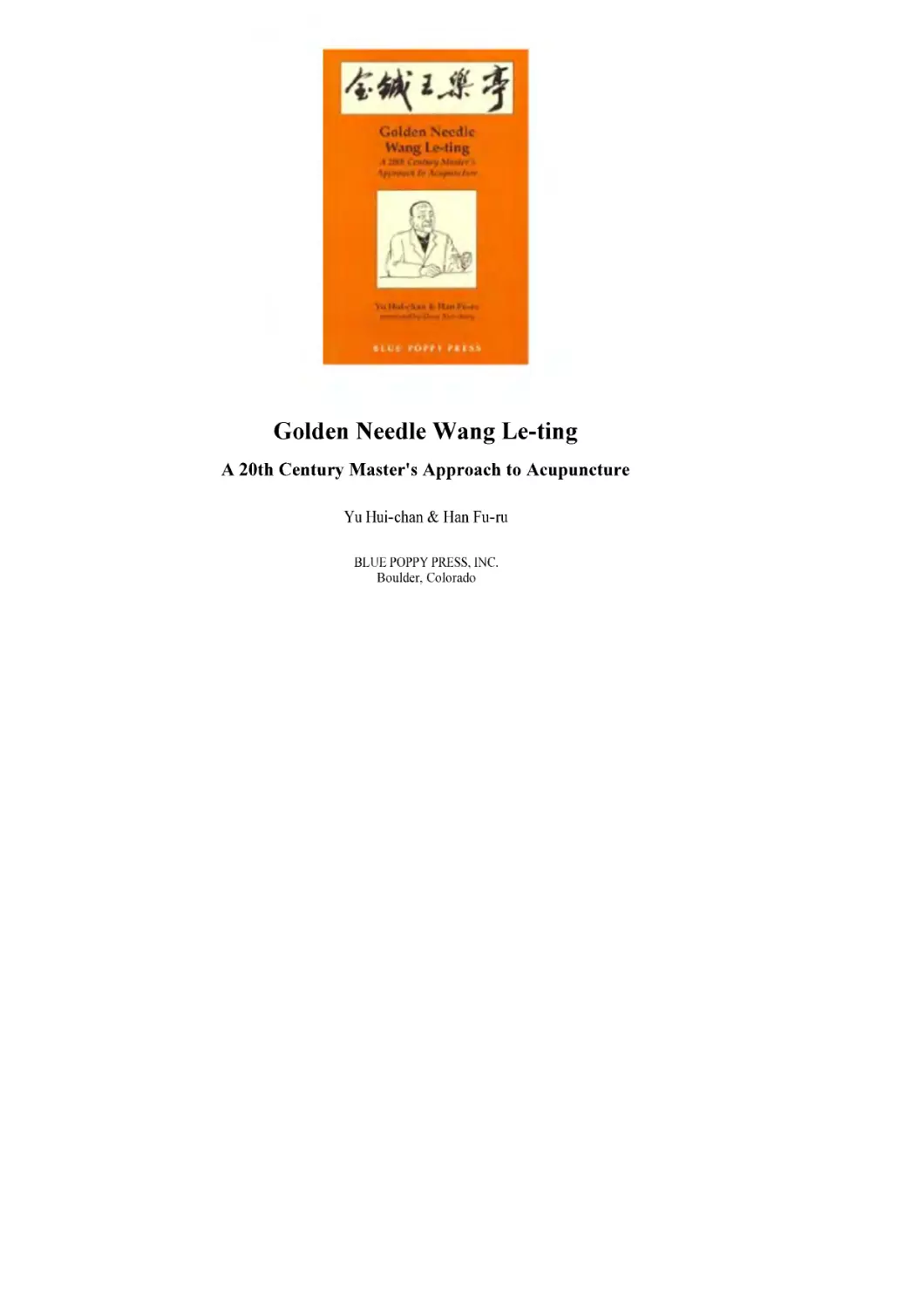
                    Golden Needle Wang Le-ting
A 20th Century Master's Approach to Acupuncture
Yu Hui-chan & Han Fu-ru
BLUE POPPY PRESS, INC.
Boulder, Colorado

Paae ii
Published by:
BLUE POPPY PRESS, INC.
1775 LINDEN AVE.
BOULDER, CO 80304
First Edition, February, 1997
ISBN 0-936185-78-3
LC 96-80187
COPYRIGHT 1996 © BLUE POPPY PRESS
All rights reserved. No part of this book may be reproduced, stored in a retrieval system, transcribed in any form or by any
means, electronic, mechanical, photocopy, recording, or any other means, or translated into any language without the prior
written permission of the publisher.
The information in this book is given in good faith. However, the translators and the publishers cannot be held responsible for any
error or omission. Nor can they be held in any way responsible for treatment given on the basis of information contained in this
book. The publishers make this information available to English language readers for scholarly and research purposes only.
The publishers do not advocate nor endorse self-medication by laypersons. Chinese medicine is a professional medicine.
Laypersons interested in availing themselves of the treatments described in this book should seek out a qualified professional
practitioner of Chinese medicine.
COMP Designation: Original work
Printed at Bookcrafters in Chelsea, Michigan on recycled, totally chlorine-free paper
10 98765432 1

Page iii
PREFACE
Professor Wang Le-ting, past Director of the Acupuncture Department of the Beijing Chinese Medicine Hospital, was born in
1894 and was 89 years old when the Chinese edition from which this book has been created was first compiled in 1983. From
his childhood, he studied with the famous acupuncture specialist, Chen Xu. In 1929, he formally began the practice of medicine
on his own at 35 years of age. Therefore, Wang Le -ting was in clinical practice for 50 years. Because he used true golden
needles and because he cured so many people, he was popularly called Golden Needle Wang Le-ting.
I first came across the Chinese source text for this book in 1984. A friend of mine, Michael Helme, whom 1 met while studying
acupuncture in Shanghai, had a copy in his possession. When Michael told a Chinese doctor he was interested in studying
acupuncture and moxibustion, this was the book he was advised to buy. In 1986, Michael translated sections of this book and I
edited these for inclusion in Timing and the Times: Chronicity in the American Practice of Oriental Medicine. At that time, I
felt that Wang Le-ting was an important link in the development of modern Chinese acupuncture. Unfortunately, I lost contact
with Michael Helme before he and I had a chance to translate the entire book. Therefore, when Prof. Shuai Xue -zhong of the
Hunan College of Traditional Chinese Medicine asked me if there were any books I would like him to translate, it did not take
me long to remember this one, a copy of which he was able to find in his college's library.
The Chinese source text for this book is Jin Then WangLe Ting (Golden Needle Wangle -ting) compiled by Dr. Yu Hui-
chan and Dr. Han Fu-ru, Dr. Wang's students. It was published in Beijing by the Beijing Publishing House in 1984. In creating
this English language edition, we have selected what we feel are the most unique and important parts of Dr. Wang's acupuncture
theories and treatments for modern Western acupuncturists and practitioners of Chinese medicine. These sections have been
translated by Prof. Shuai using Nigel Wiseman's English-Chinese Chinese-English Dictionary of Chinese Medicine , Hunan
Science & Technology Press, Changsha, 1995. However, this edition is a functional translation in that it is only a partial
translation of the original Chinese edition.
As the reader will see, this book is divided into three main sections or books. Book One deals with Dr. Wang's special principles
in the practice of acupuncture and

Page iv
moxibustion, such as his Five Clinical Rules. These chapters contain a wealth of practical, step-by-step information on the
administration of Chinese style acupuncture and moxibustion treatments. In addition, this section contains a number of chapters
on special acupuncture point formulas and combinations. With names such as the Old Ten Needles, Governing Vessel Thirteen
Needles, and Hand & Foot Twelve Needles, these formulas are a very handy addition to the repertoire of any acupuncturist.
Based on insightful Chinese medical theory, these formulas can be used to treat a wide range of conditions seen in everyday
clinical practice.
Further, the reader will quickly see that, in the treatment of otherwise difficult to treat, recalcitrant diseases, such as post -stroke
sequelae, Dr. Wang used these formulas alternately or sequentially according to an overall treatment plan which took into
account both the integrated function of the organic whole and the locally affected area and main complaints. I believe that many
Western practitioners will find these step-by-step protocols for the treatment of chronic diseases extremely useful in their
practice. They provide neophytes and seasoned practitioners alike with a definite over-arching plan and sequence of treatment
approaches which amplify and extend each other's effects and finally end by regulating and rectifying the yin and yang, qi and
blood, and viscera and bowels of the entire organism. In my opinion, this book is a valuable addition to the English language
acupuncture literature if only for Dr. Wang's systematically and sequentially applied Thirteen Methods for Treating Windstroke.
Book Two contains a number of Dr. Wang's case histories. These exemplify how he chose between his various treatment
strategies for different diseases and different patterns. We have chosen these cases based on the likelihood of Western
practitioners treating these conditions and also on the theory they exemplify. The cases presented represent Dr. Wang's thinking
and treatment protocols in internal medicine (nei ke), gynecology {fit ke ), andrology {nan ke), and dermatology {pifit ke ). In
particular, we have chosen several diseases, such as headaches, depression, visceral agitation, and hives, which have a strong
mental-emotional component since so many Western patients are under considerable mental-emotional stress and these stresses
so often contribute to our patients' disease mechanisms.
In addition, these cases and their following explanations of Dr. Wang's thinking and treatment are good examples of just how
Chinese doctors think and problem solve. The discussions following each case or group of cases may at first appear redundant
and superfluous, but they clearly show how Chinese doctors build their logical syllogisms out of the basic statements of fact of
Chinese medicine. By choosing and

Page v
using these basic statements of fact, Dr. Wang was able to come to new conclusions and create new treatments for "difficult to
treat, knotty diseases." The repetition of these basic statements of fact is a characteristic of the Chinese medical literature and is,
in part, meant to deeply instill these statements verbatim in the minds of all readers. Until one knows these statements word for
word, one cannot really think with them in a logically precise way.
Book Three is divided into two sections. The first section includes Dr. Wang's ideas about choosing points based on their
functions. These functions are listed for all the major points of acupuncture. According to the authors, Dr. Wang took these
functions from "ancient [Chinese] medical books and writings", although the exact sources are not specified. As one of the
leading proponents and creators of what has come to be called "TCM acupuncture" in the West, Dr. Wang's treatment
methodology was "treatment based on pattern discrimination." According to this methodology, the practitioner first gathers
information by the four examinations. They then analyze and synthesize this information into a pattern discrimination. Based on
that pattern discrimination, they next state the principles of treatment necessary to rebalance or remedy the imbalance implied by
the pattern discrimination. For instance, if a case's pattern is discriminated as liver depression -qi stagnation, then the commonly
accepted treatment principles for that pattern are to course the liver and rectify the qi. This means that the TCM acupuncturist
will then choose points with the functions of rectifying the qi and coursing the liver. Hence this list of points and their functions can
guide practitioners to the correct selection of points to rebalance the disharmony or imbalance implied by the pattern through the
intermediary of the treatment principles. Thus, it is said in Chinese that the treatment principles are the bridge between the
diagnosis and the treatment plan.
It is interesting to note that the introduction to this list specifically says this methodology of point selection is similar to that used in
Chinese medicine for selecting medicinals and formulas. In 1985,1 attended a workshop in which Ted Kaptchuk used the term,
"the herbalization of acupuncture." By this, I believe he meant the application of Chinese medical terms and theories previously
mostly the province of so-called Chinese herbal medicine to the modern Chinese practice of acupuncture and moxibustion.
Although practitioners of what I have called "an acupuncturist's acupuncture" (for instance, Japanese Meridian Therapy or Mark
Seem's Acupuncture Osteopathy) may take issue with whether or not acupoints do have functions the same way as Chinese
medicinals are said to, certainly the work of Wang Le-ting shows how he integrated Chinese medical theory and internal
medicine methodology into his practice of acupuncture and moxibustion. It is this

Page vi
integration under the rubric of Traditional Chinese Medicine which has allowed the majority of Western practitioners to practice
both "herbs" and acupuncture using a single set of theories and a single diagnostic and prescriptive methodology. Dr. Wang even
went so far as to create acupuncture analogues of famous Chinese medicinal formulas, such as his Shi Quan Da Bu Fang (Ten
[Ingredients] Completely & Greatly Supplementing Formula) and Old Ten Needles formula based on Bu Zhong Yi Qi Tang
(Supplement the Center & Boost the Qi Decoction).
The second section of Book Three gives a number of acupuncture point formulas for various diseases. Most practitioners have
seen such lists in numerous other acupuncture books and may be tempted to skim or skip over this section entirely. However, I
recommend practitioners read and then think over these formulas with some care. Many Western practitioners have dismissed
such TCM point formulas as overly simplistic and repetitive—the same old same old, and often they are. However, many of Dr.
Wang's formulas are truly gems of clinical insight and practicality. Typically, they address not simple, discreet patterns but the
complicated patterns seen in real-life clinical practice. Since Dr. Wang does not go into detail about the rationales of these
formulas, I would like to take the opportunity to analyze several of them to impress upon the reader that they should not skip
lightly over this section.
For instance, take Dr. Wang's formula for a bitter taste in the mouth. Most practitioners know that this is a main symptom of
liver-gallbladder heat. This heat can be due to depression or to damp heat. Now let us look at Dr. Wang's formula: Shen Men
(Ht 7), Ran Gu (Ki 2), Zu San Li (St 36), and Xuan Zhong (GB 39). Clearly this group of points is based on something more
complex than just liver-gallbladder heat. In fact, this formula takes into account all five of Li Dong -yuan's reasons for yin fire
counterflowing upward. Yin fire is not simply vacuity heat, although it includes vacuity heat. The five causes of yin fire given by Li
in his monumental Pi Wei Lun (Treatise on the Spleen & Stomach) are spleen vacuity, blood vacuity (i.e.,y'm vacuity), liver
depression-depressive heat, damp heat, and stirring of the ministerial fire. According to Li Dong -yuan, these are not necessarily
discreet disease mechanisms but are typically xiang sheng or mutually engendering. The Pi Wei Lun is Li's exposition of how yin
fire creates a number of what, in modern medical parlance, are referred to as immune deficiency, allergic, and autoimmune
diseases or what, in Chinese medicine, are called as a group, "difficult to treat, knotty diseases."

Page vii
Therefore, a bitter taste in the mouth may be due to either depressive heat or damp heat in the liver-gallbladder, but this yin fire
typically also disturbs the heart as it counterflows upward, stirs the ministerial fire below, and is both the cause and result of
spleen vacuity. Hence, simplistically addressing the liver and gallbladder alone may not adequately address the complex disease
mechanisms which are most commonly associated with a bitter taste in the mouth in patients not displaying a simple replete damp
heat pattern such as that seen in acute jaundice or acute cholecystitis. Dr. Wang's formula for bitter taste in the mouth addresses
the heat accumulating in the heart disturbing the spirit via Shen Men. It addresses the stirring of ministerial fire via Ran Gu. It
addresses spleen vacuity and its typically concomitant stomach heat via Zu San Li. And it addresses both blood and yin vacuity
as well as the liver's lack of coursing and discharging (which then leads to stagnation, transformative heat, and upward
counterflow) via Xuan Zhong, remembering that the liver and gallbladder have a mutual interior-exterior relationship and Xuan
Zhong is the meeting point of the marrow. The marrow is engendered by the essence, and "the blood and essence share a
common source." (For more information on yin fire, see The Treatise on the Spleen & Stomach, translated by Yang Shou-
zhong and also published by Blue Poppy Press.)
Or take Dr. Wang's formulas for toothache. First he gives a formula for stomach heat toothache: Cheng Jiang (CV 24), Quan
Liao (SI 18), Jia Che St 6), He Gu (LI 4), and Nei Ting (St 44). The first three points are all local points designed to free the
flow of the channel qi locally. "When there is free flow, there is no pain." The last two points are meant to clear heat from the
yang ming. This is relatively straight-forward TCM acupuncture so far. Next, Dr. Wang gives a formula for the treatment of
wind heat toothache. This is the same formula as above plus Feng Chi (GB 20) and Qu Chi (LI 11). What is interesting about
this is that Dr. Wang saw that wind heat in this case is only aggravating and mutually engendering an underlying stomach heat
condition. Although the title of this formula is wind heat toothache, still there is stomach heat as well.
When it comes to the common cold, Dr. Wang divided this into wind cold and wind heat and used typical points for each
pattern. However, for wind cold with no sweating, he added Fu Liu (Ki 7), while for wind heat with high fever, he added Tai Xi
(Ki 3). Fu Liu combined with He Gu (LI 4) helps promote sweating, but it also assists and strengthens kidney yang, the root of
righteous yang in the body. As it is said in the Nei Jing (Inner Classic) , "If righteous qi abides internally, evils cannot enter." Tai
Xi supplements and enriches kidney yin. Thus adding it to a formula for wind heat helps prevent damage to yin fluids from heat at
the same time as it also

Page viii
helps prevent mutual engenderment due to wind heat stirring up any other heat in the body.
Thus Dr. Wang's formulas are not just the usual simplistic prescriptions for single patterns rarely encountered in their discreet
form in Western clinical practice, and hence the reader should analyze each of the formulas in this section in order to understand
just what pattern and disease mechanisms it is designed to address. Personally, I think many of Dr. Wang's formulas are quite
sophisticated theoretically and are better than those found in most other modern Chinese acupuncture books.
Whether or not one completely accepts and agrees with Dr. Wang Le-ting's style of Chinese acupuncture, he was, nevertheless,
an important link in the mid-century development of Chinese acupuncture and moxibustion. This is clearly recognized by the
authors of the Chinese text who have added tables analyzing Dr. Wang's point selection in the mid-1950s and then his more
mature and unique point selection in the 60s and 70s. Although these tables and their analysis may seem unnecessary to Western
readers, clearly these Chinese authors saw a progression in Dr. Wang's practice and saw him as an outstanding and unique
contributor to the on-going development of this healing art. As such, Dr. Wang is a model of intelligence, industry, and integrity
and an inspiration for all of us who likewise hope to raise our art to the next level of excellence and effectiveness here in the
West.
Additions in parentheses have been made by the original Chinese authors, while those in brackets have been added to clarify our
translation. As for acupuncture point identifications, Blue Poppy's standard for identification is the World Health Organization's
Standard Acupuncture Point Nomenclature with the following deviations: First, instead of channel abbreviation and point number
followed by Pinyin name in parentheses, we present the Pinyin name first with the channel abbreviation and point number
following in parentheses. Secondly, we have separated each Pinyin word. New Jersey is not written Newjersey in English.
Similarly, we believe He Gu, meaning Union Valley should not be run on, just as one would not write Unionvalley in English.
Third, as for channel and vessel abbreviations we have changed LU to Lu, ST to St, SP to Sp, HT to Ht, BL to Bl, KI to Ki, PC
to Per, TE to TB, and LV to Liv. And fourth, for extra -channel points, our standard is Nigel Wiseman's Glossary of Chinese
Medical Terms and Acupuncture Points , Paradigm Publications, Brookline, MA, 1990.
BOB FLAWS
BOULDER, CO

TABLE OF CONTENTS
Preface
Book One
Chapter One: The Origin of the Honorary Title, Golden Needle Wang
Leung
Chapter Two: The Strong Points of Golden Needles
Chapter Three: The Five Clinical Rules
Chapter Four: Old Ten Needles
The Formulation & Composition of the Old Ten Needles
The Functions of the Old Ten Needles
Applications & Modifications of the Old Ten Needles
Using the Old Ten Needles in Combination
Conclusion
Chapter Five: Shi Quart Da Bu Tang Acupuncture Formula
Chapter Six: Selecting the Best of the Five Transport Points
Chapter Seven: A Unique Application of the Back Transport Points
Chapter Eight: Experiences Treating the Governing Vessel
Chapter Nine: A New Description of the Hua TuoJiaJi
Chapter Ten: Connecting Needling & "The Twelve Connections"
Chapter Eleven: Windstroke Thirteen Treatments
Chapter Twelve: A Preliminary Study of the Treatment of Paralysis
Book Two
Clinical Case Histories
Headache
Depression Condition
Visceral Agitation Condition
Turbid Strangury
Dysmenorrhea

Infertility 194
Addictive Papules [i. e., Hives] 197
Eczema 200

Book Three: Selecting Points According to the Functions &
Classifications, Patterns & Diseases
Selecting Points According Different Classifications
Qi Classification
Blood Classification
Vacuity Classification
Repletion Classification
Cold Classification
Heat Classification
Wind Classification
Damp Classification
Selecting Points Based on Pattern and Disease Discrimination
Head Region
Ear Region
Eye Region
Nose, Mouth, and Teeth Region
Tongue & Throat Region
Neck & Nape Region; Chest & Abdominal Region
Shoulder, Upper Back, & Upper Limb Region
Low Back and Leg Region
Lower Limb Region
Common Cold; Summerheat Stroke
Dizziness & Vertigo
Cough
Panting [Asthma]; Hiccup
Vomiting; Epigastric Pain; Gastroenteritis; Diarrhea
Wasting & Thirsting; Water Swelling
Front Yin Diseases; Yang Wilting [i.e., Impotence]
Chest Bi Heart Pain; Lateral Costal Pain

Dysentery; Hemafecia
Anal Prolapse
Sweating Conditions
Heart Spirit Conditions; Mania, Withdrawal, Epilepsy
Five Viscera Vacuity Patterns
Menstrual & Vaginal Discharge Conditions
Postpartum Diseases; Skin Diseases
Pediatric Diseases
Appendix: Feeding & Nourishing the Needles Method
General Index

Page 1
BOOK ONE
Chapter One—
The Origin of the Honorary Title, Golden Needle Wang Le-ting
During his childhood, Wang Le-ting learned Chinese language from his teacher, Qiao Shu-ge in a village to the east of Beijing. He
was deeply loved by Qiao because he was such a diligent student. Qiao's grandfather had been an official prison warden of the
Qing dynasty who had once learned a secret acupuncture treatment method from a prisoner in southern China. This secret was to
treat scrofulous nodules by puncturing Qu Chi (LI 11) bilaterally through to Bi Nao (LI 14) with a 6 cun silver needle. However,
this secret treatment method had never been put into practice even though it had been inherited by Qiao's family three generations
before. So Teacher Qiao handed it down to Master Wang. At that time, a relative of Master Qiao's who worked at a jewelry
store in Beijing went to his hometown to visit his relatives. He had suffered from cervical lymphadenitis for a few years and, after
frequent treatments, he had still not been cured. He once complained about the trouble to Master Qiao. So Master Qiao asked
his relative to go back to Beijing and make a pair of 6 cun silver needles and to prepare to accept treatment. Teacher Qiao told
Wang Le-ting, who knew nothing about medicine, of his secret acupuncture technique. Wang was able to treat the patient with
the 6 cun silver needles. After a few treatments, Qiao's relative got an unusual effect. In order to thank Master Qiao and his
disciple, the patient presented a pair of silver needles to them. In this way, Wang Le-ting used this pair of 6 cun silver needles to
begin "traveling the dao of acupuncture and moxibustion."

Page 2
From the very beginning, Wang was very interested in learning acupuncture. He saw patients free of charge as he learned. Due to
his treatments' remarkable effectiveness, his relatives and friends from several 10s of li around who suffered from shu chuang bo
zi or lymphatic tuberculosis came to him for treatment. Thus, Wang accumulated certain clinical experience. However, his time
there was not prolonged, for he came to Beijing to make a living. He started as a disciple at Rong Bao Zhai (The Glorious
Treasure Building) while he treated patients with a 6 cun silver needle in his spare time. The only disease he treated was scrofula.
After taking the entrance examinations, he entered the Chinese National University and treated patients in his spare time. After
two years' study at the university, he felt that he could not find his way to graduate while he relieved patient's pain and bitterness
[i.e., suffering] with his 6 cun silver needles. Hence, he gave up studying at the university and took as his teacher the famous
acupuncture-moxibustion expert, Chin Shu-qin. Thus, he formerly started learning and practicing acupuncture. Previously, with
his 6 cun silver needles, he could only treat one type of disease. He felt that after systematically studying acupuncture theory and
previous experts' experiences he would be able to treat many types of disease. Chen Shu-qin, his acupuncture-moxibustion
teacher, had inherited his acupuncture skills from his father, Chen Dan -xian, popularly called Chen Ban Xian or Chen the Half
Immortal, who was very skillful in acupuncture and moxibustion and famous in Beijing. [However,] it was not until Chen Shu -
qin's times that a more integrated approach was used, [meaning that] Chen treated diseases with both acupuncture and
medicines. As his student, Wang's knowledge was widened and his learning and techniques increased day by day.
In 1929, Wang Le-ting, already a respected doctor, took the formal examination in acupuncture-moxibustion and got a doctor's
license so he could independently practice acupuncture. The chief examination official who was in charge of the examination was
Sun Xiang-ling, a famous acupuncture-moxibustion expert at that time. Wang Le-ting appreciated his work. When Wang went to
Master Sun's house to

Page 3
thank him, he found that all the needles Sun used were made of gold. He was enlightened by this discovery because he had
frequently read during his studies that, "Needles made of gold are even better." However, he had not yet seen any real golden
needles. He immediately went to a gold store and had a series of golden filiform needles of various sizes and 6 cun golden
needles made. After that, Old Doctor Wang Le-ting used these golden needles to relieve many people's disease and bitterness
and eventually was acclaimed as Golden Needle Wang Le-ting.
Dr. Wang deeply loved acupuncture and moxibustion. In order to make his acupuncture and moxibustion a perfect healing art
and to more effectively relieve the disease and pain of many people, he persistently read and studied a variety of medical books.
These included the Huang Di Nei Jing (The Yellow Emperor's Inner Classic) and the Nan Jing (The Classic of Difficulties)
as well as other ancient canons of medical study. He also studied a wide variety of acupuncture lecture notes and acupuncture -
moxibustion books compiled and written by the colleges and academies of Chinese medicine.
Of these many books, the Zhen Jiu Da Cheng (The Great Compendium of Acupuncture & Moxibustion) and the Nei Jing
(The Inner Classic) were the most beneficial to Dr. Wang Le-ting. He also made a long study of the various schools, selecting
the essence and heart from the following books: the Qian Jin Fang (Prescriptions [Worth] a Thousand [Pieces of] Gold),
the Wai Tai Mi Yao (Secret Essentials of a Border Official) , the Yi Zong Jin Jian (The Golden Mirror of Ancestral
Medicine), the Jing Xue Chuan Yao (The Collected Essentials of Channels & Points) , the Jing Mai Tu Kao (Illustrated
Channels & Vessels) , and the Shi Si Jing Fa Hid (Expositions on the Fourteen Channels). Combining this learning with his
unique experience, he made a beneficial contribution to humankind.

Page 5
Chapter Two—
The Strong Points of Golden Needles
The golden needles used by Dr. Wang were different from those mentioned in the ancient literature. In ancient works, all needles
made of metal are called "golden needles." The Zhen Jiu Da Cheng (The Great Compendium of Acupuncture &
Moxibustion) says:
When the ancients said golden needles, this [only] implied that they were valuable. The name gold can be used to categorize all bronze,
iron, gold, and silver.
The Zhen Jiu Jing Cut (The Collected Essentials of Acupuncture & Moxibustion) says:
The golden needles mentioned by the ancients were not made of gold. This was [only] a term of respect.
However, the golden needles used by Dr. Wang Le-ting were customarily made from 90% gold and 10% bronze, thus they were
not the same as silver needles, iron needles, or stainless steel needles. Based on Dr. Wang Le-ting's experience, we know the
following about golden needles. Needles can be made of gold, silver, bronze, or iron, but gold is the best according to the ancient
literature. Treatment with a golden needle plays a psychological role for the patients, and gold is not damaged by changes of the
four seasons or by heat and chill. It quickly adjusts itself to the temperature of the human body. The pain is slight during
puncturing with the needle. Its quality does not change after it is punctured into the human body, it has no side effects, and it can
be

Page 6
withdrawn without encumbrance or difficulty. There is no inflammation at the needling hole. It yields a quick therapeutic reaction
and its therapeutic efficacy is high. Gold is soft and flexible and is not easily broken. Therefore, medical accidents can be
avoided.

Page 7
Chapter Three—
The Five Clinical Rules
Dr. Wang Le-ting practiced acupuncture for over 50 years. While learning acupuncture, he was very diligent and serious. He
adhered to the ancients respectfully but not mechanically, for he added some [of his own] insights in the course of his inheriting
and thus improving [the art]. In his clinical practice, he insisted on the detailed and careful four examinations and precisely
ascertaining the corresponding [treatment] methods based on pattern discrimination. At the time of employing his [acupuncture]
techniques, he was extremely careful in point selection, needle insertion, hand technique, and moving the needle. Because he did
this for tens of years and a day, a set of the "conceptual rules" that he himself adhered to have gradually been formulated. Below,
we have comparatively and systematically summed up these rules and titled them "The Five Clinical Rules" as follows:
1. The Four Examinations Must Be Detailed to the Greatest Extent, While It Is Essential That Pattern
Discrimination and [Treatment] Methods Correspond.
The four examinations—questioning, inspection, listening and smelling, and palpitation—are unique methods for collecting first
hand clinical data in Chinese medicine. Through a synthesis of [information gathered by ] these four examinations, one searches
out the disease cause, determines the site of disease, examines the presenting signs and symptoms, observes the changes in the
condition of the disease, and synthesizes this information in order to discriminate the patterns.

Page 8
[Only] after and on that basis should one establish the treatment methods and principles and formulate the acupuncture -
moxibustion prescription.
Dr. Wang Le-ting paid 10 [out of 10] divisions of [i.e., full] attention to these four examinations. He would inquire about every
patient's history minutely, and he truly inspected [the patient visually] and felt [the area of complaint and his or her pulse]. More
importantly, during the course of treatment, he re-examined and started again with the four examinations those whose effects
from treatment were not good after one or two courses to further understand and recognize their real disease condition. [He did
this] so that he might regulate or change the original treatment prescription and thus get higher therapeutic effects.
Take the treatment of wilting pattern (including infantile paralysis) as an example. In the beginning, he adhered to the ancient
doctrine, "Choose the yang ming channel solely in treating wilting pattern." [However,] when he found that the results of this
treatment were not effective, he would question the patient, carefully observe the patient's condition, and decide to change the
original prescription. Thus he formed his own theory, saying, "First select the governing vessel in the treatment of wilting pattern."
Using this theoiy, his treatment efficacy markedly improved. In addition, for the same patient with different stages of the same
disease, he would once again carry out the four examinations and make an up-dated judgement so as to improve the treatment
plan for the next period. For example, for the treatment of paralysis and wilting pattern, he used the formula Governing Vessel 13
Needles in the initial stages. After one or two courses, he replaced this prescription with the formula, The Five Viscera
Transports Plus Ge Shu (Bl 17). After 5 -6 treatments, he used the formula Old Ten Needles in cooperation with or replacing the
previous one to obtain a more favorable effect.
Thus [Dr. Wang's] determination, replacement, combination, or alternation of every treatment plan and every needle puncture
was

Page 9
decided by his repeated application of the four examinations. [Dr. Wang] paid the same attention to the four examinations
regardless whether the disease was a commonly seen or knotty, difficult disease. Dr. Wang Le -ting strictly adhered to the ancient
medical doctrines, utilized the four examinations in his clinic, accurately discriminated the patterns, and ascertained the treatment
methods correspondingly. He persisted in doing so and conscientiously carried these out. As was said in the Ling Shu: Jiu Zhen
Shi Er Yuan {Spiritual Axis, "Nine Needles, Twelve Origins"):
Wherever one practices acupuncture, one must first examine the pulse to make manifest the condition of [the patient's] qi. Only thus can
one treat it [i.e., the disease],
2. Do Not Neglect a Single Thread [Le., a single thing] When Choosing Points or Inserting Needles.
After the four examinations [have been carried out in a] detailed and precise [manner] and the pattern discrimination and
treatment methods have been ascertained, one should begin the prescription of the acupuncture formula and selection of the
points. The points are the holes and cracks that connect the human body's channels and network vessels, muscles and bones,
and viscera and bowels. The ancients called these the qi xue [qi points] or shu xue [transport points]. Stimulation of these points
by piercing with a needle, moxaing with mugwort, pressing, and bleeding can regulate the viscera and bowels, the channels and
network vessels, and the qi and blood so as to prevent and treat disease. As was said in the Ling Shu: Gen Jie Pian {Spiritual
Axis: "Roots & Nodes Chapter"), "Essence and qi can be fostered by regulating yin and yang, while the spirit can be stored
internally by harmonizing the form and qi." Hence, it is extremely important to locate the transporting points, the channels and
network vessels, and their courses of circulation. The ancients had the saying, "Better to lose the points; do not lose the
channels." And there is certainly truth [to this saying]. Dr. Wang Le-ting would also sooner "rather lose the point

Page 10
and not lose the channel." This means that the circulating course of the channel and network vessels should be ascertained,
particularly where the yin and yang aspects of the body are demarcated. If yin and yang are not clearly discerned, the point can
hardly be selected. Thus yin and yang cannot be regulated and they will be in disorder. "An error the breadth of a single hair can
lead one a thousand // astray." Therefore, Dr. Wang Le-ting was very strict with the requirements of point selection and used
every means possible to be accurate. Once Dr. Wang Le-ting was invited to give a demonstration on locating points. Marking
point locations by pressing his fingernail, the six transporting points—Qu Chi (LI 11), Nei Guan (Per 6), He Gu (LI 4), Yang
Ling Quan (GB 34), Zu San Li (St 3 6), and San Yin Jiao (Sp 6)—were repeatedly scanned and examined with a type 57-16
Resistance Examination Apparatus. Whenever this apparatus's probe reached the channel point marked by Dr. Wang, the
apparatus indicated that the difference between its resistance and that of a non -channel point was approximately 60 mV. This
proved the accuracy of Dr. Wang Le-ting's point location as well as these points characteristically obvious lowered resistance.
Dr. Wang Le-ting located points using the following steps.
A. Channel Rubbing & Pressing
Channel rubbing and pressing is the first step in point location. According to the location of the transporting points, repeatedly rub
and move along the course of the channels and network vessels, firmly rubbing the skin. Rub and press the muscles and joints
and particularly the points on the four extremities so as to soothe the channels and network vessels and alleviate [the patient's]
worry and fear. At the same time, this is a kind of physical examination method that is used to understand the local area and the
general condition of the limbs and trunk.

Page 11
B. Finger [nail] Cutting
Fingerfnail] cutting, popularly called fingernail pressing the point, is used after channel rubbing and pressing the points along the
channel. Dr. Wang Le-ting's method of point selection adhered to the examination of the converted measurement of the bone unit
combined with attention to the natural signs of the body [i.e., the surface anatomy]. As to the selection and location of points, his
method was mostly the same as that recorded in common acupuncture books. However, he had his unique ways for locating
certain points, such as Huan Tiao (GB 30), San Jian (LI 3), Du Bi (St 35), and others. After the point was located, he fingernail
pressed the center of the transporting point with his left hand to make a cross in its center. Then he gently pressed it with his hand
and [the patient] usually felt a sore and distended sensation. On the one hand, finger[nail] slicing is used as a way of marking the
needle insertion. On the other, after the skin in the local area has been gently pressed, there is a numb sensation. Hence when the
needle is inserted, there is no pain. This is because it has diffused and scattered the local qi and blood and therefore the
constructive and defensive are not damaged. After the point has been fingernail pressed, the local area is disinfected.
C. Needle Insertion
After decades of clinical experience, Dr. Wang Le -ting insisted on using two hands for needle insertion and was opposed to
single-handed needle insertion. He paid special attention to the cooperative use of the left hand. He held that with the combined
use of both hands, the force would be suitable and appropriate, the needle is held steady, the point is punctured accurately, and
there is no way for the needle to swing to the left or right or up and down thus causing [the needle] to miss the location. Thus
typically there was no sensation of pain. It is said in the Biao You Fu (Marks of the Profound Prose Poem) :

Page 12
The left hand should be heavy and press more in order to scatter the qi. The right hand should be light and slowly insert [the needle].
Thus there is no cause for pain.
In the course of puncturing, hand technique, and moving the needle, he strictly adhered to the rules of protocol in the Su Wen:
Zhen Jie Pian {Simple Questions: "Chapter Explaining Needling"):
The hand is as if grasping a tiger, firm and forceful. The spirit does not care for who or what [is around]. With a settled will, observe the
patient, neither looking to the right or left.
[Dr. Wang's] thought on the strength, direction, and angle of needle insertion can be summed up in "Eight Needling Techniques."
i. Light needling: Pressing the point with the left hand and holding the needle with the right, use weak force and insert the needle
into the point by twirling slowly. This technique is suitable for those with a relatively weak, vacuous body.
ii. Heavy needling: Pressing the point with the left hand and holding the needle with the right, use strong force and insert the
needle swiftly. This technique is suitable for those with a strong body or those with a cold pattern.
iii. Upright needling: Also called perpendicular needling, this method makes the body of the needle form a 90 ° angle with the
surface of the skin. This technique is mainly suitable for points located on the chest, abdomen, and upper back, such as the Three
Wan (CV 13, 12 & 10), Qi Hai (CV 6), Guan Yuan (CV 4), Shen Shu (Bl 23), and Fei Shu (Bl 13). If upright needling is
used, the body of the needle is required to be at right angles [to the skin] and to stand erect with no deviation or "falling down"
phenomena.

Page 13
iv. Lying down needling: Also called along the skin needling, after inserting the needle, the body of the needle makes a 15 -20°
angle with the skin. Then make the needle lie down near the skin and insert into the point. Qu Chi (LI 11) connected to BiNao
(LI 14), Si lu Kong (TB 23) connected to Shui Gou (GV 26), Di Cang (St 4) connected to Jia Che (St 6), or Tuo Wei (St 8)
connected to Qu Bin (GB 7) all use this technique. Lying along the skin needling requires a superficial, horizontal puncture which
is different from penetration needling. Penetration needling punctures deep into the subcutaneous area or the joints with the tip of
the needle reaching the subcutaneous area on the opposite side.
v. Supine needling: Angle the tip of the needle upward and insert the needle into points like Su Liao (GV 25), Shui Gou (GV
26), Da Ying (St 5), Lian Quan (CV 23), Bi Nao (LI 14), and Chang Qiang (GV 1).
vi. Prone needling: Angle the tip of the needle downward and insert it into points like Tian Tu (CV 22), Jian Yu (LI 15), Ju
Gu (LI 16), and Euan Tiao (GB 30).
vii. Horizontal needling: Insert the tip of the needle into the point horizontally, puncturing either only one point or penetrating
through two. This technique includes penetrating needling used for Ye Feng connected to Jia Feng [special points of Dr.
Wang's], JuLiao (St 3) connected to Quart Liao (SI 18), and Yang Guan connected to Qu Quan (Liv 8).
viii. Oblique needling: Insert the needle forming a 45c angle between the body of the needle and the surface of the skin. This
technique is suitable for points in between the bones like QiuXu (GB 40), Shang Qiu (Sp 5), Lie Que (Lu 7), Du Bi (St 35),
and Xia Guan (St 7) as well as the points on the head and face.
Dr. Wang Le-ting looked after the patients with meticulous care. He was very diligent while puncturing and very careful during
each

Page 14
operation. His acupuncture skill was superb. Regardless of what the needle insertion or needle withdrawal technique was, he
strictly adhered to the operating rules from beginning to end.
3. The Depth of Needle Insertion Should Have Its Degree and the Qi Must Be Obtained after Puncturing.
A. In terms of the depth of needle insertion, the Su Wen: Ci Yao Lun {Simple Questions: "Treatise on the Essentials of
Puncturing") states:
[Because] the disease may be deep or superficial, puncturing may be deep or superficial [accordingly]. Each depends on the conditions.
One must not exceed this dao. Exceeding [i.e., going too deep] leads to internal damage. Not reaching [i.e., not going deep enough]
leads to the engenderment of external obstruction, and obstruction leads to the presence of evils. If deep or superficial are not obtained
[i.e., are not appropriate, needling] contrarily produces great harm. Internally the five viscera are stirred, and afterwards this gives rise to
great disease.
This saying makes clear that inserting the needle superficially or deep is very important. What is most important is that the degree
of superficial or deep should be based on the condition of the disease. In general, the principle is that there should be a needling
sensation {i.e., obtainment of the qi) but the organs should not suffer detriment and damage. Therefore, the degree of superficial
or deep needle insertion is not strictly formulated. Penetration is usually done according to heaven, man, and earth strata, one at a
time. After puncturing one stratum, the puncture should stop and be retained for awhile (extremely short retention) and then
continue to puncture to the next stratum. Dr. Wang Le-ting, describing penetrating each stratum, said, "One becomes aware of a
sensation under the hand." This refers to becoming aware of a type of sensation which is hard to describe in words. The depth of
puncturing with the needle at each point is related to the following factors:

Page 15
i. Whether the body is fat or skinny: If the body is fat with thick skin and fine -looking flesh, puncturing should be deep. If the
body is skinny with thin skin and scanty flesh, the puncturing should be shallow. This is according to the saying in the Ling Shu:
Ni Shun Fei Shou Plan (Spiritual Axis: "Chapter on Counterflow & Favorable Flow, Fatness & Skinniness"):
If the years and substance [i.e., body] are strong and large, the qi and blood are full and exuberant, the skin and muscles are hard and
secure, or if [the disease] is due to the presence of evils, puncturing should be deep and [the needle] retained. Thus it is for the fat
person ... If the person is skinny with thin skin and diminished color, thin flesh, thin lips, and a weak voice, their blood is clear and their
qi is slippery. Puncturing them should be shallow and swift.
ii. Whether the age is young or old [literally, whether the years are small or large]: If the age is large, it is appropriate to
needle deeply. If the age is small, it is appropriate to needle shallowly. The Ling Shu: Ni Shun Fei Shou Pian (Spiritual Axis:
"Chapter on Counterflow & Favorable Flow, Fatness & Skinniness") says:
Babies' flesh is delicate, blood is scanty, and qi is weak. [Therefore,] puncturing should be with a filiform needle, shallow and swift,
withdrawing the needle [i.e., not retaining it]. One can do this daily.
iii. Whether the disease is located deep or shallow: The Su Wen: Zhen Jie Pian (Simple Questions /'Chapter Explaining
Needling") says, "Deep or shallow [puncture] depends on intelligence, on knowing whether the disease is internal or external."
Depending on whether the disease is located internally or externally, puncturing of the needle should be either deep or shallow. If
the disease is deep, puncture deeply. If the disease is shallow, puncture shallowly. Greatly exceeding [the appropriate depth] is
harmful. Not reaching [the appropriate depth], there is no benefit. The method of waiting for the qi is the same no matter whether
[the needling] is deep or superficial.

Page 16
iv. Location of the transport points: Since the locations of transport points are not the same, inserting the needle deeply or
shallowly is also different [for different points]. One should puncture shallowly on the head, chest, and upper back, while one
should puncture deeply on the abdomen and four limbs. The saying that, "The abdomen is like a well, while the upper back like a
pool", implies that the points on the abdomen can be punctured deeply, but puncturing the points on the upper back deeply is
prohibited. The different depths of puncture with a needle lead to different degrees of reaction. For example, Dr. Wang Le -ting
thought that, in terms of Zu San Li (St 36), puncturing "5 fen reaches the neck, 1 cun reaches the abdomen, 1.5 [cun] reaches
Zhong Wan (CV 12), 2 cun reaches the throat, and puncture 3 cun and the blood at the vertex will move downward."
v. The seasons and nodes of qi: The changes of the season and nodes of qi [ i.e., the 24 changes in the weather of the
traditional Chinese calendar] are mutually connected with the ebb and flow of yin and yang and qi and blood of the human body.
The Su Wen: Si Qi Tiao Shen Da Lun {Simple Questions: "Great Treatise on the Four Qi & Regulating the Spirit") states:
The yin and yang of the four seasons is the root of tens of thousands of things ... If one runs counter to this, the root is suppressed and
something true will be destroyed.
Therefore, when treating diseases by puncturing with a needle, the yin and yang of the four seasons should be considered. During
the spring and summer, the qi and blood are full and exuberant. Thus, one should puncture shallowly. During the fall and winter,
yang is weak but yin is strong. Therefore, correspondingly, puncture deep.
In a word, the depth of puncturing with needles is decided by a number of factors. Besides the above mentioned aspects, the
length or shortness of the disease course, vacuity and repletion, cold and heat, changes in the condition of the disease, and even
changes in the

Page 17
[patient's] essence spirit [i.e., mental-emotional] robustness should be taken into consideration. It should be deep if it must be
deep but superficial when it must be shallow. Special points, such as Qu Gu (CV 2), Dr. Wang Le-ting usually punctured 3 cun
deep and Tian Tu (CV 22), 2 cun. For the transport points on the back, Nei Guan (Per 6), and San Yin Jiao (Sp 6), a
superficial puncture is essential in order to prevent puncturing of the viscera or causing disorder of yin and yang.
B. On the problem of "obtaining the qi"
As described above, there is no absolute measurement for the depth of needle puncture. The best needling sensation should be
regarded as the standard. The so-called needling sensation is also called "obtaining the qi". The medical specialists in succeeding
dynasties have paid special attention to whether or not "obtaining the qi" has occurred. In the Ling Shu: Jiu Zhen Shi Er Yuan
(Spiritual Axis, "Nine Needles & Twelve Origins") one finds: "The essence of needling [lies in] the arrival of the qi [at the
affected area] and thus the effectiveness [of the treatment]." The Zhen Jiu Da Cheng (Great Compendium of Acupuncture &
Moxibustion) said, "In the use of needling methods, waiting for the qi is the first." The Biao You Fu (Marks of the Profound
Prose Poem) also holds that, "The faster the qi arrives, the faster the effect; the slower the qi arrives, the slower the effect."
These sayings make clear that whether or not the treatment is effective depends on whether the needle puncture obtains the qi or
not. What is called "obtaining the qi" is what happens when the needle is inserted to a certain depth and the operator feels
sinking, tension, heaviness, and fullness beneath the needling fingers. This is like "a fish swallowing a baited hook." [Meanwhile,
the patient] should feel in the area punctured by the needle sensations of soreness, numbness, distention, heaviness, or something
running up and down, all of which clearly indicate that the qi has arrived beneath the needle. If the operator feels a hollow
vacancy or looseness and slipperiness beneath their fingers while [the patient] feels none of the above sensations, the qi has not
been obtained. Dr. Wang Le-ting thought that if the qi is not

Page 18
obtained, it is due to bai za [incompetence and/or negligence]. Therefore, one must try every means to obtain the qi.
In such cases, sparrow-pecking moxibustion can be administered for "hastening the qi." This is also called "guiding or leading the
qi." [Another method for picking up the qi after an ineffective puncture] is to gently rub the channel and press the area above and
below the punctured point with the hand, thus soothing and freeing the flow of the channels and network vessels. Hence the
channel point "obtains the qi." If it is still not obtained after adopting the above -mentioned means, these methods can be repeated
once again. If again it is not obtained, one should not administer acupuncture repeatedly, lest [the patient's] righteous qi be
consumed and damaged. In that case, the channel qi will [flow] contrarily and not arrive. At this time, other points should be
punctured, points on the same channel which are above or below the point, in order to hasten the qi to move down or move up.
Then [needle] once again the original point and "wait for the qi."
Dr. Wang Le-ting thought that, "When needling, one must obtain the qi," and he regarded this as his own clinical rule. He did not
approve of doing acupuncture irresponsibly or randomly puncturing with a careless attitude. This is entirely different when
compared to "strong stimulation" in New Acupuncture Therapy. "Strong stimulation" is what is used after "obtaining the qi" in
order to strengthen and increase the amount of needle stimulation and thus obtain a good therapeutic effect. Dr. Wang Le -ting
divided the stimulation of puncturing the needled points into light, moderate, and heavy degrees. These were then used according
to the condition of the disease. Different degrees of strength were adopted to achieve different effects.
Since [patients'] bodily constitutions, the exuberance and decline of their qi and blood, and their degree of sensitivity are not the
same, the methods of "obtaining the qi" in each person are different. In fact, the influences of technology on the climatic
environment make these differences even more pronounced. Considering only the condition of

Page 19
[the patient's] bodily constitution, Dr. Wang Le-ting's experience was that a person who is full of yang is sensitive to the needling
sensation, while the person whose yang lies within their yin feels it slightly slower. If the person's yin and yang are in balance, their
needling sensation is felt sooner than the person who has more yang than yin. Sometimes, it takes a few treatments of
acupuncture to obtain the qi.
Dr. Wang's experience is that the sensation of obtaining the qi relates to the nature of the disease and the sensitivity of the patient.
For those with a cold pattern, the operator usually feels resistance beneath the inserted needle, while [the patient] feels soreness.
For those with a heat pattern, the operator usually feels tension, while [the patient] feels distention. Those with vacuity patterns
feel numbness and the operator may feel a hollow vacancy beneath the hand. In those with repletion patterns, the operator may
feel they have touched something or some resistance, while [the patient] feels a peppery pain (burning pain). While waiting for the
arrival of qi, the three sensations of soreness, numbness, and distention do not always occur. Obtaining the qi requires
sympathetic judgement by the operator of the patient's reactions. Most importantly, no matter what method of hastening the qi is
adopted, "When needling, one must obtain the qi." This is one of the doctrines to which Dr. Wang Le-ting has paid the most
attention.
4. Supplementation and Drainage Must Be Clearly Differentiated.
After inserting the needle and obtaining the qi, movement and hand technique should begin immediately. Do not miss this golden
chance. The Su Wen: Zhen Jie Pian (Simple Questions: "Chapter Explaining Needling") says:
After the channel qi has arrived, carefully guard it and do not lose it. Thus there are no [surprising] changes.
Dr. Wang Le-ting stressed that, in puncturing each point, movement and hand technique are necessary. It is not OK to omit this.
Though

Page 20
there are relatively a lot of hand techniques in acupuncture and moxibustion and the ways of administering these techniques each
has its own strength, Dr. Wang Le-ting only uses vacuity and repletion supplementation and drainage hand techniques and does
not use others. He thought that the human body is a unified and complete system in all its functions and that its yin and yang
should be kept in dynamic equilibrium. If external evils enter and assail or the six qi are engendered internally, the balance of yin
and yang will be lost and this will produce disease. In terms of vacuity and repletion, the Su Wen: TongPingXu Shi Lun
(Simple Questions: "Treatise on a Coherent Appraisal of Vacuity & Repletion") says, "If evil qi is exuberant, this leads to
repletion; if essence qi is deprived, this leads to vacuity." The diseases that occur are without exception repletion patterns, vacuity
patterns, or vacuity and repletion mixed patterns. According to the principle, "Supplement vacuity; drain repletion," in vacuity
patterns, the supplementation method is used, while in repletion patterns, draining method is used. In vacuity and repletion mixed
patterns, one should supplement the vacuity and drain the repletion. Logically, there is no such thing as "neither vacuity nor
repletion", for if there is neither vacuity nor repletion, then yin and yang are in balance and this condition does not require
acupuncture treatment. Therefore, in hand technique, there should be no such thing as even supplementing/even drainage. To
supplement is to supplement. To drain is to drain. Supplementation and drainage must be clearly differentiated. However, within
supplementation technique, depending on an analysis of the patient's condition, there may be light, moderate, or heavy degrees of
needle stimulation. And within drainage technique, depending on an analysis of the patient's condition, there may be light,
medium, and heavy degrees of needle stimulation. As for the saying, "If there is neither vacuity nor repletion, just choose the
channel" (even supplementation/even drainage), Dr. Wang Le-ting thought that [through proper hand technique] one can
strengthen and intensify "obtaining the qi" and thus accomplish their aim.

Page 21
As far as the administering of supplementing and draining hand technique is concerned, our predecessors said, "Following and
aiding is supplementing; meeting and seizing is draining." There are [the sayings], "One insertion and three withdrawals is
supplementing; three withdrawals and one insertion is draining," and, "Insert the needle by thrusting and withdraw the needle by
lifting." Based on what Zhou Boqin said in his Zhong Gno Zhen JiuXue (A Study of Chinese Acupuncture & Moxibustion)
and based on his own decades of experience, Dr. Wang Le-ting summarized the supplementing and draining hand technique in
eight Chinese characters:
Sui, ji, ying, duo (Follow and aid. meet and seize)
Jin cha, ti tui (Insert thrusting, withdraw lifting)
[Functionally, the first line means to insert the tip of the needle in the direction of the flow of the channel qi to supplement and
insert it against the flow to drain.]
Since the directions of the circulating channels and network vessels on the left and right sides are not the same, the methods for
supplementing and draining [them] are also not the same. For example, when supplementing He Gu (LI 4) on the left side of the
handyang ming channel, the operator turns the needle between the thumb and index finger to the right (counterclockwise).
While puncturing He Gu (LI 4) on the right, one turns the needle to the left (clockwise). For draining method, the above
mentioned hand technique is just the opposite. Because, for the upper and lower limbs, the left and right sides, supplementing and
draining hand techniques are different, the following table is offered to simplify and clarify.

Table Analyzing Supplementation (SM) & Drainage (DM)
Hand Techniques for the 12 Hand & Foot Channels
of
left
side
hand to
head
foot to
abdomen
thumb turns backward,
1 st finger forward,
rotate needle
counterclockwise
Lu Ht
chest to
hand
Per St Bl
head to
foot
thumb turns forward, 1 st
finger backward, rotate
needle clockwise
GB
CV&
GV

circling
rotate
clock
-wise
right thumb turns forward,
side 1 st finger backward,
rotate needle clockwise
thumb turns backward,
1st finger forward, rotate
needle counterclockwise
left
side
right
side
thumb turns forward,
1 st finger backward,
rotate needle clockwise
thumb turns backward,
1st finger forward,
rotate needle
counterclockwise
thumb turns backward,
1st finger forward, rotate
needle counterclockwise
thumb turns forward, 1st
finger backward, rotate
needle clockwise

counter-
clock
wise

Page 23
To recapitulate, among the twelve hand and foot channels, supplementing and draining hand technique for the hand three yang
and the foot three yin are the same. The hand three yin and the foot three yang supplementing and draining hand techniques are
also the same. The conception vessel and governing vessel also share the same twisting and turning techniques. Humans and
heaven and earth mutually correspond.
Earth's qi rises and forms the clouds. Heaven's qi descends and forms the rain.
Heaven is categorized as yang and earth is categorized as yin. Yin qi rises and is upborne. Yang qi descends and is downborne.
In terms of the qi mechanism of the human body, the left upbears and the right downbears. Thus the yin channels are upborne
and are supplemented and when downborne, they are drained. The yang channels are downborne and are supplemented. When
they are upborne, they are drained. Therefore, when the needle is twisted and turned in the direction [of the flow of qi] of the
channel, this is supplementing. Twisting and turning the needle counter to the flow [of the qi] of the channel is draining.
Dr. Wang Le-ting has thus created a series of simple, easy to learn, and remarkably therapeutically effective hand techniques for
supplementing and draining by strictly adhering to standards for the beginning and ending of treatment, the direction of circulation
of the fourteen channels, the principles of upbearing yin and downbearing yang, and using light, medium, and heavy variations in
the degree of needle stimulation. He rarely used and did not advocate other fancy hand techniques or tried to explore other new
systems. Rather, he strictly adhered to pattern discrimination, clearly differentiating supplementing and draining and light and
heavy degree [of stimulation]. He also never ignored the problem of how to withdraw the needle, which is also important in terms
of supplementation and

Page 24
drainage hand technique. As said in the Su Wen: Zhen Jie Pian {Simple Questions: "Chapter Explaining Needling")
For those with evils overcoming leading to repletion, withdraw the needle and do not press. For those whose disease leads to vacuity,
withdraw the needle and quickly press.
In other words, when there is a repletion pattern of exuberant evils, after withdrawing the needle, it is not necessary to press and
close the needle hole. Thus evil qi is obtained and discharged externally (draining technique). If the righteous qi is vacuous and
weak, then it is necessary to withdraw the needle very slowly and afterwards to swiftly press the needle hole, thus closing it.
Therefore, the righteous qi may become full and replete and is not discharged externally (supplementing technique). While
withdrawing the needle, the body of the needle should first be rotated left and right gently to make its surrounding tissues loose
lest the needle stick or cause other tissues injury. Afterwards, proceed according to the above instructions for either
supplementing or draining hand technique. One should try to start properly and finish properly, making the treatment reach and
maintain a plateau through a set period of time. To cultivate discipline, one should oppose the practice of withdrawing the needles
as if "pulling small onions."
5. Acupuncture and Moxibustion Each Have Their Limits and Abilities and Therefore Should Mutually Assist and
Mutually Support Each Other.
Moxibustion is one of the main acupuncture-moxibustion treatment methods and is often combined with needle puncturing, but
each technique has its own strength. For certain diseases, moxibustion can not only improve the therapeutic effect and shorten the
course of treatment, but it is also an important measure in nourishing life and protecting health. As it is said in the YiXue Ru Men
(Entering the Gate of Medicine) , "If medicinals do not reach and needles do not arrive, it is necessary to moxa." This clearly
states that moxibustion is able to

Page 25
supplement needling when it is insufficient. The Bian Que Xin Shu (Bian Que's Heart Book) says,""A person without disease
should moxa [himself] for a long time [ i.e., regularly]... Although one cannot obtain long life, one can achieve longevity of more
than 100 years." Because moxibustion has a warming action and it supports yang, it can be used to course and free the flow of
the channels and network vessels, move the qi and quicken the blood, dispel dampness and expel cold, disperse swelling and
scatter nodulation, secure yang and stem counterflow.
For instance, constantly moxaing Zu San Li (St 36) is able to regulate and rectify the spleen and stomach function, increase and
strengthen the bodily constitution. Constantly moxaing Fei Shu (Bl 13), it is not easy to catch an external affliction [ i.e., a cold].
Dr. Wang Le-ting was 88 years old [when this book was originally written]. With the exception of being a little bit hard of
hearing, he was still very healthy, his thinking still very keen, and he was still reading and writing books. His secret was mainly
doing moxibustion on himself among other methods of protecting his health. He held that after the age of 40, one's kidney qi
declines day by day. Hence, between summer and fall every year, when yang qi declines day by day, he began to do moxibustion
at Qi Hai (CV 6), and Guan Yuan (CV 4) with moxa cones. At first, he used 7 moxa cones per day. Then he gradually used 10
per day and up to a total of 500 for the season. This method greatly strengthened his bodily constitution. He persisted in doing
moxibustion for decades and obtained great benefit from it.
Acupuncture and moxibustion treatments should compliment each other.
Depending on the situation, when moxa should be done, use moxa. When it is appropriate to needle, needle.
If moxibustion technique is used contrarily, a varied pattern will arise. In addition, moxibustion is prohibited at some transporting
points while needling may be prohibited at other transporting points. For instance,

Page 26
moxibustion is prohibited at Ya Men (GV 15). If it is moxaed, there may be a loss of the ability to speak. For Shen Que (CV 8),
needling is prohibited. Needling may lead to injuring the person. Some doctors, when treating a patient, just insert the needle into
the point and then put moxa wool on the tail of the inserted needle and burn it. From the doctor's point of view, the affair of
acupuncture has been done, but the patient unnecessarily suffers from pain without obtaining any therapeutic effect. ( Zhong Guo
Zhen Jiu Ke Xue [The Science of Chinese Acupuncture & Moxibustion] )
Dr. Wang Le-ting fully agreed with this viewpoint. In his experience, in patients who have been ill for a long period of time,
whose yang qi is vacuous and weak with yin cold and intractable chill, whose essence and blood are debilitated and have
suffered detriment, or who are affected by wind coldness and dampness, it is difficult to obtain an effect without moxibustion. For
example, [a patient] was paralyzed on one side of their body and their pattern discrimination was categorized as kidney vacuity
contraction of wind. Puncturing with needles was used to eliminate external wind, while moxaing Qi Hai (CV 6) was in order to
warm yang and supplement the kidneys. This combination of acupuncture and moxibustion used together resulted in a very
speedy effect.
Dr. Wang Le-ting regarded traditional moxibustion with moxa cones as the standard. He often used indirect moxibustion with
ginger or garlic or direct moxibustion. He thought that moxibustion with a moxa roll acted on a larger area so that the specificity
of the localized point was lost. Moxibustion with a moxa cone acts on a smaller area and it directly touches the transporting point
so that the nature of warming yang can pass through the point and enter into the interior of the body, directly reaching the location
of the disease. Its action is direct and quick.
As for the problem of supplementation and drainage by moxibustion, these are generally administered in clinic based on the
theory of the Ling Shu: Bei Shu Pian (Spiritual Axis: "Chapter on Back Transporting [Points]"),

Page 27
To supplement by lire, do not blow on the fire [ i. e., the burning moxa cone], but let it burn out. To drain by fire, quickly blow on the fire
[to make it] pass through the moxa and let it burn out spontaneously.
The former is burning out by itself. Although the heat power is weak, it is persistent and substantial. The latter is quickened by
blowing it. Although the heat power is violent, it is temporary and short. If supplementing technique is to be used, do not use the
mouth to blow on it after igniting the moxa cone. Just wait for it to burn out by itself. Then press the point with the hand to
concentrate the qi and make the warming persistent. If draining technique is to be used, blow on the ignited moxa cone quickly
and wait for it to burn out, but do not press the point so that the pathogenic qi is scattered externally. For draining technique,
[Wang] mainly used needling for cold repletion patterns or deep, cold, recalcitrant chill patterns. Dr. Wang Le-ting used
moxibustion mainly to warm and supplement and did not use it for draining technique. He held that cold evils can be eliminated by
warming yang which can then scatter cold. One does not need to apply drainage to what has already drained by itself.
Also, moxibustion method should be done in an orderly procedure. "First yang, then yin...first above, then below." First less and
then more (referring to the number of moxa cones) until their number is just the same as that of the person's age. The saying,
"First yang and then yin", follows the meaning of adapting yang and leading yin. When yang qi is full and exuberant, yang
engenders and yin grows. To do the opposite would necessarily lead to fire evils flaring upward resulting in the emergence of dry
throat, red eyes, and other such unfavorable reactions. When applying moxibustion technique, the points Dr. Wang Le-ting
selected were comparatively concentrated. They included points like Zhong Wan (CV 12), Qi Hai (CV 6), Guan Yuan (CV 4),
Zu San Li (St 36), Shen Que (CV 8), as well as Fei Shu (Bl 13), Shen Shu (Bl 23), and Ming Men (GV 20). On the region of
the head, he mostly moxaed Bai Hui (G V 20). If it was a cold pattern, he might add moxibustion at the very beginning. If it was a
common vacuity pattern, he would first needle and then add

Page 28
moxibustion. Thus he brought the strengths of both acupuncture and moxibustion into full play and skillfully made them
supplement each other, applying them freely. In this way, he was able cure stubborn and intractable diseases.

Page 29
Chapter Four—
Old Ten Needles
Gastrointestinal diseases are some of the most commonly seen and frequently encountered diseases. These include stomach pain,
abdominal pain, food stagnation, diarrhea, constipation, etc. If they are appropriately treated with acupuncture and moxibustion
therapy, a favorable effect can usually be obtained. Based on his many years as a physician, Dr. Wang Le -ting has summed up
his effective acupuncture formula for the treatment of gastrointestinal diseases, called the Old Ten Needles, and combined this
with his academic view, "To treat the root, that is the stomach." The Old Ten Needles can also be used for treating various other
types of diseases.
The Chinese character lao (old) in Old Ten Needles means:
1. Mature, certain
2. All foods that "nourish the stomach and replete the spleen" are the mature (i.e., old) fruits. Here the character lao is used as an
allusion [to this theory].
3. From the point of view of selecting points for treating gastrointestinal disease, they all are the traditional, "old" points.
Based as it is on the above three descriptions, the name, Old Ten Needles, is both simple yet profound.

Page 30
Table 1. Analysis of Classification of 126 Cases of GI Disease
Number of Cases
Percentage of Cases
Number of Cases
Percentage of Cases
69
54.8
3
2.3
16
12.8
5
4.0
3
2.3
2
1.6
2
1.6
3
2.3
1
0.8
22
17.5
Table 2. Analysis of Frequency of Transport Points
Used in Treating the [above] 126 Cases of GI Disease
Number of Cases
% of Cases
Number of Cases
% of Cases
91
72
23
18.2
77
61
23
18.2
71
56.3
16
12.8
65
51.6
9
7.1
48
38.1
7
5.6
23
18.2
7
5.6

Page 31
The Formulation & Composition of the Old Ten Needles
In treating commonly seen gastrointestinal diseases, from the very beginning, Dr. Wang Le -ting usually selected Zhong Wan (CV
12), Qi Hai (CV 6), Nei Guan (Per 6), and Zu San Li (St 36) with additions and subtractions depending on the other
simultaneous symptoms. In 1957, the diseases of 1063 cases in the outpatient department were selected randomly and analyzed.
Of these, 126 patients had gastrointestinal disease and the classifications of these diseases shown in Table 1 above.
From Table 1 it can be seen that gastrointestinal diseases were relatively numerous among these diseases. Below in Table 2 is an
analysis of the points selected by Dr. Wang Le-ting for treating these 126 cases of gastrointestinal disease.
An analysis of Table 2 makes clear that the points that were frequently selected by [Dr. Wang] for the treatment of
gastrointestinal disease were: Zhong Wan (CV 12), Qi Hai (CV 6), Tian Shu (St 25), Zu San Li (St 36), etc. This clearly
indicates that the Old Ten Needles combined by him do have a reliable clinical foundation. Therefore, it can be said that the
above-mentioned points are an embryonic form of the Old Ten Needles. Through repeated practice, Dr. Wang Le -ting finalized
the design of the Old Ten Needles around 1966. These points are composed of: Shang Wan (CV 13), Zhong Wan (CV 12),
Xia Wan (CV 10), Qi Hai (CV 6), Tian Shu (St 25, bilateral), Nei Guan (Per 6, bilateral), and Zu San Li (St 36, bilateral).
The Functions of the Old Ten Needles
In treating gastrointestinal diseases, Dr. Wang Le-ting applied Li Dong-yuan's academic viewpoint [as found] in [Li's] Pi Wei
Lun (Treatise on the Spleen & Stomach) to his own clinical practice of acupuncture and moxibustion. He based his Old Ten
Needles on the rationale for Tiao Zhong 17 Qi Tang (Regulate the Center & Boost the Qi Decoction) and Bu Zhong Yi Qi
Tang (Supplement the Center & Boost the Qi Decoction)

Page 32
in the Pi Wei Lun, with Tiao Zhong Yi Qi Tang being the main [model]. The ingredients in Tiao Zhong Yi Qi Tang are Radix
Astragali Membranacei (Huang Qi), Radix Panacis Ginseng (Ren Shen), Radix Glycyrrhizae (Gan Cao), Rhizoma Atractylodis
Macrocephalae (Bai Zhu), Radix Bupleuri (Chai Hu), Pericarpium Citri Reticulatae (Chen Pi), Rhizoma Cimicifugae (Sheng
Ma), and Radix Auklandiae Lappae (MuXiang ). This formula's functions are to boost the qi and upbear yang, fortify the spleen
and regulate the center. It is very suitable for regulating and rectifying the stomach and intestines. Dr. Wang Le -ting applied his
puncturing of the [above] points based on the rationale of this formula. The functions of Old Ten Needles are to regulate the
center and fortify the spleen, rectify the qi and harmonize the blood, upbear the clear and downbear the turbid, and to regulate
and rectify the stomach and intestines.
Of the ten points selected in the Old Ten Needles, Zhong Wan (CV 12) and Zu San Li (St 36) are the ruling points, and others
are the auxiliary points.
Zhong Wan (CV12): Right in the middle of the stomach bowel, it is the meeting [point] of the hand tai yang, hand shaoyang,
foot yang ming, and conception vessel. It is also the meeting of the six bowels and is the alarm point of the stomach. What are
called "meeting [points]" are the places where essence qi gathers and meets. What are called alarm [points] are the transporting
points through which the viscera and bowel channel qi gathers in the chest and abdomen. Zhong Wan is where the essence qi of
the above-mentioned four channels gathers. Therefore, it communicates with and extends to these four channels. Zhong Wan is
also the foot yang ming stomach channel qi gathering point. Thus its functions are to assist the stomach disperse and transform
water and grain [i.e., food], warm and free the flow of the bowel qi, upbear the clear and downbear the turbid, and regulate and
rectify the qi mechanism of the central river island [ i.e., the middle burner].

Page 33
Zu San Li (St 36): This is the uniting point of the foot yang ming stomach channel. What is called "uniting" means that channel qi
finally joins the sea like hundreds of rivers do. Since the foot yang ming stomach channel is a channel with a lot of qi and a lot of
blood and since Zu San Li is also the uniting point, its functions are relatively wide, and especially the chances of using it to treat
diseases of the six bowels are many. Hence, supplementing Zu San Li has the functions of fortifying the spleen and regulating the
stomach, boosting the qi and upbearing the clear. Draining Zu San Li has the functions of downbearing counterflow and
transforming turbidity, regulating and rectifying the intestinal bowels. Because the spleen (stomach) is the postnatal or latter
heaven root, Dr. Wang Le-ting once said, "For hundreds of diseases, don't forget Zu San Li."
When Zhong Wan and Zu San Li are combined together, in general their functions are to regulate the center and boost the qi,
upbear the clear and downbear the turbid, regulate and rectify the intestines and stomach and the qi and blood. The other points
are the auxiliary points. When they are combined [with Zhong Wan and Zu San Li ], they assist and aid, add to and strengthen
the effects of the ruling points.
Shang Wan (CV 13), Xia Wan (CV 10), and Zhong Wan (CV 12) are, as a group, called the Three Wan. Shang Wan is
located at the upper opening of the stomach. It homes to the stomach and networks with the spleen. It is the meeting of the foot
yang ming, hand tai yang, and conception vessel. It can open the door of the stomach to accept and intake [food], so that food
and drink, water and grain can enter into the stomach. Xia Wan is located at the lower opening of the stomach. It is the meeting
of the foot yang ming and conception vessel. It can warm and free the flow of the stomach and intestines, boost the qi and
downbear counterflow. The Three Wan when combined together have the functions of regulating and rectifying the stomach and
bowels to receive and intake, rotten and ripen, and assimilate water and grain. Therefore, Dr. Wang Le -ting paid relatively heavy
attention to regulating and treating the spleen and stomach.

Page 34
Qi Hai (CV 6): [This point] is also called Dan Tian or Dan Zao. Just as its name implies, it is the sea of qi. It engenders and
emits the original qi, steaming and stirring the qi transformation. Therefore, it assists the mechanism of transportation and
transformation. It also frees the flow of and regulates the conception vessel, warms and secures the lower origin. When it and
Zhong Wan are combined together, it is able to assist the action of boosting the qi and upbearing yang.
Tian Shu (St 25): This is a transporting point of the foot yang ming stomach channel. It is the alarm point of the large intestine
and street of the abdominal qi. What is called "street" implies that the qi and blood flow freely and frequently through it. Its
functions are to divide and rectify the residues of water and grain, disperse and abduct accumulations and stagnations, and
regulate and boost the spleen qi. Combined with Zhong Wan, it can regulate the intestines and stomach and disinhibit
transportation and transformation. Combined with Qi Hai, it can assist and invigorate yang qi in the lower burner so as to assist
the stomach and intestines in rottening and ripening water and grain.
Nei Guan (Per 6): This is the network point of the heart wrapper or pericardium. It diverges to the triple burner and regulates
and rectifies the triple burner qi mechanism. It calms the spirit and harmonizes the stomach, loosens the chest and rectifies the qi.
Combined with Zhong Wan and Zu San Li, its functions are to upbear the clear and downbear turbidity, regulate and rectify the
qi mechanism.
Applications & Modifications of the Old Ten Needles
1. Applications of the Old Ten Needles
A. Using the Old Ten Needles Alone
The indications of the Old Ten Needles are very wide. They are mainly for gastrointestinal diseases, but they can also be chosen
and used for

Page 35
other diseases. Generally speaking, the Old Ten Needles can be selected for all kinds of gastrointestinal diseases regardless of
whether they are vacuous or replete, cold or hot. Based on the principles, "For vacuity, supplement; for repletion, drain" and,
therefore, using supplementing or draining hand technique, one can use Old Ten Needles alone [for all of these]. For instance,
epigastric pain, abdominal pain, vomiting, diarrhea, food stagnation, constipation, and gastroptosis [can all be treated by the Old
Ten Needles]. From the point of view of clinical practice, what Western medicine calls gastritis, gastric spasm, gastric ulcers,
enteritis, dysentery, parasitosis, indigestion, etc. [can also all be treated by the Old Ten Needles].
When used in the treatment of epigastric pain, draining manipulation is used for treating stomachache of both a cold repletion
pattern and repletion heat pattern. For treating vacuity cold patterns, needle and then afterwards add moxibustion. In this case,
Zhong Wan is the ruling point and it is needled to a depth of 1.5-2 cun. Dr. Wang Le-ting needled Zhong Wan more deeply
than is typical. Zu San Li is needled to a depth of 2 cun. For repletion patterns of qi, blood, phlegm, stasis, food, dampness, or
worms causing stomachache, use draining method for all of these. For abdominal pain and diarrhea, Tian Shu is the ruling point.
[In that case,] Tian Shu is needled to a depth of 1.5 -2 cun. For pain in the lower abdomen and gynecological diseases, Qi Hai
is the ruling point and it is needled to a depth of 1.5-2 cun. For repletion of the six bowels and constipation, Tian Shu is the
ruling point. Use draining method. For gastroptosis, besides choosing the formula Old Ten Needles, the key point is the use of
Tian Shu connected to Zhong Wan. This can upbear the stomach and bowels. [Puncturing] Tian Shu connected to Xia Wan
can also support the stomach and bowels. The typical depth of puncturing Shang Wan and Xia Wan is 1.5 cun.
B. Using the Old Ten Needles in Combination
Since the spleen (stomach) is the latter heaven root and the stomach is the sea of water and grain and the source of
engenderment and

Page 36
transformation, the regulation and rectification of the stomach and intestines and whether the qi and blood of the human body is
full or not are related. For qi division disease, blood division disease, and those caused by qi vacuity and blood stasis, free the
flow, pass through, regulate, and rectify the spleen and stomach. Since they are the latter heaven source of transformation and
engenderment, qi and blood will course and flow freely. In this case, in the formula Old Ten Needles, Zhong Wan and Zu San
Li are the ruling [points]. Zhong Wan mainly regulates the central river island [z'.e., the middle burner], while Zu San Li treats the
hundreds of diseases. Therefore, this formula can be used for treating other diseases.
For instance, in the course treating the wind stroke sequelae of hemiplegia, the Old Ten Needles are usually added to assist
[treatment]. Particularly for hemiplegia accompanied by symptoms such as spleen and stomach torpidity and stagnation, loss of
regularity in the two excretions [i.e., defecation and urination], etc., after using the original treatment method for 1 course (12
times), one can also use the Old Ten Needles for 6 times. If this results in a favorable recovery in the general condition, the Old
Ten Needles can also be added to finish the treatment till there is complete recovery. As for hemiplegia with emaciated limbs,
wilting and weakness, and lack of strength, the Old Ten Needles can also be selected based on the saying, "Treat wilting solely
by choosing theyang ming", in order to raise the treatment effects.
For those categorized as constitutional qi and blood dual vacuity, devitalized food intake, and spleen and stomach disharmony
with possible severe insomnia, restlessness, and easy awakening or fright palpitations, what Western medicine refers to as
neurasthenia, or those with chronic diseases which relapse and recur, if the Old Ten Needles are added during treatment, this can
strengthen the natural endowment and bodily constitution and assist in settling, stilling, and quieting the spirit.

Page 37
For paralysis due to external injury, the method for use in combination is the same as that for hemiplegia.
Irregular menstruation is mostly categorized as a qi and blood disease. Shang Wan, Zhong Wan, Xia Wan, and Qi Hai all are
points on the conception vessel, while Zhong Wan is also the alarm point of the stomach. Thus there is the saying, "The
conception vessel is subordinated to the yang ming." For this reason, if there is insufficient qi and blood, scanty menstruation,
blood vacuity blocked menstruation as well as menopausal syndrome accompanied by symptoms of spleen and stomach
transportation and transformation vacuity weakness, during the original treatment period, one can, in all these cases, add the Old
Ten Needles. Freeing the flow of and treating the yang ming in order to regulate the penetrating and conception [vessels] is
really an ingenious use.
In the case of epilepsy, the Old Ten Needles can also be added during the period of original treatment. [In that case,] Zhong
Wan and Nei Guan are the ruling points, particularly if the disease easily attacks after swallowing [ i.e., after meals] and there is
severe vomiting at its onset. It [i.e., the Old Ten Needles] is often used in combination [with other points for epilepsy]. As for the
depth of puncturing at Nei Guan, it should be relatively shallow, typically about 5 fen. It cannot be needled deeply. Deep
needling would lead to exceeding the channel points circumference and contrarily incur the effects of Wai Guan (TB 5). This
point must not be neglected.
2. Additions and Subtractions Modifying the Old Ten Needles
When using the Old Ten Needles in clinical practice, Dr. Wang Le-ting sometimes added or subtracted points based on the
particular disease condition.

Page 38
A. Subtract Shang Wan & Xia Wan but Add Zhang Men (Liv 13, Bilateral)
This is also called Old Replete Needles. Ten (shi) and replete (shi) sound the same but their meaning is different. The shi in Old
Replete Needles means to replete the spleen. Zhang Men is a transporting point on the foot jue yin liver channel. It is the spleen
alarm [point] and the meeting [point] of the viscera. The spleen is a yin viscus. It is also the meeting of the foot jue yin liver
channel and the foot shaoyang gallbladder channel. Its functions are to course the liver and rectify the qi. When the liver qi
reaches orderly, the spleen and stomach are harmonious. The liver and spleen (stomach) are jointly regulated, and the source of
engenderment and transformation springs up without cease.
Generally, it is thought that "freeing the flow" of the qi is supplementing and that "quickening" the blood is [also a kind of]
supplementation. Therefore, the reason why Zhang Men is added lies in regulating the liver and spleen, for coursing the qi and
blood results in repleting the spleen and boosting the qi. The rationale for the Old Replete Needles is based on the rationale for
Bu Zhong Yi Qi Tang (Supplement the Center & Boost the Qi Decoction) from the Pi Wei Lun (Treatise on the Spleen &
Stomach). Hence, the Old Replete Needles can be used not only for liver/spleen disharmony diseases but also for liver
depression/qi stagnation and liver qi counterflowing horizontally and assailing the stomach causing stomach and epigastric
distention and fullness, bilateral lateral costal aching and pain, nausea and vomiting, or stomachache with swallowing acid. Within
this formula, Zhong Wan, Zhang Men, and Zu San Li are the ruling points. Jointly, they course the liver and rectify the qi,
upbear the clear and downbear the turbid, supplement the center and boost the qi. Even more important, [this formula] is suitable
for habitual bodily vacuity weakness, insufficiency of central yang, taxation and fatigue beyond measure, loss of appropriate rest,
and other such vacuity weakness patterns. Using Zhong Wan, Zhang Men, and Zu San Li as the ruling points, moxibustion is
added to Zhong Wan in order to warm the center and scatter cold,

Page 39
while Zhang Men soothes the liver and boosts the spleen. Thus the function of the whole formula together is to supplement the
center and boost the qi, warm the center and scatter cold so as to support the righteous and secure the root.
B. Old Ten Needles Plus Guan Yuan (CV 4) & San Yin Jiao (Sp 6)
The actions [of this formula] are to supplement and boost the middle burner qi while dispersing cold evils and regulating the
stomach and intestines. It is suitable for spleen-stomach vacuity cold or when direct affection by pathogenic cold is violent,
resulting in abdominal pain. Zhong Wan and Zu San Li are the main points used in order to supplement the epigastric region and
strengthen the stomach qi for dispersing pathogenic cold. Zu San Li is drained so that the stomach qi is induced to flow
downward, thus downbearing the turbid and abducting stagnation. In combination with Shang Wan and Xia Wan , it can soothe
the stomach and fortify the spleen. Tian Shu is selected for downbearing and dispersing turbid qi in the abdomen, while
supplementing Qi Hai invigorates the yang qi in the lower burner. Moxibustion is administered at Guan Yuan to warmly scatter
cold evils. Supplementing San Yin Jiao supplements the liver, spleen, and kidney channels, all of which run through the abdomen.
By freeing the flow of these channels, the pain is relieved.
C. Old Ten Needles Plus Nei Ting (St 44)
[This formula] supplements and boosts the middle burner qi, disperses food, and abducts stagnation. It is suitable for [the
treatment of] conditions such as food accumulation, dysfunction of the stomach and intestinal conduction and conveyance, failure
of differentiating the clear from the turbid, and blockage of the qi mechanism resulting in epigastric pain, nausea, belching of putrid
gas, or pain followed by diarrhea, pain relieved after diarrhea, etc. Nei Ting is the spring point of the stomach channel. Its actions
are to free the flow and downbear the stomach qi, regulate the intestines, and to abduct stagnation. When

Page 40
combined with the Old Ten Needles, it has the action of promoting digestion and abducting stagnation.
D. Old Ten Needles Minus Shang Wan, Xia Wan & Nei Guan But Plus Guan Yuan (CV 4), Qu Gu (CV 2) & San
Yin Jiao (Sp 6)
This method is suitable for blood stasis and either the repletion patterns of blocked menstruation [ i. e., amenorrhea] or painful
menstruation [i.e., dysmenorrhea]. Qu Gu (CV 2) is a point on the conception vessel. Its action is to supplement the kidneys and
strengthen yang, stop abnormal vaginal discharge and disinhibit urination. The function of San Yin Jiao (Sp 6) is to regulate the
spleen and stomach, clear and eliminate damp heat evils, and regulate the qi and blood of the con- ception vessel when combined
with Guan Yuan (CV 4) and Qi Hai (CV 6). The whole formula jointly acts to fortify the spleen and supplement the kidneys,
promote the circulation of the qi and blood and stop pain.
Conclusion
The Old Ten Needles combined by Dr. Wang Le-ting fully reflect his unique experience in the treatment of gastrointestinal
diseases. These are summed up and described as follows:
/. In Treating the Root [of Disease], the Stomach Should Be Treated First.
In Chinese medicine, it is stressed that, "In treating disease, one must treat the root." The word "root" has more than one meaning
[in Chinese medicine]. There is the saying, "In acute disorders, treat the branch [i.e., the symptoms], while in chronic disorders
treat the root." Thus root and branch are a pair of terms which refer to each other. However, under different circumstances, root
has its [own] specific meaning. [In this case,] it is generally thought that the spleen [and stomach] is the latter heaven or postnatal
root, while the kidneys are the former heaven or prenatal [root]. The former heaven aids the latter heaven,

Page 41
while the latter heaven nourishes the former heaven. Hence, these two mutually function together. However, there are two
different viewpoints in clinical practice, [ i.e.,] "Supplementing the spleen does not compare to supplementing the kidneys" and
"Supplementing the kidneys does not compare to supplementing the spleen." In fact, these two are not contradictory. It is just
that some stress one side or the other under different circumstances.
Dr. Wang Le-ting put forth the viewpoint that, in the clinical practice of acupuncture and moxibustion, "In treating the root, first
treat the stomach." Because the spleen (stomach) is the root and source of the human body's reception and intake, the rottening
and ripening of water and grain, and the absorption of the finest essence of matter, thus maintaining life, therefore it is the sea of
water and grain. If stomach qi is victorious, the stomach's intake is strong. If water and grain are full and exuberant,
engenderment and transformation have their source. Therefore, for humans, the stomach qi is its root. "If one has stomach qi,
there is life; without stomach qi there is death." Hence, it is reasonable that, "In treatment, the stomach is first." In clinic, Dr.
Wang Le-ting often said to people, "If a person is diseased and one does not treat the stomach, on what can they rely for life?"
Although this saying is plain, it implies deep medical theory.
2. Treat When There Is No Disease, Thus Preventing Its Arising.
The spleen is the latter heaven root, and the spleen and stomach have an exterior-interior relationship. The spleen is a viscus. It
stores and does not drain. The stomach is a bowel. It drains but does not store. Therefore, under the saying, "In treatment, the
stomach is first", Dr. Wang Le-ting did not completely neglect the action of the spleen. He constantly used the Old Ten Needles
for preventive treatment in those with bodily vacuity as well as for regulating and rectifying after both acute and chronic diseases.
Regulation and rectification of the spleen and stomach implies the harmonization and nourishment of the stomach and the repleting
of the spleen. Thus, Dr. Wang Le-ting

Page 42
propounded that the Old Ten Needles can be used [both] to treat disease and to prevent diseases which have not yet occurred.
In addition, the transformation of the Old Ten Needles into the Old Replete Needles is a manifestation of Dr. Wang's academic
viewpoint that prevention is the main thing.
Because the spleen governs thinking, thinking and worry easily injure the spleen. The liver rules coursing and discharge and likes
orderly reaching. If the liver qi is not soothed, depression and binding counterflow horizontally, easily assailing the stomach. [In
that case,] "The liver is the traitor of the five viscera and six bowels." The deletion of Shang Wan and Xia Wan from the Old Ten
Needles and the addition Zhang Men (Liv 13) then stresses the coursing and rectification of the liver qi and regulation and
reaching of the liver and spleen (stomach). This is actually a manifestation of the theory of "treating without [ i.e., before] disease"
as evidenced by the saying:
When liver disease appears, it is known that liver transmits to the spleen. Therefore, first replete the spleen. (Jin Gui Yao Lue
[Essentials from the Golden Cabinet])
It is because Dr. Wang Le-ting paid special attention to the spleen (stomach) and [the saying that,] "If the spleen is effulgent,
there is no contraction of evils" he was able to prevent hundreds of diseases by repleting the spleen and stomach.
3. Regulate the Qi and Blood and Treat Different Diseases with the Same Method.
In choosing the Old Ten Needles for gastrointestinal disease, they can be used for both vacuity and repletion, hot and cold
depending on whether one applies supplementing or draining hand technique. They can also be combined for use in hemiplegia as
the sequelae of windstroke, vacuity detriment, insomnia, heart palpitations, traumatic paralysis, menstrual irregularities, epilepsy,
etc. In addition, by making

Page 43
additions and subtractions, they can also be applied for liver depression-qi stagnation, liver-stomach disharmony, cold-natured
abdominal pain, food stagnation abdominal pain as well as for blood stasis blocked menstruation, repletion pattern painful
menstruation, etc. The kinds of diseases [this formula can potentially treat] include the three [specialties] —internal medicine,
external medicine, and gynecology—as well as those which involve the nervous, digestive, and endocrine systems. The common
reason is that the Old Ten Needles can regulate and rectify the intestines and stomach. This then regulates and rectifies the
function of transportation and transformation of the middle river island [ i.e., middle burner] and regulates and rectifies the qi and
blood.
Since the qi and blood are the root of the human body, disharmony of the qi and blood leads to disease, while regulation and
harmonization of the qi and blood leads to the curing of all variety of diseases. For instance, hemiplegia, traumatic paralysis,
epilepsy, and neurasthenia are all disorders of the nervous system. Although these are differentiated between the central and
peripheral nerves and [also] by functional and organic pathological changes, regulating and rectifying the qi and blood results in all
the channels being free-flowing and the network vessels quickened, and thus this can be used for the treatment of settling, stilling,
and quieting the spirit. Again, blocked menstruation, painful menstruation, and menopausal syndrome all are categorized as loss
of regularity of endocrine function. However, these are differentiated into qi vacuity and blood stasis, qi stagnation and blood
stasis, qi and blood dual vacuity, and qi and blood loss of regularity patterns. [Nevertheless,] regulating and rectifying the qi and
blood results in boosting the qi and quickening the blood and can be used for the treatment of moving the qi and quickening the
blood. Although their Western medical diagnosis is not the same, these different diseases can be treated with the same [formula].
Cold and hot, vacuity and repletion patterns also have their differences. [However,] based on supplementing and draining hand

Page 44
technique, these different patterns can also be treated with the same [formula]. Hence the Old Ten Needles have wide
application, are entirely safe, get reliable therapeutic effects, and are easy to push widely [ i.e., popularize].
Hymn to the Old Ten Needles
QiHai, Tian Shu, and the Three Wan,
Zu San Li and the point Nei Guan (Per 6),
Regulate and rectify the stomach and intestines—the Old Ten Needles.
[When] qi and blood are full and harmonious, [there is] protection,
leveling [i.e., normalization], and quiet.

Page 45
Chapter Five—
Shi Quan Da Bu Tang Acupuncture Formula
Shi Quan Da Bu Tang (Ten [Ingredients] Completely & Greatly Supplementing Decoction) is a Chinese medicinal formula from
the Yi Xue Fa Ming (The Exposition of Medicine). It is composed of Ba Zhen Tang (Eight Pearls Decoction) with the addition
of Radix Astragali Membranacei (Huang Qi) and Cortex Cinnamomi Cassiae (Rou Gui). Its functions are to supplement and
boost the qi and blood. It mainly treats vacuity taxation asthma and cough, seminal emission, and loss of blood, women's flooding
and leaking, menstrual irregularities, etc. Dr. Wang Le-ting consistently paid great attention to the application of the basic theories
of Chinese medicine in the acupuncture clinic. Imitating famous Chinese medicinal formulas from ancient China, he selected
appropriate points to create acupuncture formulas with therapeutic effects similar to those medicinal formulas. The Shi Quan Da
Bu formula is one of these. In this formula, Radix Codonopsitis Pilosulae ( Dang Shen), Sclerotium Poriae Cocos (Fu Ling),
Rhizoma Atractylodis Macrocephalae (Bai Zhu), and Radix Glycyrrhizae (Gan Cao) boost the qi. [These are] combined with
Radix Ligustici Wallichii (ChuanXiong), Radix Angelicae Sinensis (Dang Gui), prepared Radix Rehmanniae (Shu Di), and
Radix Albus Paeoniae Lactiflorae (Bai Shao) which supplement the blood. In addition, uncooked Radix Astragali Membranacei
(Sheng Qi) is used to sweetly warm, while Cortex Cinnamomi Cassiae (Rou Gui) warms the kidneys and strengthens yang.
Therefore, both the spleen and kidneys are supplemented and yin and yang are both

Page 46
attended to. Hence [this formula's] supplementing and boosting are made stronger.
Master Wang's Shi Quan Da Bu Fang acupuncture formula is composed of: He Gu (LI 4), Qu Chi (LI 11), Nei Guan (Per 6),
Zu San Li (St 36), Yang Ling Quan (GB 34), Zhong Wan (CV 12), Tai Chong (Liv 3), San Yin Jiao (Sp 6), Zhang Men (Liv
13), and Guan Yuan (CV 4).
It is easily seen that [this formula] has been created on the basis of the Hand & Foot Twelve Needles formula with modifications.
(For details see Selecting the Best of the Five Transporting Points [i.e., the next chapter].) In other words, it is the Hand & Foot
Twelve Needles formula plus Zhang Men, the alarm point of the spleen, Zhong Wan , the alarm point of the stomach, Guan
Yuan, the alarm point of the small intestine, and Tai Chong, the source point of the liver. Its functions are to supplement the qi
and blood, fortify the spleen and the stomach, nourish the heart qi, enrich the liver and kidneys, free the flow of the channels and
quicken the network vessels. The Hand & Foot Twelve Needles formula tends to generally course and regulate, while the Ten
[Ingredients] Completely & Greatly Supplementing formula tends to regulate and supplement.
Within this formula, Zhang Men has the action of supplementing the five viscera, quieting the essence spirit, upbearing the heart
and boosting the intelligence. It disperses distention and transforms food. Thus it has the actions and effects of Radix Panacis
Ginseng (Ren Shen). Zu San Li dispels wind, cold, damp hi. It is [also] able to upbear and downbear. It stops sweating and
eliminates heat. It fortifies the spleen and disperses food. Thus it has the effects of Rhizoma Atractylodis Macrocephalae ( Bai
Zhu). Nei Guan downbears counterflow qi of the chest and lateral costal regions, moves the qi and blood, and stops binding
pain under the heart. It eliminates vexation and fullness and fortifies the spleen while disinhibiting dampness. It has the same use as
Sclerotium Poriae Cocos (Fu Ling). Zhong Wan governs the five viscera and six bowels. It hardens the sinews and bones,
grows the

Page 47
muscles and flesh, increases the qi and blood, and regulates yin and yang. It has the actions and effects of Radix Glycyrrhizae
(Gan Cao). San YinJiao governs women's menstrual blood irregularities. It engenders and nourishes the blood. It [also] stops
cough [due to] upwardly counterflowing qi. It is the place where the three foot yin are governed. Therefore its power is the same
as Radix Angelicae Sinensis (Dang Gui). Qu Chi rules windstroke, cold bi, and sinew withering, women's blood blockage [i.e.,
amenorrhea], and tracks down or searches out wind within the blood. It treats the same as Radix Ligustici Wallichii (Chuan
Xiong). Tai Chong rules evil qi damaging yin. It stops abdominal pain, moves blood bi, and eliminates hard accumulation. It
enters the jue yin and shaoyin and [treats] yin vacuity inhibition of urination. Its treatment effects are the same as Radix
Paeoniae Lactiflorae (Shao Yao). Guan Yuan rules damage to the bao gong [i.e., uterus] and dispels static blood. It engenders
new blood, strengthens the bones and sinews, and grows muscles and flesh. Therefore its indications are the same as Radix
Rehmanniae's (Di Huang). He Gu rules defensive qi insufficiency. It courses and frees the flow of the channels and network
vessels. It enters the tai yin and stops sweating. [However, it also] effuses the sweat. Its effects are the same as Radix Astragali
Membranacei's (Huang Qi). Yang Ling Quan rules cough [due to] upwardly counterflowing qi. It supplements the center and
boosts the qi, eliminates wind, cold, and damp bi, soothes the sinews and disinhibits the joints. It has the same actions and effects
as Cortex Cinnamomi Cassiae (Rou Gui).
Using needles to stimulate acupoints based on their Chinese medicinal characteristics and thereby creating a formula in this way is
certainly a wondrous achievement. [The progression] from Shi Quan Da Bu Tang to the Shi Quan Da Bu acupuncture formula
clearly shows Dr. Wang Le-ting's use and emphasis on the basic theories of Chinese medicine. This is the hallmark of his unique
creation of acupuncture formulas.
Clinical applications: Shi Quan Da Bu Fang is mainly used for treating the various symptoms of vacuity detriment. These can be
summarized as the following few types:

Page 48
1. Insufficient Qi & Blood, Heart-Spleen Dual Vacuity
This is mostly caused by taxation damage beyond limit or thinking and anxiety damaging the spleen. It is also possible for
enduring disease and loss of nourishment to consume and damage the original qi, thus resulting in detriment to the heart and
spleen. [Yet again,] this may be due to excessive loss of blood or difficulty engendering the qi and blood. Its main external
manifestations are scanty qi and disinclination to speak, a low, faint voice, diminished eating, loose stools, dizziness and vertigo,
spontaneous perspiration, heart palpitations, numbness of the hands and feet, a pale tongue, and deep, fine, weak pulse.
2. Spleen-Kidney Dual Debility, Former Heaven-Latter Heaven Loss of Nourishment
This is mostly due to former heaven insufficiency and latter heaven loss of nourishment, [in turn] due to enduring disease
dispersing and consuming, bedroom taxation beyond limit, downward fall of middle qi, or kidney qi not securing. Its main
external manifestations are diminished eating and torpid intake, emaciation, wilting and weakness, a listless essence spirit, lower
and upper back aching and pain, dizziness, tinnitus, loose stools, polyuria, a pale tongue, and a vacuous, weak pulse.
3. Liver-Kidney Dual Vacuity
This is mostly due to aging and bodily weakness, consumption and exhaustion of the kidney essence, or enduring disease
dispersing and consuming. It may [also] be due to liver-kidney debility as the sequelae to high fever disease. Its main external
manifestations are dizziness and vertigo, vexatious heat in the five hearts, heart vexation, easy anger, low backache, weak feet,
frequent, numerous urination, a fine, rapid pulse, a red tongue, and diminished fur.

Page 49
From the point of view of the above -mentioned symptoms, it mainly encompasses the clinical manifestations of neurasthenia, the
late stage of chronic consumptive disease, enduring disease with bodily weakness, geriatric diseases, etc. Hence, [this formula] is
of certain value for the treatment of all types of vacuity detriment conditions or the prevention and fortification of geriatric disease.
In addition, in terms of acupuncture-moxibustion supplementation, boosting, protecting, and fortification, [Dr. Wang] thought that
a favorable effect can be obtained if moxibustion technique is used, i.e., so-called protecting and fortifying moxibustion. This is
also one of the self-care methods used by [Dr. Wang] himself, and he even compiled a rhyme about it. This is given below:
Protecting & Defending the Health of the Elderly Song
For protecting health when over 70 years old,
The point Guan Yuan's power is the strongest.
Moxa it 500 [cones] at the junction [between] summer and fall.
Without exception, there will be no disease, and longevity will be able to be lengthened.
The correct method: Moxa the point Guan Yuan (CV 4) with moxa cones according to the [person's] age. For 30 year olds,
moxa Guan Yuan [every] 3 years, 300 moxa cones. For 50 year olds, moxa Guan Yuan [every] 2 years, 300 moxa cones. For
60 year olds, moxa Guan Yuan [every 1] year [i.e., every other year], 300 moxa cones. For 70 year olds, moxa Guan Yuan
every year, 500 moxa cones.

Page 51
Chapter Six—
Selecting the Best of the Five Transport Points
The five transport points [wu shu xue] are one of the main specifically designated [groups] of points with distinct natures and
abilities. They are the main points beneath the elbows and knees on the four limbs. They are also called the root transporting
points [ben shu xue]. They include the well, spring, stream, river, and uniting [or sea] points, these are the five types of points.
These are all distributed on the roots of the twelve channels on the four extremities and they exert a great influence upon the
branches of the head, face, and trunk as well as on the internal organs to which they pertain. They are also a type of pivot
through which the channels and network vessels are connected. The ancients figuratively described the characteristics of the
actions of these five kinds of points by likening them to the flow of large and small bodies of water, applying this analogy
according to the flow of channel qi from large to small and from superficial to deep. Thus they are divided into and called the
well, spring, stream, river and sea to figuratively explain the course of the movement of channel qi and the special action of each
point.
Where the channel qi exits, it is like water from the head of a well. Thus it is called the "well" [point]. It is like spring water
flowing and exiting from under the earth. Where the channel qi flows and passes, it is like spring water faintly flowing ([but]
swiftly moving). Therefore, it is called the "spring." Where the channel qi irrigates and flows, it is like water flowing from
superficial to deep. Therefore, it is called the

Page 52
"stream." Where the portion of the channel qi moves as if in a canal, it is just like a river flowing freely and easily. Therefore, it is
called the "river." Where the channel qi after that is like a hundred rivers flowing into the sea, it is therefore called the "uniting" [or
sea point].
Each of the twelve channels has its own five transport points. Thus, there are 60 in total. When the source points of the yang
channels are added to this, the total is 66. (The yin channels do not have source points which are separate from the transport
points.) These are described below:
When choosing points based on the principles of below the elbow on the hand and below the knee on the foot, the most
commonly used points on the upper limb with special actions among the 66 transport points chosen by Dr. Wang Le-ting were
He Gu (LI 4) and Qu Chi (LI 11), while on the lower limb, they were Zu San Li (St 36) and Yang Ling Quan (GB 34).
He Gu is the source point of the hand yang ming large intestine. The source points are connected with the original qi of the
human body. As it is said in the Nan Jing: Liu Shi Liu Nan (Classic of Difficulties : "Sixty-sixth Difficulty"). "Where it stops
always is the source." This is the place where the original qi within the viscera and bowels and channels and network vessels halts
and remains. The original qi arises from between the kidneys beneath the umbilicus (at Shi Men [CV 5] & Guan Yuan [CV 4]).
It passes through the three burners and scatters and spreads through the five viscera and six bowels and the 12 channels and
vessels. The location where it concentrates is the source point. The original qi is the root stirring force that pushes and stirs the
human body's life activities. It is the transportation and movement of the original qi within the channels and network vessels which
is the motivating force for all of the various physiological activities.
Qu Chi is the uniting point of the hand yang ming large intestine channel. It is the place on the channel where the qi and blood
flow is

Page 53
relatively effulgent and exuberant. Because the lungs and large intestine have a mutual interior -exterior [relationship, Qu Chi] can
indirectly regulate the lung qi, expel wind and dispel evils, diffuse the qi and move the blood. Its nature is to arise and not to be
tranquil. Therefore, it is able to regulate all types of evils lodged in the channels and network vessels and qi and blood obstruction
and stagnation.
Yang Ling Quan is the uniting point of the gallbladder channel and the meeting of the sinews. Since the liver and gallbladder have
a mutual interior-exterior [relationship] and the liver also governs the sinews, it has the action of expelling wind and disinhibiting
the gallbladder, soothing the sinews and disinhibiting the joints.
Zu San Li is the uniting point of the foot yang ming stomach channel. It is true earth within earth. The spleen and stomach have a
mutual interior-exterior [relationship] and rule the transportation and transformation and acceptance and intake of water and
grain.
Viewed in this way, all four of these transporting points home to yang channels and almost all of them are uniting points.
Dr. Wang Le-ting also agreed with the theories that, "Yin and yang are rooted in each other" and "Solitary yang cannot engender,
solitary yin cannot grow." Therefore, on the upper limb, he also often chose Nei Guan (Per 6) in order to make yin combine with
the yang. [Likewise,] on the lower limb, he often selected San YinJiao (Sp 6) on the foot taiyin spleen channel to [also] make
yin combine with the yang. Nei Guan is the network point of the pericardium channel which traverses the chest and abdomen. It
has the function of regulating the qi and upbearing depression. As it is said, "If there is heart or chest bitterness or disease, quickly
seek Nei Guan." Nei Guan is also an intersection point of the eight extraordinary vessels connecting with the yin linking [vessel].
Moreover, the pericardium surrounds the heart and can replace the heart when accepting [the attack of] evils. Thus the heart can
continue to move [i.e., function]. Because the heart rules the spirit brightness and

Page 54
the blood vessels, therefore, [Nei Guan] frees the flow of the vessels and quickens the blood. It calms the heart and quiets the
spirit, clears the heart and upbears depression. Since the pericardium branches to traverse the triple burner, Nei Guan can free
the flow of the three burners. Therefore, it has the function of freeing and regulating the three burner qi transformation and thus
the movement of qi and disinhibition of water. When combined with Qu Chi and He Gu, Nei Guan can regulate the qi and
blood and yin and yang of the hand yang ming and foot jue yin channels.
San Yin Jiao is the meeting point of the three channels of the liver, spleen, and kidneys. It supplements the spleen at the same
time as it attends to liver and kidney yin. Since the liver stores the blood, the spleen governs the blood, the kidneys store essence,
and the essence and blood can transform themselves into each other, it has the action of banking and supplementing the essence
and blood, boosting yin and securing yang. In other words, it is able to regulate the three viscera— the liver, spleen, and kidneys.
If it is combined with Yang Ling Quan and Zu San Li, it can also regulate the yin and yang of the foot yang ming and foot shao
yang channels.
Since these points are all below the elbow and knee, they are called the Hand & Foot Twelve Needles formula which consists of:
bilateral He Gu (LI 4), Nei Guan (Per 6), Qu Chi (LI 11), San Yin Jiao (Sp 6), Zu San Li (St 36), and Yang Ling Quan (GB
34).
The combined functions of Hand & Foot Twelve Needles are: To regulate and harmonize yin and yang, free the flow of the
channels and quicken the network vessels, regulate the qi and harmonize the blood, clear heat and open the portals. Depending
on the difference between supplementing and draining hand techniques [when stimulating the points in this formula], their
corresponding effects differ. From the point of view of point selection and formula composition, [this formula] mainly aims at the
regulation of the entire organism's function. That is to say, it regulates the body's qi and blood

Page 55
and yin and yang by way of the large channels and vessels and their far -reaching and broad action. In a certain sense, it is similar
to the Five Viscera Transports Plus Ge Shu (Bl 17) Formula. [See the chapter below for this formula.] However, it has its own
characteristics. First, it uses the special qualities of the five transport points. These are concise, convenient, and practical to use.
They are easily accepted by patients because they are all on the four limbs. Thus they completely avoid injuring the internal
organs. Secondly, although these points are few [in number], they are the essence. They can be used flexibly, either combined in
an overall treatment formula or used alone.
Based on clinical acupuncture and moxibustion experience, all the points in this formula are commonly used ones. In the
beginning, they were simply [Dr. Wang's] most [commonly] used [points] for various paralytic and wilting conditions. They
mainly treat the yang channels. After some time, [these points] gradually became established [as a set formula]. An analysis of Dr.
Wang's [treatment] of cases in the out-patient department from 1956-57 shows how many of these cases were treated by using
the points which make up Hand & Foot Twelve Needles. Of these 116 cases total, there were 66 cases of hemiplegia and 50
cases of the sequelae of infantile paralysis [poliomyelitis].
Table Analyzing the Points Selected for Treating 116 Cases of
Paralysis & Wilting
Points:
Cases:
Yang Ling
Quan
(GB 34)
62
Qu Chi
(LI 11)
61
He
Cni
(LI 4)
61
Zu San
Li
(St 36)
57
San Yin
Jiao
(Sp6)
6
Nei Gnan
(Per 6)
2
% 53.4 52.5 52.5 49.1 5.1 1.7
It can be seen from the above table that, at that time, [Dr. Wang] mostly selected Yang Ling Quan , Qu Chi, He Gu, and Zu
San Li but rarely

Page 56
selected San Yin Jiao or Nei Guan in his treatment of paralytic and wilting conditions. Later, he realized the importance of the
cooperation of yin and yang and gradually the Hand & Foot Twelve Needles took shape in his practice. This then gave full play
to the special actions of the five transport points. The main indications of Hand & Foot Twelve Needles formula are as follows:
1. Hemiplegia
For the hemiplegia patient after the apoplectic stage, first select the root formula. However, vacuity and repletion must be clearly
differentiated. If there is wind phlegm blockage and obstruction, the manifestations will be a fat body, red face, immobile limbs,
yellow or slimy [tongue] fur, and a wiry, slippery pulse categorized as a repletion pattern. In that case, use Hand & Foot Twelve
Needles with draining technique. The hand technique should be heavy [i.e., strong]. Qu Chi and Zu San Li are the main or ruling
points. Heavy stimulation and deep needling should extend to the sinews and bones. In this formula, Qu Chi is above, while Yang
Ling Quan is below. Gao Wu of the Ming [dynasty], in his Bai Zheng Fu (Hundreds of Conditions Prose Poem) , once said,
"For half body paralysis, Yang Ling Quan afar should be combined with Qu Chi." Hence above and below work in concert with
each other, freeing the flow of the channels and vessels whose routes extend so long and far. Therefore, they are the essential
points for treating paralysis.
If the disease has endured for a long time and it is a vacuity pattern, then the manifestations will be a yellow facial complexion, a
skinny body, immobile limbs, thin, white tongue fur with a pale tongue proper, and a wiry, fine pulse. [In that case,] one should
use Hand & Foot Twelve Needles with supplementing technique. The hand technique should not be very heavy. Rather it should
be moderate and comfortable in order to boost the qi and nourish the blood, moisten the channels and vessels. While
administering the operation clinically, first puncture the healthy side and later the affected side to supplement the righteous qi and
dispel the evil qi. This is what is meant by "guiding the

Page 57
qi and blood to support immobility and wilting." For hemiplegia, after selecting the Hand & Foot Twelve Needles, one can
acupuncture 5-6 times (half a course of treatment). Then, based on the patient's condition, one can use other formulas alternately.
If the therapeutic effect is favorable, this can be used continuously until the disease is cured.
2. Hypertension
In treating hypertension, the mutually corresponding supplementing and draining hand techniques should be used. For those with
yin vacuity and yang hyperactivity pattern, one should correspondingly supplement the yin channel points and drain the yang
channel points until yin and yang are balanced. If there is dizziness, add Bai Hui (GV 20). Bai Hui is the meeting point of all
yang. Draining Bai Hui is in order to clear and drain liver-gallbladder replete fire. If speaking is inhibited, add Lion Quan (CV
23). Lian Quan is the meeting of the yin linking and conception vessels. It connects with the underside of the tongue and tongue
body. Its function is to dispel wind and clear the voice. If [hypertension] results from phlegm fire and ascent of liver fire, use
Hand & Foot Twelve Needles with draining technique. If phlegm is exuberant, add Tian Tu (CV 22) and Zhong Wan (CV 12).
Tian Tu is the meeting of the yin linking and conception vessels. It rectifies the lung qi and downbears phlegm turbidity. Zhong
Wan is the alarm [point] of the stomach and meeting [point] of the bowels. It regulates and rectifies the river island [ i.e., middle
burner], downbears turbidity and eliminates phlegm. In case [hypertension] is accompanied by anger and headache, add Tai
Chong (Liv 3) to discharge liver-gallbladder fire.
3. Flaccid Paralysis
In ancient times, there was the saying, "To treat wilting only choose the yang ming." Although [this saying] is not absolutely
correct, the yang ming channels are the channels with the most qi and the most blood. Qu Chi, He Gu, and Zu San Li are yang
ming channel points, and

Page 58
needling the yang ming is able to regulate and rectify the qi and blood. If qi and blood are full and abundant, the muscles and
flesh and sinews and bones obtain nourishment, while the four limbs obtain moistening. In addition, the sinews meet at Yang Ling
[Quart]. If the sinews are strengthened, the bones are fortified and the joints are slippery and uninhibited. Therefore, the mutual
combination of the Hand & Foot Twelve Needles frees the channels and quickens the network vessels. When qi and blood are
full and harmonious, the sinews and flesh are strong and fortified. While treating infantile paralysis, gentle hand technique should
be used, and it is not advisable to puncture excessively deep. Mostly one should use supplementing technique. As to postpartum
lower wilting vacuity pattern, also use supplementing technique with moxibustion on Guan Yuan (CV 4) so as to assist kidney
yang. For traumatic hemiplegia, use heavy hand technique.
4. Bi Conditions
If there is heat bi in the acute stage, use draining technique. This will then have the effect of clearing heat, quickening the blood,
and freeing the network vessels. For cold bi which is also the same as a repletion pattern, use draining technique. This courses
wind and scatters cold, frees the flow of the channels and quickens the network vessels. If there is an enduring vacuity pattern of
[many] days with liver-kidney insufficiency and static blood in the channels and network vessels which does not move, use
supplementing technique.
Besides their local therapeutic action, these points regulate the integrated function of the whole body. For instance, [take] Qu
Chi. The Shi Er Xue Zhu Za Bing Ge (The Rhyme of the Twelve Points Ruling the Miscellaneous Diseases) written by Ma
Dan-yang of the Song dynasty says:
Qu Chi is selected [i.e., is found] by flexing the elbow, at the lateral aspect of the elbow. It is good at treating pain in the elbow and non -
flexure of

Page 59
the hand and slanting wind [i.e., paralysis. The patient] can not extend the hand and comb their hair due to slackening of the sinews...
It also says of Yang Ling Quan :
Yang Ling Quan is located beneath the knee, 1 cun to Wai Lian (St 36). [It is indicated for] swollen and numb knees, chilly bi and
slanting wind, inability to walk, and difficulty in sitting down. If it is punctured 6 fen deep and stopped, its divine effect is incomparable.
These are the vivid descriptions of the actions of these points. When using them in clinic, if there is one -sided upper limb or lower
limb joint pain, first select the healthy side and later choose the affected side. If there is one -sided lower limb [pain], choose all
the points on the upper and lower limbs. If there is knee joint [pain], one can add Du Bi (St 35) and He Ding (St 34). If there is
ankle joint [pain], one can add JieXi (St 41). If there is shoulder joint [pain], one can add Jian Yu (LI 15). If there is wrist joint
[pain], one can add Yang Chi (TB 4). And for rheumatoid joint inflammation with spasm and contracture of the hands and feet,
fingers and toes, one can add the hand and foot Ba Feng (M -LE-8) and BaXie (M -UE-22).
Besides the above-mentioned main diseases and conditions, Dr. Wang Le-ting usually added the Hand & Foot Twelve Needles
for those with enduring disease vacuity patterns and qi and blood insufficiency manifesting as emaciation of the muscles and flesh,
torpid intake with diminished eating and other such vacuity weakness patterns. He even added the Hand & Foot Twelve Needles
for those with chronic cough and asthma due to a vacuous, weak body for the purpose of regulating their whole body's integrated
condition. Hence, this formula cannot only relieve pain but also can be used to protect and fortify [the health in general]. Since the
limbs are easy to expose, it is simple and easy to practice and its effect is comparatively definite. The rhyme of Hand & Foot
Twelve Needles goes:

Page 60
He Gu, Nei Guan, and Yang Ling Quan ,
San Yin, San Li, and Yang Ling
Regulate and harmonize yin and yang and rectify the qi and blood.
[They] clear heat, open the portals, and also free the flow of the channels.

Page 61
Chapter Seven—
A Unique Application of the Back Transport Points
The foot taiyang bladder channel starts from the inner corner of the eye at JingMing (Bl 1), ascends to the forehead, and then
ascends and crosses with the governing vessel at the vertex. It enters deep into the brain from the vertex, winds back, comes out
and descends, and runs along the medial aspect of the shoulder blade, running on both sides of the upper back spine. It is one of
the main lines of the channels and vessels on the back and has 18 pairs of transporting points. Its main disease indications are:
dizziness, mania and withdrawal, inhibition of urination, urinary blockage, urinary incontinence, cold and heat [ i.e., fever and
chills], headache, wry neck, eye pain with profuse tears, lower and upper back pain, or lower limb, posterior side aching and
pain along the area traversed by the channel and [its] vessels. In terms of his use of the transporting points, Dr. Wang Le -ting
went beyond the above main disease indications, going deeper into the various viscera to which they pertain and paying special
attention to the transporting points of the five viscera in particular.
Two hundred and sixty-four of Dr. Wang Le -ting's case records were randomly selected from the outpatient department from
1956-57 and analyzed. Among these, he chose [to treat] the five transporting points or Ge Shu (Bl 17) in 34 cases or 12.9% of
the total. These are described in the following Table 1 on the next page.

Page 62
Table for Five Transporting Points
^^^^^^^^^^^^^H Shao Shang
^^^^^^^^H (Lu 11)
^^^^^^^^^^^^H Shang Yang
^^^^^^^^^^^^^H Shao
^^^^^^H (Ht 9)
^^^^^^^^H Shao Ze (SI 1)
^^^^^^^^^^^^H Zhong
^^^^^^^^H (Per
^^^^^^^^^^^^^H Guan
^^^^^^^^H (TB
^^^^^^^^H YinBai
^^^^^^^^H Li (St
^^^^^^^^^^^^^H Yong Quan
^^^^^^H (Ki
^^^^^^^^^| Zhi (GV
^^^^^^^^^^^^H Da Dun
^^^^^^^^^^^^^H Zu
^^^^^^^^H (GB 44)
YuJi (LulO)
Er Jian (LI 2)
Shao Fit (Ht8)
Oian Gu (SI 2)
Lao Gong (Per 8)
Ye Men (TB 2)
Da Du (Sp 2)
NeiTing (St 44)
RanGu (Ki 2)
Zu Tong Gu
(Bl 66)
Xin Jian (Liv 2)
XiaXi (GB43)
7az Yuan (Lu 9)
San Jian (LI 3)
ShenMen (Ht7)
/fo/iX; (SI 3)
Da Ling (Per 7)
Zhong Zhu (TB 3)
Fa/ fia/ (Sp 3)
A7a«G« (St 43)
Ta/Xj (Ki3)
5"toG« (B165)
Ta/ Chong (Liv 3)
ZuLinQi (GB41)
J/«g6M (Lu8)
XangX; (LI 5)
LingDao (Ht4)
YangGu (SI 5)
Jkot 57w (Per 5)
Zfe Gow (TB 6)
Shang Gu (Sp 5)
JieXi (St 41)
FwZ/w (Ki7)
A:«n Lun (Bl 60)
Zhong Feng
(Liv 4)
Yang Fit (GB38)
C/j;Ze (Lu5)
OwC/» (LI 11)
ShaoHai (Ht3)
XiaoHai (SI 8)
OuZe (Per 3)
TianJing (TB 10)
y/n iwg Owan (Sp
9)
ZuSanLi (St 36)
7m Gw (Ki 10)
Wer Zhong
(Bl 40)
Qw Qwa« (Liv 8)
Yang Ling Quan
(GB 34)
He Gu (LI 4)
WangGu (GB 12)
Yang Chi (TB 4)
ChongYang (St42)
J/ngGw (BI64)
giuli (GB40)

Page 63
Typically, the five viscera transporting points are used by themselves or 2 -3 of them are selected and then combined with other
transporting points. The five viscera transporting points were rarely used at the same time, and they were even more rarely used
to form an acupuncture-moxibustion formula by adding Ge Shu. Of course, this formula as a single whole took shape and was
developed over a period of time. It was derived from solitary formulas, compound formulas, and multiple formulas. If one
analyses how the points in the above 34 cases were applied, one can understand [this formula's development.] (See Table 2
above on page 62.)
In the course of exploring this formula, at the very beginning, Dr. Wang Le -ting mainly used it for those with enduring disease and
weak bodies or if prolonged treatment had failed to effect a cure. In such cases, the transporting points chosen were mainly Gan
Shu (Bl 18), Pi Shu (Bl 20), and Shen Shu (Bl 23) or all three together. Later, he added Xin Shu (Bl 15) and Fei Shu (Bl 13 ).
Finally, he added Ge Shu (Bl 17), and, in approximately 1958, the basic [formula] was fixed. Therefore, it is called the Five
Viscera Transports Plus Ge Shu. It can be said that this formula is [Dr. Wang's] unique application and elaboration of the back
transporting points. Until now, this [formula] has been widely applied in clinical practice with remarkable therapeutic effect.
Therefore, it can be called a commonly-used acupuncture formula. This formula is composed of: Fei Shu (Bl 13), Xin Shu (Bl
15), Gan Shu (Bl 18), Pi Shu (Bl 20), Shen Shu (Bl 23), and Ge Shu (Bl 17).
The Functions of the Five Viscera Transports Plus Ge Shu:
The so-called transporting points refer to the transporting points where viscera and bowel channel qi is transported and flows to
the area of the back. That is to say, the channel qi of all the viscera and bowels is transported and flows to these. Thus the
exuberance and debility of the qi and blood in the various viscera and bowels is made manifest at their mutually corresponding
transporting points.

Table 1. Analysis of Classifications of Selecting
the Transporting Points of 34 Cases
Classification
of Disease
Cases
%
Cases
%
Chronic
lumbago
6
17.6
Chronic

gastrointestinal
trouble
5
14.8
Polio
2
2.9
Rheumatoid
arthritis
3
8.8
Ulcer
1
2.9
Neuras-
themia
3
8.8

Hemiplegia
1
2.9
Neuralgia
3
8.8
Frequently
encountered
neuritis
1
2.9
Nocturnal
emmission
2
5.9
Traumatic
hemiplegia
1
2.9

Bronchitis
2
5.9
Others
4
118

Table 2. Analysis of Selecting the Transporting
Points and Other Combinations of 34 Cases
Selection of the
Transporting
Points
Cases
%
Cases
%
Shen
Shu
(Bl 23)
27
79.4
Can
Shu
(Bl 18)
7
26.4
one
shu
22
64.7
Pi
Shu
(Bl 20)
6
17.6
two
shu
8
23.6
Xin
Shu
(Bl 15)
6
17.6
three
shu
8
5.9
Fei
Shu
(Bl 13)
3
8.8
four
shu
2
2.9
Ge
Shu
(Bl 17)
3
8.8
five
shu
1
2.9

Page 64
The foot taiyang bladder channel is located in the exterior and pertains to yang, while the five viscera are located in the interior
and pertain to yin. The Su Wen: Yin Yang Ying Xiang Da Lun {Simple Questions: "Great Treatise on the Corresponding
Images of Yin & Yang") says:
One good at puncturing can lead yang from yin and lead yin from yang. For the left, treat the right. For the right, treat the left. As one
knows others from oneself, one can know the interior from the exterior by observing what passes through [ i.e., connects with] and what
does not reach the interior. To see the minute [or faint], grasp what passes [or connects]. Using this there is no danger.
What is called "leading yang from yin and leading yin from yang" is explained by Zhang Zhi -cong saying:
Since yin and yang, qi and blood, internal and external, and the left and right of the body are interconnected and interpenetrating,
therefore, one who is good at puncturing can lead yin evils from the yang division and lead yang qi from the yin division...
Dr. Wang Le-ting practiced clinical acupuncture and moxibustion for over 50 years and, in terms of the theoiy of "leading yin
from yang", his regulation of the qi and blood and yin and yang of the five viscera by needling the five viscera transports plus the
addition of Ge Shu is profound in meaning.
Of the five viscera transports, Fei Shu is at the highest position. It is located at the lower edge of the 3rd thoracic vertebra, 1.5
cun lateral to its center. The lungs govern the qi of the whole body. They command inhalation and exhalation [ i.e., respiration]
and they govern the skin and hair. They command the opening and uniting [i.e., closing] of the interstices. If external evils enter
and assail, the lung defensive is the first to come into conflict. If the lung qi is vacuous, then Fei Shu is not full. Needling Fei Shu
can diffuse and free the flow of the lung qi, clear heat and harmonize the constructive. It is also able to supplement and boost the
lung qi, rectify the qi, and regulate the qi.

Page 65
Xin Shu is located 1.5 cun lateral to the lower edge of the 5th thoracic vertebra. The heart governs the blood and stores the
spirit. If the heart qi or heart blood are insufficient, then Xin Shu is not full. Needling Xin Shu has the functions of rectifyng the
blood and harmonizing the constructive. It quiets the spirit and calms the heart.
Gan Shu is located 1.5 cun lateral to the lower edge of the 9th thoracic vertebra. The liver stores the blood and governs
coursing and discharge. It likes orderly reaching and it rules the sinews. If liver qi counterflows horizontally and assails the
stomach, the liver will not store the blood. Then the blood spills over and there is spontaneous ejection of blood [i.e., epistaxis].
If liver blood is vacuous, then Gan Shu is not full. Needling Gan Shu has the actions of soothing the liver and resolving
depression, harmonizing the blood and quieting the spirit.
Pi Shu is 1.5 cun lateral to the lower edge of the 11th thoracic vertebra. The spleen governs transportation and transformation
and the containing of the blood. If the spleen is weak and does not transport, the mechanism and function of dispersion and
transformation [i.e., digestion] becomes impeded. The spleen and stomach have a mutual interior-exterior [relationship]. The
spleen upbears and the stomach downbears. If ascension and descension are free flowing and regular, the qi mechanism is
soothed and smoothly and easily flowing. If the middle burner becomes congested, then upbearing and downbearing lose their
command. If there is spleen vacuity, the Pi Shu is not full. Needling Pi Shu has the actions of fortifying the spleen and
disinhibiting dampness, harmonizing the stomach and regulating the center, and regulating and rectifying upbearing and
downbearing.
The five viscera mutually engender and mutually check one another. If their functions are normal, then engendering mechanism is
effulgent and exuberant. If the five viscera are not harmonious, then hundreds of diseases will begin to arise. Shen Shu is 1.5 cun
lateral to the lower edge of the 2nd lumbar vertebra. The kidneys store essence and govern the life gate fire. They are the place
where the original yin and yang of

Page 66
the human body is. The Jing Yue Quart Shu ([Zhang] Jing -yue's Complete Writings) says:
The life gate is the sea of essence and Wood. The spleen and stomach are the sea of water and grain. Both of them are roots of the five
viscera and six bowels. However, the life gate is the root of original qi and the residence of water and fire. The yin qi of the five viscera
cannot be enriched without it, while the yang qi of the five viscera cannot effuse without it. Since the spleen and stomach are the central
earth, they cannot engender without fire...
Kidney vacuity leads to the five viscera not storing essence qi, while debility of the life gate fire leads to the yang qi of the five
viscera and six bowels not effusing. Thus Shen Shu is not full. Needling Shen Shu has the actions of banking and supplementing
the kidney qi, filling essence and boosting the blood.
When needling the five viscera transports, supplementing and draining hand technique can be administered based on the vacuity
and repletion of the five viscera in order to achieve the action of regulating and rectifying the function of the five viscera.
Among the 18 pairs of transporting points located on the foot taiyang bladder channel, Ge Shu is one of the eight meeting
points. As it is said, "The blood meeting [point is] Ge Shu," The diaphragm is located between the chest and abdomen, dividing
and regulating the chest and abdomen above and below. Needling Ge Shu has the functions of rectifyng the blood and regulating
the qi, upbearing the clear and downbearing the turbid, coursing and freeing the flow of the qi and blood, dominating all blood
diseases.
Therefore, the general functions of the Five Viscera Transports Plus Ge Shu can be simplified as regulating the qi and
harmonizing the blood, supporting the righteous and securing the root, regulating and rectifying yin and yang.

Page 67
Key Points in Puncturing the Five Viscera Transports Plus Ge Shu
The saying, "The abdomen is like a well; the back is [shaped] like a round, flat cake", implies that, while puncturing the back
transporting points, do not puncture deep, lest some vital place be punctured and symptoms arise. As was said in the Su Wen:
Ci Jin Lun (Simple Questions: "Treatise on Needling Prohibitions"):
Each viscus has its vital part. Tt is not OK not to look into this... Tf the heart is punctured, there will be death in one day... If the liver is
punctured, there will be death in five days...
Nevertheless, there must be a certain depth when puncturing with a needle. As was said in the Su Wen: Ci Yao Lun {Simple
Questions: "Treatise on Needling Essentials"), "Diseases may be floating or deep; puncturing may be deep or superficial." If one
"gives up eating for fear of choking" and punctures without hitting the mark, this is the same as not puncturing at all. Particularly in
regards to the chest and upper back transporting points, if one fears needling too deeply, then the only needle technique is to
needle obliquely. This is very frequently seen. Dr. Wang Le-ting was not negligent as much as a thread and used perpendicular
puncturing without any exception. However, he was veiy strict in controlling the depth of puncture. For fat persons, the depth is
generally within 1 curt, while for thin persons, it is within 0.5 -0.6 cun. But the needling must be ended after obtaining the qi. In
terms of the patient's body position, it is essential that they be lying [on their stomach] comfortably so as to benefit accurate
selection of the point and so the patient can persist [in holding that position] for a long time. It is essential that the selection [ i.e.,
location] of the point be accurate and that the needle used be of the same norm. The handle of the needle must be straight after
puncture. [If needled] transversely, it must be horizontal. [If needled] vertically, it must be perpendicular. And it must also be like
a straight line when viewed from above, below, left, right, or any other angle.

Page 68
Because needling requires supplementing and draining hand technique and also because the various types of disease are not all
the same, correspondingly supplementing and draining acupuncture hand technique with light, medium, and heavy stimulation
should be used. The duration for administering these operations at the ruling points should be longer and the stimulation heavier,
while the duration and degree of stimulation should be correspondingly less at the auxiliary points.
Clinical Applications of the Five Viscera Transports Plus GeShu
From this formula's course of formation, one can extrapolate its indications. Dr. Wang Le -ting began the creation of this formula
based on his frequent use of the transporting points when needling mainly for the treatment of the symptoms of vacuities of the
five viscera. Therefore, [this formula's] primary indications are:
1. Vacuity Detriment
Vacuity detriment is an abbreviation of vacuity detriment taxation damage. This is a general term for various types of chronic
disease caused by depletion and detriment of the viscera and bowels and vacuous and weak original qi. The signs and symptoms
of vacuity detriment can occur due to insufficient natural endowment, latter heaven loss of regulation, enduring disease and loss of
nourishment, internal injury by accumulation and taxation, lack of recovery due to enduring vacuity, etc. Among the large number
[of cases] in the acupuncture -moxibustion outpatient department, those due to enduring disease resulting in vacuity are of no
small number. For these types of patients, Dr. Wang Le-ting usually re-examined them with the four examinations himself. If his
pattern discrimination concluded that their five viscera were vacuous (meaning that in actuality there was both qi and blood and
yin and yang vacuity), then he would use this formula.

Page 69
When [it comes to treating] the various patterns of vacuity detriment, it would be troublesome and useless if one were to
puncture one point to treat one channel, to puncture two points to treat two channels, or to puncture multiple points to treat
multiple channels. However, by using this formula, one can lead yin from yang and free the flow of and regulate the qi and blood
and yin and yang of the whole integrated body. When the righteous qi recovers, then the disease symptoms are automatically
cured. This is what is meant by the principle of supporting the righteous and dispelling evils. At the time of using this [formula], the
hand technique and the degree of stimulation should correspond to the light [i.e., mild] or heavy [i.e., serious] condition of the qi
and blood or yin and yang and which of the five viscera is mainly vacuous —the heart, liver, spleen, lungs, or kidneys. If qi vacuity
is the main pattern, then one should mainly needle Fei Shu. If blood vacuity is the main pattern, then one should mainly needle
XinShu and Ge Shu. Ifqi and blood dual vacuity is the main pattern, then one should mainly needle Fei Shu, Pi Shu, and Ge
Shu. If yin vacuity or yang vacuity are the main pattern, then one should mainly needle Xin Shu and Shen Shu. If loss of duty of
transportation and transformation is the main pattern, then one should mainly needle Gan Shu and Pi Shu.
2. Insomnia & Seminal Emission
This includes insomnia, seminal emission, heart palpitations, impaired memory, dizziness, and headache when categorized as
symptoms of neurasthenia. These are mostly caused by excessive thinking and worry, overtaxation damaging the heart and
spleen, excessive bedroom taxation, or loss of nourishment due to enduring disease. If insomnia is the main condition, mainly
needle Xin Shu and Shen Shu. If dizziness is the main condition, mainly needle Gan Shu and Shen Shu.
3. Hemiplegia
[For cases] categorized as qi and blood vacuity and decline, this formula can be used as one of the treatment measures after 1
whole

Page 70
course in accordance with the original treatment plan. In other words, [this formula] can be used in the middle and late stages of
the disease. It can also be combined with the Old Ten Needles in the late stage of treatment or during the rehabilitation period so
as to thoroughly cure the disease.
4. Mania, Withdrawal, Epilepsy
Mania and withdrawal are essence spirit loss of normalcy diseases. Epilepsy is a type of paroxysmal abnormal spirit orientation
disorder. All of these are categorized as within the parameters for acupuncture -moxibustion therapy. In clinical treatment, first
mainly treat the governing vessels, i.e., use the Governing Vessel Thirteen Needles formula. After 1 course of treatment with that,
one can use this formula for 5 -6 times. Then one can once again use the Governing Vessel Thirteen Needles, alternating this
formula and that and puncturing mainly Xin Shu, Gan Shu, and Shen Shu with an aim at regulating the action of the whole body,
thus making it regain its normalcy.
5. Menstrual Irregularities
This refers to delayed menstruation, infrequent menstruation, or blocked menstruation categorized as qi and blood vacuity and
decline. [It may also encompass] scanty menstruation or menstruation which is [sometimes] early, [sometimes] late, [and occurs
at] no fixed schedule. One can use this formula for all of these, in which case, the main [points] are Gan Shu, Pi Shu, Shen Shu,
and Ge Shu.
6. Visceral Agitation
This is mostly caused by undispelled emotions, depression, vexation, and oppression. This formula is indicated if there is enduring
disease with bodily vacuity, a somber white facial complexion, and a vacuous, weak pulse. [In that case,] mainly needle Xin Shu,
Gan Shu, and Shen Shu.

Page 71
7. Hemoptysis & Hemafecia
The reason why this formula can treat blood conditions is that it essentially regulates and rectifies the functions of the three
viscera—the heart, liver, and spleen. This is because the heart governs the blood, the liver stores the blood, and the spleen
contains the blood. If there is blood heat, this will lead to the blood spilling from the channels and exiting. It moves frenetically
[and this disease thus] arises. If the spleen does not contain or restrain the blood, this will result in the blood not abiding and
moving in the channels. Thus it dribbles and drips without cease. If the liver does not store the blood, the blood will spill over
frenetically and it is not astringed.
Because needling the Five Viscera Transports Plus Ge Shu has the functions of rectifying the blood and quickening the blood,
bleeding can be stopped. If bleeding has occurred for a long period of time, this will necessarily damage and consume the blood,
resulting in the signs and symptoms of blood vacuity. [In that case, bleeding] is the branch. If one wishes to stop bleeding, one
must first supplement the blood. When the blood is full, the qi is sufficient. When the qi is sufficient, blood is able to be accepted
and contained, and it returns to its channels. This is what is referred to as the method of rectifying the blood to treat bleeding
disorders. Puncturing the Five Viscera Transports Plus Ge Shu is a method of treating the root by regulating the qi and rectifying
the blood.
Among bleeding conditions, Dr. Wang Le-ting mainly used [this formula] for lung yin vacuity and lung qi vacuity resulting in
coughing blood, [in which case,] he mainly needled Fei Shu and Pi Shu. Re also used [this formula] for spleen vacuity qi fall
resulting in the arising of hemafecia, [in which case,] he mainly needled Pi Shu and Shen Shu.
To sum up the above, the Five Viscera Transports Plus Ge Shu is Dr. Wang Le-ting's unique application and development of the
back

Page 72
transporting points, and it fully manifests his academic views expressed in the following two points:
1. Starting from the concept of holism, support the righteous and secure the root.
The human body is an integrated whole, and man and nature are also a unity of integrated opposites. The human body's exterior
and interior, above and below, qi and blood, constructive and defensive, fluids and humors, essence and spirit, viscera and
bowels, heart and spleen, spleen and stomach, liver and kidneys, heart yin and heart yang, kidney yin and kidney yang, the yin
channels and the yang channels, etc., etc. are [all] a unity of opposites. In pathology, diagnosis, and treatment, one should start
from the holistic concept and work from regulating the function of the whole integrated body. The functions and indications of the
Five Viscera Transports Plus Ge Shu fully accord with this concept of holism. Moreover, the kidney is the former heaven root
and the spleen is the latter heaven root. This formula not only considers the former heaven but also treats the latter heaven. It
regulates and rectifies the qi and blood and yin and yang. Therefore, it can be said that the key points have been caught by this
formula. Hence, in the treatment of vacuity detriment, hemiplegia, menstrual irregularities, neurasthenia, mania, withdrawal, and
epilepsy, the aim of supporting the righteous and securing the root is approached by regulating and rectifying the five viscera.
2. Regulate the qi and blood by taking the five viscera as the heart-center.
According to the theoretical system and academic viewpoint of Chinese medicine, the functioning of the human body is mainly
maintained by the normal physiological functioning of the viscera and bowels, while the functioning of the viscera and bowels
takes the five viscera as their heart-center. The Su Wen: Wu Zang Bie Lun {Simple Questions: "Divergent Treatise on the Five
Viscera") says:

Page 73
What are called the five viscera store essence qi and do not drain. Therefore, they are full but are not able to be repleted [ i.e., filled to
overfull].
This explains that the five viscera are the organs which store the essence qi, and it is the storage of essence by the five viscera
which is the origin of the human body's essence, qi, and spirit. If the righteous qi is vacuous and weak, this is mainly due to the
five viscera. When the five viscera function of storing is normal, then the function of the organic integrated whole is full and
exuberant. The Ling Shu: Ben Cang Plan (Spiritual Axis: "Chapter on Root Viscera") also says, "They are the five treasuries
[i.e., viscera] because they store essence, spirit, blood, qi, and the ethereal and corporeal souls." So-called normalcy of the
essence, spirit, blood, qi and ethereal and corporeal souls is just the manifestation of the integrated organic function. Therefore, to
regulate and rectify the qi and blood and yin and yang by taking the five viscera as the heart -center completely accords with the
basic principle of, "To treat disease one must seek its root."

Page 75
Chapter Eight—
Experiences Treating the Governing Vessel
The governing vessel is one of the eight extraordinary vessels. The vessel is so called because it governs the yang and destiny [or
life] of the whole body. The governing vessel arises in the lower abdomen. It descends and exits from Hid Yin (CV 1). It turns
backward and runs along the interior spine. It then moves up the middle of the lumbar spine. It ascends to reach the back of the
neck at Feng Fu (GV 16). From this point, it enters into and homes to the brain. It again runs to the vertex and then descends
along the forehead to reach the bridge of the nose. A branch homes to the kidneys and penetrates through to the heart. The
governing vessel is the "sea of yang." Among the twelve channel vessels, the hand three yang and the foot three yang, these six
channel vessels, all mutually intersect with the governing vessel.
Therefore, the governing vessel has the action of regulating and vitalizing the yang qi of the human body. Hence it is able to
restrain and contain the yang qi of the entire body. Because it networks with the kidneys and enters the brain, it is able to tie
together the original qi of the human body, fortifying the brain and arousing the spirit. Its main indications are stiffness and pain in
the lumbar spine, epilepsy, arched back rigidity, etc. Dr. Wang Le-ting [both] inherited our predecessors' theory of the
physiopathological functions of governing vessel and possessed unique experiences of his own from his practice.

Page 76
From "Treat wilting solely by choosing the yang ming" to "First select the governing vessel."
The Su Wen: Wei Lun {Simple Questions: "Treatise on Wilting") says, "Treat wilting solely by choosing the yang ming."
Therefore, in clinical practice, the treatment of wilting disease conditions mainly consists of yang ming channel points. For the
upper limbs, hand yang ming channel points are chosen. For the lower limbs, foot yang ming channel points are chosen. Or the
points of the hand and foot yang ming channel are used alternately, usually obtaining a certain therapeutic effect.
When Dr. Wang Le-ting first began to treat paralysis and wilting, he also adhered to the [above] ancient doctrine and selected
the above-mentioned channel points. However, the actual effect was not so favorable. Then he began to explore a new way. In
order to research the transformation and course of his clinical thinking, we have analyzed 1772 cases seen in the outpatient
department in 1956-57. These included four kinds of diseases (hemiplegia; infantile paralysis; mania, withdrawal, and epilepsy;
and bi condition) that directly relate to "treating the governing [vessel]." The results [of this analysis] are tabulated and shown in
table 1.
Table 1. Analysis of 1772 Cases of Four Diseases
Directly Relating to Treatment of the GV
Classification of
Disease
Cases
%
Hemiplegia
66
3.7
Polio
50
2.8
Insanity.
Mania, Epilepsy
31
1.7
Bi
Condition
35
1.9
Tot
171
9.6
Viewed from the points he selected, [Dr. Wang] usually adhered to the doctrine of "Treat wilting solely by choosing the yang
ming", and the points directly selected from the governing vessel are not so many. In

Page 77
order to elucidate this further, hemiplegia and infantile paralysis, the two diseases that pertain to paralysis and wilting (116 cases
in total) have been selected and [Dr. Wang's] selection of points has been minutely analyzed and tabulated in Table 2 and Table
3.
Table 2. Analysis of the Conditions of Selecting
Transporting Points of Governing Vessel
for 116 Cases of Paralysis & Atony
Polio
(50 cases)
Case/time %
Hemiplegia
(66 cases)
Case/time %
26
52
40
60
6
12
36
54.5
6
12
2
3
0
0
1
1.5
4
8
1
1.5
1
2
2
3
Polio
(50 cases)
Case/time %
Hemiplegia
(66 cases)
Case/time %
0
0
1
1.5
2
4
1
1.5
0
0
1
1.5
0
0
1
1.5
0
0
2
3
0
0
2
3
0
0
1
1.

Page 78
Table 3. Analysis of the Condition of Selecting the Transporting Points
of Yang Ming Channels in treating 116 Cases of Paralysis & Atony
^^^^^^^^^^^^^^^^^^^^^^^^^^^^^^^^^^^^^H
Transporting
Points
Polio (50 cases)
Case/time %
Hemiplegia
(66 cases)
Case/time %
Ou Chi
(Lin)
5
10 0
49
74.2
He Gii
(LI 4)
6
12.0
48
72.7
Man Yu
(LI 15)
65
10.0
15
22.7
Yang Xi
(LI 5)
1
2.0
1
1.5
Ying Xiang
(LI 20)
1
2.0
0
0
Kou He Liao
(LI 20)
1
2.0
0
0
Shot/ San
Li(U 10)
1
2.0
0
0
Bi Nao
(LI 14)
1
2.0
0
0
^^^^^^^^^^^^^^^^^^^^^^^^^^^^^^^^^^^^^H
Transporting
Points
Polio (50 cases)
Case/time %
Hemiplegia
(66 cases)
Case/time %
Zu San Li
(St 36)
17
34.0
37
56.1
Tian Shu
(St 25)
1
2.0
1
1.5
Feng Long
(St 40)
0
0
1
1.5
Oi Me
(St 30)
11
22.0
1
1.5
Shang Ju Xu
(St 37)
Xia Ju Xu
(St 39)
6
12.0
0
0
JieXi
(St 41)
6
10.0
0
0
Fu Tu
(St 32)
5
2.0
0
0
Yin Shi
(St 33)
1
2.0
0
0
DuBi
(St 35)
1
2.0
0
0
Di Gang
(St 4)
2
4.0
2
3.0
Jia Che
(St 6)
2
4.0
1
1.5

Page 79
The results of Table 2 indicate that, before 1957, the points on the governing vessel selected by Dr. Wang Le -ting for treating
paralysis and wilting were mainly Bai Hui (GV 20) and Feng Fu (GV 16), while other points were rarely selected.
It can be seen from Table 2 and Table 3 that, at that time, he chose mainly points on the yang ming channels. As indicated by
the figures, in 50 cases of the sequelae of infantile paralysis, he chose the transporting points of the governing vessel in 45
cases/times, while he chose those on the yang ming channels in 68 cases/times. In 66 cases of hemiplegia, he chose the
transporting points on the governing vessel in 91 cases/times, while he chose those on the yang ming channels in 156
cases/times. The commonly used points on the governing vessel were Bai Hui and Feng Fu. Other points [on the governing
vessel] were rarely selected.
Because he was not able to obtain the expected favorable effects and on the basis of his past experience and lessons, he began
to explore a way of selecting and combining points by taking the governing vessel as the center. When Dr. Wang Le -ting treated
a case of hemiplegia on July 18, 1967, the acupuncture formula he selected was BaiHui (GV 20), FengFu (GV 16), Da Zhui
(GV 14), Tao Dao (GV 13), Shen Dao (GV 11), Zhi Yang (GV 9), Jin Suo (GV 8), Ji Zhong (GV 6), Xuan Shu (GV 5),
Ming Men (GV 4), Yao Yang Guan (GV 3), and Chang Qiang (GV 1). Treatment continued to Aug. 9, the total number of
acupuncture [treatments] was 8 times, and the symptoms were remarkably alleviated. Another case was of infantile paralysis.
The acupuncture formula used was Bai Hui, Feng Fu, Da Zhui, Shen Zhu (GV 12), Shen Dao, Zhi Yang, Jin Suo, Ji Zhong,
Yao Yang Guan , and Chang Qiang. A remarkable effect was also obtained. At the present time, based on [Dr. Wang's] clinical
exploration, the Governing Vessel Thirteen Needles formula has become a fixed pattern. This has led to the gradual formation of
the method [or principle], "To treat wilting, first choose the governing vessel."

Page 80
The governing vessel is the sea of yang vessels, governing the yang of the whole body. Since yang governs stirring, all functional
activities of the human body are governed by yang qi. As far as the functional activities of the limbs are concerned, if yang qi is
not able to ascend and be upborne or descend and extend, yin blood becomes depressed and blocked. [In that case,] the
transpiration and movement of the qi and blood are not easily flowing, and the sinew vessels would not flourish. Therefore, there
would be wilting, weakness, and lack of use [of the limbs]. Hence, Dr. Wang Le -ting thought that:
The governing vessel is just like the "crown beam pillar" of the human body. If it is not hard and solid, each time it comes across "the
mere rustle of leaves in the wind", it will fall down. Therefore, in treating wilting, one should first "support and maintain" the "crown
beam pillar."
Moreover, the governing and the conception vessel mutually flow into one another. The conception [vessel] is the sea of yin
vessels. One is yin and one is yang, and both mutually regulate each other. [Thus,] by treating the governing vessel, one can
regulate the yin and yang and harmonize the qi and blood. Yang then engenders and yin then grows, with yin and yang jointly
regulating [each other].
The Functions of Governing Vessel Thirteen Needles
Based on his clinical practice, in approximately 1958, Dr. Wang Le-ting's formula Governing Vessel Thirteen Needles was
almost settled. This is comprised of: Bai Hid (GV 20), Feng Fu (GV 16), Da Zhui (GV 14), Zhi Yang (GV 9), Ji Suo (GV 8),
Ji Zhong (GV 6), Xuan Shu (GV 5), Ming Men (GV 4), Yao Yang Guan (GV 3), and Chang Qiang (GV 1).
There are a total of 28 transporting points on the governing vessel. These points were selected [from among them] according to
the functional characteristics of each transporting point and based on the principles of "conciseness, practicality, and definite
effect." The basic rule is to start with Bai Hid and Feng Fu. Then from below Da Zhui and

Page 81
Tao Dao, select one point every other vertebra. [Thus,] there are two points on the head.
Bai Hui is located at the highest place on the vertex, the extremity of the governing vessel. It is the meeting of all yang. It can
bank and supplement true yang.
Feng Fu is where the governing vessel enters into the brain. Its function is to arouse the brain and open the portals.
The point at the upper back is Da Zhui. It is located on the superior edge of the 1st thoracic vertebra and is the meeting of yang
qi of the governing vessel. Its function is to diffuse and free the flow of all kinds of yang.
Tao Dao is located on the inferior edge of the 1st thoracic vertebra, opposite to Da Zhui. Its function is to supplement yang and
strengthen the spine.
Shen Zhu is located on the inferior edge of the 3rd thoracic vertebra. Its function is to strengthen the lower back and relieve pain,
settle fright and quiet the spirit.
Shen Dao is located on the inferior edge of the 5th thoracic vertebra. Its function is to fortify the brain and free the flow of the
vessels.
Zhi Yang is located on the inferior edge of the 7th thoracic vertebra. Its function is to free the flow of qi and promote yang.
Jin Suo is located on the inferior edge of the 9th thoracic vertebra. Its function is to strengthen the low back and soften the
sinews.
Ji Zhong is located on the inferior edge of the 11th thoracic vertebra. Its function is to strengthen and fortify the lumbar spine,
settle, still, and quiet the spirit.

Page 82
Xuan Shu is located on the inferior edge of the 1 st lumbar vertebra. Its function is to strengthen the lumbar spine and fortify the
spleen and stomach.
Ming Men is located on the inferior edge of the 2nd lumbar vertebra. It is the root of original qi and the gate of the life fire. Its
function is to supplement yang and boost the kidneys.
Yao Yang Guan is located on the inferior edge of the 4th lumbar vertebra. It is the passage opening of the original qi. Its function
is to turn the waist from side to side, strengthen and fortify the lumbar spine, supplement yang and boost the kidneys.
Chang Qiang is located 3 fen below the tip of the coccyx. It is the first point on the governing vessel. Dr. Wang Le -ting
compared it as the "base of the great beam." It is actually the root and foundation of the governing vessel. He held that yang qi
easily descends and is downborne but it is difficult to ascend and be upborne. Supplementing the governing vessel stirs the yang
qi to ascend and be upborne, and Chang Qiang is the main point for this. This is the characteristic point of this point.
Since the governing vessel penetrates through the head, neck, upper back spine, lumbus, sacrum, and generally through the spine
of the human body, different supplementing and draining hand techniques administered during puncturing result in different effects.
Next, the actions of supplementing and draining the governing vessel are respectively described as follows:
The Uses of "Supplementing the Governing [Vessel]"
1. Supplements yang & boosts the qi. Since the governing vessel governs the yang of the whole body, supplementing the
governing vessel can supplement the yang and boost the qi. If yang qi flows freely and extends, it is able to quicken the network
vessels and move hi.

Page 83
2. Strengthens the sinews & bones. A branch of the governing vessel meets the shaoyin, penetrates through the spine, and
homes to the kidneys. If the governing [vessel] is supplemented, this is able to boost the kidneys. The kidneys rule the original yin
and original yang. If yang is exuberant, it leads to qi effulgence. If yin is full, it leads to blood exuberance. Kidney water moistens
wood and the kidneys rule the bones, while the liver governs the sinews. Therefore, its action is to strengthen the sinews and the
bones.
3. Supplements the bone marrow & boosts the brain. The governing vessel ascends to Feng Fu and then enters into the
brain. The kidneys govern the bones and govern the marrow. The brain is the sea of marrow. Supplementing the governing
[vessel] enables the supplementation of the marrow and boosting of the brain. "The brain is the mansion of the original spirit." The
spirit governs the essence spirit and thinking. Therefore, supplementing the governing [vessel] has the function of arousing the
spirit and opening the portals, quieting the spirit and stabilizing the will [i.e., the mind and emotions].
The Uses of "Draining the Governing [Vessel]"
1. Restrains yang and clears heat. The governing vessel is the sea of yang vessels. When yang is exuberant, this leads to heat.
When heat is exuberant, it scorches the fluids. Phlegm heat is then engendered internally. When heat becomes extreme, it
engenders wind. Phlegm and fire mutually fan each other. If severe, heat enters the pericardium manifesting as spirit clouding and
fright inversion. [In that case,] draining the governing vessel enables the restraint of yang and clearing of heat. It levels the liver
and drains fire, arouses the spirit and opens the portals.
2. Courses and frees the flow of the channel qi. The governing vessel moves through the interior of the spine, moving up and
down. If the channel qi is not able to diffuse and extend, qi will stagnate and the network vessels will become obstructed. [In that
case,] draining the

Page 84
governing vessel enables the coursing and free flow of the channel qi so that it can penetrate and flow freely up and down.
3. Regulates and rectifies the qi mechanism. The governing vessel governs the yang qi, and it rules the qi mechanism. If the
qi becomes stagnant, congested, and checked, upbearing and downbearing lose their regulation. [In that case,] draining the
governing vessel can regulate the qi mechanism and diffuse and free the flow of upbearing and downbearing.
Clinical Applications
One can know ahead the scope of indications [of this formula] based on [the discussion of] from "To treat wilting, only select the
yang ming" to "To treat wilting, first choose the governing vessel" and on the actions of supplementing the governing [vessel] and
draining the governing [vessel] both described above. These are herewith res- pectively described as follows:
/. Paralysis & Wilting
This includes traumatic paralysis, hysteric paralysis, and the sequelae of infantile paralysis.
A. Traumatic Paralysis
Traumatic paralysis is caused by injury to the spinal cord due to direct or indirect violent force. The disturbance of the sensation
and motor function of the limbs usually appears below the level of the injured spinal cord. Beginning in 1964, Dr. Wang Le -ting
treated traumatic paralysis with a group of seven formulas which he created, and of the 11 formulas he created for treating
paralysis [in general], Governing Vessel Thirteen Needles is the primary formula which has the action of coursing and freeing the
flow of the governing vessel and connecting the sinews and knitting the bones. For those in the early stage, he

Page 85
started by using the first seven formulas. These should be punctured in turn, each week using one formula and [needling] 3 times
per week. The needles are retained for 30 minutes, and 3 months equal 1 course of treatment.
In the 2nd course, since the disease is in its middle stage, this formula [i.e., Governing Vessel Thirteen Needles] is mainly
adopted. In clinical practice, Ya Men (GV 15) is added for cases in which the cervical vertebrae were injured. This is for the
purpose of coursing and freeing the flow of the channel qi in the neck region. Yong Quan (Ki 1) is added [for cases of] lower
limb clonic spasms and tremors in order to resolve tetany. Yong Quan is the well point of the foot shao yin kidney channel. The
well points of the yin channels pertain to wood. Wood pertains to the liver channel and wood governs the sinews. Therefore,
enriching kidney water can soften liver wood and relax and resolve spasms and tremors. For those with urinary retention, Huan
Tiao (GB 30) is added to free the flow and disinhibit urination. Huan Tiao should be punctured relatively deeply, and gentle
twirling hand technique should be added so that the needling sensation propagates over the lower abdomen.
B. Hysteric Paralysis
This disease is mostly caused by mental depression and anger. [Thus] the liver loses its orderly reaching and the qi mechanism
becomes blocked and obstructed, resulting in the loss of use of the sinews and vessels. This condition is manifest by generalized
or partial paralysis, hemiplegia, paraplegia, or paralysis of the four limbs. Because this formula's functions are to regulate and
rectify the qi mechanism, liver qi reaches orderly, is soothed, and flows easily. The qi is the commander of the blood. If the qi
moves, the blood moves. If the qi and blood flow and freely flow, then the sinews vessels flourish [literally, obtain flourishment,
i.e., nourishment], and the limbs regain their function.

Page 86
C. The Sequelae of Infantile Paralysis
Dr. Wang Le-ting thought that, in the sequelae stage of infantile paralysis, damp heat evils have already been eliminated. The
symptoms one can see [at this stage] are wilting, weakness, and lack of strength of the limbs and muscular atrophy. In severe
[cases,] there is even malformation. The children mostly manifest thin, white fur or no fur, a pale red tongue proper, and a deep,
fine pulse. This pattern is categorized as liver-kidney dual vacuity. The replete pattern has transformed into a vacuity pattern. The
essence qi is exhausted and consumed. [Therefore,] treatment correspondingly should enrich and supplement the liver and
kidneys and especially supplement the governing vessel.
2. Hemiplegia
Hemiplegia, including incoherent speech, flowing drool from the mouth, frequent, numerous urination or incontinence [of urine], a
pale tongue proper with white, glossy fur, and a wiry, fine pulse are categorized as yin and yang dual vacuity. [Thus] qi and blood
transportation and movement are not smoothly flowing, [and hence] it is appropriate to use Governing Vessel Thirteen Needles.
Within this formula, Bai Hui and Feng Fu arouse the spirit and open the portals. Da Zhui, Tao Dao , Shen Zhu, Shen Dao, Zhi
Yang, Jin Suo, Ji Zhong, Xuan Shu , Ming Men , [Yao] Yang Guan , and Chang Qiang supplement yang and assist the qi.
When yang is engendered, yin grows. Therefore, its effect is to supplement yang and boost yin.
3. Mania, Withdrawal & Epilepsy
Mania, withdrawal, and epilepsy—all three are categorized as spirit orientation [i.e., mental-emotional] diseases. [Therefore,]
governing vessel points may be chosen to treat [them]. Draining technique is mostly used for the purpose of clearing heat and
arousing the brain, sweeping away phlegm and opening the portals. [In those whose]

Page 87
disease has been assailing for many days, exuberant heat damages yin and yin and blood are consumed internally. Treatment
should, [therefore,] enrich yin and clear heat, quiet the spirit and stabilize the will [or orientation, i.e., affect]. Within this formula,
Da Zhui, Feng Fu, and Zhi Yang should all be drained with heavy [i.e., strong] hand technique. If there is extreme mania and
agitation, one can add He Gu (LI 4) connected to Lao Gong (Per 8). Or one can first choose Ren Zhong (GV 26) and Tai
Chong (Liv 3) connected to Yong Quan (Ki 1). After these [patients] have become quiet and still, then needle the governing
vessel.
This formula can be used for the treatment of epilepsy no matter whether in the outbreak [ i.e., during the seizure itself] or
remission stage. During the outbreak stage, add Ren Zhong to arouse the spirit and open the portals. During the remission stage,
use [this formula] to bank and supplement the liver and kidneys and regulate and harmonize yin and yang.
4. Wind, Cold, Damp Bi
This formula is suitable for [cases in which] wind, cold, damp bi has endured for many days or where cold is exuberant, showing
that the yang qi is vacuous and weak. In clinical practice, Bai Hui and Chang Qiang are subtracted. After needling several
times, select points close to the [affected] joints of the limbs. This is based on the principle of supporting the righteous and
dispelling evils. Since enduring disease mostly leads to vacuity patterns, supplementing the governing vessel assists yang and
boosts the qi. Therefore, its effect is to supplement the righteous and to dispel evils. For those being treated with acupuncture for
bi conditions, [this formula] raises the treatment efficacy. It has a definite assisting function [when added to otherwise local
treatment].
It can be said that the Governing Vessel Thirteen Needles formula is Dr. Wang Le-ting's concrete application of the
extraordinary vessels. The chief function of the extraordinary vessels is first to make the

Page 88
connections between the twelve channels even closer. For example, the governing vessel is able to really connect the three hand
yang and three foot yang [channels] together, for the channel qi in the yang channels all intersect at the governing vessel's point
Da Zhui. Hence, it is able to tie together all six yang channels.
Secondly, [the extraordinary vessels] are able to play a main role in classifying and grouping the twelve channels. Although the
main functions of the twelve channels vary in (relative) specificity, the properties of certain channels are almost the same or
comparatively near. The extraordinary vessels are able to connect the channels and vessels whose properties are near or whose
actions are similar, at the same time [thus] playing the main role. For instance, the governing vessel is the general confluence of all
yang in the human body. Simultaneously, it reciprocally connects the two main internal viscera, the kidneys and the brain. It also
exerts a certain influence on the foot jue yin liver channel. Therefore, it is able to command and rule these channels and vessels
and viscera and bowels, govern the yang qi of the human body, and restrain and contain the true original [qi].
The governing vessel governs the yang qi of the whole body, [while] the conception vessel governs the yin qi of the whole body.
If the conception [vessel] and governing [vessel] mutually flow freely into one another, the channel qi gathers and unites, courses
and flows freely, and flows smoothly and is uninhibited. This then exerts an important influence upon the viscera and bowels and
the twelve channels and vessels and has a therapeutic action on them. The eight extraordinary vessels are distributed amongst the
twelve channels. When the qi of the twelve channels and vessels and the viscera and bowels are effulgent and exuberant, the
extraordinary vessels are capable of reserving it. When it is then needed, they are able to ooze, irrigate, and supply it just like a
lake does. [Thus] it can be seen [even] more clearly from this that Dr. Wang Le -ting's thinking of "treating the governing [vessel]"
is very valuable and is a model for applying the extraordinary vessels with favorable therapeutic effects.

Page 89
Chapter Nine—
A New Description of the Hua Tuo Jia Ji
The Hua Tuo Jia Ji , also called the Jia Ji, is the name of [a group of] extra -vessel extraordinary points. The Zhen Jiu Ji Cheng
(The Comprehensive Collection of Acupuncture-Moxibustion) says:
The Jia Ji [or paravertebral points] treat sudden chaos [i.e., choleric] twisted sinews [i.e., cramps]. Order the patient to lie in prone
position and extend their two hands to touch the body. Then make a rope to connect the tips of the two elbows. The points are located
1.5 cun bilateral to the space between the spine [i.e., between the vertebra] and belowthe rope. Moxa 100 cones and nothing will fall
short [i.e., not be cured].This is Hua Tuo's method.
It also says:
The Jia Ji points are located below the 3rd vertebra and above the 4th vertebra, 5 fen bilateral to the spinal bone. Moxa three [times]
seven up to seven [times] seven cones. A divine therapeutic effect will be immediately obtained.
According to the Zhong Guo Zhen Jiu Xue (A Study of Chinese Acupuncture & Moxibustion) written by Cheng Dan-an, the
Hua Tuo JiaJi are located 0.5 cun bilateral to the space between the spinous processes of the 1st thoracic vertebra to the 1st
sacral vertebra, 17 points on either side, 34 in total. Recently, these have been increased to 0.5 cun bilateral to the space
between the spinous processes of the 1 st cervical vertebra to the 1 st sacral vertebra, 24 points on either side, 48 points in total,
all called

Page 90
Jia Ji points. According to the Zhen Jiu Xue ( The Study of Acupuncture & Moxibustion) mainly compiled by the Nanjing
College of Traditional Chinese Medicine, they are located 0.5 cun bilateral to the space between the various spinal processes
from the 1st thoracic vertebra to the 5th lumbar vertebra. In a word, these points are excessively numerous and the times of their
clinical application are too many and diverse.
Hua Tuo's Jia Ji & "Master Wang's Jia Ji "
Based on the principles of "conciseness, safety, and high efficacy" and on the sensitive areas of needling sensation experienced by
the doctor and patient in clinical practice, Dr. Wang Le-ting moved the Jia Ji line 2 fen inward towards the line connecting the
spine and the spinous processes or, in other words, to 3 fen bilateral to the area below the spinous processes of various
vertebrae. In addition, he simplified [or reduced] the points, selecting one point every other vertebra from the lower edge of the
2nd thoracic vertebra to the 4th lumbar vertebra, selecting 8 points on either side, 16 in total. This resulted in fewer points but
their effect is more specific. As to the needling technique, he had his own characteristic [style], i.e., perpendicular puncture. For
fat persons, he inserted the needle 1.5 cun, while for thin persons, [he inserted] 1 -1.5 cun. The depth when perpendicularly
puncturing should be such that [the needle is inserted] to the degree that [the doctor] feels something resisting. Then one waits for
the qi. After inserting the needle, the handle of the needle should be straight. It should stand perpendicular from the horizontal
plane, assuming this shape from above and below, left and right. Since the [ Jia Ji points] are between the governing vessel and
the bladder channel, all the essence qi of the five viscera and six bowels is transported and transferred from here. Therefore, their
functions are to support the yang of the governing vessel, assist the bladder qi, regulate and rectify the viscera and bowels' qi and
blood, and course and free the flow of the channels and network vessels, vessels and pathways. This is [Dr Wang's] personal
exposition of the Hua Tuo JiaJi which has been widely applied

Page 91
at the Beijing Hospital of Traditional Chinese Medicine. In order to further explain the differences and similarities between the
Hua Tuo's JiaJi and "Master Wang's JiaJi", these are tabulated as follows:
Table for Comparative Analysis on Hua Tuo's
Jia Ji & Wang's Jia Ji
Way of Selecting
the Point
Operation
Action &
Indication
Manipulation
HuaTuoJ/aJi [note]
0.5 cun bilateral to the
inferior of the spinal
process of the vertebra
from the 1 st thoracic
vertebra to the 5th lumbar
vertebra, one point each
vertebra, 17 points on
either side, 34 points in
total
Slightly puncture outward
obliquely 0.5-1 cun
Chest 1-3, indicative for
trouble of the upper limbs;
Chest 1-8, indicative for
trouble of the chest.; Chest
6-Loin 4, indicative for
trouble of the abdomen;
Loin 1-4, indicative for
trouble of the lower limbs.
Strong stimulation can be
used for Da Zhui (GV 14),
Yao Yang Guan (GV 3),
Ming Men (GV 4), and
Chang Qiang (GV 1).
Wang's Jia Ji
0.3 cun bilateral to the
inferior of the spinous
process of the vertebrae
from the end thoracic
vertebra to the 4th lumbar
vertebra, one point every
other vertebra, 8 points on
either side, 16 points in
total
Perpendicular puncture
with the tip of the needle
slightly
Chest 2-8, indicative for
troubles of the chest, back
and upper limbs, the
viscera and blood; Chest
10-Loin 4, indicative for
trouble of the abdomen
and lower limbs, the
viscera and qi. In a word,
support yang of GV and
assist qi in the bladder.
Moderate manipulation
can be used at Chest 2 and
Chest 8, heavy
manipulation can be used f
or Jia Ji above and below
the affected location.
*Mainly based on the Nanjing College of Traditional Chinese Medicine's ZhenJiu Xue (The
Study of Acupuncture & Moxibustion)

Page 92
Clinical Applications
"Master Wang's Jia Ji" points are located between the governing vessel and the bladder channel. Therefore, they have the action
of not only assisting, coursing, and freeing the flow of the governing vessel, supplementing and boosting the governing vessel, but
they are also able to regulate, rectify, and promote the function of the foot taiyang bladder channel. The reason why Dr. Wang
Le-ting paid special attention to the Jia Ji points was that, during needling, he found that the patient's needling sensation was
favorable and that the sensation in his hand was also good. In addition, while puncturing the transporting points on the back, he
would worry about deep needling [puncturing] the viscera and bowels. However, the internal organs cannot be damaged when
puncturing the JiaJi points. Therefore, they are widely applied in clinical practice. They can be applied for the following
disorders:
1. Traumatic Paralysis
This formula [Master Wang's JiaJi ] is the 2nd formula from among the group of formulas [Dr. Wang used] for treating paralysis.
It is also one of his relatively more important formulas. Since [the Jia Ji points] can assist treatment of the governing vessel, under
the guiding thought of "For treating paralysis, first select the governing vessel", the formula, "Master Wang's Jia Ji", clearly
obtained added weight and importance. It is just that," [The saying,] 'For treating paralysis, first select the governing vessel' and
'Master Wang's JiaJi' which supports the governing [vessel] and assists the bladder [channel] mutually complement one
another." In clinical practice, besides using the whole formula, strong stimulation can be given in accordance with the injured
portion. [In that case,] the Jia Ji points above and below the injured portion are regarded as the key points and these are
inserted and moved [to create] strong needle sensation. Strongly stimulating the JiaJi above the site of disease seeks to conduct
and lead the channel qi downward. Strongly stimulating the JiaJi below the site of disease is to

Page 93
push, lead, and guide the channel qi to move downward. Thus the governing vessel channel qi courses and flows freely up and
down.
2. The Sequelae of Infantile Paralysis
In treating this disease, this [formula] can be used in combination with other formulas. In general, at the beginning of treatment,
use the Hand & Foot Twelve Needles formula. Then use the Governing Vessel Thirteen Needles formula. After needling 5 -6
times, then one can use Master Wang's JiaJi points instead.
3. Hemiplegia
In treating this disease, this [formula] can be used in combination with other formulas.
4. Syringomyelia [A Disease of the Spinal Cord Lasting Many Years with Extensive Partial Paralysis of Various
Parts of the Body]
The whole formula can be used or selected segment by segment according to the location of the affected area. In addition, based
on pattern discrimination, select and add the Liver Jia Ji, Spleen Jia Ji, and Kidney Jia Ji to strengthen the regulation of the
whole body's integrated functions. This can play a definite role in improving the disease symptoms.
5. Aching & Pain in the Lumbar Spine
This includes rheumatic and rheumatoid spinal myelitis. This formula can be used alone or, according to the painful location, one
can mainly needle the Jia Ji points above and below so as to free the flow of the channels and quicken the network vessels,
diffuse bi and stop pain.

Page 94
6. Gastrointestinal Disease
According to the disease condition, select Jia Ji points from the 10th thoracic to the 4th lumbar [vertebra]. The tip of the needle
can be slightly outward during puncture to make the needling sensation extend over the abdominal region. In clinical practice,
there was one case with gastric spasm. He was a male over 30 years old. His severe epigastric pain due to gastric spasm lasted a
few hours [each time], and he increasingly took antispasmodic, analgesic Western medicines. He was even punctured at Zhong
Wan (CV 12), He Gu (LI 4), Zu San Li (St 36), and other points. But this did not diminish his pain. Therefore, he came for
examination to our hospital. Based on Master Wang's JiaJi, the 8th thoracic JiaJi was selected and punctured with the needling
sensation conducted to the abdominal region. Then draining technique was used. After 10 minutes, the pain gradually diminished
and was relieved. Movement of the needle was then continued for a half hour and the pain was completely relieved. Other
examples, such as gastrointestinal dysfunction, constipation, and diarrhea, can all be treated with favorable therapeutic effect by
selecting the corresponding Jia Ji points.
7. Herpes Zoster & Intercostal Neuralgia
Based on the theory from the Nei Jing (The Inner Classic) that, "All itching and sores pertain to the heart", Dr. Wang Le-ting
used the Heart JiaJi (5th thoracic) as the ruling point in treating a variety of disorders whose main symptoms were aching and
pain. He then combined this with other corresponding Jia Ji points. For instance, he would select Jia Ji points which
corresponded to the upper and lower borders of the pathological change. In addition, for those with hairline boils, one can select
the Heart Jia Ji as the ruling point combined with Wind Jia Ji (2nd thoracic), Diaphragm Jia Ji (7th thoracic), etc.

Page 95
8. Others
For asthmatic coughing and chronic bronchitis, one can choose Heart Jia Ji (5th thoracic), Lung Jia Ji (3rd thoracic), Kidney
JiaJi (2nd lumbar), etc. Their effect is similar to that of the transporting points. However, they are safer, more reliable, the
needling sensation is good, and their effect is more certain.

Page 97
Chapter Ten—
Connecting Needling & "The Twelve Connections"
Introduction to Connecting Needling
Acupuncture refers to the method treating disease through the use of needles. In general, one needle is used to puncture one
point to treat one channel. If the nature of the disease requires multiple points and multiple channels, then puncturing with multiple
needles is [usually] used. If, [on the other hand,] the needle is inserted into one point and then, after obtaining the qi, the needle is
made to lie down [i.e., is made to puncture transversely] and puncture another point, this is called connecting needling. If two
needles are inserted at the same time into two points from opposite directions and, after obtaining the qi, the tips of the needles
are made to touch, this is called opposite needling. This is [also] a kind of connecting needling.
Typically, in acupuncture and moxibustion clinical practice, connecting needling is [only] occasionally used, for instance,
puncturing Di Cang (St 4) through to Jia Che (St 6) in the treatment of deviated mouth and eyes or puncturing Yang Ling Quan
(GB 34) through to Yin Ling Quan (Sp 9) in the treatment of diseases of the knee joint. However, Dr. Wang Le -ting
systematized and standardized the ways of connecting needling and created certain formulas from these to treat certain diseases.
This was based on his own unique experiences and is also his own exposition of connecting needling. Therefore, his uses and key

Page 98
points of connecting needling are epitomized in the following two principles below:
1. Penetrate from One Point through Two Channels (or Several Channels ), Canalizing and Freeing the Flow of the
Channel Qi.
A single needle is used to puncture a transporting point. After obtaining the qi, by means of hand technique, one leads and guides
the channel qi to flow and move. The area of needling sensation, the depth of the puncturing, and the hand technique are all
closely related. When the connecting needle arrives at the other transporting point, moving hand technique is administered, thus
obtaining the qi. With the arrival of the tip of the needle at its appointed place, the qi arrives at the site of the disease. In this way,
the channel qi of the two channels is canalized, made to flow freely, and blended together. If enduring disease enters the yin, yin
can be led from yang. If the disease is located in the yang, yang can be led from yin. Sometimes, connecting needling can be done
by adopting local and other possible points based on the rules of engendering, checking, interacting, and counteracting of the five
phases. For instance, when Dr. Wang Le-ting treated constipation, he usually punctured Yang Ling Quart (GB 34) through to
Zu San Li (St 36) so that wood would course earth. Thus the channel qi of the two channels are blended and the qi and blood
obtains smooth free flow. This then strengthens the treatment effect. If, in the course of connecting needling, one can spread the
effect over two channels and network vessels, their therapeutic action will be wider and more remarkable.
2. [Use] One Point Instead of the Two, Lest the Defensive [Qi] Be Damaged.
When puncturing a transport point, the needle must necessarily pass through the skin, muscles and flesh, and sinews and bones,
or deep into the viscera and bowels. So-called connecting needling and common along the skin needling [i.e., transverse
needling] are not the

Page 99
same. The needle is inserted deeply, the needling stimulation is heavy [i.e., strong], and a certain treatment effect is achieved
owing to the administering of supplementing and draining hand techniques. Whenever a big filiform needle breaks the skin,
defensive qi within the exterior must necessarily suffer detriment and damage. If the skin is broken by a triangular needle, this not
only damages the qi but consumes the blood. As it is said in the Su Wen: Ci Yao Lun {Simple Questions: "Treatise on Needling
Essentials"):
...Do not damage the skin when puncturing the interstices with the filiform needle. Damaging the skin leads to internally stirring [ i.e.,
disturbing] the lungs...
Therefore, puncturing with a needle one point through the deep subcutaneous area to connect with another point results in
lessening the breakage of the skin in the other area. This avoids damaging the skin defensive qi, while it is also able to obtain the
treatment effect of puncturing two points.
The Twelve Connecting Points Formulas
The Formation & Composition of the Twelve Connecting Points Formulas
As for the "connecting points", typically, they are rarely used in the clinical practice of acupuncture and moxibustion. Dr, Wang
Le-ting himself rarely used them in the 1950s. Below, 1772 cases [of Dr. Wang's] from the outpatient department from 1956 -
1957 have been randomly sampled and analyzed. Of these, only 50 cases or 2.8% of the total number were treated by using
connecting points. In terms of the use of connecting points in these 50 cases, the distribution of the kinds of diseases [treated] are
tabulated in Table 1 on the next page.
It can be obviously seen from Table 1 that most of the diseases treated [by Dr. Wang] with connecting points pertained to those
of the nervous

Page 100
Table 2. Analysis of Connected Points Used for 50 Cases
Cases
%
19
38
Cases
%
11
22
14
28
8
16
14
28
Yang Ling Quan (GB
34) through to Yin
Ling Quan (Sp 9)
7
14
13
26
Xuan Zhong (GB
39) through to
San Yin Jiao (Sp 6)
6
12
13
26
5
10
13
26
3
6
Table 3. Analysis of Connected Points Used in T2 Cases of Hemiplegia
Cases
%
Cases
%
12
100
8
66.7
11
91.6
6
50
11
91.6
Yang Ling Quan (GB
34) through to Yin
Ling Quan (Sp 9)
6
50
10
83.3
3
25
8
66.7

Page 101
Table 1. Analysis of Diseases Treated by Using Connected or Penetrated Points
Case
%
Case
%
12
24
1
2
12
24
1
2
11
22
1
2
8
16
1
2
6
12
1
2
5
10
1
2
2
4
1
2
1
2
1
2

Page 102
system, and the rate of his using them was highest for treating hemiplegia. In order to analyze the main points of Dr. Wang's
clinical thinking during his creation of the Twelve Connecting Points Formulas, we have further analyzed the connecting points
chosen by him in 50 cases as shown in Table 2 on the previous page.
In addition, of these 1772 cases, 66 cases were diagnosed as hemiplegia. Of these, 12 cases (18.1%) were treated with
connecting points. This clearly shows [Dr. Wang's] use of the connecting points in treating hemiplegia and provides the clinical
reason for his exploration of the Twelve Connecting Points Formulas. Which connecting points were used in treating those 12
cases is shown in Table 3 on the previous page.
The course of composition of the Twelve Connecting Points Formulas can be preliminarily seen from Table 2. This can also be
said to be the initial stage of [Dr. Wang's] composition of the Twelve Connecting Points Formulas. Later, due to the founding of
a special outpatient department for wind stroke (apoplexy) and hemiplegia, [patients with] this type of disease were relatively
concentrated. They were mainly comprised of [patients with] such conditions as hemiplegia, deviated mouth and eyes, incoherent
speech, and other sequelae of enduring windstroke disease. These particularly [included] spasm, cramping, and difficult extension
of the four limbs caused by qi stagnation and blood stasis, blockage and stagnation of the channels and vessels, and loss of
moistening and nourishment.
By the beginning of the 1960s, the connecting points used by Dr. Wang Le-ting were almost formed. The first were Jian Yu (LI
15) connected [or through] to BiNao (LI 14) to soothe and disinhibit the scapula joint; Qu Chi (LI 11) connected to Shao Hai
(Ht 3) to soothe and disinhibit the elbow joint; He Gu (LI 4) connected to Lao Gong (Per 8) to soothe and disinhibit the
metacarpophalangeal joints; Yang Ling Quan (GB 34) connected to Yin Ling Quan (Sp 9) to soothe and disinhibit the knee
joint; Xuan Zhong (GB 39) connected to San Yin Jiao (Sp 6) to soothe and

Page 103
disinhibit the ankle joint; and QiuXu (GB 40) connected to Shen Mai (Bl 62) to soothe and disinhibit the ankle joint and to
correct abnormal inversion of the foot. One or more of the above -mentioned connecting points can be selected and used
according to the need. Later, in his unceasing practice, he gradually systematized and standardized the connecting points and the
Twelve Connecting Points Formulas were shaped by approximately 1962. These formulas are as follows:
1. Jian Yu (LI 14) connected to BiNao (LI 14)
2. Ye Feng connected to Jia Feng [These are special extra-channel points of Dr. Wang's.]
3. Qu Chi (LI 11) connected to Shao Hai (Ht 3)
4. Wai Guan (TB 5) connected to Nei Guan (Per 6)
5. He Gu (LI 4) connected to Lao Gong (Per 8)
6. Yang Chi (TB 4) connected to Da Ling (Per 7)
7. Euan Tiao (GB 30) connected to Feng Shi (GB 31)
8. [Xi] Yang Guan (GB 33) connected to Qu Quan (Liv 8)
9. Yang Ling Quan (GB 34) connected to Yin Ling Quan (Sp 9)
\0.XuanZhong (GB 39) connected to San Yin Jiao (Sp 6)
11. QiuXu (GB 40) connected to Shen Mai (Bl 62)
12. Tai Chong (Liv 3) connected to Yong Quan (Ki 1)
Of these, [numbers] 1,3,5,7,9, and 11 are the ruling points. The rest are auxiliary points. The functions of the ruling points lies in
moistening and softening, lubricating and disinhibiting the shoulder, elbow, metacarpophalangeal, hip, knee, and ankle joints.
Clinical Applications of the Twelve Connecting Points
Although the functions of the connecting points have been described above, because their action and heaviness of needling
stimulation are relatively strong, their indications should be well grasped when they are taken as the systematic formula and
routine treatment. In particular, it is essential that their application be based on the strength or weakness [of the patient's] body,
etc.

Page 104
1. The Twelve Connecting Points Formulas mainly suit the sequelae of windstroke hemiplegia with a disease course exceeding
half a year and accompanied by contracture and cramping of the sinews and vessels. At the time of treatment, if incoherent
speech is seen, add Feng Chi (GB 20) connected to Feng Fu (GV 16). If accompanied by inability to lift the shoulder due to
frozen shoulder, add Jian Yu (LI 15) connected to Ji Quan (Ht 1) besides Ye Feng connected to Jia Feng. If there is
simultaneous internal or external version of foot, add Shang Qiu (Sp 5) connected to Zhao Hai (Ki 6) in addition to QiuXu
(GB 40) connected to Shen Mai (Bl 62). If foot drop is seen, change this to JieXi (St 41) connected to ZhongFeng (Liv 4).
2. This can also be used for enduring bi conditions and difficulty in extending the joints. After connecting needling, moxibustion
can be added to warm the channels and scatter cold, warm and nourish the qi and blood.
3. This can also be used for foot drop as the sequelae of infantile paralysis. For muscular paralysis of the knee region, add Du Bi
(St 35) connected to Xi Guan (Liv 7). For ankle region paralysis, add Jie Xi connected to Zhong Feng (Liv 4).
4. This can also be used for constricture and cramping of the joints appearing as the sequelae of encephalitis. If constricture and
cramping of the limbs are seen bilaterally, administer it on both sides. If the sequelae of idiocy, foolish crying, etc. are seen, add
Bai Hui (GV 20) connected to Xin Hui (GV 22, horizontal puncture) and Feng Chi (GB 20).
5. This can also be used for treating the sequelae of traumatic brain injury manifest as hemiplegia, paralysis of the limbs, cramping
of the sinews and vessels, spasm of the joints, etc.
Connecting needling is applied for the cases that must be treated by connecting needling.

Page 105
The Su Wen: Ci Yao Lun {Simple Questions: "Treatise on the Essentials of Needling") says:
Diseases are floating [i.e.. superficial] or deep, while needling may be superficial and deep. Each has its own reason. Do not exceed its
dao. Exceeding leads to internal damage, while not reaching leads to the engenderment of external congestion, and congestion leads to
evils following...
Therefore, Dr. Wang Le -ting held that connecting needling can only be used for cases that must be treated by using it, and it must
not be used for cases that should not be treated by using it. For instance, in puncturing Nei Guan, he required that it only be
punctured 5 fen [under normal conditions]. If it is punctured deeper, "it will exceed the dao, and exceeding leads to internal
damage." However, in doing connected needling of points, it is required to puncture Nei Guan through to Wax Guan. [In that
case,] the needle directly reaches the subcutaneous area [beneath Wax Guan ] to the degree that the tip of the needle makes the
skin bulge, but it must not break the opposite skin. If the indications of connecting needling are ascertained, the needling must be
carried out in the correct way. The key points to needling in the correct way are [summed up] in the following three principles:
1. Grasp the Indications.
While exploring connecting needling, right from the start, it mainly has to do with needling diseases with an enduring course,
diseases whose nature is recalcitrant, and those which are difficult to treat, such as paralysis, hemiplegia, joint spasm and
contracture, etc.
2. Correctly Understand the Functions of Connecting Needling.
Dr. Wang Le-ting held that: "Qi governs the bones (joints), while blood governs sinews." Qi and blood congelation and
stagnation lead to sinew and bone inhibition and spasm and contracture. Therefore, the

« Previous
Page
Go
Next»
Page 106
main functions of connecting needling are to free the flow of the channels and quicken the network vessels, regulate and
supplement the qi and blood, soothe the sinews and disinhibit the joints. Meanwhile, the points selected for connecting
needling are usually located on the affected side and on the affected limbs or the surrounding joint.
3. Appropriately Administer Supplementing & Draining Hand Technique.
When using connecting needling, vacuity and repletion and supplementation and drainage should be well grasped. Since
the action and stimulation of connecting needling are comparatively greater than those of common needling, the qi and
blood will be erroneously damaged if supplementation and drainage are not proper. Hence, in cases of relative bodily
vacuity and weakness or in vacuity patterns, [the practitioner] should first obtain the qi and then carry on connecting
needling to make the tip of the needle reach the opposite point. If [the patient] has a strong body or replete pattern, [the
practitioner] can insert the needle to make its tip reach the opposite point, then wait for the qi, and [then] administer
supplementing and draining hand technique once the qi has been obtained. Thus there are two types of connecting needling
methods. Being careless of these is greatly prohibited.
In a word, based on the transmission of inherited traditional acupuncture -moxibustion techniques Dr. Wang Le-ting
systematized and standardized connecting needling and discovered a series of effective formulas which are broad in their
indications and of definite clinical value.
In order so that they may be conveniently memorized, the following rhyme has been written for reference:

Page 107
The Rhyme of the Twelve Connecting Points
Jian Yu through to Bi Nao
Wai Guan through to Nei Guan
QiuXu through to Shen Mai
He Gu to Lao Gong arrives
Yang Guan through to Qu Quan
Tai Chong through to Yong Quan
Ye Feng through to Jia Feng
Qu Chi through to Shao Hai
Yang Chi through to Da Ling
Jue Gu [through to] San Yin Jiao
Yang Ling [to] Yin Ling Quan
In addition, in order to systematize and research the problem of connecting needling, Dr. Wang Le -ting summarized [all] the
points of the entire body which can be connected by needling as follows:
Feng Chi (GB 20) through to Feng Chi (GB 20)
YingXiang (LI 20) through to Jing Ming (B120)
YangBai (GB 14) through to Si Zu Kong (TB 23)
Feng Chi (GB 20) through to Feng Fit (GV 16)
ShangXing (GV 23) through to Shen Ting (GV 24)
Ton Wei (St 8) through to Qu Bin (GB 7)
Zan Zhu (Bl 2) through to Si Zu Kong (TB 23)
YangBai (GB 14) through to Yu Yao (M -HN-6)
Si Zu Kong (TB 23) through to Shuai Gu (GB 8)
Tai Yang (M -HN-9) through to Quan Liao (SI 18)
Si Bai (St 2) through to Cheng Qi (St 1)
YingXiang (LI 20) through to Ju Liao (St 3)
Di Cang (St 4) through to Jia Che (St 6)
Er Men (TB 21) through to Ting Hui (GB 2)

Da Ying (St 5) through to Xia Guan (St 7)
Jian Yu (LI 15) through to Ji Quan (Ht 1)
Ye Feng through to Jia Feng

Qu CM (LI 11) through to Shao Hai (Ht 3)
Zhi Gou (TB 6) through to Man Shi (Per 5)
Wai Guan (TB 5) through to Net Guan (Per 6)
Yang Chi (TB 4) through to Da Ling (Per 7)
He Gu (LI 4) through to Lao Gong (Per 8)
Hou Xi (SI 3) through to San Man (LI 3)
Mi Liao (GB 29) through to Huan Tiao (GB 30)
Fu Tu (St 32) through to Yin Shi (St 33)
Yang Guan (GV 3) through to Qu Quan (Liv 8)
XiYan (M -LE-5) through to Xi Guan (Liv 7)
Jue Gu (GB 39) through to San Yin Mao (Sp 6)
Kun Lun (Bl 60) through to TaiXi (Ki 3)
QiuXu (GB 40) through to Zhao Hai (Ki 6)
Me Xi (St 41) through to Zhong Feng (Liv 4)
XiaXi (GB 43) through to Zu Lin Qi (GB 41)
Tai Chong (Liv 3) through to Yong Quan (Ki 1)
Yang Ling (GB 34) through to Yin Ling (Sp 9)
Nei Ting (St 44) through to Chong Yang (St 42)
Tai Yuan (Lu 9) through to Lie Que (Lu 7)
ManYu (LI 15) through to BiNao (LI 14)
77ao Kou (St 38) through to Cheng Shan (Bl 57)
//mow Tiao (GB 30) through to Feng Shi (GB 31)
Feng Shi (GB 31) through to J/ Men (Sp 11)
HouXi (SI 3) through to iao Gcwg (Per 8)
Lie Que (Lu 7) through to Pian Li (LI 6)
Zhong Zhu (TB 3) through to Shao Fu (Ht 8)
Qu Chi (LI 11) through to BiNao (LI 14)
Ate?' Guan (Per 6) through to Xi Men (Per 4)
Z/h' Gou (TB 6) through to Man Shi (Per 5)
77a« Shu (St 25) through to Zhong Wan (CV 12)
Tian Shu (St 25) through to Xia Wan (CV 10)
Tian Shu (St 25) through to Man Li (CV 11)
San Yang Luo (TB 8) through to Xi Men (Per 4)

Page 109
Chapter Eleven—
Windstroke Thirteen Treatments
Windstroke is a disease mainly manifest by sudden coma, falling down, and unconsciousness of human affairs accompanied by
deviated mouth and eyes, inhibited speech, and hemiplegia. It is [also] possible for there to be a deviated mouth but no coma or
falling down. The first records of windstroke [in the Chinese medical literature] are found in the Nei Jing (Inner Classic) [under
such names] as great inversion, slight inversion, one-sided withering, wind blame disease, etc. It has also been frequently
described by medical experts in succeeding dynasties. Before the Tang and Song [dynasties, 608 -1121 CE], it was mainly
[discussed] under the theory of "external wind." In the Jin Gui Yao hue (Essentials of the Golden Cabinet), it was classified
into network vessel stroke, channel stroke, bowel stroke, and viscera stroke depending on how deep or superficial the evils had
struck and how heavy or light the disease's nature. After the Tang and Song, the theory of "internal wind" was propounded.
[From that time onward, practitioners'] viewpoints varied and each persisted in his own. Hence, its various disease causes and
pathophysiology are difficult to classify as a single [thing. However,] to sum things up, this disease is mostly caused by vacuity,
fire, wind, phlegm, qi and blood.
If it is external evils assailing the exterior that leads to its onset, this is called external wind or true windstroke (true stroke). If
there are no external evils assailing the exterior and there is the onset of this disease, this is called internal wind or like windstroke
(like stroke). Dr. Wang Le-ting basically adhered to the Jin Gui Yao Lite's way of classification

Page 110
combined with [the patient's] current acupuncture-moxibustion outpatient department condition. This largely resulted in three
types. These are:
/. Stroke of the Viscera & Bowels
This mainly manifests as spirit orientation [i.e., mental-emotional] disease symptoms, such as sudden coma, falling down, and
unconsciousness of human affairs. It is classified into the bi pattern and desertion pattern. After awakening, there is one -sided
paralysis, and there are different emergency methods of treatment.
2. Stroke of the Channels & Network Vessels
[In this case,] no spirit clouding is seen. However, there is sudden onset of numbness of the hands and feet, lack of sensitivity of
the skin, hemiplegia, inhibited speech, deviated mouth and eyes, drooling from the corners of the mouth, etc. which may occur
after waking from spirit clouding. Since the symptoms and signs are the same, the therapeutic methods are the same. Only the
severity of the disease condition varies.
3. The Sequelae
The course is usually long. After experiencing the above -mentioned two stages, whether treated or not treated by acupuncture,
there is one-sided paralysis, deviated mouth and eyes, inhibited speech, qi and blood vacuity and decline, and spleen and
stomach vacuity weakness symptoms. These are the most frequently seen.
This classification is convenient for doctors of acupuncture and moxibustion to grasp in clinical practice. Hence the treatment plan
is relatively easy to establish. Dr. Wang Le-ting's experiences of treating windstroke are as follows:

Page 111
Windstroke Thirteen Treatment Methods
1. Leading the Righteous Puncturing Method
This is suitable for external windstroke of the network vessels whose disease nature is light and disease course is short. The
symptoms seen are numbness or insensitivity of the skin on one side of the face, deviated mouth and eyes, drooling from the
corner of the mouth, flowing tears from the eyes, inhibited chewing, etc.
Formula: Shui Gou (GV 26), Cheng Jiang (CV 24), YangBai (GB 14), SiBai (St 2), Da Ying (St 5), He Gu (LI 4)
Functions: Dispels wind and leads the righteous, frees the flow of the channels and quickens the network vessels
This formula is called the "Evidentiary Formula". Since the local symptoms [in this condition] are similar [to the indications of
these points], the methods adopted mutually agree [with the disease, i.e., are supported by the evidence]. Deviated mouth and
eyes can [be seen in] facial nerve paralysis and can pertain to peripheral nerve disease, while that after windstroke is the sequelae
of the pathological changes of the cerebral vessels. Therefore, their etiology and pathophysiology in Western medicine are quite
different. Nevertheless, when viewed from the disease cause of external wind in Chinese medicine, Dr. Wang Le -ting held that
though the diseases differed, their pattern is the same. Therefore, they can be treated the same. Thus, this puncturing technique is
specifically listed for diseases of the facial region and is grouped with the Windstroke Thirteen Treatment Methods.
2. Leading the Righteous Connecting Method
For those with post-windstroke deviated mouth and eyes which has endured many days, is severe and has not been cured by
prolonged treatment, it is OK to use the connecting needling method in order to strengthen the needle stimulation and increase
and strengthen the

Page 112
treatment effect. Therefore, this is called "Leading the Righteous Connecting Needling Formula."
Formula: Yang Bai (GB 14) connected to Yu Yao (M -HN-4), Zan Zhu (Bl 2) connected to Si Zu Kong (TB 23), Si Bai (St 2)
connected to Cheng Qi (St 1), Feng Chi (GB 20) connected to FengFu (GV 16), Tai Yang (M -HN-9) connected to Qaan
Liao (SI 18), Kou He Liao (LI 19) connected to Ju Liao (St 3), Di Cang (St 4) connected to Jia Che (St 6), Qu Chi (LI 11),
He Gu (LI 4)
Functions: Frees the flow of the channels and quickens the network vessels, dispels wind and leads the righteous
Connecting needling's main use is for strengthening the treatment effect. (For details, see the chapter on Connecting Needling &
"The Twelve Connections.")
3. Hand & Foot Twelve Needles Method
This formula's composition is based on selecting the most essential points among the hand and foot five transport points. It is the
first formula chosen for treating hemiplegia.
Formula: Qu Chi (LI 11), He Gu (LI 4), Nei Guan (Per 6), Yang Ling Quan (GB 34), Zu San Li (St 36), San Yin Jiao (Sp
6)
Functions: Frees the flow of the channels and quickens the network vessels, regulates the qi and harmonizes the blood
This is not only the first formula chosen for treating hemiplegia but it can also be used for treating hypertension, paralysis, and hi
conditions as well as other vacuity weakness diseases and patterns. (For details, see the chapter on Selecting the Best of the Five
Transport Points.)
4. Deviation -Correcting Method
This is suitable for hemiplegia, wind obstructing the channels and network vessels, and paraplegia. The points on the affected side
are used

Page 113
to free the flow and regulate the qi and blood, dispel wind and free the flow of the channels. Thus it is called "Deviation -
correcting Method."
Formula: BedHui (GV 20), Feng Fu (GV 16), Feng chi (GB 20), Turn Yu (LI 15), Qu Chi (LI 11), He Gu (LI 4), Huan
Tiao (GB 30), Wei Zhong (BL 40), Yang Ling Quan (GB 34), Xuan Zhong (GB 39), Tai Chong (Liv 3)
Functions: Frees the flow of the channels and quickens the network vessels, soothes the sinews and disinhibits the joints
In this formula, the governing vessel points Bai Hui and Feng Fu are selected for dispelling wind and freeing the flow of the
channels. Feng Chi, Huan Tiao , Yang Ling Quan , and Xuan Zhong of the gallbladder channel; Man Yu, Qu Chi, and He Gu
of the yang ming channel; Wei Zhong on the bladder channel; and Tai Chong on the liver channel are selected to regulate yin
and yang, combine the exterior with the interior, connect and extend the upper and lower, and regulate and harmonize yin and
yang, qi and blood. They course and free the channels and network vessels and thus are able to promote the recuperation of the
limbs on the affected side.
5. The Twelve Connecting Needlings Method
This is suitable for hemiplegia with a prolonged disease course, wilting and lack of use of the limbs on one side, and a relatively
slow recuperation of function. (For details, see the chapter on Connecting Needling & "The Twelve Connections.")
Formula: The Twelve Connecting Needlings formulas, [i.e., ]Jian Yu (LI 15) connected to Bi Nao (LI \4),YeFeng connected
to Ji Feng, Qu Chi (LI 11) connected to Shao Hai (Ht 3), Wai Guan (TB 5) connected to Nei Guan (Per 6), He Gu (LI 4)
connected to Lao Gong (Per 8), Yang Chi (TB 4) connected to Da Ling (Per 7), Huan Tiao (GB 30) connected to Feng Shi
(GB 31), [Xi] Yang Guan (GB 33) connected to Qu Quan (Liv 8), Yang Ling Quan (GB 34) connected to Yin Ling Quan (Sp
9), Xuan Zhong (GB 39) connected to San Yin Jiao (Sp 6), QiuXu (GB 40) connected to Shen Mai (Bl 62), Tai Chong (Liv
3) connected to Yong Quan (Ki 1)

Page 114
Functions: Frees the flow of the channels and quickens the network vessels, soothes the sinews and disinhibits the joints
6. Opening Bi & Arousing the Spirit Method
This is suitable for spirit clouding and portal blockage due to windstroke (also called stroke of the viscera and bowels). This is
the same as cerebral vascular pathological changes of the sudden death stage. Arouse the spirit and open the portals so as to
promote arousing and recovery of the spirit orientation [i.e., the consciousness].
Formula:
1. First use: Puncturing Bai Hui (GV 20) and Si Shen Cong (M -HN-1) with a triangular needle to let some blood or let blood
at the twelve well points on the hands and feet.
2. Secondly use: Puncturing of Shui Gou (GV 26), Cheng Jiang (CV 24), Feng Chi (GB 20), He Gu (LI 4), Lao Gong (Per
8), Tai Chong (Liv 3), Yong Quan (Ki 1).
Functions: Arouses the spirit and opens the portals
If the patient suddenly falls down, becomes unconscious of human affairs, their mouth and eyes become deviated, their jaws
close, their face reddens, their hands clench, their defecation and urination becomes blocked and obstructed, and their voice has
a coarse and phlegmy sound, this falls within the scope of what is categorized as a bi condition in Chinese medicine. Dr. Wang
Le-ting mainly used blood-letting therapy in the treatment of such critical disease conditions. The bleeding therapy he used was of
two types: letting some blood with a triangular needle or bleeding by puncturing a point with a filiform needle. The former is
suitable for letting a large amount of blood. It is suitable for use in repletion patterns and heat patterns. The latter is for letting a
smaller amount of blood. It is suitable for use in vacuity patterns and stasis patterns. Bleeding with a triangular needle is mainly
used in windstroke bi conditions, heat effulgence and

Page 115
portal blockage, clouding inversion, blood stasis, aching and pain, and other such repletion patterns.
Within this formula, the function of bleeding Bai Hui and Si Shen Cong is to clear the brain, arouse the spirit, and open the
portals. The function of bleeding the twelve well points is to discharge heat, level the liver, and dispel stasis. Formula No. 1 is
suitable for emergency use during the critical condition. Formula No. 2 arouses the spirit and opens the portals. Its action is
persistent and stable. It was usually used by [Dr. Wang] as his penetrating and arousing formula for common spirit clouding. Its
function is to enrich kidney water, clear heart fire, arouse the spirit and open the portals. Dr. Wang Le -ting's experience is as
follows: Lao Gong and Yong Quan used in combination have the action of clearing the heart and discharging heat, quieting the
spirit and stabilizing the will [or orientation]. They are somewhat like the Chinese medicine, Niu Huang QingXin Wan (Cow
Bezoar Heart-clearing Pills) in effect.
7. Returning Yang & Securing Desertion Method
This is suitable for sudden fall due to spirit clouding with opened mouth and eyes, a somber white facial complexion, loose hands,
urinaiy incontinence, snoring during sleep, phlegm rales, sweat dribbling and dripping, inversion chill of the four limbs, and a faint
pulse on the verge of expiring of the desertion pattern.
Formula: Shen Que (CV 8, moxibustion), Qi Hai (CV 6), Guan Yuan (CV 4, moxibustion), Bai Hui (GV 20), Nei Guan (Per
6), Zu San Li (St 36), Yong Quan (Ki 1)
Fill the navel level with stir-fried salt. Then cover it with a slice of ginger. Use several tens to 100 big cones of moxa and also do
moxibustion on Qi Hai and Guan Yuan. Then puncture Bai Hui, Nei Guan, Zu San Li, and Yong Quan.
Functions: Returns yang and secures desertion

Page 116
Because such [patients] are usually first given emergency treatment at Western medicine hospitals, [this method] is seldom used
in the outpatient department [of Chinese medicine hospitals].
8. Governing Vessel Thirteen Needles Method
The governing vessel is able to govern the yang of the whole body. For hemiplegia with yin and yang tending to be disabled with
qi vacuity and blood debility, puncturing the governing vessel can vitalize all the yang. This can engender yang and grow yin,
benefit the recovery of those who are paralyzed, and improve the body's integrated, organic function.
Formula: Bed Hid (GV 20), Feng Fu (GV 16), Da Zhui (GV 14), Too Dao (GV 13), Shen Zhu (GV 12), Shen Dao (GV
11), Zhi Yang (GV 9), Jin Suo (GV 8), Ji Zhong (GV 6), Xuan Shu (GV 5), Ming Men (GV 4), Yao Yang Guan (GV 3),
Chang Qiang (GV 1)
Functions: Supplements yang and boosts the qi, fills the marrow and fortifies the brain
Governing Vessel Thirteen Needles formula not only suits windstroke hemiplegia but can also be used for other types of paralysis
and wilting, mania, withdrawal, and epilepsy, bi conditions, etc. (For details, see the chapter on Experiences Treating the
Governing Vessel.)
9. Treating the Back Transport [Points] Method
This is suitable for the treatment of windstroke sequelae hemiplegia which has endured for many days with five viscera vacuity
detriment, qi and blood dual debility, yin and yang dual vacuity, listless spirit, wilting of the limbs, and other such symptoms of
vacuity weakness patterns.
Formula: Five Viscera Transports Plus Ge Shu formula, [i.e., ] Fei Shu (Bl 13), Xin Shu (Bl 15), Ge Shu (Bl 17), Gan Shu
(Bl 18), Pi Shu (Bl 20), Shen Shu (Bl 23)

Page 117
Functions: Regulates the qi and harmonizes the blood, regulates and rectifies yin and yang
Besides being used for hemiplegia, this formula can also be used in vacuity detriment, insomnia, seminal emission, mania,
withdrawal, and epilepsy, menstrual irregularities, visceral agitation, coughing blood, bloody stools, etc. (For details, see the
chapter on A Unique Application of the Back Transport Points.)
10. Old Ten Needles Method
This is suitable for hemiplegia, disharmony between the intestines and stomach, diminished eating, torpid intake, epigastric and
abdominal distention and fullness, possible burping and acid eructation, hiccup, etc.
Formula: Old Ten Needles formula, [ /. e.,] Shang Wan (CV 13), Zhong Wan (CV 12), Xia Wan (CV 10), Qi Hai (CV 6),
Tian Shu (St 25), Nei Guan (Per 6), Zu San Li (St 36)
Functions: Regulates the middle and fortifies the spleen, rectifies the qi and harmonizes the blood, upbears the clear and
downbears the turbid, regulates and rectifies the stomach and intestines
This formula chiefly acts on regulating and rectifying the spleen and stomach and treating the latter heaven. Its corresponding
scope of use is wide. (For details, see the chapter In Praise of the Old Ten Needles).
//. Treating the Conception Vessel Method
The conception vessel is the sea of yin vessels and can supplement yin and aid yang, soothe and free the flow of the qi
mechanism, open the chest and diffuse the lungs, upbear the clear and downbear the turbid, regulate and rectify the intestines and
stomach. It is used for windstroke hemiplegia based on its actions of regulating and harmonizing yin and yang and regulating and
rectifying the intestines and stomach. It is suitable for use in hemiplegia, disharmony between the spleen and

Page 118
stomach, damp accumulation generating phlegm, phlegm drool congestion and exuberance, and lingering phlegm dampness which
will not heal. (For details see the case history on turbid strangury.)
Formula: Conception Vessel Twelve Needles formula: Cheng Jiang (CV 24), Lian Quan (CV 23), Tian Tu (CV 22), Zi
Gong (CV 19), Dan Zhong (CV 17), Jiu Wei (CV 15), Shang Wan (CV 13), Zhong Wan (CV 12), Xia Wan (CV 10), Qi
Hai (CV 6), Guan Yuan (CV 4), Zhong Ji (CV 3)
Functions: Supplements yin and aids yang, regulates and harmonizes the intestines and stomach
12. Treating the Six Bowel Transports Method
The rationale for selecting the transporting points of the six bowels is similar to that of the Five Viscera Transports Plus Ge Shu.
The six bowels pertain to yang and they flow normally when their qi descends and downbears and when they are draining but not
storing. Their functions are mainly reception and intake, rottening and ripening, transporting and transforming, and conducting and
transmitting the finest essence of water and grain. They deliver the dregs and free the flow and regulate the three burners' qi
transformation. They [also] free the flow and disinhibit the two excretions [ i.e., defecation and urination]. If the six bowels are not
freely flowing, the bowel qi becomes depressed and stagnant. If mild, it counterflows upward causing vomiting. If severe, it leads
to the four conditions of pain, vomiting, distention, and hi. This results in the upper and lower [portions of the body] not
communicating. For hemiplegia as the sequelae of windstroke which does not heal, which has a disease course enduring four
days, and particularly with dysfunction of the stomach and intestines, latter heaven loss of flourishing and nourishment, dysfunction
of defecation and urination, and decline of function of qi and blood and viscera and bowels, select the transporting and alarm
points of the six bowels. The combination of transporting and alarm points clearly mutually boosts each other.

Page 119
Formula: Six Bowel Transports formula: Dan Shu (Bl 19), Wei Shu (Bl 21), SanJiao Shu (Bl 22), Da Chang Shu (Bl 25),
Xiao Chang Shu (Bl 27), .Pawg Guang Shu (Bl 28)
Functions: Transports and transforms water and grain, regulates and rectifies the six bowels
The functions of the six bowel transports are comparatively wide. Besides being used in treating hemiplegia, decline and
weakness of the function of the six bowels, loss of regulation of the stomach and intestines, and dysfunction in eating and drinking
and the two excretions, this [formula] can also be used for treating spleen and stomach vacuity cold, collection of drink and
retention of food, stomach and epigastric pain, damp heat diarrhea and dysentery, vomiting and hiccup, and other such diseases
and conditions which arise due to disharmony of the six bowels.
13. Puncturing the Alarm [Points ] Method
The so-called puncturing the alarm [points] method refers to the principle of puncturing the alarm points of the viscera and
bowels. The formulation of the Viscera & Bowel Alarm Point formula is based on [the fact] that the alarm points are where the
essence qi of the five viscera and six bowels gathers on the chest and abdominal region. The alarm points are all distributed over
the chest and abdomen and their location is fixed according to the locations of the viscera and bowels, but they are not limited to
the channels to which they pertain. Hence, the alarm points are near to the locations of the viscera and bowels. At the time of
onset of a viscera or bowel disease, in the case of recalcitrant disease, if the viscera and bowel function declines daily, or in case
of enduring treatment not curing, one can select the viscera and bowel alarm points. As is said in the Su Wen: Qi Bing Lun
{Simple Questions: "Treatise on Extraordinary Diseases"), "In case of gallbladder vacuity with qi overflowing upward and a
bitter [taste in] the mouth, treat the gallbladder alarm point." In the treatment of windstroke, Dr. Wang Le -ting selected and used
the viscera and bowel alarm points as [described] below:

Page 120
Formula: Zhong Fu (Lu 1), Dan Zhong (CV 17), Ju Que (CV 14), Zhang Men (Liv 13), Qi Men (Liv 14), Tian Shu (St 25),
Zhong Wan (CV 12), Guan Yuan (CV 4), Zhong Ji (CV 3)
Functions: Regulates and rectifies the viscera and bowels, boosts the qi and harmonizes the constructive
For those with enduring windstroke, qi and blood irregularity, daily decline of the viscera and bowel function, and essence and
blood and qi and yin vacuity and debility, puncturing the alarm [points] method can be used in order to regulate the integrated
function of the whole body so as to regulate and rectify, harmonize and promote the viscera and bowels in addition to the
methods already mentioned above. The points in this formula are all categorized as viscera alarm points. Zhong Fu is the alarm
point of the lungs. Its function is to supplement the lung qi so as to promote qi transformation. Ju Que is the alarm point of the
heart. Its function is to regulate the heart spirit and supplement the heart qi. Dan Zhong is the alarm point of the heart wrapper. It
is also the meeting point of the qi. Its function is to supplement heart qi and harmonize the constructive and blood. Qi Men is the
liver alarm point. Its function is to supplement liver blood and nourish liver yin, soften the sinews and relax hypertonicity. Zhang
Men is the alarm point of the spleen and the meeting of the five viscera. Its function is to restrain liver blood and supplement the
five viscera [as well as] moisten the ancestral sinews.
The points which are categorized as the alarm [points] of the bowels: Zhong Wan is the alarm point of the stomach and the
meeting of the bowels. Its function is to receive and take in, rotten and ripen water and grain. It is the origin of the engenderment
and transformation of the qi and blood and moistens the ancestral sinews. Tian Shu is the alarm point of the large intestine. Its
function is to regulate and rectify the large intestine and to free the flow and disinhibit the two excretions. Guan Yuan is the alarm
point of the small intestine. Its function is to bank the origin and secure the root, regulate the qi and return yang, and differentiate
the clear from the turbid so as to assist

Page 121
the bladder qi transformation. ZhongJi is the alarm point of the bladder and a meeting [point] with the conception vessel. Its
function is to assist the bladder's qi transformation in freeing the flow and disinhibiting urination.
Puncturing the alarm [points] method cannot only treat the sequelae of windstroke and hemiplegia but it can also be used to treat
paraplegia. It mainly suits a disease course which has endured for [many] days with viscera and bowel vacuity weakness and
other such patterns. It can be used for liver qi counterflowing horizontally and the stomach's loss of down - bearing resulting in
hiccup, lateral costal pain, abdominal distention, and enduring diarrhea and enduring dysentery. [It also treats] spleen-kidney
yang vacuity with loss of command over transportation and transformation, and lack of securing of the two excretions since it
aims at warming the kidneys and spleen, securing the intestines and stopping diarrhea, freeing the flow and disinhibiting liver -
gallbladder damp heat. [And it treats] hysteria, vacuity detriment, bedroom taxation, etc.
The Clinical Application of Windstroke Thirteen Treatments
Dr. Wang Le-ting's clinical application of Windstroke Thirteen Treatments has already been described. Based on the onset and
nature of the disease, the basic treatment plan is as follows below:
/. Stroke of the Viscera & Bowels
Stroke of the viscera and bowels is a critical condition. Its main manifestations are sudden fall and unconsciousness of human
affairs. It is [further] classified into bi pattern and desertion pattern.
Because the bi pattern mainly has to do with evil repletion, it is categorized as a repletion pattern. Its treatment should,
[therefore,] mainly dispel evils. For emergencies, it is OK to use:

Page 122
A. The Opening Bi & Arousing the Spirit Method
Besides the above-mentioned symptoms, one may see agitated stirring and disquiet, a flushed red facial complexion, and phlegm
heat exuberance (blood pressure tending to be high). [In that case,] one may choose Bai Hui (GV 20) and Si Shen Cong (M -
HN-1) and let some blood. After clearing and arousing, puncture Qu Chi (LI 11) and ZuSanLi (St 36) to grasp the tail [i.e.,
finish the treatment] or prescribe Niu Huang Qing Xin Wan (Cow Bezoar Clear the Heart Pills) and advise [the patient] the next
day to [receive] a follow-up examination [i.e., to get treatment again the next day].
B. Hand & Foot Twelve Needles Method
After the patient wakes the next day, puncture with a needle the Hand & Foot Twelve Needles plus Bai Hui (GV 20) and Feng
Fit (GV 16). Continue this for 1 course of treatment.
C.
On the following day, if [the patient's] mind is vague, their spirit orientation has not cleared, and their blood pressure tends to be
high, one can use the Hand & Foot Twelve Wells and let some blood. It is [also] possible to add Ren Zhong (GV 26). If the
effect is obtained after needling, Lao Gong (Per 8) and Yong Quan (Ki 1) can be punctured with a filiform needle to let some
blood. When truly [the mind] has cleared and been aroused, stop.
For the desertion pattern, use the returning yang and securing desertion method.
2. Stroke of the Channels & Network Vessels
[The patient's] hands and feet are numb, their skin is insensitive, or possibly their mouth and eyes are deviated and their speech is
inhibited. Drool [i.e., saliva] flows from the corner of the mouth. If serious, there is hemiplegia. It is [also] possible that after
stroke of the viscera and bowels, [the patient's] spirit orientation has already cleared and been aroused [ i.e., regained
consciousness] but the above-

Page 123
mentioned symptoms can be seen. [In that case,] the treatment plan should be formulated according to the differentiation of the
following bodily conditions.
If the blood pressure tends to be high, one can use the Hand & Foot Twelve Wells and let some blood. If the blood pressure is
not high, one can use the Hand & Foot Twelve Needles method. After [using this] 5 -6 times, one can additionally use the
deviation-correcting method for 5-6 times. Then select other methods and formulas depending on the disease condition. If
incontinence of defecation and urination are seen and the recovery of the spleen and stomach transporting and transforming
function is unfavorable, then use Old Ten Needles formula. If phlegm exuberance is seen, use the puncturing the conception
vessel method. For this, select the Conception Vessel Twelve Needles.
3. Sequelae
Windstroke disease commonly manifests hemiplegia, inhibited speech, deviated mouth and eyes, and other such sequelae. For
the sequelae of windstroke, first select the Hand & Foot Twelve Needle method and for - mula.
If the blood pressure tends to be high, add Bai Hui (GV 20), FengFu (GV 16), and Tai Chong (Liv 3). If the blood pressure
is nonnal, use Hand & Foot Twelve Needles plus Bai Hui and Feng Fu. If the speech is inhibited, add Jin Jin (M -HN-12) and
Yu Ye (M -HN-13) and let some blood. If deviated mouth and eyes are seen, use the deviation-correcting and connecting
needling methods. During treatment, the deviation-correcting method can be appropriately added 5-6 times. Then use the Hand
& Foot Twelve Needles method. If simultaneously there appears torpid intake, torpid stomach, or incontinence of defecation and
urination, add the Ten Old Needles formula. If the course of disease is prolonged for [many] days and exceeds 3 -4 months or
even longer and if they have bodily decline and weakness with poor eating and drinking, first select the Old Ten Needles formula
to

Page 124
regulate and rectify the integrated, organic body's function. If flaccidity, wilting, and lack of strength of the limbs appear with
chilled limbs and fear of cold, use the Governing Vessel Thirteen Needles method to regulate and rectify the governing vessel and
to promote the movement of yang qi upward and its spreading downward. If movement of the feet [ i.e., walking] is not steady,
one can use Master Wang's Jia Ji point formula. If the disease course has gone on for more than half a year, the arms fail to flex
and extend, the feet are flaccid and wilting, and the ankles are crooked, select the Twelve Connecting Points method. After 5 -6
times, use it and the Hand & Foot Twelve Needles alternately. If defecation and urination are abnormal, select the Six Bowels
Transporting [Points] formula. If the body is weak and the qi is diminished, the voice is low and faint, and the essence spirit is
listless, select the Five Viscera Transporting [Points] Plus Ge Shu formula.
For the above-mentioned types of conditions, [if one] reasonably selects the formula and combined points, formulating a
treatment plan for a definite course of treatment, and after all of these, one then regulates and rectifies the integrated organism by
using the Old Ten Needles formula, one can get a good effect.
A Few Points [Learned from] Experience
Through a great amount of clinical practice, Dr. Wang Le-ting discovered a series of treatment methods and formulas that is
comparatively systematic. These experiences are expounded below under the [following] three points:
1. "In treating wind, first treat the (channel) qi. When the qi moves, wind is automatically extinguished."
In the treatment of windstroke, [Dr. Wang] first paid attention to the free and normal flow of the channel qi. No matter whether
caused by external wind or only and purely internal wind, the disease mechanism is entirely caused by internal and external wind
evils and phlegm heat,

Page 125
dampness, and stasis mutually blocking, binding, and obstructing the channels and network vessels. If the channels and network
vessels are not freely flowing and uninhibited, the muscles and flesh and sinews and vessels lose their nourishment. This results in
wasting, wilting, and lack of use. Therefore, for all these, the main treatment should correspondingly be to rectify the channel qi.
This means, in actuality, to free the flow of the channels and quicken the network vessels.
Non-free flow of the channel qi can be divided into the two types of vacuity and repletion. For repletion, one should free the
flow. For vacuity, one should fill. In the initial stage of windstroke, there are mostly repletion patterns. In the latter stage, vacuity
patterns can frequently be seen. Hence, the basic viewpoint of the thirteen treatments lies in regulating and rectifying the qi and
blood and soothing and freeing the flow of the channels and network vessels. As it is commonly said:
Qi is the commander of the blood. If qi moves, the blood moves.
Puncturing with needles treats the qi and frees the flow of the channels. That is its main function. If the channel qi flows
comfortably and smoothly, then the blood vessels obtain free flow. If the blood vessels flow freely, then the sinews and flesh
obtain nourishment and the joints are slippery and uninhibited. Viewed superficially, it seems contradictory [to say],
When treating wind to first treat the blood. When the blood moves, wind is automatically extinguished.
Yet, from the acupuncture point of view, [in order to achieve] its special therapeutic effect, the qi must be obtained after
puncturing with a needle. The purpose of obtaining the qi lies in the treatment of the qi and inducing the channel qi to move
smoothly and easily through [the use of] supplementing and draining hand techniques. This is in order for qi to command the
blood. When the qi moves and [therefore] the

Page 126
blood quickens, wind is automatically extinguished and put out. Hence, [the saying,]
In treating wind, first treat the qi. When the qi moves, wind is automatically extinguished.
is [no other] than the explanation and supplementation of [the saying],
In treating wind, first treat the blood. When the blood moves, wind is automatically extinguished.
seen from the acupuncture-moxibustion point of view.
2. Regulate the Qi and Blood and Viscera and Bowels; Lead the Righteous and Correct Deviation.
Viewing Dr. Wang Le-ting's overall plan for treating windstroke with acupuncture, he paid [relatively] heavy attention to the
regulation of the qi and blood and viscera and bowels. For instance, the Hand & Foot Twelve Needles method, the Governing
Vessel Thirteen Needles method, treating the back transporting [points] method, the Old Ten Needles method, treating the
conception vessel method, treating the six bowels transporting [points] method, and needling the alarm [points] method constitute
seven out of the Thirteen Methods [for treating windstroke]. Each of these groups stresses one aspect [of regulating the qi and
blood or viscera and bowels]. In treatment, the Hand & Foot Twelve Needles is the first formula chosen and it is suitable for
various types of patients. It requires treating the healthy side and the affected side simultaneously. From an academic viewpoint, it
is based on the [concept of] the integrated organism or holistic body. At the same time, it pays enough attention to the locally
affected area. [Or,] for instance, [take] the use of the leading the righteous method and deviation -correcting method. These both
free the flow and extend the qi and blood of the channels and network vessels to the face region and the limbs. Therefore, the
muscles and flesh and sinews and vessels obtain moistening and nourishment and function is recovered.

Page 127
3. Look At the Integrated Body's Dynamic Functioning and Secure Kidney Source Yin and Yang.
Because the age of windstroke [patients] is usually over 40 years old, kidney qi has already declined, yin is vacuous, and yang is
hyperactive. This is the main disease mechanism for the onset of this disease. Therefore, under the aegis of regulating and
rectifying the integrated, organic function, correspondingly securing and guarding the kidney source should be stressed. Dr. Wang
Le-ting always advised [patients] to pay attention to conserving their life [i.e., fitness of health], prohibiting bedroom affairs [ i.e.,
sex], etc. At the same time, during treatment, he paid extreme care to balancing the integrated organism's yin and yang. This
means to the securing and guarding of kidney yin and kidney yang. This was one of his main points.

Page 129
Chapter Twelve—
A Preliminary Study of the Treatment of Paralysis
Paralysis generally refers to dysfunction of the nerves that causes partial or complete loss of the motor function. Here, it
specifically refers to traumatic paraplegia. So -called paraplegia is the complete or incomplete loss of sensation of the limbs
(below the injured portion of the spinal cord) and of motor function caused by the injury to the spinal column by sudden external,
direct or indirect violent power. This [then] results in fracture or dislocation of the vertebrae and complete or incomplete injury of
the spinal cord or cauda equina.
From 1956 on, Dr. Wang Le-ting treated more and more [cases of paralysis] due to this type of disease being comparatively
concentrated in the outpatient department. This type of patients" disease course is long, their disease condition is severe, and,
because of organic injury to their nervous system, their recovery is comparatively difficult. Therefore, based on his experience in
treating paralysis, hemiplegia, and other such diseases and on the ancients' methods of "To treat wilting only choose the yang
ming" and "The five wiltings are all mainly due to lung heat; if the yang ming is without disease, it cannot be produced" (Yi long
Jin Man [The Golden Mirror of Ancestral Medicine]) , [Dr. Wang] began to explore new ways and to create a new treatment
plan [for these conditions].
Dr. Wang Le-ting first proceeded to understand the pathophysiology of hemiplegia introduced by Western medicine. More
importantly, his exploration was based on the clinical manifestations of hemiplegia combined with the basic theories of Chinese
medicine (particularly

Page 130
channel and network vessel theory). From the Chinese medical point of view, so-called hemiplegia is caused by injury of the
governing vessel by heavy pressure due to fall. The Su Wen: Gu Kong Lun (Simple Questions: "Treatise on the Bone
Hollows") says:
The governing vessel arises from the lower abdomen. It descends and enters the bone... A network vessel follows the yin organ [ i.e.,
genitalia] to the perineum. It coils around behind the perineum, and a divergence coils around the buttocks and arrives at the shaoyin. It
then unites with a network of the foot taiyang. It ascends the shao yin along the posterior medial aspect of the thigh. It penetrates the
spine and homes to the kidneys. From the taiyang it arises to the inner canthus of the eyes. It ascends to the forehead and networks
with the vertex. It ascends and enters the brain. A divergence exits and descends the back of the neck. It follows the shoulder and arm
and goes internally to the upper back. It supports the lower back. It enters and follows the backbone and networks with the kidneys... It
arises straight from the lower abdomen and penetrates the navel. Above it penetrates the heart and enters the throat. Tt ascends to the
cheek and encircles the lips. It ascends and connects with below the two eyes.
The Nan Jing (Classic of Difficulties) says: "The governing vessel arises from the transport of the lower extremity, runs along
the interior of the spine, ascends to reach Feng Fu (GV 16), and enters into the brain." The organs connected by the governing
vessel are the brain, spinal marrow [i.e., spinal cord], kidneys, uterus, nose, eyes, mouth, and lips. The channels and points which
intersect with the governing vessel are Hui Yin (CV 1) and Cheng Jiang (CV 24) on the conception vessel and Feng Men (Bl
12) on the foot taiyang.
Dr. Wang Le-ting also made a further exploration on the functions of the governing vessel. What is called du means to govern
and command. Therefore, the governing vessel means to "govern and command all yang." The reason why the governing vessel
can govern all yang is mainly due to [the fact] that the governing vessel runs in the middle of the back and frequently intersects
with three hand and foot yang channels. The most concentrated site [of such intersections] is Da Zhui (GV 14). In addition, the
girdling vessel emerges from the 2nd lumbar

Page 131
vertebra and makes one circuit of the waist. The governing vessel and the yang linking vessel meet at Feng Fu (GV 16) and Ya
Men (GV 15). Hence, the qi in the governing vessel connects with the qi in various yang channels and yang vessels of the whole
body.
The governing vessel also runs in the interior of the spine and ascends to enter into the brain. The brain is the "mansion of original
spirit", and the spirit governs the functioning of the human body. It [also] governs stirring [or motion], and motion is categorized
as yang. The essence qi of the viscera and bowels is transported and transmitted through the foot taiyang bladder channel's
transporting points inwardly and outwardly, while the foot taiyang bladder channel and the governing vessel mutually flow freely
into one another. Thus, the yang qi of the viscera and bowels is indirectly controlled by the governing vessel. In a word, the
governing vessel governs the yang qi of the whole body. It is, therefore, called "the meeting of all yang."
Hence, when the governing vessel is injured, the channel qi's transportation and movement is not smooth and easily flowing but is
obstructed, blocked, and not freely flowing. [In that case,] it cannot nourish and construct the sinews and bones, muscles and
flesh. It is [also] not able to vitalize the function of the viscera and bowels. This exerts great influence on the function of the entire
body.
Based on the above-mentioned experiences, therefore, in the treatment of paraplegia, one should regulate and treat the
intersecting channels and vessels and the integrated organic functioning of the viscera and bowels in addition to addressing the
injured portion of the spinal cord or the governing vessel itself. [In this way,] one can effectively promote the recovery of the
governing vessel function as well as improve the general condition of the body. These are the main points in Dr. Wang Le -ting's
treatment of paraplegia and the foundation for his viewpoint [on this disease].
Since 1965, under the guidance of Dr. Wang Le-ting and through his great amount of experience in applying acupuncture to the
clinical

Page 132
characteristics of paraplegia and his unceasing summarization [of this experience], an effective series of "Eleven Methods for
Treating Paralysis" and relatively settled formulas have been explored. This has not only enriched the experience of treating
paraplegia but has also offered an effective group of formulas for the symptoms of other types of paralytic and wilting diseases in
internal medicine, external medicine, gynecology, and pediatrics. For example, groups of formulas such Master Wang's JiaJi,
the Five Viscera Transports Plus Ge Shu, the Hand & Foot Twelve Needles, and the Old Ten Needles have been widely
applied in clinical acupuncture. Through the treatment of paraplegia, Dr. Wang Le-ting's experience and wisdom [in treating this
disease] was comparatively concentrated at one time. At the same time, young acupuncture-moxibustion doctors have been
cultivated and nourished. Therefore, a preliminary exploration on the laws of treating paraplegia are briefly expounded as follows:
Formula of Eleven Methods for Treating Paralysis
According to the theory of "governing vessel detriment damage" and through decades of years of practice "treating paralysis", the
following treatment principles for the treatment of paralysis and 11 groups (series) of formulas have been basically summed up.
Group 1: Treating the governing [vessel] method—Governing Vessel Thirteen Needles formula
Based on the theory [that such paralysis is due to] "governing vessel detriment and damage", during treatment, first grasp the main
dilemma in treating paraplegia—the injury to the nerves of the spinal cord. Hence, "In treating paralysis, first choose the
governing vessel" is to grasp the very key to this disease.
Formula: BaiHui (GV 20), FengFu (GV 16), Da Zhui (GV 14), Tao Dao (GV 13), Shen Zhu (GV 12), Shen Dao (GV
11), Zhi Yang (GV 9), Jin Suo (GV 8), Ji Zhong (GV 6), Xuan Shu (GV 5), Ming Men (GV 4), Yao Yang Guan (GV 3),
Chang Qiang (GV 1)

Page 133
Functions: Courses and frees the flow of the governing vessel, supplements the marrow and fortifies the brain
Of course, the function of the Governing Vessel Thirteen Needles formula is not only to course and free the flow of the governing
vessel, supplement the marrow and fortify the brain. Due to the difference in supplementing and draining hand technique, one can
either manifest the effects of supplementing the governing [vessel] or draining the governing [vessel]. (For details, see the chapter
on Experiences Treating the Governing Vessel.) For those with paraplegia, for the treatment of paralysis, first choosing the
governing vessel is the essence which must be grasped.
Group 2: Treating with the Jia Ji method—Master Wang's Jia Ji points formula
The formula's name is the name of extra -channel points. Dr. Wang Le-ting created it based on revising and selecting well
amongst Hua Tuo's JiaJi points. Master Wang's JiaJi are on the line (vessel) located 3 fen bilateral on either side of the
governing vessel. They are located near and lateral to the governing vessel and are medial to the foot taiyang bladder channel.
Therefore, puncturing the JiaJi is actually a method for supplementing and assisting the treatment of the governing vessel.
Formula: Three/e» bilateral to the lower edge of the 2nd thoracic vertebra, one point every other vertebra till the 4th lumbar
vertebra, 16 points in total
Functions: Courses and abducts yang qi, regulates and rectifies the viscera and bowels
Since the governing vessel is injured, the channel qi is obstructed and blocked and is not able to flow freely and move up and
down. The Jia Ji points and the governing vessel are near to each other and their function is to support the governing vessel and
assist the bladder qi. Therefore, they can make the qi of the governing vessel circulate bilaterally and jump over the injured
portion, thus obtaining free flow and extension and simultaneously benefitting the repairing of

Page 134
governing vessel detriment and damage. Group 2 formula uses Master Wang's JiaJi to strengthen and transform the treatment of
the governing [vessel]. The 1st and 2nd methods and formulas are [respectively] the ruling and auxiliary formulas for the
treatment of paraplegia. Since its function is to course and free the flow of the governing vessel, it is effective for quickening the
blood and transforming stasis.
Group 3: Treating the back transporting [points] method—Five Viscera Transports Plus Ge Shu formula
The governing vessel governs the yang of the whole body. Yang transforms qi, while yin creates form. Yang is function, and, if
yang qi suffers detriment, this leads to decline and receding of the integrated organic function. The human body's integrated
organic function is the manifestation of the five viscera and takes the five viscera as its heart -center. Hence, symptoms of vacuity
and decline of the five viscera are usually seen in those with paraplegia. Therefore, using the foot taiyang bladder channel Five
Viscera Transports Plus Ge Shu regulates and rectifies the function of the viscera and bowels and qi and blood. Thus it can have
an effect on treating the integrated body or organism. (For details, see the chapter on A Unique Application of the Back
Transport Points.)
Formula: Fei Shu (Bl \3),XinShu (Bl \5),GeShu (Bl \l\GanShu (Bl 1%), Pi Shu (Bl 20), Shen Shu (B123)
Functions: Regulates and supplements the five viscera, boosts the qi and harmonizes the blood
The governing vessel governs the yang qi of the whole body. However, if the function of the five viscera is vacuous and declining,
former and latter heavens lose their ability to aid one another. [Thus] the qi and blood transformation and engenderment is
without a source. If yang qi declines and becomes faint, the governing vessel has no yang qi to control. What's more, the injured
governing vessel itself needs to be

Page 135
nourished with qi and blood. Therefore, the Five Viscera Transports Plus Ge Shu are used to regulate and rectify the viscera and
bowels.
Group 4: Treating the bladder method—the foot taiyang bladder combined with the kidney channel
The foot taiyang bladder channel is the great channel traversing the back, and the transporting points of the viscera and bowels
are lined up on this channel. It is one of the important channels that guide the qi and blood of the human body. The governing
vessel and the kidneys are mutually connected. The kidneys command the two excretions and govern the bladder's qi
transformation function. After detriment and damage to the governing vessel, the two excretions may become incontinent. This is
one of the main symptoms. Therefore, the reason for choosing points on the bladder channel and the kidney channel is in order to
regulate and rectify the function of the two excretions, to strengthen the lumbar spine, and to strengthen the sinews and bones.
Formula: BaLiao (Bl 28-32), Huan Tiao (GB 30), Cheng Fu (Bl 36), Yin Men (Bl 37), WeiZhong (Bl 40), Cheng Shan (Bl
57), Kun Lun (Bl 60), Yong Quan (Ki 1)
Functions: Regulates the river island [official, i.e., the bladder], strengthens the sinews and fortifies the steps [ i.e., walking]
The bladder is the river island official and is governed by the kidneys' qi transformation action. The kidneys and the governing
vessel mutually flow freely into one another. If governing [vessel] damage reaches the kidneys, the kidney qi loses its securing and
the two excretions lose their governance. The bladder's qi transformation is not capable and urine is retained. Therefore,
choosing bladder channel points and kidney channel points enables the regulation of the bladder's qi transformation and frees the
flow of the two excretions.
Within this formula, the Ba Liao govern the two excretions and can also strengthen the lumbar spine. Huan Tiao is a gallbladder
channel point. It is located at the pivot of the hip and is the pivot of activity of the

Page 136
lower limbs which is able to fortify the steps. Cheng Fu and Yin Men together treat lack of strength of the muscles and sinews of
the hip and simultaneously regulate the two excretions and strengthen the lumbar spine. Wei Zhong and Cheng Shan strengthen
the lower and upper back and treat flesh wilting and sinew cramping. Kun Lun governs the low back and buttocks and its
function is to fortify stepping and walking. Yong Quan is the well point of the kidneys. Its function is to enrich the kidneys and fill
the essence. This is what is called "regulating the river island and rectifying the two excretions, strengthening the low back and
fortifying the steps."
Group 5: Treating the conception vessel method—the conception vessel combined with points on the two channels of the liver
& stomach
The formula mainly consists of conception vessel [points] combined with auxiliary points on the two channels of the liver and
stomach. The conception vessels is the meeting of the hand and foot three yin channels and of the seven vessels. It restrains and
contains the yin of the entire body. It is the sea of all yin channels. Ren means conception. This implies that the conception vessel
is able to receive and take in the vessel qi of the hand and foot three yin. The conception vessel divides the center of the chest
and abdomen and mutually intersects with the three foot yin at Zhong Ji (CV 3) and Guan Yuan (CV 4). It mutually intersects
with the yin linking vessel at Tian Tu (CV 22) and Lion Quan (CV 23). It mutually intersects with the penetrating vessel at Yin
Jiao (CV 7). Since the foot three yin channels connect above with the hand three yin channels, the conception vessel actually
connects with all the yin channels of the human body. The governing vessel and the conception vessel [also] mutually connects
with one another. Yin and yang combined together, they form a cycle. If the governing vessel suffers detriment, yang disease may
reach yin. Thus the conception vessel also suffers harm. If one only treats the governing vessel, isolated yang has difficulty
engendering. Only by treating yang from the yin aspect can treatment really be favorable. Therefore, selection of the conception
vessel is actually necessary to regulate yin and yang, qi and blood. At the same time, the alarm point of the heart (Ju Que [CV
14]),

Page 137
the alarm point of the stomach (Zhong Wan [CV 12]), and the alarm point of the bladder (Zhong Ji [CV 3]) are all located on
the conception vessel. Therefore choosing to combine the alarm points and transporting points on the two channels of the liver
and stomach doubles the treatment of the latter heaven root.
Formula: Ju Que (CV 14), Zhong Wan (CV 12), Xia Wan (CV 10), Qi Hai (CV 6), Guan Yuan (CV 4), Zhong Ji (CV 3),
Liang Men (St2\),TianShu (St 25), Shui Dao (St 28), Zhang Men (Liv 13)
Functions: Fosters yin and secures the root, soothes the liver and harmonizes the stomach
Choosing the conception vessel aims at "Treating the root by first [treating] the stomach." This is Dr. Wang Le-ting's number one
academic viewpoint. Within this formula, Ju Que is the alarm [point] of the heart. It is able to downbear fire and water in order to
connect [the heart and] kidneys. When water and fire are interacting, they are able to engender earth and assist transportation.
Zhong Wan is the meeting of the six bowels. It governs the reception and intake of water and grains and the transportation and
transformation of the finest essence. It is also able to moisten the ancestral sinews below. Xia Wan assists transportation of the
spleen and filling and nourishing of the four limbs. Qi Hai assists qi transformation. Guan Yuan is the alarm [point] of the small
intestines (and is also "the sea of blood"). It downwardly interconnects with the root of original yang. Therefore, it is able to
supplement the original yang to govern the two excretions. Tian Shu is the alarm [point] of the large intestine and is the meeting
of the shaoyin and penetrating vessel. It governs the transportation and transformation of the intestines and stomach and
regulates the function of defecation. Liang Men's function is to disperse and transform water and grain. Shui Dao frees the flow
of and regulates the lower burner so as to assist the bladder's qi transformation and the disinhibition of the water passageways.
Zhang Men is the alarm [point] of the spleen and the meeting [point] of the five viscera. It is where the girdling vessel arises. Its
function is to soothe the liver and regulate and rectify the qi mechanism, disperse and transform water and grain,

Page 138
transport and spread the finest essence, and supplement vacuity decline of the five viscera. It [also] increases the function of the
girdling vessel and is able to lead and abduct the qi and blood to move downward in order to strengthen and fortify the low back
and knees. This is what is called "puncturing the conception vessel to regulate the liver and stomach and lead yang from yin."
Group 6: Treating the spleen & stomach method—the foot yang ming stomach channel combined with the spleen channel
The Su Wen: Wei Lun {Simple Questions: "Treatise on Wilting") says:
To treat wilting, only choose the yang ming. Why is this?
Qi Bo said: The yang ming is the sea of the five viscera and six bowels. It governs the moistening of the ancestral sinews. The ancestral
sinews govern the bones and disinhibit the joints.
Briefly said, "To treat wilting, only choose the yang ming." The stomach is the sea of the five viscera and six bowels, the source
of engenderment and transformation of the qi and blood. If the stomach qi is full, the qi and blood are sufficient and the function
of the viscera and bowels and qi and blood are well regulated. [Further,] the muscles and flesh and sinews and bones of the
entire body are enriched and nourished when one selects the yang ming combined with spleen channel points. The spleen and
stomach have an interior-exterior [relationship] and are the latter heaven root. Therefore, the reason for [choosing them] for the
treatment of wilting is clearly and easily seen.
Formula: Qi Cong (St 30), Bi Guan (St31),F«r« (St 32),DuBi (St 35), ZuSanLi (St 36), Shang Ju Xu (St31),XiaJu
Xu (St 39), JieXi (St 4\),Xian Gu (St 43), Nei Ting (St 44), San Yin Jiao (Sp 6)
Functions: Regulates the stomach and fortifies the spleen, nourishes the blood and makes flourishing [or constructs] the sinews
The foot yang ming stomach is the source of latter heaven transformation and engenderment. If the governing vessel suffers

Page 139
detriment, the yang qi is consumed and is damaged. The five viscera and the six bowels, the four limbs and the hundreds of bones
all are filled and nourished by the spleen and stomach. Although treating wilting solely by choosing the yang ming is a somewhat
dogmatic and simple belief, its importance cannot be neglected. As for the spleen and stomach being the root, Dr. Wang Le-ting
thought that this does not seem to accord with the fact that various past Chinese medical writings record that, "The spleen is the
latter heaven root." The spleen governs transportation and transformation, while the stomach governs reception and taking in. If
the stomach does not receive and take in, the spleen cannot function. Therefore, it is proper to take the stomach as the latter
heaven root rather than the spleen. It is Dr. Wang Le-ting's academic viewpoint that, "To treat the root, first [treat] the stomach."
In this formula, Qi Chong, [a point] on the foot yang ming stomach regular channel, is where the penetrating vessel arises. It is
[also] the meeting point of the yang ming and ancestral sinews. Bi Guan governs the flexion and extension of the hip joint. Fu
Tu is on the pathway of the kidney qi, and is the meeting of the large vessels and network vessels. Its function is to supplement
kidney yang, boost the essence and marrow, and strengthen the sinews and bones. Du Bi frees the flow and disinhibits the joints
and strengthens and fortifies the power of the knees. Zu San Li's function is to transport and move the qi and blood and free the
flow of the channels and network vessels. It moistens the ancestral sinews and strengthens the sinews and bones. ShangJuXu is
the lower transporting [point] of the hand yang ming. Its function is to regulate and rectify the intestines and stomach and moisten
the sinews and vessels. XiaJitXu is the lower transporting [point] of the hand taiyang. Its function is to fortify the steps and
strengthen the sinews. Jie Xi supplements vacuity and assists earth. It treats wilting and limpness of the foot and ankle. Xian Gu's
function is to free the flow of and regulate the stomach qi. Nei Ting is the spring point of the foot yang ming. Its function is to
free the flow of and downbear the stomach qi, harmonize the intestines and transform stasis. When combined with San Yin Jiao
(Sp 6) on the spleen channel, yin and yang are mutually united with one another, the viscera and bowels are mutually combined
with one

Page 140
another, and qi and blood are both supplemented. This is what is called "choosing the yang ming to assist spleen transpiration
and to regulate and protect the latter heaven."
The main characteristics of the formulas of group 5 and group 6 lie in their treatment of the spleen and stomach to fill and replete
the latter heaven in order to aid the former heaven and [thus] support yang and assist the governing [vessel].
Group 7: Treating the liver & gallbladder method—the foot shao yang gallbladder channel combined with the liver channel
The main purpose of selecting points on the gallbladder channel is to course and abduct the shaoyang, regulate and harmonize
the qi and blood, and free and disinhibit the joints. This is because the gallbladder channel and the liver channel have an interior-
exterior [relationship]. Dr. Wang Le-ting's thinking was that: The liver governs the sinews, while the gallbladder governs the
joints. The strength and health of the sinews and vessels and the bones and joints leads to their flexible movement and normalcy
in function. The foot shaoyang gallbladder channel also intersects with the girdling vessel, and the girdling vessel connects with
Ming Men (GV 4). It horizontally and continuously passes around the abdomen and Shen Que (CV 8) is just like a belt. [Thus]
all the channels home to the girdling vessel and are bound together by it. Hence [the gallbladder channel] is able to network with
the governing vessel and link and flow freely above and below.
Formula: DaiMai (GB 26), JuLiao (GB 29), FengShi (GB 31), Yang Ling Quan (GB 34), YangJiao (GB 35), Guang
Ming (GB 37), XuanZhong {GBl>%QiuXu (GB 40), Zu Lin Qi (GB41), JiaXi (GB 42), Tai Chong (Liv 3)
Functions: Strengthens the sinews and bones, disinhibits the joints
The foot shaoyang gallbladder channel runs from head to foot. It moves across both sides of the human body. Its channel qi
traverses all the big joints (the neck, shoulder, low back, hip, knees, and ankles). The liver

Page 141
governs the sinews, and "All the sinews home to the joints." (Nei Jing [Inner Classic]) Therefore, the disinhibition, moistening,
and slipperiness of the sinews and bones, the gallbladder channel, and the liver channel are all closely related.
In this formula, Dai Mai is able "to bind together the vessels." It mixes itself with and binds together the three yin of the foot
region, the three yang, and the yin and yang motility vessels. Since the girdling vessel exits from the governing vessel and moves
across the low back and abdomen, the very places where the vessel qi of the three vessels—the governing, con- ception, and
penetrating [vessels]—issues from, it is closely related to the governing vessel, conception vessel, and penetrating vessel. The
Nan Jing (Classic of Difficulties) says, "The girdling vessel arises from the hypochondrium and circles the body once." Dr.
Wang Le-ting's [method] of puncturing the girdling vessel was different from others'. Typically, all others insert the needle
transversely. Dr. Wang Le-ting punctured the skin and muscle in the hypochondrium with one hand and inserted the needle
perpendicularly. Therefore, this has the effect of soothing and relaxing hypertonicity of the sinews.
Ju Liao is the meeting of the foot shao yang and yang motility [vessel]. It governs wilting and limpness [or weakness] of the
waist so that turning sideways is uninhibited. Feng Shi dispels wind and quickens the network vessels. Yang Ling Quan governs
the strength and health of all the sinews. YangJiao and the yang linking vessel intersect. It safeguards and protects the yang qi,
strengthens the sinews and fortifies the steps. Guang Ming is the gallbladder network point [from which] a divergence [runs to]
the liver channel. It has the function of strengthening the sinews and disinhibiting the joints. Xuan Zhong is the meeting [point] of
the marrow. It boosts the essence and supplements the marrow, encourages yang and fortifies the steps. Qiu Xu courses and
frees the flow of all the sinews in the foot and ankles. Zu Lin Qi is the transporting point of the gallbladder. It is one of the
intersection points of the eight vessels. It frees the flow of the girdling vessel, regulates and rectifies the qi and blood, courses and
frees the flow of the channels

Page 142
and vessels. XiaXi is the spring point of the gallbladder channel. Its function is to treat paralysis, disperse swelling, and fortify
and strengthen the power of the toes. Tai Chong is the liver channel transporting point. Its function is to nourish liver yin,
engender liver blood, mutually regulate the liver and gallbladder. This is what is called "harmonizing the liver and gallbladder,
strengthening the sinews and bones, and disinhibiting the joints."
Group 8: Treating the foot three yin method—the foot three yin channels combined with the stomach channel
The plane [or place] where the spinal cord is injured may vary in height. If injury is to the upper unit, spasmodic paralysis (also
called hard paralysis) will be seen. Its clinical manifestations are lower limb hypertonicity, tension, and inability to soothe and
unfurl [i.e., relax and extend the limbs]. In Chinese medicine, this condition is mostly due to yin and blood vacuity and debility.
[Hence] the sinews and vessels lose their nourishment and this [disease] results. [Therefore,] one should choose and use foot
three yin channel points combined with stomach channel points in order to enrich yin, nourish the blood, and soften the sinews,
supplement the kidneys, soften the liver, and relax hypertonicity, fortify the spleen, quicken the blood, and free the flow of the
network vessels while also regulating and rectifying the two excretions.
Formula: Qi Chong (St 30),I7« Lian (Liv 11), Qi Men (Liv 14), Yin Lin Quan (Sp 9), San Yin Jiao (Sp 6), Zhao Hai (Ki 6),
Tai Chong (Liv 3)
Functions: Enriches yin and nourishes the blood, relaxes spasm and extinguishes wind
Of the seven methods [discussed] above, except for group 5 which [also] uses yin channels, all the rest mainly treat the yang
channels. For those with hard paralysis, it is essential that one nourish yin, supplement the blood, and soften the liver. Therefore,
this formula mainly treats the foot three yin channels. Within this formula, Qi Chong supplements and nourishes the ancestral
sinews and fortifies and strengthens the joints. Yin Lian boosts liver yin, softens the sinews and

Page 143
quickens the network vessels. Ji Men is a spleen channel point. Its function is to boost the qi and free the flow of the vessels. Yin
Ling Quan is the uniting point of the spleen. Its function is to free the flow and regulate the water passageways and disinhibit the
three burners. Zhao Hai is a kidney channel point. Its function is to supplement the kidneys, strengthen water, and boost the
essence. Tai Chong levels the liver, subdues yang, and extinguishes wind. This is what is called "regulating the three yin of the
liver, spleen, and kidneys, nourishing the blood and relaxing tetany."
Group 9: Treating the hand three yang method—the hand three yang channels combined with the pericardium channel
For those with high-position paralysis, this will manifest as paralysis of the upper limbs. Hence it is essential to choose hand three
yang channel points in order to course and free the flow of the channels and network vessels, regulate and harmonize the
constructive and defensive, quicken the blood and transform stasis, and strengthen and fortify the muscles and sinews of the
upper arm, elbow, wrist, and fingers.
Formula: Jian Yu (LI 15), Jian Zhen (SI 9), Qu Chi (LI 11), San YangLuo (TB 8), Xi Men (Per 4), He Gu (LI 4), Yang Chi
(TB 4), Zhong Zhu (TBS)
Functions: Courses and abducts the yang qi, frees the flow of and regulates the blood vessels
For high position quadriplegia with detriment and damage of the yang qi of the governing vessel and inability to lift their upper
arms, points on the hand three yang channels combined with Xi Men on the pericardium channel are chosen. Within this formula,
Jian Yu is a hmd yang ming large intestine channel point. Its function is to free the flow of the channels and quicken the network
vessels, regulate and harmonize the qi and blood, free the flow and disinhibit the shoulder and upper arm joints. Qu Chi and He
Gu move the qi and quicken the blood. San Yang Luo , Yang Chi, and Zhong Zhu are hand shao yang triple

Page 144
blood. San YangLuo , Yang Chi, and Zhong Zhu are hand shaoyang triple burner channel points. Their function is to course
and abduct the qi mechanism, quicken the blood and free the flow of the network vessels. Xi Men is a pericardium channel point.
Its function is to regulate and harmonize the blood vessels. This is what is called "combining the hand three yang and pericardium
to free the flow and extend the upper limbs."
Group 10: Treating the hand three yin method—the hand three yin combined with the triple burner and large intestine channels
For high-position quadriplegia with a disease course that has endured for [many] days, yin and blood consumption and damage,
wilting, hyper- tonicity, and contraction of the upper limbs, qi and blood vacuity and decline, and loss of nourishment of the heart
spirit, choose hand three yin channel points (heart, lungs, and pericardium) combined with triple burner and large intestine channel
points. Their function is to nourish the blood and quiet the spirit, regulate the qi and quicken the network vessels, strengthen the
sinews and bones, and harmonize and moisten the sinews, flesh, bones, and joints of the upper limbs.
Formula: Ju Gu (LI 16), Ye Feng, Xia Bai (Lu 4), Chi Ze (Lu 5), Zhi Gou (TB 6), Shen Men (Ht 7), Da Ling (Per 7)
Functions: Nourishes the blood and quiets the spirit, softens the sinews and frees the flow of the network vessels
The heart governs the blood and vessels and the lungs govern the qi. If qi and blood are full and circulating, flowing freely,
soothingly, and smoothly, the heart spirit will be quiet and calm. The sinews and vessels will be soothed and freely flowing. The
muscles and flesh will be fine -looking and full. And the joints will be slippery and uninhibited. [Therefore,] choose heart, lung, and
pericardium channel points.

Page 145
Within this formula, Ju Gu is a large intestine channel point. Its function is to supplement the lung qi and disinhibit the large
intestine. Ye Feng is one of Dr Wang Le-ting's experience [i.e., empirical] points. Its function is to free the flow and disinhibit the
lung qi, gloss and disinhibit the shoulder joint. Shen Men is a heart channel point. Its function is to clear the heart and discharge
heat, settle fright and quiet the spirit. Da Ling is a pericardium channel point. Its function is to quiet the spirit and calm the
orientation or affect, rectify the qi and harmonize the stomach. Xia Bai is a lung channel point. Its function is to free the flow and
disinhibit the qi and blood of the lung channel. Chi Ze is [also] a lung channel point. Its function is to course the sinews and
disinhibit the joints. Zhi Gou is a triple burner channel point. Its function is to course and free the flow of the triple burner qi
transformation. This is what is called "combining the hand three yin and large intestine, nourishing the blood and softening the
sinews."
Group 11: Regulating & rectifying yin and yang method—Hand & Foot Twelve Needles formula
Since the governing vessel [has suffered] detriment and damage, this affects the function of the viscera and bowels, qi and blood,
and yin and yang. This results in the integrated organic function declining and receding. Hence, it is necessary to regulate and
rectify the yin and yang of the human body. This can be done by using the above 10 types of treatment principles by combining
and rotating the use of formula groups and by alternating courses of treatment or combining these with the Hand & Foot Twelve
Needles. This is extremely effective for promoting the recovery of the function of the governing vessel. (For details see the
chapter on Selecting the Best of the Five Transport Points.) This is what is called "the Hand & Foot Twelve Needles formula for
tying together and regulating yin and yang."
Formula: Hand & Foot Twelve Needles formula: Qu Chi (LI 11), Nei Guan (Per 6), He Gu (LI 4), Yang Ling Quan (GB
34), Zu San Li (St 36), San Yin Jiao (Sp 6)

Page 146
The Clinical Application of the Eleven Methods for Treating Paralysis
Based on the above descriptions, the following eleven methods can be summed up from the above treatment principles:
1. Treating the governing [vessel] method
2. Treating the JiaJi method
3. Treating the back transporting [points] method
4. Treating the bladder method
5. Treating the conception vessel method
6. Treating the spleen & stomach method
7. Treating the liver & gallbladder method
8. Treating the foot three yin method
9. Treating the hand three yang method
10. Treating the hand three yin method
11. Regulating & rectifying yin and yang method
In terms of the significance of these various methods and formulas, "In treating paralysis, first choose the governing vessel" is the
most essential point to be grasped. This, combined with and assisted by Master Wang's JiaJi, strengthens, transforms, and
treats the governing [vessel]. The Five Viscera Transports Plus Ge Shu regulate and rectify the viscera and bowels. The river
island [i.e., the middle burner] rectifies the two excretions, strengthens the low back, and fortifies the steps. Puncturing the
conception vessel regulates the liver and stomach and leads yang from yin. Choosing the yang ming assists spleen transportation
and regulates and guards the latter heaven. Harmonizing the liver and gallbladder strengthens the sinews and bones and disinhibits
the joints. Regulating the three yin of the liver, spleen, and kidneys nourishes the blood and relaxes tetany. The hand three yang
combined with the pericardium frees the flow of and extends [the qi to] the upper limbs. The hand three yin combined with the
large intestine nourishes the blood and softens the sinews. The Hand & Foot Twelve Needles formula ties together and regulates
yin and yang. The timing of the clinical use of these formulas is planned as below:

Page 147
1. For Those in the Initial Stage
Course #1: Following the sequence of the above-mentioned eleven methods and formulas, use the 1st-7th groups in turn, every
other day 1 time, each week 3 times. Retain the needles for 30 minutes. One treatment course is 3 months to Vi year. After the
1 st course of treatment, re-examine the whole body and its function. Then formulate the treatment plan for the 2nd course in
accordance with the patient's condition.
Course #2: If the body proper [i.e., constitution] is habitually good and the recovery of function is relatively ideal, select
[method number] 2, treating the JiaJi method; [method number] 3, treating the back transport points method; and [method
number] 6, treating the spleen and stomach method. That is, use the 2nd, 3rd, and 6th groups of formulas in turn.
If [the patient's] eating and drinking and two excretions are relatively poor, select [method number 1], treating the governing
[vessel] method; [method number] 4, treating the bladder method; [method number] 5, treating the conception vessel method;
and [method number] 6, treating the spleen and stomach method. In other words, select and use the 1st, 4th, 5th, and 6th ones.
If the body proper is habitually good but recovery of function is poor, select [method number] 1, treating the governing [vessel]
method; [method number] 4, treating the bladder method; and [method number] 7, treating the liver and gallbladder method. In
other words, select the 1st, 4th, and 7th groups of formulas.
If wilting and atrophy of the muscles and flesh of the limbs is relatively marked, one can use [method number] 2, treating the Jia
Ji method; [method number] 4, treating the bladder method; and [method number] 6, treating the spleen and stomach method. In
other words, choose the 2nd, 4th, and 6th groups of formulas.

Page 148
After treating for 1 course according to the treatment plan, [again] examine every aspect of the patient's recovery and carry out
[various] functional tests. Then set the treatment plan for the 3rd course.
Course #3: By re-examining [the patient's] whole body and [carrying out] functional tests, according to the disease condition,
add other therapeutic principles to the foundation laid by course #2. If spasmodic paralysis appears, add [method number] 8,
treating the three yin method to the original treatment principles. In other words, one can add the 8th group of formulas to
regulate and rectify the foot three yin channels for the purpose of nourishing the blood and relaxing tetany.
If there is high-position paralysis, add [method number] 9, treating the hand three yang channels method and [method number]
10, treating the hand three yin channels method. In other words, add the 9th and 10th groups of formulas. [Also] select the hand
three yang channels combined with the pericardium to free the flow of and extend [the qi to] the upper limbs. And finally, use the
hand three yin channels combined with the taiyang in order to nourish the blood and soften the sinews.
After this course of treatment, again re -examine the whole body and carry out functional tests.
The 4th and 5th courses of treatment can be carried out following the formula plan of this [ i.e., the 3rd] course of treatment.
Based on the condition, one may add [method number] 11, regulating & rectifying yin and yang method. That is, select and add
the Hand & Foot Twelve Needles formula to regulate and rectify the yin and yang and the integrated organic qi and blood
function.
2. For Those in the Middle & Rehabilitation Stages
If there is injury of the spinal cord in the thoracic and lumbar segments with flaccid paralysis of the lower limbs, in the beginning of
puncturing with needles, use methods 1 -7 in turn and follow the above formula plan.

Page 149
If there is injury to the lumbar vertebrae or injury to cauda equina with flaccid paralysis, select the 2nd, 4th, and 6th methods,
i.e., use the 2nd, 4th, and 6th groups of formulas.
If there is spasmodic paralysis and injury to the cervical vertebra (CI -4), this is categorized as high-position paralysis. In that
case, select the 1st, 2nd, 10th, and 11th methods, i.e., select the 1st, 2nd, 10th, and 11th groups of formulas. If the injury is at
the 5th cervical vertebra to the 1st thoracic vertebra, this generally manifests as flaccid paralysis of the upper limbs with lower
limb spasmodic paralysis. Begin by selecting the 1st, 2nd, 8th, 9th and 11th methods and formulas.
If there is injury of the thoracic vertebrae (the 2nd -10th thoracic vertebrae) with spasmodic paralysis of the lower limbs, select
the 1st-7th methods and formulas. For injury at the thoracic and lumbar segments (11th thoracic vertebra-2nd lumbar vertebra)
with spasmodic paralysis of the lower limbs, begin by selecting the 1st-7th methods and formulas.
A Few Clinical Points [Learned from] Experience
1. In Treating Paralysis, First Select the Governing Vessel and Grasp the Essential Point.
Based on decades of treating hemiplegia, Dr. Wang Le-ting's most outstanding experience is to have enriched the traditional
view, "For treating wilting only choose the yang ming", by combining [that saying] with the saying he invented, "To treat
paralysis, first choose the governing vessel." Based on his analysis of the pathophysiology of paraplegia com - bined with its
clinical manifestations, he recognized that paraplegia in Chinese medicine equals "detriment and damage of the governing vessel."
Therefore, in treating paraplegia, only by grasping the key point of treating the governing vessel as the root can one bring to the
fore the main point and obtain the treatment effect.
2. Keep in Sight the Integrated Organism and Widen One's Way of Thinking about Treatment.

Page 150
Because the disease condition in paraplegia is heavy [i.e., severe] and its course is long, recovery is comparatively difficult. If
severe, recovery is very, very difficult. Therefore, it cannot be overcome with acupuncture and moxibustion by "one needling, one
effect." Rather, it is essential to treat the governing [vessel] as the center combined with needling all twelve of the body's channels
and vessels as well as the eight extraordinary vessels and the viscera and bowels to and with which they home and connect so
that the whole body's mechanisms and functions can be regulated and stirred. Only thus can treatment heal the injury and the
functional condition of the whole, integrated body be recovered and improved. Therefore, in the treatment of paraplegia, one
should keep in sight the integrated body or organism, one's way of thinking should be widened, and "flanking maneuvers" in order
to surround the governing vessel adopted in order to treat every facet [of the patient's condition].
3. Look Twice At [Le., Pay Special Attention to ] the Disease Detriment's Specific Abnormalities and Base
Acupuncture on Pattern Discrimination.
Since sites of injury of the governing vessel may differ, the degree of detriment and damage may be light or heavy, and
[paraplegia's] clinical manifestations differ from those of paralysis and wilting, it is the special characteristic of Dr. Wang Le -ting's
clinical practice that [a.] he kept his eye on the whole, integrated body, [b.] he looked twice at the local area, and then [c] he
bound together the local area and the integrated body so that his acupuncture formula plan was divided into several
corresponding stages [at the same time as] fully manifesting the special characteristics of Chinese medicine's basing of treatment
on pattern discrimination. He was the first to explore the predication of acupuncture treatment based on the onset of this disease,
[the disease's] entire course, and its special characteristics, thus enriching the treatment formula plan for paraplegia. Hence he
was able to obtain definite treatment effects.

Page 151
BOOK TWO
Clinical Case Histories
Headache
Case 1. Cheng, female, 44 years old
[The patient] had suffered from headache, runny nose, generalized fever, achy, heavy limbs, sore throat, cough without phlegm,
and a dry mouth for the previous three days. The headache traversed the forehead and temporal regions and the pain was
particularly severe in the temporal region. [The patient] felt aversion to wind and distention of her left eye and had restless sleep
at night, devitalized eating and drinking, dry stool, a faintly red facial complexion, heavy, turbid nasal sounds, thin, yellow tongue
fur, a red tongue tip, and a floating pulse.
Pattern discrimination: External affliction of wind heat, evils assailing the network vessels
Treatment methods: Course wind and clear heat, dispel evils and quicken the network vessels
Formula: BaiHui (GV 20), Feng Chi (GB 20), Shen Ting (GV 24), Tai Yang (M -HN-9), He Gu (LI 4)
Hand technique: Draining technique
Course of treatment: One time each day. After needling 2 times, the common cold was already better. Then Zan Zhu (BL 2)
was added to the original formula and [these points] were needled 2 more times. The headache was cured.

Page 152
Case 2. Qi, female, 38 years old. Date of the 1st examination: June 7, 1977
For the last week, [the patient] had had migraines on the left side [of her head] which occurred paroxysmally with piercing pain
mainly at the vertex and behind the ear. She had tinnitus in her left ear which was comparatively worse after noon. Her sleep was
pretty OK and her food intake was normal. Her two excretions were [also] self-regulated [i.e., normal]. Her tongue fur was thin
and white, and her pulse was fine and bowstring.
Pattern discrimination: Evils lodged in the shaoyang, obstruction and stagnation of the network vessels
Treatment methods: Harmonize and resolve the shao yang, course and free the flow of the vessels and network vessels
Formula: Feng Chi (GB 20) connected to Feng Fu (GV 16), Si Zu Kong (TB 23) connected to Shuai Gu (GB 8), Tou Wei
(St 8) connected to Qu Bin (GB 7), He Gu (LI 4), Yang Ling Quan (GB 34). One time every other day.
Hand technique: Draining technique
Course of treatment: After needling 3 times, the headache was reduced and the number of times of piercing pain behind the
ear were [also] less. Using the above treatment method, needling was continued 4 more times and the headache was relieved.
Case 3. Li, male, 12 years old. Date of the 1st examination: March 1978
[The patient had suffered from] headache for three months. Recently, he suffered from common cold and fever for two days.
After the fever had receded, the headache was worse. When pain was severe, this led to vomiting, a somber white facial
complexion, and chills. His headache was especially severe at the forehead and on the two sides of his head.

Page 153
His intake of food was poor, his sleep was not good, his stools were not formed, but his urination was normal. He was
diagnosed as [suffering from] neurovascular headache. The tongue proper was pale red with thin, white fur, and the pulse was
sunken and slippery.
Pattern discrimination: External affliction of evils not yet thoroughly eliminated, spleen and stomach disharmony
Treatment methods: Course and resolve the remaining evils, fortify the spleen and harmonize the stomach
Formula: Feng Fu (GV 16), Feng Chi (GB 20), Bai Hui (GV 20), Tai Yang (M-HN-9), He Gu (LI 4), Shen Ting (GV 24),
Zhong Wan (CV 12), Zu San Li (St 36), Tai Chong (Liv 3)
Hand technique: Draining technique
Course of treatment: After needling 2 times, the headache was relieved. After needling 13 times, the condition was cured.
Case 4. Bai, male, 31 years old. Date of the 1st examination: May 1966
Three months before, [the patient had suffered from] common cold, headache, dizziness and vertigo, vomiting, heart palpitations,
and generalized fever (38 ° C). After treatment, the fever had receded, but the dizziness and forehead pain were not eliminated.
These gradually had gotten worse, accompanied by heart palpitations, desire to vomit, and inability to get up and sit down. He
was not able to turn his head to the left and right. His sleep was not calm and there were profuse dreams. His lower limbs on
both sides were chilled and the joints were achy and painful. This was worse during yin, rainy weather. Intake of food was
without flavor and his epigastrium was oppressed, while his abdomen was distended. Urination was burning hot and his stools
were loose, resolving [i.e., moving] 1-2 times per day. His facial

Page 154
complexion was dark and without luster. There was thin, white tongue fur and a pale tongue proper with a bowstring, fine pulse.
Pattern discrimination: Remaining evils not eliminated, spleen and stomach disharmony
Treatment methods: Support the righteous and dispel evils, fortify the spleen and harmonize the stomach
Formula: Old Ten Needles formula plus Bai Hui (GV 20) and Zan Zhu (Bl 2)
Hand technique: Supplementing technique
Course of treatment: After needling according to the above -mentioned formula 3 times, dizziness and forehead pain were
diminished, intake of food was increased, and epigastric distention was greatly lessened. The above formula was continued plus
San Yin Jiao (Sp 6). After needling 6 more times, all the symptoms were further reduced. Only the lower limbs felt chilled. Again
the above formula was continued plus Xi Yang Guan (GB 33) and Yan Ling Quan (GB 34). After 6 more times, the condition
completely disappeared. In order to secure the therapeutic effect, he was needled 1 time every other day with the Hand & Foot
Twelve Needles formula, and, after 3 times, he was completely cured.
Case 5. Dai, male, 69 years old. Date of the 1st examination: Dec 31, 1976
[The patient] had had a migraine on the left side for two weeks and the headache was coming on more frequently with more
severe symptoms. It would attack whenever [the patient's] emotions were not fulfilled or satisfying. This was accompanied by
marked poking [i.e., pounding] pain of the head, heart racing, qi shortness [i.e., shortness of breath], heart vexation, and
disquietude. He had been diagnosed at an

Page 155
unnamed hospital [as suffering from] neurovascular headache. His stools were dry, occurring 1 time every 4 -5 days. His urine
was yellow, his facial complexion was red and moist [i.e., shiny], his tongue fur was thin and yellow, and his pulse was bowstring
and slippery.
Pattern discrimination: Liver-gallbladder fire effulgence, depression obstructing the vessels and network vessels
Treatment methods: Clear and drain the liver and gallbladder, quicken the network vessels and stop pain
Formula: Feng Chi (GB 20), Si Zu Kong (TB 23) connected to Shuai Gu (GB 8), Tou Wei (St 8) connected to Qu Bin (GB
7), He Gu (LI 4), Tai Chong (Liv 3). The needles were retained for 1 hour.
Hand technique: Draining technique
Course of treatment: One time each day. After needling 4 times, the condition was cured.
Case 6. Cheng, female, 20 years old. Date of 1st examination: June 1976
[The patient] had had a left-sided headache for half a year already. It was mainly an oppressive pain which was worse in the
afternoon. The headache was relieved after sleeping. Food intake was relatively OK and her two excretions were self -regulated.
Her tongue fur was yellow and slimy, while her pulse was bowstring and slippery.
Pattern discrimination: Liver-gallbladder damp heat, depression obstructing the vessels and network vessels
Treatment methods: Clear heat and disinhibit dampness, free the flow of the channels and quicken the network vessels

Page 156
Formula: Tou Wei (St 8) connected to Qu Bin (GB 7), Si Zu Kong (TB 23) connected to Shuai Gu (GB 8), Lie Que (Lu 7),
He Gu (LI 4)
Hand technique: Draining technique
Course of treatment: After needling 4 times, she was cured.
Case 7. Tian, female, 26 years old. Date of 1st examination: November 1979
[The patient had suffered from] headache for three months and this had daily gradually become worse. Poking [ i.e., pounding]
pain occurred at the temporal region on both sides. This was mild in the morning and severe in the afternoon, becoming even
worse in the evening. When the pain [attacked, the head was so painful] it was as if [the head] would split and crack. At its
onset, [the patient] was able to reduce [the pain] somewhat by pressing with both hands. Eating and drinking were devitalized,
and sleep was not quiet. Her two excretions were self-regulated. Her menstruation was scanty in amount and pale in color. There
was thin, white tongue fur and a pale red tongue. The pulse was deep, bowstring, and fine.
Pattern discrimination: Qi and blood dual vacuity, liver effulgence and qi counterflow
Treatment methods: Regulate and supplement the qi and blood, level the liver and downbear counterflow
Formula: Feng Chi (GB 20), Si Zu Kong (TB 23) connected to Shuai Gu (GB 8), Tou Wei (St 8) connected to Qu Bin (GB
7), Nei Guan (Per 6), He Gu (LI 4), TaiXi (Ki 3)
Hand technique: Draining technique. For TaiXi supplementing technique was used.

Page 157
Course of treatment: After needling 6 times according to the above formula, the pain was reduced and the headache at night
was markedly improved. After needling another 4 times according to the original formula, the headache was already eliminated
and the sleep was already quiet. In order to secure therapeutic effect, needling was continued 2 [more] times. The condition was
cured after needling 12 times in total.
Headache is one of the commonly seen conditions in clinical practice. Many types of causes can lead to the arising of headache.
However, they do not go beyond the two types of patterns of external affliction and internal damage. The commonly seen [types
of] internal damage headache are: liver-gallbladder fire counterflow, stomach center accumulation of heat, phlegm dampness
internally obstructing, static blood obstructing and stagnating, liver-kidney yin vacuity, yin vacuity with yang hyperactivity, yang qi
decline and faintness, etc. Since the head is "the meeting of all yang", "the mansion of clear yang", and also the sea of marrow, the
blood of the essence flourishing of the five viscera and the clear yang qi of the six bowels all flow upward to the head. Therefore,
if the external evils of the six environmental excesses assail and attack the head above, evil qi may linger and lodge [therein], thus
obstructing and stagnating the yang network vessels. It is also possible for various internal damage diseases to result in qi and
blood counterflow and chaos. [In that case also,] stasis may obstruct the channels and network vessels, clouding the clear
portals. Thus the brain loses its nourishment. All of these can result in the onset of headache. In clinical practice, [headache] is
also divided into vacuity patterns and repletion patterns.
Dr. Wang Le-ting used to use his empirical formula, Headache Eight Needles, for the treatment of headache. This formula is
composed of: Bai Hui (GB 20), FengFu (GV 16), Feng Chi (GB 20, bilateral), Tai Yang (M -HN-9, bilateral), He Gu (LI 4,
bilateral). This formula consists of Bai Hui and Feng Fu on the governing vessel, Feng Chi on the foot shao yang gallbladder
channel, He Gu on the hand yang ming large intestine, and

Page 158
the extra-channel point Tai Yang , eight needles in all. Therefore it is called Headache Eight Needles.
The governing vessel is "the sea of all yang." The hand and foot yang or six channel vessels all mutually meet with the governing
vessel at Bai Hui, and the governing vessel penetrates through the spine and ascends to the head, traverses the muscles of the
upper back, and networks with the kidneys. Since the kidneys govern the original yin and original yang, the governing vessel can
be used to regulate and integrate, harmonize and vitalize the original qi of the entire human body. Selecting and puncturing Bai
Hui with supplementing technique leads to the upbearing of yang and fortification of the brain (mostly used in vacuity patterns).
Dr. Wang Le-ting held that the name Bai Hui (Meeting of Hundreds) is because all the hand and foot three yang channels
intersect on the head. The qi of the five viscera also meets and unites on the head above. Therefore, it is called Bai Hui and Bai
Hui is the street of head qi.
Feng Fu, just as its name implies, is a wind door. Feng Fu is chosen in order to course wind and scatter evils. Although Feng
Chi is a point on the foot shaoyang gallbladder channel and also a meeting point of the hand and foot shaoyang channels, the
yang linking vessel, and the yang motility vessel, its function is to level and downbear counterflow qi of the liver and gallbladder
and clear and drain liver-gallbladder depressive fire. Further, it is an essential point for coursing wind. Therefore, it is able to clear
the portals of the head, arouse the spirit, and stabilize [i.e., relieve] pain. When BaiHui, FengFu, and Feng Chi are combined,
they course and free the flow of the channels and network vessels in the head and face, hence coursing and freeing the flow of the
qi and blood.
The extra-channel point Tai Yang is an intersection point of the hand and foot shaoyang channels and the hand tai yang
channel. It is able to course and free the flow of the channel qi of all three of these, thus making the qi move and [therefore] the
blood move. And freeing the

Page 159
flow leads to absence of pain. He Gu is the source point of the hand yang ming large intestine channel. It can both upbear and
downbear, scatter and connect, and it is able to permeate the muscle exterior, making the clear, light qi ascend and float.
Therefore, draining He Gu can clear heat from the qi division. When combined with Tai Yang, it is able to scatter wind and
resolve the exterior, free the flow of the channels and quicken the network vessels.
In sum, the functions of Headache Eight Needles is to free the channels and quicken the network vessels, support the righteous
and dispel evils, course wind and stop pain. Based on different patterns, supplementing and draining techniques are used
respectively for treating various types of headache. In addition, depending on the location of the headache, one can combine [this
formula] with locally chosen points to get an even better effect.
The treatment of this group of seven cases is [an example of] the concrete application of the Headache Eight Needles. In Case
#1, the pattern was categorized as external affliction by wind heat with evils assailing the network vessels. Treatment, therefore,
was to dispel wind and clear heat, quicken the network vessels and dispel evils. Hence Headache Eight Needles was chosen and
modified with Shen Ting changed for Feng Fu and draining technique was administered. Shen Ting is also a governing vessel
point. Combined with Bai Hui, it resolves the exterior and scatters heat, clears the brain and stops pain. After needling 2 times,
the common cold was already weakened. [Hence] Zan Zhu (a hand tai yang bladder channel point) was added to the original
formula in order to increase and strengthen the action of resolving the exterior. After needling 2 more times, [the patient] was
cured.
Case #2's pattern was categorized as evils lodging in the shao yang with the network vessels becoming obstructed and stagnant.
Treatment, therefore, was to harmonize and resolve the shao yang, course and free the flow of the vessels and network vessels.
This was a case of side headache [i.e., migraine headache]. Dr. Wang Le-ting treated it by using

Page 160
his experiential [i.e., empirical] formula for the acupuncture treatment of migraine: Si Zu Kong connected to Shuai Gu, Tou Wei
connected to Qu Bin, and Feng Chi connected to Feng Fu.
Si Zu Kong pertains to the triple burner channel. Shuai Gu pertains to the foot shao yang gallbladder channel. The combination
of these two points is able to harmonize and resolve the shao yang, soothe and rectify the qi mechanism. Tou Wei and Qu Bin
pertain to the foot yang ming stomach channel and the foot shao yang gallbladder channel. They are chosen as local points
whose function is to regulate the qi and harmonize the blood. Feng Chi and Feng Fu pertain to the gallbladder and governing
vessel. They are able to resolve the exterior and course wind. Connecting needling is used in order to penetrate through several
channels and connect several points, thus tying together and freeing the flow of the channel qi while also avoiding multiple
punctures which might [otherwise] damage the skin defensive.
The combination of these three groups of connecting points is used on the affected side and supplementing and draining hand
technique is varied following the pattern. This case was left -sided headache. Therefore, the above formula was used (with
draining technique) plus He Gu and Yang Ling Quan . He Gu is one of the four general points. It was chosen to downbear
counterflow, clear heat, and scatter wind. Yang Ling Quan is the uniting point of the gallbladder channel. The uniting [points]
govern counterflow qi and discharging. Therefore, it is able to downbear liver -gallbladder counterflow qi and track down wind
evils in the head and face. After acupuncture treatment 7 times, the headache was resolved.
Case #3 and Case #4 both related to external affliction, exterior patterns which had already been resolved but without
completely eliminating evils. [In addition,] the spleen and stomach had suffered detriment, thus resulting in headache and other
conditions. Treatment was to course and scatter the remaining evils, fortify the spleen and harmonize the stomach. The formula
used in Case #3 was Headache

Page 161
Eight Needles plus Shen Ting to exteriorize and scatter the remaining evils. Zhong Wan , Zu San Li, and Tai Chong were
added to fortify the spleen and harmonize the stomach. Thus the entire formula supplemented the righteous and dispelled evils.
After needling 2 times, the headache was relieved. After 1 course of treatment of 3 months, the headache was completely cured.
Case #4 was accompanied by damp evils internally gathering and obstructing and stagnating the channels and network vessels.
The spleen had lost its transportation and transformation and the stomach had lost its harmony and downbearing. These
symptoms were relatively marked. Therefore, the Old Ten Needles formula was used mainly to fortify the spleen and harmonize
the stomach. Bai Hui and Zan Zhu were added to free the flow of yang and course and scatter the remaining evils. Gnan Yuan
was added to supplement the kidneys, assist yang, and take away the firewood from under the cauldron [ i.e., return yang to its
lower source so that stirring ministerial fire does not counterflow and damage the spleen]. This was in order to assists spleen
earth's transportation and transformation. After needling 3 times, the dizziness and headache were greatly reduced. Then San Yin
Jiao was added to boost the kidneys and fortify the spleen. Due to dampness obstructing the channels and network vessels, [the
patient] felt their lower limbs chilled and their joints aching and painful. Therefore, Xi Yang Guan and Yang Ling Quan were
added to soothe the sinews and disinhibit the joints. After needling [another] 6 times, all the symptoms had basically disappeared.
Afterwards, the Hand & Foot Twelve Needles formula was used to free the flow of the channels and quicken the blood, regulate
and harmonize the qi and blood, and finish the job.
Case #5 was categorized as liver-gallbladder fire effulgence with depression obstructing the vessels and network vessels. This
then resulted in left-sided headache. This can also be treated by using the empirical formula for treating migraine with He Gu and
Tai Chong added in order to clear and drain liver-gallbladder depressive fire, quicken the network vessels and stop pain.

Page 162
Case #6 was categorized as liver-gallbladder damp heat with depression obstructing the vessels and network vessels [also]
resulting in a left-sided headache. Treatment was in order to clear heat and disinhibit dampness, free the flow of the channels and
quicken the network vessels. [Dr. Wang] used Migraine Headache Formula #1 and Migraine Headache Formula #2 plus Lie
Que and He Gu to regulate the qi mechanism and assist qi transformation. This [then] resulted in the elimination of evils and
quieting of the righteous.
Case #7 was categorized as qi and blood dual vacuity, liver-gallbladder qi counterflow resulting in headache. Treatment was to
regulate and supplement the qi and blood, level the liver and downbear counterflow. [Dr. Wang] used Migraine Formula plus Nei
Guan, He Gu, and TaiXi. Nei Guan is a pericardium channel point. It rectifies the qi, soothes depression, and clears heat from
the three burners in order to level the liver and downbear counterflow. Tai Xi is the foot shao yin kidney channel source point.
Using supplementing technique [at it] enriches kidney water. When these two points are combined, fire and water are made to
mutually aid one another and the spirit is quieted, settled, and stilled. He Gw's function is to regulate and rectify the qi and blood,
soothe and free the flow of the channels and network vessels. After needling 3 times, the headache was reduced. After 7
treatments, the sleep was already quiet. After a total of 12 treatments, [the patient] was cured.
Depression Condition
Case 1. Wang, female, 43 years old. Date of 1st examination: March 25, 1974
[The patient] complained that she thought too much and worried too much and was exceedingly depressed [literally oppressed
qi]. In the last half year, her heart emotions had been bitter and oppressed. Suddenly her speech had become inhibited and she
pronounced her words unclearly. She felt as if the root of her tongue was stiff and the tongue

Page 163
tip had shortened and withdrawn toward the root. There was chest and mouth suffocation and oppression, no taste for food or
drink, and epigastric and abdominal distention and fullness after eating. She had not been able to work for the past half year. Her
essence spirit was listless and devitalized and her sleep was poor with profuse dreaming. Her two excretions were self -regulated
and her menstruation was normal. She had been examined at an unnamed hospital and diagnosed as neurotic. Western medical
treatment had been ineffective. Her facial complexion was yellow and her body was skinny. Her tongue fur was thin, white, and
slightly dry. Her pulse was deep, fine, and bowstring.
Pattern discrimination: Liver depression-qi stagnation, spleen-stomach disharmony
Treatment methods: Soothe the liver and resolve depression, fortify the spleen and harmonize the stomach
Formula: Old Ten Needles formula: Zhong Wan (CV 12), Qi Hai (CV 6), Tian Shu (St 25), Nei Guan (Per 6), Zhang Men
(Liv 13), Zu San Li (St 36) plus Lion Quan (CV 23)
Hand technique: Draining technique
Course of treatment: After treating 6 times based on the above formula, her speech was somewhat more flowing and
uninhibited than before. The abdominal distention, suffocation, and oppression gradually lessened, and her sleep was somewhat
better. [However,] lying down to sleep at night, she still had profuse dreaming and sometimes there were nightmares and fright
arousal [i.e., waking in a startle]. Instead, [Dr. Wang] used the Five Viscera Transports Plus Ge Shu formula, needling 3 times
each week for two continuous weeks. After needling, her essence spirit was improved and her speech was somewhat more
flowing and uninhibited. Her tongue body still felt hard, but most of

Page 164
the symptoms basically disappeared. Points were chosen as before and the two formulas were used alternately 3 times each
week.
May 25th examination: Each night [the patient] was able to sleep for eight hours. The chest oppression had already greatly
decreased. She was hungry and felt like eating. After eating, her abdominal distention was also reduced. [Therefore,] treatment
was continued with the original formula.
June 21st examination: All the symptoms had basically disappeared. [Hence] treatment was stopped. On follow-up a half year
later, there had been no recurrence.
Case 2. Han, female, 40 years old. Date of 1st examination: April 4, 1979
[The patient] had had chest and lateral costal distention and oppression already for half a year, since October of the preceding
year. This was due to her comrades speaking out of the corners of their mouths [ i.e., gossiping]. This resulted in habitual
suffocation and oppression within her chest. She had been administered Shu Gan Wan (Soothe the Liver Pills) without seeing
any change for the better. [In fact,] daily [her situation] got worse. Her stomach and epigastrium reaching over to both lateral
costal regions were distended. Her upper back felt sore and heavy. She had no desire to eat and could not easily enter sleep.
She was not able to lie down and prolonged sitting led to heart vexation and chaotic thoughts. Her whole body lacked strength.
She was dizzy and her stools were dry, but her urination was normal. There was a slight degree of lower leg edema, her body w
as fat, and her tongue fur was white and slimy. In the center it was slightly yellow. The tongue proper was crimson. The pulse
was deep and slippery.
Pattern discrimination: Liver loss of orderly reaching, wood depression, earth congestion

Page 165
Treatment methods: Soothe the liver and fortify the spleen, loosen the chest and rectify the qi
Formula: Three Wan (Shang Wan [CV 13], Zhong Wan [CV 12], Xia Wan [CV 10]), Qi Hai (CV 6), Tian Shu (St 25), Nei
Guan (Per 6), Zu San Li (St 36). Needled 1 time every other day.
Hand technique: Draining technique
Course of treatment: After treating 3 times, the chest region suffocation and oppression were decreased. The lateral costal
region was still distended and the sleep was still not good. Therefore, the formula plan was as follows:
Formula 1: Five Viscera Transports Plus Ge Shu
Formula 2: Old Ten Needles formula: Three Wan, Tian Shu, Nei Guan, Zu San Li
These two groups of formulas were used alternately. Each formula group was needled continuously 2 times. After needling for 1
month, the chest and center suffocation and oppression had already been eliminated and the lateral costal distention had
disappeared. Sleeping and intake of food were both good. When she became taxed, there was dizziness and heart vexation. The
previous formulas plus Bai Hid (GV 20), Dan Zhong (CV 17), and Feng Chi (GB 20) were continued for 6 more times. [By
then,] all the symptoms were eliminated.
Case 3. Jin, female, 50 years old. Date of 1st examination: Sept 14,1963
[The patient had suffered from] heart palpitations and insomnia for half a year. In March 1962, [the patient] had been worried
and anxious plus she had overtaxed herself to an excessive degree. This resulted in heart palpitations, shortness of breath,
insomnia, and reduced memory. Chinese medicinals had been administered without remarkable effect.

Page 166
Recently, she had felt dizziness and distention of the head. [In addition, there was] reduced eating and drinking, dry stools,
normal urination, a blackish, lusterless facial complexion, and a skinny body. Her tongue proper was pale with a red tip. Her
speech was without force, and her pulse was deep and relaxed.
Pattern discrimination: Excess thought and worry, heart-spleen dual damage
Treatment methods: Supplement and boost the qi and blood, nourish the heart and quiet the spirit
Formulas:
Formula 1: Shen Men (Ht 7), Nei Guan (Per 6), Zhong Wan (CV 12), Qi Hai (CV 6), Zhang Men (Liv 13), Zu San Li (St
36), San Yin Jiao (Sp 6)
Formula 2: The Five Viscera Transports Plus Ge Shu formula
These two formulas were used alternately, 3 times each week.
Hand technique: Supplementing technique
Course of treatment: After being treated with needles 12 times, sleep, heart palpitations, and shortness of breath were all
greatly improved. The above treatment methods were continued for 1 month, [after which] her symptoms were all eliminated.
Case 4. Li, female, 32 years old. Date of 1st examination: November 7, 1967
[The patient had suffered from] insomnia and profuse dreams for three years already. These were accompanied by dizziness and
headache, heart palpitations, shortness of breath, impaired memory, etc. After taxation, her symptoms all got worse. Her hands
and feet were

Page 167
typically chilled but her eating and drinking and two excretions were all self-regulated. Her facial complexion was without sheen
and her body was skinny. The tongue fur was thin and white, and the pulse was deep and fine.
Pattern discrimination: Heart-spleen insufficiency, yang qi vacuity and decline
Treatment methods: Supplement and boost the heart and spleen, warm yang and quiet the spirit
Formulas:
Formula 1: Shen Men (Ht 7), Nei Guan (Per 6), Bed Hui (GV 20), Shen Ting (GV 24), Zhong Wan (CV \2), Qi Hai (CV
6), Zu San Li (St 36), San Yin Jiao (Sp 6), Guan Yuan (CV 4, moxa)
Formula 2: The Five Viscera Transports Plus Ge Shu formula plus Feng Chi (GB 20)
These two groups of formulas were used alternately, 1 time every other day.
Hand technique: Supplementing technique
Course of treatment: After acupuncturing 6 times, all her symptoms turned for the better. The above formulas were continued
for 6 more treatments, [at which time] all the symptoms were greatly reduced. Acupuncture and moxibustion were continued
another 4 times, the condition was cured, and examination [i.e., treatment] was stopped. On follow-up after 2 months, her
condition was fine.
Case 5. Xie, female, 30 years old

Page 168
[This patient] had felt tightness in her neck and suffocation in her throat for several months already. The fingers of both hands
were hypertonic and not able to flex or extend. Emotional tension led to the cramping in her fingers becoming worse. She had
already been administered Western medicine with no effect. Her sleep and eating and drinking were relatively OK and her two
excretions were self-regulated. The tongue fur was thin and white, the tongue proper was pale, and the pulse was fine and
bowstring.
Pattern discrimination: Liver depression-qi stagnation, loss of nourishment of the sinews and vessels
Treatment methods: Soothe the liver and resolve depression, moisten the sinews and vessels
Formula: Tian Tu (CV 22), Dan Zhong (CV 17), Nei Guan (Per 6), He Gu (LI 4), Tai Chong (Liv 3)
Hand technique: Draining technique
Course of treatment: After 5 acupuncture treatments, the chest oppression, tightness of the neck, and suffocating feeling in the
throat were already decreased. However, the fingers still sometimes spasmed and tightened. The above formula was used again
plus Zhong Zhu (TB 3). Treatment was continued for 5 more times. All the symptoms were eliminated and clinically the
condition was cured.
What Chinese medicine calls depression condition \yu zheng] refers to unsoothed emotions. The qi mechanism is depressed and
stagnant and this results in this disease. Its main manifestations are emotional depression, lack of calm of the spirit orientation,
lateral costal distention and pain, possible easy anger or susceptibility to crying, and even [a sensation] like something hard in the
throat causing obstruction (plum pit qi), insomnia, and various other such symptoms.

Page 169
The word yu means stagnation and lack of free flow. Depression condition can also be connected with the onset of other disease
conditions. As it is said in the DanXiXin Fa: Liu Yu (Dan-xi's Heart Methods : "The Six Depressions"):
If the human body's qi and blood are [inter-]penetrating and harmonious, the tens of thousands of diseases cannot be engendered. If
one's wishes are thwarted and one is depressed, various diseases are engendered. Therefore, the diseases of the human body are mostly
engendered by depression.
If one's emotions become abnormal, then they will assail the qi mechanisms. Qi disease eventually reaches the blood, and the qi
and blood both become diseased. This leads to the engenderment of many diseases. The ancients had the theory of "the six
depressions", namely qi depression, blood depression, phlegm depression, damp depression, heat depression, and food
depression. The hundreds of diseases are also first due to the qi. Therefore, if there is qi depression, depression of the blood,
heat, phlegm, dampness, and food will all follow along closely behind.
In treating this disease, Dr. Wang Le-ting mostly used his experiential [i.e., empirical] formulas: Old Ten Needles or Old Replete
Needles (for details, see the chapter In Praise of the Old Ten Needles) as well as the Five Viscera Transports Plus Ge Shu
formula. Case #1 was categorized as liver depression-qi stagnation, spleen-stomach disharmony. Treatment, therefore, was to
soothe the liver and resolve depression, fortify the spleen and harmonize the stomach. The formula used was the Old Ten
Needles plus Lian Quart with draining technique. Because [the patient's] speech was inhibited, her pronunciation was not clear,
and the root of her tongue was hard, Lian Quan was used to disinhibit the root of the tongue, thus addressing root and branch
simultaneously. After needling 6 times, the speech was flowing and uninhibited, the hardness of the tongue had turned for the
better, and the remaining symptoms had diminished. In place, Five Viscera

Page 170
Transports Plus Ge Shu was used, and, after 2 courses of acupuncture treatment, all the symptoms disappeared.
Case #2's pattern related to the liver's loss of orderly reaching. Wood was depressed and earth was congested. Treatment was
to soothe the liver and fortify the spleen, loosen the chest and rectify the qi. The formula used was the Old Ten Needles. After
treating 3 times, the symptoms decreased slightly. Therefore [the Old Ten Needles] were combined with the Five Viscera
Transports Plus Ge Shu. After 1 course of treatment, the symptoms all disappeared. However, [if the patient] became
overtaxed, she had dizziness and heart vexation. Hence, Bai Hui, Dan Zhong, and Feng Chi were added to the previous
formula in order to clear the head and eyes, loosen the chest and rectify the qi. This was continued for 6 times and all the
symptoms were eliminated.
Case #3's pattern related to overtaxation and excessive thinking with heart-spleen dual debility. Treatment was to supplement
and boost the qi and blood, nourish the heart and quiet the spirit. The formulas used were Old Ten Needles and Five Viscera
Transports Plus Ge Shu with modifications. Shen Men and San Yin Jiao were added in order to calm the heart and quiet the
spirit. After 2 courses of treatment, the disease condition was cured.
Case #4's pattern related to heart-spleen insufficiency, yang qi vacuity and decline. Treatment was to supplement and boost the
heart and spleen, warm yang and quiet the spirit. [Therefore, Dr. Wang] used Old Ten Needles formula and Five Viscera
Transports Plus Ge Shu formula and added Shen Men and San Yin Jiao to calm the heart and quiet the spirit. [He added] Bai
Hui, Shen Ting, and Feng Chi to supplement the brain and arouse the spirit. [And he] moxaed Guan Yuan to warm the kidneys
and assist yang. After 1 course of treatment, the symptoms had greatly diminished. After continuing 4 more times, the
examination [i.e., treatment] was ceased. On follow-up a half year later, the [patient's] condition was still cured.

Page 171
The main manifestations of Case #5 were neck area tightness, a suffocating feeling in the throat, and hypertonicity of the fingers
which were not able to flex or extend. The pattern was related to liver depression-qi stagnation, the qi mechanism not smoothly
or easily flowing, and loss of nourishment of the sinews and vessels. Treatment was to soothe the liver and resolve depression,
regulate and rectify the qi mechanism, and moisten the sinews and vessels. The formula used was Tian Tu, Dan Zhong, Nei
Guan, He Gu, and Tai Chong. Within this, He Gu and Tai Chong were to open the four bars or gates. Dan Zhong and Nei
Guan loosens the chest and normalize the flow of qi. Tian Tu rectifies the qi and downbears counterflow. After needling 5 times,
the symptoms were relieved, but the fingers still sometimes felt contracted and tight. Therefore, Zhong Zhu was added to the
above points to quicken the network vessels and relax the sinews and all the symptoms were completely cured.
Among this group of five cases of depression condition, except for Case #5, the first four cases all mainly used the Old Ten
Needles, the Old Replete Needles, or the Five Viscera Transports Plus Ge Shu. These were either used by themselves,
alternately, or successively. This treatment's aim is to regulate the integrated, whole body's function combined with the regulation
and rectification of the liver and spleen as its heart -center. This clearly exemplifies how Dr. Wang Le-ting applied the above
empirical formulas flexibly and uniquely.
Visceral Agitation Condition
Case 1. Wang, female, 17 years old. Date of the 1st examination: July 31,1967
In the last one month, due to her emotions not being fulfilled, [the patient] had been having insomnia, chest oppression, outbreaks
of crying, and lack of constancy of joy and anger. At times when this was severe, there were spasms and contractions, stiffness
of the four limbs, and essence spirit rigidity. Typically, it was excessive thinking, anxiety,

Page 172
and worry that afterwards easily caused an outbreak of the disease. The amount of food taken in was less, but her two
excretions and her menses were mostly normal. The tongue fur was thin and white, and the pulse was deep and fine.
Pattern discrimination: Liver depression not soothed causing the onset of visceral agitation
Treatment methods: Soothe the liver and resolve depression, loosen the chest and rectify the qi
Formulas:
Formula 1: Dan Zhong (CV 17), Zhong Wan (CV 12), Qi Hai (CV 6), Nei Guan (Per 6), He Gu (LI 4), Zu San Li (St 36),
Tai Chong (Liv 3)
Formula 2: The Five Viscera Transports Plus Ge Shu formula
These two formulas were used alternately, 1 time every other day.
Hand technique: Draining technique
Course of treatment: After needling 5 times according to the above methods, the chest oppression and suffocating feeling were
somewhat decreased. Spasm and contracture had not occurred in the last two weeks. The above treatment methods were
continued 3 more times. The chest oppression was eliminated and sleep was quiet and good. Her essence spirit had taken a turn
for the better and she talked and laughed freely. She was then prescribed Ping Gan Shu Luo Wan (Level the Liver & Soothe
the Network Vessels Pills), 1 pill each time, 2 times each day. After 20 pills, her clinical condition was cured.
Case 2. Nie, female, 29 years old. Date of 1st examination: May 21,1968

Page 173
In the last month, [the patient] had been crying and laughing without constancy. There was also dizziness, insomnia, vexation and
agitation, chest region suffocation and oppression, excessive thinking, excessive worry, excessive paranoia, susceptibility to
sighing, essence spirit abstraction, easy fright and fear, no desire to eat or drink, diy stools, and yellow urine. Her expression was
apathetic. Her tongue fur was thin and white, while her pulse was deep, fine, and wiry.
Pattern discrimination: Liver depression-qi stagnation causing the onset of visceral agitation
Treatment methods: Soothe the liver and resolve depression
Formula: BaiHui (GV 20), Dan Zhong (CV 17), Nei Guan (Per 6), He Gu (LI 4), Tai Chong (Liv 3)
Hand technique: Draining technique
Course of treatment: After needling 2 times according to the above formula, her chest region suffocation and oppression were
greatly reduced, but there was still essence spirit abstraction. Sometimes [the patient] walked without eyes [i.e., aimlessly] about
the room and did not like to make contact with others. Again, acupuncture treatment was given with the above formula for 4
times, [by which time] the chest oppression had already been eliminated and her vexation and agitation were greatly reduced.
Her abnormal crying and laughing no longer occured. [Therefore,] acupuncture was stopped while observing her condition. On
follow-up, there had been no recurrence and she was able to work again.
Case 3. Kong, female, 30 years old. Date of 1st examination: Aug 12,1967
For the past two years, due to her emotions not being fulfilled, [the patient had had] essence spirit abstraction, chest oppression
and

Page 174
suffocation, tension, agitation, and disquietude, laughing and crying without constancy, excessive paranoia, fright, and fear, and
auditory hallucinations. There was [also] disquieted sleep at night, easily being aroused, profuse dreaming, head distention and
pain, lack of strength in the four limbs, poor appetite, and delayed, scanty, purplish colored menstruation. Her facial complexion
was yellowish white and lusterless. Her tongue fur was thin, white, and slightly slimy. Her pulse was deep and fine.
Pattern discrimination: Liver depression not soothed and heart-spleen both damaged causing the onset of visceral agitation
Treatment methods: Supplement and boost the heart and spleen, soothe the liver and resolve depression
Formulas:
Formula 1: The Five Viscera Transports Plus Ge Shu formula plus Bai Hui (GV 20)
Formula 2: Zhong Wan (CV 12), Qi Hai (CV 6), Nei Guan (Per 6), San Yin Jiao (Sp 6), Shen Men (Ht 7), Zu San Li (St
36), Tai Chong (Liv 3)
These two formulas were used alternately and needled 2 times each week.
Hand technique: Supplementing technique
Process of treatment: After two months of acupuncture, the auditory hallucinations had disappeared, her emotions were
comparatively quiet and still, and her outbreaks of sadness and crying were reduced. Her sleep took a turn for the better and her
nighttime dreaming was less. Acupuncture treatment was continued for two whole months. After this, the outbreaks of excessive
paranoia were markedly diminished and her sleep was markedly improved, while her heart's

Page 175
condition [i.e., her mood] was happy. Again the original formulas were used to treat another 2 months and all the remaining
symptoms disappeared. Clinically, her disease condition was cured. Examination [/. e., treatment] was ceased to observe her
condition. [The patient] recovered and went back to work, and [the condition] did not recur.
So-called visceral agitation in Chinese medicine equals hysteria in Western medicine. It mostly occurs to adolescent and strong
years [i.e., middle-aged] females. This condition is mostly due to emotional depression and anger, thinking and worrying
excessively, and sadness and grief stirring within. This results in the qi mechanism becoming obstructed and stagnant. It is also
possibly due to qi, fire, and phlegm depression ascending and clouding the clear orifices, harassing and causing chaos to the heart
spirit, consuming and damaging visceral yin. Besides sadness without reason, crying and laughing without constancy, and essence
spirit abnormality, its clinical manifestations may even include paralysis or wilting of the four limbs.
In treating this condition, Dr. Wang Le-ting adopted He Gu and Tai Chong as the main points. These two points are one of the
four general meaning points. He Gu is the qi gate and Tai Chong is the blood gate. When both are needled on both sides, they
open the four bars or gates. They have the effect of opening the closed and resolving depression, calming the heart and quieting
the spirit. When combined with the Five Viscera Transports Plus Ge Shu formula, they regulate and rectify the viscera and
bowels, level and harmonize the qi and blood and yin and yang. In addition, other points can be added or subtracted following
the symptoms.
This group of three cases were all due to liver depression not soothed leading to their onset. Some of their clinical symptoms
were the same and some were different. Therefore, the treatment methods were not entirely the same. In Case # 1, besides the
typical symptoms seen in visceral agitation, there was accompanying spasm and contracture of the four limbs, stiffness, and
essence spirit dullness and lack of smile.

Page 176
Therefore, Zhong Wan and Zu San Li were added to regulate the middle and harmonize the stomach. Dan Zhong and Nei
Guan were used to loosen the chest and normalize the flow of qi. When the qi mechanism is regulated and extending, spasm and
contracture obtain relaxing and resolving. Qi Hai is an essential point for regulating and rectifying the qi mechanism. [Thus] all
these points combined together were for the regulation of the qi mechanism. Then the following administration of Ping Gan Shu
Luo Wan was in order to secure the treatment effect.
In case #2, the symptoms were relatively mild. [Therefore,] only He Gu, Tai Chong, Nei Guan, and Dan Zhong were used.
Since there was accompanying dizziness, Bai Hui was added to arouse the spirit and fortify the brain. Hence 6 acupuncture
treatments in total and [the patient] was cured. In case #3, due to the prolonged disease course enduring [many] days with heart-
spleen dual vacuity, treatment was in order to supplement and boost the heart and spleen, course the liver and resolve
depression. [Therefore,] the Five Viscera Transports Plus Ge Shu formula were first selected. These then were combined with
other points. Shen Men and San Yin Jiao were added to nourish the heart and quiet the spirit, thus winning the [therapeutic]
effect.
Turbid Strangury
Case 1. Liu, male, 60 years old. Date of 1st examination: March 1978
The patient had had a fever for the past five days. In the last two days, his urination was not smoothly or easily flowing and there
was burning pain in his urinary tract. His lower abdomen was distended and his low back region was aching and distressed. His
four limbs were without strength. He had been diagnosed at a hospital as [suffering from] acute prostatitis. Due to urinary
retention, his urethra had been catheterized 1 time and he had been administered medicines without effect. [The patient's] blood
pressure tended to be high and he had once had hemiplegia. However, he had basically recovered. His tongue proper

Page 177
was pale and tender, the tongue fur was thin and white, and the pulse was deep, fine, and weak.
Pattern discrimination: Kidney qi insufficiency and essence qi debility and consumption resulting in turbid strangury
Treatment methods: Supplement the kidney qi, boost the essence and blood, assist the bladder's qi transformation
Formulas:
Formula 1: BaiHui (GV 20), Qi Hai (CV 6), ZhongJi (CV 3), Guan Yuan (CV 4), Gui Lai (St 29), Zhong Wan (CV 12),
San Yin Jiao (Sp 6)
Formula 2: Shen Shu (Bl 23), ShangLiao (Bl 31), Euan Tiao (GB 30)
The two formulas were used alternately, 1 time each day.
Hand technique: Supplementing technique was used on all.
Course of treatment: After treating 5 times, all the symptoms disappeared, urination was freely and smoothly flowing, and
treatment was ceased for observation.
In Chinese medicine, prostatitis is categorized as turbid strangury. Clinically, it is divided into vacuity and repletion. Repletion
patterns are mostly due to damp heat pouring downward. Vacuity patterns are mostly due to kidney vacuity. [This patient's]
years exceeded a cycle of 60 years. Yin and yang were both vacuous and kidney qi had already declined. [Therefore,] bladder
qi transformation was inhibited and urination was dribbling, blocked, and not freely flowing.
For treatment, [Dr. Wang] chose Conception Vessel Twelve Needles with additions and subtractions to supplement yin and
harmonize yang in order to assist bladder qi transformation. Within this formula,

Page 178
BaiHui assists yang and boosts the qi, making the yang qi able to move downward. The actual meaning of this is to choose
above for diseases located below. Zhong Wan and San Yin Jiao foster yin and boost essence. When San Yin Jiao is combined
with Zhong Ji and Guan Yuan, they boost kidney yang and supplement liver yin. Combined with Gui Lai, they warm the
channels, quicken the blood, and free the flow of the network vessels. Qi Hai is an essential point on the lower burner. Its
function is to boost the qi and rectify the qi. Shen Shu supplements the yin and yang of the kidneys. Shang Liao is a foot tai
yang bladder channel point which is chosen as a local point in order to free the flow and disinhibit the bladder channel qi, thus
treating inhibition of urination. Huan Tiao is a foot shao yang gallbladder channel point. The liver and gallbladder have a mutual
interior-exterior [relationship]. The liver channel circles the yin organs [i.e., genitalia] and arrives at the lower abdomen. [Hence]
the choice of Huan Tiao is due to the location of the disease, making the qi arrive at the site of the disease, front and back
working in concert. The use of this point is based on Dr. Wang Le-ting's experience in treating inhibition of urination. After
insertion, the needling sensation should be propagated to arrive in the region of the anterior yin [ i.e., the penis in men] for the
formula to be able to win its effect.
The so-called Conception Vessel Twelve Needles formula is one of Dr. Wang Le -ting's experiential formulas. It consists of [the
following] 12 points: Cheng Jiang (CV 24), Lian Quan (CV 23), Tian Tu (CV 22), Zi Gong (CV 19), Dan Zhong (CV 17),
Jiu Wei (CV 15), Shang Wan (CV 13), Zhong Wan (CV 12), Xia Wan (CV 10), Qi Hai (CV 6), Guan Yuan (CV 4), and
Zhong Ji (CV 3).
The conception vessel is "the sea of yin vessels." The foot three yin channels, the yin linking, and the penetrating vessels all
mutually meet with the conception vessel in the abdominal region. Therefore, this formula is able to regulate and rectify the
penetrating vessel, supplement yin and aid yang, soothe and free the flow of the qi mechanism, open the chest and diffuse the
lungs, upbear the clear and

Page 179
downbear the turbid, and regulate and harmonize the intestines and stomach.
Within this formula, Cheng Jiang is a meeting point of the hand and foot yang ming channels, the governing vessel, and the
conception vessel. Its function is to regulate and rectify yin and yang. Lian Quan is a meeting point of the yin linking vessel, foot
shaoyin kidney channel, and the conception vessel. It is also the binding point of the foot shaoyin kidney channel. Tian Tu is a
meeting of the yin linking and conception vessels. It is able to regulate the qi of the five viscera. When these three points are
combined with Zi Gong, they are able to regulate and rectify yin and yang, clear heat and open the chest, normalize the flow of qi
and downbear counterflow. Dan Zhong is a meeting of the hand taiyang, hand shaoyang, foot taiyang, foot shaoyin, and
the conception vessel. It is also called the upper sea of qi and is the alarm [point] of the pericardium. The Nan Jing (Classic of
Difficulties) says, "The qi meets at Dan Zhong." It is the palace wall of the heart. Its function is to regulate the qi and open the
chest. Jiu Wei's function is to clear phlegm heat from the pericardium, settle fright, and quiet the spirit. When combined with Dan
Zhong, it is able to increase and strengthen the action of opening the chest and normalizing the flow of qi. When combined with
Tian Tu, they are able to clear and transform phlegm rheum. The Three Wan, QiHai, Guan Yuan, and Zhong Ji rectify the
spleen and stomach and assist transportation and transformation.
This formula is one of the formulas of the Windstroke Thirteen Treatment Methods. [However,] based on this formula's rationale
of composition, Dr. Wang Le-ting widened its scope of clinical application. [Therefore,] it can be used not only for windstroke
but also for various conditions due to loss of regulation of the qi mechanism, such as hiccup, inhibited urination, etc. For repletion
patterns, mostly use draining technique. For vacuity patterns, mostly use supplementing technique. For instance, for stomach cold
vomiting, add moxa at Dan Zhong, Zhong Wan , and Qi Hai. For stomach heat exuberance leading to diarrhea, drain Shang
Wan, Zhong Wan , andXz'a

Page 180
Wan. [And] for liver fire effulgence, drain ZhongJi. In this case, kidney qi insufficiency with essence qi debility and consumption
had resulted in turbid stranguiy. Therefore, [Dr. Wang] chose Conception Vessel Twelve Needles formula with additions and
subtractions in order to supplement yin, aid yang, and assist bladder qi transformation. This was in order to free the flow and
regulate the water passageways and automatically disinhibit the urination.
Dysmenorrhea
Case 1. Xu, female, 28 years old., married. Date of 1st examination: May 12, 1967
Thirty days after delivering her third child five years ago, [the patient] became angry, depressed, and oppressed. This had
endured for days without resolving. Then her menstruation began two months after her delivery accompanied by lower abdominal
aching and pain. Afterwards, the menses had become delayed and there was menstrual movement wringing pain. [The menses]
were profuse in amount and dark in color, and they contained clots. At the time of the abdominal pain, she used hot applications
or took pain-stopping tablets which slightly reduced the pain. She bore her menses for 4-5 days. Usually, she had lateral costal
region distention and pain, low backache and lack of strength, an increased amount of profuse vaginal discharge which was pale
in color, and devitalized eating and drinking. She was easily aroused from sleep at night and had profuse dreams. Her stools
were, at times, loose, but her urination was normal. Her facial complexion was yellowish white and her body was skinny. Her
tongue was pale red with thin, white fur. Her pulse was deep, fine, and bowstring.
Pattern discrimination: Postpartum bodily weakness, liver depression not soothed, qi stagnation and blood stasis
Treatment methods: Supplement and boost the qi and blood, soothe the liver and resolve depression, move the qi and
transform stasis

Page 181
Formulas:
Formula 1: Qi Hai (CV 6), Guan Yuan (CV 4), Gui Lai (St 29), ZhongJi (CV 3), San Yin Jiao (Sp 6), Tai Chong (Liv 3).
Moxa Guan Yuan.
Formula 2: ShangCiLiao (B131 & 32), Fei Shu (Bl 13), Xin Shu (Bl 15), Gan Shu (Bl It), Pi Shu (Bl 20), Shen Shu (Bl
23), Ge Shu (Bl 17). The above-mentioned two formulas were needled and moxaed 4-5 days each [month] before the
menstruation began. On the 1st day, formula 1 was needled, while on the second day, formula 2 was needled. These were then
alternated each time, and [treatment] was ceased during the menstrual tide [i.e., flow].
Hand technique: Supplementing technique. For Tai Chong, draining technique was used.
Course of treatment: After 2 months of treatment, the menstrual pain was decreased and all the symptoms had taken a turn for
the better. Therefore, the original formulas were continued. In September, [Dr. Wang] re -examined [the patient]. There was no
longer any wringing lower abdominal pain occurring during her menstrual movement. [However,] there was yet some insidious
lower abdominal pain one day before her menses.
[In addition,] she had heart and chest vexation and oppression. These symptoms decreased after menstruation and she was not
taking any pain-stopping tablets. Again she was treated with the original formulas and she was again examined in October. The
menstrual pain had been eliminated and there was no discomfort. She continued to be treated with the original formulas 4 more
times. Then examination [i.e., treatment] was ceased for observation. On follow -up two months later, there was no menstrual
pain and all her symptoms had been basically eliminated.

Page 182
Case 2. Guo, female, 35 years old, married. Date of 1st examination: April 1967
[The patient] suffered a "lashing" [ i.e., mental injury] during her menstrual period with thinking, depression, and anger. [She felt]
an annoying [sensation] within her chest. The next day her menstruation paused. Afterwards, whenever her menses began, [she
felt] lower abdominal aching and pain. Sometimes this was accompanied by vomiting. If severe, there was clouding inversion.
Her desire to eat gradually diminished and she had lateral costal distention, tension and agitation, insomnia, and profuse dreaming.
The amount of her menstrual flow was scanty and decreased and its color was purplish black. She bore her menses for three
days. After menstruation, the pain stopped. She had a skinny body and a yellow, lusterless facial complexion. Her essence spirit
was abstracted. The tongue proper was pale and the fur was thin and white. The pulse was deep and fine.
Pattern discrimination: Liver depression-qi stagnation, spleen-stomach disharmony
Treatment methods: Soothe the liver and rectify the qi, fortify the spleen and harmonize the stomach
Formulas:
Formula 1: Zhong Wan (CV 12), Qi Hai (CV 6), Guan Yuan (CV 4), ZhongJi (CV 3), Tian Shu (St 25), Gui Lai (St 29),
Nei Guan (Per 6), San Yin Jiao (Sp 6)
Formula 2: The Five Viscera Transports Plus Ge Shu formula
These two groups of formulas were used alternately beginning acupuncture and moxibustion 5 days before the menstrual
movement, each day 1 time. [Treatment] was stopped during the menstrual tide.

Page 183
Hand technique: For formula 1, draining technique was used. For formula 2, supplementing technique was used while using
draining technique at Ge Shu and Gan Shu.
Course of treatment: After 3 months of treatment, the menstrual pain was decreased somewhat. The emotional tension and
agitation were decreased, and the sleep had improved. The amount and color of the menses appeared better [as well]. Following
the original formulas, [the patient] received acupuncture-moxibustion 30 times over the [next] half year. Her menstrual pain was
eliminated and her food intake increased. Her sleep was good, and her essence spirit was better. Needling was stopped for
observation. On follow-up a half year later, dysmenorrhea had not occurred.
Case 3. Zhang, female, 19 years old. Date of 1st examination: March 2, 1967
[The patient] went to the countryside to do physical labor [during the Cultural Revolution]. Due to disharmony between her and
her classmates, her mood was unsoothed and uneasy. She was worried, depressed, and snappish. In addition, her eating and
drinking were not disciplined [i.e., regular] and her hunger was unlimited. This resulted in her menses becoming delayed, scanty in
amount, and pale in color. During her menses, she had dull pain in her lower abdomen that lasted 1-2 days. The day before, her
menstruation had come but was late 10 days. Its amount was scanty, its color was pale, and it contained blood clots. There was
dull lower abdominal pain which was able to be relieved by pressing. Her qi [z'.e.,mood] was tense, vexed, and agitated. Her
intake of food was diminished, and her sleep was not quiet. Her two excretions were pretty regular. Her tongue fur was thin and
white, while the pulse image was fine and bowstring.
Pattern discrimination: Liver depression-qi stagnation, spleen-stomach loss of fortification

Page 184
Treatment methods: Course the liver and resolve depression, fortify the spleen and harmonize the stomach
Formula: Old Ten Needles minus Tian Shu (St 25) and plus moxibustion at Guan Yuan (CV 4) and Shui Dao (St 28). Each
week, 3 times.
Hand technique: Supplementing technique. Draining technique was used at Shui Dao.
Course of treatment: On that day, after needling, the abdominal pain was already eliminated. [However,] there was no marked
change in any of the other symptoms. The next day the pain recurred and lasted for tens of minutes. [The patient's emotional]
condition took a turn for the better and her sleep gradually quieted. The tongue and pulse were the same as before. Treatment
continued according to the original formula. When she was examined on March 6 for the 3rd time, the aching and pain had not
recurred. Needling was ceased for observation. Her menstruation began again on April 24 and none of the symptoms of
dysmenorrhea had occurred.
Case 4. Zhang, 25 years old. Date of 1st examination: Nov 1967
[The patient's] initial tide [i.e., menarche] had begun at 13 years of age. This was accompanied by insidious lower abdominal
pain and delayed periods. At the age of 15, the symptoms became worse. One day before menstruation, her lower abdomen
was chilled and there was severe aching and pain [during which] sweat exited greatly. If severe, there was clouding inversion.
When her menstrual tide came, the aching and pain was relaxed and resolved. She had no flavor for taking in food and her
nighttime sleep was not quiet. There was essence spirit listlessness, a yellow facial complexion, white tongue fur, and a deep,
relaxed pulse.
Pattern discrimination: Spleen-kidney insufficiency, uterine vacuity cold

Page 185
Formulas:
Formula 1: Zhong Wan (CV 12), Qi Hai (CV 6), Guan Yuan (CV 4), ZhongJi (CV 3), Zu San Li (St 36), San Yin Jiao (Sp
6) plus moxibustion at Guan Yuan (CV 6, moxa roll)
Formula 2: The Five Viscera Transports Plus Ge Shu plus moxa
[Treatment] was begun 5 days before the onset of menstruation. These two formulas were used alternately, 1 time each.
Hand technique: Supplementing technique
Course of treatment: After 2 months of treatment, 8 acupuncture -moxibustion [treatments] in total, the painful menstruation
was decreased. She was able to bear it without taking pain-stopping tablets. After 4 months and 16 acupuncture-moxibustion
times [i.e., treatments], the menstrual pain was already eliminated. [Dr. Wang] advised [the patient] to use moxibustion on Qi
Hai and Guan Yuan for 30 minutes [each day] 1 week before the menstruation. Afterwards, the dys - menorrhea did not recur.
Dysmenorrhea is one of the commonly seen and frequently encountered diseases in gynecology. It refers to aching and pain or
other discomfort before, during, or after menstruation occurring in the abdominal region. If severe, this may even affect daily life
and work. Painful menstruation is a subjective symptom. It is clinically divided into the two types of vacuity and repletion.
Repletion patterns mostly present before menstruation or before and during the menstrual movement. The symptoms seen are an
unsmooth or uneasily flowing menstrual movement, severe lower abdominal aching and pain, heavy, sagging, annoying distention,
or wringing pain which is difficult to bear. It refuses pressure, the color of the menses is purplish black, and it may also contain
blood clots. Each time

Page 186
these blood clots are expelled, the abdominal pain is relieved. The tongue proper is normal or purplish blue in color. There may
be static spots and macules. The pulse image is deep and rough or bowstring and slippery.
Vacuity patterns mostly present after menstruation or during and after menstruation. The pain is weak, continuous, and ceaseless.
It desires pressure and desires warmth. It is accompanied by whole body images of vacuity. The menstrual blood is pale in color
and scanty in amount. The tongue proper is pale, and the pulse is deep and fine.
In Chinese medicine it is thought that, during a woman's menstrual period, yin and blood are consumed and damaged and the
defensive externally loses its securing/security. [Thus,] it is easy for one to suffer attack by the six environmental excesses or
damage due to the seven affects. The onset of menstrual pain is mostly due to depression and anger damaging the liver, qi
stagnation and blood stasis, or cold evils congealing and stagnating. Thus the menstrual blood does not flow freely. It may also be
due to qi and blood insufficiency. [In that case,] the uterus loses its nourishment and this [also] results in the menstrual blood not
flowing freely.
According to clinical habit, Chinese medicine calls those cases of this disease which occur at menarche primary onset
dysmenorrhea, and those [cases] which occur after [the menses] have [come like] a tide secondary onset dysmenorrhea. This
classification and that of Western medicine are somewhat different. (Primary dysmenorrhea in Western medicine refers to cases
in which there are no marked pathological changes in the reproductive organs, while secondary dysmenorrhea refers to cases in
which there are marked pathological changes in the reproductive organs.). In TCM, it is thought that the occurrence of
dysmenorrhea is mainly caused by unsmooth transportation and movement of the menstrual blood with non-free flow leading to
pain. The original causes of unsmooth transportation and movement of the menstrual blood are mostly due to qi stagnation, cold
congelation, heat

Page 187
binding, damp obstruction, or qi vacuity lacking the strength to stir [i.e., move, or transport] the blood.
The acupuncture-moxibustion treatment of dysmenorrhea is mainly based on the primary principles of "supplementing vacuity and
draining repletion." One must not use the method of attacking stasis and dispelling the blood without warrant. For vacuity patterns
of painful menstruation, supplement and free the flow. As our predecessors have said:
If one desires to free the flow, first one must fill. When the qi and blood are full and abundant, the vessels and pathways are full and
exuberant. This leads to transportation and movement being unobstructed, and free flow leads to absence of pain.
For repletion patterns of painful menstruation, one should mainly attack stasis, move, and free the flow. For cold patterns, warm
and supplement. For heat patterns, clear and free the flow. For vacuity mixed with stagnation, within supplementation have
freeing the flow. If there is only vacuity with no stagnation, supplement and boost the qi and blood, thus making the uterine vessel
[bao mai] obtain nourishment. This will lead to painful menstruation automatically being cured.
In the treatment of dysmenorrhea, Dr. Wang Le-ting has already explored preliminarily a set of laws. He held that, in the
treatment of vacuity patterns of painful menstruation, treatment should correspondingly be supplementing and boosting the qi and
blood, moistening and nourishing the penetrating and conception [vessels. For this,] one can use the Old Ten Needles as the main
formula. The Old Ten Needles formula's function is to regulate the middle and fortify the spleen, rectify the qi and harmonize the
blood, upbear the clear and downbear the turbid, regulate and rectify the spleen and stomach.

Page 188
Within this formula, Qi Hai is the ruling point. This is because Qi Hai is the sea of qi engenderment. It therefore steams and stirs
qi transformation so as to assist the mechanisms of transportation and transformation. It is also able to free the flow and regulate
the conception vessel, warm and secure the lower origin. Adding Guan Yuan banks the kidneys and secures the root, regulates
the qi and returns yang. Ge Shu is the meeting of the blood. In women, blood is the root. Blood is also the main constituent of the
menstrual water, and qi and blood have a very close mutual relationship. Therefore, needling Ge Shu is for the purpose of
coursing and freeing the flow of the qi and blood. Hence it has the action of generally treating all types of blood diseases. When it
is used along with the five viscera transport [points], their function is to regulate the qi and harmonize the blood, support the
righteous and secure the root, regulate and rectify yin and yang. When this formula is used to treat painful menstruation, it should
be modified according to the disease condition and following the condition. Hand technique mostly uses supplementing technique,
possibly combined with moxibustion.
As for repletion patterns of painful menstruation, because evil qi congestion and repletion, qi and blood transportation and
movement stasis and stagnation, and lack of free flow leads to pain, therefore the basic principles are to soothe the liver and
rectify the qi, quicken the blood and transform stasis. This is because the liver stores the blood and governs coursing and
discharge. It commands the sea of blood and is the root of the menstrual blood. If the liver qi reaches orderly, coursing and
discharge are within limits and the menstrual blood flows smoothly and easily. Free flow then leads to an absence of pain.
Acupuncture formulas mostly use Zhong Ji, San Yin Jiao , Gui Lai, and Tai Chong, with Zhong Ji and San Yin Jiao being the
ruling points. The hand technique mostly used is draining technique. Zhong Ji's action is to assist qi transformation, regulate and
rectify the penetrating and conception [vessels]. Gui Lai has the effect of supplementing the qi and upbearing and lifting,
regulating menstruation and stopping pain. San

Page 189
Tin Jiao is the meeting of the foot taiyin spleen channel, foot jueyin liver channel, and foot shaoyin kidney channel. It is able
to fortify the spleen and transform dampness, course the liver and boost the kidneys, regulate and rectify the functions of the three
viscera—the liver, spleen, and kidneys. Tai Chong soothes the liver and resolves depression, rectifies the qi and regulates the
blood.
If there is a cold pattern, one can add moxa to Qi Hai and Guan Tuan to warm the kidneys and assist yang. When the blood
obtains warmth, it flows freely, making the qi and blood flow smoothly and easily. If there is a damp heat pattern, drain San Yin
Jiao and ZhongJi in order to clear heat and disinhibit dampness. If there is a cold dampness pattern, add moxa at Qi Hai in
order to assist the power of drying dampness. If there is qi depression transforming heat, drain ZhongJi and Gui Lai. If there is
also nausea and vomiting, drain Nei Guan and Shang Wan to regulate and rectify the qi mechanism, downbear counterflow, and
harmonize the stomach. If accompanied by diarrhea and loose stools, moxa Qi Hai and Guan Tuan plus Tian Shu. Tian Shu is
a transport point on the foot yang ming stomach channel. It is [also] the alarm [point] of the large intestine. It is the street of the
abdominal qi, and its function is to divide and rectify water and grain, regulate and rectify the intestine and stomach qi. When
combined with Qi Hai, it is able to vitalize the lower burner original qi and assist the intestines and stomach's rottening and
ripening of water and grain in order to disinhibit transportation and transformation, thus obtaining the action and effect of fortifying
the spleen and stopping diarrhea.
Dr. Wang Le-ting's experience in treating dysmenorrhea completely manifests itself in his treatment of the above four cases.
Cases 1-3 were [all] secondary dysmenorrhea. Case #4 was one of primary dysmenorrhea. [However,] all of these were due to
emotions being unfulfilled [or unsatisfied] and the main pattern associated with them was, [therefore,] liver depression -qi
stagnation. However, since their age, marriage status, the shortness or longness of their disease course, and

Page 190
their bodily constitution were not the same, [thus] their treatment was not all the same.
Case #1 was that of [a patient] who got angry just immediately after delivery. Her emotions were depressed and angiy, and
[therefore] her liver lost its orderly reaching. The qi mechanism was not coursed and this resulted in qi stagnation and blood
stasis. [Hence] the menstrual movement was not smoothly or easily flowing and thus there was wringing pain in the lower
abdomen with the menstrual movement. The color of the menses were dark red with clots. The liver channel spreads across the
lateral costal region and reaches the lower abdomen. Because the qi mechanism was not smoothly and easily flowing, there was
bilateral lateral costal distention and pain. If liver wood takes advantage of earth, the spleen and stomach lose their fortification.
Therefore, eating and drinking are devitalized and the stools are sometimes loose. Also because postpartum the qi and blood are
debilitated and vacuous, the source of transformation was insufficient and the heart had no place [to get] its nourishment.
Therefore there appeared insomnia and profuse dreams. If the liver and spleen suffer detriment, then the kidney essence will
become insufficient. This then leads to the appearance of low backache and lack of strength. If kidney qi is insufficient, yang does
not transform dampness, and this leads to increased, profuse vaginal discharge.
[Therefore, Dr. Wang] chose to treat the conception vessel, lower abdominal region transport points Qi Hai, Guan Yuan, and
ZhongJi to supplement the qi and regulate the menses, enrich yin and nourish the blood, move the qi and transform stasis.
Moxaing Guan Yuan was in order to warm the channels and move the blood, transform stasis and free the flow of the channels.
Choosing San Yin Jiao and Tai Chong was in order to enrich yin and soothe the liver. Choosing the back transport points was
in order to regulate and harmonize the five viscera, rectify the qi and nourish the blood, fortify the spleen and harmonize the
stomach. In addition, he also used Shang Liao and Ci Liao bladder channel points, which are main points for the treatment of
urinary and

Page 191
reproductive system diseases. These also govern the qi and choosing them courses and abducts the channel qi, dispels stasis and
transforms stagnation. Looking at this case in general, it was categorized as vacuity mixed with stagnation. That means it was a
vacuity pattern mixed with repletion. Therefore, [Dr. Wang] chose supplementing within which there were freeing the flow
methods. This was in order to mainly support the righteous, assisted by dispelling evils. By making the viscera and bowels
harmonious and regulated and the qi and blood to flow freely, the effect of recovering the righteous and expelling evils was
obtained.
In case #2, the menstruation paused due to essence spirit [i.e., mental-emotional] stimulation during the menstrual period.
Secondarily, this resulted in the onset of painful menstruation and other symptoms. These were caused by liver qi horizontally
counterflowing with wood depression taking advantage of earth. This had to do with the qi mechanism resulting in disease. Qi is
the commander of the blood. Blood is the mother of qi. If the qi moves, the blood moves. If the qi stagnates, the blood becomes
static and the menstrual blood does not flow freely. Therefore, abdominal pain appeared with the menses purplish black in color.
When the liver qi counterflowed upward, the clear portals suffered clouding. When severe, this led to clouding inversion [ i.e.,
loss of consciousness]. When the liver lost its orderly reaching, therefore lateral costal distention occurred, the qi [ i.e., the mood]
was tense, and there was vexation and agitation. When the liver qi counterflowed horizontally, the stomach lost its harmony and
downbearing. Therefore, eating and drinking were devitalized and sometimes there was nausea and vomiting. When the source of
spleen and stomach transformation became insufficient, qi and blood both became debilitated. Therefore, the menstrual amount
decreased and was scanty, the body became emaciated, and the facial complexion was yellow and lusterless, while the tongue
proper was pale and the pulse was deep and fine.

Page 192
[Dr. Wang] chose to treat the conception vessel lower abdominal points Qi Hai, Guan Yuan, and Zhong Ji plus Zhong Wan to
harmonize the stomach and loosen the middle. Gui Lai regulates the menses and downbears counterflow. Nei Guan loosens the
chest and diaphragm and soothes the qi mechanism, eliminating depression and oppression from the heart and chest. The Five
Viscera Transports Plus Ge Shu formula regulates and supplements the qi and blood. When the liver qi reaches orderly and
wood courses earth harmoniously, then painful menstruation and all its symptoms are automatically eliminated.
Case #3 was also categorized as liver qi depression and binding with loss of coursing and discharge. The menses became
stagnant and not smoothly and easily flowing. Also, due to undisciplined eating and drinking [in actuality lack of sufficient food],
damage reached the spleen and stomach and the source of qi and blood transformation became debilitated. This resulted in
menstrual movement abdominal pain with a scanty amount [of menstruate] which was pale in color and the appearance of blood
clots. Therefore, [Dr. Wang] chose Old Ten Needles with additions and subtractions to fortify the spleen, harmonize the
stomach, and rectify the qi, wishing to free the flow by first filling. When qi and blood become effulgent and exuberant and the
vessels and passageways full and exuberant, the menstrual water obtains smooth and easy flow. Moxaing Guan Yuan was in
order to fortify the original yang and supplement the original qi. When the qi moves, the blood moves. He added Shui Dao to
free the flow and disinhibit the lower burner qi mechanism. This case had to do with an unmarried, adolescent female and its
disease cause was linked to vacuity of the latter heaven. Therefore, the Old Ten Needles with additions and subtractions brought
effect.
Case #4 had to do with primary dysmenorrhea which had gradually gotten worse. Its pattern was categorized as former heaven
insufficiency with latter heaven loss of nourishment. Thus the uterus suffered from vacuity cold and the channels and vessels [also
could be read as the menstrual vessels] were empty and vacuous. Due to the

Page 193
contracting nature of cold, the blood flow was delayed and slow. Thus vacuity led to stagnation and astringing and the qi and
blood became congealed and [shed like] tears. The menstrual water was checked and exhausted. It desired to move but could
not. Then non-free flow led to pain. Since yang qi had become obstructed, the constructive and defensive were not harmonious.
Therefore, inversion counterflow spontaneous sweating appeared. Treatment consisted of the Old Ten Needles formula with
modifications. Moxaing Guan Yuan warms the kidneys and secures the root. This was added to the Five Viscera Transports
Plus Ge Shu formula in order to regulate and supplement yin and yang. This resulted in the former heaven obtaining nourishment,
the latter heaven obtaining boosting, and the qi and blood becoming full and exuberant. Yin and yang were leveled and
harmonized, vacuity cold was dispersed, and thus all the symptoms were eliminated.
To sum up, blood is the root in women and qi is function. These two mutually assist and mutually produce each other. Blood is
the main component of the menstrual water, and the engenderment and transformation of the menstrual blood and its storing up
and spilling over depends on the qi mechanism's being regulated and smoothly and easily flowing. If the qi moves, the menstrual
blood moves. If the qi stagnates, the menstrual blood becomes static. If the qi is cold, the menstrual blood congeals. If the qi is
hot, the menstrual blood binds. The onset of painful menstruation hinges on the menstrual blood not freely flowing. If there is no
free flow, there is pain. Therefore, the main treatment principle is to regulate and rectify the qi and blood. Dr. Wang Le -ting's
main formula [for painful menstruation] was Old Ten Needles. He combined this with the Five Viscera Transports Plus Ge Shu
formula, using supplementing and draining hand technique in order to regulate the whole integrated organism. In addition, he
made additions and subtractions following the condition, remaining flexible in his adaptations. Thus his treatment efficacy was
marked in all [these cases].

Page 194
Infertility
Case 1. Liu, female, 27 years old. Date of 1st examination: Aug. 1, 1967
Five years after getting married, [the patient] had still not become pregnant. Examination of both [her and her husband] revealed
no abnormality. Her mood was worried and depressed, her sleep was not replete [i.e., full], and her eating and drinking were
reduced in amount. Her menstrual cycle was [sometimes] early, [sometimes] late, with no fixed schedule. Its color was pale and
its amount was scanty. It was completed in two days. Her lower abdomen was chilled, but her two excretions were normal. She
had already been administered traditional Chinese and Western medicines without effect. Her bodily form was medium, her facial
complexion was yellowish white, her tongue proper was pale with thin, white fur, and her pulse was deep and fine.
Pattern discrimination: Spleen-kidney insufficiency, uterine vacuity cold
Treatment methods: Supplement and boost the spleen and kidneys, warm the uterus and regulate the menses
Formulas:
Formula 1: QiHai (CV 6), Guan Yuan (CV 4), ZhongJi (CV 3), San Yin Mao (Sp 6). The needles were retained for 30
minutes. Moxa was added to Guan Yuan with a moxa roll for 20 minutes.
Formula 2: The Five Viscera Transports Plus Ge Shu formula plus the Ba Liao (Bl 31-34)
These two formulas were used alternately, each week 3 times, with 12 times equaling 1 course of treatment. One week was
skipped between [courses].

Page 195
Hand technique: Supplementing technique
Course of treatment: After 4 courses of treatment or a total of 40 acupuncture treatments, [the woman] conceived in the 5th
month [of treatment]. Treatment was then ceased. Afterwards, she gave birth to three babies one after the other, all of them
healthy.
Infertility refers to women who live with their husbands for a relatively long period of time and are not able to conceive. It is
divided into the two types of primary infertility and secondary infertility. Primary infertility refers to a woman who, after getting
married, does not conceive. Secondary infertility refers to [a woman] who, after marriage, does get pregnant but then cannot get
pregnant again for two years or more. In tcm, the normal condition is spoken of thus:
In females at seven years [of age], the kidneys qi is exuberant... At two [times] seven, the tian gui arrives, the conception vessel is freely
flowing, the supreme penetratmg vessel is exuberant, and the menses periodically descends. Therefore, one can get children.
The original [or primary] cause of infertility mostly is due to kidney vacuity and blood debility, liver depression and uterine cold,
and phlegm dampness obstructing and stagnating. Therefore, the penetrating and conception [vessels] loss their regulation and qi
and blood are not harmonious.
In this case, [the patient] was 27 years old and had been married for 5 years. Her pulse combined with her symptoms indicated
that her kidney qi was not sufficient and that her spleen was vacuous and not fortified. [Therefore,] her essence and blood were
debilitated and scanty. There was uterine vacuity cold and penetrating and conception [vessel] loss of regulation. The two
vessels—the penetrating and conception—both arise from the uterus and are closely related to the reproductive function. The
penetrating vessel is the sea of all twelve vessels. It is also called the sea of blood. The conception [vessel] rules

Page 196
the uterus and fetus. It is the sea of yin vessels. It mutually unites with the foot three yin channels and the yin linking and
penetrating [vessels] in the abdominal region. It also mutually flows freely and is connected with the three viscera of the liver,
spleen, and kidneys.
The penetrating [vessel] is the sea of blood and the conception [vessel] governs the uterus and fetus. For both of these, the blood
is the root. The engenderment and transformation of the blood, its storage and treasuring, its transportation and movement, its
restraint and containment, its saving up and spilling over all depend on the three viscera of the liver, spleen, and kidneys.
Therefore, in treating [this condition, Dr. Wang] chose Qi Hai, Giian Yuan, and Zhong Ji on the conception vessel on the lower
abdomen. Among these, Qi Hai can engender and effuse the original qi, warm and supplement the lower origin, free the flow and
regulate the conception vessel.
Guan Yuan banks the kidneys and secures the root, regulates the qi and returns yang. It is also the alarm [point] of the small
intestine. The small intestine and the heart have a mutual interior-exterior [relationship]. The heart governs the blood vessels and
is directly and mutually connected via the channels and vessels to the uterus. Therefore, the bao mai [uterine vessel] homes to the
heart and networks to the uterus. If the heart qi is not able to obtain downward movement, the menstruate cannot come. If the
heart qi does move downward, then the uterus does obtain its flourishing [or construction] and nourishment and warming and
illumination. Hence the menses are able to move and the fetus is able to be conceived. Adding moxibustion at Guan Yuan is in
order to warm the channels and scatter cold, assist yang and warm the uterus.
Zhong Ji is a meeting [point] of the foot three yin channels and the conception vessel. It is used in order to enrich yin and nourish
the blood, supplement the qi and regulate the menses, therefore assisting the conception of the fetus. San Yin Jiao is the meeting
of the foot three yin and is able to fortify the spleen and supplement the qi, course the

Page 197
liver and boost the kidneys. The spleen restrains the blood and is the source of the engenderment and transformation of the qi
and blood. It is, [therefore,] the latter heaven root. The liver stores the blood, governs coursing and discharge, and commands
the sea of blood. The kidneys store the essence and command the two yin [i.e., anus and urethra in men and anus and vaginal
meatus plus the urethra in women]. They are the former heaven root. All three of these [ i.e.,the liver, spleen, and kidneys] are
closely related to the reproductive function.
The added use of the five viscera transports is in order to regulate the whole integrated organism and function of the viscera and
bowels, while the blood meeting—Ge Shu—frees the flow and disinhibits the qi and blood. The Ba Liao are points located on
the bladder channel in the area of the uterus. Needling them makes the back and front work in concert and mutually frees the
flow of the channel qi and the kidneys. [Therefore,] in sum, [this protocol] regulates and rectifies the whole body and the function
of the viscera and bowels, thus making yin and yang level and harmonious. Qi and blood were filled and spread, the conception
[vessel was made] to flow freely, the penetrating [vessel was made] to be exuberant, and the uterus [was able] to obtain warmth.
Therefore, [the patient] was able to conceive.
Addictive Papules [i.e., Hives]
Case 1. Luo, female, 22 years old. Date of the 1st examination: March 23, 1959
Three months ago, due to drinking alcohol, [the patient's] four extremities, chest, and upper back began to itch and wind papules
arose. She had already been administered Western medicine which had dispersed and receded [the lesions]. One month later,
[however,] she drank alcohol [again] and the [rash] recurred. She was given Western medicine [again], but to no effect. [Then]
she was administered Chinese medicinals. This led to sometimes [the rash] arising and sometimes it

Page 198
dispersing. During her menstruation, the itching got worse and she was disquieted. [The hives] got better in the day and worse at
night. The papules were flat-like and about the size of broad beans. Taking in food was without flavor and her sleep was not
calm. Her stools were dry, but her urination was normal. Her menses were early and were accompanied by lower abdominal
pain. Their color was pale and their amount was profuse or excessive. They lasted for one week. Abnormal vaginal discharge
was also profuse in amount. It was yellow in color and smelled foul. Her facial complexion was red and moist [ i.e., shiny]. Her
tongue proper was pale red and the tongue fur was thin and yellow. Her pulse image was fine and rapid.
Pattern discrimination: Damp heat internally brewing and external contraction of wind evils resulting in the outbreak of
addictive papules.
Treatment methods: Clear heat and eliminate dampness, quicken the blood and course wind
Formula: Hand & Foot Twelve Needles formula plus Feng Shi (GB 31) andXwe Hai (Sp 10). Three times each week.
Hand technique: Draining technique
Course of treatment: After needling for 2 weeks, the wind papules disappeared. Before the onset of each menstruation, she
was needled 2 times to regulate and rectify the qi and blood. After 3 months, examination [ /. e., treatment] was stopped for
observation, and there was no recurrence.
Addictive papules [i.e., hives, nettle rash, or urticaria] are one of the commonly seen dermatological diseases. They are wind
papules arising on the skin which have no definite form and are as large as a broad bean or as small as [a grain] of millet. It is also
possible for the papules [to coalesce] to form flat "slices" or plaques. These easily occur when exposed to wind. Therefore, they
are also called wind papules. Because

Page 199
sometimes they are hidden from view and sometimes they appear, they are also called dormant papules. In part of those [with
this disease, the condition] is recurrent, its disease course may last several months to several years, and its root is difficult to treat.
This is called chronic nettle rash or urticaria. This disease is mostly due to not densely [packed] interstices and external affection
by wind evils. It may also be due to intestine and stomach damp heat. [In this case,] heat may become depressed in the muscular
exterior, resulting [in this disease].
This case was associated with damp heat becoming depressed in the muscular exterior. This was due to drinking alcohol and
resulted in addictive papules. These were accompanied by menstrual irregularity, an excessive amount of yellow vaginal
discharge, and other symptoms. Before menstruation, the penetrating and conception [vessel] qi and blood are full and
exuberant. Therefore, depressive heat was engendered internally with damp heat being boosted and becoming increased. Hence
the rash became apparent. Because the disease had endured for a long time, it had consumed and damaged yin and blood.
Therefore it was better during the day and worse at night [the time of yin].
Dr. Wang Le-ting used Hand & Foot Twelve Needles formula to regulate and harmonize yin and yang, free the channels [and/or
menses] and quicken the network vessels, regulate the qi and harmonize the blood. Within [this formula], Qu Chi (LI 11), He Gu
(LI 4), and Zu San Li (St 36) clear and drain intestine and stomach brewing heat. Nei Giian (Per 6), Yang Ling Quan (GB 34),
and San Yin Mao (Sp 6) soothe depression and clear heat. Feng Shi was added to course wind and discharge heat, while Xue
Hai and San Yin Jiao nourish the blood and quicken the blood. Based on the original principle, "In treating wind, first treat the
blood; when the blood moves, wind is automatically extinguished", [this protocol] was able to clear heat and eliminate dampness.
Therefore, after 2 weeks of treatment, the wind papules disappeared and there was no recurrence at the time of menstruation.

Page 200
Eczema
Case 1. Qu, female, 52 years old. Date of the 1st examination: Oct 15, 1967
In July of that year, [the patient] felt itching on her two legs and had the traces of scratching on her two legs after waking from
sleep at night. This gradually spread to her whole body. Yellowish water flowed from [the lesions]. She was administered
Chinese medicinals and the treatment [resulted in] a cure. However, it recurred at the time of her menstruation. This was
accompanied by fatigue and lack of strength, no flavor when eating or drinking, and easy arousal from sleep at night. Her stools
were dry and moved one time in two days. Her urination was short and reddish. Her menstruation was early, its amount profuse,
and its color dark. There was [also] yellow, profuse abnormal vaginal discharge. She was administered Chinese and Western
medicinals without effect. [The patient] had a history of hepatitis. Both lower legs had large plaques which were damp and itchy.
These were scattered over her chest and abdomen and upper back behind. On her lower abdomen, there were ulcers and scabs
[or crusts]. Her facial complexion was red and moist [i.e., shiny], her tongue proper was red, and the fur was yellow and slimy.
Her pulse was slippery and rapid.
Pattern discrimination: Damp heat brewing internally and stagnation retained in the blood division effusing in the muscles and
skin
Treatment methods: Clear heat and disinhibit dampness, quicken the blood and free the flow of the network vessels
Formula: Hand & Foot Twelve Needles formula: Qu Chi (LI 11), Nei Guan (Per 6), He Gu (LI 4), Yang Ling Quan (GB
34), Zu San Li (St 36), San Yin Jiao (Sp 6) plus Xue Hai (Sp 10) & Tai Chong (Liv 3). One time each day.

Page 201
Hand technique: Draining technique
Course of treatment: After treating 4 times, the generalized itching was decreased. The skin detriment [ i.e., damage due to
scratching and ulceration] continuously scabbed over and then these [scabs] fell off. Needling with the above formula was used
for 3 more treatments. Then the needling was stopped for observation for 2 months. There was no recurrence.
Eczema is one of the commonly seen dermatological diseases and, in TCM, is called damp itching. The onset of this disease may
differ in terms of [the patient's] age or sex, and its location may occur anywhere on the body and is fixed. It is characterized by its
symmetrical [occurrence], severe itching, weeping and ulceration, and scabbing and crusting. It is mostly due to damp heat evils
lodged in the muscles and skin and effusing. The acute [type] is mainly due to damp heat. The chronic [type] is mainly due to
blood vacuity and damp exuberance.
This case was categorized as damp heat brewing internally with stagnation retained in the blood division. This effused into the
muscles and skin. For treatment, [Dr. Wang] chose the Hand & Foot Twelve Needles. Within this formula, Qu Chi, He Gu, and
Zu San Li fortify the spleen and harmonize the blood, disinhibit dampness and clear heat, free the flow of the channels and
quicken the network vessels. Yang Ling Quan and Tai Chong clear and disinhibit liver-gallbladder depressive heat. San Yin
Jiao andXwe Hai quicken the blood and disinhibit dampness. Nei Guan rectifies the qi and quickens the blood. Thus the action
of this formula as a whole is to clear heat and disinhibit dampness, quicken the blood and free the flow of the network vessels. It
was needled 7 times and [the patient] was cured.

Page 203
BOOK THREE
Selecting Points According to Functions & Classifications, Patterns & Diseases
Introduction to Selecting Points According to Different Classifications
In terms of understanding the natures of points, ancient [Chinese] medical books already contain the doctrine of selecting points
according to their different classifications. [These are] concise, to the point descriptions of their characteristics and are convenient
to apply clinically. This method of classification somewhat resembles the classification of Chinese medicinals or formulas. Dr.
Wang Le-ting learned the key points [of these doctrines] deeply. After referring to numerous types of books and writings and
combined with his own clinical practice and experience, he preliminarily formulated [a number of] brief tables for selecting points
according to different classifications. These include qi, vacuity, repletion, cold, heat, wind, and damp classifications, eight in total.
The points in the qi classification mainly regulate the qi, disinhibit the qi, move the qi, and rectify the qi. Their function is to treat qi
diseases. The points in the blood classification mainly rectify the blood, regulate the blood, quicken the blood, and break blood
[stasis]. Their function is to treat blood diseases. Those in the repletion classification mainly drain replete evils from the viscera
and bowels. Those in the vacuity classification mainly supplement the viscera and bowels and qi and blood. Those in the cold
classification mainly warm the center, warm yang, and scatter cold. Those in the heat classification mainly clear heat and drain
fire. Those in the wind classification mainly track down and

Page 204
dispel wind. And those in the damp classification mainly dispel dampness, transform dampness, dry dampness, and disinhibit
dampness. Since supplementing and draining hand techniques vary, a single point may be classified under different [headings] and
may have different functions. These are respectively tabulated below:
Qi Classification
DaZhui(GV\4)
JianJing (GB21)
Que Pen (St 12)
QiuHu(St\3)
YunMen (Lu 2)
Zhong Wan
(CV 12)
QiHai(CV6)
He Gu (LI 4)
Zu San Li
(St 36)
Fu Liu (Ki 7)
Shen Men (Ht 7)
Dan Zhong
(CV 17)
JingMen (GB25)
Tong Gu (Bl 66)
Tian Shu (St 25)
TianZhu (BL 10)
Chi Ze (Lu 5)
Tian Tu (CV 22)
Regulates and harmonizes the defensive qi
Disinhibits the gallbladder and downbears counterflow qi
Opens the chest and downbears qi
Loosens the chest and disinhibits the qi
Opens the chest and normalizes the flow of qi
Upbears the clear and downbears the turbid, regulates and
rectifies the stomach qi
Revitalizes the yang qi and regulates and harmonizes the yin
qi
Upbears the qi, downbears the qi, moves the qi and diffuses
the qi
Upbears the qi, downbears the qi, regulates and rectifies the
central qi
Protects the defensive qi, secures the kidney qi
Courses and rectifies the heart qi
Upbears the spleen qi and downbears the stomach qi
Protects the defensive qi and secures the kidney qi
Rectifies the qi of the five viscera
Regulates and rectifies the stomach and intestinal qi
Regulates and rectifies all the yang qi
Regulates and rectifies the lung qi
Downbears the lung qi, upbears the qi mechanism
(continued on next page)

(continued from previous page)
Classification
Blood Classification
XianGu (St 43)
Ju Gu (Lf 16)
Zhong Fu (Lu 1)
Tai Chong (Liv 3)
Yin Bai (Sp 1)
Da Ling (Per 7)
Qu Chi (WW)
Da Sao (Sp 21)
Gong Sun (Sp 4)
Shui Dao (St 28)
Yang Ling Quan (GB 34)
Tai Yuan (Lu 9)
Man Yu (Lf 15)
Regulates and rectifies the stomach qi
Opens the lungs and downbears counterflow
Regulates and rectifies the lung qi
Downbears counterflow qi
Upbears yang and boosts the qi
Regulates heart qi and downbears turbid qi
Moves the qi within the blood
Transports and moves the bowel qi
Transports the spleen qi and harmonizes the stomach qi
Courses and frees the flow of the three burners and bladder
qi
Moves the qi and abducts stagnation, down- bears
counterflow qi of the liver -gallbladder
Frees the flow of the vessel qi, disinhibits the lung qi,
downbears counterflow qi
Soothes and rectifies the lung qi
QuChi(UU)
QuZe (Per 3)
San Yin Mao (Sp 6)
Wei Zhong (Bl 40)
Qu Quan (Liv 8)
7iH Chong (Liv 3)
Xing Man (Liv 2)
ShangXing (GV23)
Man Shi (Per 5)
Regulates, moves, and quickens the blood
Clears the lungs and stomach and stops vomiting of blood
Frees flow of channels and moves the blood, nourishes yin
and supplements the blood
Clears, cools, and quickens the blood
Cools, clears, nourishes, and quickens the blood
Frees the flow of the channels and moves the blood,
nourishes and cools the blood
Moves stasis and breaks the blood, downbears and cools
the blood
Moves the blood and stops bleeding, stops oral and nose
spontaneous ejection of blood
Moves and quickens the blood
(continued on next page)

(continued from previous page)
Vacuity Classification
Zu San Li (St 36)
Shu Fu (Ki 27)
Yin Bat (Sp 1)
Xue Hai (Sp 10)
Jiao Xin (Ki 8)
Kurt Lun (Bl 60)
Yong Quan (Ki 1)
Ge Shu (Bl 17)
DaZhui(GVW)
Cheng Jiang (CV 24)
Zhong.fi (CV3)
QiHai(CV6)
Supplements and quickens the blood, clears and rectifies
the blood
Opens the chest qi and downbears the penetrating qi
Quickens the blood and stops bleeding, regulates
menstruation and rectifies the blood
Regulates and supplements the blood
Regulates menstruation and quickens the blood
Downbears and descends the blood
Leads the blood and moves the blood
Generally rectifies all kinds of blood [disorders]
Quickens the blood and scatters stasis
Diffuses and frees the flow of the qi and blood
Regulates menstruation and rectifies the blood, stops
bleeding
Boosts the qi and moves the blood, quickens the blood and
drains the blood
QiHai(CV6)
Guan Yuan (CV 4)
Shen Que(CV 8, moxa)
Zhong Ji (CV 3)
Z/jorag Wan (CV 12)
gw Gh (CV 2)
Zw Saw I; (St 36)
Supplements the qi and boosts yang, secures the essence
and boosts the kidneys
Secures the lower source, boosts the essence and blood
Supplements the qi and blood, boosts kidney essence
Boosts the essence and supplements the qi and blood
Supplements the center and boosts the qi, boosts the
stomach and upbears yang
Supplements the real qi and boosts the essence and
marrow
Fortifies the spleen and boosts the qi, regulates and
supplements the qi and blood
(continued on next page)

(continued from previous page)
San Yin Mao (Sp 6)
Yin Ling Quan (Sp 9)
£>iJ/(Sp8)
Yong Quan (Ki 1)
YZhangMen (Liv 13)
TaiXi (K13)
Ran Gu (Ki 2)
Li Gou (Liv 5)
Shui Quan (Ki 5)
Tai Yuan (Lu 9)
0> Quan (Liv 8)
ShangJuXu (St 37)
J/eX; (St 41)
XiaJuXu (St 39)
Go«g Swn (Sp 4)
YinBai (Sp 1)
Fm Liu (Ki 7)
Jwo A7« (Ki 8)
Zhao Hai (Ki 6)
Shang Lian (LI 9)
Men Men (Ht 7)
Do Dem (Liv 1)
TongLi (Ht5)
(continued on next page)
Supplements yin and harmonizes yang. boosts the qi and
nourishes the blood
Supplements the spleen and enriches yin, nourishes the
blood and secures the essence
Fortifies the spleen and supplements the center, boosts yin
and secures the essence
Supplements the kidneys and boosts the essence, enriches
yin and secures the kidneys
Supplements the five viscera and boosts the qi and blood
Boosts the qi and upbears yang. enriches yin and
supplements the kidneys
Boosts the kidneys and upbears yang
Supplements the liver and nourishes the blood
Nourishes yin and boosts the kidneys
Nourishes yin, supplements and moistens the lungs
Nourishes the liver and supplements the blood
Boosts the qi and nourishes the blood
Boosts the qi and nourishes the stomach
Boosts the qi and nourishes the blood
Fortifies the spleen and supplements the center, boosts the
qi and upbears yang
Fortifies the spleen and supplements the center, boosts the
qi and upbears yang
Enriches yin and supplements the kidneys, promotes yang
and secures the essence
Enriches yin and supplements the kidneys
Nourishes yin and boosts the kidneys
Boosts the stomach and fortifies the spleen
Nourishes the blood and quiets the spirit
Boosts the channel qi
Boosts the intelligence and secure the kidneys

(contintued from previous page)
Repletion Classification
Shao Chong (Ht 9)
Shen Men (Ht 7)
TongLi (Ht5)
Ran Gu (Ki 2)
TaiXi (Ki3)
Yong Quan (Ki 1)
Zhong Chong (Per 9)
Lao Gong (Per 8)
Da Ling (Per 7)
Nei Guan (Per 6)
Qu Ze (Per 3)
Feng Long (St 40)
G«a« Chong (TB 1)
14'ai Gz/a« (TB 5)
Zhi Gou (TB 6)
Yang Ling Quan (GB 34)
Shao Shang (Lu 11)
YuJi (TulO)
Zz'e gwe (Tu 7)
C/h Ze (Lu 5)
FeiShu (Bl 13)
XingJian (Liv2)
Tai Chong (Liv 3)
Zhong Feng (Liv 4)
I; Gou (Liv 5)
Go«g Sk« (Sp 4)
Shang Qiu (Sp 5)
Drains the heart
Drains the heart
Drains the heart
Drains the kidneys
Drains the kidneys
Drains the kidneys
Drains the pericardium
Drains the pericardium
Drains the pericardium
Drains the pericardium
Drains the pericardium
Drains the stomach and frees the flow of the bowels
Drains the triple burner
Drains the triple burner
Drains the triple burner
Drains the gallbladder and frees the flow of the bowels
Drains the lungs
Drains the lungs
Drains the lungs
Drains the lungs
Drains the lungs
Drains the liver-gallbladder
Drains the liver-gallbladder
Drains the liver-gallbladder
Drains the liver-gallbladder
Drains the spleen
Drains the spleen
(continued on next page)

(continued from previous page)
Cold Classification
QiMen (Liv 14)
Wei Zhong (Bl 40)
ZuSanLi (St 36)
QuChi(U\\)
Shang Wan (CV 13)
Tian Shu (St 25)
Nei Guan (Per 6)
Ling Lai (GV 10)
Zhong Wan (CV 12)
Qi Mai (CV 6)
Guan Yuan (CV 4)
Da Zhui (GV 14)
Gui Lai (St 29)
Da Dun (Liv 1)
ZuSan Li (St 36)
Shen Shu (Bl 23)
Zhang Men (Liv 13)
Lie Que (Lu 7)
Shen Que (CV 8)
BaiHui (GV 20)
San Yin Jiao (Sp 6)
Drains blood binding and breaks blood stasis
(Bleeding) drains the chest, stomach, heart, head and body
heat
Drains the stomach and downbears the turbid
Drains heat in the whole body's channels and vessels, skin
and muscles
Disinhibits the chest and diaphragm, frees the flow of the
bowels; abducts stagnation/stasis
Frees the flow of the intestines and abducts stagnation
Arouses the spirit and opens blockage
Drains the lungs and downbears the qi
Warms the center and stomach, dispels internal cold
Warms the center and scatters cold, warms the intestines
and stomach
Warms the lower burner and uterus
Effuses and scatters exterior cold
Warms the lower source and warms liver cold
Warms liver cold and warms the lower source
Warms the center and scatters cold, warms the intestines
and stomach
Warms the kidneys and lower burner
Warms visceral cold
Warms lung channel qi
(Moxibustion) warms the center and warms the intestines
and stomach, assists yang and scatters cold
Assists yang and scatters cold in the head
Warms the middle and lower burners and warms blood cold
(continued on next page)

(continued from previous page)
Classification
Heat Classification
Yang Ling Quan (GB 34)
Qu Quan (Liv 8)
YinBai (Sp 1)
Ran Cm (Ki 2)
HouXi (SI 3)
Gao Huang (Bl 43)
Yong Quan (Ki 1)
Qu Chi (LIU)
Gong Sun (Sp 4)
Dan Zhong (CV 17)
Li Dui (St 45)
Name of Point
Shao Fu (Hi 8)
Sfe« Men (Ht 7)
C/iz Ze (Lu 5)
YuJi (LulO)
7bng Li (Ht 5)
Lao Go«g (Per 8)
Da Ling (Per 7)
TVej Gwa« (Per 6)
Zhong Shu (GV7)
Cheng Shan (Bl 57)
7a; Fang (M -HN-9)
Feng Men (Bl 12)
Warms the channels and warms knee cold
Rectifies blood cold and warms the middle burner
Warms the spleen and middle burner, strengthens yang
and scatters cold
Warms the lower source; assists the life gate
Scatters exterior cold
Warms the channels and scatters cold, dispels cold from
the back
Warms the kidneys and assists yang
Warms the channels and scatters cold, dispels cold from
the elbow
Warms the center and abdomen
Warms the chest and scatters cold
Warms the stomach and middle burner
Action
Clears heart heat
Clears heart heat
Clears lung heat
Clears lung heat, disinhibits the qi
Clears heart heat
Clears heat in the heart and diaphragm, clears heat and
rectifies the qi
Clears heart and chest heat
Clears pericardium heat and resolves chest and middle
burner heat
Clears the stomach and resolves heat
Clears blood heat
(Bleeding) clears heat from the head and eyes, clears qi
heat
Clears heat and dispels wind, clears chest and back heat
(continued on next page)

(continued from previous page)
Qu Chi (LI 11)
He Gu (LI 4)
Zhi Gou (TB 6)
Xuan Zhong (GB 39)
Da Zhui (GV 14)
DaZhu (Bill)
FeiShu (Bl 13)
Ba///w/(GV20)
ShangXing (GV 23)
Zan Zhu (Bl 2)
Shui Dao (St 28)
g/an Gu (SI 2)
Ming Men (GV4)
7a; Chong (Liv 3)
A7ng .//an (Liv 2)
rang t/ng Quan (GB 34)
5an I'm Jiao (Sp 6)
Zw &« Li (St 36)
ShangWan (CV 13)
Shang Lian (LI 9)
I7an S7!« (St 25)
Feng Long (St 40)
.//«.//« (M -HN-20b) & Yu Ye
(M -HN-20a)
Shao Shang (Lu 11)
Ran Gu (Ki 2)
Clears heat from the blood division, head, and face
Clears heat from qi division and portals of the head and face
Clears heat from the triple burner and heat in the bowels
Clears heat from the three yang and marrow
Clears exterior heat; clears steaming bone heat
Clears bone steaming taxation fever
Clears lung heat
Clears replete heat
Clears qi heat and heat from the head, eyes, and nose
Clears heat from the head and eyes
Clears heat from the triple burner, bladder, and kidneys
Clears heat and scatters exterior heat
Clears heat in the five viscera and the body
Clears blood heat
Clears and drains liver heat
Clears liver-gallbladder heat
Clears blood heat and liver heat
Clears heat from the six bowels
Clears heart and stomach heat
Clears stomach and intestine heat
Clears large intestine heat
Clears heat from the intestines and stomach, clears phlegm
heat
(Bleeding) clears heat from the heart, lungs, and stomach
Clears heat from the mouth, nose, and throat
Clears kidney-bladder heat
(continued on next page)

(continued from previous page)
Wind Classification
JieXi (St 41)
QiMen (Liv 14)
Ou le (Per 3)
WeiZhong (Bl 40)
HouXi (SI 3)
Clears stomach heat
(Bleeding) clears heat from the blood chamber
(Bleeding) clears the blood, drains the heart, and clears
summerheat
(Bleeding) clears large intestine and bladder heat
Clears exterior heat
BaiHui(GV 20)
FengFu (GV 16)
Feng Chi (GB 20)
Feng Men (Bl 12)
5/ng Fe«g (SI 12)
YiFeng (TB 17)
Feng Shi (GB31)
a Feng (M -LED-8)
R/rarc Fw (LI 15)
gwC/«(LIll)
5aX;e (M -UE-22)
.SAw; Gom (GV 26)
//mow Two (GB 30)
Dispels wind evils, treats head and vertex wind
Dispels wind evils from around the body and treats head
wind
Dispels external wind and treats wind at the neck and nape
Dispels wind evils, treats wind in the lower and upper back,
and levels liver wind
Dispels wind evils and treats scapular wind
Dispels wind evils and treats wind evils in the face and ears
Dispels wind evils and treats wind in the low back and legs
Dispels wind evils and treats wind in the legs and feet
Dispels wind evils around the body, the four extremities,
and the channels and network vessels
Dispels wind evils around the body, the four extremities,
and the blood vessels
Dispels wind evils and treats wind in the hands and arms
Extinguishes internal wind, dispels external wind, treats
windstroke and head and face wind
Dispels wind evils in the channels and network vessels of
the four extremities, low back, and legs
(continued on next page)

(continued from previous page)
Damp Classification
Yang Ling Quan (GB 34)
WeiZhong (Bl 40)
ZuSanLi (St 36)
Xin Hui (GV 22)
Da Dun (Liv 1)
Jia Che (St 6)
Cheng Jiang (CV24)
YuJi (LulO)
Ran Cm (Ki 2)
San YinJiao (Sp 6)
ra«gF« (GB38)
XingJian (Liv 2)
Lao Gong (Per 8)
Shao Shang (Lull)
Xi Guan (Liv 7)
Ztorcg Wan (CV 12)
ZuSan Li (St 36)
San Yin Jiao (Sp 6)
Wei Shu (B121)
Shang Lian (LI 9)
X/a I/an (LI 8)
Soothes the sinews and disinhibits the joints, tracks down
wind evils in the channels and network vessels of the four
extremities
Dispels wind evils from the channels and network vessels,
treats head, neck, lower and upper back, leg and knee wind
Tracks down wind evils around the body and four
extremities, extinguishes internal wind
Dispels wind cold and treats nasal congestion and head
wind
Soothes the sinews and dispels wind
Dispels wind evils in the mouth and face
Dispels wind evils in the mouth and face
Clears the lungs and dispels wind evils
Dispels wind evils and treats gathered mouth umbilical
wind [i.e., tetanus due to infection of the umbilical cord
wound]
Dispels wind evils in the blood and wind around the body
and four extremities
Tracks down wind evils in the four extremities
Dispels wind in the knees
Dispels hand palm wind
Dispels and extinguishes wind, treats infantile throat wind
Dispels wind evils in the legs and knees
Dries, transforms, and moves dampness
Dispels, percolates, and dries dampness
Transforms, moves, rectifies dampness
Percolates and transforms dampness
Dries and dispels dampness
Percolates and dries dampness
(continued on next page)

(continued from previous page)
WeiZhong (B140)
Xuan Zhong (GB 39)
Yang Ling Quan (GB 34)
Nei Guan (Per 6)
Yin Shi (St 33)
Fu Liu (Ki 7)
Kun Lun (Bl 60)
Yong Quan (Ki 1)
Er Jian (LI 2)
Zhong Fu (Lu 1)
Tai Bai (Sp3)
F« Ja (St 32)
FewgSfe (GB31)
Gong Sun (Sp 4)
0wCfa(LIll)
TaiXi (Ki3)
fiarc G« (Ki 2)
}';'« l;>zg 2mo« (Sp 9)
Wei Shu (Bl 21)
OhGw(CV2)
Shi Men (CV 5)
QiHai{CY6)
Zhong Ji (CV3)
Disinhibits dampness and resolves summerheat and
dampness
Dispels and disinhibits dampness
Moves dampness
Disinhibits dampness
Dispels dampness
Transforms and dries dampness
Moves dampness
Dries dampness
Moves and disinhibits dampness
Disinhibits and transforms dampness
Transforms and percolates dampness
Disinhibits wind dampness
Disinhibits wind dampness
Transforms and disinhibits dampness
Moves, clears, and disinhibits dampness
Percolates and disinhibits dampness
Dries dampness
Disinhibits dampness
Disinhibits and transforms dampness
Dries dampness
Moves dampness
Transforms and disinhibits dampness
Disinhibits and dries dampness

Page 215
Point Formulas Based on Pattern Discrimination
The following are formulas based on pattern discrimination used by Dr. Wang Le -ting. He [composed these] based on the
treatment of the clinical characteristics [of the diseases included] and the rules of formulating points. These [formulas] are
arranged according to two classifications: condition location and diseases.
Head region
Headache at vertex
Left-sided headache
Internal damage headache
External affection
Forehead pain
Both corners forehead pain
Both temples pain
Head & eye pain
Head & teeth pain
Headache as if breaking
Headache as if being pierced
BaiHui (GV 20), Shen Ting (GV 24), Tai Yang (M -HN-9),
Feng Chi (GB 20), He Gu (LI 4)
Left Si Zu Kong (TB 23) connected to Shuai Gu (GB 8),
Feng Chi (GB 20) connected to Feng Fu (GV 16), San Yin
Jiao (Sp 6), Yang Ling Qaan (GB 34), Tai Chong (Liv 3)
Bai Hui (GV 20), Feng Fu (GV \6),XinHui (GV 22), Shen
Ting (GV 24), He Gu (LI 4), San Yin Jiao (Sp 6), Tai Yang
(M -HN-9), Tai Chong (Liv 3)
Bai Hui (GV 20), Feng Fu (GV 16), Da Zhui (GV 14). Qu Chi
(LI 11), Feng Chi (GB 20), He Gu (LI 4)
Shen Ting (GV24), Yin Tang (M -HN-3), Yang Bai (GB 14),
Zan Zhu (Bl 2)
Tou Wei (St 8), Xuan Lu (GB 5), Lie Que (Lu 7)
Tai Yang (M -HN-9), Qu Bin (GB 7), He Gu (LI 4)
Jing Ming (Bl 1), Zan Zhu (Bl 2), Shen Ting (GV 24). Tou Wei
(St 8)
Cheng Jiang (CV 24), Feng Fu (GV 16), Er Man (LI 2), Zu
San Li (St 36), Tai Xi (Ki 3)
Da Zhui (GV 14), Ming Men (GV 4)
Tou Jiao Yin (GB 11), Qu Chi (LI 11), He Gu (LI 4)
{table continued on next page )

(table continued from previous page )
Ear region
Headache, vomiting & vertigo
Wind cold headache
Food damage headache
Headache sometimes occurs
& sometimes stops
Qi vacuity headache
Headache not cured after
prolonged treatment
Damp heat headache
Cold damp headache
Blood vacuity headache
Trigeminal neuralgia
Dizziness & inability to turn
[the head]
Superficial edema of the face
& four limbs
Tinnitus (repletion pattern)
Shen Ting (GV 24), Yin Tang (M -HN-3), Zan Zhu (Bl 2)
Feng Fu (GV 16), Da Zhui ( GV 14/ Feng Chi (GB 20), He Gu
(LI 4)
Zhong Wan (CV 12), Nei Guan (Per 6), Zu San Li (St 36), Jie
Xi (St 41)
Moxa Zhong Wan (CV 12), 50 cones
Tai Yang (M -HN-9), Tai Yuan (Lu 9), He Gu (LI 4), San Yin
Mao (Sp 6)
Moxa Zhong Wan (CV 12), 50 cones, moxa Guan Yuan (CV
4), [up to] 500 cones, 15 cones each day. When the full
number [is reached], stop.
Shen Men (Ht 7), Wan Gu (Si 4). Tong Li (Ht 5), Bai Hui (GV
20), Shen Ting (GV 24)
Fu Liu (Ki 7), Tong Gu (Bl 66), Yong Quan (Ki 1), Si Shen
Cong(U -HN-1)
Qu Quan (Liv 8), San Yin Jiao (Sp 6), Tai Chong (Liv 3),
Yong Quan (Ki 1)
1st branch: Yin Tang (M -HN-3), Zan Zhu (Bl 2), Yang Bai
(GB 14), Zhi Yin (Bl 67). 3rd branch: Cheng Jiang (CV 24), Di
Gang (St 4). Jia Che (St 6). Ting Hui (GB 2), He Gu (LI 4).
Prick the hand & foot 12 wells to let blood. Shen Ting (GV
24)
He Gu (LI 4), Tai Chong (Liv 3), moxa Shui Fen (CV 9) & Oi
Hai (CV 6). 7 cones each
Group 1: Bai Hui (GV 20), Feng Chi (GB 20). Ting Gong (SI
19), Tou Wei (St 8), Zhong Zhu (TB 3), Can Shu (Bl 18).
Group 2: 17 Feng (TB 17), Er Men (TB 21), Zu Lin Qi (GB 41),
Wai Guan (TB 5), Qu Chi (LI 11), He Gw (LI 4), Ying Xiang
(LI 20). Or moxa Xm Sta (Bl 15), 30 cones. Or Ke Zhu Ren
(GB 3) & Shao Shang (Lu 11).
(table continued on next page )

(table continued from previous page )
Tinnitus (vacuity pattern)
Deafness
Eye region
Tinnitus & deafness
Blurred vision
Eye pain
Squinting
Sudden red eyes
Appearance of things not
clear
Fire heat eye pain
Eyes growing a screen
membrane
Shen Shu (Bl 23) & Tai Xi (Ki 3) or Er Men (TB 21) & Yi
Feng (TB 17). For kidney vacuity, add TaiXi (Ki 3). For
wind heat, add Feng Chi (GB 20) & He Gu (LI 4).
Moxa Shen Shu (Bl 23), 40 cones. If it does not heal, [use the
number of] cones following the years [of life of the patient].
Or Feng Chi (GB 20), YiFeng (TB \l).XiaXi (GB 43). Ting
Gong (SI 19), Shen Shu (Bl 23), Fu Liu (Ki 7). Or Tian Zhu
(Bl 10), Da Zhui (GV 14), TianJing (TB 10). Tian Rong (SI
17).
Qu Chi (LI 11). He Gu (LI 4), Wax Guan (TB 5). YiFeng (TB
17)
Mu Chuang (GB 16), Guang Ming (GB 37)
ZhongWan (CV 12), Nei Ting (St 44). Jing Ming (Bl 1)
Group 1: JingMing (Bl 1), TongZi Liao (GB 1), Shang Guan
(GB 3), Qu Bin (GB 7). Group 2: Xuan Lu (GB 5), Xuan Li (GB
6), Zu Lin Qi (GB 41), Mu Chuang (GB 16), Mao Sun (TB 20),
Si Zu Kong (TB23).
1. Tai Yang (M -HN-9), Z«« Zhu (Bl 2), SViao Ze (SI 1), bleed.
2. Bleed the tip of the ear.3. Needle Qu Chi (LI 11), Feng Chi
(GB 20), He Gu (LI 4), Zu San Li (St 36), Xing Man (Liv 2).
1. MngMing (Bl 1), Za« Z/jm (Bl 2), Gan Shu (Bl 18).2. Five
Viscera Transports Plus Ge Shu.
Eight joints, eight points. Prick to bleed and it will be cured.
(Located at the 10 finger knuckle bones.)
HouXi (SI 3), Jing Ming (Bl 1), YangBai (GB 14), Tai
Chong (Liv 3).Or Er Man (M -HN-10), Yu Yao (M -HN-6)
(table continued on next page )

(table continued from previous page )
Night blindness
Nose region
Mouth region
Teeth region
Nasal congestion,inability to smell
fragrance and fetor
Nosebleed
Deep source nasal congestion
Sores on mouth & lips
Lip corners not restrained [z'.e.,held
in place]
Mouth bitterness
Ruling points: Group 1: Tai Yang (M -HN-9), Zan Zhu (Bl 2),
Gan Shu (Bl 18). Group 2: Five Viscera Transports Plus Ge
57z«>Auxiliary points: Ming Men (GV 4), Zu San Li (St 36),
San Yin Jiao (Sp 6), Tai Chong (Liv 3).Moxa: Gan Shu (Bl
18), 7 cones, Da Gu Kong (M -UE-15) & Xiao Gu Kong (M -
UE-17). 1 cone each.
YingXiang (LI 20), Shang Xing (GV23),//e Gu (LI 4). If it
does not heal, moxa Da Zhui (GV 14), Feng Men (Bl 12), Fei
Shu (Bl 13).
Qian Ding (GV 2\),Xin Hui (GV 22), Shen Ting (GV 24), Yu
Ji (Lu 10), He Gu (LI 4), Tong Tian (Bl 7)
Shui Gou (GV 26), YingXiang (LI 20), He Gu (LI 4), Feng Fu
(GV 16), Shang Xing (GV23), YuJi (Lu 10)
Lao Gong (Per 8), Xia Ju Xu (St 39)
He Gu (LI 4). Zu San Li (St 36). Shui Gou (GV 26), Cheng
Jiang (CV 24)
Shen Men (Ht 7), 7to« Gu (Ki 2). Zw San Li (St 36), A«a«
Z/*o«g (GB 39)
Mouth confined, unable to open Shang Guan (GB 3), Jia Che (St 6)
Upper toothache
Stomach fire toothache
Wind heat toothache
Lower toothache & upper and
lower toothache
Moxa Zu San Li (St 36), 7 cones; needle Xia Guan (St 7) &
QuanLiao (SI 18)
Cheng Jiang (CV 24), Quan Liao (SI 18), Jia Che (St 6), He
Gu(UA),NeiTing (St 44)
Cheng Jiang (CV 24), (2«a« Liao (SI 18), J/a Cfe (St 6), He
Gu (LI 4), Nei Ting (St 44). Feng Chi (GB 20), gtt Chi (LI 11)
/fe Cm (LI 4), Jia Che (St 6), Da Ying (St 5). Z/io«g Zhu (TB
3)
(faWe continued on next page )

(table continued from previous page )
Tongue & Tongue distended, mouth full
throat region
Throat hi, rolled tongue, dry
mouth
Throat swelling & pain
Throat hi internally & externally
Tongue lax, aphasia
Stiff tongue, aphasia
Stiff tongue, double tongue
Neck & nape region Stiff neck
Cervical goiter
Lymph-adenopathy
Chest & abdominal Chest pain radiating to upper back
region
Diaphragm muscle spasm
Chest, abdominal, lateral costal
pain
Running piglet qi pain
Needle Jin Jin (M -HN-20b) & Yu Ye (M -HN-20a). (For
marked distention, bleeding is advised in most [cases].)
Guan Chong (TB 1)
Needle the 12 wells to bleed, Qu Chi (LI 11), He Gu (LI 4), Yu
Ji (Lu 10), Nei Ting (St 44), Ma Che (St 6)
If the above formula is not effective, then needle Jin Jin (M -
HN-20b) & Yu Ye (M -HN-20a) to bleed. Feng long (St 40),
Yang Ling Quan (GB 34), Tian Tu (CV 22). Zhao Hai (Ki 6),
Shen Men (Ht 7), Qi She (St 11).
Bai Hui (GV 20), Feng Fu (GV 16), Lian Quan (CV 23). He
Gu (LI 4)
Bai Hui (GV20), Ya Men (GV 15), Qu Chi (LI 11), Zhong
Chong (Per 9)
Shen Men (Ht 7), Yin Bai (Sp 1), San Yin Jiao (Sp 6), Hua
Rou Men (St 24)
FengFu (GV 16), Feng Chi (GB 20), Feng Men (Bl 12), Man
Jing (GB 21)
Man Jing (GB 21), gu Chi (LI 11)
Xuan Zhong (GB 39), Jian Jing (GB 21), Feng Chi (GB 20).
OxDaZhui (GV 14), FengFu (GV 16),Feng Chi (GB 20),
Jian Jing (GB 21), Lie Que (Lu 7). Or Jue Gu (GB 39), Yang
Ling Quan (GB 34).
Dan Zhong (CV 17), ZhongFu (Lu 1), Da Zhui (GV 14), Feng
Men (Bl 12), Fei Shu (Bl 13)
ZanZhu (Bl 2), Xuan Zhong (GB 39), left You Men (Ki21),
left Zhang Men (Liv 13), right He Gu (LI 4), moxa Dan Zhong
(CV 17)
Zhi Gou (TB 6), Guan Yuan (CV 4), Zhong Ji (CV 3)
QiMen (Liv 14), Guan Yuan (CV 4), Zhong Ji (CV 3)
[table continued on next page )

(table continued from previous page )
Shoulder & upper
back region
Upper limb region
Borborygmus & ascending qi
pene- trating the chest
Lower abdominal pain
Lower abdominal swelling & pain,
inhibited urine
Lower abdominal pain radiating to
the lower & upper back,
penetrating the heart, and testicle
pain
Inability to lift the shoulder &
upper back
Shoulder scapula pain
Five finger pain
Elbow, arm & wrist pain
Elbow pain, inability to flex &
extend
Finger & wrist lack of strength
Finger cramping
Shaking wrists
Elbow joint pain
Upper limb lack of strength
Heart vexation & chaotic hand
trembling
Qi Hai (CV 6), Zu San Li (St 36). Shang Qiu (Sp 5), Tian Shu
(St 25)
Moxa Qi Hai (CV 6), 7 cones, & Guan Yuan (CV 4), 10+
cones
QiHai (CV 6), Guan Yuan (CV 4). Zhong Ji (CV 3). Qu Gu
(CV 2), San Yin Jiao (Sp 6)
Qi Hai (CV 6), Guan Yuan (CV 4), Xia Ju Xu (St 39), Xing
Jian (Liv 2), Da Dun (Liv 1)
Qu Chi (LI 11), Bi Nao (LI 14), Nao Hui (GV 17), Three Jian
(Jian Yu [LI 15], Jian Liao [TB 14] & Jian Zhen [SI 9])
Jian Jing (GB 21), Zhi Gou (TB 6). Tian Zong (SI 11), Bing
Feng (SI 12)
Wai Guan (TB 5), Yang Chi (TB 4), He Gu (LI 4)
Qian Gu (SI 2), Ye Men (TB 2), Zhong Zhu (TB 3)
Tian Jing (TB 10), Qu Chi (LI 11), Chi Ze (Lu 5)
Qu Chi (LI 11), Chi Ze (Lu 5), Wan Gu (SI 4)
Er Jian (LI 2), Qian Gu (SI 2), Da Ling (Per 7)
Ou Chi (LI 11), Jian Shi (Per 5). Shao Hai (Ht 3). Shao Fu
(Ht8)
Qu Chi (LI 11) connected to Shao Hai (Ht 3), Zhou Jian (M -
VE-46), Shou San Li (LI 10), Tian Jing (TB 10)
Jwn Yu (LI 15), ga Cto (LI 11). Shou San Li (LI 10), #e Gw
(LI 4)
Shao Hai (Ht 3). Atej Guan (Per 6), IFaw Ga (SI 4)
(table continued on next page )

(table continued from previous page )
Low back & leg
region
Both hands & wrists aching &
pain, difficulty grasping things
Hand & arm trembling & shaking
Low back pain
Low back sprain & strain
Qi & blood stasis & stagnation
low back pain
Wind, cold, damp low back pain
(enduring disease)
Low back & leg pain
Low back & hip pain, difficulty
turning to the side
Limb numbness
Lower & upper back stiffness &
pain, inability to look up & down
Low back & thigh pain
Lower & upper back pain
Lower & upper back pain, turbid
urine
Wind, cold, damp bi enduring for
[many] days
Man Yu (LI 15), Qu Chi (LI 11), He Gu (LI 4), Wan Gu (SI 4)
Qu Ze (Per 3), Shen Men (Ht 7), Tai Chong (Liv 3)
Huan Tiao (GB 30), Wei Zhong (Bl 40). If involving the
upper back, add Kun Lun (Bl 60).
Shui Gou (GV 26), Hon Xi (SI 3)
Bleed Wei Zhong (Bl 40) & Ge Shu (Bl 17)
Moxa Yao Shu (GV 2), 50 cones; needle Ming Men (GV 4),
Shen Shu (Bl 23)
Wan Gu (SI 4), Zu San Li (St 36), Huan Tiao (GB 30), Wei
Zhong (Bl 40)
Qu Chi (LI 11), Huan Tiao (GB 30), Wei Zhong (Bl 40)
Qu Chi (LI 11), Huan Tiao (GB 30)
Da Chang Shu (Bl 25), Guan Yuan Shu (Bl 26), Wei Zhong
(Bl 40)
Xue Hai (Sp 10), Feng Shi (GB 31), Huan Tiao (GB 30), Yang
Ling Quan (GB 34)
Ming Men (GV 4), Shen Shu (Bl 23), Gan Shu (Bl 18), Dan
Shu (Bl 19), Pang Guang Shu (Bl 28)
1. She Shu (Bl 23), Pang Guang Shu (Bl 28), Wei Zhong (Bl
40), Ci Liao (Bl 32) 2. Qi Hai (CV 6), Zhang Men (Liv 13)
Ba Liao (Bl 31-34), Wei Zhong (Bl 40), Kun Lun (Bl 60)
(table continued on next page )

(table continued from previous page )
Lower
limb
region
Crane knee wind
Leg & foot twisted sinews
Lateral knee pain
Medial knee pain
Foot & knee aching & pain,
difficulty standing & walking
Needle first: Qu Chi (LI 11), Yang Ling Quern (GB 34), Du Bi
(St 3 5).Needle second: XiGuan (Liv 7), Xi Yan (M -LED-16a),
XiYangGuan (GB33), Zw San Li (St 36).
Cheng Shan (Bl 57), Ran Gu (Ki 2)
XiYangGuan (GB 33), Yang Ling Quan (GB U),XiaXi (GB
43)
Xi Guan (Liv 7). Tai Chong (Liv 3), Zhong Feng (Liv 4)
Huan Tiao (GB 30), Feng Shi (GB 31), Yin Shi (St 33)
Common cold
Summerheat stroke
Dizziness & vertigo
Wind cold affection
Wind heat affection
With dizziness & headache
With high fever & no
sweating
With nasal conges-tion &
runny nose
With cough
Mild condition (yang stroke)
Heavy condition (yin stroke)
Liver yang hyperactivity
Tian Zhu (Bl 10), Feng Chi (GB 20), Da Zhui (GV 14), Qu
Chi (LI 11), He Gu (LI 4), Lie Que (Lu 7). Fu Liu (Ki 7)
Da Zhui (GV 14), Feng Men (Bl 12), Fei Shu (Bl 13), Qu Chi
(UU),HeGu(UA),YuJi (Lu 10), Tai Xi (Ki 3)
Add Tai Yang
3)
-HN-9), Feng Chi (GB 20), Tai Chong (Liv
Add Tao Dao (GV 13) or Fu Liu (Ki 7) & TaiXi (Ki 3)
Add YingXiang (LI 20)
Add Tian Tu (CV 22), Chi Ze (Lu 5)
Twelve wells, Jin Jin (M -HN-20b), Yu Ye (M -HN-20a), bleed.
Then needle Bai Hui (GV 20), Feng Fu (GV 16), Da Zhui (GV
14), Feng Chi (GB 20), Tai Chong (Liv 3).
Moxa Shen Que (CV 8) (indirect over salt or ginger) & Qi
Bai (CV 6)
Bai Hui (GV 20), Nei Guan (Per 6), He Gu (LI 4), Zu San Li
(St 36), San Yin Jiao (Sp 6), Tai Chong (Liv 3)
(table continued on next page )

(table continued from previous page )
Blood vacuity dizziness
Kidney yin debility & detriment
Damp phlegm internally
obstructing
1. Five Viscera Transports Plus Ge Shu formula 2. Bai Hui
(GV 20), Shen Ting (GV 24), Zhong Wan (CV 12), Qi Hai (CV
6), Nei Guan (Per 6), Zu San Li (St 36), San Yin Jiao (Sp 6)
1. Shen Shu (Bl 23). Zhi Shi (Bl 52), Fu Liu (Ki 7) 2. Guan
Yuan (CV 4), Zhong Ji (CV 3), TaiXi (Ki 3)
Bai Hui (GV 20), Shen Ting (GV 24), Zhong Wan (CV 12),
Zhang Men (Liv 13), Nei Guan (Per 6), Yang Ling Quan (GB
34), Zu San Li (St 36)
Cough
Wind cold cough
External affection wind heat
Phlegm & heat internally
brewing
Water rheum collecting in the
lungs
Qi counterflow, ascending &
penetrating [the lungs]
Yang vacuity resulting in
cough
Lie Que (Lu 7) connected to Tai Yuan (Lu 9) or Da Zhui (GV
14), Feng Men (Bl 12), Qu Chi (LI 11), He Gu (LI 4)
1. Da Zhui (GV 14), Qu Chi (LI 11), He Gu (LI 4), Yu Ji (Lu
10).2. Da Zhui (GV 14), Feng Men (Bl 12), Qu Chi (LI 11), He
Gu (LI 4).
1. Man Yu (LI 15), Qu Chi (LI 11), Nei Guan (Per 6), YuJi (Lu
10). 2. Qu Chi (LI 11), He Gu (LI 4), Da Zhui (GV 14), Yu Ji
(Lu 10).
Da Zhui (GV 14), Nei Guan (Per 6), Lie Que (Lu 7)
Sta Fw (Ki 27), Yun Men (Lu 2), Ju Gu (LI 16)
FeiSfe (Bl 13), Tai Yuan (Lu9), YuJi (Lu 10). 7a; 17 (Ki 3)
[table continued on next page )

(table continued from previous page )
Panting [asthma]
Hiccup
Damp phlegm resulting in cough
Lung dryness resulting in cough
Qi vacuity resulting in cough
Lung vacuity resulting in panting
Kidney vacuity resulting in
panting
External affection cold evils
Phlegm fire depression & binding
resulting in panting
Water rheum penetrating &
counterflowing resulting in
panting
Exuberance above, vacuity below
resulting in panting
Qi vacuity resulting in panting
Repletion pattern
Vacuity pattern
X.ChiZe (Lu 5), Yang Ling Quan (GB 34), Zu San Li (St 36),
Feng Long (St 40), San Yin Jiao (Sp 6)2. Tian Tu (CV 22).
Shu Fu (Ki 27), Ru Gen (St 18), Zhang Men (Liv 13), Zu San
Li (St 36).
YuJi (Lu 10), Tai Xi (Ki 3)
Fei Shu (Bl 13), Tai Yuan (Lu 9)
Fei Shu (Bl 13). Tai Yuan (Lu 9), Zhong Fu (Lu 1), TaiXi (Ki
3)
Qi Hai (CV 6), Fu Liu (Ki 7), Shu Fu (Ki 27). Yun Men (Lu 2),
Shen Shu (Bl 23)
1. Da Zhui (GV 14), Qu Chi (LI 11), He Gu (LI 4), YuJi (Lu
10), Tai Xi (Ki 3).2. Feng Men (Bl 12), Fei Shu (Bl 13), He Gu
(LI 4), Lie Que (Lu 7); moxaFe; Shu .
LJian Yu (LI 15), Qu Chi (LI 11),He Gu (LI4), YuJi (Lu 10).
TaiXi (Ki 3).2. Tian Tu (CV 22), Shu Fu (Ki 27), Ru Gen (St
18), Zhong Wan (CV 12), Zu San Li (St 36).
Zhong Wan (CV 12), Chi Ze (Lu 5). Lie Que (Lu 7), Nei Guan
(Per 6), Da Zhui (GV 14)
Lie Que (Lu 7), Shu Fu (Ki 27), Yun Men (Lu 2), A'e/ Guan
(Per 6), &« L/« Jiao (Sp 6), Fw I/« (Ki 7)
Needle 7wn 7w (CV 22) &Xuan Ji (CV 21); moxa Dan
Zhong (CV 17) & Qi Hai (CV 6).
Zhong Wan (CV 12), g/tfa/ (CV 6), Ju Que (CV 14), AW
Gwa« (Per 6), Zw San Li (St 36)
Z/2o«g Wan (CV 12), g; 77a/ (CV 6), Guan Yuan (CV 4), San
Yin Jiao (Sp 6), TaiXi (Ki 3), Zw San Li (St 36)
(faWe continued on next page )

(table continued from previous page )
Stomach fire counterflowing
upward
Vomiting Cold vomiting
Heat vomiting
Liver fire assailing the stomach
Epigastric pain Vacuity cold pattern
Replete heat pattern
Gastroenteritis Replete heat pattern
Vacuity cold pattern
Diarrhea Water diarrhea
Cold diarrhea
Food diarrhea
Fire diarrhea
(table continued on next page )
Tian Tu (CV 22), Zhong Wan (CV 12), Ju Que (CV 14). Guan
Yuan (CV4), Zhang Men (Liv 13), ZuSanLi (St 36)
Zhong Wan (CV 12), Nei Guan (Per 6), Zu San Li (St 36),
Gong Sun (Sp 4)
Needle first Jin Jin (M -HN-20b), Yu Ye (M -HN-20a), Shao
Shang (Lu 11), Shang Yang (LI 1), Zhong Chong (Per 9) to
bleed. Then needle Lao Gong (Per 8), Zu San Li (St 36).
He Gu (LI 4), Zhong Wan (CV 12), Tian Shu (St 25), Zu San
Li (St 36), Yang Ling Quan (GB 34), Tai Chong (Liv 3)
Shang Wan (CV 13), Zhong Wan (CV 12), Xia Wan (CV 10),
Tong Gu (Ki 20), Tian Shu (St 25), Zu San Li (St 36); also
moxa Zhong Wan
Needle, no moxa; same points as above. Use draining
technique.
1. First needle hand & foot 12 wells or hand & foot 10
diffusing [points, i.e.,ShiXuan {M -UE-1-5}], bleed Jin Jin
(M -HN-20b) & Yu Ye (M -HN-20a), Qu Chi (LI 11), Wei
Zhong (Bl 40). 2. Bleed Qu Ze (Per 3) & Wei Zhong (Bl 40).
Then needle Zhong Wan (CV 12), Tian Shu (St 25), Zu San
Li (St 36).
Needle Zhong Wan (CV 12). QiHai (CV 6), Guan Yuan (CV
4), San Yin Jiao (Sp 6), Wei Zhong (Bl 40), Shen Shu (Bl 23),
Yang Ling Quan (GB 34), Cheng Shan (Bl 57), and moxa
Shen Que (CV 8) (indirectly over salt).
Xia Wan (CV 10), Tian Shu (St 25), Nei Guan (Per 6), Xia
Lian (LI 8)
Needle Zhong Wan (CV 12), Zu San Li (St 36), San Yin Jiao
(Sp 6), and moxa Shen Que (CV 8).
Zhong Wan (CV 12), Tian Shu (St 25), Zu San Li (St 36)
1. Qu Chi (LI 11), Nei Guan (Per 6), Wei Zhong (Bl 40).2.
Bleed Qu Ze (Per 3) & Wei Zhong (Bl 40).

(table continued from previous page )
Summerheat diarrhea
Spleen [vacuity] diarrhea
Kidney [vacuity] diarrhea
Wasting & thirsting Upper wasting
Middle wasting
Lower wasting
Water swelling Initial stage edema
Edema enduring for [many] days
Repletion pattern
Vacuity pattern
Facial region
Inhibited urine
Da Zhui (GV 14), Ou Chi (LI 11), He Gu (LI 4), Nei Guan (Per
6), Shang Lian (LI 8), and bleed Wei Zhong (Bl 40)
1. Pi Shu (Bl 20), San Yin Jiao (Sp 6), Da Du (Sp 2)2. Da
Chang Shu (Bl 25). Pi Shu (Bl 20), Wei Shu (Bl 21), Shen Shu
(Bl 23), Ming Men (GV4).
1. Qi Hai (CV 6), Guan Yuan (CV 4), Fu Liu (Ki 1)2. Shen
Shu (B\ 23). TaiXi (Ki 3).
Ruling points: Bleed Jin Jin (M -HN-20b) & Yu Ye (M -HN-
20a), Qu Ze (Per 3), Shao Shang (Lu ll).Auxiliary points: Yu
J((LulO), TaiXi (Ki 3).
Group 1: Zhong Wan (CV 12), Tian Shu (St 25), Nei Guan
(Per 6), Zu San Li (St 36). Group 2: Pi Shu (Bl 20), Wei Shu
(Bl 21), Da Chang Shu (Bl 25), Da Du (Sp 2) or Da Ling (Per
7), Zu San Li (St 36), Yang Ling Quan (GB 34).
Ruling points: Fei Shu (Bl 13), Shen Shu (Bl 23), Pang
Guang Shu (Bl 28) or San Yin Jiao (Sp 6), Guan Yuan (CV
4), Fu Liu (Ki 7).Auxiliary points: San Jiao Shu (Bl 22), Yin
Ling Quan (Sp 9), Zu San Li (St 36), Ming Men (GV 4), Fu
Liu (Ki 7), Fo«g gwarc (Ki 1), Ran Gu (Ki 2).
7,ao Go«g (Per 8), Nei Guan (Per 6), Z& San Li (St 36), )'a«g
Ling Quan (GB 34), }/« Bai (Sp 1)
Shang Lian (LI 8), {?/ //a; (CV 6), Tian Shu (St 25). Zu San Li
(St 36), Gong Sun (Sp 4), Saw Yin Jiao (Sp 6)
CVh Ze (Lu 5), 7/e Owe (Lu 7), Tfe Gw (LI 4), Nei Guan (Per 6),
Da Zhui (GV 14), Kw Ling Quan (Sp 9)
Garc Shu (Bl 18), 5/ie« S/iw (Bl 23), Qi Hai (CV 6), Zu San Li
(St 36), San Yin Jiao (Sp 6), Fu Liu (Ki 7), and moxa Shui
Fen (CV 9)
Shui Gou (GV 26), Jia Che (St 6)
Gwan Yuan (CV 4), 577W7 £>ao (St 28)
(table continued on next page )

(table continued from previous page )
Front yin diseases
Nocturia
Yang wilting [i.e.,
impotence]
Incontinence
Urinary block
Hematuria
Dream emission
Slippery essence
Dream emission, slippery
essence
Kidney yang vacuity &
decline
Heart-spleen dual vacuity
QiHai (CV 6), Guan Yuan (CV 4), ZhongJi (CV 3), Qu Gu
(CV 2), Heng Gu (Ki 11), San Yin Jiao (Sp 6). Or Qu Gu (CV
2), Shui Dao (St 28), San Yin Jiao (Sp 6). Or San Jiao Shu
(Bl 22), Shen Shu (Bl 23), Pang Guang Shu (Bl 28). Or Nei
Guan (Per 6), ZhongJi (CV l),Guan Yuan (CV 4), Qu Gu (CV
2), Shui Dao (St 28), San Yin Jiao (Sp 6). Or Shen Shu (Bl
23), Ba Liao (Bl 31-34), Wei Zhong (Bl 40), Ming Men (GV 4).
QiHai (CV 6), Guan Yuan (CV 4), ZhongJi (CV 3), San Yin
Jiao (Sp 6), Da Dun (Liv 1), 7iH Chong (Liv 3)
San I7n J/ao (Sp 6), Yin Gu (Ki 10), Yin Ling Quan (Sp 9).
Or ZhongJi (CV 3), Qu Gu (CV 2), y/« Ling Quan (Sp 9), Zh
San Li (St 36), Son Yin Jiao (Sp 6), 57ie« Shu (Bl 23).
1. gf Hai (CV 6), G//a« ftwn (CV 4), Qu Gu (CV 2), &m Kw
J/ao (Sp 6), Tai Chong (Liv 3).2. Ming Men (GV 4), Sferc
Shu (Bl 23), Zfc S/w (Bl 52), Wei Zhong (Bl 40), Yong Ouan
(Ki 1).
Shen Men (Ht 7), Ve; Guan (Per 6), &w I'm Jiao (Sp 6). 7a;
C/w«g (Liv 3), Guan Yuan (CV 4), Shen Shu (Bl 23)
QiHai (CV 6), Gwa« }'wa« (CV 4), ZhongJi (CV 3), Yin Ling
Quan (Sp 9), San Yin Jiao (Sp 6), Fu Liu (Ki 7)
»%e« Shu (Bl 23), Zfa' S/*; (Bl 52), and moxa Guan Yuan (CV
4)
1. Moxa Guan Yuan (CV 4) & San Yin Jiao (Sp 6).2. Shen
Shu (Bl 23), Ming Men (GV 4), Zto .S7« (Bl 52), Huan Liao
(GB 30), and moxa Ming Men.
Needle Shen Men (Ht 7). Da Dun (Liv 1), Z/ro«g ffa« (CV
12), Qi Hai (CV 6). San Yin Jiao (Sp 6), and moxa Guan
Yuan (CV 4).
(table continued on next page )

(table continued from previous page )
Chest bi heart pain
Damp heat pouring downward 1. Qi Chong (St 30), ZhongJi (CV 3), Yin Ling Quan (Sp 9),
Zu San Li (St 36), San Yin Jiao (Sp 6), TaiXi (Ki 3).2. San
YinJiao (Sp 6), Zhong Ji (CV3). Guan Yuan (CN4),QiHai
(CV 6).3. Ming Men (GV 4). Shen Shu (Bl 23), Zhi Shi (Bl 52).
Qi stagnation-blood stasis
1. QiMen (Liv 14), Nei Guan (Per 6), TaiXi (Ki 3). Tai
Chong (Liv 3).2. Dan Zhong (CV 17), Ju Que (CV 14). Nei
Guan (Per 6), Shen Men (Ht 7), Tai Chong (Liv 3).
Lateral costal pain
Dysentery
Hemafecia
Anal prolapse
Liver repletion
Blood vacuity
Blood stasis
Summerheat dampness
descending dysentery
Cold damp descending
dysentery
Enduring dysentery
Internal damage
Damp heat
Repletion pattern
Vacuity pattern
QiMen (Liv 14), Zhang Men (Liv 13), Zhi Gou (TB 6), Yang
Ling Quan (GB 34), Tai Chong (Liv 3)
The above points plus Gan Shu (Bl 18), Ge Shu (Bl 17), Shen
Shu (&\ 23), TaiXi (Ki 3)
The above points plus San Yin Jiao (Sp 6) 8cXingJian (Liv
2)
He Gu (LI 4), Nei Guan (Per 6), Cheng Shan (Bl 57), and
bleed Wei Zhong (B140)
Yang Ling Quan (GB 34), Yin Ling Quan (Sp 9), He Gu (LI
4), San Yin Jiao (Sp 6)
Qi Hai (CV 6), Guan Yuan (CV 4), San Yin Jiao (Sp 6), Yin
Bai (Sp 1)
Zhong Wan (CV 12), Qi Hai (CV 6), Ban Shu (St 25), Nei
Guan (Per 6), Zu San Li (St 6), San Yin Jiao (Sp 6)
Qu Chi (LI 11), He Gu (LI 4), Cheng Shan (Bl 57), Chang
Jiang (GV 1)
Bai Hid (GV 20), Ji Zhong (GV 6), C/Kwg Jiang (GV 1); moxa
5a/ Hui
Above points plus Qu Chi (LI 11) & He Gu (LI 4) [formulas
possibly reversed]
(table continued on next page )

(table continued from previous page )
Sweating conditions
Yang vacuity spontaneous
perspiration
Yin vacuity thief sweating
[i.e., night sweats]
He Gu (LI 4), Zu San Li (St 36), Fu Liu (Ki 7)
Yin Xi (Ht 6), Man Shi (Per 5), Qi Hai (CV 6), Zhong M (CV
3). Or He Gu (LI 4). Fu Liu (Ki 7), Guan Yuan (CV 4), Feng
Men (Bl 12).
Heart spirit conditions Vacuity vexation insomnia
Heart will not be satisfied,
torpid intelligence, impaired
memory
Heart palpitations
Profuse dreaming, disquietude
[i.e., restlessness]
Heart heat insomnia
Mania,withdrawal, Mania & withdrawal
epilepsy
Epilepsy
Five viscera
vacuity patterns
During the level [i.e., normal]
period, not during episodes
Heart vacuity
Liver vacuity
Spleen vacuity
Lung vacuity
Man Yu (LI 15). Shen Men (Ht 7). San Yin Jiao (Sp 6), Qu
Chi(U\X)
Bai Hui (GV 20), Shen Men (Ht 7), Yong Quan (Ki 1), Zhong
Chong (Per 9)
Shao Chong (Ht 9), Shen Men (Ht 7), Nei Guan (Per 6)
Wan Gu (GB 12). Li Dui (St 45), Po Hu (Bl 42), Hun Men (Bl
47)
Shen Men (Ht 7), Nei Guan (Per 6), Me Xi (St 41)
Bai Hui (GV 20), Shut Gou (GV 26), Zan Zhu (Bl 2), Feng
Long (St 40), Yang Ling Quan (GB 34), Shen Men (Ht 7),
HouXi (SI 3), Shao Hai (Ht 3), YangXi (LI 5)
I. Bai Hui (GV 26), Shut Gou (GV 26), Shen Men (Ht 7). He
Gu (LI 4), Tai Chong (Liv 3).2. HouXi (SI 3), Feng Long (St
40), Yang Ling Quan (GB 34). Shen Zhu (GV 12).3. Mei
Chong (Bl 3), Jm Gu (LI 16), S/*a«g ffarc (CV 13). Tian Mng
(TB 10).
Zhong Wan (CV 12), QiHai (CV 6), Gww r«an (CV 4), Zw
5a« A; (St 36), San Yin Jiao (Sp 6)
Supplement Shao Chong (Ht 9)
Supplement QiMen (Liv 14)
Supplement Xue Hai (Sp 10)
Supplement Xia Bai (Lu 4) & Tai Yuan (Lu 9)
(table continued on next page )

(table continued from previous page )
Kidney vacuity
True qi insufficiency
Lower origin vacuity chill
Supplement Yin Gu (Ki 10)
Moxa Qi Hai (CV 6)
Moxa Guan Yuan (CV 4)
Menstrual & vaginal
discharge conditions
Repletion pattern
dysmenorrhea
Vacuity pattern dysmenorrhea
Repletion pattern amenorrhea
QiHai (CV 6), Guan Yuan (CV 4), ZhongJi (CV 3), San Yin
Jiao (Sp 6).
For blood stasis: Add Xue Hai (Sp 10). For qi stagnation:
Add Zu San Li (St 36) & Tai Chong (Liv 3). For lower burner
vacuity cold: Add moxa at Guan Yuan (CV 4).
Zhong Wan (CV 12), Qi Hai (CV 6), Guan Yuan (CV 4), Zu
San Li (St 36), San Yin Jiao (Sp 6)
Guan Yuan (CV 4), Zhang Men (Liv 13), Jiao Xin (Ki 8), Zu
San Li (St 36), San Yin Jiao (Sp 6), Tai Chong (Liv 3)
Vacuity pattern amenorrhea Five Viscera Transports Plus Ge Shu formula
Early menstruation (blood
heat)
Delayed menstruation (blood
cold)
Excessive menstruation
Flooding & leaking
Menstrual irregularity
Spleen vacuity vaginal
discharge
Qu Chi (LI 11), Nei Guan (Per 6), San Yin Jiao (Sp 6). Or
Long Li (Ht 5), Yang Ling Quan (GB 34), Tai Chong (Liv 3).
Guan Yuan (CV 4), QiHai (CV 6), ZhongJi (CV 3), San Yin
Jiao (Sp 6)
Qu Chi (LI 11), Tong Li (Ht 5), Xue Hai (Sp 10)
Zhong Wan (CV 12), Qi Hai (CV 6), Tian Shu (St 25), Zhang
Men (Liv 13), San Yin Jiao (Sp 6), Da Dun (Liv 1). For all
types of heat: Add XingJian (Liv 2). For all types of cold:
Add moxa at Guan Yuan (CV 4). For all types of stasis: Add
Tai Chong (Liv 3), He Gu (LI 4).
Ba Liao (Bl 31-34), Wei Zhong (Bl 40)
1. Yin Bai (Sp 1), Zu San Li (St 36), San Yin Jiao (Sp 6),
Shao Shang (Lu 11)
2. He Gu (LI 4), Qi Hai (CV 6), Guan Yuan (CV 4), Dai Mai
(GB 26), Gui Lai (St 29). San Yin Jiao (Sp 6)
(table continued continued on next page )

(table continued from previous page )
Postpartum disease
Postpartum insufficient
lactation
Ruling points: 1. He Gii (LI 4), Shao Ze (SI 1), Ru Gen (St 18),
and moxa Dan Zhong (CV 17). 2. Net Guan (Per 6), Dan
Zhong (CV 17), Zhang Men (Liv 13), Tai Chong (Liv
3).Auxiliary points: Zu San Li (St 36), San Yin Jiao (Sp 6).
Skin diseases
Pediatric diseases
Skin wind toxins
Addictive papules [i.e.,
urticarial
Red macules (blood heat)
Cinnabar toxins [i.e.,
erysipelas]
Internal heat, external
affection
Acute fright wind [i.e.,
convulsions]
High fever does not recede
Moxa Qu Chi (LI U)&Xue Hai (Sp 10) each 21 cones
Group 1: Feng Fu (GV 16), Da Zhui (GV 14), Qu Chi (LI 11),
He Cm (LI 4), Nei Guan (Per 6)Group 2: Feng Shi (GB 31),
Xue Hai (Sp 10), Yang Ling Quan (GB 34). San Yin Jiao (Sp
6).Or Qu Chi (LI 11), He Gu (LI 4), Zu San Li (St 36), San Yin
Jiao (Sp 6), and moxa Tian Jing (TB 10) bilaterally 7 cones
each.
Group 1: Qu Chi (LI 11). He Gu (LI 4), Xue Hai (Sp 10), Zu
San Li (St 36).
Group 2: Fei Shu (Bl 13), Nei Ting (St 44).
First needle the raised area to let out some yellow water and
malign blood. This is popularly called the dragon's head.
Then needle Long Yan Xue (Dragon's Eyes points),
discharging the malign blood.
Ruling points: Shao Shang (Lu 11), Shang Yang (LI 1), prick
to let blood; He Gu (LI 4), Qu Chi (LI 11). Auxiliary points:
Zhong Chong (Per 9), Guan Chong (TB 1), Shao Chong (Ht
9), Shao Ze (SI 1), prick to bleed.
Yin Tang (M -HN-3), Qu Chi (LI 11), He Gu (LI 4), Shen Men
(Ht 7), Xing Jian (Liv 2), Tai Chong (Liv 3)
Da Zhui (GV 14), Qu Chi (LI 11), He Gu (LI 4), and prick and
bleed the hand & foot 12 wells.Or Bai Hui (GV 20), Shen
Ting (GV 24), Ren Zhong (GV 26), Lao Gong (Per 8), Yong
Quan (Ki 1), Xing Jian (Liv 2), Fu Liu (Ki 7). Or Ren Zhong
(GV 26), Yin Tang (M -HN-3), Nei Guan (Per 6).
(table continued on next page )

(table continued from previous page )
Chronic fright wind
Epileptic wind
Diarrhea
Vomiting
Torpid intake, abdominal
distention
Ruling points: Yin Tang (M -HN-3), Yin Bai (Sp 1)
Auxiliary points: Bai Hui (GV 20), Ren Zhong (GV 26).
Or ShenTing (GV 24), Zhong Wan (CV 12), Qi Hai (CV 6),
Zhang Men (Liv 13), Zu San Li (St 36).
For all types of loose stools: Add moxa at Shen Que (CV 8)
& TianShu (St 25).
Ruling points: Prick to bleed the hand & foot 12 wells.
Group 1: Bai Hui (GV 20), Yin Tang (M -HN-3), Ren Zhong
(GV26)
Group 2: Da Zhui (GV 14), Jin Suo (GV 8); prick both points
to bleed.
1. Tian Shu (St 25), Zu San Li (St 36).
2. Da Chang Shu (Bl 25). Wei Zhong (Bl 40).
Needle He Gu (LI 4), Nei Guan (Per 6), left You Men (Ki 21);
moxa Zhong Ting (CV 16) 1 cone.
Ruling points: Zhong Wan (CV 12), He Gu (LI 4), Zhang Men
(Liv 13), Zu San Li (St 36) Auxiliary points: Da Chang Shu
(Bl 25), Tian Shu (St 25); moxa each with a moxa roll 3-5
minutes.
Anal prolapse Moxa with a moxa roll at Bai Hui (GV 20) for 5 minutes and
then needle Chang Jiang (GV 1).

Page 233
APPENDIX:
FEEDING AND NOURISHING THE NEEDLES METHOD
Inspired by the Lei Huo Shen Zhen [Thunder Fire Divine Needles, a type of medicated moxa stick] and thinking over the action
of Chinese medicinals on the human body and that of needles on the human body, Dr. Wang Le -ting composed his Feeding the
Needles Medicinals Formula. Its composition is as follows: Secretio Moschi Moschiferi (She Xiang), Copper Sulphate (Dan
Fan), Herba Dendrobii (Shi Hu), Squama Manitis Pentadactylis (Chuan Shan Jia ), Extremitas Radicis Angelicae Sinensis
(Dang Gui Wei), Cinnabar (Zhu Sha), Tuber Curcumae (Yu Jin), Radix Ligustici Wallichii (Chuan Xiong), Herba Asari Cum
Radice (XiXin ), Nodus Radicis Glycyrrhizae (Gan Cao Jie), Lignum Aquilariae Agallochae (ChenXiang), Lignum Santali Albi
(TanXiang), uncooked Radix Rehmanniae (Sheng Di), Sclerotium Poriae Cocos (FuLing), Rhizoma Atractylodis
Macrocephalae (Bai Zhu), Radix Panacis Ginseng (Ren Shen), Cornu Pavrum Cervi (Lu Rong), Magnetitum (Ci Shi).
Functions: Supplements the qi and quickens the blood, boosts the essence and resolves toxins, feeds the needles and nourishes
the needles, prevents [the needles] from rusting and increases their power
Method of manufacture: Grind the above medicinals into fine powders and then put them in a black cotton bag. Depending on
how large or small, long or short the containers (bamboo tube, pen holder, or bronze round tube), sew and prepare [these bags]
respectively. Then put these different length black cotton bags into the tubes standing upright and

Page 234
place the golden needles into these bag according to their different lengths so they are covered by the medicinals in order to
protect them.
From the time that Dr. Wang Le-ting entered professional practice, he used this method to feed and nourish his needles and to
protect and guard his gold needles. After he began to work in the hospital after Liberation [ i.e., 1949], he sterilized all the gold
needles he used by rinsing them with alcohol and no longer used his Feeding the Needles & Nourishing the Needles Formula.
This has been described for reference only. It may be of value for further research.

GENERAL INDEX
A
abdomen, turbid qi in the 39
abdominal pain 29, 35, 39, 42, 47,180, Hi, 183,184,186,191,192,198, 220
abdominal pain, cold-natured 42
abdominal pain, insidious lower 181, 184
abdominal, lower, aching and pain 180, 182, 185
abdominal pain, wringing lower 181
addictive papules 197-199, 232
amenorrhea 231
anal prolapse 229, 233
anger 48, 57, 85,168,121,121,131,136
anger, easy 48, 168
aphasia 219
apoplexy 102
appetite, poor 174
asthma 45, 59
asthma due to a vacuous, weak body 59
auditory hallucinations 174
B
back rigidity, arched 75
bao gong, damage to the 47
bedroom taxation 48, 69, 121
belching of putrid gas 39
bi, blood 47
bi, chilly and slanting wind 59
bi, conditions 58, 87,104, JJ2, Hi, 116
bi, cold 47, 58
bi pattern HO, HI
bi, wind, cold, damp 46, 87, 222
Bian Que Xin Shu 25_
Biao You Fu J_J_, 12
blindness, night 218
blood bi 47

blood, spontaneous ejection of 65, 205
blood, excessive loss of 48
blood heat 71, 2_U, 23J_, 232
blood obstruction and stagnation 5_2
blood pressure tending to be high 122
body, fat 56
body, skinny 56, 166, 182
borborygmus 220
breath, shortness of 165. 166
bronchitis, chronic 95
C
case histories 151
cerebral vascular pathological changes 114
cervical goiter 220
channel rubbing & pressing K)
chest bi heart pain 229
chest oppression 164, 168, 171-173
chest pain radiating to upper back 220
chest region suffocation and oppression 165. 173
chewing, inhibited 111
Classic of Difficulties 3_, 52, 130, 141. 179
clouding inversion 115, 182, 184, 191
cold, affection by pathogenic 39
cold/)/47, 58
coma, sudden 109. 110
Conception Vessel Twelve Needles Ul, 123,177,178,180
Connecting Needling 97, 98,104-107, Hi-113. 123. 160
constipation 29, 35, 94, 98
cough, asthmatic 95_
cough, chronic 59
cough without phlegm 151
coughing blood 71, 117
cramping of the sinews and vessels 104
crying, foolish 104
crying, susceptibility to 168
D

damp heat evils 40, 86, 201
DanXiXinFa 169
deafness 217
defecation and urination becomes blocked 114
depression condition 162. 168. 169, 171
desertion pattern 110, 115, 121, 122
Deviation-correcting method 113. 123
diaphragm muscle spasm 220
diarrhea 29, 35, 39, 94,119, Hi, 179,189, 226, 233
diarrhea, pain followed by or relieved by 39
disease, enduring 48, 49, 59, 63, 68-70, 87, 98, 221
disquietude 154, JJ4, 230
dizziness 48, 57, 61, 69,153,154,161,165,166,170,173,176, 217, 223
dizziness & inability to turn [the head] 217
dizziness and vertigo 48, 153
dizziness, blood vacuity 223
downward fall of middle qi 48
dream emission 228
dreaming, profuse 153,163,166,174,180,182,190, 230
drooling 86, JJO, HI
dysentery 35,119, Hi, 229
dysmenorrhea 180,183-187,189,192, 23J_
dysmenorrhea, primary 186, 192

E
eat or drink, no desire to 173
eating and drinking, devitalized or diminished 4£, 59, 117 151, 180
eating or drinking, no flavor when 200
eczema 200, 201
edema 164, 217, 227
elbow joint pain 221
elbow pain, inability to flex & extend 221
elbow, arm & wrist pain 221
emaciation 48, 59
emotional tension and agitation 183
encephalitis, sequelae of 104
endocrine function, loss of regularity of 43
enteritis 3_5, 226
epigastric pain 35, 39, 94,119, 226
epilepsy 37, 42, 43, 70, 72, 75, 76, 86, 87, H6, ±17, 230
essence spirit abstraction 173
essence spirit loss of normalcy 70
eye pain 61, 216-218
eye pain, fire heat 218
eye pain with profuse tears 6J_
eyes and mouth are deviated 122
eyes growing a screen membrane 218
eyes, sudden red 218
F
facial complexion, faintly red 151
facial complexion, flushed red 56, 122
facial complexion, somber white 70, 115, 152
facial complexion yellow 56, 184
facial complexion, yellow, lusterless 182
falling down 12, 109. 110 114
fatigue 38, 200
fatigue beyond measure 3JS
fear, easy fright and 173
feet, weak 48

fever, generalized 151, 153
fever, high 48, 223, 232
finger & wrist lack of strength 221
finger cramping 221
finger pain 221
fingernail cutting jj_
Five clinical rules 7
five hearts, heat in the 48
Five Viscera Transports Plus Ge Shu 8, 55, 63, 66, 68,11,11, HZ, 118,132,134, 146,163,165-167,169-172,174-176,
182. 185. 192-194,218,223,231
five viscera vacuity patterns 230
flooding & leaking 231
food accumulation 39
food intake was without flavor 153
foot & knee aching & pain 222
forehead pain 153,154, 215., 2_16
four examinations 7-9, 68
fracture 129
fright 36, 81, 83, 111, 163,173, 174,179, 232, 233
fright arousal 163
fright and fear, easy 173
G
gastric spasm 35_, 94
gastric ulcers 3_5
gastritis 35_
gastrointestinal disease 3_1, 42, 94
gastrointestinal dysfunction 94
gastroptosis 35_
geriatric disease 49
Governing Vessel Thirteen Needles 70, 79, 80, 84, 86, 87, 93, U6,123,126,133
governing vessel, treating the 80, 116, 133, 149
grasping things, difficulty 221
H
hand & arm trembling & shaking 221
Hand & Foot Twelve Needles 46, 54-59, 93, JJ2, _122-124,126,132,145, 146,148,154,161, 198-201
Hand & Foot Twelve Needles method J_12,122,123,126
hand technique 7, U, 19-21, 23, 24, 35, 42, 43, 56, 58, 66, 68, 69, 85, 87, 98,106,133, HI-156,160,163,165-168,

172-174,177,181,183-185, J_88, J_93,195, J_98, 201
hand technique, gentle 5J3
hand trembling 221
hands and feet, numbness of the 48, 110
hands clench 114
hands, loose 115
head & eye pain 216
head & teeth pain 216
head distention and pain 174
headache 57, 6J_, 69,151-162,166, 215,116, 223
headache as if being pierced 216
headache as if breaking 216

Page 237
headache at vertex 215
headache, blood vacuity 216
headache, cold damp 216
headache, damp heat 216
Headache Eight Needles 157-159,161
headache, food damage 216
headache, internal damage 157, 215
headache, left-sided 155,160-162, 215
headache, neurovascular 153. 155
headache not cured after prolonged treatment 216
headache, poking [i.e., pounding] 154
headache, qi vacuity 216
headache, vomiting & vertigo 216
headache, wind cold 216
heart, binding pain under the 46
heart pain, chest bi 229
heart palpitations 42, 48, 69,153,165,166, 230
heart racing 154
heart spirit conditions 230
heart vexation 48,154,164,165,170, 221
heart-spleen dual vacuity 176, 228
heat in the five hearts 48
heavy, turbid nasal sounds 151
hemafecia 7_j_, 229
hematuria 228
hemiplegia 36, 37, 42, 43, 55-58, 69, 72, 76, 77, 79, 85, 86, 93,102, K)4,105,109, HO, H2, H3, H6-119, 121-123.
129, 130, 149. 176
hemoptysis 21
hiccup H7, H9, Hi, 179, 225
hip & low back pain 222
hives 198
Hua Tuo Jia Ji points 89-91
Huang Di Nei Jing 2
hypertension 57, 112
hysteria 121, 175

I
incontinence 61, 86, 115, 123, 228
indigestion 35.
idiocy, sequelae of 104
infantile paralysis 8, 55, 58, 76, 77, 79, 84, 86, 93, KM
infantile paralysis, sequelae of 55_, 79, 84, 86, 93_, 104
insomnia 36, 42, 69, H7,165,166,168, HI, 173,182,190, 230
insufficient qi and blood 37
internal damage 14,1M, 157, 215, 229
internal injury 68
internal wind 109,124, 2V3
J
JinGuiYaoLue 42, 109
Jing Mai Tu Kao 3_
JingXue Chuan Yao 3_
joint spasm and contracture 104-105
K
knee joint, diseases of the 97
knee, muscular paralysis of the 104
knee pain, lateral 222
knee pain, medial 222
knee wind, crane 222
L
lactation, postpartum insufficient 232
lateral costal aching 3£
lateral costal distention and pain 164, 168, 190
laughing and crying without constancy 174
leg & foot twisted sinews 222
limb, clonic spasms and tremors, lower 85.
limb, posterior side aching and pain, lower 6_j_
limb numbness 222
limbs, achy, heavy 151
limbs, chill of the four 115
limbs, emaciated 36
limbs, immobile 56
limbs, lack of use of on one side 113

limbs, lack of strength in the four 174
limbs, weakness, and lack of use of the 80
limbs, loss of sensation of the 129
limbs, paralysis of the four 85_, 104
limbs, stiffness of the four 171
limbs, wilting of the four 175
liver/spleen disharmony diseases 3£
liver-gallbladder heat 211
look up & down, inability to 222
low back & hip pain 222
low back & leg pain 222
low back & thigh pain 222
low back pain, wind, cold, damp 221
low back sprain & strain 221
low backache 48,180,190
lower & upper back stiffness & pain 222
lower and upper back aching and pain 48
lumbar spine, aching & pain in the 91
lumbar spine, stiffness and pain in the 75
lung qi vacuity 71
lung yin vacuity 71
lymphatic tuberculosis 2
M
mania 61, 70, 72, 76, 86, 87,116,117, 230
mania and agitation, extreme 87
mania and withdrawal 61, 70
memory, impaired 69, 166, 230

menopausal syndrome 37, 43_
menstrual irregularities 42, 45, 70, 72, 117
menstrual pain Hi, 183,185,186
menstruation, blocked 37, 40, 43_, 70
menstruation, blood vacuity blocked 37
menstruation, delayed 70, 231
menstruation, delayed, scanty, purplish colored 174
menstruation, infrequent 70
menstruation, painful 40, 43,185,187,188, 191-193
menstruation, early 231
menstruation, scanty 37, 70, 156
menstruation, pale in color 156
mental depression and anger 85
migraine 154, 159-162
Migraine Headache Formula 162
mouth and eyes are deviated 97, 102, J_09-l 11, 122-123
mouth bitterness 219
mouth confined, unable to open 219
mouth, dry JU_, 219
mouth & lips, sores on 219
moxibustion method 27
N
Nan Jing 3, 52, 130,141,179
nasal congestion 213, 218
nasal congestion, deep source 218
natural endowment, insufficient 68
nausea 38, 39, 189, 191
nausea and vomiting 3Ji, 189, 191
neck, stiff 220
neck, tightness of the 168
neck, wry 61
needle, filiform H, 99, JJ4,122
needle insertion 7, JJ_, 12,14
needle, triangular 99, 114, 115
needles, golden 3_, 5_, 236

needles, silver 1, 2, 5_
needling, heavy J_2
needling, horizontal 13
needling, Light 12
needling, lying down 13.
needling, oblique .13.
needling, perpendicular V2
needling, prone J3
needling, skin H, 98
needling, upright 12
nervous system, disorders of the 43
neurasthenia 36, 43_, 49, 69, 72
night blindness 218
nightmares 163
nocturia 228
nose, runny 151, 223
nosebleed 218
nourishment, loss of 48, 68, 69,144,168, Hi, 192
O
obtaining the qi 17-20, 67, 97, 98,125
Old Replete Needles 38, 42,169, Hi
Old Ten Needles 8, 29, 3J_, 32, 34-37, 39-44, 70, J_17,123,124,126,132,154,161,163,165,169-171,184,187,192,
193
P
panting 224, 225
paralysis 8, 37, 42, 43, 55-59, 76, 77, 79, 84-86, 92, 93, IM, 105, HO-l 12, H6,129,132,133,144-143,145-150,175
paralysis, eleven methods for treating 132, 145
paralysis, hysteric 84, 85
paralysis of the four limbs 85_, 104
paralysis, one-sided 110
paralysis, traumatic 42, 43_, 84, 92
paralytic and wilting conditions 55_, 56
paranoia 173, 174
paraplegia 85, ill, Hi, 129,13J_-134, 149. 150
parasitosis 35
peripheral nerve disease 111
perspiration, spontaneous 48, 230

phlegm rales 115
plum pit qi 168
point location 10
polyuria 48
portal blockage due to windstroke 114
postpartum insufficient lactation 232
prostatitis 176, 177
Q
qi & blood stasis & stagnation low back pain 221
qi and blood debility of the various viscera 63.
qi and blood congelation 105
qi, guiding or leading the J_8
qi, hastening the j_8, j_9
qi, obtaining the 17-20, 67, 97, 98,125
R
rash, nettle 198,199
regulation of the entire organism's function 54
rest, loss of appropriate 3JS
rheumatoid spinal myelitis 93
running piglet qi pain 220

s
sadness without reason 175
securing the root 66, 72
seminal emission 45, 69, 117
Shi Quan Da Bu Fang 46, 47
Shi Quan Da Bu Tang 45, 47
Shi Si Jing Fa Hui 3_
shoulder scapula pain 220
Simple Questions Y2,14-16,19, 20, 24, 64, 67, 72, 76, 99,105, JJ9,130,138
sinew and bone inhibition and spasm 105
sinew withering 47
sinews and vessels, cramping of the 104
sinews, twisted 89, 222
sitting down, difficult}7 in 59
six depressions 169
skin diseases 232
skin, lack of sensitivity of the 110
skin needling \3_, 98
sleep, disquieted, at night 174
sleep, easily aroused from or restless 151, 180
smell, inability to 218
snoring 115
spasm and contracture of the hands and feet, 59
spasm, cramping, and difficult extension of 102
spasms and contractions 171
speech, incoherent 86, 102. 104
speech is inhibited K)9, HO, 122,123
spirit clouding 83,110, JJ4, JJ1
spirit, listless essence 48
spleen and stomach vacuity weakness symptoms 110
spleen vacuity qi fall 7J_
squinting 217
stand up and sit down, inability to 153
standing & walking, difficulty 222
stomach and epigastric distention 3JS

stomach and epigastric pain 119
stomach pain 29
stomach torpidity 36
stomachache with swallowing acid 3J5
stools, bloody 117
stools, dry 151, 166, 173
stools, loose 48. 189,233
strangury, turbid H8,176,177,180
strength, lack of 36, 86,123,135,174, 180.190.200.221
Su Wen 12,14-16,19,20, 24, 64, 67, 72, 76, 99, 105, H9,130,138
sudden fall due to spirit clouding 115
suffocating feeling in the throat 168, 171
summerheat stroke 223
supine needling JJ
supplementing and draining hand technique 2J_, 23_, 43, 66, 68, 106, 133, 160, 193
susceptibility to sighing 173
sweat dribbling and dripping 115
sweating conditions 230
swollen and numb knees 59
syringomyelia 93
T
taxation and fatigue beyond measure 3£
teeth, painful 216
temple pain 216
testicle pain 220
The Golden Mirror of Ancestral Medicine 3_
The Twelve Connections 97, 112, 113
thinking or worry, excessive 69, 170. 171. 173
throat bi 219
throat, sore 151
throat swelling & pain 219
thoughts, chaotic 164
tinnitus 48,152, 217
tinnitus & deafness 217
tongue distended, mouth full 219
tongue, double 219

tongue lax 219
tongue, rolled 219
tongue, stiff 219
toothache, stomach fire 219
toothache, upper and lower 219
toothache, wind heat 219
torpid intelligence 230
traumatic paralysis 42, 43_, 84, 92
trigeminal neuralgia 216
U
unconscious of human affairs 114
unconsciousness of human affairs 109, 110. 121
uniting points 53_
upper limb lack of strength 221
urinary block 228
urinary blockage 61
urinary incontinence 6]_, 115
urinary retention 85_, 176
urination and defecation, becomes blocked 114
urination, inhibition of 47, 61_, 178, 220, 227
urination was burning hot 153
urine, incontinence of 86
urine, yellow 173
urticaria 199
uterus, damage to the bao gong or 47

V
vaginal discharge, abnormal 40, 198, 200
vaginal discharge, profuse 180, 190
vaginal discharge, yellow, profuse abnormal 200
vertebrae, dislocation of the 129
viscera, debility of the qi and blood in the 63_
visceral agitation 70, 117, 171-175
vision, appearance of things not clear to 218
voice, low, faint 48
vomiting 35, 37, 38, HI, Hi, 152,153,179,182,189, Hi, 205, 2_!6, 225, 233
vomiting, severe 37
W
Wai Tai Mi Yao 2
walk, inability to 59
Wang's Jia Ji 90, 91, 93, 94,121,132-134, 146
wasting & thirsting 227
wasting, lower, middle, or upper 227
water swelling 227
wilting pattern 8
wind cold affection 223
wind heat affection 223
wind obstructing the channels and network vessels 112
wind phlegm blockage and obstruction 56
wind stroke 36, 102
windstroke 42, 47,102,104,109-111, U4-116, H8-121,123-126,179, 213
windstroke bi conditions 115
windstroke, enduring 102, 120
windstroke, sequelae of 42,104, H8, HI, 123
Windstroke Thirteen Treatment Methods 111, 179
withdrawal 14, 61, 70, 72, 76, 86, JJ6, HZ, 230
women's blood blockage 47
worms causing stomachache 35.
worry, excessive thinking or 69, 170, 171, 173
wrists, shaking 221
Y

yang stroke 223
YiXueRuMen 24
Yi Zong Jin Jian 3_, 129
yin stroke 223
Z
Zhen Jiu Da Cheng 3_, 5., 17
Zhen Jiu Ji Cheng 89