/


Author: Китаевич Б.Е. Кроленко А.И. Калиновская М.Я.
Tags: языки мира лингвистика английский язык морские судна грузоперевозки морское дело
ISBN: 5-06-002018-5
Year: 1991

Text
                    для
ИНСТИТУТОВ
И ФАКУЛЬТЕТОВ
ИНОСТРАННЫХ
языков

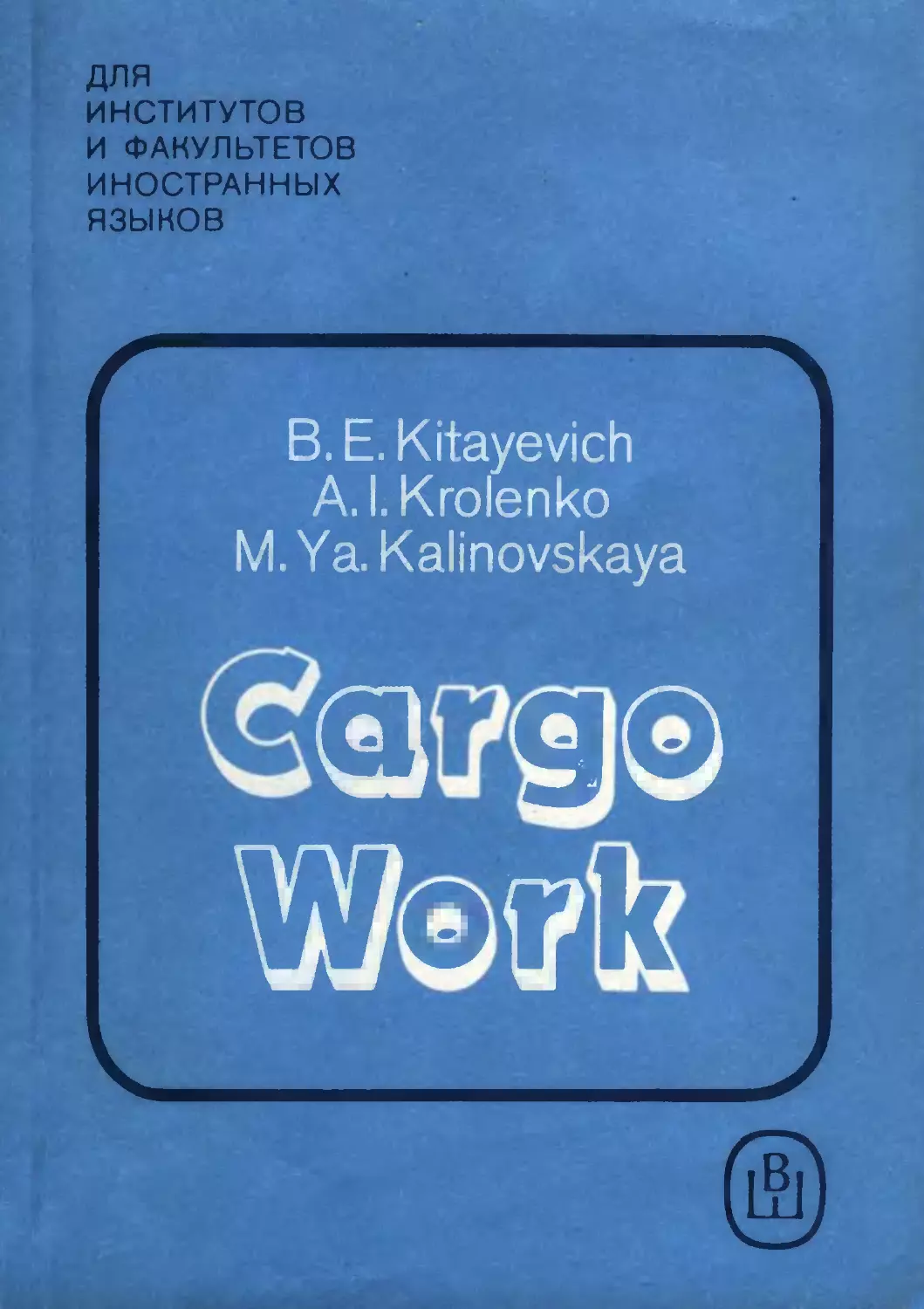
Б.Е.Китаевич
А.И.Кроленко, М.Я.Калиновская
МОРСКИЕ
ГРУЗОВЫЕ ОПЕРАЦИИ
Пособие
по английскому
языку
Допущено
Государственным комитетом СССР
по народному образованию
в качестве учебного пособия
для студентов и учащихся,
обучающихся по специальностям
морского и речного транспорта
Москва „Высшая школа11 1991

ББК 81.2 Англ
К 45
Рецензенты:
кафедра иностранных языков Одесского института инженеров
морского флота (зав. кафедрой доц. Г.Т. Новикова);
Латвийское морское пароходство
Китаевич Б.Е., Кроленко А.И., Калиновская М.Я.
К 45	Морские грузовые операции. Пособие по англий¬
скому языку. - М.: Высш. шк. - 1991. - 160 с.
ISBN 5-06-002018-5
На обл. загл.: BE. Kitayevich, A.I. Krolenko, M.Ya. Kalinovskaya. Cargo
Work.
В пособии описаны основные морские порты, даны типы грузо¬
вых судов, приводится характеристика перевозимых грузов, условий
их погрузки, транспортировки, выгрузки, 1рузовые договоры и доку¬
менты.
Цель пособия - развитие навыков чтения, перевода и общения на
английском языке (на материале профессионального подъязыка).
v Для курсантов высших инженерных училищ, практических работ¬
ников.
4602020102 - 309	ББК 81.2 Англ
к 001(01)-91	271 -91	4И (Англ)
Учебное издание
Китаевич Борис Ефимович, Кроленко Алина Ивановна,
Калиновская Маргарита Яковлевна
МОРСКИЕ ГРУЗОВЫЕ ОПЕРАЦИИ
Пособие по английскому языку
Зав. редакцией Л. И. Кравцова. Редактор М.А. Романова. Младший редактор
E.U. Политова. Художник В.Н. Хомяков. Художественный редактор В.А. Щер¬
баков. Технический редактор А.А. Кубениии. Оператор T.II. Гормыи'т.
И Б № 9079
Изд. № А-149. Сдано в набор 20.09.90. Подп. в печать 16.05.91. Формат 60x88
1/16. Бум. офсет. № 2. Гарнитура Таймс. Печать офсет. Объем 9,80 уел. печ. л.
10,05 уел. кр.-отт. 10,53 уч. изд. л. Тираж 29000 экз. Зак. № 1237 Цепа 1 р. 10 к.
Издательство «Высшая школа», 101430, Москва, ГСП-4, Неглинная ул., д. 29/14.
Набрано на участке персональных компьютеров издательства «Высшая школа».
Отпечатано в Московской типографии № 8 при Госкомпечати СССР. 10189S,
Москва, центр. Хохловский пер., 7.
ISBN 5-06-002018-5
© Б.Е Китаевич, А.И. Кроленко,
М.Я. Калиновская, 1991

ПРЕДИСЛОВИЕ
Настоящее учебное пособие предназначено для развития навыков чтения
специальной литературы и формирования навыков профессиональной устной ре¬
чи на II этапе обучения (III - IV курсы) у курсантов мореходных училищ специ¬
альностей 2401 (Организация перевозок и управление транспортом) и 1615 (Экс¬
плуатация водного транспорта), а также у работников береговых служб системы
морского флота, изучающих английский язык самостоятельно. Оно содержит
сведения, необходимые для делового общения на английском языке для эксплуа¬
тационников и судоводителей с иностранцами по вопросам, связанным с доку¬
ментацией, применяющейся при грузовых перевозках на морских судах, с погру¬
зочно-разгрузочными работами в портах.
Пособие рассчитано примерно на 120 часов аудиторной и 120 часов само¬
стоятельной работы.
Книга состоит из пяти глав, содержание которых реально отражает деятель¬
ность эксплуатационников/управленцев и тем самым стимулирует речевую дея¬
тельность на английском языке. Уроки-параграфы глав I - II предназначены для
развития навыков чтения и формирования навыков устной речи. Наличие допол¬
нительных текстов-упражнений позволяет осуществлять развитие навыков раз¬
личных видов чтения. Уроки-параграфы глав III - IV рассчитаны на формирова¬
ние навыков устной речи.
Система упражнений включает в себя упражнения, направленные на:
1.	развитие навыков различных видов чтения;
2.	усвоение специальной лексики;
3.	формирование навыков профессиональной устной речи (диалогической и
монологической);
4.	развитие навыков аудирования;
5.	развитие навыков письма.
Работа с пособием предполагает широкое применение аудио-визуальных
средств.
С учетом большого количества студентов-заочников и работников береговых
служб, занимающихся изучением английского языка самостоятельно, задания к
упражнениям даются на русском языке. Кроме того, задания зачастую даются в
двух вариантах, один из которых рассчитан на работу в аудитории под руковод¬
ством преподавателя, а второй - на самостоятельную работу.
Тексты взяты из оригинальных источников. К текстам приводятся пояснения.
В Приложениях к пособию имеется, помимо прочего, англо-русский словарь,
включающий в основном всю лексику пособия.
Авторы

CONTENTS
Chapter I. SEA PORTS
§ 1. Organization of Operations in Soviet Ports	 6
§2. The Port of Leningrad	 10
§ 3. The Port of London	 15
Chapter II. TYPES OF CARGO SHIPS
§ 4. General Description of a Ship	 20
§5. Types of Ships	 23
§ 6. Universal Vessels	 27
§ 7. Multi-Purpose Vessels	 31
§ 8. Specialized Ships	 35
8.1	Container Ships	 35
8.2	Roll-on/Roll-off	Vessels	 40
8.3	Barge Carrying	Vessels	 43
8.4	Bulkers	 46
8.5	Tankers	 49
Chapter III. TYPES OF CARGO
§ 9. General Cargoes	 53
§ 10. Container Cargoes	 58
§ 11. Bulk Cargoes	 64
§ 12. Liquid Cargoes	 68
§ 13. Dangerous Cargoes	 72
§ 14. Gas Cargoes	 76
Chapter IV. CARGO OPERATIONS
§ 15. Holds and Hatches	 81
§ 16. Loading	 86
§ 17. Stowage	 91
§ 18. Dunnage	 97
§ 19. Discharging	 103
§ 20. Damage to Cargo	 107
§ 21. Tallying Cargo	 112
§ 22. Warehouses and Sheds	 117
§ 23. Responsibility of Cargo Officials and Inspection of Compartments Be¬
fore Loading	 120
§ 24. Shipping Documents	 125
Chapter V. ANTWERP STANDARD GENERAL DISCHARGING
AND LOADING CONTRACT
§ 25. General Conditions	 130
§ 26. Special Addendum to the Antwerp Standard General Discharging and
Loading Contract Between V/O Sovfracht, Moscow, and Allied Steve¬
dores, Antwerp	 132
§ 27. Ro-Ro Addendum	 134
4

ПРИЛОЖЕНИЯ
Приложение I. Список некоторых грузов	 137
Приложение II. Список некоторых механизмов	для	обработки грузов		138
Приложение III. Предупредительные надписи на	таре	 138
Приложение IV. Оговорки, вносимые в коносаменты, штурманские распи¬
ски и погрузочные ордера	 139
Приложение V. Некоторые выражения, употребляемые при грузовых ра¬
ботах	 139
Приложение VI. Англо-русский словарь	 142

Chapter I. SEA PORTS
§ I. ORGANIZATION OF OPERATIONS IN SOVIET PORTS
Functions of Sea Ports
Merchant sea ports are under the authority1 of the Ministry of
Merchant Marine of the USSR and are intended to perform eco¬
nomic and administrative functions.
The economic functions. - Sea ports are responsible for
loading/unloading operations, servicing of inbound/outbound Soviet
and foreign ships* transportation, forwarding and warehousing
operations, transshipment of cargo to the marine transport from
other modes of transport3 (intermodal cargo handling operations4),
servicing of deep sea vessels’ passengers. To perform these functions
sea ports have water areas, land territories, warehouses and open
storage	facilities, cargo handling facilities, passenger terminals,
approach ways for railway and motor transport, and an adequate
personnel.
The administrative functions. - Sea ports are responsible for
ensuring safe navigation and proper order within the port, including
supervision for adherence to shipping regulations, registration of
vessels in the State Register of Shipping, issue and checkup of ship’s
papers, diplomas and qualification certificates of ship officers,
clearance of vessels inwards and outwards5, organization of pilotage
and towage service and other functions of Port Operations Manage¬
ment.
Port operations management is effected by three channels. The
higher channel controls port operations as a whole and includes the
operations, commerce, shipping, planning, labour and wages, mecha¬
nization, technology, personnel, accounts, administrative, harbour
master’s and other functional services/departments. The port is
headed by the general director who controls the entire port opera¬
tions. Each dcpartment/scrvice is managed by the department head.
There are also some deputy general directors. Thus, the deputy gen¬
eral director operational is responsible for the operations, commerce
and shipping departments. Safety of shipping and proper order in the
port are the responsibility of the harbour master who is a deputy
general director at the same time.
The middle channel of management controls cargo handling com¬
plexes and other production units of the port such as port auxiliary
service fleet6, depots for motor and electric lift trucks, railway and
motor cars etc., repair and maintenance shops, rigging shops and
others. The main production units of the port are cargo handling
complexes where all loading/unloading operations are carried out.
The complexes specialize in handling specific types of cargoes
(general cargo7, timber, ore, coal, containers etc.) and in servicing

specific cargo traffic routes. Each cargo handling complex comprises
terminals, complex stevedore gangs, traffic control service8, warehouse
and open storage personnel, and is headed by the superintendent.
The lower channel of the management is involved in a direct
control of cargo handling operations on berths and in warehouses.
This control is effected by chief stevedores, warehouse superinten¬
dents and stevedore gang foremen.
All Soviet ports, like any other socialist state-owned enterprises9,
operate in accordance with five-year plans and current yearly and
quarterly plans which stipulate the volume and the structure of cargo
handling operations, technology and labour requirements, incomes and
expenses as well as social measures to be taken to meet the de¬
mands of the people working in the port.
To facilitate and improve port management Soviet sea ports are
provided with10 information computing centres equipped with most
up-to-date sophisticated computers. As a result, such everyday man¬
agement problems as drawing up cargo plans and optimal technologi¬
cal plans-schedules11 for handling each particular vessel, drawing up
shift-day plans-schedules of the port operations and operations of
each particular cargo handling complex - and a lot of other prob¬
lems - are solved by computers.
Пояснения к тексту
1.	to be under authority подчиняться
2.	inbound/outbound ships прибывающие/уходящие суда
3.	modes of transport виды транспорта
4.	intermodal operations операции, осуществляемые смежными/
различными видами транспорта
5.	clearance of vessels inwards/outwards оформление прихода/ухо-
да судов
6.	port auxiliary service fleet портофлот
7.	general cargo генеральный груз
8.	traffic control service диспетчерская служба
9.	state-owned enterprises государственные предприятия
10.	to provide with обеспечивать
11.	shift-day plan-schedule сменно-суточный план-график
Упражнения
1.	Прочитайте текст про себя (без словаря).
2.	Переведите (в аудитории устно/дома письменно) следующие
цепочки существительных, принимая во внимание, что глав¬
ным из них является последнее, а все предшествующие оп¬
ределяют его.
Образец:	information computing centre информационно-вычис¬
лительный центр
storage facilities; cargo handling facilities; approach ways; port op¬
7

erations; port operations management; production unit; stevedore
gang; stevedore gang foremen; everyday management problems;
warehouse and open storage personnel
3.	Найдите в тексте эквиваленты следующих русских слов и
выражений.
отдел /служба; коммерческий отдел/служба; отдел /служба
эксплуатации (планирования, труда и зарплаты, кадров, меха¬
низации); начальник порта; заместитель начальника порта; на¬
чальник отдела/службы; начальник комплекса (склада); произ¬
водственное подразделение
4.	Переведите текст и отработайте его чтение.
5.	Составьте свои предложения (в аудитории устно/дома пись¬
менно) на английском языке, используя следующие выраже¬
ния из текста.
to be under authority; to be intended; to be responsible; to en¬
sure order; to adhere to regulations; to issue documents; to be in¬
volved in; to facilitate and improve port management; to draw up a
plan; to solve a problem
6.	Согласитесь с утверждениями в соответствии с образцом
(работа в парах).
Образец: А. I think the general director controls the entire port op¬
erations.
В, Yes, you’re right: the entire port operations are con¬
trolled by him.
1.	I think the department head manages one particular service. 2.
So far as I understand the deputy general director manages several
services. 3. The deputy general director in operations heads the oper¬
ations, commerce and shipping services. 4. The harbour master
controls safety of shipping and order in the port. 5. The superinten¬
dent heads one particular cargo handling complex.
7.	Согласитесь с утверждениями, дополнив основную мысль
словами, данными в скобках.
Образец: А. Sea ports are responsible for cargo operations, (for ser¬
vicing ships)
B, They are resposible for servicing ships as well 11. Sea ports have all necessary cargo handling facilities, (an ade¬
quate personnel) 2. Sea ports service all inbound/outbound Soviet
vessels, (foreign vessels) 3. The harbour master ensures safe naviga¬
tion within the port water area, (proper order within the port) 4.
The cargo handling complex comprises terminals and traffic control

service, (stevedore gangs and warehouse personnel) 5. Cargo handling
operations are directly controlled by chief stevedore (gang foremen)
8.	Задайте вопросы в соответствии с образцом и получите на
них ответ - работа втроем: задание - вопрос - ответ на вопрос.
Образец: A Ask what functions merchant sea ports are intended for.
B.	What are merchant sea ports intended for?
C.	They are intended to perform economic and administra¬
tive functions.
Ask:	1. what economic/administrative functions merchant sea
ports are intended for; 2. who the port is headed by; 3. what func¬
tional departments the higher channel of management includes; 4.
what departments the deputy general director in operations is re¬
sponsible for; 5. what production units there are in the port; 6. what
the cargo handling complex comprises.
9.	Ответьте на вопросы (в аудитории устно/дома письменно).
1.	What are merchant sea ports intended for? 2. What economic
(administrative) functions do they perform? 3. What does the higher
management channel control? 4. What departments/services does it
include? 5. Who are they headed by? 6. Who is responsible for the
entire port operations management? 7. What is the deputy general
director in operations responsible for? 8. What are harbour master’s
duties? 9. What production units are there in the port? 10. What is
the main production unit of the port? 11. What does the cargo han¬
dling complex comprise? 12. What personnel practically effects load-
ing/unloading? 13. How do Soviet merchant sea ports operate? 14.
What are ports provided with to facilitate and improve port man¬
agement? 15. What are information computing centres equipped
with? 16. What management problems can be solved with the help
of computers?
10.	Вообразите, что вы представитель администрации советско¬
го порта, а ваш собеседник - представитель администрации
зарубежного порта, интересующийся работой советских пор¬
тов. Выполните следующие действия: поприветствуйте его;
представьтесь ему; пригласите его в свой офис, усадите,
предложите кофе, минеральную воду; приступайте к делу и
расскажите ему (в общих чертах) об организации работы
советских торговых морских портов; поблагодарите его за
внимание; ответьте на вопросы собеседника; расспросите
его об организации работы порта, из которого он прибыл
(не забудьте поблагодарить за ответы на ваши вопросы).
11.	Выполните функции переводчика в разговоре представите¬
лей администрации зарубежного порта. (Упражнение вы¬
полняется без зрительной опоры, либо с помощью магни¬
тофона, либо с помощью двух других курсантов.)
9

1
A Now that you’ve told me about Soviet port operations manage¬
ment I’d like to ask a few questions.
В. Пожалуйста, рад буду ответить на все ваши вопросы.
A You say that, being state-owned enterprises, Soviet ports operate
in accordance with state plans.
В. Совершенно точно.
A Well, and what are the advantages of planned operations?
В. Видите ли, во-первых, эти планы предусматривают эконо¬
мический аспект работы портов, то есть объем и структуру
грузовых операций, их технологию, потребности в рабочей
силе, доходы и расходы и структуру их распределения. В
результате развитие советских портов происходит без резких
взлетов и спадов (booms and recessions), ведущих к кризисам.
А I see.
В. Во-вторых, при планировании учитываются социальные ас¬
пекты, то есть меры, которые нужно принять для удовлет¬
ворения потребностей людей, работающих в портах, - жи¬
лищное строительство, профессиональная подготовка
(vocational training), отдых, медицинское обслуживание, усло¬
вия труда и зарплаты и т.д.
А I see now. Thank you.
2
A Well, you say that you have information computing centres in
your ports. What management problems do you solve with the
help of computers?
В. Самые разнообразные, начиная с таких повседневных про¬
блем, как составление каргопланов, технологических планов-
графиков для каждою отдельного судна, составление сменно¬
суточных планов-графиков работы порта и каждого отдель¬
ного перегрузочного комплекса, и многие, многие другие.
А I see. Thank you very much for what you’ve told me.
Я. Пожалуйста. Спасибо за внимание.
§ 2. THE PORT OF LENINGRAD
The sea port of Leningrad is a large centre of water communi¬
cations in the North West of the Soviet Union, a junction of differ¬
ent modes of transportation - shipping by sea and river, railway and
road transport.
Position. - Latitude - 59°54' N, longitude - 30°15\
The port is situated on the islands of the Neva mouth, in the
Nevskaya Cuba (Neva Bay), in the eastern extremity of the Gulf of
Finland. The port is accessible for vessels with 10.5 m draught in
fresh water and is entered by the 2 mile long Morskoy Canal
(Seaway) stretching from the port’s receiving buoy* to the mouth of

the Neva River. Owing to icebreaker assistance navigation is year-
round. Icebreaker assistance is free of charge.
Notice of ETA2. -When proceeding to the port Masters must, latest
96 hours before arrival at the receiving buoy (Sea Pilot Station), ad¬
vise the port controller through the Inflot Agency about ETA at the
Pilot Station.
Pilotage is compulsory for all ships.
Port customs. - Masters must give notice of ships readiness for
loading/discharging to the shipper/consignee through the agent in the
port within customary office hours, the vessel having been cleared
in3 and being in free pratique4. Before loading ship’s cargo holds
must be cleaned and made ready to receive the cargo. Laytime5 is
to count from 1 p.m. (for timber cargoes from 6 p.m.) if the notice
of readiness is given before noon, and from 8 a.m. the next working
day if the notice is given after noon within customary office hours
which are from 8 a.m. to 4 p.m. SHEX6. Loading/discharging is
carried out daily in two shifts: from 8 a.m. to 4 p.m. and from 4
p.m. till midnight.
Dues and charges for services rendered to foreign ships, such as
tonnage, canal, berth and pilotage dues and mooring/unmooring,
shifting, towage, lighterage and cranage charges are paid in accor¬
dance with the port tariffs being in force7.
Agency. - Foreign sea-going vessels are attended to by the Leningrad
Main Maritime Agency “Inflot”.
Port facilities. - The cargo turnover of the port exceeds 11 min.
tons. The port handles general cargo, bulk cargo8 (ore, coal, fertiliz¬
ers9, building materials), grain, metals, timber etc. The leading export
commodities are timber, plywood, paper, non-ferrous metals, machine
tools, automobiles, industrial equipment, machinery etc. The domi¬
nating imports are cotton, wool, equipment, rolled steel, tubes, cof¬
fee- and cocoa-beans, fruit, grain and other consumer goods. The
port is very well equipped and mechanized for handling all these
cargoes. It has very efficient gantry cranes, hundreds of fork-lift
trucks, electric trucks, conveyers, up-to-date straddle carriers, side
loaders and sophisticated general purpose machines which facilitate
lifting, conveying, stacking, turning, shifting and rotating loads. For
such goods as heavy logs, extraweights and long pieces of cargo
there are appliances with a sufficient jib outstretch and maximum jib
height. For handling containers there are container bridges. There are
also shore based and floating coal- and grain-loaders, floating cranes
of 15 to 100 tons capacity, a 350-ton floating crane being available in
case of need. Numerous other cargo handling machines and intra¬
port10 transport facilities are available. The port has single- and
multi-floor warehouses, modern sheltered storage spaces for general
cargo and concrete floor yards11 for open storage, an elevator and a
cold storage facility12 fitted out with13 high-duty cooling and freezing
plants14 enabling to keep the right temperature for food perishables,
11

such as meat, butter, eggs, fish, fruit etc. Its more than 100 berths
and warehouses are linked by railways and approach ways for motor
transport.
Cargo operations. - The port is managed by the general director, his
deputy general director operational15 being responsible for the for¬
warding service, the cargo loading/unloading, organization service and
the commerce service. The forwarding service, headed by the for¬
warding office manager, deals with settling with shipowners, ship
agents, customs, inspections, intermodal transport means16, cargo
owners and their representatives different matters related to recep¬
tion, delivery, storage etc. of all the goods passing through the port
and matters related to cargo documents. The cargo loading/unloading
operations organization service17, headed by the chief controller, deals
with18 planning, organization and performance of cargo handling
operations by the port personnel and by means of19 the port facili¬
ties. The main production units of the service are cargo handling
complexes organizing and performing loading/discharging and other
cargo operations (reception, warehousing, storage, securing of cargo
etc.). At present in the port there are 9 cargo handling complexes
specializing in handling specific cargoes and servicing specific cargo
traffic routes.
Пояснения к тексту
1.	receiving buoy приемный буй
2.	ETA = expected/estimated time of arrival предполагаемое вре¬
мя прибытия судна
3.	to clear a vessel in оформить приход судна
4.	to be in free pratique иметь разрешение на свободную прак¬
тику (сношение с берегом)
5.	laytime сталийное время (время, предусмотренное договором
о перевозке на погрузку/разгрузку судна)
6.	SHEX = Sundays and Holidays excepted исключая воскресные
и праздничные дни
7.	to be in force иметь силу (юридическую)
8.	bulk cargo навалочный (насыпной) груз
9.	fertilizer удобрение
10.	intra-port внутрипортовый
И. concrete floor yard грузовая площадка
12.	cold storage facility холодильник
13.	to be fitted (out) with быть снабженным
14.	high-duty cooling and freezing plants высокомощные холодиль¬
ные и морозильные установки
15.	deputy general director operational ‘заместитель начальника
порта по эксплуатации
16.	intermodal transport means смежные транспортные средства
17.	cargo loading/unloading organization service СОПРР - служба
организации погрузочно-разгрузочных работ
12

18.	to deal with иметь дело с, заниматься
19.	by means of путем, с помощью
Упражнения
1.	Прочитайте текст про себя.
2.	Переведите (в аудитории устно/дома письменно) следующие
цепочки существительных.
incebreaker assistance; office hours; tonnage/canal/berth/pilotage
dues; mooring/shifting/lighterage/cranage charges; side loader; jib
outstretch; coal- and grain-loaders; intra-port transport facilities;
single- and multi-floor warehouses; approach ways
3.	Переведите текст и отработайте чтение текста.
4.	Проверьте, запомнили ли вы следующие слова и выраже¬
ния из текста.
owing to; free of charge; compulsory; customs; shift; in accor¬
dance with; sophisticated general purpose machines; to facilitate; ex¬
traweights; sufficient jib outstretch; to be available; perishable(s); port
cargo turnover
5.	Используйте слова и выражения из упр. 4 в своих предло¬
жениях на английском языке (в аудитории устно/дома пись¬
менно).
6.	Задайте уточняющий вопрос и получите на него ответ (ра¬
бота втроем).
Образец: А. The Master must advise the port controller about his
ship's ETA.
B.	When must the Master advise the port controller about
his ship's ETA?
C.	He must do that 96 hours before arrival at the port,
1.	Pilotage is compulsory in the port of Leningrad, (for what
ships?) 2. The. Master must give notice of readiness for loading to
the Snipper, (when?) 3. In die port of Leningrad cargo operations
are carried out daily, (in how many shifts?) 4. The port has highly
efficient gantry cranes, (what other cargo handling equipment?) 5.
The port handles different types of cargo, (what types?) 6. There are
very good storage facilities in the port, (what storage facilities?)
7.	Согласитесь со следующими заявлениями, обосновав свое со¬
гласие подробностями из текста.
Образец: A. Navigation is year-round in the port of Leningrad.
В. Yes, it is year-round owing to icebreaker assistance. 11.	On the way to the port masters must advise the port con¬
troller about ETA. 2. Laytime is to count from 1 p.m. or from 8
a.m. the next working day. 3. Dues and charges for services ren-

dered to foreign vessels are paid according to port tariffs. 4. The
port handles different kinds of cargo. 5. The port has very efficient
cargo handling equipment. 6. There are very good storage facilities in
the port.
8.	Представьте, что:
1.	Вы судовой агент, а ваш собеседник - капитан иностран¬
ного судна, на которое вы пришли, и выполните следу¬
ющие действия: а) поприветствуйте капитана; б) рас¬
спросите его о рейсе; в) расскажите о правилах и обы¬
чаях порта; г) ответьте на вопросы капитана относи¬
тельно обработки его судна (когда начнутся грузовые ра¬
боты, сколько бригад будет работать одновременно, ка¬
кое береговое грузовое оборудование будет использовать¬
ся, сколько времени займет обработка судна).
2.	Вы заместитель начальника порта по эксплуатации, ос¬
тальные курсанты - ваши зарубежные коллеги; расскажи¬
те им о службах, находящихся в вашем ведении, об ор¬
ганизации работы порта, о портовом оборудовании (в
общих чертах); ответьте на их вопросы, связанные с
подробностями работы порта и портового оборудования.
9.	Прослушайте/прочитайте без словаря текст с тем, чтобы из¬
влечь из него следующую информацию: а) о времени ввода
порта в эксплуатацию; б) о количестве перегрузочных комп¬
лексов в порту; в) о назначении и оснащении этих комплек¬
сов; г) какие суда принимает порт.
The Port of Juzhny
The port situated on the sides of the Ajaliksky Liman (estuary)
was put into operation in June 1978. Port operations are centered on
three complexes. The first one handles carbamide (мочевина,
карбамид), packed or in bulk. It comprises two berths, 500 m of
total length, equipped with specialized high-capacity loading/
discharging facilities. There arc five reloaders of which three are fit
for handling packed carbamide only, one is a combined unit, for
both bulk and packed cargo, and one is for bulk cargo only. The
second complex is intended to handle gas-carriers bringing in
superphosphoric acid (суперфосфатная кислота) or taking liquefied
ammonia (сжиженный аммиак). It consists of a pier on piles
(причал на сваях) with special cargo handling facilities. Depths
alongside the pier are sufficient to accommodate ships of up to
55,000 dwt. The third complex handles coal, iron ore, large diametre
pipes, packaged metal, bauxite etc. with the help of “Sokol” type
gantry cranes. Depths alongside the quay are sufficient to
accommodate “Marshal Budyonny” type 102,000 dwt vessels. A
specially equipped anchorage in the inner roads (внутренний рейд)
is fit for handling large size barge carrying vessels. The port is
14

developing fast. New berths and cargo handling facilities are being
built.
10.	Прочитайте текст упр. 9 (со словарем, если необходимо) и
передайте его содержание (перескажите) как можно ближе к
тексту.
И. Переведите устно (в аудитории) или письменно (дома) сле¬
дующий текст.
Ново-Таллиннский порт
Строительство первой очереди порта было завершено в
конце 1986 г. Этот порт, расположенный в заливе Мууга в 20
км от Таллинна, будет крупнейшим советским портом на Бал¬
тике и третьим портом в СССР по пропускной способности
(throughput). Он будет принимать суда свыше 100.000 тонн де¬
двейтом. В порту строятся многочисленные погрузочно-разгру¬
зочные терминалы. Создаются специализированные зерновые
комплексы (здесь будет самый большой в СССР элеватор). В
порту будут ежегодно перерабатываться сотни тысяч тонн ско¬
ропортящихся грузов - фруктов, овощей, молочных продуктов.
Здесь будут также перерабатываться минеральные удобрения,
строительные материалы и генеральные грузы. Порт связан с
транспортной сетью страны железной дорогой и шоссейными
дорогами. Портовые механизмы и внутрипортовые пути сооб¬
щения расположены таким образом, что грузы можно перегру¬
жать прямо с судов в железнодорожные вагоны или в автома¬
шины, минуя склады. Через Ново-Таллиннский порт будет
осуществляться торговля СССР со странами северной и запад¬
ной Африки. Ново-Таллиннский порт предназначен для того,
чтобы устранить перегрузку (to take the strain oft) других совет¬
ских балтийских портов, которым становится все труднее
справляться с (to соре with) непрерывно возрастающими им¬
портно-экспортными перевозками.
§ 3, THE PORT OF LONDON
The port is situated on the river Thames. Position: 51°31' N,
0o(tf W.
Customs and regulations. A vessel is considered to have arrived
when it is instructed to anchor at a designated anchorage, as ordered
by the Port Authority, if berth where vessel's operations are to be
carried out is not available. Otherwise when vessel is alongside.
Pilotage by licensed pilots in London piloting district is compulsory.
No automatic pratique, or radio pratique is given. The London Mar¬
itime Declaration of Health Form1 which is normally handed to the
ship by the pilot boarding vessel is to be completed and strictly
complied to. The vessels entering or leaving the port of London pay
conservancy charges2 and dock charges on vessel and cargo. The first
15

ETA should be sent through a Post Office Coast Station giving at
least 1 hour's ETA.
Stevedores are ordered by the Agents. No ETA to stevedores from
vessels are necessary; labour is to be ordered by the Agents 12 hrs
day before required. Opening/closing hatches; liner vessels-by crew,
with stevedore assistance; tramp vessels - according to Charter Party.
Fresh water is available at all berths either from shore or barge.
No work is available on official holidays usually. Some weekend
work is possible at certain berths only at overtime rate.
For help, advice, assistance or any matter affecting ships and
shipping Shipmasters should contact Thames Navigation Service.
Traffic Coordination Centre (Gravesend') programmes all movements
within the port, including the docks. All information required by the
Authority regarding ETA, ETD3, etc., should be passed through this
centre. It also deals with all matters concerning provision of tugs in
docks, floating derricks, pontoons, or other services for vessels in
docks, moorings in the river and any enquiry in relation to by-laws4,
regulations etc.
Port of London docks. At present the Port of London Authority
(PLA) operate three enclosed dock systems: 1. The India and Mil-
wall Docks on the left bank of the Thames (the most upriver group
used by vessels trading between the United Kingdom and Scandi¬
navia, the Mediterranean, Eastern Europe, Spain and Portugal, North
and South Africa, the Carribean, North and South America). 2. The
Royal Docks (consisting of King George V, Royal Albert and Victo¬
ria Docks). 3. Tilbury Docks (lying 26 miles downstream from the
London Bridge). Facilities for general cargo handling, Roll-on/Roll-
off5 and container handling can be provided in each dock system
according to specific requirements. In particular, the PLA operate
deepwater container, forest products and Roll-on/Roll-off facilities in
Tilbury Docks. The Tilbury riverside grain terminal is capable of
handling vessels up to 83,000 dwt. The PLA have built a freight-liner
train terminal6 within the docks for fast through transit from all
industrial centres by British Rail Freight-Liner Services7. The two
shift system means that the docks are operational for 14 hours a
day, Monday to Friday, with provision also for work on Saturday
and Sunday at overtime rate.
Пояснения к тексту
1.	Maritime Declaration of Health Form бланк морской санитар¬
ной декларации
2.	conservancy charges сбор в фонд охраны окружающей среды
3.	ETD - expected/estimated time of departure предполагаемое вре¬
мя ухода (судна)
4.	by-laws постановления местных властей
5.	Roll-on/Roll-off ро-ро, ролкер

6.	freight-liner train terminal терминал для линейных судов, обо¬
рудованный железнодорожными путями
7.	British Rail Freight-Liner Services Британская железнодорожная
служба
Упражнения
1.	Прочитайте текст про себя.
2.	Переведите следующие цепочки существительных.
London pilotage district; radio pratique; riverside grain terminal;
post office coast station; overtime rate; Thames Navigation Service;
Traffic Coordination Centre; dock systems; forest products handling;
two-shift system
3.	Переведите следующие предложения (в аудитории устно/до-
ма письменно), предварительно определив, какой частью ре¬
чи являются выделенные слова.
1. For loading heavy-lifts the vessel should shift to No. 5 Berth.
2.	The docks operate on the two-shift basis. 3. The two-shift system
means that the docks are operational for 14 hours a day. 4. Ac¬
cording to the contract of carriage the vessel is to be discharged by
Receiver’s means. 5. The port is being reconstructed according to the
10 year reconstruction and development programmes. 6. Traffic Co¬
ordination Centre programmes all movements within the port. 7. Dif¬
ferent kinds of goods may be damaged through close contact in
stow. 8. For help Shipmasters should contact Thames Navigation
Service.
4.	Переведите текст и отработайте его чтение.
5.	Задайте уточняющий вопрос по высказыванию и получите
на него ответ (работа втроем).
Образец: A No automatic pratique is given in the port of London,
(how?)
B.	How is it given?
C.	The London Maritime Declaration of Health Form is to
be completed. 1 * * * * 61. The vessels entering and leaving the port of London pay dock
charges, (what other charges?) 2. Stevedores are ordered by the
Agents, (within what period of time?) 3. Fresh water is available at
all berths, (where from?) 4. No work is available on official holidays,
(weekend work?) 5. All movements of ships are programmed within
the port, (by what organization?) 6. At present the PLA operate
three dock systems, (what systems?) 7. The port is operational for
14 hours a day. (why?)
6.	Ответьте на вопросы по тексту (в аудитории устно/дома
письменно).
17

1. When is a vessel considered to have arrived at the port of
London? 2. Is pilotage compulsory? 3. What form should vessels
complete and comply to to obtain pratique? 4. What charges are
paid by the vessels entering/leaving the port? 5. How should vessels’
ETA be sent? 6. Who are stevedores ordered by? 7. When should
labour be ordered? 8. How is opening/closing hatches effected? 9.
On what days is work available? 10. How many hours a day is the
port operational? 11. What service should shipmasters contact when
necessary? 12. What does Traffic Coordination Centre deal with? 13.
How many/what dock systems do the PLA operate? 14. What facili¬
ties are there in each dock system? 15. What facilities do the PLA
operate in Tilbury docks?
7.	Прослушайте/прочитайте текст без словаря.
The Port of Rotterdam
Rotterdam, the leading port of Europe, is situated at the mouth
of the river Rhine. About 31,000 sea-going vessels and over 200,000
inland craft per year call at this junction of world traffic. The New
Waterway (depth 44 ft at low tide) is a part of the 16.8 miles long
open communication with the sea, while the rivers Rhine and Mass
connect the port with its hinterland (район, тяготеющий к порту).
It is a tidal port: normal tidal range is 5.5 ft, at spring-tide - 6 ft.
Rotterdam is the home port and port of call for about 400 overseas
lines with over 12,500 regular sailings a year. Modern quays, cranes,
stores and warehouses guarantee a rapid turn-round. All the quays
are directly connected to the international network of roads and
railways.
The general cargo handling equipment in the port meets all re¬
quirements of valuable and perishable goods.
For years now in various places in the harbour area containers,
Roll-on/Roll-off, pallets and other unit loads have been handled. Two
up-to-date container terminals have been put into operation. Impor¬
tant container links have been established between Rotterdam and ail
major trade areas of the world due to the port’s up-to-date efficient
equipment as well as its favourable geographical position.
As the greatest bulk cargo port in the world, fully mechanized,
Rotterdam is the distribution centre for Western Europe. Rotterdam
is the most important continental grain port. The port has vast facil¬
ities for grain handling elevators, pneumatic suction plants etc. with
which it can handle over 30 min. tons of grain and feedingstuffs.
Grain storage capacity in Rotterdam amounts to nearly 500,000 tons.
For the transhipment of coal and ores Rotterdam has available the
world’s largest artificial harbour - the Waalhaven. Here, in addition to
transhipment via the quays, cheap and speedy direct ship-to-ship
transhipment in midstream has been developed. For this purpose
huge loading bridges and floating cranes are used.
is

Rotterdam is Europe's largest oil port. For tankers up to 300,000
dwt drawing 70 ft 59 berths are available.
8.	Расскажите о роли, которую играет порт Роттердам в Евро¬
пе и мире, и о том, чем эта роль обусловлена.
9.	Найдите в тексте абзац, в котором описывается обработка и
хранение навалочных грузов в Роттердаме, и передайте его
содержание по-русски как можно ближе к тексту.
10.	Прочитайте текст еще раз (со словарем, если необходимо)
и расскажите (по-английски) об обработке различных типов
грузов в Роттердаме.
11.	Расскажите/напишите по-английски об одном из советских/
зарубежных портов, который вы посетили во время практи¬
ки.
12.	Переведите устно (в аудитории) или письменно (дома) сле¬
дующий текст.*
Обработка скоропортящихся грузов
в порту Антверпен (Antwerp)
Обработка скоропортящихся грузов, в частности фруктов и
мяса, занимает особое место в порту Антверпен. В распоряже¬
нии (at the disposal of) порта имеются: три специализирован¬
ных терминала, оснащенных современными кранами и элева¬
торами; утепленные (frost-protected) склады для хранения фрук¬
тов в зимнее время; рефрижераторные склады для хранения
фруктов в летнее время; морозильные (deep-freeze) склады для
хранения замороженного мяса и молочных продуктов (dairy
produce). В Антверпене могут одновременно (simultaneously)
разгружаться более десяти судов, перевозящих скоропортящие¬
ся грузы. В порту обрабатываются фрукты и другие скоропор¬
тящиеся грузы, перевозимые на паллетах, в контейнерах и
традиционным (conventional) способом. Большое значение при¬
дается технике обработки. В порту имеются опытные специа¬
лизированные бригады для обработки фруктов, овощей
(vegetables), мяса и масла, требующих особого внимания и ос¬
торожности.

Chapter II. TYPES OF CARGO SHIPS
§ 4. GENERAL DESCRIPTION OF A SHIP
The main body of a ship is called a hull. The hull is divided
into three main parts: the foremost part is called the bow; the
rearmost part is called the stern; the part in between is called mid¬
ships. The hull is the main part of the ship. This is the area be¬
tween the main deck, the sides (port and starboard) and the bottom.
It is made up of frames covered with plating. The part of the hull
below water is the ship’s underwater body1. The distance between
the waterline and the main deck is the vessel’s freeboard. The hull
is divided up into a number of watertight compartments by decks
and bulkheads. Bulkheads are vertical steel walls going across the
ship and along2.
The hull contains the engine room, cargo spaces and a number
of tanks. In dry cargo ships the cargo space is divided into holds.
Openings giving access to holds are called hatches. In liquid cargo
vessels the cargo space is divided into tanks.
At the fore end of the hull are the forepeak tanks, and at the
after end are afterpeak tanks. They are used for fresh water and
fuel. If a ship has double sides, the space between the sides contains
wing tanks.
All permanent housing3 above the main deck is known as super¬
structure. Nowadays, cargo vessels are normally built with the after
location of the engine room and bridge superstructure to gain more
space for cargo4. The forward raised part of the deck is called the
forecastle and its after raised part is the poop. On deck there are
cargo handling facilities, such as cranes, winches, derricks etc. Ships
having derricks also have cargo masts and cargo posts (or Samson
posts) on deck.
Since a ship is supported by fluid pressure, she will incline in
any direction in the process of loading according to the position of
the weights placed on her. Therefore the ship’s position below water
must be closely watched. The angle that a ship is making fore and
aft with the water is known as trim. An extreme difference between
the water levels at each end of the ship indicates bad loading. The
levels are read by numbers painted on the ship’s stem and called
draught marks5. A list or inclination from one side to another,
caused by faulty loading6, is known as heel. In the course of loading
load lines must be watched above all. The load lines are engraved/
and then painted on the both sides of ships. The divided circle on
the left shows the depth to which the ship may be loaded in sum¬
mer time. Below this line are, on the grid to the right, two lines.
The one marked W means winter loading, the lower one marked
20

WNA means the maximum depth to which the ship may be loaded
if she is going across the North Atlantic in winter. The other marks
above these are: T for tropical, F for fresh water. These lines are
shown on the ship’s Load Line Certificate8. In case of overloading a
ship, so that these lines are under water, the penalties are severer
Пояснения к тексту
1.	ship’s underwater body подводная часть корпуса судна
2.	across the ship and along вдоль и поперек
3.	permanent housing постоянные постройки
4.	to gain more space for cargo чтобы выиграть больше места
для груза
5.	draught marks марки углубления
6.	faulty loading неправильная погрузка
7.	to engrave (вы)гравировать
8.	Load Line Certificate свидетельство о грузовой марке
9.	severe penalty серьезное наказание; большой штраф
Упражнения
1.	Прочитайте текст со словарем, обращая внимание на пояс¬
нения.
2.	Отработайте чтение текста в звукотехнической лаборатории/
дома с магнитофоном.
3.	Прочтите текст без словаря, проверяя, хорошо ли вы запом¬
нили названия частей судна.
4.	Прочтите упражнение, вставляя пропущенные слова (не
пользуясь словарем). 1 * * 4 51. The main body of a ship is called the ... . 2. The foremost
part of the hull is called the ... ; its rearmost part is called the ... ;
the part in between is called ... . 3. The hull is the area between ... .
4.	The hull is made up of ... covered with ... . 5. The part of the
hull below water is the ship’s ... . 6. The distance between the wa¬
terline and the main deck is the vessel’s ... . 7. The hull is divided
up into a number of ... by ... . 8. ... are vertical steel walls going
across the ship and along. 9. The hull contains .... 10. In dry cargo
ships the cargo space is divided into ... . 11. Openings giving access
to holds are called ... . 12. At the fore end of the hull are ..., and
at the after end are ... . They are used for ... . 13. The space be¬
tween the holds and the bottom of the hull contains ... . They are
used for ... . 14. If a ship has double sides, the space in between
contains ... . 15. All permanent housing above the main deck is
known as ... . 16. The forward raised part of the deck is called the
... and its after raised part is the ... .
5.	Начертите на доске схемы и а) дайте на английском языке
общее описание судна; б) расскажите на английском языке о
21

марках углубления и грузовых марках; в) расскажите на анг¬
лийском языке об основных измерениях судна.
6.	Выразите согласие с утверждениями по образцу (работа в
парах).
Образец: A The ship has an overall length of 130 metres.
В. Yes, that’s right: the ship's overall length is 130 metres.
1. The ship has a draught of 8.6 metres. 2. The ship has a
length of 122 metres between perpendiculars. 3. The ship has a
breadth of 23 metres. 4. The ship has a freeboard of 4 metres. 5.
The ship has a draught of 10 metres in fresh water.
7.	Задайте вопросы в соответствии с образцом (работа втроем:
задание - вопрос - ответ на вопрос).
Образец: А. Ask another cadet what the main body of a ship is
called.
B.	What is the main body of a ship called?
C.	It’s called the hull.
Ask another cadet: 1. into how many parts the hull is divided; 2.
what the main parts of the hull are called; 3. what the hull of a
ship is made up of; 4. what spaces the hull contains; 5. what tanks
the hull contains
8.	Ответьте на вопросы (в аудитории устно-работа в парах/
дома Письменно).
1. What is the main body of a ship called? 2. What parts is the
hull divided into? 3. What is the hull made up of? 4. What cargo
spaces are there in dry cargo ships? 5. What tanks are there in dry
cargo ships? 6. What are these tanks used for? 7. Can these tanks
be used for carriage of the cargo? 8. What is superstructure? 9.
Where is superstructure located on modern ships? 10. What cargo
handling facilities are there on deck? 11. What do we call the fore-
castle/the poop? 12. What is trim/hecl?
9.	Прослушайтс/прочитайте диалог. Расскажите, что вы узнали
из него.
A.	So, this is a cargo ship, isn’t it?
B.	Yes. To be more exact, this is a general cargo ship. Now, here
we’re standing on the navigating bridge. This is the place from
which the captain and his mates control the ship. First we’ll look
forward. We can see the main deck and the forecastle. The main
deck covers the cargo spaces or holds. There arc openings cut in
the deck, and these openings are the hatches, one to each hold.
A.	How do you load the cargo into the hold and discharge it?
B.	We use derricks. A derrick is a strong boom made of steel or

wood, that can swing from side to side. But a lot of ships are
fitted with cranes.
A.	How many holds are there on the ship?
B.	There are four on the main deck forward and one right aft. We
number them from one to five. And each hold is served by two
derricks.
A You’ve mentioned the forecastle, haven’t you?
В. Yes, right so. The forecastle is that small extra deck above the
main deck, forward of number one hold, right up in the bows. It
carries the anchors and their cables. I’ll take you up there in a
few minutes.
10.	Выучите диалог наизусть и воспроизведите его попарно на
занятии.
§ 5. TYPES OF SHIPS
On one hand, all cargo ships are divided into two types: dry
cargo ships and tankers. On the other hand, cargo ships may be di¬
vided into universal ships designed to carry principal different types
of cargo and specialized ships designed to carry one type of cargo
(e.g. bulk cargo, timber, refrigerated goods, oil etc.). Such specialized
ships as bulkers (= bulk-carriers), timber-carriers, reefer ships1,
tankers have long been known. In the past two decades three trends
in specialized ship design have emerged. One is cargo-carriers with
cargo handling equipment on board for special purposes or routes,
such as, for example, heavy/bulky cargo ships with derricks or
cranes capable of handling single lifts over 500 tons without requiring
outside assistance. These ships are also called special-purpose ships.
The second trend is Roll-on/Roll-off ships, in which bow and stern
doors and adjustable steel ramps permit vehicles to drive on board
and drive off again, requiring only minimum dock-side facilities. The
third trend is the container ship. The use of containers for cargoes
has encouraged2 the design of ships specifically to carry containers.
In their extreme form, as in the LASH barge-carrying ships3, the
container is a 60-foot steel lighter, which can be quickly launched
over the ship’s stern.
There are specialized ships designed to carry different types of
cargoes (e.g. OBO ships4, PROBO ships5, CONBULKERs6 etc.).
These are called combined ships.
A comparatively new development is the multi-purpose ship com¬
bining characteristic features of both universal and specialized vessels.
In dependence of the cargo handling method used dry cargo
ships may also be divided into: LO-LO (lift-on/lift-off) vessels where
handling of cargo is effected by derricks or crances through cargo
hatches; RO-RO (roll-on/roll-off) vessels where the cargo is rolled
on board and rolled off through cargo ports7 or doors in the bow,
stern or sides of the ship; FO-FO (float-on/float-off) vessels where
dock lift cargo handling method is used, that is floating cargo units

(e.g. barges) are floated into cargo spaces (usually large holds). But
there are also hybrid vessels8 where combinations of the above
mentioned methods are used, such as LO-LO/RO-RO (or LO/RO),
RO-RO/ FO-FO (or RO/FO-RO-Flow) vessels and others.
Пояснения к тексту
1.	reefer = reefer ships суда для перевозки рефрижераторных
грузов
2.	to encourage зд. способствовать
3.	LASH-carrier = lighters aboard ship-carrier лихтеровоз
4.	OBO ship = oil/bulk/ore-carrier нефтерудовоз, балктанкер
5.	PROBO ship = product/oil/bulk/ore-carrier судно, предназна¬
ченное для транспортировки нефтепродуктов, сырой нефти,
навалочных грузов и руды
6.	CONBULKER = container/bulk-carrier комбинированное судно,
предназначенное для перевозки контейнеров и/или навалоч¬
ных грузов
7.	cargo ports лацпорты
8.	hybrid vessels суда гибридного типа, сочетающие различные
способы погрузки/выгрузки
Упражнения
1.	Прочитайте текст.
2.	Дайте русские эквиваленты следующих слов и выражений.
on the one hand - on the other hand; ship design; heavy/bulky
cargo ship; single lift; outside assistance; without requiring outside as¬
sistance; bow/stern doors; side ports; vehicle; 60-foot steel lighter;
dock-side facilities; to be capable of; in dependence of; dock-lift cargo
handling methods; floating cargo units
3.	Переведите на русский язык следующие предложения.
1. Universal dry cargo ships are designed to carry principal dif¬
ferent types of cargo. 2. Special-purpose ships are designed to carry
one particular cargo. 3. This ship is designed to carry heavy/bulky
cargoes.
4.	Переведите текст и отработайте его чтение.
5.	Закончите предложения по образцу.
Образец:	A Combined ships ... .
В. Combined ships are designed to carry different
cargoes.
1. Fruit ships ... . 2. OBO ships ... . 3. PROBO ships ... . 4.
Bulk carriers ... . 5. Timber carriers ... . 6. Container ships ... . 7.
Heavy-lift cargo ships ... . 8. Passenger ships ... . 9. Reefers ... .
6.	Выразите несогласие с заявлениями в соответствии с образ¬
цом (работа в парах).
24

Образец: A. You don't know anything about unitized cargo ships,
I'm afraid.
B. Yes, I do: they are container ships, RO-RO ships,
barge-carriers.
1. You can’t give examples of specialized vessels, I believe. 2.
You don’t know what OBO (PROBO) ships are, I’m afraid. 3. You
don’t see the difference between specialized and special-purpose ships.
4. You’ve never heard about FO-FO ships, I think. 5. You can’t
explain what dock lift method of handling the cargo is.
7.	Задайте вопросы и получите на них ответы (работа втроем).
Образец: A. Ask your friend what specialized ships he knows.
B.	What specialized ships do you know?
C.	Well, I know tankers, container ships, LASH ships and
a lot of others.
Ask him: 1. what we call ships designed to carry automobiles
and passengers; 2. how many trends/what trends in specialized ship
design he knows; 3. how he can classify all cargo ships in depen¬
dence of the cargo carried; 4. how he can classify them in depen¬
dence of the cargo handling method used; 5. why expensive special¬
ized ships are so widely used nowadays.
8.	Ответьте на вопросы (в аудитории устно/дома письменно).
1. What two types are all cargo ships divided into? 2. How can
dry cargo vessels be classified in dependence of the cargo they
carry/in dependence of the cargo handling methods they use? 3.
What are advantages/disadvantages of specialized vessels? 4. Do you
believe that specialized ships will increase in number in future? Why
do you think so? 5. What are special-purpose ships? Can you give
any examples? 6. What kinds of combined ships do you know? 7.
What features do they combine? 8. What are hybrid ships?
9.	Прослушайте/прочитайте короткие диалоги. Скажите, что вы
узнали из каждого из них.
1
A. Here’s a fine pair of ships coming down. The first one’s a pas¬
senger liner. It looks very smart, doesn’t it? And what is the
ship next astern of her?
B.	It’s a RO-RO ship.
A.	RO-RO, sir?
B.	Yes. The name comes from the initials of “roll-on, roll-off”. You
see that very raked bow (нос со штевнем, имеющим наклон
вперед) she’s got? Well, the whole bow section lifts up, leaving
a massive entrance for lorries and cars. And there’s another pair
of doors and a ramp in the stern.
A. Do you mean the cars and lorries drive around inside the ship?
25

В. That’s right. There are clear, wide decks right down the full
length of the ship. And there are ramps inside, to enable the
cars and smaller trucks to climb up to a higher deck. It’s amaz¬
ing how many vehicles you can pack into those ships. And as
long as you’re careful about securing them, they’re quite safe
even in a seaway (во время перехода/рейса).
A I see.
2
A What’s that ship with the superstructure right forward and a cou¬
ple of gantry cranes?
B. She’s one of LASH ships. They pick up fully-laden (в полном
грузу, с полным грузом) barges and stow them in layers in
the hold. Then when they get to their destination they launch
the barges over the stern and tugs take them in tow. That way
LASH ships can load and unload very quickly. It’s like a bigger
version of container ships.
A I see.
3
A.	What about that ship just ahead? She’s got something sticking
out of her bow, at the waterline.
B.	That’s just her bulbous bow coming into view because she’s fly¬
ing light (судно следует без груза, налегке). Lots of ships
these days are built with a bulbous projection at the foot of the
stern, below the waterline. You can see the warning sign painted
on her bows.
A.	What’s the bulbous bow for, sir?
B.	It makes the hull drive more easily through the water. The ship
goes faster, uses less fuel, and makes much less wash (волне¬
ние, создаваемое движущимся грузом).
10.	Теперь вы можете выучить наизусть понравившийся вам
диалог/диалоги.
11.	Расскажите: а) о классификации судов в зависимости от пе¬
ревозимых категорий грузов; б) об универсальных, специа¬
лизированных, узко специализированных, комбинированных
и многоцелевых судах, указав их преимущества (advantages)
и недостатки (disadvantages) с вашей точки зрения; в) о ти¬
пах судов в зависимости от используемых методов обработ¬
ки грузов.
12.	Скажите/напишите по-английски.
1. Грузовые суда можно разделить на универсальные, при¬
годные для перевозки практически любых типов грузов, и спе¬
циализированные, предназначенные для перевозки одного типа
грузов или даже одного конкретного груза (например, желез-

ной руды, скота, вина, апельсинового сока и т.д.). 2. Среди
специализированных судов можно выделить узкоспециализиро¬
ванные, предназначенные для перевозки одного конкретного
груза или для обслуживания конкретных путей следования, и
комбинированные суда, предназначенные для перевозки раз¬
личных грузов или различных типов грузов. 3. В последние 20
лет наблюдалось три основных направления в развитии специ¬
ализированных судов: а) первое - суда со специальным обору¬
дованием для обработки тяжеловесных или крупногабаритных
грузов (т.е. суда специального назначения); б) второе - суда с
горизонтальной погрузкой (выгрузкой); в) третье - контейнер¬
ные суда. 4. Дальнейшим развитием универсальных судов яв¬
ляются многоцелевые суда, специально сконструированные для
перевозки нескольких типов грузов. 5. В будущем количество
специализированных судов будет постоянно возрастать. Тем не
менее, будут строиться и универсальные суда усовершенство¬
ванной конструкции, отвечающие современным требованиям.
§ 6. UNIVERSAL VESSELS1
Universal vessels can carry practically any types of cargoes, in¬
cluding refrigerated goods and liquids (in special tanks). However,
most of them are designed to carry certain types of goods. Thus,
liners are intended to carry general cargo, packaged cargo, containers,
and also, in dependence of the route, special, liquid and refrigerated
cargoes. Their deadweight2 varies between 2,000 and 20,000 tons and
the speeds between 10 and 22 knots. Tramps are designed, as a
rule, to carry bulk cargoes and timber, but can also carry general
cargo if necessary. These ships must be of sufficient size to carry a
profitable cargo and must be able to cope with bad weather
conditions in any ocean; they must not be too large to enter the
smaller ports of the world; speed is necessary but it increases
running costs3, so that a compromise between fuel consumption4 and
speed is desirable. The modern tramp travels at between 12 and 15
knots. Its deadweight varies between 2,000 and 10,000 tons.
The cargo spaces are holds, tweendecks and deeptanks. Holds
and tweendecks are used to carry general and bulk cargoes. Deep-
tanks may be of two types. The first type is designed to carry liq¬
uids only. The second type is designed to carry liquid and dry car¬
goes in turn5. Empty deeptanks are also used for liquid ballast. Lin¬
ers may have special cargo spaces (to carry valuable or dangerous
goods etc.) and refrigerated cargo spaces.
Conventional multi-deck vessels have holds divided horizontally by
one or two tweendecks known as upper and lower tweendecks. The
bottom part of any hold with tweendecks is the lower hold.
Below is described a typical universal standard design vessel:
The vessel is of 14,700 dwt (9,000 gross and 6,000 net tons). Her
overall length is 450 feet, beam 69 feet, draught 31 feet. Her five
27

holds are arranged so that numbers one to four holds are forward
of the superstructure and only number five hold is abaft it. The
holds are closed with electrically operated automatic sliding type
hatch-covers6. Each hold is served by its own 5-ton derricks mounted
in pairs. A single un-stayed mast is located forward, between
numbers one and two holds; there is a pair of un-stayed cargo ( =
Samson) posts7, between numbers three and four holds and another
pair abaft the funnel with derricks for working number five hold.
The winches are driven by electricity.
The hull is of the single tweendeck type with a raised forecastle
and bridge superstructure of medium height.
With a single diesel engine and screw she has a service speed of
14.5 knots, her fuel consumption being around 22 tons per day. She
provides accommodation for a crew of thirty.
Since late 60s universal vessels have been superseded8 by spe¬
cialized vessels. But world shipping crisis of mid-70s made ship¬
builders and shipowners design new types of universal and special¬
ized combined vessels, as specialized vessels proved to be unprof¬
itable9 due to their inflexibility10. Thus a new generation of universal
vessels, better designed and equipped, was born. It was then that
multi-purpose vessels, which are further development of universal
vessels, appeared11. Nowadays universal and multi-purpose vessels
make up about a half of all ships being built.
Пояснения к тексту
1.	universal vessels универсальные суда (их также называют gen¬
eral cargo vessels)
2.	deadweight (dwt) полная грузоподъемность
3.	running costs эксплуатационные расходы
4.	fuel consumption расход топлива
5.	in turn попеременно
6.	automatic sliding type hatch covers автоматически сдвигающие¬
ся люковые закрытия
7.	un-stayed cargo (= Samson) post оесштанговая грузовая колон¬
ка, полумачта
8.	to supersede вытеснять, заменять
9.	specialized vessels proved to be unprofitable специализирован¬
ные суда оказались нерентабельными
10.	inflexibility негибкость
11.	it was then that multi-purpose vessels appeared именно тогда
появились многоцелевые суда
Упражнения
1.	Прочитайте текст со словарем.
2.	Отработайте чтение текста.
3.	Убедитесь, запомнили ли вы значение следующих слов и

выражений и используйте их в своих предложениях (в ауди¬
тории устно/дома письменно).
in dependence of; of sufficient size; profitable cargo; running
costs; fuel consumption; service speed; inflexibility; funnel; screw; in
turn; conventional; cargo post = Samson post
4.	Согласитесь с утверждениями. Дополните основную мысль,
используя слова, данные в скобках (работа в парах).
Образец:	A Liners are intended to carry general cargo, packaged
cargo and containers, (special, liquid and refrigerated
cargoes)
B. Yes, they are. They are intended to carry special,
liquid and refrigerated cargoes as well.
1.	Tramps are designed, as a rule, to carry bulk cargoes and
timber, (general cargo) 2. Tramps must be of sufficient size, (must
be able to cope with bad weather conditions in any ocean) 3, The
cargo spaces are holds and tweendecks. (deeptanks) 4. Holds and
tweendecks are used to carry general cargo, (bulk cargoes) 5. Liners
may have special cargo spaces, (refrigerated cargo spaces) 6. Special
cargo spaces are used to carry valuable cargo, (dangerous cargo)
5.	Возразите против неверных заявлений собеседника, обосно¬
вав свои возражения подробностями из текста (работа в па-
рах).
Образец:	A Universal vessels don't carry containers.
В. Yes, they do. They carry practically any types of car¬
goes, including containers.
1. Tramps never carry general cargo. 2. Tweendecks aren’t used
to carry bulk cargoes. 3. Dry cargo can’t be carried in deep tanks. 4.
Universal vessels don’t carry refrigerated cargo. 5. Universal vessels
aren’t built nowadays. 6. Universal and multi-purpose vessels have
nothing in common.
6.	Расспросите/ответьте на вопросы о типичном универсальном
судне, описанном в тексте (работа втроем: задание - вопрос -
ответ).
Образец:	A Ask your friend about the principal particulars of the
vessel described in the text.
B.	What are the vessel’s principal particulars?
C.	Well, she is of 14,700 deadweight tons, her overall
length is 450 feet, beam 69 feet, draught 31 feet.
Ask him: 1. about the number and arrangement of the holds; 2.
about the type of hatch covers; 3. about the derricks; 4. about the
type of the hull; 5. about her speed; 6. about the ship’s crew.
29

7.	Ответьте на следующие вопросы (в аудитории устно - рабо¬
та в парах/дома письменно).
1.	What cargoes can universal vessels carry? 2. What are liners
intended for? 3. What is the deadweight of liners? 4. What speed do
liners have? 5. What are tramps designed for? 6. What must their
size be? 7. What speed does a modern tramp travel at? Why? 8.
What cargo spaces do universal vessels have? 9. What types of
deeptanks are there? 10. Are universal vessels built nowadays? 11.
Do you believe universal vessels will be superseded by specialized
ones in the years to come? Prove your point. (Обоснуйте вашу
точку зрения.) 12. What ships are further development of universal
vessels? 13. When did multi-purpose vessels appear?
8.	Прослушайте/прочитайте короткие диалоги. Расскажите, что
вы узнали из диалогов.
1
A This time we’ll start the tour of the vessel right aft and just
work our way forward. Follow me. We’ll go down the starboard
alleyway (проход по правому борту) and out through this door.
Watch out for that coaming! Now we’re on the after side of the
maindeck.
В. How are these derricks worked?
A.	There are cargo winches. Can you see them? Some ships use
steam winches, some use hydraulic power. Our winches are
driven by electricity. Look, one of the derricks is rigged to work
number three hold. A wire from a powerful winch runs over a
block at the head of the derrick. It’s quite a simple arrangement,
isn’t it?
B.	Yes, it really is.
2
A. What’s this little motor here? It doesn’t look as if it belonged to
the derrick.
. ['hat’s the motor that operates the automatic hatch covers. Now
look: the hatch cover consists of a set of big, flat steel plates.
They are connected to a chain, and they slide on rollers. When
you run the motor, it pulls the chain. The hatch Covers roll
along to the fore end or to the after end of the hatch, and then
they automatically stack vertically. It’s a very cunning idea (хит¬
роумное изобретение), and it saves a lot of hard work with
tarpaulins and battens and wedges, believe me!
9.	Выучите диалоги наизусть.
10.	Расскажите о: а) линейных универсальных судах; б) трам¬
повых универсальных судах; в) грузовых помещениях; г)
грузовом оборудовании; д) перспективах развития универ¬
сальных судов.

11.	Опишите какое-нибудь известное вам стандартное универ¬
сальное судно.
12.	Скажите/напишите по-английски.
1.	Универсальные суда бывают «параграфные» (paragraphers),
стандартные и открытого типа. 2. «Параграфными» называют
суда, которые проектируют и строят так, чтобы при макси¬
мально возможном дедвейте их валовая регистровая вмести¬
мость не превышала определенной величины (чаще всего 300,
500, 2000 рег.т.), оговоренной (stipulated) статьями (параграфа¬
ми) международных или национальных правил (regulations),
регламентирующих (governing) численность экипажа, требова¬
ния к навигационному оборудованию, условия страхования
(insurance), различные сборы (charges) и т.п. 3. Стандартные су¬
да строятся по проектам, заранее разработанным судострои¬
тельными фирмами, а не по индивидуальным проектам, раз¬
работанным заказчиками. Таким образом, стандартные су¬
да - это суда серийной постройки. Они очень популярны у су¬
доходных компаний благодаря тщательной отработке проектов,
хорошему соответствию их требованиям фрахтового рынка и
судовладельцев, более льготным условиям (favourable terms)
при постройке по сравнению с судами, строившимися по ин¬
дивидуальным проектам. 4. Открытые суда - это суда, на кото¬
рых все грузовые операции могут быть осуществлены берего¬
выми кранами или грузовыми средствами судна без примене¬
ния внутритрюмных машин или ручного труда для горизон¬
тального перемещения груза по трюму. В этом случае время
стоянки судна под грузовыми операциями в порту - мини¬
мальное. Для этой цели конструируются суда с широкими
центральными люками. Более крупные суда открытого типа
конструируются с двухрядным продольным расположением
люков. На очень широких судах возможно даже трехрядное
расположение люков.
§ 7. MULTI-PURPOSE VESSELS
Nowadays universal vessels are gradually being transformed into
multi-purpose vessels. Multi-purpose vessels, retaining versatility of
universal vessels, that is their capability to carry different bulk and
general cargoes, are becoming, to a certain extent, specialized. Thus,
all multi-purpose vessels are adapted to carry standard containers.
Some of them are also adapted to carry rolled vehicles or heavy/
bulky cargoes.
Multi-Purpose Ships for the Arctic
Operations in the Arctic require high ice-breaking capability. The
“Norilsk” and her sister-ships are capable of moving continuously
through ice over one meter thick with two-meter snow on it. As
31

they are intended to sail independently of icebreaker assistance,
they are designed to cope with all conditions prevailing in the
Arctic.
The “Norilsk”-class ships are two-compartment full ice-breaking
vessels. Their hull is mainly of steel suitable for temperatures down
to - 50°C. They are designed to carry general cargo, lengthy items,
pallets and unit loads of up to 80 tons, 20 ft containers (including
refrigerated ones) and 40 ft containers, trailers, trucks, explosives and
inflammable liquids on voyages to the northern outposts^, and bulk
coal, ore and grain in the midship holds or concentrates in special
10 ft containers carried two layers on the tanktop and one layer on
the tweendeck as well as sawn packaged timber on the upper deck
on return voyages.
The cargo handling facilities comprise: deck cranes specifically
designed for very cold conditions, wide hatches, a quarter ramp
leadmg to the after tweendeck and allowing vehicles to move
through bulkhead doors over a tweendeck and a 40 ton cargo capac¬
ity non-propelling hover craft2 for discharging cargo on the ice, water
or marshy land3.
Hatch covers. - The three midship holds (Nos. 2-4) are fitted
with twinned hydraulically operated folding hatch covers4. No. 1
hatch on the raised forecastle has a two piece cover and No. 5
hatch aft of the superstructure is a single piece hinged cover5 oper¬
ated by wire from its crane. All these covers extend right to the
edge of coamings to prevent the build-up of ice6.
The tweendecks are flush from the after end of No. 5 and up to
the forward end of No. 2 and access to the hold below is by a
combination of end and side-folding wire-operated covers7. The long
No. 3 tweendeck covers have portable hatch beams8.
To ensure the watertight integrity9, hydraulically-operated sliding
bulkhead doors10 5 m in width and 4.3 m in height are fitted
throughout the tweendecks.
No. 1 hold, specially designed to carry explosives, has plastic
faced timber linings11 fitted on battens and in the deckheads and
coamings. The hatch cover rollers are of spark-proof material12.
The weather deck covers are manually battened and the seals are
of a special rubber which is compressible at - 60°C13.
Ventilation, - All cargo spaces are fitted with forced ventilation
system14. The rate of air exchange15 is 6 times per hour in holds 2,
3, 4; in RO-RO tweendeck and in number 1 hold it is 20 times per
hour.
Ramp, - The quarter ramp giving direct access to No. 5 tween¬
deck is set at an angle of 65°, to the centre line. It is 18 m long
with a driveway 5 m wide. The ramp is hydraulically operated and
can handle loads up to 56 tons. It can be used on wharves varying
from 1 to 4 m in height, giving a maximum slope of 13° at 8.5 m
draught. Many of the Arctic outposts have no port facilities, and

there the ramp can be lowered directly onto the ice provided the ice
is at least 1 m thick.
Cranes. - Conventional cargo handling is effected by means of
four electro-hydraulic deck cranes (three of 22 ton capacity at 22 m
outstretch and a twin 40 ton crane for hatches 2-3 at 20 m out¬
stretch"). The cranes are specifically designed for Arctic application16
with tne machinery contained within the closed and heated housing17,
the exposed components18 of the cranes being of low temperature
steel.
Environmental protection. - To prevent pollution of the Arctic
environment an oil-fired incinerator15' is installed and a sewage treat¬
ment plant20 is fitted in the engine room to meet IMO’s21 and other
international and national regulations.
Пояснения к тексту
1.	northern/Arctic outposts отдаленные северные населенные
пункты
2.	non-propelling hover-craft несамоходный лихтер на воздушной
подушке
3.	marshy land болотистая почва
4.	hydraulically operated folding hatch cover складное люковое за¬
крытие с гидравлическим приводом
5.	hinged covers шарнирные люковые закрытия
6.	build-up of ice образование льда; обледенение
7.	side-folding wire-operated covers складывающиеся к бортам лю¬
ковые закрытия с тросовым приводом
8.	portable beams съемные бимсы
9.	watertight integrity водонепроницаемость, герметичность
10.	sliding bulkhead door сдвигающаяся дверь в переборке
11.	plastic faced timber linings внутренняя деревянная обшивка,
покрытая пластиком
12.	spark-proof material искробезопасный материал
13.	seals of rubber compressible at - 60°C прокладки из резины,
сохраняющей эластичность при - 60°Ц
14.	forced ventilation system система принудительной вентиляции
15.	rate of air exchange интенсивность воздухообмена
16.	Arctic application применение в Арктике
17.	heated housing обогреваемый корпус, кожух
18.	exposed components наружные части
19.	oil-fired incinerator мусоросжигатель, работающий на жидком
топливе
20.	sewage treatment plant установка для очистки сточных вод
21.	1МО = Intergovernmental Maritime Organisation Межправи¬
тельственная морская организация
Упражнения
1. Прочтите вводный абзац § 7 без словаря и ответьте на сле¬
дующие вопросы.
2 - 1227	^

1. What is there in common (что общего) between universal
and multi-purpose vessels? 2. What is the difference between univer¬
sal and multi-purpose vessels?
2.	Прочтите текст без словаря и ответьте на следующие вопро¬
сы.
1. What are “Norilsk’’-class vessels designed for? 2. What cargoes
are “Norilsk”-class vessels designed to carry? 3. What cargo handling
facilities do they have?
3.	Прочитайте текст со словарем.
4.	Отработайте чтение текста.
5.	Задайте вопросы и получите на них ответы (работа втроем:
задание - вопрос - ответ).
Образец:	А. Ask another cadet if the “Norilsk” is a universal or
multi-purpose vessel.
B.	Is the “Norilsk” a universal or multi-purpose vessel?
C.	It’s a multi-purpose vessel.
Ask him: 1. if there is any difference between universal and
multi-purpose vessels; 2. what this difference consists in; 3. if the
“Norilsk” is capable of sailing independently in the ice; 4. what con¬
ditions the “Norilsk” can cope with; 5. what cargoes the “Norilsk”
carries on voyages to the northern outposts; 6. what cargoes it car¬
ries on the return voyages.
6.	Ответьте на следующие вопросы.
1. What do operations in the Arctic require? 2. What ice can the
“Norilsk” move through? 3. What conditions can the “Norilsk” cope
with? 4. What is the hull of the vessel made of? 5. What cargoes
does the vessel carry on voyages to the northern outposts? 6. What
cargoes does she carry on return voyages? 7. What cargo handling
facilities is she fitted with? 8. What can you say about her accom¬
modation for the crew?
/. Выразите согласие с утверждениями по образцу (работа в
парах).
Образец:	A. The ship’s watertight bulkhead doors have a width of
5 metres.
В. Right so: they are 5 metres wide. 11. The watertight bulkhead doors have a height of 4.3 metres. 2.
The quarter ramp has a length of 18 metres. 3. The driveway has a
width of 5 metres. 4. The vessel has an overall length of 174 me¬
tres. 5. The vessel has a breadth of 24.5 metres. 6. The wharf has a
height of 4 metres.
8.	Убедитесь, запомнили ли вы значение следующих слов и

выражений, и используйте их в своих предложениях (в
аудитории устпо/дома письменно).
lengthy items; unit loads; flush tweendecks; to be fitted with; to
prevent; to enable; to ensure; to install; crane capacity; carrying ca¬
pacity; grain capacity; crane outstretch; environmental protec-
tion/pollution; to meet requirements
9.	Расспросите/расскажите на английском языке (работа в па¬
рах): а) о сходстве и различии универсальных и многоце¬
левых судов; б) о назначении и связанных с ним особенно¬
стях судов типа «Норильск»; в) о грузах, перевозимых «Но¬
рильском»; г) о грузовых помещениях и грузовом оборудо¬
вании судна «Норильск»; д) о средствах защиты окружаю¬
щей среды на «Норильске».
10.	Прослушайте/прочитайте текст без словаря и расскажите,
что вы узнали из него. Обратите особое внимание на две
разновидности судов: self-sustaining - оснащенные грузовым
оборудованием и gearless - не имеющие грузовых средств на
борту.
Operations in the Arctic are also supported by a long series of
ships built in Germany. This flexible 19,250 dwt vessel type
transports ore concentrate, general cargo and bulk commodities and
containers by the Arctic route, that is Murmansk - Dudinka, during
the navigable season. The port of Dudinka is located on the River
Yenisey, several hundred miles inland from the Kara Sea region of
the Arctic. The ships are used in tramping operations for the
remainder of the year.
The ships have been built to operate in Arctic waters at temper¬
atures down to - 50°C. Plating of 45 mm thickness is used in the
construction of these vessels. Of the 28 ships, 13 have been built in
gearless form. The self-sustaining type 2 version vessels are fitted out
with three 12.5 ton twin-mounted cranes. A 3.2 ton derrick is also
fitted. The measurement is 26,200 cu.m (including the grain tanks)
lor bulk commodities, and 22,245 cu.m for general cargo. Container
carrying capacity is up to 442 twenty foot units, comprising 282 units
in the hold and 160 units stowed on deck. Other principal particulars
are: engine output - 11,200 b.h.p; speed in good open conditions -
about 15 knots; sailing range- 11.000 nautical miles.
§ 8. SPECIALIZED SHIPS
At present specialized vessels make up 17% of all cargo ships in
this country.
8.1 Container Ships
The use of containers has continued to increase in recent years.
Containerization means the consolidation of goods of single or mixed

commodity1 into a freight container which may be closed or open
and which, if in conformance to the recommendations2 of the Inter¬
national Standards Organization (ISO), would be 10 ft, 20 ft, 30 ft or
40 ft in length by 8 ft wide and 9 ft or 9 ft 6 inch high in external
cross-section. A container is designed to be handled mechanically
throughout the transit3. Specially designed cellular container ships and
efficient port facilities are essential in order to take full advantage of
the system. To support container ship operation a great deal of capi¬
tal has been invested in depots, road and roll vehicles, ships, con¬
tainers and port terminals.
The usual practice requires that container handling be removed
to an area some distance from the pier; and, since it must be then
moved a distance for the shiploading, it might just as well be moved
to a point inland so that door-to-door service can be realized.
Such a service offers the maximum possibilities for reduction in
overall transport costs, since individual containers are only handled
twice; once when loading and once when unloading the container.
Damage, pilferage, packaging, insurance and stock inventories4 are all
potentially capable of reduction.
Ships that carry containers can range from the cellular type full
container ship5 or semi-container ship where some of the cargo
spaces can be used to carry containers.
The cellular type full container ship is equipped to carry con¬
tainers in the holds and on the hatch covers. Within the holds of
the vessel there is a cellular structure of angle bars6 forming con¬
tainer guides into which the containers are stowed, one on top of
another. The containers carried on deck are carefully secured to en¬
sure that they will not shift. The only movement of the container
within the ship is vertical one, and thus loading and discharging is
carried out by vertical movement only. Heights of container stacks
vary and may be six high in the holds and three high on deck. In
general, cells are arranged fore and aft in groups, their number
depending on the ship’s breadth. The distinguishing features7 of
container ships are very large hatch opening and elimination of
tweendecks8. The fore and aft groups of cells are separated by heavy
web frames9, or similar structure, to act as support to the cells and
also give rigidity10 to the vessel. Each cell is for one container stack
and extends vertically from the coaming level to the tank-top. The
basic functions of the cell-guide system11 are: 1. to facilitate the
lowering and positioning of containers; 2. to distribute the lateral
loads from the containers (arising from the rolling motion of the
ship) to the adjacent hull structure12.
Cellular type full container ships are serviced by shore-based or
shipboard gantry cranes. Cellular ships, operating between loadcentres
equipped with shore-based cranes, have the advantage of greater
deadweight capacity as compared to self-sustaining ships fitted with
shipboard mounted gantry cranes.
36

In many areas of the world on short interport voyage service
feeder ships of similar configuration but of reduced capacity are in
operation. By fully mechanizing the handling of cargo and using
shore based travelling gantry cranes the typical feeder ship can be
turned around in about five hours13, a practical loading-unloading
cycle being two to three minutes per container.
There are also roll-on/roll-off container ships on which the
containers are mounted on the wheels or trailers and are then rolled
on the ship and stowed complete with their undercarriage14. Such
ships are particularly advantageous for short voyages, but they can
carry fewer containers as compared to cellular full container ships or
feeder ships of equivalent size because of considerable space occupied
by trailers and access ramps from deck to deck. This difference may
be as much as 35% or even more.
Like all other specialized ships designed to carry unitized cargo
container ships have a high service speed ranging from 16 to 26
knots, and even up to 30 knots, in dependence of the ship’s dead¬
weight.
Пояснения к тексту
1.	goods of single or mixed commodity товары одной или не¬
скольких разновидностей
2.	if in conformance to recommendations если они соответствуют
рекомендациям
3.	throughout the transit на протяжении всей перевозки
4.	stock inventories проверка содержимого
5.	cellular type full container vessel специализированное полно¬
стью контейнерное судно ячеистого типа
6.	angle bar угольник
7.	distinguishing features отличительные черты
8.	elimination of tweendecks устранение твиндеков
9.	web frames рамные (коробчатые) бимсы для членения групп
ячеек по длине судна
10.	to give rigidity придать жесткость, прочность
11.	cell-guide system система вертикальных направляющих
12.	to distribute the lateral loads (arising from the rolling motion of
the ship) to the adjacent hull structure для равномерного рас¬
пределения нафузки на корпус судна при бортовой качке
13.	feeder ship can be turned around in about five hours оборот
фидерного судна может составить около пяти часов
14.	complete with undercarriage вместе с тележками
Упражнения
1.	Прочтите текст, не пользуясь словарем, и пояснения к не¬
му.
2.	Дайте русские эквиваленты следующих выражений.
37

in order to; to take advantage of; a great deal of; to be capable
of; to differ from; as compared to; to be in operation; because of
3.	Составьте предложения с выражениями из упр. 2 (дома
письменно/в аудитории устно).
4.	Переведите следующие группы слов.
container ship operation; road and roll vehicles; full container
service; package handling; door-to-door service; overall transport costs;
single purpose vessel; cell-guide system; shore-based crane; ship-board
gantry crane; self-sustaining vessel; feeder ship; access ramp
5.	Переведите следующие предложения.
1. RO-RO ships are designed to carry wheeled vehicles. 2. Such
service offers the maximum possibilities for reduction in overall
transport costs, since individual packages are handled only twice. 3.
By omission of tweendecks and using large hatches, containers are
stacked as many as six high, vertical guides being used for locating
and retaining the containers in position.
6.	Прочтите текст, пользуясь словарем.
7.	Отработайте чтение текста.
8.	Спросите/ответьте по образцу (работа в парах).
Образец:	A. What for are RO-RO ships designed?
В. They are designed to carry wheeled vehicles.
1. cellular container ships; 2. tankers; 3. multi-purpose ships; 4.
tugs; 5. salvage ships; 6. universal ships; 7. training ships; 8. fruit
ships; 9. OBO ships; 10. PROBO ships
9.	Закончите предложения (в аудитории устно/дома письмен¬
но).
1. LO-LO vessels are serviced by ... . 2. Cellular-type full con¬
tainer vessels arc equipped to . 3. By omission of tweendecks and
using large hatches, containers can be stacked ... . 4. Vertical guides
are used for ... . 5. Cellular ships, operating between loadcentres
equipped with shore-based cranes, have the advantage of ... . 6.
Feeder ships can be turned round in about five hours by ... . 7. The
distinguishing features of container ships are ... . 8. Like all unitized
cargo vessels, container ships have ... .
10.	Ответьте на вопросы (в аудитории устно - работа в парах/
дома письменно). 11. What does containerization mean? 2. What for is container de¬
signed? 3. What are the advantages of a standard freight container?
4. What kind of ships and port facilities are required to take full
advantage of containerization? 5, How can door-to-door service be

realized? 6. What has been done to support container ship opera¬
tion? 7. How are cellular container vessels serviced? 8. What are
cellular type full container vessels equipped with? 9. How are con¬
tainers stacked on board cellular-type full container ships? 10. What
is ship's turn round time? 11. What is the advantage of cellular
ships operating between loadcentres equipped with shore-based
cranes? 12. Where are feeder ships in operation? 13. Within what
period of time can the typical feeder ship be turned round? 14. How
are containers stowed on board RO-RO ships?
11.	Прослушайте/прочитайте текст без словаря и передайте
(как можно точнее) его содержание на русском языке.
All ships designed to carry unitized cargo (such as container
ships, RO/RO ships and barge carriers) make up a part of different
transport technological systems. The term “transport technological
system” includes a complex of technical means functioning on the
basis of coordinated technological, organization and commercial meas¬
ures providing maximum effective carriage of goods on certain
routes, from the shipper to the receiver. Thus, the container trans¬
port technological system provides coordinated carriage of containers
by railway and sea transport means. The complex of technical means
of the container system comprises container ships (both ocean-going
and feeder ships), specialized port cargo handling complexes
(container terminals), specialized railway and motor road transport
means, container depots, containers and container maintenance and
repair facilities.
12.	Переведите устно/письменно следующий текст.
Примером контейнерной транспортно-технологической сис¬
темы является транссибирская контейнерная линия (TSCL),
осуществляющая перевозки «от двери до двери» грузов в стан¬
дартных 20-футовых контейнерах. Эти перевозки производятся
из Европы на Японию, Гонконг и другие порты юго-восточной
Азии и в обратном направлении. Открытая в 1971 г. ТСКЛ
осуществляет перевозки по максимально коротким маршрутам.
В ее распоряжении имеется флот специализированных контей¬
нерных судов, выполняющих перевозки по твердому расписа¬
нию (fixed schedule). Погрузка/выгрузка контейнеров в портах
выполняется на специальных контейнерных терминалах по¬
средством портальных крапов. Расписание движения железно¬
дорожных составов согласовано с расписанием движения судов,
что позволяет перегружать контейнеры с судов прямо на спе¬
циальные железнодорожные платформы, таким образом устра¬
няя (eliminating) потери времени на хранение (storage) контей¬
неров в порту. Специальные грузовики «Совтрансавто», пред¬
назначенные для перевозки контейнеров, соответствующих
международным стандартам, применяются для перевозки коп-

тейнеров по шоссейным дорогам (motor roads). ТСКЛ органи¬
зует доставку груза в контейнерах, принадлежащих отправите¬
лям. Но если последние не имеют контейнеров, соответствую¬
щих международным стандартам, ТСКЛ может предоставить
их. Специальный грузовик доставляет контейнер к двери пред¬
приятия.
13.	Расспросите/расскажите (работа в парах): а) о разновидно¬
стях контейнерных судов; б) о преимуществах перевозки
груза в контейнерах; в) о контейнерной транспортно-техно¬
логической системе.
14.	Опишите одно из известных вам контейнерных судов.
8.2.	RoIl-on/Roll-off Vessels
Ro-Ro vessels (double- or multi-deckers) are designed to carry
all sorts of rolled vehicles and motor cars-by driving them on/off
the ship - and unitized cargo and lengthy/bulky cargo units. The
types of access and distribution facilites are numerous, each designed
to serve a specific purpose, such as: stern/bow doors and side ports,
the doors being normally hydraulically operated; access ramps,
internal ramps; hoistable platforms1, lifts; bulkhead doors. The actual
link between the shore and the ship consists of a bridge ramp
hinged at the shore end and supported at the other end in such a
way that the ramp can be adjusted to varying tide levels. The ramp
should be sufficiently wide to provide at least two traffic lanes2 for
the vehicles. The connection between the ramp and the ship is usu¬
ally by a secondary ramp. The latter may be a door or an internal
ramp. Loading may be effected through the stern/bow doors or side
ports. On some medium-sized ships both bow and stern doors are
provided, the ramp arrangement at the bow being similar to that at
the stem. Such arrangement enables the vehicles to drive straight off
the ship without having to be turned or reversed3; hence the expres¬
sion4 - “drive-through” type vessel5.
Inside the vessel the vehicles are distributed throughout the cargo
spaces by either internal ramps or hoistable platform. Where space is
available, fixed or movable ramps are used, since they permit faster
rates of loading than mechanically operated vertical lifts. The fixed
ramp has the disadvantage of reducing valuable parking space on the
deck above and below it. It is of greater advantage to use a hinged
ramp which can be used as a closure for the deck above. On some
RO-RO vessels lifts of varying sizes are designed to transfer loads
from deck to deck.
If the stern bridge ramp is placed right in the direction of ship’s
fore-and-aft centre lme, the ship can moor only stern to the berth.
When the ramp is placed at an angle to the centre line, the ship
can moor either stern to or alongside the berth (but only with one
of the ship’s sides). Such development in ship-to-shore access as

slewing ramp enables the ship to load and discharge rolled cargo di¬
rectly astern, over the port quarter or over the starboard quarter.
The advantage of the slewing ramp is that it makes the ship com¬
pletely independent of port facilities; the ship can berth in remote
ports, estuaries, rivers and other locations where only one berthing
position is possible. The slewing ramp moves round the stern
through approximately 80° and is operated by winches. Storage of
the ramp is directly astern, and the stern opening forward of the
ramp is closed by a separate watertight door.
The advantages of RO-RO vessels: 1. independence of port facili¬
ties; 2. quick door-to-door service; 3. faster cargo handling rate and,
consequently, reduced turn-round time; 4. as goods are generally in
containers, the risk of damage or pilferage is reduced.
The disadvantage of RO-RO ships: 1. a considerable amount of
cargo volume is occupied by vehicles and trailers; 2. a considerable
space below the lower deck cannot be used for trailers.
Пояснения к тексту
1.	hoistable platform подъемник
2.	traffic lane полоса движения
3.	without having to be turned or reversed не поворачиваясь или
не разворачиваясь
4.	hence the expression отсюда выражение
5.	“drive-through” type vessel судно со сквозным проездом
Упражнения
1.	Прочитайте текст без словаря и найдите в нем эквиваленты
следующих русских слов и выражений.
двух-/многопалубные суда;	накатная / колесная	техника;
внешняя аппарель; прямая/угловая/поворотная аппарель;
съемная/шарнирная аппарель; пандус; лацпорты; регулировать
аппарель в зависимости от уровня прилива/отлива; доступ и
распределение груза на судне
2.	Прочитайте текст со словарем.
3.	Отработайте чтение текста.
4.	Спросите/ответьте по образцу (работа в парах).
Образец:	A What does RO-flow stand fori
В. It stands for roll-on/off flow in/out.
1.	RO-RO; 2. CONRO; 3. OBO; 4. PROBO; 5. LO-LO; 6. LO¬
RO
5.	Задайте вопросы/получите ответы (работа втроем).
Образец:	A Ask another cadet what RO-RO vessels are designed
for.
41

B.	What are RO-RO vessels designed for?
C.	They are designed to carry rofled/wheeled vehicles.
Ask him: 1. how RO-RO vessels are loaded/unloaded; 2. what
kind of access and distribution facilities he knows; 3. what kinds of
ramps he knows; 4. if he can explain to you what “drive-through”
vessels are; 5. how vehicles are distributed throughout the ship; 6.
what he can tell you about advantages/disadvantages of RO-RO ves¬
sels.
6.	Проелушайте/прочитайте текст без словаря и расскажите,
что вы узнали из него.
The 22,690 dwt ocean-going RO-RO vessel “Magnitogorsk”
(owned by the Baltic Shipping Company in Leningrad) is designed to
carry 20 and 40 ft containers (including refrigerated ones), different
wheeled vehicles, automobiles, packaged goods, flats, packaged timber,
rails and other cargo. The vessel is loaded/unloaded through the
stern door and the big ramp which is at a 36° angle to the ship’s
centre line. From the stern door fixed ramps lead up and down to
different decks. Loading equipment needed in ports always follows on
board the ship and comprises 7 fork-lift trucks (up to 20 tons ca¬
pacity), and two 40 ft. containervans having capacity of 30 tons each.
The holds are ventilated with a very efficient system 20 times an
hour. The ship has a sailing range of 30,000 nautical miles. Provi¬
sions are sufficient for 60 days. Since the ship is almost independent
of port facilities, it can load and discharge in any port of the world
that will accommodate it.
7.	Переведите устно/письменно следующий текст.
Многоцелевой теплоход «Астрахань»
Судно приспособлено для погрузки/выгрузки как вертикаль¬
ным, так и горизонтальным способом и оборудовано кормовой
рампой и мощным грузовым устройством. Это одновинтовый,
д.'^хпалубпый теплоход с удлиненными баком и ютом, с носо¬
вым и кормовым бульбами. Машинное отделение и находяща¬
яся над ним надстройка расположены в корме. Теплоход «Ас¬
трахань» предназначен для перевозки широкой номенклатуры
генеральных и навалочных грузов, 20- и 40-футовых контейне¬
ров (в том числе па открытой палубе до 30 рефрижераторных
20-футовых контейнеров), тяжеловесных, длинномерных и гро¬
моздких 1рузов, а также трейлеров, колесной техники, грузовых
и легковых автомобилей с топливом в баках. Судно можно ис¬
пользовать также для перевозки каменного угля, за исключени¬
ем трюма № 1, который оборудован для перевозки опасных
грузов в таре, взрывчатых веществ и легковоспламеняющихся
грузов. Построено судно на класс Регистра СССР КМ Л2 А2 и
Отвечает требованиям международных правил и конвенций, а

также национальных правил. Район плавания судна неограни¬
ченный. Корпус судна полностью сварной конструкции (fully
welded) и имеет 5 грузовых трюмов. Трюм № 1, расположен¬
ный в носовой части судна, отделен от других трюмов попе¬
речной переборкой. Для осуществления грузовых операций
вертикальным способом верхняя и нижняя (твиндечная) палу¬
бы имеют грузовые люки. Люковые закрытия грузовых трю¬
мов на верхней открытой палубе состоят из складных крышек
с гидроприводом, складывание которых производится в нос и
корму.
8.	Расскажите по-английски: а) об оснащении судов с горизон¬
тальным способом грузовых операций; б) о грузах, которые
они перевозят; в) о преимуществах/недостатках этих судов.
9.	Переведите устно/письменно следующий текст.
Ролкерная транспортно-технологическая система обеспечива¬
ет перевозку груза в трейлерах по системам шоссейных дорог
и по воде на специализированных судах с горизонтальным
способом погрузки/вы грузки. Эти суда перевозят грузы на
роллтрейлерах и самоходную накатную технику, а также грузы
в пакетах, длинномерные и особо тяжеловесные грузы (на вер¬
хней открытой палубе). Эта ТТС наиболее эффективна на ли¬
ниях со сложной (complex) и неустойчивой (unstable) структу¬
рой грузопотоков (cargo flows). Помимо судов, технические
средства этой системы включают склады и устройства для
формирования/расформирования (marshalling yards) укрупнен¬
ных грузовых единиц, перегрузочные машины и механиз¬
мы-тягачи (tractors), погрузчики и др., и средства укрепления
грузов - трейлеры и роллтрейлеры, флеты, контейнеры.
8.3.	Barge Carrying Vessels
The idea of a barge carrier is the same as that of any unitized
goods transporter1: to keep cargo in the same package all the way
and not to reload it. Large steel barges used as containers may be
of different sizes and of different cargo carrying capacity. The only
difference between a container and a barge is that the latter is much
bigger and can float. Barges can be loaded with principal different
cargo - from ore to containers. Several barge carrier designs are
available, including the lighter aboard ship (LASH) and the sea barge
(Sea Bee) designs.
These designs differ in dimensions and design features but pro¬
vide similar benefits in that the ship is able to load and unload
barges in rivers and estuaries away from docks and quays. Thus
they reduce the time in port and avoid the usual problems of port
congestion2.
The basic difference between the two systems is that the LASH
43

ship is a “lift-up and lift-over” type, using a 500 ton gantry crane,
while the Sea Bee ships float barges on to an elevator of 2,000 tons
capacity, using a roller system for stowage.
The LASH system has three basic elements, the first of which is
the ship itself which has a broad U-shaped stern with structures ex¬
tending aft of the hull body and forming a docking area. The second
element is the barge. The third element is the massive 500 ton
gantry crane which can drive along rails fitted to the upper deck and
lower a barge into the desired location on the ship and discharge
the barges at their delivery points.
The vessel is of the single deck type with the superstructure
forward to give maximum clear working space. The holds are cov¬
ered with pontoon covers3 capable of sustaining two tiers of barges
on deck. The total load comprises 83 barges made up of 49 barges
below deck - stowed athwart ships - and 34 on deck. Each barge has
a bale capacity of 555 cu.m, a maximum deadweight of 375 tons and
a large hatch with pontoon covers in three sections.
The Sea Bee System. - The Sea Bee ship has three continuous
cargo decks, there are no hatch openings on the upper deck as a
horizontal loading system is adopted. The submersible platform4
which has a lifting capacity of 2000 tons is arranged at the stern and
can be lowered into the water so that one or two barges can be
floated on to it. The lift is raised on the level of the deck required
where a transporter is rolled underneath the barge, by remote con¬
trol5, and moves it forward to the desired position on that particular
deck.
The average time taken to lower the elevator, float two barges
on and raise it is 29 minutes, and further 9 minutes are required to
transfer the barges from the elevator by transporter.
Both LASH and Sea Bee ships can be operated as container
ships. The advantages of the barge carrying system: 1. rapid loading
and unloading; 2. the barge carrier can anchor and moor clear of
quays6 and thus avoid port congestion; 3. the life of a barge is 2.5
times that of a container and the depreciation of a barge is about
half that of the equivalent number of containers; 4. the organization
of the barges is simpler than that involved with the much larger
equivalent number of containers.
The disadvantages of the barge carrying system: 1. distribution is
limited, since the barge is restricted to a navigable inland waterway
suited to the draught of the barge; 2. ice on waterways can restrict
barge transport; 3. inland waterway transport is relatively slow; this
is important in relation to perishable products; 4. the LASH type
ship is more expensive than the equivalent container ship.
Пояснения к тексту
1.	unitized cargo transporter транспортное средство для перевозки
Укрупненных грузов
44

2.	port congestion загруженность порта
3.	pontoon (type) covers закрытия понтонного типа
4.	submersible platform погружаемая платформа
5.	remote control дистанционное управление
6.	to anchor and moor clear of quays стать на якорь и ошварто¬
ваться в сгороне от причала
Упражнения
1.	Переведите следующие предложения, помня, что местоиме¬
ние that в них является заменителем предшествующего су¬
ществительного.
1.	The speed of liners is much higher than that of tramps. 2.
The idea of a barge carrier is the same as that of a container ship.
3.	The life of a barge is 2.5 times that of a container.
2.	Переведите текст со словарем.
3.	Отработайте чтение текста.
4.	Переведите следующие группы слов.
unitized cargo; barge-carrier design; port congestion problems;
standard steel box type barges; 500 ton gantry crane; delivery points;
single deck type vessel; trade route; inland waterway transport
5.	Согласитесь с заявлениями собеседника, дополнив их под¬
робностями (работа в парах).
Образец:	A Barges are much bigger than containers.
B. Yes, they are. And they can float. 1 * * * * 61.	Barges can be loaded with the principal different cargo. 2.
Several barge carrier designs are available. 3. Barge carrier designs
differ in dimensions and design features. 4. Barge carriers permit to
reduce port time. 5. The LASH system has three basic elements. 6.
The advantage of the barge carrying system is rapid loading/un-
loading. 7. The barge carrying system has some disadvantages.
6.	Задайте вопросы/получите ответы (работа втроем).
Образец:	A. Ask another cadet what unitized cargo vessels he
knows.
B.	What unitized cargo vessels do you know?
C.	Well, I know container ships, trailer ships, barge car¬
riers.
Ask him: 1. what there is in common between all unitized cargo
vessels; 2. what the difference between a barge and a container is; 3.
what barge carrier designs he knows; 4. if he can explain the differ¬
ence between LASH and Sea Bee systems; 5. what the advantages
of the barge carrying system are; 6. if the barge carrying system has
any disadvantages.
45

7.	Расскажите: а) о разновидностях баржевозов; б) о преимуще¬
ствах и недостатках лихтерной системы.
8.	Переведите устно/письменно следующий текст.
Лихтеры, используемые в качестве плавучих контейнеров,
могут быть различных размеров и грузоподъемности. Для
трансокеанских перевозок используются очень крупные лихте¬
ры подъемностью 850 т. Распространены и лихтеры грузо¬
подъемностью 300-400 т. Груз в лихтерах может быть самым
разнообразным. В порту отправления груженые лихтеры при¬
нимают на борт судна прямо с вод*л, а в порту назначения их
снова выгружают на воду. Грузовые операции могут осуществ¬
ляться на рейде, без использования причалов, с очень высокой
производительностью работ - до 2000 - 2500 т. в час. Затем бук¬
сиры отводят лихтеры к причалам порта или получателей,
причем причалы получателей могут быть расположены на по¬
бережье внутренних водных путей, далеко от глубоководных
портов. Может применяться и система, включающая, помимо
крупных магистральных лихтеровозов, небольшие фидерные
лихтеровозы, развозящие лихтеры по побережью - из крупных
морских портов в небольшие порты и устья рек. Применение
лихтеровозной системы приводит к расширению объема сме¬
шанных перевозок река - море - река и повышению эффектив¬
ности использования ходового времени морских судов. Кроме
того, уменьшается объем капиталовложений и затрат, связан¬
ных с эксплуатацией портов.
8.4.	Bulkers
Bulkers are single-decked ships, i.e. ships with no tweendecks in
their holds but fitted out with various types of special cargo handling
equipment. The cargo is often shot straight into the hold1 and dis¬
charged by grabs2, pneumatic suction plants3 and other bulk handling
methods. The modern ocean-going bulk carrier dates from the mid¬
fifties. Subsequent development has led to an increase in ship size,
though not to the same extent as in tankers. There arc bulk carriers
of over 150,000 dwt today, but the largest of those in normal use
are between 60,000 and 70,000 dwt, known as Panamax size4, while
“handy size”5 bulkers are those in the 25,000-30,000 dwt range.
Cement Carrier “Sergo Zakariadze”. The vessel is designed to
carry cement, while other bulk cargoes, such as grain, ores, coal,
sugar and bauxite can also be carried. The “Sergo Zakariadze” is a
single-screw motor vessel with a bulbous bow, transom stern and
six-tier superstructure. The hull is all-welded, of combined framing6.
The.ship has seven holds with a total capacity of 27,015 cu.m. Cargo
holds Nos. 2, 3, 5 and 6 designed for the carriage of cement have a
ЦдуЫе skin along the sides and sloping bulkheads throughout the
length of the holds. The cement holds' inner bulkheads as well as
Ah

those separating the holds are corrugated7. The holds are sealed with
mechanically operated folding-type hatch covers. The closing design
comprises two pairs of covers, each pair folding lengthwise8 by
means of a hydraulic cylinder. The hatch covers have four fillers9 to
couple them with air chambers10 for handling cement.
On a ballast passage the vessel can take ballast in double-bottom
tanks under the cargo holds, in underdeck tanks located in the upper
part of the cargo holds as well as in the forepeak and afterpeak
tanks. Ballasting operations are effected with the help of two on¬
board ballast centrifugal electricity driven vertical self-priming
pumps11 with a capacity of 400 cu.m/h, while stripping is effected by
an ejector of 100 cu.m/h driven by fire pumps. The pumps and the
valves are controlled from a special panel in the Central Control
Post12. Remote control of the filling or emptying of tanks is also
available. All the double-bottom tanks are fitted with indicators
showing the lowest level in the tanks while drainage sumps13 in the
holds have devices signalling when a sump is full.
The main particulars of the vessel are: length o.a. -184.4 m,
length b.p. - 172.0 m, breadth - 22.8 m, depth amidships - 14.1 m,
summer draught-10.1 m, deadweight - 23,940 t, main engine out¬
put - 11,200 h.p., ballast speed - 15.5 knots, sailing range - unlimited.
Пояснения к тексту
1.	The cargo is shot straight into the hold. Груз насыпают прямо
в трюм.
2.	grab грейфер
3.	pneumatic [nju'maetik] suction plant пневматическая установка
4.	Panamax size vessels суда, имеющие регистровый тоннаж, от¬
вечающий требованиям администрации Панамского канала
5.	“handy size” vessels суда удобных в использовании размеров
6.	combined framing комбинированный набор
7.	corrugated гофрированный
8.	to fold lengthwise складываться в длину
9.	filler приспособления для наполнения
10.	air chamber воздушная камера
11.	centrifugal self-priming pump центробежный самозаливающий-
ся насос
12.	Central Control Post ЦПУ (центральный пост управления)
13.	drainage sump осушительный (сточный) колодец
Упражнения
1.	Прочтите текст со словарем.
2.	Отработайте чтение текста.
3.	Подготовьте (дома письменно) 10 вопросов по тексту.
4.	Задайте (на занятии) подготовленные вами вопросы партне¬
ру (работа в парах).

5.	Расскажите: а) об устройстве и грузовом оснащении балке¬
ров; б) о назначении, устройстве, грузовом оснащении и бал¬
ластной системе балкера «Серго Закариадзе».
6.	Прослушайте/прочтите текст и расскажите, что вы узнали
из него.
Since June 1986 American coal has been forwarded from Rotter¬
dam to Portugal in a self-discharging ship (саморазгружающееся
судно). The coal is intended for a new power station in the port of
Sines where there are no facilities for unloading coal. The coal is
brought to Rotterdam from the United States in ordinary bulk carri¬
ers of 80,000 to 1000,000 dwt. Here the coal is transferred in the
37,800 dwt self-discharging bulker “Atlantic Superior”. The ship,
owned by Canada Steamship Line (CSL), is fully occupied in carry¬
ing coal between Rotterdam and Sines.
The combined use of a large bulk carrier for the main stage of
the voyage and a smaller self-discharging ship for the transit stage
enables benefits of economies while at the same time investment
(вложение капитала) in unloading equipment in the port of desti¬
nation is made unnecessary.
CSL has fourteen self-discharging vessels for carrying dry bulk
cargoes. CSL self-discharging ships unload their cargoes by means of
a gravity hopper system (система гравитационного xonpa), con¬
sisting of conveyor belts (ленточный транспортер) on the bottom
of the hold, a lifting system to bring the cargo up to the deck and
a long boom with a conveyor belt to move the cargo on to the
quay. All this takes place at a speed of 6,000 tons per hour.
7.	Переведите устно/письменно следующий текст.
Большинство судов для массовых грузов не имеют собст¬
венных грузовых устройств, так как они совершают рейсы
между специализированными портами с достаточным количе¬
ством перегрузочных механизмов - грейферных кранов, пневма¬
тических установок и т.д. Однако на некоторых судах, глав¬
ным образом дедвейтом до 20 - 25 тыс. т., имеются грузовые
устройства, поэтому они могут посещать необорудованные пор¬
ты. Грузовые устройства на СМГ-это стрелы с лебедками
или краны - стационарные или подвижные. Стационарные кра¬
ны приспособлены для работы с грейдерами. Подвижные кра¬
пы в основном козлового типа с консолями (cantilivers) или с
телескопической стрелой (telescopic jib), выдвигающейся на оба
борта (stretching out both sides), по которой перемещается теле¬
жка (carriage) с грейфером. Кран передвигается по рельсам,
уложенным вдоль борта.
Некоторые СМГ, перевозящие такие грузы, как уголь, кокс
(соке), гравий (gravel) и т.п., оснащены особыми устройствами
непрерывного действия (continuous motion), предназначенными

большей частью лишь для выгрузки груза из трюмов. Такие
суда называют саморазгружающимися (self-unloading).
8.5 Tankers
At present about 1/3 of the world’s shipping tonnage is tanker
tonnage. Tankers are especially designed to carry liquids (mainly oil
products) in bulk. Their construction is entirely different from that of
dry cargo ships: they are built on a cellular system by which the
vessel is divided longitudinally and transversely into compartments.
Tankers are equipped with pipes, valves and pumps to transfer cargo
from/to the shore and from one tank to another when necessary.
They also vary in size, from 2,000 dwt coasting tanker1 to super¬
tankers of 70,000 dwt. The average size is between 20,000 and 40,000
dwt, and speeds vary between 10 and 20 knots.
Nowadays there are also mammoth tankers2 of 70,000 to 150,000
dwt, very large crude carriers3 (VLCC) of 150,000 to 300,000 dwt,
ultra large crude carriers (ULCC) of 300,000 to 800,000 dwt and
even megatankers of 1,000,000 dwt and larger. VLCCs and ULCCs
require 65 to 90 ft channel depth and sufficient space in which to
turn. They are 300-400 metres long. The deepest ports have depths
of 45 to 60 ft in dredged channels. Only 60 ports in the world have
depths of 65 ft and can accommodate most of the VLCC size ves¬
sels. In addition to dredging of certain harbours, two other solutions
show much promise4. The first one is lighterage operation: the
VLCC is hove to in deep water5 and offloads its cargo into smaller
tankers. But the lighterage operation may require up to two weeks,
while it is possible to unload this size ship in only 36 hours where
there are deppwater terminals. Thus lighterage greatly reduces the
economic advantage of using VLCCs. The second solution is the
“single-point mooring” or “single-buoy mooring” system6 which has
proved its economic and ecological benefits. The SPM system permits
great flexibility in port location. By using mooring buoys a deepwater
port can be created almost anywhere along a coastline. The buoys
need not be anchored close to shore, they are placed far out to sea.
A tanker spends most of time at sea, as the loading and dis¬
charging of liquids is effected very fast. As a tanker is never long in
the port, overhauls and repairs are difficult to be effected. Moreover,
no repairs which might spark off a fire7 can be made unless the
tanks are free from gases which might cause an explosion.
Пояснения к тексту
1.	coasting tanker каботажный танкер
2.	mammoth tanker гигантский танкер
3.	crude carriers танкеры для перевозки сырой нефти
4.	to show much promise казаться очень перспективным
5.	The VLCC is hove to in deep water. Гигантский танкер для
перевозки сырой нефти останавливается на глубокой воде.
49

6.	single-point mooring system = single-buoy mooring system систе¬
ма точечных терминалов
7.	repairs which might spark off a fire огневые ремонтные работы
(резка, сварка и т.п.).
Упражнения
1.	Прочитайте текст со словарем.
2.	Отработайте чтение текста.
3.	Приготовьте (дома письменно) 10 вопросов по тексту.
4.	Задайте (в аудитории) подготовленные дома вопросы парт¬
неру (работа в парах).
5.	Расскажите: а) об устройстве и грузовом оборудовании танке¬
ров; б) о классификации танкеров в зависимости от разме¬
ров; в) о проблемах, возникающих в связи с использованием
танкеров крупных размеров, и о возможных путях решения
этих проблем; г) о преимуществах и недостатках танкеров
крупных размеров.
6.	Прослушайте/прочитайте следующие диалоги и расскажите,
что вы узнали из них.
1
A.	There’s a huge ship coming in. She must be a mile long. I think
she’s a supertanker.
B. Yes, she’s one of the big Shell supertankers.
A She’s very low in the water.
B. You’d float low in the water if you had two hundred thousand
tons of crude oil in you!
A But I wouldn’t swim at sixteen knots, would 1? The tanker is
being pulled along by two tugs, and there are two others at the
stern.
В. I don’t suppose the tugs are actually pulling her through the wa¬
ter just yet. Out there in the fairway (на фарватере) their main
job is to help the ship round the bends (помочь судну па
поворотах), and to act as brakes (действовать в качестве тор¬
мозов) if the tanker has to stop in a hurry. They’ll start actually
pushing and pulling her once she gets close to her berth at the
oil terminal.
2
A.	What’s that ship? She’s quite small, with the funnel well aft, and
five huge silver balls in her hold!
B.	That ship is designed to carry liquefied petroleum gas
(сжиженный нефтяной газ) at very low temperatures. She’s a
special kind of tanker. Those balls are the pressure vessels that
hold the LPG.

7.	Теперь можно выучить понравившийся вам диалог наи¬
зусть.
8.	Прочитайте текст, не пользуясь словарем. Найдите в тексте
подтверждение того, что танкер «И. Броз Тито» является
экологически чистым.
Ecologically Clean Product Tanker “I. Broz Tito”
The tanker is designed to carry oil and oil products of four
grades simultaneously. It is a one-deck single screw vessel with a
forecastle and a poop, with aft location of the engine room and the
superstructure, with a bow bulb, a bow thruster (носовое подрули¬
вающее устройство) and a transom stern.
The vessel complies with SOLAS 74 and its 1978 Protocol,
MARPOL 73/78*, the requirements of the Oil Companies
International Marine Forum to tanker manifolds (коллектор трубо¬
провода) sanitation and labour protection rules as well as regulations
governing passage through the Suez, Panama and Kiel Canals, the
Gulf of St. Lawrence, etc.
In way of the cargo tanks two longitudal bulkheads are installed
which, together with the transverse corrugated bulkheads, divide the
cargo space into six central and five (on each side) wing tanks.
There are also two slop tanks (отстойная цистерна грязной
трюмной воды). In the section under the cargo space and the
engine room the ship has a double bottom arrangement. Each cargo
tank is fitted with its own pump having a maximum capacity of 250
m3/h. The pumps are hydraulically driven and operated from the
cargo handling Central Control Post. The cargo system allows the
loading of four different grades simultaneously with a maximum
capacity of 3,000 m3/h.
The cargo handling CCP houses measuring instruments and
equipment for remote handling (дистанционное управление) of
loading and discharging, ballasting and tank washing. To gauge
(fgeid^] замерять) cargo levels the ship operates a radar system on
microprocessors.
The ship is fitted with the systems of monitoring temperature in
the tanks and pressure in the piping.
Tank washing is carried out with the use of portable cleaning
machines. Waste water (отработанная вода) is successively passed
through two slop tanks for separation. Prior to discharge into the sea
SOLAS 74 and its W978 Protocol Международная Конвенция по безопасно¬
сти жизни на море, вступившая в силу в 1974 г., и дополнение к ней, принятое
в 1978 г.
MARPOL 73/78 Международная Конвенция по предотвращению загразнения
моря с судов, вступившая в силу в 1973 г., и дополнение к ней, принятое в
1978 г.
51

it undergoes checks (подвергаться проверке) by an alarm system
monitoring and signalling excessive contents of oil products in
dumped water.
The ship has an incinerator, an installation to treat sewage and
fecal water (установка для очистки сточных и фекальных вод),
and a bilge water separator (сепаратор трюмной воды).
9.	Переведите текст со словарем.
10.	Расскажите: а) о назначении танкера; б) об устройстве тан¬
кера; в) об автоматизированных системах и устройствах на
танкере; г) почему танкер является экологически чистым.

Chapter III. TYPES OF CARGO
§ 9* GENERAL CARGOES
The most industrial products and semi-manufactured goods1 be¬
long to general cargoes. General cargoes are the most valuable ones.
They require the expenditure of much labour2 while loading and
unloading. Storage and transportation of a lot of tare are very expen¬
sive too.
General cargoes comprise goods of the following types: bagged,
baled, barreled, boxed, metals and machinery, heavyweights, goods in
packages, containers and timber cargoes.
General cargoes are usually transported differently packed3.
Units of especially heavy cargo are frequently carried on deck.
Locomotives, lorries, crates of heavy machinery such as transformers
and extremely large length of heavy timber (logs') and small con¬
signments of general cargoes which may damage other cargo are also
given deck stowage4.
Cargo carried on deck is shipped at “shipper's risk”5, unless
contracted otherwise6, but nevertheless responsibility falls upon the
ship to counteract7 to any possibility of loss or damage.
Proper means of fastening the cargo must be provided by lash¬
ings8. Protection from the sun and weather can be obtained by the
use of tarpaulins.
Let's consider some types of general cargoes which are carried
by dry-cargo ships.
Cotton cargo. It is shipped in tightly pressed bales but it is ac¬
companied by fire risk9. The preparation of a hold or compartment
for this cargo is primarily directed towards lessening the risk of
fire. Cotton is liable to1^ produce heat and is also subject to11
spontaneous combustion. Any space in which cotton is to be stowed
should be perfectly dry, well aired and absolutely free from any oil
stains.
If cotton cargo follows a clean general cargo efficient sweeping
and airing will be sufficient, but if cotton follows a coal or the like
cargo, it is necessary to wash the space of holds, due attention being
given to drying.
Rice cargo calls for12 a very elaborate and efficient system of
ventilation for two reasons. Firstly, rice evolves a certain amount of
carbonic acid gas, and secondly its moisture content leads to the
sweating of the hold. Condensation will therefore drop on the cargo
from certain points of iron work, unless necessary precautions are
taken13. The rice cargo is liable to heat fairly quickly, and this fact
associated with loss of moisture, explains the loss of weight in tran¬
sit varying from one to three per cent. The floor of the hold should

be covered with thick battens laid athwartships, and boards laid fore
and aft.
Sugar cargo. Apart from14 the general preparations of cleaning
and drying the hold sugar is a cargo which demands absolute free¬
dom from dampness and avoidance of any contact with iron or steel.
Sugar is carried mainly in bags. It may be either “dry” or
“green”15. Dry sugar is more highly refined16 than green sugar, the
former being alomost free from syrupy content while the latter17 is
of a wet nature18. Dampness will result in considerable drainage19 in
the form of syrup which will damage the remainder of the cargo20,
but it causes the bags to stick together21 in the form of solid blocks.
So “green” sugar and “dry” sugar should not be stowed together.
The bulkheads and sides of the hold space should be covered with
separation cloths22. Bare ironwork should be avoided.
Пояснения к тексту
1.	semi-manufactured goods полуфабрикаты
2.	expenditure [iks'penditjo] of much labour затрата значительного
труда
3.	differently packed раздельно упакованный
4.	to give deck stowage укладывать на палубе
5.	at shipper's risk на риск грузоотправителя
6.	unless contracted otherwise если в договоре не указано иначе
7.	to counteract противодействовать; зд. предусмотреть
8.	to be provided by lashings должно быть обеспечено найтовы-
ми
9.	fire risk риск пожара
10.	to be liable to подвергаться, быть доступным (чему-л.)
11.	to be subject to подвергаться (воздействию, влиянию)
12.	to call for требовать
13.	to take precautions (against) принять меры предосторожности
14.	apart from кроме
15.	green sugar сахар-сырец; неочищенный сахар, dry sugar очи¬
щенный сахар
16.	highly refined тщательно рафинирован (очищен)
17.	the former ... the latter первый (из двух) ... последний
18.	wet nature сырой по своей природе
19.	dampness will result in considerable drainage сырость вызовет
значительную утечку
20.	the remainder of the cargo остаток груза
21.	to stick together склеиваться вместе
22.	separation cloth [kloG] сепарационная ткань
Слова для активного усвоения
general cargo, tare, expensive, package, to pack, consignment, to
ship, to fasten, lashing, protection, to require, cotton, fire risk, to
54

produce, efficient, sweeping, rice, reason, sweating, condensation,
moisture, dry sugar, green sugar, wet, to result in
Упражнения
1.	Выберите необходимые предлоги: into, between, at, by. Пере¬
ведите текст и ответьте на вопросы.
The practice of packing a large quantity of small goods ... one
big container makes much easier and quicker transfer ... ship and
quay. ... the same time it reduces pilfering (воровство), losses and
damage caused ... handling, as the goods are packed ... the contain¬
ers at the place of manufacture, then sealed for the transit and fi¬
nally unpacked ... the consignees’ warehouse. Sometimes broken
stowage (неиспользованное пространство) in holds is excessive
unless the correct combinations ... container lengths and breadths
(ширина) can be obtained.
Containers can be carried ... any vessel. * 11.	What kind of goods are packed into one big container? 2.
What does it reduce? 3. Where are goods packed into the contain¬
ers? 4. Where are the containers unpacked? 5. How can you escape
(избежать) broken stowage in holds while loading containers?
2.	Выберите из скобок слова, которые подходят по смыслу.
1.	Rice is carried (in bags; in boxes). 2. Sugar should be (in
contact with bare ironwork; isolated from ironwork). 3. Cotton in
tightly pressed bales (lessens; increases) the risk of fire. 4. Rice ev¬
olves (carbonic acid gas; sulphur gas). 5. Dry and green sugar
(should be stowed together; should be stowed separately). 6. Sugar
aemands (dampness; dryness) for its carriage. 7. Tweendeck stowage
is preferable for (dry sugar; green sugar). 8. Sugar in bags demands
(wooden boards; iron sheets) for dunnage. 9. If the cotton cargo
follows a general cargo it is necessary (to sweep the space; to wash
the space down).
3.	Замените русские слова английскими.
1.	Deck cargo (подвергается влиянию погодных условий). 2.
Deck cargo is shipped (на риск грузоотправителя). 3.
Responsibility (падает на) the ship. 4. Heavy lifts are fastened with
(найтовыми). 5. Bare ironwork should be (избегать).
4.	Переведите на русский язык.
Образец:	Dampness will result in considerable drainage in the
form of syrup. Сырость вызовет значительную утеч¬
ку в виде патоки.
1.	Improper dunnage will result in damage of cargo. 2. Drainage
of syrup will result in sticking the bags together. 3. Wet syrupy

sugar in contact with ironwork will result in corrosion. 4. Inefficient
number of gangs employed will result in delay of loading. 5. Bad
preparation of a hold for cotton cargo may result in fire risk.
5.	Справедливы ли следующие утверждения? Если да, ответь¬
те: I quite agree with you; если нет, скажите: Sorry, you are
mistaken, I don't agree with you и дайте свою версию ответа.
1. Proper means of fastening the cargo are not necessary. 2.
Tarpaulins are never used to protect cargoes. 3. Cotton is not a
dangerous cargo. 4. Cotton is not liable to produce heat. 5. Cotton
must be aired. 6. Rice requires ventilation. 7. Wet cargo leads to
sweating to the hold. 8. Rice is not liable to loss of moisture. 9.
Green sugar is of dry nature. 10. Dry sugar and green sugar may be
stowed together. 11. Cotton is subject to spontaneous combustion. 12.
Cotton is packed in boxes. 13. Sugar is always given deck stowage.
14.	The ship is responsible for loss and damage of cargo. 15.
Locomotives require chain lashings for fastening and reliable shoring
with timber.
6.	Согласитесь со следующими утверждениями. Дополните ос¬
новную мысль, используя слова, данные в скобках.
Образец: - Units of heavy cargo are carried on deck, (under deck)
-Yes, it is right. And not only on deck but under deck
too. 11. Storage of a lot of tare is very expensive, (transportation) 2.
General cargoes comprise bagged, baled, barreled, boxed goods,
(metals, machinery, heavy weights) 3. The ship is responsible for the
damage of cargo pieces, (the loss) 4. Cotton is liable to produce
heat, (is also subject to spontaneous combustion) 5. The compart¬
ment for stowing cotton should be perfectly dry. (well aired) 6.
Sugar cargo requires the hold to be cleaned and dried, (free from
dampness and any contact with iron) 7. Most industrial products re¬
quire the expenditure of much labour, (materials)
7.	Что вы узнали из текста? Поговорите о генеральных грузах.
1. What do we call “general cargoes”? 2. What cargoes are car¬
ried on deck? 3. Why are some dangerous cargoes given deck
stowage? 4. What do you call “deck cargo”? 5. Whom does respon¬
sibility for cargoes carried on deck fallupon? 6. How are cargoes car¬
ried on deck protected from damage? 7. What do the words
“lashing”, “tightening”, “fastening” and “shoring” mean?
8.	Скажите по-английски.	i
1. Ответственность за перевозку груза несет судно. 2. Бре¬
зенты защищают груз от солнца, дождя и снега. 3. Необходи¬
мо уложить деревянную подстилку на палубу для того, чтобы
обеспечить сток воды. 4. Тяжеловесы очень часто укладывают

на палубу. 5. Хлопок обычно грузится в плотно спрессованных
кипах. 6. Грузу хлопка сопутствует риск пожара. 7. Хлопок
подвержен самопроизвольному возгоранию. 8. Помещение
трюма, в которое будет грузиться хлопок, должно быть сухим,
хорошо проветренным. 9. Рис выделяет углекислоту. 10. Сахар
не должен быть в контакте с железом. И. Сырость от сахара
может повредить другие грузы. 12. Сырость способствует сли¬
панию мешков с сахаром. 13. Некоторые грузы перевозятся на
палубе. 14. Палубный груз грузится на риск грузоотправителя,
если это не оговорено в чартере иначе.
9.	Представьте, что вы стивидор. Что вы скажете: а) о погруз¬
ке тяжеловесов (куда и как их грузить, как закреплять); б) о
погрузке хлопка на судно (в какой таре поступает к борту;
свойства хлопка; подготовка трюмов к погрузке); в) о погруз¬
ке сахара (в какой таре грузится; свойства сахара-сырца и
сахара очищенного; необходимость тщательной просушки
трюмов).
10.	Что вы скажете, если хотите узнать:
1. about the types of general cargo; 2. what types of cargo are
given deck stowage; 3. about the protection of cargo from the sun
and bad weather; 4. about the cargoes which are subject to sponta¬
neous combustion; 5. about precautions concerning the rice cargo.
11.	Скажите, почему:
1. the rice cargo is liable to heat fairly quickly; 2. sugar cargo
demands absolute freedom from dampness; 3. green sugar and dry
sugar should not be stowed together.
12.	Составьте диалоги на следующие ситуации:
1.	Вам надо сделать погрузку сахара-сырца на судно.
2.	Вам надо погрузить сорок легковых машин.
13.	Прочитайте диалоги. Прослушайте их в звукозаписи и вос¬
произведите в парах.
1
Cargo Officer:	There are ten lorries and a large transformer to
be stowed on deck. How will you fasten them?
Stevedore:	By wire and chain lashings.
Cargo Officer:	Suppose the lorries will require additional shoring
with timber since the storm is expected.
Stevedore:	Don’t worry. We’ll shore all of them.
Что вы узнали из диалога? Ответьте на вопросы.
1. What cargo pieces are to be stowed on deck? 2. How do they
want to fasten them? 3. Why does the cargo officer recommend to
shore the cargo pieces with timber? 4. What weather is expected?
57

2
Cargo Officer:
Boatswain:
Cargo Officer:
Boatswain:
Boatswain, have you got ready the holds for
loading sugar cargo?
Certainly, we have. We’ve just cleaned and dried
the compartments of holds.
Air hold 3 for the second time since it still retains
bad odour left from the previous cargo and supply
the dockers with additional separating materials.
Sugar cargo should be free from dampness and
from any contact with ironworks.
Okey, Sir!
Что вы узнали из диалога? Ответьте на вопросы.
1. What did cargo officer ask the boatswain about? 2. How did
the sailors get the holds ready for loading sugar cargo? 3. Why is it
necessary to air hold 3 for the second time? 4. What is the result
of stowing sugar close to any ironworks and in damp compartment?
3
Stevedore:
Cargo Officer:
Stevedore:
Cargo Officer:
Stevedore:
Cargo Officer:
Cargo officer, please, what was the cargo carried
in the holds last voyage?
Grain.
The hold, especially Nos 2 and 3 are dusty. Tell
your men to wash the space down and dry it well
enough, otherwise we can’t load the cotton.
The holds were swept properly.
To my mind, not. Cotton is subject to sponta¬
neous combustion and calls for absolute freedom
of dust. In the present state of the holds you will
have extra fire risk.
Okey! I’ll tell the boatswain to clean the holds
more thoroughly.
Что вы узнали из диалога? Ответьте на вопросы.
1. What was the previous cargo carried by the ship? 2. What did
the stevedore ask the cargo officer? 3. Why couldn’t they load cot¬
ton? 4. What did the stevedore warn the cargo officer about?
§ 10. CONTAINER CARGOES
Both loading and discharging container cargoes is done in the
warehouses. As an exception1 it may be done in the ports on the
permission of2 Port Authorities3.
Handling containers should be done according to the following
conditions:	\
1) Cargoes in containers are to be stowed to ensure complete
tightness. The cargoes should be hitched and lashed tightly so that it
could not shift inside of a container under any conditions of carriage.

2)	Packages of light and fragile cargoes should be stowed on the
heavy ones.
3) Cargoes of different physical and chemical properties should
not be stowed in the same container. All the cargoes must be com¬
patible with4 each other.
4) After stowing the cargo the doors of the containers should
close and open freely.
It is quite important to use some means of safeguarding the
cargo from chafage, smashing, freezing to something or overheating.
For this purpose the walls of a container should be wrapped
with paper and set (fitted) rubber gaskets5. Packages to be put into
the container are usually wrapped up with some soft isolating mate¬
rials.
Cargoes should be stowed and packed up to full container capac¬
ity6.
After loading cargo inside the container it should be sealed.
For each container a Bill of Lading7 is drawn up. Each Bill of
Lading shows the number and the type of a container, the weight or
total amount of the cargo, the kind of the cargo and the seal print8.
Container transportation is carried out by specialized ships as
well as by usual cargo ships.
The advantage of containerization is that an entire container can
be lifted off the truck9 by a crane which is aboard the ship and
placed in a cell constructed in the ship’s holds.
After arrival in the port of destination the container is unloaded
into a truck which is beside the ship on the pier.
The truck then delivers its contents to the final place.
This concept minimizes the port time of the ship, reduces the
number of shore workers needed to load and unload the ship, and
optimizes the time from initial point of shipment to final point of
destination. In addition, it greatly reduces cargo loss and damage in
transit. Modern container ships have been specifically constructed for
this purpose. Today very few ships have their own cranes. Most
loading and unloading operations are done by huge, very high capac¬
ity shoreside cranes which remain at the special container terminals
in major ports of the world.
Damaged containers. Should a container arrive damaged, the port
representatives will attend10 to the damage and arrange the repair
immediately.
Slightly damaged containers ensuring safe transportation of car¬
goes are not unsealed while passing from a ship to a port or from
a port to a ship.
The state of a damage is shown in a document.
Badly damaged containers having access to their contents as well
as the containers not having seals or having the unclear print of
seals are passed in the following way:
the port of departure together with the representative of Transflot
5()

should discharge the damaged container and reload the cargo to a
sound one, seal it and together with the Statement of General Form
return it to the further transportation. There the details concerning
the names of cargoes, their quantity and state should be shown.
Containers are received and returned according to their quantity,
numbers and after apparent inspection, seals being checked up too.
Пояснения к тексту
1.	as an exception как исключение
2.	on the permission of с разрешения
3.	Port Authorities портовые власти
4.	to be compatible with быть совместимым с
5.	to set (to fit) rubber gaskets вставить резиновые прокладки
6.	to full container capacity до полной грузовместимости контей¬
нера
7.	Bill of Lading коносамент
8.	seal print оттиск пломбы
9.	truck зд. платформа (грузовика), ж/д платформа
10.	to attend зд. засвидетельствовать
Слова для активного усвоения
container, permission, to ensure, complete, tightness, tightly,
freely, to safeguard, chafage, to wrap up, soft, to seal, weight, to ar¬
range, to replace, capacity, transportation, to attend
Упражнения
1.	Замените русские слова английскими, данными ниже.
1.	Automatic Container Control System (обеспечивает) uninter¬
rupted operation of the container quay loaaer. 2. Cargo (вмести¬
мость) of container ship “Capitan Gavrilov” is about 12.000 tons. 3.
There is (перевозка) of containers from European ports to Soviet
ports in tne Baltic, Azov or Black Sea. 4. If a container arrives
damaged the port representatives (засвидетельствуют) to the
damage and arrange repair. 5. Latvian Shipping Company (обеспечи¬
вает) regular container services to Dublin, Rostok, Le Havre. 6. RO-
RO vessel “Magnitogorsk” is suitable for (работы) on northern
latitudes.
			t
capacity, to attend, to ensure, transportation, to provide, operation
2.	Возразите на следующие утверждения, противоречащие об¬
щепринятым правилам обработки контейнеров. Дайте пра¬
вильные версии. Используйте в своих предложениях следую¬
щие выражения: That isn't right. Can’t agree with you. 11.	Cargoes in containers should not be stowed to ensure
complete tightness. 2. Cargoes in containers may not be hitched and
60

lashed tightly. 3. A stevedore is responsible for damage caused to
container by shifting, overloading or improper packing as the
container is stowed by a Shipper. 4. Cargoes may shift inside a
container. 5. Sometimes each container may not be sealed. 6. The
Carrier is responsible if the damage or injury to cargoes is due to
the negligence on the part of the Shipper.
3.	Прочитайте и переведите следующий текст. Скажите, что
вы узнали из текста: а) о погрузке пакетированного груза; б)
в каком случае пересчитываются места в пакете; в) в каком
виде выдается груз на месте назначения.
Packaged Cargo
It is not admissible to load on a ship cargoes with damaged tare,
with broken seal or not clear marking, or if there is no marking at
all.
The loading of such pieces should be done only after removal of
such defects.
The reception as well as giving away packages packed by a Ship¬
per is done only in numbers of packages without counting pieces in¬
side each package.
The number of pieces in packages is shown in the documents on
the declaration of a Shipper.
If the package is not tied up and strapped or if its roping and
baling is broken during the transportation, die cargo in this case is
received and given away only after the pieces in the package are
counted.
The cargo is received on board ship and given away in the port
of destination only in number of packages without counting pieces in
each package. The number of packages and pieces in each package
is marked in Registers only on the declination of the port of de¬
parture.
4.	Переведите на русский язык.
Образец:	The goods to be packed up should be weighed first. То¬
вары, которые надо запаковать, должны быть сна¬
чала взвешены. 11.	Packages to be stowed into the container are tightly lashed. 2.
The containers to be transported to England are loaded on deck. 3.
The cargoes to be stowed in this container are too wet to be
loaded. 4. The container to be lifted off the truck is badly damaged.
5.	The goods to be loaded into this container are of different
chemical properties. They are not compatible. 6. The container to be
repaired should not be stowed today.
5.	Поставьте вопросы к выделенным членам предложения.
1.	Latvian Shipping Company provides regular container services
to Dublin, Rostok and other ports, (where?) 2. USSR - Norway ser-
61

vice is supported by the small container vessel “Gleb Sedin”. (by
what vessel?) 3. Leningrad port operators handle the container traffic
using most up-to-date technology, (what technology?) 4. The Baltic
Shipping Company operate a large fleet of modern container vessels
and Ro-Ro ships, (what company?) 5. The port .must replace the
damaged container to deliver the cargo to destination. (why?) 6. In
1986 a new container facility was put in operation at the port of
Vostochny. (when?) 7. This container ship takes cargo in Vostochny
for Japan, (where?)
6.	Прочитайте, переведите и расскажите следующий текст.
“Khudozhnic Saryan” is a rather big container carrier. Its cargo
capacity is more than 10.000 tons. It is a modern ship. It was built
in 1975. The fuel consumption per day when it is at sea is to be 61
tons. It belongs to the Baltic Shipping Company and is to travel to
Antwerp in Belgium, Rotterdam in the Netherlands, Hamburg and
Bremen in W. Germany.
When it starts to sea it is to carry 378 containers and it is to
take about 120 empty containers as second tier (ряд) on deck. For
better stability purposes the container carrier is equipped with a
system for correction of the heel (list) arising during cargo opera¬
tions. Its systems are to ensure uninterrupted operation of the con¬
tainer quay loader.
7.	Скажите по-английски.
1. Капитан не несет ответственности за повреждение кон¬
тейнера. 2. Грузоотправитель отвечает за маркировку, число
мест, вес и содержимое контейнера. 3. Контейнеры должны
иметь пломбы. 4. Перевозчик имеет право уложить товар в
контейнеры и перевозить их в закрытом контейнере без изве¬
щения об этом отправителя. 5. Грузоотправитель покрывает
издержки (covers the expense) за небрежную упаковку, укладку
контейнера. 6. Он платит за поломку контейнера. 7.^Есть спе¬
циальные контейнеры с охлаждающими или нагревательными
устройствами (refrigeration or heating units). 8. Перевозчик не не¬
сет ответственности за работу таких устройств. 9. Контейнеры
должны возвращаться в порт или по месту разгрузки в чис¬
том виде. 10. Контейнер следует вернуть в течение предписан¬
ного времени (within the prescribed time). 11. Грузоотправитель
несет ответственность (to be liable for) за утрату (loss) контей¬
нера. 12. Товары, уложенные в контейнер, могут перевозиться
на палубе. 13. Погрузка и выгрузка контейнеров на платформы
и с платформы уменьшает затрату времени на портовые рабо¬
ты. 14. Все погрузочно-разгрузочные работы с контейнерами
производятся при помощи портовых кранов.
8.	Поговорите о контейнерных перевозках.

1.	Where is loading containers done? 2. Why is it necessary to
stow containers to complete tightness? 3. How should light and frag¬
ile cargoes be stowed? 4. Why is it not advisable to stow the cargo
of different physical and chemical properties in the same container?
5.	Why should the doors of a container close and open freely? 6.
How do you safeguard the cargo from chafing and smashing? 7.
What kind of isolating materials are used while stowing the cargo
into a container? 8. What is shown in Bill of Lading? 9. By what
ships are containers carried? 10. What should be done if a container
is damaged? 11. What port facilities are required for a container
ship? 12. What are the advantages of a modern container ship?
9.	Расскажите, что вы узнали: а) об условиях укладки грузов в
контейнеры; б) о мерах по обеспечению сохранности грузов
в контейнерах; в) о сведениях, которые включаются в коно¬
саменты; г) о повреждениях контейнеров; д) о преимущест¬
вах контейнерных перевозок.
10.	Прочитайте и переведите диалог.
Watch Officer:	Agent to see you (Агент хочет видеть вас), sir!
Master:	Ask him to come in.
Agent	Good morning, Master.
Master:	Good morning, Mr. Agent. I tried to contact you
all over the place (везде) yesterday, but couldn’t
find you. Your secretary didn’t know your
place.
Agent	I was at the Stevedoring Company Office settling
some claims (улаживать вопрос о претензиях)
made by the Consignee.
Master:	What were the claims about?
Agent	Mishandling (небрежное	обращение) during un¬
loading a lot of TV sets. They say the sides of
nearly every TV in the lot are badly scratched
(сильно поцарапаны). The TV sets were packed
in cardboard boxes and placed tightly (плотно
уложены) into the containers.
Master:	I agree! Mishandling during unloading.
Agent	Certainly. I saw the packages. They were badly
torn. The dockers used hooks to drag out (выта¬
скивать) each box.
Master:	Are their heads made of wood? Who told them
to use hooks?
Agent	The Stevedore told me that the dockers always
use hooks, because it makes unloading much eas¬
ier.
Master:	Everything is clear. It’s their fault. (Это их вина.)
The claim should be satisfied. (Претензия долж¬
на быть удовлетворена.)
63

Agent
I think so, but the dispute is still going on (спор
все еще продолжается).
Что вы узнали из диалога? Ответьте на вопросы.
1. Why couldn’t the captain contact the agent? 2. Where was the
agent? 3. What were the consignee’s claims about? 4. What cargo
was carried in the containers? 5. Why were the cardboards torn and
TV sets scratched? 6. Whose fault was in scratching TV sets? 7.
Was the dispute at the stevedoring office over?
§11. BULK CARGOES
The following cargoes are classified as bulk ones: ores, coal,
salts, green (raw) sugar, grain, fertilizers. Bulk cargoes are loaded
into holds in bulk.
Transportation of bulk cargoes requires special knowledge to deal
with them, or special ships, such as ore carriers.
Iron, manganese1 and copper ores are so heavy that they should
be given bottom stowage2.
While loading or discharging ore, dockers must be supplied with3
special protective appliances^ (planks5, trays, finders') to protect the
ship’s boards and hold compartments from possible aamage.
It is prohibited to throw off6 the ore into the holds without any
protective means.
Before loading	salt all iron parts in the	holds	must be white¬
washed7. This is done to save the metal parts of the ship from
corrosion. Stevedores should not permit loading the salt of different
sorts into the same hold.
Bulk cargoes are usually loaded in bulk evenly8 along the whole
length of the ship	with sufficient trimming9	from	portside to	star¬
board.
Holds should be supplied with thermometers in each compart¬
ment to measure the degree of cargo heating, because coal has th<|
property of self-ignition10.	"
Before loading	sugar the holds must be thoroughly dried	and
ventilated. Grain in bulk should be separated by shifting boards.
If the weather is unfavourable (rain, snow, etc.) loading as well
as discharging must be stopped, otherwise the bulk cargo will be
spoiled.
The weight of	the bulk cargo may be defined	by means	of a
ship’s deadweight scale.
Пояснения к тексту
1.	manganese марганец
2.	to give bottom stowage грузить на дно
3.	to supply with обеспечивать, снабжать чем-л.
4.	protective appliances зд, защитные приспособления

5.	plank настил
6.	to throw off выбрасывать, забрасывать
7.	to whitewash белить
8.	evenly равномерно
9.	to trim уравновешивать
10.	self-ignition самовозгорание
Слова для активного усвоения
appliance, ore, copper, bottom, to secure, to supply with, to
weigh, to define, length, unfavourable
Упражнения
1.	К следующим группам слов в левой колонке подберите оп¬
ределения из правой колонки.
1.	petrol, kerosene, lubricant
2.	ore, salt, grain, green sugar,
coal
3.	wheat, rice, barley, beans, rye
4.	iron, copper, silver, gold,
aluminium
5.	explosive gases, inflammable
liquids, combustible goods
6.	barrels, boxes, cylinders,
drums, cans, tanks
2.	Завершите предложения, выбрав соответствующие окончания
из правой колонки.
1.	Bulk cargoes need...
2.	Ore ships are designed...
3.	Such appliances as planks
and trays...
4.	The holds for transporting
green sugar must be...
5.	The loading of salt must be
stopped...
6.	The weights of bulk cargoes
are often defined by...
7.	Grain in bulk should be
separated...
3.	Скажите, как в образце, используя нижеприведенные опор¬
ные слова.
Образец:	- Will you supply us with dunnage? Вы нас обеспечите
подстилкой под груз?
- By all means. (Naturally.)
a)	by shifting boards
b)	special ships
c)	to carry ores
a) the draft
e)	when it is raining
f)	protect ships from damage
g)	dry and clean
a)	receptacles
b)	oil products
c)	dangerous cargoes
d^ grains
e)	metals
f)	bulk cargoes
tare we need; a heavy-lift crane; two transporters; canvas slings; trays;
boards; winches; battens; all appliances we need
65
■»
I 237

4.	Справедливы ли следующие утверждения? Если да, ответь¬
те: That’s right! I quite agree with you; если нет, скажите:
That’s wrong. I don’t agree with you и дайте свою версию пра¬
вильного ответа.
1. Transportation of bulk cargoes does not require special knowl¬
edge how to stow them. 2. We don’t use special protective appli¬
ances when loading ore. 3. It is possible to throw off the ore into
the holds without any protective means. 4. Before loading salt all
iron parts must be protected from corrosion. 5. It is impossible to
load different sorts of salt into the same hold. 6. Coal is not
dangerous as self-ignition cargo. 7. While loading salt we don’t pay
attention to weather condition.
5.	Что вы узнали из текста? Поговорите о насыпных грузах.
1. What are bulk cargoes? 2. What kind of cargoes are loaded in
bulk? 3. What cargo should be given bottom stowage? 4. What are
protective appliances used for? 5. What is prohibited while loading
ores? 6. Why must all metal parts be whitewashed? 7. Is it possible
to load different sorts of salt into the same hold or compartment? 8.
Why should holds be watertight when green sugar is transported? 9.
You are loading sugar cargo but it will rain soon, what should you
do? 10. What are the thermometers in the holds with coal used for?
11.	Why is coal of different types prohibited to load in the same
hold?
6.	Скажите по-английски.
1. Многие насыпные грузы требуют особых знаний, как с
ними обращаться. 2. Для насыпных грузов нужны специаль¬
ные суда. 3. Требуются предохранительные приспособления во
время погрузки насыпных 1рузов. 4. Без предохранительных
приспособлений сбрасывать руду в трюм запрещено. 5. Чтобы
избежать коррозии металлических частей в трюме, их надо по¬
белить. 6. Нельзя грузить соль различных сортов в один и тот
же трюм. 7. Все трюмы надо вычистить и просушить. 8. Мы
начнем грузить сахар-сырец согласно грузовому плану. 9.
Уголь надо разровнять равномерно.
7. Представьте, что вы стивидор. Что вы скажете грузовому
помощнику, если: а) борта судна не защищены от ударов
при погрузке; б) при погрузке соли вы обнаружили, что
трюмы влажные; в) при выгрузке удобрений начался дождь.
8.	Прочитайте и переведите следующий текст.
Grain Cargoes
Grain cargoes are carried in bulk by special ships called grain
carriers. Grains are: wheat, rye, rice, barley, oats, buckwheat, maize,
beans, soy-beans, sunflower seeds.
- ,ri

While carrying grain cargoes in bulk it is necessary to bear in
mind the following properties of grain:
a)	under the influence of moisture it increases in volume and
gets warm and so it loses its quality;
b) it gives off its moisture and so it gets smaller in volume;
c) it is very travelling (зд. подвижный) and lightly pours (зд.
легко пересыпается) in the direction of the ship’s getting a list;
d)	it absorbs (поглощать) strange smells (посторонние запа¬
хи).
Before loading grain cargo, all the holds and compartments
should be properly prepared:
a)	the holds should be carefully washed, dried and ventilated;
b)	bilges should be open, inspected and cleaned;
c)	all the openings and chinks should be done up (заделывать
щели).
Feeding (зд. нагнетать, засыпать) grain into the holds is done
by means of grain-conduct pipes (зернопровод) or trays and chutes
(жолоб).
Названия зерновых
wheat пшеница; rye рожь; rice рис; barley ячмень; oats овес;
buckwheat гречка; maize кукуруза; beans бобы; soy-beans соя;
sunflower ^eeds подсолнух
9.	Спросите своего собеседника и получите расширенные отве¬
ты.
1.	what grain cargoes he knows; 2. when grain cargoes increase
in volume; 3. why grain is a dangerous cargo; 4. what should be
done before loading grain; 5. how to feed grain into the hold.
10.	Поговорите о зерновых грузах: а) о видах зерновых грузов;
б)	о свойствах, которыми обладают зерновые грузы; в) о
подготовке трюмов к погрузке зерна; г) о способе погрузки
зерна.
11.	Переведите диалога. Прослушайте их в звукозаписи и вос¬
произведите их.
1
-	How can grain shifting be avoided?
-	By using shifting boards (шифтинга*).
-What do you call “shifting boards”?
-	Longitudinal bulkheads (продольные переборки/перегородки)
made of wooden planks, erected inside the holds.
-What is the result of using the shifting boards?
*
деревянные перегородки, препятствующие подвижке зерна

-	They oppose against grain shifting (препятствовать подвижке
зерна) in the holds during pitching and rolling the ship in heavy
seas.
-	What can grain shifting result in?
-	It may result in serious and dangerous list either to portside or
stardoard.
-	Do you know any cases of ships capsizing (случаи опрокидыва¬
ния судов) due to improper grain stowage (зд. из-за непра¬
вильной погрузки).
-	Surely, I know some. That’s why using the shifting boards is
compulsory.
Что вы узнали из диалога? Ответьте на вопросы.
1. What are shifting boards used for? 2. What are shifting boards
made of? 3. What will happen if grain is loaded without the shifting
boards? 4. Why is using the shifting boards compulsory?
2
Stevedore:
Second Mate:
Stevedore:
Second Mate:
Stevedore:
Srecond Mate:
Stevedore:
Second Mate:
I can’t accept the longitudinal shifting boards in
such a state.
What’s wrong? (Что случилось?)
They are not grain-tight (без щелей) since there
are some spaces between the individual boards.
Don’t worry, Mr. Stevedore! Grain will not flow
through these narrow spaces.
It will quite easily. Moreover some boards are not
made of sound timber (крепкие доски). Have a
look at these upper ones. They are thin and rot¬
ten. You have to replace them.
But we have no better boards available. Can you
get any?
I’m not sure. Apply to Inflot, please, probably they
will help you. But I’m afraid it’ll delay loading. I
can’t load bulk grain without properly erected (на¬
дежно установленный) shifting boards.
I’ll call up Inflot Agency at once.
Что вы узнали из диалога? Ответьте на вопросы.
1. Why did the stevedore refuse to accept the shifting boards? 2.
What was the opinion of the second mate? 3. What did the steve¬
dore ask the second made? 4. To what organization does the second
mate want to call up?
§ 12. LIQUID CARGOES1
The most important liquid cargoes are oil products2.
During the transportation and storage of such cargoes some of
their properties should be taken into consideration. They are

density4, temperature of thickness5, flash point6, viscosity7 and water
quantity^.
Liquid oil products comprise: fuel oils9, petrols10, kerosenes and
lubricants.
Lubricating oils are loaded into oil tankers, containers, thermoses
and sometimes in casks and cans.
Iron casks and cans must be tightly closed with screwed plugs11.
While transporting12 iron casks and cans must be placed in strong
wooden crates.
Oil products are carried by oil tankers which have some oil
tanks, pumps and oil-conducting pipe13 lines for loading and unload¬
ing liquid cargoes.
Each tank has a hermetically sealed hatch cover of about 60 cm
in diameter.
Since some oil products give off14 explosive gases, oil tanks are
fitted with special tubes for giving gases the way to escape15.
Oil tanks and cisterns should be in good state, and before load¬
ing the personnel's duty is to clear them from the residue16 of pre¬
vious cargoes or any dirt, water or sand.
Пояснения к тексту
1.	liquid cargoes жидкие грузы
2.	oil products нефтепродукты
3.	to take into consideration принимать во внимание
4.	density плотность, удельный вес, густота
5.	temperature of thickness температура застывания
6.	flash point температура возгорания
7.	viscosity вязкость
8.	water quantity количество воды
9.	fuel oil жидкое топливо, мазут
10.	petrol бензин
11.	screwed plug завинчивающаяся пробка
12.	while transporting при перевозке
13.	oil-conducting pipe нефтепровод
14.	to give off выделять
15.	to give the way to escape зд. дать путь для выхода (газов)
16.	residue остаток
Слова для активного усвоения
storage, oil products, density, viscosity, fuel oil, petrol, lubricant,
to give off, residue, temperature of thickness, flash temperature
Упражнения
1.	Скажите, как в образце, используя нижеприведенные опор-
ные слова.
Образец:
-Will you take into consideration the weather condi¬
tions?
- Of course, wc shall.
69

the damage of the bales; the price of the cargo; the possible loss
of cargo pieces; the temperature of thickness; the flash point; the
viscosity of the oil; the water quantity in the oil
2.	Выберите из правой колонки слова, соответствующие опре¬
делениям в левой колонке.
1.	keeping oil in oil tanks
2.	petrols, kerosenes, oils
3.	a big reservoir for oil
4.	devices for giving oil
gases the way to escape
5.	a device for measuring
temperature
a)	thermometer
b)	a tank
c)	tubes
d)	fuels
e)	storage
3.	Справедливы ли следующие утверждения? Если да, скажите:
I quite agree with you; если нет, скажите: I am sorry, I don’t
agree with you и дайте свою версию ответа.
1. Density, viscosity and flash point of oils may be neglected
while carrying in tanks. 2. Tubes are used for giving oil gases the
way to escape. 3. A substantial water quantity is desirable in oil
products. 4. Lubricants are usually loaded only in casks. 5. Iron
casks with oil products must be tightly screwed. 6. Tanks should be
cleaned from previous cargoes before loading oils.
4.	Что вы узнали из текста? Поговорите о жидких грузах.
1. What are the most important liquid cargoes? 2. What are the
properties of oil products? 3. What do liquid oil products comprise?
4.	Why should iron casks and cans be tightly closed? 5. What are
boxes (tanks) made of? 6. What does an oil-conduct pipe line serve
for? 7. What is the diameter of a hatch cover of the tank? 8. For
what purpose are the tanks fitted with tubes? 9. When is the oil
tanker considered not ready for taking oil cargo?
5.	Расскажите, что вы узнали из текста: а) о свойствах нефте¬
продуктов; б) о погрузке нефтепродуктов в танкеры; в) о
том, что относится к жидким грузам; г) для чего нефтяные
танки снабжены трубами; д) как подготовить танки и друше
емкости к погрузке.
6.	Скажите, почему:
1. oil products are very important cargoes; 2. iron casks must be
tightly closed; 3. oil tanks are fitted with special tubes; 4. it is very
important to clear oil tanks from previous cargoes.
7.	Скажите по-английски.
1. При перевозке и хранении нефтепродуктов следует учи¬
тывать их основные свойства: вязкость, температуру застыва¬
ния, температуру возгорания и содержание влаги (moisture). 2.

Керосин, бензин, дизельное топливо и смазочные материалы
считаются жидкими нефтепродуктами. 3. Смазочные материа¬
лы обычно помещаются в танки, контейнеры, бочонки и бидо¬
ны. 4. Железные бочонки должны быть плотно закрыты за¬
винчивающимися пробками. 5. Танкеры, перевозящие нефте¬
продукты, имеют танки, насосы и трубопроводы. 6. Каждый
танк герметически закрывается крышками диаметром 60 см. 7.
Некоторые нефтепродукты выделяют взрывоопасные газы. 8.
Танки снабжены специальными трубами для выхода скопив¬
шихся в них газов. 9. Перед погрузкой танки надо очистить от
остатков прежнего груза, от пыли, воды и песка.
8.	Прочитайте диалоги. Прослушайте их в звукозаписи и вос¬
произведите в парах.
1
Cargo Officer:
Captain:
Cargo Officer:
Captain:
According to Bill of Lading we are to accept 500
tons of kerosene.
Will the cargo be delivered in casks?
No, they from Chief Controller Office say the
cargo is in considerably large railway cisterns.
Well, then get ready an oil-conducting pipe line
for pumping kerosene from cisterns directly into
the ship’s tank.
Что вы узнали из диалога? Ответьте на вопросы.
1.	What cargo are they to accept? 2. In what tare should the
cargo of kerosene be delivered? 3. Who told the cargo officer about
the railway cisterns? 4. What did the captain order to get ready for
loading kerosene? 5. What is the name of the device that helps to
load liquid cargoes into the ship’s tanks?
2
Captain:
Cargo Officer:
Captain:
Cargo Officer:
Why do you stop loading oil?
To my mind the oil-conducting pipe line is choked
or damaged.
Send the donkeyman Гдонкерман) to examine the
hold pump first of all, then disconnect the pipe
from the system and if it is choked with any clots
(сгустки) blow it through (продуть) with
compressed air.
Yes, sir! We’ll do as you say.
Что вы узнали из диалога? Ответьте на вопросы.
1.	Why did they stop loading oil? 2. Who did the captain offer
to send for to locate the damage? 3. Name all possible damaged
units which the captain recommended to check. 4. How could the
carpenter blow through the pipe line?
71

§ 13. DANGEROUS CARGOES
Dangerous cargoes are classed as cargoes which owing to1 their
inflammable or explosive nature are liable to spontaneous
combustion, either in themselves or when stowed with other cargoes.
Cargoes which give off explosive gases, poisonous fumes^ or
tainting odours are also classed as dangerous goods, the gases of
which, when mixed with air, are liable to explosion.
The following liquid cargoes may be classed as dangerous ones:
fuel oil3, petrol, kerosene, lubricants, acids.
Such oil products as petrol, kerosene and fuel oil are transported
in oil tankers, cisterns, iron casks, containers and cans.
Lubricating oils are transported in wooden barrels, in drums
made of plywood, in cans and boxes.
Bitumens are usually made in blocks and as a rule in wooden or
iron packages.
Cargoes which may readily ignite4 on contact with air should be
packed in hermetically sealed receptacles, some of which may be re¬
quired to be filled with suitable liquid or an inert gas.
Before stowing packages containing these cargoes an inspection
should be made for signs of leakage or previous leakage.
While stowing, such cargoes should be kept away from in¬
flammable solids, from cargoes which are dangerous when wet or
corrosive. Such cargoes should be effectively segregated5 to avoid in¬
teraction with spontaneously combustible cargoes in the event of an
accident6 but may be carried in the .same hold or compartment or
on deck if a minimum horizontal separation of 3 metres projected
vertically is provided. The packages of explosives, inflammable gases,
inflammable liquids, oxidizing substances7 and radioactive substances
should not be loaded in the same hold or compartment containing
spontaneously combustible8 substances.
The weight of each package should not exceed the maximum al¬
lowed weight9 100 kg.
First Aid. 1. Call a doctor immediately when someone may have
inhaled the vapour, or has been splashed by the liquid. Notify the
doctor that the vapour has been inhaled or has got on the skin.
2.	When the liquid has got into the eyes immediately wash them
with water.
3.	If the skin has been contaminated with a poisonous liquid im¬
mediately wash with water and soap.
4.	Clothing contaminated with a poisonous liquid must be taken
off immediately.
Пояснения к тексту
1.	owing to благодаря чему-л.
2.	poisonous fume ядовитое испарение
3.	fuel oil жидкое топливо, мазут

4.	readily ignite легко воспламеняются
5.	to be effectively segregated быть полностью изолированным
6.	in the event of an accident при несчастном случае
7.	oxidizing foksidararj] substance окисляющее вещество
8.	spontaneously combustible зд. самовоспламеняющийся
9.	maximum allowed weight максимально допустимый вес
Слова для активного усвоения
dangerous, inflammable, J^plosive, explosion, combustible, bitu¬
mens, to ignite, poisonous, acid, receptacle, leakage, interaction, to
oxidize
Упражнения
1. Закончите предложения, выбрав соответствующие заверше¬
ния из правой колонки.
1.	The cargoes transported in oil
tankers are...
2.	A substance carried in
wooden barrels or in drums
made of plywood is...
3.	The cargo which is usually
made in blocks is...
4.	Substances readily ignite on
contact with air are...
5.	Cargoes packed in her¬
metically sealed receptacles
are...
2.	Скажите, как в образце, используя нижеприведенные опор¬
ные слова.
Образец 1:	-Is this cargo liable to ignition? Этот груз подвер¬
жен возгоранию?
-	Yes, it is. Be careful with it.
interaction with moisture; oxidizing; explosion; giving off poi¬
sonous gas
Образец 2:	- Shall I call for a doctor in the event of an acci¬
dent! Должен я послать за доктором при не¬
счастном случае?
-	By all means (обязательно).
to apply to Second Mate; to call for a stevedore; to ask for the
help; to stop loading; to call for the first aid
3.	Переведите на русский язык.
1. Before stowing packages containing combustible cargoes an in¬
spection should be made for signs..of leakage. 2. Liquid cargoes
a)	inflammable liquids
b)	bitumens
c)	lubricating oils
d)	petrol, fuel oil, kerosene
73

should be packed in receptacles which are effectively closed. 3. Some
dangerous cargoes may give off toxic gases when they are involved
in a fire. 4. Some cargoes are liable to spontaneous ignition when
wetted by water or in contact with moist air. 5. Spontaneously
combustible cargoes in small receptacles are regarded as less danger¬
ous. 6. Dangerous cargoes may be packed together if they are com¬
patible with one another. 7. Cargoes emitting inflammable gases
when wet have a risk in transporting. 8. The most satisfactory extin¬
guisher when there is fire is a dry powder such as sand.
4.	В какой таре вы порекомендуете перевозить:
lubricating oils; bitumens; petrols; fuel oil; cargoes which may
readily ignite
5.	К группам слов в левой колонке подберите определения из
правой колонки.
1.	petrols, fuel oil, acids
2.	cans, drums, cisterns, casks
3.	explosives, inflammable liq¬
uids, inert gas
4.	leaking barrels, broken drums,
not hermetically sealed re¬
ceptacles
6.	Скажите почему:
1. oil, petrol, acids are dangerous cargoes; 2. dangerous cargoes
should be packed in hermetically sealed receptacles; 3. acids,
kerosene and petrol should not be carried on passenger ships; 4.
dangerous cargoes should be effectively segregated
7. Что вы узнали из текста? Поговорите об опасных грузах,
дайте расширенные ответы. 11, What cargoes are liable to spontaneous combustion? 2. What
oil products do you know? 3. What liquids are known as dangerous
cargoes? 4. How are lubricating oils transported? 5. In what packages
are bitumens carried? 6. How should readily ignite cargoes be
packed? 7. Are inflammable solids dangerous when wet? 8. What
should be done to avoid the interaction of dangerous cargoes with
moisture? 9. What will you do if some poisonous liquid got on the
skin?
8.	Скажите по-английски.
1. Этот груз подвержен самовозгоранию. 2. Грузы, выделяю¬
щие взрывоопасные газы и ядовитые пары, считаются опасны¬
ми. 3. Танкера перевозят жидкое топливо, бензин, керосин,
смазочные материалы, кислоты. 4. Жидкие грузы перевозятся
в танках, цистернах, контейнерах, железных бочках и в бидо-
а} damaged cargo pieces
b)	combustible substances
c)	receptacles
a) dangerous cargoes

нах. 5. Смазочные масла перевозятся в деревянных бочонках,
в металлических бочонках, в ящиках и в бидонах. 6. Битумы
перевозятся в спрессованном состоянии в деревянной или же¬
лезной таре. 7. Жидкость в этих бидонах легко воспламеняет¬
ся. Держите ее дальше от жилых помещений. 8. Огнеопасные
грузы нельзя грузить в один и тот же трюм. 9. Вес каждого
грузового места не должен превышать 100 кг.
9.	Расскажите, что вы узнали из текста: а) о свойствах опас¬
ных грузов; б) об их иогрузке и укладке; в) об оказании
первой помощи при поражении ядовитыми жидкостями.
10.	Прочитайте диалоги. Прослушайте их в звукозаписи и вос¬
произведите в парах.
1
-We have got a consignment of naphtalene. I don’t think it is a
dangerous cargo.
-Oh, no, you are mistaken. It evolves inflammable vapours and it
ignites readily.
-In what tare is it packed?
-In metal drums and wooden barrels.
Что вы узнали из диалога? Ответьте на вопросы.
1.	What consignment of cargo have they got? 2. Is naphtalene a
dangerous cargo? 3. What are the properties of naphtalene? 4. How
is naphtalene packed?
2
Cargo Officer:
Stevedore:
Cargo Officer:
Stevedore:
Cargo Officer:
Stevedore:
When will you start unloading? We have got dan¬
gerous cargo on deck and it is desirable to unload
it as soon as possible.
What kind of cargo?
Various goods. Here is the cargo plan. Have a
look, please.
Oh! 100 drums of sulphuric acid, 100 drums of
nitric acid and 50 drums of ammonia. But why
have you stowed nitric acid close to ammonia?
Don’t you know that nitric acid drums should be
well removed from ammonia?
I	do. But the drums were shifted during the
storm and it was impossible to separate them.
Well, we’ll unload them first.
Что вы узнали из диалога? Ответьте на вопросы.
1.	What did the cargo officer tell the stevedore? 2. What docu¬
ment did the cargo officer give the stevedore? 3. What was the
weather like during their voyage? 4. Were nitric acid drums stowed
75

far enough from ammonia? 5. Were the drums fastened reliably? 6.
Why was it impossible to separate the drums? 7. What cargo pieces
did the stevedore decide to unload first?
§14. GAS CARGOES
According to their properties gases may be: inflammable, poi¬
sonous, supporters of combustion1, corrosive. All gases which are
heavier than air will present potential danger if allowed to accumu¬
late in the bottom of holds.
Gases should be carried in compressed state2, liquefied state3 or
dissolved under pressure4 and require special receptacles (pressure
vessels)5 for transportation.
The following gas receptacles (pressure vessels) are in common
use: cylinders of carbon steels6, receptacles of copper or aluminium
alloys, thick-walled glass or metal tubes suitably packed7 in strong
wooden boxes, lined with metal8. Steel bulkheads, shell plating9 or
steel decks may serve for separating dangerous cargoes.
Poisonous inflammable gases should be accepted for carriage only
on decks of cargo ships.
Gas cylinders stowed on their sides must be dunnaged under the
first tier. They must be stowed and choked10 as necessary to prevent
shifting11 unless mounted in a frame as a unit12. If cylinders are
stowed in a vertical position they must be placed in a block, cribbed
or boxed in with suitable sound lumber13 and the box or crib dun¬
naged to provide clearance from a steel deck14.
Gas receptacles must not be stowed in coal bunkers, holds con¬
taining coal or on deck directly above such holds. When stowed on
decks gas "receptacles must be protected from the direct sun rays.
Receptacles (cylinders) carried under deck must be stowed in
ventilated compartments or holds away from any sources of heat and
ignition of gaseous mixtures, caused by leakage, besides they should
be clear of living quarters15.
The necessity of jettisoning16 the receptacles with inflammable
gases may arise during the voyage in case of fire.
During loading and discharging (unloading) operations, sources of
ignition should be kept at a maximum possible distance from dan¬
gerous cargoes.
Пояснения к тексту
1.	supporters of combustion зд. способствующие возгоранию
2.	in compressed state в сжатом состоянии
3.	in liquefied state в сжиженном состоянии
4.	dissolved under pressure разжиженные под давлением
5.	gas receptacle (pressure vessel) емкость для газа
6.	carbon steel углеродистая сталь
7.	suitably packed хорошо упакованный
8.	to line with metal оковывать металлом

9.	shell plating щит из листового железа
10.	to choke зд. закрепить распоркой
11.	to prevent shifting зд. не допустить смещения (подвижки)
12.	unless mounted in a frame as a rniit если не уложены на ос¬
нование как единый блок
13.	sound lumber прочный брусок
14.	to provide clearance from a steel deck зд. обеспечить проход
воздуха под железной палубой
15.	clear of living quarters зд. на достаточном расстоянии от жи¬
лых помещений
16.	the necessity of jettisoning необходимость выбрасывания за
борт
Слова для активного усвоения
to accumulate, compressed (liquefied) state, to dissolve, receptacle
(pressure vessel), suitable, to choke, to prevent shifting, crib, clear¬
ance, to protect, sources of heat, to arise, sources of ignition
Упражнения
1.	Составьте правильные по смыслу предложения.
I suppose
the leakage
the explosion
the damage
is caused by
smashing
the escape of
gases
damage.
shifting.
fire.
wrong stowage,
not hermetically
sealed can.
2. Закончите следующие предложения, используя соответствую¬
щие завершения из правой колонки.
1.	Gases should be carried...
2.	For packing gases special re¬
ceptacles are...
3.	Steel bulkheads may be used
as...
4.	We shall accept this poisonous
gas for carriage...
5.	Gas receptacles must be
choked...
6.	This dangerous cargo should
be stowed away...
7.	The ignition of gases is...
8.	If there is any danger of fire
the receptacle with inflam¬
mable gas must be... 3a)	in compressed state.
b)	separating elements.
c)	in common use.
d)	to prevent movement.
e)	only on deck.
f)	caused by leakage.
g)	from living quarters.
h)	jettisoned.
3.	Составьте собственные предложения, употребив следующие
выражения.

living quarters; a consignment of inflammable gases; it should be
borne in mind; away from all foodstuffs; different applications; to
contain liquids; to serve different purposes
4.	Скажите, почему:
1. gas cylinders should be placed in blocks and cribs; 2. gas
cylinders must not be stowed in coal bunkers; 3. gas receptacles
should be protected from direct sun rays; 4. it is necessary to venti¬
late the compartments where gas cylinders are stowed; 5. sources of
ignition are dangerous for gases.
5.	Что вы скажете, если хотите узнать о:
1. properties of gases; 2. in what state gases are transported; 3.
in what receptacles gases are carried; 4. where on the ship gases are
stowed; 5. if it is possible to shift gas receptacles.
6.	Поговорите о газах; дайте расширенные ответы.
1. How do we divide gases? 2. What gases present a potential
danger? 3. In what state should gases be carried? 4. What recepta¬
cles for gas transportation are in common use? 5. What is used for
the purpose of separating dangerous cargoes? 6. What gases are car¬
ried only on deck of cargo ships? 7. Why must gas cylinders be
choked? 8. What is done to prevent movement of gas cylinders? 9.
Where is it prohibited to stow gas receptacles? 10. Why must gas
receptacles be protected from direct rays of the sun? 11. Why is it
necessary to ventilate holds and compartments? 12. Why is it im¬
portant to stow gas cylinders away from living quarters? 13. What
should a stevedore bear in mind while stowing gas?
7.	Скажите по-английски.
1. Все газы тяжелее воздуха представляют потенциальную
опасность. 2. Газы следует перевозить в сжатом или сжижен¬
ном состоянии. 3. Газы требуют специальной тары. 4. Для се¬
парации опасных грузов можно использовать стальные перс-
борки и металлические листы. 5. Ядовитые легко воспламеня¬
ющиеся газы можно перевозить только на палубе грузового
судна. 6. Газовые баллоны следует укладывать так, чтобы они
не двигались. 7. Газовые баллоны нельзя укладывать в уголь¬
ные бункеры. 8. Если газ перевозится на палубе, его надо за¬
щитить от солнечных лучей. 9. Отсеки и трюмы должны про¬
ветриваться во время перевозки газа. 10. Газовые баллоны сле¬
дует укладывать вдали от источников тепла и жилых помеще¬
ний.
8.	Расскажите, что вы узнали из текста: а) о свойствах газов;
б) о таре, в которой перевозят опасные грузы; в) об укладке
емкостей, содержащих опасные грузы; г) о том, как содер¬
жать емкость с газом на судне.

9.	Прочитайте диалоги. Прослушайте их в звукозаписи.
1
-We’ve just received a new consignment of goods (новая партия
грузов).
-	What goods?
-Poisonous and inflammable gases.
-	How are they packed?
-In metal cylinders, but the dockers are going to stow them on the
bottom of hold 2.
-Bottom stowage will result in serious damage to the ship and in¬
jury to human health (вред здоровью людей). How will you be
able to jettison cylinders in case of fire (в случае пожара)? The
gas cylinders should be given deck stowage only. Remind your
stevedore to observe the Rules for stowage (правила укладки)
dangerous cargoes.
-	Thank you. It’s good advice. I’ll follow it immediately.
Что вы узнали из диалога? Ответьте на вопросы.
1.	What goods have they just received? 2. How were the goods
packed? 3. What stowage were dockers going to give the cargo? 4.
What will bottom stowage result in in case of fire? 5. Is it possible
to jettison gas cylinders out of the hold in case of fire? 6. Where
should dangerous cargoes be stowed?
2
Second Officer:
Stevedore:
Second Officer:
Stevedore:
Mr. Stevedore, your men stowed gas receptacles
on deck, but they didn’t protect them from
weather influence.
What do you mean?
I mean the direct sun rays, which may cause un¬
desirable overheating. Please, tell your men to
fasten receptacles reliably and cover them with
sound tarpaulins. Otherwise you will be responsi¬
ble for neglect (небрежность).
Okey. Don’t trouble. Everything will be done in
some 20 minutes.
Что вы узнали из диалога? Ответьте на вопросы.
1.	Where were gas receptacles stowed? 2. What protection did
the second officer want for gas cargo? 3. What harm may sun rays
do to the gas receptacles? 4. What did the second officer ask the
stevedore to do? 5. Who will be responsible for neglect? 6. What
did the stevedore promise?
3
What are the dockers stowing on twecndcck of
hold 3 now?
Captain:

Second Officer:
Captain:
Second Officer:
Captain:
Second Officer:
A consignment of sulphuric acid in casks.
Impossible. You know the most space of the hold
is occupied by foodstuffs. Don’t forget the follow¬
ing rule: never stow foodstuffs and poisonous car¬
goes close to each other.
Yes, sir! But I think nothing wrong will happen if
the weather is fine during the voyage.
I can’t rely on your forecast. In case of storm the
ship will start rolling and pitching. Some casks
may be damaged and sulphuric acid will penetrate
down the hold. So boxes of food will be spoiled.
Please, stop loading and order the men to stow
the casks on deck.
Yes, sir! Hey, on tweendeck, stop loading the
casks. Put them on deck.
Что вы узнали из диалога? Ответьте на вопросы.
1. What were the dockers stowing on tweendeck? 2. What cargo
was the space of hold 3 occupied with? 3. Is it good practice to
stow foodstuffs and poisonous cargoes close to each other? 4. Why
did the second officer allow to stow sulphuric acid and foodstuffs
together?

Chapter IV, CARGO OPERATIONS
§ 15. HOLDS AND HATCHES
The inner space of a ship between the limber boards1 of a dou¬
ble bottom2 and the decks is designed for3 carrying cargoes. We call
this space a hold.
Holds have different capacity. Big vessels have cargo holds di¬
vided into several separate compartments by watertight bulkheads4.
Each dry-cargo vessel has four or five holds. The holds have bilges
which serve to give way for flowing5 the water which may conden¬
sate on metal bulkheads or collect on wooden floorings6. The water
collected in the bilges is pumped out by a hold pump. To protect
the bilges from corrosion they are covered with cement or special
anticorrosion substance, besides they are protected by limber boards.
The double bottom is covered with a removable wooden flooring.
Cargo battens7 or “spar ceiling”8, as they are often called, comprises
portable wooden battens fitted to the inner edges9 of the frames and
so from a sheathing to the ship’s side. “Spar ceiling” is made up of
boards and arranged either horizontally or vertically between frames.
The purpose of this wooden sheathing is to prevent packages of
cargo from damage by moisture which may collect on the side of
the ship. The space so formed between the “spar ceiling” and the
ship’s side helps to provide a complete air space around the cargo
and thereby improves ventilation. The “spar ceiling” should always
be kept in a good state. Each hold has a hatchway. The hatchway is
a rectangular opening in the ship’s deck. The vertical plating around
the hatchway is called hatchway coaming.
When the cargo work is over, it is necessary to cover the ship’s
hatches. Hatches should be covered with special covering systems10.
Despite the covering system used11, the hatchbeams should be fitted
into sockets riveted to the inner side of coamings12. The hatchbeams
serve to support the hatch covers. Quick operating hatch covers
permit the opening or closing of covers in as little time as two
minutes per hatch13. Some types of hatch covers are formed of
hinged sections, in one or several pairs, and are specially suitable to
big hatchways. The hinged sections are stowed at the ends of the
hatchway. Where space is restricted at the hatch ends, a side rolling
system14 is used, thwartships15 from the holds.
The use of the modern form of hatch coverings has the follow¬
ing advantages: quick working, reduced cargo handling time, better
use of the space, elimination of damage due to the presence of
coamings. After finishing loading and before leaving the port it is
compulsory to cover the hatches with tarpaulins to ensure water¬
tightness.

Пояснения к тексту
1.	limber boards льяльные крышки
2.	double bottom двойное дно
3.	to be designed for быть предназначенным для
4.	watertight bulkhead водонепроницаемая переборка
5.	to give way for flowing зд. обеспечивать сток
6.	wooden flooring деревянный настил
7.	cargo battens рыбинсы
8.	spar ceiling рыбинсы
9.	inner edge внутренний край
10.	a hatch covering system система закрытия грузовых люков
11.	despite [dis'pait] the covering system used независимо от при¬
меняющейся системы закрытия
12.	the hatchbeams should be fitted into sockets riveted to the inner
side of coamings зд. бимсы должны вставляться в пазы,
прикрепленные к внутренней части комингсов
13.	as little time as two minutes per hatch только две минуты на
люк
14.	a side rolling system система скольжения лючин на роликах
по боковым направляющим
15.	thwartships поперек судна
Слова для активного усвоения
hold, hatch, space, limber board, bilges, compartment, bulkhead,
to condensate, to collect, to pump out, wooden flooring, battens, spar
ceiling, hatchway, coaming, to cover, to support, to permit, damage,
per
й
Упражнения
1.	Переведите с английского языка следующие слова и слово¬
сочетания и употребите их в своих предложениях.
the inner space; to be designed for collecting water; quick operat¬
ing system; to ensure watertightness; a separate compartment; to be
divided by watertight bulkheads; to pump out water; to protect by
limber boards; a removable wooden flooring; wooden battens; to pre¬
vent damage; hatchway coamings; to support the hatch covers
2.	Выберите из правой колонки слова, соответствующие опре¬
делениям в левой колонке. 1 2 31.	the inner space of a ship
used for stowage cargoes
2.	a kind of a wall that sepa¬
rates the holds from each
other
3.	a place in the double bottom
which gives way for flowing
al bilge
b) limber boards
cl spar ceiling
a) watertight bulkhead
e) hold

the water collected on
wooden flooring
4.	wooden battens which prevent
packages of cargo from dam¬
age by moisture, collected on
the side of the ship
5.	wooden parts which protect
the bilges from damage
3.	Переведите на русский язык.
1.	Holds are designed for carrying cargoes. 2. Holds are divided
into several compartments. 3. This is made for flowing the water. 4.
Sometimes water condensates on metal bulkheads. 5, You must
pump out all the water. 6. Metal should be protected from corro¬
sion. 7. Metals should be covered with anticorrosion substance. 8.
This wooden flooring will not fit to this small compartment. 9.
Cargo battens are made up of wooden boards. 10. Prevent this cot¬
ton bales from damage. 11. Sometimes moisture collects on the sides
of the ship.
4.	Переведите предложения. Запомните значение слова per
(«в», «на»).
1.	The passenger train travels 100 km per hour. 2. It takes two
minutes per hatch to open or close the covers. 3. Light travels
300,000 kilometers per second. 4. The rate of loading is 1200 tons
per weather working day.
5.	Составьте диалоги, подставляя соответствующие слова и вы¬
ражения из обеих колонок вместо слов, выделенных в образ¬
це.
Образец:	- How much does it take you to close hatches if you
use quick operating system?
- It takes us two minutes. 11.	lo open the hatches by man¬
power
2.	to get to London on board
ship from Leningrad
3.	to pump out water in the
bilges
6.	Переведите следующие предложения на русский язык.
a)	1. Bilges serve for flowing the water condensated on metal
bulkheads. 2. Tankers are used for carrying oil products. 3. Two
lines on the hull serve for controlling the draught of the ship. 4.
Ventilaters are used for ventilating the hold space.
b)	1. The holds are divided into four compartments before load-
a)	half an hour
b)	20 minutes
c)	10 days

ing cargoes. 2. The deck is covered with thick boards. 3. Double
bottom was damaged yesterday. 4. Fuel oil and fresh water are car¬
ried in the double bottom. 5. Limber boards were seriously damaged
while loading heavy cases. 6. Permanent ceiling and spar ceiling are
made of wood. 7. The bilges will be covered with special anticorro¬
sion substances.
c)	1. To pump out the water you must have a pump. 2. To
protect the cargo from damage you must clean the holds. 3. To pre¬
vent packages of cargo from damage by moisture you must have
wooden sheathing. 4. To provide a complete air space around the
cargo there must be space between the “spar ceiling” and ship’s
side.
7.	Используя образец, поставьте вопросы к следующим утверж¬
дениям.
Образец 1: - We pump out the water from the bilges once a week,
(what?)
-	What do we pump out from the bilges once a week?
1. They carry ore each voyage, (how often?) 2. The workers
cover the bilges with special anticorrosion substance, (with what?) 3.
The dockers use spar ceiling for protecting the packages of cargo
from damage, (what for?) 4. The lines on a hull show the draught
of a ship, (what?) 5. The stevedores usually control the draught of
the vessels to avoid overloading, (why?)
Образец 2: - The dockers loaded general cargo on board ship,
(who?)
-	Who loaded general cargo on board ship? 11. The seamen pumped out the water collected in the bilges,
(who?) 2. The dockers broke three angle brackets some days ago.
(who?) 3. They carried	petroleum	in the tanks,	(who?)	4. He
cleaned the wooden flooring in hold No. 2. (who?) 5. The carpenter
repaired the spar ceilings, (who?)
8.	Согласитесь со следующими утверждениями. Дополните ос¬
новную мысль, используя слова, данные в скобках.
Образец:	- Dry-cargo ships carry general cargoes, (bulk cargoes')
-Yes, they do. And not only general cargoes, but oulk
cargoes too.
1. The bilges are	protected	from corrosion	with	cement,
(anticorrosion substance)	2. Tankers usually carry	liquid	cargoes,
(grain) 3. Timber is usually carried on deck, (heavy weights) 4.
Bagged cargoes shouldn’t be loaded with hooks, (fragile cargoes) 5.
Heavy lifts are usually loaded by portal cranes, (floating cranes)
9.	Образуйте термины,	подбирая	слова из правой колонки к
словам из левой колонки. Переведите термины.

limber
ceiling
spar
bottom
bulk
beam
hatch
head
double
tight
water
board
wooden
flooring
hold
capacity
10.	Закончите предложения, используя следующие словосочета¬
ния.
portable wooden battens, boards, the frames by angle brackets, to
prevent packages of cargo from damage, moisture
1. Spar ceiling comprises... 2. Spar ceiling is made up of... 3.
Spar ceiling is attached to... 4. The purpose of a wooden sheathing
is... 5. Bale cargoes may be damaged by...
11.	Скажите, почему:
1. the bilges are covered with cement; 2. the “spar ceiling”
should be kept in a good state; 3. it is important to cover hatches
after the cargo work is over; 4. the modern form of hatch covering
is preferable.
12.	Спросите своего товарища и получите расширенный ответ.
1. what “spar ceiling” is; 2. what “spar ceiling” is made of; 3.
what prevents packages of cargo from damage by moisture; 4. when
dockers cover hatches; 5. what they cover hatches with; 6. how long
modern covering takes the workers to open or close the hatch; 7.
what advantages the modern form of hatch covering has.
13.	Что вы узнали из текста? Поговорите о трюмах.
1. What do you call a “hold”? 2. Are all of the ships holds of
the same capacity? 3. How are the holds separated from each other?
4.	How many holds has a typical dry-cargo vessel? 5. What do the
bilges serve for? 6. How may the water collected in the bilges be
removed? 7. What are the bilges covered with to protect them from
corrosion? 8. What are limber boards used for? 9. What is “spar
ceiling” used for? 10. What's the shape of a hatch coaming?
14.	Переведите диалоги. Прослушайте их в звукозаписи и вос¬
произведите в парах.
1
Stevedore:	Let me inspect hold No. 1, please.
Cargo Officer:	You are welcome.
Stevedore:	The wooden flooring is partly damaged and two
limber boards are missing.

Cargo Officer:
Impossible. Our boatswain told me everything was
all right.
Stevedore:	Better look at the flooring yourself.
Cargo Officer:	Just a minute... Sorry, you are right. Pll tell the
carpenter to repair the flooring and install the
missing limber boards.
Что вы узнали из диалога? Ответьте на вопросы.
1. What was the stevedore's claim? 2. What was the state of
flooring and limber boards in the hold? 3. Who gave the cargo offi¬
cer the wrong information about the state of flooring? 4. What did
the cargo officer do? 5. What measures was the cargo officer going
to take?
2
Stevedore:	Excuse me, but I can’t load the cargo into hold
No. 3 since the bilges are half filled with some
liquid evidently leaked from the previous cargo.
Cargo Officer:	Let me see! Oh!	Indeed.	Our	watch	engineer will
pump the liquid	out of	the	bilges	in some 20
minutes.
Stevedore:	All right. My men are waiting.
Что вы узнали из диалога? Ответьте на вопросы.
1. Why did the stevedore refuse to load the cargo into hold No.
3? 2. What were the bilges filled with? 3. Did the cargo officer
agree with the stevedore’s claim? 4. What did he promise? 5. Who
had to pump out the bilges?
§16, LOADING
Before	the	commencement of	loading	the	ship	all necessary
preparations should be made both in the * port and on board the ship
to be loaded. First of all, the cargo plan must be drawn up. In So¬
viet ports	this	document is usually drawn	up	at the Chief Con¬
troller’s Office1 since this office directs cargo work in the port, while
in foreign ports the Ship Agent and the Master draw up the cargo
plan.
Before loading the Chief Stevedore (or Boss Stevedore as he is
called sometimes), who is in charge of loading the ship, secures the
necessary number of stevedore gangs, obtains port cargo handling fa¬
cilities, if necessary, and supplies the tackles which the stevedores
need. He also supervises the correct tonnage allotment for the holds.
In the process of loading the Chief Stevedore checks up if cargoes
are properly stowed and trimmed, for proper stowage of cargo en¬
sures the stability of the ship loaded. It is also his duty to see that
the cargo should be properly secured from shifting.
On board the ship the Cargo Officer sees to that all necessary

preparations for loading should be made. Under his supervision the
crewmen clear the hatches. They roll back the tarpaulins from the
hatches, remove hatchcovers, remove beams. The crewmen also get
ready the ship’s winches, derricks and cranes, if any.
Different kinds of cargo require different equipment and appli¬
ances. So, for loading cases steel slings, nets and bullets are neces¬
sary; bags require nets and canvas slings; heavy lifts are loaded
either with heavy duty derricks2 (or “jumbo” derricks as they are
also called), the lifting capacity or which is over 5 tons, or with
ship’s or quay cranes; for loading flowing cargoes3 elevators and
grabs are used; for loading containers there are gantry cranes and
container bridges having container claws; for loading RO-RO vessels
or various sorts of vehicles (such as autotrucks, forklift trucks,
trailers and others) are used; as to tankers, they are loaded with the
help of pipelines and hoses.
Пояснения к тексту
1.	Chief Controller’s Office главная диспетчерская
2.	heavy duty derricks = “jumbo” derricks грузовые стрелы для
погрузки/разгрузки тяжеловесных и большемерных грузов
3.	flowing cargoes сыпучие грузы
Слова для активного усвоения
to load, loading, to draw up, gang, to be ready, to get ready,
tackle, to correct, allotment, to check up, property, reliable, stability,
derrick, to remove, sling, pallet, quay crane, in charge of
Упражнения
1.	Переведите следующие группы существительных.
cargo work (plan) officer; stevedore gang; tonnage allotment;
quay cranes; container bridge; port cargo handling facilities; different
appliances, canvas sling
2.	Переведите на русский язык следующие предложения, обра¬
щая внимание на различные значения предлогов и союзов
for («для», «так как») и since («с» указанного времени, «так
как», «потому что»).
1.	For loading cases steel slings, nets and pallets are necessary.
2.	The Chief Stevedore will have to obtain quay cranes, for these
heavy lifts cannot be loaded by ship’s means. 3. The vessel has been
in the port since Monday. 4. The Chief Stevedore should supervise
the work of all the gangs, since he is responsible for correct loading
and stowage of cargo.
3.	Дайте русские эквиваленты следующим английским словам
и словосочетаниям.
to get ready; to be in charge of; to ensure ship’s stability; to se¬
87

cure cargo from shifting; to shift the vessel 15 metres ahead/astern;
a heavy-lift; a heavy duty derrick; a derrick outstretch; a safe work¬
ing load; a list; a list meter; to have a starboard/port list of 5 de¬
grees
4.	Составьте свои предложения, используя слова и словосочета¬
ния из упр. 3.
5.	Согласитесь с утверждениями в соответствии с образцом.
Образец:	-I think the Chief Controller’s Office directs cargo work
in the port.
-	Yes, you’re right: cargo work in the port is directed
by the Chief Controller’s Office.
1. I believe in foreign ports the Agent and the Master draw up
the cargo plan. 2. So far as I know the Chief Stevedore secures the
necessary number of gangs. 3. He also obtains quay cranes, if neces¬
sary. 4. I think the crewmen clear the hatches. 5. They remove the
hatchboards and beams. 6. I believe the Cargo Officer supervises all
stages of loading.
6.	Согласитесь со следующими утверждениями. Дополните ос¬
новную мысль, используя слова, данные в скобках.
Образец:	- Ship’s winches are used for loading, (cranes)
-	Yes, they are. And not only winches, but cranes too.
1. Stevedores supervise loading, (cargo officers) 2. Extraweights
are usually loaded by quay cranes, (heavy derricks) 3. Grain is
shipped in bulk, (coal) 4. A stevedore secures the necessary number
of gangs, (tackles)
7.	Возразите на следующие утверждения, противоречащие об¬
щепринятым правилам погрузки. Дайте правильные версии.
Используйте в своих предложениях следующие выражения:
That isn’t right. Can’t agree with you.
Образец:	-A cargo plan must be drawn up after loading.
-	That isn’t right. It must be drawn up before loading.
1. A cargo plan is usually drawn up by the Captain of the ship.
2.	The stevedore may begin loading before the cargo plan is ready.
3.	A cargo officer secures the tackles for cargo work. 4. Chief engi¬
neer supervises the correct tonnage allotment for the holds. 5. Dock¬
ers get ready the winches, derricks and cranes for loading.
8.	Представьте, что вы стивидор. Выполните следующие дейст¬
вия. 11. Introduce yourself. 2. Tell the Second Mate what preparations
for loading you’ve made. 3. Ask the Second Mate what preparations
they have made on board the ship and if the vessel is ready for
loading.

9.	Скажите, почему:
1. a stevedore uses the cargo plan; 2. it is important' to secure
the cargo from shifting; 3. the chief stevedore checks up the stowing
and trimming of the cargo in the process of loading.
10.	Поговорите о погрузке.
1. What do we call the document showing the disposition of
cargo in the holds? 2. When is the cargo plan drawn up? 3. Who is
the cargo plan drawn up by? 4. Who makes necessary preparations
for loading in the port? 5. WTiat preparations for loading does the
Chief Stevedore make? 6. WTiat does the Chief Stevedore do in the
process of loading? 7. Who makes necessary preparations for loading
on board the ship? 8. What preparations for loading do the crewmen
make? 9. Who of the ship’s officers is in charge of loading? 10.
WTiat are the Cargo Officer’s duties? 11. What appliances are used
for loading cases (bagged cargo/heavy-lifts/flowing cargoes/
containers)? 12. What is the lifting capacity of usual ship’s derricks
(of heavy duty derricks)? 13. How are RO-RO (tankers) vessels
loaded? 14. What cargo nandling facilities are there in this port?
11.	Скажите по-английски.
1. Грузовой план должен быть составлен до начала погруз¬
ки. 2. Стивидор может начинать погрузку. 3. Мы не можем
начинать погрузку, так как грузовой план не готов. 4. Сколько
бригад вы обеспечите для погрузки? 5. Какой такелаж вам ну¬
жен для работы? 6. Кто будет наблюдать за правильным рас¬
пределением тоннажа? 7. Подготовьте лебедки и грузовые стре¬
лы для погрузки. 8. Освободите люки и подготовьте к выгруз¬
ке тяжеловесы, если они имеются. 9. Бимсы были сняты дву¬
мя матросами. 10. Тяжелые ящики требуют стальных тросов
для погрузки. 11. Посмотрите на кренометр (a list meter): у нас
крен (a list) 10 градусов на левый борт. Очевидно, грузчики
неверно распределили тяжелые пакеты. 12. Грузчики распреде¬
лили груз равномерно. Я думаю, нужно проверить балластные
танки. 13. В трюм № 2 нужно погрузить 5 тяжеловесов. Доста¬
точна ли мощность судовых стрел для их погрузки? - Нет, эти
тяжеловесы превышают мощность судовых стрел, придется
грузить их береговым краном. 14. Какова допустимая нагрузка
этой грузовой стрелы? Нам надо погрузить два тяжелове¬
са. - Не беспокойтесь, она предназначена для тяжеловесов: ее
допустимая нагрузка 10 тонн. - А каков вылет стрелы? - Впол¬
не достаточный: 8 метров. 15. Подвиньте судно на 15 метров
вперед, чтобы можно было погрузить тяжеловесы, находящие¬
ся на причале. 16. Вы сказали,, что в каждом подъеме будет 25
мешков, но в этом подъеме только 20 мешков. - Нам нужны
новые, более прочные стропы для этого. Я послал одного из
грузчиков за ними, но ему их не дали.
89

12.	Расскажите: а) о подготовке к погрузке в порту; б) об обя¬
занностях стивидора; в) о подготовке к погрузке на борту
судна; г) об обязанностях грузового помощника; д) о меха¬
низмах для обработки груза в порту; е) о механизмах для
обработки груза на судне; ж) о документах на погрузку суд¬
на.
13.	Переведите диалоги. Прослушайте их в звукозаписи и вос¬
произведите в парах.
1
Stevedore:
Cargo Officer:
Stevedore:
Cargo Officer:
We load the cargo evenly, but why has the ship a
list to starboard?
Just a minute. Г11 have a look at a list meter.
Yes, the list reaches 15 degrees to starboard. Are
you sure that your men have distributed heavy
packages evenly?
Absolutely! Check the ballast tanks, please.
I shall try to pump the ballast to portside tanks.
Suppose it will help to lessen the list.
Что вы узнали из диалога? Ответьте на вопросы.
1. What did the stevedore tell the cargo officer? 2. How did the
cargo officer define the list? 3. What did the cargo officer decide to
do?
Stevedore:
Cargo Officer:
Stevedore:
2
Please, arrange electric light for holds. It’s getting
dark and my men can’t stow the packages prop¬
erly.
All right! Г11 tell the watch electrician to arrange
the light. Please, stop stowing until the light is
given, otherwise an accident may happen.
Okay! Thank you!
Что вы узнали из диалога? Ответьте на вопросы.
1. Why couldn’t the dockers stow the packages properly? 2. Who
had to arrange the light in the hold? 3. Why didn’t the cargo officer
allow to continue stowing the cargo?
3
Cargo Officer:	The ship was moored two hours ago. Why don’t
you begin loading?
Stevedore:	There are ten heavy-weights to be loaded on the
bottom of holds Nos 1 and 3, but the quay cranes
are not ready.
When will they be ready?
Cargo Officer:

Stevedore:	In half an hour.
Cargo Officer:	All right. Don’t lose time, please.
Что вы узнали из диалога? Ответьте на вопросы.
1.	When was the ship moored? 2. Why didn’t they begin load¬
ing? 3. Why couldn’t they lift heavy-weights from the holds? 4.
When did the stevedore promise to begin loading the heavy-weights?
§17. STOWAGE
Stowage is the placing of cargoes1 either in ship’s hold or on her
deck. The method of stowage2 must ensure the following:
1. The preservation of crew and ship from danger of injury3
arising from the manner in which the cargo is stowed.
2.	To protect the cargo from damage, loss or deterioration, and
to ensure its “sound delivery”4.
3. The economy of cargo space5 that depends on the vessel’s
earning capacity6.
4.	The highest possible rate of port speed7, i.e. the rate at which
the vessel is capable to load or discharge (unload) her cargo.
A plan showing the disposition of cargoes throughout the ship
should be drawn up in all cases. It is called the stowage or cargo
plan8.
The cargo plan should be drawn up carefully. It will make the
distribution of cargo pieces9 in the holds easier and it will help to
avoid cargo claims7-0. When loading for more than one port, a differ¬
ent colour should be used to indicate the cargo for each separate
port.
While stowing the cargo the stevedore and the cargo officer
should ensure the ship’s stability11 and seaworthiness12. Cargo must
be stowed and fastened reliably to avoid shifting if the ship rolls and
pitches13 during a storm. A reliable fastening the cargo prevents
possible damage from chafing, breaking and crushing.
Special attention should be paid to the stowage of barrels. For
this kind of cargo bottom stowage is preferable in order that leakage
may find access to the bilges without risk of damage to other
cargo.
The method of stowage depends on the kind of the cargo. Light
cargoes are stowed on top of heavy ones, the latter being given
bottom stowage14.
The stevedores and ship’s cargo officers use such a term as
“broken stowage”15, which is used to express space which is lost
and unoccupied by cargo between and round the packages; space
occupied by dunnage; space at sides, ends and on top of cargo, also
in way of pillers, bulkheads, stiffeners, etc.
This loss of space varies according to the nature of the cargo
carried16 with free flowing cargoes17 like grain, sand, etc., provided
they are properly trimmed78, the loss is small.
91

With bag cargo and handy cases19 of uniform dimensions20, such
as tea packages, canned goods, very full stowage21 is possible.
On the other hand, irregularly shaped packages22, varying in size
and form, large packages, such as machinery, boilers, large reels and
motor cars, cylindrical containers, etc., the loss of space23 is very
high, and it sometimes reaches 25 per cent.
The loss of cargo space can be avoided by:
1.	Compactness of stowage.
2.	Selecting packages which by their sizes and form are suitable
for filling broken stowage24.
3.	Always keeping a supply of such packages25 specially shipped26
for this purpose, close and ready at hand27 in the holds, for the use
when wanted.
4.	Special selecting the cargo suitable for filling beam spaces28.
Пояснения к тексту
1.	to place cargoes размещать грузы
2.	the method of stowage способ укладки (груза)
3.	danger of injury опасность получения травмы, повреждения
4.	sound delivery доставка (груза) в неповрежденном виде
5.	cargo space объем трюмов, занимаемый грузами
6.	earning [a:nirj] capacity зд. эксплуатационные возможности
7.	rate of port speed нормы грузовых операций в порту
8.	stowage (cargo) plan грузовой план (план размещения грузов
в трюмах)
9.	cargo pieces (packages) грузовые места
10.	cargo claims претензии, касающиеся грузов
11.	ship’s stability остойчивость судна
12.	seaworthiness мореходность
13.	to roll and pitch испытывать бортовую и килевую качку
14.	the latter being given bottom stowage причем последние укла¬
дываются на дно
15.	broken stowage неправильная укладка
16.	the nature of the cargo carried характер перевозимого груза
17.	free flowing cargoes сыпучие грузы
18.	provided they are properly trimmed при условии, что они уло¬
жены надлежащим образом
19.	handy cases удобные ящики
20.	of uniform dimensions одинаковых размеров
21.	full stowage зд. оптимальная укладка
22.	irregularly shaped packages грузовые места неправильной
формы
23.	the loss of space неиспользованная кубатура (трюма)
24.	to fill broken stowage зд. заполнить свободное пространство,
образовавшееся из-за неправильной укладки
25.	a supply of packages зд. запас мест
26.	specially shipped зд. специально погруженные

27.	ready at hand находящиеся под рукой
28.	beam spaces пространство между бимсами
Слова для активного усвоения
to stow, stowage, broken stowage, preservation, to preserve,
sound delivery, rate, disposition, to avoid, bottom stowage, top
stowage, deck stowage, chafing, breaking, crushing, leakage, flowing
goods, handy cases, dimension, to fill
Упражнения
1.	Переведите следующие группы слов.
placing cargoes; preservation of cargoes; protection from leakage;
unsound delivery; careful stowage; separate port; claimed cargo; fas¬
tened cargo; crushed cases; broken barrels; leaked casks; easily ac¬
cessed bilges; lost space; avoided loss; suitable packages
2.	Переведите предложения, содержащие существительное rate
(«норма», «величина»).
1.	The rate of loading a dry cargo ship is 300 tons per one
hatch. 2. The rate of port speed is very high. 3. What is the rate of
discharging grain cargo? 4. We can increase the rate of port speed
10 per cent more. 5. The rate of speed in the port of Leningrad is
higher than that in the port of Riga.
3.	К определениям в левой колонке подберите соответствую¬
щие им термины из правой колонки.
1.	the rate at which a ship is
capable of loading and un¬
loading her cargo
2.	a plan showing the disposition
of cargo throughout the ship
3.	the handling and placing
goods in ship’s holds
4.	space which is lost and unoc¬
cupied by cargo in ship’s
holds
5.	grain, sand, oil, coal
4.	Переведите предложения. Обратите внимание на значение
слова to avoid («избегать»). 11.	A carefully drawn up cargo (stowage) plan will help to avoid
cargo claims. 2. Avoid placing heavy cargo pieces on light ones. 3.
Avoid using damaged cargo gear (грузовое устройство). 4. The
stevedore was warned to avoid overloading the ship. 5. A reliable
fastening of the lorries carried on deck will help to avoid their
shifting during a storm.
a)	stowage plan
b)	port speed
c)	broken stowage
d)	stowage
e)	free flowing goods
93

5.	Дайте русские эквиваленты следующим словосочетаниям.
injury arising from...; to protect cargo from deterioration; to en¬
sure high rate of port speed; the tanker’s earning capacity; ship’s
seaworthiness; shifting of the cargo; to find access to...; without risk
of crushing; light cargoes; heavy cargoes; unoccupied hold space; free
flowing cargoes; cases of uniform dimensions; very full stowage; to
fill broken stowage; to keep a supply of packages at hand
6.	Составьте свои предложения, используя словосочетания из
упр. 5.
7.	Согласитесь со следующими утверждениями. Дополните ос¬
новную мысль, используя слова, данные в скобках.
Образец:	- Proper stowage protects the cargo from damage,
(deterioration)
-	Yes, it does. And not only from damage, but from
deterioration too.
1. Cargo plan shows the disposition of cargoes throughout the
holds, (on deck') 2. Stevedores and cargo officers should ensure
ship’s stability, (seaworthiness) 3. Reliable fastening the cargo pre¬
vents possible damage from chafing, (crushing) 4. Bottom stowage is
preferable for barrels, (heavy packages) 5. The loss of space is
smaller with grain, (sand) 6. Very full stowage is possible with such
handy cases as tea packages, (canned goods) 7. The loss of space is
very high with machinery, (motor cars)
8.	Возразите на следующие утверждения, противоречащие об¬
щепринятым правилам укладки грузов. Дайте правильную
версию. Используйте в своих предложениях следующие вы¬
ражения: That isn’t right. Can’t agree with you. It isn’t quite
exact.
Образец:	- The rate of port speed depends on the ship’s cargo
handling facilities, (the degree of mechanization of the
port too)
-	It isn’t quite exact. The rate of port speed depends on
the degree of mechanization of the port too. 11. The cargo plan shows the disposition of cargoes throughout
the holds, (on deck too) 2. The cargo plan makes the distribution of
cargo pieces in the holds easier, (to avoid possible cargo claims too)
3.	When loading for several ports the cargo plan is written in one
colour, (different colour for each separate port) 4. The dockers
shouldn’t fasten cargo pieces in the holds. 5. Deck cargoes are never
damaged. 6. Barrels should be placed on tweendecks. 7. The method
of stowage depends on the will of a stevedore. 8. Irregularly shaped
cargo pieces help to avoid the loss of space. 9. The loss of space is
; /1

very high with flowing cargoes. 10. “Broken stowage” can’t be
avoided.
9.	Представьте, что вы стивидор. Скажите грузовому помощни¬
ку, что: а) тяжелые грузовые места вы хотите уложить на
дно трюма № 3; б) норма погрузки в вашем порту 300 тонн
на люк за одну смену; в) вы погрузили судно так, что будет
обеспечена наилучшая остойчивость; г) вам нужно 100 удоб¬
ных ящиков для заполнения образовавшихся пустот после
погрузки автомашин. Используйте следующие ключевые сло¬
ва.
bottom stowage; heavy packages; rate of speed; per one hatch;
shift; to secure; stability; to need; handy cases; to fill; free space; a
car
10.	Что вы узнали из текста? Поговорите об укладке грузов.
1.	What is stowage? 2. What does the preservation of crew and
ship from danger of injury depend on? 3. What does the rate of
port speed depend on? 4. What do you call the paper which shows
the disposition of cargoes throughout the ship? 5. Who draws up a
cargo plan? 6. What is the cargo plan drawn up for? 7. What
should the stevedore and cargo officer ensure? 8. Why mdst cargo
packages be stowed and fastened reliably? 9. What does a reliable
fastening of cargo pieces prevent from? 10. How should barrels be
stowed? 11. What does the method of stowage depend on? 12. How
are light and heavy cargo pieces stowed? 13. What does the term
“broken stowage” mean? 14. What does the loss of space depend
on? 15. When is the loss of space smaller: with free flowing cargoes
or with general cargoes? 16. What cargo pieces ensure full stowage?
17.	What packages call for loss of space? 18. How can the loss of
space be avoided?
11.	Переведите на английский язык.
1.	Правильная укладка предохранит груз от повреждения. 2.
Наилучшее использование грузового пространства зависит от
эксплуатационных возможностей судна. 3. В нашем порту
очень высокая норма грузовых операций. 4. Тщательно
(carefully) составленный грузовой план поможет избежать пре¬
тензий по грузу. 5. При укладке груза (while stowing) необходи¬
мо обеспечить остойчивость и мореходность судна. 6. Уклады¬
вайте груз так, чтобы избежать его подвижки (shifting) во вре¬
мя шторма. 7. Особое внимание уделите укладке бочек. 8. Не¬
заполненное грузом пространство (lost space) образуется из-за
(due to) грузовых мест неправильной формы, из-за пиллерсов,
переборок, стоек переборок. 9. При сыпучих грузах (with free
flowing goods), при условии, что (provided) они погружены над¬
лежащим образом, потеря грузового пространства не велика
(high). 10. Потеря грузового пространства очень велика при по¬

грузке грузовых мест неправильной формы, таких как котлы,
машины, катушки кабеля и т.п.
12.	Расскажите: а) для чего нужна правильная укладка грузов;
б) что такое грузовой план и для чего он составляется; в)
как укладываются грузовые места в трюмы и что может
повлечь за собой неправильная укладка; г) почему бочки с
жидкими грузами следует укладывать в самый низ трюма;
д) почему сыпучие грузы удобнее грузить, чем генераль¬
ные; е) как можно избежать потери грузового пространства
трюмов.
13.	Прослушайте в звукозаписи и воспроизведите в парах сле¬
дующие диалоги.
Cargo Officer:
Stevedore:
Foreman:
Stevedore:
Foreman:
Stevedore:
Foreman:
Cargo Officer:
Stevedore:
Why are your men stowing these irregularly
shaped pieces close to the sides? There will be
too much space lost.
Just a minute. Hey, foreman! Have you been told
to stow these pieces according to the stowage
plan?
I have, but those people from the warehouse
didn’t deliver the cases of uniform dimensions in
time, that is why my fellows have placed ten reels
of cable to the side.
Shift them a little bit and secure a vacant space
for handy cases. They will fill unoccupied space,
otherwise (иначе) the ship administration will
consider it to be “broken stowage”.
What handy cases do you mean?
Tea packages and canned goods. They are already
on quay.
All right. Everything will be done immediately.
Thank you, gentlemen. But still bear in mind (по¬
мните) that you are responsible for full stowage.
Okay. We are.
Что вы узнали из диалога? Ответьте на вопросы.
1. Why is it necessary to stow cargo pieces close to the sides? 2.
Who is responsible to stow cargo according to the stowage plan? 3.
What is the duty of a foreman? 4. Why did the foreman stow ten
reels of cable close to the side? 5. What kind of packages are used
to fill unoccupied space? 6. Who is responsible for full stowage?
2
Stevedore:	Second officer, let’s go to hold No. 3. I’ve exam¬
ined its space and I think there will be much
space lost since the cargo to be loaded comprises
irregularly shaped and heavy pieces.

Cargo Officer:
Stevedore:
Cargo Officer:
Stevedore:
What will cause “broken stowage”?
These pillars and bulkheads stiffeners will prevent
us from compact stowage. I recommend you to
make some changes in cargo disposition. Let’s load
pieces of uniform dimensions here and boilers,
printing machinery and cars in hold No. 4. The
lost space will be much more smaller.
You are right. I’ll consult the Master. Suppose
he’ll agree.
All right. Please, settle the problem as quickly as
possible.
Что вы узнали из диалога? Ответьте на вопросы.
1. What kind of a cargo did they stow? 2. What did the steve¬
dore recommend concerning “broken stowage”? 3. Who did the
cargo officer want to consult about the changes in cargo disposition?
§18. DUNNAGE
Dunnage is the material used for protecting cargoes from possible
damage.
Correct dunnaging of cargoes is extremely important.
Dunnaging serves the following purposes, according to the nature
of the cargo carried:
1.	to protect it from contact with water from the bilges, leakage
from other cargo, from the ship’s side or from double bottom
tanks1;
2.	to protect it from contact with moisture or sweat which con¬
denses on ship’s sides, frames, bulkheads, and falls down on the
cement caps, from which it finds its way into bilges;
3.	to prevent chafage of packages.
For ordinary cargoes2 the permanent ceiling3 is sufficient provided
it is dry, clean and free from oil stains.
Where the condition of permanent ceiling is bad, additional dun-
naging and matting are necessary.
Dunnage must be dry, clean, sound and free from stains which
may contaminate4 the cargo in contact with it.
The use of dunnage retaining the odour of a previous cargo
should be avoided. The types of dunnage materials best suited to
any particular cargo are as follows: boards, battens, carboard, card-
wood, tarpaulins, mats, plywood.
The selection of dunnage5 for some cargoes depends on a kind
of a cargo.
With a bagged cargo6 size is the criterion for selection. Wide
boards are preferable to smaller sizes, for, by placing the former
closely together a flooring is formed which does not prevent air
circulation and it prevents the sagging of the bags7 between the
boards.
; - 1237
07

The considerable top weight of a bagged cargo will cause bottom
bags to tear8 by sagging through narrow, widely spaced and badly
laid dunnage9.
A general cargo may be dunnaged efficiently almost with any
types of wooden boards or battens provided they fulfil the
requirements10 of cleanlineless. The boards or battens, however,
should be selected in accordance with the sizes of the packages or
bales necessary for a compact stow.
Appropriate wooden dunnage may be laid prior to the com¬
mencement11 of loading a bagged cargo, for, with most bagged car¬
goes a complete tier is first laid over the floor of the hold.
General cargo, however, due to different shapes12 and sizes, will
break up and misplace any previously laid dunnage. It is better
therefore to have a liberal supply of dunnage13 available in the com¬
partment and use it as required when stowing the packages.
Double dunnage should also be laid. The first tier is arranged
athwartships in order to provide water courses14 toward the bilges,
and the upper tier fore and aft.
Пояснения к тексту
1.	double bottom tank танк двойного дна
2.	ordinary cargoes обычные грузы
3.	permanent ceiling настил
4.	to contaminate загрязнять
5.	selection of dunnage выбор подстилки
6.	bagged cargo Мешковой груз
7.	sagging of the bags провисание (оседание) мешков
8.	will cause bottom bags to tear вызовет разрыв нижних мешков
9.	badly laid dunnage плохо уложенная подстилка
10.	to fulfil the requirements удовлетворять требованиям
11.	prior to the commencement до начала
12.	due to different shapes благодаря разной конфигурации
13.	liberal supply of dunnage зд. дополнительный запас подстил¬
ки
14.	to provide water courses даль сток воде
Слова для активного усвоения
dunnage, sweat, double bottom, stain, to contaminate, to retain,
odour, to suit, board, carboard, - cardwood, tarpaulin, mat, plywood, to
lay commencement, to misplace, liberal supply, athwartships
Упражнения
1. Переведите и выучите следующие предложения.
Dunnage prevents cargoes from
OS
breakage.
chafage
damage.
moisture.
crushing.

2.	Переведите следующие предложения. Обратите внимание на
значение слова provided («при условии, если»).
Образец:	We can use the dunnage remained from a previous
cargo, provided it is free of stains.
Мы можем использовать подстилку, оставшуюся от
предыдущего груза, если только она без пятен.
1.	They will stow barrels in hold No. 1, provided they are not
leaky. 2. Г11 ask Chief Stevedore to come, provided he is at the of¬
fice. 3. We can stow cotton cargo, provided the holds are dry and
well ventilated. 4. The extraweight will be loaded by a ship’s crane,
provided its safe working load is sufficient. 5. These boards may be
used for dunnaging, provided they do not retain any odour of a pre¬
vious cargo.
3.	Выберите из скобок слова, которые подходят по смыслу.
1.	With a bagged cargo (weight; size) is the criterion for select¬
ing the dunnage. 2. The use of dunnage retaining the offensive (не¬
приятный) odour should be (recommended; avoided). 3. Wide
boards used for a bagged cargo (prevent air circulation; make air
circulation easier). 4. A good flooring (increases the sagging of the
bags; prevents the sagging of the bags). 5. General cargo may be
dunnaged with (any types of wooden boards; tarpaulins only). 6.
When you load bagged cargo place dunnage boards (apart from each
other; closely together). 7. Heavy top bags will (tear; break) bottom
bags.
4.	Замените русские слова английскими.
1.	Use dunnaging according to the (характером груза). 2. (Обе¬
регайте) cargoes from contact with water. 3. (Льяла) should always
be clean. 4. (Пайол) is sometimes sufficient for ordinary cargoes. 5.
Dunnage must be (свободна от пятен). 6. Protect cargo packages
from (загрязнения). 7. Avoid using dunnage retaining (запах пред¬
шествующего груза). 8. The selection of dunnage depends on (вида
груза). 9. Heavy top packages may cause (провисание) bottom
bags. 10. (Плохо уложенный груз) may be torn or broken. 11.
Wooden dunnage should be laid (до начала погрузки) of a bagged
cargo. 12. (Полный ряд) of bags is first laid over the floor of the
hold. 13. General cargo may be (разной формы). 14. Every cargo
ship has (дополнительный запас подстилки) in the hold.
5.	Выберите из правой колонки слова, соответствующие опре¬
делениям в левой колонке.
99

1. the process of proper placing
a)
stevedore
general cargoes within a hold
b)
gang
space
c)
loading
2. different stevedoring materials
used for protecting cargoes
1
unloading
cargo officer
from damage
3. the ship’s officer who is re¬
0
dunnage
g)
stowage
sponsible for the cargo
4.	the man who is usually in
charge of any cargo work
5.	a number of dockers working
in the hold at the same time
6.	the process of taking cargoes
into the holds
7. the process of taking cargoes
out of the holds
6.	Используя образец, попросите другое лицо не совершать на¬
званного действия.
Образец:-We want to load this extraweight on tweendeck.
- Don't load this extraweight on tweendeck.
1. They are going to leave stained boards under the tear of bags.
2.	The bilges are full of some liquid retaining bad odour. Shall we
stow packages, here? 3. The separation materials are badly damaged.
Shall we use them? 4. Five sugar bags are sagged between the
boards and torn a little. Shall we lift them up?
7.	Согласитесь со следующими утверждениями. Дополните ос¬
новную мысль словами, данными в скобках.
Образец:	- Dunnaging should protect cargo packages from
chafage.
- Yes, and not only from chafage, but from breakage
and crushing too.
1. Cargo should be protected from contact with water from the
bilges, (leakage from other cargo) 2. Permanent ceiling should always
be dry. (clean and free from oil stains) 3. Broken dunnage materials
should be avoided, (retaining bad odour) 4. Cargo packages of differ¬
ent shapes may break up any previously laid dunnage, (misplace) 5.
The tiers of dunnage are arranged athwartships. (fore ana aft)
8.	Возразите на следующие утверждения, противоречащие пра¬
вилам использования сепарации (подстилки). Дайте правиль¬
ные версии. Используйте в своих высказываниях выраже¬
ния: On the contrary. («Наоборот».) In no case. («Ни в коем
случае».) You are mistaken.
inn

Образец:	-They are going to lay only one tier of boards on
bottom.
-In no case. There should be double tier of boards laid
there.
1.	Barrels should be given upper stowage. 2. Load bags of sugar
on deck. 3. I believe heavy packages are usually separated from
other cargo by cardboard. 4. They never use liberal supply of dun¬
nage. 5. The selection of dunnage doesn’t depend on the nature of a
cargo. 6. With a bagged cargo narrow boards are preferable. 7. The
sagging of the bags may be neglected. 8. The considerable top
weight of cargo packages produces no effect on lower ones. 9. A
general cargo should be dunnaged with plywood only.
9.	Представьте, что вы грузовой помощник капитана. Попроси¬
те стивидора: а) предохранить кипы хлопка (cotton bales) от
сырости; б) уложить на пайол доски в два ряда; в) взять до¬
полнительный запас сепарации из трюма № 2; г) не ис¬
пользовать доски, сохранившие запах ранее перевезенного
груза; д) положить под мешковой груз широкие доски во
избежание провисания мешков; е) не допускать при укладке
досок больших щелей (wide space) между ними; ж) уклады¬
вать кипы компактно на фанеру; з) уложить доски в два ря¬
да: первый поперек, второй вдоль. Используйте следующие
ключевые слова.
to protect; moisture; tier; liberal supply; to retain odour; to avoid;
bale; plywood; athwartships; fore; aft
10.	Что вы узнали из текста? Поговорите о сепарационных ма¬
териалах. 1 111.	What is dunnaging used for? 2. On what parts of the hold do
moisture and sweat condense? 3. What requirements should dunnage
materials fulfil? 4. When is additional dunnaging necessary? 5. What
kind of dunnage must be avoided to use? 6. What kind of dunnage
materials do you know? 7. What does the selection of dunnage de¬
pend on? 8. What kind of dunnage is used for bagged cargo? 9.
What may sagging cause? 10. What may general cargo of different
shapes cause? 11. What is a liberal supply of dunnage used for?
11.	Скажите по-английски.
1.	Подстилочный материал защищает груз от трения, по¬
ломки, влаги. 2. Подстилка должна быть сухой, чистой и без
масляных пятен. 3. Подстилка с пятнами может запачкать
груз. 4. Следует избегать подстилки, имеющей неприятный
(offensive) запах. 5. Доски, рейки, картон, брезент, фанера и ма¬
ты лучше всего подходят для подстилки под груз. 6. При ук¬
ладке мешкового груза доски надо укладывать близко друг к
101

другу, чтобы избежать провисания мешков между ними. 7.
Мешки, провисшие в щели (spaces), могут разорваться. 8. Для
генерального груза пригодны почти все типы деревянных до¬
сок и реек. 9. Грузовые места, имеющие разную форму, вес и
размеры, могут сломать и сместить ранее уложенную подстил¬
ку.
12.	Скажите, почему:
1. dunnage must be dry, clean, sound and free from stains; 2.
wide boards are preferable to smaller size; 3. double dunnage should
be laid; 4. dunnage is used on all the ships
13.	Поговорите о: а) целях использования сепарации; б) требо¬
ваниях к состоянию сепарации; в) типах сепарации и от
чего зависит выбор сепарации.
14.	Прослушайте диалоги в звукозаписи и воспроизведите их в
парах.
1
Cargo Officer.
Stevedore:
Cargo Officer:
Stevedore:
Cargo Officer:
Stevedore:
Cargo Officer:
Which hold will you load first of all?
Hold No. 3.
According to the cargo plan ordinary cargoes are
to be stowed there. Are you satisfied with the
dunnage laid?
We needn’t special dunnaging since the ordinary
cargoes don’t call for it. Permanent ceiling is quite
sufficient. Is it properly cleaned?
Surely it is. I have just inspected the hold myself.
Everything is all right.
Then remove the boards laid on the permanent
ceiling and send them on deck. We’ll use the
boards as liberal supply of dunnage in other com¬
partments if we need.
Okay! We’ll do it.
Что вы узнали из диалога? Ответьте на вопросы.
1. What cargoes should be stowed in hold No. 3 according to
the cargo plan? 2. Why don’t the dockers need special dunnaging? 3.
What was the state of the permanent ceiling? 4. What did the
stevedore want to do with the boards laid on the permanent ceiling?
2
Stevedore:	We have five heavy pieces over ten tons each.
Have you got any wooden bearers (опоры) and
thick boards for dunnaging?
Cargo Officer:	We have. But lay bearers directly over floors
(флоры), please. Avoid placing them between
frames.

Stevedore:
Do you consider us to be novices (новички)? We
have a great deal of experience in loading heavy
lifts, so don’t worry. My dockers will dispose the
weight over as many floors as possible.
Cargo Officer:	Sorry! I am sure, you will do it in the best way.
Stevedore:	Everything will be all right. We’ll stow the pieces
as compactly as possible and all vacant spaces will
be tightly packed with suitable cargo pieces.
Cargo Officer:	Thank you, sir!
Что вы узнали из диалога? Ответьте на вопросы.
1.	What is important to know when heavy pieces are loaded? 2.
Why is it necessary to avoid placing bearers between frames? 3.
Why is it important to stow cargo pieces as compactly as possible?
§19. DISCHARGING
Discharging (unloading) is accomplished under the supervision of
a stevedore and it is performed by dockers usually headed by a
foreman. When the ship is to be unloaded the Second Mate (Cargo
Officer) gives a Cargo plan and Bill of Lading to the stevedore. Ac¬
cording to these documents the latter begins unloading the ship.
The crewmen get ready winches and cranes, derricks, shackles,
blocks, slings, sling hooks, chain slings, timber dogs, falls of tackle1,
guys.
All these appliances should be preliminary inspected for possible
signs of wear2. When the stevedore made sure3 that cargo gear was
all right, he should arrange some wire nets, trays, pallets, wire
slings, rope slings and canvas slings for unloading cargoes from the
holds. The unloading operation is the process of lifting the cargo
pieces from the holds and lowering them down on the quay. The
number of cargo units placed either on a pallet, tray or any sling is
called a draft.
Fork-lift trucks and lorries deliver cargoes to the warehouses.
Sometimes the cargoes may be unloaded directly from the ship’s
holds into lighters. If there are some extraweights in the holds they
may be unloaded by heavy lift cranes, heavy derricks, gantries or
even by floating cranes. The cranes mentioned above (except floating
ones) are of lifting capacity up to 10 tons. The floating cranes can
handle heavy cargo pieces up to 300 tons. The condition of cargo
pieces should be noted on the spot4. Damaged packages, torn sacks
and leaky barrels are put aside immediately.
Пояснения к тексту
1.	falls of tackles лопоря талей
2.	signs of wear признаки износа
3.	to make sure убедиться
4.	on the spot на месте
103

Слова для активного усвоения
to discharge (to unload), to accomplish, foreman, winch, derrick,
shackles, blocks, slings, sling hooks, chain slings, timber dogs, falls of
tackle, guys, appliance, cargo gear, wire nets, trays, pallets, wire
slings, rope slings, canvas slings, draft, gantry, floating crane, to han¬
dle, fork-lift truck
Упражнения
1. Образуйте словосочетания и переведите их на русский язык.
canvas
wire
chain
rope
sling
2.	Переведите на русский язык следующие выражения.
discharging is performed; under the supervision; cargo plan; Bill
of Lading; before commencing; to top the derricks; to unbatten the
hatches; to block up the passages; to get ready winches; to prelimi¬
nary inspect; signs of wear; to make sure; the unloading operation;
cargo unit; mentioned above; to handle cargoes; to put aside
3.	К группам слов в левой колонке подберите определения из
правой колонки.
1.	winches, cranes, derricks
2.	some cargo pieces placed on a
pallet, tray-or sling
3.	broken packages, torn sacks,
leaking barrels
4.	fork-lift trucks, lorries, electric
cars
5.	loading, discharging, stowing,
trimming
4.	Перефразируйте следующие предложения, заменяя соответ¬
ствующие слова или выражения другими словами, но с тем
же значением.
a)	intra-port transport
facilities
b)	a draft
c)	cargo lifting appli¬
ances
d)	damaged cargo pieces
e)	cargo handling
Образец:	- We shall accomplish this cargo work in no time, (to
carry out; very soon)
- We shall carry out this cargo work very soon. 1 21. Dockers are headed by a foreman, (under the supervision of)
2.	The discharging is performed by 3 gangs of dockers, (to fulfil) 3.
We shall load according to the cargo plan, (in accordance with) 4.
Before commencing unloading it is necessary to top the derricks,
(beginning discharging) 5. All the appliances should be preliminary
inspected, (beforehand) 6. The stevedore makes sure that cargo gear
104

is all right, (to know for certain) 7. The crewmen get ready winches
and cranes, (to prepare) 8. Special care should be taken to avoid
blocking up passages, (attention)
5.	Поставьте вопросы к выделенным членам предложения.
1. The dockers usually work under the supervision of a foreman,
(who?) 2. The stevedore got Bills of Lading an hour ago. (when?)
3.	He began loading according to the cargo plan, (who?) 4. The
crewmen got ready the winches and derrick. (what?) 5. He wants to
inspect the heavy derricks himself, (what?) 6. They arrange some
nets, trays and different slings for discharging every day. (how of¬
ten?) 7. The dockers stowed some units of cargo on a pallet
(where?) 8. Fork-lift trucks and lorries deliver cargo pieces from
warehouses to the quay. (where ... from?) 9. The floating cranes
handle heavy cargo pieces up to 300 tons, (what pieces?)
6.	Что вы узнали из текста? Поговорите о разгрузке.
1. Who supervises discharging? 2. According to what documents
does the stevedore begin discharging? 3. What do the crewmen get
ready before discharging? 4.^ By whom are all cargo-lifting appliances
inspected? 5. What are all cargo-lifting appliances inspected for? 6.
What mechanisms are used for handling extraweights? 7. What is
the maximum weight of one cargo piece that can be handled by a
floating crane? 8. What does a stevedore do with damaged pieces of
cargo?
7.	Скажите по-английски.
1. Разгрузка проводится под наблюдением стивидора. 2. Раз¬
грузку выполняют докеры. 3. Стивидор получает грузовой план
и коносамент от грузового помощника. 4. Стивидор начинает
разгрузку в соответствии с этими документами. 5. Матросы
подготавливают лебедки и краны к выгрузке груза. 6. Они дол¬
жны предварительно проверить все приспособления. 7. Стиви¬
дор убеждается, что все в порядке. 8. Разгрузка - это процесс
поднятия грузов из трюма и опускания их на причал. 9.
Иногда груз разгружают сразу на лихтеры. 10. Состояние грузо¬
вых мест следует отмечать тут же на месте. 11. Поврежденные
ящики и мешки следует отложить в сторону.
8.	Скажите, почему:
1. all appliances should be preliminary inspected; 2. damaged
packages, torn sacks and leaky barrels are put aside; 3. the stevedore
uses a cargo plan and Bill of Lading during the discharge of the
ship.
9.	Расскажите: а) какой персонал участвует в разгрузке судна и
каковы его обязанности; б) какие приспособления использу¬

ются при разгрузке судна; в) какая техника используется и с
каким грузом.
10.	Прослушайте в звукозаписи следующие диалоги и воспро¬
изведите их в парах.
Stevedore:
Cargo Officer:
Stevedore:
Cargo Officer:
Stevedore:
1
I should like to know how many holds are to be
unloaded simultaneously.
Our men will get ready five holds. How many
gangs will take part in the unloading operations?
Let me see the cargo plan, please. I’d like to see
how the cargo is filled away (выходить из лю¬
ка). I think if we use six gangs if 11 be enough.
Four gangs will be working in holds No. 1, 2, 3
and 5, one in each, and two gangs in hold No. 4.
Fine! Who will be in charge of unloading?
In my absence it’s usually the foreman that takes
my place. So if you have any trouble or any
question you can apply (обратиться) to him, he’ll
be working as a guyman at the first hold.
Что вы узнали из диалога? Ответьте на вопросы.
1. What did the stevedore want to know? 2. How many gangs
take part in unloading operations? 3. How did the stevedore dis¬
tribute (распределять) the gangs? 4. Who takes the place of the
stevedore in his absence?
Stevedore:
Second Mate:
Stevedore:
Second Mate:
Stevedore:
2
Second Mate, what about your tallymen?
As usual. One tallyman for each hold.
Don’t forget there will be two gangs working at
hold No. 4. One gang will be unloading the cargo
into the quay and the other gang will be unload¬
ing it on the sea side into the lighter.
Please, take into consideration (учтите) that all
claims about the condition and the packing of the
cargo must be placed on board ship and not when
the cargo has been discharged from the ship.
Yes, we know it.
Что вы узнали из диалога? Ответьте на вопросы.
1. Who will secure (обеспечить) the necessary number of tal¬
lymen? 2. How many gangs will be working simultaneously? 3.
Where will the cargo be unloaded? 4. Where should the claims
about the state of cargo be placed?

§20. DAMAGE TO CARGO
Considerable damage to cargo may result if due care is not paid
to its handling. Lack of care1 at port of loading may result in dam¬
age. Sometimes the effect of damage is not immediately apparent2, it
may begin to show3 during the voyage.
The following are the examples of damage owing to bad han¬
dling4:
a)	Inefficient and improper slinging.
Case goods should be arranged more or less in like sizes before
slinging. Heavy cases should not be slung with light cases. Canvas
slings should be used for bagged goods rather than for rope slings.
For very small packages wire net slings are preferable.
With some classes of goods, as for example, bags of cement,
cases of fruit, butter, edible goods, etc., the use of trays is the best
method of handling and slinging. In all cases of slinging due atten¬
tion should be given to the weight of the cargo in the sling. Exces¬
sive loads cause undue stress which apart from damage to lifting
gear, may also result in crushing packages at the bottom and sides
of the sling.
b)	The use of cargo hooks.
This practice is a frequent source of damage. The use of hooks
is generally regarded as almost essential for heavy bulky cases5. The
hooks mustn't be used with any bales of cotton, bagged cargo and
drums of liquids.
c)	Crushing.
Damage to cargo from crushing is mainly due to lack of care in
stowing. Incorrect use of wooden dunnage, unsuitable space allocation
of cargo, insufficient attention paid to the type of cargo being loaded
and to the order of stowage, are potential factors causing damage
from this source. Heavy bulky packages stowed over and with fragile
packages will produce undue stress upon the latter and, with the
motion of the ship, may cause them to collapse6. Fragile packages
are considerably less liable to damage from crushing if they are
given tweendeck stowage, where more efficient compactness of stow
is possible.
Wooden dunnage, badly laid, is often the cause of crushing dam¬
age.
Light packages should be stowed on top of each other.
d)	Cargo gear7.
Much damage to cargo results from slings contacting with hatch-
coamings bulwarks and obstructions within a hold. This is due, in no
small measure8, to careless winch work9. Acceleration and retardation
of winch speed cause breakage of packages.
The following are some of the more important precautions which
must be observed with all types of derrick rigging10 and cargo gear:
1.	All gear including derricks and attachments must be regularly
lubricated.
107

2.	All wires and ropes must be in good condition. They should
be free from frays11 or brakes, not deformed and not unduly worn.
3.	All shackles, hooks, blocks and pins should be of the same
safe working load as the derrick they serve.
4.	In no circumstances should a derrick be overloaded.
5.	Careful winch handling is very important. Inconsistent rates of
acceleration when heaving up12 and lowering cause great stress upon
all the gear.
Пояснения к тексту
1.	lack of саге недостаточная осторожность (небрежность)
2.	the effect is not immediately apparent [a'paeront] действие прояв¬
ляется не сразу
3.	to show зд, проявляться
4.	damage owing to bad handling повреждение из-за плохой обра¬
ботки (обращения)
5.	heavy bulky cases объемистые, громоздкие ящики
6.	may cause them to collapse может вызвать их раздавливание
7.	cargo gear грузовые приспособления
8.	this is due in no small measure это обусловлено не в мень¬
шей степени
9.	careless winch work небрежная работа лебедки
10.	derrick rigging оснастка лебедки
11.	frays потертости, обтрепанность
12.	to heave up (hove, heaved) поднимать
Слова для активного усвоения
apparent, handling, due саге, lack of care, to occur, improper
slinging, edible goods, lifting gear, to collapse, to crush, to accelerate,
to retard, to lubricate, rate, to heave up
Упражнения
1. К словосочетаниям в левой колонке подберите соответствую
щие английские эквиваленты из правой колонки. 1 2 3 4 5 6 7 8 9 101.	одинаковые размеры
2.	в хороших условиях
3.	в не меньшей степени
4.	причина повреждения
5.	нежелательное давление
6.	повреждение из-за плохой об¬
работки
7.	надлежащая обработка груза
8.	недостаточная осторожность
9.	порядок укладки
10.	уделять должное внимание
al in по small measure
b)	undue stress
c)	like sizes
d)	under good conditions
e)	to pay due attention
f)	proper cargo handling
g)	the cause of damage
h)	the order of stowage
i)	damage due to bad han¬
dling
j)	lack of care

2.	Образуйте термины и словосочетания и переведите их на
русский язык.
а)
to cause
due to
to result in
b)
bulky
solid
liquid
edible
3.	Употребите образованные вами словосочетания из упр. 2 в
ваших собственных предложениях.
4.	Справедливы ли следующие утверждения? Если да, ответь¬
те: It’s right. I fully agree with you; если нет: It’s wrong. You
are mistaken и дайте свой вариант правильного ответа. 11.	There will be no damage to cargo if due care is paid to its
handling. 2. Heavy cases may be slung together with light cases. 3.
Damage to cargo from crushing is due to careless handling. 4.
Careful winch work does not lead to considerable damage to cargo.
5.	When you are not careful acceleration and retardation of winch
speed causes breakage of packages. 6. Cargo gear may have some
frays and brakes. 7. Sometimes it is possible to overload derricks. 8.
All lifting gear must be lubricated regularly. 9. For very heavy bulky
cases wire net slings are used. 10. Hooks are used for bales of cot¬
ton. 11. It is preferable to stow heavy bulky packages with fragile
packages.
5.	Выберите из скобок слова, которые подходят по смыслу.
1.	For bagged goods (canvas slings; wire slings) are used. 2. The
best method of slinging packages of edible goods is the use of
(trays; canvas slings). 3. While slinging cargo packages due attention
should be given to their (size; weight). 4. Excessive loads cause
(due; undue) stress on the derrick. 5. For small packages (canvas
slings; wire nets) are preferable.
damage
breakage
crushing
excessive stress
careless attention
good handling
crushing
damage
excessive loads
goods
cargo
109

6.	Спросите своего товарища и получите расширенный ответ.
Ask him: 1. if heavy cases are slung with light cases; 2. what
lack of care may result in during loading; 3. if the effect of damage
may begin to show during the voyage; 4. if the workers use canvas
slings for bagged goods; 5. what appliances the dockers use when
they load bags with cement; 6. what causes excessive loads to lifting
gear; 7. why cargo hooks are not used with fragile packages.
7.	В следующем диалоге замените русские слова английскими.
-I сапЧ (принять эти грузовые места).
-Why not?
-	Because (этот хрупкий товар разбит, сломан).
-It сапЧ be so. We have not stowed upon (какие-либо тяжелые
громоздкие места).
-	Probably it has happened (во время движения судна).
-1 don4 think so. These fragile packages were given (укладку на
твиндеке).
8.	Скажите, почему:
1. damage to cargo may happen; 2. in some cases the use of
cargo hooks is not desirable; 3. a derrick should not be overloaded;
4.	careful winch handling is very important.
9.	Выразите несогласие со следующими утверждениями, ис¬
пользуя выражения: I disagree with you. I object to it («Я воз¬
ражаю»). Дайте правильную версию. 11. It is raining but I am sure the sugar will not get damp. 2.
They will accept claims on this cargo ashore. 3. I think your men
can use hooks with these bales of cotton. 4. I believe the stevedore
is not responsible for any shortage of the cargo. 5. Careless acceler¬
ation and retardation of winch speed do not cause damage, I think.
6.	Extraweights сапЧ cause overloading the derrick, I suppose.
10.	Скажите по-английски.
1. Небрежность в порту погрузки может повлечь за собой
повреждение груза. 2. До застройки ящичный груз следует
подбирать более или менее одинаковых размеров. 3. Не за-
стропливайте тяжелые грузовые места вместе с легкими. 4.
Используйте брезентовые стропы для застропки мешкового
груза. 5. Мешки с цементом, ящики с фруктами, продовольст¬
венные грузы следует укладывать на лотки. 6. Обращайте над¬
лежащее внимание на вес груза при застропке. 7. Чрезмерный
вес может вызвать излишнюю нагрузку на подъемные меха¬
низмы. 8. Крюки не должны использоваться при погрузке
мешкового груза, кип с хлопком и бочонков с жидкостями. 9.
Повреждение груза, вызванное сдавливанием, обусловливается

небрежностью при укладке и неправильным использованием
деревянной подстилки. 10. Тяжелые и громоздкие грузовые ме¬
ста, уложенные вместе с хрупкими грузовыми местами, могут
вызвать сплющивание последних.
11.	Что вы узнали из текста? Поговорите о повреждениях гру¬
за.
1.	What will happen if you don’t pay care to proper stowage of
cargo pieces? 2. What are the examples of damage caused by im¬
proper handling? 3. Is the effect of damage always apparent? 4. How
are case goods arranged while slinging? 5. With what kinds of goods
are canvas slings used? 6. Is it a good practice to use hooks with
slinging bagged cargoes? 7. In what cases do you use cargo hooks?
8.	Does the stevedore strictly keep (придерживаться) to the cargo
plan while loading? 9. What may happen to cargo packages when
they suffer (подвергаются) undue stress? 10. How are fragile pack¬
ages handled? 11. What will happen if you don’t pay care to accel¬
eration and retardation of winch speed? 12. WTiat important precau¬
tions will you observe with all types of derrick rigging and cargo
gear?
12.	Расскажите все, что вы знаете о: а) застропке; б) предосто¬
рожностях при работе с различными типами такелажа; в)
повреждениях из-за плохой обработки груза.
13.	Прослушайте диалоги в звукозаписи и воспроизведите их в
парах.
1
Stevedore:
Second Mate:
Stevedore:
Second Mate:
Stevedore:
Second Mate:
Stevedore:
Mr Mate, will you come ashore to examine some
sacks?
What’s wrong?
Come along and you’ll see. They are right over
there (вон там). Just look at these bags. The
sugar got damp.
But I don’t see any traces (следы) of dampness
on the bags. Feeling dry to me (на ощупь су¬
хие).
True enough (верно). There are no traces. But
these lumps (комки) were formed only because of
moisture. Later the bags could have dried (могли
высохнуть). Right? The consignee will refuse to
take the cargo in such a state.
I can’t accept claims on this cargo ashore. I
warned you that if any claims arise they must be
made on board ship. Otherwise your claims will
be rejected.
That’s just what I want to do. I’ll inform our
Chief Controller’s Office.
Ill

Что вы узнали из диалога? Ответьте на вопросы.
1. What has happened to the sugar bags? 2. Why is it bad to
have sugar damp? 3. Where should claims be made?
2
Second Mate:
Stevedore:
Second Mate:
Stevedore:
I’ve noticed that many of your men went down
carrying hooks with them. Haven’t you told them
not to use hooks while loading bagged cargo?
They sure have been duly instructed and warned,
but you see they always try to make the work
easier, and they are very experienced in handling
cargo.
My duty is to warn you beforehand, and also ad¬
vise the Captain that your men do not follow the
loading regulations. The ship won’t be responsible
for any shortage of the cargo caused by your neg¬
ligence. If I see any sweepings (смётки) in the
hold the work will be immediately suspended
(прекратить).
All right. I’ll warn them once again not to use
hooks and take all possible measures to avoid
tearing bags.
Что вы узнали из диалога? Ответьте на вопросы.
1. Why is it prohibited (forbidden) to use hooks with bagged
cargo? 2. How can you define that the dockers have used hooks
with bagged cargo? 3. What do loading regulations speak about using
hooks?
14.	Прочитайте текст и расскажите, о чем он.
A Stevedore’s Letter
Receiving the cargo of sheet glass (листовое стекло) consigned
(предназначать) to Liverpool I made all necessary arrangements for
its safe transportation. The above shipment (вышеупомянутая пар¬
тия) consisting of 200 cases was stowed in No. 4 lower hold in
order to lessen possible arc of swinging (амплитуда качки). The
cases were stowed in rows across the vessel and shored (зд. за¬
креплять) with special frames and secured with steel band (сталь¬
ная лента). Port cargo surveyor (грузовой инспектор порта) found
the stowage and securing (крепление) satisfactory. Therefore I don’t
bear any responsibility for the damage which evidently occurred after
discharge.
§21. TALLYING CARGO1
To tally is “to check” or “to keep a record”2 of all cargo loaded
into or discharged from a vessel. It is an essential part of cargo
1 I 2

work in order to3 prevent claims, sometimes illegitimate4, upon the
ship5 or stevedores for short discharge6 or loading.
As is often the case7, there are so many channels through which
consignments have to pass8 before they eventually reach the
consignee after discharge that much confusion and worry can be
avoided9, if the shipper and carrier safeguard their own interests.
The tallying of a cargo should be made in alphabetically indexed
books, one for each hatch and each port of discharge, and should
consist of records of all marks and numbers of the goods, descrip¬
tion, quantity, disposition of stow within a compartment.
A ship’s responsibility ends when the cargo crosses the rail,
therefore tallying should be made on board the vessel and not, as it
often happens, ashore in the warehouse.
Tallying is done by shore and ship’s tallymen. The tallyman
counts the number of cargo pieces in each draft, before they are
removed from the sling. If a draft is some pieces short or extra10
the tallyman must inform a stevedore about it on the spot.
Tallies should be compared and agreed at the end of the day
between the ship tally and shore tally and any difference immedi¬
ately investigated. In some cases it may even be necessary to retally
a consignment if the discrepancy is large.
Пояснения к тексту
1.	tallying cargo счет груза
2.	to keep a record зд. вести запись
3.	in order to для того, чтобы
4.	illegitimate [ili'd3itimit]3d. необоснованный
5.	to prevent claims upon the ship чтобы предотвратить претен¬
зии к судну
6.	short discharge выгрузка с недостачей
7.	as is often the case как это часто бывает
8.	consignments have to pass партия груза должна пройти
9.	confusion and worry fwAri] can be avoided можно избежать пу¬
таницы и беспокойства
10.	a draft is some pieces short or extra в подъеме на несколько
мест меньше или больше
Слова для активного усвоения
to tally, to prevent claims, short discharge, consignee, confusion,
worry, to safeguard, record, description, quantity, disposition, to com¬
pare, difference, discrepancy, draft, to be short, shortage, to be extra
Упражнения
1. Выучите следующие предложения. Обратите внимание на
значения слов shortage, overage и словосочетания to be short,
to be extra.
113

short - shortage: 1. This draft is one bag short. 2. He is short of
money. 3. Nick is a short man. 4. The weight of this bag is short.
5.	We have found some shortage of packages discharged from hold
No. 3.
extra - overage: 1. This draft is two packages extra. 2. Overtime
work is extra-paid. 3. The weight of this case is two kilograms extra.
4.	We have some extra money. 5. There are some overage in the
consignment discharged from hold No. 2.
2.	Ответьте по образцу.
Образец:	-Why do you use an indexed book? (to make all the
records...)
-1 use an indexed book in order to make all the
records concerning the goods.
1. Why do you retally the cargo pieces? (to make sure that tal¬
lying is correct) 2. Why should tallies be compared and agreed at
the end of the day? (to see that there is no discrepancy) 3. Why do
you use the dunnage? (to protect...) 4. Why do you aischarge this
cargo under the shed? (to prevent the rain to spoil...) 5. Why is it
necessary to keep cotton bales in the storehouse? (to protect them
from...)
3.	Каким словам правой колонки соответствуют определения
левой колонки? 11.	a person who checks up the
number of cargo pieces loaded
and removed from the slings
2.	a person or company to whom
cargoes are addressed
3.	a person or company who sends
goods
4.	shipping company whose vessels
deliver goods to different coun¬
tries and ports
5.	the number of cargo pieces over
those shown in Bill of Lading
6.	the number of cargo pieces less
than those shown in Bill of
Lading
4.	Поставьте вопросы к выделенным членам предложения.^
1. The tallyman checked up the total amount of pieces. (what?)
2.	Today they have loaded two extraweights, (when?) 3. A tallyman
made a mistake in calculating the total number of drafts, (who?) 4.
The ship and shore tallymen compare their tallies at the end of the
day. (what?) 5. Tallying should be made on board ship and not
ashore, (where?)
a)	consignee
b)	shipper
c)	tallyman
d)	overage
e)	carrier
f)	shortage
114

5.	Переведите на русский язык, используя образцы.
Образец 1:	loaded cases
погруженные ящики
discharged bags, stowed bales, examined barrels, counted drafts,
signed papers, received goods, repaired covering, cleaned holds, torn
bags, damaged cases, stained dunnage
Образец 2:	Cases loaded in hold No. 1 were damaged.
Ящики, погруженные в трюм № 1, были повреж¬
дены.
1.	The bags discharged on quay are still there. 2. The bales
stowed on deck contain cotton. 3. The leaky barrels examined by the
stevedore and cargo officer were put aside. 4. The documents signed
by the Master were sent to Chief Controller’s Office. 5. The hold
cleaned by sailors must be well ventilated. 6. The bags torn by
hooks should be sewn up. 7. The boards spoiled with oil must not
be used.
Образец 3:	To tally these consignments of goods will take us 5
hours.
Чтобы произвести тальманский счет этих пар¬
тий груза, нужно 5 часов.
1.	То avoid mistakes a tallyman must be very careful. 2. To load
or discharge cargoes the ship cranes should be used. 3. To keep
these sacks safe they must be delivered to the warehouse. 4. To
keep records of tallying a tallyman must have an alphabetically in¬
dexed book.
6.	Возразите на нижеследующие утверждения, используйте вы¬
ражения: You are wrong. You are mistaken.
Образец:	- You can’t manage to discharge four holds simulta¬
neously.
- You are mistaken. We can manage to discharge four
holds simultaneously. 11.	There are 10 bags extra. (12 bags) 2. We shall sling 20 cases
for each draft. (25 cases) 3. You have taken 1430 bags on board.
(1450 bags) 4. I think this lot is 10 pieces short. (8 pieces) 5. I sup¬
pose, the consignee has claims, (no claims at all) 6. As I see there
are only twenty packages left in the hold. (30) 7. I see the tallyman
counted the number of cargo pieces in each draft after they are re¬
moved from the sling, (before) 8. Probably tallies should not be
compared at the end of the aay. 9. You haven’t removed stained
dunnage.
7.	Согласитесь с утверждениями и сообщите что-либо дополни¬
тельно, используя слова, данные в скобках.
115

Образец:	-A tallyman checks all cargo, (to keep a record)
- You are right. He not only checks but keeps a record
too.
1. A tallyman keeps a record of all cargo loaded, (discharged) 2.
The shippers safeguard their own interests, (carriers) 3. The tallying
of a cargo should consist of records of all marks and numbers of
the goods, (quantity and disposition of stow within а compartment)
4.	Tallying is done by shore tallymen, (ship's tallymen) 5. If a draft
is some pieces short the tallyman must inform a stevedore about it.
(extra) 6. Some hundred cases of dried fruit were received on board,
(fresh fruit)
8.	Подумайте и дайте ответы на следующие вопросы.
1. What do tallymen tally cargo pieces for? 2. What are the
channels which consignments have to pass before they reach the
ship? 3. What do tallies consist of? 4. Where should tallying be
made? 5. When should tallies be compared and agreed? 6. What will
you do if any drafts are some pieces short or extra?
9.	Скажите, почему:
1. it is important to keep records of all marks and disposition of
stow while tallying the cargo; 2. tallying should be made on board
the vessel; 3. it is necessary sometimes to retally a consignment.
10.	Скажите по-английски.
1. Тальманский счет производится для того, чтобы избе¬
жать претензий на недостачу груза. 2. Если тальман невнима¬
телен, он может сделать много ошибок в своих записях. 3.
Тальманские записи состоят из записей количества грузовых
мест, их номеров (если имеются), их состояния. 4. Ответствен¬
ность судна за груз кончается, когда он выгружен на причал.
5.	Тальманские записи должны делаться на борту судна, а не
на берегу. 6. В конце дня тальманские записи берегового и су¬
дового тальманов должны сверяться (to compare). 7. Если рас¬
хождение (discrepancy) велико, необходимо пересчитать партию
груза вновь. 8. Количество грузовых мест следует считать до
того, как они сняты со стропа.
11.	Скажите, что вы узнали из текста: а) о недостаче груза
при тальманском счете; б) по каким каналам идет груз до
того, как он достигает получателя.
12.	Прослушайте в звукозаписи, переведите и воспроизведите в
парах следующие диалоги.
1
Stevedore:	Му tallyman at hold No. 3 reported the previous
two drafts were five packages short.

Cargo Officer:
Why haven’t you made your claim on the spot?
As I see there are only twenty packages left in
the hold and the previous ones are ashore. I can’t
accept your claims now.
Stevedore:	I’m sorry, I was informed too late. Probably there
will be no shortage, but to avoid any disputes af¬
ter discharging, let’s retally the consignment. Don’t
you object?
Cargo Officer:	Settled! Let’s do it.
Что вы узнали из диалога? Ответьте на вопросы.
1.	What claims has the stevedore? 2. Why can’t the cargo officer
accept the stevedore’s claim?
Stevedore:
Cargo Officer:
Stevedore:
Cargo Officer:
Stevedore:
Cargo Officer:
2
We’ve some discrepancies in this consignment of
hides (партия кожи). Let’s compare our tallies.
No, we needn’t since I have rejected two bales.
Some furs were badly stained.
Where are the bales?
Just over there, at the bulwark.
I’ll send them back to the warehouse and I’ll re¬
place these bales by good ones.
Thank you! In this case we have no dispute.
22.	WAREHOUSES AND SHEDS
Cargoes which must be carried by ships are usually delivered to
a port prior to ship’s arrival. So on ship’s mooring they waste no
time and loading operations may begin immediately. Cargoes are of
different types and value and most of them are to be stored in spe¬
cial warehouses and sheds. This storing protects cargoes from any
damage caused by sun rays, snow, rain and by some other factors.
Only a few kinds of machinery and equipment packed in boxes can
be placed on quays without roof protection1. Warehouses and sheds
are used for storing cargoes2 during any periods of time before they
are conveyed to the quays and loaded on board ship. There are sin¬
gle-floor-3, two-floor-, and multifloor sheds and warehouses in a
modern port. In the warehouses special care should be taken4 to en¬
sure even distribution5 of natural and artificial lighting6. Walls, roofs
and columns should be painted in light colours. Floors must be
strong and they must withstand considerable weight to the packages
stowed. The construction of warehouses and sheds must be such as
to avoid the difficulty in arranging the flow of cargoes from the
various floors without interruption.
Clearances between the packages stowed in the space of the
warehouse must be quite sufficient for free shifting and trimming the
117

cargo. Perishable goods such as fish, meat, fruits, vegetables, paultry,
butter and some other goods are kept in port cold-stores. Port's
warehouses and sheds are linked with quays by railways and asphalt
roads. This makes transportation of goods from the warehouses to
the ships easy and convenient.
Пояснения к тексту
1.	without roof protection зд. без укрытия, без крыши
2.	storing cargoes зд. хранение грузов
3.	single-floor одноэтажный
4.	special care should be taken следует уделять особое внимание
5.	even distribution равномерное распределение
6.	natural lighting; artificial lighting естественное освещение; искус¬
ственное освещение
Слова для активного усвоения
to deliver, to moor, value, to store, warehouse, shed, to carry,
distribution, lighting, to withstand, clearance, to shift, to trim, to link
Упражнения
1.	Замените русские слова английскими.
1. (До прибытия судна) all cargoes must be delivered to berth
5.	2. (Равномерное распределение груза) in the hold is quite im¬
portant. 3. (Следует уделять особое внимание) to the weight of
the packages stowed. 4. Floors must be strong and they must (вы¬
держивать) considerable weight of packages. 5. Cargoes should be
(защищать) from sun rays, snow and rain. 6. (Промежутки)
between the packages must be sufficient for free trimming the cargo.
7.	(Перенесите) this box to another place.
2.	Выберите из правой колонки слова, соответствующие опре¬
делениям в левой колонке.
1.	the building in which different
cargoes are stowed
2.	a special building in which per¬
ishable goods are stored
3.	the place where ships are
moored
4.	lighting accomplished by day light
5.	lighting accomplished by gasfilled
or vacuum lamps
3.	Переведите следующие предложения. Обратите внимание на
значение слова to protect from («защищать от»). 11. Sheds protect cargoes from damage. 2. These cargoes are
protected from the influence of sun rays, snow and rain. 3. Cotton
a)	berth
b)	natural lighting
c)	artificial lighting
d)	cold-store
e)	warehouse

bales must be protected from weather conditions. 4. Perishable goods
should be protected from high temperature in the port cold-stores.
4.	Согласитесь со следующими утверждениями. Дополните ос¬
новную мысль, используя слова, данные в скобках:
Образец:	-Sheds protect the cargo from damage, (warehouses)
- Yes, they do. And not only sheds but warehouses too.
1.	Rain causes cargoes damage in the open air. (snow and sun
rays) 2. Machinery can be placed on quays without roof protection,
(equipment packed in boxes) 3. In the warehouse natural lighting is
used, (artificial lighting) 4. Walls in warehouses should be painted in
light colours, (columns) 5. Clearances between the packages must be
sufficient for free shifting the cargo, (trimming) 6. Meat and fish are
kept in port cold-stores, (fruit, vegetables, butter and cheese) 7.
Port’s warehouses and sheds are linked with quays by railways,
(asphalt roads)
5.	Справедливы ли следующие утверждения? Если справедли¬
вы, ответьте: It’s right; если нет, скажите: Sorry you are
mistaken. It’s wrong и дайте правильную версию.
1. Cargoes which must be carried by ships are usually delivered
to a port after ship’s arrival. 2. Loading operations usually begin on
ship’s mooring. 3. Perishable goods are stored on quays without
protection from sun rays and rain. 4. Roof protection is necessary
for the equipment packed in boxes. 5. Warehouses have no artificial
lighting. 6. Floors of the warehouses must withstand considerable
weight of heavy lifts. 7. Sufficient clearances between the cargo
pieces should be left to ensure free shifting and trimming the cargo.
6.	Что вы узнали из текста? Поговорите о складах и навесах.
1. When must cargoes be delivered on quay for loading? 2. WЪat
cargoes call for warehouses storing? 3. What cargoes may be stored
without roof protection? 4. What may happen to perishable cargoes
stored without roof protection? 5. What factors may cause damage to
cargo? 6. What type of sheds and warehouses do you know? 7.
What types of lighting are used in warehouses? 8. What goods
should be kept in port cold-stores? 9. What do the railways and
roads in the port serve for?
7.	Скажите по-английски.
1. Доставьте этот груз на причал до прибытия судна. 2. Не
теряйте времени и начинайте погрузку немедленно. 3. Разные
грузы хранятся на складах. 4. Хранение на складах защищает
грузы от повреждения. 5. Эти машины упакованы в ящики,
поэтому их можно оставить на два дня на причале. 6. Распре¬
делите груз равномерно, иначе пол второго этажа не выдержит
119

большой нагрузки. 7. На наших складах имеется хорошее есте¬
ственное и искусственное освещение. 8. Это грузовое место
имеет значительный вес. 9. Оставьте достаточные зазоры меж¬
ду грузовыми местами, иначе вы не сможете их перемещать.
8.	Спросите, почему:
1. cargoes must be delivered on the quay before ship’s arrival; 2.
valuable cargo should be stored in warehouses; 3. the floors in the
warehouses must be strong; 4. walls, roofs and columns should be
painted in light colours; 5. clearances between the packages in the
warehouses must be sufficient; 6. warehouses and sheds are linked
with quays by railways and asphalt roads.
9.	Расскажите: а) о мерах защиты грузов от порчи в порту; б)
о требованиях, предъявляемых к складам.
10.	Прослушайте в звукозаписи и воспроизведите в парах сле¬
дующий диалог.
- Send this lot of fur to warehouse No. 1.
- You see, the ship that will load this lot of cargo arrives in two
days. Let’s keep these packages in quay shed. It is quite close to
the place of loading.
-	Oh no, it’s completely impossible. The cargo is extremely valuable
and it calls for reliable protection from damage. So send it to
the warehouse.
-All right! It’ll be done.
§23. RESPONSIBILITY OF CARGO OFFICIALS AND
INSPECTION OF COMPARTMENTS BEFORE LOADING
On board ship the Cargo Officer is responsible for the safe and
efficient handling and stowage of cargo. This officer should secure
proper preparation of the holds before loading and he supervises
during the time the ship is receiving or delivering the cargo.
The stevedore is usually in charge of any cargo work that is
loading or unloading (discharging). He is responsible for securing the
ship with a sufficient number of gangs1, cargo-handling machinery2
and besides he organizes transporting cargoes from the ship to the
sheds or warehouses.
The stevedores should inspect the compartments before the be¬
ginning of cargo work. The holds and other compartments must be
clean, dry and well aired3. No dirty or stained dunnage remaining4.
Cargo battens must be in good condition. Cement chocks between
frames unbroken and free from cracks. Scuppers clear. Bilges free
and clean. Appropriate tarpaulins available. Suitable dunnage avail¬
able. When they are going to load grain, at the preliminary survey5
special attention should be paid to:
120

1.	Plans to the vessel showing the proposals for erection of
shifting boards6;
2.	Sections of the limber boards (they must be clear for inspec¬
tion of the bilges, which must be clean and clear of any refuse
liable to choke7 the suction pipes8);
3.	Entering the bilges (they must be absolutely grain-tight9);
4.	Longitudinal grain-tight shifting boards (they must be fitted10
from deck to deck or deck to ceiling in any compartment of the
hold and must be continuous for the whole length11 of the com¬
partment or hold);
5.	Shifting boards (it is recommended to accept shifting boards of
a minimum 2 inches made of good sound12 timber; shifting boards
must be securely fitted at bulkheads).
When bulk does not completely fill the compartment in which it
is carried and is secured13 by bagged grain or other suitable cargo
laid on top of the grain in bulk, such bagged grain or other cargo
must be laid on platforms which, in their turn, are placed on the
bulk grain and so stowed as to prevent the grain from shifting.
The stevedore should supervise cargo work14 and he should
make some entries in15 his book concerning16 times of starting and
finishing work, times and duration of any stoppages17, with reasons
for them. He should know hatches working and number of gangs
employed18. He should make notes concerning state of the weather
and ventilating systems employed19, approximate number of tons of
cargo worked during the day, draught, fore and aft, and condition of
trim.
Пояснения к тексту
1.	to secure the ship with sufficient number of gangs обеспечивать
судно достаточным количеством бригад
2.	cargo-handling machinery механизмы для обработки груза
3.	to be well aired быть хорошо проветренным
4.	no stained dunnage remaining не должно оставаться грязной
подстилки
5.	preliminary survey предварительный осмотр
6.	erection of shifting boards установка шифтингов
7.	clear of any refuse liable to choke свободны от остатков груза,
способных закупорить
8.	suction pipes всасывающий трубопровод
9.	grain-tight непроницаемый для зерна
10.	to fit зд. прилаживать, подгонять
11.	must be continuous for the whole length должен простираться
на всю длину
12.	sound timber прочная древесина
13.	to secure зд. гарантировать, закреплять
14.	to supervise cargo work руководить грузовыми работами
15.	to make entries in делать записи в
121

16.	concerning относительно
17.	duration of any stoppages продолжительность перерывов (в
работе)
18.	number of gangs employed количество работающих бригад
19.	ventilating system employed используемая система вентиля¬
ции
Слова для активного усвоения
to supervise, to remain, suitable, proper, preparation, to air, to be
available, refuse, to fit, to recommend, reason, to stop, stoppage
Упражнения
1.	Скажите, как в образце (используйте нижеприведенные
опорные слова).
Образец:	- Who is responsible for the safety of the cargo?
-The stevedore is. (The cargo officer is.)
cargo work; safe stowage of cargo; proper preparation of the
holds; loading in time; efficient handling of cargo; discharging of
grain in bulk; the state of the holds before loading
2.	Выберите из скобок слова, которые подходят по смыслу.
1. The stevedore supervises (mooring operation; cargo work). 2.
The cargo officer is responsible for (proper state of warehouses; effi¬
cient handling and stowage of cargo). 3. They transport perishable
goods (to the sheds; to the cold-store). 4. Before loading the holds
must be (well aired; well moistened). 5. Scuppers and bilges must be
(free; chocked).
3.	Составьте собственные предложения, в которых встречались
бы следующие слова и словосочетания.
to be in charge of; to secure the vessel with; appropriate dun¬
nage; to be available; stoppage in loading; to be suitable; to accept;
to air the hold; to ensure proper preparation
4.	Справедливы ли следующие утверждения? Если да, ответь¬
те: It’s right, I fully agree with you; если нет, скажите: It’s
wrong и дайте свой вариант правильного ответа. 11. On board ship the third officer is responsible for stowage and
handling the cargo. 2. The boatswain supervises loading during the
time the ship is receiving the cargo. 3. Any docker is in charge of
cargo work. 4. The stevedore inspects the holds before cargo work.
5. The stevedore usually stops loading (unloading) if it rains. 6.
Shifting boards are never used while carrying bulk grain. 7. Bilges
must be absolutely clean. 8. The ships which carry grain in bulk
have no longitudinal shifting boards. 9. Bulk grain that does not
completely fill the compartment of the hold must be secured by

bagged cargo. 10. Shifting bulk grain during the storm is very dan¬
gerous.
5.	Используя образец, поставьте вопросы к следующим утверж¬
дениям.
Образец:	- The captain is responsible for the safety of the people
on board.
- Who is responsible for the safety of the people on
board?
1. On board ship the cargo officer is responsible for proper
preparation of the holds before loading, (where?) 2. The stevedore is
in charge of any cargo work, (who?) 3. The holds must be clean,
dry and well ventilated, (why?) 4. Suitable dunnage must be avail¬
able during loading, (what?) 5. The stevedore should make entries in
his notebook concerning times of starting and finishing work,
(where?)
6.	Что вы узнали из текста? Подумайте и ответьте.
1. What is the cargo officer responsible for? 2. What do you call
the official who is in charge of any cargo work? 3. Who secures the
ship with a sufficient number of dockers and cargo-handling machin¬
ery? 4. What should the stevedore inspect on board ship before
loading and discharging? 5. What do you call buildings where they
transport cargoes from the ship? 6. What should the stevedore su¬
pervise? 7. Wbat entries should the stevedore make? 8. Should the
stevedore pay attention to the state of the holds before loading? 9.
Is the cargo officer responsible for the state of the ventilating sys¬
tems employed? 10. Who should supervise the draught of the ship
(fore and aft) and the number of tons of cargo loaded during the
day? 11. What must you pay special attention to at the preliminary
survey before loading grain in bulk? 12. What do shifting boards
serve to? 13. What should you do if bulk grain in the hold does not
completely fill the compartment? 14. What will you do to prevent
the grain in bulk from shifting?
7.	Скажите по-английски.
1. Стивидор отвечает за грузовые работы. 2. Грузовой по¬
мощник отвечает за безопасную укладку груза. 3. Команда суд¬
на подготавливает трюмы до погрузки. 4. Стивидор возглавляет
грузовые работы. 5. Стивидор осматривает помещение трюмов
перед началом погрузки. 6. Трюмы должны быть чистыми, су¬
хими и хорошо проветренными. 7. В трюмах не должно оста¬
ваться грязной подстилки. 8. Стрингерные угольники между
шпангоутами должны быть без трещин. 9. Шпигаты и льяла
должны быть чистыми. 10. Надо иметь подходящую подстил¬
ку под руками. 11. Следует отмечать время начала и оконча¬
123

ния работы. 12. На судне работает четыре бригады. 13. Сделай¬
те запись о всех перерывах в погрузке. 14. Какая была причи¬
на перерыва в погрузке? 15. Стивидор сделал запись о всех
перерывах в погрузке. 16. Стивидор сделал запись, касающуюся
состояния погоды, в свою книжку. 17. Необходимо изготовить
20 шифтингов. 18. Продольные шифтинги должны идти от па¬
лубы до потолка. 19. Зерно насыпью не заполняет полностью
пространство трюма. 20. Свободное, незаполненное пространст¬
во трюма надо заполнить какими-нибудь мелкими грузовыми
местами (small packages).
8.	Поговорите: а) об обязанностях грузового помощника; б) об
ответственности стивидора; в) о состоянии трюмов перед по¬
грузкой; г) об условиях погрузки зерна.
9.	Прослушайте в звукозаписи и воспроизведите в парах следу¬
ющие диалоги.
Stevedore:
Cargo Officer:
Stevedore:
Cargo Officer:
Stevedore:
Cargo Officer:
Stevedore:
Cargo Officer:
Stevedore:
Cargo Officer:
Stevedore:
Stevedore:
Cargo Officer:
Stevedore:
1
Good morning, Sir! I’ve come to inspect the holds
before loading.
You are welcome! What hold shall we begin
with?
Let's begin with No. 1.
This way, please.
2
I have some claims on this state of the hold.
What’s wrong?
The hold space is not well aired and some sec¬
tions of bilges contain water.
The hold was partly ventilated but due to rain we
had to stop airing. The bilges will be cleaned in
an hour.
3
What’s there in the right corner of tweendeck?
Let me see! Oh! It’s some dunnage remained
from the previous cargo.
But this dunnage is wet and badly stained. I can’t
use it. Send it on deck, please.
4
We are ready to begin loading. Are the holds well
swept?
Yes, they are.
I’m sorry, they aren’t. There is some residue of
grain mixed with sawdust of the limber boards.
Please, sweep the flooring better.
124

Cargo Officer:
Stevedore:
Cargo Officer:
Stevedore:
Cargo Officer:
Stevedore:
All right! I’ll tell the boatswain to do it. Let's go
to the fore holds.
5
This dunnage is unsuitable for cotton cargo.
Why not?
Because it’s wet and stained.
But dry and unstained wooden dunnage is handy
just over there!
Sorry! I haven’t seen it. We’ll use it.
§24. SHIPPING DOCUMENTS
If cargoes are carried by a ship, the shipper is obliged to charter
the ship. The freighting or chartering of such a ship is done through
a shipping agent, who signs an agreement with the shipowner in the
name oP the charterer. Such an agreement is called the Charter-
party. The Charter-party must include all terms concerning the rate
of freight2, the time of loading, the port or ports of destination, the
loading conditions3, and so on. After signing such an agreement the
ship is considered to be chartered and the loading of the goods may
begin.
The stevedore looks after4 the stowage and the trimming in the
holds, in order to fill the cargo space and to protect the goods from
any damage during the voyage.
As soon as the cargo is agreed upon, the Charter-party is loaded,
the Captain of the ship hands over5 to the shipper a signed receipt,
which confirms that the whole cargo is received on board ship.
Such a receipt is called the Bill of Lading. Depending on the
requirements of the shippers, the Bill of Lading is issued in three,
four, or more copies.
A Manifest is a document containing complete specifications of
the goods loaded by a ship. Cargo manifests6 are drawn up by the
agents in the ports of loading, based upon the Bills of Lading. The
Manifest contains the following data: the name of the ship, port of
loading and date of departure, port of destination, number of Bill of
Ladings, marks of packages and contents, names of shippers and
consignees, weight of packages, rate of freight per unit, total freight.
Mate’s Receipt7 is a document signed by the Chief Officer, ac¬
knowledging8 the receipt of cargo on board ship. If the cargo is not
“in apparent good order and condition”9 a corresponding remark will
be inserted in the Mate’s Receipt. The Mate’s Receipt is exchanged
for10 Bills of Lading when loading is finished.
Bill of Lading is issued after all mate’s receipts have been col¬
lected. Bill of Lading contains the same descriptions of goods and
remarks.
Cargo-plan or Stowage plan shows the part of the hold and the

holds in which the various cargo pieces have been stowed. It shows
marks and destination of cargo.
Cargo-plan gives a clear picture of the disposition of each cargo
piece.
Пояснения к тексту
1.	in the name of от имени
2.	the rate of freight ставка (стоимость) фрахта
3.	loading conditions условия погрузки
4.	to look after следить за чем-л.
5.	to hand over вручать
6.	cargo manifest грузовой манифест
7.	Mate’s Receipt штурманская расписка
8.	acknowledging подтверждающий
9.	in apparent good order and condition в надлежащем по внеш¬
нему виду состоянии
10.	to exchange for обменивать на
Слова для активного усвоения
shipper, shipowner, charter, charterer, term, Bill of Lading, Char¬
ter-party, Manifest, Mate’s Receipt, to issue, specifications, to ac¬
knowledge, to exchange for
Упражнения
1.	Используйте следующие словосочетания в своих предложе¬
ниях.
in the name of a shipper; an agreement with the agent; the re¬
ceipt confirms that...; depending on the requirements; port of desti¬
nation; loading conditions; the weight of package; to acknowledge the
signature of...; to insert this remark in...; the description of goods;
the disposition of cargo pieces
2.	Переведите на русский язык в соответствии с образцом.
Запомните:
is considered считают; is known известно; is believed пола¬
гают; is thought думают; is supposed предполагают
Образец:	The ship is considered to be in the port.
Считают, что судно находится в порту. 11. The agreement is considered to be signed. 2. The agent is be¬
lieved to be on board ship. 3. The shipper is known to be in the
port. 4. The Captain is known to be an experienced man. 5. The
ship is considered to be moored. 6. The Cargo manifest is thought
to be drawn up by the agent. 7. The rate of freight is believed to
be very high. 8. The Bill of Lading is supposed to be issued in
three copies.

3.	Выберите из правой колонки слова, соответствующие опре¬
делениям в левой колонке.
1.	a document signed by the chief
officer, acknowledging the receipt
of cargo on board smp
2.	a document containing complete
specifications of the goods loaded
by a ship
3.	a document which shows the
clear disposition of each cargo
piece on board ship
4.	an agreement with the shipowner
for the carriage of the goods
5.	a document which is exchanged
for the Mate's Receipt
4.	Замените русские слова английскими.
1. I can't give you (расписку) as you have some broken boxes.
2.	According to (условиям) of Bill of Lading follow the descriptions
of goods. 3. A Manifest is (составляется) by the agent. 4. Look at
the Manifest to make sure of the (дата отправления) of the cargo.
5.	Look at the marks to know the (содержимое) oi the boxes. 6.
They (вынуждены) to charter the ship. 7. I don’t see the (распо¬
ложение) of each cargo piece in this document.
5.	Переведите на русский язык. Обратите внимание на перевод
слова term.
1. We must agree about the terms concerning the time of load¬
ing. 2. Each school year has two terms at our college. 3. I don't
know the term “trimming the goods". 4. The Charter-party includes
all terms concerning the loading conditions.
6.	Справедливы ли следующие утверждения? Если да, ответь¬
те: You are quite right или I fully agree with you; если нет,
скажите: It's wrong. I can't agree with you и дайте правильную
версию.
1. Chartering a ship is done through a stevedore. 2. An agree¬
ment for the carriage of cargoes is called Bill of Lading. 3. Cargo-
plan shows the disposition of the goods in the holds. 4. The Captain
hands over to the shipper a confirmation on that the whole cargo is
received on board ship.
7.	Что вы узнали из текста? Поговорите о грузовых докумен¬
тах. 11. What do you call Charter-party? 2. What do you call Bill of
Lading? 3. What do you call Manifest? 4. What do you call Mate’s
a)	Bill of Lading
b)	Cargo-plan
c)	Mate's Receipt
q) Manifest
e) Charter-party
127

Receipt? 5. What do you call cargo plan? 6. How is chartering usu¬
ally done? 7. Who signs the Charter-party in the name of the
Charterer? 8. What terms must the Charter-party include? 9. What
does the number of copies of Bill of Lading depend on? 10. What is
the Cargo Manifest based upon? 11. Who signs the Mate’s Receipt?
12.	What does the Mate’s Receipt acknowledge? 13. What does the
term “in apparent good order and condition” mean? 14. What is the
Mate’s Receipt exchanged for? 15. Is there any difference between
cargo-plan and stowage plan?
8.	Расскажите: а) о содержании карго-плана; б) о коносаменте;
в)	о грузовом манифесте; г) о штурманской расписке. Ис¬
пользуйте следующие ключевые слова и словосочетания.
to show, marks, destination, to contain, to issue, to depend on,
requirement, specification, to draw up, to be based upon, departure,
total freight, to be signed, to exchange for
9.	Спросите по-английски.
1. кто составляет карго-план; 2. какой документ показывает
расположение каждой партии груза в трюме; 3. из какого доку¬
мента вы можете узнать о полной спецификации груза; 4. ка¬
кие данные содержит манифест; 5. при каких условиях начи¬
нается погрузка груза на судно; 6. кто следит за укладкой груза
в трюма; 7. в каком случае обменивается штурманская распи¬
ска на коносамент.
10.	Прослушайте в звукозаписи и воспроизведите в парах сле¬
дующие диалоги. I1
Cargo Officer:
Stevedore:
Cargo Officer:
Stevedore:
Second Mate:
Stevedore:
Second Mate:
I can’t give you a clean receipt (чистая распи¬
ска) for this lot of furs since some skins are
soiled (грязные).
According to the terms of Bill of Lading, make an
appropriate reserve in your Receipt.
I'll do it without delay.
2
Mr. Mate, will you kindly sign the Mate’s Receipt,
and we’ll be through (покончить) with this Ship¬
ping Order?
Here you are, Sir! (Вот, пожалуйста!) What is
the next lot?
Next lot under Shipping Order No. 27 consists of
860 cases. I think they will finish it before dinner.
During dinner your ship will be shifted to another
pier.
I know that. It’s a few hundred metres from here,
along the same pier.
! W

Stevedore:
Second Mate:
Stevedore:
Second Mate:
Stevedore:
Second Mate:
Stevedore:
Second Mate:
Now my men have already commenced work. So,
Г11 see you later.
But it’s impossible to start work now.
Why not? What’s the matter? (В чем дело?) The
break is over.
Don’t you see it’ll rain in a few minutes?
In my opinion (по-моему), the rain won’t be too
heavy. I suppose the work may go on.
I can’t agree with you, Sir! We’ll hardly (едва)
have time to close the hatches. The work must be
stopped, otherwise the cargo will become wet.
And, please, tell the workers on the pier to take
those two drafts back to the shed. We’ll reject ev¬
ery wet package. I’ll make proper entries in the
Time-sheet (расписание, график).
All right, if you insist. As I told you, your ship is
to be shifted ahead. The tug (буксир) has already
been ordered by one o’clock.
All right. But we’ll continue the work only if the
weather permits.
Что вы узнали из диалога 2? Ответьте на вопросы.
1. Where will the ship be shifted during dinner? 2. Why did not
they start working? 3. Why is it impossible to work when it is
raining? 4. What must be done if it begins raining and you did not
finish your work? 5. What must a stevedore do if the packages got
wet?

Chapter V. ANTWERP STANDARD GENERAL
DISCHARGING AND LOADING CONTRACT
(abridged)
Memorandum of agreement made this ... day of ... 199 ... be¬
tween Messrs, v/o Sovfracht, Moscow, for and on behalf of1 the So¬
viet Shipowners and the latter’s services/lhies as mentioned on the
coverpage2 of this Agreement hereinafter* called the Owners and Al¬
lied Stevedores (Antwerp) of Antwerp hereinafter called the Com¬
pany.
The Owners agree to place the discharging and/or loading of all
cargoes, as mentioned in this Contract, of all vessels calling at
Antwerp from the ... 199 ... till the ... 199 ... owned, managed,
chartered or operated by the Owners, in the hands of the Company.
The Company undertakes to attend to the discharging and/or
loading, in the customary manner, of said cargoes4, arriving at the
port of Antwerp during the above mentioned period, with vessels
owned, managed, chartered or operated by the Owners at the terms,
conditions ana rates mentioned in this Contract.
§25. GENERAL CONDITIONS
1.	The terms, conditions and rates mentioned in this contract are
for the handling of sound and normal cargoes, in the manner as
customary at the port of Antwerp, in ordinary dayshift5 under nor¬
mal circumstances. These rates are based on the wages for the
dayshift of ordinary working days in force as from6 ... 199 ... .
2.	Any overtime, shiftwork or nightwork, or work on Saturdays,
on Sundays and/or legal holidays, will be charged extra.
3.	The use of ship’s gear, shore cranes and floating cranes to be
at the Company’s option7?
4.	If vessel is discharged or loaded at the buoys, Owners to pay
boathire8 and 12 1/2% extra on all rates to cover extra allowances
to labour9 and loss of time during transport of labourers to and
from the buoys.
5.	The Company to insure their labourers decording to Belgian
lane. Normal labour insurance is included in the rates. Owners to
pay extra labour insurance for ammunition, explosives and other
dangerous and corrosive goods.
6.	In case of a general increase or decrease in labour standard
wage or insurance conditions and/or any change in working hours or
social law regulations, the rates are to be adjusted accordingly.
7.	Government tax, if applicable10, to be for Owner’s account.
8.	Vessel to supply light, winches and ship’s cranes in good con¬
dition and power to operate same11. Electric or hydraulic shore

cranes, floating cranes and elevators to be charged at official rates
and conditions.
9.	If handling of bulk cargoes is effected by floating cranes, 30%
of crane-hire will be included in the rates.
10. Cleaning holds, shifting cargo and dunnage12 etc. and in gen¬
eral all work ordered by the Master and not mentioned in this con¬
tract to be effected on extra labour basis.
Пояснения к тексту
1.	for and on behalf of от имени и по поручению
2.	as mentioned on the coverpage упомянутые (перечисленные)
на обложке
3.	hereinafter = in this after здесь (в этом соглашении) далее
4.	said cargo названный (упомянутый) груз
5.	ordinary dayshift обычная дневная смена
6.	wages in force as from заработная плата, установленная с ука¬
занной даты
7.	at the Company’s option по выбору/на усмотрение компании
8.	Owners to pay boathire = Owners are to pay boathire владель¬
цы должны оплатить наем катера (Обратите внимание на
характерную для контрактов форму выражения запланиро¬
ванного долженствования - to be to, причем личные формы
глагола to be - is, are - зачастную опускаются.)
9.	extra allowance to labour дополнительная оплата рабочей си¬
лы
10.	if applicable = if it is applicable если он применяется
11.	to operate same для работы таковых (лебедок и кранов)
(Обратите внимание на местоимение same, которое являет¬
ся заменителем предшествующего существительного или
существительных и переводится «таковой» - «таковые»,
«оный» - «оные».)
12.	shifting cargo and dunnage перемещение груза и сепараций
Упражнения
1.	Прочтите текст соглашения без словаря.
2.	Ответьте на следующие вопросы по соглашению.
1. Who are the parties to the contract? 2. What are the parties
called in the contract? 3. What do the Owners agree to do? 4. What
does the Company undertake to do? 5. What are the terms, condi¬
tions and rates given for in the contract? 6. How is overtime work,
nightwork or work on weekends or holidays to be paid for? 7. Is
the use of ship’s gear provided for in the contract? 8. On what con¬
ditions is discharging/loading at the buoys to be effected? 9. How is
labour insurance to be effected? 10. What is to be done in case of
increase/decrease in labour standard wage? 11. What is to be sup¬
plied by the vessel? 12. How is the use of port facilities to be paid
131

for? 13. On what basis is all work ordered by the Master to be ef¬
fected?
3.	Переведите текст соглашения со словарем.
4.	Расспросите представителя одного из зарубежных портов о
правилах и обычаях обработки иностранных судов в этом
порту; попутно ответьте на его вопросы о правилах и обы¬
чаях вашего порта (работа в парах).
§26. SPECIAL ADDENDUM TO THE ANTWERP STANDARD
GENERAL DISCHARGING AND LOADING CONTRACT
BETWEEN V/O SOVFRACHT, MOSCOW
for and on behalf of1 the Soviet Shipowners
and the latter's services/lines
(as mentioned on the coverpage of this agreement)
and ALLIED STEVEDORES (ANTWERP)
1.	A special contractual rebate2 of 30% to be allowed on all offi¬
cial 199 ... AS basic tariff rates for discharging and loading.
2.	For invoicing purposes3 Net Rates (i.e. tariff rates less rebate)4
to be applied.	The	net rates as	typed in the contract have	been
rounded off to	one Belgian franc5	for easy calculation. The rates in¬
clude: a special contractual rebate as per clause l6; a normal labour
insurance of 9%; shifting and/or placing shore cranes; opening and
closing hatches	and	rigging gear;	hire of normal stevedoring	gear;
berth fee7; “ready before time” (i.e. completion of work before end
of shift) unless requested by Owners or cargo booked being not
available8; “idle time”9 unless caused by atmospherical conditions or
by causes beyond Stevedore’s control10.
3.	Shiftwork and overtime to be charged on net rates as per
following scale of extras; morning shift - 7.5% afternoon shift - 16.5%;
overtime after	day	shift (week)	- 50%, overtime after day	shift
(Saturdays) - 80% night and Saturday shifts - 45%; Sundays and legal
holidays - 90%. Owners to have an option11 to pay for shift and
overtime work all inclusive lumpsum rates12 per gang and per shift
unless otherwise mentioned13.
4.	All extra labour as well as idle time and waiting time to be
charged according to wages involved plus 118%.
5.	On Agent’s instructions the Stevedore to complete discharging
or loading by working two hours overtime from 16.00 hours at
Owner’s expense.
6.	If winchmen are used, payment to be made as per outlays14.
7.	All rates to be valid15 for any lot irrespective of16 quantity.
8.	All rates for bagged commodities to be valid for bags of at
least 43.5 kg. 15% extra (on net rates) to be charged for commodi¬
ties in plastic bags.
9. The Owners shall have liberty17 to place their employee in
Stevedore’s office. This employee shall be paid to by the Owners.
132

The Stevedore shall provide him, free of charge, with proper office
accommodation and facilities for his work and shall introduce him
into all branches of work18 and stevedoring matters stipulated in the
contract.
10.	This agreement shall neither cancel nor replace any existing
particular arrangements agreed between the Owners and Stevedores.
11.	All other terms, conditions and exceptions are as per
Standard Contract.
Antwerp, ... 199 ...
Allied Stevedores
(Antwerp) (Signature)
General Manager
For and on behalf of
the Owners,
V/O Sovfracht, Moscow
Пояснения к тексту
1.	for and on behalf of от имени и по поручению
2.	a special contractual rebate специальная договорная скидка
3.	for invoicing purposes для составления накладной
4.	Net Rates (i.e. tariff rates less rebate) чистые ставки (т.е. та¬
рифные ставки за вычетом скидки)
5.	the net rates have been rounded off to one Belgian franc чистые
ставки округлены до одного бельгийского франка
6.	as per clause 1 в соответствии со статьей 1
7.	berth fee причальный сбор
8.	unless requested by Owners or cargo booked being not available
если этого не потребовали владельцы или если это не про¬
изошло из-за отсутствия груза
9.	idle time время на "простое, т.е. когда не ведутся работы
10.	causes beyond Stevedore’s control причины, не зависящие от
стивидорной компании
11.	to have an option иметь право выбора
12.	all inclusive lumpsum rates ставки люмпсум, т.е. ставки, кото¬
рые включают стоимость всех услуг
13.	unless otherwise mentioned если не указано иначе
14.	as per outlays з соответствии с затратами
15.	to be valid быть действительным, иметь силу
16.	irrespective of независимо от
17.	the Owners shall have liberty владельцы должны иметь пра¬
во. (Обратите внимание на характерный для контрактов
способов выражения долженствования - глагол shall для 3-го
лица.)
18.	to introduce somebody into all branches of work полностью
ввести в курс дела, познакомить со всеми разделами рабо¬
ты
Упражнения
1.	Прочтите текст специального дополнения без словаря.
2.	Расскажите, что вы узнали из этого дополнения.
133

3.	Переведите следующие предложения.
1. The vessel is to work day and hieht. 2. Owners are to un¬
dertake that the vessel is suitable for grab discharging. 3. All terms,
conditions and rates of the contract to be in force. 4. The opening
and closing of hatch covers and beams of the vessel at ports of
loading and discharging shall be effected by Owners’ means and at
their expense.
4.	Переведите текст специального дополнения со словарем.
§27. RO-RO ADDENDUM
It is hereby1 agreed between v/o Sovfracht, Moscow, for and on
behalf of the Soviet Shipowners and the latter’s services/lines here-
inafter called the Principals2 and Allied Stevedores (Antwerp) here¬
inafter called the Stevedore that the Stevedore shall carry out the
Stevedoring and Terminal operations of cargoes to be discharged
from or loaded into so called RO-RO vessels controlled by the
Principals at the port of Antwerp at the agreed rates, terms and
conditions specified below:
1. Roll-on/Roll-off.
1-1 Loading or discharging of normal wheeled cargo’’/trailers via
the ships’ ramp on normal working days from 06.00 hours till 22.00
hours including tally:
a)	semi-trailers - mafi-trailers3	F
b)	self-driven wheeled vehi¬
cles (if not to be towed by AS)
such as motorcars/tractors	F
c)	20 ft flats or 20 ft
containers if to be driven on
board including stacking on
board by forklift	F
d)	loading/discharging of 20
ft containers by crane: - full	F
- empty	F
1.647, - per unit
976, - per unit
2.429, - per unit
3.584, - per unit
1.792, - per unit
2. Terminal operations.
2-1 Putting on/taking off
containers or flats, railcar or
truck: - full
F
945, - per unit
- empty
2-2 Loading in/discharging
F
473, - per unit
ex barges
1.829, - per unit
-full
F
- empty
F
913, - per unit

3. Stuffing/stripping on/off normal flat or mafi-trailer.
On/off Quay /Truck Railcar	Barge
■100 T
+ 100 T
General cargo
unit weight up to 5 T
302,-
318,-
380,-
380,-
unit weight 5 up to 15 T
544,-
544,-
544,-
Ol/I _
•_/ • I у
unit weight 15 up to 20 T
774,-
774,-
744,-
744,-
“over 20 T” to be agreed upon
Bagged cargo
Drums up to 100 Kos
302,-
318,-
374,-
294,-
Drums 101 up to 179 Kos
246,-
263,-
374,-
294,-
Drums above 180 Kos
233,-
248,-
374,-
294,-
Palletized cargo
172,-
172,-
294,-
294,-
Glass
342,-
388,-
Wool/jute/flax/cotton
294,-
312,-
Tyres
512,-
576,-
Sheets loose
105, -
105,-
197,-
171, -
Sheets packages
97,-
97,-
171,-
155,-
Iron - 12 m
105,-
105,-
197,-
155,-
Iron +12 m
132,-
132,-
221,-
183,-
Pipes/tubes bundles
154,-
154,-
236,-
208,-
- “ - “ - loose
178,-
178,-
246,-
221,-
Iron products packed
199,-
199,-
314,-
All rates include stock control4, making up of interchange
reports5, follow-up of containers and other equipment6.
Provided the proper equipment (i.e. flat/mafi-trailer/trailer) is
available on the moment of delivery of the outward cargo7 on the
loading berth and the shipper is willing to place his cargo directly ex
his mode of delivery on the equipment8, no stuffing will be charged
to the Principals.
4.	Lashing.
Lashing on board the Ro/Ro vessel on normal working days
from 06.00 hours till 22.00 hours:
- when 8 lashings are required	F	675, - per unit
- when 4 lashings are required	F	379, - per unit
Lashing of breakbulk cargoes9 on mafi-trailer to be considered as
lashing breakbulk on board and to be charged - material and
labour - as per outlays.
Antwerp, ... 199 ...
ALLIED STEVEDORES	For and on behalf of the Owners,
(ANTWERP)	V/O SOVFRACHT, Moscow
General Manager

Пояснения к тексту
1.	hereby = by this настоящим, этим (соглашением)
2.	Principals принципалы, т.е. те, от имени и по поручению ко¬
го и в чьих интересах действует Stevedore - стивидорная ком¬
пания
3.	mafi-trailers тяжелые дорожные трейлеры
4.	stock control/inventory проверка содержимого
5.	making up of interchange reports составление отчетов по взаи¬
мообмену (контейнерами и т.п.)
6.	follow-up of containers and other equipment слежение за кон¬
тейнерами и другим оборудованием
7.	outward cargo груз, подлежащий отправке
8.	the shipper is willing to place his cargo directly ex his mode of
delivery on the equipment отправитель согласен поместить
свой груз прямо со своих средств доставки на это оборудова¬
ние
9.	breakbulk cargo = breakbulk генеральный груз, перевозимый
отдельными местами (т.е. не укрупненный), штучный груз
Упражнения
1.	Прочтите текст дополнения без словаря и расскажите (по-
русски), что вы узнали из него.
2.	Переведите текст дополнения (со словарем, если необходи¬
мо).

ПРИЛОЖЕНИЯ
Приложение I
Список некоторых грузов* List of Some Cargoes
bananas [ba'na:naz] бананы
barley fba.li] ячмень
beans [bi:nz] бобы
benzine fbenziin] бензин
building materials	fbildig
ma'tiarialz] строительные
материалы
butter fbAta] масло сливочное
cable [keibl] кабель
cameras [ksmaraz] фотоаппа¬
раты; кинокамеры
canned food [kaend fu:d] кон¬
сервы
cars [ka:z] автомобили легко¬
вые
clothes [kloudz] одежда
coal [koul] уголь
cocoa fkoukou] какао
coffee fkofi] кофе
cotton [katn] хлопок
crabmeat fkraebmiit] крабы кон¬
сервированные
crude oil [kru:d oil] нефть-сы¬
рец
domestic appliances [da'mestik
a'plaiansiz] предметы до¬
машнего обихода
dyes [daiz] красящие вещества
electric locomotives [ilcktnk
'loukamoutivz] электровозы
electric technical equipment
[1'lektnk 'teknikal ik'wipmant]
электротехническое обору¬
дование
excavators fekska'veitaz] экска¬
ваторы
fabrics ffaebnks] ткани
fertilizers ffa:tilaizaz] удобре¬
ния
flour fflaua] мука
fruit [fru:t] фрукты
furniture [fa:nit/a] мебель
furs [fa:z] меха
hemp [hemp] пенька
herring fherig] сельдь
hides [haidz] кожи выделанные
hoisting gears fhoistig giaz]
подъемные механизмы
instruments finstrumants] при¬
боры
kerosene [kerasim] керосин
lemons flemanz] лимоны
machine-tools [ma/lntuilz] инст¬
рументы
medicines fmedsinz] медика¬
менты
oil [oil] нефть
oranges fonnd3iz] апельсины
ore [о:] руда
paper fpeipa] бумага
pedigree cattle [pedigri: kaetl]
скот племенной
perfume fpa:fju:m] парфюмерия
pipes [paips] трубы
radio sets freidiou sets] радио¬
приемники
rice [rais] рис
rolled metal [rould metl] про¬
кат
rubber [глЬэ] каучук
rye [rai] рожь
sisal [saisal] сизаль
sugar [Juga] сахар
tea [tl] чай
textile ftekstail] текстиль
timber ftimba] строевой лес
tobacco [ta'bsekou] табак
transport facilities ftraenspo:t
fa'silitiz] транспортные сред¬
ства
trucks [trAks] автомобили гру¬
зовые
wheat [wi;t] пшеница
wool [wu.l] шерсть
137

Приложение II
Список некоторых механизмов для обработки грузов.
Some Cargo-Handling Machinery
crane [krein] кран
quay crane fki* 'krein] берего¬
вой кран
floating crane ffloutig 'krein]
плавучий крап
crawler crane fkro:U 'krein]
кран на гусеничном ходу
railway crane freilwei 'krein]
железнодорожный кран
heavy-lift crane fhevilift 'krein]
тяжеловесный кран
bridge crane [Ъпбз 'krein] мос¬
товой кран
gantry fgaentn] портальный
кран
transporter [traens'po:ta] транс¬
портер
grab bucket unloader fgraeb
ЪлкН An'louda] разгрузочная
машина с грейферным ков¬
шом
self-propelled truck fselfpra'peld
Чглк] автопогрузчик
fork-lift truck ffoiklift'trAk] ви¬
лочный погрузчик
side-loader fsaid’louda] погруз¬
чик с боковым захватом
heavy-lift derrick fhevilift
'denk] тяжеловесная стрела
sling [slig] строп
canvas sling fkaenvas ’sIiq] па¬
русиновый строп
rope sling froup 'slig] пенько¬
вый строп
wire sling fwaia 'sIiq] стальной
строп
tray [trei] лоток для груза
pallet fpaelit] поддон, площадка
winch [wintf] лебедка
hook [huk] крюк
guy [gai] оттяжка
Приложение III
Предупредительные надписи на таре
Handle with саге Осторожно
Glass Стекло
Fragile Ломкое, хрупкое
Liquid Жидкость
Тор Верх
Bottom Низ
Not to drop Не бросать
Not to be dropped He бросать
Not to be tipped He кантовать
Not to be turned He кантовать
Keep upright He опрокидывать
Use rollers Передвигать на катках
To be rolled, not tipped Катить, а не переворачивать
Heave here Поднимать здесь
Hold with chain, not with hooks Поднимать цепями, а не крюками
Open here Открывать здесь
Don’t remove tarred cardboard He удалять просмоленный картон
When emptied, return to... После опорожнения возвратить в...

To be protected from cold Боится холода
To be protected from heat Боится тепла
Keep dry Боится сырости
Keep in a cold place Держать в холодном месте
Do not store in a damp place He хранить в сыром месте
Weight-gross, net, tare Вес-брутто, нетто, тара
Приложение IV
Оговорки, вносимые в коносаменты, штурманские расписки
и погрузочные ордера
Number unknown. Количество неизвестно.
Packages on deck at shipper’s risk. Палубный груз на риск отправителя.
The bottom of casks crushed. Дно бочек продавлено.
Barrels leaky, not full, empty. Бочки текут, неполные, порожние.
The casks are old and weak. Бочки старые и слабые.
The casks damaged during loading. Бочки повреждены при погрузке.
The casks repaired. Бочки чиненые.
The hoops are shifted. Обручи сдвинуты с места.
The covering weak, repaired, wet Тара слабая, чиненая, мокрая.
The covering has wet spots. Тара имеет мокрые пятна.
Bags torn, dirty, slack, not full, empty. Мешки рваные, грязные, слабые, непол¬
ные, порожние.
The bags are mended and contents leaking. Мешки чиненые и содержимое вы¬
сыпается.
Marks are unclear, stained. Марки неясные, запачканы.
Some bales are wet and dirty. Несколько кип мокрые и грязные.
Bales torn with hook holes. Кипы рваные, продырявлены крюками.
The covering is torn. Тара рваная.
Covering shows signs of breaking up. На таре следы вскрытия.
The metal is covered with rust Металл покрыт ржавчиной.
Pipes are bent Трубы погнуты.
Three packages in dispute. Три места в споре.
Covering rotten, contents is pouring out Тара гнилая, содержимое высыпается.
Cases repaired, renailed, dented. Ящики чиненые, заново заколоченные, помятые.
Cases apparently damaged. Ящики по наружному виду повреждены.
Loaded in wet weather. Погружено в сырую погоду.
The bales are dusty. Кипы пыльные.
Shipped on deck at shipper’s risk and expenses. Погружено на палубу на риск
и за счет отправителя.
Приложение V
Некоторые выражения, употребляемые при грузовых работах
1.	How many holds are to be unloaded simultaneously?
Сколько трюмов должно разгружаться одновременно?
2.	We shall get ready 5 hatches.
Мы подготовим 5 трюмов.
rv)

3.	How many gangs will take part in the unloading operations?
Сколько бригад примут участие в разгрузочных работах?
4.	Let me see a cargo-plan.
Разрешите мне посмотреть карго-план.
5.	Four gangs will work in the aft holds and one gang in one of the fore
holds.
Четыре бригады будут работать в кормовых трюмах и одна в одном из носо¬
вых.
6.	Who will be in charge of the unloading?
Кто возглавит разгрузку?
7.	If you have any claims, you can apply to the foreman.
Если у вас возникнут какие-либо претензии, вы можете обратиться к бригади-
ру.
8.	Be ready to start unloading at ... p.m. (a.m.).
Будьте готовы начать разгрузку в... .
9.	Will you unload with the ship’s derricks or the shore cranes?
Вы будете разгружать судовыми стрелами или береговыми кранами?
10.	We need only 5 cranes not more.
Нам надо только пять кранов, не больше.
11.	Derricks must be ready for work only on the seaside.
Стрелы должны быть готовы для работы только со стороны моря.
12.	It is necessary to shift the ship 25 metres ahead (astern).
Необходимо передвинуть судно на 25 метров вперед (назад).
13.	Up to what draft will you load the ship?
До какой осадки вы будете грузить судно?
14.	We’ll finish loading (unloading) at ... o’clock.
Мы закончим погрузку (разгрузку) в ... часов.
15.	Please, sign the note that we didn’t work from ... to ... because of rain.
Пожалуйста, подпишите записку, что мы не работали от ... до ... из-за до¬
ждя.
16.	What’s the safe working load of this derrick?
Какая безопасная нагрузка на эту стрелу?
17.	Make the holds clean, please.
Очистите трюмы, пожалуйста.
18.	The holds are wet, please make them dry.
Трюмы сырые. Пожалуйста, высушите их.
19.	Please, arrange electric light for the holds.
Пожалуйста, дайте электрический свет на трюмы.
20.	The holds are dirty. You have to sweep them. What time may I come to
inspect the holds after sweeping?
Трюмы грязные. Вы должны подмести их. В какое время я могу прийти,
чтобы осмотреть их?
21.	The ship got a list to starboard (to portside).
Судно получило крен на правый (левый) борт.
22.	We load the cargo evenly, but why has the ship a list? Please, check the
water-ballast tanks.
Мы грузим груз равномерно, почему же судно имеет крен? Пожалуйста,
проверьте балластные танки.
! 40

23.	There are some sweepings in the holds* Please, clean them better.
В трюмах есть смётки. Пожалуйста, вычистите их лучше.
24.	Protect this cargo against sweat (heat, cold, water).
Оберегайте этот груз от отпотевания (жары, холода, воды).
25.	Trim this cargo better.
Штивайте этот груз лучше.
26.	Are there any heavy-lifts (extraweights) over 3 tons in the holds?
В трюмах есть какие-нибудь тяжеловесы свыше трех тонн?
27.	Take all the derricks on the portside (starboard).
Переведите все стрелы на левый (правый) борт.
28.	When will the holds be ready for loading?
Когда трюмы будут готовы к погрузке?
29.	Have you any dunnage on board?
Есть у вас подстилки под груз на борту?
30.	It was raining (snowing) from ... till ... o’clock. Please, give me your con¬
firmation in writing.
C ... до ... шел дождь (снег). Пожалуйста, дайте ваше подтверждение в
письменной форме.
31.	What is the capacity of the holds?
Какова вместимость трюмов?
32.	We shall have to draw up a statement of shortage.
Нам придется составить акт о недостаче.
33.	These boxes (bags, bales) got wet
Эти ящики (мешки, кипы) промокли.
34.	These casks leak.
Эти бочонки текут.
35.	These cases are broken.
Эти ящики сломаны.
36.	The packing should be repaired.
Упаковку надо починить.
37.	These bags should be sewed up.
Эти мешки надо зашить.
38.	Under this Bill of Lading 6 pieces are missing.
Шесть мешков не достает по этому коносаменту.
39.	Take off the tarpaulin.
Снимите брезент.
40.	Take out the hatchboards and hatchbeams.
Снимите лючины и бимсы.
41.	Call up the Second Mate.
Позовите второго помощника.
42.	Stop with the work.
Прекратите работу.
43.	Check up the pieces in, each draft
Проверяйте количество мест в каждом подъеме.
44.	Count the number of pieces before they are removed from the sling.
Считайте количество мест до того, как они сняты со стропа.
45.	Give a receipt for each draft (lot).
Давайте расписку на каждый подъем (партию).
141

46.	Count the drafts.
Сосчитайте подъемы.
47.	How many drafts were there for this lot?
Сколько подъемов было в этой партии?
48.	How many cases (bags, bales) are there in this draft?
Сколько ящиков (мешков, кип) в этом подъеме?
49.	Let’s check up our tallies.
Давайте сверим наши записи.
50.	Check the total amount by Shipping Order No ... .
Сверьте общее количество по погрузочному ордеру № ... .
51.	The total amount by this Shipping Order should be ... cases.
Общее количество по этому погрузочному ордеру должно быть ... ящиков.
52.	You made a mistake in calculating the total amount of sugar bales.
Вы сделали ошибку при подсчете общего количества мешков сахара.
Приложение VI
Англо-русский словарь
А
abaft [эЪа:П] adv позади; в кормовой
части; на корме
above [э'Ьлу] adv наверху; выше;
раньше; a all прежде всего
absorb [ab’saib] v поглощать, впиты¬
вать
absorption [ab'so.pjan] п поглощение,
впитывание
accelerate [ak'selereit] v ускорять
acceleration [ak,sel9'reijbn] n ускоре¬
ние
accept [ak'sept] v принимать
access faeksas] n доступ
accessible [aek’sesabl] а доступный
accident faeksidar.t] n случай
accommodate [a'komadeit] v: a. vessels
вмещать, принимать суда
accommodation [a.koma’deijan] n жи¬
лые помещения
accompany [э'клтрэш] v сопровождать
accomplish [a'komplifl v выполнять,
осуществлять
accordance [a'ko:dans] п соответствие;
in a. with smth в соответствии с
чем-л.
according to [akoidin] prp в соответст¬
вии с
1-Г
account [a'kaunt] n счет
accumulate [a'kjurmjuleit] v аккумули¬
ровать, накапливать
accurate faekjunt] а точный
acid faesid] n кислота
acknowledge [ak’nolidj] v признавать,
подтверждать
act [aekt] v действовать
adapt [a'daept] v приспосабливать
addition [a'dijan] n дополнение, добав¬
ление
additional [a'di/anal] а дополнительный
adequate faedikwit] a 1. достаточный:
2. соответствующий
adhere [ad'hia] to v придерживаться
(чего-л.)
adjust [a'd^ASt] v 1. регулировать; 2.
устанавливать
admissible [ad'misibl] а допустимый
adopt [adopt] v принимать
advance [ad'vcr.ns] n продвижение; in
а. заранее, заблаговременно
advantage [ad'vaintidj] n преимущество
advantageous [,aedvanteid3as] а благо¬
приятный, выгодный
advertise [aedvataiz] v объявлять, изве¬
щать

advice [dd'vais] n 1. рекомендация; 2.
сообщение
advise [ad'vaiz] v извещать
aft [a:ft] n корма; а кормовой; задний;
adv на корме; сзади
after fa:fta] а кормовой, задний
afterpeak [ViUpiik] n ахтерпик
agency feid3ansi] n агентство
agree [э'дгт] v 1. соглашаться; 2. до¬
говариваться
agreement [agri-mam] n 1. согласие; 2.
соглашение
air [еэ] n воздух; v проветривать
alarm [ala:m] n тревога; a. system си¬
стема аварийной сигнализации
alleyway faeli.wei] n коридор, проход
allocation [aela'kei/an] n размещение
allotment [a’btmant] п распределение
(груза, тоннажа)
allow [a'lau) v разрешать, допускать
alloy [a'hi] n сплав
alongside [a'log'said] adv у, вдоль
aluminium [.aelju'minjam] n алюминий
ammonia [a'mounja] n аммиак
amount [a'maunt] n сумма, количество
anchor faegka] n якорь; v становиться
на якорь
angle [aeggl] n угол
annual faenjual] а ежегодный
appear [apia] v появляться
appliance [a'plaians] n приспособление,
прибор
application [(aepli'keifan] n применение
apply [a'plai] v 1. применять; 2. a. to
обратиться к кому-л.
approximate [a'prouksimit] а подходя¬
щий
approximately [a'proksimitli] adv при¬
близительно
aqueous feikwias] а водный
area fearia] n территория, район, пло¬
щадь
arise (arose, arisen) [a'raiz], [a'rouz],
[a'rizn] v возникать, появляться
around [a'raund] prp вокруг
arrange [э'гетйз] v располагать, при¬
водить в порядок
arrangement [э'гешбзтэт] п 1. распо¬
ложение; 2. устройство, организа¬
ция
arrival [araival] п прибытие
arrive [a'raiv] v прибывать
artificial [oiti'fijal] а искусственный
ashore [a'Jo:] adv на берегу
assemble [a’sembl] v собирать
associate [a.souJYeit] v связывать
athwartship [a'Owoit'/ip] а зд. попереч¬
ный
athwartships [a0wo:t'Jips] adv 1. попе¬
рек судна; 2. перпендикулярно диа¬
метральной плоскости судна
attach [a'taetfl v прикреплять
attachment [a'taetfmant] n приспособле¬
ние
attend [a'tend] to v обслуживать; 3d
засвидетельствовать
attendance [a'tendans] n уход, обслу¬
живание; watchfree а. автоматиче¬
ское обслуживание
attention [a'ten/an] n внимание
authority [o:'0onti] n власти, админист¬
рация
autotruck fo:ta,trAk] n автопогрузчик
auxiliary [oig'ziljari] а вспомогатель¬
ный, добавочный
available [a'veilabl] a 1. пригодный,
подходящий; 2. имеющийся в рас¬
поряжении
average faevand3] а средний
avoid [avoid] v избегать
avoidance [a'voidans] n избежание
В
bag [baeg] n мешок; bagged cargo
груз в мешках
bale [beil] n кипа, тюк; baled cargo
груз в кипах
barrel fbseral] n бочка
batten fbaetn] n планка, брусок; v за¬
драивать
battens fbaetanz] n баггенсы
bauxite fbo.ksait] n боксит
bay [bei] n бухта, губа, залив
143

beam [bi:m] n 1. бимс; 2. ширина
(судна)
beans [bi;ns] n бобы; coffee b. кофе в
зернах; cocoa b. бобы какао
belong [bi'loxj] v относиться, принадле¬
жать
below [bi'lou] prp ниже, под
berth [Ьэ:0] я причал
bilge [bildj] n льяло
Bill of Lading fbil av 'leidig] n коно¬
самент
bitumen fbitjumin] n битум
block [bbk] я блок; v загораживать,
загромождать
board [bo:d] n 1. доска; борт; 2. совет
(группа лиц)
body fbodi] п зд. корпус судна
boiler fboila] п котел
boom [bu:m] п грузовая стрела; jib Ь.
стрела; укосина (крана); jumbo b.
тяжеловесная стрела
bottle [botl] п бутыль
bottom fbotam] п дно, днище
boulder fboulda] п валун, галька
bow [bau] п нос судна
bracket fbraekit] п скоба
breadth [bred0] п ширина
break (broke, broken) [breik], [brouk],
fbroukn] v ломать
breakage [breikid3] n поломка
bridge [Ьпбз] n мост; navigating b.
штурманский мостик
broadcast fbro:dka:st] v передавать no
радио
broker fbrouka] n брокер, комиссио¬
нер
bulb [Ьл1Ь] n бульб
bulbous fbAlbas] а бульбообразный
bulk [Ьл1к] (cargo) n насыпной (нава¬
лочный) груз
bulker [Ъл1кэ] n судно для перевозки
навалочных грузов
bulkhead fbAlkhed] п переборка
bulky [bAlki] а громоздкий; b. cargo
крупногабаритный груз
bulwark fbulwak] п фальшборт
bundle [Ьлпб1] п связка, пакет
buoy [boi] п 1. буй; 2. швартовная
бочка
С
cable fkeibl] п канат, трос
calculation [,kaelkju'leijbn] п расчет
can [к:еп] п бидон
cancel [kaensal] v аннулировать, отме¬
нять
cantiliver fkasntiluva] п консоль
canvas fkaenvas] п парусина
cap [kaep] п покрышка
capability [.keipabiliti] п способность,
возможность
capable fkeipabl] а способный
capacity [ka'paesiti] п 1. вместимость;
2. мощность; lifting с. грузоподъ¬
емность
car [ka:] п 1. машина, автомобиль; 2.
вагон
carbon fkaiban] п углерод
carbonic [ka:'bomk] а углекислый, уг¬
леродистый
carboy fkaibai] п оплетенная бутыль
cardboard [ka:dbo:d] п картон
cardwood fka:dwud] п кордовый лес,
поленья
саге [кеэ] п зд. осторожность; lack of
с* недостаточная осторожность
careful [keaful] а 1. осторожный; 2.
старательный
careless ftaalisj а неосторожный,
небрежный
cargo fkaigou] п груз; с. officer
fofisa] грузовой помощник; с. offi¬
cials [a'fi/alz] лица, ответственные
за грузовые операции; ordinary
fordnn] с» обычный груз; с. han¬
dling machinery механизмы для об¬
работки груза
carriage [кэепбз] п перевозка
carrier [каепэ] п перевозчик
carry fkaen] v перевозить; с. out вы¬
полнять, осуществлять
case [keis] п 1. случай; in с. of smth
в случае чего-л.; 2. ящик
144

cask [ka:sk] n бочонок
cause [ko:z] v вызывать; заставлять; n
причина
ceiling fsblig] n зд. настил
cell [sel] п ячейка
cellular fseljula] а ячеистый
cement [si'ment] n цемент
certain [s;<. 1 r.J a ■ ырсде/и-ч <1.,й
certainly fsaitnh] adv безусловно, ко¬
нечно
certificate [satifikit] n свилетельство,
диплом, сертификат
chafage ft/cifidj] n трение
chafe [t/eif] v тереть
chain [tjein] n цепь; ch. sling цепной
строп
change [tjeind3] n изменение
charge [tja:d3] n плата; free of ch.
бесплатно; to be in ch. of воз¬
главлять что-л.; v взимать плату
charter [tfa:ta] v фрахтовать; Ch.
Party чартер (договор о перевозке)
charterer ftja:tara] n фрахтователь
chartering ftfaitang] n фрахтование
cheap [t/i:p] а дешевый
check (up) [tjek] v проверять; n про¬
верка, контроль
chemicals fkemikalz] n химикаты
chock [t/ok] n 1. стрингерный уголь¬
ник; 2. клин, распорка
cistern fsistan] n цистерна
claim [kleim] n претензия
class [kla:s] v классифицировать
classify fkla:sifai] v классифицировать
claw [kb:] n захват
clean [kliin] v чистить; а чистый
cleanliness fklcnhnis] n чисто¬
та
1
clear [klia] a 1. зд. освобожденный; 2.
чистый, свободный
clearance [kliarans] n зазор, промежу¬
ток
close [klous] v закрывать; а близкий;
adv близко
closely fklousli] adv близко
closure fklou3a] n закрытие
cluster fklASta] light переносная люст-
pa
coal [koul] n уголь *
coaming fkoumig] n комингс
cold-store fkouldsto:] n холодильник
(портовый)
collapse [kalaeps] v сжимать(ся); сплю¬
щиваться
collect [ka'lckt] v собирать
•. O•:	1ч . ..if, ■
combustible [karribAStabl] а горючий,
воспламеняющийся
combustion [kam'bASt/an] n воспламе¬
нение
commence [ka'mensj v начинать
commencement [ka'mensmant] n нача¬
ло
commerce fkomais] n торговля, ком¬
мерция
commodity [ka'moditi] n товар
compare [кэтреэ] v сравнивать; as
compared with (to) по сравнению
c
compartment [kam'paitmant] n отсек;
watertight с. водонепроницаемый
отсек
complete [kam'plbt] а полный, закон¬
ченный; v завершать; заполнять
(документ)
comply [kam'plai] (with) v исполнять;
подчиняться
compress [kam'pres] v сжимать(ся)
comprise [kam'praiz] v включать в се¬
бя, содержать
compulsory [kam'pAlsan] а обязатель¬
ный
concern [kan'sa:n] v касаться чего-л.
concerning [kan'sainirj] prp касательно,
относительно
concrete [konkri;t] n бетон; а бетон¬
ный
condensate [kan'dcnseit] v конденсиро¬
ваться
condensation [.kondansei/an] n конден¬
сация
condition [ksn'dijan] n состояние, ус¬
ловие
confirm [k3n'fa:m] v подтверждать
confusion [kan'fjusan] n путаница

connect [kanekt] v соединять, связы-
вать(ся)
connection [ka’nektjan] n связь; in c.
with в связи с
consequently fkonsikwantli] adv следо¬
вательно
consider [kan'sida] v считать; рассмат¬
ривать
considerable [kan'sidarabl] а значитель¬
ный
consign [kan'sain] v отправлять
consignee [.konsai'ni:] n грузополуча¬
тель
consignment [kan'sainmantj n партия
грузов
consumer [kan'sju-.ma] n потребитель;
c. goods товары потребления
consumption [kan'sAmp/an] n потреб¬
ление
contain [kan'tein] v вмещать
container [kan'teina] n контейнер
contaminate [karitaemineit] v загряз¬
нять, пачкать
content fkontent] п содержимое
control [kan'troul] n контроль, управ¬
ление; remote с. дистанционное уп¬
равление; v контролировать, управ¬
лять
controller [kan'troula] n диспетчер
convenient [kan'vbnjant] а удобный,
подходящий
conventional [kanven/anl] а конвенцио¬
нальный, традиционный
convey [ksn'vei] v перевозить
cope [koup] (with) v справляться c
чем-л.
copper fkopa] n медь
correct [ka'rekt] v исправлять
correspond [.kons'pond] v соответство¬
вать
corrosion [кэ'гоизэп) n ржавчина
corrosive [ka'rousiv] а ржавый» разъ¬
едающий
cost [kost] n стоимость; operating
costs = running costs эксплуата¬
ционные расходы
cotton [kotn] n хлопок
count [kaunt] v считать
counteract [.kaunta'raekt] v противодей¬
ствовать; нейтрализовать
couple [клр1] v соединять
cover fkAva] n покрышка, крышка
covering [клуэгц}] n покрытие; hatch
с. покрытие грузового люка
crack [kraek] n трещина, щель
cranage fkreimdj] n 1. пользование
краном; 2. плата за пользование
краном
crane [krein] п кран; automatic-grab
с. кран с автоматическим захва¬
том; bridge с. мостовой кран; сап-
tiliver с. консольный кран; gantry
с. портальный кран; grab с. грей¬
ферный кран; jib с. стреловый
кран
crate [kreit] п клеть
crew [kru:] п экипаж (судна)
crewman fknrmaen] п член судового
экипажа
crib [knb] (bed) п клетка; v запирать,
заключать в тесное помещение
criterion [krai'tianan] п критерий
crockery fkrokari] и посуда
crush [кгл/] v ломать
current fkArant] а текущий
custom fkAStam] п обычай
customary fkAStamari] а обычный
customs fkAStamz] п таможня
cylinder fsihnda] п баллон
D
damage fdaemid3] v повреждать; п по¬
вреждение; ущерб
damp [damp] а сырой, влажный
dampness fdaempnis] п сырость, влаж¬
ность
danger fdeind3a] п опасность
dangerous fdeind3ras] а опасный
datum fdeitam] (pi. data) n сведения,
данные
deadweight fdedweit] n дедвейт
deal [dll] (with) v заниматься чем-л.,
иметь дело с чем-л.
146

decade [dekeid] n десятилетие
deck [dek] n палуба; weather d. от¬
крытая или верхняя палуба
deckhead fdekhad] «подволок (пото¬
лок) перекрытий
decrease fdikriis] п уменьшение;
[di'krrs] v уменьшать(ся)
deep [di:p] а глубокий
define [di'fain] v определять
degree [di'gri:] n степень
delay [di'Iei] v задерживать, замедлять
deliver [di'liva] v доставлять, сдавать
delivery [di'livan] n доставка, сдача,
поставка
demand [di’maind] n требование; to
meet demands удовлетворять тре¬
бованиям
department [di'paitmant] n отдел,
служба
depend [di'pend] (on) v зависеть от
dependence [di'pendans] n зависимость;
in d. of в зависимости от
depth [dep9] n 1. глубина; 2. высота
derrick fdenk] n грузовая стрела;
heavy duty d. = heavy-lift d. =
jumbo d. тяжеловесная стрела
description [dis'knpjan] п перечень,
описание
design [dizain] v 1. предназначать; 2.
проектировать, конструировать; n
проект, конструкция
designate fdezigneit] v указывать;
предназначать
destination [.desti'neijn] n назначение
destroy [dis'lroij v разрушать
deterioration [di.tiana'rei/an] n порча
determine [di'to:min] v определять
development [di'velapmant] n развитие
device [di'vais] n прибор, устройство
differ fdifa] (from) v отличаться
dimension [di'mcnfan] n размер
direct [di'rckt] v давать указания, уп¬
равлять; а прямой
directly [di'rekth] adv непосредственно
disadvantage [,diS9d'va:ntid3] n недоста¬
ток
discharge [dis’t/a:d3] v разгружать, вы¬
гружать
discharging [dis't/a:d3nj] n разгрузка
discrepancy [dis'krepansi] n расхожде¬
ние
disposition [.dispa'zijan] n расположе¬
ние
dispute fdispjurt] n спор, пререкание
dissolve [di'zalv] v растворяться
distribute [dis'tnbju*] v распределять
distribution [.distribjurjan] n распреде¬
ление
district fdistnkt] n район, округ
divide [di'vaid] v делить, разделять
docker fdoka] n грузчик, докер
double [dAbl] а двойной
downstream [daun'strbm] adv вниз no
течению
draft fdrarft] n осадка; подъемная
площадка с грузом
drainage fdreinid3] п сток; d. courses
пути стока
draw (drew, drawn) [dro:, dru:, drain]
up v зд. составлять (документы)
drive (drove, driven) [drarv, drouv,
dnvn] v 1. вести машину; self-
driven а самрходный; 2. приводить
в движение
driveway fdraivwei] n проезд
drop [drop] v падать; ронять; капать
drum [drjvm] п металлический бочо¬
нок; барабан; drummed cargo груз
в железных бочках
dry [drai] а сухой; v осушать
due [dju:] а надлежащий, обусловлен¬
ный; d. to благодаря
dues [djuz] п пошлины
duly fdju:li] adv должным образом
dunnage f с!лтс1з] п подстилка под
груз
duration [djua'reijan] п продолжитель¬
ность
during fdjuano] ргр в течение
Е
edge [ed3] п край, кромка
edible fedibl] а пищевой; съедобный
effect [ifekt] п влияние, воздействие;
v осуществлять, производить
147

effectively [I'fektivli] adv эффективно
efficiency [ifi/ansi] n эффективность,
производительность
efficient [I'fijant] а эффективный, про¬
изводительный
e.g. = for example например
ejector [i'd3ekta] n водоструйный на¬
сос; эжектор
elaborate [i’laebant] а тщательно раз¬
работанный; сложный
elevator feliveite] n 1. элеватор; 2.
грузоподъемник, лифт
eliminate [I'limineit] v устранять, ис¬
ключать
elimination [ijimi'neijan] n устранение,
исключение
emerge [i'ma:d3] v появляться, возни¬
кать
employ [im'pbi] v применять
employee [.emploi'i:] n служащий
empty fempti] а порожний; v опорож¬
нять
enable [ineibl] v давать возможность,
позволять
enquiry [in'kwaian] n запрос
ensure [in'Jua] v обеспечивать
enter fenta] v входить
entire [in'taia] а весь, целый, полный
entirely [in'taiali] adv полностью
entrance fentrans] n вход
entry fentn] n запись
environment [invaiaranmant] n окру¬
жающая среда
equip [ikwip] v оборудовать
equipment [I'kwipmant] n оборудова¬
ние
especially [is'pejali] adv особенно
essential [isen/al] а существенный
establish [is'taeblij] v создавать, учреж¬
дать
etc. = et cetera [itsetra] и так далее
even fuvan] а ровный
evenly fwanli] adv ровно, равномерно
eventually [iventjuali] adv в конечном
счете
evolve [i’vdIv] v 1. развиваться; 2. вы¬
делять
examine [ig’zaemin] v осматривать
example [ig'za:mpl] n пример
exceed [ik'sld] v превышать
exception [ik'sep/эп] n исключение
excessive [ik'sesiv] а чрезмерный
exchange [iks'tjeind3] n обмен; v обме¬
ниваться); air e. воздухообмен
exist [ig'zist] v существовать
expand [iks'paend] v расширять(ся)
expansion [iks'paenjn] n расширение
expense [iks'pens] n расход
expensive [iks’pensiv] а дорогой
explosion [iks'plou3n] n взрыв
explosive [iks'plousiv] а взрывчатый
expose [iks'pouz] v подвергать дейст¬
вию
extend [iks’tend] v простираться
extent [iks'tent] n степень, мера
external [eks'tainl] а наружный, внеш¬
ний
extinguisher [iks'tingwi/э] n огнетуши¬
тель
extra fekstra] adv сверх; а дополни¬
тельный
extraweight fekstraweit] n тяжеловес
extreme [iks'tiim] а крайний, чрезвы¬
чайный
extremely [iks'triimli] adv исключитель¬
но, чрезвычайно
extremity [iks'tremiti] n 1. оконеч¬
ность; 2. крайность
eye [ai] n глаз
F
facilitate [fa'siliteit] v облегчать; спо¬
собствовать
facility [fa'sihti] n 1. средство; 2. pi
оборудование,	приспособление;
dockside f. портовое оборудование
fairly [fEali] adv 1. довольно, весьма;
2. совершенно
fall (fell, fallen) [fa:l], [fel], [fo:ln] v
падать
far [fa:] а далекий
fast [farst] a 1. скорый; 2. прочный
fasten ffa:sn] v закреплять, крепить

feature [fltja] n характерная черта,
особенность
feeder [flda] n тех. питатель; f. ser¬
vice фидерная перевозка; f. ship
фидерное судно
feeding-stuffs [fldigstAfs] n корм
fertilizer [faitilaiza] n удобрение
fill [fil] v заполнять
fire [faia] n огонь; пожар; f. perilous
fpenlas] взрывчатый
fit [fit] v 1. соответствовать, подхо¬
дить; 2. оснащать, оборудовать; f.
into плотно входить во что-л.
fittings ffitigz] п фитинги
flashpoint [flae/paint] п точка возгора¬
ния
flat [fiaet] а плоский
flax [flasks] п лен
flexible ffleksabl] а гибкий
float [flout] v плавать; float on (off)
вводить (выводить) в трюм дока
floating ffloutitj] а плавучий
flooring [Пэ:гц)] п настил
flow [Пои] v течь; п поток
fluid ffluad] п жидкость; а жидкий
flush [ПдП а на одном уровне; запод¬
лицо; гладкий; бескомингсный
foodstuff ffu:dstAf] п пищевой продукт
fore [fa:] п носовая часть, нос судна;
adv впереди, в носовой части
forecast [faka:st] п прогноз
forecastle [fouksl] п бак; raised f. воз¬
вышенный бак
foreman ffaiman] п бригадир грузчи¬
ков
foremost [fo:moust] а передний, носо¬
вой
forepeak ffa:plk] п форпик
forest ffonst] п лес
form [form] v образовывать
former [Тэ:тэ] а первый (из двух)
foreward [fa:wad] п носовая часть; а
носовой; v направлять; adv впере¬
ди, вперед
forwarding [fa:wadig] п переправка; f.
operations экспедиторские операции
fragile ffraedjail] а хрупкий, ломкий
frame [Heim] п 1. шпангоут; 2. pi
набор (корпуса корабля)
fray [frei] п потертость
freeboard [frlba:d] п надводная часть
судна
freely [frill] adv свободно
freeze [friz] v замораживать
freight [frcit] n фрахт; груз; а грузо¬
вой
frequent ffrlkwant] а частый
fresh [frefl a 1. свежий; 2. пресный
(о воде)
fuel ffjual] л топливо, горючее; f. oil
жидкое топливо; мазут
full [ful] а полный
fume [fju:m] п запах
funnel [Глп1] п труба судна
fur [fa:] п мех; пушнина
furnish ffa:nif] v снабжать
9
G
gang [gaerj] п бригада; g. foreman
бригадир
gantry fgaentri] n портал подъемного
крана
gas-proof fgaespruif] а газонепроницае¬
мый
gear [gia] n устройство; cargo g. гру¬
зовое устройство; lifting g. подъ¬
емный механизм
gearless [gialas] а без механизмов
give off v зд. выделять
glass [gla:s] n стекло
goods [gudz] n товар; груз
govern [gAvan] v управлять
grab [grseb] n грейфер, экскаватор
grade [greid] n сорт
gradually [graedjuali] adv постепенно
grain [grein] n зерно; g. loader зерно¬
погрузчик
grease [grlz] n смазка
grid [grid] n решетка, «гребенка»
gross [grous] а валовый, брутто; g.
tons брутто-регистровый тоннаж
guy [gai] n оттяжка
guyman [gaiman] n сигнальщик

н
handle [haendl] v 1. обращаться; 2. зд.
обрабатывать
handling fhaendlig] n зд. обработка;
перегрузка
handy fhaendi] а имеющийся под ру¬
кой
happen fhaepan] v происходить, слу¬
чаться
harbour [ha:ba] п гавань; h. master
капитан порта
hatch [hatf] n люк; h. beam бимс лю¬
ка; h. cover люковое покрытие
hatchway n люк; отверстие люка
haul [ho:l] v натягивать, тащить
head [hed] v возглавлять
heat [hit] n тепло; v подогревать
heater fhi:ta] n подогреватель
heave [hl-v] v поднимать
heavy fhevi] а тяжелый; h. seas
сильное волнение моря
heavy-lift = heavy-weight п тяжело¬
вес
heel [hizl] n крен; v наклонять(ся)
height [halt] n высота
hermetically [ha:'metikali] adv гермети¬
чески
high [hai] а высокий
highway [haiwei] n шоссе
hinge [hind3] n шарнир
hire [haia] n наем, аренда
hitch [hitf] v скреплять
hold [hould] n трюм
hook [huk] n крюк; мор. гак
hose [houz] n шланг
huge [hju:d3] а огромный
hull [Ьл1] n корпус судна
hydraulic [hai’drorlik] а гидравлический
I
ice [ais] n лед
icebreaker faisbreika] n ледокол
ignite [ig'nait] v воспламеняться, зажи¬
гаться
ignition [ig’ni/эп] п горение
immediately [imidjatli] adv немедлен¬
но
150
imperative [im'perativ] а настоятель¬
ный
important [important] а важный
impossible [im'posibl] а невозможный
improper [im'propaj а неправильный,
неподходящий
improve [im'prurv] v улучшать
inch [intj] n дюйм
inclination [.inkli'neifn] n уклон; скат
incline [in'klain] v 1. наклонять(ся); 2.
зд. иметь тенденцию
include [in'kluid] v включать
including [in'kJu:dnj] prp включая, в
том числе
income [шклт] п доход
inconsistent [.inkan'sistant] а 1. несов¬
местимый; 2. неустойчивый
increase finkiis] п увеличение;
[in'krts] v увеличиваться
independent [.indi'pendant] а независи¬
мый
indicate [mdikeit] v указывать
inefficient [.im'fifant] а неумелый
inert [ina:t] а инертный
inflammable [in’flaemabl] а легко вос¬
пламеняющийся
inflammables [in'flaemablz] n горючие
вещества; огнеопасные (грузы)
influence finfluans] n влияние
inhale [in'heil] v вдыхать
injure find3a] v ранить
injury [шбзэп] n ущерб, повреждение
inland finland) а внутренний, удален¬
ный от моря
inner fina] а внутренний
inside [in'said] adv внутри; а внутрен¬
ний
insist [in'sist] v настаивать
inspect [in'spekt] v осматривать
inspection [in’spekjn] n осмотр
install [in'storl] v устанавливать
installation [.insta'leijn] п установка;
port i. портовое сооружение
insurance [in'Juarans] n страхование
insure [in'Jua] v 1. страховать; 2.
обеспечивать
intend [in'tend] v 1. намереваться; 2.
предназначать

interaction [.intai'aekjan] n взаимодейст¬
вие
interrupt [.inta'rApt] v прерывать
introduce [.intra'djus] v вводить
invert [in'va:t] v опрокидывать
invest [irivest] v вкладывать деньги,
капитал
investigate [in'vestigeit] v зд. выяснять
investment [in'vestmant] п капиталов¬
ложение
involve [in'volv] v: to be involved with
(in) быть связанным с чем-л.
iron faian] n железо
ironwork faianwa:k] n железная часть
конструкции
irregularly [iregjulali] adv неправиль¬
но; i. shaped неправильной формы
isolate faisaleit] v изолировать
issue fisju:] v зд. составлять; выда¬
вать; n выписка; выдача
item faitam] n отдельный предмет;
грузовое место; lengthy i. длинно¬
мерное грузовое место
J
jettison fdjetisn] v выбрасывать груз
за борт в случае опасности
jib fd3ib] п стрела (крана); j. out¬
reach вылет стрелы
junction fd3AQkJan] п узел
jute [d3u:t] п джут
К
kerosene [kerasiin] п керосин
knot [not] п узел
knowledge [пэЬбз] п знание
L
labour fleiba] п рабочая сила
labourer fleibara] п рабочий
laden fleidn] а загруженный
lash [laef] v крепить, найтовать
lashing flae/пэ] п найтов, крепление
latter [laeto] а последний (из двух)
launch [lo:ntJ] v спускать на воду
law [1э:] п закон
lay (laid, laid) [lei, leid] v класть
layer fleia] n слой, ряд
layout fleiaut] n план, расположение
leak [lizk] v течь, протекать
leakage fiizkid3] n течь, утечка
leaky [li:ki] а имеющий течь
leg [leg] n определенная часть пути
следования; «плечо»
length [1ед6] п длина
lengthy flegBi] а длинномерный
lessen flesn] v уменьшать, ослаблять
level [Ievl] п уровень
liable flaiabl] а подверженный, подле¬
жащий (чему-л.)
liberal flibaral] а свободный; 1. supply
зд. запас
license flaisans] v разрешать; licensed
pilot fpailat] дипломированный лоц¬
ман
lift [lift] v поднимать; n подъем; sin¬
gle I. одно (укрупненное) грузовое
место, единица груза
light [lait] п свет; а 1. светлый; 2.
легкий
lighter flaita] п лихтер
lighterage [laitand3] п 1. разгрузка
или погрузка судов лихтерами; 2.
плата за разгрузку или погрузку
лихтерами
lighting flaitig] п освещение; natural
„ I. естественное освещение; artificial
1. искусственное освещение
like [laik] а подобный, похожий; adv
подобно, как
likewise [laikwaiz] adv так же, подо¬
бно
line [lain] п линия; v обивать
link [1ц)к] п связь, соединение; v сое¬
динять
liquefy [likwifai] v сжижать(ся), пре¬
вращаться) в жидкость
liquid flikwid] п жидкость; а жидкий
list [list] п крен
load [loud] п груз; v грузить

loader [louda] n погрузчик; side 1.
погрузчик с боковым захватом
loading floudig] n погрузка
loadline floudlain] n грузовая ватерли¬
ния
loadmark [loudma:k] n грузовая марка
locate [lou'keit] v располагать
location [lou'keijn] n местоположение
log [log] n бревно
long [log] а длинный; l.-term долго¬
срочный; adv долго; as I. as пока
loose [lus] а зд. неупакованный
lorry [Ion] n грузовик
lose (lost, lost) [luz, last] v терять
loss [las] n потеря
lot [lot] n партия груза
lower floua] а нижний; v спускать
lubricant flu.bnkant] n смазочный ма¬
териал
lubricate flu;bnkeit] v смазывать
lumber [Lvmba] n зд. пиломатериал
M
machinery [тэ'/Ьпэп] n механизмы,
машины
main [теш] а главный, основной
maintain [men'tein] v поддерживать
maintenance ['meintinans] n уход, со¬
держание (механизмов), техниче¬
ская эксплуатация
major fmeid3a] а больший, главный,
более важный
manage fmaenid3] v руководить, уп¬
равлять
management fmaemd3mant] п управле¬
ние, администрация
manpower ['maenpaua]: by m. зд. вруч¬
ную
maritime fmaeritaim] а морской
mark [ma:k] n отметка, марка; v мар¬
кировать, отмечать
marking fma:kig] п маркировка
master fmaista] n капитан
mat [maet] n мат
matter fmaeta] n дело
matting fmaetig] n 3J. подстилка из
матов
mean (meant, meant) [mi:n, ment] v
означать
means [mlnz] n средство, способ; by
m. cf посредством
meanwhile fmimwail] adv тем време¬
нем
measure fme3a] v измерять; n мера;
take measures принимать меры
measurement ГтезэтэШ] n зд. объем
mention fmen/эп] v упоминать
merchant fmaitfant] а торговый
mid-stream [stri:m] в середине течения
(реки)
mix [miks] v смешивать
mobile fmoubail] а подвижный
mode [moud] n 1. метод; 2. вид;
transport m. вид транспорта
modern [madan] а современный
moist [moist] а влажный
moisture fmoist/э] n сырость
monitor fmonita] v управлять, контро¬
лировать
moor fmua] v швартовать(ся)
mooring fmuang] n швартовка
moreover [moi’rouva] adv сверх того,
кроме того
mount [maunt] v устанавливать, мон¬
тировать
multi- fmAlti] в сложных словах мно-
го-
N
narrow [naerou] а узкий
natural fnaetjral] а естественный
nature fneit/э] п зд. характер (груза)
navigate [naevigeit] v управлять суд¬
ном
navigator fnaevigeita] п судоводитель
necessary fnesisan] а необходимый
negligence fneglidjans] п небреж¬
ность, халатность
net [net] п сеть; а чистый; нетто; п.
tons брутто-регистровый тоннаж
network fnetwaik] п сеть
nevertheless [nevada'Ies] adv тем не
менее
note [nout] v делать запись; замечать

notice fnoutis] n извещение, нотис
notify fnoutifail] v извещать, уведом¬
лять
number fnAinba] n номер, количество
numerous [njuimaras] а многочислен¬
ный
0
oats [outs] n овес
object [3b'd3ekt] v возражать
obligatory [olMigatan] а обязательный
observe [ab'zaiv] v наблюдать
obstruction [ab'strAk/an] n препятствие,
затруднение
obtain [ab'tein] v получать
obvious [obvias] а очевидный
occupy fokjupai] v занимать (место)
occur [a'ka:] v случаться, происходить
odour fouda] n запах
offer [ofa] v предлагать, давать
oil [oil] n нефть; crude о. нефть-сы¬
рец
oily fDili] а масляный
opening foupnirj] n отверстие
operate fopareit] v 1. работать, дейст¬
вовать; 2. эксплуатировать
operation [.opa'reijan] n 1. работа; 2.
эксплуатация; to put into о» вво¬
дить в строй (в эксплуатацию)
order [o:da] п порядок; in о. to для
того, чтобы; v заказывать
ordinary fo:dnn] а обычный
оге [о:] п руда
otherwise [Adawaiz] adv иначе, в про¬
тивном случае
output fautput] п производительность,
мощность
outreach [aut'riitf] п вылет (стрелы
крана)
outside faut'said] а внешний; from о.
извне
outstretch [aut'stretj*] п вылет (стрелы
крана)
overage [ouvarid3] п зд. излишек
overall fouvaro:l] а полный, общий
overhaul fouva'ha:!] п подробный ос¬
мотр; v осматривать с целью ре¬
монта
overheat fouva'hlt] v перегревать
overheating [.ouvahbtio] n перегрев
overload fouvaloud] v перегружать
oversea [ouva'si:] а заморский, заоке¬
анский, заграничный
overtime [ouvataim] n 1. сверхурочная
работа; 2. плата за сверхурочную
работу
owing foum] to prp по причине,
вследствие
own [oun] v владеть
owner founa] п владелец
Р
pack [p®k] v упаковывать; размещать;
пакетировать
package [*paekid3] п место (груза), па¬
кет
packing fpaekig] п упаковка
paint [peint] v красить; п краска
pair [pea] п пара
pallet fpaelit] п поддон, паллет, под¬
стилка; palletized cargo груз на
паллетах
panel [paenl] п щит управления; при¬
борная панель; mimic valves р. па¬
нель с мнемонической схемой кла¬
панов
particular [pa'tikjula] а особенный;
данный; частный; in р. в частно¬
сти
particulars п сведения, данные
party fpa:ti] п сторона (договора,
предприятия); parties concerned за¬
интересованные стороны
passage fpaesid3] п проход
passenger fpaesind3a] п пассажир
paste [peist] п паста
pay (paid, paid) [pei, peid] v платить
penetrate [penitreit] v проникать
per cent [pa'sent] n процент
perfectly [pa:fiktli] adv вполне, совер¬
шенно
perform [po'form] v выполнять, осуще¬
ствлять

performance [pa'foimans] n 1. выполне¬
ние; 2. работа, показатели
perishable [penjabl] а скоропортящий¬
ся; perishables скоропортящиеся
грузы
permanent fpaimanant] а постоянный
permission [pa'mijan] n разрешение
permit [pa'mit] v разрешать
personnel [paisa'nel] n персонал, кад¬
ры
petrol fpetral] n бензин
piece [pbs] n штука, кусок; cargo p.
грузовое место
pilferage fpilfand3] n мелкая кража
pillar fpila] n пиллерс, стойка
pilot fpailat] n лоцман; v проводить
судно
pilotage fpail9tid3] n лоцманская про¬
водка
pin [pin] n шпилька, болт
pipe [paip] n трубка
piping [paipnj] n трубопровод
pitch [pit/] п смола, вар, деготь
place [pleis] n место; v помещать,
размещать
plating [pleitiQ] n обшивка; листы;
плиты
plywood fplaiwud] n фанера
point [point] n место, тонка, пункт
poison fpoizn] n яд
poisonous fpoiznas] а ядовитый
pollution [pa'luijan] n загрязнение;
environmental p. загрязнение окру¬
жающей среды
poop [pu.p] n корма, ют
porcelain fpoislm] n фарфор
port [po:t] n i. порт; 2. отверстие;
side p. лаупорт; p. of call порт
захода; p. of arrival порт прибы¬
тия; p. of departure порт отхода
portable [роДэЫ] а портативный
portside [po:tsaid] п левый борт
possible fposabl] а возможный
possibility [posa’biliti] n возможность
post [poust] n стойка, мачта
potential [pa’ten/al] а возможный, по¬
тенциальный
powder [pauds] n порошок
power fpaua] n энергия, мощность
pratique [praetiik] n 1. свободная прак¬
тика; 2. разрешение на свободную
практику
prefer [prifo:] v предпочитать
preferable fprefarabl] а предпочтитель¬
ный
preliminary [pn'liminan] а предвари¬
тельный
preparation [prepareijbn] n подготовка
prepare [рп'рвэ] v подготавливать
present [pn'zent] v представлять
press [pres] v сжимать
pressure fpre/э] n давление
prevent [pn'vent] v предотвращать,
мешать, препятствовать
previous fpri’vjas] а предыдущий
previously fpirvjasli] adv предвари¬
тельно, заранее
primarily fpraimarali] adv прежде все¬
го
principal fpnnsapl] а основной
prior [praia] to prp до, перед
private [praivit] а частный
probably fprobabli] adv вероятно
proceed [pra'sid] v следовать, просле¬
довать
produce [pra'djus] v производить
profitable fprofitabl] а рентабельный,
выгодный
prohibit [prohibit] v запрещать
project [pra^ekt] v проектировать
proof [pru:f] а непроницаемый; gasp,
газонепроницаемый; waterp. водо¬
непроницаемый
propeller [ргэ'рЫэ] n гребной винт;
controllable pitch p. ВРШ - винт
регулируемого шага
proper [ргэрэ] а надлежащий
properly fpropali] adv надлежащим об¬
разом, как следует
property fpropati] n свойство
protect [pra'tekt] v защищать
protection [pra'tekfan] n защита, охрана
protrude [pra'tnrd] v выдаваться, тор¬
чать

provide [pra'vaid] v 1. обеспечивать; 2.
предусматривать
provided [pra'vaidid] conj если только,
при условии (что)
provision [ргэЧтзэп] п обеспечение
pull [pul] v тянуть, тащить
pump [рлтр] п насос; cargo р. грузо¬
вой насос; fire р. пожарный насос;
р. out откачивать
purpose fpa.pas] п цель
push [puf] v толкать; pusher tug бук¬
сир
put [put] v класть; p. out отложить
(в сторону)
Q
qualify [kwolifai] v определять
quantity fkwontiti] n количество
quay [ki;] n причал
quickwork fkwikW.k] n подводная
часть корпуса
R
radioactive freidiou'aektiv] а радиоак¬
тивный
rail [reil] а поручни; rails рельсы
railway freilwei] n железная дорога
raise [reiz] v поднимать
ramp [raemp] n аппарель; angle г. уг¬
ловая аппарель; bow г. носовая ап¬
парель; bridge г. внешняя аппа¬
рель; fixed г. пандус; hinged г.
шарнирная аппарель; internal г.
внутренняя аппарель; movable г.
съемная аппарель; quarter г. кор¬
мовая аппарель; slewing г. пово¬
ротная аппарель; stern г. кормовая
аппарель
range [гешбз] п 1. уровень, амплиту¬
да; 2. район плавания; sailing г.
дальность плавания; v. колебаться
rapid fraepid] а быстрый
rate [reit] п 1. величина; 2. скорость,
норма; 3. ставка (плата)
rather fra:6a] adv предпочтительнее,
скорее
ray [rei] п луч
ready fredi] а готовый; to be г. быть
готовым
rearmost fmmoust] а кормовой, са¬
мый задний
reason frizn] п причина
reasonable fiiznsbl] а разумный, бла¬
горазумный
rebate fribeit] п скидка
receipt [rislt] п расписка в получе¬
нии; clean г. чистая расписка
receive [n'sfcv] v принимать, получать
recent frisnt] а недавний
recently frbsntli] adv недавно
receptacle [n'septakl] n емкость, сосуд
reception [risep/эп] n прием
record frekoid] n запись
rectangular [rek'taEggjuIa] а прямо¬
угольный
reduce [ri'djus] v сокращать, умень¬
шать
reduction [ri'dAkJbn] п снижение, со¬
кращение
reel [rid] n катушка
refrigerator [n'fnd3areita] n холодиль¬
ник, рефрижератор
regarding [riga:dig] prp относительно
regulation [,regju'lei/an] n правило, ин¬
струкция
reject [rl'd3ekt] v отвергать, отказы¬
ваться)
related [nleitid] (to) а имеющий от¬
ношение, связанный, родственный
relation [rileifan] п отношение
reliable [rilaiabl] а надежный
rely [rilai] on v положиться на
remain [rimein] v оставаться
remainder [n'meinda] n остаток, ос¬
тальной
remark [ri'ma:k] n замечание
remote [n'mout] a 1. отдаленный; 2.
дистанционный; r. control дистан¬
ционное управление
removable [n'murvabl] а передвижной,
съемный
remove [rimuv] v снимать, убирать,
перемещать

render [renda] v оказывать (помощь,
услугу, поддержку)
repair [п'рсэ] v исправлять, ремонти¬
ровать; п ремонт
replace [rtpleis] v заменять
represent [repn'zent] v представлять
representative [.repn'zentativ] n пред¬
ставитель
request [n'kwest] n просьба
require [n'kwaia] v требовать, просить
requirement [n'kwaiamant] n требова¬
ние; to meet requirements удовлет¬
ворять потребности
respiratory [nspaiaratan] tract дыха¬
тельные пути
responsible [ns'ponsabl] а ответствен¬
ный; to be r. for быть ответствен¬
ным за
responsibility [nsponsa'biliti] n ответ¬
ственность
restrict [ns’tnkt] v ограничивать
result [n'SAlt] (in) v иметь в резуль¬
тате; n результат
retain [n'tein] v сохранять, удержи¬
вать
retard [n'ta:d] v замедлять
retardation [,ri;ta:'dei/an] n замедление
rig [ng] v оснащать
right [rait] a 1. правый; 2. прямой;
adv прямо; г. aft прямо по корме
right-angled frait'aeggld] а прямоуголь¬
ный
rigidly fndjidli] adv жестко
ring [пд] л кольцо
risk [risk] п риск
rivet fnvit] v приклепывать
roll [roul] v катить(ся); n 1. бортовая
качка; 2. рулон
roller [route] n ролик
roof [ru:f] n крыша
rope [roup] п веревка; г. sling расзи-
тельный трос
rotate [rou'teit] v вращать(ся)
rotten frotan] а гнилой
route [ru:t] n путь следования, марш¬
рут
rubber [глЬэ] n 1. резина, каучук; 2.
приспособление для трения
150
rudder [rAda] п руль
runway frAnwei] п проход
с
к'
sack [saek] п мешок
safe [seif] а безопасный
safeguard [seifgaid] v гарантировать;
охранять
safety [seifti] п безопасность
sag [sag] v провисать, оседать
sagging fsaegig] n провисание, оседа¬
ние
salt [sa:lt] n соль
same [seim] pron тот же самый; оди¬
наковый
sand [saend] n песок
save [seiv] v 1. спасать; 2. экономить
sawdust fso:dASt] n опилки
schedule [Jedju:l] n график, расписа¬
ние
screw [skm:] n винт
scupper fskApa] n шпигат
scuttle fskAtl] п иллюминатор
seaborne [si;bo:n] а перевозимый мо¬
рем
seal [siil] n 1. пломба; 2. изоляция; v
пломбировать, запечатывать, ста¬
вить печать, закупоривать
seaworthiness fsl-waidinas] п мореход¬
ность
seaworthy fsuwa:di] а мореходный
second-hand [sekandhaend] а подер¬
жанный
secure [si'kjua] v 1. обеспечивать, га¬
рантировать; 2. крепить (груз)
securely [si'kjuali] adv зд. надежно
segregate [segrigeit] v выделять(ся),
изолировать
seize [siiz] v хватать, найтовать
select [sulekt] v выбирать
selection [sulekjan] n выбор
separate fsepnt] а отдельный;
fsepareit] v отделять
separation [.sepa'rei/an] n сепарация
series fsiarrz] n ряд, серия
serve [sa:v] v служить, обслуживать

service fsaivis] n 1. служба; 2. пере¬
возка; 3. услуга; 4. судоходная ли¬
ния; v обслуживать
serviceable fsaivisabl] а зд. прочный
set [set] п набор; v устанавливать
settle [setl] v решать, улаживать
several [sevral] ргоп несколько
shackle [Jaekl] n скоба
shape [/eip] n форма, конфигурация
sheathing ['/идщ] n обшивка
shed [Jed] n 1. навес; 2. открытый
склад	Ф
sheet [jut] n 1. лист; 2. листовой груз
shelter [Jelta] n укрытие; v укрывать
shift [Jift] n смена (рабочая); v дви¬
гаться), смещать(ся), переме¬
щаться)
shifting fjiftiq] n 1. перемещение; 2.
перешвартовка
ship [Jip] n судно; v грузить
shipment f/ipm^nt] n 1. отправка; 2.
перевозка
shipowner [Jipouna] n судовладелец
shipper [7фэ] n грузоотправитель
shipping f/ipm] n судоходство
shop [/эр] n цех, мастерская; rigging
s. такелажная мастерская
shore [Jo:] n берег, v подпирать, под¬
креплять (груз)
shortage [Jo:tid3] n недостача
show (showed, shown) [Jou], [Joud],
[Joun] v показывать
side [said] n 1. сторона; 2. борт; port
s. левый борт; starboard s. правый
борт
sign [sain] n знак, признак; v подпи¬
сывать
signature [sigmt/э] n подпись
significant [sig^nifikant] а значитель¬
ный, существенный
similar fsimila] а подобный, сходный
simultaneously [.simal'teinjasli] adv од¬
новременно
since [sins] prp c; cj с тех пор как;
так как, поскольку
single fsiggl] а одиночный; s. lift от¬
дельное тяжеловесное грузовое ме¬
сто
size [saiz] n размер
skin [skin] n кожа, шкура
skylight [skailait] n световой люк
slake [sleik] v зд. ослаблять
sling (slung, slung) [slig], [sIaq] v
стропить; n строп; s. hook гак
стропа; s. bolt обух для стропа; s.
ring кольцо стропа; canvas s. па¬
русиновый строп
slope [sloup] n наклон, склон
smash [smaej] v разбивать вдребезги,
сокрушать
soap [soup] п мыло
socket [sokit] n паз
solid [solid] а твердый; сплошной
solution [S3'lu:/an] n 1. раствор; 2. ре¬
шение (проблемы, вопроса)
solve [solv] v решать (проблему)
sophisticated [safistikeitid] а сложный,
тонкий
sound [saund] a 1. крепкий, прочный;
2. неиспорченный
source [so:s] n источник
space [speis] n пространство, место;
cargo s. грузовое помещение
specialized [spejalaizd] а специализи¬
рованный
specific [spi'sifik] а специфический; зд.
определенный
specification [.spesifi'keijan] n специфи¬
кация; подробность
speed ‘'[spud] n скорость; service s.
эксплуатационная скорость; trials
s. скорость на испытаниях
speedy [spudi] а быстрый
spirits [spirits] n спирт
splash [splaef] n брызги; v брызгать
split [split] v разрывать
spoil [spoil] v испортить
spontaneous [spon'teinjas] а внезапный,
самопроизвольный
spot [spot] n место; on the s. на мес¬
те
stability [sto'biliti] n устойчивость
stable [steibl] а устойчивый
stack [staek] n штабель; v штабелиро¬
вать
stain [stein] n пятно
Ъ/

starboard [sta:bo:d] n правый борт
start [start] v начинать
state [steit] n состояние
steam [sti;m] n nap
steel [sti:I] а стальной
stem [stem] n форштевень
stern [starn] n корма судна; transom
s. транцевая корма
stevedore fstwida:] n стивидор
stick [stik] (out) v выдаваться вперед,
выступать
stiffener fstifna] п стойка, переборка
stipulate fstipjuleit] v обусловливать,
оговаривать
stoppage fstopid3] n прекращение,
остановка
storage fsto:nd3] n склады; хранение
на складах
store [star] v хранить; cold s. холо¬
дильник (портовый)
storehouse fstorhaus] n склад
stow [stou] v укладывать, размещать,
штивать
stowage fstouid3] n укладка, штивка
straddle [straedl] carrier погрузчик ле¬
са, «пайнер»
stream [strum] n течение
stress [stres] n давление, нажим
stretch [stretj] v простираться
strict [stnkt] а строгий
stripping fstripig] n опорожнение,
растаривание
strong [strog] а зд. прочный
stuffing fstAfig] n наполнение, затари¬
вание
subject [sab^ekt] v подвергаться)
submergence [sab'ma^ans] n погру¬
жение
subsequent fsAbsikwant] а последую¬
щий, дальнейший
substance ["sAbstansj n вещество
successively [sak'sesrvli] adv последо¬
вательно
suffer fsAfa] v выдерживать; to s.
damage получить повреждение
sufficient [sa'fijbnt] а достаточный
suffocate fsAfakcit] v задыхаться, ду¬
шить
1 V4
sugar fjuga] n сахар
suit [sju:t] v подходить, соответство¬
вать
suitable [sjuitabl] а подходящий, соот¬
ветствующий
sulphur fsAlfa] n сера
sulphuric fsAl'fjunk] а серный
superintendent [^jurprin'tendant] n на¬
чальник, управляющий
superstructure [sjuipa.strAkt/a] n над¬
стройка
supervise fsju-pavaiz] v наблюдать (за
чем-л.)
supervision [^ирэЧтзэп] n наблюдение
supply [sa'plai] v снабжать; n запас
support [sa'pat] n поддержка, опора:
v поддерживать
supporter [sa'poita] n сторонник
surface fsa.fis] n поверхность
surpass [sa:'pa:s] v превосходить, пре¬
вышать
suspend [suspend] v временно прекра¬
щать
sustain [sastein] v выдерживать
sweat [swet] v отпотевать; n отпотева¬
ние
sweep (swept, swept) [swi:p], [swept] v
мести, подметать
swing (swung) [swig], [swAg] v качать¬
ся, колебаться; поворачиваться)
syrup fsirap] n сироп
T
tackle jtafklj n за к ела ж
taint [teint] v портить, заражать
tally [taeli] v вести счет груза
tallying fuehg] n счет груза
tank [taegk] n танк, резервуар, цистер¬
на; afterpeak t ахтерниковая цис¬
терна; ballast L балластная цистер¬
на; double bottom L междудонная
цистерна; deeptanks диптанки;
forepeak t форпиковая цистерна;
slop t цистерна грязной трюмной
воды; wing t. бортовая цистерна
tanktop п второе дно, палубное пере¬
крытие мат пистернами двойного

tare [tea] n тара
tarpaulin [ta:'po:lin] n брезент
tax [tseks] n налог, пошлина
tear (lore, torn) [tea], [to:], [torn] v
рвать(ся)
term [ta:m] n условие договора
therefore fdeafo:] adv поэтому
thick [0ik] а толстый, плотный
thickness fOikms] n толщина, плот¬
ность
thoroughly f0Arali] adv тщательно,
вполне
though [бои] cj хотя
thoughtless fQortlis] а непродуманный
through [0ru:] prp через, сквозь; a
прямой, сквозной
throughout [0ru:'aut] adv по всему
throughput f0ru:put] n пропускная
способность
throw (threw, thrown) [0rou], [0ru:],
[Broun] v бросать; throw off зд. вы¬
делять
thruster [BrASta] n подруливающее ус¬
тройство
tidal [taidl] а приливо-отливный
tide [taid] n прилив и отлив
tier [tia] n ряд, ярус
tightly ftaitli] adv плотно
tightness ftaitnis] n непроницаемость
timber ftimba] п строевой лес; sawn
t пиломатериалы
lire [taia] n шина, покрышка
ton [tAn] n тонна
tonnage [Члп^з] n тоннаж
tool [tu:l] n инструмент; machine-tools
станки
lop [top] n верх; v 3d поднять в вер¬
тикальное положение
tow [tou] n буксир; take in t, взять
на буксир; v буксировать
towage ftouidj] п буксировка
toward [taVo:d] prp направленный к
toxic ftoksik] а ядовитый
trade [trcid] n 1. торговля; 2. перевоз¬
ка; v торговать
traffic ftrasfik] n движение (транспор¬
та)
f г о!; e r ft r ci!.-j n прицеп
tramp [traemp] ship трамповое судно
(не совершающее регулярные рей¬
сы)
transfer ftraensfa:] п перемещение, пе¬
редача; v [traens'fa:] премещать, пе¬
редавать	*
transformer [traens'fo:ma] п трансфор¬
матор
transhipment [traen'/ipmant] п перевоз¬
ка, перегрузка
transit ftraensit] а транзитный
transport ftraenspait] п транспорт; а
транспортный
transportation [,traenspo:'teiJan] п пере¬
возка
transverse ftraenzvais] а поперечный
trap [traep] v задерживать
tray [trei] n лоток
trend [trend] n направление, тенден¬
ция
trim [trim] n дифферент; посадка суд¬
на; правильное размещение груза
на судне; L by the bow диффе¬
рент на нос; L by the stern диф¬
ферент на корму; v зд. правильно
размещать груз
truck [trAk] п 1. грузовик; 2. тележка,
погрузчик; forklift L вилочный по¬
грузчик
tube [tju:b] п труба
tug [tAg] п буксир; L boat буксирное
судно *
turbine [Чэ:Ьш] п турбина
turn [tain] v переворачивать
turnover ftamouva] п оборот; cargo L
грузооборот
turn-round fta:n,raund] n оборот;
ship’s t судооборот
twin [twin] а двойной, спаренный
U
unbatten [лп'ЬэеШ] v раздраивать люк
uncover [лп'клуэ] v раскрывать
underside fAndasaid] adv зд. снизу
undertake [^nda'teik] v обязаться,
брать на себя
undesirable fAndi/aiarabl] а нежел.ч-
i
1 СЯЬНЫИ

undue fAn'dju:] а несвоевременный,
неправильный
unduly [An’djuili] adv неправильно,
чрезмерно
unfavourable fAn'feivarabl] а неблаго¬
приятный
unit [jumit] n 1. единица (груза); 2.
часть, подразделение; cargo и. гру¬
зовое место; production и. произ¬
водственное подразделение
unitization [jumiti'zeijan] n укрупнение
unitize fjumitaiz] v укрупнять
unless [ariles] cj если ... не
unmooring fjvn'muang] n отшвартовка
unprofitable [An'profitabl] а невыгод¬
ный, нерентабельный
unsuitable [Aii'sjuitabl] а неподходящий
upper [*лрэ] а верхний
upstream fAp'strim] adv вверх по те¬
чению
use [jus] n применение, использова¬
ние; [jux] v применять, использо¬
вать
utmost [Atmoust] а крайний, предель¬
ный
V
vacant [veikant] а свободный
valuable fvaeljuabl] а ценный
value fvaElju:] n ценность
valve [vaelv] n клапан
variety [va'raiati] n разнообразие
various fvEanas] а различный
vary fveari] v изменять(ся); колебаться
vegetables fved3itablz] n овощи
vehicle fvinkl] n перевозное средство
ventilation [.ventdeijan] n вентиляция
versatility [.vaisa'tiliti] n многосторон¬
ность
vertically [’va:tikali] adv вертикально
vessel p esl] n судно
volatile fvolatail] а летучий, быстро
испаряющийся
volume fvoljum] п объем, масса
voyage fvoid3] n рейс
W
wages [weid3iz] n заработная плата
warehouse fwEdhaus] п склад, пакгауз
warn [wa:n] v предупреждать
warning fwoinig] п предупреждение
watch [wotf] n вахта, наблюдение; v
следить, наблюдать
water-line [Vaitalain] n ватерлиния
watertight [woitetait] а водонепроница¬
емый
wear (wore, worn) [wca], [wo:], [wo:n]
v изнашивать; n износ
wedge [wed3] n клин
weigh [wei] v взвешивать
weight [weit] n вес
weld [weld] v сваривать
wharf [wo:f] n пристань
while [wail] cj пока; в то время, как
whiting fwaitio] п мел
whole [houl] а весь, целый; as a w. в
целом
wide [waid] а широкий
widely fwaidli] adv широко
width [wid6] n ширина
winch [wintj] n лебёдка
wing [wiq] n крыло мостика; зд. па¬
лубный карман в трюме
wire [waia] п провод; w. net стальная
сетка; w. sling стальной строп
withstand [wid'staend] v выдерживать
wood [wud] n древесина
wooden [wudn] а деревянный
wool [wul] n шерсть
wrap [гаер] v обертывать
wrapper fraepa] n обертка